EP0310550B1 - Pesticide - Google Patents
Pesticide Download PDFInfo
- Publication number
- EP0310550B1 EP0310550B1 EP88810640A EP88810640A EP0310550B1 EP 0310550 B1 EP0310550 B1 EP 0310550B1 EP 88810640 A EP88810640 A EP 88810640A EP 88810640 A EP88810640 A EP 88810640A EP 0310550 B1 EP0310550 B1 EP 0310550B1
- Authority
- EP
- European Patent Office
- Prior art keywords
- methyl
- halogen
- phenylamino
- hydrogen
- formula
- Prior art date
- Legal status (The legal status is an assumption and is not a legal conclusion. Google has not performed a legal analysis and makes no representation as to the accuracy of the status listed.)
- Expired - Lifetime
Links
- 0 CCCC(CCC(C)CC=C1C(C)C1)*C1C2C1CCC2 Chemical compound CCCC(CCC(C)CC=C1C(C)C1)*C1C2C1CCC2 0.000 description 8
- RPTOZTCMBIZQPL-UHFFFAOYSA-N CCC(C)C(NC)=N Chemical compound CCC(C)C(NC)=N RPTOZTCMBIZQPL-UHFFFAOYSA-N 0.000 description 1
Classifications
-
- C—CHEMISTRY; METALLURGY
- C07—ORGANIC CHEMISTRY
- C07D—HETEROCYCLIC COMPOUNDS
- C07D239/00—Heterocyclic compounds containing 1,3-diazine or hydrogenated 1,3-diazine rings
- C07D239/02—Heterocyclic compounds containing 1,3-diazine or hydrogenated 1,3-diazine rings not condensed with other rings
- C07D239/24—Heterocyclic compounds containing 1,3-diazine or hydrogenated 1,3-diazine rings not condensed with other rings having three or more double bonds between ring members or between ring members and non-ring members
- C07D239/28—Heterocyclic compounds containing 1,3-diazine or hydrogenated 1,3-diazine rings not condensed with other rings having three or more double bonds between ring members or between ring members and non-ring members with hetero atoms or with carbon atoms having three bonds to hetero atoms with at the most one bond to halogen, directly attached to ring carbon atoms
- C07D239/30—Halogen atoms or nitro radicals
-
- A—HUMAN NECESSITIES
- A01—AGRICULTURE; FORESTRY; ANIMAL HUSBANDRY; HUNTING; TRAPPING; FISHING
- A01N—PRESERVATION OF BODIES OF HUMANS OR ANIMALS OR PLANTS OR PARTS THEREOF; BIOCIDES, e.g. AS DISINFECTANTS, AS PESTICIDES OR AS HERBICIDES; PEST REPELLANTS OR ATTRACTANTS; PLANT GROWTH REGULATORS
- A01N43/00—Biocides, pest repellants or attractants, or plant growth regulators containing heterocyclic compounds
- A01N43/48—Biocides, pest repellants or attractants, or plant growth regulators containing heterocyclic compounds having rings with two nitrogen atoms as the only ring hetero atoms
- A01N43/54—1,3-Diazines; Hydrogenated 1,3-diazines
-
- C—CHEMISTRY; METALLURGY
- C07—ORGANIC CHEMISTRY
- C07D—HETEROCYCLIC COMPOUNDS
- C07D239/00—Heterocyclic compounds containing 1,3-diazine or hydrogenated 1,3-diazine rings
- C07D239/02—Heterocyclic compounds containing 1,3-diazine or hydrogenated 1,3-diazine rings not condensed with other rings
- C07D239/24—Heterocyclic compounds containing 1,3-diazine or hydrogenated 1,3-diazine rings not condensed with other rings having three or more double bonds between ring members or between ring members and non-ring members
- C07D239/28—Heterocyclic compounds containing 1,3-diazine or hydrogenated 1,3-diazine rings not condensed with other rings having three or more double bonds between ring members or between ring members and non-ring members with hetero atoms or with carbon atoms having three bonds to hetero atoms with at the most one bond to halogen, directly attached to ring carbon atoms
- C07D239/32—One oxygen, sulfur or nitrogen atom
- C07D239/38—One sulfur atom
-
- C—CHEMISTRY; METALLURGY
- C07—ORGANIC CHEMISTRY
- C07D—HETEROCYCLIC COMPOUNDS
- C07D239/00—Heterocyclic compounds containing 1,3-diazine or hydrogenated 1,3-diazine rings
- C07D239/02—Heterocyclic compounds containing 1,3-diazine or hydrogenated 1,3-diazine rings not condensed with other rings
- C07D239/24—Heterocyclic compounds containing 1,3-diazine or hydrogenated 1,3-diazine rings not condensed with other rings having three or more double bonds between ring members or between ring members and non-ring members
- C07D239/28—Heterocyclic compounds containing 1,3-diazine or hydrogenated 1,3-diazine rings not condensed with other rings having three or more double bonds between ring members or between ring members and non-ring members with hetero atoms or with carbon atoms having three bonds to hetero atoms with at the most one bond to halogen, directly attached to ring carbon atoms
- C07D239/32—One oxygen, sulfur or nitrogen atom
- C07D239/42—One nitrogen atom
Definitions
- the present invention relates to new 2 anilino-pyrimidine derivatives of the formula I below. It also relates to the preparation of these substances and to agrochemical compositions which contain at least one of these compounds as active ingredient. The invention also relates to the preparation of the agents mentioned and the use of the active compounds or the agents for controlling harmful insects and plant-damaging microorganisms, preferably fungi.
- Alkyl itself or as a constituent of another substituent, such as alkoxy or haloalkoxy, is to be understood, for example, depending on the Ari number of the named carbon atoms, methyl, ethyl, propyl, butyl, and their isomers, such as, for example, isopropyl, isobutyl, tert. - Butyl or sec. - butyl.
- Halogen also called Hal, stands for fluorine, chlorine, bromine or iodine.
- Haloalkoxy denotes simple to perhalogenated radicals bonded via oxygen, such as, for example, CHCI 2 , CH 2 F, CCl 3 , CH 2 CI, CHF 2 , CF 3 , CH 2 CH 2 Br, C 2 Cl 5 , CH 2 Br, CHBrCI etc. , preferably CF 3 .
- cycloalkyl is, for example, cyclopropyl, cyclobutyl, cyclopentyl or cyclohexyl.
- N-pyrimidinyl aniline compounds are already known.
- published European patent application 0 224 339 and DD patent 151 404 describe compounds which have an N-2-pyrimidinyl structure as being effective against fungi which damage plants.
- the known compounds have so far not been able to fully meet the demands placed on them in practice.
- the compounds of formula I are oils, resins or solids which are stable at room temperature and which are distinguished by valuable microbicidal properties. They can be used preventively and curatively in the agricultural sector or related fields to combat plant-damaging microorganisms. At low application concentrations, the active compounds of the formula I according to the invention are not only distinguished by excellent insecticidal and fungicidal activity, but also by particularly good plant tolerance.
- the invention relates both to the free compounds of the formula I and to their addition salts with inorganic and organic acids and to their complexes with metal salts.
- Salts according to the invention are, in particular, addition salts with harmless inorganic or organic acids, for example hydrohalic acids, for example hydrochloric, bromic or hydroiodic acid, sulfuric acid, phosphoric acid, phosphorous acid, nitric acid, or organic acids such as acetic acid, trifluoroacetic acid, trichloroacetic acid, propionic acid, glycolic acid, thiocyanic acid , Succinic acid, citric acid, benzoic acid, cinnamic acid, oxalic acid, formic acid, benzenesulfonic acid, p-toluenesulfonic acid, methanesulfonic acid, salicylic acid, p-aminosalicyclic acid, 2 - phenoxybenzoic acid, 2 - Acetoxybenzoic acid or 1,2 - naphthalene disulfonic acid.
- hydrohalic acids for example hydrochloric, bromic or hydroiodic acid, sulfuric acid
- Metal salt complexes of formula I consist of the underlying organic molecule and an inorganic or organic metal salt, e.g. the halides, nitrates, sulfates, phosphates, acetates, trifluoroacetates, trichloroacetates, propionates, tartrates, sulfonates, salicyclates, benzoates etc. of the elements of the second main group such as calcium and magnesium and the third and fourth main group such as aluminum, tin or lead and the first to eighth subgroup such as chromium, manganese, iron, cobalt, nickel, copper, zinc etc. The subgroup elements of the 4th period are preferred.
- the metals can be present in the various valences that come with them.
- the metal complexes can be mononuclear or multinuclear, i.e. they can contain one or more organic moieties as ligands.
- Group 1 b compounds of the formula I in which:
- Compounds of the formula I in which R 3 represents the CH 2 Hal group can be prepared by reacting a compound of the formula XXII with phosphorus halide or thionyl halide in the presence of tertiary bases, for example pyridine or triethylamine, in inert solvents at temperatures of 0 ° C to 110 ° C, preferably from 0 ° C to 80 ° C, implemented.
- tertiary bases for example pyridine or triethylamine
- Compounds of the formula I in which R 3 is the CH 2 F group can be prepared by using a compound of the formula XXVII wherein X is chlorine or bromine, with potassium fluoride, preferably lyophilized potassium fluoride, in the presence of catalytic amounts of cesium fluoride or a crown ether, for example 18-crown-6-ether, in aprotic solvents such as acetonitrile, at temperatures from 50 ° C. to 160 ° C. can react in a pressure autoclave.
- potassium fluoride preferably lyophilized potassium fluoride
- cesium fluoride or a crown ether for example 18-crown-6-ether
- aprotic solvents such as acetonitrile
- aprotic solvents such as dichloromethane, chloroform, tetrahydrofuran or dioxane
- R 1, R 2 and R 4 also have the meaning given for formula I.
- the following salt residues come into consideration: carbonate, hydrogen carbonate, nitrate, halogenide, sulfate or hydrogen sulfate.
- the following salts are suitable for the compound XV of the acid anion A S, for example: halide, sulfate or hydrogen sulfate.
- Halide is to be understood in each case to mean fluoride, chloride, bromide or iodide, preferably bromide or chloride.
- the main acids used are inorganic acids, e.g. Hydrohalic acids, for example hydrofluoric acid, hydrochloric acid or hydrobromic acid, and also sulfuric acid, phosphoric acid or nitric acid. however, suitable organic acids such as acetic acid, toluenesulfonic acid, etc. be used.
- Hydrohalic acids for example hydrofluoric acid, hydrochloric acid or hydrobromic acid
- sulfuric acid phosphoric acid or nitric acid
- suitable organic acids such as acetic acid, toluenesulfonic acid, etc. be used.
- Proton acceptors are e.g. inorganic or organic bases, such as alkali or alkaline earth compounds, e.g. the hydroxides, oxides or carbonates of lithium, sodium, potassium, magnesium, calcium, strontium and barium or also hydrides such as e.g. Sodium hydride.
- organic bases which may be mentioned are tertiary amines such as triethylamine, triethylenediamine and pyridine.
- the following solvents for example, in addition to some of them, can be adapted to the respective reaction conditions. can be used.
- Halogenated hydrocarbons in particular chlorinated hydrocarbons, such as tetrachlorethylene, tetrachloroethane, dichloropropane, methylene chloride, dichlorobutane, chloroform, chloronaphthalene, carbon tetrachloride, trichloroethane, trichlorethylene, pentachloroethane, difluorobenzene, 1,2-dichloroethane, 1,1-dichloroethane, 1,1 Dichlorethylene, chlorobenzene, fluorobenzene, bromobenzene, dichlorobenzene, dibromobenzene, chlorotoluene, trichlorotoluene; Ethers, such as ethyl propyl ether, methyl tert-butyl ether, n-butyl ethyl ether, di-n-butyl ether, di-isobutyl ether, diis
- Formamide methylformamide, dimethylformamide; Ketones such as acetone, methyl ethyl ketone; Alcohols, especially lower aliphatic alcohols, e.g. Methanol, ethanol, n-propanol, iso-propanol and the isomers of butanols; optionally also water. Mixtures of the solvents and diluents mentioned are also suitable.
- compounds of formula 1 have a biocidal spectrum which is very favorable for practical needs for controlling insects and phytopathogenic microorganisms, in particular fungi. They have very advantageous curative, preventive and in particular systemic properties and are used to protect numerous crop plants.
- active ingredients of the formula I the pests occurring on plants or parts of plants (fruits, flowers, leaves, stems, tubers, roots) from different crops can be contained or destroyed, with parts of the plant which subsequently grow e.g. remain spared from phytopathogenic microorganisms.
- Compounds of formula I are e.g. effective against the phytopathogenic fungi belonging to the following classes: Fungi imperfecti (in particular Botrytis, furthermore Pyricularia, Helminthosporium, Fusarium, Septoria, Cercospora and Alternaria); Basidiomycetes (e.g. Rhizoctonia, Hemileia, Puccinia). In addition, they act against the class of Ascomycetes (e.g. Venturia and Erysiphe, Podosphaera, Monilinia, Uncinula) and Oomycetes (e.g. Phytophthora, Pythium, Plasmopara).
- Fungi imperfecti in particular Botrytis, furthermore Pyricularia, Helminthosporium, Fusarium, Septoria, Cercospora and Alternaria
- Basidiomycetes e.g. Rhizoctonia, Hemileia, Puccinia
- Ascomycetes
- the compounds of the formula I can furthermore be used as dressing agents for the treatment of seeds (fruits, tubers, grains) and plant plug-ins for protection against fungal infections and against phytopathogenic fungi which occur in the soil.
- Compounds of formula I are also active against insect pests, e.g. against grain - pests, especially rice pests.
- the invention also relates to the compositions which contain compounds of the formula I, in particular crop protection compositions, as well as their use in the agricultural sector or related fields.
- the present invention also includes the production of these agents, which is characterized by the intimate mixing of the active substance with one or more substances or groups of substances described herein. Also included is a method for the treatment of plants which is characterized by the application of the new compounds of the formula I or the new agents.
- the target crops for the plant protection use disclosed herein include, for example, the following types of plants in the context of this invention: cereals (wheat, barley, rye, oats, rice, corn, sorghum and related species); Beets (sugar and fodder beets); Pome, stone and soft fruit (apple, pear, plum, peach, almond, cherry, strawberry, brain and blackberry); Legumes (beans, lentils, peas, soybeans); Oil crops (rapeseed, mustard, poppy seeds, olives, sunflowers, coconut, castor bean, cocoa, peanuts); Cucumber plants (pumpkin, cucumber, melons); Fiber plants (cotton, flax, hemp, jute); Citrus fruits (oranges, lemons, grapefruit, tangerines); Vegetables (spinach, lettuce, asparagus, cabbage, carrots, onions, tomatoes, potatoes, peppers); Bay plants (avocado, cinnamon, camphor) or plants such as tobacco, nuts, coffee, sugar
- Active ingredients of the formula I are usually used in the form of compositions and can be applied simultaneously or in succession to the area or plant to be treated with further active ingredients. These other active ingredients can be both fertilizers, trace element mediators or other preparations which influence plant growth. Selective herbicides as well as insecticides, fungicides, bactericides, nematicides, molluscicides or mixtures of several of these preparations can also be used here, together with any other carriers, surfactants or other application-promoting additives that are customary in formulation technology.
- Suitable carriers and additives can be solid or liquid and correspond to the substances useful in formulation technology, e.g. natural or regenerated mineral substances, solvents, dispersants, wetting agents, adhesives, thickeners, binders or fertilizers.
- a preferred method for applying an active ingredient of the formula I or an agrochemical agent which contains at least one of these active ingredients is application to the foliage (Leaf application).
- Application frequency and application rate depend on the infestation pressure of the pathogen in question.
- the active ingredients of the formula can also get into the plant through the roots through the roots (systemic effect) by soaking the location of the plant with a liquid preparation or introducing the substances into the soil in solid form, e.g. in the form of granules ( Floor application). In water rice crops, such granules can be added to the flooded rice field.
- the compounds of the formula can also be applied to seeds (coating) by either soaking the seeds in a liquid preparation of the active ingredient or coating them with a solid preparation.
- the compounds of the formula I are used in unchanged form or preferably together with the auxiliaries customary in formulation technology.
- they are expediently e.g. to emulsion concentrates, spreadable pastes, directly sprayable or dilutable solutions, diluted emulsions, wettable powders, soluble powders, dusts, granules, by encapsulation in e.g. polymeric materials processed in a known manner.
- the application methods such as spraying, atomizing, dusting, scattering, brushing or pouring, are selected in the same way as the type of agent, in accordance with the intended objectives and the prevailing conditions.
- Favorable application rates are generally 50 g to 5 kg of active substance (AS) per ha, preferably 100 g to 2 kg AS / ha, in particular 200 g to 600 g AS / ha.
- formulations i.e. the agents, preparations or compositions containing the active ingredient of formula 1 and optionally a solid or liquid additive are prepared in a known manner, e.g. by intimately mixing and / or grinding the active ingredients with extenders, e.g. with solvents, solid carriers, and optionally surface-active compounds (surfactants).
- extenders e.g. with solvents, solid carriers, and optionally surface-active compounds (surfactants).
- Possible solvents are: aromatic hydrocarbons, preferably the fractions C 8 to C 12 , such as, for example, xylene mixtures or substituted naphthalenes, phthalic acid esters such as dibutyl or dioctyl phthalate, aliphatic hydrocarbons such as cyclohexane or paraffins, alcohols and glycols and their ethers and esters such as ethanol , Ethylene glycol, ethylene glycol monomethyl or ethyl ether, ketones such as cyclohexanone, strongly polar solvents such as N-methyl-2-pyrrolidone, dimethyl sulfoxide or dimethylformamide, and optionally epoxidized vegetable oils such as epoxidized coconut oil or soybean oil; or water.
- aromatic hydrocarbons preferably the fractions C 8 to C 12 , such as, for example, xylene mixtures or substituted naphthalenes, phthalic acid esters such as dibutyl or
- solid carriers e.g. natural dust, such as calcite, talc, kaolin, montmorilonite or attapulgite
- solid carriers e.g. natural dust, such as calcite, talc, kaolin, montmorilonite or attapulgite
- highly disperse silica or highly disperse absorbent polymers can also be added.
- adsorptive granulate carriers come porous types such as Pumice stone, broken brick, sepiolite or bentonite, as non-sorptive carrier materials, e.g. Calcite or sand, in question.
- a large number of pregranulated materials of an inorganic nature such as, in particular, dolomite or comminuted plant residues can be used.
- Particularly advantageous application-promoting additives which can lead to a large reduction in the application rate are also natural (animal or vegetable) or synthetic phospholipids from the range of the cephalins and lecithins, which can be obtained, for example, from soybeans.
- suitable surface-active compounds are nonionic, cationic and / or anionic surfactants with good emulsifying, dispersing and wetting properties.
- surfactants are also to be understood as mixtures of surfactants.
- Suitable anionic surfactants can be both so-called water-soluble soaps and water-soluble synthetic surface-active compounds.
- the soaps are the alkali metal, alkaline earth metal or optionally substituted ammonium salts of higher fatty acids (C 10 -C 22 ), such as the Na or K salts of oleic or stearic acid, or of natural fatty acid mixtures, for example from coconut or Tallow oil can be extracted.
- the fatty acid methyl laurine salts should also be mentioned.
- the fatty alcohol sulfonates or sulfates are usually present as alkali, alkaline earth or optionally substituted ammonium salts and have an alkyl radical with 8 to 22 carbon atoms, alkyl also including the alkyl part of acyl radicals, e.g. the Na or Ca salt of lignin sulfonic acid, dodecyl sulfuric acid ester or a fatty alcohol sulfate mixture made from natural fatty acids.
- This subheading also includes the salts of sulfuric acid esters and sulphonic acids of fatty alcohol - ethylene oxide adducts.
- the sulfonated benzimidazole derivatives preferably contain 2 - sulfonic acid groups and a fatty acid residue with 8-22 carbon atoms.
- Alkylarylsulfonates are e.g. the sodium, calcium or triethanolamine salts of dodecylbenzenesulfonic acid, dibutylnaphthalenesulfonic acid or a naphthalenesulfonic acid / formaldehyde condensation product.
- Corresponding phosphates such as e.g. Salts of the phosphoric acid ester of a p - nonylphenol - (4 -14) - ethylene oxide adduct in question.
- Suitable nonionic surfactants are primarily polyglycol ether derivatives of aliphatic or cycloaliphatic alcohols, saturated or unsaturated fatty acids and alkylphenols, which can contain 3 to 30 glycol ether groups and 8 to 20 carbon atoms in the (aliphatic) hydrocarbon radical and 6 to 18 carbon atoms in the alkyl radical of the alkylphenols.
- nonionic surfactants are water-soluble 20 to 250 ethylene glycol ether groups and 10 to 100 propylene glycol ether groups containing polyethylene oxide adducts with polypropylene glycol, ethylenediaminopolypropylene glycol and alkylpolypropylene glycol with 1 to 10 carbon atoms in the alkyl chain.
- the compounds mentioned usually contain 1 to 5 ethylene glycol units per propylene glycol unit.
- nonionic surfactants are nonylphenol polyethoxyethanols, castor oil polyglycol ethers, polypropylene - polyethylene oxide adducts, tributylphenoxypolyethylene ethanol, polyethylene glycol and octylphenoxy polyethoxyethanol.
- Fatty acid esters of polyoxyethylene sorbitan such as polyoxyethylene sorbitan trioleate, are also suitable.
- the cationic surfactants are primarily quaternary ammonium salts which contain at least one alkyl radical having 8 to 22 carbon atoms as N substituents and have low, optionally halogenated alkyl, benzyl or low hydroxyalkyl radicals as further substituents.
- the salts are preferably in the form of halides, methyl sulfates or ethyl sulfates, e.g. the stearyltrimethylammonium chloride or the benzyldi (2-chloroethyl) ammonium bromide.
- the agrochemical preparations generally contain 0.1 to 99%, in particular 0.1 to 95%, active ingredient of the formula I, 99.9 to 1%, in particular 99.9 to 5%, of a solid or liquid additive and 0 to 25%, in particular 0.1 to 25%, of a surfactant.
- the agents can also contain other additives such as stabilizers, defoamers, viscosity regulators, binders, adhesives and fertilizers or other active ingredients to achieve special effects.
- the brownish-colored solid is recrystallized from 20 ml of isopropanol in the presence of activated carbon.
- the yellowish crystals melt at 112 - 114 ° C. Yield 7.9 g (33 mmol; 84% of theory).
- the diethyl ether phase is washed twice with 100 ml of water, dried over sodium sulfate, filtered and the solvent is evaporated.
- the remaining brown oil is purified by column chromatography over silica gel (toluene / chloroform / diethyl ether / petroleum ether (bp. 50-70 ° C.): 5/3/1/1).
- the yellow oil is diluted with diethyl ether / petroleum ether (bp. 50-70 ° C.) and crystallized in the cold.
- the yellow crystal powder melts between 77.5 - 79.5 ° C. Yield: 9.7 g (32 mmol; 64% of theory).
- hydrochloride A further portion of hydrochloride is obtained by concentrating the filtrate and recrystallizing from an ethanol / diethyl ether mixture: 1/2. The white crystals melt> 230 ° C. Yield: hydrochloride 12.6 g (67.5 mmol; 67.5% of theory).
- the diethylaniline is separated off and the crude reaction product is purified by column chromatography on silica gel (hexane / diethyl acetate: 3/1).
- the colorless oil which crystallized after a few days had a refractive index of 5 : 1.5419; Yield: 35.7 g (0.21 mol; 87.5% of theory); Melting point: 33 - 34 ° C.
- the remaining yellowish crystals are purified by recrystallization from diisopropyl ether / petroleum ether (bp 50-70 ° C).
- the white crystals melt at 87 - 89 ° C; Yield 8.3 g (34 mmol; 68% of theory).
- Emulsions of any desired concentration can be prepared from such concentrates by dilution with water.
- the solutions are suitable for use in the form of tiny drops.
- the active ingredient is dissolved in methylene chloride, sprayed onto the carrier and the solvent is then evaporated off in vacuo.
- Ready-to-use dusts are obtained by intimately mixing carrier substances with the active ingredient.
- the active ingredient is mixed well with the additives and ground well in a suitable mill.
- Spray powder is obtained which can be diluted with water to form suspensions of any desired concentration.
- Emulsions of any desired concentration can be prepared from this concentrate by dilution with water.
- Ready-to-use dusts are obtained by mixing the active ingredient with the carrier in a suitable mill.
- the active ingredient is mixed with the additives, ground and moistened with water. This mixture is extruded and then dried in an air stream.
- the finely ground active ingredient is applied evenly in a mixer to the kaolin moistened with polyethylene glycol. In this way, dust-free coating granules are obtained.
- a suspension concentrate is thus obtained, from which any desired suspensions can be obtained by dilution with water Concentration can be made.
- Example 3.1 Action against Venturia inaequalis on apple shoots Residual - protective action
- Apple cuttings with 10-20 cm long fresh shoots are sprayed with a spray mixture (0.006% active substance) made from wettable powder of the active ingredient. After 24 hours, the treated plants are infected with a conidia suspension of the fungus. The plants are then incubated for 5 days at 90-100% relative atmospheric humidity and placed in a greenhouse at 20-24 ° C. for a further 10 days. Scab infestation is assessed 15 days after infection.
- Compounds from Table 1 show good activity against Venturia (attack: less than 20%). For example, Compounds No. 1.1, 1.6, 1.13, 1.14, 1.59, 1.66, 1.69, 1.84, 1.87, 1.94, 1.108, 1.126, 1.145, 1.158, 1.180, 1.200 and 1.236 the Venturia infestation to 0 to 10%. On the other hand, untreated but infected control plants show a Venturia infestation of 100%.
- Example 3.2 Action against Botrytis cinerea on apple fruits Residual - protective action
- Compounds from Table 1 show good activity against Botrytis (infection: less than 20%). For example, the connections No. 1.1, 1.6, 1.13, 1.14, 1.31, 1.33, 1.35, 1.48, 1.59, 1.66, 1.69, 1.84, 1.87, 1.94, 1.108, 1.126, 1.131, 1.145, 1.158, 1.180 and 1.236 the botrytis infestation on 0 to 10%. On the other hand, untreated but infected control plants show a botrytis infestation of 100%.
- Barley plants 8 cm high are sprayed with a spray mixture (0.006% active substance) made from wettable powder of the active ingredient. After 3-4 hours, the treated plants are dusted with conidia of the fungus. The infected barley plants are placed in a greenhouse at approx. 22 ° C. and the fungal attack is assessed after 10 days.
- Example 3.4 Action against Helminthosporium gramineum
- Wheat grains are contaminated with a spore suspension of the mushroom and dried again.
- the contaminated grains are pickled with a suspension of the test substance made from wettable powder (600 ppm active ingredient based on the weight of the seeds). After two days the grains are placed on suitable agar dishes and after a further four days the development of the fungal colonies around the grains is assessed. The number and size of the fungal colonies are used to assess the test substance.
- the compounds in the table largely prevent fungal attack (0 to 10% fungal attack).
- cucumber plants are sprayed with a spray mixture (concentration 0.002%) made from wettable powder of the active ingredient. After 2 days, the plants are infected with a spore suspension (1.5x10 5 spores / ml) of the fungus and incubated for 36 hours at 23 ° C. and high atmospheric humidity. The incubation is then continued at normal atmospheric humidity and approx. 22-23 ° C. The onset of fungal infection is assessed 8 days after infection, but untreated but infected control plants have a 100% infection by fungi.
- Compounds from Table 1 show good activity and prevent the spread of the disease. Fungal attack is reduced to 20% or less.
- the test is carried out on growing rice plants. For this, 4 plants (14-20 days old) with a height of approx. 15 cm are planted in pots (diameter 5.5 cm).
- the plants are sprayed on a turntable with 100 ml of an aqueous emulsion preparation containing 400 ppm of the respective active ingredient. After the spray coating has dried on, each plant is populated with 20 nymphs of the test animals in the third stage.
- a glass cylinder which is open on both sides, is put over the populated plants and covered with a gauze cover. The nymphs are held on the treated plant for 6 days until they reach the adult stage. The percentage mortality is evaluated 6 days after colonization. The experiment is carried out at about 27 ° C, 60% rel. Humidity and a lighting period of 16 hours.
- Rice plants about 10 days old are placed in a plastic beaker containing 150 ml of an aqueous emulsion - preparation of the active ingredient to be tested in a concentration of 100 ppm and sealed with a plastic lid with holes.
- the root of the rice plant is pushed through a hole in the plastic lid into the aqueous test preparation.
- the rice plant is populated with 20 nymphs from Nilaparvata lugens in the N 2 to N 3 stage and covered with a plastic cylinder.
- the test is carried out at approx. 26 ° C and 60% relative humidity with an illumination period of 16 hours. After five days, the number of test animals killed is compared to untreated controls. This determines whether the active ingredient absorbed through the root kills the test animals on the upper parts of the plant.
Landscapes
- Chemical & Material Sciences (AREA)
- Organic Chemistry (AREA)
- Life Sciences & Earth Sciences (AREA)
- Dentistry (AREA)
- Wood Science & Technology (AREA)
- Plant Pathology (AREA)
- Health & Medical Sciences (AREA)
- Engineering & Computer Science (AREA)
- Agronomy & Crop Science (AREA)
- General Health & Medical Sciences (AREA)
- Pest Control & Pesticides (AREA)
- Zoology (AREA)
- Environmental Sciences (AREA)
- Agricultural Chemicals And Associated Chemicals (AREA)
- Plural Heterocyclic Compounds (AREA)
- Organic Low-Molecular-Weight Compounds And Preparation Thereof (AREA)
- Pharmaceuticals Containing Other Organic And Inorganic Compounds (AREA)
- Nitrogen Condensed Heterocyclic Rings (AREA)
Description
Die vorliegende Erfindung betrifft neue 2 Anilino - pyrimidin - Derivate der nachstehenden Formel I. Sie betrifft ferner die Herstellung dieser Substanzen sowie agrochemische Mittel, die als Wirkstoff mindestens eine dieser Verbindungen enthalten. Die Erfindung betrifft ebenso die Herstellung der genannten Mittel sowie die Verwendung der Wirkstoffe oder der Mittel zur Bekämpfung von schädlichen Insekten und pflanzenschädigenden Mikroorganismen, vorzugsweise Pilzen.The present invention relates to new 2 anilino-pyrimidine derivatives of the formula I below. It also relates to the preparation of these substances and to agrochemical compositions which contain at least one of these compounds as active ingredient. The invention also relates to the preparation of the agents mentioned and the use of the active compounds or the agents for controlling harmful insects and plant-damaging microorganisms, preferably fungi.
Die erfindungsgemässen Verbindungen entsprechen der allgemeinen Formel I

- R1 Wasserstoff, Halogen, C1 - C3 - Alkyl, Trifluormethyl, C1 - C3 - Alkoxy oder C1 - C3 - Halogenalkoxy;
- R2 Wasserstoff, Halogen, C1 - C3 - Alkyl, Trifluormethyl oder C1 - C3 - Alkoxy;
- R3 Wasserstoff, C1 - C4 - Alkyl; oder durch Halogen oder Hydroxy substituiertes C1 - C4 - Alkyl; Cyclopro - pyl oder durch Methyl oder Halogen bis zu dreifach gleich oder verschieden substituiertes Cyclopropyl;
- R4 C3 - C6 - Cycloalkyl oder durch Methyl und/oder Halogen bis zu dreifach gleich oder verschieden substituiertes C3 - C6 - Cycloalkyl; unter Einschluss ihrer Säureadditionssalze und Metallsalzkomplexe.
- R 1 is hydrogen, halogen, C 1 - C3 - alkyl, trifluoromethyl, C 1 - C3 - alkoxy or C 1 - C3 - haloalkoxy;
- R 2 is hydrogen, halogen, C 1 -C 3 alkyl, trifluoromethyl or C 1 -C 3 alkoxy;
- R 3 is hydrogen, C 1 -C 4 alkyl; or C 1 -C 4 alkyl substituted by halogen or hydroxy; Cyclopropyl or cyclopropyl substituted up to three times by the same or different means by methyl or halogen;
- R 4 C 3 - C 6 - cycloalkyl or C 3 - C6 cycloalkyl substituted up to three times by the same or different means by methyl and / or halogen; including their acid addition salts and metal salt complexes.
Unter Alkyl selbst oder als Bestandteil eines anderen Substituenten, wie Alkoxy oder Halogenalkoxy, sind je nach Arizahl der benannten Kohlenstoffatome beispielsweise zu verstehen Methyl, Ethyl, Propyl, Butyl, sowie ihre Isomeren, wie z.B. Isopropyl, Isobutyl, tert. - Butyl oder sek. - Butyl. Halogen, auch Hal genannt, steht für Fluor, Chlor, Brom oder Jod. Halogenalkoxy bezeichnet über Sauerstoff gebundene einfach bis perhalogenierte Reste, wie z.B. CHCI2, CH2F, CCl3, CH2CI, CHF2, CF3, CH2CH2Br, C2Cl5, CH2Br, CHBrCI usw., vorzugsweise CF3. Cycloalkyl steht je nach Zahl der genannten Kohlenstoffatome z.B. für Cyclopropyl, Cyclobutyl, Cyclopentyl oder Cyclohexyl.Alkyl itself or as a constituent of another substituent, such as alkoxy or haloalkoxy, is to be understood, for example, depending on the Ari number of the named carbon atoms, methyl, ethyl, propyl, butyl, and their isomers, such as, for example, isopropyl, isobutyl, tert. - Butyl or sec. - butyl. Halogen, also called Hal, stands for fluorine, chlorine, bromine or iodine. Haloalkoxy denotes simple to perhalogenated radicals bonded via oxygen, such as, for example, CHCI 2 , CH 2 F, CCl 3 , CH 2 CI, CHF 2 , CF 3 , CH 2 CH 2 Br, C 2 Cl 5 , CH 2 Br, CHBrCI etc. , preferably CF 3 . Depending on the number of carbon atoms mentioned, cycloalkyl is, for example, cyclopropyl, cyclobutyl, cyclopentyl or cyclohexyl.
N - Pyrimidinylanilinverbindungen sind bereits bekannt. So sind in der publizierten europäischen Patentanmeldung 0 224 339 und der DD - Patentschrift 151 404 Verbindungen, die eine N - 2 - Pyrimidinyl - struktur aufweisen, als wirksam gegen pflanzenschädigende Fungi beschrieben. Die bekannten Verbindun - gen konnten jedoch bisher die in der Praxis an sie gestellten Forderungen nicht in vollem Masse befriedigen. Ferner sind Nitroanilinpyrimidin-Verbindungen mit fungizider Wirksamkeit in den europäischen Patentanmeldungen EP-A-0 172 786 und EP-A-0 135 472 und solche mit insektizider Wirksamkeit in der japanischen Patentanmeldung 54-141 647 [Vgl. Patent Abstract of Japan, Band 5, Nr. 132 (C. 68) (804) 1981] beschrieben. Weitere Anilinoderivate mit herbizider Wirksamkeit sind in der europäischen Patentanmeldung EP-A-0 013 143 offenbart. Die erfindungsgemässen Verbindungen der Formel I unterscheiden sich in charakteristischer Weise von den bekannten Verbindungen durch die Einführung mindestens eines Cycloalkyl - Restes und anderer Substituenten in die Anilinopyrimidin - Struktur, wodurch bei den neuen Verbindungen eine unerwartet hohe fungizide Wirksamkeit und insektizide Wirkung erreicht wird.N-pyrimidinyl aniline compounds are already known. Thus, published European patent application 0 224 339 and DD patent 151 404 describe compounds which have an N-2-pyrimidinyl structure as being effective against fungi which damage plants. However, the known compounds have so far not been able to fully meet the demands placed on them in practice. Furthermore, nitroaniline pyrimidine compounds with fungicidal activity in European patent applications EP-A-0 172 786 and EP-A-0 135 472 and those with insecticidal activity in Japanese patent application 54-141 647 [cf. Patent Abstract of Japan, Volume 5, No. 132 (C. 68) (804) 1981]. Further anilino derivatives with herbicidal activity are disclosed in European patent application EP-A-0 013 143. The compounds of the formula I according to the invention differ in a characteristic manner from the known compounds in that at least one cycloalkyl radical and other substituents are introduced into the anilinopyrimidine structure, as a result of which the new compounds achieve an unexpectedly high fungicidal activity and insecticidal activity.
Die Verbindungen der Formel I sind bei Raumtemperatur stabile Oele, Harze oder Feststoffe, die sich durch wertvolle mikrobizide Eigenschaften auszeichnen. Sie lassen sich auf dem Agrarsektor oder verwandten Gebieten präventiv und kurativ zur Bekämpfung von pflanzenschädigenden Mikroorganismen einsetzen. Die erfindungsgemässen Wirkstoffe der Formel I zeichnen sich bei niedrigen Anwendungskon - zentrationen nicht nur durch hervorragende insektizide und fungizide Wirkung, sondern auch durch beson - ders gute Pflanzenverträglichkeit aus.The compounds of formula I are oils, resins or solids which are stable at room temperature and which are distinguished by valuable microbicidal properties. They can be used preventively and curatively in the agricultural sector or related fields to combat plant-damaging microorganisms. At low application concentrations, the active compounds of the formula I according to the invention are not only distinguished by excellent insecticidal and fungicidal activity, but also by particularly good plant tolerance.
Die Erfindung betrifft sowohl die freien Verbindungen der Formel I als auch deren Additionssalze mit anorganischen und organischen Säuren sowie deren Komplexe mit Metallsalzen.The invention relates both to the free compounds of the formula I and to their addition salts with inorganic and organic acids and to their complexes with metal salts.
Erfindungsgemässe Salze sind insbesondere Additionssalze mit unbedenklichen anorganischen oder organischen Säuren, beispielsweise Halogenwasserstoffsäuren, z.B. Chlor-, Brom- oder Jodwasserstoffsäure, Schwefelsäure, Phosphorsäure, phosphorige Säure, Salpetersäure, oder organischen Säuren wie Essigsäure, Trifluoressigsäure, Trichloressigsäure, Propionsäure, Glycolsäure, Thiocyansäure, Milchsäure, Bernsteinsäure, Zitronensäure, Benzoesäure, Zimtsäure, Oxalsäure, Ameisensäure, Benzolsulfonsäure, p-Toluolsulfonsäure, Methansulfonsäure, Salicylsäure, p -Aminosalicyclsäure, 2 - Phenoxybenzoesäure, 2 - Acetoxybenzoesäure oder 1,2 - Naphthalin - disulfonsäure.Salts according to the invention are, in particular, addition salts with harmless inorganic or organic acids, for example hydrohalic acids, for example hydrochloric, bromic or hydroiodic acid, sulfuric acid, phosphoric acid, phosphorous acid, nitric acid, or organic acids such as acetic acid, trifluoroacetic acid, trichloroacetic acid, propionic acid, glycolic acid, thiocyanic acid , Succinic acid, citric acid, benzoic acid, cinnamic acid, oxalic acid, formic acid, benzenesulfonic acid, p-toluenesulfonic acid, methanesulfonic acid, salicylic acid, p-aminosalicyclic acid, 2 - phenoxybenzoic acid, 2 - Acetoxybenzoic acid or 1,2 - naphthalene disulfonic acid.
Metallsalzkomplexe der Formel I bestehen aus dem zugrundeliegenden organischen Molekül und einem anorganischen oder organischen Metallsalz, z.B. den Halogeniden, Nitraten, Sulfaten, Phosphaten, Acetaten, Trifluoracetaten, Trichloracetaten, Propionaten, Tartraten, Sulfonaten, Salicyclaten, Benzoaten usw. der Elemente der zweiten Hauptgruppe wie Calcium und Magnesium und der dritten und vierten Hauptgruppe wie Aluminium, Zinn oder Blei sowie der ersten bis achten Nebengruppe wie Chrom, Mangan, Eisen, Kobalt, Nickel, Kupfer, Zink usw. Bevorzugt sind die Nebengruppen - Elemente der 4. Periode. Die Metalle können dabei in den verschiedenen ihnen zukommenden Wertigkeiten vorliegen. Die Metallkomplexe können ein - oder mehrkernig auftreten, d.h. sie können ein oder mehrere organische Molekülanteile als Liganden enthalten.Metal salt complexes of formula I consist of the underlying organic molecule and an inorganic or organic metal salt, e.g. the halides, nitrates, sulfates, phosphates, acetates, trifluoroacetates, trichloroacetates, propionates, tartrates, sulfonates, salicyclates, benzoates etc. of the elements of the second main group such as calcium and magnesium and the third and fourth main group such as aluminum, tin or lead and the first to eighth subgroup such as chromium, manganese, iron, cobalt, nickel, copper, zinc etc. The subgroup elements of the 4th period are preferred. The metals can be present in the various valences that come with them. The metal complexes can be mononuclear or multinuclear, i.e. they can contain one or more organic moieties as ligands.
Eine wichtige Gruppe von Pflanzenfungiziden und Insektiziden sind jene der Formel I, bei denen R1 und R2 Wasserstoff bedeuten.An important group of plant fungicides and insecticides are those of the formula I in which R 1 and R 2 are hydrogen.
Eine besondere Gruppe stellen folgende Verbindungen der Formel I dar, in denen R1 Wasserstoff, Halogen, C1 - C3 - Alkyl, Trifluormethyl, C1 - C3 - Alkoxy oder C1 - C3 - Halogenalkoxy und R2 Wasserstoff, Halogen, C1 - Ca Alkyl, Trifluormethyl oder C1 - C3 - Alkoxy;
- R3 Wasserstoff, C1 - C4 Alkyl oder durch Halogen substituiertes C1 - C4 Alkyl; und
- R4 C3 - C6 - Cycloalkyl oder durch Methyl oder Halogen substituiertes C3 - C6 - Cycloalkyl bedeuten.
- R 3 is hydrogen, C 1 -C 4 alkyl or C 1 -C 4 alkyl substituted by halogen; and
- R 4 is C 3 -C6 cycloalkyl or C 3 -C6 cycloalkyl substituted by methyl or halogen.
Folgende Wirkstoffgruppen sind aufgrund ihrer ausgeprägten mikrobiziden, insbesondere pflanzenfun - giziden, Aktivität bevorzugt:The following groups of active substances are preferred on account of their pronounced microbicidal, in particular plant fungicidal, activity:
- R1 Wasserstoff, Fluor, Chlor, Brom, Methyl, Ethyl, Trifluormethyl, Methoxy, Ethoxy oder Halogenme - thoxy;R 1 is hydrogen, fluorine, chlorine, bromine, methyl, ethyl, trifluoromethyl, methoxy, ethoxy or halomethoxy;
- R2 Wasserstoff, Flour, Chlor, Methyl, Trifluromethyl, Methoxy oder Ethoxy;R 2 is hydrogen, flour, chlorine, methyl, trifluromethyl, methoxy or ethoxy;
- R3 Wasserstoff, Methyl, durch Fluor, Chlor, Brom oder Cyano substituiertes Methyl; Ethyl, durch Fluor, Chlor, Brom oder Cyano substituiertes Ethyl; n - Propyl oder sek. - Butyl;R 3 is hydrogen, methyl, methyl substituted by fluorine, chlorine, bromine or cyano; Ethyl, ethyl substituted by fluorine, chlorine, bromine or cyano; n - propyl or sec. - butyl;
- R4 C3 - C6 - Cycloalkyl oder durch Methyl, Fluor, Chlor oder Brom substituiertes C3 - C6 - Cycloalkyl.R 4 C 3 - C6 cycloalkyl or C 3 - C6 cycloalkyl substituted by methyl, fluorine, chlorine or bromine.
Unter den vorstehend genannten Verbindungen stellen jene eine besonders bevorzugte Gruppe dar, bei denen R1 = R2 = Wasserstoff ist (= Gruppe 1 aa).Among the compounds mentioned above, those represent a particularly preferred group in which R 1 = R 2 = hydrogen (= group 1 aa).
- R1 und R2 unabhängig voneinander Wasserstoff, Chlor, Brom, Methyl, Ethyl, Trifluormethyl, Methoxy, Ethoxy oder Difluormethoxy;R 1 and R 2 independently of one another are hydrogen, chlorine, bromine, methyl, ethyl, trifluoromethyl, methoxy, ethoxy or difluoromethoxy;
- R3 Wasserstoff, Methyl, durch Fluor oder Chlor substituiertes Methyl, Ethyl oder n - Propyl;R 3 is hydrogen, methyl, methyl, ethyl or n-propyl substituted by fluorine or chlorine;
- R4 C3 - Cs - Cycloalkyl oder durch Methyl oder Chlor substituiertes C3 - Cs - Cycloalkyl.R 4 C 3 - Cs - cycloalkyl or C 3 - Cs - cycloalkyl substituted by methyl or chlorine.
Unter den vorstehend genannten Verbindungen stellen jene eine besonders bevorzugte Gruppe dar, bei denen R1 = R2 = Wasserstoff ist (= Gruppe 1 bb).Among the compounds mentioned above, those represent a particularly preferred group in which R 1 = R 2 = hydrogen (= group 1 bb).
- R1 und R2 unabhängig voneinander Wasserstoff, Chlor, Methyl, Methoxy, Ethoxy oder Trifluormethyl;R 1 and R 2 independently of one another are hydrogen, chlorine, methyl, methoxy, ethoxy or trifluoromethyl;
- R3 Wasserstoff, Methyl, Ethyl oder Trifluormethyl;R 3 is hydrogen, methyl, ethyl or trifluoromethyl;
- R4 Cyclopropyl oder durch Methyl oder Chlor substituiertes Cyclopropyl.R 4 cyclopropyl or cyclopropyl substituted by methyl or chlorine.
Unter den vorstehend genannten Verbindungen stellen jene eine besonders bevorzugte Gruppe dar, bei denen R1 = R2 = Wasserstoff ist (= Gruppe 1 cc).Among the above-mentioned compounds, those are a particularly preferred group in which R 1 = R 2 = hydrogen (= group 1 cc).
- R1 Wasserstoff;R 1 is hydrogen;
- R2 und R3 unabhängig voneinander Wasserstoff oder Methyl;R 2 and R 3 are independently hydrogen or methyl;
- R4 Cyclopropyl oder durch Methyl substituiertes Cyclopropyl.R 4 cyclopropyl or cyclopropyl substituted by methyl.
- R1 und R2 Wasserstoff;R 1 and R 2 are hydrogen;
- R3 Wasserstoff, C1 - -C4 -Alkyl; durch Halogen oder Hydroxy substituiertes C1 - C2 - Alkyl; Cyclopropyl oder durch Methyl und/oder Halogen bis zu dreifach gleich oder verschieden substituiertes Cyclopropyl;R 3 is hydrogen, C 1 -C 4 alkyl; C 1 -C 2 alkyl substituted by halogen or hydroxy; Cyclopropyl or cyclopropyl substituted up to three times by the same or different means by methyl and / or halogen;
- R4 C3 - C6 - Cycloalkyl oder durch Methyl und/oder Halogen bis zu dreifach gleich oder verschieden substituiertes C3 - C4 - Cycloalkyl.R 4 C 3 - C 6 - cycloalkyl or C 3 - C4 cycloalkyl substituted up to three times by the same or different means by methyl and / or halogen.
- R1 und R2 Wasserstoff;R 1 and R 2 are hydrogen;
- R3 Wasserstoff, C1 - C3 - Alkyl, durch Halogen oder Hydroxy substituiertes C1 - C2 -Alkyl; Cyclopropyl oder durch Methyl und/oder Halogen bis zu dreifach gleich oder verschieden substituiertes Cyclopropyl;R 3 is hydrogen, C 1 -C 3 -alkyl, C 1 -C 2 -alkyl substituted by halogen or hydroxy; Cyclopropyl or cyclopropyl substituted up to three times by the same or different means by methyl and / or halogen;
- R4 C3 - C6 - Cycloalkyl oder durch Methyl und/oder Halogen bis zu dreifach gleich oder verschieden substituiertes C3 - C4 - Cycloalkyl.R 4 C 3 - C 6 - cycloalkyl or C 3 - C4 cycloalkyl substituted up to three times by the same or different means by methyl and / or halogen.
- R1 Wasserstoff, Fluor, Chlor, Methyl, Trifluormethyl, Methoxy oder Difluormethoxy;R 1 is hydrogen, fluorine, chlorine, methyl, trifluoromethyl, methoxy or difluoromethoxy;
- R2 Wasserstoff, Fluor, Chlor, Methyl, Trifluormethyl oder Methoxy;R 2 is hydrogen, fluorine, chlorine, methyl, trifluoromethyl or methoxy;
- R3 Wasserstoff, C1 - C3 -Alkyl; durch Halogen oder Hydroxy substituiertes C1 - C2 -Alkyl; Cyclopropyl oder durch Methyl und/oder Halogen bis zu dreifach gleich oder verschieden substituiertes Cyclopropyl;R 3 is hydrogen, C 1 -C 3 alkyl; C 1 -C 2 alkyl substituted by halogen or hydroxy; Cyclopropyl or cyclopropyl substituted up to three times by the same or different means by methyl and / or halogen;
- R4 C3 - C6 - Cycloalkyl oder durch Methyl und/oder Halogen bis zu dreifach gleich oder verschieden substituiertes C3 - C4 - Cycloalkyl.R 4 C 3 - C 6 - cycloalkyl or C 3 - C4 cycloalkyl substituted up to three times by the same or different means by methyl and / or halogen.
Unter den vorstehend genannten Verbindungen stellen jene eine besonders bevorzugte Gruppe dar, bei denen R1 = R2 = Wasserstoff ist (= Gruppe 2cc).Among the above-mentioned compounds, those are a particularly preferred group in which R 1 = R 2 = hydrogen (= group 2cc).
- R1 und R2 Wasserstoff;R 1 and R 2 are hydrogen;
- R3 C1 - C3 - Alkyl, durch Fluor, Chlor, Brom oder Hydroxy substituiertes Methyl; Cyclopropyl, durch Methyl, Fluor, Chlor oder Brom substituiertes Cyclopropyl;R 3 C 1 -C 3 alkyl, methyl substituted by fluorine, chlorine, bromine or hydroxy; Cyclopropyl, cyclopropyl substituted with methyl, fluorine, chlorine or bromine;
- R4 C3 - C4 - Cycloalkyl oder durch Methyl und/oder Fluor, Chlor, Brom bis zu dreifach gleich oder verschieden substituiertes C3 - C4 - Cycloalkyl.R 4 C 3 - C 4 - cycloalkyl or C 3 - C4 cycloalkyl substituted up to three times by the same or different means by methyl and / or fluorine, chlorine, bromine.
Unter den besonders bevorzugten Einzelsubstanzen sind z.B. zu nennen:
- 2 - Phenylamino - 4 - methyl - 6 - cyclopropyl - pyrimidin (Verb. Nr. 1.1)
- 2 - Phenylamino - 4 - ethyl - 6 - cyclopropyl - pyrimidin (Verb. Nr. 1.6)
- 2 - Phenylamino - 4 - methyl - 6 - (2 - methylcyclopropyl) - pyrimidin (Verb. Nr. 1.14)
- 2 - Phenylamino - 4,6 - bis(cyclopropyl)pyrimidin (Verb. Nr. 1.236)
- 2 - Phenylamino - 4 - hydroxymethyl - 6 - cyclopropyl - pyrimidin (Verb. Nr. 1.48)
- 2 - Phenylamino - 4 - fluormethyl - 6 - cyclopropyl - pyrimidin (Ver. Nr. 1.59)
- 2 - Phenylamino - 4 - hydroxymethyl - 6 - (2 - methylcyclopropyl) - pyrimidin (Verb. Nr. 1.13)
- 2 - Phenylamino - 4 - methyl - 6 - (2 - fluorcyclopropyl) - pyrimidin (Verb. Nr. 1.66)
- 2 - Phenylamino - 4 - methyl - 6 - (2 - chlorcyclopropyl) - pyrimidin (Verb. Nr. 1.69)
- 2 - Phenylamino - 4 - methyl - 6 - (2 - difluorcyclopropyl) - pyrimidin (Verb. Nr. 1.84)
- 2 - Phenylamino - 4 - fluormethyl - 6 - (2 - fluorcyclopropyl) - pyrimidin (Verb. Nr. 1.87)
- 2 - Phenylamino - 4 - fluormethyl - 6 - (2 - chlorcyclopropyl) - pyrimidin (Verb. Nr. 1.94)
- 2 - Phenylamino - 4 - fluormethyl - 6 - (2 - methylcyclopropyl) - pyrimidin (Verb. Nr. 1.108)
- 2 - Phenylamino - 4 - ethyl - 6 - (2 - methylcyclopropyl) - pyrimidin (Verb. Nr. 1.131)
- 2 - (p - Fluorphenylamino) - 4 - methyl - 6 - cyclopropyl - pyrimidin (Verb. Nr. 1.33).
- 2-phenylamino-4-methyl-6-cyclopropyl-pyrimidine (compound no. 1.1)
- 2-phenylamino-4-ethyl-6-cyclopropyl-pyrimidine (compound no. 1.6)
- 2-phenylamino-4-methyl-6 - (2-methylcyclopropyl) pyrimidine (compound no. 1.14)
- 2 - phenylamino - 4,6 - bis (cyclopropyl) pyrimidine (compound no.1.236)
- 2-phenylamino-4-hydroxymethyl-6-cyclopropyl-pyrimidine (Verb.No.1.48)
- 2-phenylamino-4-fluoromethyl-6-cyclopropyl-pyrimidine (Ver.No. 1.59)
- 2-phenylamino-4-hydroxymethyl-6 - (2-methylcyclopropyl) pyrimidine (compound no. 1.13)
- 2-phenylamino-4-methyl-6 - (2-fluorocyclopropyl) pyrimidine (compound no. 1.66)
- 2-phenylamino-4-methyl-6 - (2-chlorocyclopropyl) pyrimidine (compound no. 1.69)
- 2-phenylamino-4-methyl-6 - (2-difluorocyclopropyl) pyrimidine (compound no. 1.84)
- 2 - phenylamino - 4 - fluoromethyl - 6 - (2 - fluorocyclopropyl) pyrimidine (compound no. 1.87)
- 2 - phenylamino - 4 - fluoromethyl - 6 - (2 - chlorocyclopropyl) pyrimidine (compound no. 1.94)
- 2-phenylamino-4-fluoromethyl-6 - (2-methylcyclopropyl) pyrimidine (compound no. 1.108)
- 2-phenylamino-4-ethyl-6 - (2-methylcyclopropyl) pyrimidine (compound no. 1.131)
- 2 - (p-fluorophenylamino) - 4-methyl-6-cyclopropyl-pyrimidine (compound no. 1.33).
Die Verbindungen der Formel I lassen sich hergestellen, indem man
- 1. ein Phenylguanidinsalz der Formel IIa


- 2. in einem mehrstufigen Verfahren:
- 2.1 Harnstoff der Formel IV


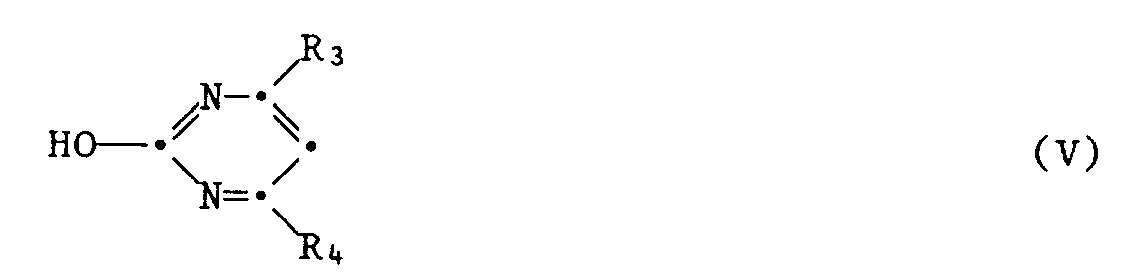
- 2.2 die OH - Gruppe in der erhaltenen Verbindung der Formel V weiter mit überschüssigem POHal3 in Gegenwart oder Abwesenheit eines Lösungsmittels bei Temperaturen von 50 ° C bis 110 ° C, bevor - zugt bei der Rückflusstemperatur des POHala, gegen Halogen austauscht

- 2.3 die erhaltene Verbindung der Formel VI weiter mit einer Anilinverbindung der Formel VII

- a) in Gegenwart eines Protonenakzeptors, wie der überschüssigen Anilinverbindung der Formel VII oder einer anorganischen Base, mit oder ohne Lösungsmittel oder
- b) in Gegenwart einer Säure in einem inerten Lösungsmittel bei jeweils Temperaturen von 60 ° C bis 120 ° C, bevorzugt 80 ° C bis 100 ° C, umsetzt oder
- 2.1 Harnstoff der Formel IV
- 3. in einem zwei-stufigen Verfahren:
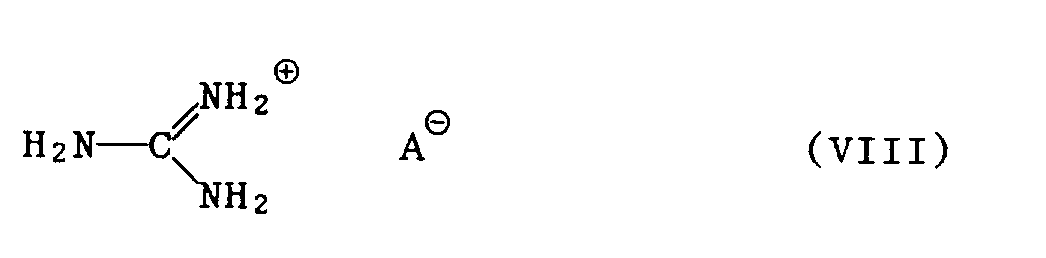
- 3.1 ein Guanidinsalz der Formel VIII

- a) ohne Lösungsmittel bei Temperaturen von 100 ° C bis 160 ° C, bevorzugt 120 ° C bis 150 ° C, oder
- b) in einem inerten Lösungsmittel bei Temperaturen von 30 ° C bis 140°C, bevorzugt 60 ° C bis 120 ° C,

- 3.2 die erhaltene Verbindung der Formel IX mit einer Verbindung der Formel X

- 3.1 ein Guanidinsalz der Formel VIII
- . in einem mehrstufigen Verfahren:
- 4.1
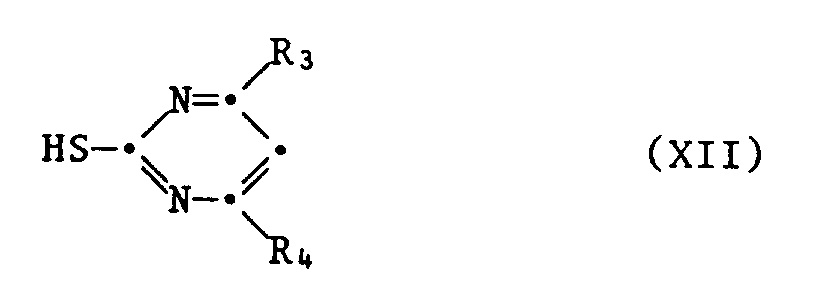
- a) Thioharnstoff der Formel XI




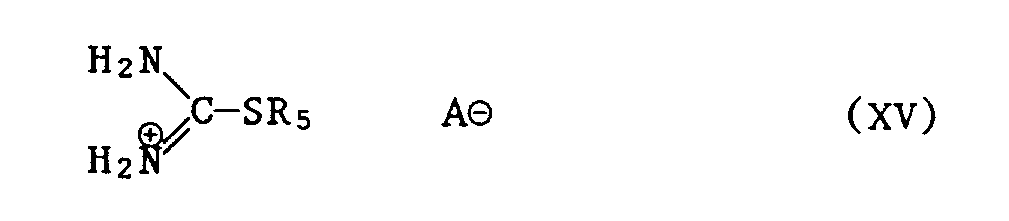
- b) ein Isothiuroniumsalz der Formel XV
- a) Thioharnstoff der Formel XI
- 4.2 die erhaltene Verbindung der Formel XIV mit einem Oxydationsmittel, z.B. mit einer Persäure, zu der Pyrimidinverbindung der Formel XVI

- 4.3 die erhaltene Verbindung der Formel XVI mit einem Formylanilin der Formel XVII


- 4.4 die erhaltene Verbindung der Formel XVIII einer Hydrolyse in Gegenwart einer Base, z.B. Alkalihydroxid, oder einer Säure, z.B. Halogenwasserstoffsäure oder Schwefelsäure, in Wasser oder wässerigen Lösungsmittelgemischen, wie wässerigen Alkoholen oder Dimethylformamid, bei Temperaturen von 10 ° C bis 110 ° C, bevorzugt 30 ° C bis 60 ° C, unterwirft, wobei in den Formeln XI bis XVIII die Substituenten R1 bis R4 die unter Formel I angegebenen Bedeutungen besitzen, und AS ein Säureanion und Y Halogen darstellen.
- 4.1
- 1. a phenylguanidine salt of the formula IIa
- 2. in a multi-stage process:
- 2.1 urea of the formula IV
- 2.2 the OH group in the compound of the formula V obtained is further exchanged for halogen with excess POHal 3 in the presence or absence of a solvent at temperatures from 50 ° C. to 110 ° C., preferably at the reflux temperature of the POHala
- 2.3 the compound of formula VI obtained further with an aniline compound of formula VII
- a) in the presence of a proton acceptor, such as the excess aniline compound of formula VII or an inorganic base, with or without a solvent or
- b) in the presence of an acid in an inert solvent at temperatures of 60 ° C to 120 ° C, preferably 80 ° C to 100 ° C, or
- 2.1 urea of the formula IV
- 3. in a two-stage process:
- 3.1 a guanidine salt of the formula VIII
- a) without solvent at temperatures from 100 ° C to 160 ° C, preferably 120 ° C to 150 ° C, or
- b) in an inert solvent at temperatures from 30 ° C to 140 ° C, preferably 60 ° C to 120 ° C,
- 3.2 the compound of formula IX obtained with a compound of formula X
- 3.1 a guanidine salt of the formula VIII
- . in a multi-stage process:
- 4.1
- a) Thiourea of the formula XI
- b) an isothiuronium salt of the formula XV
- a) Thiourea of the formula XI
- 4.2 the compound of formula XIV obtained with an oxidizing agent, for example with a peracid, to the pyrimidine compound of formula XVI
- 4.3 the compound of formula XVI obtained with a formylaniline of formula XVII
- 4.4 the compound of formula XVIII obtained by hydrolysis in the presence of a base, for example alkali metal hydroxide, or an acid, for example hydrohalic acid or sulfuric acid, in water or aqueous solvent mixtures, such as aqueous alcohols or dimethylformamide, at from 10 ° C. to 110 ° C., preferably Subjects 30 ° C to 60 ° C, wherein in the formulas XI to XVIII the substituents R 1 to R 4 have the meanings given under formula I, and A S represents an acid anion and Y halogen.
- 4.1
Verbindungen der Formel I, in denen R3 die CH2OH - Gruppe darstellt, sind in speziellen Verfahren herstellbar, indem man
- A1.1 das Guanidinsalz der Formel IIa
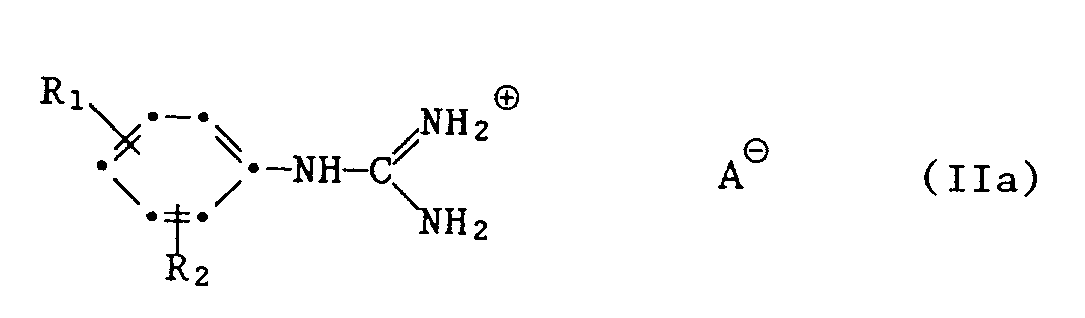


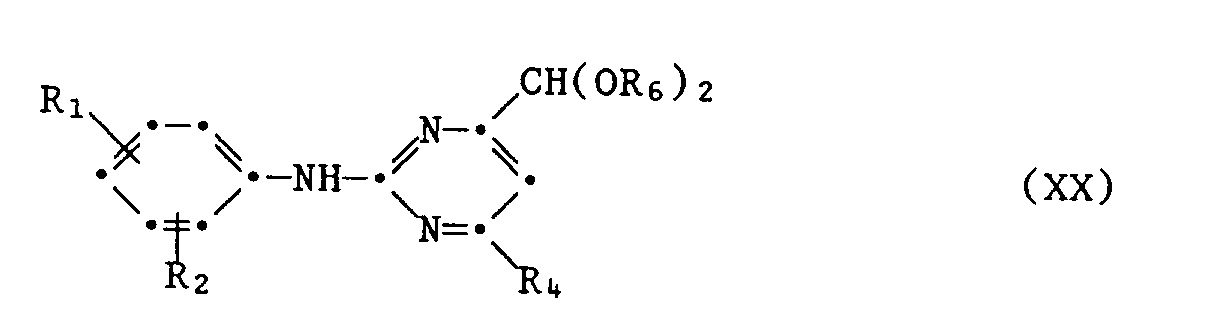
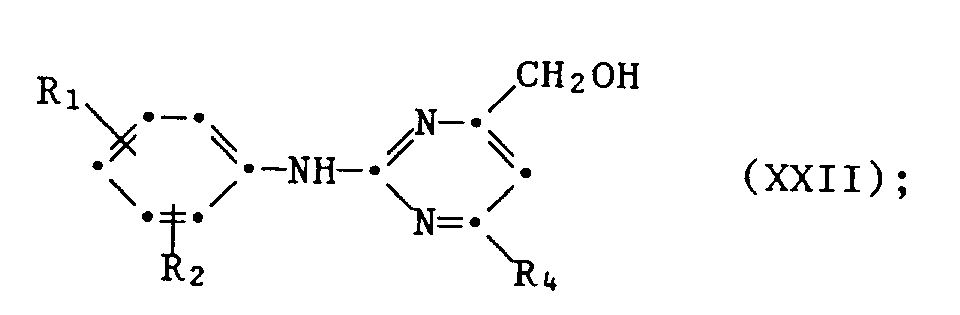
- A1.2 das erhaltene Acetal der Formel XX in Gegenwart einer Säure, z.B. Halogenwasserstoffsäure oder Schwefelsäure, in Wasser oder wässerigen Lösungsmittelgemischen, z.B. mit Lösungsmitteln wie Alkoholen oder Dimethylformamid, bei Temperaturen von 20 ° C bis 100 ° C, bevorzugt 30 ° C bis 60 ° C, zum Pyrimidinaldehyd der Formel XXI

- A1.3 die erhaltene Verbindung der Formel XXI mit elementarem Wasserstoff unter Verwendung eines Katalysators hydriert oder mit einem Reduktionsmittel wie Natriumborhydrid zum entsprechenden Alko - hol XXII reduziert
- A2.1 das Guanidinsalz der Formel IIa oder das Guanidin der Formel Ilb mit einem Diketon der Formel XXIII


- A2.2 Hydrierung in einem Lösungsmittel, vorzugsweise einem aprotischen Lösungsmittel, z.B. Dioxan oder Tetrahydrofuran, mit einem Katalysator wie Palladium - Kohle, bevorzugt Raney - Nickel, bei Tem - peraturen von 20 ° C bis 90 ° C, bevorzugt 50 ° C bis 90 ° C, den Rest CH20R7 in den Rest CH20H überführt; oder
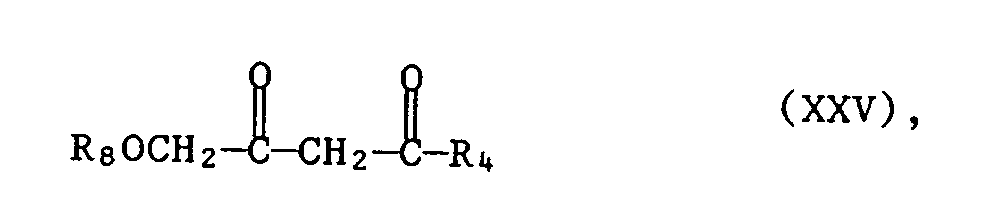
- A3.1 das Guanidinsalz der Formel Ila oder das Guanidin der Formel Ilb mit einem Diketon der Formel XXV
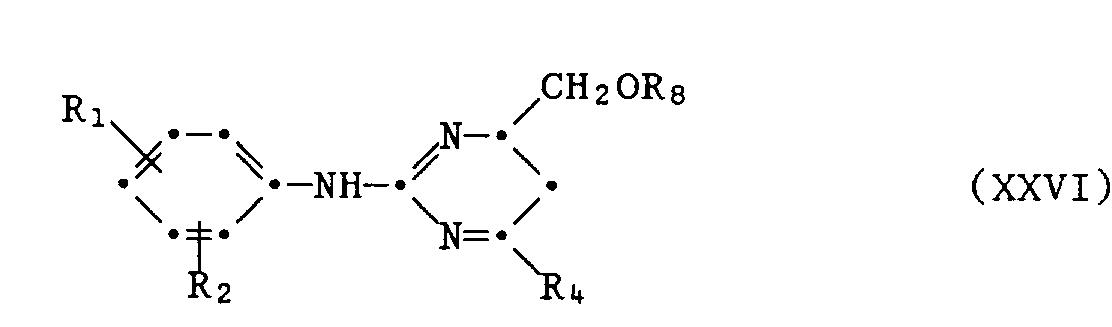
- A3.2 mit der erhaltenen Verbindung der Formel XXVI eine Etherspaltung mit einer Halogenwasserstoff - säure, bevorzugt Bromwasserstoffsäure, oder einer Lewis-Säure wie Aluminiumhalogenid (z.B. AlCl3) oder Borhalogenid B(Hal)3 (z.B. BBr3 oder BCl3) in aprotischen Lösungsmitteln, z.B. Kohlenwasserstoffen, oder Halogenkohlenwasserstoffen, bei Temperaturen von - 80 ° C bis 30 ° C, bevorzugt - 70 ° C bis 20 ° C, durchführt.
- A1.1 the guanidine salt of the formula IIa
- A1.2 the acetal of the formula XX obtained in the presence of an acid, for example hydrohalic acid or sulfuric acid, in water or aqueous solvent mixtures, for example with solvents such as alcohols or dimethylformamide, at temperatures from 20 ° C to 100 ° C, preferably 30 ° C to 60 ° C, to the pyrimidine aldehyde of the formula XXI
- A1.3 the compound of formula XXI obtained is hydrogenated with elemental hydrogen using a catalyst or reduced to the corresponding alcohol XXII using a reducing agent such as sodium borohydride
- A2.1 the guanidine salt of the formula IIa or the guanidine of the formula IIb with a diketone of the formula XXIII
- A2.2 Hydrogenation in a solvent, preferably an aprotic solvent, for example dioxane or tetrahydrofuran, with a catalyst such as palladium-carbon, preferably Raney nickel, at temperatures from 20 ° C. to 90 ° C., preferably 50 ° C. to 90 ° ° C, the residue CH 2 0R 7 converted into the residue CH 2 0H; or
- A3.1 the guanidine salt of the formula Ila or the guanidine of the formula IIb with a diketone of the formula XXV
- A3.2 with the compound of formula XXVI obtained ether cleavage with a hydrohalic acid, preferably hydrobromic acid, or a Lewis acid such as aluminum halide (eg AlCl 3 ) or boron halide B (Hal) 3 (eg BBr 3 or BCl 3 ) in aprotic Solvents, for example hydrocarbons, or halogenated hydrocarbons, at temperatures from - 80 ° C to 30 ° C, preferably - 70 ° C to 20 ° C.
Verbindungen der Formel I, in denen R3 die CH2 Hal - Gruppe darstellt, sind herstellbar, indem man eine Verbindung der Formel XXII mit Phosphorhalogenid oder Thionylhalogenid in Gegenwart von tertiären Basen, z.B. Pyridin oder Triethylamin, in inerten Lösungsmitteln, bei Temperaturen von 0°C bis 110°C, bevorzugt von 0 ° C bis 80 ° C, umsetzt.Compounds of the formula I in which R 3 represents the CH 2 Hal group can be prepared by reacting a compound of the formula XXII with phosphorus halide or thionyl halide in the presence of tertiary bases, for example pyridine or triethylamine, in inert solvents at temperatures of 0 ° C to 110 ° C, preferably from 0 ° C to 80 ° C, implemented.
Verbindungen der Formel I, in denen R3 die CH2 F - Gruppe bedeutet, lassen sich herstellen, indem man eine Verbindung der Formel XXVII

Ein weiteres Verfahren zur Herstellung von Verbindungen der Formel I, in denen R3 die CH2 F - Gruppe darstellt, besteht in der Fluorierung einer Verbindung der Formel XXII mit N,N - Diethylaminoschwefeltri - fluorid (= DAST) in aprotischen Lösungsmitteln wie Dichlormethan, Chloroform, Tetrahydrofuran oder Dioxan, bei Temperaturen von 0 ° C bis 100 ° C, bevorzugt 10 ° C bis 50 ° C.Another process for the preparation of compounds of the formula I in which R 3 represents the CH 2 F group consists in the fluorination of a compound of the formula XXII with N, N-diethylaminosulfuretri fluoride (= DAST) in aprotic solvents such as dichloromethane, chloroform, tetrahydrofuran or dioxane, at temperatures from 0 ° C to 100 ° C, preferably 10 ° C to 50 ° C.
Auch in den vorstehenden Formeln XVIII bis XXVII haben Ri, R2 und R4 die für Formel I gegebene Bedeutung.In the formulas XVIII to XXVII above, R 1, R 2 and R 4 also have the meaning given for formula I.
In den beschriebenen Verfahren kommen bei den Verbindungen der Formeln Ila und VIII für das Säureanion AS beispielsweise folgende Salzreste in Betracht: Carbonat, Hydrogencarbonat, Nitrat, Haloge - nid, Sulfat oder Hydrogensulfat.In the processes described, for the compounds of the formulas Ila and VIII for the acid anion A S, for example, the following salt residues come into consideration: carbonate, hydrogen carbonate, nitrate, halogenide, sulfate or hydrogen sulfate.
Im vorstehend beschriebenen Verfahren kommen bei der Verbindung der Formel XV für das Säureanion AS beispielsweise folgende Salze in Betracht: Halogenid, Sulfat oder Hydrogensulfat.In the process described above, the following salts are suitable for the compound XV of the acid anion A S, for example: halide, sulfate or hydrogen sulfate.
Unter Halogenid sind jeweils Fluorid, Chlorid, Bromid oder Jodid, bevorzugt Bromid oder Chlorid, zu verstehen.Halide is to be understood in each case to mean fluoride, chloride, bromide or iodide, preferably bromide or chloride.
Als Säuren finden vornehmlich anorganische Säuren, wie z.B. Halogenwasserstoffsäuren, beispielsweise Fluorwasserstoffsäure, Chlorwasserstoffsäure oder Bromwasserstoffsäure, sowie Schwefelsäure, Phosphor - säure oder Salpetersäure Verwendung; jedoch können auch geeignete organische Säuren wie Essigsäure, Toluolsulfonsäure u.a. verwendet werden.The main acids used are inorganic acids, e.g. Hydrohalic acids, for example hydrofluoric acid, hydrochloric acid or hydrobromic acid, and also sulfuric acid, phosphoric acid or nitric acid. however, suitable organic acids such as acetic acid, toluenesulfonic acid, etc. be used.
Als Protonenakzeptoren dienen z.B. anorganische oder organische Basen, wie beispielsweise Alkali - oder Erdalkaliverbindungen, z.B. die Hydroxide, Oxide oder Karbonate von Lithium, Natrium, Kalium, Magnesium, Calcium, Strontium und Barium oder auch Hydride wie z.B. Natriumhydrid. Als organische Basen seien beispielsweise tertiäre Amine wie Triethylamin, Triethylendiamin, Pyridin genannt.Proton acceptors are e.g. inorganic or organic bases, such as alkali or alkaline earth compounds, e.g. the hydroxides, oxides or carbonates of lithium, sodium, potassium, magnesium, calcium, strontium and barium or also hydrides such as e.g. Sodium hydride. Examples of organic bases which may be mentioned are tertiary amines such as triethylamine, triethylenediamine and pyridine.
In den vorstehend beschriebenen Verfahren können in Anpassung an die jeweiligen Reaktionsbedin - gungen beispielsweise folgende Lösungsmittel neben den z.T. genannten verwendet werden.In the processes described above, the following solvents, for example, in addition to some of them, can be adapted to the respective reaction conditions. can be used.
Halogenkohlenwasserstoffe, insbesondere Chlorkohlenwasserstoffe, wie Tetrachlorethylen, Tetrachlo - rethan, Dichlorpropan, Methylenchlorid, Dichlorbutan, Chloroform, Chlornaphthalin, Tetrachlorkohlenstoff, Trichlorethan, Trichlorethylen, Pentachlorethan, Difluorbenzol, 1,2 - Dichlorethan, 1,1 - Dichlorethan, 1,2 - cis - Dichlorethylen, Chlorbenzol, Fluorbenzol, Brombenzol, Dichlorbenzol, Dibrombenzol, Chlortoluol, Tri - chlortoluol; Ether, wie Ethylpropylether, Methyl-tert.-butylether, n-Butylethylether, Di-n-butylether, Di - isobutylether, Diisoamylether, Diisopropylether, Anisol, Cyclohexylmethylether, Diethylether, Ethyleng - lykoldimethylether, Tetrahydrofuran, Dioxan, Thioanisol, Dichlordiethylether; Nitrokohlenwasserstoffe wie Nitromethan, Nitroethan, Nitrobenzol, Chlornitrobenzol, o-Nitrotoluol; Nitrile wie Acetonitril, Butyronitril, Isobutyronitril, Benzonitril, m - Chlorbenzonitril; aliphatische oder cycloaliphatische Kohlenwasserstoffe, wie Heptan, Hexan, Octan, Nonan, Cymol, Benzinfraktionen innerhalb eines Siedepunktintervalles von 70 ° C bis 190°C, Cyclohexan, Methylcyclohexan, Dekalin, Petrolether, Ligroin, Trimethylpentan, wie 2,3,3 - Trime - thylpentan; Ester wie Ethylacetat, Acetessigester, Isobutylacetat; Amide, z.B. Formamid, Methylformamid, Dimethylformamid; Ketone, wie Aceton, Methylethylketon; Alkohole, insbesondere niedere aliphatische Alkohole, wie z.B. Methanol, Ethanol, n-Propanol, iso-Propanol sowie die Isomeren der Butanole; gegebenenfalls auch Wasser. Auch Gemische der genannten Lösungs- und Verdünnungsmittel kommen in Betracht.Halogenated hydrocarbons, in particular chlorinated hydrocarbons, such as tetrachlorethylene, tetrachloroethane, dichloropropane, methylene chloride, dichlorobutane, chloroform, chloronaphthalene, carbon tetrachloride, trichloroethane, trichlorethylene, pentachloroethane, difluorobenzene, 1,2-dichloroethane, 1,1-dichloroethane, 1,1 Dichlorethylene, chlorobenzene, fluorobenzene, bromobenzene, dichlorobenzene, dibromobenzene, chlorotoluene, trichlorotoluene; Ethers, such as ethyl propyl ether, methyl tert-butyl ether, n-butyl ethyl ether, di-n-butyl ether, di-isobutyl ether, diisoamyl ether, diisopropyl ether, anisole, cyclohexyl methyl ether, diethyl ether, ethylene glycol - dimethyl ether, tetrahydrofuran, dioxane, thioanisole ether, dichloro Nitro hydrocarbons such as nitromethane, nitroethane, nitrobenzene, chloronitrobenzene, o-nitrotoluene; Nitriles such as acetonitrile, butyronitrile, isobutyronitrile, benzonitrile, m-chlorobenzonitrile; aliphatic or cycloaliphatic hydrocarbons, such as heptane, hexane, octane, nonane, cymene, gasoline fractions within a boiling point interval of 70 ° C to 190 ° C, cyclohexane, methylcyclohexane, decalin, petroleum ether, ligroin, trimethylpentane, such as 2,3,3 - trime - ethyl pentane; Esters such as ethyl acetate, acetoacetic ester, isobutyl acetate; Amides, e.g. Formamide, methylformamide, dimethylformamide; Ketones such as acetone, methyl ethyl ketone; Alcohols, especially lower aliphatic alcohols, e.g. Methanol, ethanol, n-propanol, iso-propanol and the isomers of butanols; optionally also water. Mixtures of the solvents and diluents mentioned are also suitable.
Analoge Synthesemethoden zu den vorstehend beschriebenen Herstellungsverfahren sind in der Lite - ratur publiziert.Synthetic methods analogous to the production processes described above are published in the literature.
Als Hinweise seien genannt:
- Verfahren 1: A.Kreutzberger und J.Gillessen, J.Heterocyclic Chem.22, 101 (1985).
- Verfahren 2, Stufe 2.1: O. Stark, Ber.Dtsch.Chem.Ges.42, 699 (1909); J. Hale, J.Am.Chem.Soc.36, 104 (1914); G.M. Kosolapoff, J.Org.Chem.26, 1895 (1961). Stufe 2.2: St. Angerstein, Ber.Dtsch.Chem.Ges.34, 3956 (1901); G.M. Kosolapoff, J.Org.Chem.26, 1895 (1961). Stufe 2.3: M.P.V. Boarland and J.F.W. McOmie, J.Chem.Soc. 1951, 1218; T.Matsukawa und K. Shirakuwa, J.Pharm.Soc.Japan 71, 933 (1951); Chem.Abstr.46, 4549 (1952).
- Verfahren 3:
Ä . Combes und C. Combes, Bull.Soc. Chem.(3), 7, 791 (1892); W.J. Hale und F.C. Vibrans, J.Am.Chem.Soc.40, 1046 (1918).
- Method 1: A. Kreutzberger and J. Gillessen, J. Heterocyclic Chem. 22, 101 (1985).
- Method 2, stage 2.1: O. Stark, Ber.Dtsch.Chem.Ges.42, 699 (1909); J. Hale, J.Am. Chem. Soc. 36, 104 (1914); GM Kosolapoff, J.Org.Chem.26, 1895 (1961). Level 2.2: St. Angerstein, Ber.Dtsch.Chem.Ges.34, 3956 (1901); GM Kosolapoff, J.Org.Chem.26, 1895 (1961). Level 2.3: MPV Boarland and JFW McOmie, J.Chem.Soc. 1951, 1218; T.Matsukawa and K. Shirakuwa, J.Pharm. Soc. Japan 71, 933 (1951); Chem. Abstr. 46, 4549 (1952).
- Procedure 3:
Ä . Combes and C. Combes, Bull.Soc. Chem. (3), 7, 791 (1892); WJ Hale and FC Vibrans, J.Am.Chem.Soc.40, 1046 (1918).
Die beschriebenen Herstellungsverfahren einschliesslich aller Teilschritte sind ein Bestandteil der vorliegenden Erfindung.The production processes described, including all sub-steps, are part of the present invention.
Folgende Verbindungen, die bei der Herstellung der Verbindungen der Formel 1 als Zwischenprodukte verwendet werden, sind neu und stellen einen Teil der vorliegenden Erfindung dar:
- Verbindungen der Formel XXI

- R1 und R2 unabhängig voneinander Wasserstoff, Halogen, C1 - C3 - Alkyl, C1 - C2 - Halogenalkyl, C1 - C3 - Alkoxy oder Ci - C3 Halogenalkoxy;
- R4 C3 - C6 - Cycloalkyl oder durch Methyl und/oder Halogen bis zu dreifach gleich oder verschieden substituiertes C3 - C6 - Cycloalkyl.
- Compounds of formula XXI
- R 1 and R 2 independently of one another are hydrogen, halogen, C 1 - C3 - alkyl, C 1 - C2 - haloalkyl, C 1 - C3 - alkoxy or C i - C 3 haloalkoxy;
- R 4 C 3 - C 6 - cycloalkyl or C 3 - C6 cycloalkyl substituted up to three times by the same or different means by methyl and / or halogen.
Ueberraschenderweise wurde nun gefunden, dass Verbindungen der Formel 1 ein für praktische Bedürfnisse sehr günstiges biozides Spektrum zur Bekämpfung von Insekten und phytopathogenen Mikroorganismen, insbesondere Fungi, aufweisen. Sie besitzen sehr vorteilhafte kurative, präventive und insbe - sondere systemische Eigenschaften und werden zum Schutz von zahlreichen Kulturpflanzen eingesetzt. Mit den Wirkstoffen der Formel I können an Pflanzen oder Pflanzenteilen (Früchte, Blüten, Laubwerk, Stengel, Knollen, Wurzeln) von unterschiedlichen Nutzkulturen die auftretenden Schädlinge eingedämmt oder vernichtet werden, wobei auch später zuwachsende Pflanzenteile z.B. vor phytopathogenen Mikroorganismen verschont bleiben.Surprisingly, it has now been found that compounds of formula 1 have a biocidal spectrum which is very favorable for practical needs for controlling insects and phytopathogenic microorganisms, in particular fungi. They have very advantageous curative, preventive and in particular systemic properties and are used to protect numerous crop plants. With the active ingredients of the formula I, the pests occurring on plants or parts of plants (fruits, flowers, leaves, stems, tubers, roots) from different crops can be contained or destroyed, with parts of the plant which subsequently grow e.g. remain spared from phytopathogenic microorganisms.
Verbindungen der Formel I sind z.B. gegen die den folgenden Klassen angehörenden phytopathogenen Pilze wirksam: Fungi imperfecti (insbesondere Botrytis, ferner Pyricularia, Helminthosporium, Fusarium, Septoria, Cercospora und Alternaria); Basidiomyceten (z.B. Rhizoctonia, Hemileia, Puccinia). Darüber hinaus wirken sie gegen die Klasse der Ascomyceten (z.B. Venturia und Erysiphe, Podosphaera, Monilinia, Uncinula) und der Oomyceten (z.B. Phytophthora, Pythium, Plasmopara). Die Verbindungen der Formel I können ferner als Beizmittel zur Behandlung von Saatgut (Früchte, Knollen, Körner) und Pflanzenstecklin - gen zum Schutz vor Pilzinfektionen sowie gegen im Erdboden auftretende phytopathogene Pilze eingesetzt werden. Verbindungen der Formel I sind darüberhinaus gegen Schadinsekten wirksam, z.B. gegen Getreide - Schädlinge, insbesondere Reisschädlinge.Compounds of formula I are e.g. effective against the phytopathogenic fungi belonging to the following classes: Fungi imperfecti (in particular Botrytis, furthermore Pyricularia, Helminthosporium, Fusarium, Septoria, Cercospora and Alternaria); Basidiomycetes (e.g. Rhizoctonia, Hemileia, Puccinia). In addition, they act against the class of Ascomycetes (e.g. Venturia and Erysiphe, Podosphaera, Monilinia, Uncinula) and Oomycetes (e.g. Phytophthora, Pythium, Plasmopara). The compounds of the formula I can furthermore be used as dressing agents for the treatment of seeds (fruits, tubers, grains) and plant plug-ins for protection against fungal infections and against phytopathogenic fungi which occur in the soil. Compounds of formula I are also active against insect pests, e.g. against grain - pests, especially rice pests.
Die Erfindung betrifft auch die Mittel, die als Wirkstoffkomponente Verbindungen der Formel I enthalten, insbesondere pflanzenschützende Mittel, sowie deren Verwendung auf dem Agrarsektor oder verwandten Gebieten.The invention also relates to the compositions which contain compounds of the formula I, in particular crop protection compositions, as well as their use in the agricultural sector or related fields.
Darüber hinaus schliesst die vorliegende Erfindung auch die Herstellung dieser Mittel ein, die gekenn - zeichnet ist durch das innige Vermischen der Aktivsubstanz mit einem oder mehreren hierin beschriebenen Substanzen bzw. Substanzgruppen. Eingeschlossen ist auch ein Verfahren zur Behandlung von Pflanzen, das sich durch Applikation der neuen Verbindungen der Formel I bzw. der neuen Mittel auszeichnet.In addition, the present invention also includes the production of these agents, which is characterized by the intimate mixing of the active substance with one or more substances or groups of substances described herein. Also included is a method for the treatment of plants which is characterized by the application of the new compounds of the formula I or the new agents.
Als Zielkulturen für den hierin offenbarten pflanzenschützenden Einsatz gelten im Rahmen dieser Erfindung beispielsweise folgende Pflanzenarten: Getreide (Weizen, Gerste, Roggen, Hafer, Reis, Mais, Sorghum und verwandte Species); Rüben (Zucker- und Futterrüben); Kern-, Stein und Beerenobst (Aepfel, Birnen, Pflaumen, Pfirsiche, Mandeln, Kirschen, Erd - , Hirn- und Brombeeren); Hülsenfrüchte (Bohnen, Linsen, Erbsen, Soja); Oelkulturen (Raps, Senf, Mohn, Oliven, Sonnenblumen, Kokos, Rizinus, Kakao, Erdnüsse); Gurkengewächse (Kürbis, Gurken, Melonen); Fasergewächse (Baumwolle, Flachs, Hanf, Jute); Citrusfrüchte (Orangen, Zitronen, Pampelmusen, Mandarinen); Gemüsesorten (Spinat, Kopfsalat, Spargel, Kohlarten, Möhren, Zwiebeln, Tomaten, Kartoffeln, Paprika); Lorbeergewächse (Avocado, Cinnamonium, Kampfer) oder Pflanzen wie Tabak, Nüsse, Kaffee, Zuckerrohr, Tee, Pfeffer, Weinreben, Hopfen, Bananen - und Naturkautschukgewächse sowie Zierpflanzen.The target crops for the plant protection use disclosed herein include, for example, the following types of plants in the context of this invention: cereals (wheat, barley, rye, oats, rice, corn, sorghum and related species); Beets (sugar and fodder beets); Pome, stone and soft fruit (apple, pear, plum, peach, almond, cherry, strawberry, brain and blackberry); Legumes (beans, lentils, peas, soybeans); Oil crops (rapeseed, mustard, poppy seeds, olives, sunflowers, coconut, castor bean, cocoa, peanuts); Cucumber plants (pumpkin, cucumber, melons); Fiber plants (cotton, flax, hemp, jute); Citrus fruits (oranges, lemons, grapefruit, tangerines); Vegetables (spinach, lettuce, asparagus, cabbage, carrots, onions, tomatoes, potatoes, peppers); Bay plants (avocado, cinnamon, camphor) or plants such as tobacco, nuts, coffee, sugar cane, tea, pepper, grapevines, hops, banana and natural rubber plants and ornamental plants.
Wirkstoffe der Formel I werden üblicherweise in Form von Zusammensetzungen verwendet und können gleichzeitig oder nacheinander mit weiteren Wirkstoffen auf die zu behandelnde Fläche oder Pflanze gegeben werden. Diese weiteren Wirkstoffe können sowohl Düngemittel, Spurenelemente-Vermittler oder andere das Pflanzenwachstum beeinflussende Präparate sein. Es können dabei auch selektive Herbizide sowie Insektizide, Fungizide, Bakterizide, Nematizide, Molluskizide oder Gemische mehrerer dieser Präparate zusammen mit gegebenenfalls weiteren in der Formulierungstechnik üblichen Trägerstoffen, Tensiden oder anderen applikationsfördernden Zusätzen Verwendung finden.Active ingredients of the formula I are usually used in the form of compositions and can be applied simultaneously or in succession to the area or plant to be treated with further active ingredients. These other active ingredients can be both fertilizers, trace element mediators or other preparations which influence plant growth. Selective herbicides as well as insecticides, fungicides, bactericides, nematicides, molluscicides or mixtures of several of these preparations can also be used here, together with any other carriers, surfactants or other application-promoting additives that are customary in formulation technology.
Geeignete Träger und Zusätze können fest oder flüssig sein und entsprechen den in der Formulierungstechnik zweckdienlichen Stoffen, wie z.B. natürlichen oder regenerierten mineralischen Stoffen, Lösungs - , Dispergier - , Netz - , Haft - , Verdickungs -, Binde - oder Düngemitteln.Suitable carriers and additives can be solid or liquid and correspond to the substances useful in formulation technology, e.g. natural or regenerated mineral substances, solvents, dispersants, wetting agents, adhesives, thickeners, binders or fertilizers.
Ein bevorzugtes Verfahren zum Aufbringen eines Wirkstoffs der Formel I bzw. eines agrochemischen Mittels, das mindestens einen dieser Wirkstoffe enthält, ist das Aufbringen auf das Blattwerk (Blattapplikation). Applikationsfrequenz und Aufwandmenge richten sich dabei nach dem Befallsdruck des betreffenden Erregers. Die Wirkstoffe der Formel können aber auch über den Erdboden durch das Wurzelwerk in die Pflanze gelangen (systemische Wirkung), indem man den Standort der Pflanze mit einer flüssigen Zubereitung tränkt oder die Substanzen in fester Form in den Boden einbringt, z.B. in Form von Granulat (Bodenapplikation). Bei Wasserreiskulturen kann man solche Granulate dem überfluteten ReisFeld zudosieren. Die Verbindungen der Formel können aber auch auf Samenkörner aufgebracht werden (Coating), indem man die Körner entweder in einer flüssigen Zubereitung des Wirkstoffs tränkt oder sie mit einer festen Zubereitung beschichtet.A preferred method for applying an active ingredient of the formula I or an agrochemical agent which contains at least one of these active ingredients is application to the foliage (Leaf application). Application frequency and application rate depend on the infestation pressure of the pathogen in question. The active ingredients of the formula can also get into the plant through the roots through the roots (systemic effect) by soaking the location of the plant with a liquid preparation or introducing the substances into the soil in solid form, e.g. in the form of granules ( Floor application). In water rice crops, such granules can be added to the flooded rice field. However, the compounds of the formula can also be applied to seeds (coating) by either soaking the seeds in a liquid preparation of the active ingredient or coating them with a solid preparation.
Die Verbindungen der Formel I werden dabei in unveränderter Form oder vorzugsweise zusammen mit den in der Formulierungstechnik üblichen Hilfsmitteln eingesetzt. Dafür werden sie zweckmässigerweise z.B. zu Emulsionskonzentraten, streichfähigen Pasten, direkt versprühbaren oder verdünnbaren Lösungen, verdünnten Emulsionen, Spritzpulvern, löslichen Pulvern, Stäubemitteln, Granulaten, durch Verkapselungen in z.B. polymeren Stoffen in bekannter Weise verarbeitet. Die Anwendungsverfahren wie Versprühen, Vernebeln, Verstäuben, Verstreuen, Bestreichen oder Giessen werden gleich wie die Art der Mittel den angestrebten Zielen und den gegebenen Verhältnissen entsprechend gewählt. Günstige Aufwandmengen liegen im allgemeinen bei 50 g bis 5 kg Aktivsubstanz (AS) je ha, bevorzugt 100 g bis 2 kg AS/ha, insbesondere bei 200 g bis 600 g AS/ha.The compounds of the formula I are used in unchanged form or preferably together with the auxiliaries customary in formulation technology. For this purpose, they are expediently e.g. to emulsion concentrates, spreadable pastes, directly sprayable or dilutable solutions, diluted emulsions, wettable powders, soluble powders, dusts, granules, by encapsulation in e.g. polymeric materials processed in a known manner. The application methods, such as spraying, atomizing, dusting, scattering, brushing or pouring, are selected in the same way as the type of agent, in accordance with the intended objectives and the prevailing conditions. Favorable application rates are generally 50 g to 5 kg of active substance (AS) per ha, preferably 100 g to 2 kg AS / ha, in particular 200 g to 600 g AS / ha.
Die Formulierungen d.h. die den Wirkstoff der Formel 1 und gegebenenfalls einen festen oder flüssigen Zusatzstoff enthaltenden Mittel, Zubereitungen oder Zusammensetzungen werden in bekannter Weise hergestellt, z.B. durch inniges Vermischen und/oder Vermahlen der Wirkstoffe mit Streckmitteln, wie z.B. mit Lösungsmitteln, festen Trägerstoffen, und gegebenenfalls oberflächenaktiven Verbindungen (Tensiden).The formulations i.e. the agents, preparations or compositions containing the active ingredient of formula 1 and optionally a solid or liquid additive are prepared in a known manner, e.g. by intimately mixing and / or grinding the active ingredients with extenders, e.g. with solvents, solid carriers, and optionally surface-active compounds (surfactants).
Als Lösungsmittel kommen in Frage: Aromatische Kohlenwasserstoffe, bevorzugt die Fraktionen C8 bis C12, wie z.B. Xylolgemische oder substituierte Naphthaline, Phthalsäureester wie Dibutyl - oder Dioctylphthalat, aliphatische Kohlenwasserstoffe wie Cyclohexan oder Paraffine, Alkohole und Glykole sowie deren Ether und Ester, wie Ethanol, Ethylenglykol, Ethylenglykolmonomethyl - oder Ethylether, Ketone wie Cyclohexanon, stark polare Lösungsmittel, wie N - Methyl - 2 - pyrrolidon, Dimethylsulfoxid oder Dimethyl - formamid, sowie gegebenenfalls epoxydierte Pflanzenöle wie epoxydiertes Kokosnussöl oder Sojaöl; oder Wasser.Possible solvents are: aromatic hydrocarbons, preferably the fractions C 8 to C 12 , such as, for example, xylene mixtures or substituted naphthalenes, phthalic acid esters such as dibutyl or dioctyl phthalate, aliphatic hydrocarbons such as cyclohexane or paraffins, alcohols and glycols and their ethers and esters such as ethanol , Ethylene glycol, ethylene glycol monomethyl or ethyl ether, ketones such as cyclohexanone, strongly polar solvents such as N-methyl-2-pyrrolidone, dimethyl sulfoxide or dimethylformamide, and optionally epoxidized vegetable oils such as epoxidized coconut oil or soybean oil; or water.
Als feste Trägerstoffe, z.B. für Stäubemittel und dispergierbare Pulver, werden in der Regel natürliche Gesteinsmehle verwendet, wie Calcit, Talkum, Kaolin, Montmorilonit oder Attapulgit. Zur Verbesserung der physikalischen Eigenschaften können auch hochdisperse Kieselsäure oder hochdisperse saugfähige Polymerisate zugesetzt werden. Als gekörnte, adsorptive Granulatträger kommen poröse Typen wie z.B. Bimsstein, Ziegelbruch, Sepiolit oder Bentonit, als nicht-sorptive Trägermaterialien, z.B. Calcit oder Sand, in Frage. Darüber hinaus kann eine Vielzahl von vorgranulierten Materialien anorganischer Natur wie insbesondere Dolomit oder zerkleinerte Pflanzenrückstände verwendet werden.As solid carriers, e.g. natural dust, such as calcite, talc, kaolin, montmorilonite or attapulgite, is generally used for dusts and dispersible powders. To improve the physical properties, highly disperse silica or highly disperse absorbent polymers can also be added. As granular, adsorptive granulate carriers come porous types such as Pumice stone, broken brick, sepiolite or bentonite, as non-sorptive carrier materials, e.g. Calcite or sand, in question. In addition, a large number of pregranulated materials of an inorganic nature, such as, in particular, dolomite or comminuted plant residues can be used.
Besonders vorteilhafte applikationsfördernde Zuschlagstoffe, die zu einer starken Reduktion der Aufwandmenge führen können, sind ferner natürliche (tierische oder pflanzliche) oder synthetische Phospholi - pide aus der Reihe der Kephaline und Lecithine, die man beispielsweise aus Sojabohnen gewinnen kann.Particularly advantageous application-promoting additives which can lead to a large reduction in the application rate are also natural (animal or vegetable) or synthetic phospholipids from the range of the cephalins and lecithins, which can be obtained, for example, from soybeans.
Als oberflächenaktive Verbindungen kommen je nach Art des zu formulierenden Wirkstoffs der Formel I nichtionogene, kation-und/oder anionaktive Tenside mit guten Emulgier-, Dispergier- und Netzeigen - schaften in Betracht. Unter Tensiden sind auch Tensidgemische zu verstehen.Depending on the nature of the active ingredient of formula I to be formulated, suitable surface-active compounds are nonionic, cationic and / or anionic surfactants with good emulsifying, dispersing and wetting properties. Surfactants are also to be understood as mixtures of surfactants.
Geeignete anionische Tenside können sowohl sog. wasserlösliche Seifen, als auch wasserlösliche synthetische oberflächenaktive Verbindungen sein.Suitable anionic surfactants can be both so-called water-soluble soaps and water-soluble synthetic surface-active compounds.
Als Seifen seien die Alkali - , Erdalkali - oder gegebenenfalls substituierten Ammoniumsalze von höheren Fettsäuren (C10-C22), wie z.B. die Na- oder K-Salze der Oel- oder Stearinsäure, oder von natürlichen Fettsäuregemischen, die z.B. aus Kokosnuss- oder Talgöl gewonnen werden können. Ferner sind auch die Fettsäure - Methyllaurinsalze zu erwähnen.The soaps are the alkali metal, alkaline earth metal or optionally substituted ammonium salts of higher fatty acids (C 10 -C 22 ), such as the Na or K salts of oleic or stearic acid, or of natural fatty acid mixtures, for example from coconut or Tallow oil can be extracted. The fatty acid methyl laurine salts should also be mentioned.
Häufiger werden jedoch sog. synthetische Tenside verwendet, insbesondere Alkansulfonate, Fettalko - holsulfate, sulfonierte Benzimidazolderivate oder Alkylsulfonate.However, so-called synthetic surfactants are used more frequently, in particular alkane sulfonates, fatty alcohol sulfates, sulfonated benzimidazole derivatives or alkyl sulfonates.
Die Fettalkoholsulfonate oder - sulfate liegen in der Regel als Alkali-, Erdalkali - oder gegebenenfalls substituierte Ammoniumsalze vor und weisen einen Alkylrest mit 8 bis 22 C-Atomen auf, wobei Alkyl auch den Alkylteil von Acylresten einschliesst, z.B. das Na-oder Ca - Salz der Ligninsulfonsäure, des Dodecyl - schwefelsäureesters oder eines aus natürlichen Fettsäuren hergestellten Fettalkoholsulfatgemisches. Hierher gehören auch die Salze der Schwefelsäureester und Sulfonsäuren von Fettalkohol - Ethylenoxyd - Addukten. Die sulfonierten Benzimidazolderivate enthalten vorzugsweise 2 - Sulfonsäuregruppen und einen Fettsäurerest mit 8-22 C-Atomen.The fatty alcohol sulfonates or sulfates are usually present as alkali, alkaline earth or optionally substituted ammonium salts and have an alkyl radical with 8 to 22 carbon atoms, alkyl also including the alkyl part of acyl radicals, e.g. the Na or Ca salt of lignin sulfonic acid, dodecyl sulfuric acid ester or a fatty alcohol sulfate mixture made from natural fatty acids. This subheading also includes the salts of sulfuric acid esters and sulphonic acids of fatty alcohol - ethylene oxide adducts. The sulfonated benzimidazole derivatives preferably contain 2 - sulfonic acid groups and a fatty acid residue with 8-22 carbon atoms.
Alkylarylsulfonate sind z.B. die Na-, Ca- oder Triethanolaminsalze der Dodecylbenzolsulfonsäure, der Dibutylnaphthalinsulfonsaure oder eines Naphthalinsulfonsäure - Formaldehydkondensationsproduktes.Alkylarylsulfonates are e.g. the sodium, calcium or triethanolamine salts of dodecylbenzenesulfonic acid, dibutylnaphthalenesulfonic acid or a naphthalenesulfonic acid / formaldehyde condensation product.
Ferner kommen auch entsprechende Phosphate wie z.B. Salze des Phosphorsäureesters eines p - Nonylphenol - (4 -14) - Ethylenoxyd - Adduktes in Frage.Corresponding phosphates such as e.g. Salts of the phosphoric acid ester of a p - nonylphenol - (4 -14) - ethylene oxide adduct in question.
Als nichtionische Tenside kommen in erster Linie Polyglykoletherderivate von aliphatischen oder cycloaliphatischen Alkoholen, gesättigten oder ungesättigten Fettsäuren und Alkylphenolen in Frage, die 3 bis 30 Glykolethergruppen und 8 bis 20 Kohlenstoffatome im (aliphatischen) Kohlenwasserstoffrest und 6 bis 18 Kohlenstoffatome im Alkylrest der Alkylphenole enthalten können.Suitable nonionic surfactants are primarily polyglycol ether derivatives of aliphatic or cycloaliphatic alcohols, saturated or unsaturated fatty acids and alkylphenols, which can contain 3 to 30 glycol ether groups and 8 to 20 carbon atoms in the (aliphatic) hydrocarbon radical and 6 to 18 carbon atoms in the alkyl radical of the alkylphenols.
Weitere geeignete nichtionische Tenside sind wasserlösliche 20 bis 250 Aethylenglykoläthergruppen und 10 bis 100 Propylenglykolethergruppen enthaltende Polyethylenoxidaddukte an Polypropylenglykol, Aethylendiaminopolypropylenglykol und Alkylpolypropylenglykol mit 1 bis 10 Kohlenstoffatomen in der Alkylkette. Die genannten Verbindungen enthalten üblicherweise pro Propylenglykol - Einheiten 1 bis 5 Ethylenglykoleinheiten.Other suitable nonionic surfactants are water-soluble 20 to 250 ethylene glycol ether groups and 10 to 100 propylene glycol ether groups containing polyethylene oxide adducts with polypropylene glycol, ethylenediaminopolypropylene glycol and alkylpolypropylene glycol with 1 to 10 carbon atoms in the alkyl chain. The compounds mentioned usually contain 1 to 5 ethylene glycol units per propylene glycol unit.
Als Beispiele nichtionischer Tenside seien Nonylphenolpolyethoxyethanole, Ricinusölpolyglykolether, Polypropylen - Polyethylenoxydaddukte, Tributylphenoxypolyethylenethanol, Polyethylenglykol und Octylp - henoxypolyethoxyethanol erwähnt.Examples of nonionic surfactants are nonylphenol polyethoxyethanols, castor oil polyglycol ethers, polypropylene - polyethylene oxide adducts, tributylphenoxypolyethylene ethanol, polyethylene glycol and octylphenoxy polyethoxyethanol.
Ferner kommen auch Fettsäureester von Polyoxyethylensorbitan wie das Polyoxyethylensorbitan - trioleat in Betracht.Fatty acid esters of polyoxyethylene sorbitan, such as polyoxyethylene sorbitan trioleate, are also suitable.
Bei den kationischen Tensiden handelt es sich vor allem um quartäre Ammoniumsalze, welche als N - Substituenten mindestens einen Alkylrest mit 8 bis 22 C-Atomen enthalten und als weitere Substituenten niedrige, gegebenenfalls halogenierte Alkyl - , Benzyl - oder niedrige Hydroxyalkylreste aufweisen. Die Salze liegen vorzugsweise als Halogenide, Methylsulfate oder Ethylsulfate vor, z.B. das Stearyltrimethylammoniumchlorid oder das Benzyldi(2-chlorethyl)-ammoniumbromid.The cationic surfactants are primarily quaternary ammonium salts which contain at least one alkyl radical having 8 to 22 carbon atoms as N substituents and have low, optionally halogenated alkyl, benzyl or low hydroxyalkyl radicals as further substituents. The salts are preferably in the form of halides, methyl sulfates or ethyl sulfates, e.g. the stearyltrimethylammonium chloride or the benzyldi (2-chloroethyl) ammonium bromide.
Weitere in der Formulierungstechnik gebräuchlichen Tenside sind dem Fachmann bekannt oder können der einschlägigen Fachliteratur entnommen werden.Other surfactants commonly used in formulation technology are known to the person skilled in the art or can be found in the relevant specialist literature.
Die agrochemischen Zubereitungen enthalten in der Regel 0,1 bis 99 %, insbesondere 0,1 bis 95 %, Wirkstoff der Formel I, 99,9 bis 1 %, insbesondere 99,9 bis 5 %, eines festen oder flüssigen Zusatzstoffes und 0 bis 25 %, insbesondere 0,1 bis 25 %, eines Tensides.The agrochemical preparations generally contain 0.1 to 99%, in particular 0.1 to 95%, active ingredient of the formula I, 99.9 to 1%, in particular 99.9 to 5%, of a solid or liquid additive and 0 to 25%, in particular 0.1 to 25%, of a surfactant.
Während als Handelsware eher konzentrierte Mittel bevorzugt werden, verwendet der Endverbraucher in der Regel verdünnte Mittel.While concentrated agents are preferred as a commodity, the end user generally uses diluted agents.
Die Mittel können auch weitere Zusätze wie Stabilisatoren, Entschäumer, Viskositätsregulatoren, Bin - demittel, Haftmittel sowie Dünger oder andere Wirkstoffe zur Erzielung spezieller Effekte enthalten.The agents can also contain other additives such as stabilizers, defoamers, viscosity regulators, binders, adhesives and fertilizers or other active ingredients to achieve special effects.
Die nachfolgenden Beispiele dienen zur näheren Erläuterung der Erfindung, ohne dieselbe einzu - schränken.The following examples serve to explain the invention in more detail without restricting it.


11,7 g (59,2 mMol) Phenylguanidin - hydrogencarbonat und 13,3 g (62,2 mMol) 1 - Cyclopropyl - 3- formyldiethylacetal- 1,3 - propandion in 40 ml Ethanol werden unter Rühren 5 Stunden unter Rückfluss erhitzt, wobei die Kohlendioxidentwicklung mit fortschreitender Reaktionsdauer nachlässt. Nach dem Ab - kühlen auf Raumtemperatur wird die dunkelbraune Emulsion mit 80 ml Diethylether versetzt, zweimal mit je 30 ml Wasser gewaschen, über Natriumsulfat getrocknet, filtriert und das Lösungsmittel verdampft. Das zurünckbleibende dunkelbraune Oel (17 g) wird säulenchromatographisch über Kieselgel (Toluol/Ethylacetat:5/2) gereinigt. Nach dem Abdampfen des Laufmittelgemisches verbleibt ein rotbraunes Oel mit dem Brechungsindex 

12,3 g (39,3 mMol) 2-Anilino-4-formyldiethylacetal-6-cyclopropyl-pyrimidin, 4 g (39,3 mMol) konz. Salzsäure und 75 ml Wasser werden unter intensivem Rühren 14 Stunden bei 50 ° C erwärmt und nach Zugabe von 2 g (19,6 mMol) konz. Salzsäure weitere 24 Stunden bei dieser Temperatur gerührt. Nach dem Abkühlen auf Raumtemperatur werden zu der beige gefärbten Suspension 50 ml Ethylacetat gegeben und mit 7 ml 30 %iger Natronlauge neutral gestellt. Die Ethylacetatlösung wird dann abgetrennt, über Natriumsulfat getrocknet, filtriert und das Lösungmittel verdampft. Zur Reinigung wird der bräunlich gefärbte Festkörper in Gegenwart von Aktivkohle aus 20 ml Isopropanol umkristallisiert. Die gelblichen Kristalle schmelzen bei 112 - 114°C. Ausbeute 7,9 g (33 mMol; 84 % d.Th.).12.3 g (39.3 mmol) of 2-anilino-4-formyldiethylacetal-6-cyclopropyl-pyrimidine, 4 g (39.3 mmol) of conc. Hydrochloric acid and 75 ml of water are heated for 14 hours at 50 ° C with intensive stirring and after adding 2 g (19.6 mmol) conc. Hydrochloric acid stirred for a further 24 hours at this temperature. After cooling to room temperature, 50 ml of ethyl acetate are added to the beige-colored suspension and neutralized with 7 ml of 30% sodium hydroxide solution. The ethyl acetate solution is then separated off, dried over sodium sulfate, filtered and the solvent is evaporated. For cleaning, the brownish-colored solid is recrystallized from 20 ml of isopropanol in the presence of activated carbon. The yellowish crystals melt at 112 - 114 ° C. Yield 7.9 g (33 mmol; 84% of theory).
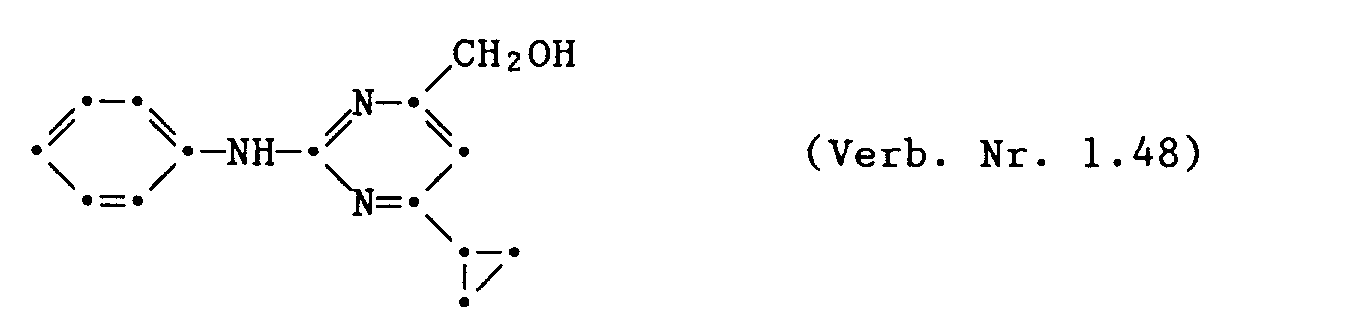
- a) Zu 14,1 g (59 mMol) 2-Anilino-4-formyl-6-cyclopropyl-pyrimidin in 350 absolutem Methanol werden innerhalb von 15 Minuten unter Rühren bei Raumtemperatur 2,3 g (60 mMol) Natriumborhydrid portionenweise zugegeben, wobei sich das Reaktionsgemisch unter Wasserstoffentwicklung auf 28 ° C erwärmt. Nach 4 Stunden wird durch Zutropfen von 10 ml konz. Salzsäure angesäuert, 120 ml 10 %ige Natriumhydrogencarbonatlösung zugetropft und anschliessend mit 250 ml Wasser verdünnt. Der ausgeschiedene Niederschlag wird abfiltriert, getrocknet, in 600 ml Diethylether in der Wärme weitgehend gelöst, mit Aktivkohle behandelt und filtriert. Das klare Filtrat wird bis zum Auftreten einer Trübung eingeengt, mit Petrolether verdünnt und das hellgelbe Kristallpulver abfiltriert; Schmp. 123 - 125°C. Ausbeute: 10,8 g (44,8 mMol; 75,9 % d.Th.).a) To 14.1 g (59 mmol) of 2-anilino-4-formyl-6-cyclopropyl-pyrimidine in 350 absolute methanol, 2.3 g (60 mmol) of sodium borohydride are added in portions, with stirring, at room temperature, with the reaction mixture warms to 28 ° C. with evolution of hydrogen. After 4 hours, 10 ml of conc. Acidified hydrochloric acid, added dropwise 120 ml of 10% sodium hydrogen carbonate solution and then diluted with 250 ml of water. The precipitate which has separated out is filtered off, dried, largely dissolved in 600 ml of hot diethyl ether, treated with activated carbon and filtered. The clear filtrate is until turbidity occurs concentrated, diluted with petroleum ether and the light yellow crystal powder filtered off; Mp 123-125 ° C. Yield: 10.8 g (44.8 mmol; 75.9% of theory).
- b) 5,9 g (23 mMol) 2 - Anilino - 4 - methoxymethyl - 6 - cyclopropyl - pyrimidin, hergestellt aus Phenyl - guanidin und 1 - Cyclopropyl - 4 - methoxy - 1,3 - butandion, werden in 200 ml Dichlormethan gelöst und auf -68°C gekühlt. Zu der lachsfarbenen Lösung werden unter intensivem Rühren 6,8 g (27 mMol) Bortribromid innerhalb einer halben Stunde langsam zugetropft, anschliessend das Kältebad entfernt und noch 2 Stunden bei Raumtemperatur gerührt. Nach der Zugabe von 150 g Eiswasser wird das ausgeschiedene Rohprodukt abfiltriert und aus Methanol unter Verwendung von Aktivkohle umkristalli - siert. Die hellgelben Kristalle schmelzen bei 124 - 126°C. Ausbeute: 4,7 g (19,5 mMol; 84,7 % d.Th.).b) 5.9 g (23 mmol) of 2-anilino-4-methoxymethyl-6-cyclopropyl-pyrimidine, prepared from phenyl-guanidine and 1-cyclopropyl-4-methoxy-1,3-butanedione, are dissolved in 200 ml of dichloromethane and cooled to -68 ° C. 6.8 g (27 mmol) of boron tribromide are slowly added dropwise to the salmon-colored solution with vigorous stirring, then the cooling bath is removed and the mixture is stirred for a further 2 hours at room temperature. After the addition of 150 g of ice water, the crude product which has separated out is filtered off and recrystallized from methanol using activated carbon. The light yellow crystals melt at 124 - 126 ° C. Yield: 4.7 g (19.5 mmol; 84.7% of theory).
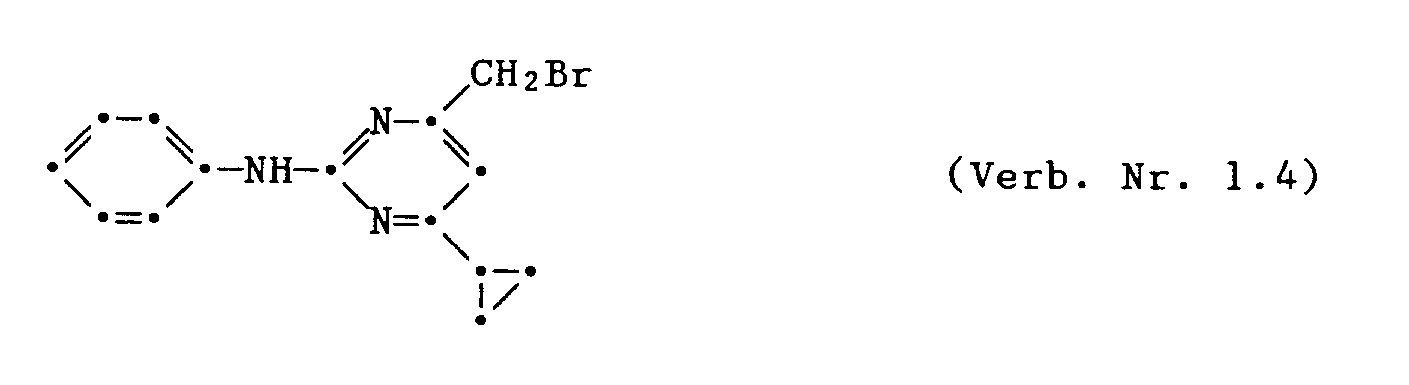
Zu 12 g (50 mMol) 2 - Phenylamino - 4 - hydroxymethyl - 6 - cyclopropyl - pyrimidin und 0,4 g (50 mMol) Pyridin in 350 ml Diethylether werden innerhalb einer halben Stunde 15,6 g (75 mMol) Thionylbromid in 50 ml Diethylether unter Rühren zugetropft. Nach 2-stündigem Rühren bei Raumtemperatur werden nochmals 0,4 g (50 mMol) Pyridin zugegeben und 5 Stunden unter Rückfluss erhitzt. Nach dem Abkühlen auf Raumtemperatur werden 200 ml Wasser zugegeben und durch Zutropfen von 140 ml gesättigter Natriumhydrogencarbonat - Lösung wird der pH - Wert 7 eingestellt. Nach dem Abtrennen wird die Dieth - yletherphase zweimal mit je 100 ml Wasser gewaschen, über Natriumsulfat getrocknet, filtriert und das Lösungmittel verdampft. Das zurückbleibende braune Oel wird säulenchromatographisch über Kieselgel (Toluol/Chloroform/Diethylether/Petrolether (Kp. 50 - 70 ° C): 5/3/1/1) gereinigt. Nach dem Abdampfen des Laufmittelgemisches wird das gelbe Oel mit Diethylether/Petrolether (Kp. 50 - 70 ° C) verdünnt und in der Kälte zur Kristallisation gebracht. Das gelbe Kristallpulver schmilzt zwischen 77,5 - 79,5 ° C. Ausbeute: 9,7 g (32 mMol; 64 % d.Th.).15.6 g (75 mmol) of thionyl bromide in 50 are added to 12 g (50 mmol) of 2-phenylamino-4-hydroxymethyl-6-cyclopropyl-pyrimidine and 0.4 g (50 mmol) of pyridine in 350 ml of diethyl ether within half an hour ml of diethyl ether was added dropwise with stirring. After stirring for 2 hours at room temperature, a further 0.4 g (50 mmol) of pyridine are added and the mixture is heated under reflux for 5 hours. After cooling to room temperature, 200 ml of water are added and the pH is adjusted to 7 by dropwise addition of 140 ml of saturated sodium bicarbonate solution. After separation, the diethyl ether phase is washed twice with 100 ml of water, dried over sodium sulfate, filtered and the solvent is evaporated. The remaining brown oil is purified by column chromatography over silica gel (toluene / chloroform / diethyl ether / petroleum ether (bp. 50-70 ° C.): 5/3/1/1). After the solvent mixture has evaporated, the yellow oil is diluted with diethyl ether / petroleum ether (bp. 50-70 ° C.) and crystallized in the cold. The yellow crystal powder melts between 77.5 - 79.5 ° C. Yield: 9.7 g (32 mmol; 64% of theory).

- a) 3,9 g (12,8 mMol) 2 - Phenylamino - 4 - brommethyl - 6 - cyclopropyl - pyrimidin, 1,5 g (26 mMol) sprühgetrocknetes Kaliumfluorid und 0,3 g (1,13 mMol) 18-Crown-6-ether werden in 50 ml Acetonitril 40 Stunden unter Rückfluss erhitzt. Danach werden weiter 0,75 g (13 mMol) Kaliumfluorid zugegeben und 22 Stunden erwärmt. Zur Vervollständigung der Reaktion werden nochmals 0,75 g (13 mMol) sprühgetrocknetes Kaliumfluorid und 0,1 g (0,38 mMol) 18-Crown-6-ether hinzugefügt und weitere 24 Stunden unter Rückfluss erhitzt. Nach dem Abkühlen auf Raumtemperatur wird die Suspension mit 150 ml Diethylether versetzt, dreimal mit je 20 ml Wasser gewaschen, über Natriumsulfat getrocknet, filtriert und das Lösungsmittel verdampft. Das zurückbleibende braune Oel wird säulenchromatographisch über Kieselgel (Toluol/Chloroform/Diethylether/Petrolether (Kp. 50 - 70" C): 5/3/1/1) gereinigt. Nach dem Abdampfen des Laufmittelgemisches wird das gelbe Oel mit 10 ml Petrolether (Kp. 50 - 70 ° C) verdünnt und in der Kälte zur Kristallisation gebracht. Die gelben Kristalle schmelzen bei 48 - 52 ° C; Ausbeute: 2,1 g (8,6 mMol); 67,5 % d.Th.a) 3.9 g (12.8 mmol) of 2-phenylamino-4-bromomethyl-6-cyclopropyl-pyrimidine, 1.5 g (26 mmol) of spray-dried potassium fluoride and 0.3 g (1.13 mmol) of 18-crown -6-ether are refluxed in 50 ml of acetonitrile for 40 hours. Then 0.75 g (13 mmol) of potassium fluoride are added and the mixture is warmed for 22 hours. To complete the reaction, a further 0.75 g (13 mmol) of spray-dried potassium fluoride and 0.1 g (0.38 mmol) of 18-crown-6-ether are added and the mixture is heated under reflux for a further 24 hours. After cooling to room temperature, 150 ml of diethyl ether are added, the mixture is washed three times with 20 ml of water each time, dried over sodium sulfate, filtered and the solvent is evaporated. The remaining brown oil is purified by column chromatography over silica gel (toluene / chloroform / diethyl ether / petroleum ether (bp. 50-70 "C): 5/3/1/1). After the solvent mixture has evaporated, the yellow oil is washed with 10 ml of petroleum ether ( 50-70 ° C.) and crystallized in the cold The yellow crystals melt at 48-52 ° C. Yield: 2.1 g (8.6 mmol); 67.5% of theory
- b) Zu einer Suspension von 9,1 g (37,8 mMol) 2 - Phenylamino - 4 - hydroxymethyl - 6 - cyclopropylp - yrimidin in 80 ml Dichlormethan werden unter Rühren innerhalb 1 Stunde 6,1 g (37,8 mMol) Diethylami - noschwefeltrifluorid in 15 ml Dichlormethan langsam zugetropft. Nach der Zugabe von 50 ml Eiswasser werden 50 ml 10 %ige wässrige Natriumhydrogencarbonatlösung zugetropft. Nach beendeter Kohlen - dioxydentwicklung wird die organische Phase abgetrennt und die wässrige Phase zweimal mit je 20 ml Dichlormethan extrahiert. Die vereinigten Dichlormethanlösungen werden mit 15 ml Wasser gewaschen, über Natriumsulfat getrocknet, filtriert und das Lösungsmittel verdampft. Das zurückbleibende schwarze Oel wird säulenchromatographisch über Kieselgel (Toluol/Chloroform/Diethylether/Petrolether (Kp. 50 - 70 ° 5/3/1/1) gereinigt. Nach dem Abdampfen des Laufmittelgemisches wird das gelbe Oel mit 20 ml Petrolether (Kp. 50 - 70 ° C) verdünnt und in der Kälte zur Kristallisation gebracht. Die gelblichen Kristalle schmelzen zwischen 50 - 52 ° C. Ausbeute: 4,9 g (20,1 mMol; 53 % d.Th.).b) 6.1 g (37.8 mmol) of diethylami are added to a suspension of 9.1 g (37.8 mmol) of 2-phenylamino-4-hydroxymethyl-6-cyclopropylp-yrimidine in 80 ml of dichloromethane with stirring within 1 hour - Slowly added dropwise nosulfur trifluoride in 15 ml dichloromethane. After the addition of 50 ml of ice water, 50 ml of 10% aqueous sodium hydrogen carbonate solution are added dropwise. When the evolution of carbon dioxide has ended, the organic phase is separated off and the aqueous phase is extracted twice with 20 ml of dichloromethane each time. The combined dichloromethane solutions are washed with 15 ml of water, dried over sodium sulfate, filtered and the solvent is evaporated. The remaining black oil is purified by column chromatography on silica gel (toluene / chloroform / diethyl ether / petroleum ether (bp. 50-70 ° 5/3/1/1). After the solvent mixture has evaporated off, the yellow oil is washed with 20 ml of petroleum ether (bp. 50 - 70 ° C) and brought to crystallization in the cold The yellowish crystals melt between 50 - 52 ° C. Yield: 4.9 g (20.1 mmol; 53% of theory).
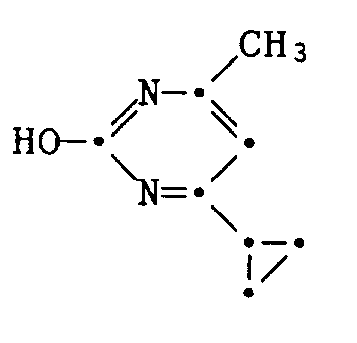
6 g (100 mMol) Harnstoff und 12,6 g (100 mMol) 1 - Cyclopropyl 1,3 - butandion werden bei Raum - temperatur in 35 ml Ethanol mit 15 ml konz. Salzsäure versetzt. Nach 10 - tägigem Stehen bei Raumtem - peratur wird am Rotationsverdampfer bei einer Badtemperatur von maximal 45 ° C eingeengt. Der Rückstand wird in 20 ml Ethanol gelöst, wobei sich nach kurzer Zeit das Hydrochlorid des Reaktionsproduktes abscheidet. Unter Rühren werden 20 ml Diethylether zugegeben, die ausgeschiedenen weissen Kristalle abfiltriert und mit einem Ethanol - Diethylethergemisch gewaschen und getrocknet. Durch Einengen des Filtrats und Umkristallisieren aus einem Ethanol/Diethylethergemisch:1/2wird ein weiterer Anteil Hydrochlorid gewonnen. Die weissen Kristalle schmelzen > 230 ° C. Ausbeute: Hydrochlorid 12,6 g (67,5 mMol; 67,5 % d.Th.).6 g (100 mmol) urea and 12.6 g (100 mmol) 1 - cyclopropyl 1,3 - butanedione are mixed with 15 ml conc. Hydrochloric acid added. After standing at room temperature for 10 days, the mixture is concentrated on a rotary evaporator at a bath temperature of max. 45 ° C. The residue is dissolved in 20 ml of ethanol, the hydrochloride of the reaction product separating out after a short time. 20 ml of diethyl ether are added with stirring, the white crystals which have separated out are filtered off and washed with an ethanol / diethyl ether mixture and dried. A further portion of hydrochloride is obtained by concentrating the filtrate and recrystallizing from an ethanol / diethyl ether mixture: 1/2. The white crystals melt> 230 ° C. Yield: hydrochloride 12.6 g (67.5 mmol; 67.5% of theory).

52,8 g (0,24 Mol) 2 - Hydroxy - 4 - methyl - 6 - cyclopropyl - pyrimidin - hydrochlorid werden unter Rühren bei Raumtemperatur in ein Gemisch von 100 ml (1,1 Mol) Phosphoroxychlorid und 117 g (0,79 Mol) Diethylanilin eingetragen, wobei die Temperatur auf 63 ° C ansteigt. Nach 2 stündigem Erhitzen auf 110 wird auf Raumtemperatur abgekühlt und das Reaktionsgemisch unter Rühren auf ein Eiswasser-Methylenchloridgemisch ausgetragen. Die organische Phase wird abgetrennt und mit gesättigter wässriger Natriumhydrogencarbonatlösung neutral gewaschen. Nach dem Abdampfen des Lösungsmittels werden 116,4 g Oel erhalten, das sich aus dem Reaktionsprodukt und Diethylanilin zusammensetzt. Die Abtrennung des Diäthylanilins und die Reinigung des rohen Reaktionsproduktes erfolgt durch Säulenchromatographie über Kieselgel (Hexan/Diethylacetat:3/1). Das nach einigen Tagen kristallisierende farblose Oel hat einen Brechungsindex nß5 :1.5419; Ausbeute: 35,7 g (0,21 Mol; 87,5 % d.Th.); Schmelzpunkt: 33 - 34 ° C.52.8 g (0.24 mol) of 2-hydroxy-4-methyl-6-cyclopropyl-pyrimidine hydrochloride are stirred into a mixture of 100 ml (1.1 mol) of phosphorus oxychloride and 117 g (0.79 Mol) Diethylanilin entered, the temperature rising to 63 ° C. After heating at 110 for 2 hours, the mixture is cooled to room temperature and the reaction mixture is poured onto an ice-water / methylene chloride mixture with stirring. The organic phase is separated off and washed neutral with saturated aqueous sodium hydrogen carbonate solution. After evaporation of the solvent, 116.4 g of oil are obtained, which is composed of the reaction product and diethylaniline. The diethylaniline is separated off and the crude reaction product is purified by column chromatography on silica gel (hexane / diethyl acetate: 3/1). The colorless oil which crystallized after a few days had a refractive index of 5 : 1.5419; Yield: 35.7 g (0.21 mol; 87.5% of theory); Melting point: 33 - 34 ° C.

Eine Lösung von 5,5 g (50 mMol) 3 - Fluoranilin und 9,3 g (55 mMol) 2 - Chlor - 4 - methyl - 6 - cyclopropyl-pyrimidin in 100 ml Ethanol wird unter Rühren mit 5 ml konz. Salzsäure auf pH 1 gebracht und anschliessend 18 Stunden unter Rückfluss erhitzt. Nach dem Abkühlen auf Raumtemperatur wird die braune Emulsion mit 10 ml 30 %igem Ammoniak alkalisch gestellt, auf 100 ml Eiswasser gegossen und zweimal mit je 150 ml Diethylether extrahiert. Die vereinigten Extrakte werden mit 50 ml Wasser gewaschen, über Natriumsulfat getrocknet, filtriert und das Lösungsmittel verdampft. Die zurückbleibenden gelblichen Kristalle werden durch Umkristallisation aus Diisopropylether/Petrolether (Kp. 50 - 70 ° C) gereinigt. Die weissen Kristalle schmelzen bei 87 - 89 ° C; Ausbeute 8,3 g (34 mMol; 68 % d.Th.).A solution of 5.5 g (50 mmol) of 3-fluoroaniline and 9.3 g (55 mmol) of 2-chloro-4-methyl-6-cyclopropyl-pyrimidine in 100 ml of ethanol is stirred with 5 ml of conc. Hydrochloric acid brought to pH 1 and then heated under reflux for 18 hours. After cooling to room temperature, the brown emulsion is made alkaline with 10 ml of 30% ammonia, poured onto 100 ml of ice water and extracted twice with 150 ml of diethyl ether each time. The combined extracts are washed with 50 ml of water, dried over sodium sulfate, filtered and the solvent is evaporated. The remaining yellowish crystals are purified by recrystallization from diisopropyl ether / petroleum ether (bp 50-70 ° C). The white crystals melt at 87 - 89 ° C; Yield 8.3 g (34 mmol; 68% of theory).
Auf diese Art oder nach einer der weiter oben angegebenen Methoden lassen sich folgende Verbin - dungen der Formel I herstellen.
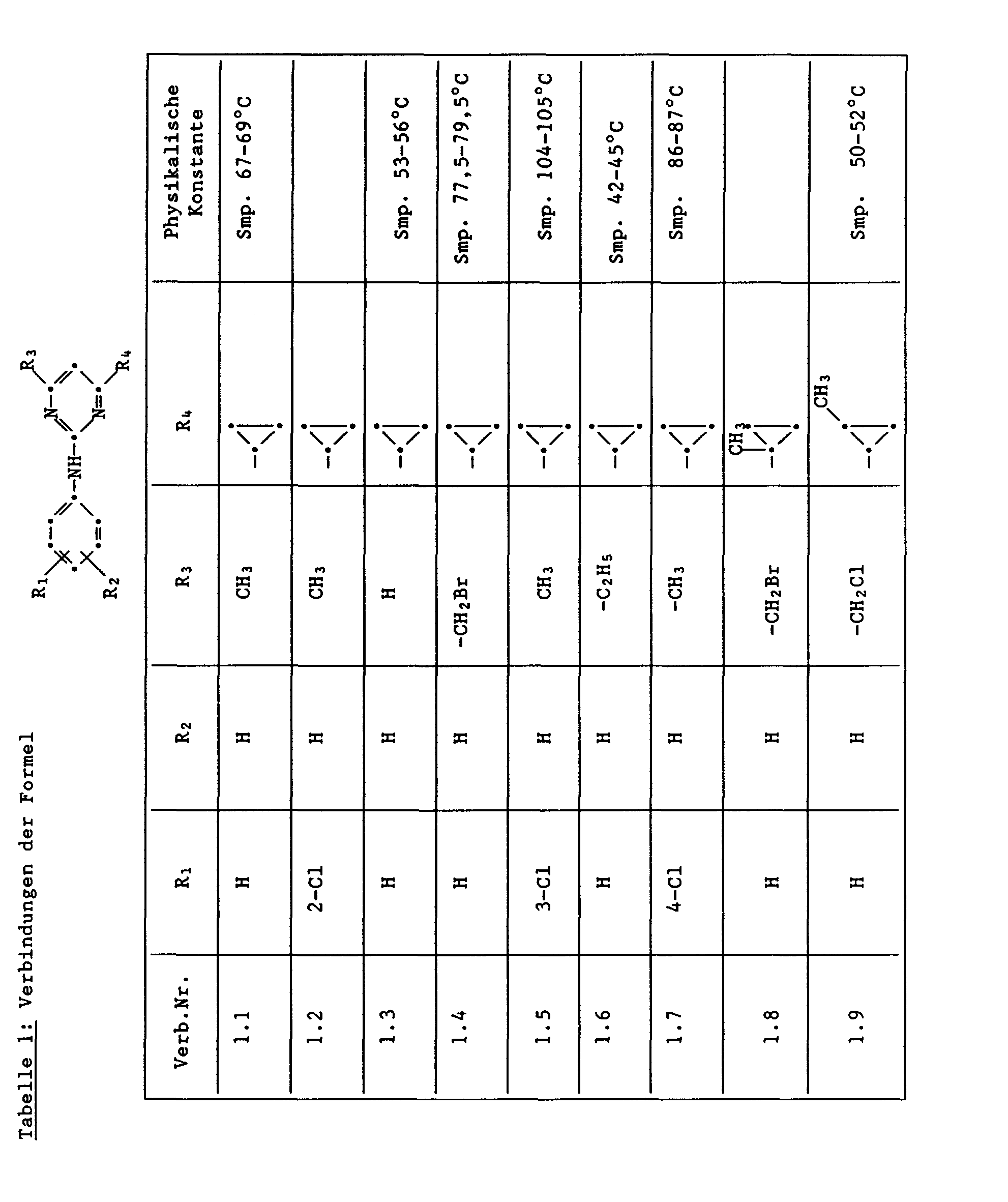

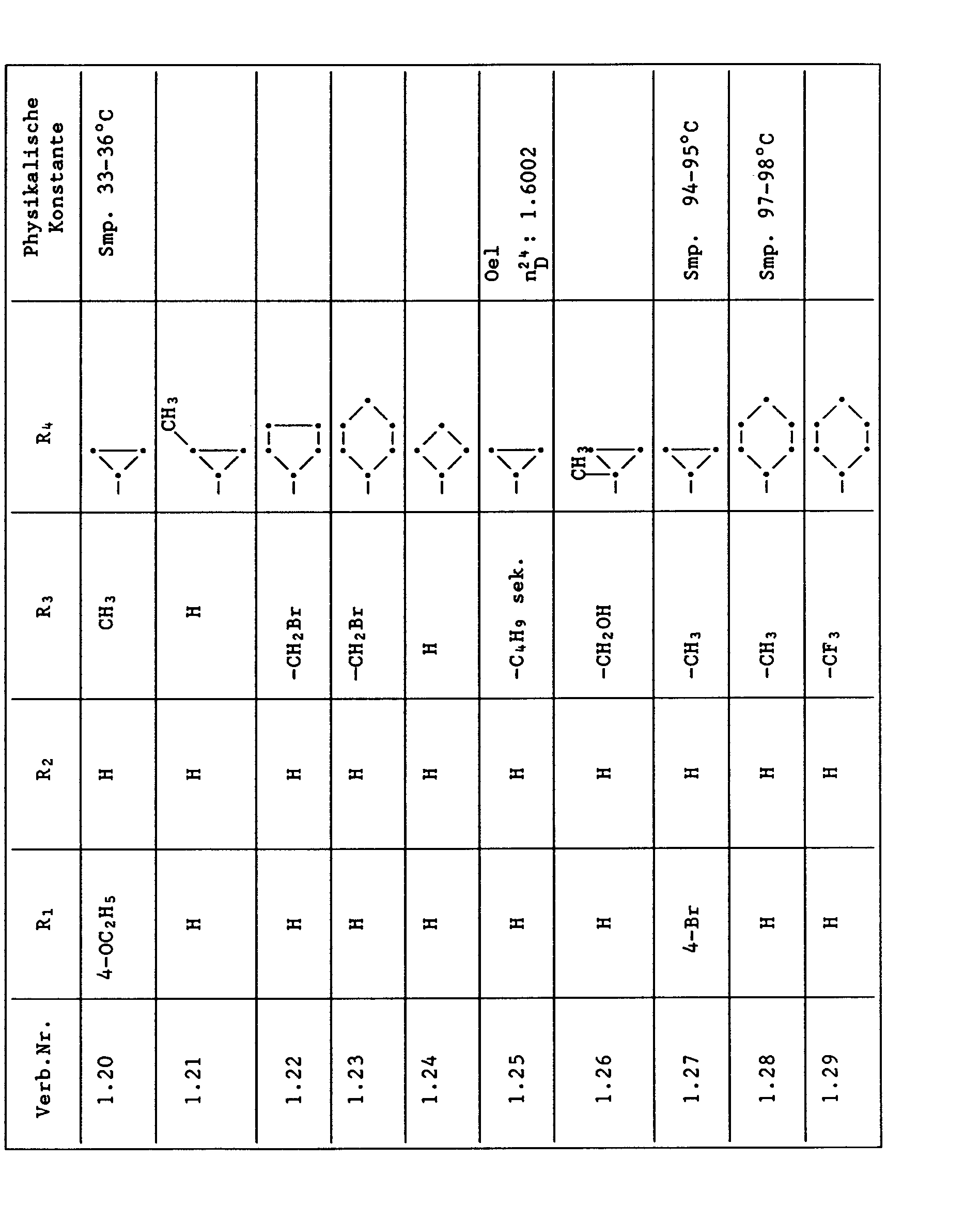
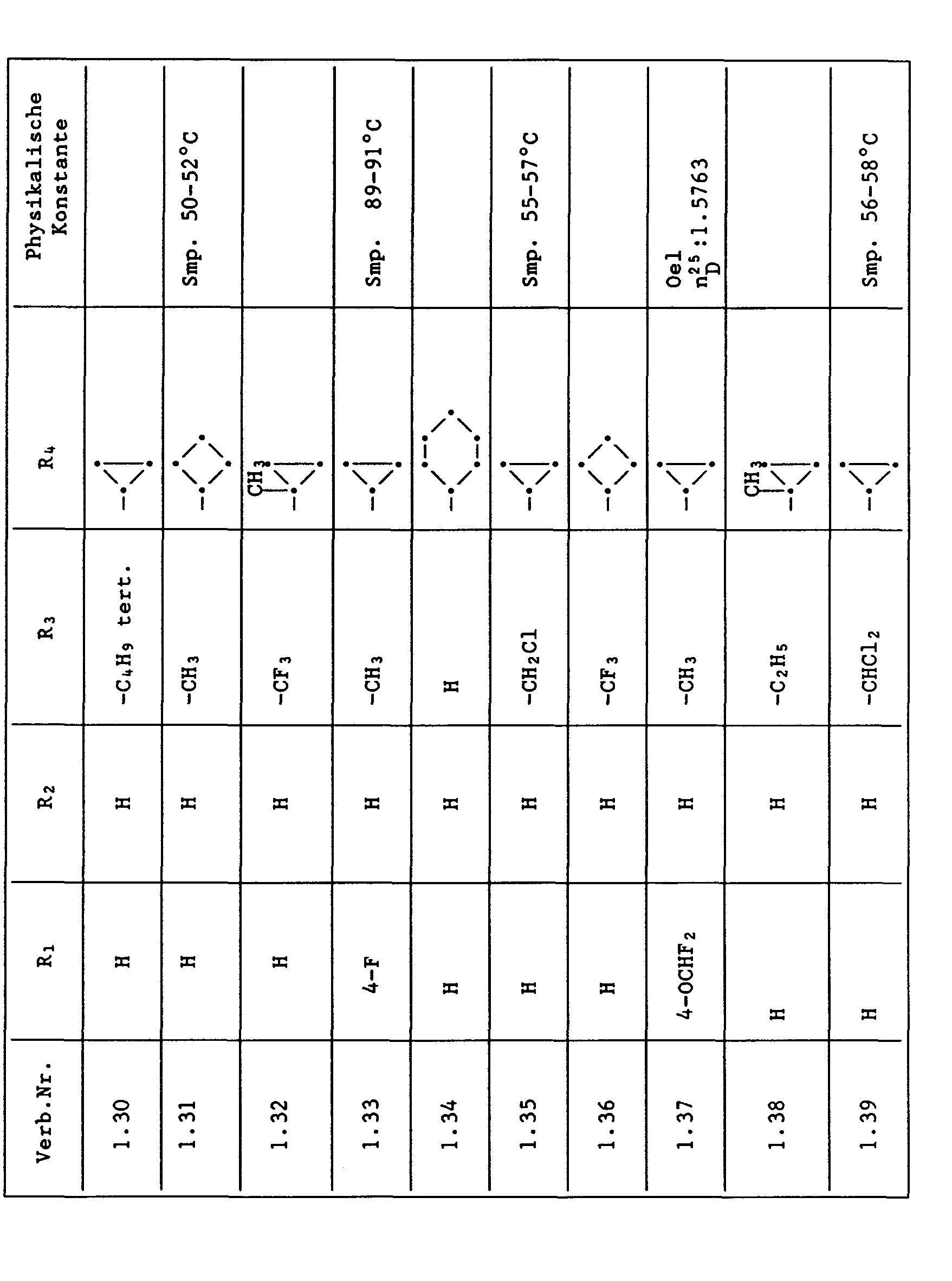


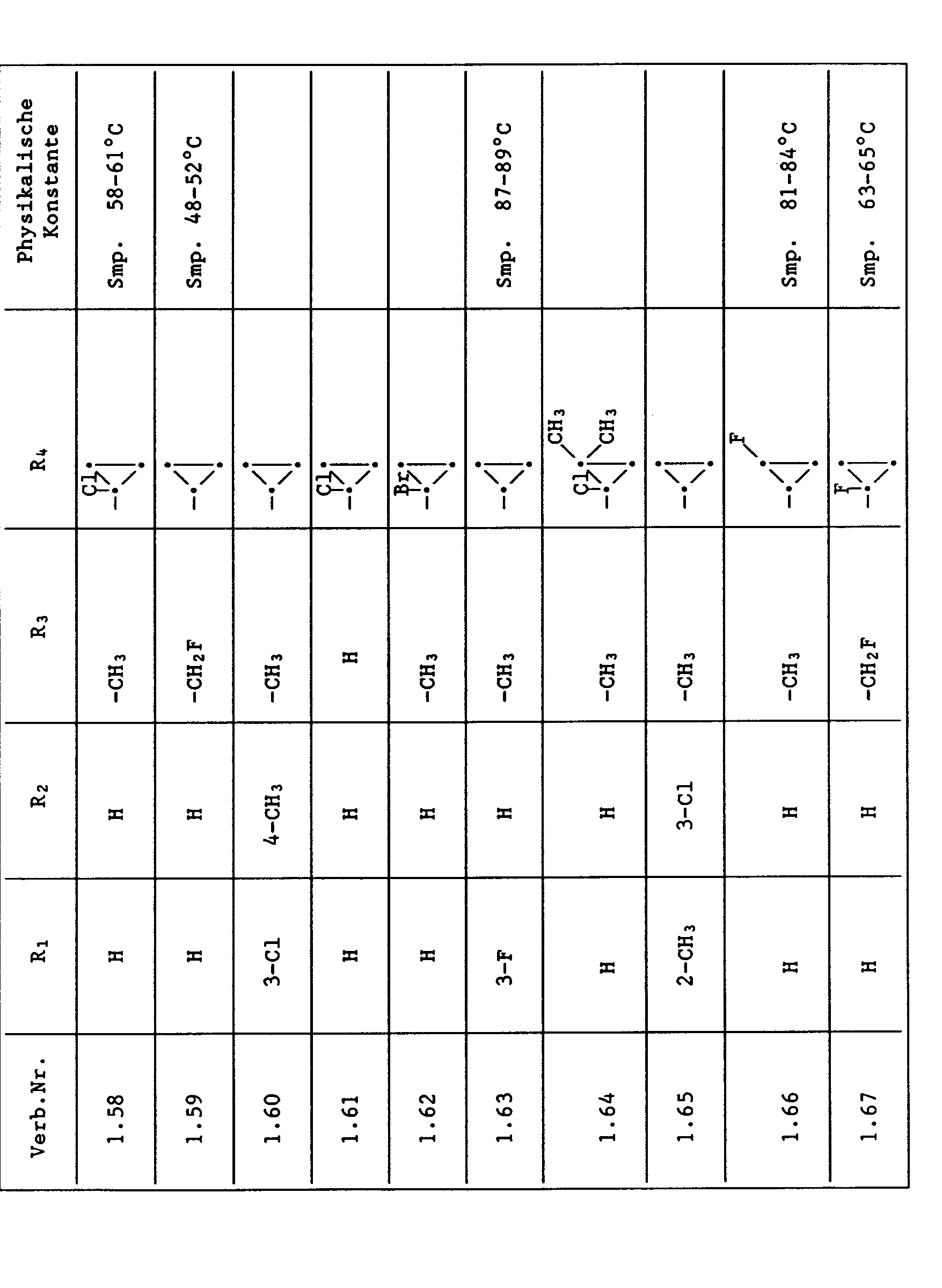


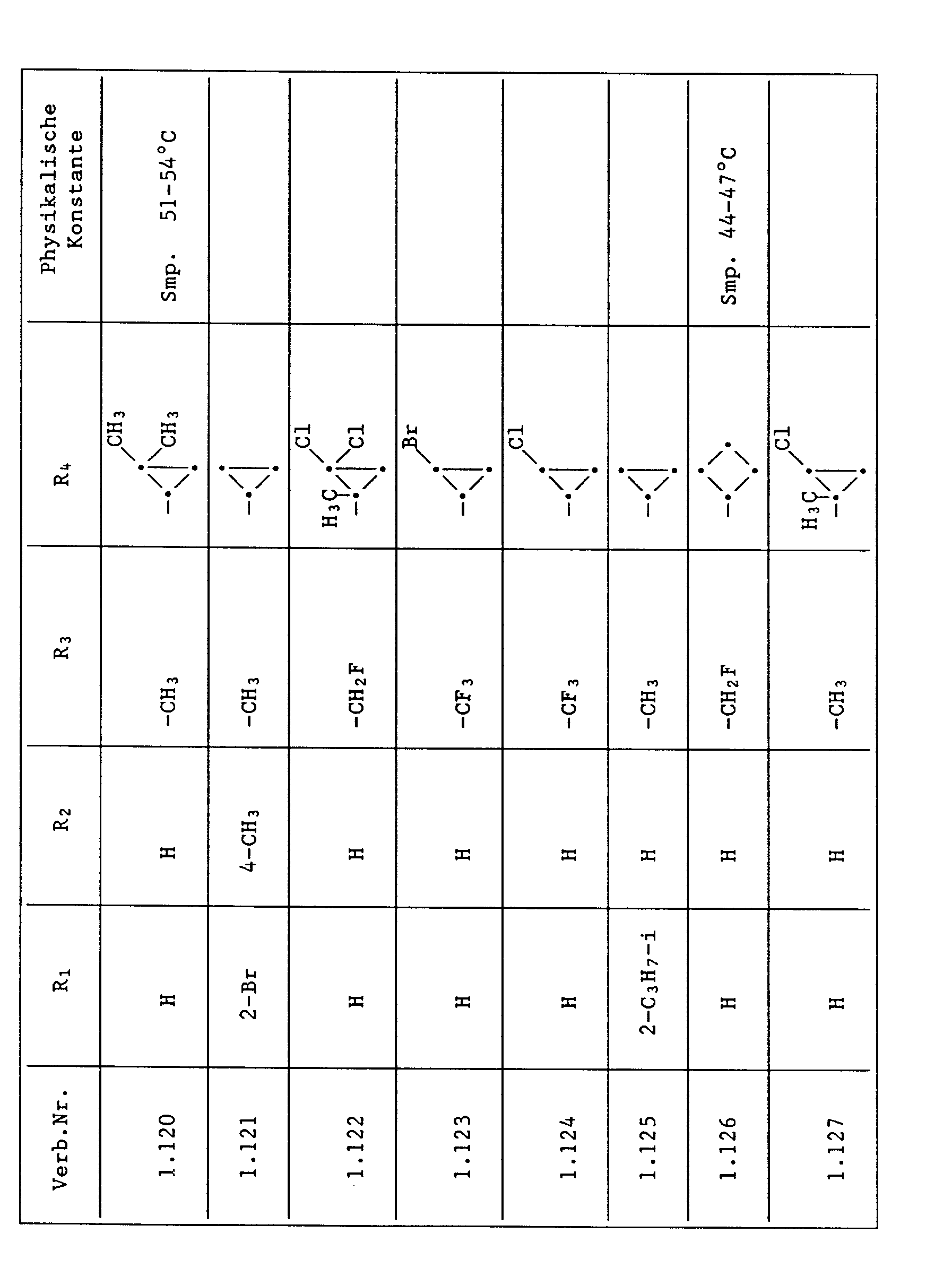


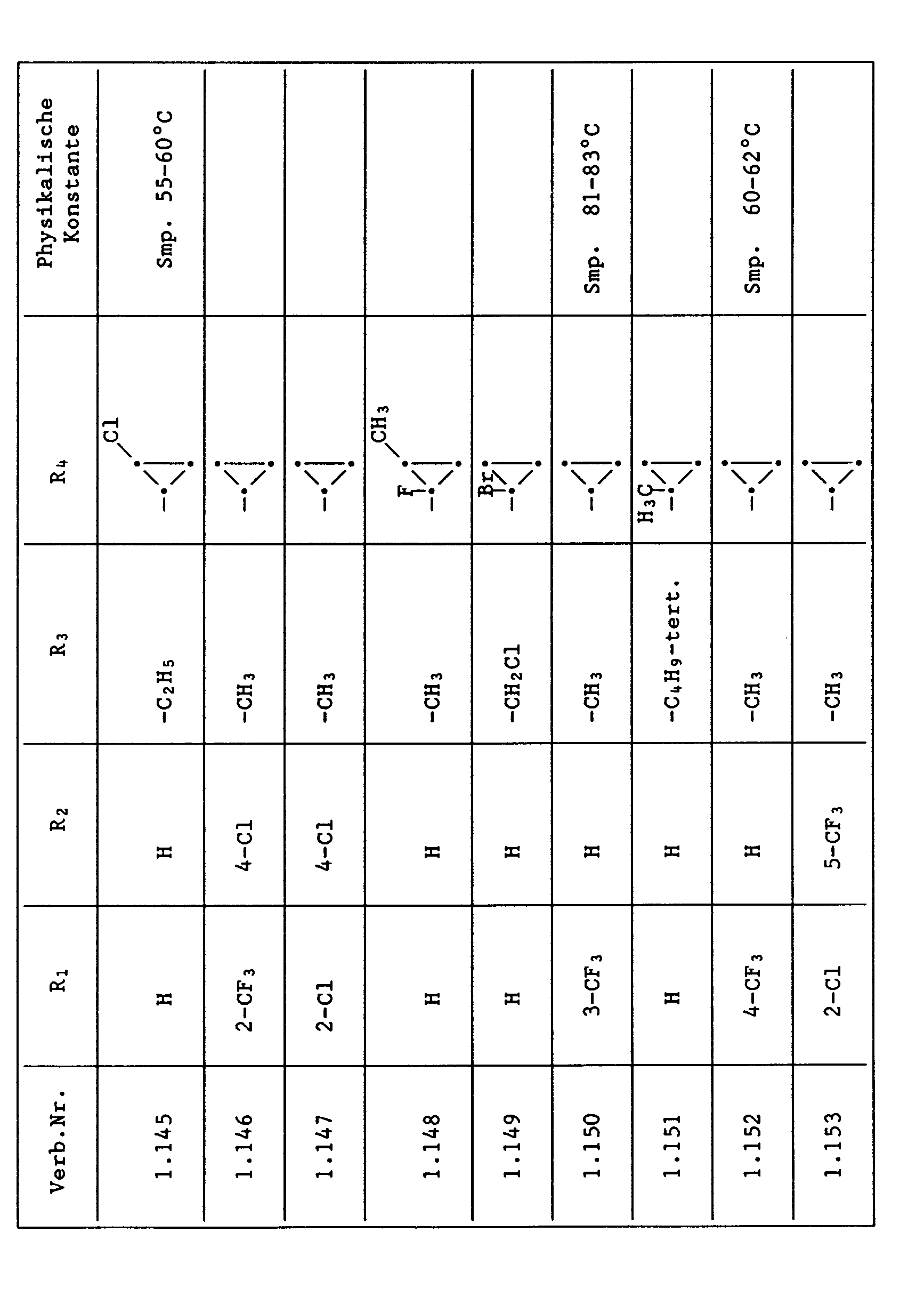
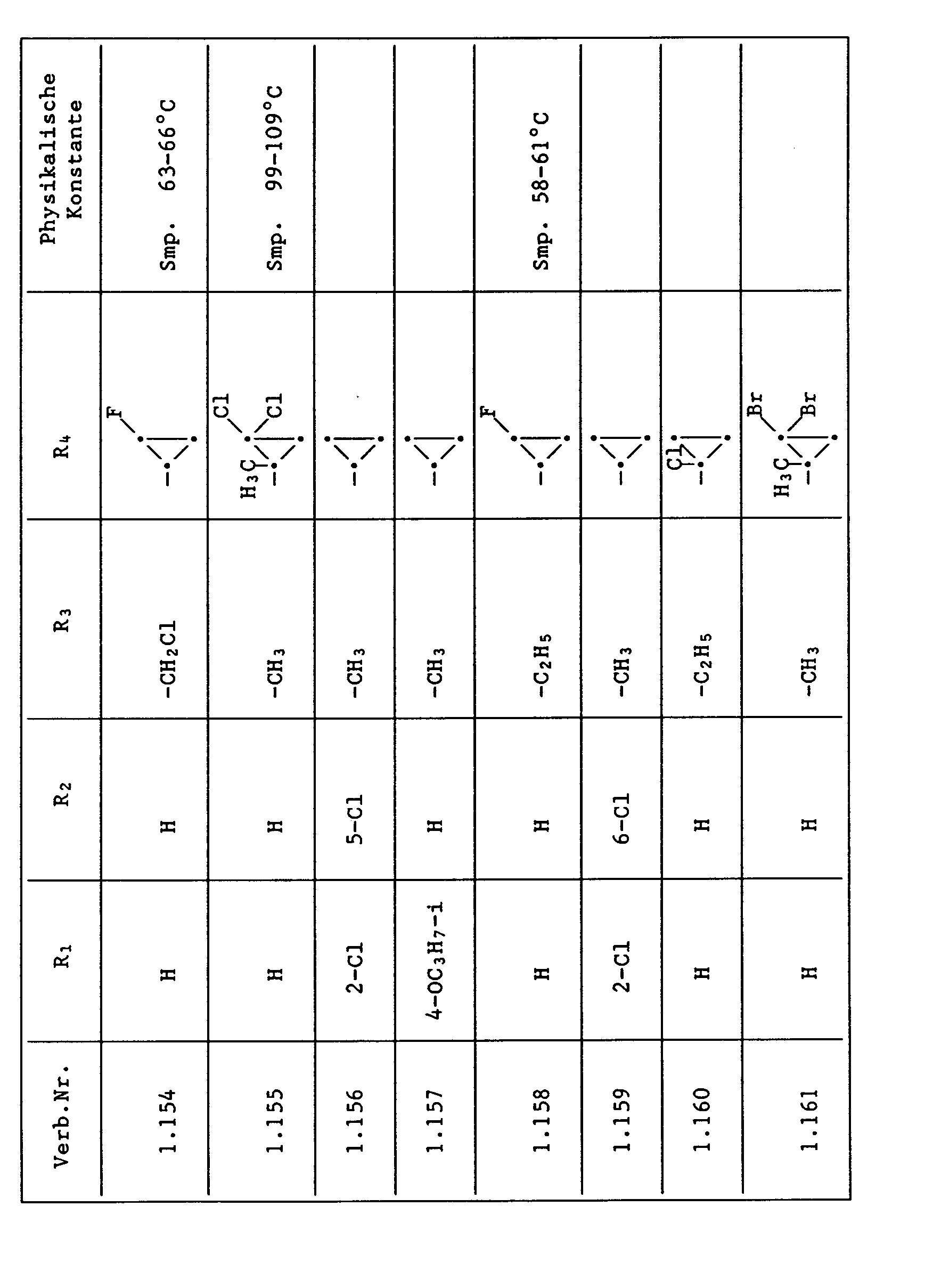


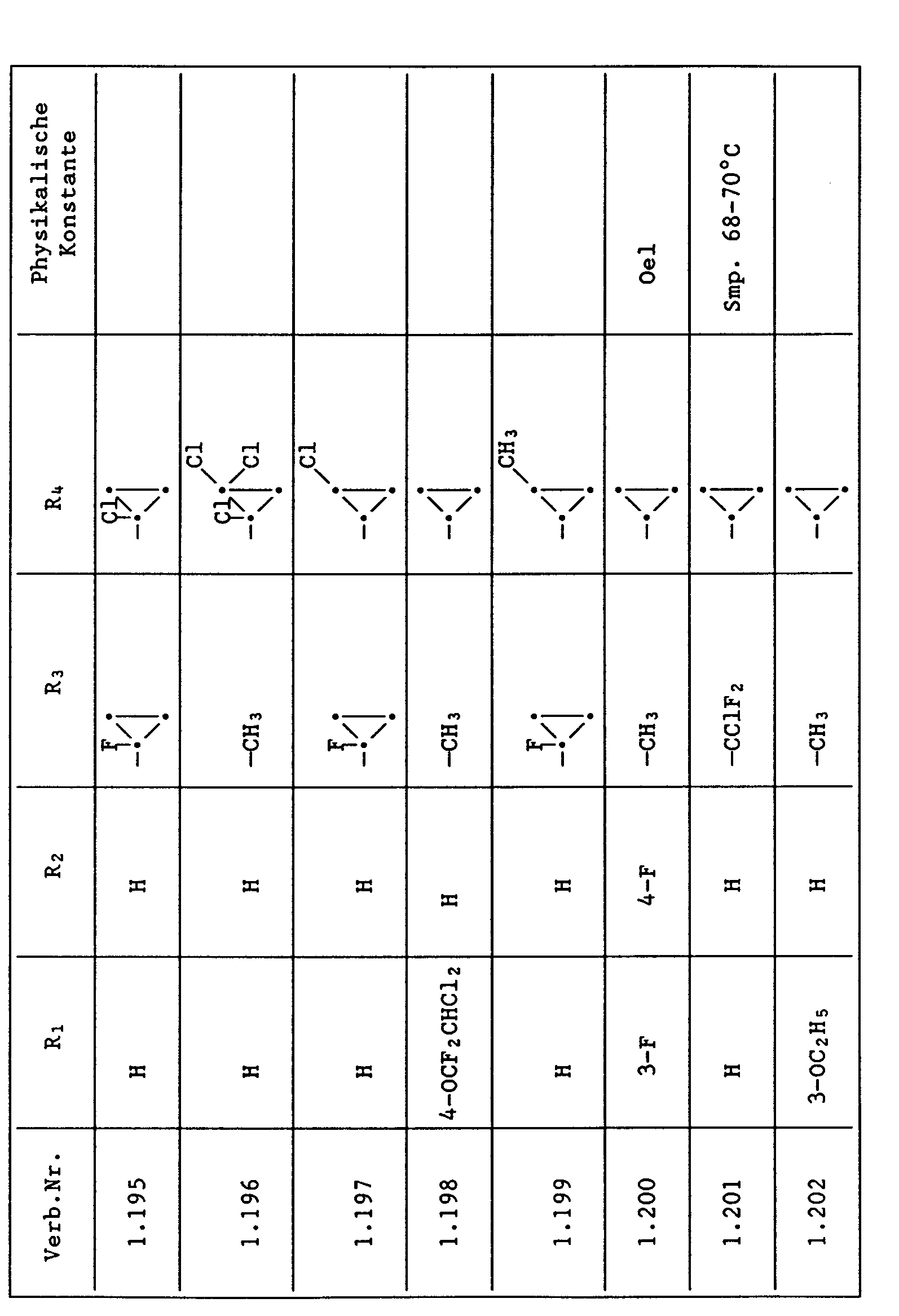
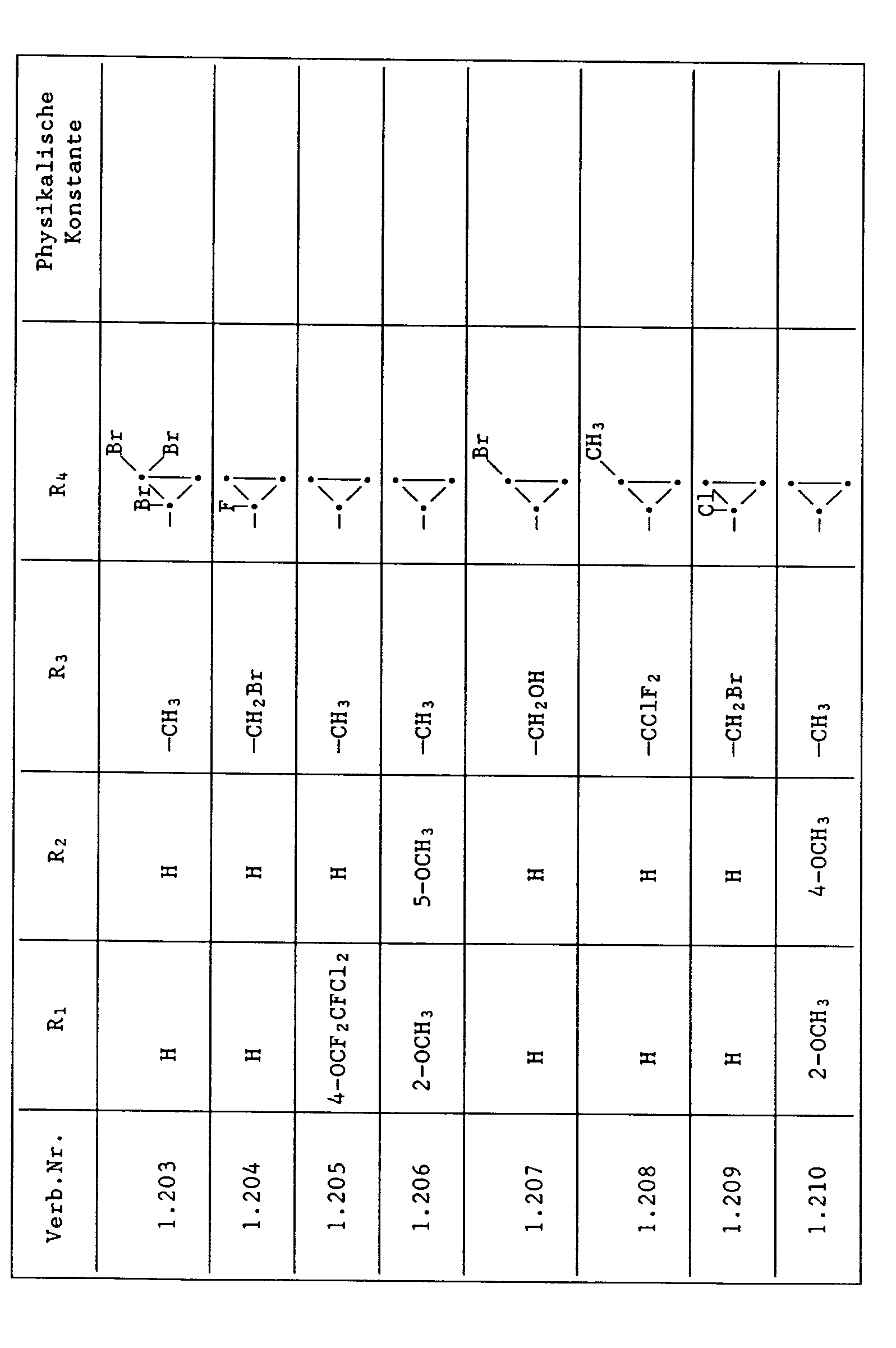
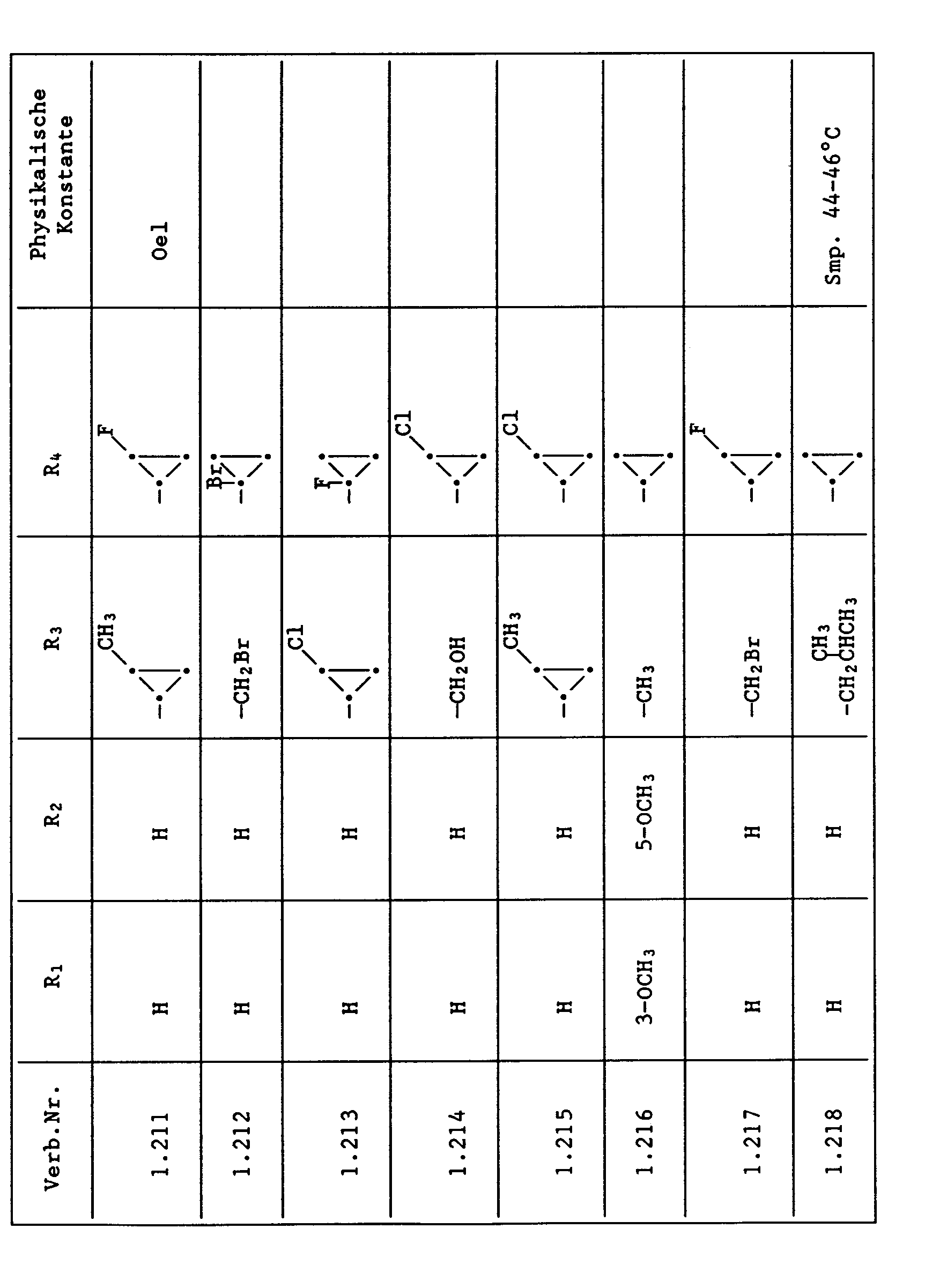
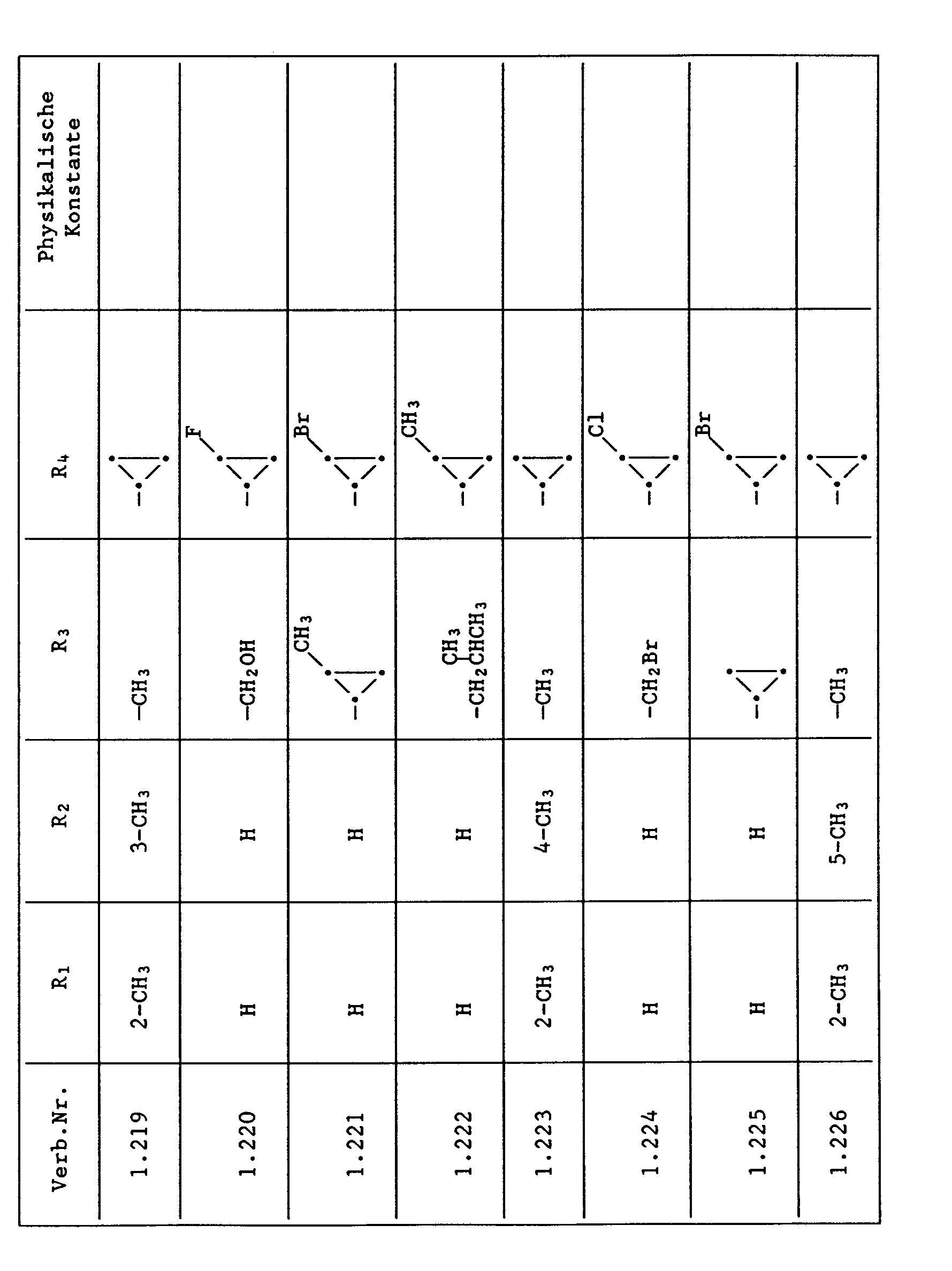


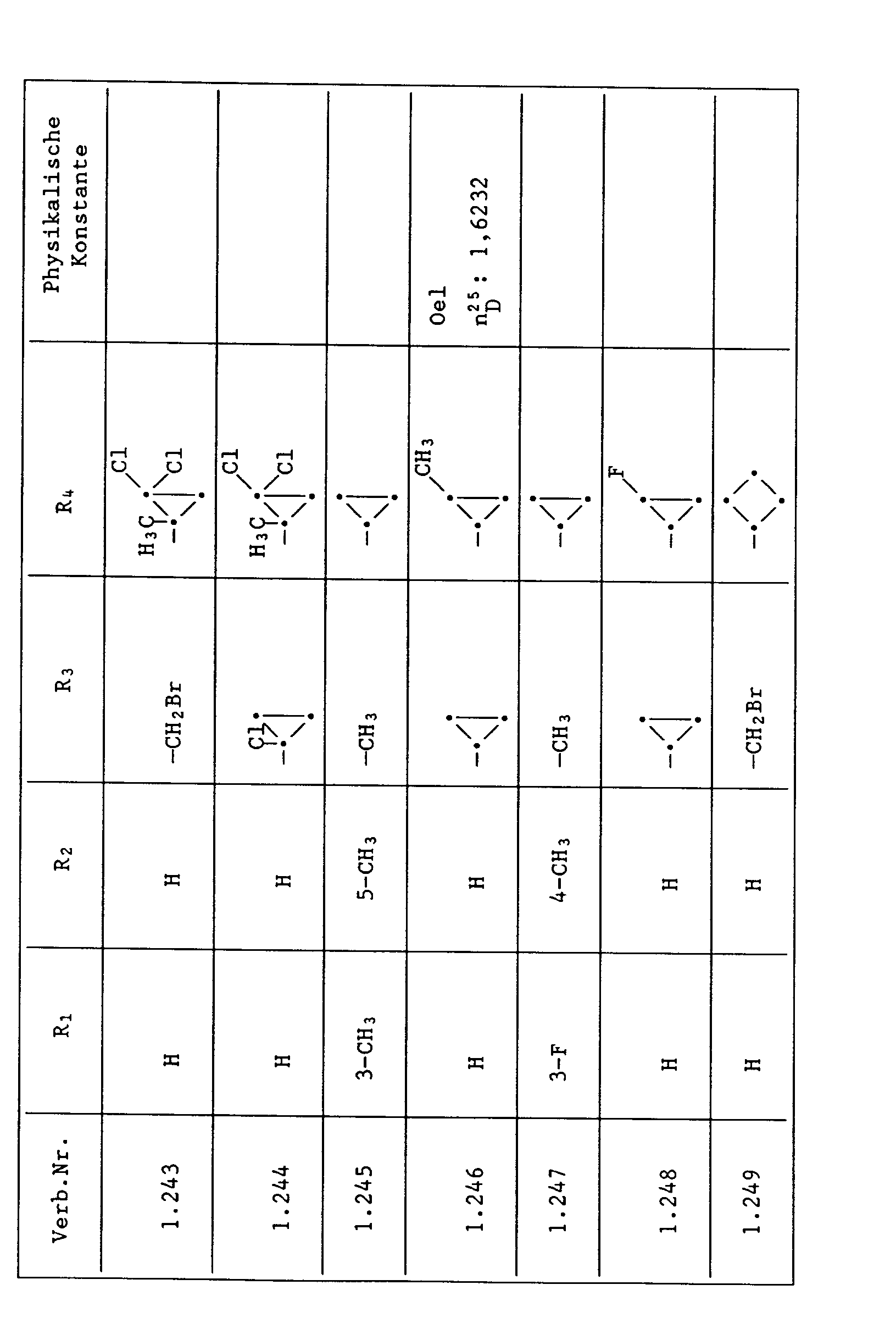

In den folgenden Tabellen 2, 3 und 4 werden beispielhaft Zwischenprodukte vorliegender Erfindung genannt.

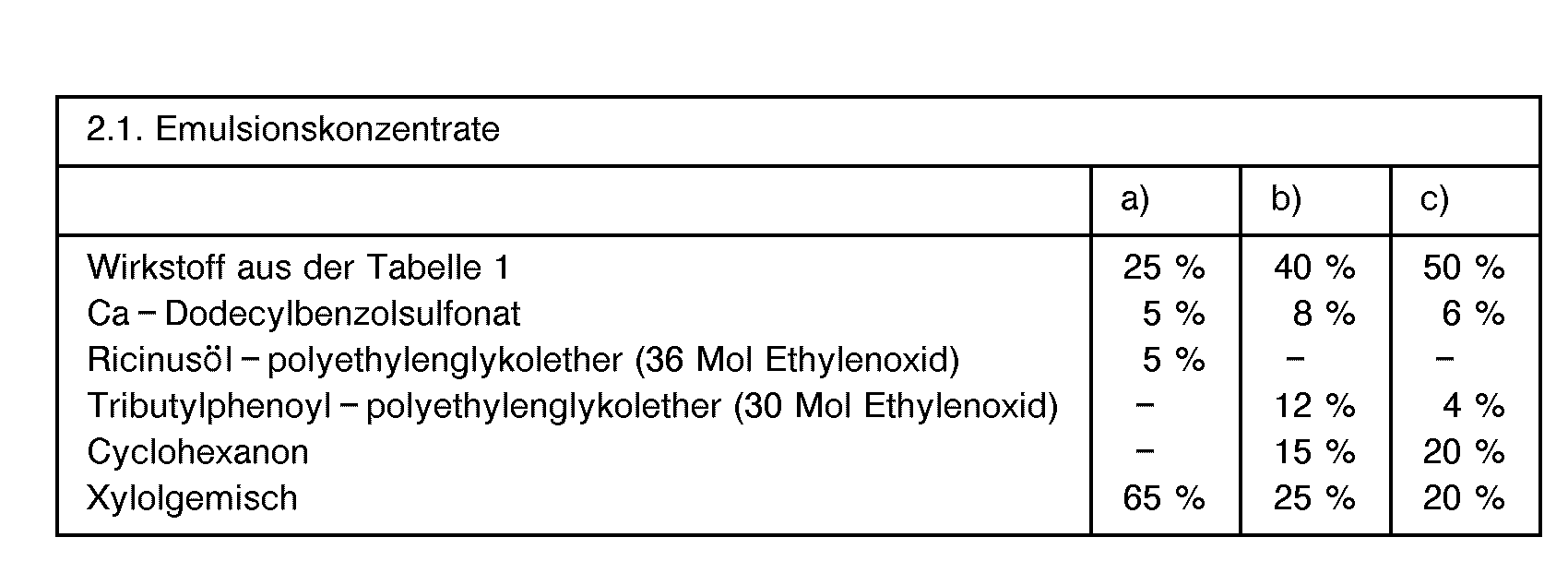
Aus solchen Konzentraten können durch Verdünnen mit Wasser Emulsionen jeder gewünschten Konzentration hergestellt werden.

Die Lösungen sind zur Anwendung in Form kleinster Tropfen geeignet.

Der Wirkstoff wird in Methylenchlorid gelöst, auf den Träger aufgesprüht und das Lösungsmittel anschliessend im Vakuum abgedampft.

Durch inniges Vermischen auf Trägerstoffe mit dem Wirkstoff erhält man gebrauchsfertige Stäubemittel.Ready-to-use dusts are obtained by intimately mixing carrier substances with the active ingredient.
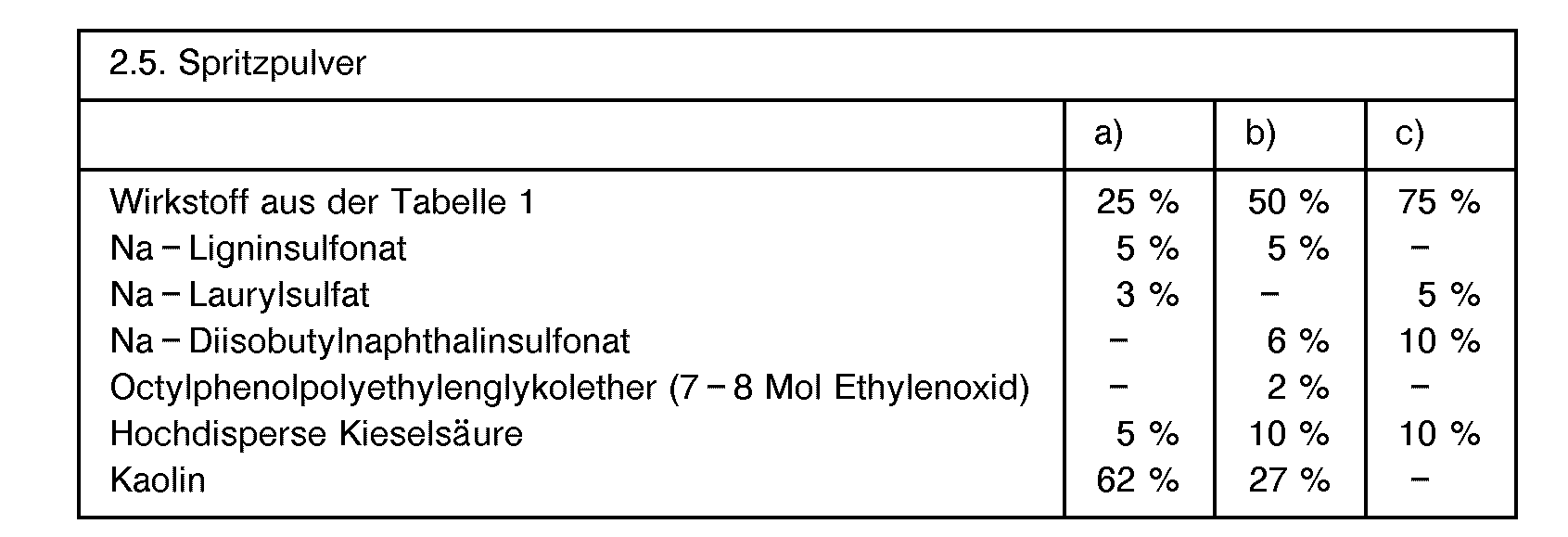
Der Wirkstoff wird mit den Zusatzstoffen gut vermischt und in einer geeigneten Mühle gut vermahlen. Man erhält Spritzpulver, die sich mit Wasser zu Suspensionen jeder gewünschten Konzentration verdünnen lassen.
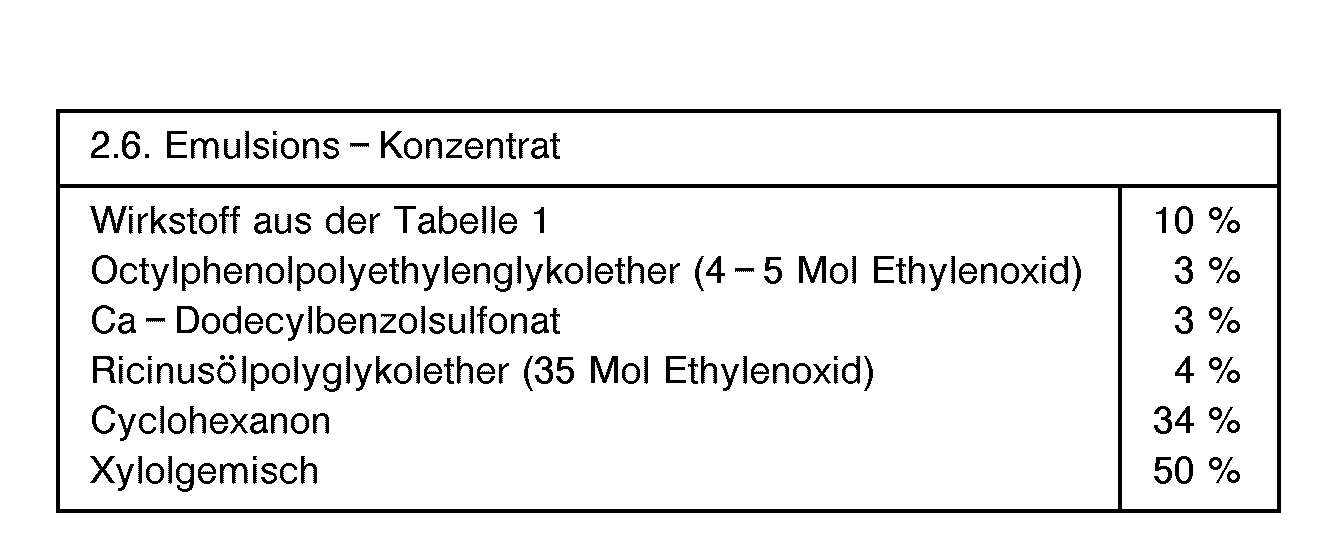
Aus diesem Konzentrat können durch Verdünnen mit Wasser Emulsionen jeder gewünschten Konzen - tration hergestellt werden.

Man erhält anwendungsfertige Stäubemittel, indem der Wirkstoff mit dem Träger vermischt auf einer geeigneten Mühle vermahlen wird.

Der Wirkstoff wird mit den Zusatzstoffen vermischt, vermahlen und mit Wasser angefeuchtet. Dieses Gemisch wird extrudiert und anschliessend im Luftstrom getrocknet.

Der fein gemahlene Wirkstoff wird in einem Mischer auf das mit Polyethylenglykol angefeuchtete Kaolin gleichmässig aufgetragen. Auf diese Weise erhält man staubfreie Umhüllungs - Granulate.
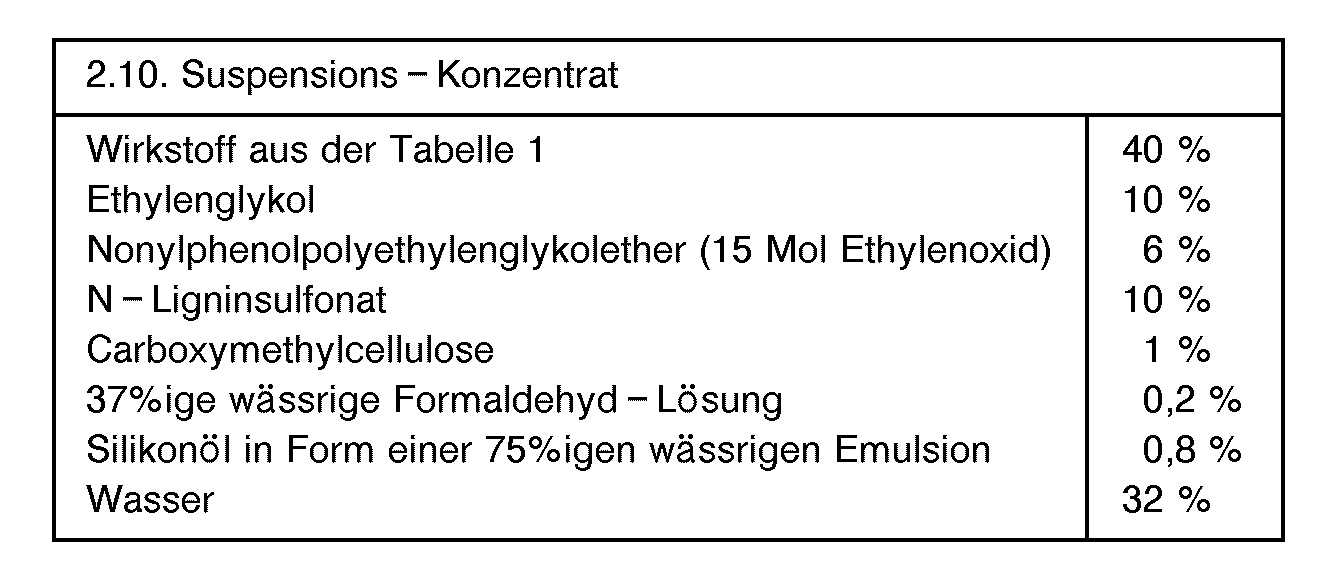
Der fein gemahlene Wirkstoff wird mit den Zusatzstoffen innig vermischt. Man erhält so ein Suspensions-Konzentrat, aus welchem durch Verdünnen mit Wasser Suspensionen jeder gewünschten Konzentration hergestellt werden können.The finely ground active ingredient is intimately mixed with the additives. A suspension concentrate is thus obtained, from which any desired suspensions can be obtained by dilution with water Concentration can be made.
Apfelstecklinge mit 10-20 cm langen Frischtrieben werden mit einer aus Spritzpulver des Wirkstoffes hergestellten Spritzbrühe (0,006 % Aktivsubstanz) besprüht. Nach 24 Stunden werden die behandelten Pflanzen mit einer Konidiensuspension des Pilzes infiziert. Die Pflanzen werden dann während 5 Tagen bei 90 - 100 % relativer Luftfeuchtigkeit inkubiert und während 10 weiteren Tagen in einem Gewächshaus bei 20 - 24 ° C aufgestellt. Der Schorfbefall wird 15 Tage nach der Infektion beurteilt.Apple cuttings with 10-20 cm long fresh shoots are sprayed with a spray mixture (0.006% active substance) made from wettable powder of the active ingredient. After 24 hours, the treated plants are infected with a conidia suspension of the fungus. The plants are then incubated for 5 days at 90-100% relative atmospheric humidity and placed in a greenhouse at 20-24 ° C. for a further 10 days. Scab infestation is assessed 15 days after infection.
Verbindungen aus Tabelle 1 zeigen gegen Venturia gute Wirksamkeit (Befall: weniger als 20 %). So reduzierten z.B. die Verbindungen Nr. 1.1, 1.6, 1.13, 1.14, 1.59, 1.66, 1.69, 1.84, 1.87, 1.94, 1.108, 1.126, 1.145, 1.158, 1.180, 1.200 und 1.236 den Venturia-Befall auf 0 bis 10 %. Unbehandelte aber infizierte Kontrollpflanzen weisen dagegen einen Venturia - Befall von 100 % auf.Compounds from Table 1 show good activity against Venturia (attack: less than 20%). For example, Compounds No. 1.1, 1.6, 1.13, 1.14, 1.59, 1.66, 1.69, 1.84, 1.87, 1.94, 1.108, 1.126, 1.145, 1.158, 1.180, 1.200 and 1.236 the Venturia infestation to 0 to 10%. On the other hand, untreated but infected control plants show a Venturia infestation of 100%.
Künstlich verletzte Aepfel werden behandelt, indem eine aus Spritzpulver der Wirksubstanz hergestellte Spritzbrühe (0,002 % Aktivsubstanz) auf die Verletzungsstellen aufgepfropft wird. Die behandelten Früchte werden anschliessend mit einer Sporensuspension des Pilzes inokuliert und während einer Woche bei hoher Luftfeuchtigkeit und ca. 20 ° C inkubiert. Bei der Auswertung werden die angefaulten Verletzungsstel - len gezählt und daraus die fungizide Wirkung der Testsubstanz abgeleitet.Artificially injured apples are treated by grafting a spray liquor (0.002% active substance) made from wettable powder of the active substance onto the injury sites. The treated fruits are then inoculated with a spore suspension of the fungus and incubated for one week in high humidity and at around 20 ° C. During the evaluation, the rotten injury points are counted and the fungicidal effect of the test substance is derived from this.
Verbindungen aus Tabelle 1 zeigen gegen Botrytis gute Wirksamkeit (Befall: weniger als 20 %). So reduzierten z.B. die Verbindungen Nr. 1.1, 1.6, 1.13, 1.14, 1.31, 1.33, 1.35, 1.48, 1.59, 1.66, 1.69, 1.84, 1.87, 1.94, 1.108, 1.126, 1.131, 1.145, 1.158, 1.180 und 1.236 den Botrytis - Befall auf 0 bis 10%. Unbehandelte aber infizierte Kontrollpflanzen weisen dagegen einen Botrytis - Befall von 100 % auf.Compounds from Table 1 show good activity against Botrytis (infection: less than 20%). For example, the connections No. 1.1, 1.6, 1.13, 1.14, 1.31, 1.33, 1.35, 1.48, 1.59, 1.66, 1.69, 1.84, 1.87, 1.94, 1.108, 1.126, 1.131, 1.145, 1.158, 1.180 and 1.236 the botrytis infestation on 0 to 10%. On the other hand, untreated but infected control plants show a botrytis infestation of 100%.
Ca. 8 cm hohe Gerstenpflanzen werden mit einer aus Spritzpulver des Wirkstoffes hergestellten Spritzbrühe (0,006 % Aktivsubstanz) besprüht. Nach 3-4 Stunden werden die behandelten Pflanzen mit Konidien des Pilzes bestäubt. Die infizierten Gerstenpflanzen werden in einem Gewächshaus bei ca. 22 ° C aufgestellt und der Pilzbefall nach 10 Tagen beurteilt.Approx. Barley plants 8 cm high are sprayed with a spray mixture (0.006% active substance) made from wettable powder of the active ingredient. After 3-4 hours, the treated plants are dusted with conidia of the fungus. The infected barley plants are placed in a greenhouse at approx. 22 ° C. and the fungal attack is assessed after 10 days.
Verbindungen aus Tabelle 1 zeigen gegen Erysiphae gute Wirksamkeit (Befall: weniger als 20 %). So reduzierten z.B. die Verbindungen Nr. 1.1, 1.6, 1.13, 1.14, 1.35, 1.48, 1.59, 1.66, 1.69, 1.84, 1.87, 1.94, 1.108, 1.131, 1.158 und 1.236 den Erysiphae-Befall auf 0 bis 10 %. Unbehandelte aber infizierte Kontrollpflanzen weisen dagegen einen Erysiphae - Befall von 100 % auf.Compounds from Table 1 show good activity against Erysiphae (attack: less than 20%). For example, the compounds no.1.1, 1.6, 1.13, 1.14, 1.35, 1.48, 1.59, 1.66, 1.69, 1.84, 1.87, 1.94, 1.108, 1.131, 1.158 and 1.236 the Erysiphae infestation to 0 to 10%. On the other hand, untreated but infected control plants show an Erysiphae infestation of 100%.
Weizenkörner werden mit einer Sporensuspension des Pilzes kontaminiert und wieder angetrocknet. Die kontaminierten Körner werden mit einer aus Spritzpulver hergestellten Suspension der Testsubstanz gebeizt (600 ppm Wirkstoff bezogen auf das Gewicht der Samen). Nach zwei Tagen werden die Körner auf geeignete Agarschalen ausgelegt und nach weiteren vier Tagen wird die Entwicklung der Pilzkolonien um die Körner herum beurteilt. Anzahl und Grösse der Pilzkolonien werden zur Beurteilung der Testsubstanz herangezogen. Die Verbindungen der Tabelle verhindern den Pilzbefall weitgehend (0 bis 10 % Pilzbefall).Wheat grains are contaminated with a spore suspension of the mushroom and dried again. The contaminated grains are pickled with a suspension of the test substance made from wettable powder (600 ppm active ingredient based on the weight of the seeds). After two days the grains are placed on suitable agar dishes and after a further four days the development of the fungal colonies around the grains is assessed. The number and size of the fungal colonies are used to assess the test substance. The compounds in the table largely prevent fungal attack (0 to 10% fungal attack).
Gurkenpflanzen werden nach 2-wöchiger Anzucht mit einer aus Spritzpulver des Wirkstoffs hergestellten Spritzbrühe (Konzentration 0,002 %) besprüht. Nach 2 Tagen werden die Pflanzen mit einer Sporensuspension (1,5x10⁵ Sporen/ml) des Pilzes infiziert und für 36 Stunden bei 23" C und hoher Luftfeuchtigkeit inkubiert. Die Inkubation wird dann bei normaler Luftfeuchtigkeit und ca. 22-23°C weitergeführt. Der eingetretene Pilzbefall wird 8 Tage nach der Infektion beurteilt. Unbehandelte aber infizierte Kontrollpflanzen weisen einen Pilzbefall von 100 % auf.After 2 weeks of cultivation, cucumber plants are sprayed with a spray mixture (concentration 0.002%) made from wettable powder of the active ingredient. After 2 days, the plants are infected with a spore suspension (1.5x10 5 spores / ml) of the fungus and incubated for 36 hours at 23 ° C. and high atmospheric humidity. The incubation is then continued at normal atmospheric humidity and approx. 22-23 ° C. The onset of fungal infection is assessed 8 days after infection, but untreated but infected control plants have a 100% infection by fungi.
Verbindungen aus Tabelle 1 zeigen gute Wirksamkeit und verhindern die Ausbreitung des Krankheits - befalls. Der Pilzbefall wird auf 20 % oder weniger zurückgedrängt.Compounds from Table 1 show good activity and prevent the spread of the disease. Fungal attack is reduced to 20% or less.
Der Test wird an wachsenden Reis - Pflanzen durchgeführt. Dazu werden jeweils 4 Pflanzen (14-20 Tage alt) mit einer Höhe von ca. 15 cm in Töpfe (Durchmesser 5,5 cm) eingepflanzt.The test is carried out on growing rice plants. For this, 4 plants (14-20 days old) with a height of approx. 15 cm are planted in pots (diameter 5.5 cm).
Die Pflanzen werden auf einem Drehteller mit 100 ml einer wässrigen Emulsions - Zubereitung enthal - tend 400 ppm des jeweiligen Wirkstoffes besprüht. Nach dem Antrocknen des Spritzbelages erfolgt die Besiedlung jeder Pflanze mit je 20 Nymphen der Testtiere im dritten Stadium. Um die Zikaden am Entweichen zu hindern, wird über die besiedelten Pflanzen jeweils ein beidseitig offener Glaszylinder gestülpt und dieser mit einem Gaze - Deckel abgedeckt. Die Nymphen werden bis zum Erreichen des Adultstadiums über 6 Tage an der behandelten Pflanze gehalten. Die Auswertung auf prozentuale Mortalität erfolgt 6 Tage nach der Besiedlung. Der Versuch wird bei etwa 27 ° C, 60 % rel. Luftfeuchtigkeit und einer Beleuchtungsperiode von 16 Stunden durchgeführt.The plants are sprayed on a turntable with 100 ml of an aqueous emulsion preparation containing 400 ppm of the respective active ingredient. After the spray coating has dried on, each plant is populated with 20 nymphs of the test animals in the third stage. In order to prevent the cicadas from escaping, a glass cylinder, which is open on both sides, is put over the populated plants and covered with a gauze cover. The nymphs are held on the treated plant for 6 days until they reach the adult stage. The percentage mortality is evaluated 6 days after colonization. The experiment is carried out at about 27 ° C, 60% rel. Humidity and a lighting period of 16 hours.
Etwa 10 Tage alte Reispflanzen (ca. 10 cm hoch) werden in einen Plastik-Becher eingestellt, der 150 ml einer wässrigen Emulsions - Zubereitung des zu prüfenden Wirkstoffes in einer Konzentration von 100 ppm enthält und mit einem Löcher aufweisenden Plastikdeckel abgeschlossen ist. Die Wurzel der Reis - pflanze wird durch ein Loch in dem Plastikdeckel in die wässsrige Test-Zubereitung geschoben. Dann wird die Reispflanze mit 20 Nymphen von Nilaparvata lugens im N 2 bis N 3 Stadium besiedelt und mit einem Plastikzylinder abgedeckt. Der Versuch wird bei ca. 26 ° C und 60 % relativer Luftfeuchtigkeit mit einer Beleuchtungsperiode von 16 Stunden durchgeführt. Nach fünf Tagen wird auf die Anzahl der abgetöteten Testtiere, im Vergleich zu unbehandelten Kontrollen, bonitiert. Damit wird festgestellt, ob der über die Wurzel aufgenommene Wirkstoff die Testtiere an den oberen Pflanzenteilen abtötet.Rice plants about 10 days old (approx. 10 cm high) are placed in a plastic beaker containing 150 ml of an aqueous emulsion - preparation of the active ingredient to be tested in a concentration of 100 ppm and sealed with a plastic lid with holes. The root of the rice plant is pushed through a hole in the plastic lid into the aqueous test preparation. Then the rice plant is populated with 20 nymphs from Nilaparvata lugens in the N 2 to N 3 stage and covered with a plastic cylinder. The test is carried out at approx. 26 ° C and 60% relative humidity with an illumination period of 16 hours. After five days, the number of test animals killed is compared to untreated controls. This determines whether the active ingredient absorbed through the root kills the test animals on the upper parts of the plant.
Verbindungen aus Tabelle 1 zeigen sowohl im Test a) wie b) eine stark abtötende Wirkung auf die Reisschädlinge. Die Mortalitätsrate liegt bei 80 % oder mehr. Mit den Verbindungen Nr. 1.1, 1.6, 1.14, 1.59, 1.66, 1.87, 1.94, 1.108 und 1.236 wurde fast vollständige Abtötung (98-100 %) erzielt.Compounds from Table 1 show a strong killing effect on the rice pests both in test a) and b). The mortality rate is 80% or more. With compounds no.1.1, 1.6, 1.14, 1.59, 1.66, 1.87, 1.94, 1.108 and 1.236 almost complete killing (98-100%) was achieved.
Claims (20)


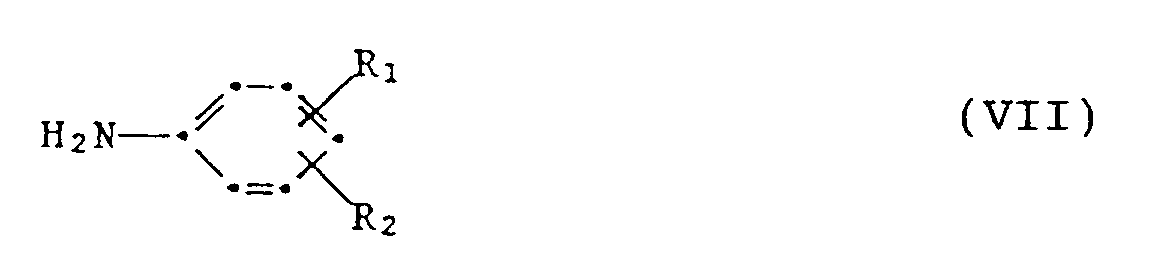

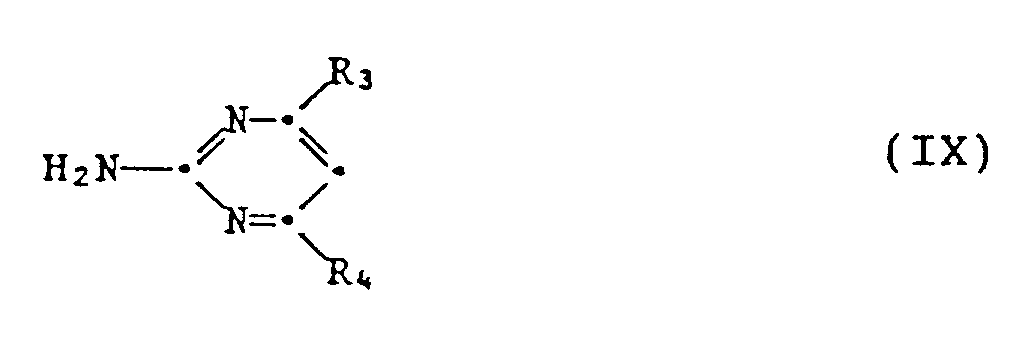
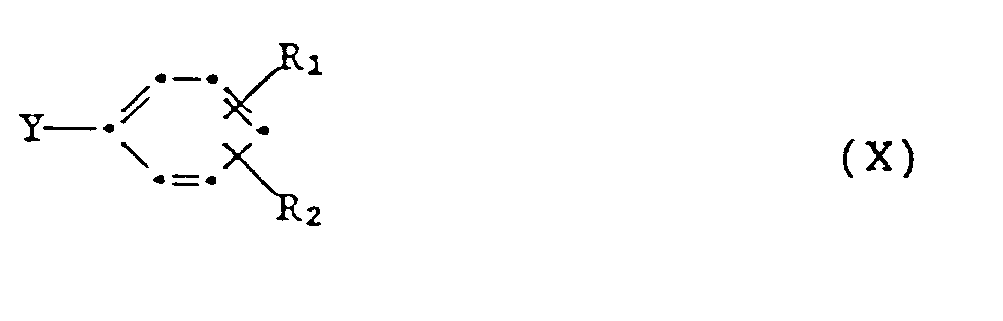

Priority Applications (1)
| Application Number | Priority Date | Filing Date | Title |
|---|---|---|---|
| AT88810640T ATE89821T1 (en) | 1987-09-28 | 1988-09-20 | PESTICIDES. |
Applications Claiming Priority (4)
| Application Number | Priority Date | Filing Date | Title |
|---|---|---|---|
| CH1333/88 | 1987-09-28 | ||
| CH375087 | 1987-09-28 | ||
| CH3750/87 | 1987-09-28 | ||
| CH133388 | 1988-04-11 |
Publications (2)
| Publication Number | Publication Date |
|---|---|
| EP0310550A1 EP0310550A1 (en) | 1989-04-05 |
| EP0310550B1 true EP0310550B1 (en) | 1993-05-26 |
Family
ID=25687372
Family Applications (1)
| Application Number | Title | Priority Date | Filing Date |
|---|---|---|---|
| EP88810640A Expired - Lifetime EP0310550B1 (en) | 1987-09-28 | 1988-09-20 | Pesticide |
Country Status (32)
| Country | Link |
|---|---|
| US (2) | US4931560A (en) |
| EP (1) | EP0310550B1 (en) |
| JP (1) | JPH0649689B2 (en) |
| KR (1) | KR920006738B1 (en) |
| CN (1) | CN1017993B (en) |
| AR (1) | AR245700A1 (en) |
| AU (1) | AU619762B2 (en) |
| BG (1) | BG60541B1 (en) |
| BR (1) | BR8804955A (en) |
| CA (1) | CA1317952C (en) |
| CY (1) | CY1770A (en) |
| CZ (2) | CZ279022B6 (en) |
| DE (1) | DE3881320D1 (en) |
| DK (2) | DK168598B1 (en) |
| ES (1) | ES2054867T3 (en) |
| FI (1) | FI98913C (en) |
| HK (1) | HK21394A (en) |
| HU (1) | HU203879B (en) |
| IE (1) | IE62424B1 (en) |
| IL (1) | IL87866A (en) |
| LV (3) | LV10613B (en) |
| MD (2) | MD370C2 (en) |
| NO (1) | NO176178C (en) |
| NZ (1) | NZ226323A (en) |
| PH (1) | PH26459A (en) |
| PL (1) | PL156233B1 (en) |
| PT (1) | PT88596B (en) |
| RU (6) | RU2014327C1 (en) |
| SK (1) | SK279313B6 (en) |
| UA (2) | UA19303A (en) |
| YU (1) | YU48390B (en) |
| ZW (1) | ZW12788A1 (en) |
Cited By (1)
| Publication number | Priority date | Publication date | Assignee | Title |
|---|---|---|---|---|
| CN102067852A (en) * | 2011-01-20 | 2011-05-25 | 陕西美邦农药有限公司 | Fungicide combination containing polyoxin and pyrimidine compound |
Families Citing this family (91)
| Publication number | Priority date | Publication date | Assignee | Title |
|---|---|---|---|---|
| EP0295210B1 (en) * | 1987-06-11 | 1993-08-04 | Ciba-Geigy Ag | Microbicides |
| JP2603108B2 (en) * | 1988-06-24 | 1997-04-23 | イハラケミカル工業株式会社 | Anilinopyrimidine derivative |
| GB8823288D0 (en) * | 1988-10-04 | 1988-11-09 | Schering Agrochemicals Ltd | Herbicides |
| AU644159B2 (en) * | 1990-05-17 | 1993-12-02 | Novartis Ag | 2-anilino-4-cyanopyrimidine derivatives |
| GB9117486D0 (en) * | 1991-08-13 | 1991-09-25 | Schering Ag | Fungicides |
| ATE136728T1 (en) * | 1991-12-19 | 1996-05-15 | Ciba Geigy Ag | MICROBICIDES |
| AU652302B2 (en) * | 1991-12-19 | 1994-08-18 | Novartis Ag | Microbicides |
| US5276186A (en) | 1992-03-11 | 1994-01-04 | Ciba-Geigy Corporation | Process for the production of guanidine derivatives |
| DE4318372B4 (en) * | 1992-06-10 | 2010-10-28 | BASF Agro B.V., Arnhem (NL)-Wädenswil-Branch | Fungicidal mixtures |
| WO1994025432A1 (en) * | 1993-04-28 | 1994-11-10 | Kumiai Chemical Industry Co., Ltd. | Amino acid amide derivative, agrohorticultural bactericide, and production process |
| DE4318285A1 (en) * | 1993-06-02 | 1994-12-08 | Bayer Ag | Fungicidal active ingredient combinations |
| CH686061A5 (en) * | 1993-06-04 | 1995-12-29 | Ciba Geigy Ag | Microbicides. |
| UA39100C2 (en) * | 1993-06-28 | 2001-06-15 | Новартіс Аг | BACTERICIDAL AGENT FOR PLANTS, METHOD FOR CONTROL OF FUNGAL DISEASES OF PLANTS AND VEGETABLE MATERIAL FOR REPRODUCTION |
| RU2127054C1 (en) * | 1993-06-28 | 1999-03-10 | Новартис Аг | Plant fungicide, a method of struggle against fungi |
| US5436248A (en) * | 1993-07-02 | 1995-07-25 | Ciba-Geigy Corporation | Microbicides |
| GB9314128D0 (en) * | 1993-07-08 | 1993-08-18 | Schering Agrochemicals Ltd | Fungicidal composition |
| JP3634409B2 (en) * | 1993-09-13 | 2005-03-30 | ビーエーエスエフ アクチェンゲゼルシャフト | Disinfectant mixture |
| ATE212337T1 (en) * | 1993-11-09 | 2002-02-15 | Syngenta Participations Ag | CRYSTAL MODIFICATION OF (4-CYCLOPROPYL-6-METHYL-PYRIMIDINE-2-YL)-PHENYL-AMINE AND METHOD FOR THE PRODUCTION THEREOF |
| AT406837B (en) * | 1994-02-10 | 2000-09-25 | Electrovac | METHOD AND DEVICE FOR PRODUCING METAL-MATRIX COMPOSITES |
| TW286264B (en) | 1994-05-20 | 1996-09-21 | Ciba Geigy Ag | |
| US5519026A (en) * | 1994-06-27 | 1996-05-21 | Ciba-Geigy Corporation | Microbicides |
| DE4444928A1 (en) | 1994-12-16 | 1996-06-27 | Hoechst Schering Agrevo Gmbh | Process for the preparation of 2-anilino-pyridine derivatives |
| FR2729051B1 (en) * | 1995-01-09 | 2000-12-08 | Rhone Poulenc Agrochimie | NEW FUNGICIDE COMPOSITION BASED ON A DICARBOXIMIDE COMPOUND |
| NZ324693A (en) * | 1995-12-14 | 2000-01-28 | Basf Ag | 2-(O-[pyrimidin-4-yl]methylenoxy)phenyl acetic acid derivatives and fungicidal composition |
| WO1997037535A2 (en) * | 1996-04-11 | 1997-10-16 | Novartis Ag | Pesticidal compositions of cyprodinil and myclobutanil or ipridione |
| IL126081A (en) * | 1996-04-26 | 2001-12-23 | Basf Ag | Synergistic fungicidal mixtures |
| ES2165052T3 (en) * | 1996-05-04 | 2002-03-01 | Yuhan Corp | PROCEDURE FOR THE PREPARATION OF PIRIMIDINE DERIVATIVES. |
| TW440563B (en) * | 1996-05-23 | 2001-06-16 | Hoffmann La Roche | Aryl pyrimidine derivatives and a pharmaceutical composition thereof |
| GB9619534D0 (en) * | 1996-09-19 | 1996-10-30 | Agrevo Uk Ltd | Fungicidal composition |
| US6297236B1 (en) | 1998-04-06 | 2001-10-02 | Bayer Aktiengesellschaft | Fungicide active substance combinations |
| DE19716257A1 (en) * | 1997-04-18 | 1998-10-22 | Bayer Ag | Fungicidal active ingredient combination |
| JP2002517413A (en) | 1998-06-10 | 2002-06-18 | ビーエーエスエフ アクチェンゲゼルシャフト | Use of 2- (N-phenylamino) pyridine as fungicide and novel 2- (N-phenylamino) pyrimidine |
| WO2001019801A1 (en) * | 1999-09-16 | 2001-03-22 | Rimma Iliinichna Ashkinazi | Bioactive substance containing derivatives of 2-amino-6-aryloxypyrimidines and intermediary products of synthesis thereof |
| US6624183B2 (en) | 1999-12-13 | 2003-09-23 | Bayer Aktiengesellschaft | Fungicidal combinations of active substances |
| DE10019758A1 (en) | 2000-04-20 | 2001-10-25 | Bayer Ag | Fungicidal combinations containing known methoxyimino-acetic acid amide derivatives useful for the control of phytopathogenic fungi |
| DE10103832A1 (en) * | 2000-05-11 | 2001-11-15 | Bayer Ag | Synergistic combination of fungicides for use in plant protection, comprises 2-(pyrimidinyloxy-phenyl)-2-(methoxyimino)-N-methyl-acetamide derivative and e.g. spiroxamine, quinoxyfen or tebuconazole |
| KR20010112817A (en) * | 2000-06-15 | 2001-12-22 | 황재관 | Method for isolating physiologically active materials from green tea |
| DE10049804A1 (en) * | 2000-10-09 | 2002-04-18 | Bayer Ag | Agent containing synergistic mixture comprising phenyl-pyrroline ketoenol derivatives with fungicides and acaricides useful especially in plant protection |
| DE50213202D1 (en) * | 2001-05-29 | 2009-02-26 | Bayer Schering Pharma Ag | CDK INHIBITOR PYRIMIDINES, THEIR PREPARATION AND THEIR USE AS DRUGS |
| DE10207376B4 (en) * | 2002-02-22 | 2005-03-03 | Degussa Ag | Process for the preparation of 2-anilino-4,6-dimethylpyrimidine |
| AP1634A (en) * | 2002-07-08 | 2006-07-13 | Basf Ag | Dithianon-based fungicidal mixtures |
| DE10347090A1 (en) | 2003-10-10 | 2005-05-04 | Bayer Cropscience Ag | Synergistic fungicidal drug combinations |
| DE10349501A1 (en) | 2003-10-23 | 2005-05-25 | Bayer Cropscience Ag | Synergistic fungicidal drug combinations |
| EP2255628A3 (en) | 2004-04-30 | 2012-09-19 | Basf Se | Fungicidal mixtures |
| US7091202B2 (en) * | 2004-09-15 | 2006-08-15 | Bristol-Myers Squibb Company | 4-arylspirocycloalkyl-2-aminopyrimidine carboxamide KCNQ potassium channel modulators |
| ATE542802T1 (en) * | 2004-09-30 | 2012-02-15 | Tibotec Pharm Ltd | HIV-INHIBITING 5-SUBSTITUTED PYRIMIDINES |
| US20090069356A1 (en) * | 2004-10-22 | 2009-03-12 | Dany Leopold Jozefien Bylemans | Use of anilinopyrimidines in wood protection |
| EP1941798B1 (en) | 2004-12-17 | 2012-05-23 | Devgen NV | Nematicidal compositions |
| DE102005015677A1 (en) | 2005-04-06 | 2006-10-12 | Bayer Cropscience Ag | Synergistic fungicidal drug combinations |
| EA201270781A1 (en) | 2005-06-09 | 2013-09-30 | Байер Кропсайенс Аг | COMBINATION OF BIOLOGICALLY ACTIVE SUBSTANCES |
| DE102005026482A1 (en) | 2005-06-09 | 2006-12-14 | Bayer Cropscience Ag | Active substance combination, useful e.g. for combating unwanted phytopathogenic fungus, comprises herbicides e.g. glyphosate and active substances e.g. strobilurin, triazoles, valinamide and carboxamide |
| PL1928238T3 (en) * | 2005-09-29 | 2009-10-30 | Syngenta Participations Ag | Fungicidal composition comprising cyprodinil |
| EP2087790B1 (en) | 2005-09-29 | 2013-02-20 | Syngenta Participations AG | Fungicidal compositions |
| EP1782690B1 (en) * | 2005-09-29 | 2012-09-12 | Syngenta Participations AG | Method of controlling diseases on barley plants |
| DE102006023263A1 (en) * | 2006-05-18 | 2007-11-22 | Bayer Cropscience Ag | Synergistic drug combinations |
| BRPI0716915B1 (en) | 2006-09-18 | 2016-09-13 | Basf Se | pesticide mixture, pesticide composition, methods for controlling phytopathogenic fungi, for controlling insects, arachnids or nematodes, for protecting plants and for protecting seeds, process for preparing a composition, and using a mixture |
| WO2008071714A1 (en) | 2006-12-15 | 2008-06-19 | Rohm And Haas Company | Mixtures comprising 1-methylcyclopropene |
| CN103155949A (en) | 2007-02-06 | 2013-06-19 | 巴斯夫欧洲公司 | Pesticidal mixtures |
| GB0706044D0 (en) * | 2007-03-28 | 2007-05-09 | Syngenta Ltd | C0-Crystals |
| KR20100015796A (en) | 2007-04-23 | 2010-02-12 | 바스프 에스이 | Plant productivity enhancement by combining chemical agents with transgenic modifications |
| MX2009012217A (en) * | 2007-05-16 | 2009-12-01 | Bayer Cropscience Sa | Fungicides phenyl-pyrimdinyl-amino derivatives. |
| CN101311170B (en) | 2007-05-25 | 2010-09-15 | 中国中化股份有限公司 | Substituted pyrimidine ether compounds and their applications |
| ATE551901T1 (en) | 2007-09-26 | 2012-04-15 | Basf Se | TERNARY FUNGICIDE COMPOSITIONS CONTAINING BOSCALID AND CHLORTHALONIL |
| DE102007045920B4 (en) | 2007-09-26 | 2018-07-05 | Bayer Intellectual Property Gmbh | Synergistic drug combinations |
| US8575187B2 (en) | 2008-02-06 | 2013-11-05 | Janssen Pharmaceutica, Nv | Combinations of anilinopyrimidines and pyrion compounds |
| US8592438B2 (en) * | 2008-03-21 | 2013-11-26 | Sumitomo Chemical Intellectual Property Service, Ltd | Plant disease control composition |
| UA104887C2 (en) | 2009-03-25 | 2014-03-25 | Баєр Кропсаєнс Аг | Synergic combinations of active ingredients |
| CN101906075B (en) | 2009-06-05 | 2012-11-07 | 中国中化股份有限公司 | E-type phenyl acrylic acid ester compound containing substituted anilino pyrimidine group and applications thereof |
| WO2011006603A2 (en) | 2009-07-16 | 2011-01-20 | Bayer Cropscience Ag | Synergistic active substance combinations containing phenyl triazoles |
| WO2011026796A1 (en) | 2009-09-01 | 2011-03-10 | Basf Se | Synergistic fungicidal mixtures comprising lactylates and method for combating phytopathogenic fungi |
| WO2012084670A1 (en) | 2010-12-20 | 2012-06-28 | Basf Se | Pesticidal active mixtures comprising pyrazole compounds |
| EP2481284A3 (en) | 2011-01-27 | 2012-10-17 | Basf Se | Pesticidal mixtures |
| CN103442567B (en) | 2011-03-23 | 2016-02-10 | 巴斯夫欧洲公司 | Containing the composition of polymerization plasma type compound comprising imidazole group |
| US20140200136A1 (en) | 2011-09-02 | 2014-07-17 | Basf Se | Agricultural mixtures comprising arylquinazolinone compounds |
| CN102388890B (en) * | 2011-10-09 | 2013-08-28 | 陕西上格之路生物科学有限公司 | Bactericidal composition containing SYP-3375 and cyprodinil |
| ES2402036B1 (en) * | 2011-10-13 | 2014-03-10 | Consejo Superior De Investigaciones Científicas (Csic) | HAVE CONJUGATED AND ANTIBODIES FOR THE FUNGICIDE CIPRODINIL. |
| ES2800288T3 (en) | 2012-06-20 | 2020-12-29 | Basf Se | Pesticide mixtures comprising a pyrazole compound |
| CN102899600A (en) * | 2012-09-12 | 2013-01-30 | 常州大学 | Boride ceramic coating prepared through electric spark deposition in-situ reaction and preparation method thereof |
| JP2013032375A (en) * | 2012-10-05 | 2013-02-14 | Japan Enviro Chemicals Ltd | Antifungal composition |
| WO2014056780A1 (en) | 2012-10-12 | 2014-04-17 | Basf Se | A method for combating phytopathogenic harmful microbes on cultivated plants or plant propagation material |
| EP2934147B1 (en) | 2012-12-20 | 2019-11-27 | BASF Agro B.V. | Compositions comprising a triazole compound |
| EP2783569A1 (en) | 2013-03-28 | 2014-10-01 | Basf Se | Compositions comprising a triazole compound |
| MD4301C1 (en) * | 2013-06-12 | 2015-03-31 | Институт Генетики, Физиологии И Защиты Растений Академии Наук Молдовы | 1-epi-5-O-alozilantirinozide for the treatment of lettuce seeds |
| EP2835052A1 (en) | 2013-08-07 | 2015-02-11 | Basf Se | Fungicidal mixtures comprising pyrimidine fungicides |
| CN105722833A (en) | 2013-09-16 | 2016-06-29 | 巴斯夫欧洲公司 | Fungicidal pyrimidine compounds |
| WO2015036059A1 (en) | 2013-09-16 | 2015-03-19 | Basf Se | Fungicidal pyrimidine compounds |
| KR101826015B1 (en) | 2013-10-18 | 2018-02-06 | 에자이 알앤드디 매니지먼트 가부시키가이샤 | Pyrimidine fgfr4 inhibitors |
| EP2979549A1 (en) | 2014-07-31 | 2016-02-03 | Basf Se | Method for improving the health of a plant |
| RU2707051C2 (en) | 2014-10-24 | 2019-11-21 | Басф Се | Non-ampholytic, quaternizable and water-soluble polymers for modifying surface charge of solid particles |
| EP2910126A1 (en) | 2015-05-05 | 2015-08-26 | Bayer CropScience AG | Active compound combinations having insecticidal properties |
| CN106035340A (en) * | 2016-05-20 | 2016-10-26 | 南京华洲药业有限公司 | Spiroxamine and cyprodinil containing fungicidal composition and application thereof |
Family Cites Families (15)
| Publication number | Priority date | Publication date | Assignee | Title |
|---|---|---|---|---|
| DE151404C (en) * | ||||
| DE1670537A1 (en) * | 1966-11-09 | 1970-10-29 | Degussa | Process for the preparation of new substituted aminopyrimidines |
| AU5319479A (en) * | 1978-12-22 | 1980-06-26 | Ici Australia Limited | Pyrimidinyl amino phenoxy carboxylate derivatives |
| DD151404A1 (en) * | 1980-06-13 | 1981-10-21 | Friedrich Franke | FUNGICIDAL AGENTS |
| US4515626A (en) * | 1982-10-06 | 1985-05-07 | Ciba Geigy Corporation | N-(Cyclopropyl-triazinyl-n'-(arylsulfonyl) ureas having herbicidal activity |
| DE3319843A1 (en) * | 1983-06-01 | 1984-12-06 | Ali-Akbar Dipl.-Chem. Dr. 4300 Mülheim Pourzal | Process for the preparation of pyrimidines from nitrile and alkynes |
| US4659363A (en) * | 1983-07-25 | 1987-04-21 | Ciba-Geigy Corporation | N-(2-nitrophenyl)-2-aminopyrimidine derivatives, the preparation and use thereof |
| DE3402194A1 (en) * | 1984-01-24 | 1985-07-25 | Bayer Ag, 5090 Leverkusen | METHOD FOR SELECTIVE HYDRATION OF CHLORINE-CONTAINING PYRIMIDINS AND NEW PYRIMIDINS |
| US4685961A (en) * | 1984-02-14 | 1987-08-11 | Ciba-Geigy Corporation | Herbicidal sulfonylureas |
| EP0172786B1 (en) * | 1984-06-25 | 1991-01-30 | Ciba-Geigy Ag | Pyrimidine derivatives active as parasiticides |
| JPH0629263B2 (en) * | 1985-10-30 | 1994-04-20 | クミアイ化学工業株式会社 | Pyrimidine derivatives and agricultural and horticultural fungicides |
| EP0295210B1 (en) * | 1987-06-11 | 1993-08-04 | Ciba-Geigy Ag | Microbicides |
| US4897396A (en) * | 1988-06-03 | 1990-01-30 | Ciba-Geigy Corporation | 2-phenylamino pyrimidine derivatives and their uses as microbicides |
| ATE140699T1 (en) * | 1988-09-09 | 1996-08-15 | Ciba Geigy Ag | PEST CONTROLS |
| HU206337B (en) * | 1988-12-29 | 1992-10-28 | Mitsui Petrochemical Ind | Process for producing pyrimidine derivatives and pharmaceutical compositions |
-
1988
- 1988-09-20 EP EP88810640A patent/EP0310550B1/en not_active Expired - Lifetime
- 1988-09-20 DE DE8888810640T patent/DE3881320D1/en not_active Expired - Lifetime
- 1988-09-20 ES ES88810640T patent/ES2054867T3/en not_active Expired - Lifetime
- 1988-09-21 US US07/247,203 patent/US4931560A/en not_active Expired - Lifetime
- 1988-09-26 BR BR8804955A patent/BR8804955A/en not_active IP Right Cessation
- 1988-09-26 NZ NZ226323A patent/NZ226323A/en unknown
- 1988-09-26 AR AR88312041A patent/AR245700A1/en active
- 1988-09-26 FI FI884409A patent/FI98913C/en not_active IP Right Cessation
- 1988-09-26 CA CA000578360A patent/CA1317952C/en not_active Expired - Lifetime
- 1988-09-26 PL PL1988274899A patent/PL156233B1/en unknown
- 1988-09-26 ZW ZW127/88A patent/ZW12788A1/en unknown
- 1988-09-27 CZ CS886385A patent/CZ279022B6/en not_active IP Right Cessation
- 1988-09-27 DK DK536288A patent/DK168598B1/en not_active IP Right Cessation
- 1988-09-27 HU HU885028A patent/HU203879B/en unknown
- 1988-09-27 SK SK6385-88A patent/SK279313B6/en unknown
- 1988-09-27 NO NO884284A patent/NO176178C/en not_active IP Right Cessation
- 1988-09-27 YU YU180988A patent/YU48390B/en unknown
- 1988-09-27 RU SU884356644A patent/RU2014327C1/en active
- 1988-09-27 PT PT88596A patent/PT88596B/en not_active IP Right Cessation
- 1988-09-27 IE IE292288A patent/IE62424B1/en not_active IP Right Cessation
- 1988-09-27 UA UA4356644A patent/UA19303A/en unknown
- 1988-09-27 CZ CS895753A patent/CZ575389A3/en unknown
- 1988-09-27 AU AU22870/88A patent/AU619762B2/en not_active Expired
- 1988-09-27 PH PH37606A patent/PH26459A/en unknown
- 1988-09-28 IL IL87866A patent/IL87866A/en active Protection Beyond IP Right Term
- 1988-09-28 JP JP63243754A patent/JPH0649689B2/en not_active Expired - Fee Related
- 1988-09-28 KR KR1019880012609A patent/KR920006738B1/en not_active Expired
- 1988-09-28 BG BG85550A patent/BG60541B1/en unknown
- 1988-09-28 CN CN88106975A patent/CN1017993B/en not_active Expired
-
1989
- 1989-09-20 RU SU894614930A patent/RU2002416C1/en active
- 1989-09-20 RU SU894614995A patent/RU2043025C1/en active
- 1989-09-20 UA UA4614930A patent/UA19304A/en unknown
-
1990
- 1990-01-24 RU SU904742847A patent/RU2009134C1/en active
- 1990-01-24 RU SU904742906A patent/RU2017735C1/en active
- 1990-03-19 US US07/496,381 patent/US4997941A/en not_active Expired - Lifetime
-
1992
- 1992-04-14 RU SU925011341A patent/RU2045520C1/en active
-
1993
- 1993-05-25 LV LVP-93-409A patent/LV10613B/en unknown
- 1993-06-15 LV LVP-93-594A patent/LV10614B/en unknown
- 1993-06-30 LV LVP-93-823A patent/LV10676B/en unknown
- 1993-07-20 DK DK085993A patent/DK170161B1/en not_active IP Right Cessation
-
1994
- 1994-03-10 HK HK213/94A patent/HK21394A/en not_active IP Right Cessation
- 1994-04-28 MD MD94-0102A patent/MD370C2/en unknown
- 1994-07-14 MD MD94-0208A patent/MD501C2/en unknown
-
1995
- 1995-10-20 CY CY177095A patent/CY1770A/en unknown
Non-Patent Citations (1)
| Title |
|---|
| PATENT ABSTRACTS OF JAPAN, Band 5, Nr. 132(C-68)[804], 1981 * |
Cited By (1)
| Publication number | Priority date | Publication date | Assignee | Title |
|---|---|---|---|---|
| CN102067852A (en) * | 2011-01-20 | 2011-05-25 | 陕西美邦农药有限公司 | Fungicide combination containing polyoxin and pyrimidine compound |
Also Published As
Similar Documents
| Publication | Publication Date | Title |
|---|---|---|
| EP0310550B1 (en) | Pesticide | |
| EP0295210B1 (en) | Microbicides | |
| EP0388838B1 (en) | Parasiticide | |
| EP0135472B1 (en) | N-(2-nitrophenyl)-2-aminopyrimidine derivatives, their preparation and use | |
| DE69712331T2 (en) | PYRIMIDIN-4-ON DERIVATIVES AS PESTICIDES | |
| EP0172786B1 (en) | Pyrimidine derivatives active as parasiticides | |
| EP0126254B1 (en) | N-(2-nitrophenyl)-4-aminopyrimidine derivatives as microbicides | |
| EP0276432A2 (en) | Pesticides | |
| EP0139613A1 (en) | N-(2-nitrophenyl)-4-aminopyrimidine derivatives, their preparation and use | |
| EP0430033A2 (en) | Microbicidal agents | |
| WO1992005159A1 (en) | 2-phenyl-pyrimidines, process for producing the same, agents containing the same and their use as fungicides | |
| EP0457726B1 (en) | 2-Anilinopyrimidine derivatives as pesticides | |
| EP0263958B1 (en) | 4-substituted-2,6-diphenylpyridine derivatives, use thereof, production of the same, chemical intermediates therein and herbicides | |
| EP0132826B1 (en) | N-(1-nitrophenyl)-5-aminopyrimidine derivatives, their preparation and use | |
| EP0241429A2 (en) | Microbicidal silanes | |
| EP0457727A1 (en) | Pesticides | |
| EP0358609B1 (en) | Parasiticide compounds | |
| EP0462931B1 (en) | Benzotriazole-1-sulfonyl derivatives with microbicidal properties | |
| EP0549532A1 (en) | Benzotriazole-sulfonic acid derivatives and their use as microbicides | |
| DD282685A5 (en) | PROCESS FOR THE PREPARATION OF NEW 2-ANILINOPYRINDIDE DERIVATIVES | |
| EP0175651B1 (en) | Microbicides | |
| EP0362135A2 (en) | Parasiticide | |
| DD259344A5 (en) | MICROBICIDE MEDIUM | |
| EP0207000A1 (en) | Microbicides | |
| SI8811809A (en) | PEST CONTROL MEANS |
Legal Events
| Date | Code | Title | Description |
|---|---|---|---|
| PUAI | Public reference made under article 153(3) epc to a published international application that has entered the european phase |
Free format text: ORIGINAL CODE: 0009012 |
|
| 17P | Request for examination filed |
Effective date: 19880922 |
|
| AK | Designated contracting states |
Kind code of ref document: A1 Designated state(s): AT BE CH DE ES FR GB GR IT LI LU NL SE |
|
| 17Q | First examination report despatched |
Effective date: 19910611 |
|
| GRAA | (expected) grant |
Free format text: ORIGINAL CODE: 0009210 |
|
| AK | Designated contracting states |
Kind code of ref document: B1 Designated state(s): AT BE CH DE ES FR GB GR IT LI LU NL SE |
|
| REF | Corresponds to: |
Ref document number: 89821 Country of ref document: AT Date of ref document: 19930615 Kind code of ref document: T |
|
| ITF | It: translation for a ep patent filed | ||
| REF | Corresponds to: |
Ref document number: 3881320 Country of ref document: DE Date of ref document: 19930701 |
|
| ET | Fr: translation filed | ||
| REG | Reference to a national code |
Ref country code: GR Ref legal event code: FG4A Free format text: 3008150 |
|
| GBT | Gb: translation of ep patent filed (gb section 77(6)(a)/1977) |
Effective date: 19930908 |
|
| EPTA | Lu: last paid annual fee | ||
| PLBE | No opposition filed within time limit |
Free format text: ORIGINAL CODE: 0009261 |
|
| STAA | Information on the status of an ep patent application or granted ep patent |
Free format text: STATUS: NO OPPOSITION FILED WITHIN TIME LIMIT |
|
| 26N | No opposition filed | ||
| REG | Reference to a national code |
Ref country code: ES Ref legal event code: FG2A Ref document number: 2054867 Country of ref document: ES Kind code of ref document: T3 |
|
| EAL | Se: european patent in force in sweden |
Ref document number: 88810640.8 |
|
| REG | Reference to a national code |
Ref country code: CH Ref legal event code: PFA Free format text: CIBA-GEIGY AG TRANSFER- NOVARTIS AG |
|
| REG | Reference to a national code |
Ref country code: GB Ref legal event code: 732E |
|
| NLS | Nl: assignments of ep-patents |
Owner name: NOVARTIS AG |
|
| REG | Reference to a national code |
Ref country code: FR Ref legal event code: TP |
|
| REG | Reference to a national code |
Ref country code: ES Ref legal event code: PC2A |
|
| REG | Reference to a national code |
Ref country code: GB Ref legal event code: IF02 |
|
| REG | Reference to a national code |
Ref country code: CH Ref legal event code: PUE Owner name: SYNGENTA PARTICIPATIONS AG Free format text: NOVARTIS AG#SCHWARZWALDALLEE 215#4058 BASEL (CH) -TRANSFER TO- SYNGENTA PARTICIPATIONS AG#SCHWARZWALDALLEE 215#4058 BASEL (CH) |
|
| NLS | Nl: assignments of ep-patents |
Owner name: SYNGENTA PARTICIPATIONS AG |
|
| REG | Reference to a national code |
Ref country code: FR Ref legal event code: TP |
|
| PGFP | Annual fee paid to national office [announced via postgrant information from national office to epo] |
Ref country code: DE Payment date: 20070913 Year of fee payment: 20 |
|
| PGFP | Annual fee paid to national office [announced via postgrant information from national office to epo] |
Ref country code: AT Payment date: 20070912 Year of fee payment: 20 Ref country code: CH Payment date: 20070913 Year of fee payment: 20 |
|
| PGFP | Annual fee paid to national office [announced via postgrant information from national office to epo] |
Ref country code: GB Payment date: 20070919 Year of fee payment: 20 |
|
| PGFP | Annual fee paid to national office [announced via postgrant information from national office to epo] |
Ref country code: LU Payment date: 20071001 Year of fee payment: 20 Ref country code: SE Payment date: 20070905 Year of fee payment: 20 Ref country code: ES Payment date: 20071024 Year of fee payment: 20 Ref country code: NL Payment date: 20070823 Year of fee payment: 20 Ref country code: IT Payment date: 20070926 Year of fee payment: 20 |
|
| PGFP | Annual fee paid to national office [announced via postgrant information from national office to epo] |
Ref country code: BE Payment date: 20071120 Year of fee payment: 20 |
|
| PGFP | Annual fee paid to national office [announced via postgrant information from national office to epo] |
Ref country code: FR Payment date: 20070914 Year of fee payment: 20 |
|
| PGFP | Annual fee paid to national office [announced via postgrant information from national office to epo] |
Ref country code: GR Payment date: 20070813 Year of fee payment: 20 |
|
| BE20 | Be: patent expired |
Owner name: *SYNGENTA PARTICIPATIONS A.G. Effective date: 20080920 |
|
| REG | Reference to a national code |
Ref country code: CH Ref legal event code: PL |
|
| REG | Reference to a national code |
Ref country code: GB Ref legal event code: PE20 Expiry date: 20080919 |
|
| NLV7 | Nl: ceased due to reaching the maximum lifetime of a patent |
Effective date: 20080920 |
|
| EUG | Se: european patent has lapsed | ||
| PG25 | Lapsed in a contracting state [announced via postgrant information from national office to epo] |
Ref country code: NL Free format text: LAPSE BECAUSE OF EXPIRATION OF PROTECTION Effective date: 20080920 |
|
| REG | Reference to a national code |
Ref country code: ES Ref legal event code: FD2A Effective date: 20080922 |
|
| PG25 | Lapsed in a contracting state [announced via postgrant information from national office to epo] |
Ref country code: GB Free format text: LAPSE BECAUSE OF EXPIRATION OF PROTECTION Effective date: 20080919 |
|
| PG25 | Lapsed in a contracting state [announced via postgrant information from national office to epo] |
Ref country code: ES Free format text: LAPSE BECAUSE OF EXPIRATION OF PROTECTION Effective date: 20080922 |