EP2934147B1 - Compositions comprising a triazole compound - Google Patents
Compositions comprising a triazole compound Download PDFInfo
- Publication number
- EP2934147B1 EP2934147B1 EP13818211.8A EP13818211A EP2934147B1 EP 2934147 B1 EP2934147 B1 EP 2934147B1 EP 13818211 A EP13818211 A EP 13818211A EP 2934147 B1 EP2934147 B1 EP 2934147B1
- Authority
- EP
- European Patent Office
- Prior art keywords
- methyl
- component
- phenyl
- inhibitors
- compositions
- Prior art date
- Legal status (The legal status is an assumption and is not a legal conclusion. Google has not performed a legal analysis and makes no representation as to the accuracy of the status listed.)
- Active
Links
- WLARMTJRJVXATC-UHFFFAOYSA-N CC#CC(C[n]1ncnc1)(c(c(C(F)(F)F)c1)ccc1Oc(cc1)ccc1Cl)O Chemical compound CC#CC(C[n]1ncnc1)(c(c(C(F)(F)F)c1)ccc1Oc(cc1)ccc1Cl)O WLARMTJRJVXATC-UHFFFAOYSA-N 0.000 description 1
- SIIJJFOXEOHODQ-UHFFFAOYSA-N CC(C)C(C[n]1ncnc1)(c(c(C(F)(F)F)c1)ccc1Oc(cc1)ccc1Cl)O Chemical compound CC(C)C(C[n]1ncnc1)(c(c(C(F)(F)F)c1)ccc1Oc(cc1)ccc1Cl)O SIIJJFOXEOHODQ-UHFFFAOYSA-N 0.000 description 1
- NVASWJQSCINQCX-UHFFFAOYSA-N OC(C[n]1ncnc1)(C1CC1)c(c(C(F)(F)F)c1)ccc1Oc(cc1)ccc1Cl Chemical compound OC(C[n]1ncnc1)(C1CC1)c(c(C(F)(F)F)c1)ccc1Oc(cc1)ccc1Cl NVASWJQSCINQCX-UHFFFAOYSA-N 0.000 description 1
- ZRTVRQGLFTZIKR-UHFFFAOYSA-N OC(C[n]1ncnc1)(C1CC1)c(c(Cl)c1)ccc1Oc(cc1)ccc1Cl Chemical compound OC(C[n]1ncnc1)(C1CC1)c(c(Cl)c1)ccc1Oc(cc1)ccc1Cl ZRTVRQGLFTZIKR-UHFFFAOYSA-N 0.000 description 1
Classifications
-
- C—CHEMISTRY; METALLURGY
- C07—ORGANIC CHEMISTRY
- C07D—HETEROCYCLIC COMPOUNDS
- C07D249/00—Heterocyclic compounds containing five-membered rings having three nitrogen atoms as the only ring hetero atoms
- C07D249/02—Heterocyclic compounds containing five-membered rings having three nitrogen atoms as the only ring hetero atoms not condensed with other rings
- C07D249/08—1,2,4-Triazoles; Hydrogenated 1,2,4-triazoles
-
- A—HUMAN NECESSITIES
- A01—AGRICULTURE; FORESTRY; ANIMAL HUSBANDRY; HUNTING; TRAPPING; FISHING
- A01N—PRESERVATION OF BODIES OF HUMANS OR ANIMALS OR PLANTS OR PARTS THEREOF; BIOCIDES, e.g. AS DISINFECTANTS, AS PESTICIDES OR AS HERBICIDES; PEST REPELLANTS OR ATTRACTANTS; PLANT GROWTH REGULATORS
- A01N43/00—Biocides, pest repellants or attractants, or plant growth regulators containing heterocyclic compounds
- A01N43/64—Biocides, pest repellants or attractants, or plant growth regulators containing heterocyclic compounds having rings with three nitrogen atoms as the only ring hetero atoms
- A01N43/647—Triazoles; Hydrogenated triazoles
- A01N43/653—1,2,4-Triazoles; Hydrogenated 1,2,4-triazoles
-
- A—HUMAN NECESSITIES
- A01—AGRICULTURE; FORESTRY; ANIMAL HUSBANDRY; HUNTING; TRAPPING; FISHING
- A01N—PRESERVATION OF BODIES OF HUMANS OR ANIMALS OR PLANTS OR PARTS THEREOF; BIOCIDES, e.g. AS DISINFECTANTS, AS PESTICIDES OR AS HERBICIDES; PEST REPELLANTS OR ATTRACTANTS; PLANT GROWTH REGULATORS
- A01N25/00—Biocides, pest repellants or attractants, or plant growth regulators, characterised by their forms, or by their non-active ingredients or by their methods of application, e.g. seed treatment or sequential application; Substances for reducing the noxious effect of the active ingredients to organisms other than pests
-
- A—HUMAN NECESSITIES
- A01—AGRICULTURE; FORESTRY; ANIMAL HUSBANDRY; HUNTING; TRAPPING; FISHING
- A01N—PRESERVATION OF BODIES OF HUMANS OR ANIMALS OR PLANTS OR PARTS THEREOF; BIOCIDES, e.g. AS DISINFECTANTS, AS PESTICIDES OR AS HERBICIDES; PEST REPELLANTS OR ATTRACTANTS; PLANT GROWTH REGULATORS
- A01N37/00—Biocides, pest repellants or attractants, or plant growth regulators containing organic compounds containing a carbon atom having three bonds to hetero atoms with at the most two bonds to halogen, e.g. carboxylic acids
- A01N37/34—Nitriles
-
- A—HUMAN NECESSITIES
- A01—AGRICULTURE; FORESTRY; ANIMAL HUSBANDRY; HUNTING; TRAPPING; FISHING
- A01N—PRESERVATION OF BODIES OF HUMANS OR ANIMALS OR PLANTS OR PARTS THEREOF; BIOCIDES, e.g. AS DISINFECTANTS, AS PESTICIDES OR AS HERBICIDES; PEST REPELLANTS OR ATTRACTANTS; PLANT GROWTH REGULATORS
- A01N37/00—Biocides, pest repellants or attractants, or plant growth regulators containing organic compounds containing a carbon atom having three bonds to hetero atoms with at the most two bonds to halogen, e.g. carboxylic acids
- A01N37/42—Biocides, pest repellants or attractants, or plant growth regulators containing organic compounds containing a carbon atom having three bonds to hetero atoms with at the most two bonds to halogen, e.g. carboxylic acids containing within the same carbon skeleton a carboxylic group or a thio analogue, or a derivative thereof, and a carbon atom having only two bonds to hetero atoms with at the most one bond to halogen, e.g. keto-carboxylic acids
-
- A—HUMAN NECESSITIES
- A01—AGRICULTURE; FORESTRY; ANIMAL HUSBANDRY; HUNTING; TRAPPING; FISHING
- A01N—PRESERVATION OF BODIES OF HUMANS OR ANIMALS OR PLANTS OR PARTS THEREOF; BIOCIDES, e.g. AS DISINFECTANTS, AS PESTICIDES OR AS HERBICIDES; PEST REPELLANTS OR ATTRACTANTS; PLANT GROWTH REGULATORS
- A01N43/00—Biocides, pest repellants or attractants, or plant growth regulators containing heterocyclic compounds
- A01N43/34—Biocides, pest repellants or attractants, or plant growth regulators containing heterocyclic compounds having rings with one nitrogen atom as the only ring hetero atom
- A01N43/36—Biocides, pest repellants or attractants, or plant growth regulators containing heterocyclic compounds having rings with one nitrogen atom as the only ring hetero atom five-membered rings
-
- A—HUMAN NECESSITIES
- A01—AGRICULTURE; FORESTRY; ANIMAL HUSBANDRY; HUNTING; TRAPPING; FISHING
- A01N—PRESERVATION OF BODIES OF HUMANS OR ANIMALS OR PLANTS OR PARTS THEREOF; BIOCIDES, e.g. AS DISINFECTANTS, AS PESTICIDES OR AS HERBICIDES; PEST REPELLANTS OR ATTRACTANTS; PLANT GROWTH REGULATORS
- A01N43/00—Biocides, pest repellants or attractants, or plant growth regulators containing heterocyclic compounds
- A01N43/34—Biocides, pest repellants or attractants, or plant growth regulators containing heterocyclic compounds having rings with one nitrogen atom as the only ring hetero atom
- A01N43/40—Biocides, pest repellants or attractants, or plant growth regulators containing heterocyclic compounds having rings with one nitrogen atom as the only ring hetero atom six-membered rings
-
- A—HUMAN NECESSITIES
- A01—AGRICULTURE; FORESTRY; ANIMAL HUSBANDRY; HUNTING; TRAPPING; FISHING
- A01N—PRESERVATION OF BODIES OF HUMANS OR ANIMALS OR PLANTS OR PARTS THEREOF; BIOCIDES, e.g. AS DISINFECTANTS, AS PESTICIDES OR AS HERBICIDES; PEST REPELLANTS OR ATTRACTANTS; PLANT GROWTH REGULATORS
- A01N43/00—Biocides, pest repellants or attractants, or plant growth regulators containing heterocyclic compounds
- A01N43/48—Biocides, pest repellants or attractants, or plant growth regulators containing heterocyclic compounds having rings with two nitrogen atoms as the only ring hetero atoms
- A01N43/54—1,3-Diazines; Hydrogenated 1,3-diazines
-
- A—HUMAN NECESSITIES
- A01—AGRICULTURE; FORESTRY; ANIMAL HUSBANDRY; HUNTING; TRAPPING; FISHING
- A01N—PRESERVATION OF BODIES OF HUMANS OR ANIMALS OR PLANTS OR PARTS THEREOF; BIOCIDES, e.g. AS DISINFECTANTS, AS PESTICIDES OR AS HERBICIDES; PEST REPELLANTS OR ATTRACTANTS; PLANT GROWTH REGULATORS
- A01N43/00—Biocides, pest repellants or attractants, or plant growth regulators containing heterocyclic compounds
- A01N43/48—Biocides, pest repellants or attractants, or plant growth regulators containing heterocyclic compounds having rings with two nitrogen atoms as the only ring hetero atoms
- A01N43/56—1,2-Diazoles; Hydrogenated 1,2-diazoles
-
- A—HUMAN NECESSITIES
- A01—AGRICULTURE; FORESTRY; ANIMAL HUSBANDRY; HUNTING; TRAPPING; FISHING
- A01N—PRESERVATION OF BODIES OF HUMANS OR ANIMALS OR PLANTS OR PARTS THEREOF; BIOCIDES, e.g. AS DISINFECTANTS, AS PESTICIDES OR AS HERBICIDES; PEST REPELLANTS OR ATTRACTANTS; PLANT GROWTH REGULATORS
- A01N47/00—Biocides, pest repellants or attractants, or plant growth regulators containing organic compounds containing a carbon atom not being member of a ring and having no bond to a carbon or hydrogen atom, e.g. derivatives of carbonic acid
- A01N47/02—Biocides, pest repellants or attractants, or plant growth regulators containing organic compounds containing a carbon atom not being member of a ring and having no bond to a carbon or hydrogen atom, e.g. derivatives of carbonic acid the carbon atom having no bond to a nitrogen atom
-
- A—HUMAN NECESSITIES
- A01—AGRICULTURE; FORESTRY; ANIMAL HUSBANDRY; HUNTING; TRAPPING; FISHING
- A01N—PRESERVATION OF BODIES OF HUMANS OR ANIMALS OR PLANTS OR PARTS THEREOF; BIOCIDES, e.g. AS DISINFECTANTS, AS PESTICIDES OR AS HERBICIDES; PEST REPELLANTS OR ATTRACTANTS; PLANT GROWTH REGULATORS
- A01N47/00—Biocides, pest repellants or attractants, or plant growth regulators containing organic compounds containing a carbon atom not being member of a ring and having no bond to a carbon or hydrogen atom, e.g. derivatives of carbonic acid
- A01N47/08—Biocides, pest repellants or attractants, or plant growth regulators containing organic compounds containing a carbon atom not being member of a ring and having no bond to a carbon or hydrogen atom, e.g. derivatives of carbonic acid the carbon atom having one or more single bonds to nitrogen atoms
- A01N47/10—Carbamic acid derivatives, i.e. containing the group —O—CO—N<; Thio analogues thereof
- A01N47/24—Carbamic acid derivatives, i.e. containing the group —O—CO—N<; Thio analogues thereof containing the groups, or; Thio analogues thereof
-
- A—HUMAN NECESSITIES
- A01—AGRICULTURE; FORESTRY; ANIMAL HUSBANDRY; HUNTING; TRAPPING; FISHING
- A01N—PRESERVATION OF BODIES OF HUMANS OR ANIMALS OR PLANTS OR PARTS THEREOF; BIOCIDES, e.g. AS DISINFECTANTS, AS PESTICIDES OR AS HERBICIDES; PEST REPELLANTS OR ATTRACTANTS; PLANT GROWTH REGULATORS
- A01N51/00—Biocides, pest repellants or attractants, or plant growth regulators containing organic compounds having the sequences of atoms O—N—S, X—O—S, N—N—S, O—N—N or O-halogen, regardless of the number of bonds each atom has and with no atom of these sequences forming part of a heterocyclic ring
-
- A—HUMAN NECESSITIES
- A01—AGRICULTURE; FORESTRY; ANIMAL HUSBANDRY; HUNTING; TRAPPING; FISHING
- A01N—PRESERVATION OF BODIES OF HUMANS OR ANIMALS OR PLANTS OR PARTS THEREOF; BIOCIDES, e.g. AS DISINFECTANTS, AS PESTICIDES OR AS HERBICIDES; PEST REPELLANTS OR ATTRACTANTS; PLANT GROWTH REGULATORS
- A01N2300/00—Combinations or mixtures of active ingredients covered by classes A01N27/00 - A01N65/48 with other active or formulation relevant ingredients, e.g. specific carrier materials or surfactants, covered by classes A01N25/00 - A01N65/48
Definitions
- compositions comprising,
- two-component compositions according to the invention have weight ratios of compound I versus compound II in the range of from 4:1 to 1:1 and in particular in the range of from 2:1 to 1:1.
- two-component compositions according to the invention have weight ratios of compound I versus compound II in the range of from 1:1 to 1:4 and in particular in the range of from 1:1 to 1:2.
- the invention furthermore relates to the use of the inventive compositions for controlling phytopathogenic fungi as detailled herein and preparations or compositions comprising them.
- the invention furthermore also relates to seed comprising the compositions.
- the invention furthermore also relates to methods for controlling phytopathogenic fungi as detailled herein, wherein the fungi or the materials, plants, the soil or seed to be protected from fungal attack are treated with an effective amount of a compositions according to the invention.
- the invention furthermore also relates to processes for preparing the compositions according to the invention.
- compositions which, at a reduced total amount of active compounds applied, show improved activity against important harmful fungi, in particular for certain indications. It was a further object to provide for compositions that are useful for the control of specific pathogens in specific important crops that are often susceptible to the attack of pathogens.
- compositions comprising component I and component II and to compositions comprising component I, component II and component III, wherein component III is selected from the compounds of groups A) to O) as defined herein below, with the proviso that all components are different from one another.
- the compositions according to the invention may also comprise further components (for example component IV or components IV and V), wherein each of the additional components (for example component IV or components IV and V) is independently selected from the compounds of groups A) to O) defined herein below, with the proviso that all components are different from one another.
- the compounds of groups A) to O) are selected from:
- the compound I-3 can be obtained by various routes in analogy to prior art processes known (cf. J.Agric. Food Chem. (2009) 57, 4854-4860 ; EP 0 275 955 A1 ; DE 40 03 180 A1 ; EP 0 113 640 A2 ; EP 0 126 430 A2 ). Furthermore, compound of formula I-3, its preparation, compositions comprising said compound and use in crop protection are described in WO 2013/007767 ( PCT/EP2012/063626 ).
- inorganic acids examples include hydrohalic acids, such as hydrogen fluoride, hydrogen chloride, hydrogen bromide and hydrogen iodide, carbonic acid, sulfuric acid, phosphoric acid and nitric acid.
- Suitable organic acids are, for example, formic acid and alkanoic acids, such as acetic acid, trifluoroacetic acid, trichloroacetic acid and propionic acid, and also glycolic acid, thiocyanic acid, lactic acid, succinic acid, citric acid, benzoic acid and other arylcarboxylic acids, cinnamic acid, oxalic acid, alkylsulfonic acids (sulfonic acids having straight-chain or branched alkyl radicals of 1 to 20 carbon atoms), arylsulfonic acids or aryldisulfonic acids (aromatic radicals, such as phenyl and naphthyl, which carry one or two sulfonic acid groups), alkylphosphonic acids (phosphonic acids having straight-chain or branched alkyl radicals with 1 to 20 carbon atoms), arylphosphonic acids or aryldiphosphonic acids (aromatic radicals, such as phenyl and naph
- Suitable metal ions are in particular the ions of the elements of the second main group, in particular calcium and magnesium, of the third and fourth main group, in particular aluminum, tin and lead, and also of the elements of transition groups one to eight, in particular chromium, manganese, iron, cobalt, nickel, copper, zinc, and others. Particular preference is given to the metal ions of the elements of transition groups of the fourth period.
- the metals can be present in the various valencies that they can assume.
- Component I comprises chiral centers and is generally obtained in the form of racemates.
- the R- and S-enantiomers of the compound I-3 can be separated and isolated in pure form with methods known by the skilled person, e.g. by using chiral HPLC.
- Suitable for use as antimicrobial agents are both the enantiomers and compositions thereof. This applies correspondingly to the compositions.
- component I can be present in different crystal modifications, which may differ in biological activity.
- a racemic composition is present.
- any other proportions of the (R)-enantiomer and the (S)-enantiomer may be present according to the present invention. This applies to every composition detailled herein.
- component I is compound I-3.
- Compound I-3 may be present as racemic composition of the (R)-enantiomer and (S)-enantiomer, but the (R)-enantiomer and the (S)-enantiomer may also be present in any other proportion, for example the pure enantiomer (R) or the pure enantiomer (S) of I-3.
- the compound I-3 is provided and used as (R)-enantiomer with an enantiomeric excess (e.e.) of at least 40%, for example, at least 50%, 60%, 70% or 80%, preferably at least 90%, more preferably at least 95%, yet more preferably at least 98% and most preferably at least 99%.
- an enantiomeric excess e.e.
- the compound I-3 is provided and used as (S)-enantiomer with an enantiomeric excess (e.e.) of at least 40%, for example, at least 50%, 60%, 70% or 80%, preferably at least 90%, more preferably at least 95%, yet more preferably at least 98% and most preferably at least 99%.
- an enantiomeric excess e.e.
- the active compounds of component II, component III and any further component, selected from the groups A) to O) as detailled herein, their preparation and their action against harmful fungi are known (cf.: http://www.alanwood.net/pesticides/) and mainly commercially available. Commercially available active compounds can be found, for example, in The Pesticide Manual, 14th Edition, British Crop Protection Council (2006 ) and other publications. Fluxapyroxad (N-(3',4',5'-trifluorobiphenyl-2-yl)-3-difluoromethyl-1-methyl-1H-pyrazole-4-carboxamide) and its preparation and use is described in WO 2006/087343 .
- enilconazole (imazalil), 1-[2-(2,4-dichlorphenyl)-2-(2-propenyloxy)ethyl]-1H-imidazole ( Fruits 28, p. 545, 1973 ); epoxiconazole, (2RS,3SR)-1-[3-(2-chlorophenyl)-2,3-epoxy-2-(4-fluorophenyl)propyl]-1H-1,2,4-triazole ( EP-A 196 038 ); fenbuconazole, ⁇ -[2-(4-chlorophenyl)ethyl]- ⁇ -phenyl-1H-1,2,4-triazole-1-propanenitrile ( Proc.
- the active compounds of group O) and their pesticidal action and processes for their preparation are known (see also http://www.hclrss.demon.co.uk/index.html ). Commercially available active compounds can be found, for example, in The Pesticide Manual, 14th Edition, British Crop Protection Council (2006 ) and other publications.
- the compound BB) of group I) having the IUPAC name [(3S,4R,4aR,6S,6aS,12R,12aS,12bS)-3-(cyclopropanecarbonyloxy)-6,12-dihydroxy-4,6a,12b-trimethyl-11-oxo-9-(pyridin-3-yl)-1,2,3,4,4a,5,6,6a,12a,12b-decahydro-11H,12H-benzo[f]pyrano[4,3-b]chromen-4-yl]methyl cyclopropanecarboxylate and its pesticidal action are disclosed in WO2006/129714 and WO2009/081851 .
- component II, III, IV, V etc. are selected from any one of groups A) to O) as given above, with the proviso that all of the components in one composition are different active ingredients.
- the disclosed compositions and their preferred uses are further described.
- the use of the composition for controlling a particular phytopathogenic fungus is also meant to encompass the respective method for controlling the particular phytopathogenic fungi, wherein the fungi or the materials, plants, the soil or seed to be protected from fungal attack are treated with an effective amount of a composition as defined in that particular context.
- the present disclosure relates to two-component compositions, i.e. compositions comprising component I, i.e compound I-3 and component II selected from groups A) to O) as defined herein for component II.
- component I i.e compound I-3 and component II selected from groups A) to O
- component II selected from groups A) to O
- only two active compounds as defined are present in these compositions (herein also called “binary compositions").
- the composition may, of course, contain any kind of additive or the like as detailled below in order to provide a formulation suitable for use in agriculture.
- the weight ratio of component I to component II generally depends from the properties of the active substances used and is usually in the range of from 1:3 to 3:1. It may also be preferable for the weight ratio to be in the range of from 1:2 to 2:1.
- the weight ratio of component I to component II usually is in the range of from 4:1 to 1:1 and in particular in the range of from 2:1 to 1:1.
- the weight ratio of component I to component usually is in the range of from 1:1 to 1:4 and in particular in the range of from 1:1 to 1:2.
- component I is compound I-3 and component II is selected from any one of groups A) to K) as defined herein for component II.
- component I is compound I-3 and component II is selected from group A) of the respiration inhibitors as defined herein for component II.
- component II is selected from the group of inhibitors of complex III at Q 0 site, in e.g. the strobilurins as defined herein for component II.
- component II is selected from the group consisting of azoxystrobin, dimoxystrobin, fluoxastrobin, kresoxim-methyl, picoxystrobin, pyraclostrobin and trifloxystrobin.
- these are binary compositions which, as active compounds, comprise in each case only the mentioned two active components.
- component II is selected from the group of inhibitors of complex II, e.g. carboxamides as defined herein for component II.
- component II is selected from the group consisting of benzovindiflupyr, bixafen, boscalid, fluopyram, fluxapyroxad, isopyrazam, and sedaxane.
- component II is selected from the group of cyazofamid and fluazinam.
- these are binary compositions which, as active compounds, comprise in each case only the mentioned two active components.
- component I is compound I-3 and component II is selected from group B) of the sterol biosynthesis inhibitors (SBI fungicides) as defined herein for component II.
- component II is selected from the group of the C14 demethylase inhibitors (DMI fungicides), selected from cyproconazole, difenoconazole, epoxiconazole, metconazole, propiconazole, prothioconazole, tebuconazole, tetraconazole, and triticonazole.
- component II is selected from the group of the delta14-reductase inhibitors as defined herein for component II, in particular fenpropimorph and fenpropidin.
- component I is compound I-3 and component II is selected from group C) of the Nucleic acid synthesis inhibitors as defined herein for component II and particularly selected from metalaxyl and (metalaxyl-M) mefenoxam.
- component I is compound I-3 and component II is metrafenone - a compound from group D) of the inhibitors of cell division and cytoskeleton.
- component I is compound I-3 and component II is iprovalicarb - a compound from group G) of the lipid and membrane synthesis inhibitors.
- component I is compound I-3 and component II is selected from group H) of the inhibitors with Multi Site Action as defined herein for component II, in particular selected from copper oxychloride, sulfur, mancozeb, chlorothalonil.
- component I is compound I-3 and component II is selected from any one of group L) (antifungal biocontrol agents and plant bioactivators) as defined herein for component II, in particular selected from Bacillus subtilis strain NRRL No. B-21661 and Bacillus pumilus strain NRRL No. B-30087.
- group L antifungal biocontrol agents and plant bioactivators
- component I compound I-3 and component II is selected from any one of group M) (growth regulators) as defined herein for component II. According to one specific embodiment, it is selected from mepiquat (mepiquat chloride), prohexadione (prohexadione-calcium) and trinexapac-ethyluniconazole.
- the composition comprises compound I-3 (component I), and a component II selected from pyraclostrobin, fluxapyroxad, fenpropimorph, prothioconazole and chlorothalonil in a weight ratio as defined above, in particular in the range of from 1:3 to 3:1. It may also be preferable that the weight ratio is in the range of from 1:2 to 2:1.
- these compositions are "binary composition” that is, in the sense of the present invention, a composition, wherein only the said two active compounds are present.
- the composition may, of course contain any kind of additive or the like as detailled below in order to provide a formulation suitable for use in agriculture.
- Said two-component compositions comprising two fungicides as components I and II are in particular suitable as fungicides as detailled below.
- said compositions are used for the control of cereal pathogens.
- said compositions are suitable for controlling wheat pathogens.
- especially preferred weight ratios of the active ingredients are 2:1 to 1:2, wherein it may be especially preferred if component I to II is present 1:1 to 2:1.
- Said compositios are particularly suitable for controlling the wheat pathogens selected from Septoria tritici, Stagonospora nodorum, Pyrenophora tritici repentis, Puccinia recondita, Puccinia striiformis and Blumeria graminis.
- said composition is useful for the control of the pathogens selected from Fusarium culmorum, Fusarium graminearum and Pseudocercosporella herpotrichoides.
- said compositions are used for controlling barley pathogens.
- especially preferred weight ratios of the active ingredients are 2:1 to 1:2, wherein it may be especially preferred if component I to II is present 1:1 to 2:1.
- Said compositions are particularly suitable for controlling the barley pathogens, selected from Pyrenophera teres, Rhychosporium secalis, Puccinia hordei and Blumeria graminis.
- said compositions are useful for controlling the barley pathogens, selected from Ramularia collo-cygni and Pseudocercosporella herpotrichoides.
- said compositions are used for the control of soy pathogens.
- soy pathogens When used in soy, especially preferred weight ratios of the active ingredients are 3:1 to 1:3, wherein it may be especially preferred if component I to II is present 3:1 to 2:1.
- said compositions are suitable for controlling soy pathogens selected from Phakopsora pachyrizi, P. meibomiae and Microsphaera diffusa.
- said compositions may also be effectlively used for the control of the so-called FDC (Foliar Disease Complex), e.g. against Septoria glycines, Cercospora kikuchii, C. sojina, Corynespora cassiicola and/or Alternaria spp..
- said compositions are used for the control of corn pathogens.
- especially preferred weight ratios of the active ingredients are 2:1 to 1:2, wherein it may be especially preferred if component I to II is present 2:1 to 1:1.
- said compositions are suitable for controlling corn pathogens selected from Cercospora zeae-maydis, Puccinia sorghi and Helminthosporium maydis.
- said compositions are used for the control of sugar beet pathogens.
- especially preferred weight ratios of the active ingredients are 2:1 to 1:2, wherein it may be especially preferred if component I to II is present 2:1 to 1:1.
- said compositions are suitable for controlling corn pathogens selected from Cercospora beticola, Erysiphe betae, Ramularia betae and Uromyces betae.
- especially preferred weight ratios of the active ingredients are 2:1 to 1:2, wherein it may be especially preferred if component I to II is present 2:1 to 1:1.
- compositions are used for the control of oil seed rape and canola pathogens, in particular selected from Sclerotinia sclerotiorum, Leptosphearia maculans and Alternaria alternate.
- canola pathogens in particular selected from Sclerotinia sclerotiorum, Leptosphearia maculans and Alternaria alternate.
- especially preferred weight ratios of the active ingredients are 2:1 to 1:2, wherein it may be especially preferred if component I to II is present 2:1 to 1:1.
- compositions are used for the control of rice pathogens, in particular selected from Rhizoctonia solani and Pyricularia oryzae.
- rice pathogens in particular selected from Rhizoctonia solani and Pyricularia oryzae.
- especially preferred weight ratios of the active ingredients are 2:1 to 1:2, wherein it may be especially preferred if component I to II is present 2:1 to 1:1.
- Said compositions of component I and II is also suitable for the control of pathogens in specialty crops, such as turf, potato, tomato, cucurbits, grapes, apples, ornamentals and bananas.
- Turf pathogens that may be controlled according to the present invention are selected from Sclerotinia homeocarpa and Rhizoctonia solani. When used in turf, especially preferred weight ratios of the active ingredients are 2:1 bis 1:2, wherein it may be especially preferred if component I to II is present 1:1 to 1:2.
- Potato and tomato pathogens that may be controlled according to the present invention are in particular selected from Alternaria solani, A. alternata and Rhizoctonia solani.
- a cucurbit pathogen that may be controlled according to the present invention is in particular Sphaerotheca fuliginea.
- a grape pathogen that may be controlled according to the present invention is in particular Uncinula necator and Botrytis cinerea.
- An apple pathogen that may be controlled according to the present invention is in particular Podosphaera leucotricha and Venturia inaequalis.
- Ornamental pathogens that may be controlled according to the present invention are in particular selected from Sphaerotheca fuliginea, Diplocarpon spp., Alternaria spp. and Sclerotinia spp.
- Banana pathogens that may be controlled according to the present invention are in particular selected from Mycosphaerella fijiensis and Mycosphaerella musicola.
- a specific embodiment of the above embodiment relates to the composition, comprising component I and fluxapyroxad as component II in a weight ratio of 3:1 to 1:3, more specifically 2:1 to 1:2.
- this composition shows synergistical effects and the components are in particular used in synergistically effective amounts.
- compositions comprising component I and as component II pyraclostrobin in a weight ratio of 3:1 to 1:3, more specifically 2:1 to 1:2.
- this composition shows synergistical effects and the components are in particular used in synergistically effective amounts.
- compositions comprising component I and as component II fenpropimorph in a weight ratio of 3:1 to 1:3, more specifically 2:1 to 1:2.
- this composition shows synergistical effects and the components are in particular used in synergistically effective amounts.
- a further specific embodiment of the above two-component ompositions relates to the composition, comprising component I and as component II chlorothalonil in a weight ratio of 3:1 to 1:3, more specifically 2:1 to 1:2.
- this composition shows synergistical effects and the components are in particular used in synergistically effective amounts.
- component I is compounds I-3 and component II is selected from any one of group O) (insecticides) as defined herein for component II.
- insecticide is thiamethoxam.
- component II is selected from the following fungicide compounds: II-3 azoxystrobin II-5 benzovindiflupyr II-6 bixafen II-7 boscalid II-11 chlorothalonil II-12 cyazofamid II-15 cyproconazole II-21 difenoconazole II-23 dimoxystrobin II-26 epoxiconazole II-31 fenpropidin II-32 fenpropimorph II-33 fluazinam
- Table B particularly preferred two-component compositions are compiled in Table B, wherein each row corresponds to one embodiment of the compositions according to the invention, i.e. one specific individualized composition. According to one specific aspect, these are binary compositions which each only contain these two components as active compounds. Furthermore, also every combination of the compositions individualized in this table represent embodiments of the present invention.
- Table B Two-component compositions comprising one component I and one component II, in particular binary compositions containing the respective component I and II as only active ingredients.
- component II is selected from the following fungicide compounds: II-36 fluopyram II-37 fluoxastrobin II-42 fluxapyroxad II-50 isopyrazam II-51 iprovalicarb II-53 kresoxim-methyl II-54 mancozeb II-56 mefenoxam II-59 metalaxyl II-60 metconazole II-62 metrafenone II-66 pyraclostrobin
- compositions according to the invention i.e. one specific individualized composition.
- these are binary compositions which each only contain these two components as the active compounds.
- every combination of the compositions individualized in this table represent embodiments of the present invention.
- component II is selected from the following fungicide compounds: II-73 picoxystrobin II-76 propiconazole II-78 prothioconazole II-82 sedaxane II-85 sulfur II-86 tebuconazole II-87 tetraconazole II-92 trifloxystrobin II-93 triticonazole
- Table B2 Two-component compositions comprising one component I and one component II, in particular binary compositions containing the respective component I and II as only active ingredients.
- component II is:
- Table B2a further particularly preferred two-component compositions are compiled in Table B2a, wherein each row corresponds to one embodiment of the compositions according to the invention, i.e. one specific individualized composition. According to one specific aspect, these are binary compositions which each only contain these two components as the active compounds. Furthermore, also every combination of the compositions individualized in this table represent embodiments of the present invention.
- Table B2a Two-component compositions comprising one component I and one component II, in particular binary compositions containing the respective component I and II as only active ingredients.
- the component I contains chirality centers and may, therefore, be present as racemic mixtures, as pure enantiomers or in the two enantiomers of one component I may be present in any ration (S):(R).
- the respective component I is present as (S) enantiomer.
- Specifc two-component compositions comprising the (S) enantiomer of the respective component I are compiled in Table Bs, wherein each row corresponds to one embodiment of the compositions according to the invention, i.e. one specific individualized composition. According to one specific aspect, these are binary compositions which each only contain these two components as active compounds. Furthermore, also every combination of the compositions individualized in this table represent embodiments of the present invention.
- Table Bs Two-component compositions comprising one component I as (S) enantiomer (abbreviated as (S)-I-3 for the (S)-enantiomer of I-3) and one component II, in particular binary compositions containing the respective component I as (S) enantiomer and II as only active ingredients.
- the respective component I is present as (R) enantiomer.
- Specific two-component compositions comprising the (R) enantiomer of the respective component I are compiled in Table Br, wherein each row corresponds to one embodiment of the compositions according to the invention, i.e. one specific individualized composition. According to one specific aspect, these are binary compositions which each only contain these two components as active compounds. Furthermore, also every combination of the compositions individualized in this table represent embodiments of the present invention.
- Table Br Two-component compositions comprising one component I as (R) enantiomer (abbreviated as (R)-I-3 for the (R)-enantiomer of I-3) and one component II, in particular binary compositions containing the respective component I as (R) enantiomer and II as only active ingredients.
- component II is selected from the following fungicides: II-3 azoxystrobin II-5 benzovindiflupyr II-6 bixafen II-7 boscalid II-11 chlorothalonil II-21 difenoconazole II-26 epoxiconazole II-32 fenpropimorph II-33 fluazinam II-37 fluoxastrobin II-42 fluxapyroxad II-50 isopyrazam II-53 kresoxim-methyl II-60 metconazole II-62 metrafenone II-66 pyraclostrobin II-76 propiconazole II-78 prothioconazole II-85 sulfur II-86 tebuconazole II-92 trifloxystrobin
- component II is selected from the following fungicides:
- component II is selected from the following growth regulators: II-1a mepiquat chloride II-3a trinexapac-ethyl II-4a prohexadione-calcium
- Table B3 Two-component compositions comprising one component I and one growth regulator as component II, in particular binary compositions containing the respective component I and II as only active ingredients.
- the component I contains chirality centers and may, therefore, be present as racemic mixtures, as pure enantiomers or in the two enantiomers of one component I may be present in any ratio (S):(R).
- the respective component I is present as (S) enantiomer.
- Specific two-component compositions comprising the (S) enantiomer of the respective component I are compiled in Table B3s, wherein each row corresponds to one embodiment of the compositions according to the invention, i.e. one specific individualized composition. According to one specific aspect, these are binary compositions which each only contain these two components as active compounds. Furthermore, also every combination of the compositions individualized in this table represent embodiments of the present invention.
- Table B3s Two-component compositions comprising one component I as (S) enantiomer (abbreviated as (S)-I-3 for the (S)-enantiomer of I-3) and one component II, in particular binary compositions containing the respective component I as (S) enantiomer and II as only active ingredients.
- the respective component I is present as (R) enantiomer.
- Specific two-component compositions comprising the (R) enantiomer of the respective component I are compiled in Table B3r, wherein each row corresponds to one embodiment of the compositions according to the invention, i.e. one specific individualized composition. According to one specific aspect, these are binary compositions which each only contain these two components as active compounds. Furthermore, also every combination of the compositions individualized in this table represent embodiments of the present invention.
- Table B3r Two-component compositions comprising one component I as (R) enantiomer (appreviated as (R)-I, e.g.
- composition (R)-I-3 for the (R)-enantiomer of I-3) and one component II, in particular binary compositions containing the respective component I as (R) enantiomer and II as only active ingredients.
- component II is selected from the following insecticides:
- compositions according to the disclosure i.e. one specific individualized composition.
- these are binary compositions which each only contain these two components as the active compounds.
- every combination of the compositions individualized in this table represent embodiments of the present disclosure.
- Table B5 Two-component compositions comprising one component I and one insecticide as component II, in particular binary compositions containing the respective component I and II as only active ingredients.
- the component I contains chirality centers and may, therefore, be present as racemic mixtures, as pure enantiomers or in the two enantiomers of one component I may be present in any ratio (S):(R).
- the respective component I is present as (S) enantiomer.
- Specific two-component compositions comprising the (S) enantiomer of the respective component I are compiled in Table B5s, wherein each row corresponds to one embodiment of the compositions according to the disclosure, i.e. one specific individualized composition. According to one specific aspect, these are binary compositions which each only contain these two components as active compounds. Furthermore, also every combination of the compositions individualized in this table represent embodiments of the present invention.
- compositions comprising one component I as (S) enantiomer (abbreviated as (S)-I-3 for the (S)-enantiomer of I-3) and one component II, in particular binary compositions containing the respective component I as (S) enantiomer and II as only active ingredients.
- the respective component I is present as (R) enantiomer.
- Specific two-component compositions comprising the (R) enantiomer of the respective component I are compiled in Table B5r, wherein each row corresponds to one embodiment of the compositions according to the disclosure, i.e. one specific individualized composition. According to one specific aspect, these are binary compositions which each only contain these two components as active compounds. Furthermore, also every combination of the compositions individualized in this table represent embodiments of the present disclosure.
- Table 5r Two-component compositions comprising one component I as (S) enantiomer (abbreviated as (R)-I-3 for the (R)-enantiomer of I-3) and one component II, in particular binary compositions containing the respective component I as (R) enantiomer and II as only active ingredients.
- the present disclosure relates to three-component compositions, i.e. compositions comprising component I, in particular compound I-3, a component II selected from groups A) to O) as defined herein for component II and a component III selected from groups A) to O), wherein component II and III are not identical.
- component II in each case is selected from the preferred groups or preferred active compounds as given above for component II and component III is selected from groups A) to O), in particular from the preferred active compounds used as component III as defined in the following.
- compositions comprising exactly three active compounds as defined are present in these compositions (herein also called “ternary compositions").
- the composition may, of course, contain any kind of additive or the like as detailled below in order to provide a formulation suitable for use in agriculture.
- the weight ratio of component I to the 1 st further active compound (component II) depends on the properties of the active compounds in question. It may be preferable for the weight ratio to be in the region of from 1:3 to 3:1, in particular from 1:2 to 2:1.
- the weight ratio of component I to the 2 nd further active compound (component III) may particularly be 1000:1 to 1:1000, specifically 500:1 to 1:500. It is preferably in the range of from 1:100 to 100:1, preferably in the range of from 1:50 to 50:1 and in particular in the range of from 1:20 to 20:1. It may be preferable for the weight ratio to be in the region of from 1:10 to 10:1, preferably from 1:3 to 3:1, in particular from 1:2 to 2:1.
- the weight ratio of 1 st further active compound (component II) to 2 nd further active compound (component III) is preferably in the range of from 1:100 to 100:1, frequently in the range of from 1:50 to 50:1, preferably in the range of from 1:20 to 20:1, and in particular in the range of from 1:10 to 10:1. It may be preferable for the weight to be in the range of from 1:3 to 3:1, in particular from 1:2 to 2:1.
- the present disclosure relates to three-component compositions, comprising a component I, in particular compound I-3, a component II selected from groups groups A) to K) as defined herein for component II and a component III selected from groups A) to K).
- component I is compound I-3 and component II is selected from group A) of the respiration inhibitors of complex III at Q 0 site as defined herein for component II and component III is selected from the group of B) of the sterol biosynthesis inhibitors (SBI fungicides).
- component II is selected from the group of strobilurins as defined herein for component II.
- component II is selected from the group consisting of azoxystrobin, dimoxystrobin, fluoxastrobin, kresoxim-methyl, picoxystrobin, pyraclostrobin and trifloxystrobin.
- component III is selected from the group of the C14 demethylase inhibitors (DMI fungicides), in particular selected from cyproconazole, difenoconazole, epoxiconazole, fluquinconazole, flusilazole, flutriafol, metconazole, myclobutanil, penconazole, propiconazole, prothioconazole, triadimefon, triadimenol, tebuconazole, tetraconazole, triticonazole and prochloraz.
- these are ternary compositions which, as active compounds, comprise in each case only the mentioned three active components I, II and III.
- a further specific embodiment relates to three-component compositions, wherein component I is compound I-3 and component II and component III are selected from the respiration inhibitors of complex III at Q 0 site as defined herein for component II and component III respectively, wherein component II and III are not the same.
- component II and III are selected from the group consisting of azoxystrobin, dimoxystrobin, fluoxastrobin, kresoxim-methyl, picoxystrobin, pyraclostrobin and trifloxystrobin.
- these are ternary compositions which, as active compounds, comprise in each case only the mentioned three active components I, II and III.
- component II is selected from the sterol biosynthesis inhibitors (SBI fungicides) as defined herein for component II and component III is selected from the respiration inhibitors of complex II.
- component II is selected from the group of the C14 demethylase inhibitors (DMI fungicides) as defined herein for component II, in particular selected from cyproconazole, difenoconazole, epoxiconazole, metconazole, propiconazole, prothioconazole, tebuconazole, tetraconazole and triticonazole.
- DMI fungicides C14 demethylase inhibitors
- component III is selected from the group of the carboxamides, in particular selected from benodanil, benzovindiflupyr, bixafen, boscalid, carboxin, fenfuram, fluopyram, flutolanil, fluxapyroxad, furametpyr, isopyrazam, mepronil, oxycarboxin, penflufen, penthiopyrad, sedaxane, tecloftalam, thifluzamide, N-(4'-trifluoromethylthiobiphenyl-2-yl)-3-difluoromethyl-1-methyl-1H-pyrazole-4-carboxamide, N-(2-(1,3,3-trimethyl-butyl)-phenyl)-1,3-dimethyl-5-fluoro-1H-pyrazole-4-carboxamide, 3-(difluoromethyl)-1-methyl-N-(1,1,3-trimethylindan-4-yl)pyrazole-4-
- component I is compound I-3
- component II is selected from the respiration inhibitors of complex III at Q 0 site as defined herein for component II
- component III is selected from the respiration inhibitors of complex II.
- component II is selected from the group of the strobilurins as defined herein for component II.
- component II is selected from the group consisting of azoxystrobin, dimoxystrobin, fluoxastrobin, kresoxim-methyl, picoxystrobin, pyraclostrobin and trifloxystrobin.
- component III is selected from the group of the carboxamides, in particular selected from benodanil, benzovindiflupyr, bixafen, boscalid, carboxin, fenfuram, fluopyram, flutolanil, fluxapyroxad, furametpyr, isopyrazam, mepronil, oxycarboxin, penflufen, penthiopyrad, sedaxane, tecloftalam, thifluzamide, N-(4'-trifluoromethylthiobiphenyl-2-yl)-3-difluoromethyl-1-methyl-1H-pyrazole-4-carboxamide, N-(2-(1,3,3-trimethyl-butyl)-phenyl)-1,3-dimethyl-5-fluoro-1H-pyrazole-4-carboxamide, 3-(difluoromethyl)-1-methyl-N-(1,1,3-trimethylindan-4-yl)pyrazole-4-
- component I is compound I-3
- component II is selected the respiration inhibitors of complex III at Q 0 site as defined herein for component II
- component III is selected from the Sterol biosynthesis inhibitors (SBI fungicides), in particular Delta14-reductase inhibitors.
- component II is selected from the group of the strobilurins as defined herein for component II.
- component II is selected from the group consisting of azoxystrobin, dimoxystrobin, fluoxastrobin, kresoxim-methyl, picoxystrobin, pyraclostrobin and trifloxystrobin.
- component III is fenpropimorph.
- these are ternary compositions which, as active compounds, comprise in each case only the mentioned three active components I, II and III.
- component I is compound I-3
- component II is selected the respiration inhibitors of complex III at Q 0 site as defined herein for component II
- component III is selected from the inhibitors of cell division and cytoskeleton.
- component II is selected from the group of the strobilurins as defined herein for component II.
- component II is selected from the group consisting of azoxystrobin, dimoxystrobin, fluoxastrobin, kresoxim-methyl, picoxystrobin, pyraclostrobin and trifloxystrobin.
- component III is selected from tubulin inhibitors such as carbendazim.
- component III is selected from sell division inhibitors such as tubulin inhibitors such as metrafenone. According to a further specific embodiment, these are ternary compositions which, as active compounds, comprise in each case only the mentioned three active components I, II and III.
- component I is compound I-3
- component II is selected from the respiration inhibitors of complex III at Q 0 site as defined herein for component II
- component III is selected from the Inhibitors with Multi Site Action.
- component II is selected from the group of the strobilurins as defined herein for component II.
- component II is selected from the group consisting of azoxystrobin, dimoxystrobin, fluoxastrobin, kresoxim-methyl, picoxystrobin, pyraclostrobin and trifloxystrobin.
- component III is selected from captan, Bordeaux mixture, copper acetate, copper hydroxide, copper oxychloride, copper sulfate, sulfur, (tri)basic copper sulfate, mancozeb, maneb, metiram, propineb, thiram, captafol, folpet, chlorothalonil, dichlofluanid, dithianon, dodine and 2,6-dimethyl-1H,5H-[1,4]dithiino[2,3-c:5,6-c']dipyrrole-1,3,5,7(2H,6H)-tetraone, in particular captan, Bordeaux mixture, copper hydroxide, copper oxychloride, copper sulfate, (tri)basic copper sulfate, mancozeb, maneb, metiram, folpet, chlorothalonil, dithianon, dodine and 2,6-dimethyl-1H,5H-[1,4]
- component I is compound I-3
- component II is selected from the sterol biosynthesis inhibitors (SBI fungicides), in particular from the C14 demethylase inhibitors (DMI fungicides) as defined herein for component II
- component III is selected from the Inhibitors with Multi Site Action.
- component II is selected from cyproconazole, metconazole, propiconazole and prothioconazole.
- Component III is specifically selected from captan, Bordeaux mixture, copper acetate, copper hydroxide, copper oxychloride, copper sulfate, sulfur, (tri)basic copper sulfate, mancozeb, maneb, metiram, propineb, thiram, captafol, folpet, chlorothalonil, dichlofluanid, dithianon, dodine and 2,6-dimethyl-1H,5H-[1,4]dithiino[2,3-c:5,6-c']dipyrrole-1,3,5,7(2H,6H)-tetraone, in particular captan, Bordeaux mixture, copper hydroxide, copper oxychloride, copper sulfate, (tri)basic copper sulfate, mancozeb, maneb, metiram, folpet, chlorothalonil, dithianon, dodine and 2,6-dimethyl-1H,5H-[1,4]dithiin
- component I is compound I-3
- component II is selected from the sterol biosynthesis inhibitors (SBI fungicides), in particular from the C14 demethylase inhibitors (DMI fungicides) as defined herein for component II
- component III is selected from the Signal transduction inhibitors.
- component II is triticonazole and component III is fludioxonil.
- the present invention relates to three-component compositions, comprising a component I, i.e compound I-3, a component II selected from groups groups A) to K) as defined herein for component II and a component III selected from groups A) to K).
- the composition comprises compound I-3 as component I, fluxapyroxad as component II and pyraclostrobin or fenpropimorph as component III.
- the inventive three-component compositions comprise compound I-3 as component I, prothioconazole as component II and fluxapyroxad, bixafen, pyraclostrobin, dimoxystrobin, picoxystrobin, fluoxastrobin, fluopyram or penflufen as component III.
- the weight ratio of component I to component II is preferably from 1:3 to 3:1, in particular from 1:2 to 2:1.
- the weight ratio of component I to the component III is in the range of from 1:20 to 20:1. It may be preferable for the weight ratio to be in the region of from 1:10 to 10:1, preferably from 1:3 to 3:1, in particular from 1:2 to 2:1.
- the weight ratio of component I component III is in the range of from 1:20 to 20:1, and in particular in the range of from 1:10 to 10:1. It may be preferable for the weight to be in the range of from 1:3 to 3:1, in particular from 1:2 to 2:1.
- Said three-component compositions comprising two fungicides as components I and II are in particular suitable as fungicides as detailled below.
- the present invention relates to the use of said compositions for the control of cereal pathogens, wherein the components are used in the above mentioned weight ratios.
- said compositions are used for controlling wheat pathogens, wherein the wheat pathogens are in particular selected from Septoria tritici, Stagonospora nodorum, Pyrenophora tritici repentis, Puccinia recondita, Puccinia striiformis and Blumeria graminis.
- said compositions are useful for the control of the wheat pathogens selected from Fusarium culmorum, Fusarium graminearum and Pseudocercosporella herpotrichoides.
- said compositions are used for controlling barley pathogens, selected from Pyrenophera teres, Rhychosporium secalis, Puccinia hordei and Blumeria graminis. Furthermore, said compositions are suitable for the control of barley pathogens selected from Ramularia collo-cygni and Pseudocercosporella herpotrichoides.
- said compositions are used for controlling soy pathogens, in particular selected from phakopsora pachyrizi, P. meibomiae and Microsphaera diffusa.
- said compositions may also be effectively used for the control of the so-called FDC (Foliar Disease Complex), e.g. against Septoria glycines, Cercospora kikuchii, C. sojina, Corynespora cassiicola and/or Alternaria spp..
- FDC Fiar Disease Complex
- compositions are used for controlling corn pathogens, in particular selected from Cercospora zeae-maydis, Puccinia sorghi and Helminthosporium maydis.
- compositions are used for controlling sugar beet pathogens, in particular selected from Cercospora beticola, Erysiphe betae, Ramularia betae and Uromyces betae.
- compositions are used for the control of oil seed rape and canola pathogens, in particular selected from Sclerotinia sclerotiorum, Leptosphearia maculans and Alternaria alternate.
- compositions are used for the control of rice pathogens, in particular selected from Rhizoctonia solani and Pyricularia oryzae.
- said compositions are used for the control of pathogens in speciality crops, such as for example in turf, potato, tomato, cucurbits, grapes, apples, ornamentals and bananas.
- Turf pathogens that may be controlled using said compositions according to the present invention are in particular selected from Sclerotinia homeocarpon and Rhizoctonia solani.
- Potato and tomato pathogens that may be controlled according to the present invention are in particular selected from Alternaria solani, A. alternata and Rhizoctonia solani.
- a cucurbit pathogen that may be controlled using said compositions according to the present invention is in particular Sphaerotheca fuliginea.
- a grape pathogen that may be controlled using said compositions according to the present invention is in particular Uncinula necator and Botrytis cinerea .
- An apple pathogen that may be controlled using said compositions according to the present invention is in particular Podosphaera leucotricha and Venturia inaequalis.
- Ornamental pathogens that may be controlled using said compositions according to the present invention are in particular selected from Sphaerotheca fuliginea, Diplocarpon spp., Alternaria spp. and Sclerotinia spp.
- Banana pathogens that may be controlled using said compositions according to the present invention are in particular selected from Mycosphaerella fijiensis and Mycosphaerella musicola.
- the present invention relates to the composition of component I, fluxapyroxad and pyraclostrobin, wherein two of the components are present in a weight ratio of 2:1 to 1:2.
- the weight ratios for the three components are component I to component II 1:1 to 2:1; component I to component III 1:1 to 2:1 and component II to component III 1:1 to 1:2. It may be preferred if the components are present in a weight ratio of 1:1:1 to 2:1:2 or 2:1:2 to 2:1:1.
- the components are in particular used in synergistically effective amounts.
- the present invention relates to the composition comprising component I, fluxapyroxad and fenpropimorph, wherein two of the components are present in a weight ratio of 2:1 to 1:2.
- the weight ratios for the three components are component I to component II 1:1 to 2:1; component I to component III 1:3 to 1:6 and component II to component III 1:3 to 1:6. It may be preferred if the components are present in a weight ratio of 1:1:3 to 1:1:6.
- the components are in particular used in synergistically effective amounts.
- a further embodiment relates to three-component compositions, comprising a component I, i.e compound I-3, component II selected from any one of groups A) to K) as defined herein for component II or any preferred embodiment thereof, and component III selected from the insecticides of group O).
- component I is compound I-3
- component II is selected from the respiration inhibitors of complex III at Q 0 as defined herein for component II, in particular selected from the group of the strobilurins
- component III is an insecticide, in particular one of the insecticides as defined below.
- component II is selected from the group consisting of azoxystrobin, dimoxystrobin, fluoxastrobin, kresoxim-methyl, picoxystrobin, pyraclostrobin and trifloxystrobin.
- component II is selected from the sterol biosynthesis inhibitors (SBI fungicides) as defined herein for component II and component III is an insecticide, in particular one of the insecticides as defined below.
- component II is selected from is selected from the group of the C14 demethylase inhibitors (DMI fungicides) as defined herein for component II, in particular selected from cyproconazole, difenoconazole, epoxiconazole, metconazole, propiconazole, prothioconazole, tebuconazole, tetraconazole and triticonazole.
- DMI fungicides C14 demethylase inhibitors
- Particularly preferred fungicidal components III used in the inventive compositions are compounds selected from the group of the following compounds:
- Particularly preferred fungicidal components III are compounds selected from the group of the following compounds: II-3 azoxystrobin II-5 benzovindiflupyr II-6 bixafen II-7 boscalid II-8 carbendazim II-11 chlorothalonil II-15 cyproconazole II-16 cyprodinil II-21 difenoconazole II-26 epoxiconazole II-32 fenpropimorph II-33 fluazinam II-34 fludioxonil II-37 fluoxastrobin II-38 fluquinconazole II-39 flusilazole II-42 fluxapyroxad II-44 fosetyl-Al II-50 isopyrazam II-53 kresoxim-methyl II-60 metconazole II-62 metrafenone II-66 pyraclostrobin II-69 phosporous acid II-70 potassium salt of phosphorous acid II-71 sodium salt of phosphorous acid II-72 penthiopyrad II-74 pro
- compositions according to the invention are compiled in Table T1, where each row corresponds to one embodiment of the compositions according to the invention, i.e. one specific individualized three-component composition. According to one specific aspect, these are ternary compositions which each only contain these three components as the active compound. Furthermore, also every combination of the compositions individualized in this table represent embodiments of the present invention.
- the components I contain chirality centers and may, therefore, be present as racemic mixtures, as pure enantiomers or in the two enantiomers of one component I may be present in any ratio (S):(R).
- the respective component I is present as (S) enantiomer.
- Specific three-component compositions comprising the (S) enantiomer of the respective component I are compiled in Table T1s, wherein each row corresponds to one embodiment of the compositions according to the invention, i.e. one specific individualized composition. According to one specific aspect, these are ternary compositions which each only contain these two components as active compounds. Furthermore, also every combination of the compositions individualized in this table represent embodiments of the present invention.
- the respective component I is present as (R) enantiomer.
- Specific three-component compositions comprising the (R) enantiomer of the respective component I are compiled in Table T1r, wherein each row corresponds to one embodiment of the compositions according to the invention, i.e. one specific individualized composition. According to one specific aspect, these are ternary compositions which each only contain these two components as active compounds. Furthermore, also every combination of the compositions individualized in this table represent embodiments of the present invention.
- compositions are the three-component compositions, wherein component I is compound I-3 and components II are selected from II-15 cyproconazole II-60 metconazole II-76 propiconazole II-78 prothioconazole and component III is selected from II-66 pyraclostrobin II-9 captan II-11 chlorothalonil II-17 copper II-18 copper hydroxide II-20 dodine II-25 dithianon II-43 folpet II-54 mancozeb II-61 metiram II-98 2,6-dimethyl-1H,5H-[1,4]dithiino[2,3-c:5,6-c']dipyrrole-1,3,5,7(2H,6H)-tetraone II-99 maneb II-100 Bordeaux mixture II-101 copper oxychloride II-102 basic copper sulfate
- compositions are compiled in Table T1a, where each row corresponds to one embodiment of the compositions according to the invention, i.e. one specific individualized three-component composition. According to one specific aspect, these are ternary compositions which each only contain these three components as the active compound. Furthermore, also every combination of the compositions individualized in this table represent embodiments of the present invention.
- the respective component I is present as (S) enantiomer, wherein each row corresponds to one embodiment of the compositions according to the invention, i.e. one specific individualized composition. According to one specific aspect, these are ternary compositions which each only contain these two components as active compounds. Furthermore, also every combination of the compositions individualized in this table represent embodiments of the present invention (S) enantiomer.
- the respective component I is present as (R) enantiomer, wherein each row corresponds to one embodiment of the compositions according to the disclosure, i.e. one specific individualized composition.
- compositions which each only contain these two components as active compounds. Furthermore, also every combination of the compositions individualized in this table represent embodiments of the present disclosure (R) enantiomer.
- compositions are the three-component compositions, wherein component I is compound I-3, component II is selected from II-3 azoxystrobin II-5 benzovindiflupyr II-6 bixafen II-7 boscalid II-11 chlorothalonil II-21 difenoconazole II-26 epoxiconazole II-32 fenpropimorph II-33 fluazinam II-37 fluoxastrobin II-42 fluxapyroxad II-50 isopyrazam II-53 kresoxim-methyl II-60 metconazole II-62 metrafenone II-66 pyraclostrobin II-76 propiconazole II-78 prothioconazole II-85 sulfur II-86 tebuconazole II-92 trifloxystrobin and component
- compositions of these compositions are compiled in Table T2, where each row corresponds to one embodiment of the compositions according to the invention, i.e. one specific individualized three-component composition. According to one specific aspect, these are ternary compositions which each only contain these three components as the active compound. Furthermore, also every combination of the compositions individualized in this table represent embodiments of the present invention.
- the respective component I is present as (S) enantiomer, wherein each row corresponds to one embodiment of the compositions according to the invention, i.e. one specific individualized composition. According to one specific aspect, these are ternary compositions which each only contain these two components as active compounds. Furthermore, also every combination of the compositions individualized in this table represent embodiments of the present invention (S) enantiomer.
- the respective component I is present as (R) enantiomer, wherein each row corresponds to one embodiment of the compositions according to the invention, i.e. one specific individualized composition. According to one specific aspect, these are ternary compositions which each only contain these two components as active compounds. Furthermore, also every combination of the compositions individualized in this table represent embodiments of the present invention (R) enantiomer.
- each row corresponds to one embodiment of the compositions according to the invention, i.e. one specific individualized three-component composition. According to one specific aspect, these are ternary compositions which each only contain these three components as the active compound. Furthermore, also every combination of the compositions individualized in this table represent embodiments of the present invention.
- Table T3 Three-component compositions comprising a component I and two plant growth regulators as component II and component III, wherein components II and III are different from each other.
- the respective component I is present as (S) enantiomer, wherein each row corresponds to one embodiment of the compositions according to the invention, i.e. one specific individualized composition. According to one specific aspect, these are ternary compositions which each only contain these two components as active compounds. Furthermore, also every combination of the compositions individualized in this table represent embodiments of the present invention (S) enantiomer.
- the respective component I is present as (R) enantiomer, wherein each row corresponds to one embodiment of the compositions according to the invention, i.e. one specific individualized composition. According to one specific aspect, these are ternary compositions which each only contain these two components as active compounds. Furthermore, also every combination of the compositions individualized in this table represent embodiments of the present invention (R) enantiomer.
- compositions are the three-component compositions, wherein component I is compound I-3, component II is selected from the following fungicidal compounds and component III is an insecticide selected from II-11c clothianidin II-20c fipronil II-24c imidacloprid; and II-42c thiamethoxam
- compositions of these compositions are compiled in Table T4, where each row corresponds to one embodiment of the compositions according to the invention, i.e. one specific individualized three-component composition. According to one specific aspect, these are ternary compositions which each only contain these three components as the active compound. Furthermore, also every combination of the compositions individualized in this table represent embodiments of the present invention.
- the respective component I is present as (S) enantiomer, wherein each row corresponds to one embodiment of the compositions according to the invention, i.e. one specific individualized composition. According to one specific aspect, these are ternary compositions which each only contain these two components as active compounds. Furthermore, also every combination of the compositions individualized in this table represent embodiments of the present invention (S) enantiomer.
- the respective component I is present as (R) enantiomer, wherein each row corresponds to one embodiment of the compositions according to the invention, i.e. one specific individualized composition. According to one specific aspect, these are ternary compositions which each only contain these two components as active compounds. Furthermore, also every combination of the compositions individualized in this table represent embodiments of the present invention (R) enantiomer.
- compositions comprising the component II and the component III as listed the above Table T4, i.e. the compositions given in the following Table BT4, as far as they are novel.
- compositions are the three-component compositions, wherein component I is compound I-3 and component II is II-42c thiamethoxam, and component III is fipronil (compound II-20c).
- compositions of these compositions are compiled in Table T5, where each row corresponds to one embodiment of the compositions according to the invention, i.e. one specific individualized three-component composition. According to one specific aspect, these are ternary compositions which each only contain these three components as the active compound.
- Table T5 Three-component compositions comprising a component I, an insecticide compound as component II and fipronil as component III.
- the respective component I is present as (S) enantiomer, wherein each row corresponds to one embodiment of the compositions according to the invention, i.e. one specific individualized composition. According to one specific aspect, these are ternary compositions which each only contain these two components as active compounds. Furthermore, also every combination of the compositions individualized in this table represent embodiments of the present invention (S) enantiomer.
- the respective component I is present as (R) enantiomer, wherein each row corresponds to one embodiment of the compositions according to the invention, i.e. one specific individualized composition. According to one specific aspect, these are ternary compositions which each only contain these two components as active compounds. Furthermore, also every combination of the compositions individualized in this table represent embodiments of the present invention (R) enantiomer.
- the present invention relates to four-component compositions, i.e. compositions comprising component I, i.e compound I-3, a component II selected from groups A) to O) as defined herein for component II, a component III selected from groups A) to O) and a component IV, also selected from groups A) to O), wherein components II, III and IV are diferent active ingredients.
- component I i.e compound I-3
- component II selected from groups A) to O
- component III selected from groups A) to O
- component IV also selected from groups A) to O
- components II, III and IV are diferent active ingredients.
- exactly four active compounds as defined are present in these compositions (herein also called "quarternary compositions").
- the composition may, of course, contain any kind of additive or the like as detailled below in order to provide a formulation suitable for use in agriculture.
- the weight ratio of component I to the 1 st further active compound (component II) depends on the properties of the active compounds in question. Preferably, it is in the range of from 1:3 to 3:1, in particular from 1:2 to 2:1.
- the weight ratio of compound I to the 2 nd further active compound (component III) may particularly be 1000:1 to 1:1000, specifically 500:1 to 1:500. It is preferably in the range of from 1:100 to 100:1, preferably in the range of from 1:50 to 50:1 and in particular in the range of from 1:20 to 20:1. It may be preferable for the weight ratio to be in the region of from 1:10 to 10:1, preferably from 1:3 to 3:1, in particular from 1:2 to 2:1.
- the weight ratio of compound I to the 3 rd further active compound (component IV) is preferably in the range of from 1:100 to 100:1, preferably in the range of from 1:50 to 50:1 and in particular in the range of from 1:20 to 20:1. It may be preferable for the weight ratio to be in the region of from 1:10 to 10:1, preferably from 1:3 to 3:1, in particular from 1:2 to 2:1.
- the weight ratio of 1 st further active compound (component II) to 2 nd further active compound (component III) may particularly be 1000:1 to 1:1000, specifically 500:1 to 1:500. It is preferably in the range of from 1:100 to 100:1, preferably in the range of from 1:50 to 50:1 and in particular in the range of from 2:10 to 20:1.
- the weight ratio may be in the region of from 1:10 to 10:1, preferably from 1:3 to 3:1, in particular from 1:2 to 2:1.
- the weight ratio of 1 st further active compound (component II) to 3 rd further active compound (component IV) is preferably in the range of from 1:100 to 100:1, preferably in the range of from 1:50 to 50:1 and in particular in the range of from 1:20 to 20:1. It may be preferable for the weight ratio to be in the region of from 1:10 to 10:1, preferably from 1:3 to 3:1, in particular from 1:2 to 2:1.
- the weight ratio of 2 nd further active compound (component III) to 3rd further active compound (component IV) may particularly be 1000:1 to 1:1000, specifically 500:1 to 1:500. It is preferably in the range of from 1:100 to 100:1, preferably in the range of from 1:50 to 50:1,and in particular in the range of from 1:20 to 20:1. It may be preferable for the weight ratio to be in the region of from 1:10 to 10:1, preferably from 1:3 to 3:1, in particular from 1:2 to 2:1.
- the present invention relates to four-component compositions, comprising a component I, i.e compound I-3, a component II selected from groups groups A) to K) as defined herein for component II, a component III selected from groups A) to K) and a component IV selected from groups A) to K), wherein components II, III and IV are different active compounds.
- component I is compound I-3 and component II is selected from group A) of the respiration inhibitors of complex III at Q 0 site as defined herein for component II
- component III is selected from the group of B) of the sterol biosynthesis inhibitors (SBI fungicides)
- component IV is selected from the respiration inhibitors of complex II.
- component II is selected from the group of strobilurins as defined herein for component II.
- component II is selected from the group consisting of azoxystrobin, dimoxystrobin, fluoxastrobin, kresoxim-methyl, picoxystrobin, pyraclostrobin and trifloxystrobin.
- component III is selected from the group of the C14 demethylase inhibitors (DMI fungicides), in particular selected from cyproconazole, difenoconazole, epoxiconazole, fluquinconazole, flusilazole, flutriafol, metconazole, myclobutanil, penconazole, propiconazole, prothioconazole, triadimefon, triadimenol, tebuconazole, tetraconazole, triticonazole and prochloraz.
- DI fungicides C14 demethylase inhibitors
- component IV is selected from the group of the carboxamides, in particular selected from benodanil, benzovindiflupyr, bixafen, boscalid, carboxin, fenfuram, fluopyram, flutolanil, fluxapyroxad, furametpyr, isopyrazam, mepronil, oxycarboxin, penflufen, penthiopyrad, sedaxane, tecloftalam, thifluzamide, N-(4'-trifluoromethylthiobiphenyl-2-yl)-3-difluoromethyl-1-methyl-1H-pyrazole-4-carboxamide, N-(2-(1,3,3-trimethyl-butyl)-phenyl)-1,3-dimethyl-5-fluoro-1H-pyrazole-4-carboxamide, 3-(difluoromethyl)-1-methyl-N-(1,1,3-trimethylindan-4-yl)pyrazole-4
- component I is compound I-3 and component II is selected from group A) of the respiration inhibitors of complex III at Q 0 site as defined herein for component II
- component III is selected from the group of B) of the sterol biosynthesis inhibitors (SBI fungicides)
- component IV is selected from the Inhibitors with Multi Site Action.
- component II is selected from the group of strobilurins as defined herein for component II.
- component II is selected from the group consisting of azoxystrobin, dimoxystrobin, fluoxastrobin, kresoxim-methyl, picoxystrobin, pyraclostrobin and trifloxystrobin.
- component III is selected from the group of the C14 demethylase inhibitors (DMI fungicides), in particular selected from cyproconazole, difenoconazole, epoxiconazole, fluquinconazole, flusilazole, flutriafol, metconazole, myclobutanil, penconazole, propiconazole, prothioconazole, triadimefon, triadimenol, tebuconazole, tetraconazole, triticonazole and prochloraz.
- DI fungicides C14 demethylase inhibitors
- component IV is selected from copper acetate, copper hydroxide, copper oxychloride, copper sulfate, sulfur, (tri)basic copper sulfate, mancozeb, maneb, metiram, propineb, thiram, captafol, folpet, chlorothalonil, dichlofluanid, dithianon and 2,6-dimethyl-1H,5H-[1,4]dithiino[2,3-c:5,6-c']dipyrrole-1,3,5,7(2H,6H)-tetraone, in particular chlorothalonil.
- these are quarternary compositions which, as active compounds, comprise in each case only the mentioned four active components I, II, III and IV.
- component I is compound I-3 and component II is selected from group A) of the respiration inhibitors of complex III at Q 0 site as defined herein for component II
- component III is selected from the group of B) of the respiration inhibitors of complex II
- component IV is selected IV is selected from the Inhibitors with Multi Site Action.
- component II is selected from the group of strobilurins as defined herein for component II.
- component II is selected from the group consisting of azoxystrobin, dimoxystrobin, fluoxastrobin, kresoxim-methyl, orysastrobin, picoxystrobin, pyraclostrobin and trifloxystrobin.
- component III is selected from the group of the carboxamides, in particular selected from benodanil, benzovindiflupyr, bixafen, boscalid, carboxin, fenfuram, fluopyram, flutolanil, fluxapyroxad, furametpyr, isopyrazam, mepronil, oxycarboxin, penflufen, penthiopyrad, sedaxane, tecloftalam, thifluzamide, N-(4'-trifluoromethylthiobiphenyl-2-yl)-3-difluoromethyl-1-methyl-1H-pyrazole-4-carboxamide, N-(2-(1,3,3-trimethyl-butyl)-phenyl)-1,3-dimethyl-5-fluoro-1H-pyrazole-4-carboxamide, 3-(difluoromethyl)-1-methyl-N-(1,1,3-trimethylindan-4-yl)pyrazole-4
- component II is selected from group A) of the respiration inhibitors of complex III at Q 0 site
- component III is selected from the group of B) of the respiration inhibitors of complex II
- component IV is selected from the Sterol biosynthesis inhibitors (SBI fungicides), in particular Delta14-reductase inhibitors.
- component II is selected from the group of strobilurins. Specifically, component II is selected from the group consisting of azoxystrobin, dimoxystrobin, fluoxastrobin, kresoxim-methyl, orysastrobin, picoxystrobin, pyraclostrobin and trifloxystrobin.
- component III is selected from the group of the carboxamides, in particular selected from benodanil, benzovindiflupyr, bixafen, boscalid, carboxin, fenfuram, fluopyram, flutolanil, fluxapyroxad, furametpyr, isopyrazam, mepronil, oxycarboxin, penflufen, penthiopyrad, sedaxane, tecloftalam, thifluzamide, N-(4'-trifluoromethylthiobiphenyl-2-yl)-3-difluoromethyl-1-methyl-1H-pyrazole-4-carboxamide, N-(2-(1,3,3-trimethyl-butyl)-phenyl)-1,3-dimethyl-5-fluoro-1H-pyrazole-4-carboxamide, 3-(difluoromethyl)-1-methyl-N-(1,1,3-trimethylindan-4-yl)pyrazole-4
- component II is selected from group A) of the respiration inhibitors of complex III at Q 0 site, component III is selected from the group of B) of the respiration inhibitors of complex II and component IV is selected from the from the Inhibitors of cell division and cytoskeleton.
- component II is selected from the group of strobilurins. Specifically, component II is selected from the group consisting of azoxystrobin, dimoxystrobin, fluoxastrobin, kresoxim-methyl, orysastrobin, picoxystrobin, pyraclostrobin and trifloxystrobin.
- component III is selected from the group of the carboxamides, in particular selected from benodanil, benzovindiflupyr, bixafen, boscalid, carboxin, fenfuram, fluopyram, flutolanil, fluxapyroxad, furametpyr, isopyrazam, mepronil, oxycarboxin, penflufen, penthiopyrad, sedaxane, tecloftalam, thifluzamide, N-(4'-trifluoromethylthiobiphenyl-2-yl)-3-difluoromethyl-1-methyl-1H-pyrazole-4-carboxamide, N-(2-(1,3,3-trimethyl-butyl)-phenyl)-1,3-dimethyl-5-fluoro-1H-pyrazole-4-carboxamide, 3-(difluoromethyl)-1-methyl-N-(1,1,3-trimethylindan-4-yl)-pyrazole
- component IV is selected from cell division inhibitors such as tubulin inhibitors such as metrafenone. According to a further specific embodiment, these are quarternary compositions which, as active compounds, comprise in each case only the mentioned four active components I, II, III and IV.
- component I is as defined above
- component II is selected from the sterol biosynthesis inhibitors (SBI fungicides), in particular from the C14 demethylase inhibitors (DMI fungicides)
- component III is selected from the Signal transduction inhibitors
- component IV is selected from the group of the carboxamides, in particular selected from benodanil, benzovindiflupyr, bixafen, boscalid, carboxin, fenfuram, fluopyram, flutolanil, fluxapyroxad, furametpyr, isopyrazam, mepronil, oxycarboxin, penflufen, penthiopyrad, sedaxane, tecloftalam, thifluzamide, N-(4'-trifluoromethylthiobiphenyl-2-yl)-3-difluoromethyl-1-methyl-1H-pyrazole-4-carboxamide, N-(2-(1,3,3
- component I is as defined above and components II, III and IV are selected from Group M), the growth regulators, in particular selected from chlormequat (chlormequat chloride), mepiquat (mepiquat chloride), paclobutrazole, prohexadione (prohexadione-calcium), trinexapac-ethyl and uniconazole, wherein components II, III and IV are different active ingredients.
- chlormequat chlormequat chloride
- mepiquat mepiquat chloride
- paclobutrazole prohexadione (prohexadione-calcium)
- trinexapac-ethyl and uniconazole wherein components II, III and IV are different active ingredients.
- compositions according to the invention are compiled in Table Q1 and Q1a, where each row corresponds to one embodiment of the compositions according to the invention, i.e. one specific individualized four-component composition. According to one specific aspect, these are quarternary compositions which each only contain these four components as the active compound. Furthermore, also every combination of the compositions individualized in this table represent embodiments of the present invention.
- the respective component I is present as (S) enantiomer, wherein each row corresponds to one embodiment of the compositions according to the invention, i.e. one specific individualized composition. According to one specific aspect, these are ternary compositions which each only contain these two components as active compounds. Furthermore, also every combination of the compositions individualized in this table represent embodiments of the present invention (S) enantiomer.
- the respective component I is present as (R) enantiomer, wherein each row corresponds to one embodiment of the compositions according to the invention, i.e. one specific individualized composition. According to one specific aspect, these are ternary compositions which each only contain these two components as active compounds. Furthermore, also every combination of the compositions individualized in this table represent embodiments of the present invention (R) enantiomer.
- compositions according to the invention are compiled in Table Q2, where each row corresponds to one embodiment of the compositions according to the invention, i.e. one specific individualized four-component composition. According to one specific aspect, these are quarternary compositions which each only contain these four components as the active compound. Furthermore, also every combination of the compositions individualized in this table represent embodiments of the present invention.
- the respective component I is present as (S) enantiomer, wherein each row corresponds to one embodiment of the compositions according to the invention, i.e. one specific individualized composition. According to one specific aspect, these are ternary compositions which each only contain these two components as active compounds. Furthermore, also every combination of the compositions individualized in this table represent embodiments of the present invention (S) enantiomer.
- the respective component I is present as (R) enantiomer, wherein each row corresponds to one embodiment of the compositions according to the invention, i.e. one specific individualized composition. According to one specific aspect, these are ternary compositions which each only contain these two components as active compounds. Furthermore, also every combination of the compositions individualized in this table represent embodiments of the present invention (R) enantiomer.
- compositions according to the invention are compiled in Table Q3, where each row corresponds to one embodiment of the compositions according to the invention, i.e. one specific individualized four-component composition. According to one specific aspect, these are quarternary compositions which each only contain these four components as the active compound. Furthermore, also every combination of the compositions individualized in this table represent embodiments of the present invention.
- Table Q3 Four-component compositions comprising a component I and growth regulators as components II, III and IV.
- the respective component I is present as (S) enantiomer, wherein each row corresponds to one embodiment of the compositions according to the invention, i.e. one specific individualized composition. According to one specific aspect, these are ternary compositions which each only contain these two components as active compounds. Furthermore, also every combination of the compositions individualized in this table represent embodiments of the present invention (S) enantiomer.
- the respective component I is present as (R) enantiomer, wherein each row corresponds to one embodiment of the compositions according to the invention, i.e. one specific individualized composition. According to one specific aspect, these are ternary compositions which each only contain these two components as active compounds. Furthermore, also every combination of the compositions individualized in this table represent embodiments of the present invention (R) enantiomer.
- compositions are the four-component compositions, wherein component I is compound I-3 component II is selected from the following fungicides II-3 azoxystrobin II-42 fluxapyroxad II-53 kresoxim-methyl II-66 pyraclostrobin II-92 trifloxystrobin and component III selected from the group of the following compounds: II-11c clothianidin II-24c imidacloprid II-42c thiamethoxam, and component IV is fipronil (compound II-20c).
- compositions are compiled in Table Q4, where each row corresponds to one embodiment of the compositions according to the invention, i.e. one specific individualized four-component composition. According to one specific aspect, these are quarternary compositions which each only contain these four components as the active compound. Furthermore, also every combination of the compositions individualized in this table represent embodiments of the present invention.
- the respective component I is present as (S) enantiomer, wherein each row corresponds to one embodiment of the compositions according to the invention, i.e. one specific individualized composition. According to one specific aspect, these are ternary compositions which each only contain these two components as active compounds. Furthermore, also every combination of the compositions individualized in this table represent embodiments of the present invention (S) enantiomer.
- the respective component I is present as (R) enantiomer, wherein each row corresponds to one embodiment of the compositions according to the invention, i.e. one specific individualized composition. According to one specific aspect, these are ternary compositions which each only contain these two components as active compounds. Furthermore, also every combination of the compositions individualized in this table represent embodiments of the present invention (R) enantiomer.
- compositions comprising more than four active ingredients, such as, in particular five-component-compositions.
- inventive compositions comprise a component V.
- Component V is seleceted from any one of groups A) to O).
- Any further active components, such as component V is, if desired, added in a ratio of from 20:1 to 1:20, in particular 10:1 to 1:10, more particularly 3:1 to 1:3, to the compound I.
- the component I, II, III and IV are as defined and preferably defined above, and component V is selected from any one of groups A) to K).
- component I is compound I-3, components II, III and IV are as defiend above and preferably defined above, and component V is selected from group A) of the respiration inhibitors.
- component V is selected from the group of inhibitors of complex III at Q 0 site, in e.g. the strobilurins.
- component V is selected from the group consisting of azoxystrobin, dimoxystrobin, fluoxastrobin, kresoxim-methyl, orysastrobin, picoxystrobin, pyraclostrobin, trifloxystrobin, famoxadone and fenamidone.
- component V is selected from the group of inhibitors of complex II, e.g. carboxamides.
- component V is selected from the group consisting of benzovindiflupyr, bixafen, boscalid, fluopyram, fluxapyroxad, isopyrazam, penflufen, penthiopyrad and sedaxane.
- component V is selected from the group of ametotradin, cyazofamid, fluazinam, fentin salts such as fentin acetate.
- component I is compound I-3, components II, III and IV are as defiend above and preferably defined above, and component V is selected from group B) of the sterol biosynthesis inhibitors (SBI fungicides).
- component V is selected from the group of the C14 demethylase inhibitors (DMI fungicides), selected from cyproconazole, difenoconazole, epoxiconazole, fluquinconazole, flusilazole, flutriafol, metconazole, myclobutanil, penconazole, propiconazole, prothioconazole, triadimefon, triadimenol, tebuconazole, tetraconazole, triticonazole, prochloraz, fenarimol and triforine.
- DI fungicides selected from cyproconazole, difenoconazole, epoxiconazole, fluquinconazole, flusilazole, flutriafol, metconazole, myclobutanil, penconazole, propiconazole, prothioconazole, triadimefon, triadimenol,
- component V is selected from the group of the delta14-reductase inhibitors, in particular dodemorph, fenpropimorph, tridemorph, fenpropidin and spiroxamine. According to a further embodiment thereof, component V is selected from the group of Inhibitors of 3-keto reductase such as fenhexamid.
- component I is compound I-3
- components II, III and IV are as defiend above and preferably defined above
- component V is selected from group C) of the Nucleic acid synthesis inhibitors and particularly selected from metalaxyl, (metalaxyl-M) mefenoxam, ofurace.
- component I is compound I-3
- components II, III and IV are as defiend above and preferably defined above
- component I is compound I-3
- components II, III and IV are as defiend above and preferably defined above
- component V is selected from group E) of the inhibitors of amino acid and protein synthesis, in particular selected from cyprodinil, mepanipyrim and pyrimethanil.
- component I is compound I-3
- components II, III and IV are as defiend above and preferably defined above
- component V is selected from group F) of the signal transduction inhibitors, in particular selected from iprodione, fludioxonil, vinclozolin and quinoxyfen.
- component I is compound I-3
- components II, III and IV are as defiend above and preferably defined above
- component V is selected from group G) of the lipid and membrane synthesis inhibitors, such as dimethomorph, flumorph, iprovalicarb, benthiavalicarb, mandipropamid and propamocarb.
- component I is compound I-3
- components II, III and IV are as defiend above and preferably defined above
- component V is selected from group H) of the inhibitors with Multi Site Action, in particular selected from copper acetate, (tri)basic copper sulfate, copper oxychloride, copper sulfate, sulfur, mancozeb, metiram, propineb, thiram, captafol, folpet, chlorothalonil, dichlofluanid and dithianon.
- component I is compound I-3
- components II, III and IV are as defiend above and preferably defined above
- component V is selected from group I) of the cell wall synthesis inhibitors, in particular selected from carpropamid and fenoxanil.
- component I is compound I-3
- components II, III and IV are as defiend above and preferably defined above
- component V is selected from group J) of the plant defence inducers, in particular selected from acibenzolar-S-methyl, probenazole, tiadinil, fosetyl, fosetyl-aluminium, phosphorous acid and salts thereof such as potassium salt of phosphorous acid, sodium salt of phosphorous acid, calcium salt of phosphorous acid, lithium salt of phosphorous acid and aluminium salt of phosphorous acid.
- component I is compound I-3, components II, III and IV are as defiend above and preferably defined above, and component V s selected from group K), in particular selected from cymoxanil, proquinazid and N -methyl-2- ⁇ 1-[(5-methyl-3-trifluoromethyl-1H-pyrazol-1-yl)-acetyl]-piperidin-4-yl ⁇ - N -[(1R)-1,2,3,4-tetrahydronaphthalen-1-yl]-4-thiazolecarboxamide.
- group K selected from cymoxanil, proquinazid and N -methyl-2- ⁇ 1-[(5-methyl-3-trifluoromethyl-1H-pyrazol-1-yl)-acetyl]-piperidin-4-yl ⁇ - N -[(1R)-1,2,3,4-tetrahydronaphthalen-1-yl]-4-thiazolecarboxamide.
- component I is compound I-3
- components II, III and IV are as defiend above and preferably defined above
- component V is selected from any one of group L) (antifungal biocontrol agents and plant bioactivators), in particular selected from Bacillus subtilis strain NRRL No. B-21661, Bacillus pumilus strain NRRL No. B-30087 and Ulocladium oudemansii.
- component I is compound I-3
- components II, III and IV are as defiend above and preferably defined above
- component V is selected from any one of group M) (growth regulators).
- the growth regulator is selected from chlormequat (chlormequat chloride), mepiquat (mepiquat chloride), paclobutrazole, prohexadione (prohexadione-calcium), trinexapac-ethyl and uniconazole.
- component I compound I-3components II, III and IV are as defiend above and preferably defined above, and component V is selected from any one of group N) (herbicides).
- component I is compound I-3
- components II, III and IV are as defiend above and preferably defined above
- component V is selected from any one of group O) (insecticides).
- the insecticide is selected from the group of the organo(thio)phosphates, in particular selected from the group consisting of acephate, chlorpyrifos, diazinon, dichlorvos, dimethoate, fenitrothion, methamidophos, methidathion, methyl-parathion, monocrotophos, phorate, profenofos and terbufos.
- the insecticide is selected from the group of the carbamates, in particular selected from the group consisting of aldicarb, carbaryl, carbofuran, carbosulfan, methomyl and thiodicarb.
- the insecticide is selected from the group of the pyrethroids, in particular selected from the group consisting of: bifenthrin, cyfluthrin, cypermethrin, alpha-cypermethrin, zeta-cypermethrin, deltamethrin, esfenvalerate, lambda-cyhalothrin and tefluthrin.
- the insecticide is selected from the group of insect growth regulators, in particular selected from the group consisting of lufenuron and spirotetramat.
- the insecticide is selected from the group of the nicotine receptor agonists/antagonists, in particular selected from the group consisting of: clothianidin, imidacloprid, thiamethoxam and thiacloprid.
- the insecticide is selected from the group of the GABA antagonists, in particular selected from the group consisting of: endosulfan and fipronil.
- the insecticide is selected from the group of the macrocyclic lactones, in particular selected from the group consisting of: abamectin, emamectin, spinosad and spinetoram.
- the insecticide is hydramethylnon.
- the insecticide is fenbutatin oxide.
- the insecticide is selected from the group consisting of chlorfenapyr, indoxacarb, metaflumizone, flonicamid, flubendiamide, cyazypyr (HGW86) and cyflumetofen.
- compositions according to the invention are suitable as fungicides. They are distinguished by an outstanding effectiveness against a broad spectrum of phytopathogenic fungi, including soil-borne fungi, which derive especially from the classes of the Plasmodiophoromycetes, Peronosporomycetes (syn. Oomycetes), Chytridiomycetes, Zygomycetes, Ascomycetes, Basidiomycetes and Deuteromycetes (syn. Fungi imperfecti). Some are systemically effective and they can be used in crop protection as foliar fungicides, fungicides for seed dressing and soil fungicides. Moreover, they are suitable for controlling harmful fungi, which inter alia occur in wood or roots of plants.
- compositions of the invention are particularly suitable for seed treatment.
- an inventive three-component composition wherein component I is as defined above, component II is selected from the sterol biosynthesis inhibitors (SBI fungicides) as defined herein for component II, in particular from the C14 demethylase inhibitors (DMI fungicides) as defined herein for component II, and component III is selected from the Signal transduction inhibitors, is useful for seed treatment, wherein, in a specific embodiment, component II is triticonazole and component III is fludioxonil.
- SBI fungicides sterol biosynthesis inhibitors
- DMI fungicides C14 demethylase inhibitors
- compositions wherein component I is as defined above, component II is selected from the sterol biosynthesis inhibitors (SBI fungicides) as defined herein for component II, in particular from the C14 demethylase inhibitors (DMI fungicides) as defined herein for component II, component III is selected from the Signal transduction inhibitors and component IV is selected from the group of the carboxamides, in particular selected from benodanil, benzovindiflupyr, bixafen, boscalid, carboxin, fenfuram, fluopyram, flutolanil, fluxapyroxad, furametpyr, isopyrazam, mepronil, oxycarboxin, penflufen, penthiopyrad, sedaxane, tecloftalam, thifluzamide, N-(4'-trifluoromethylthiobiphenyl-2-yl)-3-difluoromethyl
- compositions according to the invention are particularly important in the control of a multitude of phytopathogenic fungi on various cultivated plants, such as cereals, e. g. wheat, rye, barley, triticale, oats or rice; beet, e. g. sugar beet or fodder beet; fruits, such as pomes, stone fruits or soft fruits, e. g.
- cereals e. g. wheat, rye, barley, triticale, oats or rice
- beet e. g. sugar beet or fodder beet
- fruits such as pomes, stone fruits or soft fruits, e. g.
- the inventive compositions are used for controlling a multitude of fungi on field crops, such as potatoes sugar beets, tobacco, wheat, rye, barley, oats, rice, corn, cotton, soybeans, rape, legumes, sunflowers, coffee or sugar cane; fruits; vines; ornamentals; or vegetables, such as cucumbers, tomatoes, beans or squashes.
- field crops such as potatoes sugar beets, tobacco, wheat, rye, barley, oats, rice, corn, cotton, soybeans, rape, legumes, sunflowers, coffee or sugar cane; fruits; vines; ornamentals; or vegetables, such as cucumbers, tomatoes, beans or squashes.
- plant propagation material is to be understood to denote all the generative parts of the plant such as seeds and vegetative plant material such as cuttings and tubers (e. g. potatoes), which can be used for the multiplication of the plant. This includes seeds, roots, fruits, tubers, bulbs, rhizomes, shoots, sprouts and other parts of plants, including seedlings and young plants, which are to be transplanted after germination or after emergence from soil. These young plants may also be protected before transplantation by a total or partial treatment by immersion or pouring.
- treatment of plant propagation materials with the components of the inventive compositions and the inventive compositions, respectively, is used for controlling a multitude of fungi on cereals, such as wheat, rye, barley and oats; rice, corn, cotton and soybeans.
- cultiva plants is to be understood as including plants which have been modified by breeding, mutagenesis or genetic engineering including but not limiting to agricultural biotech products on the market or in development (cf. http://cera-gmc.org/ , see GM crop database therein).
- Genetically modified plants are plants, which genetic material has been so modified by the use of recombinant DNA techniques that under natural circumstances cannot readily be obtained by cross breeding, mutations or natural recombination.
- one or more genes have been integrated into the genetic material of a genetically modified plant in order to improve certain properties of the plant.
- Such genetic modifications also include but are not limited to targeted post-translational modification of protein(s), oligo- or polypeptides e. g. by glycosylation or polymer additions such as prenylated, acetylated or farnesylated moieties or PEG moieties.
- auxin herbicides such
- herbicides e. bromoxynil or ioxynil herbicides as a result of conventional methods of breeding or genetic engineering. Furthermore, plants have been made resistant to multiple classes of herbicides through multiple genetic modifications, such as resistance to both glyphosate and glufosinate or to both glyphosate and a herbicide from another class such as ALS inhibitors, HPPD inhibitors, auxin herbicides, or ACCase inhibitors.
- ALS inhibitors e.g. described in Pest Managem. Sci.
- plants are also covered that are by the use of recombinant DNA techniques capable to synthesize one or more insecticidal proteins, especially those known from the bacterial genus Bacillus , particularly from Bacillus thuringiensis , such as ⁇ -endotoxins, e. g. CryIA(b), CryIA(c), CrylF, CryIF(a2), CryIIA(b), CryIIIA, CryIIIB(b1) or Cry9c; vegetative insecticidal proteins (VIP), e. g. VIP1, VIP2, VIP3 or VIP3A; insecticidal proteins of bacteria colonizing nematodes, e. g. Photorhabdus spp.
- VIP1 vegetative insecticidal proteins
- toxins produced by animals such as scorpion toxins, arachnid toxins, wasp toxins, or other insect-specific neurotoxins
- toxins produced by fungi such Streptomycetes toxins, plant lectins, such as pea or barley lectins; agglutinins
- proteinase inhibitors such as trypsin inhibitors, serine protease inhibitors, patatin, cystatin or papain inhibitors
- ribosome-inactivating proteins (RIP) such as ricin, maize-RIP, abrin, luffin, saporin or bryodin
- steroid metabolism enzymes such as 3-hydroxysteroid oxidase, ecdysteroid-IDP-glycosyl-transferase, cholesterol oxidases, ecdysone inhibitors or HMG-CoA-reductase
- ion channel blockers such as blockers of sodium or calcium channels
- these insecticidal proteins or toxins are to be understood expressly also as pre-toxins, hybrid proteins, truncated or otherwise modified proteins.
- Hybrid proteins are characterized by a new combination of protein domains, (see, e. g. WO 02/015701 ).
- Further examples of such toxins or genetically modified plants capable of synthesizing such toxins are disclosed, e. g., in EP-A 374 753 , WO 93/007278 , WO 95/34656 , EP-A 427 529 , EP-A 451 878 , WO 03/18810 und WO 03/52073 .
- the methods for producing such genetically modified plants are generally known to the person skilled in the art and are described, e. g. in the publications mentioned above.
- These insecticidal proteins contained in the genetically modified plants impart to the plants producing these proteins tolerance to harmful pests from all taxonomic groups of athropods, especially to beetles (Coeloptera), two-winged insects (Diptera), and moths (Lepidoptera) and to nematodes (Nematoda).
- Genetically modified plants capable to synthesize one or more insecticidal proteins are, e.
- WO 03/018810 MON 863 from Monsanto Europe S.A., Belgium (corn cultivars producing the Cry3Bb1 toxin), IPC 531 from Monsanto Europe S.A., Belgium (cotton cultivars producing a modified version of the Cry1Ac toxin) and 1507 from Pioneer Overseas Corporation, Belgium (corn cultivars producing the Cry1F toxin and PAT enzyme).
- plants are also covered that are by the use of recombinant DNA techniques capable to synthesize one or more proteins to increase the resistance or tolerance of those plants to bacterial, viral or fungal pathogens.
- proteins are the so-called "pathogenesis-related proteins" (PR proteins, see, e. g. EP-A 392 225 ), plant disease resistance genes (e. g. potato cultivars, which express resistance genes acting against Phytophthora infestans derived from the mexican wild potato Solanum bulbocastanum ) or T4-lysozym (e. g. potato cultivars capable of synthesizing these proteins with increased resistance against bacteria such as Erwinia amylvora ).
- PR proteins pathogenesis-related proteins
- plant disease resistance genes e. g. potato cultivars, which express resistance genes acting against Phytophthora infestans derived from the mexican wild potato Solanum bulbocastanum
- T4-lysozym e. g
- plants are also covered that are by the use of recombinant DNA techniques capable to synthesize one or more proteins to increase the productivity (e. g. bio mass production, grain yield, starch content, oil content or protein content), tolerance to drought, salinity or other growth-limiting environmental factors or tolerance to pests and fungal, bacterial or viral pathogens of those plants.
- productivity e. g. bio mass production, grain yield, starch content, oil content or protein content
- plants are also covered that contain by the use of recombinant DNA techniques a modified amount of substances of content or new substances of content, specifically to improve human or animal nutrition, e. g. oil crops that produce health-promoting long-chain omega-3 fatty acids or unsaturated omega-9 fatty acids (e. g. Nexera® rape, DOW Agro Sciences, Canada).
- plants are also covered that contain by the use of recombinant DNA techniques a modified amount of substances of content or new substances of content, specifically to improve raw material production, e. g. potatoes that produce increased amounts of amylopectin (e. g. Amflora® potato, BASF SE, Germany).
- a modified amount of substances of content or new substances of content specifically to improve raw material production, e. g. potatoes that produce increased amounts of amylopectin (e. g. Amflora® potato, BASF SE, Germany).
- compositions are particularly suitable for controlling the following plant diseases: Albugo spp. (white rust) on ornamentals, vegetables (e. g. A. candida ) and sunflowers (e. g. A. tragopogonis ); Alternaria spp. (Alternaria leaf spot) on vegetables, rape (A. brassicola or brassicae ), sugar beets ( A. tenuis ), fruits, rice, soybeans, potatoes (e. g. A. solani or A. alternata ), tomatoes (e. g. A. solani or A. alternata ) and wheat; Aphanomyces spp. on sugar beets and vegetables; Ascochyta spp. on cereals and vegetables, e.
- Botrytis cinerea (teleomorph: Botryotinia fuckeliana : grey mold) on fruits and berries (e. g. strawberries), vegetables (e. g. lettuce, carrots, celery and cabbages), rape, flowers, vines, forestry plants and wheat; Bremia lactucae (downy mildew) on lettuce; Ceratocystis (syn. Ophiostoma ) spp. (rot or wilt) on broad-leaved trees and evergreens, e. g. C. ulmi (Dutch elm disease) on elms; Cercospora spp. (Cercospora leaf spots) on corn (e.g.
- Gray leaf spot C. zeae-maydis ), rice, sugar beets (e. g. C. beticola ), sugar cane, vegetables, coffee, soybeans (e. g. C. sojina or C. kikuchii ) and rice; Cladosporium spp. on tomatoes (e. g. C. fulvum : leaf mold) and cereals, e. g. C. herbarum (black ear) on wheat; Claviceps purpurea (ergot) on cereals; Cochliobolus (anamorph: Helminthosporium of Bipolaris ) spp. (leaf spots) on corn ( C. carbonum ), cereals (e. g.
- C. sativus, anamorph: B. sorokiniana ) and rice e. g. C. miyabeanus, anamorph: H. oryzae
- Colletotrichum teleomorph: Glomerella
- spp. anthracnose
- cotton e. g. C. gossypii
- corn e. g. C. graminicola: Anthracnose stalk rot
- soft fruits e. g. C. coccodes: black dot
- beans e. g. C. lindemuthianum
- soybeans e. g. C. truncatum or C.
- Corticium spp. e. g. C. sasakii (sheath blight) on rice; Corynespora cassiicola (leaf spots) on soybeans and ornamentals; Cycloconium spp., e. g. C. oleaginum on olive trees; Cylindrocarpon spp. (e. g. fruit tree canker or young vine decline, teleomorph: Nectria or Neonectria spp.) on fruit trees, vines (e. g. C.
- liriodendri teleomorph: Neonectria liriodendri : Black Foot Disease) and ornamentals; Dematophora (teleomorph: Rosellinia ) necatrix (root and stem rot) on soybeans; Diaporthe spp., e. g. D. phaseolorum (damping off) on soybeans; Drechslera (syn. Helminthosporium , teleomorph: Pyrenophora ) spp. on corn, cereals, such as barley (e. g. D. teres , net blotch) and wheat (e. g. D. D.
- tritici-repentis tan spot), rice and turf; Esca (dieback, apoplexy) on vines, caused by Formitiporia (syn. Phellinus ) punctata, F. mediterranea , Phaeomoniella chlamydospora (earlier Phaeoacremonium chlamydosporum ), Phaeoacremonium aleophilum and/or Botryosphaeria obtusa; Elsinoe spp. on pome fruits ( E pyri ) , soft fruits ( E veneta : anthracnose) and vines ( E .
- ampelina anthracnose
- Entyloma oryzae leaf smut
- Epicoccum spp. black mold
- Erysiphe spp. potowdery mildew
- sugar beets E betae
- vegetables e. g. E pisi
- cucurbits e. g. E cichoracearum
- cabbages e. g. E. cruciferarum
- Eutypa lata Eutypa canker or dieback, anamorph: Cytosporina lata , syn.
- Microsphaera diffusa (powdery mildew) on soybeans
- Monilinia spp. e. g. M. laxa, M. fructicola and M. fructigena (bloom and twig blight, brown rot) on stone fruits and other rosaceous plants
- Mycosphaerella spp. on cereals, bananas, soft fruits and ground nuts, such as e. g. M. graminicola (anamorph: Septoria tritici, Septoria blotch) on wheat or M. fijiensis (black Sigatoka disease) on bananas
- Peronospora spp. downy mildew) on cabbage (e. g. P.
- brassicae ), rape (e. g. P. parasitica ), onions (e. g. P. destructor ), tobacco ( P. tabacina ) and soybeans (e. g. P. manshurica ); Phakopsora pachyrhizi and P. meibomiae (soybean rust) on soybeans; Phialophora spp. e. g. on vines (e. g. P. tracheiphila and P. tetraspora ) and soybeans (e. g. P. gregata : stem rot); Phoma lingam (root and stem rot) on rape and cabbage and P.
- rape e. g. P. parasitica
- onions e. g. P. destructor
- tobacco P. tabacina
- soybeans e. g. P. manshurica
- betae root rot, leaf spot and damping-off on sugar beets
- Phomopsis spp. on sunflowers, vines (e. g. P. vitico / a : can and leaf spot) and soybeans (e. g. stem rot: P. phaseoli , teleomorph: Diaporthe phaseolorum );
- Physoderma maydis brown spots
- Phytophthora spp. wilt, root, leaf, fruit and stem root
- various plants such as paprika and cucurbits (e. g. P. capsici ), soybeans (e. g. P. megasperma, syn. P. sojae ), potatoes and tomatoes (e. g.
- P. infestans late blight
- broad-leaved trees e. g. P. ramorum : sudden oak death
- Plasmodiophora brassicae club root
- Plasmopara spp. e. g. P. viticola (grapevine downy mildew) on vines and P. halstedii on sunflowers
- Podosphaera spp. powdery mildew) on rosaceous plants, hop, pome and soft fruits, e. g. P. leucotricha on apples
- Polymyxa spp. e. g. on cereals, such as barley and wheat ( P.
- Pseudocercosporella herpotrichoides eyespot, teleomorph: Tapesia yallundae ) on cereals, e. g. wheat or barley
- Pseudoperonospora downy mildew
- Pseudopezicula tracheiphila red fire disease or ,rotbrenner', anamorph: Phialophora ) on vines
- Puccinia spp. rusts
- P. oryzae (teleomorph: Magnaporthe grisea, rice blast) on rice and P. grisea on turf and cereals; Pythium spp. (damping-off) on turf, rice, corn, wheat, cotton, rape, sunflowers, soybeans, sugar beets, vegetables and various other plants (e. g. P. ultimum or P. aphanidermatum ); Ramularia spp., e. g. R. collo-cygni (Ramularia leaf spots, Physiological leaf spots) on barley and R. beticola on sugar beets; Rhizoctonia spp.
- R. solani root and stem rot
- S. solani silk and stem rot
- S. solani silk and stem rot
- S. solani silk blight
- R. cerealis Rhizoctonia spring blight
- Rhizopus stolonifer black mold, soft rot
- Rhynchosporium secalis scald
- Sarocladium oryzae and S. attenuatum sheath rot) on rice
- Sclerotinia spp e. g.
- R. solani root and stem rot
- S. solani silk blight
- R. cerealis Rhizoctonia spring blight
- Rhizopus stolonifer black mold, soft rot
- Rhynchosporium secalis scald
- Sarocladium oryzae and S. attenuatum sheath rot
- Sclerotinia spp Sclerotinia spp.
- seed rot or white mold on vegetables and field crops, such as rape, sunflowers (e. g. S. sclerotiorum ) and soybeans (e. g. S. rolfsii or S. sclerotiorum ); Septoria spp. on various plants, e. g. S. glycines (brown spot) on soybeans, S. tritici (Septoria blotch) on wheat and S. (syn. Stagonospora ) nodorum (Stagonospora blotch) on cereals; Uncinula (syn.
- Erysiphe ) necator prowdery mildew, anamorph: Oidium tuckeri ) on vines
- Setospaeria spp. leaf blight
- corn e. g. S. turcicum, syn. Helminthosporium turcicum
- turf e. g. S. reiliana : head smut
- sorghum und sugar cane e. g. S. reiliana : head smut
- Sphaerotheca fuliginea powdery mildew
- Spongospora subterranea powdery scab
- S. nodorum Stagonospora blotch, teleomorph: Leptosphaeria [syn. Phaeosphaeria ] nodorum
- wheat Synchytrium endobioticum on potatoes (potato wart disease)
- Taphrina spp. e. g. T. deformans (leaf curl disease) on peaches and T. pruni (plum pocket) on plums
- Thielaviopsis spp. black root rot
- tobacco, pome fruits, vegetables, soybeans and cotton e. g. T. basicola (syn. Chalara elegans ); Tilletia spp.
- compositions are also suitable for controlling harmful fungi in the protection of stored products or harvest and in the protection of materials.
- protection of materials is to be understood to denote the protection of technical and non-living materials, such as adhesives, glues, wood, paper and paperboard, textiles, leather, paint dispersions, plastics, colling lubricants, fiber or fabrics, against the infestation and destruction by harmful microorganisms, such as fungi and bacteria.
- Ascomycetes such as Ophiostoma spp., Ceratocystis spp., Aureobasidium pullulans, Sclerophoma spp., Chaetomium spp., Humicola spp., Petriella spp., Trichurus spp.; Basidiomycetes such as Coniophora spp., Coriolus spp., Gloeophyllum spp., Lentinus spp., Pleurotus spp., Poria spp., Serpula spp.
- Tyromyces spp. Deuteromycetes such as Aspergillus spp., Cladosporium spp., Penicillium spp., Trichorma spp., Alternaria spp., Paecilomyces spp. and Zygomycetes such as Mucor spp., and in addition in the protection of stored products and harvest the following yeast fungi are worthy of note: Candida spp. and Saccharomyces cerevisae.
- the method of treatment according to the invention can also be used in the field of protecting stored products or harvest against attack of fungi and microorganisms.
- the term "stored products” is understood to denote natural substances of plant or animal origin and their processed forms, which have been taken from the natural life cycle and for which long-term protection is desired.
- Stored products of crop plant origin such as plants or parts thereof, for example stalks, leafs, tubers, seeds, fruits or grains, can be protected in the freshly harvested state or in processed form, such as pre-dried, moistened, comminuted, ground, pressed or roasted, which process is also known as post-harvest treatment.
- stored products are timber, whether in the form of crude timber, such as construction timber, electricity pylons and barriers, or in the form of finished articles, such as furniture or objects made from wood.
- Stored products of animal origin are hides, leather, furs, hairs and the like.
- the combinations according the present invention can prevent disadvantageous effects such as decay, discoloration or mold.
- Preferably "stored products” is understood to denote natural substances of plant origin and their processed forms, more preferably fruits and their processed forms, such as pomes, stone fruits, soft fruits and citrus fruits and their processed forms.
- compositions may be used for improving the health of a plant.
- the invention also relates to a method for improving plant health by treating a plant, its propagation material and/or the locus where the plant is growing or is to grow with an effective amount of the components of the inventive compositions or the inventive compositions, respectively.
- plant health is to be understood to denote a condition of the plant and/or its products which is determined by several indicators alone or in combination with each other such as yield (e. g. increased biomass and/or increased content of valuable ingredients), plant vigor (e. g. improved plant growth and/or greener leaves ("greening effect")), quality (e. g. improved content or composition of certain ingredients) and tolerance to abiotic and/or biotic stress.
- yield e. g. increased biomass and/or increased content of valuable ingredients
- plant vigor e. g. improved plant growth and/or greener leaves ("greening effect")
- quality e. g. improved content or composition of certain ingredients
- tolerance to abiotic and/or biotic stress e. g. improved content or composition of certain ingredients
- compositions comprising such modifications of compounds I are likewise subject matter of the present invention.
- compositions are used by treating the fungi or the plants, plant propagation materials, such as seeds, soil, surfaces, materials or rooms to be protected from fungal attack with a fungicidally effective amount of the active substances.
- the application can be carried out both before and after the infection of the plants, plant propagation materials, such as seeds, soil, surfaces, materials or rooms by the fungi.
- Plant propagation materials may be treated with the components of the inventive compositions and the inventive compositions, respectively, prophylactically either at or before planting or transplanting.
- the invention also relates to agrochemical compositions comprising an auxiliary and the components of the respective inventive composition or the inventive composition, respectively.
- An agrochemical composition comprises a fungicidally effective amount of the components of the inventive compositions or the inventive composition, respectively.
- effective amount denotes an amount of the composition or of the components, which is sufficient for controlling harmful fungi on cultivated plants or in the protection of materials and which does not result in a substantial damage to the treated plants. Such an amount can vary in a broad range and is dependent on various factors, such as the fungal species to be controlled, the treated cultivated plant or material, the climatic conditions and the specific compound I used.
- compositions e.g. solutions, emulsions, suspensions, dusts, powders, pastes, granules, pressings, capsules, and mixtures thereof.
- agrochemical compositions e.g. solutions, emulsions, suspensions, dusts, powders, pastes, granules, pressings, capsules, and mixtures thereof.
- composition types are suspensions (e.g. SC, OD, FS), emulsifiable concentrates (e.g. EC), emulsions (e.g. EW, EO, ES, ME), capsules (e.g. CS, ZC), pastes, pastilles, wettable powders or dusts (e.g.
- compositions are prepared in a known manner, such as described by Mollet and Grubemann, Formulation technology, Wiley VCH, Weinheim, 2001 ; or Knowles, New developments in crop protection product formulation, Agrow Reports DS243, T&F Informa, London, 2005 .
- Suitable auxiliaries are solvents, liquid carriers, solid carriers or fillers, surfactants, dispersants, emulsifiers, wetters, adjuvants, solubilizers, penetration enhancers, protective colloids, adhesion agents, thickeners, humectants, repellents, attractants, feeding stimulants, compatibilizers, bactericides, anti-freezing agents, anti-foaming agents, colorants, tackifiers and binders.
- Suitable solvents and liquid carriers are water and organic solvents, such as mineral oil fractions of medium to high boiling point, e.g. kerosene, diesel oil; oils of vegetable or animal origin; aliphatic, cyclic and aromatic hydrocarbons, e. g. toluene, paraffin, tetrahydronaphthalene, alkylated naphthalenes; alcohols, e.g. ethanol, propanol, butanol, benzylalcohol, cyclohexanol; glycols; DMSO; ketones, e.g. cyclohexanone; esters, e.g.
- mineral oil fractions of medium to high boiling point e.g. kerosene, diesel oil
- oils of vegetable or animal origin oils of vegetable or animal origin
- aliphatic, cyclic and aromatic hydrocarbons e. g. toluene, paraffin, tetrahydronaphthalene, alkylated
- lactates carbonates, fatty acid esters, gamma-butyrolactone; fatty acids; phosphonates; amines; amides, e.g. N-methylpyrrolidone, fatty acid dimethylamides; and mixtures thereof.
- Suitable solid carriers or fillers are mineral earths, e.g. silicates, silica gels, talc, kaolins, limestone, lime, chalk, clays, dolomite, diatomaceous earth, bentonite, calcium sulfate, magnesium sulfate, magnesium oxide; polysaccharides, e.g. cellulose, starch; fertilizers, e.g. ammonium sulfate, ammonium phosphate, ammonium nitrate, ureas; products of vegetable origin, e.g. cereal meal, tree bark meal, wood meal, nutshell meal, and mixtures thereof.
- mineral earths e.g. silicates, silica gels, talc, kaolins, limestone, lime, chalk, clays, dolomite, diatomaceous earth, bentonite, calcium sulfate, magnesium sulfate, magnesium oxide
- polysaccharides e.g. cellulose, starch
- fertilizers
- Suitable surfactants are surface-active compounds, such as anionic, cationic, nonionic and amphoteric surfactants, block polymers, polyelectrolytes, and mixtures thereof. Such surfactants can be used as emusifier, dispersant, solubilizer, wetter, penetration enhancer, protective colloid, or adjuvant. Examples of surfactants are listed in McCutcheon's, Vol.1: Emulsifiers & Detergents, McCutcheon's Directories, Glen Rock, USA, 2008 (International Ed. or North American Ed. ).
- Suitable anionic surfactants are alkali, alkaline earth or ammonium salts of sulfonates, sulfates, phosphates, carboxylates, and mixtures thereof.
- sulfonates are alkylarylsulfonates, diphenylsulfonates, alpha-olefin sulfonates, lignine sulfonates, sulfonates of fatty acids and oils, sulfonates of ethoxylated alkylphenols, sulfonates of alkoxylated arylphenols, sulfonates of condensed naphthalenes, sulfonates of dodecyl- and tridecylbenzenes, sulfonates of naphthalenes and alkylnaphthalenes, sulfosuccinates or sulfosuccinamates.
- Examples of sulfates are sulfates of fatty acids and oils, of ethoxylated alkylphenols, of alcohols, of ethoxylated alcohols, or of fatty acid esters.
- Examples of phosphates are phosphate esters.
- Examples of carboxylates are alkyl carboxylates, and carboxylated alcohol or alkylphenol ethoxylates.
- Suitable nonionic surfactants are alkoxylates, N-subsituted fatty acid amides, amine oxides, esters, sugar-based surfactants, polymeric surfactants, and mixtures thereof.
- alkoxylates are compounds such as alcohols, alkylphenols, amines, amides, arylphenols, fatty acids or fatty acid esters which have been alkoxylated with 1 to 50 equivalents.
- Ethylene oxide and/or propylene oxide may be employed for the alkoxylation, preferably ethylene oxide.
- N-subsititued fatty acid amides are fatty acid glucamides or fatty acid alkanolamides.
- esters are fatty acid esters, glycerol esters or monoglycerides.
- sugar-based surfactants are sorbitans, ethoxylated sorbitans, sucrose and glucose esters or alkylpolyglucosides.
- polymeric surfactants are home- or copolymers of vinylpyrrolidone, vinylalcohols, or vinylacetate.
- Suitable cationic surfactants are quaternary surfactants, for example quaternary ammonium compounds with one or two hydrophobic groups, or salts of long-chain primary amines.
- Suitable amphoteric surfactants are alkylbetains and imidazolines.
- Suitable block polymers are block polymers of the A-B or A-B-A type comprising blocks of polyethylene oxide and polypropylene oxide, or of the A-B-C type comprising alkanol, polyethylene oxide and polypropylene oxide.
- Suitable polyelectrolytes are polyacids or polybases. Examples of polyacids are alkali salts of polyacrylic acid or polyacid comb polymers. Examples of polybases are polyvinylamines or polyethyleneamines.
- Suitable adjuvants are compounds, which have a neglectable or even no pesticidal activity themselves, and which improve the biological performance of the compound I on the target.
- examples are surfactants, mineral or vegetable oils, and other auxilaries. Further examples are listed by Knowles, Adjuvants and additives, Agrow Reports DS256, T&F Informa UK, 2006, chapter 5 .
- Suitable thickeners are polysaccharides (e.g. xanthan gum, carboxymethylcellulose), anorganic clays (organically modified or unmodified), polycarboxylates, and silicates.
- Suitable bactericides are bronopol and isothiazolinone derivatives such as alkylisothiazolinones and benzisothiazolinones.
- Suitable anti-freezing agents are ethylene glycol, propylene glycol, urea and glycerin.
- Suitable anti-foaming agents are silicones, long chain alcohols, and salts of fatty acids.
- Suitable colorants are pigments of low water solubility and water-soluble dyes.
- examples are inorganic colorants (e.g. iron oxide, titan oxide, iron hexacyanoferrate) and organic colorants (e.g. alizarin-, azo- and phthalocyanine colorants).
- Suitable tackifiers or binders are polyvinylpyrrolidons, polyvinylacetates, polyvinyl alcohols, polyacrylates, biological or synthetic waxes, and cellulose ethers.
- active substances 10-60 wt% active substances and 5-15 wt% wetting agent (e.g. alcohol alkoxylates) are dissolved in water and/or in a water-soluble solvent (e.g. alcohols) ad 100 wt%.
- wetting agent e.g. alcohol alkoxylates
- the active substance dissolves upon dilution with water.
- dispersant e.g. polyvinylpyrrolidone
- organic solvent e.g. cyclohexanone
- emulsifiers e.g. calcium dodecylbenzenesulfonate and castor oil ethoxylate
- water-insoluble organic solvent e.g. aromatic hydrocarbon
- Emulsions (EW, EO, ES)
- emulsifiers e.g. calcium dodecylbenzenesulfonate and castor oil ethoxylate
- water-insoluble organic solvent e.g. aromatic hydrocarbon
- active substances are comminuted with addition of 2-10 wt% dispersants and wetting agents (e.g. sodium lignosulfonate and alcohol ethoxylate), 0.1-2 wt% thickener (e.g. xanthan gum) and ad water ad 100 wt% to give a fine active substance suspension. Dilution with water gives a stable suspension of the active substance.
- dispersants and wetting agents e.g. sodium lignosulfonate and alcohol ethoxylate
- 0.1-2 wt% thickener e.g. xanthan gum
- ad water ad 100 wt%
- active substances are ground finely with addition of dispersants and wetting agents (e.g. sodium lignosulfonate and alcohol ethoxylate) ad 100 wt% and prepared as water-dispersible or water-soluble granules by means of technical appliances (e. g. extrusion, spray tower, fluidized bed). Dilution with water gives a stable dispersion or solution of the active substance.
- dispersants and wetting agents e.g. sodium lignosulfonate and alcohol ethoxylate
- active substances are ground in a rotor-stator mill with addition of 1-5 wt% dispersants (e.g. sodium lignosulfonate), 1-3 wt% wetting agents (e.g. alcohol ethoxylate) and solid carrier (e.g. silica gel) ad 100 wt%. Dilution with water gives a stable dispersion or solution of the active substance.
- dispersants e.g. sodium lignosulfonate
- wetting agents e.g. alcohol ethoxylate
- solid carrier e.g. silica gel
- active substances are comminuted with addition of 3-10 wt% dispersants (e.g. sodium lignosulfonate), 1-5 wt% thickener (e.g. carboxymethylcellulose) and water ad 100 wt% to give a fine suspension of the active substance. Dilution with water gives a stable suspension of the active substance.
- dispersants e.g. sodium lignosulfonate
- 1-5 wt% thickener e.g. carboxymethylcellulose
- 5-20 wt% active substances are added to 5-30 wt% organic solvent blend (e.g. fatty acid dimethylamide and cyclohexanone), 10-25 wt% surfactant blend (e.g. alcohol ethoxylate and arylphenol ethoxylate), and water ad 100 wt%. This mixture is stirred for 1 h to produce spontaneously a thermodynamically stable microemulsion.
- organic solvent blend e.g. fatty acid dimethylamide and cyclohexanone
- surfactant blend e.g. alcohol ethoxylate and arylphenol ethoxylate
- An oil phase comprising 5-50 wt% active substances, 0-40 wt% water insoluble organic solvent (e.g. aromatic hydrocarbon), 2-15 wt% acrylic monomers (e.g. methylmethacrylate, methacrylic acid and a di- or triacrylate) are dispersed into an aqueous solution of a protective colloid (e.g. polyvinyl alcohol). Radical polymerization initiated by a radical initiator results in the formation of poly(meth)acrylate microcapsules.
- an oil phase comprising 5-50 wt% of a compound I according to the invention, 0-40 wt% water insoluble organic solvent (e.g. aromatic hydrocarbon), and an isocyanate monomer (e.g.
- diphenylmethene-4,4'-diisocyanatae are dispersed into an aqueous solution of a protective colloid (e.g. polyvinyl alcohol).
- a protective colloid e.g. polyvinyl alcohol.
- the addition of a polyamine results in the formation of polyurea microcapsules.
- the monomers amount to 1-10 wt%.
- the wt% relate to the total CS composition.
- Dustable powders (DP, DS)
- active substances are ground finely and mixed intimately with solid carrier (e.g. finely divided kaolin) ad 100 wt%.
- solid carrier e.g. finely divided kaolin
- active substances are ground finely and associated with solid carrier (e.g. silicate) ad 100 wt%.
- solid carrier e.g. silicate
- Granulation is achieved by extrusion, spray-drying or fluidized bed.
- organic solvent e.g. aromatic hydrocarbon
- compositions types i) to xi) may optionally comprise further auxiliaries, such as 0.1-1 wt% bactericides, 5-15 wt% anti-freezing agents, 0.1-1 wt% anti-foaming agents, and 0.1-1 wt% colorants.
- auxiliaries such as 0.1-1 wt% bactericides, 5-15 wt% anti-freezing agents, 0.1-1 wt% anti-foaming agents, and 0.1-1 wt% colorants.
- the agrochemical compositions generally comprise between 0.01 and 95%, preferably between 0.1 and 90%, and in particular between 0.5 and 75%, by weight of active substance.
- the active substances are employed in a purity of from 90% to 100%, preferably from 95% to 100% (according to NMR spectrum).
- Solutions for seed treatment (LS), Suspoemulsions (SE), flowable concentrates (FS), powders for dry treatment (DS), water-dispersible powders for slurry treatment (WS), water-soluble powders (SS), emulsions (ES), emulsifiable concentrates (EC) and gels (GF) are usually employed for the purposes of treatment of plant propagation materials, particularly seeds.
- the compositions in question give, after two-to-tenfold dilution, active substance concentrations of from 0.01 to 60% by weight, preferably from 0.1 to 40%, in the ready-to-use preparations. Application can be carried out before or during sowing.
- Methods for applying compound I and compositions thereof, respectively, on to plant propagation material, especially seeds include dressing, coating, pelleting, dusting, soaking and in-furrow application methods of the propagation material.
- compound I or the compositions thereof, respectively are applied on to the plant propagation material by a method such that germination is not induced, e. g. by seed dressing, pelleting, coating and dusting.
- the amounts of active substances applied are, depending on the kind of effect desired, from 0.001 to 2 kg per ha, preferably from 0.005 to 2 kg per ha, more preferably from 0.05 to 0.9 kg per ha, and in particular from 0.1 to 0.75 kg per ha. from 0.1 to 10 kg active ingredients per 100 kg of seed
- amounts of active substance of from 0.1 to 10 kg active substances per 100 kg of seed in particular from 0.1 to 1000 g, preferably from 1 to 1000 g, more preferably from 1 to 100 g and most preferably from 5 to 100 g, per 100 kilogram of plant propagation material (preferably seeds) are generally required.
- the amount of active substance applied depends on the kind of application area and on the desired effect. Amounts customarily applied in the protection of materials are 0.001 g to 2 kg, preferably 0.005 g to 1 kg, of active substance per cubic meter of treated material.
- oils, wetters, adjuvants, fertilizer, or micronutrients, and further pesticides may be added to the active substances or the compositions comprising them as premix or, if appropriate not until immediately prior to use (tank mix).
- pesticides e.g. herbicides, insecticides, fungicides, growth regulators, safeners
- These agents can be admixed with the compositions according to the invention in a weight ratio of 1:100 to 100:1, preferably 1:10 to 10:1.
- the user applies the composition according to the invention usually from a predosage device, a knapsack sprayer, a spray tank, a spray plane, or an irrigation system.
- the agrochemical composition is made up with water, buffer, and/or further auxiliaries to the desired application concentration and the ready-to-use spray liquor or the agrochemical composition according to the invention is thus obtained.
- 20 to 2000 liters, preferably 50 to 400 liters, of the ready-to-use spray liquor are applied per hectare of agricultural useful area.
- composition according to the invention such as parts of a kit or parts of composition may be mixed by the user himself in a spray tank and further auxiliaries may be added, if appropriate.
- the ratios of the components are sometimes advantageously chosen so as to produce a synergistic effect.
- the components can be used individually or already partially or completely mixed with one another to prepare the composition according to the invention. It is also possible for them to be packaged and used as combination such as a kit of parts.
- compositions according to the invention can be shown by the tests described below.
- the active compounds are prepared as a stock solution comprising 25 mg of active compound which is made up to 10 ml using a mixture of acetone and/or DMSO and the emulsifier Uniperol® EL (wetting agent having an emulsifying and dispersing action based on ethoxylated alkylphenols) in a ratio by volume of solvent/emulsifier of 99:1.
- the mixture is then made up to 100 ml with water.
- This stock solution is diluted with the solvent/emulsifier/water mixture described to give the concentration of active compound stated below.
- the visually determined percentages of infected leaf areas are converted into efficacies in % of the untreated control.
- An efficacy of 0 means that the infection level of the treated plants corresponds to that of the untreated control plants; an efficacy of 100 means that the treated plants were not infected.
- the active compounds were formulated separately as a stock solution having a concentration of 10000 ppm in dimethyl sulfoxide.
- the product orysastrobin was used as commercial finished formulation and diluted with water to the stated concentration of the active compound.
- the stock solutions were mixed according to the ratio, pipetted onto a micro titer plate (MTP) and diluted with water to the stated concentrations. A spore suspension of the respective pathogen in the respective nutrient medium was then added. The plates were placed in a water vapor-saturated chamber at a temperature of 18° C. Using an absorption photometer, the MTPs were measured at 405 nm 7 days after the inoculation.
- MTP micro titer plate
- the measured parameters were compared to the growth of the active compound-free control variant (100%) and the fungus-free and active compound-free blank value to determine the relative growth in % of the pathogens in the respective active compounds. These percentages were converted into efficacies.
- Step 1 4-Fluoro-2-(trifluoromethyl)-acetophenone (35g, 170 mmol), 4-chlorophenol (21.8g, 170 mmol), potassium carbonate (28.1g, 203 mmol) and DMF (284 g, 300 ml) were stirred together at about 115° C for about five hours. After cooling, the mixture was added to a brine solution and extracted three times with MTBE. The organic phases were combined, washed twice with 10% aqueous LiCI solution and dried.
- Step 2 DMSO (154 g, 140 ml, 1.97 mol) was added to a mixture of sodium hydride (0.831 g, 33mmol) in THF (53 g, 6 0ml) and cooled to about 5° C. Trimethylsulf(ox)onium iodide (6.42 g, 31.5 mmol) in DMSO (80 ml) was then added dropwise and the mixture was stirred at about 5° C for a further hour. The intermediate 1-[4-(4-chloro-phenoxy)-2-trifluoromethyl-phenyl]-ethanone (5.0 g, 14.3 mol) in DMSO (40 ml) was then added dropwise over a period of about five minutes.
- Step 3 A mixture of 2-[4-(4-chloro-phenoxy)-2-trifluoromethyl-phenyl]-2-methyl-oxirane (1.92 g, 4.96 mmol), 1,2,4-triazole (1.715 g, 24.8 mmol), NaOH (0.496 g, 12.41 mmol) and N-methyl pyrrolidone (48 ml) was stirred at about 110° C for about one hour, followed by further four hours at about 130° C. After cooling to room temperature, saturated ammonium chloride solution was added and the organic phases extracted three times with MTBE. The organic phases were combined, washed twice with 10% LiCI solution and dried.
- Step 1 Bromine (29.6 g, 185 mmol) was added dropwise over three minutes to a solution of the 1-[4-(4-chloro-phenoxy)-2-trifluoromethyl-phenyl]-ethanone intermediate of step 1 of example 1, (61.4 g, 185 mmol), in diethyl ether (700 ml). The mixture was stirred at room temperature for about 90 min, after which a mixture of ice-cold water (1l) and saturated sodium bicarbonate solution (300 ml) was added slowly under stirring until pH 7 to 8 was reached. The organic phases were extracted twice with MTBE and washed with LiCI solution.
- Step 2 1,2,4-Triazole (3.76 g, 53 mmol) was added slowly and portionwise to a mixture of sodium hydride (1.28 g, 53 mmol) in THF (150 ml), and the mixture stirred at room temperature for about 30 min. To this mixture the intermediate 2-bromo-1-[4-(4-chloro-phenoxy)-2-trifluoromethyl-phenyl]-ethanone (20.0 g, 40.7 mmol) in THF (100ml) was added dropwise and stirred at room temperature for about 150 min.
- Step 3 Magnesium bromide diethyl etherate (2.65 g, 10.3 mmol) was added to a solution of 1-[4-(4-chloro-phenoxy)-2-trifluoromethyl-phenyl]-2-[1,2,4]triazol-1-yl-ethanone (2.0 g, 5.1 mmol) in dichloromethane (DCM, 20ml) and the mixture stirred at room temperature for 90 min. This mixture was then cooled to about -10° C and ethylmagnesium bromide (10.3 ml of a 1M solution in THF, 10.3 mmol) was added dropwise.
- DCM dichloromethane
- 1,2,4-Triazole (3.76 g, 53 mmol) was added slowly and portionwise to a mixture of sodium hydride (1.28 g, 53 mmol) in THF (150 ml), and the mixture stirred at room temperature for about 30 min.
- 2-bromo-1-[4-(4-chloro-phenoxy)-2-trifluoromethyl-phenyl]-ethanone (20.0 g, 40.7 mmol) in THF (100ml) was added dropwise and stirred at room temperature for about 150 min.
- the reaction mixture was cooled to about 10° C and added slowly to a mixture of ice-cold water and saturated ammonium chloride solution, and the organic components extracted three times with ethyl acetate.
- DMSO 120 ml was added to a mixture of sodium hydride (4.43 g, 175.24 mmol) in THF (130 ml) and cooled to about 5° C. Trimethylsulfonium iodide (34.97 g, 167.9 mmol) in DMSO (12 ml) was then added dropwise and the mixture was stirred at about 5° C for a further hour.
- the first eluting enantiomer is the (R)-enantiomer of I-3.
- the second eluting enantiomer is the (S)-enantiomer of I-3.
- the fungicidal activity of the inventive compositions is demonstrated by the following biological examples. Microtest The active compounds were formulated separately as a stock solution having a concentration of 10000 ppm in dimethyl sulfoxide.
- the stock solutions were mixed according to the ratio, pipetted onto a micro titer plate (MTP) and diluted with water to the stated concentrations.
- MTP micro titer plate
- a spore suspension of Alternaria solani in an aqueous biomalt or yeast-bactopeptone-glycerine solution was then added.
- the plates were placed in a water vapor-saturated chamber at a temperature of 18° C. Using an absorption photometer, the MTPs were measured at 405 nm 7 days after the inoculation.
- the stock solutions were mixed according to the ratio, pipetted onto a micro titer plate (MTP) and diluted with water to the stated concentrations.
- MTP micro titer plate
- a spore suspension of Phytophtora infestans containing a pea juice-based aqueous nutrient medium or DDC medium was then added.
- the plates were placed in a water vapor-saturated chamber at a temperature of 18° C. Using an absorption photometer, the MTPs were measured at 405 nm 7 days after the inoculation.
- the stock solutions were mixed according to the ratio, pipetted onto a micro titer plate (MTP) and diluted with water to the stated concentrations.
- MTP micro titer plate
- a spore suspension of Pyricularia oryzae in an aqueous biomalt or yeast-bactopeptone-glycerine solution was then added.
- the plates were placed in a water vapor-saturated chamber at a temperature of 18° C. Using an absorption photometer, the MTPs were measured at 405 nm 7 days after the inoculation.
- the stock solutions were mixed according to the ratio, pipetted onto a micro titer plate (MTP) and diluted with water to the stated concentrations.
- MTP micro titer plate
- a spore suspension of Septoria tritici in an aqueous biomalt or yeast-bactopeptone-glycerine solution was then added.
- the plates were placed in a water vapor-saturated chamber at a temperature of 18° C. Using an absorption photometer, the MTPs were measured at 405 nm 7 days after the inoculation.
- the measured parameters were compared to the growth of the active compound-free control variant (100%) and the fungus-free and active compound-free blank value to determine the relative growth in % of the pathogens in the respective active compounds. These percentages were converted into efficacies.
- the active compounds were formulated separately as a stock solution having a concentration of 10000 ppm in dimethyl sulfoxide.
- the stock solutions were mixed according to the ratio, pipetted onto a micro titer plate (MTP) and diluted with water to the stated concentrations.
- MTP micro titer plate
- a spore suspension of Septoria tritici in an aqueous biomalt or yeast-bactopeptone-glycerine solution was then added.
- the plates were placed in a water vapor-saturated chamber at a temperature of 18° C. Using an absorption photometer, the MTPs were measured at 405 nm 7 days after the inoculation.
- the measured parameters were compared to the growth of the active compound-free control variant (100%) and the fungus-free and active compound-free blank value to determine the relative growth in % of the pathogens in the respective active compounds. These percentages were converted into efficacies.
- the active compounds were formulated separately as a stock solution having a concentration of 10000 ppm in dimethyl sulfoxide.
- the stock solutions were mixed according to the ratio, pipetted onto a micro titer plate (MTP) and diluted with water to the stated concentrations.
- MTP micro titer plate
- a spore suspension of Septoria tritici in an aqueous biomalt or yeast-bactopeptone-glycerine solution was then added.
- the plates were placed in a water vapor-saturated chamber at a temperature of 18° C. Using an absorption photometer, the MTPs were measured at 405 nm 7 days after the inoculation.
- the measured parameters were compared to the growth of the active compound-free control variant (100%) and the fungus-free and active compound-free blank value to determine the relative growth in % of the pathogens in the respective active compounds. These percentages were converted into efficacies.
- the active compounds were formulated separately as a stock solution having a concentration of 10000 ppm in dimethyl sulfoxide.
- the stock solutions were mixed according to the ratio, pipetted onto a micro titer plate (MTP) and diluted with water to the stated concentrations.
- MTP micro titer plate
- a spore suspension of Pyricularia oryzae in an aqueous biomalt or yeast-bactopeptone-glycerine solution was then added.
- the plates were placed in a water vapor-saturated chamber at a temperature of 18° C. Using an absorption photometer, the MTPs were measured at 405 nm 7 days after the inoculation.
- the measured parameters were compared to the growth of the active compound-free control variant (100%) and the fungus-free and active compound-free blank value to determine the relative growth in % of the pathogens in the respective active compounds. These percentages were converted into efficacies.
- the active compounds were formulated separately as a stock solution having a concentration of 10000 ppm in dimethyl sulfoxide.
- the stock solutions were mixed according to the ratio, pipetted onto a micro titer plate (MTP) and diluted with water to the stated concentrations.
- MTP micro titer plate
- a spore suspension of Pyricularia oryzae in an aqueous biomalt or yeast-bactopeptone-glycerine solution was then added.
- the plates were placed in a water vapor-saturated chamber at a temperature of 18° C. Using an absorption photometer, the MTPs were measured at 405 nm 7 days after the inoculation.
- the measured parameters were compared to the growth of the active compound-free control variant (100%) and the fungus-free and active compound-free blank value to determine the relative growth in % of the pathogens in the respective active compounds. These percentages were converted into efficacies.
- the active compounds were formulated separately as a stock solution having a concentration of 10000 ppm in dimethyl sulfoxide.
- the stock solutions were mixed according to the ratio, pipetted onto a micro titer plate (MTP) and diluted with water to the stated concentrations.
- MTP micro titer plate
- a spore suspension of Phytophtora infestans containing a pea juice-based aqueous nutrient medium or DDC medium was then added.
- the plates were placed in a water vapor-saturated chamber at a temperature of 18° C. Using an absorption photometer, the MTPs were measured at 405 nm 7 days after the inoculation.
- the measured parameters were compared to the growth of the active compound-free control variant (100%) and the fungus-free and active compound-free blank value to determine the relative growth in % of the pathogens in the respective active compounds. These percentages were converted into efficacies.
- the expected efficacies of active compound mixtures were determined using Colby's formula [ R.S. Colby, "Calculating synergistic and antagonistic responses of herbicide combinations", Weeds 15, 20-22 (1967 )] and compared with the observed efficacies.
- the active compounds were formulated separately as a stock solution having a concentration of 10000 ppm in dimethyl sulfoxide.
- the stock solutions were mixed according to the ratio, pipetted onto a micro titer plate (MTP) and diluted with water to the stated concentrations.
- MTP micro titer plate
- a spore suspension of Phytophtora infestans containing a pea juice-based aqueous nutrient medium or DDC medium was then added.
- the plates were placed in a water vapor-saturated chamber at a temperature of 18° C. Using an absorption photometer, the MTPs were measured at 405 nm 7 days after the inoculation.
- the measured parameters were compared to the growth of the active compound-free control variant (100%) and the fungus-free and active compound-free blank value to determine the relative growth in % of the pathogens in the respective active compounds.
- the active compounds were formulated separately as a stock solution having a concentration of 10000 ppm in dimethyl sulfoxide.
- the stock solutions were mixed according to the ratio, pipetted onto a micro titer plate (MTP) and diluted with water to the stated concentrations.
- MTP micro titer plate
- a spore suspension of Leptosphaeria nodorum in an aqueous biomalt or yeast-bactopeptone-glycerine solution was then added.
- the plates were placed in a water vapor-saturated chamber at a temperature of 18° C. Using an absorption photometer, the MTPs were measured at 405 nm 7 days after the inoculation.
- the measured parameters were compared to the growth of the active compound-free control variant (100%) and the fungus-free and active compound-free blank value to determine the relative growth in % of the pathogens in the respective active compounds.
- the active compounds were formulated separately as a stock solution having a concentration of 10000 ppm in dimethyl sulfoxide.
- the stock solutions were mixed according to the ratio, pipetted onto a micro titer plate (MTP) and diluted with water to the stated concentrations.
- MTP micro titer plate
- a spore suspension of Leptosphaeria nodorum in an aqueous biomalt or yeast-bactopeptone-glycerine solution was then added.
- the plates were placed in a water vapor-saturated chamber at a temperature of 18° C. Using an absorption photometer, the MTPs were measured at 405 nm 7 days after the inoculation.
- the measured parameters were compared to the growth of the active compound-free control variant (100%) and the fungus-free and active compound-free blank value to determine the relative growth in % of the pathogens in the respective active compounds.
- the active compounds were formulated separately as a stock solution having a concentration of 10000 ppm in dimethyl sulfoxide.
- the stock solutions were mixed according to the ratio, pipetted onto a micro titer plate (MTP) and diluted with water to the stated concentrations.
- MTP micro titer plate
- a spore suspension of Botrci cinerea in an aqueous biomalt or yeast-bactopeptone-sodiumacetate solution was then added.
- the plates were placed in a water vapor-saturated chamber at a temperature of 18° C. Using an absorption photometer, the MTPs were measured at 405 nm 7 days after the inoculation.
- the measured parameters were compared to the growth of the active compound-free control variant (100%) and the fungus-free and active compound-free blank value to determine the relative growth in % of the pathogens in the respective active compounds. These percentages were converted into efficacies.
- the active compounds were formulated separately as a stock solution having a concentration of 10000 ppm in dimethyl sulfoxide.
- the stock solutions were mixed according to the ratio, pipetted onto a micro titer plate (MTP) and diluted with water to the stated concentrations.
- MTP micro titer plate
- a spore suspension of Botrci cinerea in an aqueous biomalt or yeast-bactopeptone-sodiumacetate solution was then added.
- the plates were placed in a water vapor-saturated chamber at a temperature of 18° C. Using an absorption photometer, the MTPs were measured at 405 nm 7 days after the inoculation.
- the measured parameters were compared to the growth of the active compound-free control variant (100%) and the fungus-free and active compound-free blank value to determine the relative growth in % of the pathogens in the respective active compounds. These percentages were converted into efficacies.
- the active compounds were formulated separately as a stock solution having a concentration of 10000 ppm in dimethyl sulfoxide.
- the stock solutions were mixed according to the ratio, pipetted onto a micro titer plate (MTP) and diluted with water to the stated concentrations.
- MTP micro titer plate
- a spore suspension of Alternaria solani in an aqueous biomalt or yeast-bactopeptone-glycerine solution was then added.
- the plates were placed in a water vapor-saturated chamber at a temperature of 18° C. Using an absorption photometer, the MTPs were measured at 405 nm 7 days after the inoculation.
- the measured parameters were compared to the growth of the active compound-free control variant (100%) and the fungus-free and active compound-free blank value to determine the relative growth in % of the pathogens in the respective active compounds.
- the active compounds were formulated separately as a stock solution having a concentration of 10000 ppm in dimethyl sulfoxide.
- the stock solutions were mixed according to the ratio, pipetted onto a micro titer plate (MTP) and diluted with water to the stated concentrations.
- MTP micro titer plate
- a spore suspension of Alternaria solani in an aqueous biomalt or yeast-bactopeptone-glycerine solution was then added.
- the plates were placed in a water vapor-saturated chamber at a temperature of 18° C. Using an absorption photometer, the MTPs were measured at 405 nm 7 days after the inoculation.
- the measured parameters were compared to the growth of the active compound-free control variant (100%) and the fungus-free and active compound-free blank value to determine the relative growth in % of the pathogens in the respective active compounds.
Landscapes
- Life Sciences & Earth Sciences (AREA)
- Health & Medical Sciences (AREA)
- General Health & Medical Sciences (AREA)
- Wood Science & Technology (AREA)
- Environmental Sciences (AREA)
- Engineering & Computer Science (AREA)
- Dentistry (AREA)
- Pest Control & Pesticides (AREA)
- Agronomy & Crop Science (AREA)
- Zoology (AREA)
- Plant Pathology (AREA)
- Chemical & Material Sciences (AREA)
- Organic Chemistry (AREA)
- Toxicology (AREA)
- Agricultural Chemicals And Associated Chemicals (AREA)
- Pharmaceuticals Containing Other Organic And Inorganic Compounds (AREA)
- Catching Or Destruction (AREA)
Description
- The present disclosure relates to compositions comprising,
- 1) as component I
compound I-3: 2-[4-(4-chlorophenoxy)-2-(trifluoromethyl)phenyl]-1-(1,2,4-triazol-1-yl)propan-2-ol and - 2) as component II an active ingredient, selected from the following groups A) to O)
- A) Respiration inhibitors
- Inhibitors of complex III at Q0 site (e.g. strobilurins): azoxystrobin, dimoxystrobin, fluoxastrobin, Isofetamid, kresoxim-methyl, picoxystrobin, pyraclostrobin, trifloxystrobin,
- inhibitors of complex III at Qi site: cyazofamid- inhibitors of complex II (e. g. carboxamides): benzovindiflupyr, bixafen, boscalid, fluopyram, fluxapyroxad, isopyrazam, sedaxane,
- other respiration inhibitors (e.g. complex I, uncouplers): fluazinam
- B) Sterol biosynthesis inhibitors (SBI fungicides)
- C14 demethylase inhibitors (DMI fungicides): , cyproconazole, difenoconazole, epoxiconazole, metconazole, propiconazole, prothioconazole, tebuconazole, tetraconazole, triticonazole,
- Delta14-reductase inhibitors: fenpropimorph, fenpropidin,
- C) Nucleic acid synthesis inhibitors
- phenylamides or acyl amino acid fungicides: metalaxyl, metalaxyl-M (mefenoxam),
- D) Inhibitors of cell division and cytoskeleton
- other cell division inhibitors: metrafenone,
- G) Lipid and membrane synthesis inhibitors
- phospholipid biosynthesis and cell wall deposition: iprovalicarb,
- fatty acid amide hydrolase inhibitors: oxathiapiprolin,
- H) Inhibitors with Multi Site Action
- inorganic active substances: copper oxychloride, sulfur;
- thio- and dithiocarbamates: mancozeb,
- organochlorine compounds : chlorothalonil,
- I) Cell wall synthesis inhibitors
- inhibitors of glucan synthesis: tricyclazole,
- K) Unknown mode of action
picarbutrazox, - L) Biopesticides
L1) Microbial pesticides with fungicidal, bactericidal, viricidal and/or plant defense activator activity: Bacillus amyloliquefaciens, B. pumilus, B. subtilis, Paenibacillus polymyxa, T. gamsii, - M) Growth regulators
mepiquat (mepiquat chloride), prohexadione (prohexadione-calcium), trinexapac-ethyl - O) Insecticides
- nicotinic receptor agonists/antagonists compounds: flupyradifurone, thiamethoxam, nitenpyram,
- A) Respiration inhibitors
- According to one embodiment, two-component compositions according to the invention have weight ratios of compound I versus compound II in the range of from 4:1 to 1:1 and in particular in the range of from 2:1 to 1:1.
- According to one embodiment, two-component compositions according to the invention have weight ratios of compound I versus compound II in the range of from 1:1 to 1:4 and in particular in the range of from 1:1 to 1:2.
- The invention furthermore relates to the use of the inventive compositions for controlling phytopathogenic fungi as detailled herein and preparations or compositions comprising them. The invention furthermore also relates to seed comprising the compositions. The invention furthermore also relates to methods for controlling phytopathogenic fungi as detailled herein, wherein the fungi or the materials, plants, the soil or seed to be protected from fungal attack are treated with an effective amount of a compositions according to the invention. The invention furthermore also relates to processes for preparing the compositions according to the invention.
- With a view to reducing the application rates and broadening the activity spectrum of the known compounds, it was an object of the present invention to provide compositions which, at a reduced total amount of active compounds applied, show improved activity against important harmful fungi, in particular for certain indications. It was a further object to provide for compositions that are useful for the control of specific pathogens in specific important crops that are often susceptible to the attack of pathogens.
- Accordingly we have found the compositions and uses defined at the outset and in the following description. In particular, the present invention relates to compositions comprising component I and component II and to compositions comprising component I, component II and component III, wherein component III is selected from the compounds of groups A) to O) as defined herein below, with the proviso that all components are different from one another. In addition to the components I, II and III mentioned, the compositions according to the invention may also comprise further components (for example component IV or components IV and V), wherein each of the additional components (for example component IV or components IV and V) is independently selected from the compounds of groups A) to O) defined herein below, with the proviso that all components are different from one another.
- The compounds of groups A) to O) are selected from:
- A) Respiration inhibitors
- Inhibitors of complex III at Qo site (e.g. strobilurins): azoxystrobin, coumethoxy strobin, coumoxystrobin, dimoxystrobin, enestroburin, fenaminstrobin, fenoxy-strobin/flufenoxystrobin, fluoxastrobin, Isofetamid, kresoxim-methyl, metominostrobin, orysastrobin, picoxystrobin, pyraclostrobin, pyrametostrobin, pyraoxystrobin, trifloxystrobin, 2-[2-(2,5-dimethyl-phenoxymethyl)-phenyl]-3-methoxy-acrylic acid methyl ester and 2-(2-(3-(2,6-dichlorophenyl)-1-methyl-allylideneaminooxymethyl)-phenyl)-2-methoxyimino-N-methyl-acetamide, pyribencarb, triclopyricarb/chlorodincarb, famoxadone, fenamidone;
- inhibitors of complex III at Qi site: cyazofamid, amisulbrom, [(3S,6S,7R,8R)-8-benz-yl-3-[(3-acetoxy-4-methoxy-pyridine-2-carbonyl)amino]-6-methyl-4,9-dioxo-1,5-di-oxonan-7-yl] 2-methylpropanoate, [(3S,6S,7R,8R)-8-benzyl-3-[[3-(acetoxymethoxy)-4-methoxy-pyridine-2-carbonyl]amino]-6-methyl-4,9-dioxo-1,5-dioxonan-7-yl] 2-methylpropanoate, [(3S,6S,7R,8R)-8-benzyl-3-[(3-isobutoxycarbonyloxy-4-methoxy-pyridine-2-carbonyl)amino]-6-methyl-4,9-dioxo-1,5-dioxonan-7-yl] 2-methylpropanoate, [(3S,6S,7R,8R)-8-benzyl-3-[[3-(1,3-benzodioxol-5-ylmethoxy)-4-methoxy-pyridine-2-carbonyl]amino]-6-methyl-4,9-dioxo-1,5-dioxonan-7-yl] 2-methylpropanoate; (3S,6S,7R,8R)-3-[[(3-hydroxy-4-methoxy-2-pyridinyl)carbonyl]amino]-6-methyl-4,9-dioxo-8-(phenylmethyl)-1,5-dioxonan-7-yl 2-methylpropanoate;
- inhibitors of complex II (e. g. carboxamides): benodanil, benzovindiflupyr, bixafen, boscalid, carboxin, fenfuram, fluopyram, flutolanil, fluxapyroxad, furametpyr, isofetamid, isopyrazam, mepronil, oxycarboxin, penflufen, penthiopyrad, sedaxane, tecloftalam, thifluzamide, N-(4'-trifluoromethylthiobiphenyl-2-yl)-3-difluoromethyl-1-methyl-1H-pyrazole-4-carboxamide, N-(2-(1,3,3-trimethyl-butyl)-phenyl)-1,3-dimethyl-5-fluoro-1H-pyrazole-4-carboxamide, 3-(difluoromethyl)-1-methyl-N-(1,1,3-trimethylindan-4-yl)pyrazole-4-carboxamide, 3-(trifluoromethyl)-1-methyl-N-(1,1,3-trimethylindan-4-yl)pyrazole-4-carboxamide, 1,3-dimethyl-N-(1,1,3-trimethylindan-4-yl)pyrazole-4-carboxamide, 3-(trifluoromethyl)-1,5-dimethyl-N-(1,1,3-trimethylindan-4-yl)pyrazole-4-carboxamide, 1,3,5-trimethyl-N-(1,1,3-trimethylindan-4-yl)pyrazole-4-carboxamide, N-(7-fluoro-1,1,3-trimethyl-indan-4-yl)-1,3-dimethyl-pyrazole-4-carboxamide, N-[2-(2,4-dichlorophenyl)-2-methoxy-1-methyl-ethyl]-3-(difluoromethyl)-1-methyl-pyrazole-4-carboxamide;
- other respiration inhibitors (e.g. complex I, uncouplers): diflumetorim, (5,8-difluoro-quinazolin-4-yl)-(2-[2-fluoro-4-(4-trifluoromethylpyridin-2-yloxy)-phenyl]-ethyl}-amine; nitrophenyl derivates: binapacryl, dinobuton, dinocap, fluazinam; ferimzone; organometal compounds: fentin salts, such as fentin-acetate, fentin chloride or fentin hydroxide; ametoctradin; and silthiofam;
- B) Sterol biosynthesis inhibitors (SBI fungicides)
- C14 demethylase inhibitors (DMI fungicides): triazoles: azaconazole, bitertanol, bromuconazole, cyproconazole, difenoconazole, diniconazole, diniconazole-M, epoxiconazole, fenbuconazole, fluquinconazole, flusilazole, flutriafol, hexaconazole, imibenconazole, ipconazole, metconazole, myclobutanil, oxpoconazole, paclobutrazole, penconazole, propiconazole, prothioconazole, simeconazole, tebuconazole, tetraconazole, triadimefon, triadimenol, triticonazole, uniconazole, 1-[rel-(2S;3R)-3-(2-chlorophenyl)-2-(2,4-difluorophenyl)-oxiranylmethyl]-5-thiocyanato-1H-[1,2,4]triazole, 2-[rel-(2S;3R)-3-(2-chlorophenyl)-2-(2,4-difluorophenyl)-oxiranyl-methyl]-2H-[1,2,4]triazole-3-thiol; imidazoles: imazalil, pefurazoate, prochloraz, triflumizol; pyrimidines, pyridines and piperazines: fenarimol, nuarimol, pyrifenox, triforine; 3-(4-chloro-2-fluoro-phenyl)-5-(2,4-difluorophenyl)isoxazol-4-yl]-(3-pyridyl)methanol;
- Delta14-reductase inhibitors: aldimorph, dodemorph, dodemorph-acetate, fenpropimorph, tridemorph, fenpropidin, piperalin, spiroxamine;
- Inhibitors of 3-keto reductase: fenhexamid;
- C) Nucleic acid synthesis inhibitors
- phenylamides or acyl amino acid fungicides: benalaxyl, benalaxyl-M, kiralaxyl, metalaxyl, metalaxyl-M (mefenoxam), ofurace, oxadixyl;
- others: hymexazole, octhilinone, oxolinic acid, bupirimate, 5-fluorocytosine, 5-fluoro-2-(p-tolylmethoxy)pyrimidin-4-amine, 5-fluoro-2-(4-fluorophenylmethoxy)pyrimidin-4-amine;
- D) Inhibitors of cell division and cytoskeleton
- tubulin inhibitors, such as benzimidazoles, thiophanates: benomyl, carbendazim, fuberidazole, thiabendazole, thiophanate-methyl; triazolopyrimidines: 5-chloro-7-(4-methylpiperidin-1-yl)-6-(2,4,6-trifluorophenyl)-[1,2,4]triazolo[1,5-a]pyrimidine
- other cell division inhibitors: diethofencarb, ethaboxam, pencycuron, fluopicolide, zoxamide, metrafenone, pyriofenone;
- E) Inhibitors of amino acid and protein synthesis
- methionine synthesis inhibitors (anilino-pyrimidines): cyprodinil, mepanipyrim, pyrimethanil;
- protein synthesis inhibitors: blasticidin-S, kasugamycin, kasugamycin hydrochloride-hydrate, mildiomycin, streptomycin, oxytetracyclin, polyoxine, validamycin A;
- F) Signal transduction inhibitors
- MAP / histidine kinase inhibitors: fluoroimid, iprodione, procymidone, vinclozolin, fludioxonil;
- G protein inhibitors: quinoxyfen;
- G) Lipid and membrane synthesis inhibitors
- Phospholipid biosynthesis inhibitors: edifenphos, iprobenfos, pyrazophos, isoprothiolane;
- lipid peroxidation: dicloran, quintozene, tecnazene, tolclofos-methyl, biphenyl, chloroneb, etridiazole;
- phospholipid biosynthesis and cell wall deposition: dimethomorph, flumorph, mandipropamid, pyrimorph, benthiavalicarb, iprovalicarb, valifenalate and N-(1-(1-(4-cyano-phenyl)ethanesulfonyl)-but-2-yl) carbamic acid-(4-fluorophenyl) ester;
- compounds affecting cell membrane permeability and fatty acides: propamocarb, propamocarb-hydrochlorid;
- fatty acid amide hydrolase inhibitors: oxathiapiprolin, 1-[4-[4-[5-(2,6-difluorophenyl)-4,5-dihydro-3-isoxazolyl]-2-thiazolyl]-1-piperidinyl]-2-[5-methyl-3-(trifluoromethyl)-1H-pyrazol-1-yl]ethanone,2-{3-[2-(l-{[3,5-bis(difluoromethyl-1H-pyrazol-1-yl]acetyl}piperidin-4-yl)-1,3-thiazol-4-yl]-4,5-dihydro-1,2-oxazol-5-yl}phenyl methanesulfonate, 2-{3-[2-(1-{[3,5-bis(difluoromethyl)-1H-pyrazol-1-yl]acetyl}piperidin-4-yl) 1,3-thiazol-4-yl]-4,5-dihydro-1,2-oxazol-5-yl}-3-chlorophenyl methanesulfonate;
- H) Inhibitors with Multi Site Action
- inorganic active substances: Bordeaux mixture, copper acetate, copper hydroxide, copper oxychloride, basic copper sulfate, sulfur;
- thio- and dithiocarbamates: ferbam, mancozeb, maneb, metam, metiram, propineb, thiram, zineb, ziram;
- organochlorine compounds (e.g. phthalimides, sulfamides, chloronitriles): anilazine, chlorothalonil, captafol, captan, folpet, dichlofluanid, dichlorophen, flusulfamide, hexachlorobenzene, pentachlorphenole and its salts, phthalide, tolylfluanid, N-(4-chloro-2-nitro-phenyl)-N-ethyl-4-methyl-benzenesulfonamide;
- guanidines and others: guanidine, dodine, dodine free base, guazatine, guazatine-acetate, iminoctadine, iminoctadine-triacetate, iminoctadine-tris(albesilate), dithianon, 2,6-dimethyl-1H,5H-[1,4]dithiino[2,3-c:5,6-c']dipyrrole-1,3,5,7(2H,6H)-tetraone;
- I) Cell wall synthesis inhibitors
- inhibitors of glucan synthesis: validamycin, polyoxin B; melanin synthesis inhibitors: pyroquilon, tricyclazole, carpropamid, dicyclomet, fenoxanil;
- J) Plant defence inducers
- acibenzolar-S-methyl, probenazole, isotianil, tiadinil, prohexadione-calcium; phosphonates: fosetyl, fosetyl-aluminum, phosphorous acid and its salts;
- K) Unknown mode of action
- bronopol, chinomethionat, cyflufenamid, cymoxanil, dazomet, debacarb, diclomezine, difenzoquat, difenzoquat-methylsulfate, diphenylamin, fenpyrazamine, flumetover, flusulfamide, flutianil, methasulfocarb, nitrapyrin, nitrothal-isopropyl, oxin-copper, proquinazid, tebufloquin, tecloftalam, oxathiapiprolin, 2-[3,5-bis(difluoromethyl)-1H-pyrazol-1-yl]-1-[4-(4-{5-[2-(prop-2-yn-1-yloxy) phenyl]-4,5-dihydro-1,2-oxazol-3-yl}-1,3-thiazol-2-yl)piperidin-1-yl]ethanone, 2-[3,5-bis(difluoromethyl)-1H-pyrazol-1-yl]-1-[4-(4-(5-[2-fluoro-6-(prop-2-yn-1-yloxy)phenyl]-4,5-dihydro-1,2-oxazol-3-yl}-1,3-thiazol-2-yl)piperidin-1-yl]ethanone, 2-[3,5-bis(difluoromethyl)-1H-pyrazol-1-yl]-1-[4-(4-{5-[2-chloro-6-(prop-2-yn-1-yloxy)phenyl]-4,5-dihydro-1,2-oxazol-3-yl}-1,3-thiazol-2-yl)piperidin-1-yl]ethanone, tolprocarb, triazoxide, 2-butoxy-6-iodo-3-propylchromen-4-one, N-(cyclopropylmethoxyimino-(6-difluoro-methoxy-2,3-difluoro-phenyl)-methyl)-2-phenyl acetamide, N'-(4-(4-chloro-3-trifluoromethyl-phenoxy)-2,5-dimethyl-phenyl)-N-ethyl-N-methyl formamidine, N'-(4-(4-fluoro-3-trifluoromethyl-phenoxy)-2,5-dimethylphenyl)-N-ethyl-N-methyl formamidine, N'-(2-methyl-5-trifluoromethyl-4-(3-trimethyl-silanyl-propoxy)-phenyl)-N-ethyl-N-methyl formamidine, N'-(5-difluoromethyl-2-methyl-4-(3-trimethylsilanyl-propoxy)-phenyl)-N-ethyl-N-methyl formamidine, 2methoxy-acetic acid 6-tert-butyl-8-fluoro-2,3-dimethyl-quinolin-4-yl ester, 3-[5-(4-methylphenyl)-2,3-dimethyl-isoxazolidin-3-yl]-pyridine, 3-[5-(4-chloro-phenyl)-2,3-dimethyl-isoxazolidin-3-yl]-pyridine (pyrisoxazole), N-(6-methoxy-pyridin-3-yl) cyclopropanecarboxylic acid amide, 5-chloro-1-(4,6-dimethoxy-pyrimidin-2-yl)-2-methyl-1H-benzoimidazole, 2-(4-chlorophenyl)-N-[4-(3,4-dimethoxy-phenyl)-isoxazol-5-yl]-2-prop-2-ynyloxy-acetamide; ethyl (Z)-3-amino-2-cyano-3-phenyl-prop-2-enoate, tert-butyl N-[6-[[(Z)-[(1-methyltetrazol-5-yl)-phenyl-methylene]amino]oxymethyl]-2-pyridyl]carbamate, pentyl N-[6-[[(Z)-[(1-methyltetrazol-5-yl)-phenyl-methylene]amino]oxymethyl]-2-pyridyl]carbamate, 2-[2-[(7,8-difluoro-2-methyl-3-quinolyl)oxy]-6-fluoro-phenyl]propan-2-ol, 2-[2-fluoro-6-[(8-fluoro-2-methyl-3-quinolyl)oxy]phenyl]propan-2-ol, 3-(5-fluoro-3,3,4,4-tetramethyl-3,4-dihydroisoquinolin-1-yl)quinoline, 3-(4,4-difluoro-3,3-dimethyl-3,4-dihydroisoquinolin-1-yl)quinoline, 3-(4,4,5-trifluoro-3,3-dimethyl-3,4-dihydroisoquinolin-1-yl)quinolone; 9-fluoro-2,2-dimethyl-5-(3-quinolyl)-3H-1,4-benzoxazepine, ethyl (Z)-3-amino-2-cyano-3-phenyl-prop-2-enoate , picarbutrazox, pentyl N-[6-[[(Z)-[(1-methyltetrazol-5-yl)-phenyl-methylene]amino]oxymethyl]-2-pyridyl]carbamate, 2-[2-[(7,8-difluoro-2-methyl-3-quinolyl)oxy]-6-fluoro-phenyl]propan-2-ol, 2-[2-fluoro-6-[(8-fluoro-2-methyl-3-quinolyl)oxy]phen-yl]propan-2-ol, 3-(5-fluoro-3,3,4,4-tetramethyl-3,4-dihydroisoquinolin-1-yl)quinoline, 3-(4,4-difluoro-3,3-dimethyl-3,4-dihydroisoquinolin-1-yl)quinoline, 3-(4,4,5-trifluoro-3,3-dimethyl-3,4-dihydroisoquinolin-1-yl)quinoline;
- L) Biopesticides
- L1) Microbial pesticides with fungicidal, bactericidal, viricidal and/or plant defense activator activity: Ampelomyces quisqualis, Aspergillus flavus, Aureobasidium pullulans, Bacillus amyloliquefaciens, B. mojavensis, B. pumilus, B. simplex, B. solisalsi, B. subtilis, B. subtilis var. amyloliquefaciens, Candida oleophila, C. saitoana, Clavibacter michiganensis (bacteriophages), Coniothyrium minitans, Cryphonectria parasitica, Cryptococcus albidus, Dilophosphora alopecuri, Fusarium oxysporum, Clonostachys rosea f. catenulate (also named Gliocladium catenulatum), Gliocladium roseum, Lysobacter antibioticus, L. enzymogenes, Metschnikowia fructicola, Microdochium dimerum, Microsphaeropsis ochracea, Muscodor albus, Paenibacillus polymyxa, Pantoea vagans, Phlebiopsis gigantea, Pseudomonas sp., Pseudomonas chloraphis, Pseudozyma flocculosa, Pichia anomala, Pythium oligandrum, Sphaerodes mycoparasitica, Streptomyces griseoviridis, S. lydicus, S. violaceusniger, Talaromyces flavus, Trichoderma asperellum, T. atroviride, T. fertile, T. gamsii, T. harmatum, T. harzianum; mixture of T. harzianum and T. viride; mixture of T. polysporum and T. harzianum; T. stromaticum, T. virens (also named Gliocladium virens), T. viride, Typhula phacorrhiza, Ulocladium oudemansii, Verticillium dahlia, zucchini yellow mosaic virus (avirulent strain);
- L2) Biochemical pesticides with fungicidal, bactericidal, viricidal and/or plant defense activator activity: chitosan (hydrolysate), harpin protein, laminarin, Menhaden fish oil, natamycin, Plum pox virus coat protein, potassium or sodium bicarbonate, Reynoutria sachlinensis extract, salicylic acid, tea tree oil;
- L3) Microbial pesticides with insecticidal, acaricidal, molluscidal and/or nematicidal activity: Agrobacterium radiobacter, Bacillus cereus, B. firmus, B. thuringiensis, B. thuringiensis ssp. aizawai, B. t. ssp. israelensis, B. t. ssp. galleriae, B. t. ssp. kurstaki, B. t. ssp. tenebrionis, Beauveria bassiana, B. brongniartii , Burkholderia sp., Chromobacterium subtsugae, Cydia pomonella granulosis virus, Cryptophlebia leucotreta granulovirus (CrleGV), Isaria fumosorosea, Heterorhabditis bacteriophora, Lecanicillium longisporum, L. muscarium (formerly Verticillium lecanii), Metarhizium anisopliae, M. anisopliae var. acridum, Nomuraea rileyi, Paecilomyces fumosoroseus, P. lilacinus, Paenibacillus popilliae, Pasteuria spp., P. nishizawae, P. penetrans, P. ramose, P. reneformis, P. thornea, P. usgae, Pseudomonas fluorescens, Steinernema carpocapsae, S. feltiae, S. kraussei;
- L4) Biochemical pesticides with insecticidal, acaricidal, molluscidal, pheromone and/or nematicidal activity: L-carvone, citral, (E,Z)-7,9-dodecadien-1-yl acetate, ethyl formate, (E,Z)-2,4-ethyl decadienoate (pear ester), (Z,Z,E)-7,11,13-hexadecatrienal, heptyl butyrate, isopropyl myristate, lavanulyl senecioate, cis-jasmone, 2-methyl 1-butanol, methyl eugenol, methyl jasmonate, (E,Z)-2,13-octadecadien-1-ol, (E,Z)-2,13-octadecadien-1-ol acetate, (E,Z)-3,13-octadecadien-1-ol, R-1-octen-3-ol, pentatermanone, potassium silicate, sorbitol actanoate, (E,Z,Z)-3,8,11-tetradecatrienyl acetate, (Z,E)-9,12-tetradecadien-1-yl acetate, Z-7-tetradecen-2-one, Z-9-tetradecen-1-yl acetate, Z-11-tetradecenal, Z-11-tetradecen-1-ol, Acacia negra extract, extract of grapefruit seeds and pulp, extract of Chenopodium ambrosiodae, Catnip oil, Neem oil, Quillay extract, Tagetes oil;
- L5) Microbial pesticides with plant stress reducing, plant growth regulator, plant growth promoting and/or yield enhancing activity: Azospirillum amazonense, A. brasilense, A. lipoferum, A. irakense, A. halopraeferens, Bradyrhizobium sp., B. elkanii, B. japonicum, B. liaoningense, B. lupini, Delftia acidovorans, Glomus intraradices, Mesorhizobium sp., Paenibacillus alvei, Penicillium bilaiae, Rhizobium leguminosarum bv. phaseoli, R. I. trifolii, R. I. bv. viciae, R. tropici, Sinorhizobium meliloti;
- L6) Biochemical pesticides with plant stress reducing, plant growth regulator and/or plant yield enhancing activity: abscisic acid, aluminium silicate (kaolin), 3-decen-2-one, formononetin, genistein, hesperetin, homobrassinlide, humates, jasmonic acid or salts or derivatives thereof, lysophosphatidyl ethanolamine, naringenin, polymeric polyhydroxy acid, Ascophyllum nodosum (Norwegian kelp, Brown kelp) extract and Ecklonia maxima (kelp) extract;
- M) Growth regulators
abscisic acid, amidochlor, ancymidol, 6-benzylaminopurine, brassinolide, butralin, chlormequat (chlormequat chloride), choline chloride, cyclanilide, daminozide, dikegulac, dimethipin, 2,6-dimethylpuridine, ethephon, flumetralin, flurprimidol, fluthiacet, forchlorfenuron, gibberellic acid, inabenfide, indole-3-acetic acid, maleic hydrazide, mefluidide, mepiquat (mepiquat chloride), naphthaleneacetic acid, N-6-benzyladenine, paclobutrazol, prohexadione (prohexadione-calcium), prohydrojasmon, thidiazuron, triapenthenol, tributyl phosphorotrithioate, 2,3,5-tri-iodobenzoic acid, trinexapac-ethyl and uniconazole; - N) Herbicides
- acetamides: acetochlor, alachlor, butachlor, dimethachlor, dimethenamid, flufenacet, mefenacet, metolachlor, metazachlor, napropamide, naproanilide, pethoxamid, pretilachlor, propachlor, thenylchlor;
- amino acid derivatives: bilanafos, glyphosate, glufosinate, sulfosate;
- aryloxyphenoxypropionates: clodinafop, cyhalofop-butyl, fenoxaprop, fluazifop, haloxyfop, metamifop, propaquizafop, quizalofop, quizalofop-P-tefuryl;
- Bipyridyls: diquat, paraquat;
- (thio)carbamates: asulam, butylate, carbetamide, desmedipham, dimepiperate, eptam (EPTC), esprocarb, molinate, orbencarb, phenmedipham, prosulfocarb, pyributicarb, thiobencarb, triallate;
- cyclohexanediones: butroxydim, clethodim, cycloxydim, profoxydim, sethoxydim, tepraloxydim, tralkoxydim;
- dinitroanilines: benfluralin, ethalfluralin, oryzalin, pendimethalin, prodiamine, trifluralin;
- diphenyl ethers: acifluorfen, aclonifen, bifenox, diclofop, ethoxyfen, fomesafen, lactofen, oxyfluorfen;
- hydroxybenzonitriles: bomoxynil, dichlobenil, ioxynil;
- imidazolinones: imazamethabenz, imazamox, imazapic, imazapyr, imazaquin, imazethapyr;
- phenoxy acetic acids: clomeprop, 2,4-dichlorophenoxyacetic acid (2,4-D), 2,4-DB, dichlorprop, MCPA, MCPA-thioethyl, MCPB, Mecoprop;
- pyrazines: chloridazon, flufenpyr-ethyl, fluthiacet, norflurazon, pyridate;
- pyridines: aminopyralid, clopyralid, diflufenican, dithiopyr, fluridone, fluroxypyr, picloram, picolinafen, thiazopyr;
- sulfonyl ureas: amidosulfuron, azimsulfuron, bensulfuron, chlorimuron-ethyl, chlorsulfuron, cinosulfuron, cyclosulfamuron, ethoxysulfuron, flazasulfuron, flucetosulfuron, flupyrsulfuron, foramsulfuron, halosulfuron, imazosulfuron, iodosulfuron, mesosulfuron, metazosulfuron, metsulfuron-methyl, nicosulfuron, oxasulfuron, primisulfuron, prosulfuron, pyrazosulfuron, rimsulfuron, sulfometuron, sulfosulfuron, thifensulfuron, triasulfuron, tribenuron, trifloxysulfuron, triflusulfuron, tritosulfuron, 1-((2-chloro-6-propyl-imidazo[1,2-b]pyridazin-3-yl)sulfonyl)-3-(4,6-dimethoxy-pyrimidin-2-yl)urea;
- triazines: ametryn, atrazine, cyanazine, dimethametryn, ethiozin, hexazinone, metamitron, metribuzin, prometryn, simazine, terbuthylazine, terbutryn, triaziflam;
- ureas: chlorotoluron, daimuron, diuron, fluometuron, isoproturon, linuron, methabenzthiazuron, tebuthiuron;
- other acetolactate synthase inhibitors: bispyribac-sodium, cloransulam-methyl, diclosulam, florasulam, flucarbazone, flumetsulam, metosulam, ortho-sulfamuron, penoxsulam, propoxycarbazone, pyribambenz-propyl, pyribenzoxim, pyriftalid, pyriminobac-methyl, pyrimisulfan, pyrithiobac, pyroxasulfone, pyroxsulam;
- others: amicarbazone, aminotriazole, anilofos, beflubutamid, benazolin, bencarbazone,benfluresate, benzofenap, bentazone, benzobicyclon, bicyclopyrone, bromacil, bromobutide, butafenacil, butamifos, cafenstrole, carfentrazone, cinidon-ethyl, chlorthal, cinmethylin, clomazone, cumyluron, cyprosulfamide, dicamba, difenzoquat, diflufenzopyr, Drechslera monoceras, endothal, ethofumesate, etobenzanid, fenoxasulfone, fentrazamide, flumiclorac-pentyl, flumioxazin, flupoxam, flurochloridone, flurtamone, indanofan, isoxaben, isoxaflutole, lenacil, propanil, propyzamide, quinclorac, quinmerac, mesotrione, methyl arsonic acid, naptalam, oxadiargyl, oxadiazon, oxaziclomefone, pentoxazone, pinoxaden, pyraclonil, pyraflufen-ethyl, pyrasulfotole, pyrazoxyfen, pyrazolynate, quinoclamine, saflufenacil, sulcotrione, sulfentrazone, terbacil, tefuryltrione, tembotrione, thiencarbazone, topramezone, (3-[2-chloro-4-fluoro-5-(3-methyl-2,6-dioxo-4-trifluoromethyl-3,6-dihydro-2H-pyrimidin-1-yl)-phenoxy]-pyridin-2-yloxy)-acetic acid ethyl ester, 6-amino-5-chloro-2-cyclopropyl-pyrimidine-4-carboxylic acid methyl ester, 6-chloro-3-(2-cyclopropyl-6-methyl-phenoxy)-pyridazin-4-ol, 4-amino-3-chloro-6-(4-chloro-phenyl)-5-fluoro-pyridine-2-carboxylic acid, 4-amino-3-chloro-6-(4-chloro-2-fluoro-3-methoxy-phenyl)-pyridine-2-carboxylic acid methyl ester, and 4-amino-3-chloro-6-(4-chloro-3-dimethylamino-2-fluoro-phenyl)-pyridine-2-carboxylic acid methyl ester.
- O) Insecticides
- organo(thio)phosphates: acephate, azamethiphos, azinphos-methyl, chlorpyrifos, chlorpyrifos-methyl, chlorfenvinphos, diazinon, dichlorvos, dicrotophos, dimethoate, disulfoton, ethion, fenitrothion, fenthion, isoxathion, malathion, methamidophos, methidathion, methyl-parathion, mevinphos, monocrotophos, oxydemeton-methyl, paraoxon, parathion, phenthoate, phosalone, phosmet, phosphamidon, phorate, phoxim, pirimiphos-methyl, profenofos, prothiofos, sulprophos, tetrachlorvinphos, terbufos, triazophos, trichlorfon;
- carbamates: alanycarb, aldicarb, bendiocarb, benfuracarb, carbaryl, carbofuran, carbosulfan, fenoxycarb, furathiocarb, methiocarb, methomyl, oxamyl, pirimicarb, propoxur, thiodicarb, triazamate;
- pyrethroids: allethrin, bifenthrin, cyfluthrin, cyhalothrin, cyphenothrin, cypermethrin, alpha-cypermethrin, beta-cypermethrin, zeta-cypermethrin, deltamethrin, esfenvalerate, etofenprox, fenpropathrin, fenvalerate, imiprothrin, lambda-cyhalothrin, permethrin, prallethrin, pyrethrin I and II, resmethrin, silafluofen, tau-fluvalinate, tefluthrin, tetramethrin, tralomethrin, transfluthrin, profluthrin, dimefluthrin;
- insect growth regulators: a) chitin synthesis inhibitors: benzoylureas:
chlorfluazuron, cyramazin, diflubenzuron, flucycloxuron, flufenoxuron, hexaflumuron, lufenuron, novaluron, teflubenzuron, triflumuron; buprofezin, diofenolan, hexythiazox, etoxazole, clofentazine; b) ecdysone antagonists: halofenozide, methoxyfenozide, tebufenozide, azadirachtin; c) juvenoids: pyriproxyfen, methoprene, fenoxycarb; d) lipid biosynthesis inhibitors: spirodiclofen, spiromesifen, spirotetramat; - nicotinic receptor agonists/antagonists compounds: clothianidin, dinotefuran, flupyradifurone, imidacloprid, thiamethoxam, nitenpyram, acetamiprid, thiacloprid, 1,2-chloro-thiazol-5-ylmethyl)-2-nitrimino-3,5-dimethyl-[1,3,5]triazinane;
- GABA antagonist compounds: endosulfan, ethiprole, fipronil, vaniliprole, pyrafluprole, pyriprole, 5-amino-1-(2,6-dichloro-4-methyl-phenyl)-4-sulfinamoyl-1H-pyrazole-3-carbothioic acid amide;
- macrocyclic lactone insecticides: abamectin, emamectin, milbemectin, lepimectin, spinosad, spinetoram;
- mitochondrial electron transport inhibitor (METI) I acaricides: fenazaquin, pyridaben, tebufenpyrad, tolfenpyrad, flufenerim;
- METI II and III compounds: acequinocyl, fluacyprim, hydramethylnon;
- Uncouplers: chlorfenapyr;
- oxidative phosphorylation inhibitors: cyhexatin, diafenthiuron, fenbutatin oxide, propargite;
- moulting disruptor compounds: cryomazine;
- mixed function oxidase inhibitors: piperonyl butoxide;
- sodium channel blockers: indoxacarb, metaflumizone;
- ryanodine receptor inhibitors: chlorantraniliprole, cyantraniliprole, flubendiamide, N-[4,6-dichloro-2-[(diethyl-lambda-4-sulfanylidene)carbamoyl]-phenyl]-2-(3-chloro-2-pyridyl)-5-(trifluoromethyl)pyrazole-3-carboxamide; N-[4-chloro-2-[(diethyl-lambda-4-sulfanylidene)carbamoyl]-6-methyl-phenyl]-2-(3-chloro-2-pyridyl)-5-(trifluoromethyl)pyrazole-3-carboxamide; N-[4-chloro-2-[(di-2-propyl-lambda-4-sulfanylidene)carbamoyl]-6-methyl-phenyl]-2-(3-chloro-2-pyridyl)-5-(trifluoromethyl)pyrazole-3-carboxamide; N-[4,6-dichloro-2-[(di-2-propyl-lambda-4-sulfanylidene)carbamoyl]-phenyl]-2-(3-chloro-2-pyridyl)-5-(trifluoromethyl)pyrazole-3-carboxamide; N-[4,6-dichloro-2-[(diethyl-lambda-4-sulfanylidene)carbamoyl]-phenyl]-2-(3-chloro-2-pyridyl)-5-(difluoromethyl)pyrazole-3-carboxamide; N-[4,6-dibromo-2-[(di-2-propyl-lambda-4-sulfanylidene)carbamoyl]-phenyl]-2-(3-chloro-2-pyridyl)-5-(trifluoromethyl)pyrazole-3-carboxamide; N-[4-chloro-2-[(di-2-propyl-lambda-4-sulfanylidene)carbamoyl]-6-cyanophenyl]-2-(3-chloro-2-pyridyl)-5-(trifluoromethyl)pyrazole-3-carboxamide; N-[4,6-dibromo-2-[(diethyl-lambda-4-sulfanylidene)carbamoyl]-phenyl]-2-(3-chloro-2-pyridyl)-5-(trifluoromethyl)pyrazole-3-carboxamide;
- others: benclothiaz, bifenazate, cartap, flonicamid, pyridalyl, pymetrozine, sulfur, thiocyclam, cyenopyrafen, flupyrazofos, cyflumetofen, amidoflumet, imicyafos, bistrifluron, pyrifluquinazon and 1,1'-[(3S,4R,4aR,6S,6aS,12R,12aS,12bS)-4-[[(2-cyclopropylacetyl)oxy]methyl] -1,3,4,4a,5,6,6a, 12,12a, 12b-decahydro-12-hydroxy-4,6a,12b-trimethyl-11-oxo-9-(3-pyridinyl)-2H,11H-naphtho[2,1-b]pyrano[3,4-e]pyran-3,6-diyl] cyclopropaneacetic acid ester.
- The compound I-3 can be obtained by various routes in analogy to prior art processes known (cf. J.Agric. Food Chem. (2009) 57, 4854-4860;
EP 0 275 955 A1 ;DE 40 03 180 A1 ;EP 0 113 640 A2 ;EP 0 126 430 A2 ). Furthermore, compound of formula I-3, its preparation, compositions comprising said compound and use in crop protection are described inWO 2013/007767 (PCT/EP2012/063626 EP 0 354 183 ,WO 2013/024076 (PCT/EP2012/065835 WO 2013/024075 (PCT/EP2012/065834 WO 2013/024077 (PCT/EP2012/065836 WO 2013/024081 (PCT/EP2012/065848 WO 2013/024080 (PCT/EP2012/065847 WO 2013/024083 (PCT/EP2012/065852 WO 2013/010862 (PCT/EP2012/063526 WO 2013/010894 (PCT/EP2012/063635 WO 2013/010885 (PCT/EP2012/063620 WO 2013/024082 (PCT/EP2012/065850 - Examples of inorganic acids are hydrohalic acids, such as hydrogen fluoride, hydrogen chloride, hydrogen bromide and hydrogen iodide, carbonic acid, sulfuric acid, phosphoric acid and nitric acid.
- Suitable organic acids are, for example, formic acid and alkanoic acids, such as acetic acid, trifluoroacetic acid, trichloroacetic acid and propionic acid, and also glycolic acid, thiocyanic acid, lactic acid, succinic acid, citric acid, benzoic acid and other arylcarboxylic acids, cinnamic acid, oxalic acid, alkylsulfonic acids (sulfonic acids having straight-chain or branched alkyl radicals of 1 to 20 carbon atoms), arylsulfonic acids or aryldisulfonic acids (aromatic radicals, such as phenyl and naphthyl, which carry one or two sulfonic acid groups), alkylphosphonic acids (phosphonic acids having straight-chain or branched alkyl radicals with 1 to 20 carbon atoms), arylphosphonic acids or aryldiphosphonic acids (aromatic radicals, such as phenyl and naphthyl, which carry one or two phosphoric acid radicals), where the alkyl or aryl radicals may carry further substituents, for example p-toluenesulfonic acid, salicylic acid, p-aminosalicylic acid, 2-phenoxybenzoic acid, 2-acetoxybenzoic acid etc. Suitable metal ions are in particular the ions of the elements of the second main group, in particular calcium and magnesium, of the third and fourth main group, in particular aluminum, tin and lead, and also of the elements of transition groups one to eight, in particular chromium, manganese, iron, cobalt, nickel, copper, zinc, and others. Particular preference is given to the metal ions of the elements of transition groups of the fourth period. The metals can be present in the various valencies that they can assume.
- Component I comprises chiral centers and is generally obtained in the form of racemates. The R- and S-enantiomers of the compound I-3 can be separated and isolated in pure form with methods known by the skilled person, e.g. by using chiral HPLC. Suitable for use as antimicrobial agents are both the enantiomers and compositions thereof. This applies correspondingly to the compositions. Furthermore, component I can be present in different crystal modifications, which may differ in biological activity.
- In particular, in each case, a racemic composition is present. Furthermore, any other proportions of the (R)-enantiomer and the (S)-enantiomer may be present according to the present invention. This applies to every composition detailled herein.
- According to the present invention, component I is compound I-3. Compound I-3 may be present as racemic composition of the (R)-enantiomer and (S)-enantiomer, but the (R)-enantiomer and the (S)-enantiomer may also be present in any other proportion, for example the pure enantiomer (R) or the pure enantiomer (S) of I-3.
- According to one specific embodiment, the compound I-3 is provided and used as (R)-enantiomer with an enantiomeric excess (e.e.) of at least 40%, for example, at least 50%, 60%, 70% or 80%, preferably at least 90%, more preferably at least 95%, yet more preferably at least 98% and most preferably at least 99%.
- According to a further specific embodiment, the compound I-3 is provided and used as (S)-enantiomer with an enantiomeric excess (e.e.) of at least 40%, for example, at least 50%, 60%, 70% or 80%, preferably at least 90%, more preferably at least 95%, yet more preferably at least 98% and most preferably at least 99%.
- Compound (R)-I-3: (R)-2-[4-(4-chlorophenoxy)-2-(trifluoromethyl)phenyl]-1-(1,2,4-triazol-1-yl)propan-2-ol; compound (S)-I-3: (S)-2-[4-(4-chlorophenoxy)-2-(trifluoromethyl)phenyl]-1-(1,2,4-triazol-1-yl)propan-2-ol.
- The active compounds of component II, component III and any further component, selected from the groups A) to O) as detailled herein, their preparation and their action against harmful fungi are known (cf.: http://www.alanwood.net/pesticides/) and mainly commercially available. Commercially available active compounds can be found, for example, in The Pesticide Manual, 14th Edition, British Crop Protection Council (2006) and other publications. Fluxapyroxad (N-(3',4',5'-trifluorobiphenyl-2-yl)-3-difluoromethyl-1-methyl-1H-pyrazole-4-carboxamide) and its preparation and use is described in
WO 2006/087343 . - In the following, references for the active compounds of component II, component III and any further component, selected from the groups A) to O) as detailled herein, are given:
benalaxyl, methyl N-(phenylacetyl)-N-(2,6-xylyl)-DL-alaninate (DE 29 03 612 ); metalaxyl, methyl N-(methoxyacetyl)-N-(2,6-xylyl)-DL-alaninate (GB 15 00 581 GB 20 58 059 DE 1198125 ); fenpropimorph, (RS)-cis-4-[3-(4-tert-butylphenyl)-2-methylpropyl]-2,6-dimethylmorpholine (DE 27 52 096 ); fenpropidin, (RS)-1-[3-(4-tert-butylphenyl)-2-methylpropyl]piperidine (DE 27 52 096 ); guazatine, mixture of the reaction products from the amidation of technical grade iminodi(octamethylene)diamine, comprising various guanidines and polyamines [CAS RN 108173-90-6]; iminoctadine, 1,1' -iminodi(octamethylene)diguanidine (Congr. Plant Pathol. 1, p.27 (1968); spiroxamine, (8-tert-butyl-1,4-dioxaspiro[4.5]dec-2-yl)diethylamine (EP-A 281 842 DE 11 64 152 ); pyrimethanil, 4,6-dimethylpyrimidin-2-ylphenylamine (DD-A 151 404 EP-A 224 339 EP-A 310 550 DE 23 24 020 ); bromuconazole, 1-[[4-bromo-2-(2,4-dichlorophenyl)tetrahydro-2-furanyl]methyl]-1H-1,2,4-triazole (Proc. Br. Crop. Prot. Conf. 1990 - Pests Dis. Vol. 1, p. 459); cyproconazole, 2-(4-chlorophenyl)-3-cyclopropyl-1-[1,2,4]triazol-1-ylbutan-2-ol (US 4 664 696 ); difenoconazole, 1-{2-[2-chloro-4-(4-chlorophenoxy)phenyl]-4-methyl-[1,3]dioxolan-2-ylmethyl}-1H-[1,2,4]triazole (GB-A 2 098 607 EP-A 196 038 EP 15 756 EP 267 778 GB 857 383 BE 835 579 US 3 991 071 ); prothioconazole, 2-[2-(1-chlorocyclopropyl)-3-(2-chlorophenyl)-2-hydroxypropyl]-2,4-dihydro-[1,2,4]triazole-3-thione (WO 96/16048 EP-A 40 345 EP 234 242 BE 793 867 DE 23 24 010 ); triflumizol, (4-chloro-2-trifluoromethylphenyl)-(2-propoxy-1-[1,2,4]triazol-1-ylethyliden)-amine (JP-A 79/119 462 FR 26 41 277 GB 13 12 536 US 3 903 090 ); vinclozolin, 3-(3,5-dichlorophenyl)-5-methyl-5-vinyloxazolidine-2,4-dione (DE-A 22 07 576 ); ferbam, iron(3+) dimethyldithiocarbamate (US 1 972 961 ); nabam, disodium ethylenebis(dithiocarbamate) (US 2 317 765 ); maneb, manganese ethylenebis(dithiocarbamate) (US 2 504 404 ); mancozeb, manganese ethylenebis-(dithiocarbamate) polymer complex zinc salt (GB 996 264 US 2 791 605 ); metiram, zinc ammoniate ethylenebis(dithiocarbamate) (US 3 248 400 ); propineb, zinc propylenebis(dithiocarbamate) polymer (BE 611 960 DE 642 532 ); ziram, dimethyldithiocarbamate [CAS RN 137-30-4]; zineb, zinc ethylenebis(dithiocarbamate) (US 2 457 674 ); anilazine, 4,6-dichloro-N-(2-chlorophenyl)-1,3,5-triazine-2-amine (US 2 720 480 ); benomyl, N-butyl-2-acetylaminobenzoimidazole-1-carboxamide (US 3 631 176 ); boscalid, 2-chloro-N-(4'-chlorobiphenyl-2-yl)-nicotinamide (EP-A 545 099 US 3 657 443 ); carboxin, 5,6-dihydro-2-methyl-N-phenyl-1,4-oxathiin-3-carboxamide (US 3 249 499 ); oxycarboxin, 5,6-dihydro-2-methyl-1,4-oxathiin-3-carboxanilide 4,4-dioxide (US 3 399 214 ); cyazofamid, 4-chloro-2-cyano-N,N-dimethyl-5-(4-methylphenyl)-1H-imidazole-1-sulfonamide (CAS RN 120116-88-3]; dazomet, 3,5-dimethyl-1,3,5-thia-diazinane-2-thione (Bull. Soc. Chim. Fr. 15, p. 891 (1897)); dithianon, 5,10-dioxo-5,10-dihydronaphtho[2,3-b][1,4]dithiin-2,3-dicarbonitrile (GB 857 383 GB 12 18 623 DE 12 09 799 ); flutolanil, α, α, α-trifluoro-3'-isopropoxy-o-toluanilide (JP 1104514 US 3 937 840 ); nuarimol, α-(2-chlorophenyl)-α-(4-fluorophenyl)-5-pyrimidinemethanol (GB 12 18 623 WO 99/42447 WO 97/48684 EP 49 854 GB 139 43 373 US 5 240 940 ); silthiofam, N-allyl-4,5-dimethyl-2-(trimethylsilyl)thiophene-3-carboxamide [CAS RN 175217-20-6]; thiabendazole, 2-(1,3-thiazol-4-yl)benzimidazole (US 3 017 415 ); thifluzamide, 2' ,6' -dibromo-2-methyl-4' - trifluormethoxy-4-trifluormethyl-1,3-thiazole-5-carboxanilide [CAS RN 130000-40-7]; thiophanate-methyl, 1,2-phenylenebis(iminocarbonothioyl)bis(dimethylcarbamate) (DE-A 19 30 540 ); tiadinil, 3'-chloro-4,4'-dimethyl-1,2,3-thiadiazole-5-carboxanilide [CAS RN 223580-51-6]; tricyclazole, 5-methyl-1,2,4-triazolo[3,4-b][1,3]benzothiazole [CAS RN 41814-78-2]; triforine, N,N'-(piperazine-1,4-diylbis[(trichlormethyl)methylene]}diformamide (DE 19 01 421 ); Bordeaux mixture, mixture of CuSO4 x 3Cu(OH)2 x 3CaSO4 [CAS RN 8011-63-0]; copper acetate, Cu(OCOCH3)2 [CAS RN 8011-63-0]; copper oxychloride, Cu2Cl(OH)3 [CAS RN 1332-40-7]; basic copper sulfate, CuSO4 [CAS RN 1344-73-6]; binapacryl, (RS)-2-sec-butyl-4,6-dinitrophenyl 3-methylcrotonate [CAS RN 485-31-4]; dinocap, mixture of 2,6-dinitro-4-octylphenylcrotonate and 2,4-dinitro-6-octyl-phenylcrotonate, where "octyl" is a mixture of 1-methylheptyl, 1-ethylhexyl and 1-propylpentyl (US 2 526 660 ); dinobuton, (RS)-2-sec-butyl-4,6-dinitrophenyl isopropyl carbonate [CAS RN 973-21-7]; nitrothal-isopropyl, diisopropyl 5-nitroisophthalate (Proc. Br. Insectic. Fungic. Conf. 7., Vol. 2, p. 673 (1973)); fenpiclonil, 4-(2,3-dichlorophenyl)-1H-pyrrole-3-carbonitrile (Proc. 1988 Br. Crop Prot. Conf. - Pests Dis., Vol. 1, p. 65); fludioxonil, 4-(2,2-dif!uorobenzo[1,3]dioxol-4-yl)-1H-pyrrole-3-carbonitrile (The Pesticide Manual, publ. The British Crop Protection Council, 10th ed. (1995), p. 482); acibenzolar-S-methyl, methyl 1,2,3-benzothiadiazol-7-carbothioate [CAS RN 135158-54-2]; flubenthiavalicarb (benthiavalicarb), isopropyl {(S)-1-[(1R)-1-(6-fluorobenzothiazol-2-yl)-ethylcarbamoyl]-2-methylpropyl}carbamate (JP-A 09/323 984 US 3 290 353 ); cyflufenamid, (Z)-N-[α-(cyclopropylmethoxyimino)-2,3-difluoro-6-(trifluoromethyl)benzyl]-2-phenylacetamide (WO 96/19442 US 3 957 847 ); diclomezine, 6-(3,5-dichlorophenyl-p-tolyl)pyridazin-3(2H)-one (US 4 052 395 ) diclocymet, (RS)-2-cyano-N-[(R)-1-(2,4-dichlorophenyl)ethyl]-3,3-dimethylbutyramide [CAS RN 139920-32-4]; diethofencarb, isopropyl 3,4-diethoxycarbanilate (EP 78 663 DE 14 93 736 ) ethaboxam, N-(cyano-2-thienylmethyl)-4-ethyl-2-(ethylamino)-5-thiazolecarboxamide (EP-A 639 574 US 3 499 086 ); fenoxanil, N-(1-cyano-1,2-dimethylpropyl)-2-(2,4-dichlorophenoxy)propanamide (EP 262 393 FR 22 54 276 EP-A 472 996 US 5 945 567 ); pencycuron, 1-(4-chlorobenzyl)-1-cyclopentyl-3-phenylurea (DE 27 32 257 ); penthiopyrad, (RS)-N-[2-(1,3-dimethylbutyl)-3-thienyl]-1-methyl-3-(trifluoromethyl)-1H-pyrazole-4-carboxamide (JP 10130268 DE 15 67 169 ); phthalide (DE 16 43 347 ); toloclofos-methyl, O-2,6-dichloro-p-tolyl O,O-dimethyl phosphorothioate (GB 14 67 561 DE 682 048 ); zoxamide, (RS)-3,5-dichloro-N-(3-chloro-1-ethyl-1-methyl-2-oxopropyl)-p-toluamide [CAS RN 156052-68-5]; azoxystrobin, methyl 2-{2-[6-(2-cyano-1-vinylpenta-1,3-dienyloxy)pyrimidin-4-yloxy]phenyl}-3-methoxyacrylate (EP 382 375 EP 477 631 EP 936 213 WO 97/27189 EP 253 213 EP 398 692 WO 97/15552 EP 278 595 WO 96/01256 EP 460 575 US 2 553 770 ); dichlofluanid, N-dichlorofluoromethylthio-N' ,N' - dimethyl-N-phenylsulfamide (DE 11 93 498 ); folpet, N-(trichlormethylthio)phthalimide (US 2 553 770 ); tolylfluanid, N-dichlorofluoromethylthio-N' ,N'-dimethyl-N-p-tolylsulfamide (DE 11 93 498 ); dimethomorph, 3-(4-chlorophenyl)-3-(3,4-dimethoxyphenyl)-1-morpholin-4-yl-propenone (EP 120 321 EP 860 438 CN1939128 ). - The pesticides described by IUPAC nomenclature, their preparation and their fungicidal activity are also known (cf. Can. J. Plant Sci. 48(6), 587-94, 1968;
EP-A 141 317 EP-A 152 031 EP-A 226 917 EP-A 243 970 EP-A 256 503 EP-A 428 941 EP-A 532 022 EP-A 1 028 125 ;EP-A 1 035 122 ;EP-A 1 201 648 ;EP-A 1 122 244 ,JP 2002316902 DE 19650197 ;DE 10021412 ;DE 102005009458 ;US 3,296,272 ;US 3,325,503 ;WO 98/46608 WO 99/14187 WO 99/24413 WO 99/27783 WO 00/29404 WO 00/46148 WO 00/65913 WO 01/54501 WO 01/56358 WO 02/22583 WO 02/40431 WO 03/10149 WO 03/11853 WO 03/14103 WO 03/16286 WO 03/53145 WO 03/61388 WO 03/66609 WO 03/74491 WO 04/49804 WO 04/83193 WO 05/120234 WO 05/123689 WO 05/123690 WO 05/63721 WO 05/87772 WO 05/87773 WO 06/15866 WO 06/87325 WO 06/87343 WO 07/82098 WO 07/90624 WO 11/028657 WO2012/168188 ,WO 2007/006670 ,WO 2011/77514 WO13/047749 WO 10/069882 WO 13/047441 WO 03/16303 WO 09/90181 WO 13/127704 WO 13/024009 WO 13/024010 - The active compounds of group O) and their pesticidal action and processes for their preparation are known (see also http://www.hclrss.demon.co.uk/index.html). Commercially available active compounds can be found, for example, in The Pesticide Manual, 14th Edition, British Crop Protection Council (2006) and other publications. The compound BB) of group I)

WO2006/129714 andWO2009/081851 . The further component(s), i.e. component II, III, IV, V etc., according to the present invention, are selected from any one of groups A) to O) as given above, with the proviso that all of the components in one composition are different active ingredients. In the following, the disclosed compositions and their preferred uses are further described. In each case, according to the present disclosure the use of the composition for controlling a particular phytopathogenic fungus is also meant to encompass the respective method for controlling the particular phytopathogenic fungi, wherein the fungi or the materials, plants, the soil or seed to be protected from fungal attack are treated with an effective amount of a composition as defined in that particular context. - According to one aspect, the present disclosure relates to two-component compositions, i.e. compositions comprising component I, i.e compound I-3 and component II selected from groups A) to O) as defined herein for component II. According to a specific embodiment thereof, only two active compounds as defined are present in these compositions (herein also called "binary compositions"). The composition may, of course, contain any kind of additive or the like as detailled below in order to provide a formulation suitable for use in agriculture.
- The weight ratio of component I to component II generally depends from the properties of the active substances used and is usually in the range of from 1:3 to 3:1. It may also be preferable for the weight ratio to be in the range of from 1:2 to 2:1.
- According to further embodiments of the two-component compositions according to the disclosure, the weight ratio of component I to component II usually is in the range of from 4:1 to 1:1 and in particular in the range of from 2:1 to 1:1.
- According to still further embodiments of the two-component compositions according to the disclosure the weight ratio of component I to component usually is in the range of from 1:1 to 1:4 and in particular in the range of from 1:1 to 1:2.
- According to one embodiment of the two-component compositions, component I is compound I-3 and component II is selected from any one of groups A) to K) as defined herein for component II.
- One specific embodiment relates to two-component compositions, wherein component I is compound I-3 and component II is selected from group A) of the respiration inhibitors as defined herein for component II. According to one embodiment thereof, component II is selected from the group of inhibitors of complex III at Q0 site, in e.g. the strobilurins as defined herein for component II. Specifically, component II is selected from the group consisting of azoxystrobin, dimoxystrobin, fluoxastrobin, kresoxim-methyl, picoxystrobin, pyraclostrobin and trifloxystrobin. According to a further specific embodiment, these are binary compositions which, as active compounds, comprise in each case only the mentioned two active components.
- According to a further embodiment thereof, component II is selected from the group of inhibitors of complex II, e.g. carboxamides as defined herein for component II. Specifically, component II is selected from the group consisting of benzovindiflupyr, bixafen, boscalid, fluopyram, fluxapyroxad, isopyrazam, and sedaxane. According to a further embodiment, component II is selected from the group of cyazofamid and fluazinam. According to a further specific embodiment, these are binary compositions which, as active compounds, comprise in each case only the mentioned two active components.
- According to a further embodiment of the two-component compositions, component I is compound I-3 and component II is selected from group B) of the sterol biosynthesis inhibitors (SBI fungicides) as defined herein for component II. According to one embodiment thereof, component II is selected from the group of the C14 demethylase inhibitors (DMI fungicides), selected from cyproconazole, difenoconazole, epoxiconazole, metconazole, propiconazole, prothioconazole, tebuconazole, tetraconazole, and triticonazole. According to a further embodiment thereof, component II is selected from the group of the delta14-reductase inhibitors as defined herein for component II, in particular fenpropimorph and fenpropidin.
- According to a further embodiment of the two-component compositions, component I is compound I-3 and component II is selected from group C) of the Nucleic acid synthesis inhibitors as defined herein for component II and particularly selected from metalaxyl and (metalaxyl-M) mefenoxam.
- According to a further embodiment of the two-component compositions, component I is compound I-3 and component II is metrafenone - a compound from group D) of the inhibitors of cell division and cytoskeleton.
- According to a further embodiment of the two-component compositions, component I is compound I-3 and component II is iprovalicarb - a compound from group G) of the lipid and membrane synthesis inhibitors.
- According to a further embodiment of the two-component compositions, component I is compound I-3 and component II is selected from group H) of the inhibitors with Multi Site Action as defined herein for component II, in particular selected from copper oxychloride, sulfur, mancozeb, chlorothalonil.
- According to a further embodiment of the two-component compositions, component I is compound I-3 and component II is selected from any one of group L) (antifungal biocontrol agents and plant bioactivators) as defined herein for component II, in particular selected from Bacillus subtilis strain NRRL No. B-21661 and Bacillus pumilus strain NRRL No. B-30087.
- According to a further embodiment of the two-component compositions, component I compound I-3 and component II is selected from any one of group M) (growth regulators) as defined herein for component II. According to one specific embodiment, it is selected from mepiquat (mepiquat chloride), prohexadione (prohexadione-calcium) and trinexapac-ethyluniconazole.
- According to a particular embodiment of the inventive two-component compositions comprising two fungicides, the composition comprises compound I-3 (component I), and a component II selected from pyraclostrobin, fluxapyroxad, fenpropimorph, prothioconazole and chlorothalonil in a weight ratio as defined above, in particular in the range of from 1:3 to 3:1. It may also be preferable that the weight ratio is in the range of from 1:2 to 2:1. In a particular embodiments, these compositions are "binary composition" that is, in the sense of the present invention, a composition, wherein only the said two active compounds are present. The composition may, of course contain any kind of additive or the like as detailled below in order to provide a formulation suitable for use in agriculture. Said two-component compositions comprising two fungicides as components I and II are in particular suitable as fungicides as detailled below.
- According to a specific embodiment thereof, said compositions are used for the control of cereal pathogens. In particular, said compositions are suitable for controlling wheat pathogens. When used in wheat, especially preferred weight ratios of the active ingredients are 2:1 to 1:2, wherein it may be especially preferred if component I to II is present 1:1 to 2:1. Said compositios are particularly suitable for controlling the wheat pathogens selected from Septoria tritici, Stagonospora nodorum, Pyrenophora tritici repentis, Puccinia recondita, Puccinia striiformis and Blumeria graminis. Furthermore, said composition is useful for the control of the pathogens selected from Fusarium culmorum, Fusarium graminearum and Pseudocercosporella herpotrichoides. According to a further specific embodiment, said compositions are used for controlling barley pathogens. When used in barley, especially preferred weight ratios of the active ingredients are 2:1 to 1:2, wherein it may be especially preferred if component I to II is present 1:1 to 2:1. Said compositions are particularly suitable for controlling the barley pathogens, selected from Pyrenophera teres, Rhychosporium secalis, Puccinia hordei and Blumeria graminis. Furthermore, said compositions are useful for controlling the barley pathogens, selected from Ramularia collo-cygni and Pseudocercosporella herpotrichoides.
- According to a further specific embodiment, said compositions are used for the control of soy pathogens. When used in soy, especially preferred weight ratios of the active ingredients are 3:1 to 1:3, wherein it may be especially preferred if component I to II is present 3:1 to 2:1. In particular, said compositions are suitable for controlling soy pathogens selected from Phakopsora pachyrizi, P. meibomiae and Microsphaera diffusa. In soy, said compositions may also be effectlively used for the control of the so-called FDC (Foliar Disease Complex), e.g. against Septoria glycines, Cercospora kikuchii, C. sojina, Corynespora cassiicola and/or Alternaria spp..
- According to a further specific embodiment, said compositions are used for the control of corn pathogens. When used in corn, especially preferred weight ratios of the active ingredients are 2:1 to 1:2, wherein it may be especially preferred if component I to II is present 2:1 to 1:1. In particular, said compositions are suitable for controlling corn pathogens selected from Cercospora zeae-maydis, Puccinia sorghi and Helminthosporium maydis.
- According to still a further specific embodiment, said compositions are used for the control of sugar beet pathogens. When used in sugar beet, especially preferred weight ratios of the active ingredients are 2:1 to 1:2, wherein it may be especially preferred if component I to II is present 2:1 to 1:1. In particular, said compositions are suitable for controlling corn pathogens selected from Cercospora beticola, Erysiphe betae, Ramularia betae and Uromyces betae.
- According to still a further specific embodiment, said compositions are used for the control of peanut pathogens, in particular selected from Mycosphaerella arachidis (= Cercospora) and Puccinia arachidis. When used in peanuts, especially preferred weight ratios of the active ingredients are 2:1 to 1:2, wherein it may be especially preferred if component I to II is present 2:1 to 1:1.
- According to still a further specific embodiment, said compositions are used for the control of oil seed rape and canola pathogens, in particular selected from Sclerotinia sclerotiorum, Leptosphearia maculans and Alternaria alternate. When used in oil seed rape or canola, especially preferred weight ratios of the active ingredients are 2:1 to 1:2, wherein it may be especially preferred if component I to II is present 2:1 to 1:1.
- According to still a further specific embodiment, said compositions are used for the control of rice pathogens, in particular selected from Rhizoctonia solani and Pyricularia oryzae. When used in rice, especially preferred weight ratios of the active ingredients are 2:1 to 1:2, wherein it may be especially preferred if component I to II is present 2:1 to 1:1.
- Said compositions of component I and II is also suitable for the control of pathogens in specialty crops, such as turf, potato, tomato, cucurbits, grapes, apples, ornamentals and bananas. Turf pathogens that may be controlled according to the present invention are selected from Sclerotinia homeocarpa and Rhizoctonia solani. When used in turf, especially preferred weight ratios of the active ingredients are 2:1 bis 1:2, wherein it may be especially preferred if component I to II is present 1:1 to 1:2. Potato and tomato pathogens that may be controlled according to the present invention are in particular selected from Alternaria solani, A. alternata and Rhizoctonia solani. A cucurbit pathogen that may be controlled according to the present invention is in particular Sphaerotheca fuliginea. A grape pathogen that may be controlled according to the present invention is in particular Uncinula necator and Botrytis cinerea. An apple pathogen that may be controlled according to the present invention is in particular Podosphaera leucotricha and Venturia inaequalis. Ornamental pathogens that may be controlled according to the present invention are in particular selected from Sphaerotheca fuliginea, Diplocarpon spp., Alternaria spp. and Sclerotinia spp. Banana pathogens that may be controlled according to the present invention are in particular selected from Mycosphaerella fijiensis and Mycosphaerella musicola.
- A specific embodiment of the above embodiment relates to the composition, comprising component I and fluxapyroxad as component II in a weight ratio of 3:1 to 1:3, more specifically 2:1 to 1:2. Surprisingly, this composition shows synergistical effects and the components are in particular used in synergistically effective amounts.
- A further specific embodiment of the above two-component compositions relates to the composition, comprising component I and as component II pyraclostrobin in a weight ratio of 3:1 to 1:3, more specifically 2:1 to 1:2. Surprisingly, this composition shows synergistical effects and the components are in particular used in synergistically effective amounts.
- A further specific embodiment of the above two-component compositions relates to the composition, comprising component I and as component II fenpropimorph in a weight ratio of 3:1 to 1:3, more specifically 2:1 to 1:2. Surprisingly, this composition shows synergistical effects and the components are in particular used in synergistically effective amounts.
- A further specific embodiment of the above two-component ompositions relates to the composition, comprising component I and as component II chlorothalonil in a weight ratio of 3:1 to 1:3, more specifically 2:1 to 1:2. Surprisingly, this composition shows synergistical effects and the components are in particular used in synergistically effective amounts.
- According to a further embodiment of the two-component compositions, component I is compounds I-3 and component II is selected from any one of group O) (insecticides) as defined herein for component II. According to one specific embodiment, the insecticide is thiamethoxam.
- According to a preferred embodiment of the invention, component II is selected from the following fungicide compounds:
II-3 azoxystrobin II-5 benzovindiflupyr II-6 bixafen II-7 boscalid II-11 chlorothalonil II-12 cyazofamid II-15 cyproconazole II-21 difenoconazole II-23 dimoxystrobin II-26 epoxiconazole II-31 fenpropidin II-32 fenpropimorph II-33 fluazinam - Consequently, particularly preferred two-component compositions are compiled in Table B, wherein each row corresponds to one embodiment of the compositions according to the invention, i.e. one specific individualized composition. According to one specific aspect, these are binary compositions which each only contain these two components as active compounds. Furthermore, also every combination of the compositions individualized in this table represent embodiments of the present invention.
Table B: Two-component compositions comprising one component I and one component II, in particular binary compositions containing the respective component I and II as only active ingredients. composition I II B-19 I-3 II-3 B-35 I-3 II-5 B-43 I-3 II-6 B-51 I-3 II-7 B-83 I-3 II-11 B-91 I-3 II-12 B-115 I-3 II-15 B-163 I-3 II-21 B-179 I-3 II-23 B-203 I-3 II-26 B-243 I-3 II-31 B-251 I-3 II-32 B-259 I-3 II-33 - According to a further preferred embodiment of the invention component II is selected from the following fungicide compounds:
II-36 fluopyram II-37 fluoxastrobin II-42 fluxapyroxad II-50 isopyrazam II-51 iprovalicarb II-53 kresoxim-methyl II-54 mancozeb II-56 mefenoxam II-59 metalaxyl II-60 metconazole II-62 metrafenone II-66 pyraclostrobin - Consequently, further particularly preferred two-component compositions are compiled in Table B1, wherein each row corresponds to one embodiment of the compositions according to the invention, i.e. one specific individualized composition. According to one specific aspect, these are binary compositions which each only contain these two components as the active compounds. Furthermore, also every combination of the compositions individualized in this table represent embodiments of the present invention.


- According to a further preferred embodiment of the invention, component II is selected from the following fungicide compounds:
II-73 picoxystrobin II-76 propiconazole II-78 prothioconazole II-82 sedaxane II-85 sulfur II-86 tebuconazole II-87 tetraconazole II-92 trifloxystrobin II-93 triticonazole - Consequently, further particularly preferred two-component compositions are compiled in Table B2, wherein each row corresponds to one embodiment of the compositions according to the invention, i.e. one specific individualized composition. According to one specific aspect, these are binary compositions which each only contain these two components as the active compounds. Furthermore, also every combination of the compositions individualized in this table represent embodiments of the present invention.
Table B2: Two-component compositions comprising one component I and one component II, in particular binary compositions containing the respective component I and II as only active ingredients. composition I I B2-51 I-3 II-73 B2-75 I-3 II-76 B2-91 I-3 II-78 composition I II B2-123 I-3 II-82 B2-147 I-3 II-85 B2-155 I-3 II-86 B2-163 I-3 II-87 B2-203 I-3 II-92 B2-211 I-3 II-93 - According to still a further preferred embodiment of the invention, component II is:
- II-101
- copper oxychloride
- Consequently, further particularly preferred two-component compositions are compiled in Table B2a, wherein each row corresponds to one embodiment of the compositions according to the invention, i.e. one specific individualized composition. According to one specific aspect, these are binary compositions which each only contain these two components as the active compounds. Furthermore, also every combination of the compositions individualized in this table represent embodiments of the present invention.
Table B2a: Two-component compositions comprising one component I and one component II, in particular binary compositions containing the respective component I and II as only active ingredients. composition I I B2a-27 I-3 II-101 - As detailed above, the component I contains chirality centers and may, therefore, be present as racemic mixtures, as pure enantiomers or in the two enantiomers of one component I may be present in any ration (S):(R).
- According to particular embodiments of the invention, the respective component I is present as (S) enantiomer. Specifc two-component compositions comprising the (S) enantiomer of the respective component I are compiled in Table Bs, wherein each row corresponds to one embodiment of the compositions according to the invention, i.e. one specific individualized composition. According to one specific aspect, these are binary compositions which each only contain these two components as active compounds. Furthermore, also every combination of the compositions individualized in this table represent embodiments of the present invention.
Table Bs: Two-component compositions comprising one component I as (S) enantiomer (abbreviated as (S)-I-3 for the (S)-enantiomer of I-3) and one component II, in particular binary compositions containing the respective component I as (S) enantiomer and II as only active ingredients. composition (S)-I II Bs-10 (S)-I-3 II-3 Bs-18 (S)-I-3 II-5 Bs-22 (S)-I-3 II-6 Bs-26 (S)-I-3 II-7 Bs-42 (S)-I-3 II-11 Bs-46 (S)-I-3 II-12 Bs-58 (S)-I-3 II-15 Bs-82 (S)-I-3 II-21 Bs-90 (S)-I-3 II-23 Bs-102 (S)-I-3 II-26 Bs-122 (S)-I-3 II-31 Bs-126 (S)-I-3 II-32 Bs-130 (S)-I-3 II-33 Bs-142 (S)-I-3 II-36 Bs-146 (S)-I-3 II-37 Bs-166 (S)-I-3 II-42 Bs-198 (S)-I-3 II-50 Bs-202 (S)-I-3 II-51 Bs-210 (S)-I-3 II-53 Bs-214 (S)-I-3 II-54 Bs-222 (S)-I-3 II-56 Bs-234 (S)-I-3 II-59 Bs-238 (S)-I-3 II-60 Bs-246 (S)-I-3 II-62 Bs-263 (S)-I-3 II-66 Bs-290 (S)-I-3 II-73 Bs-302 (S)-I-3 II-76 Bs-310 (S)-I-3 II-78 Bs-326 (S)-I-3 II-82 Bs-338 (S)-I-3 II-85 Bs-342 (S)-I-3 II-86 Bs-346 (S)-I-3 II-87 Bs-366 (S)-I-3 II-92 Bs-370 (S)-I-3 II-93 Bs-402 (S)-I-3 II-101 - According to particular embodiments of the invention, the respective component I is present as (R) enantiomer. Specific two-component compositions comprising the (R) enantiomer of the respective component I are compiled in Table Br, wherein each row corresponds to one embodiment of the compositions according to the invention, i.e. one specific individualized composition. According to one specific aspect, these are binary compositions which each only contain these two components as active compounds. Furthermore, also every combination of the compositions individualized in this table represent embodiments of the present invention.
Table Br: Two-component compositions comprising one component I as (R) enantiomer (abbreviated as (R)-I-3 for the (R)-enantiomer of I-3) and one component II, in particular binary compositions containing the respective component I as (R) enantiomer and II as only active ingredients. composition (R)-I II Br-10 (R)-I-3 II-3 Br-18 (R)-I-3 II-5 Br-22 (R)-I-3 II-6 Br-26 (R)-I-3 II-7 Br-42 (R)-I-3 II-11 Br-46 (R)-I-3 II-12 Br-58 (R)-I-3 II-15 Br-82 (R)-I-3 II-21 Br-90 (R)-I-3 II-23 Br-102 (R)-I-3 II-26 Br-122 (R)-I-3 II-31 Br-126 (R)-I-3 II-32 Br-130 (R)-I-3 II-33 Br-142 (R)-I-3 II-36 Br-146 (R)-I-3 II-37 Br-166 (R)-I-3 II-42 Br-198 (R)-I-3 II-50 Br-202 (R)-I-3 II-51 Br-210 (R)-I-3 II-53 Br-214 (R)-I-3 II-54 Br-222 (R)-I-3 II-56 Br-234 (R)-I-3 II-59 Br-238 (R)-I-3 II-60 Br-246 (R)-I-3 II-62 Br-262 (R)-I-3 II-66 Br-290 (R)-I-3 II-73 Br-302 (R)-I-3 II-76 Br-310 (R)-I-3 II-78 Br-326 (R)-I-3 II-82 Br-338 (R)-I-3 II-85 Br-342 (R)-I-3 II-86 Br-346 (R)-I-3 II-87 Br-366 (R)-I-3 II-92 Br-370 (R)-I-3 II-93 Br-402 (R)-I-3 II-101 - According to a further embodiment, component II is selected from the following fungicides:
II-3 azoxystrobin II-5 benzovindiflupyr II-6 bixafen II-7 boscalid II-11 chlorothalonil II-21 difenoconazole II-26 epoxiconazole II-32 fenpropimorph II-33 fluazinam II-37 fluoxastrobin II-42 fluxapyroxad II-50 isopyrazam II-53 kresoxim-methyl II-60 metconazole II-62 metrafenone II-66 pyraclostrobin II-76 propiconazole II-78 prothioconazole II-85 sulfur II-86 tebuconazole II-92 trifloxystrobin - According to still a further embodiment, component II is selected from the following fungicides:

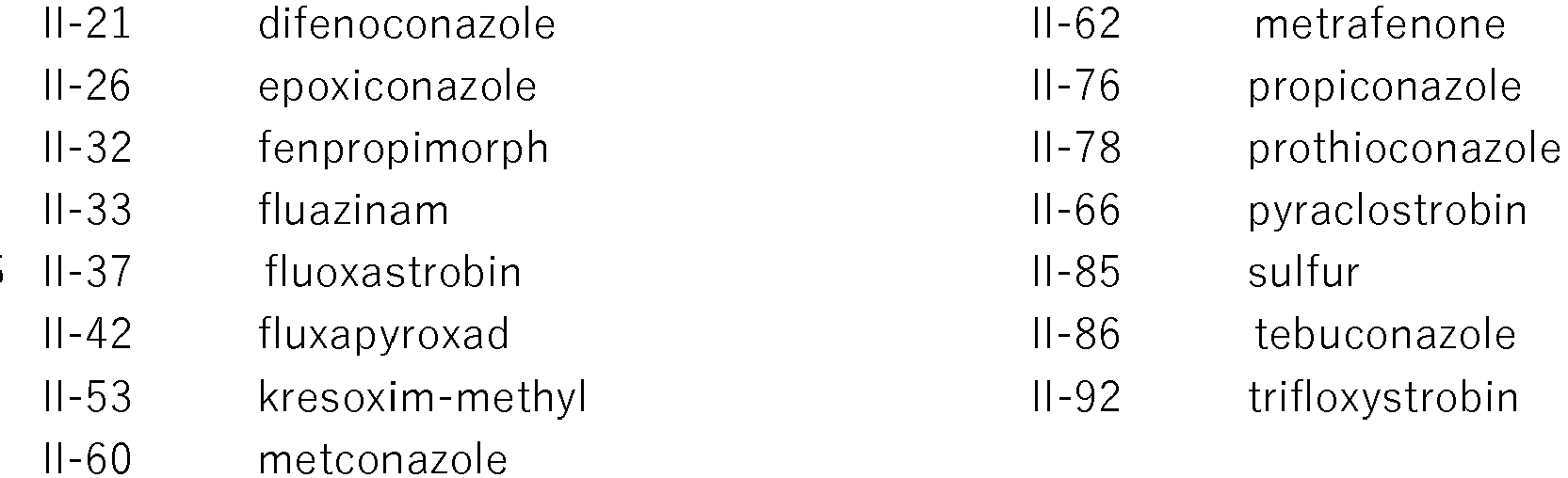
- According to a further preferred embodiment of the invention, component II is selected from the following growth regulators:
II-1a mepiquat chloride II-3a trinexapac-ethyl II-4a prohexadione-calcium - Consequently, particularly preferred two-component compositions are compiled in Table B3, wherein each row corresponds to one embodiment of the compositions according to the invention. According to one specific aspect, these are binary compositions which each only contain these two components as the active compounds. Furthermore, also every combination of the compositions individualized in this table represent embodiments of the present invention.
Table B3: Two-component compositions comprising one component I and one growth regulator as component II, in particular binary compositions containing the respective component I and II as only active ingredients. composition I II B3-3 I-3 II-1a B3-39 I-3 II-3a B3-57 I-3 II-4a - As detailed above, the component I contains chirality centers and may, therefore, be present as racemic mixtures, as pure enantiomers or in the two enantiomers of one component I may be present in any ratio (S):(R).
- According to particular embodiments of the invention, the respective component I is present as (S) enantiomer. Specific two-component compositions comprising the (S) enantiomer of the respective component I are compiled in Table B3s, wherein each row corresponds to one embodiment of the compositions according to the invention, i.e. one specific individualized composition. According to one specific aspect, these are binary compositions which each only contain these two components as active compounds. Furthermore, also every combination of the compositions individualized in this table represent embodiments of the present invention.
Table B3s: Two-component compositions comprising one component I as (S) enantiomer (abbreviated as (S)-I-3 for the (S)-enantiomer of I-3) and one component II, in particular binary compositions containing the respective component I as (S) enantiomer and II as only active ingredients. composition (S)-I II B3s-2 (S)-I-3 II-1a B3s-12 (S)-I-3 II-3a B3s-17 (S)-I-3 II-4a - According to particular embodiments of the invention, the respective component I is present as (R) enantiomer. Specific two-component compositions comprising the (R) enantiomer of the respective component I are compiled in Table B3r, wherein each row corresponds to one embodiment of the compositions according to the invention, i.e. one specific individualized composition. According to one specific aspect, these are binary compositions which each only contain these two components as active compounds. Furthermore, also every combination of the compositions individualized in this table represent embodiments of the present invention.
Table B3r: Two-component compositions comprising one component I as (R) enantiomer (appreviated as (R)-I, e.g. (R)-I-3 for the (R)-enantiomer of I-3) and one component II, in particular binary compositions containing the respective component I as (R) enantiomer and II as only active ingredients. composition (R)-I II B3s-27 (R)-I-3 II-1a B3s-37 (R)-I-3 II-3a B3s-42 (R)-I-3 II-4a - According to a further preferred embodiment of the disclosure, component II is selected from the following insecticides:
- II-30cnitenpyram
- II-42cthiamethoxam.
- Consequently, particularly preferred two-component compositions are compiled in Table B5, wherein each row corresponds to one embodiment of the compositions according to the disclosure, i.e. one specific individualized composition. According to one specific aspect, these are binary compositions which each only contain these two components as the active compounds. Furthermore, also every combination of the compositions individualized in this table represent embodiments of the present disclosure.
Table B5: Two-component compositions comprising one component I and one insecticide as component II, in particular binary compositions containing the respective component I and II as only active ingredients. composition I II B5-471 I-3 II-30c B5-663 I-3 II-42c - As detailed above, the component I contains chirality centers and may, therefore, be present as racemic mixtures, as pure enantiomers or in the two enantiomers of one component I may be present in any ratio (S):(R). According to particular embodiments of the disclosure, the respective component I is present as (S) enantiomer. Specific two-component compositions comprising the (S) enantiomer of the respective component I are compiled in Table B5s, wherein each row corresponds to one embodiment of the compositions according to the disclosure, i.e. one specific individualized composition. According to one specific aspect, these are binary compositions which each only contain these two components as active compounds. Furthermore, also every combination of the compositions individualized in this table represent embodiments of the present invention.
Table 5s: Two-component compositions comprising one component I as (S) enantiomer (abbreviated as (S)-I-3 for the (S)-enantiomer of I-3) and one component II, in particular binary compositions containing the respective component I as (S) enantiomer and II as only active ingredients. composition (S)-I II B5s-147 (S)-I-3 II-30c B5s-207 (S)-I-3 II-42c - According to particular embodiments of the disclosure, the respective component I is present as (R) enantiomer. Specific two-component compositions comprising the (R) enantiomer of the respective component I are compiled in Table B5r, wherein each row corresponds to one embodiment of the compositions according to the disclosure, i.e. one specific individualized composition. According to one specific aspect, these are binary compositions which each only contain these two components as active compounds. Furthermore, also every combination of the compositions individualized in this table represent embodiments of the present disclosure.
Table 5r: Two-component compositions comprising one component I as (S) enantiomer (abbreviated as (R)-I-3 for the (R)-enantiomer of I-3) and one component II, in particular binary compositions containing the respective component I as (R) enantiomer and II as only active ingredients. composition (R)-I II B5r-147 (R)-I-3 II-30c B5r-207 (R)-I-3 II-42c - According to a further aspect, the present disclosure relates to three-component compositions, i.e. compositions comprising component I, in particular compound I-3, a component II selected from groups A) to O) as defined herein for component II and a component III selected from groups A) to O), wherein component II and III are not identical. In particular, the component II in each case is selected from the preferred groups or preferred active compounds as given above for component II and component III is selected from groups A) to O), in particular from the preferred active compounds used as component III as defined in the following.
- According to a specific embodiment thereof, exactly three active compounds as defined are present in these compositions (herein also called "ternary compositions"). The composition may, of course, contain any kind of additive or the like as detailled below in order to provide a formulation suitable for use in agriculture.
- In the three-component-compositions, the weight ratio of component I to the 1st further active compound (component II) depends on the properties of the active compounds in question. It may be preferable for the weight ratio to be in the region of from 1:3 to 3:1, in particular from 1:2 to 2:1. The weight ratio of component I to the 2nd further active compound (component III) may particularly be 1000:1 to 1:1000, specifically 500:1 to 1:500. It is preferably in the range of from 1:100 to 100:1, preferably in the range of from 1:50 to 50:1 and in particular in the range of from 1:20 to 20:1. It may be preferable for the weight ratio to be in the region of from 1:10 to 10:1, preferably from 1:3 to 3:1, in particular from 1:2 to 2:1. The weight ratio of 1st further active compound (component II) to 2nd further active compound (component III) is preferably in the range of from 1:100 to 100:1, frequently in the range of from 1:50 to 50:1, preferably in the range of from 1:20 to 20:1, and in particular in the range of from 1:10 to 10:1. It may be preferable for the weight to be in the range of from 1:3 to 3:1, in particular from 1:2 to 2:1.
- According to one embodiment, the present disclosure relates to three-component compositions, comprising a component I, in particular compound I-3, a component II selected from groups groups A) to K) as defined herein for component II and a component III selected from groups A) to K).
- One specific embodiment relates to three-component compositions, wherein component I is compound I-3 and component II is selected from group A) of the respiration inhibitors of complex III at Q0 site as defined herein for component II and component III is selected from the group of B) of the sterol biosynthesis inhibitors (SBI fungicides). According to one specific embodiment thereof, component II is selected from the group of strobilurins as defined herein for component II. Specifically, component II is selected from the group consisting of azoxystrobin, dimoxystrobin, fluoxastrobin, kresoxim-methyl, picoxystrobin, pyraclostrobin and trifloxystrobin. According to a further specific embodiment thereof, component III is selected from the group of the C14 demethylase inhibitors (DMI fungicides), in particular selected from cyproconazole, difenoconazole, epoxiconazole, fluquinconazole, flusilazole, flutriafol, metconazole, myclobutanil, penconazole, propiconazole, prothioconazole, triadimefon, triadimenol, tebuconazole, tetraconazole, triticonazole and prochloraz. According to a further specific embodiment, these are ternary compositions which, as active compounds, comprise in each case only the mentioned three active components I, II and III.
- A further specific embodiment relates to three-component compositions, wherein component I is compound I-3 and component II and component III are selected from the respiration inhibitors of complex III at Q0 site as defined herein for component II and component III respectively, wherein component II and III are not the same. In particular, component II and III are selected from the group consisting of azoxystrobin, dimoxystrobin, fluoxastrobin, kresoxim-methyl, picoxystrobin, pyraclostrobin and trifloxystrobin. According to a specific embodiment, these are ternary compositions which, as active compounds, comprise in each case only the mentioned three active components I, II and III.
- Still a further specific embodiment relates to three-component compositions, wherein component I is compound I-3, component II is selected from the sterol biosynthesis inhibitors (SBI fungicides) as defined herein for component II and component III is selected from the respiration inhibitors of complex II. According to one specific embodiment thereof, component II is selected from the group of the C14 demethylase inhibitors (DMI fungicides) as defined herein for component II, in particular selected from cyproconazole, difenoconazole, epoxiconazole, metconazole, propiconazole, prothioconazole, tebuconazole, tetraconazole and triticonazole. According to a further specific embodiment, component III is selected from the group of the carboxamides, in particular selected from benodanil, benzovindiflupyr, bixafen, boscalid, carboxin, fenfuram, fluopyram, flutolanil, fluxapyroxad, furametpyr, isopyrazam, mepronil, oxycarboxin, penflufen, penthiopyrad, sedaxane, tecloftalam, thifluzamide, N-(4'-trifluoromethylthiobiphenyl-2-yl)-3-difluoromethyl-1-methyl-1H-pyrazole-4-carboxamide, N-(2-(1,3,3-trimethyl-butyl)-phenyl)-1,3-dimethyl-5-fluoro-1H-pyrazole-4-carboxamide, 3-(difluoromethyl)-1-methyl-N-(1,1,3-trimethylindan-4-yl)pyrazole-4-carboxamide, 3-(trifluoromethyl)-1-methyl-N-(1,1,3-trimethylindan-4-yl)pyrazole-4-carboxamide, 1,3-dimethyl-N-(1,1,3-trimethylindan-4-yl)pyrazole-4-carboxamide, 3-(trifluoromethyl)-1,5-dimethyl-N-(1,1,3-trimethylindan-4-yl)pyrazole-4-carboxamide, 3-(difluoromethyl)-1,5-dimethyl-N-(1,1,3-trimethylindan-4-yl)pyrazole-4-carboxamide and 1,3,5-trimethyl-N-(1,1,3-trimethylindan-4-yl)pyrazole-4-carboxamide, in particular selected from benzovindiflupyr, bixafen, boscalid, fluopyram, fluxapyroxad, isopyrazam, penflufen, penthiopyrad and sedaxane. According to a further specific embodiment, these are ternary compositions which, as active compounds, comprise in each case only the mentioned three active components I, II and III.
- Still a further specific embodiment relates to three-component compositions, wherein component I is compound I-3, component II is selected from the respiration inhibitors of complex III at Q0 site as defined herein for component II and component III is selected from the respiration inhibitors of complex II. In particular, component II is selected from the group of the strobilurins as defined herein for component II. Specifically, component II is selected from the group consisting of azoxystrobin, dimoxystrobin, fluoxastrobin, kresoxim-methyl, picoxystrobin, pyraclostrobin and trifloxystrobin. According to a further specific embodiment, component III is selected from the group of the carboxamides, in particular selected from benodanil, benzovindiflupyr, bixafen, boscalid, carboxin, fenfuram, fluopyram, flutolanil, fluxapyroxad, furametpyr, isopyrazam, mepronil, oxycarboxin, penflufen, penthiopyrad, sedaxane, tecloftalam, thifluzamide, N-(4'-trifluoromethylthiobiphenyl-2-yl)-3-difluoromethyl-1-methyl-1H-pyrazole-4-carboxamide, N-(2-(1,3,3-trimethyl-butyl)-phenyl)-1,3-dimethyl-5-fluoro-1H-pyrazole-4-carboxamide, 3-(difluoromethyl)-1-methyl-N-(1,1,3-trimethylindan-4-yl)pyrazole-4-carboxamide, 3-(trifluoromethyl)-1-methyl-N-(1,1,3-trimethylindan-4-yl)pyrazole-4-carboxamide, 1,3-dimethyl-N-(1,1,3-trimethylindan-4-yl)pyrazole-4-carboxamide, 3-(trifluoromethyl)-1,5-dimethyl-N-(1,1,3-trimethylindan-4-yl)pyrazole-4-carboxamide, 3-(difluoromethyl)-1,5-dimethyl-N-(1,1,3-trimethylindan-4-yl)pyrazole-4-carboxamide and 1,3,5-trimethyl-N-(1,1,3-trimethylindan-4-yl)pyrazole-4-carboxamide, in particular selected from benzovindiflupyr, bixafen, boscalid, fluopyram, fluxapyroxad, isopyrazam, penflufen, penthiopyrad and sedaxane. According to a further specific embodiment, these are ternary compositions which, as active compounds, comprise in each case only the mentioned three active components I, II and III.
- Still a further specific embodiment relates to three-component compositions, wherein component I is compound I-3, component II is selected the respiration inhibitors of complex III at Q0 site as defined herein for component II and component III is selected from the Sterol biosynthesis inhibitors (SBI fungicides), in particular Delta14-reductase inhibitors. In a specific embodiment, component II is selected from the group of the strobilurins as defined herein for component II. Specifically, component II is selected from the group consisting of azoxystrobin, dimoxystrobin, fluoxastrobin, kresoxim-methyl, picoxystrobin, pyraclostrobin and trifloxystrobin. In a further specific embodiment, component III is fenpropimorph. According to a further specific embodiment, these are ternary compositions which, as active compounds, comprise in each case only the mentioned three active components I, II and III.
- Still a further specific embodiment relates to three-component compositions, wherein component I is compound I-3, component II is selected the respiration inhibitors of complex III at Q0 site as defined herein for component II and component III is selected from the inhibitors of cell division and cytoskeleton. In a specific embodiment, component II is selected from the group of the strobilurins as defined herein for component II. Specifically, component II is selected from the group consisting of azoxystrobin, dimoxystrobin, fluoxastrobin, kresoxim-methyl, picoxystrobin, pyraclostrobin and trifloxystrobin. In a further specific embodiment, component III is selected from tubulin inhibitors such as carbendazim. In a further specific embodiment, component III is selected from sell division inhibitors such as tubulin inhibitors such as metrafenone. According to a further specific embodiment, these are ternary compositions which, as active compounds, comprise in each case only the mentioned three active components I, II and III.
- Still a further specific embodiment relates to three-component compositions, wherein component I is compound I-3, component II is selected from the respiration inhibitors of complex III at Q0 site as defined herein for component II and component III is selected from the Inhibitors with Multi Site Action. In a specific embodiment, component II is selected from the group of the strobilurins as defined herein for component II. Specifically, component II is selected from the group consisting of azoxystrobin, dimoxystrobin, fluoxastrobin, kresoxim-methyl, picoxystrobin, pyraclostrobin and trifloxystrobin. In a further specific embodiment, component III is selected from captan, Bordeaux mixture, copper acetate, copper hydroxide, copper oxychloride, copper sulfate, sulfur, (tri)basic copper sulfate, mancozeb, maneb, metiram, propineb, thiram, captafol, folpet, chlorothalonil, dichlofluanid, dithianon, dodine and 2,6-dimethyl-1H,5H-[1,4]dithiino[2,3-c:5,6-c']dipyrrole-1,3,5,7(2H,6H)-tetraone, in particular captan, Bordeaux mixture, copper hydroxide, copper oxychloride, copper sulfate, (tri)basic copper sulfate, mancozeb, maneb, metiram, folpet, chlorothalonil, dithianon, dodine and 2,6-dimethyl-1H,5H-[1,4]dithiino[2,3-c:5,6-c']dipyrrole-1,3,5,7(2H,6H)-tetraone. In one particular embodiment, component III in said compositions is chlorothalonil. According to a further specific embodiment, these are ternary compositions which, as active compounds, comprise in each case only the mentioned three active components I, II and III.
- Still a further specific embodiment relates to three-component compositions, wherein component I is compound I-3, component II is selected from the sterol biosynthesis inhibitors (SBI fungicides), in particular from the C14 demethylase inhibitors (DMI fungicides) as defined herein for component II, and component III is selected from the Inhibitors with Multi Site Action. In a specific embodiment, component II is selected from cyproconazole, metconazole, propiconazole and prothioconazole. Component III is specifically selected from captan, Bordeaux mixture, copper acetate, copper hydroxide, copper oxychloride, copper sulfate, sulfur, (tri)basic copper sulfate, mancozeb, maneb, metiram, propineb, thiram, captafol, folpet, chlorothalonil, dichlofluanid, dithianon, dodine and 2,6-dimethyl-1H,5H-[1,4]dithiino[2,3-c:5,6-c']dipyrrole-1,3,5,7(2H,6H)-tetraone, in particular captan, Bordeaux mixture, copper hydroxide, copper oxychloride, copper sulfate, (tri)basic copper sulfate, mancozeb, maneb, metiram, folpet, chlorothalonil, dithianon, dodine and 2,6-dimethyl-1H,5H-[1,4]dithiino[2,3-c:5,6-c']dipyrrole-1,3,5,7(2H,6H)-tetraone.
- Still a further specific embodiment relates to three-component compositions, wherein component I is compound I-3, component II is selected from the sterol biosynthesis inhibitors (SBI fungicides), in particular from the C14 demethylase inhibitors (DMI fungicides) as defined herein for component II, and component III is selected from the Signal transduction inhibitors. In a specific embodiment, component II is triticonazole and component III is fludioxonil.
- According to one embodiment, the present invention relates to three-component compositions, comprising a component I, i.e compound I-3, a component II selected from groups groups A) to K) as defined herein for component II and a component III selected from groups A) to K).
- According to a particular embodiment of the three-component compositions comprising three fungicides, the composition comprises compound I-3 as component I, fluxapyroxad as component II and pyraclostrobin or fenpropimorph as component III. In a further specific embodiment of the present invention, the inventive three-component compositions comprise compound I-3 as component I, prothioconazole as component II and fluxapyroxad, bixafen, pyraclostrobin, dimoxystrobin, picoxystrobin, fluoxastrobin, fluopyram or penflufen as component III. In said three-component compositions the weight ratio of component I to component II is preferably from 1:3 to 3:1, in particular from 1:2 to 2:1. The weight ratio of component I to the component III is in the range of from 1:20 to 20:1. It may be preferable for the weight ratio to be in the region of from 1:10 to 10:1, preferably from 1:3 to 3:1, in particular from 1:2 to 2:1. The weight ratio of component I component III is in the range of from 1:20 to 20:1, and in particular in the range of from 1:10 to 10:1. It may be preferable for the weight to be in the range of from 1:3 to 3:1, in particular from 1:2 to 2:1. Said three-component compositions comprising two fungicides as components I and II are in particular suitable as fungicides as detailled below.
- According to another embodiment the present invention relates to the use of said compositions for the control of cereal pathogens, wherein the components are used in the above mentioned weight ratios. According to one specific embodiment, said compositions are used for controlling wheat pathogens, wherein the wheat pathogens are in particular selected from Septoria tritici, Stagonospora nodorum, Pyrenophora tritici repentis, Puccinia recondita, Puccinia striiformis and Blumeria graminis. Furthermore, said compositions are useful for the control of the wheat pathogens selected from Fusarium culmorum, Fusarium graminearum and Pseudocercosporella herpotrichoides. According to another specific embodiment, said compositions are used for controlling barley pathogens, selected from Pyrenophera teres, Rhychosporium secalis, Puccinia hordei and Blumeria graminis. Furthermore, said compositions are suitable for the control of barley pathogens selected from Ramularia collo-cygni and Pseudocercosporella herpotrichoides.
- According to still another specific embodiment, said compositions are used for controlling soy pathogens, in particular selected from phakopsora pachyrizi, P. meibomiae and Microsphaera diffusa. In soy, said compositions may also be effectively used for the control of the so-called FDC (Foliar Disease Complex), e.g. against Septoria glycines, Cercospora kikuchii, C. sojina, Corynespora cassiicola and/or Alternaria spp..
- According to still another specific embodiment, said compositions are used for controlling corn pathogens, in particular selected from Cercospora zeae-maydis, Puccinia sorghi and Helminthosporium maydis.
- According to still another specific embodiment, said compositions are used for controlling sugar beet pathogens, in particular selected from Cercospora beticola, Erysiphe betae, Ramularia betae and Uromyces betae.
- According to still another specific embodiment, said compositions are used for the control of peanut pathogens, in particular selected from Mycosphaerella arachidis (= Cercospora) and Puccinia arachidis.
- According to still another specific embodiment, said compositions are used for the control of oil seed rape and canola pathogens, in particular selected from Sclerotinia sclerotiorum, Leptosphearia maculans and Alternaria alternate.
- According to still another specific embodiment, said compositions are used for the control of rice pathogens, in particular selected from Rhizoctonia solani and Pyricularia oryzae.
- According to still another specific embodiment, said compositions are used for the control of pathogens in speciality crops, such as for example in turf, potato, tomato, cucurbits, grapes, apples, ornamentals and bananas. Turf pathogens that may be controlled using said compositions according to the present invention are in particular selected from Sclerotinia homeocarpon and Rhizoctonia solani. Potato and tomato pathogens that may be controlled according to the present invention are in particular selected from Alternaria solani, A. alternata and Rhizoctonia solani. A cucurbit pathogen that may be controlled using said compositions according to the present invention is in particular Sphaerotheca fuliginea. A grape pathogen that may be controlled using said compositions according to the present invention is in particular Uncinula necator and Botrytis cinerea . An apple pathogen that may be controlled using said compositions according to the present invention is in particular Podosphaera leucotricha and Venturia inaequalis. Ornamental pathogens that may be controlled using said compositions according to the present invention are in particular selected from Sphaerotheca fuliginea, Diplocarpon spp., Alternaria spp. and Sclerotinia spp. Banana pathogens that may be controlled using said compositions according to the present invention are in particular selected from Mycosphaerella fijiensis and Mycosphaerella musicola.
- According to one embodiment thereof, the present invention relates to the composition of component I, fluxapyroxad and pyraclostrobin, wherein two of the components are present in a weight ratio of 2:1 to 1:2. In particular, the weight ratios for the three components are component I to component II 1:1 to 2:1; component I to component III 1:1 to 2:1 and component II to component III 1:1 to 1:2. It may be preferred if the components are present in a weight ratio of 1:1:1 to 2:1:2 or 2:1:2 to 2:1:1. The components are in particular used in synergistically effective amounts.
- According to another embodiment, the present invention relates to the composition comprising component I, fluxapyroxad and fenpropimorph, wherein two of the components are present in a weight ratio of 2:1 to 1:2. In particular, the weight ratios for the three components are component I to component II 1:1 to 2:1; component I to component III 1:3 to 1:6 and component II to component III 1:3 to 1:6. It may be preferred if the components are present in a weight ratio of 1:1:3 to 1:1:6. The components are in particular used in synergistically effective amounts.
- A further embodiment relates to three-component compositions, comprising a component I, i.e compound I-3, component II selected from any one of groups A) to K) as defined herein for component II or any preferred embodiment thereof, and component III selected from the insecticides of group O).
- According to one more specific embodiment, component I is compound I-3, component II is selected from the respiration inhibitors of complex III at Q0 as defined herein for component II, in particular selected from the group of the strobilurins, and component III is an insecticide, in particular one of the insecticides as defined below. Specifically, component II is selected from the group consisting of azoxystrobin, dimoxystrobin, fluoxastrobin, kresoxim-methyl, picoxystrobin, pyraclostrobin and trifloxystrobin.
- Still a further specific embodiment relates to three-component compositions, wherein component I is compound I-3, component II is selected from the sterol biosynthesis inhibitors (SBI fungicides) as defined herein for component II and component III is an insecticide, in particular one of the insecticides as defined below. Specifically, component II is selected from is selected from the group of the C14 demethylase inhibitors (DMI fungicides) as defined herein for component II, in particular selected from cyproconazole, difenoconazole, epoxiconazole, metconazole, propiconazole, prothioconazole, tebuconazole, tetraconazole and triticonazole.
- Particularly preferred fungicidal components III used in the inventive compositions, are compounds selected from the group of the following compounds:


- Particularly preferred fungicidal components III are compounds selected from the group of the following compounds:
II-3 azoxystrobin II-5 benzovindiflupyr II-6 bixafen II-7 boscalid II-8 carbendazim II-11 chlorothalonil II-15 cyproconazole II-16 cyprodinil II-21 difenoconazole II-26 epoxiconazole II-32 fenpropimorph II-33 fluazinam II-34 fludioxonil II-37 fluoxastrobin II-38 fluquinconazole II-39 flusilazole II-42 fluxapyroxad II-44 fosetyl-Al II-50 isopyrazam II-53 kresoxim-methyl II-60 metconazole II-62 metrafenone II-66 pyraclostrobin II-69 phosporous acid II-70 potassium salt of phosphorous acid II-71 sodium salt of phosphorous acid II-72 penthiopyrad II-74 prochloraz II-76 propiconazole II-78 prothioconazole II-84 spiroxamine II-85 sulfur II-86 tebuconazole II-92 trifloxystrobin II-93 triticonazole - Particularly preferred three-component compositions are compiled in Table T1, where each row corresponds to one embodiment of the compositions according to the invention, i.e. one specific individualized three-component composition. According to one specific aspect, these are ternary compositions which each only contain these three components as the active compound. Furthermore, also every combination of the compositions individualized in this table represent embodiments of the present invention.


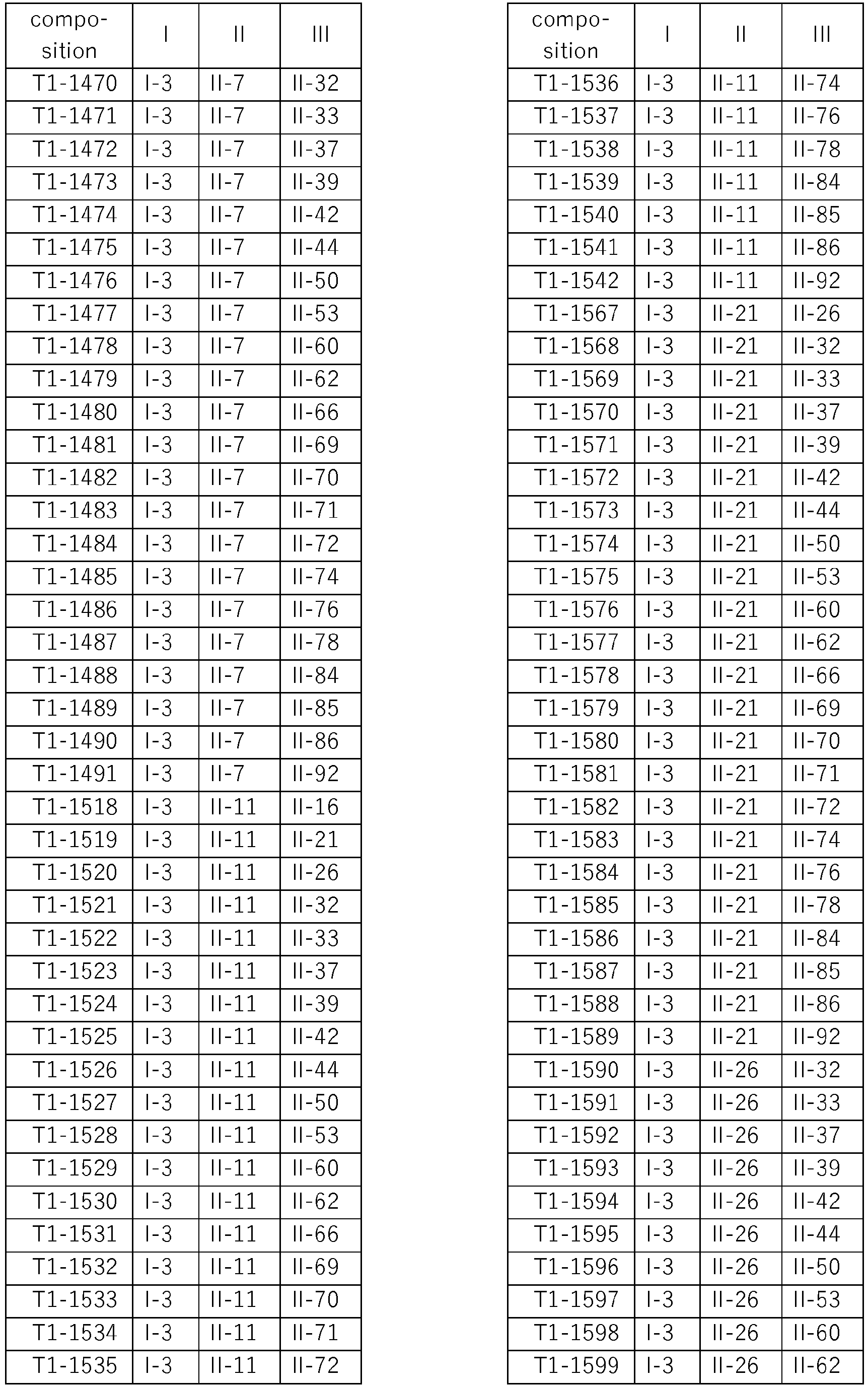
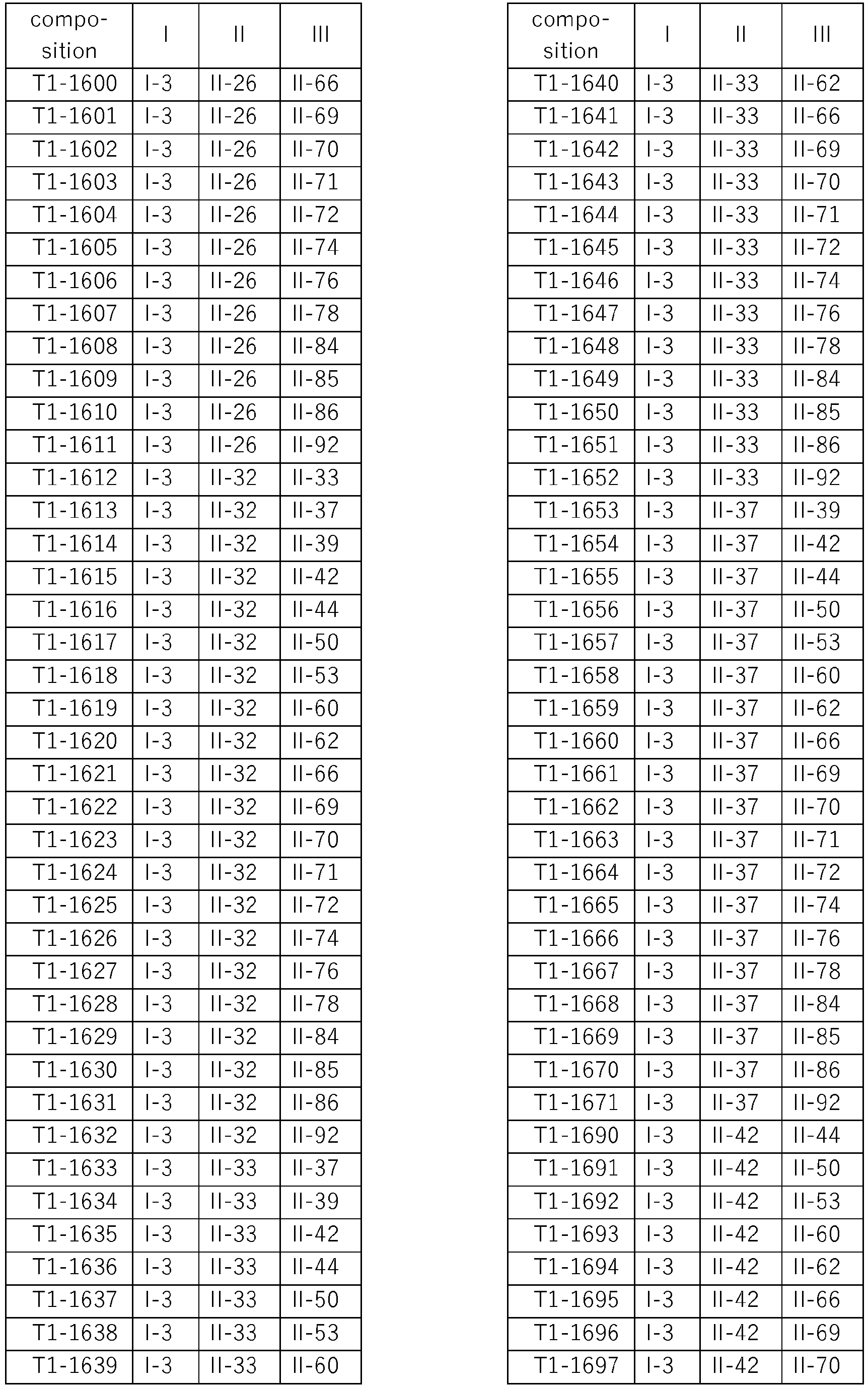


- As detailed above, the components I contain chirality centers and may, therefore, be present as racemic mixtures, as pure enantiomers or in the two enantiomers of one component I may be present in any ratio (S):(R).
- According to particular embodiments of the invention, the respective component I is present as (S) enantiomer. Specific three-component compositions comprising the (S) enantiomer of the respective component I are compiled in Table T1s, wherein each row corresponds to one embodiment of the compositions according to the invention, i.e. one specific individualized composition. According to one specific aspect, these are ternary compositions which each only contain these two components as active compounds. Furthermore, also every combination of the compositions individualized in this table represent embodiments of the present invention.


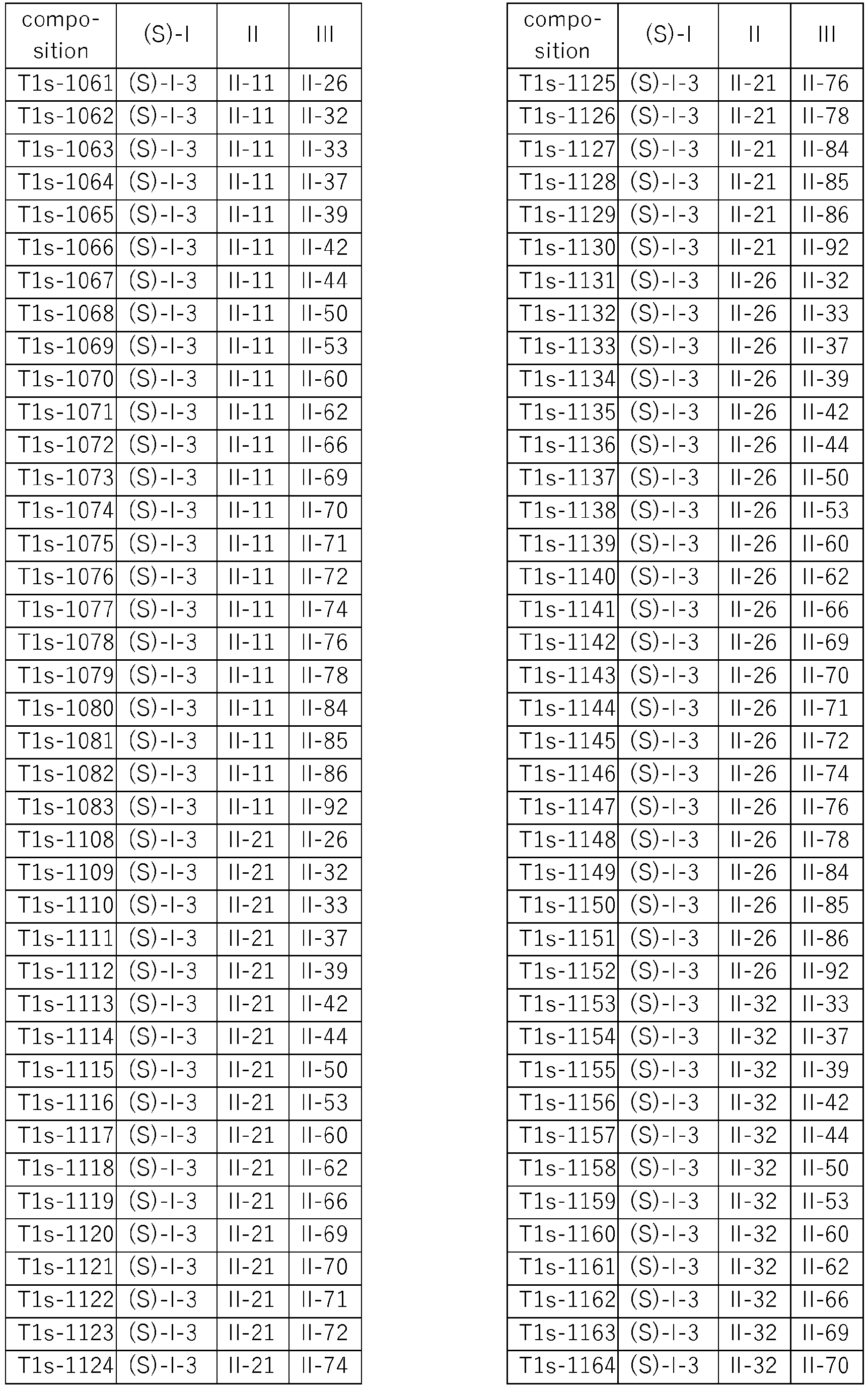
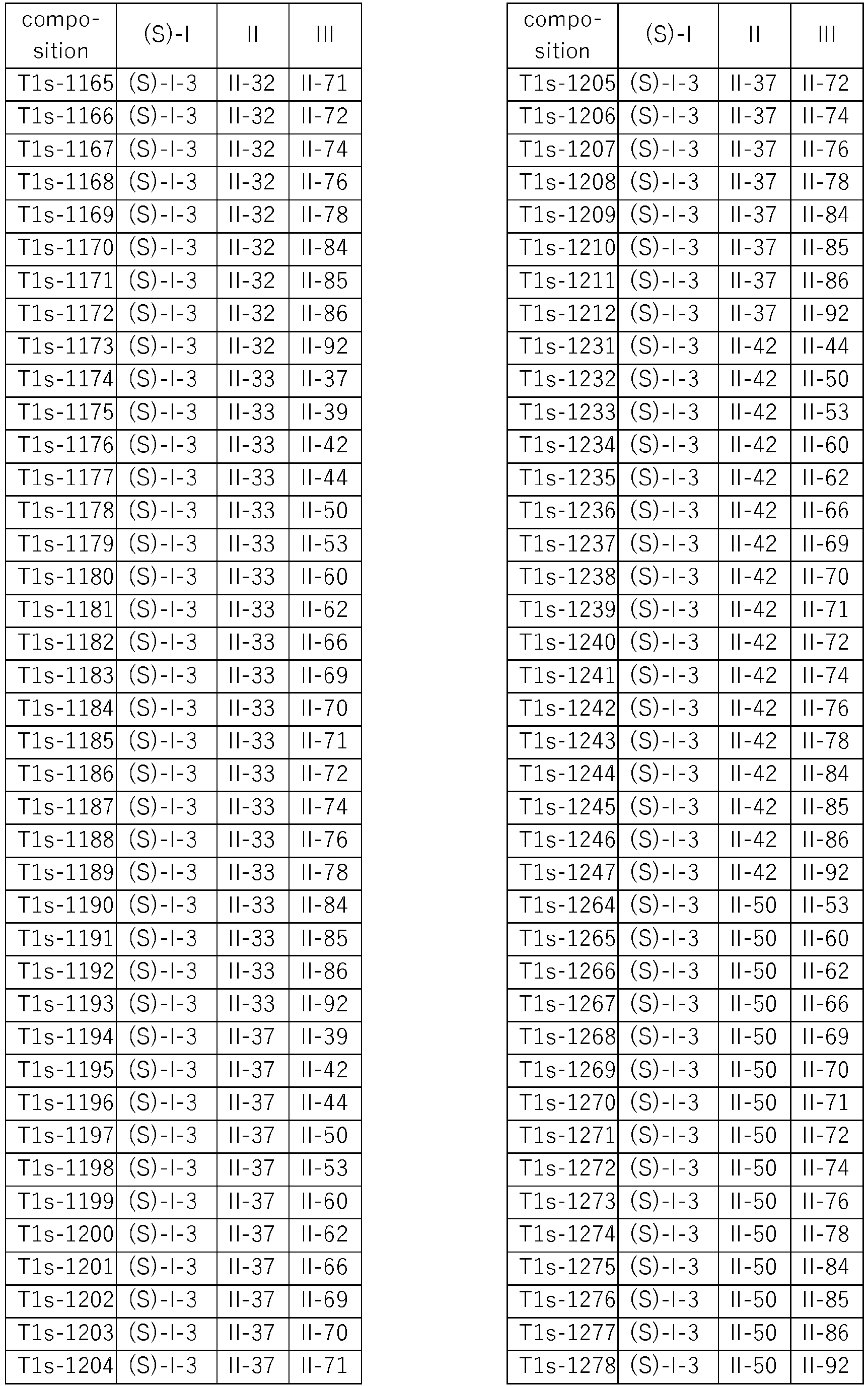
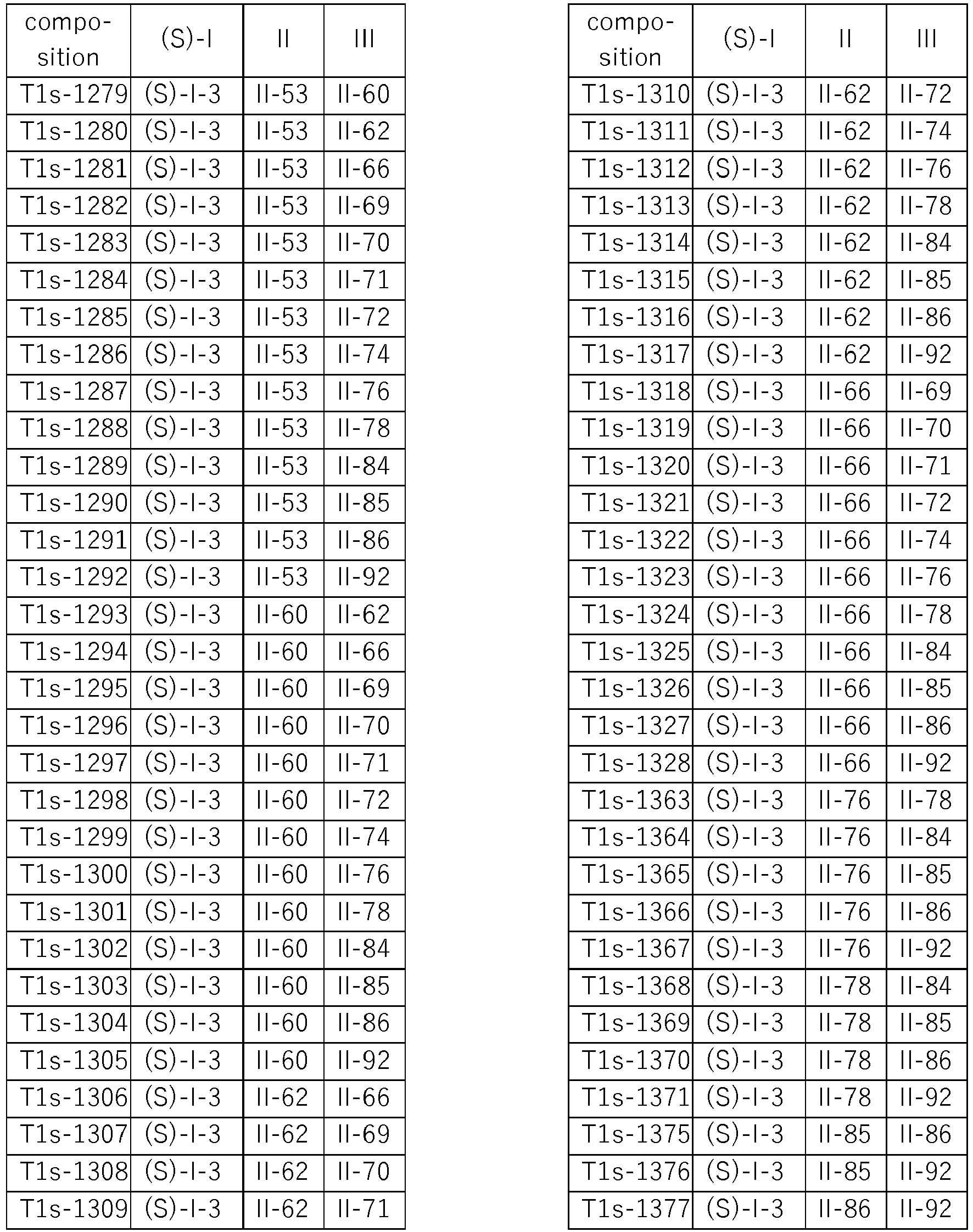
- According to particular embodiments of the invention, the respective component I is present as (R) enantiomer. Specific three-component compositions comprising the (R) enantiomer of the respective component I are compiled in Table T1r, wherein each row corresponds to one embodiment of the compositions according to the invention, i.e. one specific individualized composition. According to one specific aspect, these are ternary compositions which each only contain these two components as active compounds. Furthermore, also every combination of the compositions individualized in this table represent embodiments of the present invention.


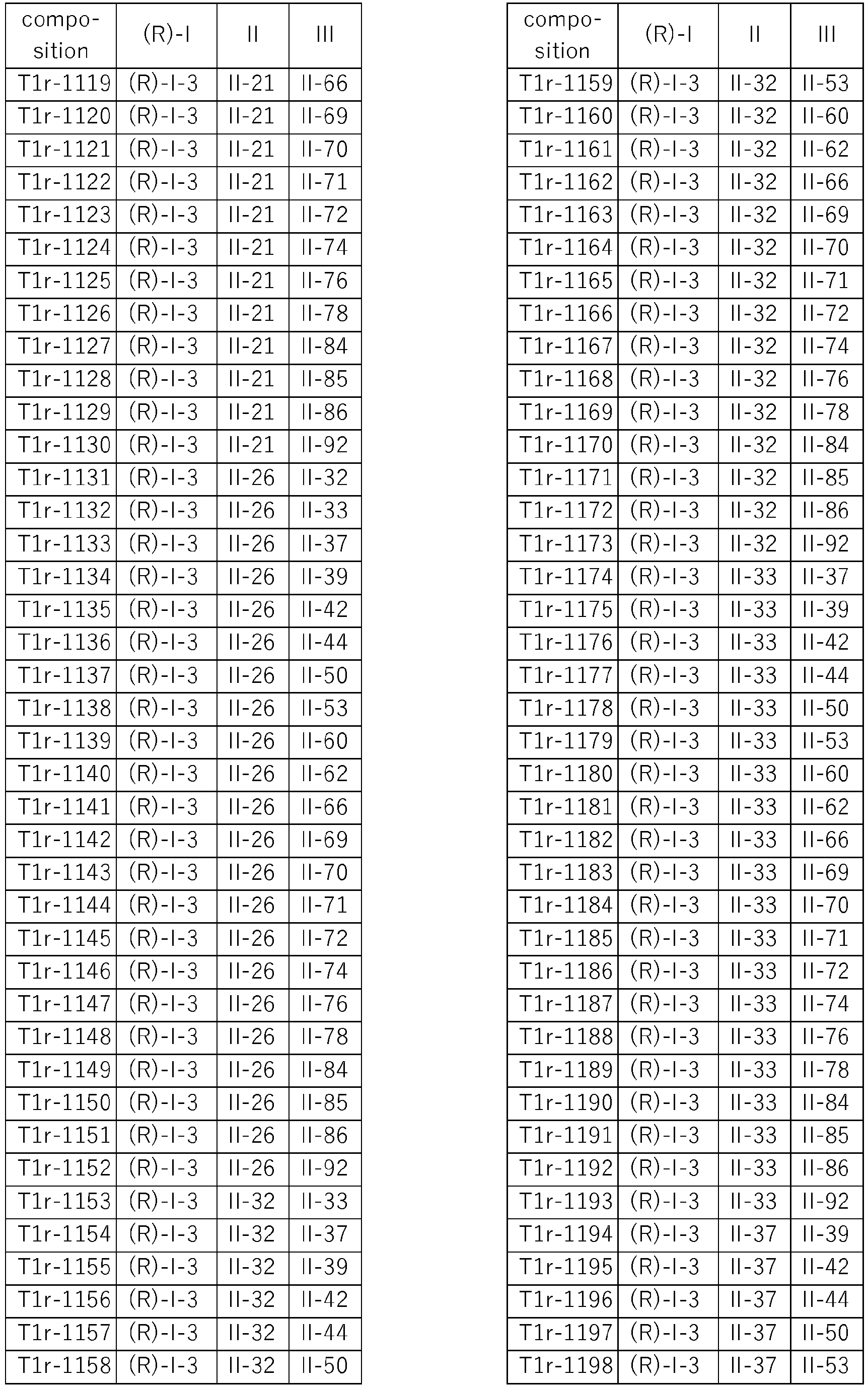


- Further particularly preferred compositions are the three-component compositions, wherein component I is compound I-3 and components II are selected from
II-15 cyproconazole II-60 metconazole II-76 propiconazole II-78 prothioconazole and component III is selected from II-66 pyraclostrobin II-9 captan II-11 chlorothalonil II-17 copper II-18 copper hydroxide II-20 dodine II-25 dithianon II-43 folpet II-54 mancozeb II-61 metiram II-98 2,6-dimethyl-1H,5H-[1,4]dithiino[2,3-c:5,6-c']dipyrrole-1,3,5,7(2H,6H)-tetraone II-99 maneb II-100 Bordeaux mixture II-101 copper oxychloride II-102 basic copper sulfate - Such compositions are compiled in Table T1a, where each row corresponds to one embodiment of the compositions according to the invention, i.e. one specific individualized three-component composition. According to one specific aspect, these are ternary compositions which each only contain these three components as the active compound. Furthermore, also every combination of the compositions individualized in this table represent embodiments of the present invention.

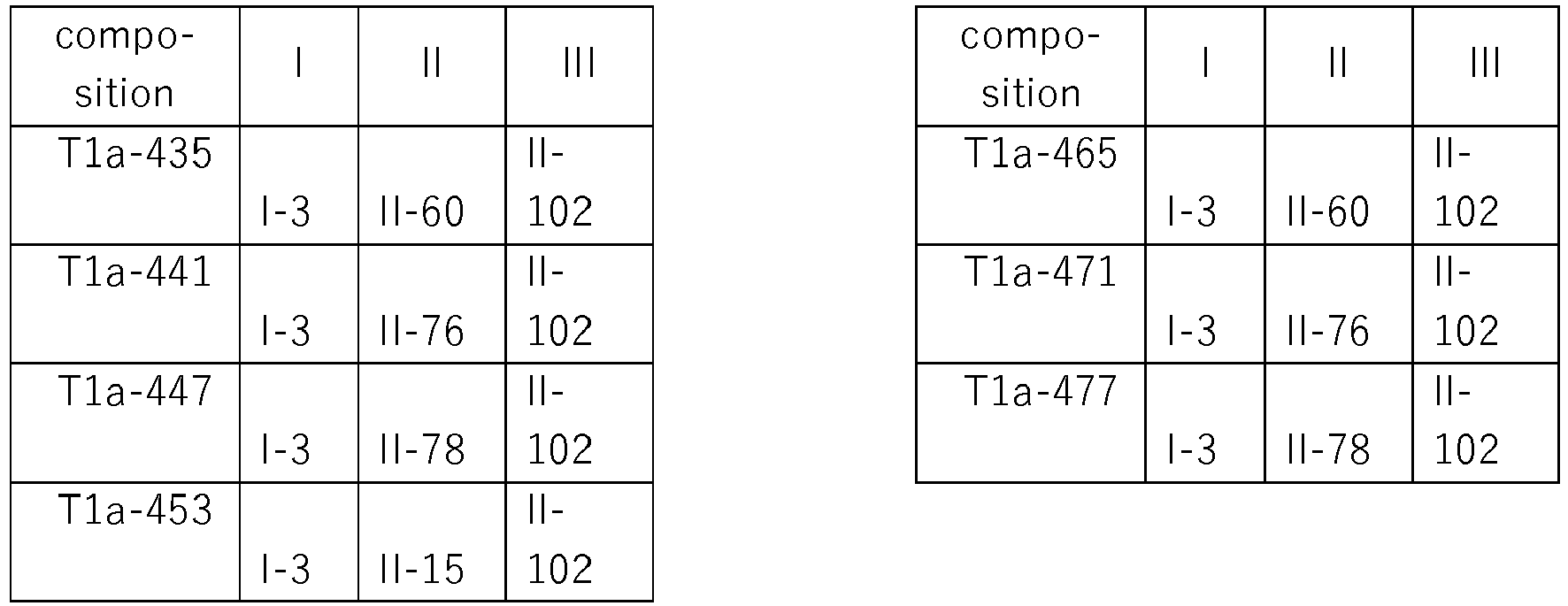
- In table T1a, according to particular embodiments of the disclosure, the respective component I is present as (S) enantiomer, wherein each row corresponds to one embodiment of the compositions according to the invention, i.e. one specific individualized composition. According to one specific aspect, these are ternary compositions which each only contain these two components as active compounds. Furthermore, also every combination of the compositions individualized in this table represent embodiments of the present invention (S) enantiomer. In table T1a, according to a further particular embodiments of the disclosure, the respective component I is present as (R) enantiomer, wherein each row corresponds to one embodiment of the compositions according to the disclosure, i.e. one specific individualized composition. According to one specific aspect, these are ternary compositions which each only contain these two components as active compounds. Furthermore, also every combination of the compositions individualized in this table represent embodiments of the present disclosure (R) enantiomer. Also particularly preferred compositions are the three-component compositions, wherein component I is compound I-3, component II is selected from
II-3 azoxystrobin II-5 benzovindiflupyr II-6 bixafen II-7 boscalid II-11 chlorothalonil II-21 difenoconazole II-26 epoxiconazole II-32 fenpropimorph II-33 fluazinam II-37 fluoxastrobin II-42 fluxapyroxad II-50 isopyrazam II-53 kresoxim-methyl II-60 metconazole II-62 metrafenone II-66 pyraclostrobin II-76 propiconazole II-78 prothioconazole II-85 sulfur II-86 tebuconazole II-92 trifloxystrobin II-1a mepiquat chloride II-2a chlormequat chloride II-3a trinexapac-ethyl II-4a prohexadione-calcium II-5a ethophon - Particularly preferred compositions of these compositions are compiled in Table T2, where each row corresponds to one embodiment of the compositions according to the invention, i.e. one specific individualized three-component composition. According to one specific aspect, these are ternary compositions which each only contain these three components as the active compound. Furthermore, also every combination of the compositions individualized in this table represent embodiments of the present invention.
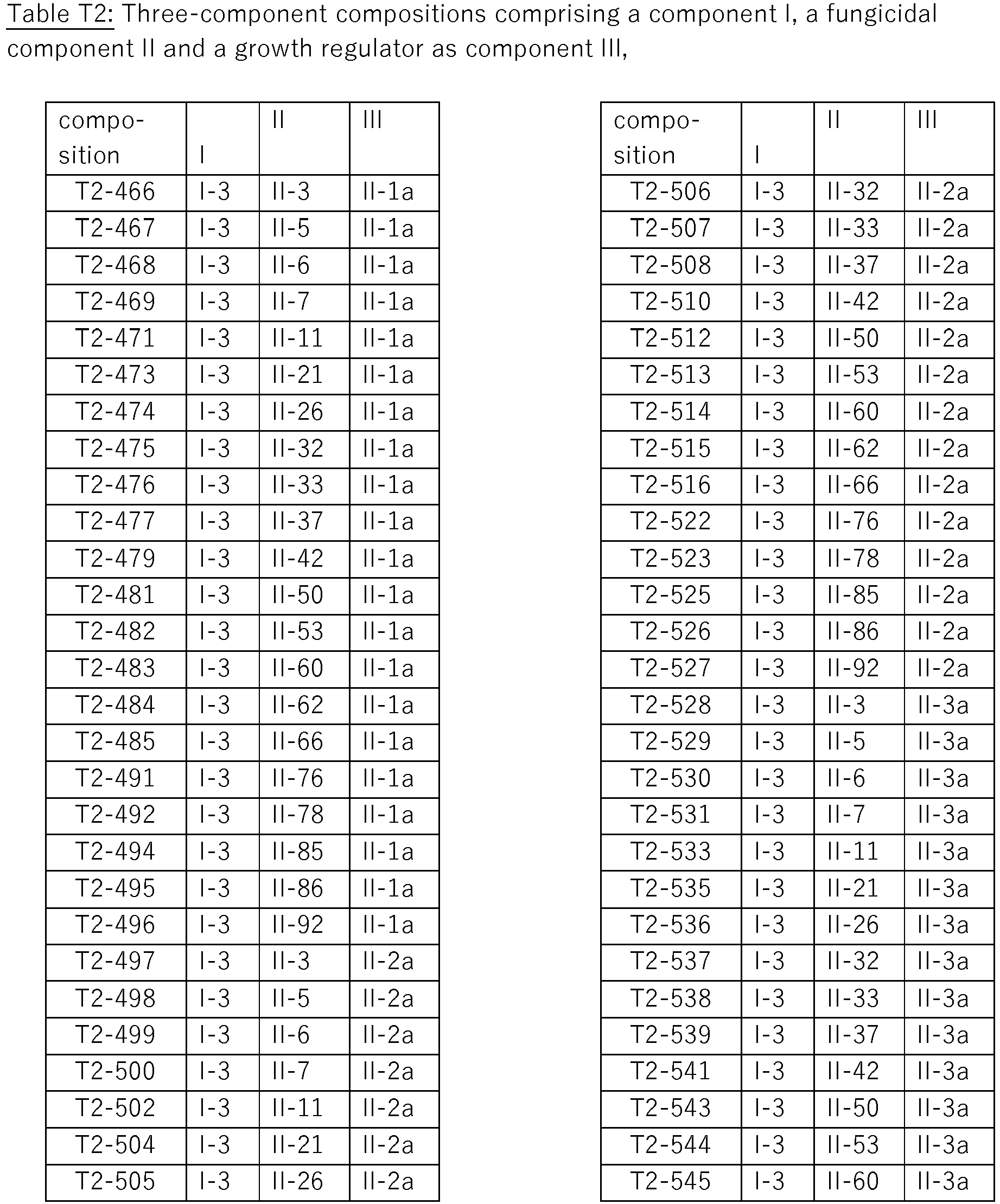

- In table T2, according to particular embodiments of the invention, the respective component I is present as (S) enantiomer, wherein each row corresponds to one embodiment of the compositions according to the invention, i.e. one specific individualized composition. According to one specific aspect, these are ternary compositions which each only contain these two components as active compounds. Furthermore, also every combination of the compositions individualized in this table represent embodiments of the present invention (S) enantiomer.
- In table T2, according to a further particular embodiments of the invention, the respective component I is present as (R) enantiomer, wherein each row corresponds to one embodiment of the compositions according to the invention, i.e. one specific individualized composition. According to one specific aspect, these are ternary compositions which each only contain these two components as active compounds. Furthermore, also every combination of the compositions individualized in this table represent embodiments of the present invention (R) enantiomer.
- In Table T3 each row corresponds to one embodiment of the compositions according to the invention, i.e. one specific individualized three-component composition. According to one specific aspect, these are ternary compositions which each only contain these three components as the active compound. Furthermore, also every combination of the compositions individualized in this table represent embodiments of the present invention.
Table T3: Three-component compositions comprising a component I and two plant growth regulators as component II and component III, wherein components II and III are different from each other. composition I II III T3-31 I-3 II-1a II-2a T3-32 I-3 II-1a II-3a T3-33 I-3 II-1a II-4a T3-34 I-3 II-1a II-5a T3-38 I-3 II-3a II-4a T3-39 I-3 II-3a II-5a T3-40 I-3 II-4a II-5a - In table T3, according to particular embodiments of the invention, the respective component I is present as (S) enantiomer, wherein each row corresponds to one embodiment of the compositions according to the invention, i.e. one specific individualized composition. According to one specific aspect, these are ternary compositions which each only contain these two components as active compounds. Furthermore, also every combination of the compositions individualized in this table represent embodiments of the present invention (S) enantiomer.
- In table T3, according to a further particular embodiments of the invention, the respective component I is present as (R) enantiomer, wherein each row corresponds to one embodiment of the compositions according to the invention, i.e. one specific individualized composition. According to one specific aspect, these are ternary compositions which each only contain these two components as active compounds. Furthermore, also every combination of the compositions individualized in this table represent embodiments of the present invention (R) enantiomer.
- Particularly preferred compositions are the three-component compositions, wherein component I is compound I-3, component II is selected from the following fungicidal compounds


II-11c clothianidin II-20c fipronil II-24c imidacloprid; and II-42c thiamethoxam - Particularly preferred compositions of these compositions are compiled in Table T4, where each row corresponds to one embodiment of the compositions according to the invention, i.e. one specific individualized three-component composition. According to one specific aspect, these are ternary compositions which each only contain these three components as the active compound. Furthermore, also every combination of the compositions individualized in this table represent embodiments of the present invention.
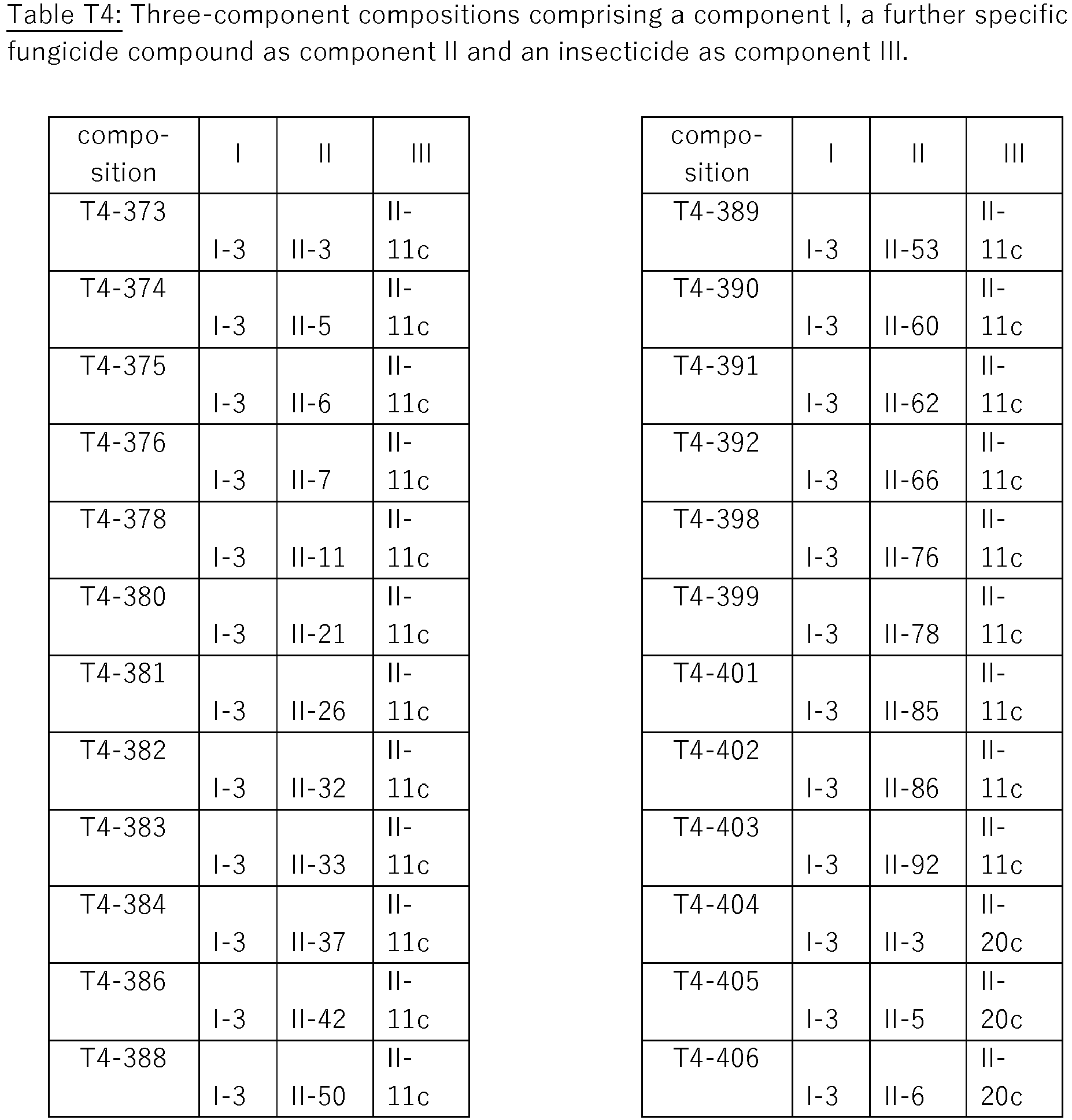


- In table T4, according to particular embodiments of the invention, the respective component I is present as (S) enantiomer, wherein each row corresponds to one embodiment of the compositions according to the invention, i.e. one specific individualized composition. According to one specific aspect, these are ternary compositions which each only contain these two components as active compounds. Furthermore, also every combination of the compositions individualized in this table represent embodiments of the present invention (S) enantiomer.
- In table T4, according to a further particular embodiments of the invention, the respective component I is present as (R) enantiomer, wherein each row corresponds to one embodiment of the compositions according to the invention, i.e. one specific individualized composition. According to one specific aspect, these are ternary compositions which each only contain these two components as active compounds. Furthermore, also every combination of the compositions individualized in this table represent embodiments of the present invention (R) enantiomer.
- One further aspect of the present invention are novel two-component compositions comprising the component II and the component III as listed the above Table T4, i.e. the compositions given in the following Table BT4, as far as they are novel.
- Particularly preferred compositions are the three-component compositions, wherein component I is compound I-3 and component II is
II-42c thiamethoxam, - Particularly preferred compositions of these compositions are compiled in Table T5, where each row corresponds to one embodiment of the compositions according to the invention, i.e. one specific individualized three-component composition. According to one specific aspect, these are ternary compositions which each only contain these three components as the active compound.
Table T5: Three-component compositions comprising a component I, an insecticide compound as component II and fipronil as component III. composition I II III T5-9 I-3 II-42c II-20c - In table T5, according to particular embodiments of the invention, the respective component I is present as (S) enantiomer, wherein each row corresponds to one embodiment of the compositions according to the invention, i.e. one specific individualized composition. According to one specific aspect, these are ternary compositions which each only contain these two components as active compounds. Furthermore, also every combination of the compositions individualized in this table represent embodiments of the present invention (S) enantiomer.
- In table T5, according to a further particular embodiments of the invention, the respective component I is present as (R) enantiomer, wherein each row corresponds to one embodiment of the compositions according to the invention, i.e. one specific individualized composition. According to one specific aspect, these are ternary compositions which each only contain these two components as active compounds. Furthermore, also every combination of the compositions individualized in this table represent embodiments of the present invention (R) enantiomer.
- According to a further aspect, the present invention relates to four-component compositions, i.e. compositions comprising component I, i.e compound I-3, a component II selected from groups A) to O) as defined herein for component II, a component III selected from groups A) to O) and a component IV, also selected from groups A) to O), wherein components II, III and IV are diferent active ingredients. According to a specific embodiment thereof, exactly four active compounds as defined are present in these compositions (herein also called "quarternary compositions"). The composition may, of course, contain any kind of additive or the like as detailled below in order to provide a formulation suitable for use in agriculture.
- In the four-component compositions of the invention, the weight ratio of component I to the 1st further active compound (component II) depends on the properties of the active compounds in question. Preferably, it is in the range of from 1:3 to 3:1, in particular from 1:2 to 2:1. The weight ratio of compound I to the 2nd further active compound (component III) may particularly be 1000:1 to 1:1000, specifically 500:1 to 1:500. It is preferably in the range of from 1:100 to 100:1, preferably in the range of from 1:50 to 50:1 and in particular in the range of from 1:20 to 20:1. It may be preferable for the weight ratio to be in the region of from 1:10 to 10:1, preferably from 1:3 to 3:1, in particular from 1:2 to 2:1. The weight ratio of compound I to the 3rd further active compound (component IV) is preferably in the range of from 1:100 to 100:1, preferably in the range of from 1:50 to 50:1 and in particular in the range of from 1:20 to 20:1. It may be preferable for the weight ratio to be in the region of from 1:10 to 10:1, preferably from 1:3 to 3:1, in particular from 1:2 to 2:1. The weight ratio of 1st further active compound (component II) to 2nd further active compound (component III) may particularly be 1000:1 to 1:1000, specifically 500:1 to 1:500. It is preferably in the range of from 1:100 to 100:1, preferably in the range of from 1:50 to 50:1 and in particular in the range of from 2:10 to 20:1. It may be preferable for the weight ratio to be in the region of from 1:10 to 10:1, preferably from 1:3 to 3:1, in particular from 1:2 to 2:1. The weight ratio of 1st further active compound (component II) to 3rd further active compound (component IV) is preferably in the range of from 1:100 to 100:1, preferably in the range of from 1:50 to 50:1 and in particular in the range of from 1:20 to 20:1. It may be preferable for the weight ratio to be in the region of from 1:10 to 10:1, preferably from 1:3 to 3:1, in particular from 1:2 to 2:1. The weight ratio of 2nd further active compound (component III) to 3rd further active compound (component IV) may particularly be 1000:1 to 1:1000, specifically 500:1 to 1:500. It is preferably in the range of from 1:100 to 100:1, preferably in the range of from 1:50 to 50:1,and in particular in the range of from 1:20 to 20:1. It may be preferable for the weight ratio to be in the region of from 1:10 to 10:1, preferably from 1:3 to 3:1, in particular from 1:2 to 2:1.
- According to one embodiment, the present invention relates to four-component compositions, comprising a component I, i.e compound I-3, a component II selected from groups groups A) to K) as defined herein for component II, a component III selected from groups A) to K) and a component IV selected from groups A) to K), wherein components II, III and IV are different active compounds.
- One specific embodiment relates to four-component compositions, wherein component I is compound I-3 and component II is selected from group A) of the respiration inhibitors of complex III at Q0 site as defined herein for component II, component III is selected from the group of B) of the sterol biosynthesis inhibitors (SBI fungicides) and component IV is selected from the respiration inhibitors of complex II. According to one specific embodiment thereof, component II is selected from the group of strobilurins as defined herein for component II. Specifically, component II is selected from the group consisting of azoxystrobin, dimoxystrobin, fluoxastrobin, kresoxim-methyl, picoxystrobin, pyraclostrobin and trifloxystrobin. According to a further specific embodiment thereof, component III is selected from the group of the C14 demethylase inhibitors (DMI fungicides), in particular selected from cyproconazole, difenoconazole, epoxiconazole, fluquinconazole, flusilazole, flutriafol, metconazole, myclobutanil, penconazole, propiconazole, prothioconazole, triadimefon, triadimenol, tebuconazole, tetraconazole, triticonazole and prochloraz. According to a further specific embodiment thereof, component IV is selected from the group of the carboxamides, in particular selected from benodanil, benzovindiflupyr, bixafen, boscalid, carboxin, fenfuram, fluopyram, flutolanil, fluxapyroxad, furametpyr, isopyrazam, mepronil, oxycarboxin, penflufen, penthiopyrad, sedaxane, tecloftalam, thifluzamide, N-(4'-trifluoromethylthiobiphenyl-2-yl)-3-difluoromethyl-1-methyl-1H-pyrazole-4-carboxamide, N-(2-(1,3,3-trimethyl-butyl)-phenyl)-1,3-dimethyl-5-fluoro-1H-pyrazole-4-carboxamide, 3-(difluoromethyl)-1-methyl-N-(1,1,3-trimethylindan-4-yl)pyrazole-4-carboxamide, 3-(trifluoromethyl)-1-methyl-N-(1,1,3-trimethylindan-4-yl)pyrazole-4-carboxamide, 1,3-dimethyl-N-(1,1,3-trimethylindan-4-yl)pyrazole-4-carboxamide, 3-(trifluoromethyl)-1,5-dimethyl-N-(1,1,3-trimethylindan-4-yl)pyrazole-4-carboxamide, 3-(difluoromethyl)-1,5-dimethyl-N-(1,1,3-trimethylindan-4-yl)pyrazole-4-carboxamide and 1,3,5-trimethyl-N-(1,1,3-trimethylindan-4-yl)pyrazole-4-carboxamide, in particular selected from benzovindiflupyr, bixafen, boscalid, fluopyram, fluxapyroxad, isopyrazam, penflufen, penthiopyrad and sedaxane. According to a further specific embodiment, these are quarternary compositions which, as active compounds, comprise in each case only the mentioned four active components I, II, III and IV.
- One further specific embodiment relates to four-component compositions, wherein component I is compound I-3 and component II is selected from group A) of the respiration inhibitors of complex III at Q0 site as defined herein for component II, component III is selected from the group of B) of the sterol biosynthesis inhibitors (SBI fungicides) and component IV is selected from the Inhibitors with Multi Site Action. According to one specific embodiment thereof, component II is selected from the group of strobilurins as defined herein for component II. Specifically, component II is selected from the group consisting of azoxystrobin, dimoxystrobin, fluoxastrobin, kresoxim-methyl, picoxystrobin, pyraclostrobin and trifloxystrobin. According to a further specific embodiment thereof, component III is selected from the group of the C14 demethylase inhibitors (DMI fungicides), in particular selected from cyproconazole, difenoconazole, epoxiconazole, fluquinconazole, flusilazole, flutriafol, metconazole, myclobutanil, penconazole, propiconazole, prothioconazole, triadimefon, triadimenol, tebuconazole, tetraconazole, triticonazole and prochloraz. According to a further specific embodiment thereof, component IV is selected from copper acetate, copper hydroxide, copper oxychloride, copper sulfate, sulfur, (tri)basic copper sulfate, mancozeb, maneb, metiram, propineb, thiram, captafol, folpet, chlorothalonil, dichlofluanid, dithianon and 2,6-dimethyl-1H,5H-[1,4]dithiino[2,3-c:5,6-c']dipyrrole-1,3,5,7(2H,6H)-tetraone, in particular chlorothalonil. According to a further specific embodiment, these are quarternary compositions which, as active compounds, comprise in each case only the mentioned four active components I, II, III and IV.
- One further specific embodiment relates to four-component compositions, wherein component I is compound I-3 and component II is selected from group A) of the respiration inhibitors of complex III at Q0 site as defined herein for component II, component III is selected from the group of B) of the respiration inhibitors of complex II and component IV is selected IV is selected from the Inhibitors with Multi Site Action. According to one specific embodiment thereof, component II is selected from the group of strobilurins as defined herein for component II. Specifically, component II is selected from the group consisting of azoxystrobin, dimoxystrobin, fluoxastrobin, kresoxim-methyl, orysastrobin, picoxystrobin, pyraclostrobin and trifloxystrobin. According to a further specific embodiment thereof, component III is selected from the group of the carboxamides, in particular selected from benodanil, benzovindiflupyr, bixafen, boscalid, carboxin, fenfuram, fluopyram, flutolanil, fluxapyroxad, furametpyr, isopyrazam, mepronil, oxycarboxin, penflufen, penthiopyrad, sedaxane, tecloftalam, thifluzamide, N-(4'-trifluoromethylthiobiphenyl-2-yl)-3-difluoromethyl-1-methyl-1H-pyrazole-4-carboxamide, N-(2-(1,3,3-trimethyl-butyl)-phenyl)-1,3-dimethyl-5-fluoro-1H-pyrazole-4-carboxamide, 3-(difluoromethyl)-1-methyl-N-(1,1,3-trimethylindan-4-yl)pyrazole-4-carboxamide, 3-(trifluoromethyl)-1-methyl-N-(1,1,3-trimethylindan-4-yl)pyrazole-4-carboxamide, 1,3-dimethyl-N-(1,1,3-trimethylindan-4-yl)pyrazole-4-carboxamide, 3-(trifluoromethyl)-1,5-dimethyl-N-(1,1,3-trimethylindan-4-yl)pyrazole-4-carboxamide, 3-(difluoromethyl)-1,5-dimethyl-N-(1,1,3-trimethylindan-4-yl)pyrazole-4-carboxamide and 1,3,5-trimethyl-N-(1,1,3-trimethylindan-4-yl)pyrazole-4-carboxamide, in particular selected from benzovindiflupyr, bixafen, boscalid, fluopyram, fluxapyroxad, isopyrazam, penflufen, penthiopyrad and sedaxane. According to a further specific embodiment thereof, component IV is chlorothalonil According to a further specific embodiment, these are quarternary compositions which, as active compounds, comprise in each case only the mentioned four active components I, II, III and IV.
- One further specific embodiment relates to four-component compositions, wherein component I is as defined above, component II is selected from group A) of the respiration inhibitors of complex III at Q0 site, component III is selected from the group of B) of the respiration inhibitors of complex II and component IV is selected from the Sterol biosynthesis inhibitors (SBI fungicides), in particular Delta14-reductase inhibitors. According to one specific embodiment thereof, component II is selected from the group of strobilurins. Specifically, component II is selected from the group consisting of azoxystrobin, dimoxystrobin, fluoxastrobin, kresoxim-methyl, orysastrobin, picoxystrobin, pyraclostrobin and trifloxystrobin. According to a further specific embodiment thereof, component III is selected from the group of the carboxamides, in particular selected from benodanil, benzovindiflupyr, bixafen, boscalid, carboxin, fenfuram, fluopyram, flutolanil, fluxapyroxad, furametpyr, isopyrazam, mepronil, oxycarboxin, penflufen, penthiopyrad, sedaxane, tecloftalam, thifluzamide, N-(4'-trifluoromethylthiobiphenyl-2-yl)-3-difluoromethyl-1-methyl-1H-pyrazole-4-carboxamide, N-(2-(1,3,3-trimethyl-butyl)-phenyl)-1,3-dimethyl-5-fluoro-1H-pyrazole-4-carboxamide, 3-(difluoromethyl)-1-methyl-N-(1,1,3-trimethylindan-4-yl)pyrazole-4-carboxamide, 3-(trifluoromethyl)-1-methyl-N-(1,1,3-trimethylindan-4-yl)pyrazole-4-carboxamide, 1,3-dimethyl-N-(1,1,3-trimethylindan-4-yl)pyrazole-4-carboxamide, 3-(trifluoromethyl)-1,5-dimethyl-N-(1,1,3-trimethylindan-4-yl)pyrazole-4-carboxamide, 3-(difluoromethyl)-1,5-dimethyl-N-(1,1,3-trimethylindan-4-yl)pyrazole-4-carboxamide and 1,3,5-trimethyl-N-(1,1,3-trimethylindan-4-yl)pyrazole-4-carboxamide, in particular selected from benzovindiflupyr, bixafen, boscalid, fluopyram, fluxapyroxad, isopyrazam, penflufen, penthiopyrad and sedaxane. According to a further specific embodiment thereof, component IV is fenpropimorph According to a further specific embodiment, these are quarternary compositions which, as active compounds, comprise in each case only the mentioned four active components I, II, III and IV.
- One further specific embodiment relates to four-component compositions, wherein component I is as defined above, component II is selected from group A) of the respiration inhibitors of complex III at Q0 site, component III is selected from the group of B) of the respiration inhibitors of complex II and component IV is selected from the from the Inhibitors of cell division and cytoskeleton. According to one specific embodiment thereof, component II is selected from the group of strobilurins. Specifically, component II is selected from the group consisting of azoxystrobin, dimoxystrobin, fluoxastrobin, kresoxim-methyl, orysastrobin, picoxystrobin, pyraclostrobin and trifloxystrobin. According to a further specific embodiment thereof, component III is selected from the group of the carboxamides, in particular selected from benodanil, benzovindiflupyr, bixafen, boscalid, carboxin, fenfuram, fluopyram, flutolanil, fluxapyroxad, furametpyr, isopyrazam, mepronil, oxycarboxin, penflufen, penthiopyrad, sedaxane, tecloftalam, thifluzamide, N-(4'-trifluoromethylthiobiphenyl-2-yl)-3-difluoromethyl-1-methyl-1H-pyrazole-4-carboxamide, N-(2-(1,3,3-trimethyl-butyl)-phenyl)-1,3-dimethyl-5-fluoro-1H-pyrazole-4-carboxamide, 3-(difluoromethyl)-1-methyl-N-(1,1,3-trimethylindan-4-yl)-pyrazole-4-carboxamide, 3-(trifluoromethyl)-1-methyl-N-(1,1,3-trimethylindan-4-yl)-pyrazole-4-carboxamide, 1,3-dimethyl-N-(1,1,3-trimethylindan-4-yl)pyrazole-4-carboxamide, 3-(trifluoromethyl)-1,5-dimethyl-N-(1,1,3-trimethylindan-4-yl)pyrazole-4-carboxamide, 3-(difluoromethyl)-1,5-dimethyl-N-(1,1,3-trimethylindan-4-yl)pyrazole-4-carboxamide and 1,3,5-trimethyl-N-(1,1,3-trimethylindan-4-yl)pyrazole-4-carboxamide, in particular selected from benzovindiflupyr, bixafen, boscalid, fluopyram, fluxapyroxad, isopyrazam, penflufen, penthiopyrad and sedaxane. According to a further specific embodiment thereof, component IV is selected from cell division inhibitors such as tubulin inhibitors such as metrafenone. According to a further specific embodiment, these are quarternary compositions which, as active compounds, comprise in each case only the mentioned four active components I, II, III and IV.
- Still a further specific embodiment relates to four-component compositions, wherein component I is as defined above, component II is selected from the sterol biosynthesis inhibitors (SBI fungicides), in particular from the C14 demethylase inhibitors (DMI fungicides), component III is selected from the Signal transduction inhibitors and component IV is selected from the group of the carboxamides, in particular selected from benodanil, benzovindiflupyr, bixafen, boscalid, carboxin, fenfuram, fluopyram, flutolanil, fluxapyroxad, furametpyr, isopyrazam, mepronil, oxycarboxin, penflufen, penthiopyrad, sedaxane, tecloftalam, thifluzamide, N-(4'-trifluoromethylthiobiphenyl-2-yl)-3-difluoromethyl-1-methyl-1H-pyrazole-4-carboxamide, N-(2-(1,3,3-trimethyl-butyl)-phenyl)-1,3-dimethyl-5-fluoro-1H-pyrazole-4-carboxamide, 3-(difluoromethyl)-1-methyl-N-(1,1,3-trimethylindan-4-yl)pyrazole-4-carboxamide, 3-(trifluoromethyl)-1-methyl-N-(1,1,3-trimethylindan-4-yl)pyrazole-4-carboxamide, 1,3-dimethyl-N-(1,1,3-trimethylindan-4-yl)pyrazole-4-carboxamide, 3-(trifluoromethyl)-1,5-dimethyl-N-(1,1,3-trimethylindan-4-yl)pyrazole-4-carboxamide, 3-(difluoromethyl)-1,5-dimethyl-N-(1,1,3-trimethylindan-4-yl)pyrazole-4-carboxamide and 1,3,5-trimethyl-N-(1,1,3-trimethylindan-4-yl)pyrazole-4-carboxamide, in particular selected from benzovindiflupyr, bixafen, boscalid, fluopyram, fluxapyroxad, isopyrazam, penflufen, penthiopyrad and sedaxane. In a specific embodiment, component II is triticonazole, component III is fludioxonil and component IV is fluxapyroxad.
- According to a further embodiment of the four-component compositions, component I is as defined above and components II, III and IV are selected from Group M), the growth regulators, in particular selected from chlormequat (chlormequat chloride), mepiquat (mepiquat chloride), paclobutrazole, prohexadione (prohexadione-calcium), trinexapac-ethyl and uniconazole, wherein components II, III and IV are different active ingredients.
- Particularly preferred four-component compositions are compiled in Table Q1 and Q1a, where each row corresponds to one embodiment of the compositions according to the invention, i.e. one specific individualized four-component composition. According to one specific aspect, these are quarternary compositions which each only contain these four components as the active compound. Furthermore, also every combination of the compositions individualized in this table represent embodiments of the present invention.


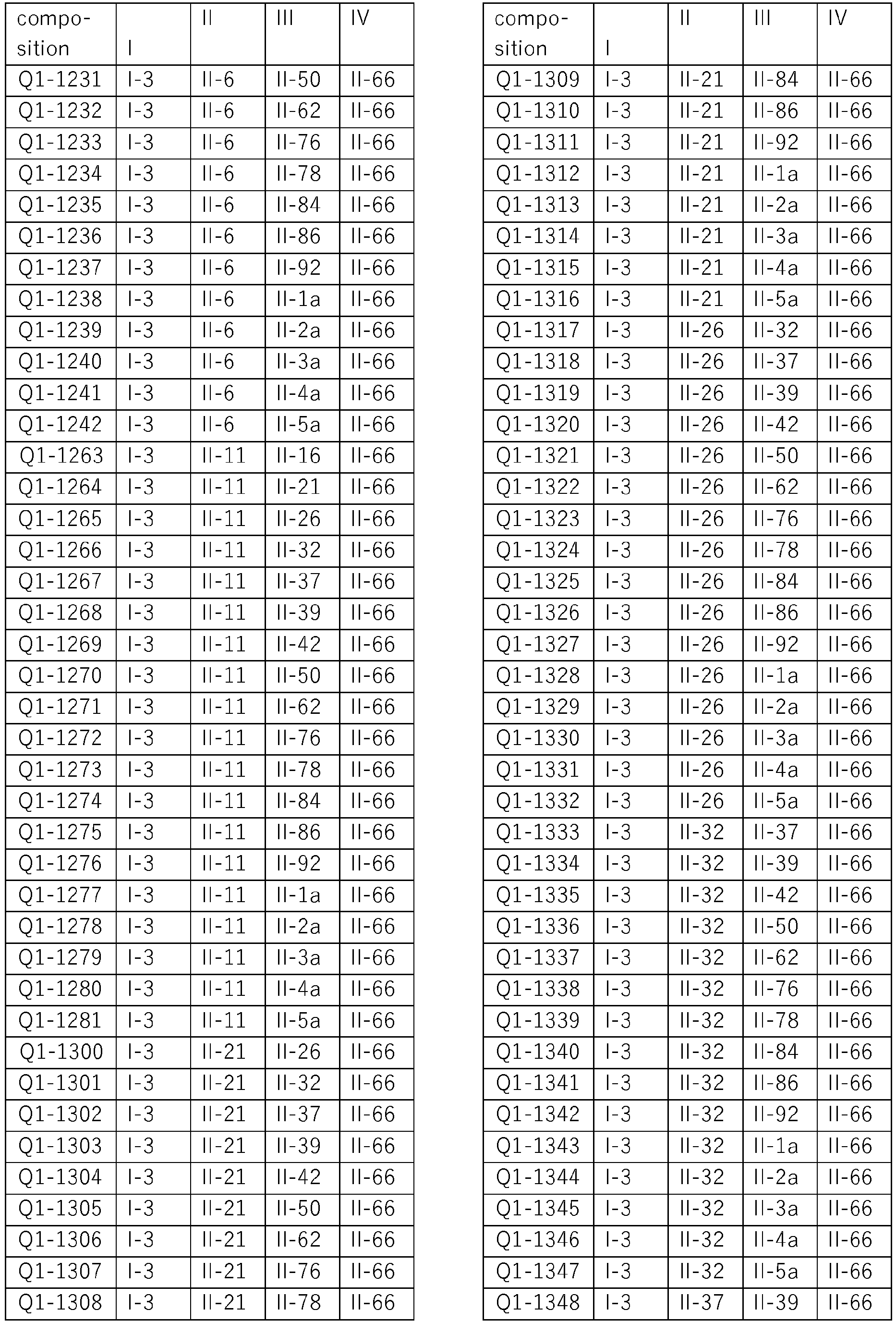


- In table Q1, according to particular embodiments of the invention, the respective component I is present as (S) enantiomer, wherein each row corresponds to one embodiment of the compositions according to the invention, i.e. one specific individualized composition. According to one specific aspect, these are ternary compositions which each only contain these two components as active compounds. Furthermore, also every combination of the compositions individualized in this table represent embodiments of the present invention (S) enantiomer.
- In table Q1, according to a further particular embodiments of the invention, the respective component I is present as (R) enantiomer, wherein each row corresponds to one embodiment of the compositions according to the invention, i.e. one specific individualized composition. According to one specific aspect, these are ternary compositions which each only contain these two components as active compounds. Furthermore, also every combination of the compositions individualized in this table represent embodiments of the present invention (R) enantiomer.
- Further particularly preferred four-component compositions are compiled in Table Q2, where each row corresponds to one embodiment of the compositions according to the invention, i.e. one specific individualized four-component composition. According to one specific aspect, these are quarternary compositions which each only contain these four components as the active compound. Furthermore, also every combination of the compositions individualized in this table represent embodiments of the present invention.
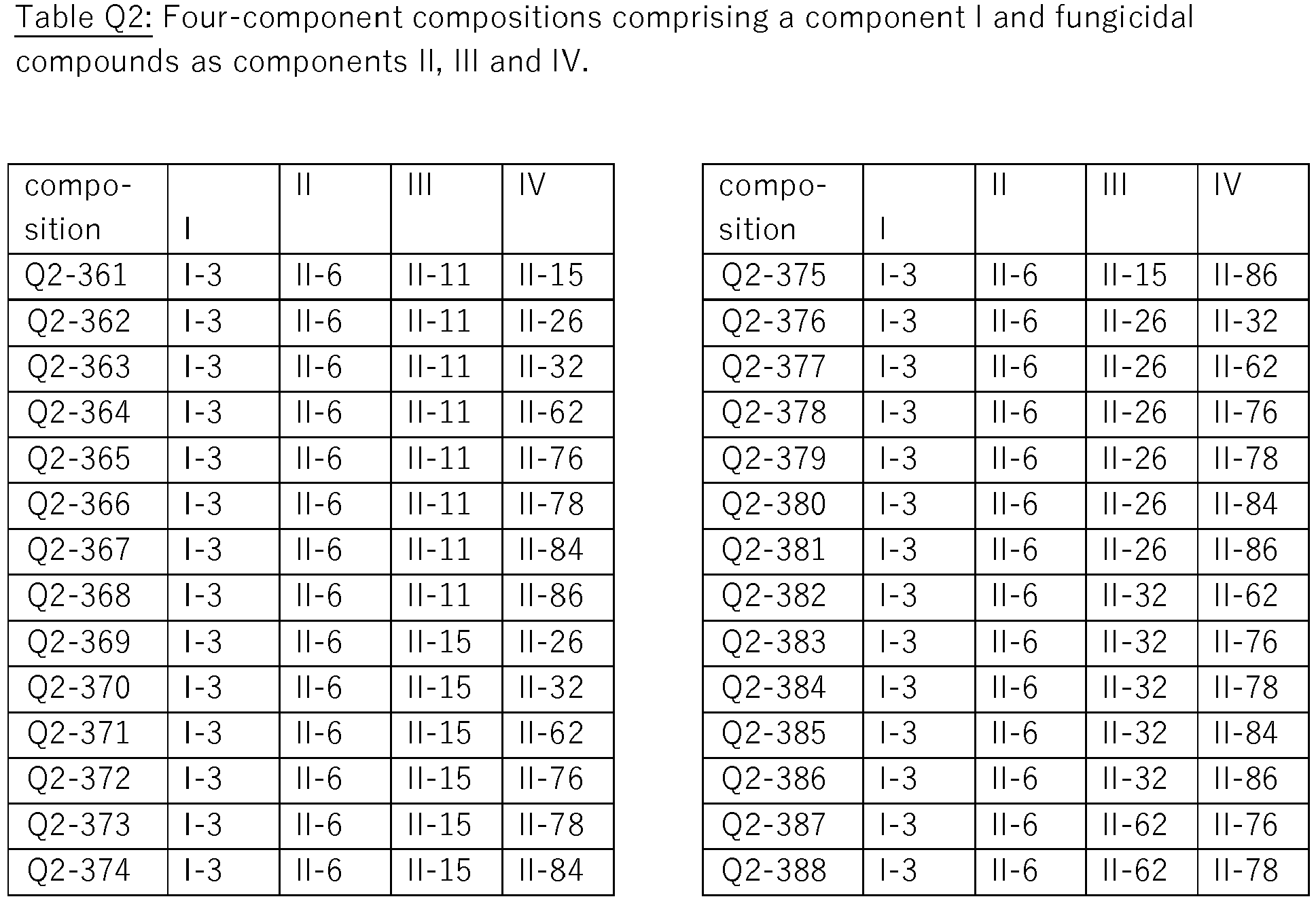


- In table Q2, according to a further particular embodiments of the invention, the respective component I is present as (R) enantiomer, wherein each row corresponds to one embodiment of the compositions according to the invention, i.e. one specific individualized composition. According to one specific aspect, these are ternary compositions which each only contain these two components as active compounds. Furthermore, also every combination of the compositions individualized in this table represent embodiments of the present invention (R) enantiomer.
- Further particularly preferred four-component compositions are compiled in Table Q3, where each row corresponds to one embodiment of the compositions according to the invention, i.e. one specific individualized four-component composition. According to one specific aspect, these are quarternary compositions which each only contain these four components as the active compound. Furthermore, also every combination of the compositions individualized in this table represent embodiments of the present invention.
Table Q3: Four-component compositions comprising a component I and growth regulators as components II, III and IV. composition I II III IV Q3-31 I-3 II-1a II-2a II-3a Q3-32 I-3 II-1a II-2a II-4a Q3-33 I-3 II-1a II-2a II-5a Q3-34 I-3 II-1a II-3a II-4a Q3-35 I-3 II-1a II-3a II-5a Q3-36 I-3 II-1a II-4a II-5a Q3-40 I-3 II-3a II-4a II-5a - In table Q3, according to particular embodiments of the invention, the respective component I is present as (S) enantiomer, wherein each row corresponds to one embodiment of the compositions according to the invention, i.e. one specific individualized composition. According to one specific aspect, these are ternary compositions which each only contain these two components as active compounds. Furthermore, also every combination of the compositions individualized in this table represent embodiments of the present invention (S) enantiomer.
- In table Q3, according to a further particular embodiments of the invention, the respective component I is present as (R) enantiomer, wherein each row corresponds to one embodiment of the compositions according to the invention, i.e. one specific individualized composition. According to one specific aspect, these are ternary compositions which each only contain these two components as active compounds. Furthermore, also every combination of the compositions individualized in this table represent embodiments of the present invention (R) enantiomer.
- Further particularly preferred compositions are the four-component compositions, wherein component I is compound I-3 component II is selected from the following fungicides
II-3 azoxystrobin II-42 fluxapyroxad II-53 kresoxim-methyl II-66 pyraclostrobin II-92 trifloxystrobin II-11c clothianidin II-24c imidacloprid II-42c thiamethoxam, - Specifically preferred embodiments of these compositions are compiled in Table Q4, where each row corresponds to one embodiment of the compositions according to the invention, i.e. one specific individualized four-component composition. According to one specific aspect, these are quarternary compositions which each only contain these four components as the active compound. Furthermore, also every combination of the compositions individualized in this table represent embodiments of the present invention.


- In table Q4, according to a further particular embodiments of the invention, the respective component I is present as (R) enantiomer, wherein each row corresponds to one embodiment of the compositions according to the invention, i.e. one specific individualized composition. According to one specific aspect, these are ternary compositions which each only contain these two components as active compounds. Furthermore, also every combination of the compositions individualized in this table represent embodiments of the present invention (R) enantiomer.
- A further aspect of the disclosure are compositions comprising more than four active ingredients, such as, in particular five-component-compositions. In addition to the four components I, II, III and IV as detailed above, these inventive compositions comprise a component V. Component V is seleceted from any one of groups A) to O). Any further active components, such as component V, is, if desired, added in a ratio of from 20:1 to 1:20, in particular 10:1 to 1:10, more particularly 3:1 to 1:3, to the compound I.
- According to one embodiment of the five-component compositions, the component I, II, III and IV are as defined and preferably defined above, and component V is selected from any one of groups A) to K).
- One specific embodiment relates to five-component compositions, wherein component I is compound I-3, components II, III and IV are as defiend above and preferably defined above, and component V is selected from group A) of the respiration inhibitors. According to one embodiment thereof, component V is selected from the group of inhibitors of complex III at Q0 site, in e.g. the strobilurins. Specifically, component V is selected from the group consisting of azoxystrobin, dimoxystrobin, fluoxastrobin, kresoxim-methyl, orysastrobin, picoxystrobin, pyraclostrobin, trifloxystrobin, famoxadone and fenamidone. According to a further embodiment thereof, component V is selected from the group of inhibitors of complex II, e.g. carboxamides. Specifically, component V is selected from the group consisting of benzovindiflupyr, bixafen, boscalid, fluopyram, fluxapyroxad, isopyrazam, penflufen, penthiopyrad and sedaxane. According to a further embodiment, component V is selected from the group of ametotradin, cyazofamid, fluazinam, fentin salts such as fentin acetate.
- One specific embodiment relates to five-component compositions, wherein component I is compound I-3, components II, III and IV are as defiend above and preferably defined above, and component V is selected from group B) of the sterol biosynthesis inhibitors (SBI fungicides). According to one embodiment thereof, component V is selected from the group of the C14 demethylase inhibitors (DMI fungicides), selected from cyproconazole, difenoconazole, epoxiconazole, fluquinconazole, flusilazole, flutriafol, metconazole, myclobutanil, penconazole, propiconazole, prothioconazole, triadimefon, triadimenol, tebuconazole, tetraconazole, triticonazole, prochloraz, fenarimol and triforine. According to a further embodiment thereof, component V is selected from the group of the delta14-reductase inhibitors, in particular dodemorph, fenpropimorph, tridemorph, fenpropidin and spiroxamine. According to a further embodiment thereof, component V is selected from the group of Inhibitors of 3-keto reductase such as fenhexamid.
- According to a further embodiment of the five-component compositions, component I is compound I-3, components II, III and IV are as defiend above and preferably defined above, and component V is selected from group C) of the Nucleic acid synthesis inhibitors and particularly selected from metalaxyl, (metalaxyl-M) mefenoxam, ofurace.
- According to a further embodiment of the five-component compositions, component I is compound I-3, components II, III and IV are as defiend above and preferably defined above, and component V selected from group D) of the inhibitors of cell division and cytoskeleton, such as benomyl, carbendazim, thiophanate-methyl, ethaboxam, fluopicolide, zoxamide, metrafenone, pyriofenone, in particular ethaboxam, zoxamide and metrafenone.
- According to a further embodiment of the five-component compositions, component I is compound I-3, components II, III and IV are as defiend above and preferably defined above, and component V is selected from group E) of the inhibitors of amino acid and protein synthesis, in particular selected from cyprodinil, mepanipyrim and pyrimethanil.
- According to a further embodiment of the five-component compositions, component I is compound I-3, components II, III and IV are as defiend above and preferably defined above, and component V is selected from group F) of the signal transduction inhibitors, in particular selected from iprodione, fludioxonil, vinclozolin and quinoxyfen.
- According to a further embodiment of the five-component compositions, component I is compound I-3, components II, III and IV are as defiend above and preferably defined above, and component V is selected from group G) of the lipid and membrane synthesis inhibitors, such as dimethomorph, flumorph, iprovalicarb, benthiavalicarb, mandipropamid and propamocarb.
- According to a further embodiment of the five-component compositions, component I is compound I-3, components II, III and IV are as defiend above and preferably defined above, and component V is selected from group H) of the inhibitors with Multi Site Action, in particular selected from copper acetate, (tri)basic copper sulfate, copper oxychloride, copper sulfate, sulfur, mancozeb, metiram, propineb, thiram, captafol, folpet, chlorothalonil, dichlofluanid and dithianon.
- According to a further embodiment of the five-component compositions, component I is compound I-3, components II, III and IV are as defiend above and preferably defined above, and component V is selected from group I) of the cell wall synthesis inhibitors, in particular selected from carpropamid and fenoxanil.
- According to a further embodiment of the five-component compositions, component I is compound I-3, components II, III and IV are as defiend above and preferably defined above, and component V is selected from group J) of the plant defence inducers, in particular selected from acibenzolar-S-methyl, probenazole, tiadinil, fosetyl, fosetyl-aluminium, phosphorous acid and salts thereof such as potassium salt of phosphorous acid, sodium salt of phosphorous acid, calcium salt of phosphorous acid, lithium salt of phosphorous acid and aluminium salt of phosphorous acid.
- According to a further embodiment of the five-component compositions, component I is compound I-3, components II, III and IV are as defiend above and preferably defined above, and component V s selected from group K), in particular selected from cymoxanil, proquinazid and N-methyl-2-{1-[(5-methyl-3-trifluoromethyl-1H-pyrazol-1-yl)-acetyl]-piperidin-4-yl}-N-[(1R)-1,2,3,4-tetrahydronaphthalen-1-yl]-4-thiazolecarboxamide.
- According to a further embodiment of the five-component compositions, component I is compound I-3, components II, III and IV are as defiend above and preferably defined above, and component V is selected from any one of group L) (antifungal biocontrol agents and plant bioactivators), in particular selected from Bacillus subtilis strain NRRL No. B-21661, Bacillus pumilus strain NRRL No. B-30087 and Ulocladium oudemansii.
- According to a further embodiment of the five-component compositions, component I is compound I-3, components II, III and IV are as defiend above and preferably defined above, and component V is selected from any one of group M) (growth regulators). According to one specific embodiment, the growth regulator is selected from chlormequat (chlormequat chloride), mepiquat (mepiquat chloride), paclobutrazole, prohexadione (prohexadione-calcium), trinexapac-ethyl and uniconazole.
- According to a further embodiment of the five-component compositions, component I compound I-3components II, III and IV are as defiend above and preferably defined above, and component V is selected from any one of group N) (herbicides).
- According to a further embodiment of the five-component compositions, component I is compound I-3, components II, III and IV are as defiend above and preferably defined above, and component V is selected from any one of group O) (insecticides). According to one specific embodiment, the insecticide is selected from the group of the organo(thio)phosphates, in particular selected from the group consisting of acephate, chlorpyrifos, diazinon, dichlorvos, dimethoate, fenitrothion, methamidophos, methidathion, methyl-parathion, monocrotophos, phorate, profenofos and terbufos. According to a further specific embodiment, the insecticide is selected from the group of the carbamates, in particular selected from the group consisting of aldicarb, carbaryl, carbofuran, carbosulfan, methomyl and thiodicarb. According to a further specific embodiment, the insecticide is selected from the group of the pyrethroids, in particular selected from the group consisting of: bifenthrin, cyfluthrin, cypermethrin, alpha-cypermethrin, zeta-cypermethrin, deltamethrin, esfenvalerate, lambda-cyhalothrin and tefluthrin. According to still a further specific embodiment, the insecticide is selected from the group of insect growth regulators, in particular selected from the group consisting of lufenuron and spirotetramat. According to still a further specific embodiment, the insecticide is selected from the group of the nicotine receptor agonists/antagonists, in particular selected from the group consisting of: clothianidin, imidacloprid, thiamethoxam and thiacloprid. According to a further specific embodiment, the insecticide is selected from the group of the GABA antagonists, in particular selected from the group consisting of: endosulfan and fipronil. According to a further specific embodiment, the insecticide is selected from the group of the macrocyclic lactones, in particular selected from the group consisting of: abamectin, emamectin, spinosad and spinetoram. According to a further specific embodiment, the insecticide is hydramethylnon. According to a further specific embodiment, the insecticide is fenbutatin oxide. According to a further specific embodiment, the insecticide is selected from the group consisting of chlorfenapyr, indoxacarb, metaflumizone, flonicamid, flubendiamide, cyazypyr (HGW86) and cyflumetofen.
- The compositions according to the invention are suitable as fungicides. They are distinguished by an outstanding effectiveness against a broad spectrum of phytopathogenic fungi, including soil-borne fungi, which derive especially from the classes of the Plasmodiophoromycetes, Peronosporomycetes (syn. Oomycetes), Chytridiomycetes, Zygomycetes, Ascomycetes, Basidiomycetes and Deuteromycetes (syn. Fungi imperfecti). Some are systemically effective and they can be used in crop protection as foliar fungicides, fungicides for seed dressing and soil fungicides. Moreover, they are suitable for controlling harmful fungi, which inter alia occur in wood or roots of plants.
- Some compositions of the invention are particularly suitable for seed treatment. For example, an inventive three-component composition, wherein component I is as defined above, component II is selected from the sterol biosynthesis inhibitors (SBI fungicides) as defined herein for component II, in particular from the C14 demethylase inhibitors (DMI fungicides) as defined herein for component II, and component III is selected from the Signal transduction inhibitors, is useful for seed treatment, wherein, in a specific embodiment, component II is triticonazole and component III is fludioxonil.
- Furthermore, also some inventive four-component compositions are specifically useful for seed treatment. For example compositions, wherein component I is as defined above, component II is selected from the sterol biosynthesis inhibitors (SBI fungicides) as defined herein for component II, in particular from the C14 demethylase inhibitors (DMI fungicides) as defined herein for component II, component III is selected from the Signal transduction inhibitors and component IV is selected from the group of the carboxamides, in particular selected from benodanil, benzovindiflupyr, bixafen, boscalid, carboxin, fenfuram, fluopyram, flutolanil, fluxapyroxad, furametpyr, isopyrazam, mepronil, oxycarboxin, penflufen, penthiopyrad, sedaxane, tecloftalam, thifluzamide, N-(4'-trifluoromethylthiobiphenyl-2-yl)-3-difluoromethyl-1-methyl-1H-pyrazole-4-carboxamide, N-(2-(1,3,3-trimethyl-butyl)-phenyl)-1,3-dimethyl-5-fluoro-1H-pyrazole-4-carboxamide, 3-(difluoromethyl)-1-methyl-N-(1,1,3-trimethylindan-4-yl)pyrazole-4-carboxamide, 3-(trifluoromethyl)-1-methyl-N-(1,1,3-trimethylindan-4-yl)pyrazole-4-carboxamide, 1,3-dimethyl-N-(1,1,3-trimethylindan-4-yl)pyrazole-4-carboxamide, 3-(trifluoromethyl)-1,5-dimethyl-N-(1,1,3-trimethylindan-4-yl)pyrazole-4-carboxamide, 3-(difluoromethyl)-1,5-dimethyl-N-(1,1,3-trimethylindan-4-yl)pyrazole-4-carboxamide and 1,3,5-trimethyl-N-(1,1,3-trimethylindan-4-yl)pyrazole-4-carboxamide, in particular selected from benzovindiflupyr, bixafen, boscalid, fluopyram, fluxapyroxad, isopyrazam, penflufen, penthiopyrad and sedaxane. In a specific embodiment for seed tretament, component II is triticonazole, component III is fludioxonil and component IV is fluxapyroxad.
- The compositions according to the invention are particularly important in the control of a multitude of phytopathogenic fungi on various cultivated plants, such as cereals, e. g. wheat, rye, barley, triticale, oats or rice; beet, e. g. sugar beet or fodder beet; fruits, such as pomes, stone fruits or soft fruits, e. g. apples, pears, plums, peaches, almonds, cherries, strawberries, raspberries, blackberries or gooseberries; leguminous plants, such as lentils, peas, alfalfa or soybeans; oil plants, such as rape, mustard, olives, sunflowers, coconut, cocoa beans, castor oil plants, oil palms, ground nuts or soybeans; cucurbits, such as squashes, cucumber or melons; fiber plants, such as cotton, flax, hemp or jute; citrus fruit, such as oranges, lemons, grapefruits or mandarins; vegetables, such as spinach, lettuce, asparagus, cabbages, carrots, onions, tomatoes, potatoes, cucurbits or paprika; lauraceous plants, such as avocados, cinnamon or camphor; energy and raw material plants, such as corn, soybean, rape, sugar cane or oil palm; corn; tobacco; nuts; coffee; tea; bananas; vines (table grapes and grape juice grape vines); hop; turf; sweet leaf (also called Stevia); natural rubber plants or ornamental and forestry plants, such as flowers, shrubs, broad-leaved trees or evergreens, e. g. conifers; and on the plant propagation material, such as seeds, and the crop material of these plants.
- Preferably, the inventive compositions are used for controlling a multitude of fungi on field crops, such as potatoes sugar beets, tobacco, wheat, rye, barley, oats, rice, corn, cotton, soybeans, rape, legumes, sunflowers, coffee or sugar cane; fruits; vines; ornamentals; or vegetables, such as cucumbers, tomatoes, beans or squashes.
- The term "plant propagation material" is to be understood to denote all the generative parts of the plant such as seeds and vegetative plant material such as cuttings and tubers (e. g. potatoes), which can be used for the multiplication of the plant. This includes seeds, roots, fruits, tubers, bulbs, rhizomes, shoots, sprouts and other parts of plants, including seedlings and young plants, which are to be transplanted after germination or after emergence from soil. These young plants may also be protected before transplantation by a total or partial treatment by immersion or pouring.
- Preferably, treatment of plant propagation materials with the components of the inventive compositions and the inventive compositions, respectively, is used for controlling a multitude of fungi on cereals, such as wheat, rye, barley and oats; rice, corn, cotton and soybeans.
- The term "cultivated plants" is to be understood as including plants which have been modified by breeding, mutagenesis or genetic engineering including but not limiting to agricultural biotech products on the market or in development (cf. http://cera-gmc.org/, see GM crop database therein). Genetically modified plants are plants, which genetic material has been so modified by the use of recombinant DNA techniques that under natural circumstances cannot readily be obtained by cross breeding, mutations or natural recombination. Typically, one or more genes have been integrated into the genetic material of a genetically modified plant in order to improve certain properties of the plant. Such genetic modifications also include but are not limited to targeted post-translational modification of protein(s), oligo- or polypeptides e. g. by glycosylation or polymer additions such as prenylated, acetylated or farnesylated moieties or PEG moieties.
- Plants that have been modified by breeding, mutagenesis or genetic engineering, e. g. have been rendered tolerant to applications of specific classes of herbicides, such as auxin herbicides such as dicamba or 2,4-D; bleacher herbicides such as hydroxyl-phenylpyruvate dioxygenase (HPPD) inhibitors or phytoene desaturase (PDS) inhibittors; acetolactate synthase (ALS) inhibitors such as sulfonyl ureas or imidazolinones; enolpyruvylshikimate-3-phosphate synthase (EPSPS) inhibitors, such as glyphosate; glutamine synthetase (GS) inhibitors such as glufosinate; protoporphyrinogen-IX oxidase inhibitors; lipid biosynthesis inhibitors such as acetyl CoA carboxylase (ACCase) inhibitors; or oxynil (i. e. bromoxynil or ioxynil) herbicides as a result of conventional methods of breeding or genetic engineering. Furthermore, plants have been made resistant to multiple classes of herbicides through multiple genetic modifications, such as resistance to both glyphosate and glufosinate or to both glyphosate and a herbicide from another class such as ALS inhibitors, HPPD inhibitors, auxin herbicides, or ACCase inhibitors. These herbicide resistance technologies are e. g. described in Pest Managem. Sci. 61, 2005, 246; 61, 2005, 258; 61, 2005, 277; 61, 2005, 269; 61, 2005, 286; 64, 2008, 326; 64, 2008, 332; Weed Sci. 57, 2009, 108; Austral. J. Agricult. Res. 58, 2007, 708; Science 316, 2007, 1185; and references quoted therein. Several cultivated plants have been rendered tolerant to herbicides by conventional methods of breeding (mutagenesis), e. g. Clearfield® summer rape (Canola, BASF SE, Germany) being tolerant to imidazolinones, e. g. imazamox, or ExpressSun® sunflowers (DuPont, USA) being tolerant to sulfonyl ureas, e. g. tribenuron. Genetic engineering methods have been used to render cultivated plants such as soybean, cotton, corn, beets and rape, tolerant to herbicides such as glyphosate and glufosinate, some of which are commercially available under the trade names RoundupReady® (glyphosate-tolerant, Monsanto, U.S.A.), Cultivance® (imidazolinone tolerant, BASF SE, Germany) and LibertyLink® (glufosinate-tolerant, Bayer CropScience, Germany).
- Furthermore, plants are also covered that are by the use of recombinant DNA techniques capable to synthesize one or more insecticidal proteins, especially those known from the bacterial genus Bacillus, particularly from Bacillus thuringiensis, such as δ-endotoxins, e. g. CryIA(b), CryIA(c), CrylF, CryIF(a2), CryIIA(b), CryIIIA, CryIIIB(b1) or Cry9c; vegetative insecticidal proteins (VIP), e. g. VIP1, VIP2, VIP3 or VIP3A; insecticidal proteins of bacteria colonizing nematodes, e. g. Photorhabdus spp. or Xenorhabdus spp.; toxins produced by animals, such as scorpion toxins, arachnid toxins, wasp toxins, or other insect-specific neurotoxins; toxins produced by fungi, such Streptomycetes toxins, plant lectins, such as pea or barley lectins; agglutinins; proteinase inhibitors, such as trypsin inhibitors, serine protease inhibitors, patatin, cystatin or papain inhibitors; ribosome-inactivating proteins (RIP), such as ricin, maize-RIP, abrin, luffin, saporin or bryodin; steroid metabolism enzymes, such as 3-hydroxysteroid oxidase, ecdysteroid-IDP-glycosyl-transferase, cholesterol oxidases, ecdysone inhibitors or HMG-CoA-reductase; ion channel blockers, such as blockers of sodium or calcium channels; juvenile hormone esterase; diuretic hormone receptors (helicokinin receptors); stilben synthase, bibenzyl synthase, chitinases or glucanases. In the context of the present invention these insecticidal proteins or toxins are to be understood expressly also as pre-toxins, hybrid proteins, truncated or otherwise modified proteins. Hybrid proteins are characterized by a new combination of protein domains, (see, e. g.
WO 02/015701 EP-A 374 753 WO 93/007278 WO 95/34656 EP-A 427 529 EP-A 451 878 WO 03/18810 WO 03/52073 -
WO 03/018810 - Furthermore, plants are also covered that are by the use of recombinant DNA techniques capable to synthesize one or more proteins to increase the resistance or tolerance of those plants to bacterial, viral or fungal pathogens. Examples of such proteins are the so-called "pathogenesis-related proteins" (PR proteins, see, e. g.
EP-A 392 225 - Furthermore, plants are also covered that are by the use of recombinant DNA techniques capable to synthesize one or more proteins to increase the productivity (e. g. bio mass production, grain yield, starch content, oil content or protein content), tolerance to drought, salinity or other growth-limiting environmental factors or tolerance to pests and fungal, bacterial or viral pathogens of those plants.
- Furthermore, plants are also covered that contain by the use of recombinant DNA techniques a modified amount of substances of content or new substances of content, specifically to improve human or animal nutrition, e. g. oil crops that produce health-promoting long-chain omega-3 fatty acids or unsaturated omega-9 fatty acids (e. g. Nexera® rape, DOW Agro Sciences, Canada).
- Furthermore, plants are also covered that contain by the use of recombinant DNA techniques a modified amount of substances of content or new substances of content, specifically to improve raw material production, e. g. potatoes that produce increased amounts of amylopectin (e. g. Amflora® potato, BASF SE, Germany).
- The compositions are particularly suitable for controlling the following plant diseases:
Albugo spp. (white rust) on ornamentals, vegetables (e. g. A. candida) and sunflowers (e. g. A. tragopogonis); Alternaria spp. (Alternaria leaf spot) on vegetables, rape (A. brassicola or brassicae), sugar beets (A. tenuis), fruits, rice, soybeans, potatoes (e. g. A. solani or A. alternata), tomatoes (e. g. A. solani or A. alternata) and wheat; Aphanomyces spp. on sugar beets and vegetables; Ascochyta spp. on cereals and vegetables, e. g. A. tritici (anthracnose) on wheat and A. hordei on barley; Bipolaris and Drechslera spp. (teleomorph: Cochliobolus spp.), e. g. Southern leaf blight (D. maydis) or Northern leaf blight (B. zeicola) on corn, e. g. spot blotch (B. sorokiniana) on cereals and e.g. B. oryzae on rice and turfs; Blumeria (formerly Erysiphe) graminis (powdery mildew) on cereals (e. g. on wheat or barley); Botrytis cinerea (teleomorph: Botryotinia fuckeliana: grey mold) on fruits and berries (e. g. strawberries), vegetables (e. g. lettuce, carrots, celery and cabbages), rape, flowers, vines, forestry plants and wheat; Bremia lactucae (downy mildew) on lettuce; Ceratocystis (syn. Ophiostoma) spp. (rot or wilt) on broad-leaved trees and evergreens, e. g. C. ulmi (Dutch elm disease) on elms; Cercospora spp. (Cercospora leaf spots) on corn (e.g. Gray leaf spot: C. zeae-maydis), rice, sugar beets (e. g. C. beticola), sugar cane, vegetables, coffee, soybeans (e. g. C. sojina or C. kikuchii) and rice; Cladosporium spp. on tomatoes (e. g. C. fulvum: leaf mold) and cereals, e. g. C. herbarum (black ear) on wheat; Claviceps purpurea (ergot) on cereals; Cochliobolus (anamorph: Helminthosporium of Bipolaris) spp. (leaf spots) on corn (C. carbonum), cereals (e. g. C. sativus, anamorph: B. sorokiniana) and rice (e. g. C. miyabeanus, anamorph: H. oryzae); Colletotrichum (teleomorph: Glomerella) spp. (anthracnose) on cotton (e. g. C. gossypii), corn (e. g. C. graminicola: Anthracnose stalk rot), soft fruits, potatoes (e. g. C. coccodes: black dot), beans (e. g. C. lindemuthianum) and soybeans (e. g. C. truncatum or C. gloeosporioides); Corticium spp., e. g. C. sasakii (sheath blight) on rice; Corynespora cassiicola (leaf spots) on soybeans and ornamentals; Cycloconium spp., e. g. C. oleaginum on olive trees; Cylindrocarpon spp. (e. g. fruit tree canker or young vine decline, teleomorph: Nectria or Neonectria spp.) on fruit trees, vines (e. g. C. liriodendri, teleomorph: Neonectria liriodendri: Black Foot Disease) and ornamentals; Dematophora (teleomorph: Rosellinia) necatrix (root and stem rot) on soybeans; Diaporthe spp., e. g. D. phaseolorum (damping off) on soybeans; Drechslera (syn. Helminthosporium, teleomorph: Pyrenophora) spp. on corn, cereals, such as barley (e. g. D. teres, net blotch) and wheat (e. g. D. tritici-repentis: tan spot), rice and turf; Esca (dieback, apoplexy) on vines, caused by Formitiporia (syn. Phellinus) punctata, F. mediterranea, Phaeomoniella chlamydospora (earlier Phaeoacremonium chlamydosporum), Phaeoacremonium aleophilum and/or Botryosphaeria obtusa; Elsinoe spp. on pome fruits (E pyri), soft fruits (E veneta: anthracnose) and vines (E. ampelina: anthracnose); Entyloma oryzae (leaf smut) on rice; Epicoccum spp. (black mold) on wheat; Erysiphe spp. (powdery mildew) on sugar beets (E betae), vegetables (e. g. E pisi), such as cucurbits (e. g. E cichoracearum), cabbages, rape (e. g. E. cruciferarum); Eutypa lata (Eutypa canker or dieback, anamorph: Cytosporina lata, syn. Libertella blepharis) on fruit trees, vines and ornamental woods; Exserohilum (syn. Helminthosporium) spp. on corn (e. g. E turcicum); Fusarium (teleomorph: Gibberella) spp. (wilt, root or stem rot) on various plants, such as F. graminearum or F. culmorum (root rot, scab or head blight) on cereals (e. g. wheat or barley), F. oxysporum on tomatoes, F. solani (f. sp. glycines now syn. F. virguliforme) and F. tucumaniae and F. brasiliense each causing sudden death syndrome on soybeans and F. verticillioides on corn; Gaeumannomyces graminis (take-all) on cereals (e. g. wheat or barley) and corn; Gibberella spp. on cereals (e. g. G. zeae) and rice (e. g. G. fujikuroi: Bakanae disease); Glomerella cingulata on vines, pome fruits and other plants and G. gossypii on cotton; Grainstaining complex on rice; Guignardia bidwellii (black rot) on vines; Gymnosporangium spp. on rosaceous plants and junipers, e. g. G. sabinae (rust) on pears; Helminthosporium spp. (syn. Drechslera, teleomorph: Cochliobolus) on corn, cereals and rice; Hemileia spp., e. g. H. vastatrix (coffee leaf rust) on coffee; Isariopsis clavispora (syn. Cladosporium vitis) on vines; Macrophomina phaseolina (syn. phaseoli) (root and stem rot) on soybeans and cotton; Microdochium (syn. Fusarium) nivale (pink snow mold) on cereals (e. g. wheat or barley); Microsphaera diffusa (powdery mildew) on soybeans; Monilinia spp., e. g. M. laxa, M. fructicola and M. fructigena (bloom and twig blight, brown rot) on stone fruits and other rosaceous plants; Mycosphaerella spp. on cereals, bananas, soft fruits and ground nuts, such as e. g. M. graminicola (anamorph: Septoria tritici, Septoria blotch) on wheat or M. fijiensis (black Sigatoka disease) on bananas; Peronospora spp. (downy mildew) on cabbage (e. g. P. brassicae), rape (e. g. P. parasitica), onions (e. g. P. destructor), tobacco (P. tabacina) and soybeans (e. g. P. manshurica); Phakopsora pachyrhizi and P. meibomiae (soybean rust) on soybeans; Phialophora spp. e. g. on vines (e. g. P. tracheiphila and P. tetraspora) and soybeans (e. g. P. gregata: stem rot); Phoma lingam (root and stem rot) on rape and cabbage and P. betae (root rot, leaf spot and damping-off) on sugar beets; Phomopsis spp. on sunflowers, vines (e. g. P. vitico/a: can and leaf spot) and soybeans (e. g. stem rot: P. phaseoli, teleomorph: Diaporthe phaseolorum); Physoderma maydis (brown spots) on corn; Phytophthora spp. (wilt, root, leaf, fruit and stem root) on various plants, such as paprika and cucurbits (e. g. P. capsici), soybeans (e. g. P. megasperma, syn. P. sojae), potatoes and tomatoes (e. g. P. infestans: late blight) and broad-leaved trees (e. g. P. ramorum: sudden oak death); Plasmodiophora brassicae (club root) on cabbage, rape, radish and other plants; Plasmopara spp., e. g. P. viticola (grapevine downy mildew) on vines and P. halstedii on sunflowers; Podosphaera spp. (powdery mildew) on rosaceous plants, hop, pome and soft fruits, e. g. P. leucotricha on apples; Polymyxa spp., e. g. on cereals, such as barley and wheat (P. graminis) and sugar beets (P. betae) and thereby transmitted viral diseases; Pseudocercosporella herpotrichoides (eyespot, teleomorph: Tapesia yallundae) on cereals, e. g. wheat or barley; Pseudoperonospora (downy mildew) on various plants, e. g. P. cubensis on cucurbits or P. humili on hop; Pseudopezicula tracheiphila (red fire disease or ,rotbrenner', anamorph: Phialophora) on vines; Puccinia spp. (rusts) on various plants, e. g. P. triticina (brown or leaf rust), P. striiformis (stripe or yellow rust), P. hordei (dwarf rust), P. graminis (stem or black rust) or P. recondita (brown or leaf rust) on cereals, such as e. g. wheat, barley or rye, P. kuehnii (orange rust) on sugar cane and P. asparagi on asparagus; Pyrenophora (anamorph: Drechslera) tritici-repentis (tan spot) on wheat or P. teres (net blotch) on barley; Pyricularia spp., e. g. P. oryzae (teleomorph: Magnaporthe grisea, rice blast) on rice and P. grisea on turf and cereals; Pythium spp. (damping-off) on turf, rice, corn, wheat, cotton, rape, sunflowers, soybeans, sugar beets, vegetables and various other plants (e. g. P. ultimum or P. aphanidermatum); Ramularia spp., e. g. R. collo-cygni (Ramularia leaf spots, Physiological leaf spots) on barley and R. beticola on sugar beets; Rhizoctonia spp. on cotton, rice, potatoes, turf, corn, rape, potatoes, sugar beets, vegetables and various other plants, e. g. R. solani (root and stem rot) on soybeans, R. solani (sheath blight) on rice or R. cerealis (Rhizoctonia spring blight) on wheat or barley; Rhizopus stolonifer (black mold, soft rot) on strawberries, carrots, cabbage, vines and tomatoes; Rhynchosporium secalis (scald) on barley, rye and triticale; Sarocladium oryzae and S. attenuatum (sheath rot) on rice; Sclerotinia spp. (stem rot or white mold) on vegetables and field crops, such as rape, sunflowers (e. g. S. sclerotiorum) and soybeans (e. g. S. rolfsii or S. sclerotiorum); Septoria spp. on various plants, e. g. S. glycines (brown spot) on soybeans, S. tritici (Septoria blotch) on wheat and S. (syn. Stagonospora) nodorum (Stagonospora blotch) on cereals; Uncinula (syn. Erysiphe) necator (powdery mildew, anamorph: Oidium tuckeri) on vines; Setospaeria spp. (leaf blight) on corn (e. g. S. turcicum, syn. Helminthosporium turcicum) and turf; sphacelotheca spp. (smut) on corn, (e. g. S. reiliana: head smut), sorghum und sugar cane; Sphaerotheca fuliginea (powdery mildew) on cucurbits; Spongospora subterranea (powdery scab) on potatoes and thereby transmitted viral diseases; Stagonospora spp. on cereals, e. g. S. nodorum (Stagonospora blotch, teleomorph: Leptosphaeria [syn. Phaeosphaeria] nodorum) on wheat; Synchytrium endobioticum on potatoes (potato wart disease); Taphrina spp., e. g. T. deformans (leaf curl disease) on peaches and T. pruni (plum pocket) on plums; Thielaviopsis spp. (black root rot) on tobacco, pome fruits, vegetables, soybeans and cotton, e. g. T. basicola (syn. Chalara elegans); Tilletia spp. (common bunt or stinking smut) on cereals, such as e. g. T. tritici (syn. T. caries, wheat bunt) and T. controversa (dwarf bunt) on wheat; Typhula incarnata (grey snow mold) on barley or wheat; Urocystis spp., e. g. U. occulta (stem smut) on rye; Uromyces spp. (rust) on vegetables, such as beans (e. g. U. appendiculatus, syn. U. phaseoli) and sugar beets (e. g. U. betae); Ustilago spp. (loose smut) on cereals (e. g. U. nuda and U. avaenae), corn (e. g. U. maydis: corn smut) and sugar cane; Venturia spp. (scab) on apples (e. g. V. inaequalis) and pears; and Verticillium spp. (wilt) on various plants, such as fruits and ornamentals, vines, soft fruits, vegetables and field crops, e. g. V. dahliae on strawberries, rape, potatoes and tomatoes. - The compositions are also suitable for controlling harmful fungi in the protection of stored products or harvest and in the protection of materials. The term "protection of materials" is to be understood to denote the protection of technical and non-living materials, such as adhesives, glues, wood, paper and paperboard, textiles, leather, paint dispersions, plastics, colling lubricants, fiber or fabrics, against the infestation and destruction by harmful microorganisms, such as fungi and bacteria. As to the protection of wood and other materials, the particular attention is paid to the following harmful fungi: Ascomycetes such as Ophiostoma spp., Ceratocystis spp., Aureobasidium pullulans, Sclerophoma spp., Chaetomium spp., Humicola spp., Petriella spp., Trichurus spp.; Basidiomycetes such as Coniophora spp., Coriolus spp., Gloeophyllum spp., Lentinus spp., Pleurotus spp., Poria spp., Serpula spp. and Tyromyces spp., Deuteromycetes such as Aspergillus spp., Cladosporium spp., Penicillium spp., Trichorma spp., Alternaria spp., Paecilomyces spp. and Zygomycetes such as Mucor spp., and in addition in the protection of stored products and harvest the following yeast fungi are worthy of note: Candida spp. and Saccharomyces cerevisae.
- The method of treatment according to the invention can also be used in the field of protecting stored products or harvest against attack of fungi and microorganisms. According to the present invention, the term "stored products" is understood to denote natural substances of plant or animal origin and their processed forms, which have been taken from the natural life cycle and for which long-term protection is desired. Stored products of crop plant origin, such as plants or parts thereof, for example stalks, leafs, tubers, seeds, fruits or grains, can be protected in the freshly harvested state or in processed form, such as pre-dried, moistened, comminuted, ground, pressed or roasted, which process is also known as post-harvest treatment. Also falling under the definition of stored products is timber, whether in the form of crude timber, such as construction timber, electricity pylons and barriers, or in the form of finished articles, such as furniture or objects made from wood. Stored products of animal origin are hides, leather, furs, hairs and the like. The combinations according the present invention can prevent disadvantageous effects such as decay, discoloration or mold. Preferably "stored products" is understood to denote natural substances of plant origin and their processed forms, more preferably fruits and their processed forms, such as pomes, stone fruits, soft fruits and citrus fruits and their processed forms.
- The compositions may be used for improving the health of a plant. The invention also relates to a method for improving plant health by treating a plant, its propagation material and/or the locus where the plant is growing or is to grow with an effective amount of the components of the inventive compositions or the inventive compositions, respectively.
- The term "plant health" is to be understood to denote a condition of the plant and/or its products which is determined by several indicators alone or in combination with each other such as yield (e. g. increased biomass and/or increased content of valuable ingredients), plant vigor (e. g. improved plant growth and/or greener leaves ("greening effect")), quality (e. g. improved content or composition of certain ingredients) and tolerance to abiotic and/or biotic stress.The above identified indicators for the health condition of a plant may be interdependent or may result from each other.
- The compounds of formula I can be present in different crystal modifications whose biological activity may differ. Compositions comprising such modifications of compounds I are likewise subject matter of the present invention.
- The compositions are used by treating the fungi or the plants, plant propagation materials, such as seeds, soil, surfaces, materials or rooms to be protected from fungal attack with a fungicidally effective amount of the active substances. The application can be carried out both before and after the infection of the plants, plant propagation materials, such as seeds, soil, surfaces, materials or rooms by the fungi.
- Plant propagation materials may be treated with the components of the inventive compositions and the inventive compositions, respectively, prophylactically either at or before planting or transplanting.
- The invention also relates to agrochemical compositions comprising an auxiliary and the components of the respective inventive composition or the inventive composition, respectively.
- An agrochemical composition comprises a fungicidally effective amount of the components of the inventive compositions or the inventive composition, respectively. The term "effective amount" denotes an amount of the composition or of the components, which is sufficient for controlling harmful fungi on cultivated plants or in the protection of materials and which does not result in a substantial damage to the treated plants. Such an amount can vary in a broad range and is dependent on various factors, such as the fungal species to be controlled, the treated cultivated plant or material, the climatic conditions and the specific compound I used.
- The components of the inventive compositions or the inventive compositions, respectively, their N-oxides and salts can be converted into customary types of agrochemical compositions, e. g. solutions, emulsions, suspensions, dusts, powders, pastes, granules, pressings, capsules, and mixtures thereof. Examples for composition types are suspensions (e.g. SC, OD, FS), emulsifiable concentrates (e.g. EC), emulsions (e.g. EW, EO, ES, ME), capsules (e.g. CS, ZC), pastes, pastilles, wettable powders or dusts (e.g. WP, SP, WS, DP, DS), pressings (e.g. BR, TB, DT), granules (e.g. WG, SG, GR, FG, GG, MG), insecticidal articles (e.g. LN), as well as gel formulations for the treatment of plant propagation materials such as seeds (e.g. GF). These and further compositions types are defined in the "Catalogue of pesticide formulation types and international coding system", Technical Monograph No. 2, 6th Ed. May 2008, CropLife International.
- The compositions are prepared in a known manner, such as described by Mollet and Grubemann, Formulation technology, Wiley VCH, Weinheim, 2001; or Knowles, New developments in crop protection product formulation, Agrow Reports DS243, T&F Informa, London, 2005.
- Suitable auxiliaries are solvents, liquid carriers, solid carriers or fillers, surfactants, dispersants, emulsifiers, wetters, adjuvants, solubilizers, penetration enhancers, protective colloids, adhesion agents, thickeners, humectants, repellents, attractants, feeding stimulants, compatibilizers, bactericides, anti-freezing agents, anti-foaming agents, colorants, tackifiers and binders.
- Suitable solvents and liquid carriers are water and organic solvents, such as mineral oil fractions of medium to high boiling point, e.g. kerosene, diesel oil; oils of vegetable or animal origin; aliphatic, cyclic and aromatic hydrocarbons, e. g. toluene, paraffin, tetrahydronaphthalene, alkylated naphthalenes; alcohols, e.g. ethanol, propanol, butanol, benzylalcohol, cyclohexanol; glycols; DMSO; ketones, e.g. cyclohexanone; esters, e.g. lactates, carbonates, fatty acid esters, gamma-butyrolactone; fatty acids; phosphonates; amines; amides, e.g. N-methylpyrrolidone, fatty acid dimethylamides; and mixtures thereof.
- Suitable solid carriers or fillers are mineral earths, e.g. silicates, silica gels, talc, kaolins, limestone, lime, chalk, clays, dolomite, diatomaceous earth, bentonite, calcium sulfate, magnesium sulfate, magnesium oxide; polysaccharides, e.g. cellulose, starch; fertilizers, e.g. ammonium sulfate, ammonium phosphate, ammonium nitrate, ureas; products of vegetable origin, e.g. cereal meal, tree bark meal, wood meal, nutshell meal, and mixtures thereof.
- Suitable surfactants are surface-active compounds, such as anionic, cationic, nonionic and amphoteric surfactants, block polymers, polyelectrolytes, and mixtures thereof. Such surfactants can be used as emusifier, dispersant, solubilizer, wetter, penetration enhancer, protective colloid, or adjuvant. Examples of surfactants are listed in McCutcheon's, Vol.1: Emulsifiers & Detergents, McCutcheon's Directories, Glen Rock, USA, 2008 (International Ed. or North American Ed.).
- Suitable anionic surfactants are alkali, alkaline earth or ammonium salts of sulfonates, sulfates, phosphates, carboxylates, and mixtures thereof. Examples of sulfonates are alkylarylsulfonates, diphenylsulfonates, alpha-olefin sulfonates, lignine sulfonates, sulfonates of fatty acids and oils, sulfonates of ethoxylated alkylphenols, sulfonates of alkoxylated arylphenols, sulfonates of condensed naphthalenes, sulfonates of dodecyl- and tridecylbenzenes, sulfonates of naphthalenes and alkylnaphthalenes, sulfosuccinates or sulfosuccinamates. Examples of sulfates are sulfates of fatty acids and oils, of ethoxylated alkylphenols, of alcohols, of ethoxylated alcohols, or of fatty acid esters. Examples of phosphates are phosphate esters. Examples of carboxylates are alkyl carboxylates, and carboxylated alcohol or alkylphenol ethoxylates.
- Suitable nonionic surfactants are alkoxylates, N-subsituted fatty acid amides, amine oxides, esters, sugar-based surfactants, polymeric surfactants, and mixtures thereof. Examples of alkoxylates are compounds such as alcohols, alkylphenols, amines, amides, arylphenols, fatty acids or fatty acid esters which have been alkoxylated with 1 to 50 equivalents. Ethylene oxide and/or propylene oxide may be employed for the alkoxylation, preferably ethylene oxide. Examples of N-subsititued fatty acid amides are fatty acid glucamides or fatty acid alkanolamides. Examples of esters are fatty acid esters, glycerol esters or monoglycerides. Examples of sugar-based surfactants are sorbitans, ethoxylated sorbitans, sucrose and glucose esters or alkylpolyglucosides. Examples of polymeric surfactants are home- or copolymers of vinylpyrrolidone, vinylalcohols, or vinylacetate.
- Suitable cationic surfactants are quaternary surfactants, for example quaternary ammonium compounds with one or two hydrophobic groups, or salts of long-chain primary amines. Suitable amphoteric surfactants are alkylbetains and imidazolines. Suitable block polymers are block polymers of the A-B or A-B-A type comprising blocks of polyethylene oxide and polypropylene oxide, or of the A-B-C type comprising alkanol, polyethylene oxide and polypropylene oxide. Suitable polyelectrolytes are polyacids or polybases. Examples of polyacids are alkali salts of polyacrylic acid or polyacid comb polymers. Examples of polybases are polyvinylamines or polyethyleneamines.
- Suitable adjuvants are compounds, which have a neglectable or even no pesticidal activity themselves, and which improve the biological performance of the compound I on the target. Examples are surfactants, mineral or vegetable oils, and other auxilaries. Further examples are listed by Knowles, Adjuvants and additives, Agrow Reports DS256, T&F Informa UK, 2006, chapter 5.
- Suitable thickeners are polysaccharides (e.g. xanthan gum, carboxymethylcellulose), anorganic clays (organically modified or unmodified), polycarboxylates, and silicates.
- Suitable bactericides are bronopol and isothiazolinone derivatives such as alkylisothiazolinones and benzisothiazolinones.
- Suitable anti-freezing agents are ethylene glycol, propylene glycol, urea and glycerin.
- Suitable anti-foaming agents are silicones, long chain alcohols, and salts of fatty acids.
- Suitable colorants (e.g. in red, blue, or green) are pigments of low water solubility and water-soluble dyes. Examples are inorganic colorants (e.g. iron oxide, titan oxide, iron hexacyanoferrate) and organic colorants (e.g. alizarin-, azo- and phthalocyanine colorants).
- Suitable tackifiers or binders are polyvinylpyrrolidons, polyvinylacetates, polyvinyl alcohols, polyacrylates, biological or synthetic waxes, and cellulose ethers.
- Examples for composition types and their preparation are (wherein active substances denote the respective components (=active ingredients) of the inventive composition):
- 10-60 wt% active substances and 5-15 wt% wetting agent (e.g. alcohol alkoxylates) are dissolved in water and/or in a water-soluble solvent (e.g. alcohols) ad 100 wt%. The active substance dissolves upon dilution with water.
- 5-25 wt% active substances and 1-10 wt% dispersant (e. g. polyvinylpyrrolidone) are dissolved in organic solvent (e.g. cyclohexanone) ad 100 wt%. Dilution with water gives a dispersion.
- 15-70 wt% active substances and 5-10 wt% emulsifiers (e.g. calcium dodecylbenzenesulfonate and castor oil ethoxylate) are dissolved in water-insoluble organic solvent (e.g. aromatic hydrocarbon) ad 100 wt%. Dilution with water gives an emulsion.
- 5-40 wt% active substances and 1-10 wt% emulsifiers (e.g. calcium dodecylbenzenesulfonate and castor oil ethoxylate) are dissolved in 20-40 wt% water-insoluble organic solvent (e.g. aromatic hydrocarbon). This mixture is introduced into water ad 100 wt% by means of an emulsifying machine and made into a homogeneous emulsion. Dilution with water gives an emulsion.
- In an agitated ball mill, 20-60 wt% active substances are comminuted with addition of 2-10 wt% dispersants and wetting agents (e.g. sodium lignosulfonate and alcohol ethoxylate), 0.1-2 wt% thickener (e.g. xanthan gum) and ad water ad 100 wt% to give a fine active substance suspension. Dilution with water gives a stable suspension of the active substance. For FS type composition up to 40 wt% binder (e.g. polyvinylalcohol) is added.
- 50-80 wt% active substances are ground finely with addition of dispersants and wetting agents (e.g. sodium lignosulfonate and alcohol ethoxylate) ad 100 wt% and prepared as water-dispersible or water-soluble granules by means of technical appliances (e. g. extrusion, spray tower, fluidized bed). Dilution with water gives a stable dispersion or solution of the active substance.
- 50-80 wt% active substances are ground in a rotor-stator mill with addition of 1-5 wt% dispersants (e.g. sodium lignosulfonate), 1-3 wt% wetting agents (e.g. alcohol ethoxylate) and solid carrier (e.g. silica gel) ad 100 wt%. Dilution with water gives a stable dispersion or solution of the active substance.
- In an agitated ball mill, 5-25 wt% active substances are comminuted with addition of 3-10 wt% dispersants (e.g. sodium lignosulfonate), 1-5 wt% thickener (e.g. carboxymethylcellulose) and water ad 100 wt% to give a fine suspension of the active substance. Dilution with water gives a stable suspension of the active substance.
- 5-20 wt% active substances are added to 5-30 wt% organic solvent blend (e.g. fatty acid dimethylamide and cyclohexanone), 10-25 wt% surfactant blend (e.g. alcohol ethoxylate and arylphenol ethoxylate), and water ad 100 wt%. This mixture is stirred for 1 h to produce spontaneously a thermodynamically stable microemulsion.
- An oil phase comprising 5-50 wt% active substances, 0-40 wt% water insoluble organic solvent (e.g. aromatic hydrocarbon), 2-15 wt% acrylic monomers (e.g. methylmethacrylate, methacrylic acid and a di- or triacrylate) are dispersed into an aqueous solution of a protective colloid (e.g. polyvinyl alcohol). Radical polymerization initiated by a radical initiator results in the formation of poly(meth)acrylate microcapsules. Alternatively, an oil phase comprising 5-50 wt% of a compound I according to the invention, 0-40 wt% water insoluble organic solvent (e.g. aromatic hydrocarbon), and an isocyanate monomer (e.g. diphenylmethene-4,4'-diisocyanatae) are dispersed into an aqueous solution of a protective colloid (e.g. polyvinyl alcohol). The addition of a polyamine (e.g. hexamethylenediamine) results in the formation of polyurea microcapsules. The monomers amount to 1-10 wt%. The wt% relate to the total CS composition.
- 1-10 wt% active substances are ground finely and mixed intimately with solid carrier (e.g. finely divided kaolin) ad 100 wt%.
- 0.5-30 wt% active substances are ground finely and associated with solid carrier (e.g. silicate) ad 100 wt%. Granulation is achieved by extrusion, spray-drying or fluidized bed.
- 1-50 wt% active substances are dissolved in organic solvent (e.g. aromatic hydrocarbon) ad 100 wt%.
- The compositions types i) to xi) may optionally comprise further auxiliaries, such as 0.1-1 wt% bactericides, 5-15 wt% anti-freezing agents, 0.1-1 wt% anti-foaming agents, and 0.1-1 wt% colorants.
- The agrochemical compositions generally comprise between 0.01 and 95%, preferably between 0.1 and 90%, and in particular between 0.5 and 75%, by weight of active substance. The active substances are employed in a purity of from 90% to 100%, preferably from 95% to 100% (according to NMR spectrum).
- Solutions for seed treatment (LS), Suspoemulsions (SE), flowable concentrates (FS), powders for dry treatment (DS), water-dispersible powders for slurry treatment (WS), water-soluble powders (SS), emulsions (ES), emulsifiable concentrates (EC) and gels (GF) are usually employed for the purposes of treatment of plant propagation materials, particularly seeds. The compositions in question give, after two-to-tenfold dilution, active substance concentrations of from 0.01 to 60% by weight, preferably from 0.1 to 40%, in the ready-to-use preparations. Application can be carried out before or during sowing. Methods for applying compound I and compositions thereof, respectively, on to plant propagation material, especially seeds include dressing, coating, pelleting, dusting, soaking and in-furrow application methods of the propagation material. Preferably, compound I or the compositions thereof, respectively, are applied on to the plant propagation material by a method such that germination is not induced, e. g. by seed dressing, pelleting, coating and dusting.
- When employed in plant protection, the amounts of active substances applied are, depending on the kind of effect desired, from 0.001 to 2 kg per ha, preferably from 0.005 to 2 kg per ha, more preferably from 0.05 to 0.9 kg per ha, and in particular from 0.1 to 0.75 kg per ha. from 0.1 to 10 kg active ingredients per 100 kg of seed In treatment of plant propagation materials such as seeds, e. g. by dusting, coating or drenching seed, amounts of active substance of from 0.1 to 10 kg active substances per 100 kg of seed, in particular from 0.1 to 1000 g, preferably from 1 to 1000 g, more preferably from 1 to 100 g and most preferably from 5 to 100 g, per 100 kilogram of plant propagation material (preferably seeds) are generally required.
- When used in the protection of materials or stored products, the amount of active substance applied depends on the kind of application area and on the desired effect. Amounts customarily applied in the protection of materials are 0.001 g to 2 kg, preferably 0.005 g to 1 kg, of active substance per cubic meter of treated material.
- Various types of oils, wetters, adjuvants, fertilizer, or micronutrients, and further pesticides (e.g. herbicides, insecticides, fungicides, growth regulators, safeners) may be added to the active substances or the compositions comprising them as premix or, if appropriate not until immediately prior to use (tank mix). These agents can be admixed with the compositions according to the invention in a weight ratio of 1:100 to 100:1, preferably 1:10 to 10:1.
- The user applies the composition according to the invention usually from a predosage device, a knapsack sprayer, a spray tank, a spray plane, or an irrigation system. Usually, the agrochemical composition is made up with water, buffer, and/or further auxiliaries to the desired application concentration and the ready-to-use spray liquor or the agrochemical composition according to the invention is thus obtained. Usually, 20 to 2000 liters, preferably 50 to 400 liters, of the ready-to-use spray liquor are applied per hectare of agricultural useful area.
- According to one embodiment, individual components of the composition according to the invention such as parts of a kit or parts of composition may be mixed by the user himself in a spray tank and further auxiliaries may be added, if appropriate.
- In the compositions, the ratios of the components are sometimes advantageously chosen so as to produce a synergistic effect.
- The term "synergstic effect" is understood to refer in particular to that defined by Colby's formula (Colby, S. R., "Calculating synergistic and antagonistic responses of herbicide combinations", Weeds, 15, pp. 20-22, 1967).
- The term "synergistic effect" is also understood to refer to that defined by application of the Tammes method, (Tammes, P. M. L., "Isoboles, a graphic representation of synergism in pesticides", Netherl. J. Plant Pathol. 70, 1964).
- The components can be used individually or already partially or completely mixed with one another to prepare the composition according to the invention. It is also possible for them to be packaged and used as combination such as a kit of parts.
- The fungicidal action of the compositions according to the invention can be shown by the tests described below.
- The active compounds, separately or jointly, are prepared as a stock solution comprising 25 mg of active compound which is made up to 10 ml using a mixture of acetone and/or DMSO and the emulsifier Uniperol® EL (wetting agent having an emulsifying and dispersing action based on ethoxylated alkylphenols) in a ratio by volume of solvent/emulsifier of 99:1. The mixture is then made up to 100 ml with water. This stock solution is diluted with the solvent/emulsifier/water mixture described to give the concentration of active compound stated below.
- The visually determined percentages of infected leaf areas are converted into efficacies in % of the untreated control.
- The efficacy (E) is calculated as follows using Abbot's formula:

- α
- corresponds to the fungicidal infection of the treated plants in % and
- β
- corresponds to the fungicidal infection of the untreated (control) plants in %
- An efficacy of 0 means that the infection level of the treated plants corresponds to that of the untreated control plants; an efficacy of 100 means that the treated plants were not infected.
- The expected efficacies of active compound combinations were determined using Colby's formula (Colby, S.R. "Calculating synergistic and antagonistic responses of herbicide combinations", Weeds, 15, pp. 20-22, 1967) and compared with the observed efficacies. Colby's formula:

- E expected efficacy, expressed in % of the untreated control, when using the mixture of the active compounds A and B at the concentrations a and b
- x efficacy, expressed in % of the untreated control, when using the active compound A at the concentration a
- y efficacy, expressed in % of the untreated control, when using the active compound B at the concentration b.
- The active compounds were formulated separately as a stock solution having a concentration of 10000 ppm in dimethyl sulfoxide.
- The product orysastrobin was used as commercial finished formulation and diluted with water to the stated concentration of the active compound.
- The stock solutions were mixed according to the ratio, pipetted onto a micro titer plate (MTP) and diluted with water to the stated concentrations. A spore suspension of the respective pathogen in the respective nutrient medium was then added. The plates were placed in a water vapor-saturated chamber at a temperature of 18° C. Using an absorption photometer, the MTPs were measured at 405 nm 7 days after the inoculation.
- The measured parameters were compared to the growth of the active compound-free control variant (100%) and the fungus-free and active compound-free blank value to determine the relative growth in % of the pathogens in the respective active compounds. These percentages were converted into efficacies.
- The expected efficacies of active compound mixtures were determined using Colby's formula [R.S. Colby, "Calculating synergistic and antagonistic responses of herbicide combinations", Weeds 15, 20-22 (1967)] and compared with the observed efficacies.
- With due modification of the starting compounds, the procedures shown in the synthesis examples below were used to obtain further compounds I.
- Step 1: 4-Fluoro-2-(trifluoromethyl)-acetophenone (35g, 170 mmol), 4-chlorophenol (21.8g, 170 mmol), potassium carbonate (28.1g, 203 mmol) and DMF (284 g, 300 ml) were stirred together at about 115° C for about five hours. After cooling, the mixture was added to a brine solution and extracted three times with MTBE. The organic phases were combined, washed twice with 10% aqueous LiCI solution and dried. Evaporation of the solvents gave the intermediate 1-[4-(4-chloro-phenoxy)-2-trifluoromethyl-phenyl]-ethanone (51.4g, 87%; HPLC Rt = 3.721 min∗(conditions A see below)).
- Step 2: DMSO (154 g, 140 ml, 1.97 mol) was added to a mixture of sodium hydride (0.831 g, 33mmol) in THF (53 g, 6 0ml) and cooled to about 5° C. Trimethylsulf(ox)onium iodide (6.42 g, 31.5 mmol) in DMSO (80 ml) was then added dropwise and the mixture was stirred at about 5° C for a further hour. The intermediate 1-[4-(4-chloro-phenoxy)-2-trifluoromethyl-phenyl]-ethanone (5.0 g, 14.3 mol) in DMSO (40 ml) was then added dropwise over a period of about five minutes. The mixture was then stirred for 15 min, quenched with saturated ammonium chloride solution (150 ml) and extracted three times with MTBE. The organic phases were combined, washed with water and dried. Evaporation of the solvent gave 2-[4-(4-chloro-phenoxy)-2-trifluoromethyl-phenyl]-2-methyl-oxirane as a yellow oil (4.4 g, 89%, HPLC Rt = 3.839 min∗(conditions A see below)).
- Step 3: A mixture of 2-[4-(4-chloro-phenoxy)-2-trifluoromethyl-phenyl]-2-methyl-oxirane (1.92 g, 4.96 mmol), 1,2,4-triazole (1.715 g, 24.8 mmol), NaOH (0.496 g, 12.41 mmol) and N-methyl pyrrolidone (48 ml) was stirred at about 110° C for about one hour, followed by further four hours at about 130° C. After cooling to room temperature, saturated ammonium chloride solution was added and the organic phases extracted three times with MTBE. The organic phases were combined, washed twice with 10% LiCI solution and dried. Evaporation of the solvents followed by precipitation from diisopropyl ether gave the final product 2-[4-(4-chloro-phenoxy)-2-trifluoromethyl-phenyl]-1-[1,2,4]triazol-1-yl-propan-2-ol as a white solid (1.55 g, 75%, m.p. 121-122° C., HPLC Rt = 3.196 min∗(conditions A see below)).
- Step 1: Bromine (29.6 g, 185 mmol) was added dropwise over three minutes to a solution of the 1-[4-(4-chloro-phenoxy)-2-trifluoromethyl-phenyl]-ethanone intermediate of step 1 of example 1, (61.4 g, 185 mmol), in diethyl ether (700 ml). The mixture was stirred at room temperature for about 90 min, after which a mixture of ice-cold water (1l) and saturated sodium bicarbonate solution (300 ml) was added slowly under stirring until pH 7 to 8 was reached. The organic phases were extracted twice with MTBE and washed with LiCI solution. Drying and evaporation of the solvents gave the intermediate 2-bromo-1-[4-(4-chloro-phenoxy)-2-trifluoromethyl-phenyl]-ethanone as a brown oil (76g, 83%, HPLC Rt = 3.196 min*(conditions A see below)).
- Step 2: 1,2,4-Triazole (3.76 g, 53 mmol) was added slowly and portionwise to a mixture of sodium hydride (1.28 g, 53 mmol) in THF (150 ml), and the mixture stirred at room temperature for about 30 min. To this mixture the intermediate 2-bromo-1-[4-(4-chloro-phenoxy)-2-trifluoromethyl-phenyl]-ethanone (20.0 g, 40.7 mmol) in THF (100ml) was added dropwise and stirred at room temperature for about 150 min. The reaction mixture was cooled to about 10° C and added slowly to a mixture of ice-cold water and saturated ammonium chloride solution, and the organic components extracted three times with ethyl acetate. The organic phases were combined, dried and the solvents evaporated. Recrystallisation from diisopropyl ether gave the intermediate 1-[4-(4-chloro-phenoxy)-2-trifluoromethyl-phenyl]-2-[1,2,4]triazol-1-yl-ethanone as a white solid (14.5 g, 84%; HPLC Rt = 3.225 min*(conditions A see below)).
- Step 3: Magnesium bromide diethyl etherate (2.65 g, 10.3 mmol) was added to a solution of 1-[4-(4-chloro-phenoxy)-2-trifluoromethyl-phenyl]-2-[1,2,4]triazol-1-yl-ethanone (2.0 g, 5.1 mmol) in dichloromethane (DCM, 20ml) and the mixture stirred at room temperature for 90 min. This mixture was then cooled to about -10° C and ethylmagnesium bromide (10.3 ml of a 1M solution in THF, 10.3 mmol) was added dropwise. After stirring for about two hours, the mixture was allowed to warm to room temperature and was then quenched by addition of a saturated ammonium chloride solution. The organic components were extracted three times with DCM, the organic phases combined, washed again with saturated ammonium chloride solution, dried and the solvents evaporated. Addition of diisopropyl ether resulted in precipitation of the unreacted starting material, which was filtered off. The filtrate was then purified using reverse phase chromatography, to give the final product 2-[4-(4-chloro-phenoxy)-2-trifluoromethyl-phenyl]-1[1,2,4]triazol-1-yl-butan-2-ol as a light brown coloured solid (130 mg, 5.8%; HPLC Rt = 3.366 min*(conditions A see below); HPLC Rt =1.21 min, masse=412 **(conditions B see below).
- To a solution of 2-[4-(4-chlorophenoxy)-2-(trifluoromethyl)phenyl]-1-(1,2,4-triazol-1-yl)propan-2-ol (33.35 g, 83 mmol) in 400 mL of THF was added sodium hydride (2.54 g, 100.5 mmol) at room temperature. The reaction mixture was then stirred for 30 min followed by the addition of methyliodide (14.24 g, 100.3 mmol) and stirred at 90° C for 2 hours. After addition of an aq. solution of sodium chloride, the mixture was extracted with dichloromethane, dried, evaporated. The crude residue was purified by recrystallization in heptane/ethyl acetate (1:2) to give the title compound as a colorless solid (34.0 g, 98%; HPLC-MS Rt = 1.26 min; masse= 412 **(conditions B see below)).
- 1-Bromo-4-fluoro-2-(trifluoromethyl)benzene (2.04 g, 15.9 mmol) was mixed with potassium carbonate (4.18 g) in dimethylformamide and the reaction mixture heated to 110° C. Then 4-chloro-phenol (3.68 g, 15.14 mmol) was added and the resulting mixture was stirred for 5 hours at 110° C. After cooling and a water/DCM extraction, the organic layers were washed with an aqueous solution of lithium chloride and then sodium hydroxide, dried, filtrated and evaporated to give 3.14 g of 1-bromo-4-(4-chlorophenoxy)-2-(trifluoromethyl)benzene as an oil. 1H-NMR (CDCl3; 400 MHz) · · (ppm)= 6.80 (d, 1H); 6.95 (d, 2H); 7.35 (d, 2H); 7,55 (d, 1H); 7.80 (s, 1H).
- To a solution of 1-bromo-4-(4-chlorophenoxy)-2-(trifluoromethyl)benzene (100.0 g, 0.28 mol, 1.0 eq.) in 500 mL of THF was added dropwise isopropyl magnesium chloride lithium chloride complex (284 mL, 1.3 M in THF) at room temperature and stirred for 2 hours. This mixture was then added dropwise to a solution of acetyl chloride (29.0 g, 0.37 mmol) in 500 mL of THF at room temperature. The resulting reaction mixture was then stirred for 150 min and quenched with a sat. solution of ammonium chloride. After a water/MTBE extraction, the organic solvents were dried and evaporated to give 96.6 g of 1-[4-(4-chlorophenoxy)-2-(trifluoromethyl)-phenyl]ethanone as yellowish oil. 1H-NMR (CDCl3; 400 MHz) · · (ppm)= 2.6 (s, 3H); 7.0 (d, 2H); 7.10 (d, 1H); 7.30 (s, 1H); 7.37 (d, 2H); 7.50 (d, 1H).
- Bromine (29.6 g, 185 mmol) was added dropwise over three minutes to a solution of 1-[4-(4-chloro-phenoxy)-2-trifluoromethyl-phenyl]-ethanone (61.4 g, 185 mmol), in diethyl ether (700 ml). The mixture was stirred at room temperature for about 90 min, after which a mixture of ice-cold water (1 L) and saturated sodium bicarbonate solution (300 ml) was added slowly under stirring until pH 7 to 8 was reached. The organic phases were extracted twice with MTBE and washed with LiCI solution. Drying and evaporation of the solvents gave the intermediate 2-bromo-1 [4-(4-chloro-phenoxy)-2-trifluoromethyl-phenyl]-ethanone as a brown oil (76g, 83%). 1H-NMR (CDCl3; 400 MHz) · · (ppm)= 4.35 (s, 2H); 7.0 (d, 2H); 7.12 (d, 1H); 7.34 (s, 1H); 7.38 (d, 2H); 7.55 (d, 1H).
- 1,2,4-Triazole (3.76 g, 53 mmol) was added slowly and portionwise to a mixture of sodium hydride (1.28 g, 53 mmol) in THF (150 ml), and the mixture stirred at room temperature for about 30 min. To this mixture 2-bromo-1-[4-(4-chloro-phenoxy)-2-trifluoromethyl-phenyl]-ethanone (20.0 g, 40.7 mmol) in THF (100ml) was added dropwise and stirred at room temperature for about 150 min. The reaction mixture was cooled to about 10° C and added slowly to a mixture of ice-cold water and saturated ammonium chloride solution, and the organic components extracted three times with ethyl acetate. The organic phases were combined, dried and the solvents evaporated. Recrystallization from diisopropyl ether gave the intermediate 1-[4-(4-chloro-phenoxy)-2-trifluoromethyl-phenyl]-2-[1,2,4]triazol-1-yl-ethanone as a white solid (14.5 g, 84%). 1H-NMR (CDCl3; 400 MHz) · δ · (ppm)= 5.42 (s, 2H); 7.05 (d, 2H); 7.15 (d, 1H); 7.38 (s, 1H); 7.42 (d, 2H); 7.60 (d, 1H); 8.0 (s, 1H); 8.25 (s, 1H).
- 1-[4-(4-chlorophenoxy)-2-(trifluoromethyl)phenyl]-2-(1,2,4-triazol-1-yl)ethanone (0.5 g, 1.31 mmol) was dissolved in THF (5.0 mL) with a solution of LaCl3.2LiCl (2.4 mL, 0.6M in THF) and stirred for 30 min at room temperature. The resulting solution was added dropwise to 1-propynylmagnesium bromide (1.5 mL, 0.5M in THF) at room temperature. After 30 min at room temperature, the resulting mixture was quenched with a 10% aqueous solution of HCI and extracted with MTBE. The organic phase was washed with brine, dried and evaporated to give after purification on reverse phase chromatography 2-[4-(4-chlorophenoxy)-2-(trifluoromethyl)phenyl]-1-(1,2,4-triazol-1-yl)pent-3-yn-2-ol as solid (25 mg, HPLC-MS Rt = 1.21 min, masse=422 **(conditions B see below), m.p= 137° C).
- To a solution of 2-[4-(4-chlorophenoxy)-2-(trifluoromethyl)phenyl]-1-(1,2,4-triazol-1-yl)butan-2-ol (4.0 g, 9.71 mmol) in 20 mL of THF was added sodium hydride (294 mg, 11.64 mmol) at room temperature. The reaction mixture was then stirred for 30 min followed by the addition of methyliodide (1.67 g, 11.78 mmol) and stirred at room temperature for 10 hours. After addition of an aq. solution of sodium chloride, the mixture was extracted with dichloromethane, dried, evaporated. The crude residue was purified by flash chromatography on silica gel to give the title compound as a colorless oil (2.42 g, 54%; HPLC-MS Rt =1.32 min; masse= 426**(conditions B see below)).
- To a solution of 1-bromo-4-(4-chlorophenoxy)-2-(trifluoromethyl)benzene (450.0 g, 1.15 mol) in 500mL of THF was added dropwise to isopropyl magnesium chloride lithium chloride complex (1.152 L, 1.3 M in THF) at room temperature and stirred for 1 hour. The reaction mixture was then added dropwise over 1.5 hours at 10° C to a solution of isopropyl carbonyl chloride (187.9 g, 1.73 mol), LiCI (3.30 g, 0.08 mol), AlCl3 (4.61 g, 0.03 mol), CuCI (3.42 g, 0.03 mol) in THF (4 L). After 1 hour at room temperature, the resulting mixture was quenched with an aqueous solution of ammonium chloride at 10° C and extracted with MTBE. The organic phase was washed with an aqueous solution of ammoniac then ammonium chloride, dried and evaporated to give after distillation (b.p.=150-155° C, P=0.25mbar) 1-[4-(4-chlorophenoxy)-2-(trifluoromethyl)phenyl]-2-methyl-propan-1-one as yellowish oil (227.0 g, 52%). 1H-NMR (CDCl3; 400 MHz) · δ · (ppm)= 1.20 (d, 6H); 3.20 (m, 1H); 7.0 (d, 2H); 7.10 (d, 1H); 7.34 (s, 1H); 7.38 (d, 2H); 7.41 (d, 1H).
- DMSO (120 ml) was added to a mixture of sodium hydride (4.43 g, 175.24 mmol) in THF (130 ml) and cooled to about 5° C. Trimethylsulfonium iodide (34.97 g, 167.9 mmol) in DMSO (12 ml) was then added dropwise and the mixture was stirred at about 5° C for a further hour. The intermediate 1-[4-(4-chlorophenoxy)-2-(trifluoromethyl)phenyl]-2-methyl-propan-1-one (25.0 g, 72.9 mmol) in DMSO (60 ml) was then added dropwise over a period of about five minutes. The mixture was then stirred overnight at room temperature, then quenched with saturated ammonium chloride solution and extracted three times with MTBE. The organic phases were combined, washed with an aqueous solution of ammonium chloride, filtrated and dried. Evaporation of the solvent gave after purification on silica gel 2-[4-(4-chlorophenoxy)-2-(trifluoromethyl)phenyl]-2-isopropyl-oxirane as a yellowish oil (24.2 g, 84%, HPLC-MS: Rt = 1.540 min; masse= 356**(conditions B see below)).
- To 2-[4-(4-chlorophenoxy)-2-(trifluoromethyl)phenyl]-2-isopropyl-oxirane (173.0 g, 0.41 mol) dissolved in N-methyl-2-pyrrolidon (1 L) was added sodium hydroxide (41.2 g, 1.03 mol) and triazole (145.2 g, 2.06 mol) at room temperature. The mixture was then stirred for 12 hours at 125° C. A solution of ammonium chloride and ice water was then added, the mixture extracted with MTBE and washed with an aqueous solution of lithium chloride. The crude residue was purified by recrystallization (Heptane/MTBE, 1:1) to give 2-[4-(4-chlorophenoxy)-2-(trifluoromethyl)phenyl]-3-methyl-1-(1,2,4-triazol-1-yl)butan-2-ol as a colorless solid (110 g, m.p.= 114° C; HPLC-MS Rt = 1,27 min; masse=426**(conditions B see below)).
- To a solution of 1-bromo-4-(4-chlorophenoxy)-2-(trifluoromethyl)benzene (70.0 g, 199 mmol, 1.0 eq.) in 700mL of THF was added dropwise isopropyl magnesium chloride lithium chloride complex (199.1 mL, 1.3 M in THF) at room temperature and stirred for 2 hours. The reaction mixture was then added dropwise to a solution of cyclopropane carbonyl chloride (27.05 g, 258 mmol), LiCI (0.5 g, 11.9 mmol), AlCl3 (0.79 g, 5.9 mmol), CuCI (0.59 g, 5.9 mmol) in THF (700mL). After 30 min at room temperature, the resulting mixture was quenched with an aqueous solution of ammonium chloride at 10° C and extracted with MTBE. The organic phase was washed with an aqueous solution of ammoniac, dried and evaporated to give [4-(4-chlorophenoxy)-2-(trifluoromethyl)phenyl]-cyclopropyl-methanone as a brownish oil (66.8 g). 1H-NMR (CDCl3; 400 MHz) · δ · (ppm)= 1.10 (m, 2H); 1.30 (m, 2H); 2.32 (m, 1H); 7.0 (d, 2H); 7.15 (d, 1H); 7.32 (s, 1H); 7.37 (d, 2H); 7.60 (d, 1H).
- To a solution of sodium hydride (10.77 g, 448 mmol) in THF (750mL) and dry DMSO (250mL) was added under argon drop wise at 5° C a solution of trimethylsulfonium iodide (87.62 g, 429 mmol) in dry DMSO (800 mL). The mixture was stirred 1 hour at 5° C followed by a dropwise addition of [4-(4-chlorophenoxy)-2-(trifluoromethyl)phenyl]-cyclopropyl-methanone (66.5 g, 195 mmol) in DMSO (500 mL). The resulting mixture was then warmed to room temperature overnight and quenched with an aqueous solution of ammonium chloride and iced water, and then extracted with MTBE. The organic solvents were washed with water, dried and evaporated to give 2-[4-(4-chlorophenoxy)-2-(trifluoromethyl)phenyl]-2-cyclopropyl-oxirane as an oil (66.0 g). 1H-NMR (CDCl3; 400 MHz) · · (ppm)= 0.38-0.50 (m, 4H); 1.40 (m, 1H); 2.90-3.0 (dd, 2H); 6.90 (d, 2H); 7.15 (d, 1H); 7.29 (s, 1H); 7.35 (d, 2H); 7.50 (d, 1H).
- To 2-[4-(4-chlorophenoxy)-2-(trifluoromethyl)phenyl]-2-cyclopropyl-oxirane (866.0 g, 186 mmol) dissolved in N-methyl-2-pyrrolidon (820 mL) was added sodium hydroxide (18.6 g, 465 mmol) and 1,2,4-triazole (64.2 g, 930 mmol) at room temperature. The mixture was then stirred for 12 hours at 125° C. A solution of ammonium chloride and ice water was then added, the mixture extracted with MTBE and washed with an aqueous solution of lithium chloride. The crude residue was purified by flash chromatography on silica gel to give 1-[4-(4-chlorophenoxy)-2-(trifluoromethyl)phenyl]-1-cyclopropyl-2-(1,2,4-triazol-1-yl)ethanol as an oil (64.5 g, HPLC-MS Rt = 1.24 min; masse= 424**(conditions B see below)).
- The further compounds I, in particular the following, have been prepared in an analogous manner:
compound I-11 1-[2-[4-(4-chlorophenoxy)-2-(trifluoromethyl)phenyl]-2-cyclopropyl-2-methoxy-ethyl]-1,2,4-triazole; HPLC** Rt (min): 1.31 - *(conditions A): HPLC column: RP-18 column (Chromolith Speed ROD from Merck KgaA, Germany), 50 mm x 4,6 mm with Eluent: acetonitrile + 0.1% trifluoroacetic acid (TFA) / water + 0.1% TFA (gradient from 5:95 to 95:5 in 5 min at 40° C, flow of 1,8 ml/min)
- ** (conditions B): HPLC methode Data for continued Table I:
Mobile Phase: A: Water+0.1% TFA, B: acetonitrile; Gradient: 5% B to 100 % B in 1.5 min; Temperature: 60° C; MS method: ESI positive; mass area (m/z): 10-700; Flow: 0.8 ml/min to 1.0 ml/min in 1.5 min; Column: Kinetex XB C18 1.7 µ 50 x 2.1 mm; Aparatus: Shimadzu Nexera LC-30 LCMS-2020 - The intermediate 1-[2-chloro-4-(4-chloro-phenoxy)-phenyl]-2-[1,2,4]triazol-1-yl-ethanone was prepared as described in
WO 2010/0146114 - To a solution of the above-mentioned ethanone (75.5 g, 216.8 mmol) dissolved in THF (450 mL) was added a solution of LaCl3.2LiCl (395.9 mL, 0.6 M in THF) at room temperature and stirred for 1 hour. The resulting solution was added dropwise to 1-propynylmagnesium bromide (650.5 mL, 0.5M in THF) at room temperature. After 1 hour at room temperature, the resulting mixture was quenched with a 10% aqueous solution of HCI and extracted with MTBE. The organic phase was washed with brine, dried and evaporated. The crude compound was stirred in a solution of MTBE/diisopropylether and filtrated to eliminate the starting material. The mother liquors were evaporated and purified on silica gel to give the title compound as a beige solid (31.1 g, HPLC-MS2 Rt = 1.15 min, masse=388, m.p= 137° C).
- Compound I-2: 1-[2-chloro-4-(4-chlorophenoxy)phenyl]-1-cyclopropyl-2-(1,2,4-triazol-1-yl)ethanol HPLC2 Rt (min): 1.24; melting point: 110° C
Compound I-10: 2-[2-chloro-4-(4-chlorophenoxy)phenyl]-3,3-dimethyl-1-(1,2,4-triazol-1-yl)butan-2-ol: HPLC1 Rt (min): 3.480; HPLC2 Rt (min): 1.38
HPLC1 column: RP-18 column (Chromolith Speed ROD from Merck KgaA, Germany), 50 mm x 4,6 mm with Eluent: acetonitrile + 0.1% trifluoroacetic acid (TFA) / water + 0.1% TFA (gradient from 5:95 to 95:5 in 5 min at 40° C, flow of 1,8 ml/min)
HPLC2 column: column (Kinetex XB C18 1,7µm), 50 mm x 2,1 mm with Eluent: acetonitrile + 0.1% trifluoroacetic acid (TFA) / water; (gradient from 5:95 to 95:5 in 1,5 min at 60° C, flow of 1,8 ml/min)
The enantiomers of compound I-3 were isolated by preparative chromatography using the racemic mixture as starting material. - Column: 250x30 mm CHIRALPAK AD-H 5 mm;
Mobil phase: Carbon dioxide/Ethanol 83/17
Flow rate: 100mL/min
Detection: UV 240 nm
Outlet pressure: 130 bar
Temperature: 25° C - Column: 250x4.6 mm CHIRALPAK IA 5 pm;
Mobil phase: Heptane/Isopropanol 90/10 (v/v)
Flow rate: 1 mL/min
Detection: DAD 250 nm
Temperature: 25 C
The first eluting enantiomer (analytical method) had a retention time of 11.1 min ([α] = -27.8 ° , 0.100g/5 mL THF at 20° C) while the second enantiomer had a retention time of 12.7 min ([α]= +22.9, C= 0.080g/5 mL M, THF at 20° C). The first eluting enantiomer is the (R)-enantiomer of I-3. The second eluting enantiomer is the (S)-enantiomer of I-3. - The fungicidal activity of the inventive compositions is demonstrated by the following biological examples. Microtest
The active compounds were formulated separately as a stock solution having a concentration of 10000 ppm in dimethyl sulfoxide. - The stock solutions were mixed according to the ratio, pipetted onto a micro titer plate (MTP) and diluted with water to the stated concentrations. A spore suspension of Alternaria solani in an aqueous biomalt or yeast-bactopeptone-glycerine solution was then added. The plates were placed in a water vapor-saturated chamber at a temperature of 18° C. Using an absorption photometer, the MTPs were measured at 405 nm 7 days after the inoculation.
- The stock solutions were mixed according to the ratio, pipetted onto a micro titer plate (MTP) and diluted with water to the stated concentrations. A spore suspension of Phytophtora infestans containing a pea juice-based aqueous nutrient medium or DDC medium was then added. The plates were placed in a water vapor-saturated chamber at a temperature of 18° C. Using an absorption photometer, the MTPs were measured at 405 nm 7 days after the inoculation.
- The stock solutions were mixed according to the ratio, pipetted onto a micro titer plate (MTP) and diluted with water to the stated concentrations. A spore suspension of Pyricularia oryzae in an aqueous biomalt or yeast-bactopeptone-glycerine solution was then added. The plates were placed in a water vapor-saturated chamber at a temperature of 18° C. Using an absorption photometer, the MTPs were measured at 405 nm 7 days after the inoculation.
- The stock solutions were mixed according to the ratio, pipetted onto a micro titer plate (MTP) and diluted with water to the stated concentrations. A spore suspension of Septoria tritici in an aqueous biomalt or yeast-bactopeptone-glycerine solution was then added. The plates were placed in a water vapor-saturated chamber at a temperature of 18° C. Using an absorption photometer, the MTPs were measured at 405 nm 7 days after the inoculation.
- The measured parameters were compared to the growth of the active compound-free control variant (100%) and the fungus-free and active compound-free blank value to determine the relative growth in % of the pathogens in the respective active compounds. These percentages were converted into efficacies.
- The expected efficacies of active compound mixtures were determined using Colby's formula [R.S. Colby, "Calculating synergistic and antagonistic responses of herbicide combinations", Weeds 15, 20-22 (1967)] and compared with the observed efficacies.
- In the following the examples not according to the invention are marked with #
-
Solo product A Active compound / active mixture Concentration (ppm) Observed efficacy I-1 0.00025 4 I-3 0.000016 0 I-4 0.00025 7 Solo product B Active compound / active mixture Concentration (ppm) Observed efficacy Triticonazol 0.063 1 Fludioxonil 0.016 13 Fluxapyroxad 0.001 4 Alteso Mixture Active compound / active mixture Concentration (ppm) Observed efficacy Calculated efficacy according to Colby (%) Synergism (%) #I-1 0.00025 38 18 20 Triticonazol 0.063 Fludioxonil 0.016 I-3 0.000016 33 15 18 Triticonazol 0.063 Fludioxonil 0.016 #I-4 0.00025 44 24 20 Triticonazol 0.063 Fludioxonil 0.016 Fluxapyroxad 0.001 -
Solo product A Active compound / active mixture Concentration (ppm) Observed efficacy #I-5 63 45 Solo product B Active compound / active mixture Concentration (ppm) Observed efficacy Fluquinconazol 4 0 Triticonazol 16 0 Fludioxonil 1 0 Pyraclostrobin 0.016 9 Phytin Mixture Active compound / active mixture Concentration (ppm) Observed efficacy Calculated efficacy according to Colby (%) Synergism (%) #I-5 63 71 45 26 Triticonazol 16 Fludioxonil 1 -
Solo product A Active compound / active mixture Concentration (ppm) Observed efficacy I-1 0.016 0 I-3 0.25 10 I-5 0.063 9 I-4 0.25 23 0.063 0 Solo product B Active compound / active mixture Concentration (ppm) Observed efficacy Fluquinconazol 1 1 Triticonazol 4 59 1 1 Fludioxonil 0.016 36 Pyraclostrobin 0.001 5 Fluxapyroxad 0.25 1 Pyrior Mixture Active compound / active mixture Concentration (ppm) Observed efficacy Calculated efficacy according to Colby (%) Synergism (%) #I-1 0.016 31 1 30 Triticonazol 1 #I-1 0.016 98 36 62 Fludioxonil 0.016 #I-1 0.016 31 3 28 Fluquinconazol 1 #I-1 0.016 99 36 63 Triticonazol 1 Fludioxonil 0.016 #I-1 0.016 100 37 63 Triticonazol 1 Fludioxonil 0.016 Fluxapyroxad 0.25 #I-1 0.016 44 6 38 Fluquinconazol 1 Pyraclostrobin 0.001 I-3 0.25 84 63 21 Triticonazol 4 #I-5 0.063 85 62 23 Triticonazol 4 #I-4 0.25 96 68 28 Triticonazol 4 #I-4 0.063 83 38 45 Triticonazol 1 Fludioxonil 0.016 Fluxapyroxad 0.25 -
Solo product A Active compound / active mixture Concentration (ppm) Observed efficacy I-1 0.000063 17 I-5 0.000016 13 I-4 0.001 0 Solo product B Active compound / active mixture Concentration (ppm) Observed efficacy Fluquinconazol 0.004 0 Triticonazol 0.25 0 Septtr Mixture Active compound / active mixture Concentration (ppm) Observed efficacy Calculated efficacy according to Colby (%) Synergism (%) #I-1 0.000063 40 17 23 Fluquinconazol 0.004 #I-5 0.000016 38 13 25 Triticonazol 0.25 #I-4 0.001 57 0 57 Triticonazol 0.25 - The active compounds were formulated separately as a stock solution having a concentration of 10000 ppm in dimethyl sulfoxide.
- The stock solutions were mixed according to the ratio, pipetted onto a micro titer plate (MTP) and diluted with water to the stated concentrations. A spore suspension of Septoria tritici in an aqueous biomalt or yeast-bactopeptone-glycerine solution was then added. The plates were placed in a water vapor-saturated chamber at a temperature of 18° C. Using an absorption photometer, the MTPs were measured at 405 nm 7 days after the inoculation.
- The measured parameters were compared to the growth of the active compound-free control variant (100%) and the fungus-free and active compound-free blank value to determine the relative growth in % of the pathogens in the respective active compounds. These percentages were converted into efficacies.
- The expected efficacies of active compound mixtures were determined using Colby's formula [R.S. Colby, "Calculating synergistic and antagonistic responses of herbicide combinations", Weeds 15, 20-22 (1967)] and compared with the observed efficacies.

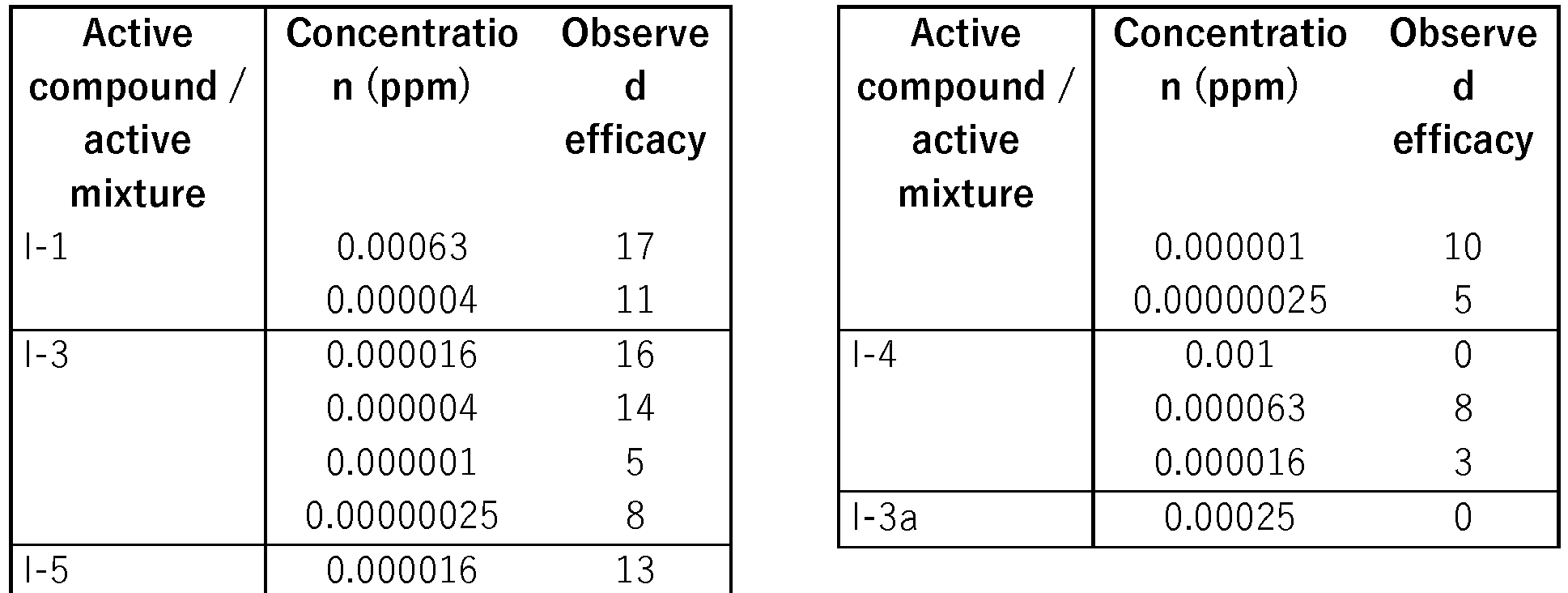
Solo product B Active compound / active mixture Concentration (ppm) Observed efficacy Azoxystrobin 0.063 56 Bixafen 0.063 54 Boscalid 0.25 52 Carbendazim 16 16 Cyazofamid 16 40 Difenoconazol 0.016 26 Epoxiconazol 0.016 16 Fluoxastrobin 0.25 59 Fluxapyroxad 0.063 56 Mepiquat-cl 63 16 Metconazol 0.016 24 Nitenpyram 63 10 Prohexadion-Ca 63 15 Prothioconazol 0.063 58 0.016 17 Pyraclostrobin 0.004 37 Tebuconazol 0.063 15 Thiamethoxam 1 57 0.25 18 0.063 11 Trinexapac-ethyl 4 13 2-way-mixture Active compound / active mixture Concentration (ppm) Observed efficacy Calculated efficacy according to Colby (%) Synergism (%) #I-1 0.000004 76 59 17 Bixafen 0.063 #I-1 0.000063 79 38 41 Difenoconazol 0.016 #I-1 0.000004 80 61 19 Fluxapyroxad 0.063 #I-1 0.000063 91 65 26 Prothioconazol 0.063 #I-1 0.000063 48 31 17 Prothioconazol 0.016 Active compound / active mixture Concentration (ppm) Observed efficacy Calculated efficacy according to Colby (%) Synergism (%) I-3 0.000004 79 60 19 Bixafen 0.063 I-3 0.000001 100 56 44 Bixafen 0.063 I-3 0.000001 96 54 42 Boscalid 0.25 I-3 0.000004 94 62 32 Fluxapyroxad 0.063 I-3 0.000001 92 58 34 Fluxapyroxad 0.063 I-3 0.000004 97 27 70 Mepiquat-cl 63 I-3 0.000001 98 19 79 Mepiquat-cl 63 I-3 0.000001 82 14 68 Nitenpyram 63 I-3 0.000004 90 23 67 Nitenpyram 63 I-3 0.000004 61 27 34 Prohexadion-Ca 63 I-3 0.000001 49 19 30 Prohexadion-Ca 63 I-3 0.000016 92 64 28 Prothioconazol 0.063 I-3 0.00001 95 60 35 Prothioconazol 0.063 I-3 0.00000025 96 61 35 Prothioconazol 0.063 #I-5 0.000016 85 63 22 Prothioconazol 0.063 #I-5 0.000001 46 26 20 Thiamethoxam 0.25 Active compound / active mixture Concentration (ppm) Observed efficacy Calculated efficacy according to Colby (%) Synergism (%) #I-4 0.001 89 26 63 Difenoconazol 0.016 #I-4 0.001 40 16 24 Epoxiconazol 0.016 #I-4 0.001 49 24 25 Metconazol 0.016 #I-4 0.001 98 58 40 Prothioconazol 0.063 #I-4 0.001 79 17 62 Prothioconazol 0.016 #I-4 0.000063 84 61 23 Prothioconazol 0.063 #I-4 0.000016 95 59 36 Prothioconazol 0.063 #I-4 0.001 38 16 22 Tebuconazol 0.063 #I-4 0.001 37 12 25 Thiamethoxam 0.063 Active compound active mixture Concentration (ppm) Observed efficacy Calculated efficacy according to Colby (%) Synergism (%) I-3a 0.00025 97 40 57 Cyazofamid 0.016 I-3a 0.00025 36 17 19 Prothioconazol 0.016 I-3a 0.00025 100 58 42 Prothioconazol 0.063 - The active compounds were formulated separately as a stock solution having a concentration of 10000 ppm in dimethyl sulfoxide.
- The stock solutions were mixed according to the ratio, pipetted onto a micro titer plate (MTP) and diluted with water to the stated concentrations. A spore suspension of Septoria tritici in an aqueous biomalt or yeast-bactopeptone-glycerine solution was then added. The plates were placed in a water vapor-saturated chamber at a temperature of 18° C. Using an absorption photometer, the MTPs were measured at 405 nm 7 days after the inoculation.
- The measured parameters were compared to the growth of the active compound-free control variant (100%) and the fungus-free and active compound-free blank value to determine the relative growth in % of the pathogens in the respective active compounds. These percentages were converted into efficacies.
- The expected efficacies of active compound mixtures were determined using Colby's formula [R.S. Colby, "Calculating synergistic and antagonistic responses of herbicide combinations", Weeds 15, 20-22 (1967)] and compared with the observed efficacies.
Solo product A Active compound / active mixture Concentration (ppm) Observed efficacy I-3 0.004 54 0.000016 16 I-5 0.000016 13 I-4 0.016 18 0.001 0 Solo product B Active compound / active mixture Concentration (ppm) Observed efficacy Azoxystrobin 0.001 12 Bixafen 0.063 54 Difenoconazol 0.016 26 Fluoxastrobin 0.063 23 Prothioconazol 0.063 58 0.016 17 Pyraclostrobin 0.004 37 0.001 12 0.00025 8 0.000063 7 Tebuconazol 0.016 5 Mixtures Active compound / active mixture Concentration (ppm) Observed efficacy Calculated efficacy according to Colby (%) Synergism (%) I-3 0.000016 97 75 22 Bixafen 0.063 Pyraclostrobin 0.004 I-3 0.004 89 64 25 Prothioconazol 0.016 Tebuconazol 0.016 I-3 0.004 88 67 21 Pyraclostrobin 0.00025 Prothioconazol 0.016 Tebuconazol 0.016 #I-5 0.000016 99 75 24 Bixafen 0.063 Pyraclostrobin 0.004 #I-4 0.001 99 71 28 Bixafen 0.063 Pyraclostrobin 0.004 #I-4 0.016 70 46 24 Pyraclostrobin 0.001 Difenoconazol 0.016 - The active compounds were formulated separately as a stock solution having a concentration of 10000 ppm in dimethyl sulfoxide.
- The stock solutions were mixed according to the ratio, pipetted onto a micro titer plate (MTP) and diluted with water to the stated concentrations. A spore suspension of Pyricularia oryzae in an aqueous biomalt or yeast-bactopeptone-glycerine solution was then added. The plates were placed in a water vapor-saturated chamber at a temperature of 18° C. Using an absorption photometer, the MTPs were measured at 405 nm 7 days after the inoculation.
- The measured parameters were compared to the growth of the active compound-free control variant (100%) and the fungus-free and active compound-free blank value to determine the relative growth in % of the pathogens in the respective active compounds. These percentages were converted into efficacies.
- The expected efficacies of active compound mixtures were determined using Colby's formula [R.S. Colby, "Calculating synergistic and antagonistic responses of herbicide combinations", Weeds 15, 20-22 (1967)] and compared with the observed efficacies.
Solo product A Active compound / active mixture Concentration (ppm) Observed efficacy I-1 0.063 11 0.016 0 0.001 3 I-3 0.25 10 0.004 0 I-5 0.063 9 0.016 0 0.004 0 0.001 5 I-4 0.25 23 I-3a 1 47 0.25 3 0.063 4 0.016 6 Solo product B Active compound / active mixture Concentration (ppm) Observed efficacy Azoxystrobin 0.004 1 Boscalid 16 2 Cyazofamid 4 9 Difenoconazol 1 11 0.25 1 Epoxiconazol 0.25 4 0.063 0 Fipronil 16 8 4 1 Fluoxastrobin 0.063 73 0.016 8 Iprovalicarb 4 0 Mepiquat-cl 16 4 Metconazol 0.25 7 Nitenpyram 63 3 16 0 4 1 Prohexadion-Ca 63 3 Prothioconazol 4 23 1 13 Pyraclostrobin 0.004 59 0.001 5 0.00025 2 Tebuconazol 0.25 3 0.063 0 Thiamethoxam 1 56 0.25 11 0.016 3 Trifloxystrobin 0.016 26 0.004 11 Trinexapac-ethyl 63 81 16 21 4 5 2-way-mixture Active compound / active mixture Concentration (ppm) Observed efficacy Calculated efficacy according to Colby (%) Synergism (%) #I-1 0.063 36 18 18 Fluoxastrobin 0.016 #I-1 0.004 53 25 28 Prothioconazol 4 #I-1 0.016 27 3 24 Tebuconazol 0.25 Active compound / active mixture Concentration (ppm) Observed efficacy Calculated efficacy according to Colby (%) Synergism (%) I-3 0.25 32 14 18 Epoxiconazol 0.25 I-3 0.25 58 31 27 Prothioconazol 4 I-3 0.004 59 23 36 Prothioconazol 4 Active compound / active mixture Concentration (ppm) Observed efficacy Calculated efficacy according to Colby (%) Synergism (%) #I-5 0.063 38 13 25 Epoxiconazol 0.25 #I-5 0.063 59 30 29 Prothioconazol 4 #I-5 0.004 55 23 32 Prothioconazol 4 #I-5 0.001 61 27 34 Prothioconazol 4 #I-5 0.016 61 23 38 Prothioconazol 4 Active compound / active mixture Concentration (ppm) Observed efficacy Calculated efficacy according to Colby (%) Synergism (%) #I-4 0.25 89 30 59 Cyazofamid 4 #I-4 0.25 61 32 29 Difenoconazol 1 #I-4 0.25 72 26 46 Epoxiconazol 0.25 #I-4 0.25 46 29 17 Fluoxastrobin 0.016 #I-4 0.25 56 23 33 Iprovalicarb 4 #I-4 0.25 69 41 28 Prothioconazol 4 #I-4 Prothioconazol 0.25 1 63 33 30 #I-4 0.25 57 27 30 Pyraclostrobin 0.001 #I-4 0.25 68 25 43 Tebuconazol 0.25 #I-4 0.25 83 66 17 Thiamethoxam 1 #I-4 0.25 63 43 20 Trifloxystrobin 0.016 #I-4 0.25 51 31 20 Trifloxystrobin 0.004 Active compound / active mixture Concentration (ppm) Observed efficacy Calculated efficacy according to Colby (%) Synergism (%) I-3a 0.063 32 12 20 Cyazofamid 4 I-3a 1 97 51 46 Cyazofamid 4 I-3a 0.016 33 16 17 Difenoconazol 1 I-3a 0.25 25 7 18 Epoxiconazol 0.25 I-3a 0.063 32 10 22 Metconazol 0.25 I-3a 0.25 36 15 21 Prothioconazol 1 I-3a 0.063 58 26 32 Prothioconazol 4 I-3a 0.25 53 26 27 Prothioconazol 4 I-3a 0.25 31 6 25 Tebuconazol 0.25 - The active compounds were formulated separately as a stock solution having a concentration of 10000 ppm in dimethyl sulfoxide.
- The stock solutions were mixed according to the ratio, pipetted onto a micro titer plate (MTP) and diluted with water to the stated concentrations. A spore suspension of Pyricularia oryzae in an aqueous biomalt or yeast-bactopeptone-glycerine solution was then added. The plates were placed in a water vapor-saturated chamber at a temperature of 18° C. Using an absorption photometer, the MTPs were measured at 405 nm 7 days after the inoculation.
- The measured parameters were compared to the growth of the active compound-free control variant (100%) and the fungus-free and active compound-free blank value to determine the relative growth in % of the pathogens in the respective active compounds. These percentages were converted into efficacies.
- The expected efficacies of active compound mixtures were determined using Colby's formula [R.S. Colby, "Calculating synergistic and antagonistic responses of herbicide combinations", Weeds 15, 20-22 (1967)] and compared with the observed efficacies.
Solo product A Active compound / active mixture Concentration (ppm) Observed efficacy I-1 0.25 8 I-3 1 37 I-5 1 67 I-4 1 47 

Mixtures Active compound / active mixture Concentration (ppm) Observed efficacy Calculated efficacy according to Colby (%) Synergism (%) #I-1 0.25 90 21 69 Pyraclostrobin 0.00025 Prothioconazol 1 #I-1 0.25 27 10 17 Pyraclostrobin 0.00025 Difenoconazol 0.25 #I-1 0.25 98 61 37 Epoxiconazol 0.063 Metconazol 1 #I-1 0.25 77 20 57 Prothioconazol 1 Tebuconazol 0.063 #I-1 0.25 86 21 65 Bixafen 0.016 Prothioconazol 1 #I-1 0.25 91 23 68 Pyraclostrobin 0.00025 Fluoxastrobin 0.004 Prothioconazol 1 #I-1 0.25 91 21 70 Pyraclostrobin 0.00025 Prothioconazol 1 Tebuconazol 0.063 #I-1 0.25 90 29 61 Pyraclostrobin 0.00025 Trifloxystrobin 0.004 Prothioconazol 1 #I-1 0.25 37 16 21 Pyraclostrobin 0.00025 Prohexadion 4 Trinexapac-ethyl 4 #I-1 0.25 92 21 71 Bixafen 0.016 Prothioconazol 1 Tebuconazol 0.063 #I-1 0.25 82 23 59 Bixafen 0.016 Pyraclostrobin 0.00025 Prothioconazol 1 Active compound / active mixture Concentration (ppm) Observed efficacy Calculated efficacy according to Colby (%) Synergism (%) I-3 1 77 43 34 Pyraclostrobin 0.001 Epoxiconazol 0.25 I-3 1 69 46 23 Pyraclostrobin 0.001 Fluoxastrobin 0.016 I-3 1 89 54 35 Pyraclostrobin 0.001 Prothioconazol 4 I-3 1 82 56 26 Pyraclostrobin 0.001 Trifloxystrobin 0.016 I-3 1 70 47 23 Pyraclostrobin 0.001 Difenoconazol 1 I-3 1 72 44 28 Epoxiconazol 0.25 Chlorothalonil 0.063 I-3 1 70 41 29 Isopyrazam 0.004 Epoxiconazol 0.25 I-3 1 86 53 33 Prothioconazol 4 Tebuconazol 0.25 I-3 1 78 53 25 Bixafen 0.063 Prothioconazol 4 I-3 1 93 58 35 Pyraclostrobin 0.001 Fluoxastrobin 0.016 Prothioconazol 4 I-3 1 92 56 36 Pyraclostrobin 0.001 Prothioconazol 4 Tebuconazol 0.25 I-3 1 99 66 33 Pyraclostrobin 0.001 Trifloxystrobin 0.016 Prothioconazol 4 I-3 1 100 54 46 Pyraclostrobin 0.001 Prohexadion 16 Trinexapac-ethyl 16 I-3 1 86 54 32 Bixafen 0.063 Prothioconazol 4 Tebuconazol 0.25 I-3 1 86 55 31 Bixafen 0.063 Pyraclostrobin 0.001 Prothioconazol 4 I-3 1 73 43 30 Bixafen 0.063 Pyraclostrobin 0.001 Tebuconazol 0.25 Active compound / active mixture Concentration (ppm) Observed efficacy Calculated efficacy according to Colby (%) Synergism (%) #I-5 1 93 72 21 Pyraclostrobin 0.001 Difenoconazol 1 #I-5 1 89 69 20 Isopyrazam 0.004 Epoxiconazol 0.25 #I-5 1 90 68 22 Prohexadion 16 Mepiquat-cl 4 #I-5 1 94 75 19 Bixafen 0.063 Prothioconazol 4 #I-5 1 97 69 28 Bixafen 0.063 Pyraclostrobin 0.001 #I-5 1 100 78 22 Pyraclostrobin 0.001 Fluoxastrobin 0.016 Prothioconazol 4 #I-5 1 100 77 23 Pyraclostrobin 0.001 Prothioconazol 4 Tebuconazol 0.25 #I-5 1 100 82 18 Pyraclostrobin 0.001 Trifloxystrobin 0.016 Prothioconazol 4 #I-5 1 100 76 24 Pyraclostrobin 0.001 Prohexadion 16 Trinexapac-ethyl 16 #I-5 1 90 70 20 Bixafen 0.063 Pyraclostrobin 0.001 Tebuconazol 0.25 #I-4 1 75 52 23 Pyraclostrobin 0.001 Epoxiconazol 0.25 #I-4 1 96 61 35 Pyraclostrobin 0.001 Prothioconazol 4 #I-4 1 90 63 27 Pyraclostrobin 0.001 Trifloxystrobin 0.016 #I-4 1 83 49 34 Isopyrazam 0.004 Epoxiconazol 0.25 #I-4 1 96 60 36 Prothioconazol 4 Tebuconazol 0.25 #I-4 1 84 60 24 Bixafen 0.063 Prothioconazol 4 #I-4 1 99 64 35 Pyraclostrobin 0.001 Fluoxastrobin 0.016 Prothioconazol 4 #I-4 1 97 62 35 Pyraclostrobin 0.001 Prothioconazol 4 Tebuconazol 0.25 #I-4 1 100 71 29 Pyraclostrobin 0.001 Trifloxystrobin 0.016 Prothioconazol 4 #I-4 1 100 61 39 Pyraclostrobin 0.001 Prohexadion 16 Trinexapac-ethyl 16 #I-4 1 89 61 28 Bixafen 0.063 Prothioconazol 4 Tebuconazol 0.25 #I-4 1 97 62 35 Bixafen 0.063 Pyraclostrobin 0.001 Prothioconazol 4 #I-4 1 86 52 34 Bixafen 0.063 Pyraclostrobin 0.001 Tebuconazol 0.25 - The active compounds were formulated separately as a stock solution having a concentration of 10000 ppm in dimethyl sulfoxide.
- The stock solutions were mixed according to the ratio, pipetted onto a micro titer plate (MTP) and diluted with water to the stated concentrations. A spore suspension of Phytophtora infestans containing a pea juice-based aqueous nutrient medium or DDC medium was then added. The plates were placed in a water vapor-saturated chamber at a temperature of 18° C. Using an absorption photometer, the MTPs were measured at 405 nm 7 days after the inoculation.
- The measured parameters were compared to the growth of the active compound-free control variant (100%) and the fungus-free and active compound-free blank value to determine the relative growth in % of the pathogens in the respective active compounds. These percentages were converted into efficacies. The expected efficacies of active compound mixtures were determined using Colby's formula [R.S. Colby, "Calculating synergistic and antagonistic responses of herbicide combinations", Weeds 15, 20-22 (1967)] and compared with the observed efficacies.
Solo product A Active compound / active mixture Concentration (ppm) Observed efficacy I-1 16 0 I-3 16 4 4 4 I-5 63 45 16 2 I-4 16 9 4 3 Solo product B Active compound / active mixture Concentration (ppm) Observed efficacy Ametoctradin 1 75 0.25 19 0.063 2 Azoxystrobin 0.016 2 Chlorothalonil 0.016 2 Cyazofamid 0.004 8 Epoxiconazol 0.063 1 Fipronil 1 4 Fluoxastrobin 0.25 73 0.063 16 0.016 4 Iprovalicarb 0.25 19 Isopyrazam 16 23 Mepiquat-cl 4 5 Metconazol 0.004 2 Prothioconazol 16 35 4 12 1 4 0.25 2 Pyraclostrobin 0.063 34 Tebuconazol 0.016 1 Thiamethoxam 4 2 1 1 Trifloxystrobin 0.25 8 0.063 3 2-way-mixture Active compound / active mixture Concentration (ppm) Observed efficacy Calculated efficacy according to Colby (%) Synergism (%) #I-1 16 40 19 21 Ametoctradin 0.25 #I-1 16 35 8 27 Cyazofamid 0.004 #I-1 16 27 4 23 Fipronil 1 Active compound / active mixture Concentration (ppm) Observed efficacy Calculated efficacy according to Colby (%) Synergism (%) #I-1 16 44 23 21 Isopyrazam 16 #I-1 16 54 12 42 Prothioconazol 4 #I-1 16 68 35 33 Prothioconazol 16 Active compound / active mixture Concentration (ppm) Mixture Observed efficacy Calculated efficacy according to Colby (%) Synergism (%) I-3 16 63 : 1 70 22 48 Iprovalicarb 0.25 I-3 4 16 : 1 42 22 20 Iprovalicarb 0.25 Active compound / active mixture Concentration (ppm) Observed efficacy Calculated efficacy according to Colby (%) Synergism (%) #I-5 63 81 55 26 Ametoctradin 0.25 #I-5 16 97 76 21 Ametoctradin 1 #I-5 16 99 21 78 Ametoctradin 0.25 #I-5 16 32 4 28 Azoxystrobin 0.016 #I-5 16 21 4 17 Chlorothalonil 0.016 #I-5 16 37 10 27 Cyazofamid 0.004 #I-5 16 21 3 18 Epoxiconazol 0.063 #I-5 16 26 5 21 Active compound / active mixture Concentration (ppm) Observed efficacy Calculated efficacy according to Colby (%) Synergism (%) #I-5 16 42 17 25 Fluoxastrobin 0.063 #I-5 16 34 6 28 Fluoxastrobin 0.016 #I-5 16 45 21 24 Iprovalicarb 0.25 #I-5 63 96 55 41 Iprovalicarb 0.25 #I-5 16 26 6 20 Mepiquat-cl 4 #I-5 16 21 4 17 Metconazol 0.004 #I-5 16 27 6 21 Prothioconazol 1 #I-5 16 22 4 18 Prothioconazol 0.25 #I-5 16 22 3 19 Tebuconazol 0.016 #I-5 16 31 3 28 Thiamethoxam 1 #I-5 16 24 4 20 Thiamethoxam 4 #I-5 16 31 5 26 Trifloxystrobin 0.063 #I-5 16 33 10 23 Trifloxystrobin 0.25 Active compound / active mixture Concentration (ppm) Observed efficacy Calculated efficacy according to Colby (%) Synergism (%) #I-4 16 98 26 72 Ametoctradin 0.25 #I-4 16 99 77 22 Ametoctradin 1 #I-4 16 96 75 21 Fluoxastrobin 0.25 #I-4 16 63 26 37 Iprovalicarb 0.25 #I-4 16 94 40 54 Prothioconazol 16 #I-4 4 66 37 29 Prothioconazol 16 #I-4 16 85 40 45 Pyraclostrobin 0.063 - The active compounds were formulated separately as a stock solution having a concentration of 10000 ppm in dimethyl sulfoxide.
- The stock solutions were mixed according to the ratio, pipetted onto a micro titer plate (MTP) and diluted with water to the stated concentrations. A spore suspension of Phytophtora infestans containing a pea juice-based aqueous nutrient medium or DDC medium was then added. The plates were placed in a water vapor-saturated chamber at a temperature of 18° C. Using an absorption photometer, the MTPs were measured at 405 nm 7 days after the inoculation.
- The measured parameters were compared to the growth of the active compound-free control variant (100%) and the fungus-free and active compound-free blank value to determine the relative growth in % of the pathogens in the respective active compounds.
- These percentages were converted into efficacies. The expected efficacies of active compound mixtures were determined using Colby's formula [R.S. Colby, "Calculating synergistic and antagonistic responses of herbicide combinations", Weeds 15, 20-22 (1967)] and compared with the observed efficacies.
Solo product A Active compound / active mixture Concentration (ppm) Observed efficacy I-4 16 9 Solo product B Active compound / active mixture Concentration (ppm) Observed efficacy Bixafen 1 25 Carbendazim 4 24 Difenoconazol 4 30 Epoxiconazol 4 27 Prothioconazol 16 35 Pyraclostrobin 0.063 34 Tebuconazol 1 25 Trifloxystrobin 1 37 Mixtures Active compound / active mixture Concentration (ppm) Observed efficacy Calculated efficacy according to Colby (%) Synergism (%) #I-4 16 86 56 30 Pyraclostrobin 0.063 Epoxiconazol 4 #I-4 16 90 61 29 Pyraclostrobin 0.063 Prothioconazol 16 #I-4 16 94 62 32 Pyraclostrobin 0.063 Trifloxystrobin 1 #I-4 16 81 55 26 Pyraclostrobin 0.063 Carbendazim 4 #I-4 16 94 58 36 Pyraclostrobin 0.063 Difenoconazol 4 #I-4 16 95 56 39 Prothioconazol 16 Tebuconazol 1 #I-4 16 74 56 18 Bixafen 1 Prothioconazol 16 #I-4 16 78 55 23 Bixafen 1 Pyraclostrobin 0.063 #I-4 16 90 71 19 Pyraclostrobin 0.063 Prothioconazol 16 Tebuconazol 1 #I-4 16 98 75 23 Pyraclostrobin 0.063 Trifloxystrobin 1 Prothioconazol 16 #I-4 16 86 67 19 Bixafen 1 Prothioconazol 16 Tebuconazol 1 #I-4 16 98 71 27 Bixafen 1 Pyraclostrobin 0.063 Prothioconazol 16 - The active compounds were formulated separately as a stock solution having a concentration of 10000 ppm in dimethyl sulfoxide.
- The stock solutions were mixed according to the ratio, pipetted onto a micro titer plate (MTP) and diluted with water to the stated concentrations. A spore suspension of Leptosphaeria nodorum in an aqueous biomalt or yeast-bactopeptone-glycerine solution was then added. The plates were placed in a water vapor-saturated chamber at a temperature of 18° C. Using an absorption photometer, the MTPs were measured at 405 nm 7 days after the inoculation.
- The measured parameters were compared to the growth of the active compound-free control variant (100%) and the fungus-free and active compound-free blank value to determine the relative growth in % of the pathogens in the respective active compounds.
- These percentages were converted into efficacies. The expected efficacies of active compound mixtures were determined using Colby's formula [R.S. Colby, "Calculating synergistic and antagonistic responses of herbicide combinations", Weeds 15, 20-22 (1967)] and compared with the observed efficacies.
Solo product A Active compound / active mixture Concentration (ppm) Observed efficacy I-1 0.000063 12 I-3 0.000063 26 I-5 0.063 20 0.001 9 I-3a 0.004 2 0.001 3 


- The active compounds were formulated separately as a stock solution having a concentration of 10000 ppm in dimethyl sulfoxide.
- The stock solutions were mixed according to the ratio, pipetted onto a micro titer plate (MTP) and diluted with water to the stated concentrations. A spore suspension of Leptosphaeria nodorum in an aqueous biomalt or yeast-bactopeptone-glycerine solution was then added. The plates were placed in a water vapor-saturated chamber at a temperature of 18° C. Using an absorption photometer, the MTPs were measured at 405 nm 7 days after the inoculation.
- The measured parameters were compared to the growth of the active compound-free control variant (100%) and the fungus-free and active compound-free blank value to determine the relative growth in % of the pathogens in the respective active compounds.
- These percentages were converted into efficacies.
- The expected efficacies of active compound mixtures were determined using Colby's formula [R.S. Colby, "Calculating synergistic and antagonistic responses of herbicide combinations", Weeds 15, 20-22 (1967)] and compared with the observed efficacies.
Solo product A Active compound / active mixture Concentration (ppm) Observed efficacy I-1 0.063 19 I-5 0.25 19 0.063 20 I-4 0.001 15 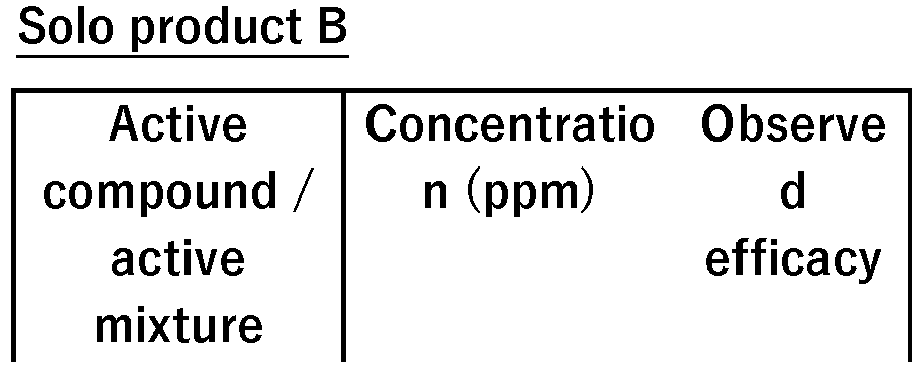

Mixtures Active compound / active mixture Concentration (ppm) Observed efficacy Calculated efficacy according to Colby (%) Synergism (%) #I-1 0.063 76 52 24 Bixafen 0.063 Prothioconazol 0.25 #I-1 0.063 83 63 20 Bixafen 0.063 Prothioconazol 0.25 Tebuconazol 0.063 #I-1 0.063 81 63 18 Bixafen 0.063 Pyraclostrobin 0.016 Prothioconazol 0.25 #I-5 0.063 99 49 50 Prohexadion-Ca 63 Trinexapac-ethyl 63 #I-5 0.063 99 63 36 Prohexadion-Ca 63 Trinexapac-ethyl 63 Mepiquat-cl 63 #I-5 0.25 94 74 20 Prothioconazol 1 Tebuconazol 0.25 #I-5 0.25 85 63 22 Bixafen 0.25 Prothioconazol 1 #I-4 0.001 99 46 53 Prohexadion-Ca 63 Trinexapac-ethyl 63 #I-4 0.001 99 61 38 Prohexadion-Ca 63 Trinexapac-ethyl 63 Mepiquat-cl 63 - The active compounds were formulated separately as a stock solution having a concentration of 10000 ppm in dimethyl sulfoxide.
- The stock solutions were mixed according to the ratio, pipetted onto a micro titer plate (MTP) and diluted with water to the stated concentrations. A spore suspension of Botrci cinerea in an aqueous biomalt or yeast-bactopeptone-sodiumacetate solution was then added. The plates were placed in a water vapor-saturated chamber at a temperature of 18° C. Using an absorption photometer, the MTPs were measured at 405 nm 7 days after the inoculation.
- The measured parameters were compared to the growth of the active compound-free control variant (100%) and the fungus-free and active compound-free blank value to determine the relative growth in % of the pathogens in the respective active compounds. These percentages were converted into efficacies.
- The expected efficacies of active compound mixtures were determined using Colby's formula [R.S. Colby, "Calculating synergistic and antagonistic responses of herbicide combinations", Weeds 15, 20-22 (1967)] and compared with the observed efficacies.


Solo product B Active compound / active mixture Concentration (ppm) Observed efficacy Ametoctradin 63 4 16 3 Azoxystrobin 4 14 0.25 6 Bixafen 0.063 26 Boscalid 0.25 38 Chlorothalonil 4 41 Cyazofamid 16 24 DifenoconazoI 0.25 19 Fluoxastrobin 16 23 4 10 1 5 Iprovalicarb 63 6 16 3 4 2 Metconazol 0.063 29 Prohexadion-Ca 63 4 Prothioconazol 4 72 1 36 0.25 23 Pyraclostrobin 16 66 4 29 Tebuconazol 0.25 41 Thiamethoxam 63 8 Trifloxystrobin 16 6 4 2 Trinexapac-ethyl 63 15 16 5 2-way-mixture Active compound / active mixture Concentration (ppm) Observed efficacy Calculated efficacy according to Colby (%) Synergism (%) #I-1 0.000063 55 38 17 Boscalid 0.25 #I-1 0.000063 68 36 32 Prothioconazol 1 #I-1 0.000004 89 72 17 Prothioconazol 4 #I-1 0.000063 41 23 18 Prothioconazol 0.25 #I-1 0.000016 92 72 20 Prothioconazol 4 #I-1 0.000063 92 66 26 Pyraclostrobin 16 #I-1 0.000063 59 29 30 Pyraclostrobin 4 #I-1 0.000001 51 31 20 Pyraclostrobin 4 Active compound / active mixture Concentration (ppm) Observed efficacy Calculated efficacy according to Colby (%) Synergism (%) I-3 0.000063 45 26 19 Bixafen 0.063 I-3 0.000004 91 72 19 Prothioconazol 4 I-3 0.000016 63 39 24 Prothioconazol 1 I-3 0.000063 78 36 42 Prothioconazol 1 I-3 0.000063 43 23 20 Prothioconazol 0.25 I-3 0.000063 56 29 27 Pyraclostrobin 4 I-3 0.000063 24 6 18 Trifloxystrobin 16 #I-5 0.25 53 29 24 Iprovalicarb 16 #I-5 0.063 36 19 17 Iprovalicarb 63 #I-5 0.25 66 48 18 Pyraclostrobin 4 Active compound / active mixture Concentration (ppm) Observed efficacy Calculated efficacy according to Colby (%) Synergism (%) #I-4 0.001 36 18 18 Azoxystrobin 4 #I-4 0.001 53 30 23 Bixafen 0.063 #I-4 0.001 61 41 20 Boscalid 0.25 #I-4 0.000063 62 43 19 Chlorothalonil 4 #I-4 0.001 61 39 22 Prothioconazol 1 #I-4 0.001 86 68 18 Pyraclostrobin 16 #I-4 0.001 79 32 47 Pyraclostrobin 4 #I-4 0.00025 28 10 18 Thiamethoxam 63 #I-4 0.001 30 11 19 Trifloxystrobin 16 Active compound / active mixture Concentration (ppm) Observed efficacy Calculated efficacy according to Colby (%) Synergism (%) I-3a 0.016 77 6 71 Iprovalicarb 63 I-3a 0.016 26 3 23 Iprovalicarb 16 I-3a 0.016 97 72 25 Prothioconazol 4 I-3a 0.016 99 36 63 Prothioconazol 1 I-3a 0.016 49 23 26 Prothioconazol 0.25 I-3a 0.001 84 36 48 Prothioconazol 1 I-3a 0.00025 86 36 50 Prothioconazol 1 - The active compounds were formulated separately as a stock solution having a concentration of 10000 ppm in dimethyl sulfoxide.
- The stock solutions were mixed according to the ratio, pipetted onto a micro titer plate (MTP) and diluted with water to the stated concentrations. A spore suspension of Botrci cinerea in an aqueous biomalt or yeast-bactopeptone-sodiumacetate solution was then added. The plates were placed in a water vapor-saturated chamber at a temperature of 18° C. Using an absorption photometer, the MTPs were measured at 405 nm 7 days after the inoculation.
- The measured parameters were compared to the growth of the active compound-free control variant (100%) and the fungus-free and active compound-free blank value to determine the relative growth in % of the pathogens in the respective active compounds. These percentages were converted into efficacies.
- The expected efficacies of active compound mixtures were determined using Colby's formula [R.S. Colby, "Calculating synergistic and antagonistic responses of herbicide combinations", Weeds 15, 20-22 (1967)] and compared with the observed efficacies.


Solo product B Active compound / active mixture Concentration (ppm) Observed efficacy Azoxystrobin 16 23 4 14 Bixafen 0.063 26 0.016 8 Carbendazim 0.016 3 0.004 5 Chlorothalonil 4 41 1 23 Difenoconazo l 0.25 19 0.063 10 Epoxiconazol 0.063 23 0.016 11 Fluoxastrobin 4 10 1 5 Isopyrazam 0.016 6 Mepiquat-cl 16 11 Metconazol 0.063 29 Prohexadion-Ca 16 5 4 10 Prothioconazol 1 36 0.25 23 Pyraclostrobin 16 66 4 29 Tebuconazol 0.063 12 0.016 9 Trifloxystrobin 16 6 4 2 Trinexapac-ethyl 16 5 4 7 Mixtures Active compound / active mixture Concentration (ppm) Observed efficacy Calculated efficacy according to Colby (%) Synergism (%) #I-1 0.000016 100 74 26 Pyraclostrobin 16 Chlorothalonil 1 #I-1 0.000063 100 55 45 Azoxystrobin 16 Chlorothalonil 4 #I-1 0.063 83 54 29 Pyraclostrobin 4 Prothioconazol 0.25 #I-1 0.063 62 45 17 Bixafen 0.016 Pyraclostrobin 4 #I-1 0.063 85 56 29 Pyraclostrobin 4 Fluoxastrobin 1 Prothioconazol 0.25 #I-1 0.063 88 58 30 Pyraclostrobin 4 Prothioconazol 0.25 Tebuconazol 0.016 #I-1 0.063 84 55 29 Pyraclostrobin 4 Trifloxystrobin 4 Prothioconazol 0.25 #I-1 0.063 69 49 20 Bixafen 0.016 Pyraclostrobin 4 Tebuconazol 0.016 #I-1 0.000016 100 78 22 Pyraclostrobin 16 Azoxystrobin 4 Chlorothalonil 1 Active compound / active mixture Concentration (ppm) Observed efficacy Calculated efficacy according to Colby (%) Synergism (%) I-3 0.000016 100 75 25 Pyraclostrobin 16 Chlorothalonil 1 I-3 0.000063 99 55 44 Azoxystrobin 16 Chlorothalonil 4 I-3 0.063 77 51 26 Pyraclostrobin 4 Epoxiconazol 0.016 I-3 0.063 82 47 35 Pyraclostrobin 4 Fluoxastrobin 1 I-3 0.063 92 58 34 Pyraclostrobin 4 Prothioconazol 0.25 I-3 0.063 81 46 35 Pyraclostrobin 4 Trifloxystrobin 4 I-3 0.063 75 48 27 Pyraclostrobin 4 Carbendazim 0.004 I-3 0.063 79 51 28 Pyraclostrobin 4 Difenoconazol 0.063 I-3 0.063 71 51 20 Pyraclostrobin 4 Prohexadion-Ca 4 I-3 0.063 86 49 37 Bixafen 0.016 Pyraclostrobin 4 I-3 0.063 91 60 31 Pyraclostrobin 4 Fluoxastrobin 1 Prothioconazol 0.25 I-3 0.063 92 62 30 Pyraclostrobin 4 Prothioconazol 0.25 Tebuconazol 0.016 I-3 0.063 87 59 28 Pyraclostrobin 4 Trifloxystrobin 4 Prothioconazol 0.25 I-3 0.063 90 61 29 Bixafen 0.016 Pyraclostrobin 4 Prothioconazol 0.25 I-3 0.063 69 54 15 Bixafen 0.016 Pyraclostrobin 4 Tebuconazol 0.016 I-3 0.000016 100 79 21 Pyraclostrobin 16 Azoxystrobin 4 Chlorothalonil 1 Active compound / active mixture Concentration (ppm) Observed efficacy Calculated efficacy according to Colby (%) Synergism (%) #I-5 0.063 100 78 22 Pyraclostrobin 16 Chlorothalonil 1 #I-5 0.063 86 48 38 Trifloxystrobin 16 Prothioconazol 1 #I-5 0.25 96 67 29 Azoxystrobin 16 Chlorothalonil 4 #I-5 0.063 100 81 19 Pyraclostrobin 16 Azoxystrobin 4 Chlorothalonil 1 Active compound / active mixture Concentration (ppm) Observed efficacy Calculated efficacy according to Colby (%) Synergism (%) #I-4 0.00025 100 75 25 Pyraclostrobin 16 Chlorothalonil 1 #I-4 0.001 100 57 43 Azoxystrobin 16 Chlorothalonil 4 #I-4 0.063 74 48 26 Pyraclostrobin 4 Prothioconazol 0.25 #I-4 0.25 84 53 31 Pyraclostrobin 1 Tebuconazol 0.063 #I-4 0.25 83 61 22 Bixafen 0.063 Prothioconazol 1 #I-4 0.063 58 37 21 Bixafen 0.016 Pyraclostrobin 4 #I-4 0.063 88 50 38 Pyraclostrobin 4 Fluoxastrobin 1 Prothioconazol 0.25 #I-4 0.063 85 52 33 Pyraclostrobin 4 Prothioconazol 0.25 Tebuconazol 0.016 #I-4 0.063 83 49 34 Pyraclostrobin 4 Trifloxystrobin 4 Prothioconazol 0.25 #I-4 0.25 85 65 20 Bixafen 0.063 Prothioconazol 1 Tebuconazol 0.063 #I-4 0.063 85 52 33 Bixafen 0.016 Pyraclostrobin 4 Prothioconazol 0.25 #I-4 0.063 62 42 20 Bixafen 0.016 Pyraclostrobin 4 Tebuconazol 0.016 - The active compounds were formulated separately as a stock solution having a concentration of 10000 ppm in dimethyl sulfoxide.
- The stock solutions were mixed according to the ratio, pipetted onto a micro titer plate (MTP) and diluted with water to the stated concentrations. A spore suspension of Alternaria solani in an aqueous biomalt or yeast-bactopeptone-glycerine solution was then added. The plates were placed in a water vapor-saturated chamber at a temperature of 18° C. Using an absorption photometer, the MTPs were measured at 405 nm 7 days after the inoculation.
- The measured parameters were compared to the growth of the active compound-free control variant (100%) and the fungus-free and active compound-free blank value to determine the relative growth in % of the pathogens in the respective active compounds.
- These percentages were converted into efficacies.
- The expected efficacies of active compound mixtures were determined using Colby's formula [R.S. Colby, "Calculating synergistic and antagonistic responses of herbicide combinations", Weeds 15, 20-22 (1967)] and compared with the observed efficacies.
Solo product A Active compound / active mixture Concentration (ppm) Observed efficacy I-1 0.001 10 0.000004 8 I-3 0.000063 8 0.000004 5 I-5 1 49 0.063 14 0.016 10 0.004 11 Active compound / active mixture Concentration (ppm) Observe d efficacy I-4 0.001 10 0.00025 7 0.000063 5 I-3a 0.016 36 

2-way-mixture Active compound / active mixture Concentration (ppm) Observed efficacy Calculated efficacy according to Colby (%) Synergism (%) #I-1 0.001 43 23 20 Azoxystrobin 0.016 #I-1 0.001 57 34 23 Fluoxastrobin 0.063 #I-1 0.001 42 23 19 Isopyrazam 0.016 #I-1 0.000004 46 21 25 Isopyrazam 0.016 I-3 0.000063 42 14 28 Azoxystrobin 0.016 I-3 0.000063 54 27 27 Fluoxastrobin 0.063 I-3 0.000063 42 15 27 Isopyrazam 0.016 I-3 0.000004 57 19 38 Isopyrazam 0.016 I-3 0.000063 47 18 29 Pyraclostrobin 0.016 I-3 0.000063 32 11 21 Trifloxystrobin 0.016 Active compound / active mixture Concentration (ppm) Observed efficacy Calculated efficacy according to Colby (%) Synergism (%) #I-5 1 82 52 30 Ametoctradin 4 #I-5 1 82 50 32 Ametoctradin 16 #I-5 1 76 53 23 Azoxystrobin 0.004 #I-5 1 83 57 26 Azoxystrobin 0.016 #I-5 1 81 52 29 Bixafen 0.00025 #I-5 1 82 52 30 Bixafen 0.001 #I-5 1 79 53 26 Boscalid 0.004 #I-5 1 81 54 27 Carbendazim 16 #I-5 1 70 52 18 Chlorothalonil 0.063 #I-5 1 75 50 25 Chlorothalonil 0.25 #I-5 1 79 56 23 Cyazofamid 4 #I-5 1 88 52 36 Difenoconazol 0.016 #I-5 1 89 59 30 Difenoconazol 0.063 #I-5 1 75 52 23 Difenoconazol 0.004 #I-5 1 72 54 18 Epoxiconazol 0.016 #I-5 1 76 52 24 Epoxiconazol 0.004 #I-5 1 72 52 20 Fipronil 1 #I-5 1 78 50 28 Fipronil 4 #I-5 1 85 63 22 Fluoxastrobin 0.063 #I-5 1 85 55 30 Fluoxastrobin 0.016 #I-5 1 82 51 31 Fluxapyroxad 0.001 #I-5 1 74 50 24 Iprovalicarb 16 #I-5 1 76 50 26 Iprovalicarb 63 #I-5 1 81 50 31 Iprovalicarb 4 #I-5 0.063 55 27 28 Isopyrazam 0.016 #I-5 0.016 52 23 29 Isopyrazam 0.016 #I-5 1 78 58 20 Metconazol 0.016 #I-5 0.016 48 26 22 Metconazol 0.016 #I-5 0.004 46 27 19 Metconazol 0.016 #I-5 1 82 53 29 Nitenpyram 63 #I-5 1 81 51 30 Nitenpyram 4 #I-5 1 79 51 28 Nitenpyram 16 #I-5 1 76 50 26 Prohexadion-Ca 16 #I-5 1 86 52 34 Prohexadion-Ca 4 #I-5 1 83 57 26 Prothioconazol 0.25 #I-5 1 90 53 37 Prothioconazol 0.063 #I-5 1 79 59 20 Pyraclostrobin 0.016 #I-5 1 80 54 26 Pyraclostrobin 0.004 #I-5 1 69 47 22 Tebuconazol 0.063 #I-5 1 78 53 25 Tebuconazol 0.016 #I-5 1 85 55 30 Thiamethoxam 1 #I-5 1 87 53 34 Thiamethoxam 0.25 #I-5 0.25 72 48 24 Thiamethoxam 1 #I-5 1 84 55 29 Trifloxystrobin 0.016 #I-5 1 85 53 32 Trifloxystrobin 0.004 #I-5 1 79 56 23 Trinexapac-ethyl 4 #I-4 0.001 49 23 26 Azoxystrobin 0.016 #I-4 0.00025 58 39 19 Cyazofamid 16 #I-4 0.001 46 26 20 Difenoconazol 0.063 #I-4 0.001 44 26 18 Metconazol 0.016 #I-4 0.001 78 34 44 Fluoxastrobin 0.063 #I-4 0.001 70 23 47 Prothioconazol 0.25 #I-4 0.000063 44 19 25 Prothioconazol 0.25 #I-4 0.000063 88 68 20 Prothioconazol 1 #I-4 0.001 43 18 25 Pyraclostrobin 0.004 #I-4 0.001 88 26 62 Pyraclostrobin 0.016 #I-4 0.001 41 21 20 Trifloxystrobin 0.016 Active compound / active mixture Concentration (ppm) Observed efficacy Calculated efficacy according to Colby (%) Synergism (%) I-3a 0.016 65 46 19 Azoxystrobin 0.016 I-3a 0.016 72 41 31 Nitenpyram 63 I-3a 0.016 64 46 18 Prothioconazol 0.25 - The active compounds were formulated separately as a stock solution having a concentration of 10000 ppm in dimethyl sulfoxide.
- The stock solutions were mixed according to the ratio, pipetted onto a micro titer plate (MTP) and diluted with water to the stated concentrations. A spore suspension of Alternaria solani in an aqueous biomalt or yeast-bactopeptone-glycerine solution was then added. The plates were placed in a water vapor-saturated chamber at a temperature of 18° C. Using an absorption photometer, the MTPs were measured at 405 nm 7 days after the inoculation.
- The measured parameters were compared to the growth of the active compound-free control variant (100%) and the fungus-free and active compound-free blank value to determine the relative growth in % of the pathogens in the respective active compounds.
- These percentages were converted into efficacies.
- The expected efficacies of active compound mixtures were determined using Colby's formula [R.S. Colby, "Calculating synergistic and antagonistic responses of herbicide combinations", Weeds 15, 20-22 (1967)] and compared with the observed efficacies.
Solo product A Active compound / active mixture Concentration (ppm) Observed efficacy I-1 0.00025 4 I-5 1 49 I-4 0.25 33 Solo product B Active compound / active mixture Concentration (ppm) Observed efficacy Bixafen 0.001 5 Difenoconazol 0.063 5 Mepiquat-cl 63 16 Prohexadion-Ca 63 2 16 2 Prothioconazol 0.25 15 Pyraclostrobin 0.016 18 Mixtures Active compound / active mixture Concentration (ppm) Observed efficacy Calculated efficacy according to Colby (%) Synergism (%) #I-1 0.00025 57 23 34 Bixafen 0.001 Prothioconazol 0.25 #I-5 1 76 58 18 Prohexadion-Ca 63 Mepiquat-cl 63 #I-4 0.25 65 48 17 Pyraclostrobin 0.016 Difenoconazol 0.063 #I-4 0.25 66 46 20 Pyraclostrobin 0.016 Prohexadion-Ca 16 #I-4 0.25 71 46 25 Bixafen 0.001 Prothioconazol 0.25 #I-4 0.25 70 48 22 Bixafen 0.001 Pyraclostrobin 0.016 Structures of the compounds I: #I-1 
2-[2-chloro-4-(4-chlorophenoxy)phenyl]-1-(1,2,4-triazol-1-yl)pent-3-yn-2-ol #I-2 
1-[2-chloro-4-(4-chlorophenoxy)phenyl]-1-cyclopropyl-2-(1,2,4-triazol-1-yl)ethanol I-3 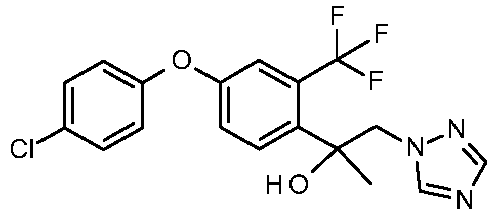
2-[4-(4-chlorophenoxy)-2-(trifluoromethyl)phenyl]-1-(1,2,4-triazol-1-yl)propan-2-ol I-3a = (R)-I-3=(R) enantiomer of I-3 
#I-4 
1-[4-(4-chlorophenoxy)-2-(trifluoromethyl)phenyl]-1-cyclopropyl-2-(1,2,4-triazol-1-yl)ethanol #I-5 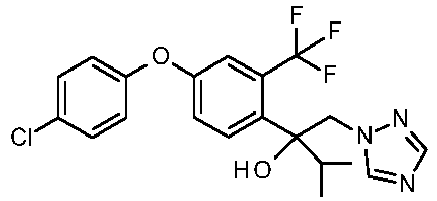
2-[4-(4-chlorophenoxy)-2-(trifluoromethyl)phenyl]-3-methyl-1-(1,2,4-triazol-1-yl)butan-2-ol #I-6 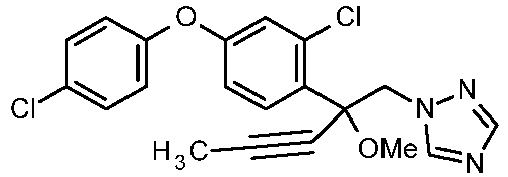
1-[2-[2-chloro-4-(4-chlorophenoxy)phenyl]-2-methoxy-pent-3-ynyl]-1,2,4-triazole #I-7 
2-[4-(4-chlorophenoxy)-2-(trifluoromethyl)phenyl]-1-(1,2,4-triazol-1-yl)butan-2-ol #I-8 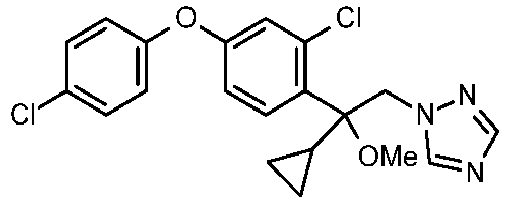
1-[2-[2-chloro-4-(4-chlorophenoxy)phenyl]-2-cyclopropyl-2-methoxy-ethyl]-1,2,4-triazole #I-9 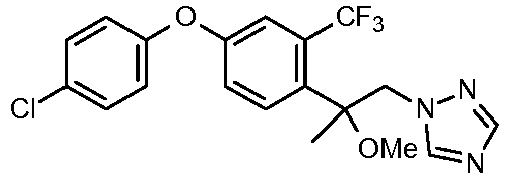
1-[2-[4-(4-chlorophenoxy)-2-(trifluoromethyl)phenyl]-2-methoxy-propyl]-1,2,4- #I-10 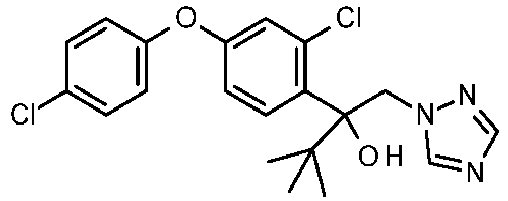
2-[2-chloro-4-(4-chlorophenoxy)phenyl]-3,3-dimethyl-1-(1,2,4-triazol-1-yl)butan-2-ol #I-11 
1-[2-[4-(4-chlorophenoxy)-2-(trifluoromethyl)phenyl]-2-cyclopropyl-2-methoxy- #I-12 
2-[2-trifluoromethyl-4-(4-chlorophenoxy)phenyl]-1-methoxy-3-(1,2,4-triazol-1-yl) propan-2-ol #I-13 
1-[2-[4-(4-chlorophenoxy)-2-(trifluoromethyl)phenyl]-2-methoxy-butyl]1,2,4- #I-14 
2-[4-(4-chlorophenoxy)-2-(trifluoromethyl)phenyl]-1-(1,2,4-triazol-1-yl)pent-3-yn-2-ol #I-15 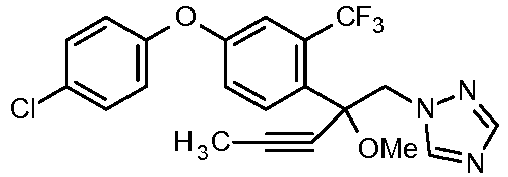
1-[2-[4-(4-chlorophenoxy)-2-(trifluoromethyl)phenyl-2-methoxy-pent-3-ynyl]- #I-16 
2-[4-(4-chlorophenoxy)-2-(trifluoromethyl)phenyl]-1-(1,2,4-triazol-1-yl)but-3-yn-2-ol - not according to the invention
Claims (6)
- Compositions comprising1) as component I
compound I-3: 2-[4-(4-chlorophenoxy)-2-(trifluoromethyl)phenyl]-1-(1,2,4-triazol-1-yl)propan-2-ol; and2) as component II an active ingredient, selected from:azoxystrobin, dimoxystrobin, fluoxastrobin, isofetamid, kresoxim-methyl, picoxystrobin, pyraclostrobin, trifloxystrobin, cyazofamid, benzovindiflupyr, bixafen, boscalid, fluopyram, fluxapyroxad, isopyrazam, sedaxane, fluazinam, cyproconazole, difenoconazole, epoxiconazole, metconazole, propiconazole, prothioconazole, tebuconazole, tetraconazole, triticonazole, fenpropimorph, fenpropidin, metalaxyl, metalaxyl-M (mefenoxam), metrafenone, iprovalicarb, oxathiapiprolin, copper oxychloride, sulfur, mancozeb, chlorothalonil, tricyclazole, picarbutrazox, Bacillus amyloliquefaciens, B. pumilus, B. subtilis, Paenibacillus polymyxa, T. gamsii, prohexadione-calcium, mepiquat (mepiquat chloride), trinexapac-ethyl, flupyradifurone, thiamethoxam, nitenpyram,wherein the weight ratio of component I to component II is from 4:1 to 1:4. - The compositions of claim 1 further comprising a component III selected from groups A) to O):A) Respiration inhibitors- Inhibitors of complex III at Qo site (e.g. strobilurins): azoxystrobin, coumethoxystrobin, coumoxystrobin, dimoxystrobin, enestroburin, fenaminstrobin, fenoxystrobin/flufenoxystrobin, fluoxastrobin, Isofetamid, kresoxim-methyl, meto-minostrobin, orysastrobin, picoxystrobin, pyraclostrobin, pyrametostrobin, pyraoxystrobin, trifloxystrobin, 2-[2-(2,5-dimethyl-phenoxymethyl)-phenyl]-3-methoxy-acrylic acid methyl ester and 2-(2-(3-(2,6-dichlorophenyl)-1-methyl-allylideneaminooxymethyl)-phenyl)-2-methoxyimino-N-methyl-acetamide, pyribencarb, triclopyricarb/chlorodincarb, famoxadone, fenamidone;- inhibitors of complex III at Qi site: cyazofamid, amisulbrom, [(3S,6S,7R,8R)-8-benzyl-3-[(3-acetoxy-4-methoxy-pyridine-2-carbonyl)amino]-6-methyl-4,9-dioxo-1,5-dioxonan-7-yl]2-methylpropanoate, [(3S,6S,7R,8R)-8-benzyl-3-[[3-(acet-oxymethoxy)-4-methoxy-pyridine-2-carbonyl]amino]-6-methyl-4,9-dioxo-1,5-dioxonan-7-yl] 2-methylpropanoate, [(3S,6S,7R,8R)-8-benzyl-3-[(3-isobutoxycarbonyloxy-4-methoxy-pyridine-2-carbonyl)amino]-6-methyl-4,9-dioxo-1,5-dioxonan-7-yl] 2-methylpropanoate, [(3S,6S,7R,8R)-8-benzyl-3-[[3-(1,3-benzodioxol-5-ylmethoxy)-4-methoxy-pyridine-2-carbonyl]amino]-6-methyl-4,9-dioxo-1,5-dioxonan-7-yl]2-methylpropanoate; (3S,6S,7R,8R)-3-[[(3-hydroxy-4-methoxy-2-pyridinyl)carbonyl]amino]-6-methyl-4,9-dioxo-8-(phenylmethyl)-1,5-dioxonan-7-yl 2-methylpropanoate;- inhibitors of complex II (e. g. carboxamides): benodanil, benzovindiflupyr, bixafen, boscalid, carboxin, fenfuram, fluopyram, flutolanil, fluxapyroxad, furametpyr, isofetamid, isopyrazam, mepronil, oxycarboxin, penflufen, penthiopyrad, sedaxane, tecloftalam, thifluzamide, N-(4'-trifluoromethylthiobiphenyl-2-yl)-3-difluoromethyl-1-methyl-1H-pyrazole-4-carboxamide, N-(2-(1,3,3-trimethyl-butyl)-phenyl)-1,3-dimethyl-5-fluoro-1H-pyrazole-4-carboxamide, 3-(difluoromethyl)-1-methyl-N-(1,1,3-trimethylindan-4-yl)pyrazole-4-carboxamide, 3-(trifluoromethyl)-1-methyl-N-(1,1,3-trimethylindan-4-yl)pyrazole-4-carboxamide, 1,3-dimethyl-N-(1,1,3-trimethylindan-4-yl)pyrazole-4-carboxamide, 3-(trifluoromethyl)-1,5-dimethyl-N-(1,1,3-trimethylindan-4-yl)pyrazole-4-carboxamide, 1,3,5-trimethyl-N-(1,1,3-trimethylindan-4-yl)pyrazole-4-carboxamide, N-(7-fluoro-1,1,3-trimethyl-indan-4-yl)-1,3-dimethyl-pyrazole-4-carboxamide, N-[2-(2,4-dichlorophenyl)-2-methoxy-1-methyl-ethyl]-3-(difluoromethyl)-1-methyl-pyrazole-4-carboxamide;- other respiration inhibitors (e.g. complex I, uncouplers): diflumetorim, (5,8-difluoroquinazolin-4-yl)-{2-[2-fluoro-4-(4-trifluoromethylpyridin-2-yloxy)-phenyl]-ethyl}-amine; nitrophenyl derivates: binapacryl, dinobuton, dinocap, fluazinam; ferimzone; organometal compounds: fentin salts, such as fentin-acetate, fentin chloride or fentin hydroxide; ametoctradin; and silthiofam;B) Sterol biosynthesis inhibitors (SBI fungicides)- C14 demethylase inhibitors (DMI fungicides): triazoles: azaconazole, bitertanol, bromuconazole, cyproconazole, difenoconazole, diniconazole, diniconazole-M, epoxiconazole, fenbuconazole, fluquinconazole, flusilazole, flutriafol, hexaconazole, imibenconazole, ipconazole, metconazole, myclobutanil, oxpoconazole, paclobutrazole, penconazole, propiconazole, prothioconazole, simeconazole, tebuconazole, tetraconazole, triadimefon, triadimenol, triticonazole, uniconazole, 1-[rel-(2S;3R)-3-(2-chlorophenyl)-2-(2,4-difluorophenyl)-oxiranylmethyl]-5-thio-cyanato-1H-[1,2,4]triazole, 2-[rel-(2S;3R)-3-(2-chlorophenyl)-2-(2,4-difluorophenyl)-oxiranylmethyl]-2H-[1,2,4]triazole-3-thiol; imidazoles: imazalil, pefurazoate, prochloraz, triflumizol; pyrimidines, pyridines and piperazines: fenarimol, nuarimol, pyrifenox, triforine; 3-(4-chloro-2-fluoro-phenyl)-5-(2,4-difluorophenyl)isoxazol-4-yl]-(3-pyridyl)methanol;- Delta14-reductase inhibitors: aldimorph, dodemorph, dodemorph-acetate, fenpropimorph, tridemorph, fenpropidin, piperalin, spiroxamine;- Inhibitors of 3-keto reductase: fenhexamid;C) Nucleic acid synthesis inhibitors- phenylamides or acyl amino acid fungicides: benalaxyl, benalaxyl-M, kiralaxyl, metalaxyl, metalaxyl-M (mefenoxam), ofurace, oxadixyl;- others: hymexazole, octhilinone, oxolinic acid, bupirimate, 5-fluorocytosine, 5-fluoro-2-(p-tolylmethoxy)pyrimidin-4-amine, 5-fluoro-2-(4-fluorophenylmethoxy)pyrimidin-4-amine;D) Inhibitors of cell division and cytoskeleton- tubulin inhibitors, such as benzimidazoles, thiophanates: benomyl, carbendazim, fuberidazole, thiabendazole, thiophanate-methyl; triazolopyrimidines: 5-chloro-7-(4-methylpiperidin-1-yl)-6-(2,4,6-trifluorophenyl)-[1,2,4]triazolo[1,5-a]pyrimidine- other cell division inhibitors: diethofencarb, ethaboxam, pencycuron, fluopicolide, zoxamide, metrafenone, pyriofenone;E) Inhibitors of amino acid and protein synthesis- methionine synthesis inhibitors (anilino-pyrimidines): cyprodinil, mepanipyrim, pyrimethanil;- protein synthesis inhibitors: blasticidin-S, kasugamycin, kasugamycin hydrochloride-hydrate, mildiomycin, streptomycin, oxytetracyclin, polyoxine, validamycin A;F) Signal transduction inhibitors- MAP / histidine kinase inhibitors: fluoroimid, iprodione, procymidone, vinclozolin, fludioxonil;- G protein inhibitors: quinoxyfen;G) Lipid and membrane synthesis inhibitors- Phospholipid biosynthesis inhibitors: edifenphos, iprobenfos, pyrazophos, isoprothiolane;- lipid peroxidation: dicloran, quintozene, tecnazene, tolclofos-methyl, biphenyl, chloroneb, etridiazole;- phospholipid biosynthesis and cell wall deposition: dimethomorph, flumorph, mandipropamid, pyrimorph, benthiavalicarb, iprovalicarb, valifenalate and N-(1-(1-(4-cyano-phenyl)ethanesulfonyl)-but-2-yl) carbamic acid-(4-fluorophenyl) ester;- compounds affecting cell membrane permeability and fatty acides: propamocarb, propamocarb-hydrochlorid;- fatty acid amide hydrolase inhibitors: oxathiapiprolin, 1-[4-[4-[5-(2,6-difluorophenyl)-4,5-dihydro-3-isoxazolyl]-2-thiazolyl]-1-piperidinyl]-2-[5-methyl-3-(trifluoromethyl)-1H-pyrazol-1-yl]ethanone, 2-{3-[2-(1-{[3,5-bis(difluoromethyl-1H-pyrazol-1-yl]acetyl}piperidin-4-yl)-1,3-thiazol-4-yl]-4,5-dihydro-1,2-oxazol-5-yl}phenyl methanesulfonate, 2-{3-[2-(1-{[3,5-bis(difluoromethyl)-1H-pyrazol-1-yl]acetyl}piperidin-4-yl) 1,3-thiazol-4-yl]-4,5-dihydro-1,2-oxazol-5-yl}-3-chlorophenyl methanesulfonate;H) Inhibitors with Multi Site Action- inorganic active substances: Bordeaux mixture, copper acetate, copper hydroxide, copper oxychloride, basic copper sulfate, sulfur;- thio- and dithiocarbamates: ferbam, mancozeb, maneb, metam, metiram, propineb, thiram, zineb, ziram;- organochlorine compounds (e.g. phthalimides, sulfamides, chloronitriles): anilazine, chlorothalonil, captafol, captan, folpet, dichlofluanid, dichlorophen, flusulfamide, hexachlorobenzene, pentachlorphenole and its salts, phthalide, tolylfluanid, N-(4-chloro-2-nitro-phenyl)-N-ethyl-4-methyl-benzenesulfonamide;- guanidines and others: guanidine, dodine, dodine free base, guazatine, guazatine-acetate, iminoctadine, iminoctadine-triacetate, iminoctadine-tris(albesilate), dithianon, 2,6-dimethyl-1H,5H-[1,4]dithiino[2,3-c:5,6-c']dipyrrole-1,3,5,7(2H,6H)-tetraone;I) Cell wall synthesis inhibitors- inhibitors of glucan synthesis: validamycin, polyoxin B; melanin synthesis inhibitors: pyroquilon, tricyclazole, carpropamid, dicyclomet, fenoxanil;J) Plant defence inducers- acibenzolar-S-methyl, probenazole, isotianil, tiadinil, prohexadione-calcium; phosphonates: fosetyl, fosetyl-aluminum, phosphorous acid and its salts;K) Unknown mode of action- bronopol, chinomethionat, cyflufenamid, cymoxanil, dazomet, debacarb, diclo-mezine, difenzoquat, difenzoquat-methylsulfate, diphenylamin, fenpyrazamine, flumetover, flusulfamide, flutianil, methasulfocarb, nitrapyrin, nitrothal-isopropyl, oxin-copper, proquinazid, tebufloquin, tecloftalam, oxathiapiprolin, 2-[3,5-bis(difluoromethyl)-1H-pyrazol-1-yl]-1-[4-(4-{5-[2-(prop-2-yn-1-yloxy)phenyl]-4,5-dihydro-1,2-oxazol-3-yl}-1,3-thiazol-2-yl)piperidin-1-yl]ethanone, 2-[3,5-bis(difluoromethyl)-1H-pyrazol-1-yl]-1-[4-(4-{5-[2-fluoro-6-(prop-2-yn-1-yl-oxy)phenyl]-4,5-dihydro-1,2-oxazol-3-yl}-1,3-thiazol-2-yl)piperidin-1-yl]ethanone, 2-[3,5-bis(difluoromethyl)-1H-pyrazol-1-yl]-1-[4-(4-{5-[2-chloro-6-(prop-2-yn-1-yl-oxy)phenyl]-4,5-dihydro-1,2-oxazol-3-yl}-1,3-thiazol-2-yl)piperidin-1-yl]ethanone, tolprocarb, triazoxide, 2-butoxy-6-iodo-3-propylchromen-4-one, N-(cyclo-propylmethoxyimino-(6-difluoro-methoxy-2,3-difluoro-phenyl)-methyl)-2-phenyl acetamide, N'-(4-(4-chloro-3-trifluoromethyl-phenoxy)-2,5-dimethyl-phenyl)-N-ethyl-N-methyl formamidine, N'-(4-(4-fluoro-3-trifluoromethyl-phenoxy)-2,5-dimethyl-phenyl)-N-ethyl-N-methyl formamidine, N'-(2-methyl-5-trifluoromethyl-4-(3-trimethylsilanyl-propoxy)-phenyl)-N-ethyl-N-methyl formamidine, N'-(5-difluoromethyl-2-methyl-4-(3-trimethylsilanyl-propoxy)-phenyl)-N-ethyl-N-methyl formamidine, 2methoxy-acetic acid 6-tert-butyl-8-fluoro-2,3-dimethyl-quinolin-4-yl ester, 3-[5-(4-methylphenyl)-2,3-dimethyl-isoxazolidin-3-yl]-pyridine, 3-[5-(4-chloro-phenyl)-2,3-dimethyl-isoxazolidin-3-yl]-pyridine (pyrisoxazole), N-(6-methoxy-pyridin-3-yl) cyclopropanecarboxylic acid amide, 5-chloro-1-(4,6-dimethoxy-pyrimidin-2-yl)-2-methyl-1H-benzoimidazole, 2-(4-chlorophenyl)-N-[4-(3,4-dimethoxy-phenyl)-isoxazol-5-yl]-2-prop-2-ynyloxy-acetamide; ethyl (Z)-3-amino-2-cyano-3-phenyl-prop-2-enoate, tert-butyl N-[6-[[(Z)-[(1-methyltetrazol-5-yl)-phenyl-methylene]amino]oxymethyl]-2-pyridyl]carbamate, pentyl N-[6-[[(Z)-[(1-methyltetrazol-5-yl)-phenyl-methylene]amino]oxymethyl]-2-pyridyl]carbamate, 2-[2-[(7,8-difluoro-2-methyl-3-quinolyl)oxy]-6-fluorophenyl]propan-2-ol, 2-[2-fluoro-6-[(8-fluoro-2-methyl-3-quinolyl)oxy]phenyl]propan-2-ol, 3-(5-fluoro-3,3,4,4-tetramethyl-3,4-dihydroisoquinolin-1-yl)quinoline, 3-(4,4-difluoro-3,3-dimethyl-3,4-dihydroisoquinolin-1-yl)-quinoline, 3-(4,4,5-trifluoro-3,3-dimethyl-3,4-dihydroisoquinolin-1-yl)quinolone; 9-fluoro-2,2-dimethyl-5-(3-quinolyl)-3H-1,4-benzoxazepine, ethyl (Z)-3-amino-2-cyano-3-phenyl-prop-2-enoate , picarbutrazox, pentyl N-[6-[[(Z)-[(1-methyltetrazol-5-yl)-phenyl-methylene]amino]oxymethyl]-2-pyridyl]carbamate, 2-[2-[(7,8-difluoro-2-methyl-3-quinolyl)oxy]-6-fluoro-phenyl]propan-2-ol, 2-[2-fluoro-6-[(8-fluoro-2-methyl-3-quinolyl)oxy]phen-yl]propan-2-ol, 3-(5-fluoro-3,3,4,4-tetramethyl-3,4-dihydroisoquinolin-1-yl)quinoline, 3-(4,4-difluoro-3,3-dimethyl-3,4-dihydroisoquinolin-1-yl)quinoline, 3-(4,4,5-trifluoro-3,3-dimethyl-3,4-dihydroisoquinolin-1-yl)quinoline;L) BiopesticidesL1) Microbial pesticides with fungicidal, bactericidal, viricidal and/or plant defense activator activity: Ampelomyces quisqualis, Aspergillus flavus, Aureobasidium pullulans, Bacillus amyloliquefaciens, B. mojavensis, B. pumilus, B. simplex, B. solisalsi, B. subtilis, B. subtilis var. amyloliquefaciens, Candida oleophila, C. saitoana, Clavibacter michiganensis (bacteriophages), Coniothyrium minitans, Cryphonectria parasitica, Cryptococcus albidus, Dilophosphora alopecuri, Fusarium oxysporum, Clonostachys rosea f. catenulate (also named Gliocladium catenulatum), Gliocladium roseum, Lysobacter antibioticus, L. enzymogenes, Metschnikowia fructicola, Microdochium dimerum, Microsphaeropsis ochracea, Muscodor albus, Paenibacillus polymyxa, Pantoea vagans, Phlebiopsis gigantea, Pseudomonas sp., Pseudomonas chloraphis, Pseudozyma flocculosa, Pichia anomala, Pythium oligandrum, Sphaerodes mycoparasitica, Streptomyces griseoviridis, S. lydicus, S. violaceusniger, Talaromyces flavus, Trichoderma asperellum, T. atroviride, T. fertile, T. gamsii, T. harmatum, T. harzianum; mixture of T. harzianum and T. viride; mixture of T. polysporum and T. harzianum; T. stromaticum, T. virens (also named Gliocladium virens), T. viride, Typhula phacorrhiza, Ulocladium oudemansii, Verticillium dahlia, zucchini yellow mosaic virus (avirulent strain);L2) Biochemical pesticides with fungicidal, bactericidal, viricidal and/or plant defense activator activity: chitosan (hydrolysate), harpin protein, laminarin, Menhaden fish oil, natamycin, Plum pox virus coat protein, potassium or sodium bicarbonate, Reynoutria sachlinensis extract, salicylic acid, tea tree oil;L3) Microbial pesticides with insecticidal, acaricidal, molluscidal and/or nematicidal activity: Agrobacterium radiobacter, Bacillus cereus, B. firmus, B. thuringiensis, B. thuringiensis ssp. aizawai, B. t. ssp. israelensis, B. t. ssp. galleriae, B. t. ssp. kurstaki, B. t. ssp. tenebrionis, Beauveria bassiana, B. brongniartii , Burkholderia sp., Chromobacterium subtsugae, Cydia pomonella granulosis virus, Cryptophlebia leucotreta granulovirus (CrleGV), Isaria fumosorosea, Heterorhabditis bacteriophora, Lecanicillium longisporum, L. muscarium (formerly Verticillium lecanii), Metarhizium anisopliae, M. anisopliae var. acridum, Nomuraea rileyi, Paecilomyces fumosoroseus, P. lilacinus, Paenibacillus popilliae, Pasteuria spp., P. nishizawae, P. penetrans, P. ramose, P. reneformis, P. thornea, P. usgae, Pseudomonas fluorescens, Steinernema carpocapsae, S. feltiae, S. kraussei;L4) Biochemical pesticides with insecticidal, acaricidal, molluscidal, pheromone and/or nematicidal activity: L-carvone, citral, (E,Z)-7,9-dodecadien-1-yl acetate, ethyl formate, (E,Z)-2,4-ethyl decadienoate (pear ester), (Z,Z,E)-7,11,13-hexadecatrienal, heptyl butyrate, isopropyl myristate, lavanulyl senecioate, cis-jasmone, 2-methyl 1-butanol, methyl eugenol, methyl jasmonate, (E,Z)-2,13-octadecadien-1-ol, (E,Z)-2,13-octadecadien-1-ol acetate, (E,Z)-3,13-octadecadien-1-ol, R-1-octen-3-ol, pentatermanone, potassium silicate, sorbitol actanoate, (E,Z,Z)-3,8,11-tetradecatrienyl acetate, (Z,E)-9,12-tetradecadien-1-yl acetate, Z-7-tetradecen-2-one, Z-9-tetradecen-1-yl acetate, Z-11-tetradecenal, Z-11-tetradecen-1-ol, Acacia negra extract, extract of grapefruit seeds and pulp, extract of Chenopodium ambrosiodae, Catnip oil, Neem oil, Quillay extract, Tagetes oil;L5) Microbial pesticides with plant stress reducing, plant growth regulator, plant growth promoting and/or yield enhancing activity: Azospirillum amazonense, A. brasilense, A. lipoferum, A. irakense, A. halopraeferens, Bradyrhizobium sp., B. elkanii, B. japonicum, B. liaoningense, B. lupini, Delftia acidovorans, Glomus intraradices, Mesorhizobium sp., Paenibacillus alvei, Penicillium bilaiae, Rhizobium leguminosarum bv. phaseoli, R. I. trifolii, R. I. bv. viciae, R. tropici, Sinorhizobium meliloti;L6) Biochemical pesticides with plant stress reducing, plant growth regulator and/or plant yield enhancing activity: abscisic acid, aluminium silicate (kaolin), 3-decen-2-one, formononetin, genistein, hesperetin, homobrassinlide, humates, jasmonic acid or salts or derivatives thereof, lysophosphatidyl ethanolamine, naringenin, polymeric polyhydroxy acid, Ascophyllum nodosum (Norwegian kelp, Brown kelp) extract and Ecklonia maxima (kelp) extract;M) Growth regulators
abscisic acid, amidochlor, ancymidol, 6-benzylaminopurine, brassinolide, butralin, chlormequat (chlormequat chloride), choline chloride, cyclanilide, daminozide, dikegulac, dimethipin, 2,6-dimethylpuridine, ethephon, flumetralin, flurprimidol, fluthiacet, forchlorfenuron, gibberellic acid, inabenfide, indole-3-acetic acid, maleic hydrazide, mefluidide, mepiquat (mepiquat chloride), naphthaleneacetic acid, N-6-benzyladenine, paclobutrazol, prohexadione (prohexadione-calcium), prohydrojasmon, thidiazuron, triapenthenol, tributyl phosphorotrithioate, 2,3,5-tri-iodobenzoic acid, trinexapac-ethyl and uniconazole;N) Herbicides- acetamides: acetochlor, alachlor, butachlor, dimethachlor, dimethenamid, flufenacet, mefenacet, metolachlor, metazachlor, napropamide, naproanilide, pethoxamid, pretilachlor, propachlor, thenylchlor;- amino acid derivatives: bilanafos, glyphosate, glufosinate, sulfosate;- aryloxyphenoxypropionates: clodinafop, cyhalofop-butyl, fenoxaprop, fluazifop, haloxyfop, metamifop, propaquizafop, quizalofop, quizalofop-P-tefuryl;- Bipyridyls: diquat, paraquat;- (thio)carbamates: asulam, butylate, carbetamide, desmedipham, dimepiperate, eptam (EPTC), esprocarb, molinate, orbencarb, phenmedipham, prosulfocarb, pyributicarb, thiobencarb, triallate;- cyclohexanediones: butroxydim, clethodim, cycloxydim, profoxydim, sethoxydim, tepraloxydim, tralkoxydim;- dinitroanilines: benfluralin, ethalfluralin, oryzalin, pendimethalin, prodiamine, trifluralin;- diphenyl ethers: acifluorfen, aclonifen, bifenox, diclofop, ethoxyfen, fomesafen, lactofen, oxyfluorfen;- hydroxybenzonitriles: bomoxynil, dichlobenil, ioxynil;- imidazolinones: imazamethabenz, imazamox, imazapic, imazapyr, imazaquin, imazethapyr;- phenoxy acetic acids: clomeprop, 2,4-dichlorophenoxyacetic acid (2,4-D), 2,4-DB, dichlorprop, MCPA, MCPA-thioethyl, MCPB, Mecoprop;- pyrazines: chloridazon, flufenpyr-ethyl, fluthiacet, norflurazon, pyridate;- pyridines: aminopyralid, clopyralid, diflufenican, dithiopyr, fluridone, fluroxypyr, picloram, picolinafen, thiazopyr;- sulfonyl ureas: amidosulfuron, azimsulfuron, bensulfuron, chlorimuron-ethyl, chlorsulfuron, cinosulfuron, cyclosulfamuron, ethoxysulfuron, flazasulfuron, flucetosulfuron, flupyrsulfuron, foramsulfuron, halosulfuron, imazosulfuron, iodosulfuron, mesosulfuron, metazosulfuron, metsulfuron-methyl, nicosulfuron, oxasulfuron, primisulfuron, prosulfuron, pyrazosulfuron, rimsulfuron, sulfometuron, sulfosulfuron, thifensulfuron, triasulfuron, tribenuron, trifloxysulfuron, triflusulfuron, tritosulfuron, 1-((2-chloro-6-propyl-imidazo[1,2-b]pyridazin-3-yl)sulfonyl)-3-(4,6-dimethoxy-pyrimidin-2-yl)urea;- triazines: ametryn, atrazine, cyanazine, dimethametryn, ethiozin, hexazinone, metamitron, metribuzin, prometryn, simazine, terbuthylazine, terbutryn, triaziflam;- ureas: chlorotoluron, daimuron, diuron, fluometuron, isoproturon, linuron, methabenzthiazuron, tebuthiuron;- other acetolactate synthase inhibitors: bispyribac-sodium, cloransulam-methyl, diclosulam, florasulam, flucarbazone, flumetsulam, metosulam, orthosulfamuron, penoxsulam, propoxycarbazone, pyribambenz-propyl, pyribenzoxim, pyriftalid, pyriminobac-methyl, pyrimisulfan, pyrithiobac, pyroxasulfone, pyroxsulam;- others: amicarbazone, aminotriazole, anilofos, beflubutamid, benazolin, bencarbazone,benfluresate, benzofenap, bentazone, benzobicyclon, bicyclopyrone, bromacil, bromobutide, butafenacil, butamifos, cafenstrole, carfentrazone, cinidon-ethyl, chlorthal, cinmethylin, clomazone, cumyluron, cyprosulfamide, dicamba, difenzoquat, diflufenzopyr, Drechslera monoceras, endothal, ethofumesate, etobenzanid, fenoxasulfone, fentrazamide, flumiclorac-pentyl, flumioxazin, flupoxam, flurochloridone, flurtamone, indanofan, isoxaben, isoxaflutole, lenacil, propanil, propyzamide, quinclorac, quinmerac, mesotrione, methyl arsonic acid, naptalam, oxadiargyl, oxadiazon, oxaziclomefone, pentoxazone, pinoxaden, pyraclonil, pyraflufen-ethyl, pyrasulfotole, pyrazoxyfen, pyrazolynate, quinoclamine, saflufenacil, sulcotrione, sulfentrazone, terbacil, tefuryltrione, tembotrione, thiencarbazone, topramezone, (3-[2-chloro-4-fluoro-5-(3-methyl-2,6-dioxo-4-trifluoromethyl-3,6-dihydro-2H-pyrimidin-1-yl)-phenoxy]-pyridin-2-yloxy)-acetic acid ethyl ester, 6-amino-5-chloro-2-cyclopropyl-pyrimidine-4-carboxylic acid methyl ester, 6-chloro-3-(2-cyclopropyl-6-methyl-phenoxy)-pyridazin-4-ol, 4-amino-3-chloro-6-(4-chlorophenyl)-5-fluoro-pyridine-2-carboxylic acid, 4-amino-3-chloro-6-(4-chloro-2-fluoro-3-methoxy-phenyl)-pyridine-2-carboxylic acid methyl ester, and 4-amino-3-chloro-6-(4-chloro-3-dimethylamino-2-fluoro-phenyl)-pyridine-2-carboxylic acid methyl ester.O) Insecticides- organo(thio)phosphates: acephate, azamethiphos, azinphos-methyl, chlorpyrifos, chlorpyrifos-methyl, chlorfenvinphos, diazinon, dichlorvos, dicrotophos, dimethoate, disulfoton, ethion, fenitrothion, fenthion, isoxathion, malathion, methamidophos, methidathion, methyl-parathion, mevinphos, monocrotophos, oxydemeton-methyl, paraoxon, parathion, phenthoate, phosalone, phosmet, phosphamidon, phorate, phoxim, pirimiphos-methyl, profenofos, prothiofos, sulprophos, tetrachlorvinphos, terbufos, triazophos, trichlorfon;- carbamates: alanycarb, aldicarb, bendiocarb, benfuracarb, carbaryl, carbofuran, carbosulfan, fenoxycarb, furathiocarb, methiocarb, methomyl, oxamyl, pirimicarb, propoxur, thiodicarb, triazamate;- pyrethroids: allethrin, bifenthrin, cyfluthrin, cyhalothrin, cyphenothrin, cypermethrin, alpha-cypermethrin, beta-cypermethrin, zeta-cypermethrin, deltamethrin, esfenvalerate, etofenprox, fenpropathrin, fenvalerate, imiprothrin, lambda-cyhalothrin, permethrin, prallethrin, pyrethrin I and II, resmethrin, silafluofen, tau-fluvalinate, tefluthrin, tetramethrin, tralomethrin, transfluthrin, profluthrin, dimefluthrin;- insect growth regulators: a) chitin synthesis inhibitors: benzoylureas: chlorfluazuron, cyramazin, diflubenzuron, flucycloxuron, flufenoxuron, hexaflumuron, lufenuron, novaluron, teflubenzuron, triflumuron; buprofezin, diofenolan, hexythiazox, etoxazole, clofentazine; b) ecdysone antagonists: halofenozide, methoxyfenozide, tebufenozide, azadirachtin; c) juvenoids: pyriproxyfen, methoprene, fenoxycarb; d) lipid biosynthesis inhibitors: spirodiclofen, spiromesifen, spirotetramat;- nicotinic receptor agonists/antagonists compounds: clothianidin, dinotefuran, flupyradifurone, imidacloprid, thiamethoxam, nitenpyram, acetamiprid, thiacloprid, 1,2-chloro-thiazol-5-ylmethyl)-2-nitrimino-3,5-dimethyl-[1,3,5]triazinane;- GABA antagonist compounds: endosulfan, ethiprole, fipronil, vaniliprole, pyrafluprole, pyriprole, 5-amino-1-(2,6-dichloro-4-methyl-phenyl)-4-sulfinamoyl-1H-pyrazole-3-carbothioic acid amide;- macrocyclic lactone insecticides: abamectin, emamectin, milbemectin, lepimectin, spinosad, spinetoram;- mitochondrial electron transport inhibitor (METI) I acaricides: fenazaquin, pyridaben, tebufenpyrad, tolfenpyrad, flufenerim;- METI II and III compounds: acequinocyl, fluacyprim, hydramethylnon;- Uncouplers: chlorfenapyr;- oxidative phosphorylation inhibitors: cyhexatin, diafenthiuron, fenbutatin oxide, propargite;- moulting disruptor compounds: cryomazine;- mixed function oxidase inhibitors: piperonyl butoxide;- sodium channel blockers: indoxacarb, metaflumizone;- ryanodine receptor inhibitors: chlorantraniliprole, cyantraniliprole, flubendiamide, N-[4,6-dichloro-2-[(diethyl-lambda-4-sulfanylidene)carbamoyl]-phenyl]-2-(3-chloro-2-pyridyl)-5-(trifluoromethyl)pyrazole-3-carboxamide; N-[4-chloro-2-[(diethyl-lambda-4-sulfanylidene)carbamoyl]-6-methyl-phenyl]-2-(3-chloro-2-pyridyl)-5-(trifluoromethyl)pyrazole-3-carboxamide; N-[4-chloro-2-[(di-2-propyl-lambda-4-sulfanylidene)carbamoyl]-6-methyl-phenyl]-2-(3-chloro-2-pyridyl)-5-(trifluoromethyl)pyrazole-3-carboxamide; N-[4,6-dichloro-2-[(di-2-propyl-lambda-4-sulfanylidene)carbamoyl]-phenyl]-2-(3-chloro-2-pyridyl)-5-(trifluoromethyl)pyrazole-3-carboxamide; N-[4,6-dichloro-2-[(diethyl-lambda-4-sulfanylidene)carbamoyl]-phenyl]-2-(3-chloro-2-pyridyl)-5-(difluoromethyl)pyrazole-3-carboxamide; N-[4,6-dibromo-2-[(di-2-propyl-lambda-4-sulfanylidene)carbamoyl]-phenyl]-2-(3-chloro-2-pyridyl)-5-(trifluoromethyl)pyrazole-3-carboxamide; N-[4-chloro-2-[(di-2-propyl-lambda-4-sulfanylidene)carbamoyl]-6-cyano-phenyl]-2-(3-chloro-2-pyridyl)-5-(trifluoromethyl)pyrazole-3-carboxamide; N-[4,6-dibromo-2-[(diethyl-lambda-4-suIfanylidene)carbamoyl]-phenyl]-2-(3-chloro-2-pyridyl)-5-(trifluoromethyl)pyrazole-3-carboxamide;- others: benclothiaz, bifenazate, cartap, flonicamid, pyridalyl, pymetrozine, sulfur, thiocyclam, cyenopyrafen, flupyrazofos, cyflumetofen, amidoflumet, imicyafos, bistrifluron, pyrifluquinazon and 1,1'-[(3S,4R,4aR,6S,6aS,12R,12aS,12bS)-4-[[(2-cyclopropylacetyl)oxy]methyl]-1,3,4,4a,5,6,6a,12,12a,12b-decahydro-12-hydroxy-4,6a,12b-trimethyl-11-oxo-9-(3-pyridinyl)-2H,11H-naphtho[2,1-b]pyrano[3,4-e]pyran-3,6-diyl] cyclopropaneacetic acid ester. - The compositions of any one of claims 1 to 2, further comprising an agrochemical auxiliary.
- A use of a composition as defined in any of the claims 1 to 3 for combating phytopathogenic fungi.
- A method for combating phytopathogenic fungi, comprising treating the fungi or the materials, plants, the soil or seeds to be protected against fungal attack with an effective amount of a composition as defined in any of the claims 1 to 3.
- Seed, coated with the components I and II or I, II and III of the compositions as defined in any one of claims 1 to 3, in an amount of from 0.1 to 10 kg active substances per 100 kg of seed.
Priority Applications (18)
| Application Number | Priority Date | Filing Date | Title |
|---|---|---|---|
| EP13818211.8A EP2934147B1 (en) | 2012-12-20 | 2013-12-18 | Compositions comprising a triazole compound |
| PL13818211T PL2934147T3 (en) | 2012-12-20 | 2013-12-18 | Compositions comprising a triazole compound |
| EP19150231.9A EP3498098A1 (en) | 2012-12-20 | 2013-12-18 | Compositions comprising a triazole compound |
| HUS2200008C HUS2200008I1 (en) | 2012-12-20 | 2022-03-01 | Compositions comprising a triazole compound |
| LTPA2022011C LTPA2022011I1 (en) | 2012-12-20 | 2022-06-14 | |
| HUS2300031C HUS2300031I1 (en) | 2012-12-20 | 2023-09-27 | Compositions comprising a triazole compound |
| HUS2300034C HUS2300034I1 (en) | 2012-12-20 | 2023-10-04 | Compositions comprising a triazole compound |
| FR24C1002C FR24C1002I2 (en) | 2012-12-20 | 2024-01-17 | COMPOSITIONS COMPRISING A TRIAZOLE COMPOUND |
| HUS2400022C HUS2400022I1 (en) | 2012-12-20 | 2024-06-28 | Compositions comprising a triazole compound |
| LTPA2024528C LTPA2024528I1 (en) | 2012-12-20 | 2024-10-09 | |
| HUS2400039C HUS2400039I1 (en) | 2012-12-20 | 2024-11-19 | Compositions comprising a triazole compound |
| LTPA2024542C LTPA2024542I1 (en) | 2012-12-20 | 2024-12-20 | |
| NL350117C NL350117I2 (en) | 2012-12-20 | 2025-05-01 | Metrafenone and mefentrifluconazole |
| FR25C1017C FR25C1017I1 (en) | 2012-12-20 | 2025-05-16 | COMPOSITIONS COMPRISING A TRIAZOLE COMPOUND |
| NL350119C NL350119I2 (en) | 2012-12-20 | 2025-07-29 | Mefentrifluconazole and prothioconazole |
| LTPA2025532C LTPA2025532I1 (en) | 2012-12-20 | 2025-08-27 | |
| HUS2500041C HUS2500041I1 (en) | 2012-12-20 | 2025-09-23 | Compositions comprising a triazole compound |
| LTPA2025544C LTPA2025544I1 (en) | 2012-12-20 | 2025-12-19 |
Applications Claiming Priority (5)
| Application Number | Priority Date | Filing Date | Title |
|---|---|---|---|
| US201261739814P | 2012-12-20 | 2012-12-20 | |
| EP12198698 | 2012-12-20 | ||
| EP13174975 | 2013-07-03 | ||
| PCT/EP2013/077081 WO2014095994A1 (en) | 2012-12-20 | 2013-12-18 | Compositions comprising a triazole compound |
| EP13818211.8A EP2934147B1 (en) | 2012-12-20 | 2013-12-18 | Compositions comprising a triazole compound |
Related Child Applications (2)
| Application Number | Title | Priority Date | Filing Date |
|---|---|---|---|
| EP19150231.9A Division EP3498098A1 (en) | 2012-12-20 | 2013-12-18 | Compositions comprising a triazole compound |
| EP19150231.9A Division-Into EP3498098A1 (en) | 2012-12-20 | 2013-12-18 | Compositions comprising a triazole compound |
Publications (2)
| Publication Number | Publication Date |
|---|---|
| EP2934147A1 EP2934147A1 (en) | 2015-10-28 |
| EP2934147B1 true EP2934147B1 (en) | 2019-11-27 |
Family
ID=50977628
Family Applications (2)
| Application Number | Title | Priority Date | Filing Date |
|---|---|---|---|
| EP13818211.8A Active EP2934147B1 (en) | 2012-12-20 | 2013-12-18 | Compositions comprising a triazole compound |
| EP19150231.9A Withdrawn EP3498098A1 (en) | 2012-12-20 | 2013-12-18 | Compositions comprising a triazole compound |
Family Applications After (1)
| Application Number | Title | Priority Date | Filing Date |
|---|---|---|---|
| EP19150231.9A Withdrawn EP3498098A1 (en) | 2012-12-20 | 2013-12-18 | Compositions comprising a triazole compound |
Country Status (18)
| Country | Link |
|---|---|
| US (1) | US10759767B2 (en) |
| EP (2) | EP2934147B1 (en) |
| JP (2) | JP6576829B2 (en) |
| CN (1) | CN105050406B (en) |
| AR (1) | AR094242A1 (en) |
| BR (1) | BR112015014753B8 (en) |
| CA (1) | CA2894264C (en) |
| EA (1) | EA030875B1 (en) |
| FR (2) | FR24C1002I2 (en) |
| HU (6) | HUS2200008I1 (en) |
| LT (5) | LTPA2022011I1 (en) |
| MX (1) | MX377401B (en) |
| NL (2) | NL350117I2 (en) |
| PL (1) | PL2934147T3 (en) |
| TW (1) | TW201429398A (en) |
| UY (1) | UY35237A (en) |
| WO (1) | WO2014095994A1 (en) |
| ZA (1) | ZA201505152B (en) |
Cited By (1)
| Publication number | Priority date | Publication date | Assignee | Title |
|---|---|---|---|---|
| WO2024028797A1 (en) * | 2022-08-05 | 2024-02-08 | Atul Limited | A synergistic ternary fungicidal composition |
Families Citing this family (101)
| Publication number | Priority date | Publication date | Assignee | Title |
|---|---|---|---|---|
| EP2934147B1 (en) | 2012-12-20 | 2019-11-27 | BASF Agro B.V. | Compositions comprising a triazole compound |
| WO2014108286A1 (en) | 2013-01-09 | 2014-07-17 | Basf Se | Process for the preparation of substituted oxiranes and triazoles |
| WO2014202421A1 (en) | 2013-06-18 | 2014-12-24 | Basf Se | Fungicidal mixtures i comprising strobilurin-type fungicides |
| CA2916777A1 (en) | 2013-07-08 | 2015-01-15 | BASF Agro B.V. | Compositions comprising a triazole compound and a biopesticide |
| AR098031A1 (en) | 2013-10-16 | 2016-04-27 | Bayer Cropscience Ag | COMBINATIONS OF ACTIVE COMPOUNDS THAT INCLUDE A DERIVATIVE OF (UNCLE) CARBOXAMIDE AND A FUNGIED COMPOUND |
| BR112016013263B1 (en) | 2013-12-12 | 2020-08-25 | Basf Se | compounds, composition, use of a compound and method for combating phytopathogenic fungi |
| WO2015113860A1 (en) | 2014-01-30 | 2015-08-06 | Basf Se | Asymmetric formales and acetales as adjuvants for crop protection |
| ES2879326T3 (en) | 2014-03-12 | 2021-11-22 | Basf Se | Alcohol alkoxylate carbonates as adjuvants for crop protection |
| MX2016012540A (en) | 2014-03-26 | 2017-01-09 | Basf Se | Substituted [1,2,4]triazole and imidazole compounds as fungicides. |
| AU2015261166A1 (en) | 2014-05-13 | 2016-12-01 | Basf Se | Substituted [1,2,4]triazole and imidazole compounds as fungicides |
| AR100743A1 (en) | 2014-06-06 | 2016-10-26 | Basf Se | COMPOUNDS OF [1,2,4] SUBSTITUTED TRIAZOL |
| EA201892682A1 (en) | 2014-06-25 | 2019-04-30 | Басф Агро Б.В. | PESTICIDAL COMPOSITIONS |
| EA031264B1 (en) | 2014-07-14 | 2018-12-28 | Басф Се | Pesticidal compositions |
| EP2979549A1 (en) * | 2014-07-31 | 2016-02-03 | Basf Se | Method for improving the health of a plant |
| CN107074782B (en) * | 2014-09-26 | 2019-09-03 | 国立大学法人静冈大学 | excidazole |
| EP3214937B1 (en) | 2014-11-07 | 2024-07-03 | Basf Se | Pesticidal mixtures |
| WO2016079043A1 (en) * | 2014-11-18 | 2016-05-26 | BASF Agro B.V. | Pesticidal compositions comprising a triazole compound |
| WO2016078995A1 (en) * | 2014-11-21 | 2016-05-26 | BASF Agro B.V. | Pesticidal compositions |
| EP3028573A1 (en) | 2014-12-05 | 2016-06-08 | Basf Se | Use of a triazole fungicide on transgenic plants |
| EP3036995A1 (en) * | 2014-12-22 | 2016-06-29 | Basf Se | Use of an enantioenriched triazole compound as fungicide |
| EP3244739A4 (en) | 2015-01-16 | 2018-07-11 | Valent Biosciences Llc | Synergistic bacillus thuringiensis subsp. aizawai, bacillus thuringiensis subsp. kurstaki and chlorantraniliprole mixtures |
| WO2016174042A1 (en) * | 2015-04-27 | 2016-11-03 | BASF Agro B.V. | Pesticidal compositions |
| WO2016202761A1 (en) * | 2015-06-17 | 2016-12-22 | Bayer Cropscience Aktiengesellschaft | Active compound combinations |
| AU2016287098A1 (en) * | 2015-07-02 | 2018-01-25 | BASF Agro B.V. | Pesticidal compositions comprising a triazole compound |
| EP3111763A1 (en) * | 2015-07-02 | 2017-01-04 | BASF Agro B.V. | Pesticidal compositions comprising a triazole compound |
| BR112018006292B1 (en) * | 2015-10-09 | 2022-07-26 | Nippon Soda Co., Ltd. | FUNGICIDE COMPOSITION FOR AGRICULTURAL AND HORTICULTURAL USE |
| UY36964A (en) * | 2015-10-27 | 2017-05-31 | Bayer Cropscience Ag | COMBINATIONS OF ACTIVE PRINCIPLES THAT INCLUDE A DERIVATIVE OF (UNCLE) CARBOXAMIDE AND A FUNGUITED COMPOUND |
| MX2018008199A (en) * | 2015-12-30 | 2019-02-14 | Dow Agrosciences Llc | Synergistic fungicidal mixtures for fungal control of rice blast. |
| CN105532681B (en) * | 2016-01-28 | 2017-12-08 | 山东农业大学 | Line composition is sterilized and killed to a kind of ternary with synergistic function |
| UA125210C2 (en) | 2016-03-16 | 2022-02-02 | Басф Се | APPLICATION OF TETRAZOLINONS TO CONTROL RESISTANT PHYTOPATHOGENIC MUSHROOMS ON CEREALS |
| US11241012B2 (en) | 2016-03-16 | 2022-02-08 | Basf Se | Use of tetrazolinones for combating resistant phytopathogenic fungi on soybean |
| US11425909B2 (en) | 2016-03-16 | 2022-08-30 | Basf Se | Use of tetrazolinones for combating resistant phytopathogenic fungi on fruits |
| WO2017162569A1 (en) * | 2016-03-24 | 2017-09-28 | Bayer Cropscience Aktiengesellschaft | Method to control septoria leaf blotch caused by resistant zymoseptoria tritici strains |
| EP3432716A1 (en) * | 2016-03-24 | 2019-01-30 | Bayer CropScience Aktiengesellschaft | Method to control septoria leaf blotch caused by resistant zymoseptoria tritici strains |
| WO2017189793A1 (en) * | 2016-04-27 | 2017-11-02 | Valent Biosciences Llc | Synergistic bacillus thuringiensis subsp. aizawai, bacillus thuringiensis subsp. kurstaki and flubendiamide mixtures for diamondback moth, sugarcane borer, soybean looper, and corn earworm |
| EP3054014A3 (en) | 2016-05-10 | 2016-11-23 | BASF Plant Science Company GmbH | Use of a fungicide on transgenic plants |
| EP3245872A1 (en) * | 2016-05-20 | 2017-11-22 | BASF Agro B.V. | Pesticidal compositions |
| WO2017207368A1 (en) * | 2016-06-02 | 2017-12-07 | BASF Agro B.V. | Fungicidal compositions |
| BR112018076966A2 (en) * | 2016-07-15 | 2019-04-16 | Basf Se | fungicidal mixtures, fungicidal composition, method for controlling plant pathogenic fungi, method for improving plant health, method for protecting plant propagating material from plant pathogenic fungi and plant propagating material |
| CN106359395A (en) * | 2016-08-30 | 2017-02-01 | 佛山市盈辉作物科学有限公司 | Bactericidal composition containing benzovindiflupyr |
| WO2018050535A1 (en) | 2016-09-13 | 2018-03-22 | Bayer Cropscience Aktiengesellschaft | Active compound combinations |
| WO2018105663A1 (en) * | 2016-12-06 | 2018-06-14 | 株式会社クレハ | Agricultural and horticultural chemical agent, plant disease control method, and product for plant disease control |
| EP4555862A3 (en) | 2017-03-07 | 2025-10-15 | UPL Ltd | Fungicidal combinations |
| WO2018189001A1 (en) * | 2017-04-13 | 2018-10-18 | Basf Se | Fungicide mixtures for use in rice |
| WO2018202737A1 (en) * | 2017-05-05 | 2018-11-08 | Basf Se | Fungicidal mixtures comprising triazole compounds |
| PL3648604T3 (en) * | 2017-07-05 | 2025-04-14 | BASF Agro B.V. | MEFENTRIFLUCONAZOLE FUNGICID MIXTURES |
| US10743535B2 (en) | 2017-08-18 | 2020-08-18 | H&K Solutions Llc | Insecticide for flight-capable pests |
| JP2021004176A (en) | 2017-09-06 | 2021-01-14 | 石原産業株式会社 | Bactericidal agent composition and method for controlling crop disease |
| CN109548791A (en) * | 2017-09-27 | 2019-04-02 | 燕化永乐(乐亭)生物科技有限公司 | A kind of bactericidal composition |
| US20190116793A1 (en) * | 2017-10-25 | 2019-04-25 | Pbi-Gordon Corporation | Fungicidal formulation |
| JP6982485B2 (en) * | 2017-12-13 | 2021-12-17 | 日本曹達株式会社 | Lawn fungicide composition |
| CN109984138A (en) * | 2017-12-29 | 2019-07-09 | 燕化永乐(乐亭)生物科技有限公司 | A kind of bactericidal composition |
| CN109984137A (en) * | 2017-12-29 | 2019-07-09 | 燕化永乐(乐亭)生物科技有限公司 | A kind of composite bactericide |
| EA202092018A1 (en) | 2018-03-01 | 2021-02-01 | Басф Агро Б.В. | FUNGICIDE COMPOSITIONS OF MEFENTRIFLUKONAZOLE |
| CN114081037A (en) * | 2018-03-26 | 2022-02-25 | Upl有限公司 | Fungicidal combinations |
| CN112040775A (en) * | 2018-03-26 | 2020-12-04 | Upl有限公司 | Fungicide combination |
| WO2020120206A2 (en) | 2018-12-11 | 2020-06-18 | BASF Agro B.V. | Method to control a phythopatogenic fungi selected from phakopsora spp. in soybeans by compositions comprising mefentrifluconazole |
| WO2020120202A2 (en) | 2018-12-11 | 2020-06-18 | BASF Agro B.V. | Method to control sclerotinia spp. in oilseed rape or canola by compositions comprising mefentrifluconazole |
| WO2020120205A2 (en) | 2018-12-11 | 2020-06-18 | BASF Agro B.V. | Method to control a phythopatogenic fungi selected from uncinula necator, plasmopara viticola and gloeosporium ampelophagum in grapes by compositions comprising mefentrifluconazole |
| EP3666073A1 (en) | 2018-12-11 | 2020-06-17 | BASF Agro B.V. | Method to control a phythopatogenic fungi selected from rhizoctonia solani and peronosclerospora sorghi in corn by compositions comprising mefentrifluconazole |
| WO2020120204A2 (en) | 2018-12-11 | 2020-06-18 | BASF Agro B.V. | Method to control a phythopatogenic fungi selected from septoria tritici and puccinia spp. in cereals by compositions comprising mefentrifluconazole |
| CN109362759A (en) * | 2018-12-13 | 2019-02-22 | 广东省农业科学院植物保护研究所 | A kind of bactericidal composition and its application of containing chlorine fluorine ether bacterium azoles and pyraclostrobin |
| US20220022395A1 (en) * | 2018-12-25 | 2022-01-27 | Tokyo University Of Science Foundation | Jasmonic acid endogeny promoting agent, and method for promoting jasmonic acid endogeny |
| CN109730072A (en) * | 2018-12-27 | 2019-05-10 | 山东康乔生物科技有限公司 | A kind of bactericidal composition and its application |
| US20220132854A1 (en) | 2019-02-19 | 2022-05-05 | Gowan Company, L.L.C. | Stable liquid compositions and methods of using the same |
| EP3701794A1 (en) | 2019-02-28 | 2020-09-02 | BASF Agro B.V. | Method to control a phythopatogenic fungi selected from rhizoctonia solani, magnaporthe grisea, helminthosporium oryzae, xanthomonas oryzae pv. oryza, sclerotium oryzae or saro-cladium oryzae in rice by compositions comprising mefentrifluconazole |
| CN109874799B (en) * | 2019-03-26 | 2024-09-27 | 石家庄市深泰化工有限公司 | Pyraclostrobin and chlorine-containing compound Fluor-kresoxim-methyl compound bactericide |
| JP2022044849A (en) | 2019-04-09 | 2022-03-18 | 住友化学株式会社 | Method of protecting determinate soybean from damage by plant pathogen |
| CN109964944A (en) * | 2019-04-18 | 2019-07-05 | 陕西康禾立丰生物科技药业有限公司 | A kind of bactericidal composition of containing chlorine fluorine ether bacterium azoles and methoxy acrylic |
| HUE066748T2 (en) * | 2019-04-19 | 2024-09-28 | Kureha Corp | Fungicide for agricultural or horticultural use, plant disease control method and plant disease control product |
| CN109964945A (en) * | 2019-04-24 | 2019-07-05 | 陕西康禾立丰生物科技药业有限公司 | A kind of bactericidal composition of containing chlorine fluorine ether bacterium azoles |
| CN109984139A (en) * | 2019-05-17 | 2019-07-09 | 江西正邦作物保护有限公司 | A kind of bactericidal composition of containing chlorine fluorine ether bacterium azoles and Ningnanmycin |
| CN110915806A (en) * | 2019-12-20 | 2020-03-27 | 利民化学有限责任公司 | Compound composition containing bixafen and fluroxypyr and application thereof |
| CN110934143A (en) * | 2019-12-24 | 2020-03-31 | 六夫丁作物保护有限公司 | Sterilization composition containing difenoconazole and fluopicolide |
| CN111226947B (en) * | 2020-03-09 | 2024-01-12 | 山东农业大学 | Sterilization composition containing penconazole and difenoconazole |
| CN111213668A (en) * | 2020-03-11 | 2020-06-02 | 安徽辉隆集团银山药业有限责任公司 | Sterilization composition containing chlorofluoromethrin and prochloraz |
| CN111248207A (en) * | 2020-03-11 | 2020-06-09 | 安徽辉隆集团银山药业有限责任公司 | Sterilization composition containing chlorofluoromethrin and tebuconazole |
| CN111184002A (en) * | 2020-03-14 | 2020-05-22 | 安徽辉隆集团银山药业有限责任公司 | Sterilization composition containing meperfluthrin and boscalid |
| EP4135519B1 (en) * | 2020-04-16 | 2024-09-25 | Bayer Aktiengesellschaft | Active compound combinations and fungicide compositions comprising those |
| WO2021209366A1 (en) * | 2020-04-16 | 2021-10-21 | Bayer Aktiengesellschaft | Active compound combinations and fungicide compositions comprising those |
| WO2021209364A1 (en) * | 2020-04-16 | 2021-10-21 | Bayer Aktiengesellschaft | Active compound combinations and fungicide compositions comprising those |
| CN115551352B (en) * | 2020-04-16 | 2024-11-08 | 拜耳公司 | Active compound combinations and fungicide compositions comprising them |
| US20230133087A1 (en) * | 2020-04-16 | 2023-05-04 | Bayer Aktiengesellschaft | Active compound combinations and fungicide compositions comprising those |
| CN111602674A (en) * | 2020-05-27 | 2020-09-01 | 浙江中山化工集团股份有限公司 | A kind of pesticide composition containing chloroflufenconazole and bacillus subtilis |
| CN111616154A (en) * | 2020-05-28 | 2020-09-04 | 浙江中山化工集团股份有限公司 | A kind of pesticide composition containing chlorflufenacil and matrine |
| US11812753B2 (en) | 2020-07-22 | 2023-11-14 | Winfield Solutions, Llc | Solvent compositions promoting plant growth |
| EP4188088A4 (en) * | 2020-07-31 | 2024-08-14 | Syngenta Crop Protection AG | FORMULATIONS |
| WO2022030622A1 (en) | 2020-08-06 | 2022-02-10 | 株式会社クレハ | Method for producing compound |
| CN112079797B (en) * | 2020-09-28 | 2022-07-22 | 浙江工业大学 | Preparation method of 2-[4-(4-chlorophenoxy)-2-trifluoromethylphenyl]-2-methyloxirane |
| US20230397607A1 (en) * | 2020-10-27 | 2023-12-14 | BASF Agro B.V. | Compositions comprising mefentrifluconazole |
| WO2022087753A1 (en) * | 2020-11-02 | 2022-05-05 | Crop Aid Nutrition Ltd. | Soil additive composition and method of use |
| JP2023553717A (en) | 2020-12-17 | 2023-12-25 | ビーエーエスエフ ソシエタス・ヨーロピア | Spore composition, its production and use |
| CN114561297B (en) * | 2021-12-09 | 2023-09-22 | 杨凌未来中科环保科技有限公司 | Aspergillus flavus and application thereof |
| CN115812729B (en) * | 2021-12-30 | 2025-02-18 | 石家庄市深泰化工有限公司 | Pyraclostrobin Clonorculol Sterilization composition, microemulsion and application thereof |
| CN115836682A (en) * | 2022-01-06 | 2023-03-24 | 上海悦联生物科技有限公司 | Chlorofloxacin suspension and preparation method and application thereof |
| CN115843814B (en) * | 2022-09-29 | 2025-11-04 | 上海沪联生物药业(夏邑)股份有限公司 | A fungicide composition containing chlorfluazuron and amino oligosaccharides and its application. |
| CN115943961B (en) * | 2022-09-29 | 2025-03-14 | 上海沪联生物药业(夏邑)股份有限公司 | Bactericide composition containing penconazole and copper quinolinate and application thereof |
| CN115968893B (en) * | 2022-12-23 | 2024-04-02 | 河北省农林科学院植物保护研究所 | Sterilization composition for preventing and treating fruit and vegetable fungal diseases and application thereof |
| CN116172012B (en) * | 2023-02-27 | 2024-06-28 | 广西壮族自治区农业科学院 | A kind of bactericidal composition for preventing and controlling powdery mildew of bitter melon |
| CN116686839A (en) * | 2023-04-27 | 2023-09-05 | 浙江天丰生物科学有限公司 | Bactericidal composition and its application |
| WO2025114133A1 (en) | 2023-11-29 | 2025-06-05 | Syngenta Crop Protection Ag | Fungicidal compositions |
Family Cites Families (242)
| Publication number | Priority date | Publication date | Assignee | Title |
|---|---|---|---|---|
| US1972961A (en) | 1931-05-26 | 1934-09-11 | Du Pont | Disinfectant |
| DE682048C (en) | 1932-12-23 | 1939-10-06 | I G Farbenindustrie Akt Ges | Soil treatment agent for combating fungal pests |
| DE642532C (en) | 1934-06-30 | 1937-03-08 | I G Farbenindustrie Akt Ges | Means for combating fungal damage in fruit growing |
| US2317765A (en) | 1941-08-20 | 1943-04-27 | Rohm & Haas | Fungicidal composition |
| US2457674A (en) | 1944-12-02 | 1948-12-28 | Rohm & Haas | Fungicidal compositions |
| US2504404A (en) | 1946-06-12 | 1950-04-18 | Du Pont | Manganous ethylene bis-dithiocarbamate and fungicidal compositions containing same |
| US2526660A (en) | 1946-07-06 | 1950-10-24 | Rohm & Haas | Capryldintrophenyl crotonate |
| NL71409C (en) | 1948-05-18 | |||
| NL203480A (en) | 1953-07-03 | 1900-01-01 | ||
| US2720480A (en) | 1953-07-17 | 1955-10-11 | Ethyl Corp | Fungicidal compositions and method of using same |
| NL254917A (en) | 1954-07-28 | |||
| DE1076434B (en) | 1957-08-17 | 1960-02-25 | Badische Anilin- S. Soda-Fabrik Aktiengesellschaft, Ludwigshafen/Rhein | Fungicides |
| CH351791A (en) | 1957-10-26 | 1961-01-31 | Merck Ag E | Fungicidal agent |
| BE599143A (en) | 1960-01-18 | |||
| BE616336A (en) | 1960-11-03 | |||
| NL272405A (en) | 1960-12-28 | |||
| NL275086A (en) | 1961-02-22 | |||
| NL277376A (en) | 1961-05-09 | |||
| NL129620C (en) | 1963-04-01 | |||
| DE1209799B (en) | 1964-05-14 | 1966-01-27 | Bayer Ag | Seed dressing against fusariosis |
| US3325503A (en) | 1965-02-18 | 1967-06-13 | Diamond Alkali Co | Polychloro derivatives of mono- and dicyano pyridines and a method for their preparation |
| US3296272A (en) | 1965-04-01 | 1967-01-03 | Dow Chemical Co | Sulfinyl- and sulfonylpyridines |
| US3249499A (en) | 1965-04-26 | 1966-05-03 | Us Rubber Co | Control of plant diseases |
| US3399214A (en) | 1965-11-05 | 1968-08-27 | Uniroyal Inc | Oxides of carboxamido oxathiins |
| NL157191C (en) | 1966-12-17 | Schering Ag | PROCEDURE FOR PREPARING A PREPARATION WITH FUNGICIDE AND FUNGISTATIC ACTION. | |
| FR1569940A (en) | 1967-04-27 | 1969-06-06 | ||
| DE1643347B2 (en) | 1967-08-23 | 1973-04-26 | Bayer Ag, 5090 Leverkusen | METHOD FOR PRODUCING PHTHALIDES |
| RO54786A (en) | 1968-01-23 | 1973-02-17 | ||
| US3903090A (en) | 1969-03-19 | 1975-09-02 | Sumitomo Chemical Co | Novel n-(3,5-dihalophenyl)-imide compounds |
| US3657443A (en) | 1969-09-29 | 1972-04-18 | Du Pont | 2-benzimidazolecarbamic acid alkyl esters as foliar fungicides |
| US3631176A (en) | 1970-07-20 | 1971-12-28 | Du Pont | Carbamoyl substituted 2-aminobenzimidazoles |
| FR2148868A6 (en) | 1970-10-06 | 1973-03-23 | Rhone Poulenc Sa | |
| US3912752A (en) | 1972-01-11 | 1975-10-14 | Bayer Ag | 1-Substituted-1,2,4-triazoles |
| DE2207576C2 (en) | 1972-02-18 | 1985-07-25 | Basf Ag, 6700 Ludwigshafen | Oxazolidine derivatives |
| GB1394373A (en) | 1972-05-17 | 1975-05-14 | Pfizer Ltd | Control of plant diseases |
| US3846466A (en) | 1972-05-26 | 1974-11-05 | Stauffer Chemical Co | Esters of di-(thiocarbamoyl)ethylene as juvenile hormone mimicking agents for control of insects |
| DE2324010C3 (en) | 1973-05-12 | 1981-10-08 | Bayer Ag, 5090 Leverkusen | 1-Substituted 2-triazolyl-2-phenoxyethanol compounds, process for their preparation and their use for combating fungi |
| DE2325878A1 (en) | 1973-05-22 | 1974-12-12 | Kalk Chemische Fabrik Gmbh | Trifluoromethyl-phenyl aryl ethers - useful as heat-transfer fluids, lubricant fluids, dielectrics, and intermediates for pharmaceuticals |
| GB1469772A (en) | 1973-06-21 | 1977-04-06 | Boots Co Ltd | Fungicidal imidazole derivatives |
| JPS5237048B2 (en) | 1973-08-18 | 1977-09-20 | ||
| FR2254276B1 (en) | 1973-12-14 | 1977-03-04 | Philagro Sa | |
| NL157309B (en) | 1974-01-14 | 1978-07-17 | Sumitomo Chemical Co | PROCEDURE FOR PREPARING A PHENOL DERIVATIVE WITH FUNGICIDE ACTION AND A PREPARATION CONTAINING THIS DERIVATIVE. |
| US3957847A (en) | 1974-03-21 | 1976-05-18 | E. I. Du Pont De Nemours And Company | 2-cyano-2-hydroxyiminoacetamides as plant disease control agents |
| OA04979A (en) | 1974-04-09 | 1980-11-30 | Ciba Geigy | New aniline derivatives useful as microbicidal agents and their preparation process. |
| US4079062A (en) | 1974-11-18 | 1978-03-14 | Janssen Pharmaceutica N.V. | Triazole derivatives |
| US4052395A (en) | 1975-09-11 | 1977-10-04 | Sankyo Company Limited | Agricultural fungicidal compositions containing 6-(substituted phenyl)-pyridazinones and said pyridazinones |
| GB1543964A (en) | 1976-04-08 | 1979-04-11 | Ici Ltd | Method of antagonising herbicides on soyabean and cotton |
| JPS5312844A (en) | 1976-07-20 | 1978-02-04 | Nippon Tokushu Noyaku Seizo Kk | Nn44halogenobenzyllnnmethyl*or nonsubstitutedd*cycloalkylln**phenylurea or thiourea compounds* their preparation and fungicides containing the same as active constituents |
| AT354187B (en) | 1976-11-22 | 1979-12-27 | Hoffmann La Roche | FUNGICIDE AGENT |
| DE2725314A1 (en) | 1977-06-04 | 1978-12-14 | Bayer Ag | 1- (2-PHENYLAETHYL) TRIAZOLIUM SALTS, METHOD FOR THE PRODUCTION THEREOF AND THEIR USE AS FUNGICIDES |
| BG28977A3 (en) | 1978-02-02 | 1980-08-15 | Montedison Spa | Fungicide means and method for fungus fighting |
| JPS54119462A (en) | 1978-03-10 | 1979-09-17 | Nippon Soda Co Ltd | Imidazole derivative, its preparation and biocides for agruculture and floriculture containing the same |
| US4654332A (en) | 1979-03-07 | 1987-03-31 | Imperial Chemical Industries Plc | Heterocyclic compounds |
| GB2058059B (en) | 1979-08-16 | 1983-06-02 | Sandoz Ltd | N-acylamino-2-oxo-3-oxazolidine derivatives and their use as fungicides |
| KR840001109B1 (en) * | 1979-11-13 | 1984-08-06 | 산도즈 리미티드 | Process for preparing -aryl-1h-1,2,4-triazole-1-ethanols |
| CH647513A5 (en) * | 1979-11-13 | 1985-01-31 | Sandoz Ag | TRIAZOLE DERIVATIVES, THEIR PRODUCTION AND USE. |
| AU542623B2 (en) | 1980-05-16 | 1985-02-28 | Bayer Aktiengesellschaft | 1-hydroxyethyl-azole derivatives |
| DD151404A1 (en) | 1980-06-13 | 1981-10-21 | Friedrich Franke | FUNGICIDAL AGENTS |
| JPS5764632A (en) | 1980-10-09 | 1982-04-19 | Mitsui Toatsu Chem Inc | Novel 2-arylethyl ether derivative and thioether derivative, their production and insecticide and acaricide |
| CA1225092A (en) | 1980-10-10 | 1987-08-04 | Franz Dorn | Pyridine and pyrazine derivatives |
| FI77458C (en) | 1981-05-12 | 1989-03-10 | Ciba Geigy Ag | NYA MICROBICIDES ARYLFENYLETTERDERIVAT, FOERFARANDE FOER DERAS FRAMSTAELLNING OCH DERAS ANVAENDNING. |
| DE3140276A1 (en) | 1981-10-10 | 1983-04-28 | Bayer Ag, 5090 Leverkusen | PHENOXYPHENYL-AZOLYLMETHYL-KETONE AND CARBINOLS, METHOD FOR THE PRODUCTION THEREOF AND THEIR USE AS FUNGICIDES AND AS INTERMEDIATE PRODUCTS |
| US4608385A (en) | 1981-10-29 | 1986-08-26 | Sumitomo Chemical Company, Limited | Fungicidal N-phenylcarbamates |
| PH19709A (en) | 1982-11-23 | 1986-06-16 | Ciba Geigy Ag | Microbicidal 1-carbonyl-1-phenoxyphenyl-2-azolylethanol derivatives |
| BG48681A3 (en) | 1982-12-14 | 1991-04-15 | Ciba - Geigy Ag | FUNGICIDE |
| CS244440B2 (en) | 1983-02-28 | 1986-07-17 | Celamerck Gmbh & Co Kg | Method of acrylic acids' new amides production |
| CH658654A5 (en) | 1983-03-04 | 1986-11-28 | Sandoz Ag | AZOLE DERIVATIVES, METHOD FOR THEIR PRODUCTION AND MEANS THAT CONTAIN THESE COMPOUNDS. |
| ATE66676T1 (en) | 1983-05-19 | 1991-09-15 | Ciba Geigy Ag | PROCESS FOR THE MANUFACTURE OF 1TRIAZOLYLETHYLETHER DERIVATIVES, AS WELL AS MICROBICIDES CONTAINING NEW 1-TRIAZOLYL-PHENOXYPHENYLETHYLETHER DERIVATIVES AS ACTIVE SUBSTANCES AND THEIR USE. |
| DE3338292A1 (en) | 1983-10-21 | 1985-05-02 | Basf Ag, 6700 Ludwigshafen | 7-AMINO-AZOLO (1,5-A) -PYRIMIDINE AND FUNGICIDES CONTAINING THEM |
| CA1249832A (en) | 1984-02-03 | 1989-02-07 | Shionogi & Co., Ltd. | Azolyl cycloalkanol derivatives and agricultural fungicides |
| BR8600161A (en) | 1985-01-18 | 1986-09-23 | Plant Genetic Systems Nv | CHEMICAL GENE, HYBRID, INTERMEDIATE PLASMIDIO VECTORS, PROCESS TO CONTROL INSECTS IN AGRICULTURE OR HORTICULTURE, INSECTICIDE COMPOSITION, PROCESS TO TRANSFORM PLANT CELLS TO EXPRESS A PLANTINIDE TOXIN, PRODUCED BY CULTURES, UNITED BY BACILLA |
| CA1271764A (en) | 1985-03-29 | 1990-07-17 | Stefan Karbach | Azolylmethyloxiranes, their preparation and their use as crop protection agents |
| JPH0629263B2 (en) | 1985-10-30 | 1994-04-20 | クミアイ化学工業株式会社 | Pyrimidine derivatives and agricultural and horticultural fungicides |
| DE3545319A1 (en) | 1985-12-20 | 1987-06-25 | Basf Ag | ACRYLIC ACID ESTERS AND FUNGICIDES THAT CONTAIN THESE COMPOUNDS |
| IT1204773B (en) | 1986-01-23 | 1989-03-10 | Montedison Spa | FUNGICIDAL AZOLYL DERIVATIVES |
| CN1015981B (en) | 1986-05-02 | 1992-03-25 | 施托福化学公司 | The preparation method of pyridyl imidate |
| DE3623921A1 (en) | 1986-07-16 | 1988-01-21 | Basf Ag | OXIMETHER AND FUNGICIDES CONTAINING THEM |
| DE256503T1 (en) | 1986-08-12 | 1990-02-08 | Mitsubishi Kasei Corp., Tokio/Tokyo | PYRIDINE CARBOXAMIDE DERIVATIVES AND THEIR USE AS A FUNGICIDAL AGENT. |
| ES2043625T3 (en) | 1986-08-29 | 1994-01-01 | Shell Int Research | ARILOXICARBOXYLIC ACID DERIVATIVES, THEIR PREPARATION AND USE. |
| JPH0625140B2 (en) | 1986-11-10 | 1994-04-06 | 呉羽化学工業株式会社 | Novel azole derivative, method for producing the same and agricultural / horticultural drug of the derivative |
| DE3800094C2 (en) * | 1987-01-14 | 1998-05-14 | Ciba Geigy Ag | Process and hydrophobic preparation for combating cut parasites in plants |
| DE3801233A1 (en) * | 1987-01-21 | 1988-08-04 | Ciba Geigy Ag | Microbicide |
| EP0275955B1 (en) | 1987-01-21 | 1990-07-04 | Ciba-Geigy Ag | Microbicidal composition |
| ES2053258T3 (en) | 1987-02-09 | 1994-07-16 | Zeneca Ltd | FUNGICIDES. |
| DE3735555A1 (en) | 1987-03-07 | 1988-09-15 | Bayer Ag | AMINOMETHYLHETEROCYCLEN |
| EP0310550B1 (en) | 1987-09-28 | 1993-05-26 | Ciba-Geigy Ag | Pesticide |
| JPH01104514A (en) | 1987-10-16 | 1989-04-21 | Yoshitaka Aoyama | Parts feeder |
| IL89029A (en) | 1988-01-29 | 1993-01-31 | Lilly Co Eli | Fungicidal quinoline and cinnoline derivatives, compositions containing them, and fungicidal methods of using them |
| EP0354182B1 (en) | 1988-08-04 | 1993-01-20 | Ciba-Geigy Ag | Microbicidal agents |
| EP0354183B1 (en) | 1988-08-04 | 1993-01-20 | Ciba-Geigy Ag | Microbicidal agents |
| EP0374753A3 (en) | 1988-12-19 | 1991-05-29 | American Cyanamid Company | Insecticidal toxines, genes coding therefor, antibodies binding them, transgenic plant cells and plants expressing these toxines |
| FR2641277B1 (en) | 1988-12-29 | 1994-08-26 | Rhone Poulenc Agrochimie | AZOLYLMETHYLCYCLOPENTANE OR CYCLOPENTENE BENZOLIDENE AND USE AS A FUNGICIDE |
| GB8903019D0 (en) | 1989-02-10 | 1989-03-30 | Ici Plc | Fungicides |
| ES2199931T3 (en) | 1989-03-24 | 2004-03-01 | Syngenta Participations Ag | TRANSGENIC PLANTS RESISTANT TO DISEASES. |
| US5185342A (en) | 1989-05-17 | 1993-02-09 | Shionogi Seiyaku Kabushiki Kaisha | Alkoxyiminoacetamide derivatives and their use as fungicides |
| US4940720A (en) | 1989-08-02 | 1990-07-10 | Ciba-Geigy Corporation | Microbicidal compositions |
| ES2074547T3 (en) | 1989-11-07 | 1995-09-16 | Pioneer Hi Bred Int | LARVICID LECTINES, AND INDUCED RESISTANCE OF PLANTS TO INSECTS. |
| AU628229B2 (en) | 1989-11-10 | 1992-09-10 | Agro-Kanesho Co. Ltd. | Hexahydrotriazine compounds and insecticides |
| DE4003180A1 (en) | 1990-02-03 | 1991-08-08 | Bayer Ag | Halo-allyl-azolyl derivs. - are microbicide(s) for protecting plants and materials from fungal and bacterial attack |
| PH11991042549B1 (en) | 1990-06-05 | 2000-12-04 | ||
| EP0470466A3 (en) | 1990-08-09 | 1992-07-29 | Bayer Ag | Halogenalkyl-azolyl derivatives |
| DE4025204A1 (en) | 1990-08-09 | 1992-02-13 | Bayer Ag | HALOGENALKYL-AZOLYL DERIVATIVES |
| DE4026966A1 (en) | 1990-08-25 | 1992-02-27 | Bayer Ag | SUBSTITUTED VALINAMIDE DERIVATIVES |
| DE4030038A1 (en) | 1990-09-22 | 1992-03-26 | Basf Ag | New 2-substd. phenyl-acetamide derivs. - useful as fungicides, insecticides, acaricides and nematocides |
| JP2828186B2 (en) | 1991-09-13 | 1998-11-25 | 宇部興産株式会社 | Acrylate-based compounds, their preparation and fungicides |
| UA48104C2 (en) | 1991-10-04 | 2002-08-15 | Новартіс Аг | Dna fragment including sequence that codes an insecticide protein with optimization for corn, dna fragment providing directed preferable for the stem core expression of the structural gene of the plant related to it, dna fragment providing specific for the pollen expression of related to it structural gene in the plant, recombinant dna molecule, method for obtaining a coding sequence of the insecticide protein optimized for corn, method of corn plants protection at least against one pest insect |
| IL103614A (en) | 1991-11-22 | 1998-09-24 | Basf Ag | Carboxamides for controlling botrytis and certain novel such compounds |
| US5514643A (en) | 1993-08-16 | 1996-05-07 | Lucky Ltd. | 2-aminothiazolecarboxamide derivatives, processes for preparing the same and use thereof for controlling phytopathogenic organisms |
| US5530195A (en) | 1994-06-10 | 1996-06-25 | Ciba-Geigy Corporation | Bacillus thuringiensis gene encoding a toxin active against insects |
| DE4423612A1 (en) | 1994-07-06 | 1996-01-11 | Basf Ag | 2 - [(Dihydro) pyrazolyl-3'-oxymethylene] anilides, process for their preparation and their use |
| DE19528046A1 (en) | 1994-11-21 | 1996-05-23 | Bayer Ag | New sulphur substd tri:azole derivs |
| CN1070845C (en) | 1994-12-19 | 2001-09-12 | 日本曹达株式会社 | Benzamide oxime derivative and its preparation method and fungicide for agriculture and gardening |
| DE19521487A1 (en) | 1995-06-13 | 1996-12-19 | Bayer Ag | Mercapto-triazolyl-dioxacycloalkanes |
| DE19539324A1 (en) | 1995-10-23 | 1997-04-24 | Basf Ag | Phenylacetic acid derivatives, processes and intermediates for their preparation and compositions containing them |
| DE19602095A1 (en) | 1996-01-22 | 1997-07-24 | Bayer Ag | Halopyrimidines |
| JPH09323984A (en) | 1996-06-04 | 1997-12-16 | Kumiai Chem Ind Co Ltd | Amino acid amide derivatives and fungicides for agricultural and horticultural use |
| TW434228B (en) | 1996-06-18 | 2001-05-16 | Du Pont | Preparation of fungicidal quinazolinones and useful intermediates |
| JPH10130268A (en) | 1996-10-29 | 1998-05-19 | Mitsui Chem Inc | Substituted thiophene derivative and agricultural and horticultural fungicide comprising the same as active ingredient |
| DE19650197A1 (en) | 1996-12-04 | 1998-06-10 | Bayer Ag | 3-thiocarbamoylpyrazole derivatives |
| ES2189918T3 (en) | 1997-02-21 | 2003-07-16 | Shenyang Res Inst Chemical Ind | ANTIMICROBIAL AGENTS OF DIFENYLACRYLAMIDE CONTAINING FLUOR. |
| TW460476B (en) | 1997-04-14 | 2001-10-21 | American Cyanamid Co | Fungicidal trifluoromethylalkylamino-triazolopyrimidines |
| JP3221358B2 (en) | 1997-06-11 | 2001-10-22 | 住友電装株式会社 | Wire insertion device to grommet |
| US5945567A (en) | 1997-08-20 | 1999-08-31 | American Cyanamid Company | Fungicidal 2-methoxybenzophenones |
| NZ503594A (en) | 1997-09-18 | 2001-08-31 | Basf Ag | (Phenyl, thienyl or pyrazolyl)-substituted and alkyl-substituted benzamidoxime derivatives, and benzonitrile intermediates, useful as fungicides |
| DE19750012A1 (en) | 1997-11-12 | 1999-05-20 | Bayer Ag | Isothiazole carboxamides |
| AU1621799A (en) | 1997-12-04 | 1999-06-16 | Dow Agrosciences Llc | Fungicidal compositions and methods, and compounds and methods for the preparation thereof |
| DE69906170T2 (en) | 1998-02-10 | 2003-10-23 | Dow Agrosciences Llc, Indianapolis | Unsaturated oxime ethers and their use as fungicides or insecticides |
| TW575562B (en) | 1998-02-19 | 2004-02-11 | Agrevo Uk Ltd | Fungicides |
| AU755538B2 (en) | 1998-11-17 | 2002-12-12 | Ihara Chemical Industry Co. Ltd. | Pyrimidinylbenzimidazole and triazinylbenzimidazole derivatives and agricultural/horticultural fungicides |
| AU752441B2 (en) * | 1998-11-20 | 2002-09-19 | Bayer Aktiengesellschaft | Fungicidal active substance combinations |
| IT1303800B1 (en) | 1998-11-30 | 2001-02-23 | Isagro Ricerca Srl | DIPEPTID COMPOUNDS HAVING HIGH FUNGICIDE AND AGRICULTURAL USE. |
| JP3417862B2 (en) | 1999-02-02 | 2003-06-16 | 新東工業株式会社 | Silica gel highly loaded with titanium oxide photocatalyst and method for producing the same |
| AU770077B2 (en) | 1999-03-11 | 2004-02-12 | Dow Agrosciences Llc | Heterocyclic substituted isoxazolidines and their use as fungicides |
| US6586617B1 (en) | 1999-04-28 | 2003-07-01 | Sumitomo Chemical Takeda Agro Company, Limited | Sulfonamide derivatives |
| UA73307C2 (en) | 1999-08-05 | 2005-07-15 | Куміаі Кемікал Індастрі Ко., Лтд. | Carbamate derivative and fungicide of agricultural/horticultural destination |
| DE10021412A1 (en) | 1999-12-13 | 2001-06-21 | Bayer Ag | Fungicidal active ingredient combinations |
| DK1250047T3 (en) | 2000-01-25 | 2005-05-30 | Syngenta Participations Ag | Herbicide agent |
| US6376548B1 (en) | 2000-01-28 | 2002-04-23 | Rohm And Haas Company | Enhanced propertied pesticides |
| IL167957A (en) | 2000-02-04 | 2009-07-20 | Sumitomo Chemical Co | Hydroxypyridine compound |
| CN100353846C (en) | 2000-08-25 | 2007-12-12 | 辛根塔参与股份公司 | New insecticidal toxins from Bacillus thuringiensis insecticidal crystal proteins |
| MXPA03002338A (en) | 2000-09-18 | 2003-09-10 | Du Pont | Pyridinyl amides and imides for use as fungicides. |
| NZ525744A (en) | 2000-11-17 | 2004-10-29 | Dow Agrosciences Llc | Compounds having fungicidal activity and processes to make and use same |
| JP5034142B2 (en) | 2001-04-20 | 2012-09-26 | 住友化学株式会社 | Plant disease control composition |
| DE10136065A1 (en) | 2001-07-25 | 2003-02-13 | Bayer Cropscience Ag | pyrazolylcarboxanilides |
| AR037228A1 (en) | 2001-07-30 | 2004-11-03 | Dow Agrosciences Llc | ACID COMPOUNDS 6- (ARIL OR HETEROARIL) -4-AMYNOPYCOLINIC, HERBICIDE COMPOSITION THAT UNDERSTANDS AND METHOD TO CONTROL UNWANTED VEGETATION |
| FR2828196A1 (en) | 2001-08-03 | 2003-02-07 | Aventis Cropscience Sa | New iodochromone derivatives, useful for the prevention or cure of plant fungal disorders, especially in cereals, vines, fruits, legumes or ornamental plants |
| JPWO2003016286A1 (en) | 2001-08-17 | 2004-12-02 | 三共アグロ株式会社 | 3-phenoxy-4-pyridazinol derivative and herbicidal composition containing the same |
| BR0212034A (en) | 2001-08-20 | 2004-08-03 | Dainippon Ink & Chemicals | Tetrazoyloxime derivative and agricultural chemical containing same as active ingredient |
| US7230167B2 (en) | 2001-08-31 | 2007-06-12 | Syngenta Participations Ag | Modified Cry3A toxins and nucleic acid sequences coding therefor |
| US6963012B2 (en) | 2001-09-27 | 2005-11-08 | Kyorin Pharmaceutical Co., Ltd. | Diaryl ether derivative, addition salt thereof, and immunosuppressant |
| WO2003052073A2 (en) | 2001-12-17 | 2003-06-26 | Syngenta Participations Ag | Novel corn event |
| WO2003053145A1 (en) | 2001-12-21 | 2003-07-03 | Nissan Chemical Industries, Ltd. | Bactericidal composition |
| TWI327462B (en) | 2002-01-18 | 2010-07-21 | Sumitomo Chemical Co | Condensed heterocyclic sulfonyl urea compound, a herbicide containing the same, and a method for weed control using the same |
| US20030166476A1 (en) | 2002-01-31 | 2003-09-04 | Winemiller Mark D. | Lubricating oil compositions with improved friction properties |
| DE10204390A1 (en) | 2002-02-04 | 2003-08-14 | Bayer Cropscience Ag | Disubstituted thiazolylcarboxanilides |
| HK1079785B (en) | 2002-03-05 | 2007-08-10 | 辛根塔参与股份公司 | O-cyclopropyl-carboxanilides and their use as fungicides |
| JP3936900B2 (en) | 2002-09-24 | 2007-06-27 | 東京エレクトロン株式会社 | Substrate processing system |
| GB0227966D0 (en) | 2002-11-29 | 2003-01-08 | Syngenta Participations Ag | Organic Compounds |
| WO2004083193A1 (en) | 2003-03-17 | 2004-09-30 | Sumitomo Chemical Company, Limited | Amide compound and bactericide composition containing the same |
| TWI355894B (en) | 2003-12-19 | 2012-01-11 | Du Pont | Herbicidal pyrimidines |
| JP2007527886A (en) | 2004-03-10 | 2007-10-04 | ビーエーエスエフ アクチェンゲゼルシャフト | 5,6-Dialkyl-7-aminotriazolopyrimidines, their preparation, and their use for controlling harmful fungi, and compositions containing these compounds |
| HRP20100538T1 (en) | 2004-03-10 | 2010-12-31 | Basf Se | 5,6-dialkyl-7-amino-triazolopyrimidines, method for their production, their use for controlling pathogenic fungi and agents containing said compounds |
| WO2005120234A2 (en) | 2004-06-03 | 2005-12-22 | E.I. Dupont De Nemours And Company | Fungicidal mixtures of amidinylphenyl compounds |
| EP1761498A1 (en) | 2004-06-18 | 2007-03-14 | Basf Aktiengesellschaft | 1-methyl-3-difluoromethyl-pyrazol-4-carbonic acid-(ortho-phenyl)-anilides, and use thereof as a fungicide |
| ATE458722T1 (en) | 2004-06-18 | 2010-03-15 | Basf Se | 1-METHYL-3-TRIFLUORMETHYL-PYRAZOLE-4-CARBONIC ACID (ORTHO-PHENYL) ANILIDES AND THEIR USE AS A FUNGICIDE |
| GB0418048D0 (en) | 2004-08-12 | 2004-09-15 | Syngenta Participations Ag | Method for protecting useful plants or plant propagation material |
| DE102005007160A1 (en) | 2005-02-16 | 2006-08-24 | Basf Ag | Pyrazolecarboxylic acid anilides, process for their preparation and compositions containing them for controlling harmful fungi |
| WO2006087325A1 (en) | 2005-02-16 | 2006-08-24 | Basf Aktiengesellschaft | 5-alkoxyalkyl-6-alkyl-7-amino-azolopyrimidines, method for their production, their use for controlling pathogenic fungi and agents containing said substances |
| WO2006087373A1 (en) | 2005-02-17 | 2006-08-24 | F. Hoffmann-La Roche Ag | Use of nt-proanp/nt-probnp ratio for diagnosing cardiac dysfunctions |
| DE102005009458A1 (en) | 2005-03-02 | 2006-09-07 | Bayer Cropscience Ag | pyrazolylcarboxanilides |
| EP1871766A4 (en) | 2005-03-30 | 2010-07-21 | Dae Woong Pharma | Antifungal triazole derivatives |
| MX2007013893A (en) | 2005-05-07 | 2008-01-28 | Bayer Cropscience Sa | Pesticidal substituted phenylethers. |
| TWI388282B (en) | 2005-06-01 | 2013-03-11 | Meiji Seika Pharma Co Ltd | Pest control agents |
| ATE520681T1 (en) | 2005-07-07 | 2011-09-15 | Basf Se | N-THIOANTHRANILAMIDE COMPOUNDS AND THEIR USE AS PESTICIDES |
| SI1763998T1 (en) | 2005-09-16 | 2007-10-31 | Syngenta Participations Ag | Fungicidal compositions |
| CN1939128A (en) | 2005-09-27 | 2007-04-04 | 中国农业大学 | Agricultural bacteriocide-P3rimorph |
| EP1991054A4 (en) | 2005-11-10 | 2012-04-25 | Univ Minnesota | SYSTEMIC PACKAGING COMPOSITION |
| PL1973881T3 (en) | 2006-01-13 | 2010-04-30 | Dow Agrosciences Llc | 6-(poly-substituted aryl)-4-aminopicolinates and their use as herbicides |
| EP1983832A2 (en) | 2006-02-09 | 2008-10-29 | Syngeta Participations AG | A method of protecting a plant propagation material, a plant, and/or plant organs |
| DE102006015467A1 (en) | 2006-03-31 | 2007-10-04 | Bayer Cropscience Ag | New cyclic enamine ketone derivatives useful for controlling pests, especially insects |
| KR20080062876A (en) | 2006-12-29 | 2008-07-03 | 주식회사 대웅제약 | Novel Antifungal Triazole Derivatives |
| CN101225074A (en) | 2007-01-18 | 2008-07-23 | 青岛科技大学 | Synthesis and fungicidal activity of a class of triazole compounds containing aryl ethers |
| TWI428091B (en) | 2007-10-23 | 2014-03-01 | Du Pont | Fungicide mixture |
| BRPI0821637A2 (en) | 2007-12-21 | 2014-10-14 | Meiji Seika Kaisha | SYSTEMIC INSECTICIDE, PLANTS TREATED WITH A SYSTEMIC INSECTICIDE, METHOD FOR CONTROL OF INSECT PEST IN AGRICULTURE OR HORTICULTURE, AND USE OF COMPOUNDS OR SALTS OF THE SAME. |
| EP3262940A1 (en) | 2008-01-15 | 2018-01-03 | Bayer Intellectual Property GmbH | Pesticide composition comprising a tetrazolyloxime derivative and an insecticide active substance |
| WO2009143051A1 (en) | 2008-05-19 | 2009-11-26 | Osi Pharmaceuticals, Inc. | Substituted imidazopyr-and imidazotri-azines |
| GB0823002D0 (en) | 2008-12-17 | 2009-01-28 | Syngenta Participations Ag | Isoxazoles derivatives with plant growth regulating properties |
| TWI508962B (en) | 2009-04-22 | 2015-11-21 | Du Pont | Solid forms of an azocyclic amide |
| AU2010261822A1 (en) | 2009-06-18 | 2012-01-19 | Basf Se | Triazole compounds carrying a sulfur substituent |
| MX2012002579A (en) | 2009-09-01 | 2012-07-23 | Dow Agrosciences Llc | Synergistic fungicidal compositions containing a 5-fluoropyrimidine derivative for fungal control in cereals. |
| PH12012501288A1 (en) | 2009-12-22 | 2013-01-07 | Mitsui Chemicals Crop & Life Solutions Inc | Plant disease control composition and method for controlling plant diseases by applying the same |
| EP2536697B1 (en) | 2010-02-12 | 2016-10-19 | Daewoong Pharmaceutical Co., Ltd | Novel antifungal triazole derivatives |
| CN104788557A (en) | 2010-09-15 | 2015-07-22 | 诺沃—诺迪斯克有限公司 | Factor VIII variants having a decreased cellular uptake |
| JP2013537203A (en) | 2010-09-20 | 2013-09-30 | グラクソ グループ リミテッド | Tricyclic compounds, production methods, and uses thereof |
| CA2819572A1 (en) | 2010-12-27 | 2012-07-05 | Sumitomo Chemical Company, Limited | Arthropod pest control composition and method for controlling arthropod pests |
| TWI528899B (en) | 2010-12-29 | 2016-04-11 | 杜邦股份有限公司 | Mesoionic pesticides |
| EP2532233A1 (en) | 2011-06-07 | 2012-12-12 | Bayer CropScience AG | Active compound combinations |
| EA026736B1 (en) | 2011-07-13 | 2017-05-31 | Басф Агро Б.В. | Fungicidal substituted 2-[2-halogenalkyl-4-(phenoxy)phenyl]-1-[1,2,4]triazol-1-yl-ethanol compounds |
| EP2731438B1 (en) * | 2011-07-15 | 2015-04-08 | Basf Se | Fungicidal alkyl-substituted 2-[2-chloro-4-(4-chloro-phenoxy)-phenyl]-1-[1,2,4]triazol-1-yl-ethanol compounds |
| US9137996B2 (en) | 2011-07-15 | 2015-09-22 | Basf Se | Fungicidal alkyl- and aryl-substituted 2[-2-chloro-4-(dihalo-phenoxy)-phenyl]-1-[1,2,4]triazol-1-yl-ethanol compounds |
| JP2014520833A (en) | 2011-07-15 | 2014-08-25 | ビーエーエスエフ ソシエタス・ヨーロピア | Bactericidal phenylalkyl-substituted 2- [2-chloro-4- (4-chloro-phenoxy) -phenyl] -1- [1,2,4] triazol-1-yl-ethanol compounds |
| IN2014CN01025A (en) | 2011-08-12 | 2015-04-10 | Basf Se | |
| IN2014CN00979A (en) | 2011-08-12 | 2015-04-10 | Basf Se | |
| EP2559688A1 (en) | 2011-08-15 | 2013-02-20 | Basf Se | Fungicidal substituted 1-{2-[2-halo-4-(4-halogen-phenoxy)-phenyl]-2-butoxy-ethyl}-1h [1,2,4]triazole compounds |
| WO2013024080A1 (en) | 2011-08-15 | 2013-02-21 | Basf Se | Fungicidal substituted 1-{2-[2-halo-4-(4-halogen-phenoxy)-phenyl ]-2-alkoxy-2-cyclyl-ethyl}-1h [1,2,4]triazole compounds |
| US20140162876A1 (en) | 2011-08-15 | 2014-06-12 | Basf Se | Fungicidal substituted 1--1H-[1,2,4]triazole compounds |
| US20140187423A1 (en) | 2011-08-15 | 2014-07-03 | Basf Se | Fungicidal substituted 1--1H-[1,2,4]triazole compounds |
| CA2842861A1 (en) | 2011-08-15 | 2013-02-21 | Basf Se | Fungicidal substituted 1-{2-[2-halo-4-(4-halogen-phenoxy)-phenyl]-2-alkoxy-2-alkynyl/alkenyl-ethyl}-1h-[1,2,4]triazole compounds |
| EP2744794B1 (en) | 2011-08-15 | 2015-12-30 | Basf Se | Fungicidal substituted 1-{2-cyclyloxy-2-[2-halo-4-(4-halogen-phenoxy)-phenyl]-ethyl}-1h-[1,2,4]triazole compounds |
| EA201400234A1 (en) * | 2011-08-15 | 2014-07-30 | Басф Се | FUNGICIDAL SUBSTITUTED 1- {2- [2-HALOGEN-4 (4-HALOGENPHENOXY) PHENYL] -2-ALKINYLOXYETHYL} -1H- [1,2,4] TRIAOLE COMPOUNDS |
| EP2744791B1 (en) | 2011-08-15 | 2015-10-28 | Basf Se | Fungicidal substituted 1-{2-[2-halo-4-(4-halogen-phenoxy)-phenyl]-2-alkoxy-3-methyl-butyl}-1h-[1,2,4]triazole compounds |
| WO2013047441A1 (en) | 2011-09-26 | 2013-04-04 | 日本曹達株式会社 | Agricultural and horticultural bactericide composition |
| HUE032086T2 (en) | 2011-09-29 | 2017-09-28 | Mitsui Chemicals Agro Inc | SAIB (Sucrose Acetate-Isobutyrate) Long-lasting Local Anesthetic Composition |
| UA113198C2 (en) | 2012-02-27 | 2016-12-26 | COMBINATIONS OF ACTIVE COMPOUNDS | |
| US9483544B2 (en) | 2012-05-25 | 2016-11-01 | Crimson Hexagon, Inc. | Systems and methods for calculating category proportions |
| CN104768377A (en) * | 2012-10-01 | 2015-07-08 | 巴斯夫欧洲公司 | Pesticidally active mixtures comprising anthranilamide compounds |
| CA2889775A1 (en) | 2012-11-22 | 2014-05-30 | Basf Corporation | Pesticidal mixtures |
| WO2014079804A1 (en) | 2012-11-22 | 2014-05-30 | Basf Se | Pesticidal mixtures |
| WO2014079771A1 (en) | 2012-11-22 | 2014-05-30 | Basf Se | Pesticidal mixtures |
| CN104902756B (en) | 2012-11-22 | 2018-11-27 | 巴斯夫公司 | Pesticide combination |
| WO2014079772A1 (en) | 2012-11-22 | 2014-05-30 | Basf Se | Pesticidal mixtures |
| WO2014079774A1 (en) | 2012-11-22 | 2014-05-30 | Basf Se | Pesticidal mixtures |
| WO2014079841A1 (en) | 2012-11-22 | 2014-05-30 | Basf Se | Pesticidal mixtures |
| WO2014079728A1 (en) | 2012-11-22 | 2014-05-30 | Basf Se | Pesticidal mixtures |
| WO2014079724A1 (en) | 2012-11-22 | 2014-05-30 | Basf Se | Pesticidal mixtures |
| AU2013349928B2 (en) | 2012-11-22 | 2017-04-13 | Basf Corporation | Pesticidal mixtures |
| WO2014079766A1 (en) | 2012-11-22 | 2014-05-30 | Basf Se | Pesticidal mixtures |
| BR112015011777B1 (en) | 2012-11-22 | 2019-09-24 | Basf Corporation | SYNERGIC MIXTURE, KIT FOR PREPARING USEFUL PESTICIDE COMPOSITION, PESTICIDE COMPOSITION AND METHOD FOR PROTECTING PLANT PROPAGATION MATERIAL |
| WO2014079770A1 (en) | 2012-11-22 | 2014-05-30 | Basf Se | Pesticidal mixtures |
| WO2014079754A1 (en) | 2012-11-23 | 2014-05-30 | Basf Se | Pesticidal mixtures |
| WO2014079769A1 (en) | 2012-11-23 | 2014-05-30 | Basf Se | Pesticidal mixtures |
| WO2014079752A1 (en) | 2012-11-23 | 2014-05-30 | Basf Se | Pesticidal mixtures |
| WO2014079730A1 (en) | 2012-11-23 | 2014-05-30 | Basf Se | Pesticidal mixtures |
| WO2014079813A1 (en) | 2012-11-23 | 2014-05-30 | Basf Se | Pesticidal mixtures |
| BR112015007183A2 (en) | 2012-12-20 | 2017-07-04 | Basf Se | compositions, use of a composition, method for combating fungi and seed |
| EP2934147B1 (en) | 2012-12-20 | 2019-11-27 | BASF Agro B.V. | Compositions comprising a triazole compound |
| CA2916777A1 (en) | 2013-07-08 | 2015-01-15 | BASF Agro B.V. | Compositions comprising a triazole compound and a biopesticide |
| EP2835052A1 (en) | 2013-08-07 | 2015-02-11 | Basf Se | Fungicidal mixtures comprising pyrimidine fungicides |
| WO2015113860A1 (en) | 2014-01-30 | 2015-08-06 | Basf Se | Asymmetric formales and acetales as adjuvants for crop protection |
| ES2879326T3 (en) | 2014-03-12 | 2021-11-22 | Basf Se | Alcohol alkoxylate carbonates as adjuvants for crop protection |
| WO2015169711A1 (en) | 2014-05-06 | 2015-11-12 | Basf Se | Composition comprising a pesticide and a hydroxyalkyl polyoxylene glycol ether |
| EA201892682A1 (en) | 2014-06-25 | 2019-04-30 | Басф Агро Б.В. | PESTICIDAL COMPOSITIONS |
-
2013
- 2013-12-18 EP EP13818211.8A patent/EP2934147B1/en active Active
- 2013-12-18 JP JP2015548479A patent/JP6576829B2/en active Active
- 2013-12-18 EP EP19150231.9A patent/EP3498098A1/en not_active Withdrawn
- 2013-12-18 EA EA201500653A patent/EA030875B1/en not_active IP Right Cessation
- 2013-12-18 MX MX2015008100A patent/MX377401B/en active IP Right Grant
- 2013-12-18 CA CA2894264A patent/CA2894264C/en active Active
- 2013-12-18 US US14/653,578 patent/US10759767B2/en active Active
- 2013-12-18 PL PL13818211T patent/PL2934147T3/en unknown
- 2013-12-18 CN CN201380073269.6A patent/CN105050406B/en active Active
- 2013-12-18 BR BR112015014753A patent/BR112015014753B8/en active IP Right Grant
- 2013-12-18 WO PCT/EP2013/077081 patent/WO2014095994A1/en not_active Ceased
- 2013-12-20 TW TW102147672A patent/TW201429398A/en unknown
- 2013-12-20 AR ARP130104979A patent/AR094242A1/en active IP Right Grant
- 2013-12-20 UY UY0001035237A patent/UY35237A/en active IP Right Grant
-
2015
- 2015-07-17 ZA ZA2015/05152A patent/ZA201505152B/en unknown
-
2018
- 2018-05-16 JP JP2018094370A patent/JP2018138607A/en active Pending
-
2022
- 2022-03-01 HU HUS2200008C patent/HUS2200008I1/en unknown
- 2022-06-14 LT LTPA2022011C patent/LTPA2022011I1/lt unknown
-
2023
- 2023-09-27 HU HUS2300031C patent/HUS2300031I1/en unknown
- 2023-10-04 HU HUS2300034C patent/HUS2300034I1/en unknown
-
2024
- 2024-01-17 FR FR24C1002C patent/FR24C1002I2/en active Active
- 2024-06-28 HU HUS2400022C patent/HUS2400022I1/en unknown
- 2024-10-09 LT LTPA2024528C patent/LTPA2024528I1/lt unknown
- 2024-11-19 HU HUS2400039C patent/HUS2400039I1/en unknown
- 2024-12-20 LT LTPA2024542C patent/LTPA2024542I1/lt unknown
-
2025
- 2025-05-01 NL NL350117C patent/NL350117I2/en unknown
- 2025-05-16 FR FR25C1017C patent/FR25C1017I1/en active Active
- 2025-07-29 NL NL350119C patent/NL350119I2/en unknown
- 2025-08-27 LT LTPA2025532C patent/LTPA2025532I1/lt unknown
- 2025-09-23 HU HUS2500041C patent/HUS2500041I1/en unknown
- 2025-12-19 LT LTPA2025544C patent/LTPA2025544I1/lt unknown
Non-Patent Citations (1)
| Title |
|---|
| None * |
Cited By (1)
| Publication number | Priority date | Publication date | Assignee | Title |
|---|---|---|---|---|
| WO2024028797A1 (en) * | 2022-08-05 | 2024-02-08 | Atul Limited | A synergistic ternary fungicidal composition |
Also Published As
Similar Documents
| Publication | Publication Date | Title |
|---|---|---|
| EP2934147B1 (en) | Compositions comprising a triazole compound | |
| EP2815650B1 (en) | Fungicidal mixtures II comprising strobilurin-type fungicides | |
| EP3010344B1 (en) | Fungicidal mixtures i comprising strobilurin-type fungicides | |
| EP3019013B1 (en) | Compositions comprising a triazole compound and a biopesticide | |
| CN104936450A (en) | Compositions comprising triazole compound | |
| DK2731935T3 (en) | FUNGICIDE SUBSTITUTED 2- [2-HALOGENALKYL-4- (PHENOXY) -PHENYL] -1- [1,2,4] TRIAZOL-1-YLETHANOL COMPOUNDS | |
| EP3154949B1 (en) | Substituted [1,2,4]triazole and imidazole compounds as fungicides | |
| WO2014029697A1 (en) | Fungicidal ternary mixtures comprising fluazinam | |
| WO2015181035A1 (en) | Fungicidal mixtures based on 1,4-dithiine derivatives | |
| WO2010139653A1 (en) | Fungicidal mixtures comprising heteraromatic sulfonamides | |
| EP2783569A1 (en) | Compositions comprising a triazole compound | |
| CN103607890A (en) | Compositions comprising fungicidal substituted dithiines and further actives | |
| WO2016142224A1 (en) | Fungicidal mixtures comprising strobilurin-type fungicides | |
| EP2835052A1 (en) | Fungicidal mixtures comprising pyrimidine fungicides | |
| EP2839745A1 (en) | Agrochemical formulations comprising a 2-ethyl-hexanol alkoxylate | |
| EP2481284A2 (en) | Pesticidal mixtures | |
| EP3318127A1 (en) | Compositions comprising khco3 | |
| WO2012130823A1 (en) | Suspension concentrates | |
| ES2768402T3 (en) | Compositions comprising a triazole compound | |
| US20180235221A1 (en) | Fungicidal mixtures comprising strobilurin-type fungicides | |
| CN107427005A (en) | Include the Fungicidal mixture of strobilurins type fungicide |
Legal Events
| Date | Code | Title | Description |
|---|---|---|---|
| PUAI | Public reference made under article 153(3) epc to a published international application that has entered the european phase |
Free format text: ORIGINAL CODE: 0009012 |
|
| 17P | Request for examination filed |
Effective date: 20150720 |
|
| AK | Designated contracting states |
Kind code of ref document: A1 Designated state(s): AL AT BE BG CH CY CZ DE DK EE ES FI FR GB GR HR HU IE IS IT LI LT LU LV MC MK MT NL NO PL PT RO RS SE SI SK SM TR |
|
| AX | Request for extension of the european patent |
Extension state: BA ME |
|
| DAX | Request for extension of the european patent (deleted) | ||
| STAA | Information on the status of an ep patent application or granted ep patent |
Free format text: STATUS: EXAMINATION IS IN PROGRESS |
|
| 17Q | First examination report despatched |
Effective date: 20170222 |
|
| GRAP | Despatch of communication of intention to grant a patent |
Free format text: ORIGINAL CODE: EPIDOSNIGR1 |
|
| STAA | Information on the status of an ep patent application or granted ep patent |
Free format text: STATUS: GRANT OF PATENT IS INTENDED |
|
| INTG | Intention to grant announced |
Effective date: 20190704 |
|
| GRAS | Grant fee paid |
Free format text: ORIGINAL CODE: EPIDOSNIGR3 |
|
| GRAA | (expected) grant |
Free format text: ORIGINAL CODE: 0009210 |
|
| STAA | Information on the status of an ep patent application or granted ep patent |
Free format text: STATUS: THE PATENT HAS BEEN GRANTED |
|
| AK | Designated contracting states |
Kind code of ref document: B1 Designated state(s): AL AT BE BG CH CY CZ DE DK EE ES FI FR GB GR HR HU IE IS IT LI LT LU LV MC MK MT NL NO PL PT RO RS SE SI SK SM TR |
|
| REG | Reference to a national code |
Ref country code: GB Ref legal event code: FG4D |
|
| REG | Reference to a national code |
Ref country code: CH Ref legal event code: EP |
|
| REG | Reference to a national code |
Ref country code: AT Ref legal event code: REF Ref document number: 1205717 Country of ref document: AT Kind code of ref document: T Effective date: 20191215 |
|
| REG | Reference to a national code |
Ref country code: DE Ref legal event code: R096 Ref document number: 602013063427 Country of ref document: DE |
|
| REG | Reference to a national code |
Ref country code: IE Ref legal event code: FG4D |
|
| REG | Reference to a national code |
Ref country code: DK Ref legal event code: T3 Effective date: 20191217 |
|
| REG | Reference to a national code |
Ref country code: NL Ref legal event code: FP |
|
| REG | Reference to a national code |
Ref country code: RO Ref legal event code: EPE |
|
| REG | Reference to a national code |
Ref country code: SK Ref legal event code: T3 Ref document number: E 33210 Country of ref document: SK |
|
| PG25 | Lapsed in a contracting state [announced via postgrant information from national office to epo] |
Ref country code: LV Free format text: LAPSE BECAUSE OF FAILURE TO SUBMIT A TRANSLATION OF THE DESCRIPTION OR TO PAY THE FEE WITHIN THE PRESCRIBED TIME-LIMIT Effective date: 20191127 Ref country code: SE Free format text: LAPSE BECAUSE OF FAILURE TO SUBMIT A TRANSLATION OF THE DESCRIPTION OR TO PAY THE FEE WITHIN THE PRESCRIBED TIME-LIMIT Effective date: 20191127 Ref country code: FI Free format text: LAPSE BECAUSE OF FAILURE TO SUBMIT A TRANSLATION OF THE DESCRIPTION OR TO PAY THE FEE WITHIN THE PRESCRIBED TIME-LIMIT Effective date: 20191127 Ref country code: GR Free format text: LAPSE BECAUSE OF FAILURE TO SUBMIT A TRANSLATION OF THE DESCRIPTION OR TO PAY THE FEE WITHIN THE PRESCRIBED TIME-LIMIT Effective date: 20200228 Ref country code: NO Free format text: LAPSE BECAUSE OF FAILURE TO SUBMIT A TRANSLATION OF THE DESCRIPTION OR TO PAY THE FEE WITHIN THE PRESCRIBED TIME-LIMIT Effective date: 20200227 |
|
| REG | Reference to a national code |
Ref country code: HU Ref legal event code: AG4A Ref document number: E047715 Country of ref document: HU |
|
| PG25 | Lapsed in a contracting state [announced via postgrant information from national office to epo] |
Ref country code: HR Free format text: LAPSE BECAUSE OF FAILURE TO SUBMIT A TRANSLATION OF THE DESCRIPTION OR TO PAY THE FEE WITHIN THE PRESCRIBED TIME-LIMIT Effective date: 20191127 Ref country code: RS Free format text: LAPSE BECAUSE OF FAILURE TO SUBMIT A TRANSLATION OF THE DESCRIPTION OR TO PAY THE FEE WITHIN THE PRESCRIBED TIME-LIMIT Effective date: 20191127 Ref country code: IS Free format text: LAPSE BECAUSE OF FAILURE TO SUBMIT A TRANSLATION OF THE DESCRIPTION OR TO PAY THE FEE WITHIN THE PRESCRIBED TIME-LIMIT Effective date: 20200327 |
|
| REG | Reference to a national code |
Ref country code: ES Ref legal event code: FG2A Ref document number: 2768402 Country of ref document: ES Kind code of ref document: T3 Effective date: 20200622 |
|
| PG25 | Lapsed in a contracting state [announced via postgrant information from national office to epo] |
Ref country code: AL Free format text: LAPSE BECAUSE OF FAILURE TO SUBMIT A TRANSLATION OF THE DESCRIPTION OR TO PAY THE FEE WITHIN THE PRESCRIBED TIME-LIMIT Effective date: 20191127 |
|
| PG25 | Lapsed in a contracting state [announced via postgrant information from national office to epo] |
Ref country code: EE Free format text: LAPSE BECAUSE OF FAILURE TO SUBMIT A TRANSLATION OF THE DESCRIPTION OR TO PAY THE FEE WITHIN THE PRESCRIBED TIME-LIMIT Effective date: 20191127 Ref country code: PT Free format text: LAPSE BECAUSE OF FAILURE TO SUBMIT A TRANSLATION OF THE DESCRIPTION OR TO PAY THE FEE WITHIN THE PRESCRIBED TIME-LIMIT Effective date: 20200419 |
|
| REG | Reference to a national code |
Ref country code: CH Ref legal event code: PL |
|
| REG | Reference to a national code |
Ref country code: DE Ref legal event code: R097 Ref document number: 602013063427 Country of ref document: DE |
|
| PG25 | Lapsed in a contracting state [announced via postgrant information from national office to epo] |
Ref country code: MC Free format text: LAPSE BECAUSE OF FAILURE TO SUBMIT A TRANSLATION OF THE DESCRIPTION OR TO PAY THE FEE WITHIN THE PRESCRIBED TIME-LIMIT Effective date: 20191127 Ref country code: SM Free format text: LAPSE BECAUSE OF FAILURE TO SUBMIT A TRANSLATION OF THE DESCRIPTION OR TO PAY THE FEE WITHIN THE PRESCRIBED TIME-LIMIT Effective date: 20191127 |
|
| REG | Reference to a national code |
Ref country code: AT Ref legal event code: MK05 Ref document number: 1205717 Country of ref document: AT Kind code of ref document: T Effective date: 20191127 |
|
| PLBE | No opposition filed within time limit |
Free format text: ORIGINAL CODE: 0009261 |
|
| STAA | Information on the status of an ep patent application or granted ep patent |
Free format text: STATUS: NO OPPOSITION FILED WITHIN TIME LIMIT |
|
| PG25 | Lapsed in a contracting state [announced via postgrant information from national office to epo] |
Ref country code: LU Free format text: LAPSE BECAUSE OF NON-PAYMENT OF DUE FEES Effective date: 20191218 |
|
| 26N | No opposition filed |
Effective date: 20200828 |
|
| PG25 | Lapsed in a contracting state [announced via postgrant information from national office to epo] |
Ref country code: LI Free format text: LAPSE BECAUSE OF NON-PAYMENT OF DUE FEES Effective date: 20191231 Ref country code: SI Free format text: LAPSE BECAUSE OF FAILURE TO SUBMIT A TRANSLATION OF THE DESCRIPTION OR TO PAY THE FEE WITHIN THE PRESCRIBED TIME-LIMIT Effective date: 20191127 Ref country code: CH Free format text: LAPSE BECAUSE OF NON-PAYMENT OF DUE FEES Effective date: 20191231 Ref country code: AT Free format text: LAPSE BECAUSE OF FAILURE TO SUBMIT A TRANSLATION OF THE DESCRIPTION OR TO PAY THE FEE WITHIN THE PRESCRIBED TIME-LIMIT Effective date: 20191127 |
|
| PG25 | Lapsed in a contracting state [announced via postgrant information from national office to epo] |
Ref country code: CY Free format text: LAPSE BECAUSE OF FAILURE TO SUBMIT A TRANSLATION OF THE DESCRIPTION OR TO PAY THE FEE WITHIN THE PRESCRIBED TIME-LIMIT Effective date: 20191127 |
|
| PG25 | Lapsed in a contracting state [announced via postgrant information from national office to epo] |
Ref country code: MT Free format text: LAPSE BECAUSE OF FAILURE TO SUBMIT A TRANSLATION OF THE DESCRIPTION OR TO PAY THE FEE WITHIN THE PRESCRIBED TIME-LIMIT Effective date: 20191127 |
|
| REG | Reference to a national code |
Ref country code: HU Ref legal event code: AA1S Ref document number: E047715 Country of ref document: HU Spc suppl protection certif: S2200008 Filing date: 20220301 |
|
| PG25 | Lapsed in a contracting state [announced via postgrant information from national office to epo] |
Ref country code: MK Free format text: LAPSE BECAUSE OF FAILURE TO SUBMIT A TRANSLATION OF THE DESCRIPTION OR TO PAY THE FEE WITHIN THE PRESCRIBED TIME-LIMIT Effective date: 20191127 |
|
| REG | Reference to a national code |
Ref country code: LT Ref legal event code: SPCF Free format text: PRODUCT NAME: KOMPOZICIJOS, APIMANCIOS MEFENTRIFLUKONAZOLA IR BOSKALIDA; REGISTRATION NO/DATE: A1-183 20220329 Spc suppl protection certif: PA2022011 Filing date: 20220614 Expiry date: 20331218 |
|
| REG | Reference to a national code |
Ref country code: LT Ref legal event code: SPCT Free format text: PRODUCT NAME: KOMPOZICIJOS, APIMANCIOS MEFENTRIFLUKONAZOLA IR BOSKALIDA; REGISTRATION NO/DATE: A1-183 20220329 Spc suppl protection certif: PA2022011 Filing date: 20220614 Expiry date: 20331218 |
|
| P01 | Opt-out of the competence of the unified patent court (upc) registered |
Effective date: 20230330 |
|
| REG | Reference to a national code |
Ref country code: DE Ref legal event code: R065 Ref document number: 602013063427 Country of ref document: DE Free format text: PRODUCT NAME: MEFENTRIFLUCONAZOLE MIT KRESOXIM-METHYL; NAT. REGISTRATION NO/DATE: 00B097-00 20230322; FIRST REGISTRATION: MALTA 2022-05-06 P01 ( SZ) 20220506 Spc suppl protection certif: 122023000044 Filing date: 20230724 Expiry date: 20331219 Extension date: 20370506 Ref country code: DE Ref legal event code: R065 Ref document number: 602013063427 Country of ref document: DE Free format text: PRODUCT NAME: ZUSAMMENSETZUNG ENTHALTEND MEFENTRIFLUCONAZOLE UND KRESOXIM-METHYL; NAT. REGISTRATION NO/DATE: 00B097-00 20230322; FIRST REGISTRATION: MALTA 2022-05-06 P01 ( SZ) 20220506 Spc suppl protection certif: 122023000044 Filing date: 20230724 Expiry date: 20331219 |
|
| REG | Reference to a national code |
Ref country code: HU Ref legal event code: AA1S Ref document number: E047715 Country of ref document: HU Free format text: PRODUCT NAME: COMBINATIONS OF BOSCALID AND MEFENTRICONAZOLE; NAT. REGISTRATION NO/DATE: 6700/1553-1/2023 20230612; FIRST REGISTRATION: A1-183 20220329 Spc suppl protection certif: S2300031 Filing date: 20230927 |
|
| REG | Reference to a national code |
Ref country code: HU Ref legal event code: AA1S Ref document number: E047715 Country of ref document: HU Free format text: PRODUCT NAME: COMBINATIONS OF MEFENTRIFLUCONAZOLE AND KRESOXIM-METHYL; NAT. REGISTRATION NO/DATE: 6700/1663-1/2023 NEBIH 20230628; FIRST REGISTRATION: 2022-05-06 P01 (SZ) 20220506 Spc suppl protection certif: S2300034 Filing date: 20231004 |
|
| REG | Reference to a national code |
Ref country code: FR Ref legal event code: CP Free format text: PRODUCT NAME: COMPOSITION COMPRENANT MEFENTRIFLUCONAZOLE ET BOSCALIDE; NAT. REGISTRATION NO/DATE: 2230414 20230816; FIRST REGISTRATION: LT - A1-183 20220329 Spc suppl protection certif: 24C1002 Filing date: 20240117 Ref country code: FR Ref legal event code: CP Free format text: PRODUCT NAME: COMPOSITION COMPRENANT MEFENTRIFLUCONAZOLE ET BOSCALIDE; NAT. REGISTRATION NO/DATE: 2021-1797 20230816; FIRST REGISTRATION: LT - A1-183 20220329 Spc suppl protection certif: 24C1002 Filing date: 20240117 |
|
| REG | Reference to a national code |
Ref country code: ES Ref legal event code: SPCF Free format text: PRODUCT NAME: MEFENTRIFLUCONAZOL + KRESOXIM-METIL; NATIONAL AUTHORISATION NUMBER: ES-01519; DATE OF AUTHORISATION: 20230706; NUMBER OF FIRST AUTHORISATION IN EUROPEAN ECONOMIC AREA (EEA): 2022-05-06 P01 (SZ); DATE OF FIRST AUTHORISATION IN EEA: 20220506 Spc suppl protection certif: C202330046 Effective date: 20231215 |
|
| REG | Reference to a national code |
Ref country code: BE Ref legal event code: SPCF Free format text: PRODUCT NAME: SAMENSTELLINGEN OMVATTENDE MEFENTRIFLUCONAZOOL EN BOSCALID; AUTHORISATION NUMBER AND DATE: 31291P/B 20230728 Spc suppl protection certif: 2024C/504 Filing date: 20240126 Expiry date: 20331218 Extension date: 20370329 |
|
| REG | Reference to a national code |
Ref country code: SK Ref legal event code: TC4A Ref document number: E 33210 Country of ref document: SK Owner name: BASF AGRO B.V., AH ARNHEM, NL Effective date: 20240205 |
|
| REG | Reference to a national code |
Ref country code: HU Ref legal event code: FG4S Ref document number: E047715 Country of ref document: HU Free format text: PRODUCT NAME: COMBINATIONS OF MEFENTRIFLUCONAZOLE AND KRESOXIM-METHYL; NAT. REGISTRATION NO/DATE: 6700/1663-1/2023 NEBIH 20230628; FIRST REGISTRATION: 2022-05-06 P01 (SZ) 20220506 Spc suppl protection certif: S2300034 Filing date: 20231004 Ref country code: HU Ref legal event code: FG4S Ref document number: E047715 Country of ref document: HU Free format text: PRODUCT NAME: COMBINATIONS OF BOSCALID AND MEFENTRIFLUCONAZOLE; NAT. REGISTRATION NO/DATE: 6700/1553-1/2023 20230612; FIRST REGISTRATION: A1-183 20220329 Spc suppl protection certif: S2300031 Filing date: 20230927 |
|
| REG | Reference to a national code |
Ref country code: GB Ref legal event code: CTFF Free format text: PRODUCT NAME: COMPOSITIONS COMPRISING MEFENTRIFLUCONAZOLE AND BOSCALID; REGISTERED: LT A1-183 20220329; UK 2599 OF 2023 20231115 Spc suppl protection certif: SPC/GB24/021 Filing date: 20240513 |
|
| REG | Reference to a national code |
Ref country code: HU Ref legal event code: HC9C Owner name: BASF AGRO B.V., NL Free format text: FORMER OWNER(S): BASF AGRO B.V., NL Ref country code: HU Ref legal event code: AA1S Ref document number: E047715 Country of ref document: HU Spc suppl protection certif: S2400022 Filing date: 20240628 |
|
| REG | Reference to a national code |
Ref country code: DE Ref legal event code: R065 Ref document number: 602013063427 Country of ref document: DE Free format text: PRODUCT NAME: MEFENTRIFLUCONAZOLE MIT METRAFENONE; NAT. REGISTRATION NO/DATE: 00A996-00 20240304; FIRST REGISTRATION: PL R- 109/2023 20230622 Spc suppl protection certif: 122024000044 Filing date: 20240730 Expiry date: 20331219 Extension date: 20380622 Ref country code: DE Ref legal event code: R065 Ref document number: 602013063427 Country of ref document: DE Free format text: PRODUCT NAME: ZUSAMMENSETZUNG ENTHALTEND MEFENTRIFLUCONAZOLE UND METRAFENONE; NAT. REGISTRATION NO/DATE: 00A996-00 20240304; FIRST REGISTRATION: PL R- 109/2023 20230622 Spc suppl protection certif: 122024000044 Filing date: 20240730 Expiry date: 20331219 |
|
| REG | Reference to a national code |
Ref country code: LT Ref legal event code: SPCF Free format text: PRODUCT NAME: KOMPOZICIJOS, APIMANCIOS MEFENTRIFLUKONAZOLA IR AZOKSISTROBINA; REGISTRATION NO/DATE: AS2-35H(2024) 20240628 Spc suppl protection certif: PA2024528 Filing date: 20241009 Expiry date: 20331218 |
|
| REG | Reference to a national code |
Ref country code: ES Ref legal event code: SPCG Free format text: PRODUCT NAME: MEFENTRIFLUCONAZOL + KRESOXIM-METIL; NATIONAL AUTHORISATION NUMBER: ES-01519; DATE OF AUTHORISATION: 20230706; NUMBER OF FIRST AUTHORISATION IN EUROPEAN ECONOMIC AREA (EEA): 2022-05-06 P01 (SZ); DATE OF FIRST AUTHORISATION IN EEA: 20220506 Spc suppl protection certif: C202330046 Extension date: 20370506 Effective date: 20241128 |
|
| REG | Reference to a national code |
Ref country code: DE Ref legal event code: R065 Ref document number: 602013063427 Country of ref document: DE Free format text: PRODUCT NAME: MEFENTRIFLUCONAZOLE MIT BOSCALID; NAT. REGISTRATION NO/DATE: ZV3 00A835-00/00 20240502; FIRST REGISTRATION: LITAUEN A1-183 20220329 Spc suppl protection certif: 122024000051 Filing date: 20240930 Expiry date: 20331219 Ref country code: DE Ref legal event code: R065 Ref document number: 602013063427 Country of ref document: DE Free format text: PRODUCT NAME: ZUSAMMENSETZUNG ENTHALTEND MEFENTRIFLUCONAZOLE UND BOSCALID; NAT. REGISTRATION NO/DATE: ZV3 00A835-00/00 20240502; FIRST REGISTRATION: LITAUEN A1-183 20220329 Spc suppl protection certif: 122024000051 Filing date: 20240930 Expiry date: 20331219 |
|
| REG | Reference to a national code |
Ref country code: HU Ref legal event code: AA1S Ref document number: E047715 Country of ref document: HU Free format text: PRODUCT NAME: PREPARATIONS CONTAINING MEFENTRIFLUCONAZOLE AND PROTHIOCONAZOLE; NAT. REGISTRATION NO/DATE: 6700/0017143-2/2024 NEBIH 20240620; FIRST REGISTRATION: 6035-0 20240124 Spc suppl protection certif: S2400039 Filing date: 20241119 |
|
| REG | Reference to a national code |
Ref country code: LT Ref legal event code: SPCF Free format text: PRODUCT NAME: KOMPOZICIJOS, APIMANCIOS MEFENTRIFLUKONAZOLA IR METRAFENONA; REGISTRATION NO/DATE: R-109/2023 20230622 Spc suppl protection certif: PA2024542 Filing date: 20241220 Expiry date: 20331218 |
|
| PGFP | Annual fee paid to national office [announced via postgrant information from national office to epo] |
Ref country code: BE Payment date: 20241224 Year of fee payment: 12 |
|
| REG | Reference to a national code |
Ref country code: DE Ref legal event code: R065 Ref document number: 602013063427 Country of ref document: DE Free format text: PRODUCT NAME: MEFENTRIFLUCONAZOLE MIT PROTHIOCONAZOL; NAT. REGISTRATION NO/DATE: 00B110-00 20240719; FIRST REGISTRATION: CZ UKZUZ 014422/2024 20240124 Spc suppl protection certif: 122024000081 Filing date: 20241227 Expiry date: 20331219 Ref country code: DE Ref legal event code: R065 Ref document number: 602013063427 Country of ref document: DE Free format text: PRODUCT NAME: ZUSAMMENSETZUNG ENTHALTEND MEFENTRIFLUCONAZOLE UND PROTHIOCONAZOL; NAT. REGISTRATION NO/DATE: 00B110-00 20240719; FIRST REGISTRATION: CZ UKZUZ 014422/2024 20240124 Spc suppl protection certif: 122024000081 Filing date: 20241227 Expiry date: 20331219 |
|
| REG | Reference to a national code |
Ref country code: DE Ref legal event code: R067 Ref document number: 602013063427 Country of ref document: DE Free format text: PRODUCT NAME: MEFENTRIFLUCONAZOLE MIT METRAFENONE; NAT. REGISTRATION NO/DATE: 00A996-00 20240304; FIRST REGISTRATION: PL R- 109/2023 20230622 Spc suppl protection certif: 122024000044 Filing date: 20240730 Expiry date: 20331219 Extension date: 20380622 Ref country code: DE Ref legal event code: R067 Ref document number: 602013063427 Country of ref document: DE Free format text: PRODUCT NAME: MEFENTRIFLUCONAZOLE MIT KRESOXIM-METHYL; NAT. REGISTRATION NO/DATE: 00B097-00 20230322; FIRST REGISTRATION: MALTA 2022-05-06 P01 ( SZ) 20220506 Spc suppl protection certif: 122023000044 Filing date: 20230724 Expiry date: 20331219 Extension date: 20370506 |
|
| PGFP | Annual fee paid to national office [announced via postgrant information from national office to epo] |
Ref country code: DE Payment date: 20241227 Year of fee payment: 12 |
|
| PGFP | Annual fee paid to national office [announced via postgrant information from national office to epo] |
Ref country code: ES Payment date: 20250113 Year of fee payment: 12 |
|
| REG | Reference to a national code |
Ref country code: DE Ref legal event code: R069 Ref document number: 602013063427 Country of ref document: DE Free format text: PRODUCT NAME: MEFENTRIFLUCONAZOLE MIT METRAFENONE; NAT. REGISTRATION NO/DATE: 00A996-00 20240304; FIRST REGISTRATION: PL R- 109/2023 20230622 Spc suppl protection certif: 122024000044 Filing date: 20240730 Expiry date: 20331219 Extension date: 20380622 |
|
| REG | Reference to a national code |
Ref country code: DE Ref legal event code: R069 Ref document number: 602013063427 Country of ref document: DE Free format text: PRODUCT NAME: MEFENTRIFLUCONAZOLE MIT KRESOXIM-METHYL; NAT. REGISTRATION NO/DATE: 00B097-00 20230322; FIRST REGISTRATION: MALTA 2022-05-06 P01 ( SZ) 20220506 Spc suppl protection certif: 122023000044 Filing date: 20230724 Expiry date: 20331219 Extension date: 20370506 |
|
| REG | Reference to a national code |
Ref country code: BE Ref legal event code: SPCF Free format text: PRODUCT NAME: SAMENSTELLINGEN OMVATTENDE MEFENTRIFLUCONAZOLE EN PROTHIOCONAZOLE; AUTHORISATION NUMBER AND DATE: 28405P/B 20240612 Spc suppl protection certif: 2024C/541 Filing date: 20241105 Expiry date: 20331218 Extension date: 20381218 |
|
| REG | Reference to a national code |
Ref country code: NL Ref legal event code: SPCF Free format text: PRODUCT NAME: METRAFENON, PYRACLOSTROBINE EN MEFENTRIFLUCONAZOOL; NATIONAL REGISTRATION NO/DATE: 16770 N 20241211; FIRST REGISTRATION: PL R-109/2023 20230629 Spc suppl protection certif: 350117 Filing date: 20250501 Expiry date: 20331217 Extension date: 20380628 Ref country code: GB Ref legal event code: CTFF Free format text: PRODUCT NAME: COMPOSITIONS COMPRISING MEFENTRIFLUCONAZOLE AND METRAFENONE; REGISTERED: PL 109/2023 20230622; UK 1948 OF 2024 20241017 Spc suppl protection certif: SPC/GB25/017 Filing date: 20250414 |
|
| REG | Reference to a national code |
Ref country code: GB Ref legal event code: CTFF Free format text: PRODUCT NAME: COMPOSITIONS COMPRISING MEFENTRIFLUCONAZOLE AND PROTHIOCONAZOLE; REGISTERED: CZ 6035-0 20240124; UK 1936 OF 2024 20241022 Spc suppl protection certif: SPC/GB25/018 Filing date: 20250414 |
|
| REG | Reference to a national code |
Ref country code: FR Ref legal event code: CP Free format text: PRODUCT NAME: COMPOSITIONS COMPRENANT DU MEFENTRIFLUCONAZOLE ET DU PROTHIOCONAZOLE; NAT. REGISTRATION NO/DATE: 2240297 20241210; FIRST REGISTRATION: CZ - 6035-0 20240124 Spc suppl protection certif: 25C1017 Filing date: 20250516 |
|
| REG | Reference to a national code |
Ref country code: BE Ref legal event code: SPCF Free format text: PRODUCT NAME: SAMENSTELLINGEN OMVATTENDE MEFENTRIFLUCONAZOOL EN METRAFENON; AUTHORISATION NUMBER AND DATE: 31426P/B 20240828 Spc suppl protection certif: 2025C/510 Filing date: 20250219 Expiry date: 20331218 Extension date: 20380622 |
|
| REG | Reference to a national code |
Ref country code: FR Ref legal event code: C2 Free format text: PRODUCT NAME: COMPOSITION COMPRENANT MEFENTRIFLUCONAZOLE ET BOSCALIDE; NAT. REGISTRATION NO/DATE: 2230414 20230816; FIRST REGISTRATION: LT - A1-183 20220329 Spc suppl protection certif: 24C1002 Filing date: 20240117 Extension date: 20370329 |
|
| REG | Reference to a national code |
Ref country code: NL Ref legal event code: SPCF Free format text: PRODUCT NAME: MEFENTRIFLUCONAZOOL EN PROTHIOCONAZOOL; NATIONAL REGISTRATION NO/DATE: 16789 N 20250305; FIRST REGISTRATION: CZ 6035-0 20240124 Spc suppl protection certif: 350119 Filing date: 20250729 Expiry date: 20331217 Extension date: 20381217 |
|
| REG | Reference to a national code |
Ref country code: LT Ref legal event code: SPCF Free format text: PRODUCT NAME: KOMPOZICIJOS, APIMANCIOS MEFENTRIFLUKONAZOLA IR METILKREZOKSIMA; REGISTRATION NO/DATE: AS2-24F(2025) 20250324 Spc suppl protection certif: PA2025532 Filing date: 20250827 Expiry date: 20331218 |
|
| REG | Reference to a national code |
Ref country code: NL Ref legal event code: SPCG Free format text: PRODUCT NAME: MEFENTRIFLUCONAZOOL EN PROTHIOCONAZOOL; NATIONAL REGISTRATION NO/DATE: 16789 N 20250305; FIRST REGISTRATION: CZ 6035-0 20240124 Spc suppl protection certif: 350119 Filing date: 20250729 Expiry date: 20331217 Extension date: 20381217 Effective date: 20250911 |
|
| REG | Reference to a national code |
Ref country code: HU Ref legal event code: FG4S Ref document number: E047715 Country of ref document: HU Free format text: PRODUCT NAME: COMBINATION OF MEFENTRIFLUCONAZOLE AND METRAFENONE; NAT. REGISTRATION NO/DATE: 6700/0022910-1/2024 20240202; FIRST REGISTRATION: R-109/2023 20230622 Spc suppl protection certif: S2400022 Filing date: 20240628 |
|
| REG | Reference to a national code |
Ref country code: NL Ref legal event code: SPCG Free format text: PRODUCT NAME: METRAFENON EN MEFENTRIFLUCONAZOOL; NATIONAL REGISTRATION NO/DATE: 16770 N 20241211; FIRST REGISTRATION: PL R-109/2023 20230622 Spc suppl protection certif: 350117 Filing date: 20250501 Expiry date: 20331217 Extension date: 20380621 Effective date: 20251015 |
|
| REG | Reference to a national code |
Ref country code: HU Ref legal event code: AA1S Ref document number: E047715 Country of ref document: HU Spc suppl protection certif: S2500041 Filing date: 20250923 |
|
| REG | Reference to a national code |
Ref country code: BE Ref legal event code: SPCF Free format text: PRODUCT NAME: SAMENSTELLINGEN OMVATTENDE MEFENTRIFLUCONAZOOL EN AZOXYSTROBIN; AUTHORISATION NUMBER AND DATE: 34578P/B 20250303 Spc suppl protection certif: 2025C/536 Filing date: 20250908 Expiry date: 20331218 Extension date: 20381218 Ref country code: BE Ref legal event code: SPCF Free format text: PRODUCT NAME: SAMENSTELLINGEN OMVATTENDE MEFENTRIFLUCONAZOOL EN KRESOXIM-METHYL; AUTHORISATION NUMBER AND DATE: 35534P/B 20250527 Spc suppl protection certif: 2025C/537 Filing date: 20250908 Expiry date: 20331218 Extension date: 20370506 |
|
| REG | Reference to a national code |
Ref country code: HU Ref legal event code: FG4S Ref document number: E047715 Country of ref document: HU Free format text: PRODUCT NAME: PREPARATIONS CONTAINING MEFENTRIFLUCONAZOLE AND PROTHIOCONAZOLE; NAT. REGISTRATION NO/DATE: 6700/0017143-2/2024 NEBIH 20240620; FIRST REGISTRATION: 6035-0 20240124 Spc suppl protection certif: S2400039 Filing date: 20241119 |
|
| PGFP | Annual fee paid to national office [announced via postgrant information from national office to epo] |
Ref country code: GB Payment date: 20251223 Year of fee payment: 13 Ref country code: LT Payment date: 20251128 Year of fee payment: 13 |
|
| REG | Reference to a national code |
Ref country code: LT Ref legal event code: SPCF Free format text: PRODUCT NAME: KOMPOZICIJOS, APIMANCIOS MEFENTRIFLUKONAZOLA IR PROTIOKONAZOLA; REGISTRATION NO/DATE: SZ UKZUZ 181107/2022/58214 20240124 Spc suppl protection certif: PA2025544 Filing date: 20251219 Expiry date: 20331218 |
|
| PGFP | Annual fee paid to national office [announced via postgrant information from national office to epo] |
Ref country code: IT Payment date: 20251218 Year of fee payment: 13 Ref country code: DK Payment date: 20251222 Year of fee payment: 13 |
|
| PGFP | Annual fee paid to national office [announced via postgrant information from national office to epo] |
Ref country code: HU Payment date: 20251211 Year of fee payment: 13 Ref country code: NL Payment date: 20251222 Year of fee payment: 13 Ref country code: FR Payment date: 20251223 Year of fee payment: 13 |
|
| PGFP | Annual fee paid to national office [announced via postgrant information from national office to epo] |
Ref country code: TR Payment date: 20251128 Year of fee payment: 13 |
|
| PGFP | Annual fee paid to national office [announced via postgrant information from national office to epo] |
Ref country code: CZ Payment date: 20251208 Year of fee payment: 13 Ref country code: IE Payment date: 20251218 Year of fee payment: 13 |
|
| PGFP | Annual fee paid to national office [announced via postgrant information from national office to epo] |
Ref country code: BG Payment date: 20251223 Year of fee payment: 13 Ref country code: PL Payment date: 20251125 Year of fee payment: 13 |
|
| PGFP | Annual fee paid to national office [announced via postgrant information from national office to epo] |
Ref country code: SK Payment date: 20251128 Year of fee payment: 13 Ref country code: RO Payment date: 20251210 Year of fee payment: 13 |