KR20160121541A - Method of producing polyethylene and polyethylene thereof - Google Patents
Method of producing polyethylene and polyethylene thereof Download PDFInfo
- Publication number
- KR20160121541A KR20160121541A KR1020167023999A KR20167023999A KR20160121541A KR 20160121541 A KR20160121541 A KR 20160121541A KR 1020167023999 A KR1020167023999 A KR 1020167023999A KR 20167023999 A KR20167023999 A KR 20167023999A KR 20160121541 A KR20160121541 A KR 20160121541A
- Authority
- KR
- South Korea
- Prior art keywords
- catalyst
- polyethylene
- reactor
- polymerization
- mfr
- Prior art date
- Legal status (The legal status is an assumption and is not a legal conclusion. Google has not performed a legal analysis and makes no representation as to the accuracy of the status listed.)
- Granted
Links
Images


Classifications
-
- C—CHEMISTRY; METALLURGY
- C08—ORGANIC MACROMOLECULAR COMPOUNDS; THEIR PREPARATION OR CHEMICAL WORKING-UP; COMPOSITIONS BASED THEREON
- C08F—MACROMOLECULAR COMPOUNDS OBTAINED BY REACTIONS ONLY INVOLVING CARBON-TO-CARBON UNSATURATED BONDS
- C08F210/00—Copolymers of unsaturated aliphatic hydrocarbons having only one carbon-to-carbon double bond
- C08F210/16—Copolymers of ethene with alpha-alkenes, e.g. EP rubbers
-
- C—CHEMISTRY; METALLURGY
- C08—ORGANIC MACROMOLECULAR COMPOUNDS; THEIR PREPARATION OR CHEMICAL WORKING-UP; COMPOSITIONS BASED THEREON
- C08J—WORKING-UP; GENERAL PROCESSES OF COMPOUNDING; AFTER-TREATMENT NOT COVERED BY SUBCLASSES C08B, C08C, C08F, C08G or C08H
- C08J5/00—Manufacture of articles or shaped materials containing macromolecular substances
- C08J5/18—Manufacture of films or sheets
-
- C—CHEMISTRY; METALLURGY
- C08—ORGANIC MACROMOLECULAR COMPOUNDS; THEIR PREPARATION OR CHEMICAL WORKING-UP; COMPOSITIONS BASED THEREON
- C08F—MACROMOLECULAR COMPOUNDS OBTAINED BY REACTIONS ONLY INVOLVING CARBON-TO-CARBON UNSATURATED BONDS
- C08F10/00—Homopolymers and copolymers of unsaturated aliphatic hydrocarbons having only one carbon-to-carbon double bond
- C08F10/02—Ethene
-
- B—PERFORMING OPERATIONS; TRANSPORTING
- B32—LAYERED PRODUCTS
- B32B—LAYERED PRODUCTS, i.e. PRODUCTS BUILT-UP OF STRATA OF FLAT OR NON-FLAT, e.g. CELLULAR OR HONEYCOMB, FORM
- B32B27/00—Layered products comprising a layer of synthetic resin
- B32B27/32—Layered products comprising a layer of synthetic resin comprising polyolefins
-
- C—CHEMISTRY; METALLURGY
- C07—ORGANIC CHEMISTRY
- C07F—ACYCLIC, CARBOCYCLIC OR HETEROCYCLIC COMPOUNDS CONTAINING ELEMENTS OTHER THAN CARBON, HYDROGEN, HALOGEN, OXYGEN, NITROGEN, SULFUR, SELENIUM OR TELLURIUM
- C07F17/00—Metallocenes
-
- C—CHEMISTRY; METALLURGY
- C08—ORGANIC MACROMOLECULAR COMPOUNDS; THEIR PREPARATION OR CHEMICAL WORKING-UP; COMPOSITIONS BASED THEREON
- C08F—MACROMOLECULAR COMPOUNDS OBTAINED BY REACTIONS ONLY INVOLVING CARBON-TO-CARBON UNSATURATED BONDS
- C08F2/00—Processes of polymerisation
-
- C—CHEMISTRY; METALLURGY
- C08—ORGANIC MACROMOLECULAR COMPOUNDS; THEIR PREPARATION OR CHEMICAL WORKING-UP; COMPOSITIONS BASED THEREON
- C08F—MACROMOLECULAR COMPOUNDS OBTAINED BY REACTIONS ONLY INVOLVING CARBON-TO-CARBON UNSATURATED BONDS
- C08F2/00—Processes of polymerisation
- C08F2/34—Polymerisation in gaseous state
-
- C—CHEMISTRY; METALLURGY
- C08—ORGANIC MACROMOLECULAR COMPOUNDS; THEIR PREPARATION OR CHEMICAL WORKING-UP; COMPOSITIONS BASED THEREON
- C08F—MACROMOLECULAR COMPOUNDS OBTAINED BY REACTIONS ONLY INVOLVING CARBON-TO-CARBON UNSATURATED BONDS
- C08F2/00—Processes of polymerisation
- C08F2/38—Polymerisation using regulators, e.g. chain terminating agents, e.g. telomerisation
-
- C—CHEMISTRY; METALLURGY
- C08—ORGANIC MACROMOLECULAR COMPOUNDS; THEIR PREPARATION OR CHEMICAL WORKING-UP; COMPOSITIONS BASED THEREON
- C08F—MACROMOLECULAR COMPOUNDS OBTAINED BY REACTIONS ONLY INVOLVING CARBON-TO-CARBON UNSATURATED BONDS
- C08F210/00—Copolymers of unsaturated aliphatic hydrocarbons having only one carbon-to-carbon double bond
- C08F210/02—Ethene
-
- C—CHEMISTRY; METALLURGY
- C08—ORGANIC MACROMOLECULAR COMPOUNDS; THEIR PREPARATION OR CHEMICAL WORKING-UP; COMPOSITIONS BASED THEREON
- C08F—MACROMOLECULAR COMPOUNDS OBTAINED BY REACTIONS ONLY INVOLVING CARBON-TO-CARBON UNSATURATED BONDS
- C08F210/00—Copolymers of unsaturated aliphatic hydrocarbons having only one carbon-to-carbon double bond
- C08F210/16—Copolymers of ethene with alpha-alkenes, e.g. EP rubbers
- C08F210/18—Copolymers of ethene with alpha-alkenes, e.g. EP rubbers with non-conjugated dienes, e.g. EPT rubbers
-
- C—CHEMISTRY; METALLURGY
- C08—ORGANIC MACROMOLECULAR COMPOUNDS; THEIR PREPARATION OR CHEMICAL WORKING-UP; COMPOSITIONS BASED THEREON
- C08F—MACROMOLECULAR COMPOUNDS OBTAINED BY REACTIONS ONLY INVOLVING CARBON-TO-CARBON UNSATURATED BONDS
- C08F4/00—Polymerisation catalysts
- C08F4/42—Metals; Metal hydrides; Metallo-organic compounds; Use thereof as catalyst precursors
- C08F4/44—Metals; Metal hydrides; Metallo-organic compounds; Use thereof as catalyst precursors selected from light metals, zinc, cadmium, mercury, copper, silver, gold, boron, gallium, indium, thallium, rare earths or actinides
- C08F4/60—Metals; Metal hydrides; Metallo-organic compounds; Use thereof as catalyst precursors selected from light metals, zinc, cadmium, mercury, copper, silver, gold, boron, gallium, indium, thallium, rare earths or actinides together with refractory metals, iron group metals, platinum group metals, manganese, rhenium technetium or compounds thereof
- C08F4/62—Refractory metals or compounds thereof
- C08F4/64—Titanium, zirconium, hafnium or compounds thereof
- C08F4/643—Component covered by group C08F4/64 with a metal or compound covered by group C08F4/44 other than an organo-aluminium compound
- C08F4/6432—Component of C08F4/64 containing at least two different metals
-
- C—CHEMISTRY; METALLURGY
- C08—ORGANIC MACROMOLECULAR COMPOUNDS; THEIR PREPARATION OR CHEMICAL WORKING-UP; COMPOSITIONS BASED THEREON
- C08F—MACROMOLECULAR COMPOUNDS OBTAINED BY REACTIONS ONLY INVOLVING CARBON-TO-CARBON UNSATURATED BONDS
- C08F4/00—Polymerisation catalysts
- C08F4/42—Metals; Metal hydrides; Metallo-organic compounds; Use thereof as catalyst precursors
- C08F4/44—Metals; Metal hydrides; Metallo-organic compounds; Use thereof as catalyst precursors selected from light metals, zinc, cadmium, mercury, copper, silver, gold, boron, gallium, indium, thallium, rare earths or actinides
- C08F4/60—Metals; Metal hydrides; Metallo-organic compounds; Use thereof as catalyst precursors selected from light metals, zinc, cadmium, mercury, copper, silver, gold, boron, gallium, indium, thallium, rare earths or actinides together with refractory metals, iron group metals, platinum group metals, manganese, rhenium technetium or compounds thereof
- C08F4/62—Refractory metals or compounds thereof
- C08F4/64—Titanium, zirconium, hafnium or compounds thereof
- C08F4/659—Component covered by group C08F4/64 containing a transition metal-carbon bond
- C08F4/65904—Component covered by group C08F4/64 containing a transition metal-carbon bond in combination with another component of C08F4/64
-
- C—CHEMISTRY; METALLURGY
- C08—ORGANIC MACROMOLECULAR COMPOUNDS; THEIR PREPARATION OR CHEMICAL WORKING-UP; COMPOSITIONS BASED THEREON
- C08F—MACROMOLECULAR COMPOUNDS OBTAINED BY REACTIONS ONLY INVOLVING CARBON-TO-CARBON UNSATURATED BONDS
- C08F4/00—Polymerisation catalysts
- C08F4/42—Metals; Metal hydrides; Metallo-organic compounds; Use thereof as catalyst precursors
- C08F4/72—Metals; Metal hydrides; Metallo-organic compounds; Use thereof as catalyst precursors selected from metals not provided for in group C08F4/44
- C08F4/74—Metals; Metal hydrides; Metallo-organic compounds; Use thereof as catalyst precursors selected from metals not provided for in group C08F4/44 selected from refractory metals
- C08F4/76—Metals; Metal hydrides; Metallo-organic compounds; Use thereof as catalyst precursors selected from metals not provided for in group C08F4/44 selected from refractory metals selected from titanium, zirconium, hafnium, vanadium, niobium or tantalum
-
- C—CHEMISTRY; METALLURGY
- C08—ORGANIC MACROMOLECULAR COMPOUNDS; THEIR PREPARATION OR CHEMICAL WORKING-UP; COMPOSITIONS BASED THEREON
- C08F—MACROMOLECULAR COMPOUNDS OBTAINED BY REACTIONS ONLY INVOLVING CARBON-TO-CARBON UNSATURATED BONDS
- C08F210/00—Copolymers of unsaturated aliphatic hydrocarbons having only one carbon-to-carbon double bond
- C08F210/04—Monomers containing three or four carbon atoms
- C08F210/08—Butenes
-
- C—CHEMISTRY; METALLURGY
- C08—ORGANIC MACROMOLECULAR COMPOUNDS; THEIR PREPARATION OR CHEMICAL WORKING-UP; COMPOSITIONS BASED THEREON
- C08F—MACROMOLECULAR COMPOUNDS OBTAINED BY REACTIONS ONLY INVOLVING CARBON-TO-CARBON UNSATURATED BONDS
- C08F210/00—Copolymers of unsaturated aliphatic hydrocarbons having only one carbon-to-carbon double bond
- C08F210/14—Monomers containing five or more carbon atoms
-
- C—CHEMISTRY; METALLURGY
- C08—ORGANIC MACROMOLECULAR COMPOUNDS; THEIR PREPARATION OR CHEMICAL WORKING-UP; COMPOSITIONS BASED THEREON
- C08F—MACROMOLECULAR COMPOUNDS OBTAINED BY REACTIONS ONLY INVOLVING CARBON-TO-CARBON UNSATURATED BONDS
- C08F2410/00—Features related to the catalyst preparation, the catalyst use or to the deactivation of the catalyst
- C08F2410/01—Additive used together with the catalyst, excluding compounds containing Al or B
-
- C—CHEMISTRY; METALLURGY
- C08—ORGANIC MACROMOLECULAR COMPOUNDS; THEIR PREPARATION OR CHEMICAL WORKING-UP; COMPOSITIONS BASED THEREON
- C08F—MACROMOLECULAR COMPOUNDS OBTAINED BY REACTIONS ONLY INVOLVING CARBON-TO-CARBON UNSATURATED BONDS
- C08F2410/00—Features related to the catalyst preparation, the catalyst use or to the deactivation of the catalyst
- C08F2410/02—Anti-static agent incorporated into the catalyst
-
- C—CHEMISTRY; METALLURGY
- C08—ORGANIC MACROMOLECULAR COMPOUNDS; THEIR PREPARATION OR CHEMICAL WORKING-UP; COMPOSITIONS BASED THEREON
- C08F—MACROMOLECULAR COMPOUNDS OBTAINED BY REACTIONS ONLY INVOLVING CARBON-TO-CARBON UNSATURATED BONDS
- C08F2420/00—Metallocene catalysts
-
- C—CHEMISTRY; METALLURGY
- C08—ORGANIC MACROMOLECULAR COMPOUNDS; THEIR PREPARATION OR CHEMICAL WORKING-UP; COMPOSITIONS BASED THEREON
- C08F—MACROMOLECULAR COMPOUNDS OBTAINED BY REACTIONS ONLY INVOLVING CARBON-TO-CARBON UNSATURATED BONDS
- C08F2420/00—Metallocene catalysts
- C08F2420/01—Cp or analog bridged to a non-Cp X neutral donor
-
- C—CHEMISTRY; METALLURGY
- C08—ORGANIC MACROMOLECULAR COMPOUNDS; THEIR PREPARATION OR CHEMICAL WORKING-UP; COMPOSITIONS BASED THEREON
- C08F—MACROMOLECULAR COMPOUNDS OBTAINED BY REACTIONS ONLY INVOLVING CARBON-TO-CARBON UNSATURATED BONDS
- C08F2420/00—Metallocene catalysts
- C08F2420/08—Heteroatom bridge, i.e. Cp or analog where the bridging atom linking the two Cps or analogs is a heteroatom different from Si
-
- C—CHEMISTRY; METALLURGY
- C08—ORGANIC MACROMOLECULAR COMPOUNDS; THEIR PREPARATION OR CHEMICAL WORKING-UP; COMPOSITIONS BASED THEREON
- C08F—MACROMOLECULAR COMPOUNDS OBTAINED BY REACTIONS ONLY INVOLVING CARBON-TO-CARBON UNSATURATED BONDS
- C08F2420/00—Metallocene catalysts
- C08F2420/12—Long bridge, i.e. Cp or analog where the bridging unit linking the two Cps or analogs is composed of at least two atoms which are not part of a cycle and which are not an ethylene bridge
-
- C—CHEMISTRY; METALLURGY
- C08—ORGANIC MACROMOLECULAR COMPOUNDS; THEIR PREPARATION OR CHEMICAL WORKING-UP; COMPOSITIONS BASED THEREON
- C08F—MACROMOLECULAR COMPOUNDS OBTAINED BY REACTIONS ONLY INVOLVING CARBON-TO-CARBON UNSATURATED BONDS
- C08F2500/00—Characteristics or properties of obtained polyolefins; Use thereof
- C08F2500/01—High molecular weight, e.g. >800,000 Da.
-
- C—CHEMISTRY; METALLURGY
- C08—ORGANIC MACROMOLECULAR COMPOUNDS; THEIR PREPARATION OR CHEMICAL WORKING-UP; COMPOSITIONS BASED THEREON
- C08F—MACROMOLECULAR COMPOUNDS OBTAINED BY REACTIONS ONLY INVOLVING CARBON-TO-CARBON UNSATURATED BONDS
- C08F2500/00—Characteristics or properties of obtained polyolefins; Use thereof
- C08F2500/02—Low molecular weight, e.g. <100,000 Da.
-
- C—CHEMISTRY; METALLURGY
- C08—ORGANIC MACROMOLECULAR COMPOUNDS; THEIR PREPARATION OR CHEMICAL WORKING-UP; COMPOSITIONS BASED THEREON
- C08F—MACROMOLECULAR COMPOUNDS OBTAINED BY REACTIONS ONLY INVOLVING CARBON-TO-CARBON UNSATURATED BONDS
- C08F2500/00—Characteristics or properties of obtained polyolefins; Use thereof
- C08F2500/03—Narrow molecular weight distribution, i.e. Mw/Mn < 3
-
- C—CHEMISTRY; METALLURGY
- C08—ORGANIC MACROMOLECULAR COMPOUNDS; THEIR PREPARATION OR CHEMICAL WORKING-UP; COMPOSITIONS BASED THEREON
- C08F—MACROMOLECULAR COMPOUNDS OBTAINED BY REACTIONS ONLY INVOLVING CARBON-TO-CARBON UNSATURATED BONDS
- C08F2500/00—Characteristics or properties of obtained polyolefins; Use thereof
- C08F2500/05—Bimodal or multimodal molecular weight distribution
-
- C—CHEMISTRY; METALLURGY
- C08—ORGANIC MACROMOLECULAR COMPOUNDS; THEIR PREPARATION OR CHEMICAL WORKING-UP; COMPOSITIONS BASED THEREON
- C08F—MACROMOLECULAR COMPOUNDS OBTAINED BY REACTIONS ONLY INVOLVING CARBON-TO-CARBON UNSATURATED BONDS
- C08F2500/00—Characteristics or properties of obtained polyolefins; Use thereof
- C08F2500/08—Low density, i.e. < 0.91 g/cm3
-
- C—CHEMISTRY; METALLURGY
- C08—ORGANIC MACROMOLECULAR COMPOUNDS; THEIR PREPARATION OR CHEMICAL WORKING-UP; COMPOSITIONS BASED THEREON
- C08F—MACROMOLECULAR COMPOUNDS OBTAINED BY REACTIONS ONLY INVOLVING CARBON-TO-CARBON UNSATURATED BONDS
- C08F2500/00—Characteristics or properties of obtained polyolefins; Use thereof
- C08F2500/09—Long chain branches
-
- C—CHEMISTRY; METALLURGY
- C08—ORGANIC MACROMOLECULAR COMPOUNDS; THEIR PREPARATION OR CHEMICAL WORKING-UP; COMPOSITIONS BASED THEREON
- C08F—MACROMOLECULAR COMPOUNDS OBTAINED BY REACTIONS ONLY INVOLVING CARBON-TO-CARBON UNSATURATED BONDS
- C08F2500/00—Characteristics or properties of obtained polyolefins; Use thereof
- C08F2500/10—Short chain branches
-
- C—CHEMISTRY; METALLURGY
- C08—ORGANIC MACROMOLECULAR COMPOUNDS; THEIR PREPARATION OR CHEMICAL WORKING-UP; COMPOSITIONS BASED THEREON
- C08F—MACROMOLECULAR COMPOUNDS OBTAINED BY REACTIONS ONLY INVOLVING CARBON-TO-CARBON UNSATURATED BONDS
- C08F2500/00—Characteristics or properties of obtained polyolefins; Use thereof
- C08F2500/11—Melt tension or melt strength
-
- C—CHEMISTRY; METALLURGY
- C08—ORGANIC MACROMOLECULAR COMPOUNDS; THEIR PREPARATION OR CHEMICAL WORKING-UP; COMPOSITIONS BASED THEREON
- C08F—MACROMOLECULAR COMPOUNDS OBTAINED BY REACTIONS ONLY INVOLVING CARBON-TO-CARBON UNSATURATED BONDS
- C08F2500/00—Characteristics or properties of obtained polyolefins; Use thereof
- C08F2500/12—Melt flow index or melt flow ratio
-
- C—CHEMISTRY; METALLURGY
- C08—ORGANIC MACROMOLECULAR COMPOUNDS; THEIR PREPARATION OR CHEMICAL WORKING-UP; COMPOSITIONS BASED THEREON
- C08F—MACROMOLECULAR COMPOUNDS OBTAINED BY REACTIONS ONLY INVOLVING CARBON-TO-CARBON UNSATURATED BONDS
- C08F2500/00—Characteristics or properties of obtained polyolefins; Use thereof
- C08F2500/13—Environmental stress cracking resistance
-
- C—CHEMISTRY; METALLURGY
- C08—ORGANIC MACROMOLECULAR COMPOUNDS; THEIR PREPARATION OR CHEMICAL WORKING-UP; COMPOSITIONS BASED THEREON
- C08F—MACROMOLECULAR COMPOUNDS OBTAINED BY REACTIONS ONLY INVOLVING CARBON-TO-CARBON UNSATURATED BONDS
- C08F2500/00—Characteristics or properties of obtained polyolefins; Use thereof
- C08F2500/18—Bulk density
-
- C—CHEMISTRY; METALLURGY
- C08—ORGANIC MACROMOLECULAR COMPOUNDS; THEIR PREPARATION OR CHEMICAL WORKING-UP; COMPOSITIONS BASED THEREON
- C08F—MACROMOLECULAR COMPOUNDS OBTAINED BY REACTIONS ONLY INVOLVING CARBON-TO-CARBON UNSATURATED BONDS
- C08F2800/00—Copolymer characterised by the proportions of the comonomers expressed
- C08F2800/20—Copolymer characterised by the proportions of the comonomers expressed as weight or mass percentages
-
- C—CHEMISTRY; METALLURGY
- C08—ORGANIC MACROMOLECULAR COMPOUNDS; THEIR PREPARATION OR CHEMICAL WORKING-UP; COMPOSITIONS BASED THEREON
- C08F—MACROMOLECULAR COMPOUNDS OBTAINED BY REACTIONS ONLY INVOLVING CARBON-TO-CARBON UNSATURATED BONDS
- C08F4/00—Polymerisation catalysts
- C08F4/42—Metals; Metal hydrides; Metallo-organic compounds; Use thereof as catalyst precursors
- C08F4/44—Metals; Metal hydrides; Metallo-organic compounds; Use thereof as catalyst precursors selected from light metals, zinc, cadmium, mercury, copper, silver, gold, boron, gallium, indium, thallium, rare earths or actinides
- C08F4/60—Metals; Metal hydrides; Metallo-organic compounds; Use thereof as catalyst precursors selected from light metals, zinc, cadmium, mercury, copper, silver, gold, boron, gallium, indium, thallium, rare earths or actinides together with refractory metals, iron group metals, platinum group metals, manganese, rhenium technetium or compounds thereof
- C08F4/62—Refractory metals or compounds thereof
- C08F4/64—Titanium, zirconium, hafnium or compounds thereof
- C08F4/659—Component covered by group C08F4/64 containing a transition metal-carbon bond
- C08F4/65912—Component covered by group C08F4/64 containing a transition metal-carbon bond in combination with an organoaluminium compound
-
- C—CHEMISTRY; METALLURGY
- C08—ORGANIC MACROMOLECULAR COMPOUNDS; THEIR PREPARATION OR CHEMICAL WORKING-UP; COMPOSITIONS BASED THEREON
- C08F—MACROMOLECULAR COMPOUNDS OBTAINED BY REACTIONS ONLY INVOLVING CARBON-TO-CARBON UNSATURATED BONDS
- C08F4/00—Polymerisation catalysts
- C08F4/42—Metals; Metal hydrides; Metallo-organic compounds; Use thereof as catalyst precursors
- C08F4/44—Metals; Metal hydrides; Metallo-organic compounds; Use thereof as catalyst precursors selected from light metals, zinc, cadmium, mercury, copper, silver, gold, boron, gallium, indium, thallium, rare earths or actinides
- C08F4/60—Metals; Metal hydrides; Metallo-organic compounds; Use thereof as catalyst precursors selected from light metals, zinc, cadmium, mercury, copper, silver, gold, boron, gallium, indium, thallium, rare earths or actinides together with refractory metals, iron group metals, platinum group metals, manganese, rhenium technetium or compounds thereof
- C08F4/62—Refractory metals or compounds thereof
- C08F4/64—Titanium, zirconium, hafnium or compounds thereof
- C08F4/659—Component covered by group C08F4/64 containing a transition metal-carbon bond
- C08F4/65916—Component covered by group C08F4/64 containing a transition metal-carbon bond supported on a carrier, e.g. silica, MgCl2, polymer
-
- C—CHEMISTRY; METALLURGY
- C08—ORGANIC MACROMOLECULAR COMPOUNDS; THEIR PREPARATION OR CHEMICAL WORKING-UP; COMPOSITIONS BASED THEREON
- C08F—MACROMOLECULAR COMPOUNDS OBTAINED BY REACTIONS ONLY INVOLVING CARBON-TO-CARBON UNSATURATED BONDS
- C08F4/00—Polymerisation catalysts
- C08F4/42—Metals; Metal hydrides; Metallo-organic compounds; Use thereof as catalyst precursors
- C08F4/44—Metals; Metal hydrides; Metallo-organic compounds; Use thereof as catalyst precursors selected from light metals, zinc, cadmium, mercury, copper, silver, gold, boron, gallium, indium, thallium, rare earths or actinides
- C08F4/60—Metals; Metal hydrides; Metallo-organic compounds; Use thereof as catalyst precursors selected from light metals, zinc, cadmium, mercury, copper, silver, gold, boron, gallium, indium, thallium, rare earths or actinides together with refractory metals, iron group metals, platinum group metals, manganese, rhenium technetium or compounds thereof
- C08F4/62—Refractory metals or compounds thereof
- C08F4/64—Titanium, zirconium, hafnium or compounds thereof
- C08F4/659—Component covered by group C08F4/64 containing a transition metal-carbon bond
- C08F4/6592—Component covered by group C08F4/64 containing a transition metal-carbon bond containing at least one cyclopentadienyl ring, condensed or not, e.g. an indenyl or a fluorenyl ring
- C08F4/65922—Component covered by group C08F4/64 containing a transition metal-carbon bond containing at least one cyclopentadienyl ring, condensed or not, e.g. an indenyl or a fluorenyl ring containing at least two cyclopentadienyl rings, fused or not
- C08F4/65925—Component covered by group C08F4/64 containing a transition metal-carbon bond containing at least one cyclopentadienyl ring, condensed or not, e.g. an indenyl or a fluorenyl ring containing at least two cyclopentadienyl rings, fused or not two cyclopentadienyl rings being mutually non-bridged
-
- C—CHEMISTRY; METALLURGY
- C08—ORGANIC MACROMOLECULAR COMPOUNDS; THEIR PREPARATION OR CHEMICAL WORKING-UP; COMPOSITIONS BASED THEREON
- C08F—MACROMOLECULAR COMPOUNDS OBTAINED BY REACTIONS ONLY INVOLVING CARBON-TO-CARBON UNSATURATED BONDS
- C08F4/00—Polymerisation catalysts
- C08F4/42—Metals; Metal hydrides; Metallo-organic compounds; Use thereof as catalyst precursors
- C08F4/44—Metals; Metal hydrides; Metallo-organic compounds; Use thereof as catalyst precursors selected from light metals, zinc, cadmium, mercury, copper, silver, gold, boron, gallium, indium, thallium, rare earths or actinides
- C08F4/60—Metals; Metal hydrides; Metallo-organic compounds; Use thereof as catalyst precursors selected from light metals, zinc, cadmium, mercury, copper, silver, gold, boron, gallium, indium, thallium, rare earths or actinides together with refractory metals, iron group metals, platinum group metals, manganese, rhenium technetium or compounds thereof
- C08F4/62—Refractory metals or compounds thereof
- C08F4/64—Titanium, zirconium, hafnium or compounds thereof
- C08F4/659—Component covered by group C08F4/64 containing a transition metal-carbon bond
- C08F4/6592—Component covered by group C08F4/64 containing a transition metal-carbon bond containing at least one cyclopentadienyl ring, condensed or not, e.g. an indenyl or a fluorenyl ring
- C08F4/65922—Component covered by group C08F4/64 containing a transition metal-carbon bond containing at least one cyclopentadienyl ring, condensed or not, e.g. an indenyl or a fluorenyl ring containing at least two cyclopentadienyl rings, fused or not
- C08F4/65927—Component covered by group C08F4/64 containing a transition metal-carbon bond containing at least one cyclopentadienyl ring, condensed or not, e.g. an indenyl or a fluorenyl ring containing at least two cyclopentadienyl rings, fused or not two cyclopentadienyl rings being mutually bridged
-
- C—CHEMISTRY; METALLURGY
- C08—ORGANIC MACROMOLECULAR COMPOUNDS; THEIR PREPARATION OR CHEMICAL WORKING-UP; COMPOSITIONS BASED THEREON
- C08J—WORKING-UP; GENERAL PROCESSES OF COMPOUNDING; AFTER-TREATMENT NOT COVERED BY SUBCLASSES C08B, C08C, C08F, C08G or C08H
- C08J2323/00—Characterised by the use of homopolymers or copolymers of unsaturated aliphatic hydrocarbons having only one carbon-to-carbon double bond; Derivatives of such polymers
- C08J2323/02—Characterised by the use of homopolymers or copolymers of unsaturated aliphatic hydrocarbons having only one carbon-to-carbon double bond; Derivatives of such polymers not modified by chemical after treatment
- C08J2323/04—Homopolymers or copolymers of ethene
- C08J2323/08—Copolymers of ethene
-
- C—CHEMISTRY; METALLURGY
- C08—ORGANIC MACROMOLECULAR COMPOUNDS; THEIR PREPARATION OR CHEMICAL WORKING-UP; COMPOSITIONS BASED THEREON
- C08L—COMPOSITIONS OF MACROMOLECULAR COMPOUNDS
- C08L23/00—Compositions of homopolymers or copolymers of unsaturated aliphatic hydrocarbons having only one carbon-to-carbon double bond; Compositions of derivatives of such polymers
- C08L23/02—Compositions of homopolymers or copolymers of unsaturated aliphatic hydrocarbons having only one carbon-to-carbon double bond; Compositions of derivatives of such polymers not modified by chemical after-treatment
- C08L23/04—Homopolymers or copolymers of ethene
- C08L23/08—Copolymers of ethene
- C08L23/0807—Copolymers of ethene with unsaturated hydrocarbons only containing four or more carbon atoms
- C08L23/0815—Copolymers of ethene with unsaturated hydrocarbons only containing four or more carbon atoms with aliphatic 1-olefins containing one carbon-to-carbon double bond
-
- Y—GENERAL TAGGING OF NEW TECHNOLOGICAL DEVELOPMENTS; GENERAL TAGGING OF CROSS-SECTIONAL TECHNOLOGIES SPANNING OVER SEVERAL SECTIONS OF THE IPC; TECHNICAL SUBJECTS COVERED BY FORMER USPC CROSS-REFERENCE ART COLLECTIONS [XRACs] AND DIGESTS
- Y02—TECHNOLOGIES OR APPLICATIONS FOR MITIGATION OR ADAPTATION AGAINST CLIMATE CHANGE
- Y02P—CLIMATE CHANGE MITIGATION TECHNOLOGIES IN THE PRODUCTION OR PROCESSING OF GOODS
- Y02P20/00—Technologies relating to chemical industry
- Y02P20/50—Improvements relating to the production of bulk chemicals
- Y02P20/52—Improvements relating to the production of bulk chemicals using catalysts, e.g. selective catalysts
Landscapes
- Chemical & Material Sciences (AREA)
- Organic Chemistry (AREA)
- Health & Medical Sciences (AREA)
- Chemical Kinetics & Catalysis (AREA)
- Medicinal Chemistry (AREA)
- Polymers & Plastics (AREA)
- Engineering & Computer Science (AREA)
- Materials Engineering (AREA)
- Crystallography & Structural Chemistry (AREA)
- Manufacturing & Machinery (AREA)
- Transition And Organic Metals Composition Catalysts For Addition Polymerization (AREA)
- Addition Polymer Or Copolymer, Post-Treatments, Or Chemical Modifications (AREA)
- Polymerisation Methods In General (AREA)
- Catalysts (AREA)
- Organic Low-Molecular-Weight Compounds And Preparation Thereof (AREA)
- Compositions Of Macromolecular Compounds (AREA)
- Processes Of Treating Macromolecular Substances (AREA)
- Polymerization Catalysts (AREA)
Abstract
반응기에서 촉매계의 존재 하에 에틸렌을 중합하여 폴리에틸렌을 형성하는 단계로서, 상기 촉매계는 제1 촉매 및 제2 촉매를 포함하는 단계; 그리고 반응기 조건 및 반응기로 공급되는 제2 촉매의 양을 조정하여 폴리에틸렌의 용융 지수 (MI), 밀도, 및 용융 유동비 (MFR)를 조절하는 단계를 포함하는, 폴리에틸렌을 제조하기 위한 시스템 및 방법.Polymerizing ethylene in the presence of a catalyst system in a reactor to form polyethylene, said catalyst system comprising a first catalyst and a second catalyst; Adjusting the melt index (MI), density, and melt flow ratio (MFR) of the polyethylene by adjusting the reactor conditions and the amount of the second catalyst fed to the reactor.
Description
관련 출원Related application
본원은 하기 시리즈 번호의 미국 가특허 출원들을 우선권 주장하며, 하기 가특허 출원들의 개시내용 전체는 참고로 포함된다: 2014년 2월 11일 출원된 칭-타이 루에(Ching-Tai Lue) 등의 시리즈 번호 61/938,466 (2014U002.PRV); 2014년 2월 11일 출원된 칭-타이 루에 등의 시리즈 번호 61/938,472 (2014U003.PRV); 2014년 4월 18일 출원된 프랜시스 씨. 릭스(Francis C. Rix) 등의 시리즈 번호 61/981,291 (2014U010.PRV); 2014년 4월 28일 출원된 프랜시스 씨. 릭스 등의 시리즈 번호 61/985,151 (2014U012.PRV); 2014년 8월 1일 출원된 썬-추에 카오(Sun-Chueh Kao) 등의 시리즈 번호 62/032,383 (2014U018.PRV); 2014년 12월 5일 출원된 프랜시스 씨. 릭스 등의 시리즈 번호 62/087,905 (2014U035.PRV); 2014년 12월 5일 출원된 다니엘 피. 질커, 주니어(Daniel P. Zilker, Jr.) 등의 시리즈 번호 62/088,196 (2014U036.PRV), 2014년 12월 5일 출원된 칭-타이 루 등의 시리즈 번호 62/087,911 (2014U037.PRV), 및 2014년 12월 5일 출원된 프랜시스 씨. 릭스 등의 시리즈 번호 62/087,914 (2014U038.PRV).This application claims the benefit of U.S. Provisional Patent Applications serial numbered below, the entire contents of which are hereby incorporated by reference: Ching-Tai Lue et al., Filed Feb. 11, Series No. 61 / 938,466 (2014U002.PRV); Series No. 61 / 938,472 (2014U003.PRV) filed on February 11, 2014; Francis, filed April 18, 2014. No. 61 / 981,291 (2014U010.PRV) of Francis C. Rix et al .; Francis, filed April 28, 2014. Series No. 61 / 985,151 (2014U012.PRV) by Rigx et al .; Series No. 62 / 032,383 (2014U018.PRV), such as Sun-Chueh Kao, filed August 1, 2014; Francis, filed December 5, 2014. Series No. 62 / 087,905 (2014U035.PRV) by Rigx et al .; Daniel P., filed December 5, 2014. Series No. 62 / 087,911 (2014U037.PRV) of Ching-Tai Lu, etc., filed on Dec. 5, 2014, serial number 62 / 088,196 (2014U036.PRV) of Daniel P. Zilker, And Francis, filed December 5, 2014. Ricks et al., Serial No. 62 / 087,914 (2014U038.PRV).
에틸렌 알파-올레핀 (폴리에틸렌) 코폴리머는 예를 들면, 용액, 슬러리, 또는 기체-상(gas-phase) 중합 공정을 사용하여 저압 반응기에서 전형적으로 제조된다. 중합은 예를 들면, 지글러-나타 촉매, 크로뮴 기반 촉매, 메탈로센 촉매, 또는 이들의 조합물을 사용하는 것들과 같은 촉매 시스템의 존재 하에서 수행된다.Ethylene alpha-olefin (polyethylene) copolymers are typically prepared in low pressure reactors using, for example, solution, slurry, or gas-phase polymerization processes. The polymerization is carried out in the presence of a catalyst system such as, for example, those using a Ziegler-Natta catalyst, a chromium-based catalyst, a metallocene catalyst, or a combination thereof.
단일 자리(single site)를 함유하는 복수의 촉매 조성물, 예를 들면, 메탈로센 촉매가 우수한 중합 속도에서 비교적 균질한 코폴리머를 생산해내기 때문에 폴리에틸렌 코폴리머를 제조하는데 사용되어 왔다. 전통적인 지글러-나타 촉매 조성물과는 대조적으로, 단일 자리 촉매 조성물, 예컨대 메탈로센 촉매는 각각의 촉매 분자가 하나 또는 단지 몇 개의 중합 자리를 함유하는 촉매 화합물이다. 단일 자리 촉매는 좁은 분자량 분포를 갖는 폴리에틸렌 코폴리머를 종종 생산해낸다. 더 넓은 분자량 분포를 생성시킬 수 있는 단일 자리 촉매가 있지만, 이러한 촉매는 예를 들면, 생산 속도를 증가시키기 위해 반응 온도를 증가시킴에 따라 종종 분자량 분포(MWD)의 좁아짐을 보인다. 게다가, 단일 자리 촉매는 비교적 균일한 속도에서 폴리에틸렌 코폴리머의 분자 중에 코모노머를 종종 혼입시킬 것이다. A number of catalyst compositions containing single sites have been used to prepare polyethylene copolymers, for example, metallocene catalysts, since they produce relatively homogeneous copolymers at good polymerization rates. In contrast to traditional Ziegler-Natta catalyst compositions, a single site catalytic composition, such as a metallocene catalyst, is a catalytic compound in which each catalytic molecule contains one or only a few polymerization sites. Single-site catalysts often produce polyethylene copolymers with narrow molecular weight distributions. Although there are single-site catalysts capable of producing a broader molecular weight distribution, such catalysts often exhibit a narrowing of the molecular weight distribution (MWD) as the reaction temperature is increased to increase the production rate. In addition, single-site catalysts will often incorporate comonomers in the molecules of the polyethylene copolymer at relatively uniform rates.
에틸렌 알파-올레핀 코폴리머의 조성 분포(CD)는, 폴리에틸렌 폴리머를 포함하는 분자 내에서 단쇄 분지를 형성시키는 코모노머의 분포를 칭한다. 단쇄 분지의 양이 폴리에틸렌 분자 내에서 가변되는 경우에, 수지는 "넓은" 조성 분포를 갖는다고 한다. 상이한 사슬 길이의 폴리에틸렌 분자 중에서 1000개 탄소 당 코모노머의 양이 유사한 경우에, 조성 분포가 "좁다"고 한다. 폴리올레핀의 MWD 및 CD가 상이한 제품 특성에 영향을 줄 수 있다는 것은 본 기술분야에 일반적으로 공지된 것이다.The compositional distribution (CD) of ethylene alpha-olefin copolymers refers to the distribution of comonomers that form short-chain branches in the molecule comprising the polyethylene polymer. When the amount of short chain branch is varied within the polyethylene molecule, the resin is said to have a "wide" composition distribution. When the amounts of comonomers per 1000 carbons in the polyethylene chains of different chain lengths are similar, the composition distribution is said to be "narrow ". It is well known in the art that the MWD and CD of polyolefins can affect different product properties.
원하는 특성 중에서 특정 상충 관계를 감소시키거나 회피하기 위해서, 바이모달 중합체가 폴리올레핀 산업에서 점점 더 중요해지고 있고, 다양한 제조자가 이러한 유형의 제품을 제공한다. 종래의 기술이 이러한 물질을 생성하기 위해 2- 반응기 시스템을 필요로 하는 반면, 촉매 설계 및 지지 기술에서의 진보로 인해 바이모달 폴리올레핀을 생성할 수 있는 단일-반응기 2금속 촉매계의 개발을 가능하게 하였다. 이들 시스템은 비용 관점 및 사용 용이성 모두에 있어서 장점을 가진다.Bimodal polymers are becoming increasingly important in the polyolefin industry in order to reduce or avoid certain trade-offs among the desired properties, and various manufacturers provide products of this type. While the prior art requires a two-reactor system to produce such a material, it has enabled the development of a single-reactor bimetallic catalyst system capable of producing bimodal polyolefins due to advances in catalyst design and support techniques . These systems have advantages in terms of cost and ease of use.
요약summary
특정 양태는 반응기에서 촉매계의 존재 하에 에틸렌을 중합하여 폴리에틸렌을 형성하는 단계를 포함하는, 폴리에틸렌를 제조하기 위한 시스템 및 방법에 관한 것으로, 여기서 상기 촉매계는 제1 촉매 및 제2 촉매를 포함한다. 상기 기술은 폴리에틸렌의 용융 지수 (MI), 밀도, 및 용융 유동비 (MFR)를 조절하기 위해 반응기 조건 및 반응기로 공급되는 제2 촉매의 양을 조정하는 것을 포함한다. Certain embodiments relate to a system and method for producing polyethylene comprising polymerizing ethylene in the presence of a catalyst system in a reactor to form polyethylene, wherein the catalyst system comprises a first catalyst and a second catalyst. The technique involves adjusting the reactor conditions and the amount of the second catalyst fed to the reactor to adjust the melt index (MI), density, and melt flow ratio (MFR) of the polyethylene.
도면의 간단한 설명Brief Description of Drawings
도 1은 본원에 기재된 구현예에 따른 2개의 촉매계를 사용하여 중합된 폴리올레핀의 분자량 분포의 대표적인 플롯이다. Figure 1 is a representative plot of the molecular weight distribution of a polyolefin polymerized using two catalyst systems according to embodiments described herein.
도 2는 적어도 2개의 촉매의 부가를 나타내며, 이의 적어도 하나는 본원에 기재된 구현예에 따른 트림 촉매로서 부가되는 기상 반응기 시스템의 개략도이다. Figure 2 is a schematic diagram of a gas phase reactor system showing the addition of at least two catalysts, at least one of which is added as a trim catalyst according to embodiments described herein.
도 3a 및 3b는 본원에 기재된 구현예에 따른 CFC 결과를 결정하기 위해 사용되는 계산을 예시하는 플롯이다. Figures 3a and 3b are plots illustrating the calculations used to determine CFC results in accordance with the embodiments described herein.
도 4는 중합체의 영역을 나타내는 (Mw1/Mw2) 대 (Tw1 - Tw2)의 플롯이다. Figure 4 is a plot of (Mw1 / Mw2) versus (Tw1-Tw2) representing the area of the polymer.
도 5a는 목표 또는 방식을 생성하고, 그리고 표 2a에 열거된 것, 표 1의 예시적인 BOCD 중합체의 일부를 생성하기 위한 기술의 도식적 표현이다. 5A is a graphical representation of a technique for generating a target or scheme and for generating a portion of the exemplary BOCD polymer of Table 1, listed in Table 2a.
도 5b는 목표 또는 방식을 생성하고, 그리고 표 2b에 열거된 것, 표 1의 예시적인 BOCD 중합체의 일부를 생성하기 위한 기술의 도식적 표현이다. Figure 5b is a graphical representation of a technique for generating a target or scheme and generating a portion of the exemplary BOCD polymer of Table 1, listed in Table 2b.
도 6은 BOCD를 갖는 폴리에틸렌을 포함하는 폴리에틸렌의 제조를 위한 예시적인 방법 (600)이다. 6 is an
상세한 설명details
폴리에틸렌의 제조에 대해 하기에 논의된 바와 같이, 촉매 트림 비, 중합 반응기 온도, 및 중합 반응기 수소 및 공단량체 농도는 실질적으로 일정한 폴리에틸렌 밀도 및 MI (I-2)에서 일정 범위의 MFR을 얻을 수 있도록 변화될 수 있다. 상기 기술은 유리하게는 주어진 촉매계를 사용하여 광범위한 MI를 제공할 수 있다. 또한, 구현예들에서, MI 조절은 MFR 조절과 실질적으로 분리될 수 있다. 중합 반응기로 공급되는 촉매계에 대해, 중합체 MI, MFR, 밀도, 및 CD는 반응기 조건 예컨대 온도, 수소 농도, 및 공단량체 (예를 들면, 1-헥센, 부텐, 등) 농도를 변화시킴으로써 조절될 수 있다. As discussed below for the preparation of polyethylene, the catalyst trim ratio, the polymerization reactor temperature, and the hydrogenation and comonomer concentrations in the polymerization reactor are adjusted so as to obtain a range of MFRs at a substantially constant polyethylene density and MI (I-2) Can be changed. This technique can advantageously provide a wide range of MI using a given catalyst system. Also, in embodiments, the MI regulation may be substantially separate from the MFR regulation. For the catalyst system fed to the polymerization reactor, the polymer MI, MFR, density, and CD can be adjusted by varying reactor conditions such as temperature, hydrogen concentration, and comonomer (e.g., 1-hexene, butene, have.
본 기술의 구현예들은 에틸렌 및 임의의 공단량체를 중합하여 폴리에틸렌을 형성하기 위한 촉매계 및 중합 반응기 조건의 조절에 관한 것이다. 중합 반응기에서 생산되는 폴리에틸렌과 관련하여, 특정 구현예들은 용융 지수 (MI) 및 밀도, 또는 그 역으로부터의 용융 유동비 (MFR) 및 조성의 독립적인 제어를 제공한다. 사실상, 구현예들은 용융 유동비 (MFR)로부터의 MI 및 밀도 및 MWD 및 CD 조성 사이의 관계 (즉, 이들의 조합)을 다룰 수 있다. 상기 기술은 촉매, 폴리올레핀 생성물, 및 폴리올레핀 생성물 성능 간의 연관성을 다룬다. 명명법에 대해 당업자에 의해 이해되는 바와 같이, 표기 없는 MI는 I-2이고, MFR은 MI(I-21)/MI(I-2)의 비이다. Embodiments of the present technology are directed to the control of catalyst systems and polymerization reactor conditions to polymerize ethylene and any comonomer to form polyethylene. With respect to the polyethylene produced in the polymerization reactor, certain embodiments provide independent control of melt index (MI) and density, or melt flow ratio (MFR) and composition from the reverse. In practice, embodiments can deal with the relationship between the MI and density from the melt flow ratio (MFR) and the MWD and CD composition (i.e., their combination). The technique addresses the relationship between catalyst, polyolefin product, and polyolefin product performance. As understood by those skilled in the art for the nomenclature, the notation MI is I-2 and the MFR is the ratio of MI (I-21) / MI (I-2).
폴리에틸렌의 특성 및 성능은 하기의 조합에 의해 진보될 수 있다: (1) 제2 촉매로 트리밍된 제1 촉매를 갖는 이중 촉매계를 선택하고 공급하는 단계; 그리고 (2) 반응기 조건 예컨대 반응기 온도, 공단량체 농도, 수소 농도, 등을 변화시키는 단계. 촉매계의 일부 구현예와 관련하여, 제1 촉매는 고분자량 성분이고, 제2 (트림) 촉매는 저분자량 성분이다. 환언하면, 제1 촉매는 주로 폴리에틸렌의 고분자량 부분에 대해 제공될 수 있고, 제2 촉매는 주로 폴리에틸렌의 저분자량 부분에 대해 제공될 수 있다. The properties and performance of the polyethylene can be advanced by a combination of: (1) selecting and supplying a dual catalyst system having a first catalyst trimmed with a second catalyst; And (2) varying reactor conditions such as reactor temperature, comonomer concentration, hydrogen concentration, and the like. With respect to some embodiments of the catalyst system, the first catalyst is a high molecular weight component and the second (trim) catalyst is a low molecular weight component. In other words, the first catalyst may be provided primarily for the higher molecular weight portion of the polyethylene and the second catalyst may be provided primarily for the lower molecular weight portion of the polyethylene.
따라서, 일부 구현예에서, 제1 촉매 예컨대 하기 구조 (I)로서 나타낸 비스(n-프로필사이클로펜타디에닐) 하프늄 디메틸 또는 메탈로센 HfP는 중합체의 고분자량 성분을 생산하기 위해 선택될 수 있다. 예를 들면, 제1 촉매는 중합 반응기에 대해 슬러리로 공급될 수 있다. 제2 촉매 예컨대 하기 구조 (II-A) 및 (II-B)로서 나타낸 디(1-에틸인데닐) 지르코늄 디메틸의 메조 및 라세미 거울상이성질체, 또는 메탈로센 EthInd가 중합체의 저분자량 성분을 생성하기 위해 선택될 수 있다. 일부 또는 모든 제2 촉매는 트림 촉매로서 중합 반응기로의 경로로 제1 촉매를 갖는 촉매 슬러리 내로 공급될 수 있다. Thus, in some embodiments, a first catalyst such as bis (n-propylcyclopentadienyl) hafnium dimethyl or metallocene HfP, designated as Structure (I) below, can be selected to produce high molecular weight components of the polymer. For example, the first catalyst may be fed to the polymerization reactor as a slurry. (II-A) and (II-B), or meso and racemic enantiomers of di (1-ethylindenyl) zirconium dimethyl, or metallocene EthInd, Lt; / RTI > Some or all of the second catalyst may be fed into the catalyst slurry having the first catalyst as a path to the polymerization reactor as a trim catalyst.

물론, 본원에 기재된 바와 같은 다른 메탈로센 촉매 (또는 비-메탈로센 촉매) 및 실시되는 다른 촉매계 구조가 선택될 수 있다. 선택되는 특정 메탈로센 촉매는 중합체의 명시된 특성 및 형성된 중합체 수지의 원하는 다운스트림 응용분야 예컨대 필름, 회전식 성형, 사출 성형, 블로우-성형 응용분야, 파이프 응용분야 등에 좌우될 수 있다. 선택되는 촉매는 폴리에틸렌으로의 공단량체 (예를 들면, 1-헥센)의 양호한 (높은) 또는 좋지 못한 (낮은) 혼입을 용이하게 하는 촉매를 포함하고, 반응기에서의 수소 농도에 대해 상대적으로 높은 반응 또는 반응기 수소 농도에 대해 상대적으로 낮은 반응 등을 가질 수 있다. Of course, other metallocene catalysts (or non-metallocene catalysts) as described herein and other catalyst system structures to be implemented can be selected. The particular metallocene catalyst selected may depend on the specific properties of the polymer and the desired downstream application of the formed polymer resin, such as film, rotational molding, injection molding, blow-molding applications, pipe applications, and the like. The catalyst selected includes a catalyst that facilitates good (high) or poor (low) incorporation of comonomers (e.g., 1-hexene) into polyethylene and has a relatively high response to hydrogen concentration in the reactor Or a relatively low reaction to the reactor hydrogen concentration, and the like.
온도, 반응-혼합물 성분 농도 등을 포함하는 반응기 조건을 변화시키면서, 제1 촉매 예컨대 제1 메탈로센 촉매 HfP를 공급하는 슬러리 상으로 다양한 비에서 순차적으로 트리밍된 제2 촉매로서 EthInd와 같은 구조체를 사용함으로써, 유리한 폴리에틸렌 생성물이 형성될 수 있다. 대안적인 예에서, 가역적 트림이 이용되고, 이에서 LMW 촉매 종 EthInd가 제1 촉매이고, HMW 촉매 종 HfP가 제2 촉매 또는 트림 촉매이다. 선택되는 다양한 촉매에 대해, 일부의 제2 촉매는 일반 지지체 상에 제1 촉매와 함께 초기에 공동-침착될 수 있고, 나머지 양의 제2 촉매가 트림으로서 부가되는 것을 주지하여야 한다. 물론, 촉매계의 다른 구조가 고려된다. Such as EthInd, as a second catalyst that is sequentially trimming in various ratios onto a slurry that feeds a first catalyst, such as a first metallocene catalyst HfP, while varying reactor conditions including temperature, reaction- By use, advantageous polyethylene products can be formed. In an alternative example, a reversible trim is used wherein the LMW catalytic species EthInd is the first catalyst and the HMW catalytic species HfP is the second catalyst or the trim catalyst. It should be noted that for the various catalysts selected, some of the second catalysts may be initially co-deposited with the first catalyst on a generic support and the remaining amount of the second catalyst is added as a trim. Of course, other structures of the catalyst system are contemplated.
표시되는 특정 구현예에서, 공급되는 제2 촉매의 양 (또는 촉매 트림 비), 및 반응기 조건 (예를 들면, 온도 및 수소 농도)은 변화되어 폴리에틸렌 밀도 및 MI (I-2)를 유지하는 한편 일정 범위의 MFR을 생성할 수 있다. 본 구현예는 유리하게는 동일한 촉매계, 예를 들면 동일한 이중 촉매계를 사용하여 넓은 범위의 MI를 제공할 수 있다. 사실상, MI 조절은 MFR 조절과 실질적으로 분리될 수 있다. 중합 반응기로 공급되는 촉매계에 대해, 중합체 MI, MFR, 밀도 및 CD는 작동 온도, 수소 농도, 및 반응 혼합물에서의 공단량체의 농도를 비롯한 반응기 혼합물과 같은 반응기 조건을 변화시킴으로써 조절될 수 있다. In certain embodiments shown, the amount of the second catalyst supplied (or catalyst trim ratio) and the reactor conditions (e.g., temperature and hydrogen concentration) are varied to maintain the polyethylene density and MI (I-2) A range of MFRs can be generated. This embodiment can advantageously provide a wide range of MI using the same catalyst system, for example the same dual catalyst system. In fact, the MI regulation can be substantially separated from the MFR regulation. For the catalyst system fed to the polymerization reactor, the polymer MI, MFR, density and CD can be adjusted by varying the reactor conditions such as the reactor mixture, including the operating temperature, the hydrogen concentration, and the concentration of comonomer in the reaction mixture.
하기 예시적인 표 1a에서, 폴리에틸렌 특성과 관련된 반응기 조절의 예시적 양태가 나타나 있다. 예로서, 수소/에틸렌 (H2/C2) 중량비 또는 몰비는 폴리에틸렌 MI 조정을 위한 조정 또는 조절 노브(knob) 또는 "주요" 조정 노브일 수 있다. 공단량체/에틸렌 (C6/C2) 중량비 또는 몰비는 폴리에틸렌 밀도에 대한 조정 또는 조절 노브(knob) 또는 "주요" 조정 노브일 수 있다. 반응기 온도 및 2개의 촉매의 중량 또는 몰비 (또는 촉매 트림 비)는 폴리에틸렌 MFR을 위한 조정 또는 조절 노브일 수 있다. 다른 조정 및 조절 지점이 고려된다. 또한, 주요 특성은 특정되고 우선 조절될 수 있다. 예를 들면, MFR은 중합체의 주요 특성으로서 선택되고, 중합체의 일정 범위의 MFR 값이 중합체를 생성하기 위해 사용되는 주어진 촉매계에 대해 고려될 수 있다. 1차적으로 일정 범위의 MFR를 사용하는 예시적인 방법에서, 다른 중합체 특성 예컨대 MI 및 밀도가 미세조정될 수 있다. 또한, 표 1a에 고려되는 인자를 포함하는 본원에 기재된 반응기 조절에 대한 기술은 (1) 폴리에틸렌의 실제 생산 과정에서의 반응기의 직접적인 조절, (2) 다양한 촉매계 (및 양들) 및 폴리에틸렌 등급 또는 제품에 대한 반응기 조건에 관한 방식 목표(recipe target)의 개발, (3) 폴리에틸렌 제품 개발 등에 적용될 수 있다. In the following exemplary Table Ia, exemplary embodiments of reactor control associated with the polyethylene character are shown. By way of example, the hydrogen / ethylene (H2 / C2) weight ratio or molar ratio may be a tuning or adjusting knob or "major" tuning knob for polyethylene MI tuning. The comonomer / ethylene (C6 / C2) weight ratio or molar ratio can be a tuning or adjusting knob or a "major" tuning knob for the density of polyethylene. The reactor temperature and the weight or mole ratio (or catalyst trim ratio) of the two catalysts can be the adjustment or control knob for the polyethylene MFR. Other adjustment and control points are considered. In addition, the main characteristics can be specified and adjusted first. For example, MFR is chosen as the main characteristic of the polymer and a range of MFR values of the polymer can be considered for a given catalyst system used to produce the polymer. In an exemplary method using primarily a range of MFRs, other polymer properties such as MI and density can be fine tuned. In addition, the description of the reactor control described herein, including the factors considered in Table Ia, is based on (1) direct control of the reactor in the actual production process of the polyethylene, (2) various catalyst systems The development of recipe targets for reactor conditions, and (3) the development of polyethylene products.
표1a. 반응기 조절Table 1a. Reactor control

MFR의 예시적인 범위는 20 내지 40, 20 내지 45, 20 내지 50, 20 내지 60 등을 포함한다. MI (그램/10 분)의 예시적인 범위는 0.1 내지 4 (예를 들면, 필름 관련), 5 내지 50 또는 100 (예를 들면, 성형 예컨대 회전식 및/또는 사출 성형 관련) 등을 포함한다. 밀도에 대한 예시적인 범위는 0.915 내지 0.935, 0.912 내지 0.940, 0.910 내지 0.945 등을 포함한다.Exemplary ranges of MFR include 20 to 40, 20 to 45, 20 to 50, 20 to 60, and the like. An exemplary range of MI (grams per 10 minutes) includes 0.1 to 4 (e.g., film related), 5 to 50 or 100 (e.g., molding related, e.g. rotational and / or injection molding related), and the like. Exemplary ranges for density include 0.915 to 0.935, 0.912 to 0.940, 0.910 to 0.945, and the like.
특정 MWD x CD에 대해 신중한 조정 없이, 폴리에틸렌 공중합체는 보통 원하는 속성 중에 상충 패러다임(trade-off paradigm), 예를 들면, 인성이 저하되는 강성도 개선 또는 인성이 저하되는 가공성 개선을 나타내는 것을 주지하여야 한다. 이들 특성의 조절은 촉매계의 선택에 의해 대개 얻어질 수 있다. 따라서, 촉매 설계는 상업적 관점으로부터 매력적인 중합체를 생성하기 위해 중요하다. 상업적으로 바람직한 생성물에 대해 유리한 특별하게 조정된 MWD x CD를 갖는 중합체의 개선된 물리적 특성으로 인해, 본원의 구현예는 특정 MWD x CD를 갖는 폴리에틸렌 공중합체를 형성하기 위한 조절된 기술에 대한 필요성을 다룬다. It should be noted that, without careful adjustment to a particular MWD x CD, the polyethylene copolymer usually exhibits a trade-off paradigm among the desired properties, such as improved toughness with reduced toughness or reduced toughness . Control of these properties can usually be obtained by selection of the catalyst system. Thus, the catalyst design is important for producing attractive polymers from a commercial point of view. Due to the improved physical properties of polymers with specially tuned MWD x CDs that are advantageous for commercially desirable products, the present embodiments provide a need for controlled techniques for forming polyethylene copolymers with specific MWD x CDs It deals.
실시예에서, 단일 촉매 예컨대 100% HfP를 사용하는 좁은 MFR (낮은 20s) 및 넓은 MFR (높은 20s) 생성물을 제조하기 위한 일련의 반응기 조건은 확인되어 실시될 수 있다. 예를 들면, 반응기 온도는 100% HfP를 사용한 MFR 조정에 대해 가변적인 주요 조절로서 사용될 수 있다. 이후, 개시 MFR에 대한 선택된 반응기 온도에서, 트림-촉매 수준(trim-catalyst level)은 사전-설정된 MFR 범위가 도달될 때까지 MFR을 추가로 증가시키기 위해 부가될 수 있다. 중합 혼합물에서의 성분 농도, 예컨대 수소 및 공단량체 (예를 들면, 1-헥센) 농도는 주어진 MFR 범위에서의 폴리에틸렌의 특정 MI 및 밀도 목표에 대해 조정될 수 있다. 트림 촉매의 양 및 반응기 농도 조정은 다양한 수준의 MFR 범위 및 특정 MI 및 밀도 목표에 대해 반복될 수 있다. 특정 예에서, 약 1.0 dg/분의 MI 및 약 0.918 g/cm3의 밀도를 갖는 폴리에틸렌 중합체가 각각의 MFR 수준에 대한 기준점으로서 생성될 수 있다. 이는 촉매-생성물-성능 연관성을 확인하는데 유리할 수 있다. 또한, 각각의 MFR 수준에서, 특정 시장 관심에 대한 추가적인 등급이 언급될 수 있다. In an embodiment, a series of reactor conditions to produce narrow MFR (low 20s) and wide MFR (high 20s) products using a single catalyst such as 100% HfP can be identified and implemented. For example, the reactor temperature can be used as a major control variable for MFR adjustment using 100% HfP. Thereafter, at the selected reactor temperature for the starting MFR, the trim-catalyst level may be added to further increase the MFR until a pre-set MFR range is reached. The concentration of components in the polymerization mixture, such as hydrogen and comonomer (e.g., 1-hexene) concentrations, can be adjusted for specific MI and density goals of the polyethylene in a given MFR range. The amount of trim catalyst and reactor concentration adjustments can be repeated for various levels of MFR range and specific MI and density goals. In certain instances, a polyethylene polymer having an MI of about 1.0 dg / min and a density of about 0.918 g / cm < 3 > may be generated as a reference point for each MFR level. This may be advantageous in confirming the catalyst-product-performance relationship. Further, at each MFR level, additional ratings for particular market interest may be mentioned.
구현예들은 단일 반응기 환경에서 이의 MI 및 밀도로부터의 폴리에틸렌 생성물의 MFR 및/또는 MWD x CD 조성을 독립적으로 조절하기 위한 신규한 기술을 입증한다. 결과적으로, 일부 폴리에틸렌 생성물은 광범위한 MWD x CD 조성 및 생성물 특성 조합을 가질 수 있다. 실시예에서, 일부의 폴리에틸렌 중합체는 동일 또는 유사한 명목상 MI 및 밀도, 그러나 상이한 MFR 및 MWD x CD을 가질 수 있다. 실시예에서의 다른 폴리에틸렌 중합체는 동일 또는 유사한 명목 MI (I-2), 밀도, 및 MFR을 가지나 MWD x CD에 있어서 상이하다. 일부 예에서, MI는 0.1 내지 5.0 dg/분, 0.5 내지 1.0 dg/분의 범위 및 다른 범위일 수 있고, 그리고 밀도는 0.912 내지 0.940 g/cm3, 0.916 내지 0.926 g/cm3의 범위, 및 다른 범위일 수 있다. Embodiments demonstrate a novel technique for independently controlling the MFR and / or MWD x CD composition of the polyethylene product from its MI and density in a single reactor environment. As a result, some polyethylene products may have a wide range of MWD x CD composition and product property combinations. In an embodiment, some of the polyethylene polymers may have the same or similar nominal MI and density, but different MFR and MWD x CD. Other polyethylene polymers in the examples have the same or similar nominal MI (I-2), density, and MFR but differ in MWD x CD. In some instances, the MI may be in the range of 0.1 to 5.0 dg / min, 0.5 to 1.0 dg / min and other ranges, and the density may be in the range of 0.912 to 0.940 g / cm3, 0.916 to 0.926 g / Lt; / RTI >
본원에서의 논의가 중합 반응기로 장입되는 촉매 지지체 상의 다중 촉매에 초점이 맞추어지는 한편, 본 촉매는 다양한 구조로 적용될 수 있다. 예를 들면, 촉매는 단일-반응기 또는 다중-반응기 중합 시스템에 별도로 적용될 수 있다. 다중 촉매는 주어진 반응기에 대한 일반 지지체에 적용되고, 상이한 지지체를 통해 적용되고, 그리고/또는 단일 중합 반응기 또는 1개 초과의 중합 반응기 등을 갖는 반응기 시스템에서 이용될 수 있다. 상기 논의는 이하에서 다중 촉매, 예를 들면 중합체로의 단량체의 중합을 위한 촉매 지지체 상에 함침되는, 제1 촉매 및 제2 촉매에 관한 구현예로 전환된다. While the discussion herein focuses on multiple catalysts on a catalyst support loaded into the polymerization reactor, the catalysts can be applied in a variety of configurations. For example, the catalyst may be applied separately to a single-reactor or multi-reactor polymerization system. Multiple catalysts may be applied in a reactor system that is applied to a common support for a given reactor, applied through a different support, and / or has a single polymerization reactor or more than one polymerization reactor. The above discussion is switched to an embodiment of a first catalyst and a second catalyst, impregnated on a catalyst support for polymerization of monomers into multiple catalysts, e. G. Polymers, in the following.
다중 촉매가 함침된 촉매 지지체는 특성, 예컨대 강성도, 인성, 가공성, 및 환경적인 응력 균열 저항성의 향상된 균형을 갖는 중합체 물질을 형성하기 위해 사용될 수 있다. 특성의 이와 같은 균형은 예를 들면 지지체 상에 존재하는 촉매의 양 및 유형을 조절함으로써 달성될 수 있다. 촉매 및 비들의 선택은 생성되는 중합체의 조합된 분자량 분포 (MWD)를 조정할 수 있다. MWD는 생성되는 중합체의 원하는 중량 평균 분자량 (Mw) 및 개별적인 분자량 분포를 생성하도록 촉매를 조합함으로써 조절될 수 있다. 예를 들면, 선형 메탈로센 중합체에 대한 전형적인 MWD는 2.5 내지 3.5이다. 블렌드 연구는 각각 상이한 평균 분자량을 제공하는 촉매의 혼합물을 이용함으로써 이러한 분포를 확장시키는 것이 바람직할 것임을 나타낸다. 저분자량 성분 및 고분자량 성분에 대한 Mw의 비는 1:1 내지 1:10, 또는 약 1:2 내지 1:5일 수 있다. 또한, 지지체에 다중 촉매가 함침되는 경우, 강성도, 인성 및 가공성의 향상된 균형을 갖는 신규 중합체 물질은 예를 들면 지지체 상에 존재하는 촉매의 양 및 유형을 조절함으로써 달성될 수 있다. 촉매 및 비들의 적절한 선택은 예를 들면 넓은 직교 조성물 분포 (broad orthogonal composition distribution, BOCD)를 갖는 중합체를 제공하기 위해 중합체의 MWD, 단쇄 분지 분포 (SCBD), 및 장쇄 분지 분포 (LCBD)를 조정하기 위해 사용될 수 있다. MWD, SCBD, 및 LCBD는 중합 조건 하에 적절한 중량 평균 분자량 (Mw)을 갖는 촉매, 공단량체 혼입, 및 장쇄 분지화 (LCB) 형성을 조합함으로써 조절될 수 있다. 공단량체가 고분자량 사슬로 우선 혼입된 넓은 직교 조성물 분포 (BOCD)를 갖는 중합체는 무엇보다도 향상된 물리적 특성, 예를 들면, 강성도, 인성, 가공성, 및 환경적인 응력 균열 저항성 (ESCR)을 야기할 수 있다. 상업적으로 바람직한 제품에 대해 요구되는 직교 조성물 분포를 갖는 중합체의 향상된 물리적 특성으로 인해, 넓은 직교 조성물 분포를 갖는 폴리에틸렌 공중합체를 형성하기 위한 조절된 기술이 유리할 수 있다. Catalyst supports impregnated with multiple catalysts can be used to form polymeric materials with improved balance of properties such as stiffness, toughness, processability, and environmental stress cracking resistance. This balance of properties can be achieved, for example, by adjusting the amount and type of catalyst present on the support. The choice of catalyst and ratios can adjust the combined molecular weight distribution (MWD) of the resulting polymer. The MWD can be adjusted by combining the catalyst to produce the desired weight average molecular weight (Mw) and the individual molecular weight distribution of the resulting polymer. For example, a typical MWD for a linear metallocene polymer is 2.5 to 3.5. The blend studies indicate that it would be desirable to extend this distribution by using a mixture of catalysts each providing a different average molecular weight. The ratio of Mw to low molecular weight component and high molecular weight component can be from 1: 1 to 1:10, or from about 1: 2 to 1: 5. In addition, when the support is impregnated with multiple catalysts, a novel polymeric material having an improved balance of stiffness, toughness and processability can be achieved, for example, by adjusting the amount and type of catalyst present on the support. The appropriate selection of catalysts and ratios may be achieved, for example, by adjusting the MWD, short chain branching distribution (SCBD), and long chain branching distribution (LCBD) of the polymer to provide a polymer with a broad orthogonal composition distribution Lt; / RTI > MWD, SCBD, and LCBD can be controlled by combining catalysts with suitable weight average molecular weights (Mw), comonomer incorporation, and long chain branching (LCB) formation under polymerization conditions. Polymers having a wide orthogonal composition distribution (BOCD) in which comonomers are primarily incorporated into the high molecular weight chain can cause improved physical properties such as stiffness, toughness, processability, and environmental stress cracking resistance (ESCR) have. Due to the improved physical properties of polymers with orthogonal composition distributions required for commercially desirable products, controlled techniques for forming polyethylene copolymers with a wide orthogonal composition distribution may be advantageous.
단일 부위를 함유하는 다수의 촉매 조성물, 예를 들면, 메탈로센 촉매가 폴리에틸렌 공중합체를 제조하기 위해 사용되어 왔고, 이는 우수한 중합 속도로 상대적으로 균질한 공중합체를 생성한다. 종래의 지글러-나타 촉매 조성물과 비교하여, 단일 부위 촉매 조성물, 예컨대 메탈로센 촉매는 각각의 촉매 분자는 하나 또는 단지 소수의 중합 부위를 함유하는 촉매 화합물이다. 단일 부위 촉매는 대개 좁은 분자량 분포를 갖는 폴리에틸렌 공중합체를 생성한다. 넓은 분자량 분포를 생성할 수 있는 단일 부위 촉매가 존재함에도 불구하고, 이들 촉매는 대개 반응 온도가 예를 들면 생산 속도를 증가시키기 위해 증가됨에 따라 분자량 분포가 좁아지는 것을 나타낸다. 또한, 단일 부위 촉매는 대개 상대적으로 균일한 속도로 폴리에틸렌 공중합체의 분자 중에 공단량체를 혼입시킬 것이다. 분자량 분포 (MWD) 및 공단량체 혼입의 양은 SCBD를 결정하기 위해 사용될 수 있다. 에틸렌 알파-올레핀 공중합체에 대해, 중합체 사슬 상의 단쇄 분지화 (SCB)는 전형적으로 중합 과정에서 공단량체 혼입을 통해 일어난다. 단쇄 분지 분포 (SCBD)는 폴리에틸렌 중합체를 포함하는 분자 내에 또는 상이한 분자 중의 단쇄 분지의 분포와 관련된다. SCB의 양이 폴리에틸렌 분자 내에서 변화되는 경우, 수지는 "넓은" SCBD를 갖는 것으로 언급된다. SCB의 양이 상이한 사슬 길이의 폴리에틸렌 분자 중에서 유사한 경우, SCBD는 "좁은" 것으로 언급된다. SCBD는 공중합체의 특성, 예를 들면 다른 특성 중에서도, 강성도, 인성, 추출가능 함량, 환경적인 응력 균열 저항성, 및 가열 밀봉에 영향을 주는 것으로 공지되어 있다. 폴리올레핀의 SCBD는 본 기술분야에 공지된 방법, 예를 들면 온도 상승 용리 분획화 (TREF) 또는 결정화 분석 분획화 (CRYSTAF)에 의해 용이하게 측정될 수 있다. 폴리올레핀의 MWD 및 SCBD는 대개 사용되는 촉매의 유형으로 표시되고, 특정 촉매계에 대해 대개 불가변적이다. 지글러-나타 촉매 및 크로뮴계 촉매는 넓은 SCBD를 갖는 중합체를 생성하고, 반면에 메탈로센 촉매는 일반적으로 좁은 SCBD를 갖는 중합체를 생성한다. 상이한 생성물 특성; 가장 현저하게는 강성도, 인성, 및 가공성 (S/T/P) 간에 상충 패러다임이 존재하는 것은 본 산업에서 오랫동안 관찰된 것이다. 1990년도에 메탈로센의 도입 이래, 일부의 이러한 패러다임은 생성물에서의 분자량 구조 및 조성의 신중한 조정으로 유의미하게 완화되었다. A number of catalyst compositions containing single sites have been used to produce polyethylene copolymers, such as metallocene catalysts, which produce relatively homogeneous copolymers at good polymerization rates. In contrast to conventional Ziegler-Natta catalyst compositions, a single site catalytic composition, such as a metallocene catalyst, is a catalytic compound in which each catalytic molecule contains one or only a few polymeric moieties. Single site catalysts usually produce polyethylene copolymers with narrow molecular weight distributions. Despite the presence of single site catalysts capable of producing broad molecular weight distributions, these catalysts usually exhibit a narrow molecular weight distribution as the reaction temperature is increased, for example, to increase production rates. In addition, single site catalysts will usually incorporate comonomers into the molecules of the polyethylene copolymer at a relatively uniform rate. The molecular weight distribution (MWD) and amount of comonomer incorporation can be used to determine SCBD. For ethylene alpha-olefin copolymers, short chain branching (SCB) on the polymer chain typically takes place via comonomer incorporation in the polymerization process. The short chain branching distribution (SCBD) is related to the distribution of short chain branches within or between molecules comprising a polyethylene polymer. When the amount of SCB is changed in the polyethylene molecule, the resin is referred to as having a "wide" SCBD. When the amount of SCB is similar among different chain length polyethylene molecules, the SCBD is referred to as "narrow ". SCBD is known to affect the properties of the copolymer, such as stiffness, toughness, extractable content, environmental stress cracking resistance, and heat sealing, among other properties. The SCBD of the polyolefin can be readily determined by methods known in the art, for example, by temperature-elevated eluent fractionation (TREF) or crystallization assay fractionation (CRYSTAF). The MWD and SCBD of the polyolefins are usually indicated by the type of catalyst used and are usually non-invasive for certain catalyst systems. Ziegler-Natta catalysts and chromium-based catalysts produce polymers with broad SCBD, while metallocene catalysts generally produce polymers with narrow SCBD. Different product properties; Most notably, the existence of a trade-off paradigm between stiffness, toughness, and processability (S / T / P) has long been observed in the industry. Since the introduction of metallocenes in 1990, some of these paradigms have been significantly mitigated by careful tuning of molecular weight structure and composition in the product.
활성제, 예컨대 실리카 메틸알루미녹산 (SMAO)과 혼합된 단일 지지체 상에 공동-지지된 다중 전촉매를 이용하는 것은 다중 반응기 대신 하나의 반응기에서 제품을 제조함으로써 비용 이점을 제공할 수 있다. 또한, 단일 지지체를 사용하는 것은 중합체의 긴밀한 혼합을 용이하게 하고 단일 반응기에서 다중 촉매로부터 독립적으로 상이한 Mw 및 밀도의 중합체의 혼합물을 제조하는 것에 비해 향상된 작업성을 제공한다. 본원에서 사용되는 전촉매는 활성제에의 노출에 선행하는 촉매 화합물이다. 촉매는 단일 작업 과정에서 공동-지지될 수 있거나, 또는 트림 작업시 사용될 수 있고, 이에서 하나 이상의 추가의 촉매가 지지되는 촉매에 대해 부가된다. The use of multi-procatalysts co-supported on a single support mixed with an activator such as silica methyl aluminoxane (SMAO) can provide a cost advantage by manufacturing products in one reactor instead of multiple reactors. In addition, the use of a single support facilitates intimate mixing of the polymer and provides improved operability compared to preparing a mixture of polymers of different Mw and density independently from multiple catalysts in a single reactor. The procatalyst used herein is a catalytic compound preceding the exposure to the active agent. The catalyst can be co-supported in a single process, or can be used in a trim operation, wherein one or more additional catalysts are added to the supported catalyst.
폴리에틸렌 공중합체의 밀도는 중합체로의 공단량체의 혼입의 지표를 제공하고, 낮은 밀도는 높은 혼입을 나타낸다. 저분자량 (LMW) 성분 및 고분자량 (HMW) 성분의 밀도에 있어서의 차이는 바람직하게는 약 0.02 초과, 약 0.04 초과일 것이고, HMW 성분은 LMW 성분보다 더 낮은 밀도를 가진다. 이들 인자는 MWD 및 SCBD를 조절함으로써 조정될 수 있고, 이는 순차적으로 지지체 상의 2개의 전-촉매의 상대적인 양을 변화시킴으로써 조정될 수 있다. 이는 예를 들면 단일 지지체 상에 2개의 촉매를 지지시킴으로써 전-촉매의 형성 과정에서 조정될 수 있다. 일부 구현예에서, 전-촉매의 상대적인 양은 "트림(trim)"으로 명명되는 공정에서 반응기로의 촉매 혼합물 경로에 성분들 중 하나를 부가함으로써 조정될 수 있다. 중합체 특성 데이터의 피드백은 촉매 부가의 양을 조절하기 위해 사용될 수 있다. 메탈로센 (MCN)은 다른 촉매와 완전하게 트리밍되는 것으로 공지되어 있다. The density of the polyethylene copolymer provides an indication of incorporation of the comonomer into the polymer, and the lower density represents a higher incorporation. The difference in density of the low molecular weight (LMW) component and the high molecular weight (HMW) component will preferably be greater than about 0.02, greater than about 0.04, and the HMW component has a lower density than the LMW component. These factors can be adjusted by adjusting the MWD and SCBD, which can be adjusted in turn by varying the relative amounts of the two pre-catalysts on the support. This can be adjusted, for example, in the formation of the pre-catalyst by supporting two catalysts on a single support. In some embodiments, the relative amount of the pre-catalyst can be adjusted by adding one of the components to the catalyst mixture path to the reactor in a process called "trim ". Feedback of the polymer characterization data can be used to control the amount of catalyst addition. Metallocenes (MCN) are known to be fully trimmed with other catalysts.
추가로, 상이한 MWD, SCBD, 및 LCBD를 갖는 다양한 중합체가 제한된 수의 촉매로부터 제조될 수 있다. 이를 실시하기 위해, 전-촉매는 활성제 지지체 상에서 완전하게 트리밍되어야 한다. 이에 유리한 2개의 파라미터는 알칸 용매에서의 가용성 및 반응기로의 촉매 슬러리 경로 중의 급속 지지화(rapid supportation)이다. 이는 조절된 MWD, SCBD, 및 LCBD를 달성하기 위해 MCN의 사용을 선호한다. BOCD 중합체 시스템을 비롯한 목표 분자량 조성물을 생성하기 위해 사용될 수 있는 촉매를 선택하기 위한 기술이 이용될 수 있다. In addition, a variety of polymers with different MWD, SCBD, and LCBD can be prepared from a limited number of catalysts. To do this, the pre-catalyst must be completely trimmed on the activator support. Two favorable parameters are the solubility in the alkane solvent and the rapid supportation in the catalyst slurry path to the reactor. It prefers the use of MCN to achieve controlled MWD, SCBD, and LCBD. Techniques for selecting catalysts that can be used to produce target molecular weight compositions, including BOCD polymer systems, can be used.
도 1은 메탈로센 촉매 또는 비-메탈로센 촉매인 제1 촉매, 및 본원에 기재된 구현예에 따른 또 다른 메탈로센인 제2 촉매를 포함하는 2원 촉매계에 대한 분자량 분포의 플롯(100)이다. 플롯(100)에서, x-축(102)는 분자량의 로그를 나타내고, y-축(104)은 분자량 분포, 즉 존재하는 각각의 분자량의 양을 나타낸다. 각각의 촉매는 특정 분자량 성분에 기여하기 위해 선택될 수 있다. 예를 들면, 메탈로센 촉매, 예컨대 구조 (II-A) 또는 구조 (II-B)는 저분자량 성분(106)을 생성하기 위해 선택될 수 있다. 또 다른 메탈로센, 예컨대 구조 (I)에 나타낸 촉매, 또는 비-메탈로센이 고분자량 성분(108)을 생성하기 위해 선택될 수 있다. 개별적인 분자량 성분은 중합체에 대한 단일 분자량 분포 (MWD)(110)을 형성한다. 본원에 기재된 다른 메탈로센 촉매가 선택될 수 있다. 선택되는 특정 메탈로센 촉매는 형성된 중합체 수지의 원하는 다운스트림 응용분야, 예컨대 필름, 블로우-성형 응용분야, 파이프 응용분야 등에 따라 좌우될 수 있다. 1 is a plot of the molecular weight distribution for a binary catalyst system comprising a first catalyst that is a metallocene catalyst or a non-metallocene catalyst and a second catalyst that is another metallocene according to embodiments described herein )to be. In
일반적으로, 혼합된 촉매계는 분자량 분포 및 조성 분포의 신중하게 조정된 조합의 결과로서 유리한 특성의 혼합을 갖는 중합체를 제공한다. 시스템의 분자량 분포 (MWD) 및 조성 분포 (CD)를 조절하는 능력은 전형적으로 생성되는 중합체의 가공성 및 강도를 결정하는데 있어 중요하다. Generally, mixed catalyst systems provide polymers with a mixture of favorable properties as a result of carefully tuned combinations of molecular weight distribution and composition distribution. The ability to control the molecular weight distribution (MWD) and composition distribution (CD) of a system is typically critical in determining the processability and strength of the resulting polymer.
이들 인자는 MWD를 조절함으로써 조정될 수 있고, 순차적으로 지지체 상의 전-촉매의 조합의 상대적인 양을 변화시킴으로써 조정될 수 있다. 이는 예를 들면 3개 이상의 촉매를 단일 지지체 상에 지지시킴으로써 전-촉매의 형성 과정에서 조정될 수 있다. 일부 구현예에서, 전-촉매의 상대적인 양은 반응기로의 촉매 혼합물 경로로 성분들 중 하나를 트림으로서 부가함으로써 조정될 수 있다. 중합체 특성 데이터의 피드백은 촉매 부가의 양을 조절하기 위해 사용될 수 있다. These factors can be adjusted by adjusting the MWD and can be adjusted by changing the relative amount of the pre-catalyst combination on the support in sequence. This can be adjusted during the formation of the pre-catalyst by, for example, supporting three or more catalysts on a single support. In some embodiments, the relative amount of the pre-catalyst can be adjusted by adding one of the components as a trim to the catalyst mixture path to the reactor. Feedback of the polymer characterization data can be used to control the amount of catalyst addition.
요약하자면, 특정 구현예는 폴리에틸렌을 생산하기 위한 중합 시스템, 방법, 및 촉매계를 제공한다. 본 기술은 반응기에서 촉매계의 존재 하에 에틸렌을 중합하여 폴리에틸렌을 형성하는 것을 포함하고, 여기서 상기 촉매계는 제1 촉매 예컨대 메탈로센 촉매, 및 제2 촉매 예컨대 또 다른 메탈로센 촉매 또는 비-메탈로센 촉매를 가진다. 반응기 조건 및 반응기로 공급되는 제2 촉매의 양 (또는 제1 촉매에 대한 제2 촉매의 비)는 목표 용융 유동비 (MFR) (I-21/I-2) 및 MWD 및 CD의 원하는 조합에 기초하여 폴리에틸렌의 용융 지수 (MI) (I-2) 및 밀도를 조절하기 위해 조정될 수 있다. 조정되는 반응기 조건은 반응기의 작동 온도, 공단량체 농도 및/또는 반응기에서의 중합 혼합물에서의 수소 농도 등일 수 있다. 반응물 농도는 예를 들면, 폴리에틸렌의 주어진 MFR 범위에서 폴리에틸렌의 MI 목표 및/또는 밀도 목표를 충족시키기 위해 조정될 수 있다. 실시예에서, 폴리에틸렌의 MI (I-2)는 0.5 내지 1.0 dg/분의 범위이고, 폴리에틸렌의 밀도는 0.916 내지 0.926 g/cm3 범위이다. In summary, certain embodiments provide polymerization systems, methods, and catalyst systems for producing polyethylene. The present technique involves polymerizing ethylene in the presence of a catalyst system in a reactor to form polyethylene wherein the catalyst system comprises a first catalyst such as a metallocene catalyst and a second catalyst such as another metallocene catalyst or non- Catalyst. The reactor conditions and the amount of the second catalyst supplied to the reactor (or the ratio of the second catalyst to the first catalyst) can be calculated from the desired melt flow ratio (MFR) (I-21 / I-2) and the desired combination of MWD and CD Can be adjusted to adjust the melt index (MI) (I-2) and density of the polyethylene. The reactor conditions to be regulated can be the operating temperature of the reactor, the comonomer concentration and / or the hydrogen concentration in the polymerization mixture in the reactor, and the like. The reactant concentration can be adjusted, for example, to meet the MI target and / or density goals of the polyethylene in a given MFR range of polyethylene. In an embodiment, the MI (I-2) of the polyethylene is in the range of 0.5 to 1.0 dg / min and the density of the polyethylene is in the range of 0.916 to 0.926 g / cm < 3 >.
일부 구현예에서, 제1 촉매는 메탈로센 촉매 HfP를 포함하고, 제2 촉매는 메탈로센 Eth-Ind이다. 추가로, 촉매계는 공동-지지된 촉매계일 수 있다. 또한, 제2 촉매계는 트림 촉매로서 반응기로 공급되는 제1 촉매를 갖는 슬러리로 부가될 수 있다. 제1 촉매 및 제2 촉매는 단일 지지체 상에 함침될 수 있다. 더욱이, 특정 구현예에서, 제1 촉매는 폴리에틸렌의 고분자량 부분으로의 에틸렌의 중합을 촉진하고, 제2 촉매는 폴리에틸렌의 저분자량 부분으로의 에틸렌의 중합을 촉진한다. 또한, 중합 반응기로 공급되는 제2 촉매 (또는 촉매 트림비)의 양은 예를 들면, 주어진 MFR에서 폴리올레핀 특성을 조절하기 위한 반응기 조건에 따라 조정될 수 있다. In some embodiments, the first catalyst comprises a metallocene catalyst HfP and the second catalyst is a metallocene Eth-Ind. Additionally, the catalyst system may be a co-supported catalyst system. The second catalyst system may also be added to the slurry with the first catalyst being fed to the reactor as a trim catalyst. The first catalyst and the second catalyst may be impregnated on a single support. Moreover, in certain embodiments, the first catalyst promotes the polymerization of ethylene to the higher molecular weight portion of the polyethylene, and the second catalyst promotes the polymerization of ethylene to the lower molecular weight portion of the polyethylene. In addition, the amount of the second catalyst (or catalyst trim ratio) fed to the polymerization reactor can be adjusted, for example, according to the reactor conditions for controlling the polyolefin properties at a given MFR.
다른 구현예는 반응기에서의 촉매계의 존재 하에 에틸렌을 중합하여 폴리에틸렌을 형성하는 단계로서, 여기서 상기 촉매계는 제1 촉매 및 제2 촉매를 포함하는 단계; 그리고, 폴리에틸렌의 밀도 및 용융 지수 (MI)를 유지하면서 폴리에틸렌의 일정 범위의 용융 유동비 (MFR) 를 얻기 위해 반응기 온도, 반응기 수소 농도, 및 반응기로 공급되는 제2 촉매의 양을 조정하는 단계를 포함하는, 폴리에틸렌을 생성하기 위한 시스템 및 방법을 제공한다. 초기 양의 제2 촉매는 반응기로 공급되기 이전에 제1 촉매와 공동-침착될 수 있다. 반응기로 공급되는 제2 촉매의 조정된 양은 촉매 트림 비(catalyst trim ratio)일 수 있다. 특정 구현예에서, 제1 촉매는 폴리에틸렌의 고분자량 부분으로의 에틸렌의 중합을 촉진하고, 여기서 제2 촉매는 폴리에틸렌의 저분자량 부분으로의 에틸렌의 중합을 촉진한다. 일부 구현예에서, MI의 조절은 MFR의 조절과 실질적으로 분리된다. 특정 구현예에서, 반응기에서의 수도 대 에틸렌의 비로서 반응기 수소 농도는 MI에 대한1차 조절 변수이고, 반응기에서의 에틸렌에 대한 공단량체 (예를 들면, 1-헥센)의 비는 밀도에 대한 1차 조절 변수이고, 그리고 촉매 트림 비로서 반응기로 공급되는 제2 촉매의 양 및 반응기 온도는 MFR의 1차 조절 변수이다. 실시예에서, MFR은 20 내지 45의 범위이고, 밀도는 0.912 내지 0.940의 범위이고, 그리고, MI는 0.1 dg/10 분 내지 100 dg/10 분의 범위이다. Another embodiment comprises polymerizing ethylene in the presence of a catalyst system in a reactor to form polyethylene, wherein the catalyst system comprises a first catalyst and a second catalyst; Then, adjusting the reactor temperature, the reactor hydrogen concentration, and the amount of the second catalyst supplied to the reactor to obtain a certain range of melt flow ratio (MFR) of the polyethylene while maintaining the density and the melt index (MI) of the polyethylene To provide a system and method for producing polyethylene. An initial amount of the second catalyst may be co-deposited with the first catalyst before being fed to the reactor. The adjusted amount of the second catalyst supplied to the reactor may be a catalyst trim ratio. In certain embodiments, the first catalyst facilitates the polymerization of ethylene to the higher molecular weight portion of the polyethylene, wherein the second catalyst promotes the polymerization of ethylene to the lower molecular weight portion of the polyethylene. In some embodiments, modulation of MI is substantially separate from modulation of MFR. In certain embodiments, the reactor hydrogen concentration as a ratio of water to ethylene in the reactor is the primary regulatory variable for MI, and the ratio of comonomer (e. G., 1-hexene) to ethylene in the reactor is And the amount of the second catalyst supplied to the reactor as the catalyst trim ratio and the reactor temperature are the first-order control variables of the MFR. In an embodiment, the MFR is in the range of 20 to 45, the density is in the range of 0.912 to 0.940, and the MI is in the range of 0.1 dg / 10 min to 100 dg / 10 min.
또 다른 구현예는 반응기에서 촉매계의 존재 하에 에틸렌을 중합하여 폴리에틸렌을 형성하는 단계로서, 여기서 상기 촉매계는 제1 촉매 및 제2 촉매를 포함하는 단계; 및 일정 범위의 용융 지수 (MI)를 제공하기 위해 반응기로 공급되는 제2 촉매의 양 및 반응기 조건을 조정하는 단계를 포함하는, 폴리에틸렌을 생성하는 시스템 및 방법을 제공한다. Another embodiment is a process for polymerizing ethylene in a reactor in the presence of a catalyst system to form polyethylene, wherein the catalyst system comprises a first catalyst and a second catalyst; And adjusting the reactor conditions and the amount of the second catalyst fed to the reactor to provide a range of melt indexes (MI).
다양한 촉매 시스템 및 성분이 개시된 폴리머 및 분자량 조성을 생성시키는데 사용될 수 있다. 이들은 하기 부분에 논의되어 있다. 제1 부분에서는 기타 중에서 제1 메탈로센 및 제2 메탈로센 촉매를 포함하는 구현예에서 사용될 수 있는 촉매 화합물이 논의되어 있다. 제2 부분에서는 기재된 기술을 수행하는데 사용될 수 있는 촉매 슬러리 생성이 논의되어 있다. 제3 부분에서는 사용될 수 있는 지지체가 논의되어 있다. 제 4 부분에서는 사용될 수 있는 촉매 활성제가 논의되어 있다. 제5 부분에서는 트림 시스템에서 추가 촉매를 부가하는데 사용될 수 있는 촉매 성분 용액이 논의되어 있다. 기체-상 중합에서는, 제5 부분에서 논의되어 있는 정적 조절 또는 연속성 제제가 사용될 수 있다. 트림 공급 시스템을 지닌 기체-상 중합 반응기가 제6 부분에서 논의되어 있다. 생성물 특성을 조절하기 위한 촉매 조성물의 사용이 제6 부분에서 논의되어 있고, 예시적인 중합 공정은 제7 부분에서 논의되어 있다. 논의된 절차의 수행에 대한 실시예는 제8 부분에 포함되어 있다.Various catalyst systems and components can be used to produce the disclosed polymer and molecular weight compositions. These are discussed in the following section. The first part discusses catalyst compounds that can be used in embodiments including a first metallocene and a second metallocene catalyst among others. In the second part, the production of catalyst slurries which can be used to carry out the described techniques is discussed. A support which can be used in the third part is discussed. Catalytic activators which can be used in the fourth part are discussed. In the fifth part, there is discussed a catalyst component solution which can be used to add additional catalyst in the trim system. In the gas-phase polymerization, the static modulating or continuing agents discussed in the fifth section can be used. A gas-phase polymerization reactor with a trim supply system is discussed in the sixth part. The use of a catalyst composition to control product properties is discussed in the sixth part, and an exemplary polymerization process is discussed in the seventh part. An embodiment of the performance of the discussed procedure is included in the eighth part.
촉매 화합물Catalyst compound
메탈로센 촉매 화합물Metallocene catalyst compound
메탈로센 촉매 화합물은 적어도 하나의 3족 내지 12족 금속 원자에 결합된 하나 이상의 Cp 리간드 (사이클로펜타디에닐 및 사이클로펜타디에닐와 닮은 궤도함수인 리간드), 및 적어도 하나의 금속 원자에 결합된 하나 이상의 이탈 그룹(들)을 갖는 "하프 샌드위치" 및/또는 "풀 샌드위치" 화합물을 포함할 수 있다. 본원에서 사용된 바와 같이, 원소 주기율표 및 그것의 족에 대한 모든 참조는, 로마 숫자(또한 동일한 것에서 나타남)로 언급된 이전의 IUPAC 형태를 참조하지 않으면, 또는 다르게 지적되지 않으면 DICTIONARY, 제13 Edition, John Wiley & Sons, Inc., (1997) (IUPAC로부터 승인으로 재생됨)에서 공개된 신규 표기법에 관한 것이다.The metallocene catalyst compound comprises at least one Cp ligand (ligand that is an orbital resembling cyclopentadienyl and cyclopentadienyl) bonded to at least one
Cp 리간드는 하나 이상의 고리 또는 고리계(들)이고, 그것의 적어도 일부는 π-결합된 시스템, 예컨대 사이클로알카디에닐 리간드 및 헤테로사이클릭 유사체를 포함한다. 고리(들) 또는 고리계(들)은 전형적으로 13 내지 16족 원자로 구성된 군으로부터 선택된 원자를 포함하고, 그리고, 특정한 예시적인 구현예에서, Cp 리간드를 구성하는 원자는 탄소, 질소, 산소, 실리콘, 황, 인, 게르마늄, 붕소, 알루미늄, 및 이들의 조합으로 구성된 군으로부터 선택되고, 여기서 탄소는 고리 구성원의 적어도 50 %를 구성한다. 더 많은 특정한 예시적인 구현예에서, Cp 리간드(들)는 치환된 및 비치환된 사이클로펜타디에닐 리간드 및 사이클로펜타디에닐과 닮은 궤도함수인 리간드로 구성된 군으로부터 선택되고, 그것의 비-제한적인 예는 사이클로펜타디에닐, 인데닐, 플루오레닐 및 다른 구조를 포함한다. 그와 같은 리간드의 추가의 비-제한적인 예는 하기를 포함한다: 사이클로펜타디에닐, 사이클로펜타펜안트레닐, 인데닐, 벤즈인데닐, 플루오레닐, 옥타하이드로플루오레닐, 사이클로옥타테트라에닐, 사이클로펜타사이클로도데센, 펜안트르인데닐, 3,4-벤조플루오레닐, 9-페닐플루오레닐, 8-H-사이클로펜트[a]아세나프틸레닐, 7-H-디벤조플루오레닐, 인데노[1,2-9]안트렌, 티오페노인데닐, 티오페노플루오레닐, 그것의 수소화된 버전 (예를 들면, 4,5,6,7-테트라하이드로인데닐, 또는 "H4 Ind"), 그것의 치환된 버전 (하기에서 더 상세히 논의되고 기재됨), 및 그것의 헤테로사이클릭 버전.The Cp ligand is at least one ring or ring system (s), at least a portion of which comprises a [pi] -bonded system, such as a cycloalkadienyl ligand and a heterocyclic analog. The ring (s) or ring system (s) typically comprise atoms selected from the group consisting of Group 13 to 16 atoms and, in certain exemplary embodiments, the atoms making up the Cp ligand are carbon, nitrogen, oxygen, silicon , Sulfur, phosphorus, germanium, boron, aluminum, and combinations thereof, wherein the carbon constitutes at least 50% of the ring members. In more specific exemplary embodiments, the Cp ligand (s) is selected from the group consisting of substituted and unsubstituted cyclopentadienyl ligands and ligands that are orbital-like to resemble cyclopentadienyl, Examples include cyclopentadienyl, indenyl, fluorenyl, and other structures. Additional non-limiting examples of such ligands include: cyclopentadienyl, cyclopentaphenanthrenyl, indenyl, benzindenyl, fluorenyl, octahydrofluorenyl, cyclooctatetra 8-H-cyclopent [a] acenaphthylenyl, 7-H-dibenzofluro, 8-cyclopentadienyl, cyclopentadecenyl, cyclopentadecenyl, Or a hydrogenated version thereof ( for example , 4,5,6,7-tetrahydroindenyl, 1,2,4-tetrahydroindenyl, 1,2,4-tetrahydroindenyl, Or "H 4 Ind"), a substituted version thereof (discussed and described in greater detail below), and a heterocyclic version thereof.
메탈로센 촉매 화합물 중 금속 원자 "M"은 하나의 예시적인 구현예에서 3 내지 12족 원자 및 란탄족 그룹 원자로 구성된 군으로부터 선택될 수 있고; 그리고 더 많은 특정한 예시적인 구현예에서 3 내지 10족 원자로 구성된 군으로부터 선택되고, 그리고 더 많은 특정한 예시적인 구현예에서 Sc, Ti, Zr, Hf, V, Nb, Ta, Mn, Re, Fe, Ru, Os, Co, Rh, Ir, 및 Ni로 구성된 군으로부터 선택되고; 그리고 더 많은 특정한 예시적인 구현예에서 4, 5, 및 6족 원자, 및 더 많은 특정한 예시적인 구현예에서 Ti, Zr, Hf 원자, 및 더 많은 특정한 예시적인 구현예에서 Zr로 구성된 군으로부터 선택된다. 금속 원자 "M"의 산화 상태는 하나의 예시적인 구현예에서 0 내지 +7의 범위일 수 있다; 및 더 많은 특정한 예시적인 구현예에서, +1, +2, +3, +4, 또는 +5일 수 있고; 그리고 더 많은 특정한 예시적인 구현예에서 +2, +3 또는 +4일 수 있다. 금속 원자 "M"에 결합된 그룹은, 이로써, 식 및 구조에서 아래에서 기재된 화합물이 다르게 명시되지 않으면 전기적 중성이 된다. Cp 리간드는 금속 원자 M과의 적어도 하나의 화학 결합을 형성하여 "메탈로센 촉매 화합물"을 형성한다. Cp 리간드는, 치환/추출 반응에 대해 고감수성이 아니라는 점에서 촉매 화합물에 결합된 이탈 그룹과는 뚜렷이 다르다.The metal atom "M" in the metallocene catalyst compound may be selected from the group consisting of
하나 이상의 메탈로센 촉매 화합물은 구조 (VI)로 나타낼 수 있다: The at least one metallocene catalyst compound may be represented by structure (VI)
CpACpBMXn Cp A Cp B MX n
식 중, M은 상기에서 기재된 바와 같고; 각각의 X는 M에 화학적으로 결합되고; 각각의 Cp 그룹은 M에 화학적으로 결합되고; 그리고 n은 0 또는 1 내지 4의 정수이고, 그리고 특정한 예시적인 구현예에서 1 또는 2이다.Wherein M is as described above; Each X is chemically bonded to M; Each Cp group is chemically bonded to M; And n is 0 or an integer from 1 to 4, and in certain exemplary embodiments is 1 or 2.
구조 (VI) 중 CpA 및 CpB로 나타낸 리간드는 동일 또는 상이한 사이클로펜타디에닐 리간드 또는 사이클로펜타디에닐과 닮은 궤도함수인 리간드일 수 있고, 하나 또는 이 둘 모두는 헤테로원자를 함유할 수 있고 하나 또는 이 둘 모두는 그룹 R에 의해 치환될 수 있다. 적어도 하나의 특정 구현예에서, CpA 및 CpB는 사이클로펜타디에닐, 인데닐, 테트라하이드로인데닐, 플루오레닐, 및 각각의 치환된 유도체로 구성된 군으로부터 독립적으로 선택된다.The ligands represented by Cp A and Cp B in structure (VI) may be ligands which are the same or different cyclopentadienyl ligands or ligands which resemble cyclopentadienyl, one or both may contain heteroatoms One or both of which may be substituted by a group R. In at least one particular embodiment, Cp A and Cp B are independently selected from the group consisting of cyclopentadienyl, indenyl, tetrahydroindenyl, fluorenyl, and each substituted derivative.
독립적으로, 구조 (VI) 중 각각의 CpA 및 CpB 는 비치환되거나 치환체 그룹 R의 임의의 하나 또는 조합으로 치환될 수 있다. 아래에서 논의되고 기재된, 구조 (VI)에서 사용된 치환체 그룹 R 뿐만 아니라 구조 중 고리 치환체의 비-제한적인 예는, 하기로 구성된 군으로부터 선택된 그룹을 포함한다: 수소 라디칼, 알킬, 알케닐, 알키닐, 사이클로알킬, 아릴들, 아실들, 아로일들, 알콕시, 아릴옥시, 알킬티올, 디알킬아민, 알킬아미도, 알콕시카보닐, 아릴옥시카보닐, 카보모일, 알킬- 및 디알킬-카바모일, 아실옥시, 아실아미노, 아로일아미노, 및 이들의 조합. 구조 (VI) 내지 (XI)와 관련된 알킬 치환체 R의 더 많은 특정한 비-제한적인 예는 메틸, 에틸, 프로필, 부틸, 펜틸, 헥실, 사이클로펜틸, 사이클로헥실, 벤질, 페닐, 메틸페닐, 및 tert-부틸페닐 그룹 등을 포함하고, 모들 그것의 이성질체, 예를 들면, 3차-부틸, 이소프로필, 등을 포함한다.Independently, each of Cp A and Cp B in structure (VI) may be unsubstituted or substituted with any one or a combination of substituent groups R. Non-limiting examples of ring substituents in the structure, as well as the substituent groups R used in structure (VI) discussed and discussed below, include groups selected from the group consisting of hydrogen radicals, alkyl, alkenyl, Alkylthio, dialkylamines, alkylamido, alkoxycarbonyl, aryloxycarbonyl, carbamoyl, alkyl- and dialkyl-carbamoyl groups such as alkyl, alkenyl, alkynyl, cycloalkyl, aryls, acyls, aroyls, alkoxy, aryloxy, , Acyloxy, acylamino, aroylamino, and combinations thereof. More particular non-limiting examples of alkyl substituents R in connection with structures (VI) through (XI) include methyl, ethyl, propyl, butyl, pentyl, hexyl, cyclopentyl, cyclohexyl, benzyl, phenyl, methylphenyl, Butyl phenyl group, and the like, and includes isomers thereof, such as tert-butyl, isopropyl, and the like.
다른 가능한 라디칼은 하기를 포함한다: 치환된 알킬 및 아릴들 예를 들면, 플루오로메틸, 플루오로에틸, 디플루오로에틸, 아이오도프로필, 브로모헥실, 클로로벤질, 트리메틸실릴, 트리메틸게르밀, 메틸디에틸실릴, 등을 포함하는 하이드로카르빌 치환된 오르가노준금속 라디칼, 및 트리스(트리플루오로메틸)실릴, 메틸비스(디플루오로메틸)실릴, 브로모메틸디메틸게르밀 등을 포함하는 할로카르빌-치환된 오르가노준금속 라디칼; 및 예들 들면 디메틸붕소를 포함하는 2치환된 붕소 라디칼; 디메틸아민, 디메틸포스핀, 디페닐아민, 메틸페닐포스핀을 포함하는 2치환된 15족 라디칼, 뿐만 아니라 메톡시, 에톡시, 프로폭시, 페녹시, 메틸설파이드 및 에틸설파이드를 포함하는 16족 라디칼. 다른 치환체 그룹 R은, 비제한적으로, 하기를 포함한다: 올레핀 예컨대 비닐-종료된 리간드를 포함하는 올레핀성으로 불포화된 치환체 예를 들면, 3-부테닐, 2-프로페닐, 5-헥세닐, 등. 하나의 예시적인 구현예에서, 적어도 2개의 R 그룹 (2개의 인접한 R 그룹의 특정한 예시적인 구현예에서)는 연결되어 탄소, 질소, 산소, 인, 실리콘, 게르마늄, 알루미늄, 붕소, 및 이들의 조합으로 구성된 군으로부터 선택된 3 내지 30개의 원자를 갖는 고리 구조를 형성한다 된다. 또한, 치환체 그룹 R 예컨대 1-부타닐은 원소 M과 관련하여 결합을 형성할 수 있다.Other possible radicals include: substituted alkyls and aryls such as fluoromethyl, fluoroethyl, difluoroethyl, iodopropyl, bromohexyl, chlorobenzyl, trimethylsilyl, trimethylgermyl, (Trifluoromethyl) silyl, methylbis (difluoromethyl) silyl, bromomethyldimethylgermyl, and the like, as well as a halo Carbyl-substituted organo-Jun metal radicals; And disubstituted boron radicals including, for example, dimethylboron; Group 16 radicals including
상기 구조 (VI) 및 하기 (VII) 내지 (IX)의 구조에서의 각각의 이탈기, 또는 X는 더욱더 특별한 예시적인 구현예에서, 할로겐 이온, 수소화물, C1 내지 C12 알킬, C2 내지 C12 알케닐, C6 내지 C12 아릴, C7 내지 C20 알킬아릴, C1 내지 C12 알콕시, C6 내지 C16 아릴옥시, C7 내지 C8 알킬아릴옥시, C1 내지 C12 플루오로알킬, C6 내지 C12 플루오로아릴, 및 C1 내지 C12 헤테로원자-함유 탄화수소 및 치환된 그것의 유도체; 더 특별한 예시적인 구현예에서 수소화물, 할로겐 이온, C1 내지 C6 알킬, C2 내지 C6 알케닐, C7 내지 C18 알킬아릴, C1 내지 C6 알콕시, C6 내지 C14 아릴옥시, C7 내지 C16 알킬아릴옥시, C1 내지 C6 알킬카복실레이트, C1 내지 C6 플루오르화된 알킬카복실레이트, C6 내지 C12 아릴카복실레이트, C7 내지 C18 알킬아릴카복실레이트, C1 내지 C6 플루오로알킬, C2 내지 C6 플루오로알케닐, 및 C7 내지 C18 플루오로알킬아릴; 더욱더 특별한 예시적인 구현예로서 수소화물, 클로라이드, 플루오라이드, 메틸, 페닐, 페녹시, 벤족시, 토실, 플루오로메틸 및 플루오로페닐; 더욱더 특별한 예시적인 구현예에서 C1 내지 C12 알킬, C2 내지 C12 알케닐, C6 내지 C12 아릴, C7 내지 C20 알킬아릴, 치환된 C1 내지 C12 알킬, 치환된 C6 내지 C12 아릴, 치환된 C7 내지 C20 알킬아릴 및 C1 내지 C12 헤테로원자-함유 알킬, C1 내지 C12 헤테로원자-함유 아릴, 및 C1 내지 C12 헤테로원자-함유 알킬아릴; 더욱더 특별한 예시적인 구현예에서 클로라이드, 플루오라이드, C1 내지 C6 알킬, C2 내지 C6 알케닐, C7 내지 C18 알킬아릴, 할로겐화된 C1 내지 C6 알킬, 할로겐화된 C2 내지 C6 알케닐, 및 할로겐화된 C7 내지 C18 알킬아릴; 더욱더 특별한 예시적인 구현예에서 클로라이드, 메틸, 에틸, 프로필, 페닐, 메틸페닐, 디메틸페닐, 트리메틸페닐, 플루오로메틸 (모노-, 디- 및 트리플루오로메틸) 및 플루오로페닐 (모노-, 디-, 트리-, 테트라- 및 펜타플루오로페닐)로 이루어진 군으로 독립적으로 선택된다.Each leaving group in the structures of structures (VI) and (VII) to (IX), or X in a more particular illustrative embodiment, is a halogen ion, a hydride, a C1 to C12 alkyl, a C2 to C12 alkenyl , C6 to C12 aryl, C7 to C20 alkylaryl, C1 to C12 alkoxy, C6 to C16 aryloxy, C7 to C8 alkylaryloxy, C1 to C12 fluoroalkyl, C6 to C12 fluoroaryl, and C1 to C12 heteroatoms - containing hydrocarbons and substituted derivatives thereof; In a more particular exemplary embodiment, the substituent is selected from the group consisting of a hydride, a halogen ion, a C1 to C6 alkyl, a C2 to C6 alkenyl, a C7 to C18 alkylaryl, a C1 to C6 alkoxy, a C6 to C14 aryloxy, a C7 to C16 alkylaryloxy, C6 to C18 fluoroalkyl, C2 to C6 fluoroalkenyl, and C7 to < RTI ID = 0.0 > C18 < / RTI > fluoro Alkylaryl; More particular illustrative embodiments include hydrides, chlorides, fluorides, methyl, phenyl, phenoxy, benzoxy, tosyl, fluoromethyl and fluorophenyl; In a more particular exemplary embodiment, the substituent is selected from the group consisting of C1 to C12 alkyl, C2 to C12 alkenyl, C6 to C12 aryl, C7 to C20 alkylaryl, substituted C1 to C12 alkyl, substituted C6 to C12 aryl, substituted C7 to C20 alkylaryl And C1 to C12 heteroatom-containing alkyl, C1 to C12 heteroatom-containing aryl, and C1 to C12 heteroatom-containing alkylaryl; In still more particular illustrative embodiments, the compounds of formula I are selected from the group consisting of chloride, fluoride, C1 to C6 alkyl, C2 to C6 alkenyl, C7 to C18 alkylaryl, halogenated C1 to C6 alkyl, halogenated C2 to C6 alkenyl, and halogenated C7 to C18 Alkylaryl; In still more particular illustrative embodiments, there is provided a compound of formula (I) wherein R 1 is selected from the group consisting of chloride, methyl, ethyl, propyl, phenyl, methylphenyl, dimethylphenyl, trimethylphenyl, fluoromethyl (mono-, di- and trifluoromethyl) , Tri-, tetra-, and pentafluorophenyl).
X 그룹의 다른 비-제한적인 예는 하기를 포함한다: 아미드, 아민, 포스핀, 에테르, 카복실레이트, 디엔, 1 내지 20개의 탄소 원자를 갖는 탄화수소 라디칼, 플루오르화된 탄화수소 라디칼 (예를 들면, -C6F5 (펜타플루오로페닐)), 플루오르화된 알킬카복실레이트 (예를 들면, CF3C(O)O-), 하이드라이드, 할로겐 이온 및 이들의 조합. X 리간드의 다른 예는 하기를 포함한다: 알킬 그룹 예컨대 사이클로부틸, 사이클로헥실, 메틸, 헵틸, 톨릴, 트리플루오로메틸, 테트라메틸렌, 펜타메틸렌, 메틸리덴, 메톡시, 에톡시, 프로폭시, 페녹시, 비스(N-메틸아닐라이드), 디메틸아미드, 디메틸포스파이드 라디칼 등. 하나의 예시적인 구현예에서, 2 또는 그 초과 개의 X는 융합된 고리 또는 고리계의 일부를 형성한다. 적어도 하나의 특정 구현예에서, X는 클로라이드 이온, 브로마이드 이온, C1 내지 C10 알킬, 및 C2 내지 C12 알케닐, 카복실레이트, 아세틸아세토네이트, 및 알콕시드로 구성된 군으로부터 선택된 이탈 그룹일 수 있다.Other non-limiting examples of X groups include: amides, amines, phosphines, ethers, carboxylates, dienes, hydrocarbon radicals having 1 to 20 carbon atoms, fluorinated hydrocarbon radicals ( e.g. , -C 6 F 5 (penta-fluorophenyl)), fluorinated alkyl carboxylate (e.g., CF 3 C (O) O -), hydrides, halogen ions and combinations thereof. Other examples of X ligands include: alkyl groups such as cyclobutyl, cyclohexyl, methyl, heptyl, tolyl, trifluoromethyl, tetramethylene, pentamethylene, methylidene, methoxy, ethoxy, propoxy, Bis (N-methyl anilide), dimethyl amide, dimethyl phosphide radical, and the like. In one exemplary embodiment, two or more of the X's form part of a fused ring or ring system. In at least one particular embodiment, X can be a leaving group selected from chloride ions, bromide ions, C 1 to C 10 alkyl, and C 2 to C 12 alkenyl, carboxylate, acetylacetonate, and alkoxide have.
메탈로센 촉매 화합물의 구조 (VI)의 화합물들을 포함하고, 여기서 CpA 및 CpB는 적어도 하나의 브릿징된 그룹, (A)에 의해 서로 브릿징되고, 이로써, 구조는 구조 (VII)로 나타낸다: (VI), wherein Cp A and Cp B are bridged with each other by at least one bridged group, (A), whereby the structure has the structure (VII) Indicates:
CpA(A)CpBMXn Cp A (A) Cp B MX n
구조 (VII)로 나타낸 이들 브릿징된 화합물은 "브릿징된 메탈로센"로서 공지되어 있다. 구조 (VII) 중 요소 CpA, CpB, M, X 및 n은 구조 (VI)에 대해 상기에서 정의된 바와 같고; 여기서 각각의 Cp 리간드는 M에 화학적으로 결합되고, 그리고 (A)는 각각의 Cp에 화학적으로 결합된다. 브릿징된 그룹 (A)는 적어도 하나의 13 내지 16족 원자를 함유하는 2가 탄화수소 그룹을 포함할 수 있고, 예컨대, 비제한적으로, 중 적어도 하나는 탄소, 산소, 질소, 실리콘, 알루미늄, 붕소, 게르마늄, 주석 원자, 및 이들의 조합이고; 상기 헤테로원자는 중성 원자가를 만족하기 위해 치환된 C1 내지 C12 알킬 또는 아릴일 수 있다. 적어도 하나의 특정 구현예에서, 브릿징된 그룹 (A)는 할로겐 라디칼 및 철을 포함하는, (구조 (VI)에 대해) 상기에서 정의된 바와 같은 치환체 그룹 R을 또한 포함할 수 있다. 적어도 하나의 특정 구현예에서, 브릿징된 그룹 (A)는 C1 내지 C6 알킬렌, 치환된 C1 내지 C6 알킬렌, 산소, 황, R'2C〓, R'2Si〓, 〓Si(R')2Si(R'2 )〓, R'2Ge〓, 및 R'P〓로 나타낼 수 있고, 여기서 "〓"는 2개의 화학 결합을 나타내고, R'는 하이드라이드, 하이드로카르빌, 치환된 하이드로카르빌, 할로카르빌, 치환된 할로카르빌, 하이드로카르빌-치환된 오르가노준금속, 할로카르빌-치환된 오르가노준금속, 2치환된 붕소, 2치환된 15족 원자, 치환된 16족 원자, 및 할로겐 라디칼로 구성된 군으로부터 독립적으로 선택되고; 그리고 여기서 2 또는 그 초과 개의 R'는 고리 또는 고리계를 형성할 수 있다. 적어도 하나의 특정 구현예에서, 구조 (VII)의 브릿징된 메탈로센 촉매 화합물은 2 또는 그 초과 개의 브릿징된 그룹 (A)를 포함한다. 하나 이상의 구현예에서, (A)는 2가 Cl 내지 C20 하이드로카르빌 및 Cl 내지 C20 헤테로원자 함유 하이드로카보닐로 구성된 군으로부터 선택된 CpA 및 CpB 둘 모두에 결합된 2가 브릿징된 그룹일 수 있고, 상기 헤테로원자 함유 하이드로카보닐은 1 내지 3개의 헤테로원자를 포함한다.These bridged compounds represented by structure (VII) are known as "bridged metallocenes ". The elements Cp A , Cp B , M, X and n in structure (VII) are as defined above for structure (VI); Wherein each Cp ligand is chemically bound to M, and (A) is chemically bound to each Cp. The bridged group (A) may comprise a divalent hydrocarbon group containing at least one Group 13 to 16 group atom, such as, but not limited to, at least one of carbon, oxygen, nitrogen, silicon, aluminum, boron , Germanium, tin atoms, and combinations thereof; The heteroatom may be substituted C 1 to C 12 alkyl or aryl to satisfy the neutral valency. In at least one particular embodiment, the bridged group (A) may also comprise a substituent group R as defined above (for structure (VI)), including a halogen radical and iron. In at least one particular embodiment, bridging group (A) is a C 1 to C 6 alkylene, substituted C 1 to C 6 alkylene, oxygen, sulfur, R '2 C〓, R' 2 Si〓, Can be represented by the following formula: ???????? Si (R ') 2 Si (R' 2 )?, R ' 2 Ge?, And R'P? Substituted carbamoyl, substituted carbamoyl, carbamoyl, substituted carbamoyl, carbamoyl, substituted carbamoyl, carbamoyl, substituted carbamoyl, substituted carbamoyl, substituted carbamoyl, substituted carbamoyl, substituted carbamoyl, substituted carbamoyl, , Substituted 16 group atoms, and halogen radicals; And wherein 2 or more of R 'may form a ring or ring system. In at least one particular embodiment, the bridged metallocene catalyst compound of structure (VII) comprises two or more bridged groups (A). In at least one embodiment, (A) is a divalent C l to C 20 hydrocarbyl, and C l to C 20 heteroatom-containing hydro-carbonyl bivalent bridging bond to both the selected Cp A and Cp B from the group consisting of And the heteroatom-containing hydrocarbons contain from 1 to 3 heteroatoms.
브릿징된 그룹 (A)는 메틸렌, 에틸렌, 에틸리덴, 프로필리덴, 이소프로필리덴, 디페닐메틸렌, 1,2-디메틸에틸렌, 1,2-디페닐에틸렌, 1,1,2,2-테트라메틸에틸렌, 디메틸실릴, 디에틸실릴, 메틸-에틸실릴, 트리플루오로메틸부틸실릴, 비스(트리플루오로메틸)실릴, 디(n-부틸)실릴, 디(n-프로필)실릴, 디(i-프로필)실릴, 디(n-헥실)실릴, 디사이클로헥실실릴, 디페닐실릴, 사이클로헥실페닐실릴, t-부틸사이클로헥실실릴, 디(t-부틸페닐)실릴, 디(p-톨릴)실릴,및 상응하는 모이어티를 포함할 수 있고, 상기 Si 원자는 Ge 또는 C 원자; 뿐만 아니라 디메틸실릴, 디에틸실릴, 디메틸게르밀 및 디에틸게르밀에 의해 대체된다. The bridged group (A) may be selected from methylene, ethylene, ethylidene, propylidene, isopropylidene, diphenylmethylene, 1,2-dimethylethylene, Di (n-propyl) silyl, di (n-propyl) silyl, di (i-propyl) silyl, diethylsilyl, diethylsilyl, methylethylsilyl, trifluoromethylbutylsilyl, bis (Propyl) silyl, di (n-hexyl) silyl, dicyclohexylsilyl, diphenylsilyl, cyclohexylphenylsilyl, t-butylcyclohexylsilyl, di , And corresponding moieties, wherein the Si atom is a Ge or C atom; As well as dimethylsilyl, diethylsilyl, dimethyl germyl and diethyl germyl.
브릿징된 그룹 (A)는 또한, 예를 들면, 4 내지 10 개의 고리 구성원을 갖는 사이클릭일 수 있고; 더 많은 특정한 예시적인 구현예에서, 브릿징된 그룹 (A)는 5 내지 7개의 고리 구성원을 가질 수 있다. 고리 구성원은 상기 언급된 원소로부터 선택될 수 있고, 그리고, 특정 구현예에서, B, C, Si, Ge, N, 및 O 중 하나 이상으로부터 선택될 수 있다. 브릿징 모이어티로서 또는 그 일부로서 존재할 수 있는 고리 구조의 비-제한적인 예는 사이클로부틸리덴, 사이클로펜틸리덴, 사이클로헥실리덴, 사이클로헵틸리덴, 사이클로옥틸리덴 및 상응하는 고리이고, 여기서 1 또는 2개의 탄소 원자는 Si, Ge, N 및 O 중 적어도 하나에 의해 대체된다. 하나 이상의 구현예에서, 1 또는 2개의 탄소 원자는 Si 및 Ge 중 적어도 하나에 의해 대체될 수 있다. 고리와 Cp 그룹 사이의 결합 배열은 시스-, 트랜스-, 또는 이들의 조합일 수 있다.The bridged group (A) may also be, for example, cyclic with 4 to 10 ring members; In more specific exemplary embodiments, the bridged group (A) may have 5 to 7 ring members. The ring members can be selected from the above-mentioned elements and, in certain embodiments, can be selected from one or more of B, C, Si, Ge, N, and O. Non-limiting examples of ring structures that may be present as bridging moieties or as part thereof include cyclobutylidene, cyclopentylidene, cyclohexylidene, cycloheptylidene, cyclooctylidene, and the corresponding rings , Wherein one or two carbon atoms are replaced by at least one of Si, Ge, N and O. In one or more embodiments, one or two carbon atoms may be replaced by at least one of Si and Ge. The bond arrangement between the ring and the Cp group can be cis-, trans-, or a combination thereof.
사이클릭 브릿징된 그룹 (A)는 포화 또는 불포화될 수 있고/거나 하나 이상의 치환체를 보유할 수 있고/거나 하나 이상의 다른 고리 구조에 융합될 수 있다. 존재한다면, 하나 이상의 치환체는, 적어도 하나의 특정 구현예에서, 하이드로카르빌 (예를 들면, 알킬, 예컨대 메틸) 및 할로겐 (예를 들면, F, Cl)로 구성된 군으로부터 선택될 수 있다. 상기 사이클릭 브릿징 모이어티가 임의로 융합될 수 있는 하나 이상의 Cp 그룹은 포화 또는 불포화될 수 있고, 4 내지 10, 더 상세하게는 5, 6, 또는 7개의 고리 구성원을 갖는 것들 (특정한 예시적인 구현예에서 C, N, O, 및 S로 구성된 군으로부터 선택됨), 예를 들면, 사이클로펜틸, 사이클로헥실 및 페닐로 구성된 군으로부터 선택된다. 게다가, 이들 고리 구조는 예를 들면, 나프틸 그룹의 경우에 자체가 융합될 수 있다. 게다가, 이들 (임의로 융합된) 고리 구조는 하나 이상의 치환체를 보유할 수 있다. 이들 치환체의 예증적인, 비-제한적인 예는 하이드로카르빌 (특히 알킬) 그룹 및 할로겐 원자이다. 구조 (VI) 및 (VII)의 리간드 CpA 및 CpB는 서로 상이할 수 있다. 구조 (VI) 및 (VII)의 리간드 CpA 및 CpB는 동일할 수 있다. 메탈로센 촉매 화합물은 브릿징된 모노-리간드 메탈로센 화합물 (예를 들면, 모노 사이클로펜타디에닐 촉매 성분)을 포함할 수 있다.The cyclic bridged group (A) may be saturated or unsaturated and / or may have one or more substituents and / or may be fused to one or more other ring structures. If present, the one or more substituents, and it may be at least one particular embodiment, selected from the group consisting of hydrocarbyl (e.g., alkyl such as methyl) and halogen (e.g., F, Cl). One or more Cp groups in which the cyclic bridging moiety may optionally be fused may be saturated or unsaturated and may have from 4 to 10, more particularly 5, 6, or 7 ring members Selected from the group consisting of C, N, O, and S in the examples), for example, cyclopentyl, cyclohexyl and phenyl. In addition, these ring structures can themselves be fused, for example, in the case of naphthyl groups. In addition, these (optionally fused) ring structures may have one or more substituents. Illustrative, non-limiting examples of these substituents are hydrocarbyl (especially alkyl) groups and halogen atoms. The ligands Cp A and Cp B of structures (VI) and (VII) may be different from each other. The ligands Cp A and Cp B of structures (VI) and (VII) may be the same. The metallocene catalyst compound may comprise a bridged mono-ligand metallocene compound ( e. G. , A monocyclopentadienyl catalyst component).
상기에서 논의되고 기재된 메탈로센 촉매 성분은 그것의 구조적 또는 광학적 또는 거울상이성질체 이성질체 (라세미 혼합물)을 포함고, 그리고 하나의 예시적인 구현예에서, 순수한 거울상이성질체일 수 있는 것으로 고려된다. 본원에서 사용된 바와 같이, 라세미 및/또는 메소 이성질체를 갖는 단일, 브릿징된, 비대칭으로 치환된 메탈로센 촉매 화합물은, 자체, 적어도 2개의 상이한 브릿징된, 메탈로센 촉매 성분을 구성하지 않는다.It is contemplated that the metallocene catalyst component discussed and described above includes its structural or optical or enantiomeric isomer (racemic mixture) and, in one exemplary embodiment, can be a pure enantiomer. As used herein, a single, bridged, asymmetrically substituted metallocene catalyst compound having a racemic and / or meso isomer may itself comprise at least two different bridged, metallocene catalyst components I never do that.
전술한 바와 같이, 촉매계 중 하나 이상의 메탈로센 촉매 화합물의 전이금속 성분의 양은 촉매계의 총 중량을 기준으로, 낮은 약 0.2 wt %, 약 3 wt. %, 약 0.5 wt. %, 또는 약 0.7 wt. % 내지 높은 약 1 wt. %, 약 2 wt. %, 약 2.5 wt. %, 약 3 wt. %, 약 3.5 wt. %, 또는 약 4 wt. %의 범위일 수 있다.As described above, the amount of transition metal component of the at least one metallocene catalyst compound in the catalyst system is from about 0.2 wt% to about 3 wt%, based on the total weight of the catalyst system. %, About 0.5 wt. %, Or about 0.7 wt. % To about 1 wt. %, About 2 wt. %, About 2.5 wt. %, About 3 wt. %, About 3.5 wt. %, Or about 4 wt. %. ≪ / RTI >
메탈로센 촉매 화합물은 본원에 기재되고 논의된 임의의 구현예의 임의의 조합을 포함할 수 있다. 예를 들면, 메탈로센 촉매 화합물은 비제한적으로, 비스(n-부틸사이클로펜타디에닐) 지르코늄 (CH3)2, 비스(n-부틸사이클로펜타디에닐) 지르코늄 Cl2, 비스(n-부틸사이클로펜타디에닐) 지르코늄 Cl2, (n-프로필사이클로펜타디에닐, 테트라메틸사이클로펜타디에닐) 지르코늄 Cl2, [(펜타메틸페닐NCH2CH2)2NH]ZrBn2, [(펜타메틸페닐NCH2CH2)2O]ZrBn2, 또는 임의의 이들의 조합을 포함할 수 있다. 다른 메탈로센 촉매 화합물이 고려된다. The metallocene catalyst compound may comprise any combination of any of the embodiments described and discussed herein. For example, the metallocene catalyst compound includes, but is not limited to, bis (n-butylcyclopentadienyl) zirconium (CH3) 2, bis (n-butylcyclopentadienyl) zirconium Cl2, bis [(Pentamethylphenyl NCH2CH2) 2NH] ZrBn2, [(pentamethylphenyl NCH2CH2) 2O] ZrBn2, or any of these Combinations thereof. Other metallocene catalyst compounds are contemplated.
촉매 화합물은 중심 금속에 부착되는 메틸-, 클로로-, 또는 페닐- 이탈기로 기재되거나 또는 표시될지라도, 이들기는 관여되는 촉매를 변화시키지 않으면서 상이할 수 있음은 이해될 수 있을 것이다. 예를 들면, 각각의 이러한 리간드는 독립적으로 벤질기 (Bn), 메틸기 (Me), 클로로기 (Cl), 플루오로기 (F), 또는 유기기, 또는 헤테로원자기를 포함하는 임의의 수의 다른 기일 수 있다. 또한, 이들 리간드는 전-촉매가 반응에 대한 활성 촉매로 전환됨에 따라 반응 과정에서 변화될 것이다. It will be appreciated that although the catalyst compounds are described or indicated as methyl-, chloro-, or phenyl-leaving groups attached to the central metal, these groups may be different without changing the catalyst involved. For example, each such ligand may be independently selected from the group consisting of a benzyl group (Bn), a methyl group (Me), a chloro group (Cl), a fluoro group (F), or an organic group, It can be another period. These ligands will also change during the course of the reaction as the pre-catalyst is converted into the active catalyst for the reaction.
15족 원자 및 비-메탈로센 촉매 화합물
15족 원자 및 비-메탈로센 촉매 화합물
촉매계는 하나 이상의 15족 금속-함유 촉매 화합물을 포함할 수 있다. 본원에서 사용된 바와 같이, 이들은 비-메탈로센 촉매 화합물이라 한다. 15족 금속-함유 화합물은 일반적으로, 3족 내지 14족 금속 원자, 3족 내지 7족, 또는 4족 내지 6족 금속 원자를 포함한다. 많은 구현예에서, 15족 금속-함유 화합물은 적어도 하나의 이탈 그룹에 결합되고 적어도 2개의 15족 원자에 또한 결합된 4족 금속 원자를 포함하고, 이들 중 중 적어도 하나는 또한, 또 다른 그룹을 통해 15 또는 16족 원자에 결합된다.The catalyst system may comprise one or
하나 이상의 구현예에서, 15족 원자 중 적어도 하나는 C1 내지 C20 탄화수소 그룹, 헤테로원자 함유 그룹, 실리콘, 게르마늄, 주석, 납, 또는 인일 수 있는 또 다른 구릅을 통해 15 또는 16족 원자에 또한 결합되고, 상기 15 또는 16족 원자는 어디에도 결합되지 않거나 수소, 14족 원자 함유 그룹, 할로겐, 또는 헤테로원자 함유 그룹에 결합될 수 있고, 그리고 여기서 각각의 2개의 15족 원자는 사이클릭 그룹에 또한 결합되고 수소, 할로겐, 헤테로원자 또는 하이드로카르빌 그룹, 또는 헤테로원자 함유 그룹에 임의로 결합될 수 있다.In at least one embodiment, at least one of the
15족-함유 금속 화합물은 구조 (VIII) 또는 (IX)와 함께 더 상세히 기재될 수 있다:Group 15-containing metal compounds can be described in more detail with structures (VIII) or (IX):

식 중 M은 3 내지 12족 전이금속 또는 13 또는 14 주요 족 금속, 4, 5, 또는 6족 금속이다. 많은 구현예에서, M은 4족 금속, 예컨대 지르코늄, 티타늄 또는 하프늄이다. 각각의 X는 독립적으로 이탈 그룹, 예컨대 음이온성 이탈 그룹이다. 이탈 그룹은 수소, 하이드로카르빌 그룹, 헤테로원자, 할로겐, 또는 알킬을 포함할 수 있고; y는 0 또는 1이다 (y가 0일 때, 그룹 L'는 부재함). 용어 'n'는 M의 산화 상태이다. 다양한 구현예에서, n은 +3, +4, 또는 +5이다. 많은 구현예에서, n은 +4이다. 용어 'm'은 YZL 또는 YZL' 리간드의 형식 전하를 나타내고, 다양한 구현예에서 0, -1, -2 또는 -3이다. 많은 구현예에서, m은 -2이다. L은 15 또는 16족 원소, 예컨대 질소 또는 산소이고; L'는 15 또는 16족 원소 또는 14족 함유 그룹, 예컨대 탄소, 실리콘 또는 게르마늄이다. Y는 15족 원소, 예컨대 질소 또는 인이다. 많은 구현예에서, Y는 질소이다. Z는 15족 원소, 예컨대 질소 또는 인이다. 많은 구현예에서, Z는 질소이다. R1 및 R2는, 독립적으로, C1 내지 C20 탄화수소 그룹, 헤테로원자 함유 최대 탄소 원자, 실리콘, 게르마늄, 주석, 납, 또는 인을 갖는 그룹이다. 많은 구현예에서, R1 및 R2는 C2 내지 C20 알킬, 아릴, 또는 아르알킬 그룹, 예컨대 선형, 분지형, 또는 사이클릭 C2 내지 C20 알킬 그룹, 또는 C2 내지 C6 탄화수소 그룹, 예컨대 상기의 구조 (VI) 및 (VII)에 대해 기재된 X이다. R1 및 R2는 서로 상호연결될 수 있다. R3은 부재할 수 있거나 탄화수소 그룹, 수소, 할로겐, 헤테로원자 함유 그룹일 수 있다. 많은 구현예에서, R3은, 예를 들면 L이 산소이면, 부재이거나, 수소, 또는 1 내지 20개의 탄소 원자를 갖는 선형, 사이클릭 또는 분지형 알킬 그룹이다. R4 및 R5는 독립적으로 알킬 그룹, 아릴 그룹, 치환된 아릴 그룹, 사이클릭 알킬 그룹, 치환된 사이클릭 알킬 그룹, 사이클릭 아르알킬 그룹, 치환된 사이클릭 아르알킬 그룹 또는 다중 고리계이고, 이 고리계는 종종 최대 20개의 탄소 원자를 갖는다. 많은 구현예에서, R4 및 R5는 3 내지 10개의 탄소 원자를 갖거나, C1 내지 C20 탄화수소 그룹, C1 내지 C20 아릴 그룹 또는 C1 내지 C20 아르알킬 그룹, 또는 헤테로원자 함유 그룹이다. R4 및 R5는 서로 상호연결될 수 있다. R6 및 R7는 독립적으로 부재이거나, 수소, 알킬 그룹, 할로겐, 헤테로원자, 또는 하이드로카르빌 그룹, 예컨대 1 내지 20개의 탄소 원자를 갖는 선형, 사이클릭, 또는 분지형 알킬 그룹이다. 많은 구현예에서, R6 및 R7는 부재이다. R*는 부재일 수 있거나, 수소, 14족 원자 함유 그룹, 할로겐, 또는 헤테로원자 함유 그룹일 수 있다.Wherein M is a
"YZL 또는 YZL' 리간드의 형식 전하"란, 전체 리간드의 전하가, 부재, 금속 및 이탈 그룹 X인 것을 의미한다. "R1 및 R2는 또한 상호연결될 수 있다"란, R1 및 R2가 서로 직접적으로 결합될 수 있거나, 다른 그룹을 통해 서로 결합될 수 있다는 것을 의미한다."R4 및 R5는 또한 상호연결될 수 있다"란, R4 및 R5는 서로 직접적으로 결합될 수 있거나, 다른 그룹을 통해 서로 결합될 수 있다는 것을 의미한다. 알킬 그룹은 선형, 분지형 알킬 라디칼, 알케닐 라디칼, 알키닐 라디칼, 사이클로알킬 라디칼, 아릴 라디칼, 아실 라디칼, 아로일 라디칼, 알콕시 라디칼, 아릴옥시 라디칼, 알킬티오 라디칼, 디알킬아미노 라디칼, 알콕시카보닐 라디칼, 아릴옥시카보닐 라디칼, 카보모일 라디칼, 알킬- 또는 디알킬- 카바모일 라디칼, 아실옥시 라디칼, 아실아미노 라디칼, 아로일아미노 라디칼, 직쇄형, 분지형 또는 사이클릭, 알킬렌 라디칼, 또는 이들의 조합물일 수 있다. 아르알킬 그룹은 치환된 아릴 그룹인 것으로 정의된다."Formal charge of YZL or YZL 'ligand" means that the charge of the entire ligand is member, metal and leaving group X. "R 1 and R 2 may also be interconnected" is, R may be bonded to the 1 and R 2 directly to each other, it means that it can be bonded to each other through other groups. "R 4 and R 5 may also Means that R 4 and R 5 may be directly bonded to each other or may be bonded to each other through another group. Alkyl groups include, but are not limited to, linear, branched alkyl radicals, alkenyl radicals, alkynyl radicals, cycloalkyl radicals, aryl radicals, acyl radicals, aroyl radicals, alkoxy radicals, aryloxy radicals, alkylthio radicals, dialkylamino radicals, Alkyl radicals, acyloxy radicals, acylamino radicals, aroylamino radicals, straight-chain, branched or cyclic, alkylene radicals, or an alkyl radical or an aryl radical, Or a combination thereof. Aralkyl groups are defined as being substituted aryl groups.
하나 이상의 구현예에서, R4 및 R5는 독립적으로, 하기 식 (X)으로 나타낸 그룹이다..In one or more embodiments, R 4 and R 5 are independently a group represented by the following formula (X).

R4 및 R5가 식 VII로서 나타낼 때, R8 내지 R12 각각은 독립적으로 수소, C1 내지 C40 알킬 그룹, 할라이드, 헤테로원자, 헤테로원자 함유 그룹이고, 이 그룹은 최대 40개의 탄소 원자를 함유한다. 많은 구현예에서, R8 내지 R12는 C1 내지 C20 선형 또는 분지형 알킬 그룹, 예컨대 메틸, 에틸, 프로필, 또는 부틸 그룹이다. R 그룹 중 임의의 2개는 사이클릭 그룹 및/또는 헤테로사이클릭 그룹을 형성할 수 있다. 사이클릭 그룹은 방향족일 수 있다. 일 구현예에서 R9, R10 및 R12는 독립적으로 메틸, 에틸, 프로필, 또는 부틸 그룹 (모든 이성질체 포함)이다. 또 다른 구현예에서, R9, R10 및 R12는 메틸 그룹이고, 그리고 R8 및 R11는 수소이다.When the R 4 and R 5 represent a formula VII, R 8 to R 12 each independently represent hydrogen, C 1 to C 40 alkyl group, a halide, a heteroatom, a heteroatom-containing group, a group of up to 40 carbon atoms Lt; / RTI > In many embodiments, R 8 to R 12 are C 1 to C 20 linear or branched alkyl groups such as methyl, ethyl, propyl, or butyl groups. Any two of the R groups may form a cyclic group and / or a heterocyclic group. The cyclic group may be aromatic. In one embodiment, R 9 , R 10, and R 12 are independently methyl, ethyl, propyl, or butyl groups (including all isomers). In yet another embodiment, R < 9 >, R < 10 & R 12 is a methyl group, and R 8 and R 11 are Hydrogen.
하나 이상의 구현예에서, R4 및 R5 둘 모두는 하기 구조 (XI)로 나타낸 그룹이다.In one or more embodiments, both R 4 and R 5 are groups represented by the structure (XI) below.

R4 및 R5가 구조 (XI)를 따르는 경우, M은 4족 금속, 예컨대 지르코늄, 티타늄, 또는 하프늄이다. 다수의 구현예에서, M은 지르코늄이다. 각각의 L, Y, 및 Z는 질소일 수 있다. 각각의 R1 및 R2는 -CH2-CH2-일 수 있다. R3는 수소일 수 있고, R6 및 R7은 부재일 수 있다. 15족 금속-함유 촉매 화합물은 구조 (IV)로 표시될 수 있다. 식 IV에서, Ph는 페닐을 나타낸다.When R4 and R5 follow structure (XI), M is a Group 4 metal such as zirconium, titanium, or hafnium. In many embodiments, M is zirconium. Each of L, Y, and Z may be nitrogen. Each of R < 1 > and R < 2 > may be -CH2-CH2-. R3 may be hydrogen, and R6 and R7 may be absent.
촉매 형태Catalyst type
촉매계는 슬러리 중에 촉매 성분을 포함할 수 있고, 이는 슬러리에 부가되는 초기 촉매 화합물, 및 부가되는 용액 촉매 성분을 가질 수 있다. 일반적으로, 제1 메탈로센 촉매는 용해도에 따라 초기 슬러리에 지지될 수 있다. 그러나, 일부 구현예에서, 초기 촉매 성분 슬러리는 촉매를 갖지 않을 수 있다. 이 경우에, 2개 이상의 용액 촉매가 슬러리에 부가되어 각각이 지지되게 할 수 있다.The catalyst system may comprise a catalyst component in the slurry, which may have an initial catalyst compound added to the slurry, and an added solution catalyst component. In general, the first metallocene catalyst can be supported in the initial slurry according to its solubility. However, in some embodiments, the initial catalyst component slurry may not have a catalyst. In this case, two or more solution catalysts may be added to the slurry so that each is supported.
임의의 수의 촉매 성분의 조합은 구현예에서 사용될 수 있다. 예를 들면, 촉매 성분 슬러리 활성제 및 지지체, 또는 지지된 활성제를 포함할 수 있다. 게다가, 슬러리는 활성제 및 지지체 외에 촉매 화합물을 포함할 수 있다. 지적된 바와 같이, 슬러리 중 촉매 화합물이 지지될 수 있다.Combinations of any number of catalyst components may be used in embodiments. For example, a catalyst component slurry activator and a support, or a supported activator. In addition, the slurry may comprise a catalytic compound in addition to the activator and the support. As indicated, the catalyst compound in the slurry can be supported.
슬러리는 하나 이상의 활성제 및 지지체, 및 하나 초과의 촉매 화합물을 포함할 수 있다. 예를 들면, 슬러리는 2 또는 그 초과 개의 활성제 (예컨대 알루목산 및 개질된 알루목산) 및 촉매 화합물을 포함할 수 있거나, 슬러리는 지지된 활성제 및 1 초과 개의 촉매 화합물을 포함할 수 있다. 일 구현예에서, 슬러리는 지지체, 활성제, 및 2 개의 촉매 화합물을 포함한다. 또 다른 구현예에서 슬러리는 지지체, 활성제 및 별도로 또는 함께 슬러리에 부가될 수 있는 2개의 상이한 촉매 화합물을 포함한다. 실리카 및 알루목산을 함유하는 슬러리는, 반응되도록 촉매 화합물과 접촉될 수 있고, 그 후에 슬러리는, 예를 들면, 트림 시스템에서 또 다른 촉매 화합물과 접촉된다.The slurry may comprise at least one activator and a support, and more than one catalyst compound. For example, the slurry may comprise two or more active agents (e.g., alumoxane and modified alumoxane) and a catalyst compound, or the slurry may comprise a supported active agent and more than one catalyst compound. In one embodiment, the slurry comprises a support, an activator, and two catalyst compounds. In another embodiment, the slurry comprises two different catalyst compounds that can be added to the support, the activator, and the slurry separately or together. The slurry containing silica and alumoxane may be contacted with the catalyst compound to be reacted, after which the slurry is contacted with another catalyst compound, for example, in a trim system.
활성제 중 금속 대 슬러리 중 촉매 화합물 중 금속의 몰비는 1000:1 내지 0.5:1, 300:1 내지 1:1, 또는 150:1 내지 1:1일 수 있다. 슬러리는 당해기술에서 공지된 임의의 불활성 미립자 캐리어 물질일 수 있는 지지 물질, 비제한적으로, 실리카, 발연 실리카, 알루미나, 점토, 탈크 또는 다른 지지체 물질 예컨대 상기에서 개시된 것들을 포함할 수 있다. 일 구현예에서, 슬러리는, 아래에서 추가로 논의된 바와 같이 실리카 및 활성제, 예컨대 메틸 알루미녹산 ("MAO"), 개질된 메틸 알루미녹산 ("MMAO")을 함유한다.The molar ratio of metal in the activator to metal in the catalyst compound in the slurry may be from 1000: 1 to 0.5: 1, from 300: 1 to 1: 1, or from 150: 1 to 1: The slurry may comprise a support material, which may be any inert particulate carrier material known in the art, including, but not limited to, silica, fumed silica, alumina, clay, talc or other support materials such as those described above. In one embodiment, the slurry contains silica and an activator such as methyl aluminoxane ("MAO"), modified methyl aluminoxane ("MMAO") as discussed further below.
하나 이상의 희석제 또는 캐리어는 슬러리에서 또는 트림 촉매 용액에서 촉매계의 임의의 2개 이상의 조합 성분을 용이하게 하기 위해 사용될 수 있다. 예를 들면, 단일 부위 촉매 화합물 및 활성제는 톨루엔 또는 또 다른 비-반응성 탄화수소 또는 탄화수소 혼합물의 존재에서 함께 조합되어 촉매 혼합물을 제공할 수 있다. 톨루엔 외에, 다른 적합한 희석제는, 비제한적으로, 하기를 포함할 수 있다: 에틸벤젠, 자일렌, 펜탄, 헥산, 헵탄, 옥탄, 다른 탄화수소, 또는 이들의 임의의 조합. 그 다음, 톨루엔으로 건조되거나 그것과 혼합된 지지체는 촉매 혼합물에 부가될 수 있거나, 촉매/활성제 혼합물은 지지체에 부가될 수 있다.One or more diluents or carriers may be used to facilitate any two or more combined components of the catalyst system in the slurry or in the trim catalyst solution. For example, the single site catalytic compound and the activator may be combined together in the presence of toluene or another non-reactive hydrocarbon or hydrocarbon mixture to provide a catalyst mixture. In addition to toluene, other suitable diluents may include, but are not limited to: ethylbenzene, xylene, pentane, hexane, heptane, octane, other hydrocarbons, or any combination thereof. The support dried or mixed with toluene may then be added to the catalyst mixture, or the catalyst / activator mixture may be added to the support.
촉매는 슬러리 배치에 제한되지 않고, 이는 혼합된 촉매계는 지지체 상에서 이루어져 건조될 수 있기 때문이다. 건조된 촉매계는 이후 건조 공급 시스템을 통해 반응기로 공급될 수 있다.The catalyst is not limited to the slurry batch because the mixed catalyst system can be made up on the support and dried. The dried catalyst system can then be fed to the reactor via a dry feed system.
지지체Support
본원에서 사용된 바와 같이, 용어들 "지지체" 및 "캐리어"는 상호교환적으로 사용되고 다공성 지지체 물질, 예컨대 탈크, 무기 옥사이드, 및 무기 클로라이드을 포함하는 임의의 지지체 물질을 의미한다. 슬러리의 하나 이상의 단일 부위 촉매 화합물은 활성제와 함께 동일 또는 개별의 지지체 상에서 지지될 수 있고, 또는 활성제는 지지되지 않은 형태로 사용될 수 있거나, 단일 부위 촉매 화합물, 또는 이들의 임의의 조합으로부터 상이한 지지체 상에서 침착될 수 있다. 이것은 당해기술에서 통상적으로 사용된 임의의 기술에 의해 달성될 수 있다. 단일 부위 촉매 화합물을 지지하기 위해 당해기술에서 다양한 다른 방법이 있다. 예를 들면, 단일 부위 촉매 화합물은 폴리머 결합된 리간드를 함유할 수 있다. 슬러리의 단일 부위 촉매 화합물은 분무 건조될 수 있다. 단일 부위 촉매 화합물과 함께 사용된 지지체는 작용화될 수 있다.As used herein, the terms "support" and "carrier" are used interchangeably and refer to any support material including porous support materials such as talc, inorganic oxides, and inorganic chlorides. One or more single site catalytic compounds of the slurry may be supported on the same or separate supports with the active agent or the activator may be used in an unsupported form or may be formed from a single site catalytic compound, Can be deposited. This can be achieved by any technique commonly used in the art. There are a variety of other methods in the art to support single site catalytic compounds. For example, a single site catalytic compound may contain a polymer-bonded ligand. The single site catalytic compound of the slurry can be spray dried. The support used with the single site catalytic compound can be functionalized.
지지체는 하나 이상의 무기 옥사이드, 예를 들면, 2, 3, 4, 5, 13, 또는 14 족 원소의 하나 이상의 무기 옥사이드를 포함할 수 있다. 무기 옥사이드는, 비제한적으로 하기를 포함할 수 있다: 실리카, 알루미나, 티타니아, 지르코니아, 보리아, 아연 옥사이드, 마그네시아, 또는 이들의 임의의 조합. 무기 옥사이드의 예증적인 조합은, 비제한적으로, 하기를 포함할 수 있다: 알루미나-실리카, 실리카-티타니아, 알루미나-실리카-티타니아, 알루미나-지르코니아, 알루미나-티타니아, 등. 지지체는 실리카, 알루미나, 또는 이들의 조합물을 또한 포함할 수 있다. 본원에서 기재된 일 구현예에서, 지지체는 실리카이다.The support may include one or more inorganic oxides, for example, one or more inorganic oxides of the 2, 3, 4, 5, 13, or 14 group elements. The inorganic oxides may include, but are not limited to: silica, alumina, titania, zirconia, boria, zinc oxide, magnesia, or any combination thereof. Exemplary combinations of inorganic oxides can include, but are not limited to, alumina-silica, silica-titania, alumina-silica-titania, alumina-zirconia, alumina-titania, and the like. The support may also comprise silica, alumina, or a combination thereof. In one embodiment described herein, the support is silica.
적합한 상업적으로 이용가능한 실리카 지지체는, 비제한적으로, 하기를 포함할 수 있다: ES757, ES70, 및 ES70W (PQ Corporation로부터 이용가능). 적합한 상업적으로 이용가능한 실리카-알루미나 지지체는, 비제한적으로, 하기를 포함할 수 있다: SIRAL® 1, SIRAL® 5, SIRAL® 10, SIRAL® 20, SIRAL® 28M, SIRAL® 30, 및 SIRAL® 40 (SASOL®로부터 이용가능). 일반적으로, 실리카겔을 활성제와 함께 포함하는 촉매 지지제, 예컨대 메틸알루미녹산 (MAOs)이 기재된 트림 시스템에서 사용되는 것은, 이들 지지체가 공지지 용액 보유 촉매에 대해 공-지지 용액 보유 촉매에 대해 더 낫게 기능할 수 있기 때문이다. Suitable commercially available silica supports may include, but are not limited to, ES757, ES70, and ES70W (available from PQ Corporation). Suitable commercially available silica-alumina supports may include, but are not limited to,
활성제Activator
본원에서 사용된 바와 같이, 용어 "활성제"는 예컨대 촉매 성분의 양이온성 종을 만들어서, 단일 부위 촉매 화합물 또는 성분을 활성화시킬 수 있는, 지지된 또는 지지되지 않은 임의의 화합물 또는 화합물의 조합을 의미한다. 예를 들면, 이것은 단일 부위 촉매 화합물/성분의 금속 중심으로부터 적어도 하나의 이탈 그룹 (본원에서 기재된 단일 부위 촉매 화합물 중 "X" 그룹의 추출을 포함한다. 활성제는 "공촉매"로서 또한 불릴 수 있다.As used herein, the term "active agent " refers to any compound or combination of compounds, either supported or unsupported, that can, for example, make cationic species of a catalytic component to activate a single site catalytic compound or component . For example, this includes extraction of at least one leaving group (the "X" group in the single site catalytic compound described herein) from the metal center of the single site catalytic compound / component. The activator may also be referred to as "cocatalyst" .
예를 들면, 활성제는 루이스산 또는 비-배위 이온성 활성제 또는 이온화 활성제, 또는 루이스 염기, 알루미늄 알킬, 및/또는 종래의-유형 공촉매를 포함하는 임의의 다른 화합물을 포함할 수 있다. 상기에서 언급된 메틸알루미녹산 ("MAO") 및 개질된 메틸알루미녹산 ("MMAO")에 부가하여, 예증적인 활성제는, 비제한적으로, 하기를 포함할 수 있다: 알루미녹산 또는 개질된 알루미녹산, 및/또는 이온화 화합물, 중성 또는 이온성, 예컨대 (n-부틸)암모늄 테트라키스(펜타플루오로페닐)보론, 트리스퍼플루오로페닐 보론 준금속 전구체, 트리스퍼플루오로나프틸 보론 준금속 전구체, 또는 이들의 임의의 조합.For example, the active agent may comprise a Lewis acid or non-coordinating ionic activator or ionizing activator, or any other compound including Lewis base, aluminum alkyl, and / or conventional-type cocatalyst. In addition to the above-mentioned methylaluminoxane ("MAO") and modified methylaluminoxane ("MMAO"), illustrative activators may include, but are not limited to, aluminoxanes or modified aluminoxanes , And / or ionizing compounds, neutral or ionic, such as (n-butyl) ammonium tetrakis (pentafluorophenyl) boron, trisperfluorophenylboron quasi- metal precursors, trisperfluoronaphthylboron quasi- Or any combination thereof.
알루미녹산은 -Al(R)-O- 서브유닛을 갖는 올리고머 알루미늄 화합물로서 기재될 수 있고, 여기서 R은 알킬 그룹이다. 알루미녹산의 예는, 비제한적으로, 하기를 포함한다: 메틸알루미녹산 ("MAO"), 개질된 메틸알루미녹산 ("MMAO"), 에틸알루미녹산, 이소부틸알루미녹산, 또는 이들의 조합물. 알루미녹산은 각 트리알킬알루미늄 화합물의 가수분해에 의해 생산될 수 있다. MMAO는 트리메틸알루미늄 및 고릅 트리알킬알루미늄, 예컨대 트리이소부틸알루미늄의 가수분해에 의해 생산될 수 있다. MMAO는 일반적으로 지방족 용매에서 더 많은 가용성이 있고 보관 동안에 더 안정하다. 알루미녹산 및 개질된 알루미녹산을 제조하는 다양한 방법이 있다.Aluminoxanes can be described as oligomeric aluminum compounds having -Al (R) -O- subunits, where R is an alkyl group. Examples of aluminoxanes include, but are not limited to, methyl aluminoxane ("MAO"), modified methyl aluminoxane ("MMAO"), ethyl aluminoxane, isobutyl aluminoxane, or combinations thereof. Aluminoxane can be produced by hydrolysis of each trialkylaluminum compound. MMAO can be produced by hydrolysis of trimethylaluminum and organotrialkyl aluminum, such as triisobutylaluminum. MMAO is generally more soluble in aliphatic solvents and more stable during storage. There are various methods for producing aluminoxane and modified aluminoxane.
전술한 바와 같이, 하나 이상의 오르가노-알루미늄 화합물 예컨대 하나 이상의 알킬알루미늄 화합물은 알루미녹산과 함께 사용될 수 있다. 예를 들면, 사용될 수 있는 알킬알루미늄 종은 디에틸알루미늄 에톡사이드, 디에틸알루미늄 클로라이드, 및/또는 디이소부틸알루미늄 하이드라이드일 수 있다. 트리알킬알루미늄 화합물의 예는, 비제한적으로, 하기를 포함한다: 트리메틸알루미늄, 트리에틸알루미늄 ("TEAL"), 트리이소부틸알루미늄 ("TiBAl"), 트리-n-헥실알루미늄, 트리-n-옥틸알루미늄, 트리프로필알루미늄, 트리부틸알루미늄, 등.As discussed above, one or more organoaluminum compounds such as one or more alkylaluminum compounds may be used with aluminoxane. For example, the alkyl aluminum species that may be used may be diethyl aluminum ethoxide, diethyl aluminum chloride, and / or diisobutyl aluminum hydride. Examples of trialkylaluminum compounds include, but are not limited to, trimethylaluminum, triethylaluminum ("TEAL"), triisobutylaluminum ("TiAl"), tri- Octyl aluminum, tripropyl aluminum, tributyl aluminum, and the like.
촉매 성분 용액Catalyst component solution
촉매 성분 용액은 촉매 화합물을 포함할 수 있거나 촉매 화합물, 예컨대 메탈로센에 추가하여 활성제를 포함할 수 있다. 트림 공정에서 사용된 촉매 용액은 촉매 화합물 및 임의의 활성제를 액체 용매에서 용해시켜서 제조될 수 있다. 액체 용매는 알칸, 예컨대 C5 내지 C30 알칸, 또는 C5 내지 C10 알칸일 수 있다. 사이클릭 알칸 예컨대 사이클로헥산 및 방향족 화합물 예컨대 톨루엔이 또한 사용될 수 있다. 또한, 미네랄 오일이 용매로서 사용될 수 있다. 이용된 용매는 중합 및 상대적 불활성의 조건 하에서 액체이어야 한다. 일 구현예에서, 촉매 화합물 용액에서 이용된 액체는 촉매 성분 슬러리에서 사용된 희석제와 상이하다. 또 다른 구현예에서, 촉매 화합물 용액에서 이용된 액체는 촉매 성분 용액에서 사용된 희석제와 동일하다.The catalyst component solution may comprise a catalytic compound or may comprise an active agent in addition to a catalytic compound, such as a metallocene. The catalyst solution used in the trimming process can be prepared by dissolving the catalyst compound and any active agent in a liquid solvent. The liquid solvent may be an alkane, such as a C 5 to C 30 alkane, or a C 5 to C 10 alkane. Cyclic alkanes such as cyclohexane and aromatic compounds such as toluene may also be used. In addition, mineral oil can be used as a solvent. The solvent used should be liquid under the conditions of polymerization and relative inertness. In one embodiment, the liquid used in the catalyst compound solution is different from the diluent used in the catalyst component slurry. In another embodiment, the liquid used in the catalyst compound solution is the same as the diluent used in the catalyst component solution.
촉매 용액이 활성제 및 촉매 화합물 둘 모두를 포함한다면, 활성제 중 금속 대 용액 중 촉매 화합물 중 금속의 비는 1000:1 내지 0.5:1, 300:1 내지 1:1, 또는 150:1 내지 1:1일 수 있다. 다양한 구현예에서, 활성제 및 촉매 화합물은 용매 및 활성제 또는 촉매 화합물의 중량을 기준으로 최대 약 90 wt. %, 최대 약 50 wt. %, 최대 약 20 wt. %, 바람직하게는 최대 약 10 wt. %, 최대 약 5 wt. %, at 미만 1 wt. %, 또는 100 ppm 내지 1 wt. %으로 용액 내에 존재한다.If the catalyst solution comprises both an activator and a catalyst compound, the ratio of metal to metal in the catalyst compound in the activator is from 1000: 1 to 0.5: 1, 300: 1 to 1: 1, or 150: 1 to 1: Lt; / RTI > In various embodiments, the activator and the catalyst compound are present in an amount up to about 90 wt.% Based on the weight of solvent and activator or catalyst compound. %, Up to about 50 wt. %, Up to about 20 wt. %, Preferably up to about 10 wt. %, Up to about 5 wt. %, less than 1 wt. %, Or 100 ppm to 1 wt. %. ≪ / RTI >
촉매 성분 용액은 본원의 촉매 섹션에서 기재된 가용성 촉매 화합물 중 임의의 하나를 포함할 수 있다. 촉매가 용액에서 용해되기 때문에, 더 높은 용해도가 바람직하다. 따라서, 촉매 성분 용액 중 촉매 화합물은 다른 촉매보다 더 높은 용해도를 가질 수 있는 메탈로센을 종종 포함할 수 있다.The catalyst component solution may comprise any one of the soluble catalyst compounds described in the catalyst section herein. Since the catalyst dissolves in solution, higher solubility is desirable. Thus, the catalyst compound in the catalyst component solution may often contain a metallocene which may have a higher solubility than other catalysts.
아래에서 기재된 중합 공정에서, 상기 기재된 촉매 성분 함유 용액 중 임의의 것은 상기에서 기재된 촉매 성분 함유 슬러리/슬러리와 조합될 수 있다. 또한, 1 초과의 촉매 성분 용액이 이용될 수 있다.In the polymerization process described below, any of the catalyst component-containing solutions described above can be combined with the slurry / slurry containing catalyst components described above. Also, more than one catalyst component solution may be used.
지속성 첨가제/정적 조절제Persistent additive / static modifier
기상 폴리에틸렌 생산 공정에서, 반응기에서 정적 수준의 조절을 돕기 위해서 하나 이상의 정적 조절제를 추가로 사용하는 것이 바람직할 수 있다. 본원에서 사용된 바와 같이, 정적 조절제는, 유동층 반응기에 도입될 때, 유동층 중 정전하에 영향을 줄 수 있거나 그것을 (음성으로, 양성으로, 또는 제로로) 유도할 수 있는 화학 조성물이다. 사용된 특정 정적 조절제는 정전하의 본성에 의존할 수 있고 정적 조절제의 선택은 생산될 폴리머 및 사용될 단일 부위 촉매 화합물에 아주 의존적일 수 있다.In the meteoric polyethylene production process, it may be desirable to use one or more additional static control agents to assist in controlling the static level in the reactor. As used herein, a static modifier is a chemical composition that, when introduced into a fluidized bed reactor, can affect static charge in the fluidized bed or induce it (negative, positive, or zero). The particular static modifier used may depend on the nature of the static charge and the choice of static modulator may be highly dependent on the polymer to be produced and the single site catalytic compound to be used.
조절제 예컨대 알루미늄 스테아레이트가 이용될 수 있다. 사용된 정적 조절제는 생산성에 부정적으로 영향을 미치지 않으면서 유동층 중 정전하를 수용하는 그것의 능력에 대해 선택될 수 있다. 다른 적합한 정적 조절제는 또한, 알루미늄 디스테아레이트, 에톡실화된 아민, 및 대전방지 조성물 예컨대 Innospec Inc. (상표명 OCTASTAT)에 의해 제공된 것들을 포함할 수 있다. 예를 들면, OCTASTAT 2000는 폴리설폰 코폴리머, 폴리머 폴리아민, 및 오일용해성 설폰산 산의 혼합물이다.Modifiers such as aluminum stearate may be used. The static modifier used can be chosen for its ability to accept static charge in the fluidized bed without negatively affecting productivity. Other suitable static control agents may also be selected from the group consisting of aluminum distearates, ethoxylated amines, and antistatic compositions such as Innospec Inc. (Trade name < RTI ID = 0.0 > OCTASTAT). ≪ / RTI > For example, OCTASTAT 2000 is a mixture of a polysulfone copolymer, a polymeric polyamine, and an oil soluble sulfonic acid.
상기 언급된 조절제의 임의의 것은 조절제로서 단독으로 또는 병용하여 이용될 수 있다. 예를 들면, 카복실레이트 금속 염은 아민 함유 조절제 (예를 들면, KEMAMINE® (Crompton Corporation로부터 이용가능)에 속하는 임의의 패밀리 구성원 또는 생성물의 ATMER® (ICI Americas Inc.로부터 이용가능) 패밀리을 갖는 카복실레이트 금속 염)와 조합될 수 있다.Any of the above-mentioned modulators can be used alone or in combination as modulators. For example, a carboxylate metal salt can be prepared by reacting an amine containing modifier ( e.g. , KEMAMINE ® (available from Crompton Corporation) with any family member or carboxylate having the product ATMER ® (available from ICI Americas Inc.) Metal salts).
다른 유용한 지속성 첨가제는 본원에서 개시된 구현예에서 유용한 에틸렌이민 첨가제를 포함하고 하기 일반식을 갖는 폴리에틸렌이민을 포함할 수 있다:Other useful persistent additives may include polyethyleneimine including ethyleneimine additives useful in the embodiments disclosed herein and having the general formula:
(CH2 - CH2 - NH)n - (CH 2 - CH 2 - NH ) n -
식 중, n은 약 10 내지 약 10,000일 수 있다. 폴리에틸렌이민은 선형, 분지형, 또는 하이퍼분지형 (예를 들면, 수지상 또는 나무모양 폴리머 구조를 형성함)일 수 있다. 에틸렌이민의 단독중합체 또는 코폴리머 또는 이들의 혼합물 (이하, 폴리에틸렌이민(들)로 불림)일 수 있다. 화학식 --[CH2-CH2-NH]--로 나타낸 선형 폴리머가 폴리에틸렌이민으로서 사용될 수 있지만, 일차, 2차, 및 3차 분지를 갖는 물질이 또한 사용될 수 있다. 상업적 폴리에틸렌이민은 에틸렌이민 폴리머의 분지를 갖는 화합물일 수 있다. Wherein n may be from about 10 to about 10,000. The polyethyleneimine may be linear, branched, or hyperbranched ( e.g. , forming a dendritic or wood-like polymer structure). Homopolymers or copolymers of ethyleneimine or mixtures thereof (hereinafter referred to as polyethyleneimine (s)). The formula - [CH 2 -CH 2 -NH] - Although the linear polymer can be used as a polyethyleneimine, a material having a primary, secondary, and tertiary branch may also be represented by. The commercial polyethyleneimine may be a compound having a branch of the ethylene imine polymer.
적합한 폴리에틸렌이민은 BASF Corporation (상표명 Lupasol)로부터 상업적으로 이용가능하다. 이들 화합물은 광범위한 분자량 및 생성물 활성으로서 제조될 수 있다. 본 발명에서 사용하기에 적합한 상업적 폴리에틸렌이민 (BASF 시판)의 예는, 비제한적으로, 하기를 포함한다: Lupasol FG 및 Lupasol WF. Suitable polyethyleneimines are commercially available from BASF Corporation (trade name Lupasol). These compounds can be prepared as extensive molecular weight and product activity. Examples of commercial polyethyleneimines (BASF commercial) suitable for use in the present invention include, but are not limited to, Lupasol FG and Lupasol WF.
또 다른 유용한 지속성 첨가제는 알루미늄 디스테아레이트 및 에톡실화된 아민-유형 화합물, 예를 들면, IRGASTAT AS-990(Huntsman (예전에 Ciba Specialty Chemicals)로부터 이용가능)의 혼합물을 포함할 수 있다. 알루미늄 디스테아레이트 및 에톡실화된 아민 유형 화합물의 혼합물은 미네랄 오일 예를 들면, Hydrobrite 380에서 슬러리화될 수 있다. 예를 들면, 알루미늄 디스테아레이트 및 에톡실화된 아민 유형 화합물의 혼합물은 미네랄 오일에서 슬러리화되어 약 5 wt. % 내지 약 50 wt. % 또는 약 10 wt. % 내지 약 40 wt. %, 또는 약 15 wt. % 내지 약 30 wt. % 범위의 총 슬러리 농도를 가질 수 있다. 다른 정적 조절제가 적용가능하다.Another useful persistent additive may include a mixture of aluminum distearate and an ethoxylated amine-type compound, such as IRGASTAT AS-990 (available from Huntsman (formerly Ciba Specialty Chemicals)). A mixture of aluminum distearate and ethoxylated amine type compounds may be slurried in a mineral oil , for example , Hydrobrite 380. For example, a mixture of aluminum distearate and an ethoxylated amine type compound is slurried in mineral oil to provide about 5 wt. % To about 50 wt. % Or about 10 wt. % To about 40 wt. %, Or about 15 wt. % To about 30 wt. % ≪ / RTI > of total slurry concentration. Other static modifiers are applicable.
지속성 첨가제(들) 또는 정적 조절제(들)은 재순환을 제외하는, 반응기에 대한 모든 공급물의 중량을 기준으로 0.05 내지 200 ppm 범위의 양으로 반응기에 부가될 수 있다. 일부 구현예에서, 지속성 첨가제는 2 내지 100 ppm 범위의 양, 또는 4 내지 50 ppm 범위의 양으로 부가될 수 있다.The persistent additive (s) or static modifier (s) may be added to the reactor in amounts ranging from 0.05 to 200 ppm based on the weight of all feed to the reactor, except for recycle. In some embodiments, the persistent additive may be added in an amount ranging from 2 to 100 ppm, or in an amount ranging from 4 to 50 ppm.
기상 중합 반응기Gas phase polymerization reactor
도 2는 적어도 2 종의 촉매의 부가를 보여주는 기상 반응기 시스템 200의 도식이고, 상기 촉매 중 적어도 하나는 트림 촉매로서 부가된다. 촉매 성분 슬러리, 바람직하게는 적어도 하나의 지지체 및 적어도 하나의 활성제, 적어도 하나의 지지된 활성제, 및 임의의 촉매 화합물을 포함하는 미네랄 오일 슬러리는 용기 또는 촉매 포트 (촉매 포트) 202에 위치할 수 있다. 일 구현예에서, 촉매 포트 202는 고형물 농도가 균질하도록 설계된 진탕된 저장 탱크이다. 용매 및 적어도 하나의 촉매 화합물 및/또는 활성제를 혼합하여 제조된 촉매 성분 용액은 트림 포트 204로 불리는 또 다른 용기에 넣는다. 그 다음 촉매 성분 슬러리는 촉매 성분 용액과 인-라인 조합되어 최종 촉매 조성물을 형성할 수 있다. 핵제 206, 예컨대 실리카, 알루미나, 발연 실리카 또는 임의의 다른 미립자 물질은 슬러리 및/또는 용액에 인-라인으로 또는 용기 202 또는 204에 부가될 수 있다. 유사하게, 추가의 활성제 또는 촉매 화합물은 인-라인으로 부가될 수 있다. 예를 들면, 상이한 촉매를 포함하는 제2 촉매 슬러리는 제2 촉매 포트로부터 도입될 수 있다. 2 종의 촉매 슬러리는 트림 포트로부터 용액 촉매의 부가 있거나 없이 촉매계로서 사용될 수 있다.Figure 2 is a schematic of a gas
촉매 성분 슬러리 및 용액은 인-라인으로 혼합될 수 있다. 예를 들면, 용액 및 슬러리는 고정식 혼합기 208 또는 진탕하는 용기 (도시되지 않음)를 이용하여 혼합될 수 있다. 촉매 성분 슬러리 및 촉매 성분 용액의 혼합은, 촉매 성분 용액 중 촉매 화합물이 촉매 성분 슬러리에서 분산하도록 허용하도록 충분히 길어야 하고, 이로써, 본래 용액 중 촉매 성분은 슬러리에서 본래 존재하는 지지된 활성제로 이동한다. 조합은 촉매 조성물을 형성하는 지지된 활성제에 대한 촉매 화합물의 균일한 분산을 형성한다. 슬러리 및 용액이 접촉된 시간의 길이는 전형적으로 최대 약 220 분, 예컨대 약 1 내지 약 60 분, 약 5 내지 약 40 분, 또는 약 10 내지 약 30 분이다.The catalyst component slurries and solutions may be mixed in-line. For example, the solution and slurry may be mixed using a
중합 반응기 직전에 탄화수소 용매에서 촉매, 활성제 및 임의의 지지체 또는 추가의 공-촉매를 조합할 때, 상기 조합은 1 시간 미만, 30 분 미만, 또는 15 분 미만으로 신규 중합 촉매를 산출하는 것이 바람직하다. 단시간은, 신규 촉매가 반응기에 도입하기 전에는 준비되어 있는 바와 같이, 더 효과적이고, 이것은 더 빠른 유속에 대한 가능성을 제공한다.When combining the catalyst, activator and optional support or additional co-catalyst in the hydrocarbon solvent just prior to the polymerization reactor, it is preferred that the combination yields the novel polymerization catalyst in less than 1 hour, less than 30 minutes, or less than 15 minutes . The short time is more effective, as is the case with the fresh catalyst before it is introduced into the reactor, which provides the possibility for faster flow rates.
또 다른 구현예에서, 알루미늄 알킬, 에톡실화된 알루미늄 알킬, 알루미녹산, 대전방지 제제 또는 보레이트 활성제, 예컨대 C1 내지 C15 알킬 알루미늄 (예를 들면 트리-이소부틸 알루미늄, 트리메틸 알루미늄 등), C1 내지 C15 에톡실화된 알킬 알루미늄 또는 메틸 알루미녹산, 에틸 알루미녹산, 이소부틸알루미녹산, 개질된 알루미녹산 등은 슬러리 및 용액의 혼합물에 인라인으로 부가된다. 알킬, 정전기방지제, 보레이트 활성제 및/또는 알루미녹산은 알킬 용기 210으로부터 용액 및 슬러리의 조합에 직접적으로 부가될 수 있거나, 추가의 알칸 (예컨대 이소펜탄, 헥산, 헵탄, 및 또는 옥탄) 캐리어 스트림, 예를 들면, 탄화수소 용기 212를 통해 부가될 수 있다. 추가의 알킬, 정전기방지제, 보레이트 활성제 및/또는 알루미녹산은 최대 약 500 ppm, 약 1 내지 약 300 ppm, 10 내지 약 300 ppm, 또는 약 10 내지 약 100 ppm으로 존재할 수 있다. 사용될 수 있는 캐리어 스트림은 기타 중에서 이소펜탄 및 또는 헥산을 포함한다. 캐리어는, 전형적으로 약 0.5 내지 약 60 lbs/hr (27 kg/hr)의 속도로 슬러리 및 용액의 혼합물에 부가될 수 있다. 마찬가지로 운반 가스 214, 예컨대 질소, 아르곤, 에탄, 프로판 등은, 슬러리 및 용액의 혼합물에 인-라인으로 부가될 수 있다. 전형적으로 운반 가스는 약 1 내지 약 100 lb/hr (0.4 내지 45 kg/hr), 또는 약 1 내지 약 50 lb/hr (5 내지 23 kg/hr), 또는 약 1 내지 약 25 lb/hr (0.4 내지 11 kg/hr)의 속도로 부가될 수 있다.In another embodiment, aluminum alkyl, ethoxylated aluminum alkyl, an aluminoxane, an antistatic agent or a borate activator misfire, for example, C 1 to C 15 alkyl aluminum (for example tri-isobutyl aluminum, trimethyl aluminum or the like), C 1 To C 15 ethoxylated alkyl aluminum or methyl aluminoxane, ethyl aluminoxane, isobutyl aluminoxane, modified aluminoxane, etc. are added in-line to a mixture of slurry and solution. The alkyl, antistatic, borate activator and / or aluminoxane may be added directly to the combination of solution and slurry from the
또 다른 구현예에서, 액체 캐리어 스트림은 하향 방향으로 이동되는 용액 및 슬러리의 조합에 도입된다. 용액, 슬러리 및 액체 캐리어 스트림의 혼합물은 가스성 캐리어 스트림과 접촉되기 전에 혼합을 위해 혼합기 또는 튜브의 길이를 통과할 수 있다.In another embodiment, the liquid carrier stream is introduced into a combination of a slurry and a solution which is moved in a downward direction. The mixture of solution, slurry, and liquid carrier stream may pass through the length of the mixer or tube for mixing before being contacted with the gaseous carrier stream.
마찬가지로, 공단량체(216), 예컨대 헥센, 또 다른 알파-올레핀, 또는 디올레핀은 슬러리 및 용액의 혼합물에 인라인(in-line) 방식으로 부가될 수 있다. 슬러리/용액 혼합물은 이후 반응기(22)에 대한 주입 튜브(220)를 통과한다. 일부 구현예에서, 주입 튜브는 슬러리/용액 혼합물을 에어로졸화할 수 있다. 임의의 수의 적합한 튜브 크기 및 구조가 슬러리/용액 혼합물을 에어로졸화하고 그리고/또는 주입하기 위해 사용될 수 있다. Similarly,
일 구현예에서, 가스 스트림(226), 예컨대 사이클 가스, 또는 리사이클 가스(224), 단량체, 질소, 또는 다른 물질이 주사 튜브(220)를 둘러싼 지지체 튜브(228)로 도입된다. 반응기(222)에서의 입자의 적절한 형성을 보조하기 위해, 핵제(218), 예컨대 발연 실리카가 반응기(222)로 직접적으로 부가될 수 있다.In one embodiment, a
메탈로센 촉매 또는 다른 유사한 촉매가 기상 반응기에서 사용될 때, 산소 또는 플루오로벤젠은 반응기 222에 직접적으로 또는 가스 스트림 226에 부가되어 중합 속도를 조절할 수 있다. 따라서, 메탈로센 촉매 (산소 또는 플루오로벤젠에 대해 민감함)는 기상 반응기에서 또 다른 촉매 (산소에 대해 민감하지 않음)와 함께 사용될 때, 산소가 사용되어 다른 촉매의 중합 속도에 대한 메탈로센 중합 속도를 변경할 수 있다. 그와 같은 촉매 조합의 예는 비스(n-프로필 사이클로펜타디에닐)지르코늄 디클로라이드 및 [(2,4,6-Me3C6 H2)NCH2 CH2]2NHZrBn2이고, 여기서 Me는 메틸 또는 비스(인데닐)지르코늄 디클로라이드 및 [(2,4,6-Me3C6H2)NCH2CH2]2NHHfBn2이고, 여기서 Me는 메틸이다. 예를 들면, 질소 공급물 중 산소 농도가 0.1 ppm로부터 0.5 ppm로 변경되면, 유의미하게 비스인데닐 ZrCl2로부터 더 적은 폴리머가 생산될 것이고 [(2,4,6-Me3C6H2)NCH2CH2]2NHHfBn2로부터 생산된 폴리머의 상대적인 양은 증가된다. WO/1996/009328은, 예를 들면, 유사한 목적을 위해 물 또는 이산화탄소의 기상 중합 반응기로의 부가를 개시한다. 일 구현예에서, 슬러리 및 용액의 접촉 온도는 0 ℃ 내지 약 80 ℃, 약 0 ℃ 내지 약 60 ℃, 약 10 ℃, 약 50 ℃ 및 약 20 ℃ 내지 약 40 ℃ 범위이다. When a metallocene catalyst or other similar catalyst is used in the gas phase reactor, oxygen or fluorobenzene can be added to the
상기 예는 추가의 용액으로 제한적이지 않고 슬러리가 포함될 수 있다. 예를 들면, 슬러리는 동일 또는 상이한 촉매 화합물 및 또는 활성제를 갖는 2 또는 그 초과의 용액과 조합될 수 있다. 마찬가지로, 용액은 2 또는 그 초과의 슬러리와 조합될 수 있고, 이 슬러리 각각은 동일 또는 상이한 지지체, 및 동일 또는 상이한 촉매 화합물 및 또는 활성제를 갖는다. 유사하게, 2 또는 그 초과의 슬러리는 바람직하게는 인-라인 2 또는 그 초과의 용액과 조합되고, 상기 슬러리 각각은 동일 또는 상이한 지지체를 포함할 수 있고 동일 또는 상이한 촉매 화합물 및 또는 활성제를 포함할 수 있고 용액은 동일 또는 상이한 촉매 화합물 및 또는 활성제를 포함한다. 예를 들면, 슬러리는 지지된 활성제 및 2개의 상이한 촉매 화합물을 함유할 수 있고, 슬러리 중 촉매들 중 하나를 함융하는 2 종의 용액 각각은 슬러리과 인-라인으로 독립적으로 조합된다.The above examples are not limited to additional solutions and slurries may be included. For example, the slurry may be combined with two or more solutions having the same or different catalytic compounds and / or activators. Likewise, the solution may be combined with two or more slurries, each of which has the same or a different support, and the same or different catalyst compound and / or activator. Similarly, two or more slurries are preferably combined with in-
생성물 특성을 조절하기 위한 촉매 조성물의 용도Use of catalyst compositions to control product properties
생성물 폴리머의 특성은 상기에서 기재된 용액, 슬러리 및 임의의 선택적인 부가된 물질 (핵제, 촉매 화합물, 활성제, 등)의 시기, 온도, 농도 및 혼합 순서를 조정하여 조절될 수 있다. 각각의 촉매에 의해 생산된 폴리머의 MWD, MI, 밀도, MFR, 상대적인 양, 및 생산된 폴리머의 다른 특성은 또한 공정 파라미터를 조작하여 변화될 수 있다. 임의의 수의 공정 파라미터는 조정될 수 있고, 상기 파라미터는 하기를 포함한다: 중합 시스템에서 수소 농도를 조작함, 중합 시스템에서 제1 촉매의 양의 변화, 중합 시스템에서 제2 촉매의 양의 변화. 조정될 수 있는 다른 공정 파라미터는 중합 공정에서 촉매의 상대적인 양을 변화시킴 (및 정상 또는 일정한 폴리머 생산 속도를 유지하기 위한 그것의 개별적인 공급 속도를 임의로 조정함)을 포함한다. 반응기 222 중 반응물의 농도는 공정으로부터 철수되거나 퍼지된 액체 또는 가스의 양을 변화시키고, 중합 공정에 되돌아 간 회수된 액체 및/또는 회수된 가스의 양 및/또는 조성을 변화시켜서 조정될 수 있고, 상기 회수된 액체 또는 회수된 가스는 중합 공정으로부터 방출된 폴리머로부터 회수될 수 있다. 조정될 수 있는 추가의 농도 파라미터를 포함하는 공정 파라미터는 중합 온도를 변화시키고, 중합 공정에서 에틸렌 분압을 변화시키고, 중합 공정에서 에틸렌 대 코모노머 비를 변화시키고, 활성화 순서에서 활성제 대 전이금속 비를 변화시키는 것을 포함한다. 시간 의존 파라미터는 예를 들어, 슬러리 또는 용액의 상대적 공급 속도를 변화시키고, 슬러리 및 용액의 혼합 시간, 온도 및/또는 인-라인 혼합도를 변화시키고, 상이한 유형의 활성제 화합물을 중합 공정에 부가하고, 산소 또는 플루오로벤젠 또는 다른 촉매 독을 중합 공정에 부가하여 조정될 수 있다. 이들 조정의 임의의 조합이 사용되어 최종 폴리머 생성물의 특성을 조절할 수 있다.The properties of the product polymer can be adjusted by adjusting the timing, temperature, concentration and mixing order of the solutions, slurries and optional optional added materials (nucleating agents, catalyst compounds, activators, etc.) described above. The MWD, MI, density, MFR, relative amounts, and other characteristics of the polymer produced by each catalyst can also be varied by manipulating the process parameters. Any number of process parameters can be adjusted, and the parameters include: manipulating the hydrogen concentration in the polymerization system, changing the amount of the first catalyst in the polymerization system, and varying the amount of the second catalyst in the polymerization system. Other process parameters that may be adjusted include varying the relative amount of catalyst in the polymerization process (and arbitrarily adjusting its individual feed rate to maintain a normal or constant polymer production rate). The concentration of reactants in
일 구현예에서, 중합체 생성물의 MWD는 규칙적 간격에서 측정되고, 상기 공정 파라미터 중 하나, 예컨대 온도, 촉매 화합물 공급 속도, 2개 이상의 촉매의 서로에 대한 비, 공단량체 대 단량체의 비, 단량체 분압, 및 수소 농도는 필요한 경우 조성이 원하는 수준이 되도록 변경된다. MWD는 다른 기술 중에서, 크기 배제 크로마토그래피 (SEC), 예를 들면, 겔 투과 크로마토그래피 (GPC)에 의해 측정될 수 있다.In one embodiment, the MWD of the polymer product is measured at regular intervals, and one of the process parameters, such as temperature, catalyst compound feed rate, ratio of two or more catalysts to each other, comonomer to monomer ratio, And the hydrogen concentration are varied so that the composition is, if necessary, the desired level. MWD can be measured by size exclusion chromatography (SEC), for example, gel permeation chromatography (GPC), among other techniques.
일 구현예에서, 폴리머 생성물 특성는 인-라인으로 측정되고 반응에서 조합될 촉매의 비가 변경된다. 일 구현예에서, 촉매 성분 슬러리 중 촉매 화합물 대 촉매 성분 용액 중 촉매 화합물의 몰비는, 슬러리 및 용액이 혼합되어 최종 촉매 조성물을 형성한 후, 500:1 내지 1:500, 또는 100:1 내지 1:100, 또는 50:1 내지 1:50, 또는 40:1 내지 1:10이다. 또 다른 구현예에서, 슬러리 중 15족 촉매 화합물 대 용액 중 리간드 메탈로센 촉매 화합물의 몰비는, 슬러리 및 용액이 혼합되어 촉매 조성물을 형성한 후, 500:1, 100:1, 50:1, 10:1, 또는 5:1이다. 측정된 생성물 특성은 폴리머 생성물의 전단 동점도, 흐름 지수, 용융 지수, 밀도, MWD, 코모노머 함량, 및 이들의 조합을 포함할 수 있다. 또 다른 구현예에서, 촉매 화합물의 비가 변경될 때, 촉매 조성물의 반응기로의 도입 속도, 또는 다른 공정 파라미터는, 변경되어 원하는 생산 속도를 유지한다.In one embodiment, the polymer product properties are measured in-line and the ratio of the catalyst to be combined in the reaction changes. In one embodiment, the molar ratio of the catalyst compound in the catalyst component slurry to the catalyst compound in the catalyst component solution is in the range of 500: 1 to 1: 500, or 100: 1 to 1: : 100, or 50: 1 to 1:50, or 40: 1 to 1:10. In another embodiment, the molar ratio of the
중합 공정 Polymerization process
촉매계는 하나 이상의 올레핀을 중합하여 그것으로부터 하나 이상의 폴리머 생성물을 제공하기 위해 사용될 수 있다. 임의의 적합한 중합 공정이 사용될 수 있고, 비제한적으로, 고압, 용액, 슬러리, 및/또는 기상 중합 공정을 포함한다. 기상 중합 외에 다른 기술을 사용하는 구현예에서, 도 1에 대해 논의된 것과 유사한 촉매 부가 시스템에 대한 변형이 사용될 수 있다. 예를 들면, 트림 시스템은 폴리에틸렌 코폴리머 생산을 위해 촉매를 루프 슬러리 반응기에 도입하기 위해 사용될 수 있다.The catalyst system can be used to polymerize one or more olefins to provide one or more polymer products therefrom. Any suitable polymerization process may be used and includes, but is not limited to, high pressure, solution, slurry, and / or gas phase polymerization processes. In embodiments using techniques other than vapor phase polymerization, variations on catalyst addition systems similar to those discussed with respect to FIG. 1 may be used. For example, a trim system can be used to introduce a catalyst into a loop slurry reactor for the production of polyethylene copolymers.
용어들 "폴리에틸렌" 및 "폴리에틸렌 공중합체"는 적어도 50 wt% 에틸렌-유도된 단위를 갖는 중합체와 관련된다. 다양한 구현예에서, 폴리에틸렌은 적어도 70 wt% 에틸렌-유도된 단위, 적어도 80 wt% 에틸렌-유도된 단위, 적어도 90 wt% 에틸렌-유도된 단위, 또는 적어도 95 wt% 에틸렌-유도된 단위를 가질 수 있다. 본원에 기재된 폴리에틸렌 중합체는 일반적으로 공중합체이나, 하나 이상의 다른 단량체 단위를 갖는 삼원중합체를 또한 포함할 수 있다. 본원에 기재된 바와 같이, 폴리에틸렌은, 예를 들면, 적어도 하나 이상의 다른 올레핀 또는 공단량체를 포함할 수 있다. 적합한 공단량체는 3 내지 16개의 탄소 원자, 3 내지 12개의 탄소 원자, 4 내지 10개의 탄소 원자, 및 4 내지 8개의 탄소 원자를 함유할 수 있다. 공단량체의 예는 비제한적으로, 프로필렌, 1-부텐, 1-펜텐, 1-헥센, 1-헵텐, 1-옥텐, 4-메틸펜트-1-엔, 1-데센, 1-도데센, 1-헥사데센 등을 포함한다.The terms "polyethylene" and "polyethylene copolymer" are associated with polymers having at least 50 wt% ethylene-derived units. In various embodiments, the polyethylene may have at least 70 wt% ethylene-derived units, at least 80 wt% ethylene-derived units, at least 90 wt% ethylene-derived units, or at least 95 wt% ethylene- have. The polyethylene polymers described herein may also generally comprise a copolymer or a terpolymer having one or more other monomer units. As described herein, the polyethylene may comprise, for example, at least one or more other olefins or comonomers. Suitable comonomers may contain from 3 to 16 carbon atoms, from 3 to 12 carbon atoms, from 4 to 10 carbon atoms, and from 4 to 8 carbon atoms. Examples of comonomers include but are not limited to propylene, 1-butene, 1-pentene, 1-hexene, 1-heptene, 1-octene, 4-methylpent- - hexadecene and the like.
도 2을 다시 참고하면, 유동층 반응기 (222)는 반응 구역 (232) 및 속도 감소 구역 (234)을 포함할 수 있다. 반응 구역 (232)은, 반응 구역을 통한 중합 열을 제거하도록 기체상(gaseous) 모노머 및 희석제의 연속 흐름에 의해 유동화된 성장하는 폴리머 입자, 형성된 폴리머 입자 및 소량의 촉매 입자를 포함하는 층 (236)을 포함할 수 있다. 임의로, 재순환된 기체 (224)의 일부가 냉각 및 압축되어, 반응 구역으로 재도입되는 경우에 순환하는 기체 스트림의 열 제거 능력을 증가시키는 액체를 형성시킬 수 있다. 기체 흐름의 적합한 속도는 실험에 의해 쉽게 결정될 수 있다. 순환하는 기체 스트림에 대한 기체상 모노머의 보충(make-up)은 미립자 폴리머 생성물 및 그와 관련된 모노머가 반응기로부터 배출되는 속도와 동일한 속도에서 수행될 수 있고, 반응기를 통과하는 기체의 조성은 반응 구역 내에서 본질적으로 정상 상태의 기체상 조성물을 유지하기 위해 조정될 수 있다. 반응 구역 (130)을 떠나는 기체는 속도 감소 구역 (234)으로 이동할 수 있는데, 여기서 예를 들면, 완속 및 반응 구역 (232)으로의 역 낙하(back falling)에 의해 비말동반된 입자가 제거된다. 원한다면, 더욱 미세한 비말동반된 입자 및 먼지는 분리 시스템 (238), 예컨대 사이클론 및/또는 미세 필터에서 제거될 수 있다. 기체 (224)는 열 교환기 (240)를 통과할 수 있는데, 여기서 중합 열의 적어도 일부가 제거될 수 있다. 가스는 이후 압축기(242)에서 압축될 수 있고, 반응기 구간(232)으로 되돌아 온다. 반응기(222)를 작동하기 위한 추가의 반응기 상세설명 및 수단은 예를 들면 미국특허 제3,709,853호; 제4,003,712호; 제4,011,382호; 제4,302,566호; 제4,543,399호; 제4,882,400호; 제5,352,749호; 및 제5,541,270호; EP 0802202; 및 벨기에 특허 제839,380호에 기재되어 있다.Referring again to FIG. 2, the
유동층 공정의 반응기 온도는 약 30℃, 약 40℃, 약 50℃, 약 90℃, 약 100℃, 약 110℃, 약 120℃, 약 150℃ 초과, 또는 그보다 높을 수 있다. 일반적으로, 반응기 온도는 반응기 내에서 폴리머 생성물의 소결 온도를 고려하여 최고의 실행가능한 온도에서 작동된다. 따라서, 한 구현예에서 온도 상한은 반응기에서 생산된 폴리에틸렌 코폴리머의 용융 온도이다. 그러나, 더 높은 온도는 더 좁은 MWD를 초래할 수 있는데, 이는 구조(IV), 또는 본원에 기재된 다른 공촉매의 부가에 의해 향상될 수 있다.The reactor temperature of the fluidized bed process may be about 30 캜, about 40 캜, about 50 캜, about 90 캜, about 100 캜, about 110 캜, about 120 캜, about 150 캜 or higher. In general, the reactor temperature is operated at the highest practicable temperature in consideration of the sintering temperature of the polymer product in the reactor. Thus, in one embodiment, the upper temperature limit is the melting temperature of the polyethylene copolymer produced in the reactor. However, higher temperatures may result in narrower MWD, which may be enhanced by the addition of structure (IV), or other cocatalysts described herein.
올레핀 중합에서 폴리올레핀, 예컨대 "Polypropylene Handbook," 페이자 76-78 (Hanser Publishers, 1996)에서 기재된 것의 최종 특성을 조절하기 위해 수소 기체가 사용될 수 있다. 어떤 촉매 시스템을 사용하여, 수소의 농도 (분압)를 증가시키면 생성된 폴리에틸렌 코폴리머의 흐름 지수, 예컨대 MI를 증가시킬 수 있다. 따라서, MI는 수소 농도에 의해 영향받을 수 있다. 중합에서 수소의 양은 총 중합성 모노머, 예를 들면, 에틸렌, 또는 에틸렌과 헥센 또는 프로필렌의 블렌드에 대한 몰 비로 표시될 수 있다.Hydrogen gas may be used to control the final properties of polyolefins in olefinic polymerization, such as those described in "Polypropylene Handbook," psi 76-78 (Hanser Publishers, 1996). Increasing the concentration of hydrogen (partial pressure) using any catalyst system can increase the flow index of the resulting polyethylene copolymer, e.g., MI. Thus, MI can be influenced by the hydrogen concentration. The amount of hydrogen in the polymerization may be expressed as the molar ratio of the total polymerizable monomer, for example, ethylene, or a blend of ethylene and hexene or propylene.
중합 공정에 사용된 수소의 양은 최종 폴리올레핀 폴리머의 원하는 MI를 성취하는데 필요한 양일 수 있다. 예를 들면, 수소:총 모노머 (H2:모노머)의 몰 비는 약 0.0001 초과, 약 0.0005 초과, 또는 약 0.001 초과일 수 있다. 게다가, 수소:총 모노머 (H2:모노머)의 몰 비는 약 10 미만, 약 5 미만, 약 3 미만, 및 약 0.10 미만일 수 있다. 수소:모노머의 몰 비에 대한 바람직한 범위에는 본원에 기재된 임의의 몰비 상한과 임의의 몰비 하한의 임의의 조합이 포함될 수 있다. 또 다른 방식으로 표시된 임의의 시간에서 반응기 내 수소의 양은, 최대 약 5,000 ppm, 또 다른 구현예에서는 최대 약 4,000 ppm, 최대 약 3,000 ppm, 또는 약 50 ppm 내지 5,000 ppm, 또는 또 다른 구현예에서는 약 50 ppm 내지 2,000 ppm의 범위일 수 있다. 반응기 내 수소의 양은 중량을 기준으로, 약 1 ppm, 약 50 ppm, 또는 약 100 ppm의 낮은 값에서부터 약 400 ppm, 약 800 ppm, 약 1,000 ppm, 약 1,500 ppm, 또는 약 2,000 ppm의 높은 값까지의 범위일 수 있다. 게다가, 수소:총 모노머 (H2:모노머)의 비는 약 0.00001:1 내지 약 2:1, 약 0.005:1 내지 약 1.5:1, 또는 약 0.0001:1 내지 약 1:1일 수 있다. 기체-상 공정 (단일 단계, 또는 2 이상의 단계)에서 하나 이상의 반응기 압력은 690 kPa (100 psig) 내지 3,448 kPa (500 psig)로, 1,379 kPa (200 psig) 내지 2,759 kPa (400 psig)의 범위에서, 또는 1,724 kPa (250 psig) 내지 2,414 kPa (350 psig)의 범위에서 가변될 수 있다.The amount of hydrogen used in the polymerization process may be the amount required to achieve the desired MI of the final polyolefin polymer. For example, the molar ratio of hydrogen: total monomer (H 2 : monomer) may be greater than about 0.0001, greater than about 0.0005, or greater than about 0.001. In addition, the molar ratio of hydrogen: total monomer (H 2 : monomer) may be less than about 10, less than about 5, less than about 3, and less than about 0.10. The preferred range for the molar ratio of hydrogen: monomers may include any combination of any of the molar ratio upper limits described herein with any lower molar ratio. The amount of hydrogen in the reactor at any time indicated in another manner may be up to about 5,000 ppm, in other embodiments up to about 4,000 ppm, up to about 3,000 ppm, or from about 50 ppm to 5,000 ppm, And may range from 50 ppm to 2,000 ppm. The amount of hydrogen in the reactor can range from a low value of about 1 ppm, about 50 ppm, or about 100 ppm to a high value of about 400 ppm, about 800 ppm, about 1,000 ppm, about 1,500 ppm, or about 2,000 ppm, Lt; / RTI > In addition, the ratio of hydrogen: total monomer (H 2 : monomer) may be from about 0.00001: 1 to about 2: 1, from about 0.005: 1 to about 1.5: 1, or from about 0.0001: 1 to about 1: 1. At least one of the reactor pressures in the gas-phase process (single stage, or two or more stages) ranges from 690 kPa (100 psig) to 3,448 kPa (500 psig) in the range of from 200 psig to 400 psig (1,379 kPa) , Or from about 250 psig to about 2,4 psig (350 psig).
기체-상 반응기는 시간 당 약 10 kg (25 lbs/hr) 내지 약 90,900 kg/hr (200,000 lbs/hr), 또는 그 초과, 및 약 455 kg/hr (1,000 lbs/hr) 초과, 약 4,540 kg/hr (10,000 lbs/hr) 초과, 약 11,300 kg/hr (25,000 lbs/hr) 초과, 약 15,900 kg/hr (35,000 lbs/hr) 초과, 및 약 22,700 kg/hr (50,000 lbs/hr) 초과, 및 약 29,000 kg/hr (65,000 lbs/hr) 내지 약 45,500 kg/hr (100,000 lbs/hr)의 폴리머를 생산해낼 수 있다.The gas-phase reactor may be operated at a rate of from about 10 lbs (25 lbs / hr) to about 90,000 lbs / hr (200,000 lbs / hr) or more, and greater than about 455 kg / hr greater than about 10,000 lbs / hr, greater than about 25,000 lbs / hr, greater than about 35,000 lbs / hr, and greater than about 50,000 lbs / hr, And about 29,000 kg / hr (65,000 lbs / hr) to about 45,500 kg / hr (100,000 lbs / hr).
주지된 바와 같이, 슬러리 중합 공정이 구현예에서 또한 사용될 수 있다. 슬러리 중합 공정에서는 약 101 kPa (1 기압) 내지 약 5,070 kPa (50 기압) 또는 그 초과 범위의 압력, 및 약 0℃ 내지 약 120℃ 및 더 상세하게는 약 30℃ 내지 약 100℃ 범위의 온도가 일반적으로 사용된다. 슬러리 중합에서, 고체, 미립자 폴리머의 현탁액이 액체 중합 희석제 매질 중에서 형성될 수 있는데, 이 희석제 매질에는 에틸렌, 코모노머, 및 수소가 촉매와 함께 부가될 수 있다. 희석제를 포함하는 현탁액이 반응기로부터 간헐적으로 또는 계속해서 제거될 수 있는데, 상기 반응기에서 휘발성 성분이 폴리머로부터 분리되고 임의로 증류 후에 반응기로 재순환된다. 중합 매질에 사용된 액체 희석제는 3 내지 7개의 탄소 원자를 갖는 알칸, 예컨대, 예를 들면, 분지형 알칸일 수 있다. 사용된 매질은 중합 조건하에서 액체이고 비교적 불활성이어야 한다. 프로판 매질이 사용되는 경우에, 공정은 반응 희석제 임계 온도 및 압력 초과에서 작동되어야 한다. 일 구현예에서, 헥산, 이소펜탄, 또는 이소부탄 매질이 사용될 수 있다. 슬러리는 연속 루프 시스템에서 순환될 수 있다.As is well known, slurry polymerization processes may also be used in embodiments. In slurry polymerization processes, pressures in the range of about 101 kPa (1 atm) to about 5,070 kPa (50 atm) or more, and temperatures in the range of about 0 캜 to about 120 캜, and more specifically in the range of about 30 캜 to about 100 캜, It is generally used. In slurry polymerization, a suspension of solid, particulate polymer may be formed in the liquid polymerization diluent medium, where ethylene, comonomer, and hydrogen may be added with the catalyst. A suspension containing the diluent may be removed intermittently or continuously from the reactor in which the volatile components are separated from the polymer and optionally recycled to the reactor after distillation. The liquid diluent used in the polymerization medium may be an alkane having from 3 to 7 carbon atoms, such as, for example, a branched alkane. The medium used should be liquid under polymerization conditions and relatively inert. If a propane medium is used, the process should be operated at a reaction diluent critical temperature and pressure. In one embodiment, hexane, isopentane, or isobutane media can be used. The slurry may be circulated in a continuous loop system.
다수의 시험은 상이한 공급원, 촉매계, 및 제조자로부터의 수지를 비교하기 위해 사용될 수 있다. 이러한 시험은 용융 지수, 고하중 용융 지수, 용융 지수 비, 밀도, 건조 팽윤, 환경적 응력 균열 저항성, 및 다수의 기타를 포함할 수 있다. 본원에 기재된 구현예에서 제조된 수지에 대한 시험 실시의 결과는 실시예 구간에 나타나 있다.A number of tests can be used to compare resins from different sources, catalyst systems, and manufacturers. Such tests may include melt index, high melt index, melt index ratio, density, dry swell, environmental stress crack resistance, and many others. The results of the test run on the resins made in the embodiments described herein are shown in the Example section.
생성물 폴리에틸렌은 약 10 내지 약 300 미만, 또는 많은 구현예에서는 약 15 내지 약 150의 범위 내 용융 지수 비 (MIR 또는 I21/I2)를 지닐 수 있다. 흐름 지수 (FI, HLMI, 또는 I21)는 ASTM D1238 (190℃, 21.6 kg)에 따라 측정될 수 있다. 용융 지수 (MI, 또는 I2)는 ASTM D1238 (190℃, 21.6 kg 중량)에 따라 측정될 수 있다. The product polyethylene may have a melt index ratio (MIR or I 21 / I 2 ) in the range of from about 10 to about 300, or in many embodiments from about 15 to about 150. The flow index (FI, HLMI, or I 21 ) can be measured according to ASTM D 1238 (190 ° C, 21.6 kg). The melt index (MI, or I 2 ) can be measured according to ASTM D 1238 (190 ° C, 21.6 kg weight).
밀도는 ASTM D-792에 따라 측정될 수 있다. 밀도는 다르게 기재되지 않는다면 그램/입방 센티미터 (g/cm3)로 표시될 수 있다. 폴리에틸렌은 약 0.89 g/cm3, 약 0.90 g/cm3, 또는 약 0.91 g/cm3의 낮은 값에서 약 0.95 g/cm3, 약 0.96 g/cm3, 또는 약 0.97 g/cm3의 높은 값까지 범위의 밀도를 지닐 수 있다. 폴리에틸렌은 ASTM D1895 방법 B에 따라 측정하여 약 0.25 g/cm3 내지 약 0.5 g/cm3의 벌크 밀도를 지닐 수 있다. 예를 들면, 폴리에틸렌의 벌크 밀도는 약 0.30 g/cm3, 약 0.32 g/cm3, 또는 약 0.33 g/cm3의 낮은 값에서부터 약 0.40 g/cm3, 약 0.44 g/cm3, 또는 약 0.48 g/cm3의 높은 값까지의 범위일 수 있다.The density can be measured according to ASTM D-792. Density can be expressed in grams per cubic centimeter (g / cm < 3 >) unless otherwise stated. Polyethylene is from about 0.89 g / cm 3, from about 0.90 g / cm 3, or from about 0.91 g / in lower value of cm 3 of about 0.95 g / cm 3, from about 0.96 g / cm 3, or from about 0.97 g / cm 3 higher of The value of the range can be up to a value. Polyethylene may be measured according to ASTM D1895 method B possess a bulk density of about 0.25 g / cm 3 to about 0.5 g / cm 3. For example, the bulk density of polyethylene may range from a low value of about 0.30 g / cm 3 , about 0.32 g / cm 3 , or about 0.33 g / cm 3 to about 0.40 g / cm 3 , about 0.44 g / cm 3 , To a high value of 0.48 g / cm < 3 >.
폴리에틸렌은 필름, 섬유, 부직포 및/또는 직물, 압출된 물품, 및/또는 성형된 물품과 같은 물품에 적합할 수 있다. 필름의 예에는 수축 필름, 클링(cling) 필름, 신축성 필름, 밀봉 필름, 배향된 필름, 스낵 포장, 중포장 백, 식료품 가방, 제빵 및 냉동 식품 포장, 의료용 포장, 산업 라이너, 음식-접촉 및 비-음식 접촉 응용예에서의 막 등, 농업용 필름 및 시트로 유용한 단일 층 압출, 공압출에 의해 또는 적층에 의해 형성된 블로운 또는 캐스트 필름이 포함된다. 섬유의 예에는 필터, 기저귀 천, 위생 제품, 의료용 의복, 토목용 섬유 등을 제조하도록 직물 또는 부직포 형태로 사용하기 위한 용융 방사, 용액 방사 및 멜트 블로운 섬유 작업이 포함된다. 압출된 물품의 예에는 튜빙, 의료용 튜빙, 와이어 및 케이블 코팅물, 파이프, 지질막, 및 연못 라이너가 포함된다. 성형된 물품의 예에는 병, 탱크, 큰 중공 물품, 강성의 음식 용기, 및 장난감 등 형태로 주입 성형 또는 회전 성형 또는 취입 성형 공정으로 단일 및 다중-층상 구성이 포함된다.The polyethylene may be suitable for articles such as films, fibers, nonwovens and / or fabrics, extruded articles, and / or molded articles. Examples of films include shrink films, cling films, stretch films, sealing films, oriented films, snack packs, packed bags, grocery bags, baking and frozen food packaging, medical packaging, industrial liners, food- - Single layer extrusion useful as membranes, agricultural films and sheets in food contact applications, blown or cast films formed by coextrusion or by lamination. Examples of fibers include melt spinning, solution spinning and meltblown fiber work for use in the form of woven or nonwoven fabrics to produce filters, diaper cloths, sanitary products, medical apparel, civil engineering fibers and the like. Examples of extruded articles include tubing, medical tubing, wire and cable coatings, pipes, lipid membranes, and pond liners. Examples of molded articles include single and multi-layer configurations in injection molding or rotational molding or blow molding processes in the form of bottles, tanks, large hollow articles, rigid food containers, and toys.
실시예 BOCD 중합체에 대한 데이터가 표 1b, 2a, 및 2b에 나타나 있다. 선택된 종래의 비교 중합체는 표 2c에 기재되어 있다. 이들 표는 하기 논의를 통해 보다 상세하게 논의되어 있다.EXAMPLES Data for BOCD polymers are shown in Tables 1b, 2a, and 2b. Selected conventional comparative polymers are listed in Table 2c. These tables are discussed in more detail below.
표 1b는 실시예 BOCD 중합체와 관련된 생산성 및 특성의 요약이다. 다양한 중합체에 대한 목표 또는 원하는 상이한 MFR이 선택되거나 특정되어 있는, 생성된 바와 같이 표 1b 데이타가 본 기술을 나타낼 수 있다 (또한 이러한 기술의 예시적인 도식적 표현에 대해 도 5a, 5b, 및 6을 참조한다). 주어진 중합체에 대한 선택된 목표 MFR을 달성하기 위해, 반응기로 공급되는 제2 (트림) 촉매의 양 및 중합 반응기 온도가 조정되고 특정된다. 다양한 중합체에 대해 MFR의 범위에 걸쳐 동일하거나 유사한 밀도 및 MI를 유지하기 위해, 반응기 공급물 또는 중합 혼합물에서의 단량체 (예를 들면, 1-헥센/에틸렌 또는 부텐/에틸렌)에 대한 공단량체의 양 또는 비 및 단량체 (예를 들면, 수소/에틸렌)에 대한 수소의 양 또는 비가 조정될 수 있다 (선택되거나 특정될 수 있다). Table 1b is a summary of the productivity and properties associated with the Example BOCD polymers. The data for Table 1b, as generated, with targets or different desired MFRs for the various polymers being selected or specified, may represent the technique (see also Figures 5a, 5b and 6 for an exemplary schematic representation of such techniques). do). To achieve a selected target MFR for a given polymer, the amount of the second (trim) catalyst fed to the reactor and the polymerization reactor temperature are adjusted and specified. The amount of comonomer to monomer (e.g., 1-hexene / ethylene or butene / ethylene) in the reactor feed or polymerization mixture to maintain the same or similar density and MI over a range of MFRs for the various polymers Or the amount or ratio of hydrogen to the non-monomers (e. G., Hydrogen / ethylene) can be adjusted (selected or specified).
예를 들면, 중합체 A0는 86 ℃의 반응기 온도에서 그리고 제2 촉매 또는 트림 촉매를 사용하지 않고 생성하여 21의 중합체 MFR을 얻었다. 유사한 중합체 A0-R을 재생산하였다. 이후, 86 ℃의 동일한 반응기 온도에서 그러나 제2 또는 트림 촉매를 부가하여 중합체 A1을 생성하여 29의 더 높은 MFR을 얻었다. 밀도 및 MI를 실질적으로 동일하게 유지하기 위해, 1-헥센/에틸렌 및 수소/에틸렌 비 각각이 조정된다. 이와 같은 기술은 표 1b에 표시되는 바와 같이 일정 범위의 MFR에 걸쳐 반복될 수 있다. 일부의 중합체에 대해 반응기 온도는 86 ℃ 내지 80 ℃로 낮추어 중합체의 증가된 MFR을 얻을 수 있음을 주지하여야 한다. 또한, 조정은 공단량체 유형 변화, 예컨대 1-헥센을 부텐으로 변화시킴으로써 조정될 수 있다. 물론, 작동 변수 및 물질과 관련하여 다른 조정이 원하는 밀도 및 MI에 걸쳐 다양한 MFR 목표에 대해 이루어질 수 있다. 마지막으로, 표 1b는 MFR이 MI로부터 "분리"될 수 있다는 것을 입증한다. For example, polymer A0 was produced at a reactor temperature of 86 < 0 > C and without the use of a second catalyst or a trim catalyst to obtain a polymer MFR of 21. A similar polymer A0-R was reproduced. Thereafter, however, at the same reactor temperature of 86 DEG C, however, a second or trim catalyst was added to produce polymer A1 to give a higher MFR of 29. To maintain the density and MI substantially the same, the 1-hexene / ethylene and hydrogen / ethylene ratios are adjusted, respectively. Such a technique may be repeated over a range of MFRs as shown in Table Ib. It should be noted that for some polymers the reactor temperature may be lowered to between 86 ° C and 80 ° C to obtain an increased MFR of the polymer. In addition, the adjustment can be adjusted by changing comonomer type changes, such as 1-hexene to butene. Of course, other adjustments in terms of operating parameters and materials can be made for the various MFR targets across the desired density and MI. Finally, Table 1b demonstrates that the MFR can be "isolated" from the MI.

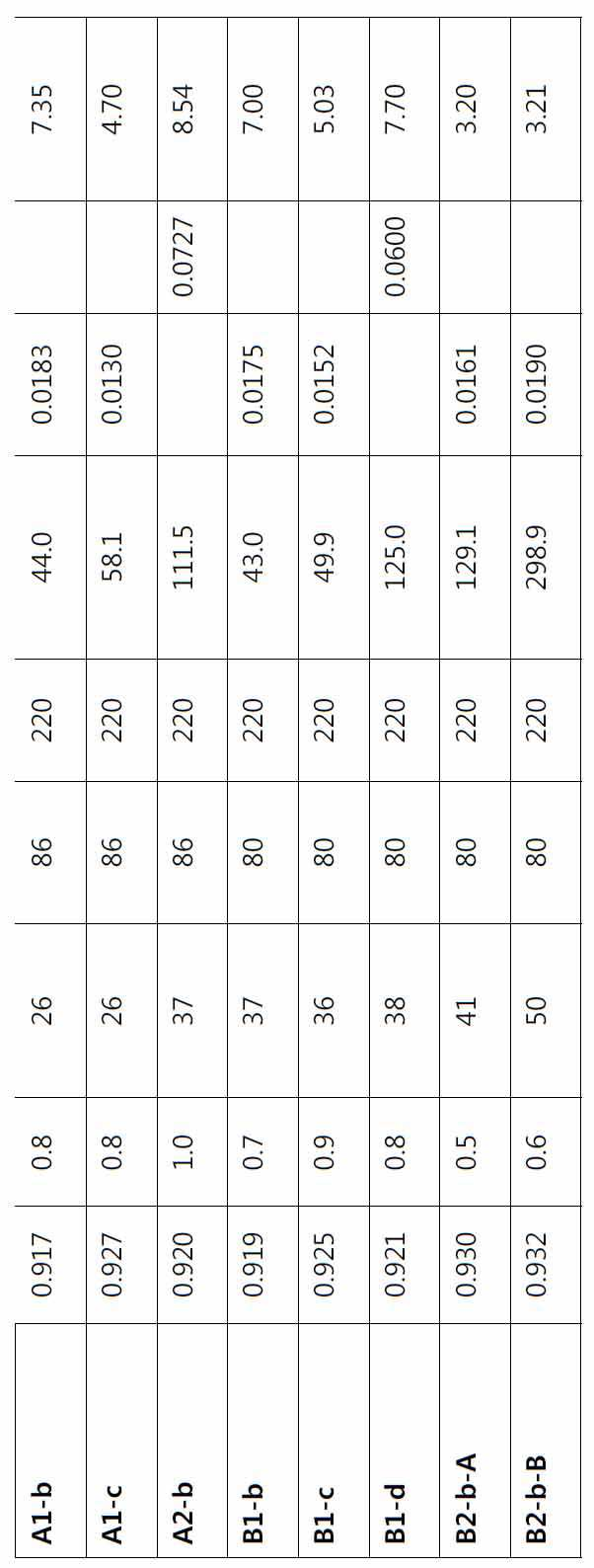


CFC로부터의 Tw1, Tw2, Mw1 & Mw2의 측정 Measurement of Tw1, Tw2, Mw1 & Mw2 from CFC
실험 중합체를 시판되는 경쟁 제품과 비교하기 위해 교차 분획화 (cross fractionation; CFC)를 사용하여 두 MWD 및 SCBD 조성 정보를 결정하기 위해 신규한 기술을 개발하였다. 값 Tw1, Tw2, Mw1 & Mw2는 기기 소프트웨어로부터 보고된 바와 같이 CFC 데이터 파일로부터 유도할 수 있다. CFC 데이터 파일에서의 "분획화 요약"의 부분에서, 각각의 분획이 이의 정규화된 wt% 값 (Wi), 누적 wt%, 즉, 총 wt 및 다양한 시점의 분자량 평균 (Mwi 포함)과 함께 이의 분획화 온도 (Ti)에 의해 열거되어 있다. To compare the experimental polymers with commercially available competitors, a new technique was developed to determine two MWD and SCBD compositional information using cross-fractionation (CFC). The values Tw1, Tw2, Mw1 & Mw2 can be derived from the CFC data file as reported from the instrument software. In the portion of the "fractionation summary" in the CFC data file, each fraction has its normalized wt% value (Wi), cumulative wt%, i. E. Total wt and molecular weight average (including Mwi) (Ti). ≪ / RTI >
도 3a 및 3b는 CFC 결과를 결정하기 위해 사용되는 계산을 그래프적으로 나타낸 플롯이다. MWD 데이터를 갖는 분획이 고려된다. 도 3a 및 3b 모두에서, x-축(302)은 섭씨온도로의 용리 온도이고, 한편 우측 y-축(304)은 용리된 분자량의 적분(306) 값이다. 본 실시예에서 100 %의 물질이 용리된 온도(308)는 약 100 ?C이다. 중합체의 50%가 용리된 지점은 각각의 플롯을 하반부(310) 및 상반부(312)로 구분하기 위해 사용되는 적분(306)에 의해 결정된다. Figures 3a and 3b are plots graphically illustrating the calculations used to determine CFC results. Fractions with MWD data are considered. In both Figures 3a and 3b,
도 3a 및 3b에서의 값 Tw1, Tw2, Mw1 & Mw2는 기기 소프트웨어로부터 보고된 바와 같이 CFC 데이터 파일로부터 유도할 수 있다. CFC 데이터 파일에서의 "분획화 요약"의 부분에서, 각각의 분획이 이의 정규화된 wt% 값 (Wi), 누적 wt%, 즉, 도 3a 및 3b에서의 총 wt 및 다양한 시점의 분자량 평균 (Mwi 포함)과 함께 이의 분획화 온도 (Ti)에 의해 열거되어 있다.The values Tw1, Tw2, Mw1 & Mw2 in Figures 3a and 3b can be derived from the CFC data file as reported from the instrument software. In the portion of the "Fractionation Summary" in the CFC data file, each fraction has its normalized wt% value (W i ), cumulative wt%, i.e. the total wt in Figs. 3a and 3b and the molecular weight average Mw i ) and its fractionation temperature (T i ).
Tw1, Tw2, Mw1 & Mw2의 값을 계산하기 위해, "분획화 요약"에서의 데이터를 2개의 거의 동일한 절반으로 나누었다. 각각의 절반부에 대한 Ti 및 Mwi의 중량 평균이 중량 평균의 종래의 정의에 따라 계산되었다. 본래의 데이터 파일에서의 분자량 평균에 대해 처리하기 위한 충분한 양 (즉, < 0.5 wt%)을 가지지 않은 분획이 Tw1, Tw2, Mw1 & Mw2의 계산으로부터 제외되었다.To calculate the values of Tw1, Tw2, Mw1 & Mw2, the data in the "fractionation summary" was divided into two nearly equal halves. The weighted average of T i and M w i for each half was calculated according to the conventional definition of weighted average. Twenty, Tw2, Mw1 & Mw2 were excluded from the fraction having no sufficient amount (i.e., <0.5 wt%) to process for the average molecular weight in the original data file.
상기 과정의 제1 부분이 3a에 의해 예시되어 있다. CFC 데이터 파일에서의 분획화 요약의 부분으로부터, 누적 wt% (즉, 총wt)이 50에 가장 근접되는 분획 (예를 들면, 도 3a에서의 84℃에서의 분획) 을 확인한다. 분획 요약 데이터는 2개의 절반, 예를 들면 도 3a에서의 제1 절반부로서 Ti <= 84 ℃ 및 제2 절반부로 Ti > 84 ℃로 나누어진다. 본래 데이터 파일에 보고된 분자량 평균을 가지지 않은 분획이 배제되고, 예를 들면, 도 3a에서의 25℃ 내지 40℃의 Ti를 갖는 분획이 배제된다. The first part of the process is illustrated by 3a. From the portion of the fractionation summary in the CFC data file, a fraction with the cumulative wt% (i.e., total wt) nearest to 50 (e.g., the fraction at 84 캜 in Fig. 3a) is identified. Fraction summary data is divided into two halves, for example, Ti <= 84 ° C as the first half of FIG. 3a and Ti> 84 ° C as the second half. Fractions that do not have the molecular weight average reported in the original data file are excluded, for example, a fraction with Ti at 25 占 폚 to 40 占 폚 in Fig. 3a is excluded.
도 3a에서, 좌측 y-축(310)은 용리된 분획의 wt%(312)를 나타낸다. 곡선을 2개의 절반부로 나누기 위해 상기 과정을 사용하며, 이러한 값은 방정식 1에 나타낸 식을 사용하여 각각의 절반부에 대한 중량 평균 용리 온도를 계산하기 위해 사용된다. In Figure 3a, the left y-

방정식 1에서, Ti은 각각의 용리된 분획에 대한 용리 온도를 나타내고, Wi는 각각의 용리된 분획에 대한 정규화된 중량% (중합체 양)을 나타낸다. 도 3a에 나타난 실시예에서, 이는 제1 절반부에 대해 64.0 ?C 및 제2 절반부에 대해 91.7 ?C 의 중량 평균 용리 온도를 제공한다. In
도 3b에서, 좌측 축(618)은 각각의 용리된 분획에 대해 중량 평균 분자량 (Mwi)(320)을 나타낸다. 이들 값은 방정식 2에 나타낸 식을 사용하여 각각의 절반부에 대한 중량 평균 분자량을 계산하기 위해 사용된다.In Figure 3b, the left axis 618 represents the weight average molecular weight (Mw i ) (320) for each eluted fraction. These values are used to calculate the weight average molecular weight for each half using the equation shown in

방정식 2에서, Mwi는 각각의 용리된 분획의 중량 평균 분자량을 나타내고, Wi는 각각의 용리된 분획의 정규화된 중량 % (중합체 양)을 나타낸다. 도 3b에서 나타난 실시예에 대해, 이는 제1 절반에 대해 약 238,000 및 제2 절반에 대해 약 74,000 의 중량 평균 분자량을 제공한다. 상기 기재된 기술을 사용하여 계산된 값은 도 4에 나타낸 바와 같이 BOCD 중합체 (표 2a 및 2b) 및 대조군 중합체 (표 3)에 대해 MWDxSCBD를 분류하기 위해 사용할 수 있다.In
도 4는 표 2a 및 2b에 열거된 중합체에 대한 영역(406)을 도시하는, (Mw1/Mw2) 대 (Tw1 - Tw2)의 반대수 플롯(400)이다. 플롯(400)에서, x-축(402)는 제1 및 제2 중량 평균 용리 온도 사이의 차이의 값을 나타낸다. 로그 눈금의 y-축(404)는 제1 중량 평균 분자량 대 제2 중량 평균 분자량의 비를 나타낸다. 중량 평균 분자량 및 중량 평균 용리 온도에 대해 계산된 값을 열거하는 표 2a 및 2b에서의 각각의 중합체는 영역(406) 내의 포함되는 것으로 나타난다. 본 예시적인 구현예에서, 영역(406)은 Tw1 - Tw2에 -15 ?C의 하한계 및 Mw1/Mw2에 대해 2.0의 하한계를 가진다. Figure 4 is an opposite number plot 400 of (Mw1 / Mw2) versus (Tw1-Tw2), showing area 406 for the polymers listed in Tables 2a and 2b. In plot 400,
영역(406)에 포함되는 중합체는 넓은, 직교 조성물 분포를 가질 수 있다. BOCD는 중합체에서의 저분자량 중합체 사슬이, 예를 들면, 단쇄 분지화 (SCB)의 결핍으로 인해 고밀도를 가지는 한편, 고분자량 세그먼트는 더 많은 양의 SCB로 인해 저밀도를 가진다. 반면, 영역(406) 외에 포함되는 종래의 중합체 (예를 들면, ZN-LLDPE)는 일반적으로 단쇄 중합체보다 더 높은 밀도를 가지는 장쇄 중합체를 가질 수 있다. 이러한 종래의 중합체는 일반적으로 플롯(400)의 하부에 존재할 수 있다. Polymers included in region 406 may have a wide, orthogonal composition distribution. The BOCD has a high density due to the lack of short chain branching (SCB), for example, while the low molecular weight polymer chains in the polymer have a low density due to the higher amount of SCB. On the other hand, conventional polymers (e.g., ZN-LLDPE) that are included in regions other than region 406 may have long chain polymers that generally have a higher density than short-chain polymers. Such conventional polymers may generally be present at the bottom of the plot 400.
알 수 있는 바와 같이, 보다 신규한 중합체 (표 2a, 2b)는 영역(406) 외에 포함되는 상업적 중합체와 비교되는 바와 같이 상이한 MWD 및 SCBD를 나타내는 영역(706)에 포함된다. 따라서, 상기 기재된 기술의 사용은 BOCD를 갖는 중합체를 확인할 수 있다. 따라서, 기술은 상기 둘 모두를 사용하여 분포도에 대해 신규한 중합체를 선별할 수 있고, 영역(706)에의 특정 위치로 표적화된 중합체 생산량을 조절할 수 있다. As can be seen, the newer polymers (Tables 2a, 2b) are included in regions 706 that exhibit different MWD and SCBD, as compared to commercial polymers included in regions other than region 406. Thus, the use of the techniques described above can identify polymers with BOCD. Thus, the technique can both use the above to select a new polymer for the distribution and adjust the polymer yield targeted to a particular location in the region 706.
교차-분획화 크로마토그래피 (CFC)를 사용한 시험 절차 Test procedures using cross-fractionated chromatography (CFC)
실시예에서, Polymer Char, Valencia, Spain로부터의 CFC-2 기기 상에서 교차-분획화 크로마토그래피 (CFC)를 수행하였다. 기기를 작동하였고, 차후의 데이터 처리, 예를 들면, 평활 파라미터, 설정 기준선, 및 정의된 통합 제한(integration limit)을 기기에 제공되는 CFC 사용자 설명서에 기재된 방식에 따라 또는 본 기술분야에 일반적으로 사용되는 방식에 따라 수행하였다. 상기 기기는 제1 용적의 TREF 칼럼 (스테인레스강; o.d., 3/8"; 길이, 15 cm; 팩킹, 비-다공성 스테인레스강 마이크로-볼) 및 제2 용적의 GPC 칼럼 세트 (3 x PLgel 10 ?m 혼합된 B 칼럼, Polymer Labs, UK 사제)가 구비되었다. GPC 칼럼으로부터 다운스트림은 용액에서의 중합체 농도에 비례하는 흡광도 신호를 생성할 수 있는 적외선 검출기 (Polymer Char로부터의 IR4)이었다. In the examples, cross-fractionated chromatography (CFC) was performed on a CFC-2 instrument from Polymer Char, Valencia, Spain. The instrument is operated and the subsequent data processing, for example, the smoothing parameters, the set baseline, and the defined integration limit, are performed according to the manner described in the CFC user manual provided with the instrument, . ≪ / RTI > The instrument was equipped with a first volume of TREF column (stainless steel; od, 3/8 "; length, 15 cm; packing, non-porous stainless steel micro-ball) and a second volume of GPC column set (3 x
분석되는 샘플을 75 분 동안 150 ℃에서의 교반에 의해 약 5 mg/ml의 농도에서 오르토-디클로로벤젠에 용해시켰다. 이후, 2.5 mg의 중합체를 함유하는 0.5-ml 용적의 용액을 TREF 칼럼의 중심에 장입하고, 칼럼 온도를 감소시켜 30분 동안 ?120 ℃에서 안정화시켰다. 칼럼을 30 ℃ (주위온도 실시 관련) 또는 -15 ℃ (냉동 실시 관련)로 서서히 (0.2 ℃/분) 냉각시켜 불활성 지지체 상에 중합체를 결정화시켰다. GPC 칼럼으로의 가용성 분획을 주입하기 이전에 저온을 10분 동안 유지하였다. 모든 GPC 분석을 1 ml/분, 140 ℃의 칼럼 온도에서 그리고 "오버랩 GPC 주사" 방식으로 용매 오르토-디클로로벤젠을 사용하여 실시하였다. 차후 고온 분획을 분획 설정값으로 단계적으로 TREF 칼럼 온도를 증가시켜 분석하고, 중합체를 16분 ("분석 시간") 동안 용해시키고, 그리고 3분 ("용리 시간") 동안 GPC 칼럼으로 용해된 중합체를 주입하여 분석하였다. The sample to be analyzed was dissolved in ortho-dichlorobenzene at a concentration of about 5 mg / ml by stirring at 150 DEG C for 75 minutes. A 0.5-ml volume of a solution containing 2.5 mg polymer was then charged to the center of the TREF column and the column temperature was reduced to stabilize at? 120 ° C for 30 minutes. The column was allowed to cool slowly (0.2 [deg.] C / min) to 30 [deg.] C (relative to ambient temperature) or -15 [deg.] C (relative to freezing) to crystallize the polymer on an inert support. The low temperature was maintained for 10 minutes prior to injecting the soluble fraction into the GPC column. All GPC analyzes were carried out at 1 ml / min, column temperature of 140 < 0 > C and using solvent ortho-dichlorobenzene in an "overlap GPC scan" Subsequently, the high temperature fraction was analyzed by increasing the TREF column temperature stepwise to the fraction set point, the polymer was dissolved for 16 minutes ("analysis time"), and the polymer dissolved in the GPC column for 3 minutes ("elution time" And analyzed.
보편적인 보정 방법을 용리된 중합체의 분자량을 결정하기 위해 사용하였다. 1.5-8200 Kg/mol 범위 내에 있는 13개의 좁은 분자량 분포 폴리스티렌 표준 (Polymer Labs, UK로부터 구매함)을 보편적인 보정 곡선을 생성시키기 위해 사용하였다. 마크-호윈크(Mark-Houwink) 파라미터를 S. Mori 및 H. G. Barth (Springer)에 의한 "크기 배제 크로마토그래피"의 부록 I로부터 얻었다. 폴리스티렌에 대해 K = 1.38 x 10⁻⁴ dl/g 및 ? = 0.7을 그리고 폴리에틸렌에 대해 K = 5.05 x 10⁻⁴ dl/g 및 ? = 0.693을 사용하였다. 0.5 % 미만의 중량 % 회수율 (기기 소프트웨어에 의해 보고된 바와 같음)을 갖는 분획은 개개의 분획 또는 분획의 응집체의 분자량 평균 (Mn, Mw, 등)의 계산에 대해 처리하지 않았다.A universal calibration method was used to determine the molecular weight of the eluted polymer. Thirteen narrow molecular weight polystyrene standards (purchased from Polymer Labs, UK) with a range of 1.5-8200 Kg / mol were used to generate universal calibration curves. Mark-Houwink parameters were obtained from Appendix I of " Size Exclusion Chromatography " by S. Mori and HG Barth (Springer). K = 1.38 x 10 < -4 > dl / g for polystyrene and? = 0.7 and K = 5.05 x 10 -4 dl / g for polyethylene and? = 0.693 was used. Fractions having a percent weight recovery of less than 0.5% (as reported by the instrument software) were not processed for the calculation of the molecular weight average (Mn, Mw, etc.) of the aggregates of the individual fractions or fractions.
블로우 필름 평가 데이터는 표 3a, 3b, 3c, 및 3d에 나타나 있다. 표 3a 및 3b 각각은 낮은 MFR에서의 BOCD 중합체 A0, A1, 및 B0 대 종래의 중합체 Exceed 1018을 비교한다. Blow film evaluation data are shown in Tables 3a, 3b, 3c, and 3d. Tables 3a and 3b each compare the BOCD polymers A0, A1, and B0 versus the conventional polymer Exceed 1018 at low MFR.
표 3a: 낮은 MFR (1 mil 게이지)에서의 코어-세트 대 Exceed의 블로우 필름 평가Table 3a: Blow film evaluation of core-set versus Exceed at low MFR (1 mil gauge)

표 3b: 낮은 MFR (2 mil 게이지)에서의 코어-세트 대 Exceed의 블로우 필름 평가Table 3b: Blow film evaluation of core-set versus Exceed at low MFR (2 mil gauge)

표 3c: 높은 MFR (1 mil 게이지)에서의 코어-세트 대 Enable의 블로우 필름 평가Table 3c: Blow film evaluation of core-set versus Enable at high MFR (1 mil gauge)

표 3d: 높은 MFR (2 mil 게이지)에서의 코어-세트 대 Enable의 블로우 필름 평가Table 3d: Blow film evaluation of core-set versus Enable at high MFR (2 mil gauge)

도 5a는 목표 또는 방식을 생성하고, 그리고 표 2a에 열거된 것, 표 1의 예시적인 BOCD 중합체의 일부를 생산하기 위한 기술의 도식적 표현이다. 본 기술은 동일 또는 유사한 각 중합체 밀도 및 MI에서의 일정 범위의 중합체 MFR 에 걸쳐 다양한 BOCD 중합체를 생산할 수 있다. 이러한 기술은 중합 작업 변수 및 중합체 특성의 목표값에 관한 실험 설계로부터 BOCD 중합체의 실제의 상업적 생산의 조절까지 범위일 수 있다. 도 5a의 예시적인 구현예에서, 15-22의 목표 MFR 범위(502)은 선택된 반응기 온도 (예를 들면, 표 1에서의 86 ℃)로 특정된다 .이는 다양한 반응기 온도에서의 단일 촉매의 MFR 능력에 대한 선행 실험의 학습에 기초한다. 블록(504)에 표시된 바와 같이, 본 실시예에서 단일 촉매계 (HfP)는 목표 MFR 범위(502)에 대한 초기 중합 반응기 조건으로 특정된다. 작업 변수 목표에 대해 조정(506)이 실시되어 중합체 A0(508)을 수득한다. 표 1과 관련하여 상기에 나타난 바와 같이, 반응기 온도 및 제2 또는 트림 촉매의 양이 MFR에 대한 일차 변수일 수 있다. 공단량체/에틸렌 비, 예를 들면, 1-헥센/에틸렌 (C6/C2) 비 또는 부탄/에틸렌 (C4/C2) 비는 중합체 밀도에 대한 일차 변수일 수 있다. 수소/에틸렌 (H2/C2) 비는 중합체 MI에 대해 일차 변수일 수 있다.5A is a graphical representation of a technique for producing a target or scheme and producing a portion of the exemplary BOCD polymer of Table 1, listed in Table 2a. The technique can produce various BOCD polymers across a range of polymer MFRs at the same or similar respective polymer densities and MI. These techniques may range from experimental design on the polymerization operation parameters and target values of the polymer properties to the adjustment of the actual commercial production of the BOCD polymer. 5A, the
5a에 대해 계속하여, 26-30의 목표 중합체 MFR 범위(510)에 대해, 제2 촉매 (즉, Et-Ind)는 블록(512)에 명시된 MFR 목표가 도달될 때까지 508의 조건으로 시스템에 부가되고, 한편 MI 및 밀도는 전달 과정에서 플로팅(floating)시켰다. 512에서 MFR 목표가 달성된 이후, 조정 작업(514)이 실시되어 508과 동일한 MI & 밀도 목표를 갖는 중합체 A1(516)가 수득된다. 조정 작업(518)이 실시되어 중합체 A1-b(520) 가 수득된다. 조정 작업(522)이 실시되어 중합체 A1-c(524) 가 수득된다. 이러한 조정 작업과 함께, 510의 매우 좁은 범위에서 MFR을 유지하면서 516, 520 & 254에 대한 MI 및 밀도를 독립적으로 변화시킬 수 있다. 30-중반에서의 목표 중합체 MFR 범위(526)에 대해, 이중-촉매계 (HfP 및 Et-Ind) 및 초기 반응기 조건이 블록 (528)에 참조로서 명시되어 있다. 조정 작업(530)이 실시되어 중합체 A2(532)가 수득된다. 조정 작업(534)이 실시되어 중합체 A2-b(536)가 수득된다. 논의된 바와 같이, 조정(514, 518, 522, 530, 및 534)은 상기 표 1b에 표시되어 있다. Continuing with 5a, for a target
도 5b는 도 5a와 유사하나 표 1b로부터의 상이한 BOCD 중합체를 가진다. 도 5b는 목표 또는 방식을 생성하고, 그리고 표 2b에 열거된 것, 표 1b의 예시적인 BOCD 중합체의 일부를 생산하기 위한 기술의 도식적 표현이다. 마찬가지로, 도 5a 및 도 5b와 관련된 이러한 기술은 중합체 밀도 및 MI를 유지하면서 일정 범위의 중합체 MFR에 걸쳐 다양한 BOCD 중합체를 생성할 수 있다. 언급된 바와 같이, 기술은 중합 작업 변수 (예를 들면, 방식) 및 중합체 특성의 목표 값에 대한 DOE로부터 BOCD 중합체 등의 실제 상업적 생산의 조절까지의 범위일 수 있다. 도 5b의 예시적인 구현예에서, 상이한 선택된 반응기 온도 (예를 들면, 표 1b에서의 80 ℃)에서의 26-30의 상이한 목표 MFR 범위(510)은 동일한 단일 촉매에 대해 특정된다. 블록(540)에 표시된 바와 같이, 본 실시예에서 단일 촉매계 (HfP)는 목표 MFR 범위(510)에 대한 초기 중합 반응기 조건으로 특정된다. 작업 변수 또는 작업 변수 목표에 대한 조정(540)이 실시되어 중합체 B0(544)을 수득한다. 30-중반의 목표 중합체 MFR 범위(526)에 대해, 508 내지 512로부터의 도 5a에서와 유사한 과정이 후속되어 도 5b의 544로부터 546에 도달된다. 조정 작업(548)이 실시되어 중합체 B1(550) 이 수득된다. 조정 작업(552)이 실시되어 중합체 B1-b(554)가 수득된다. 조정 작업(556)이 실시되어 중합체 B1-c(558)이 수득된다. 게다가, 조정 작업(560)이 실시되어 중합체 B1-d(562)이 수득된다. 35-55의 목표 중합체 MFR 범위(564)에 대해, 이중-촉매계 (HfP 및 Et-Ind) 및 초기 반응기 조건이 블록(566)에 의해 참조되는 바와 같이 명시되어 있다. 조정 작업(568)이 실시되어 중합체 B2(570)이 수득된다. 조정 작업(572)가 실시되어 중합체 B2-b(574)가 수득된다. 조정(540, 548, 552, 556, 560, 568, 및 572)가 상기 표 1b에 표시되어 있다. 마찬가지로, 반응기 온도 및 트림 촉매 비는 MFR에 대한 일차 변수 또는 "노브(knob)"일 수 있다. 공단량체/에틸렌 비, 예를 들면, C6/C2 또는 C4/C2는 중합체 밀도에 대한 일차 변수 또는 "노브"일 수 있다. H2/C2 비는 중합체 MI에 대한 일차 변수 또는 "노브"일 수 있다. Figure 5b is similar to Figure 5a but has a different BOCD polymer from Table 1b. Figure 5b is a graphical representation of a technique for producing a target or scheme and producing a portion of the exemplary BOCD polymer of Table 1b, listed in Table 2b. Similarly, this technique with respect to Figures 5A and 5B can produce various BOCD polymers across a range of polymer MFRs while maintaining the polymer density and MI. As mentioned, the techniques may range from polymerization of the polymerization process parameters (e.g., mode) and target values of the polymer properties to control of actual commercial production such as BOCD polymers from DOE. In the exemplary embodiment of FIG. 5B, a different
도 6은 BOCD를 갖는 폴리에틸렌을 포함하는 폴리에틸렌의 제조를 위한 예시적인 방법(600)이다. 방법(600)은 폴리에틸렌의 생산을 위한 방식 목표를 개발하는 단계, 잠재적인 BOCD 중합체의 생산 그리고/또는 폴리에틸렌 등의 생산시 실제 실시간 조절을 평가하는 단계 등을 수반할 수 있다. 블록(602)에서, 폴리에틸렌 중합체의 목표 MFR이 원하여지거나 특정되어 있다. 특정 구현예에서, 방법(600)은 동일한 MI 및 동일한 밀도에 걸친 일정 범위의 중합체 MFR과 관련될 수 있다. 중합 반응기 온도 및 촉매 트림 비 (제2 촉매가 이용되는 경우)가 특정되거나 조정되어 블록(604 및 606)에 표시된 바와 같은 바람직한 중합체 MFR이 얻어진다. 블록(608)에서, 수소의 양은 특정되거나 조정되어 중합체 MI가 유지된다. 조정은 반응기에서의 중합 혼합물에서의 수소/에틸렌 (H2/C2) 비에 관한 것일 수 있다. 블록(610)에서, 공단량체의 양은 특정되거나 조정되어 중합체 밀도가 유지된다. 조정은 반응기에서의 중합 혼합물 및/또는 반응기로의 공급물 스트림에서의 공단량체/에틸렌 (예를 들면, C6/C2 또는 C4/C2) 비에 관한 것일 수 있다. 6 is an
모든 수치는 표시된 값의 "약" 또는 "대략적인" 값이며, 당해 분야의 숙련가에 의해 예상될 실험 오차 및 변이를 고려한다. 또한, 다양한 용어가 상기 정의되었다. 청구범위에 사용된 용어가 상기 정의되어 있지 않다는 점에서, 당업자에게는 가장 광범위한 정의, 및 적어도 하나의 인쇄된 공보 또는 등록된 특허에 반영된 그러한 용어가 주어져야 한다. 본원에서 인용된 모든 특허, 시험 절차, 및 다른 문서들은, 이들의 개시내용이 본원과 일치되는 정도로 참고로 충분히 포함되며, 그와 같은 포함이 허용되는 모든 권한도 충분히 포함된다.All numbers are "about" or " approximate "values of the indicated values, taking into account experimental errors and variations expected by those skilled in the art. In addition, various terms have been defined above. In the sense that the terms used in the claims are not defined above, those skilled in the art should be given the broadest definition, and those terms reflected in at least one printed publication or registered patent. All patents, test procedures, and other documents cited herein are fully incorporated by reference to the extent such that their disclosure is consistent with the present disclosure, and such inclusion also includes all permissible rights.
본 발명의 구현예에 대하여 지금까지 설명하였지만, 본 발명의 기본 범주로부터 벗어나지 않고 본 발명의 다른 및 추가의 구현예가 고안될 수 있으며, 이들의 범주는 하기 청구범위에 의해 결정된다.Having thus described the embodiments of the invention, other and further embodiments of the invention may be devised without departing from the basic scope thereof, and the scope thereof is determined by the claims that follow.
Claims (49)
반응기에서 촉매계의 존재 하에 에틸렌을 중합하여 폴리에틸렌을 형성하는 단계로서, 상기 촉매계는 제1 촉매 및 제2 촉매를 포함하는, 상기 폴리에틸렌을 형성하는 단계; 및
반응기 조건 및 상기 반응기로 공급되는 상기 제2 촉매의 양을 조정하여, 상기 폴리에틸렌의 목표 용융 유동비(MFR) 그리고 분자량 분포(MWD)와 조성물 분포(CD)의 바람직한 조합에 기초해서 상기 폴리에틸렌의 용융 지수(MI)와 밀도를 조절하는 단계를 포함하는, 폴리에틸렌의 제조 방법.As a method for producing polyethylene,
Polymerizing ethylene in the presence of a catalyst system in a reactor to form polyethylene, said catalyst system comprising a first catalyst and a second catalyst; And
Adjusting the reactor conditions and the amount of the second catalyst fed to the reactor to adjust the melt flow rate (MFR) of the polyethylene based on the preferred combination of molecular weight distribution (MWD) and composition distribution (CD) And adjusting the index (MI) and density of the polyethylene.
적어도 약 2.0의 Mw1/Mw2에 대한 값으로서, Mw1/Mw2는 온도 상승 용리(TREF) 곡선의 제1 절반부에 대한 중량 평균 분자량(Mw) 대 TREF 곡선의 제2 절반부에 대한 Mw의 비인, 상기 Mw1/Mw2에 대한 값; 및
약 -15oC 미만의 Tw1 - Tw2에 대한 값으로서, Tw1 - Tw2는 상기 TREF 곡선의 상기 제1 절반부에 대한 중량 평균 용리 온도(Tw) 대 상기 TREF 곡선의 상기 제2 절반부에 대한 Tw의 차이인, 상기 Tw1 - Tw2에 대한 값
을 포함하는, 폴리에틸렌을 형성하는 방법.The method according to claim 1,
Mw1 / Mw2 is the ratio of the weight average molecular weight (Mw) to the first half of the temperature rise elution (TREF) curve versus the Mw to the second half of the TREF curve, as a value for Mw1 / Mw2 of at least about 2.0. A value for the Mw1 / Mw2; And
Tw1-Tw2 is a value for Tw1-Tw2 of less than about -15 o C, Tw1-Tw2 is a weight average elution temperature (Tw) for the first half of the TREF curve versus Tw The value for the Tw1-Tw2
≪ / RTI >
상기 폴리에틸렌은,
중합 반응기에서 제1 촉매 및 제2 촉매를 포함하는 중합 촉매계를 통해; 그리고
상기 중합 반응기의 작동 조건 및 상기 중합 반응기로 공급되는 상기 제2 촉매의 양을 조정하여, 목표 용융 유동비(MFR) 그리고 원하는 MWD 및 CD 조합에 기초해서 상기 폴리에틸렌의 용융 지수(MI) 및 밀도를 조절함으로써,
형성된, 중합체. As the polymer comprising polyethylene,
The polyethylene,
Through a polymerization catalyst system comprising a first catalyst and a second catalyst in a polymerization reactor; And
The operating conditions of the polymerization reactor and the amount of the second catalyst supplied to the polymerization reactor are adjusted so that the melt index (MI) and density of the polyethylene, based on the target melt flow ratio (MFR) and the desired MWD and CD combination By adjusting,
Formed.
상기 중합 촉매계는 반응기에서 폴리에틸렌으로의 에틸렌의 중합을 촉진하기 위해 제1 촉매 및 제2 촉매를 포함하고, 상기 중합 촉매계는, 반응기 조건 및 상기 반응기로 공급되는 제2 촉매의 양과 관련하여, 상기 폴리에틸렌의 목표 용융 유동비(MFR), 그리고 상기 폴리에틸렌의 원하는 MWD x CD 조합에 기초해서 상기 폴리에틸렌의 용융 지수(MI) 및 밀도를 조정하도록 구성된, 중합 촉매계.As a polymerization catalyst system,
Wherein the polymerization catalyst system comprises a first catalyst and a second catalyst for promoting polymerization of ethylene in the reactor to polyethylene, and wherein the polymerization catalyst system is selected from the group consisting of polyethylene (MI) and density of the polyethylene based on a desired melt flow ratio (MFR) of the polyethylene and a desired MWD x CD combination of the polyethylene.
반응기에서 촉매계의 존재 하에 에틸렌을 중합하여 폴리에틸렌을 형성하는 단계로서, 상기 촉매계는 제1 촉매 및 제2 촉매를 포함하는, 상기 폴리에틸렌을 형성하는 단계; 및
반응기 온도, 반응기 수소 농도, 반응기 공단량체 농도, 및 상기 반응기로 공급되는 상기 제2 촉매의 양을 조정하여, 상기 폴리에틸렌의 밀도 및 용융 지수(MI)를 유지하면서 상기 폴리에틸렌의 일정 범위의 용융 유동비(MFR)를 생성하는 단계
를 포함하는 폴리에틸렌의 제조 방법.As a method for producing polyethylene,
Polymerizing ethylene in the presence of a catalyst system in a reactor to form polyethylene, said catalyst system comprising a first catalyst and a second catalyst; And
Adjusting the amount of the second catalyst supplied to the reactor so that the density and the melt index (MI) of the polyethylene are maintained, and the molten flow ratio (MFR)
≪ / RTI >
반응기에서 촉매계의 존재 하에 에틸렌을 중합하여 폴리에틸렌을 형성하는 단계로서, 상기 촉매계는 제1 촉매 및 제2 촉매를 포함하는, 상기 폴리에틸렌을 형성하는 단계;
상기 반응기의 제1 온도 및 제2 촉매 대 제1 촉매의 제1 비를 특정하여, 제1 밀도 및 제1 용융 지수(MI)를 갖는 상기 폴리에틸렌의 제1 MFR을 생성하는 단계;
상기 반응기의 제2 온도 및 제2 촉매 대 제1 촉매의 제2 비를 특정하여, 상기 제1 밀도 및 상기 제1 MI를 갖는 상기 폴리에틸렌의 상기 제1 MFR와는 상이한 제2 MFR을 생성하는 단계;
상기 반응기에서 수소 대 에틸렌의 비를 조정하여, 상기 제2 MFR을 갖는 상기 폴리에틸렌의 상기 제1 MI를 유지하는 단계; 및
상기 반응기에서 공단량체 대 에틸렌의 비를 조정하여, 상기 제2 MFR을 갖는 상기 폴리에틸렌의 상기 제1 밀도를 유지하는 단계를 포함하는, 폴리에틸렌의 제조 방법. As a method for producing polyethylene,
Polymerizing ethylene in the presence of a catalyst system in a reactor to form polyethylene, said catalyst system comprising a first catalyst and a second catalyst;
Identifying a first temperature of the reactor and a first ratio of the second catalyst to the first catalyst to produce a first MFR of the polyethylene having a first density and a first melt index (MI);
Identifying a second temperature of the reactor and a second ratio of the second catalyst to the first catalyst to produce a second MFR that is different from the first MFR of the polyethylene having the first density and the first MI;
Adjusting the ratio of hydrogen to ethylene in the reactor to maintain the first MI of the polyethylene having the second MFR; And
Adjusting the ratio of comonomer to ethylene in said reactor to maintain said first density of said polyethylene having said second MFR.
상기 반응기의 제3 온도 및 제2 촉매 대 제1 촉매의 제3 비를 특정하여, 상기 제1 밀도 및 상기 제1 MI를 갖는 상기 폴리에틸렌의 상기 제1 MFR 및 상기 제2 MFR와는 상이한 제3 MFR을 생성하는 단계;
상기 반응기에서 수소 대 에틸렌의 비를 조정하여, 상기 제3 MFR을 갖는 상기 폴리에틸렌의 상기 제1 MI를 유지하는 단계; 및
상기 반응기에서 상기 공단량체 대 에틸렌의 비를 조정하여, 상기 제3 MFR을 갖는 상기 폴리에틸렌의 상기 제1 밀도를 유지하는 단계를 포함하는, 폴리에틸렌의 제조 방법.
49. The method of claim 48,
Determining a third temperature of the reactor and a third ratio of the second catalyst to the first catalyst to determine a third MFR that is different from the first MFR and the second MFR of the polyethylene having the first density and the first MI ;
Adjusting the ratio of hydrogen to ethylene in the reactor to maintain the first MI of the polyethylene having the third MFR; And
And adjusting the ratio of said comonomer to ethylene in said reactor to maintain said first density of said polyethylene having said third MFR.
Priority Applications (1)
| Application Number | Priority Date | Filing Date | Title |
|---|---|---|---|
| KR1020217035787A KR102440033B1 (en) | 2014-02-11 | 2015-02-10 | Method for producing polyethylene and polyethylene thereof |
Applications Claiming Priority (19)
| Application Number | Priority Date | Filing Date | Title |
|---|---|---|---|
| US201461938466P | 2014-02-11 | 2014-02-11 | |
| US201461938472P | 2014-02-11 | 2014-02-11 | |
| US61/938,466 | 2014-02-11 | ||
| US61/938,472 | 2014-02-11 | ||
| US201461981291P | 2014-04-18 | 2014-04-18 | |
| US61/981,291 | 2014-04-18 | ||
| US201461985151P | 2014-04-28 | 2014-04-28 | |
| US61/985,151 | 2014-04-28 | ||
| US201462032383P | 2014-08-01 | 2014-08-01 | |
| US62/032,383 | 2014-08-01 | ||
| US201462087911P | 2014-12-05 | 2014-12-05 | |
| US201462087914P | 2014-12-05 | 2014-12-05 | |
| US201462088196P | 2014-12-05 | 2014-12-05 | |
| US201462087905P | 2014-12-05 | 2014-12-05 | |
| US62/088,196 | 2014-12-05 | ||
| US62/087,911 | 2014-12-05 | ||
| US62/087,905 | 2014-12-05 | ||
| US62/087,914 | 2014-12-05 | ||
| PCT/US2015/015132 WO2015123172A1 (en) | 2014-02-11 | 2015-02-10 | Method of producing polyethylene and polyethylene thereof |
Related Child Applications (1)
| Application Number | Title | Priority Date | Filing Date |
|---|---|---|---|
| KR1020217035787A Division KR102440033B1 (en) | 2014-02-11 | 2015-02-10 | Method for producing polyethylene and polyethylene thereof |
Publications (2)
| Publication Number | Publication Date |
|---|---|
| KR20160121541A true KR20160121541A (en) | 2016-10-19 |
| KR102323279B1 KR102323279B1 (en) | 2021-11-08 |
Family
ID=52573736
Family Applications (18)
| Application Number | Title | Priority Date | Filing Date |
|---|---|---|---|
| KR1020167023998A Active KR102378586B1 (en) | 2014-02-11 | 2015-02-10 | Method to prepare ethylene copolymers |
| KR1020217013368A Active KR102354757B1 (en) | 2014-02-11 | 2015-02-10 | Producing polyolefin products |
| KR1020167024165A Active KR102394133B1 (en) | 2014-02-11 | 2015-02-10 | Producing polyolefin products with improved stiffness, toughness, and processability |
| KR1020217033318A Active KR102403962B1 (en) | 2014-02-11 | 2015-02-10 | Producing polyolefin products |
| KR1020167024614A Active KR102329464B1 (en) | 2014-02-11 | 2015-02-10 | Producing polyolefin products |
| KR1020217035787A Active KR102440033B1 (en) | 2014-02-11 | 2015-02-10 | Method for producing polyethylene and polyethylene thereof |
| KR1020167024305A Active KR102329477B1 (en) | 2014-02-11 | 2015-02-10 | Producing polyolefin products |
| KR1020167024000A Active KR102293490B1 (en) | 2014-02-11 | 2015-02-10 | Producing polyolefin products |
| KR1020167023819A Active KR102321784B1 (en) | 2014-02-11 | 2015-02-10 | Producing polyolefin products |
| KR1020167024167A Active KR102324441B1 (en) | 2014-02-11 | 2015-02-10 | Producing polyolefin products |
| KR1020167023999A Active KR102323279B1 (en) | 2014-02-11 | 2015-02-10 | Method of producing polyethylene and polyethylene thereof |
| KR1020217036090A Active KR102454826B1 (en) | 2014-02-11 | 2015-02-10 | Producing polyolefin products |
| KR1020217042114A Active KR102496899B1 (en) | 2014-02-11 | 2015-02-10 | Producing polyolefin products with improved stiffness, toughness, and processability |
| KR1020217042115A Active KR102454827B1 (en) | 2014-02-11 | 2015-02-10 | Producing polyolefin products with improved stiffness, toughness, and processability |
| KR1020217026307A Active KR102362120B1 (en) | 2014-02-11 | 2015-02-10 | Producing polyolefin products |
| KR1020167024162A Active KR102344094B1 (en) | 2014-02-11 | 2015-02-10 | Producing polyolefin products with improved stiffness, toughness, and processability |
| KR1020227009380A Active KR102514764B1 (en) | 2014-02-11 | 2015-02-10 | Method to prepare ethylene copolymers |
| KR1020217039232A Active KR102362123B1 (en) | 2014-02-11 | 2015-02-10 | Producing polyolefin products |
Family Applications Before (10)
| Application Number | Title | Priority Date | Filing Date |
|---|---|---|---|
| KR1020167023998A Active KR102378586B1 (en) | 2014-02-11 | 2015-02-10 | Method to prepare ethylene copolymers |
| KR1020217013368A Active KR102354757B1 (en) | 2014-02-11 | 2015-02-10 | Producing polyolefin products |
| KR1020167024165A Active KR102394133B1 (en) | 2014-02-11 | 2015-02-10 | Producing polyolefin products with improved stiffness, toughness, and processability |
| KR1020217033318A Active KR102403962B1 (en) | 2014-02-11 | 2015-02-10 | Producing polyolefin products |
| KR1020167024614A Active KR102329464B1 (en) | 2014-02-11 | 2015-02-10 | Producing polyolefin products |
| KR1020217035787A Active KR102440033B1 (en) | 2014-02-11 | 2015-02-10 | Method for producing polyethylene and polyethylene thereof |
| KR1020167024305A Active KR102329477B1 (en) | 2014-02-11 | 2015-02-10 | Producing polyolefin products |
| KR1020167024000A Active KR102293490B1 (en) | 2014-02-11 | 2015-02-10 | Producing polyolefin products |
| KR1020167023819A Active KR102321784B1 (en) | 2014-02-11 | 2015-02-10 | Producing polyolefin products |
| KR1020167024167A Active KR102324441B1 (en) | 2014-02-11 | 2015-02-10 | Producing polyolefin products |
Family Applications After (7)
| Application Number | Title | Priority Date | Filing Date |
|---|---|---|---|
| KR1020217036090A Active KR102454826B1 (en) | 2014-02-11 | 2015-02-10 | Producing polyolefin products |
| KR1020217042114A Active KR102496899B1 (en) | 2014-02-11 | 2015-02-10 | Producing polyolefin products with improved stiffness, toughness, and processability |
| KR1020217042115A Active KR102454827B1 (en) | 2014-02-11 | 2015-02-10 | Producing polyolefin products with improved stiffness, toughness, and processability |
| KR1020217026307A Active KR102362120B1 (en) | 2014-02-11 | 2015-02-10 | Producing polyolefin products |
| KR1020167024162A Active KR102344094B1 (en) | 2014-02-11 | 2015-02-10 | Producing polyolefin products with improved stiffness, toughness, and processability |
| KR1020227009380A Active KR102514764B1 (en) | 2014-02-11 | 2015-02-10 | Method to prepare ethylene copolymers |
| KR1020217039232A Active KR102362123B1 (en) | 2014-02-11 | 2015-02-10 | Producing polyolefin products |
Country Status (16)
| Country | Link |
|---|---|
| US (23) | US20160362510A1 (en) |
| EP (21) | EP3778671A1 (en) |
| JP (19) | JP6532881B2 (en) |
| KR (18) | KR102378586B1 (en) |
| CN (14) | CN105992775B (en) |
| AU (14) | AU2015217388B2 (en) |
| BR (9) | BR112016019310B1 (en) |
| CA (8) | CA2938841C (en) |
| ES (9) | ES2836145T3 (en) |
| MX (21) | MX392343B (en) |
| MY (7) | MY189858A (en) |
| PH (9) | PH12016501563B1 (en) |
| RU (12) | RU2693828C2 (en) |
| SA (10) | SA519401457B1 (en) |
| SG (20) | SG10201701980PA (en) |
| WO (9) | WO2015123172A1 (en) |
Families Citing this family (119)
| Publication number | Priority date | Publication date | Assignee | Title |
|---|---|---|---|---|
| US20160362510A1 (en) * | 2014-02-11 | 2016-12-15 | Univation Technologies, Llc | Method to prepare ethylene copolymers |
| CN113321757B (en) * | 2014-06-16 | 2023-05-05 | 尤尼威蒂恩技术有限责任公司 | Method for modifying melt flow ratio and/or swelling of polyethylene resin |
| ES2928549T3 (en) * | 2015-04-23 | 2022-11-21 | Univation Tech Llc | Polyethylene copolymers having a particular comonomer distribution |
| FR3043687B1 (en) * | 2015-11-13 | 2020-07-03 | Universite Blaise Pascal Clermont Ii | SOL-GEL PROCESS FOR THE SYNTHESIS OF A LUMINESCENT MATERIAL OF GENERAL FORMULATION AXBYFZ: MN |
| KR101711788B1 (en) * | 2016-03-09 | 2017-03-14 | 한화케미칼 주식회사 | Hybride catalyst compositon, preparation method thereof, and manufactured polyolefin using the same |
| WO2017173074A1 (en) * | 2016-03-31 | 2017-10-05 | Dow Global Technologies Llc | An olefin polymerization catalyst |
| CN109071844A (en) * | 2016-04-22 | 2018-12-21 | 埃克森美孚化学专利公司 | Polyethylene sheets |
| US10302621B2 (en) | 2016-06-15 | 2019-05-28 | Exxonmobil Chemical Patents Inc. | Methods for characterizing branching distribution in polymers |
| PT3293210T (en) * | 2016-09-12 | 2019-06-12 | Scg Chemicals Co Ltd | Multimodal polyethylene film |
| WO2018063782A1 (en) * | 2016-09-29 | 2018-04-05 | Dow Global Technologies Llc | Multilayer stretch films having a high cling force and methods thereof |
| US10882932B2 (en) | 2016-10-05 | 2021-01-05 | Exxonmobil Chemical Patents Inc. | Sterically hindered metallocenes, synthesis and use |
| SG11201901900SA (en) * | 2016-10-05 | 2019-04-29 | Exxonmobil Chemical Patents Inc | Sterically hindered metallocenes, synthesis and use |
| EP3535301A1 (en) * | 2016-11-03 | 2019-09-11 | ExxonMobil Chemical Patents Inc. | Multi-component catalyst composition supply system and process for producing polymers |
| ES2919777T5 (en) * | 2016-11-08 | 2025-09-25 | Univation Tech Llc | Bimodal polyethylene |
| KR102212822B1 (en) * | 2016-12-05 | 2021-02-08 | 엑손모빌 케미칼 패턴츠 인코포레이티드 | Broad Orthogonal Distribution Metallocene Polyethylene for Film |
| WO2018106388A1 (en) | 2016-12-05 | 2018-06-14 | Exxonmobil Chemical Patents Inc. | Broad orthogonal distribution metallocene polyethylenes for films |
| WO2018111631A1 (en) | 2016-12-15 | 2018-06-21 | Univation Technologies, Llc | Rating polymerization processes |
| MX2019006564A (en) * | 2016-12-19 | 2019-08-22 | Dow Global Technologies Llc | CONDUCTIVE COVER AND PROCESS FOR ITS PRODUCTION. |
| CN110191902B (en) * | 2017-02-13 | 2022-08-09 | 尤尼威蒂恩技术有限责任公司 | Bimodal polyethylene resin |
| US10723819B2 (en) | 2017-02-20 | 2020-07-28 | Exxonmobil Chemical Patents, Inc. | Supported catalyst systems and processes for use thereof |
| KR102271789B1 (en) * | 2017-02-20 | 2021-06-30 | 엑손모빌 케미칼 패턴츠 인코포레이티드 | Supported catalyst systems and methods of use thereof |
| JP6868714B2 (en) * | 2017-05-10 | 2021-05-12 | ユニベーション・テクノロジーズ・エルエルシー | Catalyst system and process for its use |
| ES2892028T3 (en) * | 2017-05-17 | 2022-02-01 | Univation Tech Llc | A hafnium complex; a supported hafnium complex; methods for forming a polymer using said complexes |
| ES2942273T3 (en) * | 2017-06-02 | 2023-05-31 | Univation Tech Llc | Method of determining a relative decrease in the catalytic efficiency of a catalyst in a catalyst solution |
| WO2018226787A1 (en) * | 2017-06-08 | 2018-12-13 | Univation Technologies, Llc | Method of maintaining a melt flow index of a polyethylene polymer product |
| CN111094366B (en) * | 2017-08-04 | 2022-06-24 | 埃克森美孚化学专利公司 | Polyethylene compositions and films made therefrom |
| US10844150B2 (en) | 2017-08-04 | 2020-11-24 | Exxonmobil Chemical Patents Inc. | Mixed catalysts with 2,6-bis(imino)pyridyl iron complexes and bridged hafnocenes |
| EP3697822B1 (en) | 2017-08-04 | 2025-07-30 | ExxonMobil Chemical Patents Inc. | Mixed catalysts with unbridged hafnocenes with -ch2-sime3 moieties |
| CN111183160B (en) | 2017-10-06 | 2022-06-10 | 埃克森美孚化学专利公司 | Polyethylene extrudates and process for making same |
| CN111587256B (en) * | 2017-10-23 | 2023-05-19 | 埃克森美孚化学专利公司 | Catalyst system and polymerization process using the same |
| CN111886261A (en) * | 2017-10-27 | 2020-11-03 | 尤尼威蒂恩技术有限责任公司 | Polyethylene copolymer resin and film |
| CN111587257B (en) * | 2017-10-31 | 2023-02-10 | 埃克森美孚化学专利公司 | Mixed catalyst system with four metallocenes on a single support |
| US10703838B2 (en) | 2017-10-31 | 2020-07-07 | Exxonmobil Chemical Patents Inc. | Mixed catalyst systems with four metallocenes on a single support |
| WO2019094131A1 (en) | 2017-11-13 | 2019-05-16 | Exxonmobil Chemical Patents Inc. | Polyethylene compositions and articles made therefrom |
| WO2019094132A1 (en) | 2017-11-13 | 2019-05-16 | Exxonmobil Chemical Patents Inc. | Polyethylene compositions and articles made therefrom |
| US11130827B2 (en) | 2017-11-14 | 2021-09-28 | Exxonmobil Chemical Patents Inc. | Polyethylene compositions and articles made therefrom |
| EP3710501A2 (en) | 2017-11-15 | 2020-09-23 | ExxonMobil Chemical Patents Inc. | Polymerization processes |
| US11111325B2 (en) | 2017-11-15 | 2021-09-07 | Exxonmobil Chemical Patents Inc. | Polymerization processes |
| US11015002B2 (en) | 2017-11-15 | 2021-05-25 | Exxonmobil Chemical Patents Inc. | Polymerization processes |
| WO2019108315A1 (en) * | 2017-11-28 | 2019-06-06 | Exxonmobil Chemical Patents Inc. | Catalyst systems and polymerization processes for using the same |
| US10926250B2 (en) | 2017-12-01 | 2021-02-23 | Exxonmobil Chemical Patents Inc. | Catalyst systems and polymerization processes for using the same |
| KR102405495B1 (en) | 2017-12-01 | 2022-06-08 | 엑손모빌 케미칼 패턴츠 인코포레이티드 | Catalyst system and polymerization method for using same |
| CN108129729A (en) * | 2017-12-20 | 2018-06-08 | 宁波市鄞州智伴信息科技有限公司 | A kind of preparation process of the novel plastic type magnetron based on permanent-magnet material |
| KR102459861B1 (en) | 2017-12-21 | 2022-10-27 | 주식회사 엘지화학 | Ethylene/1-butene copolymer having excellent processibility |
| KR102323807B1 (en) * | 2018-01-12 | 2021-11-09 | 주식회사 엘지화학 | Method of removing a bromine compound in a catalytic composition |
| US10851187B2 (en) | 2018-01-31 | 2020-12-01 | Exxonmobil Chemical Patents Inc. | Bridged metallocene catalysts with a pendant group 13 element, catalyst systems containing same, processes for making a polymer product using same, and products made from same |
| US10865258B2 (en) * | 2018-01-31 | 2020-12-15 | Exxonmobil Chemical Patents Inc. | Mixed catalyst systems containing bridged metallocenes with a pendant group 13 element, processes for making a polymer product using same, and products made from same |
| CA3090994A1 (en) * | 2018-02-12 | 2019-08-15 | Exxonmobil Chemical Patents Inc. | Catalyst systems and processes for poly alpha-olefin having high vinylidene content |
| WO2019213227A1 (en) * | 2018-05-02 | 2019-11-07 | Exxonmobil Chemical Patents Inc. | Methods for scale-up from a pilot plant to a larger production facility |
| US11459408B2 (en) * | 2018-05-02 | 2022-10-04 | Exxonmobil Chemical Patents Inc. | Methods for scale-up from a pilot plant to a larger production facility |
| WO2019246069A1 (en) | 2018-06-19 | 2019-12-26 | Exxonmobil Chemical Patents Inc. | Polyethylene compositions and films prepared therefrom |
| WO2020046406A1 (en) * | 2018-08-30 | 2020-03-05 | Exxonmobil Chemical Patents Inc. | Polymerization processes and polymers made therefrom |
| US10927205B2 (en) | 2018-08-30 | 2021-02-23 | Exxonmobil Chemical Patents Inc. | Polymerization processes and polymers made therefrom |
| US10899860B2 (en) | 2018-08-30 | 2021-01-26 | Exxonmobil Chemical Patents Inc. | Polymerization processes and polymers made therefrom |
| KR102258230B1 (en) * | 2018-10-19 | 2021-05-28 | 한화솔루션 주식회사 | Polyolefin |
| US12091476B2 (en) | 2018-11-01 | 2024-09-17 | Exxonmobil Chemical Patents Inc. | On-line adjustment of catalysts by trim and olefin polymerization |
| EP3873948B1 (en) * | 2018-11-01 | 2025-08-06 | ExxonMobil Chemical Patents Inc. | On-line adjustment of mixed catalyst ratio and olefin polymerization |
| US12043679B2 (en) | 2018-11-01 | 2024-07-23 | Exxonmobil Chemical Patents Inc. | On-line adjustment of mixed catalyst ratio by trim and olefin polymerization with the same |
| US20220056168A1 (en) * | 2018-11-01 | 2022-02-24 | Exxonmobil Chemical Patents Inc. | Slurry Trim Feeder Modifications |
| WO2020092584A2 (en) * | 2018-11-01 | 2020-05-07 | Exxonmobil Chemical Patents Inc. | In-line trimming of dry catalyst feed |
| CN112996821B (en) * | 2018-11-01 | 2023-04-28 | 埃克森美孚化学专利公司 | Mixed catalyst system with condensing agent-adjustable properties |
| JP7524170B2 (en) | 2018-11-06 | 2024-07-29 | ダウ グローバル テクノロジーズ エルエルシー | Alkane-soluble nonmetallocene precatalysts |
| US12012475B2 (en) | 2018-11-06 | 2024-06-18 | Dow Global Technologies Llc | Method of olefin polymerization using alkane-soluble non-metallocene precatalyst |
| SG11202103831TA (en) | 2018-11-06 | 2021-05-28 | Dow Global Technologies Llc | Alkane-soluble non-metallocene precatalysts |
| WO2020102057A1 (en) | 2018-11-16 | 2020-05-22 | Exxonmobil Chemical Patents Inc. | Polyolefin compositions suitable for films |
| KR102734118B1 (en) * | 2018-12-06 | 2024-11-22 | 주식회사 엘지화학 | Process for preparing indene derivative, process for preparing metallocene catalyst, process for olefin polymer using the same |
| KR102116476B1 (en) | 2019-01-18 | 2020-05-28 | 대림산업 주식회사 | Catalyst composition for polymerizing polyolefin, method for producing polyolefin, and polyolefin resin |
| KR102512380B1 (en) | 2019-02-20 | 2023-03-22 | 주식회사 엘지화학 | Catalyst composition and method for preparing polyolefin using the same |
| KR102372974B1 (en) * | 2019-04-05 | 2022-03-10 | 한화솔루션 주식회사 | Mixed Catalytic Composition, Catalyst Comprising the Same, and Processes for Preparing the Same |
| JP7555352B2 (en) * | 2019-04-30 | 2024-09-24 | ダウ グローバル テクノロジーズ エルエルシー | Metal-ligand complexes |
| KR20220003032A (en) | 2019-04-30 | 2022-01-07 | 다우 글로벌 테크놀로지스 엘엘씨 | Method for preparing metal-ligand complexes |
| US20220235492A1 (en) * | 2019-05-14 | 2022-07-28 | Toyobo Co., Ltd. | Polyethylene fiber |
| US11014997B2 (en) | 2019-05-16 | 2021-05-25 | Chevron Phillips Chemical Company Lp | Dual catalyst system for producing high density polyethylenes with long chain branching |
| KR102203007B1 (en) | 2019-06-05 | 2021-01-14 | 대림산업 주식회사 | Method for manufacturing multimodal polyolefins using multistage continuous polymerization process |
| US11377541B2 (en) | 2019-07-26 | 2022-07-05 | Chevron Phillips Chemical Company Lp | Blow molding polymers with improved cycle time, processability, and surface quality |
| WO2021040760A1 (en) | 2019-08-28 | 2021-03-04 | Exxonmobil Chemical Patents Inc. | Polyolefin compositions for films |
| WO2021066488A1 (en) * | 2019-09-30 | 2021-04-08 | 주식회사 엘지화학 | Polypropylene-based composite material |
| JP7412845B2 (en) * | 2019-09-30 | 2024-01-15 | エルジー・ケム・リミテッド | Olefin polymer |
| KR102595112B1 (en) | 2019-09-30 | 2023-10-30 | 주식회사 엘지화학 | Olefin based polymer |
| KR102547232B1 (en) * | 2019-10-24 | 2023-06-26 | 한화솔루션 주식회사 | Process for Preparing a Catalyst for Polymerizing an Olefin |
| KR102605269B1 (en) * | 2019-12-09 | 2023-11-23 | 한화솔루션 주식회사 | Process for Preparing a Polyolefin by Gas-phase Polymerization |
| EP4077423A1 (en) | 2019-12-17 | 2022-10-26 | ExxonMobil Chemical Patents Inc. | Broad orthogonal distribution polyethylenes for films |
| EP4126997A1 (en) | 2020-04-01 | 2023-02-08 | Dow Global Technologies LLC | Bimodal linear low density polyethylene copolymer |
| US20230174757A1 (en) | 2020-05-01 | 2023-06-08 | Exxonmobil Chemical Patents Inc. | Linear Low Density Polyethylene for Film Applications |
| US12534582B2 (en) | 2020-05-01 | 2026-01-27 | Exxonmobil Chemical Patents Inc. | Linear low density polyethylene for film applications |
| KR102668044B1 (en) * | 2020-05-28 | 2024-05-23 | 한화솔루션 주식회사 | Mixed Catalytic Composition, Catalyst Comprising the Same, and Processes for Preparing the Same |
| BR112022023905A2 (en) * | 2020-05-29 | 2022-12-27 | Dow Global Technologies Llc | PROCESS FOR PRODUCING AN ETHYLENE-BASED COPOLYMER |
| BR112022024087A2 (en) * | 2020-05-29 | 2022-12-20 | Dow Global Technologies Llc | PROCESS FOR PRODUCING POLYETHYLENE, AND METHOD FOR PREPARING THE CATALYST SYSTEM |
| CN114466873B (en) * | 2020-07-03 | 2024-02-06 | 株式会社Lg化学 | Olefin polymers |
| CN116209683B (en) * | 2020-08-10 | 2025-05-13 | 埃克森美孚化学专利公司 | Method for delivering non-aromatic solutions to a polymerization reactor |
| JP7783708B2 (en) * | 2020-08-25 | 2025-12-10 | 三井化学株式会社 | Process for producing olefin polymer |
| BR112023003324A2 (en) | 2020-09-22 | 2023-04-04 | Dow Global Technologies Llc | BMODAL COPOLYMER, FILM AND METHOD FOR MAKING A BLOWN FILM |
| WO2022071744A1 (en) | 2020-09-29 | 2022-04-07 | 주식회사 엘지화학 | Ethylene/1-hexene copolymer having excellent constructability and processability |
| US11578156B2 (en) | 2020-10-20 | 2023-02-14 | Chevron Phillips Chemical Company Lp | Dual metallocene polyethylene with improved processability for lightweight blow molded products |
| KR102608612B1 (en) * | 2020-11-23 | 2023-12-04 | 한화솔루션 주식회사 | Polyolefin and Process for Preparing the Same |
| KR102611798B1 (en) * | 2020-11-23 | 2023-12-12 | 한화솔루션 주식회사 | Polyolefin, Film Prepared Therefrom, and Processes for Preparing the Same |
| KR102608616B1 (en) * | 2020-11-23 | 2023-12-04 | 한화솔루션 주식회사 | Polyolefin, Film Prepared Therefrom, and Processes for Preparing the Same |
| WO2022120321A1 (en) | 2020-12-02 | 2022-06-09 | Exxonmobil Chemical Patents Inc. | Medium density polyethylene compositions with broad orthogonal composition distribution |
| CN116568714B (en) * | 2020-12-08 | 2025-09-12 | 韩华思路信株式会社 | Olefin polymer and method for producing the same |
| KR102652269B1 (en) * | 2020-12-08 | 2024-03-29 | 한화솔루션 주식회사 | Polyolefin and Processes for Preparing the Same |
| EP4261237A4 (en) * | 2020-12-08 | 2024-11-13 | Hanwha Solutions Corporation | OLEFIN-BASED POLYMER, FILM MADE THEREFROM AND METHOD FOR MANUFACTURING THE SAME |
| KR102611686B1 (en) * | 2020-12-17 | 2023-12-08 | 한화솔루션 주식회사 | Polyolefin and Process for Preparing the Same |
| EP4291566B1 (en) * | 2021-02-09 | 2025-09-24 | Dow Global Technologies LLC | Hafnium metallocenes having nonidentical ligands |
| US20240026046A1 (en) * | 2021-03-23 | 2024-01-25 | Lg Chem, Ltd. | Olefin-Based Polymer |
| JP7681098B2 (en) * | 2021-03-31 | 2025-05-21 | 三井化学株式会社 | ETHYLENE-α-OLEFIN COPOLYMER, THERMOPLASTIC RESIN COMPOSITION, AND FILM |
| CN113089152B (en) * | 2021-04-06 | 2022-11-22 | 军事科学院系统工程研究院军需工程技术研究所 | High-quality and high-efficiency production method of in-situ polymerization flame-retardant chinlon 66 fully drawn yarn |
| CN115490733B (en) * | 2021-06-17 | 2025-03-07 | 广东阿格蕾雅光电材料有限公司 | Heterocyclic-modified platinum complexes containing ONCN tetradentate ligands |
| KR102778099B1 (en) * | 2021-09-07 | 2025-03-10 | 한화솔루션 주식회사 | Process for Preparing a Polyolefin and Polyolefin Prepared Using the Same |
| EP4423152A1 (en) | 2021-10-26 | 2024-09-04 | ExxonMobil Chemical Patents Inc. | Highly oriented linear low density polyethylene films with outstanding processability and mechanical properties |
| EP4431535A4 (en) * | 2021-12-07 | 2025-05-07 | Hanwha Solutions Corporation | CATALYST FOR OLEFIN POLYMERIZATION COMPRISING A HYBRID CATALYST COMPOSITION AND OLEFIN POLYMER PREPARED USING THE LATTER |
| AR128453A1 (en) | 2022-02-11 | 2024-05-08 | Dow Global Technologies Llc | BIMODAL MEDIUM DENSITY POLYETHYLENE COMPOSITIONS SUITABLE FOR USE AS MICRO-IRRIGATION DRIP TAPES |
| CN119403844A (en) | 2022-05-04 | 2025-02-07 | 埃克森美孚化学专利公司 | Substituted pyridine-2,6-bis(phenylene phenolate) complexes with enhanced solubility useful as olefin polymerization catalyst components |
| EP4519330A1 (en) | 2022-05-04 | 2025-03-12 | ExxonMobil Chemical Patents Inc. | Modified pyridine-2,6-bis(phenylenephenolate) complexes with enhanced solubility that are useful as catalyst components for olefin polymerization |
| KR20250004065A (en) | 2022-05-04 | 2025-01-07 | 엑손모빌 케미칼 패턴츠 인코포레이티드 | Substituted pyridine-2,6-bis(phenylenephenolate) complexes having improved solubility useful as catalyst components for olefin polymerization |
| US20250277066A1 (en) | 2022-05-04 | 2025-09-04 | Exxonmobil Chemical Patents Inc. | Substituted Pyridine-2,6-Bis(Phenylenephenolate) Complexes with Enhanced Solubility that are Useful as Catalyst Components for Olefin Polymerization |
| JP2025527222A (en) * | 2022-08-05 | 2025-08-20 | ダウ グローバル テクノロジーズ エルエルシー | Symmetrical zirconium metallocenes with isobutylcyclopentadienyl ligands. |
| WO2024044423A1 (en) | 2022-08-22 | 2024-02-29 | Exxonmobil Chemical Patents, Inc. | Polyethylene compositions and films made therefrom |
| KR20240116114A (en) * | 2023-01-20 | 2024-07-29 | 한화솔루션 주식회사 | Olefin polymer and manufacturing method thereof |
| CN118788247B (en) * | 2024-09-11 | 2024-11-29 | 北京拓川科研设备股份有限公司 | Polyethylene preparation system |
Citations (6)
| Publication number | Priority date | Publication date | Assignee | Title |
|---|---|---|---|---|
| US6372868B1 (en) * | 1999-12-07 | 2002-04-16 | Univation Technologies, Llc | Start up methods for multiple catalyst systems |
| JP2003513114A (en) * | 1999-10-22 | 2003-04-08 | ユニベーション・テクノロジーズ・エルエルシー | Catalyst composite, polymerization method, and polymer obtained therefrom |
| KR20030061419A (en) * | 2000-12-04 | 2003-07-18 | 유니베이션 테크놀로지즈, 엘엘씨 | Polymerization process |
| US6610799B1 (en) * | 1999-02-22 | 2003-08-26 | Borealis Technology Oy | Olefin polymerization process |
| KR20050036898A (en) * | 2001-11-15 | 2005-04-20 | 엑손모빌 케미칼 패턴츠 인코포레이티드 | Polymerization monitoring and control using leading indicators |
| KR20080050428A (en) * | 2005-08-22 | 2008-06-05 | 셰브론 필립스 케미컬 컴퍼니 엘피 | Process for preparing bimodal polymer in polymerization catalyst and single reactor |
Family Cites Families (127)
| Publication number | Priority date | Publication date | Assignee | Title |
|---|---|---|---|---|
| US3067518A (en) | 1958-04-02 | 1962-12-11 | Martin A Herman | Master type squaring fixture |
| US4003712A (en) | 1970-07-29 | 1977-01-18 | Union Carbide Corporation | Fluidized bed reactor |
| US3709853A (en) | 1971-04-29 | 1973-01-09 | Union Carbide Corp | Polymerization of ethylene using supported bis-(cyclopentadienyl)chromium(ii)catalysts |
| US4011382A (en) | 1975-03-10 | 1977-03-08 | Union Carbide Corporation | Preparation of low and medium density ethylene polymer in fluid bed reactor |
| US4302566A (en) | 1978-03-31 | 1981-11-24 | Union Carbide Corporation | Preparation of ethylene copolymers in fluid bed reactor |
| US4543399A (en) | 1982-03-24 | 1985-09-24 | Union Carbide Corporation | Fluidized bed reaction systems |
| FR2618786B1 (en) | 1987-07-31 | 1989-12-01 | Bp Chimie Sa | PROCESS FOR THE POLYMERIZATION OF GASEOUS OLEFINS IN A FLUIDIZED BED REACTOR |
| DE68928100T2 (en) * | 1988-09-30 | 1997-11-06 | Exxon Chemical Patents Inc | LINEAR ETHYLENE-COPOLYMER MIXTURES OF COPOLYMERS WITH TIGHT MOLECULAR WEIGHT AND COMPOSITION DISTRIBUTIONS |
| US5041584A (en) | 1988-12-02 | 1991-08-20 | Texas Alkyls, Inc. | Modified methylaluminoxane |
| TW300901B (en) * | 1991-08-26 | 1997-03-21 | Hoechst Ag | |
| DE69211569T2 (en) * | 1991-12-30 | 1997-01-23 | Dow Chemical Co | ETHYLENE INTERPOLYMER POLYMERIZATION |
| US5352749A (en) | 1992-03-19 | 1994-10-04 | Exxon Chemical Patents, Inc. | Process for polymerizing monomers in fluidized beds |
| ATE177436T1 (en) * | 1992-08-15 | 1999-03-15 | Targor Gmbh | METHOD FOR PRODUCING POLYOLEFINS |
| NL9201970A (en) * | 1992-11-11 | 1994-06-01 | Dsm Nv | Indenyl compounds and catalyst components for the polymerization of olefins. |
| JP3365661B2 (en) * | 1992-11-19 | 2003-01-14 | 三井化学株式会社 | Ethylene copolymer composition |
| GB9224876D0 (en) * | 1992-11-27 | 1993-01-13 | Exxon Chemical Patents Inc | Improved processing polyolefin blends |
| ZA943399B (en) | 1993-05-20 | 1995-11-17 | Bp Chem Int Ltd | Polymerisation process |
| ES2141833T3 (en) * | 1993-08-06 | 2000-04-01 | Exxon Chemical Patents Inc | POLYMERIZATION CATALYSTS, THEIR PRODUCTION AND USE. |
| WO1995009172A1 (en) * | 1993-09-30 | 1995-04-06 | Idemitsu Kosan Co., Ltd. | Transition metal compound, olefin polymerization catalyst, and process for producing olefin polymer by using said catalyst |
| AT401520B (en) * | 1994-03-22 | 1996-09-25 | Danubia Petrochem Polymere | METALLOCENES AND THEIR USE FOR OLEFIN POLYMERISATION |
| CA2181258A1 (en) * | 1994-03-25 | 1995-10-05 | Subrahmanyam Cheruvu | Linear low density polyethylene |
| US5525678A (en) | 1994-09-22 | 1996-06-11 | Mobil Oil Corporation | Process for controlling the MWD of a broad/bimodal resin produced in a single reactor |
| JP3071145B2 (en) * | 1995-05-16 | 2000-07-31 | ユニベーション・テクノロジーズ・エルエルシー | Production of polyethylene using stereoisomeric metallocene |
| CN1067689C (en) * | 1995-10-20 | 2001-06-27 | 中国科学院化学研究所 | Metallocene catalyst for polymerizing high molecular weight polyethylene and preparation thereof |
| US5780659A (en) * | 1996-03-29 | 1998-07-14 | Phillips Petroleum Company | Substituted indenyl unbridged metallocenes |
| US6255426B1 (en) | 1997-04-01 | 2001-07-03 | Exxon Chemical Patents, Inc. | Easy processing linear low density polyethylene |
| US6160064A (en) * | 1997-06-14 | 2000-12-12 | The Board Of Trustees Of The Leland Stanford Junior University | Ethylene enhancement of processes for synthesis of high melting theromoplastic elastomeric α-olefin polymers (PRE/EPE effects) |
| GB9712663D0 (en) * | 1997-06-16 | 1997-08-20 | Borealis As | Process |
| FI973050L (en) | 1997-07-18 | 1999-01-19 | Borealis As | Method for preparing olefin polymers having a desired molecular weight distribution |
| DE59807082D1 (en) | 1997-07-28 | 2003-03-06 | Basell Polyolefine Gmbh | METHOD FOR PRODUCING METALLOCENES |
| US6242545B1 (en) * | 1997-12-08 | 2001-06-05 | Univation Technologies | Polymerization catalyst systems comprising substituted hafinocenes |
| US20060293470A1 (en) * | 2005-06-28 | 2006-12-28 | Cao Phuong A | Polymerization process using spray-dried catalyst |
| EP0953582A1 (en) | 1998-04-27 | 1999-11-03 | Fina Research S.A. | Polyolefin production |
| US6207606B1 (en) | 1998-05-15 | 2001-03-27 | Univation Technologies, Llc | Mixed catalysts and their use in a polymerization process |
| CA2331413C (en) | 1998-05-18 | 2007-04-17 | Phillips Petroleum Company | Catalyst composition for polymerizing monomers |
| FI990003L (en) * | 1999-01-04 | 2000-07-05 | Borealis Polymers Oy | Polymer composition, method for its preparation and films made therefrom |
| US6271325B1 (en) | 1999-05-17 | 2001-08-07 | Univation Technologies, Llc | Method of polymerization |
| GB9917851D0 (en) | 1999-07-29 | 1999-09-29 | Borealis As | Process |
| AU763705B2 (en) | 1999-10-22 | 2003-07-31 | Univation Technologies Llc | Start up methods for multiple catalyst systems |
| US6380328B1 (en) | 1999-12-10 | 2002-04-30 | Univation Technologies, Llc | Catalyst systems and their use in a polymerization process |
| MY126752A (en) * | 1999-10-22 | 2006-10-31 | Univation Tech Llc | Mixed catalyst compounds, catalyst systems and their use in a polymerization process |
| US6482903B1 (en) | 1999-12-15 | 2002-11-19 | Univation Technologies, Llc | Method for preparing a supported catalyst system and its use in a polymerization process |
| US7041617B2 (en) | 2004-01-09 | 2006-05-09 | Chevron Phillips Chemical Company, L.P. | Catalyst compositions and polyolefins for extrusion coating applications |
| JP2001320296A (en) | 2000-05-12 | 2001-11-16 | Temuko Japan:Kk | Transceiver |
| US6605675B2 (en) | 2000-12-04 | 2003-08-12 | Univation Technologies, Llc | Polymerization process |
| US6897273B2 (en) * | 2000-12-04 | 2005-05-24 | Univation Technologies, Llc | Catalyst composition, method of polymerization and polymer therefrom |
| US6608149B2 (en) | 2000-12-04 | 2003-08-19 | Univation Technologies, Llc | Polymerization process |
| US20030008988A1 (en) * | 2001-01-29 | 2003-01-09 | Sasol Technology (Proprietary) Limited | Polymerization |
| EP1416001A4 (en) * | 2001-06-29 | 2005-03-09 | Japan Polypropylene Corp | CATALYST FOR POLYMERIZATION OF OLEFINS AND CORRESPONDING METHOD |
| JP3660623B2 (en) * | 2001-07-05 | 2005-06-15 | 株式会社東芝 | Antenna device |
| US6936675B2 (en) * | 2001-07-19 | 2005-08-30 | Univation Technologies, Llc | High tear films from hafnocene catalyzed polyethylenes |
| JP4221363B2 (en) * | 2001-07-19 | 2009-02-12 | ユニベーション・テクノロジーズ・エルエルシー | Polyethylene film with improved physical properties |
| JP4020862B2 (en) * | 2001-07-19 | 2007-12-12 | ユニベーション・テクノロジーズ・エルエルシー | Mixed metallocene catalyst system containing comonomer minor incorporation catalyst and comonomer major incorporation catalyst |
| AU2002354949B2 (en) * | 2001-07-19 | 2005-06-23 | Univation Technologies, Llc | Low comonomer incorporating metallocene catalyst compounds |
| JP2003105029A (en) | 2001-07-25 | 2003-04-09 | Japan Polychem Corp | Olefin polymer and its production process |
| US6642400B2 (en) * | 2001-09-26 | 2003-11-04 | Univation Technologies, Llc | Linked metallocene complexes, catalyst systems, and olefin polymerization processes using same |
| JP2003096125A (en) * | 2001-09-27 | 2003-04-03 | Sumitomo Chem Co Ltd | Catalyst component for addition polymerization, catalyst for addition polymerization, method for producing addition polymer, and use of metallocene transition metal compound |
| JP2003096124A (en) * | 2001-09-27 | 2003-04-03 | Sumitomo Chem Co Ltd | Catalyst component for addition polymerization, catalyst for addition polymerization, method for producing addition polymer, and use of metallocene transition metal compound |
| SG96700A1 (en) * | 2001-09-27 | 2003-06-16 | Sumitomo Chemical Co | Catalyst component for addition polymerization, process for producing catalyst for addition polymerization and process for producing addition polymer |
| US6884748B2 (en) | 2002-09-04 | 2005-04-26 | Univation Technologies, Llc | Process for producing fluorinated catalysts |
| ATE411329T1 (en) * | 2002-10-25 | 2008-10-15 | Basell Polyolefine Gmbh | RAZEMOSELECTIVE PRODUCTION OF ISOLAtable ANSA-METALLOCENE-BIPHENOXIDE COMPLEXES |
| US6869903B2 (en) * | 2002-11-07 | 2005-03-22 | Univation Technologies, Llc | Synthesis of polymerization catalyst components |
| BRPI0415341B1 (en) * | 2003-10-15 | 2014-02-04 | Method for producing a polymer composition | |
| US7119153B2 (en) | 2004-01-21 | 2006-10-10 | Jensen Michael D | Dual metallocene catalyst for producing film resins with good machine direction (MD) elmendorf tear strength |
| US20050182210A1 (en) | 2004-02-17 | 2005-08-18 | Natarajan Muruganandam | De-foaming spray dried catalyst slurries |
| ES2386357T3 (en) * | 2004-04-07 | 2012-08-17 | Union Carbide Chemicals & Plastics Technology Llc | Procedure to control the polymerization of olefins |
| US7285608B2 (en) | 2004-04-21 | 2007-10-23 | Novolen Technology Holdings C.V. | Metallocene ligands, metallocene compounds and metallocene catalysts, their synthesis and their use for the polymerization of olefins |
| CN101010705B (en) * | 2004-07-08 | 2011-03-23 | 埃克森美孚化学专利公司 | Polymer production at supercritical conditions |
| US7193017B2 (en) * | 2004-08-13 | 2007-03-20 | Univation Technologies, Llc | High strength biomodal polyethylene compositions |
| US7432328B2 (en) * | 2005-06-14 | 2008-10-07 | Univation Technologies, Llc | Enhanced ESCR bimodal HDPE for blow molding applications |
| GB0420396D0 (en) * | 2004-09-14 | 2004-10-13 | Bp Chem Int Ltd | Polyolefins |
| US7064096B1 (en) | 2004-12-07 | 2006-06-20 | Nova Chemicals (International) Sa | Dual catalyst on a single support |
| WO2007011462A1 (en) * | 2005-07-19 | 2007-01-25 | Exxonmobil Chemical Patents Inc. | Lubricants from mixed alpha-olefin feeds |
| WO2007011459A1 (en) * | 2005-07-19 | 2007-01-25 | Exxonmobil Chemical Patents Inc. | Polyalpha-olefin compositions and processes to produce the same |
| US7625982B2 (en) * | 2005-08-22 | 2009-12-01 | Chevron Phillips Chemical Company Lp | Multimodal polyethylene compositions and pipe made from same |
| US7619047B2 (en) * | 2006-02-22 | 2009-11-17 | Chevron Phillips Chemical Company, Lp | Dual metallocene catalysts for polymerization of bimodal polymers |
| US8247065B2 (en) * | 2006-05-31 | 2012-08-21 | Exxonmobil Chemical Patents Inc. | Linear polymers, polymer blends, and articles made therefrom |
| ES2484043T3 (en) | 2006-06-27 | 2014-08-08 | Univation Technologies, Llc | Enhanced polymerization processes using metallocene catalysts, their polymer products and end uses |
| WO2008002379A2 (en) | 2006-06-27 | 2008-01-03 | Univation Technologies, Llc | Polymers made with metallocene catalysts, for use in rotomolding and injection molding products |
| US7875690B2 (en) * | 2006-06-27 | 2011-01-25 | Univation Technologies, Llc | Ethylene-alpha olefin copolymers and polymerization processes for making the same |
| US7569784B2 (en) * | 2006-10-13 | 2009-08-04 | Eaton Corporation | Electrical switching apparatus, and housing and integral pole shaft bearing assembly therefor |
| AU2007319883B2 (en) * | 2006-11-14 | 2012-12-13 | Univation Technologies, Llc. | Catalyst systems and polymerization processes |
| US7662894B2 (en) * | 2006-12-19 | 2010-02-16 | Saudi Bosic Industries Corporation | Polymer supported metallocene catalyst composition for polymerizing olefins |
| TWI404730B (en) * | 2007-02-05 | 2013-08-11 | Univation Tech Llc | Methods of controlling polymer properties |
| WO2008105546A1 (en) * | 2007-02-26 | 2008-09-04 | Sumitomo Chemical Company, Limited | Production process of olefin polymer |
| WO2008136621A1 (en) * | 2007-05-02 | 2008-11-13 | Lg Chem, Ltd. | Polyolefin and preparation method thereof |
| TW200932762A (en) * | 2007-10-22 | 2009-08-01 | Univation Tech Llc | Polyethylene compositions having improved properties |
| TW200936619A (en) * | 2007-11-15 | 2009-09-01 | Univation Tech Llc | Polymerization catalysts, methods of making, methods of using, and polyolefin products made therefrom |
| BRPI0819633B1 (en) * | 2007-11-20 | 2018-12-18 | Univation Tech Llc | method for producing a polyolefin composition |
| JP5311805B2 (en) | 2007-11-21 | 2013-10-09 | 日本ポリエチレン株式会社 | Olefin polymerization catalyst and olefin polymerization method using the same |
| RU2479593C2 (en) * | 2007-12-18 | 2013-04-20 | Юнивейшн Текнолоджиз, Ллк | Method of controlling bimodal catalyst activity during polymerisation |
| US8436114B2 (en) * | 2010-10-21 | 2013-05-07 | Exxonmobil Chemical Patents Inc. | Polyethylene and process for production thereof |
| CN101965371B (en) | 2007-12-31 | 2015-09-23 | 陶氏环球技术有限责任公司 | For being polymerized the method for the polymkeric substance based on alkene |
| US7884163B2 (en) | 2008-03-20 | 2011-02-08 | Chevron Phillips Chemical Company Lp | Silica-coated alumina activator-supports for metallocene catalyst compositions |
| US20090240010A1 (en) | 2008-03-20 | 2009-09-24 | Mcdaniel Max P | Alumina-silica activator-supports for metallocene catalyst compositions |
| JP5467102B2 (en) * | 2008-04-28 | 2014-04-09 | ユニベーション・テクノロジーズ・エルエルシー | Method for producing catalyst system |
| US8372930B2 (en) | 2008-06-20 | 2013-02-12 | Exxonmobil Chemical Patents Inc. | High vinyl terminated propylene based oligomers |
| ES2420117T3 (en) * | 2008-06-20 | 2013-08-22 | Exxonmobil Chemical Patents Inc. | Oligomers based on superior vinyl finished propylene |
| US8580902B2 (en) * | 2008-08-01 | 2013-11-12 | Exxonmobil Chemical Patents Inc. | Catalyst system, process for olefin polymerization, and polymer compositions produced therefrom |
| RU2509782C2 (en) * | 2008-09-25 | 2014-03-20 | Базелль Полиолефине Гмбх | Impact-resistant linear low density polyethylene and films made therefrom |
| US8664140B2 (en) | 2008-12-17 | 2014-03-04 | Basell Polyolefine Gmbh | Catalyst system for olefin polymerization, its production and use |
| US8618033B2 (en) * | 2010-01-22 | 2013-12-31 | Exxonmobil Chemical Patents Inc. | Ethylene copolymers, methods for their production, and use |
| CN102414228B (en) * | 2009-05-14 | 2014-05-07 | 尤尼威蒂恩技术有限责任公司 | Mixed metal catalyst system with tailored hydrogen response |
| RU2510404C2 (en) | 2009-06-16 | 2014-03-27 | Шеврон Филлипс Кемикал Компани Лп | Oligomerisation of alpha-olefins using metallocene-tsk catalyst systems and use of obtained poly-alpha-olefins to produce lubricating mixtures |
| EP2459603B1 (en) | 2009-07-28 | 2014-07-02 | Univation Technologies, LLC | Polymerization process using a supported constrained geometry catalyst |
| EP2513166B1 (en) | 2009-12-18 | 2017-04-05 | Basell Polyolefine GmbH | Process for the preparation of supported catalysts |
| WO2011103402A1 (en) * | 2010-02-22 | 2011-08-25 | Univation Technologies, Llc | Catalyst systems and methods for using same to produce polyolefin products |
| US8999875B2 (en) | 2010-05-28 | 2015-04-07 | Basell Polyolefine Gmbh | Process for preparing a supported catalyst system for olefin polymerization, the catalyst system and its use |
| US8288487B2 (en) * | 2010-07-06 | 2012-10-16 | Chevron Phillips Chemical Company Lp | Catalysts for producing broad molecular weight distribution polyolefins in the absence of added hydrogen |
| US8932975B2 (en) | 2010-09-07 | 2015-01-13 | Chevron Phillips Chemical Company Lp | Catalyst systems and methods of making and using same |
| CA2734167C (en) * | 2011-03-15 | 2018-03-27 | Nova Chemicals Corporation | Polyethylene film |
| JP2013053308A (en) * | 2011-08-11 | 2013-03-21 | Sumitomo Chemical Co Ltd | Olefin polymer producing method, ethylene polymer and mold product |
| WO2013028283A1 (en) * | 2011-08-19 | 2013-02-28 | Univation Technologies, Llc | Catalyst systems and methods for using same to produce polyolefin products |
| CN102382217B (en) * | 2011-08-30 | 2013-05-08 | 浙江大学 | Method for preparing double-peak or broad-peak polyethylene with adjustable molecular weight |
| CN103946246B (en) * | 2011-09-23 | 2018-01-23 | 埃克森美孚化学专利公司 | Modified polyethylene compositions |
| CN103930452B (en) * | 2011-11-08 | 2016-08-31 | 尤尼威蒂恩技术有限责任公司 | Process for the production of polyolefins using a catalyst system |
| US9115233B2 (en) * | 2012-06-21 | 2015-08-25 | Nova Chemicals (International) S.A. | Ethylene copolymer compositions, film and polymerization processes |
| CA2780508A1 (en) * | 2012-06-21 | 2013-12-21 | Nova Chemicals Corporation | Polyethylene composition, film and polymerization process |
| CA2798855C (en) * | 2012-06-21 | 2021-01-26 | Nova Chemicals Corporation | Ethylene copolymers having reverse comonomer incorporation |
| CN104781319B (en) | 2012-11-07 | 2018-04-10 | 切弗朗菲利浦化学公司 | Low density polyolefin resin and film made therefrom |
| WO2014089671A1 (en) | 2012-12-14 | 2014-06-19 | Nova Chemicals (International) S.A. | Ethylene copolymer compositions, film and polymerization processes |
| EP2935367B2 (en) * | 2012-12-21 | 2024-09-04 | ExxonMobil Chemical Patents Inc. | Branched polyethylene with improved processing and high tear films made therefrom |
| RU2654061C2 (en) * | 2013-02-07 | 2018-05-16 | ЮНИВЕЙШН ТЕКНОЛОДЖИЗ, ЭлЭлСи | Production of polyolefin |
| ES2873521T3 (en) * | 2013-03-15 | 2021-11-03 | Univation Tech Llc | Multiple catalyst system comprising metallocenes and nitrogen-based tridentate ligand complexes for olefin polymerization |
| US9156970B2 (en) * | 2013-09-05 | 2015-10-13 | Chevron Phillips Chemical Company Lp | Higher density polyolefins with improved stress crack resistance |
| US9181370B2 (en) * | 2013-11-06 | 2015-11-10 | Chevron Phillips Chemical Company Lp | Low density polyolefin resins with low molecular weight and high molecular weight components, and films made therefrom |
| US20160362510A1 (en) * | 2014-02-11 | 2016-12-15 | Univation Technologies, Llc | Method to prepare ethylene copolymers |
-
2015
- 2015-02-10 US US15/118,014 patent/US20160362510A1/en not_active Abandoned
- 2015-02-10 CN CN201580008214.6A patent/CN105992775B/en active Active
- 2015-02-10 BR BR112016019310-5A patent/BR112016019310B1/en active IP Right Grant
- 2015-02-10 JP JP2016550621A patent/JP6532881B2/en active Active
- 2015-02-10 SG SG10201701980PA patent/SG10201701980PA/en unknown
- 2015-02-10 MY MYPI2016001464A patent/MY189858A/en unknown
- 2015-02-10 WO PCT/US2015/015132 patent/WO2015123172A1/en not_active Ceased
- 2015-02-10 JP JP2016550169A patent/JP6861031B2/en active Active
- 2015-02-10 PH PH1/2016/501563A patent/PH12016501563B1/en unknown
- 2015-02-10 KR KR1020167023998A patent/KR102378586B1/en active Active
- 2015-02-10 ES ES15705878T patent/ES2836145T3/en active Active
- 2015-02-10 RU RU2016136093A patent/RU2693828C2/en active
- 2015-02-10 EP EP20195785.9A patent/EP3778671A1/en active Pending
- 2015-02-10 MX MX2016010381A patent/MX392343B/en unknown
- 2015-02-10 EP EP20152885.8A patent/EP3663323B1/en active Active
- 2015-02-10 KR KR1020217013368A patent/KR102354757B1/en active Active
- 2015-02-10 EP EP15705883.5A patent/EP3105265B1/en active Active
- 2015-02-10 KR KR1020167024165A patent/KR102394133B1/en active Active
- 2015-02-10 JP JP2016550622A patent/JP7212445B2/en active Active
- 2015-02-10 EP EP20197558.8A patent/EP3819314A3/en active Pending
- 2015-02-10 RU RU2019113107A patent/RU2725653C1/en active
- 2015-02-10 US US15/117,363 patent/US20160347890A1/en not_active Abandoned
- 2015-02-10 RU RU2016134763A patent/RU2697832C1/en active
- 2015-02-10 EP EP15705877.7A patent/EP3105261B9/en active Active
- 2015-02-10 CA CA2938841A patent/CA2938841C/en active Active
- 2015-02-10 KR KR1020217033318A patent/KR102403962B1/en active Active
- 2015-02-10 WO PCT/US2015/015119 patent/WO2015123164A1/en not_active Ceased
- 2015-02-10 EP EP23203971.9A patent/EP4317200A3/en active Pending
- 2015-02-10 CN CN202210249339.XA patent/CN114805656B/en active Active
- 2015-02-10 SG SG10201710935UA patent/SG10201710935UA/en unknown
- 2015-02-10 PH PH1/2016/501562A patent/PH12016501562B1/en unknown
- 2015-02-10 KR KR1020167024614A patent/KR102329464B1/en active Active
- 2015-02-10 BR BR112016019329-6A patent/BR112016019329B1/en active IP Right Grant
- 2015-02-10 CN CN201580008192.3A patent/CN105980424B/en active Active
- 2015-02-10 WO PCT/US2015/015123 patent/WO2015123166A1/en not_active Ceased
- 2015-02-10 SG SG11201606564YA patent/SG11201606564YA/en unknown
- 2015-02-10 RU RU2016135513A patent/RU2670986C2/en active
- 2015-02-10 KR KR1020217035787A patent/KR102440033B1/en active Active
- 2015-02-10 CN CN201580008114.3A patent/CN106062016B/en active Active
- 2015-02-10 EP EP23155448.6A patent/EP4198064A1/en not_active Withdrawn
- 2015-02-10 MX MX2016010378A patent/MX390664B/en unknown
- 2015-02-10 MX MX2016010310A patent/MX392750B/en unknown
- 2015-02-10 KR KR1020167024305A patent/KR102329477B1/en active Active
- 2015-02-10 ES ES15705881T patent/ES2858098T3/en active Active
- 2015-02-10 AU AU2015217388A patent/AU2015217388B2/en active Active
- 2015-02-10 JP JP2016550179A patent/JP6613240B2/en active Active
- 2015-02-10 WO PCT/US2015/015130 patent/WO2015123171A2/en not_active Ceased
- 2015-02-10 SG SG10201800009QA patent/SG10201800009QA/en unknown
- 2015-02-10 BR BR112016018423-8A patent/BR112016018423B1/en active IP Right Grant
- 2015-02-10 CN CN201580008253.6A patent/CN106029710B/en active Active
- 2015-02-10 SG SG10201800006YA patent/SG10201800006YA/en unknown
- 2015-02-10 CA CA2938843A patent/CA2938843C/en active Active
- 2015-02-10 RU RU2016136092A patent/RU2670755C9/en active
- 2015-02-10 KR KR1020167024000A patent/KR102293490B1/en active Active
- 2015-02-10 EP EP20195547.3A patent/EP3816196A3/en active Pending
- 2015-02-10 AU AU2015217390A patent/AU2015217390B2/en active Active
- 2015-02-10 JP JP2016550226A patent/JP6527165B2/en active Active
- 2015-02-10 BR BR112016019314-8A patent/BR112016019314B1/en active IP Right Grant
- 2015-02-10 KR KR1020167023819A patent/KR102321784B1/en active Active
- 2015-02-10 ES ES15705879T patent/ES2944883T3/en active Active
- 2015-02-10 SG SG11201606532QA patent/SG11201606532QA/en unknown
- 2015-02-10 SG SG10201709280WA patent/SG10201709280WA/en unknown
- 2015-02-10 CN CN201580008302.6A patent/CN106029712B/en active Active
- 2015-02-10 BR BR112016019334-2A patent/BR112016019334B1/en active IP Right Grant
- 2015-02-10 KR KR1020167024167A patent/KR102324441B1/en active Active
- 2015-02-10 MX MX2016010384A patent/MX392018B/en unknown
- 2015-02-10 RU RU2016136183A patent/RU2016136183A/en not_active Application Discontinuation
- 2015-02-10 BR BR112016019327-0A patent/BR112016019327B1/en active IP Right Grant
- 2015-02-10 SG SG11201606539RA patent/SG11201606539RA/en unknown
- 2015-02-10 EP EP20152898.1A patent/EP3660058A1/en active Pending
- 2015-02-10 KR KR1020167023999A patent/KR102323279B1/en active Active
- 2015-02-10 MX MX2016010307A patent/MX390659B/en unknown
- 2015-02-10 US US15/116,696 patent/US9809667B2/en active Active
- 2015-02-10 US US15/118,307 patent/US9932426B2/en active Active
- 2015-02-10 CN CN201811354190.1A patent/CN109535299B/en active Active
- 2015-02-10 EP EP20152907.0A patent/EP3677605A1/en active Pending
- 2015-02-10 KR KR1020217036090A patent/KR102454826B1/en active Active
- 2015-02-10 MX MX2016010309A patent/MX390015B/en unknown
- 2015-02-10 CN CN201910457197.4A patent/CN110330581B/en active Active
- 2015-02-10 WO PCT/US2015/015143 patent/WO2015123179A1/en not_active Ceased
- 2015-02-10 CN CN201580007889.9A patent/CN105980423B/en active Active
- 2015-02-10 EP EP15705881.9A patent/EP3105259B1/en active Active
- 2015-02-10 JP JP2016550620A patent/JP6538703B2/en active Active
- 2015-02-10 JP JP2016550632A patent/JP6836903B2/en active Active
- 2015-02-10 CN CN201580008297.9A patent/CN106029711B/en active Active
- 2015-02-10 MX MX2016010312A patent/MX390666B/en unknown
- 2015-02-10 ES ES15705882T patent/ES2987200T3/en active Active
- 2015-02-10 AU AU2015217402A patent/AU2015217402B2/en active Active
- 2015-02-10 MY MYPI2016001458A patent/MY181775A/en unknown
- 2015-02-10 RU RU2016135742A patent/RU2689991C1/en active
- 2015-02-10 PH PH1/2016/501557A patent/PH12016501557B1/en unknown
- 2015-02-10 RU RU2016135542A patent/RU2691994C2/en active
- 2015-02-10 SG SG10201800008XA patent/SG10201800008XA/en unknown
- 2015-02-10 RU RU2016135544A patent/RU2727930C1/en active
- 2015-02-10 CA CA3155959A patent/CA3155959C/en active Active
- 2015-02-10 AU AU2015217387A patent/AU2015217387B2/en active Active
- 2015-02-10 SG SG11201606575TA patent/SG11201606575TA/en unknown
- 2015-02-10 WO PCT/US2015/015125 patent/WO2015123168A1/en not_active Ceased
- 2015-02-10 ES ES15705880T patent/ES2959613T3/en active Active
- 2015-02-10 AU AU2015217394A patent/AU2015217394B2/en active Active
- 2015-02-10 SG SG10201710927RA patent/SG10201710927RA/en unknown
- 2015-02-10 JP JP2016550624A patent/JP6709160B2/en active Active
- 2015-02-10 WO PCT/US2015/015120 patent/WO2015123165A2/en not_active Ceased
- 2015-02-10 US US15/117,816 patent/US9879106B2/en active Active
- 2015-02-10 CA CA2938740A patent/CA2938740C/en active Active
- 2015-02-10 KR KR1020217042114A patent/KR102496899B1/en active Active
- 2015-02-10 KR KR1020217042115A patent/KR102454827B1/en active Active
- 2015-02-10 EP EP21187028.2A patent/EP3943514A1/en active Pending
- 2015-02-10 CN CN201580008195.7A patent/CN106034402B/en active Active
- 2015-02-10 AU AU2015217393A patent/AU2015217393B2/en active Active
- 2015-02-10 SG SG10201800007UA patent/SG10201800007UA/en unknown
- 2015-02-10 MY MYPI2016001470A patent/MY186379A/en unknown
- 2015-02-10 EP EP22150196.8A patent/EP3998292A1/en active Pending
- 2015-02-10 AU AU2015217391A patent/AU2015217391B9/en active Active
- 2015-02-10 JP JP2016550232A patent/JP6526030B2/en active Active
- 2015-02-10 US US15/116,309 patent/US10308742B2/en active Active
- 2015-02-10 US US15/117,343 patent/US10253121B2/en active Active
- 2015-02-10 MX MX2016010394A patent/MX388507B/en unknown
- 2015-02-10 EP EP22150190.1A patent/EP3998293A1/en active Pending
- 2015-02-10 CA CA2938846A patent/CA2938846C/en active Active
- 2015-02-10 WO PCT/US2015/015128 patent/WO2015123169A1/en not_active Ceased
- 2015-02-10 RU RU2020123447A patent/RU2767902C1/en active
- 2015-02-10 BR BR112016019324-5A patent/BR112016019324B1/en active IP Right Grant
- 2015-02-10 MY MYPI2016001484A patent/MY193760A/en unknown
- 2015-02-10 MY MYPI2016001465A patent/MY196468A/en unknown
- 2015-02-10 SG SG11201606592VA patent/SG11201606592VA/en unknown
- 2015-02-10 KR KR1020217026307A patent/KR102362120B1/en active Active
- 2015-02-10 US US15/116,250 patent/US9850332B2/en active Active
- 2015-02-10 CN CN201910457198.9A patent/CN110330582B/en active Active
- 2015-02-10 RU RU2016135748A patent/RU2674254C1/en active
- 2015-02-10 AU AU2015217400A patent/AU2015217400B2/en active Active
- 2015-02-10 SG SG11201606534UA patent/SG11201606534UA/en unknown
- 2015-02-10 SG SG11201606537VA patent/SG11201606537VA/en unknown
- 2015-02-10 KR KR1020167024162A patent/KR102344094B1/en active Active
- 2015-02-10 EP EP15708625.7A patent/EP3105262B1/en active Active
- 2015-02-10 BR BR112016018402-5A patent/BR112016018402B1/en active IP Right Grant
- 2015-02-10 AU AU2015217386A patent/AU2015217386B2/en active Active
- 2015-02-10 MY MYPI2016001471A patent/MY192954A/en unknown
- 2015-02-10 CN CN201910851602.0A patent/CN110540612B/en active Active
- 2015-02-10 KR KR1020227009380A patent/KR102514764B1/en active Active
- 2015-02-10 KR KR1020217039232A patent/KR102362123B1/en active Active
- 2015-02-10 ES ES15705877T patent/ES2931331T3/en active Active
- 2015-02-10 CA CA2938836A patent/CA2938836C/en active Active
- 2015-02-10 BR BR112016018400-9A patent/BR112016018400B1/en active IP Right Grant
- 2015-02-10 SG SG10201709279RA patent/SG10201709279RA/en unknown
- 2015-02-10 ES ES15708625T patent/ES2918979T3/en active Active
- 2015-02-10 MY MYPI2016001469A patent/MY189929A/en unknown
- 2015-02-10 ES ES15705884T patent/ES2786323T3/en active Active
- 2015-02-10 SG SG11201606535YA patent/SG11201606535YA/en unknown
- 2015-02-10 ES ES20152885T patent/ES2987617T3/en active Active
- 2015-02-10 EP EP15705884.3A patent/EP3105266B1/en active Active
- 2015-02-10 EP EP15705879.3A patent/EP3105263B1/en active Active
- 2015-02-10 SG SG10201800002WA patent/SG10201800002WA/en unknown
- 2015-02-10 EP EP15705882.7A patent/EP3105258B1/en active Active
- 2015-02-10 PH PH1/2016/501556A patent/PH12016501556B1/en unknown
- 2015-02-10 RU RU2018141057A patent/RU2734065C9/en active
- 2015-02-10 CN CN201580008294.5A patent/CN105992776B/en active Active
- 2015-02-10 MX MX2016010387A patent/MX394215B/en unknown
- 2015-02-10 SG SG10201706683TA patent/SG10201706683TA/en unknown
- 2015-02-10 WO PCT/US2015/015141 patent/WO2015123177A1/en not_active Ceased
- 2015-02-10 EP EP15705878.5A patent/EP3105257B1/en active Active
- 2015-02-10 EP EP20209922.2A patent/EP3805278A1/en active Pending
- 2015-02-10 EP EP15705880.1A patent/EP3105264B1/en active Active
- 2015-02-10 CA CA2938839A patent/CA2938839C/en active Active
- 2015-02-10 CA CA3206038A patent/CA3206038A1/en active Pending
- 2015-02-10 US US15/117,789 patent/US9902790B2/en active Active
- 2015-02-10 SG SG11201606571QA patent/SG11201606571QA/en unknown
-
2016
- 2016-08-05 PH PH12016501559A patent/PH12016501559B1/en unknown
- 2016-08-05 PH PH12016501561A patent/PH12016501561A1/en unknown
- 2016-08-05 PH PH12016501560A patent/PH12016501560A1/en unknown
- 2016-08-05 PH PH12016501558A patent/PH12016501558A1/en unknown
- 2016-08-05 PH PH12016501555A patent/PH12016501555A1/en unknown
- 2016-08-09 MX MX2022006494A patent/MX2022006494A/en unknown
- 2016-08-09 MX MX2022003089A patent/MX2022003089A/en unknown
- 2016-08-09 MX MX2022002888A patent/MX2022002888A/en unknown
- 2016-08-09 MX MX2022002889A patent/MX2022002889A/en unknown
- 2016-08-10 MX MX2022008903A patent/MX2022008903A/en unknown
- 2016-08-10 SA SA519401457A patent/SA519401457B1/en unknown
- 2016-08-10 SA SA516371656A patent/SA516371656B1/en unknown
- 2016-08-10 MX MX2022002890A patent/MX2022002890A/en unknown
- 2016-08-10 MX MX2022005279A patent/MX2022005279A/en unknown
- 2016-08-10 MX MX2022005282A patent/MX2022005282A/en unknown
- 2016-08-10 SA SA516371653A patent/SA516371653B1/en unknown
- 2016-08-10 SA SA516371657A patent/SA516371657B1/en unknown
- 2016-08-10 SA SA516371655A patent/SA516371655B1/en unknown
- 2016-08-10 SA SA516371652A patent/SA516371652B1/en unknown
- 2016-08-10 SA SA516371654A patent/SA516371654B1/en unknown
- 2016-08-10 MX MX2022005712A patent/MX2022005712A/en unknown
- 2016-08-10 MX MX2022005711A patent/MX2022005711A/en unknown
- 2016-08-10 SA SA516371658A patent/SA516371658B1/en unknown
- 2016-08-10 MX MX2022005710A patent/MX2022005710A/en unknown
- 2016-08-10 MX MX2022005281A patent/MX2022005281A/en unknown
- 2016-08-11 SA SA516371661A patent/SA516371661B1/en unknown
- 2016-08-11 SA SA516371659A patent/SA516371659B1/en unknown
-
2017
- 2017-11-07 US US15/805,469 patent/US10189923B2/en active Active
- 2017-12-06 US US15/833,575 patent/US10239977B2/en active Active
-
2018
- 2018-02-26 US US15/905,133 patent/US10392456B2/en active Active
- 2018-02-26 US US15/905,066 patent/US10421829B2/en active Active
- 2018-12-18 AU AU2018282274A patent/AU2018282274B2/en active Active
- 2018-12-18 AU AU2018282375A patent/AU2018282375B2/en active Active
-
2019
- 2019-02-07 US US16/269,780 patent/US10604606B2/en active Active
- 2019-02-11 AU AU2019200925A patent/AU2019200925B2/en active Active
- 2019-02-18 US US16/278,212 patent/US11034783B2/en active Active
- 2019-05-09 JP JP2019088929A patent/JP6833902B2/en active Active
- 2019-05-10 JP JP2019089559A patent/JP7229846B2/en active Active
- 2019-06-05 US US16/432,602 patent/US20190322780A1/en not_active Abandoned
- 2019-08-15 US US16/541,767 patent/US11142598B2/en active Active
- 2019-11-06 JP JP2019201412A patent/JP6970161B2/en active Active
-
2020
- 2020-01-23 JP JP2020008821A patent/JP7208176B2/en active Active
- 2020-05-22 JP JP2020089718A patent/JP6970240B2/en active Active
- 2020-06-24 AU AU2020204208A patent/AU2020204208A1/en not_active Abandoned
- 2020-10-09 US US17/067,287 patent/US20210024670A1/en not_active Abandoned
- 2020-11-09 JP JP2020186391A patent/JP2021036050A/en active Pending
- 2020-11-19 AU AU2020273299A patent/AU2020273299B2/en not_active Expired - Fee Related
-
2021
- 2021-02-08 JP JP2021018472A patent/JP7108065B2/en active Active
- 2021-02-08 JP JP2021018473A patent/JP2021073361A/en active Pending
- 2021-02-08 JP JP2021018474A patent/JP7222006B2/en active Active
- 2021-03-29 JP JP2021054550A patent/JP7277501B2/en active Active
- 2021-05-26 US US17/330,942 patent/US11708438B2/en active Active
- 2021-09-15 US US17/475,851 patent/US11661466B2/en active Active
-
2023
- 2023-01-30 US US18/102,858 patent/US20230174694A1/en not_active Abandoned
- 2023-04-14 US US18/134,800 patent/US20230250204A1/en active Pending
- 2023-04-27 US US18/140,165 patent/US20240076427A1/en not_active Abandoned
Patent Citations (6)
| Publication number | Priority date | Publication date | Assignee | Title |
|---|---|---|---|---|
| US6610799B1 (en) * | 1999-02-22 | 2003-08-26 | Borealis Technology Oy | Olefin polymerization process |
| JP2003513114A (en) * | 1999-10-22 | 2003-04-08 | ユニベーション・テクノロジーズ・エルエルシー | Catalyst composite, polymerization method, and polymer obtained therefrom |
| US6372868B1 (en) * | 1999-12-07 | 2002-04-16 | Univation Technologies, Llc | Start up methods for multiple catalyst systems |
| KR20030061419A (en) * | 2000-12-04 | 2003-07-18 | 유니베이션 테크놀로지즈, 엘엘씨 | Polymerization process |
| KR20050036898A (en) * | 2001-11-15 | 2005-04-20 | 엑손모빌 케미칼 패턴츠 인코포레이티드 | Polymerization monitoring and control using leading indicators |
| KR20080050428A (en) * | 2005-08-22 | 2008-06-05 | 셰브론 필립스 케미컬 컴퍼니 엘피 | Process for preparing bimodal polymer in polymerization catalyst and single reactor |
Also Published As
Similar Documents
| Publication | Publication Date | Title |
|---|---|---|
| JP7229846B2 (en) | Method for producing polyethylene and its polyethylene | |
| ES2803653T3 (en) | Production of polyolefin products | |
| KR102113899B1 (en) | Preparation of polyolefin | |
| CN109790239B (en) | Bimodal polymerization catalyst |
Legal Events
| Date | Code | Title | Description |
|---|---|---|---|
| PA0105 | International application |
Patent event date: 20160831 Patent event code: PA01051R01D Comment text: International Patent Application |
|
| PG1501 | Laying open of application | ||
| A201 | Request for examination | ||
| PA0201 | Request for examination |
Patent event code: PA02012R01D Patent event date: 20200128 Comment text: Request for Examination of Application |
|
| E902 | Notification of reason for refusal | ||
| PE0902 | Notice of grounds for rejection |
Comment text: Notification of reason for refusal Patent event date: 20210302 Patent event code: PE09021S01D |
|
| E701 | Decision to grant or registration of patent right | ||
| PE0701 | Decision of registration |
Patent event code: PE07011S01D Comment text: Decision to Grant Registration Patent event date: 20210802 |
|
| GRNT | Written decision to grant | ||
| PA0104 | Divisional application for international application |
Comment text: Divisional Application for International Patent Patent event code: PA01041R01D Patent event date: 20211102 |
|
| PR0701 | Registration of establishment |
Comment text: Registration of Establishment Patent event date: 20211102 Patent event code: PR07011E01D |
|
| PR1002 | Payment of registration fee |
Payment date: 20211103 End annual number: 3 Start annual number: 1 |
|
| PG1601 | Publication of registration | ||
| PR1001 | Payment of annual fee |
Payment date: 20240919 Start annual number: 4 End annual number: 4 |