JP7524170B2 - Alkane-soluble nonmetallocene precatalysts - Google Patents
Alkane-soluble nonmetallocene precatalysts Download PDFInfo
- Publication number
- JP7524170B2 JP7524170B2 JP2021520342A JP2021520342A JP7524170B2 JP 7524170 B2 JP7524170 B2 JP 7524170B2 JP 2021520342 A JP2021520342 A JP 2021520342A JP 2021520342 A JP2021520342 A JP 2021520342A JP 7524170 B2 JP7524170 B2 JP 7524170B2
- Authority
- JP
- Japan
- Prior art keywords
- compound
- unsubstituted
- alkyl
- catalyst
- independently
- Prior art date
- Legal status (The legal status is an assumption and is not a legal conclusion. Google has not performed a legal analysis and makes no representation as to the accuracy of the status listed.)
- Active
Links
Classifications
-
- C—CHEMISTRY; METALLURGY
- C07—ORGANIC CHEMISTRY
- C07F—ACYCLIC, CARBOCYCLIC OR HETEROCYCLIC COMPOUNDS CONTAINING ELEMENTS OTHER THAN CARBON, HYDROGEN, HALOGEN, OXYGEN, NITROGEN, SULFUR, SELENIUM OR TELLURIUM
- C07F19/00—Metal compounds according to more than one of main groups C07F1/00 - C07F17/00
-
- B—PERFORMING OPERATIONS; TRANSPORTING
- B01—PHYSICAL OR CHEMICAL PROCESSES OR APPARATUS IN GENERAL
- B01J—CHEMICAL OR PHYSICAL PROCESSES, e.g. CATALYSIS OR COLLOID CHEMISTRY; THEIR RELEVANT APPARATUS
- B01J8/00—Chemical or physical processes in general, conducted in the presence of fluids and solid particles; Apparatus for such processes
- B01J8/18—Chemical or physical processes in general, conducted in the presence of fluids and solid particles; Apparatus for such processes with fluidised particles
- B01J8/24—Chemical or physical processes in general, conducted in the presence of fluids and solid particles; Apparatus for such processes with fluidised particles according to "fluidised-bed" technique
-
- C—CHEMISTRY; METALLURGY
- C07—ORGANIC CHEMISTRY
- C07F—ACYCLIC, CARBOCYCLIC OR HETEROCYCLIC COMPOUNDS CONTAINING ELEMENTS OTHER THAN CARBON, HYDROGEN, HALOGEN, OXYGEN, NITROGEN, SULFUR, SELENIUM OR TELLURIUM
- C07F7/00—Compounds containing elements of Groups 4 or 14 of the Periodic Table
-
- C—CHEMISTRY; METALLURGY
- C07—ORGANIC CHEMISTRY
- C07F—ACYCLIC, CARBOCYCLIC OR HETEROCYCLIC COMPOUNDS CONTAINING ELEMENTS OTHER THAN CARBON, HYDROGEN, HALOGEN, OXYGEN, NITROGEN, SULFUR, SELENIUM OR TELLURIUM
- C07F7/00—Compounds containing elements of Groups 4 or 14 of the Periodic Table
- C07F7/003—Compounds containing elements of Groups 4 or 14 of the Periodic Table without C-Metal linkages
-
- C—CHEMISTRY; METALLURGY
- C07—ORGANIC CHEMISTRY
- C07F—ACYCLIC, CARBOCYCLIC OR HETEROCYCLIC COMPOUNDS CONTAINING ELEMENTS OTHER THAN CARBON, HYDROGEN, HALOGEN, OXYGEN, NITROGEN, SULFUR, SELENIUM OR TELLURIUM
- C07F7/00—Compounds containing elements of Groups 4 or 14 of the Periodic Table
- C07F7/02—Silicon compounds
- C07F7/08—Compounds having one or more C—Si linkages
- C07F7/0803—Compounds with Si-C or Si-Si linkages
- C07F7/0805—Compounds with Si-C or Si-Si linkages comprising only Si, C or H atoms
-
- C—CHEMISTRY; METALLURGY
- C08—ORGANIC MACROMOLECULAR COMPOUNDS; THEIR PREPARATION OR CHEMICAL WORKING-UP; COMPOSITIONS BASED THEREON
- C08F—MACROMOLECULAR COMPOUNDS OBTAINED BY REACTIONS ONLY INVOLVING CARBON-TO-CARBON UNSATURATED BONDS
- C08F210/00—Copolymers of unsaturated aliphatic hydrocarbons having only one carbon-to-carbon double bond
- C08F210/14—Monomers containing five or more carbon atoms
-
- C—CHEMISTRY; METALLURGY
- C08—ORGANIC MACROMOLECULAR COMPOUNDS; THEIR PREPARATION OR CHEMICAL WORKING-UP; COMPOSITIONS BASED THEREON
- C08F—MACROMOLECULAR COMPOUNDS OBTAINED BY REACTIONS ONLY INVOLVING CARBON-TO-CARBON UNSATURATED BONDS
- C08F210/00—Copolymers of unsaturated aliphatic hydrocarbons having only one carbon-to-carbon double bond
- C08F210/16—Copolymers of ethene with alpha-alkenes, e.g. EP rubbers
-
- C—CHEMISTRY; METALLURGY
- C08—ORGANIC MACROMOLECULAR COMPOUNDS; THEIR PREPARATION OR CHEMICAL WORKING-UP; COMPOSITIONS BASED THEREON
- C08F—MACROMOLECULAR COMPOUNDS OBTAINED BY REACTIONS ONLY INVOLVING CARBON-TO-CARBON UNSATURATED BONDS
- C08F4/00—Polymerisation catalysts
- C08F4/42—Metals; Metal hydrides; Metallo-organic compounds; Use thereof as catalyst precursors
- C08F4/44—Metals; Metal hydrides; Metallo-organic compounds; Use thereof as catalyst precursors selected from light metals, zinc, cadmium, mercury, copper, silver, gold, boron, gallium, indium, thallium, rare earths or actinides
- C08F4/60—Metals; Metal hydrides; Metallo-organic compounds; Use thereof as catalyst precursors selected from light metals, zinc, cadmium, mercury, copper, silver, gold, boron, gallium, indium, thallium, rare earths or actinides together with refractory metals, iron group metals, platinum group metals, manganese, rhenium technetium or compounds thereof
- C08F4/62—Refractory metals or compounds thereof
- C08F4/64—Titanium, zirconium, hafnium or compounds thereof
- C08F4/64003—Titanium, zirconium, hafnium or compounds thereof the metallic compound containing a multidentate ligand, i.e. a ligand capable of donating two or more pairs of electrons to form a coordinate or ionic bond
- C08F4/64082—Tridentate ligand
- C08F4/64141—Dianionic ligand
- C08F4/64148—NN(R)N
-
- C—CHEMISTRY; METALLURGY
- C08—ORGANIC MACROMOLECULAR COMPOUNDS; THEIR PREPARATION OR CHEMICAL WORKING-UP; COMPOSITIONS BASED THEREON
- C08F—MACROMOLECULAR COMPOUNDS OBTAINED BY REACTIONS ONLY INVOLVING CARBON-TO-CARBON UNSATURATED BONDS
- C08F4/00—Polymerisation catalysts
- C08F4/42—Metals; Metal hydrides; Metallo-organic compounds; Use thereof as catalyst precursors
- C08F4/44—Metals; Metal hydrides; Metallo-organic compounds; Use thereof as catalyst precursors selected from light metals, zinc, cadmium, mercury, copper, silver, gold, boron, gallium, indium, thallium, rare earths or actinides
- C08F4/60—Metals; Metal hydrides; Metallo-organic compounds; Use thereof as catalyst precursors selected from light metals, zinc, cadmium, mercury, copper, silver, gold, boron, gallium, indium, thallium, rare earths or actinides together with refractory metals, iron group metals, platinum group metals, manganese, rhenium technetium or compounds thereof
- C08F4/62—Refractory metals or compounds thereof
- C08F4/64—Titanium, zirconium, hafnium or compounds thereof
- C08F4/659—Component covered by group C08F4/64 containing a transition metal-carbon bond
- C08F4/65912—Component covered by group C08F4/64 containing a transition metal-carbon bond in combination with an organoaluminium compound
-
- C—CHEMISTRY; METALLURGY
- C08—ORGANIC MACROMOLECULAR COMPOUNDS; THEIR PREPARATION OR CHEMICAL WORKING-UP; COMPOSITIONS BASED THEREON
- C08F—MACROMOLECULAR COMPOUNDS OBTAINED BY REACTIONS ONLY INVOLVING CARBON-TO-CARBON UNSATURATED BONDS
- C08F4/00—Polymerisation catalysts
- C08F4/42—Metals; Metal hydrides; Metallo-organic compounds; Use thereof as catalyst precursors
- C08F4/44—Metals; Metal hydrides; Metallo-organic compounds; Use thereof as catalyst precursors selected from light metals, zinc, cadmium, mercury, copper, silver, gold, boron, gallium, indium, thallium, rare earths or actinides
- C08F4/60—Metals; Metal hydrides; Metallo-organic compounds; Use thereof as catalyst precursors selected from light metals, zinc, cadmium, mercury, copper, silver, gold, boron, gallium, indium, thallium, rare earths or actinides together with refractory metals, iron group metals, platinum group metals, manganese, rhenium technetium or compounds thereof
- C08F4/62—Refractory metals or compounds thereof
- C08F4/64—Titanium, zirconium, hafnium or compounds thereof
- C08F4/659—Component covered by group C08F4/64 containing a transition metal-carbon bond
- C08F4/65916—Component covered by group C08F4/64 containing a transition metal-carbon bond supported on a carrier, e.g. silica, MgCl2, polymer
-
- C—CHEMISTRY; METALLURGY
- C08—ORGANIC MACROMOLECULAR COMPOUNDS; THEIR PREPARATION OR CHEMICAL WORKING-UP; COMPOSITIONS BASED THEREON
- C08F—MACROMOLECULAR COMPOUNDS OBTAINED BY REACTIONS ONLY INVOLVING CARBON-TO-CARBON UNSATURATED BONDS
- C08F4/00—Polymerisation catalysts
- C08F4/42—Metals; Metal hydrides; Metallo-organic compounds; Use thereof as catalyst precursors
- C08F4/44—Metals; Metal hydrides; Metallo-organic compounds; Use thereof as catalyst precursors selected from light metals, zinc, cadmium, mercury, copper, silver, gold, boron, gallium, indium, thallium, rare earths or actinides
- C08F4/60—Metals; Metal hydrides; Metallo-organic compounds; Use thereof as catalyst precursors selected from light metals, zinc, cadmium, mercury, copper, silver, gold, boron, gallium, indium, thallium, rare earths or actinides together with refractory metals, iron group metals, platinum group metals, manganese, rhenium technetium or compounds thereof
- C08F4/62—Refractory metals or compounds thereof
- C08F4/64—Titanium, zirconium, hafnium or compounds thereof
- C08F4/659—Component covered by group C08F4/64 containing a transition metal-carbon bond
- C08F4/6592—Component covered by group C08F4/64 containing a transition metal-carbon bond containing at least one cyclopentadienyl ring, condensed or not, e.g. an indenyl or a fluorenyl ring
- C08F4/65922—Component covered by group C08F4/64 containing a transition metal-carbon bond containing at least one cyclopentadienyl ring, condensed or not, e.g. an indenyl or a fluorenyl ring containing at least two cyclopentadienyl rings, fused or not
- C08F4/65925—Component covered by group C08F4/64 containing a transition metal-carbon bond containing at least one cyclopentadienyl ring, condensed or not, e.g. an indenyl or a fluorenyl ring containing at least two cyclopentadienyl rings, fused or not two cyclopentadienyl rings being mutually non-bridged
-
- C—CHEMISTRY; METALLURGY
- C08—ORGANIC MACROMOLECULAR COMPOUNDS; THEIR PREPARATION OR CHEMICAL WORKING-UP; COMPOSITIONS BASED THEREON
- C08F—MACROMOLECULAR COMPOUNDS OBTAINED BY REACTIONS ONLY INVOLVING CARBON-TO-CARBON UNSATURATED BONDS
- C08F2500/00—Characteristics or properties of obtained polyolefins; Use thereof
- C08F2500/04—Broad molecular weight distribution, i.e. Mw/Mn > 6
-
- C—CHEMISTRY; METALLURGY
- C08—ORGANIC MACROMOLECULAR COMPOUNDS; THEIR PREPARATION OR CHEMICAL WORKING-UP; COMPOSITIONS BASED THEREON
- C08F—MACROMOLECULAR COMPOUNDS OBTAINED BY REACTIONS ONLY INVOLVING CARBON-TO-CARBON UNSATURATED BONDS
- C08F2500/00—Characteristics or properties of obtained polyolefins; Use thereof
- C08F2500/05—Bimodal or multimodal molecular weight distribution
Landscapes
- Chemical & Material Sciences (AREA)
- Organic Chemistry (AREA)
- Chemical Kinetics & Catalysis (AREA)
- Health & Medical Sciences (AREA)
- Medicinal Chemistry (AREA)
- Polymers & Plastics (AREA)
- Engineering & Computer Science (AREA)
- Materials Engineering (AREA)
- Crystallography & Structural Chemistry (AREA)
- Combustion & Propulsion (AREA)
- Transition And Organic Metals Composition Catalysts For Addition Polymerization (AREA)
- Organic Low-Molecular-Weight Compounds And Preparation Thereof (AREA)
Description
有機金属化合物、触媒、合成、およびオレフィン重合。 Organometallic compounds, catalysis, synthesis, and olefin polymerization.
この分野の出版物および特許は、US2005/0182210A1;US5318935;US5506184;US5889128;US6255419B1;US6274684B1;US6534604B2;US6841631B2;US6894128B2;US6967184B2;US7163991B2;US7196032B2;US7276566B2;US7479529B2;US7566677B2;US7718566B2;US7754840B2;US7973112B2;およびUS9902790B2を含む。US6967184B2は、HN5Zr(NMe2)2の合成について言及している。US7973112B2は、ビス(フェニルメチル)[N’-(2,3,4,5,6-ペンタメチルフェニル)-N-[2-(2,3,4,5,6-ペンタメチルフェニル)アミノ-κN]エチル]-1,2-エタン-ジアミナト(2-)κN,κN’]ジルコニウムまたは「HN5Zr」を含む噴霧乾燥触媒について言及しており、本明細書では「HN5Zrジベンジル」および(n-プロピルシクロペンタジエニル)(テトラメチルシクロペンタジエニル)ジルコニウムジクロリドと略記する。 Publications and patents in this field include US2005/0182210A1; US5318935; US5506184; US5889128; US6255419B1; US6274684B1; US6534604B2; US6841631B2; US6894128B2; US6967184B2; US7163991B2; US7196032B2; US7276566B2; US7479529B2; US7566677B2; US7718566B2; US7754840B2; US7973112B2; and US9902790B2. No. 6,967,184 B2 refers to the synthesis of HN5Zr( NMe2 ) 2 . No. 7,973,112 B2 refers to a spray-dried catalyst comprising bis(phenylmethyl)[N'-(2,3,4,5,6-pentamethylphenyl)-N-[2-(2,3,4,5,6-pentamethylphenyl)amino-κN]ethyl]-1,2-ethane-diaminato(2-)κN,κN']zirconium or "HN5Zr", abbreviated herein as "HN5Zr dibenzyl" and (n-propylcyclopentadienyl)(tetramethylcyclopentadienyl)zirconium dichloride.
導入
メタロセン(MCN)プレ触媒、アルカンに不溶性の非メタロセンプレ触媒(「不溶性非MCNプレ触媒」)、少なくとも1つの活性化剤、および担体材料(固体)を含む、またはそれから作製される触媒系の遷移の複雑さおよび安定性に関連する1つ以上の問題の解決策について説明する。不溶性非MCNプレ触媒(例えば、HN5Zrジベンジル)は、二峰性ポリエチレン組成物の高分子量(HMW)ポリエチレン成分を作製する。MCNプレ触媒はアルカンに可溶であり、二峰性ポリエチレン組成物の低分子量(LMW)ポリエチレン成分を作製する。触媒系は、2つの部分で構成されている。第1の部分は、担体のスラリー、アルカン溶媒、少なくとも1つの活性化剤、全ての不溶性非MCNプレ触媒(例えば、HN5Zrジベンジル)、およびいくつかのMCNプレ触媒を含む。第2の部分は、アルカン(複数可)溶媒中のMCNプレ触媒の残りの溶液を含むが、不溶性非MCNプレ触媒、活性化剤、または担体のいずれも含まない。
Introduction A solution to one or more problems associated with the transition complexity and stability of a catalyst system that includes or is made from a metallocene (MCN) pre-catalyst, an alkane-insoluble non-metallocene pre-catalyst ("insoluble non-MCN pre-catalyst"), at least one activator, and a support material (solid) is described. The insoluble non-MCN pre-catalyst (e.g., HN5Zr dibenzyl) makes the high molecular weight (HMW) polyethylene component of a bimodal polyethylene composition. The MCN pre-catalyst is soluble in an alkane and makes the low molecular weight (LMW) polyethylene component of a bimodal polyethylene composition. The catalyst system is made up of two parts. The first part includes a slurry of the support, an alkane solvent, at least one activator, all of the insoluble non-MCN pre-catalyst (e.g., HN5Zr dibenzyl), and some of the MCN pre-catalyst. The second part includes the remaining solution of the MCN pre-catalyst in the alkane(s) solvent, but does not include any of the insoluble non-MCN pre-catalyst, activator, or support.
「部分結合」供給方法では、第1の部分と第2の部分が別々にインラインミキサに供給され、そこで混合されて触媒系が作製される。この新しい触媒系は、単一の重合反応器に供給される。部分結合供給法は、様々な重合速度を達成し、単一の重合反応器で様々なポリマー属性を備えた様々な二峰性ポリエチレン組成物を作製することを可能にするためのある程度の柔軟性を有する。例えば、第2の部分の供給物の流量は、第1の部分のMCNプレ触媒の部分の効果を補うために(例えば、LMWポリエチレン成分をより多く作製する)、または第1の部分の不溶性非MCNプレ触媒(例えば、HN5Zrジベンジル)の効果を「トリミング」または調整して(例えば、LMW/HMW比を上げる)、様々な二峰性ポリエチレン組成物を作製できるようにする。したがって、第2の部分は「トリム触媒」と呼ばれる。部分結合供給法は、重合反応の範囲内で制御して二峰性ポリエチレン組成物を作製し、LMW/HMW比の範囲内で変化させて、単一の重合反応器内の様々な二峰性ポリエチレン組成物間で遷移することを可能にする。 In the "partially combined" feed method, the first and second parts are fed separately to an in-line mixer where they are mixed to create the catalyst system. This new catalyst system is fed to a single polymerization reactor. The partially combined feed method has some flexibility to achieve different polymerization rates and to allow the production of different bimodal polyethylene compositions with different polymer attributes in a single polymerization reactor. For example, the flow rate of the feed of the second part can be adjusted to compensate for the effect of the MCN pre-catalyst part of the first part (e.g., to make more LMW polyethylene components) or to "trim" or adjust the effect of the insoluble non-MCN pre-catalyst (e.g., HN5Zr dibenzyl) of the first part (e.g., to increase the LMW/HMW ratio) to allow the production of different bimodal polyethylene compositions. Thus, the second part is called the "trimmed catalyst". The partially bonded feed process allows for control over the range of polymerization reactions to produce bimodal polyethylene compositions and to vary the range of LMW/HMW ratios to transition between different bimodal polyethylene compositions within a single polymerization reactor.
第1の部分は、不溶性非MCNプレ触媒、活性化剤、およびMCNプレ触媒の一部を有益に含み、重合反応器に入る前に、第2の部分(トリム触媒)の所望の量と事前に混合して、二峰性触媒系を作製する。これは、重合反応器内でHMWおよびLMWポリエチレン成分のいわゆる反応器ブレンドを作製するために行われ、それにより、HMWおよびLMWポリエチレン成分は、互いに密接に接触してその場で作製される。この反応器ブレンドは、HMWおよびLMWポリエチレン成分のより良好な混合を有する二峰性ポリエチレン組成物をもたらし、したがって、ゲル含有量が減少する。不溶性非MCNプレ触媒および活性化剤およびMCNプレ触媒および活性化剤が別々に重合反応器に供給される場合、結果として得られるHMWおよびLMWポリエチレン成分は、最初に反応器内で別々に作製され、その後均一に混合されない可能性がある。これは、HMWポリエチレン成分の一部がゲルを作製する可能性があり、不所望にゲル含有量が増加した、比較の二峰性ポリエチレン組成物を作製し得る。比較の二峰性ポリエチレン組成物は、フィルムなどの透明性を必要とする用途および/またはパイプなどの高強度を必要とする用途には高すぎるゲル含有量を有し得る。 The first portion beneficially includes an insoluble non-MCN pre-catalyst, an activator, and a portion of the MCN pre-catalyst, which is pre-mixed with the desired amount of the second portion (the trim catalyst) before entering the polymerization reactor to create a bimodal catalyst system. This is done to create a so-called reactor blend of the HMW and LMW polyethylene components in the polymerization reactor, whereby the HMW and LMW polyethylene components are created in situ in intimate contact with each other. This reactor blend results in a bimodal polyethylene composition with better mixing of the HMW and LMW polyethylene components, and therefore reduced gel content. If the insoluble non-MCN pre-catalyst and activator and the MCN pre-catalyst and activator are fed separately to the polymerization reactor, the resulting HMW and LMW polyethylene components may be first created separately in the reactor and not mixed uniformly thereafter. This may result in a comparative bimodal polyethylene composition where a portion of the HMW polyethylene component may create gels, undesirably increasing the gel content. Comparative bimodal polyethylene compositions may have gel contents that are too high for applications requiring clarity, such as films, and/or high strength, such as pipes.
残念ながら、部分結合供給法のHMW/LMW比は、触媒系の第1の部分にMCNプレ触媒と不溶性非MCNプレ触媒(HN5Zrジベンジルなど)の両方が含まれているため、ゼロまたはゼロに近い値にすることはできず、それによって作製された二峰性ポリエチレン組成物は、常に、いくらかの量のLMWポリエチレン成分とHMWポリエチレン成分の両方を含む。 Unfortunately, the HMW/LMW ratio in the partially bonded feed process cannot be zero or close to zero because the first part of the catalyst system contains both an MCN pre-catalyst and an insoluble non-MCN pre-catalyst (such as HN5Zr dibenzyl), and the bimodal polyethylene composition produced thereby will always contain some amount of both LMW and HMW polyethylene components.
さらに、単一重合反応器における不溶性非MCNプレ触媒(例えば、HN5Zrジベンジル)と異なるプレ触媒との間、または異なる量の不溶性非MCNプレ触媒との間の遷移(「触媒遷移」)は複雑である。例えば、第1の触媒系(略称LMW-CAT-1、不溶性非MCNプレ触媒)から第2の触媒系(略称LMW-CAT-2、不溶性非MCNプレ触媒)に移行することは複雑であり、LMW-CAT-1およびLMW-CAT-2は互いに異なり、不溶性非MCNプレ触媒とも異なる。不溶性非MCNプレ触媒は、第1および第2の触媒系の両方の第1の部分で同じであるが、第1および第2の部分の両方がLMW-CAT-1成分は不要になったため、第1の触媒系の両方の第1および第2の部分が、遷移のために置換され得る。 Furthermore, the transition between an insoluble non-MCN pre-catalyst (e.g., HN5Zr dibenzyl) and a different pre-catalyst or different amounts of insoluble non-MCN pre-catalyst in a single polymerization reactor ("catalyst transition") is complex. For example, going from a first catalyst system (abbreviated LMW-CAT-1, insoluble non-MCN pre-catalyst) to a second catalyst system (abbreviated LMW-CAT-2, insoluble non-MCN pre-catalyst) is complex, with LMW-CAT-1 and LMW-CAT-2 being different from each other and from the insoluble non-MCN pre-catalyst. The insoluble non-MCN pre-catalyst is the same in the first portion of both the first and second catalyst systems, but both the first and second portions of the first catalyst system may be replaced for the transition, since the LMW-CAT-1 component is no longer needed.
また、特定の不溶性非MCNプレ触媒(例えば、HN5Zrジベンジル)は、活性化剤と混合された後に不安定になる。触媒系の第1の部分(不安定/不溶性非MCNプレ触媒を含む)を、出荷または保管するために摂氏約-10度(℃)に冷却する必要がある。次に、第2の部分は、インラインミキサで冷却された第1の部分に接触したときに、冷却の「ショック」に耐えるように再構成する必要がある場合がある。または、インラインミキサに供給する前に、第1の部分を加温する必要がある場合がある。 Also, certain insoluble non-MCN pre-catalysts (e.g., HN5Zr dibenzyl) become unstable after being mixed with the activator. The first portion of the catalyst system (containing the unstable/insoluble non-MCN pre-catalyst) must be cooled to approximately -10 degrees Celsius (°C) for shipping or storage. The second portion may then need to be reconstituted to withstand the cooling "shock" when it contacts the cooled first portion in the in-line mixer. Alternatively, the first portion may need to be warmed before being fed to the in-line mixer.
また、不溶性非MCNプレ触媒(HN5Zrジベンジルなど)はアルカンに不溶性であるため、部分結合供給法の第2の部分(トリム触媒)での使用には好適ではない。 Also, insoluble non-MCN precatalysts (such as HN5Zr dibenzyl) are not suitable for use in the second part (trim catalyst) of the partial combined feed process because they are insoluble in alkanes.
式(1)の化合物であって、
式(1)の化合物を以下のように合成する方法。 A method for synthesizing a compound of formula (1) as follows:
アルカン溶媒中の化合物(1)の溶液。 A solution of compound (1) in an alkane solvent.
化合物(1)および活性化剤を含むかまたはそれらから作製される触媒系。 A catalyst system comprising or made from compound (1) and an activator.
オレフィンモノマーを触媒系で重合する方法。 A method for polymerizing olefin monomers using a catalytic system.
化合物(1)を活性化剤と接触させて触媒を作製することができ、これは、1つ以上のオレフィンモノマーを重合して対応するポリオレフィンを製造するのに有用である。 Compound (1) can be contacted with an activator to produce a catalyst, which is useful for polymerizing one or more olefin monomers to produce the corresponding polyolefins.
発明の概要、特許請求項の範囲、および要約は、参照により本願に組み込まれる。特定の実施形態は、相互参照を容易にするために番号付きの態様として以下に説明される。本発明の実施形態は、少なくとも1つのケイ素含有有機可溶化基を有する、新しい非MCNプレ触媒組成物を提供する。この組成物は、HN5Zrジベンジルのものと比較して、アルカンへの溶解度が著しく増加し、および/または触媒の着火が著しく増加するという有益な効果がある。 The Summary, Claims, and Abstract are incorporated herein by reference. Specific embodiments are described below as numbered aspects for ease of cross-referencing. Embodiments of the present invention provide novel non-MCN pre-catalyst compositions having at least one silicon-containing organic solubilizing group. The compositions have the beneficial effect of significantly increasing solubility in alkanes and/or significantly increasing catalyst light-off compared to that of HN5Zr dibenzyl.
態様1.上に描画される式(1)の化合物であって、式中、Mは、ZrまたはHfであり、1つのRは独立して、非置換もしくは置換第四級シラヒドロカルビル基であり、他のRは、非置換もしくは置換第四級シラヒドロカルビル基または非置換もしくは置換(アリール)アルキル基である、化合物。各R基には、シクロペンタジエニル基、炭素-炭素二重結合、および炭素-炭素三重結合が含まれていない。置換第四級シラヒドロカルビル基または置換(アリール)アルキル基の各置換基は、非置換(C1~C5)アルキル、ハロゲン、-Oアルキル、-N(アルキル)2、および-Si(アルキル)3から独立して選択され得る。いくつかの態様では、置換された基につき、1つのみの置換基が存在する。 Aspect 1. A compound of formula (1) depicted above, where M is Zr or Hf, one R is independently an unsubstituted or substituted quaternary silahydrocarbyl group, and the other R is an unsubstituted or substituted quaternary silahydrocarbyl group or an unsubstituted or substituted (aryl)alkyl group. Each R group is free of cyclopentadienyl groups, carbon-carbon double bonds, and carbon-carbon triple bonds. Each substituent of the substituted quaternary silahydrocarbyl group or the substituted (aryl)alkyl group may be independently selected from unsubstituted (C 1 -C 5 )alkyl, halogen, -Oalkyl, -N(alkyl) 2 , and -Si(alkyl) 3 . In some aspects, there is only one substituent per substituted group.
いくつかの態様では、一方のRは、非置換もしくは置換第四級シラヒドロカルビル基であり、他方のRは、非置換もしくは置換(アリール)アルキル基である。各非置換(アリール)アルキル基は、非置換(C7~C8)アリールアルキル基または非置換(C1~C15)アルキル基である。いくつかの態様では、(アリール)アルキル基は、他の4個の炭素原子に結合した炭素原子を含む第四級(アリール)アルキル基である。 In some embodiments, one R is an unsubstituted or substituted quaternary silahydrocarbyl group and the other R is an unsubstituted or substituted (aryl)alkyl group. Each unsubstituted (aryl)alkyl group is an unsubstituted (C 7 -C 8 )arylalkyl group or an unsubstituted (C 1 -C 15 )alkyl group. In some embodiments, the (aryl)alkyl group is a quaternary (aryl)alkyl group that includes a carbon atom bonded to four other carbon atoms.
いくつかの態様では、各Rは独立して、非置換もしくは置換第四級シラヒドロカルビル基である。各第四級シラヒドロカルビル基は、第四級ケイ素原子と、(C1~C3)アルキレンまたは(C7~C8)アリールアルキレン、代替的に(C1~C3)アルキレン、代替的に(C7~C8)アリールアルキレン、代替的に(C1~C2)ヒドロカルビレンを含む。(C1~C3)アルキレンまたは(C7~C8)アリールアルキレンは、第四級ケイ素原子と金属Mとの間に配置されている。したがって、第四級ケイ素原子は、(C1~C3)アルキレンまたは(C7~C8)アリールアルキレン(例えば、ベンジレン)を介して金属Mに間接的に結合し、次に金属M(例えば、M-CH2-フェニレン-)に結合している。第四級ケイ素原子は、4個の炭素原子に結合している、元素周期表の原子番号14の元素であり、そのうちの1つは(C1~C3)アルキレンまたは(C7~C8)アリールアルキレンの炭素原子である。 In some embodiments, each R is independently an unsubstituted or substituted quaternary silahydrocarbyl group. Each quaternary silahydrocarbyl group comprises a quaternary silicon atom and a (C 1 -C 3 ) alkylene or a (C 7 -C 8 ) aryl alkylene, alternatively a (C 1 -C 3 ) alkylene, alternatively a (C 7 -C 8 ) aryl alkylene, alternatively a (C 1 -C 2 ) hydrocarbylene. The (C 1 -C 3 ) alkylene or (C 7 -C 8 ) aryl alkylene is disposed between the quaternary silicon atom and the metal M. Thus, the quaternary silicon atom is indirectly bonded to the metal M via the (C 1 -C 3 ) alkylene or (C 7 -C 8 ) aryl alkylene (e.g., benzylene), which in turn is bonded to the metal M (e.g., M-CH 2 -phenylene-). A quaternary silicon atom is an element with atomic number 14 in the periodic table of the elements that is bonded to four carbon atoms, one of which is a (C 1 -C 3 ) alkylene or (C 7 -C 8 ) aryl alkylene carbon atom.
態様2.式中、少なくとも1つ、代替的に各Rが独立して、式-(C(RA)2)mQSiR1R2R3の非置換もしくは置換第四級シラヒドロカルビル基であり、下付き文字mは、1、2、または3であり、各RAは独立して、Hもしくは(C1~C3)アルキルであるか、または各RAは、RA’-RA’として一緒に結合しており(各RA’-RA’は、(C1~C3)アルキレンである)、各Qは独立して存在しない、(C1~C3)アルキレン、または非置換もしくは置換フェニレンであり、各R1、R2、およびR3は独立して、独立して非置換であるか、1つ以上の置換基で置換された(C1~C15)アルキルであり、各置換基は、非置換(C1~C5)アルキル、ハロゲン、-Oアルキル、-N(アルキル)2、および-Si(アルキル)3から独立して選択される、態様1に記載の化合物。いくつかの態様では、下付き文字mが2である場合には、結果として得られる(C(RA)2)mは、C(RA)2CH(RA)またはC(RA)2CH2ではないという条件付きであり、下付き文字mが3の場合には、結果として得られる(C(RA)2)mは、C(RA)2CH(RA)C(RA)2またはC(RA)2CH2C(RA)2ではない。任意選択的な但し書きは、ベータ水素化物の脱離を受けやすい可能性のある化合物を除外することを目的としている。いくつかの態様では、下付き文字mは2、代替的に1である。いくつかの態様では、各RAは独立して、Hまたは非置換(C1~C4)アルキル、代替的にHまたはメチル、代替的にHである。いくつかの態様では、各Qは存在しない。いくつかの態様では、少なくとも1つ、代替的に各Qが存在する。各Qが存在するとき、各Qは独立して、(C1~C3)アルキレン、代替的にCH2、代替的にCH2CH2、代替的にCH2CH2CH2、代替的にCH2CH(CH3)であり得る。代替的に、各Qは独立して、非置換1,4-フェニレン、非置換1,3-フェニレン、または非置換1,2-フェニレン;代替的に、非置換1,4-、1.3-、および1,2-フェニレンのうちの任意の2つから選択されてもよく;代替的に非置換1,2-フェニレン;代替的に非置換1,3-フェニレン;代替的に非置換1,4-フェニレンであり得る。1,2-フェニレンは、ベンゼン-1,2-ジイルであり、1,3-フェニレンは、ベンゼン-1,3-ジイルであり、1,4-フェニレンは、ベンゼン-1,4-ジイルである。「非置換フェニレン」は、フェニレンが式C6H4であることを意味する。いくつかの態様では、各四級シラヒドロカルビル基は非置換である。 Aspect 2. wherein at least one, alternatively each R is independently an unsubstituted or substituted quaternary silahydrocarbyl group of the formula -(C(R A ) 2 ) m QSiR 1 R 2 R 3 , where subscript m is 1, 2, or 3, each R A is independently H or (C 1 -C 3 )alkyl, or each R A is bonded together as R A' -R A' (each R A' -R A' is (C 1 -C 3 )alkylene), each Q is independently absent, (C 1 -C 3 )alkylene, or unsubstituted or substituted phenylene, and each R 1 , R 2 , and R 3 is independently a (C 1 -C 15 )alkyl that is independently unsubstituted or substituted with one or more substituents, each substituent being unsubstituted (C 1 -C 5 )alkyl, halogen, -Oalkyl, -N(alkyl) 2 , and -Si(alkyl) 3 . In some aspects, with the proviso that when subscript m is 2, the resulting (C(R A ) 2 ) m is not C(R A ) 2 CH(R A ) or C(R A ) 2 CH2, and when subscript m is 3, the resulting (C(R A ) 2 ) m is not C(R A ) 2 CH(R A )C(R A ) 2 or C(R A ) 2 CH 2 C(R A ) 2. The optional proviso is intended to exclude compounds that may be susceptible to beta hydride elimination. In some aspects, subscript m is 2, alternatively 1. In some embodiments, each R A is independently H or unsubstituted (C 1 -C 4 )alkyl, alternatively H or methyl, alternatively H. In some embodiments, each Q is not present. In some embodiments, at least one, alternatively each Q is present. When each Q is present, each Q may independently be (C 1 -C 3 )alkylene, alternatively CH 2 , alternatively CH 2 CH 2 , alternatively CH 2 CH 2 CH 2 , alternatively CH 2 CH(CH 3 ). Alternatively, each Q may independently be selected from unsubstituted 1,4-phenylene, unsubstituted 1,3-phenylene, or unsubstituted 1,2-phenylene; alternatively any two of unsubstituted 1,4-, 1.3-, and 1,2-phenylene; alternatively unsubstituted 1,2-phenylene; alternatively unsubstituted 1,3-phenylene; alternatively unsubstituted 1,4-phenylene. 1,2-phenylene is benzene-1,2-diyl, 1,3-phenylene is benzene-1,3-diyl, and 1,4-phenylene is benzene- 1,4 -diyl. "Unsubstituted phenylene" means that the phenylene is of the formula C6H4 . In some embodiments, each quaternary silahydrocarbyl group is unsubstituted.
態様3.式中、少なくとも1つ、代替的に各Rが独立して、-CH2SiR1R2R3であり、各R1、R2、およびR3は独立して、非置換(C1~C15)アルキル、代替的に(C1~C3)アルキル、代替的にメチルである、態様1または2に記載の化合物。いくつかの態様では、一方のRは、-CH2SiR1R2R3であり、他方のRは、非置換(C1~C15)アルキルである。 Aspect 3. The compound of aspect 1 or 2, wherein at least one, alternatively each R is independently -CH 2 SiR 1 R 2 R 3 , and each R 1 , R 2 , and R 3 is independently unsubstituted (C 1 -C 15 ) alkyl, alternatively (C 1 -C 3 ) alkyl, alternatively methyl. In some aspects, one R is -CH 2 SiR 1 R 2 R 3 and the other R is unsubstituted (C 1 -C 15 ) alkyl.
態様4.式中、少なくとも1つ、代替的に各Rが-CH2-(非置換フェニレン)-SiR1R2R3であり、各非置換フェニレンは、非置換1,4-フェニレン、非置換1,3-フェニレン、または非置換1,2-フェニレンであり、各R1、R2、およびR3は独立して、非置換(C1~C15)アルキル、代替的に(C1~C3)アルキル、代替的にメチルである、態様1、2、または3に記載の化合物。いくつかの態様では、一方のRは、-CH2SiR1R2R3であり、他方のRは、tert-ブチル-フェニルメチルである。 Aspect 4. The compound of aspect 1, 2, or 3, wherein at least one, alternatively each R is -CH 2 -(unsubstituted phenylene)-SiR 1 R 2 R 3 , each unsubstituted phenylene is unsubstituted 1,4-phenylene, unsubstituted 1,3-phenylene, or unsubstituted 1,2-phenylene, and each R 1 , R 2 , and R 3 is independently unsubstituted (C 1 -C 15 )alkyl, alternatively (C 1 -C 3 )alkyl, alternatively methyl. In some aspects, one R is -CH 2 SiR 1 R 2 R 3 and the other R is tert-butyl-phenylmethyl.
態様5.式中、各Rが独立して、CH2Si(CH3)3またはCH2-(フェニレン)-SiR1R2R3であり、(i)R1およびR2は、メチルであり、R3は、非置換(C2~C15)アルキル、代替的に非置換(C3~C5)アルキル、代替的に非置換(C6~C15)アルキルであるか、または(ii)R1、R2、およびR3の各々がメチルである、態様1に記載の化合物。 Aspect 5. The compound according to aspect 1, wherein each R is independently CH 2 Si(CH 3 ) 3 or CH 2 -(phenylene)-SiR 1 R 2 R 3 ; (i) R 1 and R 2 are methyl and R 3 is unsubstituted (C 2 -C 15 ) alkyl, alternatively unsubstituted (C 3 -C 5 ) alkyl, alternatively unsubstituted (C 6 -C 15 ) alkyl, or (ii) each of R 1 , R 2 and R 3 is methyl.
態様6.式中、1つのRが、CH2Si(CH3)3またはCH2-(フェニレン)-SiR1R2R3であり、(i)R1およびR2は、メチルであり、R3は、非置換(C2~C15)アルキル、代替的に非置換(C3~C5)アルキルであるか、または(ii)R1、R2、およびR3の各々がメチルであり、式中、他のRは、第四級アルキル置換(C7~C8)アリールアルキル基または非置換(C1~C15)アルキル基である、態様1に記載の化合物。いくつかの態様では、第四級アルキル置換(C7~C8)アリールアルキル基は、tert-ブチル-フェニルメチル(すなわち、1,1-ジメチルエチルフェニルメチル)、代替的にCH2-(1,4-フェニレン)-C(CH3)3である。他の態様では、他のRは、メチル、2,2-ジメチルプロピル、2,2-ジメチルヘキシル、またはヘキシル、2-エチルヘキシルである。 Aspect 6. The compound of aspect 1, wherein one R is CH 2 Si(CH 3 ) 3 or CH 2 -(phenylene)-SiR 1 R 2 R 3 , (i) R 1 and R 2 are methyl and R 3 is an unsubstituted (C 2 -C 15 ) alkyl, alternatively an unsubstituted (C 3 -C 5 ) alkyl, or (ii) each of R 1 , R 2 , and R 3 is methyl, wherein the other R is a quaternary alkyl-substituted (C 7 -C 8 ) arylalkyl group or an unsubstituted (C 1 -C 15 ) alkyl group. In some aspects, the quaternary alkyl-substituted (C 7 -C 8 ) arylalkyl group is tert-butyl-phenylmethyl (i.e., 1,1-dimethylethylphenylmethyl), alternatively CH 2 -(1,4-phenylene)-C(CH 3 ) 3 . In other embodiments, the other R is methyl, 2,2-dimethylpropyl, 2,2-dimethylhexyl, or hexyl, 2-ethylhexyl.
態様7.フェニレンが、(i)非置換の1,4-フェニレン;(ii)非置換1,3-フェニレン、または(iii)非置換1,2-フェニレンである、態様5または6に記載の化合物。いくつかの態様では、フェニレンは、非置換1,4-フェニレンである。 Aspect 7. The compound of aspect 5 or 6, wherein the phenylene is (i) unsubstituted 1,4-phenylene; (ii) unsubstituted 1,3-phenylene, or (iii) unsubstituted 1,2-phenylene. In some aspects, the phenylene is unsubstituted 1,4-phenylene.
態様8.式中、Mが、Zrである、態様1~7のいずれか1つに記載の化合物。他の態様では、Mは、Hfである。 Aspect 8. The compound according to any one of aspects 1 to 7, wherein M is Zr. In another aspect, M is Hf.
態様9.化合物およびヘキサンの総重量に基づいて、少なくとも60重量パーセントのn-ヘキサン(CH3(CH2)4CH3)を含む、ヘキサンへの少なくとも0.10重量パーセントの溶解度を特徴とする、態様1~8のいずれか1つに記載の化合物。 Aspect 9. The compound of any one of aspects 1-8, characterized by a solubility of at least 0.10 weight percent in hexane, including at least 60 weight percent n-hexane (CH 3 (CH 2 ) 4 CH 3 ), based on the total weight of the compound and hexane.
態様10.式(1A)の化合物:
態様11.態様1~10のいずれか1つに記載の式(1)の化合物を合成する方法であって、式(2)の化合物と接触させることを含み、
態様12.式(3)の化合物:であって、
態様13.式(4)の化合物:
態様14.アルカン中の態様1~10のいずれか1つに記載の化合物の溶液であって、溶液は、摂氏25度および101キロパスカルで液体であり、溶液中の化合物の濃度は、溶液の重量に基づいて、少なくとも0.10重量パーセントである。アルカンは、ヘキサン、イソペンタン、鉱油、またはそれらの任意の2つ以上の組み合わせであり得る。アルカンは、ヘキサンおよび/またはイソペンタン、代替的にヘキサンおよび/または鉱油、代替的にイソペンタンおよび/または鉱油であり得る。 Aspect 14. A solution of a compound according to any one of aspects 1-10 in an alkane, the solution being liquid at 25 degrees Celsius and 101 kilopascals, and the concentration of the compound in the solution being at least 0.10 weight percent based on the weight of the solution. The alkane can be hexane, isopentane, mineral oil, or a combination of any two or more thereof. The alkane can be hexane and/or isopentane, alternatively hexane and/or mineral oil, alternatively isopentane and/or mineral oil.
態様15.態様1~10のいずれか1つに記載の化合物、活性化剤、任意選択的に炭化水素溶媒、および任意選択的に担体材料を含むか、またはそれから作製される触媒系。触媒系は、均一系触媒系(一相)または不均一系触媒系(二相)であり得る。活性化剤は、アルキルアルミノキサンまたはトリアルキルアルミニウム化合物であり得る。いくつかの態様では、触媒系は、担体材料を含み、担体材料は、未処理のシリカ、代替的にか焼された未処理のシリカ、代替的に疎水化剤で処理されたシリカ、代替的にか焼され、疎水化剤で処理されたシリカである。いくつかの態様では、疎水化剤は、ジクロロジメチルシランである。触媒系は、ポリエチレンポリマーまたはポリプロピレンポリマーの製造に使用できるような、液相、スラリー相、および気相重合反応におけるオレフィン重合触媒系として有用である。いくつかの態様では、配合物は、Cr、Ti、Mg、または非置換もしくは置換シクロペンタジエニル基、代替的にCr、Ti、およびMg、代替的に非置換もしくは置換シクロペンタジエニル基を含まない。 Aspect 15. A catalyst system comprising or made from a compound according to any one of aspects 1 to 10, an activator, optionally a hydrocarbon solvent, and optionally a support material. The catalyst system can be a homogeneous catalyst system (one phase) or a heterogeneous catalyst system (two phase). The activator can be an alkylaluminoxane or a trialkylaluminum compound. In some aspects, the catalyst system comprises a support material, the support material being untreated silica, alternatively calcined untreated silica, alternatively silica treated with a hydrophobizing agent, or alternatively calcined and treated with a hydrophobizing agent. In some aspects, the hydrophobizing agent is dichlorodimethylsilane. The catalyst system is useful as an olefin polymerization catalyst system in liquid phase, slurry phase, and gas phase polymerization reactions, such as can be used to produce polyethylene or polypropylene polymers. In some embodiments, the formulation does not include Cr, Ti, Mg, or unsubstituted or substituted cyclopentadienyl groups, alternatively Cr, Ti, and Mg, alternatively unsubstituted or substituted cyclopentadienyl groups.
態様16.メタロセンプレ触媒、またはメタロセンプレ触媒と活性化剤との活性化反応の生成物をさらに含む、態様15に記載の触媒系。メタロセンプレ触媒と接触する活性化剤は、化合物(1)と接触する活性化剤と同じであるか、代替的に異なり得る。いくつかの態様では、メタロセンプレ触媒またはその活性化の生成物は、化合物(1)の任意選択的な担体材料と同じまたは異なり得る担体材料をさらに含む。そのようなメタロセンプレ触媒の例は、後述される。 Aspect 16. The catalyst system of aspect 15, further comprising a metallocene pre-catalyst or a product of an activation reaction between a metallocene pre-catalyst and an activator. The activator in contact with the metallocene pre-catalyst can be the same as or alternatively different from the activator in contact with compound (1). In some aspects, the metallocene pre-catalyst or the product of its activation further comprises a support material that can be the same as or different from the optional support material of compound (1). Examples of such metallocene pre-catalysts are described below.
態様17.ポリオレフィンポリマーを作製する方法であって、有効な重合条件下で、重合反応器において、態様15または16に記載の触媒系を、エチレン、プロピレン、(C4~C20)アルファ-オレフィン、および1,3-ブタジエンから選択される少なくとも1つのオレフィンモノマーと接触させることを含み、それによりポリオレフィンポリマーを作製する方法。いくつかの態様では、少なくとも1つのオレフィンモノマーは、エチレンおよび任意選択的に(C4、C6、またはC8)アルファ-オレフィンである。重合反応器は、少なくとも1つのオレフィンモノマーの液相重合、スラリー相重合、または気相重合のために構成された反応器であり得る。液相重合、スラリー相重合、気相重合の反応器と有効重合条件はよく知られている。 Aspect 17. A method of making a polyolefin polymer comprising contacting the catalyst system of aspects 15 or 16 with at least one olefin monomer selected from ethylene, propylene, ( C4 - C20 ) alpha-olefins, and 1,3-butadiene in a polymerization reactor under effective polymerization conditions, thereby making a polyolefin polymer. In some aspects, the at least one olefin monomer is ethylene and optionally a ( C4 , C6 , or C8 ) alpha-olefin. The polymerization reactor can be a reactor configured for liquid phase, slurry phase, or gas phase polymerization of the at least one olefin monomer. Reactors and effective polymerization conditions for liquid phase, slurry phase, and gas phase polymerization are well known.
理論に拘束されることを望まないが、第四級シラヒドロカルビル基Rは、アルカンにおける化合物(1)の溶解度を高めると考えられている。増強された溶解度は、比較の目的で、以下に説明する溶解度試験方法を使用して測定した、少なくとも60重量パーセントのn-ヘキサン(CH3(CH2)4CH3)を含むヘキサンへの化合物(1)の溶解度として特徴付けられ得る。有利なことに、化合物(1)は、アルカン溶媒中に少なくとも60重量パーセントのn-ヘキサンを含むヘキサンへの少なくとも0.10重量%の溶解度を有する。いくつかの態様では、少なくとも60重量パーセントのn-ヘキサンを含むヘキサンにおける化合物(1)の溶解度は、溶解度試験方法を使用して測定した場合、0.10~25重量%、代替的に0.5重量%~25重量%、代替的に1重量%~25重量%、代替的に2重量%~25重量%、代替的に3重量%~25重量%、代替的に5重量%~25重量%、代替的に10.0重量%~25重量%、代替的に15重量%~25重量%、代替的に20.0重量%~25重量%、代替的に0.10~20.0重量%、代替的に0.5重量%~20.0重量%、代替的に1重量%~15重量%、代替的に2重量%~15重量%、代替的に3重量%~15重量%、代替的に5重量%~15重量%、代替的に1.0重量%~15重量%、代替的に1.0重量%~10.0重量%である。有利なことに、化合物(1)の少なくとも60重量パーセントのn-ヘキサンを含むヘキサンへの溶解度は、少なくとも60重量パーセントのn-ヘキサンを含むヘキサンへの溶解度がわずか0.03重量%であるHN5Zrジベンジルの溶解度よりも驚くほど優れている。 Without wishing to be bound by theory, it is believed that the quaternary silahydrocarbyl group R enhances the solubility of compound (1) in alkanes. The enhanced solubility may be characterized as the solubility of compound (1) in hexane containing at least 60 weight percent n-hexane (CH 3 (CH 2 ) 4 CH 3 ), measured using the solubility test method described below for comparative purposes. Advantageously, compound (1) has a solubility of at least 0.10 weight percent in hexane containing at least 60 weight percent n-hexane in alkane solvents. In some embodiments, the solubility of Compound (1) in hexane, including at least 60 percent by weight n-hexane, is 0.10 to 25% by weight, alternatively 0.5% to 25% by weight, alternatively 1% to 25% by weight, alternatively 2% to 25% by weight, alternatively 3% to 25% by weight, alternatively 5% to 25% by weight, alternatively 10.0% to 25% by weight, alternatively 15% to 25% by weight, alternatively 20.0% to 25% by weight, alternatively 0.10 to 20.0% by weight, alternatively 0.5% to 20.0% by weight, alternatively 1% to 15% by weight, alternatively 2% to 15% by weight, alternatively 3% to 15% by weight, alternatively 5% to 15% by weight, alternatively 1.0% to 15% by weight, alternatively 1.0% to 10.0% by weight, as measured using the Solubility Test Method. Advantageously, the solubility of compound (1) in hexane, including at least 60 weight percent n-hexane, is surprisingly superior to the solubility of HN5Zr dibenzyl, which has a solubility of only 0.03 weight percent in hexane, including at least 60 weight percent n-hexane.
化合物(1)は、触媒系の第1の部分(主触媒)または第2の部分(トリム触媒として)のいずれかで使用され得る。化合物(1)は、「導入」で説明した部分結合供給法で役立つ。付加的に、化合物(1)は、メタロセンプレ触媒と活性化剤の組み合わせを同じインラインミキサまたは重合反応器に供給することとは独立して、活性化剤および組み合わせをインラインミキサまたは重合反応器に供給することができる。このいわゆる「部分分離」供給法は、触媒系間の遷移の前述の遷移の複雑さを有益に回避し、単一の重合反応器におけるオレフィン重合プロセスのより大きな操作上の柔軟性を可能にする。 Compound (1) can be used in either the first part (main catalyst) or the second part (as trim catalyst) of the catalyst system. Compound (1) is useful in the partially combined feed method described in the "Introduction". Additionally, compound (1) can be fed to an in-line mixer or polymerization reactor with activator and combination independently of feeding a combination of metallocene precatalyst and activator to the same in-line mixer or polymerization reactor. This so-called "partially separated" feed method beneficially avoids the previously mentioned complexities of transitioning between catalyst systems and allows for greater operational flexibility of olefin polymerization processes in a single polymerization reactor.
化合物(1)は、アルカンに十分な溶解度を有し、LMWプレ触媒の有無にかかわらず、触媒系においてHMWプレ触媒として使用することができる。アルカンへの化合物(1)の溶解度の増加により、単一の重合反応器で実行される重合プロセスの柔軟性が高まり、LMWおよびHMWポリエチレン成分を含む二峰性ポリエチレン組成物を作製できる。 Compound (1) has sufficient solubility in alkanes to be used as an HMW precatalyst in catalyst systems with or without an LMW precatalyst. The increased solubility of compound (1) in alkanes allows for greater flexibility in polymerization processes carried out in a single polymerization reactor to produce bimodal polyethylene compositions containing LMW and HMW polyethylene components.
化合物(1)は、活性化剤を含まないアルカンに溶液として保存され得るため、以前のアルカン不溶性非MCNプレ触媒の不安定性の問題を解決する。 Compound (1) can be stored as a solution in alkane without activator, thus solving the instability problem of previous alkane-insoluble non-MCN precatalysts.
化合物(1)および活性化剤から作製された触媒系は、HN5Zrジベンジルおよび同じ活性化剤から作製された比較触媒系よりも速い着火を有する。それでも、化合物(1)は、比較触媒系によって作製されたポリエチレンのMWDと同じMWDを有するポリエチレンを作製し得る。化合物(1)および活性化剤から作製された触媒系のより速い着火は、リサイクルループを含む気相重合反応器において、分配板の汚れを減少させることが有益であり得、それにより、活性触媒を有するいくつかのポリマー粒子は、それらが成長し、分配板を汚す可能性がある反応器に戻される。触媒系のより速い着火は、後述する着火試験方法に従ってモノマーとして1-オクテンを使用してその場で測定されるように、最高温度までのより短い時間として特徴付けられ得る。 The catalyst system made from compound (1) and an activator has a faster light-off than the comparative catalyst system made from HN5Zr dibenzyl and the same activator. Yet compound (1) can make polyethylene with the same MWD as the polyethylene made by the comparative catalyst system. The faster light-off of the catalyst system made from compound (1) and an activator can be beneficial in reducing distributor plate fouling in gas phase polymerization reactors that include a recycle loop, whereby some polymer particles with active catalyst are returned to the reactor where they can grow and foul the distributor plate. The faster light-off of the catalyst system can be characterized as a shorter time to maximum temperature, as measured in situ using 1-octene as the monomer according to the ignition test method described below.
化合物(1)および活性化剤から作製された触媒系は、後で定義される「微粉」として特徴付けられる粒子のより少ない割合を有するポリエチレン樹脂の作製を可能にする。Univation Technologies,LLCのUNIPOL(商標)反応器または他の反応器など、リサイクルラインおよび/または拡張上部セクションを有する気相重合反応器の操作において微粉が問題を引き起こす可能性がある多くのよく知られた理由がある。微粉は、そのような反応器内で静的およびシート状になる傾向を高めることが知られている。微粉は、反応器からリサイクルラインへの粒子のキャリーオーバを増加させ、熱交換器、コンプレッサ、および/または分配板などのリサイクルループ内の汚れを引き起こす可能性がある。微粉は、静電力にかかりやすい、および/または影響を受けやすいと考えられているため、反応器の拡張セクションに蓄積することもある。微粉はまた、そのような反応器での気相重合によって作製されたポリエチレンポリマーに問題を引き起こす可能性がある。微粉は、リサイクルループまたは拡張セクションのいずれかで、反応器の低温ゾーンで重合し続け、バルク流動床で目標とされる分子量よりも高い分子量を有するポリエチレンを生成する可能性がある。微粉は、最終的にはリサイクルループから流動床に戻り、次にポリエチレン生成物に戻る可能性があり、ポリエチレン生成物のゲルのレベルが高くなる。化合物(1)から作製された触媒系および活性化剤によって作製されたポリエチレン樹脂は、微粉の重量%を低減した。 The catalyst system made from compound (1) and an activator allows for the creation of polyethylene resins having a smaller percentage of particles characterized as "fines" as defined below. There are many well-known reasons why fines can cause problems in the operation of gas-phase polymerization reactors with recycle lines and/or extended top sections, such as the UNIPOL™ reactors from Union Technologies, LLC or other reactors. Fines are known to increase the tendency to become static and sheeting in such reactors. Fines can increase particle carryover from the reactor to the recycle line and cause fouling in the recycle loop, such as heat exchangers, compressors, and/or distribution plates. Fines can also accumulate in the extended sections of the reactors because they are believed to be susceptible and/or sensitive to electrostatic forces. Fines can also cause problems in polyethylene polymers made by gas-phase polymerization in such reactors. The fines may continue to polymerize in the low temperature zones of the reactor, either in the recycle loop or in the expansion section, producing polyethylene with a higher molecular weight than that targeted in the bulk fluidized bed. The fines may eventually return from the recycle loop back to the fluidized bed and then back to the polyethylene product, resulting in high gel levels in the polyethylene product. Polyethylene resins made with catalyst systems and activators made from compound (1) have reduced weight percent fines.
化合物(1)および活性化剤から作製された触媒系は、HN5Zrジベンジルと同じ活性化剤から作製された比較触媒系で作製したポリエチレン樹脂よりも粒度の大きいポリエチレン樹脂を作製することができる。本発明の触媒系によって作製されたポリエチレン樹脂のより大きな粒子サイズは、樹脂の沈降かさ密度を減少させるのに有用であり得る。微粉の割合が高い樹脂は、微粉の小さな粒子が下にシフトし、大きな粒子間のスペースを埋めることができるため、より高い沈降かさ密度を持つことができる。沈降かさ密度が高すぎると、樹脂の流動化が困難になり、局所的な過熱を引き起こし、分配板の端の近くまたは製品排出システムなどの反応器プロセスの特定の領域で樹脂チャンクを形成する。 The catalyst system made from compound (1) and an activator can produce polyethylene resins with larger particle size than polyethylene resins made with a comparative catalyst system made from the same activator as HN5Zr dibenzyl. The larger particle size of the polyethylene resins made with the catalyst system of the present invention can be useful in reducing the settled bulk density of the resin. Resins with a higher percentage of fines can have a higher settled bulk density because the smaller particles of fines can shift down and fill the spaces between the larger particles. If the settled bulk density is too high, the resin will be difficult to fluidize, causing localized overheating and the formation of resin chunks in certain areas of the reactor process, such as near the edges of the distribution plate or in the product discharge system.
ポリエチレン樹脂は、二峰性触媒系を使用して製造され得、化合物(1)のアルカン溶液はトリム触媒(第2の部分)として使用され、MCNプレ触媒、活性化剤、および化合物(1)の残りの全ての組み合わせが第1の部分として使用され、全ての部分結合供給法は、同じ二峰性触媒系を使用して作製されたポリエチレン樹脂と比較してゲル含有量が少ない可能性があるが、担持されたHN5Zrジベンジルがトリム触媒として使用され、HN5Zrジベンジルの残りおよび同じMCNプレ触媒が第1の部分として使用される。化合物(1)は、HN5Zrジベンジルよりも少なくとも60重量パーセントのn-ヘキサンを含むヘキサンへの溶解度が大幅に高いため、化合物(1)は、HN5Zrジベンジルよりも鉱油などのアルカン溶媒への溶解度が大幅に高くなる。これは、化合物(1)が、前述の「部分結合」供給法においてトリム触媒としてアルカン溶液(例えば、典型的には鉱油中の溶液)として供給され得、それにより、それが残りの部分と混合され得ることを意味し、化合物(1)およびインラインミキサの第1の部分の全てのMCNプレ触媒により、上記の理由でHN5Zrジベンジルに見られるゲル含有量の増加なしに二峰性ポリエチレン組成物を作製し得る二峰性触媒系が得られ、以前のゲルの問題を解決する。 Polyethylene resins may be produced using a bimodal catalyst system in which an alkane solution of compound (1) is used as the trim catalyst (second part) and all combinations of MCN pre-catalyst, activator, and the remainder of compound (1) are used as the first part, and supported HN5Zr dibenzyl is used as the trim catalyst and the remainder of HN5Zr dibenzyl and the same MCN pre-catalyst are used as the first part, although the all-part combined feed method may have less gel content compared to polyethylene resins made using the same bimodal catalyst system. Compound (1) is significantly more soluble in hexane, including at least 60 weight percent n-hexane, than HN5Zr dibenzyl, which makes compound (1) significantly more soluble in alkane solvents such as mineral oil than HN5Zr dibenzyl. This means that compound (1) can be fed as a trim catalyst in an alkane solution (e.g., typically in mineral oil) in the "partially combined" feed method described above, whereby it can be mixed with the remaining portion, and compound (1) and all of the MCN pre-catalyst in the first portion of the in-line mixer results in a bimodal catalyst system that can make bimodal polyethylene compositions without the increased gel content seen with HN5Zr dibenzyl for the reasons described above, solving the previous gel problem.
理論に拘束されることなく、下付き文字mが0であり、したがって、第四級シラヒドロカルビル基のケイ素原子が金属Mに直接結合する式(1)の比較プレ触媒において、そのような比較プレ触媒は困難である可能性があり、および/またはSi対C間の電子的差異は、それから作製される触媒の触媒活性または性能に影響を与える可能性がある。代替的に、下付き文字mが4以上であり、したがって第四級シラヒドロカルビル基のケイ素原子が追加の炭素原子によって金属Mから離間している場合、式(1)の比較プレ触媒において、金属Mに対するより近い本発明の第四級Si官能基の立体効果は失われる可能性がある。 Without being bound by theory, in comparative pre-catalysts of formula (1) where subscript m is 0 and thus the silicon atom of the quaternary silahydrocarbyl group is directly bonded to the metal M, such comparative pre-catalysts may be difficult and/or the electronic difference between Si and C may affect the catalytic activity or performance of the catalyst made therefrom. Alternatively, in comparative pre-catalysts of formula (1) where subscript m is 4 or more and thus the silicon atom of the quaternary silahydrocarbyl group is spaced from the metal M by an additional carbon atom, the steric effect of the closer quaternary Si functional group of the present invention to the metal M may be lost.
化合物(1)は、分子式(C26H39N3)MR2の非メタロセンプレ触媒であり、MおよびR基は、化合物(1)について定義された通りである。化合物(1)は、2つのN-置換ペンタメチル-フェニル基を含み、一般的な化学名ビス(第四級-シラヒドロカルビル)[N’-(2,3,4,5,6-ペンタメチルフェニル)-N-[2-(2,3,4,5,6-ペンタメチルフェニル)アミノ-κN]エチル]-1,2-エタン-ジアミナト(2-)κN,κN’](ジルコニウムまたはハフニウム)を有し得る。例えば、MがZrであり、各Rが4-トリメチルシリルベンジルである第四級シラヒドロカルビルであるとき、化合物(1)は、化学名ビス(4-トリメチルシリルベンジル)[N’-(2,3,4,5,6-ペンタメチルフェニル)-N-[2-(2,3,4,5,6-ペンタメチルフェニル)アミノ-κN]エチル]-1,2-エタン-ジアミナト(2-)κN,κN’]ジルコニウムを有し得る。 Compound (1) is a nonmetallocene precatalyst of molecular formula (C 26 H 39 N 3 )MR 2 , where the M and R groups are as defined for compound (1). Compound (1) contains two N-substituted pentamethyl-phenyl groups and can have the general chemical name bis(quaternary-silahydrocarbyl)[N'-(2,3,4,5,6-pentamethylphenyl)-N-[2-(2,3,4,5,6-pentamethylphenyl)amino-κN]ethyl]-1,2-ethane-diaminato(2-)κN,κN'](zirconium or hafnium). For example, when M is Zr and each R is a quaternary silahydrocarbyl that is 4-trimethylsilylbenzyl, compound (1) can have the chemical name bis(4-trimethylsilylbenzyl)[N'-(2,3,4,5,6-pentamethylphenyl)-N-[2-(2,3,4,5,6-pentamethylphenyl)amino-κN]ethyl]-1,2-ethane-diaminato(2-)κN,κN']zirconium.
化合物(1)において、各Rは独立して、式-C((RA)2)mSiR1R2R3の非置換もしくは置換第四級シラヒドロカルビル基であり得、式中、下付き文字m、RA、R1、R2、およびR3は、態様2~6のいずれか1つに記載の化合物(1)について定義された通りである。いくつかの態様では、各Rは、同じまたは異なるものであり、トリメチルシリルメチル、ジメチルエチルシリルメチル、ジメチル(n-プロピル)シリルメチル、ジメチル(n-ブチル)シリルメチル、ジメチル(n-ペンチル)シリルメチル、ジメチル(n-ヘキシル)シリルメチル、ジメチル(n-ヘプチル)シリルメチル、ジメチル(n-オクチル)シリルメチル、ジメチル(n-デシル)シリルメチル、ジメチル(n-ドデシル)シリルメチル、トリエチルシリルメチル、メチルジエチルシリルメチル、ジメチル(2-エチルヘキシル)シリルメチル、ジメチル(トリメチルシリルメチル)シリルメチル、ジメチル(3,3-ジメチルブチル)シリルメチル、ジメチル(1,1-ジメチルエチル)シリルメチル、およびジメチル(2-メチルプロピル)シリルメチルから選択される。いくつかの態様では、各Rは、同じである。 In compound (1), each R can independently be an unsubstituted or substituted quaternary silahydrocarbyl group of formula -C((R A ) 2 ) m SiR 1 R 2 R 3 , where the subscripts m, R A , R1, R2, and R3 are as defined for compound (1) according to any one of aspects 2 to 6. In some aspects, each R is the same or different and is selected from trimethylsilylmethyl, dimethylethylsilylmethyl, dimethyl(n-propyl)silylmethyl, dimethyl(n-butyl)silylmethyl, dimethyl(n-pentyl)silylmethyl, dimethyl(n-hexyl)silylmethyl, dimethyl(n-heptyl)silylmethyl, dimethyl(n-octyl)silylmethyl, dimethyl(n-decyl)silylmethyl, dimethyl(n-dodecyl)silylmethyl, triethylsilylmethyl, methyldiethylsilylmethyl, dimethyl(2-ethylhexyl)silylmethyl, dimethyl(trimethylsilylmethyl)silylmethyl, dimethyl(3,3-dimethylbutyl)silylmethyl, dimethyl(1,1-dimethylethyl)silylmethyl, and dimethyl(2-methylpropyl)silylmethyl. In some aspects, each R is the same.
いくつかの態様では、化合物(1)は:(i)化合物(1A);(ii)各Rが、2-トリメチルシリルフェニルメチルである化合物(1);(iii)各Rが、3-トリメチルシリルフェニルメチルである化合物(1);(iv)各Rが、4-トリメチルシリルフェニルメチルである化合物(1);(v)各Rが、4-(ジメチル-n-オクチルシリル)-フェニルメチル(すなわち、4-(CH3(CH2)7Si(CH3)2)-C6H4-CH2-)である化合物(1);(vi)一方のRが、トリメチルシリルメチル(すなわち、CH2Si(CH3)3)であり、他方のRが、メチルである化合物(1);(vii)一方のRが、トリメチルシリルメチルであり、他方のRが、4-tert-ブチルフェニルメチルである化合物(1);(viii)(i)~(vii)のいずれか2つ以上の組み合わせから選択される。 In some embodiments, compound (1) is: (i) compound (1A); (ii) compound (1) where each R is 2-trimethylsilylphenylmethyl; (iii) compound (1) where each R is 3-trimethylsilylphenylmethyl; (iv) compound (1) where each R is 4-trimethylsilylphenylmethyl; (v) compound (1) where each R is 4-(dimethyl-n-octylsilyl)-phenylmethyl (i.e., 4-(CH 3 (CH 2 ) 7 Si(CH 3 ) 2 )-C 6 H 4 -CH 2 -); (vi) compound (1) where one R is trimethylsilylmethyl (i.e., CH 2 Si(CH 3 ) 3 (vii) Compound (1) in which one R is trimethylsilylmethyl and the other R is 4-tert-butylphenylmethyl; (viii) Compound (1) in which one R is trimethylsilylmethyl and the other R is 4-tert-butylphenylmethyl; and (viii) a combination of any two or more of (i) to (vii).
化合物(1)は、溶媒和物およびその無溶媒の実施形態を含む。 Compound (1) includes solvates and solvent-free embodiments thereof.
非置換第四級シラヒドロカルビル基は、(第四級炭素原子)官能性ヒドロカルビル基の第四級炭素原子をケイ素原子で置き換えることによって正式に誘導される。置換第四級シラヒドロカルビル基は、非置換シラ炭化水素の1~4個の水素原子(すなわち、独立して選択された炭素結合水素原子、H-C)を置換基で置き換えることによって正式に誘導される。 Unsubstituted quaternary silahydrocarbyl groups are formally derived by replacing a quaternary carbon atom of a (quaternary carbon atom) functional hydrocarbyl group with a silicon atom. Substituted quaternary silahydrocarbyl groups are formally derived by replacing one to four hydrogen atoms (i.e., independently selected carbon-bonded hydrogen atoms, H-C) of an unsubstituted silahydrocarbon with a substituent.
いくつかの態様では、各非置換第四級シラヒドロカルビル基は、4~50個の炭素原子、代替的に4~20個の炭素原子、代替的に4~10個の炭素原子、代替的に5~6個の炭素原子を有する。 In some embodiments, each unsubstituted quaternary silahydrocarbyl group has 4 to 50 carbon atoms, alternatively 4 to 20 carbon atoms, alternatively 4 to 10 carbon atoms, alternatively 5 to 6 carbon atoms.
化合物(1)は、活性化剤で活性化された後、1つ以上のオレフィンモノマーを重合するのに有効な触媒系を作製し、それによってポリオレフィンポリマーを作製する。各オレフィンモノマーは、エチレン、プロピレン、(C4~C20)アルファ-オレフィン、および1,3-ブタジエンから独立して選択される。各(C4~C20)アルファ-オレフィンは独立して、1-ブテン、1-ヘキセン、または1-オクテン;代替的に1-ブテンまたは1-ヘキセン;代替的に1-ブテン;代替的に1-ヘキセンであり得る。いくつかの態様では、オレフィンモノマーは、エチレン、(C4~C20)アルファ-オレフィン、および1,3-ブタジエン;代替的にエチレンおよび(C4~C20)アルファ-オレフィン;代替的にエチレンおよび1-ヘキセン;代替的にエチレンおよび1-オクテン;代替的にエチレンから選択される。 Compound (1), after being activated with an activator, produces a catalyst system effective to polymerize one or more olefin monomers, thereby producing a polyolefin polymer. Each olefin monomer is independently selected from ethylene, propylene, ( C4 - C20 ) alpha-olefins, and 1,3-butadiene. Each ( C4 - C20 ) alpha-olefin can independently be 1-butene, 1-hexene, or 1-octene; alternatively 1-butene or 1-hexene; alternatively 1-butene; alternatively 1-hexene. In some aspects, the olefin monomer is selected from ethylene, ( C4 - C20 ) alpha-olefins, and 1,3-butadiene; alternatively ethylene and ( C4 - C20 ) alpha-olefins; alternatively ethylene and 1-hexene; alternatively ethylene and 1-octene; alternatively ethylene.
化合物(1)をメタロセン触媒と共に使用して、二峰性ポリエチレン組成物を作製するための二峰性触媒系を作製することができる。いくつかの態様では、化合物(1)は、メタロセンプレ触媒または触媒、少なくとも1つの活性化剤、および任意選択的に担体と組み合わされて、メタロセンプレ触媒、化合物(1)、少なくとも1つの活性化剤、および任意選択的に担体(固体、粒子状物質)を含むか、またはそれから作製される触媒系を作製する。化合物(1)は、二峰性ポリエチレン組成物のHMWポリエチレン成分を作製するのに有用である。メタロセンプレ触媒は、二峰性ポリエチレン組成物のLMWポリエチレン成分を作製するのに有用である。二峰性ポリエチレン組成物は、1つ以上のオレフィンモノマーを重合することによって作製される。いくつかの態様では、二峰性ポリエチレン組成物は、エチレンのみから;代替的にエチレンと1つの(C4~C8)アルファ-オレフィンコモノマーの組み合わせから作製される。化合物(1)はまた、交換可能に、プレ触媒、触媒成分、またはHMW触媒と称され得る。 Compound (1) can be used with a metallocene catalyst to make a bimodal catalyst system for making a bimodal polyethylene composition. In some aspects, compound (1) is combined with a metallocene pre-catalyst or catalyst, at least one activator, and optionally a support to make a catalyst system that includes or is made from a metallocene pre-catalyst, compound (1), at least one activator, and optionally a support (solid, particulate matter). Compound (1) is useful for making the HMW polyethylene component of a bimodal polyethylene composition. Metallocene pre-catalysts are useful for making the LMW polyethylene component of a bimodal polyethylene composition. The bimodal polyethylene composition is made by polymerizing one or more olefin monomers. In some aspects, the bimodal polyethylene composition is made from ethylene alone; alternatively from a combination of ethylene and one ( C4 - C8 ) alpha-olefin comonomer. Compound (1) can also be referred to interchangeably as a pre-catalyst, a catalyst component, or a HMW catalyst.
化合物(4)がキャリアポリマーに共有結合している化合物(1)の誘導体も企図される。一実施形態では、化合物(4)の中央の窒素原子(2つのエチレン基に結合している)は、キャリアポリマーに結合していてもよい。代替的に、化合物(4)のペンタメチルシクロペンタジエニル基のうちの1つのメチル基を、キャリアポリマーに結合しているアルキレン基で置き換えることができる。リガンド結合ポリマーは、US5473202およびUS5770755に概説されている。 Derivatives of compound (1) in which compound (4) is covalently bonded to a carrier polymer are also contemplated. In one embodiment, the central nitrogen atom of compound (4) (bonded to two ethylene groups) may be bonded to a carrier polymer. Alternatively, one methyl group of the pentamethylcyclopentadienyl group of compound (4) can be replaced with an alkylene group bonded to a carrier polymer. Ligand-linked polymers are reviewed in US 5,473,202 and US 5,770,755.
予備工程を含む化合物(1)を合成する方法では、非プロトン性溶媒は、接触工程のうちのいずれか1つ以上において使用され得る。非プロトン性溶媒は独立して、アルキルアレーン(例えば、トルエン、キシレン)、アルカン、塩素化芳香族炭化水素(例えば、クロロベンゼン)、塩素化アルカン(例えば、ジクロロメタン)、ジアルキルエーテル(例えば、ジエチルエーテル)、またはそれらの任意の2つ以上の混合物などの炭化水素溶媒であり得る。非プロトン性溶媒は、合成実施例の後半で使用されるもののいずれかであり得る。 In the method of synthesizing compound (1) that includes a preliminary step, an aprotic solvent may be used in any one or more of the contacting steps. The aprotic solvent may independently be a hydrocarbon solvent such as an alkyl arene (e.g., toluene, xylene), an alkane, a chlorinated aromatic hydrocarbon (e.g., chlorobenzene), a chlorinated alkane (e.g., dichloromethane), a dialkyl ether (e.g., diethyl ether), or a mixture of any two or more thereof. The aprotic solvent may be any of those used later in the synthesis examples.
化合物(1)を独立して合成する方法における接触工程の各々は、有効な反応条件下で実行され得る。有効な反応条件は、シュレンクライン技術および不活性ガス雰囲気(例えば、窒素、ヘリウム、またはアルゴン)などの空気感受性および/または水分感受性試薬および反応物を操作するための技術を含み得る。有効な反応条件はまた、十分な反応時間、十分な反応温度、および十分な反応圧力を含み得る。各反応温度は、独立して、-78℃~120℃、代替的に-30℃~30℃であり得る。各反応圧力は、独立して、95~105kPa、代替的に99~103kPaであり得る。特定の反応工程の進行は、核磁気共鳴(NMR)分光法、質量分析法などの分析方法によって監視され得、目的の生成物の収量を最大化するのに有効な反応時間を決定することができる。代替的に、各反応時間は、独立して、30分~48時間であり得る。 Each of the contacting steps in the method of independently synthesizing compound (1) can be carried out under effective reaction conditions. Effective reaction conditions can include techniques for manipulating air-sensitive and/or moisture-sensitive reagents and reactants, such as Schlenk line techniques and inert gas atmospheres (e.g., nitrogen, helium, or argon). Effective reaction conditions can also include sufficient reaction time, sufficient reaction temperature, and sufficient reaction pressure. Each reaction temperature can independently be from −78° C. to 120° C., alternatively from −30° C. to 30° C. Each reaction pressure can independently be from 95 to 105 kPa, alternatively from 99 to 103 kPa. The progress of a particular reaction step can be monitored by analytical methods, such as nuclear magnetic resonance (NMR) spectroscopy, mass spectrometry, and the like, to determine effective reaction times to maximize the yield of the desired product. Alternatively, each reaction time can independently be from 30 minutes to 48 hours.
「炭化水素溶媒」とは、25℃の液体材料を意味し、これは、炭素原子と水素原子、および任意選択的に1個以上のハロゲン原子で構成され、炭素-炭素二重結合および炭素-炭素三重結合を含まない。炭化水素溶媒は、アルカン、アレーン、またはアルキルアレーン(すなわち、アリールアルカン)であり得る。炭化水素溶媒の例は、鉱油、ペンタン、ヘキサン、ヘプタン、オクタン、ノナン、デカン、ウンデカン、ドデカンなどのアルカン、ならびにトルエン、およびキシレンである。一実施形態では、炭化水素溶媒は、アルカン、またはアルカンの混合物であり、各アルカンは独立して、5~20個の炭素原子、代替的に5~12個の炭素原子、代替的に5~10個の炭素原子を有する。各アルカンは、独立して、非環式または環式であり得る。各非環式アルカンは独立して、直鎖または分枝鎖であり得る。非環式アルカンは、ペンタン、1-メチルブタン(イソペンタン)、ヘキサン、1-メチルペンタン(イソヘキサン)、ヘプタン、1-メチルヘキサン(イソヘプタン)、オクタン、ノナン、デカン、またはそれらの任意の2つ以上の混合物であり得る。環状アルカンは、シクロペンタン、シクロヘキサン、シクロヘプタン、シクロオクタン、シクロノナン、シクロデカン、メチルシクロペンタン、メチルシクロヘキサン、ジメチルシクロペンタン、またはそれらの任意の2つ以上の混合物であり得る。好適なアルカンの追加の例は、Isopar-C、Isopar-E、および白色鉱油などの鉱油を含む。いくつかの態様では、炭化水素溶媒は、鉱油を含まない。炭化水素溶媒は、1つ以上の(C5~C12)アルカン類からなり得る。 "Hydrocarbon solvent" means a liquid material at 25°C that is composed of carbon and hydrogen atoms, and optionally one or more halogen atoms, and does not contain carbon-carbon double bonds or carbon-carbon triple bonds. The hydrocarbon solvent may be an alkane, an arene, or an alkyl arene (i.e., an arylalkane). Examples of hydrocarbon solvents are mineral oil, alkanes such as pentane, hexane, heptane, octane, nonane, decane, undecane, dodecane, as well as toluene, and xylene. In one embodiment, the hydrocarbon solvent is an alkane, or a mixture of alkanes, each alkane independently having from 5 to 20 carbon atoms, alternatively from 5 to 12 carbon atoms, alternatively from 5 to 10 carbon atoms. Each alkane may independently be acyclic or cyclic. Each acyclic alkane may independently be straight or branched chain. The acyclic alkane can be pentane, 1-methylbutane (isopentane), hexane, 1-methylpentane (isohexane), heptane, 1-methylhexane (isoheptane), octane, nonane, decane, or a mixture of any two or more thereof. The cyclic alkane can be cyclopentane, cyclohexane, cycloheptane, cyclooctane, cyclononane, cyclodecane, methylcyclopentane, methylcyclohexane, dimethylcyclopentane, or a mixture of any two or more thereof. Additional examples of suitable alkanes include mineral oils such as Isopar-C, Isopar-E, and white mineral oil. In some aspects, the hydrocarbon solvent does not include mineral oil. The hydrocarbon solvent can consist of one or more (C 5 -C 12 ) alkanes.
触媒系は、化合物(1)と活性化剤の組み合わせを含む;代替的に触媒系は、化合物(1)と活性化剤との活性化反応の活性化反応生成物を含む。 The catalyst system includes a combination of compound (1) and an activator; alternatively, the catalyst system includes an activated reaction product of an activation reaction between compound (1) and an activator.
触媒系は、有効な活性化条件下で作製され得る。有効な活性化条件は、インラインミキサ、触媒調製反応器、および重合反応器などの触媒を操作するための技術を含み得る。活性化は、不活性ガス雰囲気(例えば、窒素、ヘリウム、またはアルゴン)で実施され得る。有効な活性化条件はまた、十分な活性化時間および十分な活性化温度を含み得る。各活性化温度は、独立して、20°~800℃、代替的に300°~650℃であり得る。各活性化時間は、独立して、10秒~2時間である。 The catalyst system may be prepared under effective activation conditions. Effective activation conditions may include techniques for operating the catalyst, such as in-line mixers, catalyst preparation reactors, and polymerization reactors. Activation may be carried out in an inert gas atmosphere (e.g., nitrogen, helium, or argon). Effective activation conditions may also include a sufficient activation time and a sufficient activation temperature. Each activation temperature may independently be from 20° to 800° C., alternatively from 300° to 650° C. Each activation time may independently be from 10 seconds to 2 hours.
助触媒としても知られる「活性化剤」は、試薬の組み合わせを含む化合物または組成物であり、化合物または組成物は、遷移金属化合物(例えば、化合物(1)またはメタロセンプレ触媒)が、エチレンまたは1-オクテンなどのオレフィンなどの不飽和モノマーをオリゴマー化または重合する速度を増加させる。活性化剤はまた、オリゴマーまたはポリマー(例えば、ポリオレフィン)の分子量、分枝の程度、コモノマー含有量、または他の特性に影響を及ぼし得る。遷移金属化合物(例えば、化合物(1)またはメタロセンプレ触媒)は、配位またはカチオン性オリゴマー化および/または重合を可能にするのに十分な任意の方法で、オリゴマー化および/または重合触媒作用のために活性化され得る。好適な活性化剤の例は、アルキルアルミノキサンおよびトリアルキルアルミニウム化合物である。 An "activator", also known as a cocatalyst, is a compound or composition, including a combination of reagents, that increases the rate at which a transition metal compound (e.g., compound (1) or a metallocene precatalyst) oligomerizes or polymerizes an unsaturated monomer, such as an olefin, such as ethylene or 1-octene. The activator may also affect the molecular weight, degree of branching, comonomer content, or other properties of the oligomer or polymer (e.g., polyolefin). A transition metal compound (e.g., compound (1) or a metallocene precatalyst) may be activated for oligomerization and/or polymerization catalysis in any manner sufficient to permit coordination or cationic oligomerization and/or polymerization. Examples of suitable activators are alkylaluminoxanes and trialkylaluminum compounds.
アルミノキサン(アルモキサンとしても知られている)活性化剤は、化合物(1)またはメタロセンプレ触媒を含む1つ以上のプレ触媒組成物の活性化剤として利用され得る。アルミノキサン(複数可)は一般に、-Al(R)-O--サブユニットを含むオリゴマー化合物であり、Rはアルキル基である;これらはアルキルアルミノキサン(アルキルアルミノキサン)と呼ばれる。アルキルアルミノキサンは、非修飾または修飾されていてもよい。アルキルアルミノキサンの例は、メチルアルミノキサン(MAO)、修飾メチルアルミノキサン(MMAO)、エチルアルミノキサン、およびイソブチルアルミノキサンを含む。未修飾アルキルアルミノキサンおよび修飾アルキルアルミノキサンは、化合物(1)などのプレ触媒の活性化剤として好適である。異なるアルミノキサンおよび/または異なる修飾アルミノキサンの混合物もまた使用され得る。詳細については、米国特許第4,665,208号;同第4,952,540号;同第5,041,584号;同第5,091,352号;同第5,206,199号;同第5,204,419号;同第4,874,734号;同第4,924,018号;同第4,908,463号;同第4,968,827号;同第5,329,032号;同第5,248,801号;第5,235,081号;同第5,157,137号;同第5,103,031号;およびEP0561476;EP0279586;EP0516476;EP0594218;およびPCT公開第WO94/10180号を参照されたい。 Aluminoxane (also known as alumoxane) activators may be utilized as activators for one or more precatalyst compositions including compound (1) or a metallocene precatalyst. Aluminoxane(s) are generally oligomeric compounds containing -Al(R)-O-- subunits, where R is an alkyl group; these are referred to as alkylaluminoxanes. Alkylaluminoxanes may be unmodified or modified. Examples of alkylaluminoxanes include methylaluminoxane (MAO), modified methylaluminoxane (MMAO), ethylaluminoxane, and isobutylaluminoxane. Unmodified and modified alkylaluminoxanes are suitable as activators for precatalysts such as compound (1). Mixtures of different aluminoxanes and/or different modified aluminoxanes may also be used. For more details, see U.S. Patent Nos. 4,665,208; 4,952,540; 5,041,584; 5,091,352; 5,206,199; 5,204,419; 4,874,734; 4,924,018; 4,908,463; and 4,968,82 See, for example, PCT Publication Nos. 7, 5,329,032, 5,248,801, 5,235,081, 5,157,137, 5,103,031, and EP 0561476; EP 0279586; EP 0516476; EP 0594218; and PCT Publication No. WO 94/10180.
活性化剤がアルミノキサン(修飾または非修飾)であるとき、活性化剤の最大量は、プレ触媒(例えば、化合物(1))中の金属原子M(例えば、ZrまたはHf)のモルに対するアルミノキサン中のAl金属原子のモル比に基づいて、前駆体の5,000倍モル過剰になるように選択され得る。代替的に、または付加的に、活性化剤対プレ触媒前駆体の最少量は、1:1のモル比(Al/M)であり得る。 When the activator is an aluminoxane (modified or unmodified), the maximum amount of activator can be selected to be a 5,000-fold molar excess of the precursor, based on the molar ratio of Al metal atoms in the aluminoxane to the moles of metal atoms M (e.g., Zr or Hf) in the pre-catalyst (e.g., compound (1)). Alternatively, or additionally, the minimum amount of activator to pre-catalyst precursor can be a 1:1 molar ratio (Al/M).
トリアルキルアルミニウム化合物は、プレ触媒(例えば、化合物(1)またはメタロセンプレ触媒)の活性化剤として、またはその始動前に重合反応器から残留水を除去するための捕捉剤として利用され得る。好適なアルキルアルミニウム化合物の例は、トリメチルアルミニウム、トリエチルアルミニウム、トリイソブチルアルミニウム、トリ-n-ヘキシルアルミニウム、およびトリ-n-オクチルアルミニウムである。 Trialkylaluminum compounds may be utilized as activators for precatalysts (e.g., compound (1) or metallocene precatalysts) or as scavengers to remove residual water from a polymerization reactor prior to its start-up. Examples of suitable alkylaluminum compounds are trimethylaluminum, triethylaluminum, triisobutylaluminum, tri-n-hexylaluminum, and tri-n-octylaluminum.
触媒系は、担体またはキャリア材料を含み得る。担体材料は、非多孔性、半多孔性、または多孔性であり得る粒子状固体である。キャリア材料は、多孔質の担体材料である。担体材料の例は、タルク、無機酸化物、無機塩化物、ゼオライト、粘土、樹脂、およびそれらの任意の2つ以上の混合物である。好適な樹脂の例は、ポリスチレン、ポリスチレンジビニルベンゼンポリオレフィンなどの官能化または架橋有機担体である。 The catalyst system may include a support or carrier material. The support material is a particulate solid that may be non-porous, semi-porous, or porous. The carrier material is a porous support material. Examples of support materials are talc, inorganic oxides, inorganic chlorides, zeolites, clays, resins, and mixtures of any two or more thereof. Examples of suitable resins are functionalized or crosslinked organic supports such as polystyrene, polystyrene divinylbenzene polyolefins, etc.
無機酸化物担体材料には、2、3、4、5、13または14族の金属酸化物を含む。好ましい担体は、脱水されてもされなくてもよいシリカ、ヒュームドシリカ、アルミナ(例えば、PCT公開第WO99/60033号を参照されたい)、シリカ-アルミナおよびそれらの混合物を含む。他の有用な担体は、マグネシア、チタニア、ジルコニア、塩化マグネシウム(米国特許第5,965,477号)、モンモリロナイト(EP0511665)、フィロケイ酸塩、ゼオライト、タルク、粘土(米国特許第6,034,187号)などを含む。また、これらの担体材料の組み合わせ、例えば、シリカ-クロム、シリカ-アルミナ、シリカ-チタニアなどが使用され得る。追加の担体材料は、参照により本明細書に組み込まれる、EP0767184に記載されているそれらの多孔性アクリルポリマーを含み得る。他の担体材料は、PCT公開第WO99/47598号に開示されているナノコンポジット;PCT公開第WO99/48605号に開示されているエアロゲル;米国特許第5,972,510号に開示されている球体;およびPCT公開第WO99/50311号に開示されているポリマービーズを含む。 Inorganic oxide support materials include metal oxides of Groups 2, 3, 4, 5, 13, or 14. Preferred supports include silica, which may or may not be dehydrated, fumed silica, alumina (see, e.g., PCT Publication No. WO 99/60033), silica-alumina, and mixtures thereof. Other useful supports include magnesia, titania, zirconia, magnesium chloride (U.S. Pat. No. 5,965,477), montmorillonite (EP 0511665), phyllosilicates, zeolites, talc, clays (U.S. Pat. No. 6,034,187), and the like. Also, combinations of these support materials may be used, e.g., silica-chromium, silica-alumina, silica-titania, and the like. Additional support materials may include those porous acrylic polymers described in EP 0767184, which is incorporated herein by reference. Other support materials include nanocomposites as disclosed in PCT Publication No. WO 99/47598; aerogels as disclosed in PCT Publication No. WO 99/48605; spheres as disclosed in U.S. Patent No. 5,972,510; and polymer beads as disclosed in PCT Publication No. WO 99/50311.
担体材料は、約10m2/g~約700m2/gの範囲の表面積、約0.1cm3/g~約4.0cm3/gの範囲の細孔容積、および約5ミクロン~約500ミクロンの範囲の平均粒子サイズを有し得る。担体材料は、シリカ(例えば、ヒュームドシリカ)、アルミナ、粘土、またはタルクであり得る。ヒュームドシリカは、親水性(非処理)、代替的に疎水性(処理済み)であり得る。いくつかの態様では、担体は、疎水性ヒュームドシリカであり、これは、非処理ヒュームドシリカを、ジメチルジクロロシラン、ポリジメチルシロキサン流体、またはヘキサメチルジシラザンなどの疎水化剤で処理することによって調製され得る。いくつかの態様では、処理剤は、ジメチルジクロロシランである。一実施形態では、担体は、Cabosil(商標)TS-610である。 The support material may have a surface area ranging from about 10 m 2 /g to about 700 m 2 /g, a pore volume ranging from about 0.1 cm 3 /g to about 4.0 cm 3 /g, and an average particle size ranging from about 5 microns to about 500 microns. The support material may be silica (e.g., fumed silica), alumina, clay, or talc. The fumed silica may be hydrophilic (untreated), alternatively hydrophobic (treated). In some aspects, the support is a hydrophobic fumed silica, which may be prepared by treating untreated fumed silica with a hydrophobizing agent, such as dimethyldichlorosilane, polydimethylsiloxane fluid, or hexamethyldisilazane. In some aspects, the treating agent is dimethyldichlorosilane. In one embodiment, the support is Cabosil™ TS-610.
1つ以上の化合物(複数可)(1)および/または1つ以上の活性化剤、および任意選択的に他のプレ触媒(例えば、メタロセンまたはチーグラー-ナッタプレ触媒)は、1つ以上の担体またはキャリア材料上に堆積、接触、気化、結合、または組み込まれ、吸着または吸収され、またはその上にあり得る。結果として得られる担持触媒系は、本発明の触媒(化合物(1)および活性化剤)を含み、任意選択的な他の触媒(例えば、メタロセンプレ触媒またはチーグラー-ナッタプレ触媒および活性化剤)は、その上に堆積、接触、または組み込まれ、吸着または吸収され、または材料上に担持された形態である。 One or more compound(s) (1) and/or one or more activators, and optionally other pre-catalysts (e.g., metallocene or Ziegler-Natta pre-catalysts) may be deposited, contacted, vaporized, bound, or incorporated, adsorbed or absorbed, or may be on one or more supports or carrier materials. The resulting supported catalyst system comprises the catalyst of the invention (compound (1) and activator) with the optional other catalysts (e.g., metallocene pre-catalysts or Ziegler-Natta pre-catalysts and activators) deposited, contacted, or incorporated, adsorbed or absorbed, or in supported form on the material.
化合物(1)および/または他のプレ触媒は、US5648310に記載されている一般的な方法に従って噴霧乾燥され得る。化合物(1)および他の任意のプレ触媒と共に使用される担体は、EP0802203に概説されるように官能化され得るか、または少なくとも1つの置換基または脱離基がUS5688880に記載されるように選択される。 Compound (1) and/or other pre-catalysts may be spray dried according to the general methods described in US 5,648,310. Supports used with compound (1) and any other pre-catalysts may be functionalized as outlined in EP 0,802,203 or at least one substituent or leaving group may be selected as described in US 5,688,880.
メタロセンプレ触媒は、US7873112B2、カラム11、ライン17~カラム22、ライン21に記載されているメタロセンプレ成分のいずれか1つであり得る。いくつかの態様では、メタロセンプレ触媒は、US7873112B2、カラム18、ライン51~カラム22、ライン5で命名されたメタロセンプレ触媒種から選択される。いくつかの態様では、メタロセンプレ触媒は、ビス(η5-テトラメチルシクロペンタジエニル)ジルコニウムジクロリド、ビス(η5-テトラメチルシクロペンタジエニル)ジルコニウムジメチル;ビス(η5-ペンタメチルシクロペンタジエニル)ジルコニウムジクロリド;ビス(η5-ペンタメチルシクロペンタジエニル)ジルコニウムジメチル;(1,3-ジメチル-4,5,6,7-テトラヒドロインデニル)(1-メチルシクロペンタジエニル)ジルコニウムジメチル;ビス(1-メチル-3-n-ブチルシクロペンタジエニル)ジルコニウムジクロリド;ビス(1-メチル-3-n-ブチルシクロペンタジエニル)ジルコニウムジメチル;ビス(n-プロピルシクロペンタジエニル)ハフニウムジクロリド;ビス(n-プロピルシクロペンタジエニル)ハフニウムジメチル;ビス(n-ブチルシクロペンタジエニル)ジルコニウムジクロリド;およびビス(n-ブチルシクロペンタジエニル)ジルコニウムジメチルから選択される。いくつかの態様では、メタロセン触媒は、活性化剤と前述のメタロセンプレ触媒のいずれか1つの活性化反応の生成物である。 The metallocene pre-catalyst can be any one of the metallocene pre-components described in US 7,873,112 B2, column 11, line 17 to column 22, line 21. In some aspects, the metallocene pre-catalyst is selected from the metallocene pre-catalyst species named in US 7,873,112 B2, column 18 , line 51 to column 22, line 5 ... In some embodiments, the metallocene pre-catalyst is selected from the group consisting of bis(1-methyl-3-n-butylcyclopentadienyl)zirconium dimethyl, (1,3-dimethyl-4,5,6,7-tetrahydroindenyl)(1-methylcyclopentadienyl)zirconium dimethyl, bis(1-methyl-3-n-butylcyclopentadienyl)zirconium dichloride, bis(1-methyl-3-n-butylcyclopentadienyl)zirconium dimethyl, bis(n-propylcyclopentadienyl)hafnium dichloride, bis(n-propylcyclopentadienyl)hafnium dimethyl, bis(n-butylcyclopentadienyl)zirconium dichloride, and bis(n-butylcyclopentadienyl)zirconium dimethyl. In some embodiments, the metallocene pre-catalyst is the product of an activation reaction of an activator with any one of the foregoing metallocene pre-catalysts.
オレフィンモノマー(複数可)の液相重合および/またはスラリー相重合はよく知られている。例えば、US8291115B2を参照されたい。 Liquid phase and/or slurry phase polymerization of olefin monomer(s) is well known. See, for example, US8291115B2.
重合法の一態様は、撹拌床気相重合反応器(SB-GPP反応器)または流動床気相重合反応器(FB-GPP反応器)などの気相重合(GPP)反応器を使用して、ポリオレフィンポリマーを作製する。そのような反応器および方法は、一般に当技術分野でよく知られている。気相重合反応器/方法は、US3,709,853、US4,003,712、US4,011,382、US4,302,566、US4,543,399、US4,882,400、US5,352,749、US5,541,270、EP-A-0802202、およびベルギー特許第839,380号に記載されているような流動床反応器/方法であってよい。これらのSB-GPPおよびFB-GPP重合反応器およびプロセスは、それぞれ、反応器内のガス状モノマーおよび希釈剤の連続流によって機械的に撹拌または流動化する。考えられる他の気相プロセスは、US5,627,242;US5,665,818;US5,677,375;EP-A-0794200;EP-B1-0649992;EP-A-0802202;、およびEP-B-634421に記載されているような連続または多段重合プロセスを含む。 One aspect of the polymerization process uses a gas phase polymerization (GPP) reactor, such as a stirred bed gas phase polymerization reactor (SB-GPP reactor) or a fluidized bed gas phase polymerization reactor (FB-GPP reactor), to make polyolefin polymers. Such reactors and processes are generally well known in the art. The gas phase polymerization reactor/process may be a fluidized bed reactor/process as described in US 3,709,853, US 4,003,712, US 4,011,382, US 4,302,566, US 4,543,399, US 4,882,400, US 5,352,749, US 5,541,270, EP-A-0802202, and Belgian Patent No. 839,380. These SB-GPP and FB-GPP polymerization reactors and processes are mechanically agitated or fluidized by continuous flow of gaseous monomer and diluent in the reactor, respectively. Other gas phase processes contemplated include continuous or multi-stage polymerization processes such as those described in US 5,627,242; US 5,665,818; US 5,677,375; EP-A-0794200; EP-B1-0649992; EP-A-0802202; and EP-B-634421.
重合操作条件は、GPP反応器における重合反応、またはそれによって作製される二峰性エチレン-co-ヘキセンコポリマー組成物の組成または特性に影響を及ぼし得る任意の変数または変数の組み合わせである。変数は、反応器の設計およびサイズ;化合物(1)の組成および量;反応物の組成および量;2つの異なる反応物のモル比;H2およびO2などの供給ガスの有無、反応物に対する供給ガスのモル比、干渉物質(H2Oなど)の不在または濃度、誘導凝縮剤(ICA)の有無、反応器内の平均ポリマー滞留時間、成分の分圧、モノマーの供給速度、反応器床温度(例えば、流動床温度)、プロセス工程の性質または順序、工程間の移行時間を含み得る。それ以外の変数/メソッドまたは使用法によって記述または変更された変数は、一定に保たれ得る。 Polymerization operating conditions are any variable or combination of variables that can affect the polymerization reaction in the GPP reactor or the composition or properties of the bimodal ethylene-co-hexene copolymer composition produced thereby. The variables can include reactor design and size; composition and amount of compound (1); composition and amount of reactants; molar ratio of two different reactants; presence or absence of feed gases such as H2 and O2 , molar ratio of feed gas to reactants, absence or concentration of interfering substances (such as H2O ), presence or absence of induced condensing agents (ICAs), average polymer residence time in the reactor, partial pressures of components, monomer feed rates, reactor bed temperature (e.g., fluidized bed temperature), nature or sequence of process steps, transition times between steps. Variables/variables otherwise described or modified by the method or usage can be held constant.
重合方法の動作では、記載された値(例えば、0.00560または0.00703)に等しい固定されたコモノマー対エチレンモノマーガス比(CX/C2、例えば、C6/C2)を維持するためのエチレン(「C2」)、水素(「H2」)および1-ヘキセン(「C6」または「CX」、ここでxは6)、記載された値(0.00229または0.00280)に等しい一定の水素対エチレンガスモル比(「H2/C2」)、および記載された値(例えば、1,000kPa)に等しい一定のエチレン(「C2」)分圧の個々の流量を制御する。インラインガスクロマトグラフによって全てのガスの濃度を測定し、リサイクルガス流の組成が比較的一定であるようにする。補給原料を連続的に流すことにより、流動状態で成長するポリマー粒子の反応床を維持し、反応ゾーンを通してガスをリサイクルする。0.49~0.67メートル/秒(m/秒)(1.6~2.2フィート/秒(ft/秒))の表面ガス速度を使用する。FB-GPP反応器を、約2344~約2413キロパスカル(kPa)(約340~約350ポンド/平方インチゲージ(psig))の全圧および記載された第1の反応器床温度RBTで操作する。二峰性エチレン-co-1-ヘキセンコポリマー組成物の粒子形態の生成速度に等しい速度で床の一部を引き抜くことにより、流動床を一定の高さに維持し、その生成速度は1時間当たり10~20キログラム(kg/時間)であり得る。生成物の二峰性エチレン-co-1-ヘキセンコポリマー組成物を一連のバルブを介して半連続的に固定容量チャンバーに除去し、この除去された二峰性エチレン-co-1-ヘキセンコポリマー組成物をパージして同伴炭化水素を除去し、加湿窒素(N2)ガスの流れにより、微量の残留触媒を失活させる。本明細書に記載の重合方法を参照されたい。 The operation of the polymerization process involves controlling the individual flow rates of ethylene ("C2"), hydrogen (" H2 ") and 1-hexene (" C6 " or "Cx", where x is 6 ) to maintain a fixed comonomer to ethylene monomer gas ratio ( Cx / C2 , e.g., C6 /C2) equal to a stated value (e.g., 0.00560 or 0.00703), a constant hydrogen to ethylene gas molar ratio (" H2 / C2 ") equal to a stated value (e.g., 0.00229 or 0.00280), and a constant ethylene (" C2 ") partial pressure equal to a stated value (e.g., 1,000 kPa). The concentrations of all gases are measured by an in-line gas chromatograph to ensure that the composition of the recycle gas stream is relatively constant. A continuous flow of make-up feed maintains the reaction bed of growing polymer particles in a fluidized state and recycles gas through the reaction zone. A superficial gas velocity of 0.49 to 0.67 meters/second (m/sec) (1.6 to 2.2 feet/second (ft/sec)) is used. The FB-GPP reactor is operated at a total pressure of about 2344 to about 2413 kilopascals (kPa) (about 340 to about 350 pounds per square inch gauge (psig)) and the stated first reactor bed temperature, RBT. The fluidized bed is maintained at a constant height by withdrawing a portion of the bed at a rate equal to the production rate of the particulate form of the bimodal ethylene-co-1-hexene copolymer composition, which can be 10 to 20 kilograms per hour (kg/hr). The product bimodal ethylene-co-1-hexene copolymer composition is removed semi-continuously through a series of valves into a fixed volume chamber, and the removed bimodal ethylene-co-1-hexene copolymer composition is purged to remove entrained hydrocarbons and with a stream of humidified nitrogen (N 2 ) gas to deactivate traces of residual catalyst, see the polymerization process described herein.
触媒系は、「乾式モード」または「湿式モード」、代替的に乾式モード、代替的に湿式モードで重合反応器(複数可)に供給され得る。乾燥モードは、乾燥粉末または顆粒である。湿式モードは、鉱油などの不活性液体への懸濁液である。 The catalyst system may be fed to the polymerization reactor(s) in "dry mode" or "wet mode", alternatively in dry mode, alternatively in wet mode. Dry mode is as a dry powder or granules. Wet mode is a suspension in an inert liquid such as mineral oil.
誘導凝縮剤(ICA)。気相重合反応器(複数可)の材料を冷却するのに有用な不活性液体。その使用は、任意選択的である。ICAは、(C5~C20)アルカン、例えば、2-メチルブタン(すなわち、イソペンタン)であり得る。ICAを使用する重合方法の態様は、誘導凝縮モード操作(ICMO)であると称され得る。ICMOは、US4,453,399;US4,588,790、US4,994,534;US5,352,749;US5,462,999;およびUS6,489,408に記載されている。ガスクロマトグラフィを使用して、既知の気相成分濃度のガス混合標準でピーク面積パーセントをモルパーセント(モル%)に較正することにより、気相中のICAの濃度を測定する。ICAの濃度は、1~10モル%であり得る。 Induction Condensing Agent (ICA). An inert liquid useful for cooling materials in a gas phase polymerization reactor(s). Its use is optional. The ICA can be a (C 5 -C 20 ) alkane, such as 2-methylbutane (i.e., isopentane). Aspects of the polymerization process using ICA can be referred to as being in induction condensing mode of operation (ICMO). ICMO is described in US 4,453,399; US 4,588,790; US 4,994,534; US 5,352,749; US 5,462,999; and US 6,489,408. Gas chromatography is used to measure the concentration of ICA in the gas phase by calibrating the peak area percentage to mole percent (mol%) with gas mixture standards of known gas phase component concentrations. The concentration of ICA can be 1-10 mol%.
重合条件は、連鎖移動剤または促進剤などの1つ以上の添加剤をさらに含み得る。連鎖移動剤は、周知であり、ジエチル亜鉛などのアルキル金属であり得る。促進剤は、US4,988,783などで周知であり、クロロホルム、CFCl3、トリクロロエタン、およびジフルオロテトラクロロエタンを含み得る。反応器の始動前に、捕捉剤を使用して水分と反応させ、反応器の移行中に捕捉剤を使用して過剰の活性化剤と反応させることができる。捕捉剤はトリアルキルアルミニウムであり得る。気相重合は、(意図的に添加されずに)捕捉剤を含まずに運転することができる。気相重合反応器/方法の重合条件は、静電荷制御剤および/またはステアリン酸アルミニウムまたはポリエチレンイミンなどの連続性添加剤の量(例えば、反応器への全ての供給物に基づいて0.5~200ppm)をさらに含み得る。静電荷制御剤をFB-GPP反応器に添加して、その中の静電荷の形成または蓄積を抑制してもよい。 The polymerization conditions may further include one or more additives such as chain transfer agents or accelerators. Chain transfer agents are well known and may be metal alkyls such as diethyl zinc. Accelerators are well known such as in US 4,988,783 and may include chloroform, CFCl 3 , trichloroethane, and difluorotetrachloroethane. A scavenger may be used to react with moisture prior to reactor start-up and with excess activator during reactor transition. The scavenger may be trialkylaluminum. Gas phase polymerizations may be run without a scavenger (not intentionally added). The polymerization conditions for the gas phase polymerization reactor/method may further include an amount (e.g., 0.5-200 ppm based on all feeds to the reactor) of a static charge control agent and/or continuity additive such as aluminum stearate or polyethyleneimine. A static charge control agent may be added to the FB-GPP reactor to inhibit the formation or build-up of static charge therein.
一実施形態では、本方法は、二峰性エチレン-co-1-ヘキセンコポリマー組成物の粉末の流動床を含む反応容器と、底部ヘッドの上に配置された分配板とを含むパイロット規模の流動床気相重合反応器(パイロット反応器)を使用し、底部ガス入口を画定し、流動床から逃げる可能性のある樹脂微粉の量を減らすために、反応容器の上部に拡大セクションまたはサイクロンシステムを有する。拡張セクションは、ガス出口を画定する。パイロット反応器はさらに、反応容器の上部にある拡張セクションのガス出口からパイロット反応器の底部ガス入口に至るまで、かつ分配板と流動床を通して、連続的にガスを循環またはループさせるのに十分な出力のコンプレッサブロワを備える。パイロット反応器は、重合熱を除去し、流動床を目標温度に維持するための冷却システムをさらに備える。パイロット反応器に供給されるエチレン、アルファ-オレフィン(例えば、1-ヘキセン)、水素などのガスの組成は、ポリマーの特性を画定および制御できる特定の濃度を維持するために、サイクルループ内のインラインガスクロマトグラフによって監視される。触媒系は、スラリーまたは乾燥粉末として高圧デバイスからパイロット反応器に供給され得、スラリーは、シリンジポンプを介して供給され、乾燥粉末は、計量ディスクを介して供給される。触媒系は、典型的には、その床高さの1/3未満で流動床に入る。パイロット反応器はさらに、重合反応の進行に伴う流動床重量の増加に応じて、二峰性エチレン-co-1-ヘキセンコポリマー組成物の粉末を反応容器から排出するための流動床および隔離ポート(製品排出システム)を秤量する方法を含む。 In one embodiment, the method uses a pilot-scale fluidized bed gas-phase polymerization reactor (pilot reactor) including a reaction vessel containing a fluidized bed of powder of a bimodal ethylene-co-1-hexene copolymer composition and a distribution plate disposed above the bottom head, defining a bottom gas inlet and having an expansion section or cyclone system at the top of the reaction vessel to reduce the amount of resin fines that may escape the fluidized bed. The expansion section defines a gas outlet. The pilot reactor further includes a compressor blower of sufficient power to continuously circulate or loop gas from the gas outlet of the expansion section at the top of the reaction vessel to the bottom gas inlet of the pilot reactor and through the distribution plate and the fluidized bed. The pilot reactor further includes a cooling system to remove heat of polymerization and maintain the fluidized bed at a target temperature. The composition of the gases, such as ethylene, alpha-olefins (e.g., 1-hexene), and hydrogen, fed to the pilot reactor are monitored by an in-line gas chromatograph in a cycle loop to maintain specific concentrations that can define and control the properties of the polymer. The catalyst system can be fed to the pilot reactor from the high pressure device as a slurry or dry powder, with the slurry being fed via a syringe pump and the dry powder being fed via a metering disk. The catalyst system typically enters the fluidized bed at less than 1/3 of its bed height. The pilot reactor further includes a method for weighing the fluidized bed and an isolation port (product discharge system) for discharging the bimodal ethylene-co-1-hexene copolymer composition powder from the reactor vessel in response to the increase in fluidized bed weight as the polymerization reaction proceeds.
いくつかの実施形態では、FB-GPP反応器は、UNIPOL(商標)反応器またはUNIPOL(商標)II反応器などの商業規模の反応器であり、これらは、米国ミシガン州ミッドランドのThe Dow Chemical Companyの子会社であるUnivation Technologies,LLCから入手可能である。 In some embodiments, the FB-GPP reactor is a commercial-scale reactor, such as a UNIPOL™ reactor or a UNIPOL™ II reactor, available from Union Technologies, LLC, a subsidiary of The Dow Chemical Company, Midland, Michigan, USA.
いくつかの態様では、本明細書のいずれの化合物、組成物、配合物、材料、混合物、または反応生成物も、H、Li、Be、B、C、N、O、F、Na、Mg、Al、Si、P、S、Cl、K、Ca、Sc、Ti、V、Cr、Mn、Fe、Co、Ni、Cu、Zn、Ga、Ge、As、Se、Br、Rb、Sr、Y、Zr、Nb、Mo、Tc、Ru、Rh、Pd、Ag、Cd、In、Sn、Sb、Te、I、Cs、Ba、Hf、Ta、W、Re、Os、Ir、Pt、Au、Hg、Tl、Pb、Bi、ランタノイド、およびアクチノイドからなる群から選択される化学元素のうちのいずれか1つを含まなくてもよいが、但し、化合物、組成物、配合物、材料、混合物、または反応生成物によって必要とされる化学元素(例えば、ジルコニウム化合物によって必要とされるZr、ポリエチレンによって必要とされるCおよびH、またはアルコールによって必要とされるC、H、およびO)は除く。 In some embodiments, any of the compounds, compositions, formulations, materials, mixtures, or reaction products herein may be used in combination with any of the following elements: H, Li, Be, B, C, N, O, F, Na, Mg, Al, Si, P, S, Cl, K, Ca, Sc, Ti, V, Cr, Mn, Fe, Co, Ni, Cu, Zn, Ga, Ge, As, Se, Br, Rb, Sr, Y, Zr, Nb, Mo, Tc, Ru, Rh, Pd, Ag, Cd, In, Sn, Sb, Te, I, Cs, Ba, Hf, Ta, W, Re, O It may be free of any one of the chemical elements selected from the group consisting of S, Ir, Pt, Au, Hg, Tl, Pb, Bi, lanthanides, and actinides, except for chemical elements required by the compound, composition, formulation, material, mixture, or reaction product (e.g., Zr required by zirconium compounds, C and H required by polyethylene, or C, H, and O required by alcohol).
活性化剤。触媒反応の速度を増加させる物質であり、その物質は、プレ触媒、担体材料、またはモノマーではない。典型的には、活性化剤は、アルミニウムおよび/またはホウ素、代替的にアルミニウムを含む。 Activator. A material that increases the rate of a catalytic reaction, which material is not a precatalyst, support material, or monomer. Typically, activators contain aluminum and/or boron, alternatively aluminum.
二峰性。2つ、および2つのみのモダリティまたはモード。 Bimodal. Two, and only two, modalities or modes.
ポリマー組成物に関する二峰性とは、ポリマー組成物が本質的に高分子量(HMW)成分および低分子量(LMW)成分から本質的になることを意味する。二峰性ポリマー組成物は、反応後ブレンド(LMWおよびHMW成分が異なる反応器または同じ反応器で異なる時間に別々に合成され、後で溶融押出しなどによって一緒にブレンドされる)および反応器ブレンド(LMWおよびHMW成分が同じ反応器で合成)を含む。二峰性コポリマー組成物は、ゲル浸透クロマトグラフ(GPC)を与えるために、y軸上のdW/dLog(MW)対x軸上のLog(MW)のプロットにおいて、それらの間の識別可能な極小値によって分離された2つのピークによって特徴付けられ得、Log(MW)およびdW/dLog(MW)は、本明細書で定義されている通りであり、本明細書に記載のゲル浸透クロマトグラフィ(GPC)試験方法によって測定される。 Bimodal in reference to a polymer composition means that the polymer composition consists essentially of a high molecular weight (HMW) component and a low molecular weight (LMW) component. Bimodal polymer compositions include post-reaction blends (LMW and HMW components synthesized separately at different times in different reactors or in the same reactor and later blended together such as by melt extrusion) and reactor blends (LMW and HMW components synthesized in the same reactor). A bimodal copolymer composition may be characterized by two peaks separated by a discernible minimum between them in a plot of dW/dLog(MW) on the y-axis versus Log(MW) on the x-axis to give a gel permeation chromatography (GPC), where Log(MW) and dW/dLog(MW) are as defined herein and are measured by the Gel Permeation Chromatography (GPC) test methods described herein.
触媒系に言及するときの二峰性とは、同じ重合プロセス(例えば、オレフィン重合)を触媒し、二峰性ポリマー組成物を生成するための2つの異なる触媒を含む触媒系を意味する。2つの触媒は、次の特性の少なくとも1つが互いに異なる場合、異なる:(a)それらの触媒金属が異なる(Ti対Zr、Zr対Hf、Ti対Hf、Alなどの活性化剤金属ではない);(b)一方の触媒はその触媒金属に共有結合した官能性配位子を有し、他方の触媒はその触媒金属に結合した官能性配位子を含まない;(c)両方の触媒は、それらの触媒金属に共有結合した官能性配位子を有し、一方の触媒の官能性配位子の少なくとも1つの構造は、他方の触媒の各官能性配位子(複数可)の構造とは異なる(例えば、シクロペンタジエニル対プロピルシクロペンタジエニルまたはブチルシクロペンタジエニル対(ペンタメチルフェニルアミド)エチル)-アミン);(d)担体材料上に配置された触媒の場合、担体材料の組成は異なる。官能性配位子は、後で定義する脱離基Xを含まない。二峰性触媒系の2つの触媒は、同じ担体材料の同じ粒子上に、または同じ担体材料の異なる粒子上に各々配置され得る。その一部が担体材料上に配置され、その異なる部分が不活性溶媒に溶解されている、触媒金属および配位子に関する同じ触媒であり、これらの部分は、それ自体では二峰性触媒系を構成しない。 Bimodal when referring to a catalyst system means a catalyst system that includes two different catalysts to catalyze the same polymerization process (e.g., olefin polymerization) and produce a bimodal polymer composition. Two catalysts are different if they differ from each other in at least one of the following characteristics: (a) their catalytic metals are different (Ti vs. Zr, Zr vs. Hf, Ti vs. Hf, not an activator metal such as Al); (b) one catalyst has a functional ligand covalently bonded to its catalytic metal and the other catalyst does not contain a functional ligand bonded to its catalytic metal; (c) both catalysts have functional ligands covalently bonded to their catalytic metals, and the structure of at least one of the functional ligands of one catalyst is different from the structure of each functional ligand(s) of the other catalyst (e.g., cyclopentadienyl vs. propylcyclopentadienyl or butylcyclopentadienyl vs. (pentamethylphenylamido)ethyl)-amine); (d) in the case of catalysts disposed on a support material, the composition of the support material is different. The functional ligand does not include a leaving group X, as defined below. The two catalysts of the bimodal catalyst system may each be disposed on the same particle of the same support material or on different particles of the same support material. The same catalyst with respect to the catalytic metal and ligand, a part of which is disposed on the support material and a different part of which is dissolved in an inert solvent, these parts do not constitute a bimodal catalyst system by themselves.
触媒反応速度(例えば、エチレンと1-ヘキセンの重合)を高め、それによって完全には消費されない材料。 A material that enhances the rate of a catalytic reaction (e.g., the polymerization of ethylene and 1-hexene) but is not completely consumed by it.
触媒系。プレ触媒および活性化剤(すなわち、触媒自体)の活性化反応の反応生成物、および任意選択的に二峰性ポリマーの成分を作製するための異なる触媒などの1つ以上の適合性コンパニオン材料触媒、触媒を運搬するための炭化水素溶媒、触媒の反応性を弱めるための修飾剤化合物、触媒が配置されている担体材料、触媒が配置されているキャリア材料、またはそれらの任意の2つ以上の組み合わせ、またはその反応の反応生成物。 Catalyst system. The reaction product of an activation reaction of a pre-catalyst and an activator (i.e., the catalyst itself), and optionally one or more compatible companion materials such as a different catalyst for making a component of a bimodal polymer, a hydrocarbon solvent for carrying the catalyst, a modifier compound for reducing the reactivity of the catalyst, a support material on which the catalyst is disposed, a carrier material on which the catalyst is disposed, or a combination of any two or more thereof, or the reaction product of that reaction.
から本質的になる、から本質的になっている、など。記述されているものの基本的で斬新な特性に影響を与えるものは除外するが、それ以外は許可する、部分的にクローズドエンドな表現。いくつかの態様では、代替的に、各「含む」または「含んでいる」は、それぞれ「から本質的になる」または「から本質的になっている」;代替的にそれぞれ「からなる」または「からなっている」という表現に置き換えられてもよい。 Essentially consisting of, essentially consisting of, etc. Partially closed-ended language that excludes anything that affects the basic and novel characteristics of what is being described, but allows for everything else. In some embodiments, each "comprise" or "comprising" may alternatively be replaced with "essentially consisting of" or "essentially consisting of," respectively; alternatively, each "consisting of" or "consisting of."
からなる、およびからなっている。変更する制限によって具体的に説明されていないものを除外するクローズドエンドな表現。いくつかの態様では、代替的に、「から本質的になる」または「から本質的になっている」という各表現は、それぞれ「からなる」または「からなっている」という表現に置き換えられてもよい。 consisting of and consisting of. Closed-ended phrases excluding anything not specifically recited by the modifying limitation. In some embodiments, each of the phrases "consisting essentially of" or "consisting essentially of" may alternatively be replaced with the phrases "consisting of" or "consisting of," respectively.
乾燥。一般に、総重量部に基づいて、0~5百万分率未満の含水率。重合反応中に反応器(複数可)に供給される材料は乾燥している。 Dry. Generally, moisture content is 0 to less than 5 parts per million, based on total weight. The materials fed to the reactor(s) during the polymerization reaction are dry.
供給物。反応器に追加または「供給」される反応物または試薬の量。連続重合運転において、各供給は独立して連続的または断続的であり得る。量または「供給」は、例えば計量により測定されて、任意の所与の時間における反応器内の様々な反応物および試薬の量および相対量を制御することができる。 Feed. The amount of reactant or reagent that is added or "fed" to the reactor. In a continuous polymerization run, each feed can be independently continuous or intermittent. The amounts or "feeds" can be measured, for example by metering, to control the amounts and relative amounts of the various reactants and reagents in the reactor at any given time.
供給物ライン。供給物を輸送するためのパイプまたは導管構造。 Supply line. A pipe or conduit structure for transporting supplies.
高分子量(HMW)成分。高分子量の高分子のサブグループで、y軸のdW/dLog(MW)とx軸のLog(MW)のGPCプロットにピークがある。 High molecular weight (HMW) components. A subgroup of high molecular weight polymers that have a peak in the GPC plot of dW/dLog(MW) on the y-axis versus Log(MW) on the x-axis.
ヒドロカルビル。CおよびH原子からなる炭化水素化合物からH原子を除去することによって正式に誘導された一価ラジカル。 Hydrocarbyl. A monovalent radical formally derived by removing an H atom from a hydrocarbon compound consisting of C and H atoms.
ヒドロカルビレン。CおよびH原子からなる炭化水素化合物から2個のH原子を除去することによって正式に誘導された二価ラジカルであって、2個のH原子は、炭化水素化合物の異なる炭素原子から除去される。 Hydrocarbylene. A divalent radical formally derived from a hydrocarbon compound consisting of C and H atoms by removing two H atoms, the two H atoms being removed from different carbon atoms of the hydrocarbon compound.
不活性。一般に、本発明の重合反応において、(感知可能に)反応性がないか、またはそれを(感知可能に)妨害しない。パージガスまたはエチレン供給物に適用される「不活性」という用語は、パージガスまたはエチレン供給物の総重量部に基づいて、百万分率で0~5未満の分子状酸素(O2)含有量を意味する。 Inert. Generally, not (appreciably) reactive in or not (appreciably) interfering with the polymerization reaction of the present invention. The term "inert" as applied to the purge gas or ethylene feed means a molecular oxygen (O 2 ) content of 0 to less than 5 parts per million, based on the total weight of the purge gas or ethylene feed.
低分子量(LMW)成分。y軸のdW/dLog(MW)とx軸のLog(MW)のGPCプロットにピークがある高分子のサブグループで、分子量が低くなっている。 Low molecular weight (LMW) components. A subgroup of polymers with a peak in the GPC plot of dW/dLog(MW) on the y-axis versus Log(MW) on the x-axis, with a lower molecular weight.
メタロセン触媒。シクロペンタジエニル配位子-金属錯体を含み、オレフィンの重合反応速度を高める均質または不均質な材料。実質的にシングルサイトまたはデュアルサイト。各金属は、遷移金属Ti、Zr、またはHfである。各シクロペンタジエニル配位子は独立して、非置換シクロペンタジエニル基またはヒドロカルビル置換シクロペンタジエニル基である。いくつかの態様では、メタロセン触媒は、2つのシクロペンタジエニル配位子を有し、少なくとも1つ、代替的に、代替的に、両方のシクロペンタジエニル配位子は独立して、ヒドロカルビル置換シクロペンタジエニル基である。各ヒドロカルビル置換シクロペンタジエニル基は独立して、1、2、3、4、または5個のヒドロカルビル置換基を有し得る。各ヒドロカルビル置換基は独立して(C1~C5)アルキルであり得る。2つ以上の置換基が一緒に結合して二価の置換基を形成し得、これは、シクロペンタジエニル基の炭素原子と環を形成し得る。 Metallocene catalyst. A homogeneous or heterogeneous material comprising a cyclopentadienyl ligand-metal complex that enhances the polymerization reaction rate of olefins. Substantially single-site or dual-site. Each metal is a transition metal Ti, Zr, or Hf. Each cyclopentadienyl ligand is independently an unsubstituted cyclopentadienyl group or a hydrocarbyl-substituted cyclopentadienyl group. In some embodiments, the metallocene catalyst has two cyclopentadienyl ligands, and at least one, alternatively, alternatively both cyclopentadienyl ligands are independently a hydrocarbyl-substituted cyclopentadienyl group. Each hydrocarbyl-substituted cyclopentadienyl group may independently have 1, 2, 3, 4, or 5 hydrocarbyl substituents. Each hydrocarbyl substituent may independently be (C 1 -C 5 ) alkyl. Two or more substituents may be joined together to form a divalent substituent, which may form a ring with a carbon atom of the cyclopentadienyl group.
マルチモーダル。2つ以上のモダリティ。 Multimodal. Two or more modalities.
チーグラー-ナッタ触媒。オレフィンの重合反応速度を高め、塩化マグネシウム担体に担持されたハロゲン化チタンなどの無機チタン化合物を活性化剤と接触させることによって調製される不均一材料。 Ziegler-Natta catalysts. Heterogeneous materials that enhance the rate of polymerization of olefins and are prepared by contacting an inorganic titanium compound, such as a titanium halide supported on a magnesium chloride support, with an activator.
代替的に、別個の実施形態に先行する。ASTMとは、標準化機構であるASTM International(West Conshohocken,Pennsylvania,USA)を意味する。いずれの比較例も例示の目的でのみ使用されており、先行技術ではない。含まないまたは欠いているは、完全に存在しないこと、代替的に検出不可能であることを意味する。IUPACとは、国際純正応用化学連合(IUPAC Secretariat(Research Triangle Park,North Carolina,USA))である。元素の周期表は、2018年5月1日付けのIUPAC版である。~し得る(may)は、必須ではなく、選択を許容する。機能的は、機能的に可能または有効であることを意味する。任意選択的な(任意選択的に)は、存在しない(または除外される)、代替的に存在する(または含まれる)ことを意味する。特性は、標準的な試験方法および条件を使用して測定できる。範囲は、端点、部分範囲、およびそれらの中に包含される整数値および/または小数値を含むが、整数の範囲が小数値を含まない場合を除く。室温:23℃。±1℃。「HN5」は、ペンタゾールではない。 Alternatively, precedes a separate embodiment. ASTM means ASTM International, a standardization organization, West Conshohocken, Pennsylvania, USA. Any comparative examples are used for illustrative purposes only and are not prior art. Not containing or lacking means completely absent, alternatively undetectable. IUPAC is the International Union of Pure and Applied Chemistry (IUPAC Secretariat, Research Triangle Park, North Carolina, USA). The Periodic Table of the Elements is the IUPAC version dated May 1, 2018. May is not required, allowing the choice. Functional means functionally possible or effective. Optional (optionally) means absent (or excluded), alternatively present (or included). Properties can be measured using standard test methods and conditions. Ranges include endpoints, subranges, and integer and/or fractional values subsumed therein, except where integer ranges do not include fractional values. Room temperature: 23°C. ±1°C. "HN5" is not pentazole.
イソパラフィン液:Exxon MobilからのISOPAR-C。 Isoparaffin liquid: ISOPAR-C from Exxon Mobil.
鉱油:SonnebornからのHYDROBRITE 380 PO White mineral oil。 Mineral oil: HYDROBRITE 380 PO White mineral oil from Sonneborn.
調製物1A:ヘキサン/鉱油中の噴霧乾燥メチルアルミノキサン/処理済みヒュームドシリカ(sdMAO)を含む活性化剤製剤の調製物。1.6kgの処理済みヒュームドシリカ(CABOSIL TS-610)を16.8kgのトルエンにスラリー化してから、10重量%のMAO溶液(11.6kg)をトルエンに加えて混合物を生成する。160℃に設定された噴霧乾燥機を使用。出口温度が70°~80℃の場合、混合物を噴霧乾燥機の噴霧デバイスに導入して混合物の液滴を生成し、次にそれを高温の窒素ガス流と接触させて混合物から液体を蒸発させて粉末を得る。サイクロン分離器でガス混合物から粉末を分離し、分離した粉末を容器に排出して、sdMAOを微粉末として得る。 Preparation 1A: Preparation of an activator formulation with spray dried methylaluminoxane/treated fumed silica (sdMAO) in hexane/mineral oil. 1.6 kg of treated fumed silica (CABOSIL TS-610) is slurried in 16.8 kg toluene and then 10 wt% MAO solution (11.6 kg) is added to the toluene to produce a mixture. A spray dryer set at 160°C is used. With an outlet temperature of 70°-80°C, the mixture is introduced into the atomizing device of the spray dryer to produce droplets of the mixture, which are then contacted with a hot nitrogen gas stream to evaporate the liquid from the mixture to obtain a powder. The powder is separated from the gas mixture in a cyclone separator and the separated powder is discharged into a container to obtain sdMAO as a fine powder.
調製物1B:調製物1Aの活性化剤製剤のスラリーの調製物。調製物1AのsdMAO粉末を10重量%のn-ヘキサンおよび78重量%の鉱油の混合物中でスラリー化して、ヘキサン/鉱油中に12重量%のsdMAO/処理されたヒュームドシリカ固体を有する活性化剤配合物を得る。 Preparation 1B: Preparation of a slurry of the activator formulation of Preparation 1A. The sdMAO powder of Preparation 1A is slurried in a mixture of 10 wt% n-hexane and 78 wt% mineral oil to obtain an activator formulation having 12 wt% sdMAO/treated fumed silica solids in hexane/mineral oil.
調製物2:活性化剤製剤を用いた噴霧乾燥メタロセンの調製物。1.5kgの処理済みヒュームドシリカ(CABOSIL TS-610)を16.8kgのトルエンにスラリー化し、続いて10重量%のMAOのトルエン溶液(11.1kg)と(MeCp)(1,3-ジメチル-4,5,6,7-テトラヒドロインデニル)ZrMe2を添加して活性化剤製剤を調製することを除いて、調製物1Aおよび1Bを複製し、Meはメチルであり、Cpはシクロペンタジエニルであり、およびMeCpはメチルシクロペンタジエニルであり、固体1グラム当たり40マイクロモルのZrを負荷するのに十分な量である。結果として得られた粉末をスラリー化して、10重量%のイソパラフィン液および68重量%の鉱油中の22重量%の固形分の活性化剤配合物を得る。有利なことに、活性化剤配合物は、HMWプレ触媒を含まず、HMW/LMW成分の非常に低い比率を有するポリマー組成物を製造するために使用することができる。さらに、他の触媒系への移行は、導入の部分結合供給法と比較して単純化されている。 Preparation 2: Preparation of spray dried metallocene with activator formulation. Preparations 1A and 1B are replicated except that the activator formulation is prepared by slurrying 1.5 kg of treated fumed silica (CABOSIL TS-610) in 16.8 kg toluene followed by the addition of a 10 wt% solution of MAO in toluene (11.1 kg) and (MeCp)(1,3-dimethyl-4,5,6,7-tetrahydroindenyl) ZrMe2 , where Me is methyl, Cp is cyclopentadienyl, and MeCp is methylcyclopentadienyl, in an amount sufficient to load 40 micromoles of Zr per gram of solids. The resulting powder is slurried to obtain an activator formulation of 22 wt% solids in 10 wt% isoparaffinic liquid and 68 wt% mineral oil. Advantageously, the activator blend is free of HMW precatalyst and can be used to produce polymer compositions having very low ratios of HMW/LMW components. Furthermore, the transition to other catalyst systems is simplified compared to the partially combined feed method of introduction.
調製物3:化合物(4){(HN(CH2CH2NHC6(CH3)5)2)}の合成US6967184B2の手順2、列33、行53~列34、行9を複製して、上に描画される化合物(4)を得る。 Preparation 3: Synthesis of compound (4) {(HN(CH2CH2NHC6(CH3)5)2)} Duplicate step 2, column 33, row 53 to column 34, row 9 of US6967184B2 to obtain compound (4) as depicted above.
バイモダリティ試験方法:y軸にdWf/dLogM(質量検出器応答)をプロットし、x軸にLogMをプロットして、LMWおよびHMWポリエチレン成分のピークの極大log(MW)値を含むGPCクロマトグラム曲線を取得することにより、分解されたバイモダリティの有無を判断し、LMWとHMWのポリエチレン成分のピーク間の極小値の有無を観察する。dWfは、重量分率の変化であり、dLogMは、dLog(MW)とも称され、分子量の対数の変化であり、LogMはLog(MW)とも称され、分子量の対数である。 Bimodality test method: Determine the presence or absence of resolved bimodality by plotting dWf/dLogM (mass detector response) on the y-axis and LogM on the x-axis to obtain a GPC chromatogram curve containing the maximum log(MW) values of the peaks of the LMW and HMW polyethylene components, and observe the presence or absence of the minimum values between the peaks of the LMW and HMW polyethylene components. dWf is the change in weight fraction, dLogM, also called dLog(MW), is the change in logarithm of molecular weight, and LogM, also called Log(MW), is the logarithm of molecular weight.
デコンボリューション試験方法:バイモダリティ試験方法を使用して取得したクロマトグラムを、9つのシュルツ-フローリ分子量分布に分割する。そのようなデコンボリューション方法は、US6,534,604に記載されている。最も低い4つのMW分布をLMWポリエチレン成分に割り当て、最も高い5つのMW分布をHMWポリエチレン成分に割り当てる。LMWおよびHMWポリエチレン成分の重量分率(Wf)の合計値を使用して、二峰性エチレン-co-1-ヘキセンコポリマー組成物中の各LMWおよびHMWポリエチレン成分のそれぞれの重量パーセント(重量%)、凝集したシュルツ-フローリMW分布の既知の数学的処理によるそれぞれの数平均分子量(Mn)および重量平均分子量(Mw)を決定する。 Deconvolution Test Method: Chromatograms obtained using the bimodality test method are divided into nine Schultz-Flory molecular weight distributions. Such a deconvolution method is described in US 6,534,604. The four lowest MW distributions are assigned to the LMW polyethylene component and the five highest MW distributions are assigned to the HMW polyethylene component. The sum of the weight fractions (Wf) of the LMW and HMW polyethylene components is used to determine the respective weight percent (wt%) of each LMW and HMW polyethylene component in the bimodal ethylene-co-1-hexene copolymer composition, their respective number average molecular weights ( Mn ) and weight average molecular weights ( Mw ) by known mathematical treatment of the aggregated Schultz-Flory MW distributions.
密度は、ASTM D792-13、変位によるプラスチックの密度および比重(相対密度)のための標準試験方法、方法B(水以外の液体中、例えば、液体2-プロパノール中の固体プラスチックを試験するための)に従って測定される。結果は1立方センチメートル当たりのグラム数(g/cm3)の単位で報告する。 Density is measured according to ASTM D792-13, Standard Test Method for Density and Specific Gravity of Plastics by Displacement (Relative Density), Method B (for testing solid plastics in liquids other than water, e.g., in liquid 2-propanol). Results are reported in grams per cubic centimeter (g/cm 3 ).
ゲル浸透クロマトグラフィ(GPC)試験方法:重量平均分子量試験方法:高温ゲル浸透クロマトグラフィ機器(HTGPC、Polymer Laboratories)で得られたクロマトグラムを使用して、Mw、数平均分子量(Mn)、およびMw/Mnを決定する。HTGPCは、トランスファライン、示差屈折率検出器(DRI)、および3つのPolymer Laboratories PLgel 10μm Mixed-Bカラムを備えており、全て160℃に維持されたオーブンに収容されている。この方法は、BHT処理されたTCBで構成される溶媒を、公称流量1.0ミリリットル/分(mL/分)および公称注入量300マイクロリットル(μL)で使用する。6グラムのブチル化ヒドロキシトルエン(BHT、抗酸化剤)を4リットル(L)の試薬グレードの1,2,4-トリクロロベンゼン(TCB)に溶解し、結果として得られた溶液を0.1マイクロメートル(μm)のPTFEフィルターで濾過して、溶媒を得ることにより溶媒を調整する。PTFEは、ポリ(テトラフルオロエチレン)である。溶媒がHTGPC機器に入る前に、インラインデガッサで溶媒を脱気する。一連の単分散ポリスチレン(PS)標準でカラムをキャリブレーションする。別に、既知量の溶媒中で、その既知量を160℃で2時間連続的に振盪しながら加熱することにより、溶媒に溶解した既知の濃度の試験ポリマーを調製する。(全ての量を重量測定で測定する。)試験ポリマーの目標溶液濃度cは、ミリリットル溶液当たり0.5~2.0ミリグラムポリマー(mg/mL)で、高分子量ポリマーには低濃度cが使用される。各試料を実行する前に、DRI検出器をパージする。次に、装置の流量を1.0mL/分/に増加させ、最初の試料を注入する前に、DRI検出器を8時間安定させる。カラムキャリブレーションとユニバーサルキャリブレーションとの関係を使用して、MwおよびMnを計算する。次式を使用して、各溶出容量でMWを計算する。
高負荷メルトインデックス(HLMI)I21試験方法:ASTM D1238-13、190℃/21.6キログラム(kg)条件を使用して、押出プラトメーターによる熱可塑性プラスチックのメルトフローレートの標準試験方法を使用する。結果は、10分当たりの溶出グラム数(g/10分)の単位である。 High Load Melt Index (HLMI) I 21 Test Method: Uses ASTM D1238-13, Standard Test Method for Melt Flow Rate of Thermoplastics by Extrusion Platometer, using 190°C/21.6 kilogram (kg) conditions. Results are in grams extracted per 10 minutes (g/10 min).
着火試験方法:グローブボックス内の窒素雰囲気下で、40mLのガラスバイアルにPTFEコーティングされたマグネチックスターラおよび調製物1Aの噴霧乾燥メチルアルミノキサン粉末0.16gを入れる。帯電したバイアルに11mLの1-オクテンを加え、次にバイアルを磁気撹拌プレートに取り付けられた絶縁スリーブに挿入し、毎分約300回転(rpm)で回転させる。絶縁されたバイアルに、8マイクロモル(μmol)のプレ触媒(例えば、化合物(1)またはHN5Zrジベンジル)を添加する。バイアルにゴム製セプタムをかぶせる。熱電対プローブの先端が液面より下になるように、ゴム製セプタムを通して、熱電対プローブをバイアルに挿入する。バイアルの内容物の温度を5秒間隔で記録し、最高温度に達するまで続ける。温度および時間のデータをスプレッドシートにダウンロードし、分析のために熱動力学プロファイルをプロットする。 Ignition Test Method: In a glove box under nitrogen atmosphere, a 40 mL glass vial is charged with a PTFE-coated magnetic stirrer and 0.16 g of spray-dried methylaluminoxane powder of formulation 1A. 11 mL of 1-octene is added to the charged vial, then the vial is inserted into an insulating sleeve attached to a magnetic stir plate and rotated at approximately 300 revolutions per minute (rpm). 8 micromoles (μmol) of pre-catalyst (e.g., compound (1) or HN5Zr dibenzyl) are added to the insulated vial. A rubber septum is placed over the vial. A thermocouple probe is inserted into the vial through the rubber septum so that the tip of the thermocouple probe is below the liquid level. The temperature of the contents of the vial is recorded at 5 second intervals until a maximum temperature is reached. The temperature and time data are downloaded into a spreadsheet and a thermokinetic profile is plotted for analysis.
メルトインデックスI5(「I5」)試験方法:190℃/5.0kgの条件を使用して、ASTM D1238-13を使用する。結果は、10分当たりの溶出グラム数(g/10分)の単位で報告される。 Melt Index I 5 ("I 5 ") Test Method: Using ASTM D1238-13, using the following conditions: 190° C./5.0 kg. Results are reported in grams dissolved per 10 minutes (g/10 min).
メルトフロー比MFR5:(「I21/I5」)試験方法:HLMI I21試験方法からの値をメルトインデックスI5試験方法からの値で割ることにより計算される。 Melt Flow Ratio MFR5: (" I21 / I5 ") Test Method: Calculated by dividing the value from the HLMI I21 test method by the value from the Melt Index I5 test method.
溶解度試験方法:20mLバイアルに、室温および周囲圧力で、既知の質量の試験プレ触媒(例えば、化合物(1))および少なくとも60重量パーセントのn-ヘキサンを含む既知の量のヘキサンを添加する。PTFEコーティングされたマグネチックスターラバーを追加し、混合物を1時間撹拌してから、バイアルを撹拌プレートから取り外し、混合物を一晩放置する。翌日、懸濁液を0.4μmのPTFEシリンジフィルタで風袋を量ったバイアルに濾過し、既知の質量の上清を生成し、ヘキサンを減圧下で除去して、重量%溶解度が計算される式(1)の化合物の測定可能な質量を残す。 Solubility Test Method: To a 20 mL vial, at room temperature and ambient pressure, add a known mass of test pre-catalyst (e.g., compound (1)) and a known amount of hexane containing at least 60 weight percent n-hexane. A PTFE-coated magnetic stir bar is added and the mixture is stirred for 1 hour, then the vial is removed from the stir plate and the mixture is allowed to stand overnight. The next day, the suspension is filtered through a 0.4 μm PTFE syringe filter into a tared vial, producing a known mass of supernatant, and the hexane is removed under reduced pressure to leave a measurable mass of the compound of formula (1) for which the weight percent solubility is calculated.
比較例1(CE1):[N’-(2,3,4,5,6-ペンタメチルフェニル)-N-[2-(2,3,4,5,6-ペンタメチルフェニル)アミノ-κN]エチル]-1,2-エタン-ジアミナト(2-)κN,κN’]二塩化ジルコニウム(本明細書では「HN5Zr二塩化物」と略記)の合成は、US6967184B2に記載されている。着火試験方法に従って、着火性能を測定する。最高温度までの時間の結果は、後で表1に報告されている。 Comparative Example 1 (CE1): The synthesis of [N'-(2,3,4,5,6-pentamethylphenyl)-N-[2-(2,3,4,5,6-pentamethylphenyl)amino-κN]ethyl]-1,2-ethane-diaminato(2-)κN,κN']zirconium dichloride (abbreviated herein as "HN5Zr dichloride") is described in US6967184B2. Ignition performance is measured according to the ignition test method. The results of time to maximum temperature are reported later in Table 1.
比較例2(CE2):ビス(フェニルメチル)[N’-(2,3,4,5,6-ペンタメチルフェニル)-N-[2-(2,3,4,5,6-ペンタメチルフェニル)アミノ-κN]エチル]-1,2-エタン-ジアミナト(2-)κN,κN’]ジルコニウム(本明細書では「HN5Zrジベンジル」と略記)の合成は、CE1のHN5Zr二塩化物を無水テトラヒドロフラン中の2モル当量の塩化ベンジルマグネシウムと反応させることによって達成され得る。着火試験方法に従って着火性能を測定し、溶解度試験方法に従って測定する。溶解度および最高温度までの時間の結果は、後で表1に報告されている。 Comparative Example 2 (CE2): Synthesis of bis(phenylmethyl)[N'-(2,3,4,5,6-pentamethylphenyl)-N-[2-(2,3,4,5,6-pentamethylphenyl)amino-κN]ethyl]-1,2-ethane-diaminato(2-)κN,κN']zirconium (abbreviated herein as "HN5Zr dibenzyl") can be achieved by reacting HN5Zr dichloride of CE1 with 2 molar equivalents of benzylmagnesium chloride in anhydrous tetrahydrofuran. Ignition performance is measured according to the Ignition Test Method and Solubility Test Method. Solubility and time to maximum temperature results are reported later in Table 1.
発明実施例1(IE1):調製物3に従って調製された化合物(4)からの化合物(3a)(各R10がメチルである化合物(3))の合成。
発明実施例2(IE2):化合物(3a)からの化合物(2a)(MがZrであり、各XがClである化合物(2))の合成。
発明実施例3(IE3):化合物(2a)からの化合物(1A)(MがZrであり、各RがCH2Si(CH3)3である化合物(1))の合成。
発明実施例4(IE4):ヘキサン中の化合物(1A)(MがZrであり、各RがCH2Si(CH3)3である化合物(1))の溶液の調製物。測定量の化合物(1A)をヘキサンの別々のアリコートに溶解して、ヘキサン中の0.91重量%化合物(1A)700mL、ヘキサン中の1.18重量%化合物(1A)700mL、および0.91重量%化合物(1A)550mLをそれぞれ生成する。溶液は冷却する必要はないが、25℃で輸送または保管され得る。 Invention Example 4 (IE4): Preparation of a solution of Compound (1A) (Compound (1) where M is Zr and each R is CH2Si ( CH3 ) 3 ) in hexane. Measured amounts of Compound (1A) are dissolved in separate aliquots of hexane to produce 700 mL of 0.91 wt% Compound (1A) in hexane, 700 mL of 1.18 wt% Compound (1A) in hexane, and 550 mL of 0.91 wt% Compound (1A) in hexane, respectively. The solutions do not need to be cooled, but may be shipped or stored at 25°C.
発明実施例5(IE5):アルカン中の化合物(1A)のプレ触媒配合物の調製物。IE4の化合物(1A)の3つの溶液を容量106リットル(L)のシリンダーに充填する。11.3キログラム(kg)の高純度イソペンタンをシリンダーに加えて、ヘキサン/イソペンタン混合物中の化合物(1A)の0.10重量%溶液のプレ触媒配合物を得る。化合物(1A)のプレ触媒製剤は、冷却する必要はないが、25℃で輸送または保管され得る。 Invention Example 5 (IE5): Preparation of a pre-catalyst formulation of compound (1A) in an alkane. The three solutions of compound (1A) from IE4 are charged into a cylinder of 106 liter (L) capacity. 11.3 kilograms (kg) of high purity isopentane are added to the cylinder to obtain a pre-catalyst formulation of a 0.10 wt % solution of compound (1A) in a hexane/isopentane mixture. The pre-catalyst formulation of compound (1A) does not need to be refrigerated but may be shipped or stored at 25°C.
発明実施例6(IE6):化合物(1A)および活性化剤から単峰性触媒系を作製する。触媒注入管を通して、調製物1Bの活性化剤配合物を別々に供給し、IE5の新たに調製されたプレ触媒系を異なる触媒注入管を通してインラインミキサに供給し、そこで互いに接触して単峰性触媒系を与え、それは次に注入管を通って反応器に流れる。 Invention Example 6 (IE6): A monomodal catalyst system is made from compound (1A) and an activator. Through the catalyst injection tube, the activator blend of preparation 1B is fed separately and the freshly prepared pre-catalyst system of IE5 is fed through a different catalyst injection tube to an in-line mixer where they come into contact with each other to give a monomodal catalyst system, which then flows through the injection tube to the reactor.
発明実施例7(IE7):化合物(1A)から作製された非メタロセン触媒と(MeCp)(1,3-ジメチル-4,5,6,7-テトラヒドロインデニル)ZrMe2から作製されたメタロセン触媒を含む二峰性触媒系を作製し、Meは、メチル、Cpは、シクロペンタジエニル、MeCpは、メチルシクロペンタジエニルである。触媒注入管を通して、噴霧乾燥メタロセンに調製物2の活性化剤配合物を別々に供給し、IE5の化合物(1A)のプレ触媒配合物を別の触媒注入管を通してインラインミキサに供給し、供給物は互いに接触する触媒系を形成し、それが注入管を通って反応器に流れ込む。 Inventive Example 7 (IE7): A bimodal catalyst system was prepared comprising a nonmetallocene catalyst made from compound (1A) and a metallocene catalyst made from (MeCp)(1,3-dimethyl-4,5,6,7-tetrahydroindenyl)ZrMe2, where Me is methyl, Cp is cyclopentadienyl, and MeCp is methylcyclopentadienyl. The activator formulation of preparation 2 was separately fed to the spray-dried metallocene through a catalyst injection tube, and the pre-catalyst formulation of compound (1A) of IE5 was fed to an in-line mixer through another catalyst injection tube, and the feeds formed a catalyst system in contact with each other, which flowed through the injection tube into the reactor.
発明実施例8(IE8):化合物(1A)から調製された単峰性触媒系を使用してエチレンおよび1-ヘキセンを共重合して、単峰性ポリ(エチレン-co-1-ヘキセン)コポリマーを作製する。実行ごとに、内径0.35m、床高さ2.3mの気相流動床反応器と、主にポリマー顆粒で構成される流動床を使用する。流動化ガスを毎秒0.51メートル(m/s)~0.58m/sの速度で床に通す。反応器の上部から流動化ガスを排出し、排出されたガスを、分配グリッドの下の反応器に再流入する前に、リサイクルガス圧縮機および熱交換器を有するリサイクルガスラインに通す。温度制御に使用される冷却水の温度および/または流量を継続的に調整することによって105℃の一定の流動床温度を維持する。エチレン、窒素、水素のガス供給ストリームを1-ヘキセンコモノマーと一緒にリサイクルガスラインに導入する。全圧2410キロパスカルゲージ(kPaゲージ)で反応器を運転する。全圧を制御するために、反応器をフレアにベントする。エチレン、窒素、水素、1-ヘキセンの個々の流量を調整して、ガス組成の目標を維持する。エチレン分圧を1.52メガパスカル(MPa)に設定する。1-ヘキセン/エチレン(C6/C2)のモル比を0.0050に設定し、水素/エチレン(H2/C2)のモル比を0.0020に設定する。ICA(イソペンタン)濃度を8.5~9.5モル%に維持する。オンラインガスクロマトグラフを使用して、全てのガスの濃度を測定する。新たに調製したIE6の単峰性触媒系を、約13~16kg/時のポリ(エチレン-co-1-ヘキセン)コポリマーの生成速度を維持するのに十分な速度で重合反応器に供給し、噴霧乾燥固体1グラム当たり50マイクロモルのジルコニウムの負荷を達成するように供給速度を制御する。ポリ(エチレン-co-1-ヘキセン)コポリマー(「樹脂」)は、単峰性の分子量分布、0.21g/10分の高負荷メルトインデックス(HLMIまたはI21)、0.9311g/cm3の密度、79,727の数平均分子量(Mn)、610,319の重量平均分子量(Mw)、3,197,212のz平均分子量(Mz)、および7.66の分子量分布(Mw/Mn)として特徴付けられる。IE8は、プレ触媒を含まない活性化剤配合物と、活性化剤を含まないプレ触媒(1)を含むプレ触媒配合物とを含む単峰性触媒系を使用して、単峰性高分子量コポリマーを作製する。樹脂の粒度および粒度分布のデータは、後で表2に示される。 Inventive Example 8 (IE8): Ethylene and 1-hexene are copolymerized using a unimodal catalyst system prepared from compound (1A) to produce a unimodal poly(ethylene-co-1-hexene) copolymer. For each run, a gas-phase fluidized bed reactor with an internal diameter of 0.35 m and a bed height of 2.3 m is used, with the fluidized bed consisting primarily of polymer granules. Fluidizing gas is passed through the bed at a velocity of 0.51 meters per second (m/s) to 0.58 m/s. The fluidizing gas is discharged from the top of the reactor, and the discharged gas is passed through a recycle gas line that has a recycle gas compressor and a heat exchanger before re-entering the reactor below the distribution grid. A constant fluidized bed temperature of 105° C. is maintained by continuously adjusting the temperature and/or flow rate of the cooling water used for temperature control. A gas feed stream of ethylene, nitrogen, and hydrogen is introduced into the recycle gas line along with the 1-hexene comonomer. The reactor is operated at a total pressure of 2410 kilopascal gauge (kPa gauge). The reactor is vented to a flare to control the total pressure. The individual flow rates of ethylene, nitrogen, hydrogen, and 1-hexene are adjusted to maintain the gas composition target. The ethylene partial pressure is set at 1.52 megapascals (MPa). The 1-hexene/ethylene ( C6 / C2 ) molar ratio is set at 0.0050 and the hydrogen/ethylene ( H2 / C2 ) molar ratio is set at 0.0020. The ICA (isopentane) concentration is maintained at 8.5-9.5 mole %. An online gas chromatograph is used to measure the concentrations of all gases. Freshly prepared IE6 monomodal catalyst system is fed to the polymerization reactor at a rate sufficient to maintain a production rate of poly(ethylene-co-1-hexene) copolymer of about 13-16 kg/hr, and the feed rate is controlled to achieve a loading of 50 micromoles of zirconium per gram of spray dried solids. The poly(ethylene-co-1-hexene) copolymer ("resin") is characterized as having a unimodal molecular weight distribution, a high loading melt index (HLMI or I21 ) of 0.21 g/10 min, a density of 0.9311 g/ cm3 , a number average molecular weight ( Mn ) of 79,727, a weight average molecular weight ( Mw ) of 610,319, a z-average molecular weight ( Mz ) of 3,197,212, and a molecular weight distribution ( Mw / Mn ) of 7.66. IE8 uses a unimodal catalyst system that includes an activator formulation without precatalyst and a precatalyst formulation with activator-free precatalyst (1) to produce a unimodal high molecular weight copolymer. Resin particle size and particle size distribution data are shown below in Table 2.
発明実施例9(IE9):化合物(1A)およびメタロセンから調製された二峰性触媒系を使用してエチレンおよび1-ヘキセンを共重合して、二峰性ポリ(エチレン-co-1-ヘキセン)コポリマーを作製する。IE6の単峰性触媒系を供給する代わりにIE7の二峰性触媒系を反応器に供給することを除いて、IE8の重合手順を複製する。化合物(1A)供給およびスプレー乾燥メタロセンスラリーの比率を調整して、反応器内の二峰性ポリ(エチレン-co-1-ヘキセン)コポリマーの高負荷メルトインデックス(I21)を約6g/10分に調整する。C6/C2のモル比を0.0060に増加させて、二峰性ポリ(エチレン-co-1-ヘキセン)コポリマーの密度を下げる。二峰性ポリ(エチレン-co-1-ヘキセン)コポリマーの約13~16kg/時の生産速度を維持するのに十分な速度で、噴霧乾燥メタロセンスラリーおよび化合物(1A)溶液の供給速度を調整する。二峰性ポリ(エチレン-co-1-ヘキセン)生成コポリマーは二峰性であるが、6.1g/10分のI21、28.9のメルトフロー比(I21/I5)、0.9476g/cm3の密度、19,194のMn、353,348のMw、2,920,833のMz、18.41のMw/Mnを有する。IE9の二峰性ポリ(エチレン-co-1-ヘキセン)コポリマーのバイモダリティは、図1に示すGPCプロットで示されている。樹脂の粒度および粒度分布のデータは、後で表2に示される。 Inventive Example 9 (IE9): Ethylene and 1-hexene are copolymerized using a bimodal catalyst system prepared from compound (1A) and a metallocene to produce a bimodal poly(ethylene-co-1-hexene) copolymer. The polymerization procedure of IE8 is replicated, except that instead of feeding the monomodal catalyst system of IE6, the bimodal catalyst system of IE7 is fed to the reactor. The ratio of compound (1A) feed and spray-dried metallocene slurry is adjusted to adjust the high-load melt index (I21) of the bimodal poly(ethylene-co-1-hexene) copolymer in the reactor to about 6 g/10 min. The molar ratio of C6/C2 is increased to 0.0060 to reduce the density of the bimodal poly(ethylene-co-1-hexene) copolymer. The feed rates of the spray dried metallocene slurry and compound (1A) solution are adjusted at a rate sufficient to maintain a production rate of about 13-16 kg/hr of bimodal poly(ethylene-co-1-hexene) copolymer. The bimodal poly(ethylene-co-1-hexene) product copolymer is bimodal, but has an I21 of 6.1 g/10 min, a melt flow ratio ( I21 / I5 ) of 28.9, a density of 0.9476 g/ cm3 , a Mn of 19,194, a Mw of 353,348, a Mz of 2,920,833, and a Mw / Mn of 18.41. The bimodality of the IE9 bimodal poly(ethylene-co-1-hexene) copolymer is illustrated in the GPC plot shown in Figure 1. Resin particle size and particle size distribution data are presented below in Table 2.
比較例3(CE3):疎水性ヒュームドシリカとMAOを含む噴霧乾燥製剤中のCE2のHN5Zrジベンジルで作製された比較単峰性触媒系を使用したエチレンおよび1-ヘキセンの共重合による比較単峰性ポリ(エチレン-co-1)-ヘキセン)コポリマー。IE6の単峰性触媒系の代わりに比較単峰性触媒系を使用することを除いて、IE8の手順を複製する。比較ポリ(エチレン-co-1-ヘキセン)コポリマーは、単峰性の分子量分布、0.20g/10分の高負荷メルトインデックス(HLMIまたはI21)、および0.9312g/cm3の密度として特徴付けられる。樹脂の粒度および粒度分布は、表2に示される。 Comparative Example 3 (CE3): Comparative unimodal poly(ethylene-co-1-hexene) copolymer from copolymerization of ethylene and 1-hexene using the comparative unimodal catalyst system made with HN5Zr dibenzyl of CE2 in a spray dried formulation containing hydrophobic fumed silica and MAO. The procedure of IE8 is replicated except that the comparative unimodal catalyst system is used instead of the unimodal catalyst system of IE6. The comparative poly(ethylene-co-1-hexene) copolymer is characterized as a unimodal molecular weight distribution, a high load melt index (HLMI or I21 ) of 0.20 g/10 min, and a density of 0.9312 g/ cm3 . The particle size and particle size distribution of the resin are shown in Table 2.
化合物(1A)は、溶解度試験方法に従って測定された、少なくとも60重量パーセントのn-ヘキサンを含むヘキサンへの少なくとも23.3重量パーセントの溶解度を有する。予想外に、ヘキサンへの化合物(1A)の溶解度は、ヘキサンへのHN5Zrジベンジル(CE2)の溶解度の700~800倍である。 Compound (1A) has a solubility of at least 23.3 weight percent in hexane, including at least 60 weight percent n-hexane, as measured according to the Solubility Test Method. Unexpectedly, the solubility of compound (1A) in hexane is 700-800 times greater than the solubility of HN5Zr dibenzyl (CE2) in hexane.
化合物(1A)の着火試験方法では、最高温度までの時間が1.3分である。予想外に、化合物(1A)の最高温度までの時間は、HN5Zrジクロリド(CE1)の4倍、HN5Zrジベンジル(CE2)の60~61倍である。 In the ignition test method for compound (1A), the time to maximum temperature is 1.3 minutes. Unexpectedly, the time to maximum temperature for compound (1A) is 4 times that of HN5Zr dichloride (CE1) and 60-61 times that of HN5Zr dibenzyl (CE2).
表1のデータに示されているように、化合物(1)はアルカンへの溶解度が大幅に向上し、触媒系間の遷移の複雑さが軽減され、気相重合反応器における分配板の汚れを軽減できる比較プレ触媒HN5Zrジベンジルよりも大幅に優れた着火性能を発揮する。したがって、化合物(1)は、以前の非MCNプレ触媒の前述の問題を解決する。 As shown by the data in Table 1, compound (1) exhibits significantly improved solubility in alkanes, reduced transition complexity between catalyst systems, and significantly better ignition performance than the comparative precatalyst HN5Zr dibenzyl, which can reduce fouling of distributor plates in gas-phase polymerization reactors. Compound (1) therefore solves the aforementioned problems of previous non-MCN precatalysts.
表2において、APS(mm)はミリメートル単位の平均粒子サイズである。表2のデータに示されているように、IE8の単峰性ポリ(エチレン-co-1-ヘキセン)コポリマーの粒子の平均粒子サイズは、CE3の比較単峰性ポリ(エチレン-co-1-ヘキセン)コポリマーの平均粒子サイズの32倍である。IE9の本発明の二峰性ポリ(エチレン-co-1-ヘキセン)コポリマーの粒子の平均粒子サイズは、CE3の比較単峰性ポリ(エチレン-co-1-ヘキセン)コポリマーの粒子のAPSよりも15倍大きい。 In Table 2, APS (mm) is the average particle size in millimeters. As shown in the data in Table 2, the average particle size of the particles of the unimodal poly(ethylene-co-1-hexene) copolymer of IE8 is 32 times the average particle size of the comparative unimodal poly(ethylene-co-1-hexene) copolymer of CE3. The average particle size of the particles of the bimodal poly(ethylene-co-1-hexene) copolymer of the present invention of IE9 is 15 times larger than the APS of the particles of the comparative unimodal poly(ethylene-co-1-hexene) copolymer of CE3.
表2では、ボトムキャッチパンが0.074mm(200メッシュ)のスクリーンを通過する粒子を収集する。微粉の割合は、0.074mm(200メッシュ)スクリーンにトラップされた粒子の重量%と0.074mm(200メッシュ)スクリーンを通過してボトムキャッチパンに集められた粒子の重量%の合計に等しくなる。CE3の比較単峰性ポリ(エチレン-co-1-ヘキセン)コポリマーの微粉パーセントは、IE8の本発明の単峰性ポリ(エチレン-co-1-ヘキセン)コポリマーの微粉パーセントよりも4倍大きい。
本願発明には以下の態様が含まれる。
項1.
式(1)の化合物であって、
項2.
式中、少なくとも1つのRが独立して、式-(C(RA)2)mQSiR1R2R3の非置換もしくは置換第四級シラヒドロカルビル基であり、下付き文字mが、1、2、または3であり、各RAは独立して、Hもしくは(C1~C3)アルキルであるか、または各RAは、RA’-RA’として一緒に結合しており(RA’-RA’は、(C1~C3)アルキレンである)、各Qは独立して、存在しない、(C1~C3)アルキレン、または非置換もしくは置換フェニレンであり、各R1、R2、およびR3は独立して、独立して非置換であるか、1つ以上の置換基で置換されている(C1~C15)アルキルであり、各置換基は、非置換(C1~C5)アルキル、ハロゲン、-Oアルキル、-N(アルキル)2、および-Si(アルキル)3から独立して選択される、項1に記載の化合物。
項3.
式中、少なくとも1つのRが独立して、-CH2SiR1R2R3であり、各R1、R2、およびR3は独立して、非置換(C1~C15)アルキルである、項1または2に記載の化合物。
項4.
式中、少なくとも1つのRが、-CH2-(非置換フェニレン)-SiR1R2R3であり、各非置換フェニレンは、非置換1,4-フェニレン、非置換1,3-フェニレン、または非置換1,2-フェニレンであり、各R1、R2、およびR3は独立して、非置換(C1~C15)アルキルである、項1、2、または3に記載の化合物。
項5.
式中、各Rが独立して、CH2Si(CH3)3またはCH2-(フェニレン)-SiR1R2R3であり、(i)R1およびR2は、メチルであり、R3は、非置換(C2~C15)アルキルであるか、または(ii)R1、R2、およびR3の各々がメチルである、項1に記載の化合物。
項6.
式中、1つのRが、CH2Si(CH3)3またはCH2-(フェニレン)-SiR1R2R3であり、(i)R1およびR2は、メチルであり、R3は、非置換(C2~C15)アルキル、代替的に非置換(C3~C5)アルキルであるか、または(ii)R1、R2、およびR3の各々がメチルであり、式中、他の前記Rは、第四級アルキル置換(C7~C8)アリールアルキル基または非置換(C1~C15)アルキル基である、項1に記載の化合物。
項7.
前記フェニレンが、(i)非置換1,4-フェニレン、(ii)非置換1,3-フェニレン、または(iii)非置換1,2-フェニレンである、項5または6に記載の化合物。
項8.
Mが、Zrである、項1~7のいずれか一項に記載の化合物。
項9.
前記化合物およびヘキサンの総重量に基づいて、少なくとも60重量パーセントのn-ヘキサン(CH3(CH2)4CH3)を含むヘキサンへの少なくとも0.10重量パーセントの溶解度を特徴とする、項1~8のいずれか一項に記載の化合物。
項10.
式(1A)の化合物:
項1~10のいずれか一項に記載の式(1)の化合物を合成する方法であって、前記方法が、式(2)の化合物:
項12.
アルカン中の項1~10のいずれか一項に記載の化合物の溶液であって、前記溶液が、摂氏25度および101キロパスカルの液体であり、前記溶液中の前記化合物の濃度が、前記溶液の重量に基づいて少なくとも0.10重量パーセントである、溶液。
項13.
項1~10のいずれか一項に記載の化合物と、活性化剤と、任意選択的に担体材料と、の活性化反応の生成物を含む、触媒系。
項14.
メタロセンプレ触媒、またはメタロセンプレ触媒と活性化剤との活性化反応の生成物をさらに含む、項13に記載の触媒系。
項15.
ポリオレフィンポリマーを作製する方法であって、項13または14に記載の触媒系を、有効な重合条件下で、重合反応器内で、エチレン、プロピレン、(C4~C20)アルファ-オレフィン、および1,3-ブタジエンから選択される少なくとも1つのオレフィンモノマーと接触させて、それによりポリオレフィンポリマーを作製することを含む、方法。
In Table 2, the bottom catch pan collects particles that pass through the 0.074 mm (200 mesh) screen. The percentage of fines is equal to the sum of the weight percent of particles trapped on the 0.074 mm (200 mesh) screen and the weight percent of particles that pass through the 0.074 mm (200 mesh) screen and are collected in the bottom catch pan. The percent fines for the comparative unimodal poly(ethylene-co-1-hexene) copolymer in CE3 is four times greater than the percent fines for the inventive unimodal poly(ethylene-co-1-hexene) copolymer in IE8.
The present invention includes the following aspects.
Item 1.
A compound of formula (1),
Item 2.
wherein at least one R is independently an unsubstituted or substituted quaternary silahydrocarbyl group of the formula -(C(R A ) 2 ) m QSiR 1 R 2 R 3 , where subscript m is 1, 2, or 3; each R A is independently H or a (C 1 -C 3 )alkyl, or each R A is bonded together as R A' -R A' where R A' -R A' is a (C 1 -C 3 )alkylene; each Q is independently absent, a (C 1 -C 3 )alkylene, or an unsubstituted or substituted phenylene; and each R 1 , R 2 , and R 3 are independently a (C 1 -C 15 )alkyl that is independently unsubstituted or substituted with one or more substituents, each substituent being unsubstituted (C 1 -C 5 2. The compound according to claim 1, wherein each of the groups is independently selected from alkyl, halogen, --Oalkyl, --N(alkyl) 2 , and --Si(alkyl) 3 .
Item 3.
3. The compound according to claim 1 or 2, wherein at least one R is independently -CH 2 SiR 1 R 2 R 3 , and each R 1 , R 2 , and R 3 is independently an unsubstituted (C 1 -C 15 ) alkyl.
Item 4.
4. The compound according to claim 1, 2 or 3, wherein at least one R is -CH 2 -(unsubstituted phenylene)-SiR 1 R 2 R 3 , each unsubstituted phenylene is unsubstituted 1,4-phenylene, unsubstituted 1,3-phenylene, or unsubstituted 1,2-phenylene, and each R 1 , R 2 and R 3 is independently unsubstituted (C 1 -C 15 ) alkyl.
Item 5.
2. The compound according to claim 1, wherein each R is independently CH 2 Si(CH 3 ) 3 or CH 2 -(phenylene)-SiR 1 R 2 R 3 , and (i) R 1 and R 2 are methyl and R 3 is unsubstituted (C 2 -C 15 ) alkyl, or (ii) each of R 1 , R 2 , and R 3 is methyl.
Item 6.
2. The compound according to claim 1, wherein one R is CH 2 Si(CH 3 ) 3 or CH 2 -(phenylene)-SiR 1 R 2 R 3 ; (i) R 1 and R 2 are methyl and R 3 is an unsubstituted (C 2 -C 15 ) alkyl, alternatively an unsubstituted (C 3 -C 5 ) alkyl; or (ii) each of R 1 , R 2 and R 3 is methyl, wherein the other R is a quaternary alkyl substituted (C 7 -C 8 ) arylalkyl group or an unsubstituted (C 1 -C 15 ) alkyl group.
Item 7.
Item 7. The compound according to item 5 or 6, wherein the phenylene is (i) unsubstituted 1,4-phenylene, (ii) unsubstituted 1,3-phenylene, or (iii) unsubstituted 1,2-phenylene.
Item 8.
Item 8. The compound according to any one of items 1 to 7, wherein M is Zr.
Item 9.
9. The compound of any one of paragraphs 1 to 8, characterized by a solubility of at least 0.10 weight percent in hexane containing at least 60 weight percent n-hexane (CH 3 (CH 2 ) 4 CH 3 ), based on the total weight of the compound and hexane.
Item 10.
Compound of formula (1A):
A method for synthesizing a compound of formula (1) according to any one of items 1 to 10, comprising synthesizing a compound of formula (2):
Item 12.
11. A solution of the compound according to any one of paragraphs 1 to 10 in an alkane, said solution being a liquid at 25 degrees Celsius and 101 kilopascals, and the concentration of said compound in said solution is at least 0.10 weight percent based on the weight of said solution.
Item 13.
11. A catalyst system comprising the product of an activation reaction of a compound according to any one of paragraphs 1 to 10, an activating agent, and optionally a support material.
Item 14.
14. The catalyst system of claim 13 further comprising a metallocene pre-catalyst or the product of an activation reaction between a metallocene pre-catalyst and an activator.
Item 15.
15. A method of making a polyolefin polymer comprising contacting the catalyst system of claim 13 or 14 with at least one olefin monomer selected from ethylene, propylene, ( C4 - C20 ) alpha-olefins, and 1,3-butadiene in a polymerization reactor under effective polymerization conditions, thereby making a polyolefin polymer.
Claims (10)
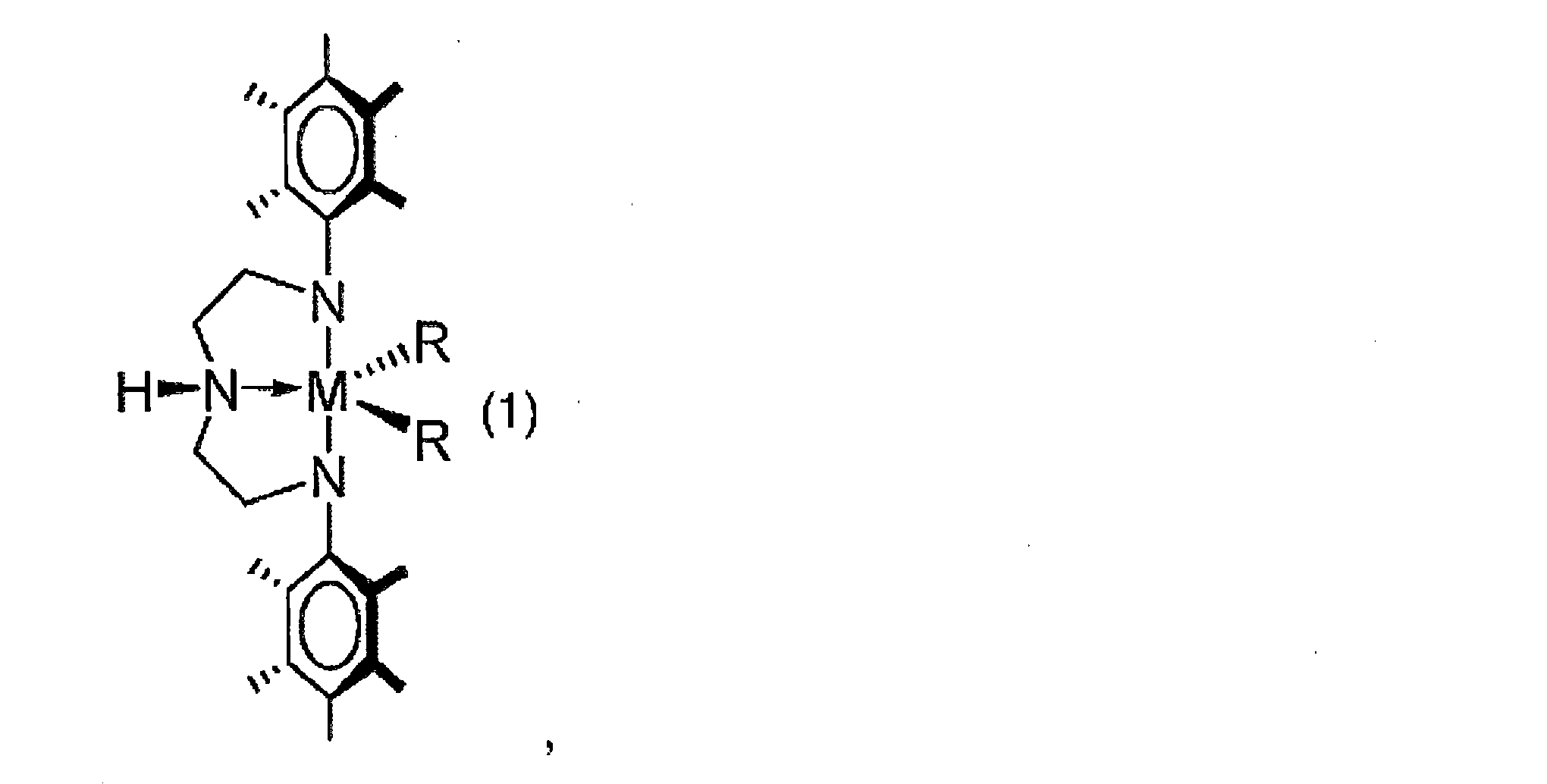
前記非置換もしくは置換第四級シラヒドロカルビル基は式-(C(RA)2)mQSiR1R2R3で表される基であり、下付き文字mが、1、2、または3であり、各RAは独立してHもしくは(C1~C3)アルキルであり、各Qは独立して非置換もしくは置換フェニレンであり、各R1、R2、およびR3は独立して、非置換であるか1つ以上の置換基で置換されている(C1~C15)アルキルであり、各置換基は独立して、非置換(C1~C5)アルキル、ハロゲン、-Oアルキル、-N(アルキル)2、および-Si(アルキル)3から選択される、化合物。 A compound of formula (1),
The unsubstituted or substituted quaternary silahydrocarbyl group is a group represented by the formula -(C(R A ) 2 ) m QSiR 1 R 2 R 3 where subscript m is 1, 2, or 3, each R A is independently H or (C 1 -C 3 )alkyl, each Q is independently unsubstituted or substituted phenylene, and each R 1 , R 2 , and R 3 is independently (C 1 -C 15 )alkyl that is unsubstituted or substituted with one or more substituents, each substituent being independently selected from unsubstituted (C 1 -C 5 )alkyl, halogen, -Oalkyl, -N(alkyl) 2 , and -Si(alkyl) 3 .
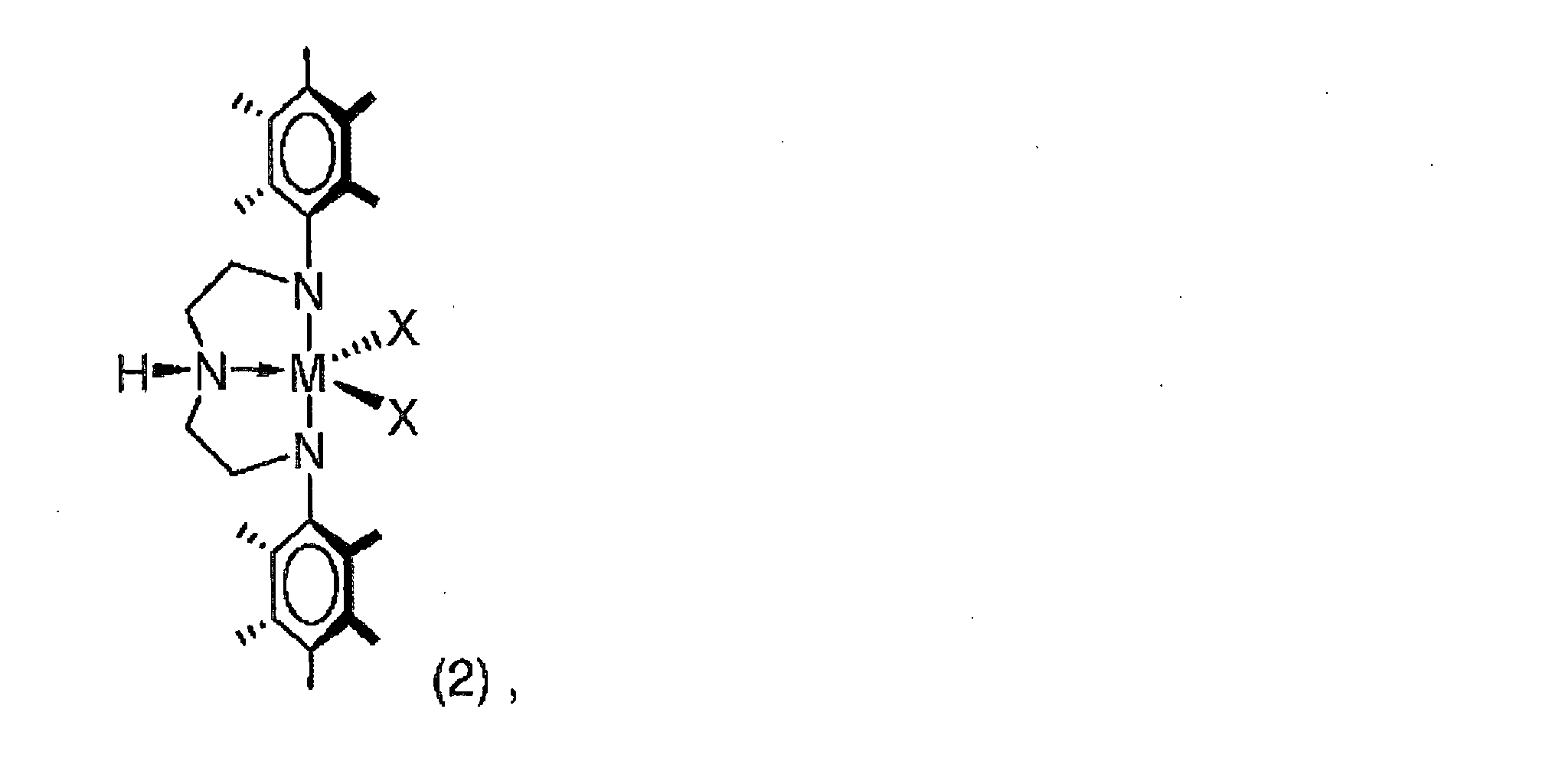
Applications Claiming Priority (3)
| Application Number | Priority Date | Filing Date | Title |
|---|---|---|---|
| US201862756237P | 2018-11-06 | 2018-11-06 | |
| US62/756,237 | 2018-11-06 | ||
| PCT/US2019/055878 WO2020096732A1 (en) | 2018-11-06 | 2019-10-11 | Alkane-soluble non-metallocene precatalysts |
Publications (2)
| Publication Number | Publication Date |
|---|---|
| JP2022504861A JP2022504861A (en) | 2022-01-13 |
| JP7524170B2 true JP7524170B2 (en) | 2024-07-29 |
Family
ID=68387431
Family Applications (1)
| Application Number | Title | Priority Date | Filing Date |
|---|---|---|---|
| JP2021520342A Active JP7524170B2 (en) | 2018-11-06 | 2019-10-11 | Alkane-soluble nonmetallocene precatalysts |
Country Status (10)
| Country | Link |
|---|---|
| US (1) | US11891464B2 (en) |
| EP (1) | EP3877391B1 (en) |
| JP (1) | JP7524170B2 (en) |
| KR (1) | KR102849172B1 (en) |
| CN (1) | CN112805289B (en) |
| BR (1) | BR112021006521B1 (en) |
| CA (1) | CA3117995A1 (en) |
| ES (1) | ES2967059T3 (en) |
| SG (1) | SG11202103828RA (en) |
| WO (1) | WO2020096732A1 (en) |
Families Citing this family (7)
| Publication number | Priority date | Publication date | Assignee | Title |
|---|---|---|---|---|
| CN115667328B (en) * | 2020-05-29 | 2024-11-08 | 陶氏环球技术有限责任公司 | Catalyst for chemical conversion |
| CA3172236A1 (en) * | 2020-05-29 | 2021-12-02 | Rhett A. BAILLIE | Attenuated post-metallocene catalysts |
| US20230151127A1 (en) * | 2020-05-29 | 2023-05-18 | Dow Global Technologies Llc | Attenuated hybrid catalysts |
| WO2021242795A1 (en) * | 2020-05-29 | 2021-12-02 | Dow Global Technologies Llc | Attenuated post-metallocene catalysts |
| EP4157897A1 (en) * | 2020-05-29 | 2023-04-05 | Dow Global Technologies LLC | Chemically converted catalysts |
| CN115698102B (en) * | 2020-05-29 | 2024-11-26 | 陶氏环球技术有限责任公司 | Weakened post-metallocene catalyst |
| US20230406967A1 (en) | 2020-10-28 | 2023-12-21 | Exxonmobil Chemical Patents Inc. | Non-Aromatic Hydrocarbon Soluble Olefin Polymerization Catalysts and Use Thereof |
Citations (2)
| Publication number | Priority date | Publication date | Assignee | Title |
|---|---|---|---|---|
| WO2010008964A1 (en) | 2008-07-16 | 2010-01-21 | Univation Technologies, Llc | Polyethylene compositions |
| WO2018147968A1 (en) | 2017-02-13 | 2018-08-16 | Univation Technologies, Llc | Bimodal polyethylene resins |
Family Cites Families (75)
| Publication number | Priority date | Publication date | Assignee | Title |
|---|---|---|---|---|
| US4003712A (en) | 1970-07-29 | 1977-01-18 | Union Carbide Corporation | Fluidized bed reactor |
| US3709853A (en) | 1971-04-29 | 1973-01-09 | Union Carbide Corp | Polymerization of ethylene using supported bis-(cyclopentadienyl)chromium(ii)catalysts |
| US4011382A (en) | 1975-03-10 | 1977-03-08 | Union Carbide Corporation | Preparation of low and medium density ethylene polymer in fluid bed reactor |
| US4302566A (en) | 1978-03-31 | 1981-11-24 | Union Carbide Corporation | Preparation of ethylene copolymers in fluid bed reactor |
| CA1168521A (en) | 1982-02-01 | 1984-06-05 | Clifford F. Thompson | Leak detector |
| US4543399A (en) | 1982-03-24 | 1985-09-24 | Union Carbide Corporation | Fluidized bed reaction systems |
| US4588790A (en) | 1982-03-24 | 1986-05-13 | Union Carbide Corporation | Method for fluidized bed polymerization |
| US4988783A (en) | 1983-03-29 | 1991-01-29 | Union Carbide Chemicals And Plastics Company Inc. | Ethylene polymerization using supported vanadium catalyst |
| US4665208A (en) | 1985-07-11 | 1987-05-12 | Exxon Chemical Patents Inc. | Process for the preparation of alumoxanes |
| ATE227742T1 (en) | 1986-09-24 | 2002-11-15 | Mitsui Chemicals Inc | OLEFIN POLYMERIZATION PROCESS |
| JPH0780933B2 (en) | 1986-11-20 | 1995-08-30 | 三井石油化学工業株式会社 | Olefin Polymerization Method |
| JPH0742301B2 (en) | 1987-02-14 | 1995-05-10 | 三井石油化学工業株式会社 | Particulate aluminoxane, its manufacturing method and its use |
| JP2538588B2 (en) | 1987-04-03 | 1996-09-25 | 三井石油化学工業株式会社 | Method for producing solid catalyst for olefin polymerization |
| US5206199A (en) | 1987-04-20 | 1993-04-27 | Mitsui Petrochemical Industries, Ltd. | Catalyst for polymerizing an olefin and process for polymerizing an olefin |
| FR2618786B1 (en) | 1987-07-31 | 1989-12-01 | Bp Chimie Sa | PROCESS FOR THE POLYMERIZATION OF GASEOUS OLEFINS IN A FLUIDIZED BED REACTOR |
| US5091352A (en) | 1988-09-14 | 1992-02-25 | Mitsui Petrochemical Industries, Ltd. | Olefin polymerization catalyst component, olefin polymerization catalyst and process for the polymerization of olefins |
| US5041584A (en) | 1988-12-02 | 1991-08-20 | Texas Alkyls, Inc. | Modified methylaluminoxane |
| US4908463A (en) | 1988-12-05 | 1990-03-13 | Ethyl Corporation | Aluminoxane process |
| US5103031A (en) | 1989-02-21 | 1992-04-07 | Ethyl Corporation | Falling film aluminoxane process |
| US4968827A (en) | 1989-06-06 | 1990-11-06 | Ethyl Corporation | Alkylaluminoxane process |
| US4924018A (en) | 1989-06-26 | 1990-05-08 | Ethyl Corporation | Alkylaluminoxane process |
| US4994534A (en) | 1989-09-28 | 1991-02-19 | Union Carbide Chemicals And Plastics Company Inc. | Process for producing sticky polymers |
| DE69117982T2 (en) | 1990-12-27 | 1996-08-08 | Exxon Chemical Patents Inc | TRANSITION METAL AMIDO COMPOUND AND CATALYST SYSTEM FOR PRODUCING ISOTACTIC PROPYLENE |
| TW218884B (en) | 1991-05-01 | 1994-01-11 | Mitsubishi Kakoki Kk | |
| US5341124A (en) | 1991-05-29 | 1994-08-23 | Se-Kure Controls, Inc. | Mountable product sensor and display stand |
| US5235081A (en) | 1992-03-18 | 1993-08-10 | Ethyl Corporation | Method of removing gel forming materials from methylaluminoxanes |
| US5157137A (en) | 1991-07-26 | 1992-10-20 | Ethyl Corporation | Method of making gel free alkylaluminoxane solutions |
| US5329032A (en) | 1992-03-18 | 1994-07-12 | Akzo Chemicals Inc. | Polymethylaluminoxane of enhanced solution stability |
| US5352749A (en) | 1992-03-19 | 1994-10-04 | Exxon Chemical Patents, Inc. | Process for polymerizing monomers in fluidized beds |
| US5473202A (en) | 1992-06-05 | 1995-12-05 | Brian Platner | Control unit for occupancy sensor switching of high efficiency lighting |
| US5248801A (en) | 1992-08-27 | 1993-09-28 | Ethyl Corporation | Preparation of methylaluminoxanes |
| US5939346A (en) | 1992-11-02 | 1999-08-17 | Akzo Nobel N.V. | Catalyst system comprising an aryloxyaluminoxane containing an electron withdrawing group |
| US5462999A (en) | 1993-04-26 | 1995-10-31 | Exxon Chemical Patents Inc. | Process for polymerizing monomers in fluidized beds |
| ZA943399B (en) | 1993-05-20 | 1995-11-17 | Bp Chem Int Ltd | Polymerisation process |
| US5804678A (en) | 1993-07-13 | 1998-09-08 | Mitsui Petrochemical Industries, Ltd. | Process for gas phase polymerization of olefin |
| EP0649992B1 (en) | 1993-10-23 | 1997-07-30 | WABCO GmbH | Disc brake actuator |
| US5648310A (en) | 1993-12-23 | 1997-07-15 | Union Carbide Chemicals & Plastics Technology Corporation | Spray dried, filled metallocene catalyst composition for use in polyolefin manufacture |
| US5506184A (en) | 1994-06-22 | 1996-04-09 | Mobil Oil Corporation | Olefin polymerization catalyst system |
| US5770755A (en) | 1994-11-15 | 1998-06-23 | Phillips Petroleum Company | Process to prepare polymeric metallocenes |
| US5677375A (en) | 1995-07-21 | 1997-10-14 | Union Carbide Chemicals & Plastics Technology Corporation | Process for producing an in situ polyethylene blend |
| JP3582181B2 (en) | 1995-10-04 | 2004-10-27 | 住友化学工業株式会社 | Carrier for olefin polymerization catalyst, olefin polymerization catalyst and method for producing olefin polymer |
| US5688880A (en) | 1995-12-11 | 1997-11-18 | The Dow Chemical Company | Readily supportable metal complexes |
| US5665818A (en) | 1996-03-05 | 1997-09-09 | Union Carbide Chemicals & Plastics Technology Corporation | High activity staged reactor process |
| US5627242A (en) | 1996-03-28 | 1997-05-06 | Union Carbide Chemicals & Plastics Technology Corporation | Process for controlling gas phase fluidized bed polymerization reactor |
| ES2129323B1 (en) | 1996-04-18 | 2000-09-16 | Repsol Quimica Sa | PROCEDURE FOR OBTAINING A CATALYTIC SYSTEM FOR THE POLYMERIZATION OF ALPHA-OLEFINS IN SUSPENSION IN GAS PHASE AT LOW AND HIGH TEMPERATURES OR IN MASS AT HIGH PRESSURES AND HIGH OR LOW TEMPERATURES |
| US6255419B1 (en) | 1997-02-07 | 2001-07-03 | Mitsui Chemicals, Inc. | Olefin polymerization catalyst and process for producing olefin polymers |
| US5965477A (en) | 1997-02-21 | 1999-10-12 | Council Of Scientific & Industrial Research | Process for the preparation of supported metallocene catalyst |
| US5889128A (en) | 1997-04-11 | 1999-03-30 | Massachusetts Institute Of Technology | Living olefin polymerization processes |
| JP3458656B2 (en) | 1997-05-27 | 2003-10-20 | 東ソー株式会社 | Olefin polymerization catalyst and method for producing olefin polymer |
| US5972510A (en) | 1997-06-05 | 1999-10-26 | Isis Innovation Limited | Spherulite particles of isotactic polypropylene |
| ATE290045T1 (en) | 1998-03-16 | 2005-03-15 | Dow Global Technologies Inc | METHOD FOR PRODUCING POLYOLEFIN NANOCOMPOSITES |
| ID25657A (en) | 1998-03-26 | 2000-10-19 | Dow Chemical Co | ALUMINUM-MAGNESIUM SILICATE AEROGELS WHICH MADE EXCHANGE OR FLUORINATED SILICATE MAGNESIUM AND CATALYSTATORS SUPPORT |
| CN1239522C (en) | 1998-03-27 | 2006-02-01 | 埃克森美孚化学专利公司 | Polymer Supported Catalysts for Olefin Polymerization |
| CA2331413C (en) | 1998-05-18 | 2007-04-17 | Phillips Petroleum Company | Catalyst composition for polymerizing monomers |
| CN1138796C (en) * | 1998-10-23 | 2004-02-18 | 埃克森美孚化学专利公司 | Bridge metallocenes for olefine copolymerization |
| US6274684B1 (en) | 1999-10-22 | 2001-08-14 | Univation Technologies, Llc | Catalyst composition, method of polymerization, and polymer therefrom |
| US6489408B2 (en) | 2000-11-30 | 2002-12-03 | Univation Technologies, Llc | Polymerization process |
| US7795366B2 (en) | 2002-08-12 | 2010-09-14 | Exxonmobil Chemical Patents Inc. | Modified polyethylene compositions |
| US6858684B2 (en) | 2002-12-30 | 2005-02-22 | Univation Technologies, Llc | Processes for transitioning between various polymerization catalysts |
| US6949612B2 (en) | 2002-12-31 | 2005-09-27 | Univation Technologies, Llc | Processes for transitioning between metallocene and Ziegler-Natta polymerization catalysts |
| US20050182210A1 (en) | 2004-02-17 | 2005-08-18 | Natarajan Muruganandam | De-foaming spray dried catalyst slurries |
| US7973112B2 (en) | 2004-02-17 | 2011-07-05 | Univation Technologies, Llc | De-foaming spray dried catalyst slurries |
| US6967184B2 (en) | 2004-02-17 | 2005-11-22 | Univation Technologies, Llc | Fluoroalcohol leaving group for non-metallocene olefin polymerization catalysts |
| US7981984B2 (en) | 2004-06-21 | 2011-07-19 | Exxonmobil Chemical Patents Inc. | Polymerization process |
| DE102004047371A1 (en) | 2004-09-29 | 2006-03-30 | Siemens Ag | Method for distributing software and configuration data and corresponding data network |
| JP4692761B2 (en) | 2006-03-29 | 2011-06-01 | カシオ計算機株式会社 | OFDM receiving apparatus, OFDM receiving method, and terrestrial digital receiving apparatus |
| US7964680B2 (en) | 2006-06-16 | 2011-06-21 | Lg Chem, Ltd. | Method for polymerizing cyclic olefin having polar functional group, olefin polymer produced thereby, optical anisotropic film comprising the same, and catalyst composition for polymerizing the cyclic olefin |
| WO2011087520A1 (en) | 2009-12-22 | 2011-07-21 | Univation Technologies, Llc | Catalyst systems having a tailored hydrogen response |
| EP2364290A2 (en) | 2008-11-10 | 2011-09-14 | Univation Technologies, LLC | Processes for the preparation of arylamine compounds |
| KR102022132B1 (en) | 2011-11-08 | 2019-09-17 | 유니베이션 테크놀로지즈, 엘엘씨 | Methods of preparing a catalyst system |
| ES2644669T3 (en) | 2013-03-15 | 2017-11-29 | Univation Technologies, Llc | Ligands for catalysts |
| US20160362510A1 (en) | 2014-02-11 | 2016-12-15 | Univation Technologies, Llc | Method to prepare ethylene copolymers |
| WO2016109429A1 (en) | 2014-12-31 | 2016-07-07 | Dow Global Technologies Llc | A polyolefin composition and method of producing the same |
| EP3280742B1 (en) | 2015-04-08 | 2019-02-20 | Univation Technologies, LLC | Closed reactor transitions between metallocene catalysts |
| CN107531839B (en) | 2015-04-24 | 2021-05-25 | 尤尼威蒂恩技术有限责任公司 | Method for operating a polymerization reactor |
-
2019
- 2019-10-11 JP JP2021520342A patent/JP7524170B2/en active Active
- 2019-10-11 CA CA3117995A patent/CA3117995A1/en active Pending
- 2019-10-11 CN CN201980065960.7A patent/CN112805289B/en active Active
- 2019-10-11 SG SG11202103828RA patent/SG11202103828RA/en unknown
- 2019-10-11 KR KR1020217016702A patent/KR102849172B1/en active Active
- 2019-10-11 EP EP19795417.5A patent/EP3877391B1/en active Active
- 2019-10-11 BR BR112021006521-0A patent/BR112021006521B1/en active IP Right Grant
- 2019-10-11 WO PCT/US2019/055878 patent/WO2020096732A1/en not_active Ceased
- 2019-10-11 US US17/279,243 patent/US11891464B2/en active Active
- 2019-10-11 ES ES19795417T patent/ES2967059T3/en active Active
Patent Citations (2)
| Publication number | Priority date | Publication date | Assignee | Title |
|---|---|---|---|---|
| WO2010008964A1 (en) | 2008-07-16 | 2010-01-21 | Univation Technologies, Llc | Polyethylene compositions |
| WO2018147968A1 (en) | 2017-02-13 | 2018-08-16 | Univation Technologies, Llc | Bimodal polyethylene resins |
Also Published As
| Publication number | Publication date |
|---|---|
| US20220049032A1 (en) | 2022-02-17 |
| BR112021006521B1 (en) | 2024-03-05 |
| CN112805289A (en) | 2021-05-14 |
| JP2022504861A (en) | 2022-01-13 |
| WO2020096732A1 (en) | 2020-05-14 |
| ES2967059T3 (en) | 2024-04-25 |
| US11891464B2 (en) | 2024-02-06 |
| EP3877391A1 (en) | 2021-09-15 |
| KR102849172B1 (en) | 2025-08-25 |
| BR112021006521A2 (en) | 2021-07-06 |
| CN112805289B (en) | 2024-09-06 |
| SG11202103828RA (en) | 2021-05-28 |
| CA3117995A1 (en) | 2020-05-14 |
| EP3877391B1 (en) | 2023-11-15 |
| KR20210090648A (en) | 2021-07-20 |
Similar Documents
| Publication | Publication Date | Title |
|---|---|---|
| JP7524170B2 (en) | Alkane-soluble nonmetallocene precatalysts | |
| JP7590961B2 (en) | Process for polymerizing olefins using alkane-soluble nonmetallocene precatalysts | |
| JP7493498B2 (en) | Alkane-soluble nonmetallocene precatalysts | |
| JP7750654B2 (en) | Hafnocene-titanocene catalyst system | |
| EP4157892A1 (en) | Attenuated post-metallocene catalysts | |
| RU2804656C2 (en) | Non-metalocene precatalysts soluble in alkane | |
| RU2804655C2 (en) | Alkane soluble non-metallocene precatalysts | |
| RU2805112C2 (en) | Method for olefin polymerization using non-metallocene precatalyst soluble in alkane | |
| US12545751B2 (en) | Attenuated post-metallocene catalysts | |
| CN111372958A (en) | Zirconocene-Titanocene Catalyst System | |
| KR20260021694A (en) | Supported olefin polymerization catalyst comprising a substituted 2-hydroxythiophene compound | |
| BR112021006524B1 (en) | METHOD OF POLYMERIZING AN OLEFIN MONOMER TO PRODUCE A FIRST POLYOLEFIN COMPOSITION |
Legal Events
| Date | Code | Title | Description |
|---|---|---|---|
| RD03 | Notification of appointment of power of attorney |
Free format text: JAPANESE INTERMEDIATE CODE: A7423 Effective date: 20210423 |
|
| RD04 | Notification of resignation of power of attorney |
Free format text: JAPANESE INTERMEDIATE CODE: A7424 Effective date: 20210811 |
|
| A621 | Written request for application examination |
Free format text: JAPANESE INTERMEDIATE CODE: A621 Effective date: 20220927 |
|
| A977 | Report on retrieval |
Free format text: JAPANESE INTERMEDIATE CODE: A971007 Effective date: 20230914 |
|
| A131 | Notification of reasons for refusal |
Free format text: JAPANESE INTERMEDIATE CODE: A131 Effective date: 20231010 |
|
| A521 | Request for written amendment filed |
Free format text: JAPANESE INTERMEDIATE CODE: A523 Effective date: 20240109 |
|
| A131 | Notification of reasons for refusal |
Free format text: JAPANESE INTERMEDIATE CODE: A131 Effective date: 20240312 |
|
| A521 | Request for written amendment filed |
Free format text: JAPANESE INTERMEDIATE CODE: A523 Effective date: 20240325 |
|
| A521 | Request for written amendment filed |
Free format text: JAPANESE INTERMEDIATE CODE: A523 Effective date: 20240507 |
|
| RD03 | Notification of appointment of power of attorney |
Free format text: JAPANESE INTERMEDIATE CODE: A7423 Effective date: 20240507 |
|
| TRDD | Decision of grant or rejection written | ||
| A01 | Written decision to grant a patent or to grant a registration (utility model) |
Free format text: JAPANESE INTERMEDIATE CODE: A01 Effective date: 20240709 |
|
| A61 | First payment of annual fees (during grant procedure) |
Free format text: JAPANESE INTERMEDIATE CODE: A61 Effective date: 20240717 |
|
| R150 | Certificate of patent or registration of utility model |
Ref document number: 7524170 Country of ref document: JP Free format text: JAPANESE INTERMEDIATE CODE: R150 |
|
| S802 | Written request for registration of partial abandonment of right |
Free format text: JAPANESE INTERMEDIATE CODE: R311802 |
|
| R350 | Written notification of registration of transfer |
Free format text: JAPANESE INTERMEDIATE CODE: R350 |