KR102022132B1 - Methods of preparing a catalyst system - Google Patents
Methods of preparing a catalyst system Download PDFInfo
- Publication number
- KR102022132B1 KR102022132B1 KR1020147015052A KR20147015052A KR102022132B1 KR 102022132 B1 KR102022132 B1 KR 102022132B1 KR 1020147015052 A KR1020147015052 A KR 1020147015052A KR 20147015052 A KR20147015052 A KR 20147015052A KR 102022132 B1 KR102022132 B1 KR 102022132B1
- Authority
- KR
- South Korea
- Prior art keywords
- catalyst
- divalent
- substituted
- alkyl
- group
- Prior art date
- Legal status (The legal status is an assumption and is not a legal conclusion. Google has not performed a legal analysis and makes no representation as to the accuracy of the status listed.)
- Active
Links
Classifications
-
- C—CHEMISTRY; METALLURGY
- C08—ORGANIC MACROMOLECULAR COMPOUNDS; THEIR PREPARATION OR CHEMICAL WORKING-UP; COMPOSITIONS BASED THEREON
- C08F—MACROMOLECULAR COMPOUNDS OBTAINED BY REACTIONS ONLY INVOLVING CARBON-TO-CARBON UNSATURATED BONDS
- C08F210/00—Copolymers of unsaturated aliphatic hydrocarbons having only one carbon-to-carbon double bond
- C08F210/16—Copolymers of ethene with alpha-alkenes, e.g. EP rubbers
-
- B—PERFORMING OPERATIONS; TRANSPORTING
- B01—PHYSICAL OR CHEMICAL PROCESSES OR APPARATUS IN GENERAL
- B01J—CHEMICAL OR PHYSICAL PROCESSES, e.g. CATALYSIS OR COLLOID CHEMISTRY; THEIR RELEVANT APPARATUS
- B01J31/00—Catalysts comprising hydrides, coordination complexes or organic compounds
- B01J31/02—Catalysts comprising hydrides, coordination complexes or organic compounds containing organic compounds or metal hydrides
- B01J31/12—Catalysts comprising hydrides, coordination complexes or organic compounds containing organic compounds or metal hydrides containing organo-metallic compounds or metal hydrides
- B01J31/14—Catalysts comprising hydrides, coordination complexes or organic compounds containing organic compounds or metal hydrides containing organo-metallic compounds or metal hydrides of aluminium or boron
-
- B—PERFORMING OPERATIONS; TRANSPORTING
- B01—PHYSICAL OR CHEMICAL PROCESSES OR APPARATUS IN GENERAL
- B01J—CHEMICAL OR PHYSICAL PROCESSES, e.g. CATALYSIS OR COLLOID CHEMISTRY; THEIR RELEVANT APPARATUS
- B01J31/00—Catalysts comprising hydrides, coordination complexes or organic compounds
- B01J31/02—Catalysts comprising hydrides, coordination complexes or organic compounds containing organic compounds or metal hydrides
- B01J31/12—Catalysts comprising hydrides, coordination complexes or organic compounds containing organic compounds or metal hydrides containing organo-metallic compounds or metal hydrides
- B01J31/14—Catalysts comprising hydrides, coordination complexes or organic compounds containing organic compounds or metal hydrides containing organo-metallic compounds or metal hydrides of aluminium or boron
- B01J31/143—Catalysts comprising hydrides, coordination complexes or organic compounds containing organic compounds or metal hydrides containing organo-metallic compounds or metal hydrides of aluminium or boron of aluminium
-
- C—CHEMISTRY; METALLURGY
- C08—ORGANIC MACROMOLECULAR COMPOUNDS; THEIR PREPARATION OR CHEMICAL WORKING-UP; COMPOSITIONS BASED THEREON
- C08F—MACROMOLECULAR COMPOUNDS OBTAINED BY REACTIONS ONLY INVOLVING CARBON-TO-CARBON UNSATURATED BONDS
- C08F4/00—Polymerisation catalysts
- C08F4/42—Metals; Metal hydrides; Metallo-organic compounds; Use thereof as catalyst precursors
- C08F4/44—Metals; Metal hydrides; Metallo-organic compounds; Use thereof as catalyst precursors selected from light metals, zinc, cadmium, mercury, copper, silver, gold, boron, gallium, indium, thallium, rare earths or actinides
- C08F4/60—Metals; Metal hydrides; Metallo-organic compounds; Use thereof as catalyst precursors selected from light metals, zinc, cadmium, mercury, copper, silver, gold, boron, gallium, indium, thallium, rare earths or actinides together with refractory metals, iron group metals, platinum group metals, manganese, rhenium technetium or compounds thereof
- C08F4/62—Refractory metals or compounds thereof
- C08F4/64—Titanium, zirconium, hafnium or compounds thereof
- C08F4/64003—Titanium, zirconium, hafnium or compounds thereof the metallic compound containing a multidentate ligand, i.e. a ligand capable of donating two or more pairs of electrons to form a coordinate or ionic bond
- C08F4/64006—Bidentate ligand
- C08F4/64068—Dianionic ligand
- C08F4/64079—OO
-
- C—CHEMISTRY; METALLURGY
- C08—ORGANIC MACROMOLECULAR COMPOUNDS; THEIR PREPARATION OR CHEMICAL WORKING-UP; COMPOSITIONS BASED THEREON
- C08F—MACROMOLECULAR COMPOUNDS OBTAINED BY REACTIONS ONLY INVOLVING CARBON-TO-CARBON UNSATURATED BONDS
- C08F4/00—Polymerisation catalysts
- C08F4/42—Metals; Metal hydrides; Metallo-organic compounds; Use thereof as catalyst precursors
- C08F4/44—Metals; Metal hydrides; Metallo-organic compounds; Use thereof as catalyst precursors selected from light metals, zinc, cadmium, mercury, copper, silver, gold, boron, gallium, indium, thallium, rare earths or actinides
- C08F4/60—Metals; Metal hydrides; Metallo-organic compounds; Use thereof as catalyst precursors selected from light metals, zinc, cadmium, mercury, copper, silver, gold, boron, gallium, indium, thallium, rare earths or actinides together with refractory metals, iron group metals, platinum group metals, manganese, rhenium technetium or compounds thereof
- C08F4/62—Refractory metals or compounds thereof
- C08F4/64—Titanium, zirconium, hafnium or compounds thereof
- C08F4/642—Component covered by group C08F4/64 with an organo-aluminium compound
-
- C—CHEMISTRY; METALLURGY
- C08—ORGANIC MACROMOLECULAR COMPOUNDS; THEIR PREPARATION OR CHEMICAL WORKING-UP; COMPOSITIONS BASED THEREON
- C08F—MACROMOLECULAR COMPOUNDS OBTAINED BY REACTIONS ONLY INVOLVING CARBON-TO-CARBON UNSATURATED BONDS
- C08F4/00—Polymerisation catalysts
- C08F4/42—Metals; Metal hydrides; Metallo-organic compounds; Use thereof as catalyst precursors
- C08F4/44—Metals; Metal hydrides; Metallo-organic compounds; Use thereof as catalyst precursors selected from light metals, zinc, cadmium, mercury, copper, silver, gold, boron, gallium, indium, thallium, rare earths or actinides
- C08F4/60—Metals; Metal hydrides; Metallo-organic compounds; Use thereof as catalyst precursors selected from light metals, zinc, cadmium, mercury, copper, silver, gold, boron, gallium, indium, thallium, rare earths or actinides together with refractory metals, iron group metals, platinum group metals, manganese, rhenium technetium or compounds thereof
- C08F4/62—Refractory metals or compounds thereof
- C08F4/64—Titanium, zirconium, hafnium or compounds thereof
- C08F4/659—Component covered by group C08F4/64 containing a transition metal-carbon bond
- C08F4/6592—Component covered by group C08F4/64 containing a transition metal-carbon bond containing at least one cyclopentadienyl ring, condensed or not, e.g. an indenyl or a fluorenyl ring
-
- C—CHEMISTRY; METALLURGY
- C08—ORGANIC MACROMOLECULAR COMPOUNDS; THEIR PREPARATION OR CHEMICAL WORKING-UP; COMPOSITIONS BASED THEREON
- C08F—MACROMOLECULAR COMPOUNDS OBTAINED BY REACTIONS ONLY INVOLVING CARBON-TO-CARBON UNSATURATED BONDS
- C08F4/00—Polymerisation catalysts
- C08F4/42—Metals; Metal hydrides; Metallo-organic compounds; Use thereof as catalyst precursors
- C08F4/44—Metals; Metal hydrides; Metallo-organic compounds; Use thereof as catalyst precursors selected from light metals, zinc, cadmium, mercury, copper, silver, gold, boron, gallium, indium, thallium, rare earths or actinides
- C08F4/60—Metals; Metal hydrides; Metallo-organic compounds; Use thereof as catalyst precursors selected from light metals, zinc, cadmium, mercury, copper, silver, gold, boron, gallium, indium, thallium, rare earths or actinides together with refractory metals, iron group metals, platinum group metals, manganese, rhenium technetium or compounds thereof
- C08F4/62—Refractory metals or compounds thereof
- C08F4/64—Titanium, zirconium, hafnium or compounds thereof
- C08F4/64003—Titanium, zirconium, hafnium or compounds thereof the metallic compound containing a multidentate ligand, i.e. a ligand capable of donating two or more pairs of electrons to form a coordinate or ionic bond
- C08F4/64082—Tridentate ligand
- C08F4/64141—Dianionic ligand
-
- C—CHEMISTRY; METALLURGY
- C08—ORGANIC MACROMOLECULAR COMPOUNDS; THEIR PREPARATION OR CHEMICAL WORKING-UP; COMPOSITIONS BASED THEREON
- C08F—MACROMOLECULAR COMPOUNDS OBTAINED BY REACTIONS ONLY INVOLVING CARBON-TO-CARBON UNSATURATED BONDS
- C08F4/00—Polymerisation catalysts
- C08F4/42—Metals; Metal hydrides; Metallo-organic compounds; Use thereof as catalyst precursors
- C08F4/44—Metals; Metal hydrides; Metallo-organic compounds; Use thereof as catalyst precursors selected from light metals, zinc, cadmium, mercury, copper, silver, gold, boron, gallium, indium, thallium, rare earths or actinides
- C08F4/60—Metals; Metal hydrides; Metallo-organic compounds; Use thereof as catalyst precursors selected from light metals, zinc, cadmium, mercury, copper, silver, gold, boron, gallium, indium, thallium, rare earths or actinides together with refractory metals, iron group metals, platinum group metals, manganese, rhenium technetium or compounds thereof
- C08F4/62—Refractory metals or compounds thereof
- C08F4/64—Titanium, zirconium, hafnium or compounds thereof
- C08F4/64003—Titanium, zirconium, hafnium or compounds thereof the metallic compound containing a multidentate ligand, i.e. a ligand capable of donating two or more pairs of electrons to form a coordinate or ionic bond
- C08F4/64082—Tridentate ligand
- C08F4/64141—Dianionic ligand
- C08F4/64148—NN(R)N
-
- C—CHEMISTRY; METALLURGY
- C08—ORGANIC MACROMOLECULAR COMPOUNDS; THEIR PREPARATION OR CHEMICAL WORKING-UP; COMPOSITIONS BASED THEREON
- C08F—MACROMOLECULAR COMPOUNDS OBTAINED BY REACTIONS ONLY INVOLVING CARBON-TO-CARBON UNSATURATED BONDS
- C08F4/00—Polymerisation catalysts
- C08F4/42—Metals; Metal hydrides; Metallo-organic compounds; Use thereof as catalyst precursors
- C08F4/44—Metals; Metal hydrides; Metallo-organic compounds; Use thereof as catalyst precursors selected from light metals, zinc, cadmium, mercury, copper, silver, gold, boron, gallium, indium, thallium, rare earths or actinides
- C08F4/60—Metals; Metal hydrides; Metallo-organic compounds; Use thereof as catalyst precursors selected from light metals, zinc, cadmium, mercury, copper, silver, gold, boron, gallium, indium, thallium, rare earths or actinides together with refractory metals, iron group metals, platinum group metals, manganese, rhenium technetium or compounds thereof
- C08F4/62—Refractory metals or compounds thereof
- C08F4/64—Titanium, zirconium, hafnium or compounds thereof
- C08F4/64003—Titanium, zirconium, hafnium or compounds thereof the metallic compound containing a multidentate ligand, i.e. a ligand capable of donating two or more pairs of electrons to form a coordinate or ionic bond
- C08F4/64168—Tetra- or multi-dentate ligand
- C08F4/64186—Dianionic ligand
- C08F4/64189—ONNO
-
- C—CHEMISTRY; METALLURGY
- C08—ORGANIC MACROMOLECULAR COMPOUNDS; THEIR PREPARATION OR CHEMICAL WORKING-UP; COMPOSITIONS BASED THEREON
- C08F—MACROMOLECULAR COMPOUNDS OBTAINED BY REACTIONS ONLY INVOLVING CARBON-TO-CARBON UNSATURATED BONDS
- C08F4/00—Polymerisation catalysts
- C08F4/42—Metals; Metal hydrides; Metallo-organic compounds; Use thereof as catalyst precursors
- C08F4/44—Metals; Metal hydrides; Metallo-organic compounds; Use thereof as catalyst precursors selected from light metals, zinc, cadmium, mercury, copper, silver, gold, boron, gallium, indium, thallium, rare earths or actinides
- C08F4/60—Metals; Metal hydrides; Metallo-organic compounds; Use thereof as catalyst precursors selected from light metals, zinc, cadmium, mercury, copper, silver, gold, boron, gallium, indium, thallium, rare earths or actinides together with refractory metals, iron group metals, platinum group metals, manganese, rhenium technetium or compounds thereof
- C08F4/62—Refractory metals or compounds thereof
- C08F4/64—Titanium, zirconium, hafnium or compounds thereof
- C08F4/64003—Titanium, zirconium, hafnium or compounds thereof the metallic compound containing a multidentate ligand, i.e. a ligand capable of donating two or more pairs of electrons to form a coordinate or ionic bond
- C08F4/64168—Tetra- or multi-dentate ligand
- C08F4/64186—Dianionic ligand
- C08F4/64193—OOOO
-
- C—CHEMISTRY; METALLURGY
- C08—ORGANIC MACROMOLECULAR COMPOUNDS; THEIR PREPARATION OR CHEMICAL WORKING-UP; COMPOSITIONS BASED THEREON
- C08F—MACROMOLECULAR COMPOUNDS OBTAINED BY REACTIONS ONLY INVOLVING CARBON-TO-CARBON UNSATURATED BONDS
- C08F4/00—Polymerisation catalysts
- C08F4/42—Metals; Metal hydrides; Metallo-organic compounds; Use thereof as catalyst precursors
- C08F4/44—Metals; Metal hydrides; Metallo-organic compounds; Use thereof as catalyst precursors selected from light metals, zinc, cadmium, mercury, copper, silver, gold, boron, gallium, indium, thallium, rare earths or actinides
- C08F4/60—Metals; Metal hydrides; Metallo-organic compounds; Use thereof as catalyst precursors selected from light metals, zinc, cadmium, mercury, copper, silver, gold, boron, gallium, indium, thallium, rare earths or actinides together with refractory metals, iron group metals, platinum group metals, manganese, rhenium technetium or compounds thereof
- C08F4/62—Refractory metals or compounds thereof
- C08F4/64—Titanium, zirconium, hafnium or compounds thereof
- C08F4/659—Component covered by group C08F4/64 containing a transition metal-carbon bond
-
- C—CHEMISTRY; METALLURGY
- C08—ORGANIC MACROMOLECULAR COMPOUNDS; THEIR PREPARATION OR CHEMICAL WORKING-UP; COMPOSITIONS BASED THEREON
- C08F—MACROMOLECULAR COMPOUNDS OBTAINED BY REACTIONS ONLY INVOLVING CARBON-TO-CARBON UNSATURATED BONDS
- C08F4/00—Polymerisation catalysts
- C08F4/42—Metals; Metal hydrides; Metallo-organic compounds; Use thereof as catalyst precursors
- C08F4/44—Metals; Metal hydrides; Metallo-organic compounds; Use thereof as catalyst precursors selected from light metals, zinc, cadmium, mercury, copper, silver, gold, boron, gallium, indium, thallium, rare earths or actinides
- C08F4/60—Metals; Metal hydrides; Metallo-organic compounds; Use thereof as catalyst precursors selected from light metals, zinc, cadmium, mercury, copper, silver, gold, boron, gallium, indium, thallium, rare earths or actinides together with refractory metals, iron group metals, platinum group metals, manganese, rhenium technetium or compounds thereof
- C08F4/62—Refractory metals or compounds thereof
- C08F4/64—Titanium, zirconium, hafnium or compounds thereof
- C08F4/659—Component covered by group C08F4/64 containing a transition metal-carbon bond
- C08F4/65912—Component covered by group C08F4/64 containing a transition metal-carbon bond in combination with an organoaluminium compound
-
- C—CHEMISTRY; METALLURGY
- C08—ORGANIC MACROMOLECULAR COMPOUNDS; THEIR PREPARATION OR CHEMICAL WORKING-UP; COMPOSITIONS BASED THEREON
- C08F—MACROMOLECULAR COMPOUNDS OBTAINED BY REACTIONS ONLY INVOLVING CARBON-TO-CARBON UNSATURATED BONDS
- C08F4/00—Polymerisation catalysts
- C08F4/42—Metals; Metal hydrides; Metallo-organic compounds; Use thereof as catalyst precursors
- C08F4/44—Metals; Metal hydrides; Metallo-organic compounds; Use thereof as catalyst precursors selected from light metals, zinc, cadmium, mercury, copper, silver, gold, boron, gallium, indium, thallium, rare earths or actinides
- C08F4/60—Metals; Metal hydrides; Metallo-organic compounds; Use thereof as catalyst precursors selected from light metals, zinc, cadmium, mercury, copper, silver, gold, boron, gallium, indium, thallium, rare earths or actinides together with refractory metals, iron group metals, platinum group metals, manganese, rhenium technetium or compounds thereof
- C08F4/62—Refractory metals or compounds thereof
- C08F4/64—Titanium, zirconium, hafnium or compounds thereof
- C08F4/659—Component covered by group C08F4/64 containing a transition metal-carbon bond
- C08F4/65916—Component covered by group C08F4/64 containing a transition metal-carbon bond supported on a carrier, e.g. silica, MgCl2, polymer
-
- C—CHEMISTRY; METALLURGY
- C08—ORGANIC MACROMOLECULAR COMPOUNDS; THEIR PREPARATION OR CHEMICAL WORKING-UP; COMPOSITIONS BASED THEREON
- C08F—MACROMOLECULAR COMPOUNDS OBTAINED BY REACTIONS ONLY INVOLVING CARBON-TO-CARBON UNSATURATED BONDS
- C08F4/00—Polymerisation catalysts
- C08F4/42—Metals; Metal hydrides; Metallo-organic compounds; Use thereof as catalyst precursors
- C08F4/44—Metals; Metal hydrides; Metallo-organic compounds; Use thereof as catalyst precursors selected from light metals, zinc, cadmium, mercury, copper, silver, gold, boron, gallium, indium, thallium, rare earths or actinides
- C08F4/60—Metals; Metal hydrides; Metallo-organic compounds; Use thereof as catalyst precursors selected from light metals, zinc, cadmium, mercury, copper, silver, gold, boron, gallium, indium, thallium, rare earths or actinides together with refractory metals, iron group metals, platinum group metals, manganese, rhenium technetium or compounds thereof
- C08F4/62—Refractory metals or compounds thereof
- C08F4/64—Titanium, zirconium, hafnium or compounds thereof
- C08F4/659—Component covered by group C08F4/64 containing a transition metal-carbon bond
- C08F4/6592—Component covered by group C08F4/64 containing a transition metal-carbon bond containing at least one cyclopentadienyl ring, condensed or not, e.g. an indenyl or a fluorenyl ring
- C08F4/65922—Component covered by group C08F4/64 containing a transition metal-carbon bond containing at least one cyclopentadienyl ring, condensed or not, e.g. an indenyl or a fluorenyl ring containing at least two cyclopentadienyl rings, fused or not
- C08F4/65925—Component covered by group C08F4/64 containing a transition metal-carbon bond containing at least one cyclopentadienyl ring, condensed or not, e.g. an indenyl or a fluorenyl ring containing at least two cyclopentadienyl rings, fused or not two cyclopentadienyl rings being mutually non-bridged
-
- C—CHEMISTRY; METALLURGY
- C08—ORGANIC MACROMOLECULAR COMPOUNDS; THEIR PREPARATION OR CHEMICAL WORKING-UP; COMPOSITIONS BASED THEREON
- C08F—MACROMOLECULAR COMPOUNDS OBTAINED BY REACTIONS ONLY INVOLVING CARBON-TO-CARBON UNSATURATED BONDS
- C08F4/00—Polymerisation catalysts
- C08F4/42—Metals; Metal hydrides; Metallo-organic compounds; Use thereof as catalyst precursors
- C08F4/44—Metals; Metal hydrides; Metallo-organic compounds; Use thereof as catalyst precursors selected from light metals, zinc, cadmium, mercury, copper, silver, gold, boron, gallium, indium, thallium, rare earths or actinides
- C08F4/60—Metals; Metal hydrides; Metallo-organic compounds; Use thereof as catalyst precursors selected from light metals, zinc, cadmium, mercury, copper, silver, gold, boron, gallium, indium, thallium, rare earths or actinides together with refractory metals, iron group metals, platinum group metals, manganese, rhenium technetium or compounds thereof
- C08F4/62—Refractory metals or compounds thereof
- C08F4/64—Titanium, zirconium, hafnium or compounds thereof
- C08F4/659—Component covered by group C08F4/64 containing a transition metal-carbon bond
- C08F4/6592—Component covered by group C08F4/64 containing a transition metal-carbon bond containing at least one cyclopentadienyl ring, condensed or not, e.g. an indenyl or a fluorenyl ring
- C08F4/65922—Component covered by group C08F4/64 containing a transition metal-carbon bond containing at least one cyclopentadienyl ring, condensed or not, e.g. an indenyl or a fluorenyl ring containing at least two cyclopentadienyl rings, fused or not
- C08F4/65927—Component covered by group C08F4/64 containing a transition metal-carbon bond containing at least one cyclopentadienyl ring, condensed or not, e.g. an indenyl or a fluorenyl ring containing at least two cyclopentadienyl rings, fused or not two cyclopentadienyl rings being mutually bridged
Landscapes
- Chemical & Material Sciences (AREA)
- Organic Chemistry (AREA)
- Chemical Kinetics & Catalysis (AREA)
- Health & Medical Sciences (AREA)
- Medicinal Chemistry (AREA)
- Polymers & Plastics (AREA)
- Engineering & Computer Science (AREA)
- Materials Engineering (AREA)
- Crystallography & Structural Chemistry (AREA)
- Transition And Organic Metals Composition Catalysts For Addition Polymerization (AREA)
- Catalysts (AREA)
Abstract
본원에 개시된 것은 분사 건조된 활성제를 포함하는 촉매 시스템의 제조 방법 및 이 촉매 시스템을 채용한 중합 공정이다.Disclosed herein are processes for the preparation of catalyst systems comprising spray dried activators and polymerization processes employing the catalyst systems.
Description
중합 및 촉매에서의 발전은 폭넓고 다양한 제품 및 용도에 유용한 개선된 물리적 및 기계적 성질을 갖는 신규 폴리머를 생산해왔다. 메탈로센 촉매 시스템은 폴리올레핀을 생산하는데에 폭넓게 사용되어 왔고 다양한 신규 및 개선된 폴리머를 제공해왔다. 하나 초과의 촉매 성분을 포함하는 촉매 시스템이 또한 사용되어 왔고, 이는 사실상 중합 공정 중에 모노머를 중합하기 위한 하나 초과의 활성 부위를 제공하며, 다봉형(multimodal) 폴리머를 생산하는데 사용될 수 있다. 그러나, 산업에서는 신규 및 개선된 촉매 시스템을 개발하는 데에 계속적인 초점을 맞추고 있다. 예를 들어, 촉매 시스템의 조작성을 향상시키는 것, 및 촉매 생산성을 향상시키는 것에, 또한 신규 촉매 시스템을 설계하는 것에 초점이 맞춰져 왔다. 촉매 시스템의 조작성 및 생산성을 개선하려고 하는데에 상이한 촉매 생산 및 촉매 제조 기술이 사용되어 왔다.Advances in polymerization and catalysts have produced novel polymers with improved physical and mechanical properties useful for a wide variety of products and applications. Metallocene catalyst systems have been widely used to produce polyolefins and provide a variety of new and improved polymers. Catalyst systems comprising more than one catalyst component have also been used, which in fact provides more than one active site for polymerizing monomers during the polymerization process and can be used to produce multimodal polymers. However, the industry continues to focus on developing new and improved catalyst systems. For example, there has been a focus on improving the operability of catalyst systems, improving catalyst productivity, and designing new catalyst systems. Different catalyst production and catalyst preparation techniques have been used to improve the operability and productivity of the catalyst system.
담지된 촉매 시스템의 제조를 위한 하나의 종래 기술은 촉매 성분 및 활성제와 담체의 용매 혼합물을 슬러리화한 후 가열하여 용매를 제거하는 것이다. 이 기술의 결점은, 건조 단계의 시간 및 온도 프로파일이 촉매 시스템의 성능 및 생산성에 영향을 미칠 수 있기 때문에 생산 안정성 불확실성을 포함할 수 있다. 이 시스템 중 몇몇은 열적으로 불안정할 수 있기 때문에 이 불확실성은 메탈로센 촉매 성분 또는 알루미녹산에 의해 활성화된 다른 단일 부위 성분에 의해 확대될 수 있다. 또한, 그로부터 얻어진 촉매 시스템이 공기/수분 민감성 및/또는 자연발화성일 수 있으므로 이 물질을 취급하는 데에 별도의 주의가 필요할 수 있다. One prior art for the production of supported catalyst systems is to slurry the catalyst component and the solvent mixture of the activator and the carrier and then heat to remove the solvent. Drawbacks of this technique may include production stability uncertainties because the time and temperature profile of the drying step can affect the performance and productivity of the catalyst system. Since some of these systems may be thermally unstable, this uncertainty may be magnified by metallocene catalyst components or other single site components activated by aluminoxanes. In addition, extra care may be required in handling this material as the resulting catalyst system may be air / moisture sensitive and / or pyrophoric.
담지된 촉매 시스템을 제조하는 또 다른 방법은 담지된 활성제를 촉매 성분과 접촉하는 것을 포함할 수 있다. 이 방법이 개선된 취급 특성을 갖는 촉매 시스템을 야기할 수 있는 반면, 촉매 생산성은 최적보다 낮을 수 있다.Another method of preparing a supported catalyst system may include contacting a supported active agent with a catalyst component. While this method can lead to catalyst systems with improved handling characteristics, catalyst productivity may be lower than optimal.
따라서, 촉매 시스템을 제조 및 생산하는 개선된 방법에 대한 계속적인 필요가 있다. 특히 개선된 생산성 및 조작성을 갖는 개선된 촉매 시스템을 야기하는 촉매 시스템의 제조 방법에 대한 필요가 있다.Thus, there is a continuing need for improved methods of making and producing catalyst systems. There is a need, in particular, for methods of making catalyst systems that result in improved catalyst systems with improved productivity and operability.
본원에 개시된 것은 분사 건조된 활성제를 사용하는 촉매 시스템의 제조 방법, 분사 건조된 활성제를 포함하는 촉매 시스템, 및 촉매 시스템을 채용하는 중합 공정이다. 예를 들어, 촉매 시스템의 제조 방법은 촉매 시스템을 제조하기 위해 분사 건조된 활성제 및 촉매 성분을 배합하는 것을 포함할 수 있다. 촉매 시스템의 제조 방법은 촉매 시스템을 제조하기 위해 하나 이상의 촉매 성분을 포함하는 분사 건조된 활성제를 하나 이상의 추가 촉매 성분과 함께 배합하는 것을 또한 포함할 수 있다. Disclosed herein are methods of making a catalyst system using a spray dried activator, a catalyst system comprising a spray dried activator, and a polymerization process employing the catalyst system. For example, a method of making a catalyst system can include combining the spray dried activator and catalyst component to produce the catalyst system. The method of making a catalyst system may also include combining the spray dried activator comprising one or more catalyst components with one or more additional catalyst components to produce a catalyst system.
본 화합물, 성분, 조성물, 및/또는 방법이 개시되고 설명되기 전에, 달리 명시하지 않는 한, 변할 수 있기 때문에, 달리 언급하지 않는 한, 본 발명은 특정 화합물, 성분, 조성물, 반응물, 반응 조건, 리간드, 메탈로센 구조 등으로 제한되지 않는다는 것을 이해해야 한다. 또한 본원에서 사용된 용어는 특정 실시양태만을 설명하는 목적을 위함이고 제한되도록 의도되지 않는다는 것도 이해해야 한다.As the present compounds, components, compositions, and / or methods may vary before they are disclosed and described, unless otherwise specified, the invention, unless stated otherwise, relates to particular compounds, components, compositions, reactants, reaction conditions, It should be understood that it is not limited to ligands, metallocene structures, and the like. It is also to be understood that the terminology used herein is for the purpose of describing particular embodiments only and is not intended to be limiting.
본원에서 사용된 바와 같이, 참조가 로마 숫자로 표시한 이전 IUPAC 형식에 의한 것이 아닌 한(또한 동일에서 나타나는 것), 또는 달리 표시되지 않는 한, 원소의 주기율표 및 그 족에 대한 모든 참조는 문헌[HAWLEY'S CONDENSED CHEMICAL DICTIONARY에 실린 NEW NOTATION, 제13 판, John Wiley & Sons, Inc., (1997)(IUPAC로부터의 승인으로 재발행됨)]에 따른다. As used herein, all references to the periodic table of elements and their families unless otherwise indicated by the Roman numerals of the previous IUPAC format (also appearing in the same), or unless otherwise indicated. NEW NOTATION, 13th edition, John Wiley & Sons, Inc., (1997) (republished with approval from IUPAC) in HAWLEY'S CONDENSED CHEMICAL DICTIONARY.
분사 건조된 활성제에 담지된 촉매 성분을 포함하는 촉매 시스템이 중합 공정에서 사용될 때 높은 촉매 생산성을 얻을 수 있다는 것이 발견되었다. 이는 본원에서 설명된 촉매 시스템을 사용하여 증가된 촉매 생산성을 갖는 폴리머의 제조를 하게 함에 따라, 분사 건조된 활성제에 촉매 성분을 담지하는 것이 더 경제적인 촉매 시스템을 제공할 수 있다는 점에서 중요하다. 본원에서 사용된 바와 같은, 용어 "촉매 시스템"은 본원에서 설명된 바와 같은 임의의 조합의 임의의 수의 촉매, 뿐만 아니라 본원에서 설명된 임의의 조합의 임의의 활성제 및 담체를 포함할 수 있다.It has been found that catalyst systems comprising catalyst components supported on spray dried activators can achieve high catalyst productivity when used in polymerization processes. This is important in that the preparation of polymers with increased catalyst productivity using the catalyst system described herein can provide a more economical catalyst system for supporting catalyst components in a spray dried activator. As used herein, the term “catalyst system” may include any number of catalysts in any combination as described herein, as well as any active agents and carriers in any combination described herein.
본원에서 설명된 것은 분사 건조된 활성제를 포함하는 촉매 시스템이다. 본원에서 또한 설명된 것은 분사 건조된 활성제를 포함하는 촉매 시스템의 제조 방법이다. 예를 들어, 촉매 시스템을 제조하기 위해 분사 건조된 활성제 및 촉매 성분을 배합함으로써 촉매 시스템을 제조할 수 있다. 예를 들어, 촉매 시스템은, 활성제, 충전제 물질, 및 희석액을 배합하여 현탁액을 제조하고; 현탁액을 분사 건조하여 분사 건조된 활성제를 제조하고; 그리고 나서 분사 건조된 활성제를 촉매 성분과 배합하여 촉매 시스템을 제작함으로써 제조될 수 있다. 또 다른 실시예에서, 촉매 시스템은, 활성제, 충전제 물질, 희석액, 및 하나 이상의 촉매 성분을 배합하여 현탁액을 제작하고, 현탁액을 분사 건조하여 하나 이상의 촉매 성분을 포함하는 분사 건조된 활성제를 제조하고, 그리고 나서 하나 이상의 촉매 성분을 포함하는 분사 건조된 활성제를 하나 이상의 추가 촉매 성분과 배합하여 촉매 시스템을 제조함으로써 제조될 수 있다. 분사 건조된 활성제 내의 하나 이상의 촉매 성분은 하나 이상의 추가 촉매 성분과 동일하거나 상이할 수 있다.Described herein are catalyst systems comprising spray dried activators. Also described herein is a method of making a catalyst system comprising a spray dried active agent. For example, a catalyst system can be prepared by combining spray dried activators and catalyst components to produce a catalyst system. For example, the catalyst system may combine the active agent, filler material, and diluent to produce a suspension; Spray drying the suspension to prepare the spray dried active agent; It can then be prepared by combining the spray dried activator with the catalyst component to produce a catalyst system. In yet another embodiment, the catalyst system combines the active agent, filler material, diluent, and one or more catalyst components to produce a suspension, spray drying the suspension to produce a spray dried active agent comprising one or more catalyst components, It can then be made by combining the spray dried activator comprising one or more catalyst components with one or more additional catalyst components to produce a catalyst system. One or more catalyst components in the spray dried active agent may be the same or different from one or more additional catalyst components.
또한 본원에 설명된 것은 분사 건조된 활성제 또는 하나 이상의 촉매 성분을 포함하는 분사 건조된 활성제를 포함하는, 본원에서 설명된 촉매 시스템을 사용한 중합 공정이다. 중합 공정은 분사 건조된 활성제를 제조하는 것, 분사 건조된 활성제를 반응기로 도입하는 것, 및 하나 이상의 촉매 성분을 중합 반응기로 각기 도입하는 것을 포함할 수 있다. 중합 공정은 또한 하나 이상의 촉매 성분을 포함하는 분사 건조된 활성제를 제조하는 것, 하나 이상의 촉매 성분을 포함하는 분사 건조된 활성제를 반응기로 도입하는 것, 및 하나 이상의 추가 촉매 성분을 중합 반응기로 각기 도입하는 것을 포함할 수 있다. 하나 이상의 추가 촉매 성분은 "트림(trim)"으로서 작용하고 반응기 내의 분사 건조된 활성제 또는 하나 이상의 촉매 성분을 포함하는 분사 건조된 활성제와 상호작용하여 촉매 시스템을 형성할 수 있다. 대안으로서, 하나 이상의 추가 촉매 성분은 반응기 외부의 하나 이상의 촉매 성분을 포함하는 분사 건조된 활성제와 배합될 수 있고, 이어 혼합물이 반응기 안으로 도입될 수 있다. 몇몇 실시양태에서, 중합 공정은 분사 건조된 활성제를 제조하는 것, 분사 건조된 활성제를 하나 이상의 촉매 성분과 배합하여 촉매 시스템을 제조하는 것, 및 촉매 시스템을 중합 반응기로 도입하는 것을 포함할 수 있다. 이러한 실시양태에서, 희석액 내에서 촉매 시스템이 슬러리화될 수 있고, 희석액은 미네랄 오일 및 지방족 탄화수소의 혼합물을 포함할 수 있고, 이어 중합 반응기로 도입된다.Also described herein is a polymerization process using the catalyst system described herein comprising a spray dried activator or a spray dried activator comprising one or more catalyst components. The polymerization process may include preparing a spray dried activator, introducing the spray dried activator into the reactor, and introducing one or more catalyst components, respectively, into the polymerization reactor. The polymerization process also includes preparing a spray dried activator comprising one or more catalyst components, introducing a spray dried activator comprising one or more catalyst components into the reactor, and introducing one or more additional catalyst components into the polymerization reactor, respectively. It may include doing. One or more additional catalyst components may act as a "trim" and interact with a spray dried activator in the reactor or a spray dried activator comprising one or more catalyst components to form a catalyst system. As an alternative, one or more additional catalyst components may be combined with a spray dried activator comprising one or more catalyst components external to the reactor, and then the mixture may be introduced into the reactor. In some embodiments, the polymerization process can include preparing a spray dried active agent, combining the spray dried active agent with one or more catalyst components to produce a catalyst system, and introducing the catalyst system into the polymerization reactor. . In such embodiments, the catalyst system may be slurried in the diluent, which may comprise a mixture of mineral oil and aliphatic hydrocarbons and then introduced into the polymerization reactor.
촉매 성분Catalytic components
본원에서 설명된 촉매 시스템은 하나 이상의 촉매 성분을 포함할 수 있다. 사용될 수 있는 촉매 성분의 비제한적 예는 메탈로센 촉매, 전이금속 함유 촉매, 15족 함유 촉매, 옥사디아졸 화합물을 포함하는 촉매, 비페닐 페놀("BPP") 촉매, 혼합된 촉매, 및/또는 그 조합을 포함한다. 촉매 시스템은 또한 AlCl3, 코발트, 철, 팔라듐, 크로뮴/산화 크로뮴, "필립스" 촉매, 또는 그 조합을 포함한다. 임의의 촉매 성분 또는 촉매 성분의 조합은 단독으로 또는 다른 것과 함께 사용될 수 있다. 바람직한 실시양태에서, 촉매 시스템은 메탈로센 촉매 성분을 포함한다. 본원에서 사용된 바와 같은, 용어 "촉매 성분"은 용어 "촉매"와 상호교환적으로 사용되고, 화학적 반응, 예컨대 하나 이상의 올레핀의 올리고머화 또는 중합의 속도를 증가시킬 수 있는, 임의의 화합물 또는 성분, 또는 화합물 및 성분의 조합을 포함한다.The catalyst system described herein can include one or more catalyst components. Non-limiting examples of catalyst components that can be used include metallocene catalysts, transition metal containing catalysts, group 15 containing catalysts, catalysts including oxadiazole compounds, biphenyl phenol ("BPP") catalysts, mixed catalysts, and / Or combinations thereof. The catalyst system also includes AlCl 3 , cobalt, iron, palladium, chromium / chromium oxide, “Phillips” catalyst, or a combination thereof. Any catalyst component or combination of catalyst components can be used alone or in combination with others. In a preferred embodiment, the catalyst system comprises a metallocene catalyst component. As used herein, the term “catalyst component” is used interchangeably with the term “catalyst” and any compound or component that can increase the rate of chemical reactions, such as oligomerization or polymerization of one or more olefins, Or combinations of compounds and components.
촉매 시스템은 둘 모두 이하에서 설명된 바와 같은, 촉매 성분 및 분사 건조된 활성제를 포함할 수 있다. 촉매 시스템 내의 촉매 화합물의 양은, 촉매 시스템의 그램당 촉매 화합물 내 금속의 양을 기준으로, 낮게는 약 0.01 mmol, 약 0.02 mmol, 또는 약 0.03 mmol 내지 높게는 약 0.06 mmol, 약 0.07 mmol, 약 0.08 mmol, 또는 약 1 mmol의 범위일 수 있다. 예를 들어, 촉매 시스템이 Hf 금속 원자를 함유한 메탈로센 화합물을 포함하는 경우, 메탈로센 화합물의 양은 촉매 시스템의 그램당 Hf(mmol)양을 기준으로 할 수 있다.The catalyst system can both include a catalyst component and a spray dried activator, as described below. The amount of catalyst compound in the catalyst system is as low as about 0.01 mmol, about 0.02 mmol, or about 0.03 mmol to about 0.06 mmol, about 0.07 mmol, about 0.08, based on the amount of metal in the catalyst compound per gram of the catalyst system. mmol, or about 1 mmol. For example, if the catalyst system comprises a metallocene compound containing Hf metal atoms, the amount of metallocene compound may be based on the amount of Hf (mmol) per gram of catalyst system.
메탈로센Metallocene 촉매 catalyst
촉매 시스템은 메탈로센 촉매 성분을 포함할 수 있다. 메탈로센 촉매는 일반적으로 문헌[1 & 2 METALLOCENE-BASED POLYOLEFINS(John Scheirs & W. Kaminsky eds., John Wiley & Sons, Ltd. 2000); G. G. Hlatky in 181 COORDINATION CHEM. REV. 243-296(1999)]에 및 폴리에틸렌의 합성에서의 용도에 대하여 문헌[1 METALLOCENE-BASED POLYOLEFINS 261-377(2000)]에 개시되어 있다. 메탈로센 촉매는 하나 이상의 3족 내지 12족 금속 원자에 결합된 하나 이상의 Cp 리간드(시클로펜타디에닐 및 시클로펜타디에닐을 닮은 궤도함수 리간드), 및 하나 이상의 금속 원자에 결합된 하나 이상의 이탈기(들)를 갖는 "반 샌드위치" 및 "완전 샌드위치" 화합물을 포함할 수 있다.The catalyst system may comprise a metallocene catalyst component. Metallocene catalysts are generally described in 1 & 2 METALLOCENE-BASED POLYOLEFINS (John Scheirs & W. Kaminsky eds., John Wiley & Sons, Ltd. 2000); G. G. Hlatky in 181 COORDINATION CHEM. REV. 243-296 (1999) and its use in the synthesis of polyethylene are described in 1 METALLOCENE-BASED POLYOLEFINS 261-377 (2000). Metallocene catalysts include one or more Cp ligands (orbital ligands resembling cyclopentadienyl and cyclopentadienyl) bound to one or more Group 3 to 12 metal atoms, and one or more leaving groups bound to one or more metal atoms "Half sandwich" and "complete sandwich" compounds with (s).
Cp 리간드는 그의 적어도 일부가 π-결합된 시스템을 포함하는, 하나 이상의 고리 또는 고리 시스템(들), 예컨대 시클로알카디에닐 리간드 및 헤테로시클릭 유사체이다. 고리(들) 또는 고리 시스템(들)은 통상적으로 13 내지 16족 원자로부터 선택되는 원자를 포함하고, 및, 몇몇 실시양태에서, Cp 리간드를 이루는 원자는 탄소, 질소, 산소, 규소, 황, 인, 게르마늄, 붕소, 알루미늄, 및 그 조합으로부터 선택되고, 탄소는 고리 구성원의 50 % 이상을 이룬다. 몇몇 실시양태에서, Cp 리간드(들)는 치환된 및 비치환된 시클로펜타디에닐 리간드 및 시클로펜타디에닐을 닮은 궤도함수 리간드로부터 선택된다. 이러한 리간드의 비제한적 예는 시클로펜타디에닐, 시클로펜타페난트레닐, 인데닐, 벤진데닐, 플루오레닐, 옥타히드로플루오레닐, 시클로옥타테트라에닐, 시클로펜타시클로도데센, 페난트린데닐, 3,4-벤조플루오레닐, 9-페닐플루오레닐, 8-H-시클로펜트[아]아세나프틸레닐, 7-H-디벤조플루오레닐, 인데노[1,2-9]안트렌, 티오페노인데닐, 티오페노플루오레닐, 그 수소화된 버전(예를 들어, 4,5,6,7-테트라히드로인데닐, 또는 "H4 인드"), 그 치환된 버전(이하에서 더 구체적으로 논의되고 설명되는 바와 같음), 및 그 헤테로시클릭 버전을 포함한다. Cp ligands are one or more ring or ring system (s), such as cycloalkadienyl ligands and heterocyclic analogs, at least some of which comprise π-bonded systems. Ring (s) or ring system (s) typically comprise atoms selected from Group 13-16 atoms, and in some embodiments, the atoms constituting the Cp ligand are carbon, nitrogen, oxygen, silicon, sulfur, phosphorus , Germanium, boron, aluminum, and combinations thereof, and carbon constitutes at least 50% of the ring members. In some embodiments, the Cp ligand (s) are selected from substituted and unsubstituted cyclopentadienyl ligands and orbital function ligands resembling cyclopentadienyl. Non-limiting examples of such ligands are cyclopentadienyl, cyclopentaphenanthrenyl, indenyl, benzindenyl, fluorenyl, octahydrofluorenyl, cyclooctatetraenyl, cyclopentacyclododecene, phenanthrindenyl , 3,4-benzofluorenyl, 9-phenylfluorenyl, 8-H-cyclopent [a] acenaphthylenyl, 7-H-dibenzofluorenyl, indeno [1,2-9] Anthrene, thiophenoindenyl, thiophenofluorenyl, hydrogenated versions thereof (eg, 4,5,6,7-tetrahydroindenyl, or “ H4 ind”), substituted versions thereof (hereinafter As discussed in more detail in the following), and heterocyclic versions thereof.
메탈로센 화합물의 금속 원자 "M"은 3 내지 12족 원자 및 란탄족 원자로부터 선택될 수 있고; 또는 3 내지 10족 원자로부터 선택될 수 있고; 또는 Sc, Ti, Zr, Hf, V, Nb, Ta, Mn, Re, Fe, Ru, Os, Co, Rh, Ir, 및 Ni로부터 선택될 수 있고; 또는 4, 5, 및 6족 원자로부터 선택될 수 있고; 또는 Ti, Zr, 또는 Hf 원자일 수 있고; 또는 Hf일 수 있고; 또는 Zr일 수 있다. 금속 원자 "M"의 산화 상태는 0 내지 +7일 수 있고; 또는 +1, +2, +3, +4 또는 +5일 수 있고; 또는 +2, +3, 또는 +4일 수 있다. 금속 원자 "M"에 결합된 기는 구조 내의, 이하에서 설명하는 화합물 및 구조가 달리 언급되지 않는 한, 전기적으로 중성이도록 하는 것이다. Cp 리간드(들)은 금속 원자 M과 하나 이상의 화학 결합을 형성하여 "메탈로센 촉매 성분"을 형성한다. Cp 리간드는 그들이 치환/추출 반응에 매우 민감하지 않다는 점에서 금속 원자 M에 결합된 이탈기와는 구별된다.The metal atom “M” of the metallocene compound may be selected from group 3 to 12 atoms and lanthanide atoms; Or a group 3 to 10 atom; Or Sc, Ti, Zr, Hf, V, Nb, Ta, Mn, Re, Fe, Ru, Os, Co, Rh, Ir, and Ni; Or from Group 4, 5, and 6 atoms; Or may be Ti, Zr, or Hf atoms; Or Hf; Or Zr. The oxidation state of the metal atom “M” may be 0 to +7; Or +1, +2, +3, +4 or +5; Or +2, +3, or +4. The group bonded to the metal atom “M” is such that the compounds and structures described below in the structure are electrically neutral unless otherwise noted. Cp ligand (s) form one or more chemical bonds with metal atom M to form a “metallocene catalyst component”. Cp ligands are distinguished from leaving groups bound to the metal atom M in that they are not very sensitive to substitution / extraction reactions.
메탈로센 촉매 성분은 구조식 (I)에 의해 나타내어지는 화합물을 포함할 수 있고:The metallocene catalyst component may comprise a compound represented by formula (I):

M은 상기에서 설명된 바와 같고; 각 X는 M에 화학적으로 결합되고; 각 Cp기는 M에 화학적으로 결합되고; n은 0 또는 1 내지 4의 정수이다. 몇몇 실시양태에서, n은 1 또는 2 중 하나이다.M is as described above; Each X is chemically bound to M; Each Cp group is chemically bound to M; n is 0 or an integer of 1 to 4; In some embodiments n is one or two.
구조식 (I)에서 CpA 및 CpB로 나타내어지는 리간드는 동일 또는 상이한 시클로펜타디에닐 리간드 또는 시클로펜타디에닐을 닮은 궤도함수 리간드일 수 있고, 그들 중 하나 또는 모두는 헤테로원자를 함유할 수 있고 그들 중 하나 또는 모두는 R기로 치환될 수 있다. 예를 들어, CpA 및 CpB는 시클로펜타디에닐, 인데닐, 테트라히드로인데닐, 플루오레닐, 및 각각의 치환된 유도체로부터 독립적으로 선택될 수 있다. The ligands represented by Cp A and Cp B in formula (I) may be the same or different cyclopentadienyl ligands or orbital function ligands resembling cyclopentadienyl, one or both of which may contain heteroatoms and One or both of them may be substituted with an R group. For example, Cp A and Cp B can be independently selected from cyclopentadienyl, indenyl, tetrahydroindenyl, fluorenyl, and substituted substituents of each.
독립적으로, 구조식 (I)의 각 CpA 및 CpB는 비치환되거나 치환기 R 중 임의의 하나 또는 조합으로 치환될 수 있다. 구조식 (I)에서 사용된 바와 같은 치환기 R의 비제한적 예는 수소 라디칼, 히드로카르빌, 저급 히드로카르빌, 치환된 히드로카르빌, 헤테로히드로카르빌, 알킬, 저급 알킬, 치환된 알킬, 헤테로알킬, 알케닐, 저급 알케닐, 치환된 알케닐, 헤테로알케닐, 알키닐, 저급 알키닐, 치환된 알키닐, 헤테로알키닐, 알콕시, 저급 알콕시, 아릴옥시, 히드록시, 알킬티오, 저급 알킬티오, 아릴티오, 티옥시, 아릴, 치환된 아릴, 헤테로아릴, 아랄킬, 아랄킬렌, 알카릴, 알카릴렌, 할로겐화물, 할로알킬, 할로알케닐, 할로알키닐, 헤테로알킬, 헤테로시클, 헤테로아릴, 헤테로원자 함유기, 실릴, 보릴, 포스피노, 포스핀, 아미노, 아민, 시클로알킬, 아실, 아로일, 알킬티올, 디알킬아민, 알킬아미도, 알콕시카르보닐, 아릴옥시카르보닐, 카르바모일, 알킬- 및 디알킬-카르바모일, 아실옥시, 아실아미노, 아로일아미노, 및 그 조합을 포함한다.Independently, each Cp A and Cp B of formula (I) may be unsubstituted or substituted with any one or combination of substituents R. Non-limiting examples of substituents R as used in formula (I) include hydrogen radicals, hydrocarbyl, lower hydrocarbyl, substituted hydrocarbyl, heterohydrocarbyl, alkyl, lower alkyl, substituted alkyl, heteroalkyl , Alkenyl, lower alkenyl, substituted alkenyl, heteroalkenyl, alkynyl, lower alkynyl, substituted alkynyl, heteroalkynyl, alkoxy, lower alkoxy, Aryloxy, hydroxy, alkylthio, lower alkylthio, arylthio, thioxy, aryl, substituted aryl, heteroaryl, aralkyl, aralkylene, alkaryl, alkylene, halides, haloalkyl, haloalkenyl, Haloalkynyl, heteroalkyl, heterocycle, heteroaryl, heteroatom containing group, silyl, boryl, phosphino, phosphine, amino, amine, cycloalkyl, acyl, aroyl, alkylthiol, dialkylamine, alkylamido , Alkoxycarbonyl, aryloxycarbonyl, carbamoyl, alkyl- and dialkyl-carbamoyl, acyloxy, acylamino, aroylamino, and combinations thereof.
구조식 (I)과 관련된 알킬 치환기 R의 더 구체적인 비제한적 예는 메틸, 에틸, 프로필, 부틸, 펜틸, 헥실, 시클로펜틸, 시클로헥실, 벤질, 페닐, 메틸페닐, 및 tert-부틸페닐기 등을 포함하고, 그들의 이성질체 모두, 예를 들어 3차 부틸, 이소프로필 등을 포함한다. 다른 가능한 라디칼은 치환된 알킬 및 아릴, 예컨대, 예를 들어 플루오로메틸, 플루오로에틸, 디플루오로에틸, 아이오도프로필, 브로모헥실, 클로로벤질 및 트리메틸실릴, 트리메틸게르밀, 메틸디에틸실릴 등을 포함하는 히드로카르빌 치환된 유기메탈로이드 라디칼; 및 트리스(트리플루오로메틸)실릴, 메틸비스(디플루오로메틸)실릴, 브로모메틸디메틸게르밀 등을 포함하는 할로카르빌 치환된 유기메탈로이드 라디칼; 및 예를 들어 디메틸보론을 포함하는 2치환된 붕소 라디칼; 및 디메틸아민, 디메틸포스핀, 디페닐아민, 메틸페닐포스핀을 포함하는 2치환된 15족 라디칼, 메톡시, 에톡시, 프로폭시, 페녹시, 황화메틸 및 황화에틸을 포함하는 16족 라디칼을 포함한다. 다른 치환기 R은 올레핀, 예컨대, 그러나 그에 제한되지 않는, 비닐 말단 리간드, 예를 들면 3-부테닐, 2-프로페닐, 5-헥세닐 등을 포함하는 올레핀계 불포화된 치환기를 포함한다. 몇몇 실시양태에서, 2 이상의 R기, 예를 들어 두 인접한 R기가 연결되어 탄소, 질소, 산소, 인, 규소, 게르마늄, 알루미늄, 붕소 및 그 조합으로부터 선택되는 3 내지 30 원자를 갖는 고리 구조를 형성한다. 또한, 치환기 R, 예컨대 1-부타닐은 원소 M에 대한 결합을 형성할 수 있다.More specific non-limiting examples of alkyl substituents R associated with formula (I) include methyl, ethyl, propyl, butyl, pentyl, hexyl, cyclopentyl, cyclohexyl, benzyl, phenyl, methylphenyl, tert-butylphenyl groups, and the like. All of their isomers include tertiary butyl, isopropyl and the like. Other possible radicals include substituted alkyl and aryl such as, for example, fluoromethyl, fluoroethyl, difluoroethyl, iodopropyl, bromohexyl, chlorobenzyl and trimethylsilyl, trimethylgeryl, methyldiethylsilyl Hydrocarbyl substituted organometallic radicals, including the like; And halocarbyl substituted organometallic radicals including tris (trifluoromethyl) silyl, methylbis (difluoromethyl) silyl, bromomethyldimethylgeryl, and the like; And di-substituted boron radicals including, for example, dimethylboron; And Group 16 radicals including dimethylamine, dimethylphosphine, diphenylamine, disubstituted Group 15 radicals including methylphenylphosphine, methoxy, ethoxy, propoxy, phenoxy, methyl sulfide and ethyl sulfide do. Other substituents R include olefinically unsaturated substituents including olefins such as, but not limited to, vinyl terminal ligands such as 3-butenyl, 2-propenyl, 5-hexenyl and the like. In some embodiments, two or more R groups, for example two adjacent R groups, are joined to form a ring structure having 3 to 30 atoms selected from carbon, nitrogen, oxygen, phosphorus, silicon, germanium, aluminum, boron, and combinations thereof do. In addition, the substituent R, such as 1-butanyl, may form a bond to the element M.
상기 구조식 (I) 및 이하의 구조식 (II) - (Va-d) 내의 각 X는 예를 들어, 할로겐 이온, 수화물, 히드로카르빌, 저급 히드로카르빌, 치환된 히드로카르빌, 헤테로히드로카르빌, 알킬, 저급 알킬, 치환된 알킬, 헤테로알킬, 알케닐, 저급 알케닐, 치환된 알케닐, 헤테로알케닐, 알키닐, 저급 알키닐, 치환된 알키닐, 헤테로알키닐, 알콕시, 저급 알콕시, 아릴옥시, 히드록실, 알킬티오, 저급 알킬티오, 아릴티오, 티옥시, 아릴, 치환된 아릴, 헤테로아릴, 아랄킬, 아랄킬렌, 알카릴, 알카릴렌, 할로겐화물, 할로알킬, 할로알케닐, 할로알키닐, 헤테로알킬, 헤테로시클, 헤테로아릴, 헤테로원자 함유기, 실릴, 보릴, 포스피노, 포스핀, 아미노, 아민, 시클로알킬, 아실, 아로일, 알킬티올, 디알킬아민, 알킬아미도, 알콕시카르보닐, 아릴옥시카르보닐, 카르바모일, 알킬- 및 디알킬-카르바모일, 아실옥시, 아실아미노, 아로일아미노 및 그 조합으로부터 독립적으로 선택된다. 몇몇 실시양태에서, X는 C1 내지 C12 알킬, C2 내지 C12 알케닐, C6 내지 C12 아릴, C7 내지 C20 알킬아릴, C1 내지 C12 알콕시, C6 내지 C16 아릴옥시, C7 내지 C18 알킬아릴옥시, C1 내지 C12 플루오로알킬, C6 내지 C12 플루오로아릴, 또는 C1 내지 C12 헤테로원자 함유 탄화수소, 및 그 치환된 유도체이다. X는 수화물, 할로겐 이온, C1 내지 C6 알킬, C2 내지 C6 알케닐, C7 내지 C18 알킬아릴, C1 내지 C6 알콕시, C6 내지 C14 아릴옥시, C7 내지 C16 알킬아릴옥시, C1 내지 C6 알킬카르복실레이트, C1 내지 C6 플루오린화 알킬카르복실레이트, C6 내지 C12 아릴카르복실레이트, C7 내지 C18 알킬아릴카르복실레이트, C1 내지 C6 플루오로알킬, C2 내지 C6 플루오로알케닐, 또는 C7 내지 C18 플루오로알킬아릴로부터 선택될 수 있고; 또는 X는 수화물, 염화물, 플루오린화물, 메틸, 페닐, 페녹시, 벤족시, 토실, 플루오로메틸, 및 플루오로페닐로부터 선택될 수 있고; 또는 X는 C1 내지 C12 알킬, C2 내지 C12 알케닐, C6 내지 C12 아릴, C7 내지 C20 알킬아릴, 치환된 C1 내지 C12 알킬, 치환된 C6 내지 C12 아릴, 치환된 C7 내지 C20 알킬아릴 및 C1 내지 C12 헤테로원자 함유 알킬, C1 내지 C12 헤테로원자 함유 아릴, 및 C1 내지 C12 헤테로원자 함유 알킬아릴로부터 선택될 수 있고; 또는 X는 염화물, 플루오린화물, C1 내지 C6 알킬, C2 내지 C6 알케닐, C7 내지 C18 알킬아릴, 할로겐화 C1 내지 C6 알킬, 할로겐화 C2 내지 C6 알케닐, 및 할로겐화 C7 내지 C18 알킬아릴로부터 선택될 수 있고; 또는 X는 플루오린화물, 메틸, 에틸, 프로필, 페닐, 메틸페닐, 디메틸페닐, 트리메틸페닐, 플루오로메틸(모노-, 디- 및 트리플루오로메틸), 및 플루오로페닐(모노-, 디-, 트리, 테트라- 및 펜타플루오로페닐)로부터 선택될 수 있다. 몇몇 실시양태에서, 하나 이상의 X는 할로겐화 아릴옥시기 또는 그 유도체이다. 예를 들어, 하나 이상의 X는 펜타플루오로페녹시기일 수 있다.Each X in the above formula (I) and the following formulas (II)-(Va-d) is, for example, halogen ions, hydrates, hydrocarbyl, lower hydrocarbyl, substituted hydrocarbyl, heterohydrocarbyl Alkyl, lower alkyl, substituted alkyl, heteroalkyl, alkenyl, lower alkenyl, substituted alkenyl, heteroalkenyl, alkynyl, lower alkynyl, substituted alkynyl, heteroalkynyl, alkoxy, lower alkoxy, Aryloxy, hydroxyl, alkylthio, lower alkylthio, arylthio, thioxy, aryl, substituted aryl, heteroaryl, aralkyl, aralkylene, alkaryl, alkaryl, halide, haloalkyl, haloalkenyl, Haloalkynyl, heteroalkyl, heterocycle, heteroaryl, heteroatom containing group, silyl, boryl, phosphino, phosphine, amino, amine, cycloalkyl, acyl, aroyl, alkylthiol, dialkylamine, alkylamido , Alkoxycarbonyl, aryloxycarbonyl, carbamoyl, alkyl- and Alkyl-carbamoyl, acyloxy, acylamino, it is independently selected from aroyl-amino, and combinations thereof. In some embodiments, X is C 1 to C 12 alkyl, C 2 to C 12 alkenyl, C 6 to C 12 aryl, C 7 to C 20 alkylaryl, C 1 to C 12 alkoxy, C 6 to C 16 aryl Oxy, C 7 to C 18 Alkylaryloxy, C 1 to C 12 fluoroalkyl, C 6 to C 12 fluoroaryl, or C 1 to C 12 heteroatom containing hydrocarbons, and substituted derivatives thereof. X is a hydrate, halogen ion, C 1 to C 6 alkyl, C 2 to C 6 alkenyl, C 7 to C 18 alkylaryl, C 1 to C 6 alkoxy, C 6 to C 14 aryloxy, C 7 to C 16 Alkylaryloxy, C 1 to C 6 alkylcarboxylates, C 1 to C 6 fluorinated alkylcarboxylates, C 6 to C 12 arylcarboxylates, C 7 to C 18 alkylarylcarboxylates, C 1 to C 6 fluoroalkyl, C 2 to C 6 fluoroalkenyl, or C 7 to C 18 fluoroalkylaryl; Or X can be selected from hydrates, chlorides, fluorides, methyl, phenyl, phenoxy, benzox, tosyl, fluoromethyl, and fluorophenyl; Or X is C 1 to C 12 alkyl, C 2 to C 12 alkenyl, C 6 to C 12 aryl, C 7 to C 20 alkylaryl, substituted C 1 to C 12 alkyl, substituted C 6 to C 12 aryl , Substituted C 7 to C 20 alkylaryl and C 1 to C 12 heteroatom containing alkyl, C 1 to C 12 heteroatom containing aryl, and C 1 to C 12 heteroatom containing alkylaryl; Or X is chloride, fluoride, C 1 to C 6 alkyl, C 2 to C 6 alkenyl, C 7 to C 18 alkylaryl, halogenated C 1 to C 6 alkyl, halogenated C 2 to C 6 alkenyl, and May be selected from halogenated C 7 to C 18 alkylaryl; Or X is fluoride, methyl, ethyl, propyl, phenyl, methylphenyl, dimethylphenyl, trimethylphenyl, fluoromethyl (mono-, di- and trifluoromethyl), and fluorophenyl (mono-, di-, Tri, tetra- and pentafluorophenyl). In some embodiments, at least one X is a halogenated aryloxy group or derivative thereof. For example, one or more X can be a pentafluorophenoxy group.
메탈로센 촉매 성분은 CpA 및 CpB가 하나 이상의 브릿징기 (A)에 의해 서로 브릿징된 구조식 (I)의 그 메탈로센을 포함할 수 있고, 따라서 구조는 구조식 (II)로 나타내어진다:The metallocene catalyst component may comprise its metallocenes of formula (I) in which Cp A and Cp B are bridged with each other by one or more bridging groups (A), so the structure is represented by formula (II) :

구조식 (II)로 나타내어지는 이 브릿징된 화합물은 "브릿징된 메탈로센"으로서 알려져 있다. 구조식 (II)의 CpA, CpB, M, X 및 n은 구조식 (I)에 대해 상기에서 정의된 바와 같고; 각 Cp 리간드는 M에 화학적으로 결합되고, (A)는 각 Cp에 화학적으로 결합된다. 브릿징기 (A)의 비제한적 예는 2가 알킬, 2가 저급 알킬, 2가 치환된 알킬, 2가 헤테로알킬, 2가 알케닐, 2가 저급 알케닐, 2가 치환된 알케닐, 2가 헤테로알케닐, 2가 알키닐, 2가 저급 알키닐, 2가 치환된 알키닐, 2가 헤테로알키닐, 2가 알콕시, 2가 저급 알콕시, 2가 아릴옥시, 2가 알킬티오, 2가 저급 알킬티오, 2가 아릴티오, 2가 아릴, 2가 치환된 아릴, 2가 헤테로아릴, 2가 아랄킬, 2가 아랄킬렌, 2가 알카릴, 2가 알카릴렌, 2가 할로알킬, 2가 할로알케닐, 2가 할로알키닐, 2가 헤테로알킬, 2가 헤테로시클, 2가 헤테로아릴, 2가 헤테로원자 함유기, 2가 히드로카르빌, 2가 저급 히드로카르빌, 2가 치환된 히드로카르빌, 2가 헤테로히드로카르빌, 2가 실릴, 2가 보릴, 2가 포스피노, 2가 포스핀, 2가 아미노, 2가 아민, 2가 에테르 및 2가 티오에테르를 포함한다. 브릿징기 A의 추가 비제한적 예는 하나 이상의 13 내지 16족 원자, 이에 제한되지는 않으나 예컨대 탄소, 산소, 질소, 규소, 알루미늄, 붕소, 게르마늄 및 주석 원자 및 그 조합 중 하나 이상을 함유하는 2가 탄화수소기를 포함하고; 헤테로원자는 또한 중성 원자가를 만족시키기 위해 C1 내지 C12 알킬 또는 아릴 치환될 수 있다. 브릿징기 (A)는 또한 할로겐 라디칼 및 철을 포함하는 구조식 (I)에 대한 상기에서 정의된 바와 같은 치환기 R을 함유할 수 있다. 브릿징기 (A)의 더 구체적인 비제한적 예는 C1 내지 C6 알킬렌, 치환된 C1 내지 C6 알킬렌, 산소, 황, R'2C〓, R'2Si〓, ―Si(R')2Si(R'2)―, R'2Ge〓, R'P〓("〓"는 두 화학 결합을 나타냄)으로 나타내어지고, R'은 수화물, 히드로카르빌, 치환된 히드로카르빌, 할로카르빌, 치환된 할로카르빌, 히드로카르빌-치환된 유기메탈로이드, 할로카르빌-치환된 유기메탈로이드, 2치환된 붕소, 2치환된 15족 원자, 치환된 16족 원자, 및 할로겐 라디칼로부터 독립적으로 선택되고; 2 이상의 R'은 연결되어 고리 또는 고리 시스템을 형성할 수 있다. 몇몇 실시양태에서, 구조식 (II)의 브릿징된 메탈로센 촉매 성분은 2 이상의 브릿징기 (A)를 갖는다.This bridged compound represented by formula (II) is known as "bridged metallocene". Cp A , Cp B , M, X and n of formula (II) are as defined above for formula (I); Each Cp ligand is chemically bound to M, and (A) is chemically bound to each Cp. Non-limiting examples of bridging groups (A) include divalent alkyl, divalent lower alkyl, divalent substituted alkyl, divalent heteroalkyl, divalent alkenyl, divalent lower alkenyl, divalent substituted alkenyl, divalent Heteroalkenyl, divalent alkynyl, divalent lower alkynyl, divalent substituted alkynyl, divalent heteroalkynyl, divalent alkoxy, divalent lower alkoxy, divalent aryloxy, divalent alkylthio, divalent lower Alkylthio, divalent arylthio, divalent aryl, divalent substituted aryl, divalent heteroaryl, divalent aralkyl, divalent aralkylene, divalent alkaryl, divalent alkylene, divalent haloalkyl, divalent Haloalkenyl, divalent haloalkynyl, divalent heteroalkyl, divalent heterocycle, divalent heteroaryl, divalent heteroatom containing group, divalent hydrocarbyl, divalent lower hydrocarbyl, divalent substituted hydro Carville, Divalent heterohydrocarbyl, divalent silyl, divalent boryl, divalent phosphino, divalent phosphine, divalent amino, divalent amine, divalent ether and divalent thioether. Further non-limiting examples of bridging group A include one or more Group 13-16 atoms, including but not limited to, divalent containing one or more of carbon, oxygen, nitrogen, silicon, aluminum, boron, germanium and tin atoms and combinations thereof. A hydrocarbon group; Heteroatoms may also be substituted with C 1 to C 12 alkyl or aryl to satisfy neutral valences. The bridging group (A) may also contain a substituent R as defined above for formula (I) comprising a halogen radical and iron. More specific non-limiting examples of bridging groups (A) are C 1 to C 6 alkylene, substituted C 1 to C 6 alkylene, oxygen, sulfur, R ′ 2 C ′, R ′ 2 Si ′, —Si (R ') 2 Si (R' 2 )-, R ' 2 Ge〓, R'P〓 ("〓" represents two chemical bonds), and R' is a hydrate, hydrocarbyl, substituted hydrocarbyl Halocarbyl, substituted halocarbyl, hydrocarbyl-substituted organic metalloid, halocarbyl-substituted organometallic, disubstituted boron, disubstituted group 15 atom, substituted group 16 atom, and Independently selected from halogen radicals; Two or more R ′ may be linked to form a ring or ring system. In some embodiments, the bridged metallocene catalyst component of formula (II) has two or more bridging groups (A).
구조식 (II)에서, 브릿징기 (A)의 다른 비제한적 예는, 메틸렌, 에틸렌, 에틸리덴, 프로필리덴, 이소프로필리덴, 디페닐메틸렌, 1,2,-디메틸에틸렌, 1,2-디페닐에틸렌, 1,1,2,2-테트라메틸에틸렌, 디메틸실릴, 디에틸실릴, 메틸-에틸실릴, 트리플루오로메틸부틸실릴, 비스(트리플루오로메틸)실릴, 디(n-부틸)실릴, 디(n-프로필)실릴, 디(i-프로필)실릴, 디(n-헥실)실릴, 디시클로헥실실릴, 디페닐실릴, 시클로헥실페닐실릴, t-부틸시클로헥실실릴, 디(t-부틸페닐)실릴, 디(p-톨릴)실릴 및 Si 원자가 Ge 또는 C 원자로 교체된 대응 잔기; 디메틸실릴, 디에틸실릴, 디메틸게르밀 및 디에틸게르밀을 포함한다.In structural formula (II), other non-limiting examples of bridging group (A) are methylene, ethylene, ethylidene, propylidene, isopropylidene, diphenylmethylene, 1,2, -dimethylethylene, 1,2-diphenyl Ethylene, 1,1,2,2-tetramethylethylene, dimethylsilyl, diethylsilyl, methyl-ethylsilyl, trifluoromethylbutylsilyl, bis (trifluoromethyl) silyl, di (n-butyl) silyl, Di (n-propyl) silyl, di (i-propyl) silyl, di (n-hexyl) silyl, dicyclohexylsilyl, diphenylsilyl, cyclohexylphenylsilyl, t-butylcyclohexylsilyl, di (t-butyl Phenyl) silyl, di (p-tolyl) silyl and the corresponding residue where the Si atom is replaced with a Ge or C atom; Dimethylsilyl, diethylsilyl, dimethylgermill and diethylgermill.
몇몇 실시양태에서, 구조식 (II)의 브릿징기 (A)는 또한 4 내지 10 고리 구성원 또는 5 내지 7 고리 구성원을 포함하는 환형일 수 있다. 고리 구성원은 상기에서 언급한 원소로부터, 또는 B, C, Si, Ge, N 및 O 중 하나 이상으로부터 선택될 수 있다. 브릿징 잔기로서 또는 그 부분으로서 존재할 수 있는 고리 구조의 비제한적 예는 시클로부틸리덴, 시클로펜틸리덴, 시클로헥실리덴, 시클로헵틸리덴, 시클로옥틸리덴, 및 1 또는 2 탄소 원자가 Si, Ge, N 및 O, 특히 Si 및 Ge 중 하나 이상으로 교체된 대응 고리이다. 고리와 Cp기 사이의 결합 배위는 시스-, 트랜스-, 또는 그 조합 중 하나일 수 있다.In some embodiments, the bridging group (A) of formula (II) may also be cyclic comprising 4 to 10 ring members or 5 to 7 ring members. The ring member may be selected from the abovementioned elements or from one or more of B, C, Si, Ge, N and O. Non-limiting examples of ring structures that may be present as or as part of a bridging moiety include cyclobutylidene, cyclopentylidene, cyclohexylidene, cycloheptidene, cyclooctylidene, and 1 or 2 carbon atoms Si , Ge, N and O, in particular Si and Ge, are the corresponding rings replaced. The binding configuration between the ring and the Cp group can be either cis-, trans-, or a combination thereof.
환형 브릿징기 (A)는 포화되거나 불포화되고/되거나 하나 이상의 치환기를 가지고/가지거나 하나 이상의 다른 고리 구조에 융합될 수 있다. 존재 시, 하나 이상의 치환기는 히드로카르빌(예를 들어, 알킬, 예컨대 메틸) 또는 할로겐(예를 들어, F, Cl)일 수 있다. 상기 환형 브릿징 잔기가 임의로 융합될 수 있는, 하나 이상의 Cp기는 포화되거나 불포화되고 4 내지 10, 더 구체적으로 5, 6, 또는 7 고리 구성원(특정 실시양태에서 C, N, O 및 S로부터 선택됨)을 갖는 것, 예컨대, 예를 들면 시클로펜틸, 시클로헥실 및 페닐로부터 선택된다. 또한, 이 고리 구조는 예를 들면, 나프틸기의 경우에서처럼 스스로 융합될 수 있다. 또한, 이(임의로 융합된) 고리 구조는 하나 이상의 치환기를 지닐 수 있다. 이 치환기의 도시적인, 비제한적 예는 히드로카르빌(구체적으로 알킬)기 및 할로겐 원자이다.The cyclic bridging group (A) may be saturated or unsaturated and / or have one or more substituents and / or be fused to one or more other ring structures. When present, one or more substituents may be hydrocarbyl (eg alkyl, such as methyl) or halogen (eg, F, Cl). One or more Cp groups, to which said cyclic bridging moiety may optionally be fused, are saturated or unsaturated and are 4 to 10, more specifically 5, 6, or 7 ring members (selected from C, N, O and S in certain embodiments). Having, for example, cyclopentyl, cyclohexyl and phenyl. This ring structure can also be fused to itself as in the case of naphthyl groups, for example. In addition, this (optionally fused) ring structure may bear one or more substituents. Illustrative, non-limiting examples of these substituents are hydrocarbyl (specifically alkyl) groups and halogen atoms.
몇몇 실시양태에서, 구조식 (I) 및 (II)의 리간드 CpA 및 CpB는 서로 상이할 수 있거나, 다른 실시양태에서 서로 동일할 수 있다.In some embodiments, ligands Cp A and Cp B of structural formulas (I) and (II) are It may be different from one another or may be identical to one another in other embodiments.
메탈로센 촉매 성분은 모노-리간드 메탈로센 화합물, 예컨대 제WO 93/08221호에 설명된 바와 같은, 모노시클로펜타디에닐 촉매 성분을 포함할 수 있다.The metallocene catalyst component may comprise a mono-ligand metallocene compound, such as the monocyclopentadienyl catalyst component, as described in WO 93/08221.
메탈로센 촉매 성분은 구조식 (III)으로 나타내어지는 브릿징되지 않은 "반 샌드위치" 메탈로센일 수 있고:The metallocene catalyst component may be an unbridged "half sandwich" metallocene represented by formula (III):

CpA는 구조식 (I)의 Cp기에 대한 것으로써 정의되고 M에 결합된 리간드이고; 각 Q는 M에 독립적으로 결합되고; 일 실시양태에서 Q는 CpA에 결합되고; X는 구조식 (I)에서 상기 설명된 바와 같은 이탈기이고; n은 0 내지 3이거나, 1 또는 2이고; q는 0 내지 3이거나, 1 또는 2이다.Cp A is defined as that for the Cp group of formula (I) and is a ligand bound to M; Each Q is independently bound to M; In one embodiment Q is bound to Cp A ; X is a leaving group as described above in formula (I); n is 0 to 3, or 1 or 2; q is 0-3, or 1 or 2.
CpA는 시클로펜타디에닐, 인데닐, 테트라히드로인데닐, 플루오레닐, 그 치환된 버전, 및 그 조합으로부터 선택될 수 있다. 구조식 (III)에서, Q는 ROO-, RO―, R(O)―, ―NR―, ―CR2―, ―S―, ―NR2, ―CR3, ―SR, ―SiR3, ―PR2, ―H, 및 치환된 및 비치환된 아릴기로부터 선택될 수 있고, R은 히드로카르빌, 저급 히드로카르빌, 치환된 히드로카르빌, 헤테로히드로카르빌, 알킬, 저급 알킬, 치환된 알킬, 헤테로알킬, 알케닐, 저급 알케닐, 치환된 알케닐, 헤테로알케닐, 알키닐, 저급 알키닐, 치환된 알키닐, 헤테로알키닐, 알콕시, 저급 알콕시, 아릴옥시, 히드록실, 알킬티오, 저급 알킬티오, 아릴티오, 티옥시, 아릴, 치환된 아릴, 헤테로아릴, 아랄킬, 아랄킬렌, 알카릴, 알카릴렌, 할로겐화물, 할로알킬, 할로알케닐, 할로알키닐, 헤테로알킬, 헤테로시클, 헤테로아릴, 헤테로원자 함유기, 실릴, 보릴, 포스피노, 포스핀, 아미노, 아민, 시클로알킬, 아실, 아로일, 알킬티오, 디알킬아민, 알킬아미도, 알콕시카르보닐, 아릴옥시카르보닐, 카르바모일, 알킬- 및 디알킬-카르바모일, 아실옥시, 아실아미노, 아로일아미노, 및 그 조합으로부터 선택된다. R은 C1 내지 C6 알킬, C6 내지 C12 아릴, C1 내지 C6 알킬아민, C6 내지 C12 알킬아릴아민, C1 내지 C6 알콕시, C6 내지 C12 아릴옥시 등으로부터 선택될 수 있다. Q의 비제한적 예는 C1 내지 C12 카르바메이트, C1 내지 C12 카르복실레이트(예를 들어, 피발레이트), C2 내지 C20 알릴, 및 C2 내지 C20 헤테로알릴 잔기를 포함한다.Cp A may be selected from cyclopentadienyl, indenyl, tetrahydroindenyl, fluorenyl, substituted versions thereof, and combinations thereof. In the structural formula (III), Q is ROO -, RO-, R (O ) -, -NR-, -CR 2 -, -S-, -NR 2, -CR 3, -SR, -SiR 3, -PR 2 , —H, and substituted and unsubstituted aryl groups, R is hydrocarbyl, lower hydrocarbyl, substituted hydrocarbyl, heterohydrocarbyl, alkyl, lower alkyl, substituted alkyl Heteroalkyl, alkenyl, lower alkenyl, substituted alkenyl, heteroalkenyl, alkynyl, lower alkynyl, substituted alkynyl, heteroalkynyl, alkoxy, lower alkoxy, aryloxy, hydroxyl, alkylthio, Lower alkylthio, arylthio, thioxy, aryl, substituted aryl, heteroaryl, aralkyl, aralkylene, alkaryl, alkaryl, halide, haloalkyl, haloalkenyl, haloalkynyl, heteroalkyl, heterocycle , Heteroaryl, heteroatom containing group, silyl, boryl, phosphino, phosphine, amino, amine, cycloalkyl, acyl, aroyl, alkylthio, dialkylamine, Kill amido, alkoxycarbonyl, aryloxycarbonyl, carbamoyl, alkyl-are selected from carbamoyl, acyloxy, acylamino, aroyl-amino, and combinations thereof - and dialkyl. R is C 1 to C 6 alkyl, C 6 to C 12 aryl, C 1 to C 6 alkylamines, C 6 to C 12 alkylarylamines, C 1 to C 6 alkoxy, C 6 to C 12 aryloxy and the like. Non-limiting examples of Q include C 1 to C 12 carbamate, C 1 to C 12 carboxylate (eg pivalate), C 2 to C 20 allyl, and C 2 to C 20 heteroallyl residues do.
또 다른 방식으로 설명된, 상기 "반 샌드위치" 메탈로센은 구조식 (IV)에서와 같이 설명, 예를 들어, 제US 6,069,213호에 설명될 수 있고:Other Said “half sandwich” metallocene, described in a manner, can be described as in formula (IV), for example in US Pat. No. 6,069,213:

M, CpA, X 및 n은 상기에서 정의된 바와 같고; Q2GZ는 여러 자리 리간드 유닛(예를 들어, 피발레이트)를 형성하고, Q기 중 하나 이상은 M과 결합을 형성하고, 각 Q는 ―O―, ―NR―, ―CR2― 및 ―S―로부터 독립적으로 선택되도록 정의되고; G는 탄소 또는 규소 중 하나이고; Z는 R, ―OR, ―NR2, ―CR3, ―SR, ―SiR3, ―PR2, 및 수화물로부터 선택되고, Q가 ―NR―인 경우, Z는 ―OR, ―NR2, ―SR, ―SiR3, ―PR2로부터 선택되고; 및 단, Q의 중성 원자가는 Z에 의해 만족되고; 각 R은 히드로카르빌, 저급 히드로카르빌, 치환된 히드로카르빌, 헤테로히드로카르빌, 알킬, 저급 알킬, 치환된 알킬, 헤테로알킬, 알케닐, 저급 알케닐, 치환된 알케닐, 헤테로알케닐, 알키닐, 저급 알키닐, 치환된 알키닐, 헤테로알키닐, 알콕시, 저급 알콕시, 아릴옥시, 히드록실, 알킬티오, 저급 알킬티오, 아릴티오, 티옥시, 아릴, 치환된 아릴, 헤테로아릴, 아랄킬, 아랄킬렌, 알카릴, 알카릴렌, 할로겐화물, 할로알킬, 할로알케닐, 할로알키닐, 헤테로알킬, 헤테로시클, 헤테로아릴, 헤테로원자 함유기, 실릴, 보릴, 포스피노, 포스핀, 아미노, 아민, 시클로알킬, 아실, 아로일, 알킬티오, 디알킬아민, 알킬아미도, 알콕시카르보닐, 아릴옥시카르보닐, 카르바모일, 알킬- 및 디알킬-카르바모일, 아실옥시, 아실아미노, 아로일아미노, 및 그 조합으로부터 독립적으로 선택되고, 또는 각 R은 C1 내지 C10 헤테로원자 함유기, C1 내지 C10 알킬, C6 내지 C12 아릴, C6 내지 C12 알킬아릴, C1 내지 C10 알콕시, 및 C6 내지 C12 아릴옥시로부터 선택될 수 있고; T는 C1 내지 C10 알킬렌, C6 내지 C12 아릴렌 및 C1 내지 C10 헤테로원자 함유기, 및 C6 내지 C12 헤테로시클릭기로부터 선택되는 브릿징기이고; 각 T기는 인접한 "CpAM(Q2GZ)Xn"기를 브릿징하고, CpA기에 화학적으로 결합되고; m은 1 내지 7의 정수이고 또는 m은 2 내지 6의 정수이다. M, Cp A , X and n are as defined above; Q 2 GZ forms a multidentate ligand unit (eg, pivalate), at least one of the Q groups forms a bond with M, and each Q is —O—, —NR—, —CR 2 — and — Is defined to be selected independently from S-; G is one of carbon or silicon ; Z is selected from R, —OR, —NR 2 , —CR 3 , —SR, —SiR 3 , —PR 2 , and hydrate, and when Q is —NR—, Z is —OR, —NR 2 , — SR, —SiR 3 , —PR 2 ; And provided that the neutral valency of Q is satisfied by Z; Each R is hydrocarbyl, lower hydrocarbyl, substituted hydrocarbyl, heterohydrocarbyl, alkyl, lower alkyl, substituted alkyl, heteroalkyl, alkenyl, lower alkenyl, substituted alkenyl, heteroalkenyl , Alkynyl, lower alkynyl, substituted alkynyl, heteroalkynyl, alkoxy, lower alkoxy, aryloxy, hydroxyl, alkylthio, lower alkylthio, arylthio, thioxy, aryl, substituted aryl, heteroaryl, Aralkyl, aralkylene, alkaryl, alkylene, halide, haloalkyl, haloalkenyl, haloalkynyl, heteroalkyl, heterocycl, heteroaryl, heteroatom containing group, silyl, boryl, phosphino, phosphine, Amino, amine, cycloalkyl, acyl, aroyl, alkylthio, dialkylamine, alkylamido, alkoxycarbonyl, aryloxycarbonyl, carbamoyl, alkyl- and dialkyl-carbamoyl, acyloxy, acyl Independent from amino, aroylamino, and combinations thereof Is selected, the or each R is C 1 to C 10 heteroatom containing groups, C 1 to C 10 alkyl, C 6 to C 12 aryl, C 6 to C 12 alkylaryl, C 1 to C 10 alkoxy, and C 6 To C 12 aryloxy; T is a bridging group selected from C 1 to C 10 alkylene, C 6 to C 12 arylene and C 1 to C 10 heteroatom containing groups, and C 6 to C 12 heterocyclic groups; Each T group bridges an adjacent “Cp A M (Q 2 GZ) × n “ group and is chemically bound to the Cp A group; m is an integer of 1-7 or m is an integer of 2-6.
메탈로센 촉매 성분은 구조식 (Va-i), (Va-ii), (Vb), (Vc), (Vd), (Ve), 및 (Vf)로 또한 설명될 수 있다:The metallocene catalyst component can also be described by the formulas (Va-i), (Va-ii), (Vb), (Vc), (Vd), (Ve), and (Vf):


구조식 (Va-i) 내지 (Vf)에서, M은 3족 내지 12족 원자로부터 선택될 수 있고; 또는 3족 내지 10족으로부터 선택될 수 있고; 또는 3족 내지 6족 원자로부터 선택될 수 있고; 또는 4족 원자로부터 선택될 수 있고; 또는 Zr 또는 Hf로부터 선택될 수 있고; 또는 Zr일 수 있다.In the formulas (Va-i) to (Vf), M may be selected from group 3 to 12 atoms; Or from Groups 3 to 10; Or a group 3 to 6 atom; Or a Group 4 atom; Or Zr or Hf; Or Zr.
구조식 (Va-i) 내지 (Vf)에서, Q는 히드로카르빌, 저급 히드로카르빌, 치환된 히드로카르빌, 헤테로히드로카르빌, 알킬, 저급 알킬, 치환된 알킬, 헤테로알킬, 알케닐, 저급 알케닐, 치환된 알케닐, 헤테로알케닐, 알키닐, 저급 알키닐, 치환된 알키닐, 헤테로알키닐, 알콕시, 저급 알콕시, 아릴옥시, 히드록실, 알킬티오, 저급 알킬티오, 아릴티오, 티옥시, 아릴, 치환된 아릴, 헤테로아릴, 아랄킬, 아랄킬렌, 알카릴, 알카릴렌, 할로겐화물, 할로알킬, 할로알케닐, 할로알키닐, 헤테로알킬, 헤테로시클, 헤테로아릴, 헤테로원자 함유기, 실릴, 보릴, 포스피노, 포스핀, 아미노, 아민, 시클로알킬, 아실, 아로일, 알킬티올, 디알킬아민, 알킬아미도, 알콕시카르보닐, 아릴옥시카르보닐, 카르바모일, 알킬- 및 디알킬-카르바모일, 아실옥시, 아실아미노, 아로일아미노, 알킬렌, 아릴, 아릴렌, 알콕시, 아릴옥시, 아민, 아릴아민(예를 들면, 피리딜) 알킬아민, 포스핀, 알킬포스핀, 치환된 알킬, 치환된 아릴, 치환된 알콕시, 치환된 아릴옥시, 치환된 아민, 치환된 알킬아민, 치환된 포스핀, 치환된 알킬포스핀, 카르바메이트, 헤테로알릴, 카르복실레이트(적합한 카르바메이트 및 카르복실레이트의 비제한적 예는 트리메틸아세테이트, 트리메틸아세테이트, 메틸아세테이트, p-톨루에이트, 벤조에이트, 디에틸카르바메이트, 및 디메틸카르바메이트를 포함한다), 플루오린화 알킬, 플루오린화 아릴, 및 플루오린화 알킬카르복실레이트로부터 선택될 수 있고; Q를 정의하는 포화된 기는 1 내지 20 탄소 원자를 포함할 수 있고; 방향족기는 5 내지 20 탄소 원자를 포함할 수 있다.In formulas (Va-i) to (Vf), Q is hydrocarbyl, lower hydrocarbyl, substituted hydrocarbyl, heterohydrocarbyl, alkyl, lower alkyl, substituted alkyl, heteroalkyl, alkenyl, lower Alkenyl, substituted alkenyl, heteroalkenyl, alkynyl, lower alkynyl, substituted alkynyl, heteroalkynyl, alkoxy, lower alkoxy, aryloxy, hydroxyl, alkylthio, lower alkylthio, arylthio, thi Oxy, aryl, substituted aryl, heteroaryl, aralkyl, aralkylene, alkaryl, alkylene, halide, haloalkyl, haloalkenyl, haloalkynyl, heteroalkyl, heterocycl, heteroaryl, heteroatom containing group , Silyl, boryl, phosphino, phosphine, amino, amine, cycloalkyl, acyl, aroyl, alkylthiol, dialkylamine, alkylamido, alkoxycarbonyl, aryloxycarbonyl, carbamoyl, alkyl- and Dialkyl-carbamoyl, acyloxy, acylamino, aroylamino, Chelene, aryl, arylene, alkoxy, aryloxy, amine, arylamine (e.g. pyridyl) alkylamine, phosphine, alkylphosphine, substituted alkyl, substituted aryl, substituted alkoxy, substituted aryloxy , Substituted amines, substituted alkylamines, substituted phosphines, substituted alkylphosphines, carbamates, heteroallyl, carboxylates (non-limiting examples of suitable carbamates and carboxylates are trimethyl acetate, trimethyl acetate , Methylacetate, p-toluate, benzoate, diethylcarbamate, and dimethylcarbamate), fluorinated alkyl, fluorinated aryl, and fluorinated alkylcarboxylate; Saturated groups defining Q may comprise 1 to 20 carbon atoms; The aromatic group may contain 5 to 20 carbon atoms.
구조식 (Va-ii) 내지 (Vf)에서, 각 R*는 2가 알킬, 2가 저급 알킬, 2가 치환된 알킬, 2가 헤테로알킬, 2가 알케닐, 2가 저급 알케닐, 2가 치환된 알케닐, 2가 헤테로알케닐, 2가 알키닐, 2가 저급 알키닐, 2가 치환된 알키닐, 2가 헤테로알키닐, 2가 알콕시, 2가 저급 알콕시, 2가 아릴옥시, 2가 알킬티오, 2가 저급 알킬티오, 2가 아릴티오, 2가 아릴, 2가 치환된 아릴, 2가 헤테로아릴, 2가 아랄킬, 2가 아랄킬렌, 2가 알카릴, 2가 알카릴렌, 2가 할로알킬, 2가 할로알케닐, 2가 할로알키닐, 2가 헤테로알킬, 2가 헤테로시클, 2가 헤테로아릴, 2가 헤테로원자 함유기, 2가 히드로카르빌, 2가 저급 히드로카르빌, 2가 치환된 히드로카르빌, 2가 헤테로히드로카르빌, 2가 실릴, 2가 보릴, 2가 포스피노, 2가 포스핀, 2가 아미노, 2가 아민, 2가 에테르 및 2가 티오에테르로부터 독립적으로 선택될 수 있다. 몇몇 실시양태에서, 각 R*는 2가 히드로카르빌렌 및 헤테로원자 함유 히드로카르빌렌으로부터 독립적으로 선택될 수 있고; 또는 알킬렌, 치환된 알킬렌, 및 헤테로원자 함유 히드로카르빌렌으로부터 선택될 수 있고; 또는 C1 내지 C12 알킬렌, C1 내지 C12 치환된 알킬렌, 및 C1 내지 C12 헤테로원자 함유 히드로카르빌렌으로부터 선택될 수 있고; 또는 C1 내지 C4 알킬렌으로부터 선택될 수 있다. (Vb) 내지 (Vf)의 몇몇 실시양태에서, R*기 모두는 동일하다.In formulas (Va-ii) to (Vf), each R * is divalent alkyl, divalent lower alkyl, divalent substituted alkyl, divalent heteroalkyl, divalent alkenyl, divalent lower alkenyl, divalent substitution Alkenyl, divalent heteroalkenyl, divalent alkynyl, divalent lower alkynyl, divalent substituted alkynyl, divalent heteroalkynyl, divalent alkoxy, divalent lower alkoxy, divalent aryloxy, divalent Alkylthio, divalent lower alkylthio, divalent arylthio, divalent aryl, divalent substituted aryl, divalent heteroaryl, divalent aralkyl, divalent aralkylene, divalent alkaryl, divalent alkali, 2 Divalent haloalkyl, divalent haloalkenyl, divalent haloalkynyl, divalent heteroalkyl, Divalent heterocycle, divalent heteroaryl, divalent heteroatom containing group, divalent hydrocarbyl, divalent lower hydrocarbyl, divalent substituted hydrocarbyl, divalent heterohydrocarbyl, divalent silyl, 2 May be independently selected from boroboryl, divalent phosphino, divalent phosphine, divalent amino, divalent amine, divalent ether and divalent thioether. In some embodiments, each R * can be independently selected from divalent hydrocarbylene and heteroatom containing hydrocarbylene; Or alkylene, substituted alkylene, and heteroatom containing hydrocarbylene; Or C 1 to C 12 Alkylene, C 1 to C 12 Substituted alkylene, and C 1 to C 12 heteroatom containing hydrocarbylene; Or C 1 to C 4 alkylene. In some embodiments of (Vb) to (Vf), all R * groups are the same.
구조식 (Va-i) 내지 (Vf)에서, A는 구조식 (II)의 (A)에 대해 상기 설명한 바와 같다. 몇몇 실시양태에서, A는 화학 결합, ―O―, ―S―, ―SO2―, ―NR―, 〓SiR2, 〓GeR2, 〓SnR2, ―R2SiSiR2 ―, RP〓, C1 내지 C12 알킬렌, 치환된 C1 내지 C12 알킬렌, 2가 C4 내지 C12 환형 탄화수소, 및 치환된 및 비치환된 아릴기로부터 선택될 수 있고; 또는 C5 내지 C8 환형 탄화수소, ―CH2CH2―, 〓CR2, 및 〓SiR2로부터 선택될 수 있다.In the formulas (Va-i) to (Vf), A is as described above for (A) of formula (II). In some embodiments, A is a chemical bond, —O—, —S—, —SO 2 —, —NR—, “SiR 2 ,” GeR 2 , “SnR 2 , —R 2 SiSiR 2 — , RP〓, C 1 to C 12 alkylene, substituted C 1 to C 12 alkylene, divalent C 4 to C 12 cyclic hydrocarbon, and substituted and unsubstituted aryl groups; Or C 5 to C 8 cyclic hydrocarbons, —CH 2 CH 2 —, “CR 2 ,” and “SiR 2 .
구조식 (Va-i) 내지 (Vf)에서, 각 R은 알킬, 시클로알킬, 아릴, 알콕시, 플루오로알킬, 및 헤테로원자 함유 탄화수소로부터 독립적으로 선택될 수 있고; 또는 C1 내지 C6 알킬, 치환된 페닐, 페닐 및 C1 내지 C6 알콕시로부터 선택될 수 있고; 또는 메톡시, 메틸, 페녹시, 및 페닐로부터 선택될 수 있다. 몇몇 실시양태에서, 각 R*가 R1-R13으로서 정의되는 경우, A는 존재하지 않을 수 있고; 각 X는 (I)에서 상기 설명된 바와 같고; 또 다른 실시양태에서 n은 0 내지 4, 및 1 내지 3, 및 잇따른 또 다른 실시양태에서 1 또는 2의 정수이고; R1 내지 R13은 수소 라디칼, 히드로카르빌, 저급 히드로카르빌, 치환된 히드로카르빌, 헤테로히드로카르빌, 알킬, 저급 알킬, 치환된 알킬, 헤테로알킬, 알케닐, 저급 알케닐, 치환된 알케닐, 헤테로알케닐, 알키닐, 저급 알키닐, 치환된 알키닐, 헤테로알키닐, 알콕시, 저급 알콕시, 아릴옥시, 히드록실, 알킬티오, 저급 알킬티오, 아릴티오, 티옥시, 아릴, 치환된 아릴, 헤테로아릴, 아랄킬, 아랄킬렌, 알카릴, 알카릴렌, 할로겐화물, 할로알킬, 할로알케닐, 할로알키닐, 헤테로알킬, 헤테로시클, 헤테로아릴, 헤테로원자 함유기, 실릴, 보릴, 포스피노, 포스핀, 아미노, 아민, 시클로알킬, 아실, 아로일, 알킬티올, 디알킬아민, 알킬아미도, 알콕시카르보닐, 아릴옥시카르보닐, 카르바모일, 알킬- 및 디알킬-카르바모일, 아실옥시, 아실아미노, 및 아로일아미노로부터 독립적으로 선택된다. R1 내지 R13는 또한 C1 내지 C12 알킬, C2 내지 C12 알케닐, C6 내지 C12 아릴, C7 내지 C20 알킬아릴, C1 내지 C12 알콕시, C1 내지 C12 플루오로알킬, C6 내지 C12 플루오로아릴, 및 C1 내지 C12 헤테로원자 함유 탄화수소, 및 그 치환된 유도체로부터 독립적으로 선택될 수 있고; 또는 수소 라디칼, 플루오린 라디칼, 염소 라디칼, 브로민 라디칼, C1 내지 C6 알킬, C2 내지 C6 알케닐, C7 내지 C18 알킬아릴, C1 내지 C6 플루오로알킬, C2 내지 C6 플루오로알케닐, 또는 C7 내지 C18 플루오로알킬아릴로부터 선택될 수 있고; 또는 수소 라디칼, 플루오린 라디칼, 염소 라디칼, 메틸, 에틸, 프로필, 이소프로필, 부틸, 이소부틸, 3차 부틸, 헥실, 페닐, 2,6-디-메틸페닐, 및 4-3차부틸페닐기로부터 선택될 수 있고; 인접 R기는 포화된, 일부 포화된, 또는 완전히 포화된 고리를 형성할 수 있다.In formulas (Va-i) to (Vf), each R can be independently selected from alkyl, cycloalkyl, aryl, alkoxy, fluoroalkyl, and heteroatom containing hydrocarbons; Or C 1 to C 6 alkyl, substituted phenyl, phenyl and C 1 to C 6 May be selected from alkoxy; Or methoxy, methyl, phenoxy, and phenyl. In some embodiments, when each R * is defined as R 1 -R 13 , A may not be present; Each X is as described above in (I); In another embodiment n is an integer from 0 to 4, and 1 to 3, and in yet another embodiment 1 or 2; R 1 R 13 to hydrogen radical, hydrocarbyl, lower hydrocarbyl, substituted hydrocarbyl, heterohydrocarbyl, alkyl, lower alkyl, substituted alkyl, heteroalkyl, alkenyl, lower alkenyl, substituted alkenyl Heteroalkenyl, alkynyl, lower alkynyl, substituted alkynyl, heteroalkynyl, alkoxy, lower alkoxy, aryloxy, hydroxyl, alkylthio, lower alkylthio, arylthio, thioxy, aryl, substituted aryl , Heteroaryl, aralkyl, aralkylene, alkaryl, alkylene, halide, haloalkyl, haloalkenyl, haloalkynyl, heteroalkyl, heterocycl, heteroaryl, heteroatom containing group, silyl, boryl, phosphino , Phosphine, amino, amine, cycloalkyl, acyl, aroyl, alkylthiol, dialkylamine, alkylamido, alkoxycarbonyl, aryloxycarbonyl, carbamoyl, alkyl- and dialkyl-carbamoyl, Acyloxy, acylamino, and aroylaminorobu It is independently selected. R 1 to R 13 are also C 1 to C 12 alkyl, C 2 to C 12 alkenyl, C 6 to C 12 aryl, C 7 to C 20 alkylaryl, C 1 to C 12 alkoxy, C 1 to C 12 fluorine Roalkyl, C 6 to C 12 fluoroaryl, and C 1 to C 12 Can be independently selected from heteroatom containing hydrocarbons, and substituted derivatives thereof; Or hydrogen radical, fluorine radical, chlorine radical, bromine radical, C 1 to C 6 alkyl, C 2 to C 6 alkenyl, C 7 to C 18 alkylaryl, C 1 to C 6 fluoroalkyl, C 2 to C 6 fluoroalkenyl, or C 7 to C 18 fluoroalkylaryl; Or selected from hydrogen radicals, fluorine radicals, chlorine radicals, methyl, ethyl, propyl, isopropyl, butyl, isobutyl, tertiary butyl, hexyl, phenyl, 2,6-di-methylphenyl, and 4-tert-butylphenyl groups Can be; Adjacent R groups may form a saturated, partially saturated, or fully saturated ring.
구조식 (Va-i) 및 (Va-ii)로 나타내어지는 메탈로센 촉매 성분의 구조는 예를 들어, 제US 5,026,798호, 제US 5,703,187호, 및 제US 5,747,406호에서 개시된 바와 같은 많은 형태를 가질 수 있고, 예를 들어, 제US 5,026,798호 및 제US 6,069,213호에 개시된 바와 같이, 다이머의 또는 올리고머의 구조를 포함한다.The structure of the metallocene catalyst component represented by the structural formulas (Va-i) and (Va-ii) may have many forms, for example as disclosed in US 5,026,798, US 5,703,187, and US 5,747,406. And structures of dimers or oligomers, as disclosed, for example, in US 5,026,798 and US 6,069,213.
구조식 (Vd)에서 나타낸 메탈로센의 특정 실시양태에서, R1 및 R2는 치환될 수 있거나 치환되지 않을 수 있는, 공액 6-원 탄소 고리 시스템을 형성한다. In certain embodiments of the metallocenes represented by formula (Vd), R 1 and R 2 form a conjugated 6-membered carbon ring system, which may or may not be substituted.
상기에서 설명된 메탈로센 촉매 성분은 그의 구조 또는 광학 또는 거울상 이성질체(라세믹 혼합물)를 포함하고, 일 실시양태에서 순수 거울상 이성질체일 수 있다. 본원에서 사용된 바와 같이, 라세믹 및/또는 메조 이성질체를 갖는 단일의, 브릿징된, 비대칭적으로 치환된 메탈로센 촉매 성분은, 스스로, 2 이상의 상이한 브릿징된, 메탈로센 촉매 성분을 구성하지 않는다. 본원에서 또한 "메탈로센 촉매 성분"으로 칭해지는, "메탈로센 촉매 화합물"은 본원에서 설명된 임의의 "실시양태"의 임의의 조합을 포함할 수 있다.The metallocene catalyst component described above comprises its structure or optical or enantiomer (racemic mixture) and in one embodiment may be pure enantiomer. As used herein, a single, bridged, asymmetrically substituted metallocene catalyst component having racemic and / or meso isomers may, by itself, replace two or more different bridged, metallocene catalyst components. Do not configure. A "metallocene catalyst compound", also referred to herein as a "metallocene catalyst component", may include any combination of any of the "embodiments" described herein.
다른 적합한 메탈로센은 상기에서 인용된 미국 특허에서 설명된 메탈로센, 뿐만 아니라 미국 특허 제7,179,876호, 제7,169,864호, 제7,157,531호, 제7,129,302호, 제6,995,109호, 제6,958,306호, 제6,884748호, 제6,689,847호, 미국 특허 출원 공개공보 제2007/0055028호, 및 공개된 PCT 출원 제WO 97/22635호, 제WO 00/699/22호, 제WO 01/30860호, 제WO 01/30861호, 제WO 02/46246호, 제WO 02/50088호, 제WO 04/026921호, 및 제WO 06/019494호에 개시된 것을 포함하나 그에 제한되지는 않는다. 본원에서의 사용에 적합한 추가 촉매는 미국 특허 제6,309,997호, 제6,265,338호, 미국 특허 출원 공개공보 제2006/019925호, 및 다음의 문헌[Chem Rev 2000, 100, 1253, Resconi; Chem Rev 2003, 103, 283; Chem Eur. J. 2006, 12, 7546 Mitsui; J Mol Catal A 2004, 213, 141; Macromol Chem Phys, 2005, 206, 1847; 및 J Am Chem Soc 2001, 123, 6847]에서 개시된 것을 포함한다.Other suitable metallocenes are the metallocenes described in the US patents cited above, as well as US Pat. Nos. 7,179,876, 7,169,864, 7,157,531, 7,129,302, 6,995,109, 6,958,306, 6, 884748, 6,689,847, US Patent Application Publication No. 2007/0055028, and published PCT applications WO 97/22635, WO 00/699/22, WO 01/30860, WO 01 / Including but not limited to those disclosed in 30861, WO 02/46246, WO 02/50088, WO 04/026921, and WO 06/019494. Additional catalysts suitable for use herein include US Pat. Nos. 6,309,997, 6,265,338, US Patent Application Publication 2006/019925, and Chem Rev 2000, 100, 1253, Resconi; Chem Rev 2003, 103, 283; Chem Eur. J. 2006, 12, 7546 Mitsui; J Mol Catal A 2004, 213, 141; Macromol Chem Phys, 2005, 206, 1847; And J Am Chem Soc 2001, 123, 6847.
전이 금속 촉매Transition metal catalyst
몇몇 실시양태에서, 촉매 시스템은 전이 금속 촉매 성분을 포함할 수 있다. 종래 형태의 전이 금속 촉매는 구조식 MRx로 나타내어질 수 있고, M은 3 내지 17족의 금속, 또는 4 내지 6족의 금속, 또는 4족의 금속, 또는 티타늄이고; R은 할로겐 또는 히드로카르빌옥시기이고; x는 금속 M의 원자가이다. R의 예는 알콕시, 페녹시, 브롬화물, 염화물 및 플루오린화물을 포함한다. M이 티타늄인, 종래 형태의 전이 금속 촉매의 예는 TiCl4, TiBr4, Ti(OC2H5)3Cl, Ti(OC2H5)Cl3, Ti(OC4H9)3Cl, Ti(OC3H7)2Cl2, Ti(OC2H5)2Br2, 및 TiCl3(1/3AlCl3)을 포함한다. In some embodiments, the catalyst system can include a transition metal catalyst component. Conventional forms of transition metal catalysts may be represented by the structural formula MR x , where M is a metal from Groups 3 to 17, or a metal from Groups 4 to 6, or a metal from Group 4, or titanium; R is a halogen or hydrocarbyloxy group; x is the valence of the metal M. Examples of R include alkoxy, phenoxy, bromide, chloride and fluoride. Examples of conventional transition metal catalysts in which M is titanium include TiCl 4 , TiBr 4 , Ti (OC 2 H 5 ) 3 Cl, Ti (OC 2 H 5 ) Cl 3 , Ti (OC 4 H 9 ) 3 Cl, Ti (OC 3 H 7 ) 2 Cl 2 , Ti (OC 2 H 5 ) 2 Br 2 , and TiCl 3 (1 / 3AlCl 3 ).
다른 종래 형태의 전이 금속 촉매는 본 기술 분야에서 잘 알려진 전형적 지글러-나타 촉매를 포함한다. 예시적인 지글러-나타 촉매는 문헌[Ziegler Catalysts 363-386(G. Fink, R. Mulhaupt 및 H. H. Brintzinger, eds., Springer-Verlag 1995)]에서; 또는 유럽 특허 제EP 0103120호; 제EP 0102503호; 제EP 0231102호; 제EP 0703246호; 및 미국 특허 제RE 33,683호; 제4,302,565호; 제5,518,973호; 제5,525,678호; 제5,288,933호; 제5,290,745호; 제5,093,415호; 및 제6,562,905호에서 설명된 바와 같을 수 있다. 이러한 촉매의 예는 임의로 마그네슘 화합물, 내부 및/또는 외부 전자 도너(알코올, 에테르, 실록산 등), 알루미늄 또는 붕소 알킬 및 알킬 할로겐화물, 및 무기 산화물 담체와 함께; 4, 5, 또는 6족 전이 금속 산화물, 알콕시드 및 할로겐화물, 또는 티타늄, 지르코늄 또는 바나듐의 산화물, 알콕시드 및 할로겐화물 화합물을 포함하는 것을 포함한다.Other conventional forms of transition metal catalysts include typical Ziegler-Natta catalysts well known in the art. Exemplary Ziegler-Natta catalysts are described in Ziegler Catalysts 363-386 (G. Fink, R. Mulhaupt and H. H. Brintzinger, eds., Springer-Verlag 1995); Or European Patent EP 0103120; EP 0102503; EP 0231102; EP 0703246; And US Patent No. 33,683; 4,302,565; 4,302,565; No. 5,518,973; No. 5,525,678; 5,288,933; 5,288,933; 5,290,745; 5,290,745; 5,093,415; 5,093,415; And 6,562,905. Examples of such catalysts optionally include magnesium compounds, internal and / or external electron donors (alcohols, ethers, siloxanes, etc.), aluminum or boron alkyl and alkyl halides, and inorganic oxide carriers; Group 4, 5, or 6 transition metal oxides, alkoxides and halides, or those comprising titanium, zirconium or vanadium oxides, alkoxides and halide compounds.
다른 종래 형태의 전이 금속 촉매의 예는 미국 특허 제4,115,639호; 제4,077,904호; 제4,482,687호; 제4,564,605호; 제4,721,763호; 제4,879,359호; 및 제4,960,741호에 개시되어 있다. 마그네슘/티타늄 전자-도너 복합체에 기초한 종래 형태의 전이 금속 촉매 화합물은 미국 특허 제4,302,565호 및 제4,302,566호에 설명되어 있다.Examples of other conventional forms of transition metal catalysts are described in US Pat. No. 4,115,639; 4,077,904; 4,077,904; No. 4,482,687; 4,564,605; 4,564,605; 4,721,763; No. 4,879,359; And 4,960,741. Conventional forms of transition metal catalyst compounds based on magnesium / titanium electron-donor composites are described in US Pat. Nos. 4,302,565 and 4,302,566.
전이 금속 촉매는 또한 2-치환된 크로메이트, 예컨대 CrO2(OR)2를 포함할 수 있는, 크로뮴 촉매를 포함하고; R은 트리페닐실란 또는 3차 폴리알리시클릭 알킬이다. 크로뮴 촉매 시스템은 CrO3, 크로모센, 실릴 크로메이트, 염화 크로밀(CrO2Cl2), 크로뮴-2-에틸-헥사노에이트, 크로뮴 아세틸아세토네이트(Cr(AcAc)3), 등을 더 포함할 수 있다.Transition metal catalysts also include chromium catalysts, which may include 2 -substituted chromates such as CrO 2 (OR) 2 ; R is triphenylsilane or tertiary polyalicyclic alkyl. The chromium catalyst system may further include CrO 3 , chromosene, silyl chromate, chromium chloride (CrO 2 Cl 2 ), chromium- 2 -ethyl-hexanoate, chromium acetylacetonate (Cr (AcAc) 3 ), and the like. Can be.
15족-함유 촉매Group 15-containing catalyst
촉매 시스템은 15족-함유 촉매 성분을 포함할 수 있다. 본원에서 칭하는 "15족-함유 촉매 성분"은 3족 내지 12족 금속 복합체를 포함하고, 금속은 2 내지 6 배위이고, 배위 잔기 또는 잔기들은 2 이상의 15족 원자, 및 4 이하의 15족 원자를 포함한다. 일 실시양태에서, 15족-함유 촉매 성분은 4족 금속 및 1 내지 4 리간드의 복합체이고, 4족 금속은 2 이상의 배위이고, 배위 잔기 또는 잔기들은 2 이상의 질소를 포함한다. 대표적인 15족-함유 화합물은, 예를 들어, 제WO 98/46651호, 제WO 99/01460호; 제EP A1 0 893,454호; 제EP A1 0 894 005호; 제US 5,318,935호; 제US 5,889,128호; 제US 6,333,389 B2호; 및 제US 6,271,325 B1호에 개시되어 있다.The catalyst system can include a group 15-containing catalyst component. “Group 15-containing catalyst component” as referred to herein includes Group 3 to 12 metal complexes, the metal is from 2 to 6 coordination, and the coordination moiety or residues comprise at least two Group 15 atoms, and up to 4 Group 15 atoms Include. In one embodiment, the Group 15-containing catalyst component is a complex of Group 4 metals and 1-4 ligands, Group 4 metals are at least two coordination and the coordination residue or residues comprise at least two nitrogens. Representative Group 15-containing compounds are described, for example, in WO 98/46651, WO 99/01460; EP A1 0 893,454; EP A1 0 894 005; US 5,318,935; US 5,889,128; US 6,333,389 B2; And US 6,271,325 B1.
일 실시양태에서, 15족-함유 촉매 성분은 올레핀 중합에 대하여 어느 정도 활성화된 4족 이미노-페놀 복합체, 4족 비스(아미드) 복합체, 및 4족 피리딜-아미드 복합체를 포함할 수 있다. In one embodiment, the Group 15-containing catalyst component can include a Group 4 imino-phenol complex, a Group 4 bis (amide) complex, and a Group 4 pyridyl-amide complex that are somewhat activated for olefin polymerization.
15족-함유 촉매 성분은 구조식 (VI)에 의해 더 구체적으로 설명될 수 있고:The Group 15-containing catalyst component can be described in more detail by formula (VI):

β 및 γ는 각각 하나 이상의 14족 내지 16족 원자를 포함하는 기이고; β(존재 시) 및 γ는 2 내지 6의 14족 내지 16족 원자를 통해 M에 결합된 기이고, 2 이상의 원자는 15족-함유 원자이다. 더 구체적으로, β 및 γ는 14족 및 15족-함유: 알킬, 아릴, 알킬아릴 및 헤테로시클릭 탄화수소, 및 그 화학적으로 결합된 조합으로부터 선택되는 기이고; 또는 14족 및 15족-함유: C1 내지 C10 알킬, C6 내지 C12 아릴, C6 내지 C18 알킬아릴, 및 C4 내지 C12 헤테로시클릭 탄화수소, 및 그 화학적으로 결합된 조합으로부터 선택되고; 또는 C1 내지 C10 알킬아민, C1 내지 C10 알콕시, C6 내지 C20 알킬아릴아민, C6 내지 C18 알킬아릴옥시, 및 C4 내지 C12 질소 함유 헤테로시클릭 탄화수소, 및 C4 내지 C12 알킬 치환된 질소 함유 헤테로시클릭 탄화수소, 및 그 화학적으로 결합된 조합으로부터 선택되고; 또는 아닐리닐, 피리딜, 퀴놀릴, 피롤릴, 피리미딜, 푸리닐, 이미다질, 인돌릴, 아닐리닐, 피리딜, 퀴놀릴, 피롤릴, 피리미딜, 푸리닐, 이미다질, 인돌릴로부터 선택되는 C1 내지 C6 알킬 치환된 기; 아닐리닐, 피리딜, 퀴놀릴, 피롤릴, 피리미딜, 푸리닐, 이미다질, 인돌릴, 아민 치환된 아닐리닐, 피리딜, 퀴놀릴, 피롤릴, 피리미딜, 푸리닐, 이미다질, 및 인돌릴으로부터 선택되는 C1 내지 C6 알킬아민 치환된 기; 아닐리닐, 피리딜, 퀴놀릴, 피롤릴, 피리미딜, 푸리닐, 이미다질, 및 인돌릴으로부터 선택되는 히드록시 치환된 기; 메틸-치환된 페닐아민, 및 그 화학적으로 결합된 조합으로부터 선택된다.β and γ are each a group containing one or more Group 14 to 16 atoms; β (if present) and γ are groups bonded to M through Groups 14-16 atoms of 2-6, and at least two atoms are Group 15-containing atoms. More specifically, β and γ are groups selected from Group 14 and Group 15-containing: alkyl, aryl, alkylaryl and heterocyclic hydrocarbons, and chemically bonded combinations thereof; Or Group 14 and Group 15-containing: C 1 to C 10 Alkyl, C 6 to C 12 aryl, C 6 to C 18 Alkylaryl, and C 4 to C 12 Heterocyclic hydrocarbons, and chemically bonded combinations thereof; Or C 1 to C 10 alkylamines, C 1 to C 10 alkoxy, C 6 to C 20 alkylarylamines, C 6 to C 18 alkylaryloxy, and C 4 to C 12 nitrogen-containing heterocyclic hydrocarbons, and C 4 To C 12 Alkyl substituted nitrogen containing heterocyclic hydrocarbons, and chemically bonded combinations thereof; Or anilinyl, pyridyl, quinolyl, pyrrolyl, pyrimidyl, furinyl, imidyl, indolyl, anilinyl, pyridyl, quinolyl, pyrrolyl, pyrimidyl, furinyl, imidyl, indolyl C 1 to C 6 Alkyl substituted groups; Anilinyl, pyridyl, quinolyl, pyrrolyl, pyrimidyl, furinyl, imidyl, indolyl, amine substituted anilinyl, pyridyl, quinolyl, pyrrolyl, pyrimidyl, furinyl, imidyl, and indole C 1 to C 6 selected from reels Alkylamine substituted groups; Hydroxy substituted groups selected from anilinyl, pyridyl, quinolyl, pyrrolyl, pyrimidyl, furinyl, imidyl, and indolyl; Methyl-substituted phenylamines, and chemically bonded combinations thereof.
구조식 (VI)에서, α는 존재 시, β 및 γ 각각, 또는 두 γ들에 화학 결합을 형성하는, 연결(또는 "브릿징") 잔기이고, 따라서 M에 결합된 "γαγ" 또는 "γαβ" 리간드를 형성하고; α는 또한 14족 내지 16족 원자를 통해 M에 결합할 수 있는 14족 내지 16족 원자를 포함할 수 있다. 더 구체적으로, α는 2가 알킬, 2가 저급 알킬, 2가 치환된 알킬, 2가 헤테로알킬, 2가 알케닐, 2가 저급 알케닐, 2가 치환된 알케닐, 2가 헤테로알케닐, 2가 알키닐, 2가 저급 알키닐, 2가 치환된 알키닐, 2가 헤테로알키닐, 2가 알콕시, 2가 저급 알콕시, 2가 아릴옥시, 2가 알킬티오, 2가 저급 알킬티오, 2가 아릴티오, 2가 아릴, 2가 치환된 아릴, 2가 헤테로아릴, 2가 아랄킬, 2가 아랄킬렌, 2가 알카릴, 2가 알카릴렌, 2가 할로알킬, 2가 할로알케닐, 2가 할로알키닐, 2가 헤테로알킬, 2가 헤테로시클, 2가 헤테로아릴, 2가 헤테로원자 함유기, 2가 히드로카르빌, 2가 저급 히드로카르빌, 2가 치환된 히드로카르빌, 2가 헤테로히드로카르빌, 2가 실릴, 2가 보릴, 2가 포스피노, 2가 포스핀, 2가 아미노, 2가 아민, 2가 에테르, 2가 티오에테르, 알킬렌, 아릴렌, 알케닐렌, 헤테로시클릭 아릴렌, 알킬아릴렌, 헤테로원자 함유 알킬렌, 헤테로원자 함유 알케닐렌 및 헤테로시클릭 히드로카르보닐렌으로부터 선택된 2가 브릿징기이고; 또는 α는 C1 내지 C10 알킬렌, C2 내지 C10 알케닐렌, C6 내지 C12 아릴렌, C1 내지 C10 2가 에테르, C6 내지 C12 O- 또는 N-함유 아릴렌, C2 내지 C10 알킬렌아민, C6 내지 C12 아릴렌아민, 및 그 치환된 유도체로부터 선택될 수 있다.In structural formula (VI), α is a linking (or “bridging”) residue which, when present, forms a chemical bond to each of β and γ, or both γ, and thus “γαγ” or “γαβ” bound to M To form a ligand; α may also include group 14 to 16 atoms capable of bonding to M via group 14 to 16 atoms. More specifically, α is divalent alkyl, divalent lower alkyl, divalent substituted alkyl, divalent heteroalkyl, divalent alkenyl, divalent lower alkenyl, divalent alkenyl, divalent heteroalkenyl, Divalent alkynyl, divalent lower alkynyl, divalent substituted alkynyl, divalent heteroalkynyl, divalent alkoxy, divalent lower alkoxy, divalent aryloxy, divalent alkylthio, divalent lower alkylthio, 2 Divalent arylthio, divalent aryl, divalent substituted aryl, divalent heteroaryl, divalent aralkyl, divalent aralkylene, divalent alkaryl, divalent alkylene, divalent haloalkyl, divalent haloalkenyl, Divalent haloalkynyl, divalent heteroalkyl, divalent heterocycle, divalent heteroaryl, divalent heteroatom containing group, divalent hydrocarbyl, divalent lower hydrocarbyl, divalent hydrocarbyl, 2 Valent heterohydrocarbyl, divalent silyl, divalent boryl, divalent phosphino, divalent phosphine, divalent amino, divalent amine, divalent ether, divalent thioether, alkylene, arylene, alkenylene, Heterocy Rick arylene, alkyl arylene, alkylene-containing, heteroatoms, heteroatom alkenylene and heterocyclic hydrocarbyl beam alkenylene is a divalent bridging group selected from; Or α is C 1 to C 10 alkylene, C 2 to C 10 alkenylene, C 6 to C 12 arylene, C 1 to C 10 divalent ether, C 6 to C 12 O- or N-containing arylene, C 2 to C 10 alkyleneamine, C 6 to C 12 aryleneamine, and substituted derivatives thereof.
구조식 (VI)에서, a는 0 내지 2의 정수이고; 또는 a는 0 또는 1 중 하나이고; 또는 a는 1이고; b는 0 내지 2의 정수이고; g는 1 내지 2의 정수이다. 몇몇 실시양태에서, a는 1, b는 0, 및 g는 2이다. M은 3족 내지 12족 원자로부터 선택될 수 있고; 또는 3족 내지 10족 원자로부터 선택될 수 있고; 또는 3족 내지 6족 원자로부터 선택되고; 또는 Ni, Cr, Ti, Zr, 및 Hf로부터 선택되고; 또는 Zr 및 Hf로부터 선택된다. 각 X는 상기에서 정의된 바와 같다. n은 0 내지 4의 정수이고; 또는 1 내지 3의 정수이고; 또는 2 또는 3이다.In formula (VI), a is an integer from 0 to 2; Or a is one of 0 or 1; Or a is 1; b is an integer from 0 to 2; g is an integer of 1-2. In some embodiments, a is 1, b is 0, and g is 2. M can be selected from group 3 to 12 atoms; Or a group 3 to 10 atom; Or a group 3 to 6 atom; Or Ni, Cr, Ti, Zr, and Hf; Or Zr and Hf. Each X is as defined above. n is an integer from 0 to 4; Or an integer from 1 to 3; Or 2 or 3.
본원에서 사용된 바와 같은, "그 화학적으로 결합된 조합"은 인접 기(예를 들면, β 및 γ 기)가 그들 사이에 화학 결합을 형성할 수 있는 것, 예를 들면 β 및 γ 기가 그 사이의 하나 이상의 α 기를 통해 화학적으로 결합하는 것을 의미한다.As used herein, “chemically bonded combination” means that adjacent groups (eg, β and γ groups) can form chemical bonds between them, eg, between β and γ groups Means chemically bonding through at least one α group.
본원에서 사용된 바와 같은, 용어 "알킬렌아민", "아릴렌아민"은 두 수소가 결핍되어, 따라서 두 인접 γ 기, 또는 인접 β 및 γ 기와 화학 결합을 형성하는 알킬아민 및 아릴아민(각각)을 설명한다. 따라서, 알킬렌아민의 예는 ―CH2CH2N(CH3)CH2CH2―이고, 헤테로시클릭 히드로카르빌렌 또는 아릴렌아민의 예는 ―C5H3N―(2가 피리딘)이다. "알킬렌-아릴아민"은 예를 들면, ―CH2CH2(C5H3N)CH2CH2―와 같은 기이다.As used herein, the terms "alkyleneamine" and "aryleneamine" refer to alkylamines and arylamines that are deficient in two hydrogens and thus form chemical bonds with two adjacent γ groups, or adjacent β and γ groups, respectively. ). Thus, examples of alkyleneamines are —CH 2 CH 2 N (CH 3 ) CH 2 CH 2 —, and examples of heterocyclic hydrocarbylene or aryleneamine are —C 5 H 3 N— (divalent pyridine) to be. “Alkylene-arylamine” is, for example, a group such as —CH 2 CH 2 (C 5 H 3 N) CH 2 CH 2 —.
다른 방식으로 설명된, 15족-함유 촉매 성분은 구조식 (VII) 및 (VIII)로 나타내어지고:Group 15-containing catalyst components, described in other ways, are represented by the formulas (VII) and (VIII):


일 실시양태에서 E 및 Z는 질소 및 인, 더 구체적인 실시양태에서는 질소로부터 독립적으로 선택되는 15족 원소이고, L 및 L'은 M과 결합을 형성하거나 형성하지 않을 수 있고; y는 0 내지 2의 정수이고(y가 0일 때, 기 L', *R 및 R3는 존재하지 않음); M은 3족 내지 5족 원자, 또는 4족 원자로부터 선택되고, 또는 Zr 및 Hf로부터 선택되고; n은 1 내지 4, 또는 2 내지 3의 정수이고; 각 X는 상기에서 정의된 바와 같다.In one embodiment E and Z are group 15 elements independently selected from nitrogen and phosphorus, in more specific embodiments nitrogen, and L and L 'may or may not form a bond with M; y is an integer from 0 to 2 (when y is 0, groups L ′, * R and R 3 are absent); M is selected from Group 3 to 5 atoms, or Group 4 atoms, or is selected from Zr and Hf; n is an integer from 1 to 4, or 2 to 3; Each X is as defined above.
구조식 (VII)에서, L은 15족 원자, 16족 원자, 15족-함유 히드로카르빌렌, 및 16족-함유 히드로카르빌렌으로부터 선택될 수 있고; L이 16족 원자일 때 R3는 존재하지 않는다. 몇몇 실시양태에서, R3가 존재하지 않을 때, L은 헤테로시클릭 히드로카르빌렌으로부터 선택되고; 또는 L은 질소, 인, 아닐리닐, 피리딜, 퀴놀릴, 피롤릴, 피리미딜, 푸리닐, 이미다질, 인돌릴; 아닐리닐, 피리딜, 퀴놀릴, 피롤릴, 피리미딜, 푸리닐, 이미다질, 인돌릴로부터 선택되는 C1 내지 C6 알킬 치환된 기; 아닐리닐, 피리딜, 퀴놀릴, 피롤릴, 피리미딜, 푸리닐, 이미다질, 인돌릴으로부터 선택되는 C1 내지 C6 알킬아민 치환된 기; 아민 치환된 아닐리닐, 피리딜, 퀴놀릴, 피롤릴, 피리미딜, 푸리닐, 이미다질, 및 인돌릴; 아닐리닐, 피리딜, 퀴놀릴, 피롤릴, 피리미딜, 푸리닐, 이미다질, 및 인돌릴으로부터 선택되는 히드록시 치환된 기; 메틸-치환된 페닐아민, 그 치환된 유도체, 및 그 화학적으로 결합된 조합으로부터 선택된다.In formula (VII), L may be selected from group 15 atoms, group 16 atoms, group 15-containing hydrocarbylene, and group 16-containing hydrocarbylene; R 3 is absent when L is a group 16 atom. In some embodiments, when R 3 is absent, L is selected from heterocyclic hydrocarbylene; Or L is nitrogen, phosphorus, anilinyl, pyridyl, quinolyl, pyrrolyl, pyrimidyl, furinyl, imidyl, indolyl; C 1 to C 6 selected from anilinyl, pyridyl, quinolyl, pyrrolyl, pyrimidyl, furinyl, imidyl, indolyl Alkyl substituted groups; C 1 to C 6 selected from anilinyl, pyridyl, quinolyl, pyrrolyl, pyrimidyl, furinyl, imidyl, indolyl Alkylamine substituted groups; Amine substituted anilinyl, pyridyl, quinolyl, pyrrolyl, pyrimidyl, furinyl, imidyl, and indolyl; Hydroxy substituted groups selected from anilinyl, pyridyl, quinolyl, pyrrolyl, pyrimidyl, furinyl, imidyl, and indolyl; Methyl-substituted phenylamine, substituted derivatives thereof, and chemically bound combinations thereof.
구조식 (VIII)에서, 일 실시양태에서, L'은 15족 원자, 16족 원자, 및 14족 원자로부터 선택되고; 더 구체적인 실시양태에서 15족 및 16족 원자로부터 선택되고; 잇따른 더 구체적인 실시양태에서 상기에서 L로 정의된 바와 같은 기로부터 선택되고, "EZL" 및 "EZL'"은 "리간드"로 칭할 수 있고, EZL 및 EZL' 리간드는 R* 및 R1-R7기를 포함한다.In formula (VIII), in one embodiment, L ′ is selected from group 15 atoms, group 16 atoms, and group 14 atoms; In a more specific embodiment, selected from group 15 and group 16 atoms; In a further more specific embodiment selected from the group as defined above in L, "EZL" and "EZL '" may be referred to as "ligand" and the EZL and EZL' ligands are R * and R 1 -R 7 Include groups.
구조식 (VII)에서, R1 및 R2는 독립적으로: 알킬렌, 아릴렌, 헤테로원자 함유 알킬렌, 헤테로원자 함유 아릴렌, 치환된 알킬렌, 치환된 아릴렌 및 치환된 헤테로원자 함유 알킬렌으로부터 선택되는 2가 브릿징기이고, 헤테로원자는 규소, 산소, 질소, 게르마늄, 인, 붕소 및 황으로부터 선택되고; 또는 C1 내지 C20 알킬렌, C6 내지 C12 아릴렌, 헤테로원자 함유 C1 내지 C20 알킬렌, 및 헤테로원자 함유 C6 내지 C12 아릴렌으로부터 선택되고; 또는 ―CH2―, ―C(CH3)2―, ―C(C6H5)2―, ―CH2CH2―, ―CH2CH2CH2―, ―Si(CH3)2―, ―Si(C6H5)2―, ―C6H10―, ―C6H4―, 및 그 치환된 유도체로부터 선택되고, 치환은 C1 내지 C4 알킬, 페닐, 및 할로겐 라디칼을 포함한다. In formula (VII), R 1 and R 2 are independently: alkylene, arylene, heteroatom containing alkylene, heteroatom containing arylene, substituted alkylene, substituted arylene and substituted heteroatom containing alkylene A divalent bridging group selected from: heteroatoms are selected from silicon, oxygen, nitrogen, germanium, phosphorus, boron, and sulfur; Or C 1 to C 20 alkylene, C 6 to C 12 arylene, hetero atom containing C 1 to C 20 alkylene, and hetero atom containing C 6 to C 12 arylene; Or —CH 2 —, —C (CH 3 ) 2 —, —C (C 6 H 5 ) 2 —, —CH 2 CH 2 —, —CH 2 CH 2 CH 2 —, —Si (CH 3 ) 2 — , —Si (C 6 H 5 ) 2 —, —C 6 H 10 —, —C 6 H 4 —, and substituted derivatives thereof, wherein the substitution is a C 1 to C 4 alkyl, phenyl, and halogen radical Include.
구조식 (VIII)에서, R3는 존재하지 않을 수 있고; 또는 히드로카르빌기, 수소 라디칼, 할로겐 라디칼, 및 헤테로원자 함유기로부터 선택되는 기일 수 있고; 또는 1 내지 20 탄소 원자를 갖는 선형 알킬, 환형 알킬, 및 분지형 알킬로부터 선택될 수 있다.In formula (VIII), R 3 may not be present; Or a group selected from hydrocarbyl groups, hydrogen radicals, halogen radicals, and heteroatom containing groups; Or linear alkyl, cyclic alkyl, and branched alkyl having 1 to 20 carbon atoms.
구조식 (VIII)에서, *R은 존재하지 않을 수 있고; 또는 수소 라디칼, 14족 원자 함유기, 할로겐 라디칼, 및 헤테로원자 함유기로부터 선택되는 기일 수 있다.In formula (VIII), * R may not be present; Or a group selected from a hydrogen radical, a group 14 atom containing group, a halogen radical, and a heteroatom containing group.
구조식 (VII) 및 (VIII)에서, R4 및 R5는 독립적으로: 알킬, 아릴, 치환된 아릴, 환형 알킬, 치환된 환형 알킬, 환형 아릴알킬, 치환된 환형 아릴알킬, 및 각 기가 20 이하의 탄소 원자, 또는 3 내지 10 탄소 원자를 갖는, 다중 고리 시스템으로부터 선택되는 기이고; 또는 C1 내지 C20 알킬, C1 내지 C20 아릴, C1 내지 C20 아릴알킬, 및 헤테로원자 함유기(예를 들면, R이 알킬기인 PR3)로부터 선택된다.In structures (VII) and (VIII), R 4 and R 5 are independently: alkyl, aryl, substituted aryl, cyclic alkyl, substituted cyclic alkyl, cyclic arylalkyl, substituted cyclic arylalkyl, and each group is 20 or less Is a group selected from a multiple ring system having carbon atoms of 3 or 3 to 10 carbon atoms; Or C 1 to C 20 alkyl, C 1 to C 20 aryl, C 1 to C 20 arylalkyl, and heteroatom containing groups (eg, PR 3 where R is an alkyl group).
구조식 (VII) 및 (VIII)에서, R6 및 R7는 독립적으로: 존재하지 않고; 또는 수소 라디칼, 할로겐 라디칼, 헤테로원자 함유기 및 히드로카르빌로부터 선택되는 기이고; 또는 1 내지 20 탄소 원자를 갖는 선형, 환형 및 분지형 알킬로부터 선택되고; R1 및 R2는 서로 회합될 수 있고/있거나 R4 및 R5는 화학 결합을 통해 서로 회합될 수 있다.In formulas (VII) and (VIII), R 6 and R 7 are independently: absent; Or a group selected from a hydrogen radical, a halogen radical, a heteroatom containing group and a hydrocarbyl; Or linear, cyclic and branched alkyl having 1 to 20 carbon atoms; R 1 and R 2 may be associated with each other and / or R 4 And R 5 may be associated with each other via a chemical bond.
15족-함유 촉매 성분은 구조식 (IX), (X) 및 (XI)에 나타낸 실시양태로서 설명될 수 있고("N"은 질소):The Group 15-containing catalyst component can be described as the embodiment shown in formulas (IX), (X) and (XI) (where “N” is nitrogen):
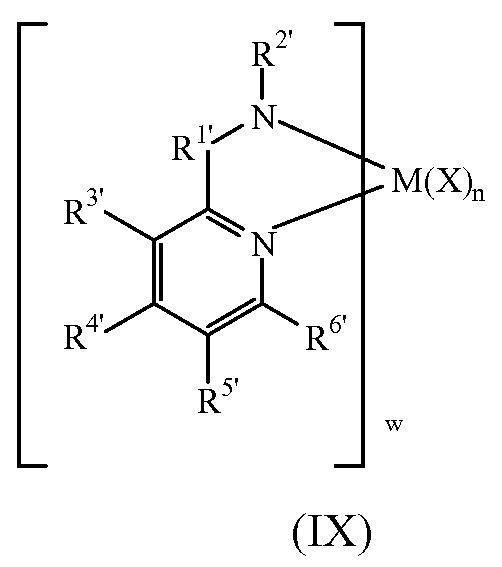


구조식 (IX)은 피리딜-아미드 구조를 나타내고, 구조식 (X)는 이미노-페놀 구조를 나타내고, 구조식 (XI)는 비스(아미드) 구조를 나타낸다. 이 구조식에서, 몇몇 실시양태에서, w는 1 내지 3의 정수이고, 또는 1 또는 2이고, 또는 1이다. 몇몇 실시양태에서, M은 3족 내지 13족 원소, 또는 3족 내지 6족 원소, 또는 4족 원소이다. 각 X는 수소 라디칼, 할로겐 이온(바람직하게는, 플루오린, 염소, 및 브로민의 음이온); C1 내지 C6 알킬; C1 내지 C6 플루오로알킬, C6 내지 C12 아릴; C6 내지 C12 플루오로알킬, C1 내지 C6 알콕시, C6 내지 C12 아릴옥시, 및 C7 내지 C18 알킬아릴옥시로부터 독립적으로 선택된다. 몇몇 실시양태에서, n은 0 내지 4, 또는 1 내지 3, 또는 2 내지 3의 정수이거나, 2이다. Structural formula (IX) represents a pyridyl-amide structure, structural formula (X) represents an imino-phenol structure, and structural formula (XI) represents a bis (amide) structure. In this structural formula, in some embodiments, w is an integer from 1 to 3, or 1 or 2, or 1. In some embodiments, M is a group 3 to 13 element, or a group 3 to 6 element, or a group 4 element. Each X is a hydrogen radical, halogen ions (preferably anions of fluorine, chlorine, and bromine); C 1 to C 6 alkyl; C 1 to C 6 fluoroalkyl, C 6 to C 12 aryl; Independently from C 6 to C 12 fluoroalkyl, C 1 to C 6 alkoxy, C 6 to C 12 aryloxy, and C 7 to C 18 alkylaryloxy. In some embodiments n is 0-4, or an integer of 1 to 3, or 2 to 3, or 2.
또한, 구조식 (IX), (X), 및 (XI)에서, R1'은 히드로카르빌렌 및 헤테로원자 함유 히드로카르빌렌으로부터 선택될 수 있고, 또는 ―SiR2―, 알킬렌, 아릴렌, 알케닐렌 및 치환된 알킬렌, 치환된 알케닐렌 및 치환된 아릴렌으로부터 선택될 수 있고; 또는 ―SiR2―, C1 내지 C6 알킬렌, C6 내지 C12 아릴렌, C1 내지 C6 치환된 알킬렌 및 C6 내지 C12 치환된 아릴렌으로부터 선택될 수 있고, R은 C1 내지 C6 알킬 및 C6 내지 C12 아릴로부터 선택된다.In addition, in formulas (IX), (X), and (XI), R 1 ′ can be selected from hydrocarbylene and heteroatom containing hydrocarbylene, or —SiR 2 —, alkylene, arylene, alke Nylene and substituted alkylene, substituted alkenylene, and substituted arylene; Or —SiR 2 —, C 1 to C 6 alkylene, C 6 to C 12 arylene, C 1 to C 6 substituted alkylene and C 6 to C 12 substituted arylene, R is C 1 to C 6 alkyl and C 6 to C 12 aryl.
또한, 구조식 (IX), (X), 및 (XI)에서, R1', R2', R3', R4', R5', R6', 및 R*는 수화물, C1 내지 C10 알킬, C6 내지 C12 아릴, C6 내지 C18 알킬아릴, C4 내지 C12 헤테로시클릭 히드로카르빌, 치환된 C1 내지 C10 알킬, 치환된 C6 내지 C12 아릴, 치환된 C6 내지 C18 알킬아릴, 및 치환된 C4 내지 C12 헤테로시클릭 히드로카르빌 및 그 화학적으로 결합된 조합으로부터 독립적으로 선택된다. 몇몇 실시양태에서, R*은 존재하지 않는다. 몇몇 실시양태에서, R*―N은 질소 함유기 또는 고리, 예컨대 R1'기에 의해 브릿징된 피리딜기 또는 치환된 피리딜기를 나타낸다. 몇몇 실시양태에서, R*―N은 존재하지 않고, R1'기들은 서로 화학 결합을 형성한다.Furthermore, in the formulas (IX), (X), and (XI), R 1 ′ , R 2 ' , R 3' , R 4 ' , R 5' , R 6 ' , and R * are hydrates, C 1 to C 10 Alkyl, C 6 to C 12 Aryl, C 6 to C 18 Alkylaryl, C 4 to C 12 Heterocyclic Hydrocarbyl, substituted C 1 to C 10 Alkyl, substituted C 6 to C 12 Aryl, substituted C 6 to C 18 Alkylaryl, and substituted C 4 to C 12 Heterocyclic Independently from hydrocarbyl and its chemically bonded combinations. In some embodiments, R * is absent. In some embodiments, R * -N represents a pyridyl group or substituted pyridyl group bridged by a nitrogen containing group or ring, such as a R 1 ′ group. In some embodiments, R * -N is absent and the R 1 ′ groups form a chemical bond with each other.
구조식 (IX), (X), 및 (XI)의 몇몇 실시양태에서, R1'은 메틸렌, 에틸렌, 1-프로필렌, 2-프로필렌, 〓Si(CH3)2, 〓Si(페닐)2, ―CH〓, ―C(CH3)〓, ―C(페닐)2―, ―C(페닐)〓("〓"는 두 화학 결합을 나타냄) 등으로부터 선택된다. In some embodiments of Formulas (IX), (X), and (XI), R 1 ′ is methylene, ethylene, 1-propylene, 2-propylene, 〓Si (CH 3 ) 2 , 〓Si (phenyl) 2 , —CH ′, —C (CH 3 ) ′, —C (phenyl) 2 —, —C (phenyl) ′ (“〓” represents two chemical bonds), and the like.
구조식 (X)의 특정 실시양태에서, R2' 및 R4'는 2-메틸페닐, 2-n-프로필페닐, 2-이소-프로필페닐, 2-이소-부틸페닐, 2-tert-부틸페닐, 2-플루오로페닐, 2-클로로페닐, 2-브로모페닐, 2-메틸-4-클로로페닐, 2-n-프로필-4-클로로페닐, 2-이소-프로필-4-클로로페닐, 2-이소-부틸-4-클로로페닐, 2-tert-부틸-4-클로로페닐, 2-메틸-4-플루오로페닐, 2-n-프로필-4-플루오로페닐, 2-이소-프로필-4-플루오로페닐, 2-이소-부틸-4-플루오로페닐, 2-tert-부틸-4-플루오로페닐, 2-메틸-4-브로모페닐, 2-n-프로필-4-브로모페닐, 2-이소-프로필-4-브로모페닐, 2-이소-부틸-4-브로모페닐, 2-tert-부틸-4-브로모페닐 등으로부터 선택된다.In certain embodiments of formula (X), R 2 ' and R 4' are 2-methylphenyl, 2-n-propylphenyl, 2-iso-propylphenyl, 2-iso-butylphenyl, 2-tert-butylphenyl, 2-fluorophenyl, 2-chlorophenyl, 2-bromophenyl, 2-methyl-4-chlorophenyl, 2-n-propyl-4-chlorophenyl, 2-iso-propyl-4-chlorophenyl, 2- Iso-butyl-4-chlorophenyl, 2-tert-butyl-4-chlorophenyl, 2-methyl-4-fluorophenyl, 2-n-propyl-4-fluorophenyl, 2-iso-propyl-4- Fluorophenyl, 2-iso-butyl-4-fluorophenyl, 2-tert-butyl-4-fluorophenyl, 2-methyl-4-bromophenyl, 2-n-propyl-4-bromophenyl, 2-iso-propyl-4-bromophenyl, 2-iso-butyl-4-bromophenyl, 2-tert-butyl-4-bromophenyl and the like.
구조식 (IX) 및 (XI)의 몇몇 실시양태에서, R2' 및 R3'은 2-메틸페닐, 2-n-프로필페닐, 2-이소-프로필페닐, 2-이소-부틸페닐, 2-tert-부틸페닐, 2-플루오로페닐, 2-클로로페닐, 2-브로모페닐, 4-메틸페닐, 4-n-프로필페닐, 4-이소-프로필페닐, 4-이소-부틸페닐, 4-tert-부틸페닐, 4-플루오로페닐, 4-클로로페닐, 4-브로모페닐, 6-메틸페닐, 6-n-프로필페닐, 6-이소-프로필페닐, 6-이소-부틸페닐, 6-tert-부틸페닐, 6-플루오로페닐, 6-클로로페닐, 6-브로모페닐, 2,6-디메틸페닐, 2,6-디-n-프로필페닐, 2,6-디-이소-프로필페닐, 2,6-디-이소부틸페닐, 2,6-디-tert-부틸페닐, 2,6-디플루오로페닐, 2,6-디클로로페닐, 2,6-디브로모페닐, 2,4,6-트리메틸페닐, 2,4,6-트리-n-프로필페닐, 2,4,6-트리-이소-프로필페닐, 2,4,6-트리-이소-부틸페닐, 2,4,6-트리-tert-부틸페닐, 2,4,6-트리플루오로페닐, 2,4,6-트리클로로페닐, 2,4,6-트리브로모페닐, 2,3,4,5,6-펜타플루오로페닐, 2,3,4,5,6-펜타클로로페닐, 2,3,4,5,6-펜타브로모페닐 등으로부터 선택된다.In some embodiments of Formulas (IX) and (XI), R 2 ′ and R 3 ′ are 2-methylphenyl, 2-n-propylphenyl, 2-iso-propylphenyl, 2-iso-butylphenyl, 2-tert -Butylphenyl, 2-fluorophenyl, 2-chlorophenyl, 2-bromophenyl, 4-methylphenyl, 4-n-propylphenyl, 4-iso-propylphenyl, 4-iso-butylphenyl, 4-tert- Butylphenyl, 4-fluorophenyl, 4-chlorophenyl, 4-bromophenyl, 6-methylphenyl, 6-n-propylphenyl, 6-iso-propylphenyl, 6-iso-butylphenyl, 6-tert-butyl Phenyl, 6-fluorophenyl, 6-chlorophenyl, 6-bromophenyl, 2,6-dimethylphenyl, 2,6-di-n-propylphenyl, 2,6-di-iso-propylphenyl, 2, 6-di-isobutylphenyl, 2,6-di-tert-butylphenyl, 2,6-difluorophenyl, 2,6-dichlorophenyl, 2,6-dibromophenyl, 2,4,6- Trimethylphenyl, 2,4,6-tri-n-propylphenyl, 2,4,6-tri-iso-propylphenyl, 2,4,6-tri-iso-butylphenyl, 2,4,6-tri- tert-butylphenyl, 2,4,6-trifluorophenyl, 2,4,6-trichlorophene Nyl, 2,4,6-tribromophenyl, 2,3,4,5,6-pentafluorophenyl, 2,3,4,5,6-pentachlorophenyl, 2,3,4,5, 6-pentabromophenyl and the like.
구조식 (IX), (X), 및 (XI)의 몇몇 실시양태에서, X는 플루오린화물, 염화물, 브로민화물, 메틸, 에틸, 페닐, 벤질, 페닐옥시, 벤질옥시, 2-페닐-2-프로폭시, 1-페닐-2-프로폭시, 1-페닐-2-부톡시, 2-페닐-2-부톡시 등으로부터 독립적으로 선택된다.In some embodiments of Formulas (IX), (X), and (XI), X is fluoride, chloride, bromide, methyl, ethyl, phenyl, benzyl, phenyloxy, benzyloxy, 2-phenyl-2 Independently selected from -propoxy, 1-phenyl-2-propoxy, 1-phenyl-2-butoxy, 2-phenyl-2-butoxy and the like.
15족-함유 촉매 성분의 비제한적 예는 구조식 (XIIa)-(XIIf)("N"은 질소)으로 나타내어지고:Non-limiting examples of Group 15-containing catalyst components are represented by the formulas (XIIa)-(XIIf) (where “N” is nitrogen):


구조식 (XIIa) 내지 (XIIf)에서, M은 4족 원자로부터 선택되거나 Zr 및 Hf로부터 선택되고; 구조식 (XIIa) 내지 (XIIf)의 R1 내지 R11은 수화물, 플루오린 라디칼, 염소 라디칼, 브로민 라디칼, 메틸, 에틸, n-프로필, 이소프로필, n-부틸, 이소부틸, tert-부틸 및 페닐로부터 선택되고; X는 플루오린 이온, 염소 이온, 브로민 이온, 메틸, 페닐, 벤질, 페닐옥시 및 벤질옥시로부터 선택되고; n은 0 내지 4, 또는 2 내지 3의 정수이다.In formulas (XIIa) to (XIIf), M is selected from Group 4 atoms or selected from Zr and Hf; R 1 to R 11 of formulas (XIIa) to (XIIf) represent hydrates, fluorine radicals, chlorine radicals, bromine radicals, methyl, ethyl, n-propyl, isopropyl, n-butyl, isobutyl, tert-butyl and Selected from phenyl; X is selected from fluorine ions, chlorine ions, bromine ions, methyl, phenyl, benzyl, phenyloxy and benzyloxy; n is an integer of 0-4, or 2-3.
15족-함유 촉매 성분은 본 기술 분야에서 알려진 방법, 예를 들어, 제EP 0 893 454 A1호, 제US 5,889,128호, 제US 6,333,389 B2호 및 제WO 00/37511호에 개시된 것에 의해 제조된다.Group 15-containing catalyst components are prepared by methods known in the art, for example those disclosed in EP 0 893 454 A1, US 5,889,128, US 6,333,389 B2 and WO 00/37511.
"15족-함유 촉매 성분"은 본원에서 설명된 임의의 "실시양태"의 임의의 조합을 포함할 수 있다.The "Group 15-containing catalyst component" can include any combination of any of the "embodiments" described herein.
옥사디아졸을Oxadiazole 포함하는 촉매 Containing catalyst
몇몇 실시양태에서, 촉매 시스템은 옥사디아졸을 포함하는 촉매 성분을 포함할 수 있다. 예를 들어, 촉매 시스템은 구조식 (XIII)로 나타내어질 수 있는 옥사디아졸 화합물을 포함할 수 있고:In some embodiments, the catalyst system can include a catalyst component comprising oxadiazole. For example, the catalyst system may comprise an oxadiazole compound, which may be represented by formula (XIII):
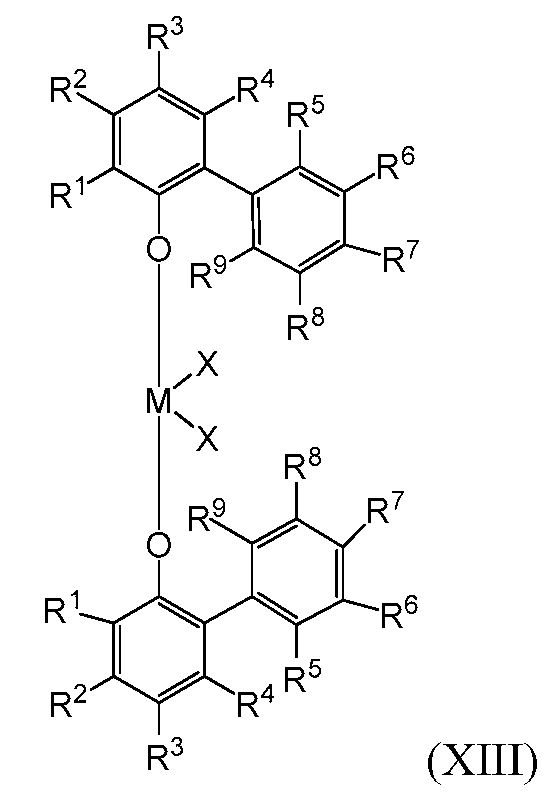
M은 Ti, Zr, 및 Hf로부터 선택되고;M is selected from Ti, Zr, and Hf;
R1 내지 R9 중 하나 이상은 구조식 (XIV)을 갖는 잔기로 치환되고:R 1 At least one of R 9 is substituted with a residue having the formula (XIV):
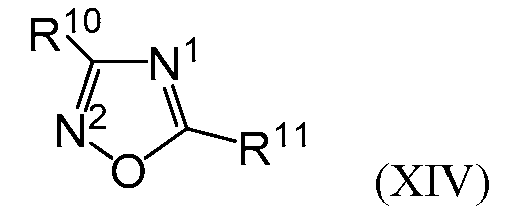
구조식 (XIV)는 R10 또는 R11 위치에서 R1 내지 R9 중 임의의 하나에 부착되고; Structural formula (XIV) is attached to any one of R 1 to R 9 in the R 10 or R 11 position;
구조식 (XIV)의 질소 N1 또는 N2 중 하나 이상은 금속 M과 배위 결합을 형성하고; At least one of nitrogen N 1 or N 2 of formula (XIV) forms a coordination bond with metal M;
R1 내지 R11 중 각각은 수화물, 히드로카르빌, 저급 히드로카르빌, 치환된 히드로카르빌, 헤테로히드로카르빌, 알킬, 저급 알킬, 치환된 알킬, 헤테로알킬, 알케닐, 저급 알케닐, 치환된 알케닐, 헤테로알케닐, 알키닐, 저급 알키닐, 치환된 알키닐, 헤테로알키닐, 알콕시, 저급 알콕시, 아릴옥시, 히드록실, 알킬티오, 저급 알킬티오, 아릴티오, 티옥시, 아릴, 치환된 아릴, 헤테로아릴, 아랄킬, 아랄킬렌, 알카릴, 알카릴렌, 할로겐화물, 할로알킬, 할로알케닐, 할로알키닐, 헤테로알킬, 헤테로시클, 헤테로아릴, 헤테로원자 함유기, 실릴, 보릴, 포스피노, 포스핀, 아미노, 및 아민으로부터 독립적으로 선택되고;Each of R 1 to R 11 represents a hydrate, hydrocarbyl, lower hydrocarbyl, substituted hydrocarbyl, heterohydrocarbyl, alkyl, lower alkyl, substituted alkyl, heteroalkyl, alkenyl, lower alkenyl, substituted Alkenyl, heteroalkenyl, alkynyl, lower alkynyl, substituted alkynyl, heteroalkynyl, alkoxy, lower alkoxy, aryloxy, hydroxyl, alkylthio, lower alkylthio, arylthio, thioxy, aryl, Substituted aryl, heteroaryl, aralkyl, aralkylene, alkaryl, alkylene, halide, haloalkyl, haloalkenyl, haloalkynyl, heteroalkyl, heterocycl, heteroaryl, heteroatom containing group, silyl, boryl Independently from phosphino, phosphine, amino, and amine;
X는 이탈기이다.X is a leaving group.
구조식 (XIII)의 각 X는 할로겐 이온, 수화물, C1 내지 C12 알킬, C2 내지 C12 알케닐, C6 내지 C12 아릴, C7 내지 C20 알킬아릴, C1 내지 C12 알콕시, C6 내지 C16 아릴옥시, C7 내지 C18 알킬아릴옥시, C1 내지 C12 플루오로알킬, C6 내지 C12 플루오로아릴, 및 C1 내지 C12 헤테로원자 함유 탄화수소, 및 그 치환된 유도체로부터 독립적으로 선택되고; 또는 수화물, 할로겐 이온, C1 내지 C6 알킬, C2 내지 C6 알케닐, C7 내지 C18 알킬아릴, C1 내지 C6 알콕시, C6 내지 C14 아릴옥시, C7 내지 C16 알킬아릴옥시, C1 내지 C6 알킬카르복실레이트, C1 내지 C6 플루오린화 알킬카르복실레이트, C6 내지 C12 아릴카르복실레이트, C7 내지 C18 알킬아릴카르복실레이트, C1 내지 C6 플루오로알킬, C2 내지 C6 플루오로알케닐, 및 C7 내지 C18 플루오로알킬아릴로부터 선택되고; 또는 수화물, 염화물, 플루오린화물, 메틸, 페닐, 페녹시, 벤족시, 토실, 플루오로메틸 및 플루오로페닐로부터 선택되고; 또는 C1 내지 C12 알킬, C2 내지 C12 알케닐, C6 내지 C12 아릴, C7 내지 C20 알킬아릴, 치환된 C1 내지 C12 알킬, 치환된 C6 내지 C12 아릴, 치환된 C7 내지 C20 알킬아릴 및 C1 내지 C12 헤테로원자 함유 알킬, C1 내지 C12 헤테로원자 함유 아릴 및 C1 내지 C12 헤테로원자 함유 알킬아릴로부터 선택되고; 또는 염화물, 플루오린화물, C1 내지 C6 알킬, C2 내지 C6 알케닐, C7 내지 C18 알킬아릴, 할로겐화 C1 내지 C6 알킬, 할로겐화 C2 내지 C6 알케닐, 및 할로겐화 C7 내지 C18 알킬아릴로부터 선택되고; 또는 플루오린화물, 메틸, 에틸, 프로필, 페닐, 메틸페닐, 디메틸페닐, 트리메틸페닐, 플루오로메틸(모노-, 디- 및 트리플루오로메틸), 및 플루오로페닐(모노-, 디-, 트리-, 테트라- 및 펜타플루오로페닐)로부터 선택된다.Each X in formula (XIII) is a halogen ion, a hydrate, C 1 to C 12 alkyl, C 2 to C 12 alkenyl, C 6 to C 12 aryl, C 7 to C 20 alkylaryl, C 1 to C 12 alkoxy, C 6 to C 16 aryloxy, C 7 to C 18 alkylaryloxy, C 1 to C 12 fluoroalkyl, C 6 to C 12 fluoroaryl, and C 1 to C 12 heteroatom containing hydrocarbons, and their substituted Independently selected from derivatives; Or a hydrate, a halogen ion, C 1 to C 6 alkyl, C 2 to C 6 alkenyl, C 7 to C 18 alkylaryl, C 1 to C 6 alkoxy, C 6 to C 14 aryloxy, C 7 to C 16 alkyl Aryloxy, C 1 to C 6 alkylcarboxylates, C 1 to C 6 fluorinated alkylcarboxylates, C 6 to C 12 arylcarboxylates, C 7 to C 18 alkylarylcarboxylates, C 1 to C 6 fluoroalkyl, C 2 to C 6 fluoroalkenyl, and C 7 to C 18 fluoroalkylaryl; Or hydrate, chloride, fluoride, methyl, phenyl, phenoxy, benzoxi, tosyl, fluoromethyl and fluorophenyl; Or C 1 to C 12 alkyl, C 2 to C 12 alkenyl, C 6 to C 12 aryl, C 7 to C 20 alkylaryl, substituted C 1 to C 12 alkyl, substituted C 6 to C 12 aryl, substituted C 7 to C 20 alkylaryl and C 1 to C 12 heteroatom containing alkyl, C 1 to C 12 heteroatom containing aryl and C 1 to C 12 heteroatom containing alkylaryl; Or chloride, fluoride, C 1 to C 6 alkyl, C 2 to C 6 alkenyl, C 7 to C 18 alkylaryl, halogenated C 1 to C 6 alkyl, halogenated C 2 to C 6 alkenyl, and halogenated C 7 to C 18 alkylaryl; Or fluoride, methyl, ethyl, propyl, phenyl, methylphenyl, dimethylphenyl, trimethylphenyl, fluoromethyl (mono-, di- and trifluoromethyl), and fluorophenyl (mono-, di-, tri- , Tetra- and pentafluorophenyl).
구조식 (XIII)에서 X 기의 다른 비제한적 예는 아민, 포스핀, 에테르, 카르복실레이트, 디엔, 1 내지 20 탄소 원자를 갖는 탄화수소 라디칼, 플루오린화 탄화수소 라디칼(예를 들어, ―C6F5(펜타플루오로페닐)), 플루오린화 알킬카르복실레이트(예를 들어, CF3C(O)O-), 수화물 및 할로겐 이온 및 그 조합을 포함한다. X 리간드의 다른 예는 알킬기, 예컨대 시클로부틸, 시클로헥실, 메틸, 헵틸, 톨릴, 트리플루오로메틸, 테트라메틸렌, 펜타메틸렌, 메틸리덴, 메티옥시, 에티옥시, 프로폭시, 페녹시, 비스(N-메틸아닐리드), 디메틸아미드, 디메틸포스피드 라디칼 등을 포함한다. 일 실시양태에서, 2 이상의 X들은 융합 고리 또는 고리 시스템의 일부를 형성한다.Other non-limiting examples of X groups in formula (XIII) include amines, phosphines, ethers, carboxylates, dienes, hydrocarbon radicals having 1 to 20 carbon atoms, fluorinated hydrocarbon radicals (eg, —C 6 F 5 (Pentafluorophenyl)), fluorinated alkylcarboxylates (eg, CF 3 C (O) O − ), hydrates and halogen ions and combinations thereof. Other examples of X ligands include alkyl groups such as cyclobutyl, cyclohexyl, methyl, heptyl, tolyl, trifluoromethyl, tetramethylene, pentamethylene, methylidene, methioxy, ethoxy, propoxy, phenoxy, bis (N -Methylanilide), dimethylamide, dimethylphosphide radical, and the like. In one embodiment, two or more Xs form part of a fused ring or ring system.
몇몇 실시양태에서, 옥사디아졸 화합물을 포함하는 촉매 화합물은 구조식 (XV)로 나타낼 수 있고:In some embodiments, a catalytic compound comprising an oxadiazole compound may be represented by the structural formula (XV):
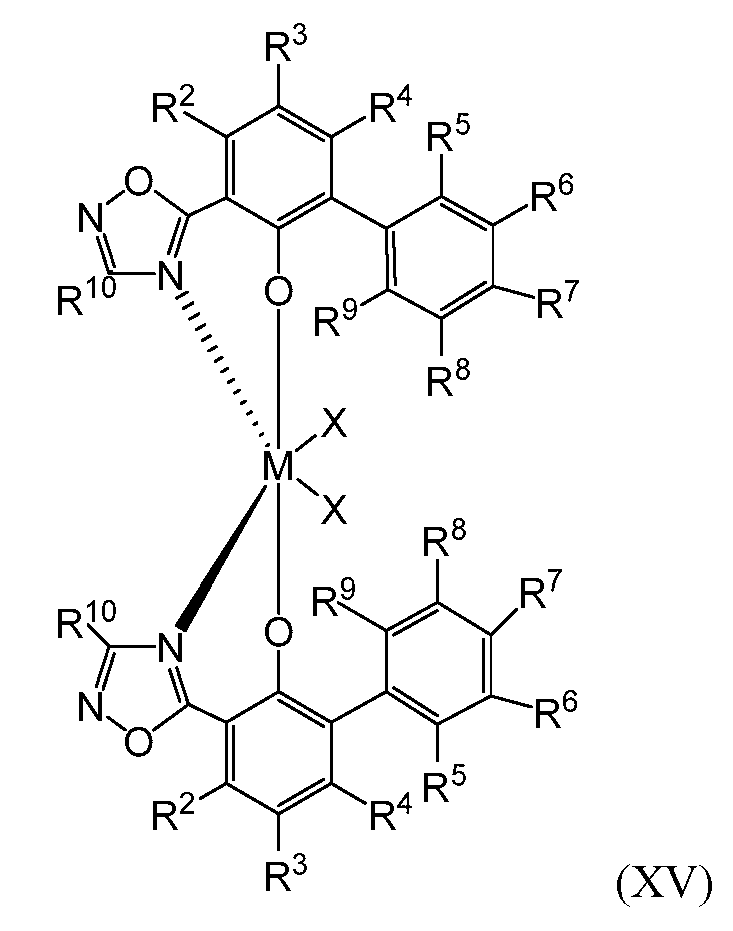
M, X, 및 R2 내지 R10은 상기에서 정의된 바와 같다. M, X, and R 2 to R 10 are as defined above.
몇몇 실시양태에서, 옥사디아졸 화합물을 포함하는 촉매 화합물은 구조식 (XVI)로 나타낼 수 있고:In some embodiments, a catalytic compound comprising an oxadiazole compound may be represented by the structural formula (XVI):

각 R5는 수화물 및 C1 내지 C4 알킬로부터 독립적으로 선택된다. 몇몇 실시양태에서, 하나 이상의 R5는 수소이고, 또는 다른 실시양태에서 R5 모두는 수소이다. 몇몇 실시양태에서, 하나 이상의 R5는 메틸이고, 또는 다른 실시양태에서 각 R5 모두는 메틸이다. Each R 5 is independently selected from hydrate and C 1 to C 4 alkyl. In some embodiments, one or more R 5 is hydrogen, or in other embodiments all of R 5 are hydrogen. In some embodiments, at least one R 5 is methyl, or in other embodiments each R 5 is all methyl.
비페닐 페놀 촉매Biphenyl phenol catalyst
촉매 시스템은 비페닐 페놀 촉매 성분을 포함할 수 있다. 적합한 비페닐 페놀("BPP") 촉매의 비제한적 예는 미국 특허 제7,091,282호, 제7,030,256호, 제7060,848호, 제7,126,031호, 제6,841,502호, 미국 특허 출원 공개공보 제 2006/0025548호, 제2006/020588호, 제2006/00211892호, 및 공개된 PCT 출원 제WO 2006/020624호, 제WO 2005/108406호, 및 제WO 2003/091262호에 개시되어 있다.The catalyst system may comprise a biphenyl phenol catalyst component. Non-limiting examples of suitable biphenyl phenol (“BPP”) catalysts are described in US Pat. Nos. 7,091,282, 7,030,256, 7060,848, 7,126,031, 6,841,502, US Patent Application Publication No. 2006/0025548, 2006/020588, 2006/00211892, and published PCT applications WO 2006/020624, WO 2005/108406, and WO 2003/091262.
바람직한 것은 이하에 나타낸 구조식 (XVII)를 갖는 BPP 촉매로 주어질 수 있고:Preferred can be given with a BPP catalyst having the structure (XVII) shown below:

M은 Ti, Zr 또는 Hf일 수 있다. 구조식 (XVII)의 R1은 수화물, 히드로카르빌, 저급 히드로카르빌, 치환된 히드로카르빌, 헤테로히드로카르빌, 알킬, 저급 알킬, 치환된 알킬, 헤테로알킬, 알케닐, 저급 알케닐, 치환된 알케닐, 헤테로알케닐, 알키닐, 저급 알키닐, 치환된 알키닐, 헤테로알키닐, 알콕시, 저급 알콕시, 아릴옥시, 히드록실, 알킬티오, 저급 알킬티오, 아릴티오, 티옥시, 아릴, 치환된 아릴, 헤테로아릴, 아랄킬, 아랄킬렌, 알카릴, 알카릴렌, 할로겐화물, 할로알킬, 할로알케닐, 할로알키닐, 헤테로알킬, 헤테로시클, 헤테로아릴, 헤테로원자 함유기, 실릴, 보릴, 포스피노, 포스핀, 아미노 또는 아민으로부터 선택될 수 있다. M may be Ti, Zr or Hf. R 1 of formula (XVII) is a hydrate, hydrocarbyl, lower hydrocarbyl, substituted hydrocarbyl, heterohydrocarbyl, alkyl, lower alkyl, substituted alkyl, heteroalkyl, alkenyl, lower alkenyl, substituted Alkenyl, heteroalkenyl, alkynyl, lower alkynyl, substituted alkynyl, heteroalkynyl, alkoxy, lower alkoxy, aryloxy, hydroxyl, alkylthio, lower alkylthio, arylthio, thioxy, aryl, Substituted aryl, heteroaryl, aralkyl, aralkylene, alkaryl, alkylene, halide, haloalkyl, haloalkenyl, haloalkynyl, heteroalkyl, heterocycl, heteroaryl, heteroatom containing group, silyl, boryl , Phosphino, phosphine, amino or amine.
몇몇 실시양태에서, 구조식 (XVII)의 브릿징기 R1은 임의로 치환된 2가 히드로카르빌 및 2가 헤테로원자 함유 히드로카르빌로부터 선택된다. 다른 실시양태에서, R1은 임의로 치환된 2가 알킬, 2가 저급 알킬, 2가 치환된 알킬, 2가 헤테로알킬, 2가 알케닐, 2가 저급 알케닐, 2가 치환된 알케닐, 2가 헤테로알케닐, 2가 알키닐, 2가 저급 알키닐, 2가 치환된 알키닐, 2가 헤테로알키닐, 2가 알콕시, 2가 저급 알콕시, 2가 아릴옥시, 2가 알킬티오, 2가 저급 알킬티오, 2가 아릴티오, 2가 아릴, 2가 치환된 아릴, 2가 헤테로아릴, 2가 아랄킬, 2가 아랄킬렌, 2가 알카릴, 2가 알카릴렌, 2가 할로겐화물, 2가 할로알킬, 2가 할로알케닐, 2가 할로알키닐, 2가 헤테로알킬, 2가 헤테로시클, 2가 헤테로아릴, 2가 헤테로원자 함유기, 2가 히드로카르빌, 2가 저급 히드로카르빌, 2가 치환된 히드로카르빌, 2가 헤테로히드로카르빌, 2가 실릴, 2가 보릴, 2가 포스피노, 2가 포스핀, 2가 아미노, 2가 아민, 2가 에테르, 2가 티오에테르로부터 선택된다. In some embodiments, the bridging group R 1 of formula (XVII) is selected from optionally substituted divalent hydrocarbyl and divalent heteroatom containing hydrocarbyl. In other embodiments, R 1 is optionally substituted divalent alkyl, divalent lower alkyl, divalent substituted alkyl, divalent heteroalkyl, divalent alkenyl, divalent lower alkenyl, divalent alkenyl, 2 Divalent heteroalkenyl, divalent alkynyl, divalent lower alkynyl, divalent substituted alkynyl, divalent heteroalkynyl, divalent alkoxy, divalent lower alkoxy, divalent aryloxy, divalent alkylthio, divalent Lower alkylthio, divalent arylthio, divalent aryl, divalent substituted aryl, divalent heteroaryl, divalent aralkyl, divalent aralkylene, divalent alkaryl, divalent alkylene, divalent halide, 2 Divalent haloalkyl, divalent haloalkenyl, divalent haloalkynyl, divalent heteroalkyl, divalent heterocycle, divalent heteroaryl, divalent heteroatom containing group, divalent hydrocarbyl, divalent lower hydrocarbyl , Divalent hydrocarbyl, divalent heterohydrocarbyl, divalent silyl, divalent boryl, divalent phosphino, divalent phosphine, divalent amino, divalent amine, divalent ether, divalent thioether From is selected.
몇몇 실시양태에서, R1은 일반적 구조 --(Q''R40 2 - z'')z'--로 나타낼 수 있고, 각 Q''는 탄소 또는 규소 중 하나이고 각 R40은 다른 것과 동일 또는 상이할 수 있고, 따라서 각 R40은 수화물 및 임의로 치환된 히드로카르빌로부터 선택되고, 임의로 2 이상의 R40기는 고리 구조 내에서 3 내지 50 원자를 갖는 고리 구조(수소 원자는 세지 않음)로 결합될 수 있고; z'는 1 내지 10, 또는 1 내지 5, 또는 2 내지 5의 정수이고; z''는 0, 1 또는 2이다. 예를 들어, z''가 2일 때, Q''에 회합된 R40기는 없고, 이는 하나의 Q''이 제2의 Q''에 다중으로 결합하는 경우에 허용된다. 몇몇 실시양태에서, R40은 수화물, 할로겐화물, 및 임의로 치환된 알킬, 알케닐, 알키닐, 헤테로알킬, 헤테로알케닐, 헤테로알키닐, 아릴, 헤테로아릴, 알콕실, 아릴옥실, 실릴, 보릴, 포스피노, 아미노, 티옥시, 알킬티오, 아릴티오, 및 그 조합으로부터 선택된다. 이 실시양태 내의 예시적인 R1기는 --(CH2)2--, --(CH2)3--, --(CH2)4-- 및 --(CH2)-(C6H4)-(CH2)--를 포함한다. In some embodiments, R 1 may be represented by the general structure-(Q''R 40 2 - z '') z ' -wherein each Q''is one of carbon or silicon and each R 40 is different from the other May be the same or different, thus each R 40 is selected from a hydrate and optionally substituted hydrocarbyl, and optionally two or more R 40 groups are in a ring structure having 3 to 50 atoms in the ring structure (hydrogen atoms are not counted) Can be combined; z 'is an integer of 1 to 10, or 1 to 5, or 2 to 5; z '' is 0, 1 or 2. For example, when z '' is 2, there is no R 40 group associated with Q '', which is permitted when one Q '' combines multiplely with a second Q ''. In some embodiments, R 40 is a hydrate, halide, and optionally substituted alkyl, alkenyl, alkynyl, heteroalkyl, heteroalkenyl, heteroalkynyl, aryl, heteroaryl, alkoxyl, aryloxyl, silyl, boryl , Phosphino, amino, thioxy, alkylthio, arylthio, and combinations thereof. Exemplary R 1 groups in this embodiment are-(CH 2 ) 2 -,-(CH 2 ) 3 -,-(CH 2 ) 4-, and-(CH 2 )-(C 6 H 4 )-(CH 2 )-.
몇몇 실시양태에서, 구조식 (XVII)의 R2 - R9는 임의로 히드로카르빌, 저급 히드로카르빌, 치환된 히드로카르빌, 헤테로히드로카르빌, 알킬, 저급 알킬, 치환된 알킬, 헤테로알킬, 알케닐, 저급 알케닐, 치환된 알케닐, 헤테로알케닐, 알키닐, 저급 알키닐, 치환된 알키닐, 헤테로알키닐, 알콕시, 저급 알콕시, 아릴옥시, 히드록실, 알킬티오, 저급 알킬티오, 아릴티오, 티옥시, 아릴, 치환된 아릴, 헤테로아릴, 아랄킬, 아랄킬렌, 알카릴, 알카릴렌, 할로겐화물, 할로알킬, 할로알케닐, 할로알키닐, 헤테로알킬, 헤테로시클, 헤테로아릴, 헤테로원자 함유기, 실릴, 보릴, 포스피노, 포스핀, 아미노, 또는 아민이다.In some embodiments, R 2 of formula (XVII) R 9 is optionally hydrocarbyl, lower hydrocarbyl, substituted hydrocarbyl, heterohydrocarbyl, alkyl, lower alkyl, substituted alkyl, heteroalkyl, alkenyl, lower alkenyl, substituted alkenyl, hetero Alkenyl, alkynyl, lower alkynyl, substituted alkynyl, heteroalkynyl, alkoxy, lower alkoxy, aryloxy, hydroxyl, alkylthio, lower alkylthio, arylthio, thioxy, aryl, substituted aryl, hetero Aryl, aralkyl, aralkylene, alkaryl, alkylene, halide, haloalkyl, haloalkenyl, haloalkynyl, heteroalkyl, heterocycl, heteroaryl, heteroatom containing group, silyl, boryl, phosphino, phos Pin, amino, or amine.
구조식 (XVII)의 각 X는 할로겐 이온, 수화물, C1 내지 C12 알킬, C2 내지 C12 알케닐, C6 내지 C12 아릴, C7 내지 C20 알킬아릴, C1 내지 C12 알콕시, C6 내지 C16 아릴옥시, C7 내지 C18 알킬아릴옥시, C1 내지 C12 플루오로알킬, C6 내지 C12 플루오로아릴, 및 C1 내지 C12 헤테로원자 함유 탄화수소, 및 그 치환된 유도체로부터 독립적으로 선택되고; 또는 수화물, 할로겐 이온, C1 내지 C6 알킬, C2 내지 C6 알케닐, C7 내지 C18 알킬아릴, C1 내지 C6 알콕시, C6 내지 C14 아릴옥시, C7 내지 C16 알킬아릴옥시, C1 내지 C6 알킬카르복실레이트, C1 내지 C6 플루오린화 알킬카르복실레이트, C6 내지 C12 아릴카르복실레이트, C7 내지 C18 알킬아릴카르복실레이트, C1 내지 C6 플루오로알킬, C2 내지 C6 플루오로알케닐, 및 C7 내지 C18 플루오로알킬아릴로부터 선택되고; 또는 수화물, 염화물, 플루오린화물, 메틸, 페닐, 페녹시, 벤족시, 토실, 플루오로메틸 및 플루오로페닐로부터 선택되고; 또는 C1 내지 C12 알킬, C2 내지 C12 알케닐, C6 내지 C12 아릴, C7 내지 C20 알킬아릴, 치환된 C1 내지 C12 알킬, 치환된 C6 내지 C12 아릴, 치환된 C7 내지 C20 알킬아릴 및 C1 내지 C12 헤테로원자 함유 알킬, C1 내지 C12 헤테로원자 함유 아릴, 및 C1 내지 C12 헤테로원자 함유 알킬아릴로부터 선택되고; 또는 염화물, 플루오린화물, C1 내지 C6 알킬, C2 내지 C6 알케닐, C7 내지 C18 알킬아릴, 할로겐화 C1 내지 C6 알킬, 할로겐화 C2 내지 C6 알케닐, 및 할로겐화 C7 내지 C18 알킬아릴로부터 선택되고; 플루오린화물, 메틸, 에틸, 프로필, 페닐, 메틸페닐, 디메틸페닐, 트리메틸페닐, 플루오로메틸(모노-, 디- 및 트리플루오로메틸), 및 플루오로페닐(모노-, 디-, 트리-, 테트라- 및 펜타플루오로페닐)로부터 선택된다.Each X in formula (XVII) is a halogen ion, a hydrate, C 1 to C 12 alkyl, C 2 to C 12 alkenyl, C 6 to C 12 aryl, C 7 to C 20 alkylaryl, C 1 to C 12 alkoxy, C 6 to C 16 aryloxy, C 7 to C 18 alkylaryloxy, C 1 to C 12 fluoroalkyl, C 6 to C 12 fluoroaryl, and C 1 to C 12 heteroatom containing hydrocarbons, and their substituted Independently selected from derivatives; Or a hydrate, a halogen ion, C 1 to C 6 alkyl, C 2 to C 6 alkenyl, C 7 to C 18 alkylaryl, C 1 to C 6 alkoxy, C 6 to C 14 aryloxy, C 7 to C 16 alkyl Aryloxy, C 1 to C 6 alkylcarboxylates, C 1 to C 6 fluorinated alkylcarboxylates, C 6 to C 12 arylcarboxylates, C 7 to C 18 alkylarylcarboxylates, C 1 to C 6 fluoroalkyl, C 2 to C 6 fluoroalkenyl, and C 7 to C 18 fluoroalkylaryl; Or hydrate, chloride, fluoride, methyl, phenyl, phenoxy, benzoxi, tosyl, fluoromethyl and fluorophenyl; Or C 1 to C 12 alkyl, C 2 to C 12 alkenyl, C 6 to C 12 aryl, C 7 to C 20 alkylaryl, substituted C 1 to C 12 alkyl, substituted C 6 to C 12 aryl, substituted C 7 to C 20 alkylaryl and C 1 to C 12 heteroatom containing alkyl, C 1 to C 12 heteroatom containing aryl, and C 1 to C 12 heteroatom containing alkylaryl; Or chloride, fluoride, C 1 to C 6 alkyl, C 2 to C 6 alkenyl, C 7 to C 18 alkylaryl, halogenated C 1 to C 6 alkyl, halogenated C 2 to C 6 alkenyl, and halogenated C 7 to C 18 Selected from alkylaryl; Fluorides, methyl, ethyl, propyl, phenyl, methylphenyl, dimethylphenyl, trimethylphenyl, fluoromethyl (mono-, di- and trifluoromethyl), and fluorophenyl (mono-, di-, tri-, Tetra- and pentafluorophenyl).
구조식 (XVII) 내의 X기의 다른 비제한적 예는 아민, 포스핀, 에테르, 카르복실레이트, 디엔, 1 내지 20 탄소 원자를 갖는 탄화수소 라디칼, 플루오린화 탄화수소 라디칼(예를 들어, ―C6F5(펜타플루오로페닐)), 플루오린화 알킬카르복실레이트(예를 들어, CF3C(O)O-), 수화물 및 할로겐 이온 및 그 조합을 포함한다. X 리간드의 다른 예는 알킬기, 예컨대 시클로부틸, 시클로헥실, 메틸, 헵틸, 톨릴, 트리플루오로메틸, 테트라메틸렌, 펜타메틸렌, 메틸리덴, 메티옥시, 에티옥시, 프로폭시, 페녹시, 비스(N-메틸아닐리드), 디메틸아미드, 디메틸포스피드 라디칼 등을 포함한다. 몇몇 실시양태에서, 2 이상의 X들은 융합 고리 또는 고리 시스템의 일부를 형성한다.Other non-limiting examples of X groups in formula (XVII) include amines, phosphines, ethers, carboxylates, dienes, hydrocarbon radicals having 1 to 20 carbon atoms, fluorinated hydrocarbon radicals (eg, —C 6 F 5 (Pentafluorophenyl)), fluorinated alkylcarboxylates (eg, CF 3 C (O) O − ), hydrates and halogen ions and combinations thereof. Other examples of X ligands include alkyl groups such as cyclobutyl, cyclohexyl, methyl, heptyl, tolyl, trifluoromethyl, tetramethylene, pentamethylene, methylidene, methioxy, ethoxy, propoxy, phenoxy, bis (N -Methylanilide), dimethylamide, dimethylphosphide radical, and the like. In some embodiments, two or more Xs form part of a fused ring or ring system.
구조식 (XVII)으로 나타내어지는 화합물의 몇몇 실시양태에서, M은 Ti, Zr, 또는 Hf일 수 있고; R1, R3, R5 내지 R9는 H이고; 각 R2는 알킬, 아릴, 또는 헤테로아릴 중 임의의 것일 수 있고; 각 R4는 H, 알킬, 아릴 중 임의의 것일 수 있고; 각 X는 F, Cl, Br, I, Me, Bnz, CH2SiMe3, 또는 C1 내지 C5 알킬 중 임의의 것일 수 있다.In some embodiments of the compound represented by formula (XVII), M can be Ti, Zr, or Hf; R 1 , R 3 , R 5 to R 9 are H; Each R 2 may be any of alkyl, aryl, or heteroaryl; Each R 4 may be any of H, alkyl, aryl; Each X may be any of F, Cl, Br, I, Me, Bnz, CH 2 SiMe 3 , or C1 to C5 alkyl.
구조식 (XVII)로 나타내어지는 화합물의 몇몇 실시양태에서, M은 Ti, Zr, 또는 Hf일 수 있고; R1은 CH2CH2, (CH2)3, (CH2)4, CH2CHMeCH2, CH2CMe2CH2, Me2Si, CH2SiMe2CH2 중 임의의 것일 수 있고; 각 R2는 2-위치의 치환기 또는 2 및 6 위치의 치환기를 가지고, 1-위치를 통해 BPP 고리에 결합하도록 여기에서 정의된 아릴기 중 임의의 것, 예컨대 2,4-Me2Ph, 2,5-Me2Ph, 2,6-Me2Ph, 2,6-Et2Ph, 2,6-Pr2-Ph, 2,6-Bu2Ph, 2-Me나프틸, 2,4,6-Me3Ph, 2,4,6-Et3Ph, 2,4,6-Pr3Ph, 카르바졸 및 치환된 카르바졸일 수 있고; R3 및 R5 내지 R9는 H이고; 각 R4은 H, 메틸, 에틸, 프로필, 부틸, 펜틸 중 임의의 것일 수 있고; 각 X는 F, Cl, Br, I, Me, Bnz, CH2SiMe3, 또는 C1 내지 C5 알킬 중 임의의 것일 수 있다. In some embodiments of the compound represented by formula (XVII), M may be Ti, Zr, or Hf; R 1 may be any of CH 2 CH 2 , (CH 2 ) 3 , (CH 2 ) 4 , CH 2 CHMeCH 2 , CH 2 CMe 2 CH 2 , Me 2 Si, CH 2 SiMe 2 CH 2 ; Each R 2 has a substituent at the 2-position or a substituent at the 2 and 6 positions, any of the aryl groups defined herein to bind to the BPP ring via the 1-position, such as 2,4-Me 2 Ph, 2 , 5-Me 2 Ph, 2,6-Me 2 Ph, 2,6-Et 2 Ph, 2,6-Pr 2 -Ph, 2,6-Bu 2 Ph, 2-Menaphthyl, 2,4, 6-Me 3 Ph, 2,4,6-Et 3 Ph, 2,4,6-Pr 3 Ph, carbazole and substituted carbazole; R 3 and R 5 to R 9 are H; Each R 4 may be any of H, methyl, ethyl, propyl, butyl, pentyl; Each X may be any of F, Cl, Br, I, Me, Bnz, CH 2 SiMe 3 , or C1 to C5 alkyl.
몇몇 실시양태에서, M은 Zr 또는 Hf 중 하나일 수 있고; X는 F, Cl, Br, I, Me, Bnz, 또는 CH2SiMe3 중 임의의 것일 수 있다. 몇몇 실시양태에서, M은 Zr 또는 Hf 중 하나일 수 있고; R1은 (CH2)3 또는 (CH2)4 중 하나일 수 있고; 각 R2는 2,6-Me2Ph, 2,6-Et2Ph, 2,6-Pr2-Ph, 2,6-Bu2Ph, 2-Me나프틸, 2,4,6-Me3Ph, 2,4,6-Et3Ph, 2,4,6-Pr3Ph, 및 카르바졸 중 하나일 수 있고; 각 R4은 H, 메틸, 또는 부틸 중 하나일 수 있고; X는 F, Cl, 또는 Me 중 하나일 수 있다. 몇몇 실시양태에서, R1은 (CH2)3이고; 각 R3은 2,4,6-Me3Ph 또는 2-Me나프틸 중 하나이고; 각 R4은 CH3이고; X는 Cl이고; M은 Zr이다.In some embodiments, M can be either Zr or Hf; X is F, Cl, Br, I, Me, Bnz, or CH 2 SiMe 3 May be any of In some embodiments, M can be either Zr or Hf; R 1 may be either (CH 2 ) 3 or (CH 2 ) 4 ; Each R 2 is 2,6-Me2Ph, 2,6-Et2Ph, 2,6-Pr2-Ph, 2,6-Bu2Ph, 2-Menaphthyl, 2,4,6-Me3Ph, 2,4,6- May be one of Et3Ph, 2,4,6-Pr3Ph, and carbazole; Each R 4 may be one of H, methyl, or butyl; X may be one of F, Cl, or Me. In some embodiments, R 1 is (CH 2 ) 3 ; Each R 3 is one of 2,4,6-Me3Ph or 2-Menaphthyl; Each R 4 is CH 3 ; X is Cl; M is Zr.
혼합된 촉매Mixed catalyst
촉매 시스템은, 2금속 촉매 조성물, 또는 다촉매 조성물일 수 있는, 혼합된 촉매를 포함할 수 있다. 본원에서 사용된 바와 같이, 용어 "2금속 촉매 조성물" 및 "2금속 촉매"는 각각 상이한 금속기를 갖는, 2 이상의 상이한 촉매 성분을 포함하는 임의의 조성물, 혼합물 또는 시스템을 포함한다. 용어 "다촉매 조성물" 및 "다촉매"는 금속에 관계없이 2 이상의 상이한 촉매 성분을 포함하는 임의의 조성물, 혼합물, 또는 시스템을 포함한다. 따라서, 용어 "2금속 촉매 조성물", "2금속 촉매", "다촉매 조성물" 및 "다촉매"는 달리 구체적으로 언급되지 않는 한 본원에서 "혼합된 촉매"로 총괄적으로 칭할 것이다. 일 바람직한 실시예에서, 혼합된 촉매는 하나 이상의 메틸로센 촉매 화합물 및 하나 이상의 비메탈로센 촉매 화합물을 포함한다.The catalyst system can include a mixed catalyst, which can be a bimetallic catalyst composition, or a multicatalyst composition. As used herein, the terms "bimetallic catalyst composition" and "bimetallic catalyst" include any composition, mixture or system comprising two or more different catalyst components, each having a different metal group. The terms "polycatalyst composition" and "polycatalyst" include any composition, mixture, or system that includes two or more different catalyst components regardless of metal. Accordingly, the terms "bimetallic catalyst composition", "bimetallic catalyst", "polycatalyst composition" and "polycatalyst" will be collectively referred to herein as "mixed catalyst" unless stated otherwise. In one preferred embodiment, the mixed catalyst comprises at least one methyllocene catalyst compound and at least one nonmetallocene catalyst compound.
분사 건조된 활성제Spray dried activator
상기에서 설명된 촉매 성분에 더하여, 촉매 시스템은 분사 건조된 활성제를 더 포함할 수 있다. 분사 건조된 활성제는 혼합되거나 달리 배합되고 이어 분사 건조될 수 있는 활성제 및 충전제 물질을 포함할 수 있다. 본원에서 사용된 바와 같이, 용어 "활성제"는 불포화된 모노머, 예컨대 올레핀을 올리고머화 또는 중합하기 위한 촉매의 능력을 증강시킬 수 있는, 임의의 화합물 또는 성분, 또는 화합물 및 성분의 조합을 칭한다. 배위 또는 양이온 올리고머화 및/또는 중합을 하게 하기에 충분한 임의의 방식으로 촉매 시스템이 올리고머화 및/또는 종합 촉매작용에 대해 활성화될 수 있음이 이해되어야 한다. In addition to the catalyst components described above, the catalyst system may further comprise spray dried activators. Spray dried actives can include active agents and filler materials that can be mixed or otherwise blended and subsequently spray dried. As used herein, the term “active agent” refers to any compound or component, or combination of compounds and components, that can enhance the ability of a catalyst to oligomerize or polymerize unsaturated monomers, such as olefins. It should be understood that the catalyst system may be activated for oligomerization and / or overall catalysis in any manner sufficient to allow coordination or cationic oligomerization and / or polymerization.
촉매 시스템은 하나 이상의 촉매 성분을 포함하는 분사 건조된 활성제를 또한 포함할 수 있다. 이러한 혼합물은 활성제, 충전제 물질, 희석액, 및 촉매 성분을 배합하여 현탁액을 제조하고, 현탁액을 분사 건조하여 하나 이상의 촉매 성분을 포함하는 분사 건조된 활성제를 제조하고, 이어 하나 이상의 촉매 성분을 포함하는 분사 건조된 활성제와 하나 이상의 추가 촉매 성분을 배합하여 촉매 시스템을 제조함으로써 제조될 수 있다. 하나 이상의 촉매 성분 및 하나 이상의 추가 촉매 성분은 상기에서 설명된 촉매 성분 중 임의의 것이거나 이를 포함할 수 있다.The catalyst system may also include a spray dried activator comprising one or more catalyst components. This mixture combines the active agent, filler material, diluent, and catalyst component to produce a suspension, spray drying the suspension to produce a spray dried active agent comprising one or more catalyst components, followed by spraying comprising one or more catalyst components. It can be prepared by combining a dried active agent with one or more additional catalyst components to produce a catalyst system. The one or more catalyst components and one or more additional catalyst components may be or include any of the catalyst components described above.
활성제는 루이스산 또는 비배위 이온 활성제 또는 이온화 활성제, 또는 루이스 염기, 알루미늄 알킬, 및/또는 종래 형태의 조촉매를 포함하는 임의의 다른 화합물을 포함할 수 있다. 활성제는 하나 이상의 유기-알루미늄 화합물을 포함할 수 있다. 활성제는 알루미녹산 및 개질된 알루미녹산을 포함할 수 있다. 예를 들면, 활성제는 메틸알루미녹산("MAO") 및/또는 개질된 메틸알루미녹산("MMAO")일 수 있거나 이를 포함할 수 있다. 다른 예시적인 활성제는 이온화 화합물, 중성 또는 이온, 예컨대 트리 (n-부틸)암모늄 테트라키스(펜타플루오로페닐)붕소, 트리스퍼플루오로페닐 붕소, 트리스퍼플루오로나프틸 붕소, 또는 그 임의의 조합을 포함할 수 있으나 이에 제한되지는 않는다.Active agents can include Lewis acids or uncoordinated ionic or ionizing actives, or any other compound including Lewis bases, aluminum alkyls, and / or conventional types of promoters. The active agent may comprise one or more organo-aluminum compounds. Active agents can include aluminoxanes and modified aluminoxanes. For example, the active agent may be or include methylaluminoxane (“MAO”) and / or modified methylaluminoxane (“MMAO”). Other exemplary active agents are ionizing compounds, neutral or ions such as tri (n-butyl) ammonium tetrakis (pentafluorophenyl) boron, trisperfluorophenyl boron, trisperfluoronaphthyl boron, or any combination thereof It may include, but is not limited to.
바람직한 실시양태에서, 활성제는 알루미녹산 또는 개질된 알루미녹산을 포함한다. 알루미녹산은 --Al(R)--O-- 서브유닛을 갖고, R이 알킬기인, 올리고머 알루미늄 화합물로서 설명될 수 있다. 알루미녹산의 예는, MAO, MMAO, 폴리메틸알루미녹산("PMAO"), 에틸알루미녹산, 이소부틸알루미녹산, 또는 그 조합을 포함하나, 이에 제한되지는 않는다. 하나 이상의 트리알킬알루미늄 화합물은 하나 이상의 알루미녹산 대신에 또는 그와 함께 사용될 수 있다. 트리알킬알루미늄 화합물의 예는 트리메틸알루미늄, 트리에틸알루미늄("TEAL"), 트리이소부틸알루미늄("TiBAl"), 트리-n-헥실알루미늄, 트리-n-옥틸알루미늄, 트리프로필알루미늄, 디에틸알루미늄 에톡시드, 트리부틸알루미늄, 디이소부틸알루미늄 수화물 등을 포함하나, 이에 제한되지는 않는다.In a preferred embodiment, the active agent comprises aluminoxanes or modified aluminoxanes. Aluminoxanes can be described as oligomeric aluminum compounds, having --Al (R)-O-- subunits, wherein R is an alkyl group. Examples of aluminoxanes include, but are not limited to, MAO, MMAO, polymethylaluminoxane (“PMAO”), ethylaluminoxane, isobutylaluminoxane, or combinations thereof. One or more trialkylaluminum compounds may be used in place of or in combination with one or more aluminoxanes. Examples of trialkylaluminum compounds include trimethylaluminum, triethylaluminum ("TEAL"), triisobutylaluminum ("TiBAl"), tri-n-hexylaluminum, tri-n-octylaluminum, tripropylaluminum, diethylaluminum Ethoxide, tributylaluminum, diisobutylaluminum hydrate, and the like.
알루미녹산은 각 트리알킬알루미늄 화합물의 가수분해에 의해 제조될 수 있다. MMAO는 트리메틸알루미늄 및 고급 트리알킬알루미늄, 예컨대 트리이소부틸알루미늄의 가수분해에 의해 제조될 수 있다. 알루미녹산 및 개질된 알루미녹산의 다양한 제조 방법이 있으며, 비제한적 예는 미국 특허 제4,665,208호; 제4,952,540호; 제5,091,352호; 제5,206,199호; 제5,204,419호; 제4,874,734호; 제4,924,018 호; 제4,908,463호; 제4,968,827호; 제5,308,815호; 제5,329,032호; 제5,248,801 호; 제5,235,081호; 제5,157,137호; 제5,103,031호; 제5,391,793호; 제5,391,529 호; 제5,693,838호; 제5,731,253호; 제5,731,451호; 제5,744,656호; 제5,847,177 호; 제5,854,166호; 제5,856,256호; 및 제5,939,346호; 및 제EP 0561476호; 제EP 0279586호; 제EP 0594218호; 및 제EP 0586665호; 및 WO 공개공보 제WO 94/10180호 및 제WO 99/15534호에 설명된 바와 같을 수 있다.Aluminoxanes can be prepared by hydrolysis of each trialkylaluminum compound. MMAO can be prepared by hydrolysis of trimethylaluminum and higher trialkylaluminum such as triisobutylaluminum. There are various methods of making aluminoxanes and modified aluminoxanes, including, but not limited to, US Pat. No. 4,665,208; No. 4,952,540; 5,091,352; 5,091,352; 5,206,199; 5,204,419; 5,204,419; 4,874,734; 4,924,018; 4,924,018; No. 4,908,463; 4,968,827; 4,968,827; 5,308,815; 5,308,815; 5,329,032; 5,248,801; 5,248,801; 5,235,081; 5,235,081; 5,157,137; 5,157,137; 5,103,031; 5,103,031; No. 5,391,793; 5,391,529; 5,693,838; 5,693,838; 5,731,253; 5,731,253; 5,731,451; 5,731,451; 5,744,656; 5,744,656; No. 5,847,177; 5,854,166; 5,854,166; 5,856,256; 5,856,256; And 5,939,346; And EP 0561476; EP 0279586; EP 0594218; And EP 0586665; And WO 94/10180 and WO 99/15534.
시각적으로 투명한 MAO가 사용될 수 있다. 예를 들면, 흐린 및/또는 겔화된 알루미녹산을 여과하여 투명한 알루미녹산을 제작할 수 있거나 투명한 알루미녹산을 흐린 알루미녹산 용액으로부터 경사분리할 수 있다. 추가 실시예에서, 흐린 및/또는 겔화된 알루미녹산이 사용될 수 있다.Visually transparent MAOs can be used. For example, the cloudy and / or gelled aluminoxane can be filtered to produce a transparent aluminoxane or the clear aluminoxane can be decanted from the cloudy aluminoxane solution. In further embodiments, cloudy and / or gelled aluminoxanes may be used.
또 다른 알루미녹산은 개질된 메틸 알루미녹산("MMAO") 형태의 3A(상표명 개질된 메틸알루미녹산 타입 3A 하에 아크조 케미칼스, 인크.(Akzo Chemicals, Inc.)로부터 상업적으로 입수가능함)를 포함할 수 있다. MMAO는 미국 특허 제5,041,584호에 더 설명되어 있다.Other Aluminoxanes may comprise 3A in the form of modified methyl aluminoxane (“MMAO”) (commercially available from Akzo Chemicals, Inc., under the trademark modified methylaluminoxane type 3A). have. MMAO is further described in US Pat. No. 5,041,584.
MAO의 적합한 소스는 예를 들어, MAO 약 1 wt% 내지 약 50 wt%를 갖는 용액일 수 있다. 상업적으로 입수가능한 MAO 용액은 루이지아나주 바톤 루즈의 알베마를 코포레이션(Albemarle Corporation)으로부터 입수가능한 MAO 용액 10 wt% 내지 30 wt%를 포함할 수 있다.Suitable sources of MAO can be, for example, solutions having from about 1 wt% to about 50 wt% MAO. Commercially available MAO solutions may include 10 wt% to 30 wt% of MAO solutions available from Albemarle Corporation of Baton Rouge, Louisiana.
이온화 또는 화학양론적 활성제, 중성 또는 이온성, 예컨대 트리(n-부틸)암모늄 테트라키스(펜타플루오로페닐)붕소, 트리스퍼플루오로페닐 붕소 또는 트리스퍼플루오로나프틸 붕소, 폴리할로겐화 헤테로보란 음이온(WO 공개공보 제WO 98/43983호), 붕산(미국 특허 제5,942,459호), 또는 그 조합을 사용할 수 있다. 활성제는 중성 또는 이온성 화합물을, 단독으로 또는 알루미녹산 및/또는 개질된 알루미녹산과 함께 포함할 수 있다.Ionization or stoichiometric active agents, neutral or ionic, such as tri (n-butyl) ammonium tetrakis (pentafluorophenyl) boron, trisperfluorophenylboron or trisperfluoronaphthyl boron, polyhalogenated heteroborane anions (WO 98/43983), boric acid (US Pat. No. 5,942,459), or a combination thereof can be used. Active agents can include neutral or ionic compounds, alone or in combination with aluminoxanes and / or modified aluminoxanes.
중성 화학양론적 활성제의 예는 3치환된 붕소, 텔루륨, 알루미늄, 갈륨, 인듐, 또는 그 임의의 조합을 포함할 수 있다. 세 치환기는 알킬, 알케닐, 할로겐, 치환된 알킬, 아릴, 아릴할로겐화물, 알콕시 및 할로겐화물로부터 각각 독립적으로 선택될 수 있다. 바람직하게, 세 기는 할로겐, 모노 또는 다환형(할로치환된 것을 포함함) 아릴, 알킬, 및 알케닐 화합물 및 그 혼합물로부터 독립적으로 선택되고, 1 내지 20 탄소 원자를 갖는 알케닐기, 1 내지 20 탄소 원자를 갖는 알킬기, 1 내지 20 탄소 원자를 갖는 알콕시기 및 3 내지 20 탄소 원자를 갖는 아릴기(치환된 아릴을 포함함)가 바람직하다. 더 바람직하게 세 기는 1 내지 4 탄소기를 갖는 알킬, 페닐, 나프틸 또는 그 혼합물이다. 더욱 더 바람직하게, 세 기는 할로겐화된, 바람직하게는 플루오린화된, 아릴기이다. 가장 바람직하게, 중성의 화학양론적 활성제는 트리스퍼플루오로페닐 붕소 또는 트리스퍼플루오로나프틸 붕소이다.Examples of neutral stoichiometric active agents may include trisubstituted boron, tellurium, aluminum, gallium, indium, or any combination thereof. The three substituents may be independently selected from alkyl, alkenyl, halogen, substituted alkyl, aryl, arylhalide, alkoxy and halide, respectively. Preferably, the three groups are independently selected from halogen, mono or polycyclic (including halosubstituted) aryl, alkyl, and alkenyl compounds and mixtures thereof, alkenyl groups having 1 to 20 carbon atoms, 1 to 20 carbons Preferred are alkyl groups having atoms, alkoxy groups having 1 to 20 carbon atoms and aryl groups having 3 to 20 carbon atoms (including substituted aryls). More preferably the three groups are alkyl, phenyl, naphthyl or mixtures thereof having 1 to 4 carbon groups. Even more preferably, the three groups are halogenated, preferably fluorinated, aryl groups. Most preferably, the neutral stoichiometric active agent is trisperfluorophenyl boron or trisperfluoronaphthyl boron.
때로 약하게 배위된 음이온으로 칭할 수 있는, 비배위성 음이온이 또한 사용될 수 있다. 용어 "비배위성 음이온"("NCA")은 양이온에 배위되지 않거나, 양이온에 약하게 배위될 뿐이어서 중성의 루이스 염기에 의해 대체되기에 충분히 불안정하게 남아있는 음이온을 칭한다. "적합한" 비배위성 음이온은 초기에 형성된 복합체가 분해될 때 중성으로 저하되지 않는 것을 칭한다. 예시적인 비배위성 음이온은, 적합하고, 그의 이온성 전하를 균형 맞춤으로써 금속 양이온을 안정화하지만, 중합 중에 에틸렌성 또는 아세틸렌성 불포화된 모노머에 의한 대체를 수용하기에 충분한 능력을 보유하는 것이거나 이를 포함할 수 있다. Non-coordinating anions may also be used, which may sometimes be referred to as weakly coordinated anions. The term "non-coordinating anion" ("NCA") refers to an anion that is not coordinating to a cation, or only weakly coordinating with a cation so that it remains sufficiently unstable to be replaced by a neutral Lewis base. A "suitable" noncoordinating anion is one that does not degrade to neutral when the initially formed complex decomposes. Exemplary non-coordinating anions are those that stabilize and stabilize metal cations by suitable and balancing their ionic charge, but possess or have sufficient capacity to accommodate replacement by ethylenic or acetylenically unsaturated monomers during polymerization. can do.
예시적인 음이온은 미국 특허 제5,278,119호, 및 WO 공개공보 제WO 2002/102857호; 제WO 2002/051884호; 제WO 2002/018452호; 제WO 2000/037513호; 제WO 2000/029454호; 제WO 2000/004058호; 제WO 99/064476호; 제WO 2003/049856호; 제WO 2003/051892호; 제WO 2003/040070호; 제WO 2003/000740호; 제WO 2002/036639 호; 제WO 2002/000738호; 제WO 2002/000666호; 제WO 2001/081435호; 제WO 2001/042249호; 및 제WO 2000/004059호에 설명된 바와 같을 수 있다.Exemplary anions are disclosed in US Pat. No. 5,278,119, and WO Publication No. WO 2002/102857; WO 2002/051884; WO 2002/018452; WO 2000/037513; WO 2000/029454; WO 2000/004058; WO 99/064476; WO 2003/049856; WO 2003/051892; WO 2003/040070; WO 2003/000740; WO 2002/036639; WO 2002/000738; WO 2002/000666; WO 2001/081435; WO 2001/042249; And WO 2000/004059.
종래 형태의 전이 금속 촉매의 활성제는 구조식 M3M4vX2cR3b -c으로 나타낼 수 있고, M3는 1 내지 3 또는 12 내지 13족의 금속이고; M4는 1족의 금속이고; v는 0 내지 1의 수이고; 각 X2는 임의의 할로겐이고; c는 0 내지 3의 수이고; 각 R3는 1가 탄화수소 라디칼 또는 수소이고; b는 1 내지 4의 수이고; b - c 는 1 이상이다. 상기 종래 형태의 전이 금속 촉매에 대한 다른 종래 형태의 유기금속 화합물은 구조식 M3R3k을 가질 수 있고, M3는 IA, IIA, IIB 또는 IIIA족 금속, 예컨대 리튬, 나트륨, 베릴륨, 바륨, 붕소, 알루미늄, 아연, 카드뮴, 및 갈륨이고; k는 M3의 원자가에 따라 1, 2, 또는 3이고, 이 원자가는 결국 보통 M3가 속한 특정 족에 따르고; 각 R3는 탄화수소 라디칼 및 불소, 알루미늄 또는 산소 또는 그 조합과 같은 13 내지 16족 원소를 함유한 탄화수소 라디칼을 포함하는 임의의 1가 라디칼일 수 있다.The active agent of the transition metal catalyst of the conventional form can be represented by the structural formula M 3 M 4v X 2c R 3b -c , wherein M 3 is a metal of group 1 to 3 or group 12 to 13; M 4 is a metal of Group 1; v is a number from 0 to 1; Each X 2 is any halogen; c is a number from 0 to 3; Each R 3 is a monovalent hydrocarbon radical or hydrogen; b is a number from 1 to 4; b-c is 1 or more. Other conventional forms of organometallic compounds for the transition metal catalysts of this type may have the structure M 3 R 3k , where M 3 is an IA, IIA, IIB or IIIA group metal such as lithium, sodium, beryllium, barium, boron Are aluminum, zinc, cadmium, and gallium; k is 1, 2, or 3 depending on the valence of M 3 , which in turn usually depends on the particular family to which M 3 belongs; Each R 3 may be any monovalent radical, including hydrocarbon radicals and hydrocarbon radicals containing Group 13-16 elements such as fluorine, aluminum or oxygen or combinations thereof.
촉매 시스템 내의 활성제의 촉매 성분에 대한 비는 촉매의 몰에 대한 활성제의 몰을 기준으로, 약 0.5:1 내지 약 100,000:1일 수 있다. 또 다른 예에서, 촉매 시스템 내 활성제의 양은 촉매의 몰에 대한 활성제의 몰을 기준으로, 약 10:1 내지 약 10,000:1, 약 50:1 내지 약 5,000:1, 또는 약 100:1 내지 약 1,000:1일 수 있다. The ratio of active agent in the catalyst system to the catalyst component may be from about 0.5: 1 to about 100,000: 1 based on the moles of active agent to moles of catalyst. In another example, the amount of active agent in the catalyst system is about 10: 1 to about 10,000: 1, about 50: 1 to about 5,000: 1, or about 100: 1 to about based on moles of active agent relative to moles of catalyst. 1,000: 1.
활성제가 알루미녹산인 경우, 알루미녹산의 양은 알루미녹산 내에 함유된 알루미늄(Al)의 양을 기준으로 결정될 수 있다. 알루미녹산은 촉매 시스템 내에 촉매 시스템의 그램당 약 10 mmol 이하, 약 9 mmol 이하, 약 8 mmol 이하, 약 7 mmol 이하, 약 6 mmol 이하, 약 5 mmol 이하, 약 4 mmol 이하, 약 3 mmol 이하, 약 2 mmol 이하, 약 1 mmol 이하, 약 0.5 mmol 이하, 또는 약 0.1 mmol 이하의 양으로 존재할 수 있다. 활성제가 알루미녹산인 경우, 알루미녹산은 촉매 시스템 내에 촉매 시스템의 그램당 낮게는 약 0.1 mmol, 약 0.5 mmol, 약 1 mmol, 약 2 mmol, 약 3 mmol, 약 4 mmol, 약 5 mmol, 약 5.5 mmol, 또는 약 6 mmol, 내지 높게는 약 6.5 mmol, 약 7 mmol, 또는 약 7.5 mmol의 양으로 존재할 수 있다. When the active agent is aluminoxane, the amount of aluminoxane may be determined based on the amount of aluminum (Al) contained in the aluminoxane. The aluminoxane is up to about 10 mmol, up to about 9 mmol, up to about 8 mmol, up to about 7 mmol, up to about 6 mmol, up to about 5 mmol, up to about 4 mmol, up to about 3 mmol per gram of catalyst system in the catalyst system. , Up to about 2 mmol, up to about 1 mmol, up to about 0.5 mmol, or up to about 0.1 mmol. If the active agent is an aluminoxane, the aluminoxane is as low as about 0.1 mmol, about 0.5 mmol, about 1 mmol, about 2 mmol, about 3 mmol, about 4 mmol, about 5 mmol, about 5.5 per gram of catalyst system in the catalyst system. mmol, or about 6 mmol, to high about 6.5 mmol, about 7 mmol, or about 7.5 mmol.
촉매 시스템 및 후속 중합의 다른 성분에 대해 불활성인 또는 부분적으로 불활성인 임의의 고체 물질은 충전제 물질로서 사용될 수 있다. 충전제 물질은 고체의, 미세하게 분산된 미립자일 수 있거나 그를 포함할 수 있다. 충전제 물질은 분사 건조된 활성제에 대한 강도 및/또는 벌크를 제공할 수 있다. 충전제 물질은 또한 분사 건조된 활성제 입자 또는 미립자가 붕해되는 것을 감소 또는 방지할 수 있다. 예시적인 충전제 물질은 실리카(예를 들면, 발연 실리카), 알루미나(예를 들면 발연 알루미나), 질화 보론, 이산화 티타늄, 산화 아연, 폴리스티렌, 탄산 칼슘, 또는 그 임의의 조합을 포함할 수 있으나, 이에 제한되지는 않는다. 슬러리에 증가된 점도를 및 분사 건조된 활성제 입자에 우수한 강도를 부여할 수 있기 때문에, 몇몇 실시양태에서, 발연, 소수성, 표면 개질된, 실리카("발연 실리카")가 충전제 물질로서 사용될 수 있다. 충전제 물질은 흡수된 물이 없을 수 있다. 충전제 물질은 표면 개질될 수 있다. 예를 들어, 충전제 물질은 반응성 히드록실 또는 그로부터의 다른 작용기 중 적어도 몇몇을 제거할 수 있는 실란 처리를 거쳐 표면 개질될 수 있다. 실란 처리는 충전제 물질을 디메틸디클로로실란으로 처리하는 것을 포함할 수 있다.Any solid material that is inert or partially inert to the catalyst system and the other components of the subsequent polymerization can be used as the filler material. The filler material may be or include solid, finely dispersed particulates. Filler materials can provide strength and / or bulk for spray dried actives. The filler material may also reduce or prevent disintegration of the spray dried activator particles or particulates. Exemplary filler materials may include silica (eg, fumed silica), alumina (eg, fumed alumina), boron nitride, titanium dioxide, zinc oxide, polystyrene, calcium carbonate, or any combination thereof. It is not limited. In some embodiments, fumed, hydrophobic, surface modified, silica (“fumed silica”) can be used as filler material because it can impart increased viscosity to the slurry and superior strength to spray dried activator particles. The filler material may be free of absorbed water. The filler material can be surface modified. For example, the filler material may be surface modified via a silane treatment that may remove at least some of the reactive hydroxyl or other functional groups therefrom. The silane treatment may include treating the filler material with dimethyldichlorosilane.
충전제 물질은 촉매 화합물을 위한 불활성 담체로서 제공되거나 작용하도록 요구되지 않는다. 즉, 촉매 화합물은 충전제 물질에 의해 담지될 필요가 없다. 또 다른 실시예에서, 충전제 물질은 촉매 화합물 및 활성제를 위한 불활성 담체로서 제공되거나 작용하도록 요구되지 않는다. 즉, 촉매 화합물 및 활성제는 충전제 물질에 의해 담지될 필요가 없다. 따라서, 높은 내부 다공성을 갖는 충전제 물질은 촉매 화합물, 활성제, 또는 그 조합과의 사용에 필수적이지 않다. 충전제 물질은 약 3 cm3/g 미만, 약 2 cm3/g 미만, 약 1 cm3/g 미만, 또는 약 0.5 cm3/g 미만의 기공 부피를 가질 수 있다.The filler material is not required to serve or serve as an inert carrier for the catalyst compound. That is, the catalyst compound does not need to be supported by the filler material. In another embodiment, the filler material is not required to serve or serve as an inert carrier for the catalyst compound and the active agent. That is, the catalyst compound and the activator do not need to be supported by the filler material. Thus, filler materials with high internal porosity are not essential for use with catalytic compounds, active agents, or combinations thereof. The filler material may have a pore volume of less than about 3 cm 3 / g, less than about 2 cm 3 / g, less than about 1 cm 3 / g, or less than about 0.5 cm 3 / g.
충전제 물질은 약 150 마이크로미터 미만, 약 120 마이크로미터 미만, 약 100 마이크로미터 미만, 약 75 마이크로미터 미만, 또는 약 50 마이크로미터 미만의 평균 입자 크기를 가질 수 있다. 예를 들어, 충전제 물질의 평균 입자 크기는 낮게는 약 0.05 마이크로미터, 약 0.1 마이크로미터, 약 1 마이크로미터, 또는 약 5 마이크로미터 내지 높게는 약 40 마이크로미터, 약 60 마이크로미터, 약 80 마이크로미터, 약 100 마이크로미터, 또는 약 150 마이크로미터일 수 있다. 또 다른 실시예에서, 충전제 물질은 약 0.1 마이크로미터 내지 약 80 마이크로미터, 약 0.1 마이크로미터 내지 약 50 마이크로미터, 또는 약 0.1 마이크로미터 내지 약 20 마이크로미터의 평균 입자 크기를 가질 수 있다. 적합한 충전제 물질은 모두 카보트 코포레이션(Cabot Corporation)으로부터 입수가능한, 카보실(Cabosil) TS-610, 카보실 M-5, 또는 그 조합을 포함할 수 있으나, 이에 제한되지는 않는다.The filler material may have an average particle size of less than about 150 micrometers, less than about 120 micrometers, less than about 100 micrometers, less than about 75 micrometers, or less than about 50 micrometers. For example, the average particle size of the filler material may be as low as about 0.05 micrometers, about 0.1 micrometers, about 1 micrometer, or about 5 micrometers to about 40 micrometers, about 60 micrometers, about 80 micrometers. , About 100 micrometers, or about 150 micrometers. In yet another embodiment, the filler material may have an average particle size of about 0.1 micrometers to about 80 micrometers, about 0.1 micrometers to about 50 micrometers, or about 0.1 micrometers to about 20 micrometers. Suitable filler materials may include, but are not limited to, Cabosil TS-610, Cabosil M-5, or a combination thereof, all available from Cabot Corporation.
분사 건조 공정Spray drying process
분사 건조된 활성제의 제조는 현탁액을 제조하기 위해 활성제, 충전제 물질, 및 희석액을 혼합 또는 달리 배합하는 것을 포함할 수 있다. 현탁액은 이어 분사 건조되어 분사 건조된 활성제를 제조할 수 있다. 하나 이상의 촉매 성분을 포함하는 분사 건조된 활성제의 제조는 활성제, 충전제 물질, 희석액, 및 하나 이상의 촉매 성분을 혼합 또는 달리 배합하여 현탁액을 제조하는 것 및 현탁액을 분사 건조하여 하나 이상의 촉매 성분을 포함하는 분사 건조된 활성제를 제조하는 것을 포함할 수 있다.Preparation of the spray dried active agent may include mixing or otherwise blending the active agent, filler material, and diluent to prepare a suspension. The suspension can then be spray dried to produce the spray dried active agent. Preparation of the spray dried active agent comprising one or more catalyst components comprises mixing or otherwise combining the active agent, filler material, diluent, and one or more catalyst components to prepare a suspension and spray drying the suspension to include one or more catalyst components. It may include preparing a spray dried active agent.
현탁액의 성분은 임의의 적합한 순서 또는 배열로 배합될 수 있다. 예를 들어, 희석액 또는 희석액의 일부, 충전제 물질, 활성제, 및 임의로 하나 이상의 촉매 성분이 배합될 수 있다. 하나 이상의 촉매 성분은 또한 활성제 및/또는 충전제 물질의 첨가 전에 희석액과 배합될 수 있다. 하나 이상의 촉매 성분 및 활성제는 각각 희석액과 배합되고 이어 서로 배합될 수 있다.The components of the suspension can be combined in any suitable order or arrangement. For example, a diluent or portion of a diluent, filler material, active agent, and optionally one or more catalyst components can be combined. One or more catalyst components may also be combined with the diluent prior to the addition of the active agent and / or filler material. One or more catalyst components and active agents may each be combined with a diluent and then combined with each other.
혼합물은 약 1 분 내지 약 48 시간의 기간 동안 교반되거나 달리 혼합될 수 있다. 혼합물은 실온부터 약 40 ℃, 약 60 ℃, 약 80 ℃, 또는 약 100 ℃의 온도 이하에서 혼합될 수 있다. 혼합물은 불활성 대기, 예컨대 질소 하에서 혼합될 수 있다.The mixture may be stirred or otherwise mixed for a period of about 1 minute to about 48 hours. The mixture may be mixed at room temperature up to a temperature of about 40 ° C., about 60 ° C., about 80 ° C., or about 100 ° C. The mixture may be mixed under an inert atmosphere such as nitrogen.
희석액은 활성제를 용해 또는 현탁하고 충전제 물질을 현탁할 수 있는 임의의 물질이거나 그를 포함할 수 있다. 희석액의 비제한적 예는 선형 및/또는 분지형 알칸, 예컨대 에탄, 프로판, 부탄, 이소부텐, 펜탄, 이소펜탄, 헥산, 헵탄, 옥탄, 데칸, 도데칸, 헥사데칸, 옥타데칸 등; 지환식 탄화수소, 예컨대 시클로펜탄, 메틸시클로펜탄, 시클로헥산, 시클로옥탄, 노르보르난, 에틸시클로헥산 등; 방향족 탄화수소, 예컨대 벤젠, 톨루엔, 에틸벤젠, 프로필벤젠, 부틸벤젠, 자일렌 등; 석유 분류물, 예컨대 가솔린, 케로센, 경유 등을 포함할 수 있으나, 이에 제한되지 않는다. 마찬가지로, 할로겐화 탄화수소, 예컨대 염화 메틸렌, 디클로로메탄, 클로로벤젠 등이 또한 사용될 수 있다. 임의의 2 이상의 희석액은 함께 사용되어 희석액을 제공할 수 있다. 희석액은 약 0 ℃ 내지 약 150 ℃의 비점을 가질 수 있다.The diluent can be or include any substance that can dissolve or suspend the active agent and suspend the filler material. Non-limiting examples of diluents include linear and / or branched alkanes such as ethane, propane, butane, isobutene, pentane, isopentane, hexane, heptane, octane, decane, dodecane, hexadecane, octadecane and the like; Alicyclic hydrocarbons such as cyclopentane, methylcyclopentane, cyclohexane, cyclooctane, norbornane, ethylcyclohexane and the like; Aromatic hydrocarbons such as benzene, toluene, ethylbenzene, propylbenzene, butylbenzene, xylene and the like; Petroleum fractions such as gasoline, kerosene, diesel, and the like . Likewise, halogenated hydrocarbons such as methylene chloride, dichloromethane, chlorobenzene and the like can also be used. Any two or more dilutions may be used together to provide a diluent. The diluent may have a boiling point of about 0 ° C to about 150 ° C.
현탁액 내의 촉매 시스템의 다양한 성분의 특정 양 또는 농도는 그 안에 존재하는 특정 활성제, 충전제 물질, 및/또는 희석액에 따라, 적어도 부분적으로 변할 수 있다. 예를 들면, 현탁액은 낮게는 약 1 wt%, 약 3 wt% 또는 약 5 wt% 내지 높게는 약 10 wt%, 약 15 wt%, 또는 약 20 wt%의 충전제 물질의 농도를 가질 수 있다. 추가 실시예에서, 현탁액은 약 3 wt% 내지 약 8 wt%, 약 4 wt% 내지 약 7 wt%, 또는 약 5 wt% 내지 약 6 wt%의 충전제 물질의 농도를 가질 수 있다. 현탁액은 낮게는 약 1 wt%, 약 2 wt%, 또는 약 3 wt% 내지 높게는 약 6 wt%, 약 8 wt%, 또는 약 10 wt%의 활성제 농도를 가질 수 있다. 현탁액은 낮게는 약 70 wt%, 약 75 wt%, 또는 약 80 wt% 내지 높게는 약 90 wt%, 약 95 wt%, 또는 약 98 wt%의 희석액 농도를 가질 수 있다. The particular amount or concentration of various components of the catalyst system in the suspension may vary at least in part, depending on the particular active agent, filler material, and / or diluent present therein. For example, the suspension can have a concentration of filler material from as low as about 1 wt%, about 3 wt% or about 5 wt% to as high as about 10 wt%, about 15 wt%, or about 20 wt%. In further embodiments, the suspension may have a concentration of filler material of about 3 wt% to about 8 wt%, about 4 wt% to about 7 wt%, or about 5 wt% to about 6 wt%. The suspension can have a low active agent concentration of about 1 wt%, about 2 wt%, or about 3 wt% to high about 6 wt%, about 8 wt%, or about 10 wt%. The suspension can have a diluent concentration of as low as about 70 wt%, about 75 wt%, or about 80 wt% to as high as about 90 wt%, about 95 wt%, or about 98 wt%.
현탁액은 무화되며, 가열된 불활성 건조 가스, 예컨대 질소, 아르곤, 프로판 등, 또는 그 임의의 조합의 스트림으로 도입되어 희석액을 증발시키고 충전제 물질의 매트릭스 내에 활성제의 고형 입자를 제조할 수 있다. 건조 가스의 체적 유동은 현탁액의 체적 유동보다 클 수 있다. 현탁액은 임의의 적합한 장치(들), 시스템(들), 또는 장치(들) 및/또는 시스템(들)의 조합을 사용하여 무화될 수 있다. 예를 들어, 현탁액은 무화 노즐 또는 원심 고속 디스크 분무기를 통해 무화될 수 있다.The suspension can be atomized and introduced into a stream of heated inert dry gas such as nitrogen, argon, propane or the like, or any combination thereof to evaporate the diluent and produce solid particles of the active agent in a matrix of filler material. The volumetric flow of dry gas may be greater than the volumetric flow of the suspension. The suspension can be atomized using any suitable device (s), system (s), or a combination of device (s) and / or system (s). For example, the suspension can be atomized through atomization nozzles or centrifugal high speed disk nebulizers.
무화 노즐을 통한 현탁액의 무화는 현탁액을 무화 가스와 혼합하는 것을 또한 포함할 수 있다. 무화 노즐의 온도는 현탁액의 최고 비점 성분의 비점이거나 그 초과일 수 있다. 무화된 현탁액은 가열된, 불활성 건조 가스의 존재에서, 휘발물이 건조될 수 있는 건조 챔버로 도입될 수 있다. 바람직하지 않게 큰 직경을 갖는 임의의 분사 건조된 활성제 입자가 제조되면, 그 초과 크기의 입자 중 적어도 일부가 건조 챔버의 수집 영역 내에서 분리될 수 있다. 요구되는 크기를 갖는 분사 건조된 입자는 건조 챔버로부터 회수될 수 있고 이어 불활성 건조 기체로부터 분리될 수 있다. 예를 들어, 분사 건조된 활성제 입자 및 건조 가스는 사이클론 내에서 분리될 수 있다. 다른 적합한 분사 건조 공정은 예를 들어, 미국 특허 제4,638,029호; 제4,728,705호; 제5,290,745호; 제5,306,350호; 제5,604,172호; 제5,716,558호; 제6,982,236호; 및 미국 특허 출원 공개공보 제2006/0293470호 및 제2007/0191215호에서 논의되고 설명된 것과 유사할 수 있다.The atomization of the suspension through the atomization nozzle may also include mixing the suspension with the atomization gas. The temperature of the atomization nozzle may be at or above the boiling point of the highest boiling point component of the suspension. The atomized suspension can be introduced into a drying chamber in which the volatiles can be dried in the presence of a heated, inert drying gas. If any spray dried activator particles that have an undesirably large diameter are produced, at least some of the larger sized particles may be separated in the collection region of the drying chamber. Spray dried particles having the required size can be recovered from the drying chamber and then separated from the inert drying gas. For example, the spray dried activator particles and the drying gas can be separated in the cyclone. Other suitable spray drying processes are described, for example, in US Pat. No. 4,638,029; 4,728,705; No. 5,290,745; 5,306,350; 5,306,350; 5,604,172; 5,716,558; 5,716,558; No. 6,982,236; And US Patent Application Publication Nos. 2006/0293470 and 2007/0191215.
분사 건조는 희석액의 증발 후에 분리 입자 또는 미립자를 제조한다. 분사 건조된 활성제 또는 하나 이상의 촉매 성분을 포함하는 분사 건조된 활성제 내에 존재하는 충전제의 양은 분사 건조된 활성제의 총 중량을 기준으로, 낮게는 약 5 wt%, 약 10 wt%, 약 15 wt%, 또는 약 20 wt% 내지 높게는 약 50 wt%, 약 60 wt%, 약 70 wt%, 또는 약 80 wt%일 수 있다. 예를 들어, 분사 건조된 활성제 또는 하나 이상의 촉매 성분을 포함하는 분사 건조된 활성제는 충전제 물질 및 활성제(들)의 총 중량을 기준으로, 약 50 wt% 내지 약 70 wt%, 약 52 wt% 내지 약 65 wt%, 또는 약 54 wt% 내지 약 60 wt%를 함유할 수 있다.Spray drying produces separated particles or particulates after evaporation of the diluent. The amount of filler present in the spray dried activator or spray dried activator comprising at least one catalyst component is as low as about 5 wt%, about 10 wt%, about 15 wt%, based on the total weight of the spray dried activator, Or from about 20 wt% to about 50 wt%, about 60 wt%, about 70 wt%, or about 80 wt%. For example, the spray dried active agent or spray dried active agent comprising one or more catalyst components, based on the total weight of the filler material and active agent (s), from about 50 wt% to about 70 wt%, from about 52 wt% About 65 wt%, or about 54 wt% to about 60 wt%.
분사 건조된 활성제 또는 하나 이상의 촉매 성분을 포함하는 분사 건조된 활성제는 약 1 마이크로미터 내지 약 500 마이크로미터의 평균 입자 크기를 가질 수 있다. 예를 들어, 분사 건조된 활성제 또는 하나 이상의 촉매 성분을 포함하는 분사 건조된 활성제는 낮게는 약 1 마이크로미터, 약 5 마이크로미터, 또는 약 10 마이크로미터 내지 높게는 약 50 마이크로미터, 약 80 마이크로미터, 또는 약 100 마이크로미터의 평균 입자 크기를 가질 수 있다. 추가 실시예에서, 분사 건조된 활성제 또는 하나 이상의 촉매 성분을 포함하는 분사 건조된 활성제는 약 5 마이크로미터 내지 약 100 마이크로미터, 약 10 마이크로미터 내지 약 80 마이크로미터, 약 10 마이크로미터 내지 약 70 마이크로미터, 또는 약 10 마이크로미터 내지 약 30 마이크로미터의 평균 입자 크기를 가질 수 있다. 분사 건조된 활성제 또는 하나 이상의 촉매 성분을 포함하는 분사 건조된 활성제는 낮게는 약 0.2 g/cm3, 약 0.24 g/cm3, 또는 약 0.28 g/cm3 내지 높게는 약 0.32 g/cm3, 약 0.35 g/cm3, 또는 약 0.38 g/cm3의 벌크 밀도를 가질 수 있다. Spray dried actives or spray dried actives comprising one or more catalyst components can have an average particle size of about 1 micrometer to about 500 micrometers. For example, a spray dried active agent or spray dried active agent comprising one or more catalyst components can be as low as about 1 micrometer, about 5 micrometers, or about 10 micrometers to as high as about 50 micrometers, about 80 micrometers. Or, average particle size of about 100 micrometers. In a further embodiment, the spray dried active agent or spray dried active agent comprising one or more catalyst components is from about 5 micrometers to about 100 micrometers, from about 10 micrometers to about 80 micrometers, from about 10 micrometers to about 70 micrometers Meters, or an average particle size of about 10 micrometers to about 30 micrometers. Spray dried actives comprising a spray dried active agent or one or more catalyst components can be as low as about 0.2 g / cm 3 , about 0.24 g / cm 3 , or about 0.28 g / cm 3 To a high density of about 0.32 g / cm 3 , about 0.35 g / cm 3 , or about 0.38 g / cm 3 .
촉매 시스템의 제조Preparation of Catalytic System
촉매 시스템이 분사 건조된 활성제를 포함하는 경우, 촉매 시스템의 제조는 분사 건조된 활성제 및 촉매 성분을 혼합 또는 달리 배합하여 촉매 성분을 분사 건조된 활성제 상으로 로딩하는 것을 포함할 수 있다. 촉매 시스템이 하나 이상의 촉매 성분을 포함하는 분사 건조된 활성제를 포함하는 경우, 촉매 시스템의 제조는 하나 이상의 촉매 성분을 포함하는 분사 건조된 활성제를 제조하는 것, 하나 이상의 촉매 성분을 포함하는 분사 건조된 활성제를 반응기로 도입하는 것, 및 하나 이상의 추가 촉매 성분을 각기 반응기로 도입하는 것을 포함할 수 있다. 반응기로 각기 도입된 하나 이상의 제2 추가 촉매 성분은 트림으로서 작용하고 하나 이상의 촉매 성분을 포함하는 분사 건조된 활성제와 상호작용하여 반응기 내 촉매 시스템을 형성할 수 있다.If the catalyst system comprises a spray dried active agent, the preparation of the catalyst system may include mixing or otherwise combining the spray dried active agent and the catalyst component to load the catalyst component onto the spray dried active agent. Where the catalyst system comprises a spray dried activator comprising at least one catalyst component, the preparation of the catalyst system comprises preparing a spray dried activator comprising at least one catalyst component, spray dried comprising at least one catalyst component Introducing an active agent into the reactor, and introducing one or more additional catalyst components into the reactor, respectively. One or more second additional catalyst components, each introduced into the reactor, may act as a trim and interact with a spray dried activator comprising one or more catalyst components to form a catalyst system in the reactor.
촉매 시스템의 성분은 다른 적합한 순서 또는 배열로 배합될 수 있다. 분사 건조된 활성제는 촉매 성분의 첨가 전에 희석액과 배합될 수 있다. 대안으로서, 촉매 성분은 분사 건조된 활성제의 첨가 전에 희석액과 배합될 수 있다. 또한, 분사 건조된 활성제 및 촉매 성분은 각각 희석액과 배합되고 이어 서로 배합될 수 있다. The components of the catalyst system can be combined in other suitable orders or arrangements. The spray dried active agent may be combined with the diluent prior to the addition of the catalyst component. As an alternative, the catalyst component may be combined with the diluent prior to the addition of the spray dried active agent. In addition, the spray-dried active agent and catalyst component may each be combined with a diluent and then with each other.
촉매 성분, 분사 건조된 활성제, 및 희석액의 혼합물은 약 5 초 내지 약 48 시간, 또는 약 10 분 내지 약 10 시간, 또는 약 30 분 내지 약 6 시간의 기간 동안 교반 또는 달리 혼합될 수 있다. 혼합물은 실온부터 약 40 ℃, 약 60 ℃, 약 80 ℃, 또는 약 100 ℃의 온도 이하에서 혼합될 수 있다. 혼합물은 불활성 대기, 예컨대 질소 하에서 혼합될 수 있다.The mixture of catalyst component, spray dried active agent, and diluent may be stirred or otherwise mixed for a period of about 5 seconds to about 48 hours, or about 10 minutes to about 10 hours, or about 30 minutes to about 6 hours. The mixture may be mixed at room temperature up to a temperature of about 40 ° C., about 60 ° C., about 80 ° C., or about 100 ° C. The mixture may be mixed under an inert atmosphere such as nitrogen.
희석액은 촉매를 용해 또는 현탁하고 분사 건조된 활성제를 현탁할 수 있는 임의의 물질이거나 그를 포함할 수 있다. 희석액은 불활성 또는 촉매 시스템에 비반응성일 수 있다. 적합한 희석액의 비제한적 예는 지방족 탄화수소, 방향족 탄화수소, 또는 그 조합을 포함하나, 그에 제한되지는 않는다. 예를 들어, 희석액은 미네랄 오일이거나 그를 포함할 수 있다. 희석액의 비제한적 예는 선형 및/또는 분지형 알칸, 예컨대 에탄, 프로판, 부탄, 이소부텐, 펜탄, 이소펜탄, 헥산, 헵탄, 옥탄, 데칸, 도데칸, 헥사데칸, 옥타데칸 등; 지환식 탄화수소, 예컨대 시클로펜탄, 메틸시클로펜탄, 시클로헥산, 시클로옥탄, 노르보르난, 에틸시클로헥산 등; 방향족 탄화수소, 예컨대 벤젠, 톨루엔, 에틸벤젠, 프로필벤젠, 부틸벤젠, 자일렌 등; 석유 분류물, 예컨대 가솔린, 케로센, 경유 등을 더 포함할 수 있으나, 이에 제한되지 않는다. 마찬가지로, 할로겐화 탄화수소, 예컨대 염화 메틸렌, 디클로로메탄, 클로로벤젠 등이 또한 사용될 수 있다. 임의의 2 이상의 희석액은 함께 사용되어 희석액을 제공할 수 있다. 희석액은 약 0 ℃ 내지 약 150 ℃의 비점을 가질 수 있다.The diluent can be or include any substance that can dissolve or suspend the catalyst and suspend the spray dried active agent. The diluent can be inert or unreactive to the catalyst system. Non-limiting examples of suitable diluents include, but are not limited to, aliphatic hydrocarbons, aromatic hydrocarbons, or combinations thereof. For example, the diluent can be or include mineral oil. Non-limiting examples of diluents include linear and / or branched alkanes such as ethane, propane, butane, isobutene, pentane, isopentane, hexane, heptane, octane, decane, dodecane, hexadecane, octadecane and the like; Alicyclic hydrocarbons such as cyclopentane, methylcyclopentane, cyclohexane, cyclooctane, norbornane, ethylcyclohexane and the like; Aromatic hydrocarbons such as benzene, toluene, ethylbenzene, propylbenzene, butylbenzene, xylene and the like; Petroleum fractions, such as gasoline, kerosene, diesel, etc. may further include, but are not limited to. Likewise, Halogenated hydrocarbons such as methylene chloride, dichloromethane, chlorobenzene and the like can also be used. Any two or more dilutions may be used together to provide a diluent. The diluent may have a boiling point of about 0 ° C to about 150 ° C.
몇몇 실시양태에서, 희석액은 미네랄 오일 및 지방족 탄화수소의 혼합물을 포함할 수 있다. 예를 들면, 희석액 내 미네랄 오일의 농도는 낮게는 약 60 wt%, 약 70 wt%, 또는 약 75 wt% 내지 높게는 약 80 wt%, 약 90 wt%, 또는 약 99 wt%일 수 있다. 미네랄 오일 내에 함유되지 않는 지방족 탄화수소의 농도는 낮게는 약 1 wt%, 약 5 wt%, 또는 약 10 wt% 내지 높게는 약 20 wt%, 약 30 wt%, 또는 약 40 wt%일 수 있다. 미네랄 오일 내 함유되지 않은 지방족 탄화수소에 대한 미네랄 오일의 비는 약 1.5:1 내지 약 100:1, 약 2:1 내지 약 50:1, 약 3:1 내지 약 25:1, 또는 약 5:1 내지 약 10:1일 수 있다. 적합한, 상업적으로 입수가능한 미네랄 오일은 바스프(BASF)로부터 입수가능한 히드로브라이트(Hydrobrite) 380일 수 있거나 이를 포함할 수 있다. 적합한, 상업적으로 입수가능한 지방족/이소파라핀 탄화수소는 엑손모빌 케미칼 콤파니(ExxonMobil Chemical Company)로부터 입수가능한, 이소파(Isopar) C이거나 이를 포함할 수 있다.In some embodiments, the diluent may comprise a mixture of mineral oil and aliphatic hydrocarbon. For example, the concentration of mineral oil in the diluent can be as low as about 60 wt%, about 70 wt%, or about 75 wt% to as high as about 80 wt%, about 90 wt%, or about 99 wt%. The concentration of aliphatic hydrocarbons not contained in the mineral oil can be as low as about 1 wt%, about 5 wt%, or about 10 wt% to as high as about 20 wt%, about 30 wt%, or about 40 wt%. The ratio of mineral oil to aliphatic hydrocarbon not contained in the mineral oil is from about 1.5: 1 to about 100: 1, about 2: 1 to about 50: 1, about 3: 1 to about 25: 1, or about 5: 1 To about 10: 1. Suitable, commercially available mineral oils may be or include Hydrobrorite 380 available from BASF. Suitable, commercially available aliphatic / isoparaffin hydrocarbons may be or include Isopar C, available from ExxonMobil Chemical Company.
촉매 시스템 내의 다양한 성분의 특정 양 또는 농도는, 적어도 부분적으로, 그 안에 존재하는 촉매(들), 활성제(들), 충전제 물질(들), 및/또는 희석액(들)에 따라 변할 수 있다. 예를 들어, 촉매 시스템은 낮게는 약 1 wt%, 약 3 wt% 또는 약 5 wt% 내지 높게는 약 10 wt%, 약 15 wt%, 약 20 wt%, 약 25 wt%, 약 30 wt%, 약 40 wt%, 내지 약 50 wt%의 분사 건조된 활성제의 농도를 가질 수 있다. 추가 실시예에서, 촉매 시스템은 약 3 wt% 내지 약 8 wt%, 약 4 wt% 내지 약 7 wt%, 또는 약 5 wt% 내지 약 6 wt%의 분사 건조된 활성제의 농도를 가질 수 있다. 촉매 시스템은 낮게는 약 0.05 wt%, 약 0.09 wt%, 또는 약 0.15 wt% 내지 높게는 약 0.4 wt%, 약 0.8 wt%, 약 1.2 wt%, 약 1.5 wt%, 약 2 wt%, 약 3 wt%, 또는 약 5 wt%의 촉매 성분의 농도를 가질 수 있다. 추가 실시예에서, 촉매 시스템은 약 0.13 wt% 내지 약 0.22 wt%, 약 0.14 wt% 내지 약 0.2 wt%, 또는 약 0.15 wt% 내지 약 0.19 wt%의 촉매 농도를 가질 수 있다. 촉매 시스템은 낮게는 약 70 wt%, 약 75 wt%, 또는 약 80 wt% 내지 높게는 약 90 wt%, 약 95 wt%, 또는 약 98 wt%의 희석액 농도를 가질 수 있다.The specific amount or concentration of the various components in the catalyst system may vary, at least in part, depending on the catalyst (s), activator (s), filler material (s), and / or diluent (s) present therein. For example, the catalyst system can be as low as about 1 wt%, about 3 wt% or about 5 wt% to as high as about 10 wt%, about 15 wt%, about 20 wt%, about 25 wt%, about 30 wt% , About 40 wt%, to about 50 wt% of a spray dried active agent. In further embodiments, the catalyst system may have a concentration of spray dried active agent of about 3 wt% to about 8 wt%, about 4 wt% to about 7 wt%, or about 5 wt% to about 6 wt%. The catalyst system can be as low as about 0.05 wt%, about 0.09 wt%, or about 0.15 wt% to as high as about 0.4 wt%, about 0.8 wt%, about 1.2 wt%, about 1.5 wt%, about 2 wt%, about 3 It may have a concentration of catalyst component of wt%, or about 5 wt%. In further embodiments, the catalyst system may have a catalyst concentration of about 0.13 wt% to about 0.22 wt%, about 0.14 wt% to about 0.2 wt%, or about 0.15 wt% to about 0.19 wt%. The catalyst system may have a diluent concentration of about 70 wt%, about 75 wt%, or about 80 wt% to as high as about 90 wt%, about 95 wt%, or about 98 wt%.
촉매 시스템은 건조 또는 실질적으로 건조 상태에서 또는 슬러리로서 사용될 수 있다. 몇몇 실시양태에서, 건조 분사된 활성제 및 촉매의 혼합물을 포함하는 촉매 시스템은 중합 공정에서의 그의 사용 전에 건조되고 이어 희석액 내에서 재 슬러리화될 수 있다. 몇몇 실시양태에서, 분사 건조된 활성제에 담지된 촉매의 고체 입자는 중합 공정에서의 사용 전에 혼합물로부터 여과되고 이어 희석액 내에서 재슬러리화될 수 있다. The catalyst system can be used in dry or substantially dry conditions or as a slurry. In some embodiments, a catalyst system comprising a mixture of dry sprayed active agent and catalyst may be dried prior to its use in the polymerization process and then reslurried in diluent. In some embodiments, the solid particles of the catalyst supported on the spray dried activator may be filtered out of the mixture and then reslurried in the diluent prior to use in the polymerization process.
연속성 첨가제Continuity additives
본원에서 개시된 중합 공정에서, 반응기 내 정적 수준을 조절하는 것을 돕기 위한 연속성 첨가제를 추가적으로 사용하는 것이 또한 바람직할 수 있다. 본원에서 사용된 바와 같이, 용어 "연속성 첨가제"는 유동층 반응기 내로 도입될 때, 유동층 내의 정전하(음으로, 양으로, 또는 0으로)에 영향을 미치거나 그를 유도할 수 있는 화합물 또는 조성물을 칭한다.In the polymerization process disclosed herein, it may also be desirable to additionally use continuity additives to help control the static level in the reactor. As used herein, the term “continuous additive” refers to a compound or composition that, when introduced into a fluidized bed reactor, can affect or induce an electrostatic charge (negative, positive, or zero) in the fluidized bed. .
사용된 특정 연속성 첨가제는 적어도 부분적으로 정전하, 제조되는 특정 폴리머, 및/또는 사용되는 특정 촉매의 성질에 의존할 수 있다. 적합한 연속성 첨가제 및 그 용도의 예는 유럽 특허 제0229368호; 미국 특허 제5,283,278호; 및 WO 공개공보 제WO2009/023111호에 설명되어 있다.The particular continuity additive used may depend, at least in part, on the nature of the electrostatic charge, the particular polymer produced, and / or the particular catalyst used. Examples of suitable continuity additives and their use are described in European Patent No. 0229368; US Patent No. 5,283,278; And WO publication WO2009 / 023111.
정전하가 음인 경우, 따라서 연속성 첨가제, 예컨대 양전하 발생 화합물이 사용될 수 있다. 예시적인 양전하 발생 연속성 첨가제는 MgO, ZnO, Al2O3, CuO, 알코올, 산소, 산화 질소, 또는 그 조합을 포함할 수 있으나, 그에 제한되지는 않는다. 음 정전하를 제어하는데 적합한 다른 연속성 첨가제는 미국 특허 제4,803,251호 및 제4,555,370호에서 설명된 바와 같을 수 있다.If the static charge is negative, therefore, continuous additives such as positive charge generating compounds can be used. Exemplary positive charge generating continuity additives may include, but are not limited to, MgO, ZnO, Al 2 O 3 , CuO, alcohols, oxygen, nitrogen oxides, or combinations thereof. Other continuity additives suitable for controlling negative static charge may be as described in US Pat. Nos. 4,803,251 and 4,555,370.
정전하가 양인 경우, 따라서 연속성 첨가제, 예컨대 음전하 발생 화합물이 사용될 수 있다. 예시적인 음전하 발생 연속성 첨가제는 V2O5, SiO2, TiO2, Fe2O3, 물, 7 이하 탄소 원자를 함유한 케톤, 또는 그 조합을 포함할 수 있으나, 이에 제한되지는 않는다.If the static charge is positive, then continuous additives such as negative charge generating compounds can be used. Exemplary negative charge generating continuity additives may include, but are not limited to, V 2 O 5 , SiO 2 , TiO 2 , Fe 2 O 3 , water, ketones containing up to 7 carbon atoms, or combinations thereof.
적합한 연속성 첨가제는 알루미늄 디스테아레이트를 포함할 수 있고, 이는 단독으로 또는 임의의 다른 적합한 연속성 첨가제와 함께 사용될 수 있다. 다른 적합한 연속성 첨가제는 알루미늄 디스테아레이트, 에톡실화 아민, 에틸렌이민 코폴리머, 또는 그 임의의 조합을 포함할 수 있으나, 그에 제한되지는 않는다. 적합한, 상업적으로 입수가능한 연속성 첨가제는, 예를 들어, 헌츠만(Huntsman)으로부터 입수가능한 이르가스타트(Irgastat) AS-990 및 바스프로부터 입수가능한 루파솔(Lupasol) FG를 포함할 수 있다.Suitable continuity additives may include aluminum distearate, which may be used alone or in combination with any other suitable continuity additive. Other suitable continuity additives may include, but are not limited to, aluminum distearate, ethoxylated amines, ethyleneimine copolymers, or any combination thereof. Suitable, commercially available continuity additives can include, for example, Irgastat AS-990 available from Huntsman and Lupasol FG available from BASF.
또 다른 연속성 첨가제는 n이 10 내지 10,000일 수 있는, 구조식 --(CH2--CH2--NH)n--을 갖는 폴리에틸렌이민을 포함할 수 있다. 폴리에틸렌이민은 선형, 분지형, 또는 하이퍼분지형(즉, 수지상 또는 가지형 폴리머 구조를 형성함)일 수 있다.Another continuity additive may include polyethyleneimine having the structure — (CH 2 —CH 2 —NH) n —, where n may be 10 to 10,000. Polyethyleneimines may be linear, branched, or hyperbranched (ie, form dendritic or branched polymer structures).
상기 언급한 연속성 첨가제 중 임의의 것, 또한 예를 들어, WO 공개공보 제WO01/44322호에 설명되고 대전방지제로서 열거된 화학약품 및 조성물을 포함하는, 제목 카르복실레이트 금속염 하에 열거된 것이 단독으로 또는 임의의 다른 연속성 첨가제와 함께 사용될 수 있다. 예를 들어, 카르복실레이트 금속염은 아민 함유 조절제와 배합될 수 있다. 예를 들어, 카르복실레이트 금속염과 임의의 켐아민®(KEMAMINE®)(크롬프톤 코포레이션(Crompton Corporation)으로부터 입수가능함)에 속하는 군 구성원 또는 아트머(ATMER)(아이씨아이 아메리카 인크.(ICI America Inc.)로부터 입수가능함) 제품군이다. Any of the above-mentioned continuous additives, also those listed under the title carboxylate metal salt, including, for example, chemicals and compositions described in WO Publication WO01 / 44322 and listed as antistatic agents, alone Or in conjunction with any other continuous additive. For example, carboxylate metal salts can be combined with amine containing regulators. For example, the carboxylate metal salt with any Chem amine ® (KEMAMINE ®) (chromium is possible to obtain from the halftone Corporation (Crompton Corporation)) group members or art Murray (ATMER) belonging to the (I C. I. America Inc.. (ICI America Inc Available from.).
연속성 첨가제는 상기 열거된 연속성 첨가제 중 2 이상의 조합으로서 반응기로 도입될 수 있다. 연속성 첨가제(들)은 용액 또는 슬러리의 형태로 반응기로 도입될 수 있다. 연속성 첨가제는 개별적 공급으로서 반응기로 도입될 수 있거나 또는 반응기로 도입 전에 다른 공급물과 배합될 수 있다. 예를 들어, 배합된 촉매 슬러리/연속성 첨가제 혼합물의 반응기로의 도입 전에, 연속성 첨가제는 촉매 시스템 및/또는 촉매 슬러리와 배합될 수 있다.The continuous additive may be introduced into the reactor as a combination of two or more of the continuous additives listed above. Continuity additive (s) may be introduced into the reactor in the form of a solution or slurry. Continuity additives may be introduced into the reactor as individual feeds or may be combined with other feeds prior to introduction into the reactor. For example, prior to the introduction of the blended catalyst slurry / continuous additive mixture into the reactor, the continuous additive may be combined with the catalyst system and / or the catalyst slurry.
연속성 첨가제는 촉매 슬러리와는 별도로 반응기로 도입될 수 있다. 즉, 연속성 첨가제 및 촉매 슬러리는 반응기 내에서 접촉될 수 있다. 추가 실시예에서, 연속성 첨가제는 촉매 슬러리와 혼합되고 이어 혼합물로서 반응기로 도입될 수 있다. 즉, 연속성 첨가제 및 촉매 슬러리는 반응기 외부에서 접촉될 수 있다. 더욱 또 다른 실시예에서, 연속성 첨가제의 제1 부분은 촉매 슬러리와 혼합되고 반응기로 도입될 수 있고 연속성 첨가제의 제2 부분은 반응기로 별도로 도입될 수 있다. 즉, 연속성 첨가제의 제1 부분 및 촉매 슬러리는 반응기의 외부에서 접촉할 수 있고, 연속성 첨가제의 제2 부분은 촉매 슬러리 및 연속성 첨가제의 제1 부분의 혼합물과 반응기 내에서 접촉될 수 있다.Continuity additives may be introduced into the reactor separately from the catalyst slurry. That is, the continuous additive and the catalyst slurry can be contacted in the reactor. In further embodiments, the continuous additive may be mixed with the catalyst slurry and then introduced into the reactor as a mixture. That is, the continuity additive and catalyst slurry can be contacted outside the reactor. In yet another embodiment, the first portion of the continuous additive may be mixed with the catalyst slurry and introduced into the reactor and the second portion of the continuous additive may be introduced separately into the reactor. That is, the first portion of the continuous additive and the catalyst slurry may be contacted outside of the reactor, and the second portion of the continuous additive may be contacted in the reactor with a mixture of the catalyst slurry and the first portion of the continuous additive.
연속성 첨가제 슬러리 또는 용액의 제조에 적합한 희석액은 불활성 또는 촉매 시스템에 비반응성인 액체를 포함할 수 있다. 예시적인 희석액은 지방족 탄화수소, 방향족 탄화수소, 또는 그 조합을 포함할 수 있으나, 그에 제한되지 않는다. 하나 이상의 희석액은 미네랄 오일 또는 다른 경질 탄화수소이거나 이를 포함할 수 있다.Suitable diluents for the preparation of the continuous additive slurry or solution may include liquids that are inert or unreactive to the catalyst system. Exemplary diluents may include, but are not limited to, aliphatic hydrocarbons, aromatic hydrocarbons, or combinations thereof. One or more diluents may be or include mineral oil or other light hydrocarbons.
반응기 및/또는 촉매 슬러리로 도입되는 연속성 첨가제의 양은 폴리머 제조 속도를 기준으로, 약 0.05 ppmw 내지 약 200 ppmw의 연속성 첨가제 농도를 제공하기에 충분할 수 있다. 예를 들어, 연속성 첨가제는 반응기로, 즉, 반응기로 직접 및/또는 촉매 슬러리와 배합되어, 폴리머 제조 속도를 기준으로, 낮게는 약 1 ppmw, 약 2 ppmw, 또는 약 3 ppmw 내지 높게는 약 35 ppmw, 약 45 ppmw, 또는 약 55 ppmw의 양으로 도입될 수 있다. 반응기로 도입된 연속성 첨가제의 양은 적어도 부분적으로, 특정 촉매 시스템, 반응기 사전 컨디셔닝, 예컨대 정적 축적을 제어하기 위한 코팅, 및/또는 다른 요인에 의존할 수 있다.The amount of continuous additive introduced into the reactor and / or catalyst slurry may be sufficient to provide a continuous additive concentration of about 0.05 ppmw to about 200 ppmw, based on the polymer production rate. For example, the continuous additive may be combined into the reactor, ie directly into the reactor and / or with the catalyst slurry, so as to be low, about 1 ppmw, about 2 ppmw, or about 3 ppmw to about 35, based on the polymer production rate. It may be introduced in an amount of ppmw, about 45 ppmw, or about 55 ppmw. The amount of continuity additive introduced into the reactor may depend, at least in part, on the particular catalyst system, reactor preconditioning, such as coating to control static accumulation, and / or other factors.
중합 공정Polymerization process
중합 공정은 분사 건조된 활성제에 담지된 촉매 성분을 포함하는 촉매 시스템의 존재 하에 올레핀을 중합하는 것을 포함할 수 있다.The polymerization process may comprise polymerizing olefins in the presence of a catalyst system comprising a catalyst component supported on a spray dried activator.
중합 공정은 하나 이상의 촉매 성분을 포함하는 분사 건조된 활성제를 포함하는 촉매 시스템의 존재 하에 올레핀을 중합하는 것을 또한 포함할 수 있고, 하나 이상의 촉매 성분을 포함하는 분사 건조된 활성제는 반응기로 도입되고, 하나 이상의 추가 촉매 성분은 트림 또는 다른 것으로서 반응기로 별도로 도입된다. 이 접근은 더 용이한 촉매 전이를 가능하게 할 수 있다. 예를 들어, 혼합된 촉매를 사용할 때, 한 트림에서 또 다른 것으로 단순히 전이함에 의해 하나 이상의 추가 촉매 성분을 용이하게 변화시킬 수 있다. 또한, 이 접근은 예를 들면, 열적 불안정성 때문에, 분사 건조 조건 하에서 하나 이상의 성분이 효율적으로 활성화될 수 없는, 혼합된 촉매를 사용하기 위한 방법을 제공한다.The polymerization process may also include polymerizing olefins in the presence of a catalyst system comprising a spray dried activator comprising at least one catalyst component, the spray dried activator comprising at least one catalyst component introduced into the reactor, One or more additional catalyst components are introduced separately into the reactor as trims or others. This approach may allow for easier catalyst transfer. For example, when using a mixed catalyst, one or more additional catalyst components can be easily changed by simply transitioning from one trim to another. This approach also provides a method for using mixed catalysts, for example because of thermal instability, where one or more components cannot be efficiently activated under spray drying conditions.
높은 압력, 용액, 슬러리 및/또는 가스상 공정을 포함하나 그에 제한되지는 않는 임의의 중합 공정을 사용할 수 있다. 바람직하게, 유동층 반응기를 이용하는 가스상 공정이 에틸렌 및 하나 이상의 임의의 코모노머를 중합하여 폴리에틸렌을 제공하는데에 사용된다. 더 바람직하게, 유동층 반응기를 이용하는 연속성 가스상 공정이 에틸렌 및 하나 이상의 임의의 코모노머를 중합하여 폴리에틸렌을 제공하는데에 사용된다.Any polymerization process can be used, including, but not limited to, high pressure, solution, slurry, and / or gas phase processes. Preferably, a gas phase process using a fluidized bed reactor is used to polymerize ethylene and one or more optional comonomers to provide polyethylene. More preferably, a continuous gas phase process using a fluidized bed reactor is used to polymerize ethylene and one or more optional comonomers to provide polyethylene.
용어 "폴리에틸렌"은 50 wt% 이상의 에틸렌 유도된 단위, 바람직하게 70 wt% 이상의 에틸렌 유도된 단위, 더 바람직하게 80 wt% 이상의 에틸렌 유도된 단위, 또는 90 wt% 에틸렌 유도된 단위, 또는 95 wt%의 에틸렌 유도된 단위, 또는 100 wt%의 에틸렌 유도된 단위를 갖는 폴리머를 칭한다. 따라서 폴리에틸렌은 호모폴리머 또는 코폴리머일 수 있고, 하나 이상의 다른 모노머 단위를 갖는 터폴리머를 포함한다. 본원에서 설명한 폴리에틸렌은, 예를 들어, 하나 이상의 다른 올레핀(들) 및/또는 코모노머(들)을 포함할 수 있다. 적합한 코모노머는 일 실시예에서 3 내지 16 탄소 원자; 또 다른 실시예에서 3 내지 12 탄소 원자; 또 다른 실시예에서 4 내지 10 탄소 원자; 및 잇따른 또 다른 실시예에서 4 내지 8 탄소 원자를 함유할 수 있다. 다른 적합한 폴리에틸렌은 에틸렌과 하나 이상의 C3-C20 알파 올레핀, C3 내지 C12 알파 올레핀, 또는 C4 내지 C8 알파 올레핀의 코폴리머를 포함할 수 있다. 예시적인 코모노머는 프로필렌, 1-부텐, 1-펜텐, 1-헥센, 1-헵텐, 1-옥텐, 4-메틸펜트-1-엔, 1-데센, 1-도데센, 및 1-헥사데센을 포함하나 이에 제한되지 않는다.The term "polyethylene" means at least 50 wt% ethylene derived units, preferably at least 70 wt% ethylene derived units, more preferably at least 80 wt% ethylene derived units, or 90 wt% ethylene derived units, or 95 wt% Ethylene derived units, or polymers having 100 wt% of ethylene derived units. Polyethylenes can thus be homopolymers or copolymers and include terpolymers having one or more other monomer units. The polyethylene described herein may, for example, comprise one or more other olefin (s) and / or comonomer (s). Suitable comonomers in one embodiment include 3 to 16 carbon atoms; In another embodiment 3 to 12 carbon atoms; In another embodiment 4 to 10 carbon atoms; And in yet another embodiment, it may contain 4 to 8 carbon atoms. Other suitable polyethylenes include ethylene and one or more C 3 -C 20 alpha olefins, C 3 to C 12 alpha olefins, or C 4 to C 8 Copolymers of alpha olefins. Exemplary comonomers are propylene, 1-butene, 1-pentene, 1-hexene, 1-heptene, 1-octene, 4-methylpent-1-ene, 1-decene, 1-dodecene, and 1-hexadecene Including but not limited to.
폴리에틸렌 제품의 바람직한 예는 초저밀도 폴리에틸렌("ULDPE"), 극저밀도 폴리에틸렌("VLDPE"), 선형 저밀도 폴리에틸렌("LLDPE"), 저밀도 폴리에틸렌("LDPE"), 중밀도 폴리에틸렌("MDPE"), 고밀도 폴리에틸렌("HDPE"), 에틸렌 및 프로필렌 및/또는 1-부텐 및/또는 1-헥센의 랜덤 코폴리머, 엘라스토머, 예컨대 에틸렌 프로필렌 고무, 에틸렌 프로필렌 디엔 모노머 고무, 네오프렌, 및 예를 들면, 열가소성 엘라스토머, 및 고무 강화된 플라스틱과 같은 열가소성 폴리머 및 엘라스토머의 블렌드를 포함한다.Preferred examples of polyethylene products include ultra low density polyethylene ("ULDPE"), ultra low density polyethylene ("VLDPE"), linear low density polyethylene ("LLDPE"), low density polyethylene ("LDPE"), medium density polyethylene ("MDPE"), High density polyethylene (“HDPE”), random copolymers of ethylene and propylene and / or 1-butene and / or 1-hexene, elastomers such as ethylene propylene rubber, ethylene propylene diene monomer rubber, neoprene, and for example thermoplastic elastomers And blends of elastomers and thermoplastic polymers such as rubber reinforced plastics.
적합한 가스상 유동층 반응기는 반응 영역 및 소위 속도 감소 영역을 포함할 수 있다. 반응 영역은 성장하는 폴리머 입자, 형성된 폴리머 입자 및 기상의 모노머 및 반응 영역으로부터 중합 열을 제거하기 위한 임의의 하나 이상의 유도된 축합제("ICA")의 연속성 유동에 의해 유동화된 촉매 입자 소량의 층을 포함할 수 있다. 임의로, 재순환된 가스, 예를 들어 ICA 중 몇몇은 냉각되고 압축되어, 반응 영역에 재입장될 때 순환 가스 스트림의 열 제거 용량을 증가시키는 액체를 형성할 수 있다. 예시적인 ICA는 프로판, 부탄, 이소부탄, 펜탄, 이소펜탄, 헥산, 그 이성질체, 그 유도체, 및 그 조합을 포함할 수 있으나, 이에 제한되지는 않는다.Suitable gas phase fluidized bed reactors may comprise a reaction zone and a so-called rate reduction zone. The reaction zone A small amount of bed of catalyst particles fluidized by a continuous flow of growing polymer particles, formed polymer particles and any one or more induced condensing agents (“ICA”) to remove heat of polymerization from the gaseous monomers and reaction zones. Can be. Optionally, the recycled gas, for example some of the ICA, may be cooled and compressed to form a liquid that increases the heat removal capacity of the circulating gas stream when reentering the reaction zone. Exemplary ICA may include, but is not limited to, propane, butane, isobutane, pentane, isopentane, hexane, isomers thereof, derivatives thereof, and combinations thereof.
가스 유동의 적합한 속도는 간단한 실험에 의해 손쉽게 측정될 수 있다. 가스 유동의 속도 또는 표면 가스 속도는 바람직하게는 최소 유동 속도, 즉 유동층을 유지하는데 필요한 최소 유동 속도의 2 배 이상일 수 있다. 표면 가스 속도는 약 0.3 m/s 내지 약 2 m/s, 약 0.35 m/s 내지 약 1.7 m/s, 또는 약 0.4 m/s 내지 약 1.5 m/s일 수 있다. 보통, 표면 가스 속도는 1.5 m/s를 초과하지 않고 통상적으로 0.76 m/s 이하가 충분하다.The suitable velocity of the gas flow can be easily measured by simple experiments. The velocity of the gas flow or the surface gas velocity may preferably be at least twice the minimum flow rate, ie the minimum flow rate required to maintain the fluidized bed. The surface gas velocity may be about 0.3 m / s to about 2 m / s, about 0.35 m / s to about 1.7 m / s, or about 0.4 m / s to about 1.5 m / s. Usually, the surface gas velocity does not exceed 1.5 m / s and typically 0.76 m / s or less is sufficient.
기상 모노머를 순환 가스 스트림에 보충하는 것은 미립자 폴리머 생성물 및 그와 회합된 모노머가 반응기로부터 인출되는 속도와 동일하거나 실질적으로 동일한 속도에서일 수 있고 반응기를 통해 통과하는 가스의 조성은 반응 영역 내의 필수적으로 정상 상태 기상 조성을 유지하기 위해 조정될 수 있다. 반응 영역을 이탈한 가스는 비말동반된 입자가 제거되는 속도 감소 영역으로 통과할 수 있다. 더 미세한 비말동반된 입자 및 분진은 싸이클론 및/또는 미세 필터 내에서 제거될 수 있다. 가스는 중합열 중 적어도 일부가 제거될 수 있는 열 교환기를 통해 통과하고, 압축기에서 압축되고, 이어 반응 영역으로 반환될 수 있다.weather Replenishing the monomers to the circulating gas stream can be at the same or substantially the same rate at which the particulate polymer product and associated monomers are withdrawn from the reactor and the composition of the gas passing through the reactor is essentially normal in the reaction zone. It can be adjusted to maintain the state gas phase composition. The gas leaving the reaction zone can pass to the rate reducing zone where the entrained particles are removed. Finer entrained particles and dust can be removed in the cyclone and / or the fine filter. The gas can pass through a heat exchanger where at least some of the heat of polymerization can be removed, compressed in a compressor, and then returned to the reaction zone.
촉매 슬러리는 임의의 적합한 장치, 시스템, 또는 장치 및/또는 시스템의 조합을 사용하여 반응기로 도입되거나 전달될 수 있다. 촉매 슬러리 전달 시스템의 일 실시예는, 촉매 슬러리가 내부 튜브 및 동축 외부 튜브에 의해 형성된 환형 공간을 통하여 병류로 흐를 수 있는 동안, 액체 또는 가스의 스트림이 내부 튜브를 통해 흐를 수 있는 하나 이상의 발포성 노즐을 포함할 수 있다. 액체 및/또는 가스의 유동 방향은 일반적으로 튜브의 중심축을 따라 있다. 예를 들어, 촉매 슬러리는 환형 공간을 통해 흐를 수 있고, 가스, 예컨대 질소는 내부 튜브를 통해 흐를 수 있다. 촉매 슬러리 및 가스는 노즐의 말단 쪽의 환형 공간 내에서 혼합될 수 있다. 예를 들어, 꼭 말단에서일 필요는 없지만, 내부 튜브의 말단 또는 첨단 쪽으로, 가스를 촉매 슬러리로 유입시키는 구멍 또는 오리피스가 있을 수 있다. 노즐의 일반 배출 오리피스 가까이에서 병류의 촉매 슬러리 내로 가스가 도입될 수 있다. 이렇게 하여, 촉매 슬러리 슬러깅이 방지될 수 있고 지속적인 액적 형성이 촉진될 수 있다. 가스 혼합할 때 형성되는 가스 기포 및 촉매 슬러리가 외부 튜브의 첨단에서 오리피스를 통해 가압될 수 있고, 오리피스의 외측 연부를 따라 촉매 슬러리의 병류를 가압한다. 오리피스 벽 상의 촉매 슬러리의 박막은 유동층 중합 반응기 내의 작은 액적으로 붕해되는 박형 시트 내 오리피스로부터 방출될 수 있다. 이로써, 발포성 노즐은 발포성 노즐에서 방출될 때 촉매 슬러리가 작은 액적으로 분산되는 것을 야기할 수 있다. 촉매 슬러리를 반응기로 도입하기에 적합한 다른 적합한 발포성 노즐은 미국 특허 제5,962,606호 및 제6,075,101호; 유럽 특허 제0961784B1호; 및 WO 공개공보 제WO 98/37101호; 제WO 2008/042078A1호; 제WO 2008/042177A1호; 및 제WO 2008/042182A1호에서 논의되고 설명된 것과 유사할 수 있다.The catalyst slurry can be introduced or delivered to the reactor using any suitable device, system, or combination of devices and / or systems. One embodiment of a catalyst slurry delivery system, While the catalyst slurry can flow co-currently through the annular space formed by the inner tube and the coaxial outer tube, the stream of liquid or gas can include one or more foaming nozzles that can flow through the inner tube. The flow direction of the liquid and / or gas is generally along the central axis of the tube. For example, the catalyst slurry can flow through the annular space and gas, such as nitrogen, can flow through the inner tube. The catalyst slurry and gas can be mixed in the annular space on the end side of the nozzle. For example, although not necessarily at the end, there may be a hole or orifice for introducing gas into the catalyst slurry toward the end or tip of the inner tube. Gas may be introduced into the cocurrent catalyst slurry near the normal discharge orifice of the nozzle. In this way, catalyst slurry slugging can be prevented and continuous droplet formation can be promoted. The gas bubbles and catalyst slurry formed when gas mixing can be pressurized through the orifice at the tip of the outer tube and pressurize the co-current of the catalyst slurry along the outer edge of the orifice. A thin film of catalyst slurry on the orifice wall may be released from the orifice in the thin sheet that disintegrates into small droplets in the fluidized bed polymerization reactor. In this way, the foam nozzle may cause the catalyst slurry to be dispersed in small droplets when discharged from the foam nozzle. Other suitable foamable nozzles suitable for introducing the catalyst slurry into the reactor include US Pat. Nos. 5,962,606 and 6,075,101; European Patent No. 0961784B1; And WO Publication WO 98/37101; WO 2008 / 042078A1; WO 2008 / 042177A1; And WO 2008 / 042182A1.
촉매 슬러리 전달 시스템의 또 다른 예는 액체 또는 가스의 스트림이 제1 또는 "내부" 도관을 통해 흐를 수 있고, 촉매 슬러리가 제1 도관 및 제2 또는 "중간" 도관 사이에 형성된 환형부를 통해 흐를 수 있고, 공급 스트림이 제2 도관 및 제3 또는 "외부" 도관 사이에 형성된 환형부를 통해 흐를 수 있는 하나 이상의 발포성 노즐을 포함할 수 있다. 제1 또는 내부 도관을 통해 흐르는 액체 또는 가스는 상기 논의된 바와 유사한 촉매 슬러리와 혼합 또는 달리 배합될 수 있다. 공급 스트림 및 촉매 슬러리/가스 또는 액체 혼합물은 반응기 내에서 서로 접촉할 수 있다. 촉매 슬러리 및 공급 스트림을 반응기로 도입하기에 적합한 발포성 노즐은 미국 특허 출원 공개공보 제2010/0041841호에서 논의되고 설명된 노즐과 유사할 수 있다.Another example of a catalyst slurry delivery system is that a stream of liquid or gas may flow through the first or "inner" conduit, and the catalyst slurry may flow through an annulus formed between the first conduit and the second or "middle" conduit. And the feed stream may comprise one or more foaming nozzles that may flow through an annulus formed between the second conduit and the third or “outer” conduit. Liquids or gases flowing through the first or internal conduits may be mixed or otherwise combined with catalyst slurries similar to those discussed above. The feed stream and catalyst slurry / gas or liquid mixture may contact each other in the reactor. Suitable foam nozzles for introducing the catalyst slurry and feed stream into the reactor may be similar to the nozzles discussed and described in US Patent Application Publication No. 2010/0041841.
연속성 첨가제는 촉매 슬러리와 혼합되고 발포성 노즐 중 하나 이상을 통해 도입될 수 있다. 연속성 첨가제는 발포성 노즐을 통해 촉매 슬러리와는 별도로 도입될 수 있는 가스와 혼합되고 이어 발포성 노즐(들) 내에서 촉매 슬러리와 배합 또는 혼합될 수 있다. 연속성 첨가제는 하나 이상의 독립 노즐 또는 다른 적합한 도입 장치를 통해 유동층으로 도입될 수 있어, 연속성 첨가제는 유동층 내에서 촉매 슬러리와 접촉한다.Continuity additives may be mixed with the catalyst slurry and introduced through one or more of the foaming nozzles. The continuous additive may be mixed with a gas that may be introduced separately from the catalyst slurry through the foam nozzle and then combined or mixed with the catalyst slurry in the foam nozzle (s). The continuous additive may be introduced into the fluidized bed through one or more independent nozzles or other suitable introduction devices such that the continuous additive is contacted with the catalyst slurry in the fluidized bed.
문헌["Polypropylene Handbook"의 페이지 76-78(Hanser Publishers, 1996)]에 설명된 바와 같이, 폴리올레핀의 최종 성질을 제어하기 위한 올레핀 중합에 수소 가스가 사용될 수 있다. 특정 촉매 시스템을 사용하여, 수소 농도(부분 압력)를 증가시키는 것은 발생되는 폴리올레핀의 용융 지수(MI)를 증가시킬 수 있다. 따라서 MI는 수소 농도에 의해 영향을 받을 수 있다. 중합 반응기 내 수소의 양은 총 중합성 모노머, 예를 들어, 에틸렌, 또는 에틸렌 및 헥센 또는 프로필렌의 블렌드에 대한 몰비로서 나타낼 수 있다. 중합 공정에서 사용되는 수소의 양은 최종 폴리올레핀 수지의 요구되는 MI를 달성하기에 필요한 양일 수 있다. 총 모노머에 대한 수소의 몰비(H2:모노머)는 0.0001 초과, 0.0005 초과, 또는 0.001 초과 및 10 미만, 또는 5 미만, 또는 3 미만, 또는 0.10 미만일 수 있고, 바람직한 범위는 본원에서 설명한 임의의 몰비 상한과 임의의 몰비 하한의 임의의 조합을 포함할 수 있다. 또 다른 방식으로 표현된, 임의의 시간에서 반응기 내의 수소의 양은 20,000 ppm 이하, 또는 5,000 ppm 이하, 또는 4,000 ppm 이하, 또는 3,000 ppm 이하, 또는 50 ppm 내지 5,000 ppm, 또는 500 ppm 내지 2,000 ppm일 수 있다. 총 모노머에 대한 수소의 몰비(H2:모노머)는 약 0.00001:1 내지 약 2:1, 또는 약 0.005:1 내지 약 1.5:1, 또는 약 0.0001:1 내지 약 1:1일 수 있다.As described in pages 76-78 (Hanser Publishers, 1996) of the "Polypropylene Handbook", hydrogen gas may be used in the olefin polymerization to control the final properties of the polyolefin. Using certain catalyst systems, increasing the hydrogen concentration (partial pressure) can increase the melt index (MI) of the polyolefins generated. Thus MI can be affected by hydrogen concentration. The amount of hydrogen in the polymerization reactor can be expressed as the molar ratio of the total polymerizable monomer, for example ethylene, or a blend of ethylene and hexene or propylene. The amount of hydrogen used in the polymerization process may be the amount necessary to achieve the required MI of the final polyolefin resin. The molar ratio of hydrogen to total monomers (H 2 : monomer) may be greater than 0.0001, greater than 0.0005, or greater than 0.001 and less than 10, or less than 5, or less than 3, or less than 0.10, with the preferred range being any molar ratio described herein. And any combination of an upper limit and any lower molar ratio limit. Expressed in another way, the amount of hydrogen in the reactor at any time may be 20,000 ppm or less, or 5,000 ppm or less, or 4,000 ppm or less, or 3,000 ppm or less, or 50 ppm to 5,000 ppm, or 500 ppm to 2,000 ppm have. The molar ratio of hydrogen to total monomers (H 2 : monomer) may be from about 0.00001: 1 to about 2: 1, or from about 0.005: 1 to about 1.5: 1, or from about 0.0001: 1 to about 1: 1.
반응기 온도는 약 30 ℃, 약 40 ℃, 또는 약 50 ℃ 내지 약 90 ℃, 약 100 ℃, 약 110 ℃, 약 120 ℃, 또는 약 150 ℃일 수 있다. 일반적으로, 반응기 온도는 반응기 내의 폴리머 생성물의 소결 온도를 고려하면 최고 가능 온도에서 작동될 수 있다. 폴리올레핀을 만드는데 사용되는 공정에 관계없이 중합 온도 또는 반응 온도는 형성될 폴리올레핀의 융점 또는 "소결" 온도 미만이어야 한다. 따라서, 일 실시예에서 상한 온도는 반응기에서 제조된 폴리올레핀의 융점일 수 있다.The reactor temperature may be about 30 ° C, about 40 ° C, or about 50 ° C to about 90 ° C, about 100 ° C, about 110 ° C, about 120 ° C, or about 150 ° C. In general, the reactor temperature may be operated at the highest possible temperature given the sintering temperature of the polymer product in the reactor. Regardless of the process used to make the polyolefin, the polymerization temperature or reaction temperature should be below the melting point or "sintering" temperature of the polyolefin to be formed. Thus, in one embodiment, the upper temperature may be the melting point of the polyolefin produced in the reactor.
가스상 중합 반응기 내의 압력(단일 단계 또는 2 이상의 단계 중 하나)은 약 700 kPa 내지 약 3,500 kPa, 및 또 다른 실시예에서 약 1,350 kPa 내지 약 3,000 kPa의 범위, 및 잇따른 또 다른 실시예에서 약 1,600 kPa 내지 약 2,000 kPa의 범위에서 변할 수 있다.The pressure in the gas phase polymerization reactor (either a single stage or one of two or more stages) ranges from about 700 kPa to about 3,500 kPa, and in yet another embodiment from about 1,350 kPa to about 3,000 kPa, and in yet another embodiment about 1,600 kPa And from about 2,000 kPa.
가스상 반응기는 약 10 kg/hr의 폴리머 내지 약 90,000 kg/hr, 및 또 다른 실시예에서 약 450 kg/hr 초과, 및 잇따른 또 다른 실시예에서 약 4,500 kg/hr 초과, 및 잇따른 또 다른 실시예에서 약 10,000 kg/hr 초과, 및 잇따른 또 다른 실시예에서 약 15,000 kg/hr 초과, 및 잇따른 또 다른 실시예에서 약 30,000 kg/hr 초과, 및 잇따른 또 다른 실시예에서 약 30,000 kg/hr 내지 약 75,000 kg/hr을 제조하는 것이 가능할 수 있다. 추가 반응기 세부사항 및 반응기의 작동 수단이, 예를 들어 미국 특허 제3,709,853호; 제4,003,712호; 제4,011,382호; 제4,302,566호; 제4,543,399호; 제4,882,400호; 제5,352,749호; 및 제5,541,270호; 유럽 특허 제EP 0802202호; 및 벨기에 특허 제839,380호에 논의되고 설명된 바와 같을 수 있다.The gas phase reactor may be from about 10 kg / hr of polymer to about 90,000 kg / hr, and in yet another embodiment, greater than about 450 kg / hr, and in yet another embodiment, greater than about 4,500 kg / hr, and yet another embodiment. In excess of about 10,000 kg / hr, and in still another embodiment, in excess of about 15,000 kg / hr, and in still another embodiment, in excess of about 30,000 kg / hr, and in still another embodiment, from about 30,000 kg / hr to about It may be possible to produce 75,000 kg / hr. Further reactor details and means of operation of the reactor are described, for example, in US Pat. No. 3,709,853; No. 4,003,712; 4,011,382; 4,302,566; No. 4,543,399; 4,882,400; 5,352,749; 5,352,749; And 5,541,270; European Patent No. EP 0802202; And Belgian patent 839,380.
촉매 슬러리 및 연속성 첨가제를 가스상 유동층 반응기로 도입하는 것은 러블, 청크, 럼프, 시트 등의 형태의 응집체의 형성 또는 발생 없이 하나 이상의 폴리올레핀 생성물을 제조할 수 있다. 즉, 중합은 응집체, 예컨대 러블, 청크, 럼프, 시트 등의 검출가능한 수준의 형성을 야기하지 않고 수행될 수 있다.The introduction of the catalyst slurry and continuous additives into the gas phase fluidized bed reactor can produce one or more polyolefin products without the formation or generation of aggregates in the form of rubble, chunks, lumps, sheets and the like. That is, the polymerization can be performed without causing the formation of detectable levels of aggregates such as rubble, chunks, lumps, sheets, and the like.
중합 반응기는 연속성 또는 반연속성 기반으로, 즉 몇 시간 내지 며칠 또는 몇 주의 시간 동안, 셧다운 없이 작동될 수 있다. 예를 들어, 촉매 슬러리가 연속적으로 또는 반연속적으로 도입되는 중합 반응기는 약 1 일, 약 2 일, 약 3 일, 약 5일, 약 7 일, 약 10 일, 약 15 일 이상 동안, 그 안의 검출가능한 응집체의 형성 없이 작동될 수 있다. 또 다른 실시예에서, 촉매 슬러리 및 연속성 첨가제는 러블, 청크, 럼프, 시트 등의 형태의 응집체의 형성 또는 발생 없이 3 일 이상의 기간 동안 연속적 또는 반연속적 방식으로 중합 반응기로 도입될 수 있다.The polymerization reactor can be operated without shutdown, on a continuous or semicontinuous basis, ie for hours to days or weeks of time. For example, a polymerization reactor into which a catalyst slurry is continuously or semicontinuously introduced may be used for about 1 day, about 2 days, about 3 days, about 5 days, about 7 days, about 10 days, about 15 days or more therein. It can be operated without the formation of detectable aggregates. In another embodiment, the catalyst slurry and continuous additives may be introduced into the polymerization reactor in a continuous or semi-continuous manner for a period of at least 3 days without the formation or generation of aggregates in the form of rubble, chunks, lumps, sheets, and the like.
폴리에틸렌은 낮게는 약 0.5, 약 1, 또는 약 5 내지 높게는 약 30, 약 100, 또는 약 250인 I21/I2 비(I21은 ASTM-D-1238-F에 의해 측정됨,(190 ℃/21.6 kg); I2는 ASTM-D-1238-E에 의해 측정됨, (190 ℃/2.16 kg))를 가질 수 있다. 예를 들어, 폴리에틸렌은 약 0.5 내지 약 10, 약 0.8 내지 약 5, 또는 약 0.9 내지 약 2.5의 I21/I2 비를 가질 수 있다. 또 다른 실시예에서, 폴리에틸렌은 약 10 내지 약 50, 약 20 내지 약 40, 또는 약 30 내지 약 45의 I21/I2 비를 가질 수 있다.Polyethylene can be as low as about 0.5, about 1, or about 5 to about 30, about 100, or about 250, I 21 / I 2. Ratio (I 21 measured by ASTM-D-1238-F, (190 ° C./21.6 kg); I 2 measured by ASTM-D-1238-E, (190 ° C./2.16 kg)) Can be. For example, the polyethylene may have an I 21 / I 2 ratio of about 0.5 to about 10, about 0.8 to about 5, or about 0.9 to about 2.5. In yet another embodiment, the polyethylene may have an I 21 / I 2 ratio of about 10 to about 50, about 20 to about 40, or about 30 to about 45.
밀도는 ASTM D-792에 따라 측정될 수 있다. 폴리에틸렌은 낮게는 약 0.89 g/cm3, 약 0.90 g/cm3, 또는 약 0.91 g/cm3 내지 높게는 약 0.95 g/cm3, 약 0.96 g/cm3, 또는 약 0.97 g/cm3의 밀도를 가질 수 있다. 폴리에틸렌은 ASTM-D-1238에 따라 측정된, 약 0.25 g/cm3 내지 약 0.5 g/cm3의 벌크 밀도를 가질 수 있다. 예를 들어, 폴리에틸렌의 벌크 밀도는 낮게는 약 0.30 g/cm3, 약 0.32 g/cm3, 또는 약 0.33 g/cm3, 내지 높게는 약 0.40 g/cm3, 약 0.44 g/cm3, 또는 약 0.48 g/cm3일 수 있다. Density can be measured according to ASTM D-792. Polyethylene can be as low as about 0.89 g / cm 3 , about 0.90 g / cm 3 , or about 0.91 g / cm 3 to as high as about 0.95 g / cm 3 , about 0.96 g / cm 3 , or about 0.97 g / cm 3 It may have a density. The polyethylene may have a bulk density of about 0.25 g / cm 3 to about 0.5 g / cm 3 , measured according to ASTM-D-1238. For example, the bulk density of polyethylene can be as low as about 0.30 g / cm 3 , about 0.32 g / cm 3 , or about 0.33 g / cm 3 , to as high as about 0.40 g / cm 3 , about 0.44 g / cm 3 , Or about 0.48 g / cm 3 .
폴리에틸렌은 필름, 섬유 및 부직물, 압출된 제품 및 성형된 제품과 같은 제품에 적합할 수 있다. 필름의 예는 식품 접촉 및 비식품 접촉 제품, 농업용 필름 및 시트에서의 수축 필름, 점착 필름, 신장 필름, 밀봉 필름, 배향된 필름, 스낵 포장, 내구성이 강한 가방, 식료품 봉지, 굽고 얼린 식품 포장, 의료용 포장, 산업용 방수포, 멤브래인 등으로서 유용한, 공압출에 의해 또는 라미네이션에 의해 형성된 블로운 또는 캐스트 필름을 포함한다. 섬유의 예는 제직 또는 부직의 형태로 필터, 기저귀 직물, 위생 제품, 의료용 가먼트, 토목 섬유 등을 만들기 위한 용도의 용융 방사, 용액 방사 및 멜트 블로운 섬유 작동을 포함한다. 압출된 용품의 예는 튜브, 의료용 튜브, 와이어 및 케이블 코팅, 파이프, 토목 멤브래인 및 연못 전용 방수포를 포함한다. 성형된 제품의 예는 병, 탱크, 큰 중공 제품, 강성의 식품 용기 및 장난감 등의 형태의 단일 및 다층 구조를 포함한다. Polyethylene may be suitable for articles such as films, fibers and nonwovens, extruded articles and molded articles. Examples of films include shrink film, adhesive film, stretch film, sealing film, oriented film, snack packaging, durable bags, grocery bags, baked and frozen food packaging in food contact and nonfood contact products, agricultural films and sheets, Blown or cast films formed by coextrusion or by lamination, useful as medical packaging, industrial tarpaulins, membranes, and the like. Examples of fibers include melt spinning, solution spinning, and melt blown fiber operations for making filters, diaper fabrics, hygiene products, medical garments, geotextiles, and the like in the form of woven or nonwoven. Examples of extruded articles include tubes, medical tubes, wire and cable coatings, pipes, civil membranes, and pond tarps. Examples of shaped articles include single and multi-layered structures in the form of bottles, tanks, large hollow products, rigid food containers and toys.
실시예Example
다음의 실시예는 통상의 기술자에게 본 발명의 화합물을 어떻게 만들고 사용하는가에 대한 완전한 개시 및 설명을 제공하기 위해 제시되고, 발명자가 그의 발명으로 여기는 것의 범위로 제한되도록 의도되지 않는다. 모든 부, 비율, 및 백분율은 달리 언급되지 않는 한 중량에 의한다. 달리 언급되지 않는 한 모든 실시예는 건조 무산소 환경 및 용매에서 수행되었다. The following examples are presented to provide those skilled in the art with a complete disclosure and description of how to make and use the compounds of the invention, and are not intended to be limited to the scope of what the inventors regard as their invention. All parts, ratios, and percentages are by weight unless otherwise indicated. All examples were performed in a dry anoxic environment and solvent, unless otherwise noted.
건조 분사된 Dry sprayed MAOMAO (( SDMAOSDMAO )의 제조Manufacturing
건조, 탈가스된 톨루엔 718 파운드, 톨루엔 내의 10 wt% MAO 493 파운드(MAO는 LA, 바톤 루즈의 알베마를 코포레이션의 것임), 및 발연 실리카(MA, 보스톤의 카보트 코포레이션으로부터 입수가능한 카보실 TS-610) 67 파운드를 270 갤런 공급 탱크에 첨가함으로써 메틸알루미녹산(MAO)의 톨루엔 용액을 제조했다. 혼합물을 약 38 ℃에서 밤새 교반했다. 이어 가스 스트림과 접촉하는 액적을 제조하는 무화 장치로 혼합물을 도입하여 액체를 증발시키고, 그에 의해 분말을 형성했다. 혼합물을 시간당 165 파운드의 공급 속도로 공급했다. 무화 속도를 90 %로 유지했다. 응축기의 출구 온도를 약 90 ℃로 유지했다. 분사 건조된 입자는 6 내지 7 mmol Al/g의 알루미늄 로딩을 가졌다. 분사 건조된 입자는 20 마이크로미터의 D50, 12 마이크로미터의 D10, 및 31.8 마이크로미터의 D90을 가졌다.718 pounds of dry, degassed toluene, 493 pounds of 10 wt% MAO in toluene (MAO is from Albema, LA, Baton Rouge), and fumed silica (MA, Carbosil TS- available from Carbot Corporation of Boston) Toluene solution of methylaluminoxane (MAO) was prepared by adding 67 pounds to a 270 gallon feed tank. The mixture was stirred at about 38 ° C overnight. The mixture was then introduced into an atomizer to produce droplets in contact with the gas stream to evaporate the liquid, thereby forming a powder. The mixture was fed at a feed rate of 165 pounds per hour. The atomization rate was maintained at 90%. The outlet temperature of the condenser was maintained at about 90 ° C. The spray dried particles had an aluminum loading of 6-7 mmol Al / g. The spray dried particles had a D50 of 20 micrometers, a D10 of 12 micrometers, and a D90 of 31.8 micrometers.
담지된Supported MAOMAO (( SMAOSMAO )의 제조Manufacturing
건조된 탈가스된 톨루엔 2618 g 및 탈수화된 데이비슨(Davison) 955 실리카 770 g을 혼합함으로써 실리카 및 톨루엔의 슬러리를 제조했다. 이 슬러리를 30 wt% MAO 1124 g(MAO는 LA, 바톤 루즈의 알베마를 코포레이션의 것임)을 첨가하면서, 상온에서 교반했다. 그로부터 얻은 슬러리를 30 분 동안 상온에서 교반했고, 이어 95 ℃ 재킷 온도에서 질소의 스트림으로 감압 하에 용매를 제거했다. 내부 물질 온도가 2 시간 동안 일정할 때까지 건조를 계속했다. 그로부터 얻은 자유 유동성 백색 분말은 고체 그램당 5 mmol Al의 알루미늄 로딩을 가졌다.A slurry of silica and toluene was prepared by mixing 2618 g of dried degassed toluene and 770 g of dehydrated Davidson 955 silica. The slurry was stirred at room temperature while adding 1124 g of 30 wt% MAO (MAO was incorporated in LA, Baton Rouge's Albema Corporation). The resulting slurry was stirred for 30 minutes at room temperature, then the solvent was removed under reduced pressure with a stream of nitrogen at 95 ° C. jacket temperature. Drying was continued until the internal material temperature was constant for 2 hours. The free flowing white powder obtained therefrom had an aluminum loading of 5 mmol Al per gram solid.
촉매 전구체Catalyst precursor
다음의 촉매 전구체(촉매 성분)을 다음의 실시예에 대한 촉매 시스템의 제조에서 사용했다.The following catalyst precursor (catalyst component) was used in the preparation of the catalyst system for the following examples.


촉매 시스템의 일반적 제조 과정General manufacturing process of the catalyst system
방법 A: 다음의 일반적 과정에 따라 "단순한 담금" 과정을 사용하여 실시예 1-3의 샘플 1-10, 12-27, 및 29-30에 대한 샘플 촉매 시스템을 제조했다. 건조 박스 내부에서, 촉매 성분 또는 성분들을 캐이돌(Kaydol) 오일(TN, 멤피스의 위트코 코포레이션(Witco Corporation)으로부터 입수가능함)과 처음으로 혼합했다. 그의 낮은 용해도 때문에, 대부분의 비메탈로센 촉매가 캐이돌 오일 내에 현탁액으로서 존재했다. 상기 언급한 SDMAO 또는 SMAO를 이어 첨가했고 그로부터 얻어진 혼합물을 중합에서 사용하기 전에 실온에서 밤새 롤링했다. 대부분의 경우에서, 이 혼합 시간은 중합을 위한 완전히 활성화된 촉매를 제조하기에 충분했다. 촉매에 사용되는 통상적인 Al/TM(전이 금속) 비는 50-150이었고 캐이돌 오일 내 고체 촉매 성분은 약 5-15 %였다. Method A: Sample catalyst systems for Samples 1-10, 12-27, and 29-30 of Examples 1-3 were prepared using the "Simple Soak" procedure according to the following general procedure. Inside the dry box, the catalyst component or components were first mixed with Kaidol oil (TN, available from Witco Corporation of Memphis). Because of their low solubility, most of the nonmetallocene catalysts were present as suspensions in cadol oil. The above-mentioned SDMAO or SMAO was subsequently added and the resulting mixture was rolled overnight at room temperature before use in the polymerization. In most cases, this mixing time was sufficient to produce a fully activated catalyst for the polymerization. Typical Al / TM (transition metal) ratios used for the catalysts were 50-150 and the solid catalyst component in the caidol oil was about 5-15%.
방법 B: 종래의 담체 기술을 사용하여 실시예 1의 비교용 샘플 11을 위한 샘플 촉매 시스템을 제조했다. 종래의 담체 기술을 사용하는 촉매 시스템의 일반적 제조 과정의 예는 다음과 같다. 탈수된 실리카겔(이네오스(Ineos) 757 실리카)를 메탈로센 및 10 wt% 메틸알루미녹산(LA, 바톤 루즈의 알베마를 코포레이션의 MAO)의 용액에 첨가했다. 이 슬러리를 30 분 내지 1 시간 동안 상온에서 교반했고 이어 75 ℃ 재킷 온도에서 질소의 스트림으로 감압 하에서 용매를 제거했다. 내부 물질 온도가 2 시간 동안 일정할 때까지 건조를 계속했다. 최종 촉매는 백색부터 회백색을 갖는 자유 유동성 고체였다. Method B: A sample catalyst system for Comparative Sample 11 of Example 1 was prepared using conventional carrier techniques. An example of a general procedure for producing a catalyst system using conventional carrier technology is as follows. Dehydrated silica gel (Ineos 757 silica) was added to a solution of metallocene and 10 wt% methylaluminoxane (LA, Albema from Baton Rouge), MAO of Corporation. The slurry was stirred at room temperature for 30 minutes to 1 hour and then the solvent was removed under reduced pressure with a stream of nitrogen at 75 ° C. jacket temperature. Drying was continued until the internal material temperature was constant for 2 hours. The final catalyst was a free flowing solid with a white to off-white color.
방법 C: 종래의 분사 건조 기술을 사용하여 실시예 3의 비교용 샘플 30 및 33을 위한 샘플 촉매 시스템을 제조했다. 종래의 분사 건조 기술을 사용하는 촉매 시스템의 일반적 제조 과정의 예는 다음과 같다. 톨루엔, MAO, 및 충전제를 공급 탱크에 첨가함으로써 메틸알루미녹산(MAO) 및 충전제(예를 들어, 발연 실리카)의 슬러리를 제조했다. 이 혼합물을 교반했고, 뒤이어 촉매 성분을 첨가했다. 이어 가스 스트림과 접촉하는 액적을 제조하는 무화 장치로 슬러리를 도입하여 액체를 증발시키고, 그에 의해 분말을 형성했다. Method C: Sample catalyst systems for comparative samples 30 and 33 of Example 3 were prepared using conventional spray drying techniques. An example of a general manufacturing process for a catalyst system using conventional spray drying techniques is as follows. A slurry of methylaluminoxane (MAO) and filler (eg, fumed silica) was prepared by adding toluene, MAO, and filler to the feed tank. The mixture was stirred and then the catalyst component was added. The slurry was then introduced into an atomization device that produced droplets in contact with the gas stream to evaporate the liquid, thereby forming a powder.
가스상 중합을 위한 일반적 과정General procedure for gas phase polymerization
중합을 실험실 스케일의 가스상 유동층 반응기 내에서 수행했다. 최대 혼합을 위해, 중합 중에 반응기를 그의 수직 위치로부터 45 ° 각에서 정상적으로 작동시켰다. 반응기를 NaCl 400 g으로 처음 충전했고 한 시간 동안 건조 질소의 스트림 하에서 95 ℃로 가열함으로써 건조했다. 이어 반응기 온도를 60 ℃로 낮추었고 5 g의 SMAO(불순물 스캐빈저로서 사용됨)를 건조 질소의 스트림 하에 도입했다. SMAO의 첨가 후, 반응기를 밀봉했고 성분을 온화하게 교반했다. 반응기를 지정된 양의 수소(약 3,000 ppm) 및 1-헥센(C6/C2, 약 0.004)으로 충전했다. 이어 반응기를 에틸렌 220 psi로 가압했다. 시스템이 정상 상태에 도달하면, 촉매 시스템을 중합을 시작하기 위한 스테인리스 스틸 봄브(bomb)를 사용하여 반응기 내로 충전시켰다. 이어 반응기를 지정된 온도로 두고 중합 내내 이 온도에서 유지시켰다. 달리 언급되지 않는 한, 60 분 동안 중합을 수행했고, 이 동안에 일정한 압력을 유지하기 위해 에틸렌이 반응기에 천천히 첨가되었다. 60 분의 종료 시에, 반응기를 냉각시키고, 배기하고, 개방했다. 그로부터 얻은 혼합물을 물, 메탄올로 세척했고 건조했다.The polymerization was carried out in a gas phase fluidized bed reactor on a laboratory scale. For maximum mixing, the reactor was operated normally at an angle of 45 ° from its vertical position during polymerization. The reactor was initially charged with 400 g of NaCl and dried by heating to 95 ° C. under a stream of dry nitrogen for one hour. The reactor temperature was then lowered to 60 ° C. and 5 g of SMAO (used as impurity scavenger) was introduced under a stream of dry nitrogen. After the addition of SMAO, the reactor was sealed and the components stirred gently. The reactor was charged with the indicated amount of hydrogen (about 3,000 ppm) and 1-hexene (C6 / C2, about 0.004). The reactor was then pressurized to 220 psi of ethylene. When the system reached steady state, the catalyst system was charged into the reactor using a stainless steel bomb to start the polymerization. The reactor was then left at the specified temperature and maintained at this temperature throughout the polymerization. Unless otherwise stated, the polymerization was carried out for 60 minutes during which time ethylene was slowly added to the reactor to maintain a constant pressure. At the end of 60 minutes, the reactor was cooled, evacuated and opened. The resulting mixture was washed with water, methanol and dried.
실시예Example 1 One
기상 중합 과정을 상기 설명한 가스상 유동층 반응기에서 수행하여 분사 건조된 MAO에 담지된 메탈로센의 사용을 평가했다. 이하의 표 1에 나타난 바와 같이, 샘플 1 내지 4 각각에서, 촉매 전구체 A를 담체와 사용했고; 샘플 5-8 각각에서, 촉매 전구체 B를 담체와 사용했고; 샘플 9-11 각각에서, 촉매 전구체 C를 담체와 사용했고; 샘플 12-13 각각에서, 촉매 전구체 D를 담체와 사용했다.A gas phase polymerization process was carried out in the gas phase fluidized bed reactor described above to evaluate the use of metallocene supported on spray dried MAO. As shown in Table 1 below, in each of Samples 1-4, Catalyst Precursor A was used with a carrier; In each of Samples 5-8, Catalyst Precursor B was used with a carrier; In each of Samples 9-11, Catalyst Precursor C was used with a carrier; In each of samples 12-13, catalyst precursor D was used with a carrier.
표 1에 중합 결과를 요약했다. Table 1 summarizes the polymerization results.
활성제carrier/
Active agent
(mmol/g)Zr loading
(mmol / g)
(m/m)C6 / C2 concentration ratio
(m / m)
(℃)Reaction temperature
(℃)
표 1에 의해 나타낸 바와 같이, SDMAO 기반 시스템에 대한 촉매 생산성은 SMAO 기반 시스템 또는 종래의 담체 기술의 촉매와 비교하여 더 큰 촉매 생산성을 나타냈다. 특히, 담체/활성제로서의 SDMAO의 사용은 상기 열거된 브릿징되지 않은 메탈로센(촉매 전구체 A, B, 및 C)의 생산성을 SMAO 기반 시스템의 그것보다 약 100 % 이상으로 증가시켰다. 예를 들어, 샘플 1은 9,120 gPE/g의 촉매 생산성을 가지는 반면, 샘플 2(비교용)는, 샘플 1의 SDMAO 기반 시스템에 대해 약 98 % 이상인, 4,593 gPE/g의 촉매 생산성을 가졌다. 그러나, 브릿징된 메탈로센(촉매 전구체 D)에 대한 증가는 다소 적어보이지만, 여전히 현저했다. 예를 들어, 샘플 12는 8,162 gPE/g의 촉매 생산성을 가지는 반면, 샘플 13(비교용)은, 샘플 12의 SDMAO 기반 시스템에 대해 약 58 % 이상인, 5,160 gPE/g의 촉매 생산성을 가졌다. As shown by Table 1, catalyst productivity for SDMAO based systems showed greater catalyst productivity compared to catalysts of S MAO based systems or conventional carrier technology. In particular, the use of SDMAO as a carrier / active agent increased the productivity of the unbridged metallocenes (catalyst precursors A, B, and C) listed above by about 100% or more than that of SMAO based systems. For example, Sample 1 had a catalyst productivity of 9,120 gPE / g, while Sample 2 (comparative) had a catalyst productivity of 4,593 gPE / g, which was at least about 98% for the SDMAO based system of Sample 1. However, although the increase to the bridged metallocene (catalyst precursor D) appeared somewhat small, it was still significant. For example, Sample 12 had a catalyst productivity of 8,162 gPE / g, while Sample 13 (comparative) had a catalyst productivity of 5,160 gPE / g, which was at least about 58% for the SDMAO based system of Sample 12.
실시예Example 2 2
추가 기상 중합 과정을 상기 설명한 가스상 유동층 반응기에서 수행하여 SDMAO에 담지된 촉매의 사용을 더 평가했다. 이 실시예에서, SDMAO를 단일 성분으로서 및/또는 혼합된 금속 시스템에서의 성분으로서 사용되는 비메탈로센 촉매 전구체 시스템에 적용했다. 이하의 표 2에 나타난 바와 같이, 샘플 14 내지 15 각각에서, 촉매 전구체 E를 담체와 사용했고; 샘플 16-19 각각에서, 촉매 전구체 F를 담체와 사용했고; 샘플 20-23 각각에서, 촉매 전구체 F 및 촉매 전구체 G의 혼합된 금속 촉매를 담체와 사용했고; 샘플 24-27 각각에서, 촉매 전구체 H 및 촉매 전구체 I의 혼합된 금속 촉매를 담체와 사용했다. 표 2에 중합 결과를 요약했다. An additional gas phase polymerization process was carried out in the gas phase fluidized bed reactor described above to further evaluate the use of the catalyst supported on SDMAO. In this example, SDMAO was applied to a nonmetallocene catalyst precursor system used as a single component and / or as a component in mixed metal systems. As shown in Table 2 below, in each of Samples 14-15, Catalyst Precursor E was used with a carrier; In each of Samples 16-19, Catalyst Precursor F was used with a carrier; In each of Samples 20-23, a mixed metal catalyst of catalyst precursor F and catalyst precursor G was used with a carrier; In each of samples 24-27, a mixed metal catalyst of catalyst precursor H and catalyst precursor I was used with a carrier. Table 2 summarizes the polymerization results.
활성제carrier/
Active agent
(mmol/g)Solid loading
(mmol / g)
(psi)C2 partial pressure
(psi)
(m/m)C6 / C2 concentration ratio
(m / m)
(ppm)H2 concentration
(ppm)
(℃)Reaction temperature
(℃)
표 2에 의해 나타낸 바와 같이, SDMAO 기반 시스템에 대한 촉매 생산성은 SMAO 기반 시스템과 비교하여 더 큰 촉매 생산성을 나타냈다. 단일 성분(예를 들어, 비교용 샘플 14 및 15) 또는 혼합된 금속 시스템의 성분(예를 들어, 비교용 샘플 20 및 21)으로서 사용되건 간에 비메탈로센 시스템에 대한 이 생산성 증가를 볼 수 있다. 페놀옥사디아졸 화합물, 예컨대 촉매 전구체 F가 SDMAO와 함께 생산성 증가를 보여준 반면(예를 들어, 비교용 샘플 16 및 샘플 17), 나타내지 않은 세 경우에서, SDMAO 대 SMAO에 담지된 경우, 상이한 치환 패턴의 페놀옥사디아졸이 생산성 증가가 거의 내지 전혀 없음을 나타냈다는 것을 숙지해야 한다. As shown by Table 2, catalyst productivity for SDMAO based systems showed greater catalyst productivity compared to SMAO based systems. This increase in productivity for nonmetallocene systems can be seen whether used as a single component (eg, comparative samples 14 and 15) or as a component of mixed metal systems (eg, comparative samples 20 and 21). have. While phenoloxadiazole compounds, such as catalyst precursor F, showed an increase in productivity with SDMAO (eg, Comparative Sample 16 and Sample 17), in three cases not shown, different substitution patterns when supported by SDMAO versus SMAO It should be noted that the phenoloxadiazole of showed little to no increase in productivity.
실시예Example 3 3
추가 기상 중합 과정을 상기 설명한 가스상 유동층 반응기에서 수행하여 SDMAO에 담지된 촉매의 사용을 더 평가했다. 이하의 표 3에 나타난 바와 같이, 샘플 28-30 각각에서, 촉매 전구체 G를 담체와 사용했고 샘플 31-34 각각에서, 촉매 전구체 J를 담체와 사용했다.An additional gas phase polymerization process was carried out in the gas phase fluidized bed reactor described above to further evaluate the use of the catalyst supported on SDMAO. As shown in Table 3 below, in each of Samples 28-30, catalyst precursor G was used with the carrier and in each of Samples 31-34, catalyst precursor J was used with the carrier.
표 3에 중합 결과를 요약했다. Table 3 summarizes the results of the polymerization.
활성제carrier/
Active agent
(mmol/g)Solid loading
(mmol / g)
(psi)C2 partial pressure
(psi)
(m/m)C6 / C2 concentration ratio
(m / m)
(ppm)H2 concentration
(ppm)
(℃)Reaction temperature
(℃)
표 3에서 보여지는 바와 같이, 촉매 전구체 G 및 촉매 전구체 J의 SDMAO 기반 시스템에 대한 생산성 증가는 실시예 1 및 2의 그것과 상이했다. 샘플 28에서의 촉매 전구체 G의 SDMAO 기반 시스템은 샘플 29(비교용)의 SMAO 기반 시스템과 비교할 때 약 50 %의 생산성 증가를 보여주었다. 그러나, 샘플 31의 촉매 전구체 J의 SDMAO 기반 시스템은 샘플 32(비교용)의 SMAO 기반 시스템과 비교할 때 개선된 생산성을 보여주지 않았다. 더욱 추가로, 촉매 전구체 G 및 촉매 전구체 J의 SDMAO 기반 시스템의 생산성은 분사 건조에 의해 제조된 동일한 촉매 시스템보다 더 낮았다. 이론에 의해 제한됨 없이, SDMAO에 대한 감소된 생산성 증가는 촉매 시스템이 제조되는 탄화수소 용매에서 낮은 용해도를 갖는 촉매에 대해 발생할 수 있는 것으로 믿어진다.As shown in Table 3, the increase in productivity for SDMAO based systems of catalyst precursor G and catalyst precursor J was different from that of Examples 1 and 2. The SDMAO based system of catalyst precursor G in Sample 28 showed about a 50% increase in productivity compared to the SMAO based system of Sample 29 (comparative). However, the SDMAO based system of the catalyst precursor J of Sample 31 did not show improved productivity compared to the SMAO based system of Sample 32 (comparative). Still further, the productivity of SDMAO based systems of catalyst precursor G and catalyst precursor J was lower than the same catalyst system produced by spray drying. Without being limited by theory, it is believed that reduced productivity increase for SDMAO can occur for catalysts with low solubility in the hydrocarbon solvent from which the catalyst system is prepared.
조성물, 방법, 및 공정은 본원에서 "포함하는", "함유하는", "가지는" 또는 "구성하는" 다양한 성분 또는 단계로 설명되었지만, 조성물 및 방법은 또한 다양한 성분 및 단계를 "필수적으로 포함하는" 또는 "포함하는" 것일 수 있다. 달리 명시되지 않는 한, 구 "필수적으로 포함한다" 및 "필수적으로 포함하는"은 본 명세서에서 구체적으로 언급되었건 되지 않았건, 다른 단계, 원소 또는 물질이 본 발명의 기본 및 신규 특성에 영향을 주지 않는 한 이러한 단계, 원소, 또는 물질의 존재를 제외하지 않고, 추가로 사용된 원소 및 물질과 정상적으로 관련된 불순물 및 변화를 제외하지 않는다.Although the compositions, methods, and processes have been described herein as "comprising," "containing," "having" or "constituting" various components or steps, the compositions and methods also include "essentially including various components and steps." Or “comprising”. Unless otherwise stated, the phrases "including essentially" and "including essentially", whether specifically mentioned or not herein, do not affect the basic and novel properties of the present invention by other steps, elements, or materials. It does not exclude the presence of such steps, elements, or materials unless otherwise, and does not exclude impurities and changes normally associated with the elements and materials used.
상기 설명 및 첨부한 특허청구범위에서, 단수형 "하나", "한" 및 "그"는 달리 명시되지 않는 한 복수형의 대상을 포함한다. 따라서, 예를 들어, "한 이탈기로 치환된" 잔기에서의 "한 이탈기"에 대해, 하나 이상의 이탈기를 포함하므로, 잔기는 2 이상이 이러한 기로 치환될 수 있다. 유사하게, "한 할로겐 원자로 치환된" 잔기에서의 "한 할로겐 원자"에 대해, 하나 이상의 할로겐 원자를 포함하므로, 잔기는 2 이상의 할로겐 원자로 치환될 수 있고, "한 치환기"에 대하여 하나 이상이 치환기를 포함하고 "한 리간드"에 대해 하나 이상의 리간드를 포함하는 등이다.In the foregoing description and the appended claims, the singular forms "a", "an" and "the" include plural referents unless the context clearly dictates otherwise. Thus, for example, for a "one leaving group" at a residue "substituted with one leaving group," one or more leaving groups may be included, so that the residue may be substituted with two or more such groups. Similarly, for "one halogen atom" at a "substituted one halogen atom", since one or more halogen atoms are included, the residue may be substituted with two or more halogen atoms, and one or more substituents for "one substituent" And one or more ligands for “one ligand” and the like.
간결성을 위해, 단지 특정 범위만이 본원에서 분명하게 개시되었다. 그러나, 분명하게 열거되지 않은 범위를 열거하기 위하여 임의의 하한으로부터의 범위는 임의의 상한과 조합할 수 있고, 또한, 분명하게 열거되지 않은 범위를 열거하기 위해 임의의 하한으로부터의 범위는 임의의 다른 하한과 조합할 수 있고, 동일한 방식으로, 분명하게 열거되지 않은 범위를 열거하기 위하여 임의의 상한으로부터의 범위를 임의의 다른 상한과 조합할 수 있다.For brevity, only certain ranges are explicitly disclosed herein. However, ranges from any lower limit may be combined with any upper limit to enumerate ranges not explicitly listed, and ranges from any lower limit may be combined with any other upper limit to list ranges not explicitly listed. It can be combined with a lower limit, and in the same way, a range from any upper limit can be combined with any other upper limit to enumerate a range that is not explicitly listed.
이러한 포함이 허용되고 이러한 개시가 본 발명의 설명과 일치하는 정도까지의 모든 범위에 대해 본원에서 인용된 모든 문헌은 참조로써 전체가 포함된다. All publications cited herein for the full extent to which such inclusion is permitted and to the extent that such disclosure is consistent with the description of the invention are incorporated by reference in their entirety.
본 발명은 몇몇 실시양태 및 실시예에 대하여 설명하지만, 본 개시의 이익을 갖는 통상의 기술자는 본원에 개시된 바와 같이 본 발명의 범위 및 사상을 벗어나지 않는 다른 실시양태가 고안될 수 있다는 것을 이해할 것이다. 개별적인 실시양태가 논의되었지만, 본 발명은 그 실시양태 모두의 모든 조합을 포함한다. While the present invention describes some embodiments and examples, those skilled in the art will appreciate that other embodiments may be devised without departing from the scope and spirit of the invention as disclosed herein. Although individual embodiments have been discussed, the invention includes all combinations of all of the embodiments.
Claims (22)
여기서 분사 건조된 활성제는 메틸알루미녹산이고,
제1 촉매 성분은


중 1종 이상을 포함하는,
촉매 시스템의 제조 방법.Combining the spray dried active agent and one or more first catalyst components in a diluent to produce a catalyst system,
Wherein the spray dried active agent is methylaluminoxane,
The first catalyst component
Including one or more of
Process for producing a catalyst system.
현탁액을 분사 건조하여 분사 건조된 활성제를 제조하는 것
을 더 포함하는 방법.The process of claim 1, comprising combining an active agent, filler material, diluent, and optionally one or more second catalyst components; And
Spray drying the suspension to produce the spray dried active agent
How to include more.
Applications Claiming Priority (3)
| Application Number | Priority Date | Filing Date | Title |
|---|---|---|---|
| US201161556925P | 2011-11-08 | 2011-11-08 | |
| US61/556,925 | 2011-11-08 | ||
| PCT/US2012/063703 WO2013070601A2 (en) | 2011-11-08 | 2012-11-06 | Methods of preparing a catalyst system |
Publications (2)
| Publication Number | Publication Date |
|---|---|
| KR20140097290A KR20140097290A (en) | 2014-08-06 |
| KR102022132B1 true KR102022132B1 (en) | 2019-09-17 |
Family
ID=47216422
Family Applications (1)
| Application Number | Title | Priority Date | Filing Date |
|---|---|---|---|
| KR1020147015052A Active KR102022132B1 (en) | 2011-11-08 | 2012-11-06 | Methods of preparing a catalyst system |
Country Status (7)
| Country | Link |
|---|---|
| US (1) | US9234060B2 (en) |
| EP (1) | EP2750797B1 (en) |
| KR (1) | KR102022132B1 (en) |
| CN (1) | CN103917292B (en) |
| BR (1) | BR112014010900B1 (en) |
| ES (1) | ES2798272T3 (en) |
| WO (1) | WO2013070601A2 (en) |
Families Citing this family (28)
| Publication number | Priority date | Publication date | Assignee | Title |
|---|---|---|---|---|
| JP6360549B2 (en) * | 2013-03-15 | 2018-07-18 | ユニベーション・テクノロジーズ・エルエルシー | Tridentate nitrogen-based ligands for olefin polymerization catalysts |
| EP3532511B1 (en) | 2016-10-27 | 2020-11-25 | Univation Technologies, LLC | Method of preparing a molecular catalyst |
| SG11202002857UA (en) | 2017-10-24 | 2020-05-28 | Saudi Arabian Oil Co | Methods of making spray-dried metathesis catalysts and uses thereof |
| KR102100142B1 (en) * | 2017-12-21 | 2020-04-14 | 사빅 에스케이 넥슬렌 컴퍼니 피티이 엘티디 | Metal-ligand complexes, catalyst composition for ethylene-based polymerization containing the same, and production methods of ethylene-based polymers using the same |
| EP3732208A1 (en) | 2017-12-27 | 2020-11-04 | Borealis AG | Ziegler-natta catalyst and preparation thereof |
| CA3086639A1 (en) | 2017-12-28 | 2019-07-04 | Borealis Ag | Catalyst and preparation thereof |
| SG11202008315TA (en) * | 2018-03-26 | 2020-10-29 | Dow Global Technologies Llc | Spray-dried zirconocene catalyst system |
| US12043679B2 (en) * | 2018-11-01 | 2024-07-23 | Exxonmobil Chemical Patents Inc. | On-line adjustment of mixed catalyst ratio by trim and olefin polymerization with the same |
| US12012475B2 (en) | 2018-11-06 | 2024-06-18 | Dow Global Technologies Llc | Method of olefin polymerization using alkane-soluble non-metallocene precatalyst |
| SG11202103831TA (en) | 2018-11-06 | 2021-05-28 | Dow Global Technologies Llc | Alkane-soluble non-metallocene precatalysts |
| JP7524170B2 (en) | 2018-11-06 | 2024-07-29 | ダウ グローバル テクノロジーズ エルエルシー | Alkane-soluble nonmetallocene precatalysts |
| KR102139882B1 (en) | 2019-03-12 | 2020-07-31 | 대림산업 주식회사 | Novel metallocene catalyst compound for the production of polyolefin resin or preparation method thereof |
| CN114206952A (en) * | 2019-07-31 | 2022-03-18 | 陶氏环球技术有限责任公司 | In-solution polymerization of ethylene using ziegler-natta catalyst and hydrogenation procatalyst |
| BR112022008378A2 (en) * | 2019-11-04 | 2022-07-12 | Dow Global Technologies Llc | BIMODAL POLYMERIZATION CATALYST SYSTEM, AND, METHODS FOR MAKING A POLYETHYLENE COMPOSITION AND FOR MANUFACTURING THE BIMODAL POLYMERIZATION CATALYST SYSTEM |
| EP4055068A1 (en) | 2019-11-04 | 2022-09-14 | Dow Global Technologies LLC | Titanium biphenylphenol polymerization catalysts |
| JP7730316B2 (en) | 2019-11-04 | 2025-08-27 | ダウ グローバル テクノロジーズ エルエルシー | Biphenylphenol polymerization catalyst |
| US11185850B2 (en) | 2019-12-02 | 2021-11-30 | Saudi Arabian Oil Company | Dual functional composite catalyst for olefin metathesis and cracking |
| BR112022011778A2 (en) * | 2019-12-19 | 2022-08-30 | Dow Global Technologies Llc | USE OF A GAS PHASE BIPHENYLPHENOL POLYMERIZATION CATALYST, POLYMERIZATION CATALYST SYSTEM, POLYMERIZATION METHOD, AND, POLYETHYLENE COMPOSITION |
| BR112022024087A2 (en) * | 2020-05-29 | 2022-12-20 | Dow Global Technologies Llc | PROCESS FOR PRODUCING POLYETHYLENE, AND METHOD FOR PREPARING THE CATALYST SYSTEM |
| CN115698102B (en) | 2020-05-29 | 2024-11-26 | 陶氏环球技术有限责任公司 | Weakened post-metallocene catalyst |
| BR112022023873A2 (en) * | 2020-05-29 | 2022-12-20 | Dow Global Technologies Llc | PROCATALYST, CATALYST SYSTEM, METHOD FOR PRODUCING A CATALYST SYSTEM, AND PROCESS FOR PRODUCING POLYETHYLENE |
| US20230151127A1 (en) | 2020-05-29 | 2023-05-18 | Dow Global Technologies Llc | Attenuated hybrid catalysts |
| BR112022023905A2 (en) * | 2020-05-29 | 2022-12-27 | Dow Global Technologies Llc | PROCESS FOR PRODUCING AN ETHYLENE-BASED COPOLYMER |
| CN116490268B (en) * | 2020-09-14 | 2026-01-13 | 切弗朗菲利浦化学公司 | Alcohol and carbonyl compounds production from hydrocarbons by transition metal catalysis |
| US11124586B1 (en) * | 2020-11-09 | 2021-09-21 | Chevron Phillips Chemical Company Lp | Particle size control of metallocene catalyst systems in loop slurry polymerization reactors |
| EP4259670A2 (en) | 2020-12-08 | 2023-10-18 | Chevron Phillips Chemical Company Lp | Particle size control of supported chromium catalysts in loop slurry polymerization reactors |
| US20240002562A1 (en) | 2021-02-15 | 2024-01-04 | Dow Global Technologies Llc | Method for making a poly(ethylene-co-1 -alkene) copolymer with reverse comonomer distribution |
| CN117980344A (en) | 2021-09-13 | 2024-05-03 | 切弗朗菲利浦化学公司 | Modification of catalyst system components for olefin polymerization by hydrocyclone |
Citations (1)
| Publication number | Priority date | Publication date | Assignee | Title |
|---|---|---|---|---|
| WO2010132811A1 (en) * | 2009-05-14 | 2010-11-18 | Univation Technologies, Llc | Mixed metal catalyst systems having a tailored hydrogen response |
Family Cites Families (137)
| Publication number | Priority date | Publication date | Assignee | Title |
|---|---|---|---|---|
| US4003712A (en) | 1970-07-29 | 1977-01-18 | Union Carbide Corporation | Fluidized bed reactor |
| US3709853A (en) | 1971-04-29 | 1973-01-09 | Union Carbide Corp | Polymerization of ethylene using supported bis-(cyclopentadienyl)chromium(ii)catalysts |
| US4115639A (en) | 1971-06-24 | 1978-09-19 | Union Carbide Corporation | Ethylene polymerization with ether modified catalyst |
| US4011382A (en) | 1975-03-10 | 1977-03-08 | Union Carbide Corporation | Preparation of low and medium density ethylene polymer in fluid bed reactor |
| US4077904A (en) | 1976-06-29 | 1978-03-07 | Union Carbide Corporation | Olefin polymerization process and catalyst therefor |
| US4302565A (en) | 1978-03-31 | 1981-11-24 | Union Carbide Corporation | Impregnated polymerization catalyst, process for preparing, and use for ethylene copolymerization |
| US4302566A (en) | 1978-03-31 | 1981-11-24 | Union Carbide Corporation | Preparation of ethylene copolymers in fluid bed reactor |
| US4482687A (en) | 1979-10-26 | 1984-11-13 | Union Carbide Corporation | Preparation of low-density ethylene copolymers in fluid bed reactor |
| DE3015587A1 (en) | 1980-04-23 | 1981-10-29 | Bayer Ag, 5090 Leverkusen | METHOD FOR PRODUCING ACYLCYANIDES |
| US4534164A (en) | 1982-03-16 | 1985-08-13 | Teijin Limited | Textured yarn and method and apparatus for producing the same |
| US4543399A (en) | 1982-03-24 | 1985-09-24 | Union Carbide Corporation | Fluidized bed reaction systems |
| DE3366573D1 (en) | 1982-06-24 | 1986-11-06 | Bp Chimie Sa | Process for the polymerization and copolymerization of alpha-olefins in a fluidized bed |
| JPS5920307A (en) | 1982-07-26 | 1984-02-02 | Toyo Sutoufuaa Chem:Kk | Production of catalyst component for alpha-olefin polymerization |
| JPS5920308A (en) | 1982-07-26 | 1984-02-02 | Toyo Sutoufuaa Chem:Kk | Production of catalyst component for alpha-olefin polymerization |
| US4638029A (en) | 1983-02-22 | 1987-01-20 | Union Carbide Corporation | Ceramic composition and process for use thereof |
| FR2555182B1 (en) | 1983-11-23 | 1986-11-07 | Bp Chimie Sa | PROCESS FOR THE PREPARATION OF A SUPPORTED CATALYST FOR THE COPOLYMERIZATION OF ETHYLENE WITH SUPERIOR ALPHA-OLEFINS |
| US5604172A (en) | 1984-03-31 | 1997-02-18 | Union Carbide Chemicals & Plastics Technology Corporation | Shape-shifted magnesium alkoxide component for polymerizing olefins |
| US4665208A (en) | 1985-07-11 | 1987-05-12 | Exxon Chemical Patents Inc. | Process for the preparation of alumoxanes |
| DE3600610A1 (en) | 1986-01-11 | 1987-07-16 | Basf Ag | USE OF ANTISTATICS TO PREVENT COATING IN THE PRODUCTION OF ETHYLENE POLYMERISATS IN GAS PHASE REACTORS |
| USRE33683E (en) | 1986-01-24 | 1991-09-03 | Mobil Oil Corporation | Catalyst composition for polymerizing alpha-olefins |
| US4732882A (en) | 1986-01-24 | 1988-03-22 | Mobil Oil Corporation | Catalyst composition for polymerizing alpha-olefins |
| US4728705A (en) | 1986-02-28 | 1988-03-01 | Shell Oil Company | Olefin polymerization catalyst composition |
| ATE227742T1 (en) | 1986-09-24 | 2002-11-15 | Mitsui Chemicals Inc | OLEFIN POLYMERIZATION PROCESS |
| JPH0780933B2 (en) | 1986-11-20 | 1995-08-30 | 三井石油化学工業株式会社 | Olefin Polymerization Method |
| FR2609036B1 (en) | 1986-12-29 | 1989-04-14 | Bp Chimie Sa | POLYMERIZATION OR COPOLYMERIZATION OF ETHYLENE IN THE GASEOUS PHASE IN THE PRESENCE OF A PREPOLYMER COMPRISING A CHROMIUM OXIDE CATALYST |
| PL276385A1 (en) | 1987-01-30 | 1989-07-24 | Exxon Chemical Patents Inc | Method for polymerization of olefines,diolefins and acetylene unsaturated compounds |
| JPH0742301B2 (en) | 1987-02-14 | 1995-05-10 | 三井石油化学工業株式会社 | Particulate aluminoxane, its manufacturing method and its use |
| JP2538588B2 (en) | 1987-04-03 | 1996-09-25 | 三井石油化学工業株式会社 | Method for producing solid catalyst for olefin polymerization |
| US5206199A (en) | 1987-04-20 | 1993-04-27 | Mitsui Petrochemical Industries, Ltd. | Catalyst for polymerizing an olefin and process for polymerizing an olefin |
| US5093415A (en) | 1987-05-19 | 1992-03-03 | Union Carbide Chemicals & Plastics Technology Corporation | Process for producing stereoregular polymers having a narrow molecular weight distribution |
| FR2618786B1 (en) | 1987-07-31 | 1989-12-01 | Bp Chimie Sa | PROCESS FOR THE POLYMERIZATION OF GASEOUS OLEFINS IN A FLUIDIZED BED REACTOR |
| US4803251A (en) | 1987-11-04 | 1989-02-07 | Union Carbide Corporation | Method for reducing sheeting during polymerization of alpha-olefins |
| FR2628110B1 (en) | 1988-03-03 | 1994-03-25 | Bp Chimie | CATALYST FOR POLYMERIZATION OF ZIEGLER-NATTA-TYPE OLEFINS, SUPPORTED ON SPHERICAL MAGNESIUM CHLORIDE PARTICLES, AND PROCESS FOR PREPARING THE SAME |
| US5091352A (en) | 1988-09-14 | 1992-02-25 | Mitsui Petrochemical Industries, Ltd. | Olefin polymerization catalyst component, olefin polymerization catalyst and process for the polymerization of olefins |
| US5041584A (en) | 1988-12-02 | 1991-08-20 | Texas Alkyls, Inc. | Modified methylaluminoxane |
| US4908463A (en) | 1988-12-05 | 1990-03-13 | Ethyl Corporation | Aluminoxane process |
| US5103031A (en) | 1989-02-21 | 1992-04-07 | Ethyl Corporation | Falling film aluminoxane process |
| US4968827A (en) | 1989-06-06 | 1990-11-06 | Ethyl Corporation | Alkylaluminoxane process |
| US4924018A (en) | 1989-06-26 | 1990-05-08 | Ethyl Corporation | Alkylaluminoxane process |
| NZ235032A (en) | 1989-08-31 | 1993-04-28 | Dow Chemical Co | Constrained geometry complexes of titanium, zirconium or hafnium comprising a substituted cyclopentadiene ligand; use as olefin polymerisation catalyst component |
| US6265338B1 (en) | 1989-09-13 | 2001-07-24 | Exxon Chemical Patents, Inc. | Monocyclopentadienyl titanium metal compounds for ethylene-α-olefin copolymer production catalysts |
| US5026798A (en) | 1989-09-13 | 1991-06-25 | Exxon Chemical Patents Inc. | Process for producing crystalline poly-α-olefins with a monocyclopentadienyl transition metal catalyst system |
| FR2660926B1 (en) | 1990-04-11 | 1992-07-31 | Bp Chemicals Snc | ALPHA-OLEFIN PREPOLYMER CONTAINING A TRANSITIONAL METAL AND PROCESS FOR THE POLYMERIZATION OF ALPHA-OLEFIN IN THE GAS PHASE USING THE PREPOLYMER. |
| US5306350A (en) | 1990-12-21 | 1994-04-26 | Union Carbide Chemicals & Plastics Technology Corporation | Methods for cleaning apparatus using compressed fluids |
| DE69117982T2 (en) | 1990-12-27 | 1996-08-08 | Exxon Chemical Patents Inc | TRANSITION METAL AMIDO COMPOUND AND CATALYST SYSTEM FOR PRODUCING ISOTACTIC PROPYLENE |
| US5235081A (en) | 1992-03-18 | 1993-08-10 | Ethyl Corporation | Method of removing gel forming materials from methylaluminoxanes |
| US5157137A (en) | 1991-07-26 | 1992-10-20 | Ethyl Corporation | Method of making gel free alkylaluminoxane solutions |
| US5308815A (en) | 1991-07-26 | 1994-05-03 | Ethyl Corporation | Heterogeneous methylaluminoxane catalyst system |
| US5278272A (en) | 1991-10-15 | 1994-01-11 | The Dow Chemical Company | Elastic substantialy linear olefin polymers |
| US5329032A (en) | 1992-03-18 | 1994-07-12 | Akzo Chemicals Inc. | Polymethylaluminoxane of enhanced solution stability |
| US5352749A (en) | 1992-03-19 | 1994-10-04 | Exxon Chemical Patents, Inc. | Process for polymerizing monomers in fluidized beds |
| US5288933A (en) | 1992-04-16 | 1994-02-22 | Union Carbide Chemicals & Plastics Technology Corporation | Process for the production of polyethylene |
| US5290745A (en) | 1992-08-10 | 1994-03-01 | Union Carbide Chemicals & Plastics Technology Corporation | Process for producing ethylene polymers having reduced hexane extractable content |
| US5248801A (en) | 1992-08-27 | 1993-09-28 | Ethyl Corporation | Preparation of methylaluminoxanes |
| US5391793A (en) | 1992-11-02 | 1995-02-21 | Akzo Nobel N.V. | Aryloxyaluminoxanes |
| US5939346A (en) | 1992-11-02 | 1999-08-17 | Akzo Nobel N.V. | Catalyst system comprising an aryloxyaluminoxane containing an electron withdrawing group |
| US5391529A (en) | 1993-02-01 | 1995-02-21 | Albemarle Corporation | Siloxy-aluminoxane compositions, and catalysts which include such compositions with a metallocene |
| ZA943399B (en) | 1993-05-20 | 1995-11-17 | Bp Chem Int Ltd | Polymerisation process |
| FR2707651B1 (en) | 1993-07-13 | 1995-08-25 | Bp Chemicals Snc | Process for increasing the activity of a Ziegler-Natta type catalyst. |
| US5518973A (en) | 1993-10-15 | 1996-05-21 | Exxon Chemical Patents Inc. | Titanium trichloride catalyst system for polymerizing olefins |
| DE69502744T2 (en) * | 1994-02-17 | 1998-10-01 | Union Carbide Chem Plastic | Spray-dried filler-containing metallocene catalyst composition for the production of polyolefins |
| US5525678A (en) | 1994-09-22 | 1996-06-11 | Mobil Oil Corporation | Process for controlling the MWD of a broad/bimodal resin produced in a single reactor |
| US5716558A (en) | 1994-11-14 | 1998-02-10 | Union Carbide Chemicals & Plastics Technology Corporation | Method for producing coating powders catalysts and drier water-borne coatings by spraying compositions with compressed fluids |
| DE69600892T2 (en) | 1995-02-21 | 1999-04-01 | Mitsubishi Chemical Corp., Tokio/Tokyo | Catalysts for olefin polymerization and process for producing olefin polymers obtained therewith |
| US5731253A (en) | 1995-07-27 | 1998-03-24 | Albemarle Corporation | Hydrocarbylsilloxy - aluminoxane compositions |
| EP0763546B1 (en) * | 1995-09-13 | 1997-05-28 | Witco GmbH | Process for producing metallocene catalysts on inert carriers using gas phase reactors |
| US5693838A (en) | 1995-11-13 | 1997-12-02 | Albemarle Corporation | Aluminoxane process and product |
| WO1997022639A1 (en) | 1995-12-19 | 1997-06-26 | Exxon Chemical Patents Inc. | High temperature solution polymerization process |
| WO1997029768A1 (en) | 1996-02-15 | 1997-08-21 | The Board Of Governors For Higher Education, State Of Rhode Island And Providence Plantations | Salmonella typhimurium vaccine |
| US5856256A (en) | 1996-02-20 | 1999-01-05 | Northwestern University | Organo-Lewis acid as cocatalyst for cationic homogeneous Ziegler-Natta olefin polymerizations |
| US5731451A (en) | 1996-07-12 | 1998-03-24 | Akzo Nobel Nv | Modified polyalkylauminoxane composition formed using reagent containing aluminum trialkyl siloxide |
| US5854166A (en) | 1996-08-19 | 1998-12-29 | Northwestern University | Synthesis and use of (perfluoroaryl) fluoro-aluminate anion |
| US5847177A (en) | 1996-10-10 | 1998-12-08 | Albemarle Corporation | Production of hydrocarbon-soluble hydrocarbylaluminoxanes |
| US5744656A (en) | 1996-10-25 | 1998-04-28 | Boulder Scientific Company | Conversion of hexafluorobenzene to bromopentafluorobenzene |
| US5747406A (en) | 1997-01-10 | 1998-05-05 | Union Carbide Chemicals & Plastics Technology Corporation | Catalyst composition for the production of olefin polymers |
| CA2251471A1 (en) | 1997-02-07 | 1998-08-13 | Mitsui Chemicals, Incorporated | Olefin polymerization catalyst and process for the production of olefin polymers |
| US5962606A (en) | 1997-02-19 | 1999-10-05 | Union Carbide Chemicals & Plastics Technology Corporation | Control of solution catalyst droplet size with an effervescent spray nozzle |
| US6075101A (en) | 1997-02-19 | 2000-06-13 | Union Carbide Chemicals & Plastics Technology Corporation | Control of solution catalyst droplet size with a perpendicular spray nozzle |
| WO1998043983A1 (en) | 1997-04-03 | 1998-10-08 | Colorado State University Research Foundation | Polyhalogenated monoheteroborane anion compositions |
| US5889128A (en) | 1997-04-11 | 1999-03-30 | Massachusetts Institute Of Technology | Living olefin polymerization processes |
| TWI246520B (en) | 1997-04-25 | 2006-01-01 | Mitsui Chemicals Inc | Processes for olefin polymerization |
| US6103657A (en) | 1997-07-02 | 2000-08-15 | Union Carbide Chemicals & Plastics Technology Corporation | Catalyst for the production of olefin polymers |
| CA2302173A1 (en) | 1997-09-19 | 1999-04-01 | The Dow Chemical Company | Modified alumoxane catalyst activator |
| US20060293470A1 (en) | 2005-06-28 | 2006-12-28 | Cao Phuong A | Polymerization process using spray-dried catalyst |
| US6069213A (en) | 1997-12-16 | 2000-05-30 | Union Carbide Chemicals & Plastics Technology Corporation | Mixed catalyst system |
| ES2232125T5 (en) | 1998-04-06 | 2016-12-09 | Borealis Technology Oy | Compositions of high density polyethylene, a process for manufacturing them and films prepared from them |
| DE69916834T2 (en) | 1998-06-12 | 2004-09-30 | Univation Technologies, LLC, Houston | METHOD FOR POLYMERIZING OLEFINES USING ACTIVATED LEWIS ACID BASE COMPLEXES |
| WO2000004059A1 (en) | 1998-07-16 | 2000-01-27 | Exxon Chemical Patents Inc. | Supported lewis acid cocatalysts for olefin polymerization |
| JP2002520452A (en) | 1998-07-16 | 2002-07-09 | ユニベーション・テクノロジーズ・エルエルシー | Aluminum-based Lewis acid promoter for olefin polymerization. |
| US6147173A (en) | 1998-11-13 | 2000-11-14 | Univation Technologies, Llc | Nitrogen-containing group 13 anionic complexes for olefin polymerization |
| US6333389B2 (en) | 1998-12-18 | 2001-12-25 | Univation Technologies, Llc | Olefin polymerization catalysts, their production and use |
| EP1144465A2 (en) | 1998-12-18 | 2001-10-17 | Univation Technologies LLC | Olefin polymerization catalyst system, polymerization process and polymer therefrom |
| US6291610B1 (en) | 1998-12-18 | 2001-09-18 | Univation Technologies, Llc | Haloaryl containing group 13 substituents on bridged metallocene polyolefin catalysts |
| US6271325B1 (en) | 1999-05-17 | 2001-08-07 | Univation Technologies, Llc | Method of polymerization |
| BR0015235A (en) | 1999-10-22 | 2002-12-31 | Univation Tech Llc | Catalyst compositions, polymerization methods, and polymers thereof |
| MY126752A (en) | 1999-10-22 | 2006-10-31 | Univation Tech Llc | Mixed catalyst compounds, catalyst systems and their use in a polymerization process |
| EP1661900A1 (en) | 1999-12-09 | 2006-05-31 | ExxonMobil Chemical Patents Inc. | Olefin polymerization cocatalysts derived from group-15 cationic compounds and processes using them |
| US6482903B1 (en) | 1999-12-15 | 2002-11-19 | Univation Technologies, Llc | Method for preparing a supported catalyst system and its use in a polymerization process |
| WO2001081435A2 (en) | 2000-04-07 | 2001-11-01 | Exxonmobil Chemical Patents, Inc. | Nitrogen-containing group-13 anionic compounds for olefin polymerization |
| WO2002000666A1 (en) | 2000-06-23 | 2002-01-03 | Exxonmobil Chemical Patents Inc. | Siloxy substituted cocatalyst activators for olefin polymerization |
| US6495484B1 (en) | 2000-08-28 | 2002-12-17 | Univation Technologies, Llc | Catalyst system and its use in a polymerization process |
| US6458738B1 (en) * | 2000-09-22 | 2002-10-01 | Union Carbide Chemicals & Plastics Technology Corporation | Spray-drying compositions and methods of spray-drying |
| US7220804B1 (en) | 2000-10-13 | 2007-05-22 | Univation Technologies, Llc | Method for preparing a catalyst system and its use in a polymerization process |
| US6919291B2 (en) | 2000-11-06 | 2005-07-19 | Exxonmobil Chemical Patents Inc. | Fluorinated zwitterionic cocatalyst activators for olefin polymerization |
| US6964937B2 (en) | 2000-11-30 | 2005-11-15 | Univation Technologies, Llc | Bimetallic catalyst for producing polyethylene resins with bimodal molecular weight distribution, its preparation and use |
| US6656866B2 (en) | 2000-12-04 | 2003-12-02 | Univation Technologies, Llc | Catalyst preparation method |
| WO2002046246A2 (en) | 2000-12-04 | 2002-06-13 | Univaton Technologies, Llc | Polimerization process |
| US6518444B1 (en) | 2000-12-18 | 2003-02-11 | Univation Technologies, Llc | Preparation of polymerization catalysts |
| US6632770B2 (en) | 2000-12-22 | 2003-10-14 | Univation Technologies, Llc | Catalyst system and its use in a polymerization process |
| US6777367B2 (en) | 2001-02-13 | 2004-08-17 | Fina Technology, Inc. | Method for the preparation of metallocene catalysts |
| US6660679B2 (en) | 2001-06-18 | 2003-12-09 | Univation Technologies, Llc | Catalyst system and its use in a polymerization process |
| US7511104B2 (en) | 2001-06-20 | 2009-03-31 | Exxonmobil Chemical Patents Inc. | Polyolefins made by catalyst comprising a noncoordinating anion and articles comprising them |
| US6936675B2 (en) | 2001-07-19 | 2005-08-30 | Univation Technologies, Llc | High tear films from hafnocene catalyzed polyethylenes |
| US6909008B2 (en) | 2001-11-02 | 2005-06-21 | Exxonmobil Chemical Patents Inc. | Cocatalyst compositions |
| BR0214576A (en) | 2001-11-30 | 2004-11-03 | Exxonmobil Chem Patents Inc | Highly active bimetallic catalysts |
| US7077977B2 (en) | 2001-12-05 | 2006-07-18 | Exxonmobil Chemical Patents Inc. | Bulky borate activations |
| EP1463738A4 (en) | 2001-12-13 | 2009-10-28 | Exxonmobil Chem Patents Inc | Partially fluorinated naphthyl-based borates |
| US7091292B2 (en) | 2002-04-24 | 2006-08-15 | Symyx Technologies, Inc. | Bridged bi-aromatic catalysts, complexes, and methods of using the same |
| US6869904B2 (en) | 2002-04-24 | 2005-03-22 | Symyx Technologies, Inc. | Bridged bi-aromatic ligands, catalysts, processes for polymerizing and polymers therefrom |
| US7060848B2 (en) | 2002-04-24 | 2006-06-13 | Symyx Technologies, Inc. | Bridged bi-aromatic catalysts, complexes, and methods of using the same |
| US6884748B2 (en) | 2002-09-04 | 2005-04-26 | Univation Technologies, Llc | Process for producing fluorinated catalysts |
| AU2003291627A1 (en) | 2002-09-20 | 2004-04-08 | Exxonmobil Chemical Patents Inc. | Supercritical polymerization process and polymers produced therefrom |
| AU2003284594B2 (en) | 2002-11-21 | 2009-01-15 | Kowa Co., Ltd | Peritoneal dialysis method |
| US7091282B2 (en) | 2003-05-15 | 2006-08-15 | Bridgestone Corporation | Composition containing ethylene/propylene/diene copolymer and polyalkylene/olefin copolymer |
| US6958306B2 (en) | 2003-08-28 | 2005-10-25 | Univation Technologies, Llc | Activated catalyst systems from substituted dialuminoxane complexes |
| US7741417B2 (en) | 2004-01-07 | 2010-06-22 | Exxonmobil Chemical Patents Inc. | Preparation of polymerization catalyst activators utilizing indole-modified silica supports |
| US20050182210A1 (en) | 2004-02-17 | 2005-08-18 | Natarajan Muruganandam | De-foaming spray dried catalyst slurries |
| CA2562090C (en) | 2004-04-29 | 2014-12-02 | Symyx Technologies, Inc. | Bridged bi-aromatic catalysts, complexes, and methods of using the same |
| US7157531B2 (en) | 2004-06-21 | 2007-01-02 | Univation Technologies, Llc | Methods for producing polymers with control over composition distribution |
| US7741420B2 (en) | 2004-07-14 | 2010-06-22 | Exxonmobil Chemical Patents Inc. | Polymer production at supercritical conditions |
| CN100538695C (en) | 2004-07-22 | 2009-09-09 | 国际商业机器公司 | The method and system of structure, the personalized classification tree of maintenance |
| WO2006020624A1 (en) | 2004-08-09 | 2006-02-23 | Dow Global Technologies Inc. | Supported bis(hydroxyarylaryloxy) catalysts for manufacture of polymers |
| US7169864B2 (en) | 2004-12-01 | 2007-01-30 | Novolen Technology Holdings, C.V. | Metallocene catalysts, their synthesis and their use for the polymerization of olefins |
| CN101568554B (en) | 2006-10-03 | 2012-09-26 | 尤尼威蒂恩技术有限责任公司 | Method for preventing catalyst agglomeration based on production rate changes |
| TWI432456B (en) | 2006-10-03 | 2014-04-01 | Univation Tech Llc | Effervescent nozzle for catalyst injection |
| EP2183286B1 (en) | 2007-08-16 | 2012-12-12 | Univation Technologies, LLC | Continuity additives and their use in polymerization processes |
| EP2221848A1 (en) | 2009-02-18 | 2010-08-25 | LightLab Sweden AB | X-ray source comprising a field emission cathode |
-
2012
- 2012-11-06 KR KR1020147015052A patent/KR102022132B1/en active Active
- 2012-11-06 US US14/356,419 patent/US9234060B2/en active Active
- 2012-11-06 BR BR112014010900-1A patent/BR112014010900B1/en active IP Right Grant
- 2012-11-06 EP EP12788695.0A patent/EP2750797B1/en active Active
- 2012-11-06 CN CN201280054804.9A patent/CN103917292B/en active Active
- 2012-11-06 WO PCT/US2012/063703 patent/WO2013070601A2/en not_active Ceased
- 2012-11-06 ES ES12788695T patent/ES2798272T3/en active Active
Patent Citations (1)
| Publication number | Priority date | Publication date | Assignee | Title |
|---|---|---|---|---|
| WO2010132811A1 (en) * | 2009-05-14 | 2010-11-18 | Univation Technologies, Llc | Mixed metal catalyst systems having a tailored hydrogen response |
Also Published As
| Publication number | Publication date |
|---|---|
| WO2013070601A2 (en) | 2013-05-16 |
| EP2750797B1 (en) | 2020-04-01 |
| BR112014010900A2 (en) | 2017-05-16 |
| WO2013070601A3 (en) | 2013-08-29 |
| US20150166699A1 (en) | 2015-06-18 |
| ES2798272T3 (en) | 2020-12-10 |
| KR20140097290A (en) | 2014-08-06 |
| CN103917292A (en) | 2014-07-09 |
| US9234060B2 (en) | 2016-01-12 |
| EP2750797A2 (en) | 2014-07-09 |
| CN103917292B (en) | 2016-11-23 |
| BR112014010900B1 (en) | 2020-02-18 |
Similar Documents
| Publication | Publication Date | Title |
|---|---|---|
| KR102022132B1 (en) | Methods of preparing a catalyst system | |
| US8497330B2 (en) | Methods for polymerization using spray dried and slurried catalyst | |
| JP5727523B2 (en) | Catalyst system and method of using the catalyst system to produce polyolefin products | |
| KR102113899B1 (en) | Preparation of polyolefin | |
| CN112969723B (en) | On-line adjustment of mixed catalyst ratio by trim and olefin polymerization using the same | |
| CN101023104A (en) | Non-foaming spray-dried catalyst slurry | |
| EP2938434B1 (en) | Supported catalyst with improved flowability | |
| CN104039840B (en) | Continuity additives for bed polyolefin polymerization process | |
| CN106459248B (en) | Catalyst composition, preparation method and use in polymerization process | |
| ES2980063T3 (en) | Continuity compositions and method of olefin polymerization using the same | |
| KR102135226B1 (en) | Methods for preparing catalyst systems with increased productivity | |
| CN104520339B (en) | Polymerization using the reactor component being suspended in hydrocarbon gel | |
| CN105143281B (en) | Tridentate Nitrogen Ligands for Olefin Polymerization Catalysts | |
| CN102015782A (en) | Methods for preparing catalyst systems |
Legal Events
| Date | Code | Title | Description |
|---|---|---|---|
| PA0105 | International application |
Patent event date: 20140603 Patent event code: PA01051R01D Comment text: International Patent Application |
|
| AMND | Amendment | ||
| PG1501 | Laying open of application | ||
| A201 | Request for examination | ||
| PA0201 | Request for examination |
Patent event code: PA02012R01D Patent event date: 20171024 Comment text: Request for Examination of Application |
|
| E902 | Notification of reason for refusal | ||
| PE0902 | Notice of grounds for rejection |
Comment text: Notification of reason for refusal Patent event date: 20181030 Patent event code: PE09021S01D |
|
| AMND | Amendment | ||
| E601 | Decision to refuse application | ||
| PE0601 | Decision on rejection of patent |
Patent event date: 20190314 Comment text: Decision to Refuse Application Patent event code: PE06012S01D Patent event date: 20181030 Comment text: Notification of reason for refusal Patent event code: PE06011S01I |
|
| AMND | Amendment | ||
| PX0901 | Re-examination |
Patent event code: PX09011S01I Patent event date: 20190314 Comment text: Decision to Refuse Application Patent event code: PX09012R01I Patent event date: 20190130 Comment text: Amendment to Specification, etc. Patent event code: PX09012R01I Patent event date: 20140609 Comment text: Amendment to Specification, etc. |
|
| PX0701 | Decision of registration after re-examination |
Patent event date: 20190610 Comment text: Decision to Grant Registration Patent event code: PX07013S01D Patent event date: 20190513 Comment text: Amendment to Specification, etc. Patent event code: PX07012R01I Patent event date: 20190314 Comment text: Decision to Refuse Application Patent event code: PX07011S01I Patent event date: 20190130 Comment text: Amendment to Specification, etc. Patent event code: PX07012R01I Patent event date: 20140609 Comment text: Amendment to Specification, etc. Patent event code: PX07012R01I |
|
| X701 | Decision to grant (after re-examination) | ||
| GRNT | Written decision to grant | ||
| PR0701 | Registration of establishment |
Comment text: Registration of Establishment Patent event date: 20190909 Patent event code: PR07011E01D |
|
| PR1002 | Payment of registration fee |
Payment date: 20190909 End annual number: 3 Start annual number: 1 |
|
| PG1601 | Publication of registration | ||
| PR1001 | Payment of annual fee |
Payment date: 20220728 Start annual number: 4 End annual number: 4 |
|
| PR1001 | Payment of annual fee |
Payment date: 20230727 Start annual number: 5 End annual number: 5 |
|
| PR1001 | Payment of annual fee |
Payment date: 20240729 Start annual number: 6 End annual number: 6 |