CN102414228B - Mixed metal catalyst system with tailored hydrogen response - Google Patents
Mixed metal catalyst system with tailored hydrogen response Download PDFInfo
- Publication number
- CN102414228B CN102414228B CN201080019048.7A CN201080019048A CN102414228B CN 102414228 B CN102414228 B CN 102414228B CN 201080019048 A CN201080019048 A CN 201080019048A CN 102414228 B CN102414228 B CN 102414228B
- Authority
- CN
- China
- Prior art keywords
- group
- catalyst system
- polymerization catalyst
- catalyst
- hydrocarbyl
- Prior art date
- Legal status (The legal status is an assumption and is not a legal conclusion. Google has not performed a legal analysis and makes no representation as to the accuracy of the status listed.)
- Active
Links
- 0 ***(*)(*)N1*(*)(*)*C1* Chemical compound ***(*)(*)N1*(*)(*)*C1* 0.000 description 1
Images


Classifications
-
- C—CHEMISTRY; METALLURGY
- C08—ORGANIC MACROMOLECULAR COMPOUNDS; THEIR PREPARATION OR CHEMICAL WORKING-UP; COMPOSITIONS BASED THEREON
- C08F—MACROMOLECULAR COMPOUNDS OBTAINED BY REACTIONS ONLY INVOLVING CARBON-TO-CARBON UNSATURATED BONDS
- C08F10/00—Homopolymers and copolymers of unsaturated aliphatic hydrocarbons having only one carbon-to-carbon double bond
-
- C—CHEMISTRY; METALLURGY
- C08—ORGANIC MACROMOLECULAR COMPOUNDS; THEIR PREPARATION OR CHEMICAL WORKING-UP; COMPOSITIONS BASED THEREON
- C08F—MACROMOLECULAR COMPOUNDS OBTAINED BY REACTIONS ONLY INVOLVING CARBON-TO-CARBON UNSATURATED BONDS
- C08F4/00—Polymerisation catalysts
- C08F4/42—Metals; Metal hydrides; Metallo-organic compounds; Use thereof as catalyst precursors
- C08F4/44—Metals; Metal hydrides; Metallo-organic compounds; Use thereof as catalyst precursors selected from light metals, zinc, cadmium, mercury, copper, silver, gold, boron, gallium, indium, thallium, rare earths or actinides
- C08F4/60—Metals; Metal hydrides; Metallo-organic compounds; Use thereof as catalyst precursors selected from light metals, zinc, cadmium, mercury, copper, silver, gold, boron, gallium, indium, thallium, rare earths or actinides together with refractory metals, iron group metals, platinum group metals, manganese, rhenium technetium or compounds thereof
- C08F4/62—Refractory metals or compounds thereof
- C08F4/64—Titanium, zirconium, hafnium or compounds thereof
- C08F4/659—Component covered by group C08F4/64 containing a transition metal-carbon bond
- C08F4/65912—Component covered by group C08F4/64 containing a transition metal-carbon bond in combination with an organoaluminium compound
-
- C—CHEMISTRY; METALLURGY
- C08—ORGANIC MACROMOLECULAR COMPOUNDS; THEIR PREPARATION OR CHEMICAL WORKING-UP; COMPOSITIONS BASED THEREON
- C08F—MACROMOLECULAR COMPOUNDS OBTAINED BY REACTIONS ONLY INVOLVING CARBON-TO-CARBON UNSATURATED BONDS
- C08F4/00—Polymerisation catalysts
- C08F4/42—Metals; Metal hydrides; Metallo-organic compounds; Use thereof as catalyst precursors
- C08F4/44—Metals; Metal hydrides; Metallo-organic compounds; Use thereof as catalyst precursors selected from light metals, zinc, cadmium, mercury, copper, silver, gold, boron, gallium, indium, thallium, rare earths or actinides
- C08F4/60—Metals; Metal hydrides; Metallo-organic compounds; Use thereof as catalyst precursors selected from light metals, zinc, cadmium, mercury, copper, silver, gold, boron, gallium, indium, thallium, rare earths or actinides together with refractory metals, iron group metals, platinum group metals, manganese, rhenium technetium or compounds thereof
- C08F4/62—Refractory metals or compounds thereof
- C08F4/64—Titanium, zirconium, hafnium or compounds thereof
- C08F4/659—Component covered by group C08F4/64 containing a transition metal-carbon bond
- C08F4/65916—Component covered by group C08F4/64 containing a transition metal-carbon bond supported on a carrier, e.g. silica, MgCl2, polymer
-
- C—CHEMISTRY; METALLURGY
- C08—ORGANIC MACROMOLECULAR COMPOUNDS; THEIR PREPARATION OR CHEMICAL WORKING-UP; COMPOSITIONS BASED THEREON
- C08F—MACROMOLECULAR COMPOUNDS OBTAINED BY REACTIONS ONLY INVOLVING CARBON-TO-CARBON UNSATURATED BONDS
- C08F4/00—Polymerisation catalysts
- C08F4/42—Metals; Metal hydrides; Metallo-organic compounds; Use thereof as catalyst precursors
- C08F4/44—Metals; Metal hydrides; Metallo-organic compounds; Use thereof as catalyst precursors selected from light metals, zinc, cadmium, mercury, copper, silver, gold, boron, gallium, indium, thallium, rare earths or actinides
- C08F4/60—Metals; Metal hydrides; Metallo-organic compounds; Use thereof as catalyst precursors selected from light metals, zinc, cadmium, mercury, copper, silver, gold, boron, gallium, indium, thallium, rare earths or actinides together with refractory metals, iron group metals, platinum group metals, manganese, rhenium technetium or compounds thereof
- C08F4/62—Refractory metals or compounds thereof
- C08F4/64—Titanium, zirconium, hafnium or compounds thereof
- C08F4/659—Component covered by group C08F4/64 containing a transition metal-carbon bond
- C08F4/6592—Component covered by group C08F4/64 containing a transition metal-carbon bond containing at least one cyclopentadienyl ring, condensed or not, e.g. an indenyl or a fluorenyl ring
- C08F4/65922—Component covered by group C08F4/64 containing a transition metal-carbon bond containing at least one cyclopentadienyl ring, condensed or not, e.g. an indenyl or a fluorenyl ring containing at least two cyclopentadienyl rings, fused or not
- C08F4/65925—Component covered by group C08F4/64 containing a transition metal-carbon bond containing at least one cyclopentadienyl ring, condensed or not, e.g. an indenyl or a fluorenyl ring containing at least two cyclopentadienyl rings, fused or not two cyclopentadienyl rings being mutually non-bridged
Landscapes
- Chemical & Material Sciences (AREA)
- Health & Medical Sciences (AREA)
- Chemical Kinetics & Catalysis (AREA)
- Medicinal Chemistry (AREA)
- Polymers & Plastics (AREA)
- Organic Chemistry (AREA)
- Transition And Organic Metals Composition Catalysts For Addition Polymerization (AREA)
Abstract
Description
相关申请的交叉引用Cross References to Related Applications
本申请要求于2009年5月14日提交的U.S.临时专利申请序列号61/178,197的优先权,其公开内容以整体引入作为参考。This application claims priority to U.S. Provisional Patent Application Serial No. 61/178,197, filed May 14, 2009, the disclosure of which is incorporated by reference in its entirety.
技术领域 technical field
本文公开了可用于制备聚合物的催化剂体系。所述催化剂体系可以包括一种或多种具有零或可忽略的氢响应的催化剂化合物。所述催化剂体系可以是双金属催化剂体系。具有零或可忽略的氢响应的化合物可以包括二唑化合物。Catalyst systems that can be used to prepare polymers are disclosed herein. The catalyst system may include one or more catalyst compounds having zero or negligible hydrogen response. The catalyst system may be a bimetallic catalyst system. Compounds with zero or negligible hydrogen response can include Oxadiazole compounds.
背景技术 Background technique
具有双峰分子量分布和/或双峰组成分布的聚烯烃树脂在许多应用中是所希望的。可以制备包括相对较高分子量聚烯烃和相对较低分子量聚烯烃的混合物的树脂以利用较高分子量树脂以及由其制备的制品和膜的增加的强度性能,和较低分子量树脂较好的加工特性。Polyolefin resins having bimodal molecular weight distribution and/or bimodal composition distribution are desirable in many applications. Resins comprising mixtures of relatively higher molecular weight polyolefins and relatively lower molecular weight polyolefins can be prepared to take advantage of the increased strength properties of the higher molecular weight resins and articles and films made therefrom, and the better processing characteristics of the lower molecular weight resins .
双金属催化剂例如公开于U.S.专利Nos.5,032,562和5,525,678以及欧洲专利EP 0 729 387中的那些可以在单个反应器中制备双峰聚烯烃树脂。这些催化剂通常包括非-金属茂催化剂组分和金属茂催化剂组分,它们制得具有不同的平均分子量的聚烯烃。例如,U.S.专利No.5,525,678公开了在一个实施方案中包括制得较高分子量树脂的钛非-金属茂组分和制得较低分子量树脂的锆金属茂组分的双金属催化剂。Bimetallic catalysts such as those disclosed in U.S. Patent Nos. 5,032,562 and 5,525,678 and European Patent EP 0 729 387 can produce bimodal polyolefin resins in a single reactor. These catalysts generally include non-metallocene catalyst components and metallocene catalyst components which produce polyolefins having different average molecular weights. For example, U.S. Patent No. 5,525,678 discloses a bimetallic catalyst comprising, in one embodiment, a titanium non-metallocene component to produce a higher molecular weight resin and a zirconium metallocene component to produce a lower molecular weight resin.
如U.S.专利No.6,995,109中所述,控制反应器中每一催化剂的相对量或者不同催化剂的相对反应活性使得能够控制双峰产物树脂。其它背景参考文献包括EP 0 676 418、WO 98/49209、WO 97/35891和U.S.专利No.5,183,867。As described in U.S. Patent No. 6,995,109, controlling the relative amounts of each catalyst in the reactor or the relative reactivity of different catalysts enables control of bimodal product resins. Other background references include EP 0 676 418, WO 98/49209, WO 97/35891 and U.S. Patent No. 5,183,867.
双金属催化剂还公开于例如U.S.专利Nos.7,199,072、7,141,632、7,172,987、7,129,302、6,964,937、6,956,094和6,828,394中。Bimetallic catalysts are also disclosed, for example, in U.S. Patent Nos. 7,199,072, 7,141,632, 7,172,987, 7,129,302, 6,964,937, 6,956,094, and 6,828,394.
在烯烃聚合中通常使用氢气控制聚烯烃的最终性能,其中氢气在聚合期间充当链转移剂。使用氢气作为链转移剂的基于单金属的催化剂可以制得具有相对可预测的分子量和分子量分布的聚合产物。另外,反应器中氢浓度变化可以另外用于改变所得聚合物的分子量和分子量分布。Hydrogen is commonly used in olefin polymerization to control the final properties of polyolefins, where hydrogen acts as a chain transfer agent during polymerization. Monometal-based catalysts using hydrogen as a chain transfer agent can produce polymeric products with relatively predictable molecular weights and molecular weight distributions. In addition, variations in the hydrogen concentration in the reactor can additionally be used to alter the molecular weight and molecular weight distribution of the resulting polymer.
然而,双金属催化剂例如描述于上面列出的专利中的那些通常包括具有不同氢响应的催化剂组分(每一种对氢具有不同的反应活性)。例如,第一催化剂组分对于反应器中氢浓度的变化可能具有比第二催化剂组分更高的响应。因此,与基于单金属的催化剂不同,当使用双金属催化剂时,反应器中氢浓度的变化可能影响所得双峰聚合物的分子量、分子量分布和其它性能。由于双金属催化剂中各组分不同的氢响应,因此聚合物性能的控制明显更复杂并且较少可预测,因为有另外独立的变量(具有不同氢响应的第二催化剂)影响聚合动力学。However, bimetallic catalysts such as those described in the above-listed patents generally include catalyst components with different hydrogen responses (each with a different reactivity towards hydrogen). For example, a first catalyst component may have a higher response to changes in hydrogen concentration in the reactor than a second catalyst component. Thus, unlike monometallic-based catalysts, when bimetallic catalysts are used, variations in the hydrogen concentration in the reactor may affect the molecular weight, molecular weight distribution, and other properties of the resulting bimodal polymer. Due to the different hydrogen responses of the components in a bimetallic catalyst, control of polymer properties is significantly more complex and less predictable since there is an additional independent variable (a second catalyst with a different hydrogen response) affecting the polymerization kinetics.
存在对于对反应器中氢浓度的变化具有可预测和可控制的响应的双金属催化剂体系的需要。There is a need for a bimetallic catalyst system that has a predictable and controllable response to changes in the hydrogen concentration in the reactor.
发明内容 Contents of the invention
发明概述Summary of the invention
本文公开了聚合催化剂体系,包括:第一催化剂化合物;和第二催化剂化合物;其中第一催化剂化合物包括基本上没有氢响应的含
在一些实施方案中,所述催化剂体系可以是混合或双金属催化剂体系,其中第二催化剂化合物包括金属茂和含第15族的催化剂化合物(a Group 15-containing catalyst compound)中的至少一种。所述混合的催化剂体系可以能够制得具有基本上单峰分子量分布的聚合物产物。In some embodiments, the catalyst system may be a mixed or bimetallic catalyst system, wherein the second catalyst compound includes at least one of a metallocene and a Group 15-containing catalyst compound. The mixed catalyst system may be capable of producing a polymer product having a substantially unimodal molecular weight distribution.
本文还公开了制备聚烯烃的工艺,包括:使至少一种烯烃单体与如上所述的催化剂体系之一在聚合反应器中接触以形成聚烯烃。Also disclosed herein is a process for preparing a polyolefin comprising: contacting at least one olefin monomer with one of the catalyst systems described above in a polymerization reactor to form a polyolefin.
其它方面和优点将从下面的描述和附属的权利要求中明显看出。Other aspects and advantages will be apparent from the following description and appended claims.
附图简述Brief description of the drawings
图1表示实施例6和7中形成的聚合物的GPC结果。Figure 1 shows the GPC results for the polymers formed in Examples 6 and 7.
图2表示实施例8、9和10中形成的聚合物的GPC结果。Figure 2 shows the GPC results for the polymers formed in Examples 8, 9 and 10.
图3表示实施例11和12中形成的聚合物的GPC结果。Figure 3 shows the GPC results for the polymers formed in Examples 11 and 12.
图4提供了本公开内容的一个实施方案的个体(individual)催化剂组分产出(output)的分子量分布图。Figure 4 provides a graph of the molecular weight distribution of individual catalyst component outputs according to one embodiment of the present disclosure.
图5提供了实施例13和比较例5的分子量分布图。FIG. 5 provides molecular weight distribution graphs for Example 13 and Comparative Example 5.
图6提供了实施例14和15以及比较例6的分子量分布图。6 provides a molecular weight distribution graph for Examples 14 and 15 and Comparative Example 6.
定义definition
在公开和描述本发明的化合物、组分、组合物和/或方法前,将理解:除非另外说明,本发明不限于特定的化合物、组分、组合物、反应物、反应条件、配体、金属茂结构等,因为这些可以变化,除非另外说明。还将理解本文使用的术语仅用于描述特定实施方案的目的并且不意在限制。Before the compounds, components, compositions and/or methods of the present invention are disclosed and described, it is to be understood that, unless otherwise indicated, the present invention is not limited to particular compounds, components, compositions, reactants, reaction conditions, ligands, Metallocene structures etc. as these may vary unless otherwise stated. It is also to be understood that terminology used herein is for the purpose of describing particular embodiments only and is not intended to be limiting.
本文使用的单数形式“一”、“一个”和“这”包括复数对象,除非另外说明。因此,例如在“被离去基团取代”的结构部分中提及的“离去基团”包括多于一个的离去基团,使得该结构部分可被两个或更多个该基团取代。类似地,在“被卤原子取代”的结构部分中提及的“卤原子”包括多于一个的卤原子,使得该结构部分可被两个或更多个卤原子取代,提及的“取代基”包括一个或多个取代基,提及的“配体”包括一个或多个配体等等。As used herein, the singular forms "a", "an" and "the" include plural referents unless stated otherwise. Thus, for example, reference to a "leaving group" in a moiety that is "substituted by a leaving group" includes more than one leaving group such that the moiety can be replaced by two or more such groups. replace. Similarly, a reference to a "halogen atom" in a moiety "substituted by a halogen atom" includes more than one halogen atom such that the moiety may be substituted by two or more halogen atoms, and a reference to "substituted A "group" includes one or more substituents, a reference to "ligand" includes one or more ligands, and the like.
本文使用的对元素周期表和其族的所有提及是指HAWLEY′SCONDENSED CHEMICAL DICTIONARY,第13版,John Wiley&Sons,Inc.,(1997)中公开的新表示法(被IUPAC许可复制),除非提及用罗马数字标记的以前的IUPAC形式(也出现在同一个中),或者除非另外说明。All references to the Periodic Table of the Elements and its groups used herein refer to the new notation as published in HAWLEY'SCONDENSED CHEMICAL DICTIONARY, 13th Edition, John Wiley & Sons, Inc., (1997) (reproduced by permission of IUPAC), unless mentioned and previous IUPAC forms marked with Roman numerals (also appearing in the same), or unless otherwise stated.
本公开内容提供了用于烯烃聚合的催化剂体系、制备所述催化剂体系的方法和使用所述催化剂体系的方法、以及由其制备的聚合物和产物。术语“混合催化剂体系”和“混合催化剂”在本文可与“催化剂体系”互换使用。The present disclosure provides catalyst systems for the polymerization of olefins, methods of making the catalyst systems and methods of using the catalyst systems, as well as polymers and products made therefrom. The terms "mixed catalyst system" and "hybrid catalyst" are used interchangeably herein with "catalyst system".
本文使用的措词“特征在于下式”和/或“特征在于以下结构”不意在限制,并且以与通常使用“包括”相同的方式使用。术语“独立地选择”在本文用于表示R基团例如R1、R2、R3、R4和R5可以相同或不同(例如R1、R2、R3、R4和R5可以全部是取代的烷基,或者R1和R2可以是取代的烷基并且R3可以是芳基等)。单数的使用包括使用复数,并且反之亦然(例如一种己烷溶剂包括多种己烷)。命名的R基团将通常具有在本领域中认可对应于具有该命名的R基团的结构。The words "characterized by the following formula" and/or "characterized by the following structure" used herein are not intended to be limiting, and are used in the same manner as "comprising" is generally used. The term "independently selected" is used herein to indicate that R groups such as R 1 , R 2 , R 3 , R 4 and R 5 may be the same or different (e.g. R 1 , R 2 , R 3 , R 4 and R 5 may be all are substituted alkyl, or R and R can be substituted alkyl and R can be aryl, etc.). The use of the singular includes the use of the plural and vice versa (eg a hexane solvent includes hexanes). A named R group will generally have a structure recognized in the art to correspond to the named R group.
术语“预催化剂”、“催化剂”、“预催化剂金属化合物”、“催化剂金属化合物”、“催化剂组分”通常在本说明书中可互换使用,但本领域那些技术人员可以认可某些预催化剂作为催化剂并且反之亦然。The terms "precatalyst", "catalyst", "precatalyst metal compound", "catalyst metal compound", "catalyst component" are often used interchangeably in this specification, although those skilled in the art may recognize that certain precatalyst as a catalyst and vice versa.
术语“单体”和“共聚单体”通常在本说明书中可互换使用,但本领域那些技术人员可以认可某些单体作为共聚单体并且反之亦然。The terms "monomer" and "comonomer" are often used interchangeably in this specification, but those skilled in the art may recognize certain monomers as comonomers and vice versa.
为了举例说明目的,本文中定义了代表性的某些基团。这些定义意在补充和举例说明,并非排除本领域那些技术人员已知的定义。“任选的”或“任选地”是指随后描述的情形或情况可以出现或可以不出现,并且该描述包括所述情形或情况出现的情形和其不出现的情形。例如,措词“任选取代的烃基”是指烃基结构部分可以取代或可以不取代,并且该描述包括未取代的烃基和有取代的烃基。Representative certain groups are defined herein for purposes of illustration. These definitions are intended to be complementary and illustrative, not exclusive of definitions known to those skilled in the art. "Optional" or "optionally" means that the subsequently described circumstance or circumstance may or may not occur, and that the description includes instances where said circumstance or circumstance occurs and instances where it does not. For example, the phrase "optionally substituted hydrocarbyl" means that the hydrocarbyl moiety may or may not be substituted, and the description includes unsubstituted hydrocarbyl as well as substituted hydrocarbyl.
本文使用的术语“烷基”是指尽管非必须地,但通常包含1-约50个碳原子的支化或未支化的饱和烃基,例如甲基、乙基、正丙基、异丙基、正丁基、异丁基、叔丁基、辛基、癸基等,以及环烷基例如环戊基、环己基等。一般而言,尽管还是非必须地,但本文的烷基可以包含1-约12个碳原子。术语“低级烷基”是指1-6个碳原子,特别地1-4个碳原子的烷基。术语烷基还指二价烷基例如-CR2-,其可以被称为亚烷基或亚烃基并且可被一个或多个取代基或者含杂原子的基团取代。“取代的烷基”是指被一个或多个取代基取代的烷基(例如苄基或氯甲基),和术语“含杂原子的烷基”和“杂烷基”是指其中至少一个碳原子被杂原子代替的烷基(例如--CH2OCH3是杂烷基的例子)。As used herein, the term "alkyl" refers to a branched or unbranched saturated hydrocarbon radical generally, though not necessarily, containing 1 to about 50 carbon atoms, such as methyl, ethyl, n-propyl, isopropyl , n-butyl, isobutyl, tert-butyl, octyl, decyl, etc., and cycloalkyl groups such as cyclopentyl, cyclohexyl, etc. In general, though still not required, the alkyl groups herein can contain 1 to about 12 carbon atoms. The term "lower alkyl" refers to an alkyl group of 1-6 carbon atoms, especially 1-4 carbon atoms. The term alkyl also refers to a divalent alkyl group such as -CR2- , which may be referred to as an alkylene or hydrocarbylene group and may be substituted with one or more substituents or heteroatom-containing groups. "Substituted alkyl" means an alkyl group substituted with one or more substituents (such as benzyl or chloromethyl), and the terms "heteroatom-containing alkyl" and "heteroalkyl" mean at least one of An alkyl group in which a carbon atom is replaced by a heteroatom (eg --CH2OCH3 is an example of a heteroalkyl group).
本文使用的术语“烯基”是指尽管非必须地,但通常包含2-约50个碳原子和至少一个双键的支化或未支化烃基,例如乙烯基、正丙烯基、异丙烯基、正丁烯基、异丁烯基、辛烯基、癸烯基等。一般而言,尽管还是非必须地,但本文的烯基包含2-约12个碳原子。术语“低级烯基”是指2-6个碳原子,特别地2-4个碳原子的烯基。“取代的烯基”是指被一个或多个取代基取代的烯基,和术语“含杂原子的烯基”和“杂烯基”是指其中至少一个碳原子被杂原子代替的烯基。As used herein, the term "alkenyl" refers to a branched or unbranched hydrocarbon radical generally, though not necessarily, comprising 2 to about 50 carbon atoms and at least one double bond, such as ethenyl, n-propenyl, isopropenyl , n-butenyl, isobutenyl, octenyl, decenyl, etc. Generally, though still optionally, the alkenyl groups herein contain 2 to about 12 carbon atoms. The term "lower alkenyl" refers to an alkenyl group of 2-6 carbon atoms, especially 2-4 carbon atoms. "Substituted alkenyl" means an alkenyl group substituted with one or more substituents, and the terms "heteroatom-containing alkenyl" and "heteroalkenyl" mean an alkenyl group in which at least one carbon atom is replaced by a heteroatom .
本文使用的术语“炔基”是指尽管非必须地,但通常包含2-约50个碳原子和至少一个三键的支化或未支化烃基,例如乙炔基、正丙炔基、异丙炔基、正丁炔基、异丁炔基、辛炔基、癸炔基等。一般而言,尽管还是非必须地,但本文的炔基可以具有2-约12个碳原子。术语“低级炔基”是指2-6个碳原子,特别地3或4个碳原子的炔基。“取代的炔基”是指被一个或多个取代基取代的炔基,和术语“含杂原子的炔基”和“杂炔基”是指其中至少一个碳原子被杂原子代替的炔基。As used herein, the term "alkynyl" refers to a branched or unbranched hydrocarbon radical generally, though not necessarily, comprising 2 to about 50 carbon atoms and at least one triple bond, such as ethynyl, n-propynyl, isopropynyl Alkynyl, n-butynyl, isobutynyl, octynyl, decynyl, etc. In general, though still not required, the alkynyl groups herein can have from 2 to about 12 carbon atoms. The term "lower alkynyl" refers to an alkynyl group of 2-6 carbon atoms, especially 3 or 4 carbon atoms. "Substituted alkynyl" refers to an alkynyl group substituted with one or more substituents, and the terms "heteroatom-containing alkynyl" and "heteroalkynyl" refer to an alkynyl group in which at least one carbon atom is replaced by a heteroatom .
本文使用的术语“烷氧基”是指通过单个末端醚键连接的烷基;即“烷氧基”可以表示为--O-烷基,其中烷基如上定义。“低级烷氧基”是指具有1-6个,更特别地1-4个碳原子的烷氧基。术语“芳氧基”以类似的方式使用,芳基如下定义。术语“羟基”是指--OH。As used herein, the term "alkoxy" refers to an alkyl group attached through a single terminal ether linkage; that is, "alkoxy" may be represented as --O-alkyl, wherein alkyl is as defined above. "Lower alkoxy" means an alkoxy group having 1-6, more particularly 1-4 carbon atoms. The term "aryloxy" is used in a similar fashion, aryl is defined below. The term "hydroxyl" refers to -OH.
类似地,本文使用的“烷基硫基”是指通过单个末端硫醚键连接的烷基;即“烷基硫基”可以表示为--S-烷基,其中烷基如上定义。“低级烷基硫基”是指具有1-6个,更特别地1-4个碳原子的烷基硫基。术语“芳基硫基”类似地使用,芳基如下定义。术语“硫羟基(thioxy)”是指--SH。Similarly, "alkylthio" as used herein refers to an alkyl group linked by a single terminal thioether linkage; ie, "alkylthio" may be represented as --S-alkyl, wherein alkyl is as defined above. "Lower alkylthio" refers to an alkylthio group having 1-6, more particularly 1-4 carbon atoms. The term "arylthio" is used analogously, aryl being defined below. The term "thioxy" refers to --SH.
本文使用并且除非另外说明的术语“芳基”是指包含单个芳环或者稠合在一起、共价连接或者与共用的基团例如亚甲基或亚乙基结构部分连接的多个芳环的芳族取代基。更特别的芳基包含一个芳环或者两个或三个稠合或连接的芳环,例如苯基、萘基、联苯基、蒽基、菲基等。在特定实施方案中,芳基取代基具有1-约200个碳原子,通常1-约50个碳原子,并且特别为1-约20个碳原子。“取代的芳基”是指被一个或多个取代基取代的芳基结构部分(例如甲苯基、均三甲苯基和全氟代苯基),和术语“含杂原子的芳基”和“杂芳基”是指其中至少一个碳原子被杂原子代替的芳基(例如环,如噻吩、吡啶、唑(zole)、吡唑、吡咯、呋喃、
术语“芳烷基”是指具有芳基取代基的烷基,和术语“亚芳烷基”是指具有芳基取代基的亚烷基;术语“烷芳基”是指具有烷基取代基的芳基,和术语“亚烷芳基”是指具有烷基取代基的亚芳基。The term "aralkyl" refers to an alkyl group having an aryl substituent, and the term "aralkylene" refers to an alkylene group having an aryl substituent; the term "alkaryl" refers to an alkyl group having an alkyl substituent aryl, and the term "alkarylene" refers to an arylene group having an alkyl substituent.
术语“卤代”和“卤素”以及“卤化物”以常规的含义用于指氯、溴、氟或碘取代基。术语“卤代烷基”、“卤代烯基”或“卤代炔基”(或者“卤化烷基”、“卤化烯基”或“卤化炔基”)分别是指其中所述基团中至少一个氢原子被卤原子代替的烷基、烯基或炔基。The terms "halo" and "halogen" and "halide" are used in their conventional sense to refer to chloro, bromo, fluoro or iodo substituents. The term "haloalkyl", "haloalkenyl" or "haloalkynyl" (or "haloalkyl", "haloalkenyl" or "haloalkynyl") refers to at least one of said groups, respectively An alkyl, alkenyl or alkynyl group in which a hydrogen atom is replaced by a halogen atom.
如同“含杂原子的烃基”中的术语“含杂原子的”是指其中一个或多个碳原子被不同于碳的原子,例如氮、氧、硫、磷、硼或硅代替的分子或分子片段。类似地,术语“杂烷基”是指含杂原子的烷基取代基,术语“杂环”是指含杂原子的环状取代基,术语“杂芳基”是指含杂原子的芳基取代基等。当术语“含杂原子的”出现在可能的含杂原子的基团列表前,该术语意在用于该组的每一个成员。即,措词“含杂原子的烷基、烯基和炔基”将被解释为“含杂原子的烷基、含杂原子的烯基和含杂原子的炔基”。The term "heteroatom-containing" as in "heteroatom-containing hydrocarbyl" refers to a molecule or molecules in which one or more carbon atoms are replaced by atoms other than carbon, such as nitrogen, oxygen, sulfur, phosphorus, boron or silicon fragment. Similarly, the term "heteroalkyl" refers to a heteroatom-containing alkyl substituent, the term "heterocycle" refers to a heteroatom-containing cyclic substituent, and the term "heteroaryl" refers to a heteroatom-containing aryl group. Substituents etc. When the term "heteroatom-containing" appears before a list of possible heteroatom-containing groups, that term is intended to apply to each member of that group. That is, the expression "heteroatom-containing alkyl, alkenyl and alkynyl" will be interpreted as "heteroatom-containing alkyl, heteroatom-containing alkenyl and heteroatom-containing alkynyl".
“烃基”是指包含1-约50个碳原子,特别地1-约24个碳原子,最特别地1-约16个碳原子的烃基,包括支化或未支化、饱和或不饱和类物质,例如烷基、烯基、芳基等。术语“低级烃基”是指1-6个碳原子,特别地1-4个碳原子的烃基。“取代的烃基”是指被一个或多个取代基取代的烃基,和术语“含杂原子的烃基”和“杂烃基”是指其中至少一个碳原子被杂原子代替的烃基。"Hydrocarbyl" means a hydrocarbyl group containing 1 to about 50 carbon atoms, specifically 1 to about 24 carbon atoms, most especially 1 to about 16 carbon atoms, including branched or unbranched, saturated or unsaturated species Substances such as alkyl, alkenyl, aryl, etc. The term "lower hydrocarbon group" refers to a hydrocarbon group of 1-6 carbon atoms, especially 1-4 carbon atoms. "Substituted hydrocarbyl" refers to a hydrocarbyl group substituted with one or more substituents, and the terms "heteroatom-containing hydrocarbyl" and "heterohydrocarbyl" refer to a hydrocarbyl group in which at least one carbon atom is replaced by a heteroatom.
在一些上述定义中提到的如同“取代的烃基”、“取代的芳基”、“取代的烷基”、“取代的烯基”等中的“取代”是指在烃基、亚烃基、烷基、烯基、芳基或其它结构部分中,与碳原子相连的至少一个氢原子被一个或多个取代基代替,所述取代基是官能团例如羟基、烷氧基、烷基硫基、膦基(phosphino)、氨基、卤素、甲硅烷基等。当术语“取代”出现在可能的取代基团列表前,该术语意在用于该组的每一个成员。即,措词“取代的烷基、烯基和炔基”将被解释为“取代的烷基、取代的烯基和取代的炔基”。类似地,“任选取代的烷基、烯基和炔基”将被解释为“任选取代的烷基、任选取代的烯基和任选取代的炔基”。"Substitution" mentioned in some of the above definitions as in "substituted hydrocarbyl", "substituted aryl", "substituted alkyl", "substituted alkenyl", etc. refers to In radicals, alkenyls, aryls or other structural moieties, at least one hydrogen atom attached to a carbon atom is replaced by one or more substituents, which are functional groups such as hydroxyl, alkoxy, alkylthio, phosphine (phosphino), amino, halogen, silyl, etc. When the term "substituted" appears before a list of possible substituent groups, that term is intended to apply to each member of that group. That is, the words "substituted alkyl, alkenyl and alkynyl" are to be interpreted as "substituted alkyl, substituted alkenyl and substituted alkynyl". Similarly, "optionally substituted alkyl, alkenyl and alkynyl" will be interpreted as "optionally substituted alkyl, optionally substituted alkenyl and optionally substituted alkynyl".
如“二价烃基”、“二价烷基”、“二价芳基”等中的“二价”是指烃基、烷基、芳基或其它结构部分在两个位置上与原子、分子或结构部分键接,两个键接位置是共价键。术语“芳族”以其常用含义使用,包括基本上离域穿过多个键(例如围绕环)的不饱和度。For example, "divalent" in "divalent hydrocarbon group", "divalent alkyl group" and "divalent aryl group" refers to the combination of hydrocarbon group, alkyl group, aryl group or other structural parts with atoms, molecules or The structure is partially bonded, and the two bonded positions are covalently bonded. The term "aromatic" is used in its ordinary sense to include unsaturation substantially delocalized across bonds (eg, around rings).
本文使用的术语“甲硅烷基”是指-SiZ1Z2Z3基团,其中SiZ1Z2Z3的每一个独立地选自氢负离子(hydride)和任选取代的烷基、烯基、炔基、含杂原子的烷基、含杂原子的烯基、含杂原子的炔基、芳基、杂芳基、烷氧基、芳氧基、氨基、甲硅烷基,和其的组合。The term "silyl" as used herein refers to a -SiZ 1 Z 2 Z 3 group, wherein each of SiZ 1 Z 2 Z 3 is independently selected from hydride and optionally substituted alkyl, alkenyl , alkynyl, heteroatom-containing alkyl, heteroatom-containing alkenyl, heteroatom-containing alkynyl, aryl, heteroaryl, alkoxy, aryloxy, amino, silyl, and combinations thereof .
如本文使用的术语“硼烷基(boryl)”是指-BZ1Z2基团,其中Z1和Z2的每一个如上定义。如本文使用的术语“膦基”是指基团-PZ1Z2,其中Z1和Z2的每一个如上定义。如本文使用的术语“膦”是指基团:PZ1Z2Z3,其中Z1、Z2和Z3的每一个如上定义。术语“氨基”在本文用于指基团-NZ1Z2,其中Z1和Z2的每一个如上定义。术语“胺”在本文用于指基团:NZ1Z2Z3,其中Z1、Z2和Z3的每一个如上定义。The term "boryl" as used herein refers to a -BZ 1 Z 2 group, wherein each of Z 1 and Z 2 is as defined above. The term "phosphino" as used herein refers to the group -PZ 1 Z 2 , wherein each of Z 1 and Z 2 is as defined above. The term "phosphine" as used herein refers to the group: PZ 1 Z 2 Z 3 , wherein each of Z 1 , Z 2 and Z 3 is as defined above. The term "amino" is used herein to refer to the group -NZ 1 Z 2 , wherein each of Z 1 and Z 2 is as defined above. The term "amine" is used herein to refer to the group: NZ 1 Z 2 Z 3 , wherein each of Z 1 , Z 2 and Z 3 is as defined above.
术语“饱和”是指在基团的原子之间没有双键和三键,例如乙基、环己基、吡咯烷基等。术语“不饱和”是指在基团的原子之间存在一个或多个双键和三键,例如乙烯基、乙炔化物、唑啉基、环己烯基、乙酰基等。The term "saturated" means that there are no double and triple bonds between atoms of the group, eg, ethyl, cyclohexyl, pyrrolidinyl, and the like. The term "unsaturated" means the presence of one or more double and triple bonds between atoms of a group, for example vinyl, acetylide, Azolinyl, cyclohexenyl, acetyl, etc.
发明详述Detailed description of the invention
本文公开了可用于制备聚合物的催化剂体系。所述催化剂体系可以包括两种或更多种催化剂化合物,包括一种或多种具有零或可忽略的氢响应的催化剂化合物。具有零或可忽略的氢响应的化合物可以包括
本文还公开了使用上述催化剂体系制备聚合物的方法。发现通过限制催化剂体系中具有氢响应的催化剂化合物的数目,可以允许控制聚合物性能,所述聚合物性能明显较少复杂性并且更加可预测,因为有更少独立的变量影响聚合动力学(例如各自具有不同氢响应的多种催化剂)。Also disclosed herein are methods of making polymers using the catalyst systems described above. It was found that by limiting the number of hydrogen-responsive catalyst compounds in the catalyst system, it allows control of polymer properties that are significantly less complex and more predictable because there are fewer independent variables affecting polymerization kinetics (e.g. various catalysts each with a different hydrogen response).
通过限制催化剂体系中一种或多种催化剂化合物的氢响应,在聚合期间可以更容易地特制(tailored)和控制产物聚合物的性能。例如,使用包括两种或更多种催化剂组分的催化剂体系,可预测通过具有可忽略的氢响应的催化剂组分制备的聚合物的分子量,并且因此改变聚合条件基本上只影响通过余下的催化剂组分(一种或多种)制备的聚合物的性能,并且该催化剂体系可以允许制备具有基本上单峰分子量分布的聚合物。本文使用的“基本上单峰分子量分布”是指通常具有一个大的峰和零个或更多的肩部或者其它拐点的分子量分布。在一些实施方案中,根据本文公开的实施方案的催化剂体系可用于在单个反应器中制备具有基本上均匀的分子量分布的聚合物。By limiting the hydrogen response of one or more catalyst compounds in the catalyst system, the properties of the product polymer can be more easily tailored and controlled during polymerization. For example, using a catalyst system comprising two or more catalyst components, the molecular weight of the polymer produced by the catalyst component with negligible hydrogen response can be predicted, and thus changing the polymerization conditions essentially only affects the The properties of the polymer produced by the component(s), and the catalyst system may allow the production of polymers having a substantially unimodal molecular weight distribution. As used herein, "substantially unimodal molecular weight distribution" refers to a molecular weight distribution that generally has one large peak and zero or more shoulders or other points of inflection. In some embodiments, catalyst systems according to embodiments disclosed herein can be used to produce polymers having a substantially uniform molecular weight distribution in a single reactor.
在另一些实施方案中,本文公开的催化剂体系可以允许制备具有双峰或多峰分子量分布的聚合物。双峰聚合物/树脂在本文中被定义为在它的分子量分布中包括两个峰的聚合物/树脂,两个峰中的一个具有比另一种组分(定义为低分子量组分)更高的平均分子量(本文中定义为高分子量组分)。多峰聚合物/树脂被定义为在分子量分布中包括多于两个峰的聚合物/树脂。In other embodiments, the catalyst systems disclosed herein may allow for the production of polymers having bimodal or multimodal molecular weight distributions. A bimodal polymer/resin is defined herein as a polymer/resin comprising two peaks in its molecular weight distribution, one of the two peaks having a higher molecular weight than the other component (defined as the low molecular weight component). High average molecular weight (defined herein as high molecular weight fraction). A multimodal polymer/resin is defined as a polymer/resin comprising more than two peaks in the molecular weight distribution.
在另一些实施方案中,取决于反应条件(温度、压力、氢浓度、共聚单体浓度等),特定的催化剂体系可以允许制备基本上单峰和双峰或多峰分子量分布。In other embodiments, depending on the reaction conditions (temperature, pressure, hydrogen concentration, comonomer concentration, etc.), a particular catalyst system may allow for the preparation of substantially unimodal and bimodal or multimodal molecular weight distributions.
本文使用的术语“催化剂化合物”是指当与活化剂结合时使烯烃聚合的金属化合物。术语“活化剂”可与术语“助催化剂”互换使用,并且术语“催化剂体系”是指催化剂(一种或多种)、活化剂(一种或多种)和任选的载体材料(一种或多种)的组合。As used herein, the term "catalyst compound" refers to a metal compound that, when combined with an activator, polymerizes olefins. The term "activator" is used interchangeably with the term "cocatalyst", and the term "catalyst system" refers to catalyst(s), activator(s), and optionally support material (a a combination of one or more).
聚合工艺中催化剂化合物的氢响应通常通过聚合介质中所需的氢浓度与单体(例如乙烯)浓度的摩尔比的改变(以实现聚合物熔融指数或分子量的某些变化)来判断。在气相聚合工艺中,这将得自于气相中氢和单体的浓度。在淤浆相聚合工艺中,这将得自于液体稀释剂相中氢和单体的浓度。在均相溶液相聚合工艺中,这将得自于溶液相中氢和单体的浓度。The hydrogen response of a catalyst compound in a polymerization process is usually judged by a change in the molar ratio of hydrogen concentration to monomer (eg ethylene) concentration required in the polymerization medium (to achieve some change in polymer melt index or molecular weight). In a gas phase polymerization process this will result from the concentration of hydrogen and monomer in the gas phase. In a slurry phase polymerization process, this will result from the concentration of hydrogen and monomer in the liquid diluent phase. In a homogeneous solution phase polymerization process, this will result from the concentration of hydrogen and monomer in the solution phase.
本文公开的聚合催化剂体系包括至少两种催化剂化合物,其中催化剂化合物的一种或多种基本上没有氢响应。本文使用的术语“氢响应”是指催化剂化合物相对于氢的反应活性。表现出氢响应的催化剂化合物将使得或大或小的量的氢引入作为反应器氢浓度的函数制备的聚合物。根据本文公开的实施方案,表现出基本上没有氢响应的催化剂相对于氢浓度具有非常低,即零或接近零数量级的反应活性。换句话说,表现出基本上没有氢响应的催化剂将在基本上恒定的速率下与氢反应,与反应器氢浓度无关。本领域技术人员将知道给定的聚合物样品的GPC测量可以轻微变化,并且催化剂可被认为具有接近零数量级的氢响应或者与氢在基本上恒定的速率下反应,即使GPC结果中有一些移动。在一些实施方案中,催化剂可被认为基本上没有氢响应,其中当反应器氢浓度从0增至10,000ppm时,例如当如下详述的使用用于在实验室气相反应器中进行乙烯聚合的步骤分析催化剂时,聚合物的重均分子量变化少于10%。在另一些实施方案中,催化剂可被认为基本上没有氢响应,其中当反应器氢浓度从0增至10,000ppm时,聚合物的重均分子量变化少于7.5%;优选少于6%;优选少于5%;优选少于4%;优选少于3%;优选少于2%;和在一些实施方案中少于GPC试验误差。The polymerization catalyst systems disclosed herein include at least two catalyst compounds, wherein one or more of the catalyst compounds is substantially non-responsive to hydrogen. As used herein, the term "hydrogen response" refers to the reactivity of a catalyst compound with respect to hydrogen. Catalyst compounds that exhibit a hydrogen response will result in the incorporation of greater or lesser amounts of hydrogen into the polymer produced as a function of the reactor hydrogen concentration. According to embodiments disclosed herein, a catalyst exhibiting substantially no hydrogen response has a very low, ie, zero or near zero order of reactivity relative to hydrogen concentration. In other words, a catalyst that exhibits substantially no hydrogen response will react with hydrogen at a substantially constant rate independent of the reactor hydrogen concentration. Those skilled in the art will know that GPC measurements for a given polymer sample can vary slightly, and that a catalyst can be considered to have a near-zero order of magnitude hydrogen response or react with hydrogen at a substantially constant rate, even with some shift in the GPC results . In some embodiments, the catalyst may be considered to be substantially non-responsive to hydrogen, where the reactor hydrogen concentration is increased from 0 to 10,000 ppm, for example when using the ethylene polymer for ethylene polymerization in a laboratory gas phase reactor as detailed below. The weight average molecular weight of the polymer varies by less than 10% when analyzing the catalyst. In other embodiments, the catalyst may be considered substantially non-responsive to hydrogen, wherein the weight average molecular weight of the polymer changes by less than 7.5%; preferably less than 6%; preferably Less than 5%; preferably less than 4%; preferably less than 3%; preferably less than 2%; and in some embodiments less than GPC test error.
例如,本文公开的双金属催化剂体系可以包括用于制备高分子量聚合物级分的第一催化剂化合物和用于制备低分子量聚合物级分的第二催化剂化合物,由此制得双峰或多峰聚合物。第一催化剂化合物和第二催化剂化合物中的至少一种基本上没有氢响应。在一些实施方案中,用于制备高分子量聚合物级分的催化剂化合物可以基本上没有氢响应。在另一些实施方案中,用于制备低分子量聚合物级分的催化剂化合物可以基本上没有氢响应。本文使用的术语高分子量聚合物级分和低分子量聚合物级分表示与对应的催化剂化合物相比,通过相应的催化剂化合物制备的聚合物具有较高或较低的分子量。For example, the bimetallic catalyst systems disclosed herein can include a first catalyst compound for producing a high molecular weight polymer fraction and a second catalyst compound for producing a low molecular weight polymer fraction, thereby producing bimodal or multimodal polymer. At least one of the first catalyst compound and the second catalyst compound is substantially non-responsive to hydrogen. In some embodiments, the catalyst compound used to prepare the high molecular weight polymer fraction may be substantially non-responsive to hydrogen. In other embodiments, the catalyst compound used to prepare the low molecular weight polymer fraction may be substantially non-responsive to hydrogen. The terms high molecular weight polymer fraction and low molecular weight polymer fraction as used herein indicate that the polymer produced by the corresponding catalyst compound has a higher or lower molecular weight than the corresponding catalyst compound.
在一些实施方案中,本文公开的催化剂体系可以包括三种或更多种催化剂化合物,其中催化剂化合物的一种或多种可以基本上没有氢响应。在这类实施方案中,基本上没有氢响应的催化剂化合物可用于制备低分子量聚合物级分、中等分子量聚合物级分、或高分子量聚合物级分。In some embodiments, the catalyst systems disclosed herein can include three or more catalyst compounds, wherein one or more of the catalyst compounds can be substantially non-responsive to hydrogen. In such embodiments, a catalyst compound that is substantially non-responsive to hydrogen may be used to prepare a low molecular weight polymer fraction, a medium molecular weight polymer fraction, or a high molecular weight polymer fraction.
使用根据本文公开的实施方案的催化剂制备的聚合物可以具有基本上单峰、双峰或多峰的分子量分布(Mw/Mn)。在优选实施方案中,制备的聚合物具有0.89-0.97g/cc的密度、0.03-2000g/10min的MI(I2)、少于1至200g/10min的FI(I21)、30-400的MFR(I21/I2)、50,000-500,000的总Mw、5,000-60,000的总Mn和10-60的Mw/Mn。Polymers produced using catalysts according to embodiments disclosed herein may have a molecular weight distribution (Mw/Mn) that is substantially unimodal, bimodal, or multimodal. In a preferred embodiment, the prepared polymer has a density of 0.89-0.97 g/cc, an MI(I 2 ) of 0.03-2000 g/10min, an FI(I 21 ) of less than 1 to 200 g/10min, an MFR (I 21 /I 2 ), overall Mw of 50,000-500,000, overall Mn of 5,000-60,000, and Mw/Mn of 10-60.
在一些实施方案中,低分子量级分(~500-~50,000)具有0.935-0.975g/cc的密度,并且高分子量级分(~50,000-~8,000,000)具有0.910-0.950g/cc的密度。这些聚合物特别可用于膜和管子,尤其是用于PE-100管应用。In some embodiments, the low molecular weight fraction (~500-~50,000) has a density of 0.935-0.975 g/cc and the high molecular weight fraction (~50,000-~8,000,000) has a density of 0.910-0.950 g/cc. These polymers are particularly useful for films and pipes, especially for PE-100 pipe applications.
在另一些实施方案中,聚合物具有以下分子量分布(MWD)特征。由尺寸排阻色谱(SEC)得到的MWD可以使用双峰拟合程序解卷积(deconvoluted)。优选的聚合物分峰-HMW级分的Wt%与LMW级分的Wt%的比例在一些实施方案中为20-80∶80-20,在另一些实施方案中为30-70∶70-30,和在仍然另一些实施方案中为40-60∶60-40。In other embodiments, the polymer has the following molecular weight distribution (MWD) characteristics. The MWD obtained from size exclusion chromatography (SEC) can be deconvoluted using a bimodal fitting program. Preferred polymer splits - the ratio of Wt% of HMW fraction to Wt% of LMW fraction is 20-80:80-20 in some embodiments, 30-70:70-30 in other embodiments , and in still other embodiments 40-60:60-40.
可以进一步分析SEC曲线得到Wt%>1MM的百分比,其是具有大于1百万的分子量的总MWD的重量百分比,和Wt%>100K,其是具有大于100,000的分子量的总MWD的重量百分比。重量百分比比例(“WPR”)仅是Wt%>1MM除以Wt%>100K。使用100,000作为将总MWD分成HMW(高分子量)和LMW(低分子量)区域的近似方式。该比例给出简单但灵敏的在MWD的HMW区域中极高分子量类物质的相对量的标志。在一些实施方案中,聚合物具有10-30,或者15-25的重量百分比比例范围。在膜挤出期间,WPR可能影响吹塑的气泡的稳定性。The SEC curves can be further analyzed for percentages of Wt% > 1MM, which is the weight percent of total MWD with a molecular weight greater than 1 million, and Wt% > 100K, which is the weight percent of total MWD with a molecular weight greater than 100,000. A weight percent ratio ("WPR") is simply Wt% > 1MM divided by Wt% > 100K. Use 100,000 as an approximate way to divide the total MWD into HMW (high molecular weight) and LMW (low molecular weight) regions. This ratio gives a simple but sensitive indication of the relative amount of very high molecular weight species in the HMW region of the MWD. In some embodiments, the polymer has a ratio range of 10-30, or 15-25 weight percent. WPR may affect the stability of blown bubbles during film extrusion.
基本上没有H2响应的催化剂化合物Catalyst compounds with essentially no H2 response
可用于本文公开的实施方案的用于制备中等分子量聚合物级分和/或基本上没有氢响应的催化剂化合物包括各种包含

其中:in:
M选自Ti、Zr和Hf;M is selected from Ti, Zr and Hf;
R1-R9的至少一个被具有以下结构(II)的结构部分取代:At least one of R 1 -R 9 is substituted with a structural moiety having the following structure (II):
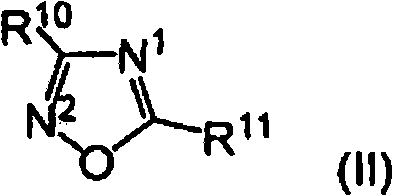
其中结构II在R10或R11位置与R1-R9的任一个相连;wherein structure II is connected to any one of R 1 -R 9 at R 10 or R 11 ;
结构II的氮N1或N2的至少一个与金属M形成配位键(dativebond);和At least one of the nitrogens N or N of structure II forms a dative bond with the metal M; and
R1-R11的每一个独立地选自:氢负离子(hydride)、烃基、低级烃基、取代的烃基、杂烃基、烷基、低级烷基、取代的烷基、杂烷基、烯基、低级烯基、取代的烯基、杂烯基、炔基、低级炔基、取代的炔基、杂炔基、烷氧基、低级烷氧基、芳氧基、羟基、烷基硫基、低级烷基硫基、芳基硫基、硫氧基(thioxy)、芳基、取代的芳基、杂芳基、芳烷基、亚芳烷基、烷芳基、亚烷芳基、卤化物(halide)、卤代烷基、卤代烯基、卤代炔基、杂烷基、杂环、杂芳基、含杂原子的基团、甲硅烷基、硼烷基、膦基、膦、氨基,和胺;Each of R 1 -R 11 is independently selected from: hydride, hydrocarbyl, lower hydrocarbyl, substituted hydrocarbyl, heterohydrocarbyl, alkyl, lower alkyl, substituted alkyl, heteroalkyl, alkenyl, Lower alkenyl, substituted alkenyl, heteroalkenyl, alkynyl, lower alkynyl, substituted alkynyl, heteroalkynyl, alkoxy, lower alkoxy, aryloxy, hydroxy, alkylthio, lower Alkylthio, arylthio, thiooxy, aryl, substituted aryl, heteroaryl, aralkyl, aralkylene, alkaryl, alkarylene, halide ( halide), haloalkyl, haloalkenyl, haloalkynyl, heteroalkyl, heterocycle, heteroaryl, heteroatom-containing group, silyl, boryl, phosphino, phosphine, amino, and amine;
X是离去基团。X is a leaving group.
结构(I)中的每一X独立地选自:在一个实施方案中为任何离去基团;在更特别的实施方案中为卤离子、氢负离子、C1-C12烷基、C2-C12烯基、C6-C12芳基、C7-C20烷芳基、C1-C12烷氧基、C6-C16芳氧基、C7-C18烷基芳氧基、C1-C12氟代烷基、C6-C12氟代芳基,和C1-C12含杂原子的烃和其的取代衍生物;在仍然更特别的实施方案中为氢负离子、卤离子、C1-C6烷基、C2-C6烯基、C7-C18烷基芳基、C1-C6烷氧基、C6-C14芳氧基、C7-C16烷基芳氧基、C1-C6烷基羧酸根、C1-C6氟化烷基羧酸根、C6-C12芳基羧酸根、C7-C18烷基芳基羧酸根、C1-C6氟代烷基、C2-C6氟代烯基,和C7-C18氟代烷基芳基;在仍然更特别的实施方案中为氢负离子、氯化物(chloride)、氟化物(fluoride)、甲基、苯基、苯氧基、苯甲酰氧基、甲苯磺酰基、氟代甲基和氟代苯基;在仍然更特别的实施方案中为C1-C12烷基、C2-C12烯基、C6-C12芳基、C7-C20烷基芳基、取代的C1-C12烷基、取代的C6-C12芳基、取代的C7-C20烷基芳基和C1-C12含杂原子的烷基、C1-C12含杂原子的芳基和C1-C12含杂原子的烷基芳基;在仍然更特别的实施方案中为氯化物、氟化物、C1-C6烷基、C2-C6烯基、C7-C18烷基芳基、卤化C1-C6烷基、卤化C2-C6烯基,和卤化C7-C18烷基芳基;在仍然更特别的实施方案中为氟化物、甲基、乙基、丙基、苯基、甲基苯基、二甲基苯基、三甲基苯基、氟代甲基(单-、二-和三氟甲基)和氟代苯基(单-、二-、三-、四-和五氟苯基)。Each X in structure (I) is independently selected from: in one embodiment any leaving group; in a more particular embodiment halide, hydride, C 1 -C 12 alkyl, C 2 -C 12 alkenyl, C 6 -C 12 aryl, C 7 -C 20 alkaryl, C 1 -C 12 alkoxy, C 6 -C 16 aryloxy, C 7 -C 18 alkylaryloxy C 1 -C 12 fluoroalkyl, C 6 -C 12 fluoroaryl, and C 1 -C 12 heteroatom-containing hydrocarbons and substituted derivatives thereof; in still more particular embodiments hydrogen Anion, halide, C 1 -C 6 alkyl, C 2 -C 6 alkenyl, C 7 -C 18 alkylaryl, C 1 -C 6 alkoxy, C 6 -C 14 aryloxy, C 7 -C 16 alkyl aryloxy, C 1 -C 6 alkyl carboxylate, C 1 -C 6 fluorinated alkyl carboxylate, C 6 -C 12 aryl carboxylate, C 7 -C 18 alkyl aryl C 1 -C 6 fluoroalkyl, C 2 -C 6 fluoroalkenyl, and C 7 -C 18 fluoroalkylaryl; in still more particular embodiments hydride, chloride Chloride, fluoride, methyl, phenyl, phenoxy, benzoyloxy, tosyl, fluoromethyl, and fluorophenyl; in still more particular embodiments are C 1 -C 12 alkyl, C 2 -C 12 alkenyl, C 6 -C 12 aryl, C 7 -C 20 alkyl aryl, substituted C 1 -C 12 alkyl, substituted C 6 -C 12 aryl, substituted C 7 -C 20 alkylaryl and C 1 -C 12 heteroatom-containing alkyl, C 1 -C 12 heteroatom-containing aryl and C 1 -C 12 heteroatom-containing alkane Alkylaryl; in still more particular embodiments chloride, fluoride, C 1 -C 6 alkyl, C 2 -C 6 alkenyl, C 7 -C 18 alkylaryl, halogenated C 1 -C 6 alkyl, C 2 -C 6 alkenyl halides, and C 7 -C 18 alkylaryl halides; in still more particular embodiments fluoride, methyl, ethyl, propyl, phenyl, methyl phenyl, dimethylphenyl, trimethylphenyl, fluoromethyl (mono-, di- and trifluoromethyl) and fluorophenyl (mono-, di-, tri-, tetra- and Pentafluorophenyl).
结构(I)中X基团的另一些非限定例子包括胺、膦、醚、羧酸根、二烯烃、具有1-20个碳原子的烃基、氟化烃基(例如-C6F5(五氟苯基))、氟化烷基羧酸根(例如CF3C(O)O-)、氢负离子和卤离子,及它们的组合。X配体的另一些例子包括烷基例如环丁基、环己基、甲基、庚基、甲苯基、三氟代甲基、四亚甲基、五亚甲基、亚甲基(methylidene)、甲氧基、乙氧基、丙氧基、苯氧基、双(N-甲基酰苯胺)、二甲基酰胺、二甲基磷化物基团等。在一个实施方案中,两个或更多个X形成稠环或环体系的一部分。Other non-limiting examples of the X group in structure (I) include amines, phosphines, ethers, carboxylates, dienes, hydrocarbyl groups having 1-20 carbon atoms, fluorinated hydrocarbyl groups (e.g. -C 6 F 5 (pentafluoro phenyl)), fluorinated alkyl carboxylates (eg, CF 3 C(O)O − ), hydrides and halides, and combinations thereof. Other examples of X ligands include alkyl groups such as cyclobutyl, cyclohexyl, methyl, heptyl, tolyl, trifluoromethyl, tetramethylene, pentamethylene, methylidene, Methoxy, ethoxy, propoxy, phenoxy, bis(N-methylanilide), dimethylamide, dimethylphosphide groups, and the like. In one embodiment, two or more X form part of a fused ring or ring system.
在一些实施方案中,包含

其中M、X和R2-R10如上定义。wherein M, X and R 2 -R 10 are as defined above.
在另一些非限定实施方案中,包含
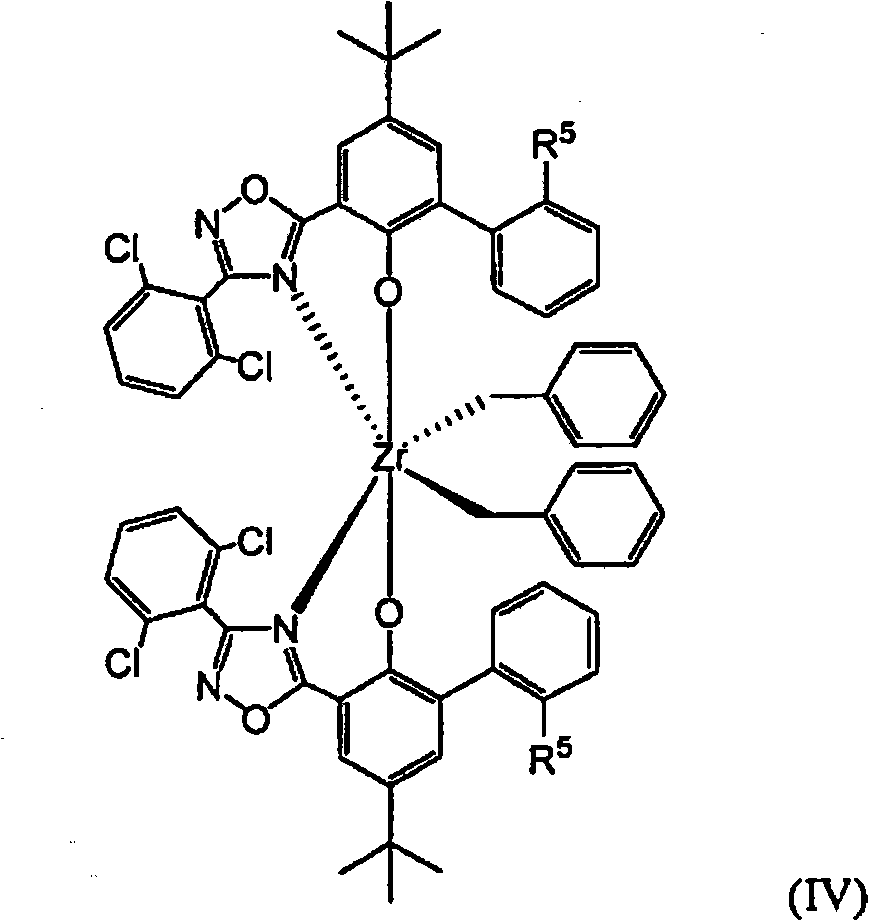
其中每一R5独立地选自氢负离子和C1-C4烷基。在一些实施方案中,至少一个R5是氢,或者在一些实施方案中两个R5是氢。在一些实施方案中,至少一个R5是甲基,或者在一些实施方案中每个R5均是甲基。wherein each R 5 is independently selected from a hydride ion and a C 1 -C 4 alkyl. In some embodiments, at least one R5 is hydrogen, or in some embodiments two R5s are hydrogen. In some embodiments, at least one R 5 is methyl, or in some embodiments each R 5 is methyl.
在一些实施方案中,包含二唑化合物并且基本上没有氢响应的催化剂化合物可以包括具有结构(V)和/或(VI)的酚
混合催化剂体系的制备Preparation of mixed catalyst system
包含
当使用两种或更多种催化剂化合物形成催化剂体系时,当结合时两种或更多种催化剂化合物可以按希望的比例一起加入、与活化剂接触,或者与载体或担载的活化剂接触。催化剂化合物可以依次或者同时加入混合物。When two or more catalyst compounds are used to form the catalyst system, when combined, the two or more catalyst compounds may be added together, contacted with the activator, or contacted with a carrier or supported activator in the desired ratio. The catalyst compounds can be added to the mixture sequentially or simultaneously.
在一些实施方案中,更复杂的步骤是可能的,例如将第一催化剂化合物加入包括载体或担载的活化剂混合物的淤浆中特定的反应时间t,随后加入第二催化剂化合物溶液,混合另外的特定时间x,之后可以例如通过喷雾干燥回收混合物用于聚合反应器。最后,在加入第一催化剂化合物之前混合物中可以存在约10vol%的另外的添加剂,例如1-己烯。在多个实施方案中,具有可忽略的氢响应的催化剂化合物可以作为第一、最后或第二、第三等催化剂化合物加入。In some embodiments, more complex steps are possible, such as adding a first catalyst compound to a slurry comprising a carrier or supported activator mixture for a specified reaction time t, followed by addition of a second catalyst compound solution, mixing additional A certain time x, after which the mixture can be recovered for the polymerization reactor, for example by spray drying. Finally, about 10 vol% of an additional additive, such as 1-hexene, may be present in the mixture prior to the addition of the first catalyst compound. In various embodiments, the catalyst compound with negligible hydrogen response may be added as the first, last or second, third, etc. catalyst compound.
在一些实施方案中,第一催化剂化合物可以通过与载体材料接触一段反应时间而担载。所得的担载催化剂组合物然后可与矿物油混合以形成淤浆,所述淤浆可以包括活化剂或可以不包括活化剂。然后可以在将所得的混合催化剂体系引入聚合反应器前,使淤浆与第二催化剂化合物混合。催化剂化合物可以在引入反应器前的任何位置混合,例如在聚合进料容器中或者在催化剂传送系统中在线混合。In some embodiments, the first catalyst compound can be supported by contacting the support material for a reaction period. The resulting supported catalyst composition may then be mixed with mineral oil to form a slurry, which may or may not include an activator. The slurry can then be mixed with a second catalyst compound before the resulting mixed catalyst system is introduced into the polymerization reactor. The catalyst compounds may be mixed at any point prior to introduction into the reactor, for example in the polymerization feed vessel or in-line in the catalyst delivery system.
在一些实施方案中,可以通过以下方式形成混合催化剂体系:将HMW催化剂化合物(可用于制备高分子量聚合物级分的催化剂化合物)与载体和活化剂,希望地在第一稀释剂例如烷烃或甲苯中结合以制得担载的活化HMW催化剂化合物。然后在一个实施方案中将与第一稀释剂分离或不分离的担载的活化HMW催化剂化合物与高粘度稀释剂例如矿物油或硅油,或者包含5-99wt%矿物油或硅油的烷烃稀释剂结合,形成担载的HMW催化剂化合物的淤浆,随后或者同时与稀释剂中或者作为干燥固体化合物的LMW催化剂化合物(可用于制备低分子量聚合物级分的催化剂化合物)结合,形成担载的活化混合催化剂体系(“混合催化剂体系”)。由此制备的混合催化剂体系可以是担载并且活化的于淤浆中的HMW催化剂化合物(所述淤浆包含矿物油或硅油)和未担载并且未与另外的活化剂结合的LMW催化剂化合物,其中LMW催化剂化合物可以部分或完全溶于淤浆中或可以没有部分或完全溶于淤浆中。在一个实施方案中,稀释剂由矿物油组成。In some embodiments, a mixed catalyst system can be formed by combining a HMW catalyst compound (a catalyst compound useful for making a high molecular weight polymer fraction) with a support and an activator, desirably in a first diluent such as an alkane or toluene in combination to obtain supported activated HMW catalyst compounds. The supported activated HMW catalyst compound, separated or not separated from the first diluent, is then combined in one embodiment with a high viscosity diluent such as mineral oil or silicone oil, or an alkane diluent comprising 5-99 wt% mineral oil or silicone oil , to form a slurry of the supported HMW catalyst compound, which is subsequently or simultaneously combined with the LMW catalyst compound (catalyst compound that can be used to prepare the low molecular weight polymer fraction) in a diluent or as a dry solid compound to form a supported activated mixture Catalyst System ("Hybrid Catalyst System"). The mixed catalyst system thus prepared may be a supported and activated HMW catalyst compound in a slurry (the slurry comprising mineral oil or silicone oil) and an LMW catalyst compound unsupported and not combined with an additional activator, Wherein the LMW catalyst compound may or may not be partially or completely soluble in the slurry. In one embodiment, the diluent consists of mineral oil.
本文使用的矿物油或“高粘度稀释剂”是指石油烃以及烃的混合物,所述烃可以包括在23℃和更高温度为液体的脂族、芳族和/或链烷烃组分,并且通常具有至少300amu至500amu或更大的分子量,和在40℃下40-300cSt或更大,或者在特定实施方案中50-200cSt的粘度。术语“矿物油”包括合成油和其它商业油例如在名称如KAYDOLTM、ISOPARTM、STRUKTOLTM、SUNPARTM油、PARAPOLTM油下出售的石蜡油,和本领域已知的例如公开于BLUEBOOK 2001,MATERIALS,COMPOUNDING INGREDIENTS,MACHINERY AND SERVICES FOR RUBBER 189 247(J.H.Lippincott,D.R.Smith,K.Kish & B.Gordon eds.Lippincott & PetoInc.2001)中的其它合成油或液体聚合物、聚丁烯、精炼的环烷烃、精炼的链烷烃。可用于本发明的优选矿物油和硅油是不包括与金属茂催化剂反应的结构部分的那些,所述结构部分的例子包括羟基和羧基。Mineral oil or "high viscosity diluent" as used herein refers to petroleum hydrocarbons and mixtures of hydrocarbons which may include aliphatic, aromatic and/or paraffinic components which are liquid at 23°C and higher, and Typically have a molecular weight of at least 300 amu to 500 amu or greater, and a viscosity at 40°C of 40-300 cSt or greater, or in certain embodiments 50-200 cSt. The term "mineral oil" includes synthetic oils and other commercial oils such as paraffinic oils sold under names such as KAYDOL ™ , ISOPAR ™ , STRUKTOL ™ , SUNPAR ™ oils, PARAPOL ™ oils, and known in the art such as disclosed in BLUEBOOK 2001, MATERIALS, COMPOUNDING INGREDIENTS, MACHINERY AND SERVICES FOR RUBBER 189 247 (JH Lippincott, DR Smith, K. Kish & B. Gordon eds. Lippincott & Peto Inc. 2001) other synthetic oils or liquid polymers, polybutenes, refined naphthenes , Refined paraffins. Preferred mineral oils and silicone oils useful in the present invention are those that do not include moieties reactive with metallocene catalysts, examples of which include hydroxyl and carboxyl groups.
在一个实施方案中,稀释剂是矿物油或硅油和选自C1-C10烷烃、C6-C20芳族烃、C7-C21烷基取代的烃、和它们的混合物的烃的共混物。在另一个实施方案中,稀释剂是矿物油和选自C1-C10烷烃、C6-C20芳族烃、C7-C21烷基取代的烃、和它们的混合物的烃的共混物。当矿物油是共混物时,稀释剂包含稀释剂的5-99重量%的矿物油。在仍然另一个实施方案中,稀释剂由矿物油组成。In one embodiment, the diluent is a mixture of mineral oil or silicone oil and a hydrocarbon selected from C 1 -C 10 alkanes, C 6 -C 20 aromatic hydrocarbons, C 7 -C 21 alkyl substituted hydrocarbons, and mixtures thereof. blends. In another embodiment, the diluent is a mixture of mineral oil and a hydrocarbon selected from the group consisting of C 1 -C 10 alkanes, C 6 -C 20 aromatic hydrocarbons, C 7 -C 21 alkyl substituted hydrocarbons, and mixtures thereof. mixture. When mineral oil is a blend, the diluent comprises 5-99% by weight of the diluent mineral oil. In yet another embodiment, the diluent consists of mineral oil.
在一个实施方案中,HMW催化剂化合物与活化剂和第一稀释剂结合以形成催化剂淤浆,其然后优选与载体材料结合。载体颗粒优选不预先活化直到进行该接触。HMW催化剂化合物可以为任何希望的形式例如干燥粉末、于稀释剂中的悬浮液、于稀释剂中的溶液、液体等。催化剂淤浆和载体颗粒然后在一个实施方案中在升高的温度下彻底混合,使得HMW催化剂化合物和活化剂沉积在载体颗粒上形成载体淤浆。通过按照本文描述的用于形成混合催化剂以提供活化的担载混合催化剂体系的步骤,可以制得具有希望的密度、熔体流动比和熔体强度的组合的聚合物,特别是双峰聚乙烯。In one embodiment, the HMW catalyst compound is combined with an activator and a first diluent to form a catalyst slurry, which is then preferably combined with a support material. The carrier particles are preferably not preactivated until this contacting takes place. The HMW catalyst compound may be in any desired form such as dry powder, suspension in diluent, solution in diluent, liquid, etc. The catalyst slurry and support particles are then thoroughly mixed in one embodiment at elevated temperature such that the HMW catalyst compound and activator are deposited on the support particles to form a support slurry. By following the steps described herein for forming a mixed catalyst to provide an activated supported mixed catalyst system, polymers, particularly bimodal polyethylene, having a desired combination of density, melt flow ratio and melt strength can be prepared .
在HMW催化剂化合物和活化剂沉积在载体上后,然后将LMW催化剂化合物与担载的HMC结合,其中在LMC与担载的HMW催化剂化合物接触之前、同时或之后通过任何合适的手段使LMW与包含矿物油或硅油的稀释剂结合。在一个实施方案中,在与LMW催化剂化合物结合前,HMW催化剂化合物从第一稀释剂中分离至干燥状态。优选地,在与担载的HMW催化剂化合物结合前,LMW催化剂化合物未活化,即未与任何活化剂结合。所得的固体淤浆(包括担载的HMW和LMW催化剂化合物)然后优选在升高的温度下彻底混合。After the HMW catalyst compound and activator are deposited on the support, the LMW catalyst compound is then combined with the supported HMC, wherein the LMW is contacted with the containing Mineral oil or silicone oil thinner to combine. In one embodiment, the HMW catalyst compound is separated from the first diluent to a dry state prior to combining with the LMW catalyst compound. Preferably, the LMW catalyst compound is not activated, ie not combined with any activator, prior to combining with the supported HMW catalyst compound. The resulting solid slurry (including supported HMW and LMW catalyst compounds) is then thoroughly mixed, preferably at elevated temperature.
在制备混合催化剂体系的各个阶段可以使用宽的混合温度范围。例如在特定实施方案中,当HMW催化剂化合物和至少一种活化剂例如甲基铝氧烷与第一稀释剂结合以形成混合物时,所述混合物优选加热至25℃-150℃,优选50℃-125℃,更优选75℃-100℃,最优选80℃-100℃的第一温度,并且搅拌30秒-12小时,优选1分钟-6小时,更优选10分钟-4小时,并且最优选30分钟-3小时的时间。A wide range of mixing temperatures can be used at various stages of preparation of the mixed catalyst system. For example in particular embodiments when the HMW catalyst compound and at least one activator such as methylaluminoxane are combined with a first diluent to form a mixture, said mixture is preferably heated to a temperature between 25°C and 150°C, preferably between 50°C and A first temperature of 125°C, more preferably 75°C-100°C, most preferably 80°C-100°C, and stirring for 30 seconds to 12 hours, preferably 1 minute to 6 hours, more preferably 10 minutes to 4 hours, and most preferably 30 Minutes - 3 hours of time.
随后,混合物优选与载体结合以提供第一载体淤浆。在结合前如果希望,可以将载体加热或脱水。在一个或多个实施方案中,第一载体淤浆在大于50℃,优选大于70℃,更优选大于80℃并且最优选大于85℃的温度下混合30秒-12小时,优选1分钟-6小时,更优选10分钟-4小时,并且最优选30分钟-3小时的时间。优选地,载体淤浆混合足以提供HMW催化剂化合物沉积在其上的活化载体颗粒的收集的时间。第一稀释剂然后可以从第一载体淤浆中除去以提供干燥的担载HMW催化剂化合物。例如,第一稀释剂可以在真空下或者通过氮气吹扫除去。Subsequently, the mixture is preferably combined with a carrier to provide a first carrier slurry. The support may, if desired, be heated or dehydrated prior to conjugation. In one or more embodiments, the first carrier slurry is mixed at a temperature greater than 50°C, preferably greater than 70°C, more preferably greater than 80°C and most preferably greater than 85°C for 30 seconds to 12 hours, preferably 1 minute to 6 hours, more preferably from 10 minutes to 4 hours, and most preferably from 30 minutes to 3 hours. Preferably, the support slurry is mixed for a time sufficient to provide collection of activated support particles on which the HMW catalyst compound is deposited. The first diluent can then be removed from the first support slurry to provide a dry supported HMW catalyst compound. For example, the first diluent can be removed under vacuum or by nitrogen purge.
随后,在一个实施方案中在包含矿物油或硅油的稀释剂存在下使LMW催化剂化合物与活化的HMW催化剂化合物结合。优选地,LMW催化剂化合物以与HMW催化剂化合物为2∶1-1∶3的摩尔比加入。最优选地,摩尔比约为1∶1。所得淤浆(或第一载体淤浆)优选加热至25℃-150℃,优选50℃-125℃,更优选75℃-100℃,最优选80℃-100℃的第一温度,并且搅拌30秒-12小时,优选1分钟-6小时,更优选10分钟-4小时,并且最优选30分钟-3小时的时间。Subsequently, the LMW catalyst compound is combined with the activated HMW catalyst compound in one embodiment in the presence of a diluent comprising mineral oil or silicone oil. Preferably, the LMW catalyst compound is added in a molar ratio of 2:1 to 1:3 to the HMW catalyst compound. Most preferably, the molar ratio is about 1:1. The resulting slurry (or first support slurry) is preferably heated to a first temperature of 25°C-150°C, preferably 50°C-125°C, more preferably 75°C-100°C, most preferably 80°C-100°C, and stirred for 30 Seconds to 12 hours, preferably 1 minute to 6 hours, more preferably 10 minutes to 4 hours, and most preferably 30 minutes to 3 hours.
在一个实施方案中可以在与加入LMW催化剂化合物相同的时间或者稍后的时间将一种或多种另外的催化剂引入干燥的担载HMW催化剂化合物。在一个实施方案中也可以加入另外的活化剂。在特定实施方案中,没有加入另外的活化剂。In one embodiment one or more additional catalysts may be introduced into the dry supported HMW catalyst compound at the same time as the LMW catalyst compound is added or at a later time. In one embodiment additional activators may also be added. In certain embodiments, no additional activators are added.
第一稀释剂是芳族烃或烷烃,优选地具有小于200℃的沸点的烃稀释剂例如甲苯、二甲苯、己烷等,它们可以在真空下或者通过氮气吹扫从担载的HMW催化剂化合物中除去,以提供担载的混合催化剂体系。即使在加入所述油和/或LMW(或其它)催化剂化合物后,也可能希望处理淤浆以进一步除去任何余下的溶剂例如甲苯。这可以例如通过N2吹扫或真空完成。取决于加入的矿物油的水平,所得的混合催化剂体系仍然可以是淤浆或者可以是包含一定量的矿物油的自由流动粉末。因此,尽管在一个实施方案中为固体在矿物油中的淤浆,但混合催化剂体系可以采用任何物理形式例如自由流动的固体。例如,在一个实施方案中混合催化剂体系可以为混合催化剂体系(矿物油、载体、所有催化剂化合物和活化剂(一种或多种))重量的1-99wt%的固体含量。The first diluent is an aromatic hydrocarbon or alkane, preferably a hydrocarbon diluent such as toluene, xylene, hexane, etc., having a boiling point of less than 200° C., which can be removed from the supported HMW catalyst compound under vacuum or by nitrogen purge. removed to provide a supported mixed catalyst system. Even after adding the oil and/or LMW (or other) catalyst compound, it may be desirable to treat the slurry to further remove any remaining solvent such as toluene. This can be done, for example, by N2 purge or vacuum. Depending on the level of mineral oil added, the resulting mixed catalyst system may still be a slurry or may be a free flowing powder containing some amount of mineral oil. Thus, although in one embodiment a slurry of solids in mineral oil, the mixed catalyst system may take any physical form such as a free flowing solid. For example, in one embodiment the mixed catalyst system may have a solids content of 1-99 wt% based on the weight of the mixed catalyst system (mineral oil, carrier, all catalyst compounds and activator(s)).
金属或准金属活化剂与每一担载的金属茂催化剂化合物中的金属的摩尔比为0.3∶1-1000∶1,优选20∶1-800∶1,并且最优选50∶1-500∶1。在活化剂是离子化活化剂例如基于阴离子四(五氟苯基)硼酸根的那些的情形下,活化剂组分的金属或准金属与金属茂催化剂的金属组分的摩尔比优选为0.3∶1-3∶1。The molar ratio of metal or metalloid activator to metal per supported metallocene catalyst compound is from 0.3:1 to 1000:1, preferably from 20:1 to 800:1, and most preferably from 50:1 to 500:1 . In case the activator is an ionizing activator such as those based on anionic tetrakis(pentafluorophenyl)borate, the molar ratio of the metal or metalloid of the activator component to the metal component of the metallocene catalyst is preferably 0.3: 1-3:1.
另外的催化剂化合物Additional catalyst compounds
可以将任何类型的聚合催化剂化合物与具有零的氢响应的上述催化剂化合物组合使用以形成根据本文公开的实施方案的催化剂体系,尤其包括液体形式催化剂、固体催化剂和多相或担载的催化剂,并且可以作为液体、淤浆(液体/固体混合物),或作为固体(通常是气体输送的)送入反应器。这些催化剂化合物可用于形成根据本文公开的实施方案的催化剂体系,和/或可以除了根据本文公开的实施方案的催化剂体系外使用以用于制备聚合物。Any type of polymerization catalyst compound may be used in combination with the above-described catalyst compounds having zero hydrogen response to form catalyst systems according to embodiments disclosed herein, including, inter alia, liquid form catalysts, solid catalysts, and heterogeneous or supported catalysts, and It can be fed to the reactor as a liquid, a slurry (liquid/solid mixture), or as a solid (usually gas-delivered). These catalyst compounds can be used to form catalyst systems according to embodiments disclosed herein, and/or can be used in addition to catalyst systems according to embodiments disclosed herein for the preparation of polymers.
可用于本文公开的实施方案的液体形式催化剂应该稳定并且可喷射或可雾化。这些催化剂可以单独使用或者以各种组合或混合物使用。例如,可以使用一种或多种液体催化剂、一种或多种固体催化剂、一种或多种担载催化剂、或者液体催化剂和/或固体或担载催化剂的混合物、或者固体和担载催化剂的混合物。这些催化剂可与本领域公知的助催化剂、活化剂和/或促进剂一起使用。Liquid form catalysts useful in embodiments disclosed herein should be stable and sprayable or atomizable. These catalysts may be used alone or in various combinations or mixtures. For example, one or more liquid catalysts, one or more solid catalysts, one or more supported catalysts, or a mixture of liquid catalysts and/or solid or supported catalysts, or a combination of solid and supported catalysts may be used. mixture. These catalysts can be used with cocatalysts, activators and/or promoters well known in the art.
可用于本文公开的实施方案的催化剂化合物可以广泛地包括过渡金属催化剂和金属茂催化剂。更特别地,可用于本文公开的实施方案的催化剂化合物可以包括:Catalyst compounds useful in embodiments disclosed herein can broadly include transition metal catalysts and metallocene catalysts. More specifically, catalyst compounds useful in embodiments disclosed herein may include:
A.Ziegler-Natta催化剂,包括基于钛的催化剂,例如描述于U.S.专利Nos.4,376,062和4,379,758中的那些。Ziegler-Natta催化剂是本领域公知的,并且通常是与有机铝助催化剂组合使用的镁/钛/电子给体络合物。A. Ziegler-Natta catalysts, including titanium-based catalysts such as those described in U.S. Patent Nos. 4,376,062 and 4,379,758. Ziegler-Natta catalysts are well known in the art and are typically magnesium/titanium/electron donor complexes used in combination with organoaluminum cocatalysts.
B.基于铬的催化剂,例如描述于U.S.专利Nos.3,709,853;3,709,954;和4,077,904中的那些。B. Chromium-based catalysts such as those described in U.S. Patent Nos. 3,709,853; 3,709,954; and 4,077,904.
C.基于钒的催化剂,例如氯氧化钒和乙酰丙酮化钒,例如描述于U.S.专利No.5,317,036中的氯氧化钒和乙酰丙酮化钒。C. Vanadium-based catalysts, such as vanadium oxychloride and vanadium acetylacetonate, such as those described in U.S. Patent No. 5,317,036.
D.金属茂催化剂,例如描述于U.S.专利Nos.6,933,258和6,894,131中的那些。D. Metallocene catalysts such as those described in U.S. Patent Nos. 6,933,258 and 6,894,131.
E.金属卤化物,例如三卤化铝的阳离子形式。E. Metal halides, such as the cationic form of aluminum trihalide.
F.钴催化剂和其混合物,例如描述于U.S.专利Nos.4,472,559和4,182,814中的那些。F. Cobalt catalysts and mixtures thereof, such as those described in U.S. Patent Nos. 4,472,559 and 4,182,814.
G.镍催化剂和其混合物,例如描述于U.S.专利Nos.4,155,880和4,102,817中的那些。G. Nickel catalysts and mixtures thereof, such as those described in U.S. Patent Nos. 4,155,880 and 4,102,817.
H.稀土金属催化剂,即包含在周期表中具有57-103原子数的金属的那些,例如铈、镧、镨、钆和钕的化合物。尤其有用的是这些金属的羧酸盐、醇化物、乙酰丙酮化物、卤化物(包括三氯化钕的醚和醇络合物),和烯丙基衍生物。在各个实施方案中,钕化合物,特别是新癸酸钕、辛酸钕和叔碳酸钕是特别有用的稀土金属催化剂。稀土催化剂可以例如用于聚合丁二烯或异戊二烯。H. Rare earth metal catalysts, ie those comprising metals having an atomic number of 57-103 in the periodic table, such as compounds of cerium, lanthanum, praseodymium, gadolinium and neodymium. Particularly useful are the carboxylates, alcoholates, acetylacetonates, halides (including ether and alcohol complexes of neodymium trichloride), and allyl derivatives of these metals. In various embodiments, neodymium compounds, particularly neodymium neodecanoate, neodymium octanoate, and neodymium tertiary carbonate, are particularly useful rare earth metal catalysts. Rare earth catalysts can be used, for example, to polymerize butadiene or isoprene.
I.描述于例如EP 0 893 454 A1、U.S.专利No.5,889,128和U.S.专利No.5,889,128中引用的参考文献中的含第15族原子和金属的催化剂。I. Catalysts containing Group 15 atoms and metals as described in, for example, EP 0 893 454 A1, U.S. Patent No. 5,889,128 and references cited in U.S. Patent No. 5,889,128.
J.上述的任意组合以形成混合催化剂体系。J. Any combination of the above to form a mixed catalyst system.
在一些实施方案中,如上所述包含
在一些实施方案中,金属茂催化剂化合物可以包括具有一个或多个与至少一个第3族-12族金属原子相连的Cp配体(环戊二烯基和与环戊二烯基等态(isolobal)的配体),和一个或多个与所述至少一个金属原子相连的离去基团的“半三明治”或“全三明治”化合物。这些化合物在本文中也可称为“金属茂”或“金属茂催化剂组分”。In some embodiments, the metallocene catalyst compound may include Cp ligands (cyclopentadienyl and isolobal ), and one or more leaving groups attached to said at least one metal atom in a "half-sandwich" or "full-sandwich" compound. These compounds may also be referred to herein as "metallocenes" or "metallocene catalyst components".
如上所述,可用于本文公开的实施方案的金属茂可以包括描述于U.S.专利Nos.6,933,258和6,894,131中的那些。其它可用的金属茂尤其描述于例如U.S.专利Nos.7,582,711、5,017,714、5,055,438、5,096,867、5,198,401、5,229,478、5,264,405、5,278,119、5,324,800、5,384,299、5,408,017、5,491,207、5,621,126、6,207,606、6,245,868、6,300,436、6,306,984、6,391,819、6,472,342、6,492,472、6,605,560、6,608,153、6,734,267、6,936,226和6,943,134中。As noted above, metallocenes useful in embodiments disclosed herein may include those described in U.S. Patent Nos. 6,933,258 and 6,894,131.其它可用的金属茂尤其描述于例如U.S.专利Nos.7,582,711、5,017,714、5,055,438、5,096,867、5,198,401、5,229,478、5,264,405、5,278,119、5,324,800、5,384,299、5,408,017、5,491,207、5,621,126、6,207,606、6,245,868、6,300,436、6,306,984、6,391,819 , 6,472,342, 6,492,472, 6,605,560, 6,608,153, 6,734,267, 6,936,226 and 6,943,134.
在特定实施方案中,可用于本文公开的实施方案的金属茂可由以下结构(VII、VIII和IX)表示:In particular embodiments, metallocenes useful in embodiments disclosed herein can be represented by the following structures (VII, VIII, and IX):
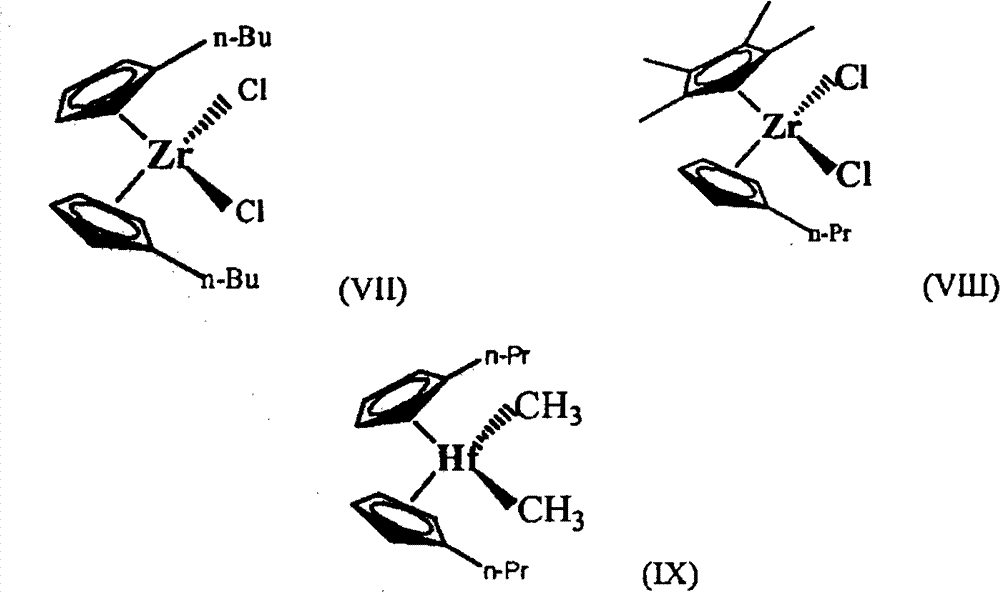
在一些实施方案中,如上所述包含
本文中可互换使用并且提及的“含第15族原子和金属的催化剂”或“含第15族的催化剂化合物”或者“含第15族的催化剂组分”包括第3族-第12族金属络合物,其中金属是2-4配位的,并且一个或多个配位结构部分包括至少两个第15族原子,和至多4个第15族原子。在一个实施方案中,含第15族的催化剂组分是第4族金属和1-4个配体的络合物,使得第4族金属为至少2配位,一个或多个配位结构部分包括至少两个氮。代表性的含第15族的催化剂化合物尤其公开于例如WO 98/46651、WO 99/01460;EP A1 0 893,454;EP A1 0 894 005;和U.S.专利Nos.5,318,935、5,889,128、6,333,389、6,271,325、6,274,684、6,300,438、6,482,904和6,858,689中。在一些实施方案中,含第15族的催化剂可以包括至少一个氟化物或含氟离去基团。Used herein interchangeably and references to "group 15 atom and metal containing catalyst" or "group 15 containing catalyst compound" or "group 15 containing catalyst component" include groups 3-12 Metal complexes wherein the metal is 2-4 coordinated and the one or more coordinating moieties include at least two Group 15 atoms, and up to 4 Group 15 atoms. In one embodiment, the Group 15-containing catalyst component is a complex of a Group 4 metal and 1-4 ligands such that the Group 4 metal is at least 2-coordinated, with one or more coordinating moieties Include at least two nitrogens. Representative Group 15-containing catalyst compounds are disclosed, inter alia, in WO 98/46651, WO 99/01460; EP A1 0 893,454; EP A1 0 894 005; and U.S. Patent Nos. 6,300,438, 6,482,904 and 6,858,689. In some embodiments, the Group 15-containing catalyst can include at least one fluoride or fluorine-containing leaving group.
在一些实施方案中,含第15族的金属催化剂化合物可由结构(X)或(XI)表示:In some embodiments, the Group 15-containing metal catalyst compound can be represented by structure (X) or (XI):
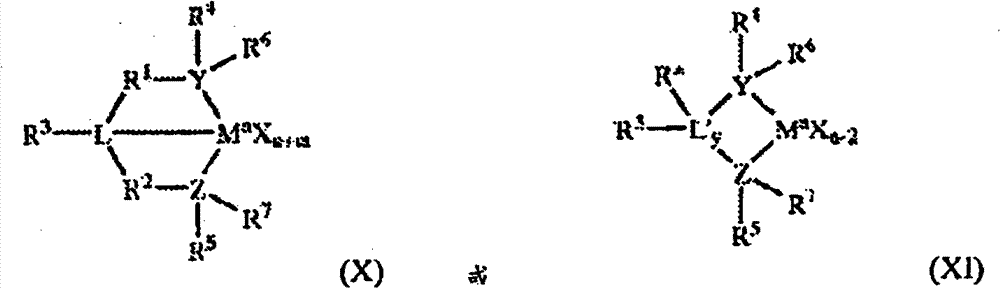
其中:M是第3-12族过渡金属或者第13或第14族主族金属,优选第4、5或6族金属,并且更优选第4族金属,并且最优选锆、钛或铪;每一X独立地是离去基团,优选阴离子离去基团,并且更优选氢、烃基、杂原子或卤素,并且最优选烷基;y为0或1(当y为0时基团L′不存在);n为M的氧化态,优选+3、+4或+5,并且更优选+4;m为YLZ或YL′Z配体的形式电荷,优选0、-1、-2或-3,并且更优选-2;L是第15或16族元素,优选氮;L′是第15或16族元素或者含第14族的基团,优选碳、硅或锗;Y是第15族元素,优选氮或磷,并且更优选氮;Z是第15族元素,优选氮或磷,并且更优选氮;R1和R2独立地是C1-C1烃基、具有至多20个碳原子的含杂原子的基团、硅、锗、锡、铅或磷,优选C2-C20烷基、芳基或芳烷基,更优选线型、支化或环状C2-C20烷基,最优选C2-C6烃基;R3不存在或者是烃基、氢、卤素、含杂原子的基团,优选具有1-20个碳原子的线型、环状或支化的烷基,更优选地R3不存在,是氢或烷基,并且最优选氢;R4和R5独立地是优选具有至多20个碳原子,更优选3-10个碳原子的烷基、芳基、取代的芳基、环状烷基、取代的环状烷基、环状芳烷基、取代的环状芳烷基或多环体系,并且甚至更优选C1-C20烃基、C1-C20芳基或C1-C20芳烷基,或者含杂原子的基团,例如PR3,其中R是烷基,R1和R2可以彼此相互连接,和/或R4和R5可以彼此相互连接;R6和R7独立地不存在,或者是氢、烷基、卤素、杂原子或烃基,优选具有1-20个碳原子的线型、环状或支化的烷基,更优选不存在;和R*不存在,或者是氢、含第14族原子的基团、卤素、含杂原子的基团。wherein: M is a Group 3-12 transition metal or a Group 13 or 14 main group metal, preferably a Group 4, 5 or 6 metal, and more preferably a Group 4 metal, and most preferably zirconium, titanium or hafnium; - X is independently a leaving group, preferably an anionic leaving group, and more preferably hydrogen, hydrocarbyl, heteroatom or halogen, and most preferably alkyl; y is 0 or 1 (when y is 0 the group L' does not exist); n is the oxidation state of M, preferably +3, +4 or +5, and more preferably +4; m is the formal charge of the YLZ or YL'Z ligand, preferably 0, -1, -2 or - 3, and more preferably -2; L is a group 15 or 16 element, preferably nitrogen; L' is a group 15 or 16 element or a group containing group 14, preferably carbon, silicon or germanium; Y is a group 15 element element, preferably nitrogen or phosphorus, and more preferably nitrogen; Z is a Group 15 element, preferably nitrogen or phosphorus, and more preferably nitrogen; R and R are independently C 1 -C 1 hydrocarbyl, having up to 20 carbon atoms Heteroatom-containing groups, silicon, germanium, tin, lead or phosphorus, preferably C 2 -C 20 alkyl, aryl or aralkyl, more preferably linear, branched or cyclic C 2 -C 20 alkane radical, most preferably a C2 - C6 hydrocarbon group; R3 is absent or is a hydrocarbon group, hydrogen, halogen, a heteroatom-containing group, preferably a linear, cyclic or branched alkyl group having 1 to 20 carbon atoms , more preferably R is absent, is hydrogen or alkyl, and most preferably hydrogen; R and R are independently alkyl, aryl preferably having up to 20 carbon atoms, more preferably 3-10 carbon atoms , substituted aryl, cyclic alkyl, substituted cyclic alkyl, cyclic aralkyl, substituted cyclic aralkyl or polycyclic ring system, and even more preferably C 1 -C 20 hydrocarbyl, C 1 - C 20 aryl or C 1 -C 20 aralkyl, or a heteroatom-containing group, such as PR 3 , wherein R is an alkyl group, R 1 and R 2 can be connected to each other, and/or R 4 and R 5 can be connected to each other; R6 and R7 independently do not exist, or are hydrogen, alkyl, halogen, heteroatoms or hydrocarbon groups, preferably linear, cyclic or branched alkyl groups with 1-20 carbon atoms, More preferably absent; and R * is absent, or hydrogen, a Group 14 atom-containing group, halogen, a heteroatom-containing group.
“YLZ或YL′Z配体的形式电荷”是指不存在金属和离去基团X的整个配体的电荷。"Formal charge of the YLZ or YL'Z ligand" refers to the charge of the entire ligand in the absence of metal and leaving group X.
“R1和R2也可以相互连接”是指R1和R2可以彼此直接连接或者可以通过其它基团彼此连接。“R4和R5也可以相互连接”是指R4和R5可以彼此直接连接或者可以通过其它基团彼此连接。"R 1 and R 2 may also be connected to each other" means that R 1 and R 2 may be directly connected to each other or may be connected to each other through other groups. "R 4 and R 5 may also be connected to each other" means that R 4 and R 5 may be directly connected to each other or may be connected to each other through other groups.
烷基可以是线型、支化的烷基,或烯基、炔基、环烷基或芳基、酰基、芳酰基、烷氧基、芳氧基、烷基硫基、二烷基氨基、烷氧基羰基、芳氧基羰基、氨基甲酰基、烷基或二烷基氨基甲酰基、酰氧基、酰基氨基、芳酰基氨基,直链、支化或环状的亚烷基,或它们的组合。芳烷基被定义为取代的芳基。Alkyl can be linear, branched, or alkenyl, alkynyl, cycloalkyl or aryl, acyl, aroyl, alkoxy, aryloxy, alkylthio, dialkylamino, Alkoxycarbonyl, aryloxycarbonyl, carbamoyl, alkyl or dialkylcarbamoyl, acyloxy, acylamino, aroylamino, linear, branched or cyclic alkylene, or their The combination. Aralkyl is defined as a substituted aryl group.
在一些实施方案中,R4和R5独立地是由以下结构(XII)表示的基团:In some embodiments, R and R are independently a group represented by the following structure (XII):

其中R8-R12各自独立地是氢、C1-C40烷基、卤化物、杂原子、包含至多40个碳原子的含杂原子的基团,优选C1-C20线型或支化烷基,优选甲基、乙基、丙基或丁基,任意两个R基团可以形成环状基团和/或杂环基团。环状基团可以是芳族。在优选实施方案中,R9、R10和R12独立地是甲基、乙基、丙基或丁基(包括所有异构体),在优选实施方案中,R9、R10和R12是甲基,并且R8和R11是氢。wherein R 8 -R 12 are each independently hydrogen, C 1 -C 40 alkyl, halide, heteroatom, heteroatom-containing group containing up to 40 carbon atoms, preferably C 1 -C 20 linear or branched Alkyl, preferably methyl, ethyl, propyl or butyl, any two R groups can form a cyclic group and/or a heterocyclic group. Cyclic groups can be aromatic. In preferred embodiments, R 9 , R 10 and R 12 are independently methyl, ethyl, propyl or butyl (including all isomers), in preferred embodiments R 9 , R 10 and R 12 is methyl, and R and R are hydrogen.
在一些实施方案中,R4和R5均是由以下结构(XIII)表示的基团:In some embodiments, both R and R are groups represented by the following structure (XIII):

在该实施方案中,M是第4族金属,优选锆、钛或铪,并且甚至更优选锆;L、Y和Z的每一个是氮;R1和R2的每一个是-CH2-CH2--;R3是氢;并且R6和R7不存在。In this embodiment, M is a Group 4 metal, preferably zirconium, titanium or hafnium, and even more preferably zirconium; each of L, Y and Z is nitrogen; each of R and R is -CH2- CH2-- ; R3 is hydrogen; and R6 and R7 are absent.
在优选实施方案中,含第15族的催化剂化合物可由以下结构(XIV)表示:In a preferred embodiment, the Group 15 containing catalyst compound can be represented by the following structure (XIV):

根据本文公开的实施方案的包含两种或更多种催化剂化合物(包括基本上没有氢响应的含二唑的催化剂化合物与如上所述的一种或多种另外的催化剂化合物的组合)的催化剂体系可用于制备具有基本上单峰、双峰或多峰分子量分布的聚烯烃。Catalyst compounds comprising two or more catalyst compounds (including compounds containing substantially no hydrogen response) according to embodiments disclosed herein Catalyst systems of oxadiazole catalyst compounds in combination with one or more additional catalyst compounds as described above) can be used to prepare polyolefins having a substantially unimodal, bimodal or multimodal molecular weight distribution.
在一些实施方案中,根据本文公开的实施方案的催化剂体系可以包括:(i)基本上没有氢响应的含
例如,在一些实施方案中,根据本文公开的实施方案的催化剂体系可以包括:(i)由结构(III)-(VI)的任一个,优选结构(V)或(VI)表示的基本上没有氢响应的含

在另一些实施方案中,根据本文公开的实施方案的催化剂体系可以包括:(i)由结构(III)-(VI)的任一个,优选结构(V)或(VI)表示的基本上没有氢响应的含
存在于本文公开的催化剂体系中的每一催化剂化合物的量可以在一定范围内变化。在特定催化剂体系中使用的每一催化剂组分的量可以取决于将制备的聚合物或聚合物范围,以及用于制备聚合物或聚合物范围的反应参数,包括但不限于反应器温度、反应器压力、氢浓度和共聚单体浓度。The amount of each catalyst compound present in the catalyst systems disclosed herein can vary within certain ranges. The amount of each catalyst component used in a particular catalyst system may depend on the polymer or range of polymers to be produced, as well as the reaction parameters used to produce the polymer or range of polymers, including but not limited to reactor temperature, reaction pressure, hydrogen concentration and comonomer concentration.
在一些实施方案中,各自如上定义的催化剂化合物(i)与催化剂化合物(ii)的摩尔比可以为1∶99-99∶1。在一些实施方案中,基于催化剂化合物(i)和(ii)的总量,催化剂化合物(i)可以约1-80mol%,或1-50mol%,或者1-35mol%的量存在。In some embodiments, the molar ratio of catalyst compound (i) to catalyst compound (ii), each as defined above, may be 1:99-99:1. In some embodiments, catalyst compound (i) may be present in an amount of about 1-80 mol%, or 1-50 mol%, or 1-35 mol%, based on the total amount of catalyst compounds (i) and (ii).
在一些实施方案中,可以选择金属茂催化剂化合物和/或含第15族的催化剂化合物以制得具有比由基本上没有氢响应的含
在使用三种或更多种催化剂化合物形成根据本文公开的一些实施方案的催化剂体系的情形下,催化剂化合物(i)可与选择以制备具有比由含

如上所述,不同的催化剂具有不同的氢响应,由此得到在聚合期间对氢浓度以相对不可预测的方式表现的混合催化剂体系。在一些情形中,氢的增加可以增加一种催化剂的活性同时降低另一种催化剂的活性,并且反之亦然。因此,使用氢的工艺需要严格的体系特征以确定特定结果所需的氢的适宜量。As noted above, different catalysts have different hydrogen responses, resulting in mixed catalyst systems that behave in a relatively unpredictable manner with respect to hydrogen concentration during polymerization. In some cases, the addition of hydrogen can increase the activity of one catalyst while decreasing the activity of another catalyst, and vice versa. Therefore, processes using hydrogen require rigorous system characterization to determine the proper amount of hydrogen required for a particular result.
然而,不可预期地发现本文公开的含
由于本文公开的所得混合催化剂体系的可预测性能,因此如上所述可以制备的聚合物范围从基本上单峰到双峰或多峰分子量分布。Due to the predictable properties of the resulting mixed catalyst systems disclosed herein, polymers ranging from substantially unimodal to bimodal or multimodal molecular weight distributions can be prepared as described above.
活化剂activator
上述制备的聚合催化剂化合物通常与活化剂化合物结合以得到具有将配位、插入和使烯烃(一种或多种)聚合的空配位位点的化合物。为了本文和附属的权利要求公开的实施方案的目的,术语“活化剂”被定义为可以通过使中性催化剂化合物转化成催化活性催化剂化合物阳离子使任一种上述催化剂化合物活化的任何化合物。非限定性活化剂例如包括铝氧烷、烷基铝、离子化活化剂,其可以为中性或离子的,和常规类型的助催化剂。合适的活化剂描述于U.S.专利申请公开No.2008/045676中。The polymerization catalyst compound prepared above is typically combined with an activator compound to obtain a compound having a vacant coordination site that will coordinate, intercalate and polymerize the olefin(s). For the purposes of the embodiments disclosed herein and in the appended claims, the term "activator" is defined as any compound that can activate any of the aforementioned catalyst compounds by converting a neutral catalyst compound into a catalytically active catalyst compound cation. Non-limiting activators include, for example, aluminoxanes, aluminum alkyls, ionizing activators, which may be neutral or ionic, and co-catalysts of conventional types. Suitable activators are described in U.S. Patent Application Publication No. 2008/045676.
载体材料carrier material
本文公开的聚合催化剂化合物可与载体材料或载体、或者与担载的活化剂结合。例如,催化剂化合物沉积于载体上、与载体接触、与载体汽化、与载体键接,或者引入、吸附在或者吸收在载体中或载体上。The polymerization catalyst compounds disclosed herein may be associated with a support material or carrier, or with a supported activator. For example, the catalyst compound is deposited on, contacted with, vaporized with, bonded with, or incorporated into, adsorbed or absorbed in or on the support.
载体材料是任何常规的载体材料。优选地,担载的材料是多孔载体材料例如滑石、无机氧化物和无机氯化物。其它载体材料包括树脂状载体材料例如聚苯乙烯,官能化或交联的有机载体例如聚苯乙烯二乙烯基苯聚烯烃或聚合物化合物,沸石、粘土或任何其它有机或无机载体材料等,或它们的混合物。The carrier material is any conventional carrier material. Preferably, the supported material is a porous support material such as talc, inorganic oxides and inorganic chlorides. Other support materials include resinous support materials such as polystyrene, functionalized or crosslinked organic supports such as polystyrene divinylbenzene polyolefins or polymer compounds, zeolites, clays or any other organic or inorganic support materials, etc., or their mixture.
优选的载体材料是包括那些第2、3、4、5、13或14族金属氧化物的无机氧化物。优选的载体包括二氧化硅、热解法二氧化硅、氧化铝(WO99/60033)、二氧化硅-氧化铝和它们的混合物。其它可用的载体包括氧化镁、二氧化钛、氧化锆、氯化镁(U.S.专利No.5,965,477)、蒙脱土(欧洲专利EP-B1 0 511 665)、页硅酸盐、沸石、滑石、粘土(U.S.专利No.6,034,187)等。也可以使用这些载体材料的组合,例如二氧化硅-铬、二氧化硅-氧化铝、二氧化硅-二氧化钛等。另外的载体材料可以包括描述于EP 0 767 184 B1中的那些多孔丙烯酸类聚合物,其在此引入作为参考。其它载体材料包括描述于PCT WO 99/47598中的纳米复合材料、描述于WO 99/48605中的气凝胶、描述于U.S.专利No.5,972,510中的球粒和描述于WO 99/50311中的聚合物小球,这些全部在此引入作为参考。优选的载体是可在商品名Cabosil.TM.TS-610下从Cabot Corporation得到的热解法二氧化硅。热解法二氧化硅通常是用二甲基甲硅烷基二氯化物处理使得大部分表面羟基被封端的具有7-30纳米尺寸的颗粒的二氧化硅。Preferred support materials are inorganic oxides including those of
载体材料可以具有约10-约700m2/g,或约50-约1000m2/g,或约100-约400m2/g,或约200-约600m2/g,或约245-约375m2/g,或410-约620m2/g,或者约390-约590m2/g的表面积。The support material may have from about 10 to about 700 m 2 /g, or from about 50 to about 1000 m 2 /g, or from about 100 to about 400 m 2 /g, or from about 200 to about 600 m 2 /g, or from about 245 to about 375 m 2 /g, or a surface area of 410 to about 620 m 2 /g, or about 390 to about 590 m 2 /g.
载体材料可以具有约0.1-约4.0cc/g,或约0.5-约3.5cc/g,或约0.8-约3.0cc/g的孔隙体积。在一些实施方案中,载体材料可以具有0.5-约6.0cc/g,或约1.1-约1.8cc/g,或约2.4-约3.7cc/g,或约0.9-约1.4cc/g的孔隙体积。The support material may have a pore volume of about 0.1 to about 4.0 cc/g, or about 0.5 to about 3.5 cc/g, or about 0.8 to about 3.0 cc/g. In some embodiments, the support material may have a pore volume of 0.5 to about 6.0 cc/g, or about 1.1 to about 1.8 cc/g, or about 2.4 to about 3.7 cc/g, or about 0.9 to about 1.4 cc/g .
载体材料可以具有约5-约500微米,或约10-约300微米,或者约5-约100微米的平均粒度。The support material can have an average particle size of from about 5 to about 500 microns, or from about 10 to about 300 microns, or from about 5 to about 100 microns.
优选载体材料,最优选无机氧化物具有约10-约700m2/g的表面积、约0.1-约4.0cc/g的孔隙体积和约5-约500微米的平均粒度。更优选地,载体材料的表面积为约50-约1000m2/g,孔隙体积约0.5-约3.5cc/g和平均粒度约10-约300微米。最优选地,载体材料的表面积为约100-约400m2/g,孔隙体积约0.8-约3.0cc/g和平均粒度约5-约100微米。在一些实施方案中,载体可以具有约0.5-约6.0cm3/g的孔隙体积和约200-约600m2/g的表面积。在另一些实施方案中,载体可以具有约1.1-约1.8cm3/g的孔隙体积和约245-约375m2/g的表面积。在一些其它实施方案中,载体可以具有约2.4-约3.7cm3/g的孔隙体积和约410-约620m2/g的表面积。在仍然另一些实施方案中,载体可以具有约0.9-约1.4cm3/g的孔隙体积和约390-约590m2/g的表面积。每一种上述性能可以使用本领域已知的常规技术测量。Preferred support materials, most preferably inorganic oxides, have a surface area of from about 10 to about 700 m2 /g, a pore volume of from about 0.1 to about 4.0 cc/g, and an average particle size of from about 5 to about 500 microns. More preferably, the support material has a surface area of about 50 to about 1000 m2 /g, a pore volume of about 0.5 to about 3.5 cc/g and an average particle size of about 10 to about 300 microns. Most preferably, the support material has a surface area of about 100 to about 400 m2 /g, a pore volume of about 0.8 to about 3.0 cc/g and an average particle size of about 5 to about 100 microns. In some embodiments, the support may have a pore volume of about 0.5 to about 6.0 cm 3 /g and a surface area of about 200 to about 600 m 2 /g. In other embodiments, the support may have a pore volume of about 1.1 to about 1.8 cm 3 /g and a surface area of about 245 to about 375 m 2 /g. In some other embodiments, the support may have a pore volume of about 2.4 to about 3.7 cm 3 /g and a surface area of about 410 to about 620 m 2 /g. In still other embodiments, the support may have a pore volume of about 0.9 to about 1.4 cm 3 /g and a surface area of about 390 to about 590 m 2 /g. Each of the above properties can be measured using conventional techniques known in the art.
在一些实施方案中,载体和活化剂可以如US2009/240010、WO2009/117128、WO2009/045215、US2007/197716和/或US2005/288178中所述。In some embodiments, the carrier and activator may be as described in US2009/240010, WO2009/117128, WO2009/045215, US2007/197716 and/or US2005/288178.
聚合工艺Polymerization process
本文公开的制备聚烯烃聚合物的实施方案可以使用任何合适的用于烯烃聚合的工艺,包括任何使用已知的装置和反应条件的悬浮、溶液、淤浆或气相工艺,并且不限于任何特定类型的聚合体系。一般而言,在大气压、低于大气压或高于大气压的压力下,烯烃聚合温度可以为约0-约300℃。特别地,淤浆或溶液聚合体系可以使用低于大气压,或作为选择,高于大气压的压力,和约40-约300℃的温度。The embodiments disclosed herein for making polyolefin polymers may use any suitable process for polymerizing olefins, including any suspension, solution, slurry, or gas phase process using known apparatus and reaction conditions, and is not limited to any particular type polymerization system. In general, olefin polymerization temperatures can range from about 0 to about 300°C at atmospheric, subatmospheric, or superatmospheric pressures. In particular, slurry or solution polymerization systems may employ subatmospheric, or alternatively, superatmospheric pressures, and temperatures from about 40°C to about 300°C.
在一些实施方案中,可以使用液相聚合体系例如描述于U.S.专利No.3,324,095中的那些。液相聚合体系通常包括向其中加入烯烃单体和催化剂组合物的反应器。反应器包含可以溶解或悬浮聚烯烃产物的液体反应介质。该液体反应介质可以包括在使用的聚合条件下不反应的惰性液态烃、本体液体单体,或它们的混合物。尽管该惰性液态烃可能不充当用于催化剂组合物或通过该工艺得到的聚合物的溶剂,但其通常充当聚合中使用的单体用的溶剂。适用于该目的的惰性液态烃可以包括异丁烷、异戊烷、己烷、环己烷、庚烷、辛烷、苯、甲苯,和它们的混合物和异构体。可以通过持续搅拌或搅动保持烯烃单体与催化剂组合物之间的反应性接触。包含烯烃聚合物产物和未反应的烯烃单体的液体反应介质从反应器中连续排出。将烯烃聚合物产物分离,并且通常将未反应的烯烃单体和液体反应介质回收并且送回反应器。In some embodiments, liquid phase polymerization systems such as those described in U.S. Patent No. 3,324,095 may be used. Liquid phase polymerization systems typically include a reactor into which olefin monomer and catalyst composition are added. The reactor contains a liquid reaction medium in which the polyolefin product can be dissolved or suspended. The liquid reaction medium may comprise inert liquid hydrocarbons, bulk liquid monomers, or mixtures thereof that are nonreactive under the polymerization conditions employed. Although the inert liquid hydrocarbon may not act as a solvent for the catalyst composition or polymer obtained by the process, it typically acts as a solvent for the monomers used in the polymerization. Inert liquid hydrocarbons suitable for this purpose may include isobutane, isopentane, hexane, cyclohexane, heptane, octane, benzene, toluene, and mixtures and isomers thereof. Reactive contact between the olefin monomer and the catalyst composition can be maintained by continuous stirring or agitation. A liquid reaction medium comprising olefin polymer product and unreacted olefin monomer is continuously withdrawn from the reactor. The olefin polymer product is separated, and unreacted olefin monomer and liquid reaction medium are typically recovered and returned to the reactor.
本文公开的制备聚烯烃聚合物的实施方案还可以采用使用流化床反应器的气相聚合工艺。该类型反应器和操作反应器的方式是公知的,并且完整地描述于例如U.S.专利Nos.3,709,853;4,003,712;4,011,382;4,302,566;4,543,399;4,882,400;5,352,749;5,541,270;和EP-A-0802202中。这些专利公开了气相聚合工艺,其中聚合介质被机械搅拌或者通过气态单体和稀释剂的连续流动而流化。The embodiments disclosed herein for producing polyolefin polymers may also employ gas phase polymerization processes using fluidized bed reactors. Reactors of this type and the manner of operating them are well known and fully described in, for example, U.S. Patent Nos. 3,709,853; 4,003,712; 4,011,382; 4,302,566; 4,543,399; These patents disclose gas phase polymerization processes in which the polymerization medium is either mechanically agitated or fluidized by a continuous flow of gaseous monomer and diluent.
由本发明的工艺构思的其它气相工艺包括串联或多级聚合工艺。并且,本发明构思的气相工艺包括描述于U.S.专利Nos.5,627,242、5,665,818和5,677,375,以及欧洲公开EP-A-0 794 200、EP-B1-0 649992、EP-A-0 802 202和EP-B-634中的那些。Other gas phase processes contemplated by the process of the present invention include serial or multistage polymerization processes. Also, the gas phase process of the present invention concept includes those described in U.S. Patent Nos. Those in -634.
一般而言,本发明的聚合工艺可以是连续气相工艺例如流化床工艺。用于本发明工艺中的流化床反应器通常具有反应区和所谓的速度减小区(分离区)。反应区包括增长的聚合物颗粒、形成的聚合物颗粒和少量的催化剂颗粒的床,其通过气态单体和稀释剂连续流动以除去经由反应区的聚合热而流化。任选地,可以将一些循环气体冷却和压缩以形成液体,所述液体当被重新允许进入反应区时提高了循环气体料流的除热容量。可以通过简单实验容易地确定合适的气流速率。在与颗粒聚合物产物和与之相关的单体从反应器取出的速率相等的速率下,气态单体补充到循环气体料流中,并且调节通过反应器的气体组成以在反应区内保持基本上稳态的气体组成。离开反应区的气体通入速度减小区,在那里除去夹带的颗粒。较细的夹带颗粒和灰尘可以在旋风分离器和/或精滤器中除去。气体通过热交换器,在其中除去聚合热,在压缩机中压缩并且然后返回反应区。In general, the polymerization process of the present invention may be a continuous gas phase process such as a fluidized bed process. The fluidized bed reactor used in the process of the invention generally has a reaction zone and a so-called velocity reduction zone (separation zone). The reaction zone comprises a bed of growing polymer particles, formed polymer particles and a small amount of catalyst particles fluidized by the continuous flow of gaseous monomer and diluent to remove the heat of polymerization through the reaction zone. Optionally, some of the recycle gas may be cooled and compressed to form a liquid that increases the heat removal capacity of the recycle gas stream when re-admitted into the reaction zone. Suitable gas flow rates can be readily determined by simple experimentation. Gaseous monomer is added to the recycle gas stream at a rate equal to the rate at which the particulate polymer product and its associated monomer are withdrawn from the reactor, and the composition of the gas passing through the reactor is adjusted to maintain essentially Steady-state gas composition. Gases leaving the reaction zone are passed to a velocity reduction zone where entrained particles are removed. Finer entrained particles and dust can be removed in cyclones and/or fine filters. The gas passes through a heat exchanger, where the heat of polymerization is removed, is compressed in a compressor and then returned to the reaction zone.
本发明的工艺适合于制备烯烃,包括乙烯的均聚物,和/或烯烃的共聚物、三元共聚物等,包括包含乙烯和至少一种或多种其它烯烃的聚合物。烯烃可以是α-烯烃。烯烃例如在一个实施方案中可以包含2-16个碳原子;在另一个实施方案中为乙烯和包含3-12个碳原子的共聚单体;在另一个实施方案中为乙烯和包含4-10个碳原子的共聚单体;和在另一个实施方案中为乙烯和包含4-8个碳原子的共聚单体。The process of the present invention is suitable for the preparation of olefins, including homopolymers of ethylene, and/or copolymers, terpolymers, etc. of olefins, including polymers comprising ethylene and at least one or more other olefins. The olefin may be an alpha-olefin. Olefins, for example, may contain 2-16 carbon atoms in one embodiment; ethylene and comonomers containing 3-12 carbon atoms in another embodiment; ethylene and comonomers containing 4-10 carbon atoms in another embodiment; comonomers comprising 4-8 carbon atoms; and in another embodiment ethylene and comonomers comprising 4-8 carbon atoms.
在实施方案中,可以通过本发明工艺制备聚乙烯。该聚乙烯可以包括乙烯的均聚物以及乙烯和至少一种α-烯烃的互聚物,其中乙烯含量为涉及的全部单体的至少约50重量%。本文可以使用的烯烃包括乙烯、丙烯、1-丁烯、1-戊烯、1-己烯、1-庚烯、1-辛烯、4-甲基戊-1-烯、1-癸烯、1-十二碳烯、1-十六碳烯等。还可使用多烯烃例如1,3-己二烯、1,4-己二烯、环戊二烯、二环戊二烯、4-乙烯基环己-1-烯、1,5-环辛二烯、5-亚乙烯基-2-降冰片烯和5-乙烯基-2-降冰片烯,和在聚合介质中现场形成的烯烃。当烯烃在聚合介质中现场形成时,可能出现包含长链支化的聚烯烃的形成。In embodiments, polyethylene may be produced by the process of the invention. The polyethylene may include homopolymers of ethylene and interpolymers of ethylene and at least one alpha-olefin, wherein the ethylene content is at least about 50% by weight of all monomers involved. Olefins useful herein include ethylene, propylene, 1-butene, 1-pentene, 1-hexene, 1-heptene, 1-octene, 4-methylpent-1-ene, 1-decene, 1-dodecene, 1-hexadecene, etc. Polyenes such as 1,3-hexadiene, 1,4-hexadiene, cyclopentadiene, dicyclopentadiene, 4-vinylcyclohex-1-ene, 1,5-cyclooctene can also be used Dienes, 5-vinylidene-2-norbornene and 5-vinyl-2-norbornene, and olefins formed in situ in the polymerization medium. The formation of polyolefins comprising long chain branching may occur when olefins are formed in situ in the polymerization medium.
可用于本文所述工艺中的其它单体包括烯属不饱和单体、具有4-18个碳原子的二烯烃、共轭或非共轭二烯烃、多烯烃、乙烯基单体和环状烯烃。可用于本发明的非限定单体可以包括降冰片烯、降冰片二烯、异丁烯、异戊二烯、乙烯基苯并环丁烷、苯乙烯、烷基取代的苯乙烯、亚乙基降冰片烯、二环戊二烯和环戊烯。在本文所述工艺的另一个实施方案中,可以使乙烯或丙烯与至少两种不同的共聚单体聚合以形成三元共聚物,任选地其中共聚单体之一可以是二烯烃。Other monomers useful in the processes described herein include ethylenically unsaturated monomers, dienes having 4-18 carbon atoms, conjugated or non-conjugated dienes, polyenes, vinyl monomers, and cyclic olefins . Non-limiting monomers useful in the present invention may include norbornene, norbornadiene, isobutylene, isoprene, vinylbenzocyclobutane, styrene, alkyl substituted styrene, ethylidene norbornyl alkenes, dicyclopentadiene, and cyclopentene. In another embodiment of the processes described herein, ethylene or propylene can be polymerized with at least two different comonomers to form a terpolymer, optionally wherein one of the comonomers can be a diene.
在一个实施方案中,引入共聚物的α-烯烃的含量可以总计不大于30mol%;在另一些实施方案中为3-20mol%。术语“聚乙烯”当在本文使用时概括性地用于表示任何或所有上述包含乙烯的聚合物。In one embodiment, the amount of alpha-olefin incorporated into the copolymer may amount to no greater than 30 mole percent; in other embodiments, it ranges from 3 to 20 mole percent. The term "polyethylene" as used herein is used generically to mean any or all of the aforementioned ethylene-containing polymers.
在另一系列实施方案中,可以通过本文公开的工艺制备基于丙烯的聚合物。这类基于丙烯的聚合物可以包括丙烯的均聚物以及丙烯和至少一种α-烯烃的互聚物,其中丙烯含量为涉及的全部单体的至少约50重量%。可以使用的共聚单体可以包括乙烯、1-丁烯、1-戊烯、1-己烯、1-庚烯、1-辛烯、4-甲基戊烯-1、1-癸烯、1-十二碳烯、1-十六碳烯等。还可使用多烯烃例如1,3-己二烯、1,4-己二烯、环戊二烯、二环戊二烯、4-乙烯基环己烯-1、1,5-环辛二烯、5-亚乙烯基-2-降冰片烯和5-乙烯基-2-降冰片烯,和在聚合介质中现场形成的烯烃。当烯烃在聚合介质中现场形成时,可能出现包含长链支化的聚烯烃的形成。在一个实施方案中,引入基于丙烯的聚合物的α-烯烃共聚单体的含量可以总计不大于49mol%;在另一些实施方案中为3-35mol%。In another series of embodiments, propylene-based polymers can be prepared by the processes disclosed herein. Such propylene-based polymers may include homopolymers of propylene and interpolymers of propylene and at least one alpha-olefin, wherein the propylene content is at least about 50% by weight of all monomers involved. Comonomers that may be used may include ethylene, 1-butene, 1-pentene, 1-hexene, 1-heptene, 1-octene, 4-methylpentene-1, 1-decene, 1- -dodecene, 1-hexadecene, etc. Polyenes such as 1,3-hexadiene, 1,4-hexadiene, cyclopentadiene, dicyclopentadiene, 4-vinylcyclohexene-1, 1,5-cyclooctadiene can also be used alkenes, 5-vinylidene-2-norbornene and 5-vinyl-2-norbornene, and alkenes formed in situ in the polymerization medium. The formation of polyolefins comprising long chain branching may occur when olefins are formed in situ in the polymerization medium. In one embodiment, the content of alpha-olefin comonomers incorporated into the propylene-based polymer may amount to no greater than 49 mole percent; in other embodiments, from 3 to 35 mole percent.
在烯烃聚合中通常使用氢气以控制聚烯烃的最终性能。使用本文所述的催化剂体系,已知增加氢浓度(分压)可以增加产生的聚烯烃的熔体流动指数(MFI)和/或熔融指数(MI)。因此MFI或MI可以受到氢浓度的影响。聚合中氢的量可以作为相对于全部可聚合单体(例如乙烯或者乙烯和己烯或丙烯的共混物)的摩尔比表示。用于本发明的聚合工艺中的氢的量是实现最终聚烯烃树脂所希望的MFI或MI所需要的量。Hydrogen is commonly used in olefin polymerization to control the final properties of the polyolefin. Using the catalyst systems described herein, it is known that increasing the hydrogen concentration (partial pressure) can increase the melt flow index (MFI) and/or melt index (MI) of the polyolefin produced. Therefore MFI or MI can be affected by hydrogen concentration. The amount of hydrogen in the polymerization can be expressed as a molar ratio relative to the total polymerizable monomers, such as ethylene or a blend of ethylene and hexene or propylene. The amount of hydrogen used in the polymerization process of the present invention is that required to achieve the desired MFI or MI of the final polyolefin resin.
气相或流化床聚合工艺中的一个或多个反应器可以具有约0.7-约70巴(约10-1000psia);或者约14-约42巴(约200-约600psia)的压力。一个或多个反应器可以具有约10℃-约150℃;或者约40℃-约125℃的温度。在一个实施方案中,考虑到反应器内聚合物的烧结温度,反应器温度可以在最高可行的温度下操作。一个或多个反应器中的表观气体速度可以为约0.2-1.1米/秒(0.7-3.5英尺/秒);或者约0.3-0.8米/秒(1.0-2.7英尺/秒)。One or more reactors in a gas phase or fluidized bed polymerization process may have a pressure of from about 0.7 to about 70 bar (about 10 to 1000 psia); alternatively from about 14 to about 42 bar (about 200 to about 600 psia). One or more reactors may have a temperature of from about 10°C to about 150°C; alternatively from about 40°C to about 125°C. In one embodiment, the reactor temperature may be operated at the highest feasible temperature taking into account the sintering temperature of the polymer in the reactor. The superficial gas velocity in the one or more reactors may be about 0.2-1.1 m/s (0.7-3.5 ft/s); alternatively about 0.3-0.8 m/s (1.0-2.7 ft/s).
在一些实施方案中,聚合工艺是连续气相工艺,其包括以下步骤:(a)将循环料流(包括乙烯和α烯烃单体)引入反应器;(b)引入催化剂体系;(c)从反应器中取出循环料流;(d)冷却循环料流;(e)将另外的单体(一种或多种)引入反应器以替换聚合的单体(一种或多种);(f)将循环料流或其一部分重新引入反应器;和(g)从反应器中取出聚合物产物。In some embodiments, the polymerization process is a continuous gas phase process comprising the steps of: (a) introducing a recycle stream (comprising ethylene and alpha olefin monomer) into a reactor; (b) introducing a catalyst system; (c) (d) cooling the recycle stream; (e) introducing additional monomer(s) into the reactor to replace the polymerized monomer(s); (f) reintroducing the recycle stream or a portion thereof to the reactor; and (g) withdrawing polymer product from the reactor.
在一个实施方案中,在主聚合之前可以使一种或多种烯烃-C2-C30烯烃或α-烯烃,包括乙烯或丙烯或者它们的组合在上述催化剂体系的存在下预聚合。预聚合可以在气相、溶液相或淤浆相中,包括在升高的压力下间歇或连续进行。可以用任何烯烃单体或组合和/或在任何分子量控制剂例如氢的存在下进行预聚合。对于预聚合步骤的例子,参见U.S.专利Nos.4,748,221、4,789,359、4,923,833、4,921,825、5,283,278和5,705,578以及欧洲公开EP-B-0279863和WO 97/44371。In one embodiment, one or more olefins - C2 - C30 olefins or alpha-olefins, including ethylene or propylene or combinations thereof, may be prepolymerized in the presence of the catalyst system described above prior to the main polymerization. Prepolymerization can be carried out batchwise or continuously in gas phase, solution phase or slurry phase, including under elevated pressure. Prepolymerization can be carried out with any olefin monomer or combination and/or in the presence of any molecular weight control agent such as hydrogen. For examples of prepolymerization steps see US Patent Nos. 4,748,221, 4,789,359, 4,923,833, 4,921,825, 5,283,278 and 5,705,578 and European publications EP-B-0279863 and WO 97/44371.
本发明不限于任何特定类型的流化或气相聚合反应,并且可以在单个反应器或多个反应器例如两个或更多个串联反应器中进行。除了公知的常规气相聚合工艺外,在本发明的范围内可以使用“冷凝模式”,包括气相聚合的“诱导的冷凝模式”和“液体单体”操作。The present invention is not limited to any particular type of fluidized or gas phase polymerization, and may be carried out in a single reactor or in multiple reactors, such as two or more reactors in series. In addition to the well-known conventional gas phase polymerization processes, "condensation mode" including "induced condensation mode" and "liquid monomer" operation of gas phase polymerizations may be used within the scope of the present invention.
例如,所述工艺可以采用冷凝模式聚合,例如公开于U.S.专利Nos.4,543,399;4,588,790;4,994,534;5,352,749;5,462,999和6,489,408中的那些。冷凝模式工艺可用于实现较高的冷却容量和因此较高的反应器生产率。除了聚合工艺本身的可冷凝流体外,其它对聚合呈惰性的可冷凝流体可以例如通过描述于U.S.专利No.5,436,304中的工艺引入以诱导冷凝模式操作。For example, the process may employ condensation mode polymerizations such as those disclosed in U.S. Patent Nos. 4,543,399; 4,588,790; 4,994,534; 5,352,749; 5,462,999 and 6,489,408. Condensation mode processes can be used to achieve higher cooling capacity and thus higher reactor productivity. In addition to the condensable fluids of the polymerization process itself, other condensable fluids inert to the polymerization can be introduced to induce condensing mode operation, for example by the process described in U.S. Patent No. 5,436,304.
本发明的其它实施方案也可以使用液体单体聚合模式,例如公开于U.S.专利No.5,453,471;U.S.Ser.No.08/510,375;PCT 95/09826(US)和PCT 95/09827(US)中的那些。当以液体单体模式操作时,液体可以存在遍及整个聚合物床,条件是床中存在的液体单体吸附在床中存在的固体颗粒物质(例如正生产的聚合物或惰性颗粒材料(例如炭黑、二氧化硅、粘土、滑石和它们的混合物))之上或之中,只要不存在显著量的游离液体单体。以液体单体模式操作也可以使得可以使用具有比制备常规聚烯烃的温度高得多的冷凝温度的单体在气相反应器中制备聚合物。Other embodiments of the invention may also use liquid monomer polymerization modes, such as those disclosed in U.S. Patent No. 5,453,471; U.S. Ser. No. 08/510,375; PCT 95/09826 (US) and PCT 95/09827 (US). Those ones. When operating in liquid monomer mode, liquid may be present throughout the polymer bed provided that the liquid monomer present in the bed adsorbs solid particulate matter (such as polymer being produced or inert particulate material such as charcoal) present in the bed. black, silica, clay, talc and mixtures thereof)) as long as no significant amount of free liquid monomer is present. Operating in liquid monomer mode may also allow the production of polymers in gas phase reactors using monomers with condensation temperatures much higher than those used to produce conventional polyolefins.
本文公开的工艺可以任选地使用惰性颗粒材料作为流化助剂。这些惰性颗粒材料可以包括炭黑、二氧化硅、滑石和粘土,以及惰性聚合物材料。例如炭黑具有约10-约100纳米的初级粒度、约0.1-约30微米的平均聚集体尺寸,和约30-约1500m2/g的比表面积。二氧化硅具有约5-约50纳米的初级粒度、约0.1-约30微米的平均聚集体尺寸,和约50-约500m2/g的比表面积。粘土、滑石和聚合物材料具有约0.01-约10微米的平均粒度和约3-30m2/g的比表面积。基于最终产物的重量,这些惰性颗粒材料可以在一些实施方案中以约0.3-约80%,并且在另一些实施方案中约5-约50%的量使用。如U.S.专利Nos.4,994,534和5,304,588公开的,它们尤其可用于聚合粘性聚合物。The processes disclosed herein may optionally employ inert particulate materials as fluidization aids. These inert particulate materials may include carbon black, silica, talc and clay, as well as inert polymeric materials. For example, carbon black has a primary particle size of about 10 to about 100 nanometers, an average aggregate size of about 0.1 to about 30 microns, and a specific surface area of about 30 to about 1500 m2 /g. The silica has a primary particle size of about 5 to about 50 nanometers, an average aggregate size of about 0.1 to about 30 microns, and a specific surface area of about 50 to about 500 m2 /g. Clay, talc and polymeric materials have an average particle size of about 0.01 to about 10 microns and a specific surface area of about 3 to 30 m2 /g. These inert particulate materials may be used in amounts of from about 0.3 to about 80% in some embodiments, and from about 5 to about 50% in other embodiments, based on the weight of the final product. They are especially useful for polymerizing adhesive polymers as disclosed in US Patent Nos. 4,994,534 and 5,304,588.
在本文公开的聚合工艺中可以使用、并且通常使用链转移剂、促进剂、清除剂和其它添加剂。链转移剂通常用于控制聚合物分子量。这些化合物的例子是氢和通式MxRy的金属烷基化物,其中M是第3-12族金属,x为金属的氧化态,通常为1、2、3、4、5或6,每一R独立地是烷基或芳基,和y为0、1、2、3、4、5或6。在一些实施方案中,使用烷基锌例如二乙基锌。典型的促进剂可以包括卤化烃例如CHCl3、CFCl3、CH3-CCl3、CF2Cl-CCl3,和三氯乙酸乙酯。这些促进剂是本领域那些技术人员公知的并且公开于例如U.S.专利No.4,988,783中。其它有机金属化合物例如用于毒物的清除剂也可用于增加催化剂活性。这些化合物的例子包括金属烷基化物,例如烷基铝,如三异丁基铝。一些化合物可用于中和流化床反应器中的静电,不同于抗静电剂的已知为驱动剂的其它物质可以始终使静电从正性到负性或者从负性到正性。这些添加剂的使用充分处于本领域那些技术人员的技能内。如果它们是固体,这些添加剂可以与液体催化剂单独或独立地,或者作为催化剂的一部分加入循环回路、提升管和/或下降器(downer),只要它们不干扰所希望的雾化。为了是催化剂溶液的一部分,添加剂应该是液体或者能够溶于催化剂溶液中。Chain transfer agents, accelerators, scavengers, and other additives can be, and are typically, used in the polymerization processes disclosed herein. Chain transfer agents are commonly used to control polymer molecular weight. Examples of such compounds are hydrogen and metal alkyls of the general formula MxRy , where M is a Group 3-12 metal and x is the oxidation state of the metal, typically 1, 2, 3, 4, 5 or 6, Each R is independently alkyl or aryl, and y is 0, 1, 2, 3, 4, 5 or 6. In some embodiments, an alkyl zinc such as diethyl zinc is used. Typical promoters may include halogenated hydrocarbons such as CHCl3 , CFCl3 , CH3 - CCl3 , CF2Cl - CCl3 , and ethyl trichloroacetate. These accelerators are well known to those skilled in the art and are disclosed, for example, in US Patent No. 4,988,783. Other organometallic compounds such as scavengers for poisons can also be used to increase catalyst activity. Examples of these compounds include metal alkyls, such as aluminum alkyls, such as triisobutylaluminum. Some compounds can be used to neutralize static electricity in a fluidized bed reactor, other substances known as drivers other than antistatic agents can always turn static electricity from positive to negative or from negative to positive. The use of such additives is well within the skill of those skilled in the art. If they are solid, these additives may be added to the recycle loop, riser and/or downer, either separately or independently of the liquid catalyst, or as part of the catalyst, provided they do not interfere with the desired atomization. In order to be part of the catalyst solution, the additive should be liquid or soluble in the catalyst solution.
在本发明工艺的一个实施方案中,气相工艺可以在金属茂型催化剂体系的存在下和在没有或者基本上没有任何清除剂,例如三乙基铝、三甲基铝、三异丁基铝和三正己基铝以及二乙基氯化铝、二丁基锌等的情况下工作。“基本上没有”是指这些化合物没有被有意地加入反应器或任何反应器组分中,并且如果存在,以少于1ppm存在于反应器中。In one embodiment of the process of the invention, the gas phase process may be carried out in the presence of a metallocene type catalyst system and in the absence or substantially absence of any scavengers such as triethylaluminum, trimethylaluminum, triisobutylaluminum and It works in the case of tri-n-hexyl aluminum, diethyl aluminum chloride, dibutyl zinc, etc. "Essentially free" means that these compounds are not intentionally added to the reactor or any reactor components and, if present, are present in the reactor at less than 1 ppm.
在一系列实施方案中,本文公开的反应器能够制得大于500lbs聚合物/小时(227Kg/hr)至约220,000lbs/hr(100,000kg/hr)或更高的聚合物,优选大于1000lbs/hr(455kg/hr),更优选大于10,000lbs/hr(4540kg/hr),甚至更优选大于25,000lbs/hr(11,300kg/hr),仍然更优选大于35,000lbs/hr(15,900kg/hr),仍然甚至更优选大于50,000lbs/hr(22,700kg/hr),并且最优选大于65,000lbs/hr(29,000kg/hr)至大于100,000lbs/hr(45,500kg/hr)。In one series of embodiments, the reactors disclosed herein are capable of producing greater than 500 lbs polymer/hour (227 Kg/hr) to about 220,000 lbs/hr (100,000 kg/hr) or more of polymer, preferably greater than 1000 lbs/hr (455kg/hr), more preferably greater than 10,000lbs/hr (4540kg/hr), even more preferably greater than 25,000lbs/hr (11,300kg/hr), still more preferably greater than 35,000lbs/hr (15,900kg/hr), still Even more preferably greater than 50,000 lbs/hr (22,700 kg/hr), and most preferably greater than 65,000 lbs/hr (29,000 kg/hr) to greater than 100,000 lbs/hr (45,500 kg/hr).
通过本文所述工艺制备的聚合物可用于广泛种类的产品和最终应用。制备的聚合物可以包括线型低密度聚乙烯、弹性体、塑性体、高密度聚乙烯、中等密度聚乙烯、低密度聚乙烯、聚丙烯均聚物和聚丙烯共聚物,包括无规共聚物和抗冲共聚物。Polymers prepared by the processes described herein can be used in a wide variety of products and end applications. Polymers produced can include linear low density polyethylene, elastomers, plastomers, high density polyethylene, medium density polyethylene, low density polyethylene, polypropylene homopolymers and polypropylene copolymers, including random copolymers and impact copolymers.
聚合物,通常是基于乙烯的聚合物具有0.86g/cc-0.97g/cc,优选0.88g/cc-0.965g/cc,更优选0.900g/cc-0.96g/cc,甚至更优选0.905g/cc-0.95g/cc,仍然甚至更优选0.910g/cc-0.940g/cc,并且最优选大于0.915g/cc,优选大于0.920g/cc,并且最优选大于0.925g/cc的密度。密度根据ASTM-D-1238测量。Polymers, usually ethylene-based polymers have 0.86g/cc-0.97g/cc, preferably 0.88g/cc-0.965g/cc, more preferably 0.900g/cc-0.96g/cc, even more preferably 0.905g/cc cc - 0.95 g/cc, still even more preferably 0.910 g/cc - 0.940 g/cc, and most preferably greater than 0.915 g/cc, preferably greater than 0.920 g/cc, and most preferably greater than 0.925 g/cc. Density is measured according to ASTM-D-1238.
在一类实施方案中,本公开内容的聚合物可以包括单峰、双峰或多峰分子量分布(MWD)。双峰聚合物/树脂在本文中被定义为在它的分子量分布中包括两个峰的聚合物/树脂,两个峰中的一个具有比另一种组分(定义为低分子量组分)更高的平均分子量(本文中定义为高分子量组分)。多峰聚合物/树脂被定义为在分子量分布中包括多于两个峰的聚合物/树脂。在优选实施方案中,聚合物产物是各自具有分立的(discrete)分子量分布的几种聚合物类物质的组合,所述分子量分布至少部分重叠使得所得的聚合物具有单峰分子量分布,优选其中聚合物在单个反应器中制备。In one class of embodiments, the polymers of the present disclosure may comprise a unimodal, bimodal or multimodal molecular weight distribution (MWD). A bimodal polymer/resin is defined herein as a polymer/resin comprising two peaks in its molecular weight distribution, one of the two peaks having a higher molecular weight than the other component (defined as the low molecular weight component). High average molecular weight (defined herein as high molecular weight fraction). A multimodal polymer/resin is defined as a polymer/resin comprising more than two peaks in the molecular weight distribution. In a preferred embodiment, the polymer product is a combination of several polymeric species each having discrete molecular weight distributions that at least partially overlap such that the resulting polymer has a monomodal molecular weight distribution, preferably wherein the polymerized are produced in a single reactor.
一般而言,根据ASTM 1505-03测量,本公开内容的聚合物可以具有约0.86g/cc-0.97g/cm3的密度。In general, polymers of the present disclosure may have a density of from about 0.86 g/cc to 0.97 g/cm 3 as measured according to ASTM 1505-03.
在一个非限定实施方案中,通过ASTM-D-1238-E(190℃,2.16kg重量)测量,本公开内容的聚合物可以具有.001dg/min-25dg/min的熔融指数(“MI”或“I2”)。在另一些非限定实施方案中,本公开内容的聚合物可以具有约0.001dg/min-约5dg/min的MI;在甚至另一些非限定实施方案中约0.01dg/min-约5dg/min的MI;和在仍然另一些非限定实施方案中约0.01dg/min-约1dg/min的MI。In one non-limiting embodiment, the polymers of the present disclosure may have a melt index ("MI" or " I2 "). In other non-limiting embodiments, the polymers of the present disclosure may have an MI of from about 0.001 dg/min to about 5 dg/min; MI; and in still other non-limiting embodiments a MI of from about 0.01 dg/min to about 1 dg/min.
在一个非限定实施方案中,本公开内容的聚合物可以具有约20-400的熔体流动比(MFR)。MFR被定义为I21/I2,其中I21通过ASTM-D-1238-F在190℃,21.6kg重量下测量。在另一些非限定实施方案中,本公开内容的聚合物可以具有约25-350的MFR;在甚至另一些非限定实施方案中约30-275的MFR;和在仍然甚至另一些非限定实施方案中约35-250的MFR。In one non-limiting embodiment, polymers of the present disclosure may have a melt flow ratio (MFR) of about 20-400. MFR is defined as I 21 /I 2 , where I 21 is measured by ASTM-D-1238-F at 190° C. under a weight of 21.6 kg. In other non-limiting embodiments, polymers of the present disclosure may have a MFR of about 25-350; in even other non-limiting embodiments of about 30-275; and in still even other non-limiting embodiments MFR of about 35-250 in the middle.
连续性添加剂/静电控制剂Continuity Additive/Static Control Agent
在本文公开的工艺中,也可能希望另外使用一种或多种静电控制剂以有助于调节反应器中的静电水平。本文使用的静电控制剂是当引入流化床反应器时可以影响或驱赶流化床中的静电荷(负性、正性或者零)的化学组合物。使用的具体静电控制剂可以取决于静电荷的性质,并且静电控制剂的选择可以取决于制备的聚合物和使用的催化剂而变化。例如,静电控制剂的使用公开于欧洲专利No.0229368和U.S.专利No.5,283,278以及其中引用的参考文献中。In the processes disclosed herein, it may also be desirable to additionally employ one or more static control agents to help regulate the level of static in the reactor. As used herein, a static control agent is a chemical composition that, when introduced into a fluidized bed reactor, can affect or drive away static charges (negative, positive, or zero) in the fluidized bed. The particular static control agent used can depend on the nature of the static charge, and the choice of static control agent can vary depending on the polymer prepared and the catalyst used. For example, the use of static control agents is disclosed in European Patent No. 0229368 and U.S. Patent No. 5,283,278 and references cited therein.
可以因为其接收流化床中的静电荷而不负面影响生产率的能力来选择所使用的静电控制剂。合适的静电控制剂还可以包括硬脂酸铝、二硬脂酸铝、乙氧基化胺和抗静电组合物,例如由Innospec Inc.在商品名OCTASTAT下提供的那些。例如,OCTASTAT 2000是聚砜共聚物、聚合物聚胺和油溶性磺酸的混合物。The static control agent used can be selected for its ability to accept static charges in the fluidized bed without negatively impacting productivity. Suitable static control agents may also include aluminum stearate, aluminum distearate, ethoxylated amines, and antistatic compositions such as those supplied by Innospec Inc. under the trade name OCTASTAT. For example, OCTASTAT 2000 is a blend of polysulfone copolymer, polymer polyamine, and oil-soluble sulfonic acid.
任何上述的控制剂,以及描述于例如WO 01/44322中的在标题“羧酸金属盐”下列出并且包括作为抗静电剂列出的那些化学物质和组合物的那些可以单独或者组合用作静电控制剂。例如,羧酸金属盐可与含胺的控制剂(例如,羧酸金属盐与属于KEMAMINE(可从CromptonCorporation获得)或ATMER(可从ICI Americas Inc.获得)系列产物的任何系列成员))结合。Any of the aforementioned control agents, as well as those listed under the heading "Metal Carboxylate Salts" and including those chemicals and compositions described in, for example, WO 01/44322 as antistatic agents, may be used alone or in combination as electrostatic agents. control agent. For example, a metal carboxylate salt can be combined with an amine-containing control agent (e.g., a metal carboxylate salt with any series member belonging to the KEMAMINE (available from Crompton Corporation) or ATMER (available from ICI Americas Inc.) series of products)).
在一些实施方案中,加入反应器的静电控制剂可以是两种或更多种上面列出的静电控制剂的组合。在另一些实施方案中,静电控制剂(一种或多种)可以溶液或淤浆的形式加入反应器,并且可以作为单独进料料流加入反应器或者可以在加入反应器之前与其它进料结合。例如,在将结合的催化剂-静电控制剂混合物送入反应器前,静电控制剂可与催化剂或催化剂淤浆结合。In some embodiments, the static control agent added to the reactor may be a combination of two or more of the static control agents listed above. In other embodiments, the static control agent(s) may be added to the reactor as a solution or slurry, and may be added to the reactor as a separate feed stream or may be mixed with other feed streams prior to addition to the reactor. combined. For example, the static control agent may be combined with the catalyst or catalyst slurry prior to feeding the combined catalyst-static control agent mixture into the reactor.
其它可用的静电控制剂描述于US2008/0045663中。Other useful static control agents are described in US2008/0045663.
在一些实施方案中,基于进入反应器的所有进料(不包括循环)的重量,静电控制剂可以0.05-200ppm,或2-100ppm,或者4-50ppm的量加入反应器。In some embodiments, the static control agent may be added to the reactor in an amount of 0.05-200 ppm, or 2-100 ppm, or 4-50 ppm based on the weight of all feeds to the reactor (excluding recycle).
实施例 Example
提出以下实施例以提供给本领域那些技术人员如何制备和使用本发明化合物的完整公开和描述,并且不意在限制发明人看作他们的发明的范围。The following examples are presented to provide those skilled in the art with a complete disclosure and description of how to make and use the compounds of the invention, and are not intended to limit the scope of what the inventors regard as their invention.
实施例1-制备喷雾干燥的甲基铝氧烷(SDMAO)的步骤Example 1 - Steps for the preparation of spray-dried methylalumoxane (SDMAO)
进料制备:Feed preparation:
通过以下方式制备进料淤浆:首先将325.7kg(718lbs.)甲苯、223.6kg(493lbs.)于甲苯中的10wt%甲基铝氧烷(MAO),和30.4kg(67lbs.)CABOSIL加入1.02m3(270加仑)进料罐。在喷雾干燥前使混合物在约38℃搅拌过夜。The feed slurry was prepared by first adding 325.7 kg (718 lbs.) of toluene, 223.6 kg (493 lbs.) of 10 wt % methylalumoxane (MAO) in toluene, and 30.4 kg (67 lbs.) of CABOSIL to 1.02 m 3 (270 gallon) feed tank. The mixture was allowed to stir overnight at about 38°C before spray drying.
喷雾干燥工艺:Spray drying process:
在喷雾干燥工艺中有三个关键工艺变量影响生产速率和颗粒形态。第一重要因素是雾化器速度,其影响最终产物的粒度。第二因素是出口温度。第三是淤浆进料速率;然而,其通常对最终产物的性能有最小的影响。该SDMAO批料在90%雾化器速度、90℃出口温度和约74.8kg/h(165lb/h)淤浆进料速率下制备。所得SDMAO的铝含量(wt%)为16.2。There are three key process variables that affect production rate and particle morphology in the spray drying process. The first important factor is the atomizer speed, which affects the particle size of the final product. The second factor is the outlet temperature. The third is the slurry feed rate; however, it usually has the least impact on the properties of the final product. The SDMAO batch was prepared at 90% atomizer speed, 90°C outlet temperature, and a slurry feed rate of about 74.8 kg/h (165 lb/h). The aluminum content (wt%) of the obtained SDMAO was 16.2.
制备使用的二氧化硅担载的甲基铝氧烷(SMAO)的步骤根据U.S专利7,220,804B1中的公开内容。The procedure for preparing the silica-supported methylaluminoxane (SMAO) used was according to the disclosure in U.S. Patent 7,220,804 B1.
实施例2-制备油淤浆形式的担载催化剂的一般步骤Example 2 - General Procedure for Preparation of Supported Catalyst in Oil Slurry Form
在该步骤中,首先使过渡金属化合物以它们的原始形式与KAYDOL油混合。然后将SDMAO或SMAO加入该混合物并且使所得淤浆在室温下翻转过夜。在研究的大多数情形中,该混合时间足以制得准备好用于聚合的完全活化的催化剂。用于所得淤浆催化剂的常用Al/TM(过渡金属)比例为50-200,并且KAYDOL油中的固体催化剂含量约为5-25%。对于实验室气相聚合研究,通常使用5克SMAO(4.5mmolAl/g二氧化硅)作为清除剂。In this step, the transition metal compounds are first mixed in their original form with KAYDOL oil. SDMAO or SMAO was then added to the mixture and the resulting slurry was tumbled overnight at room temperature. In most cases studied, this mixing time was sufficient to produce a fully activated catalyst ready for polymerization. A typical Al/TM (transition metal) ratio for the resulting slurry catalyst is 50-200, and the solid catalyst content in KAYDOL oil is about 5-25%. For laboratory gas-phase polymerization studies, 5 g of SMAO (4.5 mmol Al/g silica) was typically used as a scavenger.
实施例3-用于在实验室气相反应器中乙烯聚合的方法Example 3 - Process for Polymerization of Ethylene in Laboratory Gas Phase Reactor
使用的气相反应器是装有变速机械搅拌器的1.65升不锈钢高压釜。为了最大混合,在聚合期间反应器通常在与其垂直位置成45度角下工作。在标准HDPE试验中,首先向反应器装入400g NaCl并且通过在氮气流下在95℃加热1小时而干燥。在烘焙出反应器后,温度降低至60℃以借助于氮气压力引入5g SMAO(二氧化硅担载的甲基铝氧烷)作为清除剂。加入SMAO后,密封反应器并且轻轻搅拌组分。然后向反应器中装入氢(0-10,000ppm)和1-己烯(C6/C2=0.003-0.007)。然后用1.62MPa(220psig)乙烯加压反应器。一旦系统达到稳态,使用不锈钢弹将催化剂装入反应器以开始聚合。然后将反应器温度带至指定的温度(85℃或100℃)并且贯穿试验保持在该温度下。聚合通常进行60分钟并且在该时间期间,氢、C6/C2比例和乙烯压力保持不变。在60分钟的末尾,冷却反应器、排空并且打开。所得混合物然后用水、甲醇清洗并且干燥。The gas phase reactor used was a 1.65 liter stainless steel autoclave equipped with a variable speed mechanical stirrer. For maximum mixing, the reactor is typically operated at an angle of 45 degrees to its vertical position during polymerization. In the standard HDPE test, the reactor was first charged with 400 g of NaCl and dried by heating at 95°C for 1 hour under nitrogen flow. After the reactor was baked out, the temperature was lowered to 60°C to introduce 5 g of SMAO (methylaluminoxane on silica) as a scavenger by means of nitrogen pressure. After adding SMAO, the reactor was sealed and the components were stirred gently. The reactor was then charged with hydrogen (0-10,000 ppm) and 1-hexene (C6/C2 = 0.003-0.007). The reactor was then pressurized with 1.62 MPa (220 psig) ethylene. Once the system reached a steady state, the catalyst was loaded into the reactor using stainless steel bombs to start polymerization. The reactor temperature was then brought to the indicated temperature (85°C or 100°C) and maintained at this temperature throughout the test. Polymerization was typically carried out for 60 minutes and during this time the hydrogen, C6/C2 ratio and ethylene pressure were kept constant. At the end of 60 minutes, the reactor was cooled, vented and opened. The resulting mixture was then washed with water, methanol and dried.
分子量测量:在Waters 150℃上通过凝胶渗透色谱测量Mw和Mn。GPC仪器装有差示折射率检测仪。通过运行一系列分子量标准样品校正GPC柱,并且使用Mark Houwink系数计算所考虑聚合物的分子量。Molecular weight measurements: Mw and Mn were measured by gel permeation chromatography on Waters 150°C. The GPC instrument is equipped with a differential refractive index detector. The GPC column was calibrated by running a series of molecular weight standards and using Mark Houwink coefficients to calculate the molecular weight of the polymer under consideration.
实施例中使用以下催化剂。The following catalysts were used in the examples.
催化剂A和B:酚二唑络合物,从Symyx Technologies,SantaClara,CA获得。Catalysts A and B: Phenol Oxadiazole complex, obtained from Symyx Technologies, Santa Clara, CA.
催化剂C:二氯·双(正丁基环戊二烯基)合锆,从Boulder ScientificCompany,Boulder,CO获得。Catalyst C: Bis(n-butylcyclopentadienyl)zirconium dichloride obtained from Boulder Scientific Company, Boulder, CO.
催化剂D:二氯·(正丙基环戊二烯基)(四甲基环戊二烯基)合锆,从Boulder Scientific Company,Boulder,CO获得。Catalyst D: (n-propylcyclopentadienyl)(tetramethylcyclopentadienyl)zirconium dichloride obtained from Boulder Scientific Company, Boulder, CO.
催化剂E:二甲基·双(正丙基环戊二烯基)合铪,从BoulderScientific Company,Boulder,CO获得。Catalyst E: Dimethylbis(n-propylcyclopentadienyl)hafnium obtained from Boulder Scientific Company, Boulder, CO.
催化剂F:含第15族的三氨基络合物,从Boulder ScientificCompany,Boulder,CO获得。Catalyst F: Group 15 containing triamino complex obtained from Boulder Scientific Company, Boulder, CO.
催化剂A-F的结构在下面示出。The structures of catalysts A-F are shown below.


表1表示在不同H2水平下组分催化剂的重均分子量(Mw)。Table 1 shows the weight average molecular weight (Mw) of the component catalysts at different H2 levels.
表1Table 1
如表1所示,在宽的氢(H2)范围内催化剂化合物A和B没有表现出或者表现出非常低的Mw移动。相反,在氢范围内催化剂化合物C、D、E和F表现出大的Mw移动。As shown in Table 1, catalyst compounds A and B exhibit no or very low Mw shift over a wide range of hydrogen ( H2 ). In contrast, catalyst compounds C, D, E and F exhibit large Mw shifts in the hydrogen range.
用表2列出的催化剂对试验催化剂的各种组合(催化剂对)。Various combinations of catalysts (catalyst pairs) were tested with the catalyst pairs listed in Table 2.
表2Table 2
催化剂对I在两个氢水平下试验,结果示于表3和图1中。Catalyst pair I was tested at two hydrogen levels and the results are shown in Table 3 and Figure 1 .
表3table 3
可从图1中的GPC重叠看出,当H2从0ppm增至3,000ppm时,LMW组分没有表现出移动,而HMW组分移动较低(moved lower)。As can be seen from the GPC overlay in Figure 1, when H2 was increased from 0 ppm to 3,000 ppm, the LMW components showed no movement, while the HMW components moved lower.
催化剂对II在三个氢水平下试验,结果示于表4和图2中。Catalyst pair II was tested at three hydrogen levels and the results are shown in Table 4 and Figure 2 .
表4Table 4
可从图2中的GPC重叠看出,当H2从2,000ppm增至10,000ppm时,LMW组分没有表现出移动,而HMW组分移动较低。It can be seen from the GPC overlay in Fig. 2 that the LMW components exhibit no movement while the HMW components move lower when H increases from 2,000 ppm to 10,000 ppm.
催化剂对III在两个氢水平下试验,结果示于表5和图3中。可从图3中的GPC重叠看出,当H2从2,000ppm增至6,000ppm时,LMW组分没有表现出移动,而HMW组分移动较低。Catalyst pair III was tested at two hydrogen levels and the results are shown in Table 5 and Figure 3 . It can be seen from the GPC overlay in Fig. 3 that the LMW components exhibit no movement while the HMW components move lower when H increases from 2,000 ppm to 6,000 ppm.
表5table 5
现转向图4,使用2.5的催化剂F/催化剂D比例的双催化剂体系制备的聚合物的分子量分布作为迹线10表示。如图所示,该双催化剂体系制得具有被局部最小值16分开的用于低分子量部分的局部最大值12和用于高分子量部分的局部最大值14的双峰分子量分布,其中局部最大值被定义为点x*,其中存在一些ε>0,使得当|x-x*|<ε时,f(x*)≥f(x)。换另一种方式,二阶导数为d2(x)=0的点之前是具有正斜率的函数,并且之后是具有负斜率的函数。同样,局部最小点被定义为点x*,如果当|x-x*|<ε时f(x*)≤f(x)的话。换另一种方式,二阶导数为d2(x)=0的点之前是具有负斜率的函数,并且之后是具有正斜率的函数。在函数图上,局部最大值看起来像山顶并且局部最小值看起来像山谷底部。Turning now to FIG. 4 , the molecular weight distribution of the polymer prepared using the dual catalyst system with a Catalyst F/Catalyst D ratio of 2.5 is represented as
在类似条件下使用催化剂B制备的聚合物标为18,并且在类似条件下使用催化剂A制备的聚合物标为20。The polymer prepared using Catalyst B under similar conditions is designated 18 and the polymer prepared using Catalyst A under similar conditions is designated 20.
使用包含催化剂B的本发明催化剂体系制备的聚合物样品和比较聚合物以中试装置规模在单个气相反应器中在105℃反应器温度下制备,其具有表6中所示的聚合条件和性能。Polymer samples prepared using the inventive catalyst system comprising Catalyst B and comparative polymers were prepared at pilot plant scale in a single gas phase reactor at a reactor temperature of 105°C with the polymerization conditions and properties shown in Table 6 .
表6Table 6
如图5中所示,催化剂F和C的比较的两种催化剂组合(实施例C5)的分子量分布(实线210)是双峰,而催化剂F、C与B的本发明的三种催化剂组合(实施例13)制得在基本上相同的熔体流动速率和相同密度下具有单个最大值和宽分子量分布(虚线212)的聚合物。如图5中所示,中等分子量催化剂B“填充”低分子量组分与高分子量组分之间的谷。由于“填充”谷,因此使用该聚合物的吹塑聚合物产品可以表现出改进的加工能力。As shown in Figure 5, the molecular weight distribution (solid line 210) of the comparative two catalyst combinations (Example C5) of Catalysts F and C is bimodal, while the three catalyst combinations of the invention of Catalysts F, C and B (Example 13) A polymer with a single maximum and a broad molecular weight distribution (dashed line 212) at substantially the same melt flow rate and the same density was produced. As shown in Figure 5, medium molecular weight catalyst B "fills" the valley between the low and high molecular weight components. Blow molded polymer products using this polymer may exhibit improved processability due to "filling" of the valleys.
使用包含催化剂A的本发明催化剂体系制备的聚合物样品和比较聚合物以中试装置规模在单个气相反应器中在90-95℃反应器温度下制备,其具有表7中所示的聚合条件和性能。Polymer samples prepared using the inventive catalyst system comprising Catalyst A and comparative polymers were prepared at pilot plant scale in a single gas phase reactor at 90-95°C reactor temperature with the polymerization conditions shown in Table 7 and performance.
表7Table 7
如图6中所示,催化剂F和D的比较的两种催化剂组合(实施例C6)的分子量分布(实线213)是双峰,而催化剂F、D和A的本发明的三种催化剂组合(实施例14和15)制得具有浅得多的谷(虚线214和215)的聚合物。还可在图6中看出,当H2从H2/C2=0.0031增至0.0050时,LMW组分表现出没有移动,而HMW组分移动较低。由于“填充”谷,因此用该三组分体系制备的吹塑膜可以表现出改进的TD撕裂。As shown in Figure 6, the molecular weight distributions (solid line 213) of the comparative two catalyst combinations (Example C6) of Catalysts F and D are bimodal, while the inventive three catalyst combinations of Catalysts F, D and A (Examples 14 and 15) produced polymers with much shallower valleys (dashed
因此,如数据所示,通过改变反应器中的氢浓度可以控制使用本发明催化剂体系制备的聚合物的性能,其中催化剂之一被反应器中的氢浓度影响并且催化剂的至少一种基本上没有氢响应(不被反应器中的氢浓度影响)。Thus, as shown by the data, the properties of polymers produced using the catalyst system of the present invention can be controlled by varying the hydrogen concentration in the reactor, where one of the catalysts is affected by the hydrogen concentration in the reactor and at least one of the catalysts is substantially free of Hydrogen response (not affected by hydrogen concentration in the reactor).
如上所述,根据本文公开的实施方案的混合(即双金属)催化剂体系包括至少两种催化剂化合物,其中催化剂化合物的一种或多种基本上没有氢响应。根据本文公开的实施方案的催化剂体系可以允许在单个反应器中制备具有基本上单峰、双峰或多峰组成分布的聚合物。限制根据本文公开的实施方案的催化剂体系中具有氢响应的催化剂化合物数目可以允许控制聚合物性能,这明显较少复杂性并且更加可预测,因为较少的独立变量影响聚合动力学(例如具有不同氢响应的第二催化剂)。As noted above, mixed (ie, bimetallic) catalyst systems according to embodiments disclosed herein include at least two catalyst compounds, wherein one or more of the catalyst compounds is substantially non-responsive to hydrogen. Catalyst systems according to embodiments disclosed herein may allow the production of polymers having substantially unimodal, bimodal, or multimodal composition distributions in a single reactor. Limiting the number of hydrogen-responsive catalyst compounds in a catalyst system according to embodiments disclosed herein can allow control of polymer properties that is significantly less complex and more predictable because fewer independent variables affect polymerization kinetics (e.g., with different hydrogen-responsive second catalyst).
除非另外说明,措词“基本上由...组成”不排除其它步骤、要素或材料的存在,无论是否在本说明书中具体提及,只要这些步骤、要素或材料不影响本发明的基本和新颖特征,另外,它们不排除通常与使用的要素和材料相关的杂质和变化。Unless otherwise stated, the wording "consisting essentially of" does not exclude the presence of other steps, elements or materials, whether specifically mentioned in the specification or not, so long as these steps, elements or materials do not affect the basic and Novel features, moreover, they do not exclude impurities and variations usually associated with the elements and materials used.
为了简洁起见,本文中仅仅明确公开了某些范围。然而,从任何下限起的范围可与任何上限组合以列出没有明确描述的范围,同样,从任何下限起的范围可与任何其它下限组合以列出没有明确描述的范围,以相同的方式,从任何上限起的范围可与任何其它上限组合以列出没有明确描述的范围。For the sake of brevity, only certain ranges are explicitly disclosed herein. However, a range from any lower limit may be combined with any upper limit to recite a range not expressly described, likewise a range from any lower limit may be combined with any other lower limit to recite a range not expressly recited, in the same manner, Ranges from any upper limit may be combined with any other upper limit to recite ranges not expressly recited.
本文引用的所有文献全部引入作为参考,在允许该引入的所有权限并且这些公开内容与本发明的描述一致的程度。All documents cited herein are fully incorporated by reference for all jurisdictions in which such incorporation is permitted and to the extent such disclosure is consistent with the description of the present invention.
尽管参照许多实施方案和实施例描述了本发明,但受益于本公开的本领域那些技术人员将理解可以设计不偏离如本文公开的发明范围和精神的其它实施方案。While the invention has been described with reference to a number of embodiments and examples, those skilled in the art having the benefit of this disclosure will appreciate that other embodiments can be devised that do not depart from the scope and spirit of the invention as disclosed herein.
Claims (44)


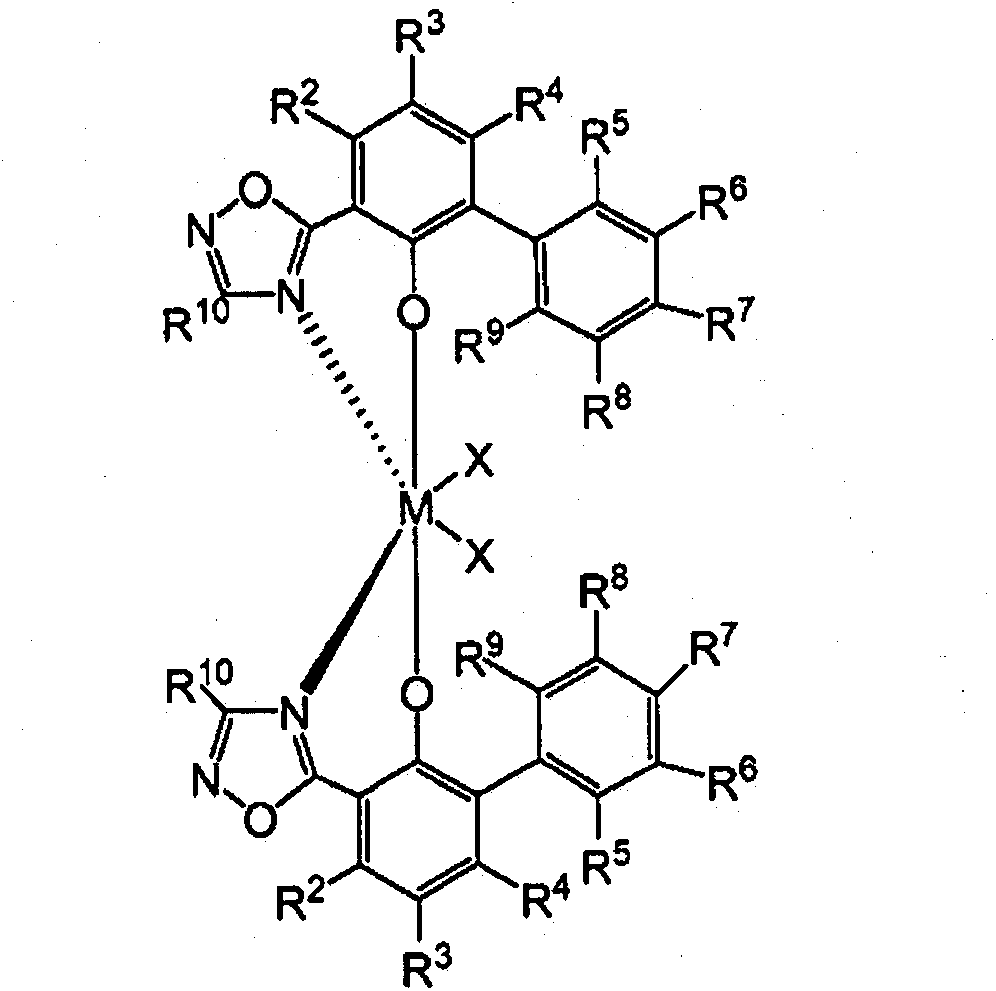


Applications Claiming Priority (3)
| Application Number | Priority Date | Filing Date | Title |
|---|---|---|---|
| US17819709P | 2009-05-14 | 2009-05-14 | |
| US61/178,197 | 2009-05-14 | ||
| PCT/US2010/034963 WO2010132811A1 (en) | 2009-05-14 | 2010-05-14 | Mixed metal catalyst systems having a tailored hydrogen response |
Publications (2)
| Publication Number | Publication Date |
|---|---|
| CN102414228A CN102414228A (en) | 2012-04-11 |
| CN102414228B true CN102414228B (en) | 2014-05-07 |
Family
ID=42420979
Family Applications (1)
| Application Number | Title | Priority Date | Filing Date |
|---|---|---|---|
| CN201080019048.7A Active CN102414228B (en) | 2009-05-14 | 2010-05-14 | Mixed metal catalyst system with tailored hydrogen response |
Country Status (7)
| Country | Link |
|---|---|
| US (1) | US8435914B2 (en) |
| EP (1) | EP2430053A1 (en) |
| CN (1) | CN102414228B (en) |
| BR (1) | BRPI1010927A2 (en) |
| CA (1) | CA2757045C (en) |
| RU (1) | RU2542104C2 (en) |
| WO (1) | WO2010132811A1 (en) |
Families Citing this family (15)
| Publication number | Priority date | Publication date | Assignee | Title |
|---|---|---|---|---|
| KR102022132B1 (en) * | 2011-11-08 | 2019-09-17 | 유니베이션 테크놀로지즈, 엘엘씨 | Methods of preparing a catalyst system |
| US9034991B2 (en) | 2013-01-29 | 2015-05-19 | Chevron Phillips Chemical Company Lp | Polymer compositions and methods of making and using same |
| ES2644669T3 (en) * | 2013-03-15 | 2017-11-29 | Univation Technologies, Llc | Ligands for catalysts |
| ES2873521T3 (en) * | 2013-03-15 | 2021-11-03 | Univation Tech Llc | Multiple catalyst system comprising metallocenes and nitrogen-based tridentate ligand complexes for olefin polymerization |
| EP2816064B1 (en) * | 2013-04-19 | 2018-12-26 | LG Chem, Ltd. | Polyethylene with controlled wax content, chlorinated polyethylene thereof, and molded product prepared therefrom |
| KR101597421B1 (en) | 2013-04-19 | 2016-02-24 | 주식회사 엘지화학 | Wax content controlled polyethylene, its chlorinated polyethylene and product thereof |
| CN105793342B (en) | 2013-12-09 | 2018-11-23 | 尤尼威蒂恩技术有限责任公司 | Polymeric additive feed-in polymerization |
| US20160362510A1 (en) * | 2014-02-11 | 2016-12-15 | Univation Technologies, Llc | Method to prepare ethylene copolymers |
| CN113321757B (en) | 2014-06-16 | 2023-05-05 | 尤尼威蒂恩技术有限责任公司 | Method for modifying melt flow ratio and/or swelling of polyethylene resin |
| RU2690371C2 (en) | 2014-06-16 | 2019-06-03 | ЮНИВЕЙШН ТЕКНОЛОДЖИЗ, ЭлЭлСи | Polyethylene resin |
| US10414887B2 (en) | 2015-10-02 | 2019-09-17 | Exxonmobil Chemical Patents Inc. | Supported catalyst systems and methods of using same |
| CN115028766B (en) * | 2016-10-19 | 2024-06-28 | 埃克森美孚化学专利公司 | Supported catalyst system and method of using the same |
| WO2018075243A1 (en) | 2016-10-19 | 2018-04-26 | Exxonmobil Chemical Patents Inc. | Supported catalyst systems and methods of using same |
| US12202920B2 (en) * | 2019-01-08 | 2025-01-21 | ExxonMobil Engineering & Technology Company | Olefin polymerization processes featuring in situ blending of an oil extension |
| EP4431535A4 (en) * | 2021-12-07 | 2025-05-07 | Hanwha Solutions Corporation | CATALYST FOR OLEFIN POLYMERIZATION COMPRISING A HYBRID CATALYST COMPOSITION AND OLEFIN POLYMER PREPARED USING THE LATTER |
Citations (6)
| Publication number | Priority date | Publication date | Assignee | Title |
|---|---|---|---|---|
| US4659685A (en) * | 1986-03-17 | 1987-04-21 | The Dow Chemical Company | Heterogeneous organometallic catalysts containing a supported titanium compound and at least one other supported organometallic compound |
| DE69520107D1 (en) * | 1994-09-22 | 2001-03-22 | Mobil Oil Corp | METHOD FOR CONTROLLING THE MOLECULAR WEIGHT DISTRIBUTION OF A WIDE / BIMODAL RESIN MADE IN A SINGLE REACTOR |
| CN1484658A (en) * | 2000-12-04 | 2004-03-24 | �������ٶ������������ι�˾ | Catalyst composition, polymerization process and polymers produced therefrom |
| WO2006036748A2 (en) * | 2004-09-22 | 2006-04-06 | Symyx Technologies, Inc. | Heterocycle-amine ligands, compositions, complexes, and catalysts, and methods of making and using the same |
| WO2006066126A2 (en) * | 2004-12-16 | 2006-06-22 | Symyx Technologies, Inc. | Phenol-heterocyclic ligands, metal complexes, and their uses as catalysts |
| WO2007076231A2 (en) * | 2005-12-16 | 2007-07-05 | Symyx Technologies, Inc. | Bridged phenol-heterocyclic ligands, metal complexes, and their uses as catalysts |
Family Cites Families (31)
| Publication number | Priority date | Publication date | Assignee | Title |
|---|---|---|---|---|
| US4530914A (en) | 1983-06-06 | 1985-07-23 | Exxon Research & Engineering Co. | Process and catalyst for producing polyethylene having a broad molecular weight distribution |
| US4937299A (en) | 1983-06-06 | 1990-06-26 | Exxon Research & Engineering Company | Process and catalyst for producing reactor blend polyolefins |
| US5077255A (en) | 1986-09-09 | 1991-12-31 | Exxon Chemical Patents Inc. | New supported polymerization catalyst |
| ES2064322T3 (en) | 1987-09-11 | 1995-02-01 | Fina Technology | CATALYSIS SYSTEMS FOR THE PRODUCTION OF POLYOLEFINES COVERING A WIDE RANGE OF MOLECULAR WEIGHTS. |
| US5032562A (en) | 1989-12-27 | 1991-07-16 | Mobil Oil Corporation | Catalyst composition and process for polymerizing polymers having multimodal molecular weight distribution |
| CA2060019A1 (en) | 1991-03-04 | 1992-09-05 | Phil Marvin Stricklen | Process for producing polyolefins having a bimodal molecular weight distribution |
| ES2141833T3 (en) | 1993-08-06 | 2000-04-01 | Exxon Chemical Patents Inc | POLYMERIZATION CATALYSTS, THEIR PRODUCTION AND USE. |
| DE4333128A1 (en) | 1993-09-29 | 1995-03-30 | Hoechst Ag | Process for the preparation of polyolefins |
| ZA948934B (en) | 1993-11-15 | 1996-05-10 | Mobil Oil Corp | Catalyst composition for use in the polymerization and copolymerization of ethylene |
| EP0676418B1 (en) | 1994-04-07 | 2000-07-26 | BP Chemicals Limited | Polymerisation process |
| US5516848A (en) | 1995-01-31 | 1996-05-14 | Exxon Chemical Patents Inc. | Process to produce thermoplastic elastomers |
| UA47394C2 (en) | 1995-05-16 | 2002-07-15 | Юнівейшн Текнолоджіз, Ллс | Ethylene polymer with improved processability and an article containing the ethylene polymer |
| US6403181B1 (en) | 1995-07-03 | 2002-06-11 | Mobil Oil Corporation | Premium pipe resins |
| US5665818A (en) | 1996-03-05 | 1997-09-09 | Union Carbide Chemicals & Plastics Technology Corporation | High activity staged reactor process |
| US6417130B1 (en) | 1996-03-25 | 2002-07-09 | Exxonmobil Oil Corporation | One pot preparation of bimetallic catalysts for ethylene 1-olefin copolymerization |
| US6207606B1 (en) | 1998-05-15 | 2001-03-27 | Univation Technologies, Llc | Mixed catalysts and their use in a polymerization process |
| US6380328B1 (en) * | 1999-12-10 | 2002-04-30 | Univation Technologies, Llc | Catalyst systems and their use in a polymerization process |
| US6964937B2 (en) | 2000-11-30 | 2005-11-15 | Univation Technologies, Llc | Bimetallic catalyst for producing polyethylene resins with bimodal molecular weight distribution, its preparation and use |
| US6608149B2 (en) | 2000-12-04 | 2003-08-19 | Univation Technologies, Llc | Polymerization process |
| JP4020862B2 (en) | 2001-07-19 | 2007-12-12 | ユニベーション・テクノロジーズ・エルエルシー | Mixed metallocene catalyst system containing comonomer minor incorporation catalyst and comonomer major incorporation catalyst |
| BR0214576A (en) | 2001-11-30 | 2004-11-03 | Exxonmobil Chem Patents Inc | Highly active bimetallic catalysts |
| DE10226181A1 (en) | 2002-06-12 | 2003-12-24 | Basf Ag | Process for converting perylene-3,4: 9,10-tetracarboxylic acid diimides into a form suitable for use as a fluorescent dye |
| US7199072B2 (en) | 2002-12-31 | 2007-04-03 | Univation Technologies, Llc | Process of producing a supported mixed catalyst system and polyolefins therefrom |
| US7172987B2 (en) | 2002-12-31 | 2007-02-06 | Univation Technologies, Llc | Bimetallic catalyst, method of polymerization and bimodal polyolefins therefrom |
| WO2006000020A1 (en) | 2004-06-29 | 2006-01-05 | European Nickel Plc | Improved leaching of base metals |
| US7163906B2 (en) | 2004-11-04 | 2007-01-16 | Chevron Phillips Chemical Company, Llp | Organochromium/metallocene combination catalysts for producing bimodal resins |
| AU2006264212B2 (en) | 2005-06-29 | 2010-10-28 | Compumedics Limited | Sensor assembly with conductive bridge |
| TW200801513A (en) | 2006-06-29 | 2008-01-01 | Fermiscan Australia Pty Ltd | Improved process |
| AU2007319883B2 (en) * | 2006-11-14 | 2012-12-13 | Univation Technologies, Llc. | Catalyst systems and polymerization processes |
| TW200936619A (en) * | 2007-11-15 | 2009-09-01 | Univation Tech Llc | Polymerization catalysts, methods of making, methods of using, and polyolefin products made therefrom |
| US20090286944A1 (en) * | 2008-05-15 | 2009-11-19 | Symyx Technologies, Inc. | Select phenol-heterocycle ligands, metal complexes formed therefrom, and their uses as catalysts |
-
2010
- 2010-05-14 CN CN201080019048.7A patent/CN102414228B/en active Active
- 2010-05-14 EP EP10720104A patent/EP2430053A1/en not_active Ceased
- 2010-05-14 WO PCT/US2010/034963 patent/WO2010132811A1/en not_active Ceased
- 2010-05-14 RU RU2011150625/04A patent/RU2542104C2/en active
- 2010-05-14 CA CA2757045A patent/CA2757045C/en active Active
- 2010-05-14 BR BRPI1010927A patent/BRPI1010927A2/en not_active Application Discontinuation
- 2010-05-14 US US13/258,945 patent/US8435914B2/en active Active
Patent Citations (6)
| Publication number | Priority date | Publication date | Assignee | Title |
|---|---|---|---|---|
| US4659685A (en) * | 1986-03-17 | 1987-04-21 | The Dow Chemical Company | Heterogeneous organometallic catalysts containing a supported titanium compound and at least one other supported organometallic compound |
| DE69520107D1 (en) * | 1994-09-22 | 2001-03-22 | Mobil Oil Corp | METHOD FOR CONTROLLING THE MOLECULAR WEIGHT DISTRIBUTION OF A WIDE / BIMODAL RESIN MADE IN A SINGLE REACTOR |
| CN1484658A (en) * | 2000-12-04 | 2004-03-24 | �������ٶ������������ι�˾ | Catalyst composition, polymerization process and polymers produced therefrom |
| WO2006036748A2 (en) * | 2004-09-22 | 2006-04-06 | Symyx Technologies, Inc. | Heterocycle-amine ligands, compositions, complexes, and catalysts, and methods of making and using the same |
| WO2006066126A2 (en) * | 2004-12-16 | 2006-06-22 | Symyx Technologies, Inc. | Phenol-heterocyclic ligands, metal complexes, and their uses as catalysts |
| WO2007076231A2 (en) * | 2005-12-16 | 2007-07-05 | Symyx Technologies, Inc. | Bridged phenol-heterocyclic ligands, metal complexes, and their uses as catalysts |
Also Published As
| Publication number | Publication date |
|---|---|
| WO2010132811A1 (en) | 2010-11-18 |
| US20120046428A1 (en) | 2012-02-23 |
| RU2542104C2 (en) | 2015-02-20 |
| CN102414228A (en) | 2012-04-11 |
| EP2430053A1 (en) | 2012-03-21 |
| CA2757045C (en) | 2017-03-07 |
| BRPI1010927A2 (en) | 2016-04-05 |
| CA2757045A1 (en) | 2010-11-18 |
| US8435914B2 (en) | 2013-05-07 |
Similar Documents
| Publication | Publication Date | Title |
|---|---|---|
| CN102414228B (en) | Mixed metal catalyst system with tailored hydrogen response | |
| US8835577B2 (en) | Catalyst systems having a tailored hydrogen response | |
| AU611384B2 (en) | New supported polymerization catalyst | |
| JP7212445B2 (en) | Production of polyolefin products | |
| CN101939343B (en) | Method for controlling bimodal catalyst activity during polymerization | |
| US4808561A (en) | Supported polymerization catalyst | |
| CN109790239B (en) | Bimodal polymerization catalyst | |
| CN103917292A (en) | Methods of preparing catalyst system | |
| CN105143285A (en) | Preparation of polyolefin | |
| CN107428875B (en) | Spray-dried catalyst composition, method of preparation and use in olefin polymerization process | |
| JP7699121B2 (en) | Bimodal catalytic systems | |
| CN104039840B (en) | Continuity additives for bed polyolefin polymerization process | |
| CN112969724B (en) | On-line adjustment of mixed catalyst ratio and olefin polymerization | |
| CN106459248B (en) | Catalyst composition, preparation method and use in polymerization process | |
| CN112996821B (en) | Mixed catalyst system with condensing agent-adjustable properties | |
| JP2017512876A (en) | Continuous compositions and methods of making and using them | |
| CN106661154A (en) | Catalyst activator, method of preparation and use in polymerization process | |
| CN103347905B (en) | For the additive of bed polyolefin polymerization process | |
| CN102015782B (en) | Methods for preparing catalyst systems | |
| WO2021091959A1 (en) | Titanium biphenylphenol polymerization catalysts | |
| CN103052655B (en) | Processes for making multimodal molecular weight distribution polyolefins | |
| WO2025170769A1 (en) | Bimodal catalyst system and polymerization process | |
| CN101821296A (en) | Continuity Additive and Its Application in Polymerization Process |
Legal Events
| Date | Code | Title | Description |
|---|---|---|---|
| C06 | Publication | ||
| PB01 | Publication | ||
| C10 | Entry into substantive examination | ||
| SE01 | Entry into force of request for substantive examination | ||
| C14 | Grant of patent or utility model | ||
| GR01 | Patent grant |