ES2931331T3 - Production of polyethylene products with improved rigidity, toughness and processability - Google Patents
Production of polyethylene products with improved rigidity, toughness and processability Download PDFInfo
- Publication number
- ES2931331T3 ES2931331T3 ES15705877T ES15705877T ES2931331T3 ES 2931331 T3 ES2931331 T3 ES 2931331T3 ES 15705877 T ES15705877 T ES 15705877T ES 15705877 T ES15705877 T ES 15705877T ES 2931331 T3 ES2931331 T3 ES 2931331T3
- Authority
- ES
- Spain
- Prior art keywords
- polymer
- catalyst
- molecular weight
- group
- polymers
- Prior art date
- Legal status (The legal status is an assumption and is not a legal conclusion. Google has not performed a legal analysis and makes no representation as to the accuracy of the status listed.)
- Active
Links
Classifications
-
- C—CHEMISTRY; METALLURGY
- C08—ORGANIC MACROMOLECULAR COMPOUNDS; THEIR PREPARATION OR CHEMICAL WORKING-UP; COMPOSITIONS BASED THEREON
- C08F—MACROMOLECULAR COMPOUNDS OBTAINED BY REACTIONS ONLY INVOLVING CARBON-TO-CARBON UNSATURATED BONDS
- C08F210/00—Copolymers of unsaturated aliphatic hydrocarbons having only one carbon-to-carbon double bond
- C08F210/16—Copolymers of ethene with alpha-alkenes, e.g. EP rubbers
-
- C—CHEMISTRY; METALLURGY
- C08—ORGANIC MACROMOLECULAR COMPOUNDS; THEIR PREPARATION OR CHEMICAL WORKING-UP; COMPOSITIONS BASED THEREON
- C08J—WORKING-UP; GENERAL PROCESSES OF COMPOUNDING; AFTER-TREATMENT NOT COVERED BY SUBCLASSES C08B, C08C, C08F, C08G or C08H
- C08J5/00—Manufacture of articles or shaped materials containing macromolecular substances
- C08J5/18—Manufacture of films or sheets
-
- B—PERFORMING OPERATIONS; TRANSPORTING
- B32—LAYERED PRODUCTS
- B32B—LAYERED PRODUCTS, i.e. PRODUCTS BUILT-UP OF STRATA OF FLAT OR NON-FLAT, e.g. CELLULAR OR HONEYCOMB, FORM
- B32B27/00—Layered products comprising a layer of synthetic resin
- B32B27/32—Layered products comprising a layer of synthetic resin comprising polyolefins
-
- C—CHEMISTRY; METALLURGY
- C07—ORGANIC CHEMISTRY
- C07F—ACYCLIC, CARBOCYCLIC OR HETEROCYCLIC COMPOUNDS CONTAINING ELEMENTS OTHER THAN CARBON, HYDROGEN, HALOGEN, OXYGEN, NITROGEN, SULFUR, SELENIUM OR TELLURIUM
- C07F17/00—Metallocenes
-
- C—CHEMISTRY; METALLURGY
- C08—ORGANIC MACROMOLECULAR COMPOUNDS; THEIR PREPARATION OR CHEMICAL WORKING-UP; COMPOSITIONS BASED THEREON
- C08F—MACROMOLECULAR COMPOUNDS OBTAINED BY REACTIONS ONLY INVOLVING CARBON-TO-CARBON UNSATURATED BONDS
- C08F2/00—Processes of polymerisation
-
- C—CHEMISTRY; METALLURGY
- C08—ORGANIC MACROMOLECULAR COMPOUNDS; THEIR PREPARATION OR CHEMICAL WORKING-UP; COMPOSITIONS BASED THEREON
- C08F—MACROMOLECULAR COMPOUNDS OBTAINED BY REACTIONS ONLY INVOLVING CARBON-TO-CARBON UNSATURATED BONDS
- C08F2/00—Processes of polymerisation
- C08F2/34—Polymerisation in gaseous state
-
- C—CHEMISTRY; METALLURGY
- C08—ORGANIC MACROMOLECULAR COMPOUNDS; THEIR PREPARATION OR CHEMICAL WORKING-UP; COMPOSITIONS BASED THEREON
- C08F—MACROMOLECULAR COMPOUNDS OBTAINED BY REACTIONS ONLY INVOLVING CARBON-TO-CARBON UNSATURATED BONDS
- C08F210/00—Copolymers of unsaturated aliphatic hydrocarbons having only one carbon-to-carbon double bond
- C08F210/02—Ethene
-
- C—CHEMISTRY; METALLURGY
- C08—ORGANIC MACROMOLECULAR COMPOUNDS; THEIR PREPARATION OR CHEMICAL WORKING-UP; COMPOSITIONS BASED THEREON
- C08F—MACROMOLECULAR COMPOUNDS OBTAINED BY REACTIONS ONLY INVOLVING CARBON-TO-CARBON UNSATURATED BONDS
- C08F210/00—Copolymers of unsaturated aliphatic hydrocarbons having only one carbon-to-carbon double bond
- C08F210/16—Copolymers of ethene with alpha-alkenes, e.g. EP rubbers
- C08F210/18—Copolymers of ethene with alpha-alkenes, e.g. EP rubbers with non-conjugated dienes, e.g. EPT rubbers
-
- C—CHEMISTRY; METALLURGY
- C08—ORGANIC MACROMOLECULAR COMPOUNDS; THEIR PREPARATION OR CHEMICAL WORKING-UP; COMPOSITIONS BASED THEREON
- C08F—MACROMOLECULAR COMPOUNDS OBTAINED BY REACTIONS ONLY INVOLVING CARBON-TO-CARBON UNSATURATED BONDS
- C08F4/00—Polymerisation catalysts
- C08F4/42—Metals; Metal hydrides; Metallo-organic compounds; Use thereof as catalyst precursors
- C08F4/44—Metals; Metal hydrides; Metallo-organic compounds; Use thereof as catalyst precursors selected from light metals, zinc, cadmium, mercury, copper, silver, gold, boron, gallium, indium, thallium, rare earths or actinides
- C08F4/60—Metals; Metal hydrides; Metallo-organic compounds; Use thereof as catalyst precursors selected from light metals, zinc, cadmium, mercury, copper, silver, gold, boron, gallium, indium, thallium, rare earths or actinides together with refractory metals, iron group metals, platinum group metals, manganese, rhenium technetium or compounds thereof
- C08F4/62—Refractory metals or compounds thereof
- C08F4/64—Titanium, zirconium, hafnium or compounds thereof
- C08F4/643—Component covered by group C08F4/64 with a metal or compound covered by group C08F4/44 other than an organo-aluminium compound
- C08F4/6432—Component of C08F4/64 containing at least two different metals
-
- C—CHEMISTRY; METALLURGY
- C08—ORGANIC MACROMOLECULAR COMPOUNDS; THEIR PREPARATION OR CHEMICAL WORKING-UP; COMPOSITIONS BASED THEREON
- C08F—MACROMOLECULAR COMPOUNDS OBTAINED BY REACTIONS ONLY INVOLVING CARBON-TO-CARBON UNSATURATED BONDS
- C08F4/00—Polymerisation catalysts
- C08F4/42—Metals; Metal hydrides; Metallo-organic compounds; Use thereof as catalyst precursors
- C08F4/44—Metals; Metal hydrides; Metallo-organic compounds; Use thereof as catalyst precursors selected from light metals, zinc, cadmium, mercury, copper, silver, gold, boron, gallium, indium, thallium, rare earths or actinides
- C08F4/60—Metals; Metal hydrides; Metallo-organic compounds; Use thereof as catalyst precursors selected from light metals, zinc, cadmium, mercury, copper, silver, gold, boron, gallium, indium, thallium, rare earths or actinides together with refractory metals, iron group metals, platinum group metals, manganese, rhenium technetium or compounds thereof
- C08F4/62—Refractory metals or compounds thereof
- C08F4/64—Titanium, zirconium, hafnium or compounds thereof
- C08F4/659—Component covered by group C08F4/64 containing a transition metal-carbon bond
- C08F4/65904—Component covered by group C08F4/64 containing a transition metal-carbon bond in combination with another component of C08F4/64
-
- C—CHEMISTRY; METALLURGY
- C08—ORGANIC MACROMOLECULAR COMPOUNDS; THEIR PREPARATION OR CHEMICAL WORKING-UP; COMPOSITIONS BASED THEREON
- C08F—MACROMOLECULAR COMPOUNDS OBTAINED BY REACTIONS ONLY INVOLVING CARBON-TO-CARBON UNSATURATED BONDS
- C08F4/00—Polymerisation catalysts
- C08F4/42—Metals; Metal hydrides; Metallo-organic compounds; Use thereof as catalyst precursors
- C08F4/44—Metals; Metal hydrides; Metallo-organic compounds; Use thereof as catalyst precursors selected from light metals, zinc, cadmium, mercury, copper, silver, gold, boron, gallium, indium, thallium, rare earths or actinides
- C08F4/60—Metals; Metal hydrides; Metallo-organic compounds; Use thereof as catalyst precursors selected from light metals, zinc, cadmium, mercury, copper, silver, gold, boron, gallium, indium, thallium, rare earths or actinides together with refractory metals, iron group metals, platinum group metals, manganese, rhenium technetium or compounds thereof
- C08F4/62—Refractory metals or compounds thereof
- C08F4/64—Titanium, zirconium, hafnium or compounds thereof
- C08F4/659—Component covered by group C08F4/64 containing a transition metal-carbon bond
- C08F4/65912—Component covered by group C08F4/64 containing a transition metal-carbon bond in combination with an organoaluminium compound
-
- C—CHEMISTRY; METALLURGY
- C08—ORGANIC MACROMOLECULAR COMPOUNDS; THEIR PREPARATION OR CHEMICAL WORKING-UP; COMPOSITIONS BASED THEREON
- C08F—MACROMOLECULAR COMPOUNDS OBTAINED BY REACTIONS ONLY INVOLVING CARBON-TO-CARBON UNSATURATED BONDS
- C08F4/00—Polymerisation catalysts
- C08F4/42—Metals; Metal hydrides; Metallo-organic compounds; Use thereof as catalyst precursors
- C08F4/44—Metals; Metal hydrides; Metallo-organic compounds; Use thereof as catalyst precursors selected from light metals, zinc, cadmium, mercury, copper, silver, gold, boron, gallium, indium, thallium, rare earths or actinides
- C08F4/60—Metals; Metal hydrides; Metallo-organic compounds; Use thereof as catalyst precursors selected from light metals, zinc, cadmium, mercury, copper, silver, gold, boron, gallium, indium, thallium, rare earths or actinides together with refractory metals, iron group metals, platinum group metals, manganese, rhenium technetium or compounds thereof
- C08F4/62—Refractory metals or compounds thereof
- C08F4/64—Titanium, zirconium, hafnium or compounds thereof
- C08F4/659—Component covered by group C08F4/64 containing a transition metal-carbon bond
- C08F4/65916—Component covered by group C08F4/64 containing a transition metal-carbon bond supported on a carrier, e.g. silica, MgCl2, polymer
-
- C—CHEMISTRY; METALLURGY
- C08—ORGANIC MACROMOLECULAR COMPOUNDS; THEIR PREPARATION OR CHEMICAL WORKING-UP; COMPOSITIONS BASED THEREON
- C08F—MACROMOLECULAR COMPOUNDS OBTAINED BY REACTIONS ONLY INVOLVING CARBON-TO-CARBON UNSATURATED BONDS
- C08F4/00—Polymerisation catalysts
- C08F4/42—Metals; Metal hydrides; Metallo-organic compounds; Use thereof as catalyst precursors
- C08F4/44—Metals; Metal hydrides; Metallo-organic compounds; Use thereof as catalyst precursors selected from light metals, zinc, cadmium, mercury, copper, silver, gold, boron, gallium, indium, thallium, rare earths or actinides
- C08F4/60—Metals; Metal hydrides; Metallo-organic compounds; Use thereof as catalyst precursors selected from light metals, zinc, cadmium, mercury, copper, silver, gold, boron, gallium, indium, thallium, rare earths or actinides together with refractory metals, iron group metals, platinum group metals, manganese, rhenium technetium or compounds thereof
- C08F4/62—Refractory metals or compounds thereof
- C08F4/64—Titanium, zirconium, hafnium or compounds thereof
- C08F4/659—Component covered by group C08F4/64 containing a transition metal-carbon bond
- C08F4/6592—Component covered by group C08F4/64 containing a transition metal-carbon bond containing at least one cyclopentadienyl ring, condensed or not, e.g. an indenyl or a fluorenyl ring
- C08F4/65922—Component covered by group C08F4/64 containing a transition metal-carbon bond containing at least one cyclopentadienyl ring, condensed or not, e.g. an indenyl or a fluorenyl ring containing at least two cyclopentadienyl rings, fused or not
- C08F4/65925—Component covered by group C08F4/64 containing a transition metal-carbon bond containing at least one cyclopentadienyl ring, condensed or not, e.g. an indenyl or a fluorenyl ring containing at least two cyclopentadienyl rings, fused or not two cyclopentadienyl rings being mutually non-bridged
-
- C—CHEMISTRY; METALLURGY
- C08—ORGANIC MACROMOLECULAR COMPOUNDS; THEIR PREPARATION OR CHEMICAL WORKING-UP; COMPOSITIONS BASED THEREON
- C08F—MACROMOLECULAR COMPOUNDS OBTAINED BY REACTIONS ONLY INVOLVING CARBON-TO-CARBON UNSATURATED BONDS
- C08F4/00—Polymerisation catalysts
- C08F4/42—Metals; Metal hydrides; Metallo-organic compounds; Use thereof as catalyst precursors
- C08F4/44—Metals; Metal hydrides; Metallo-organic compounds; Use thereof as catalyst precursors selected from light metals, zinc, cadmium, mercury, copper, silver, gold, boron, gallium, indium, thallium, rare earths or actinides
- C08F4/60—Metals; Metal hydrides; Metallo-organic compounds; Use thereof as catalyst precursors selected from light metals, zinc, cadmium, mercury, copper, silver, gold, boron, gallium, indium, thallium, rare earths or actinides together with refractory metals, iron group metals, platinum group metals, manganese, rhenium technetium or compounds thereof
- C08F4/62—Refractory metals or compounds thereof
- C08F4/64—Titanium, zirconium, hafnium or compounds thereof
- C08F4/659—Component covered by group C08F4/64 containing a transition metal-carbon bond
- C08F4/6592—Component covered by group C08F4/64 containing a transition metal-carbon bond containing at least one cyclopentadienyl ring, condensed or not, e.g. an indenyl or a fluorenyl ring
- C08F4/65922—Component covered by group C08F4/64 containing a transition metal-carbon bond containing at least one cyclopentadienyl ring, condensed or not, e.g. an indenyl or a fluorenyl ring containing at least two cyclopentadienyl rings, fused or not
- C08F4/65927—Component covered by group C08F4/64 containing a transition metal-carbon bond containing at least one cyclopentadienyl ring, condensed or not, e.g. an indenyl or a fluorenyl ring containing at least two cyclopentadienyl rings, fused or not two cyclopentadienyl rings being mutually bridged
-
- C—CHEMISTRY; METALLURGY
- C08—ORGANIC MACROMOLECULAR COMPOUNDS; THEIR PREPARATION OR CHEMICAL WORKING-UP; COMPOSITIONS BASED THEREON
- C08F—MACROMOLECULAR COMPOUNDS OBTAINED BY REACTIONS ONLY INVOLVING CARBON-TO-CARBON UNSATURATED BONDS
- C08F4/00—Polymerisation catalysts
- C08F4/42—Metals; Metal hydrides; Metallo-organic compounds; Use thereof as catalyst precursors
- C08F4/72—Metals; Metal hydrides; Metallo-organic compounds; Use thereof as catalyst precursors selected from metals not provided for in group C08F4/44
- C08F4/74—Metals; Metal hydrides; Metallo-organic compounds; Use thereof as catalyst precursors selected from metals not provided for in group C08F4/44 selected from refractory metals
- C08F4/76—Metals; Metal hydrides; Metallo-organic compounds; Use thereof as catalyst precursors selected from metals not provided for in group C08F4/44 selected from refractory metals selected from titanium, zirconium, hafnium, vanadium, niobium or tantalum
-
- C—CHEMISTRY; METALLURGY
- C08—ORGANIC MACROMOLECULAR COMPOUNDS; THEIR PREPARATION OR CHEMICAL WORKING-UP; COMPOSITIONS BASED THEREON
- C08F—MACROMOLECULAR COMPOUNDS OBTAINED BY REACTIONS ONLY INVOLVING CARBON-TO-CARBON UNSATURATED BONDS
- C08F210/00—Copolymers of unsaturated aliphatic hydrocarbons having only one carbon-to-carbon double bond
- C08F210/04—Monomers containing three or four carbon atoms
- C08F210/08—Butenes
-
- C—CHEMISTRY; METALLURGY
- C08—ORGANIC MACROMOLECULAR COMPOUNDS; THEIR PREPARATION OR CHEMICAL WORKING-UP; COMPOSITIONS BASED THEREON
- C08F—MACROMOLECULAR COMPOUNDS OBTAINED BY REACTIONS ONLY INVOLVING CARBON-TO-CARBON UNSATURATED BONDS
- C08F210/00—Copolymers of unsaturated aliphatic hydrocarbons having only one carbon-to-carbon double bond
- C08F210/14—Monomers containing five or more carbon atoms
-
- C—CHEMISTRY; METALLURGY
- C08—ORGANIC MACROMOLECULAR COMPOUNDS; THEIR PREPARATION OR CHEMICAL WORKING-UP; COMPOSITIONS BASED THEREON
- C08F—MACROMOLECULAR COMPOUNDS OBTAINED BY REACTIONS ONLY INVOLVING CARBON-TO-CARBON UNSATURATED BONDS
- C08F2410/00—Features related to the catalyst preparation, the catalyst use or to the deactivation of the catalyst
- C08F2410/01—Additive used together with the catalyst, excluding compounds containing Al or B
-
- C—CHEMISTRY; METALLURGY
- C08—ORGANIC MACROMOLECULAR COMPOUNDS; THEIR PREPARATION OR CHEMICAL WORKING-UP; COMPOSITIONS BASED THEREON
- C08F—MACROMOLECULAR COMPOUNDS OBTAINED BY REACTIONS ONLY INVOLVING CARBON-TO-CARBON UNSATURATED BONDS
- C08F2410/00—Features related to the catalyst preparation, the catalyst use or to the deactivation of the catalyst
- C08F2410/02—Anti-static agent incorporated into the catalyst
-
- C—CHEMISTRY; METALLURGY
- C08—ORGANIC MACROMOLECULAR COMPOUNDS; THEIR PREPARATION OR CHEMICAL WORKING-UP; COMPOSITIONS BASED THEREON
- C08F—MACROMOLECULAR COMPOUNDS OBTAINED BY REACTIONS ONLY INVOLVING CARBON-TO-CARBON UNSATURATED BONDS
- C08F2420/00—Metallocene catalysts
-
- C—CHEMISTRY; METALLURGY
- C08—ORGANIC MACROMOLECULAR COMPOUNDS; THEIR PREPARATION OR CHEMICAL WORKING-UP; COMPOSITIONS BASED THEREON
- C08F—MACROMOLECULAR COMPOUNDS OBTAINED BY REACTIONS ONLY INVOLVING CARBON-TO-CARBON UNSATURATED BONDS
- C08F2420/00—Metallocene catalysts
- C08F2420/01—Cp or analog bridged to a non-Cp X neutral donor
-
- C—CHEMISTRY; METALLURGY
- C08—ORGANIC MACROMOLECULAR COMPOUNDS; THEIR PREPARATION OR CHEMICAL WORKING-UP; COMPOSITIONS BASED THEREON
- C08F—MACROMOLECULAR COMPOUNDS OBTAINED BY REACTIONS ONLY INVOLVING CARBON-TO-CARBON UNSATURATED BONDS
- C08F2420/00—Metallocene catalysts
- C08F2420/08—Heteroatom bridge, i.e. Cp or analog where the bridging atom linking the two Cps or analogs is a heteroatom different from Si
-
- C—CHEMISTRY; METALLURGY
- C08—ORGANIC MACROMOLECULAR COMPOUNDS; THEIR PREPARATION OR CHEMICAL WORKING-UP; COMPOSITIONS BASED THEREON
- C08F—MACROMOLECULAR COMPOUNDS OBTAINED BY REACTIONS ONLY INVOLVING CARBON-TO-CARBON UNSATURATED BONDS
- C08F2420/00—Metallocene catalysts
- C08F2420/12—Long bridge, i.e. Cp or analog where the bridging unit linking the two Cps or analogs is composed of at least two atoms which are not part of a cycle and which are not an ethylene bridge
-
- C—CHEMISTRY; METALLURGY
- C08—ORGANIC MACROMOLECULAR COMPOUNDS; THEIR PREPARATION OR CHEMICAL WORKING-UP; COMPOSITIONS BASED THEREON
- C08F—MACROMOLECULAR COMPOUNDS OBTAINED BY REACTIONS ONLY INVOLVING CARBON-TO-CARBON UNSATURATED BONDS
- C08F2500/00—Characteristics or properties of obtained polyolefins; Use thereof
- C08F2500/01—High molecular weight, e.g. >800,000 Da.
-
- C—CHEMISTRY; METALLURGY
- C08—ORGANIC MACROMOLECULAR COMPOUNDS; THEIR PREPARATION OR CHEMICAL WORKING-UP; COMPOSITIONS BASED THEREON
- C08F—MACROMOLECULAR COMPOUNDS OBTAINED BY REACTIONS ONLY INVOLVING CARBON-TO-CARBON UNSATURATED BONDS
- C08F2500/00—Characteristics or properties of obtained polyolefins; Use thereof
- C08F2500/02—Low molecular weight, e.g. <100,000 Da.
-
- C—CHEMISTRY; METALLURGY
- C08—ORGANIC MACROMOLECULAR COMPOUNDS; THEIR PREPARATION OR CHEMICAL WORKING-UP; COMPOSITIONS BASED THEREON
- C08F—MACROMOLECULAR COMPOUNDS OBTAINED BY REACTIONS ONLY INVOLVING CARBON-TO-CARBON UNSATURATED BONDS
- C08F2500/00—Characteristics or properties of obtained polyolefins; Use thereof
- C08F2500/03—Narrow molecular weight distribution, i.e. Mw/Mn < 3
-
- C—CHEMISTRY; METALLURGY
- C08—ORGANIC MACROMOLECULAR COMPOUNDS; THEIR PREPARATION OR CHEMICAL WORKING-UP; COMPOSITIONS BASED THEREON
- C08F—MACROMOLECULAR COMPOUNDS OBTAINED BY REACTIONS ONLY INVOLVING CARBON-TO-CARBON UNSATURATED BONDS
- C08F2500/00—Characteristics or properties of obtained polyolefins; Use thereof
- C08F2500/08—Low density, i.e. < 0.91 g/cm3
-
- C—CHEMISTRY; METALLURGY
- C08—ORGANIC MACROMOLECULAR COMPOUNDS; THEIR PREPARATION OR CHEMICAL WORKING-UP; COMPOSITIONS BASED THEREON
- C08F—MACROMOLECULAR COMPOUNDS OBTAINED BY REACTIONS ONLY INVOLVING CARBON-TO-CARBON UNSATURATED BONDS
- C08F2500/00—Characteristics or properties of obtained polyolefins; Use thereof
- C08F2500/09—Long chain branches
-
- C—CHEMISTRY; METALLURGY
- C08—ORGANIC MACROMOLECULAR COMPOUNDS; THEIR PREPARATION OR CHEMICAL WORKING-UP; COMPOSITIONS BASED THEREON
- C08F—MACROMOLECULAR COMPOUNDS OBTAINED BY REACTIONS ONLY INVOLVING CARBON-TO-CARBON UNSATURATED BONDS
- C08F2500/00—Characteristics or properties of obtained polyolefins; Use thereof
- C08F2500/10—Short chain branches
-
- C—CHEMISTRY; METALLURGY
- C08—ORGANIC MACROMOLECULAR COMPOUNDS; THEIR PREPARATION OR CHEMICAL WORKING-UP; COMPOSITIONS BASED THEREON
- C08F—MACROMOLECULAR COMPOUNDS OBTAINED BY REACTIONS ONLY INVOLVING CARBON-TO-CARBON UNSATURATED BONDS
- C08F2500/00—Characteristics or properties of obtained polyolefins; Use thereof
- C08F2500/11—Melt tension or melt strength
-
- C—CHEMISTRY; METALLURGY
- C08—ORGANIC MACROMOLECULAR COMPOUNDS; THEIR PREPARATION OR CHEMICAL WORKING-UP; COMPOSITIONS BASED THEREON
- C08F—MACROMOLECULAR COMPOUNDS OBTAINED BY REACTIONS ONLY INVOLVING CARBON-TO-CARBON UNSATURATED BONDS
- C08F2500/00—Characteristics or properties of obtained polyolefins; Use thereof
- C08F2500/12—Melt flow index or melt flow ratio
-
- C—CHEMISTRY; METALLURGY
- C08—ORGANIC MACROMOLECULAR COMPOUNDS; THEIR PREPARATION OR CHEMICAL WORKING-UP; COMPOSITIONS BASED THEREON
- C08F—MACROMOLECULAR COMPOUNDS OBTAINED BY REACTIONS ONLY INVOLVING CARBON-TO-CARBON UNSATURATED BONDS
- C08F2500/00—Characteristics or properties of obtained polyolefins; Use thereof
- C08F2500/13—Environmental stress cracking resistance
-
- C—CHEMISTRY; METALLURGY
- C08—ORGANIC MACROMOLECULAR COMPOUNDS; THEIR PREPARATION OR CHEMICAL WORKING-UP; COMPOSITIONS BASED THEREON
- C08F—MACROMOLECULAR COMPOUNDS OBTAINED BY REACTIONS ONLY INVOLVING CARBON-TO-CARBON UNSATURATED BONDS
- C08F2500/00—Characteristics or properties of obtained polyolefins; Use thereof
- C08F2500/18—Bulk density
-
- C—CHEMISTRY; METALLURGY
- C08—ORGANIC MACROMOLECULAR COMPOUNDS; THEIR PREPARATION OR CHEMICAL WORKING-UP; COMPOSITIONS BASED THEREON
- C08F—MACROMOLECULAR COMPOUNDS OBTAINED BY REACTIONS ONLY INVOLVING CARBON-TO-CARBON UNSATURATED BONDS
- C08F2800/00—Copolymer characterised by the proportions of the comonomers expressed
- C08F2800/20—Copolymer characterised by the proportions of the comonomers expressed as weight or mass percentages
-
- C—CHEMISTRY; METALLURGY
- C08—ORGANIC MACROMOLECULAR COMPOUNDS; THEIR PREPARATION OR CHEMICAL WORKING-UP; COMPOSITIONS BASED THEREON
- C08J—WORKING-UP; GENERAL PROCESSES OF COMPOUNDING; AFTER-TREATMENT NOT COVERED BY SUBCLASSES C08B, C08C, C08F, C08G or C08H
- C08J2323/00—Characterised by the use of homopolymers or copolymers of unsaturated aliphatic hydrocarbons having only one carbon-to-carbon double bond; Derivatives of such polymers
- C08J2323/02—Characterised by the use of homopolymers or copolymers of unsaturated aliphatic hydrocarbons having only one carbon-to-carbon double bond; Derivatives of such polymers not modified by chemical after treatment
- C08J2323/04—Homopolymers or copolymers of ethene
- C08J2323/08—Copolymers of ethene
-
- C—CHEMISTRY; METALLURGY
- C08—ORGANIC MACROMOLECULAR COMPOUNDS; THEIR PREPARATION OR CHEMICAL WORKING-UP; COMPOSITIONS BASED THEREON
- C08L—COMPOSITIONS OF MACROMOLECULAR COMPOUNDS
- C08L23/00—Compositions of homopolymers or copolymers of unsaturated aliphatic hydrocarbons having only one carbon-to-carbon double bond; Compositions of derivatives of such polymers
- C08L23/02—Compositions of homopolymers or copolymers of unsaturated aliphatic hydrocarbons having only one carbon-to-carbon double bond; Compositions of derivatives of such polymers not modified by chemical after-treatment
- C08L23/04—Homopolymers or copolymers of ethene
- C08L23/08—Copolymers of ethene
- C08L23/0807—Copolymers of ethene with unsaturated hydrocarbons only containing four or more carbon atoms
- C08L23/0815—Copolymers of ethene with unsaturated hydrocarbons only containing four or more carbon atoms with aliphatic 1-olefins containing one carbon-to-carbon double bond
-
- Y—GENERAL TAGGING OF NEW TECHNOLOGICAL DEVELOPMENTS; GENERAL TAGGING OF CROSS-SECTIONAL TECHNOLOGIES SPANNING OVER SEVERAL SECTIONS OF THE IPC; TECHNICAL SUBJECTS COVERED BY FORMER USPC CROSS-REFERENCE ART COLLECTIONS [XRACs] AND DIGESTS
- Y02—TECHNOLOGIES OR APPLICATIONS FOR MITIGATION OR ADAPTATION AGAINST CLIMATE CHANGE
- Y02P—CLIMATE CHANGE MITIGATION TECHNOLOGIES IN THE PRODUCTION OR PROCESSING OF GOODS
- Y02P20/00—Technologies relating to chemical industry
- Y02P20/50—Improvements relating to the production of bulk chemicals
- Y02P20/52—Improvements relating to the production of bulk chemicals using catalysts, e.g. selective catalysts
Landscapes
- Chemical & Material Sciences (AREA)
- Organic Chemistry (AREA)
- Health & Medical Sciences (AREA)
- Chemical Kinetics & Catalysis (AREA)
- Medicinal Chemistry (AREA)
- Polymers & Plastics (AREA)
- Engineering & Computer Science (AREA)
- Materials Engineering (AREA)
- Crystallography & Structural Chemistry (AREA)
- Manufacturing & Machinery (AREA)
- Transition And Organic Metals Composition Catalysts For Addition Polymerization (AREA)
- Addition Polymer Or Copolymer, Post-Treatments, Or Chemical Modifications (AREA)
- Polymerisation Methods In General (AREA)
- Catalysts (AREA)
- Organic Low-Molecular-Weight Compounds And Preparation Thereof (AREA)
- Compositions Of Macromolecular Compounds (AREA)
- Processes Of Treating Macromolecular Substances (AREA)
- Polymerization Catalysts (AREA)
Abstract
En el presente documento se describen polímeros y sistemas y métodos para fabricarlos y usarlos. Un polímero incluye etileno y al menos una alfa olefina que tiene de 4 a 20 átomos de carbono. El polímero tiene una relación de índice de fusión (MIR) superior a aproximadamente 40. El polímero también tiene un valor de Mw1/Mw2 de al menos aproximadamente 2,0, en el que Mw1/Mw2 es una relación de un peso molecular promedio en peso (Mw) para un primer la mitad de una curva de elución por aumento de temperatura (TREF) de un análisis de fraccionamiento cruzado (CFC) a un Mw para una segunda mitad de la curva TREF. El polímero también tiene un valor para Tw1 - Tw2 de menos de aproximadamente -15 °C, donde Tw1 - Tw2 es una diferencia de una temperatura de elución promedio en peso (Tw) para la primera mitad de la curva TREF a una Tw para la segunda mitad. de la curva TREF. (Traducción automática con Google Translate, sin valor legal)Polymers and systems and methods for making and using them are described herein. A polymer includes ethylene and at least one alpha olefin having 4 to 20 carbon atoms. The polymer has a melt index ratio (MIR) of greater than about 40. The polymer also has an Mw1/Mw2 value of at least about 2.0, where Mw1/Mw2 is a ratio of an average molecular weight in weight (Mw) for a first half of a temperature rise elution curve (TREF) of a cross fractionation assay (CFC) to a Mw for a second half of the TREF curve. The polymer also has a value for Tw1 - Tw2 of less than about -15 °C, where Tw1 - Tw2 is a difference from a weight average elution temperature (Tw) for the first half of the TREF curve to a Tw for the first half of the TREF curve. second half. of the TREF curve. (Automatic translation with Google Translate, without legal value)
Description
DESCRIPCIÓNDESCRIPTION
Producción de productos de polietileno con rigidez, tenacidad y procesabilidad mejoradasProduction of polyethylene products with improved rigidity, toughness and processability
AntecedentesBackground
Los copolímeros de etileno-alfa-olefina (polietileno) se producen normalmente en un reactor de baja presión, utilizando, por ejemplo, procedimientos de polimerización en disolución, suspensión o fase gaseosa. La polimerización tiene lugar en presencia de sistemas de catalizadores tales como los que emplean, por ejemplo, un catalizador de Ziegler-Natta, un catalizador a base de cromo, un catalizador de metaloceno o combinaciones de los mismos.Ethylene-alpha-olefin (polyethylene) copolymers are typically produced in a low-pressure reactor, using, for example, solution, slurry, or gas phase polymerization processes. Polymerization takes place in the presence of catalyst systems such as those employing, for example, a Ziegler-Natta catalyst, a chromium-based catalyst, a metallocene catalyst, or combinations thereof.
Varias composiciones de catalizadores que contienen un único sitio, por ejemplo, los catalizadores de metaloceno se han usado para preparar copolímeros de polietileno, produciendo copolímeros relativamente homogéneos a buenas tasas de polimerización. A diferencia de las composiciones de catalizadores de Ziegler-Natta tradicionales, las composiciones de catalizador de sitio único, tales como catalizadores de metaloceno, son compuestos catalíticos en donde cada molécula de catalizador contiene uno o sólo unos pocos sitios de polimerización. Los catalizadores de sitio único a menudo producen copolímeros de polietileno que tienen una distribución estrecha de peso molecular. Aunque hay catalizadores de sitio único que pueden producir distribuciones de peso molecular más anchas, estos catalizadores a menudo muestran un estrechamiento de la distribución de peso molecular a medida que aumenta la temperatura de reacción, por ejemplo, para aumentar las tasas de producción. Además, un catalizador de sitio único incorporará a menudo comonómero entre las moléculas del copolímero de polietileno a una velocidad relativamente uniforme. La molecular weight distribution (distribución de peso molecular - MWD) y la cantidad de incorporación de comonómeros pueden usarse para determinar una SCBD.Various catalyst compositions containing a single site, eg, metallocene catalysts, have been used to prepare polyethylene copolymers, producing relatively homogeneous copolymers at good polymerization rates. Unlike traditional Ziegler-Natta catalyst compositions, single-site catalyst compositions, such as metallocene catalysts, are catalyst compounds where each catalyst molecule contains one or only a few polymerization sites. Single site catalysts often produce polyethylene copolymers that have a narrow molecular weight distribution. Although there are single-site catalysts that can produce broader molecular weight distributions, these catalysts often show a narrowing of the molecular weight distribution as reaction temperature increases, for example, to increase production rates. Furthermore, a single site catalyst will often incorporate comonomer between the polyethylene copolymer molecules at a relatively uniform rate. The molecular weight distribution (MWD) and the amount of comonomer incorporation can be used to determine an SCBD.
Para un copolímero de etileno-alfa-olefina, la short chain branching (ramificación de cadena corta - SCB) en una cadena polimérica se crea normalmente a través de la incorporación de comonómeros durante la polimerización. La short chain branch distribution (distribución de ramificación de cadena corta - SCBD) se refiere a la distribución de ramificaciones de cadena corta dentro de una molécula o entre diferentes moléculas que comprenden el polímero de polietileno. Cuando la cantidad de SCB varía entre las moléculas de polietileno, se dice que la resina tiene una SCBD “ancha” . Cuando la cantidad de SCB es similar entre las moléculas de polietileno de diferentes longitudes de cadena, se dice que la SCBD es “estrecha” .For an ethylene-alpha-olefin copolymer, short chain branching (SCB) in a polymer chain is normally created through the incorporation of comonomers during polymerization. Short chain branch distribution (SCBD) refers to the distribution of short chain branches within a molecule or between different molecules comprising the polyethylene polymer. When the amount of SCB varies between polyethylene molecules, the resin is said to have a "broad" SCBD. When the amount of SCB is similar between polyethylene molecules of different chain lengths, the SCBD is said to be "narrow".
Se sabe que la SCBD influye en las propiedades de los copolímeros, por ejemplo, rigidez, tenacidad, contenido extraíble, resistencia al agrietamiento por tensión ambiental y sellado térmico, entre otras propiedades. La SCBD de una poliolefina puede medirse fácilmente mediante métodos conocidos en la técnica, por ejemplo, Temperature Raising Elution Fractionation (fraccionamiento por aumento de la temperatura de elución - TREF) o Crystallization Analysis Fractionation (fraccionamiento por análisis de cristalización - CRYSTAF).SCBD is known to influence the properties of copolymers, for example, stiffness, toughness, extractable content, environmental stress crack resistance, and heat sealing, among other properties. The SCBD of a polyolefin can be readily measured by methods known in the art, for example, Temperature Raising Elution Fractionation (TREF) or Crystallization Analysis Fractionation (CRYSTAF).
Se conoce generalmente en la técnica que una MWD y una SCBD de una poliolefina está dictada en gran medida por el tipo de catalizador usado y es a menudo invariable para un sistema de catalizadores dado. Los catalizadores de Ziegler-Natta y los catalizadores a base de cromo producen polímeros con una SCBD amplia, mientras que los catalizadores de metaloceno producen normalmente polímeros con una SCBD estrecha. Se ha observado mucho en la industria que hay paradigmas de compensación entre los diferentes atributos de producto; más notablemente entre stiffness, toughness, and processability (rigidez, tenacidad y procesabilidad - S/T/P). Debido a la introducción de metaloceno en los años 90, algunos de tales paradigmas se han relajado significativamente con manipulaciones cuidadosas de la estructura molecular y la composición en el producto.It is generally known in the art that a MWD and SCBD of a polyolefin is largely dictated by the type of catalyst used and is often invariant for a given catalyst system. Ziegler-Natta catalysts and chromium-based catalysts produce polymers with a broad SCBD, whereas metallocene catalysts typically produce polymers with a narrow SCBD. It has been widely observed in the industry that there are trade-off paradigms between the different product attributes; most notably between stiffness, toughness, and processability (rigidity, tenacity and processability - S/T/P). Due to the introduction of metallocene in the 1990's, some of such paradigms have been significantly relaxed with careful manipulations of molecular structure and composition in the product.
Los polímeros que tienen una broad ortogonal composition distribution (distribución ancha ortogonal de la composición - BOCD) en donde el comonómero se incorpora predominantemente en las cadenas de alto peso molecular puede conducir a propiedades físicas mejoradas, por ejemplo, rigidez, tenacidad, procesabilidad y enviromental stress crack resistance (resistencia al agrietamiento por tensión ambiental - ESCR), entre otras. Debido a las propiedades físicas mejoradas de los polímeros con distribuciones ortogonales de composición necesarias para productos comercialmente deseables, existe la necesidad de técnicas controladas para formar copolímeros de polietileno que tengan una distribución ancha ortogonal de la composición.Polymers having a broad orthogonal composition distribution (BOCD) where the comonomer is predominantly incorporated into high molecular weight chains can lead to improved physical properties, e.g., stiffness, toughness, processability, and environmental stress crack resistance (environmental stress cracking resistance - ESCR), among others. Due to the improved physical properties of polymers with orthogonal composition distributions necessary for commercially desirable products, there is a need for controlled techniques for forming polyethylene copolymers having a broad orthogonal composition distribution.
SumarioSummary
Una realización descrita en el presente documento proporciona un polímero que incluye etileno y al menos una alfaolefina que tiene desde 4 hasta 20 átomos de carbono. El polímero tiene una melt index ratio (razón de índice de fusión - MIR) mayor de 40. El polímero también tiene un valor para Mw1/Mw2 de al menos aproximadamente 2,0; en donde Mw1/Mw2 es una razón de un peso molecular promedio en peso (Mw) para una primera mitad de una curva de Temperature Raising Elution Fractionation (fraccionamiento por aumento de la temperatura de elución - TREF) a partir de un Cross-Fractionation (fraccionamiento cruzado - CFC) con respecto a una segunda mitad de la curva de TREF. El polímero también tiene un valor para Tw1-Tw2 de menos de -15 0C, en donde Tw1-Tw2 es una diferencia de una temperatura de elución promedio en peso (Tw) para la primera mitad de la curva de TREF con respecto a una Tw para la segunda mitad de la curva de TREF. El polímero comprende una cadena polimérica formada por un sistema de catalizadores que comprende bis(n-butil, metil ciclopentadienil) zirconio (CH3)2, bis(1 -etilindenil) zirconio (CH3)2, o cualquiera de los compuestos representados por las siguientes fórmulas:An embodiment described herein provides a polymer that includes ethylene and at least one alphaolefin having from 4 to 20 carbon atoms. The polymer has a melt index ratio (MIR) greater than 40. The polymer also has a value for Mw1/Mw2 of at least about 2.0; where Mw1/Mw2 is a ratio of a weight average molecular weight (Mw) for a first half of a Temperature Raising Elution Fractionation (TREF) curve from a Cross-Fractionation ( cross fractionation - CFC) with respect to a second half of the TREF curve. The polymer also has a value for Tw1-Tw2 of less than -15°C, where Tw1-Tw2 is a difference of a weight average elution temperature (Tw) for the first half of the TREF curve from a Tw for the second half of the TREF curve. The polymer comprises a polymer chain formed by a catalyst system comprising bis(n-butyl, methyl cyclopentadienyl)zirconium (CH3)2, bis(1-ethylindenyl)zirconium (CH3)2, or any of the compounds represented by the following formulas:

Otra realización proporciona un polímero que incluye etileno y al menos una alfa-olefina que tiene desde 4 hasta 20 átomos de carbono. El polímero tiene una densidad entre aproximadamente 0,915 y aproximadamente 0,935, un módulo promedio mayor de aproximadamente 30.000 psi, una resistencia al impacto por dardo mayor de aproximadamente 100 g/mil, y una melt index ratio (razón de índice de fusión - MIR) mayor de aproximadamente 40. El polímero también carece de un punto de inflexión negativo en un gráfico de van Gurp Palmen (vGP) a una frecuencia de entre aproximadamente 0,1 rad/s y 200 rad/s a 190 °C.Another embodiment provides a polymer that includes ethylene and at least one alpha-olefin having from 4 to 20 carbon atoms. The polymer has a density between about 0.915 and about 0.935, an average modulus greater than about 30,000 psi, an impact strength per dart greater than about 100 g/mil, and a greater melt index ratio (MIR). of about 40. The polymer also lacks a negative inflection point on a van Gurp Palmen (vGP) plot at a frequency between about 0.1 rad/s and 200 rad/s at 190°C.
Otra realización proporciona un polímero que incluye etileno y al menos una alfa-olefina que tiene desde 4 hasta 20 átomos de carbono. El polímero carece de un punto de inflexión negativo en un gráfico de van Gurp Palmen (vGP) a una frecuencia de entre aproximadamente 0,1 rad/s y 300 rad/s a 190 °C. El polímero también tiene una melt index ratio (razón de índice de fusión - MIR) mayor de aproximadamente 30 y una relación entre el módulo (M) promedio y la dart impact strenght (resistencia al impacto por dardo - DIS) en g/mil que cumple con la fórmula Q J C j Q 8 j t [ 1 0 0 4 - g (11 ,71—0,000268 x M 2 ,183 x10 9x M 2)Another embodiment provides a polymer that includes ethylene and at least one alpha-olefin having from 4 to 20 carbon atoms. The polymer lacks a negative inflection point on a van Gurp Palmen (vGP) plot at a frequency between about 0.1 rad/s and 300 rad/s at 190°C. The polymer also has a melt index ratio (MIR) greater than about 30 and a ratio of average modulus (M) to dart impact strength (DIS) in g/mil that satisfies the formula QJC j Q 8 jt [ 1 0 0 4 - g (11 .71—0.000268 x M 2 .183 x10 9x M 2)
Breve descripción de los dibujosBrief description of the drawings
La Fig. 1 es un esquema de un sistema de reactores en fase gaseosa, que muestra la adición de al menos dos catalizadores, al menos uno de los cuales se añade como un catalizador de ajuste.Fig. 1 is a schematic of a gas phase reactor system, showing the addition of at least two catalysts, at least one of which is added as a trim catalyst.
La Fig. 2 es un gráfico que compara la rigidez, la tenacidad y la procesabilidad para varios polímeros diferentes. La Fig. 3 es un gráfico de van Gurp-Palmen (vGP) que muestra una comparación de productos generados en la primera serie en planta piloto.Fig. 2 is a graph comparing stiffness, toughness, and processability for several different polymers. Fig. 3 is a van Gurp-Palmen (vGP) plot showing a comparison of products generated in the first pilot plant run.
La Fig. 4 es un gráfico de la primera derivada de los resultados mostrados en el gráfico de vGP de la Fig. 3.Fig. 4 is a plot of the first derivative of the results shown in the vGP plot of Fig. 3.
La Fig. 5 es un gráfico de la primera derivada del gráfico de vGP para resinas fabricadas en la segunda serie en planta piloto.Fig. 5 is a plot of the first derivative of the vGP plot for resins made in the second pilot plant run.
Las Figs. 6A y 6B son gráficos que ilustran los cálculos usados para determinar el resultado de CFC.The Figs. 6A and 6B are graphs illustrating the calculations used to determine the CFC result.
La Fig. 7 es un gráfico de (Mw1/Mw2) frente a (Tw1-Tw2) para los polímeros experimentales frente a una variedad de polímeros competitivos en el mercado.Fig. 7 is a plot of (Mw1/Mw2) vs. (Tw1-Tw2) for the experimental polymers vs. a variety of competitive polymers on the market.
Descripción detalladaDetailed description
Se ha descubierto que cuando un soporte se impregna con múltiples catalizadores, pueden lograrse nuevos materiales poliméricos con un equilibrio mejorado de rigidez, tenacidad y procesabilidad, por ejemplo, controlando las cantidades y tipos de catalizadores presentes en el soporte. Tal como se describe en las realizaciones en el presente documento, una selección apropiada de los catalizadores y las razones puede usarse para ajustar la molecular weight distribution (distribución de peso molecular - MWD), la short chain branch distribution (distribución de ramificaciones de cadena corta - SCBD) y la long-chain branch distribution (distribución de ramificaciones de cadena larga - LCBD) del polímero, por ejemplo, para proporcionar un polímero con una broad ortogonal composition distribution (distribución ancha ortogonal de la composición - BOCD). Las MWD, SCBD y LCBD se controlarían combinando catalizadores con el peso molecular promedio en peso (Mw) apropiado, la incorporación de comonómeros y la formación de long chain branching (ramificaciones de cadena larga - LCB) en las condiciones de la polimerización.It has been discovered that when a support is impregnated with multiple catalysts, new polymeric materials with an improved balance of stiffness, toughness, and processability can be achieved, for example, by controlling the amounts and types of catalysts present on the support. As described in the embodiments herein, appropriate selection of catalysts and ratios can be used to adjust the molecular weight distribution (MWD), short chain branch distribution - SCBD) and the long-chain branch distribution (LCBD) of the polymer, for example, to provide a polymer with a broad orthogonal composition distribution (BOCD). MWD, SCBD and LCBD would be controlled by combining catalysts with the appropriate weight average molecular weight (Mw), comonomer incorporation and long chain branching (LCB) formation under polymerization conditions.
El empleo de múltiples precatalizadores que están cosoportados en un único soporte mezclado con un activador, tal como un silica methylaluminoxane (metilaluminoxano de sílice - SMAO), puede proporcionar una ventaja de coste fabricando el producto en un reactor en lugar de en múltiples reactores. Además, el uso de un único soporte también garantiza el mezclado íntimo de los polímeros y ofrece una operatividad mejorada en relación con la preparación de una mezcla de polímeros de diferentes Mw y densidad independientemente de múltiples catalizadores en un único reactor. Tal como se usa en el presente documento, un precatalizador es un compuesto catalizador antes de la exposición al activador.The use of multiple precatalysts that are co-supported on a single support mixed with an activator, such as a silica methylaluminoxane (SMAO), can provide a cost advantage by making the product in one reactor rather than multiple reactors. In addition, the use of a single support also ensures intimate mixing of the polymers and offers improved operability relative to preparing a mixture of polymers of different Mw and density independently of multiple catalysts in a single reactor. As used herein, a precatalyst is a catalyst compound prior to exposure to the activator.
Como ejemplo, para aplicaciones de película de películas de linear low-density polyethylene (polietileno de baja densidad lineal - LLDPE), sería deseable preparar un copolímero de etileno-hexeno con un peso molecular de entre aproximadamente 90 kg/mol y 110 kg/mol, o de aproximadamente 100 kg/mol y una densidad promedio de entre aproximadamente 0,9 y 0,925, o aproximadamente 0,918 g/cm3. La MWD típica para polímeros de metaloceno lineales es de 2,0-3,5. Los estudios de mezcla indican que sería deseable ensanchar esta distribución empleando dos catalizadores que proporcionen cada uno pesos moleculares promedio diferentes. La razón del Mw para el componente de bajo peso molecular y el componente de alto peso molecular estaría entre 1:1 y 1:10, o aproximadamente 1:2 y 1:5.As an example, for film applications of linear low-density polyethylene (LLDPE) films, it would be desirable to prepare an ethylene-hexene copolymer with a molecular weight between about 90 kg/mol and 110 kg/mol. , or about 100 kg/mol and an average density between about 0.9 and 0.925, or about 0.918 g/cm3. The typical MWD for linear metallocene polymers is 2.0-3.5. Blending studies indicate that it would be desirable to broaden this distribution by employing two catalysts each providing different average molecular weights. The ratio of the Mw for the low molecular weight component and the high molecular weight component would be between 1:1 and 1:10, or approximately 1:2 and 1:5.
La densidad de un copolímero de polietileno proporciona una indicación de la incorporación de comonómeros en un polímero, indicando densidades más bajas una mayor incorporación. La diferencia en las densidades del componente de low molecular weight (bajo peso molecular - LMW) y el componente de high molecular weight (alto peso molecular - HMW) sería preferiblemente mayor de aproximadamente 0,02, o mayor de aproximadamente 0,04, teniendo el componente de h Mw una densidad más baja que el componente de LMW. Para dos polímeros con Mw de 25 kg/mol y 125 kg/mol, la diferencia de densidad requiere aproximadamente una diferencia 4:1 en la capacidad de incorporación de comonómeros. También es deseable minimizar el nivel de long chain branching (ramificación de cadena larga - LCB) en el polímero ya que proporciona una orientación fuerte a la fabricación de películas que desequilibra el desgarro MD/TD y reduce la tenacidad.The density of a polyethylene copolymer provides an indication of the incorporation of comonomers into a polymer, with lower densities indicating greater incorporation. The difference in the densities of the low molecular weight (LMW) component and the high molecular weight (HMW) component would preferably be greater than about 0.02, or greater than about 0.04, taking the h M w component a lower density than the LMW component. For two polymers with Mw of 25 kg/mol and 125 kg/mol, the difference in density requires approximately a 4:1 difference in comonomer incorporating capacity. It is also desirable to minimize the level of long chain branching (LCB) in the polymer as it provides a strong orientation to filmmaking which unbalances the MD/TD tear and reduces toughness.
Estos factores pueden ajustarse controlando la MWD y la SCBD, que, a su vez, pueden ajustarse cambiando la cantidad relativa de los dos precatalizadores en el soporte. Esto puede ajustarse durante la formación de los precatalizadores, por ejemplo, soportando dos catalizadores en un único soporte. En algunas realizaciones, las cantidades relativas de los precatalizadores pueden ajustarse añadiendo uno de los componentes a una mezcla de catalizadores en ruta al reactor en un procedimiento denominado “ajuste” La retroalimentación de los datos de propiedad de polímero puede usarse para controlar la cantidad de adición de catalizador. Se conocen los metalocenos (MCN) para ajustar bien con otros catalizadores.These factors can be adjusted by controlling the MWD and SCBD, which, in turn, can be adjusted by changing the relative amount of the two pre-catalysts on the support. This can be adjusted during the formation of the pre-catalysts, for example by supporting two catalysts on a single support. In some embodiments, the relative amounts of the precatalysts can be adjusted by adding one of the components to a catalyst mixture en route to the reactor in a process called "adjustment." Feedback of polymer property data can be used to control the amount of addition. of catalyst. Metallocenes (MCN) are known to fit well with other catalysts.
Además, una variedad de polímeros con diferentes MWD, SCBD y LCBD pueden prepararse a partir de un número limitado de catalizadores. Para realizar esta función, los precatalizadores deberían ajustarse bien sobre soportes activadores. Dos parámetros que benefician esto son la solubilidad en los disolventes de alcano y el soporte rápido en la suspensión de catalizador en ruta al reactor. Esto favorece el uso de los MCN para lograr MWD, SCBD y LCBD controladas. En el presente documento se describen las técnicas para seleccionar catalizadores que pueden usarse para generar composiciones de peso molecular objetivo, que incluyen sistemas poliméricos de BOCD.Furthermore, a variety of polymers with different MWD, SCBD, and LCBD can be prepared from a limited number of catalysts. To perform this function, the pre-catalysts should fit snugly on activator brackets. Two parameters that benefit this are solubility in alkane solvents and rapid support in the catalyst slurry en route to the reactor. This favors the use of MCNs to achieve controlled MWD, SCBD, and LCBD. Described herein are techniques for selecting catalysts that can be used to generate compositions of target molecular weight, including BOCD polymer systems.
Pueden usarse diversos componentes y sistemas de catalizadores para generar los polímeros y las composiciones de peso molecular descritos. Estas se analizan en las secciones a continuación. La primera sección analiza compuestos catalizadores que pueden usarse en realizaciones, incluyendo catalizadores de sitio único y metaloceno, entre otros. La segunda sección analiza la generación de suspensiones de catalizadores que pueden usarse para implementar las técnicas descritas. La tercera sección analiza los soportes que pueden usarse. La cuarta sección analiza los activadores de catalizadores que pueden usarse. La quinta sección analiza las disoluciones de componentes catalizadores que pueden usarse para añadir catalizadores adicionales en sistemas de ajuste. Las polimerizaciones en fase gaseosa pueden usar agentes de control estático o de continuidad, que se analizan en la quinta sección. En la sexta sección se analiza un reactor de polimerización en fase gaseosa con un sistema de alimentación de ajuste. El uso de la composición de catalizadores para controlar las propiedades del producto se analiza en una sexta sección y se analiza un procedimiento de polimerización a modo de ejemplo en la séptima sección. Los ejemplos de la implementación de los procedimientos se analizan en una octava sección. Various components and catalyst systems can be used to generate the described polymers and molecular weight compositions. These are discussed in the sections below. The first section discusses catalyst compounds that can be used in embodiments, including single-site and metallocene catalysts, among others. The second section discusses the generation of catalyst slurries that can be used to implement the described techniques. The third section discusses the supports that can be used. The fourth section discusses the catalyst activators that can be used. The fifth section discusses catalyst component solutions that can be used to add additional catalysts in trim systems. Gas phase polymerizations can use static or continuity control agents, which are discussed in the fifth section. In the sixth section a gas phase polymerization reactor with a trim feed system is discussed. The use of the catalyst composition to control product properties is discussed in a sixth section and an exemplary polymerization process is discussed in a seventh section. Examples of the implementation of the procedures are discussed in an eighth section.
Compuestos catalíticosCatalytic compounds
Compuestos catalíticos de metalocenoMetallocene catalyst compounds
Los compuestos catalizadores de metaloceno pueden incluir compuestos de “ medio sándwich” y/o “sándwich completo” que tienen uno o más ligandos Cp (ciclopentadienilo y ligandos isolobales al ciclopentadienilo) unidos a al menos un átomo de metal del grupo 3 al grupo 12, y uno o más grupos salientes unidos a al menos un átomo de metal. Como se usa en el presente documento, toda la referencia a la Tabla periódica de los elementos y grupos de las mismas es la NEW NOTATION publicada en HAWLEY'S CONDENSED CHEMICAL DICTIONARY, decimotercera edición, John Wiley & Sons, Inc., (1997) (reproducida allí con permiso de la IUPAC), a menos que se haga referencia a la forma anterior de la IUPAC señalada con números romanos (que también aparecen en el mismo), o a menos que se indique lo contrario.Metallocene catalyst compounds can include "half sandwich" and/or "full sandwich" compounds having one or more Cp ligands (cyclopentadienyl and ligands isolobal to cyclopentadienyl) attached to at least one metal atom from group 3 to group 12, and one or more leaving groups attached to at least one metal atom. As used herein, all reference to the Periodic Table of the Elements and Groups thereof is the NEW NOTATION published in HAWLEY'S CONDENSED CHEMICAL DICTIONARY, Thirteenth Edition, John Wiley & Sons, Inc., (1997) (reproduced there by permission of IUPAC), unless reference is made to the earlier IUPAC form denoted by Roman numerals (which also appear therein), or unless otherwise indicated.
Los ligandos Cp son uno o más anillos o sistemas de anillos, al menos una parte del cual incluye sistemas unidos en n, tales como ligandos cicloalcadienilo y análogos heterocíclicos. Los anillos o sistemas de anillos incluyen normalmente átomos seleccionados del grupo que consiste en átomos de los grupos 13 a 16 y, en una realización a modo de ejemplo particular, los átomos que forman los ligandos Cp se seleccionan del grupo que consiste en carbono, nitrógeno, oxígeno, silicio, azufre, fósforo, germanio, boro, aluminio, y combinaciones de los mismos, donde el carbono constituye al menos el 50 % de los miembros del anillo. En una realización a modo de ejemplo más particular, los ligandos Cp se seleccionan del grupo que consiste en ligandos de ciclopentadienilo sustituidos y no sustituidos y ligandos isolobales a ciclopentadienilo, ejemplos no limitativos de los cuales incluyen ciclopentadienilo, indenilo, fluorenilo y otras estructuras. Los ejemplos no limitativos adicionales de tales ligandos incluyen ciclopentadienilo, ciclopentafenantreneilo, indenilo, benzindenilo, fluorenilo, octahidrofluorenilo, ciclooctatetraenilo, ciclopentaciclododeceno, fenantririndenilo, 3,4-benzofluorenilo, 9-fenilfluorenilo, 8-H-ciclopent[a]acenaftilenilo, 7-H-dibenzofluorenilo, indeno[1,2-9]antreno, tiofenoindenilo, tiofenofluorenilo, versiones hidrogenadas de los mismos (por ejemplo, 4,5,6,7-tetrahidroindenilo o “ H4 Ind” ), versiones sustituidas de los mismos (tal como se analiza y describe con más detalle a continuación), y versiones heterocíclicas de los mismos.Cp ligands are one or more rings or ring systems, at least a part of which includes n-linked systems, such as cycloalkadienyl ligands and heterocyclic analogues. Rings or ring systems typically include atoms selected from the group consisting of atoms from groups 13 to 16 and, in a particular exemplary embodiment, atoms forming Cp ligands are selected from the group consisting of carbon, nitrogen , oxygen, silicon, sulfur, phosphorus, germanium, boron, aluminum, and combinations thereof, where carbon constitutes at least 50% of the ring members. In a more particular exemplary embodiment, the Cp ligands are selected from the group consisting of substituted and unsubstituted cyclopentadienyl ligands and ligands isolobal to cyclopentadienyl, non-limiting examples of which include cyclopentadienyl, indenyl, fluorenyl, and other structures. Additional non-limiting examples of such ligands include cyclopentadienyl, cyclopentaphenanthreneyl, indenyl, benzindenyl, fluorenyl, octahydrofluorenyl, cyclooctatetraenyl, cyclopentacyclododecene, phenanthryrindenyl, 3,4-benzofluorenyl, 9-phenylfluorenyl, 8-H-cyclopent[a]acenaphthylenyl, 7-H -dibenzofluorenyl, indeno[1,2-9]anthrene, thiopheneindenyl, thiophenefluorenyl, hydrogenated versions thereof (for example, 4,5,6,7-tetrahydroindenyl or "H4 Ind"), substituted versions thereof (such as discussed and described in more detail below), and heterocyclic versions thereof.
El átomo de metal “M” del compuesto catalítico de metaloceno puede seleccionarse del grupo que consiste en grupos 3 a 12 átomos y átomos de grupo lantánido en una realización ejemplar; y seleccionado del grupo que consiste en átomos de los grupos 3 a 10 en una realización a modo de ejemplo más particular, y seleccionado del grupo que consiste en Sc, Ti, Zr, Hf, V, Nb, Ta, Mn, Re, Fe, Ru, Os, Co, Rh, Ir, y Ni en una realización a modo de ejemplo aún más particular; y seleccionado del grupo que consiste en átomos de los grupos 4, 5 y 6 en una realización ejemplar aún más particular, y átomos de Ti, Zr, Hf en una realización ejemplar aún más particular y Hf en una realización ejemplar aún más particular. El estado de oxidación del átomo de metal “M” puede variar de 0 a 7 en una realización ejemplar; y en una realización ilustrativa más particular, puede ser 1, 2, 3, 4, o 5; y en una realización ejemplar aún más particular puede ser 2, 3 o 4. Los grupos unidos al átomo de metal “ M” son tales que los compuestos descritos a continuación en las fórmulas y estructuras son eléctricamente neutros, a menos que se indique lo contrario. El ligando Cp forma al menos un enlace químico con el átomo de metal M para formar el “compuesto catalítico de metaloceno” Los ligandos Cp son distintos de los grupos salientes unidos al compuesto catalítico porque no son altamente susceptibles a reacciones de sustitución/abstracción.The metal atom "M" of the metallocene catalyst compound may be selected from the group consisting of groups 3 to 12 atoms and lanthanide group atoms in an exemplary embodiment; and selected from the group consisting of atoms from groups 3 to 10 in a more particular exemplary embodiment, and selected from the group consisting of Sc, Ti, Zr, Hf, V, Nb, Ta, Mn, Re, Fe , Ru, Os, Co, Rh, Ir, and Ni in an even more particular exemplary embodiment; and selected from the group consisting of atoms from groups 4, 5 and 6 in an even more particular exemplary embodiment, and Ti, Zr, Hf in an even more particular exemplary embodiment, and Hf in an even more particular exemplary embodiment. The oxidation state of the metal atom "M" can range from 0 to 7 in an exemplary embodiment; and in a more particular illustrative embodiment, it can be 1, 2, 3, 4, or 5; and in an even more particular exemplary embodiment it can be 2, 3 or 4. The groups attached to the metal atom "M" are such that the compounds described below in the formulas and structures are electrically neutral, unless otherwise indicated. . The Cp ligand forms at least one chemical bond with the metal atom M to form the "metallocene catalyst compound." Cp ligands are distinct from leaving groups attached to the catalyst compound in that they are not highly amenable to substitution/abstraction reactions.
El uno o más compuestos catalíticos de metaloceno pueden representarse mediante la fórmula (I):The one or more metallocene catalyst compounds can be represented by formula (I):
CpACpBMXn (I) CpACpBMXn (I)
en la que M es como se ha descrito anteriormente; cada X se une químicamente a M; cada grupo Cp se une químicamente a M; y n es 0 o un número entero de 1 a 4, y 1 o 2 en una realización ilustrativa particular.where M is as described above; each X is chemically linked to M; each Cp group is chemically linked to M; and n is 0 or an integer from 1 to 4, and 1 or 2 in a particular illustrative embodiment.
Los ligandos representados por CpA y CpB en la fórmula (I) pueden ser los mismos o diferentes ligandos de ciclopentadienilo o ligandos isolobales al ciclopentadienilo, cualquiera o ambos de los cuales pueden contener heteroátomos y cualquiera o ambos de los cuales pueden estar sustituidos por un grupo R. En al menos una realización específica, CpA y CpB se seleccionan independientemente del grupo que consiste en ciclopentadienilo, indenilo, tetrahidroindenilo, fluorenilo y derivados sustituidos de cada uno.The ligands represented by CpA and CpB in formula (I) may be the same or different cyclopentadienyl ligands or ligands isolobal to cyclopentadienyl, either or both of which may contain heteroatoms and either or both of which may be substituted by a group. A. In at least one specific embodiment, CpA and CpB are independently selected from the group consisting of cyclopentadienyl, indenyl, tetrahydroindenyl, fluorenyl, and substituted derivatives of each.
Independientemente, cada CpA y CpB de fórmula (I) puede estar no sustituido o sustituido con uno cualquiera o una combinación de grupos sustituyentes R. Ejemplos no limitativos de grupos sustituyentes R tal como se usa en la estructura (I), así como sustituyentes de anillo en las estructuras Va-d, analizados y descritos a continuación, incluyen grupos seleccionados del grupo que consiste en radicales hidrógeno, alquilos, alquenilos, alquinilos, cicloalquilos, arilos, acilos, aroilos, alcoxilos, ariloxilos, alquiltioles, dialquilaminas, alquilamidos, alcoxicarbonilos, ariloxicarbonilos, carbomoilos, alquil- y dialquil-carbamoilos, aciloxilos, acilaminos, aroilaminos y combinaciones de los mismos. Los ejemplos no limitantes más particulares de sustituyentes R de alquilo asociados con las fórmulas (I) a (Va-d) incluyen grupos metilo, etilo, propilo, butilo, pentilo, hexilo, ciclopentilo, ciclohexilo, bencilo, fenilo, metilfenilo y terc-butilfenilo y similares, incluyendo todos sus isómeros, por ejemplo, butilo terciario, isopropilo y similares. Otros radicales posibles incluyen alquilos y arilos sustituidos tales como, por ejemplo, radicales fluorometilo, fluoroetilo, difluoroetilo, yodopropilo, bromohexilo, clorobencilo, radicales organometaloides sustituidos con hidrocarbilo, incluyendo trimetilsililo, trimetilgermilo, metildietilsililo y similares, y radicales organometaloides sustituidos con halocarburo, incluyendo tris(trifluorometil)sililo, metilbis(difluorometil)sililo, bromometildimetilgermilo y similares; y radicales de boro disustituidos que incluyen dimetilboro, por ejemplo; y radicales del grupo 15 disustituidos, incluyendo dimetilamina, dimetilfosfina, difenilamina, metilfenilfosfina, así como radicales del grupo 16, incluyendo metoxilo, etoxilo, propoxilo, fenoxilo, metilsulfuro y etilsulfuro. Otros grupos sustituyentes R incluyen, pero no se limitan a, olefinas tales como sustituyentes olefínicamente insaturados que incluyen ligandos terminados en vinilo tales como, por ejemplo, 3-butenilo, 2-propenilo, 5-hexenilo, y similares. En una realización ilustrativa, al menos dos grupos R (dos grupos R adyacentes en una realización ilustrativa particular) se unen para formar una estructura de anillo que tiene de 3 a 30 átomos seleccionados del grupo que consiste en carbono, nitrógeno, oxígeno, fósforo, silicio, germanio, aluminio, boro y combinaciones de los mismos. Además, un grupo R sustituyente tal como 1-butanilo puede formar una asociación de unión al elemento M.Independently, each CpA and CpB of formula (I) may be unsubstituted or substituted with any one or a combination of substituent groups R. Non-limiting examples of substituent groups R as used in structure (I), as well as substituents of Ring in structures Va-d, discussed and described below, include groups selected from the group consisting of hydrogen, alkyl, alkenyl, alkynyl, cycloalkyl, aryl, acyl, aroyl, alkoxy, aryloxy, alkylthiol, dialkylamine, alkylamido, alkoxycarbonyl radicals , aryloxycarbonyls, carbomoyls, alkyl- and dialkyl-carbamoyls, acyloxys, acylaminos, aroylaminos, and combinations thereof. More particular non-limiting examples of alkyl R substituents associated with formulas (I) to (Va-d) include methyl, ethyl, propyl, butyl, pentyl, hexyl, cyclopentyl, cyclohexyl, benzyl, phenyl, methylphenyl, and tert- butylphenyl and the like, including all its isomers, for example tertiary butyl, isopropyl and the like. Other possible radicals include substituted alkyl and aryl radicals such as, for example, fluoromethyl, fluoroethyl, difluoroethyl, iodopropyl, bromohexyl, chlorobenzyl radicals, hydrocarbyl-substituted organometalloid radicals, including trimethylsilyl, trimethylgermyl, methyldiethylsilyl and the like, and halocarbon-substituted organometalloid radicals, including tris(trifluoromethyl)silyl, methylbis(difluoromethyl)silyl, bromomethyldimethylgermyl and the like; and disubstituted boron radicals including dimethylboron, for example; and disubstituted Group 15 radicals, including dimethylamine, dimethylphosphine, diphenylamine, methylphenylphosphine, as well as Group 16 radicals, including methoxy, ethoxy, propoxy, phenoxy, methylsulfide, and ethylsulfide. Other substituent groups R include, but are not limited to, olefins such as olefinically unsaturated substituents including vinyl-terminated ligands such as, for example, 3-butenyl, 2-propenyl, 5-hexenyl, and the like. In an illustrative embodiment, at least two R groups (two adjacent R groups in a particular illustrative embodiment) join to form a ring structure having from 3 to 30 atoms selected from the group consisting of carbon, nitrogen, oxygen, phosphorus, silicon, germanium, aluminum, boron and combinations thereof. In addition, a substituent R group such as 1-butanyl can form a linkage association to the M element.
Cada X en la fórmula (I) anterior y para las fórmulas o estructuras (II) a (Va-d) a continuación se selecciona independientemente del grupo que consiste en: cualquier grupo saliente, en una realización a modo de ejemplo;Each X in formula (I) above and for formulas or structures (II) through (Va-d) below is independently selected from the group consisting of: any leaving group, in an exemplary embodiment;
iones halógeno, hidruros, alquilos C1 a C12, alquenilos C2 a C12, arilos C6 a C12, alquilarilos C7 a C20, alcoxilos C1 aHalogen ions, hydrides, C1 to C12 alkyls, C2 to C12 alkenyls, C6 to C12 aryls, C7 to C20 alkylaryls, C1 to C12 alkoxys
C12, ariloxilos C6 a C16, alquilariloxilos C7 a C8, fluoroalquilos C1 a C12, fluoroarilos C6 a C12 e hidrocarburos C1 a C12 que contienen heteroátomos y derivados sustituidos de los mismos, en una realización a modo de ejemplo más particular; hidruro, iones halógeno, alquilos C1 a C6, alquenilos C2 a C6, alquilarilos C7 a C18, alcoxilos C1 a C6, ariloxilos C6 a C14, alquilariloxilos C7 a C16, alquilcarboxilatos C1 a C6, carboxilatos de alquilo fluorados C1 a C6, carboxilatos de arilo C6 a C12, carboxilatos de alquilarilo C7 a C18, fluoroalquilos C1 a C6, fluor fluoroalquilarilos C7 a C18 en una realización a modo de ejemplo aún más particular; hidruro, cloruro, fluoruro, metilo, fenilo, fenoxi, benzoxi, tosilo, fluorometilos y fluoroenilos, en una realización ejemplar aún más particular; alquilos C1 a C12, alquenilos C2 a C12, arilos C6 a C12, alquilarilo C7a C20, alquilos C1 a C12 sustituidos, arilos C6 a C12 sustituidos, alquilarilos C7 a C20 sustituidos y alquilos C1 a C12 que contienen heteroátomos, arilos C1 a C12 que contienen heteroátomos y alquilarilos C1 a C12 que contienen heteroátomos, en una realización a modo de ejemplo aún más particular; cloruro, fluoruro, alquilos C1 a C6, alquenilos C2 a C6, alquilarilos C7 a C18, alquilos C1 a C6 halogenados, alquenilos C2 a C6 halogenados, y alquilarilos C7 a C18 halogenados, en una realización a modo de ejemplo aún más particular; fluoruro, metilo, etilo, propilo, fenilo, metilfenilo, dimetilfenilo, trimetilfenilo, fluorometilos (mono-, di- y trifluorometilos) y fluorofenilos (mono-, di-, tri-, tetra- y pentafluorofenilos), en una realización ejemplar aún más particular; y fluoruro, en una realización ejemplar aún más particular.C12, C6 to C16 aryloxy, C7 to C8 alkylaryloxy, C1 to C12 fluoroalkyl, C6 to C12 fluoroaryl and C1 to C12 heteroatom-containing hydrocarbons and substituted derivatives thereof, in a more particular exemplary embodiment; hydride ions, halogen ions, C1 to C6 alkyls, C2 to C6 alkenyls, C7 to C18 alkylaryls, C1 to C6 alkoxys, C6 to C14 aryloxys, C7 to C16 alkylaryloxys, C1 to C6 alkylcarboxylates, C1 to C6 fluorinated alkyl carboxylates, C6 to C12 aryl, C7 to C18 alkylaryl carboxylates, C1 to C6 fluoroalkyls, C7 to C18 fluorofluoroalkylaryls in an even more particular exemplary embodiment; hydride, chloride, fluoride, methyl, phenyl, phenoxy, benzoxy, tosyl, fluoromethyl, and fluoroenyl, in an even more particular exemplary embodiment; C1 to C12 alkyls, C2 to C12 alkenyls, C6 to C12 aryls, C7 to C20 alkylaryl, substituted C1 to C12 alkyls, substituted C6 to C12 aryls, substituted C7 to C20 alkylaryls and C1 to C12 alkyls containing heteroatoms, C1 to C12 aryls containing contain heteroatoms and C1 to C12 alkylaryl containing heteroatoms, in an even more particular exemplary embodiment; chloride, fluoride, C1 to C6 alkyls, C2 to C6 alkenyls, C7 to C18 alkylaryls, halogenated C1 to C6 alkyls, halogenated C2 to C6 alkenyls, and halogenated C7 to C18 alkylaryls, in an even more particular exemplary embodiment; fluoride, methyl, ethyl, propyl, phenyl, methylphenyl, dimethylphenyl, trimethylphenyl, fluoromethyls (mono-, di-, and trifluoromethyls), and fluorophenyls (mono-, di-, tri-, tetra-, and pentafluorophenyls), in one further exemplary embodiment particular; and fluoride, in an even more particular exemplary embodiment.
Otros ejemplos no limitativos de grupos X incluyen aminas, fosfinas, éteres, carboxilatos, dienos, radicales de hidrocarburos que tienen desde 1 hasta 20 átomos de carbono, radicales de hidrocarburos fluorados (por ejemplo, -C6F5 (pentafluorofenilo)), carboxilatos fluorados (por ejemplo, CF3C(O)O-), hidruros, iones halógeno y combinaciones de los mismos. Otros ejemplos de ligandos X incluyen grupos alquilo tales como radicales de ciclobutilo, ciclohexilo, metilo, heptilo, tolilo, trifluorometilo, tetrametilmetileno, pentametileno, metilideno, metiloxilo, etiloxilo, propoxilo, fenoxilo, bis(N-metilanilida), dimetilamida, dimetilfosfuro y similares. En una realización a modo de ejemplo, dos o más X forman una parte de un anillo o sistema de anillos condensados. En al menos una realización específica, X puede ser un grupo saliente seleccionado del grupo que consiste en iones cloruro, iones bromuro, alquilos C1 a C10, y alquenilos C2 a C12, carboxilatos, acetilacetonatos y alcóxidos.Other non-limiting examples of groups X include amines, phosphines, ethers, carboxylates, dienes, hydrocarbon radicals having from 1 to 20 carbon atoms, fluorinated hydrocarbon radicals ( for example, -C6F5(pentafluorophenyl)), fluorinated carboxylates ( for example, CF3C(O)O-), hydrides, halogen ions, and combinations thereof. Other examples of ligands X include alkyl groups such as cyclobutyl, cyclohexyl, methyl, heptyl, tolyl, trifluoromethyl, tetramethylmethylene, pentamethylene, methylidene, methyloxy, ethyloxy, propoxy, phenoxy, bis(N-methylanilide), dimethylamide, dimethylphosphide radicals and the like. . In an exemplary embodiment, two or more X's form a part of a fused ring or ring system. In at least one specific embodiment, X may be a leaving group selected from the group consisting of chloride ions, bromide ions, C1 to C10 alkyls, and C2 to C12 alkenyls, carboxylates, acetylacetonates, and alkoxides.
El compuesto catalizador de metaloceno incluye los de fórmula (I) donde CpA y CpB están unidos en puente entre sí por al menos un grupo puente (A), de manera que la estructura se representa mediante la fórmula (II):The metallocene catalyst compound includes those of formula (I) where CpA and CpB are bridged to each other by at least one bridging group (A), such that the structure is represented by formula (II):
CpA(A)CpBMXn (II)CpA(A)CpBMXn (II)
Estos compuestos puenteados representados por la fórmula (II) se conocen como “ metalocenos puenteados” . Los elementos CpA, Cp , M, X y n en la fórmula (II) son tal como se definieron anteriormente para la fórmula (I); donde cada ligando Cp está unido químicamente a M, y (A) se une químicamente a cada Cp. El grupo puente (A) puede incluir grupos hidrocarburo divalentes que contienen al menos un átomo del Grupo 13 a 16, tal como, pero sin limitarse a, al menos uno de un átomo de carbono, oxígeno, nitrógeno, silicio, aluminio, boro, germanio, estaño y combinaciones de los mismos; donde el heteroátomo también puede ser alquilo o arilo C1 a C12 sustituido para satisfacer la valencia neutra. En al menos una realización específica, el grupo puente (A) también puede incluir grupos R sustituyentes como se definió anteriormente (para la fórmula (I)) que incluyen radicales halógeno y hierro.These bridged compounds represented by formula (II) are known as "bridged metallocenes". Elements CpA, Cp , M, X and n in formula (II) are as defined above for formula (I); where each Cp ligand is chemically linked to M, and (A) is chemically linked to each Cp. The bridging group (A) may include divalent hydrocarbon groups containing at least one atom from Group 13 to 16, such as, but not limited to, at least one of carbon, oxygen, nitrogen, silicon, aluminum, boron, germanium, tin and combinations thereof; where the heteroatom can also be C1 to C12 alkyl or aryl substituted to satisfy the neutral valency. In at least one specific embodiment, the bridging group (A) may also include substituent R groups as defined above (for formula (I)) including halogen and iron radicals.
En al menos una realización específica, el grupo puente (A) puede representarse mediante alquilenos C1 a C6, alquilenos C1 a C6 sustituidos, oxígeno, azufre, R'2C=, R'2Si=, =Si(R')2Si(R'2)=, R'2Ge=, y R'P=, donde “= ” representa dos enlaces químicos, R' se selecciona independientemente del grupo que consiste en hidruro, hidrocarbilo, hidrocarbilo sustituido, halocarbilo, halocarbilo sustituido, organometaloide sustituido con hidrocarbilo, organometaloide sustituido con halocarbilo, boro disustituido, átomos del grupo 15 disustituidos, átomos del grupo 16 sustituidos y radical halógeno; y donde dos o más R' pueden unirse para formar un anillo o sistema de anillos. En al menos una realización específica, el compuesto catalítico de metaloceno puenteado de fórmula (II) incluye dos o más grupos puente (A). En una o más realizaciones, (A) puede ser un grupo puente divalente unido tanto a CpA como a CpB seleccionado del grupo que consiste en hidrocarbilos C1 a C20 divalentes e hidrocarbonilos C1 a C20 que contienen heteroátomos, donde los hidrocarbonilos que contienen heteroátomos incluyen desde uno hasta tres heteroátomos. In at least one specific embodiment, the bridging group (A) can be represented by C1 to C6 alkylenes, substituted C1 to C6 alkylenes, oxygen, sulfur, R'2C=, R'2Si=, =Si(R')2Si(R '2)=, R'2Ge=, and R'P=, where “= ” represents two chemical bonds, R' is independently selected from the group consisting of hydride, hydrocarbyl, substituted hydrocarbyl, halocarbyl, substituted halocarbyl, substituted organometalloid with hydrocarbyl, halocarbyl-substituted organometalloid, disubstituted boron, disubstituted group 15 atoms, substituted group 16 atoms, and halogen radical; and where two or more R' can join to form a ring or ring system. In at least one specific embodiment, the bridged metallocene catalyst compound of formula (II) includes two or more bridging groups (A). In one or more embodiments, (A) may be a divalent bridging group attached to both CpA and CpB selected from the group consisting of divalent C1 to C20 hydrocarbyls and C1 to C20 heteroatom-containing hydrocarbonyls, wherein the heteroatom-containing hydrocarbonyls include from one to three heteroatoms.
El grupo puente (A) puede incluir metileno, etileno, etilideno, propilideno, isopropilideno, difenilmetileno, 1,2-dimetiletileno, 1,2-difeniletileno, 1,1,2,2-tetrametiletileno, dimetilsililo, dietilsililo, metil-etilsililo, trifluorometilbutilsililo, bis(trifluorometil)sililo, di(n-butil)sililo, di(n-propil)sililo, di(i-propil)sililo, di(n-hexil)sililo, diciclohexilsililo, difenilsililo, ciclohexilfenilsililo, t-butilciclohexilsililo, di(t-butilfenil)sililo, di(p-tolil)sililo, y los restos correspondientes donde el átomo de Si se reemplaza por un átomo de Ge o uno de C; así como dimetilsililo, dietilsililo, dimetilgermilo y dietilgermilo.The bridging group (A) may include methylene, ethylene, ethylidene, propylidene, isopropylidene, diphenylmethylene, 1,2-dimethylethylene, 1,2-diphenylethylene, 1,1,2,2-tetramethylethylene, dimethylsilyl, diethylsilyl, methylethylsilyl, trifluoromethylbutylsilyl, bis(trifluoromethyl)silyl, di(n-butyl)silyl, di(n-propyl)silyl, di(i-propyl)silyl, di(n-hexyl)silyl, dicyclohexylsilyl, diphenylsilyl, cyclohexylphenylsilyl, t-butylcyclohexylsilyl, di(t-butylphenyl)silyl, di(p-tolyl)silyl, and corresponding moieties where the Si atom is replaced by a Ge or C atom; as well as dimethylsilyl, diethylsilyl, dimethylgermyl, and diethylgermyl.
El grupo puente (A) también puede ser cíclico, teniendo, por ejemplo, de 4 a 10 miembros de anillo; en una realización ejemplar más particular, el grupo puente (A) puede tener de 5 a 7 miembros del anillo. Los miembros de anillo pueden seleccionarse de los elementos mencionados anteriormente, y, en una realización particular, pueden seleccionarse de uno o más de B, C, Si, Ge, N y O. Ejemplos no limitantes de estructuras de anillo que pueden estar presentes como, o como parte de, el resto puente son ciclobutilideno, ciclopentilideno, ciclohexilideno, cicloheptilideno, ciclooctilideno y los anillos correspondientes donde uno o dos átomos de carbono están reemplazados por al menos uno de Si, Ge, N y O. En una o más realizaciones, uno o dos átomos de carbono pueden reemplazarse por al menos uno de Si y Ge. La disposición de unión entre el anillo y los grupos Cp puede ser cis-, trans- o una combinación de las mismas.The bridging group (A) can also be cyclic, having, for example, 4 to 10 ring members; in a more particular exemplary embodiment, the bridging group (A) may have 5 to 7 ring members. Ring members may be selected from the aforementioned elements, and, in a particular embodiment, may be selected from one or more of B, C, Si, Ge, N, and O. Non-limiting examples of ring structures that may be present as , or as part of, the bridging moiety are cyclobutylidene, cyclopentylidene, cyclohexylidene, cycloheptylidene, cyclooctylidene, and corresponding rings where one or two carbon atoms are replaced by at least one of Si, Ge, N, and O. In one or more embodiments , one or two carbon atoms can be replaced by at least one of Si and Ge. The binding arrangement between the ring and the Cp groups can be cis-, trans- or a combination thereof.
Los grupos puente (A) cíclicos pueden ser saturados o insaturados y/o pueden llevar uno o más sustituyentes y/o pueden fusionarse a una o más de otras estructuras de anillo. Si está presente, el uno o más sustituyentes pueden estar, en al menos una realización específica, seleccionados del grupo que consiste en hidrocarbilo (por ejemplo, alquilo, tal como metilo) y halógeno (por ejemplo, F, Cl). Los uno o más grupos Cp a los que pueden fusionarse opcionalmente los restos puente cíclicos anteriores pueden estar saturados o insaturados, y se seleccionan del grupo que consiste en aquellos que tienen 4 a 10, más particularmente 5, 6, o 7 miembros de anillo (seleccionados del grupo que consiste en C, N, O y S en una realización ejemplar particular) tal como, por ejemplo, ciclopentilo, ciclohexilo y fenilo. Además, estas estructuras de anillo pueden fusionarse, por ejemplo, en el caso de un grupo naftilo. Además, estas estructuras de anillo (opcionalmente fusionadas) pueden portar uno o más sustituyentes. Ejemplos ilustrativos y no limitantes de estos sustituyentes son grupos hidrocarbilo (particularmente alquilo) y átomos de halógeno. Los ligandos CpA y CpB de fórmula (I) y (II) pueden ser diferentes entre sí. Los ligandos Cp y CpB de fórmula (I) y (II) pueden ser iguales. El compuesto catalizador de metaloceno puede incluir compuestos de metaloceno monoligando en puente (por ejemplo, componentes de catalizadores de monociclopentadienilo).Cyclic bridging groups (A) may be saturated or unsaturated and/or may bear one or more substituents and/or may be fused to one or more other ring structures. If present, the one or more substituents may be, in at least one specific embodiment, selected from the group consisting of hydrocarbyl (eg alkyl, such as methyl) and halogen (eg F, Cl). The one or more Cp groups to which the above cyclic bridging moieties may optionally be fused may be saturated or unsaturated, and are selected from the group consisting of those having 4 to 10, more particularly 5, 6, or 7 ring members ( selected from the group consisting of C, N, O and S in a particular exemplary embodiment) such as, for example, cyclopentyl, cyclohexyl and phenyl. Furthermore, these ring structures can be fused, for example, in the case of a naphthyl group. In addition, these ring structures (optionally fused) can carry one or more substituents. Illustrative and non-limiting examples of these substituents are hydrocarbyl (particularly alkyl) groups and halogen atoms. The CpA and CpB ligands of formula (I) and (II) can be different from each other. The Cp and CpB ligands of formula (I) and (II) may be the same. The metallocene catalyst compound can include bridged monoligand metallocene compounds (eg, monocyclopentadienyl catalyst components).
Se contempla que los componentes catalizadores de metaloceno analizados y descritos anteriormente incluyen sus isómeros estructurales u ópticos o enantioméricos (mezcla racémica), y, en una realización ejemplar, puede ser un enantiómero puro. Como se usa en la presente descripción, un único compuesto catalítico de metaloceno sustituido asimétricamente, puenteado, que tiene un isómero racémico y/o meso, no constituye, por sí mismo, al menos dos componentes catalizadores de metaloceno puenteados diferentes.The metallocene catalyst components discussed and described above are contemplated to include their structural or optical or enantiomeric (racemic mixture) isomers, and, in an exemplary embodiment, may be a pure enantiomer. As used herein, a single bridged asymmetrically substituted metallocene catalyst compound having a racemic and/or meso isomer does not, by itself, constitute at least two different bridged metallocene catalyst components.
La cantidad del componente de metal de transición del uno o más compuestos catalizadores de metaloceno en el sistema de catalizadores puede oscilar entre un mínimo de aproximadamente el 0,2 % en peso, aproximadamente el 3 % en peso, aproximadamente el 0,5 % en peso, o aproximadamente el 0,7 % en peso hasta un máximo de aproximadamente el 1 % en peso, aproximadamente el 2 % en peso, aproximadamente el 2,5 % en peso, aproximadamente el 3 % en peso, aproximadamente el 3,5 % en peso, o aproximadamente el 4 % en peso, basado en el peso total del sistema de catalizadores.The amount of the transition metal component of the one or more metallocene catalyst compounds in the catalyst system can range from a minimum of about 0.2% by weight, about 3% by weight, about 0.5% by weight, or about 0.7% by weight to a maximum of about 1% by weight, about 2% by weight, about 2.5% by weight, about 3% by weight, about 3.5 % by weight, or about 4% by weight, based on the total weight of the catalyst system.
El “compuesto catalítico de metaloceno” puede incluir cualquier combinación de cualquier “ realización” analizada y descrita en la presente descripción. Además, este término puede hacer referencia a otros catalizadores de sitio único, que no pueden ser técnicamente catalizadores de metaloceno. Por ejemplo, el compuesto catalizador de metaloceno puede incluir, pero no se limita a, bis(n-propilciclopentadienil) hafnio (CH3)2, bis(n-propilciclopentadienil) hafnio F2, bis(n-propilciclopentadienil) hafnio Cl2 o bis(n-butil, metil ciclopentadienil) zirconio Cl2 o [(2,3,4,5,6 Me5C6N)CH2CH2]2NHZrBn2, donde Bn es un grupo bencilo, o cualquier combinación de los mismos.The "metallocene catalyst compound" can include any combination of any "embodiment" discussed and described herein. Also, this term can refer to other single site catalysts, which may not technically be metallocene catalysts. For example, the metallocene catalyst compound can include, but is not limited to, bis(n-propylcyclopentadienyl)hafnium(CH3)2, bis(n-propylcyclopentadienyl)hafnium F2, bis(n-propylcyclopentadienyl)hafnium Cl2, or bis(n -butyl,methyl cyclopentadienyl)zirconium Cl2 or [(2,3,4,5,6Me5C6N)CH2CH2]2NHZrBn2, where Bn is a benzyl group, or any combination thereof.
Otros compuestos catalíticos de metaloceno que pueden usarse son catalizadores de geometría restringida soportados (sCGC, por sus siglas en inglés) que incluyen (a) un complejo iónico, (b) un compuesto de metal de transición, (c) un compuesto organometálico y (d) un material de soporte. En algunas realizaciones, el catalizador de sCGC puede incluir un ion borato. El anión borato está representado por la fórmula [BQ4-z(Gq(T--H)r)z]d-, en donde: B es boro en un estado de valencia de 3; Q se selecciona del grupo que consiste en hidruro, dihidrocarbilamido, haluro, hidrocarbilóxido, hidrocarbilo y radicales hidrocarbilo sustituidos; z' es un número entero en un intervalo de 1 a 4; G es un radical hidrocarbonado polivalente que tiene r+1 valencias unidas a grupos M' y r (T--H); q es un número entero, 0 o 1; el grupo (T--H) es un radical en donde T incluye O, S, NR O PR, el átomo de O, S, N o P del cual está unido a un átomo de hidrógeno H, en donde R es un radical hidrocarbilo, un radical trihidrocarbilsililo, un radical trihidrocarbilgermilo o hidrógeno; r es un número entero de 1 a 3; y d es 1. Alternativamente, el ion borato puede estar representado por la fórmula [BQ4-z(Gq(T--M0RCx-1Xay)r)z]d-, en donde: B es boro en un estado de valencia de 3; Q se selecciona del grupo que consiste en hidruro, dihidrocarbilamido, haluro, hidrocarbilóxido, hidrocarbilo y radicales hidrocarbilo sustituidos; z' es un número entero en un intervalo de 1 a 4; G es un radical hidrocarbonado polivalente que tiene r+1 valencias unidas a grupos B y r (T--M0RCx-1Xay); q es un número entero, 0 o 1; el grupo (T-M0RCx-1Xay) es un radical en donde T incluye O, S, NR o PR, el átomo de O, S, N o P del cual está unido a M°, en donde R es un radical hidrocarbilo, un radical trihidrocarbilsililo, un radical trihidrocarbilgermilo o hidrógeno; M° es un metal o metaloide seleccionado de los grupos 1-14 de la tabla periódica de los elementos, RC independientemente de cada aparición es hidrógeno o un grupo que tiene desde 1 hasta 80 átomos distintos de hidrógeno que es hidrocarbilo, hidrocarbilsililo o hidrocarbilsililhidrocarbilo; Xa es un grupo no interferente que tiene desde 1 hasta 100 átomos distintos de hidrógeno que es hidrocarbilo sustituido con halógeno, hidrocarbilo sustituido con hidrocarbilamino, hidrocarbilo sustituido con hidrocarbiloxilo, hidrocarbilamino, di(hidrocarbil)amino, hidrocarbiloxilo o haluro; x es un número entero distinto de cero que puede variar entre 1 y un número entero igual a la valencia de M°; y es cero o un número entero distinto de cero que puede variar entre 1 y un número entero igual a 1 menor que la valencia de M°; y x+y es igual a la valencia de M°; r es un número entero de 1 a 3; y d es 1. En algunas realizaciones, el ion borato puede ser de las fórmulas descritas anteriormente donde z' es 1 o 2, q es 1, y r es 1.Other metallocene catalyst compounds that can be used are supported constrained geometry catalysts (sCGC) that include (a) an ionic complex, (b) a transition metal compound, (c) an organometallic compound, and ( d) a support material. In some embodiments, the sCGC catalyst can include a borate ion. The borate anion is represented by the formula [BQ4-z(Gq(T--H)r)z]d-, where: B is boron in a valence state of 3; Q is selected from the group consisting of hydride, dihydrocarbylamido, halide, hydrocarbyloxide, hydrocarbyl, and substituted hydrocarbyl radicals; z' is an integer in a range from 1 to 4; G is a polyvalent hydrocarbon radical having r+1 valences attached to groups M' and r(T--H); q is an integer, 0 or 1; the group (T--H) is a radical wherein T includes O, S, NR, or PR, the O, S, N, or P atom of which is bonded to a hydrogen atom H, wherein R is a radical hydrocarbyl, a trihydrocarbylsilyl radical, a trihydrocarbylgermyl radical, or hydrogen; r is an integer from 1 to 3; and d is 1. Alternatively, the borate ion can be represented by the formula [BQ4-z(Gq(T--M0RCx-1Xay)r)z]d-, where: B is boron in a valence state of 3; Q is selected from the group consisting of hydride, dihydrocarbylamido, halide, hydrocarbyloxide, hydrocarbyl, and substituted hydrocarbyl radicals; z' is an integer in a range from 1 to 4; G is a polyvalent hydrocarbon radical having r+1 valences attached to groups B and r(T--M0RCx-1Xay); q is an integer, 0 or 1; the group (T-M0RCx-1Xay) is a radical in which T includes O, S, NR, or PR, the O, S, N, or P atom of which it is attached to M°, wherein R is a hydrocarbyl radical, a trihydrocarbylsilyl radical, a trihydrocarbylgermyl radical, or hydrogen; M° is a metal or metalloid selected from groups 1-14 of the periodic table of the elements, RC regardless of each occurrence is hydrogen or a group having from 1 to 80 non-hydrogen atoms that is hydrocarbyl, hydrocarbylsilyl or hydrocarbylsilylhydrocarbyl; Xa is a non-interfering group having from 1 to 100 non-hydrogen atoms which is halogen-substituted hydrocarbyl, hydrocarbylamino-substituted hydrocarbyl, hydrocarbyloxy-substituted hydrocarbyl, hydrocarbylamino, di(hydrocarbyl)amino, hydrocarbyloxy, or halide; x is a non-zero integer that can vary between 1 and an integer equal to the valence of M°; y is zero or a non-zero integer that can vary between 1 and an integer equal to 1 less than the valence of M°; and x+y is equal to the valence of M°; r is an integer from 1 to 3; and d is 1. In some embodiments, the borate ion can be of the formulas described above where z' is 1 or 2, q is 1, and r is 1.
El sistema catalítico puede incluir otros catalizadores de sitio único tales como catalizadores que contienen el Grupo 15. El sistema catalítico puede incluir uno o más segundos catalizadores además del compuesto catalítico de sitio único tal como catalizadores basados en cromo, catalizadores Ziegler-Natta, uno o más catalizadores de sitio único adicionales tales como metalocenos o catalizadores que contienen el Grupo 15, catalizadores bimetálicos y catalizadores mixtos. El sistema catalítico también puede incluir AlCh, cobalto, hierro, paladio o cualquier combinación de los mismos.The catalyst system may include other single-site catalysts such as Group 15-containing catalysts. The catalyst system may include one or more second catalysts in addition to the single-site catalyst compound such as chromium-based catalysts, Ziegler-Natta catalysts, one or more plus additional single site catalysts such as metallocenes or Group 15 containing catalysts, bimetallic catalysts and mixed catalysts. The catalyst system can also include AlCh, cobalt, iron, palladium, or any combination thereof.
Ejemplos ilustrativos pero no limitativos de compuestos catalizadores de metaloceno incluyen: bis(ciclopentadienil) titanio dimetilo, bis(ciclopentadienil) titanio difenilo, bis(ciclopentadienil) zirconio dimetilo, bis(ciclopentadienil) zirconio difenilo, bis(ciclopentadienil) hafnio dimetilo o difenilo, bis(propilciclopentadienil) hafnio, dimetilo, bis(ciclopentadienil) titanio di-neopentilo, bis(ciclopentadienil) zirconio di-neopentilo, bis(indenil) zirconio dimetilo (rac. y mes.), bis(ciclopentadienil) titanio dibencilo, bis(ciclopentadienil) zirconio dibencilo, bis(ciclopentadienil) vanadio dimetilo, cloruro de bis(ciclopentadienil) titanio metilo, (pentametilciclopentadienil) (1- metilindenil) zirconio dimetilo, (tetrametilciclopentadienil) (1,3-dimetilindenil) zirconio dimetilo, cloruro de bis(ciclopentadienil) titanio etilo, cloruro de bis(ciclopentadienil) titanio fenilo, cloruro de bis(ciclopentadienil) zirconio metilo, cloruro de bis(ciclopentadienil) zirconio etilo, cloruro de bis(ciclopentadienil) zirconio fenilo, bromuro de bis(ciclopentadienil) titanio metilo, ciclopentadienil titanio trimetilo, ciclopentadienil zirconio trifenilo, ciclopentadienil zirconio trineopentilo, ciclopentadienil zirconio trimetilo, ciclopentadienil hafnio trifenilo, ciclopentadienil hafnio trineopentilo, ciclopentadienil hafnio trimetilo, tricloruro de pentametilciclopentadienil titanio, tricloruro de pentaetilciclopentadienil titanio, bis(indenil) titanio difenilo o dicloruro, bis(metilciclopentadienil) titanio difenilo o dihaluro, bis(1,2-dimetilciclopentadienil) titanio difenilo o dicloruro, bis(1,2-dietilciclopentadienil) titanio difenilo o dicloruro, bis(pentametil ciclopentadienil) titanio difenilo o dicloruro; dimetil silildiciclopentadienil titanio difenilo o dicloruro, metil fosfina diciclopentadienil titanio difenilo o dicloruro, metilendiciclopentadienil titanio difenilo o dicloruro, dicloruro de isopropil (ciclopentadienil) (fluorenil) zirconio, dicloruro de isopropil(ciclopentadienil) (octahidrofluorenil) zirconio, dicloruro de diisopropilmetilen (ciclopentadienil) (fluorenil) zirconio, dicloruro de diisobutilmetilen (ciclopentadienil) (fluorenil) zirconio, dicloruro de ditercbutilmetylen (ciclopentadienil) (fluorenil) zirconio, dicloruro de ciclohexiliden (ciclopentadienil) (fluorenil) zirconio, dicloruro de diisopropilmetilen (2,5-dimetilciclopentadienil) (fluorenil) zirconio, dicloruro de isopropil (ciclopentadienil) (fluorenil) hafnio, dicloruro de difenilmetilen (ciclopentadienil) (fluorenil) hafnio, dicloruro de diisopropilmetilen (ciclopentadienil) (fluorenil) hafnio, dicloruro de diisobutilmetilen (ciclopentadienil) (fluorenil)hafnio, dicloruro de ditercbutilmetilen (ciclopentadienil) (fluorenil) hafnio, dicloruro de ciclohexilinden (ciclopentadienil) (fluorenil) hafnio, dicloruro de diisopropilmetilen (2,5- dimetilciclopentadienil) (fluorenil) hafnio, dicloruro de isopropil (ciclopentadienil) (fluorenil) titanio, dicloruro de difenilmetilen (ciclopentadienil) (fluorenil) titanio, dicloruro de diisopropilmetilen (ciclopentadienil) (fluorenil) titanio, dicloruro de diisobutilmetilen (ciclopentadienil) (fluorenil) titanio, dicloruro de ditercbutilmetilen (ciclopentadienil) (fluorenil) titanio, dicloruro de ciclohexiliden (ciclopentadienil) (fluorenil)titanio, dicloruro de diisopropilmetilen (2,5-dimetilciclopentadienil fluorenil) titanio, dicloruro de etilen racémico-bis(1-indenil) zirconio (W), dicloruro de etilen racémico-bis(4,5,6,7-tetrahidro-1-indenil) zirconio (IV), dicloruro de dimetilsilil racémico-bis(1-indenil) zirconio (IV), dicloruro de dimetilsilil racémico-bis(4,5,6,7-tetrahidro-1-indenil) zirconio (IV), dicloruro de 1,1,2,2-tetrametilsilanilen racémico-bis(1-indenil) zirconio (IV), dicloruro de 1,1,2,2-tetrametilsilanilen racémico-bis(4,5,6,7-tetrahidro-1-indenil) zirconio (IV), dicloruro de etiliden (1 -indenil tetrametilciclopentadienil) zirconio (IV), dicloruro de dimetilsilil racémico-bis(2-metil-4-t-butil-1-ciclopentadienil)zirconio (IV), dicloruro de etilen racémico bis(1-indenil)hafnio (IV), dicloruro de etilen racémicobis(4,5,6,7- tetrahidro-1-indenil) hafnio (IV), dicloruro de dimetilsilil racémico-bis(1-indenil) hafnio (IV), dicloruro de dimetilsilil racémico-bis(4,5,6,7-tetrahidro-1-indenil) hafnio (IV), dicloruro de 1,1,2,2-tetrametilsilanilen racémico-bis(1-indenil) hafnio (IV), dicloruro de 1, 1,2,2-tetrametilsilanilen racémico-bis(4,5,6,7-tetrahidro-1-indenil) hafnio (IV), dicloruro de etiliden (1-indenil-2,3,4,5-tetrametil-1-ciclopentadienil) hafnio (IV), dicloruro de etilen racémico-bis(1-indenil) titanio (IV), dicloruro de etilen racémico-bis(4,5,6,7-tetrahidro-1-indenil) titanio (IV), dicloruro de dimetilsilil racémico-bis(1-indenil) titanio (IV), dicloruro de dimetilsilil racémico-bis(4,5,6,7-tetrahidro-1-indenil) titanio (IV), dicloruro de 1,1,2,2-tetrametilsilanilen racémico-bis(1-indenil) titanio (IV), dicloruro de 1,1,2,2-tetrametilsilanilen racémico-bis(4,5,6,7-tetrahidro-1-indenil) titanio (IV) y dicloruro de etiliden (1-indenil-2,3,4,5-tetrametil-1-ciclopentadienil) titanio (IV).Illustrative but non-limiting examples of metallocene catalyst compounds include: bis(cyclopentadienyl)titanium dimethyl, bis(cyclopentadienyl)titanium diphenyl, bis(cyclopentadienyl)zirconium dimethyl, bis(cyclopentadienyl)zirconium diphenyl, bis(cyclopentadienyl)hafnium dimethyl or diphenyl, bis (propylcyclopentadienyl)hafnium, dimethyl, bis(cyclopentadienyl)titanium di-neopentyl, bis(cyclopentadienyl)zirconium di-neopentyl, bis(indenyl)zirconium dimethyl (rac. and mes.), bis(cyclopentadienyl)titanium dibenzyl, bis(cyclopentadienyl) zirconium dibenzyl, bis(cyclopentadienyl)vanadium dimethyl, bis(cyclopentadienyl)titanium methyl chloride, (pentamethylcyclopentadienyl)(1-methylindenyl)zirconium dimethyl, (tetramethylcyclopentadienyl)(1,3-dimethylindenyl)zirconium dimethyl, bis(cyclopentadienyl)titanium chloride ethyl, bis(cyclopentadienyl)titanium phenyl chloride, bis(cyclopentadienyl)zirconium methyl chloride, bis(cyclopentadienyl)zirconium ethyl chloride, chloride de bis(ciclopentadienil) zirconio fenilo, bromuro de bis(ciclopentadienil) titanio metilo, ciclopentadienil titanio trimetilo, ciclopentadienil zirconio trifenilo, ciclopentadienil zirconio trineopentilo, ciclopentadienil zirconio trimetilo, ciclopentadienil hafnio trifenilo, ciclopentadienil hafnio trineopentilo, ciclopentadienil hafnio trimetilo, tricloruro de pentametilciclopentadienil titanio, pentaethylcyclopentadienyl titanium trichloride, bis(indenyl) titanium diphenyl or dichloride, bis(methylcyclopentadienyl) titanium diphenyl or dihalide, bis(1,2-dimethylcyclopentadienyl) titanium diphenyl or dichloride, bis(1,2-diethylcyclopentadienyl) titanium diphenyl or dichloride, bis (pentamethyl cyclopentadienyl) titanium diphenyl or dichloride; dimethyl silyldicyclopentadienyl titanium diphenyl or dichloride, methyl phosphine dicyclopentadienyl titanium diphenyl or dichloride, methylenedicyclopentadienyl titanium diphenyl or dichloride, isopropyl(cyclopentadienyl)(fluorenyl)zirconium dichloride, isopropyl(cyclopentadienyl)(octahydrofluorenyl)zirconium(dicyclopentadienyl)dichloride fluorenyl)zirconium, diisobutylmethylene(cyclopentadienyl)(fluorenyl)zirconium dichloride, ditertbutylmethylen(cyclopentadienyl)(fluorenyl)zirconium dichloride, cyclohexylidene(cyclopentadienyl)(fluorenyl)zirconium dichloride, diisopropylmethylene(2,5-dimethylcyclopentadienyl)(fluorenyl)dichloride zirconium, isopropyl(cyclopentadienyl)(fluorenyl)hafnium dichloride, diphenylmethylene(cyclopentadienyl)(fluorenyl)hafnium dichloride, diisopropylmethylene(cyclopentadienyl)(fluorenyl)hafnium dichloride, diisobutylmethylene(cyclopentadienyl)(fluorenyl)hafnium dichloride, ditert-butylmethylene(fluorenyl)hafnium dichloride cyclopenta Dienyl)(fluorenyl)hafnium, cyclohexylindene(cyclopentadienyl)(fluorenyl)hafnium dichloride, diisopropylmethylene(2,5-dimethylcyclopentadienyl)(fluorenyl)hafnium dichloride, isopropyl(cyclopentadienyl)(fluorenyl)titanium dichloride, diphenylmethylene(cyclopentadienyl) dichloride (fluorenyl)titanium, diisopropylmethylene(cyclopentadienyl)(fluorenyl)titanium dichloride, diisobutylmethylene(cyclopentadienyl)(fluorenyl)titanium dichloride, ditertbutylmethylene(cyclopentadienyl)(fluorenyl)titanium dichloride, cyclohexylidene(cyclopentadienyl)(fluorenyl)titanium dichloride, diisopropylmethylene (2,5-dimethylcyclopentadienyl fluorenyl) titanium, racemic ethylene bis(1-indenyl) zirconium dichloride (W), racemic ethylene bis(4,5,6,7-tetrahydro-1-indenyl) zirconium dichloride (IV), racemic dimethylsilyl-bis(1-indenyl) zirconium (IV) dichloride, racemic dimethylsilyl-bis(4,5,6,7-tetrahydro-1-indenyl) zirconium (IV) dichloride, 1, 1,2,2-tetramethylsilanylene r acemic-bis(1-indenyl)zirconium(IV), 1,1,2,2-tetramethylsilanylene dichloride racemic-bis(4,5,6,7-tetrahydro-1-indenyl)zirconium(IV), ethylidene dichloride (1-indenyltetramethylcyclopentadienyl)zirconium(IV), racemic dimethylsilyl-bis(2-methyl-4-t-butyl-1-cyclopentadienyl)zirconium(IV) dichloride, racemic ethylene bis(1-indenyl)hafnium(IV) dichloride ), racemic ethylenebis(4,5,6,7-tetrahydro-1-indenyl)hafnium(IV) dichloride, racemic dimethylsilyl-bis(1-indenyl)hafnium(IV) dichloride, racemic dimethylsilyl-bis(4) dichloride ,5,6,7-tetrahydro-1-indenyl)hafnium(IV), racemic 1,1,2,2-tetramethylsilanylene-bis(1-indenyl)hafnium(IV) dichloride, 1,1,2, Racemic 2-tetramethylsilanylene-bis(4,5,6,7-tetrahydro-1-indenyl)hafnium(IV), ethylidene(1-indenyl-2,3,4,5-tetramethyl-1-cyclopentadienyl)hafnium dichloride ( IV), racemic ethylene-bis(1-indenyl) titanium (IV) dichloride, racemic ethylene-bis(4,5,6,7-tetrahydro-1-indenyl) titanium (IV) dichloride, dimethylsi dichloride Racemic lily-bis(1-indenyl) titanium(IV), dimethylsilyl racemic-bis(4,5,6,7-tetrahydro-1-indenyl)titanium(IV) dichloride, 1,1,2,2- Racemic tetramethylsilanylene-bis(1-indenyl) titanium (IV), racemic 1,1,2,2-tetramethylsilanylene-bis(4,5,6,7-tetrahydro-1-indenyl) titanium (IV) dichloride and ethylidene (1-indenyl-2,3,4,5-tetramethyl-1-cyclopentadienyl) titanium (IV).
Otros compuestos catalizadores de metaloceno que pueden usarse en las realizaciones son dicloruro de difenilmetilen (ciclopentadienil) (fluorenilo) zirconio, dicloruro de dimetilsilil racémico-bis(2-metil-1-indenil) zirconio (IV), dicloruro de dimetilsilil racémico-bis (2-metil- 4-(1 -naftil-1 -indenil) zirconio (IV) y dicloruro de dimetilsilil racémicobis(2-metil- 4-fenil-1 -indenil) zirconio (IV). Los compuestos catalizadores de metaloceno adicionales incluyen tris(dietilcarbamato) de indenil zirconio, tris(pivalato) de indenil zirconio, tris(p-toluato) de indenil zirconio, tris(benzoato) de indenil zirconio, tris(pivalato) de (1-metilindenil)zirconio, tris(dietilcarbamato) de (2-metilindenil)zirconio, tris(pivalato) de (metilciclopentadienil)zirconio, tris(pivalato) de ciclopentadienilo y tris(benzoato)de (pentametilciclopentadienil)zirconio.Other metallocene catalyst compounds that can be used in the embodiments are diphenylmethylene(cyclopentadienyl)(fluorenyl)zirconium dichloride, racemic dimethylsilyl-bis(2-methyl-1-indenyl)zirconium(IV) dichloride, racemic dimethylsilyl-bis( 2-methyl-4-(1-naphthyl-1-indenyl)zirconium(IV) and dimethylsilyl dichloride racemic bis(2-methyl-4-phenyl-1-indenyl)zirconium(IV). Additional metallocene catalyst compounds include indenyl zirconium tris(diethylcarbamate), indenyl zirconium tris(pivalate), indenyl zirconium tris(p-toluate), indenyl zirconium tris(benzoate), (1-methylindenyl )zirconium, (2-methylindenyl)zirconium tris(diethylcarbamate), (methylcyclopentadienyl)zirconium tris(pivalate), cyclopentadienyl tris(pivalate) and (pentamethylcyclopentadienyl)zirconium tris(benzoate).
Los ejemplos de estructuras de compuestos de MCN que pueden usarse en realizaciones incluyen el compuesto de hafnio mostrado como la fórmula (III), los compuestos de zirconio mostrados como las fórmulas (IV-A-C) y compuestos de zirconio en puente, mostrados como las fórmulas (V-A y B):Examples of MCN compound structures that can be used in embodiments include the hafnium compound shown as formula (III), zirconium compounds shown as formulas (IV-A-C), and bridged zirconium compounds, shown as formulas (V-A and B):

Aunque estos compuestos se muestran con grupos metilo y cloro unidos al metal central, puede entenderse que estos grupos pueden ser diferentes sin cambiar el catalizador implicado. Por ejemplo, cada uno de estos sustituyentes puede ser independientemente un grupo metilo (Me), un grupo cloro (Cl), un grupo fluoro (F) o cualquier número de otros grupos, incluyendo grupos orgánicos o grupos heteroátomo. Además, estos sustituyentes cambiarán durante la reacción, ya que un precatalizador se convierte en el catalizador activo para la reacción.Although these compounds are shown with methyl and chlorine groups attached to the central metal, it can be understood that these groups can be different without changing the catalyst involved. For example, each of these substituents can independently be a methyl (Me) group, a chloro (Cl) group, a fluoro (F) group, or any number of other groups, including organic groups or heteroatom groups. Also, these substituents will change during the reaction, as a precatalyst becomes the active catalyst for the reaction.
Compuestos catalíticos que contienen Metal y átomo del Grupo 15Catalytic Compounds Containing Metal and Group 15 Atom
El sistema catalítico puede incluir uno o más compuestos catalíticos que contienen metal del Grupo 15. El compuesto que contiene metal del grupo 15 generalmente incluye un átomo de metal del grupo 3 a 14, un átomo de metal del grupo 3 a 7, o un átomo de metal del grupo 4 a 6. En muchas realizaciones, el compuesto que contiene metal del Grupo 15 incluye un átomo de metal del Grupo 4 unido a al menos un grupo saliente y también unido a al menos dos átomos del Grupo 15, al menos uno de los cuales también está unido a un átomo del Grupo 15 o 16 a través de otro grupo. En una o más realizaciones, al menos uno de los átomos del grupo 15 también está unido a un átomo del grupo 15 ó 16 a través de otro grupo que puede ser un grupo hidrocarbonado C1 a C20, un grupo que contiene heteroátomos, silicio, germanio, estaño, plomo o fósforo, en donde el átomo del grupo 15 ó 16 también puede unirse a nada o a un hidrógeno, un grupo que contiene átomos del grupo 14, un halógeno o un grupo que contiene heteroátomos, y en donde cada uno de los dos átomos del grupo 15 también está unido a un grupo cíclico y puede unirse opcionalmente a hidrógeno, un halógeno, un heteroátomo o un grupo hidrocarbilo, o un grupo que contiene heteroátomos.The catalyst system may include one or more Group 15 metal-containing catalyst compounds. The Group 15 metal-containing compound generally includes a Group 3 to 14 metal atom, a Group 3 to 7 metal atom, or a group 4 to 6 metal. In many embodiments, the Group 15 metal-containing compound includes a Group 4 metal atom bonded to at least one leaving group and also bonded to at least two Group 15 atoms, at least one of which is also attached to a Group 15 or 16 atom through another group. In one or more embodiments, at least one of the group 15 atoms is also bonded to a group 15 or 16 atom through another group which may be a C1 to C20 hydrocarbon group, a heteroatom-containing group, silicon, germanium , tin, lead, or phosphorus, where the group 15 or 16 atom may also be attached to nothing or to hydrogen, a group containing group 14 atoms, a halogen, or a group containing heteroatoms, and where each of the two atoms of group 15 is also attached to a cyclic group and may optionally be attached to hydrogen, a halogen, a heteroatom or hydrocarbyl group, or a heteroatom-containing group.
Los compuestos de metal que contienen el Grupo 15 pueden describirse más particularmente con las fórmulas (VI) o (VII): The Group 15-containing metal compounds can be more particularly described by formulas (VI) or (VII):

del grupo 4, 5 ó 6. En muchas realizaciones, M es un metal del Grupo 4, tal como zirconio, titanio o hafnio. Cada X es independientemente un grupo saliente, tal como un grupo saliente aniónico. El grupo saliente puede incluir un hidrógeno, un grupo hidrocarbilo, un heteroátomo, un halógeno o un alquilo; y es 0 o 1 (cuando y es 0, el grupo L' está ausente). El término “ n” es el estado de oxidación de M. En diversas realizaciones, n es 3, 4 o 5. En muchas realizaciones, n es 4. El término “ m” representa la carga formal del ligando YZL o YZL', y es 0, -1, -2 o -3 en diversas realizaciones. En muchas realizaciones, m es -2. L es un elemento del Grupo 15 o 16, tal como nitrógeno; L' es un elemento del Grupo 15 o 16 o un grupo que contiene el Grupo 14, tal como carbono, silicio o germanio. Y es un elemento del Grupo 15, tal como nitrógeno o fósforo. En muchas realizaciones, Y es nitrógeno. Z es un elemento del Grupo 15, tal como nitrógeno o fósforo. En muchas realizaciones, Z es nitrógeno. R1 y R2 son, independientemente, un grupo hidrocarbonado C1 a C20, un grupo que contiene heteroátomos que tiene hasta veinte átomos de carbono, silicio, germanio, estaño, plomo o fósforo. En muchas realizaciones, R1 y R2 son un grupo alquilo, arilo o aralquilo C2 a C20, tal como un grupo alquilo C2 a C20 lineal, ramificado o cíclico, o un grupo hidrocarbonado C2 a C6. R1 y R2 también pueden interconectarse entre sí. R3 puede estar ausente o puede ser un grupo hidrocarbonado, un hidrógeno, un halógeno, un grupo que contiene heteroátomos. En muchas realizaciones, R3 está ausente o es un hidrógeno, o un grupo alquilo lineal, cíclico o ramificado que tiene de 1 a 20 átomos de carbono. R4 y R5 son independientemente un grupo alquilo, un grupo arilo, un grupo arilo sustituido, un grupo alquilo cíclico, un grupo alquilo cíclico sustituido, un grupo aralquilo cíclico, un grupo aralquilo cíclico sustituido o un sistema de anillos múltiples, a menudo de hasta 20 átomos de carbono. En muchas realizaciones, R4 y R5 tienen entre 3 y 10 átomos de carbono, o son un grupo hidrocarbonado C1 a C20, grupo arilo C1 a C20 o un grupo aralquilo C1 a C20, o un grupo que contiene heteroátomos. R4 y R5 pueden interconectarse entre sí. R6 y R7 son independientemente, ausentes, hidrógeno, un grupo alquilo, halógeno, heteroátomo o un grupo hidrocarbilo, tal como un grupo alquilo lineal, cíclico o ramificado que tiene de 1 a 20 átomos de carbono. En muchas realizaciones, R6 y R7 están ausentes. R* puede estar ausente, o puede ser un hidrógeno, un grupo que contiene átomos del grupo 14, un halógeno o un grupo que contiene heteroátomo.from group 4, 5 or 6. In many embodiments, M is a Group 4 metal, such as zirconium, titanium or hafnium. Each X is independently a leaving group, such as an anionic leaving group. The leaving group may include a hydrogen, a hydrocarbyl group, a heteroatom, a halogen, or an alkyl; y is 0 or 1 (when y is 0, the group L' is absent). The "n" term is the oxidation state of M. In various embodiments, n is 3, 4, or 5. In many embodiments, n is 4. The "m" term represents the formal charge of the YZL or YZL' ligand, and is 0, -1, -2 or -3 in various embodiments. In many implementations, m is -2. L is a Group 15 or 16 element, such as nitrogen; L' is a Group 15 or 16 element or a Group 14-containing group, such as carbon, silicon or germanium. Y is a Group 15 element, such as nitrogen or phosphorous. In many embodiments, Y is nitrogen. Z is a Group 15 element, such as nitrogen or phosphorous. In many embodiments, Z is nitrogen. R1 and R2 are, independently, a C1 to C20 hydrocarbon group, a heteroatom-containing group having up to twenty carbon, silicon, germanium, tin, lead, or phosphorous atoms. In many embodiments, R1 and R2 are a C2 to C20 alkyl, aryl, or aralkyl group, such as a linear, branched, or cyclic C2 to C20 alkyl group, or a C2 to C6 hydrocarbon group. R1 and R2 can also interconnect with each other. R3 may be absent or may be a hydrocarbon group, a hydrogen, a halogen, a heteroatom-containing group. In many embodiments, R3 is absent or is a hydrogen, or a linear, cyclic, or branched alkyl group having from 1 to 20 carbon atoms. R4 and R5 are independently an alkyl group, an aryl group, a substituted aryl group, a cyclic alkyl group, a substituted cyclic alkyl group, a cyclic aralkyl group, a substituted cyclic aralkyl group, or a multiple ring system, often up to 20 carbon atoms. In many embodiments, R4 and R5 have between 3 and 10 carbon atoms, or are a C1 to C20 hydrocarbon group, C1 to C20 aryl group or a C1 to C20 aralkyl group, or a heteroatom-containing group. R4 and R5 can interconnect with each other. R6 and R7 are independently, absent, hydrogen, an alkyl, halogen, heteroatom, or hydrocarbyl group, such as a linear, cyclic, or branched alkyl group having 1 to 20 carbon atoms. In many embodiments, R6 and R7 are absent. R* may be absent, or may be a hydrogen, a group-14 atom-containing group, a halogen, or a heteroatom-containing group.
Por “carga formal del ligando YZL o YZL'” , se entiende la carga de todo el ligando sin el metal y los grupos salientes X, Por "R1 y R2 también pueden interconectarse” se entiende que R1 y R2 pueden unirse directamente entre sí o pueden unirse entre sí a través de otros grupos. Por “ R4 y R5 también pueden interconectarse” se entiende que R4 y R5 pueden unirse directamente entre sí o pueden unirse entre sí a través de otros grupos. Un grupo alquilo puede ser radicales alquilo lineales, ramificados, radicales alquenilo, radicales alquinilo, radicales cicloalquilo, radicales arilo, radicales acilo, radicales aroilo, radicales alcoxilo, radicales ariloxilo, radicales alquiltio, radicales dialquilamino, radicales alcoxicarbonilo, radicales ariloxicarbonilo, radicales carbomoilo, radicales alquil- o dialquil-carbamoilo, radicales aciloxilo, radicales acilamino, radicales aroilamino, radicales alquileno lineales, ramificados o cíclicos, o combinaciones de los mismos. Un grupo aralquilo se define como un grupo arilo sustituido.By “formal charge of the ligand YZL or YZL'”, is meant the charge of the entire ligand without the metal and leaving groups X, By “R1 and R2 can also interconnect” is meant that R1 and R2 can be linked directly to each other or can be linked to each other through other groups. By "R4 and R5 can also interconnect" is meant that R4 and R5 can be linked directly to each other or can be linked to each other through other groups. An alkyl group can be linear alkyl radicals, branched, alkenyl radicals, alkynyl radicals, cycloalkyl radicals, aryl radicals, acyl radicals, aroyl radicals, alkoxy radicals, aryloxy radicals, alkylthio radicals, dialkylamino radicals, alkoxycarbonyl radicals, aryloxycarbonyl radicals, carbomoyl radicals, alkyl- or dialkyl-carbamoyl radicals, radicals acyloxy, acylamino radicals, aroylamino radicals, linear, branched or cyclic alkylene radicals, or combinations thereof. fine as a substituted aryl group.
En una o más realizaciones, R4 y R5 son independientemente un grupo representado por la siguiente fórmula (VIII). In one or more embodiments, R4 and R5 are independently a group represented by the following formula (VIII).
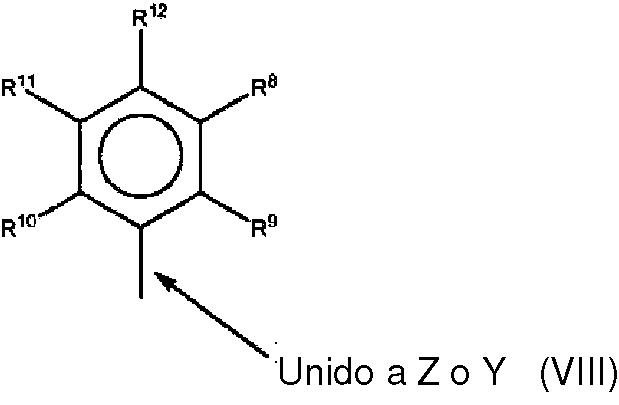
Cuando R4 y R5 son como la fórmula VII, R8 a R12 son cada uno independientemente hidrógeno, un grupo alquilo Ci a C40, un haluro, un heteroátomo, un grupo que contiene heteroátomos que contiene hasta 40 átomos de carbono. En muchas realizaciones, R8 a R12 es un grupo alquilo C1 a C20 lineal o ramificado, tal como un grupo metilo, etilo, propilo o butilo. Cualquiera de los dos grupos R puede formar un grupo cíclico y/o un grupo heterocíclico. Los grupos cíclicos pueden ser aromáticos. En una realización R9, R10 y R42 son independientemente un grupo metilo, etilo, propilo o butilo (incluyendo todos los isómeros). En otra realización, R9, R10 y R12 son grupos metilo y R8 y R11 son hidrógeno.When R4 and R5 are as formula VII, R8 to R12 are each independently hydrogen, a Ci to C40 alkyl group, a halide, a heteroatom, a heteroatom-containing group containing up to 40 carbon atoms. In many embodiments, R8 to R12 is a linear or branched C1 to C20 alkyl group, such as a methyl, ethyl, propyl, or butyl group. Either of the two R groups can form a cyclic group and/or a heterocyclic group. The cyclic groups can be aromatic. In one embodiment R9, R10 and R42 are independently a methyl, ethyl, propyl or butyl group (including all isomers). In another embodiment, R9, R10 and R12 are methyl groups and R8 and R11 are hydrogen.
En una o más realizaciones, R4 y R5son ambos un grupo representado por la siguiente fórmula (IX).In one or more embodiments, R4 and R5 are both a group represented by the following formula (IX).

Cuando R4 y R5 siguen la fórmula IX, M es un metal del grupo 4, tal como zirconio, titanio o hafnio. En muchas realizaciones, M es circonio. Cada uno de L, Y y Z puede ser un nitrógeno. Cada uno de R1 y R2 pueden ser -CH2-CH2-. R3 puede ser hidrógeno, y R6 y R7 pueden estar ausentes.When R4 and R5 follow formula IX, M is a group 4 metal, such as zirconium, titanium, or hafnium. In many embodiments, M is zirconium. Each of L, Y and Z may be a nitrogen. Each of R1 and R2 may be -CH2-CH2-. R3 can be hydrogen, and R6 and R7 can be absent.
El compuesto catalítico que contiene metal del Grupo 15 puede representarse mediante la siguiente fórmula (X).The Group 15 metal-containing catalyst compound can be represented by the following formula (X).

En la fórmula X, Ph representa fenilo.In formula X, Ph represents phenyl.
Catalizador en suspensiónsuspension catalyst
El sistema de catalizadores puede incluir un componente catalizador en una suspensión, que puede tener un compuesto catalizador inicial y un componente catalizador en disolución añadido que se añade a la suspensión. La suspensión de componente catalizador inicial puede no tener catalizadores. En este caso, pueden añadirse uno o más catalizadores en disolución a la suspensión para provocar que cada uno sea soportado.The catalyst system may include a slurry catalyst component, which may have an initial catalyst compound, and an added solution catalyst component that is added to the slurry. The initial catalyst component slurry may be free of catalysts. In this case, one or more solution catalysts may be added to the slurry to cause each to be supported.
Puede usarse cualquier número de combinaciones de componentes catalizadores en las realizaciones. Por ejemplo, la suspensión de componente catalizador puede incluir un activador y un soporte, o un activador soportado. Además, la suspensión puede incluir un compuesto catalizador además del activador y el soporte. Como se señaló, el compuesto catalítico en la suspensión puede estar soportado. Any number of combinations of catalyst components can be used in the embodiments. For example, the catalyst component slurry can include an activator and a support, or a supported activator. Furthermore, the suspension can include a catalyst compound in addition to the activator and the support. As noted, the catalyst compound in the suspension may be supported.
La suspensión puede incluir uno o más activadores y soportes, y uno o más compuestos catalizadores. Por ejemplo, la suspensión puede incluir dos o más activadores (tales como alumoxano y un alumoxano modificado) y un compuesto catalizador, o la suspensión puede incluir un activador soportado y más de un compuesto catalizador. En una realización, la suspensión incluye un soporte, un activador y dos compuestos catalizadores. En otra realización, la suspensión incluye un soporte, un activador y dos compuestos catalizadores diferentes, que pueden añadirse a la suspensión por separado o en combinación. La suspensión, que contiene sílice y alumoxano, se puede poner en contacto con un compuesto catalítico, dejar reaccionar y, después de eso, la suspensión se pone en contacto con otro compuesto catalítico, por ejemplo, en un sistema de acabado.The suspension can include one or more activators and supports, and one or more catalyst compounds. For example, the suspension can include two or more activators (such as alumoxane and a modified alumoxane) and a catalyst compound, or the suspension can include a supported activator and more than one catalyst compound. In one embodiment, the suspension includes a support, an activator, and two catalyst compounds. In another embodiment, the suspension includes a support, an activator, and two different catalyst compounds, which may be added to the suspension separately or in combination. The slurry, containing silica and alumoxane, can be contacted with a catalyst compound, allowed to react, and thereafter the slurry is contacted with another catalyst compound, eg in a finishing system.
La relación molar de metal en el activador respecto al metal en el compuesto catalítico en la suspensión puede ser de 1000:1 a 0,5:1, 300:1 a 1:1, o 150:1 a 1:1. La suspensión puede incluir un material de soporte que puede ser cualquier material portador partículado inerte conocido en la técnica, que incluye, pero no se limita a, sílice, sílice pirogénica, alúmina, arcilla, talco u otros materiales de soporte tales como se describen a continuación. En una realización, la suspensión comprende sílice y un activador, tal como metilaluminoxano (“ MAO” ), metilaluminoxano modificado (“MMAO”), tal como se adicionalmente a continuación.The molar ratio of metal in the activator to metal in the catalyst compound in the slurry can be from 1000:1 to 0.5:1, 300:1 to 1:1, or 150:1 to 1:1. The suspension may include a support material which may be any inert particulate carrier material known in the art, including, but not limited to, silica, fumed silica, alumina, clay, talc, or other support materials such as described below. continuation. In one embodiment, the slurry comprises silica and an activator, such as methylaluminoxane ("MAO"), modified methylaluminoxane ("MMAO"), as further described below.
Pueden usarse uno o más diluyentes o portadores para facilitar la combinación de dos o más componentes cualesquiera del sistema catalítico en la suspensión o en la solución del catalizador de equilibrio. Por ejemplo, el compuesto catalizador de sitio único y el activador pueden combinarse juntos en presencia de tolueno u otra mezcla de hidrocarburos o hidrocarburos no reactivos para proporcionar la mezcla de catalizadores. Además de tolueno, otros diluyentes adecuados pueden incluir, pero no se limitan a, etilbenceno, xileno, pentano, hexano, heptano, octano, otros hidrocarburos o cualquier combinación de los mismos. El soporte, ya sea seco o mezclado con tolueno, puede añadirse a continuación a la mezcla de catalizadores o la mezcla de catalizador/activador puede añadirse al soporte.One or more diluents or carriers may be used to facilitate the combination of any two or more components of the catalyst system in the slurry or solution of the equilibrium catalyst. For example, the single site catalyst compound and activator can be combined together in the presence of toluene or other hydrocarbon mixture or unreactive hydrocarbons to provide the catalyst mixture. In addition to toluene, other suitable diluents may include, but are not limited to, ethylbenzene, xylene, pentane, hexane, heptane, octane, other hydrocarbons, or any combination thereof. The support, either dry or mixed with toluene, can then be added to the catalyst mixture or the catalyst/activator mixture can be added to the support.
SoporteMedium
Como se usa en el presente documento, los términos “soporte” y “portador” se usan indistintamente y se refieren a cualquier material de soporte, incluyendo un material de soporte poroso, tal como talco, óxidos inorgánicos y cloruros inorgánicos. El uno o más compuestos catalíticos de sitio único de la suspensión pueden estar soportados en los mismos o separados soportes junto con el activador, o el activador puede usarse en forma no soportada, o puede depositarse en un soporte diferente de los compuestos catalíticos de sitio único, o cualquier combinación de los mismos. Esto puede lograrse mediante cualquier técnica comúnmente utilizada en la técnica. Existen diversos otros métodos en la técnica para soportar un compuesto catalítico de sitio único. Por ejemplo, el compuesto catalítico de sitio único puede contener un ligando unido al polímero. Los compuestos catalíticos de sitio único de la suspensión se pueden secar por pulverización. El soporte usado con el compuesto catalítico de sitio único puede funcionalizarse.As used herein, the terms "support" and "carrier" are used interchangeably and refer to any support material, including a porous support material, such as talc, inorganic oxides, and inorganic chlorides. The one or more single-site catalyst compounds in the suspension may be supported on the same or separate supports together with the activator, or the activator may be used in unsupported form, or may be deposited on a different support from the single-site catalyst compounds. , or any combination thereof. This can be achieved by any technique commonly used in the art. Various other methods exist in the art for supporting a single site catalyst compound. For example, the single site catalyst compound can contain a ligand attached to the polymer. The single site catalyst compounds in the slurry can be spray dried. The support used with the single site catalyst compound can be functionalized.
El soporte puede ser o incluir uno o más óxidos inorgánicos, por ejemplo, de elementos del Grupo 2, 3, 4, 5, 13 o 14. El óxido inorgánico puede incluir, pero no se limita a, sílice, alúmina, titania, zircona, boria, óxido de zinc, magnesia o cualquier combinación de los mismos. Las combinaciones ilustrativas de óxidos inorgánicos pueden incluir, pero no se limitan a, alúmina-sílice, sílice-titania, alúmina-silice-titania, alúmina-circonia, alúmina-titania y similares. El soporte puede ser o incluir sílice, alúmina o una combinación de los mismos. En una realización descrita en el presente documento, el soporte es sílice. En otra realización descrita en el presente documento, el soporte es sílicealúmina.The support can be or include one or more inorganic oxides, for example, of Group 2, 3, 4, 5, 13 or 14 elements. The inorganic oxide can include, but is not limited to, silica, alumina, titania, zirconia , boria, zinc oxide, magnesia or any combination thereof. Illustrative combinations of inorganic oxides may include, but are not limited to, alumina-silica, silica-titania, alumina-silica-titania, alumina-zirconia, alumina-titania, and the like. The support can be or include silica, alumina, or a combination thereof. In an embodiment described herein, the support is silica. In another embodiment described herein, the support is silicaalumina.
Los soportes de sílice disponibles comercialmente adecuados pueden incluir, pero no se limitan a, ES757, ES70, y ES70W disponibles de la empresa PQ Corporation. Los soportes de sílice-alúmina disponibles comercialmente adecuados pueden incluir, pero no se limitan a, SIRAL® 1, SIRAL® 5, SIRAL® 10, SIRAL® 20, SIRAL® 28M, SIRAL® 30 y SIRAL® 40, disponibles de SASOL®. Generalmente, los soportes de catalizadores que comprenden geles de sílice con activadores, tales como metilaluminoxanos (MAO), se usan en los sistemas de ajuste descritos, ya que estos soportes pueden funcionar mejor para el soporte conjunto de catalizadores portados en disolución. Suitable commercially available silica supports may include, but are not limited to, ES757, ES70, and ES70W available from PQ Corporation. Suitable commercially available silica-alumina supports may include, but are not limited to, SIRAL® 1, SIRAL® 5, SIRAL® 10, SIRAL® 20, SIRAL® 28M, SIRAL® 30 and SIRAL® 40, available from SASOL® . Generally, catalyst supports comprising silica gels with activators, such as methylaluminoxanes (MAO), are used in the described trim systems, as these supports may work better for co-support of solution-borne catalysts.
ActivadorActivator
Como se usa en el presente documento, el término “activador” puede referirse a cualquier compuesto o combinación de compuestos, soportados o no soportados, que puede activar un compuesto o componente catalítico de sitio único, tal como mediante la creación de una especie catiónica del componente catalítico. Por ejemplo, esto puede incluir la abstracción de al menos un grupo saliente (el grupo “X” en los compuestos catalíticos de sitio único descritos en el presente documento) del centro de metal del compuesto/componente catalítico de sitio único. El activador también puede denominarse “co-catalizador” .As used herein, the term "activator" can refer to any compound or combination of compounds, supported or unsupported, that can activate a single-site catalyst compound or component, such as by creating a cationic species of the catalyst. catalytic component. For example, this may include abstraction of at least one leaving group (the "X" group in the single site catalyst compounds described herein) from the metal center of the single site catalyst compound/component. The activator may also be referred to as a "co-catalyst".
Por ejemplo, el activador puede incluir un ácido de Lewis o un activador iónico no coordinante o activador ionizante, o cualquier otro compuesto que incluya bases de Lewis, alquilos de aluminio y/o co-catalizadores de tipo convencional. Además de metilaluminoxano (“MAO”) y metilaluminoxano modificado (“ MMAO” ) mencionados anteriormente, los activadores ilustrativos pueden incluir, pero no se limitan a, aluminoxano o aluminoxano modificado, y/o compuestos ionizantes, neutros o iónicos, tales como tris(n-butil)amonio tetrakis(pentafluorofenil)boro, un trisperfluorofenilboro, un trisperfluoronaftilboro o cualquier combinación de los mismos.For example, the activator can include a Lewis acid or a non-coordinating ionic activator or ionizing activator, or any other compound including Lewis bases, aluminum alkyls, and/or conventional type cocatalysts. In addition to the aforementioned methylaluminoxane ("MAO") and modified methylaluminoxane ("MMAO"), illustrative activators may include, but are not limited to, aluminoxane or aluminoxane modified, and/or ionizing, neutral or ionic compounds, such as tris(n-butyl)ammonium tetrakis(pentafluorophenyl)boron, a trisperfluorophenylboron, a trisperfluoronaphthylboron, or any combination thereof.
Los aluminoxanos pueden describirse como compuestos de aluminio oligoméricos que tienen subunidades de -Al(R)-O, donde R es un grupo alquilo. Los ejemplos de aluminoxanos incluyen, pero no se limitan a, metilaluminoxano (“ MAO”), metilaluminoxano modificado (“ MMAO”), etilaluminoxano, isobutilaluminoxano o una combinación de los mismos. Los aluminoxanos pueden producirse mediante la hidrólisis del respectivo compuesto de trialquilaluminio. El MMAO puede producirse mediante la hidrólisis de trimetilaluminio y un trialquilaluminio superior, tal como triisobutilaluminio. Los MMAO son generalmente más solubles en disolventes alifáticos y más estables durante el almacenamiento. Hay una variedad de métodos para preparar aluminoxano y aluminoxanos modificados.Aluminoxanes can be described as oligomeric aluminum compounds having -Al(R)-O subunits, where R is an alkyl group. Examples of aluminoxanes include, but are not limited to, methylaluminoxane ("MAO"), modified methylaluminoxane ("MMAO"), ethylaluminoxane, isobutylaluminoxane, or a combination thereof. Aluminoxanes can be produced by hydrolysis of the respective trialkylaluminum compound. MMAO can be produced by hydrolysis of trimethylaluminum and a higher trialkylaluminum, such as triisobutylaluminum. MMAOs are generally more soluble in aliphatic solvents and more stable on storage. There are a variety of methods for preparing aluminoxane and modified aluminoxanes.
En una o más realizaciones, puede usarse un MAO visualmente transparente. Por ejemplo, un aluminoxano turbio o gelificado puede filtrarse para producir un aluminoxano transparente o el aluminoxano transparente puede decantarse de una solución de aluminoxano turbia. En otra realización, puede usarse un aluminoxano turbio y/o gelificado. Otro aluminoxano puede incluir un metilaluminoxano modificado (“MMAO”) tipo 3A (disponible comercialmente de la empresa Akzo Chemicals, Inc. con la marca comercial metilaluminoxano modificado tipo 3A). Una fuente adecuada de MAO puede ser una solución que tenga de aproximadamente 1 % en peso a aproximadamente un 50 % en peso de MAO, por ejemplo. Las soluciones de MAO comercialmente disponibles pueden incluir el 10 % en peso y el 30 % en peso de soluciones de MAO disponibles de la empresa Albemarle Corporation, de Baton Rouge, La.In one or more embodiments, a visually transparent MAO may be used. For example, a cloudy or gelled aluminoxane can be filtered to produce a clear aluminoxane or the clear aluminoxane can be decanted from a cloudy aluminoxane solution. In another embodiment, a cloudy and/or gelled aluminoxane may be used. Other aluminoxane can include a modified methylaluminoxane ("MMAO") type 3A (commercially available from Akzo Chemicals, Inc. under the tradename modified methylaluminoxane type 3A). A suitable source of MAO can be a solution having from about 1% by weight to about 50% by weight of MAO, for example. Commercially available MAO solutions can include 10% by weight and 30% by weight MAO solutions available from Albemarle Corporation of Baton Rouge, La.
Como se señaló anteriormente, uno o más compuestos de organo-aluminio tales como uno o más compuestos de alquilaluminio pueden usarse junto con los aluminoxanos. Por ejemplo, las especies de alquilaluminio que pueden usarse son etóxido de dietilaluminio, cloruro de dietilaluminio y/o hidruro de diisobutilaluminio. Los ejemplos de compuestos de trialquilaluminio incluyen, pero no se limitan a, trimetilaluminio, trietilaluminio (“TEAL” ), triisobutilaluminio (“TiBAl” ), tri-n-hexilaluminio, tri-n-octilaluminio, tripropilaluminio, tributilaluminio y similares.As noted above, one or more organoaluminum compounds such as one or more alkylaluminum compounds can be used in conjunction with the aluminoxanes. For example, alkyl aluminum species that can be used are diethyl aluminum ethoxide, diethyl aluminum chloride, and/or diisobutylaluminum hydride. Examples of trialkylaluminum compounds include, but are not limited to, trimethylaluminum, triethylaluminum ("TEAL"), triisobutylaluminum ("TiBAl"), tri-n-hexylaluminum, tri-n-octylaluminum, tripropylaluminum, tributylaluminum, and the like.
Disolución de componente catalizadorSolution of catalyst component
La disolución de componente catalizador puede incluir sólo un compuesto catalizador o puede incluir un activador además del compuesto catalizador. La solución catalítica utilizada en el proceso de acabado puede prepararse disolviendo el compuesto catalítico y activadores opcionales en un disolvente líquido. El disolvente líquido puede ser un alcano, tal como un alcano C5 a C30, o un alcano C5 a C10. También se pueden usar alcanos cíclicos tales como ciclohexano y compuestos aromáticos tales como tolueno. Además, se puede usar aceite mineral como disolvente. La solución empleada debería ser líquida en las condiciones de polimerización y relativamente inerte. En una realización, el líquido utilizado en la solución de compuesto catalítico es diferente del diluyente usado en la suspensión del componente catalizador. En otra realización, el líquido utilizado en la solución de compuesto catalítico es el mismo que el diluyente usado en la solución del componente catalizador.The catalyst component solution may include only one catalyst compound or may include an activator in addition to the catalyst compound. The catalyst solution used in the finishing process can be prepared by dissolving the catalyst compound and optional activators in a liquid solvent. The liquid solvent can be an alkane, such as a C5 to C30 alkane, or a C5 to C10 alkane. Cyclic alkanes such as cyclohexane and aromatics such as toluene can also be used. Also, mineral oil can be used as a solvent. The solution used should be liquid under the polymerization conditions and relatively inert. In one embodiment, the liquid used in the catalyst compound solution is different from the diluent used in the catalyst component slurry. In another embodiment, the liquid used in the catalyst compound solution is the same as the diluent used in the catalyst component solution.
Si la solución de catalizador incluye tanto activador como compuesto catalítico, la relación de metal en el activador respecto al metal en el compuesto catalítico en la solución puede ser de 1000:1 a 0,5:1, 300:1 a 1:1, o 150:1 a 1:1. En diversas realizaciones, el activador y el compuesto catalizador están presentes en la disolución hasta aproximadamente el 90 % en peso, hasta aproximadamente el 50 % en peso, en hasta aproximadamente el 20 % en peso, preferiblemente en hasta aproximadamente el 10 % en peso, en hasta aproximadamente el 5 % en peso, a menos del 1 % en peso, o entre 100 ppm y el 1 % en peso, basado en el peso del disolvente y el activador o compuesto catalizador.If the catalyst solution includes both activator and catalyst compound, the ratio of metal in activator to metal in catalyst compound in solution can be from 1000:1 to 0.5:1, 300:1 to 1:1, or 150:1 to 1:1. In various embodiments, the activator and catalyst compound are present in the solution at up to about 90% by weight, up to about 50% by weight, up to about 20% by weight, preferably up to about 10% by weight, at up to about 5% by weight, to less than 1% by weight, or between 100 ppm and 1% by weight, based on the weight of the solvent and activator or catalyst compound.
La disolución de componente catalizador puede comprender uno cualquiera de los compuestos catalizadores solubles descritos en la sección de catalizador en el presente documento. Como el catalizador se disuelve en la solución, es deseable una solubilidad más alta. Por consiguiente, el compuesto catalizador en la disolución de componente catalizador a menudo puede incluir un metaloceno, que puede tener una mayor solubilidad que otros catalizadores.The catalyst component solution may comprise any one of the soluble catalyst compounds described in the catalyst section herein. As the catalyst dissolves in the solution, a higher solubility is desirable. Accordingly, the catalyst compound in the catalyst component solution can often include a metallocene, which can have a higher solubility than other catalysts.
En el procedimiento de polimerización, descrito a continuación, cualquiera de las disoluciones que contienen componentes catalizadores descritas anteriormente puede combinarse con cualquiera de la suspensión/suspensiones que contienen el componente catalizador descritas anteriormente. Además, se puede utilizar más de una solución de componente catalítico.In the polymerization process, described below, any of the catalyst component-containing solutions described above may be combined with any of the catalyst component-containing slurry(s) described above. Furthermore, more than one catalyst component solution may be used.
Aditivo de continuidad/Agente de control estáticoContinuity Additive/Static Control Agent
En los procedimientos de producción de polietileno en fase gaseosa puede ser deseable usar uno o más agentes de control estático para ayudar a regular los niveles estáticos en el reactor. Como se usa en el presente documento, un agente de control estático es una composición química que, cuando se introduce en un reactor de lecho fluidizado, puede influir o impulsar la carga estática (negativamente, positivamente, o a cero) en el lecho fluidizado. El agente de control estático específico usado puede depender de la naturaleza de la carga estática, y la elección del agente de control estático puede variar dependiendo del polímero que se produce y los compuestos catalíticos de sitio único que se usan.In gas phase polyethylene production processes it may be desirable to use one or more static control agents to help regulate static levels in the reactor. As used herein, a static control agent is a chemical composition that, when introduced into a fluidized bed reactor, can influence or drive the static charge (negatively, positively, or to zero) in the fluidized bed. The agent of The specific static control used may depend on the nature of the static charge, and the choice of static control agent may vary depending on the polymer being produced and the single site catalyst compounds being used.
Se pueden emplear agentes de control tales como estearato de aluminio. El agente de control estático usado puede seleccionarse por su capacidad para recibir la carga estática en el lecho fluidizado sin afectar negativamente la productividad. Otros agentes de control estático adecuados también pueden incluir diestearato de aluminio, aminas etoxiladas y composiciones antiestáticas tales como las proporcionadas por la empresa Innospec Inc. con el nombre comercial OCTASTAT. Por ejemplo, OCTASTAT 2000 es una mezcla de un copolímero de polisulfona, una poliamina polimérica y ácido sulfónico soluble en aceite.Control agents such as aluminum stearate may be used. The static control agent used can be selected for its ability to take up the static charge in the fluidized bed without adversely affecting productivity. Other suitable static control agents may also include aluminum distearate, ethoxylated amines, and antistatic compositions such as those supplied by Innospec Inc. under the tradename OCTASTAT. For example, OCTASTAT 2000 is a blend of a polysulfone copolymer, a polymeric polyamine, and oil-soluble sulfonic acid.
Cualquiera de los agentes de control mencionados anteriormente puede emplearse solo o en combinación como agente de control. Por ejemplo, la sal metálica de carboxilato puede combinarse con un agente de control que contiene amina (por ejemplo, una sal metálica de carboxilato con cualquier miembro de la familia que pertenece a la familia de productos de KEMAMINE® (disponible de Crompton Corporation) o ATMER® (disponible de ICI Americas Inc.).Any of the control agents mentioned above can be used alone or in combination as a control agent. For example, the carboxylate metal salt can be combined with an amine-containing control agent ( eg, a carboxylate metal salt with any family member belonging to the KEMAMINE® family of products (available from Crompton Corporation) or ATMER® (available from ICI Americas Inc.).
Otros aditivos de continuidad útiles que incluyen aditivos de etilenimina útiles en las realizaciónes descritas en el presente documento pueden incluir polietileniminas que tienen la siguiente fórmula general:Other useful continuity additives including ethyleneimine additives useful in the embodiments described herein can include polyethyleneimines having the following general formula:
-(CH2 - CH2 - NH)n -en la que n puede ser de aproximadamente 10 a aproximadamente 10.000. Las polietileniminas pueden ser lineales, ramificadas o hiperramificadas (por ejemplo, formando estructuras poliméricas dendríticas o arborescentes). Pueden ser un homopolímero o copolímero de etilenimina o mezclas de los mismos (denominados polietileniminas más adelante en el presente documento). Aunque polímeros lineales representados por la fórmula química --[CH2-CH2-NH]-- puede usarse como polietilenimina, también pueden usarse materiales que tienen ramificaciones primarias, secundarias y terciarias. La polietilenimina comercial puede ser un compuesto que tiene ramificaciones del polímero de etilenimina.-(CH2-CH2-NH)n -wherein n can be from about 10 to about 10,000. Polyethyleneimines can be linear, branched, or hyperbranched (eg, forming dendritic or arborescent polymeric structures). They may be an ethyleneimine homopolymer or copolymer or mixtures thereof (referred to hereinafter as polyethyleneimines). Although linear polymers represented by the chemical formula --[CH2-CH2-NH]-- can be used as polyethyleneimine, materials having primary, secondary and tertiary branching can also be used. The commercial polyethyleneimine can be a compound having branches of the ethyleneimine polymer.
Las polietileniminas adecuadas están disponibles comercialmente de la empresa BASF Corporation bajo el nombre comercial Lupasol. Estos compuestos pueden prepararse como una amplia gama de pesos moleculares y actividades de productos. Los ejemplos de polietileniminas comerciales vendidas por la empresa BASF adecuadas para su uso en la presente invención incluyen, pero no se limitan a, Lupasol FG y Lupasol WF.Suitable polyethyleneimines are commercially available from BASF Corporation under the trade name Lupasol. These compounds can be prepared as a wide range of molecular weights and activity products. Examples of commercial polyethyleneimines sold by the BASF company suitable for use in the present invention include, but are not limited to, Lupasol FG and Lupasol WF.
Otro aditivo de continuidad útil puede incluir una mezcla de diestearato de aluminio y un compuesto de tipo amina etoxilado, por ejemplo, IRGASTAT AS-990, disponible de Huntsman (anteriormente Ciba Specialty Chemicals). La mezcla de diestearato de aluminio y compuesto de tipo amina etoxilado puede suspenderse en aceite mineral, por ejemplo, en el producto disponible comercialmente Hydrobrite 380. Por ejemplo, la mezcla de diestearato de aluminio y un compuesto de tipo amina etoxilado se puede suspender en aceite mineral para tener una concentración total de suspensión que varía de aproximadamente 5 % en peso a aproximadamente 50 % en peso o aproximadamente 10 % en peso a aproximadamente 40 % en peso, o aproximadamente 15 % en peso a aproximadamente 30 % en peso.Another useful continuity additive can include a mixture of aluminum distearate and an ethoxylated amine compound, for example, IRGASTAT AS-990, available from Huntsman (formerly Ciba Specialty Chemicals). The mixture of aluminum distearate and ethoxylated amine compound can be slurried in mineral oil, for example, in the commercially available product Hydrobrite 380. For example, the mixture of aluminum distearate and ethoxylated amine compound can be slurried in oil. mineral to have a total slurry concentration ranging from about 5% by weight to about 50% by weight or about 10% by weight to about 40% by weight, or about 15% by weight to about 30% by weight.
Los aditivos de continuidad o los agentes de control estático pueden añadirse al reactor en una cantidad que varía entre 0,05 y 200 ppm, basado en el peso de todas las alimentaciones al reactor, excluyendo la recirculación. En algunas realizaciones, el aditivo de continuidad puede añadirse en una cantidad que varía de 2 a 100 ppm, o en una cantidad que varía de 4 a 50 ppm.Continuity additives or static control agents can be added to the reactor in an amount ranging from 0.05 to 200 ppm, based on the weight of all feeds to the reactor, excluding recirculation. In some embodiments, the continuity additive can be added in an amount ranging from 2 to 100 ppm, or in an amount ranging from 4 to 50 ppm.
Reactor de polimerización en fase gaseosaGas Phase Polymerization Reactor
La Fig. 1 es un esquema de un sistema 100 de reactores en fase gaseosa, que muestra la adición de al menos dos catalizadores, al menos uno de los cuales se añade como un catalizador de ajuste. La suspensión de componente catalizador, preferiblemente una suspensión de aceite mineral que incluye al menos un soporte y al menos un activador, al menos un activador soportado y compuestos catalizadores opcionales pueden colocarse en un recipiente o recipiente 102 de catalizador (recipiente de cat.). En una realización, el recipiente 102 de cat. es un tanque de retención agitado diseñado para mantener homogénea la concentración de sólidos. Se coloca una disolución de componente catalizador, preparada mezclando un disolvente y al menos un compuesto catalizador y/o activador, en otro recipiente, que puede denominarse un recipiente 104 de ajuste. La suspensión de componente catalizador luego puede combinarse en línea con la disolución de componente catalizador para formar una composición de catalizadores final. Puede añadirse un agente 106 de nucleación, tal como sílice, alúmina, sílice pirogénica o cualquier otra materia particulada a la suspensión y/o la disolución en línea o en los recipientes 102 ó 104. De manera similar, pueden añadirse activadores o compuestos catalizadores adicionales en línea. Por ejemplo, una segunda suspensión de catalizador que incluye un catalizador diferente puede introducirse desde un segundo recipiente de cat. Las dos suspensiones de catalizador pueden usarse como el sistema de catalizadores con o sin la adición de un catalizador en disolución desde el recipiente de ajuste. Fig. 1 is a schematic of a gas phase reactor system 100, showing the addition of at least two catalysts, at least one of which is added as a trim catalyst. The catalyst component slurry, preferably a mineral oil slurry including at least one support and at least one activator, at least one supported activator and optional catalyst compounds may be placed in a catalyst vessel or vessel 102 (cat. vessel). In one embodiment, the container 102 of cat. It is an agitated retention tank designed to maintain a homogeneous concentration of solids. A catalyst component solution, prepared by mixing a solvent and at least one catalyst and/or activator compound, is placed in another container, which may be referred to as an adjustment container 104 . The catalyst component slurry can then be combined in-line with the catalyst component solution to form a final catalyst composition. A nucleating agent 106, such as silica, alumina, fumed silica, or any other particulate matter, may be added to the suspension and/or solution on line or in vessels 102 or 104. Similarly, additional activators or catalyst compounds may be added. online. For example, a second catalyst slurry that includes a different catalyst can be introduced from a second cat. The two catalyst slurries can be used as the catalyst system with or without the addition of a solution catalyst from the buffer vessel.
La suspensión y la disolución del componente catalizador pueden mezclarse en línea. Por ejemplo, la disolución y la suspensión pueden mezclarse utilizando una mezcladora 108 estática o un recipiente de agitación (no mostrado). El mezclado de la suspensión de componente catalizador y la disolución de componente catalizador debería ser lo suficientemente larga como para permitir que el compuesto catalizador en la disolución de componente catalizador se disperse en la suspensión de componente catalizador de manera que el componente catalizador, originalmente en la disolución, migre al activador soportado originalmente presente en la suspensión. La combinación forma una dispersión uniforme de compuestos catalizadores en el activador soportado que forma la composición de catalizadores. La duración del tiempo que la suspensión y la disolución se ponen en contacto es normalmente de hasta aproximadamente 120 minutos, tal como de aproximadamente 1 a aproximadamente 60 minutos, de aproximadamente 5 a aproximadamente 40 minutos, o de aproximadamente 10 a aproximadamente 30 minutos. The suspension and solution of the catalyst component can be mixed online. For example, the solution and suspension can be mixed using a static mixer 108 or a stirring vessel (not shown). The mixing of the catalyst component slurry and the catalyst component solution should be long enough to allow the catalyst compound in the catalyst component solution to disperse in the catalyst component slurry such that the catalyst component, originally in the solution, migrate to the supported activator originally present in the suspension. The combination forms a uniform dispersion of catalyst compounds in the supported activator which forms the catalyst composition. The length of time that the suspension and the solution are contacted is usually up to about 120 minutes, such as about 1 to about 60 minutes, about 5 to about 40 minutes, or about 10 to about 30 minutes.
Cuando se combinan los catalizadores, el activador y el soporte opcional o cocatalizadores adicionales en los disolventes de hidrocarburos inmediatamente antes de un reactor de polimerización, es deseable que la combinación produzca un nuevo catalizador de polimerización en menos de 1 h, menos de 30 min o menos de 15 min. Los tiempos más cortos son más efectivos, ya que el nuevo catalizador está listo antes de introducirse en el reactor, proporcionando el potencial para velocidades de flujo más rápidas.When the catalysts, activator, and optional support or additional cocatalysts are combined in the hydrocarbon solvents immediately prior to a polymerization reactor, it is desirable that the combination produce a new polymerization catalyst in less than 1 h, less than 30 min, or less than 15 minutes Shorter times are more effective, as the new catalyst is ready before it is fed into the reactor, providing the potential for faster flow rates.
En otra realización, un alquilo de aluminio, un alquilo de aluminio etoxilado, un aluminoxano, un agente antiestático o un activador de borato, tal como un alquil C1 a C15-aluminio (por ejemplo, tri-isobutil-aluminio, trimetil-aluminio o similares), un alquil C1 a C15-aluminio etoxilado o metilaluminoxano, etilaluminoxano, isobutilaluminoxano, aluminoxano modificado o similares se añaden a la mezcla de la suspensión y la disolución en línea. Los alquilos, agentes antiestáticos, activadores de borato y/o aluminoxanos pueden añadirse desde un recipiente 110 de alquilo directamente a la combinación de la disolución y la suspensión, o pueden añadirse mediante una corriente de portador de alcano (tal como isopentano, hexano, heptano y u octano) adicionales, por ejemplo, desde un recipiente 112 de hidrocarburo. Los alquilos, agentes antiestáticos, activadores de borato y/o aluminoxanos adicionales pueden estar presentes en hasta aproximadamente 500 ppm, a de aproximadamente 1 a aproximadamente 300 ppm, a de 10 a aproximadamente 300 ppm, o a de aproximadamente 10 a aproximadamente 100 ppm. Las corrientes de portador que pueden usarse incluyen isopentano y/o hexano, entre otros. El portador puede añadirse a la mezcla de la suspensión y la disolución, normalmente a una tasa de aproximadamente 0,5 a aproximadamente 60 lb/h (27 kg/h). De manera similar, un gas 114 portador, tal como nitrógeno, argón, etano, propano y similares, puede añadirse en línea a la mezcla de la suspensión y la disolución. Normalmente, el gas portador puede añadirse a una tasa de aproximadamente 1 a aproximadamente 100 lb/h (de 0,4 a 45 kg/h), o de aproximadamente 1 a aproximadamente 50 lb/h (de 5 a 23 kg/h), o de aproximadamente 1 a aproximadamente 25 lb/h (de 0,4 a 11 kg/h). In another embodiment, an aluminum alkyl, an ethoxylated aluminum alkyl, an aluminoxane, an antistatic agent, or a borate activator, such as a C1 to C15 alkyl aluminum (for example, tri-isobutyl aluminum, trimethyl aluminum, or the like), a C1 to C15 alkylaluminum ethoxylate or methylaluminoxane, ethylaluminoxane, isobutylaluminoxane, modified aluminoxane or the like are added to the mixture of the suspension and the solution in line. The alkyls, antistatic agents, borate activators, and/or aluminoxanes can be added from an alkyl vessel 110 directly to the solution and slurry combination, or they can be added via an alkane carrier stream (such as isopentane, hexane, heptane, etc.). and or octane) additional, eg, from a hydrocarbon vessel 112. Additional alkyls, antistatic agents, borate activators and/or aluminoxanes may be present at up to about 500 ppm, at about 1 to about 300 ppm, at 10 to about 300 ppm, or at about 10 to about 100 ppm. Carrier streams that can be used include isopentane and/or hexane, among others. The carrier can be added to the mixture of the suspension and solution, typically at a rate of from about 0.5 to about 60 lb/hr (27 kg/hr). Similarly, a carrier gas 114, such as nitrogen, argon, ethane, propane, and the like, can be added online to the mixture of slurry and solution. Typically, the carrier gas can be added at a rate of from about 1 to about 100 lb/hr (0.4 to 45 kg/hr), or from about 1 to about 50 lb/hr (5 to 23 kg/hr). , or from about 1 to about 25 lb/hr (0.4 to 11 kg/hr).
En otra realización, se introduce una corriente de portador líquida en la combinación de la disolución y la suspensión que se mueve en una dirección hacia abajo. La mezcla de la disolución, la suspensión y la corriente de portador líquida se pueden hacer pasar a través de una mezcladora o longitud de tubo para mezclar antes de ponerse en contacto con una corriente de portador gaseosa.In another embodiment, a liquid carrier stream is introduced into the combination of solution and suspension moving in a downward direction. The mixture of the solution, suspension and liquid carrier stream may be passed through a mixer or length of mixing tubing before contacting a gaseous carrier stream.
De manera similar, un comonómero 116, tal como 1-buteno, 1-hexeno, otra alfa-olefina o diolefina, puede añadirse en línea a la mezcla de la suspensión y la disolución. La mezcla de suspensión/disolución luego se hace pasar a través de un tubo 120 de inyección a un reactor 122. En algunas realizaciones, el tubo de inyección puede aerosolizar la mezcla de suspensión/disolución. Cualquier número de tamaños y configuraciones de tubos adecuados puede usarse para aerosolizar y/o inyectar la mezcla de suspensión/disolución.Similarly, a comonomer 116, such as 1-butene, 1-hexene, another alpha-olefin, or diolefin, can be added online to the mixture of slurry and solution. The suspension/solution mixture is then passed through an injection tube 120 to a reactor 122. In some embodiments, the injection tube may aerosolize the suspension/solution mixture. Any number of suitable tube sizes and configurations can be used to aerosolize and/or inject the suspension/solution mixture.
En una realización, se introduce una corriente 124 de gas, tal como gas reinyectado, o gas 126 de recirculación, monómero, nitrógeno u otros materiales en un tubo 128 de soporte que rodea el tubo 120 de inyección. Para ayudar en la formación adecuada de partículas en el reactor 122, puede añadirse directamente un agente 118 de nucleación, tal como sílice pirogénica, al reactor 122.In one embodiment, a stream 124 of gas, such as re-injected gas, or recycle gas 126, monomer, nitrogen, or other materials is introduced into a support tube 128 surrounding the injection tube 120. To aid in proper particle formation in reactor 122, a nucleating agent 118, such as fumed silica, can be added directly to reactor 122.
Cuando se usa un catalizador de metaloceno u otro catalizador similar en el reactor de fase gaseosa, puede añadirse oxígeno o fluorobenceno al reactor 122 directamente o a la corriente 126 de gas para controlar la tasa de polimerización. Por tanto, cuando se usa un catalizador de metaloceno (que es sensible a oxígeno o fluorobenceno) en combinación con otro catalizador (que no es sensible al oxígeno) en un reactor de fase gaseosa, puede usarse oxígeno para modificar la velocidad de polimerización de metaloceno en relación con la tasa de polimerización del otro catalizador. Un ejemplo de una combinación de catalizadores de este tipo es dicloruro de bis(npropilciclopentadienil)zirconio y [(2,4,6-Me3C6 H2)NCH2 CH2]2NHZrBn2, donde Me es dicloruro de bis(indenil)zirconio o metilo y [(2,4,6-Me3CsH2)NCH2CH2]2NHHfBn2, donde Me es metilo. Por ejemplo, si la concentración de oxígeno en la alimentación de nitrógeno se altera desde 0,1 ppm hasta 0,5 ppm, significativamente menos polímero del bisindenil ZrCl2 se producirá y se aumenta la cantidad relativa de polímero producido a partir de [(2,4,6-Me3CsH2)NCH2CH2]2NHHfBn2. Puede añadirse agua o dióxido de carbono a reactores de polimerización de fase gaseosa, por ejemplo, para fines similares. En una realización, la temperatura de contacto de la suspensión y la disolución está en el intervalo de desde 00C hasta aproximadamente 80 0C, desde aproximadamente 00C hasta aproximadamente 60 0C, desde aproximadamente 100C hasta aproximadamente 50 0C, y desde aproximadamente 20 0C hasta aproximadamente 40 0C. When a metallocene or other similar catalyst is used in the gas phase reactor, oxygen or fluorobenzene may be added to reactor 122 directly or to gas stream 126 to control the rate of polymerization. Thus, when a metallocene catalyst (which is sensitive to oxygen or fluorobenzene) is used in combination with another catalyst (which is not sensitive to oxygen) in a gas phase reactor, oxygen can be used to modify the rate of metallocene polymerization. relative to the polymerization rate of the other catalyst. An example of such a catalyst combination is bis(npropylcyclopentadienyl)zirconium dichloride and [(2,4,6-Me3C6H2)NCH2CH2]2NHZrBn2, where Me is bis(indenyl)zirconium dichloride or methyl and [( 2,4,6-Me3CsH2)NCH2CH2]2NHHfBn2, where Me is methyl. For example, if the oxygen concentration in the nitrogen feed is altered from 0.1 ppm to 0.5 ppm, significantly less bisindenyl ZrCl2 polymer will be produced and the relative amount of polymer produced from [(2, 4,6-Me3CsH2)NCH2CH2]2NHHfBn2. Water or carbon dioxide may be added to gas phase polymerization reactors, for example, for similar purposes. In one embodiment, the contact temperature of the suspension and solution is in the range of from 00C to about 800C, from about 00C to about 600C, from about 100C to about 500C, and from about 200C to about 40 0C.
El ejemplo anterior no es limitativo, ya que pueden incluirse soluciones y suspensiones adicionales. Por ejemplo, una suspensión puede combinarse con dos o más disoluciones que tengan los mismos o diferentes compuestos catalizadores y/o activadores. De manera similar, la disolución puede combinarse con dos o más suspensiones que tengan cada una los mismos o diferentes soportes, y los mismos o diferentes compuestos catalizadores y/o activadores. De manera similar, dos o más suspensiones combinadas con dos o más disoluciones, preferiblemente en línea, donde las suspensiones comprenden cada una los mismos o diferentes soportes y pueden comprender los mismos o diferentes compuestos catalizadores y/o activadores y las disoluciones comprenden los mismos o diferentes compuestos catalizadores y/o activadores. Por ejemplo, la suspensión puede contener un activador soportado y dos compuestos catalizadores diferentes, y dos disoluciones que contienen cada uno de los catalizadores en la suspensión, se combinan independientemente cada una, en línea, con la suspensión.The example above is not limiting, as additional solutions and suspensions can be included. For example, a suspension can be combined with two or more solutions having the same or different catalyst and/or activator compounds. Similarly, the solution can be combined with two or more suspensions each having the same or different supports, and the same or different catalyst and/or activator compounds. Similarly, two or more suspensions combined with two or more solutions, preferably in-line, where the suspensions each comprise the same or different supports and may comprise the same or different catalyst and/or activator compounds and the solutions comprise the same or different catalyst and/or activator compounds. For example, the slurry may contain a supported activator and two different catalyst compounds, and two solutions containing each of the catalysts in the slurry are each independently combined, in-line, with the slurry.
Uso de la composición de catalizadores para controlar las propiedades del productoUse of catalyst composition to control product properties
Las propiedades del polímero de producto pueden controlarse ajustando la programación, la temperatura, las concentraciones y la secuencia del mezclado de la disolución, la suspensión y cualquier material opcional añadido (agentes de nucleación, compuestos catalizadores, activadores, etc.) descritos anteriormente. La MWD, la SCBD, la cantidad relativa de polímero producido por cada catalizador y otras propiedades del polímero producido también puede cambiarse manipulando parámetros del procedimiento. Cualquier número de parámetros del procedimiento puede ajustarse, incluyendo la manipulación de la concentración de hidrógeno en el sistema de polimerización, cambiando la cantidad del primer catalizador en el sistema de polimerización, o cambiando la cantidad del segundo catalizador en el sistema de polimerización, entre otros. Otros parámetros del procedimiento que pueden ajustarse incluyen cambiar la razón relativa del catalizador en el procedimiento de polimerización (y opcionalmente ajustar sus tasas de alimentación individuales para mantener una tasa de producción de polímero estacionaria o constante). Las concentraciones de reactivos en el reactor 122 pueden ajustarse cambiando la cantidad de líquido o gas que se extrae o purga del procedimiento, cambiando la cantidad y/o composición de un líquido recuperado y/o un gas recuperado devuelto al procedimiento de polimerización, en donde el líquido recuperado o el gas recuperado pueden recuperarse del polímero descargado del procedimiento de polimerización. Parámetros adicionales que pueden ajustarse incluyen cambiar la temperatura de polimerización, cambiar la presión parcial de etileno en el procedimiento de polimerización, cambiar la razón de etileno con respecto a comonómero en el procedimiento de polimerización, o cambiar la razón de activador con respecto a metal de transición en la secuencia de activación, entre otros. Los parámetros dependientes del tiempo pueden ajustarse, tales como cambiar las tasas de alimentación relativas de la suspensión o disolución, cambiar el tiempo de mezclado, la temperatura y/o el grado de mezclado de la suspensión y la disolución en línea, añadir diferentes tipos de compuestos activadores al procedimiento de polimerización, y añadir oxígeno o fluorobenceno u otro veneno para catalizador al procedimiento de polimerización. Cualquier combinación de estos ajustes puede usarse para controlar las propiedades del producto polimérico final.Product polymer properties can be controlled by adjusting the schedule, temperature, concentrations and sequence of mixing the solution, slurry and any optional added materials (nucleating agents, catalyst compounds, activators, etc.) described above. The MWD, SCBD, the relative amount of polymer produced by each catalyst, and other properties of the polymer produced can also be changed by manipulating process parameters. Any number of process parameters can be adjusted, including manipulating the hydrogen concentration in the polymerization system, changing the amount of the first catalyst in the polymerization system, or changing the amount of the second catalyst in the polymerization system, among others. . Other process parameters that can be adjusted include changing the relative ratio of catalyst in the polymerization process (and optionally adjusting their individual feed rates to maintain a steady or constant rate of polymer production). The concentrations of reactants in the reactor 122 can be adjusted by changing the amount of liquid or gas that is withdrawn or purged from the process, changing the amount and/or composition of a recovered liquid and/or a recovered gas returned to the polymerization process, where the recovered liquid or recovered gas can be recovered from the polymer discharged from the polymerization process. Additional parameters that can be adjusted include changing the polymerization temperature, changing the partial pressure of ethylene in the polymerization process, changing the ratio of ethylene to comonomer in the polymerization process, or changing the ratio of activator to metal of transition in the activation sequence, among others. Time-dependent parameters can be adjusted, such as changing the relative feed rates of the slurry or solution, changing the mixing time, temperature and/or degree of mixing of the slurry and solution online, adding different types of activator compounds to the polymerization process, and adding oxygen or fluorobenzene or other catalyst poison to the polymerization process. Any combination of these adjustments can be used to control the properties of the final polymeric product.
En una realización, la SCBD del producto polimérico se mide a intervalos regulares y uno de los parámetros de procedimiento anteriores, tales como la temperatura, la tasa de alimentación del compuesto catalizador, la razón de los dos o más catalizadores entre sí, la razón de comonómero con respecto a monómero, la presión parcial del monómero, y/o la concentración de hidrógeno, se altera para llevar la composición al nivel deseado, si es necesario. La SCBD puede realizarse mediante Temperature Raising Elution Fractionation (fraccionamiento por aumento de la temperatura de elución - TREF) o técnicas similares. Tal como se analiza en los ejemplos, la TREf puede medir la SCBD en función de la temperatura de elución. Puede usarse una combinación de técnicas, tal como medir una distribución de peso molecular de varias fracciones eluidas mediante gel permeation chromatography (cromatografía de permeación en gel - CPG), tal como se describe a continuación.In one embodiment, the SCBD of the polymer product is measured at regular intervals and one of the above process parameters, such as temperature, catalyst compound feed rate, ratio of the two or more catalysts to each other, ratio of comonomer to monomer, the monomer partial pressure, and/or hydrogen concentration, is altered to bring the composition to the desired level, if necessary. SCBD can be performed by Temperature Raising Elution Fractionation (TREF) or similar techniques. As discussed in the examples, the TRE f can measure the SCBD as a function of elution temperature. A combination of techniques can be used, such as measuring a molecular weight distribution of various eluted fractions by gel permeation chromatography (CPG), as described below.
En una realización, una propiedad de producto polimérico se mide en línea y en respuesta se altera la razón de los catalizadores que se combinan. En una realización, la razón molar del compuesto catalizador en la suspensión de componente catalizador con respecto al compuesto catalizador en la disolución de componente catalizador, después de que la suspensión y la disolución se hayan mezclado para formar la composición de catalizador final, es de 500:1 a 1:500, o de 100:1 a 1:100, o de 50:1 a 1:50 o de 10:1 a 1:10, o de 5:1 a 1:5. En otra realización, la razón molar de un compuesto catalizador del grupo 15 en la suspensión con respecto a un compuesto catalizador de metaloceno de ligando en la disolución, después de que la suspensión y la disolución se hayan mezclado para formar la composición de catalizador, es de 500:1, 100:1, 50:1, 10:1, 5:1, 1:5, 1:10, 1:100 o 1:500. La propiedad de producto medida puede incluir la viscosidad dinámica de cizalladura, índice de flujo, índice de fusión, densidad, MWD, contenido de comonómero, SCBD, y combinaciones de los mismos. Los polímeros de polietileno descritos en el presente documento pueden ser unimodales o multimodales en sus curvas de MWD y/o SCBD mediante, por ejemplo, CPG y TREF, respectivamente. En otra realización, cuando la razón de los compuestos catalizadores se altera, la tasa de introducción de la composición de catalizador al reactor, u otros parámetros del procedimiento, se altera para mantener una tasa de producción deseada.In one embodiment, a polymer product property is measured on-line and the ratio of catalysts being combined is altered in response. In one embodiment, the molar ratio of the catalyst compound in the catalyst component slurry to the catalyst compound in the catalyst component solution, after the slurry and solution have been mixed to form the final catalyst composition, is 500 :1 to 1:500, or 100:1 to 1:100, or 50:1 to 1:50, or 10:1 to 1:10, or 5:1 to 1:5. In another embodiment, the molar ratio of a Group 15 catalyst compound in the slurry to a ligand metallocene catalyst compound in the solution, after the slurry and solution have been mixed to form the catalyst composition, is of 500:1, 100:1, 50:1, 10:1, 5:1, 1:5, 1:10, 1:100 or 1:500. The measured product property may include dynamic shear viscosity, flow rate, melt index, density, MWD, comonomer content, SCBD, and combinations thereof. The polyethylene polymers described herein can be unimodal or multimodal in their MWD and/or SCBD curves by, for example, CPG and TREF, respectively. In another embodiment, when the ratio of catalyst compounds is altered, the rate of introduction of the catalyst composition to the reactor, or other process parameters, is altered to maintain a desired production rate.
Aunque no desean limitarse o estar limitados a la teoría, los inventores creen que los procedimientos descritos en el presente documento inmovilizan el compuesto catalizador en disolución en y sobre un soporte, preferiblemente un activador soportado. Las técnicas de inmovilización en línea descritas en el presente documento dan como resultado preferiblemente un sistema de catalizadores soportados que cuando se introduce en el reactor proporciona propiedades de polímero adecuadas, con morfología de partícula, densidad aparente o actividades de catalizador superiores apropiadas y sin la necesidad de un equipo adicional para introducir la disolución de compuesto catalizador en un reactor, particularmente un reactor de fase gaseosa o un reactor de fase en suspensión.While not wishing to be limited or bound by theory, the inventors believe that the methods described herein immobilize the catalyst compound in solution in and on a support, preferably a supported activator. The on-line immobilization techniques described herein preferably result in a supported catalyst system which when introduced into the reactor provides suitable polymer properties, with appropriate particle morphology, bulk density or higher catalyst activities and without the need for additional equipment to introduce the catalyst compound solution into a reactor, particularly a gas phase reactor or a slurry phase reactor .
Procedimientos de polimerizaciónpolymerization procedures
El sistema de catalizadores puede usarse para polimerizar una o más olefinas para proporcionar uno o más productos poliméricos a partir de las mismas. Se puede usar cualquier proceso de polimerización adecuado, incluyendo, pero sin limitarse a, procesos de polimerización de alta presión, solución, suspensión y/o fase gaseosa. En realizaciones que usan otras técnicas además de la polimerización en fase gaseosa, pueden usarse modificaciones a un sistema de adición de catalizador que son similares a las analizadas con respecto a la Fig. 1. Por ejemplo, se puede usar un sistema de acabado para alimentar el catalizador a un reactor de suspensión en bucle para la producción de copolímero de polietileno.The catalyst system can be used to polymerize one or more olefins to provide one or more polymer products therefrom. Any suitable polymerization process may be used, including, but not limited to, high pressure, solution, slurry, and/or gas phase polymerization processes. In embodiments using techniques other than gas phase polymerization, modifications to a catalyst addition system may be used that are similar to those discussed with respect to Fig. 1. For example, a finisher system may be used to feed the catalyst to a loop slurry reactor for the production of polyethylene copolymer.
Los términos “polietileno” y “copolímero de polietileno” se refieren a un polímero que tiene al menos el 50 % en peso de unidades derivadas de etileno. En diversas realizaciones, el polietileno puede tener al menos el 70 % en peso de unidades derivadas de etileno, al menos el 80 % en peso de unidades derivadas de etileno, al menos el 90 % en peso de unidades derivadas de etileno, al menos el 95 % en peso de unidades derivadas de etileno, o al menos el 100 % en peso de unidades derivadas de etileno. Los polímeros de polietileno descritos en el presente documento son generalmente copolímeros, pero también pueden incluir terpolímeros, que tienen una o más de otras unidades monoméricas. Tal como se describe en el presente documento, un polietileno puede incluir, por ejemplo, al menos una o más de otras olefinas o comonómeros. Los comonómeros adecuados pueden contener de 3 a 16 átomos de carbono, de 3 a 12 átomos de carbono, de 4 a 10 átomos de carbono y de 4 a 8 átomos de carbono. Los ejemplos de comonómeros incluyen, pero no se limitan a, propileno, 1-buteno, 1-penteno, 1-hexeno, 1-hepteno, 1-octeno, 4-metilpent-1-eno, 1-deceno, 1-dodeceno, 1-hexadeceno y similares.The terms "polyethylene" and "polyethylene copolymer" refer to a polymer having at least 50% by weight of units derived from ethylene. In various embodiments, the polyethylene may have at least 70% by weight units derived from ethylene, at least 80% by weight units derived from ethylene, at least 90% by weight units derived from ethylene, at least 95% by weight of units derived from ethylene, or at least 100% by weight of units derived from ethylene. The polyethylene polymers described herein are generally copolymers, but can also include terpolymers, having one or more other monomer units. As described herein, a polyethylene can include, for example, at least one or more other olefins or comonomers. Suitable comonomers may contain 3 to 16 carbon atoms, 3 to 12 carbon atoms, 4 to 10 carbon atoms, and 4 to 8 carbon atoms. Examples of comonomers include, but are not limited to, propylene, 1-butene, 1-pentene, 1-hexene, 1-heptene, 1-octene, 4-methylpent-1-ene, 1-decene, 1-dodecene, 1-hexadecene and the like.
Con referencia nuevamente a la Fig. 1, el reactor 122 de lecho fluidizado puede incluir una zona 130 de reacción y una zona 132 de reducción de velocidad. La zona 130 de reacción puede incluir un lecho 134 que incluye partículas de polímero en crecimiento, partículas de polímero formadas y una pequeña cantidad de partículas de catalizador fluidificadas por el flujo continuo del monómero gaseoso y el diluyente para eliminar el calor de polimerización a través de la zona de reacción. Opcionalmente, algunos de los gases 124 recirculados pueden enfriarse y comprimirse para formar líquidos que aumentan la capacidad de eliminación de calor de la corriente de gas circulante cuando se readmiten en la zona de reacción. Se puede determinar fácilmente una tasa adecuada de flujo de gas mediante experimentación. La presencia de monómero gaseoso a la corriente de gas circulante puede ser a una tasa igual a la tasa a la que el producto de polímero particulado y el monómero asociado con el mismo se retira del reactor y la composición del gas que pasa a través del reactor se puede ajustar para mantener una composición gaseosa esencialmente en estado estacionario dentro de la zona de reacción. El gas que sale de la zona 130 de reacción puede hacerse pasar a la zona 132 de reducción de velocidad donde las partículas arrastradas se eliminan, por ejemplo, ralentizando y cayendo a la zona 130 de reacción. Si se desea, las partículas arrastradas y el polvo más finos pueden eliminarse en un sistema 136 de separación, tal como un ciclón y/o filtro de partículas finas. El gas 124 puede hacerse pasar a través de un intercambiador 138 de calor donde puede eliminarse al menos una parte del calor de polimerización. El gas puede entonces comprimirse en un compresor 140 y devolverse a la zona 130 de reacción.Referring again to Fig. 1, fluidized bed reactor 122 may include a reaction zone 130 and a slowdown zone 132. Reaction zone 130 may include a bed 134 that includes growing polymer particles, formed polymer particles, and a small amount of catalyst particles fluidized by the continuous flow of gaseous monomer and diluent to remove heat of polymerization through the reaction zone. Optionally, some of the recirculated gases 124 can be cooled and compressed to form liquids that increase the heat removal capacity of the circulating gas stream when readmitted to the reaction zone. A suitable gas flow rate can be easily determined by experimentation. The presence of gaseous monomer to the circulating gas stream may be at a rate equal to the rate at which the particulate polymer product and associated monomer is withdrawn from the reactor and the composition of the gas passing through the reactor. it can be adjusted to maintain a gaseous composition essentially at steady state within the reaction zone. Gas exiting reaction zone 130 can be passed to slowdown zone 132 where entrained particles are removed, eg, by slowing down and falling into reaction zone 130. If desired, entrained finer particles and dust may be removed in a separation system 136, such as a cyclone and/or fine particle filter. The gas 124 may be passed through a heat exchanger 138 where at least a portion of the heat of polymerization may be removed. The gas can then be compressed in a compressor 140 and returned to the reaction zone 130.
La temperatura del reactor del proceso de lecho fluido puede ser mayor de aproximadamente 30 0C, aproximadamente 40 0C, aproximadamente 50 0C, aproximadamente 90 0C, aproximadamente 100 0C, aproximadamente 1100C, aproximadamente 120 0C, aproximadamente 1500C o superior. En general, la temperatura del reactor se opera a la temperatura más alta factible teniendo en cuenta la temperatura de sinterización del producto polimérico dentro del reactor. Por lo tanto, el límite superior de temperatura en una realización es la temperatura de fusión del copolímero de polietileno producido en el reactor. Sin embargo, las temperaturas más altas pueden dar como resultado MWD más estrechas, que pueden mejorarse mediante la adición del MCN u otros cocatalizadores, tal como se describe en el presente documento.The fluid bed process reactor temperature may be greater than about 30°C, about 40°C, about 50°C, about 90°C, about 100°C, about 1100°C, about 120°C, about 1500°C or higher. In general, the reactor temperature is operated at the highest feasible temperature taking into account the sintering temperature of the polymer product within the reactor. Therefore, the upper temperature limit in one embodiment is the melting temperature of the polyethylene copolymer produced in the reactor. However, higher temperatures can result in narrower MWDs, which can be improved by the addition of the MCN or other cocatalysts, as described herein.
El gas de hidrógeno puede usarse en la polimerización de olefinas para controlar las propiedades finales de la poliolefina, tal como se describe en el “ Polypropylene Handbook” , en las páginas 76-78 (Hanser Publishers, 1996). Usando determinados sistemas de catalizadores, las concentraciones crecientes (presiones parciales) de hidrógeno pueden aumentar el índice fusión (MI) o el índice de flujo (FI) del copolímero de polietileno generado. Por tanto, el índice de fusión puede verse influenciado por la concentración de hidrógeno. La cantidad de hidrógeno en la polimerización puede expresarse como una razón molar en relación con el monómero polimerizable total, por ejemplo, etileno, o una mezcla de etileno y hexeno o propileno.Hydrogen gas can be used in olefin polymerization to control the final properties of the polyolefin, as described in the "Polypropylene Handbook", pages 76-78 (Hanser Publishers, 1996). Using certain catalyst systems, increasing concentrations (partial pressures) of hydrogen can increase the melt index (MI) or flow index (FI) of the generated polyethylene copolymer. Therefore, the melt index can be influenced by the hydrogen concentration. The amount of hydrogen in the polymerization can be expressed as a molar ratio relative to the total polymerizable monomer, for example, ethylene, or a mixture of ethylene and hexene or propylene.
La cantidad de hidrógeno usada en el procedimiento de polimerización puede ser una cantidad necesaria para lograr el índice de fusión deseado del polímero de poliolefina final. Por ejemplo, la relación molar de hidrógeno con respecto a monómero total (H2:monómero) puede ser mayor de aproximadamente 0,0001, mayor de aproximadamente 0,0005 o mayor de aproximadamente 0,001. Además, la razón molar de hidrógeno con respecto a monómero total (H2:monómero) puede ser de menos de aproximadamente 10, menos de aproximadamente 5, menos de aproximadamente 3, y menos de aproximadamente 0,10. Un intervalo deseable para la relación molar de hidrógeno a monómero puede incluir cualquier combinación de cualquier límite de relación molar superior con cualquier límite de relación molar inferior descrito en el presente documento. Expresado otra manera, la cantidad de hidrógeno en el reactor en cualquier memento puede variar hasta aproximadamente 5000 ppm, hasta aproximadamente 4000 ppm en otra realización, hasta aproximadamente 3000 ppm, o entre aproximadamente 50 ppm y 5000 ppm, o entre aproximadamente 50 ppm y 2000 ppm en otra realización. La cantidad de hidrógeno en el reactor puede variar desde un mínimo de aproximadamente 1 ppm, aproximadamente 50 ppm, o aproximadamente 100 ppm hasta un máximo de aproximadamente 400 ppm, aproximadamente 800 ppm, aproximadamente 1000 ppm, aproximadamente 1500 ppm, o aproximadamente 2000 ppm, basado en peso. Además, la razón de hidrógeno con respecto a monómero total (H2:monómero) puede ser de aproximadamente 0,00001:1 a aproximadamente 2:1, de aproximadamente 0,005:1 a aproximadamente 1,5:1, o de aproximadamente 0,0001:1 a aproximadamente 1:1. La una o más presiones del reactor en un proceso de fase gaseosa (ya sea una etapa única o dos o más etapas) pueden variar de 690 kPa (100 psig) a 3448 kPa (500 psig), en el intervalo de 1379 kPa (200 psig) a 2759 kPa (400 psig), o en el intervalo de 1724 kPa (250 psig) a 2414 kPa (350 psig).The amount of hydrogen used in the polymerization process may be an amount necessary to achieve the desired melt index of the final polyolefin polymer. For example, the molar ratio of hydrogen to total monomer (H2:monomer) can be greater than about 0.0001, greater than about 0.0005, or greater than about 0.001. In addition, the molar ratio of hydrogen to total monomer (H2:monomer) can be less than about 10, less than about 5, less than about 3, and less than about 0.10. A desirable range for the hydrogen to monomer molar ratio can include any combination of any upper molar ratio limit with any lower molar ratio limit described herein. Stated another way, the amount of hydrogen in the reactor at any one time can range up to about 5,000 ppm, up to about 4,000 ppm in another embodiment, up to about 3,000 ppm, or between about 50 ppm and 5,000 ppm, or between about 50 and 2,000 ppm. ppm in another embodiment. The amount of hydrogen in the reactor can vary from a minimum of about 1 ppm, about 50 ppm, or about 100 ppm to a maximum of about 400 ppm, about 800 ppm, about 1000 ppm, about 1500 ppm, or about 2000 ppm, based on weight. In addition, the ratio of hydrogen to total monomer (H2:monomer) can be from about 0.00001:1 to about 2:1, from about 0.005:1 to about 1.5:1, or from about 0.0001 :1 to approximately 1:1. The one or more reactor pressures in a gas phase process (either a single stage or two or more stages) can vary from 690 kPa (100 psig) to 3448 kPa (500 psig), in the range of 1379 kPa (200 psig) to 2759 kPa (400 psig), or in the range of 1724 kPa (250 psig) to 2414 kPa (350 psig).
El reactor de fase gaseosa puede ser capaz de producir de aproximadamente 10 kg de polímero por hora (25 lb/h) a aproximadamente 90 900 kg/h (200 000 libras/h), o mayor, y mayor que aproximadamente 455 kg/h (1000 lb/h), mayor que aproximadamente 4540 kg/h (10000 lb/h), mayor que aproximadamente 11300 kg/h (25000 lb/h), mayor que aproximadamente 15900 kg/h (35000 lb/h), y mayor que aproximadamente 22700 kg/h (50000 libras/hora) y aproximadamente 29000 kg/h (100000 lb/h) a aproximadamente 45500 kg/h (100000 lb/h).The gas phase reactor may be capable of producing from about 10 kg of polymer per hour (25 lb/hr) to about 90 900 kg/hr (200,000 lb/hr), or greater, and greater than about 455 kg/hr. (1000 lb/hr), greater than approximately 10,000 lb/hr (4540 kg/hr), greater than approximately 25,000 lb/hr (11,300 kg/hr), greater than approximately 35,000 lb/hr (15,900 kg/hr), and greater than about 50,000 lbs/hr (22,700 kg/hr) and 100,000 lbs/hr (29,000 kg/hr) to about 100,000 lb/hr (45,500 kg/hr).
Como se señaló, también se puede usar en las realizaciones un proceso de polimerización en suspensión. Un procedimiento de polimerización en suspensión usa generalmente presiones en el intervalo de desde aproximadamente 101 kPa (1 atmósfera) hasta aproximadamente 5070 kPa (50 atmósferas) o mayor, y temperaturas en el intervalo de desde aproximadamente 00C hasta aproximadamente 120 0C, y más particularmente desde aproximadamente 30 0C hasta aproximadamente 1000C. En una polimerización en suspensión, puede formarse una suspensión de polímero particulado sólido en un medio diluyente de polimerización líquido al que puede añadirse etileno, comonómeros e hidrógeno junto con el catalizador. La suspensión que incluye diluyente puede retirarse de manera intermitente o continua del reactor donde los componentes volátiles se separan del polímero y se reciclan, opcionalmente después de una destilación, al reactor. El diluyente líquido empleado en el medio de polimerización puede ser un alcano que tiene de 3 a 7 átomos de carbono, tal como, por ejemplo, un alcano ramificado. El medio empleado debería ser líquido en las condiciones de polimerización y relativamente inerte. Cuando se usa un medio de propano, el proceso debería funcionar por encima de la temperatura y presión críticas del diluyente de reacción. En una realización, puede emplearse un medio de hexano, isopentano o isobutano. La suspensión se puede hacer circular en un sistema de bucle continuo.As noted, a slurry polymerization process can also be used in the embodiments. A slurry polymerization process generally uses pressures in the range of from about 101 kPa (1 atmosphere) to about 5070 kPa (50 atmospheres) or greater, and temperatures in the range of from about 00C to about 1200C, and more particularly from about 30 0C to about 1000C. In a slurry polymerization, a slurry of solid particulate polymer may be formed in a liquid polymerization diluent medium to which ethylene, comonomers, and hydrogen may be added along with the catalyst. The slurry including diluent can be withdrawn intermittently or continuously from the reactor where volatile components are separated from the polymer and recycled, optionally after distillation, to the reactor. The liquid diluent used in the polymerization medium may be an alkane having 3 to 7 carbon atoms, such as, for example, a branched alkane. The medium used should be liquid under the polymerization conditions and relatively inert. When using a propane medium, the process should operate above the critical temperature and pressure of the reaction diluent. In one embodiment, a medium of hexane, isopentane or isobutane may be used. The suspension can be circulated in a continuous loop system.
El polietileno producto puede tener una razón de índice de fusión (MIR o I21/I2) que varía desde aproximadamente 15 hasta aproximadamente 300, o desde aproximadamente 15 hasta menos de aproximadamente 150, o, en muchas realizaciones, desde aproximadamente 15 hasta aproximadamente 50. El índice de flujo (FI, HLMI o I21) puede medirse según la norma ASTM D1238 (190 0C, 21,6 kg). El índice de fusión (MI, I2) puede medirse según la norma ASTM D1238 (a 190 0C, 2,16 kg de peso).The product polyethylene can have a melt index ratio (MIR or I21/I2) ranging from about 15 to about 300, or from about 15 to less than about 150, or, in many embodiments, from about 15 to about 50. Flow Index (FI, HLMI or I21) can be measured per ASTM D1238 (190°C, 21.6kg). The melt index (MI, I2) can be measured according to ASTM D1238 (at 190°C, 2.16 kg weight).
La densidad puede determinarse de acuerdo con ASTM D-792. La densidad se expresa como gramos por centímetro cúbico (g/cm3) a menos que se indique lo contrario. El polietileno puede tener una densidad que varía entre un mínimo de aproximadamente 0,89 g/cm3, aproximadamente 0,90 g/cm3, o aproximadamente 0,91 g/cm3 y un máximo de aproximadamente 0,95 g/cm3, aproximadamente 0,96 g/cm3 o aproximadamente 0,97 g/cm3. El polietileno puede tener una densidad aparente, medida según el método B de la norma ASTM D1895, de desde aproximadamente 0,25 g/cm3 hasta aproximadamente 0,5 g/cm3. Por ejemplo, la densidad aparente del polietileno puede variar entre un mínimo de aproximadamente 0,30 g/cm3, aproximadamente 0,32 g/cm3, o aproximadamente 0,33 g/cm3 y un máximo de aproximadamente 0,40 g/cm3, aproximadamente 0,44 g/cm3 o aproximadamente 0,48 g/cm3.Density can be determined in accordance with ASTM D-792. Density is expressed as grams per cubic centimeter (g/cm3) unless otherwise noted. The polyethylene can have a density ranging from a minimum of about 0.89 g/cm3, about 0.90 g/cm3, or about 0.91 g/cm3, to a maximum of about 0.95 g/cm3, about 0 .96 g/cm3 or approximately 0.97 g/cm3. The polyethylene can have a bulk density, measured according to ASTM D1895 method B, of from about 0.25 g/cm3 to about 0.5 g/cm3. For example, the bulk density of polyethylene can vary between a minimum of about 0.30 g/cm3, about 0.32 g/cm3, or about 0.33 g/cm3, and a maximum of about 0.40 g/cm3, about 0.44 g/cm3 or about 0.48 g/cm3.
El polietileno puede ser adecuado para artículos tales como películas, fibras, materiales textiles no tejidos y/o tejidos, artículos extruidos y/o artículos moldeados. Los ejemplos de películas incluyen películas sopladas o fundidas formadas por extrusión en monocapa, coextrusión o laminación útiles como película retráctil, película adhesiva, película estirable, películas de sellado, películas orientadas, envases de aperitivo, bolsas para trabajos pesados, sacos para productos comestibles, envases para alimentos horneados y congelados, envases médicos, revestimientos industriales, membranas, etc. en aplicaciones en contacto con alimentos y sin contacto con alimentos, películas agrícolas y láminas. Ejemplos de fibras incluyen hilado en estado fundido, hilado en solución y operaciones de fibra soplada por fusión para su uso en forma tejida o no tejida para hacer filtros, telas para pañales, productos de higiene, prendas médicas, geotextiles, etc. Los ejemplos de artículos extruidos incluyen tubos, tubos médicos, recubrimientos de alambre y cable, tuberías, geomembranas y revestimientos de estanques. Los ejemplos de artículos moldeados incluyen construcciones en monocapa y en múltiples capas mediante procedimientos moldeo por inyección o moldeo por rotación o moldeo por soplado en forma de botellas, tanques, artículos huecos grandes, recipientes rígidos para alimentos y juguetes, etc. Polyethylene may be suitable for articles such as films, fibers, non-woven and/or woven fabrics, extruded articles, and/or molded articles. Examples of films include blown or cast films formed by monolayer extrusion, coextrusion or lamination useful as shrink film, cling film, stretch film, sealing films, oriented films, snack packs, heavy duty bags, grocery bags, packaging for baked and frozen foods, medical packaging, industrial coatings, membranes, etc. in food contact and non-food contact applications, agricultural films and foils. Examples of fibers include melt-spun, solution-spun, and melt-blown fiber operations for use in woven or nonwoven form to make filters, diaper fabrics, hygiene products, medical garments, geotextiles, etc. Examples of extruded items include tubing, medical tubing, wire and cable coatings, pipes, geomembranes, and pond liners. Examples of molded articles include monolayer and multilayer constructions by injection molding or rotational molding or blow molding processes in the form of bottles, tanks, large hollow articles, rigid containers for food and toys, etc.
Ejemplosexamples
Para proporcionar una mejor comprensión de la discusión anterior, se proporcionan los siguientes ejemplos no limitativos. Todas las partes, proporciones y porcentajes son en peso, salvo que se indique lo contrario.To provide a better understanding of the above discussion, the following non-limiting examples are provided. All parts, proportions and percentages are by weight, unless otherwise indicated.
Tal como se describe en el presente documento, un comonómero, tal como una alfa-olefina C4-C8 se añade a una reacción, junto con un monómero de etileno, para crear short chain branching (ramificaciones de cadena corta -SCB) en copolímeros de polietileno. El tipo, nivel y distribución de SCB dentro de una molécula y/o entre diferentes moléculas en un polímero puede tener grandes efectos sobre el polímero en la morfología cristalina, la probabilidad de cadena de unión, la densidad de resina, la procesabilidad, la rigidez, la tenacidad, las propiedades ópticas, la distribución de fusión y las propiedades de sellado térmico.As described herein, a comonomer, such as a C4-C8 alpha-olefin, is added to a reaction, along with an ethylene monomer, to create short chain branching (SCBs) in copolymers of polyethylene. The type, level and distribution of SCB within a molecule and/or between different molecules in a polymer can have large effects on the polymer on crystal morphology, bonding chain probability, resin density, processability, stiffness , toughness, optical properties, melt distribution and heat sealing properties.
Por el contrario, la long chain branching (ramificación de cadena larga - LCB) se refiere a ramificaciones cuyas longitudes son comparables a la longitud de entrelazado crítica de una cadena polimérica lineal. Tales ramificaciones tienen un fuerte efecto sobre diversos aspectos de la reología del polímero y, por consiguiente, el rendimiento del polímero en un procedimiento de fabricación. Debido a su naturaleza de larga relajación, la LCB también puede tener efectos pronunciados sobre la tenacidad de un artículo fabricado a través del efecto de orientación. Puede añadirse hidrógeno a las reacciones de polímero para controlar el peso molecular. El hidrógeno actúa como agente de terminación de cadena, reemplazando esencialmente una molécula de monómero o comonómero en la reacción. Esto detiene la formación de una cadena polimérica actual y permite comenzar una nueva cadena polimérica.In contrast, long chain branching (LCB) refers to branches whose lengths are comparable to the critical entanglement length of a linear polymer chain. Such branches have a strong effect on various aspects of the rheology of the polymer and, consequently, the performance of the polymer in a manufacturing process. Due to its long relaxation nature, LCB can also have pronounced effects on the toughness of a manufactured article through the orientation effect. Hydrogen can be added to polymer reactions to control molecular weight. The hydrogen acts as a chain terminating agent, essentially replacing a monomer or comonomer molecule in the reaction. This stops the formation of a current polymer chain and allows a new polymer chain to start.
Polímeros de polietileno con rigidez, tenacidad y procesabilidad mejoradasPolyethylene polymers with improved stiffness, toughness and processability
Se han desarrollado varios sistemas de catalizadores de polímero para proporcionar diferentes combinaciones de stiffness, toughness, and processability (rigidez, tenacidad y procesabilidad - S/T/P) a través de ajustes de composición en línea, por ejemplo, utilizando los sistemas de catalizadores de ajuste analizados con respecto a la Fig. 1. Estos sistemas de catalizadores aprovechan un conjunto de compuestos catalizadores que muestran el potencial de hacer productos de broad ortogonal composition distribution (distribución ortogonal ancha de la composición - BOCD), o productos de broad composition distribution (distribución ancha de la composición - BCD) en ausencia de long chain branching (ramificación de cadena larga - LCB), tal como se define en el presente documento. Esta combinación permite controlar parámetros que proporcionan los atributos de S/T/P más allá de los productos existentes.Various polymer catalyst systems have been developed to provide different combinations of stiffness, toughness, and processability (S/T/P) through on-line compositional adjustments, for example, using the catalyst systems of fit discussed with respect to Fig. 1. These catalyst systems take advantage of a set of catalyst compounds that show the potential to make broad orthogonal composition distribution (BOCD) products. (broad composition distribution - BCD) in the absence of long chain branching (LCB), as defined herein. This combination allows you to control parameters that provide S/T/P attributes beyond existing products.
Los conceptos se validaron usando series de polimerización realizadas en dos campañas en planta piloto. La Tabla 1 muestra los polímeros producidos en la primera campaña en planta piloto. Esta campaña se realizó usando un par de catalizadores que incluye una fórmula coincidente de catalizador (III) y una composición de catalizador que contenía las fórmulas (IV-A) y (IV-B), que se depositaron conjuntamente en SMAO (sílice-metilaluminoxano) en diferentes razones. Todas las series se realizaron a una temperatura de aproximadamente 78 0C, por ejemplo, desde aproximadamente 77,3 0C hasta aproximadamente 78,9 °C.The concepts were validated using polymerization series carried out in two campaigns in a pilot plant. Table 1 shows the polymers produced in the first campaign in the pilot plant. This campaign was conducted using a pair of catalysts including a matching catalyst formula (III) and a catalyst composition containing formulas (IV-A) and (IV-B), which were co-deposited on SMAO (silica-methylaluminoxane ) for different reasons. All runs were performed at a temperature of approximately 78°C, eg, from approximately 77.3°C to approximately 78.9°C.
La primera campaña validó el concepto de hacer una amplia gama de productos con un par fijo de catalizadores mixtos, en donde podrían obtenerse diferentes productos cambiando las razones de los dos catalizadores. Los productos se realizaron con un MI y una densidad similares a los de los productos existentes, de modo que se podrían llevar a cabo evaluaciones de la película soplada.The first campaign validated the concept of making a wide range of products with a fixed pair of mixed catalysts, where different products could be obtained by changing the ratios of the two catalysts. The products were made with a similar MI and density to existing products so that blown film evaluations could be carried out.
En la Tabla 1, los polímeros 1-1, 1-8, 1-9 y 1-10 son muestras de control elaboradas para la comparación con los polímeros experimentales 1-2 a 1-7 descritos en las realizaciones. Los polímeros de control 1-8 y 1-9 se elaboraron usando el catalizador dicloruro de dimetilsilil-bis(tetrahidroindenil) zirconio, Me2Si(H4Ind)2ZrCl2. Este sistema de catalizadores, y los polímeros correspondientes que pueden elaborarse, se analizan en la patente estadounidense n.° 6.255.426 a Lue, et al., a continuación en el presente documento “ la patente 426” . Los polímeros 1-1 y 1-10 se elaboraron usando una estructura coincidente de catalizador pura (III) soportada en SMAO.In Table 1, polymers 1-1, 1-8, 1-9 and 1-10 are control samples made for comparison with experimental polymers 1-2 to 1-7 described in the embodiments. Control polymers 1-8 and 1-9 were made using the catalyst dimethylsilyl-bis(tetrahydroindenyl)zirconium dichloride, Me2Si(H4Ind)2ZrCl2. This catalyst system, and corresponding polymers that can be made, are discussed in US Patent No. 6,255,426 to Lue, et al., hereinafter "the '426 Patent". Polymers 1-1 and 1-10 were made using a matched neat catalyst structure (III) supported on SMAO.
La evaluación de la película soplada en los polímeros de la primera campaña usando un sistema de catalizadores mixto a modo de ejemplo (polímeros 1-2 a 1-4) mostró mejoras sustanciales en las propiedades de S/T/P para la combinación, en comparación con los polímeros producidos usando otros catalizadores. La procesabilidad de los polímeros se representa por la MIR, mostrada en la Tabla 1, que es la razón de I-21/I-2. Una mayor MIR representa un polímero más fácilmente procesado.Blown film evaluation on first run polymers using an exemplary mixed catalyst system (Polymers 1-2 through 1-4) showed substantial improvements in S/T/P properties for the blend, in comparison with polymers produced using other catalysts. The processability of the polymers is represented by the MIR, shown in Table 1, which is the ratio of I-21/I-2. A higher MIR represents a more easily processed polymer.
La Fig. 2 es un gráfico 200 que compara la rigidez, la tenacidad y la procesabilidad para varios polímeros diferentes. El eje x 202 representa la rigidez, tal como se mide por la dirección de la máquina promedio y los resultados de la dirección transversal para un módulo secante al 1 %. El eje y 204 representa la caída de dardo en g/mil. Los valores numéricos mostrados en el gráfico 200 corresponden a los números de resultados enumerados en la Tabla 2. La línea 206 discontinua corresponde a una relación entre el módulo y el impacto por dardo que se desarrolló para los polímeros descritos en la patente 426, es decir, los polímeros de control 1-8 y 1-9 (resultados 9-12 en la Tabla 2 y la Fig. 2). Para la prueba, se generaron dos film gauges (calibres de película - FG) diferentes para cada polímero, 1 mil (25,4 pm) y 2 mil (50,8 pm), ambos extrudidos a partir de un único hueco de boquilla de 60 mil (1,52 mm) en una blow up ratio (razón de soplado - BUR) de 2,5. Para los polímeros a modo de ejemplo, los resultados 5-8, las películas más gruesas muestran un aumento tanto en la caída de dardo como la rigidez.Fig. 2 is a graph 200 comparing stiffness, toughness, and processability for several different polymers. The x-axis 202 represents stiffness, as measured by the average machine direction and transverse direction results for a 1% secant modulus. The y-axis 204 represents the dart drop in g/mil. The numerical values shown in graph 200 correspond to the result numbers listed in Table 2. The dashed line 206 corresponds to a relationship between modulus and impact per dart that was developed for the polymers described in the '426 patent, i.e. , control polymers 1-8 and 1-9 (results 9-12 in Table 2 and Fig. 2). For the test, two different film gauges (film gauges - FG) were generated for each polymer, 1 mil (25.4 pm) and 2 mil (50.8 pm), both extruded from a single 60 mil (1.52 mm) die gap at a blow up ratio (BUR) of 2, 5. For the exemplary polymers, results 5-8, the thicker films show an increase in both dart drop and stiffness.
Tal como se muestra en la Fig. 2, los polímeros a modo de ejemplo 1-2 y 1-4 (los resultados 5-8 en la Tabla 2 y la Fig. 2) tienen una caída de dardo similar a la relación de módulo como el polímero de control 1-1 y 1-10 (los resultados 1-4 en la Tabla 2 y la Fig. 2), por ejemplo, disminuye exponencialmente en la caída de dardo a medida que aumenta el módulo. Sin embargo, en comparación con la relación 206 para los polímeros de control 1-8 y 1-9, los polímeros experimentales 1-2 y 1-4 presentan una caída de dardo sustancialmente mejorada con respecto a la relación de módulo. Además, la MIR para los polímeros experimentales 1-2 y 1-4 es mayor (50-60 s frente a 20-30 s) que los controles 1-1 y 1-10, lo que indica que los polímeros a modo de ejemplo se procesan más fácilmente en un Mi equivalente o similar.As shown in Fig. 2, exemplary polymers 1-2 and 1-4 (results 5-8 in Table 2 and Fig. 2) have a similar dart drop to modulus ratio like control polymer 1-1 and 1-10 (results 1-4 in Table 2 and Fig. 2), for example, decreases exponentially in dart drop as modulus increases. However, compared to the 206 ratio for control polymers 1-8 and 1-9, experimental polymers 1-2 and 1-4 exhibit substantially improved dart drop with respect to modulus ratio. Furthermore, the MIR for experimental polymers 1-2 and 1-4 is higher (50-60 s vs. 20-30 s) than controls 1-1 and 1-10, indicating that the exemplary polymers they are more easily processed on an equivalent Mi or similar.
Las diferencias logradas se ilustran adicionalmente en la Tabla 3. La Tabla 3 es una tabla de resultados obtenidos de polímeros fabricados en una primera serie en planta piloto. Los polímeros experimentales se muestran como columnas 1-2 y 1-4, donde las identidades corresponden a los polímeros de la Tabla 1. Tal como se analizó con respecto a la Fig. 2, los valores para MIR para los dos polímeros experimentales son mayores que los valores para los polímeros de control 1-10, 1-1, 1-9 y 1-8, lo que indica la naturaleza de la procesabilidad más fácil. Esto se confirma adicionalmente mediante los valores obtenidos para la carga del motor, que indica la potencia requerida para soplar las muestras de película a una tasa de salida dada como una proporción de la potencia total disponible. Los valores para la carga del motor para los dos polímeros experimentales son generalmente menores que los valores para los polímeros de control y se vuelven más evidentes cuando se realizaron las comparaciones en función de un MI similar, por ejemplo, polímero experimental 1-2 frente a polímeros de control 1-10, 1-11 y 1-9. De manera similar, la comparación de valores para Energy Specific Output (salida específica de energía - E.S.O) en la Tabla 3 demostró claramente que el polímero experimental 1-2 tenía una tasa de salida mayor para una entrada de potencia dada en la extrusora que los polímeros de control 1-10, 1-11 y 1-9. Además de las mejoras en la procesabilidad, los aumentos en los valores para la rigidez y la caída de dardo se muestran en la Tabla 3, aunque estos se ilustran más claramente en el gráfico de la Fig. 2The differences achieved are further illustrated in Table 3. Table 3 is a table of results obtained from polymers made in a first run in a pilot plant. The experimental polymers are shown as columns 1-2 and 1-4, where the identities correspond to the polymers in Table 1. As discussed with respect to Fig. 2, the values for MIR for the two experimental polymers are higher. than the values for the control polymers 1-10, 1-1, 1-9 and 1-8, indicating the nature of the easier processability. This is further confirmed by the values obtained for the motor load, which indicates the power required to blow the film samples at a given output rate as a proportion of the total available power. The values for engine load for the two experimental polymers are generally less than the values for the control polymers and become more apparent when comparisons are made based on a similar MI, e.g., Experimental Polymer 1-2 vs. control polymers 1-10, 1-11 and 1-9. Similarly, the comparison of values for Energy Specific Output (E.S.O) in Table 3 clearly demonstrated that experimental polymer 1-2 had a higher output rate for a given power input into the extruder than the experimental polymers 1-2. control polymers 1-10, 1-11 and 1-9. In addition to the improvements in processability, the increases in values for stiffness and dart drop are shown in Table 3, although these are more clearly illustrated in the graph of Fig. 2.
Realizaciones alternativas sometidas a pruebaAlternative implementations tested
La segunda campaña en planta piloto usó una versión secada por pulverización del catalizador de fórmula (III) como catalizador de base, y se mezcló con cuatro “catalizadores de ajuste” diferentes en línea, por ejemplo, fórmulas (IV-A y B), (IV-C), (IV-D) y (V-A). La Tabla 4 muestra polímeros generados en la segunda serie en planta piloto. Debe observarse que los datos proporcionan una única imagen de la producción para un grado particular con muestreo y homogeneización a pequeña escala. Por tanto, los valores son simplemente ejemplos de valores que pueden producirse con los presentes sistemas poliméricos. El objetivo clave para la segunda campaña fue validar el concepto de ajuste e investigar cómo se cambió la composición del producto. No se realizó ningún intento para lograr objetivos particulares de Ml/densidad. Se elaboraron varios tipos de polímeros diferentes siguiendo los procedimientos descritos en el presente documento. Estos tipos de polímeros ilustran la flexibilidad de los procedimientos actuales para crear productos ajustables usando un enfoque de catalizadores de ajuste y se analizan con respecto a las Tablas 5-8 a continuación.The second pilot plant campaign used a spray-dried version of the catalyst of formula (III) as the base catalyst, and was mixed with four different “timing catalysts” in-line, for example, formulas (IV-A and B), (IV-C), (IV-D) and (V-A). Table 4 shows polymers generated in the second series in the pilot plant. It should be noted that the data provide a single picture of production for a particular grade with small-scale sampling and homogenization. Therefore, the values are merely examples of values that can be produced with the present polymer systems. The key objective for the second campaign was to validate the fit concept and investigate how the product composition was changed. No attempt was made to achieve particular Ml/density objectives. Several different types of polymers were made following the procedures described herein. These types of polymers illustrate the flexibility of current processes for creating tunable products using a tunable catalysts approach and are discussed with respect to Tables 5-8 below.
Se realizaron pruebas de películas en resinas seleccionadas generadas en esta serie en planta piloto y una de las resinas generadas en la primera serie en planta piloto ejecutada, con los resultados mostrados en las Tablas 5 y 6. En la Tabla 5, el control fue un lote diferente de la misma calidad comercial que el polímero 1-8 (Tabla 1), etiquetado con 1-8B. Los resultados en la Tabla 5 muestran que las películas elaboradas a partir de todos los polímeros experimentales 1-3 (Tabla 1), 2-3b y 2-4b son similares en rigidez al control, pero tienen un valor mayor para el desgarro en la MD y un valor sustancialmente mayor para la caída de dardo, lo que indica una tenacidad mejorada. Además, todos los polímeros experimentales 1-3, 2-3b y 2-4B también tenían valores menores para la carga de motor y valores mayores para la Energy Specific Output (salida específica de energía - E.S.O), lo que indica una procesabilidad mejorada, aunque esto también puede deberse parcialmente a un índice de fusión (I-2) mayor.Film tests were performed on selected resins generated in this series in the pilot plant and one of the resins generated in the first series in the pilot plant executed, with the results shown in Tables 5 and 6. In Table 5, the control was a different batch of the same commercial grade as polymer 1-8 (Table 1), labeled 1-8B. The results in Table 5 show that the films made from all of the experimental polymers 1-3 (Table 1), 2-3b and 2-4b are similar in stiffness to the control, but have a higher value for tear at the MD and a substantially higher value for dart drop, indicating improved toughness. In addition, all of the experimental polymers 1-3, 2-3b and 2-4B also had lower values for motor load and higher values for Energy Specific Output (E.S.O), indicating improved processability, although this may also be partly due to a higher fusion index (I-2).
La Tabla 6 compara los resultados obtenidos para el polímero experimental 2-6A, usando otro sistema de ajuste (mostrado en la Tabla 4), para controlar las propiedades del polímero. Se usan cuatro resinas de polietileno como polímeros de control: Exceed 1327CA, comercializado por ExxonMobil Chemical; ML2610PNX, elaborado usando un sistema de catalizadores HfP; LL3201.69, que es un catalizador de Ziegler-Natta con un comonómero de 1-hexeno; y Enable 2705CH, que es un LLDPE comercial. El polímero experimental 2-6A es similar en rigidez a los controles. Sin embargo, el polímero experimental 2-6A es sustancialmente mayor en la caída de dardo que cualquiera de los polímeros de comparación, lo que indica que es mucho más tenaz que los controles. Además, los valores de desgarro son sustancialmente mayores que los valores de control, confirmando el aumento de la tenacidad. Los polímeros de este tipo pueden elaborar resinas que son reemplazos eficaces para polímeros elaborados usando catalizadores de tipo Ziegler-Natta (ZN). Table 6 compares the results obtained for the experimental polymer 2-6A, using another adjustment system (shown in Table 4), to control the properties of the polymer. Four polyethylene resins are used as control polymers: Exceed 1327CA, available from ExxonMobil Chemical; ML2610PNX, made using a HfP catalyst system; LL3201.69, which is a Ziegler-Natta catalyst with a 1-hexene comonomer; and Enable 2705CH, which is a commercial LLDPE. Experimental polymer 2-6A is similar in stiffness to controls. However, experimental polymer 2-6A is substantially higher in dart drop than any of the comparison polymers, indicating that it is much tougher than controls. Furthermore, the tear values are substantially higher than the control values, confirming the increase in toughness. Polymers of this type can make resins that are effective replacements for polymers made using Ziegler-Natta (ZN) type catalysts.
Se realizó una comparación de las propiedades de película de los catalizadores elaborados con los sistemas de ajuste descritos en el presente documento en comparación con mezclas de polímeros elaborados con catalizadores de Ziegler. Durante la tercera campaña en planta piloto, se elaboraron dos productos de copolímero de ajuste con buteno (C4) como comonómero como sistema de catalizadores A y sistema de catalizadores B, usando ambos catalizadores que tienen la fórmula (III) y ajustados con una mezcla de catalizadores de fórmulas (IV-A) y (IV-B). Con un sistema de catalizadores convencional como Ziegler-Natta, se sabe que el comonómero 1-buteno (C4) produce un producto de menor calidad que un producto elaborado con un comonómero de 1-hexeno, sin embargo, la economía es más favorable. Basándose en los desarrollos analizados en el presente documento, se creía que los productos descritos en el presente documento tendrían cierto grado de características de BOCD y, por tanto, determinada forma de mejoras en la stiffness, toughness, and processability (rigidez, tenacidad y procesabilidad -S/T/P) sobre los productos ZN- LLC4 convencionales. Más específicamente, se esperaba que los polímeros experimentales ofrecieran las ventajas de S/T/P sobre una mezcla rica en LL de (ZNLLC4 HP-LDPE) y/o ZN-LLC6 como la tenacidad (por ejemplo, dardo).A comparison was made of the film properties of catalysts made with the trim systems described herein in comparison to polymer blends made with Ziegler catalysts. During the third pilot plant campaign, two products of butene (C4) trim copolymer as comonomer were made as catalyst system A and catalyst system B, using both catalysts having formula (III) and trimmed with a mixture of catalysts of formulas (IV-A) and (IV-B). With a conventional catalyst system such as Ziegler-Natta, the 1-butene (C4) comonomer is known to produce a lower quality product than a product made with a 1-hexene comonomer, however the economics are more favourable. Based on the developments discussed herein, it was believed that the products described herein would have some degree of BOCD characteristics and therefore some form of improvements in stiffness, toughness, and processability. -S/T/P) over conventional ZN-LLC4 products. More specifically, the experimental polymers were expected to offer the advantages of S/T/P over an LL-rich blend of (ZNLLC4 HP-LDPE) and/or ZN-LLC6 such as toughness (eg, dart).
Los datos de la Tabla 7 muestran los datos para la comparación entre los polímeros C4 experimentales frente a una mezcla de control de polímeros, LLC4/HPLD, formada a partir de un producto LLC4 catalizado por Ziegler-Natta y LDPE mediante un High Pressure polymerizatio process (procedimiento de polimerización a alta presión - HPLD). Aunque los polímeros C4 experimentales no mostraron mejoras sustanciales en todas las diversas mediciones de S/T/P, el impacto por dardo y el desgarro en la machine direction (dirección de la máquina - MD) de los polímeros experimentales mostró resultados que se acercaron a los de un producto ZN-LLC6 convencional.The data in Table 7 show the data for the comparison between the experimental C4 polymers against a control polymer blend, LLC4/HPLD, formed from a Ziegler-Natta-catalyzed LLC4 product and LDPE by a High Pressure polymerization process. (high pressure polymerization process - HPLD). Although the experimental C4 polymers did not show substantial improvements in all the various S/T/P measurements, dart impact and machine direction tearing (MD) of the experimental polymers showed results approaching those of a conventional ZN-LLC6 product.
Puede observarse a partir de los datos de las Tablas 4-7, que el procedimiento de ajuste puede usarse con éxito para crear polímeros que tengan las características descritas en el presente documento. Por consiguiente, diversas realizaciones usan el procedimiento de ajuste en un procedimiento de polimerización en fase gaseosa para producir los polímeros objetivo.It can be seen from the data in Tables 4-7, that the trim procedure can be used successfully to create polymers having the characteristics described herein. Accordingly, various embodiments use the adjustment process in a gas phase polymerization process to produce the target polymers.
Durante otra campaña en planta piloto, se elaboraron dos productos de copolímero de ajuste adicionales con buteno (C4) como comonómero usando la fórmula de catalizador que comprende una mezcla de III y IV-A,B (el 85 % de III y el 15 % de IV-A,B en una base molar) y ajustada con una disolución de IV-A,B. Las propiedades de película y resina de los copolímeros de buteno se comparan con las muestras de control LL1001x26 y LL3001.63 (LLDPE C4 y C6 comerciales, respectivamente, elaboradas con un sistema de catalizadores de Ziegler-Natta convencional y disponible en ExxonMobil Chemical Company) en la Tabla 8. Esta campaña usó una versión secada por pulverización que incluye aproximadamente el 85 % del catalizador de fórmula (III) como catalizador base y el 15 % de fórmula (IV-A y B) en el soporte. El catalizador soportado conjuntamente se mezcla con una cantidad adicional de catalizador de ajuste de fórmulas (IV-A y B). Tal como se muestra en la Tabla 8, esto dio como resultado polímeros que mostraron buenas propiedades en comparación con los polímeros de LLDPE elaborados usando un catalizador de Ziegler-Natta y un copolímero de buteno.During another pilot plant campaign, two additional trim copolymer products with butene (C4) as comonomer were made using the catalyst formula comprising a mixture of III and IV-A,B (85% III and 15% of IV-A,B on a molar basis) and adjusted with a solution of IV-A,B. Film and resin properties of butene copolymers are compared to control samples LL1001x26 and LL3001.63 (commercial LLDPE C4 and C6, respectively, made with a conventional Ziegler-Natta catalyst system and available from ExxonMobil Chemical Company). in Table 8. This campaign used a spray-dried version including approximately 85% of the catalyst of formula (III) as the base catalyst and 15% of formula (IV-A and B) in the support. The co-supported catalyst is mixed with an additional amount of formula adjusting catalyst (IV-A and B). As shown in Table 8, this resulted in polymers that showed good properties compared to LLDPE polymers made using a Ziegler-Natta catalyst and butene copolymer.
Diferenciación en ramificación de cadena larga (LCB)Differentiation into Long Chain Branching (LCB)
Las ventajas proporcionadas por las resinas generadas usando las técnicas descritas en el presente documento pueden describirse comparando la ausencia de LCB en las presentes resinas con la presencia de LCB en resinas de control (polímero 1-8 y 1-9). Esto puede realizarse usando un gráfico de van Gurp-Palmen (vGP), que se ha descrito en la bibliografía como un medio de detección de la presencia de LCB. Véase César A. Garcia-Franco, et al., “Similarities between Gelation and Long Chain Branching Viscoelastic Behavior,” Macromolecules, vol. 34, n.° 10, págs. 3115-3117.The advantages provided by the resins generated using the techniques described herein can be described by comparing the absence of LCB in the present resins with the presence of LCB in control resins (polymer 1-8 and 1-9). This can be done using a van Gurp-Palmen (vGP) plot, which has been described in the literature as a means of detecting the presence of LCB. See César A. Garcia-Franco, et al., “Similarities between Gelation and Long Chain Branching Viscoelastic Behavior,” Macromolecules, vol. 34, no. 10, pp. 3115-3117.
La Fig. 3 es un gráfico 300 de van Gurp-Palmen (vGP) que muestra una comparación de productos generados en la primera serie en planta piloto. El eje x 302 representa la frecuencia en radianes/segundo mientras el eje y 304 representa el ángulo de pérdida en grados. Cada uno de los gráficos está marcado con la identificación correspondiente de la Tabla 1. En el intervalo de interés para q , es decir, desde 0,1 hasta 251 rad/s, los polímeros de control 1-8 y 1-9 mostraron un punto de inflexión (incluyendo una sección cóncava). Además, se conocen ambos polímeros de control 1-8 y 1-9 por la presencia de LCB. Por el contrario, todos los polímeros experimentales 1-1 a 1 7 no mostraron ningún punto de inflexión. El punto de inflexión puede distinguirse adicionalmente por un primer gráfico de derivada del gráfico de vGP, tal como se muestra en la Fig. 4.Fig. 3 is a van Gurp-Palmen (vGP) graph 300 showing a comparison of products generated in the first pilot plant run. The x axis 302 represents the frequency in radians/second while the y axis 304 represents the stall angle in degrees. Each of the plots is marked with the corresponding identification from Table 1. In the range of interest for q , that is, from 0.1 to 251 rad/s, control polymers 1-8 and 1-9 showed a inflection point (including a concave section). In addition, both control polymers 1-8 and 1-9 are known for the presence of LCB. On the contrary, all the experimental polymers 1-1 to 1-7 did not show any inflection point. The inflection point can be further distinguished by a first derivative plot of the vGP plot, as shown in Fig. 4.
Viscosidad de cizalladura dinámica y el gráfico de van Gurp-PalmenDynamic shear viscosity and the van Gurp-Palmen plot
Se realizó una prueba de cizalladura oscilatoria de amplitud pequeña usando un reómetro de esfuerzo dinámico de Rheometric Scientific a 1900C, utilizando una geometría de placa paralela de 25 mm de diámetro de placa y 1,5 mm de hueco. La prueba se realizó bajo un esfuerzo controlado de 2000 dinas/cm2 a frecuencias desde 0,1 hasta 251 rad/s con modo de barrido logarítmico en 5 puntos por decena. Los datos para generar los gráficos de van Gurp-Palmen, tal como se muestra en la Fig. 3, estaban disponibles directamente a partir de los resultados de la prueba, por ejemplo, representando gráficamente el ángulo de fase frente a la frecuencia. A small amplitude oscillatory shear test was performed using a Rheometric Scientific dynamic stress rheometer at 1900C, using a parallel plate geometry of 25mm plate diameter and 1.5mm gap. The test was performed under a controlled stress of 2000 dynes/cm2 at frequencies from 0.1 to 251 rad/s with logarithmic sweep mode at 5 points per ten. The data to generate the van Gurp-Palmen plots, as shown in Fig. 3, were available directly from the test results, eg by plotting phase angle versus frequency.
La Fig. 4 es un gráfico 400 de la primera derivada de los resultados mostrados en el gráfico 300 de vGP de la Fig. 3. El elemento numerado de manera similar es tal como se describe con respecto a la Fig. 3. El valor de la primera derivada para la Fig. 4 se calculó para cada par de puntos de datos consecutivos como 1a derivada = [(ángulo de fase)i+i-(ángulo de fase)i]/[log(frecuencia)i+ilog(frecuencia)i]. En el gráfico 400, el eje y 402 representa la primera derivada del ángulo de pérdida desde el gráfico 300 de vGP. Tal como se muestra en el gráfico 400, los polímeros de control 1-8 y 1-9 (Tabla 1) muestran un pico muy distintivo en la primera derivada, confirmando el punto de inflexión. Por el contrario, las primeras derivadas para los polímeros experimentales 1-2 a 1-7 muestran una desviación negativa en la misma ubicación que el pico para los polímeros de control 1-8 y 1-9. Aunque algunos de los polímeros experimentales muestran un pico agudo en los valores finales, a una frecuencia de entre aproximadamente 100-200 rad/s, esto se debe al ruido en las mediciones. Se obtuvieron resultados similares para los polímeros experimentales generados en las segundas series en planta piloto.Fig. 4 is a graph 400 of the first derivative of the results shown in the vGP graph 300 of Fig. 3. The similarly numbered element is as described with respect to Fig. 3. The value of the first derivative for Fig. 4 was calculated for each pair of consecutive data points as 1st derivative = [(phase angle)i+i-(phase angle)i]/[log(frequency)i+ilog(frequency )Yo]. In graph 400, the y-axis 402 represents the first derivative of the stall angle from the vGP graph 300. As shown in graph 400, control polymers 1-8 and 1-9 (Table 1) show a very distinctive peak in the first derivative, confirming the inflection point. In contrast, the first derivatives for experimental polymers 1-2 through 1-7 show a negative bias at the same location as the peak for control polymers 1-8 and 1-9. Although some of the experimental polymers show a sharp peak at the final values, at a frequency between about 100-200 rad/s, this is due to noise in the measurements. Similar results were obtained for the experimental polymers generated in the second series in the pilot plant.
La Fig. 5 es un gráfico 500 de la primera derivada del gráfico de vGP para resinas fabricadas en la segunda serie en planta piloto. Los elementos numerados de manera similar son tal como se analizaron con respecto a las Figs. 3 y 4. En cuanto a los resultados mostrados en la Fig. 4, los polímeros experimentales 2-3A a 2-6B (Tabla 4) muestran una desviación negativa en la misma ubicación que el pico para los polímeros de control 1-8 y 1-9.Fig. 5 is a plot 500 of the first derivative of the vGP plot for resins made in the second pilot plant run. Similar numbered elements are as discussed with respect to Figs. 3 and 4. Regarding the results shown in Fig. 4, experimental polymers 2-3A to 2-6B (Table 4) show a negative deviation at the same location as the peak for control polymers 1-8 and 1-9.
Además de la falta de ramificación de cadena larga, por ejemplo, tal como se indica en el gráfico de vGP, se encontró que los polímeros experimentales tanto para la primera como para la segunda serie en planta piloto tenían una molecular weight distribution (distribución de peso molecular - MWD) y una short chain branch distribution (distribución de ramificaciones de cadena corta - SCBD) únicas. Esto se determinó mediante varias técnicas, incluyendo la resonancia magnética nuclear (RMN) para determinar el contenido de SCB, la gel permeation chromatography (cromatografía de permeación en gel - CPG) para determinar la MWD y la distribución de la composición por Temperature Raising Elution Fractionation (aumento de temperatura - TREF) para fraccionar los polímeros para determinar SCBD.In addition to the lack of long-chain branching, for example, as indicated by the vGP plot, the experimental polymers for both the first and second pilot plant runs were found to have a molecular weight distribution. - MWD) and a unique short chain branch distribution (SCBD). This was determined by several techniques, including NMR to determine SCB content, gel permeation chromatography (CPG) to determine MWD, and composition distribution by Temperature Raising Elution Fractionation. (temperature rise - TREF) to fractionate the polymers to determine SCBD.
Medición de Tw1, Tw2, Mw1 y Mw2 a partir de CFCMeasurement of Tw1, Tw2, Mw1 and Mw2 from CFC
Se ha desarrollado una nueva técnica para determinar tanto la información de composición de MWD como de SCBD, usando fraccionamiento cruzado criogénico (crio CFC), para comparar los polímeros experimentales con productos competitivos en el mercado. Los procedimientos para la determinación de los datos de CFC se analizan con más detalle en los ejemplos presentados a continuación.A new technique to determine both MWD and SCBD compositional information, using cryogenic cross-fractionation (cryo CFC), has been developed to compare experimental polymers with competitive products on the market. The procedures for determining the CFC data are discussed in more detail in the examples presented below.
Las Figs. 6A y 6B son gráficos que ilustran de manera gráfica los cálculos usados para determinar el resultado de CFC. Sólo se consideran fracciones que tienen datos de MWD. En ambas Figs. 6A y 6B, el eje x 602 representa la temperatura de elución en grados centígrados, mientras que el eje y 604 en la parte derecha representa el valor de la integral 606 de los pesos moleculares que se han eluido. La temperatura 608 a la que se ha eluido el 100 % del material en este ejemplo es de aproximadamente 100 °C. El punto en el que el 50 % del polímero se ha eluido está determinado por la integral 606, que se usa para dividir cada uno de los gráficos en una mitad 610 inferior y una mitad 612 superior.The Figs. 6A and 6B are graphs that graphically illustrate the calculations used to determine the CFC result. Only fractions that have MWD data are considered. In both Figs. 6A and 6B, the x-axis 602 represents the elution temperature in degrees Celsius, while the y-axis 604 on the right side represents the integral value 606 of the molecular weights that have been eluted. The temperature 608 at which 100% of the material has been eluted in this example is approximately 100°C. The point at which 50% of the polymer has eluted is determined by the integral 606, which is used to divide each of the graphs into a lower half 610 and an upper half 612.
Los valores Tw1, Tw2, Mw1 y Mw2 que se muestran en las Figs. 6A y B y especificados en diversas reivindicaciones de esta invención se derivan del archivo de datos de CFC tal como se informa del software del instrumento. En la sección de “ resumen de la fracción” en el archivo de datos de CFC, cada fracción se enumera por su temperatura de fraccionamiento (Ti) junto con su valor de % en peso normalizado (Wi), % en peso acumulado, es decir, suma de pesos en las Figs. 6A y B, y diversos momentos de promedios de peso molecular (incluyendo Mwi).The values Tw1, Tw2, Mw1 and Mw2 shown in Figs. 6A and B and specified in various claims of this invention are derived from the CFC data file as reported by the instrument software. In the “fraction summary” section in the CFC data file, each fraction is listed by its fractionation temperature (Ti) together with its normalized weight % value (Wi), cumulative weight %, i.e. , sum of weights in Figs. 6A and B, and various moments of molecular weight averages (including Mwi).
Para calcular los valores de Tw1, Tw2, Mw1 y Mw2, los datos en “ resumen de la fracción” se dividieron en dos mitades aproximadamente iguales. Los promedios en peso de Ti y Mwi para cada mitad se calcularon según la definición convencional de promedio en peso. Las fracciones que no tenían cantidad suficiente (es decir, < 0,5 % en peso) para procesarse para promedios de peso molecular en el archivo de datos original se excluyeron del cálculo de Tw1, Tw2, Mw1 y Mw2.To calculate the values of Tw1, Tw2, Mw1 and Mw2, the data in “fraction summary” was divided into two approximately equal halves. The weight averages of Ti and Mwi for each half were calculated according to the conventional definition of weight average. Fractions that were not in sufficient quantity (ie, <0.5 wt%) to be processed for molecular weight averages in the original data file were excluded from the calculation of Tw1, Tw2, Mw1, and Mw2.
La primera parte del procedimiento se ilustra en la Fig. 6A. A partir de la sección del resumen de la fracción en el archivo de datos de CFC, se identifica la fracción cuyo % en peso acumulado (es decir, suma de pesos) está más cerca de 50 (por ejemplo, la fracción a 84 °C en la Fig. 6A). Los datos de resumen de la fracción se dividen en dos mitades, por ejemplo, Ti, < = 84 °C como la 1a mitad y Ti > 84 °C como la 2a mitad en la Fig. 6A. Se excluyen las fracciones que no tienen promedios de peso molecular informados en el archivo de datos original, por ejemplo, excluyendo las fracciones con Ti entre 25 °C y 40 °C en la Fig. 6A.The first part of the procedure is illustrated in Fig. 6A. From the fraction summary section in the CFC data file, identify the fraction whose cumulative weight % (i.e., sum of weights) is closest to 50 (for example, the fraction at 84 °C in Fig. 6A). The fraction summary data is divided into two halves, eg, Ti, < = 84 °C as the 1st half and Ti > 84 °C as the 2nd half in Fig. 6A. Fractions that do not have molecular weight averages reported in the original data file are excluded, eg, excluding fractions with Ti between 25 °C and 40 °C in Fig. 6A.
En la Fig. 6A, el eje y 610 en la parte izquierda representa el % en peso 612 de la fracción eluida. Usando el procedimiento anterior para dividir las curvas en dos mitades, estos valores se usan para calcular la temperatura de elución promedio en peso para cada mitad usando la fórmula mostrada en la Ecuación 1. In Fig. 6A, the y-axis 610 on the left represents the wt% 612 of the eluted fraction. Using the above procedure to divide the curves into two halves, these values are used to calculate the weight average elution temperature for each half using the formula shown in Equation 1.
Tw = ^ h rW‘ wi‘ Ecuación 1 Tw = ^ h r W 'wi' Equation 1
En la Ecuación 1, Ti representa la temperatura de elución para cada fracción eluida y Wi representa el % en peso normalizado (cantidad de polímero) de cada fracción eluida. Para el ejemplo mostrado en la Fig. 6A, esto proporciona una temperatura de elución promedio en peso de 64,0 0C durante la primera mitad y de 91,7 0C para la segunda mitad.In Equation 1, Ti represents the elution temperature for each eluted fraction and Wi represents the normalized wt% (amount of polymer) of each eluted fraction. For the example shown in Fig. 6A, this gives a weight average elution temperature of 64.0°C for the first half and 91.7°C for the second half.
En la Fig. 6B, el eje 618 en la parte izquierda representa el peso 620 molecular promedio en peso (Mwi) de cada fracción eluida. Estos valores se usan para calcular el peso molecular promedio en peso para cada mitad usando la fórmula mostrada en la Ecuación 2.In Fig. 6B, axis 618 on the left represents the weight average molecular weight (Mwi) 620 of each eluted fraction. These values are used to calculate the weight average molecular weight for each moiety using the formula shown in Equation 2.
„„

En la Ecuación 2, Mwi representa el peso molecular promedio en peso de cada fracción eluida y Wi representa el % en peso normalizado (cantidad de polímero) de cada fracción eluida. Para el ejemplo mostrado en la Fig. 6B, esto proporciona un peso molecular promedio en peso de 237.539 para la primera mitad, y de 74.156 para la segunda mitad. Los valores calculados usando las técnicas descritas anteriormente pueden usarse para clasificar la MWDxSCBD para polímeros experimentales y polímeros de control tal como se muestra en la Tabla 8 y la Fig. 7. La Fig. 7 es un gráfica 700 semilogarítmica de (Mw-l/Mw-2) frente a (Tw-1-Tw-2) para los polímeros experimentales frente a una variedad de polímeros competitivos en el mercado. En el gráfico 700, el eje x 702 representa el valor de la diferencia entre las temperaturas de elución promedio en peso primera y segunda. El eje y 704 en una escala logarítmica representa la razón del primer peso molecular promedio en peso con respecto al segundo peso molecular promedio en peso. Cada uno de los polímeros se identifica en la Tabla 9, que también enumera los valores calculados para los pesos moleculares promedio en peso y las temperaturas de elución promedio en peso. Los polímeros experimentales provienen de la primera serie en planta piloto, y se definen en la Tabla 1.In Equation 2, Mwi represents the weight average molecular weight of each eluted fraction and Wi represents the normalized wt% (amount of polymer) of each eluted fraction. For the example shown in Fig. 6B, this gives a weight average molecular weight of 237,539 for the first half, and 74,156 for the second half. Values calculated using the techniques described above can be used to classify the MWDxSCBD for experimental polymers and control polymers as shown in Table 8 and Fig. 7. Fig. 7 is a half-log 700 plot of (Mw-l/ Mw-2) vs. (Tw-1-Tw-2) for the experimental polymers vs. a variety of competitive polymers on the market. In the graph 700, the x-axis 702 represents the value of the difference between the first and second weight average elution temperatures. The y-axis 704 on a logarithmic scale represents the ratio of the first weight average molecular weight to the second weight average molecular weight. Each of the polymers is identified in Table 9, which also lists the calculated values for weight average molecular weights and weight average elution temperatures. The experimental polymers come from the first series in the pilot plant, and are defined in Table 1.
En general, pueden definirse cuatro regiones mediante el gráfico 700. Polímeros que están en una región 706 de BOCD tienen una distribución ortogonal ancha de composición. Una BOCD indica que las cadenas poliméricas de menor peso molecular en el polímero tienen una alta densidad, por ejemplo, debido a una falta de short chain branching (ramificación de cadena corta - SCB), mientras que los segmentos de mayor peso molecular tienen una densidad baja, por ejemplo, debido a mayores cantidades de SCB. En una región 708 convencional, los polímeros tienen cadenas poliméricas más largas que tienen una densidad mayor que las cadenas de polímero más cortas, que es una imagen especular de la región de BOCD. En una región 710 central, los polímeros tienen una MWD uniforme, pero no necesariamente estrecha, por ejemplo, Mw1 y Mw2 para las dos mitades son similares entre sí, pero las MWD dentro de cada mitad podrían ser estrechas o anchas. En una región 712 lateral, los polímeros tienen una distribución de composición uniforme, pero no necesariamente estrecha, por ejemplo, los valores de Tw1 y Tw2 para las dos mitades están cerca entre sí, pero la forma de la curva de TREF dentro de cada mitad no tiene que ser estrecha. Como un ejemplo hipotético, un polímero que presenta un único pico principal con una cola o colas en uno o ambos extremos de su curva de TREF podría estar en esta categoría después de dividirse en dos mitades iguales. Los valores de Tw1 y Tw2 para este polímero hipotético podrían estar próximos entre sí, pero sus colas en la curva de TREF podrían descalificar al polímero de tener una SCBD estrecha.In general, four regions can be defined by graph 700. Polymers that are in a BOCD region 706 have a broad orthogonal composition distribution. A BOCD indicates that the lower molecular weight polymer chains in the polymer have a high density, for example, due to a lack of short chain branching (SCB), while the higher molecular weight segments have a higher density. low, for example, due to higher amounts of SCB. In a conventional 708 region, the polymers have longer polymer chains that have a higher density than shorter polymer chains, which is a mirror image of the BOCD region. In a central region 710, the polymers have a uniform MWD, but not necessarily narrow, eg Mw1 and Mw2 for the two halves are similar to each other, but the MWD within each half could be narrow or wide. In a lateral 712 region, the polymers have a compositional distribution that is uniform, but not necessarily narrow, for example, the values of Tw1 and Tw2 for the two halves are close to each other, but the shape of the TREF curve within each half it doesn't have to be tight. As a hypothetical example, a polymer that exhibits a single major peak with a tail or tails at one or both ends of its TREF curve could be in this category after splitting into two equal halves. The Tw1 and Tw2 values for this hypothetical polymer might be close to each other, but their tails on the TREF curve might disqualify the polymer from having a narrow SCBD.
Tal como puede observarse, los polímeros experimentales 1-2 y 1-4, y los polímeros de control 1-1 y 1-10 están en la región 706 de BOCD, lo que indica una MWD y SCBD diferentes de la mayoría de los polímeros comerciales. Los polímeros de control 1-1 y 1-10 difieren de los polímeros experimentales en MIR, que es sustancialmente menor para los polímeros de control 1-1 y 1-10 que para los polímeros experimentales 1-2 y 1-4. Un polímero comercial G está ligeramente en la región 706 de BOCD, pero también tiene un MIR bajo (aproximadamente 30).As can be seen, experimental polymers 1-2 and 1-4, and control polymers 1-1 and 1-10 are in the 706 region of BOCD, indicating a different MWD and SCBD than most polymers. commercial. Control polymers 1-1 and 1-10 differ from the experimental polymers in MIR, which is substantially lower for control polymers 1-1 and 1-10 than for experimental polymers 1-2 and 1-4. A commercial polymer G is slightly in the 706 region of BOCD, but also has a low MIR (about 30).
Por tanto, el uso de la técnica descrita anteriormente puede identificar polímeros que tengan BOCD. Por consiguiente, la técnica puede usarse tanto para seleccionar nuevos polímeros para la distribución como para controlar la producción de polímeros para seleccionar como objetivo ubicaciones particulares en la región 706 de BOCD.Thus, use of the technique described above can identify polymers that have BOCD. Accordingly, the technique can be used both to select new polymers for distribution and to control polymer production to target particular locations in the BOCD 706 region.
Procedimientos de pruebas físicasPhysical testing procedures
Turbidezturbidity
La turbidez total de la película se mide según la norma ASTM D1003-13, “Alternative Haze (Shortcut) Procedure” . Las mediciones se realizaron en un medidor de turbidez HazeGard PLUS de BYK-Gardner, Inc.Total haze of the film is measured according to ASTM D1003-13, “Alternative Haze (Shortcut) Procedure”. Measurements were made in a BYK-Gardner, Inc. HazeGard PLUS turbidity meter.
Se midió la turbidez interna usando técnicas para minimizar la interferencia de los efectos superficiales. El procedimiento seguido fue cortar al menos 3 muestras, al menos muestras de 1" de ancho de manera transversal a través de la muestra de película. El aceite de inmersión se colocó en dos portaobjetos de microscopio, y cada muestra se intercaló entre los portaobjetos. Los portaobjetos de microscopio eran portaobjetos convencionales de 75 mm x 50 mm. El aceite de inmersión usado fue el n.° de cat. 16484 de Cargille Laboratories en NJ, EE. UU. Los extremos del portaobjetos se encintaron para atrapar y posiblemente enderezar la muestra antes de seguir el procedimiento para determinar la turbidez total sobre la muestra de portaobjetos encintada. Las mediciones se realizaron en la parte de la muestra que no tenía burbujas de aire. También se evitaron áreas donde el aceite de inmersión hubiera salido y alrededor del portaobjetos de vidrio.Internal turbidity was measured using techniques to minimize interference from surface effects. The procedure followed was to cut at least 3 samples, at least 1" wide samples transversally to through the film show. The immersion oil was placed on two microscope slides, and each sample was sandwiched between the slides. Microscope slides were standard 75mm x 50mm slides. The immersion oil used was cat. 16484 from Cargille Laboratories in NJ, USA. The ends of the slide were taped to catch and possibly straighten the sample before following the procedure to determine total turbidity on the taped slide sample. Measurements were made on the part of the sample that did not have air bubbles. Areas where the immersion oil would have leaked out and around the glass slide were also avoided.
Cromatografía de fraccionamiento cruzado (CFC) Cross Fractionation Chromatography ( CFC)
La Cross-frationation chromatography (cromatografía de fraccionamiento cruzado - CFC) se realizaron en un instrumento CFC-2 de Polymer Char, Valencia, España. El instrumento se hizo funcionar y el posterior procesamiento de datos, por ejemplo, parámetros de suavizado, referencias de ajuste y definición de límites de integración, se realizaron según la manera descrita en el Manual del Usuario de CFC provisto con el instrumento o de una manera comúnmente usada en la técnica. El instrumento estaba equipado con una columna TREF (acero inoxidable; d.e., 3/8”; longitud, 15 cm; empaquetamiento, microbolas de acero inoxidable no poroso) en la primera dimensión y un conjunto de columnas de GPC (columna Mixed B de 3 x PLgel 10 pm de la empresa Polymer Labs, Reino Unido) en la segunda dimensión. Corriente abajo de la columna GPC estaba un detector infrarrojo (IR4 de la empresa Polymer Char) capaz de generar una señal de absorbancia que es proporcional a la concentración de polímero en solución.Cross-frationation chromatography (CFC) was performed on a CFC-2 instrument from Polymer Char, Valencia, Spain. The instrument was operated and further data processing, for example, smoothing parameters, fit references, and definition of integration limits, were performed in the manner described in the CFC User's Manual supplied with the instrument or in a manner commonly used in the technique. The instrument was equipped with a TREF column (stainless steel; od, 3/8"; length, 15 cm; packing, non-porous stainless steel microbeads) in the first dimension and a set of GPC columns (Mixed B column of 3 x PLgel 10 pm from Polymer Labs, UK) in the second dimension. Downstream of the GPC column was an infrared detector (IR4 from Polymer Char company) capable of generating an absorbance signal that is proportional to the concentration of polymer in solution.
La muestra que iba a analizarse se disolvió en orto-diclorobenceno, a una concentración de aproximadamente 5 mg/ml, agitando a 1500C durante 75 min. Luego se cargó un volumen de 0,5 ml de la disolución que contenía 2,5 mg de polímero en el centro de la columna de TREF y se redujo la temperatura de la columna y se estabilizó a ~ 120 0C durante 30 min. Luego se enfrió la columna lentamente (0,2 0C/min) hasta 30 0C (para series ambientales) o -15 0C (para series criogénicas) para cristalizar el polímero en el soporte inerte. La baja temperatura se mantuvo durante 10 min antes de inyectar la fracción soluble en la columna de GPC. Todos los análisis de CPG se realizaron usando disolvente de orto-diclorobenceno a 1 ml/min, una temperatura de columna de 1400C y en el modo “ Inyecciones de CPG en solapamiento” . Luego las fracciones posteriores de temperatura más alta se analizaron aumentando la temperatura de columna de TREF a los puntos de ajuste de fracción de manera gradual, permitiendo que el polímero se disolviera durante 16 min (“tiempo de análisis” ), e inyectando el polímero disuelto en la columna de CPG durante 3 min (“tiempo de elución”).The sample to be analyzed was dissolved in ortho-dichlorobenzene, at a concentration of approximately 5 mg/ml, by stirring at 1500C for 75 min. A 0.5 mL volume of the solution containing 2.5 mg of polymer was then loaded into the center of the TREF column and the column temperature was reduced and stabilized at ~120°C for 30 min. The column was then slowly cooled (0.20C/min) to 300C (for ambient series) or -150C (for cryogenic series) to crystallize the polymer on the inert support. The low temperature was maintained for 10 min before injecting the soluble fraction onto the GPC column. All CPG analyzes were performed using ortho-dichlorobenzene solvent at 1 ml/min, a column temperature of 140°C and in the "Overlapping CPG Injections" mode. Subsequent higher temperature fractions were then analyzed by increasing the TREF column temperature to the fraction set points gradually, allowing the polymer to dissolve for 16 min ("run time"), and injecting the dissolved polymer. on the CPG column for 3 min ("elution time").
El método de calibración universal se usó para determinar la masa molecular de polímeros de elución. Se usaron trece patrones de poliestireno de distribución de peso molecular estrecha (obtenidos de la empresa Polymer Labs, R.U.) dentro del intervalo de 1,5-8200 kg/mol para generar una curva de calibración universal. Los parámetros de Mark-Houwink se obtuvieron del Apéndice I de “Size Exclusion Chromatography” por S. Mori y H. G. Barth (Springer). y para polietileno se usaron K = 1,38 x 10⁻⁴ dl/g y a = 0,7; y para polietileno K = 5,05 x 10⁻⁴ dl/g y a = 0,693. Las fracciones que tenían una recuperación de % en peso (tal como se informa por el software del instrumento) de menos del 0,5 % no se procesaron para los cálculos de promedios de peso molecular (Mn, Mw, etc.) de las fracciones individuales o de agregados de fracciones.The universal calibration method was used to determine the molecular mass of eluting polymers. Thirteen narrow molecular weight distribution polystyrene standards (obtained from Polymer Labs, UK) within the range 1.5-8200 kg/mol were used to generate a universal calibration curve. Mark-Houwink parameters were obtained from Appendix I of "Size Exclusion Chromatography" by S. Mori and H. G. Barth (Springer). and for polyethylene K = 1.38 x 10 -4 dl/g and a = 0.7 were used; and for polyethylene K = 5.05 x 10⁻⁴ dl/g and a = 0.693. Fractions that had a wt% recovery (as reported by the instrument software) of less than 0.5% were not processed for fraction average molecular weight (Mn, Mw, etc.) calculations. individuals or aggregates of fractions.
Tablas de datos para polímeros:Data tables for polymers:
Tabla 1: Polímeros producidos en la primera campaña en planta pilotoTable 1: Polymers produced in the first campaign in the pilot plant


Tabla 2: Identidades de catalizador y parámetros de polímero para la Fig. 2Table 2: Catalyst identities and polymer parameters for Fig. 2

Tabla 3: Datos de polímeros en la primera serie en planta pilotoTable 3: Polymer data in the first series in the pilot plant


Tabla 4: Polímeros producidos en la segunda campaña en planta piloto usando adición de ajusteTable 4: Polymers produced in the second campaign in the pilot plant using adjustment addition


Tabla 5: Resultados de la película comparativa de la primera serie en planta pilotoTable 5: Results of the comparative film of the first series in the pilot plant

Tabla 6: Resultados de la película comparativa adicional de la segunda serie en planta pilotoTable 6: Results of the additional comparative film of the second series in the pilot plant
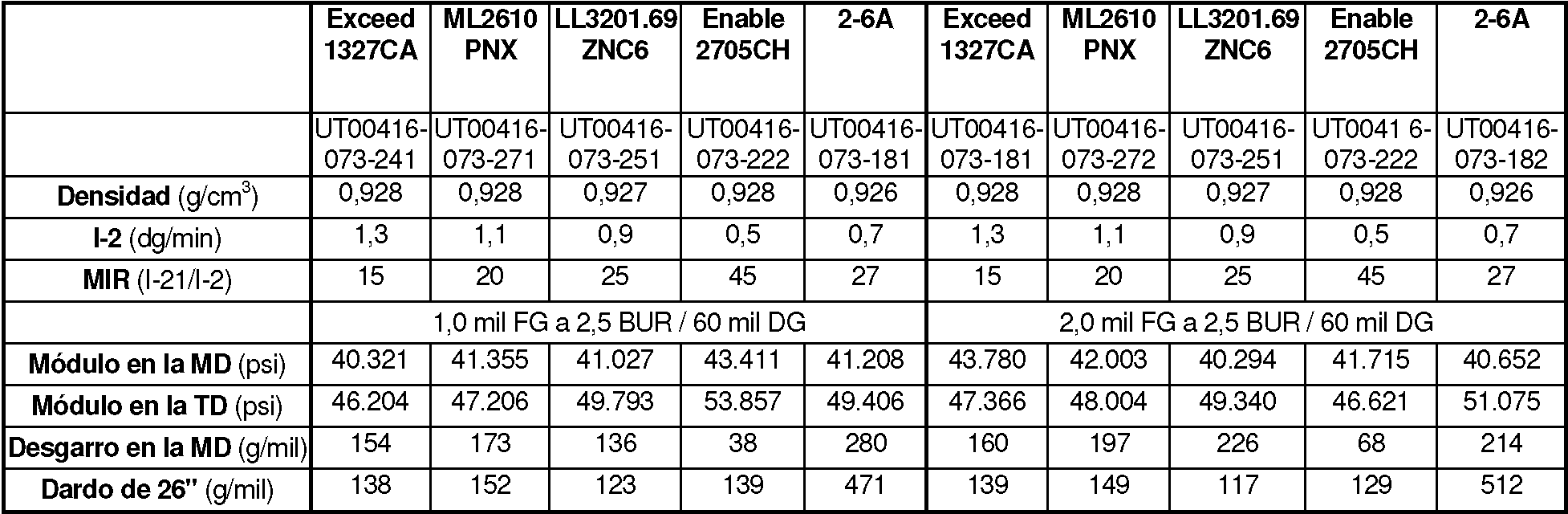
Tabla 7: Comparación de polímeros formados en el procedimiento de ajuste con mezclas, todos los polímeros usan el comonómero 1-butenoTable 7: Comparison of polymers formed in the blend adjustment procedure, all polymers use the 1-butene comonomer

Tabla 8: Polímeros adicionales formados en el procedimiento de ajuste con mezclas, todos los polímeros usan el comonómero 1-butenoTable 8: Additional polymers formed in the blend adjustment procedure, all polymers use the 1-butene comonomer


Tabla 9: Resumen del análisis de crio-CFC con mitades igualesTable 9: Summary of cryo-CFC analysis with matched halves

Procedimientos generales para formar componentes de catalizadorGeneral Procedures for Forming Catalyst Components
Todas las manipulaciones se realizaron en una cámara estanca con guantes purgada con N2 o usando técnicas convencionales de Schlenk. Todos los disolventes anhidros se adquirieron de Sigma-Aldrich y se desgasificaron y se secaron sobre perlas de A^O3 calcinadas antes de su uso. El tolueno para las preparaciones de catalizador se secó previamente con perlas de A^O3, luego se secaron sobre SMAO 757 antes de su uso. Se adquirieron disolventes deuterados de Cambridge Isotope Laboratories y se desgasificaron y se secaron sobre perlas de alúmina antes de su uso. Los reactivos usados se adquirieron de Sigma-Aldrich, con la excepción de ZrCU al 99+% que se adquirió de Strem Chemicals, el bis(n-propilciclopentadienil) zirconio dimetilo (HfPMe) se adquirió de Boulder Scientific y el meso-O-(SiMe2indenil)2ZrCl2(V-A) se adquirió de Sud-Chemie Catalytica. Las mediciones de 1H-RMN se registraron en un espectrómetro Bruker de 250 Mz o 500 Mz.All manipulations were performed in a glove-tight chamber purged with N2 or using standard Schlenk techniques. All anhydrous solvents were purchased from Sigma-Aldrich and degassed and dried over calcined A^O3 beads prior to use. The toluene for catalyst preparations were pre-dried with A^O3 beads, then dried over SMAO 757 before use. Deuterated solvents were purchased from Cambridge Isotope Laboratories and degassed and dried on alumina beads prior to use. Reagents used were purchased from Sigma-Aldrich, with the exception of 99+% ZrCU which was purchased from Strem Chemicals, bis(n-propylcyclopentadienyl)zirconium dimethyl (HfPMe) was purchased from Boulder Scientific, and meso-O-( SiMe2indenyl)2ZrCl2(V-A) was purchased from Sud-Chemie Catalytica. 1H-NMR measurements were recorded on a Bruker 250 Mz or 500 Mz spectrometer.
Indenillitioindenyllithium
50,43 g (434, 14 mmol) de indeno recién destilado se disolvieron en IL de pentano y se añadieron aproximadamente 25 ml de Et2O. Se añadieron 268,47 ml (429,55 mmol) de n-butillitio 1,6 M en hexanos a la disolución de agitación transparente durante un intervalo de 5 minutos. Después de la adición del n-butillitio, precipitó un sólido blanco y el sobrenadante adoptó un color amarillo claro. Después de agitar durante la noche, se filtró la suspensión y se secó el sólido blanco a vacío. Se recuperaron 46,51 g (380,95 mmol) de producto para un rendimiento del 88,7 %. 1H-RMN (THF-de): 55,91 (2H, d), 6,44 (2H, m), 6,51 (1H, t), 7,31 (2H, m). 50.43 g (434.14 mmol) of freshly distilled indene was dissolved in IL pentane and approximately 25 mL of Et2O was added. 268.47 mL (429.55 mmol) of 1.6 M n-butyllithium in hexanes was added to the clear stirring solution over a 5 minute interval. After the addition of the n-butyllithium, a white solid precipitated and the supernatant turned a light yellow color. After stirring overnight, the suspension was filtered and the white solid dried in vacuo. 46.51 g (380.95 mmol) of product were recovered for a yield of 88.7%. 1H-NMR (THF-de): 55.91 (2H, d), 6.44 (2H, m), 6.51 (1H, t), 7.31 (2H, m).
Indenillitio, procedimiento IIIndenyllithium, procedure II
Se disolvió indeno recién destilado (50,43 g, 434,1 mmol) en 1 l de pentano. Se añadieron Et2Ü (25 m), luego nbutillitio 1,6 M en hexanos (268,5 ml, 429,6 mmol) a la disolución de agitación transparente durante un intervalo de 5 min. Precipitó un sólido blanco y el sobrenadante adoptó un color amarillo claro. Después de agitar durante la noche, se filtró la suspensión y luego se secó a vacío para producir un sólido blanco (46,51 g, 381,0 mmol, 88,7 %). 1H-RMN (THF-de): 55,91 (d, 2H), 6,44 (m, 2H), 6,51 (t, 1H), 7,31 (m, 2H).Freshly distilled indene (50.43 g, 434.1 mmol) was dissolved in 1 L of pentane. Et 2 0 (25 m), then 1.6 M n-butyllithium in hexanes (268.5 mL, 429.6 mmol) were added to the clear stirring solution over a 5 min interval. A white solid precipitated and the supernatant turned a light yellow color. After stirring overnight, the suspension was filtered and then dried in vacuo to give a white solid (46.51 g, 381.0 mmol, 88.7%). 1H-NMR (THF-de): 55.91 (d, 2H), 6.44 (m, 2H), 6.51 (t, 1H), 7.31 (m, 2H).
1-Etilindeno1-ethylindene
Se disolvieron 46,51 g (380,95 mmol) de indenillitio en 250 ml de Et2Ü y se elaboró una disolución individual de 95,94 g (615,12 mmol) de yoduro de etilo en 400 ml de Et2Ü. Se enfrió la disolución de yoduro de etilo hasta -30 0C y se enfrió la disolución de indenillitio hasta 0-10 °C usando un baño de hielo seco/acetona. Se añadió el indenillitio a la disolución de agitación transparente de yoduro de etilo a través de una transferencia mediante cánula. La disolución tornó de color amarillo claro a amarillo tras la adición de la disolución de indenillitio. Se dejó agitar la reacción durante la noche y se calentó lentamente hasta temperatura ambiente. Después de agitar durante la noche, se introdujo el matraz en la cámara y se redujo el Et2Ü a vacío. Una vez que el LiI comenzó a precipitar, se añadieron 300 ml de pentano y se filtró la suspensión blanca dando como resultado una disolución naranja claro. Se evaporó el pentano donde se precipitó más LiI y se obtuvo un líquido oleoso naranja claro. Se destiló el producto en bruto a presión reducida usando una bomba de vacío rotatoria para dar un líquido transparente amarillo claro. 1H-RMN mostró el ~90 % de 1 -etilindeno y el ~10 % de 3-etilindeno. La posible isomerización podría haberse producido debido a una pequeña cantidad de ácido presente durante la destilación, ya que ninguno estaba presente en el espectro de 1H-RMn en bruto. Se aislaron 44,27 g (306,96 mmol) de producto para un rendimiento del 80,6 %. 1H-RMN (CD2Cl2): 50,96 (3H, t), 1,59 (1H, q), 1,99 (1H, q), 3,41 (1H, m), 6,58 (1H, d), 6,59 (1H, d), 7,24 (2H, m), 7,41 (2H, dd).46.51 g (380.95 mmol) of indenyllithium were dissolved in 250 ml of Et2Ü and a single solution of 95.94 g (615.12 mmol) of ethyl iodide in 400 ml of Et2Ü was made. The ethyl iodide solution was cooled to -30°C and the indenyllithium solution was cooled to 0-10°C using a dry ice/acetone bath. The indenyllithium was added to the stirring clear solution of ethyl iodide via cannula transfer. The solution turned light yellow to yellow after the addition of the indenyllithium solution. The reaction was allowed to stir overnight and slowly warmed to room temperature. After stirring overnight, the flask was placed in the chamber and the Et20 was reduced in vacuo. Once the LiI started to precipitate, 300 mL of pentane was added and the white suspension was filtered resulting in a light orange solution. The pentane was evaporated where more LiI precipitated and a light orange oily liquid was obtained. The crude product was distilled under reduced pressure using a rotary vacuum pump to give a clear light yellow liquid. 1H-NMR showed ~90% 1-ethylindene and ~10% 3-ethylindene. The possible isomerization could have occurred due to a small amount of acid present during the distillation, since none was present in the crude 1H-NMR spectrum. 44.27 g (306.96 mmol) of product were isolated for a yield of 80.6%. 1H-NMR (CD2Cl2): 50.96 (3H, t), 1.59 (1H, q), 1.99 (1H, q), 3.41 (1H, m), 6.58 (1H, d ), 6.59 (1H, d), 7.24 (2H, m), 7.41 (2H, dd).
1-Etilindenillitio1-ethylindenyllithium
Se disolvieron 44,27 g (306,98 mmol) de 1 -etilindeno que contenía el ~10 % de 3-etilindeno en 500 ml de pentano y aproximadamente 3 ml de Et2Ü. A la disolución de agitación transparente se le añadieron 188,28 ml (301,25 mmol) de n-butillitio 1,6 M en hexanos a lo largo de 10 minutos. Se formó inmediatamente un precipitado blanco escamoso y provocó la parada de la agitación. Se agitó manualmente la mezcla para asegurar la incorporación adecuada de reactivos y se dejó reposar la suspensión durante la noche. Se filtró la suspensión y se secó el sólido blanco a vacío. Se obtuvieron 43,27 g (288,18 mmol) de producto para un rendimiento del 95,7 %. 1H-RMN (THF-d8): 5 1,26 (3H, triplete), 2,86 (2H, cuartete), 5,72 (doblete, 1H), 6,38 (dd 1H), 6,43 (2H, m), 7,26 (1H, t), 7,30 (1H, m).44.27 g (306.98 mmol) of 1-ethylindene containing ~10% 3-ethylindene was dissolved in 500 mL pentane and ca. 3 mL Et2Ü. To the clear stirring solution was added 188.28 mL (301.25 mmol) of 1.6 M n-butyllithium in hexanes over 10 minutes. A flaky white precipitate immediately formed and caused the stirring to stop. The mixture was manually agitated to ensure adequate incorporation of reagents and the suspension was allowed to stand overnight. The suspension was filtered and the white solid was dried in vacuo. 43.27 g (288.18 mmol) of product were obtained for a yield of 95.7%. 1H-NMR (THF-d8): 1.26 (3H, triplet), 2.86 (2H, quartet), 5.72 (doublet, 1H), 6.38 (dd 1H), 6.43 (2H , m), 7.26 (1H, t), 7.30 (1H, m).
bis(1-Etil-indenil)zirconio dimetilo (1-EtInd)?ZrMe? rac. y meso, fórmulas (IV-A) y (IV-B) bis ( 1-Ethyl-indenyl)zirconium dimethyl ( 1-EtInd)?ZrMe? rac. and meso, formulas ( IV-A) and ( IV-B)
Se disolvieron 7,00 g (46,65 mmol) de 1 -etil-indenillitio en 74 ml de 1,2-dimetoxietano (DME) y se elaboró una disolución individual con 5,43 g (23,30 mmol) de ZrCU en 75 ml de DME. A la disolución transparente de ZrCU se le añadió la disolución amarilla brillante de 1 -etil-indenillitio mediante una pipeta a lo largo de un periodo de quince minutos. Tras la adición inicial, la disolución adquirió un color amarillo y después de cinco minutos tras la adición se formó un precipitado y se produjo un color naranja-amarillo. Diez minutos tras la adición, el sobrenadante se volvió naranja con un precipitado amarillo, y una vez que se añadió la disolución de 1 -etil-indenillitio, la mezcla se volvió a poner amarilla. Se dejó agitar la reacción durante la noche.7.00 g (46.65 mmol) of 1-ethyl-indenyllithium were dissolved in 74 ml of 1,2-dimethoxyethane (DME) and a single solution was made with 5.43 g (23.30 mmol) of ZrCU in 75ml DME. To the clear ZrCU solution was added the bright yellow 1-ethylindenyllithium solution via pipet over a fifteen minute period. Upon the initial addition the solution turned yellow and five minutes after the addition a precipitate formed and an orange-yellow color was produced. Ten minutes after the addition, the supernatant turned orange with a yellow precipitate, and once the 1-ethyl-indenyllithium solution was added, the mixture turned yellow again. The reaction was allowed to stir overnight.
Un espectro de 1H-RMN en bruto de la suspensión mostró una razón rac/meso de ~1,1:1; sin embargo, esto puede ser erróneo ya que el isómero rac es más soluble en DME que el isómero meso. Independientemente de la razón de isómeros, se añadieron 15,61 ml (46,83 mmol) de CHsMgBr 3,0 M en Et2Ü en porciones de 1 ml a lo largo de diez minutos. Después de la décima adición, la mezcla amarilla volvió a un color naranja. Tras la adición final del reactivo de Grignard, la mezcla se había vuelto marrón y se dejó agitar la reacción durante la noche. Un espectro de 1H-RMN de la mezcla en bruto reveló una razón meso/rac de 1,1:1. Se evaporó el DME y se extrajo el sólido marrón con 3 x 20 ml de tolueno más 10 ml adicionales. Se lavó el sólido marrón claro obtenido después de la eliminación del disolvente con 10 ml de pentano y se secó a vacío. Se obtuvieron 8,26 g (20,26 mmol) de sólido blanquecino para un rendimiento del 87 %. Datos espectrales de dicloruro: 1H-RMN (CD2Cb): 51,16 (6,34H, t, rac), 1,24 (6h , t, meso), 2,73-2,97 (8H, solapamiento q), 5,69 (1,82H, dd, meso), 5,94 (1,92H, dd, rac), 6,06 (1,99H, d, rac), 6,35 (1,84H, d, meso), 7,22-7,65 (16H, m). Datos espectrales de dimetilo: 1H-RMn (CsDs): 5 - 1,40 (3,33H, s, meso), -0,895 (6H, s, rac), -0,323 (3,34H, s, meso), 1,07 (13H, solapamiento t), 2,47 (4H, solapamiento q), 2,72 (4H, q), 5,45-5,52 (8H, m), 6,91 (8H, m), 7,06-7,13 (4H, m), 7,30 (4H, m).A crude 1H-NMR spectrum of the suspension showed a rac/meso ratio of ~1.1:1; however, this may be in error as the rac isomer is more soluble in DME than the meso isomer. Regardless of the ratio of isomers, 15.61 mL (46.83 mmol) of 3.0 M CHsMgBr in Et2O was added in 1 mL portions over ten minutes. After the tenth addition, the yellow mixture turned orange. Upon the final addition of the Grignard reagent, the mixture had turned brown and the reaction was allowed to stir overnight. A 1H-NMR spectrum of the crude mixture revealed a meso/rac ratio of 1.1:1. The DME was evaporated and the brown solid was extracted with 3 x 20 mL of toluene plus an additional 10 mL. The light brown solid obtained after removal of the solvent was washed with 10 ml of pentane and dried in vacuo. 8.26 g (20.26 mmol) of off-white solid were obtained for a yield of 87%. Dichloride Spectral Data: 1H-NMR (CD2Cb): 51.16 (6.34H, t, rac), 1.24 (6 h , t, meso), 2.73-2.97 (8H, q overlap) , 5.69 (1.82H, dd, meso), 5.94 (1.92H, dd, rac), 6.06 (1.99H, d, rac), 6.35 (1.84H, d, meso), 7.22-7.65 (16H, m). Spectral data for dimethyl: 1H-NMR (CsDs): 5 - 1.40 (3.33H, s, meso), -0.895 (6H, s, rac), -0.323 (3.34H, s, meso), 1 .07 (13H, overlap t), 2.47 (4H, overlap q), 2.72 (4H, q), 5.45-5.52 (8H, m), 6.91 (8H, m), 7.06-7.13 (4H, m), 7.30 (4H, m).
Lote 1 de preparación de catalizador con el 75 % de HfPMe2/ el 25 % de (1 -EtInd)?ZrMe? Catalyst preparation batch 1 with 75% HfPMe 2 / 25% ( 1 -EtInd)?ZrMe?
Se cargó un matraz de Morton de 8 l con 375 g de SMAO y luego se añadieron 2 l de pentano. Se aglutinó la mezcla lo que dificultó la agitación, por lo que se añadieron otros 2 l de pentano seguido de una adición de 375 g de SMAO. El agitador mecánico se ajustó a aproximadamente 140 rpm. Se elaboraron dos disoluciones individuales con 2,89 g (7,09 mmol) de (LEtInd)2ZrMe2 y 8,86 g (20,95 mmol) de HfPMe2 en 20 ml de tolueno. Se añadieron las disoluciones individuales a un matraz de fondo redondo y se añadieron 160 ml adicionales de tolueno y se dejó agitar la disolución durante aproximadamente 20 minutos. Se añadió gota a gota la disolución a la suspensión de SMAO en pentano con un embudo adicional a lo largo del transcurso de una hora. La mezcla se volvió de color verde tras la adición de la disolución de metaloceno mixta y se dejó agitar durante una hora adicional. Luego se filtró la mezcla por lotes y se secó a vacío durante un total de 8 horas. Es importante observar que aproximadamente 7 perlas de Al2O3 estaban presentes del pentano y también estaban presentes sólidos rojos mínimos durante la preparación. Se retiraron las perlas de A^O3 a mano durante la filtración y tamizando el producto final.An 8 L Morton flask was charged with 375 g SMAO and then 2 L pentane was added. The mixture clumped making stirring difficult so another 2 L of pentane was added followed by an addition of 375 g of SMAO. The mechanical stirrer was set at approximately 140 rpm. Two individual solutions were made with 2.89 g (7.09 mmol) of (LEtInd)2ZrMe2 and 8.86 g (20.95 mmol) of HfPMe2 in 20 mL of toluene. solutions were added to a round bottom flask and an additional 160 mL of toluene was added and the solution was allowed to stir for approximately 20 minutes. The solution was added dropwise to the pentane SMAO slurry with an additional funnel over the course of one hour. The mixture turned green upon addition of the mixed metallocene solution and was allowed to stir for an additional hour. The mixture was then batch filtered and dried in vacuo for a total of 8 hours. It is important to note that approximately 7 Al2O3 beads were present from the pentane and minimal red solids were also present during the preparation. The A^O3 beads were removed by hand during filtration and sieving the final product.
Lote 2 de preparación de catalizador con el 75 % de HfPMe2/ el 25 % de (1 -EtInd)?ZrMe? Catalyst preparation batch 2 with 75% HfPMe 2 / 25% ( 1 -EtInd)?ZrMe?
Se empleó un procedimiento similar tal como se describió anteriormente para el segundo lote de catalizador 75/25. Se usó una mezcla de SMAO que comprendía 204,15 g de una primera serie, 176,17 g de una segunda serie, 209,49 g de una tercera serie y 160,19 g de una cuarta serie. Para el segundo lote, se añadieron en primer lugar 4 l de pentano al matraz de Morton seguido de SMAO, por lo que no se produjo la aglutinación. Se elaboraron dos disoluciones individuales con 2,87g (7,09 mmol) de (LEtInd)2ZrMe2 y 8,94g (20,95 mmol) de HfPMe2 en 20 ml de tolueno.A similar procedure was used as described above for the second batch of 75/25 catalyst. An SMAO mixture was used comprising 204.15g of a first run, 176.17g of a second run, 209.49g of a third run and 160.19g of a fourth run. For the second batch, 4 L of pentane was added to the Morton flask first followed by SMAO, so no agglutination occurred. Two individual solutions were made with 2.87g (7.09 mmol) of (LEtInd)2ZrMe2 and 8.94g (20.95 mmol) of HfPMe2 in 20 mL of toluene.
Lote 1y 2 de preparación de catalizador con el 50 % de HfPMe?/ el 50 % de(1-EtInd)?ZrMe? Catalyst preparation batch 1 and 2 with 50% HfPMe?/ 50% ( 1-EtInd)?ZrMe?
Se usó el mismo procedimiento usado para preparar el segundo lote de catalizador 75/25 para ambos conjuntos de catalizador 50/50. El lote 1 usó SMAO de la cuarta serie, 5,75 g (14,10 mmol) de (1 -EtInd)2ZrMe2 y 5,97g (14,11 mmol) de HfPMe2. El lote 2 usó SMAO de una quinta serie, 5,75 g (14,09 mmol) de (1 -EtInd)2ZrMe2 y 5,97g (14,11 mmol) de HfPMe2.The same procedure used to prepare the second batch of 75/25 catalyst was used for both sets of 50/50 catalyst. Batch 1 used SMAO from the fourth run, 5.75g (14.10mmol) of (1-EtInd)2ZrMe2 and 5.97g (14.11mmol) of HfPMe2. Batch 2 used SMAO from a fifth run, 5.75g (14.09mmol) of (1-EtInd)2ZrMe2 and 5.97g (14.11mmol) of HfPMe2.
2,3,4,5-tetrametil-1-trimetilsilil-ciclopenta-2,4-dieno2,3,4,5-tetramethyl-1-trimethylsilyl-cyclopenta-2,4-diene

En un matraz Erlenmeyer de 2 litros, se disolvió aceite amarillo de tetrametilciclopentadieno (50 g, 409 mmol — obtenido de Boulder Scientific) en 1 litro de THF anhidro. Se agitó a temperatura ambiente como n-butillitio (175 ml, 437 mmol) añadido a través de una jeringa de plástico de 60 ml con una aguja de calibre 20 que regula un flujo gota a gota. Se observó formación de un precipitado amarillo pálido. La reacción es una suspensión amarilla tras la adición completa de reactivo de litio. Se agitó 1 h a temperatura ambiente, luego se añadió con agitación vigorosa clorotrimetilsilano (60 ml, 470 mmol) y se dejó agitar la reacción durante la noche a temperatura ambiente. Después de agitar a temperatura ambiente durante 15 h, la mezcla es una disolución amarilla. Se eliminó el disolvente de THF bajo una corriente de N2 para proporcionar un residuo oleoso, que luego se extrajo con 1 litro de pentano seco y se filtró a través de un lecho de Celite en frita gruesa. Se eliminaron los compuestos volátiles a vacío para proporcionar un producto como aceite amarillo: 62,9 g, 79 %. 1H-RMN (C6D6, 250 MHz): 5 -0,04 (s, Si(CH3)3), 5 1,81, (s, CH3), 5 1,90 (s, CH3), 52,67 (s, CH) In a 2 liter Erlenmeyer flask, yellow tetramethylcyclopentadiene oil (50 g, 409 mmol — obtained from Boulder Scientific) was dissolved in 1 liter anhydrous THF. Stirred at room temperature as n-butyllithium (175 mL, 437 mmol) added via a 60 mL plastic syringe with a 20 gauge needle regulating a dropwise flow. Formation of a pale yellow precipitate was observed. The reaction is a yellow suspension after complete addition of lithium reagent. Stirred 1 h at room temperature, then chlorotrimethylsilane (60 mL, 470 mmol) was added with vigorous stirring and the reaction was allowed to stir overnight at room temperature. After stirring at room temperature for 15h, the mixture is a yellow solution. The THF solvent was removed under a stream of N2 to give an oily residue, which was then extracted with 1 L of dry pentane and filtered through a pad of coarse frit Celite. Volatiles were removed in vacuo to give a product as a yellow oil: 62.9 g, 79%. 1H-NMR (C6D6, 250 MHz): 5 -0.04 (s, Si(CH3)3), 5 1.81, (s, CH3), 5 1.90 (s, CH3), 52.67 ( s, CH)
Tricloruro de (tetrametilciclopentadienil)zirconio ( tetramethylcyclopentadienyl)zirconium trichloride

En una caja seca, se cargó ZrCU sólido (30,0 g, 129 mmol) a un recipiente a presión de Chemglass de 450 ml con una barra de agitación magnética Spinbar, se suspendió en 100 ml de tolueno seco. Se dispensó 2,3,4,5-tetrametil-1-trimetilsilil-ciclopenta-2,4-dieno como un aceite de color amarillo (27,5 g, 142 mmol) y se enjuagó con 100 ml adicionales de tolueno seco. Se selló el recipiente a presión con un tapón roscado con una junta tórica de Viton, y se calentó sobre un manto de calentamiento de aluminio ajustado a 1100C durante 90 min. La disolución se oscurece con el tiempo, y estaban presentes componentes insolubles durante la reacción. Se dejó agitar el recipiente durante la noche y se enfrió hasta temperatura ambiente. Se abrió el recipiente y se redujo el volumen de disolvente bajo corriente de N2, proporcionando un lodo rojo espeso. Se extrajo con 2 x 50 ml de pentano seco, luego con 100 ml de éter seco. Se eliminó la disolución roja y se recuperó el producto como un sólido rojo pálido: 35,4 g, 85 %. 1H-RMN (CsDa, 250 MHz): 51,89 (s a, CH3), 52,05 (s a, CH3), 55,78 (s a, CH)In a dry box, solid ZrCU (30.0 g, 129 mmol) was charged to a 450 mL Chemglass pressure vessel with a Spinbar magnetic stir bar, slurried in 100 mL of dry toluene. 2,3,4,5-Tetramethyl-1-trimethylsilyl-cyclopenta-2,4-diene was dispensed as a yellow oil (27.5 g, 142 mmol) and rinsed with an additional 100 mL of dry toluene. The pressure vessel was sealed with a screw cap with a Viton O-ring, and heated on an aluminum heating mantle set at 1100C for 90 min. The solution darkens with time, and insoluble components were present during the reaction. The vessel was allowed to stir overnight and cooled to room temperature. The vessel was opened and the volume of solvent was reduced under a stream of N2, giving a thick red sludge. It was extracted with 2 x 50 ml of dry pentane, then with 100 ml of dry ether. The red solution was removed and the product was recovered as a pale red solid: 35.4 g, 85 %. 1H-NMR (CsDa, 250 MHz): 51.89 (bs, CH3), 52.05 (bs, CH3), 55.78 (bs, CH)
1 -Metil-indenillitio1 -Methyl-indenyllithium
Se disolvió 3-metilindeno recién destilado (33,75 g, 259,24 mmol) en pentano (1 l). Se añadieron Et2O (10 ml), luego n-butillitio 1,6 M en hexanos (107 ml, 171,2 mmol) y n-butillitio 2,5 M en hexanos (34,2 ml, 85,5 mmol) a la disolución de agitación transparente. Se precipitó inmediatamente un sólido blanco escamoso. Después de agitar durante la noche, se filtró la suspensión y se secó el sólido blanco a vacío (33,88 g, 248,90 mmol, 97 %). 1H-RMN (THF-d8): 5 2,41 (s, 3H), 5,68 (d, 1H), 6,31 (d, 1H), 6,41 (m, 2H), 7,22 (m, 2H).Freshly distilled 3-methylindene (33.75 g, 259.24 mmol) was dissolved in pentane (1 L). Et2O (10 mL), then 1.6 M n-butyllithium in hexanes (107 mL, 171.2 mmol) and 2.5 M n-butyllithium in hexanes (34.2 mL, 85.5 mmol) were added to the clear stirring solution. A flaky white solid precipitated immediately. After stirring overnight, the suspension was filtered and the white solid was dried in vacuo (33.88 g, 248.90 mmol, 97%). 1H-NMR (THF-d8): 2.41 (s, 3H), 5.68 (d, 1H), 6.31 (d, 1H), 6.41 (m, 2H), 7.22 ( m, 2H).
1,3-dimetilindeno1,3-dimethylindene

En una caja seca, se disolvió yodometano (2,0 ml, 32,1 mmol) en 80 ml de dietil éter seco en un matraz de fondo redondo de 250 ml con una barra de agitación magnética Spinbar. Se colocó el matraz en un baño frío de isohexano (-25 0C) en un matraz Dewar de boca ancha. En un matraz Erlenmeyer de 100 ml independiente, se preparó una disolución a temperatura ambiente de 1-metilindenillitio (3,50 g, 25,7 mmol) en 50 ml de dietil éter seco, proporcionando una disolución amarilla. Se realizó la adición lenta, gota a gota de la disolución de indenillitio a la disolución agitada fría de yodometano a lo largo de 15 min. Se continuó la agitación a baja temperatura durante 30 min, luego se retiró el baño frío y se dejó que la reacción se calentara hasta temperatura ambiente durante la noche. La disolución es blanca turbia después de agitar 15 h a temperatura ambiente. Se redujo el volumen de disolución bajo un flujo de nitrógeno, luego se evaporaron los compuestos volátiles a alto vacío. Se extrajeron los sólidos con 2 x 80 ml de isohexano y se filtraron a través de un lecho de Celite en frita gruesa. Se evaporaron los filtrados a alto vacío para proporcionar un aceite marrón. Se disolvió en 5 ml de diclorometano y se cargó mediante pipeta en una columna de gel de sílice (Biotage SNAP 100 g), eluyendo con diclorometano:isohexano (gradiente, 2-20 %). Se combinaron las fracciones y se evaporaron para proporcionar un aceite transparente. Se recogieron 2,54 g, 68 %.In a dry box, iodomethane (2.0 mL, 32.1 mmol) was dissolved in 80 mL dry diethyl ether in a 250 mL round bottom flask with a Spinbar magnetic stir bar. The flask was placed in a cold (-25°C) isohexane bath in a wide-mouthed Dewar flask. In a separate 100 mL Erlenmeyer flask, a room temperature solution of 1-methylindenyllithium (3.50 g, 25.7 mmol) in 50 mL of dry diethyl ether was prepared to give a yellow solution. Slow, dropwise addition of the indenyllithium solution to the cold stirred iodomethane solution was performed over 15 min. Stirring at low temperature was continued for 30 min, then the cold bath was removed and the reaction was allowed to warm to room temperature overnight. The solution is cloudy white after stirring for 15 h at room temperature. The solution volume was reduced under a flow of nitrogen, then the volatiles were evaporated under high vacuum. The solids were extracted with 2 x 80 mL isohexane and filtered through a pad of Celite coarse frit. The filtrates were evaporated under high vacuum to provide a brown oil. Dissolved in 5 mL dichloromethane and pipetted onto a silica gel column (Biotage SNAP 100 g), eluting with dichloromethane:isohexane (gradient, 2-20%). Fractions were combined and evaporated to provide a clear oil. 2.54 g, 68 % were collected.
1H-RMN (C6D6, 500 MHz): 5 1,11 (d, J = 7,5 Hz, -CHCH3), 5 1,96 (s, CH=CCHs), 5 3,22 (m, CHCH3), 5 5,91 (m, CH=CCH3), 57,15-7,27 (CH aromático). La mezcla contiene un isómero menor de 3,3-dimetilindeno en una razón 1:10 con el producto deseado. 51,17 (s, CH3), 56,14 (d, J=5,5 Hz, CHH), 56,51 (d, J=5,5 Hz, CHH).1H-NMR (C6D6, 500 MHz): 5 1.11 (d, J=7.5 Hz, -CHCH3), 5 1.96 (s, CH=CCHs), 5 3.22 (m, CHCH3), 5 5.91 (m, CH=CCH3), 57.15-7.27 (aromatic CH ). The mixture contains a minor isomer of 3,3-dimethylindene in a 1:10 ratio to the desired product. 51.17 (s, CH3), 56.14 (d, J=5.5 Hz, CHH), 56.51 (d, J=5.5 Hz, CHH).
1, 3-dimetilindenillitio1,3-dimethylindenyllithium

Se disolvieron 2,54 g (17,6 mmol) de aceite transparente, una mezcla 10:1 de 1,3-dimetilindeno y 3,3-dimetilindeno, en 35 ml de pentano seco. Se agitó a temperatura ambiente, se añadió lentamente, gota a gota como 6,2 ml de una disolución en hexano 2,5 M de n-butillitio (15,5 mmol). Se formó inmediatamente un precipitado blanco. Se agitó a temperatura ambiente durante 45 min, luego se filtró el sobrenadante a través de una cánula. Se suspendió el residuo en 30 ml de pentano seco y se enfrió en congelador de caja seca (-27 0C) durante 60 min. Se filtró el sobrenadante y se secó a vacío para dar un polvo blanco, 2,34 g (88 %) y se usó tal cual para la etapa de reacción posterior sin caracterización.2.54 g (17.6 mmol) of clear oil, a 10:1 mixture of 1,3-dimethylindene and 3,3-dimethylindene, was dissolved in 35 mL of dry pentane. Stirred at room temperature, slowly added dropwise as 6.2 mL of a 2.5M hexane solution of n-butyllithium (15.5 mmol). A white precipitate immediately formed. It was stirred at room temperature for 45 min, then the supernatant was filtered through a cannula. The residue was suspended in 30 ml of dry pentane and chilled in a dry box freezer (-27°C) for 60 min. The supernatant was filtered and dried in vacuo to give a white powder, 2.34 g (88%) and used as is for the subsequent reaction step without characterization.
Dicloruro de [(1.3-dimetilindenil) (tetrametilciclopentadienil) ]zirconio, fórmula (IV-D) [(1,3 -dimethylindenyl) ( tetramethylcyclopentadienyl)]zirconium dichloride, formula ( IV-D)

Se pesaron 3,50 g (10,98 mmol) de polvo beis de tricloruro de (tetrametilciclopentadienil) zirconio en un frasco de vidrio de fondo plano de 100 ml con una barra de agitación magnética Spinbar. Se suspendieron en 80 ml de dietil éter seco. Se agitaron como 1,3-dimetilindenillitio (1,65 g, 10,99 mmol) añadido como polvo a lo largo de varios minutos. Se enjuagaron con 20 ml adicionales de éter. Se tapó el frasco y se agitó durante la noche a temperatura ambiente. Se mezcló una suspensión amarilla después de agitar 15 h a temperatura ambiente. Se evaporaron los compuestos volátiles a alto vacío, luego se extrajo el residuo con 2 x 80 ml de diclorometano. Se filtraron a través de un lecho de Celite en frita gruesa. Se concentraron a vacío y se filtraron nuevamente a través de Celite nuevo en frita gruesa. Se secaron a vacío para dar un polvo amarillo suelto libre, 3,6 g (77 %). 1H-RMN (CD2O 2, 500 MHz): 5 1,89 (s, CH3 de CpMe4), 51,90 (s, CH3 de CpMe4), 52,40 (s, CH3 del fragmento C9), 55,67 (s, CH de CpMe4), 56,33 (s, CH del fragmento C9), 5 7,24 (AA'BB1, CH aromático del fragmento C9), 5 7,52 (AA'BB', CH aromático del fragmento C9). Contiene aproximadamente el 15 % de dietil éter.3.50 g (10.98 mmol) of beige (tetramethylcyclopentadienyl) zirconium trichloride powder was weighed into a 100 mL flat bottom glass flask with a Spinbar magnetic stir bar. They were suspended in 80 ml of dry diethyl ether. They were stirred as 1,3-dimethylindenyllithium (1.65 g, 10.99 mmol) added as a powder over several minutes. They were rinsed with an additional 20 ml of ether. The bottle was stoppered and shaken overnight at room temperature. A yellow suspension was mixed after stirring 15 h at room temperature. Volatiles were evaporated under high vacuum, then the residue was extracted with 2 x 80 mL of dichloromethane. They were filtered through a bed of Celite on a coarse frit. They were concentrated in vacuo and filtered again through fresh Celite on coarse frit. They were dried in vacuo to give a free flowing yellow powder, 3.6 g (77%). 1H-NMR (CD2O 2, 500 MHz): 5 1.89 (s, CH 3 of CpMe4), 51.90 (s, CH 3 of CpMe4), 52.40 (s, CH 3 of C9 fragment), 55 .67 (s, CH of CpMe4), 56.33 (s, CH of fragment C9), 5 7.24 ( AA'BB1, aromatic CH of fragment C9), 5 7.52 (AA'BB', aromatic CH of fragment C9). Contains approximately 15% diethyl ether.
[(1,3-dimetilindenil) (tetrametilciclopentadienil)] zirconio dimetilo. fórmula (IV-D) [ ( 1,3-dimethylindenyl) ( tetramethylcyclopentadienyl)]zirconium dimethyl. formula ( IV-D)

En la caja seca, se suspendió el polvo de color amarillo brillante de (1,3-Me2Ind)(CpMe4)ZrCl2 (3,6 g, 8,4 mmol) en 75 ml de dietil éter seco en un frasco de fondo plano de vidrio ámbar de 100 ml con una barra de agitación magnética Spinbar. Se enfrió el frasco hasta -10 °C en un baño de isohexano, se agitó como disolución de metillitio (1,6 M en éter) suministrada a través de una jeringa en porciones (4 x 3 ml, 19,2 mmol). Se tapó el frasco con una membrana de goma y se agitó durante la noche, permitiendo que el baño frío se calentara lentamente hasta temperatura ambiente. Se evaporó la suspensión hasta sequedad a alto vacío. Se extrajo con 3 x 50 ml de diclorometano y se filtró a través de Celite en frita gruesa. Se concentró bajo corriente de nitrógeno, luego se añadió pentano. Luego se agitó 15 min, después se evaporaron los compuestos volátiles. Se lavaron los sólidos con pentano frío, se secaron a vacío. Se recogió como polvo beis, 1,67 g; segunda recogida recuperada del filtrado, 0,52 g. El rendimiento combinado es de 2,19 g, 67 %. 1H-RMN (CD2Cl2, 500 MHz): 5 -1,22 (s, ZrCH3), 1,78 (s, CH3 del fragmento CpMe4), 1,87 (s, CH3 del fragmento CpMe4), 2,25 (s, CH3 del fragmento C9), 4,92 (s, CH del fragmento Cp e4), 5,60 (s, Ch del fragmento C9), 7,14 (AA'BB ', CH aromático del fragmento C9), 7,44 (AA’BB', CH aromático del fragmento C9). 13C{1H}-RMN (CD2O 2, 125 MHz): 5 11,64 (CH3 del fragmento Cp e4), 12,91 (CH3 del fragmento C9), 13,25 (CH3 del fragmento CpMe4), 37,23 (ZrCH3), 106.34 (CH del fragmento CpMe4), 115,55 (CH del fragmento C9); resonancias de 13C cuaternario de 107,36, 117,51, 122,69 y 125,06.In the dry box, the bright yellow powder of (1,3-Me2Ind)(CpMe4)ZrCl2 (3.6 g, 8.4 mmol) was suspended in 75 mL of dry diethyl ether in a flat-bottomed flask of 100 mL amber glass with a Spinbar magnetic stir bar. The flask was cooled to -10 °C in an isohexane bath, shaken as methyllithium solution (1.6 M in ether) delivered via syringe in portions (4 x 3 mL, 19.2 mmol). The flask was covered with a rubber membrane and shaken overnight, allowing the cold bath to slowly warm to room temperature. The suspension was evaporated to dryness under high vacuum. Extracted with 3 x 50 mL of dichloromethane and filtered through Celite on a coarse frit. It was concentrated under a stream of nitrogen, then pentane was added. It was then stirred for 15 min, then the volatiles were evaporated. The solids were washed with cold pentane, dried in vacuo. Collected as beige powder, 1.67 g; second crop recovered from the filtrate, 0.52 g. The combined yield is 2.19 g, 67%. 1H-NMR (CD2Cl2, 500 MHz): 5 -1.22 (s, ZrCH3), 1.78 (s, CH3 of CpMe4 fragment), 1.87 (s, CH3 of CpMe4 fragment), 2.25 (s , CH3 of fragment C9), 4.92 (s, CH of fragment Cp e4), 5.60 (s, Ch of fragment C9), 7.14 ( AA'BB ', aromatic CH of fragment C9), 7 .44 (AA 'BB ', aromatic CH of fragment C9). 13C{1H}-NMR (CD2O 2, 125 MHz): 11.64 (CH3 of Cp e4 fragment), 12.91 (CH3 of C9 fragment), 13.25 (CH3 of CpMe4 fragment), 37.23 ( ZrCH3), 106.34 (CH of the CpMe4 fragment), 115.55 (CH of the C9 fragment); 13C quaternary resonances of 107.36, 117.51, 122.69 and 125.06.

(1-Metilindenil) (pentametilciclopentadienil) zirconio (IV), versión de cloruro de fórmula (IV-C) ( 1-Methylindenyl) ( pentamethylcyclopentadienyl)zirconium ( IV), chloride version of formula ( IV-C)
En la caja seca, se pesó aceite de 1 -metil-1 H-indeno (1,85 g, 14,2 mmol) en un matraz de fondo redondo de 250 ml y se disolvió en 25 ml de dietil éter seco. Se añadió n-butillitio (1,6 M en hexanos, 12,0 ml, 19,2 mmol) gota a gota desde una aguja/jeringa de 20 ml para formar una disolución amarilla. Se agitó a temperatura ambiente durante 60 minutos. A la disolución de color amarillo-naranja de (1-metil)indenillitio se le añadió Cp*ZrCl3 (4,51 g, 13,5 mmol, usado tal como se recibió de Aldrich- 475181) rápidamente en una porción como un sólido cristalino amarillo. Se agitó la suspensión de color amarillo-naranja durante la noche a temperatura ambiente. Se dejó sedimentar la mezcla durante 30 min. Se decantó la disolución de color marrón oscuro de los sólidos de color amarillo pálido, se enjuagaron los sólidos en frita de vidrio con 100 ml de éter seco. Se extrajeron los sólidos en frita con 100 ml de diclorometano, proporcionando una suspensión amarilla. Se filtraron a través de un tapón de Celite sobre frita y se evaporaron los compuestos volátiles para producir un sólido amarillo. Se recristalizó en éter/pentano para proporcionar 2,70 g (47 %). Material adicional obtenido a partir de las aguas madres: 1,19 g (20 %) *H-RMN (C6D6, 500 MHz, 35 °C): 51,70 (15H, s, Cp*), 52,30 (3H, s, CH3 del indenilo), 55,56 (2H, ABq, CH, C H del indenilo), 57,05 (1 H, dd, CH del indenilo), 57,10 (1h, dd, CH del indenilo), 57,24 (1 H, dt, c H del indenilo), 57,56 (1 H, dq, CH del indenilo).In the dry box, 1-methyl-1H-indene oil (1.85 g, 14.2 mmol) was weighed into a 250 mL round bottom flask and dissolved in 25 mL of dry diethyl ether. n-Butyllithium (1.6 M in hexanes, 12.0 mL, 19.2 mmol) was added dropwise from a 20 mL needle/syringe to form a yellow solution. It was stirred at room temperature for 60 minutes. To the yellow-orange solution of (1-methyl)indenyllithium, Cp*ZrCl3 (4.51 g, 13.5 mmol, used as received from Aldrich-475181) was added rapidly in one portion as a crystalline solid. yellow. The yellow-orange suspension was stirred overnight at room temperature. The mixture was allowed to settle for 30 min. The dark brown solution was decanted from the pale yellow solids, the solids were rinsed on the glass frit with 100 mL dry ether. The frit solids were extracted with 100 mL of dichloromethane to give a yellow suspension. They were filtered through a Celite plug on a frit and evaporated the volatiles to produce a yellow solid. Recrystallized from ether/pentane to give 2.70 g (47%). Additional material obtained from the mother liquor: 1.19 g (20%) *H-NMR (C6D6, 500 MHz, 35 °C): 51.70 (15H, s, Cp*), 52.30 (3H , s, indenyl CH 3 ), 55.56 (2H, ABq, CH, indenyl CH ), 57.05 ( 1 H, dd, indenyl CH), 57.10 (1 h , dd, indenyl CH ), 57.24 (1H, dt , cH of the indenyl), 57.56 (1H, dq, CH of the indenyl).

(1-Metilindenil) (pentametilciclopentadienil) zirconio(IV)dimetilo, fórmula (IV-C) ( 1-Methylindenyl) ( pentamethylcyclopentadienyl) zirconium ( IV) dimethyl, formula ( IV-C)
Se suspendió dicloruro de (1-metilindenil) (pentametilciclopentadienil) zirconio (4,92 g, 11,5 mmol) en 50 ml de dietil éter y se enfrió hasta -500C. A esto, se añadió lentamente una disolución de MeLi (14,8 ml de una disolución 1,71 M en dietil éter, 25,4 mmol) lentamente mediante una jeringa. Se dejó agitar la mezcla y se calentó lentamente hasta temperatura ambiente para dar una suspensión rosa. Después de 16 h, se eliminó el disolvente a vacío y se extrajo el residuo con tolueno. Se retiraron los componentes insolubles mediante filtración a través de una frita revestida con Celite y se eliminó el disolvente para dar un sólido oleoso naranja. Se lavó el sólido con pentano y se secó a vacío (3,89 g, rendimiento del 88 %). 1H-RMN 5 (C6D6): 7,53 (d, 1H, 8-IndH), 7,13 - 6,99 (m, 3H, 5,6,7-IndH), 5,21 (d, 1H, 2-IndH), 5,11 (d, 1H, 3-IndH), 2,20 (s, 3H, 1-MeInd), 1,69 (s, 15H, CpMe5), -0,51 (s, 3H, ZrMe), -1,45 (s, 3H, ZrMe). Preparación de meso-O-(SiMe2¡ndenil)2ZrMe2 (1-Methylindenyl)(pentamethylcyclopentadienyl)zirconium dichloride (4.92 g, 11.5 mmol) was suspended in 50 mL diethyl ether and cooled to -500C. To this, a solution of MeLi (14.8 ml of a 1.71 M solution in diethyl ether, 25.4 mmol) was added slowly via syringe. The mixture was allowed to stir and slowly warmed to room temperature to give a pink suspension. After 16h the solvent was removed in vacuo and the residue was extracted with toluene. Insolubles were removed by filtration through a Celite-lined frit and the solvent removed to give an oily orange solid. The solid was washed with pentane and dried in vacuo (3.89 g, 88% yield). 1H-NMR 5 (C6D6): 7.53 (d, 1H, 8-IndH), 7.13-6.99 (m, 3H, 5,6,7-IndH), 5.21 (d, 1H, 2-IndH), 5.11 (d, 1H, 3-IndH), 2.20 (s, 3H, 1-MeInd), 1.69 (s, 15H, CpMe5), -0.51 (s, 3H , ZrMe), -1.45 (s, 3H, ZrMe). Preparation of meso-O- ( SiMe 2 indenyl) 2 ZrMe 2
Meso-O-(SiMe2indenil)2ZrCl2 (21,2 g; 40,6 mmol) se suspendió en dietil éter (aproximadamente 250 ml) y MeMgBr (28,4 ml; 3 M en dietil éter; 85,2 mmol) se añadió con agitación. Después de agitar a temperatura ambiente durante 2 h, se eliminó el éter a vacío y se extrajo el sólido resultante con heptano (250 ml a 80 0C) y luego se filtró. Después de enfriar hasta -35 0C durante la noche, se aisló el sólido cristalino amarillo mediante filtración, luego se lavó con pentano y se secó a vacío; rendimiento = 13 g. 1H-RMN 5 (CaDa): 7,54 (m, 2H); 7,40 (m, 2H); 7,00 (m, 2H); 6,93 (m, 2H); 6,31 (m, 2H); 5,82 (m, 2H); 0,44 (m, 6H); 0,33 (m, 6H); -0,02 (m, 3H); -2,08 (m, 3H).Meso-O-(SiMe2indenyl)2ZrCl2 (21.2 g; 40.6 mmol) was suspended in diethyl ether (ca. 250 mL) and MeMgBr (28.4 mL; 3M in diethyl ether; 85.2 mmol) was added. with agitation. After stirring at room temperature for 2h, the ether was removed in vacuo and the resulting solid was extracted with heptane (250ml at 80°C) and then filtered. After cooling to -35°C overnight, the yellow crystalline solid was isolated by filtration, then washed with pentane and dried in vacuo; yield = 13g. 1H-NMR 5 (CaDa): 7.54 (m, 2H); 7.40 (m, 2H); 7.00 (m, 2H); 6.93 (m, 2H); 6.31 (m, 2H); 5.82 (m, 2H); 0.44 (m, 6H); 0.33 (m, 6H); -0.02 (m, 3H); -2.08 (m, 3H).
Deshidratación de sílice a 610 CSilica dehydration at 610 C
Se cargó sílice ES757 de Ineos (3969 g) en un deshidratador (6 pies de longitud, 6,25 pulgadas de diámetro) equipado con un calentador de 3 zonas, luego se fluidizó con gas de N2 seco a una velocidad de flujo 0,12 pies3/s. Después de esto, se elevó la temperatura hasta 200 0C en un período de 2 h. Después de mantener a 200 0C durante 2 h, se elevó la temperatura hasta 610 °C en un período de 6 h. Después de mantener a 610 0C durante 4 h, se dejó enfriar la temperatura hasta temperatura ambiente a lo largo de 12 h. Se transfirió la sílice bajo N2 a un recipiente de APC, y luego se almacenó bajo presión de N2 (20 psig).Ineos ES757 silica (3969 g) was charged into a dehydrator (6 ft length, 6.25 in diameter) equipped with a 3-zone heater, then fluidized with dry N2 gas at a flow rate of 0.12 ft3/s. After this, the temperature was raised to 200 0C in a period of 2 h. After holding at 200 °C for 2 h, the temperature was raised to 610 °C over a period of 6 h. After holding at 610°C for 4h, the temperature was allowed to cool to room temperature over 12h. The silica was transferred under N2 to an APC vessel, then stored under N2 pressure (20 psig).
Preparación de metilaluminoxano soportado sobre sílice (SMAO).Preparation of methylaluminoxane supported on silica (SMAO).
En un procedimiento atípico, la sílice ES757 de Ineos (741 g), deshidratada a 610 0C, se añadió a una mezcla agitada (agitador cónico mecánico superior) de tolueno (2 l) y una disolución al 30 % en peso de metilaluminoxano en tolueno (874 g, 4,52 mol). Se extrajo la sílice con tolueno (200 ml), luego se calentó la mezcla hasta 90 °C durante 3 h. Después de eso, se eliminaron los compuestos volátiles mediante aplicación de vacío y calor suave (40 0C) durante la noche, después se dejó enfriar el sólido hasta temperatura ambiente.In an atypical procedure, Ineos ES757 silica (741 g), dehydrated at 610 °C, was added to a stirred (overhead mechanical conical stirrer) mixture of toluene (2 L) and a 30 wt% solution of methylaluminoxane in toluene. (874g, 4.52mol). The silica was extracted with toluene (200 mL), then the mixture was heated to 90 °C for 3 h. Thereafter, the volatiles were removed by applying vacuum and gentle heat (40°C) overnight, then the solid was allowed to cool to room temperature.
Preparaciones típicas de catalizador a gran escala para la prueba en planta piloto R124Typical full-scale catalyst preparations for R124 pilot plant testing
Se cargó un matraz de Morton de 3 bocas de 5 l con pentano (4 l) y luego se agitó (140 rpm) con un agitador mecánico mientras se cargó con SMAO (375 g). Se añadió una disolución que contenía (1 -EtInd)2ZrMe2, HfPMe2 y tolueno con un embudo de adición durante el transcurso de una hora. La suspensión adoptó un color verde y se dejó agitar durante una hora adicional. Luego se filtró la mezcla y se secó a vacío durante un total de 8 horas. A 5L 3-neck Morton's flask was charged with pentane (4L) and then stirred (140rpm) with a mechanical stirrer while charging with SMAO (375g). A solution containing (1-EtInd)2ZrMe2, HfPMe2 and toluene was added with an addition funnel over the course of one hour. The suspension turned green and was allowed to stir for an additional hour. The mixture was then filtered and dried in vacuo for a total of 8 hours.
Mezclado de los catalizadoresMixing of catalysts
Tabla 10: Mezclas de catalizadores sometidas a pruebaTable 10: Catalyst mixtures tested

Se combinaron los dos lotes 75/25 en un frasco Nalgene de 4 l y se mezclaron manualmente rotando y agitando el frasco. También se mezclaron los dos lotes 50/50 de la misma manera. Se elaboraron disoluciones de ajuste disolviendo el complejo de dimetilo catalizador en isopentano seco y desgasificado para formar una disolución de 0,015 a 0,02 por ciento en peso.The two 75/25 batches were combined in a 4 L Nalgene bottle and mixed by hand by rotating and shaking the bottle. The two batches were also mixed 50/50 in the same manner. Adjustment solutions were made by dissolving the catalyst dimethyl complex in dry, degassed isopentane to form a 0.015 to 0.02 weight percent solution.
Todos los valores numéricos son “aproximadamente” o “de manera aproximada” el valor indicado, y tienen en cuenta el error experimental y las variaciones que se esperaría por un experto en la técnica. Además, se han definido anteriormente diversos términos. En la medida en que un término usado en una reivindicación no se ha definido anteriormente, debe proporcionarse la definición más amplia de personas en la técnica pertinente que han dado ese término como se refleja en al menos una publicación impresa o patente emitida.All numerical values are "about" or "about" the indicated value, and take into account experimental error and variations that would be expected by one skilled in the art. In addition, various terms have been defined above. To the extent that a term used in a claim has not been previously defined, the broadest definition of persons in the relevant art who have given that term as reflected in at least one printed publication or issued patent must be provided.
Aunque lo anterior está dirigido a realizaciones de la presente invención, pueden concebirse otras realizaciones adicionales de la invención sin apartarse del alcance básico de la misma, y el alcance de la misma está determinado por las reivindicaciones que siguen. Although the foregoing is directed to embodiments of the present invention, further embodiments of the invention may be envisioned without departing from the basic scope thereof, and the scope thereof is determined by the claims that follow.
Claims (10)


Applications Claiming Priority (10)
| Application Number | Priority Date | Filing Date | Title |
|---|---|---|---|
| US201461938466P | 2014-02-11 | 2014-02-11 | |
| US201461938472P | 2014-02-11 | 2014-02-11 | |
| US201461981291P | 2014-04-18 | 2014-04-18 | |
| US201461985151P | 2014-04-28 | 2014-04-28 | |
| US201462032383P | 2014-08-01 | 2014-08-01 | |
| US201462087914P | 2014-12-05 | 2014-12-05 | |
| US201462087911P | 2014-12-05 | 2014-12-05 | |
| US201462088196P | 2014-12-05 | 2014-12-05 | |
| US201462087905P | 2014-12-05 | 2014-12-05 | |
| PCT/US2015/015119 WO2015123164A1 (en) | 2014-02-11 | 2015-02-10 | Producing polyethylene products with improved stiffness, toughness, and processability |
Publications (1)
| Publication Number | Publication Date |
|---|---|
| ES2931331T3 true ES2931331T3 (en) | 2022-12-28 |
Family
ID=52573736
Family Applications (9)
| Application Number | Title | Priority Date | Filing Date |
|---|---|---|---|
| ES15705878T Active ES2836145T3 (en) | 2014-02-11 | 2015-02-10 | Production of polyolefin products with better stiffness, toughness and processability |
| ES15705881T Active ES2858098T3 (en) | 2014-02-11 | 2015-02-10 | Production of catalyst compositions |
| ES15705879T Active ES2944883T3 (en) | 2014-02-11 | 2015-02-10 | Production of polyolefin products |
| ES15705882T Active ES2987200T3 (en) | 2014-02-11 | 2015-02-10 | Polyethylene production method |
| ES15705880T Active ES2959613T3 (en) | 2014-02-11 | 2015-02-10 | Production of polyolefin products |
| ES15705877T Active ES2931331T3 (en) | 2014-02-11 | 2015-02-10 | Production of polyethylene products with improved rigidity, toughness and processability |
| ES15708625T Active ES2918979T3 (en) | 2014-02-11 | 2015-02-10 | Methods for preparing ethylene copolymers |
| ES15705884T Active ES2786323T3 (en) | 2014-02-11 | 2015-02-10 | Production of polyolefin products |
| ES20152885T Active ES2987617T3 (en) | 2014-02-11 | 2015-02-10 | Production of polyolefin products |
Family Applications Before (5)
| Application Number | Title | Priority Date | Filing Date |
|---|---|---|---|
| ES15705878T Active ES2836145T3 (en) | 2014-02-11 | 2015-02-10 | Production of polyolefin products with better stiffness, toughness and processability |
| ES15705881T Active ES2858098T3 (en) | 2014-02-11 | 2015-02-10 | Production of catalyst compositions |
| ES15705879T Active ES2944883T3 (en) | 2014-02-11 | 2015-02-10 | Production of polyolefin products |
| ES15705882T Active ES2987200T3 (en) | 2014-02-11 | 2015-02-10 | Polyethylene production method |
| ES15705880T Active ES2959613T3 (en) | 2014-02-11 | 2015-02-10 | Production of polyolefin products |
Family Applications After (3)
| Application Number | Title | Priority Date | Filing Date |
|---|---|---|---|
| ES15708625T Active ES2918979T3 (en) | 2014-02-11 | 2015-02-10 | Methods for preparing ethylene copolymers |
| ES15705884T Active ES2786323T3 (en) | 2014-02-11 | 2015-02-10 | Production of polyolefin products |
| ES20152885T Active ES2987617T3 (en) | 2014-02-11 | 2015-02-10 | Production of polyolefin products |
Country Status (16)
| Country | Link |
|---|---|
| US (23) | US20160362510A1 (en) |
| EP (21) | EP3778671A1 (en) |
| JP (19) | JP6532881B2 (en) |
| KR (18) | KR102378586B1 (en) |
| CN (14) | CN105992775B (en) |
| AU (14) | AU2015217388B2 (en) |
| BR (9) | BR112016019310B1 (en) |
| CA (8) | CA2938841C (en) |
| ES (9) | ES2836145T3 (en) |
| MX (21) | MX392343B (en) |
| MY (7) | MY189858A (en) |
| PH (9) | PH12016501563B1 (en) |
| RU (12) | RU2693828C2 (en) |
| SA (10) | SA519401457B1 (en) |
| SG (20) | SG10201701980PA (en) |
| WO (9) | WO2015123172A1 (en) |
Families Citing this family (119)
| Publication number | Priority date | Publication date | Assignee | Title |
|---|---|---|---|---|
| US20160362510A1 (en) * | 2014-02-11 | 2016-12-15 | Univation Technologies, Llc | Method to prepare ethylene copolymers |
| CN113321757B (en) * | 2014-06-16 | 2023-05-05 | 尤尼威蒂恩技术有限责任公司 | Method for modifying melt flow ratio and/or swelling of polyethylene resin |
| ES2928549T3 (en) * | 2015-04-23 | 2022-11-21 | Univation Tech Llc | Polyethylene copolymers having a particular comonomer distribution |
| FR3043687B1 (en) * | 2015-11-13 | 2020-07-03 | Universite Blaise Pascal Clermont Ii | SOL-GEL PROCESS FOR THE SYNTHESIS OF A LUMINESCENT MATERIAL OF GENERAL FORMULATION AXBYFZ: MN |
| KR101711788B1 (en) * | 2016-03-09 | 2017-03-14 | 한화케미칼 주식회사 | Hybride catalyst compositon, preparation method thereof, and manufactured polyolefin using the same |
| WO2017173074A1 (en) * | 2016-03-31 | 2017-10-05 | Dow Global Technologies Llc | An olefin polymerization catalyst |
| CN109071844A (en) * | 2016-04-22 | 2018-12-21 | 埃克森美孚化学专利公司 | Polyethylene sheets |
| US10302621B2 (en) | 2016-06-15 | 2019-05-28 | Exxonmobil Chemical Patents Inc. | Methods for characterizing branching distribution in polymers |
| PT3293210T (en) * | 2016-09-12 | 2019-06-12 | Scg Chemicals Co Ltd | Multimodal polyethylene film |
| WO2018063782A1 (en) * | 2016-09-29 | 2018-04-05 | Dow Global Technologies Llc | Multilayer stretch films having a high cling force and methods thereof |
| US10882932B2 (en) | 2016-10-05 | 2021-01-05 | Exxonmobil Chemical Patents Inc. | Sterically hindered metallocenes, synthesis and use |
| SG11201901900SA (en) * | 2016-10-05 | 2019-04-29 | Exxonmobil Chemical Patents Inc | Sterically hindered metallocenes, synthesis and use |
| EP3535301A1 (en) * | 2016-11-03 | 2019-09-11 | ExxonMobil Chemical Patents Inc. | Multi-component catalyst composition supply system and process for producing polymers |
| ES2919777T5 (en) * | 2016-11-08 | 2025-09-25 | Univation Tech Llc | Bimodal polyethylene |
| KR102212822B1 (en) * | 2016-12-05 | 2021-02-08 | 엑손모빌 케미칼 패턴츠 인코포레이티드 | Broad Orthogonal Distribution Metallocene Polyethylene for Film |
| WO2018106388A1 (en) | 2016-12-05 | 2018-06-14 | Exxonmobil Chemical Patents Inc. | Broad orthogonal distribution metallocene polyethylenes for films |
| WO2018111631A1 (en) | 2016-12-15 | 2018-06-21 | Univation Technologies, Llc | Rating polymerization processes |
| MX2019006564A (en) * | 2016-12-19 | 2019-08-22 | Dow Global Technologies Llc | CONDUCTIVE COVER AND PROCESS FOR ITS PRODUCTION. |
| CN110191902B (en) * | 2017-02-13 | 2022-08-09 | 尤尼威蒂恩技术有限责任公司 | Bimodal polyethylene resin |
| US10723819B2 (en) | 2017-02-20 | 2020-07-28 | Exxonmobil Chemical Patents, Inc. | Supported catalyst systems and processes for use thereof |
| KR102271789B1 (en) * | 2017-02-20 | 2021-06-30 | 엑손모빌 케미칼 패턴츠 인코포레이티드 | Supported catalyst systems and methods of use thereof |
| JP6868714B2 (en) * | 2017-05-10 | 2021-05-12 | ユニベーション・テクノロジーズ・エルエルシー | Catalyst system and process for its use |
| ES2892028T3 (en) * | 2017-05-17 | 2022-02-01 | Univation Tech Llc | A hafnium complex; a supported hafnium complex; methods for forming a polymer using said complexes |
| ES2942273T3 (en) * | 2017-06-02 | 2023-05-31 | Univation Tech Llc | Method of determining a relative decrease in the catalytic efficiency of a catalyst in a catalyst solution |
| WO2018226787A1 (en) * | 2017-06-08 | 2018-12-13 | Univation Technologies, Llc | Method of maintaining a melt flow index of a polyethylene polymer product |
| CN111094366B (en) * | 2017-08-04 | 2022-06-24 | 埃克森美孚化学专利公司 | Polyethylene compositions and films made therefrom |
| US10844150B2 (en) | 2017-08-04 | 2020-11-24 | Exxonmobil Chemical Patents Inc. | Mixed catalysts with 2,6-bis(imino)pyridyl iron complexes and bridged hafnocenes |
| EP3697822B1 (en) | 2017-08-04 | 2025-07-30 | ExxonMobil Chemical Patents Inc. | Mixed catalysts with unbridged hafnocenes with -ch2-sime3 moieties |
| CN111183160B (en) | 2017-10-06 | 2022-06-10 | 埃克森美孚化学专利公司 | Polyethylene extrudates and process for making same |
| CN111587256B (en) * | 2017-10-23 | 2023-05-19 | 埃克森美孚化学专利公司 | Catalyst system and polymerization process using the same |
| CN111886261A (en) * | 2017-10-27 | 2020-11-03 | 尤尼威蒂恩技术有限责任公司 | Polyethylene copolymer resin and film |
| CN111587257B (en) * | 2017-10-31 | 2023-02-10 | 埃克森美孚化学专利公司 | Mixed catalyst system with four metallocenes on a single support |
| US10703838B2 (en) | 2017-10-31 | 2020-07-07 | Exxonmobil Chemical Patents Inc. | Mixed catalyst systems with four metallocenes on a single support |
| WO2019094131A1 (en) | 2017-11-13 | 2019-05-16 | Exxonmobil Chemical Patents Inc. | Polyethylene compositions and articles made therefrom |
| WO2019094132A1 (en) | 2017-11-13 | 2019-05-16 | Exxonmobil Chemical Patents Inc. | Polyethylene compositions and articles made therefrom |
| US11130827B2 (en) | 2017-11-14 | 2021-09-28 | Exxonmobil Chemical Patents Inc. | Polyethylene compositions and articles made therefrom |
| EP3710501A2 (en) | 2017-11-15 | 2020-09-23 | ExxonMobil Chemical Patents Inc. | Polymerization processes |
| US11111325B2 (en) | 2017-11-15 | 2021-09-07 | Exxonmobil Chemical Patents Inc. | Polymerization processes |
| US11015002B2 (en) | 2017-11-15 | 2021-05-25 | Exxonmobil Chemical Patents Inc. | Polymerization processes |
| WO2019108315A1 (en) * | 2017-11-28 | 2019-06-06 | Exxonmobil Chemical Patents Inc. | Catalyst systems and polymerization processes for using the same |
| US10926250B2 (en) | 2017-12-01 | 2021-02-23 | Exxonmobil Chemical Patents Inc. | Catalyst systems and polymerization processes for using the same |
| KR102405495B1 (en) | 2017-12-01 | 2022-06-08 | 엑손모빌 케미칼 패턴츠 인코포레이티드 | Catalyst system and polymerization method for using same |
| CN108129729A (en) * | 2017-12-20 | 2018-06-08 | 宁波市鄞州智伴信息科技有限公司 | A kind of preparation process of the novel plastic type magnetron based on permanent-magnet material |
| KR102459861B1 (en) | 2017-12-21 | 2022-10-27 | 주식회사 엘지화학 | Ethylene/1-butene copolymer having excellent processibility |
| KR102323807B1 (en) * | 2018-01-12 | 2021-11-09 | 주식회사 엘지화학 | Method of removing a bromine compound in a catalytic composition |
| US10851187B2 (en) | 2018-01-31 | 2020-12-01 | Exxonmobil Chemical Patents Inc. | Bridged metallocene catalysts with a pendant group 13 element, catalyst systems containing same, processes for making a polymer product using same, and products made from same |
| US10865258B2 (en) * | 2018-01-31 | 2020-12-15 | Exxonmobil Chemical Patents Inc. | Mixed catalyst systems containing bridged metallocenes with a pendant group 13 element, processes for making a polymer product using same, and products made from same |
| CA3090994A1 (en) * | 2018-02-12 | 2019-08-15 | Exxonmobil Chemical Patents Inc. | Catalyst systems and processes for poly alpha-olefin having high vinylidene content |
| WO2019213227A1 (en) * | 2018-05-02 | 2019-11-07 | Exxonmobil Chemical Patents Inc. | Methods for scale-up from a pilot plant to a larger production facility |
| US11459408B2 (en) * | 2018-05-02 | 2022-10-04 | Exxonmobil Chemical Patents Inc. | Methods for scale-up from a pilot plant to a larger production facility |
| WO2019246069A1 (en) | 2018-06-19 | 2019-12-26 | Exxonmobil Chemical Patents Inc. | Polyethylene compositions and films prepared therefrom |
| WO2020046406A1 (en) * | 2018-08-30 | 2020-03-05 | Exxonmobil Chemical Patents Inc. | Polymerization processes and polymers made therefrom |
| US10927205B2 (en) | 2018-08-30 | 2021-02-23 | Exxonmobil Chemical Patents Inc. | Polymerization processes and polymers made therefrom |
| US10899860B2 (en) | 2018-08-30 | 2021-01-26 | Exxonmobil Chemical Patents Inc. | Polymerization processes and polymers made therefrom |
| KR102258230B1 (en) * | 2018-10-19 | 2021-05-28 | 한화솔루션 주식회사 | Polyolefin |
| US12091476B2 (en) | 2018-11-01 | 2024-09-17 | Exxonmobil Chemical Patents Inc. | On-line adjustment of catalysts by trim and olefin polymerization |
| EP3873948B1 (en) * | 2018-11-01 | 2025-08-06 | ExxonMobil Chemical Patents Inc. | On-line adjustment of mixed catalyst ratio and olefin polymerization |
| US12043679B2 (en) | 2018-11-01 | 2024-07-23 | Exxonmobil Chemical Patents Inc. | On-line adjustment of mixed catalyst ratio by trim and olefin polymerization with the same |
| US20220056168A1 (en) * | 2018-11-01 | 2022-02-24 | Exxonmobil Chemical Patents Inc. | Slurry Trim Feeder Modifications |
| WO2020092584A2 (en) * | 2018-11-01 | 2020-05-07 | Exxonmobil Chemical Patents Inc. | In-line trimming of dry catalyst feed |
| CN112996821B (en) * | 2018-11-01 | 2023-04-28 | 埃克森美孚化学专利公司 | Mixed catalyst system with condensing agent-adjustable properties |
| JP7524170B2 (en) | 2018-11-06 | 2024-07-29 | ダウ グローバル テクノロジーズ エルエルシー | Alkane-soluble nonmetallocene precatalysts |
| US12012475B2 (en) | 2018-11-06 | 2024-06-18 | Dow Global Technologies Llc | Method of olefin polymerization using alkane-soluble non-metallocene precatalyst |
| SG11202103831TA (en) | 2018-11-06 | 2021-05-28 | Dow Global Technologies Llc | Alkane-soluble non-metallocene precatalysts |
| WO2020102057A1 (en) | 2018-11-16 | 2020-05-22 | Exxonmobil Chemical Patents Inc. | Polyolefin compositions suitable for films |
| KR102734118B1 (en) * | 2018-12-06 | 2024-11-22 | 주식회사 엘지화학 | Process for preparing indene derivative, process for preparing metallocene catalyst, process for olefin polymer using the same |
| KR102116476B1 (en) | 2019-01-18 | 2020-05-28 | 대림산업 주식회사 | Catalyst composition for polymerizing polyolefin, method for producing polyolefin, and polyolefin resin |
| KR102512380B1 (en) | 2019-02-20 | 2023-03-22 | 주식회사 엘지화학 | Catalyst composition and method for preparing polyolefin using the same |
| KR102372974B1 (en) * | 2019-04-05 | 2022-03-10 | 한화솔루션 주식회사 | Mixed Catalytic Composition, Catalyst Comprising the Same, and Processes for Preparing the Same |
| JP7555352B2 (en) * | 2019-04-30 | 2024-09-24 | ダウ グローバル テクノロジーズ エルエルシー | Metal-ligand complexes |
| KR20220003032A (en) | 2019-04-30 | 2022-01-07 | 다우 글로벌 테크놀로지스 엘엘씨 | Method for preparing metal-ligand complexes |
| US20220235492A1 (en) * | 2019-05-14 | 2022-07-28 | Toyobo Co., Ltd. | Polyethylene fiber |
| US11014997B2 (en) | 2019-05-16 | 2021-05-25 | Chevron Phillips Chemical Company Lp | Dual catalyst system for producing high density polyethylenes with long chain branching |
| KR102203007B1 (en) | 2019-06-05 | 2021-01-14 | 대림산업 주식회사 | Method for manufacturing multimodal polyolefins using multistage continuous polymerization process |
| US11377541B2 (en) | 2019-07-26 | 2022-07-05 | Chevron Phillips Chemical Company Lp | Blow molding polymers with improved cycle time, processability, and surface quality |
| WO2021040760A1 (en) | 2019-08-28 | 2021-03-04 | Exxonmobil Chemical Patents Inc. | Polyolefin compositions for films |
| WO2021066488A1 (en) * | 2019-09-30 | 2021-04-08 | 주식회사 엘지화학 | Polypropylene-based composite material |
| JP7412845B2 (en) * | 2019-09-30 | 2024-01-15 | エルジー・ケム・リミテッド | Olefin polymer |
| KR102595112B1 (en) | 2019-09-30 | 2023-10-30 | 주식회사 엘지화학 | Olefin based polymer |
| KR102547232B1 (en) * | 2019-10-24 | 2023-06-26 | 한화솔루션 주식회사 | Process for Preparing a Catalyst for Polymerizing an Olefin |
| KR102605269B1 (en) * | 2019-12-09 | 2023-11-23 | 한화솔루션 주식회사 | Process for Preparing a Polyolefin by Gas-phase Polymerization |
| EP4077423A1 (en) | 2019-12-17 | 2022-10-26 | ExxonMobil Chemical Patents Inc. | Broad orthogonal distribution polyethylenes for films |
| EP4126997A1 (en) | 2020-04-01 | 2023-02-08 | Dow Global Technologies LLC | Bimodal linear low density polyethylene copolymer |
| US20230174757A1 (en) | 2020-05-01 | 2023-06-08 | Exxonmobil Chemical Patents Inc. | Linear Low Density Polyethylene for Film Applications |
| US12534582B2 (en) | 2020-05-01 | 2026-01-27 | Exxonmobil Chemical Patents Inc. | Linear low density polyethylene for film applications |
| KR102668044B1 (en) * | 2020-05-28 | 2024-05-23 | 한화솔루션 주식회사 | Mixed Catalytic Composition, Catalyst Comprising the Same, and Processes for Preparing the Same |
| BR112022023905A2 (en) * | 2020-05-29 | 2022-12-27 | Dow Global Technologies Llc | PROCESS FOR PRODUCING AN ETHYLENE-BASED COPOLYMER |
| BR112022024087A2 (en) * | 2020-05-29 | 2022-12-20 | Dow Global Technologies Llc | PROCESS FOR PRODUCING POLYETHYLENE, AND METHOD FOR PREPARING THE CATALYST SYSTEM |
| CN114466873B (en) * | 2020-07-03 | 2024-02-06 | 株式会社Lg化学 | Olefin polymers |
| CN116209683B (en) * | 2020-08-10 | 2025-05-13 | 埃克森美孚化学专利公司 | Method for delivering non-aromatic solutions to a polymerization reactor |
| JP7783708B2 (en) * | 2020-08-25 | 2025-12-10 | 三井化学株式会社 | Process for producing olefin polymer |
| BR112023003324A2 (en) | 2020-09-22 | 2023-04-04 | Dow Global Technologies Llc | BMODAL COPOLYMER, FILM AND METHOD FOR MAKING A BLOWN FILM |
| WO2022071744A1 (en) | 2020-09-29 | 2022-04-07 | 주식회사 엘지화학 | Ethylene/1-hexene copolymer having excellent constructability and processability |
| US11578156B2 (en) | 2020-10-20 | 2023-02-14 | Chevron Phillips Chemical Company Lp | Dual metallocene polyethylene with improved processability for lightweight blow molded products |
| KR102608612B1 (en) * | 2020-11-23 | 2023-12-04 | 한화솔루션 주식회사 | Polyolefin and Process for Preparing the Same |
| KR102611798B1 (en) * | 2020-11-23 | 2023-12-12 | 한화솔루션 주식회사 | Polyolefin, Film Prepared Therefrom, and Processes for Preparing the Same |
| KR102608616B1 (en) * | 2020-11-23 | 2023-12-04 | 한화솔루션 주식회사 | Polyolefin, Film Prepared Therefrom, and Processes for Preparing the Same |
| WO2022120321A1 (en) | 2020-12-02 | 2022-06-09 | Exxonmobil Chemical Patents Inc. | Medium density polyethylene compositions with broad orthogonal composition distribution |
| CN116568714B (en) * | 2020-12-08 | 2025-09-12 | 韩华思路信株式会社 | Olefin polymer and method for producing the same |
| KR102652269B1 (en) * | 2020-12-08 | 2024-03-29 | 한화솔루션 주식회사 | Polyolefin and Processes for Preparing the Same |
| EP4261237A4 (en) * | 2020-12-08 | 2024-11-13 | Hanwha Solutions Corporation | OLEFIN-BASED POLYMER, FILM MADE THEREFROM AND METHOD FOR MANUFACTURING THE SAME |
| KR102611686B1 (en) * | 2020-12-17 | 2023-12-08 | 한화솔루션 주식회사 | Polyolefin and Process for Preparing the Same |
| EP4291566B1 (en) * | 2021-02-09 | 2025-09-24 | Dow Global Technologies LLC | Hafnium metallocenes having nonidentical ligands |
| US20240026046A1 (en) * | 2021-03-23 | 2024-01-25 | Lg Chem, Ltd. | Olefin-Based Polymer |
| JP7681098B2 (en) * | 2021-03-31 | 2025-05-21 | 三井化学株式会社 | ETHYLENE-α-OLEFIN COPOLYMER, THERMOPLASTIC RESIN COMPOSITION, AND FILM |
| CN113089152B (en) * | 2021-04-06 | 2022-11-22 | 军事科学院系统工程研究院军需工程技术研究所 | High-quality and high-efficiency production method of in-situ polymerization flame-retardant chinlon 66 fully drawn yarn |
| CN115490733B (en) * | 2021-06-17 | 2025-03-07 | 广东阿格蕾雅光电材料有限公司 | Heterocyclic-modified platinum complexes containing ONCN tetradentate ligands |
| KR102778099B1 (en) * | 2021-09-07 | 2025-03-10 | 한화솔루션 주식회사 | Process for Preparing a Polyolefin and Polyolefin Prepared Using the Same |
| EP4423152A1 (en) | 2021-10-26 | 2024-09-04 | ExxonMobil Chemical Patents Inc. | Highly oriented linear low density polyethylene films with outstanding processability and mechanical properties |
| EP4431535A4 (en) * | 2021-12-07 | 2025-05-07 | Hanwha Solutions Corporation | CATALYST FOR OLEFIN POLYMERIZATION COMPRISING A HYBRID CATALYST COMPOSITION AND OLEFIN POLYMER PREPARED USING THE LATTER |
| AR128453A1 (en) | 2022-02-11 | 2024-05-08 | Dow Global Technologies Llc | BIMODAL MEDIUM DENSITY POLYETHYLENE COMPOSITIONS SUITABLE FOR USE AS MICRO-IRRIGATION DRIP TAPES |
| CN119403844A (en) | 2022-05-04 | 2025-02-07 | 埃克森美孚化学专利公司 | Substituted pyridine-2,6-bis(phenylene phenolate) complexes with enhanced solubility useful as olefin polymerization catalyst components |
| EP4519330A1 (en) | 2022-05-04 | 2025-03-12 | ExxonMobil Chemical Patents Inc. | Modified pyridine-2,6-bis(phenylenephenolate) complexes with enhanced solubility that are useful as catalyst components for olefin polymerization |
| KR20250004065A (en) | 2022-05-04 | 2025-01-07 | 엑손모빌 케미칼 패턴츠 인코포레이티드 | Substituted pyridine-2,6-bis(phenylenephenolate) complexes having improved solubility useful as catalyst components for olefin polymerization |
| US20250277066A1 (en) | 2022-05-04 | 2025-09-04 | Exxonmobil Chemical Patents Inc. | Substituted Pyridine-2,6-Bis(Phenylenephenolate) Complexes with Enhanced Solubility that are Useful as Catalyst Components for Olefin Polymerization |
| JP2025527222A (en) * | 2022-08-05 | 2025-08-20 | ダウ グローバル テクノロジーズ エルエルシー | Symmetrical zirconium metallocenes with isobutylcyclopentadienyl ligands. |
| WO2024044423A1 (en) | 2022-08-22 | 2024-02-29 | Exxonmobil Chemical Patents, Inc. | Polyethylene compositions and films made therefrom |
| KR20240116114A (en) * | 2023-01-20 | 2024-07-29 | 한화솔루션 주식회사 | Olefin polymer and manufacturing method thereof |
| CN118788247B (en) * | 2024-09-11 | 2024-11-29 | 北京拓川科研设备股份有限公司 | Polyethylene preparation system |
Family Cites Families (133)
| Publication number | Priority date | Publication date | Assignee | Title |
|---|---|---|---|---|
| US3067518A (en) | 1958-04-02 | 1962-12-11 | Martin A Herman | Master type squaring fixture |
| US4003712A (en) | 1970-07-29 | 1977-01-18 | Union Carbide Corporation | Fluidized bed reactor |
| US3709853A (en) | 1971-04-29 | 1973-01-09 | Union Carbide Corp | Polymerization of ethylene using supported bis-(cyclopentadienyl)chromium(ii)catalysts |
| US4011382A (en) | 1975-03-10 | 1977-03-08 | Union Carbide Corporation | Preparation of low and medium density ethylene polymer in fluid bed reactor |
| US4302566A (en) | 1978-03-31 | 1981-11-24 | Union Carbide Corporation | Preparation of ethylene copolymers in fluid bed reactor |
| US4543399A (en) | 1982-03-24 | 1985-09-24 | Union Carbide Corporation | Fluidized bed reaction systems |
| FR2618786B1 (en) | 1987-07-31 | 1989-12-01 | Bp Chimie Sa | PROCESS FOR THE POLYMERIZATION OF GASEOUS OLEFINS IN A FLUIDIZED BED REACTOR |
| DE68928100T2 (en) * | 1988-09-30 | 1997-11-06 | Exxon Chemical Patents Inc | LINEAR ETHYLENE-COPOLYMER MIXTURES OF COPOLYMERS WITH TIGHT MOLECULAR WEIGHT AND COMPOSITION DISTRIBUTIONS |
| US5041584A (en) | 1988-12-02 | 1991-08-20 | Texas Alkyls, Inc. | Modified methylaluminoxane |
| TW300901B (en) * | 1991-08-26 | 1997-03-21 | Hoechst Ag | |
| DE69211569T2 (en) * | 1991-12-30 | 1997-01-23 | Dow Chemical Co | ETHYLENE INTERPOLYMER POLYMERIZATION |
| US5352749A (en) | 1992-03-19 | 1994-10-04 | Exxon Chemical Patents, Inc. | Process for polymerizing monomers in fluidized beds |
| ATE177436T1 (en) * | 1992-08-15 | 1999-03-15 | Targor Gmbh | METHOD FOR PRODUCING POLYOLEFINS |
| NL9201970A (en) * | 1992-11-11 | 1994-06-01 | Dsm Nv | Indenyl compounds and catalyst components for the polymerization of olefins. |
| JP3365661B2 (en) * | 1992-11-19 | 2003-01-14 | 三井化学株式会社 | Ethylene copolymer composition |
| GB9224876D0 (en) * | 1992-11-27 | 1993-01-13 | Exxon Chemical Patents Inc | Improved processing polyolefin blends |
| ZA943399B (en) | 1993-05-20 | 1995-11-17 | Bp Chem Int Ltd | Polymerisation process |
| ES2141833T3 (en) * | 1993-08-06 | 2000-04-01 | Exxon Chemical Patents Inc | POLYMERIZATION CATALYSTS, THEIR PRODUCTION AND USE. |
| WO1995009172A1 (en) * | 1993-09-30 | 1995-04-06 | Idemitsu Kosan Co., Ltd. | Transition metal compound, olefin polymerization catalyst, and process for producing olefin polymer by using said catalyst |
| AT401520B (en) * | 1994-03-22 | 1996-09-25 | Danubia Petrochem Polymere | METALLOCENES AND THEIR USE FOR OLEFIN POLYMERISATION |
| CA2181258A1 (en) * | 1994-03-25 | 1995-10-05 | Subrahmanyam Cheruvu | Linear low density polyethylene |
| US5525678A (en) | 1994-09-22 | 1996-06-11 | Mobil Oil Corporation | Process for controlling the MWD of a broad/bimodal resin produced in a single reactor |
| JP3071145B2 (en) * | 1995-05-16 | 2000-07-31 | ユニベーション・テクノロジーズ・エルエルシー | Production of polyethylene using stereoisomeric metallocene |
| CN1067689C (en) * | 1995-10-20 | 2001-06-27 | 中国科学院化学研究所 | Metallocene catalyst for polymerizing high molecular weight polyethylene and preparation thereof |
| US5780659A (en) * | 1996-03-29 | 1998-07-14 | Phillips Petroleum Company | Substituted indenyl unbridged metallocenes |
| US6255426B1 (en) | 1997-04-01 | 2001-07-03 | Exxon Chemical Patents, Inc. | Easy processing linear low density polyethylene |
| US6160064A (en) * | 1997-06-14 | 2000-12-12 | The Board Of Trustees Of The Leland Stanford Junior University | Ethylene enhancement of processes for synthesis of high melting theromoplastic elastomeric α-olefin polymers (PRE/EPE effects) |
| GB9712663D0 (en) * | 1997-06-16 | 1997-08-20 | Borealis As | Process |
| FI973050L (en) | 1997-07-18 | 1999-01-19 | Borealis As | Method for preparing olefin polymers having a desired molecular weight distribution |
| DE59807082D1 (en) | 1997-07-28 | 2003-03-06 | Basell Polyolefine Gmbh | METHOD FOR PRODUCING METALLOCENES |
| US6242545B1 (en) * | 1997-12-08 | 2001-06-05 | Univation Technologies | Polymerization catalyst systems comprising substituted hafinocenes |
| US20060293470A1 (en) * | 2005-06-28 | 2006-12-28 | Cao Phuong A | Polymerization process using spray-dried catalyst |
| EP0953582A1 (en) | 1998-04-27 | 1999-11-03 | Fina Research S.A. | Polyolefin production |
| US6207606B1 (en) | 1998-05-15 | 2001-03-27 | Univation Technologies, Llc | Mixed catalysts and their use in a polymerization process |
| CA2331413C (en) | 1998-05-18 | 2007-04-17 | Phillips Petroleum Company | Catalyst composition for polymerizing monomers |
| FI990003L (en) * | 1999-01-04 | 2000-07-05 | Borealis Polymers Oy | Polymer composition, method for its preparation and films made therefrom |
| WO2000050466A1 (en) * | 1999-02-22 | 2000-08-31 | Borealis Technology Oy | Olefin polymerisation process |
| US6271325B1 (en) | 1999-05-17 | 2001-08-07 | Univation Technologies, Llc | Method of polymerization |
| GB9917851D0 (en) | 1999-07-29 | 1999-09-29 | Borealis As | Process |
| BR0015235A (en) * | 1999-10-22 | 2002-12-31 | Univation Tech Llc | Catalyst compositions, polymerization methods, and polymers thereof |
| AU763705B2 (en) | 1999-10-22 | 2003-07-31 | Univation Technologies Llc | Start up methods for multiple catalyst systems |
| US6372868B1 (en) * | 1999-12-07 | 2002-04-16 | Univation Technologies, Llc | Start up methods for multiple catalyst systems |
| US6380328B1 (en) | 1999-12-10 | 2002-04-30 | Univation Technologies, Llc | Catalyst systems and their use in a polymerization process |
| MY126752A (en) * | 1999-10-22 | 2006-10-31 | Univation Tech Llc | Mixed catalyst compounds, catalyst systems and their use in a polymerization process |
| US6482903B1 (en) | 1999-12-15 | 2002-11-19 | Univation Technologies, Llc | Method for preparing a supported catalyst system and its use in a polymerization process |
| US7041617B2 (en) | 2004-01-09 | 2006-05-09 | Chevron Phillips Chemical Company, L.P. | Catalyst compositions and polyolefins for extrusion coating applications |
| JP2001320296A (en) | 2000-05-12 | 2001-11-16 | Temuko Japan:Kk | Transceiver |
| US6605675B2 (en) | 2000-12-04 | 2003-08-12 | Univation Technologies, Llc | Polymerization process |
| US6897273B2 (en) * | 2000-12-04 | 2005-05-24 | Univation Technologies, Llc | Catalyst composition, method of polymerization and polymer therefrom |
| US6608149B2 (en) | 2000-12-04 | 2003-08-19 | Univation Technologies, Llc | Polymerization process |
| WO2002046246A2 (en) * | 2000-12-04 | 2002-06-13 | Univaton Technologies, Llc | Polimerization process |
| US20030008988A1 (en) * | 2001-01-29 | 2003-01-09 | Sasol Technology (Proprietary) Limited | Polymerization |
| EP1416001A4 (en) * | 2001-06-29 | 2005-03-09 | Japan Polypropylene Corp | CATALYST FOR POLYMERIZATION OF OLEFINS AND CORRESPONDING METHOD |
| JP3660623B2 (en) * | 2001-07-05 | 2005-06-15 | 株式会社東芝 | Antenna device |
| US6936675B2 (en) * | 2001-07-19 | 2005-08-30 | Univation Technologies, Llc | High tear films from hafnocene catalyzed polyethylenes |
| JP4221363B2 (en) * | 2001-07-19 | 2009-02-12 | ユニベーション・テクノロジーズ・エルエルシー | Polyethylene film with improved physical properties |
| JP4020862B2 (en) * | 2001-07-19 | 2007-12-12 | ユニベーション・テクノロジーズ・エルエルシー | Mixed metallocene catalyst system containing comonomer minor incorporation catalyst and comonomer major incorporation catalyst |
| AU2002354949B2 (en) * | 2001-07-19 | 2005-06-23 | Univation Technologies, Llc | Low comonomer incorporating metallocene catalyst compounds |
| JP2003105029A (en) | 2001-07-25 | 2003-04-09 | Japan Polychem Corp | Olefin polymer and its production process |
| US6642400B2 (en) * | 2001-09-26 | 2003-11-04 | Univation Technologies, Llc | Linked metallocene complexes, catalyst systems, and olefin polymerization processes using same |
| JP2003096125A (en) * | 2001-09-27 | 2003-04-03 | Sumitomo Chem Co Ltd | Catalyst component for addition polymerization, catalyst for addition polymerization, method for producing addition polymer, and use of metallocene transition metal compound |
| JP2003096124A (en) * | 2001-09-27 | 2003-04-03 | Sumitomo Chem Co Ltd | Catalyst component for addition polymerization, catalyst for addition polymerization, method for producing addition polymer, and use of metallocene transition metal compound |
| SG96700A1 (en) * | 2001-09-27 | 2003-06-16 | Sumitomo Chemical Co | Catalyst component for addition polymerization, process for producing catalyst for addition polymerization and process for producing addition polymer |
| BR0214138A (en) * | 2001-11-15 | 2004-10-19 | Exxonmobil Chem Patents Inc | Polymerization monitoring and control using guide indicators |
| US6884748B2 (en) | 2002-09-04 | 2005-04-26 | Univation Technologies, Llc | Process for producing fluorinated catalysts |
| ATE411329T1 (en) * | 2002-10-25 | 2008-10-15 | Basell Polyolefine Gmbh | RAZEMOSELECTIVE PRODUCTION OF ISOLAtable ANSA-METALLOCENE-BIPHENOXIDE COMPLEXES |
| US6869903B2 (en) * | 2002-11-07 | 2005-03-22 | Univation Technologies, Llc | Synthesis of polymerization catalyst components |
| BRPI0415341B1 (en) * | 2003-10-15 | 2014-02-04 | Method for producing a polymer composition | |
| US7119153B2 (en) | 2004-01-21 | 2006-10-10 | Jensen Michael D | Dual metallocene catalyst for producing film resins with good machine direction (MD) elmendorf tear strength |
| US20050182210A1 (en) | 2004-02-17 | 2005-08-18 | Natarajan Muruganandam | De-foaming spray dried catalyst slurries |
| ES2386357T3 (en) * | 2004-04-07 | 2012-08-17 | Union Carbide Chemicals & Plastics Technology Llc | Procedure to control the polymerization of olefins |
| US7285608B2 (en) | 2004-04-21 | 2007-10-23 | Novolen Technology Holdings C.V. | Metallocene ligands, metallocene compounds and metallocene catalysts, their synthesis and their use for the polymerization of olefins |
| CN101010705B (en) * | 2004-07-08 | 2011-03-23 | 埃克森美孚化学专利公司 | Polymer production at supercritical conditions |
| US7193017B2 (en) * | 2004-08-13 | 2007-03-20 | Univation Technologies, Llc | High strength biomodal polyethylene compositions |
| US7432328B2 (en) * | 2005-06-14 | 2008-10-07 | Univation Technologies, Llc | Enhanced ESCR bimodal HDPE for blow molding applications |
| GB0420396D0 (en) * | 2004-09-14 | 2004-10-13 | Bp Chem Int Ltd | Polyolefins |
| US7064096B1 (en) | 2004-12-07 | 2006-06-20 | Nova Chemicals (International) Sa | Dual catalyst on a single support |
| WO2007011462A1 (en) * | 2005-07-19 | 2007-01-25 | Exxonmobil Chemical Patents Inc. | Lubricants from mixed alpha-olefin feeds |
| WO2007011459A1 (en) * | 2005-07-19 | 2007-01-25 | Exxonmobil Chemical Patents Inc. | Polyalpha-olefin compositions and processes to produce the same |
| US7312283B2 (en) * | 2005-08-22 | 2007-12-25 | Chevron Phillips Chemical Company Lp | Polymerization catalysts and process for producing bimodal polymers in a single reactor |
| US7625982B2 (en) * | 2005-08-22 | 2009-12-01 | Chevron Phillips Chemical Company Lp | Multimodal polyethylene compositions and pipe made from same |
| US7619047B2 (en) * | 2006-02-22 | 2009-11-17 | Chevron Phillips Chemical Company, Lp | Dual metallocene catalysts for polymerization of bimodal polymers |
| US8247065B2 (en) * | 2006-05-31 | 2012-08-21 | Exxonmobil Chemical Patents Inc. | Linear polymers, polymer blends, and articles made therefrom |
| ES2484043T3 (en) | 2006-06-27 | 2014-08-08 | Univation Technologies, Llc | Enhanced polymerization processes using metallocene catalysts, their polymer products and end uses |
| WO2008002379A2 (en) | 2006-06-27 | 2008-01-03 | Univation Technologies, Llc | Polymers made with metallocene catalysts, for use in rotomolding and injection molding products |
| US7875690B2 (en) * | 2006-06-27 | 2011-01-25 | Univation Technologies, Llc | Ethylene-alpha olefin copolymers and polymerization processes for making the same |
| US7569784B2 (en) * | 2006-10-13 | 2009-08-04 | Eaton Corporation | Electrical switching apparatus, and housing and integral pole shaft bearing assembly therefor |
| AU2007319883B2 (en) * | 2006-11-14 | 2012-12-13 | Univation Technologies, Llc. | Catalyst systems and polymerization processes |
| US7662894B2 (en) * | 2006-12-19 | 2010-02-16 | Saudi Bosic Industries Corporation | Polymer supported metallocene catalyst composition for polymerizing olefins |
| TWI404730B (en) * | 2007-02-05 | 2013-08-11 | Univation Tech Llc | Methods of controlling polymer properties |
| WO2008105546A1 (en) * | 2007-02-26 | 2008-09-04 | Sumitomo Chemical Company, Limited | Production process of olefin polymer |
| WO2008136621A1 (en) * | 2007-05-02 | 2008-11-13 | Lg Chem, Ltd. | Polyolefin and preparation method thereof |
| TW200932762A (en) * | 2007-10-22 | 2009-08-01 | Univation Tech Llc | Polyethylene compositions having improved properties |
| TW200936619A (en) * | 2007-11-15 | 2009-09-01 | Univation Tech Llc | Polymerization catalysts, methods of making, methods of using, and polyolefin products made therefrom |
| BRPI0819633B1 (en) * | 2007-11-20 | 2018-12-18 | Univation Tech Llc | method for producing a polyolefin composition |
| JP5311805B2 (en) | 2007-11-21 | 2013-10-09 | 日本ポリエチレン株式会社 | Olefin polymerization catalyst and olefin polymerization method using the same |
| RU2479593C2 (en) * | 2007-12-18 | 2013-04-20 | Юнивейшн Текнолоджиз, Ллк | Method of controlling bimodal catalyst activity during polymerisation |
| US8436114B2 (en) * | 2010-10-21 | 2013-05-07 | Exxonmobil Chemical Patents Inc. | Polyethylene and process for production thereof |
| CN101965371B (en) | 2007-12-31 | 2015-09-23 | 陶氏环球技术有限责任公司 | For being polymerized the method for the polymkeric substance based on alkene |
| US7884163B2 (en) | 2008-03-20 | 2011-02-08 | Chevron Phillips Chemical Company Lp | Silica-coated alumina activator-supports for metallocene catalyst compositions |
| US20090240010A1 (en) | 2008-03-20 | 2009-09-24 | Mcdaniel Max P | Alumina-silica activator-supports for metallocene catalyst compositions |
| JP5467102B2 (en) * | 2008-04-28 | 2014-04-09 | ユニベーション・テクノロジーズ・エルエルシー | Method for producing catalyst system |
| US8372930B2 (en) | 2008-06-20 | 2013-02-12 | Exxonmobil Chemical Patents Inc. | High vinyl terminated propylene based oligomers |
| ES2420117T3 (en) * | 2008-06-20 | 2013-08-22 | Exxonmobil Chemical Patents Inc. | Oligomers based on superior vinyl finished propylene |
| US8580902B2 (en) * | 2008-08-01 | 2013-11-12 | Exxonmobil Chemical Patents Inc. | Catalyst system, process for olefin polymerization, and polymer compositions produced therefrom |
| RU2509782C2 (en) * | 2008-09-25 | 2014-03-20 | Базелль Полиолефине Гмбх | Impact-resistant linear low density polyethylene and films made therefrom |
| US8664140B2 (en) | 2008-12-17 | 2014-03-04 | Basell Polyolefine Gmbh | Catalyst system for olefin polymerization, its production and use |
| US8618033B2 (en) * | 2010-01-22 | 2013-12-31 | Exxonmobil Chemical Patents Inc. | Ethylene copolymers, methods for their production, and use |
| CN102414228B (en) * | 2009-05-14 | 2014-05-07 | 尤尼威蒂恩技术有限责任公司 | Mixed metal catalyst system with tailored hydrogen response |
| RU2510404C2 (en) | 2009-06-16 | 2014-03-27 | Шеврон Филлипс Кемикал Компани Лп | Oligomerisation of alpha-olefins using metallocene-tsk catalyst systems and use of obtained poly-alpha-olefins to produce lubricating mixtures |
| EP2459603B1 (en) | 2009-07-28 | 2014-07-02 | Univation Technologies, LLC | Polymerization process using a supported constrained geometry catalyst |
| EP2513166B1 (en) | 2009-12-18 | 2017-04-05 | Basell Polyolefine GmbH | Process for the preparation of supported catalysts |
| WO2011103402A1 (en) * | 2010-02-22 | 2011-08-25 | Univation Technologies, Llc | Catalyst systems and methods for using same to produce polyolefin products |
| US8999875B2 (en) | 2010-05-28 | 2015-04-07 | Basell Polyolefine Gmbh | Process for preparing a supported catalyst system for olefin polymerization, the catalyst system and its use |
| US8288487B2 (en) * | 2010-07-06 | 2012-10-16 | Chevron Phillips Chemical Company Lp | Catalysts for producing broad molecular weight distribution polyolefins in the absence of added hydrogen |
| US8932975B2 (en) | 2010-09-07 | 2015-01-13 | Chevron Phillips Chemical Company Lp | Catalyst systems and methods of making and using same |
| CA2734167C (en) * | 2011-03-15 | 2018-03-27 | Nova Chemicals Corporation | Polyethylene film |
| JP2013053308A (en) * | 2011-08-11 | 2013-03-21 | Sumitomo Chemical Co Ltd | Olefin polymer producing method, ethylene polymer and mold product |
| WO2013028283A1 (en) * | 2011-08-19 | 2013-02-28 | Univation Technologies, Llc | Catalyst systems and methods for using same to produce polyolefin products |
| CN102382217B (en) * | 2011-08-30 | 2013-05-08 | 浙江大学 | Method for preparing double-peak or broad-peak polyethylene with adjustable molecular weight |
| CN103946246B (en) * | 2011-09-23 | 2018-01-23 | 埃克森美孚化学专利公司 | Modified polyethylene compositions |
| CN103930452B (en) * | 2011-11-08 | 2016-08-31 | 尤尼威蒂恩技术有限责任公司 | Process for the production of polyolefins using a catalyst system |
| US9115233B2 (en) * | 2012-06-21 | 2015-08-25 | Nova Chemicals (International) S.A. | Ethylene copolymer compositions, film and polymerization processes |
| CA2780508A1 (en) * | 2012-06-21 | 2013-12-21 | Nova Chemicals Corporation | Polyethylene composition, film and polymerization process |
| CA2798855C (en) * | 2012-06-21 | 2021-01-26 | Nova Chemicals Corporation | Ethylene copolymers having reverse comonomer incorporation |
| CN104781319B (en) | 2012-11-07 | 2018-04-10 | 切弗朗菲利浦化学公司 | Low density polyolefin resin and film made therefrom |
| WO2014089671A1 (en) | 2012-12-14 | 2014-06-19 | Nova Chemicals (International) S.A. | Ethylene copolymer compositions, film and polymerization processes |
| EP2935367B2 (en) * | 2012-12-21 | 2024-09-04 | ExxonMobil Chemical Patents Inc. | Branched polyethylene with improved processing and high tear films made therefrom |
| RU2654061C2 (en) * | 2013-02-07 | 2018-05-16 | ЮНИВЕЙШН ТЕКНОЛОДЖИЗ, ЭлЭлСи | Production of polyolefin |
| ES2873521T3 (en) * | 2013-03-15 | 2021-11-03 | Univation Tech Llc | Multiple catalyst system comprising metallocenes and nitrogen-based tridentate ligand complexes for olefin polymerization |
| US9156970B2 (en) * | 2013-09-05 | 2015-10-13 | Chevron Phillips Chemical Company Lp | Higher density polyolefins with improved stress crack resistance |
| US9181370B2 (en) * | 2013-11-06 | 2015-11-10 | Chevron Phillips Chemical Company Lp | Low density polyolefin resins with low molecular weight and high molecular weight components, and films made therefrom |
| US20160362510A1 (en) * | 2014-02-11 | 2016-12-15 | Univation Technologies, Llc | Method to prepare ethylene copolymers |
-
2015
- 2015-02-10 US US15/118,014 patent/US20160362510A1/en not_active Abandoned
- 2015-02-10 CN CN201580008214.6A patent/CN105992775B/en active Active
- 2015-02-10 BR BR112016019310-5A patent/BR112016019310B1/en active IP Right Grant
- 2015-02-10 JP JP2016550621A patent/JP6532881B2/en active Active
- 2015-02-10 SG SG10201701980PA patent/SG10201701980PA/en unknown
- 2015-02-10 MY MYPI2016001464A patent/MY189858A/en unknown
- 2015-02-10 WO PCT/US2015/015132 patent/WO2015123172A1/en not_active Ceased
- 2015-02-10 JP JP2016550169A patent/JP6861031B2/en active Active
- 2015-02-10 PH PH1/2016/501563A patent/PH12016501563B1/en unknown
- 2015-02-10 KR KR1020167023998A patent/KR102378586B1/en active Active
- 2015-02-10 ES ES15705878T patent/ES2836145T3/en active Active
- 2015-02-10 RU RU2016136093A patent/RU2693828C2/en active
- 2015-02-10 EP EP20195785.9A patent/EP3778671A1/en active Pending
- 2015-02-10 MX MX2016010381A patent/MX392343B/en unknown
- 2015-02-10 EP EP20152885.8A patent/EP3663323B1/en active Active
- 2015-02-10 KR KR1020217013368A patent/KR102354757B1/en active Active
- 2015-02-10 EP EP15705883.5A patent/EP3105265B1/en active Active
- 2015-02-10 KR KR1020167024165A patent/KR102394133B1/en active Active
- 2015-02-10 JP JP2016550622A patent/JP7212445B2/en active Active
- 2015-02-10 EP EP20197558.8A patent/EP3819314A3/en active Pending
- 2015-02-10 RU RU2019113107A patent/RU2725653C1/en active
- 2015-02-10 US US15/117,363 patent/US20160347890A1/en not_active Abandoned
- 2015-02-10 RU RU2016134763A patent/RU2697832C1/en active
- 2015-02-10 EP EP15705877.7A patent/EP3105261B9/en active Active
- 2015-02-10 CA CA2938841A patent/CA2938841C/en active Active
- 2015-02-10 KR KR1020217033318A patent/KR102403962B1/en active Active
- 2015-02-10 WO PCT/US2015/015119 patent/WO2015123164A1/en not_active Ceased
- 2015-02-10 EP EP23203971.9A patent/EP4317200A3/en active Pending
- 2015-02-10 CN CN202210249339.XA patent/CN114805656B/en active Active
- 2015-02-10 SG SG10201710935UA patent/SG10201710935UA/en unknown
- 2015-02-10 PH PH1/2016/501562A patent/PH12016501562B1/en unknown
- 2015-02-10 KR KR1020167024614A patent/KR102329464B1/en active Active
- 2015-02-10 BR BR112016019329-6A patent/BR112016019329B1/en active IP Right Grant
- 2015-02-10 CN CN201580008192.3A patent/CN105980424B/en active Active
- 2015-02-10 WO PCT/US2015/015123 patent/WO2015123166A1/en not_active Ceased
- 2015-02-10 SG SG11201606564YA patent/SG11201606564YA/en unknown
- 2015-02-10 RU RU2016135513A patent/RU2670986C2/en active
- 2015-02-10 KR KR1020217035787A patent/KR102440033B1/en active Active
- 2015-02-10 CN CN201580008114.3A patent/CN106062016B/en active Active
- 2015-02-10 EP EP23155448.6A patent/EP4198064A1/en not_active Withdrawn
- 2015-02-10 MX MX2016010378A patent/MX390664B/en unknown
- 2015-02-10 MX MX2016010310A patent/MX392750B/en unknown
- 2015-02-10 KR KR1020167024305A patent/KR102329477B1/en active Active
- 2015-02-10 ES ES15705881T patent/ES2858098T3/en active Active
- 2015-02-10 AU AU2015217388A patent/AU2015217388B2/en active Active
- 2015-02-10 JP JP2016550179A patent/JP6613240B2/en active Active
- 2015-02-10 WO PCT/US2015/015130 patent/WO2015123171A2/en not_active Ceased
- 2015-02-10 SG SG10201800009QA patent/SG10201800009QA/en unknown
- 2015-02-10 BR BR112016018423-8A patent/BR112016018423B1/en active IP Right Grant
- 2015-02-10 CN CN201580008253.6A patent/CN106029710B/en active Active
- 2015-02-10 SG SG10201800006YA patent/SG10201800006YA/en unknown
- 2015-02-10 CA CA2938843A patent/CA2938843C/en active Active
- 2015-02-10 RU RU2016136092A patent/RU2670755C9/en active
- 2015-02-10 KR KR1020167024000A patent/KR102293490B1/en active Active
- 2015-02-10 EP EP20195547.3A patent/EP3816196A3/en active Pending
- 2015-02-10 AU AU2015217390A patent/AU2015217390B2/en active Active
- 2015-02-10 JP JP2016550226A patent/JP6527165B2/en active Active
- 2015-02-10 BR BR112016019314-8A patent/BR112016019314B1/en active IP Right Grant
- 2015-02-10 KR KR1020167023819A patent/KR102321784B1/en active Active
- 2015-02-10 ES ES15705879T patent/ES2944883T3/en active Active
- 2015-02-10 SG SG11201606532QA patent/SG11201606532QA/en unknown
- 2015-02-10 SG SG10201709280WA patent/SG10201709280WA/en unknown
- 2015-02-10 CN CN201580008302.6A patent/CN106029712B/en active Active
- 2015-02-10 BR BR112016019334-2A patent/BR112016019334B1/en active IP Right Grant
- 2015-02-10 KR KR1020167024167A patent/KR102324441B1/en active Active
- 2015-02-10 MX MX2016010384A patent/MX392018B/en unknown
- 2015-02-10 RU RU2016136183A patent/RU2016136183A/en not_active Application Discontinuation
- 2015-02-10 BR BR112016019327-0A patent/BR112016019327B1/en active IP Right Grant
- 2015-02-10 SG SG11201606539RA patent/SG11201606539RA/en unknown
- 2015-02-10 EP EP20152898.1A patent/EP3660058A1/en active Pending
- 2015-02-10 KR KR1020167023999A patent/KR102323279B1/en active Active
- 2015-02-10 MX MX2016010307A patent/MX390659B/en unknown
- 2015-02-10 US US15/116,696 patent/US9809667B2/en active Active
- 2015-02-10 US US15/118,307 patent/US9932426B2/en active Active
- 2015-02-10 CN CN201811354190.1A patent/CN109535299B/en active Active
- 2015-02-10 EP EP20152907.0A patent/EP3677605A1/en active Pending
- 2015-02-10 KR KR1020217036090A patent/KR102454826B1/en active Active
- 2015-02-10 MX MX2016010309A patent/MX390015B/en unknown
- 2015-02-10 CN CN201910457197.4A patent/CN110330581B/en active Active
- 2015-02-10 WO PCT/US2015/015143 patent/WO2015123179A1/en not_active Ceased
- 2015-02-10 CN CN201580007889.9A patent/CN105980423B/en active Active
- 2015-02-10 EP EP15705881.9A patent/EP3105259B1/en active Active
- 2015-02-10 JP JP2016550620A patent/JP6538703B2/en active Active
- 2015-02-10 JP JP2016550632A patent/JP6836903B2/en active Active
- 2015-02-10 CN CN201580008297.9A patent/CN106029711B/en active Active
- 2015-02-10 MX MX2016010312A patent/MX390666B/en unknown
- 2015-02-10 ES ES15705882T patent/ES2987200T3/en active Active
- 2015-02-10 AU AU2015217402A patent/AU2015217402B2/en active Active
- 2015-02-10 MY MYPI2016001458A patent/MY181775A/en unknown
- 2015-02-10 RU RU2016135742A patent/RU2689991C1/en active
- 2015-02-10 PH PH1/2016/501557A patent/PH12016501557B1/en unknown
- 2015-02-10 RU RU2016135542A patent/RU2691994C2/en active
- 2015-02-10 SG SG10201800008XA patent/SG10201800008XA/en unknown
- 2015-02-10 RU RU2016135544A patent/RU2727930C1/en active
- 2015-02-10 CA CA3155959A patent/CA3155959C/en active Active
- 2015-02-10 AU AU2015217387A patent/AU2015217387B2/en active Active
- 2015-02-10 SG SG11201606575TA patent/SG11201606575TA/en unknown
- 2015-02-10 WO PCT/US2015/015125 patent/WO2015123168A1/en not_active Ceased
- 2015-02-10 ES ES15705880T patent/ES2959613T3/en active Active
- 2015-02-10 AU AU2015217394A patent/AU2015217394B2/en active Active
- 2015-02-10 SG SG10201710927RA patent/SG10201710927RA/en unknown
- 2015-02-10 JP JP2016550624A patent/JP6709160B2/en active Active
- 2015-02-10 WO PCT/US2015/015120 patent/WO2015123165A2/en not_active Ceased
- 2015-02-10 US US15/117,816 patent/US9879106B2/en active Active
- 2015-02-10 CA CA2938740A patent/CA2938740C/en active Active
- 2015-02-10 KR KR1020217042114A patent/KR102496899B1/en active Active
- 2015-02-10 KR KR1020217042115A patent/KR102454827B1/en active Active
- 2015-02-10 EP EP21187028.2A patent/EP3943514A1/en active Pending
- 2015-02-10 CN CN201580008195.7A patent/CN106034402B/en active Active
- 2015-02-10 AU AU2015217393A patent/AU2015217393B2/en active Active
- 2015-02-10 SG SG10201800007UA patent/SG10201800007UA/en unknown
- 2015-02-10 MY MYPI2016001470A patent/MY186379A/en unknown
- 2015-02-10 EP EP22150196.8A patent/EP3998292A1/en active Pending
- 2015-02-10 AU AU2015217391A patent/AU2015217391B9/en active Active
- 2015-02-10 JP JP2016550232A patent/JP6526030B2/en active Active
- 2015-02-10 US US15/116,309 patent/US10308742B2/en active Active
- 2015-02-10 US US15/117,343 patent/US10253121B2/en active Active
- 2015-02-10 MX MX2016010394A patent/MX388507B/en unknown
- 2015-02-10 EP EP22150190.1A patent/EP3998293A1/en active Pending
- 2015-02-10 CA CA2938846A patent/CA2938846C/en active Active
- 2015-02-10 WO PCT/US2015/015128 patent/WO2015123169A1/en not_active Ceased
- 2015-02-10 RU RU2020123447A patent/RU2767902C1/en active
- 2015-02-10 BR BR112016019324-5A patent/BR112016019324B1/en active IP Right Grant
- 2015-02-10 MY MYPI2016001484A patent/MY193760A/en unknown
- 2015-02-10 MY MYPI2016001465A patent/MY196468A/en unknown
- 2015-02-10 SG SG11201606592VA patent/SG11201606592VA/en unknown
- 2015-02-10 KR KR1020217026307A patent/KR102362120B1/en active Active
- 2015-02-10 US US15/116,250 patent/US9850332B2/en active Active
- 2015-02-10 CN CN201910457198.9A patent/CN110330582B/en active Active
- 2015-02-10 RU RU2016135748A patent/RU2674254C1/en active
- 2015-02-10 AU AU2015217400A patent/AU2015217400B2/en active Active
- 2015-02-10 SG SG11201606534UA patent/SG11201606534UA/en unknown
- 2015-02-10 SG SG11201606537VA patent/SG11201606537VA/en unknown
- 2015-02-10 KR KR1020167024162A patent/KR102344094B1/en active Active
- 2015-02-10 EP EP15708625.7A patent/EP3105262B1/en active Active
- 2015-02-10 BR BR112016018402-5A patent/BR112016018402B1/en active IP Right Grant
- 2015-02-10 AU AU2015217386A patent/AU2015217386B2/en active Active
- 2015-02-10 MY MYPI2016001471A patent/MY192954A/en unknown
- 2015-02-10 CN CN201910851602.0A patent/CN110540612B/en active Active
- 2015-02-10 KR KR1020227009380A patent/KR102514764B1/en active Active
- 2015-02-10 KR KR1020217039232A patent/KR102362123B1/en active Active
- 2015-02-10 ES ES15705877T patent/ES2931331T3/en active Active
- 2015-02-10 CA CA2938836A patent/CA2938836C/en active Active
- 2015-02-10 BR BR112016018400-9A patent/BR112016018400B1/en active IP Right Grant
- 2015-02-10 SG SG10201709279RA patent/SG10201709279RA/en unknown
- 2015-02-10 ES ES15708625T patent/ES2918979T3/en active Active
- 2015-02-10 MY MYPI2016001469A patent/MY189929A/en unknown
- 2015-02-10 ES ES15705884T patent/ES2786323T3/en active Active
- 2015-02-10 SG SG11201606535YA patent/SG11201606535YA/en unknown
- 2015-02-10 ES ES20152885T patent/ES2987617T3/en active Active
- 2015-02-10 EP EP15705884.3A patent/EP3105266B1/en active Active
- 2015-02-10 EP EP15705879.3A patent/EP3105263B1/en active Active
- 2015-02-10 SG SG10201800002WA patent/SG10201800002WA/en unknown
- 2015-02-10 EP EP15705882.7A patent/EP3105258B1/en active Active
- 2015-02-10 PH PH1/2016/501556A patent/PH12016501556B1/en unknown
- 2015-02-10 RU RU2018141057A patent/RU2734065C9/en active
- 2015-02-10 CN CN201580008294.5A patent/CN105992776B/en active Active
- 2015-02-10 MX MX2016010387A patent/MX394215B/en unknown
- 2015-02-10 SG SG10201706683TA patent/SG10201706683TA/en unknown
- 2015-02-10 WO PCT/US2015/015141 patent/WO2015123177A1/en not_active Ceased
- 2015-02-10 EP EP15705878.5A patent/EP3105257B1/en active Active
- 2015-02-10 EP EP20209922.2A patent/EP3805278A1/en active Pending
- 2015-02-10 EP EP15705880.1A patent/EP3105264B1/en active Active
- 2015-02-10 CA CA2938839A patent/CA2938839C/en active Active
- 2015-02-10 CA CA3206038A patent/CA3206038A1/en active Pending
- 2015-02-10 US US15/117,789 patent/US9902790B2/en active Active
- 2015-02-10 SG SG11201606571QA patent/SG11201606571QA/en unknown
-
2016
- 2016-08-05 PH PH12016501559A patent/PH12016501559B1/en unknown
- 2016-08-05 PH PH12016501561A patent/PH12016501561A1/en unknown
- 2016-08-05 PH PH12016501560A patent/PH12016501560A1/en unknown
- 2016-08-05 PH PH12016501558A patent/PH12016501558A1/en unknown
- 2016-08-05 PH PH12016501555A patent/PH12016501555A1/en unknown
- 2016-08-09 MX MX2022006494A patent/MX2022006494A/en unknown
- 2016-08-09 MX MX2022003089A patent/MX2022003089A/en unknown
- 2016-08-09 MX MX2022002888A patent/MX2022002888A/en unknown
- 2016-08-09 MX MX2022002889A patent/MX2022002889A/en unknown
- 2016-08-10 MX MX2022008903A patent/MX2022008903A/en unknown
- 2016-08-10 SA SA519401457A patent/SA519401457B1/en unknown
- 2016-08-10 SA SA516371656A patent/SA516371656B1/en unknown
- 2016-08-10 MX MX2022002890A patent/MX2022002890A/en unknown
- 2016-08-10 MX MX2022005279A patent/MX2022005279A/en unknown
- 2016-08-10 MX MX2022005282A patent/MX2022005282A/en unknown
- 2016-08-10 SA SA516371653A patent/SA516371653B1/en unknown
- 2016-08-10 SA SA516371657A patent/SA516371657B1/en unknown
- 2016-08-10 SA SA516371655A patent/SA516371655B1/en unknown
- 2016-08-10 SA SA516371652A patent/SA516371652B1/en unknown
- 2016-08-10 SA SA516371654A patent/SA516371654B1/en unknown
- 2016-08-10 MX MX2022005712A patent/MX2022005712A/en unknown
- 2016-08-10 MX MX2022005711A patent/MX2022005711A/en unknown
- 2016-08-10 SA SA516371658A patent/SA516371658B1/en unknown
- 2016-08-10 MX MX2022005710A patent/MX2022005710A/en unknown
- 2016-08-10 MX MX2022005281A patent/MX2022005281A/en unknown
- 2016-08-11 SA SA516371661A patent/SA516371661B1/en unknown
- 2016-08-11 SA SA516371659A patent/SA516371659B1/en unknown
-
2017
- 2017-11-07 US US15/805,469 patent/US10189923B2/en active Active
- 2017-12-06 US US15/833,575 patent/US10239977B2/en active Active
-
2018
- 2018-02-26 US US15/905,133 patent/US10392456B2/en active Active
- 2018-02-26 US US15/905,066 patent/US10421829B2/en active Active
- 2018-12-18 AU AU2018282274A patent/AU2018282274B2/en active Active
- 2018-12-18 AU AU2018282375A patent/AU2018282375B2/en active Active
-
2019
- 2019-02-07 US US16/269,780 patent/US10604606B2/en active Active
- 2019-02-11 AU AU2019200925A patent/AU2019200925B2/en active Active
- 2019-02-18 US US16/278,212 patent/US11034783B2/en active Active
- 2019-05-09 JP JP2019088929A patent/JP6833902B2/en active Active
- 2019-05-10 JP JP2019089559A patent/JP7229846B2/en active Active
- 2019-06-05 US US16/432,602 patent/US20190322780A1/en not_active Abandoned
- 2019-08-15 US US16/541,767 patent/US11142598B2/en active Active
- 2019-11-06 JP JP2019201412A patent/JP6970161B2/en active Active
-
2020
- 2020-01-23 JP JP2020008821A patent/JP7208176B2/en active Active
- 2020-05-22 JP JP2020089718A patent/JP6970240B2/en active Active
- 2020-06-24 AU AU2020204208A patent/AU2020204208A1/en not_active Abandoned
- 2020-10-09 US US17/067,287 patent/US20210024670A1/en not_active Abandoned
- 2020-11-09 JP JP2020186391A patent/JP2021036050A/en active Pending
- 2020-11-19 AU AU2020273299A patent/AU2020273299B2/en not_active Expired - Fee Related
-
2021
- 2021-02-08 JP JP2021018472A patent/JP7108065B2/en active Active
- 2021-02-08 JP JP2021018473A patent/JP2021073361A/en active Pending
- 2021-02-08 JP JP2021018474A patent/JP7222006B2/en active Active
- 2021-03-29 JP JP2021054550A patent/JP7277501B2/en active Active
- 2021-05-26 US US17/330,942 patent/US11708438B2/en active Active
- 2021-09-15 US US17/475,851 patent/US11661466B2/en active Active
-
2023
- 2023-01-30 US US18/102,858 patent/US20230174694A1/en not_active Abandoned
- 2023-04-14 US US18/134,800 patent/US20230250204A1/en active Pending
- 2023-04-27 US US18/140,165 patent/US20240076427A1/en not_active Abandoned
Also Published As
Similar Documents
| Publication | Publication Date | Title |
|---|---|---|
| ES2931331T3 (en) | Production of polyethylene products with improved rigidity, toughness and processability | |
| ES2803653T3 (en) | Production of polyolefin products | |
| ES2928549T3 (en) | Polyethylene copolymers having a particular comonomer distribution | |
| ES2949819T3 (en) | Polyolefin preparation | |
| ES2985613T3 (en) | Catalysts for long chain branching control | |
| ES2667196T3 (en) | Nitrogen-based tridentate ligands for olefin polymerization catalysts |