CN111587256B - Catalyst system and polymerization process using the same - Google Patents
Catalyst system and polymerization process using the same Download PDFInfo
- Publication number
- CN111587256B CN111587256B CN201880068684.5A CN201880068684A CN111587256B CN 111587256 B CN111587256 B CN 111587256B CN 201880068684 A CN201880068684 A CN 201880068684A CN 111587256 B CN111587256 B CN 111587256B
- Authority
- CN
- China
- Prior art keywords
- bis
- zirconium
- meso
- rac
- dimethyl
- Prior art date
- Legal status (The legal status is an assumption and is not a legal conclusion. Google has not performed a legal analysis and makes no representation as to the accuracy of the status listed.)
- Active
Links
Images


Classifications
-
- C—CHEMISTRY; METALLURGY
- C08—ORGANIC MACROMOLECULAR COMPOUNDS; THEIR PREPARATION OR CHEMICAL WORKING-UP; COMPOSITIONS BASED THEREON
- C08F—MACROMOLECULAR COMPOUNDS OBTAINED BY REACTIONS ONLY INVOLVING CARBON-TO-CARBON UNSATURATED BONDS
- C08F10/00—Homopolymers and copolymers of unsaturated aliphatic hydrocarbons having only one carbon-to-carbon double bond
- C08F10/02—Ethene
-
- C—CHEMISTRY; METALLURGY
- C08—ORGANIC MACROMOLECULAR COMPOUNDS; THEIR PREPARATION OR CHEMICAL WORKING-UP; COMPOSITIONS BASED THEREON
- C08F—MACROMOLECULAR COMPOUNDS OBTAINED BY REACTIONS ONLY INVOLVING CARBON-TO-CARBON UNSATURATED BONDS
- C08F2/00—Processes of polymerisation
- C08F2/34—Polymerisation in gaseous state
-
- C—CHEMISTRY; METALLURGY
- C08—ORGANIC MACROMOLECULAR COMPOUNDS; THEIR PREPARATION OR CHEMICAL WORKING-UP; COMPOSITIONS BASED THEREON
- C08F—MACROMOLECULAR COMPOUNDS OBTAINED BY REACTIONS ONLY INVOLVING CARBON-TO-CARBON UNSATURATED BONDS
- C08F2/00—Processes of polymerisation
- C08F2/44—Polymerisation in the presence of compounding ingredients, e.g. plasticisers, dyestuffs, fillers
-
- C—CHEMISTRY; METALLURGY
- C08—ORGANIC MACROMOLECULAR COMPOUNDS; THEIR PREPARATION OR CHEMICAL WORKING-UP; COMPOSITIONS BASED THEREON
- C08F—MACROMOLECULAR COMPOUNDS OBTAINED BY REACTIONS ONLY INVOLVING CARBON-TO-CARBON UNSATURATED BONDS
- C08F210/00—Copolymers of unsaturated aliphatic hydrocarbons having only one carbon-to-carbon double bond
- C08F210/02—Ethene
-
- C—CHEMISTRY; METALLURGY
- C08—ORGANIC MACROMOLECULAR COMPOUNDS; THEIR PREPARATION OR CHEMICAL WORKING-UP; COMPOSITIONS BASED THEREON
- C08F—MACROMOLECULAR COMPOUNDS OBTAINED BY REACTIONS ONLY INVOLVING CARBON-TO-CARBON UNSATURATED BONDS
- C08F210/00—Copolymers of unsaturated aliphatic hydrocarbons having only one carbon-to-carbon double bond
- C08F210/16—Copolymers of ethene with alpha-alkenes, e.g. EP rubbers
-
- C—CHEMISTRY; METALLURGY
- C08—ORGANIC MACROMOLECULAR COMPOUNDS; THEIR PREPARATION OR CHEMICAL WORKING-UP; COMPOSITIONS BASED THEREON
- C08F—MACROMOLECULAR COMPOUNDS OBTAINED BY REACTIONS ONLY INVOLVING CARBON-TO-CARBON UNSATURATED BONDS
- C08F4/00—Polymerisation catalysts
- C08F4/42—Metals; Metal hydrides; Metallo-organic compounds; Use thereof as catalyst precursors
- C08F4/44—Metals; Metal hydrides; Metallo-organic compounds; Use thereof as catalyst precursors selected from light metals, zinc, cadmium, mercury, copper, silver, gold, boron, gallium, indium, thallium, rare earths or actinides
- C08F4/60—Metals; Metal hydrides; Metallo-organic compounds; Use thereof as catalyst precursors selected from light metals, zinc, cadmium, mercury, copper, silver, gold, boron, gallium, indium, thallium, rare earths or actinides together with refractory metals, iron group metals, platinum group metals, manganese, rhenium technetium or compounds thereof
- C08F4/62—Refractory metals or compounds thereof
- C08F4/64—Titanium, zirconium, hafnium or compounds thereof
- C08F4/659—Component covered by group C08F4/64 containing a transition metal-carbon bond
- C08F4/65904—Component covered by group C08F4/64 containing a transition metal-carbon bond in combination with another component of C08F4/64
-
- C—CHEMISTRY; METALLURGY
- C08—ORGANIC MACROMOLECULAR COMPOUNDS; THEIR PREPARATION OR CHEMICAL WORKING-UP; COMPOSITIONS BASED THEREON
- C08F—MACROMOLECULAR COMPOUNDS OBTAINED BY REACTIONS ONLY INVOLVING CARBON-TO-CARBON UNSATURATED BONDS
- C08F4/00—Polymerisation catalysts
- C08F4/42—Metals; Metal hydrides; Metallo-organic compounds; Use thereof as catalyst precursors
- C08F4/44—Metals; Metal hydrides; Metallo-organic compounds; Use thereof as catalyst precursors selected from light metals, zinc, cadmium, mercury, copper, silver, gold, boron, gallium, indium, thallium, rare earths or actinides
- C08F4/60—Metals; Metal hydrides; Metallo-organic compounds; Use thereof as catalyst precursors selected from light metals, zinc, cadmium, mercury, copper, silver, gold, boron, gallium, indium, thallium, rare earths or actinides together with refractory metals, iron group metals, platinum group metals, manganese, rhenium technetium or compounds thereof
- C08F4/62—Refractory metals or compounds thereof
- C08F4/64—Titanium, zirconium, hafnium or compounds thereof
- C08F4/659—Component covered by group C08F4/64 containing a transition metal-carbon bond
- C08F4/65912—Component covered by group C08F4/64 containing a transition metal-carbon bond in combination with an organoaluminium compound
-
- C—CHEMISTRY; METALLURGY
- C08—ORGANIC MACROMOLECULAR COMPOUNDS; THEIR PREPARATION OR CHEMICAL WORKING-UP; COMPOSITIONS BASED THEREON
- C08F—MACROMOLECULAR COMPOUNDS OBTAINED BY REACTIONS ONLY INVOLVING CARBON-TO-CARBON UNSATURATED BONDS
- C08F4/00—Polymerisation catalysts
- C08F4/42—Metals; Metal hydrides; Metallo-organic compounds; Use thereof as catalyst precursors
- C08F4/44—Metals; Metal hydrides; Metallo-organic compounds; Use thereof as catalyst precursors selected from light metals, zinc, cadmium, mercury, copper, silver, gold, boron, gallium, indium, thallium, rare earths or actinides
- C08F4/60—Metals; Metal hydrides; Metallo-organic compounds; Use thereof as catalyst precursors selected from light metals, zinc, cadmium, mercury, copper, silver, gold, boron, gallium, indium, thallium, rare earths or actinides together with refractory metals, iron group metals, platinum group metals, manganese, rhenium technetium or compounds thereof
- C08F4/62—Refractory metals or compounds thereof
- C08F4/64—Titanium, zirconium, hafnium or compounds thereof
- C08F4/659—Component covered by group C08F4/64 containing a transition metal-carbon bond
- C08F4/65916—Component covered by group C08F4/64 containing a transition metal-carbon bond supported on a carrier, e.g. silica, MgCl2, polymer
-
- C—CHEMISTRY; METALLURGY
- C08—ORGANIC MACROMOLECULAR COMPOUNDS; THEIR PREPARATION OR CHEMICAL WORKING-UP; COMPOSITIONS BASED THEREON
- C08F—MACROMOLECULAR COMPOUNDS OBTAINED BY REACTIONS ONLY INVOLVING CARBON-TO-CARBON UNSATURATED BONDS
- C08F4/00—Polymerisation catalysts
- C08F4/42—Metals; Metal hydrides; Metallo-organic compounds; Use thereof as catalyst precursors
- C08F4/44—Metals; Metal hydrides; Metallo-organic compounds; Use thereof as catalyst precursors selected from light metals, zinc, cadmium, mercury, copper, silver, gold, boron, gallium, indium, thallium, rare earths or actinides
- C08F4/60—Metals; Metal hydrides; Metallo-organic compounds; Use thereof as catalyst precursors selected from light metals, zinc, cadmium, mercury, copper, silver, gold, boron, gallium, indium, thallium, rare earths or actinides together with refractory metals, iron group metals, platinum group metals, manganese, rhenium technetium or compounds thereof
- C08F4/62—Refractory metals or compounds thereof
- C08F4/64—Titanium, zirconium, hafnium or compounds thereof
- C08F4/659—Component covered by group C08F4/64 containing a transition metal-carbon bond
- C08F4/6592—Component covered by group C08F4/64 containing a transition metal-carbon bond containing at least one cyclopentadienyl ring, condensed or not, e.g. an indenyl or a fluorenyl ring
- C08F4/65922—Component covered by group C08F4/64 containing a transition metal-carbon bond containing at least one cyclopentadienyl ring, condensed or not, e.g. an indenyl or a fluorenyl ring containing at least two cyclopentadienyl rings, fused or not
- C08F4/65925—Component covered by group C08F4/64 containing a transition metal-carbon bond containing at least one cyclopentadienyl ring, condensed or not, e.g. an indenyl or a fluorenyl ring containing at least two cyclopentadienyl rings, fused or not two cyclopentadienyl rings being mutually non-bridged
-
- C—CHEMISTRY; METALLURGY
- C08—ORGANIC MACROMOLECULAR COMPOUNDS; THEIR PREPARATION OR CHEMICAL WORKING-UP; COMPOSITIONS BASED THEREON
- C08F—MACROMOLECULAR COMPOUNDS OBTAINED BY REACTIONS ONLY INVOLVING CARBON-TO-CARBON UNSATURATED BONDS
- C08F4/00—Polymerisation catalysts
- C08F4/42—Metals; Metal hydrides; Metallo-organic compounds; Use thereof as catalyst precursors
- C08F4/44—Metals; Metal hydrides; Metallo-organic compounds; Use thereof as catalyst precursors selected from light metals, zinc, cadmium, mercury, copper, silver, gold, boron, gallium, indium, thallium, rare earths or actinides
- C08F4/60—Metals; Metal hydrides; Metallo-organic compounds; Use thereof as catalyst precursors selected from light metals, zinc, cadmium, mercury, copper, silver, gold, boron, gallium, indium, thallium, rare earths or actinides together with refractory metals, iron group metals, platinum group metals, manganese, rhenium technetium or compounds thereof
- C08F4/62—Refractory metals or compounds thereof
- C08F4/64—Titanium, zirconium, hafnium or compounds thereof
- C08F4/659—Component covered by group C08F4/64 containing a transition metal-carbon bond
- C08F4/6592—Component covered by group C08F4/64 containing a transition metal-carbon bond containing at least one cyclopentadienyl ring, condensed or not, e.g. an indenyl or a fluorenyl ring
- C08F4/65922—Component covered by group C08F4/64 containing a transition metal-carbon bond containing at least one cyclopentadienyl ring, condensed or not, e.g. an indenyl or a fluorenyl ring containing at least two cyclopentadienyl rings, fused or not
- C08F4/65927—Component covered by group C08F4/64 containing a transition metal-carbon bond containing at least one cyclopentadienyl ring, condensed or not, e.g. an indenyl or a fluorenyl ring containing at least two cyclopentadienyl rings, fused or not two cyclopentadienyl rings being mutually bridged
-
- C—CHEMISTRY; METALLURGY
- C08—ORGANIC MACROMOLECULAR COMPOUNDS; THEIR PREPARATION OR CHEMICAL WORKING-UP; COMPOSITIONS BASED THEREON
- C08J—WORKING-UP; GENERAL PROCESSES OF COMPOUNDING; AFTER-TREATMENT NOT COVERED BY SUBCLASSES C08B, C08C, C08F, C08G or C08H
- C08J5/00—Manufacture of articles or shaped materials containing macromolecular substances
- C08J5/18—Manufacture of films or sheets
-
- C—CHEMISTRY; METALLURGY
- C08—ORGANIC MACROMOLECULAR COMPOUNDS; THEIR PREPARATION OR CHEMICAL WORKING-UP; COMPOSITIONS BASED THEREON
- C08F—MACROMOLECULAR COMPOUNDS OBTAINED BY REACTIONS ONLY INVOLVING CARBON-TO-CARBON UNSATURATED BONDS
- C08F2420/00—Metallocene catalysts
- C08F2420/02—Cp or analog bridged to a non-Cp X anionic donor
-
- C—CHEMISTRY; METALLURGY
- C08—ORGANIC MACROMOLECULAR COMPOUNDS; THEIR PREPARATION OR CHEMICAL WORKING-UP; COMPOSITIONS BASED THEREON
- C08F—MACROMOLECULAR COMPOUNDS OBTAINED BY REACTIONS ONLY INVOLVING CARBON-TO-CARBON UNSATURATED BONDS
- C08F2420/00—Metallocene catalysts
- C08F2420/07—Heteroatom-substituted Cp, i.e. Cp or analog where at least one of the substituent of the Cp or analog ring is or contains a heteroatom
-
- C—CHEMISTRY; METALLURGY
- C08—ORGANIC MACROMOLECULAR COMPOUNDS; THEIR PREPARATION OR CHEMICAL WORKING-UP; COMPOSITIONS BASED THEREON
- C08F—MACROMOLECULAR COMPOUNDS OBTAINED BY REACTIONS ONLY INVOLVING CARBON-TO-CARBON UNSATURATED BONDS
- C08F2500/00—Characteristics or properties of obtained polyolefins; Use thereof
- C08F2500/05—Bimodal or multimodal molecular weight distribution
-
- C—CHEMISTRY; METALLURGY
- C08—ORGANIC MACROMOLECULAR COMPOUNDS; THEIR PREPARATION OR CHEMICAL WORKING-UP; COMPOSITIONS BASED THEREON
- C08F—MACROMOLECULAR COMPOUNDS OBTAINED BY REACTIONS ONLY INVOLVING CARBON-TO-CARBON UNSATURATED BONDS
- C08F2500/00—Characteristics or properties of obtained polyolefins; Use thereof
- C08F2500/08—Low density, i.e. < 0.91 g/cm3
-
- C—CHEMISTRY; METALLURGY
- C08—ORGANIC MACROMOLECULAR COMPOUNDS; THEIR PREPARATION OR CHEMICAL WORKING-UP; COMPOSITIONS BASED THEREON
- C08F—MACROMOLECULAR COMPOUNDS OBTAINED BY REACTIONS ONLY INVOLVING CARBON-TO-CARBON UNSATURATED BONDS
- C08F2800/00—Copolymer characterised by the proportions of the comonomers expressed
- C08F2800/20—Copolymer characterised by the proportions of the comonomers expressed as weight or mass percentages
-
- C—CHEMISTRY; METALLURGY
- C08—ORGANIC MACROMOLECULAR COMPOUNDS; THEIR PREPARATION OR CHEMICAL WORKING-UP; COMPOSITIONS BASED THEREON
- C08J—WORKING-UP; GENERAL PROCESSES OF COMPOUNDING; AFTER-TREATMENT NOT COVERED BY SUBCLASSES C08B, C08C, C08F, C08G or C08H
- C08J2323/00—Characterised by the use of homopolymers or copolymers of unsaturated aliphatic hydrocarbons having only one carbon-to-carbon double bond; Derivatives of such polymers
- C08J2323/02—Characterised by the use of homopolymers or copolymers of unsaturated aliphatic hydrocarbons having only one carbon-to-carbon double bond; Derivatives of such polymers not modified by chemical after treatment
- C08J2323/04—Homopolymers or copolymers of ethene
- C08J2323/08—Copolymers of ethene
Landscapes
- Chemical & Material Sciences (AREA)
- Polymers & Plastics (AREA)
- Organic Chemistry (AREA)
- Health & Medical Sciences (AREA)
- Chemical Kinetics & Catalysis (AREA)
- Medicinal Chemistry (AREA)
- Engineering & Computer Science (AREA)
- Materials Engineering (AREA)
- Crystallography & Structural Chemistry (AREA)
- Manufacturing & Machinery (AREA)
- Transition And Organic Metals Composition Catalysts For Addition Polymerization (AREA)
- Addition Polymer Or Copolymer, Post-Treatments, Or Chemical Modifications (AREA)
- Compositions Of Macromolecular Compounds (AREA)
Abstract
提供了包括多于一种金属茂催化剂的催化剂体系和使用所述催化剂体系的方法以制备聚烯烃聚合物,比如聚乙烯聚合物。

Catalyst systems comprising more than one metallocene catalyst and methods of using the catalyst systems to prepare polyolefin polymers, such as polyethylene polymers, are provided.
Description
发明人:Matthew W.Holtcamp、Dongming Li、Ching-Tai Lue、Adriana S.Silva、David F.Sanders、Laughlin G.McCullough、Matthew S.Bedoya和SubramaniamC.KuppuswamyInventors: Matthew W. Holtcamp, Dongming Li, Ching-Tai Lue, Adriana S. Silva, David F. Sanders, Laughlin G. McCullough, Matthew S. Bedoya and Subramaniam C. Kuppuswamy
相关申请的交叉引用CROSS-REFERENCE TO RELATED APPLICATIONS
本申请要求于2017年10月23提交的序列号62/575,818和于2017年10月31日提交的序列号62/579,537的利益,这些文献的公开内容据此通过参考以全文引入。This application claims the benefit of Serial No. 62/575,818 filed on October 23, 2017 and Serial No. 62/579,537 filed on October 31, 2017, the disclosures of which are hereby incorporated by reference in their entireties.
技术领域Technical Field
本公开内容涉及催化剂体系和聚合方法以制备聚烯烃聚合物,比如聚乙烯聚合物。The present disclosure relates to catalyst systems and polymerization processes to prepare polyolefin polymers, such as polyethylene polymers.
背景技术Background Art
烯烃聚合催化剂在制备聚烯烃聚合物的工业中具有重要应用,并且这些聚合物使现代世界的几乎每个方面发生巨大变化。因此,特别令人感兴趣的是找到用于聚合方法的新型催化剂体系,所述聚合方法提高所述催化剂体系的商业有用性并允许制备具有改进的性能或新的性能组合的聚烯烃聚合物。Olefin polymerization catalysts have important applications in the industry for the preparation of polyolefin polymers, and these polymers have revolutionized almost every aspect of the modern world. It is therefore of particular interest to find new catalyst systems for polymerization processes that increase the commercial usefulness of the catalyst systems and allow the preparation of polyolefin polymers having improved properties or new combinations of properties.
特别地,已经作出大量工作来理解共聚单体如何沿着聚合物碳链或简单地聚烯烃聚合物的聚合物链分布。例如,乙烯α-烯烃共聚物的组成分布是指共聚单体(短链分支)在包含聚乙烯聚合物的分子当中的分布。当短链分支的量在聚合物碳链当中改变时,聚合物或树脂说成具有宽组成分布(BCD)。当共聚单体的量/大约1000个碳在不同聚合物链长度或分子量的聚乙烯分子当中相似时,组成分布说成是“窄”的或具有窄组成分布(NCD)。In particular, a great deal of work has been done to understand how comonomers are distributed along the polymer carbon chain, or simply the polymer chain of a polyolefin polymer. For example, the composition distribution of an ethylene alpha-olefin copolymer refers to the distribution of the comonomers (short chain branches) among the molecules comprising the polyethylene polymer. When the amount of short chain branches varies among the polymer carbon chain, the polymer or resin is said to have a broad composition distribution (BCD). When the amount of comonomer/about 1000 carbons is similar among polyethylene molecules of different polymer chain lengths or molecular weights, the composition distribution is said to be "narrow" or have a narrow composition distribution (NCD).
组成分布已知影响共聚物的性能,例如,可萃取物含量、耐环境应力开裂性、热密封、落镖抗冲击性和抗撕裂性或强度。聚烯烃的组成分布可以容易地通过本领域中已知的方法,例如,温升淋洗分级(TREF)或结晶分析分级(CRYSTAF)测量。参见例如,美国专利号8,378,043第3栏和第4栏。Composition distribution is known to affect the properties of copolymers, for example, extractable content, environmental stress cracking resistance, heat seal, dart impact resistance and tear resistance or strength. The composition distribution of polyolefins can be easily measured by methods known in the art, for example, temperature rise elution fractionation (TREF) or crystallization analysis fractionation (CRYSTAF). See, for example, U.S. Pat. No. 8,378,043,
乙烯α-烯烃共聚物可以在低压反应器中使用例如,溶液、淤浆和/或气相聚合方法制备。聚合在活化催化剂体系例如采用齐格勒-纳塔催化剂、基于铬的催化剂、钒催化剂、金属茂催化剂、混合催化剂(即,共负载在相同载体上的两种或更多种不同催化剂例如双峰态催化剂)、其它高级催化剂或它们的组合存在下进行。一般而言,这些催化剂当用于催化剂体系时都制备在聚烯烃聚合物组合物中的在分子量和共聚单体引入方面不同的各种聚合物链。在一些情形下,这种改变变成催化剂自身的“签名”。Ethylene alpha-olefin copolymer can use for example in low pressure reactor, solution, slurry and/or gas phase polymerization method preparation.Polymerization is carried out in the presence of activated catalyst system for example adopting Ziegler-Natta catalyst, based on chromium catalyst, vanadium catalyst, metallocene catalyst, mixed catalyst (that is, two or more different catalysts such as bimodal catalyst that are loaded on the same carrier together), other advanced catalyst or their combination.Generally speaking, these catalysts are all prepared in the various polymer chains different in molecular weight and comonomer introduction in polyolefin polymer composition when being used for catalyst system.In some cases, this change becomes " signature " of catalyst itself.
例如,本领域中公知聚烯烃的组成分布主要由所使用的催化剂的类型支配。例如,宽组成分布或BCD是指其中分子的长度将基本上相同但是共聚单体的量将沿着长度不同的聚合物,例如,对于乙烯-己烯共聚物,己烯分布从低变到高,而分子量大致相同或多分散指数(PDI)是窄的。For example, it is well known in the art that the composition distribution of polyolefins is primarily governed by the type of catalyst used. For example, a broad composition distribution or BCD refers to a polymer in which the length of the molecules will be substantially the same but the amount of comonomer will vary along the length, e.g., for ethylene-hexene copolymers, the hexene distribution varies from low to high, while the molecular weight is about the same or the polydispersity index (PDI) is narrow.
用齐格勒纳塔催化剂制得的聚合物认为是“常规”的,其中组成分布是宽的,但是高分子量级分的密度比低分子量级分(高共聚单体)更高(即,更少共聚单体)。Polymers made with Ziegler Natta catalysts are considered "conventional" in that the composition distribution is broad, but the high molecular weight fraction is denser (ie, less comonomer) than the low molecular weight fraction (high comonomer).
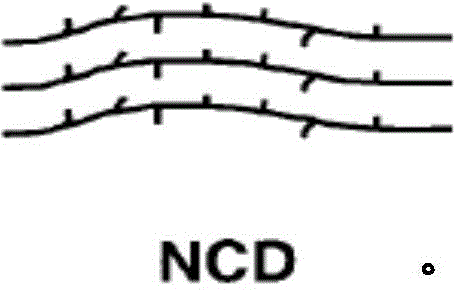
相对照而言,金属茂催化剂典型地制备具有NCD的聚烯烃聚合物组合物。金属茂催化剂一般是过渡金属,典型地第4族金属,和一种或多种环戊二烯基(Cp)配体或环的金属络合物。如上所述,NCD一般是指共聚单体均匀分布或沿着聚合物链不显著变化。图解提供如下。In contrast, metallocene catalysts typically prepare polyolefin polymer compositions having NCD. Metallocene catalysts are generally metal complexes of transition metals, typically
最近,已经对于具有宽正交组成分布(BOCD)的聚烯烃聚合物组合物描述了第三种分布,其中共聚单体主要结合在高分子量链中。已经指出取代的二茂铪催化剂产生这种类型的分布。参见,例如,美国专利号6,242,545、6,248,845、6,528,597、6,936,675、6,956,088、7,172,816、7,179,876、7,381,783、8,247,065、8,378,043、8,476,392;美国专利申请公开号2015/0291748;和于2017年2月20日提交的标题为“负载型催化剂体系及其使用方法”的序列号62/461,104。图解提供如下。这种分布以其改进的物理性能闻名,例如,终端用途制品的容易制造以及多种应用例如膜中的可以通过落镖抗冲击性和抗撕裂性或强度测量的劲度和韧性。Recently, a third distribution has been described for polyolefin polymer compositions having a broad orthogonal composition distribution (BOCD), in which the comonomer is primarily incorporated in high molecular weight chains. Substituted hafnocene catalysts have been shown to produce this type of distribution. See, for example, U.S. Patent Nos. 6,242,545, 6,248,845, 6,528,597, 6,936,675, 6,956,088, 7,172,816, 7,179,876, 7,381,783, 8,247,065, 8,378,043, 8,476,392; U.S. Patent Application Publication No. 2015/0291748; and Serial No. 62/461,104, filed on February 20, 2017, entitled "Supported Catalyst Systems and Methods of Using Them". An illustration is provided below. Such distributions are known for their improved physical properties, for example, ease of manufacture of end-use articles and stiffness and toughness as measured by dart impact and tear resistance or strength in various applications such as films.
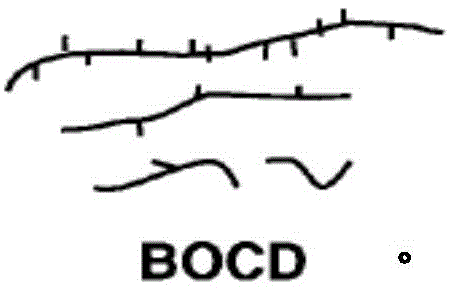
如美国专利号8,378,043教导那样,BOCD是指将共聚单体主要结合在高分子量链中。例如,可以使用温升淋洗分级(TREF)连同光散射(LS)检测器测量短链分支的分布以测定在给定温度下从TREF柱洗脱的分子的重均分子量。TREF和LS的组合(TREF-LS)产生关于组成分布的宽度的信息和共聚单体含量沿着不同分子量的链是否增加、减小或均匀。As taught in U.S. Pat. No. 8,378,043, BOCD refers to incorporating comonomers primarily in high molecular weight chains. For example, the distribution of short chain branches can be measured using temperature rising elution fractionation (TREF) in conjunction with a light scattering (LS) detector to determine the weight average molecular weight of molecules eluted from a TREF column at a given temperature. The combination of TREF and LS (TREF-LS) yields information about the breadth of the composition distribution and whether the comonomer content increases, decreases, or is uniform along chains of different molecular weights.
在另一个专利中,美国专利号9,290,593(‘593专利)教导了术语“BOCD”是目前开发的新型术语并涉及聚合物结构。术语“BOCD结构”是指其中共聚单体例如α-烯烃的含量在高分子量主链处较高的结构,即其中短链支化(SCB)随着朝高分子量移动而增加的新型结构。所述‘593专利还教导了BOCD指数。所述BOCD指数可以通过以下方程式限定:In another patent, U.S. Pat. No. 9,290,593 (the '593 patent) teaches that the term "BOCD" is a new term currently being developed and relates to a polymer structure. The term "BOCD structure" refers to a structure in which the content of comonomers, such as α-olefins, is higher at the high molecular weight backbone, i.e., a new structure in which short chain branching (SCB) increases as one moves toward high molecular weight. The '593 patent also teaches a BOCD index. The BOCD index can be defined by the following equation:
BOCD指数=(在高分子量那侧的SCB的含量-在低分子量那侧的SCB的含量)/(在低分子量那侧的SCB的含量)BOCD index = (SCB content on the high molecular weight side - SCB content on the low molecular weight side) / (SCB content on the low molecular weight side)
其中“在高分子量那侧的SCB的含量”是指包括在具有聚烯烃的Mw或更高且1.3×Mw或更低的分子量的聚合物链中的SCB含量(支链的数目/1000个碳原子),“在低分子量那侧的SCB的含量”是指包括在具有聚烯烃的0.7×Mw或更高且小于Mw的分子量的聚合物链中的SCB含量(支链的数目/1000个碳原子)。由上述方程式定义的BOCD指数可以在1-5,优选2-4,更优选2-3.5的范围内。也参见‘593专利的图1和图2(使用GPC-FTIR数据表征BOCD聚合物结构)。Wherein "SCB content on the high molecular weight side" refers to the SCB content (number of branches/1000 carbon atoms) included in a polymer chain having a molecular weight of Mw or more and 1.3×Mw or less of a polyolefin, and "SCB content on the low molecular weight side" refers to the SCB content (number of branches/1000 carbon atoms) included in a polymer chain having a molecular weight of 0.7×Mw or more and less than Mw of a polyolefin. The BOCD index defined by the above equation may be in the range of 1-5, preferably 2-4, and more preferably 2-3.5. See also FIG. 1 and FIG. 2 of the '593 patent (characterization of BOCD polymer structure using GPC-FTIR data).
聚合物组合物的BOCD行为与机械和光学性能的良好平衡有关并是在开发新型聚合物产物过程中的重要目标。例如,线性低密度聚乙烯(LLDPE)膜应用和产物争取劲度、韧性、光学性能(例如,雾度和光泽)和可加工性的良好平衡。对于一些LLDPE膜应用,密封性能是同样重要的。密封性能主要受密度影响,随着密度降低,密封性能改善,但是密度对劲度具有反向影响。因此,为了达到平衡特性,在劲度和密封性能之间通常存在折衷。因此,为了改善密封性能并同时维持良好劲度存在挑战。过去的努力已经显示,即分子量分布和共聚单体分布互相依赖性(MWD×CD)对密封性能具有强烈影响,通过金属茂催化剂的窄CD树脂优于通过常规催化剂的宽CD树脂。The BOCD behavior of a polymer composition is related to a good balance of mechanical and optical properties and is an important goal in the development of new polymer products. For example, linear low density polyethylene (LLDPE) film applications and products strive for a good balance of stiffness, toughness, optical properties (e.g., haze and gloss) and processability. For some LLDPE film applications, sealing performance is equally important. Sealing performance is mainly affected by density, with sealing performance improving as density decreases, but density has an inverse effect on stiffness. Therefore, in order to achieve balanced properties, there is usually a compromise between stiffness and sealing performance. Therefore, there is a challenge to improve sealing performance while maintaining good stiffness. Past efforts have shown that the molecular weight distribution and comonomer distribution interdependence (MWD×CD) have a strong impact on sealing performance, and narrow CD resins through metallocene catalysts are better than wide CD resins through conventional catalysts.
因此,仍需要这样的催化剂体系和聚合方法,它们能够制备显示BCD或BOCD行为的聚烯烃组合物以制备具有例如高的劲度、韧性和密封性能,以及良好光学性能的良好平衡的LLDPE膜产品。Therefore, there is still a need for catalyst systems and polymerization processes that can produce polyolefin compositions that exhibit BCD or BOCD behavior to produce LLDPE film products having a good balance of, for example, high stiffness, toughness and sealing properties, as well as good optical properties.
发明内容Summary of the invention
在一类实施方案中,本发明提供催化剂体系,其包含以下的组合的产物:In one class of embodiments, the present invention provides a catalyst system comprising the product of the combination of:
(i)由式(A)表示的第一金属茂催化剂:(i) a first metallocene catalyst represented by formula (A):

其中:in:
M是第4族金属,比如铪;M is a
每个R1和R4独立地是氢、烷氧基或C1-C40取代或未取代的烃基;Each R 1 and R 4 is independently hydrogen, alkoxy or C 1 -C 40 substituted or unsubstituted hydrocarbon;
每个R2、R3和R8独立地是氢、烷氧基或C1-C40取代或未取代的烃基或是–CH2-SiR'3或–CH2-CR'3,和每个R'独立地是C1-C20取代或未取代的烃基,条件是:至少一个R'不是H,和R2和R3中的至少一个是–CH2-SiR'3或–CH2-CR'3;Each R 2 , R 3 and R 8 is independently hydrogen, alkoxy or C 1 -C 40 substituted or unsubstituted hydrocarbon or -CH 2 -SiR' 3 or -CH 2 -CR' 3 , and each R' is independently C 1 -C 20 substituted or unsubstituted hydrocarbon, provided that: at least one R' is not H, and at least one of R 2 and R 3 is -CH 2 -SiR' 3 or -CH 2 -CR'3;
每个R7和R10独立地是氢、烷氧基或C1-C40取代或未取代的烃基;Each of R 7 and R 10 is independently hydrogen, alkoxy or C 1 -C 40 substituted or unsubstituted hydrocarbon;
R9是–CH2-SiR'3或–CH2-CR'3,和每个R'独立地是C1-C20取代或未取代的烃基,条件是:至少一个R'不是H;R 9 is -CH 2 -SiR' 3 or -CH 2 -CR' 3 , and each R' is independently a C 1 -C 20 substituted or unsubstituted hydrocarbon group, provided that: at least one R' is not H;
T是桥联基团;和T is a bridging group; and
每个X独立地是一价阴离子配体,或两个X与所述金属原子接合和键接以形成金属环化物环,或两个X接合以形成螯合配体、二烯配体、或烷叉基配体;Each X is independently a monovalent anionic ligand, or two Xs are joined and bonded to the metal atom to form a metal cyclize ring, or two Xs are joined to form a chelate ligand, a diene ligand, or an alkylidene ligand;
(ii)由式(B)表示的第二金属茂催化剂:(ii) a second metallocene catalyst represented by formula (B):
TyCpmM6GnX5 q (B), Ty Cp m M 6 G n X 5 q (B),
其中:in:
M6是第4族金属;M 6 is a
每个Cp独立地是可以是取代或未取代的环戊二烯基;Each Cp is independently a cyclopentadienyl group which may be substituted or unsubstituted;
G是由式JR*z表示的杂原子基团,其中J是N,P,O或S,和R*是具有1-20个碳原子的线性、支化或环状烃基,和z是1或2;G is a heteroatom group represented by the formula JR* z , wherein J is N, P, O or S, and R* is a linear, branched or cyclic hydrocarbon group having 1 to 20 carbon atoms, and z is 1 or 2;
T是桥联基团,和y是0或1;T is a bridging group, and y is 0 or 1;
X5是离去基团;和 X5 is a leaving group; and
m=1或2,n=0,1,2或3,q=0,1,2或3,和m+n+q之和等于所述金属的氧化态;m = 1 or 2, n = 0, 1, 2 or 3, q = 0, 1, 2 or 3, and the sum of m + n + q is equal to the oxidation state of the metal;
(iii)至少一种活化剂;和(iii) at least one activating agent; and
(iv)非必要地,至少一种载体。(iv) optionally, at least one carrier.
在另一类实施方案中,本发明提供聚合方法以制备聚乙烯聚合物,所述方法包括使上述催化剂体系与乙烯和非必要的一种或多种C3-C10α-烯烃共聚单体在可聚合条件下接触以制备所述聚乙烯聚合物。In another class of embodiments, the present invention provides a polymerization process for preparing a polyethylene polymer, the process comprising contacting the above catalyst system with ethylene and optionally one or more C3-C10 α -olefin comonomers under polymerizable conditions to prepare the polyethylene polymer.
在此描述和请求保护本发明的其它实施方案,通过以下实施方案,它们将是显而易见的。Other embodiments of the invention are described and claimed herein and will be apparent from the following embodiments.
附图说明BRIEF DESCRIPTION OF THE DRAWINGS
图1是使用负载型混合催化剂:外消旋/内消旋Me2Si(3-(CH3)3SiCH2Cp)2HfMe2:外消旋,内消旋-(1-MeInd)2ZrMe2混合催化剂1:添加剂:IrganoxTM1010由气相乙烯/己烯聚合获得的示例性双峰聚乙烯的1H NMR烯属分析。1 is a1H NMR olefinic analysis of an exemplary bimodal polyethylene obtained from gas phase ethylene/ hexene polymerization using a supported mixed catalyst: rac/meso -Me2Si (3-( CH3 ) 3SiCH2Cp ) 2HfMe2 : rac, meso- ( 1 -MeInd)2ZrMe2.
图2是CFC数据的重量百分率随温度变化的图解,从而证实各种聚合物的Tw1和Tw2的计算。FIG. 2 is a graphical representation of the weight percent variation of CFC data as a function of temperature, demonstrating the calculation of T w1 and T w2 for various polymers.
图3是CFC数据的重均分子量随温度变化的图解,从而证实各种聚合物的Mw1和Mw2的计算。FIG3 is a graph of the weight average molecular weight as a function of temperature from the CFC data, confirming the calculations of Mw1 and Mw2 for various polymers.
图4是绘制随(Tw1-Tw2)值变化的(Mw1/Mw2)值的组成展示的绘图。FIG. 4 is a graph showing a composition plotting the value of (M w1 /M w2 ) as a function of the value of (T w1 −T w2 ).
图5是各种本发明实施例和对比实施例的平均膜模量对树脂密度的绘图。5 is a plot of average film modulus versus resin density for various inventive and comparative examples.
发明详述DETAILED DESCRIPTION OF THE INVENTION
在公开和描述本发明化合物、组分、组合物和/或方法之前,应该理解的是,除非另有说明,本发明不限于特定化合物、组分、组合物、反应物、反应条件、配体、金属茂结构、催化剂结构,或类似物,因为这些可以改变,除非另有规定。还应理解的是,这里所使用的各种术语仅是为了描述特定实施方案且没有用来限制的意图。Before disclosing and describing the compounds, components, compositions and/or methods of the present invention, it should be understood that, unless otherwise indicated, the present invention is not limited to specific compounds, components, compositions, reactants, reaction conditions, ligands, metallocene structures, catalyst structures, or the like, as these may vary unless otherwise specified. It should also be understood that the various terms used herein are only for the purpose of describing specific embodiments and are not intended to be limiting.
在本发明的数类实施方案中,本公开内容涉及催化剂体系和它们在聚合方法中制备聚烯烃聚合物例如聚乙烯聚合物和聚丙烯聚合物的用途。在另一类实施方案中,本公开内容涉及由催化剂体系制备聚烯烃聚合物的聚合方法,所述催化剂体系包含一种或多种烯烃聚合催化剂、至少一种活化剂和至少一种载体的组合的产物。In several classes of embodiments of the present invention, the disclosure relates to catalyst systems and their use in polymerization processes to prepare polyolefin polymers, such as polyethylene polymers and polypropylene polymers. In another class of embodiments, the disclosure relates to a polymerization process for preparing polyolefin polymers from a catalyst system comprising the product of a combination of one or more olefin polymerization catalysts, at least one activator, and at least one support.
特别地,本公开内容涉及制备聚乙烯聚合物的聚合方法,所述方法包括:使包含一种或多种金属茂催化剂、至少一种活化剂和至少一种载体的组合的产物的催化剂体系与乙烯和一种或多种C3-C10α-烯烃共聚单体在可聚合条件下接触。In particular, the present disclosure relates to a polymerization process for preparing polyethylene polymers comprising contacting a catalyst system comprising the product of a combination of one or more metallocene catalysts, at least one activator and at least one support with ethylene and one or more C3 - C10 alpha-olefin comonomers under polymerizable conditions.
定义definition
对于本发明及其权利要求来说,元素周期表各族的编号方案按照IUPAC元素周期表的新符号表示法。For purposes of this invention and the claims thereto, the numbering scheme for the Periodic Table Groups shall be in accordance with the new notation for the IUPAC Periodic Table of the Elements.
本文所使用的“烯烃聚合催化剂(一种或多种)”是指能够配位聚合加成的任何催化剂,典型地,有机金属络合物或化合物,其中连续的单体在有机金属活性中心处加成在单体链中。As used herein, "olefin polymerization catalyst(s)" refers to any catalyst capable of coordination polymerization addition, typically an organometallic complex or compound, wherein successive monomers are added into the monomer chain at an organometallic active center.
术语“取代基(substituent)”、“基(radical)”、“基团(group)”和“结构部分(moiety)”可互换地使用。The terms "substituent," "radical," "group," and "moiety" are used interchangeably.
当在本文使用时且除非另有规定,术语“Cn”是指每分子含n个碳原子(一个或多个)的烃(一种或多种),其中n是正整数。As used herein and unless otherwise specified, the term " Cn " refers to hydrocarbon(s) containing n carbon atom(s) per molecule, where n is a positive integer.
当在本文使用时且除非另有规定,术语“烃”是指含与碳键接的氢的一类化合物,并涵盖(i)饱和烃化合物,(ii)不饱和烃化合物和(iii)烃化合物(饱和和/或不饱和)的混合物,包括具有不同的n值的烃化合物的混合物。As used herein and unless otherwise specified, the term "hydrocarbon" refers to a class of compounds containing hydrogen bonded to carbon, and encompasses (i) saturated hydrocarbon compounds, (ii) unsaturated hydrocarbon compounds, and (iii) mixtures of hydrocarbon compounds (saturated and/or unsaturated), including mixtures of hydrocarbon compounds having different values of n.
术语“烃基(hydrocarbyl radical)”、“烃基(hydrocarbyl)”、“烃基(hydrocarbylgroup)”、“烷基(alkyl radical)”和“烷基(alkyl)”在整个文件中可互换地使用。同样地,术语"基团"、"基"和"取代基"在本文件中也可互换地使用。对本公开内容来说,“烃基基团”定义为C1-C100基团,其可以是线性、支化或环状的,且当是环状时,是芳族或非芳族的。此类基团的实例包括,但不限于,甲基、乙基、正丙基、异丙基、正丁基、异丁基、仲丁基、叔丁基、戊基、异戊基、己基、辛基、环丙基、环丁基、环戊基、环己基、环辛基等,包括它们的取代的类似物。取代的烃基是其中所述烃基的至少一个氢原子已经用至少一个杂原子或含杂原子的基团,例如卤素(例如Br、Cl、F或I)或至少一个官能团例如NR*2、OR*、SeR*、TeR*、PR*2、AsR*2、SbR*2、SR*、BR*2、SiR*3、GeR*3、SnR*3、PbR*3等取代,或其中至少一个杂原子已经插在烃基环内的基团。The terms "hydrocarbyl radical", "hydrocarbyl", "hydrocarbyl group", "alkyl radical" and "alkyl" are used interchangeably throughout this document. Likewise, the terms "group", "radical" and "substituent" are also used interchangeably in this document. For the purposes of this disclosure, a "hydrocarbyl group" is defined as a C 1 -C 100 radical, which may be linear, branched or cyclic, and when cyclic, aromatic or non-aromatic. Examples of such radicals include, but are not limited to, methyl, ethyl, n-propyl, isopropyl, n-butyl, isobutyl, sec-butyl, tert-butyl, pentyl, isopentyl, hexyl, octyl, cyclopropyl, cyclobutyl, cyclopentyl, cyclohexyl, cyclooctyl and the like, including their substituted analogs. A substituted hydrocarbyl group is one in which at least one hydrogen atom of the hydrocarbyl group has been replaced with at least one heteroatom or heteroatom-containing group, such as a halogen (e.g., Br, Cl, F, or I) or at least one functional group such as NR* 2 , OR*, SeR*, TeR*, PR* 2 , AsR* 2 , SbR* 2 , SR*, BR* 2 , SiR* 3 , GeR* 3 , SnR* 3 , PbR* 3, etc., or a group in which at least one heteroatom has been inserted into the hydrocarbyl ring.
当在本文使用时且除非另有规定,术语“烷基”是指含1-12个碳原子(即,C1-C12烷基),尤其是1-8个碳原子(即,C1-C8烷基),尤其是1-6个碳原子(即,C1-C6烷基),尤其是1-4个碳原子(即,C1-C4烷基)的饱和烃基。烷基的实例包括,但不限于甲基、乙基、丙基、丁基、戊基、己基、庚基、辛基、癸基,诸如此类。烷基可以是线性、支化或环状的。“烷基”旨在涵盖烷基的所有结构异构体形式。例如,当在本文使用时丙基涵盖正丙基和异丙基;丁基涵盖正丁基、仲丁基、异丁基和叔丁基,诸如此类。当在本文使用时“C1烷基”是指甲基(-CH3),“C2烷基”是指乙基(-CH2CH3),“C3烷基”是指丙基(-CH2CH2CH3)和“C4烷基”是指丁基(例如,-CH2CH2CH2CH3、-(CH3)CHCH2CH3、-CH2CH(CH3)2等)。另外,当在本文使用时“Me”是指甲基,“Et”是指乙基,“i-Pr”是指异丙基,“t-Bu”是指叔丁基,“Np”是指新戊基。As used herein and unless otherwise specified, the term "alkyl" refers to a saturated hydrocarbon group containing 1-12 carbon atoms (i.e., C1 - C12 alkyl), especially 1-8 carbon atoms (i.e., C1 - C8 alkyl), especially 1-6 carbon atoms (i.e., C1 - C6 alkyl), especially 1-4 carbon atoms (i.e., C1- C4 alkyl). Examples of alkyl groups include, but are not limited to, methyl, ethyl, propyl, butyl, pentyl, hexyl, heptyl, octyl, decyl, and the like. Alkyl groups may be linear, branched, or cyclic. " Alkyl" is intended to encompass all structural isomeric forms of alkyl groups. For example, propyl, as used herein, encompasses n-propyl and isopropyl; butyl encompasses n-butyl, sec-butyl, isobutyl, and tert-butyl, and the like. When used herein, " C1 alkyl" refers to methyl ( -CH3 ), " C2 alkyl" refers to ethyl ( -CH2CH3 ), " C3 alkyl" refers to propyl ( -CH2CH2CH3 ) , and " C4 alkyl" refers to butyl (e.g., -CH2CH2CH2CH3 , -( CH3 ) CHCH2CH3 , -CH2CH ( CH3 ) 2 , etc. ) . In addition, when used herein, "Me" refers to methyl, "Et" refers to ethyl , "i-Pr" refers to isopropyl, "t-Bu" refers to tert-butyl, and "Np" refers to neopentyl.
当在本文使用时且除非另有规定,术语“亚烷基”是指长度上含1-12个碳原子的二价烷基结构部分(即,C1-C12亚烷基)并是指所述亚烷基结构部分在烷基单元的两端处与所述分子的其余部分连接。例如,亚烷基包括,但不限于-CH2-、-CH2CH2-、-CH(CH3)CH2-、-CH2CH2CH2-等。亚烷基可以是线性或支化的。As used herein and unless otherwise specified, the term "alkylene" refers to a divalent alkyl moiety containing 1-12 carbon atoms in length (i.e., C1 - C12 alkylene) and refers to the alkylene moiety being attached to the remainder of the molecule at both ends of the alkyl unit. For example, alkylene includes, but is not limited to -CH2- , -CH2CH2- , -CH( CH3 ) CH2- , -CH2CH2CH2- , and the like. Alkylene can be linear or branched .
当在本文使用时且除非另有规定,术语“烯基”是指含2-12个碳原子(即,C2-C12烯基),尤其是2-8个碳原子(即,C2-C8烯基),尤其是2-6个碳原子(即,C2-C6烯基)且含一个或多个(例如,2、3个等)碳-碳双键的不饱和烃基。烯基可以是线性、支化或环状的。烯基的实例包括,但不限于乙烯基(ethenyl)(乙烯基(vinyl))、2-丙烯基、3-丙烯基、1,4-戊二烯基、1,4-丁二烯基、1-丁烯基、2-丁烯基和3-丁烯基。“烯基”旨在涵盖烯基的所有结构异构体形式。例如,丁烯基涵盖1,4-丁二烯基、1-丁烯基、2-丁烯基和3-丁烯基等。As used herein and unless otherwise specified, the term "alkenyl" refers to an unsaturated hydrocarbon group containing 2-12 carbon atoms (i.e., C2 - C12 alkenyl), especially 2-8 carbon atoms (i.e., C2 - C8 alkenyl), especially 2-6 carbon atoms (i.e., C2 - C6 alkenyl) and containing one or more (e.g., 2, 3, etc.) carbon-carbon double bonds. The alkenyl group can be linear, branched or cyclic. Examples of alkenyl groups include, but are not limited to, ethenyl (vinyl), 2-propenyl, 3-propenyl, 1,4-pentadienyl, 1,4-butadienyl, 1-butenyl, 2-butenyl and 3-butenyl. "Alkenyl" is intended to encompass all structural isomeric forms of alkenyl. For example, butenyl encompasses 1,4-butadienyl, 1-butenyl, 2-butenyl and 3-butenyl, etc.
当在本文使用时且除非另有规定,术语“亚烯基”是指长度上含2-大约12个碳原子的二价烯基结构部分(即,C2-C12亚烯基)并是指所述亚烷基结构部分在烷基单元的两端处与所述分子的其余部分连接。例如,亚烯基包括,但不限于-CH=CH-、-CH=CHCH2-、-CH=CH=CH-、-CH2CH2CH=CHCH2-等。亚烯基可以是线性或支化的。As used herein and unless otherwise specified, the term "alkenylene" refers to a divalent alkenyl moiety containing 2 to about 12 carbon atoms in length (i.e., C2 - C12 alkenylene) and refers to the alkylene moiety being attached to the remainder of the molecule at both ends of the alkyl unit. For example, alkenylene includes, but is not limited to -CH=CH-, -CH= CHCH2- , -CH=CH=CH- , -CH2CH2CH = CHCH2- , and the like. Alkenylene can be linear or branched.
当在本文使用时且除非另有规定,术语“炔基”是指含2-12个碳原子(即,C2-C12炔基),尤其是2-8个碳原子(即,C2-C8炔基),尤其是2-6个碳原子(即,C2-C6炔基)且含一个或多个(例如,2、3个等)碳-碳三键的不饱和烃基。炔基可以是线性、支化或环状的。炔基的实例包括,但不限于乙炔基、1-丙炔基、2-丁炔基和1,3-丁二炔基。“炔基”旨在涵盖炔基的所有结构异构体形式。例如,丁炔基涵盖2-丁炔基和1,3-丁二炔基,丙炔基涵盖1-丙炔基和2-丙炔基(炔丙基(propargyl))。As used herein and unless otherwise specified, the term "alkynyl" refers to an unsaturated hydrocarbon group containing 2-12 carbon atoms (i.e., C2 - C12 alkynyl), especially 2-8 carbon atoms (i.e., C2 - C8 alkynyl), especially 2-6 carbon atoms (i.e., C2 - C6 alkynyl) and containing one or more (e.g., 2, 3, etc.) carbon-carbon triple bonds. Alkynyl groups can be linear, branched or cyclic. Examples of alkynyl groups include, but are not limited to, ethynyl, 1-propynyl, 2-butynyl and 1,3-butadiynyl. "Alkynyl" is intended to encompass all structural isomeric forms of alkynyl. For example, butynyl encompasses 2-butynyl and 1,3-butadiynyl, and propynyl encompasses 1-propynyl and 2-propynyl (propargyl).
当在本文使用时且除非另有规定,术语“亚炔基”是指长度上含2-大约12个碳原子的二价炔基结构部分(即,C2-C12亚炔基)并是指所述亚烷基结构部分在烷基单元的两端处与所述分子的其余部分连接。例如,亚烯基包括,但不限于-C≡C-、-C≡CCH2-、-C≡CCH2C≡C-、-CH2CH2C≡CCH2-。亚炔基可以是线性或支化的。As used herein and unless otherwise specified, the term "alkynylene" refers to a divalent alkynyl moiety containing 2 to about 12 carbon atoms in length (i.e., C2 - C12alkynylene ) and refers to the alkylene moiety being attached to the remainder of the molecule at both ends of the alkyl unit. For example, alkenylene includes, but is not limited to -C≡C-, -C≡CCH2- , -C≡CCH2C≡C- , -CH2CH2C≡CCH2- . Alkynylenes can be linear or branched.
当在本文使用时且除非另有规定,术语“烷氧基”是指含1-大约10个碳原子的--O--烷基。烷氧基可以是直链或支链的。非限制性实例包括甲氧基、乙氧基、丙氧基、丁氧基、异丁氧基、叔丁氧基、戊氧基和己氧基。“C1烷氧基”是指甲氧基,“C2烷氧基”是指乙氧基,“C3烷氧基”是指丙氧基,“C4烷氧基”是指丁氧基。另外,当在本文使用时“OMe”是指甲氧基,“OEt”是指乙氧基。As used herein and unless otherwise specified, the term "alkoxy" refers to an --O--alkyl group containing 1 to about 10 carbon atoms. Alkoxy groups can be straight or branched. Non-limiting examples include methoxy, ethoxy, propoxy, butoxy, isobutoxy, tert-butoxy, pentyloxy, and hexyloxy. "C 1 alkoxy" refers to methoxy, "C 2 alkoxy" refers to ethoxy, "C 3 alkoxy" refers to propoxy, and "C 4 alkoxy" refers to butoxy. In addition, when used herein, "OMe" refers to methoxy, and "OEt" refers to ethoxy.
当在本文使用时且除非另有规定,术语“芳族”是指具有离位共轭π体系并含5-20个碳原子(芳族C5-C20烃),尤其是5-12个碳原子(芳族C5-C12烃),尤其是5-10个碳原子(芳族C5-C12烃)的不饱和环状烃。示例性的芳族化合物包括,但不限于苯、甲苯、二甲苯、均三甲苯、乙基苯、枯烯、萘、甲基萘、二甲基萘、乙基萘、苊烯、蒽、菲、四酚(tetraphene)、并四苯、苯并蒽、荧蒽、芘、
除非另有说明,当列举的烷基、烯基、烷氧基或芳基的异构体存在(例如,正丁基、异丁基、仲丁基和叔丁基)时,所述基团的一个成员(例如,正丁基)应该明确地公开所述类中的其余异构体(例如,异丁基、仲丁基和叔丁基)。同样,对烷基、烯基、烷氧基(alkoxide)或芳基的引用而没有规定特定的异构体(例如,丁基)特意公开了所有异构体(例如,正丁基、异丁基、仲丁基和叔丁基)。Unless otherwise indicated, when isomers of an alkyl, alkenyl, alkoxy or aryl group are listed (e.g., n-butyl, isobutyl, sec-butyl and tert-butyl), one member of the group (e.g., n-butyl) should explicitly disclose the remaining isomers in the class (e.g., isobutyl, sec-butyl and tert-butyl). Similarly, a reference to an alkyl, alkenyl, alkoxy or aryl group without specifying a particular isomer (e.g., butyl) specifically discloses all isomers (e.g., n-butyl, isobutyl, sec-butyl and tert-butyl).
本文所使用的术语“羟基”是指-OH基团。As used herein, the term "hydroxy" refers to an -OH group.
本文所使用的“含氧化合物(oxygenate)”是指含1-40个碳原子并进一步含一个或多个氧杂原子的饱和、不饱和或多环环化烃基。As used herein, "oxygenate" refers to a saturated, unsaturated or polycyclic cyclized hydrocarbon group containing 1 to 40 carbon atoms and further containing one or more oxygen heteroatoms.
本文所使用的“烷基铝加合物”是指烷基铝和/或铝氧烷与猝灭剂,例如水和/或甲醇的反应产物。As used herein, "alkylaluminum adduct" refers to the reaction product of an aluminum alkyl and/or aluminoxane and a quenching agent, such as water and/or methanol.
“烯烃”,或者称为“烯属烃”是碳和氢的具有至少一个双键的线性、支化或环状化合物。对本说明书及其所附权利要求来说,当聚合物或共聚物称为含烯烃时,存在于此类聚合物或共聚物中的烯烃是所述烯烃的聚合形式。例如,当共聚物被说成具有35wt%-55wt%的"乙烯"含量时,应该理解的是,所述共聚物中的单体单元衍生自聚合反应中的乙烯并且所述衍生的单元按35wt%-55wt%存在,基于所述共聚物的重量。"Olefins", or "olefins", are linear, branched or cyclic compounds of carbon and hydrogen having at least one double bond. For purposes of this specification and the claims appended thereto, when a polymer or copolymer is referred to as containing an olefin, the olefin present in such polymer or copolymer is the polymerized form of the olefin. For example, when a copolymer is said to have an "ethylene" content of 35 wt% to 55 wt%, it is understood that the monomer units in the copolymer are derived from ethylene in the polymerization reaction and the derived units are present at 35 wt% to 55 wt%, based on the weight of the copolymer.
“聚合物”具有两个或更多个相同或不同的单体单元。“均聚物”是含相同单体单元的聚合物。“共聚物”是具有两个或更多个彼此相异或不同的单体单元的聚合物。“三元共聚物”是具有三种彼此相异或不同的单体单元的聚合物。用于指单体单元的“相异”或“不同”指示所述单体单元彼此相差至少一个原子或异构上不同。因此,本文所使用的共聚物的定义包括三元共聚物和类似物。“乙烯聚合物”或“乙烯共聚物”是包含至少50mol%乙烯衍生的单元的聚合物或共聚物,“丙烯聚合物”或“丙烯共聚物”是包含至少50mol%丙烯衍生的单元的聚合物或共聚物,诸如此类。A "polymer" has two or more monomeric units that are the same or different. A "homopolymer" is a polymer containing the same monomeric units. A "copolymer" is a polymer having two or more monomeric units that are different or distinct from each other. A "terpolymer" is a polymer having three monomeric units that are different or distinct from each other. "Different" or "different" as used in reference to monomeric units indicates that the monomeric units differ from each other by at least one atom or are isomerically different. Thus, the definition of copolymer as used herein includes terpolymers and the like. An "ethylene polymer" or "ethylene copolymer" is a polymer or copolymer comprising at least 50 mol% ethylene-derived units, a "propylene polymer" or "propylene copolymer" is a polymer or copolymer comprising at least 50 mol% propylene-derived units, and so forth.
本文所使用的“可聚合条件”是指那些条件,包括熟练技术人员选择的温度、压力、反应物浓度、非必要的溶剂/稀释剂、反应物混合/添加参数,及在至少一个聚合反应器内有助于一种或多种烯烃单体当与活化烯烃聚合催化剂接触时反应以典型地经由配位聚合制备所需聚烯烃聚合物的其它条件。As used herein, "polymerizable conditions" refers to those conditions, including temperature, pressure, reactant concentrations, optional solvents/diluents, reactant mixing/addition parameters, and other conditions selected by the skilled artisan to facilitate the reaction of one or more olefin monomers when contacted with an activated olefin polymerization catalyst to produce the desired polyolefin polymer, typically via coordination polymerization, within at least one polymerization reactor.
术语"连续"是指在没有中断或停止的情况下操作的体系。例如,制备聚合物的连续方法将是其中反应物被连续地导入一个或多个反应器并且聚合物产物被连续取出的方法。The term "continuous" refers to a system that operates without interruption or stopping. For example, a continuous process for making a polymer would be one in which the reactants are continuously introduced into one or more reactors and the polymer product is continuously withdrawn.
“催化剂组合物”或“催化剂体系”是至少一种催化剂化合物、载体材料、非必要的活化剂和非必要的共活化剂的组合。对本发明目的及其权利要求目的来说,当催化剂体系或组合物描述为包含组分的中性稳定形式时,本领域技术人员应理解,所述组分的离子形式是与单体反应以产生聚合物的形式。当它用来描述在活化之后的此种组合的时,它是指载体、活化络合物和活化剂或其它电荷平衡结构部分。过渡金属化合物可以是中性的,如在前催化剂中那样,或具有抗衡离子的带电物质,如在活化催化剂体系中那样。A "catalyst composition" or "catalyst system" is a combination of at least one catalyst compound, a support material, an optional activator, and an optional co-activator. For purposes of this invention and the claims thereto, when a catalyst system or composition is described as comprising a neutral stable form of a component, it will be understood by those skilled in the art that the ionic form of the component is the form that reacts with the monomer to produce a polymer. When it is used to describe such a combination after activation, it refers to the support, the activating complex, and the activator or other charge balancing moiety. The transition metal compound can be neutral, as in a procatalyst, or a charged species with a counterion, as in an activated catalyst system.
配位聚合是其中将持续的单体添加到有机金属活性中心之中或之处以使聚合物链产生和/或生长的加成聚合。Coordination polymerization is an addition polymerization in which successive monomers are added into or at an organometallic active center to produce and/or grow a polymer chain.
术语“助催化剂”和“活化剂”在本文中可互换使用,并且定义为能够通过将中性催化剂化合物转化成催化活性催化剂化合物阳离子而活化上述催化剂化合物中的任何一种的任何化合物。The terms "cocatalyst" and "activator" are used interchangeably herein and are defined as any compound capable of activating any of the above catalyst compounds by converting the neutral catalyst compound into a catalytically active catalyst compound cation.
“BOCD”是指宽正交组成分布,其中共聚物的共聚单体主要结合在聚烯烃聚合物或组合物的高分子量链或物质中。例如,可以使用温升淋洗分级(TREF)连同光散射(LS)检测器测量短链分支的分布以测定在给定温度下从TREF柱洗脱的分子的重均分子量。TREF和LS的组合(TREF-LS)产生关于组成分布的宽度的信息和共聚单体含量沿着聚合物链的不同分子量的链是否增加、减小或均匀。BOCD已经例如,描述在美国专利号8,378,043第3栏第34行至第4栏第19行;和8,476,392,第43行至第16栏第54行。"BOCD" refers to a broad orthogonal composition distribution in which the comonomers of the copolymer are primarily incorporated in high molecular weight chains or species of the polyolefin polymer or composition. For example, the distribution of short chain branches can be measured using temperature rising elution fractionation (TREF) in conjunction with a light scattering (LS) detector to determine the weight average molecular weight of the molecules eluted from the TREF column at a given temperature. The combination of TREF and LS (TREF-LS) yields information about the width of the composition distribution and whether the comonomer content increases, decreases, or is uniform along chains of different molecular weights of the polymer chain. BOCD has been described, for example, in U.S. Pat. Nos. 8,378,043, col. 3, line 34 to col. 4, line 19; and 8,476,392, lines 43 to col. 16, line 54.
除非另有说明,本文报道的TREF-LS数据使用分析尺寸TREF仪器(Polymerchar,Spain)测量,所述仪器具有以下尺寸的柱:内直径(ID)7.8mm;外直径(OD)9.53mm和柱长150mm。所述柱填充有钢珠。将在含6g BHT/4L的邻二氯苯(ODCB)中的0.5mL 6.4%(w/v)聚合物溶液进料到所述柱上并以1.0℃/min的恒定冷却速率从140℃冷却到25℃。随后,按1.0ml/min的流量经过所述柱泵送ODCB并按2℃/min的恒定加热速率提高柱温以洗脱聚合物。借助于使用红外检测器测量在2857cm-1的波数下的吸收率检测洗脱液体中的聚合物浓度。乙烯-α-烯烃共聚物在洗脱液体中的浓度由吸收率计算并作为温度的函数绘图。使用Minidawn Tristar光散射检测器(Wyatt,Calif.,USA)通过光散射测量洗脱液体中的乙烯-α-烯烃共聚物的分子量。也将作为温度的函数的分子量绘图。Unless otherwise stated, the TREF-LS data reported herein were measured using an analytical size TREF instrument (Polymerchar, Spain) having a column with the following dimensions: internal diameter (ID) 7.8 mm; external diameter (OD) 9.53 mm and column length 150 mm. The column was packed with steel beads. 0.5 mL of a 6.4% (w/v) polymer solution in o-dichlorobenzene (ODCB) containing 6 g BHT/4 L was fed to the column and cooled from 140° C. to 25° C. at a constant cooling rate of 1.0° C./min. Subsequently, ODCB was pumped through the column at a flow rate of 1.0 ml/min and the column temperature was increased at a constant heating rate of 2° C./min to elute the polymer. The polymer concentration in the eluted liquid was detected by measuring the absorbance at a wave number of 2857 cm -1 using an infrared detector. The concentration of ethylene-α-olefin copolymer in the eluted liquid was calculated from the absorbance and plotted as a function of temperature. The molecular weight of the ethylene-α-olefin copolymer in the eluted liquid was measured by light scattering using a Minidawn Tristar light scattering detector (Wyatt, Calif., USA). The molecular weight was also plotted as a function of temperature.
组成分布的宽度由T75-T25值表征,其中T25是在本文描述的TREF实验中获得25%的经洗脱聚合物时的温度,T75是在本文描述的TREF实验中获得75%的经洗脱聚合物时的温度。组成分布进一步由F80值表征,其是在本文描述的TREF-LS实验中在80℃以下洗脱的聚合物的比例。F80值越高指示聚合物分子中共聚单体的比例越高。正交组成分布由大于1的M60/M90值定义,其中M60是在TREF-LS实验中在60℃洗脱的聚合物级分的分子量,M90是在本文所述的TREF-LS实验中在90℃洗脱的聚合物级分的分子量。The width of the composition distribution is characterized by the T 75 -T 25 value, where T 25 is the temperature at which 25% of the eluted polymer is obtained in the TREF experiment described herein, and T 75 is the temperature at which 75% of the eluted polymer is obtained in the TREF experiment described herein. The composition distribution is further characterized by the F 80 value, which is the proportion of polymer eluted below 80° C. in the TREF-LS experiment described herein. A higher F 80 value indicates a higher proportion of comonomers in the polymer molecules. An orthogonal composition distribution is defined by an M 60 /M 90 value greater than 1, where M 60 is the molecular weight of the polymer fraction eluted at 60° C. in the TREF-LS experiment described herein, and M 90 is the molecular weight of the polymer fraction eluted at 90° C. in the TREF-LS experiment described herein.
在一类实施方案中,本文所述的聚合物可以具有特征在于T75-T25值是1或更大,2.0或更大,2.5或更大,4.0或更大,5.0或更大,7.0或更大,10.0或更大,11.5或更大,15.0或更大,17.5或更大,20.0或更大,或25.0或更大,其中T25是在本文所述TREF实验中获得25%的经洗脱聚合物时的温度,T75是获得75%的经洗脱聚合物时的温度。In one class of embodiments, the polymers described herein may have a value characterized by T75 - T25 of 1 or greater, 2.0 or greater, 2.5 or greater, 4.0 or greater, 5.0 or greater, 7.0 or greater, 10.0 or greater, 11.5 or greater, 15.0 or greater, 17.5 or greater, 20.0 or greater, or 25.0 or greater, wherein T25 is the temperature at which 25% of the eluted polymer is obtained and T75 is the temperature at which 75% of the eluted polymer is obtained in a TREF experiment described herein.
本文描述的聚合物可以进一步具有特征在于M60/M90值是1.5或更大,2.0或更大,2.25或更大,2.50或更大,3.0或更大,3.5或更大,4.0或更大,4.5或更大,或5.0或更大的BOCD,其中M60是在本文所述的TREF-LS实验中在60℃洗脱的聚合物级分的分子量,M90是在本文所述的TREF-LS实验中在90℃洗脱的聚合物级分的分子量。The polymers described herein may further have a BOCD characterized by an M60 / M90 value of 1.5 or greater, 2.0 or greater, 2.25 or greater, 2.50 or greater, 3.0 or greater, 3.5 or greater, 4.0 or greater, 4.5 or greater, or 5.0 or greater, wherein M60 is the molecular weight of the polymer fraction eluting at 60°C in the TREF-LS experiment described herein and M90 is the molecular weight of the polymer fraction eluting at 90°C in the TREF-LS experiment described herein.
此外,本文所述的聚合物可以进一步具有特征在于F80值是1%或更大,2%或更大,3%或更大,4%或更大,5%或更大,6%或更大,7%或更大,10%或更大,11%或更大,12%或更大,或15%或更大的BOCD,其中F80是在80℃以下的温度洗脱的聚合物的比例。In addition, the polymers described herein can further have a BOCD characterized by an F80 value of 1% or greater, 2% or greater, 3% or greater, 4% or greater, 5% or greater, 6% or greater, 7% or greater, 10% or greater, 11% or greater, 12% or greater, or 15% or greater, wherein F80 is the proportion of the polymer that elutes at temperatures below 80°C.
烯烃聚合催化剂Olefin polymerization catalyst
金属茂催化剂Metallocene catalysts
在一类实施方案中,催化剂体系可以是混合金属茂催化剂体系(即,包含多于一种催化剂)并包含两种或更多种下述催化剂,例如由式(A)表示的催化剂:In one class of embodiments, the catalyst system can be a mixed metallocene catalyst system (ie, comprising more than one catalyst) and comprises two or more of the following catalysts, such as a catalyst represented by formula (A):
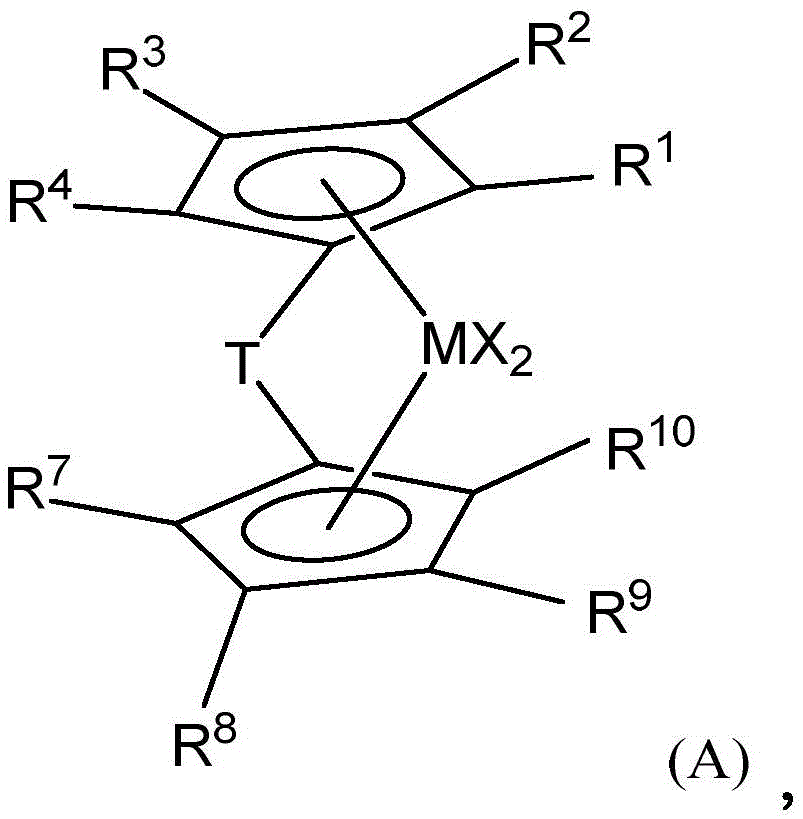
其中:in:
M是Hf或Zr;M is Hf or Zr;
每个R1、R2和R4独立地是氢、烷氧基(alkoxide)或C1-C40取代或未取代的烃基(优选C1-C20取代或未取代的烃基);Each of R 1 , R 2 and R 4 is independently hydrogen, alkoxide or C 1 -C 40 substituted or unsubstituted hydrocarbon group (preferably C 1 -C 20 substituted or unsubstituted hydrocarbon group);
R3独立地是氢、烷氧基或C1-C40取代或未取代的烃基(优选C1-C20取代或未取代的烃基),或是-R20-SiR'3或-R20-CR'3,其中R20是氢,或C1-C4烃基,每个R'独立地是C1-C20取代或未取代的烃基,条件是至少一个R'不是H;R 3 is independently hydrogen, alkoxy or C 1 -C 40 substituted or unsubstituted hydrocarbon (preferably C 1 -C 20 substituted or unsubstituted hydrocarbon), or -R 20 -SiR' 3 or -R 20 -CR' 3 , wherein R 20 is hydrogen, or C 1 -C 4 hydrocarbon, each R' is independently C 1 -C 20 substituted or unsubstituted hydrocarbon, provided that at least one R' is not H;
每个R7、R8和R10独立地是氢、烷氧基或C1-C40取代或未取代的烃基(优选C1-C20取代或未取代的烃基);Each of R 7 , R 8 and R 10 is independently hydrogen, alkoxy or C 1 -C 40 substituted or unsubstituted hydrocarbon group (preferably C 1 -C 20 substituted or unsubstituted hydrocarbon group);
R9是-R20-SiR'3或-R20-CR'3其中R20是氢或C1-C4烃基(优选R20是CH2),每个R'独立地是C1-C20取代或未取代的烃基,(优选R'是烷基,例如Me,或芳基,例如苯基),条件是至少一个R'不是H,或者2个R'不是H,或者3个R'不是H;R 9 is -R 20 -SiR' 3 or -R 20 -CR' 3 wherein R 20 is hydrogen or C 1 -C 4 hydrocarbon group (preferably R 20 is CH 2 ), each R' is independently a C 1 -C 20 substituted or unsubstituted hydrocarbon group, (preferably R' is an alkyl group, such as Me, or an aryl group, such as phenyl), provided that at least one R' is not H, or 2 R's are not H, or 3 R's are not H;
T是桥联基,例如CR21R22,其中R21和R22独立地是氢、卤素或含C1-C20的烃基(例如,线性烃基)、取代的烃基,非必要地,R21和R22接合以形成取代或未取代的、饱和的、部分不饱和的或芳族、环状或多环的取代基,非必要地,R21和R22是相同或不同的;和T is a bridging group, such as CR 21 R 22 , wherein R 21 and R 22 are independently hydrogen, halogen, or a C 1 -C 20- containing hydrocarbon group (e.g., a linear hydrocarbon group), a substituted hydrocarbon group, optionally, R 21 and R 22 are joined to form a substituted or unsubstituted, saturated, partially unsaturated or aromatic, cyclic or polycyclic substituent, optionally, R 21 and R 22 are the same or different; and
每个X独立地是一价阴离子配体,或两个X与所述金属原子接合和键接以形成金属环化物环(a metallocycle ring),或两个X接合以形成螯合配体、二烯配体或烷叉基配体(优选地,卤素或C1-C12烷基或芳基,例如Cl、Me、Et、Ph)。Each X is independently a monovalent anionic ligand, or two X are joined and bonded to the metal atom to form a metallocycle ring, or two X are joined to form a chelate ligand, a diene ligand or an alkylidene ligand (preferably, a halogen or a C 1 -C 12 alkyl or aryl group, such as Cl, Me, Et, Ph).
在本发明的一个优选的实施方案中,M是Hf,或者M是Zr。In a preferred embodiment of the present invention, M is Hf, or M is Zr.
在本发明的一个优选的实施方案中,每个R1、R2和R4独立地是氢、或取代的C1-C12烃基或未取代的C1-C12烃基,优选氢、甲基、乙基、丙基、丁基、戊基、己基或它们的异构体。In a preferred embodiment of the present invention, each R 1 , R 2 and R 4 is independently hydrogen, or a substituted C 1 -C 12 hydrocarbon group or an unsubstituted C 1 -C 12 hydrocarbon group, preferably hydrogen, methyl, ethyl, propyl, butyl, pentyl, hexyl or isomers thereof.
在本发明的一个优选的实施方案中,每个R3独立地是氢、或取代的C1-C12烃基或未取代的C1-C12烃基,优选氢、甲基、乙基、丙基、丁基、戊基、己基或它们的异构体或R3是-R20-SiR'3或-R20-CR'3,其中R20是C1-C4烃基(优选甲基、乙基、丙基、丁基),R'是C1-C20取代或未取代的烃基,优选取代的C1-C12烃基或未取代的C1-C12烃基,优选甲基、乙基、丙基、丁基、戊基、己基或它们的异构体。In a preferred embodiment of the present invention, each R 3 is independently hydrogen, or a substituted C 1 -C 12 hydrocarbon group or an unsubstituted C 1 -C 12 hydrocarbon group, preferably hydrogen, methyl, ethyl, propyl, butyl, pentyl, hexyl or isomers thereof, or R 3 is -R 20 -SiR' 3 or -R 20 -CR' 3 , wherein R 20 is a C 1 -C 4 hydrocarbon group (preferably methyl, ethyl, propyl, butyl), R' is a C 1 -C 20 substituted or unsubstituted hydrocarbon group, preferably a substituted C 1 -C 12 hydrocarbon group or an unsubstituted C 1 -C 12 hydrocarbon group, preferably methyl, ethyl, propyl, butyl, pentyl, hexyl or isomers thereof.
在本发明的一个优选的实施方案中,每个R7、R8和R10独立地是氢、或取代的C1-C12烃基或未取代的C1-C12烃基,优选氢、甲基、乙基、丙基、丁基、戊基、己基或它们的异构体。In a preferred embodiment of the present invention, each R 7 , R 8 and R 10 is independently hydrogen, or substituted C 1 -C 12 hydrocarbon group or unsubstituted C 1 -C 12 hydrocarbon group, preferably hydrogen, methyl, ethyl, propyl, butyl, pentyl, hexyl or isomers thereof.
在本发明的一个优选的实施方案中,R9是-R20-SiR'3或-R20-CR'3,其中R20是C1-C4烃基(优选甲基、乙基、丙基、丁基),R'是C1-C20取代或未取代的烃基,优选取代的C1-C12烃基或未取代的C1-C12烃基,优选甲基、乙基、丙基、丁基、戊基、己基或它们的异构体。In a preferred embodiment of the present invention, R 9 is -R 20 -SiR' 3 or -R 20 -CR' 3 , wherein R 20 is a C 1 -C 4 hydrocarbon group (preferably methyl, ethyl, propyl, butyl), and R' is a C 1 -C 20 substituted or unsubstituted hydrocarbon group, preferably a substituted C 1 -C 12 hydrocarbon group or an unsubstituted C 1 -C 12 hydrocarbon group, preferably methyl, ethyl, propyl, butyl, pentyl, hexyl or isomers thereof.
或者,R9和非必要地,R3独立地是-R20-CMe3或-R20-SiMe3,其中R20是C1-C4烃基(优选甲基、乙基、丙基、丁基),优选-CH2-CMe3或-CH2-SiMe3。Alternatively, R 9 and optionally R 3 are independently -R 20 -CMe 3 or -R 20 -SiMe 3 , wherein R 20 is a C 1 -C 4 hydrocarbon group (preferably methyl, ethyl, propyl, butyl), preferably -CH 2 -CMe 3 or -CH 2 -SiMe 3 .
或者,每个X可以独立地是卤基(a halide)、氢基(a hydride)、烷基、烯基或芳烷基。Alternatively, each X may independently be a halide, a hydride, an alkyl, an alkenyl, or an aralkyl.
或者,每个X独立地选自含1-20个碳原子的烃基、芳基、氢基、氨基(amide)、烷氧基、硫基(sulfide)、磷基(phosphide)、卤基、二烯、胺、膦、醚和它们的组合(两个X可以形成稠环或环系的一部分),优选地,每个X独立地选自卤基、芳基和C1-C5烷基,优选每个X是苯基、甲基、乙基、丙基、丁基、戊基、溴基或氯基。Alternatively, each X is independently selected from a hydrocarbon group containing 1 to 20 carbon atoms, an aryl group, a hydrogen group, an amino group (amide), an alkoxy group, a sulfide group, a phosphide group, a halogen group, a diene group, an amine, a phosphine group, an ether and a combination thereof (two X groups may form a part of a fused ring or a ring system), preferably, each X is independently selected from a halogen group, an aryl group and a C 1 -C 5 alkyl group, preferably, each X is a phenyl group, a methyl group, an ethyl group, a propyl group, a butyl group, a pentyl group, a bromo group or a chloro group.
优选地,T是含至少一个第13、14、15或16族元素,尤其是硼或第14、15或16族元素的桥联基。适合的桥联基的实例包括P(=S)R'、P(=Se)R'、P(=O)R'、R'2C、R'2Si、R'2Ge、R'2CCR'2、R'2CCR'2CR'2、R'2CCR'2CR'2CR'2、R'C=CR'、R'C=CR'CR'2、R'2CCR'=CR'CR'2、R'C=CR'CR'=CR'、R'C=CR'CR'2CR'2、R'2CSiR'2、R'2SiSiR'2、R'2SiOSiR'2、R'2CSiR'2CR'2、R'2SiCR'2SiR'2、R'C=CR'SiR'2、R'2CGeR'2、R'2GeGeR'2、R'2CGeR'2CR'2、R'2GeCR'2GeR'2、R'2SiGeR'2、R'C=CR'GeR'2、R'B、R'2C-BR'、R'2C-BR'-CR'2、R'2C-O-CR'2、R'2CR'2C-O-CR'2CR'2、R'2C-O-CR'2CR'2、R'2C-O-CR'=CR'、R'2C-S-CR'2、R'2CR'2C-S-CR'2CR'2、R'2C-S-CR'2CR'2、R'2C-S-CR'=CR'、R'2C-Se-CR'2、R'2CR'2C-Se-CR'2CR'2、R'2C-Se-CR'2CR'2、R'2C-Se-CR'=CR'、R'2C-N=CR'、R'2C-NR'-CR'2、R'2C-NR'-CR'2CR'2、R'2C-NR'-CR'=CR'、R'2CR'2C-NR'-CR'2CR'2、R'2C-P=CR'、R'2C-PR'-CR'2、O、S、Se、Te、NR'、PR'、AsR'、SbR'、O-O、S-S、R'N-NR'、R'P-PR'、O-S、O-NR'、O-PR'、S-NR'、S-PR'和R'N-PR',其中R'是氢或含C1-C20的烃基、取代的烃基、卤代烃基(halocarbyl)、取代的卤代烃基、甲硅烷基烃基(silylcarbyl)或甲锗烷基烃基(germylcarbyl)取代基,非必要地,两个或更多个相邻的R'可以接合以形成取代或未取代、饱和、部分不饱和或芳族、环状或多环的取代基。桥联基T的优选实例包括CH2、CH2CH2、SiMe2、SiPh2、SiMePh、Si(CH2)3、Si(CH2)4、O、S、NPh、PPh、NMe、PMe、NEt、NPr、NBu、PEt、PPr、Me2SiOSiMe2和PBu。Preferably, T is a bridging group comprising at least one element of
在本发明的一个优选的实施方案中,在这里描述的任何式的任何实施方案中,T由式Ra 2J或(Ra 2J)2表示,其中J是C、Si或Ge,每个Ra独立地是氢、卤素、C1-C20烃基(例如甲基、乙基、丙基、丁基、戊基、己基、庚基、辛基、壬基、癸基、十一烷基或十二烷基)或C1-C20取代的烃基,和两个Ra可以形成包括芳族、部分饱和或饱和的环状或稠环体系的环状结构。优选地,T是含碳或硅的桥联基,例如二烷基甲硅烷基,优选T选自CH2、CH2CH2、C(CH3)2、SiMe2、SiPh2、SiMePh、甲硅烷基环丁基(Si(CH2)3)、(Ph)2C、(p-(Et)3SiPh)2C、Me2SiOSiMe2和亚环五甲硅烷基(cyclopentasilylene)(Si(CH2)4)。In a preferred embodiment of the present invention, in any embodiment of any formula described herein, T is represented by the formula Ra2J or ( Ra2J ) 2 , wherein J is C, Si or Ge, each Ra is independently hydrogen, halogen, C1 - C20 hydrocarbon group (e.g., methyl, ethyl, propyl, butyl , pentyl, hexyl, heptyl, octyl, nonyl, decyl, undecyl or dodecyl) or C1 - C20 substituted hydrocarbon group, and two Ra can form a ring structure including an aromatic, partially saturated or saturated cyclic or fused ring system. Preferably, T is a carbon or silicon containing bridging group, such as a dialkylsilyl group, preferably T is selected from CH2 , CH2CH2 , C( CH3 ) 2 , SiMe2 , SiPh2 , SiMePh , silylcyclobutyl (Si( CH2 ) 3 ), (Ph) 2C , (p-(Et) 3SiPh ) 2C , Me2SiOSiMe2 and cyclopentasilylene (Si ( CH2 ) 4 ).
在本发明的一个优选的实施方案中,催化剂化合物中的外消旋与内消旋的摩尔比为1:1-100:1,优选5:1-90:1,优选7:1-80:1,优选5:1或更大,或7:1或更大,或20:1或更大,或30:1或更大或50:1或更大。在本发明的一个实施方案中,金属茂催化剂包含大于55mol%的外消旋异构体,或大于60mol%外消旋异构体,或大于65mol%外消旋异构体,或大于70mol%外消旋异构体,或大于75mol%外消旋异构体,或大于80mol%外消旋异构体,或大于85mol%外消旋外消旋异构体,或大于90mol%外消旋异构体,或大于92mol%外消旋异构体,或大于95mol%外消旋异构体,或大于97mol%外消旋异构体,基于所形成的如果有的外消旋和内消旋异构体的总量。在本发明一个特定的实施方案中,所形成的金属茂过渡金属化合物基本上由外消旋异构体组成。In a preferred embodiment of the present invention, the molar ratio of racemic to meso in the catalyst compound is 1:1-100:1, preferably 5:1-90:1, preferably 7:1-80:1, preferably 5:1 or greater, or 7:1 or greater, or 20:1 or greater, or 30:1 or greater or 50:1 or greater. In one embodiment of the invention, the metallocene catalyst comprises greater than 55 mol% of racemic isomers, or greater than 60 mol% of racemic isomers, or greater than 65 mol% of racemic isomers, or greater than 70 mol% of racemic isomers, or greater than 75 mol% of racemic isomers, or greater than 80 mol% of racemic isomers, or greater than 85 mol% of racemic isomers, or greater than 90 mol% of racemic isomers, or greater than 92 mol% of racemic isomers, or greater than 95 mol% of racemic isomers, or greater than 97 mol% of racemic isomers, based on the total amount of racemic and meso isomers formed, if any. In a specific embodiment of the invention, the metallocene transition metal compound formed consists essentially of the racemic isomer.
通过质子NMR测定外消旋和内消旋异构体的量。在23℃下以5mm探针使用具有氘化二氯甲烷的400MHz Bruker摄谱仪收集1H NMR数据。(应指出,这里的一些实施例可以使用氘化苯,但是对于权利要求目的来说,应该使用二氯甲烷。)使用45°的最大脉冲宽度,脉冲间的5秒和平均16次瞬变的信号记录数据。频谱归一化成氘化二氯甲烷中的质子化二氯甲烷,其预期在5.32ppm处显示峰。The amount of racemic and meso isomers was determined by proton NMR. 1H NMR data were collected at 23°C using a 400MHz Bruker spectrometer with deuterated dichloromethane with a 5mm probe. (It should be noted that some examples herein may use deuterated benzene, but for the purposes of the claims, dichloromethane should be used.) Data were recorded using a maximum pulse width of 45°, 5 seconds between pulses, and signal averaging of 16 transients. The spectrum was normalized to protonated dichloromethane in deuterated dichloromethane, which is expected to show a peak at 5.32ppm.
尤其可用于本发明的催化剂化合物包括以下物质中一种或多种:外消旋/内消旋Me2Si(Me3SiCH2Cp)2HfMe2;外消旋Me2Si(Me3SiCH2Cp)2HfMe2;外消旋/内消旋Ph2Si(Me3SiCH2Cp)2HfMe2;外消旋/内消旋(CH2)3Si(Me3SiCH2Cp)2HfMe2;外消旋/内消旋(CH2)4Si(Me3SiCH2Cp)2HfMe2;外消旋/内消旋(C6F5)2Si(Me3SiCH2Cp)2HfMe2;外消旋/内消旋(CH2)3Si(Me3SiCH2Cp)2ZrMe2;外消旋/内消旋Me2Ge(Me3SiCH2Cp)2HfMe2;外消旋/内消旋Me2Si(Me2PhSiCH2Cp)2HfMe2;外消旋/内消旋Ph2Si(Me2PhSiCH2Cp)2HfMe2;Me2Si(Me4Cp)(Me2PhSiCH2Cp)HfMe2;外消旋/内消旋(CH2)3Si(Me2PhSiCH2Cp)2HfMe2;外消旋/内消旋(CH2)4Si(Me2PhSiCH2Cp)2HfMe2;外消旋/内消旋(C6F5)2Si(Me2PhSiCH2Cp)2HfMe2;外消旋/内消旋Me2Ge(Me2PhSiCH2Cp)2HfMe2;外消旋/内消旋Me2Si(MePh2SiCH2Cp)2HfMe2;外消旋/内消旋Ph2Si(MePh2SiCH2Cp)2HfMe2;外消旋/内消旋Me2Si(MePh2SiCH2Cp)2ZrMe2;外消旋/内消旋(CH2)3Si(MePh2SiCH2Cp)2HfMe2;外消旋/内消旋(CH2)4Si(MePh2SiCH2Cp)2HfMe2;外消旋/内消旋(C6F5)2Si(MePh2SiCH2Cp)2HfMe2;外消旋/内消旋Me2Ge(MePh2SiCH2Cp)2HfMe2;外消旋/内消旋Me2Si(Ph3SiCH2Cp)2HfMe2;外消旋/内消旋Ph2Si(Ph3SiCH2Cp)2HfMe2;外消旋/内消旋Me2Si(Ph3SiCH2Cp)2ZrMe2;外消旋/内消旋(CH2)3Si(Ph3SiCH2Cp)2HfMe2;外消旋/内消旋(CH2)4Si(Ph3SiCH2Cp)2HfMe2;外消旋/内消旋(C6F5)2Si(Ph3SiCH2Cp)2HfMe2;外消旋/内消旋Me2Ge(Ph3SiCH2Cp)2HfMe2;外消旋/内消旋Me2Si(Cy3SiCH2Cp)2HfMe2;外消旋Me2Si(Cy3SiCH2Cp)2HfMe2;外消旋/内消旋Ph2Si(Cy3SiCH2Cp)2HfMe2;外消旋/内消旋Me2Si(Cy3SiCH2Cp)2ZrMe2;外消旋/内消旋(CH2)3Si(Cy3SiCH2Cp)2HfMe2;外消旋/内消旋(CH2)4Si(Cy3SiCH2Cp)2HfMe2;外消旋/内消旋(C6F5)2Si(Cy3SiCH2Cp)2HfMe2;外消旋/内消旋Me2Ge(Cy3SiCH2Cp)2HfMe2;外消旋/内消旋Me2Si(Cy2MeSiCH2Cp)2HfMe2;外消旋/内消旋Ph2Si(Cy2MeSiCH2Cp)2HfMe2;Me2Si(Me4Cp)(Cy2MeSiCH2Cp)HfMe2;外消旋/内消旋(CH2)3Si(Cy2MeSiCH2Cp)2HfMe2;外消旋/内消旋(CH2)4Si(Cy2MeSiCH2Cp)2HfMe2;外消旋/内消旋(C6F5)2Si(Cy2MeSiCH2Cp)2HfMe2;外消旋/内消旋Me2Ge(Cy2MeSiCH2Cp)2HfMe2;外消旋/内消旋Me2Si(CyMe2SiCH2Cp)2HfMe2;外消旋/内消旋Ph2Si(CyMe2SiCH2Cp)2HfMe2;外消旋/内消旋(CH2)3Si(CyMe2SiCH2Cp)2HfMe2;外消旋/内消旋(CH2)4Si(CyMe2SiCH2Cp)2HfMe2;外消旋/内消旋(C6F5)2Si(CyMe2SiCH2Cp)2HfMe2;外消旋/内消旋Me2Ge(CyMe2SiCH2Cp)2HfMe2;外消旋/内消旋Me2Si(Cy2PhSiCH2Cp)2HfMe2;外消旋/内消旋Ph2Si(Cy2PhSiCH2Cp)2HfMe2;外消旋/内消旋(CH2)3Si(Cy2PhSiCH2Cp)2HfMe2;外消旋/内消旋(CH2)4Si(Cy2PhSiCH2Cp)2HfMe2;外消旋/内消旋(C6F5)2Si(Cy2PhSiCH2Cp)2HfMe2;外消旋/内消旋Me2Ge(Cy2PhSiCH2Cp)2HfMe2;外消旋/内消旋Me2Si(CyPh2SiCH2Cp)2HfMe2;外消旋/内消旋Ph2Si(CyPh2SiCH2Cp)2HfMe2;外消旋/内消旋(CH2)3Si(CyPh2SiCH2Cp)2HfMe2;外消旋/内消旋(CH2)4Si(CyPh2SiCH2Cp)2HfMe2;外消旋/内消旋(C6F5)2Si(CyPh2SiCH2Cp)2HfMe2;和外消旋/内消旋Me2Ge(CyPh2SiCH2Cp)2HfMe2。Catalyst compounds particularly useful in the present invention include one or more of the following: rac /meso Me2Si ( Me3SiCH2Cp ) 2HfMe2 ; rac/ meso Ph2Si ( Me3SiCH2Cp ) 2HfMe2 ; rac/meso ( CH2 )3Si ( Me3SiCH2Cp ) 2HfMe2 ; rac / meso ( CH2 )4Si ( Me3SiCH2Cp ) 2HfMe2; rac / meso ( C6F5 ) 2Si ( Me3SiCH2Cp ) 2HfMe2 ; rac / meso ( CH2 ) 3Si ( Me3SiCH2Cp )2ZrMe 2 ; rac/mesoMe 2 Ge(Me 3 SiCH 2 Cp) 2 HfMe 2 ; rac/mesoMe 2 Si(Me 2 PhSiCH 2 Cp) 2 HfMe 2 ; rac/mesoPh 2 Si(Me 2 PhSiCH 2 Cp) 2 HfMe 2 ; Me 2 Si(Me 4 Cp)(Me 2 PhSiCH 2 Cp)HfMe 2 ; rac/meso(CH 2 ) 3 Si(Me 2 PhSiCH 2 Cp) 2 HfMe 2 ; rac/meso(CH 2 ) 4 Si(Me 2 PhSiCH 2 Cp) 2 HfMe 2 ; rac/meso(C 6 F 5 ) 2 Si(Me 2 PhSiCH 2 Cp) 2 HfMe 2 ; rac/mesoMe 2 Ge(Me 2 PhSiCH 2 Cp) 2 HfMe 2 ; rac/mesoMe 2 Si(MePh 2 SiCH 2 Cp) 2 HfMe 2 ; rac/mesoPh 2 Si(MePh 2 SiCH 2 Cp) 2 HfMe 2 ; rac/mesoMe 2 Si(MePh 2 SiCH 2 Cp) 2 ZrMe 2 ; rac/meso(CH 2 ) 3 Si(MePh 2 SiCH 2 Cp) 2 HfMe 2 ; rac/meso(CH 2 ) 4 Si(MePh 2 SiCH 2 Cp) 2 HfMe 2 ; rac/meso(C 6 F 5 ) 2 Si(MePh 2 SiCH 2 Cp) 2 HfMe 2 ; rac/mesoMe 2 Ge(MePh 2 SiCH 2 Cp) 2 HfMe 2 ; rac/mesoMe 2 Si(Ph 3 SiCH 2 Cp) 2 HfMe 2 ; rac/mesoPh 2 Si(Ph 3 SiCH 2 Cp) 2 HfMe 2 ; rac/mesoMe 2 Si(Ph 3 SiCH 2 Cp) 2 ZrMe 2 ; rac/meso(CH 2 ) 3 Si(Ph 3 SiCH 2 Cp) 2 HfMe 2 ; rac/meso(CH 2 ) 4 Si(Ph 3 SiCH 2 Cp) 2 HfMe 2 ; rac/meso(C 6 F 5 ) 2 Si(Ph 3 SiCH 2 Cp) 2 HfMe 2 ; rac/mesoMe 2 Ge(Ph 3 SiCH 2 Cp) 2 HfMe 2 ; rac/mesoMe 2 Si(Cy 3 SiCH 2 Cp) 2 HfMe 2 ; rac/mesoMe 2 Si(Cy 3 SiCH 2 Cp) 2 HfMe 2 ; rac/mesoPh 2 Si(Cy 3 SiCH 2 Cp) 2 HfMe 2 ; rac/mesoMe 2 Si(Cy 3 SiCH 2 Cp) 2 ZrMe 2 ; rac/meso(CH 2 ) 3 Si(Cy 3 SiCH 2 Cp) 2 HfMe 2 ; rac/meso(CH 2 ) 4 Si(Cy 3 SiCH 2 Cp) 2 HfMe 2 ; rac/meso(C 6 F 5 ) 2 Si(Cy 3 SiCH 2 Cp) 2 HfMe 2 ; rac/meso(C 6 F 5 ) 2 Si(Cy 3 SiCH 2 Cp) 2 HfMe 2 ; rac/mesoMe 2 Ge(Cy 3 SiCH 2 Cp) 2 HfMe 2 ; rac/mesoMe 2 Si(Cy 2 MeSiCH 2 Cp) 2 HfMe 2 ; rac/mesoPh 2 Si(Cy 2 MeSiCH 2 Cp) 2 HfMe 2 ; Me 2 Si(Me 4 Cp)(Cy 2 MeSiCH 2 Cp)HfMe 2 ; rac/meso(CH 2 ) 3 Si(Cy 2 MeSiCH 2 Cp) 2 HfMe 2 ; rac/meso(CH 2 ) 4 Si(Cy 2 MeSiCH 2 Cp) 2 HfMe 2 ; rac/meso(C 6 F 5 ) 2 Si(Cy 2 MeSiCH 2 Cp) 2 HfMe 2 ; rac/meso(C 6 F 5 ) 2 Si(Cy 2 MeSiCH 2 Cp) 2 HfMe 2 ; rac/mesoMe 2 Ge(Cy 2 MeSiCH 2 Cp) 2 HfMe 2 ; rac/mesoMe 2 Si(CyMe 2 SiCH 2 Cp) 2 HfMe 2 ; rac/mesoPh 2 Si(CyMe 2 SiCH 2 Cp) 2 HfMe 2 ; rac/meso(CH 2 ) 3 Si(CyMe 2 SiCH 2 Cp) 2 HfMe 2 ; rac/meso(CH 2 ) 4 Si(CyMe 2 SiCH 2 Cp) 2 HfMe 2 ; rac/meso(C 6 F 5 ) 2 Si(CyMe 2 SiCH 2 Cp) 2 HfMe 2 ; rac/mesoMe 2 Ge(CyMe 2 SiCH 2 Cp) 2 HfMe 2 ; rac/mesoMe 2 Si(Cy 2 PhSiCH 2 Cp) 2 HfMe 2 ; rac/mesoPh 2 Si(Cy 2 PhSiCH 2 Cp) 2 HfMe 2 ; rac/meso(CH 2 ) 3 Si(Cy 2 PhSiCH 2 Cp) 2 HfMe 2 ; rac/meso(CH 2 ) 4 Si(Cy 2 PhSiCH 2 Cp) 2 HfMe 2 ; rac/meso(C 6 F 5 ) 2 Si(Cy 2 PhSiCH 2 Cp) 2 HfMe 2 ; rac/mesoMe 2 Ge(Cy 2 PhSiCH 2 Cp) 2 HfMe 2 ; rac/meso Me 2 Si ( CyPh 2 SiCH 2 Cp) 2 HfMe 2 ; rac/meso (CH 2 ) 3 Si(CyPh 2 SiCH 2 Cp) 2 HfMe 2 ; rac/meso (CH 2 ) 4 Si(CyPh 2 SiCH 2 Cp) 2 HfMe 2 ; rac/meso (C 6 F 5 ) 2 Si(CyPh 2 SiCH 2 Cp ) 2 HfMe 2 ; and rac/meso Me 2 Ge(CyPh 2 SiCH 2 Cp ) 2 HfMe 2 .
在一个优选的实施方案中,在本文描述的任何方法中,使用一种催化剂化合物,例如催化剂化合物不是不同的。对于本发明来说,如果一种催化剂化合物与另一种相差至少一个原子,则认为它们不同。例如,“二氯·双茚基合锆”不同于“二氯·(茚基)(2-甲基茚基)合锆”,后者不同于“二氯·(茚基)(2-甲基茚基)合铪”。仅仅由于异构体而不同的催化剂化合物对于本发明目的来说认为是相同的,例如外消旋-二甲基·二甲基甲硅烷基·双(2-甲基4-苯基茚基)合铪认为与内消旋-二甲基·二甲基甲硅烷基·双(2-甲基4-苯基茚基)合铪相同。In a preferred embodiment, in any of the methods described herein, one catalyst compound is used, e.g., the catalyst compounds are not different. For purposes of the present invention, a catalyst compound is considered different if it differs from another by at least one atom. For example, "bis-indenyl zirconium dichloride" is different from "(indenyl)(2-methylindenyl)zirconium dichloride," which is different from "(indenyl)(2-methylindenyl)hafnium dichloride." Catalyst compounds that differ only by isomers are considered the same for purposes of the present invention, e.g., rac-dimethyl-dimethylsilyl-bis(2-methyl-4-phenylindenyl)hafnium is considered the same as meso-dimethyl-dimethylsilyl-bis(2-methyl-4-phenylindenyl)hafnium.
其它有用的烯烃聚合催化剂包括由以下式(B)表示的金属茂催化剂化合物:Other useful olefin polymerization catalysts include metallocene catalyst compounds represented by the following formula (B):
TyCpmM6GnX5 q (B), Ty Cp m M 6 G n X 5 q (B),
其中每个Cp独立地是可以取代或未取代的环戊二烯基(例如环戊二烯、茚或芴),M6是第4族过渡金属,例如,钛、锆、铪,G是由式JR*z表示的杂原子基,其中J是N、P、O或S,和R*是C1-C20烃基,z是1或2,T是桥联基,y是0或1,X5是离去基团(例如卤基、氢基、烷基、烯基或芳烷基),和m=1或2,n=0、1、2或3,q=0、1、2或3,且m+n+q之和等于所述过渡金属的氧化态。参见例如,WO 2016/094843。Wherein each Cp is independently a cyclopentadienyl group (e.g., cyclopentadiene, indene, or fluorene) which may be substituted or unsubstituted, M6 is a
在一个实施方案中,每个Cp是可以取代或未取代的环戊二烯、茚或芴,每个M6是钛、锆或铪,每个X5独立地是卤基、氢基、烷基、烯基或芳烷基。在本文描述的任何实施方案中,y可以是1,m可以是1,n可以是1,J可以是N,R*可以是甲基、乙基、丙基、丁基、戊基、己基、庚基、辛基、壬基、环辛基、环十二烷基、癸基、十一烷基、十二烷基、金刚烷基或它们的异构体。In one embodiment, each Cp is cyclopentadiene, indene or fluorene which may be substituted or unsubstituted, each M 6 is titanium, zirconium or hafnium, and each X 5 is independently halo, hydrogen, alkyl, alkenyl or aralkyl. In any embodiment described herein, y may be 1, m may be 1, n may be 1, J may be N, and R* may be methyl, ethyl, propyl, butyl, pentyl, hexyl, heptyl, octyl, nonyl, cyclooctyl, cyclododecyl, decyl, undecyl, dodecyl, adamantyl or isomers thereof.
在又一个实施方案中,一种或多种烯烃聚合催化剂可以包含以下的一种或多种金属茂催化剂:双(四氢茚基)Hf Me2;双(1-丁基,3-甲基环戊二烯基)ZrCl2;双-(正丁基环戊二烯基)ZrCl2;(二甲基甲硅烷基)2O双(茚基)ZrCl2;二甲基甲硅烷基(3-(3-甲基丁基)环戊二烯基)(2,3,4,5-四甲基环戊二烯基)ZrCl2;二甲基甲硅烷基·双(四氢茚基)ZrCl2;二甲基甲硅烷基-(3-苯基-茚基)(四甲基环戊二烯基)ZrCl2;二甲基甲硅烷基(3-新戊基环戊二烯基)(四甲基环戊二烯基)HfCl2;四甲基二亚甲硅烷基双(4-(3,5-二-叔丁基苯基)-茚基)ZrCl2;环戊二烯基(1,3-二苯基环戊二烯基)ZrCl2;二氯·双(环戊二烯基)合锆;二氯·双(五甲基环戊二烯基)合锆;二甲基·双(五甲基环戊二烯基)合锆;二氯·双(五甲基环戊二烯基)合铪;二甲基·双(五甲基环戊二烯基)合锆;二氯·双(1-甲基-3-正丁基环戊二烯基)合锆;二甲基·双(1-甲基-3-正丁基环戊二烯基)合锆;二氯·双(1-甲基-3-正丁基环戊二烯基)合铪;二甲基·双(1-甲基-3-正丁基环戊二烯基)合锆;二氯·双(茚基)合锆;二甲基·双(茚基)合锆;二氯·双(四氢-1-茚基)合锆;二甲基·双(四氢-1-茚基)合锆;二氯·二甲基甲硅烷基·双(四氢茚基)合锆;二甲基·二甲基甲硅烷基·双(四氢茚基)合锆;二甲基甲硅烷基·双(茚基)二氯·合锆;二甲基·二甲基甲硅烷基(双茚基)合锆;二氯·二甲基甲硅烷基·双(环戊二烯基)合锆;或二甲基·二甲基甲硅烷基·双(环戊二烯基)合锆。In yet another embodiment, the one or more olefin polymerization catalysts may comprise one or more of the following metallocene catalysts: bis(tetrahydroindenyl) HfMe2 ; bis(1-butyl, 3-methylcyclopentadienyl) ZrCl2 ; bis-(n- butylcyclopentadienyl ) ZrCl2 ; (dimethylsilyl)2Obis(indenyl)ZrCl2; dimethylsilyl(3-(3-methylbutyl)cyclopentadienyl)(2,3,4,5-tetramethylcyclopentadienyl)ZrCl2; dimethylsilyl ·bis(tetrahydroindenyl) ZrCl2 ; dimethylsilyl-(3-phenyl-indenyl)(tetramethylcyclopentadienyl)ZrCl2; dimethylsilyl( 3 -neopentylcyclopentadienyl)(tetramethylcyclopentadienyl) HfCl2 ; Tetramethyldisilylenebis(4-(3,5-di-tert-butylphenyl)-indenyl)ZrCl 2 ; Cyclopentadienyl(1,3-diphenylcyclopentadienyl)ZrCl 2 ; Dichlorobis(cyclopentadienyl)zirconium; Dichlorobis(pentamethylcyclopentadienyl)zirconium; Dimethylbis(pentamethylcyclopentadienyl)zirconium; Dichlorobis(pentamethylcyclopentadienyl)hafnium; Dimethylbis(pentamethylcyclopentadienyl)zirconium; Dichlorobis(1-methyl-3-n-butylcyclopentadienyl)zirconium; Dichlorobis(1-methyl-3-n-butylcyclopentadienyl)zirconium; Dichlorobis(1-methyl-3-n-butylcyclopentadienyl)hafnium; Dimethylbis(1-methyl-3-n-butylcyclopentadienyl)zirconium; Bis(indenyl)zirconium dichloride; bis(indenyl)zirconium dimethyl; bis(tetrahydro-1-indenyl)zirconium dichloride; dimethyl bis(tetrahydro-1-indenyl)zirconium; dimethyl bis(tetrahydro-1-indenyl)zirconium dichloride; dimethylsilyl bis(tetrahydroindenyl)zirconium dimethyl; dimethylsilyl bis(tetrahydroindenyl)zirconium; dimethylsilyl bis(indenyl)zirconium dichloride; dimethyl dimethylsilyl (bisindenyl) zirconium; dimethyl silyl bis(cyclopentadienyl) zirconium dichloride; or dimethyl dimethylsilyl bis(cyclopentadienyl) zirconium.
在另一个实施方案中,一种或多种烯烃聚合催化剂化合物可以包含独立地选自以下的第一金属茂催化剂和第二金属茂催化剂:SiMe2(Me4Cp)(cC12N)TiMe2和双(1-Bu,3-Me-Cp)ZrCl2;SiMe2(Me4Cp)(cC12N)TiMe2和(SiMe2)双(茚基)ZrCl2;SiMe2(Me4Cp)(cC12N)TiMe2和(SiMe2)2O双(茚基)ZrCl2;SiMe2(Me4Cp)(cC12N)TiMe2和(SiMe2)2O双(茚基)ZrMe2;SiMe2(Me4Cp)(cC12N)TiMe2和SiMe2(3-新戊基Cp)((Me4Cp)HfCl2;SiMe2(Me4Cp)(cC12N)TiMe2和SiMe2(3-新戊基环戊二烯基)(Me4Cp)HfMe2;SiMe2(Me4Cp)(1-金刚烷基氨基)TiMe2和双(1-Bu,3-MeCp)ZrCl2;和SiMe2(Me4Cp)(1-叔丁基氨基)TiMe2和双(1-Bu,3-MeCp)ZrCl2。In another embodiment, the one or more olefin polymerization catalyst compounds may comprise a first metallocene catalyst and a second metallocene catalyst independently selected from the group consisting of SiMe2 ( Me4Cp )( cC12N ) TiMe2 and bis(1-Bu,3-Me-Cp) ZrCl2 ; SiMe2(Me4Cp)(cC12N) TiMe2 and (SiMe2)bis(indenyl)ZrCl2; SiMe2 ( Me4Cp )(cC12N)TiMe2 and (SiMe2)2Obis(indenyl)ZrCl2; SiMe2(Me4Cp)(cC12N)TiMe2 and (SiMe2 ) 2Obis(indenyl) ZrMe2 ; SiMe2 ( Me4Cp )( cC12N ) TiMe2 and SiMe2 (3 - neopentylCp)((Me4Cp)-1-nitro-1-nitro-1-nitro-1-nitro-1- nitro - 1 -nitro-1 - nitro-1-nitro-1-nitro-1-nitro-1 - nitro- 1 -nitro- 1- nitro - 1 -nitro-1 - nitro-1- nitro -1-nitro-1-nitro-1-nitro- 1 -nitro- 1 -nitro- 1 -nitro-1-nitro - 1- Cp) HfCl2 ; SiMe2 ( Me4Cp )( cC12N ) TiMe2 and SiMe2 (3-neopentylcyclopentadienyl)( Me4Cp ) HfMe2 ; SiMe2 ( Me4Cp )(1-adamantylamino) TiMe2 and bis(1-Bu,3-MeCp) ZrCl2 ; and SiMe2 ( Me4Cp )(1-tert-butylamino) TiMe2 and bis(1-Bu,3-MeCp) ZrCl2 .
在一类实施方案中,一种或多种金属茂催化剂可以包含二氯·(4-丙基,1,2-二甲基环戊二烯基)(环戊二烯基)合铪;二甲基·(四甲基环戊二烯基)(丙基环戊二烯基)合铪;二甲基·(四甲基环戊二烯基)(丙基环戊二烯基)合锆;二甲基·(3,4-二丙基,1,2-二甲基环戊二烯基)(环戊二烯基)合铪;二甲基·(丙基环戊二烯基)(甲基环戊二烯基)合铪;二甲基·(丙基环戊二烯基)(环戊二烯基)合铪;二甲基·(四甲基环戊二烯基)(苄基环戊二烯基)合锆;二氯·硅杂环戊基(四甲基环戊二烯基)(环戊二烯基)合锆;二氯·二甲基甲硅烷基(四甲基环戊二烯基)(3-(1-己烯基)环戊二烯基)合锆;或二甲基·二甲基甲硅烷基(四甲基环戊二烯基)(3-三甲硅烷基甲基环戊二烯基)合铪。In one class of embodiments, the one or more metallocene catalysts may include (4-propyl, 1,2-dimethylcyclopentadienyl)(cyclopentadienyl) hafnium dichloride; (tetramethylcyclopentadienyl)(propylcyclopentadienyl) hafnium dimethyl; (tetramethylcyclopentadienyl)(propylcyclopentadienyl) zirconium dimethyl; (3,4-dipropyl, 1,2-dimethylcyclopentadienyl)(cyclopentadienyl) hafnium dimethyl; (propylcyclopentadienyl)(methylcyclopentadienyl) hafnium dimethyl dichloro·silacyclopentyl(tetramethylcyclopentadienyl)(cyclopentadienyl)zirconium; dichloro·dimethylsilyl(tetramethylcyclopentadienyl)(3-(1-hexenyl)cyclopentadienyl)zirconium; or dimethyl·dimethylsilyl(tetramethylcyclopentadienyl)(3-trimethylsilylmethylcyclopentadienyl) hafnium.
在另一类实施方案中,一种或多种金属茂催化剂可以包含二氯·双(环戊二烯基)合锆、二甲基·双(环戊二烯基)合锆、二氯·双(正丁基环戊二烯基)合锆、二甲基·双(正丁基环戊二烯基)合锆、二氯·双(五甲基环戊二烯基)合锆、二甲基·双(五甲基环戊二烯基)合锆、二氯·双(五甲基环戊二烯基)合铪、二甲基·双(五甲基环戊二烯基)合锆、二氯·双(1-甲基-3-正丁基环戊二烯基)合锆、二甲基·双(1-甲基-3-正丁基环戊二烯基)合锆、二氯·双(1-甲基-3-苯基环戊二烯基)合锆、二甲基·双(1-甲基-3-苯基环戊二烯基)合锆、二氯·双(1-甲基-3-正丁基环戊二烯基)合铪、二甲基·双(1-甲基-3-正丁基环戊二烯基)合锆、二氯·双(茚基)合锆、二甲基·双(茚基)合锆、二氯·双(四氢-1-茚基)合锆、二甲基·双(四氢-1-茚基)合锆、二氯·(正丙基环戊二烯基)(五甲基环戊二烯基)合锆、二甲基·(正丙基环戊二烯基)(五甲基环戊二烯基)合锆、二氯·外消旋/内消旋-(1-乙基茚基)合锆、二甲基·外消旋/内消旋-(1-乙基茚基)合锆、二氯·外消旋/内消旋-(1-甲基茚基)合锆、二甲基·外消旋/内消旋-(1-甲基茚基)合锆、二氯·外消旋/内消旋-(1-丙基茚基)合锆、二甲基·外消旋/内消旋-(1-丙基茚基)合锆、二氯·外消旋/内消旋-(1-丁基茚基)合锆、二甲基·外消旋/内消旋-(1-丁基茚基)合锆、二氯·内消旋-(1-乙基茚基)合锆、二甲基·内消旋-(1-乙基茚基)合锆、二氯·(1-甲基茚基)(五甲基环戊二烯基)合锆、二甲基·(1-甲基茚基)(五甲基环戊二烯基)合锆或它们的组合。In another class of embodiments, the one or more metallocene catalysts may include bis(cyclopentadienyl)zirconium dichloride, bis(cyclopentadienyl)zirconium dimethyl, bis(n-butylcyclopentadienyl)zirconium dichloride, bis(n-butylcyclopentadienyl)zirconium dimethyl, bis(pentamethylcyclopentadienyl)zirconium dichloride, bis(pentamethylcyclopentadienyl)zirconium dimethyl, bis(pentamethylcyclopentadienyl)hafnium dichloride, bis(pentamethylcyclopentadienyl)zirconium dimethyl, bis(1-methyl-3- zirconium dichloride, bis(1-methyl-3-phenylcyclopentadienyl) zirconium dichloride, bis(1-methyl-3-phenylcyclopentadienyl) zirconium dichloride, bis(1-methyl-3-phenylcyclopentadienyl) zirconium dichloride, bis(1-methyl-3-n-butylcyclopentadienyl) hafnium dichloride, bis(1-methyl-3-n-butylcyclopentadienyl) zirconium dichloride, bis(indenyl) zirconium dichloride, bis(tetrahydro-1-indenyl) zirconium dichloride , dimethyl·bis(tetrahydro-1-indenyl)zirconium, dichloro·(n-propylcyclopentadienyl)(pentamethylcyclopentadienyl)zirconium, dimethyl·(n-propylcyclopentadienyl)(pentamethylcyclopentadienyl)zirconium, dichloro·racemic/meso-(1-ethylindenyl)zirconium, dichloro·racemic/meso-(1-ethylindenyl)zirconium, dichloro·racemic/meso-(1-methylindenyl)zirconium, dichloro·racemic/meso-(1-methylindenyl)zirconium, dichloro·racemic/meso-(1-methylindenyl)zirconium -(1-propylindenyl)zirconium, dimethyl·racemic/meso-(1-propylindenyl)zirconium, dichloro·racemic/meso-(1-butylindenyl)zirconium, dimethyl·racemic/meso-(1-butylindenyl)zirconium, dichloro·meso-(1-ethylindenyl)zirconium, dimethyl·meso-(1-ethylindenyl)zirconium, dichloro·(1-methylindenyl)(pentamethylcyclopentadienyl)zirconium, dimethyl·(1-methylindenyl)(pentamethylcyclopentadienyl)zirconium or a combination thereof.
在又一类实施方案中,一种或多种金属茂催化剂可以包含二氯·外消旋/内消旋-(1-乙基茚基)合锆、二甲基·外消旋/内消旋-(1-乙基茚基)合锆、二氯·外消旋/内消旋-(1-甲基茚基)合锆、二甲基·外消旋/内消旋-(1-甲基茚基)合锆、二氯·外消旋/内消旋-(1-丙基茚基)合锆、二甲基·外消旋/内消旋-(1-丙基茚基)合锆、二氯·外消旋/内消旋-(1-丁基茚基)合锆、二甲基·外消旋/内消旋-(1-丁基茚基)合锆、二氯·内消旋-(1-乙基茚基)合锆、二甲基·内消旋-(1-乙基茚基)合锆、二氯·(1-甲基茚基)(五甲基环戊二烯基)合锆、二甲基·(1-甲基茚基)(五甲基环戊二烯基)合锆或它们的组合。In yet another class of embodiments, the one or more metallocene catalysts may include rac/meso-(1-ethylindenyl) zirconium dichloride, rac/meso-(1-ethylindenyl) zirconium dimethyl, rac/meso-(1-methylindenyl) zirconium dichloride, rac/meso-(1-methylindenyl) zirconium dimethyl, rac/meso-(1-propylindenyl) zirconium dichloride, rac/meso-(1-ethylindenyl) zirconium dimethyl, -(1-propylindenyl)zirconium, dichloro·racemic/meso-(1-butylindenyl)zirconium, dimethyl·racemic/meso-(1-butylindenyl)zirconium, dichloro·meso-(1-ethylindenyl)zirconium, dimethyl·meso-(1-ethylindenyl)zirconium, dichloro·(1-methylindenyl)(pentamethylcyclopentadienyl)zirconium, dimethyl·(1-methylindenyl)(pentamethylcyclopentadienyl)zirconium or a combination thereof.
上述或下述金属茂催化剂中的一种或多种可以按混合催化剂体系亦称双重催化剂体系使用,所述混合催化剂体系包含例如,两种或三种金属茂催化剂或本文所述或本领域中已知可用于烯烃聚合的任何催化剂。它们可以共负载,即布置在相同载体材料上,非必要地并且额外地,分开地(有或者没有载体)或一起按不同组合和比例注入反应器(一个或多个)中以按照其目标规格“修整”或调节聚合物产物性能。这种方法非常适合用于控制聚合物产物性能并在聚烯烃聚合物的大量生产方面确保均匀性。One or more of the above or following metallocene catalysts can be used by a mixed catalyst system, also known as a dual catalyst system, which comprises, for example, two or three metallocene catalysts or any catalyst described herein or known in the art that can be used for olefin polymerization. They can be co-loaded, i.e. arranged on the same carrier material, optionally and additionally, separately (with or without carrier) or together in different combinations and ratios injected into reactor (one or more) to "trim" or regulate polymer product performance according to its target specification. This method is very suitable for controlling polymer product performance and ensuring uniformity in the mass production of polyolefin polymers.
例如,催化剂组合例如二氯·外消旋-亚乙基-双(茚基)合锆和二氯·二苯基甲叉基{η5-[3-(戊烯-4-基)环戊二烯-1-叉基]}[η5-(2,7-二-叔丁基芴-9-叉基)]合锆,和美国专利号9,181,370中所公开的其它催化剂可以用于催化剂体系或混合催化剂体系,如果仅使用两种催化剂,则有时也称为双重催化剂体系。在另一个实例中,Me2Si(H4Ind)2ZrCl2和(Me5 Cp)PrCpZrCl2,和(Cp)IndZrCl2和内消旋-O(Me2SiInd)2ZrCl2可以用于混合催化剂体系和美国专利号6,828,394中所公开的其它催化剂。在又一个实例中,如美国专利号9,181,369中所公开的由“MTE-A”和“MTE-B”表示的催化剂可以用于混合催化剂体系。For example, a catalyst combination such as rac-ethylene-bis(indenyl)zirconium dichloride and diphenylmethylene{ η5- [3-(penten-4-yl)cyclopentadien-1-ylidene]}[η5-(2,7-di-tert-butylfluoren- 9 -ylidene)]zirconium dichloride, and other catalysts disclosed in U.S. Pat. No. 9,181,370 can be used in a catalyst system or a mixed catalyst system, sometimes also referred to as a dual catalyst system if only two catalysts are used. In another example, Me2Si ( H4Ind ) 2ZrCl2 and ( Me5Cp ) PrCpZrCl2 , and (Cp)IndZrCl2 and meso-O(Me2SiInd ) 2ZrCl2 can be used in a mixed catalyst system and other catalysts disclosed in U.S. Pat. No. 6,828,394. In yet another example, catalysts represented by "MTE-A" and "MTE-B" as disclosed in US Pat. No. 9,181,369 can be used in a mixed catalyst system.
在另一类实施方案中,以下催化剂可以用于混合催化剂体系:二氯·苯基-3-丁烯基甲叉基(η5-环戊二烯基)(η5-9,2-7-二-叔丁基芴基)合锆、二氯·双(茚基)合锆、二氯·二苯基甲叉基{η5-[3-(戊烯-4-基)环戊二烯-1-叉基]}[η5-(2,7-二-叔丁基芴-9-叉基)]合铪、[二氯·[η5-1-(丙烯-2-基)茚基][η5-正丁基环戊二烯基]合锆、二氯·外消旋-亚乙基-双(茚基)合锆、二氯·二苯基甲叉基{η5-[3-(戊烯-4-基)环戊二烯-1-叉基]}[η5-(2,7-二-叔丁基芴-9-叉基)]合锆,和美国专利号9,006,367中所公开的其它催化剂,或美国专利号9,217,049中所公开的任何催化剂,例如由以下结构表示的那些:In another class of embodiments, the following catalysts can be used in the mixed catalyst system: phenyl- 3 -butenylmethylene(η5-cyclopentadienyl)( η5-9,2-7 -di-tert-butylfluorenyl)zirconium dichloride, bis(indenyl)zirconium dichloride, diphenylmethylene{ η5- [3-(penten-4-yl)cyclopentadien-1-ylidene]}[ η5- (2,7-di-tert-butylfluoren-9-ylidene)]hafnium dichloride, [dichloro[ η5-1- (propen-2-yl)indenyl][ η5 -n-butylcyclopentadienyl]zirconium dichloride, rac-ethylene-bis(indenyl)zirconium dichloride, diphenylmethylene{ η5- [3-(penten-4-yl)cyclopentadien-1-ylidene]}[ η5 [0063] zirconium-(2,7-di-tert-butylfluoren-9-ylidene)], and other catalysts disclosed in U.S. Pat. No. 9,006,367, or any catalyst disclosed in U.S. Pat. No. 9,217,049, such as those represented by the following structure:


活化剂Activator
催化剂组合物可以按本领域中的任何方式与活化剂结合,包括负载它们以便用于淤浆或气相聚合。活化剂通常是可以通过将中性金属化合物转化成催化活性金属化合物阳离子而活化上述催化剂化合物中任一种的化合物。非限制性的活化剂例如包括铝氧烷,烷基铝,离子化活化剂(其可以是中性的或离子型的),和常规类型的助催化剂。优选的活化剂典型地包括铝氧烷化合物,改性的铝氧烷化合物,和离子化阴离子前体化合物,其夺取反应性的、σ-键的金属配体,从而使所述金属化合物阳离子化和提供平衡电荷的非配位或弱配位阴离子。The catalyst composition can be combined with an activator in any manner in the art, including loading them for use in slurry or gas phase polymerization. An activator is typically a compound that can activate any of the above-mentioned catalyst compounds by converting a neutral metal compound into a catalytically active metal compound cation. Non-limiting activators include, for example, aluminoxanes, alkylaluminums, ionizing activators (which can be neutral or ionic), and conventional types of cocatalysts. Preferred activators typically include aluminoxane compounds, modified aluminoxane compounds, and ionizing anion precursor compounds that capture reactive, σ-bonded metal ligands, thereby cationizing the metal compound and providing non-coordinating or weakly coordinating anions that balance the charge.
铝氧烷活化剂Aluminoxane Activator
铝氧烷活化剂用作这里所述催化剂组合物中的活化剂。铝氧烷通常是含有-Al(R1)-O-子单元的低聚物化合物,其中R1是烷基。铝氧烷的实例包括甲基铝氧烷(MAO)、改性甲基铝氧烷(MMAO)、乙基铝氧烷和异丁基铝氧烷。烷基铝氧烷和改性烷基铝氧烷合适作为催化剂活化剂,尤其是当可夺取的配体是烷基、卤基、烷氧基或氨基时。还可以使用不同铝氧烷和改性铝氧烷的混合物。可以优选使用视觉上透明的甲基铝氧烷。可以过滤混浊或胶凝的铝氧烷以制备透明溶液或可以从所述混浊溶液滗析透明铝氧烷。有用的铝氧烷是美国专利号US 5,041,584涵盖的改性甲基铝氧烷(MMAO)助催化剂3A型(从Akzo Chemicals,Inc.以商品名改性甲基铝氧烷3A型商购)。Aluminoxane activators are used as activators in the catalyst compositions described herein. Aluminoxanes are generally oligomeric compounds containing -Al(R 1 )-O- subunits, wherein R 1 is an alkyl group. Examples of aluminoxanes include methylaluminoxane (MAO), modified methylaluminoxane (MMAO), ethylaluminoxane, and isobutylaluminoxane. Alkylaluminoxanes and modified alkylaluminoxanes are suitable as catalyst activators, especially when the extractable ligand is an alkyl, halide, alkoxy, or amino group. Mixtures of different aluminoxanes and modified aluminoxanes may also be used. Visually transparent methylaluminoxane may preferably be used. A turbid or gelled aluminoxane may be filtered to prepare a clear solution or a clear aluminoxane may be decanted from the turbid solution. A useful aluminoxane is the modified methylaluminoxane (MMAO) cocatalyst type 3A covered by U.S. Pat. No. US 5,041,584 (commercially available from Akzo Chemicals, Inc. under the trade name modified methylaluminoxane type 3A).
当活化剂是铝氧烷(改性或未改性)时,一些实施方案选择相对于催化剂化合物(每一金属催化位点)典型地以高达5000倍摩尔过量(Al/M)的最大的活化剂量。最小的活化剂与催化剂化合物比是1∶1摩尔比。备选的优选范围包括1:1-500:1,或者1:1-200:1,或者1:1-100:1,或1:1-50:1。When the activator is an aluminoxane (modified or unmodified), some embodiments select a maximum activator amount typically at up to 5000-fold molar excess (Al/M) relative to the catalyst compound (per metal catalytic site). The minimum activator to catalyst compound ratio is a 1:1 molar ratio. Alternative preferred ranges include 1:1-500:1, or 1:1-200:1, or 1:1-100:1, or 1:1-50:1.
在一类实施方案中,在这里描述的聚合方法中几乎没有或没有使用铝氧烷。优选地,铝氧烷按0mol%存在,或者,铝氧烷按小于500:1,优选小于300:1,优选小于100:1,优选小于1:1的铝与催化剂化合物过渡金属摩尔比存在。In one class of embodiments, little or no alumoxane is used in the polymerization process described herein. Preferably, the alumoxane is present at 0 mol%, or the alumoxane is present at a molar ratio of aluminum to catalyst compound transition metal of less than 500:1, preferably less than 300:1, preferably less than 100:1, preferably less than 1:1.
在另一类实施方案中,至少一种活化剂包含铝并且所述铝与过渡金属,例如,铪或锆之比是至少150:1;至少一种活化剂包含铝并且所述铝与过渡金属,例如,铪或锆之比是至少250:1;或至少一种活化剂包含铝并且所述铝与过渡金属,例如,铪或锆之比是至少1,000:1。In another class of embodiments, at least one activator comprises aluminum and the ratio of aluminum to transition metal, e.g., hafnium or zirconium, is at least 150: 1; at least one activator comprises aluminum and the ratio of aluminum to transition metal, e.g., hafnium or zirconium, is at least 250: 1; or at least one activator comprises aluminum and the ratio of aluminum to transition metal, e.g., hafnium or zirconium, is at least 1,000: 1.
离子化/非配位阴离子活化剂Ionizing/Non-coordinating Anion Activators
术语“非配位阴离子”(NCA)是指不配位于所述阳离子或仅微弱地配位于所述阳离子,从而保持足够不稳定以被中性路易斯碱代替的阴离子。“相容性”非配位阴离子是当初始形成的络合物分解时不降解为中性的那些。此外,所述阴离子不将阴离子取代基或片段转移到阳离子,使它形成中性过渡金属化合物和来自所述阴离子的中性副产物。可根据本发明使用的非配位阴离子是这样的阴离子,它们是相容的,在将其离子电荷平衡的意义上稳定过渡金属阳离子在+1,仍保持足够的不稳定性以允许在聚合过程中被置换。这里有用的离子化活化剂典型地包含NCA,尤其是相容的NCA。The term "non-coordinating anion" (NCA) refers to an anion that is not coordinated to the cation or is only weakly coordinated to the cation, thereby remaining sufficiently unstable to be replaced by a neutral Lewis base. "Compatible" non-coordinating anions are those that do not degrade to neutrality when the initially formed complex decomposes. In addition, the anion does not transfer anionic substituents or fragments to the cation, causing it to form a neutral transition metal compound and neutral by-products from the anion. Non-coordinating anions that can be used according to the present invention are such anions that are compatible, stabilizing the transition metal cation at +1 in the sense of balancing its ionic charge, yet remaining sufficiently unstable to allow displacement during the polymerization process. Ionizing activators useful herein typically comprise NCAs, especially compatible NCAs.
使用中性或离子型的离子化活化剂在本发明的范围内,例如四(五氟苯基)硼酸三(正丁基)铵,三全氟苯基硼准金属前体或三全氟萘基硼准金属前体,多卤化杂硼烷阴离子(WO 98/43983),硼酸(US5,942,459)或它们的组合。单独使用中性或离子活化剂或与铝氧烷或改性铝氧烷活化剂结合使用也在本发明范围内。It is within the scope of the present invention to use a neutral or ionic ionizing activator, such as tri(n-butyl)ammonium tetrakis(pentafluorophenyl)borate, a triperfluorophenylborane metalloid precursor or a triperfluoronaphthylborane metalloid precursor, a polyhalogenated heteroborane anion (WO 98/43983), boric acid (US 5,942,459), or a combination thereof. It is also within the scope of the present invention to use a neutral or ionic activator alone or in combination with an aluminoxane or modified aluminoxane activator.
对于有用的活化剂的描述,请参见US专利No.8,658,556和No.6,211,105。See US Patent Nos. 8,658,556 and 6,211,105 for descriptions of useful activators.
优选的活化剂包括四(全氟萘基)硼酸N,N-二甲基苯铵、四(全氟联苯基)硼酸N,N-二甲基苯铵、四(3,5-双(三氟甲基)苯基)硼酸N,N-二甲基苯铵、四(3,5-双(三氟甲基)苯基)硼酸N,N-二甲基苯铵、四(全氟萘基)硼酸三苯基碳


在一个优选的实施方案中,活化剂包含三芳基碳


在另一个实施方案中,活化剂包含以下物质中一种或多种:四(五氟苯基)硼酸三烷基铵、四(五氟苯基)硼酸N,N-二烷基苯铵、四(五氟苯基)硼酸N,N-二甲基-(2,4,6-三甲基苯铵)、四(2,3,4,6-四氟苯基)硼酸三烷基铵、四(2,3,4,6-四氟苯基)硼酸N,N-二烷基苯铵、四(全氟萘基)硼酸三烷基铵、四(全氟萘基)硼酸N,N-二烷基苯铵、四(全氟联苯基)硼酸三烷基铵、四(全氟联苯基)硼酸N,N-二烷基苯铵、四(3,5-双(三氟甲基)苯基)硼酸三烷基铵、四(3,5-双(三氟甲基)苯基)硼酸N,N-二烷基苯铵、四(3,5-双(三氟甲基)苯基)硼酸N,N-二烷基-(2,4,6-三甲基苯铵)、四(五氟苯基)硼酸二(异丙基)铵,(其中烷基是甲基、乙基、丙基、正丁基、仲丁基或叔丁基)。In another embodiment, the activator comprises one or more of the following: trialkylammonium tetrakis(pentafluorophenyl)borate, N,N-dialkylanilinium tetrakis(pentafluorophenyl)borate, N,N-dimethyl-(2,4,6-trimethylanilinium tetrakis(pentafluorophenyl)borate, trialkylammonium tetrakis(2,3,4,6-tetrafluorophenyl)borate, N,N-dialkylanilinium tetrakis(2,3,4,6-tetrafluorophenyl)borate, trialkylammonium tetrakis(perfluoronaphthyl)borate, N,N-dialkylanilinium tetrakis(perfluoronaphthyl)borate , trialkylammonium tetrakis(perfluorobiphenyl)borate, N,N-dialkylanilinium tetrakis(perfluorobiphenyl)borate, trialkylammonium tetrakis(3,5-bis(trifluoromethyl)phenyl)borate, N,N-dialkylanilinium tetrakis(3,5-bis(trifluoromethyl)phenyl)borate, N,N-dialkyl-(2,4,6-trimethylanilinium tetrakis(3,5-bis(trifluoromethyl)phenyl)borate, di(isopropyl)ammonium tetrakis(pentafluorophenyl)borate, (wherein the alkyl group is methyl, ethyl, propyl, n-butyl, sec-butyl or tert-butyl).
典型的活化剂与催化剂之比,例如所有NCA活化剂与催化剂之比是摩尔比大约1:1。备选的优选范围包括0.1:1-100:1,或者0.5:1-200:1,或者1:1-500:1,或者1:1-1000:1。尤其有用的范围为0.5:1-10:1,优选1:1-5:1。Typical activator to catalyst ratios, such as all NCA activators to catalyst ratios, are about 1: 1 molar ratios. Alternative preferred ranges include 0.1: 1-100: 1, or 0.5: 1-200: 1, or 1: 1-500: 1, or 1: 1-1000: 1. Particularly useful ranges are 0.5: 1-10: 1, preferably 1: 1-5: 1.
载体材料Carrier material
催化剂组合物可以非必要地包含至少一种“载体”或有时也称为“担体”。所述术语可以是可互换的,除非另外区分。适合的载体包括但不限于二氧化硅、氧化铝、二氧化硅-氧化铝、氧化锆、氧化钛、二氧化硅-氧化铝、氧化铈、氧化镁或它们的组合。催化剂可以非必要地包含载体或布置在至少一种载体上。适合的载体包括但不限于,活性和非活性材料,合成或天然存在的沸石,以及无机材料例如粘土和/或氧化物例如二氧化硅、氧化铝、氧化锆、氧化钛、二氧化硅-氧化铝、氧化铈、氧化镁或它们的组合。特别地,载体可以是二氧化硅-氧化铝、氧化铝和/或沸石,尤其是氧化铝。二氧化硅-氧化铝可以是天然存在的或呈包括二氧化硅和金属氧化物的混合物的凝胶状沉淀或凝胶形式。The catalyst composition may optionally include at least one "carrier" or sometimes also referred to as a "support". The terms may be interchangeable unless otherwise distinguished. Suitable carriers include, but are not limited to, silica, alumina, silica-alumina, zirconium oxide, titanium oxide, silica-alumina, cerium oxide, magnesium oxide, or a combination thereof. The catalyst may optionally include a carrier or be arranged on at least one carrier. Suitable carriers include, but are not limited to, active and inactive materials, synthetic or naturally occurring zeolites, and inorganic materials such as clays and/or oxides such as silica, alumina, zirconium oxide, titanium oxide, silica-alumina, cerium oxide, magnesium oxide, or a combination thereof. In particular, the carrier may be silica-alumina, aluminum oxide, and/or a zeolite, especially aluminum oxide. Silica-alumina may be naturally occurring or in the form of a gelatinous precipitate or gel comprising a mixture of silica and a metal oxide.
在一类实施方案中,至少一种载体可以包含有机二氧化硅材料。有机二氧化硅材料载体可以是由至少一种单体形成的聚合物。在某些实施方案中,有机二氧化硅材料可以是由多种相异单体形成的聚合物。制备有机二氧化硅材料的方法和材料以及表征描述可以参见例如,WO 2016/094770和WO 2016/094774。In one class of embodiments, at least one carrier may comprise an organosilica material. The organosilica material carrier may be a polymer formed from at least one monomer. In certain embodiments, the organosilica material may be a polymer formed from a plurality of different monomers. Methods and materials for preparing organosilica materials and characterization descriptions may be found in, for example, WO 2016/094770 and WO 2016/094774.
清除剂、链转移剂和/或共活化剂Scavengers, chain transfer agents and/or co-activators
还可以使用清除剂、链转移剂或共活化剂。可以用作清除剂或共活化剂的烷基铝化合物包括,例如,由式AlR3表示的那些中的一种或多种,其中每个R独立地是C1-C8脂族基,优选甲基、乙基、丙基、丁基、戊基、己基、辛基或它们的异构体),特别是三甲基铝、三乙基铝、三异丁基铝、三-正己基铝、三-正辛基铝或它们的混合物。A scavenger, chain transfer agent or co-activator may also be used. Alkyl aluminum compounds that may be used as scavengers or co-activators include, for example, one or more of those represented by the formula AlR 3 , wherein each R is independently a C 1 -C 8 aliphatic group, preferably methyl, ethyl, propyl, butyl, pentyl, hexyl, octyl or isomers thereof), in particular trimethylaluminum, triethylaluminum, triisobutylaluminum, tri-n-hexylaluminum, tri-n-octylaluminum or mixtures thereof.
也可以在这里使用的有用的链转移剂典型地是由式AlR20 3,ZnR20 2表示的化合物(其中每个R20独立地是C1-C8脂族基,优选甲基、乙基、丙基、丁基、戊基、己基、辛基或它们的异构体)或它们的组合,例如二乙基锌、三甲基铝、三异丁基铝、三辛基铝或它们的组合。Useful chain transfer agents that can also be used herein are typically compounds represented by the formula AlR 20 3 , ZnR 20 2 (wherein each R 20 is independently a C 1 -C 8 aliphatic group, preferably methyl, ethyl, propyl, butyl, pentyl, hexyl, octyl or isomers thereof) or combinations thereof, such as diethylzinc, trimethylaluminum, triisobutylaluminum, trioctylaluminum or combinations thereof.
聚合方法Aggregation methods
在这里的实施方案中,本发明涉及聚合方法,其中使单体(例如丙烯和/或乙烯),和非必要地,共聚单体与包含至少一种活化剂、至少一种载体和至少一种催化剂,例如金属茂化合物的催化剂体系接触,如上所述那样。所述载体、催化剂化合物和活化剂可以按任何顺序结合,并且典型地在与单体接触之前结合。In embodiments herein, the invention relates to a polymerization process wherein monomers (e.g., propylene and/or ethylene), and optionally, comonomers, are contacted with a catalyst system comprising at least one activator, at least one support, and at least one catalyst, such as a metallocene compound, as described above. The support, catalyst compound, and activator may be combined in any order, and are typically combined prior to contact with the monomers.
这里有用的单体包括取代或未取代的C2-C40α-烯烃,优选C2-C20α-烯烃,优选C2-C12α-烯烃,优选乙烯、丙烯、丁烯、戊烯、己烯、庚烯、辛烯、壬烯、癸烯、十一碳烯、十二碳烯和它们的异构体。Monomers useful herein include substituted or unsubstituted C2 - C40 α-olefins, preferably C2 - C20 α-olefins, preferably C2 - C12 α-olefins, preferably ethylene, propylene, butene, pentene, hexene, heptene, octene, nonene, decene, undecene, dodecene and isomers thereof.
在本发明的一个实施方案中,单体包括丙烯和非必要的共聚单体,所述共聚单体包括一种或多种乙烯或C4-C40烯烃,优选C4-C20烯烃,或优选C6-C12烯烃。C4-C40烯烃单体可以是线性、支化或环状的。C4-C40环状烯烃可以是应变(strained)或未应变(unstrained)、单环或多环的,并可以非必要地包括杂原子和/或一个或多个官能团。In one embodiment of the invention , the monomers include propylene and optional comonomers, the comonomers include one or more ethylene or C4-C40 olefins, preferably C4-C20 olefins , or preferably C6 - C12 olefins. The C4 - C40 olefin monomers may be linear, branched or cyclic. The C4 - C40 cyclic olefins may be strained or unstrained, monocyclic or polycyclic, and may optionally include heteroatoms and/or one or more functional groups.
在本发明的另一个实施方案中,单体包含乙烯和非必要的共聚单体,所述共聚单体包括一种或多种C3-C40烯烃,优选C4-C20烯烃,或优选C6-C12烯烃。所述C3-C40烯烃单体可以是线性、支化或环状的。所述C3-C40环状烯烃可以是应变或未应变、单环或多环的,并可以非必要地包括杂原子和/或一个或多个官能团。In another embodiment of the present invention, the monomer comprises ethylene and an optional comonomer, wherein the comonomer comprises one or more C 3 -C 40 olefins, preferably C 4 -C 20 olefins, or preferably C 6 -C 12 olefins. The C 3 -C 40 olefin monomers may be linear, branched or cyclic. The C 3 -C 40 cyclic olefins may be strained or unstrained, monocyclic or polycyclic, and may optionally include heteroatoms and/or one or more functional groups.
示例性的C2-C40烯烃单体和非必要的共聚单体的实例包括乙烯、丙烯、丁烯、戊烯、己烯、庚烯、辛烯、壬烯、癸烯、十一碳烯、十二碳烯、降冰片烯、降冰片二烯、双环戊二烯、环戊烯、环庚烯、环辛烯、环辛二烯、环十二碳烯、7-氧杂降冰片烯、7-氧杂降冰片二烯、其取代的衍生物和其异构体,优选己烯、庚烯、辛烯、壬烯、癸烯、十二碳烯、环辛烯、1,5-环辛二烯、1-羟基-4-环辛烯、1-乙酰氧基-4-环辛烯、5-甲基环戊烯、环戊烯、双环戊二烯、降冰片烯、降冰片二烯和它们相应的同系物和衍生物,优选降冰片烯、降冰片二烯和双环戊二烯。Examples of exemplary C2 - C40 olefin monomers and optional comonomers include ethylene, propylene, butene, pentene, hexene, heptene, octene, nonene, decene, undecene, dodecene, norbornene, norbornadiene, dicyclopentadiene, cyclopentene, cycloheptene, cyclooctene, cyclooctadiene, cyclododecene, 7-oxanorbornene, 7-oxanorbornene, substituted derivatives thereof, and isomers thereof, preferably hexene, heptene, octene, nonene, decene, dodecene, cyclooctene, 1,5-cyclooctadiene, 1-hydroxy-4-cyclooctene, 1-acetoxy-4-cyclooctene, 5-methylcyclopentene, cyclopentene, dicyclopentadiene, norbornene, norbornadiene, and their corresponding homologs and derivatives, preferably norbornene, norbornadiene and dicyclopentadiene.
在一个优选的实施方案中,一种或多种二烯按至多10wt%,优选按0.00001-1.0wt%,优选0.002-0.5wt%,甚至更优选0.003-0.2wt%存在于这里制备的聚合物中,基于所述组合物的总重量。在一些实施方案中,所述聚合中加入500ppm或更少的二烯,优选400ppm或更少,优选300ppm或更少的二烯。在其它实施方案中,将至少50ppm的二烯,或100ppm或更多,或150ppm或更多添加到聚合中。In a preferred embodiment, one or more dienes are present in the polymers prepared herein in an amount of up to 10 wt %, preferably in an amount of 0.00001 to 1.0 wt %, preferably 0.002 to 0.5 wt %, even more preferably 0.003 to 0.2 wt %, based on the total weight of the composition. In some embodiments, 500 ppm or less of diene, preferably 400 ppm or less, preferably 300 ppm or less of diene are added to the polymerization. In other embodiments, at least 50 ppm of diene, or 100 ppm or more, or 150 ppm or more are added to the polymerization.
可用于本发明的二烯单体包括具有至少两个不饱和键的任何烃结构,优选C4-C30,其中所述不饱和键中的至少两个容易通过立体特异性或非立体特异性催化剂(一种或多种)引入到聚合物中。进一步优选的是,二烯单体选自α,ω-二烯单体(即,二乙烯基单体)。更优选,二烯烃单体是线性二乙烯基单体,非常优选,含4-30个碳原子的那些。优选的二烯的实例包括丁二烯、戊二烯、己二烯、庚二烯、辛二烯、壬二烯、癸二烯、十一碳二烯、十二碳二烯、十三碳二烯、十四碳二烯、十五碳二烯、十六碳二烯、十七碳二烯、十八碳二烯、十九碳二烯、二十碳二烯、二十一碳二烯、二十二碳二烯、二十三碳二烯、二十四碳二烯、二十五碳二烯、二十六碳二烯、二十七碳二烯、二十八碳二烯、二十九碳二烯、三十碳二烯,尤其优选的二烯包括1,6-庚二烯、1,7-辛二烯、1,8-壬二烯、1,9-癸二烯、1,10-十一碳二烯、1,11-十二碳二烯、1,12-十三碳二烯、1,13-十四碳二烯和低分子量聚丁二烯(Mw小于1000g/mol)。优选的环状二烯包括环戊二烯、乙烯基降冰片烯、降冰片二烯、乙叉基降冰片烯、二乙烯基苯、双环戊二烯或含更高级环的在各个环位置有或者没有取代基的二烯烃。Diene monomers useful in the present invention include any hydrocarbon structure having at least two unsaturated bonds, preferably C4 - C30 , wherein at least two of the unsaturated bonds are easily introduced into the polymer by stereospecific or non-stereospecific catalyst(s). It is further preferred that the diene monomer is selected from α,ω-diene monomers (i.e., divinyl monomers). More preferably, the diene monomer is a linear divinyl monomer, very preferably, those containing 4-30 carbon atoms. Examples of preferred dienes include butadiene, pentadiene, hexadiene, heptadiene, octadiene, nonadiene, decadiene, undecadiene, dodecadiene, tridecadiene, tetradecadiene, pentadecadiene, hexadecadiene, heptadecadiene, octadecadiene, nonadecadiene, eicosadiene, heneicosadiene, docosadiene, tricosadiene, tetracosadiene, pentacosadiene, hexacosadiene, heptacosadiene, octacosadiene, nonacosadiene, triacontadiene, and particularly preferred dienes include 1,6-heptadiene, 1,7-octadiene, 1,8-nonadiene, 1,9-decadiene, 1,10-undecadiene, 1,11-dodecadiene, 1,12-tridecadiene, 1,13-tetradecadiene, and low molecular weight polybutadiene (Mw less than 1000 g/mol). Preferred cyclic dienes include cyclopentadiene, vinyl norbornene, norbornadiene, ethylidene norbornene, divinylbenzene, dicyclopentadiene or higher ring containing dienes with or without substituents at various ring positions.
根据本公开内容的聚合方法可以按本领域中已知的任何方式进行。本领域中已知的任何悬浮、淤浆、高压管式或高压釜方法或气相聚合方法可以在可聚合条件下使用。这些方法可以按间歇、半间歇或连续模式运行。非均相聚合方法(例如气相和淤浆相方法)是有用的。多相方法定义为是其中催化剂体系不可溶于反应介质的方法。备选地,在其它实施方案中,聚合方法是非均相的。The polymerization process according to the present disclosure can be carried out in any manner known in the art. Any suspension, slurry, high pressure tubular or autoclave process or gas phase polymerization process known in the art can be used under polymerizable conditions. These processes can be operated in batch, semi-batch or continuous mode. Heterogeneous polymerization processes (e.g., gas phase and slurry phase processes) are useful. A multiphase process is defined as a process in which the catalyst system is insoluble in the reaction medium. Alternatively, in other embodiments, the polymerization process is heterogeneous.
均相聚合方法定义为其中优选产物的至少90wt%可溶于反应介质的方法。备选地,尤其优选不是本体方法的聚合方法。在一类实施方案中,本体方法定义为其中反应器的所有进料中的单体浓度优选是70vol%或更高的方法。备选地,溶剂或稀释剂都不存在于或添加于反应介质中(除了用作催化剂体系或其它添加剂的担体的少量,或通常与单体共存的量,例如在丙烯中的丙烷)。在另一个实施方案中,方法是淤浆方法。本文所使用的术语“淤浆聚合方法”是指其中使用负载型催化剂并在所述负载型催化剂颗粒上使单体聚合的聚合方法。源自负载型催化剂的聚合物产物的至少95wt%呈粒状为固体颗粒(不溶解在稀释剂中)。A homogeneous polymerization process is defined as a process in which at least 90 wt% of the preferred product is soluble in the reaction medium. Alternatively, it is particularly preferred that the polymerization process is not a bulk process. In one class of embodiments, a bulk process is defined as a process in which the monomer concentration in all feeds to the reactor is preferably 70 vol% or higher. Alternatively, neither solvent nor diluent is present in or added to the reaction medium (except for a small amount used as a support for the catalyst system or other additives, or an amount that is typically coexistent with the monomer, such as propane in propylene). In another embodiment, the process is a slurry process. The term "slurry polymerization process" as used herein refers to a polymerization process in which a supported catalyst is used and the monomers are polymerized on the supported catalyst particles. At least 95 wt% of the polymer product derived from the supported catalyst is in granular form as solid particles (not dissolved in the diluent).
用于聚合的适合的稀释剂/溶剂包括非配位惰性液体。实例包括直链和支链烃例如异丁烷、丁烷、戊烷、异戊烷、己烷、异己烷、庚烷、辛烷、十二烷和它们的混合物;环状和脂环族烃例如环己烷、环庚烷、甲基环己烷、甲基环庚烷和它们的混合物例如商业上存在的那些(IsoparTM);全卤化烃例如全氟化C4-10烷烃、氯苯和芳族和烷基取代的芳族化合物例如苯、甲苯、均三甲苯和二甲苯。适合的溶剂还包括可以充当单体或共聚单体的液态烯烃,包括乙烯,丙烯,1-丁烯,1-己烯,1-戊烯,3-甲基-1-戊烯,4-甲基-1-戊烯,1-辛烯,1-癸烯和其混合物。在一个优选的实施方案中,脂族烃溶剂用作溶剂,例如异丁烷、丁烷、戊烷、异戊烷、己烷、异己烷、庚烷、辛烷、十二烷和它们的混合物;环状和脂环族烃,例如环己烷、环庚烷、甲基环己烷、甲基环庚烷和它们的混合物。在另一个实施方案中,溶剂是非芳族溶剂,优选芳族化合物按少于1wt%,优选少于0.5wt%,优选小于0wt%存在于溶剂中,基于溶剂的重量。Suitable diluents/solvents for polymerization include non-coordinating inert liquids. Examples include straight and branched hydrocarbons such as isobutane, butane, pentane, isopentane, hexane, isohexane, heptane, octane, dodecane and mixtures thereof; cyclic and alicyclic hydrocarbons such as cyclohexane, cycloheptane, methylcyclohexane, methylcycloheptane and mixtures thereof such as those commercially available (Isopar ™ ); perhalogenated hydrocarbons such as perfluorinated C 4-10 alkanes, chlorobenzenes and aromatic and alkyl-substituted aromatic compounds such as benzene, toluene, mesitylene and xylene. Suitable solvents also include liquid olefins that can act as monomers or comonomers, including ethylene, propylene, 1-butene, 1-hexene, 1-pentene, 3-methyl-1-pentene, 4-methyl-1-pentene, 1-octene, 1-decene and mixtures thereof. In a preferred embodiment, aliphatic hydrocarbon solvents are used as solvents, such as isobutane, butane, pentane, isopentane, hexane, isohexane, heptane, octane, dodecane and mixtures thereof; cyclic and alicyclic hydrocarbons, such as cyclohexane, cycloheptane, methylcyclohexane, methylcycloheptane and mixtures thereof. In another embodiment, the solvent is a non-aromatic solvent, preferably aromatic compounds are present in the solvent at less than 1 wt%, preferably less than 0.5 wt%, preferably less than 0 wt%, based on the weight of the solvent.
在一个优选的实施方案中,用于聚合的单体和共聚单体的进料浓度是60vol%溶剂或更低,优选40vol%或更低,优选20vol%或更低,基于进料料流的总体积。优选,聚合以本体方法运行。In a preferred embodiment, the feed concentration of monomers and comonomers for the polymerization is 60 vol% solvent or less, preferably 40 vol% or less, preferably 20 vol% or less, based on the total volume of the feed stream. Preferably, the polymerization is run as a bulk process.
优选的聚合可以在适合于获得期望的乙烯聚合物的任何温度和/或压力下运行并如上所述。在一些实施方案中,典型的压力包括大约0.35MPa-大约10MPa,优选大约0.45MPa-大约6MPa,或优选大约0.5MPa-大约4MPa的压力。Preferred polymerizations can be run at any temperature and/or pressure suitable for obtaining the desired ethylene polymer and as described above. In some embodiments, typical pressures include pressures of about 0.35 MPa to about 10 MPa, preferably about 0.45 MPa to about 6 MPa, or preferably about 0.5 MPa to about 4 MPa.
在一些实施方案中,氢气按0.001-50psig(0.007-345kPa),优选0.01-25psig(0.07-172kPa),更优选0.1-10psig(0.7-70kPa)的分压存在于聚合反应器中。In some embodiments, hydrogen is present in the polymerization reactor at a partial pressure of 0.001-50 psig (0.007-345 kPa), preferably 0.01-25 psig (0.07-172 kPa), and more preferably 0.1-10 psig (0.7-70 kPa).
在一类实施方案中,聚合在气相,优选,在流化床气相方法中进行。一般而言,在用于制备聚合物的流化床气相方法中,使包含一种或多种单体的气态料流在催化剂存在下在反应性条件下连续地循环穿过流化床。将所述气态料流从所述流化床排出并循环回所述反应器。同时,将聚合物产物从反应器排出并添加新鲜单体替代聚合了的单体。(参见,例如,美国专利号4,543,399;4,588,790;5,028,670;5,317,036;5,352,749;5,405,922;5,436,304;5,453,471;5,462,999;5,616,661;和5,668,228;它们都全文通过参考引入本文。)In one class of embodiments, polymerization is carried out in the gas phase, preferably, in a fluidized bed gas phase process. Generally speaking, in a fluidized bed gas phase process for preparing polymers, a gaseous stream comprising one or more monomers is continuously circulated through a fluidized bed in the presence of a catalyst under reactive conditions. The gaseous stream is withdrawn from the fluidized bed and recycled back to the reactor. Simultaneously, polymer product is withdrawn from the reactor and fresh monomer is added to replace the polymerized monomer. (See, e.g., U.S. Pat. Nos. 4,543,399; 4,588,790; 5,028,670; 5,317,036; 5,352,749; 5,405,922; 5,436,304; 5,453,471; 5,462,999; 5,616,661; and 5,668,228; all of which are incorporated herein by reference in their entireties.)
在本发明的另一个实施方案中,聚合在淤浆相中进行。淤浆聚合方法一般以1-大约50个大气压(15psi-735psi,103kPa-5068kPa)的范围或甚至更大和上述温度操作。在淤浆聚合中,固态、颗粒状聚合物的悬浮液在其中添加了单体和共聚单体连同催化剂的液相聚合稀释剂介质中形成。将包括稀释剂的悬浮液间歇地或连续地从反应器中除去,在所述反应器中,挥发性组分与聚合物分离并循环(非必要地,在蒸馏之后)到反应器。用于聚合介质的液体稀释剂通常是含3-7个碳原子的烷烃,优选是支化烷烃。所采用的介质在聚合条件下应该是液体并较惰性。当使用丙烷介质时,典型地在反应稀释剂临界温度和压力以上操作所述方法。通常,使用己烷或异丁烷介质。In another embodiment of the present invention, polymerization is carried out in a slurry phase. Slurry polymerization processes are generally operated in the range of 1 to about 50 atmospheres (15psi-735psi, 103kPa-5068kPa) or even greater and at the above-mentioned temperatures. In slurry polymerization, a suspension of solid, granular polymer is formed in a liquid phase polymerization diluent medium to which monomers and comonomers are added together with a catalyst. The suspension including the diluent is intermittently or continuously removed from a reactor, in which the volatile components are separated from the polymer and circulated (optionally, after distillation) to the reactor. The liquid diluent used for the polymerization medium is typically an alkane containing 3-7 carbon atoms, preferably a branched alkane. The medium used should be liquid and relatively inert under polymerization conditions. When a propane medium is used, the method is typically operated above the reaction diluent critical temperature and pressure. Typically, a hexane or isobutane medium is used.
在一个实施方案中,可用于本发明的优选的聚合技术称为颗粒形成聚合,或淤浆方法,其中将温度保持在小于聚合物进入溶液时的温度。此种技术是本领域中熟知的,并且在例如美国专利号3,248,179中进行了描述。颗粒形成方法中的优选温度在大约85℃-大约110℃的范围内。所述淤浆方法的两种优选的聚合方法是采用环管反应器的那些和使用串联、并联或其组合的多个搅拌反应器的那些。淤浆法的非限制性实例包括连续环管或搅拌槽方法。此外,淤浆方法的其它实例描述在美国专利号4,613,484中,所述文献全文通过参考引入本文。In one embodiment, the preferred polymerization technique that can be used in the present invention is called particle formation polymerization, or slurry process, in which the temperature is maintained at less than the temperature at which the polymer enters the solution. Such techniques are well known in the art and are described, for example, in U.S. Patent No. 3,248,179. The preferred temperature in the particle formation method is in the range of about 85°C to about 110°C. Two preferred polymerization methods of the slurry process are those using a loop reactor and those using multiple stirred reactors in series, in parallel or in combination thereof. Non-limiting examples of slurry processes include continuous loop or stirred tank processes. In addition, other examples of slurry processes are described in U.S. Patent No. 4,613,484, which is incorporated herein by reference in its entirety.
在另一个实施方案中,淤浆方法在环管反应器中连续地进行。定期将催化剂(作为在异丁烷中的淤浆或作为干燥自由流动粉末)注入反应器环管,所述反应器环管本身填充有生长的聚合物颗粒在含单体和共聚单体的异丁烷的稀释剂中的循环淤浆。非必要地,可以添加氢气作为分子量控制。在一个实施方案中,添加500ppm或更少的氢气,或400ppm或更少或300ppm或更少。在其它实施方案中,添加至少50ppm的氢气,或100ppm或更多,或150ppm或更多。In another embodiment, the slurry process is carried out continuously in a loop reactor. The catalyst (either as a slurry in isobutane or as a dry free-flowing powder) is periodically injected into the reactor loop, which is itself filled with a circulating slurry of growing polymer particles in a diluent of isobutane containing monomer and comonomer. Optionally, hydrogen can be added as a molecular weight control. In one embodiment, 500 ppm or less of hydrogen is added, or 400 ppm or less or 300 ppm or less. In other embodiments, at least 50 ppm of hydrogen is added, or 100 ppm or more, or 150 ppm or more.
经由环管壁除去反应热,因为反应器的大部分呈双夹套管形式。允许淤浆定期地或连续地离开反应器依次到热的低压闪蒸容器、旋转干燥器和氮气吹扫柱以便除去异丁烷稀释剂和所有未反应的单体和共聚单体。然后将所得的无烃粉末配混以便用于各种应用。The heat of reaction is removed via the annular tube wall, as the bulk of the reactor is in the form of a double-jacketed tube. The slurry is allowed to exit the reactor periodically or continuously, in sequence to a hot low-pressure flash vessel, a rotary dryer, and a nitrogen purge column to remove the isobutane diluent and all unreacted monomers and comonomers. The resulting hydrocarbon-free powder is then compounded for use in a variety of applications.
在一个优选的实施方案中,用于聚合中的催化剂体系包含至多一种催化剂化合物。“反应区”也称为“聚合区”是其中聚合进行的容器,例如间歇式反应器。当多个反应器以串联或并联的构型使用时,每一个反应器都认为是单独的聚合区。对于在间歇式反应器和连续反应器两者中的多阶段聚合,每一个聚合阶段都认为是单独的聚合区。在一个优选的实施方案中,聚合在一个反应区中发生。In a preferred embodiment, the catalyst system used in the polymerization comprises at most one catalyst compound. A "reaction zone", also referred to as a "polymerization zone", is a container, such as a batch reactor, in which polymerization is carried out. When multiple reactors are used in a series or parallel configuration, each reactor is considered to be a separate polymerization zone. For multi-stage polymerization in both batch reactors and continuous reactors, each polymerization stage is considered to be a separate polymerization zone. In a preferred embodiment, polymerization occurs in one reaction zone.
用于制备聚烯烃聚合物的有用的反应器类型和/或方法包括,但不限于UNIPOLTM气相反应器(可以从Univation Technologies获得);INEOSTM气相反应器和方法;连续流动搅拌釜(CSTR)反应器(溶液和淤浆);活塞流管式反应器(溶液和淤浆);淤浆:(例如,淤浆环管(单个或双重环管))(可以从Chevron Phillips Chemical Company获得)和(串联反应器)(可以从Mitsui Chemicals获得));BORSTARTM方法和反应器(与气相结合的淤浆);和多区循环反应器(MZCR),例如可以从Lyondell Basell获得的SPHERIZONETM反应器和方法。Useful reactor types and/or processes for making polyolefin polymers include, but are not limited to, UNIPOL ™ gas phase reactors (available from Univation Technologies); INEOS ™ gas phase reactors and processes; continuous flow stirred tank (CSTR) reactors (solution and slurry); plug flow tubular reactors (solution and slurry); slurries: (e.g., slurry loops (single or dual loops)) (available from Chevron Phillips Chemical Company) and (tandem reactors) (available from Mitsui Chemicals)); BORSTAR ™ processes and reactors (slurry combined with gas); and multi-zone circulation reactors (MZCRs), such as the SPHERIZONE ™ reactor and process available from Lyondell Basell.
在数类实施方案中,聚合反应的催化剂活性是至少4,250g/g*催化剂或更大,至少4,750g/g*催化剂或更大,至少5,000g/g*催化剂或更大,至少6,250g/g*催化剂或更大,至少8,500g/g*催化剂或更大,至少9,000g/g*催化剂或更大,至少9,500g/g*催化剂或更大,或至少9,700g/g*催化剂或更大。In several classes of embodiments, the catalyst activity for the polymerization reaction is at least 4,250 g/g*catalyst or greater, at least 4,750 g/g*catalyst or greater, at least 5,000 g/g*catalyst or greater, at least 6,250 g/g*catalyst or greater, at least 8,500 g/g*catalyst or greater, at least 9,000 g/g*catalyst or greater, at least 9,500 g/g*catalyst or greater, or at least 9,700 g/g*catalyst or greater.
聚烯烃产物Polyolefin products
在一个实施方案中,这里所述的方法制备一种、两种、三种、四种或更多种C2-C40烯烃单体,优选,C2-C20α-烯烃单体的均聚物和共聚物。特别有用的单体包括乙烯、丙烯、丁烯、戊烯、己烯、庚烯、辛烯、壬烯、癸烯、十一碳烯、十二碳烯、它们的异构体和混合物。In one embodiment, the process described herein prepares homopolymers and copolymers of one, two, three, four or more C2- C40 olefin monomers, preferably C2 - C20 alpha-olefin monomers. Particularly useful monomers include ethylene, propylene, butene, pentene, hexene, heptene, octene, nonene, decene, undecene, dodecene, isomers thereof and mixtures thereof.
同样,本发明的方法制备烯烃聚合物,优选聚乙烯和聚丙烯的均聚物和共聚物。在优选的实施方案中,本发明制备的聚合物是乙烯的均聚物或丙烯的均聚物。Likewise, the process of the present invention prepares olefin polymers, preferably homopolymers and copolymers of polyethylene and polypropylene. In a preferred embodiment, the polymer prepared by the present invention is a homopolymer of ethylene or a homopolymer of propylene.
或者,本发明制备的聚合物是C2-C40烯烃和一种、两种、三种或更多种不同的C2-C40烯烃(其中,所述C2-C40烯烃优选C3-C20烯烃,优选C3-C12α-烯烃,优选是丙烯、丁烯、己烯、辛烯、癸烯、十二碳烯,优选丙烯、丁烯、己烯、辛烯、或它们的混合物)的共聚物。Alternatively, the polymer prepared in the present invention is a copolymer of C2 - C40 olefin and one, two, three or more different C2 - C40 olefins (wherein the C2 - C40 olefin is preferably C3 - C20 olefin, preferably C3 - C12 α-olefin, preferably propylene, butene, hexene, octene, decene, dodecene, preferably propylene, butene, hexene, octene, or a mixture thereof).
或者,本发明制备的聚合物是优选具有0-25mol%(或者0.5-20mol%,或者1-15mol%,优选3-10mol%)的一种或多种C3-C20烯烃共聚单体(优选C3-C12α-烯烃,优选丙烯、丁烯、己烯、辛烯、癸烯、十二碳烯,优选丙烯、丁烯、己烯、辛烯、或它们的混合物)的共聚物。Alternatively, the polymer prepared in the present invention is a copolymer preferably having 0-25 mol% (or 0.5-20 mol%, or 1-15 mol%, preferably 3-10 mol%) of one or more C3 - C20 olefin comonomers (preferably C3 - C12 α-olefins, preferably propylene, butene, hexene, octene, decene, dodecene, preferably propylene, butene, hexene, octene, or mixtures thereof).
共混物Blends
在另一个实施方案中,将这里制备的聚合物(优选聚乙烯或聚丙烯)在形成膜、模塑部件或其它制品之前与一种或多种附加的聚合物结合。其它有用聚合物包括聚乙烯,全同立构聚丙烯,高度全同立构聚丙烯,间同立构聚丙烯,丙烯和乙烯和/或丁烯和/或己烯的无规共聚物,聚丁烯,乙烯-乙酸乙烯酯,LDPE,LLDPE,HDPE,乙烯-乙酸乙烯酯,乙烯丙烯酸甲酯,丙烯酸的共聚物,聚甲基丙烯酸甲酯或可通过高压自由基方法聚合的任何其它聚合物,聚氯乙烯,聚丁烯-1,全同立构聚丁烯,ABS树脂,乙烯-丙烯橡胶(EPR),硫化EPR,EPDM,嵌段共聚物,苯乙烯类嵌段共聚物,聚酰胺,聚碳酸酯,PET树脂,交联的聚乙烯,乙烯和乙烯醇(EVOH)的共聚物,芳族单体的聚合物例如聚苯乙烯,聚-1酯,聚缩醛,聚偏二氟乙烯,聚乙二醇和/或聚异丁烯。In another embodiment, the polymers prepared herein (preferably polyethylene or polypropylene) are combined with one or more additional polymers prior to forming into films, molded parts or other articles. Other useful polymers include polyethylene, isotactic polypropylene, highly isotactic polypropylene, syndiotactic polypropylene, random copolymers of propylene and ethylene and/or butene and/or hexene, polybutene, ethylene-vinyl acetate, LDPE, LLDPE, HDPE, ethylene-vinyl acetate, ethylene methyl acrylate, copolymers of acrylic acid, polymethyl methacrylate or any other polymer that can be polymerized by a high pressure free radical process, polyvinyl chloride, polybutene-1, isotactic polybutene, ABS resins, ethylene-propylene rubber (EPR), sulfurized EPR, EPDM, block copolymers, styrenic block copolymers, polyamides, polycarbonates, PET resins, crosslinked polyethylene, copolymers of ethylene and vinyl alcohol (EVOH), polymers of aromatic monomers such as polystyrene, poly-1 esters, polyacetals, polyvinylidene fluoride, polyethylene glycol and/or polyisobutylene.
膜membrane
特别地,上述聚合物的任一种或共混物可以用于各种终端用途应用。这些应用包括,例如,单层或多层的吹塑、挤出、和/或收缩膜。这些膜可以通过许多公知的挤出或共挤出技术形成,例如吹泡膜加工技术,其中可以将组合物以熔融状态通过环形模头挤出,然后膨胀以形成单轴或双轴取向熔体,然后冷却以形成管状、吹塑膜,然后将其轴向切开并展开以形成平膜。膜随后可以是未取向的、单轴取向或以相同或不同的程度双轴取向。In particular, any one or blend of the above-mentioned polymers can be used for various end-use applications. These applications include, for example, blow molding, extrusion, and/or shrink film of monolayer or multilayer. These films can be formed by many known extrusion or coextrusion techniques, such as blown film processing technology, wherein the composition can be extruded through an annular die in a molten state, then expanded to form a uniaxial or biaxially oriented melt, then cooled to form a tubular, blown film, then axially cut and launched to form a flat film. The film can be unoriented, uniaxially oriented or biaxially oriented with the same or different degree subsequently.
试验方法Test methods
1H NMR 1 H NMR
1H NMR数据使用具有400MHz的1H频率的Bruker摄谱仪(可以从AgilentTechnologies,Santa Clara,CA获得)在393K下在10mm探针中收集。使用45°的最大脉冲宽度,脉冲间的5秒和平均512次瞬变的信号记录数据。将光谱信号积分,并且通过将不同基团乘以1000并将所述结果除以总碳数来计算每1000个碳的不饱和部分类型的数目。Mn通过用不饱和物质的总数除以14,000计算,并具有单位g/mol。 1H NMR data were collected at 393K in a 10 mm probe using a Bruker spectrometer (available from Agilent Technologies, Santa Clara, CA) with a 1H frequency of 400 MHz. Data were recorded using a maximum pulse width of 45°, 5 seconds between pulses, and a signal average of 512 transients. The spectral signal was integrated, and the number of unsaturated moiety types per 1000 carbons was calculated by multiplying the different groups by 1000 and dividing the result by the total number of carbons. Mn was calculated by dividing the total number of unsaturated species by 14,000 and has units of g/mol.
TREF方法TREF Method
GPC 4D程序:通过具有多重检测器的GPC-IR Hyphenated测定分子量、共聚单体组成和长链支化GPC 4D Procedure: Determination of Molecular Weight, Comonomer Composition and Long Chain Branching by GPC-IR Hyphenated with Multidetector
使用配备有多通道基于带通滤波器的红外检测器IR5、18-角光散射检测器和粘度计的高温凝胶渗透色谱(Polymer Char GPC-IR)测定分子量(Mw、Mn、Mw/Mn等)的分布和矩(moment)、共聚单体含量(C2、C3、C6等)和支化指数(g'vis)。三个Agilent PLgel 10μm混合-B LS柱用来提供聚合物分离。含300ppm抗氧化剂丁基化羟基甲苯(BHT)的Aldrich试剂级1,2,4-三氯苯(TCB)用作移动相。将所述TCB混合物滤过0.1μm的Teflon过滤器并用在线脱气器脱气,然后进入GPC仪器。标称流量是1.0ml/min,标称注射体积是200μL。在维持于145℃的烘箱中装入包括输送管线、柱和检测器的整个系统。称重给定量的聚合物样品并密封在标准指管中,向其中添加80μL流动标识物(庚烷)。在将所述指管装入自动取样器之后,聚合物自动溶解在所述具有8mL加入的TCB溶剂的仪器中。将所述聚合物在160℃溶解,同时连续摇动大约1小时(对于PE样品),或者同时连续摇动大约2小时(对于PP样品)。用于浓度计算的TCB密度是在大约23℃温度下1.463g/ml和在145℃下1.284g/ml。样品溶液浓度是0.2-2.0mg/ml,较低的浓度用于较高分子量的样品。色谱图中各点的浓度(c)用以下方程式由减去基线的IR5宽带信号强度(I)计算:c=Βi,其中β是质量常数。质量恢复由浓度色谱的积分面积对洗脱体积的比例计算并且注射质量等于预测定浓度乘以注射环管体积。通过将通用校准关系与用一系列700-10M gm/摩尔的单分散聚苯乙烯(PS)标准样品进行的柱校准组合测定常规分子量(IR MW)。用下列方程式计算在每个洗脱体积的MW:The distribution and moment of molecular weight (Mw, Mn, Mw/Mn, etc.), comonomer content (

其中具有下标“PS”的变量代表聚苯乙烯,而没有下标的那些变量代表试验样品。在这种方法中,αPS=0.67,KPS=0.000175,而α和K对于其它材料,如文献(Sun,T.等的Macromolecules 2001,34,6812)中计算和公开的那样,只是对于本发明和所附权利要求书来说,对于线性乙烯聚合物,α=0.695和K=0.000579,对于线性丙烯聚合物,α=0.705和K=0.0002288,对于线性丁烯聚合物,α=0.695和K=0.000181,对于乙烯-丁烯共聚物,α是0.695和K是0.000579*(1-0.0087*w2b+0.000018*(w2b)^2),其中w2b是丁烯共聚单体的本体重量百分率(a bulk weight percent),对于乙烯-己烯共聚物,α是0.695和K是0.000579*(1-0.0075*w2b),其中w2b是己烯共聚单体的本体重量百分率,对于乙烯-辛烯共聚物,α是0.695和K是0.000579*(1-0.0077*w2b),其中w2b是辛烯共聚单体的本体重量百分率。除非另作说明,浓度以g/cm3表示,分子量以g/摩尔表示,特性粘度(因此所述Mark–Houwink方程式中的K)以dL/g表示。Variables having the subscript "PS" therein represent polystyrene, while those without the subscript represent test samples. In this method, α PS = 0.67, K PS = 0.000175, and α and K for other materials are calculated and disclosed in the literature (Sun, T. et al. Macromolecules 2001, 34, 6812), but for the present invention and the appended claims, for linear ethylene polymers, α = 0.695 and K = 0.000579, for linear propylene polymers, α = 0.705 and K = 0.0002288, for linear butene polymers, α = 0.695 and K = 0.000181, for ethylene-butene copolymers, α is 0.695 and K is 0.000579*(1-0.0087*w2b+0.000018*(w2b)^2), where w2b is the bulk weight percentage of butene comonomer (a bulk weight percentage of butene comonomer). percent), for ethylene-hexene copolymers, α is 0.695 and K is 0.000579*(1-0.0075*w2b), where w2b is the bulk weight percent of the hexene comonomer, and for ethylene-octene copolymers, α is 0.695 and K is 0.000579*(1-0.0077*w2b), where w2b is the bulk weight percent of the octene comonomer. Unless otherwise stated, concentrations are expressed in g/ cm3 , molecular weights are expressed in g/mole, and intrinsic viscosities (and therefore K in the Mark–Houwink equation) are expressed in dL/g.
共聚单体组成由对应于用一系列PE和PP均聚/共聚物标准样品校准的CH2和CH3通道的IR5检测器强度的比例测定,所述标准样品的标称值预先通过NMR或FTIR测定。特别地,这提供作为分子量的函数的甲基/1000个总碳(CH3/1000TC)。然后如下计算作为分子量的函数的短链分支(SCB)含量/1000TC(SCB/1000TC):对CH3/1000TC官能团施加链端校正,假定每个链为线性并在每一末端被甲基封端。wt%共聚单体则由以下表达式获得,其中f分别对于C3、C4、C6、C8等共聚单体,是0.3、0.4、0.6、0.8等:The comonomer composition is determined from the ratio of the IR5 detector intensities corresponding to the CH2 and CH3 channels calibrated with a series of PE and PP homo/copolymer standards, the nominal values of which were previously determined by NMR or FTIR. In particular, this provides the methyl groups/1000 total carbons ( CH3 /1000TC) as a function of molecular weight. The short chain branch (SCB) content/1000TC (SCB/1000TC) as a function of molecular weight is then calculated as follows: A chain end correction is applied to the CH3 /1000TC functional groups, assuming that each chain is linear and terminated with a methyl group at each end. The wt% comonomer is then obtained from the following expression, where f is 0.3, 0.4 , 0.6, 0.8, etc. for C3 , C4, C6 , C8 , etc. comonomers, respectively:
w2=f*SCB/1000TC。w2 = f*SCB/1000TC.
聚合物从GPC-IR和GPC-4D分析的本体组成(bulk composition)通过考虑浓度色谱图的积分限度之间的CH3和CH2通道的全部信号获得。The bulk composition of the polymer from GPC-IR and GPC-4D analysis was obtained by considering all signals of the CH 3 and CH 2 channels between the integration limits of the concentration chromatogram.
首先,获得以下比例:First, obtain the following ratios:

然后,应用CH3和CH2信号比的相同校准(如此前在获得随分子量变化的CH3/1000TC中所提及那样)以获得本体CH3/1000TC。通过在分子量范围内将链端校正加权平均获得本体甲基链端/1000TC(本体CH3端/1000TC)。则Then, the same calibration of the ratio of CH 3 and CH 2 signals (as mentioned previously in obtaining CH 3 /1000TC as a function of molecular weight) is applied to obtain the bulk CH 3 /1000TC. The bulk methyl chain ends/1000TC (bulk CH 3 ends/1000TC) is obtained by weighted averaging the chain end corrections over the molecular weight range.
w2b=f*本体CH3/1000TCw2b=f*main body CH 3 /1000TC
本体SCB/1000TC=本体CH3/1000TC-本体CH3端/1000TC,并用与上述一样的方法将本体SCB/1000TC转化成本体w2。Bulk SCB/1000TC=bulk CH 3 /1000TC-bulk CH 3 end/1000TC, and the bulk SCB/1000TC is converted into bulk w2 using the same method as above.
所述LS检测器是18-角Wyatt Technology High Temperature DAWN HELEOSII。在色谱图的每一点上的LS分子量(M)通过使用静态光散射的Zimm模型分析LS输出值来测定(Light Scattering from Polymer Solutions;Huglin,M.B.,Ed.;Academic Press,1972.):The LS detector was an 18-angle Wyatt Technology High Temperature DAWN HELEOS II. The LS molecular weight (M) at each point in the chromatogram was determined by analyzing the LS output using the Zimm model of static light scattering (Light Scattering from Polymer Solutions; Huglin, M.B., Ed.; Academic Press, 1972.):

在此,ΔR(θ)是在散射角θ处所测量的过量的瑞利散射强度,c是从IR5分析所确定的聚合物浓度,A2是第二维里系数,P(θ)是单分散无规线团的形状因子,Ko是系统的光学常数:Here, ΔR(θ) is the excess Rayleigh scattering intensity measured at the scattering angle θ, c is the polymer concentration determined from the IR5 analysis, A2 is the second virial coefficient, P(θ) is the shape factor of the monodisperse random coils, and Ko is the optical constant of the system:

其中NA是阿佛加德罗常数,(dn/dc)是系统的折光指数增值。在145℃和λ=690nm,TCB的折光指数n=1.500。对于分析聚乙烯均聚物、乙烯-己烯共聚物和乙烯-辛烯共聚物,dn/dc=0.1048ml/mg和A2=0.0015;对于分析乙烯-丁烯共聚物,dn/dc=0.1048*(1-0.00126*w2)ml/mg和A2=0.0015,其中w2是丁烯共聚单体重量百分率。Where NA is Avogadro's constant and (dn/dc) is the refractive index increment of the system. At 145°C and λ = 690 nm, the refractive index of TCB is n = 1.500. For the analysis of polyethylene homopolymers, ethylene-hexene copolymers and ethylene-octene copolymers, dn/dc = 0.1048 ml/mg and A2 = 0.0015; for the analysis of ethylene-butene copolymers, dn/dc = 0.1048*(1-0.00126*w2) ml/mg and A2 = 0.0015, where w2 is the weight percent of butene comonomer.
使用高温Agilent(或Viscotek Corporation)粘度计测定比粘度,所述粘度计具有四个以惠斯登电桥构型排列的毛细管及两个压力传感器。一个传感器测定穿过所述检测器的总压降,另一个位于所述桥两侧之间的传感器测定压差。流过粘度计的溶液的比粘度(ηs)由它们的输出计算。在色谱图中每个点处的特性粘度[η]由方程式[η]=ηs/c计算,其中c是浓度并由IR5宽带信道输出值测定。在每个点处的粘度MW计算为The specific viscosity is determined using a high temperature Agilent (or Viscotek Corporation) viscometer with four capillaries arranged in a Wheatstone bridge configuration and two pressure sensors. One sensor measures the total pressure drop across the detector and the other, located between the two sides of the bridge, measures the pressure difference. The specific viscosity (ηs) of the solution flowing through the viscometer is calculated from their output. The intrinsic viscosity [η] at each point in the chromatogram is calculated by the equation [η] = ηs/c, where c is the concentration and is determined by the IR5 broadband channel output value. The viscosity MW at each point is calculated as
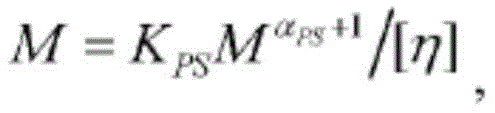
其中αps是0.67,和Kps是0.000175。Where α ps is 0.67, and K ps is 0.000175.
支化指数(g'vis)用GPC-IR5-LS-VIS法的输出如下计算。通过以下方程式计算样品的平均特性粘度[η]avg:The branching index ( g'vis ) is calculated using the output of the GPC-IR5-LS-VIS method as follows. The average intrinsic viscosity [η] avg of the sample is calculated by the following equation:
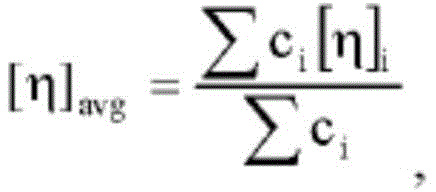
其中所述总和取自积分极限之间的所有色谱图切片i。支化指数g'vis定义为:
其中Mv是基于通过LS分析测定的分子量的粘均分子量并且K和α用于基准线性聚合物,对于本发明和所附权利要求书来说,对于线性乙烯聚合物,α=0.695和K=0.000579,对于线性丙烯聚合物,α=0.705和K=0.0002288,对于线性丁烯聚合物,α=0.695和K=0.000181,对于乙烯-丁烯共聚物,α是0.695和K是0.000579*(1-0.0087*w2b+0.000018*(w2b)^2)其中w2b是丁烯共聚单体的本体重量百分率,对于乙烯-己烯共聚物,α是0.695和K是0.000579*(1-0.0075*w2b),其中w2b是己烯共聚单体的本体重量百分率,对于乙烯-辛烯共聚物,α是0.695和K是0.000579*(1-0.0077*w2b),其中w2b是辛烯共聚单体的本体重量百分率。除非另作说明,浓度以g/cm3表示,分子量以g/摩尔表示,特性粘度(因此所述Mark–Houwink方程中的K)以dL/g表示。w2b值的计算如上所讨论那样。Where Mv is the viscosity average molecular weight based on the molecular weight determined by LS analysis and K and α are for reference linear polymers, for purposes of this invention and the appended claims, for linear ethylene polymers, α=0.695 and K=0.000579, for linear propylene polymers, α=0.705 and K=0.0002288, for linear butene polymers, α=0.695 and K=0.000181, for ethylene-butene copolymers, α is 0.695 and K is 0.000579*(1-0. 0087*w2b+0.000018*(w2b)^2) where w2b is the bulk weight percent of butene comonomer, for ethylene-hexene copolymers, α is 0.695 and K is 0.000579*(1-0.0075*w2b) where w2b is the bulk weight percent of hexene comonomer, for ethylene-octene copolymers, α is 0.695 and K is 0.000579*(1-0.0077*w2b) where w2b is the bulk weight percent of octene comonomer. Unless otherwise stated, concentrations are expressed in g/ cm3 , molecular weights are expressed in g/mole, and intrinsic viscosities (and therefore K in the Mark–Houwink equation) are expressed in dL/g. Calculation of w2b values is as discussed above.
反向-共聚-单体指数(reversed-co-monomer index,RCI,m)由随分子量变化的x2(mol%共聚单体C3、C4、C6、C8等)计算,其中x2由以下表达式获得,其中n是共聚单体中的碳原子数目(对于C3,是3,对于C4,是4,对于C6,是6等):The reversed-co-monomer index (RCI, m) is calculated from x2 (mol% comonomer C3 , C4 , C6 , C8, etc.) as a function of molecular weight, where x2 is obtained from the following expression, where n is the number of carbon atoms in the comonomer ( 3 for C3, 4 for C4, 6 for C6, etc.):

通过将W中的小于W的最大值的5%的点设置为0而将分子量分布W(z)(其中z=log10M)修改成W′(z),这是为了有效地除去组成信号中的S/N低的点。此外,将W′的分子量小于2000gm/摩尔的点设置到0。然后,将W′再归一化,以致:The molecular weight distribution W(z) (where z=log 10 M) is modified to W'(z) by setting the points in W less than 5% of the maximum value of W to 0, in order to effectively remove the points with low S/N in the composition signal. In addition, the points where the molecular weight of W' is less than 2000 gm/mole are set to 0. Then, W' is normalized again so that:
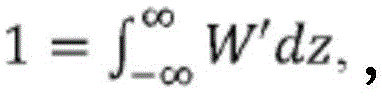
并且在分子量的有效减小的范围内如下计算修改的重均分子量(Mw′):And within the effective reduction range of molecular weight, the modified weight average molecular weight ( Mw ') is calculated as follows:

则RCI,m计算为:Then RCI,m is calculated as:

反向-共聚-单体指数(RCI,w)还基于重量分数共聚单体信号(w2/100)定义并如下计算:The reverse-comonomer index (RCI,w) is also defined based on the weight fraction comonomer signal (w2/100) and is calculated as follows:

在上述无限积分中,积分范围是为了一般性可能的最宽范围;然而,实际上,所述函数仅在获得数据的有限范围内积分,认为未获得范围的其余部分中的函数为0。此外,通过获得W′的方式,W′是不连续函数是可能的,并且上述积分需要分段进行是可能的。In the above infinite integral, the integration range is the widest possible range for generality; however, in reality, the function is integrated only within the limited range where data is obtained, and the function in the rest of the range that is not obtained is considered to be 0. In addition, by the way W' is obtained, it is possible that W' is a discontinuous function, and it is possible that the above integral needs to be performed piecewise.
还基于重量%(w2)共聚单体信号(表示为CDR-1,w、CDR-2,w和CDR-3,w)将三种共聚单体分布比定义如下:Three comonomer distribution ratios are also defined based on the weight % (w2) comonomer signals (denoted as CDR-1,w, CDR-2,w and CDR-3,w) as follows:
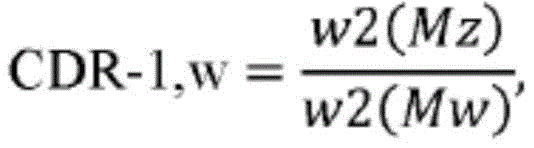


其中w2(Mw)是对应于Mw的分子量的重量%共聚单体信号,w2(Mz)是对应于Mz的分子量的重量%共聚单体信号,w2[(Mw+Mn)/2)]是对应于(Mw+Mn)/2的分子量的重量%共聚单体信号,w2[(Mz+Mw)/2]是对应于Mz+Mw/2的分子量的重量%共聚单体信号,其中Mw是重均分子量,Mn是数均分子量,Mz是z-均分子量。Wherein w2(Mw) is the weight % comonomer signal corresponding to the molecular weight of Mw, w2(Mz) is the weight % comonomer signal corresponding to the molecular weight of Mz, w2[(Mw+Mn)/2)] is the weight % comonomer signal corresponding to the molecular weight of (Mw+Mn)/2, w2[(Mz+Mw)/2] is the weight % comonomer signal corresponding to the molecular weight of Mz+Mw/2, where Mw is the weight average molecular weight, Mn is the number average molecular weight, and Mz is the z-average molecular weight.
相应地,还可以使用%摩尔共聚单体信号(CDR-1,m、CDR-2,m、CDR-3,m)将共聚单体分布比定义为Correspondingly, the comonomer distribution ratio can also be defined using the % molar comonomer signals (CDR-1,m, CDR-2,m, CDR-3,m) as


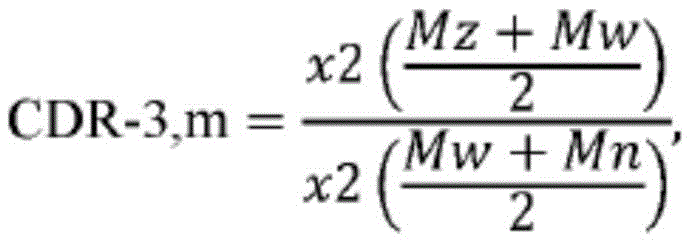
其中x2(Mw)是对应于Mw的分子量的摩尔%共聚单体信号,x2(Mz)是对应于Mz的分子量的摩尔%共聚单体信号,x2[(Mw+Mn)/2)]是对应于(Mw+Mn)/2的分子量的摩尔%共聚单体信号,x2[(Mz+Mw)/2]是对应于Mz+Mw/2的分子量的摩尔%共聚单体信号,其中Mw是重均分子量,Mn是数均分子量,Mz是z-均分子量。表X描述了由混合催化剂1和2制备的聚合物的分子量特征。Where x2(Mw) is the mole % comonomer signal corresponding to the molecular weight of Mw, x2(Mz) is the mole % comonomer signal corresponding to the molecular weight of Mz, x2[(Mw+Mn)/2)] is the mole % comonomer signal corresponding to the molecular weight of (Mw+Mn)/2, x2[(Mz+Mw)/2] is the mole % comonomer signal corresponding to the molecular weight of Mz+Mw/2, where Mw is the weight average molecular weight, Mn is the number average molecular weight, and Mz is the z-average molecular weight. Table X describes the molecular weight characteristics of the polymers prepared by
交叉-分馏色谱(Cross-Fractionation Chromatograph,CFC)Cross-Fractionation Chromatograph (CFC)
使用得自Polymer Char,S.A.,Valencia,Spain的CFC-2仪器进行交叉-分馏色谱(CFC)分析。CFC分析的原理和所使用的特定设备的概述给出在Ortin,A.;Monrabal,B.;Sancho-Tello的论文257J.Macromol.Symp.(2007)中。所述论文的图1中是所使用的特定设备的合适的示意图。分析方法的细节和所使用的设备的特征如下。Cross-fractionation chromatography (CFC) analysis was performed using a CFC-2 instrument from Polymer Char, S.A., Valencia, Spain. An overview of the principles of CFC analysis and the specific equipment used is given in the paper 257 J. Macromol. Symp. (2007) by Ortin, A.; Monrabal, B.; Sancho-Tello. A suitable schematic diagram of the specific equipment used is shown in Figure 1 of the paper. Details of the analytical method and characteristics of the equipment used are as follows.
用于制备样品溶液和用于洗脱的溶剂是1,2-二氯苯(ODCB),其通过在环境温度下将2g 2,6-双(1,1-二甲基乙基)-4-甲基苯酚(丁基化羟基甲苯)溶解在新鲜溶剂的4-L瓶中而加以稳定化。通过在150℃下搅拌(200rpm)75min将待分析的样品(25-125mg)溶解在溶剂(在环境温度下计量的25ml)中。在150℃下将小体积(0.5ml)的溶液导入TREF柱(不锈钢;外直径,3/8″;长度,15cm;填料,无孔不锈钢微球),并在比最高温度级分高大约20℃的温度(120-125℃)下稳定化柱温30min,为此包括GPC分析以获得最终二维分布。然后通过以0.2℃/min的冷却速率将温度降低到合适的低温(30、0或-15℃)而允许样品体积在所述柱中结晶。保持所述低温10min,然后将溶剂流(1ml/min)注入TREF柱以将可溶级分(SF)洗脱到GPC柱(3×PLgel 10μm混合-B 300×7.5mm,Agilent Technologies,Inc.)中;在高温下(140℃)保持所述GPC烘箱。从TREF柱洗脱所述SF 5min,然后将注射阀装入“加载”位置40min以经由GPC柱完全洗脱所有SF(标准GPC注射)。使用交错的GPC注射分析所有后续更高温度级分,其中在每个温阶允许聚合物溶解至少16min,然后从TREF柱洗脱到GPC柱中3min。使用IR4(Polymer Char)红外检测器产生吸光信号,所述信号与洗脱流中的聚合物浓度成正比。The solvent used for preparing the sample solution and for elution was 1,2-dichlorobenzene (ODCB), which was stabilized by dissolving 2 g of 2,6-bis(1,1-dimethylethyl)-4-methylphenol (butylated hydroxytoluene) in a 4-L bottle of fresh solvent at ambient temperature. The sample to be analyzed (25-125 mg) was dissolved in the solvent (25 ml measured at ambient temperature) by stirring (200 rpm) at 150°C for 75 min. A small volume (0.5 ml) of the solution was introduced into a TREF column (stainless steel; outer diameter, 3/8″; length, 15 cm; packing material, nonporous stainless steel microspheres) at 150° C., and the column temperature was stabilized for 30 min at a temperature approximately 20° C. higher than the highest temperature fraction (120-125° C.), for which GPC analysis was included to obtain the final two-dimensional distribution. The sample volume was then allowed to crystallize in the column by decreasing the temperature to a suitable low temperature (30, 0, or −15° C.) at a cooling rate of 0.2° C./min. The low temperature was maintained for 10 min, and then a solvent flow (1 ml/min) was injected into the TREF column to elute the soluble fraction (SF) into a GPC column (3×PLgel 10 μm Mixed-B 300×7.5 mm, Agilent Technologies, Inc.); the GPC oven was maintained at a high temperature (140° C.). The SF was eluted from the TREF column 5min, then the injection valve is loaded into the "load" position for 40min to completely elute all SF through the GPC column (standard GPC injection). All subsequent higher temperature fractions are analyzed using staggered GPC injections, where the polymer is allowed to dissolve for at least 16min at each temperature step and then eluted from the TREF column into the GPC column for 3min. An IR4 (Polymer Char) infrared detector is used to generate an absorbance signal that is proportional to the polymer concentration in the elution stream.
使用通用校准法测定洗脱聚合物级分的分子量分布(MWD)和平均分子量(Mn、Mw等)。使用十三种在1.5-8200kg/mol范围内的窄分子量分布聚苯乙烯标准样品(从AgilentTechnologies,Inc.获得)产生通用校准曲线。Mark-Houwink参数从Mori,S.;Barth,H.G.Size Exclusion Chromatography;Springer,1999的附录I获得。对于聚苯乙烯,K=1.38x10⁻⁴dl/g和α=0.7;对于聚乙烯,K=5.05x10-4dl/g和α=0.693。对于在温阶下洗脱的具有小于0.5%的重量分数(wt%回收率)的聚合物级分,不计算MWD和平均分子量;此外,在计算级分的聚集体的MWD和平均分子量中不包括此种聚合物级分。The molecular weight distribution (MWD) and average molecular weight (Mn, Mw, etc.) of the eluted polymer fractions were determined using a universal calibration method. Thirteen narrow molecular weight distribution polystyrene standards in the range of 1.5-8200 kg/mol (obtained from Agilent Technologies, Inc.) were used to generate a universal calibration curve. Mark-Houwink parameters were obtained from Appendix I of Mori, S.; Barth, HG Size Exclusion Chromatography; Springer, 1999. For polystyrene, K = 1.38x10⁻⁴ dl/g and α = 0.7; for polyethylene, K = 5.05x10⁻⁴ dl/g and α = 0.693. For polymer fractions eluting at a temperature step with a weight fraction (wt% recovery) of less than 0.5%, MWD and average molecular weight were not calculated; in addition, such polymer fractions were not included in the calculation of the MWD and average molecular weight of the aggregates of the fraction.
由CFC测量Tw1、Tw2、Mw1和Mw2 Measurement of Tw 1 , Tw 2 , Mw 1 and Mw 2 by CFC
已经开发了使用低温交叉分馏(低温CFC)测定MWD和SCBD组成信息以比较聚合物的技术。CFC数据的测定程序在下面进行更详细论述。Techniques have been developed to determine MWD and SCBD composition information using low temperature cross fractionation (low temperature CFC) to compare polymers. The procedure for determining CFC data is discussed in more detail below.
在CFC数据文件中的“级分综述”部分中,每个级分由其分馏温度(Ti)连同其归一化wt%值(Wi),累积wt%,即图2和图3上的“总计wt”,和平均分子量的各种矩(包括重均分子量,Mwi)列出。In the "Fractions Summary" section in the CFC data file, each fraction is listed by its fractionation temperature (Ti) together with its normalized wt% value (Wi), the cumulative wt%, i.e., "Total wt" on Figures 2 and 3, and various moments of the average molecular weight (including the weight average molecular weight, Mwi).
图2和图3是以图形显示用于测定CFC结果的计算的绘图。仅考虑具有MWD数据的级分。在图2和图3中,x轴代表以摄氏度为单位的洗脱温度,而右手y轴线代表已经洗脱直至洗脱温度的聚合物的重量的积分值。在这一实施例中材料的100%已经洗脱时的温度是大约100℃。聚合物的50%洗脱时的最接近点通过所述积分测定,这然后用于将所述绘图中的每一个划分成第一半和第二半。Figures 2 and 3 are plots showing in graphic form the calculations used to determine the CFC results. Only fractions with MWD data are considered. In Figures 2 and 3, the x-axis represents the elution temperature in degrees Celsius, while the right-hand y-axis represents the integrated value of the weight of polymer that has eluted up to the elution temperature. The temperature at which 100% of the material has eluted is approximately 100°C in this example. The closest point at which 50% of the polymer has eluted is determined by the integration, which is then used to divide each of the plots into a first half and a second half.
为了计算Tw1、Tw2、Mw1和Mw2的值,将“级分综述”中的数据划分为两个大致相等的半分。Ti和Mwi的加权平均;对于每个半分,根据加权平均的常规定义计算。从Tw1、Tw2、Mw1和Mw2的计算中排除不具有足以对于原始数据文件中的分子量平均值进行加工的量(即,<0.5wt%)的级分。To calculate the values of Tw 1 , Tw 2 , Mw 1 , and Mw 2 , the data in the "Fraction Overview" was divided into two approximately equal halves. A weighted average of Ti and Mwi; for each half, calculated according to the conventional definition of weighted average. Fractions that did not have sufficient amounts to process for the molecular weight averages in the original data file (i.e., < 0.5 wt%) were excluded from the calculations of Tw 1 , Tw 2 , Mw 1 , and Mw 2 .
所述方法的第一部分通过图2显示。从CFC数据文件中的级分综述的部分,确认其累积wt%(即,合计wt)最接近50的级分(例如,图2上在84℃处的级分)。将级分综述数据划分为两个半分,例如在图2上,Ti<=84℃为第一半,Ti>84℃为第二半。排除不具有在原始数据文件中报道的分子量平均值的级分,例如在图2上,排除具有25℃-40℃之间的Ti的级分。The first part of the method is shown by Figure 2. From the fraction summary portion in the CFC data file, identify the fraction whose cumulative wt% (i.e., total wt) is closest to 50 (e.g., the fraction at 84°C on Figure 2). Divide the fraction summary data into two halves, e.g., on Figure 2, Ti<=84°C is the first half and Ti>84°C is the second half. Exclude fractions that do not have the molecular weight average reported in the original data file, e.g., on Figure 2, exclude fractions with Ti between 25°C-40°C.
在图2中,左手y轴线代表经洗脱级分的wt%。使用上述程序以将曲线划分成两个半分,使用这些值以使用方程式1中所示的公式计算每个半分的加权平均洗脱温度。In Figure 2, the left hand y-axis represents the wt% of the eluted fraction. Using the procedure described above to divide the curve into two halves, these values were used to calculate the weighted average elution temperature for each half using the formula shown in
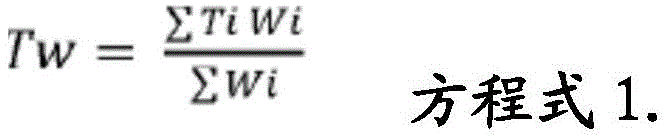
在方程式1中,Ti代表每个经洗脱级分的洗脱温度,Wi代表每个经洗脱级分的归一化wt%(聚合物量)。对于图2所示的实例,这对于第一半提供64.9℃的加权平均洗脱温度,对于第二半提供91.7℃的加权平均洗脱温度。In
在图3中,左手轴代表每个经洗脱级分的重均分子量(Mwj)。使用这些值以使用方程式2中所示的公式计算每一半的重均分子量。In Figure 3, the left-hand axis represents the weight average molecular weight (Mwj) of each eluted fraction. These values were used to calculate the weight average molecular weight of each half using the formula shown in
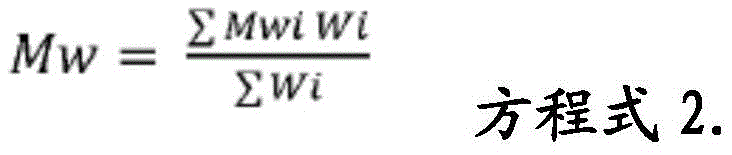
在方程式2中,Mw代表每一经洗脱级分的重均分子量,Wj代表每一经洗脱级分的归一化wt%(聚合物量)。对于图3所示的实例,这为第一半提供237,539g/摩尔的重均分子量,为第二半提供74,156g/摩尔的重均分子量。使用上述技术计算的值可用来对于试验性聚合物和对照聚合物将MWDxSCBD分类。In
图4是(Mw1/Mw2)vs.(Tw1-Tw2)的半对数坐标图,其设计用来显示在本发明实施例vs.商业基准当中MWD/SCBD组合方面的重要差异。此种差异据认为在测定各种性能属性例如劲度、韧性和可加工性的折衷方案和/或平衡方面发挥关键作用。在图4中,桥联二茂铪(外消旋/内消旋-Me2Si((Me3Si)CH2Cp)2HfMe2)由OMC2918表示,二茂锆(外消旋/内消旋)由MeInd和EtInd表示以反映相应的取代的烃基。其它聚合物描述在表5中。FIG. 4 is a semi-logarithmic plot of (Mw 1 /Mw 2 ) vs. (Tw 1 -Tw 2 ) designed to show the important differences in MWD/SCBD combinations among the inventive examples vs. commercial benchmarks. Such differences are believed to play a key role in determining the trade-offs and/or balances of various performance attributes such as stiffness, toughness, and processability. In FIG. 4 , bridged hafnocene (rac/meso-Me 2 Si((Me 3 Si)CH 2 Cp) 2 HfMe 2 ) is represented by OMC2918 and zirconocene (rac/meso) is represented by MeInd and EtInd to reflect the corresponding substituted hydrocarbon groups. Other polymers are described in Table 5.
在图3的绘图中,x轴代表第一和第二加权平均洗脱温度之间差值(Tw1-Tw2)。以对数标度的y轴线代表第一重均分子量与第二重均分子量之比(Mw1/Mw2)。3, the x-axis represents the difference between the first and second weighted average elution temperatures ( Tw1 - Tw2 ). The y-axis, on a logarithmic scale, represents the ratio of the first weight average molecular weight to the second weight average molecular weight ( Mw1 / Mw2 ).
聚合物组合物的各种类型可以描述如下:The various types of polymer compositions can be described as follows:
在X=0/Y=0处的点:绝对窄的MWD和绝对窄的SCBD的理想情况。对于X=0实际上是不可能的,这归因于沿着温度轴强制划分成两个半分,如图2和图3所示。Point at X=0/Y=0: Ideal case of absolutely narrow MWD and absolutely narrow SCBD. This is actually not possible for X=0 due to the forced division into two halves along the temperature axis, as shown in FIGS. 2 and 3 .
X=0的线:拓宽MWD同时保持SCBD绝对窄的理想情况。在X=0处,沿着使Y值向上或向下移动的方向没有差异;即,拓宽MWD同时保持SCBD处于绝对窄。Line at X=0: ideal case of widening the MWD while keeping the SCBD absolutely narrow. At X=0, there is no difference in the direction of moving the Y value up or down; that is, widening the MWD while keeping the SCBD absolutely narrow.
Y=0的线:拓宽SCBD同时保持MWD不变和窄的情况。Line with Y=0: case of broadening the SCBD while keeping the MWD constant and narrow.
具有X<0/Y<1的角落:其中聚合物组合物的特征在于低Mwi/低Ti(高SCB)分子与高Mwi/高Ti(低SCB)分子的组合的产物;由用ZN-催化剂制得的常规LLDPE示例。Corner with X<0/Y<1: where the polymer composition is characterized by the product of a combination of low Mwi/low Ti (high SCB) molecules and high Mwi/high Ti (low SCB) molecules; exemplified by conventional LLDPE made with ZN-catalyst.
具有X<0/Y>1的角落:其中聚合物组合物的特征在于低Mwi/高Ti(低SCB)分子与高Mwi/低Ti(高SCB)分子的组合的产物;由所谓的BOCD(宽正交组成分布)或反向组成分布产物示例。Corner with X<0/Y>1: A product in which the polymer composition is characterized by a combination of low Mwi/high Ti (low SCB) molecules and high Mwi/low Ti (high SCB) molecules; exemplified by so-called BOCD (broad orthogonal composition distribution) or inverse composition distribution products.
附加的试验方法包括以下。Additional test methods include the following.
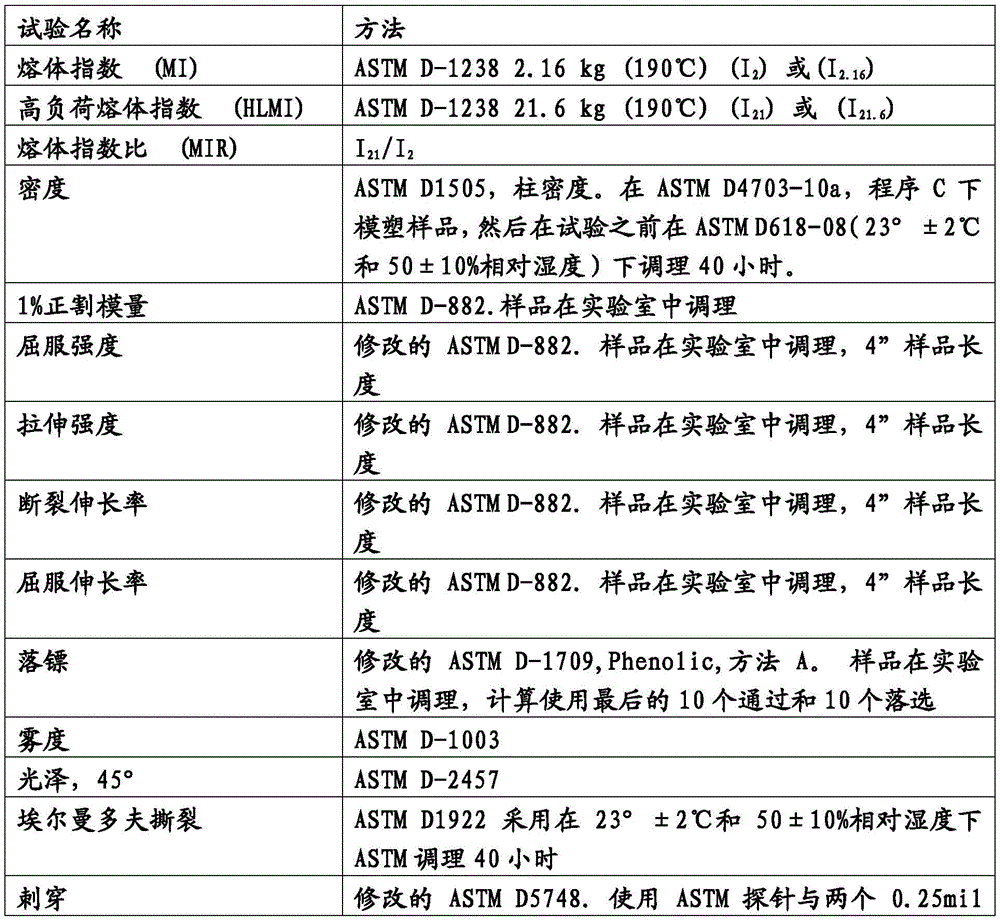

实施例Example
应该理解的是,虽然已经结合本发明的具体实施方案描述了本发明,但是上述描述意图是举例说明并非限制本发明的范围。其它方面、优点和改进将对本发明所属技术领域中的那些技术人员是显而易见的。It should be understood that, although the invention has been described in conjunction with specific embodiments of the invention, the above description is intended to illustrate rather than limit the scope of the invention. Other aspects, advantages and improvements will be apparent to those skilled in the art to which the invention belongs.
因此,给出以下实施例是为了为本领域技术人员提供完全的公开和描述并不希望限制发明人看作是其发明的范围。Therefore, the following embodiments are presented in order to provide a complete disclosure and description to those skilled in the art and are not intended to limit the scope of what the inventors regard as their invention.
使用如下所示的桥联二茂铪(外消旋/内消旋-Me2Si((Me3Si)CH2Cp)2HfMe2)和二茂锆(外消旋/内消旋)制备催化剂体系(即,混合或双重催化剂体系)。在评价和试验时,为了制备LLDPE产物,结果揭示高催化剂活性和独特的BOCD LLDPE产物。A catalyst system (ie, a mixed or dual catalyst system) was prepared using bridged hafnocene (rac/meso- Me2Si (( Me3Si ) CH2Cp ) 2HfMe2 ) and zirconocene (rac/meso) as shown below. When evaluated and tested, to produce LLDPE products, the results revealed high catalyst activity and a unique BOCD LLDPE product.
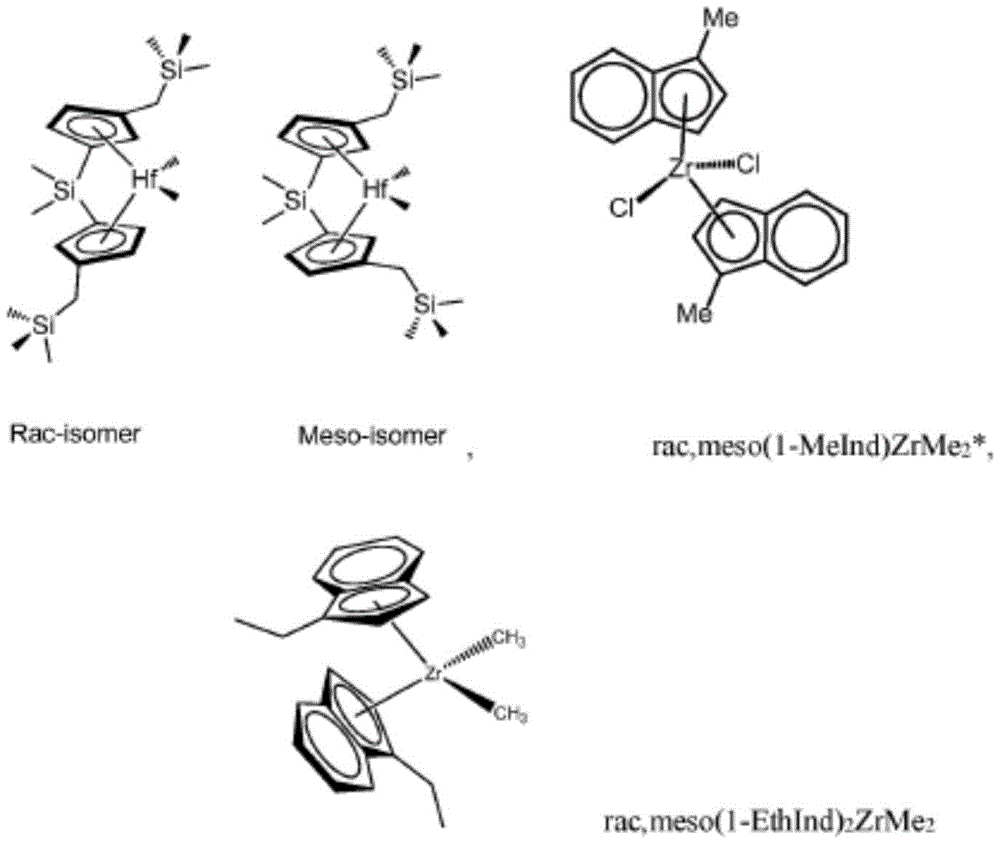
(上图中依次为:外消旋-异构体;内消旋-异构体;(In the figure above, they are: racemic-isomer; meso-isomer;
外消旋,内消旋(1-MeInd)ZrMe2*;和rac, meso (1-MeInd)ZrMe 2 *; and
外消旋,内消旋(1-EthInd)2ZrMe2)Racemic, meso (1-EthInd) 2 ZrMe 2 )
Me=甲基,Eth=乙基,Ind=茚基Me = methyl, Eth = ethyl, Ind = indenyl
*对于二茂锆采用二甲基离去基团,但是也可以采用所述催化剂的二-氯型式,如附图建议那样。* A dimethyl leaving group was used for the zirconocene, but the di-chloro version of the catalyst may also be used, as suggested by the accompanying figure.
除非另有说明,所有操作在惰性N2吹扫的手套箱中进行。所有无水溶剂从FisherChemical购买并在使用之前在分子筛上脱气和干燥。氘化溶剂从Cambridge IsotopeLaboratories购买并在使用之前在分子筛上干燥。正丁基锂(己烷中的2.5M溶液)、二氯化二甲基甲硅烷基(Me2SiCl2)和溴化甲基镁(在二乙醚中的3.0M溶液)从Sigma-Aldrich购买。四氯化铪(HfCl4)99+%和(三甲基甲硅烷基)甲基三氟甲烷磺酸酯分别从Strem Chemicals和TCI America获得。正丁基锂(己烷中的2.5M溶液)、碘代甲烷、茚和甲基锂(二乙醚中的1.6M溶液)从Sigma-Aldrich购买,五甲基环戊二烯基三氯化锆(Cp*ZrCl3)从StremChemical购买。除非另有说明,所有化学制品如购买时原样使用。根据Curnow,O.J.;Fern,G.M.J.Organomet.Chem.2005,690,3018-3026中的描述制备1-甲基茚和锂-1-甲基茚。Unless otherwise noted, all manipulations were performed in an inert N 2 purged glove box. All anhydrous solvents were purchased from Fisher Chemical and degassed and dried over molecular sieves before use. Deuterated solvents were purchased from Cambridge Isotope Laboratories and dried over molecular sieves before use. n-Butyl lithium (2.5 M solution in hexane), dimethylsilyl dichloride (Me 2 SiCl 2 ) and methylmagnesium bromide (3.0 M solution in diethyl ether) were purchased from Sigma-Aldrich. Hafnium tetrachloride (HfCl 4 ) 99+% and (trimethylsilyl)methyl trifluoromethanesulfonate were obtained from Strem Chemicals and TCI America, respectively. n-Butyl lithium (2.5 M solution in hexane), iodomethane, indene and methyllithium (1.6 M solution in diethyl ether) were purchased from Sigma-Aldrich, and pentamethylcyclopentadienyl zirconium trichloride (Cp*ZrCl 3 ) was purchased from Strem Chemical. Unless otherwise stated, all chemicals were used as purchased. 1-Methylindene and lithium-1-methylindene were prepared as described in Curnow, OJ; Fern, GMJ Organomet. Chem. 2005, 690, 3018-3026.
(三甲基甲硅烷基)甲基环戊二烯(Me3Si)CH2CpH的合成Synthesis of (trimethylsilyl)methylcyclopentadiene (Me 3 Si)CH 2 CpH
将(三甲基甲硅烷基)甲基三氟甲烷磺酸酯(10.57g,44.7mmol)溶解在150mL二乙醚中并冷却到-25℃,在5-10分钟的期间内向其中缓慢地添加固体环戊二烯钾(KCp)(4.66g,44.7mmol)。它根据Amsharov,K.;Abdurakhmanova,N.;Stepanow,S.;Rauschenbach,S.;Jansen,M.;Kern,K.Angew.Chem.Int.Ed.2010,49,9392-9396中的描述制备。在大约23℃下搅拌所得的混合物5小时。在动态真空下小心地从反应混合物中除去挥发物以避免使挥发性(三甲基甲硅烷基)甲基环戊二烯(Me3Si)CH2CpH蒸发。称重反应烧瓶(250mL圆底烧瓶)和烧料与塞利石以计算在萃取后的产物产量。将粗材料萃取到戊烷(3×10mL)中并在更进一步纯化的情况下使用。基于上述数学方法,产量计算为5.55g(81.6%)。记录所述粗材料的1H NMR谱以确保产物形成。1H NMR(400MHz,C6D6):δ-0.05(9H,s,Si-CH3),1.77(2H,d,JHH=1.2Hz,Me3Si-CH2),2.83(1H,sex,JHH=1.5Hz,Cp-CH),5.80-6.49(4H,m,Cp-CH)ppm。(Trimethylsilyl)methyl trifluoromethanesulfonate (10.57 g, 44.7 mmol) was dissolved in 150 mL of diethyl ether and cooled to -25°C, to which solid potassium cyclopentadiene (KCp) (4.66 g, 44.7 mmol) was slowly added over a period of 5-10 minutes. It was prepared according to the description in Amsharov, K.; Abdurakhmanova, N.; Stepanow, S.; Rauschenbach, S.; Jansen, M.; Kern, K. Angew. Chem. Int. Ed. 2010, 49, 9392-9396. The resulting mixture was stirred at about 23°C for 5 hours. The volatiles were carefully removed from the reaction mixture under dynamic vacuum to avoid evaporation of the volatile (trimethylsilyl)methylcyclopentadiene (Me 3 Si) CH 2 CpH. The reaction flask (250 mL round bottom flask) and the furnace and celite were weighed to calculate the product yield after extraction. The crude material was extracted into pentane (3×10 mL) and used with further purification. Based on the above mathematical method, the yield was calculated to be 5.55 g (81.6%). The 1 H NMR spectrum of the crude material was recorded to ensure product formation. 1 H NMR (400 MHz, C 6 D 6 ): δ -0.05 (9H, s, Si-CH 3 ), 1.77 (2H, d, J HH =1.2 Hz, Me 3 Si-CH 2 ), 2.83 (1H, sex, J HH =1.5 Hz, Cp-CH), 5.80-6.49 (4H, m, Cp-CH) ppm.
(三甲基甲硅烷基)甲基环戊二烯锂(Me3Si)CH2CpLi的合成Synthesis of (trimethylsilyl)methylcyclopentadienyllithium (Me 3 Si)CH 2 CpLi
在15-20分钟的期间内在-25℃下将正丁基锂的己烷溶液(14.6mL,36.5mmol)逐滴添加到(Me3Si)CH2CpH(5.55g,36.5mmol)的预冷溶液(戊烷和二乙醚,50/50mL)中。逐渐地使所得的混合物达到大约23℃,然后连续地搅拌过夜。在真空中除去挥发物并用戊烷剧烈地洗涤残留粗材料在真空下干燥最终材料而以5.75g(99.7%)产量获得(Me3Si)CH2CpLi的无色结晶固体。1H NMR(400MHz,THF-d8):δ-0.09(9H,s,Si-CH3),1.84(2H,s,Me3Si-CH2),5.36(2H,t,JHH=2.6Hz,Cp-H),5.47(2H,t,JHH=2.6Hz,Cp-H)ppm。A hexane solution of n-butyllithium (14.6 mL, 36.5 mmol) was added dropwise to a pre-cooled solution (pentane and diethyl ether, 50/50 mL) of (Me 3 Si) CH 2 CpLi (5.55 g, 36.5 mmol) at -25°C over a period of 15-20 minutes. The resulting mixture was gradually allowed to reach about 23°C and then stirred continuously overnight. The volatiles were removed in vacuo and the remaining crude material was washed vigorously with pentane. The final material was dried in vacuo to obtain (Me 3 Si) CH 2 CpLi as a colorless crystalline solid in a yield of 5.75 g (99.7%). 1 H NMR (400MHz, THF-d 8 ): δ-0.09 (9H,s,Si-CH 3 ), 1.84 (2H,s,Me 3 Si-CH 2 ), 5.36 (2H,t,J HH = 2.6Hz, Cp-H), 5.47 (2H,t,J HH = 2.6Hz, Cp-H) ppm.
二甲基甲硅烷基-双((三甲基甲硅烷基)甲基环戊二烯)Me2Si((Me3Si)CH2CpH)2的合成Synthesis of Dimethylsilyl-Bis((Trimethylsilyl)Methylcyclopentadiene)Me 2 Si((Me 3 Si)CH 2 CpH) 2
将纯净Me2SiCl2(340mg,2.6mmol)溶解在10mL THF中并冷却到-25℃。将固体(三甲基甲硅烷基)甲基环戊二烯锂添加到上述混合物中并在大约23℃下搅拌所得的混合物过夜以确保反应完成。在真空中从所述反应混合物除去挥发物并随后用戊烷研制以除去痕量的THF。将粗材料萃取到戊烷中,接着在真空下除去溶剂,以750mg(80%)产量获得Me2Si((Me3Si)CH2CpH)2的浓黄色粘性油。1H NMR(400MHz,C6D6):δ-0.15(6H,bs,SiMe2-CH3),0.05(18H,s,SiMe3-CH3),1.81-1.87(4H,m,Me3Si-CH2),3.26(1H,s,Cp-H),3.37(1H,s,Cp-H),5.99-6.82(6H,m,Cp-H)ppm。Neat Me2SiCl2 (340 mg, 2.6 mmol) was dissolved in 10 mL THF and cooled to -25°C. Solid (trimethylsilyl)methylcyclopentadienyl lithium was added to the above mixture and the resulting mixture was stirred at about 23°C overnight to ensure the reaction was complete. Volatiles were removed from the reaction mixture in vacuo and then triturated with pentane to remove traces of THF. The crude material was extracted into pentane followed by removal of the solvent in vacuo to obtain Me2Si (( Me3Si ) CH2CpH ) 2 as a thick yellow viscous oil in 750 mg (80%) yield. 1 H NMR (400MHz, C 6 D 6 ): δ-0.15(6H,bs,SiMe 2 -CH 3 ),0.05(18H,s,SiMe 3 -CH 3 ),1.81-1.87(4H,m,Me 3 Si-CH 2 ),3.26(1H,s,Cp-H),3.37(1H,s,Cp-H),5.9 9-6.82(6H,m,Cp-H)ppm.
二甲基甲硅烷基-双((三甲基甲硅烷基)甲基环戊二烯)锂二甲氧基乙烷络合物Me2Si((Me3Si)CH2Cp)2Li2·dme的合成Synthesis of Dimethylsilyl-Bis((trimethylsilyl)methylcyclopentadienyl)lithium Dimethoxyethane Complex Me 2 Si((Me 3 Si)CH 2 Cp) 2 Li 2 ·dme
在5-10分钟的期间内在-25℃下将正丁基锂的己烷溶液(1.7mL,4.2mmol,2.5M溶液)逐滴添加到Me2Si((Me3Si)CH2CpH)2(750mg,2.1mmol)在10mL二甲氧基乙烷中的预冷溶液中。逐渐地将所得的混合物加热到大约23℃,然后连续地搅拌过夜。在真空中从所述反应混合物除去挥发物,并用戊烷研制以除去DME。用戊烷剧烈地洗涤粗材料以除去任何可溶性杂质,并在真空下干燥而以830mg(93%)产量获得Me2Si((Me3Si)CH2Cp)2Li2·dme的无色结晶固体。1H NMR(400MHz,THF-d8):δ0.2(18H,s,SiMe3-CH3),0.93(6H,bs,SiMe2-CH3),2.26(4H,s,Me3Si-CH2),2.57(4H,s,dme-CH2),2.77(6H,s,dme-OCH3),5.94-6.15(6H,m,Cp-H)ppm。A hexane solution of n-butyllithium (1.7 mL, 4.2 mmol, 2.5 M solution) was added dropwise over a period of 5-10 minutes at -25°C to a pre-cooled solution of Me2Si (( Me3Si ) CH2CPh ) 2 (750 mg, 2.1 mmol) in 10 mL of dimethoxyethane. The resulting mixture was gradually heated to approximately 23°C and then stirred continuously overnight. Volatiles were removed from the reaction mixture in vacuo and triturated with pentane to remove DME. The crude material was washed vigorously with pentane to remove any soluble impurities and dried under vacuum to obtain Me2Si (( Me3Si ) CH2CP ) 2Li2 ·dme as a colorless crystalline solid in 830 mg (93%) yield. 1 H NMR (400MHz, THF-d 8 ): δ0.2(18H,s,SiMe 3 -CH 3 ),0.93(6H,bs,SiMe 2 -CH 3 ),2.26(4H,s,Me 3 Si-CH 2 ),2.57(4H,s,dme-CH 2 ),2.77(6H,s,dme-OCH 3 ),5.94- 6.15(6H,m,Cp-H)ppm.
二氯·外消旋-内消旋-二甲基甲硅烷基-双((三甲基甲硅烷基)甲基环戊二烯)合铪Me2Si((Me3Si)CH2Cp)2HfCl2的合成Synthesis of dichloro-rac-meso-dimethylsilyl-bis((trimethylsilyl)methylcyclopentadienyl)hafnium Me 2 Si((Me 3 Si)CH 2 Cp) 2 HfCl 2
在-25℃下将固体HfCl4(570mg,1.8mmol)添加到Me2Si((Me3Si)CH2Cp)2Li2·dme(830mg,1.8mmol)的预冷二乙醚(20mL)溶液中。在大约23℃下搅拌所得的混合物过夜。在真空中从所述反应混合物除去挥发物,然后萃取到二氯甲烷中。在真空下除去溶剂以1.02g(94%)产量获得Me2Si((Me3Si)CH2-Cp)2HfCl2的黄色结晶固体。最终材料的1H NMR谱集成1:1比例的外消旋/内消旋异构体。1H NMR(400MHz,CD2Cl2):δ-0.05(18H,s,SiMe3-CH3),-0.04(18H,s,SiMe3-CH3),-0.64(3H,s,SiMe2-CH3,meso),-0.65(6H,s,SiMe2-CH3,rac),-0.68(3H,s,SiMe2-CH3,meso),2.08-2.18(8H,m,Me3Si-CH2),5.14(2H,t,JHH=2.6Hz,Cp-H),5.28(2H,t,JHH=2.6Hz,Cp-H),5.64(2H,t,JHH=2.7Hz,Cp-H),5.77(2H,t,JHH=2.7Hz,Cp-H),6.19(2H,t,JHH=2.7Hz,Cp-H),6.34(2H,t,JHH=2.7Hz,Cp-H)ppm。Solid HfCl4 (570 mg, 1.8 mmol) was added to a precooled diethyl ether (20 mL) solution of Me2Si (( Me3Si ) CH2Cp ) 2Li2 ·dme (830 mg, 1.8 mmol) at -25°C. The resulting mixture was stirred overnight at about 23 ° C. Volatiles were removed from the reaction mixture in vacuo and then extracted into dichloromethane. Removal of the solvent in vacuo afforded Me2Si (( Me3Si ) CH2 -Cp) 2HfCl2 as a yellow crystalline solid in a yield of 1.02 g (94%). The1H NMR spectrum of the final material integrated a 1:1 ratio of rac/meso isomers. 1 H NMR (400MHz, CD 2 Cl 2 ): δ-0.05(18H,s,SiMe 3 -CH 3 ),-0.04(18H,s,SiMe 3 -CH 3 ),- 0.64 (3H,s,SiMe 2 -CH 3 ,meso),- 0.65 (6H,s,SiMe 2 -CH 3 ,rac) , -0.68(3H, s . H,t, J HH = 2.7Hz, Cp-H), 6.19 (2H, t, J HH = 2.7Hz, Cp-H), 6.34 (2H, t, J HH = 2.7Hz, Cp-H) ppm.
二甲基·外消旋-内消旋-二甲基甲硅烷基-双((三甲基甲硅烷基)甲基环戊二烯)合铪Me2Si((Me3Si)CH2Cp)2HfMe2的合成Synthesis of Dimethyl·rac-meso-dimethylsilyl-bis((trimethylsilyl)methylcyclopentadienyl)hafnium Me 2 Si((Me 3 Si)CH 2 Cp) 2 HfMe 2
在-25℃下在3-5分钟的期间内将MeMgBr(1.12mL,3.34mmol)的醚性溶液逐滴添加到Me2Si((Me3Si)CH2-Cp)2HfCl2(1.01g,1.65mmol)的预冷二乙醚溶液中。在大约23℃下将所得的混合物搅拌过夜以确保反应完成。让不溶性材料滤过塞利石垫。在真空下从滤液除去挥发物,然后将粗材料萃取到戊烷中。在真空中除去溶剂以660g(71%)产量提供Me2Si((Me3Si)CH2-Cp)2HfMe2的粘性黄色材料。最终材料的1H NMR谱集成1:1比例的外消旋/内消旋异构体。1H NMR(400MHz,C6D6):δ-0.25(3H,s,Hf-CH3,meso),δ-0.24(6H,s,Hf-CH3,rac),δ-0.20(3H,s,Hf-CH3,meso),0.03(18H,s,SiMe3-CH3),0.04(18H,s,SiMe3-CH3),0.19(3H,s,SiMe2-CH3,meso),0.20(6H,s,SiMe2-CH3,rac),0.22(3H,s,SiMe2-CH3,meso),2.06(4H,s,Me3Si-CH2,rac),2.09(4H,d,JHH=3.1Hz,Me3Si-CH2,meso),5.03(2H,t,JHH=2.2Hz,Cp-H),5.10(2H,t,JHH=2.2Hz,Cp-H),5.34(2H,t,JHH=2.6Hz,Cp-H),5.44(2H,t,JHH=2.6Hz,Cp-H),6.26(2H,t,JHH=2.6Hz,Cp-H),6.31(2H,t,JHH=2.6Hz,Cp-H)ppm。An ethereal solution of MeMgBr (1.12 mL, 3.34 mmol) was added dropwise to a pre-cooled diethyl ether solution of Me 2 Si((Me 3 Si)CH 2 -Cp) 2 HfCl 2 (1.01 g, 1.65 mmol) at -25°C over a period of 3-5 minutes. The resulting mixture was stirred overnight at about 23°C to ensure completion of the reaction. The insoluble material was filtered through a pad of celite. The volatiles were removed from the filtrate under vacuum and the crude material was extracted into pentane. Removal of the solvent in vacuo afforded a viscous yellow material of Me 2 Si((Me 3 Si)CH 2 -Cp) 2 HfMe 2 in 660 g (71%) yield. The 1 H NMR spectrum of the final material integrated a 1:1 ratio of rac/meso isomers. 1 H NMR (400MHz, C 6 D 6 ): δ-0.25(3H,s,Hf-CH 3 ,meso), δ-0.24(6H,s,Hf-CH 3 ,rac), δ-0.20(3H,s,Hf-CH 3 ,meso), 0.03(18H,s,SiMe 3 -CH 3 ), 0.04(18H,s,Si Me 3 -CH 3 ),0.19(3H,s,SiMe 2 -CH 3 ,meso),0.20(6H,s,SiMe 2 -CH 3 ,rac),0.22(3H,s,SiMe 2 -CH 3 ,meso),2.06(4H,s,Me 3 Si-CH 2 ,rac),2.09(4H,d,J HH =3.1Hz,Me 3Si -CH 2 , meso),5.03(2H,t,J HH =2.2Hz,Cp-H),5.10(2H,t,J HH =2.2Hz,Cp-H),5.34(2H,t,J HH =2.6Hz,Cp-H),5.44(2H,t,J HH =2.6Hz,Cp-H),6.26(2H,t,J HH = 2.6Hz, Cp-H), 6.31 (2H, t, J HH = 2.6Hz, Cp-H) ppm.
二甲基·外消旋-内消旋-双(1-甲基-茚基)合锆(1-MeInd)2ZrMe2的合成Synthesis of dimethyl rac-meso-bis(1-methyl-indenyl)zirconium (1-MeInd) 2 ZrMe 2
在500mL圆底烧瓶中,用250mL二甲氧基乙烷(DME)将固体ZrCl4(9.42g,40.4mmol)制浆并冷却到-25℃。在5-10分钟的期间内添加固体锂-1-甲基-茚基(11.0g,80.8mmol)。逐渐地将橙黄色反应混合物加热到大约23℃,随后在80℃下加热1小时以确保二氯·双(1-甲基-茚基)合锆原位形成。在加热所得的混合物同时,它最初是澄清的,然后在反应过程内沉淀析出副产物(LiCl),从而揭示产物形成。在没有更进一步纯化的情况下,将二氯·双(1-甲基-茚基)合锆的反应混合物冷却到-25℃,并在10-15分钟的期间内向其中添加溴化甲基镁的醚性溶液(27.0mL,80.8mmol,在二乙醚中的3.0M溶液)。所得的混合物在一系列反应内缓慢地转变成淡黄色,然后转变成褐红色并在大约23℃下连续地搅拌过夜。在真空中除去挥发物。然后用己烷(50mL×5)萃取粗材料,并除去溶剂以13.6g(89%)产量形成为灰白色固体的(1-MeInd)2ZrMe2。最终材料的1H NMR谱集成0.8:1比例的外消旋/内消旋异构体。1HNMR(400MHz,C6D6):δ-1.33(3H,s,meso),-0.84(4.77H,s,rac),-0.34(3H,s,meso),2.14(11.42H.overlapping s),5.47-5.42(6.41H,m),6.95-6.88(7.34H,m),7.14-7.06(3.45H,m),7.30-7.27(3.35H,m)ppm。In a 500 mL round bottom flask, solid ZrCl4 (9.42 g, 40.4 mmol) was slurried with 250 mL dimethoxyethane (DME) and cooled to -25°C. Solid lithium-1-methyl-indenyl (11.0 g, 80.8 mmol) was added over a period of 5-10 minutes. The orange-yellow reaction mixture was gradually heated to about 23°C and then heated at 80°C for 1 hour to ensure the in-situ formation of bis(1-methyl-indenyl)zirconium dichloride. While the resulting mixture was heated, it was initially clear and then a byproduct (LiCl) precipitated out during the reaction, revealing product formation. Without further purification, the reaction mixture of bis(1-methyl-indenyl)zirconium dichloride was cooled to -25°C and an ethereal solution of methylmagnesium bromide (27.0 mL, 80.8 mmol, 3.0 M solution in diethyl ether) was added thereto over a period of 10-15 minutes. The resulting mixture slowly turned to pale yellow within a series of reactions and then to maroon and was continuously stirred overnight at approximately 23°C. The volatiles were removed in vacuo. The crude material was then extracted with hexanes (50 mL x 5) and the solvent removed to form (1-MeInd) 2 ZrMe 2 as an off-white solid in a yield of 13.6 g (89%). The 1 H NMR spectrum of the final material integrated a 0.8:1 ratio of rac/meso isomers. 1 HNMR (400MHz, C 6 D 6 ): δ-1.33(3H,s,meso),-0.84(4.77H,s,rac),-0.34(3H,s,meso),2.14(11.42H.overlapping s),5.47-5.42(6.41H,m),6.95-6.88(7.34H,m), 7.14-7.06(3.45H,m),7.30-7.27(3.35H,m)ppm.
负载型催化剂合成:Supported catalyst synthesis:
混合催化剂1(二甲基·外消旋-内消旋-二甲基甲硅烷基-双((三甲基甲硅烷基)甲基环戊二烯)合铪:外消旋,内消旋-(1-MeInd)2ZrMe2,80:20)Mixed catalyst 1 (dimethyl·rac-meso-dimethylsilyl-bis((trimethylsilyl)methylcyclopentadiene)hafnium:rac,meso-(1-MeInd) 2 ZrMe 2 , 80:20)
向搅拌容器中添加1400g甲苯连同925g甲基铝氧烷(在甲苯中,30wt%)。向这一溶液中添加734g ES70二氧化硅-875℃锻烧二氧化硅。在100℃下搅拌所述混合物3小时,之后降低温度并允许反应冷却到大约23℃。然后将二甲基·外消旋-内消旋-二甲基甲硅烷基-双((三甲基甲硅烷基)甲基环戊二烯)合铪(16.35g,32.00mmol)和二甲基·双-乙基茚基合锆(IV)(3.26g,8.00mmol)溶解在甲苯(250g)中并添加到容器中,将其再搅拌2小时。然后降低混合速度并缓慢地搅拌同时在真空下干燥60小时,之后获得1038g淡黄色材料。1400 g of toluene was added to a stirred vessel along with 925 g of methylaluminoxane (30 wt% in toluene). To this solution was added 734 g of ES70 silica - 875°C calcined silica. The mixture was stirred at 100°C for 3 hours, after which the temperature was reduced and the reaction allowed to cool to approximately 23°C. Dimethyl rac-meso-dimethylsilyl-bis((trimethylsilyl)methylcyclopentadienyl)hafnium (16.35 g, 32.00 mmol) and dimethyl bis-ethylindenyl zirconium (IV) (3.26 g, 8.00 mmol) were then dissolved in toluene (250 g) and added to the vessel, which was stirred for an additional 2 hours. The mixing speed was then reduced and the mixture was slowly stirred while drying under vacuum for 60 hours, after which 1038 g of a pale yellow material was obtained.
混合催化剂2(二甲基·外消旋-内消旋-二甲基甲硅烷基-双((三甲基甲硅烷基)甲基环戊二烯)合铪:外消旋,内消旋-(1-EthInd)2ZrMe2,80:20)Mixed catalyst 2 (dimethyl·rac-meso-dimethylsilyl-bis((trimethylsilyl)methylcyclopentadiene)hafnium:rac,meso-(1-EthInd) 2 ZrMe 2 , 80:20)
向搅拌容器中添加1400g甲苯连同925g甲基铝氧烷(在甲苯中,30wt%)。向这一溶液中添加734g ES70二氧化硅-875℃锻烧二氧化硅。在100℃下搅拌所述混合物3小时,之后降低温度并允许反应冷却到大约23℃。然后将二甲基·外消旋-内消旋-二甲基甲硅烷基-双((三甲基甲硅烷基)甲基环戊二烯)合铪(18.1g,32.00mmol)和二甲基·双-乙基茚基合锆(IV)(3.04g,8.00mmol)溶解在甲苯(250g)中并添加到容器中,将其再搅拌2小时。然后降低混合速度并缓慢地搅拌同时在真空下干燥60小时,之后获得1038g淡黄色材料。1400 g of toluene was added to a stirred vessel along with 925 g of methylaluminoxane (30 wt% in toluene). To this solution was added 734 g of ES70 silica - 875°C calcined silica. The mixture was stirred at 100°C for 3 hours, after which the temperature was reduced and the reaction allowed to cool to approximately 23°C. Dimethyl rac-meso-dimethylsilyl-bis((trimethylsilyl)methylcyclopentadienyl)hafnium (18.1 g, 32.00 mmol) and dimethyl bis-ethylindenyl zirconium (IV) (3.04 g, 8.00 mmol) were then dissolved in toluene (250 g) and added to the vessel, which was stirred for an additional 2 hours. The mixing speed was then reduced and the mixture was slowly stirred while drying under vacuum for 60 hours, after which 1038 g of a pale yellow material was obtained.
二甲基·外消旋-内消旋-双(1-乙基-茚基)合锆(1-EtInd)2ZrMe2的合成Synthesis of dimethyl rac-meso-bis(1-ethyl-indenyl)zirconium (1-EtInd) 2 ZrMe 2
在500mL圆底烧瓶中,用250mL二甲氧基乙烷(DME)将固体ZrCl4(9.42g,40.4mmol)制浆并冷却到-25℃。在5-10分钟的期间内添加固体锂-1-乙基-茚基(12.13g,80.8mmol),然后将反应混合物逐渐地加热到大约23℃。在80℃下加热所得的橙黄色混合物1小时以确保二氯·双(1-乙基-茚基)合锆形成。混合物最初是澄清的,然后在一系列反应内沉淀析出副产物(LiCl),从而揭示产物形成。在没有更进一步纯化的情况下,将二氯·双(1-乙基-茚基)合锆的反应混合物冷却到-25℃,并在10-15分钟的期间内向其中添加溴化甲基镁的醚性溶液(27.0mL,80.8mmol,在二乙醚中的3.0M溶液)。所得的混合物在一系列反应内缓慢地转变成淡黄色,然后转变成褐红色并在大约23℃下连续地搅拌过夜。在真空中除去挥发物。然后用己烷(50mL×5)萃取粗材料,并随后除去溶剂以13.0g(78.9%)产量形成为灰白色固体的(1-EtInd)2ZrMe2。最终材料的1H NMR谱集成1:1比例的外消旋/内消旋异构体。1H NMR(400MHz,C6D6):δ-1.38(3H,s,Zr-CH3,meso),-0.88(6H,s,Zr-CH3,rac),-0.30(3H,s,Zr-CH3,meso),1.10-1.04(12H,m,Et-CH3),2.41-2.52(4H,m,Et-CH2),2.67-2.79(4H,m,Et-CH2),5.46-5.52(8H,m,Ind-CH),6.90-6.96(8H,m,Ar-CH),7.08-7.15(4H,m,Ar-CH),7.28-7.22(4H,m,Ar-CH)ppm.In a 500 mL round bottom flask, solid ZrCl4 (9.42 g, 40.4 mmol) was slurried with 250 mL dimethoxyethane (DME) and cooled to -25°C. Solid lithium-1-ethyl-indenyl (12.13 g, 80.8 mmol) was added over a period of 5-10 minutes, and the reaction mixture was then gradually heated to about 23°C. The resulting orange-yellow mixture was heated at 80°C for 1 hour to ensure the formation of bis(1-ethyl-indenyl)zirconium dichloride. The mixture was initially clear, and then the byproduct (LiCl) precipitated out over a series of reactions, revealing the formation of the product. The reaction mixture of bis(1-ethyl-indenyl)zirconium dichloride was cooled to -25°C without further purification, and an ethereal solution of methylmagnesium bromide (27.0 mL, 80.8 mmol, 3.0 M solution in diethyl ether) was added over a period of 10-15 minutes. The resulting mixture slowly turned to pale yellow within a series of reactions and then to maroon and was continuously stirred overnight at approximately 23°C. The volatiles were removed in vacuo. The crude material was then extracted with hexanes (50 mL x 5) and the solvent was subsequently removed to form (1-EtInd) 2 ZrMe 2 as an off-white solid in a yield of 13.0 g (78.9%). The 1 H NMR spectrum of the final material integrated a 1:1 ratio of rac/meso isomers. 1 H NMR (400MHz, C 6 D 6 ): δ-1.38(3H,s,Zr-CH 3 ,meso),-0.88(6H,s,Zr-CH 3 ,rac),-0.30(3H,s,Zr-CH 3 ,meso),1.10-1.04(12H,m,Et-CH 3 ),2.41-2.52(4 H,m,Et-CH 2 ),2.67-2.79(4H,m,Et-CH 2 ),5.46-5.52(8H,m,Ind-CH),6.90-6.96(8H,m,Ar-CH),7.08-7.15(4H,m,Ar-CH),7.28-7.22(4H,m,Ar-CH)ppm.
混合催化剂体系和聚合方法Mixed catalyst system and polymerization method
在具有18”直径直边段的18.5英尺高的气相流化床反应器中进行聚合方法。经由多孔分配板将循环和进料气供入所述反应器体,并将所述反应器控制在300psi和70mol%乙烯。通过加热所述循环气体维持反应器温度。不同的不良共聚单体引入剂(上述二茂锆)催化剂的应用可以用于改变所得的聚合物的性能。使用混合催化剂1产生具有比使用混合催化剂体系2时更低熔体指数比的树脂。不良共聚单体引入剂(上述二茂锆)和良共聚单体引入剂(上述二茂铪)之比也可以用来调节产物性能。反应条件和产物性能可以参见下表。The polymerization process was conducted in an 18.5 foot tall gas phase fluidized bed reactor with an 18" diameter straight side section. Recycle and feed gases were supplied to the reactor body via a porous distributor plate and the reactor was controlled at 300 psi and 70 mol% ethylene. The reactor temperature was maintained by heating the recycle gas. The use of different poor comonomer incorporators (zirconocenes described above) catalysts can be used to vary the properties of the resulting polymer. The use of
表1:使用混合催化剂制备双峰聚乙烯Table 1: Preparation of bimodal polyethylene using mixed catalysts
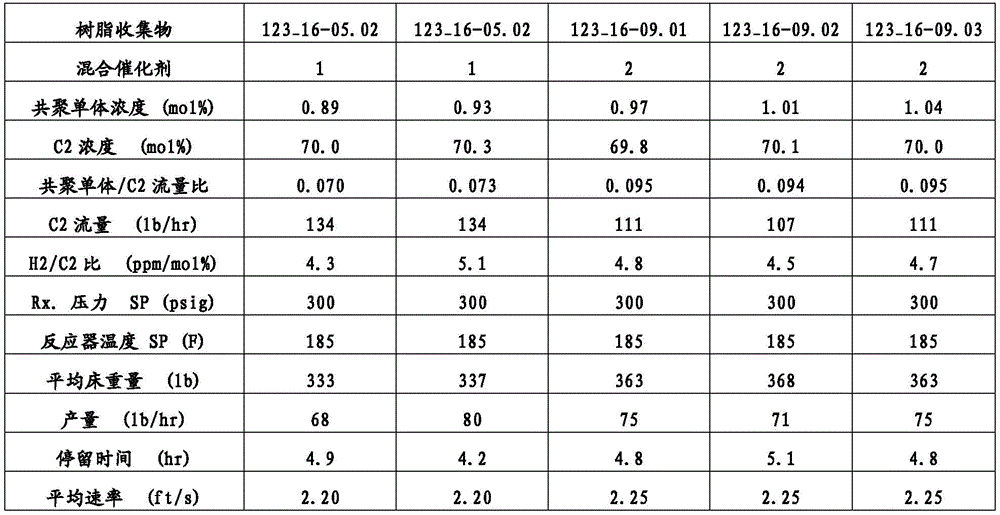

双峰聚乙烯的核磁共振测量揭示一些不饱和部分,如表2中归纳那样。标记“Vy1”、“Vy2”和“Vy5”是指归属于聚合物主链内双键上的质子的质子共振,如图1的实施例1H NMR所示。NMR measurements of the bimodal polyethylene revealed some unsaturation as summarized in Table 2. The labels "Vy1", "Vy2" and "Vy5" refer to the proton resonances assigned to protons on double bonds within the polymer backbone as shown in the Example 1 H NMR of FIG1 .
表2:不饱和水平Table 2: Unsaturation Levels
(对于本发明聚乙烯的内部(I)和末端(T))(For the interior (I) and terminal (T) of the polyethylene of the present invention)
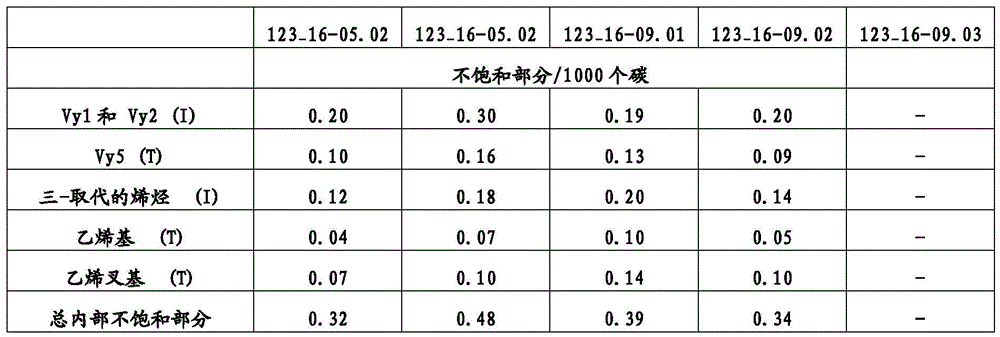
表3:乙烯和1-己烯的气相聚合Table 3: Gas phase polymerization of ethylene and 1-hexene

表4:乙烯和1-己烯的气相聚合Table 4: Gas Phase Polymerization of Ethylene and 1-Hexene
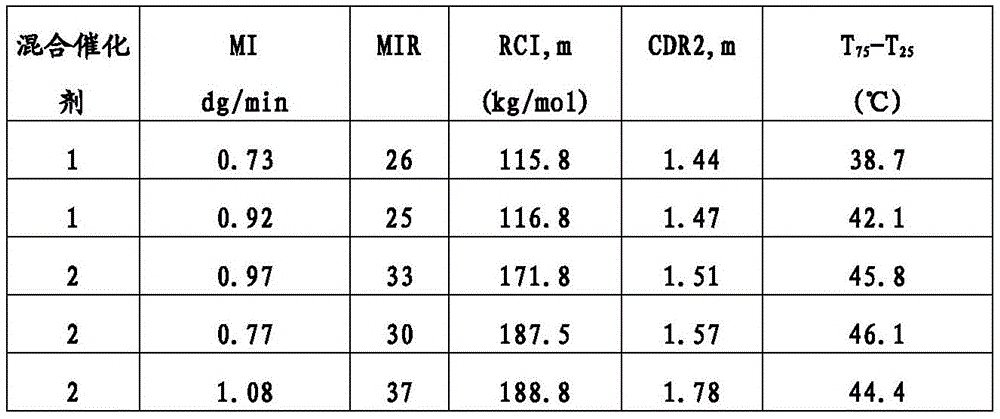
表5:交叉-分馏色谱Table 5: Cross-fractionation chromatography
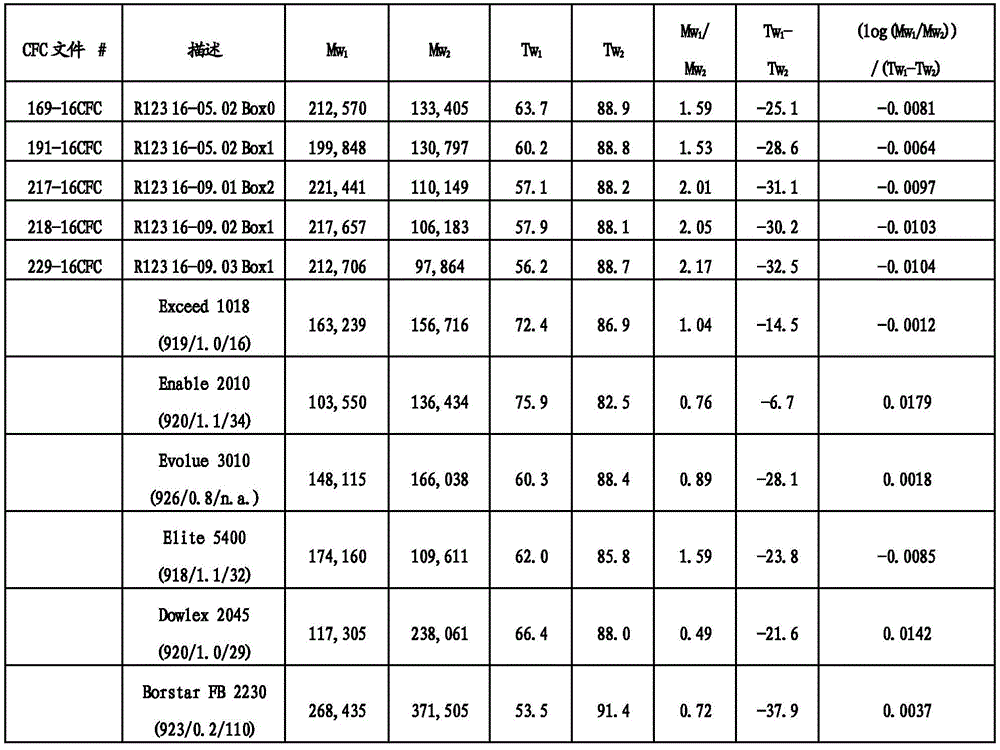
DowlexTM2045聚乙烯、BorstarTMFB2230聚乙烯、EvolueTM3010聚乙烯、EliteTM5400聚乙烯和ExceedTM1018和EnableTM2010聚乙烯都是商购的,并分别可以从The DowChemical Company、The Borealis Group、Prime Polymer Co.,Ltd.、The Dow ChemicalCompany和ExxonMobil Chemical Company获得。Dowlex ™ 2045 polyethylene, Borstar ™ FB2230 polyethylene, Evolue ™ 3010 polyethylene, Elite ™ 5400 polyethylene, and Exceed ™ 1018 and Enable ™ 2010 polyethylenes are all commercially available and may be obtained from The Dow Chemical Company, The Borealis Group, Prime Polymer Co., Ltd., The Dow Chemical Company, and ExxonMobil Chemical Company, respectively.
膜制备和评价Membrane preparation and evaluation
在Gloucester生产线上以60mil模口间隙和2.5BUR进行表1的本发明聚合物的吹塑膜评价。其它工艺数据参见表6。以1.0mil厚度的膜性能下面归纳在表7中并且对比膜下面归纳在表8中。Blown film evaluations of the inventive polymers of Table 1 were conducted on a Gloucester line at a 60 mil die gap and 2.5 BUR. Additional process data is provided in Table 6. Film properties at 1.0 mil thickness are summarized below in Table 7 and comparative films are summarized below in Table 8.
TDA是总缺陷面积。它是膜试样中缺陷的量度,并且报道为由所研究的膜面积平方米(m2)归一化的缺陷的积累面积平方毫米(mm2),从而具有单位(mm2/m2)或“ppm”。在下表中,仅报道具有大于200微米尺寸的缺陷。TDA is Total Defect Area. It is a measure of defects in a film specimen and is reported as the accumulated area square millimeters (mm 2 ) of defects normalized by the area square meters (m 2 ) of the film studied, thus having units (mm 2 /m 2 ) or "ppm". In the following tables, only defects with a size greater than 200 microns are reported.
通过光控制系统(OCS)获得TDA。这种系统由小型挤出机(ME20 2800)、流延膜模头、冷却辊单元(型号CR-9)、具有良好膜张力控制的卷绕系统和在线照相机系统(型号FSA-100)组成以研究流延膜产生的光学缺陷。对于流延膜产生的典型的试验条件如下:TDA was obtained by an optical control system (OCS). This system consists of a small extruder (ME20 2800), a cast film die, a chill roll unit (model CR-9), a winding system with good film tension control and an online camera system (model FSA-100) to study the optical defects produced by cast films. Typical experimental conditions for cast film production are as follows:
·挤出机温度设置(℃):进料喉/区1/区2/区3/区4/模头:70/190/200/210/215/215Extruder temperature setting (°C): Feed throat/
·挤出机速度:50rpmExtruder speed: 50rpm
·冷却辊温度:30℃Cooling roller temperature: 30℃
·冷却辊速度:3.5m/minCooling roller speed: 3.5m/min
所述系统产生宽度大约4.9英寸和2mil标称厚度的流延膜。熔体温度随材料而变,并是大约215℃。The system produced cast film with a width of approximately 4.9 inches and a nominal thickness of 2 mils. The melt temperature varied with the material and was approximately 215°C.
ESO是能量比输出,是由挤出机功率(hp)消耗量归一化的膜挤出方面的挤出量(lb/hr)并且是材料的可加工性的量度。ESO is Energy Specific Output, which is the throughput (lb/hr) in film extrusion normalized by the extruder power (hp) consumption and is a measure of the processability of the material.
图5示出了对比实施例以及本发明实施例的随树脂密度变化的平均MD/TD膜模量。下面方程式(Eq-3)示出了对比实施例的依赖于其树脂密度的膜模量。所有本发明实施例显示在给定树脂密度下在膜劲度方面的显著优点。Figure 5 shows the average MD/TD film modulus of the comparative examples and the inventive examples as a function of resin density. The following equation (Eq-3) shows the film modulus of the comparative examples in dependence on their resin density. All the inventive examples show a significant advantage in film stiffness at a given resin density.
平均模量=C1*密度–C2(Eq-3)。Average modulus = C1*density – C2 (Eq-3).
表6:膜制备Table 6: Membrane preparation

表7:膜性能Table 7: Membrane properties


表8:对比膜(在与上述本发明bPE膜相同的条件下制得)Table 8: Comparative film (prepared under the same conditions as the above bPE film of the present invention)
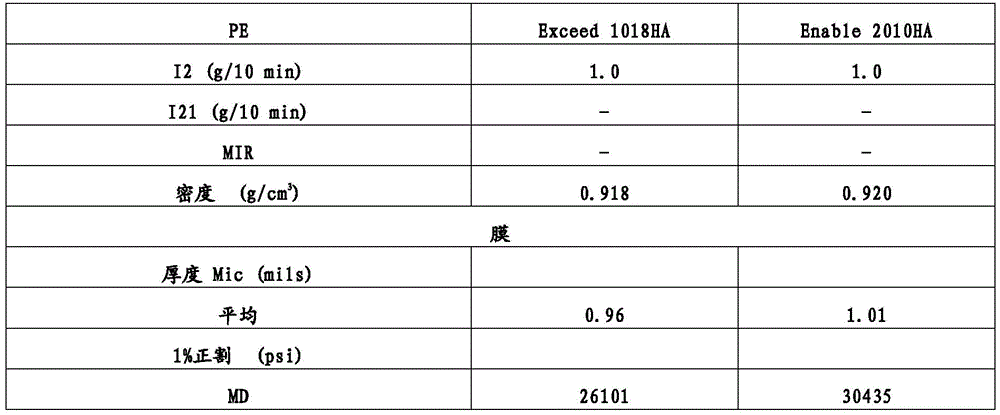

除非另有规定,短语“基本上由…组成”不排除其它步骤、元素或材料的存在(无论是否特别在说明书中提及),前提是这些步骤、元素或材料不影响本发明基础的且新颖的特性,此外,它们不排除通常与所用元素和材料相关的杂质和变体。Unless otherwise specified, the phrase "consisting essentially of" does not exclude the presence of other steps, elements or materials (whether or not specifically mentioned in the specification), provided that these steps, elements or materials do not affect the basic and novel characteristics of the invention, and further, they do not exclude impurities and variations normally associated with the elements and materials used.
为了简便起见,本文中仅仅明确公开了某些数值范围。然而,某一下限可以与任何其它上限组合用于限定未明确记载的范围,类似地,某一下限可以与任何其它下限组合用于限定未明确记载的范围,同样,某一上限也可以与任何上限组合用于限定未明确记载的范围。另外,即使没有明确叙述,两端点之间的每个点或单独值也包含在范围内。因此,每个点或单独值本身可作为下限或上限与其它点或单独值或其它下或上限组合用于限定未明确记载的范围。For simplicity, only some numerical ranges are clearly disclosed herein. However, a certain lower limit can be used in combination with any other upper limit to limit the scope that is not clearly recorded. Similarly, a certain lower limit can be used in combination with any other lower limit to limit the scope that is not clearly recorded. Similarly, a certain upper limit can also be used in combination with any upper limit to limit the scope that is not clearly recorded. In addition, even if there is no clear description, each point or individual value between the two end points is also included in the scope. Therefore, each point or individual value itself can be used as a lower limit or upper limit in combination with other points or individual values or other lower or upper limits to limit the scope that is not clearly recorded.
通过引用将所有的现有技术文献结合在本文中,前提是其公开内容不与本发明的描述相矛盾。此外,本文引用的所有文献和参考文献(包括试验程序、出版物、专利、期刊论文等)均通过引用结合在本文中,前提是其公开内容不与本发明的描述相矛盾。All prior art documents are incorporated herein by reference, provided that their disclosure does not contradict the description of the present invention. In addition, all documents and references (including test procedures, publications, patents, journal articles, etc.) cited herein are incorporated herein by reference, provided that their disclosure does not contradict the description of the present invention.
虽然已经根据许多实施方案和实施例对本发明进行了描述,但是本领域技术人员在阅读本公开内容之后将会理解在不脱离本文公开的本发明范围和精神的情况下可以设计其它实施方案。While the invention has been described in terms of numerous embodiments and examples, those skilled in the art, after reading this disclosure, will appreciate that other embodiments can be devised without departing from the scope and spirit of the invention disclosed herein.
Claims (25)
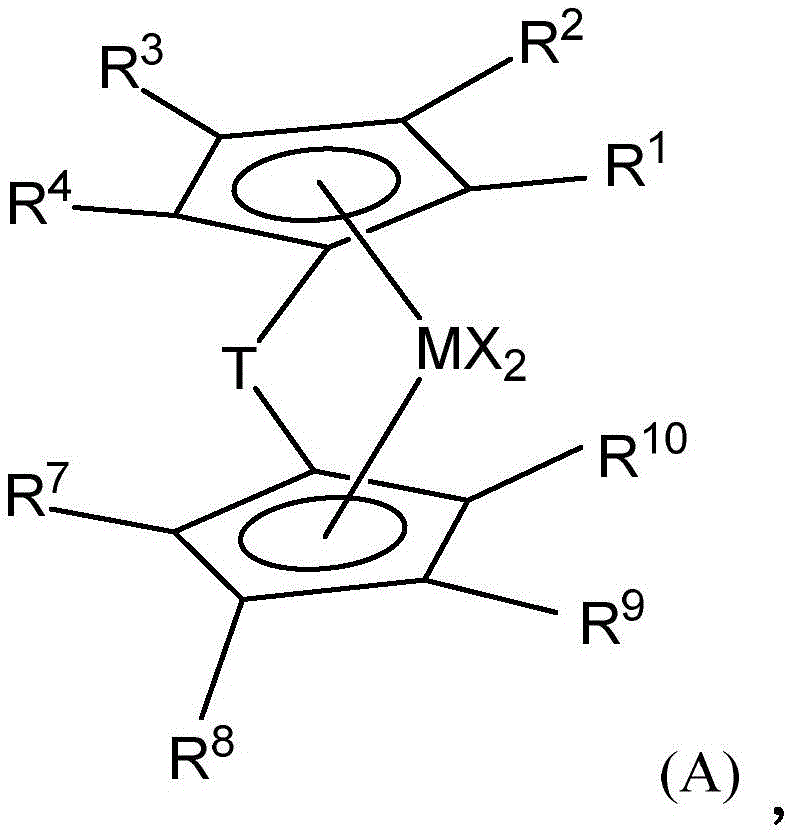
Applications Claiming Priority (5)
| Application Number | Priority Date | Filing Date | Title |
|---|---|---|---|
| US201762575818P | 2017-10-23 | 2017-10-23 | |
| US62/575,818 | 2017-10-23 | ||
| US201762579537P | 2017-10-31 | 2017-10-31 | |
| US62/579,537 | 2017-10-31 | ||
| PCT/US2018/048663 WO2019083608A1 (en) | 2017-10-23 | 2018-08-30 | Catalyst systems and polymerization processes for using the same |
Publications (2)
| Publication Number | Publication Date |
|---|---|
| CN111587256A CN111587256A (en) | 2020-08-25 |
| CN111587256B true CN111587256B (en) | 2023-05-19 |
Family
ID=63684453
Family Applications (2)
| Application Number | Title | Priority Date | Filing Date |
|---|---|---|---|
| CN201880068684.5A Active CN111587256B (en) | 2017-10-23 | 2018-08-30 | Catalyst system and polymerization process using the same |
| CN201880068685.XA Active CN111278872B (en) | 2017-10-23 | 2018-08-30 | Polyethylene compositions and articles made therefrom |
Family Applications After (1)
| Application Number | Title | Priority Date | Filing Date |
|---|---|---|---|
| CN201880068685.XA Active CN111278872B (en) | 2017-10-23 | 2018-08-30 | Polyethylene compositions and articles made therefrom |
Country Status (9)
| Country | Link |
|---|---|
| US (2) | US10822434B2 (en) |
| EP (2) | EP3700947A1 (en) |
| JP (1) | JP6986163B2 (en) |
| KR (1) | KR102452018B1 (en) |
| CN (2) | CN111587256B (en) |
| BR (1) | BR112020008024B1 (en) |
| CA (1) | CA3079670C (en) |
| MY (1) | MY204496A (en) |
| WO (2) | WO2019083609A1 (en) |
Families Citing this family (44)
| Publication number | Priority date | Publication date | Assignee | Title |
|---|---|---|---|---|
| CN111587256B (en) * | 2017-10-23 | 2023-05-19 | 埃克森美孚化学专利公司 | Catalyst system and polymerization process using the same |
| CN111886261A (en) * | 2017-10-27 | 2020-11-03 | 尤尼威蒂恩技术有限责任公司 | Polyethylene copolymer resin and film |
| US10934376B2 (en) * | 2017-11-28 | 2021-03-02 | Exxonmobil Chemical Patents Inc. | Polyethylene compositions and films made therefrom |
| KR102405495B1 (en) * | 2017-12-01 | 2022-06-08 | 엑손모빌 케미칼 패턴츠 인코포레이티드 | Catalyst system and polymerization method for using same |
| WO2019246069A1 (en) * | 2018-06-19 | 2019-12-26 | Exxonmobil Chemical Patents Inc. | Polyethylene compositions and films prepared therefrom |
| US10899860B2 (en) | 2018-08-30 | 2021-01-26 | Exxonmobil Chemical Patents Inc. | Polymerization processes and polymers made therefrom |
| WO2020046406A1 (en) * | 2018-08-30 | 2020-03-05 | Exxonmobil Chemical Patents Inc. | Polymerization processes and polymers made therefrom |
| US10927205B2 (en) | 2018-08-30 | 2021-02-23 | Exxonmobil Chemical Patents Inc. | Polymerization processes and polymers made therefrom |
| WO2020092584A2 (en) | 2018-11-01 | 2020-05-07 | Exxonmobil Chemical Patents Inc. | In-line trimming of dry catalyst feed |
| US20220056168A1 (en) | 2018-11-01 | 2022-02-24 | Exxonmobil Chemical Patents Inc. | Slurry Trim Feeder Modifications |
| CN112996821B (en) * | 2018-11-01 | 2023-04-28 | 埃克森美孚化学专利公司 | Mixed catalyst system with condensing agent-adjustable properties |
| EP3873948B1 (en) * | 2018-11-01 | 2025-08-06 | ExxonMobil Chemical Patents Inc. | On-line adjustment of mixed catalyst ratio and olefin polymerization |
| US12091476B2 (en) | 2018-11-01 | 2024-09-17 | Exxonmobil Chemical Patents Inc. | On-line adjustment of catalysts by trim and olefin polymerization |
| US12043679B2 (en) | 2018-11-01 | 2024-07-23 | Exxonmobil Chemical Patents Inc. | On-line adjustment of mixed catalyst ratio by trim and olefin polymerization with the same |
| EP4077422B1 (en) * | 2019-12-17 | 2025-09-10 | ExxonMobil Chemical Patents Inc. | Broad orthogonal distribution polyethylenes for films |
| EP4077423A1 (en) * | 2019-12-17 | 2022-10-26 | ExxonMobil Chemical Patents Inc. | Broad orthogonal distribution polyethylenes for films |
| US11339279B2 (en) * | 2020-04-01 | 2022-05-24 | Chevron Phillips Chemical Company Lp | Dual catalyst system for producing LLDPE and MDPE copolymers with long chain branching for film applications |
| US12534582B2 (en) * | 2020-05-01 | 2026-01-27 | Exxonmobil Chemical Patents Inc. | Linear low density polyethylene for film applications |
| CN116234837A (en) | 2020-07-22 | 2023-06-06 | 埃克森美孚化学专利公司 | Polyolefin composition and its products |
| WO2022120321A1 (en) | 2020-12-02 | 2022-06-09 | Exxonmobil Chemical Patents Inc. | Medium density polyethylene compositions with broad orthogonal composition distribution |
| EP4291582A1 (en) | 2021-02-11 | 2023-12-20 | ExxonMobil Chemical Patents Inc. | Process for polymerizing one or more olefins |
| US20240026046A1 (en) * | 2021-03-23 | 2024-01-25 | Lg Chem, Ltd. | Olefin-Based Polymer |
| EP4413063A1 (en) | 2021-10-04 | 2024-08-14 | ExxonMobil Chemical Patents Inc. | Polyethylene blends, films thereof, and methods thereof |
| EP4423152A1 (en) | 2021-10-26 | 2024-09-04 | ExxonMobil Chemical Patents Inc. | Highly oriented linear low density polyethylene films with outstanding processability and mechanical properties |
| US12122857B2 (en) | 2021-12-16 | 2024-10-22 | Chevron Phillips Chemical Company Lp | Controlling long-chain branch content with dual activator-supports |
| EP4499716A1 (en) | 2022-03-31 | 2025-02-05 | ExxonMobil Chemical Patents Inc. | Linear low density polyethylenes, polymerizations thereof, and films thereof |
| CN118829644A (en) * | 2022-04-01 | 2024-10-22 | 韩华思路信株式会社 | Transition metal compound for olefin polymerization catalyst, olefin polymerization catalyst containing the same, and polyolefin polymerized using the same |
| CN119365499A (en) | 2022-06-15 | 2025-01-24 | 埃克森美孚化学专利公司 | Ethylene-based polymers, articles made therefrom, and methods of making the same |
| WO2024044423A1 (en) * | 2022-08-22 | 2024-02-29 | Exxonmobil Chemical Patents, Inc. | Polyethylene compositions and films made therefrom |
| EP4584306A1 (en) | 2022-09-07 | 2025-07-16 | ExxonMobil Chemical Patents Inc. | Polyethylenes and articles thereof |
| EP4594397A1 (en) * | 2022-09-30 | 2025-08-06 | TotalEnergies OneTech | Asymmetric machine-direction oriented polyethylene film formed by cast extrusion with sealing properties and laminate comprising such a film |
| CN120813613A (en) | 2023-03-13 | 2025-10-17 | 埃克森美孚技术与工程公司 | Method for modifying supported catalysts during olefin polymerization |
| WO2024191699A1 (en) | 2023-03-13 | 2024-09-19 | ExxonMobil Technology and Engineering Company | Methods for modifying a supported catalyst during olefin polymerization |
| WO2024191717A1 (en) | 2023-03-13 | 2024-09-19 | ExxonMobil Technology and Engineering Company | Methods for regulating reactor catalyst flow distribution during olefin polymerization |
| EP4680385A1 (en) | 2023-03-13 | 2026-01-21 | ExxonMobil Technology and Engineering Company | Methods for regulating reactor catalyst flow distribution during olefin polymerization |
| CN121002078A (en) | 2023-04-24 | 2025-11-21 | 诺瓦化学品(国际)股份有限公司 | Linear high-density polyethylene compositions suitable for medium-sized bulk container applications |
| KR20260003679A (en) | 2023-04-24 | 2026-01-07 | 노바 케미컬즈 (인터내셔널) 소시에테 아노님 | Linear high-density polyethylene compositions and rotational molded products |
| WO2024242933A1 (en) | 2023-05-23 | 2024-11-28 | ExxonMobil Technology and Engineering Company | Catalysts and polymerizations for improved polyolefins |
| WO2024242936A1 (en) | 2023-05-23 | 2024-11-28 | ExxonMobil Technology and Engineering Company | Catalysts and polymerizations for improved polyolefins |
| WO2024242932A1 (en) | 2023-05-23 | 2024-11-28 | ExxonMobil Technology and Engineering Company | Polethylenes, catalysts for their polymerization, and films thereof |
| CN121464161A (en) | 2023-05-23 | 2026-02-03 | 埃克森美孚技术与工程公司 | Polyethylene with improved processability and films thereof |
| CN121420003A (en) | 2023-05-23 | 2026-01-27 | 埃克森美孚技术与工程公司 | Catalysts, polyethylene, its polymerization and its membranes |
| WO2025090149A1 (en) | 2023-10-23 | 2025-05-01 | ExxonMobil Technology and Engineering Company | Methods for modifying a supported catalyst during olefin polymerization through pressurized delivery of a catalyst solution |
| WO2026024387A1 (en) | 2024-07-22 | 2026-01-29 | ExxonMobil Technology and Engineering Company | Polyethylene sealing layer resins |
Citations (6)
| Publication number | Priority date | Publication date | Assignee | Title |
|---|---|---|---|---|
| WO1991014713A1 (en) * | 1990-03-20 | 1991-10-03 | Exxon Chemical Patents Inc. | Catalyst system of enhanced productivity |
| US5252529A (en) * | 1991-05-20 | 1993-10-12 | Mitsui Petrochemical Industries, Ltd. | Olefin polymerization catalyst and olefin polymerization |
| CN105377906A (en) * | 2013-07-17 | 2016-03-02 | 埃克森美孚化学专利公司 | Substituted metallocene catalysts |
| CN106034402A (en) * | 2014-02-11 | 2016-10-19 | 尤尼威蒂恩技术有限责任公司 | Manufacture of polyolefin products |
| WO2016171807A1 (en) * | 2015-04-20 | 2016-10-27 | Exxonmobil Chemical Patents Inc. | Catalyst composition comprising fluorided support and processes for use thereof |
| WO2016172099A1 (en) * | 2015-04-20 | 2016-10-27 | Exxonmobil Chemical Patents Inc. | Polyethylene composition |
Family Cites Families (58)
| Publication number | Priority date | Publication date | Assignee | Title |
|---|---|---|---|---|
| US3248179A (en) | 1962-02-26 | 1966-04-26 | Phillips Petroleum Co | Method and apparatus for the production of solid polymers of olefins |
| US4588790A (en) | 1982-03-24 | 1986-05-13 | Union Carbide Corporation | Method for fluidized bed polymerization |
| US4543399A (en) | 1982-03-24 | 1985-09-24 | Union Carbide Corporation | Fluidized bed reaction systems |
| US4558105A (en) | 1983-12-07 | 1985-12-10 | Chemplex Company | Copolymerization of ethylene |
| US4613484A (en) | 1984-11-30 | 1986-09-23 | Phillips Petroleum Company | Loop reactor settling leg system for separation of solid polymers and liquid diluent |
| FR2634212B1 (en) | 1988-07-15 | 1991-04-19 | Bp Chimie Sa | APPARATUS AND METHOD FOR POLYMERIZATION OF GASEOUS OLEFINS IN A FLUIDIZED BED REACTOR |
| US5041584A (en) | 1988-12-02 | 1991-08-20 | Texas Alkyls, Inc. | Modified methylaluminoxane |
| US5436304A (en) | 1992-03-19 | 1995-07-25 | Exxon Chemical Patents Inc. | Process for polymerizing monomers in fluidized beds |
| US5352749A (en) | 1992-03-19 | 1994-10-04 | Exxon Chemical Patents, Inc. | Process for polymerizing monomers in fluidized beds |
| US5317036A (en) | 1992-10-16 | 1994-05-31 | Union Carbide Chemicals & Plastics Technology Corporation | Gas phase polymerization reactions utilizing soluble unsupported catalysts |
| KR100190268B1 (en) | 1993-04-26 | 1999-06-01 | 에인혼 해롤드 | Process for polymerizing monomers in fludized beds |
| US5462999A (en) | 1993-04-26 | 1995-10-31 | Exxon Chemical Patents Inc. | Process for polymerizing monomers in fluidized beds |
| ZA943399B (en) | 1993-05-20 | 1995-11-17 | Bp Chem Int Ltd | Polymerisation process |
| US5453471B1 (en) | 1994-08-02 | 1999-02-09 | Carbide Chemicals & Plastics T | Gas phase polymerization process |
| DE69600892T2 (en) | 1995-02-21 | 1999-04-01 | Mitsubishi Chemical Corp., Tokio/Tokyo | Catalysts for olefin polymerization and process for producing olefin polymers obtained therewith |
| US5616661A (en) | 1995-03-31 | 1997-04-01 | Union Carbide Chemicals & Plastics Technology Corporation | Process for controlling particle growth during production of sticky polymers |
| WO1998043983A1 (en) | 1997-04-03 | 1998-10-08 | Colorado State University Research Foundation | Polyhalogenated monoheteroborane anion compositions |
| US6242545B1 (en) | 1997-12-08 | 2001-06-05 | Univation Technologies | Polymerization catalyst systems comprising substituted hafinocenes |
| US6147173A (en) | 1998-11-13 | 2000-11-14 | Univation Technologies, Llc | Nitrogen-containing group 13 anionic complexes for olefin polymerization |
| EP1242179B1 (en) | 1999-12-16 | 2013-05-15 | Chevron Phillips Chemical Company LP | Organometal compound catalyst |
| DE10006900A1 (en) | 2000-02-16 | 2001-08-23 | Basell Polyolefine Gmbh | Process for radical ethylene high-pressure polymerization while avoiding undesirable polymer deposits |
| US6936675B2 (en) | 2001-07-19 | 2005-08-30 | Univation Technologies, Llc | High tear films from hafnocene catalyzed polyethylenes |
| JP4221363B2 (en) | 2001-07-19 | 2009-02-12 | ユニベーション・テクノロジーズ・エルエルシー | Polyethylene film with improved physical properties |
| JP4020862B2 (en) | 2001-07-19 | 2007-12-12 | ユニベーション・テクノロジーズ・エルエルシー | Mixed metallocene catalyst system containing comonomer minor incorporation catalyst and comonomer major incorporation catalyst |
| EP1537175B1 (en) | 2002-09-05 | 2008-05-14 | ExxonMobil Chemical Patents Inc. | Shrink film |
| US20050137364A1 (en) * | 2003-12-23 | 2005-06-23 | Univation Technologies, Llc | Condensing mode operation of gas-phase polymerization reactor |
| US7119153B2 (en) | 2004-01-21 | 2006-10-10 | Jensen Michael D | Dual metallocene catalyst for producing film resins with good machine direction (MD) elmendorf tear strength |
| EP1671983B1 (en) * | 2004-12-03 | 2009-02-25 | Repsol Quimica S.A. | Catalysts compositions for the polymerization and copolymerization of alpha-olefins |
| US7307177B2 (en) * | 2004-12-17 | 2007-12-11 | Exxonmobil Chemical Patents Inc. | Metallocene complexes, their synthesis and use in catalyst systems for olefin polymerization |
| CN101253202A (en) | 2005-08-05 | 2008-08-27 | 埃克森美孚化学专利公司 | Process and apparatus for producing ethylene polymers and copolymers |
| US7625982B2 (en) | 2005-08-22 | 2009-12-01 | Chevron Phillips Chemical Company Lp | Multimodal polyethylene compositions and pipe made from same |
| US8247065B2 (en) | 2006-05-31 | 2012-08-21 | Exxonmobil Chemical Patents Inc. | Linear polymers, polymer blends, and articles made therefrom |
| US7875690B2 (en) | 2006-06-27 | 2011-01-25 | Univation Technologies, Llc | Ethylene-alpha olefin copolymers and polymerization processes for making the same |
| ES2484043T3 (en) | 2006-06-27 | 2014-08-08 | Univation Technologies, Llc | Enhanced polymerization processes using metallocene catalysts, their polymer products and end uses |
| WO2008136621A1 (en) * | 2007-05-02 | 2008-11-13 | Lg Chem, Ltd. | Polyolefin and preparation method thereof |
| US20120172548A1 (en) | 2007-05-02 | 2012-07-05 | Lg Chem, Ltd. | Polyolefin and preparation method thereof |
| US20090156764A1 (en) | 2007-12-18 | 2009-06-18 | Malakoff Alan M | Ethylene-Based Polymers and Articles Made Therefrom |
| JP5498926B2 (en) * | 2009-12-17 | 2014-05-21 | 日本ポリプロ株式会社 | Method for producing propylene-based polymer having long chain branching |
| CN102770466B (en) | 2009-12-18 | 2014-07-02 | 道达尔石油化学产品研究弗吕公司 | Process for the preparation of granular polyethylene products |
| US8383754B2 (en) | 2010-04-19 | 2013-02-26 | Chevron Phillips Chemical Company Lp | Catalyst compositions for producing high Mz/Mw polyolefins |
| US8658556B2 (en) | 2011-06-08 | 2014-02-25 | Exxonmobil Chemical Patents Inc. | Catalyst systems comprising multiple non-coordinating anion activators and methods for polymerization therewith |
| US8940842B2 (en) | 2012-09-24 | 2015-01-27 | Chevron Phillips Chemical Company Lp | Methods for controlling dual catalyst olefin polymerizations |
| CN104781319B (en) | 2012-11-07 | 2018-04-10 | 切弗朗菲利浦化学公司 | Low density polyolefin resin and film made therefrom |
| CN104853917A (en) | 2012-11-21 | 2015-08-19 | 埃克森美孚化学专利公司 | Films comprising ethlyene-based polymers and methods of making same |
| CA2800056A1 (en) | 2012-12-24 | 2014-06-24 | Nova Chemicals Corporation | Polyethylene blend compositions |
| US9181369B2 (en) | 2013-03-11 | 2015-11-10 | Chevron Phillips Chemical Company Lp | Polymer films having improved heat sealing properties |
| US9752021B2 (en) * | 2013-03-28 | 2017-09-05 | Dow Global Technologies Llc | Ethylene/alpha-olefin interpolymer composition |
| US9988473B2 (en) * | 2013-05-02 | 2018-06-05 | Dow Global Technologies Llc | Polyethylene composition and articles made therefrom |
| US9181370B2 (en) | 2013-11-06 | 2015-11-10 | Chevron Phillips Chemical Company Lp | Low density polyolefin resins with low molecular weight and high molecular weight components, and films made therefrom |
| US9217049B2 (en) | 2013-11-19 | 2015-12-22 | Chevron Phillips Chemical Company Lp | Dual catalyst systems for producing polymers with a broad molecular weight distribution and a uniform short chain branch distribution |
| US20160168173A1 (en) | 2014-12-12 | 2016-06-16 | Exxonmobil Research And Engineering Company | Organosilica materials and uses thereof |
| WO2016094843A2 (en) | 2014-12-12 | 2016-06-16 | Exxonmobil Chemical Patents Inc. | Olefin polymerization catalyst system comprising mesoporous organosilica support |
| US20160168171A1 (en) | 2014-12-12 | 2016-06-16 | Exxonmobil Research And Engineering Company | Methods of producing organosilica materials and uses thereof |
| US9796795B2 (en) * | 2015-01-14 | 2017-10-24 | Exxonmobil Chemical Patents Inc. | Tetrahydroindacenyl catalyst composition, catalyst system, and processes for use thereof |
| US20160060430A1 (en) | 2015-11-06 | 2016-03-03 | ExxonMobil Chemical Company - Law Technology | Polyolefin Compositions And Processes For Making The Same |
| CN109996820A (en) * | 2016-10-05 | 2019-07-09 | 埃克森美孚化学专利公司 | Metallocene catalyst, catalyst system and the method using it |
| EP3697822B1 (en) * | 2017-08-04 | 2025-07-30 | ExxonMobil Chemical Patents Inc. | Mixed catalysts with unbridged hafnocenes with -ch2-sime3 moieties |
| CN111587256B (en) * | 2017-10-23 | 2023-05-19 | 埃克森美孚化学专利公司 | Catalyst system and polymerization process using the same |
-
2018
- 2018-08-30 CN CN201880068684.5A patent/CN111587256B/en active Active
- 2018-08-30 WO PCT/US2018/048669 patent/WO2019083609A1/en not_active Ceased
- 2018-08-30 CA CA3079670A patent/CA3079670C/en active Active
- 2018-08-30 MY MYPI2020001738A patent/MY204496A/en unknown
- 2018-08-30 US US16/117,008 patent/US10822434B2/en active Active
- 2018-08-30 JP JP2020542528A patent/JP6986163B2/en active Active
- 2018-08-30 BR BR112020008024-1A patent/BR112020008024B1/en active IP Right Grant
- 2018-08-30 KR KR1020207011714A patent/KR102452018B1/en active Active
- 2018-08-30 EP EP18778619.9A patent/EP3700947A1/en active Pending
- 2018-08-30 WO PCT/US2018/048663 patent/WO2019083608A1/en not_active Ceased
- 2018-08-30 US US16/117,023 patent/US10808053B2/en active Active
- 2018-08-30 EP EP18786070.5A patent/EP3700944A1/en active Pending
- 2018-08-30 CN CN201880068685.XA patent/CN111278872B/en active Active
Patent Citations (6)
| Publication number | Priority date | Publication date | Assignee | Title |
|---|---|---|---|---|
| WO1991014713A1 (en) * | 1990-03-20 | 1991-10-03 | Exxon Chemical Patents Inc. | Catalyst system of enhanced productivity |
| US5252529A (en) * | 1991-05-20 | 1993-10-12 | Mitsui Petrochemical Industries, Ltd. | Olefin polymerization catalyst and olefin polymerization |
| CN105377906A (en) * | 2013-07-17 | 2016-03-02 | 埃克森美孚化学专利公司 | Substituted metallocene catalysts |
| CN106034402A (en) * | 2014-02-11 | 2016-10-19 | 尤尼威蒂恩技术有限责任公司 | Manufacture of polyolefin products |
| WO2016171807A1 (en) * | 2015-04-20 | 2016-10-27 | Exxonmobil Chemical Patents Inc. | Catalyst composition comprising fluorided support and processes for use thereof |
| WO2016172099A1 (en) * | 2015-04-20 | 2016-10-27 | Exxonmobil Chemical Patents Inc. | Polyethylene composition |
Also Published As
| Publication number | Publication date |
|---|---|
| CN111278872A (en) | 2020-06-12 |
| EP3700947A1 (en) | 2020-09-02 |
| WO2019083609A1 (en) | 2019-05-02 |
| CN111587256A (en) | 2020-08-25 |
| MY204496A (en) | 2024-08-30 |
| BR112020008024A2 (en) | 2020-10-27 |
| CA3079670A1 (en) | 2019-05-02 |
| CA3079670C (en) | 2023-01-10 |
| BR112020008024B1 (en) | 2023-12-05 |
| JP2021500462A (en) | 2021-01-07 |
| US20190119417A1 (en) | 2019-04-25 |
| CN111278872B (en) | 2022-10-28 |
| US20190119413A1 (en) | 2019-04-25 |
| US10808053B2 (en) | 2020-10-20 |
| JP6986163B2 (en) | 2021-12-22 |
| EP3700944A1 (en) | 2020-09-02 |
| KR102452018B1 (en) | 2022-10-07 |
| KR20200055091A (en) | 2020-05-20 |
| WO2019083608A1 (en) | 2019-05-02 |
| US10822434B2 (en) | 2020-11-03 |
Similar Documents
| Publication | Publication Date | Title |
|---|---|---|
| CN111587256B (en) | Catalyst system and polymerization process using the same | |
| CN112313254B (en) | Polyethylene compositions and films made therefrom | |
| CN112351987B (en) | Non-coordinating anionic activators containing cations having large alkyl groups | |
| CN111108130B (en) | Hybrid catalysts with unbridged hafnocene containing -CH2-SiMe3 moieties | |
| CN111094366B (en) | Polyethylene compositions and films made therefrom | |
| CN111344316B (en) | Polyethylene compositions and articles made therefrom | |
| CN110431160B (en) | Supported catalyst system and method of use | |
| CN111433229B (en) | Catalyst system and polymerization method using same | |
| CN107847920A (en) | Substituted double indenyl metallocene catalyst compounds comprising Si Si abutments | |
| US10807998B2 (en) | Bridged bis(indenyl) transitional metal complexes, production, and use thereof | |
| CN111356706B (en) | Aggregation method | |
| CN111212857B (en) | Hybrid catalyst with 2, 6-bis (imino) pyridinyliron complex and bridged hafnocene | |
| CN111587257B (en) | Mixed catalyst system with four metallocenes on a single support | |
| CN112334499B (en) | Metallocenes with SI-SI bridge | |
| CN110325561B (en) | Group 4 catalyst compounds and methods of use thereof | |
| CN111356705A (en) | Polymerization process | |
| CN112218900B (en) | Catalyst system comprising two hafnocene catalyst compounds | |
| CN110312741B (en) | Hafnocene catalyst compounds and methods of use thereof | |
| EP3710500A1 (en) | Polymerization processes |
Legal Events
| Date | Code | Title | Description |
|---|---|---|---|
| PB01 | Publication | ||
| PB01 | Publication | ||
| SE01 | Entry into force of request for substantive examination | ||
| SE01 | Entry into force of request for substantive examination | ||
| GR01 | Patent grant | ||
| GR01 | Patent grant |