CN110191902B - Bimodal polyethylene resin - Google Patents
Bimodal polyethylene resin Download PDFInfo
- Publication number
- CN110191902B CN110191902B CN201880007293.2A CN201880007293A CN110191902B CN 110191902 B CN110191902 B CN 110191902B CN 201880007293 A CN201880007293 A CN 201880007293A CN 110191902 B CN110191902 B CN 110191902B
- Authority
- CN
- China
- Prior art keywords
- ethylene
- molecular weight
- catalyst
- based polymer
- group
- Prior art date
- Legal status (The legal status is an assumption and is not a legal conclusion. Google has not performed a legal analysis and makes no representation as to the accuracy of the status listed.)
- Active
Links
Images

Classifications
-
- C—CHEMISTRY; METALLURGY
- C08—ORGANIC MACROMOLECULAR COMPOUNDS; THEIR PREPARATION OR CHEMICAL WORKING-UP; COMPOSITIONS BASED THEREON
- C08F—MACROMOLECULAR COMPOUNDS OBTAINED BY REACTIONS ONLY INVOLVING CARBON-TO-CARBON UNSATURATED BONDS
- C08F4/00—Polymerisation catalysts
- C08F4/42—Metals; Metal hydrides; Metallo-organic compounds; Use thereof as catalyst precursors
- C08F4/44—Metals; Metal hydrides; Metallo-organic compounds; Use thereof as catalyst precursors selected from light metals, zinc, cadmium, mercury, copper, silver, gold, boron, gallium, indium, thallium, rare earths or actinides
- C08F4/60—Metals; Metal hydrides; Metallo-organic compounds; Use thereof as catalyst precursors selected from light metals, zinc, cadmium, mercury, copper, silver, gold, boron, gallium, indium, thallium, rare earths or actinides together with refractory metals, iron group metals, platinum group metals, manganese, rhenium technetium or compounds thereof
- C08F4/62—Refractory metals or compounds thereof
- C08F4/64—Titanium, zirconium, hafnium or compounds thereof
- C08F4/659—Component covered by group C08F4/64 containing a transition metal-carbon bond
- C08F4/65904—Component covered by group C08F4/64 containing a transition metal-carbon bond in combination with another component of C08F4/64
-
- C—CHEMISTRY; METALLURGY
- C08—ORGANIC MACROMOLECULAR COMPOUNDS; THEIR PREPARATION OR CHEMICAL WORKING-UP; COMPOSITIONS BASED THEREON
- C08F—MACROMOLECULAR COMPOUNDS OBTAINED BY REACTIONS ONLY INVOLVING CARBON-TO-CARBON UNSATURATED BONDS
- C08F210/00—Copolymers of unsaturated aliphatic hydrocarbons having only one carbon-to-carbon double bond
- C08F210/16—Copolymers of ethene with alpha-alkenes, e.g. EP rubbers
-
- B—PERFORMING OPERATIONS; TRANSPORTING
- B29—WORKING OF PLASTICS; WORKING OF SUBSTANCES IN A PLASTIC STATE IN GENERAL
- B29C—SHAPING OR JOINING OF PLASTICS; SHAPING OF MATERIAL IN A PLASTIC STATE, NOT OTHERWISE PROVIDED FOR; AFTER-TREATMENT OF THE SHAPED PRODUCTS, e.g. REPAIRING
- B29C49/00—Blow-moulding, i.e. blowing a preform or parison to a desired shape within a mould; Apparatus therefor
- B29C49/0005—Blow-moulding, i.e. blowing a preform or parison to a desired shape within a mould; Apparatus therefor characterised by the material
- B29C49/0006—Blow-moulding, i.e. blowing a preform or parison to a desired shape within a mould; Apparatus therefor characterised by the material for heating or cooling
-
- C—CHEMISTRY; METALLURGY
- C08—ORGANIC MACROMOLECULAR COMPOUNDS; THEIR PREPARATION OR CHEMICAL WORKING-UP; COMPOSITIONS BASED THEREON
- C08F—MACROMOLECULAR COMPOUNDS OBTAINED BY REACTIONS ONLY INVOLVING CARBON-TO-CARBON UNSATURATED BONDS
- C08F4/00—Polymerisation catalysts
- C08F4/42—Metals; Metal hydrides; Metallo-organic compounds; Use thereof as catalyst precursors
- C08F4/44—Metals; Metal hydrides; Metallo-organic compounds; Use thereof as catalyst precursors selected from light metals, zinc, cadmium, mercury, copper, silver, gold, boron, gallium, indium, thallium, rare earths or actinides
- C08F4/60—Metals; Metal hydrides; Metallo-organic compounds; Use thereof as catalyst precursors selected from light metals, zinc, cadmium, mercury, copper, silver, gold, boron, gallium, indium, thallium, rare earths or actinides together with refractory metals, iron group metals, platinum group metals, manganese, rhenium technetium or compounds thereof
- C08F4/62—Refractory metals or compounds thereof
- C08F4/64—Titanium, zirconium, hafnium or compounds thereof
- C08F4/659—Component covered by group C08F4/64 containing a transition metal-carbon bond
- C08F4/6592—Component covered by group C08F4/64 containing a transition metal-carbon bond containing at least one cyclopentadienyl ring, condensed or not, e.g. an indenyl or a fluorenyl ring
-
- C—CHEMISTRY; METALLURGY
- C08—ORGANIC MACROMOLECULAR COMPOUNDS; THEIR PREPARATION OR CHEMICAL WORKING-UP; COMPOSITIONS BASED THEREON
- C08F—MACROMOLECULAR COMPOUNDS OBTAINED BY REACTIONS ONLY INVOLVING CARBON-TO-CARBON UNSATURATED BONDS
- C08F4/00—Polymerisation catalysts
- C08F4/42—Metals; Metal hydrides; Metallo-organic compounds; Use thereof as catalyst precursors
- C08F4/44—Metals; Metal hydrides; Metallo-organic compounds; Use thereof as catalyst precursors selected from light metals, zinc, cadmium, mercury, copper, silver, gold, boron, gallium, indium, thallium, rare earths or actinides
- C08F4/60—Metals; Metal hydrides; Metallo-organic compounds; Use thereof as catalyst precursors selected from light metals, zinc, cadmium, mercury, copper, silver, gold, boron, gallium, indium, thallium, rare earths or actinides together with refractory metals, iron group metals, platinum group metals, manganese, rhenium technetium or compounds thereof
- C08F4/62—Refractory metals or compounds thereof
- C08F4/64—Titanium, zirconium, hafnium or compounds thereof
- C08F4/64003—Titanium, zirconium, hafnium or compounds thereof the metallic compound containing a multidentate ligand, i.e. a ligand capable of donating two or more pairs of electrons to form a coordinate or ionic bond
- C08F4/64082—Tridentate ligand
- C08F4/64141—Dianionic ligand
- C08F4/64148—NN(R)N
-
- C—CHEMISTRY; METALLURGY
- C08—ORGANIC MACROMOLECULAR COMPOUNDS; THEIR PREPARATION OR CHEMICAL WORKING-UP; COMPOSITIONS BASED THEREON
- C08F—MACROMOLECULAR COMPOUNDS OBTAINED BY REACTIONS ONLY INVOLVING CARBON-TO-CARBON UNSATURATED BONDS
- C08F4/00—Polymerisation catalysts
- C08F4/42—Metals; Metal hydrides; Metallo-organic compounds; Use thereof as catalyst precursors
- C08F4/44—Metals; Metal hydrides; Metallo-organic compounds; Use thereof as catalyst precursors selected from light metals, zinc, cadmium, mercury, copper, silver, gold, boron, gallium, indium, thallium, rare earths or actinides
- C08F4/60—Metals; Metal hydrides; Metallo-organic compounds; Use thereof as catalyst precursors selected from light metals, zinc, cadmium, mercury, copper, silver, gold, boron, gallium, indium, thallium, rare earths or actinides together with refractory metals, iron group metals, platinum group metals, manganese, rhenium technetium or compounds thereof
- C08F4/62—Refractory metals or compounds thereof
- C08F4/64—Titanium, zirconium, hafnium or compounds thereof
- C08F4/659—Component covered by group C08F4/64 containing a transition metal-carbon bond
- C08F4/65912—Component covered by group C08F4/64 containing a transition metal-carbon bond in combination with an organoaluminium compound
-
- C—CHEMISTRY; METALLURGY
- C08—ORGANIC MACROMOLECULAR COMPOUNDS; THEIR PREPARATION OR CHEMICAL WORKING-UP; COMPOSITIONS BASED THEREON
- C08F—MACROMOLECULAR COMPOUNDS OBTAINED BY REACTIONS ONLY INVOLVING CARBON-TO-CARBON UNSATURATED BONDS
- C08F4/00—Polymerisation catalysts
- C08F4/42—Metals; Metal hydrides; Metallo-organic compounds; Use thereof as catalyst precursors
- C08F4/44—Metals; Metal hydrides; Metallo-organic compounds; Use thereof as catalyst precursors selected from light metals, zinc, cadmium, mercury, copper, silver, gold, boron, gallium, indium, thallium, rare earths or actinides
- C08F4/60—Metals; Metal hydrides; Metallo-organic compounds; Use thereof as catalyst precursors selected from light metals, zinc, cadmium, mercury, copper, silver, gold, boron, gallium, indium, thallium, rare earths or actinides together with refractory metals, iron group metals, platinum group metals, manganese, rhenium technetium or compounds thereof
- C08F4/62—Refractory metals or compounds thereof
- C08F4/64—Titanium, zirconium, hafnium or compounds thereof
- C08F4/659—Component covered by group C08F4/64 containing a transition metal-carbon bond
- C08F4/65916—Component covered by group C08F4/64 containing a transition metal-carbon bond supported on a carrier, e.g. silica, MgCl2, polymer
-
- C—CHEMISTRY; METALLURGY
- C08—ORGANIC MACROMOLECULAR COMPOUNDS; THEIR PREPARATION OR CHEMICAL WORKING-UP; COMPOSITIONS BASED THEREON
- C08F—MACROMOLECULAR COMPOUNDS OBTAINED BY REACTIONS ONLY INVOLVING CARBON-TO-CARBON UNSATURATED BONDS
- C08F4/00—Polymerisation catalysts
- C08F4/42—Metals; Metal hydrides; Metallo-organic compounds; Use thereof as catalyst precursors
- C08F4/44—Metals; Metal hydrides; Metallo-organic compounds; Use thereof as catalyst precursors selected from light metals, zinc, cadmium, mercury, copper, silver, gold, boron, gallium, indium, thallium, rare earths or actinides
- C08F4/60—Metals; Metal hydrides; Metallo-organic compounds; Use thereof as catalyst precursors selected from light metals, zinc, cadmium, mercury, copper, silver, gold, boron, gallium, indium, thallium, rare earths or actinides together with refractory metals, iron group metals, platinum group metals, manganese, rhenium technetium or compounds thereof
- C08F4/62—Refractory metals or compounds thereof
- C08F4/64—Titanium, zirconium, hafnium or compounds thereof
- C08F4/659—Component covered by group C08F4/64 containing a transition metal-carbon bond
- C08F4/6592—Component covered by group C08F4/64 containing a transition metal-carbon bond containing at least one cyclopentadienyl ring, condensed or not, e.g. an indenyl or a fluorenyl ring
- C08F4/65922—Component covered by group C08F4/64 containing a transition metal-carbon bond containing at least one cyclopentadienyl ring, condensed or not, e.g. an indenyl or a fluorenyl ring containing at least two cyclopentadienyl rings, fused or not
- C08F4/65925—Component covered by group C08F4/64 containing a transition metal-carbon bond containing at least one cyclopentadienyl ring, condensed or not, e.g. an indenyl or a fluorenyl ring containing at least two cyclopentadienyl rings, fused or not two cyclopentadienyl rings being mutually non-bridged
Landscapes
- Chemical & Material Sciences (AREA)
- Chemical Kinetics & Catalysis (AREA)
- Organic Chemistry (AREA)
- Polymers & Plastics (AREA)
- Medicinal Chemistry (AREA)
- Health & Medical Sciences (AREA)
- Engineering & Computer Science (AREA)
- Crystallography & Structural Chemistry (AREA)
- Materials Engineering (AREA)
- Mechanical Engineering (AREA)
- Manufacturing & Machinery (AREA)
- Transition And Organic Metals Composition Catalysts For Addition Polymerization (AREA)
- Addition Polymer Or Copolymer, Post-Treatments, Or Chemical Modifications (AREA)
- Prostheses (AREA)
- Extrusion Moulding Of Plastics Or The Like (AREA)
- Liquid Developers In Electrophotography (AREA)
Abstract
Description
本领域一般涉及聚乙烯树脂以及其生产方法。The art generally relates to polyethylene resins and methods for their production.
背景技术Background technique
聚合物可用于包括膜、管道和容器等的许多产品。聚合物可通过在聚合反应中使一种或多种类型的单体反应来形成。业界一直致力于开发可用于形成现有和新产品的聚合物的新的和改进的材料和/或方法。Polymers can be used in many products including films, pipes and containers. Polymers can be formed by reacting one or more types of monomers in a polymerization reaction. The industry is constantly working to develop new and improved materials and/or methods of polymers that can be used to form existing and new products.
发明内容SUMMARY OF THE INVENTION
虽然已知多种基于乙烯的聚合物,并且许多为可商购的,但将仍然期望具有用于挤出吹塑模制应用的改进的双峰树脂,尤其是与由广泛使用的UNIPOL工艺使用PRODIGYBMC-300牌催化剂制备的第一代树脂相比具有显著改进的ESCR的树脂。While a variety of ethylene-based polymers are known, and many are commercially available, it would still be desirable to have improved bimodal resins for extrusion blow molding applications, especially with PRODIGYBMC used by the widely used UNIPOL process -300 brand catalyst produced first generation resins with significantly improved ESCR compared to resins.
本发明包括这类基于乙烯的聚合物,其包含较高分子量组分(HMW组分)和较低分子量组分(LMW组分),基于乙烯的聚合物的特征在于根据ASTM D792测量的密度大于或等于0.949g/cm3,Mw/Mn比率为25至35,根据ASTM D-1693条件B(Igepal 10%)测量的ESCR为至少600小时,以及如通过凝胶渗透色谱法(GPC)分析测定的基于乙烯的聚合物在表示HMW组分的峰和表示LMW组分的峰之间的双峰重均分子量分布的局部最小值在log(分子量)为4至6或4.5至5.5的范围内。The present invention includes such ethylene-based polymers comprising higher molecular weight components (HMW components) and lower molecular weight components (LMW components), ethylene-based polymers characterized by a density measured according to ASTM D792 greater than or equal to 0.949 g/cm3, Mw/Mn ratio of 25 to 35, ESCR of at least 600 hours as measured according to ASTM D-1693 Condition B (Igepal 10%), and as determined by Gel Permeation Chromatography (GPC) analysis The local minima of the bimodal weight average molecular weight distribution of the ethylene-based polymer between the peak representing the HMW component and the peak representing the LMW component are in the range of log (molecular weight) from 4 to 6 or 4.5 to 5.5.
本发明还包括用于在单一烯烃聚合反应器中利用金属茂催化剂、活化剂和载体使乙烯和一种或多种α-烯烃共聚以便生产基于乙烯的聚合物的方法,所述方法包含在催化剂、活化剂和载体存在下将乙烯和至少一种α-烯烃共聚单体组合,其中催化剂包含主催化剂和修整催化剂,其中主催化剂包含双(2-五甲基苯基酰胺基)乙基)二苄基锆,并且其中第二催化剂包含(丙基环戊二烯基)(1,3-二甲基-四氢茚基)二甲基锆和/或(甲基环戊二烯基)(1-甲基-四氢茚基)二甲基锆中的至少一种。The present invention also includes a method for the copolymerization of ethylene and one or more alpha-olefins using a metallocene catalyst, an activator and a support in a single olefin polymerization reactor for the production of ethylene-based polymers, the method comprising in the catalyst , combining ethylene and at least one alpha-olefin comonomer in the presence of an activator and a carrier, wherein the catalyst comprises a procatalyst and a trim catalyst, wherein the procatalyst comprises bis(2-pentamethylphenylamido)ethyl)di benzyl zirconium, and wherein the second catalyst comprises (propylcyclopentadienyl)(1,3-dimethyl-tetrahydroindenyl)dimethylzirconium and/or (methylcyclopentadienyl)( At least one of 1-methyl-tetrahydroindenyl) dimethyl zirconium.
此外,本发明包括包含双(2-五甲基苯基酰胺基)乙基)二苄基锆和以下中的至少一种:(甲基环戊二烯基)(1-甲基-四氢茚基)二甲基锆和(丙基环戊二烯基)(1,3-二甲基-四氢茚基)二甲基锆的组合物。In addition, the present invention includes compounds comprising bis(2-pentamethylphenylamido)ethyl)dibenzylzirconium and at least one of the following: (methylcyclopentadienyl)(1-methyl-tetrahydro Composition of indenyl)dimethylzirconium and (propylcyclopentadienyl)(1,3-dimethyl-tetrahydroindenyl)dimethylzirconium.
令人惊奇的是,基于乙烯的聚合物表现出显著改进的ESCR并且维持吹塑模制应用所期望的良好性质平衡。Surprisingly, the ethylene-based polymers exhibited significantly improved ESCR and maintained the good balance of properties expected for blow molding applications.
附图说明Description of drawings
图1为实例1和2以及比较实例1的基于乙烯的聚合物的分子量分布曲线图。1 is a graph of the molecular weight distribution of the ethylene-based polymers of Examples 1 and 2 and Comparative Example 1. FIG.
具体实施方式Detailed ways
在公开和描述本发明化合物、组分、组合物、树脂和/或方法之前,应理解除非另外指示,否则本公开不限于特定化合物、组分、组合物、树脂、反应物、反应条件、配体、金属茂结构等,除非另外规定,否则如这类可变化。还应理解本文所使用的术语仅出于描述特定实施例的目的,并且不旨在作为限制。Before the compounds, components, compositions, resins and/or methods of the present invention are disclosed and described, it is to be understood that this disclosure is not limited to particular compounds, components, compositions, resins, reactants, reaction conditions, formulations unless otherwise indicated body, metallocene structure, etc., unless otherwise specified, may vary as such. It is also to be understood that the terminology used herein is for the purpose of describing particular embodiments only and is not intended to be limiting.
还必须注意,除非另外规定,否则如说明书和所附权利要求中所使用的,单数形式“一”、“一个”和“所述”包括复数指示物。因此,例如如在“经一个离去基取代”的部分中提及“一个离去基”可包括多于一个离去基,以使得所述部分可经两个或更多个这类基团取代。类似地,如在“经一个卤素原子取代”的部分中提及“一个卤素原子”可包括多于一个卤素原子,以使得所述部分可经两个或更多个卤素原子取代,提及“一个取代基”包括一个或多个取代基,提及“一个配体”包括一个或多个配体等等。It must also be noted that, as used in the specification and the appended claims, the singular forms "a," "an," and "the" include plural referents unless stated otherwise. Thus, for example, reference to "a leaving group" as in a section "substituted with one leaving group" may include more than one leaving group, such that the moiety may be substituted with two or more such groups replace. Similarly, reference to "a halogen atom" in a section "substituted with one halogen atom" may include more than one halogen atom such that the section may be substituted with two or more halogen atoms, reference to "a halogen atom" A substituent" includes one or more substituents, reference to "a ligand" includes one or more ligands, and the like.
如本文所用,除非另外指出,否则对元素周期表以及其族的所有引用均是指“《霍利简明化学辞典(HAWLEY'S CONDENSED CHEMICAL DICTIONARY)》”,第十三版,约翰威利父子公司(John Wiley&Sons,Inc.),(1997)中公布的新注释(经IUPAC许可在此转载)。As used herein, unless otherwise indicated, all references to the Periodic Table of the Elements and their families refer to "HAWLEY'S CONDENSED CHEMICAL DICTIONARY", Thirteenth Edition, John Wiley & Sons New Notes published in Wiley & Sons, Inc.), (1997) (reproduced here with permission from IUPAC).
术语“聚乙烯”可以是指由至少50%乙烯衍生的单元,或至少70%乙烯衍生的单元,或至少80%乙烯衍生的单元,或至少90%乙烯衍生的单元,或至少95%乙烯衍生的单元,或甚至100%乙烯衍生的单元制备的聚合物或聚合树脂或组合物。因此,聚乙烯可为均聚物或共聚物,包括具有其它单体单元的三元共聚物。本文所述的聚乙烯树脂可例如包括至少一种或多种其它烯烃和/或共聚单体。说明性共聚单体可包括α-烯烃,包括但不限于丙烯、1-丁烯、1-戊烯、1-己烯、1-辛烯、1-癸烯和4-甲基-1-戊烯。其它单体可包括乙基丙烯酸酯或甲基丙烯酸酯。The term "polyethylene" may refer to at least 50% ethylene-derived units, or at least 70% ethylene-derived units, or at least 80% ethylene-derived units, or at least 90% ethylene-derived units, or at least 95% ethylene-derived units units, or even 100% ethylene-derived units, a polymer or polymeric resin or composition. Thus, polyethylene can be a homopolymer or a copolymer, including terpolymers with other monomeric units. The polyethylene resins described herein may, for example, include at least one or more other olefins and/or comonomers. Illustrative comonomers may include alpha-olefins including, but not limited to, propylene, 1-butene, 1-pentene, 1-hexene, 1-octene, 1-decene, and 4-methyl-1-pentene ene. Other monomers may include ethacrylates or methacrylates.
当在本文中用于描述聚合物或聚合物树脂(例如聚乙烯)时,术语“双峰”可以是指“双峰分子量分布”。举例来说,包括具有至少一种可识别的高分子量分布的聚烯烃和具有至少一种可识别的低分子量分布的聚烯烃的单一组合物可被认为是“双峰”聚烯烃,如本文所用的所述术语。除了具有不同的分子量之外,高分子量聚烯烃和低分子量聚烯烃都为聚乙烯,但可具有不同水平的共聚单体并入。When used herein to describe a polymer or polymer resin (eg, polyethylene), the term "bimodal" may refer to a "bimodal molecular weight distribution". For example, a single composition comprising a polyolefin having at least one identifiable high molecular weight distribution and a polyolefin having at least one identifiable low molecular weight distribution may be considered a "bimodal" polyolefin, as used herein of the term. In addition to having different molecular weights, both the high molecular weight polyolefin and the low molecular weight polyolefin are polyethylene, but may have different levels of comonomer incorporation.
术语“分流”是指双峰组合物中高分子量聚乙烯组分的重量百分比(wt%)。因此,其描述双峰聚乙烯组合物中高分子量组分相对于低分子量组分的相对量,包括本文所述的任何基于乙烯的聚合物组合物。每种组分的重量百分比还可通过在整个分子量分布曲线的去卷积之后看到的每个分子量分布曲线的面积来表示。在一个或多个实施例中,双峰聚乙烯组合物的分流可在低至20wt%、25wt%、30wt%或32wt%至高至38wt%、43wt%或45wt%的范围内。在一个或多个实施例中,双峰聚乙烯组合物的分流可在20wt%至45wt%,或23wt%至43wt%的范围内。在一个或多个实施例中,双峰聚乙烯组合物的分流可在28wt%至43wt%、33wt%至43wt%,或38wt%至43wt%的范围内。在一个或多个实施例中,双峰聚乙烯组合物的分流可在21wt%至27wt%、21wt%至32wt%,或21wt%至37wt%的范围内。The term "split" refers to the weight percent (wt%) of the high molecular weight polyethylene component in the bimodal composition. Thus, it describes the relative amounts of high molecular weight components relative to low molecular weight components in bimodal polyethylene compositions, including any of the ethylene-based polymer compositions described herein. The weight percent of each component can also be represented by the area of each molecular weight distribution curve seen after deconvolution of the entire molecular weight distribution curve. In one or more embodiments, the split of the bimodal polyethylene composition may range from as low as 20, 25, 30, or 32 wt% to as high as 38, 43, or 45 wt%. In one or more embodiments, the split of the bimodal polyethylene composition may range from 20 wt% to 45 wt%, or 23 wt% to 43 wt%. In one or more embodiments, the split of the bimodal polyethylene composition may range from 28 to 43 wt%, 33 to 43 wt%, or 38 to 43 wt%. In one or more embodiments, the split of the bimodal polyethylene composition may range from 21 wt% to 27 wt%, 21 wt% to 32 wt%, or 21 wt% to 37 wt%.
分子量分布可通过尺寸排阻色谱法(SEC)测量,例如,GPC以及其它技术。如本文所提到的,重均分子量(Mw)、数均分子量(Mn)和Mw/Mn(多分散性)通过使用高温凝胶渗透色谱法(PolymerChar GPC-IR)测定。Molecular weight distribution can be measured by size exclusion chromatography (SEC), eg, GPC and other techniques. As mentioned herein, weight average molecular weight (Mw), number average molecular weight (Mn) and Mw/Mn (polydispersity) were determined by using high temperature gel permeation chromatography (PolymerChar GPC-IR).
Mn、Mw、z均(Mz)和z+1均(Mz+1)分子量是指整个组合物的分子量值,而不是任何单独的组分的分子量值的术语,除非另外特定地指出。数均、重均、z均和z+1均分子量值包括如通过任何公开的方法测定的任何值。优选的方法使用任何公开的去卷积程序,例如任何公开的技术,用于阐明双峰聚合物中每种单独的聚合物组分的分子信息。特别优选的技术使用弗洛里(Flory)去卷积,包括但不限于U.S.6,534,604中所阐述的弗洛里程序。并入以下参考文献中含有的原则的任何程序都是有用的:P.J.Flory,“《高分子化学原理(Principles of Polymer Chemistry)》”,康奈尔大学出版社(Cornell UniversityPress),纽约(New York)1953。能够用多个弗洛里或对数正态统计分布拟合实验分子量分布的任何计算机程序都是有用的。弗洛里分布可表示如下:Y=A0(M/Mn)2。Mn, Mw, z-average (Mz), and z+1-average (Mz+1) molecular weight are terms that refer to the molecular weight value of the entire composition, not any individual component, unless specifically stated otherwise. Number average, weight average, z average and z+1 average molecular weight values include any value as determined by any published method. Preferred methods use any published deconvolution procedure, eg, any published technique, for elucidating molecular information for each individual polymer component in a bimodal polymer. A particularly preferred technique uses Flory deconvolution, including but not limited to the Flory procedure described in US 6,534,604. Any procedure that incorporates the principles contained in the following reference is useful: PJ Flory, "Principles of Polymer Chemistry", Cornell University Press, New York 1953. Any computer program capable of fitting experimental molecular weight distributions with multiple Flory or lognormal statistical distributions is useful. The Flory distribution can be expressed as follows: Y=A 0 (M/ Mn )2.
在此等式中,Y为对应于分子种类M的聚合物的重量分数,Mn为分布的数均分子量,和A0为生成分布的位点的重量分数。Y可示出为与示差分子量分布(DMWD)成比例,示差分子量分布为随对数分子量改变的浓度的改变。SEC色谱图代表DMWD。通过变化每个弗洛里分布的A0和Mn来最小化实验分布和计算分布之间差异的平方的任何计算机程序为优选的。特别优选的是可处理多达9个弗洛里分布的任何程序。由Frontline Systems有限公司在www.solver.com提供的可商购的程序(称为Excel Solver)可用于执行最小化。使用此程序,可对单独的弗洛里分布设置特殊约束,以允许其拟合实验共混物和双峰分布的色谱图。In this equation, Y is the weight fraction of polymer corresponding to molecular species M, Mn is the number average molecular weight of the distribution, and A0 is the weight fraction of sites that generate the distribution. Y can be shown to be proportional to the differential molecular weight distribution (DMWD), which is the change in concentration as the logarithmic molecular weight changes. SEC chromatograms represent DMWD. Any computer program that minimizes the squared difference between the experimental distributions and the calculated distributions by varying the A0 and Mn of each Flory distribution is preferred. Particularly preferred is any program that can handle up to 9 Flory distributions. A commercially available program (called Excel Solver) provided by Frontline Systems Ltd. at www.solver.com can be used to perform the minimization. Using this procedure, special constraints can be placed on individual Flory distributions to allow them to fit chromatograms of experimental blends and bimodal distributions.
双峰分布可适合于两个单独的组:包含四个受约束的弗洛里分布的低分子量组分和包含五个受约束的弗洛里分布的高分子量组分,总共九个分布。每个受约束组的特征在于所述组中最低分子量组分的A0和Mn以及每个其它分布的比率A0(n)/A0(l)和Mn(n)/Mn(l)(n=2、3、4、5)。尽管约束拟合的总自由度与八个无约束弗洛里分布的总自由度相同,但需要约束的存在才能更准确地确定双峰聚合物中单独的低分子量和高分子量组分对总色谱图的贡献。一旦拟合过程完成,程序然后就计算单独的高分子量和低分子量组分的分子量统计和重量百分比。A bimodal distribution can fit into two separate groups: low molecular weight components containing four constrained Flory distributions and high molecular weight components containing five constrained Flory distributions, for a total of nine distributions. Each constrained group is characterized by the A0 and Mn of the lowest molecular weight component in the group and the ratios A0 (n)/ A0 (l) and Mn(n)/Mn(l)( n=2, 3, 4, 5). Although the total degrees of freedom of the constrained fit are the same as those of the eight unconstrained Florey distributions, the presence of constraints is required to more accurately determine the contribution of individual low and high molecular weight components in bimodal polymers to the total chromatogram Contribution of the figure. Once the fitting process is complete, the program then calculates molecular weight statistics and weight percents for the individual high and low molecular weight components.
在一个或多个实施例中,双峰聚乙烯组合物的Mw为150,000至600,000。在一个或多个实施例中,双峰聚乙烯组合物的Mw在低至200,000、225,000、250,000、275,000或300,000至高至250,000、300,000、350,000、375,000或400,000的范围内。在一个或多个实施例中,双峰聚乙烯组合物的Mw为150,000至600,000,或200,000至400,000,或225,000至375,000,或250,000至350,000。In one or more embodiments, the Mw of the bimodal polyethylene composition is from 150,000 to 600,000. In one or more embodiments, the Mw of the bimodal polyethylene composition ranges from as low as 200,000, 225,000, 250,000, 275,000 or 300,000 to as high as 250,000, 300,000, 350,000, 375,000 or 400,000. In one or more embodiments, the Mw of the bimodal polyethylene composition is 150,000 to 600,000, or 200,000 to 400,000, or 225,000 to 375,000, or 250,000 to 350,000.
优选地,双峰聚乙烯组合物的Mz为1,500,000道尔顿或更高。在一个或多个实施例中,双峰聚乙烯组合物的Mz为1,750,000道尔顿或更高。在一个或多个实施例中,双峰聚乙烯组合物的Mz在2,000,000道尔顿至4,000,000道尔顿的范围内。在一个或多个实施例中,双峰聚乙烯组合物的Mz在1,800,000道尔顿和4,000,000道尔顿之间。在一个或多个实施例中,双峰聚乙烯组合物的Mz在1,900,000道尔顿和3,000,000道尔顿之间。在一个或多个实施例中,双峰聚乙烯组合物的Mz在低至1,700,000、1,850,000、1,950,000或2,150,000至高至2,500,000、2,900,000、3,100,000、3,300,000或3,500,000的范围内。Preferably, the Mz of the bimodal polyethylene composition is 1,500,000 Daltons or higher. In one or more embodiments, the Mz of the bimodal polyethylene composition is 1,750,000 Daltons or higher. In one or more embodiments, the Mz of the bimodal polyethylene composition is in the range of 2,000,000 Daltons to 4,000,000 Daltons. In one or more embodiments, the Mz of the bimodal polyethylene composition is between 1,800,000 Daltons and 4,000,000 Daltons. In one or more embodiments, the Mz of the bimodal polyethylene composition is between 1,900,000 Daltons and 3,000,000 Daltons. In one or more embodiments, the Mz of the bimodal polyethylene composition ranges from as low as 1,700,000, 1,850,000, 1,950,000, or 2,150,000 to as high as 2,500,000, 2,900,000, 3,100,000, 3,300,000, or 3,500,000.
在一个或多个实施例中,双峰聚乙烯组合物的Mz+1为4,000,000道尔顿或更高、3,000,000道尔顿或更高,或6,000,000道尔顿或更高。在一个或多个实施例中,双峰聚乙烯组合物的Mz+1在2,000,000道尔顿和6,000,000道尔顿之间。在一个或多个实施例中,双峰聚乙烯组合物的Mz+1在6,000,000道尔顿和8,000,000道尔顿之间。在一个或多个实施例中,双峰聚乙烯组合物的Mz+1在低至4,000,000、5,000,000或6,000,000道尔顿至高至6,500,000、7,000,000或8,000,000道尔顿的范围内。In one or more embodiments, the Mz+1 of the bimodal polyethylene composition is 4,000,000 Daltons or higher, 3,000,000 Daltons or higher, or 6,000,000 Daltons or higher. In one or more embodiments, the Mz+1 of the bimodal polyethylene composition is between 2,000,000 Daltons and 6,000,000 Daltons. In one or more embodiments, the Mz+1 of the bimodal polyethylene composition is between 6,000,000 Daltons and 8,000,000 Daltons. In one or more embodiments, the Mz+1 of the bimodal polyethylene composition ranges from as low as 4,000,000, 5,000,000 or 6,000,000 Daltons to as high as 6,500,000, 7,000,000 or 8,000,000 Daltons.
如本文所公开的,双峰聚乙烯树脂可包含“高分子量聚乙烯组分”(“HMWC”)和“低分子量聚乙烯组分”(“LMWC”)。HMWC可以是指双峰树脂中分子量高于同一树脂中至少一种其它聚乙烯组分的分子量的聚乙烯组分。术语“低分子量聚乙烯组分”(“LMWC”)是指树脂中分子量低于同一树脂中至少一种其它聚乙烯组分的分子量的聚乙烯组分。在本发明的一个实施例中,高分子量组分的Mz/Mw为3.5至5。As disclosed herein, a bimodal polyethylene resin may comprise a "high molecular weight polyethylene component" ("HMWC") and a "low molecular weight polyethylene component" ("LMWC"). HMWC may refer to a polyethylene component in a bimodal resin having a higher molecular weight than at least one other polyethylene component in the same resin. The term "low molecular weight polyethylene component" ("LMWC") refers to a polyethylene component in a resin having a molecular weight lower than that of at least one other polyethylene component in the same resin. In one embodiment of the present invention, the Mz/Mw of the high molecular weight component is 3.5 to 5.
高分子量组分可构成形成双峰树脂的一部分的组分,其Mw为400,000或更高。高分子量聚乙烯组分的Mw也可在低至500,000、550,000或1,100,000至高至700,000、900,000、1,200,000、1,400,000或1,600,000的范围内。The high molecular weight component may constitute a component forming part of a bimodal resin having a Mw of 400,000 or higher. The Mw of the high molecular weight polyethylene component can also range from as low as 500,000, 550,000 or 1,100,000 to as high as 700,000, 900,000, 1,200,000, 1,400,000 or 1,600,000.
密度为可根据ASTM D 792测定的物理性质。除非另外指出,否则密度以克/立方厘米(g/cc)表示。本文公开的聚乙烯树脂的密度可为0.949g/cc或更高,可替代地0.952g/cc或更高,可替代地0.954g/cc或更高,可替代地0.956g/cc或更高,并且可替代地仍然为0.958g/cc或更高。聚乙烯树脂的说明性密度范围可为0.949g/cc至0.963g/cc、0.952g/cc至0.961g/cc、0.954g/cc至0.959g/cc或0.956g/cc至0.959g/cc。Density is a physical property that can be measured according to ASTM D 792. Densities are expressed in grams per cubic centimeter (g/cc) unless otherwise indicated. The polyethylene resins disclosed herein may have a density of 0.949 g/cc or higher, alternatively 0.952 g/cc or higher, alternatively 0.954 g/cc or higher, alternatively 0.956 g/cc or higher , and alternatively still 0.958 g/cc or higher. Illustrative density ranges for polyethylene resins may be 0.949 g/cc to 0.963 g/cc, 0.952 g/cc to 0.961 g/cc, 0.954 g/cc to 0.959 g/cc, or 0.956 g/cc to 0.959 g/cc.
如本文所用的术语熔体流动比或MFR意指熔体指数的比率。MFR(或I21/I5)为I21(也称为流动指数或“FI”)与I5的比率,其中I21通过ASTM-D-1238(在190℃,21.6kg重量下)测量并且I5通过ASTM-D-1238(在190℃,5kg重量下)测量。在本发明的一个实施例中,根据ASTM D1238测量(121和15分别在190℃和21.6kg或5.0kg重量下测量),基于乙烯的聚合物具有在15至45,或20至40的范围内的熔体流动比(I21/I5),以及在15至61,或20至61,或20至50,或25至45的范围内的流动指数(I21)。The term melt flow ratio or MFR as used herein means the ratio of melt indices. MFR (or I21/I5) is the ratio of I21 (also known as Flow Index or "FI") to I5, where I21 is measured by ASTM-D-1238 (at 190°C, 21.6 kg weight) and I5 is by ASTM-D -1238 (at 190°C, 5kg weight). In one embodiment of the invention, the ethylene-based polymer has a range of 15 to 45, or 20 to 40, measured according to ASTM D1238 (121 and 15 measured at 190°C and 21.6 kg or 5.0 kg weight, respectively) The melt flow ratio (I21/I5) of , and the flow index (I21) in the range of 15 to 61, or 20 to 61, or 20 to 50, or 25 to 45.
聚乙烯树脂的FI可为15克/10分钟至小于或等于61克/10分钟。聚乙烯树脂的FI可在低至20克/10分钟至高至61克/10分钟的范围内。聚乙烯树脂的FI可在低至20克/10分钟至高至50克/10分钟的范围内。聚乙烯树脂的FI可在低至25克/10分钟至高至45克/10分钟的范围内。The FI of the polyethylene resin may be from 15 grams/10 minutes to less than or equal to 61 grams/10 minutes. The FI of polyethylene resins can range from as low as 20 grams/10 minutes to as high as 61 grams/10 minutes. The FI of polyethylene resins can range from as low as 20 grams/10 minutes to as high as 50 grams/10 minutes. The FI of polyethylene resins can range from as low as 25 grams/10 minutes to as high as 45 grams/10 minutes.
如本文所公开的聚乙烯树脂的特征可在于熔体流动比(MFR或I21/I5)在15至45的范围内,或在20至40的范围内。聚乙烯树脂为双峰聚乙烯树脂。Polyethylene resins as disclosed herein may be characterized by a melt flow ratio (MFR or I21/I5) in the range of 15 to 45, or in the range of 20 to 40. The polyethylene resin is a bimodal polyethylene resin.
低温缺口夏比冲击测试根据ISO 179在-40℃下执行,并且以kJ/m2为单位报告。聚乙烯树脂的低温缺口夏比冲击可大于6.0kJ/m2,或大于7.0kJ/m2,或大于8.0kJ/m2。Low temperature notched Charpy impact testing is performed according to ISO 179 at -40°C and is reported in kJ/m 2 . The low temperature notched Charpy impact of polyethylene resin may be greater than 6.0kJ/m 2 , or greater than 7.0kJ/m 2 , or greater than 8.0kJ/m 2 .
聚乙烯树脂的熔体强度可大于或等于7.0cN,或大于8.0cN,或大于9.0cN,或大于10.0cN。聚乙烯树脂的熔体强度还可为7.0cN至15.0cN,或8.0cN至12.0cN。The melt strength of the polyethylene resin may be greater than or equal to 7.0 cN, or greater than 8.0 cN, or greater than 9.0 cN, or greater than 10.0 cN. The melt strength of the polyethylene resin may also be 7.0 cN to 15.0 cN, or 8.0 cN to 12.0 cN.
ESCR测试根据ASTM D-1693程序B执行,并且报告为在50℃下使用10%Igepal CO-630非离子表面活性剂溶液的F50小时。F50指示50%测试样本表现出应力裂纹的小时数。具体样本尺寸为38mm×13mm,厚度为1.90mm。聚乙烯树脂的ESCR有利地为至少600小时,或至少650小时,至少800小时,或至少1,000小时。聚乙烯树脂的ESCR可在600小时至大于1,000小时,或650小时至大于1,000小时的范围内。ESCR testing was performed according to ASTM D-1693 procedure B and reported as F for 50 hours at 50°C using a 10% solution of Igepal CO-630 nonionic surfactant. F50 indicates the number of hours at which 50 % of the tested samples exhibited stress cracks. The specific sample size is 38mm×13mm, and the thickness is 1.90mm. The ESCR of the polyethylene resin is advantageously at least 600 hours, or at least 650 hours, at least 800 hours, or at least 1,000 hours. The ESCR of the polyethylene resin may range from 600 hours to greater than 1,000 hours, or 650 hours to greater than 1,000 hours.
调节催化剂系统的催化剂化合物的反应器内比率以及氢与乙烯比率可用于调整聚乙烯树脂MFR和树脂的对照或目标流动指数(FI)。此外,聚合反应温度的选择可另外用于调整MFR。Adjusting the in-reactor ratios of catalyst compounds and hydrogen to ethylene ratios of the catalyst system can be used to adjust the polyethylene resin MFR and the resin's control or target flow index (FI). Furthermore, the choice of polymerization temperature can additionally be used to adjust the MFR.
除了氢与乙烯比率之外,共聚单体与乙烯比率也可对所得聚合物的MFR特性产生影响。调整聚乙烯树脂的方法可另外包括确定共聚单体与乙烯比率范围,以生产具有期望流动指数、期望密度、期望分子量分布或其任何组合的聚乙烯树脂,并且在确定的范围内操作反应器。然后可选择共聚单体与乙烯比率,结合氢与乙烯比率来调整所得聚乙烯的MFR特性。In addition to the hydrogen to ethylene ratio, the comonomer to ethylene ratio can also have an effect on the MFR characteristics of the resulting polymer. The method of adjusting the polyethylene resin may additionally include determining a comonomer to ethylene ratio range to produce a polyethylene resin having a desired flow index, desired density, desired molecular weight distribution, or any combination thereof, and operating the reactor within the determined range. The comonomer to ethylene ratio can then be selected, in conjunction with the hydrogen to ethylene ratio, to adjust the MFR properties of the resulting polyethylene.
聚乙烯树脂的特征可在于具有双峰分子量分布,包括:至少20重量%,例如20-50重量%的高分子量组分,其Mn在80,000至180,000的范围内,并且Mw在400,000至900,000的范围内;和低分子量组分,其Mn在4,000至13,000的范围内,并且Mw在15,000至60,000的范围内。The polyethylene resin may be characterized as having a bimodal molecular weight distribution comprising: at least 20 wt. %, eg, 20-50 wt. % of high molecular weight components, with Mn in the range of 80,000 to 180,000 and Mw in the range of 400,000 to 900,000 and low molecular weight components having Mn in the range of 4,000 to 13,000 and Mw in the range of 15,000 to 60,000.
如本文所用,术语“溶胀”是指当基于乙烯的聚合物熔体从模头中出来时,其横截面尺寸相对于模头尺寸的增大。这种现象,也称为“巴鲁斯效应”,被广泛认为是熔体弹性性质的表现,因为熔体从在其流入和流过模头期间所经历的变形中恢复。对于吹塑模制应用,与环形模头自身的相应尺寸相比,型坯的溶胀可通过其直径的增大(“扩口溶胀”)或其横截面积(“重量溶胀”)的增大来描述。As used herein, the term "swelling" refers to the increase in the cross-sectional dimension of the ethylene-based polymer melt relative to the die size as it exits the die. This phenomenon, also known as the "Barus effect", is widely regarded as a manifestation of the elastic properties of the melt as the melt recovers from the deformations it experiences during its flow into and through the die. For blow molding applications, the swelling of the parison may be through an increase in its diameter ("flare swell") or an increase in its cross-sectional area ("weight swell") compared to the corresponding dimensions of the annular die itself to describe.
如本文所提到的,“溶胀”将依据毛细管或挤出物溶胀来描述。使用如本文公开的催化剂系统生产的聚乙烯树脂的溶胀可在聚合工艺期间通过适当地靶向或调节氢与乙烯比率来调整。举例来说,具有调整的溶胀特性的聚乙烯可通过将催化剂系统、氢气和乙烯进料到聚合反应器中,并且调节氢与乙烯比率以生产具有期望溶胀的聚乙烯树脂来生产。As referred to herein, "swelling" will be described in terms of capillary or extrudate swelling. The swelling of polyethylene resins produced using the catalyst system as disclosed herein can be adjusted during the polymerization process by appropriately targeting or adjusting the hydrogen to ethylene ratio. For example, polyethylene with adjusted swelling characteristics can be produced by feeding a catalyst system, hydrogen and ethylene into a polymerization reactor, and adjusting the hydrogen to ethylene ratio to produce a polyethylene resin with the desired swelling.
为了有助于调整溶胀特性,可确定可用于使用催化剂系统生产具有期望流动指数或期望分子量分布的聚乙烯树脂的氢与乙烯比率范围。还可确定树脂在氢与乙烯比率范围内的溶胀特性。在本发明的一个实施例中,基于乙烯的聚合物具有至少6的毛细管溶胀t1000(秒)。另外,调节催化剂系统的催化剂化合物的反应器内比率以及氢与乙烯比率可用于调整聚乙烯树脂溶胀和树脂的对照或目标流动指数(FI)。To aid in tuning swelling characteristics, a range of hydrogen to ethylene ratios that can be used to produce polyethylene resins with a desired flow index or desired molecular weight distribution using the catalyst system can be determined. The swelling properties of the resin over a range of hydrogen to ethylene ratios can also be determined. In one embodiment of the present invention, the ethylene-based polymer has a capillary swelling t1000 (seconds) of at least 6. Additionally, adjusting the in-reactor ratios of catalyst compounds and hydrogen to ethylene ratios of the catalyst system can be used to adjust polyethylene resin swelling and the resin's control or target flow index (FI).
除了氢与乙烯比率之外,共聚单体与乙烯比率也可对所得聚合物的溶胀特性产生影响。调整聚乙烯树脂的方法可另外包括确定共聚单体与乙烯比率范围,以生产具有期望流动指数、期望密度、期望分子量分布或其任何组合的聚乙烯树脂,并且在确定的范围内操作反应器。然后可选择共聚单体与乙烯比率,结合氢与乙烯比率来调整所得聚乙烯的溶胀特性。In addition to the hydrogen to ethylene ratio, the comonomer to ethylene ratio can also have an effect on the swelling characteristics of the resulting polymer. The method of adjusting the polyethylene resin may additionally include determining a comonomer to ethylene ratio range to produce a polyethylene resin having a desired flow index, desired density, desired molecular weight distribution, or any combination thereof, and operating the reactor within the determined range. The comonomer to ethylene ratio can then be selected in conjunction with the hydrogen to ethylene ratio to adjust the swelling characteristics of the resulting polyethylene.
虽然上面使用相对术语(如大于、小于、高于和低于)的使用来描述溶胀特性、组分重量、氢与乙烯比率等方面,但这类术语相对于彼此或相对地使用,并且因此对于本领域普通技术人员来说,就通过使用这类术语所推断的边界和界限而言为容易理解的。While the use of relative terms (eg, greater than, less than, higher than, and lower than) is used above to describe aspects of swelling characteristics, component weights, hydrogen to ethylene ratios, etc., such terms are used relative to each other or relative to each other, and thus for Those of ordinary skill in the art will readily understand the boundaries and boundaries inferred through the use of such terms.
如本文所用,采用如化学领域中通常理解的结构式;用于表示金属原子(“M”,第3族至第12族原子)与配体、配体原子或原子(如环戊二烯基、氮、氧、卤素离子、烷基等)之间的缔合的线(“--”),以及短语“与...相关联”、“与...键结”和“键结”不限于表示某种类型的化学键,因为这些线和短语意在表示“化学键”;“化学键”定义为原子之间的吸引力,其强度足以准许组合的聚集体充当单元或“化合物”。As used herein, structural formulas are employed as commonly understood in the chemical arts; used to represent a metal atom ("M", a Group 3 to Group 12 atom) and a ligand, ligand atom or atoms (eg, cyclopentadienyl, lines of association ("--") between nitrogen, oxygen, halide ions, alkyl groups, etc.), and the phrases "associated with", "bonded with" and "bonded" are not Restricted to denote a certain type of chemical bond, as these lines and phrases are intended to denote "chemical bond"; "chemical bond" is defined as an attractive force between atoms that is strong enough to permit the combined aggregate to act as a unit or "compound".
如本文所公开的催化剂系统可允许在单一反应器中生产具有双峰树脂分布的聚合物。在本发明的一个实施例中,反应器为气相反应器,但也可采用浆料相反应器。催化剂系统包括主催化剂和金属茂修整催化剂。如本文所用,“催化剂系统”可包括主催化剂、修整催化剂和任选的至少一种活化剂。催化剂系统还可包括其它组分,例如载体,并且不限于单独或以组合形式的催化剂组分和/或活化剂。催化剂系统可包括如本文所述的任何组合中的任何合适数量的催化剂组分,以及如本文所述的任何组合中的任何活化剂。催化剂系统还可包括烯烃聚合领域中常用的一种或多种添加剂。举例来说,催化剂系统可包括以下中的一种或多种:连续性添加剂、助流剂和抗静电助剂。The catalyst system as disclosed herein can allow for the production of polymers with bimodal resin distributions in a single reactor. In one embodiment of the present invention, the reactor is a gas phase reactor, but a slurry phase reactor can also be used. The catalyst system includes a main catalyst and a metallocene trim catalyst. As used herein, a "catalyst system" may include a main catalyst, a trim catalyst, and optionally at least one activator. The catalyst system may also include other components, such as supports, and is not limited to catalyst components and/or activators alone or in combination. The catalyst system may include any suitable number of catalyst components in any combination as described herein, and any activator in any combination as described herein. The catalyst system may also include one or more additives commonly used in the art of olefin polymerization. For example, the catalyst system may include one or more of the following: continuity additives, glidants, and antistatic aids.
催化剂系统可包括至少一种主催化剂化合物。催化剂系统还可包括至少一种用于通过聚合生产产物的高分子量部分的催化剂化合物(在本文中有时称为“HMW催化剂”),和至少一种用于通过聚合生产产物的低分子量部分的催化剂化合物(在本文中有时称为“LMW催化剂”)。包含至少两种催化剂化合物的这类催化剂系统可生产双峰聚合物组合物。The catalyst system may include at least one procatalyst compound. The catalyst system may also include at least one catalyst compound for the production of the high molecular weight portion of the product by polymerization (sometimes referred to herein as "HMW catalyst"), and at least one catalyst for the production of the low molecular weight portion of the product by polymerization Compounds (sometimes referred to herein as "LMW catalysts"). Such catalyst systems comprising at least two catalyst compounds can produce bimodal polymer compositions.
至少两种催化剂化合物可具有不同的氢响应。这意味着当H2/C2比率改变时,由每种催化剂化合物制备的聚乙烯的平均分子量的改变可不同。术语“高氢响应”可用于定义当H2/C2比率改变设定量时显示聚乙烯平均分子量的相对大的改变的催化剂。术语“低氢响应”可用于定义当H2/C2比率改变相同的设定量时显示聚乙烯平均分子量的相对低的改变的催化剂。At least two catalyst compounds may have different hydrogen responses. This means that the change in the average molecular weight of the polyethylene produced from each catalyst compound can vary when the H2 / C2 ratio is changed. The term "high hydrogen response" can be used to define catalysts that exhibit relatively large changes in polyethylene average molecular weight when the H2 / C2 ratio is changed by a set amount. The term "low hydrogen response" can be used to define catalysts that exhibit relatively low changes in polyethylene average molecular weight when the H2 / C2 ratio is changed by the same set amount.
催化剂系统可称为“双峰催化剂系统”,即它生产具有分开的、可识别的高分子量和低分子量分布的双峰聚乙烯。术语“双峰催化剂系统”包括任何包括至少两种不同催化剂化合物的组合物、混合物或系统,每种催化剂化合物具有相同或不同的金属基团但一般具有不同的配体或催化剂结构,包括“双催化剂”。可替代地,双峰催化剂系统的每种不同催化剂化合物存在于单一载体颗粒上,例如,在这种情况下,双催化剂被认为是负载型催化剂。然而,术语双峰催化剂系统还广泛地包括以下系统或混合物,在其中催化剂中的一种存在于一组载体颗粒上,并且另一种催化剂存在于另一组载体颗粒上。优选地,在后一种情况下,将两种负载型催化剂同时或依次引入单一反应器中,并且在两组负载型催化剂存在下进行聚合。可替代地,双峰催化剂系统包括呈浆料形式的非负载型催化剂的混合物。The catalyst system may be referred to as a "bimodal catalyst system", ie it produces bimodal polyethylene with separate, identifiable distributions of high and low molecular weights. The term "bimodal catalyst system" includes any composition, mixture or system comprising at least two different catalyst compounds, each catalyst compound having the same or different metal groups but generally different ligands or catalyst structures, including "bimodal catalyst compounds". catalyst". Alternatively, each of the different catalyst compounds of the bimodal catalyst system is present on a single support particle, eg, in this case the bimodal catalyst is considered a supported catalyst. However, the term bimodal catalyst system also broadly includes systems or mixtures in which one of the catalysts is present on one set of support particles and the other catalyst is present on another set of support particles. Preferably, in the latter case, the two supported catalysts are introduced simultaneously or sequentially into a single reactor, and the polymerization is carried out in the presence of both sets of supported catalysts. Alternatively, the bimodal catalyst system includes a mixture of unsupported catalysts in slurry form.
在本发明的一个实施例中,催化剂系统包含主催化剂系统和修整催化剂。在这种情况下,主催化剂系统包含至少一种催化剂化合物(“主催化剂化合物”)和载体,并且还可含有活化剂和/或任何其它添加剂,如先前所述。主催化剂可作为烃稀释剂(如矿物油)中的浆料输送。修整催化剂包含修整催化剂化合物。此修整催化剂化合物也可存在于主催化剂系统中。修整催化剂还可包含溶剂,如烃,并且还可含有其它添加剂。使用这类催化剂系统,可通过调节在聚合反应中采用的修整催化剂与主催化剂系统的比率来控制基于乙烯的聚合物性质,如高分子量组分的重量分数。In one embodiment of the present invention, the catalyst system includes a main catalyst system and a trim catalyst. In this case, the procatalyst system comprises at least one catalyst compound ("procatalyst compound") and a support, and may also contain an activator and/or any other additives, as previously described. The procatalyst can be delivered as a slurry in a hydrocarbon diluent such as mineral oil. The trim catalyst includes a trim catalyst compound. This trim catalyst compound may also be present in the main catalyst system. The trim catalyst may also contain solvents, such as hydrocarbons, and may also contain other additives. Using such catalyst systems, ethylene-based polymer properties, such as the weight fraction of high molecular weight components, can be controlled by adjusting the ratio of trim catalyst to procatalyst system employed in the polymerization reaction.
修整催化剂化合物可为单位点催化剂化合物,例如金属茂催化剂化合物。在本发明的一个实施例中,修整催化剂用于生产低分子量聚合物部分。在本发明的一个实施例中,主催化剂用于生产高分子量聚合物部分。The trim catalyst compound may be a single site catalyst compound, such as a metallocene catalyst compound. In one embodiment of the present invention, the trim catalyst is used to produce low molecular weight polymer fractions. In one embodiment of the present invention, a procatalyst is used to produce high molecular weight polymer fractions.
主催化剂化合物可包括一种或多种含有第15族和金属的催化剂化合物。含有第15族和金属的化合物一般包括结合于至少一个离去基以及还结合于至少两个第15族原子的第3族至第14族金属原子,或第3族至第7族,或第4族至第6族,或第4族金属原子,其中的至少一个还通过另一个基团结合于第15族或第16族原子。The procatalyst compound may include one or more Group 15 and metal containing catalyst compounds. Compounds containing Group 15 and metals generally include a Group 3 to Group 14 metal atom, or a Group 3 to Group 7, or a Group 15 metal atom bound to at least one leaving group and also to at least two Group 15 atoms. Group 4 to Group 6, or Group 4 metal atoms, at least one of which is also bonded to a Group 15 or Group 16 atom through another group.
第15族原子中的至少一个可通过另一个基团结合于第15族或第16族原子,所述另一个基团可为C1至C20烃基、含有杂原子的基团、硅、锗、锡、铅或磷,其中第15族或第16族原子也可不结合或结合于氢、含有第14族原子的基团、卤素或含有杂原子的基团,并且其中两个第15族原子中的每一个还结合于环状基团,并且可任选地结合于氢、卤素、杂原子或烃基或含有杂原子的基团上。At least one of the Group 15 atoms may be bonded to the Group 15 or Group 16 atom through another group, which may be a C1 to C20 hydrocarbon group, a heteroatom-containing group, silicon, germanium , tin, lead or phosphorus, wherein the Group 15 or Group 16 atom may also be unbonded or bonded to hydrogen, a group containing a Group 14 atom, a halogen or a group containing a heteroatom, and wherein two Group 15 atoms Each of these is also bound to a cyclic group, and may optionally be bound to a hydrogen, halogen, heteroatom or hydrocarbyl or heteroatom containing group.
含有第15族和金属的化合物由下式表示:Compounds containing Group 15 and metals are represented by the formula:

其中M为第3族至第12族过渡金属或第13族或第14族主族金属,或第4族、第5族或第6族金属,或第4族金属,或锆、钛或铪,并且每个X独立地为离去基。X可为阴离子离去基。X可为氢、烃基、杂原子或卤素。X可为烷基,y可为0或1(当y为0时,基团L'不存在),n为M的氧化态,可为+3、+4或+5,或者可为+4,m为YZL或YZL'配体的形式电荷,可为0、-1、-2或-3,或者可为-2,L为第15族或第16族元素,优选氮,L'为含有第15族或第16族元素或第14族的基团,优选碳、硅或锗,Y为第15族元素,优选氮或磷,并且更优选氮,Z为第15族元素,优选氮或磷,并且更优选氮,R1和R2独立地为C1至C20烃基、具有至多二十个碳原子的含有杂原子的基团、硅、锗、锡、铅、卤素或磷,优选C2至C20烷基、芳基或芳烷基,更优选直链、支链或环状C2至C20烷基,最优选C2至C6烃基。R1和R2也可彼此互连,R3不存在或为烃基、氢、卤素、含有杂原子的基团,优选具有1至20个碳原子的直链、环状或支链烷基,更优选R3不存在、为氢或烷基,并且更优选为氢,R4和R5独立地为烷基、芳基、经取代的芳基、环状烷基、经取代的环状烷基、环状芳烷基、经取代的环状芳烷基或多环系统,优选具有至多20个碳原子,更优选在3和10个之间的碳原子,并且甚至更优选C1至C20烃基、C1至C20芳基或C1至C20芳烷基,或含有杂原子的基团,例如PR3,其中R为烷基,R1和R2可彼此互连,和/或R4和R5可彼此互连,R6和R7独立地不存在,或为氢、烷基、卤素、杂原子或烃基,优选为具有1至20个碳原子的直链、环状或支链烷基,更优选不存在,并且R*不存在,或为氢、含有第14族原子的基团、卤素或含有杂原子的基团。wherein M is a Group 3 to 12 transition metal or a Group 13 or Group 14 main group metal, or a Group 4, 5 or 6 metal, or a Group 4 metal, or zirconium, titanium or hafnium , and each X is independently a leaving group. X can be an anionic leaving group. X can be hydrogen, hydrocarbyl, heteroatom or halogen. X can be an alkyl group, y can be 0 or 1 (when y is 0, the group L' is not present), n is the oxidation state of M, can be +3, +4 or +5, or can be +4 , m is the formal charge of YZL or YZL' ligand, which can be 0, -1, -2 or -3, or -2, L is a group 15 or group 16 element, preferably nitrogen, L' is a group containing A group 15 or 16 element or a group 14 group, preferably carbon, silicon or germanium, Y is a group 15 element, preferably nitrogen or phosphorus, and more preferably nitrogen, Z is a group 15 element, preferably nitrogen or Phosphorus, and more preferably nitrogen, R1 and R2 are independently C1 to C20 hydrocarbyl, heteroatom - containing groups having up to twenty carbon atoms, silicon, germanium, tin, lead, halogen or phosphorus, preferably C2 to C20 alkyl, aryl or aralkyl, more preferably linear, branched or cyclic C2 to C20 alkyl, most preferably C2 to C6 hydrocarbyl. R 1 and R 2 may also be interconnected with each other, R 3 is absent or is a hydrocarbyl, hydrogen, halogen, heteroatom-containing group, preferably a linear, cyclic or branched alkyl group having 1 to 20 carbon atoms, More preferably R3 is absent, hydrogen or alkyl, and more preferably hydrogen, R4 and R5 are independently alkyl, aryl, substituted aryl, cyclic alkyl, substituted cyclic alkane radical, cyclic aralkyl, substituted cyclic aralkyl or polycyclic ring system, preferably having up to 20 carbon atoms, more preferably between 3 and 10 carbon atoms, and even more preferably C 1 to C 20 hydrocarbyl, C1 to C20 aryl or C1 to C20 aralkyl, or a heteroatom - containing group such as PR3 , where R is an alkyl group and R1 and R2 may be interconnected to each other, and/ Or R4 and R5 may be interconnected to each other, R6 and R7 are independently absent, or hydrogen, alkyl, halogen, heteroatom or hydrocarbyl, preferably straight-chain, cyclic, having 1 to 20 carbon atoms or branched alkyl, more preferably absent, and R * absent, or hydrogen, a Group 14 atom-containing group, a halogen, or a heteroatom-containing group.
“YZL或YZL'配体的形式电荷”意味着不存在金属和离去基X的整个配体的电荷。"Formal charge of the YZL or YZL' ligand" means the charge of the entire ligand in the absence of the metal and the leaving group X.
“R1和R2也可互连”意味着R1和R2可直接彼此结合或可通过其它基团彼此结合。“R4和R5也可互连”意味着R4和R5可直接彼此结合或可通过其它基团彼此结合。"R1 and R2 may also be interconnected" means that R1 and R2 may be directly bonded to each other or may be bonded to each other through other groups. "R 4 and R 5 may also be interconnected" means that R 4 and R 5 may be directly bonded to each other or may be bonded to each other through other groups.
烷基可为直链、支链烷基或烯基、炔基、环烷基或芳基、酰基、芳酰基、烷氧基、芳氧基、烷硫基、二烷基氨基、烷氧基羰基、芳氧基羰基、氨甲酰基、烷基-氨甲酰基或二烷基-氨甲酰基、酰氧基、酰基氨基、芳酰基氨基、直链、支链或环状亚烷基或其组合。芳烷基被定义为经取代的芳基。Alkyl can be straight chain, branched chain alkyl or alkenyl, alkynyl, cycloalkyl or aryl, acyl, aroyl, alkoxy, aryloxy, alkylthio, dialkylamino, alkoxy Carbonyl, aryloxycarbonyl, carbamoyl, alkyl-carbamoyl or dialkyl-carbamoyl, acyloxy, acylamino, aroylamino, linear, branched or cyclic alkylene or combination. Aralkyl is defined as a substituted aryl group.
R4和R5可独立地为由下面的式III表示的基团:R 4 and R 5 can independently be a group represented by Formula III below:
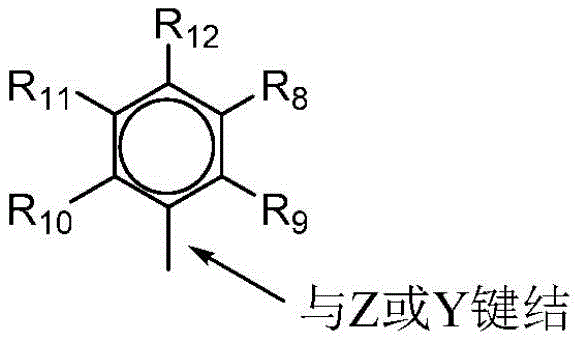
其中R8至R12各自独立地为氢、C1至C40烷基、卤化物、杂原子、含有至多40个碳原子的含有杂原子的基团,优选为C1至C20直链或支链烷基,优选为甲基、乙基、丙基或丁基,任何两个R基团可形成环状基团和/或杂环基团。环状基团可为芳族的。R9、R10和R12可独立地为甲基、乙基、丙基或丁基(包括所有异构体)。在优选实施例中,式III的R基团中的任何3个可为甲基,并且式III的其它R基团中的任何2个可为氢。在本发明的优选实施例中,R9、R10和R12为甲基,并且R8和R11为氢。wherein R 8 to R 12 are each independently hydrogen, C 1 to C 40 alkyl, halide, heteroatom, heteroatom-containing group containing up to 40 carbon atoms, preferably C 1 to C 20 straight chain or Branched alkyl, preferably methyl, ethyl, propyl or butyl, any two R groups may form a cyclic group and/or a heterocyclic group. Cyclic groups may be aromatic. R9 , R10 and R12 can independently be methyl, ethyl, propyl or butyl (including all isomers). In preferred embodiments, any 3 of the R groups of formula III can be methyl, and any 2 of the other R groups of formula III can be hydrogen. In a preferred embodiment of the present invention, R 9 , R 10 and R 12 are methyl, and R 8 and R 11 are hydrogen.
R4和R5两者均可为由下面的式IV表示的基团:Both R 4 and R 5 can be groups represented by Formula IV below:

其中M为第4族金属,优选锆、钛或铪,并且甚至更优选锆;L、Y和Z中的每一个为氮;R1和R2中的每一个为-CH2-CH2-;R3为氢;并且R6和R7不存在。wherein M is a Group 4 metal, preferably zirconium, titanium or hafnium, and even more preferably zirconium ; each of L, Y and Z is nitrogen ; each of R1 and R2 is -CH2 - CH2- ; R 3 is hydrogen; and R 6 and R 7 are absent.
含有第15族和金属的化合物可为下面表示的化合物1(也称为“双(芳基酰胺基)二苄基Zr”):The Group 15 and metal containing compound may be Compound 1 (also known as "bis(arylamido)dibenzyl Zr") represented below:

在化合物1的表示中,“Bn”指示苄基。In the representation of Compound 1, "Bn" indicates a benzyl group.
含有第15族和金属的催化剂化合物可通过本领域已知的方法制备。在一些情况下,EP 0 893 454 Al、U.S.5,889,128中公开的方法和U.S.5,889,128中引用的参考文献为合适的。Catalyst compounds containing Group 15 and metals can be prepared by methods known in the art. In some cases, the methods disclosed in
这些化合物的优选直接合成包含在非配位或弱配位溶剂,如醚、甲苯、二甲苯、苯、二氯甲烷和/或己烷或沸点高于60℃的其它溶剂中,在20至150℃(优选20至100℃)下,使中性配体(参见例如式I或II的YZL或YZL'与MnXn(M为第3族至第14族金属,n为M的氧化态,每个X为阴离子基团,如卤化物反应持续优选24小时或更长时间,然后用过量(如四或更大当量)烷基化剂如甲基溴化镁的乙醚溶液处理混合物。通过过滤除去镁盐,并且通过标准技术分离金属络合物。The preferred direct synthesis of these compounds involves in non-coordinating or weakly coordinating solvents such as ether, toluene, xylene, benzene, dichloromethane and/or hexane or other solvents with boiling points higher than 60°C at 20 to 150°C ℃ (preferably 20 to 100 ℃), neutral ligand (see for example YZL or YZL' of formula I or II and MnX n (M is group 3 to group 14 metal, n is the oxidation state of M, each where X is an anionic group, such as a halide, the reaction is continued for preferably 24 hours or more, and the mixture is then treated with an excess (eg, four or more equivalents) of an alkylating agent such as methylmagnesium bromide in ether. Removed by filtration Magnesium salts, and metal complexes are isolated by standard techniques.
含有第15族和金属的化合物可通过包含以下的方法来制备:在非配位或弱配位溶剂中,在20℃或更高温度,优选在20至100℃下,使中性配体(参见例如式I或II的YZL或YZL')与由式M11Xn表示的化合物(其中M为第3族至第14族金属,n为M的氧化态,每个X为阴离子离去基)反应,然后用过量烷基化剂处理混合物,然后回收金属络合物。溶剂的沸点可高于60℃,如甲苯、二甲苯、苯和/或己烷。溶剂可包含醚和/或二氯甲烷。Compounds containing Group 15 and metals can be prepared by a method comprising: in a non-coordinating or weakly coordinating solvent, a neutral ligand ( See, eg, YZL or YZL' of formula I or II) reacting with a compound represented by formula M11Xn (wherein M is a Group 3 to Group 14 metal, n is the oxidation state of M, and each X is an anionic leaving group) , the mixture is then treated with excess alkylating agent, followed by recovery of the metal complex. The boiling point of the solvent may be higher than 60°C, such as toluene, xylene, benzene and/or hexane. The solvent may contain ether and/or dichloromethane.
一般来说,金属茂化合物可包括具有一种或多种与至少一个金属原子键结的配体的半夹心和全夹心化合物。典型金属茂化合物一般描述为含有与至少一个金属原子键结的一种或多种配体和一种或多种离去基。In general, metallocene compounds can include half-sandwich and full-sandwich compounds having one or more ligands bonded to at least one metal atom. Typical metallocene compounds are generally described as containing one or more ligands and one or more leaving groups bonded to at least one metal atom.
配体一般由一个或多个开环、非环或稠合环或环系统或其组合表示。这些配体,优选一个或多个环或一个或多个环系统可由选自元素周期表第13族至第16族原子的原子构成。原子可选自碳、氮、氧、硅、硫、磷、锗、硼和铝或其组合组成的组。一个或多个环或一个或多个环系统可由碳原子构成,如但不限于那些环戊二烯基配体或环戊二烯基型配体结构或其它类似功能配体结构,如戊二烯、环辛四烯二基或酰亚胺配体。金属原子可选自元素周期表的第3族至第15族和镧系元素或锕系元素。金属可为第4族至第12族或第4族、第5族和第6族的过渡金属,或过渡金属来自第4族。Ligands are generally represented by one or more open, acyclic or fused ring or ring systems or combinations thereof. These ligands, preferably one or more rings or one or more ring systems, may consist of atoms selected from atoms from groups 13 to 16 of the Periodic Table of the Elements. The atoms may be selected from the group consisting of carbon, nitrogen, oxygen, silicon, sulfur, phosphorus, germanium, boron, and aluminum, or combinations thereof. One or more rings or one or more ring systems may be composed of carbon atoms such as, but not limited to, those cyclopentadienyl ligands or cyclopentadienyl type ligand structures or other similarly functional ligand structures such as pentadienyl alkene, cyclooctatetraene diyl or imide ligands. The metal atoms may be selected from Groups 3 to 15 of the Periodic Table of the Elements and the lanthanides or actinides. The metal can be a transition metal from Groups 4 to 12 or Groups 4, 5 and 6, or the transition metal is from Group 4.
催化剂组合物可包括一种或多种由式V表示的金属茂催化剂化合物:The catalyst composition may include one or more metallocene catalyst compounds represented by Formula V:
LALBMQn (V)LALBMQ n (V)
其中M为来自元素周期表的金属原子,并且可为元素周期表的第3族至第12族金属或来自镧系元素或锕系元素。M可为第4族、第5族或第6族过渡金属,或M为第4族过渡金属,或M为锆、铪或钛。配体LA和LB可为一个或多个开环、非环或稠合环或环系统,并且可为任何辅助配体系统,包括未经取代或经取代的环戊二烯基配体或环戊二烯基型配体、经杂原子取代和/或含有杂原子的环戊二烯基型配体。配体的非限制性实例包括环戊二烯基配体、环戊并菲基配体、茚基配体、苯并茚基配体、芴基配体、八氢芴基配体、环辛四烯二基配体、环戊并环十二烯配体、氮烯基配体、甘菊环配位体、并环戊二烯配体、磷酰基配体、膦亚胺(WO99/40125)、吡咯基配体、吡唑基配体、咔唑基配体、硼杂苯配体等等,包括其氢化形式,例如四氢茚基配体。LA和LB可为能够π键结到M的任何其它配体结构。LA和LB的原子分子量可超过60a.m.u.,或可超过65a.m.u.。LA和LB可包含一种或多种杂原子,例如氮、硅、硼、锗、硫和磷,其与碳原子组合以形成开环、非环或优选稠合环或环系统,例如杂环戊二烯基辅助配体。其它LA和LB配体包括但不限于酰胺、磷化物、烷氧化物、芳基氧化物、酰亚胺、碳化物、硼化物、卟啉、酞菁、咕啉和其它聚氮杂巨环。独立地,每个LA和LB可为与M键结的相同或不同类型的配体。在式V的一个替代方案中,可仅存在LA或LB中的一个。wherein M is a metal atom from the Periodic Table of the Elements, and may be a Group 3 to Group 12 metal of the Periodic Table of the Elements or from a lanthanide or an actinide. M can be a Group 4, Group 5, or Group 6 transition metal, or M is a Group 4 transition metal, or M is zirconium, hafnium, or titanium. The ligands LA and LB can be one or more open, acyclic, or fused rings or ring systems, and can be any auxiliary ligand system, including unsubstituted or substituted cyclopentadienyl ligands Or cyclopentadienyl type ligands, heteroatom substituted and/or heteroatom containing cyclopentadienyl type ligands. Non-limiting examples of ligands include cyclopentadienyl ligands, cyclopentanthrenyl ligands, indenyl ligands, benzoindenyl ligands, fluorenyl ligands, octahydrofluorenyl ligands, cyclooctyl ligands Tetrakendiyl ligands, cyclopentacyclododecene ligands, azenyl ligands, chamomile ring ligands, cyclopentadiene ligands, phosphoryl ligands, phosphinimines (WO99/40125), Pyrrolyl ligands, pyrazolyl ligands, carbazolyl ligands, borobenzene ligands, and the like, including hydrogenated forms thereof, such as tetrahydroindenyl ligands. LA and LB can be any other ligand structures capable of pi - bonding to M. The atomic molecular weights of LA and LB may exceed 60 a.mu , or may exceed 65 a.mu. LA and LB may contain one or more heteroatoms, such as nitrogen, silicon, boron , germanium, sulfur and phosphorus, in combination with carbon atoms to form open, acyclic or preferably fused rings or ring systems, such as Heterocyclopentadienyl auxiliary ligand. Other LA and LB ligands include, but are not limited to, amides, phosphides, alkoxides, aryloxides, imides, carbides, borides, porphyrins, phthalocyanines, corrins , and other polyaza ring. Independently, each LA and LB can be the same or a different type of ligand to which M is bonded. In an alternative to Formula V, only one of LA or LB may be present.
独立地,每个LA和LB可为未经取代的或经取代基R的组合取代。取代基R的非限制性实例包括来自选自以下的组中的一个或多个:氢,或直链、支链烷基或烯基、炔基、环烷基或芳基、酰基、芳酰基、烷氧基、芳氧基、烷硫基、二烷基氨基、烷氧基羰基、芳氧基羰基、氨甲酰基、烷基-氨甲酰基或二烷基-氨甲酰基、酰氧基、酰基氨基、芳酰基氨基、直链、支链或环状亚烷基或其组合。在优选实施例中,取代基R具有至多50个非氢原子,优选1至30个碳,其也可经卤素或杂原子等取代。烷基取代基R的非限制性实例包括甲基、乙基、丙基、丁基、戊基、己基、环戊基、环己基、苄基或苯基等等,包括其所有异构体,例如叔丁基、异丙基等等。其它烃基包括氟甲基、氟乙基、二氟乙基、碘丙基、溴己基、氯苯甲基和经烃基取代的有机类金属基团,包括三甲基硅烷基、三甲基锗烷基、甲基二乙基硅烷基等等;以及经卤碳基取代的有机类金属基团,包括三(三氟甲基)-硅烷基、甲基-双(二氟甲基)硅烷基、溴甲基二甲基锗烷基等等;以及二取代的硼基,包括例如二甲基硼;以及二取代的氮族元素基团(包括二甲胺、二甲基膦、二苯胺、甲基苯基膦)、硫族基团(包括甲氧基、乙氧基、丙氧基、苯氧基、甲硫醚和乙硫醚)。非氢取代基R包括原子碳、硅、硼、铝、氮、磷、氧、锡、硫、锗等等,包括烯烃,如但不限于烯系不饱和取代基,包括乙烯基封端的配体,例如丁-3-烯基、丙-2-烯基、己-5-烯基等等。而且,至少两个R基团,优选两个相邻R基团,接合以形成具有3至30个选自碳、氮、氧、磷、硅、锗、铝、硼或其组合的原子的环结构。而且,取代基R可与金属M形成碳σ键。Independently, each LA and LB can be unsubstituted or substituted with a combination of substituents R. Non-limiting examples of substituents R include one or more selected from the group consisting of hydrogen, or straight chain, branched chain alkyl or alkenyl, alkynyl, cycloalkyl or aryl, acyl, aroyl , alkoxy, aryloxy, alkylthio, dialkylamino, alkoxycarbonyl, aryloxycarbonyl, carbamoyl, alkyl-carbamoyl or dialkyl-carbamoyl, acyloxy , acylamino, aroylamino, linear, branched or cyclic alkylene or combinations thereof. In preferred embodiments, the substituent R has up to 50 non-hydrogen atoms, preferably 1 to 30 carbons, which may also be substituted with halogens or heteroatoms and the like. Non-limiting examples of alkyl substituents R include methyl, ethyl, propyl, butyl, pentyl, hexyl, cyclopentyl, cyclohexyl, benzyl or phenyl and the like, including all isomers thereof, For example tert-butyl, isopropyl and the like. Other hydrocarbyl groups include fluoromethyl, fluoroethyl, difluoroethyl, iodopropyl, bromohexyl, chlorobenzyl and hydrocarbyl-substituted organometallic groups including trimethylsilyl, trimethylgermane and halocarbonyl-substituted organometallic groups, including tris(trifluoromethyl)-silyl, methyl-bis(difluoromethyl)silyl, bromomethyldimethylgermanyl, and the like; and disubstituted boron groups, including, for example, dimethylboron; and disubstituted nitrogen groups (including dimethylamine, dimethylphosphine, diphenylamine, methyl phenylphosphine), chalcogen groups (including methoxy, ethoxy, propoxy, phenoxy, methyl sulfide and ethyl sulfide). Non-hydrogen substituents R include atomic carbon, silicon, boron, aluminum, nitrogen, phosphorus, oxygen, tin, sulfur, germanium, and the like, including olefins, such as, but not limited to, ethylenically unsaturated substituents, including vinyl terminated ligands , such as but-3-enyl, prop-2-enyl, hex-5-enyl and the like. Also, at least two R groups, preferably two adjacent R groups, join to form a ring having 3 to 30 atoms selected from carbon, nitrogen, oxygen, phosphorus, silicon, germanium, aluminum, boron, or combinations thereof structure. Also, the substituent R may form a carbon sigma bond with the metal M.
其它配体可与金属M键结,如至少一个离去基Q。Q可为具有与M的σ键的单阴离子不稳定配体。根据金属的氧化态,n的值可为0、1或2,使得上述式V表示中性金属茂催化剂化合物。Other ligands can be bonded to the metal M, such as at least one leaving group Q. Q may be a monoanionic labile ligand with a sigma bond to M. Depending on the oxidation state of the metal, the value of n may be 0, 1 or 2, such that formula V above represents a neutral metallocene catalyst compound.
Q配体的非限制性实例可包括弱碱,如胺、膦、醚、羧酸盐、二烯、具有1至20个碳原子的烃基、氢化物或卤素等等或其组合。两个或更多个Q可形成稠合环或环系统的一部分。Q配体的其它实例包括如上所述针对R的那些取代基,并且包括环丁基、环己基、庚基、甲苯基、三氟甲基、四亚甲基、五亚甲基、亚甲基、甲氧基、乙氧基、丙氧基、苯氧基、双(N-甲基苯胺)、二甲酰胺、二甲基磷化物基团等等。Non-limiting examples of Q ligands can include weak bases such as amines, phosphines, ethers, carboxylates, dienes, hydrocarbyl groups having 1 to 20 carbon atoms, hydrides or halogens, and the like, or combinations thereof. Two or more Qs may form part of a fused ring or ring system. Other examples of Q ligands include those substituents described above for R, and include cyclobutyl, cyclohexyl, heptyl, tolyl, trifluoromethyl, tetramethylene, pentamethylene, methylene , methoxy, ethoxy, propoxy, phenoxy, bis(N-methylaniline), dimethyl amide, dimethyl phosphide groups, and the like.
催化剂组合物可包括一种或多种金属茂催化剂化合物,其中式V的LA和LB通过至少一个如由式VI表示的桥连基A彼此桥连:The catalyst composition may include one or more metallocene catalyst compounds wherein LA and LB of formula V are bridged to each other by at least one bridging group A as represented by formula VI:
LAALBMQn (VI)L A AL B MQ n (VI)
式VI的化合物称为桥连的金属茂催化剂化合物。LA、LB、M、Q和n如上定义。桥连基A的非限制性实例包括含有至少一个第13族至第16族原子的桥连基,常常称为二价部分,如但不限于碳、氧、氮、硅、铝、硼、锗和锡原子中至少一个或其组合。桥连基A可含有碳、硅或锗原子,优选地,A含有至少一个硅原子或至少一个碳原子。桥连基A也可含有如上定义的取代基R,包括卤素和铁。桥连基A的非限制性实例可由R'2C、R'2Si、R'2Si R'2Si、R'2Ge、R'P表示,其中R'独立地为如下基团:氢化物、烃基、经取代的烃基、卤碳基、经取代的卤碳基、经烃基取代的有机类金属、经卤碳基取代的有机类金属、二取代的硼、二取代的氮族元素、经取代的硫族或卤素,或两个或更多个R'可接合以形成环或环系统。式IV的桥连的金属茂催化剂化合物可具有两个或更多个桥连基A(EP 0 664 301 Bl)。Compounds of formula VI are referred to as bridged metallocene catalyst compounds. L A , L B , M, Q and n are as defined above. Non-limiting examples of bridging groups A include bridging groups containing at least one Group 13 to Group 16 atom, often referred to as divalent moieties, such as, but not limited to, carbon, oxygen, nitrogen, silicon, aluminum, boron, germanium and at least one or a combination of tin atoms. The bridging group A may contain carbon, silicon or germanium atoms, preferably, A contains at least one silicon atom or at least one carbon atom. The bridging group A may also contain substituents R as defined above, including halogen and iron. Non-limiting examples of bridging groups A can be represented by R'2C, R'2Si , R'2Si , R'2Si , R'2Ge , R'P , where R' is independently the following: hydrogenated compound, hydrocarbyl, substituted hydrocarbyl, halocarbonyl, substituted halocarbonyl, hydrocarbyl-substituted organometallic, halocarbonyl-substituted organometallic, disubstituted boron, disubstituted nitrogen, A substituted chalcogen or halogen, or two or more R's can be joined to form a ring or ring system. The bridged metallocene catalyst compounds of formula IV may have two or more bridge groups A (
金属茂催化剂化合物可为其中式V和VI的配体LA和LB上的R取代基经配体中的每一个上的相同或不同数目的取代基取代的那些。式V和VI的配体LA和LB可彼此不同。The metallocene catalyst compounds can be those in which the R substituents on the ligands LA and LB of formulas V and VI are substituted with the same or a different number of substituents on each of the ligands. The ligands LA and LB of formulae V and VI can be different from each other.
主催化剂系统包括由上面的式II表示的主催化剂化合物,如具有式[(2,3,4,5,6-Me5C6)NCH2CH2]2NHZrBn2的化合物,其中2,3,4,5,6-Me5C6表示五甲基苯基,并且Bn为苄基。任选地,主催化剂系统可包括可由上面的式V表示的第二主催化剂化合物,如二氯二茂锆化合物,如(丙基环戊二烯基)(1,3-二甲基-4,5,6,7-四氢茚基)二甲基锆。The procatalyst system includes a procatalyst compound represented by formula II above, such as a compound having the formula [(2,3,4,5,6- Me5C6 ) NCH2CH2 ] 2NHZrBn2 , wherein 2,3 ,4,5,6-Me 5 C 6 represents pentamethylphenyl, and Bn is benzyl. Optionally, the procatalyst system may include a second procatalyst compound that may be represented by Formula V above, such as a dichlorozirconocene compound, such as (propylcyclopentadienyl)(1,3-dimethyl-4 , 5,6,7-tetrahydroindenyl) dimethyl zirconium.
主催化剂化合物与修整催化剂化合物的比率可在1:10至10:1,或1:1至8:1的范围内,或在1:1至6:1的范围内。The ratio of main catalyst compound to trim catalyst compound may be in the range of 1:10 to 10:1, or 1:1 to 8:1, or in the range of 1:1 to 6:1.
修整催化剂可包含催化剂化合物,其可由下面的式VII和VIII表示;具体而言,式VII在左侧,并且示出(丙基环戊二烯基)(1,3-二甲基-4,5,6,7-四氢茚基)二甲基锆,而式VIII在右侧,并且示出(甲基环戊二烯基)(1-甲基-4,5,6,7-四氢茚基)二甲基锆。The trim catalyst may comprise a catalyst compound, which may be represented by formulae VII and VIII below; in particular, formula VII is on the left and shows (propylcyclopentadienyl)(1,3-dimethyl-4, 5,6,7-tetrahydroindenyl)dimethylzirconium, while formula VIII is on the right and shows (methylcyclopentadienyl)(1-methyl-4,5,6,7-tetra Indenyl) dimethyl zirconium.
式VII和VIII:Formulas VII and VIII:

如本文所用,术语“活化剂”可包括增加过渡金属化合物低聚或聚合不饱和单体如烯烃的速率的任何试剂组合。活化剂还可影响低聚物或聚合物的分子量、支化程度、共聚单体含量或其它性质。可以任何足以允许配位或阳离子低聚和或聚合的方式使过渡金属化合物活化用于低聚和/或聚合催化。As used herein, the term "activator" may include any combination of agents that increases the rate at which a transition metal compound oligomerizes or polymerizes unsaturated monomers, such as olefins. The activator can also affect the molecular weight, degree of branching, comonomer content, or other properties of the oligomer or polymer. The transition metal compound can be activated for oligomerization and/or polymerization catalysis in any manner sufficient to allow coordinative or cationic oligomerization and or polymerization.
铝氧烷活化剂可用作一种或多种催化剂组合物的活化剂。铝氧烷(alumoxane)或铝氧烷(aluminoxane)一般为含有--Al(R)--O--子单元的低聚化合物,其中R为烷基。铝氧烷的实例包括甲基铝氧烷(MAO)、改性甲基铝氧烷(MMAO)、乙基铝氧烷和异丁基铝氧烷。烷基铝氧烷和改性烷基铝氧烷适合作为催化剂活化剂,特别是当可提取配体为卤化物时。也可使用不同铝氧烷和改性铝氧烷的混合物。关于另外的描述,参见美国专利第4,665,208号;第4,952,540号;第5,041,584号;第5,091,352号;第5,206,199号;第5,204,419号;第4,874,734号;第4,924,018号;第4,908,463号;第4,968,827号;第5,329,032号;第5,248,801号;第5,235,081号;第5,157,137号;第5,103,031号;以及EP 0 561 476;EP 0 279 586;EP0 516 476;EP 0 594 218;以及WO 94/10180。Aluminoxane activators can be used as activators for one or more catalyst compositions. Alumoxanes or aluminoxanes are generally oligomeric compounds containing the --Al(R)--O-- subunit, where R is an alkyl group. Examples of alumoxanes include methylaluminoxane (MAO), modified methylaluminoxane (MMAO), ethylaluminoxane, and isobutylaluminoxane. Alkyl aluminoxanes and modified alkyl aluminoxanes are suitable as catalyst activators, especially when the extractable ligand is a halide. Mixtures of different alumoxanes and modified alumoxanes can also be used. For additional description, see US Patent Nos. 4,665,208; 4,952,540; 5,041,584; 5,091,352; 5,206,199; 5,204,419; and
当活化剂为铝氧烷(改性的或未改性的)时,活化剂的最大量可选择为超过催化剂前体(每个金属催化位点)5000倍摩尔过量的Al/M。可替代地或另外,活化剂与催化剂-前体的最小量可设定为1:1的摩尔比。When the activator is an alumoxane (modified or unmodified), the maximum amount of activator can be selected to be a 5000-fold molar excess of Al/M over the catalyst precursor (per metal catalytic site). Alternatively or additionally, the minimum amount of activator to catalyst-precursor may be set at a 1:1 molar ratio.
可用作活化剂(或清除剂)的烷基铝或有机铝化合物包括三甲基铝、三乙基铝、三异丁基铝、三正己基铝、三正辛基铝等等。Alkyl aluminum or organoaluminum compounds useful as activators (or scavengers) include trimethylaluminum, triethylaluminum, triisobutylaluminum, tri-n-hexylaluminum, tri-n-octylaluminum, and the like.
催化剂系统可包括载体材料或载剂。举例来说,至少一种或多种催化剂化合物和/或一种或多种活化剂可沉积在一种或多种载体或载剂上、与其接触、与其一起蒸发、与其键结、或并入其内、吸附或吸收在其中或其上。因此,上述催化剂化合物以及其它过渡金属催化剂化合物和/或催化剂系统可使用本领域中众所周知或如下所述的负载方法中的一种,与一种或多种载体材料或载剂组合。举例来说,金属茂催化剂化合物或催化剂系统在沉积在载体或载剂上、与其接触或并入其内、吸附或吸收在其中或其上时,呈负载形式。The catalyst system may include a support material or carrier. For example, at least one or more catalyst compounds and/or one or more activators can be deposited on, contacted with, vaporized with, bound to, or incorporated into one or more supports or carriers in, adsorbed or absorbed in or on. Accordingly, the catalyst compounds described above, as well as other transition metal catalyst compounds and/or catalyst systems, can be combined with one or more support materials or carriers using one of the support methods well known in the art or as described below. For example, a metallocene catalyst compound or catalyst system is in supported form when deposited on, contacted with, or incorporated into, adsorbed or absorbed in, or on a support or carrier.
如本文所用,术语“载体”和“载剂”可互换地使用并且为任何载体材料,包括多孔载体材料,例如滑石、无机氧化物和无机氯化物。其它载剂包括如聚苯乙烯的树脂载体材料、如聚苯乙烯、二乙烯基苯、聚烯烃或其它聚合化合物的官能化或交联有机载体、沸石、粘土或任何其它有机或无机载体材料等等,或其混合物。As used herein, the terms "support" and "carrier" are used interchangeably and are any support material, including porous support materials such as talc, inorganic oxides, and inorganic chlorides. Other carriers include resinous carrier materials such as polystyrene, functionalized or cross-linked organic carriers such as polystyrene, divinylbenzene, polyolefins or other polymeric compounds, zeolites, clays or any other organic or inorganic carrier materials, etc. etc., or a mixture thereof.
如无机氧化物的说明性载体材料包括第2族、第3族、第4族、第5族、第13族或第14族金属氧化物。优选的载体包括二氧化硅(其可为或可不为脱水的)、烟雾状二氧化硅、氧化铝(参见例如WO 99/60033)、二氧化硅-氧化铝和其混合物。其它可用的载体包括氧化镁、二氧化钛、氧化锆、氯化镁(U.S.5,965,477)、蒙脱石(EP 0 511 665)、页硅酸盐、沸石、滑石、粘土(U.S.6,034,187)等等。而且,可使用这些载体材料的组合,例如,二氧化硅-铬、二氧化硅-氧化铝、二氧化硅-二氧化钛等等。额外的载体材料可包括EP 0 767 184(以引用的方式并入本文)中描述的那些多孔丙烯酸聚合物。其它载体材料包括如WO99/47598中所公开的纳米复合材料;如WO 99/48605中所公开的气凝胶;如U.S.5,972,510中所公开的球粒;以及如WO 99/50311中所公开的聚合物珠粒。Illustrative support materials such as inorganic oxides include Group 2, Group 3, Group 4, Group 5, Group 13, or Group 14 metal oxides. Preferred supports include silica (which may or may not be dehydrated), fumed silica, alumina (see eg WO 99/60033), silica-alumina and mixtures thereof. Other useful supports include magnesia, titania, zirconia, magnesium chloride (U.S. 5,965,477), montmorillonite (
如无机氧化物的载体材料可具有在10m2/g至700m2/g范围内的表面积、在0.1cm3/g至4.0cm3/g范围内的孔体积和在5微米至500微米范围内的平均粒度。更优选地,载体材料的表面积可在50m2/g至500m2/g范围内,孔体积为0.5cm3/g至3.5cm3/g,并且平均粒度为10微米至200微米。最优选地,载体材料的表面积可在100m2/g至400m2/g范围内,孔体积为0.8cm3/g至3.0cm3/g,并且平均粒度为5微米至100微米。载剂的平均孔径通常具有在10埃至1,000埃,可替代地50埃至500埃,并且在一些实施例中75埃至350埃范围内的孔径。A support material such as an inorganic oxide may have a surface area in the range of 10 m 2 /g to 700 m 2 /g, a pore volume in the range of 0.1 cm 3 /g to 4.0 cm 3 /g, and a pore volume in the range of 5 microns to 500 microns average particle size. More preferably, the support material may have a surface area in the range of 50 m 2 /g to 500 m 2 /g, a pore volume of 0.5 cm 3 /g to 3.5 cm 3 /g, and an average particle size of 10 to 200 microns. Most preferably, the support material may have a surface area in the range of 100 m 2 /g to 400 m 2 /g, a pore volume of 0.8 cm 3 /g to 3.0 cm 3 /g, and an average particle size of 5 to 100 microns. The average pore size of the carrier typically has a pore size in the range of 10 angstroms to 1,000 angstroms, alternatively 50 angstroms to 500 angstroms, and in some embodiments 75 angstroms to 350 angstroms.
催化剂化合物可与活化剂一起负载在相同或分开的载体上,或者活化剂可以非负载型形式使用,或者可沉积在不同于负载型催化剂化合物的载体上或其任何组合。这可通过本领域常用的任何技术来完成。The catalyst compound can be supported with the activator on the same or a separate support, or the activator can be used in unsupported form, or can be deposited on a support other than the supported catalyst compound, or any combination thereof. This can be accomplished by any technique commonly used in the art.
本领域中存在各种其它方法用于负载聚合催化剂化合物或催化剂系统。举例来说,金属茂催化剂化合物可含有聚合物结合的配体,如描述于例如U.S.5,473,202和U.S.5,770,755中。金属茂催化剂化合物可喷雾干燥,如描述于例如U.S.5,648,310中。可如EP 0802 203中所描述使与金属茂催化剂化合物一起使用的载体官能化,或如U.S.5,688,880中所描述选择至少一个取代基或离去基。Various other methods exist in the art for supporting polymerization catalyst compounds or catalyst systems. For example, metallocene catalyst compounds may contain polymer-bound ligands, as described, for example, in U.S. 5,473,202 and U.S. 5,770,755. Metallocene catalyst compounds can be spray dried as described, for example, in U.S. 5,648,310. The support used with the metallocene catalyst compound may be functionalized as described in EP 0802 203, or at least one substituent or leaving group may be selected as described in U.S. 5,688,880.
本文公开的聚乙烯树脂可通过气相法制备。树脂可在单一反应器中制备。本文公开的聚乙烯树脂也可在单一气相反应器中制备。在本发明的一个实施例中,反应器为气相流化床聚合反应器。The polyethylene resins disclosed herein can be prepared by gas phase methods. The resin can be prepared in a single reactor. The polyethylene resins disclosed herein can also be produced in a single gas phase reactor. In one embodiment of the present invention, the reactor is a gas phase fluidized bed polymerization reactor.
可使用分级气相反应器来生产聚乙烯。商业聚合系统描述于例如第366-378页的“《卷2,基于金属茂的聚烯烃(Volume 2,Metallocene-Based Polyolefins)》”(JohnScheirs和W.Kaminsky编约翰威利父子有限公司(John Wiley&Sons,Ltd.)2000);美国专利第5,665,818号;第5,677,375号;和第6,472,484号;和EP 0 517 868和EP 0 794 200中。A staged gas phase reactor can be used to produce polyethylene. Commercial polymerization systems are described, for example, in "Volume 2, Metallocene-Based Polyolefins" on pages 366-378 (John Scheirs and W. Kaminsky eds. John Wiley & Sons). , Ltd.) 2000); US Patent Nos. 5,665,818; 5,677,375; and 6,472,484; and
气相法可利用流化床反应器。流化床反应器可包括反应区和所谓的减速区。反应区可包括生长聚合物颗粒床、所形成的聚合物颗粒和少量催化剂颗粒,所述催化剂颗粒通过气态单体和稀释剂的连续流动而流化,以通过反应区除去聚合热。任选地,再循环气体中的一些可被冷却并且压缩以形成液体,当再次进入反应区时,所述液体增加循环气流的除热能力。通过简单的实验可容易地确定合适的气体流速。将气态单体补充到循环气流中的速率可等于可从反应器中抽取微粒聚合物产物和与其相关联的单体的速率,并且可调节穿过反应器的气体组成以在反应区内维持基本上稳定状态的气态组成。离开反应区的气体可传递到减速区,在减速区中除去所夹带的颗粒。所夹带的较细颗粒和灰尘可在旋风分离器和/或微细过滤器中除去。可使气体通过热交换器,在热交换器中可除去聚合热,在压缩机中压缩,并且接着返回到反应区。额外的反应器细节和用于操作反应器的手段描述于例如美国专利第3,709,853号;第4,003,712号;第4,011,382号;第4,302,566号;第4,543,399号;第4,882,400号;第5,352,749号;和第5,541,270号;EP 0802202;以及比利时专利第839,380号中。The gas phase method can utilize a fluidized bed reactor. A fluidized bed reactor may comprise a reaction zone and a so-called speed reduction zone. The reaction zone may include a bed of growing polymer particles, formed polymer particles, and a small amount of catalyst particles fluidized by a continuous flow of gaseous monomer and diluent to remove the heat of polymerization through the reaction zone. Optionally, some of the recycle gas can be cooled and compressed to form a liquid that increases the heat removal capability of the recycle gas stream when re-entering the reaction zone. Appropriate gas flow rates can be easily determined by simple experimentation. The rate at which gaseous monomer is replenished into the recycle gas stream may be equal to the rate at which the particulate polymer product and monomer associated therewith may be withdrawn from the reactor, and the composition of the gas passing through the reactor may be adjusted to maintain substantially the same in the reaction zone. The gaseous composition of the upper steady state. The gas leaving the reaction zone can be passed to a speed reduction zone where entrained particles are removed. Entrained finer particles and dust can be removed in cyclones and/or microfilters. The gas can be passed through a heat exchanger where the heat of polymerization can be removed, compressed in a compressor, and then returned to the reaction zone. Additional reactor details and means for operating the reactor are described, for example, in US Patent Nos. 3,709,853; 4,003,712; 4,011,382; 4,302,566; 4,543,399; 4,882,400; 5,352,749; ; EP 0802202; and Belgian Patent No. 839,380.
流化床工艺的反应器温度可在30℃或40℃或50℃至90℃或100℃或110℃或120℃或150℃范围内。一般来说,反应器温度可在考虑反应器内的基于乙烯的聚合物产物的烧结温度的情况下的最高可行温度下操作。无论用于制备例如双峰聚乙烯的聚烯烃的方法如何,聚合温度或反应温度应低于待形成的基于乙烯的聚合物的熔融或“烧结”温度。因此,温度上限可为在反应器中生产的聚烯烃的熔融温度。The reactor temperature of the fluidized bed process may range from 30°C or 40°C or 50°C to 90°C or 100°C or 110°C or 120°C or 150°C. Generally, the reactor temperature can be operated at the highest feasible temperature taking into account the sintering temperature of the ethylene-based polymer product within the reactor. Regardless of the method used to prepare the polyolefin such as bimodal polyethylene, the polymerization or reaction temperature should be below the melting or "sintering" temperature of the ethylene-based polymer to be formed. Thus, the upper temperature limit may be the melting temperature of the polyolefin produced in the reactor.
可在烯烃聚合中使用氢气来控制聚烯烃的最终性质,如“《聚丙烯手册(Polypropylene Handbook)》”中第76-78页(汉瑟出版社(Hanser Publishers),1996)所述。聚合中的氢气量可表示为相对于总可聚合单体(例如乙烯)或乙烯与1-己烯或丙烯共混物的摩尔比。聚合工艺中所用的氢气量可为实现最终聚烯烃树脂的期望MFR或FI所必需的量。聚合工艺中所用的氢气量也可为在双峰聚烯烃的高分子量组分和低分子量组分之间实现期望双峰分子量分布所必需的量。Hydrogen can be used in olefin polymerization to control the final properties of polyolefins, as described on pages 76-78 in "Polypropylene Handbook" (Hanser Publishers, 1996). The amount of hydrogen in the polymerization can be expressed as a molar ratio relative to the total polymerizable monomers (eg, ethylene) or a blend of ethylene and 1-hexene or propylene. The amount of hydrogen used in the polymerization process can be that amount necessary to achieve the desired MFR or FI of the final polyolefin resin. The amount of hydrogen used in the polymerization process can also be that amount necessary to achieve the desired bimodal molecular weight distribution between the high and low molecular weight components of the bimodal polyolefin.
催化剂系统也可用于另外控制聚乙烯树脂的性质。举例来说,可调节修整催化剂的量以修改催化剂系统的催化剂化合物的反应器内比率,以便实现期望的流动指数或流动指数分流。可将修整催化剂与催化剂系统的主催化剂化合物分开地直接进料到反应器中。在进料到反应器中之前,修整催化剂也可与催化剂系统的主催化剂化合物混合。修整催化剂也可与催化剂系统的其它化合物连续混合,并且将所得混合物连续进料到反应器中。修整催化剂可与负载型催化剂连续混合,并且将所得混合物连续进料到反应器中。修整催化剂可为负载型催化剂或非负载型催化剂。当修整催化剂为非负载型催化剂时,它可‘在线’负载,例如通过在进料到反应器中之前与负载型催化剂接触。负载的修整催化剂可包含活化剂,其可在进料到反应器中之前‘在线’活化修整催化剂。The catalyst system can also be used to additionally control the properties of the polyethylene resin. For example, the amount of trim catalyst can be adjusted to modify the in-reactor ratio of catalyst compounds of the catalyst system in order to achieve a desired flow index or flow index split. The trim catalyst can be fed directly to the reactor separately from the procatalyst compound of the catalyst system. The trim catalyst may also be mixed with the procatalyst compound of the catalyst system prior to being fed into the reactor. The trim catalyst can also be continuously mixed with other compounds of the catalyst system, and the resulting mixture continuously fed to the reactor. The trim catalyst can be continuously mixed with the supported catalyst and the resulting mixture continuously fed to the reactor. The trim catalyst can be a supported catalyst or an unsupported catalyst. When the trim catalyst is an unsupported catalyst, it can be supported 'on-line', for example by contacting the supported catalyst prior to feeding into the reactor. The supported trim catalyst may contain an activator that activates the trim catalyst 'on-line' prior to feeding into the reactor.
修整催化剂可以与催化剂系统的主催化剂化合物相同或不同的形式提供。然而,在通过合适的活化剂活化后,由修整催化剂产生的活性催化剂物质可与由催化剂的至少两种不同催化剂化合物中的一种产生的活性催化剂物质相同。技术人员将理解,例如,金属茂二卤化物和金属茂二烷基在用合适的活化剂处理后可产生相同的活性催化剂物质。举例来说,金属茂如(丙基环戊二烯基)(1,3-二甲基-4,5,6,7-四氢茚基)锆(X)2(其中X可为卤化物、烷基或任何其它离去基,如先前所述)可以二氯化物形式使用以制备负载型催化剂。当用作修整催化剂时,它可以二烷基形式,如二甲基形式提供。就溶解度而言,这可为有利的,其中二烷基形式可在例如脂族烃中具有增强的溶解度。The trim catalyst may be provided in the same or different form as the procatalyst compound of the catalyst system. However, after activation by a suitable activator, the active catalyst species produced by the trim catalyst can be the same as the active catalyst species produced by one of the at least two different catalyst compounds of the catalyst. The skilled artisan will appreciate that, for example, metallocene dihalides and metallocene dialkyls can yield the same active catalyst species upon treatment with a suitable activator. For example, metallocenes such as (propylcyclopentadienyl)(1,3-dimethyl-4,5,6,7-tetrahydroindenyl)zirconium(X) 2 (where X can be a halide , alkyl or any other leaving group, as previously described) can be used in the dichloride form to prepare supported catalysts. When used as a trim catalyst, it can be provided in a dialkyl form, such as a dimethyl form. This can be advantageous in terms of solubility, where the dialkyl form can have enhanced solubility in, for example, aliphatic hydrocarbons.
催化剂系统可包括二氧化硅负载的催化剂系统,其包括含有第15族和金属的催化剂化合物和金属茂催化剂化合物。催化剂系统还可包括包含金属茂催化剂化合物的修整催化剂。还可在载体上提供活化剂或助催化剂,如MAO。The catalyst system may include a silica supported catalyst system including a Group 15 and metal-containing catalyst compound and a metallocene catalyst compound. The catalyst system may also include a trim catalyst comprising a metallocene catalyst compound. An activator or cocatalyst, such as MAO, can also be provided on the support.
催化剂系统可包含至少一种、或两种或更多种包含钛、锆或铪原子的催化剂化合物。催化剂系统可包含以下中的至少一种、或两种或更多种:The catalyst system may comprise at least one, or two or more catalyst compounds comprising titanium, zirconium or hafnium atoms. The catalyst system may comprise at least one, or two or more of the following:
(五甲基环戊二烯基)(丙基环戊二烯基)MX2、(pentamethylcyclopentadienyl)(propylcyclopentadienyl)MX 2 ,
(四甲基环戊二烯基)(丙基环戊二烯基)MX2、(tetramethylcyclopentadienyl)(propylcyclopentadienyl)MX 2 ,
(四甲基环戊二烯基)(丁基环戊二烯基)MX2、(tetramethylcyclopentadienyl)(butylcyclopentadienyl)MX 2 ,
(正丙基环戊二烯基)(1,3-二甲基-4,5,6,7-四氢茚基)MX2 (n-propylcyclopentadienyl)(1,3-dimethyl-4,5,6,7-tetrahydroindenyl)MX 2
(甲基环戊二烯基)(1,3-二甲基-4,5,6,7-四氢茚基)MX2 (Methylcyclopentadienyl)(1,3-dimethyl-4,5,6,7-tetrahydroindenyl)MX 2
(环戊二烯基)(1,3-二甲基-4,5,6,7-四氢茚基)MX2 (Cyclopentadienyl)(1,3-dimethyl-4,5,6,7-tetrahydroindenyl)MX 2
(甲基环戊二烯基)(1-甲基-4,5,6,7-四氢茚基)MX2 (Methylcyclopentadienyl)(1-methyl-4,5,6,7-tetrahydroindenyl)MX 2
Me2Si(茚基)2MX2、Me 2 Si (indenyl) 2 MX 2 ,
Me2Si(四氢茚基)2MX2、Me 2 Si (tetrahydroindenyl) 2 MX 2 ,
(正丙基环戊二烯基)2MX2、(n-propylcyclopentadienyl) 2 MX 2 ,
(正丁基环戊二烯基)2MX2、(n-butylcyclopentadienyl) 2 MX 2 ,
(1-甲基,3-丁基环戊二烯基)2MX2、(1-methyl,3-butylcyclopentadienyl) 2 MX 2 ,
HN(CH2CH2N(2,4,6-Me3苯基))2MX2、HN(CH 2 CH 2 N(2,4,6-Me3phenyl)) 2 MX 2 ,
HN(CH2CH2N(2,3,4,5,6-Me5苯基))2MX2、HN(CH 2 CH 2 N(2,3,4,5,6-Me 5phenyl )) 2 MX 2 ,
(正丙基环戊二烯基)(四甲基环戊二烯基)MX2、(n-propylcyclopentadienyl)(tetramethylcyclopentadienyl)MX 2 ,
(正丁基环戊二烯基)2MX2、(n-butylcyclopentadienyl) 2 MX 2 ,
(正丙基环戊二烯基)2MX2,以及其混合物。(n-propylcyclopentadienyl) 2 MX 2 , and mixtures thereof.
其中M为Zr或Hf,并且X选自F、Cl、Br、I、Me、苄基、CH2SiMe3和C1至C5烷基或烯基。wherein M is Zr or Hf, and X is selected from F, Cl , Br, I, Me, benzyl, CH2SiMe3 and C1 to C5 alkyl or alkenyl.
氢与总单体(H2:单体)的摩尔比可在大于0.0001、大于0.0005或大于0.001,和小于10、小于5、小于3或小于0.10的范围内,其中期望范围可包括本文所述的任何摩尔比上限与任何摩尔比下限的任何组合。以另一种方式表示,在任何时间于反应器中的氢气量的范围可为至多5,000ppm、至多4,000ppm或至多3,000ppm,或在50ppm和5,000ppm之间,或在500ppm和2,000ppm之间。The molar ratio of hydrogen to total monomer ( H2 :monomer) can be in the range of greater than 0.0001, greater than 0.0005, or greater than 0.001, and less than 10, less than 5, less than 3, or less than 0.10, wherein desired ranges may include those described herein Any combination of any upper molar ratio limit and any lower molar ratio limit of . Expressed another way, the amount of hydrogen in the reactor at any time may range from up to 5,000 ppm, up to 4,000 ppm, or up to 3,000 ppm, or between 50 ppm and 5,000 ppm, or between 500 ppm and 2,000 ppm .
气相法(单阶段或两阶段或更多阶段)中一种或多种反应器压力可从690kPa(100psig)变至3,448kPa(500psig)。举例来说,它们的范围可为1,379kPa(200psig)至2,759kPa(400psig)或1,724kPa(250psig)至2,414kPa(350psig)。One or more reactor pressures in the gas phase process (single stage or two or more stages) can vary from 690 kPa (100 psig) to 3,448 kPa (500 psig). For example, they may range from 1,379 kPa (200 psig) to 2,759 kPa (400 psig) or 1,724 kPa (250 psig) to 2,414 kPa (350 psig).
催化剂系统可用于生产双峰聚乙烯树脂,其流动指数在5至60分克/分钟范围内,并且密度大于或等于0.949g/cc,如在0.953至0.96g/cc范围内。当用于在气相反应器中生产这类双峰聚乙烯树脂时,反应器条件可包括在100℃至120℃,如105℃至110℃范围内的温度,以及以摩尔计在0.0010至0.0020范围内的氢与乙烯比率。当期望的溶胀高时,氢与乙烯比率可以摩尔计被控制为小于0.00140;当期望的溶胀低时,氢与乙烯比率可以摩尔计被控制为大于0.00145,如以摩尔计在0.00145至0.00155的范围内。The catalyst system can be used to produce bimodal polyethylene resins with flow indices in the range of 5 to 60 decigrams per minute and densities greater than or equal to 0.949 g/cc, such as in the range of 0.953 to 0.96 g/cc. When used to produce such bimodal polyethylene resins in a gas phase reactor, the reactor conditions may include temperatures in the range of 100°C to 120°C, such as 105°C to 110°C, and in the range of 0.0010 to 0.0020 on a molar basis The hydrogen to ethylene ratio within. When the desired swelling is high, the hydrogen to ethylene ratio can be controlled to be less than 0.00140 on a molar basis; when the desired swelling is low, the hydrogen to ethylene ratio can be controlled to be greater than 0.00145 on a molar basis, such as in the range of 0.00145 to 0.00155 on a molar basis Inside.
聚乙烯树脂可用于各种产品和最终用途应用中。聚乙烯树脂也可与任何其它聚合物共混和/或共挤出。其它聚合物的非限制性实例包括线性低密度聚乙烯、弹性体、塑性体、高压低密度聚乙烯、高密度聚乙烯、聚丙烯等等。本文所述的树脂可用于生产吹塑模制组件或产品,以及其它各种最终用途。聚乙烯树脂和其共混物可适用于如膜、薄片和纤维挤出和共挤出以及吹塑模制、注塑模制和回转模制的成形操作。膜可包括通过共挤出或通过层压所形成的吹塑膜或浇铸膜,其作为收缩膜、保鲜膜、拉伸膜、密封膜、定向膜、零食包装、重负荷包、杂货袋、烘焙和冷冻食品包装、医药包装、工业衬垫、薄膜等可用于与食物接触和不与食物接触的应用中。纤维可包括熔纺、溶液纺丝和熔喷纤维操作,用于织造或非织造形式,以制造过滤器、尿布织物、医用服装、土工织物等。挤出物品可包括医用管材、电线电缆涂层、管道、土工膜和池塘衬垫。模制物品可包括单层和多层构造,呈瓶子、槽、大的中空物品、僵硬食物容器和玩具等形式。Polyethylene resins are used in a variety of products and end-use applications. Polyethylene resins can also be blended and/or coextruded with any other polymer. Non-limiting examples of other polymers include linear low density polyethylene, elastomers, plastomers, high pressure low density polyethylene, high density polyethylene, polypropylene, and the like. The resins described herein can be used to produce blow molded components or products, as well as various other end uses. Polyethylene resins and blends thereof are suitable for use in forming operations such as film, sheet and fiber extrusion and co-extrusion as well as blow molding, injection molding and rotational molding. Films may include blown or cast films formed by co-extrusion or by lamination as shrink films, cling films, stretch films, sealing films, oriented films, snack packaging, heavy duty bags, grocery bags, bakery and Frozen food packaging, pharmaceutical packaging, industrial liners, films, and more can be used in food contact and non-food contact applications. Fibers can include melt spinning, solution spinning, and meltblown fiber operations for use in woven or nonwoven forms to make filters, diaper fabrics, medical apparel, geotextiles, and the like. Extruded articles can include medical tubing, wire and cable coatings, pipes, geomembranes, and pond liners. Molded articles can include single-layer and multi-layer constructions in the form of bottles, troughs, large hollow articles, rigid food containers, toys, and the like.
本发明的具体实施例Specific Embodiments of the Invention
混配。如由气相反应器生产的粒状树脂在带式共混器中与各自1000ppm的Irganox1010(巴斯夫(BASF))和Irgafos 168(巴斯夫)混合在一起,并且然后在ZSK-40双螺杆挤出机上混配,生产线料切粒。mix. The granulated resin as produced by the gas phase reactor was mixed together in a ribbon blender with 1000 ppm each of Irganox 1010 (BASF) and Irgafos 168 (BASF) and then compounded on a ZSK-40 twin screw extruder , Production line material dicing.
混配树脂性质Compounding resin properties
流动指数I2、I5和I21根据ASTM D1238分别在190℃和2.16kg、5kg和21.6kg下测量。Flow indices I2, I5 and I21 were measured according to ASTM D1238 at 190°C and 2.16 kg, 5 kg and 21.6 kg, respectively.
密度使用ASTM D792测量。Density is measured using ASTM D792.
根据ASTM D 790-99方法B,以0.5英寸/分钟(13毫米/分钟)的测试速度测量2%应变下的正割模量来表征刚度。Stiffness was characterized according to ASTM D 790-99 Method B by measuring the secant modulus at 2% strain at a test speed of 0.5 inches/minute (13 mm/minute).
拉伸性质根据ASTM D638使用单头机器以2英寸/分钟(52毫米/分钟)的测试速度测量。Tensile properties are measured according to ASTM D638 using a single head machine at a test speed of 2 inches/minute (52 mm/minute).
抗环境应力开裂性(ESCR)使用弯曲带法测量,如ASTM D1693方法B(10%Igepal)中所述。Environmental Stress Cracking Resistance (ESCR) was measured using the flex tape method as described in ASTM D1693 Method B (10% Igepal).
用于正割模量、拉伸性质和ESCR测试的样本从根据ASTM D-4703-00附录A1程序C制备的压缩模制板上模切。Specimens for secant modulus, tensile properties, and ESCR testing were die cut from compression molded panels prepared according to ASTM D-4703-00 Appendix A1 Procedure C.
经由ISO179在-40℃下通过夏比(缺口)抗冲击性测量韧性。Toughness is measured by Charpy (notched) impact resistance at -40°C via ISO 179.
GPC色谱条件。色谱系统由装备有IR5多固定波长红外检测器的PolymerChar GPC-IR(西班牙瓦伦西亚(Valencia,Spain))高温GPC色谱仪组成。样品溶解炉设置在160℃下并且柱室在150℃下操作。柱为4个Agilent Technologies“Mixed A”30cm 20微米柱。色谱溶剂为1,2,4三氯苯,并且含有200ppm的丁基化羟基甲苯(BHT)。溶剂源为氮气喷射的。注射体积为200微升,并且流速为1.0毫升/分钟。使用GPC-IR自动溶剂添加以2mg/ml制备聚乙烯样品,其中溶解时间为3小时。GPC chromatographic conditions. The chromatography system consisted of a PolymerChar GPC-IR (Valencia, Spain) high temperature GPC chromatograph equipped with an IR5 multi-fixed wavelength infrared detector. The sample dissolution furnace was set at 160°C and the column compartment was operated at 150°C. The columns were 4 Agilent Technologies "Mixed A" 30 cm 20 micron columns. The chromatography solvent was 1,2,4 trichlorobenzene and contained 200 ppm of butylated hydroxytoluene (BHT). The solvent source was nitrogen sparging. The injection volume was 200 microliters and the flow rate was 1.0 mL/min. Polyethylene samples were prepared at 2 mg/ml using GPC-IR automated solvent addition with a dissolution time of 3 hours.
常规GPC测量。对于常规分子量测量,GPC柱组用21种窄分子量分布的聚苯乙烯标准物进行校准,所述标准物的分子量范围为580至8,400,000,并且以6种“混合液”混合物形式排列,其中在单独的分子量之间具有至少十倍间隔。标准物购自安捷伦科技(AgilentTechnologies)。对于等于或大于1,000,000的分子量,在50毫升溶剂中以0.025克制备聚苯乙烯标准物,并且对于小于1,000,000的分子量,在50毫升溶剂中以0.05克制备聚苯乙烯标准物。在平缓搅动下,在80℃下预溶解聚苯乙烯标准物持续30分钟。使用以下等式将聚苯乙烯标准物峰值分子量转换成聚乙烯分子量(如Williams和Ward,《聚合物科学杂志,聚合物简讯(J.Polym.Sci.,Polym.Let.)》,6,621(1968)中所描述):M聚乙烯=A×(M聚苯乙烯)B,其中M为分子量,A对于常规GPC结果具有0.4316的值,并且对于三重检测器主链Mw计算具有大约0.41的值(参考对于NBS 1475线性均聚物聚产生52,000Mw的A值),并且B等于1.0。三阶多项式用于拟合相应的聚乙烯当量校准点。使用PolymerChar“GPC One”软件计算分子量分布和分子量矩计算。Routine GPC measurements. For routine molecular weight measurements, the GPC column set was calibrated with 21 narrow molecular weight distribution polystyrene standards ranging in molecular weight from 580 to 8,400,000 and arranged as a mixture of 6 "mixed liquids", which were There is at least a tenfold separation between the molecular weights. Standards were purchased from Agilent Technologies. For molecular weights equal to or greater than 1,000,000, polystyrene standards were prepared at 0.025 grams in 50 milliliters of solvent, and for molecular weights less than 1,000,000, polystyrene standards were prepared at 0.05 grams in 50 milliliters of solvent. The polystyrene standards were pre-dissolved at 80°C for 30 minutes with gentle agitation. Polystyrene standard peak molecular weights were converted to polyethylene molecular weights using the following equation (eg Williams and Ward, J. Polym. Sci., Polym. Let., 6, 621 (1968) )): M polyethylene = A x (M polystyrene) B, where M is the molecular weight, A has a value of 0.4316 for conventional GPC results and approximately 0.41 for triple detector backbone Mw calculations ( Reference for NBS 1475 linear homopolymer polymerization yields an A value of 52,000 Mw), and B equals 1.0. A third-order polynomial was used to fit the corresponding polyethylene equivalent calibration points. Molecular weight distribution and molecular weight moment calculations were calculated using the PolymerChar "GPC One" software.
毛细管(挤出物)溶胀测量。毛细管或挤出物溶胀测试用于评估离开挤出机模头的聚合物线料在代表制造工艺(如吹塑模制工艺)的时间范围内的平均挤出物溶胀。在300秒-1或1000秒-1的剪切速率和190℃的温度下,通过活塞驱动的毛细管流变仪(
熔体强度测量。使用串联连接到Rheo-TesterTM2000毛细管流变仪的
实例1A-双峰催化剂系统1制备。双峰聚乙烯在具有催化剂系统的单一反应器中使用气相聚合生产,所述催化剂系统包括喷雾干燥的双(2-五甲基苯基酰胺基)乙基)二苄基锆、甲基铝氧烷(MAO)和CAB-O-SIL TS-610牌烟雾状二氧化硅的矿物油浆料溶液作为主催化剂(催化剂1A)。还向反应器中进料修整催化剂,其制备为0.04wt%(甲基环戊二烯基)(1-甲基-四氢茚基)二甲基锆在异戊烷中的混合物。在聚合工艺期间添加修整催化剂(催化剂1B)作为与主催化剂浆料一致的催化剂修整进料,以便调节双峰聚乙烯的流动指数性质。Example 1A - Bimodal Catalyst System 1 Preparation. Bimodal polyethylene is produced using gas phase polymerization in a single reactor with a catalyst system including spray dried bis(2-pentamethylphenylamido)ethyl)dibenzylzirconium, methylaluminum oxide A mineral oil slurry solution of alkane (MAO) and CAB-O-SIL TS-610 brand fumed silica was used as the main catalyst (Catalyst 1A). The reactor was also fed with a trim catalyst, which was prepared as a 0.04 wt% mixture of (methylcyclopentadienyl)(l-methyl-tetrahydroindenyl)dimethylzirconium in isopentane. A trim catalyst (Catalyst IB) was added as a catalyst trim feed consistent with the procatalyst slurry during the polymerization process in order to adjust the flow index properties of the bimodal polyethylene.
实例1B-聚合物1的聚合方法。使用实例1A的催化剂系统在单一气相聚合反应器中生产双峰聚乙烯。所用的气相反应器为连续流化床反应器。对于实验运行,催化剂1A和催化剂1B通过不锈钢1/8"注入管在线共进料到流化床反应器中。通过以足以维持220psi乙烯分压、0.0030正己烯/C2摩尔比、0.0035H2/C2摩尔比和11.6mol%异戊烷的速率将进料计量加入反应器来控制反应器气体组成。反应器温度为95℃,并且反应器停留时间为约3.1小时。通过将粒状树脂排放到排放槽中来维持反应器床的重量,在所述排放槽中将所述粒状树脂用氮气吹扫,然后将其倾倒到再次用蒸汽/氮气混合物吹扫的纤维包中。通过调节催化剂1B进料与催化剂1A进料的比率来控制基于乙烯的聚合物的流动指数,其中较高的比率提高所得聚合物的流动指数。反应器工艺条件在表1中示出,而基于乙烯的聚合物(混配树脂)的性质在表2中示出。Example 1B - Polymerization Process for Polymer 1. Bimodal polyethylene was produced in a single gas phase polymerization reactor using the catalyst system of Example IA. The gas phase reactor used was a continuous fluidized bed reactor. For the experimental run, Catalyst 1A and Catalyst 1B were co-fed in-line to the fluidized bed reactor through a stainless steel 1/8" injection tube. By running at a pressure sufficient to maintain 220 psi ethylene partial pressure, 0.0030 n-hexene/C2 molar ratio, 0.0035 H2/C2 The molar ratio and the rate of 11.6 mol% isopentane were metered into the reactor to control the reactor gas composition. The reactor temperature was 95°C, and the reactor residence time was about 3.1 hours. By discharging the granular resin to a drain tank In order to maintain the weight of the reactor bed, the granular resin was purged with nitrogen in the drain tank, and then poured into a fiber bag again purged with a steam/nitrogen mixture. By adjusting the catalyst 1B feed with the The ratio of catalyst 1A feeds was used to control the flow index of the ethylene-based polymer, with higher ratios increasing the flow index of the resulting polymer. The reactor process conditions are shown in Table 1, while the ethylene-based polymer (compounded resin) properties are shown in Table 2.
实例2A-双峰催化剂系统2的制备。双峰聚乙烯在具有催化剂系统的单一反应器中使用气相聚合生产,所述催化剂系统包括喷雾干燥的双(2-五甲基苯基酰胺基)乙基)二苄基锆、(丙基环戊二烯基)(1,3-二甲基-四氢茚基)二甲基锆、甲基铝氧烷(MAO)和CAB-O-SILTS-610牌烟雾状二氧化硅的矿物油浆料溶液作为主催化剂(催化剂2A)。还向反应器中进料修整催化剂(催化剂2B),其制备为0.04wt%(丙基环戊二烯基)(1,3-二甲基-四氢茚基)二甲基锆在异戊烷中的混合物。在聚合工艺期间添加修整催化剂作为与浆料催化剂一致的催化剂修整进料,以便调节双峰聚乙烯的流动指数性质。Example 2A - Preparation of Bimodal Catalyst System 2. Bimodal polyethylene is produced using gas phase polymerization in a single reactor with a catalyst system comprising spray-dried bis(2-pentamethylphenylamido)ethyl)dibenzylzirconium, (propyl ring Mineral oil slurry of pentadienyl)(1,3-dimethyl-tetrahydroindenyl)dimethylzirconium, methylaluminoxane (MAO) and CAB-O-SILTS-610 brand fumed silica The feed solution was used as the main catalyst (catalyst 2A). The reactor was also fed with a trim catalyst (Catalyst 2B) prepared as 0.04 wt% (propylcyclopentadienyl)(1,3-dimethyl-tetrahydroindenyl)dimethylzirconium in isoprene mixture in alkane. The trim catalyst was added as a catalyst trim feed consistent with the slurry catalyst during the polymerization process in order to adjust the flow index properties of the bimodal polyethylene.
实例2B-聚合物2的聚合方法。重复实例1B,除了所说明的内容之外。对于实验运行,催化剂2A和催化剂2B通过不锈钢1/8"注入管在线共进料到流化床反应器中。通过以足以维持0.0018正己烯/C2摩尔比、0.0011H2/C2摩尔比和10.7mol%异戊烷的速率将进料计量加入反应器来控制反应器气体组成。反应器温度为105℃,并且反应器停留时间为约3.4小时。反应器工艺条件在表1中示出,而基于乙烯的聚合物(混配树脂)的性质在表2中示出。Example 2B - Polymerization Process for Polymer 2. Example 1B was repeated except as noted. For the experimental run, Catalyst 2A and Catalyst 2B were co-fed in-line through a stainless steel 1/8" injection tube into the fluidized bed reactor. The rate of % isopentane was metered into the reactor to control the reactor gas composition. The reactor temperature was 105°C, and the reactor residence time was about 3.4 hours. The reactor process conditions are shown in Table 1 and based on The properties of the polymers (compounding resins) of ethylene are shown in Table 2.
比较实例1(不是本发明的实施例)。对于对比实验,将可商购自德克萨斯州休斯顿的尤尼维讯(Univation Technologies(Houston,Tx))的催化剂PRODIGYTM BMC-300经由1/4"注射管进料到商业规模的UNIPOLTM聚乙烯反应器中。将可商购自德克萨斯州休斯顿的尤尼维讯的UT-TR-300金属茂修整共进料以足以提供期望树脂流动指数的速率进料到相同的1/4"注射管中。通过以足以维持220psi乙烯分压、0.0011正己烯/C2摩尔比、0.0013H2/C2摩尔比和14.9mol%异戊烷的速率将进料计量加入反应器来控制反应器气体组成。将可商购自德克萨斯州休斯顿的尤尼维讯的CA-300添加剂分开地进料到反应器中,以基于进入反应器的乙烯进料速率维持约45ppmw的浓度。反应器温度标称为105℃,并且反应器停留时间为约3.45小时。通过将粒状树脂排放到排放槽中来维持反应器床的重量,在所述排放槽中将所述粒状树脂用氮气吹扫,然后将其输送到产物净化箱中以使残留的催化剂组分蒸汽失活并且另外吹扫以除去残留的烃。反应器工艺条件在表1中示出,而基于乙烯的聚合物(混配树脂)的性质在表2中示出。Comparative Example 1 (not an example of the invention). For comparative experiments, catalyst PRODIGY ™ BMC-300, commercially available from Univation Technologies (Houston, Tx), of Houston, Texas, was fed via a 1/4" syringe to a commercial scale UNIPOL TM polyethylene reactor. A UT-TR-300 metallocene trim co-feed, commercially available from Univision, Houston, Texas, was fed into the same 1 at a rate sufficient to provide the desired resin flow index. /4" syringe. Reactor gas composition was controlled by metering feeds into the reactor at a rate sufficient to maintain 220 psi ethylene partial pressure, 0.0011 n-hexene/C2 molar ratio, 0.0013 H2/C2 molar ratio, and 14.9 mol% isopentane. The CA-300 additive, commercially available from Univision of Houston, Texas, was fed separately into the reactor to maintain a concentration of about 45 ppmw based on the ethylene feed rate into the reactor. The reactor temperature was nominally 105°C and the reactor residence time was about 3.45 hours. The weight of the reactor bed is maintained by discharging the granular resin into a drain tank where it is purged with nitrogen and then conveyed to a product purge tank to vaporize the residual catalyst components Deactivated and additionally purged to remove residual hydrocarbons. The reactor process conditions are shown in Table 1 and the properties of the ethylene-based polymers (compound resins) are shown in Table 2.
表1-反应器工艺条件Table 1 - Reactor Process Conditions
表2.混配树脂性质Table 2. Compounding Resin Properties

如通过GPC测定的每种聚合物的分子量分布在图1中示出。The molecular weight distribution of each polymer as determined by GPC is shown in FIG. 1 .
Claims (7)
Applications Claiming Priority (3)
| Application Number | Priority Date | Filing Date | Title |
|---|---|---|---|
| US201762458077P | 2017-02-13 | 2017-02-13 | |
| US62/458077 | 2017-02-13 | ||
| PCT/US2018/013486 WO2018147968A1 (en) | 2017-02-13 | 2018-01-12 | Bimodal polyethylene resins |
Publications (2)
| Publication Number | Publication Date |
|---|---|
| CN110191902A CN110191902A (en) | 2019-08-30 |
| CN110191902B true CN110191902B (en) | 2022-08-09 |
Family
ID=61189511
Family Applications (1)
| Application Number | Title | Priority Date | Filing Date |
|---|---|---|---|
| CN201880007293.2A Active CN110191902B (en) | 2017-02-13 | 2018-01-12 | Bimodal polyethylene resin |
Country Status (9)
| Country | Link |
|---|---|
| US (1) | US11208512B2 (en) |
| EP (1) | EP3580245B2 (en) |
| CN (1) | CN110191902B (en) |
| BR (1) | BR112019015300B1 (en) |
| CA (1) | CA3053119A1 (en) |
| ES (1) | ES2842974T5 (en) |
| MX (1) | MX2019009220A (en) |
| SG (1) | SG11201906680WA (en) |
| WO (1) | WO2018147968A1 (en) |
Families Citing this family (17)
| Publication number | Priority date | Publication date | Assignee | Title |
|---|---|---|---|---|
| KR102454616B1 (en) * | 2016-11-08 | 2022-10-18 | 유니베이션 테크놀로지즈, 엘엘씨 | polyethylene composition |
| CN112752771B (en) * | 2018-08-29 | 2023-05-23 | 尤尼威蒂恩技术有限责任公司 | Bimodal polyethylene copolymers and films thereof |
| SG11202102947QA (en) * | 2018-09-28 | 2021-04-29 | Univation Tech Llc | Bimodal polyethylene copolymer composition and pipe made thereof |
| US12043679B2 (en) * | 2018-11-01 | 2024-07-23 | Exxonmobil Chemical Patents Inc. | On-line adjustment of mixed catalyst ratio by trim and olefin polymerization with the same |
| JP7524170B2 (en) * | 2018-11-06 | 2024-07-29 | ダウ グローバル テクノロジーズ エルエルシー | Alkane-soluble nonmetallocene precatalysts |
| SG11202103831TA (en) * | 2018-11-06 | 2021-05-28 | Dow Global Technologies Llc | Alkane-soluble non-metallocene precatalysts |
| CN117050220A (en) * | 2019-04-30 | 2023-11-14 | 陶氏环球技术有限责任公司 | Bimodal poly(ethylene-co-1-olefin) copolymer |
| SG11202110973PA (en) * | 2019-04-30 | 2021-11-29 | Dow Global Technologies Llc | Bimodal poly(ethylene-co-1-alkene) copolymer |
| EP4126990A1 (en) * | 2020-03-27 | 2023-02-08 | Dow Global Technologies LLC | Long-chain branched ethylene-based polymers |
| US11578156B2 (en) | 2020-10-20 | 2023-02-14 | Chevron Phillips Chemical Company Lp | Dual metallocene polyethylene with improved processability for lightweight blow molded products |
| CN118139902A (en) | 2021-10-21 | 2024-06-04 | 尤尼威蒂恩技术有限责任公司 | Bimodal poly(ethylene-co-1-olefin) copolymers and blow molded intermediate bulk containers prepared therefrom |
| US12351706B2 (en) | 2022-09-15 | 2025-07-08 | Basell Polyolefine Gmbh | Polyethylene composition for blow molding having an improved swell behavior |
| US12415910B2 (en) | 2022-09-15 | 2025-09-16 | Basell Polyolefine Gmbh | Polyethylene composition for blow molding having an improved swell behavior |
| CA3266807A1 (en) | 2022-09-15 | 2024-03-21 | Basell Polyolefine Gmbh | Polyethylene composition for blow molding having an improved swell behavior |
| WO2025171248A1 (en) * | 2024-02-09 | 2025-08-14 | Dow Global Technologies Llc | Polyethylene catalyst system and process |
| WO2025171269A1 (en) * | 2024-02-09 | 2025-08-14 | Dow Global Technologies Llc | Trimodal ethylene-based polymer composition and catalyst system |
| CN120230238B (en) * | 2025-05-30 | 2025-08-05 | 北京怀柔实验室 | Polyethylene fractionation method, polyethylene obtained by the polyethylene fractionation method, system for polyethylene fractionation and use thereof |
Family Cites Families (76)
| Publication number | Priority date | Publication date | Assignee | Title |
|---|---|---|---|---|
| US4003712A (en) | 1970-07-29 | 1977-01-18 | Union Carbide Corporation | Fluidized bed reactor |
| US3709853A (en) | 1971-04-29 | 1973-01-09 | Union Carbide Corp | Polymerization of ethylene using supported bis-(cyclopentadienyl)chromium(ii)catalysts |
| US4011382A (en) | 1975-03-10 | 1977-03-08 | Union Carbide Corporation | Preparation of low and medium density ethylene polymer in fluid bed reactor |
| US4302566A (en) | 1978-03-31 | 1981-11-24 | Union Carbide Corporation | Preparation of ethylene copolymers in fluid bed reactor |
| US4404124A (en) | 1981-05-06 | 1983-09-13 | Phillips Petroleum Company | Selective hydrogenation catalyst |
| US4543399A (en) | 1982-03-24 | 1985-09-24 | Union Carbide Corporation | Fluidized bed reaction systems |
| US4665208A (en) | 1985-07-11 | 1987-05-12 | Exxon Chemical Patents Inc. | Process for the preparation of alumoxanes |
| ATE227742T1 (en) | 1986-09-24 | 2002-11-15 | Mitsui Chemicals Inc | OLEFIN POLYMERIZATION PROCESS |
| JPH0780933B2 (en) | 1986-11-20 | 1995-08-30 | 三井石油化学工業株式会社 | Olefin Polymerization Method |
| JPH0742301B2 (en) | 1987-02-14 | 1995-05-10 | 三井石油化学工業株式会社 | Particulate aluminoxane, its manufacturing method and its use |
| JP2538588B2 (en) | 1987-04-03 | 1996-09-25 | 三井石油化学工業株式会社 | Method for producing solid catalyst for olefin polymerization |
| US5206199A (en) | 1987-04-20 | 1993-04-27 | Mitsui Petrochemical Industries, Ltd. | Catalyst for polymerizing an olefin and process for polymerizing an olefin |
| FR2618786B1 (en) | 1987-07-31 | 1989-12-01 | Bp Chimie Sa | PROCESS FOR THE POLYMERIZATION OF GASEOUS OLEFINS IN A FLUIDIZED BED REACTOR |
| US5091352A (en) | 1988-09-14 | 1992-02-25 | Mitsui Petrochemical Industries, Ltd. | Olefin polymerization catalyst component, olefin polymerization catalyst and process for the polymerization of olefins |
| US5041584A (en) | 1988-12-02 | 1991-08-20 | Texas Alkyls, Inc. | Modified methylaluminoxane |
| US4908463A (en) | 1988-12-05 | 1990-03-13 | Ethyl Corporation | Aluminoxane process |
| US5103031A (en) | 1989-02-21 | 1992-04-07 | Ethyl Corporation | Falling film aluminoxane process |
| US4968827A (en) | 1989-06-06 | 1990-11-06 | Ethyl Corporation | Alkylaluminoxane process |
| US4924018A (en) | 1989-06-26 | 1990-05-08 | Ethyl Corporation | Alkylaluminoxane process |
| FI86867C (en) | 1990-12-28 | 1992-10-26 | Neste Oy | FLERSTEGSPROCESS FOR FRAMSTAELLNING AV POLYETEN |
| US6194520B1 (en) | 1991-03-06 | 2001-02-27 | Mobil Oil Corporation | Ethylene polymer resins for blow molding applications |
| TW218884B (en) | 1991-05-01 | 1994-01-11 | Mitsubishi Kakoki Kk | |
| US5341124A (en) | 1991-05-29 | 1994-08-23 | Se-Kure Controls, Inc. | Mountable product sensor and display stand |
| US5235081A (en) | 1992-03-18 | 1993-08-10 | Ethyl Corporation | Method of removing gel forming materials from methylaluminoxanes |
| US5157137A (en) | 1991-07-26 | 1992-10-20 | Ethyl Corporation | Method of making gel free alkylaluminoxane solutions |
| US5329032A (en) | 1992-03-18 | 1994-07-12 | Akzo Chemicals Inc. | Polymethylaluminoxane of enhanced solution stability |
| US5352749A (en) | 1992-03-19 | 1994-10-04 | Exxon Chemical Patents, Inc. | Process for polymerizing monomers in fluidized beds |
| US5473202A (en) | 1992-06-05 | 1995-12-05 | Brian Platner | Control unit for occupancy sensor switching of high efficiency lighting |
| US5248801A (en) | 1992-08-27 | 1993-09-28 | Ethyl Corporation | Preparation of methylaluminoxanes |
| US5939346A (en) | 1992-11-02 | 1999-08-17 | Akzo Nobel N.V. | Catalyst system comprising an aryloxyaluminoxane containing an electron withdrawing group |
| ZA943399B (en) | 1993-05-20 | 1995-11-17 | Bp Chem Int Ltd | Polymerisation process |
| US5648310A (en) | 1993-12-23 | 1997-07-15 | Union Carbide Chemicals & Plastics Technology Corporation | Spray dried, filled metallocene catalyst composition for use in polyolefin manufacture |
| US5770755A (en) | 1994-11-15 | 1998-06-23 | Phillips Petroleum Company | Process to prepare polymeric metallocenes |
| US5677375A (en) | 1995-07-21 | 1997-10-14 | Union Carbide Chemicals & Plastics Technology Corporation | Process for producing an in situ polyethylene blend |
| JP3582181B2 (en) | 1995-10-04 | 2004-10-27 | 住友化学工業株式会社 | Carrier for olefin polymerization catalyst, olefin polymerization catalyst and method for producing olefin polymer |
| US5688880A (en) | 1995-12-11 | 1997-11-18 | The Dow Chemical Company | Readily supportable metal complexes |
| US5665818A (en) | 1996-03-05 | 1997-09-09 | Union Carbide Chemicals & Plastics Technology Corporation | High activity staged reactor process |
| ES2129323B1 (en) | 1996-04-18 | 2000-09-16 | Repsol Quimica Sa | PROCEDURE FOR OBTAINING A CATALYTIC SYSTEM FOR THE POLYMERIZATION OF ALPHA-OLEFINS IN SUSPENSION IN GAS PHASE AT LOW AND HIGH TEMPERATURES OR IN MASS AT HIGH PRESSURES AND HIGH OR LOW TEMPERATURES |
| CA2251471A1 (en) | 1997-02-07 | 1998-08-13 | Mitsui Chemicals, Incorporated | Olefin polymerization catalyst and process for the production of olefin polymers |
| US5965477A (en) | 1997-02-21 | 1999-10-12 | Council Of Scientific & Industrial Research | Process for the preparation of supported metallocene catalyst |
| US5889128A (en) | 1997-04-11 | 1999-03-30 | Massachusetts Institute Of Technology | Living olefin polymerization processes |
| EP0881237A1 (en) * | 1997-05-26 | 1998-12-02 | Fina Research S.A. | Process to produce bimodal polyolefins with metallocene catalysts using two reaction zones |
| JP3458656B2 (en) | 1997-05-27 | 2003-10-20 | 東ソー株式会社 | Olefin polymerization catalyst and method for producing olefin polymer |
| US5972510A (en) | 1997-06-05 | 1999-10-26 | Isis Innovation Limited | Spherulite particles of isotactic polypropylene |
| JPH11199719A (en) | 1998-01-07 | 1999-07-27 | Asahi Chem Ind Co Ltd | Polyethylene pipe |
| CA2228923A1 (en) | 1998-02-06 | 1999-08-06 | Nova Chemicals Ltd. | Process for preparing supported olefin polymerization catalyst |
| ATE290045T1 (en) | 1998-03-16 | 2005-03-15 | Dow Global Technologies Inc | METHOD FOR PRODUCING POLYOLEFIN NANOCOMPOSITES |
| ID25657A (en) | 1998-03-26 | 2000-10-19 | Dow Chemical Co | ALUMINUM-MAGNESIUM SILICATE AEROGELS WHICH MADE EXCHANGE OR FLUORINATED SILICATE MAGNESIUM AND CATALYSTATORS SUPPORT |
| CN1239522C (en) | 1998-03-27 | 2006-02-01 | 埃克森美孚化学专利公司 | Polymer Supported Catalysts for Olefin Polymerization |
| CA2331413C (en) | 1998-05-18 | 2007-04-17 | Phillips Petroleum Company | Catalyst composition for polymerizing monomers |
| US6274684B1 (en) | 1999-10-22 | 2001-08-14 | Univation Technologies, Llc | Catalyst composition, method of polymerization, and polymer therefrom |
| WO2001074920A1 (en) | 2000-03-31 | 2001-10-11 | Mitsui Chemicals, Inc. | Processes for producing polyolefin composition |
| US6525148B1 (en) * | 2000-08-18 | 2003-02-25 | Phillips Petroleum Company | Polymerization catalyst systems and processes therefor and therewith |
| US6953831B2 (en) | 2000-12-21 | 2005-10-11 | Japan Polychem Corporation | Ethylene polymers |
| JP4283027B2 (en) * | 2003-04-08 | 2009-06-24 | 株式会社プライムポリマー | Polypropylene resin composition and foamed molded body thereof |
| US8202940B2 (en) * | 2004-08-19 | 2012-06-19 | Univation Technologies, Llc | Bimodal polyethylene compositions for blow molding applications |
| US7432328B2 (en) * | 2005-06-14 | 2008-10-07 | Univation Technologies, Llc | Enhanced ESCR bimodal HDPE for blow molding applications |
| US7858702B2 (en) * | 2005-06-14 | 2010-12-28 | Univation Technologies, Llc | Enhanced ESCR bimodal HDPE for blow molding applications |
| US8138264B2 (en) * | 2007-05-04 | 2012-03-20 | Fina Technology, Inc. | Bimodal polyethylene resins that have high stiffness and high ESCR |
| MX2010007298A (en) | 2007-12-31 | 2010-09-30 | Dow Global Technologies Inc | Ethylene-based polymer compositions, methods of making the same, and articles prepared from the same. |
| EP2077296B1 (en) * | 2008-01-07 | 2010-10-20 | Borealis Technology OY | Extrusion Coating Polyethylene Composition |
| US20090304966A1 (en) * | 2008-06-05 | 2009-12-10 | Mehta Sameer D | Bimodal polyethylene process and products |
| CN102656198B (en) * | 2009-12-18 | 2014-05-28 | 道达尔石油化学产品研究弗吕公司 | Process for the preparation of a particulate bimodal polyethylene product |
| US8288487B2 (en) * | 2010-07-06 | 2012-10-16 | Chevron Phillips Chemical Company Lp | Catalysts for producing broad molecular weight distribution polyolefins in the absence of added hydrogen |
| US8318883B1 (en) | 2011-06-08 | 2012-11-27 | Chevron Phillips Chemical Company Lp | Polymer compositions for blow molding applications |
| WO2014043364A1 (en) | 2012-09-13 | 2014-03-20 | Dow Global Technologies Llc | Ethylene-based polymer compositions, and articles prepared from the same |
| ES2644669T3 (en) * | 2013-03-15 | 2017-11-29 | Univation Technologies, Llc | Ligands for catalysts |
| US9156970B2 (en) | 2013-09-05 | 2015-10-13 | Chevron Phillips Chemical Company Lp | Higher density polyolefins with improved stress crack resistance |
| US20160362510A1 (en) * | 2014-02-11 | 2016-12-15 | Univation Technologies, Llc | Method to prepare ethylene copolymers |
| US9169337B2 (en) | 2014-03-12 | 2015-10-27 | Chevron Phillips Chemical Company Lp | Polymers with improved ESCR for blow molding applications |
| US9273170B2 (en) | 2014-03-12 | 2016-03-01 | Chevron Phillips Chemical Company Lp | Polymers with improved toughness and ESCR for large-part blow molding applications |
| JP2017512876A (en) | 2014-04-02 | 2017-05-25 | ユニベーション・テクノロジーズ・エルエルシー | Continuous compositions and methods of making and using them |
| CN107660215B (en) * | 2015-04-17 | 2020-10-09 | 尤尼威蒂恩技术有限责任公司 | Making polyolefin products |
| US9493589B1 (en) * | 2015-09-09 | 2016-11-15 | Chevron Phillips Chemical Company Lp | Polymers with improved ESCR for blow molding applications |
| US20200123357A1 (en) * | 2017-01-12 | 2020-04-23 | Lg Chem, Ltd. | Olefin Polymer And Method For Preparing Same |
| BR112021001038B1 (en) * | 2018-07-31 | 2024-01-30 | Dow Global Technologies Llc | POLYETHYLENE FORMULATION, E, ARTICLE |
-
2018
- 2018-01-12 CN CN201880007293.2A patent/CN110191902B/en active Active
- 2018-01-12 ES ES18704327T patent/ES2842974T5/en active Active
- 2018-01-12 BR BR112019015300-4A patent/BR112019015300B1/en active IP Right Grant
- 2018-01-12 WO PCT/US2018/013486 patent/WO2018147968A1/en not_active Ceased
- 2018-01-12 SG SG11201906680WA patent/SG11201906680WA/en unknown
- 2018-01-12 EP EP18704327.8A patent/EP3580245B2/en active Active
- 2018-01-12 CA CA3053119A patent/CA3053119A1/en active Pending
- 2018-01-12 MX MX2019009220A patent/MX2019009220A/en unknown
- 2018-01-12 US US16/485,610 patent/US11208512B2/en active Active
Also Published As
| Publication number | Publication date |
|---|---|
| WO2018147968A1 (en) | 2018-08-16 |
| EP3580245B2 (en) | 2025-02-19 |
| ES2842974T5 (en) | 2025-05-13 |
| ES2842974T3 (en) | 2021-07-15 |
| BR112019015300A2 (en) | 2020-03-03 |
| MX2019009220A (en) | 2019-09-10 |
| EP3580245B1 (en) | 2020-11-25 |
| US11208512B2 (en) | 2021-12-28 |
| US20200048384A1 (en) | 2020-02-13 |
| BR112019015300B1 (en) | 2023-03-28 |
| CA3053119A1 (en) | 2018-08-16 |
| EP3580245A1 (en) | 2019-12-18 |
| SG11201906680WA (en) | 2019-08-27 |
| CN110191902A (en) | 2019-08-30 |
Similar Documents
| Publication | Publication Date | Title |
|---|---|---|
| CN110191902B (en) | Bimodal polyethylene resin | |
| KR102513740B1 (en) | Polyethlene resins | |
| JP6359034B2 (en) | Preparation of polyolefin | |
| CN109790239B (en) | Bimodal polymerization catalyst | |
| CN106574014B (en) | Method for modifying the melt flow ratio and/or swelling of polyethylene resins | |
| CN110012669A (en) | Bimodal polyethylene | |
| CN115605519A (en) | Dual catalyst system for the production of polyethylene with long chain branches for blow molding applications | |
| US20210301049A1 (en) | Polyethylene formulations for large part blow molding applications | |
| JP6360549B2 (en) | Tridentate nitrogen-based ligands for olefin polymerization catalysts | |
| CN115667329B (en) | Single reactor bimodal polyethylene with improved modulus for extrusion blow molding drum applications |
Legal Events
| Date | Code | Title | Description |
|---|---|---|---|
| PB01 | Publication | ||
| PB01 | Publication | ||
| SE01 | Entry into force of request for substantive examination | ||
| SE01 | Entry into force of request for substantive examination | ||
| GR01 | Patent grant | ||
| GR01 | Patent grant |