EP0953582A1 - Polyolefin production - Google Patents
Polyolefin production Download PDFInfo
- Publication number
- EP0953582A1 EP0953582A1 EP98107623A EP98107623A EP0953582A1 EP 0953582 A1 EP0953582 A1 EP 0953582A1 EP 98107623 A EP98107623 A EP 98107623A EP 98107623 A EP98107623 A EP 98107623A EP 0953582 A1 EP0953582 A1 EP 0953582A1
- Authority
- EP
- European Patent Office
- Prior art keywords
- use according
- catalyst system
- cocatalyst
- polyethylene
- metallocene
- Prior art date
- Legal status (The legal status is an assumption and is not a legal conclusion. Google has not performed a legal analysis and makes no representation as to the accuracy of the status listed.)
- Withdrawn
Links
- 238000004519 manufacturing process Methods 0.000 title claims abstract description 7
- 229920000098 polyolefin Polymers 0.000 title description 3
- -1 polyethylene Polymers 0.000 claims abstract description 31
- 239000003054 catalyst Substances 0.000 claims abstract description 24
- 239000004698 Polyethylene Substances 0.000 claims abstract description 21
- 229920000573 polyethylene Polymers 0.000 claims abstract description 18
- 125000003454 indenyl group Chemical group C1(C=CC2=CC=CC=C12)* 0.000 claims abstract description 11
- YBYIRNPNPLQARY-UHFFFAOYSA-N 1H-indene Natural products C1=CC=C2CC=CC2=C1 YBYIRNPNPLQARY-UHFFFAOYSA-N 0.000 claims abstract description 10
- 150000001875 compounds Chemical class 0.000 claims abstract description 10
- 125000004432 carbon atom Chemical group C* 0.000 claims abstract description 6
- 229910052736 halogen Inorganic materials 0.000 claims abstract description 6
- 150000002367 halogens Chemical class 0.000 claims abstract description 6
- 125000001183 hydrocarbyl group Chemical group 0.000 claims abstract description 6
- 229910052751 metal Inorganic materials 0.000 claims abstract description 5
- 239000002184 metal Substances 0.000 claims abstract description 5
- XYFCBTPGUUZFHI-UHFFFAOYSA-N Phosphine Natural products P XYFCBTPGUUZFHI-UHFFFAOYSA-N 0.000 claims abstract description 3
- XUIMIQQOPSSXEZ-UHFFFAOYSA-N Silicon Chemical compound [Si] XUIMIQQOPSSXEZ-UHFFFAOYSA-N 0.000 claims abstract description 3
- 150000001412 amines Chemical class 0.000 claims abstract description 3
- KPUWHANPEXNPJT-UHFFFAOYSA-N disiloxane Chemical class [SiH3]O[SiH3] KPUWHANPEXNPJT-UHFFFAOYSA-N 0.000 claims abstract description 3
- 229910052732 germanium Inorganic materials 0.000 claims abstract description 3
- GNPVGFCGXDBREM-UHFFFAOYSA-N germanium atom Chemical compound [Ge] GNPVGFCGXDBREM-UHFFFAOYSA-N 0.000 claims abstract description 3
- 229910000073 phosphorus hydride Inorganic materials 0.000 claims abstract description 3
- 229910052710 silicon Inorganic materials 0.000 claims abstract description 3
- 239000010703 silicon Substances 0.000 claims abstract description 3
- 229910052720 vanadium Inorganic materials 0.000 claims abstract description 3
- GPPXJZIENCGNKB-UHFFFAOYSA-N vanadium Chemical compound [V]#[V] GPPXJZIENCGNKB-UHFFFAOYSA-N 0.000 claims abstract description 3
- 238000000034 method Methods 0.000 claims description 18
- 239000005977 Ethylene Substances 0.000 claims description 17
- VGGSQFUCUMXWEO-UHFFFAOYSA-N Ethene Chemical compound C=C VGGSQFUCUMXWEO-UHFFFAOYSA-N 0.000 claims description 15
- 230000008569 process Effects 0.000 claims description 14
- 239000001257 hydrogen Substances 0.000 claims description 9
- 229910052739 hydrogen Inorganic materials 0.000 claims description 9
- 238000002360 preparation method Methods 0.000 claims description 7
- 239000004411 aluminium Substances 0.000 claims description 6
- 229910052782 aluminium Inorganic materials 0.000 claims description 6
- XAGFODPZIPBFFR-UHFFFAOYSA-N aluminium Chemical compound [Al] XAGFODPZIPBFFR-UHFFFAOYSA-N 0.000 claims description 6
- 125000000058 cyclopentadienyl group Chemical group C1(=CC=CC1)* 0.000 claims description 4
- ZOXJGFHDIHLPTG-UHFFFAOYSA-N Boron Chemical compound [B] ZOXJGFHDIHLPTG-UHFFFAOYSA-N 0.000 claims description 3
- 229910052796 boron Inorganic materials 0.000 claims description 3
- 239000002841 Lewis acid Substances 0.000 claims description 2
- 125000005234 alkyl aluminium group Chemical group 0.000 claims description 2
- 125000004435 hydrogen atom Chemical class [H]* 0.000 claims description 2
- 238000010348 incorporation Methods 0.000 claims description 2
- 150000007517 lewis acids Chemical class 0.000 claims description 2
- 230000003213 activating effect Effects 0.000 claims 1
- YXFVVABEGXRONW-UHFFFAOYSA-N Toluene Chemical compound CC1=CC=CC=C1 YXFVVABEGXRONW-UHFFFAOYSA-N 0.000 description 27
- VYPSYNLAJGMNEJ-UHFFFAOYSA-N Silicium dioxide Chemical compound O=[Si]=O VYPSYNLAJGMNEJ-UHFFFAOYSA-N 0.000 description 12
- VXNZUUAINFGPBY-UHFFFAOYSA-N 1-Butene Chemical compound CCC=C VXNZUUAINFGPBY-UHFFFAOYSA-N 0.000 description 9
- OFBQJSOFQDEBGM-UHFFFAOYSA-N Pentane Chemical compound CCCCC OFBQJSOFQDEBGM-UHFFFAOYSA-N 0.000 description 9
- IAQRGUVFOMOMEM-UHFFFAOYSA-N butene Natural products CC=CC IAQRGUVFOMOMEM-UHFFFAOYSA-N 0.000 description 9
- 239000000463 material Substances 0.000 description 8
- UFHFLCQGNIYNRP-UHFFFAOYSA-N Hydrogen Chemical compound [H][H] UFHFLCQGNIYNRP-UHFFFAOYSA-N 0.000 description 7
- 239000000203 mixture Substances 0.000 description 7
- IJGRMHOSHXDMSA-UHFFFAOYSA-N Atomic nitrogen Chemical compound N#N IJGRMHOSHXDMSA-UHFFFAOYSA-N 0.000 description 6
- 229920000642 polymer Polymers 0.000 description 6
- 239000000377 silicon dioxide Substances 0.000 description 6
- 230000015572 biosynthetic process Effects 0.000 description 5
- LIKMAJRDDDTEIG-UHFFFAOYSA-N 1-hexene Chemical compound CCCCC=C LIKMAJRDDDTEIG-UHFFFAOYSA-N 0.000 description 4
- 238000001644 13C nuclear magnetic resonance spectroscopy Methods 0.000 description 4
- IMNFDUFMRHMDMM-UHFFFAOYSA-N N-Heptane Chemical compound CCCCCCC IMNFDUFMRHMDMM-UHFFFAOYSA-N 0.000 description 4
- 238000004458 analytical method Methods 0.000 description 4
- 229930195733 hydrocarbon Natural products 0.000 description 4
- 150000002430 hydrocarbons Chemical class 0.000 description 4
- 229910052809 inorganic oxide Inorganic materials 0.000 description 4
- 239000012968 metallocene catalyst Substances 0.000 description 4
- 239000002002 slurry Substances 0.000 description 4
- 239000002904 solvent Substances 0.000 description 4
- AQZWEFBJYQSQEH-UHFFFAOYSA-N 2-methyloxaluminane Chemical compound C[Al]1CCCCO1 AQZWEFBJYQSQEH-UHFFFAOYSA-N 0.000 description 3
- UHOVQNZJYSORNB-UHFFFAOYSA-N Benzene Chemical compound C1=CC=CC=C1 UHOVQNZJYSORNB-UHFFFAOYSA-N 0.000 description 3
- YMWUJEATGCHHMB-UHFFFAOYSA-N Dichloromethane Chemical compound ClCCl YMWUJEATGCHHMB-UHFFFAOYSA-N 0.000 description 3
- 239000004743 Polypropylene Substances 0.000 description 3
- 238000011065 in-situ storage Methods 0.000 description 3
- VLKZOEOYAKHREP-UHFFFAOYSA-N n-Hexane Chemical compound CCCCCC VLKZOEOYAKHREP-UHFFFAOYSA-N 0.000 description 3
- 229910052757 nitrogen Inorganic materials 0.000 description 3
- 229920001155 polypropylene Polymers 0.000 description 3
- 239000007787 solid Substances 0.000 description 3
- 238000001228 spectrum Methods 0.000 description 3
- 125000001424 substituent group Chemical group 0.000 description 3
- KVNYFPKFSJIPBJ-UHFFFAOYSA-N 1,2-diethylbenzene Chemical compound CCC1=CC=CC=C1CC KVNYFPKFSJIPBJ-UHFFFAOYSA-N 0.000 description 2
- 239000004215 Carbon black (E152) Substances 0.000 description 2
- XDTMQSROBMDMFD-UHFFFAOYSA-N Cyclohexane Chemical compound C1CCCCC1 XDTMQSROBMDMFD-UHFFFAOYSA-N 0.000 description 2
- RGSFGYAAUTVSQA-UHFFFAOYSA-N Cyclopentane Chemical compound C1CCCC1 RGSFGYAAUTVSQA-UHFFFAOYSA-N 0.000 description 2
- YNQLUTRBYVCPMQ-UHFFFAOYSA-N Ethylbenzene Chemical compound CCC1=CC=CC=C1 YNQLUTRBYVCPMQ-UHFFFAOYSA-N 0.000 description 2
- 241000282326 Felis catus Species 0.000 description 2
- VQTUBCCKSQIDNK-UHFFFAOYSA-N Isobutene Chemical compound CC(C)=C VQTUBCCKSQIDNK-UHFFFAOYSA-N 0.000 description 2
- CPLXHLVBOLITMK-UHFFFAOYSA-N Magnesium oxide Chemical compound [Mg]=O CPLXHLVBOLITMK-UHFFFAOYSA-N 0.000 description 2
- 238000005481 NMR spectroscopy Methods 0.000 description 2
- GWEVSGVZZGPLCZ-UHFFFAOYSA-N Titan oxide Chemical compound O=[Ti]=O GWEVSGVZZGPLCZ-UHFFFAOYSA-N 0.000 description 2
- QCWXUUIWCKQGHC-UHFFFAOYSA-N Zirconium Chemical compound [Zr] QCWXUUIWCKQGHC-UHFFFAOYSA-N 0.000 description 2
- MCMNRKCIXSYSNV-UHFFFAOYSA-N Zirconium dioxide Chemical compound O=[Zr]=O MCMNRKCIXSYSNV-UHFFFAOYSA-N 0.000 description 2
- PNEYBMLMFCGWSK-UHFFFAOYSA-N aluminium oxide Inorganic materials [O-2].[O-2].[O-2].[Al+3].[Al+3] PNEYBMLMFCGWSK-UHFFFAOYSA-N 0.000 description 2
- 125000000129 anionic group Chemical group 0.000 description 2
- 239000006227 byproduct Substances 0.000 description 2
- 238000001460 carbon-13 nuclear magnetic resonance spectrum Methods 0.000 description 2
- 150000001768 cations Chemical class 0.000 description 2
- 229920001577 copolymer Polymers 0.000 description 2
- 238000006471 dimerization reaction Methods 0.000 description 2
- 125000001495 ethyl group Chemical group [H]C([H])([H])C([H])([H])* 0.000 description 2
- QWTDNUCVQCZILF-UHFFFAOYSA-N isopentane Chemical compound CCC(C)C QWTDNUCVQCZILF-UHFFFAOYSA-N 0.000 description 2
- 239000007788 liquid Substances 0.000 description 2
- KWGKDLIKAYFUFQ-UHFFFAOYSA-M lithium chloride Chemical compound [Li+].[Cl-] KWGKDLIKAYFUFQ-UHFFFAOYSA-M 0.000 description 2
- 125000002496 methyl group Chemical group [H]C([H])([H])* 0.000 description 2
- 239000000178 monomer Substances 0.000 description 2
- 239000011148 porous material Substances 0.000 description 2
- XOJVVFBFDXDTEG-UHFFFAOYSA-N pristane Chemical compound CC(C)CCCC(C)CCCC(C)CCCC(C)C XOJVVFBFDXDTEG-UHFFFAOYSA-N 0.000 description 2
- 239000011541 reaction mixture Substances 0.000 description 2
- 238000003786 synthesis reaction Methods 0.000 description 2
- XLYOFNOQVPJJNP-UHFFFAOYSA-N water Substances O XLYOFNOQVPJJNP-UHFFFAOYSA-N 0.000 description 2
- 229910052726 zirconium Inorganic materials 0.000 description 2
- 125000004209 (C1-C8) alkyl group Chemical group 0.000 description 1
- WAADRLKGQPOVGL-UHFFFAOYSA-N 1-[1-(1h-inden-1-yl)ethyl]-1h-indene Chemical compound C1=CC2=CC=CC=C2C1C(C)C1C2=CC=CC=C2C=C1 WAADRLKGQPOVGL-UHFFFAOYSA-N 0.000 description 1
- RYMHWULWPBJOFE-UHFFFAOYSA-L 1-[1-(1h-inden-1-yl)ethyl]-1h-indene;zirconium(2+);dichloride Chemical class [Cl-].[Cl-].[Zr+2].C1=CC2=CC=CC=C2C1C(C)C1C2=CC=CC=C2C=C1 RYMHWULWPBJOFE-UHFFFAOYSA-L 0.000 description 1
- RTAQQCXQSZGOHL-UHFFFAOYSA-N Titanium Chemical compound [Ti] RTAQQCXQSZGOHL-UHFFFAOYSA-N 0.000 description 1
- 229910007932 ZrCl4 Inorganic materials 0.000 description 1
- QSZGOMRHQRFORD-UHFFFAOYSA-L [Cl-].[Cl-].C=C.C1=CC2=CC=CC=C2C1[Zr+2]C1C2=CC=CC=C2C=C1 Chemical compound [Cl-].[Cl-].C=C.C1=CC2=CC=CC=C2C1[Zr+2]C1C2=CC=CC=C2C=C1 QSZGOMRHQRFORD-UHFFFAOYSA-L 0.000 description 1
- POQKGIPYRUOMMU-UHFFFAOYSA-N [O-]B[O-].C1=CC=CC=C1[C+](C=1C=CC=CC=1)C1=CC=CC=C1.C1=CC=CC=C1[C+](C=1C=CC=CC=1)C1=CC=CC=C1 Chemical compound [O-]B[O-].C1=CC=CC=C1[C+](C=1C=CC=CC=1)C1=CC=CC=C1.C1=CC=CC=C1[C+](C=1C=CC=CC=1)C1=CC=CC=C1 POQKGIPYRUOMMU-UHFFFAOYSA-N 0.000 description 1
- 150000001335 aliphatic alkanes Chemical class 0.000 description 1
- 150000001336 alkenes Chemical class 0.000 description 1
- 125000003342 alkenyl group Chemical group 0.000 description 1
- 125000002877 alkyl aryl group Chemical group 0.000 description 1
- 125000000217 alkyl group Chemical group 0.000 description 1
- 125000003710 aryl alkyl group Chemical group 0.000 description 1
- 125000003118 aryl group Chemical group 0.000 description 1
- QVGXLLKOCUKJST-UHFFFAOYSA-N atomic oxygen Chemical compound [O] QVGXLLKOCUKJST-UHFFFAOYSA-N 0.000 description 1
- 230000004888 barrier function Effects 0.000 description 1
- 230000008901 benefit Effects 0.000 description 1
- 229920001400 block copolymer Polymers 0.000 description 1
- 239000001273 butane Substances 0.000 description 1
- 230000003197 catalytic effect Effects 0.000 description 1
- 238000006243 chemical reaction Methods 0.000 description 1
- 239000012043 crude product Substances 0.000 description 1
- 150000001923 cyclic compounds Chemical class 0.000 description 1
- 125000004122 cyclic group Chemical group 0.000 description 1
- 150000001924 cycloalkanes Chemical class 0.000 description 1
- 238000009792 diffusion process Methods 0.000 description 1
- 239000003085 diluting agent Substances 0.000 description 1
- AFABGHUZZDYHJO-UHFFFAOYSA-N dimethyl butane Natural products CCCC(C)C AFABGHUZZDYHJO-UHFFFAOYSA-N 0.000 description 1
- 238000001035 drying Methods 0.000 description 1
- 230000000694 effects Effects 0.000 description 1
- 229910052735 hafnium Inorganic materials 0.000 description 1
- VBJZVLUMGGDVMO-UHFFFAOYSA-N hafnium atom Chemical compound [Hf] VBJZVLUMGGDVMO-UHFFFAOYSA-N 0.000 description 1
- DMEGYFMYUHOHGS-UHFFFAOYSA-N heptamethylene Natural products C1CCCCCC1 DMEGYFMYUHOHGS-UHFFFAOYSA-N 0.000 description 1
- 150000002431 hydrogen Chemical class 0.000 description 1
- 238000010952 in-situ formation Methods 0.000 description 1
- 239000004615 ingredient Substances 0.000 description 1
- 238000002955 isolation Methods 0.000 description 1
- GWYFCOCPABKNJV-UHFFFAOYSA-N isovaleric acid Chemical compound CC(C)CC(O)=O GWYFCOCPABKNJV-UHFFFAOYSA-N 0.000 description 1
- 239000003446 ligand Substances 0.000 description 1
- 239000000395 magnesium oxide Substances 0.000 description 1
- 230000007246 mechanism Effects 0.000 description 1
- 239000000155 melt Substances 0.000 description 1
- 229910044991 metal oxide Inorganic materials 0.000 description 1
- 150000004706 metal oxides Chemical class 0.000 description 1
- CPOFMOWDMVWCLF-UHFFFAOYSA-N methyl(oxo)alumane Chemical compound C[Al]=O CPOFMOWDMVWCLF-UHFFFAOYSA-N 0.000 description 1
- 239000002480 mineral oil Substances 0.000 description 1
- IJDNQMDRQITEOD-UHFFFAOYSA-N n-butane Chemical compound CCCC IJDNQMDRQITEOD-UHFFFAOYSA-N 0.000 description 1
- 239000012299 nitrogen atmosphere Substances 0.000 description 1
- ZCYXXKJEDCHMGH-UHFFFAOYSA-N nonane Chemical compound CCCC[CH]CCCC ZCYXXKJEDCHMGH-UHFFFAOYSA-N 0.000 description 1
- BKIMMITUMNQMOS-UHFFFAOYSA-N normal nonane Natural products CCCCCCCCC BKIMMITUMNQMOS-UHFFFAOYSA-N 0.000 description 1
- TVMXDCGIABBOFY-UHFFFAOYSA-N octane Chemical compound CCCCCCCC TVMXDCGIABBOFY-UHFFFAOYSA-N 0.000 description 1
- JRZJOMJEPLMPRA-UHFFFAOYSA-N olefin Natural products CCCCCCCC=C JRZJOMJEPLMPRA-UHFFFAOYSA-N 0.000 description 1
- 239000001301 oxygen Substances 0.000 description 1
- 229910052760 oxygen Inorganic materials 0.000 description 1
- 230000037048 polymerization activity Effects 0.000 description 1
- 239000000047 product Substances 0.000 description 1
- 150000003254 radicals Chemical class 0.000 description 1
- 238000010992 reflux Methods 0.000 description 1
- 239000000725 suspension Substances 0.000 description 1
- 239000000454 talc Substances 0.000 description 1
- 229910052623 talc Inorganic materials 0.000 description 1
- NHGXDBSUJJNIRV-UHFFFAOYSA-M tetrabutylammonium chloride Chemical compound [Cl-].CCCC[N+](CCCC)(CCCC)CCCC NHGXDBSUJJNIRV-UHFFFAOYSA-M 0.000 description 1
- 229910052719 titanium Inorganic materials 0.000 description 1
- 239000010936 titanium Substances 0.000 description 1
- 229910052723 transition metal Inorganic materials 0.000 description 1
- 150000003624 transition metals Chemical class 0.000 description 1
- MCULRUJILOGHCJ-UHFFFAOYSA-N triisobutylaluminium Chemical compound CC(C)C[Al](CC(C)C)CC(C)C MCULRUJILOGHCJ-UHFFFAOYSA-N 0.000 description 1
- DUNKXUFBGCUVQW-UHFFFAOYSA-J zirconium tetrachloride Chemical compound Cl[Zr](Cl)(Cl)Cl DUNKXUFBGCUVQW-UHFFFAOYSA-J 0.000 description 1
Images


Classifications
-
- C—CHEMISTRY; METALLURGY
- C08—ORGANIC MACROMOLECULAR COMPOUNDS; THEIR PREPARATION OR CHEMICAL WORKING-UP; COMPOSITIONS BASED THEREON
- C08F—MACROMOLECULAR COMPOUNDS OBTAINED BY REACTIONS ONLY INVOLVING CARBON-TO-CARBON UNSATURATED BONDS
- C08F110/00—Homopolymers of unsaturated aliphatic hydrocarbons having only one carbon-to-carbon double bond
- C08F110/02—Ethene
-
- C—CHEMISTRY; METALLURGY
- C08—ORGANIC MACROMOLECULAR COMPOUNDS; THEIR PREPARATION OR CHEMICAL WORKING-UP; COMPOSITIONS BASED THEREON
- C08F—MACROMOLECULAR COMPOUNDS OBTAINED BY REACTIONS ONLY INVOLVING CARBON-TO-CARBON UNSATURATED BONDS
- C08F210/00—Copolymers of unsaturated aliphatic hydrocarbons having only one carbon-to-carbon double bond
- C08F210/16—Copolymers of ethene with alpha-alkenes, e.g. EP rubbers
-
- C—CHEMISTRY; METALLURGY
- C08—ORGANIC MACROMOLECULAR COMPOUNDS; THEIR PREPARATION OR CHEMICAL WORKING-UP; COMPOSITIONS BASED THEREON
- C08F—MACROMOLECULAR COMPOUNDS OBTAINED BY REACTIONS ONLY INVOLVING CARBON-TO-CARBON UNSATURATED BONDS
- C08F4/00—Polymerisation catalysts
- C08F4/42—Metals; Metal hydrides; Metallo-organic compounds; Use thereof as catalyst precursors
- C08F4/44—Metals; Metal hydrides; Metallo-organic compounds; Use thereof as catalyst precursors selected from light metals, zinc, cadmium, mercury, copper, silver, gold, boron, gallium, indium, thallium, rare earths or actinides
- C08F4/60—Metals; Metal hydrides; Metallo-organic compounds; Use thereof as catalyst precursors selected from light metals, zinc, cadmium, mercury, copper, silver, gold, boron, gallium, indium, thallium, rare earths or actinides together with refractory metals, iron group metals, platinum group metals, manganese, rhenium technetium or compounds thereof
- C08F4/62—Refractory metals or compounds thereof
- C08F4/64—Titanium, zirconium, hafnium or compounds thereof
- C08F4/659—Component covered by group C08F4/64 containing a transition metal-carbon bond
- C08F4/65912—Component covered by group C08F4/64 containing a transition metal-carbon bond in combination with an organoaluminium compound
-
- C—CHEMISTRY; METALLURGY
- C08—ORGANIC MACROMOLECULAR COMPOUNDS; THEIR PREPARATION OR CHEMICAL WORKING-UP; COMPOSITIONS BASED THEREON
- C08F—MACROMOLECULAR COMPOUNDS OBTAINED BY REACTIONS ONLY INVOLVING CARBON-TO-CARBON UNSATURATED BONDS
- C08F4/00—Polymerisation catalysts
- C08F4/42—Metals; Metal hydrides; Metallo-organic compounds; Use thereof as catalyst precursors
- C08F4/44—Metals; Metal hydrides; Metallo-organic compounds; Use thereof as catalyst precursors selected from light metals, zinc, cadmium, mercury, copper, silver, gold, boron, gallium, indium, thallium, rare earths or actinides
- C08F4/60—Metals; Metal hydrides; Metallo-organic compounds; Use thereof as catalyst precursors selected from light metals, zinc, cadmium, mercury, copper, silver, gold, boron, gallium, indium, thallium, rare earths or actinides together with refractory metals, iron group metals, platinum group metals, manganese, rhenium technetium or compounds thereof
- C08F4/62—Refractory metals or compounds thereof
- C08F4/64—Titanium, zirconium, hafnium or compounds thereof
- C08F4/659—Component covered by group C08F4/64 containing a transition metal-carbon bond
- C08F4/65916—Component covered by group C08F4/64 containing a transition metal-carbon bond supported on a carrier, e.g. silica, MgCl2, polymer
-
- Y—GENERAL TAGGING OF NEW TECHNOLOGICAL DEVELOPMENTS; GENERAL TAGGING OF CROSS-SECTIONAL TECHNOLOGIES SPANNING OVER SEVERAL SECTIONS OF THE IPC; TECHNICAL SUBJECTS COVERED BY FORMER USPC CROSS-REFERENCE ART COLLECTIONS [XRACs] AND DIGESTS
- Y02—TECHNOLOGIES OR APPLICATIONS FOR MITIGATION OR ADAPTATION AGAINST CLIMATE CHANGE
- Y02P—CLIMATE CHANGE MITIGATION TECHNOLOGIES IN THE PRODUCTION OR PROCESSING OF GOODS
- Y02P20/00—Technologies relating to chemical industry
- Y02P20/50—Improvements relating to the production of bulk chemicals
- Y02P20/52—Improvements relating to the production of bulk chemicals using catalysts, e.g. selective catalysts
Definitions
- the present invention relates to a process for the preparation of polyethylenes and to the use of metallocene compounds as catalyst components for use in such a process.
- Metal diree-catalysed polymerisation of ethylene is well-known and it is common practice to add to the ethylene monomer a comonomer such as butene. This has the advantage of modifying the properties of the polyethylene so as to make a range of copolymer products with various mechanical properties.
- Racemic (bis indenyl) ethane zirconium dichloride complexes are known to be very active polymerisation catalysts for the production of polyethylene and low molecular weight isotactic polypropylene in combination with a cocatalyst such as methyl aluminoxane.
- the conventional synthetic procedures for producing the racemic complexes also produce a side product, which is the meso isomer, at a typical level of 3-5%.
- CA-A-2104036 is directed to the use of various rac/meso mixtures primarily as catalysts in the production of isotactic polypropylenes.
- This patent application also discloses the use of the meso form of certain metallocenes to produce atactic polypropylene.
- this patent application also discloses the use of a 95:5 rac/meso metallocene in the production of a propylene, ethylene block copolymer.
- the present applicants have surprisingly found that the meso form of certain metallocenes can be advantageously used as a catalyst in the polymerisation of ethylene without the need to add exogenous butene to the reaction mix.
- the present invention provides use of a metallocene compound of general formula Ind 2 R''MQ 2 as a component of a catalyst system in the production of polyethylene, wherein each Ind is the same or different and is indenyl or substituted indenyl; R'' is a bridge which comprises a C 1 to C 4 alkylene radical, a dialkyl germanium or silicon or siloxane, alkyl phosphine or amine, which bridge is substituted or unsubstituted, M is a Group IV metal or vanadium and each Q is hydrocarbyl having 1 to 20 carbon atoms or halogen; and the ratio of meso to racemic forms of the metallocene in the catalyst system is at least 1:3.
- the present invention further provides a process for the preparation of polyethylene, which comprises polymerising ethylene, optionally with hydrogen, in the presence of a catalyst system comprising
- Each indenyl may bear one or more substituent groups, each of which may be independently chosen from those of formula XR v in which X is chosen from group IVA, oxygen and nitrogen and each R is the same or different and chosen from hydrogen or hydrocarbyl of from 1 to 20 carbon atoms and v+1 is the valence of X.
- X is preferably C. If the cyclopentadienyl ring is substituted, its substituent groups must not be so bulky as to affect coordination of the olefin monomer to the metal M. Substituents on the cyclopentadienyl ring preferably have R as hydrogen or CH3.
- each indenyl may be present in reduced form with up to 4 hydrogen substituents, such as in a 4, 5, 6, 7 tetrahydroindenyl.
- both indenyls are unsubstituted.
- R'' is preferably an ethylene bridge which is substituted or unsubstituted.
- the metal M is preferably zirconium, hafnium or titanium, most preferably zirconium.
- Each Q is the same or different and may be a hydrocarbyl or hydrocarboxy radical having 1-20 carbon atoms or a halogen. Suitable hydrocarbyls include aryl, alkyl, alkenyl, alkylaryl or aryl alkyl. Each Q is preferably halogen.
- Ethylene bis(1-indenyl) zirconium dichloride is a particularly preferred bis indenyl compound of the present invention.
- the metallocene catalyst component used in the present invention can be prepared by any known method. A preferred preparation method is described in J. Org. Chem. 288 , 63-67 (1985).
- the cocatalyst which activates the metallocene catalyst component can be any cocatalyst known for this purpose such as an aluminium-containing cocatalyst or a boron-containing cocatalyst.
- the aluminium-containing cocatalyst may comprise an alumoxane, an alkyl aluminium and/or a Lewis acid.
- alumoxanes used in the process of the present invention are well known and preferably comprise oligomeric linear and/or cyclic alkyl alumoxanes represented by the formula: for oligomeric, linear alumoxanes and for oligomeric, cyclic alumoxane, wherein n is 1-40, preferably 10-20, m is 3-40, preferably 3-20 and R is a C 1 -C 8 alkyl group and preferably methyl.
- alumoxanes from, for example, aluminium trimethyl and water, a mixture of linear and cyclic compounds is obtained.
- Suitable boron-containing cocatalysts may comprise a triphenylcarbenium boronate such as tetrakis-pentafluorophenylborato-triphenylcarbenium as described in EP-A-0427696, or those of the general formula [L'-H] + [B Ar 1 Ar 2 X 3 X 4 ] - as described in EP-A-0277004 (page 6, line 30 to page 7, line 7).
- triphenylcarbenium boronate such as tetrakis-pentafluorophenylborato-triphenylcarbenium as described in EP-A-0427696, or those of the general formula [L'-H] + [B Ar 1 Ar 2 X 3 X 4 ] - as described in EP-A-0277004 (page 6, line 30 to page 7, line 7).
- the same catalyst system is used in both steps (i) and (ii) of the process.
- the catalyst system may be employed in a solution polymerisation process, which is homogeneous, or a slurry process, which is heterogeneous.
- typical solvents include hydrocarbons with 4 to 7 carbon atoms such as heptane, toluene or cyclohexane.
- a slurry process it is necessary to immobilize the catalyst system on an inert support, particularly a porous solid support such as talc, inorganic oxides and resinous support materials such as polyolefin.
- the support material is an inorganic oxide in its finally divided form.
- Suitable inorganic oxide materials which are desirably employed in accordance with this invention include Group 2a, 3a, 4a or 4b metal oxides such as silica, alumina and mixtures thereof.
- Other inorganic oxides that may be employed either alone or in combination with the silica, or alumina are magnesia, titania, zirconia, and the like.
- Other suitable support materials can be employed, for example, finely divided functionalized polyolefins such as finely divided polyethylene.
- the support is a silica having a surface area comprised between 200 and 900 m2/g and a pore volume comprised between 0.5 and 4 ml/g.
- the amount of alumoxane and metallocenes usefully employed in the preparation of the solid support catalyst can vary over a wide range.
- the aluminium to transition metal mole ratio is in the range between 1:1 and 100:1, preferably in the range 5:1 and 50:1.
- the order of addition of the metallocenes and alumoxane to the support material can vary.
- alumoxane dissolved in a suitable inert hydrocarbon solvent is added to the support material slurried in the same or other suitable hydrocarbon liquid and thereafter a mixture of the metallocene catalyst component is added to the slurry.
- Preferred solvents include mineral oils and the various hydrocarbons which are liquid at reaction temperature and which do not react with the individual ingredients.
- Illustrative examples of the useful solvents include the alkanes such as pentane, iso-pentane, hexane, heptane, octane and nonane; cycloalkanes such as cyclopentane and cyclohexane; and aromatics such as benzene, toluene, ethylbenzene and diethylbenzene.
- the support material is slurried in toluene and the metallocene and alumoxane are dissolved in toluene prior to addition to the support material.
- no comonomer is added to the ethyl and hydrogen during the polymerisation. This avoids the need to remove unwanted excess butene or other comonomer.
- the polyethylene formed in accordance with the present invention preferably has long chain branching with a shear ratio of preferably at least 20, more preferably at least 30. These properties confer upon the polyethylene good processability characteristics and a smooth glossy surface.
- comonomer is not required in the polymerisation because butene is formed in situ at the active site of the metallocene catalyst, probably by ethylene dimersation. Butene found in situ would react very quickly with a growing polymer chain because no diffusion barrier would be present.
- silica having a total pore volume of 4.217 ml/g and a surface area of 322 m 2 /g.
- This silica is further prepared by drying in high vacuum on a schlenk line for three hours to remove the physically absorbed water. 5g of this silica are suspended in 50 ml of toluene and placed in a round bottom flask equipped with magnetic stirrer, nitrogen inlet and dropping funnel.
- the resulting solution comprising the metallocenium cation and the anionic methylalumoxane oligomer is added to the support under a nitrogen atmosphere via the dropping funnel which is replaced immediately after with a reflux condenser.
- the mixture is heated to 110°C for 90 minutes.
- the reaction mixture is cooled down to room temperature, filtered under nitrogen and washed with toluene.
- the catalyst obtained is then washed with pentane and dried under a mild vacuum.
- Ethylene was polymerised under the conditions described in Table 1 in a 4l batch reactor at a temperature of 80°C for a residence time of 60 mins.
- Supported catalyst was precontacted with triisobutylaluminium (TBAC) and introduced into the reactor in which 2l of isobutene were used as diluent.
- TBAC triisobutylaluminium
- the metallocene was present at 100 mg and the cocatalyst at 390ppm.
- Table 1 represents the polymerisation conditions, results and polymer analysis for the meso stereoisomer.
- the polymerization activity increases with increasing comonomer content in the feed regardless if hydrogen is present or not.
- a maximum activity of 4000g PE/g cat for 6% ethylene and 10000g PE/g cat for 10% ethylene concentration has been reached with different hexene concentration at this stage.
- the density behaviour is also interesting with respect to the hexene concentration; it does not decrease gradually with increasing hexene concentration. This behaviour is related to the in situ butene formation (cf. 13C NMR).
- the SRs of the polymers are very large (35-60).
- Table 2 sets out the results of 13C NMR analysis of the polyethylenes produced under the conditions of some of the runs detailed in Table 1. The averages of three NMR analyses are shown. Representative spectra from runs A and C are shown in Figures 1 and 2 respectively. The spectra indicate a very good comonomer incorporation capability and the formation of long chain branching. In addition to the hexene (Butane branching) substantial amounts of butene (ethyl branching) are observed in the backbone of the polymers. Most important is the signal pattern of the spectrum in Figure 1 of the polymer produced in the absence of any type of external comonomer. It shows up to 1 wt% Butene and confirms the in situ formation of butene via dimerization of ethylene.
Landscapes
- Chemical & Material Sciences (AREA)
- Health & Medical Sciences (AREA)
- Chemical Kinetics & Catalysis (AREA)
- Medicinal Chemistry (AREA)
- Polymers & Plastics (AREA)
- Organic Chemistry (AREA)
- Transition And Organic Metals Composition Catalysts For Addition Polymerization (AREA)
- Polymerization Catalysts (AREA)
- Addition Polymer Or Copolymer, Post-Treatments, Or Chemical Modifications (AREA)
Abstract
Use of a metallocene compound of general formula (IndH4)2R''MQ2 as
a component of a catalyst system in the production of
polyethylene, wherein each Ind is the same or different and is
indenyl or substituted indenyl; R'' is a bridge which comprises
a C1 to C4 alkylene radical, a dialkyl germanium or silicon or
siloxane, alkyl phosphine or amine, which bridge is substituted
or unsubstituted, M is a Group IV metal or vanadium and each Q
is hydrocarbyl having 1 to 20 carbon atoms or halogen; and the
ratio of meso to racemic forms of the metallocene in the catalyst
system is at least 1:3.
Description
- The present invention relates to a process for the preparation of polyethylenes and to the use of metallocene compounds as catalyst components for use in such a process.
- Metallosene-catalysed polymerisation of ethylene is well-known and it is common practice to add to the ethylene monomer a comonomer such as butene. This has the advantage of modifying the properties of the polyethylene so as to make a range of copolymer products with various mechanical properties.
- Racemic (bis indenyl) ethane zirconium dichloride complexes are known to be very active polymerisation catalysts for the production of polyethylene and low molecular weight isotactic polypropylene in combination with a cocatalyst such as methyl aluminoxane. The conventional synthetic procedures for producing the racemic complexes also produce a side product, which is the meso isomer, at a typical level of 3-5%.
- CA-A-2104036 is directed to the use of various rac/meso mixtures primarily as catalysts in the production of isotactic polypropylenes. This patent application also discloses the use of the meso form of certain metallocenes to produce atactic polypropylene. In one example, this patent application also discloses the use of a 95:5 rac/meso metallocene in the production of a propylene, ethylene block copolymer.
- The present applicants have surprisingly found that the meso form of certain metallocenes can be advantageously used as a catalyst in the polymerisation of ethylene without the need to add exogenous butene to the reaction mix.
- The present invention provides use of a metallocene compound of general formula Ind2R''MQ2 as a component of a catalyst system in the production of polyethylene, wherein each Ind is the same or different and is indenyl or substituted indenyl; R'' is a bridge which comprises a C1 to C4 alkylene radical, a dialkyl germanium or silicon or siloxane, alkyl phosphine or amine, which bridge is substituted or unsubstituted, M is a Group IV metal or vanadium and each Q is hydrocarbyl having 1 to 20 carbon atoms or halogen; and the ratio of meso to racemic forms of the metallocene in the catalyst system is at least 1:3.
- The present invention further provides a process for the preparation of polyethylene, which comprises polymerising ethylene, optionally with hydrogen, in the presence of a catalyst system comprising
- (a) a metallocene compound of general formula Ind2R''MQ2 as defined in any one of claims 1 to 7;
- (b) a cocatalyst which activates the metallocene compound; and
- (c) an inert support; wherein the ratio of meso to racemic forms of the metallocene in the catalyst system is at least 1:3.
-
- Each indenyl may bear one or more substituent groups, each of which may be independently chosen from those of formula XRv in which X is chosen from group IVA, oxygen and nitrogen and each R is the same or different and chosen from hydrogen or hydrocarbyl of from 1 to 20 carbon atoms and v+1 is the valence of X. X is preferably C. If the cyclopentadienyl ring is substituted, its substituent groups must not be so bulky as to affect coordination of the olefin monomer to the metal M. Substituents on the cyclopentadienyl ring preferably have R as hydrogen or CH3. More preferably, at least one and most preferably both cyclopentadienyl rings are unsubstituted. Each indenyl may be present in reduced form with up to 4 hydrogen substituents, such as in a 4, 5, 6, 7 tetrahydroindenyl.
- In a particularly preferred embodiment, both indenyls are unsubstituted.
- R'' is preferably an ethylene bridge which is substituted or unsubstituted.
- The metal M is preferably zirconium, hafnium or titanium, most preferably zirconium. Each Q is the same or different and may be a hydrocarbyl or hydrocarboxy radical having 1-20 carbon atoms or a halogen. Suitable hydrocarbyls include aryl, alkyl, alkenyl, alkylaryl or aryl alkyl. Each Q is preferably halogen. Ethylene bis(1-indenyl) zirconium dichloride is a particularly preferred bis indenyl compound of the present invention.
- The metallocene catalyst component used in the present invention can be prepared by any known method. A preferred preparation method is described in J. Org. Chem. 288, 63-67 (1985).
- The cocatalyst which activates the metallocene catalyst component can be any cocatalyst known for this purpose such as an aluminium-containing cocatalyst or a boron-containing cocatalyst. The aluminium-containing cocatalyst may comprise an alumoxane, an alkyl aluminium and/or a Lewis acid.
- The alumoxanes used in the process of the present invention are well known and preferably comprise oligomeric linear and/or cyclic alkyl alumoxanes represented by the formula:for oligomeric, linear alumoxanes and
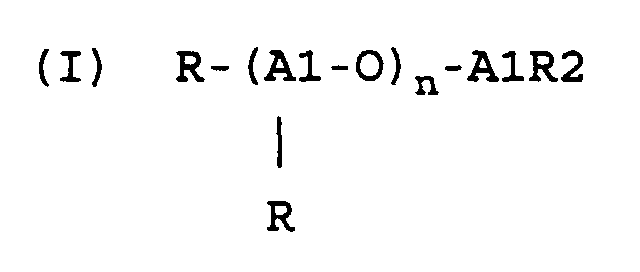 for oligomeric, cyclic alumoxane,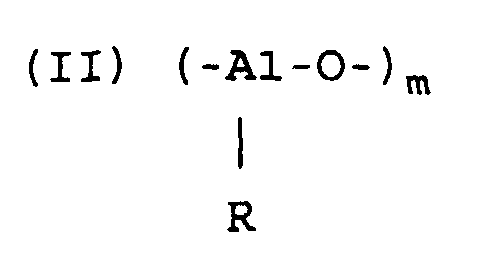
wherein n is 1-40, preferably 10-20, m is 3-40, preferably 3-20 and R is a C1-C8 alkyl group and preferably methyl. - Generally, in the preparation of alumoxanes from, for example, aluminium trimethyl and water, a mixture of linear and cyclic compounds is obtained.
- Suitable boron-containing cocatalysts may comprise a triphenylcarbenium boronate such as tetrakis-pentafluorophenylborato-triphenylcarbenium as described in EP-A-0427696, or those of the general formula [L'-H] + [B Ar1 Ar2 X3 X4] - as described in EP-A-0277004 (page 6,
line 30 to page 7, line 7). - Preferably, the same catalyst system is used in both steps (i) and (ii) of the process. The catalyst system may be employed in a solution polymerisation process, which is homogeneous, or a slurry process, which is heterogeneous. In a solution process, typical solvents include hydrocarbons with 4 to 7 carbon atoms such as heptane, toluene or cyclohexane. In a slurry process it is necessary to immobilize the catalyst system on an inert support, particularly a porous solid support such as talc, inorganic oxides and resinous support materials such as polyolefin. Preferably, the support material is an inorganic oxide in its finally divided form.
- Suitable inorganic oxide materials which are desirably employed in accordance with this invention include Group 2a, 3a, 4a or 4b metal oxides such as silica, alumina and mixtures thereof. Other inorganic oxides that may be employed either alone or in combination with the silica, or alumina are magnesia, titania, zirconia, and the like. Other suitable support materials, however, can be employed, for example, finely divided functionalized polyolefins such as finely divided polyethylene.
- Preferably, the support is a silica having a surface area comprised between 200 and 900 m2/g and a pore volume comprised between 0.5 and 4 ml/g.
- The amount of alumoxane and metallocenes usefully employed in the preparation of the solid support catalyst can vary over a wide range. Preferably the aluminium to transition metal mole ratio is in the range between 1:1 and 100:1, preferably in the range 5:1 and 50:1.
- The order of addition of the metallocenes and alumoxane to the support material can vary. In accordance with a preferred embodiment of the present invention alumoxane dissolved in a suitable inert hydrocarbon solvent is added to the support material slurried in the same or other suitable hydrocarbon liquid and thereafter a mixture of the metallocene catalyst component is added to the slurry.
- Preferred solvents include mineral oils and the various hydrocarbons which are liquid at reaction temperature and which do not react with the individual ingredients. Illustrative examples of the useful solvents include the alkanes such as pentane, iso-pentane, hexane, heptane, octane and nonane; cycloalkanes such as cyclopentane and cyclohexane; and aromatics such as benzene, toluene, ethylbenzene and diethylbenzene.
- Preferably the support material is slurried in toluene and the metallocene and alumoxane are dissolved in toluene prior to addition to the support material.
- Preferably no comonomer is added to the ethyl and hydrogen during the polymerisation. This avoids the need to remove unwanted excess butene or other comonomer.
- The polyethylene formed in accordance with the present invention preferably has long chain branching with a shear ratio of preferably at least 20, more preferably at least 30. These properties confer upon the polyethylene good processability characteristics and a smooth glossy surface.
- Without wishing to be bound by any theory it is postulated that comonomer is not required in the polymerisation because butene is formed in situ at the active site of the metallocene catalyst, probably by ethylene dimersation. Butene found in situ would react very quickly with a growing polymer chain because no diffusion barrier would be present.
- The invention will now be described in further detail, by way of example only, with reference to the following Examples and the accompanying drawings, in which:
- FIGURE 1 shows a 13C NMR spectrum of a polyethylene made in accordance with the present invention; and
- FIGURE 2 shows a 13C NMR spectrum of a further polyethylene made in accordance with the present invention.
-
-
- (a) Synthesis of the Stereoisomers
High yield rapid synthesis of the rac/meso(bisindenyl)ethanezirconium dichloride: The freshly prepared diaromatized bisindenylethane ligand is suspended in pentane and reacted with an equimolar suspension of ZrCl4 in pentane. The slurry is stirred for three Hours and filtered. Yellow solid is extracted with methylene chloride to separate the LiCl. According to NMR of the crude product a more or less quantitative yield for the rac/meso mixture is obtained according to this method. - (b) Isolation of the Pure Stereoisomers
Solubility test showed that the meso isomer has about three times higher solubility in toluene. In this way the meso can be concentrated in toluene and completely separated from the racemic byproduct. -
- The support used in a silica having a total pore volume of 4.217 ml/g and a surface area of 322 m2/g. This silica is further prepared by drying in high vacuum on a schlenk line for three hours to remove the physically absorbed water. 5g of this silica are suspended in 50 ml of toluene and placed in a round bottom flask equipped with magnetic stirrer, nitrogen inlet and dropping funnel.
- An amount of 0.31 g of the metallocene is reacted with 25 ml of methylalumoxane (
MAO 30 wt% in toluene) at a temperature of 25°C during 10 minutes to give a solution mixture of the corresponding metallocenium cation and the anionic methylalumoxane oligomer. - Then the resulting solution comprising the metallocenium cation and the anionic methylalumoxane oligomer is added to the support under a nitrogen atmosphere via the dropping funnel which is replaced immediately after with a reflux condenser. The mixture is heated to 110°C for 90 minutes. Then the reaction mixture is cooled down to room temperature, filtered under nitrogen and washed with toluene.
- The catalyst obtained is then washed with pentane and dried under a mild vacuum.
- Ethylene was polymerised under the conditions described in Table 1 in a 4l batch reactor at a temperature of 80°C for a residence time of 60 mins. Supported catalyst was precontacted with triisobutylaluminium (TBAC) and introduced into the reactor in which 2l of isobutene were used as diluent. The metallocene was present at 100 mg and the cocatalyst at 390ppm.
Part 1 Run Hydrogen (wt%-NL) Comonomer (wt%) Yield (g) Hourly Prod (g/g.hr) M12 (g/10') HLMI (g/10') SR Density (g/cc) Bulk Density (g/cc) A 0 0.00 183 1830 0.14 8.47 60 0.9438 0.28 B 0 1.22 250 2500 0.65 27.06 42 0.9385 0.37 C 0 2.44 346 3460 1.23 40.31 33 0.9380 0.27 D 0 3.66 390 3900 2.47 74.42 30 0.9550 0.29 E 0 4.88 270 2700 4.98 152.40 31 0.9521 0.30 F 0.25 0.00 166 1660 1.94 65.94 34 0.9530 0.36 G 0.25 1.22 345 3450 0.78 28.57 37 0.9623 0.35 H 0.25 2.44 255 2550 4.75 157.60 33 0.9429 0.31 I 0 0.00 338 3380 0.06 3.75 60 0.9574 0.24 J 0 2.44 695 6950 0.14 8.63 62 0.9366 0.35 K 0.25 2.44 676 6760 0.54 21.76 40 0.9421 0.39 L 0.25 3.66 720 7200 0.58 23.37 40 0.9407 0.34 M 0.25 4.88 922 9220 0.72 25.38 35 0.9394 0.32 Runs A to H, Ethylene 6wt%; Runs I to M, Ethylene 10wt% Part 2 Run Hydrogen (wt%-NL) Comonomer (wt%) Mn (kDa) Mw (kDa) Mz (kDa) Mp (kDa) D D' A 0 0.00 28.376 134.8 451.0 94 4.7 3.4 B 0 1.22 26.388 101.6 334.6 53 3.9 3.3 C 0 2.44 23.139 94.6 354.7 45 4.1 3.8 D 0 3.66 22.848 75.0 215.0 42 3.3 2.9 E 0 4.88 19.658 64.6 202.0 32 3.3 3.1 F 0.25 0.00 15.320 88.8 421.4 43 5.8 4.7 G 0.25 1.22 25.920 105.7 366.3 56 4.1 3.5 H 0.25 2.44 17.528 73.6 262.8 37 4.2 3.6 I 0 0.00 37.464 155.2 528.2 65 4.1 3.4 J 0 2.44 34.036 122.0 375.5 60 3.6 3.1 K 0.25 2.44 25.657 115.1 423.9 56 4.5 3.7 L 0.25 3.66 25.164 110.3 402.4 52 4.4 3.6 M 0.25 4.88 27.177 99.5 335.1 49 3.7 3.4 - Table 1 represents the polymerisation conditions, results and polymer analysis for the meso stereoisomer. The polymerization activity increases with increasing comonomer content in the feed regardless if hydrogen is present or not. A maximum activity of 4000g PE/g cat for 6% ethylene and 10000g PE/g cat for 10% ethylene concentration has been reached with different hexene concentration at this stage. The density behaviour is also interesting with respect to the hexene concentration; it does not decrease gradually with increasing hexene concentration. This behaviour is related to the in situ butene formation (cf. 13C NMR). For a monomodal polymer formed with a single site catalyst the SRs of the polymers are very large (35-60). The most important practical consequence of large SR, related to long chain branching (cf. 13C NMR), is the fact that the specimens that have been obtained from the melt indexer show no signs of melt fracture (good processibility) and the corresponding plaques are of very smooth and glossy surfaces.
- Table 2 sets out the results of 13C NMR analysis of the polyethylenes produced under the conditions of some of the runs detailed in Table 1. The averages of three NMR analyses are shown. Representative spectra from runs A and C are shown in Figures 1 and 2 respectively. The spectra indicate a very good comonomer incorporation capability and the formation of long chain branching. In addition to the hexene (Butane branching) substantial amounts of butene (ethyl branching) are observed in the backbone of the polymers. Most important is the signal pattern of the spectrum in Figure 1 of the polymer produced in the absence of any type of external comonomer. It shows up to 1 wt% Butene and confirms the in situ formation of butene via dimerization of ethylene. Since no other signals related to other comonomers is observed it can be concluded that the dimerization mechanism is very specific. The formation of long chain branching and comomoner is part of the unique properties of this catalytic system.
Hydrogen (wt%-NL) Comonomer (wt%) %C4m %C4w %C6m %C6w A 0 0 0.44 0.88 0 0 B 0 1.22 0.38 0.75 0.44 1.31 c 0 2.44 0.27 0.53 0.75 2.21 D 0 3.66 0.26 0.51 1.14 3.32 E 0 4.88 0.30 0.58 1.72 4.97 G 0.25 1.22 0.28 0.57 0.17 0.52 I 0 0 0.37 0.74 0 0 J 0 2.44 0.33 0.65 0.50 1.48 L 0.25 3.66 0.24 0.48 0.49 1.45 %Cm = molar % compared with ethylene
%Cw = weight % compared with ethylene
Claims (16)
- Use of a metallocene compound of general formula Ind2R''MQ2 as a component of a catalyst system in the production of polyethylene, wherein each Ind is the same or different and is indenyl or substituted indenyl; R'' is a bridge which comprises a C1 to C4 alkylene radical, a dialkyl germanium or silicon or siloxane, alkyl phosphine or amine, which bridge is substituted or unsubstituted, M is a Group IV metal or vanadium and each Q is hydrocarbyl having 1 to 20 carbon atoms or halogen; and the ratio of meso to racemic forms of the metallocene in the catalyst system is at least 1:3.
- Use according to claim 1, wherein R'' is an ethylene bridge which is substituted or unsubstituted.
- Use according to claim 1 or claim 2, wherein the cyclopentadienyl ring of at least one of the indenyls is unsubstituted.
- Use according to claim 3, wherein both indenyls are unsubstituted.
- Use according to any one of the preceding claims, wherein M is Zr.
- Use according to any one of the preceding claims, wherein Q is halogen.
- Use according to claim 1, wherein the bis indenyl compound is ethylenebis 1-indenyl zirconium dichloride.
- Use according to any one of the preceding claims, wherein the catalyst system further comprises a cocatalyst capable of activating the metallocene compound.
- Use according to any one of the preceding claims, wherein the cocatalyst which activates the metallocene compound comprises an aluminium-containing cocatalyst or a boron-containing cocatalyst.
- Use according to claim 9, wherein the cocatalyst comprises an aluminium-containing cocatalyst comprising an alumoxane, an alkyl aluminium and/or a Lewis acid.
- Use according to any one of the preceding claims, wherein the catalyst system further comprises an inert support.
- A process for the preparation of polyethylene, which comprises polymerising ethylene, optionally with hydrogen, in the presence of a catalyst system comprising(a) a metallocene compound of general formula Ind2R''MQ2 as defined in any one of claims 1 to 7;(b) a cocatalyst which activates the metallocene compound; and(c) an inert support; wherein the ratio of meso to racemic forms of the metallocene in the catalyst system is at least 1:3.
- A process according to claim 12, wherein substantially no comonomer is added to the ethylene during polymerisation.
- A process according to claim 12 or claim 13, wherein the polyethylene formed thereby has long chain branching.
- A process according to claim 14, wherein the polyethylene formed thereby has a shear ratio of at least 20.
- A process according to any one of claims 13 to 15, wherein the polyethylene formed thereby has short chain branching arising from C4 incorporation in the backbone of the polyethylene.
Priority Applications (13)
| Application Number | Priority Date | Filing Date | Title |
|---|---|---|---|
| EP98107623A EP0953582A1 (en) | 1998-04-27 | 1998-04-27 | Polyolefin production |
| DK99924869T DK1088010T3 (en) | 1998-04-27 | 1999-04-24 | Preparation of polyolefins |
| PT99924869T PT1088010E (en) | 1998-04-27 | 1999-04-24 | PRODUCTION OF POLYOLEFINS |
| ES99924869T ES2217755T3 (en) | 1998-04-27 | 1999-04-24 | POLYOLEFIN PRODUCTION. |
| DE69916604T DE69916604T2 (en) | 1998-04-27 | 1999-04-24 | PREPARATION OF POLYOLEFIN |
| EP99924869A EP1088010B1 (en) | 1998-04-27 | 1999-04-24 | Polyolefin production |
| PCT/EP1999/003014 WO1999055748A1 (en) | 1998-04-27 | 1999-04-24 | Polyolefin production |
| AU41377/99A AU4137799A (en) | 1998-04-27 | 1999-04-24 | Polyolefin production |
| JP11118257A JP2000063411A (en) | 1998-04-27 | 1999-04-26 | Production of polyolefin |
| US10/143,467 US20030036472A1 (en) | 1998-04-27 | 2002-05-09 | Polyolefin production |
| US11/441,306 US20060217504A1 (en) | 1998-04-27 | 2006-05-25 | Polyolefin production |
| US12/111,755 US8367787B2 (en) | 1998-04-27 | 2008-04-29 | Polyolefin production |
| US13/533,823 US8481665B2 (en) | 1998-04-27 | 2012-06-26 | Polyolefin production |
Applications Claiming Priority (1)
| Application Number | Priority Date | Filing Date | Title |
|---|---|---|---|
| EP98107623A EP0953582A1 (en) | 1998-04-27 | 1998-04-27 | Polyolefin production |
Publications (1)
| Publication Number | Publication Date |
|---|---|
| EP0953582A1 true EP0953582A1 (en) | 1999-11-03 |
Family
ID=8231830
Family Applications (2)
| Application Number | Title | Priority Date | Filing Date |
|---|---|---|---|
| EP98107623A Withdrawn EP0953582A1 (en) | 1998-04-27 | 1998-04-27 | Polyolefin production |
| EP99924869A Expired - Lifetime EP1088010B1 (en) | 1998-04-27 | 1999-04-24 | Polyolefin production |
Family Applications After (1)
| Application Number | Title | Priority Date | Filing Date |
|---|---|---|---|
| EP99924869A Expired - Lifetime EP1088010B1 (en) | 1998-04-27 | 1999-04-24 | Polyolefin production |
Country Status (9)
| Country | Link |
|---|---|
| US (4) | US20030036472A1 (en) |
| EP (2) | EP0953582A1 (en) |
| JP (1) | JP2000063411A (en) |
| AU (1) | AU4137799A (en) |
| DE (1) | DE69916604T2 (en) |
| DK (1) | DK1088010T3 (en) |
| ES (1) | ES2217755T3 (en) |
| PT (1) | PT1088010E (en) |
| WO (1) | WO1999055748A1 (en) |
Families Citing this family (6)
| Publication number | Priority date | Publication date | Assignee | Title |
|---|---|---|---|---|
| US20070143143A1 (en) * | 2005-12-16 | 2007-06-21 | Siemens Medical Solutions Health Services Corporation | Patient Discharge Data Processing System |
| CN101245084B (en) * | 2007-02-14 | 2013-02-20 | 中国石油天然气股份有限公司 | Phosphine-containing substituted vinyl metallocene catalyst and its preparation method and application |
| CN101878237B (en) * | 2007-11-30 | 2013-04-24 | 住友化学株式会社 | Ethylene-α-olefin copolymers and moldings |
| US20160362510A1 (en) | 2014-02-11 | 2016-12-15 | Univation Technologies, Llc | Method to prepare ethylene copolymers |
| JP7285286B2 (en) * | 2014-02-11 | 2023-06-01 | ユニベーション・テクノロジーズ・エルエルシー | Production of polyolefin products |
| CN105859924B (en) * | 2015-04-10 | 2018-07-13 | 亚培烯科技(杭州)有限公司 | A kind of sub- training alkene process catalyst and its preparation |
Citations (5)
| Publication number | Priority date | Publication date | Assignee | Title |
|---|---|---|---|---|
| EP0399348A2 (en) * | 1989-05-20 | 1990-11-28 | Hoechst Aktiengesellschaft | Process for preparing ethylenpolymers |
| EP0530908A1 (en) * | 1991-09-06 | 1993-03-10 | Dsm N.V. | Process for the preparation of a bridged metallocene compound as well as a catalyst component and a process for the polymerization of olefins |
| EP0643078A2 (en) * | 1993-09-13 | 1995-03-15 | Montell Technology Company bv | Process for the preparation of ethylene polymers and products obtained therefrom |
| EP0743324A2 (en) * | 1995-05-16 | 1996-11-20 | Union Carbide Chemicals & Plastics Technology Corporation | Production of polyethylene using stereoisomeric metallocenes |
| EP0835886A1 (en) * | 1996-10-09 | 1998-04-15 | Fina Research S.A. | Process for preparing and using meso/racemic-(bis(indenyl)ethane)zirconium dichloride compounds |
Family Cites Families (22)
| Publication number | Priority date | Publication date | Assignee | Title |
|---|---|---|---|---|
| US3304292A (en) * | 1963-09-05 | 1967-02-14 | Eastman Kodak Co | Group i metal, group i aluminum hydride, transition metal halide for polymerization of ethylene to ethylene-butene copolymer |
| FR2565591B1 (en) * | 1984-06-08 | 1986-08-29 | Inst Francais Du Petrole | PROCESS FOR THE MANUFACTURE OF AN ETHYLENE-BUTENE-1 COPOLYMER FROM ETHYLENE |
| US4562169A (en) * | 1984-10-04 | 1985-12-31 | Mobil Oil Corporation | Alpha-olefins polymerization catalyst of high productivity |
| US4861846A (en) * | 1985-03-22 | 1989-08-29 | Union Carbidae Corporation | Process for simultaneously dimerizing ethylene and copolymerizing ethylene with the dimerized product |
| CA2003882C (en) * | 1988-12-19 | 1997-01-07 | Edwin Rogers Smith | Heat shrinkable very low density polyethylene terpolymer film |
| EP0578838A1 (en) * | 1992-04-29 | 1994-01-19 | Hoechst Aktiengesellschaft | Olefin polymerization catalyst, process for its preparation, and its use |
| US5240894A (en) * | 1992-05-18 | 1993-08-31 | Exxon Chemical Patents Inc. | Method for making and using a supported metallocene catalyst system |
| ES2113900T3 (en) * | 1992-06-13 | 1998-05-16 | Targor Gmbh | PROCESS FOR THE PREPARATION OF CHALAL METALOCENE CATALYSTS, BRIDGED OF THE BISINDENYL TYPE. |
| ATE177436T1 (en) * | 1992-08-15 | 1999-03-15 | Targor Gmbh | METHOD FOR PRODUCING POLYOLEFINS |
| JPH0782322A (en) * | 1993-09-14 | 1995-03-28 | Idemitsu Kosan Co Ltd | Ethylene polymer and thermoplastic resin composition containing the same |
| DE4409249A1 (en) * | 1994-03-18 | 1995-09-21 | Witco Gmbh | Process for the preparation of alkylaluminoxane on inert support materials |
| US5614297A (en) * | 1994-05-19 | 1997-03-25 | Viskase Corporation | Polyolefin stretch film |
| IT1273661B (en) * | 1994-07-20 | 1997-07-09 | Spherilene Srl | CATALYSTS FOR THE POLYMERIZATION OF OLEFINS |
| IT1272922B (en) * | 1995-01-23 | 1997-07-01 | Spherilene Srl | PROCEDURE FOR THE PREPARATION OF METALLOCENIC COMPOUNDS |
| US5914289A (en) * | 1996-02-19 | 1999-06-22 | Fina Research, S.A. | Supported metallocene-alumoxane catalysts for the preparation of polyethylene having a broad monomodal molecular weight distribution |
| BE1010088A3 (en) * | 1996-03-29 | 1997-12-02 | Solvay | Terpolymer ethylene, method for obtaining, composition consisting essentially terpolymer objects and manufactured from same. |
| US5770520A (en) * | 1996-12-05 | 1998-06-23 | Lsi Logic Corporation | Method of making a barrier layer for via or contact opening of integrated circuit structure |
| US5753785A (en) * | 1996-12-16 | 1998-05-19 | Fina Technology, Inc. | Production of E-B copolymers with a single metallocene catalyst and a single monomer |
| US5968864A (en) * | 1996-12-20 | 1999-10-19 | Fina Technology, Inc. | Catalyst efficiency for supported metallocene catalyst |
| DE59807082D1 (en) * | 1997-07-28 | 2003-03-06 | Basell Polyolefine Gmbh | METHOD FOR PRODUCING METALLOCENES |
| US6194526B1 (en) * | 1998-07-07 | 2001-02-27 | Phillips Petroleum Company | Processes that produce polymers |
| EP1376516B1 (en) * | 2002-06-26 | 2008-05-21 | Avery Dennison Corporation | Machine direction oriented polymeric films |
-
1998
- 1998-04-27 EP EP98107623A patent/EP0953582A1/en not_active Withdrawn
-
1999
- 1999-04-24 ES ES99924869T patent/ES2217755T3/en not_active Expired - Lifetime
- 1999-04-24 DK DK99924869T patent/DK1088010T3/en active
- 1999-04-24 WO PCT/EP1999/003014 patent/WO1999055748A1/en not_active Ceased
- 1999-04-24 PT PT99924869T patent/PT1088010E/en unknown
- 1999-04-24 EP EP99924869A patent/EP1088010B1/en not_active Expired - Lifetime
- 1999-04-24 AU AU41377/99A patent/AU4137799A/en not_active Abandoned
- 1999-04-24 DE DE69916604T patent/DE69916604T2/en not_active Expired - Lifetime
- 1999-04-26 JP JP11118257A patent/JP2000063411A/en active Pending
-
2002
- 2002-05-09 US US10/143,467 patent/US20030036472A1/en not_active Abandoned
-
2006
- 2006-05-25 US US11/441,306 patent/US20060217504A1/en not_active Abandoned
-
2008
- 2008-04-29 US US12/111,755 patent/US8367787B2/en not_active Expired - Fee Related
-
2012
- 2012-06-26 US US13/533,823 patent/US8481665B2/en not_active Expired - Fee Related
Patent Citations (5)
| Publication number | Priority date | Publication date | Assignee | Title |
|---|---|---|---|---|
| EP0399348A2 (en) * | 1989-05-20 | 1990-11-28 | Hoechst Aktiengesellschaft | Process for preparing ethylenpolymers |
| EP0530908A1 (en) * | 1991-09-06 | 1993-03-10 | Dsm N.V. | Process for the preparation of a bridged metallocene compound as well as a catalyst component and a process for the polymerization of olefins |
| EP0643078A2 (en) * | 1993-09-13 | 1995-03-15 | Montell Technology Company bv | Process for the preparation of ethylene polymers and products obtained therefrom |
| EP0743324A2 (en) * | 1995-05-16 | 1996-11-20 | Union Carbide Chemicals & Plastics Technology Corporation | Production of polyethylene using stereoisomeric metallocenes |
| EP0835886A1 (en) * | 1996-10-09 | 1998-04-15 | Fina Research S.A. | Process for preparing and using meso/racemic-(bis(indenyl)ethane)zirconium dichloride compounds |
Also Published As
| Publication number | Publication date |
|---|---|
| PT1088010E (en) | 2004-07-30 |
| DK1088010T3 (en) | 2004-07-12 |
| WO1999055748A1 (en) | 1999-11-04 |
| US8367787B2 (en) | 2013-02-05 |
| AU4137799A (en) | 1999-11-16 |
| DE69916604T2 (en) | 2005-08-25 |
| EP1088010B1 (en) | 2004-04-21 |
| US20060217504A1 (en) | 2006-09-28 |
| EP1088010A1 (en) | 2001-04-04 |
| ES2217755T3 (en) | 2004-11-01 |
| JP2000063411A (en) | 2000-02-29 |
| US20030036472A1 (en) | 2003-02-20 |
| US8481665B2 (en) | 2013-07-09 |
| US20120271013A1 (en) | 2012-10-25 |
| WO1999055748A9 (en) | 2000-02-03 |
| US20080300371A1 (en) | 2008-12-04 |
| DE69916604D1 (en) | 2004-05-27 |
Similar Documents
| Publication | Publication Date | Title |
|---|---|---|
| JP4404382B2 (en) | Method for producing double mountain polyolefin using metallocene catalyst using two reaction zones | |
| US4897455A (en) | Polymerization process | |
| US4808561A (en) | Supported polymerization catalyst | |
| EP0206794B2 (en) | Supported polymerization catalyst | |
| JP4049403B2 (en) | Process for the production of supported catalyst components for use in the production of polyolefins | |
| CA2197848C (en) | Supported metallocene-alumoxane catalysts for the preparation of polyethylene having a broad monomodal molecular weight distribution | |
| EP0881236A1 (en) | Metallocene catalyst component for use in producing isotactic polyolefins | |
| KR20010071325A (en) | Supported olefin polymerization catalyst composition | |
| US8481665B2 (en) | Polyolefin production | |
| EP0830395B1 (en) | Process for preparing and using a supported metallocene-alumoxane catalyst | |
| KR20190066896A (en) | Method for preparing supported metallocene catalyst, the supported metallocene catalyst prepared by the same method, and polypropylene prepared by using the same | |
| US20060148643A1 (en) | Polyolefin production | |
| EP1430086B1 (en) | Catalyst component comprising a metallocene with two tetrahydroindenyl ligands for producing a polyolefin | |
| US6218330B1 (en) | Process for preparing and using a supported metallocene-alumoxane catalyst | |
| KR100332016B1 (en) | Polyolefin Production Method and Polyolefin Catalyst | |
| KR102774515B1 (en) | Catalyst for polymerization of polyolefin, and polyolefin | |
| WO1999032531A1 (en) | Slurry polymerization process with alkyl-substituted biscyclopentadienyl metallocenes | |
| HU205956B (en) | Process for producing new, metallocene and alumoxane containing catalyst on carrier for polymerizing olefines |
Legal Events
| Date | Code | Title | Description |
|---|---|---|---|
| PUAI | Public reference made under article 153(3) epc to a published international application that has entered the european phase |
Free format text: ORIGINAL CODE: 0009012 |
|
| AK | Designated contracting states |
Kind code of ref document: A1 Designated state(s): AT BE CH CY DE DK ES FI FR GB GR IE IT LI LU MC NL PT SE |
|
| AX | Request for extension of the european patent |
Free format text: AL;LT;LV;MK;RO;SI |
|
| AKX | Designation fees paid | ||
| REG | Reference to a national code |
Ref country code: DE Ref legal event code: 8566 |
|
| STAA | Information on the status of an ep patent application or granted ep patent |
Free format text: STATUS: THE APPLICATION IS DEEMED TO BE WITHDRAWN |
|
| 18D | Application deemed to be withdrawn |
Effective date: 20000503 |