EP1620571B1 - Corn event tc1507 and methods for detection thereof - Google Patents
Corn event tc1507 and methods for detection thereof Download PDFInfo
- Publication number
- EP1620571B1 EP1620571B1 EP04751097.9A EP04751097A EP1620571B1 EP 1620571 B1 EP1620571 B1 EP 1620571B1 EP 04751097 A EP04751097 A EP 04751097A EP 1620571 B1 EP1620571 B1 EP 1620571B1
- Authority
- EP
- European Patent Office
- Prior art keywords
- seq
- dna
- sequence
- event
- primer
- Prior art date
- Legal status (The legal status is an assumption and is not a legal conclusion. Google has not performed a legal analysis and makes no representation as to the accuracy of the status listed.)
- Expired - Lifetime
Links
- 240000008042 Zea mays Species 0.000 title claims description 174
- 235000002017 Zea mays subsp mays Nutrition 0.000 title claims description 148
- 238000000034 method Methods 0.000 title claims description 87
- 235000005824 Zea mays ssp. parviglumis Nutrition 0.000 title claims description 54
- 235000005822 corn Nutrition 0.000 title claims description 54
- 238000001514 detection method Methods 0.000 title claims description 28
- 108020004414 DNA Proteins 0.000 claims description 270
- 239000013615 primer Substances 0.000 claims description 148
- 235000016383 Zea mays subsp huehuetenangensis Nutrition 0.000 claims description 94
- 235000009973 maize Nutrition 0.000 claims description 94
- 239000000523 sample Substances 0.000 claims description 92
- 108091093088 Amplicon Proteins 0.000 claims description 83
- 239000012634 fragment Substances 0.000 claims description 74
- 238000003752 polymerase chain reaction Methods 0.000 claims description 60
- 238000006243 chemical reaction Methods 0.000 claims description 55
- 239000002773 nucleotide Substances 0.000 claims description 49
- 125000003729 nucleotide group Chemical group 0.000 claims description 49
- 108091028043 Nucleic acid sequence Proteins 0.000 claims description 47
- 238000009396 hybridization Methods 0.000 claims description 47
- 150000007523 nucleic acids Chemical class 0.000 claims description 47
- 230000000295 complement effect Effects 0.000 claims description 45
- 102000053602 DNA Human genes 0.000 claims description 36
- 102000039446 nucleic acids Human genes 0.000 claims description 36
- 108020004707 nucleic acids Proteins 0.000 claims description 36
- 241001057636 Dracaena deremensis Species 0.000 claims description 31
- 239000012472 biological sample Substances 0.000 claims description 24
- 238000003780 insertion Methods 0.000 claims description 20
- 230000037431 insertion Effects 0.000 claims description 20
- 108020001019 DNA Primers Proteins 0.000 claims description 19
- 239000003155 DNA primer Substances 0.000 claims description 19
- 230000004544 DNA amplification Effects 0.000 claims description 16
- 239000002987 primer (paints) Substances 0.000 claims description 15
- 102000040430 polynucleotide Human genes 0.000 claims description 13
- 108091033319 polynucleotide Proteins 0.000 claims description 13
- 239000002157 polynucleotide Substances 0.000 claims description 13
- 238000012216 screening Methods 0.000 claims description 3
- 108020005120 Plant DNA Proteins 0.000 claims description 2
- 239000012297 crystallization seed Substances 0.000 claims description 2
- 241000196324 Embryophyta Species 0.000 description 98
- 108090000623 proteins and genes Proteins 0.000 description 70
- 230000009261 transgenic effect Effects 0.000 description 42
- 230000014509 gene expression Effects 0.000 description 37
- 241000238631 Hexapoda Species 0.000 description 34
- 210000004027 cell Anatomy 0.000 description 31
- 108700019146 Transgenes Proteins 0.000 description 30
- 238000003199 nucleic acid amplification method Methods 0.000 description 29
- 230000003321 amplification Effects 0.000 description 25
- 101150113864 pat gene Proteins 0.000 description 21
- 108020005029 5' Flanking Region Proteins 0.000 description 20
- 235000007244 Zea mays Nutrition 0.000 description 20
- 108020005065 3' Flanking Region Proteins 0.000 description 19
- 230000009466 transformation Effects 0.000 description 18
- 210000003763 chloroplast Anatomy 0.000 description 17
- 102000004169 proteins and genes Human genes 0.000 description 17
- 239000000463 material Substances 0.000 description 16
- 210000001519 tissue Anatomy 0.000 description 16
- 230000001105 regulatory effect Effects 0.000 description 15
- 101710115267 ATP synthase protein MI25 Proteins 0.000 description 14
- 101710134973 Uncharacterized 9.7 kDa protein in cox-rep intergenic region Proteins 0.000 description 14
- ZHNUHDYFZUAESO-UHFFFAOYSA-N Formamide Chemical compound NC=O ZHNUHDYFZUAESO-UHFFFAOYSA-N 0.000 description 12
- 238000002869 basic local alignment search tool Methods 0.000 description 12
- 108091026890 Coding region Proteins 0.000 description 11
- 238000013519 translation Methods 0.000 description 11
- FAPWRFPIFSIZLT-UHFFFAOYSA-M Sodium chloride Chemical compound [Na+].[Cl-] FAPWRFPIFSIZLT-UHFFFAOYSA-M 0.000 description 10
- 238000004422 calculation algorithm Methods 0.000 description 10
- 241000607479 Yersinia pestis Species 0.000 description 8
- 238000002866 fluorescence resonance energy transfer Methods 0.000 description 8
- 230000002068 genetic effect Effects 0.000 description 8
- 238000006467 substitution reaction Methods 0.000 description 8
- FWMNVWWHGCHHJJ-SKKKGAJSSA-N 4-amino-1-[(2r)-6-amino-2-[[(2r)-2-[[(2r)-2-[[(2r)-2-amino-3-phenylpropanoyl]amino]-3-phenylpropanoyl]amino]-4-methylpentanoyl]amino]hexanoyl]piperidine-4-carboxylic acid Chemical compound C([C@H](C(=O)N[C@H](CC(C)C)C(=O)N[C@H](CCCCN)C(=O)N1CCC(N)(CC1)C(O)=O)NC(=O)[C@H](N)CC=1C=CC=CC=1)C1=CC=CC=C1 FWMNVWWHGCHHJJ-SKKKGAJSSA-N 0.000 description 7
- 108091034117 Oligonucleotide Proteins 0.000 description 7
- 238000004458 analytical method Methods 0.000 description 7
- 210000002257 embryonic structure Anatomy 0.000 description 7
- 239000000203 mixture Substances 0.000 description 7
- 230000002103 transcriptional effect Effects 0.000 description 7
- 241000701489 Cauliflower mosaic virus Species 0.000 description 6
- 206010020649 Hyperkeratosis Diseases 0.000 description 6
- 108020004999 messenger RNA Proteins 0.000 description 6
- 238000012986 modification Methods 0.000 description 6
- 230000004048 modification Effects 0.000 description 6
- 101150042359 rpoC2 gene Proteins 0.000 description 6
- 230000001568 sexual effect Effects 0.000 description 6
- 241000894007 species Species 0.000 description 6
- 238000013459 approach Methods 0.000 description 5
- 230000008901 benefit Effects 0.000 description 5
- 235000013305 food Nutrition 0.000 description 5
- 230000002441 reversible effect Effects 0.000 description 5
- 238000012163 sequencing technique Methods 0.000 description 5
- 239000011780 sodium chloride Substances 0.000 description 5
- 239000000126 substance Substances 0.000 description 5
- 238000013518 transcription Methods 0.000 description 5
- 230000035897 transcription Effects 0.000 description 5
- 108091032973 (ribonucleotides)n+m Proteins 0.000 description 4
- 102000016928 DNA-directed DNA polymerase Human genes 0.000 description 4
- 108010014303 DNA-directed DNA polymerase Proteins 0.000 description 4
- 238000012408 PCR amplification Methods 0.000 description 4
- DBMJMQXJHONAFJ-UHFFFAOYSA-M Sodium laurylsulphate Chemical compound [Na+].CCCCCCCCCCCCOS([O-])(=O)=O DBMJMQXJHONAFJ-UHFFFAOYSA-M 0.000 description 4
- 238000007792 addition Methods 0.000 description 4
- 238000009395 breeding Methods 0.000 description 4
- 238000012790 confirmation Methods 0.000 description 4
- 238000011161 development Methods 0.000 description 4
- 230000018109 developmental process Effects 0.000 description 4
- 239000000284 extract Substances 0.000 description 4
- 238000004519 manufacturing process Methods 0.000 description 4
- 239000002245 particle Substances 0.000 description 4
- 108010082527 phosphinothricin N-acetyltransferase Proteins 0.000 description 4
- 239000013612 plasmid Substances 0.000 description 4
- 230000008488 polyadenylation Effects 0.000 description 4
- 238000012545 processing Methods 0.000 description 4
- 230000010076 replication Effects 0.000 description 4
- 108091008146 restriction endonucleases Proteins 0.000 description 4
- 235000019333 sodium laurylsulphate Nutrition 0.000 description 4
- 239000000243 solution Substances 0.000 description 4
- 238000011144 upstream manufacturing Methods 0.000 description 4
- 239000013598 vector Substances 0.000 description 4
- 108700003918 Bacillus Thuringiensis insecticidal crystal Proteins 0.000 description 3
- 108091092195 Intron Proteins 0.000 description 3
- 101150054907 Mrps12 gene Proteins 0.000 description 3
- 108020004711 Nucleic Acid Probes Proteins 0.000 description 3
- 238000010222 PCR analysis Methods 0.000 description 3
- 108020004511 Recombinant DNA Proteins 0.000 description 3
- 101100199945 Schizosaccharomyces pombe (strain 972 / ATCC 24843) rps1201 gene Proteins 0.000 description 3
- 108090000848 Ubiquitin Proteins 0.000 description 3
- 102000044159 Ubiquitin Human genes 0.000 description 3
- 125000000539 amino acid group Chemical group 0.000 description 3
- 230000008859 change Effects 0.000 description 3
- 239000003153 chemical reaction reagent Substances 0.000 description 3
- 244000038559 crop plants Species 0.000 description 3
- 230000000694 effects Effects 0.000 description 3
- 238000005516 engineering process Methods 0.000 description 3
- 239000003623 enhancer Substances 0.000 description 3
- PCHJSUWPFVWCPO-UHFFFAOYSA-N gold Chemical compound [Au] PCHJSUWPFVWCPO-UHFFFAOYSA-N 0.000 description 3
- 239000010931 gold Substances 0.000 description 3
- 229910052737 gold Inorganic materials 0.000 description 3
- 238000010348 incorporation Methods 0.000 description 3
- 230000000977 initiatory effect Effects 0.000 description 3
- 230000010354 integration Effects 0.000 description 3
- 239000003550 marker Substances 0.000 description 3
- 239000002609 medium Substances 0.000 description 3
- 238000012544 monitoring process Methods 0.000 description 3
- 238000007899 nucleic acid hybridization Methods 0.000 description 3
- 239000002853 nucleic acid probe Substances 0.000 description 3
- 230000000361 pesticidal effect Effects 0.000 description 3
- 229920001184 polypeptide Polymers 0.000 description 3
- 108090000765 processed proteins & peptides Proteins 0.000 description 3
- 102000004196 processed proteins & peptides Human genes 0.000 description 3
- 238000010791 quenching Methods 0.000 description 3
- 230000000171 quenching effect Effects 0.000 description 3
- 101150015537 rps12 gene Proteins 0.000 description 3
- 101150098466 rpsL gene Proteins 0.000 description 3
- 150000003839 salts Chemical class 0.000 description 3
- IAJOBQBIJHVGMQ-UHFFFAOYSA-N 2-amino-4-[hydroxy(methyl)phosphoryl]butanoic acid Chemical compound CP(O)(=O)CCC(N)C(O)=O IAJOBQBIJHVGMQ-UHFFFAOYSA-N 0.000 description 2
- 241000589155 Agrobacterium tumefaciens Species 0.000 description 2
- 241000193388 Bacillus thuringiensis Species 0.000 description 2
- 238000002965 ELISA Methods 0.000 description 2
- 239000005561 Glufosinate Substances 0.000 description 2
- NYHBQMYGNKIUIF-UUOKFMHZSA-N Guanosine Chemical compound C1=NC=2C(=O)NC(N)=NC=2N1[C@@H]1O[C@H](CO)[C@@H](O)[C@H]1O NYHBQMYGNKIUIF-UUOKFMHZSA-N 0.000 description 2
- TWRXJAOTZQYOKJ-UHFFFAOYSA-L Magnesium chloride Chemical compound [Mg+2].[Cl-].[Cl-] TWRXJAOTZQYOKJ-UHFFFAOYSA-L 0.000 description 2
- 108020005187 Oligonucleotide Probes Proteins 0.000 description 2
- 108700026244 Open Reading Frames Proteins 0.000 description 2
- 241000286209 Phasianidae Species 0.000 description 2
- 108700029229 Transcriptional Regulatory Elements Proteins 0.000 description 2
- 125000003275 alpha amino acid group Chemical group 0.000 description 2
- 150000001413 amino acids Chemical class 0.000 description 2
- 238000003556 assay Methods 0.000 description 2
- 229940097012 bacillus thuringiensis Drugs 0.000 description 2
- 239000000872 buffer Substances 0.000 description 2
- 239000003795 chemical substances by application Substances 0.000 description 2
- 230000002759 chromosomal effect Effects 0.000 description 2
- 238000010367 cloning Methods 0.000 description 2
- 239000013599 cloning vector Substances 0.000 description 2
- 230000001276 controlling effect Effects 0.000 description 2
- 238000007796 conventional method Methods 0.000 description 2
- 230000001351 cycling effect Effects 0.000 description 2
- 238000012217 deletion Methods 0.000 description 2
- 230000037430 deletion Effects 0.000 description 2
- 238000013461 design Methods 0.000 description 2
- 230000007613 environmental effect Effects 0.000 description 2
- 238000002474 experimental method Methods 0.000 description 2
- 239000013604 expression vector Substances 0.000 description 2
- 230000012010 growth Effects 0.000 description 2
- 210000004940 nucleus Anatomy 0.000 description 2
- 239000002751 oligonucleotide probe Substances 0.000 description 2
- 238000009401 outcrossing Methods 0.000 description 2
- 239000000575 pesticide Substances 0.000 description 2
- 230000010287 polarization Effects 0.000 description 2
- 230000008569 process Effects 0.000 description 2
- 108700022487 rRNA Genes Proteins 0.000 description 2
- 230000008929 regeneration Effects 0.000 description 2
- 238000011069 regeneration method Methods 0.000 description 2
- 238000011160 research Methods 0.000 description 2
- 239000001509 sodium citrate Substances 0.000 description 2
- 229910001415 sodium ion Inorganic materials 0.000 description 2
- 238000012546 transfer Methods 0.000 description 2
- 108020005097 23S Ribosomal RNA Proteins 0.000 description 1
- 241000589158 Agrobacterium Species 0.000 description 1
- 102000007347 Apyrase Human genes 0.000 description 1
- 108010007730 Apyrase Proteins 0.000 description 1
- 241000894006 Bacteria Species 0.000 description 1
- 108020004998 Chloroplast DNA Proteins 0.000 description 1
- 108700031407 Chloroplast Genes Proteins 0.000 description 1
- 108010077544 Chromatin Proteins 0.000 description 1
- 108020004705 Codon Proteins 0.000 description 1
- 229920000742 Cotton Polymers 0.000 description 1
- MIKUYHXYGGJMLM-GIMIYPNGSA-N Crotonoside Natural products C1=NC2=C(N)NC(=O)N=C2N1[C@H]1O[C@@H](CO)[C@H](O)[C@@H]1O MIKUYHXYGGJMLM-GIMIYPNGSA-N 0.000 description 1
- IGXWBGJHJZYPQS-SSDOTTSWSA-N D-Luciferin Chemical compound OC(=O)[C@H]1CSC(C=2SC3=CC=C(O)C=C3N=2)=N1 IGXWBGJHJZYPQS-SSDOTTSWSA-N 0.000 description 1
- NYHBQMYGNKIUIF-UHFFFAOYSA-N D-guanosine Natural products C1=2NC(N)=NC(=O)C=2N=CN1C1OC(CO)C(O)C1O NYHBQMYGNKIUIF-UHFFFAOYSA-N 0.000 description 1
- 102000004163 DNA-directed RNA polymerases Human genes 0.000 description 1
- 108090000626 DNA-directed RNA polymerases Proteins 0.000 description 1
- CYCGRDQQIOGCKX-UHFFFAOYSA-N Dehydro-luciferin Natural products OC(=O)C1=CSC(C=2SC3=CC(O)=CC=C3N=2)=N1 CYCGRDQQIOGCKX-UHFFFAOYSA-N 0.000 description 1
- 108010042407 Endonucleases Proteins 0.000 description 1
- 102000004533 Endonucleases Human genes 0.000 description 1
- 244000148064 Enicostema verticillatum Species 0.000 description 1
- 102000004190 Enzymes Human genes 0.000 description 1
- 108090000790 Enzymes Proteins 0.000 description 1
- BJGNCJDXODQBOB-UHFFFAOYSA-N Fivefly Luciferin Natural products OC(=O)C1CSC(C=2SC3=CC(O)=CC=C3N=2)=N1 BJGNCJDXODQBOB-UHFFFAOYSA-N 0.000 description 1
- 108700039691 Genetic Promoter Regions Proteins 0.000 description 1
- 108700007698 Genetic Terminator Regions Proteins 0.000 description 1
- 244000299507 Gossypium hirsutum Species 0.000 description 1
- 244000020551 Helianthus annuus Species 0.000 description 1
- 235000003222 Helianthus annuus Nutrition 0.000 description 1
- 108010034791 Heterochromatin Proteins 0.000 description 1
- 241000209510 Liliopsida Species 0.000 description 1
- 108060001084 Luciferase Proteins 0.000 description 1
- 239000005089 Luciferase Substances 0.000 description 1
- DDWFXDSYGUXRAY-UHFFFAOYSA-N Luciferin Natural products CCc1c(C)c(CC2NC(=O)C(=C2C=C)C)[nH]c1Cc3[nH]c4C(=C5/NC(CC(=O)O)C(C)C5CC(=O)O)CC(=O)c4c3C DDWFXDSYGUXRAY-UHFFFAOYSA-N 0.000 description 1
- 240000007594 Oryza sativa Species 0.000 description 1
- 235000007164 Oryza sativa Nutrition 0.000 description 1
- 241001147398 Ostrinia nubilalis Species 0.000 description 1
- 238000002944 PCR assay Methods 0.000 description 1
- 108700001094 Plant Genes Proteins 0.000 description 1
- 239000004952 Polyamide Substances 0.000 description 1
- 108091034057 RNA (poly(A)) Proteins 0.000 description 1
- 238000012300 Sequence Analysis Methods 0.000 description 1
- 244000061456 Solanum tuberosum Species 0.000 description 1
- 235000002595 Solanum tuberosum Nutrition 0.000 description 1
- 102000004523 Sulfate Adenylyltransferase Human genes 0.000 description 1
- 108010022348 Sulfate adenylyltransferase Proteins 0.000 description 1
- 208000036142 Viral infection Diseases 0.000 description 1
- IRLPACMLTUPBCL-FCIPNVEPSA-N adenosine-5'-phosphosulfate Chemical compound C1=NC=2C(N)=NC=NC=2N1[C@@H]1O[C@@H](CO[P@](O)(=O)OS(O)(=O)=O)[C@H](O)[C@H]1O IRLPACMLTUPBCL-FCIPNVEPSA-N 0.000 description 1
- 239000011543 agarose gel Substances 0.000 description 1
- 238000000246 agarose gel electrophoresis Methods 0.000 description 1
- 230000009418 agronomic effect Effects 0.000 description 1
- 230000004075 alteration Effects 0.000 description 1
- 239000007864 aqueous solution Substances 0.000 description 1
- 230000001580 bacterial effect Effects 0.000 description 1
- 230000010310 bacterial transformation Effects 0.000 description 1
- 230000003542 behavioural effect Effects 0.000 description 1
- 238000004166 bioassay Methods 0.000 description 1
- 230000033228 biological regulation Effects 0.000 description 1
- 239000007853 buffer solution Substances 0.000 description 1
- 150000001768 cations Chemical class 0.000 description 1
- 239000005081 chemiluminescent agent Substances 0.000 description 1
- 210000003483 chromatin Anatomy 0.000 description 1
- 210000000349 chromosome Anatomy 0.000 description 1
- 238000003776 cleavage reaction Methods 0.000 description 1
- 239000002299 complementary DNA Substances 0.000 description 1
- 238000004883 computer application Methods 0.000 description 1
- 238000004590 computer program Methods 0.000 description 1
- OPTASPLRGRRNAP-UHFFFAOYSA-N cytosine Chemical class NC=1C=CNC(=O)N=1 OPTASPLRGRRNAP-UHFFFAOYSA-N 0.000 description 1
- 230000003247 decreasing effect Effects 0.000 description 1
- 230000000368 destabilizing effect Effects 0.000 description 1
- 230000029087 digestion Effects 0.000 description 1
- 239000000539 dimer Substances 0.000 description 1
- 210000005069 ears Anatomy 0.000 description 1
- 235000013399 edible fruits Nutrition 0.000 description 1
- 239000002158 endotoxin Substances 0.000 description 1
- 210000003527 eukaryotic cell Anatomy 0.000 description 1
- 238000002875 fluorescence polarization Methods 0.000 description 1
- 229940029575 guanosine Drugs 0.000 description 1
- 238000003306 harvesting Methods 0.000 description 1
- 210000004458 heterochromatin Anatomy 0.000 description 1
- 230000003116 impacting effect Effects 0.000 description 1
- 230000001939 inductive effect Effects 0.000 description 1
- 230000000749 insecticidal effect Effects 0.000 description 1
- 238000007689 inspection Methods 0.000 description 1
- 230000002147 killing effect Effects 0.000 description 1
- 238000002372 labelling Methods 0.000 description 1
- 238000011005 laboratory method Methods 0.000 description 1
- 239000003446 ligand Substances 0.000 description 1
- 229910001629 magnesium chloride Inorganic materials 0.000 description 1
- 210000001161 mammalian embryo Anatomy 0.000 description 1
- 230000001404 mediated effect Effects 0.000 description 1
- 238000002844 melting Methods 0.000 description 1
- 230000008018 melting Effects 0.000 description 1
- 230000000442 meristematic effect Effects 0.000 description 1
- MYWUZJCMWCOHBA-VIFPVBQESA-N methamphetamine Chemical compound CN[C@@H](C)CC1=CC=CC=C1 MYWUZJCMWCOHBA-VIFPVBQESA-N 0.000 description 1
- 238000007479 molecular analysis Methods 0.000 description 1
- 238000010369 molecular cloning Methods 0.000 description 1
- 230000035772 mutation Effects 0.000 description 1
- 239000013642 negative control Substances 0.000 description 1
- 238000007857 nested PCR Methods 0.000 description 1
- 210000000056 organ Anatomy 0.000 description 1
- 230000036961 partial effect Effects 0.000 description 1
- 230000000737 periodic effect Effects 0.000 description 1
- 238000003976 plant breeding Methods 0.000 description 1
- 230000010152 pollination Effects 0.000 description 1
- 229920002647 polyamide Polymers 0.000 description 1
- 239000013641 positive control Substances 0.000 description 1
- 235000012015 potatoes Nutrition 0.000 description 1
- 239000002243 precursor Substances 0.000 description 1
- 230000001681 protective effect Effects 0.000 description 1
- 210000001938 protoplast Anatomy 0.000 description 1
- 238000012175 pyrosequencing Methods 0.000 description 1
- 238000003908 quality control method Methods 0.000 description 1
- 230000002285 radioactive effect Effects 0.000 description 1
- 230000000306 recurrent effect Effects 0.000 description 1
- 230000002829 reductive effect Effects 0.000 description 1
- 230000022532 regulation of transcription, DNA-dependent Effects 0.000 description 1
- 230000001850 reproductive effect Effects 0.000 description 1
- 230000004044 response Effects 0.000 description 1
- 230000000979 retarding effect Effects 0.000 description 1
- 235000009566 rice Nutrition 0.000 description 1
- 229920002477 rna polymer Polymers 0.000 description 1
- 230000007017 scission Effects 0.000 description 1
- 238000005204 segregation Methods 0.000 description 1
- 239000006152 selective media Substances 0.000 description 1
- 238000000926 separation method Methods 0.000 description 1
- NLJMYIDDQXHKNR-UHFFFAOYSA-K sodium citrate Chemical compound O.O.[Na+].[Na+].[Na+].[O-]C(=O)CC(O)(CC([O-])=O)C([O-])=O NLJMYIDDQXHKNR-UHFFFAOYSA-K 0.000 description 1
- 239000002904 solvent Substances 0.000 description 1
- 230000002269 spontaneous effect Effects 0.000 description 1
- 238000003153 stable transfection Methods 0.000 description 1
- 238000004114 suspension culture Methods 0.000 description 1
- 230000002123 temporal effect Effects 0.000 description 1
- 238000012360 testing method Methods 0.000 description 1
- 230000005026 transcription initiation Effects 0.000 description 1
- 230000005030 transcription termination Effects 0.000 description 1
- 238000011426 transformation method Methods 0.000 description 1
- 230000001131 transforming effect Effects 0.000 description 1
- 230000014621 translational initiation Effects 0.000 description 1
- 230000017105 transposition Effects 0.000 description 1
- HRXKRNGNAMMEHJ-UHFFFAOYSA-K trisodium citrate Chemical compound [Na+].[Na+].[Na+].[O-]C(=O)CC(O)(CC([O-])=O)C([O-])=O HRXKRNGNAMMEHJ-UHFFFAOYSA-K 0.000 description 1
- 229940038773 trisodium citrate Drugs 0.000 description 1
- WFKWXMTUELFFGS-UHFFFAOYSA-N tungsten Chemical compound [W] WFKWXMTUELFFGS-UHFFFAOYSA-N 0.000 description 1
- 229910052721 tungsten Inorganic materials 0.000 description 1
- 239000010937 tungsten Substances 0.000 description 1
- 241001515965 unidentified phage Species 0.000 description 1
- 230000009385 viral infection Effects 0.000 description 1
- 230000004580 weight loss Effects 0.000 description 1
Images

Classifications
-
- C—CHEMISTRY; METALLURGY
- C12—BIOCHEMISTRY; BEER; SPIRITS; WINE; VINEGAR; MICROBIOLOGY; ENZYMOLOGY; MUTATION OR GENETIC ENGINEERING
- C12Q—MEASURING OR TESTING PROCESSES INVOLVING ENZYMES, NUCLEIC ACIDS OR MICROORGANISMS; COMPOSITIONS OR TEST PAPERS THEREFOR; PROCESSES OF PREPARING SUCH COMPOSITIONS; CONDITION-RESPONSIVE CONTROL IN MICROBIOLOGICAL OR ENZYMOLOGICAL PROCESSES
- C12Q1/00—Measuring or testing processes involving enzymes, nucleic acids or microorganisms; Compositions therefor; Processes of preparing such compositions
- C12Q1/68—Measuring or testing processes involving enzymes, nucleic acids or microorganisms; Compositions therefor; Processes of preparing such compositions involving nucleic acids
- C12Q1/6876—Nucleic acid products used in the analysis of nucleic acids, e.g. primers or probes
- C12Q1/6888—Nucleic acid products used in the analysis of nucleic acids, e.g. primers or probes for detection or identification of organisms
- C12Q1/6895—Nucleic acid products used in the analysis of nucleic acids, e.g. primers or probes for detection or identification of organisms for plants, fungi or algae
-
- C—CHEMISTRY; METALLURGY
- C12—BIOCHEMISTRY; BEER; SPIRITS; WINE; VINEGAR; MICROBIOLOGY; ENZYMOLOGY; MUTATION OR GENETIC ENGINEERING
- C12N—MICROORGANISMS OR ENZYMES; COMPOSITIONS THEREOF; PROPAGATING, PRESERVING, OR MAINTAINING MICROORGANISMS; MUTATION OR GENETIC ENGINEERING; CULTURE MEDIA
- C12N15/00—Mutation or genetic engineering; DNA or RNA concerning genetic engineering, vectors, e.g. plasmids, or their isolation, preparation or purification; Use of hosts therefor
- C12N15/09—Recombinant DNA-technology
- C12N15/63—Introduction of foreign genetic material using vectors; Vectors; Use of hosts therefor; Regulation of expression
- C12N15/79—Vectors or expression systems specially adapted for eukaryotic hosts
- C12N15/82—Vectors or expression systems specially adapted for eukaryotic hosts for plant cells, e.g. plant artificial chromosomes (PACs)
- C12N15/8241—Phenotypically and genetically modified plants via recombinant DNA technology
- C12N15/8261—Phenotypically and genetically modified plants via recombinant DNA technology with agronomic (input) traits, e.g. crop yield
- C12N15/8271—Phenotypically and genetically modified plants via recombinant DNA technology with agronomic (input) traits, e.g. crop yield for stress resistance, e.g. heavy metal resistance
- C12N15/8274—Phenotypically and genetically modified plants via recombinant DNA technology with agronomic (input) traits, e.g. crop yield for stress resistance, e.g. heavy metal resistance for herbicide resistance
- C12N15/8277—Phosphinotricin
-
- C—CHEMISTRY; METALLURGY
- C12—BIOCHEMISTRY; BEER; SPIRITS; WINE; VINEGAR; MICROBIOLOGY; ENZYMOLOGY; MUTATION OR GENETIC ENGINEERING
- C12N—MICROORGANISMS OR ENZYMES; COMPOSITIONS THEREOF; PROPAGATING, PRESERVING, OR MAINTAINING MICROORGANISMS; MUTATION OR GENETIC ENGINEERING; CULTURE MEDIA
- C12N15/00—Mutation or genetic engineering; DNA or RNA concerning genetic engineering, vectors, e.g. plasmids, or their isolation, preparation or purification; Use of hosts therefor
- C12N15/09—Recombinant DNA-technology
- C12N15/63—Introduction of foreign genetic material using vectors; Vectors; Use of hosts therefor; Regulation of expression
- C12N15/79—Vectors or expression systems specially adapted for eukaryotic hosts
- C12N15/82—Vectors or expression systems specially adapted for eukaryotic hosts for plant cells, e.g. plant artificial chromosomes (PACs)
- C12N15/8241—Phenotypically and genetically modified plants via recombinant DNA technology
- C12N15/8261—Phenotypically and genetically modified plants via recombinant DNA technology with agronomic (input) traits, e.g. crop yield
- C12N15/8271—Phenotypically and genetically modified plants via recombinant DNA technology with agronomic (input) traits, e.g. crop yield for stress resistance, e.g. heavy metal resistance
- C12N15/8279—Phenotypically and genetically modified plants via recombinant DNA technology with agronomic (input) traits, e.g. crop yield for stress resistance, e.g. heavy metal resistance for biotic stress resistance, pathogen resistance, disease resistance
- C12N15/8286—Phenotypically and genetically modified plants via recombinant DNA technology with agronomic (input) traits, e.g. crop yield for stress resistance, e.g. heavy metal resistance for biotic stress resistance, pathogen resistance, disease resistance for insect resistance
-
- C—CHEMISTRY; METALLURGY
- C12—BIOCHEMISTRY; BEER; SPIRITS; WINE; VINEGAR; MICROBIOLOGY; ENZYMOLOGY; MUTATION OR GENETIC ENGINEERING
- C12Q—MEASURING OR TESTING PROCESSES INVOLVING ENZYMES, NUCLEIC ACIDS OR MICROORGANISMS; COMPOSITIONS OR TEST PAPERS THEREFOR; PROCESSES OF PREPARING SUCH COMPOSITIONS; CONDITION-RESPONSIVE CONTROL IN MICROBIOLOGICAL OR ENZYMOLOGICAL PROCESSES
- C12Q1/00—Measuring or testing processes involving enzymes, nucleic acids or microorganisms; Compositions therefor; Processes of preparing such compositions
- C12Q1/68—Measuring or testing processes involving enzymes, nucleic acids or microorganisms; Compositions therefor; Processes of preparing such compositions involving nucleic acids
- C12Q1/6844—Nucleic acid amplification reactions
- C12Q1/686—Polymerase chain reaction [PCR]
-
- C—CHEMISTRY; METALLURGY
- C12—BIOCHEMISTRY; BEER; SPIRITS; WINE; VINEGAR; MICROBIOLOGY; ENZYMOLOGY; MUTATION OR GENETIC ENGINEERING
- C12Q—MEASURING OR TESTING PROCESSES INVOLVING ENZYMES, NUCLEIC ACIDS OR MICROORGANISMS; COMPOSITIONS OR TEST PAPERS THEREFOR; PROCESSES OF PREPARING SUCH COMPOSITIONS; CONDITION-RESPONSIVE CONTROL IN MICROBIOLOGICAL OR ENZYMOLOGICAL PROCESSES
- C12Q2600/00—Oligonucleotides characterized by their use
- C12Q2600/13—Plant traits
-
- C—CHEMISTRY; METALLURGY
- C12—BIOCHEMISTRY; BEER; SPIRITS; WINE; VINEGAR; MICROBIOLOGY; ENZYMOLOGY; MUTATION OR GENETIC ENGINEERING
- C12Q—MEASURING OR TESTING PROCESSES INVOLVING ENZYMES, NUCLEIC ACIDS OR MICROORGANISMS; COMPOSITIONS OR TEST PAPERS THEREFOR; PROCESSES OF PREPARING SUCH COMPOSITIONS; CONDITION-RESPONSIVE CONTROL IN MICROBIOLOGICAL OR ENZYMOLOGICAL PROCESSES
- C12Q2600/00—Oligonucleotides characterized by their use
- C12Q2600/16—Primer sets for multiplex assays
-
- Y—GENERAL TAGGING OF NEW TECHNOLOGICAL DEVELOPMENTS; GENERAL TAGGING OF CROSS-SECTIONAL TECHNOLOGIES SPANNING OVER SEVERAL SECTIONS OF THE IPC; TECHNICAL SUBJECTS COVERED BY FORMER USPC CROSS-REFERENCE ART COLLECTIONS [XRACs] AND DIGESTS
- Y02—TECHNOLOGIES OR APPLICATIONS FOR MITIGATION OR ADAPTATION AGAINST CLIMATE CHANGE
- Y02A—TECHNOLOGIES FOR ADAPTATION TO CLIMATE CHANGE
- Y02A40/00—Adaptation technologies in agriculture, forestry, livestock or agroalimentary production
- Y02A40/10—Adaptation technologies in agriculture, forestry, livestock or agroalimentary production in agriculture
- Y02A40/146—Genetically Modified [GMO] plants, e.g. transgenic plants
-
- Y—GENERAL TAGGING OF NEW TECHNOLOGICAL DEVELOPMENTS; GENERAL TAGGING OF CROSS-SECTIONAL TECHNOLOGIES SPANNING OVER SEVERAL SECTIONS OF THE IPC; TECHNICAL SUBJECTS COVERED BY FORMER USPC CROSS-REFERENCE ART COLLECTIONS [XRACs] AND DIGESTS
- Y10—TECHNICAL SUBJECTS COVERED BY FORMER USPC
- Y10S—TECHNICAL SUBJECTS COVERED BY FORMER USPC CROSS-REFERENCE ART COLLECTIONS [XRACs] AND DIGESTS
- Y10S435/00—Chemistry: molecular biology and microbiology
- Y10S435/975—Kit
Definitions
- the present invention relates to the field of plant molecular biology, specifically the invention relates to a DNA construct for conferring insect resistance to a plant.
- the invention more specifically relates to an insect resistant corn plant TC1507 and to assays for detecting the presence of corn plant TC1507 DNA in a sample and compositions thereof.
- This invention relates to the insect resistant corn ( Zea mays ) plant TC1507, also referred to as maize line TC1507 or maize event TC1507, and to the DNA plant expression construct of corn plant TC1507 and the detection of the transgene/flanking insertion region in corn plant TC1507 and progeny thereof.
- Corn is an important crop and is a primary food source in many areas of the world. Damage caused by insect pests is a major factor in the loss of the world's corn crops, despite the use of protective measures such as chemical pesticides. In view of this, insect resistance has been genetically engineered into crops such as corn in order to control insect damage and to reduce the need for traditional chemical pesticides.
- One group of genes which have been utilized for the production of transgenic insect resistant crops are the delta-endotoxins from Bacillus thuringiensis (B.t.). Delta-endotoxins have been successfully expressed in crop plants such as cotton, potatoes, rice, sunflower, as well as corn, and have proven to provide excellent control over insect pests. ( Perlak, F.J et al.
- the expression of foreign genes in plants is known to be influenced by their location in the plant genome, perhaps due to chromatin structure (e.g., heterochromatin) or the proximity of transcriptional regulatory elements (e.g., enhancers) close to the integration site ( Weising et al., Ann. Rev. Genet 22:421-477, 1988 ).
- chromatin structure e.g., heterochromatin
- transcriptional regulatory elements e.g., enhancers
- a method for detecting a particular event would be helpful for complying with regulations requiring the pre-market approval and labeling of foods derived from recombinant crop plants, for example, or for use in environmental monitoring, monitoring traits in crops in the field, or monitoring products derived from a crop harvest, as well as for use in ensuring compliance of parties subject to regulatory or contractual terms.
- This disclosure relates preferably to methods for producing and selecting an insect resistant monocot crop plant. More specifically, a DNA construct is provided that when expressed in plant cells and plants confers resistance to insects.
- a DNA construct capable of introduction into and replication in a host cell, that when expressed in plant cells and plants confers insect resistance to the plant cells and plants.
- the DNA construct is comprised of a DNA molecule named PHI8999A and it includes two transgene expression cassettes.
- the first expression cassette comprises a DNA molecule which includes the promoter, 5' untranslated exon, and first intron of the maize ubiquitin (Ubi-1) gene ( Christensen et al. (1992) Plant Mol. Biol. 18:675-689 and Christensen and Quail (1996) Transgenic Res. 5:213-218 ) operably connected to a DNA molecule encoding a B.t.
- ⁇ -endotoxin identified as CrylF ( U.S. Pat. Nos. 5,188,960 and 6,218,188 ) operably connected to a DNA molecule comprising a 3' ORF25 transcriptional terminator isolated from Agrobacterium tumefaciens ( Barker et al. (1983) Plant Mol. Biol. 2:335-350 ).
- the second transgene expression cassette of the DNA construct comprises a DNA molecule of the cauliflower mosaic virus (CaMV) 35S promoter ( Odell J.T. et al. (1985) Nature 313: 810-812 ; Mitsuhara et al. (1996) Plant Cell Physiol.
- compositions and methods are provided for identifying a novel corn plant designated TC1507, which methods are based on primers or probes which specifically recognize the 5' and/or 3' flanking sequence of TC1507.
- DNA molecules are provided that comprise primer sequences that when utilized in a PCR reaction will produce amplicons unique to the transgenic event TC1507. These molecules may be selected from the group consisting of:
- An aspect of the invention relates to the specific flanking sequences of TC1507 described herein, which can be used to develop specific identification methods for TC1507 in biological samples. More particularly, the invention relates to the 5'and/or 3' flanking regions of TC1507, SEQ ID NO: 21 and SEQ ID NO: 22, respectively, which can be used for the development of specific primers and probes. The invention further relates to identification methods for the presence of TC1507 in biological samples based on the use of such specific primers or probes.
- methods of detecting the presence of DNA corresponding to the corn event TC1507 in a sample comprise: (a) contacting the sample comprising DNA with a DNA primer set, that when used in a nucleic acid amplification reaction with genomic DNA extracted from corn event TC1507 produces an amplicon that is diagnostic for corn event TC1507; (b) performing a nucleic acid amplification reaction, thereby producing the amplicon; and (c) detecting the amplicon.
- DNA molecules that comprise the novel transgene/flanking insertion region, SEQ ID NO: 26 and SEQ ID NO: 27 and are homologous or complementary to SEQ ID NO: 26 and SEQ ID NO: 27 are an aspect of this invention.
- DNA sequences that comprise the novel transgene/flanking insertion region, SEQ ID NO: 26 are an aspect of this invention.
- DNA sequences that comprise a sufficient length of polynucleotides of transgene insert sequence and a sufficient length of polynucleotides of maize genomic and/or flanking sequence from maize plant TC1507 of SEQ ID NO: 26 that are useful as primer sequences for the production of an amplicon product diagnostic for maize plant TC1507 are included.
- DNA sequences that comprise the novel transgene/flanking insertion region SEQ ID NO: 27 are provided.
- DNA sequences that comprise a sufficient length of polynucleotides of transgene insert sequence and a sufficient length of polynucleotides of maize genomic and/or flanking sequence from maize plant TC1507 of SEQ ID NO: 27 that are useful as primer sequences for the production of an amplicon product diagnostic for maize plant TC1507 are included.
- the DNA sequences that comprise nucleotides of the transgene portion of the DNA sequence of SEQ ID NO: 26 or complements thereof, and a similar length of 5' flanking maize DNA sequence of SEQ ID NO: 26 or complements thereof are useful as DNA primers in DNA amplification methods.
- the amplicons produced using these primers are diagnostic for maize event TC1507. Therefore, the invention also includes the amplicons produced by DNA primers homologous or complementary to SEQ ID NO: 26.
- the DNA sequences that comprise nucleotides of the transgene portion of the DNA sequence of SEQ ID NO: 27 or complements thereof, and a similar length of 3' flanking maize DNA sequence of SEQ ID NO: 27 or complements thereof are useful as DNA primers in DNA amplification methods.
- the amplicons produced using these primers are diagnostic for maize event TC1507. Therefore, the invention also relates to the amplicons produced by DNA primers homologous or complementary to SEQ ID NO: 27.
- a pair of DNA molecules comprising a DNA primer set wherein the DNA molecules are identified as SEQ ID NO: 1 or complements thereof and SEQ ID NO: 2 or complements thereof; SEQ ID NO: 2 or complements thereof and SEQ ID NO: 23 or complements thereof; SEQ ID NO: 3 or complements thereof and SEQ ID NO: 5 or complements thereof; SEQ ID NO: 4 or complements thereof and SEQ ID NO: 5 or complements thereof are aspects of the invention.
- the invention also relates to the amplicon comprising the DNA molecules of SEQ ID NO: 1 and SEQ ID NO: 2; the amplicon comprising the DNA molecules of SEQ ID NO: 2 and SEQ ID NO: 23; the amplicon comprising the DNA molecules of SEQ ID NO: 3 and SEQ ID NO: 5; and the amplicon comprising the DNA molecules of SEQ ID NO: 4 and SEQ ID NO: 5.
- kits and methods for identifying event TC1507 in a biological sample are provided.
- DNA molecules comprise at least one junction sequence of TC1507 selected from the group consisting of SEQ ID NO: 45, 46, 47, 49, 50, 51, 52, 54, 55, 56 and 57 and complements thereof; wherein a junction sequence spans the junction between heterologous DNA inserted into the genome and the DNA from the corn cell flanking the insertion site, i.e. flanking DNA, and is diagnostic for the TC1507 event.
- Also disclosed are methods of producing an insect resistant corn plant that comprise the steps of: (a) sexually crossing a first parental corn line comprising the expression cassettes of the present invention, which confers resistance to insects, and a second parental corn line that lacks insect resistance, thereby producing a plurality of progeny plants; and (b) selecting a progeny plant that is insect resistant.
- Such methods may optionally comprise the further step of back-crossing the progeny plant to the second parental corn line to producing a true-breeding corn plant that is insect resistant.
- Also disclosed is a method of producing a corn plant that is resistant to insects comprising transforming a corn cell with the DNA construct PHI8999A (SEQ ID NO: 25), growing the transformed corn cell into a corn plant, selecting the corn plant that shows resistance to insects, and further growing the corn plant into a fertile corn plant.
- the fertile corn plant can be self pollinated or crossed with compatible corn varieties to produce insect resistant progeny.
- the invention further relates to a DNA detection kit for identifying maize event TC1507 in biological samples.
- the kit of the invention comprises a first primer which specifically recognizes the 5' or 3' flanking region of TC1507, and a second primer which specifically recognizes a sequence within the foreign DNA of TC1507, or within the flanking DNA, for use in a PCR identification protocol.
- the invention also relates to a kit for identifying event TC1507 in biological samples, which kit comprises a specific probe having a sequence which corresponds or is complementary to, a sequence having between 80% and 100% sequence identity with a specific region of event TC1507.
- the sequence of the probe corresponds to a specific region comprising part of the 5' or 3' flanking region of event TC1507.
- the methods and kits encompassed by the present invention can be used for different purposes such as, but not limited to the following: to identify event TC1507 in plants, plant material or in products such as, but not limited to, food or feed products (fresh or processed) comprising, or derived from plant material; additionally or alternatively, the methods and kits of the present invention can be used to identify transgenic plant material for purposes of segregation between transgenic and non-transgenic material; additionally or alternatively, the methods and kits of the present invention can be used to determine the quality of plant material comprising maize event TC1507.
- the kits may also contain the reagents and materials necessary for the performance of the detection method.
- This disclosure further relates to the TC1507 corn plant or its parts, including, but not limited to, pollen, ovules, vegetative cells, the nuclei of pollen cells, and the nuclei of egg cells of the corn plant TC1507 and the progeny derived thereof.
- the corn plant and seed TC1507 from which the DNA primer molecules of the present invention provide a specific amplicon product are also disclosed.
- the invention therefore provides an isolated DNA molecule comprising a nucleotide sequence identified as SEQ ID NO: 21, 22, 24, 26 or 27.
- the invention also provides a kit for identifying event TC1507 in a biological sample which detects a TC1506 specific region, said kit comprising a first primer which recognises SEQ ID NO: 21 or SEQ ID NO: 22, and a second primer which recognises SEQ ID NO: 25.
- the invention also provides a DNA detection kit comprising at least one DNA molecule that is homologous or complementary to SEQ ID NO: 26 or 27, wherein the DNA molecule is specific for junction DNA of maize event TC1507 and is of sufficient length of contiguous DNA polynucleotides to function in a DNA detection method.
- the invention also provides a kit for identifying event TC1507 in a biological sample, said kit comprising: a specific probe comprising a sequence which hybridizes with SEQ ID NO: 21 and SEQ ID NO: 25, contiguous therewith.
- the invention also provides a kit for identifying event TC1507 in a biological sample, said kit comprising: a specific probe comprising a sequence which hybridizes with SEQ ID NO: 22 and SEQ ID NO: 25, contiguous therewith.
- the invention also provides a kit comprising a polynucleotide probe that hybridizes under stringent hybridization conditions with one or more DNA sequences selected from the group consisting of SEQ ID NO: 45, 46, 47, 49, 50, 51, 52, 54, 55, 56 and 57 and complements thereof.
- the invention also provides a DNA detection kit comprising a primer pair each comprising at least 10 nucleotides from SEQ ID NO: 26 or SEQ ID NO: 27, wherein each is on opposite sides of a sequence diagnostic for the TC1507 event insertion.
- the invention also provides a method for identifying event TC1507 in a biological sample, comprising detecting a TC1507 specific region with a probe or first primer which specifically recognises a sequence within SEQ ID NO: 21 or SEQ ID NO: 22.
- the invention also provides a method of detecting the presence of maize event TC1507 or progeny thereof in a biological sample, comprising:
- the invention also provides an isolated DNA molecule comprising the amplicon produced by said method.
- the invention also provides a method of detecting the presence of DNA corresponding to the TC1507 event in a sample, the method comprising:
- the invention also provides an isolated DNA nucleotide primer sequence comprising a sequence selected from the group consisting of SEQ ID NO: 45, 46, 47, 49, 50, 51, 52, 54, 55, 56 and 57 or its complement.
- the invention also provides a pair of DNA molecules comprising: a first DNA molecule and a second DNA molecule, wherein the DNA molecules are of a sufficient length of contiguous nucleotides of SEQ ID NO: 26 or its complement, or of SEQ ID NO: 27 or its complement, to function as DNA primers or probes diagnostic for DNA extracted from a TC1507 corn plant or progeny thereof.
- the invention also provides an isolated DNA molecule comprising a junction sequence comprising a sequence selected from the group consisting of SEQ ID NO: 45, 46, 47, 49, 50, 51, 52, 54, 55, 56 and 57 and complements thereof.
- the invention also provides a method for confirming seed purity, comprising detection of a TC1507 specific region with a specific primer or probe which specifically recognizes a sequence within SEQ ID NO: 21 or SEQ ID NO: 22, in a seed sample.
- the invention also provides a method for screening seeds for the presence of event TC1507, comprising detection of a TC1507 specific region with a specific primer or probe which specifically recognizes a sequence within SEQ ID NO: 21 or SEQ ID NO: 22 in a sample of a seed lot.
- the invention also provides an isolated DNA sequence comprising a sequence selected from the group consisting of DNA having at least one nucleotide sequence selected from the group consisting of SEQ ID NO: 45, 46, 47, 49, 50, 51, 52, 54, 55, 56 and 57 and complements thereof.
- the invention also provides a pair of isolated DNA sequences, each comprising at least ten nucleotides and which when used together in a DNA amplification procedure will produce an amplicon diagnostic for event TC1507.
- the invention also provides a method of detecting the presence of the TC1507 event insertion in corn tissue comprising:
- the invention also provides a method of detecting the presence of the TC1507 event insertion in corn tissue comprising:
- the invention also provides a method for identifying TC1507 in a biological sample which detects a TC1507 specific region within SEQ ID NO: 24.
- FIG. 1 Linear map showing the transgenic insert PHI8999A, as well as the sequences flanking the transgenic insert.
- corn means Zea mays or maize and includes all plant varieties that can be bred with corn, including wild maize species.
- TC1507 specific refers to a nucleotide sequence which is suitable for discriminatively identifying event TC1507 in plants, plant material, or in products such as, but not limited to, food or feed products (fresh or processed) comprising, or derived from plant material.
- insect resistant and “impacting insect pests” refers to effecting changes in insect feeding, growth, and/or behavior at any stage of development, including but not limited to: killing the insect; retarding growth; preventing reproductive capability; and the like.
- the terms “pesticidal activity” and “insecticidal activity” are used synonymously to refer to activity of an organism or a substance (such as, for example, a protein) that can be measured by numerous parameters including, but not limited to, pest mortality, pest weight loss, pest attraction, pest repellency, and other behavioral and physical changes of a pest after feeding on and/or exposure to the organism or substance for an appropriate length of time.
- pesticidal proteins are proteins that display pesticidal activity by themselves or in combination with other proteins.
- Coding sequence refers to a nucleotide sequence that codes for a specific amino acid sequence.
- the terms “encoding” or “encoded” when used in the context of a specified nucleic acid mean that the nucleic acid comprises the requisite information to guide translation of the nucleotide sequence into a specified protein. The information by which a protein is encoded is specified by the use of codons.
- a nucleic acid encoding a protein may comprise non-translated sequences (e.g., introns) within translated regions of the nucleic acid or may lack such intervening non-translated sequences (e.g., as in cDNA).
- Gene refers to a nucleic acid fragment that expresses a specific protein, including regulatory sequences preceding (5' non-coding sequences) and following (3' non-coding sequences) the coding sequence.
- Native gene refers to a gene as found in nature with its own regulatory sequences.
- Chimeric gene refers any gene that is not a native gene, comprising regulatory and coding sequences that are not found together in nature. Accordingly, a chimeric gene may comprise regulatory sequences and coding sequences that are derived from different sources, or regulatory sequences and coding sequences derived from the same source, but arranged in a manner different than that found in nature.
- Endogenous gene refers to a native gene in its natural location in the genome of an organism.
- Form refers to material not normally found in the location of interest.
- foreign DNA may comprise both recombinant DNA as well as newly introduced, rearranged DNA of the plant.
- a “foreign” gene refers to a gene not normally found in the host organism, but that is introduced into the host organism by gene transfer. Foreign genes can comprise native genes inserted into a non-native organism, or chimeric genes.
- a “transgene” is a gene that has been introduced into the genome by a transformation procedure. The site in the plant genome where a recombinant DNA has been inverted may be referred to as the "insertion site” or "target site”.
- insert DNA refers to the heterologous DNA within the expression cassettes used to transform the plant material while “flanking DNA” can exist of either genomic DNA naturally present in an organism such as a plant, or foreign (heterologous) DNA introduced via the transformation process which is extraneous to the original insert DNA molecule, e.g. fragments associated with the transformation event.
- a "flanking region” or “flanking sequence” as used herein refers to a sequence of at least 20 base pair, preferably at least 50 base pair, and up to 5000 base pair which is located either immediately upstream of and contiguous with or immediately downstream of and contiguous with the original foreign insert DNA molecule.
- Transformants will also contain unique junctions between a piece of heterologous insert DNA and genomic DNA, or 2 pieces of genomic DNA, or 2 pieces of heterologous DNA.
- a "junction" is a point where 2 specific DNA fragments join. For example, a junction exists where insert DNA joins flanking DNA. A junction point also exists in a transformed organism where 2 DNA fragments join together in a manner that is modified from that found in the native organism. "Junction DNA” refers to DNA that comprises a junction point.
- heterologous in reference to a nucleic acid is a nucleic acid that originates from a foreign species, or, if from the same species, is substantially modified from its native form in composition and/or genomic locus by deliberate human intervention.
- a promoter operably linked to a heterologous nucleotide sequence can be from a species different from that from which the nucleotide sequence was derived, or, if from the same species, the promoter is not naturally found operably linked to the nucleotide sequence.
- a heterologous protein may originate from a foreign species, or, if from the same species, is substantially modified from its original form by deliberate human intervention.
- Regulatory sequences refer to nucleotide sequences located upstream (5' non-coding sequences), within, or downstream (3' non-coding sequences) of a coding sequence, and which influence the transcription, RNA processing or stability, or translation of the associated coding sequence. Regulatory sequences may include promoters, translation leader sequences, introns, and polyadenylation recognition sequences.
- Promoter refers to a nucleotide sequence capable of controlling the expression of a coding sequence or functional RNA.
- a coding sequence is located 3' to a promoter sequence.
- the promoter sequence consists of proximal and more distal upstream elements, the latter elements are often referred to as enhancers.
- an “enhancer” is a nucleotide sequence that can stimulate promoter activity and may be an innate element of the promoter or a heterologous element inserted to enhance the level or tissue-specificity of a promoter. Promoters may be derived in their entirety from a native gene, or be composed of different elements derived from different promoters found in nature, or even comprise synthetic nucleotide segments.
- promoters may direct the expression of a gene in different tissues or cell types, or at different stages of development, or in response to different environmental conditions. Promoters that cause a nucleic acid fragment to be expressed in most cell types at most times are commonly referred to as "constitutive promoters". New promoters of various types useful in plant cells are constantly being discovered; numerous examples may be found in the compilation by Okamuro and Goldberg (1989) Biochemistry of Plants 15:1-82 . It is further recognized that since in most cases the exact boundaries of regulatory sequences have not been completely defined, nucleic acid fragments of different lengths may have identical promoter activity.
- translation leader sequence refers to a nucleotide sequence located between the promoter sequence of a gene and the coding sequence.
- the translation leader sequence is present in the fully processed mRNA upstream of the translation start sequence.
- the translation leader sequence may affect numerous parameters including, processing of the primary transcript to mRNA, mRNA stability and/or translation efficiency. Examples of translation leader sequences have been described ( Turner and Foster (1995) Mol. Biotechnol. 3:225-236 ).
- the "3' non-coding sequences” refer to nucleotide sequences located downstream of a coding sequence and include polyadenylation recognition sequences and other sequences encoding regulatory signals capable of affecting MRNA processing or gene expression.
- the polyadenylation signal is usually characterized by affecting the addition of polyadenylic acid tracts to the 3' end of the mRNA precursor.
- the use of different 3' non-coding sequences is exemplified by Ingelbrecht et al. (1989) Plant Cell 1:671-680 .
- a “protein” or “polypeptide” is a chain of amino acids arranged in a specific order determined by the coding sequence in a polynucleotide encoding the polypeptide.
- a DNA construct is an assembly of DNA molecules linked together that provide one or more expression cassettes.
- the DNA construct may be a plasmid that is enabled for self replication in a bacterial cell and contains various endonuclease enzyme restriction sites that are useful for introducing DNA molecules that provide functional genetic elements, i.e., promoters, introns, leaders, coding sequences, 3' termination regions, among others; or a DNA construct may be a linear assembly of DNA molecules, such as an expression cassette.
- the expression cassette contained within a DNA construct comprise the necessary genetic elements to provide transcription of a messenger RNA.
- the expression cassette can be designed to express in prokaryote cells or eukaryotic cells. Expression cassettes of the present invention are designed to express most preferably in plant cells.
- the DNA molecules of the invention are provided in expression cassettes for expression in an organism of interest.
- the cassette will include 5' and 3' regulatory sequences operably linked to a coding sequence of the invention.
- "Operably linked" means that the nucleic acid sequences being linked are contiguous and, where necessary to join two protein coding regions, contiguous and in the same reading frame. Operably linked is intended to indicate a functional linkage between a promoter and a second sequence, wherein the promoter sequence initiates and mediates transcription of the DNA sequence corresponding to the second sequence.
- the cassette may additionally contain at least one additional gene to be cotransformed into the organism. Alternatively, the additional gene(s) can be provided on multiple expression cassettes or multiple DNA constructs.
- the expression cassette will include in the 5' to 3' direction of transcription: a transcriptional and translational initiation region, a coding region, and a transcriptional and translational termination region functional in the organism serving as a host.
- the transcriptional initiation region i.e., the promoter
- the expression cassettes may additionally contain 5' leader sequences in the expression cassette construct. Such leader sequences can act to enhance translation.
- transgenic includes any cell, cell line, callus, tissue, plant part, or plant the genotype of which has been altered by the presence of a heterologous nucleic acid including those transgenics initially so altered as well as those created by sexual crosses or asexual propagation from the initial transgenic.
- the term "transgenic” as used herein does not encompass the alteration of the genome (chromosomal or extra-chromosomal) by conventional plant breeding methods or by naturally occurring events such as random cross-fertilization, non-recombinant viral infection, non-recombinant bacterial transformation, non-recombinant transposition, or spontaneous mutation.
- a transgenic "event” is produced by transformation of plant cells with a heterologous DNA construct(s), including a nucleic acid expression cassette that comprises a transgene of interest, the regeneration of a population of plants resulting from the insertion of the transgene into the genome of the plant, and selection of a particular plant characterized by insertion into a particular genome location.
- An event is characterized phenotypically by the expression of the transgene.
- an event is part of the genetic makeup of a plant.
- the term “event” also refers to progeny produced by a sexual outcross between the transformant and another variety that include the heterologous DNA.
- vent also refers to DNA from the original transformant comprising the inserted DNA and flanking sequence immediately adjacent to the inserted DNA that would be expected to be transferred to a progeny that receives inserted DNA including the transgene of interest as the result of a sexual cross of one parental line that includes the inserted DNA (e.g., the original transformant and progeny resulting from selfing) and a parental line that does not contain the inserted DNA.
- An insect resistant TC1507 corn plant can be bred by first sexually crossing a first parental corn plant consisting of a corn plant grown from the transgenic TC1507 corn plant and progeny thereof derived from transformation with the expression cassettes of the present invention that confers insect resistance, and a second parental corn plant that lacks insect resistance, thereby producing a plurality of first progeny plants; and then selecting a first progeny plant that is resistant to insects; and selfing the first progeny plant, thereby producing a plurality of second progeny plants; and then selecting from the second progeny plants an insect resistant plant.
- These steps can further include the back-crossing of the first insect resistant progeny plant or the second insect resistant progeny plant to the second parental corn plant or a third parental corn plant, thereby producing a corn plant that is resistant to insects.
- the term "plant” includes reference to whole plants, plant organs (e.g., leaves, stems, roots, etc.), seeds, plant cells, and progeny of same.
- Parts of transgenic plants understood to be within the scope of the invention comprise, for example, plant cells, protoplasts, tissues, callus, embryos as well as flowers, stems, fruits, leaves, and roots originating in transgenic plants or their progeny previously transformed with a DNA molecule of the invention and therefore consisting at least in part of transgenic cells, are also an aspect of the present invention.
- plant cell includes, without limitation, seeds, suspension cultures, embryos, meristematic regions, callus tissue, leaves, roots, shoots, gametophytes, sporophytes, pollen, and microspores.
- the class of plants that can be used in the methods of the invention is generally as broad as the class of higher plants amenable to transformation techniques, including both monocotyledonous and dicotyledonous plants.
- Transformation refers to the transfer of a nucleic acid fragment into the genome of a host organism, resulting in genetically stable inheritance. Host organisms containing the transformed nucleic acid fragments are referred to as "transgenic" organisms. Examples of methods of plant transformation include Agrobacterium-mediated transformation ( De Blaere et al. (1987) Meth. Enzymol. 143:277 ) and particle-accelerated or “gene gun” transformation technology ( Klein et al. (1987) Nature (London) 327:70-73 ; U.S. Patent No. 4,945,050 ). Additional transformation methods are disclosed below.
- isolated polynucleotides of the present invention can be incorporated into recombinant constructs, typically DNA constructs, which are capable of introduction into and replication in a host cell.
- a construct can be a vector that includes a replication system and sequences that are capable of transcription and translation of a polypeptide-encoding sequence in a given host cell.
- a number of vectors suitable for stable transfection of plant cells or for the establishment of transgenic plants have been described in, e.g., Pouwels et al., (1985; Supp.
- plant expression vectors include, for example, one or more cloned plant genes under the transcriptional control of 5' and 3' regulatory sequences and a dominant selectable marker.
- Such plant expression vectors also can contain a promoter regulatory region (e.g., a regulatory region controlling inducible or constitutive, environmentally- or developmentally-regulated, or cell- or tissue-specific expression), a transcription initiation start site, a ribosome binding site, an RNA processing signal, a transcription termination site, and/or a polyadenylation signal.
- a promoter regulatory region e.g., a regulatory region controlling inducible or constitutive, environmentally- or developmentally-regulated, or cell- or tissue-specific expression
- transgenic plants can also be mated to produce offspring that contain two independently segregating added, exogenous genes. Selfing of appropriate progeny can produce plants that are homozygous for both added, exogenous genes.
- Back-crossing to a parental plant and out-crossing with a non-transgenic plant are also contemplated, as is vegetative propagation. Descriptions of other breeding methods that are commonly used for different traits and crops can be found in one of several references, e.g., Fehr, in Breeding Methods for Cultivar Development, Wilcos J. ed., American Society of Agronomy, Madison Wis. (1987 ).
- a “probe” is an isolated nucleic acid to which is attached a conventional detectable label or reporter molecule, e.g., a radioactive isotope, ligand, chemiluminescent agent, or enzyme. Such a probe is complementary to a strand of a target nucleic acid, in the case of the present invention, to a strand of isolated DNA from corn event TC1507 whether from a corn plant or from a sample that includes DNA from the event. Probes according to the present invention include not only deoxyribonucleic or ribonucleic acids but also polyamides and other probe materials that bind specifically to a target DNA sequence and can be used to detect the presence of that target DNA sequence.
- Primer pairs of the present invention refer to their use for amplification of a target nucleic acid sequence, e.g., by the polymerase chain reaction (PCR) or other conventional nucleic-acid amplification methods.
- PCR polymerase chain reaction
- polymerase chain reaction is a technique used for the amplification of specific DNA segments (see, U.S. Patent Nos. 4,683,195 and 4,800,159 ).
- Probes and primers are of sufficient nucleotide length to bind to the target DNA sequence specifically in the hybridization conditions or reaction conditions determined by the operator. This length may be of any length that is of sufficient length to be useful in a detection method of choice. Generally, 11 nucleotides or more in length, preferably 18 nucleotides or more, and more preferably 22 nucleotides or more, are used. Such probes and primers hybridize specifically to a target sequence under high stringency hybridization conditions.
- probes and primers according to the present invention have complete DNA sequence similarity of contiguous nucleotides with the target sequence, although probes differing from the target DNA sequence and that retain the ability to hybridize to target DNA sequences may be designed by conventional methods. Probes can be used as primers, but are generally designed to bind to the target DNA or RNA and not be used in an amplification process.
- Specific primers can be used to amplify an integration fragment to produce an amplicon that can be used as a "specific probe" for identifying event TC1507 in biological samples.
- the specific probe is preferably a sequence which, under optimized conditions, hybridizes specifically to a region within the 5' or 3' flanking region of the event and preferably also comprises a part of the foreign DNA contiguous therewith.
- the specific probe comprises a sequence of at least 80%, preferably between 80 and 85%, more preferably between 85 and 90%, especially preferably between 90 and 95%, and most preferably between 95 and 100% identical (or complementary) to a specific region of the event.
- PCR primer pairs can be derived from a known sequence, for example, by using computer programs intended for that purpose such as the PCR primer analysis tool in Vector NTI version 6 (Informax Inc., Bethesda MD ); PrimerSelect (DNASTAR Inc., Madison, WI ); and Primer (Version 0.5, ⁇ 1991, Whitehead Institute for Biomedical Research, Cambridge, Mass .). Additionally, the sequence can be visually scanned and primers manually identified using guidelines known to one of skill in the art.
- kits refers to a set of reagents for the purpose of performing the method of the invention, more particularly, the identification of the event TC1507 in biological samples.
- the kit of the invention can be used, and its components can be specifically adjusted, for purposes of quality control (e.g. purity of seed lots), detection of event TC1507 in plant material, or material comprising or derived from plant material, such as but not limited to food or feed products.
- Plant material as used herein refers to material which is obtained or derived from a plant.
- Primers and probes based on the flanking DNA and insert sequences disclosed herein can be used to confirm (and, if necessary, to correct) the disclosed sequences by conventional methods, e.g., by re-cloning and sequencing such sequences.
- the nucleic acid probes and primers of the present invention hybridize under stringent conditions to a target DNA sequence. Any conventional nucleic acid hybridization or amplification method can be used to identify the presence of DNA from a transgenic event in a sample.
- Nucleic acid molecules or fragments thereof are capable of specifically hybridizing to other nucleic acid molecules under certain circumstances.
- two nucleic acid molecules are said to be capable of specifically hybridizing to one another if the two molecules are capable of forming an anti-parallel, double-stranded nucleic acid structure.
- a nucleic acid molecule is said to be the "complement” of another nucleic acid molecule if they exhibit complete complementarity.
- molecules are said to exhibit "complete complementarity” when every nucleotide of one of the molecules is complementary to a nucleotide of the other.
- Two molecules are said to be “minimally complementary” if they can hybridize to one another with sufficient stability to permit them to remain annealed to one another under at least conventional "low-stringency” conditions.
- the molecules are said to be “complementary” if they can hybridize to one another with sufficient stability to permit them to remain annealed to one another under conventional "high-stringency” conditions.
- Tm thermal melting point
- Tm 81.5°C + 16.6 (log M) + 0.41 (%GC) - 0.61 (% form) - 500/L; where M is the molarity of monovalent cations, %GC is the percentage of guanosine and cytosine nucleotides in the DNA, % form is the percentage of formamide in the hybridization solution, and L is the length of the hybrid in base pairs.
- M is the molarity of monovalent cations
- %GC is the percentage of guanosine and cytosine nucleotides in the DNA
- % form is the percentage of formamide in the hybridization solution
- L is the length of the hybrid in base pairs.
- Tm is reduced by about 1°C for each 1% of mismatching; thus, Tm, hybridization, and/or wash conditions can be adjusted to hybridize to sequences of the desired identity. For example, if sequences with >90% identity are sought, the Tm can be decreased 10°C.
- stringent conditions are selected to be about 5°C lower than the Tm for the specific sequence and its complement at a defined ionic strength and pH.
- severely stringent conditions can utilize a hybridization and/or wash at 1, 2, 3, or 4°C lower than the Tm; moderately stringent conditions can utilize a hybridization and/or wash at 6, 7, 8, 9, or 10°C lower than the Tm; low stringency conditions can utilize a hybridization and/or wash at 11, 12, 13, 14, 15, or 20°C lower than the Tm.
- a substantially homologous sequence is a nucleic acid molecule that will specifically hybridize to the complement of the nucleic acid molecule to which it is being compared under high stringency conditions.
- Appropriate stringency conditions which promote DNA hybridization for example, 6X sodium chloride/sodium citrate (SSC) at about 45°C, followed by a wash of 2X SSC at 50°C, are known to those skilled in the art or can be found in Current Protocols in Molecular Biology, John Wiley & Sons, N.Y. (1989), 6.3.1-6.3.6 .
- stringent conditions will be those in which the salt concentration is less than about 1.5 M Na ion, typically about 0.01 to 1.0 M Na ion concentration (or other salts) at pH 7.0 to 8.3 and the temperature is at least about 30°C for short probes (e.g., 10 to 50 nucleotides) and at least about 60°C for long probes (e.g., greater than 50 nucleotides).
- Stringent conditions may also be achieved with the addition of a destabilizing agent such as formamide.
- Exemplary moderate stringency conditions include hybridization in 40 to 45% formamide, 1 M NaCl, 1% SDS at 37°C, and a wash in 0.5X to 1X SSC at 55 to 60°C.
- Exemplary high stringency conditions include hybridization in 50% formamide, 1 M NaCl, 1% SDS at 37°C, and a wash in 0.1X SSC at 60 to 65°C.
- a nucleic acid of the present invention will specifically hybridize to one or more of the nucleic acid molecules unique to the TC1507 event or complements thereof or fragments of either under moderately stringent conditions.
- Computer implementations of these mathematical algorithms can be utilized for comparison of sequences to determine sequence identity. Such implementations include, but are not limited to: CLUSTAL in the PC/Gene program (available from Intelligenetics, Mountain View, California); the ALIGN program (Version 2.0); the ALIGN PLUS program (version 3.0, copyright 1997); and GAP, BESTFIT, BLAST, FASTA, and TFASTA in the Wisconsin Genetics Software Package, Version 10 (available from Accelrys, 9685 Scranton Road, San Diego, CA 92121, USA). Alignments using these programs can be performed using the default parameters.
- the CLUSTAL program is well described by Higgins and Sharp, Gene 73: 237-244 (1988 ); Higgins and Sharp, CABIOS 5: 151-153 (1989 ); Corpet, et al., Nucleic Acids Research 16: 10881-90 (1988 ); Huang, et al., Computer Applications in the Biosciences 8: 155-65 (1992 ), and Pearson, et al., Methods in Molecular Biology 24: 307-331 (1994 ).
- the ALIGN and the ALIGN PLUS programs are based on the algorithm of Myers and Miller (1988) supra.
- the BLAST family of programs which can be used for database similarity searches includes: BLASTN for nucleotide query sequences against nucleotide database sequences; BLASTX for nucleotide query sequences against protein database sequences; BLASTP for protein query sequences against protein database sequences; TBLASTN for protein query sequences against nucleotide database sequences; and TBLASTX for nucleotide query sequences against nucleotide database sequences.
- BLASTN for nucleotide query sequences against nucleotide database sequences
- BLASTP for protein query sequences against protein database sequences
- TBLASTN protein query sequences against nucleotide database sequences
- TBLASTX for nucleotide query sequences against nucleotide database sequences.
- Gapped BLAST in BLAST 2.0
- PSI-BLAST in BLAST 2.0
- the default parameters of the respective programs e.g., BLASTN for nucleotide sequences, BLASTX for proteins
- sequence identity in the context of two nucleic acid or polypeptide sequences makes reference to the residues in the two sequences that are the same when aligned for maximum correspondence over a specified comparison window.
- sequence identity When percentage of sequence identity is used in reference to proteins it is recognized that residue positions which are not identical often differ by conservative amino acid substitutions, where amino acid residues are substituted for other amino acid residues with similar chemical properties (e.g., charge or hydrophobicity) and therefore do not change the functional properties of the molecule.
- sequences differ in conservative substitutions the percent sequence identity may be adjusted upwards to correct for the conservative nature of the substitution. Sequences that differ by such conservative substitutions are said to have "sequence similarity" or “similarity”.
- Means for making this adjustment are well known to those of skill in the art. Typically this involves scoring a conservative substitution as a partial rather than a full mismatch, thereby increasing the percentage sequence identity. Thus, for example, where an identical amino acid is given a score of 1 and a non-conservative substitution is given a score of zero, a conservative substitution is given a score between zero and 1. The scoring of conservative substitutions is calculated, e.g., as implemented in the program PC/GENE (Intelligenetics, Mountain View, California).
- percentage of sequence identity means the value determined by comparing two optimally aligned sequences over a comparison window, wherein the portion of the polynucleotide sequence in the comparison window may comprise additions or deletions (i.e., gaps) as compared to the reference sequence (which does not comprise additions or deletions) for optimal alignment of the two sequences. The percentage is calculated by determining the number of positions at which the identical nucleic acid base or amino acid residue occurs in both sequences to yield the number of matched positions, dividing the number of matched positions by the total number of positions in the window of comparison, and multiplying the result by 100 to yield the percentage of sequence identity.
- stringent conditions are conditions that permit the primer pair to hybridize only to the target nucleic-acid sequence to which a primer having the corresponding wild-type sequence (or its complement) would bind and preferably to produce a unique amplification product, the amplicon, in a DNA thermal amplification reaction.
- the term "specific for (a target sequence)" indicates that a probe or primer hybridizes under stringent hybridization conditions only to the target sequence in a sample comprising the target sequence.
- amplified DNA refers to the product of nucleic acid amplification of a target nucleic acid sequence that is part of a nucleic acid template.
- DNA extracted from the corn plant tissue sample may be subjected to a nucleic acid amplification method using a DNA primer pair that includes a first primer derived from flanking sequence adjacent to the insertion site of inserted heterologous DNA, and a second primer derived from the inserted heterologous DNA to produce an amplicon that is diagnostic for the presence of the event DNA.
- the second primer may be derived from the flanking sequence.
- the amplicon is of a length and has a sequence that is also diagnostic for the event.
- the amplicon may range in length from the combined length of the primer pairs plus one nucleotide base pair to any length of amplicon producible by a DNA amplification protocol.
- primer pairs can be derived from flanking sequence on both sides of the inserted DNA so as to produce an amplicon that includes the entire insert nucleotide sequence of the PHI8999A expression construct, see FIG. 1 , approximately 6.2 Kb in size.
- a member of a primer pair derived from the flanking sequence may be located a distance from the inserted DNA sequence, this distance can range from one nucleotide base pair up to the limits of the amplification reaction, or about twenty thousand nucleotide base pairs.
- the use of the term "amplicon" specifically excludes primer dimers that may be formed in the DNA thermal amplification reaction.
- Nucleic acid amplification can be accomplished by any of the various nucleic acid amplification methods known in the art, including the polymerase chain reaction (PCR).
- PCR polymerase chain reaction
- a variety of amplification methods are known in the art and are described, inter alia, in U.S. Pat. Nos. 4,683,195 and 4,683,202 and in PCR Protocols: A Guide to Methods and Applications, ed. Innis et al., Academic press, San Diego, 1990 .
- PCR amplification methods have been developed to amplify up to 22 Kb of genomic DNA and up to 42 Kb of bacteriophage DNA ( Cheng et al., Proc. Natl. Acad. Sci. USA 91:5695-5699, 1994 ).
- the amplicon produced by these methods may be detected by a plurality of techniques, including, but not limited to, Genetic Bit Analysis ( Nikiforov, et al. Nucleic Acid Res. 22:4167-4175, 1994 ) where a DNA oligonucleotide is designed which overlaps both the adjacent flanking DNA sequence and the inserted DNA sequence.
- the oligonucleotide is immobilized in wells of a microwell plate.
- a single-stranded PCR product can be hybridized to the immobilized oligonucleotide and serve as a template for a single base extension reaction using a DNA polymerase and labeled ddNTPs specific for the expected next base.
- Readout may be fluorescent or ELISA-based. A signal indicates presence of the insert/flanking sequence due to successful amplification, hybridization, and single base extension.
- Another detection method is the Pyrosequencing technique as described by Winge (Innov. Pharma. Tech. 00: 18-24, 2000 ).
- an oligonucleotide is designed that overlaps the adjacent DNA and insert DNA junction.
- the oligonucleotide is hybridized to a single-stranded PCR product from the region of interest (one primer in the inserted sequence and one in the flanking sequence) and incubated in the presence of a DNA polymerase, ATP, sulfurylase, luciferase, apyrase, adenosine 5' phosphosulfate and luciferin.
- dNTPs are added individually and the incorporation results in a light signal which is measured.
- a light signal indicates the presence of the transgene insert/flanking sequence due to successful amplification, hybridization, and single or multi-base extension.
- Fluorescence Polarization as described by Chen et al., (Genome Res. 9:492-498, 1999 ) is a method that can be used to detect an amplicon of the present invention.
- an oligonucleotide is designed which overlaps the flanking and inserted DNA junction.
- the oligonucleotide is hybridized to a single-stranded PCR product from the region of interest (one primer in the inserted DNA and one in the flanking DNA sequence) and incubated in the presence of a DNA polymerase and a fluorescent-labeled ddNTP. Single base extension results in incorporation of the ddNTP.
- Incorporation can be measured as a change in polarization using a fluorometer. A change in polarization indicates the presence of the transgene insert/flanking sequence due to successful amplification, hybridization, and single base extension.
- Taqman® PE Applied Biosystems, Foster City, Calif.
- a FRET oligonucleotide probe is designed which overlaps the flanking and insert DNA junction.
- the FRET probe and PCR primers are cycled in the presence of a thermostable polymerase and dNTPs.
- Hybridization of the FRET probe results in cleavage and release of the fluorescent moiety away from the quenching moiety on the FRET probe.
- a fluorescent signal indicates the presence of the flanking/transgene insert sequence due to successful amplification and hybridization.
- Molecular Beacons have been described for use in sequence detection as described in Tyangi et al. (Nature Biotech. 14:303-308, 1996 ). Briefly, a FRET oligonucleotide probe is designed that overlaps the flanking and insert DNA junction. The unique structure of the FRET probe results in it containing secondary structure that keeps the fluorescent and quenching moieties in close proximity.
- the FRET probe and PCR primers (one primer in the insert DNA sequence and one in the flanking sequence) are cycled in the presence of a thermostable polymerase and dNTPs. Following successful PCR amplification, hybridization of the FRET probe to the target sequence results in the removal of the probe secondary structure and spatial separation of the fluorescent and quenching moieties. A fluorescent signal results. A fluorescent signal indicates the presence of the flanking/transgene insert sequence due to successful amplification and hybridization.
- a hybridization reaction using a probe specific to a sequence found within the amplicon is yet another method used to detect the amplicon produced by a PCR reaction.
- a DNA molecule of 6.2 Kb designated PHI8999A (see FIG. 1 and SEQ ID NO:25), which includes a first transgene expression cassette comprising the promoter, 5' untranslated exon, and first intron of the maize ubiquitin (Ubi-1) gene ( Christensen et al. (1992) Plant Mol. Biol. 18:675-689 and Christensen and Quail (1996) Transgenic Res. 5:213-218 ) operably connected to a DNA molecule encoding a Bacillus thuringiensis ⁇ -endotoxin identified as CrylF ( U.S. Pat. Nos.
- B.t. Cry1F maize plants were obtained by microprojectile bombardment using the Biolistics® PDS-1000He particle gun manufactured by Bio-Rad, Hercules, CA; essentially as described by Klein et al. (1987) Nature, UK 327(6117):70-73 .
- Immature embryos isolated from maize ears, harvested soon after pollination were cultured on callus initiation medium for several days.
- microscopic tungsten particles were coated with purified PHI8999A DNA (SEQ ID NO:25) and accelerated into the cultured embryos, where the insert DNA was incorporated into the cell chromosome. Only insert PHI8999A was used during transformation and no additional plasmid DNA was incorporated into the transformant.
- Those embryos that survived and produced healthy, glufosinate-resistant callus tissue were assigned unique identification codes representing putative transformation events, and continually transferred to fresh selection medium. Plants were regenerated from tissue derived from each unique event and transferred to the greenhouse. Leaf samples were taken for molecular analysis to verify the presence of the transgene by PCR and to confirm expression of the Cry IF protein by ELISA. Plants were then subjected to a whole plant bioassay using European corn borer insects. Positive plants were crossed with inbred lines to obtain seed from the initial transformed plants. A number of lines were evaluated in the field.
- the TC1507 event was selected from a population of independent transgenic events based on a superior combination of characteristics, including insect resistance and agronomic performance (see Bing JW et al. (2000) Efficacy of Cry1F Transgenic Maize, 14th Biennial International Plant Resistance to Insects Workshop, fort Collins, CO ).
- a positive clone was identified, purified by additional screening, and confirmed to result in a positive signal when hybridized to the CrylF probe. Nearly 3 Kb of the Spe I fragment contained in the isolated positive clone was sequenced using a primer walking approach. To initiate the first sequencing run, a primer that binds to a known sequence in the cloning vector DNA was designed to sequence a portion of the DNA of interest. A second sequencing run over the same region using another primer oriented in the reverse direction provided second strand coverage. Primer walking was accomplished by repeatedly using sequence data from previous runs to design new primers that were then used to extend the next round of sequencing further into the DNA of interest until the flanking sequence 5' to the inserted transgenic DNA in maize event TC1507 was obtained. Specific sequence information is provided in Example 4.
- PCR primer pairs were designed to obtain overlapping PCR products extending from the 5' flanking region into the full-length PHI8999A transgenic insert.
- PCR products were successfully amplified from B.t. CrylF maize line TC1507 genomic DNA, isolated, and sequenced for Region 1 through Region 6, shown in Table 1, and confirmed to match the previously determined sequence from the Spe I fragment, described in Example 2.
- the region from bp 2358 to bp 2829, immediately adjacent and 5' to the start of the full-length insert was recalcitrant to PCR amplification and appeared to be larger than the sequence obtained from the Spe I clone described above.
- Example 4 Event TC1507 5' flacking sequence. A description of each region is provided in Table 1.
- homology searching was done against the GenBank public databases (release 122, 2/01) using the Basic Local Alignment Search Tool (BLAST).
- BLAST Basic Local Alignment Search Tool
- the BLAST program performs sequence similarity searching and is particularly useful for identifying homologs to an unknown sequence.
- pairwise alignments were performed using AlignX (InforMax Inc., Bethesda, MD) to look for homology between the maize event TC1507 flanking sequence and the PHI8999A transgenic insert. The results of these homology searches are presented in Table 1.
- the TC1507 5' flanking sequence is numbered with base 1 being the furthest 5' to the insert and base 2830 at the starting point of the full-length PHI8999A transgenic insert (see FIG. 1 ).
- the percent identity values indicate the percentage of identical matches across the length of the sequences analyzed.
- Two reactions were designed to amplify DNA within Region 1 of the 5' Banking region from bp 25 to 324 (Reaction A - 300 bp amplicon); and from bp 25 to 480 (Reaction B - 456 bp amplicon).
- the expected amplicons were present in both the Hi-II unmodified corn line and in maize event TC1507.
- One PCR primer pair, Reaction C spanned Region 2 to Region 3 of the 5' flanking region from bp 759 to 1182 (424 bp amplicon) and again produced PCR products of the expected size in both Hi-II and TC1507.
- Reaction D spanned Region 1 to Region 3 of the 5' flanking region from bp 415 to 1182 (768 bp amplicon) and again produced PCR products of the expected size in both Hi-II and TC1507.
- Reactions E and F were designed as specific primer pairs for the pat gene region of the full-length insert of PHI8999A in TC1507 and thus an amplicon in the unmodified Hi-II corn line is not expected. The results indicate that both Reactions E and F are specific for a maize line transformed with a pat gene region and produce the expected amplicon, whereas no amplicon was produced in the unmodified Hi-II corn line.
- Reaction G was also designed as a primer pair that would produce an amplicon of 366 bp in the maize event TC1507 and no amplicon in the unmodified Hi-II corn line.
- Reactions H and I were designed as specific primer pairs for TC1507 that would span the end of the transgenic insert into the 5' flanking region.
- the reverse primer was located in the ubiquitin promoter region of the full-length PHI8999A insert (Region 9 in Table 1) and the forward primer was located in Region 5, the rpoC2 gene fragment (see Table 1).
- Reaction H and Reaction I both produced an amplicon in maize line TC1507 and did not produce an amplicon in the unmodified control corn line.
- the PCR results show that the undescribed sequence (Region 1) is present in the unmodified corn line Hi-II and that Regions 1, 2 and 3, are contiguous in the unmodified corn line Hi-II.
- the DNA sequences amplified in Reactions A, B, C, and D are not unique to the 5' flanking region of maize event TC1507 but are also present in the unmodified corn line Hi-II. Table 2.
- PCR primer pairs were designed to amplify a product that spanned the junction between the full-length insert and the inverted ORF25 terminator, see FIG. 1 for a depiction of the inverted ORF25 terminator.
- a forward primer was located at the end of the full-length PHI8999A insert and a series of reverse primers were located at 100 bp intervals in the inverted sequence.
- the length of the inverted fragment present in the maize event TC1507 could be determined within a 100 bp region based on the successful PCR reactions. This method indicated the inverted fragment contained the majority of the ORF25 terminator but no Cry1F sequence. PCR fragments were isolated and sequenced from this region.
- PCR primers were designed to walk out into the flanking DNA sequence from the inverted ORF25 terminator region as determined in the PCR experiment described above.
- Genomic DNA isolated from two to three individual plants of event TC1507 and an unmodified control corn line was digested with various restriction enzymes and then ligated to adaptors specific for the restriction enzyme used for digestion (Universal Genome WalkerTM Kit, Clontech Laboratories, Inc. and Devon et al. (1995) Nucleic Acids Res. 23:1644-1645 ).
- Primary PCR was carried out using an ORF25 terminator specific primer and a primer homologous to the adaptor sequence ligated onto the digested DNA.
- a nested secondary PCR was performed again with another ORF25 terminator specific primer and a secondary primer homologous to the adaptor sequence with the secondary primers being internal to the respective primers used in the primary PCR.
- Products produced by the nested PCR were analyzed by agarose gel electrophoresis and fragments unique to TC1507 DNA samples were isolated and sequenced. Fragments were amplified from both the ORF25 terminator contained within the full-length insert and from the targeted (inverted) ORF25 terminator on the 3' end of the full-length PHI8999A insert. Fragments from the full-length insert were of a predicted size based on the knowledge of the restriction enzyme sites located in the full-length insert.
- Fragments produced from the 3' inverted ORF25 terminator appeared as fragments of unexpected size. Sequence analysis of amplified fragments from the 3' inverted ORF25 terminator resulted in flanking DNA sequence of 1043 bp. Resultant sequence from the above series of genome walking experiments was used to design additional primers to walk further out from the insert into the bordering maize genome with a final 3' flanking sequence, of 2346 bp.
- TC1507 3' flanking sequence In order to describe the TC1507 3' flanking sequence, homology searching was done against the GenBank public databases using the Basic Local Alignment Search Tool (BLAST). The BLAST program performs sequence similarity searching and is particularly useful for identifying homologs to an unknown sequence. In addition to searching the public databases, alignments were performed using SeqMan 4.05 TM , Martinez and Needleman-Wunsch alignment algorithms (DNASTAR Inc.) to look for homology between the TC1507 3' flanking sequence and the PHI8999A transgenic insert. The results of these homology searches are presented in Table 1. The percent identity values indicate the percentage of identical matches across the length of the sequences analyzed.
- BLAST Basic Local Alignment Search Tool
- PCR analysis on control and TC1507 genomic DNA determined that the 254 bp sequence (Region 15, fragment of maize chloroplast "ORF241") is present in the maize genome.
- the DNA sequence of Region 15 in the 3' flanking region is not unique to the 3' flanking region of maize event TC1507 but is also present in the unmodified control corn line.
- the TC1507 3' flanking sequence is presented in Example 8 and diagrammed in FIG. 1 .
- Example 8 Sequence of the region 3' to the end of the full-length insert DNA in maize event TC1507. A description of each region is in Table 1.
- PCR analysis was used to determine if the undescribed region of sequence on the end of the 3' flanking sequence (Region 15 in Table 1) is present in the unmodified control corn line used for transformation to produce maize event TC1507 and thus represents a border with corn genomic DNA.
- Successful PCR amplification of Region 15 in both maize line TC1507 and the unmodified Hi-II control corn line revealed that Region 15 was indeed present in corn genomic DNA.
- Five different PCR analyses were carried out on genomic DNA prepared from TC1507 and the unmodified Hi-II control corn line as outlined in Table 7 below using the primer sequences shown in Table 8.
- Reaction L Three reactions were designed to amplify DNA within Region 15 of the 3' flanking region; Reaction L - producing a 175 bp amplicon, Reaction M - producing a 134 bp amplicon, and Reaction N - producing a 107 bp amplicon.
- the expected amplicons were present in both the unmodified control corn line and in maize line TC1507.
- Reactions J and K were designed as specific primer pairs for TC1507 that would span the end of the insert into the 3' flanking region.
- the forward primer was located in the pat gene fragment on the 3' end of the full-length PHI8999A insert (Region 13 in Table 1) and the reverse primer was located in the undefined Region 15.
- Reaction K the forward primer was located in the chloroplast hypothetical protein gene on the 3' end of the full-length insert (Region 14 in Table 1) and the reverse primer was located in the undefined Region 15. Both Reaction J and Reaction K produced an amplicon in maize line TC1507 and did not produce an amplicon in the unmodified control corn line. The results indicate that both Reactions J and K are specific for the TC1507 event.
- PCR results indicate that the undescribed sequence (Region 15) of the 3' flanking sequence of TC1507 is also present in genomic DNA isolated from the unmodified Hi-II control corn line.
- the DNA sequences amplified in Reactions L, M, and N are not unique to the 3' flanking region of TC1507 but are also present in the unmodified control corn line. Table 7.
- DNA event specific primer pairs were used to produce an amplicon diagnostic for TC1507.
- event primer pairs include, but are not limited to, SEQ ID NO: 1 and SEQ ID NO: 2; SEQ ID NO: 2 and SEQ ID NO: 23; SEQ ID NO: 3 and SEQ ID NO: 5; and SEQ ID NO: 4 and SEQ ID NO: 5.
- any primer pair derived from SEQ ID NO: 26 and SEQ ID NO: 27 that when used in a DNA amplification reaction produces a DNA amplicon diagnostic for TC1507 is an aspect of the present invention.
- control primer pairs which include SEQ ID NOS: 10 and 11; SEQ ID NOS: 10 and 12; SEQ ID NOS: 13 and 14; SEQ ID NOS: 14 and 15; SEQ ID NOS: 5 and 16; SEQ ID NOS: 5 and 17; and SEQ ID NOS: 5 and 18; for amplification of an endogenous corn gene are included as internal standards for the reaction conditions.
- primer pairs that will produce an amplicon in transgenic events containing a pat gene (SEQ ID NOS: 6 and 7; SEQ ID NOS: 8 and 9), and a primer pair that will produce an amplicon in transgenic events containing a cry1f gene (SEQ ID NOS: 19 and 20).
- the analysis of plant tissue DNA extracts to test for the presence of the TC1507 event should include a positive tissue DNA extract control (a DNA sample known to contain the transgenic sequences).
- a successful amplification of the positive control demonstrates that the PCR was run under conditions which allow for the amplification of target sequences.
- a negative, or wild-type, DNA extract control in which the template DNA provided is either genomic DNA prepared from a non-transgenic plant, or is a non-TC1507 transgenic plant, should also be included. Additionally a negative control that contains no template corn DNA extract will be a useful gauge of the reagents and conditions used in the PCR protocol.
- Additional DNA primer molecules of sufficient length can be selected from SEQ ID NO: 26 and SEQ ID NO: 27 by those skilled in the art of DNA amplification methods, and conditions optimized for the production of an amplicon that may differ from the methods shown in Table 9 or Table 10 but result in an amplicon diagnostic for event TC1507.
- the use of these DNA primer sequences with modifications to the methods shown in Table 9 and Table 10 are within the scope of the invention.
- the amplicon wherein at least one DNA primer molecule of sufficient length derived from SEQ ID NO: 26 and SEQ ID NO: 27 that is diagnostic for event TC1507 is an aspect of the invention.
- the amplicon wherein at least one DNA primer of sufficient length derived from any of the genetic elements of PHI8999A that is diagnostic for event TC1507 is an aspect of the invention.
- the assay for the TC1507 amplicon can be performed by using a Stratagene Robocycler, MJ Engine, Perkin-Elmer 9700, or Eppendorf Mastercycler Gradient thermocycler, or by methods and apparatus known to those skilled in the art. Table 9.
- PCR Conditions Conditions: Kit used: Perkin-Elmer AmpliTAQ Gold kit Volume Component 5 ⁇ l template (10 ng/ ⁇ l) 4 ⁇ l 2 ⁇ l each primer (10 ⁇ M) 2 ⁇ l 10X PCR Gold Buffer 2 ⁇ l 25 mM MgCl 2 2 ⁇ l 50X dNTP's (10 mM) 0.1 ⁇ l Amplitaq Gold Polymerase 4.9 ⁇ l H 2 O 20 ⁇ l Total Cycling Parameters GeneAmp® PCR System 9700 9 min 92°C 30 cycles : 94°C 30 sec 60°C 30 sec 72°C 1 min 7 min 72°C Hold 4°C Table 10.
Landscapes
- Life Sciences & Earth Sciences (AREA)
- Health & Medical Sciences (AREA)
- Genetics & Genomics (AREA)
- Chemical & Material Sciences (AREA)
- Engineering & Computer Science (AREA)
- Organic Chemistry (AREA)
- Biotechnology (AREA)
- Zoology (AREA)
- Wood Science & Technology (AREA)
- Bioinformatics & Cheminformatics (AREA)
- Molecular Biology (AREA)
- General Engineering & Computer Science (AREA)
- Biomedical Technology (AREA)
- Proteomics, Peptides & Aminoacids (AREA)
- Analytical Chemistry (AREA)
- Microbiology (AREA)
- General Health & Medical Sciences (AREA)
- Biophysics (AREA)
- Physics & Mathematics (AREA)
- Biochemistry (AREA)
- Plant Pathology (AREA)
- Cell Biology (AREA)
- Botany (AREA)
- Mycology (AREA)
- Immunology (AREA)
- Insects & Arthropods (AREA)
- Pest Control & Pesticides (AREA)
- Breeding Of Plants And Reproduction By Means Of Culturing (AREA)
- Measuring Or Testing Involving Enzymes Or Micro-Organisms (AREA)
- Micro-Organisms Or Cultivation Processes Thereof (AREA)
- Agricultural Chemicals And Associated Chemicals (AREA)
Description
- The present invention relates to the field of plant molecular biology, specifically the invention relates to a DNA construct for conferring insect resistance to a plant. The invention more specifically relates to an insect resistant corn plant TC1507 and to assays for detecting the presence of corn plant TC1507 DNA in a sample and compositions thereof.
- This invention relates to the insect resistant corn (Zea mays) plant TC1507, also referred to as maize line TC1507 or maize event TC1507, and to the DNA plant expression construct of corn plant TC1507 and the detection of the transgene/flanking insertion region in corn plant TC1507 and progeny thereof.
- Corn is an important crop and is a primary food source in many areas of the world. Damage caused by insect pests is a major factor in the loss of the world's corn crops, despite the use of protective measures such as chemical pesticides. In view of this, insect resistance has been genetically engineered into crops such as corn in order to control insect damage and to reduce the need for traditional chemical pesticides. One group of genes which have been utilized for the production of transgenic insect resistant crops are the delta-endotoxins from Bacillus thuringiensis (B.t.). Delta-endotoxins have been successfully expressed in crop plants such as cotton, potatoes, rice, sunflower, as well as corn, and have proven to provide excellent control over insect pests. (Perlak, F.J et al. (1990) Bio/Technology 8, 939-943; Perlak, F.J. et al. (1993) PlantMol. Biol. 22: 313-321; Fujimoto H. et al. (1993) Bio/Technology 11: 1151-1155; Tu et al. (2000) Nature Biotechnology 18:1101-1104;
PCT publication number WO O1/13731 - The expression of foreign genes in plants is known to be influenced by their location in the plant genome, perhaps due to chromatin structure (e.g., heterochromatin) or the proximity of transcriptional regulatory elements (e.g., enhancers) close to the integration site (Weising et al., Ann. Rev. Genet 22:421-477, 1988). At the same time the presence of the transgene at different locations in the genome will influence the overall phenotype of the plant in different ways. For this reason, it is often necessary to screen a large number of events in order to identify an event characterized by optimal expression of an introduced gene of interest. For example, it has been observed in plants and in other organisms that there may be a wide variation in levels of expression of an introduced gene among events. There may also be differences in spatial or temporal patterns of expression, for example, differences in the relative expression of a transgene in various plant tissues, that may not correspond to the patterns expected from transcriptional regulatory elements present in the introduced gene construct. For this reason, it is common to produce hundreds to thousands of different events and screen those events for a single event that has desired transgene expression levels and patterns for commercial purposes. An event that has desired levels or patterns of transgene expression is useful for introgressing the transgene into other genetic backgrounds by sexual outcrossing using conventional breeding methods. Progeny of such crosses maintain the transgene expression characteristics of the original transformant. This strategy is used to ensure reliable gene expression in a number of varieties that are well adapted to local growing conditions.
- It would be advantageous to be able to detect the presence of a particular event in order to determine whether progeny of a sexual cross contain a transgene of interest. In addition, a method for detecting a particular event would be helpful for complying with regulations requiring the pre-market approval and labeling of foods derived from recombinant crop plants, for example, or for use in environmental monitoring, monitoring traits in crops in the field, or monitoring products derived from a crop harvest, as well as for use in ensuring compliance of parties subject to regulatory or contractual terms.
- It is possible to detect the presence of a transgene by any nucleic acid detection method known in the art including, but not limited to, the polymerase chain reaction (PCR) or DNA hybridization using nucleic acid probes. These detection methods generally focus on frequently used genetic elements, such as promoters, terminators, marker genes, etc., because for many DNA constructs, the coding region is interchangeable. As a result, such methods may not be useful for discriminating between different events, particularly those produced using the same DNA construct or very similar constructs unless the DNA sequence of the flanking DNA adjacent to the inserted heterologous DNA is known. For example, an event-specific PCR assay is described in
U.S. Patent No. 6,395,485 for the detection of elite event GAT-ZM1. Accordingly, it would be desirable to have a simple and discriminative method for the identification of event TC1507. - This disclosure relates preferably to methods for producing and selecting an insect resistant monocot crop plant. More specifically, a DNA construct is provided that when expressed in plant cells and plants confers resistance to insects.
- Accordingly, a DNA construct, capable of introduction into and replication in a host cell, is provided that when expressed in plant cells and plants confers insect resistance to the plant cells and plants. The DNA construct is comprised of a DNA molecule named PHI8999A and it includes two transgene expression cassettes. The first expression cassette comprises a DNA molecule which includes the promoter, 5' untranslated exon, and first intron of the maize ubiquitin (Ubi-1) gene (Christensen et al. (1992) Plant Mol. Biol. 18:675-689 and Christensen and Quail (1996) Transgenic Res. 5:213-218) operably connected to a DNA molecule encoding a B.t. δ-endotoxin identified as CrylF (
U.S. Pat. Nos. 5,188,960 and6,218,188 ) operably connected to a DNA molecule comprising a 3' ORF25 transcriptional terminator isolated from Agrobacterium tumefaciens (Barker et al. (1983) Plant Mol. Biol. 2:335-350). The second transgene expression cassette of the DNA construct comprises a DNA molecule of the cauliflower mosaic virus (CaMV) 35S promoter (Odell J.T. et al. (1985) Nature 313: 810-812; Mitsuhara et al. (1996) Plant Cell Physiol. 37: 49-59) operably connected to a DNA molecule encoding a phosphinothricin acetyltransferase (PAT) gene (Wohlleben W. et al. (1988) Gene 70: 25-37) operably connected to a DNA molecule comprising a 3' transcriptional terminator from (CaMV) 35S (see Mitsuhara et al. (1996) Plant Cell Physiol. 37: 49-59). Plants containing the DNA construct are also provided. - Compositions and methods are provided for identifying a novel corn plant designated TC1507, which methods are based on primers or probes which specifically recognize the 5' and/or 3' flanking sequence of TC1507. DNA molecules are provided that comprise primer sequences that when utilized in a PCR reaction will produce amplicons unique to the transgenic event TC1507. These molecules may be selected from the group consisting of:
- 5'-GTAGTACTATAGATTATATTATTCGTAGAG-3' (SEQ ID NO: 1);
- 5'-GCCATACAGAACTCAAAATCTTTTCCGGAG-3' (SEQ ID NO: 2);
- 5'- CTTCAAACAAGTGTGACAAA -3' (SEQ ID NO: 23);
- 5'-TGTGGTGTTTGTGGCTCTGTCCTAA-3' (SEQ ID NO: 3);
- 5'-AGCACCTTTTCATTCTTTCATATAC-3' (SEQ ID NO: 4);
- 5'-GACCTCCCCA CAGGCATGAT TGATC-3' (SEQ ID NO: 5);
- An aspect of the invention relates to the specific flanking sequences of TC1507 described herein, which can be used to develop specific identification methods for TC1507 in biological samples. More particularly, the invention relates to the 5'and/or 3' flanking regions of TC1507, SEQ ID NO: 21 and SEQ ID NO: 22, respectively, which can be used for the development of specific primers and probes. The invention further relates to identification methods for the presence of TC1507 in biological samples based on the use of such specific primers or probes.
- According to another aspect of the invention, methods of detecting the presence of DNA corresponding to the corn event TC1507 in a sample are provided. Such methods comprise: (a) contacting the sample comprising DNA with a DNA primer set, that when used in a nucleic acid amplification reaction with genomic DNA extracted from corn event TC1507 produces an amplicon that is diagnostic for corn event TC1507; (b) performing a nucleic acid amplification reaction, thereby producing the amplicon; and (c) detecting the amplicon.
- DNA molecules that comprise the novel transgene/flanking insertion region, SEQ ID NO: 26 and SEQ ID NO: 27 and are homologous or complementary to SEQ ID NO: 26 and SEQ ID NO: 27 are an aspect of this invention.
- DNA sequences that comprise the novel transgene/flanking insertion region, SEQ ID NO: 26 are an aspect of this invention. DNA sequences that comprise a sufficient length of polynucleotides of transgene insert sequence and a sufficient length of polynucleotides of maize genomic and/or flanking sequence from maize plant TC1507 of SEQ ID NO: 26 that are useful as primer sequences for the production of an amplicon product diagnostic for maize plant TC1507 are included.
- In addition, DNA sequences that comprise the novel transgene/flanking insertion region, SEQ ID NO: 27 are provided. DNA sequences that comprise a sufficient length of polynucleotides of transgene insert sequence and a sufficient length of polynucleotides of maize genomic and/or flanking sequence from maize plant TC1507 of SEQ ID NO: 27 that are useful as primer sequences for the production of an amplicon product diagnostic for maize plant TC1507 are included.
- According to another aspect of the invention, the DNA sequences that comprise nucleotides of the transgene portion of the DNA sequence of SEQ ID NO: 26 or complements thereof, and a similar length of 5' flanking maize DNA sequence of SEQ ID NO: 26 or complements thereof are useful as DNA primers in DNA amplification methods. The amplicons produced using these primers are diagnostic for maize event TC1507. Therefore, the invention also includes the amplicons produced by DNA primers homologous or complementary to SEQ ID NO: 26.
- According to another aspect of the invention, the DNA sequences that comprise nucleotides of the transgene portion of the DNA sequence of SEQ ID NO: 27 or complements thereof, and a similar length of 3' flanking maize DNA sequence of SEQ ID NO: 27 or complements thereof are useful as DNA primers in DNA amplification methods. The amplicons produced using these primers are diagnostic for maize event TC1507. Therefore, the invention also relates to the amplicons produced by DNA primers homologous or complementary to SEQ ID NO: 27.
- More specifically, a pair of DNA molecules comprising a DNA primer set, wherein the DNA molecules are identified as SEQ ID NO: 1 or complements thereof and SEQ ID NO: 2 or complements thereof; SEQ ID NO: 2 or complements thereof and SEQ ID NO: 23 or complements thereof; SEQ ID NO: 3 or complements thereof and SEQ ID NO: 5 or complements thereof; SEQ ID NO: 4 or complements thereof and SEQ ID NO: 5 or complements thereof are aspects of the invention.
- The invention also relates to the amplicon comprising the DNA molecules of SEQ ID NO: 1 and SEQ ID NO: 2; the amplicon comprising the DNA molecules of SEQ ID NO: 2 and SEQ ID NO: 23; the amplicon comprising the DNA molecules of SEQ ID NO: 3 and SEQ ID NO: 5; and the amplicon comprising the DNA molecules of SEQ ID NO: 4 and SEQ ID NO: 5.
- According to another aspect of the invention, methods of detecting the presence of a DNA molecule corresponding to the TC1507 event in a sample are provided.
- In addition, a kit and methods for identifying event TC1507 in a biological sample are provided.
- In such kits, DNA molecules are provided that comprise at least one junction sequence of TC1507 selected from the group consisting of SEQ ID NO: 45, 46, 47, 49, 50, 51, 52, 54, 55, 56 and 57 and complements thereof; wherein a junction sequence spans the junction between heterologous DNA inserted into the genome and the DNA from the corn cell flanking the insertion site, i.e. flanking DNA, and is diagnostic for the TC1507 event.
- Also disclosed are methods of producing an insect resistant corn plant that comprise the steps of: (a) sexually crossing a first parental corn line comprising the expression cassettes of the present invention, which confers resistance to insects, and a second parental corn line that lacks insect resistance, thereby producing a plurality of progeny plants; and (b) selecting a progeny plant that is insect resistant. Such methods may optionally comprise the further step of back-crossing the progeny plant to the second parental corn line to producing a true-breeding corn plant that is insect resistant.
- Also disclosed is a method of producing a corn plant that is resistant to insects comprising transforming a corn cell with the DNA construct PHI8999A (SEQ ID NO: 25), growing the transformed corn cell into a corn plant, selecting the corn plant that shows resistance to insects, and further growing the corn plant into a fertile corn plant. The fertile corn plant can be self pollinated or crossed with compatible corn varieties to produce insect resistant progeny.
- The invention further relates to a DNA detection kit for identifying maize event TC1507 in biological samples. Preferably the kit of the invention comprises a first primer which specifically recognizes the 5' or 3' flanking region of TC1507, and a second primer which specifically recognizes a sequence within the foreign DNA of TC1507, or within the flanking DNA, for use in a PCR identification protocol. The invention also relates to a kit for identifying event TC1507 in biological samples, which kit comprises a specific probe having a sequence which corresponds or is complementary to, a sequence having between 80% and 100% sequence identity with a specific region of event TC1507. Preferably the sequence of the probe corresponds to a specific region comprising part of the 5' or 3' flanking region of event TC1507.
- The methods and kits encompassed by the present invention can be used for different purposes such as, but not limited to the following: to identify event TC1507 in plants, plant material or in products such as, but not limited to, food or feed products (fresh or processed) comprising, or derived from plant material; additionally or alternatively, the methods and kits of the present invention can be used to identify transgenic plant material for purposes of segregation between transgenic and non-transgenic material; additionally or alternatively, the methods and kits of the present invention can be used to determine the quality of plant material comprising maize event TC1507. The kits may also contain the reagents and materials necessary for the performance of the detection method.
- This disclosure further relates to the TC1507 corn plant or its parts, including, but not limited to, pollen, ovules, vegetative cells, the nuclei of pollen cells, and the nuclei of egg cells of the corn plant TC1507 and the progeny derived thereof. The corn plant and seed TC1507 from which the DNA primer molecules of the present invention provide a specific amplicon product are also disclosed.
- The invention therefore provides an isolated DNA molecule comprising a nucleotide sequence identified as SEQ ID NO: 21, 22, 24, 26 or 27.
- The invention also provides a kit for identifying event TC1507 in a biological sample which detects a TC1506 specific region, said kit comprising a first primer which recognises SEQ ID NO: 21 or SEQ ID NO: 22, and a second primer which recognises SEQ ID NO: 25.
- The invention also provides a DNA detection kit comprising at least one DNA molecule that is homologous or complementary to SEQ ID NO: 26 or 27, wherein the DNA molecule is specific for junction DNA of maize event TC1507 and is of sufficient length of contiguous DNA polynucleotides to function in a DNA detection method.
- The invention also provides a kit for identifying event TC1507 in a biological sample, said kit comprising: a specific probe comprising a sequence which hybridizes with SEQ ID NO: 21 and SEQ ID NO: 25, contiguous therewith.
- The invention also provides a kit for identifying event TC1507 in a biological sample, said kit comprising: a specific probe comprising a sequence which hybridizes with SEQ ID NO: 22 and SEQ ID NO: 25, contiguous therewith.
- The invention also provides a kit comprising a polynucleotide probe that hybridizes under stringent hybridization conditions with one or more DNA sequences selected from the group consisting of SEQ ID NO: 45, 46, 47, 49, 50, 51, 52, 54, 55, 56 and 57 and complements thereof.
- The invention also provides a DNA detection kit comprising a primer pair each comprising at least 10 nucleotides from SEQ ID NO: 26 or SEQ ID NO: 27, wherein each is on opposite sides of a sequence diagnostic for the TC1507 event insertion.
- The invention also provides a method for identifying event TC1507 in a biological sample, comprising detecting a TC1507 specific region with a probe or first primer which specifically recognises a sequence within SEQ ID NO: 21 or SEQ ID NO: 22.
- The invention also provides a method of detecting the presence of maize event TC1507 or progeny thereof in a biological sample, comprising:
- (a) extracting a DNA sample from said biological sample;
- (b) providing DNA primer molecules SEQ ID NO:1 and SEQ ID NO:2, SEQ ID NO:2 and SEQ ID NO:23, SEQ ID NO:3 and SEQ ID NO:5, or SEQ ID NO:4 and SEQ ID NO:5;
- (c) providing DNA amplification reaction conditions;
- (d) performing said DNA amplification reaction, thereby producing a DNA amplicon molecule; and
- (e) detecting said DNA amplicon molecule, wherein the detection of said DNA amplicon molecule in said DNA amplification reaction indicates the presence of maize event TC1507.
- The invention also provides an isolated DNA molecule comprising the amplicon produced by said method.
- The invention also provides a method of detecting the presence of DNA corresponding to the TC1507 event in a sample, the method comprising:
- (a) contacting the sample comprising maize DNA with a polynucleotide probe that hybridizes under stringent hybridization conditions with DNA from maize event TC1507 and does not hybridize under said stringent hybridization conditions with a non-TC1507 maize plant DNA;
- (b) subjecting the sample and probe to stringent hybridization conditions; and
- (c) detecting hybridization of the probe to the DNA, wherein detection of hybridization indicates the presence of the TC1507 event.
- The invention also provides an isolated DNA nucleotide primer sequence comprising a sequence selected from the group consisting of SEQ ID NO: 45, 46, 47, 49, 50, 51, 52, 54, 55, 56 and 57 or its complement.
- The invention also provides a pair of DNA molecules comprising: a first DNA molecule and a second DNA molecule, wherein the DNA molecules are of a sufficient length of contiguous nucleotides of SEQ ID NO: 26 or its complement, or of SEQ ID NO: 27 or its complement, to function as DNA primers or probes diagnostic for DNA extracted from a TC1507 corn plant or progeny thereof.
- The invention also provides an isolated DNA molecule comprising a junction sequence comprising a sequence selected from the group consisting of SEQ ID NO: 45, 46, 47, 49, 50, 51, 52, 54, 55, 56 and 57 and complements thereof.
- The invention also provides a method for confirming seed purity, comprising detection of a TC1507 specific region with a specific primer or probe which specifically recognizes a sequence within SEQ ID NO: 21 or SEQ ID NO: 22, in a seed sample.
- The invention also provides a method for screening seeds for the presence of event TC1507, comprising detection of a TC1507 specific region with a specific primer or probe which specifically recognizes a sequence within SEQ ID NO: 21 or SEQ ID NO: 22 in a sample of a seed lot.
- The invention also provides an isolated DNA sequence comprising a sequence selected from the group consisting of DNA having at least one nucleotide sequence selected from the group consisting of SEQ ID NO: 45, 46, 47, 49, 50, 51, 52, 54, 55, 56 and 57 and complements thereof.
- The invention also provides a pair of isolated DNA sequences, each comprising at least ten nucleotides and which when used together in a DNA amplification procedure will produce an amplicon diagnostic for event TC1507.
- The invention also provides a method of detecting the presence of the TC1507 event insertion in corn tissue comprising:
- (a) selecting a primer pair each comprising at least ten nucleotides from SEQ ID NO:26 or SEQ ID NO:27 wherein each member of the pair is on opposite sides of a sequence diagnostic for said TC1507 event insertion;
- (b) contacting a sample of said corn tissue with said primer pair;
- (c) performing DNA amplification and analyzing for an amplicons.
- The invention also provides a method of detecting the presence of the TC1507 event insertion in corn tissue comprising:
- (a) contacting a sample of said corn tissue with a polynucleotide probe that hybridizes under stringent hybridization conditions with one or more DNA sequence selected from the group consisting of SEQ ID NO: 45, 46, 47, 49, 50, 51, 52, 54, 55, 56 and 57 and complements thereof;
- (b) subjecting said sample and probe to stringent hybridization conditions; and
- (c) analyzing for hybridization of the probe.
- The invention also provides a method for identifying TC1507 in a biological sample which detects a TC1507 specific region within SEQ ID NO: 24.
-
FIG. 1 . Linear map showing the transgenic insert PHI8999A, as well as the sequences flanking the transgenic insert. - The following definitions and methods are provided to better define the present invention and to guide those of ordinary skill in the art in the practice of the present invention. Unless otherwise noted, terms are to be understood according to conventional usage by those of ordinary skill in the relevant art. Definitions of common terms in molecular biology may also be found in Rieger et al., Glossary of Genetics: Classical and Molecular; 5th Edition, Springer-Verlag; New York, 1991; and Lewin, Genes V, Oxford University Press: New York, 1994. The nomenclature for DNA bases as set forth at 37 CFR 1.822 is used.
- As used herein, the term "comprising" means "including but not limited to".
- As used herein, the term "corn" means Zea mays or maize and includes all plant varieties that can be bred with corn, including wild maize species.
- As used herein, the term "TC1507 specific" refers to a nucleotide sequence which is suitable for discriminatively identifying event TC1507 in plants, plant material, or in products such as, but not limited to, food or feed products (fresh or processed) comprising, or derived from plant material.
- As used herein, the terms "insect resistant" and "impacting insect pests" refers to effecting changes in insect feeding, growth, and/or behavior at any stage of development, including but not limited to: killing the insect; retarding growth; preventing reproductive capability; and the like.
- As used herein, the terms "pesticidal activity" and "insecticidal activity" are used synonymously to refer to activity of an organism or a substance (such as, for example, a protein) that can be measured by numerous parameters including, but not limited to, pest mortality, pest weight loss, pest attraction, pest repellency, and other behavioral and physical changes of a pest after feeding on and/or exposure to the organism or substance for an appropriate length of time. For example "pesticidal proteins" are proteins that display pesticidal activity by themselves or in combination with other proteins.
- "Coding sequence" refers to a nucleotide sequence that codes for a specific amino acid sequence. As used herein, the terms "encoding" or "encoded" when used in the context of a specified nucleic acid mean that the nucleic acid comprises the requisite information to guide translation of the nucleotide sequence into a specified protein. The information by which a protein is encoded is specified by the use of codons. A nucleic acid encoding a protein may comprise non-translated sequences (e.g., introns) within translated regions of the nucleic acid or may lack such intervening non-translated sequences (e.g., as in cDNA).
- "Gene" refers to a nucleic acid fragment that expresses a specific protein, including regulatory sequences preceding (5' non-coding sequences) and following (3' non-coding sequences) the coding sequence. "Native gene" refers to a gene as found in nature with its own regulatory sequences. "Chimeric gene" refers any gene that is not a native gene, comprising regulatory and coding sequences that are not found together in nature. Accordingly, a chimeric gene may comprise regulatory sequences and coding sequences that are derived from different sources, or regulatory sequences and coding sequences derived from the same source, but arranged in a manner different than that found in nature. "Endogenous gene" refers to a native gene in its natural location in the genome of an organism. "Foreign" refers to material not normally found in the location of interest. Thus "foreign DNA" may comprise both recombinant DNA as well as newly introduced, rearranged DNA of the plant. A "foreign" gene refers to a gene not normally found in the host organism, but that is introduced into the host organism by gene transfer. Foreign genes can comprise native genes inserted into a non-native organism, or chimeric genes. A "transgene" is a gene that has been introduced into the genome by a transformation procedure. The site in the plant genome where a recombinant DNA has been inverted may be referred to as the "insertion site" or "target site".
- As used herein, "insert DNA" refers to the heterologous DNA within the expression cassettes used to transform the plant material while "flanking DNA" can exist of either genomic DNA naturally present in an organism such as a plant, or foreign (heterologous) DNA introduced via the transformation process which is extraneous to the original insert DNA molecule, e.g. fragments associated with the transformation event. A "flanking region" or "flanking sequence" as used herein refers to a sequence of at least 20 base pair, preferably at least 50 base pair, and up to 5000 base pair which is located either immediately upstream of and contiguous with or immediately downstream of and contiguous with the original foreign insert DNA molecule. Transformation procedures leading to random integration of the foreign DNA will result in transformants containing different flanking regions characteristic and unique for each transformant. When recombinant DNA is introduced into a plant through traditional crossing, its flanking regions will generally not be changed. Transformants will also contain unique junctions between a piece of heterologous insert DNA and genomic DNA, or 2 pieces of genomic DNA, or 2 pieces of heterologous DNA. A "junction" is a point where 2 specific DNA fragments join. For example, a junction exists where insert DNA joins flanking DNA. A junction point also exists in a transformed organism where 2 DNA fragments join together in a manner that is modified from that found in the native organism. "Junction DNA" refers to DNA that comprises a junction point.
- As used herein, "heterologous" in reference to a nucleic acid is a nucleic acid that originates from a foreign species, or, if from the same species, is substantially modified from its native form in composition and/or genomic locus by deliberate human intervention. For example, a promoter operably linked to a heterologous nucleotide sequence can be from a species different from that from which the nucleotide sequence was derived, or, if from the same species, the promoter is not naturally found operably linked to the nucleotide sequence. A heterologous protein may originate from a foreign species, or, if from the same species, is substantially modified from its original form by deliberate human intervention.
- "Regulatory sequences" refer to nucleotide sequences located upstream (5' non-coding sequences), within, or downstream (3' non-coding sequences) of a coding sequence, and which influence the transcription, RNA processing or stability, or translation of the associated coding sequence. Regulatory sequences may include promoters, translation leader sequences, introns, and polyadenylation recognition sequences.
- "Promoter" refers to a nucleotide sequence capable of controlling the expression of a coding sequence or functional RNA. In general, a coding sequence is located 3' to a promoter sequence. The promoter sequence consists of proximal and more distal upstream elements, the latter elements are often referred to as enhancers. Accordingly, an "enhancer" is a nucleotide sequence that can stimulate promoter activity and may be an innate element of the promoter or a heterologous element inserted to enhance the level or tissue-specificity of a promoter. Promoters may be derived in their entirety from a native gene, or be composed of different elements derived from different promoters found in nature, or even comprise synthetic nucleotide segments. It is understood by those skilled in the art that different promoters may direct the expression of a gene in different tissues or cell types, or at different stages of development, or in response to different environmental conditions. Promoters that cause a nucleic acid fragment to be expressed in most cell types at most times are commonly referred to as "constitutive promoters". New promoters of various types useful in plant cells are constantly being discovered; numerous examples may be found in the compilation by Okamuro and Goldberg (1989) Biochemistry of Plants 15:1-82. It is further recognized that since in most cases the exact boundaries of regulatory sequences have not been completely defined, nucleic acid fragments of different lengths may have identical promoter activity.
- The "translation leader sequence" refers to a nucleotide sequence located between the promoter sequence of a gene and the coding sequence. The translation leader sequence is present in the fully processed mRNA upstream of the translation start sequence. The translation leader sequence may affect numerous parameters including, processing of the primary transcript to mRNA, mRNA stability and/or translation efficiency. Examples of translation leader sequences have been described (Turner and Foster (1995) Mol. Biotechnol. 3:225-236).
- The "3' non-coding sequences" refer to nucleotide sequences located downstream of a coding sequence and include polyadenylation recognition sequences and other sequences encoding regulatory signals capable of affecting MRNA processing or gene expression. The polyadenylation signal is usually characterized by affecting the addition of polyadenylic acid tracts to the 3' end of the mRNA precursor. The use of different 3' non-coding sequences is exemplified by Ingelbrecht et al. (1989) Plant Cell 1:671-680.
- A "protein" or "polypeptide" is a chain of amino acids arranged in a specific order determined by the coding sequence in a polynucleotide encoding the polypeptide.
- A DNA construct is an assembly of DNA molecules linked together that provide one or more expression cassettes. The DNA construct may be a plasmid that is enabled for self replication in a bacterial cell and contains various endonuclease enzyme restriction sites that are useful for introducing DNA molecules that provide functional genetic elements, i.e., promoters, introns, leaders, coding sequences, 3' termination regions, among others; or a DNA construct may be a linear assembly of DNA molecules, such as an expression cassette. The expression cassette contained within a DNA construct comprise the necessary genetic elements to provide transcription of a messenger RNA. The expression cassette can be designed to express in prokaryote cells or eukaryotic cells. Expression cassettes of the present invention are designed to express most preferably in plant cells.
- The DNA molecules of the invention are provided in expression cassettes for expression in an organism of interest. The cassette will include 5' and 3' regulatory sequences operably linked to a coding sequence of the invention. "Operably linked" means that the nucleic acid sequences being linked are contiguous and, where necessary to join two protein coding regions, contiguous and in the same reading frame. Operably linked is intended to indicate a functional linkage between a promoter and a second sequence, wherein the promoter sequence initiates and mediates transcription of the DNA sequence corresponding to the second sequence. The cassette may additionally contain at least one additional gene to be cotransformed into the organism. Alternatively, the additional gene(s) can be provided on multiple expression cassettes or multiple DNA constructs.
- The expression cassette will include in the 5' to 3' direction of transcription: a transcriptional and translational initiation region, a coding region, and a transcriptional and translational termination region functional in the organism serving as a host. The transcriptional initiation region (i.e., the promoter) maybe native or analogous, or foreign or heterologous to the host organism. Additionally, the promoter may be the natural sequence or alternatively a synthetic sequence. The expression cassettes may additionally contain 5' leader sequences in the expression cassette construct. Such leader sequences can act to enhance translation.
- It is to be understood that as used herein the term "transgenic" includes any cell, cell line, callus, tissue, plant part, or plant the genotype of which has been altered by the presence of a heterologous nucleic acid including those transgenics initially so altered as well as those created by sexual crosses or asexual propagation from the initial transgenic. The term "transgenic" as used herein does not encompass the alteration of the genome (chromosomal or extra-chromosomal) by conventional plant breeding methods or by naturally occurring events such as random cross-fertilization, non-recombinant viral infection, non-recombinant bacterial transformation, non-recombinant transposition, or spontaneous mutation.
- A transgenic "event" is produced by transformation of plant cells with a heterologous DNA construct(s), including a nucleic acid expression cassette that comprises a transgene of interest, the regeneration of a population of plants resulting from the insertion of the transgene into the genome of the plant, and selection of a particular plant characterized by insertion into a particular genome location. An event is characterized phenotypically by the expression of the transgene. At the genetic level, an event is part of the genetic makeup of a plant. The term "event" also refers to progeny produced by a sexual outcross between the transformant and another variety that include the heterologous DNA. Even after repeated back-crossing to a recurrent parent, the inserted DNA and flanking DNA from the transformed parent is present in the progeny of the cross at the same chromosomal location. The term "event" also refers to DNA from the original transformant comprising the inserted DNA and flanking sequence immediately adjacent to the inserted DNA that would be expected to be transferred to a progeny that receives inserted DNA including the transgene of interest as the result of a sexual cross of one parental line that includes the inserted DNA (e.g., the original transformant and progeny resulting from selfing) and a parental line that does not contain the inserted DNA.
- An insect resistant TC1507 corn plant can be bred by first sexually crossing a first parental corn plant consisting of a corn plant grown from the transgenic TC1507 corn plant and progeny thereof derived from transformation with the expression cassettes of the present invention that confers insect resistance, and a second parental corn plant that lacks insect resistance, thereby producing a plurality of first progeny plants; and then selecting a first progeny plant that is resistant to insects; and selfing the first progeny plant, thereby producing a plurality of second progeny plants; and then selecting from the second progeny plants an insect resistant plant. These steps can further include the back-crossing of the first insect resistant progeny plant or the second insect resistant progeny plant to the second parental corn plant or a third parental corn plant, thereby producing a corn plant that is resistant to insects.
- As used herein, the term "plant" includes reference to whole plants, plant organs (e.g., leaves, stems, roots, etc.), seeds, plant cells, and progeny of same. Parts of transgenic plants understood to be within the scope of the invention comprise, for example, plant cells, protoplasts, tissues, callus, embryos as well as flowers, stems, fruits, leaves, and roots originating in transgenic plants or their progeny previously transformed with a DNA molecule of the invention and therefore consisting at least in part of transgenic cells, are also an aspect of the present invention.
- As used herein, the term "plant cell" includes, without limitation, seeds, suspension cultures, embryos, meristematic regions, callus tissue, leaves, roots, shoots, gametophytes, sporophytes, pollen, and microspores. The class of plants that can be used in the methods of the invention is generally as broad as the class of higher plants amenable to transformation techniques, including both monocotyledonous and dicotyledonous plants.
- "Transformation" refers to the transfer of a nucleic acid fragment into the genome of a host organism, resulting in genetically stable inheritance. Host organisms containing the transformed nucleic acid fragments are referred to as "transgenic" organisms. Examples of methods of plant transformation include Agrobacterium-mediated transformation (De Blaere et al. (1987) Meth. Enzymol. 143:277) and particle-accelerated or "gene gun" transformation technology (Klein et al. (1987) Nature (London) 327:70-73;
U.S. Patent No. 4,945,050 ). Additional transformation methods are disclosed below. - Thus, isolated polynucleotides of the present invention can be incorporated into recombinant constructs, typically DNA constructs, which are capable of introduction into and replication in a host cell. Such a construct can be a vector that includes a replication system and sequences that are capable of transcription and translation of a polypeptide-encoding sequence in a given host cell. A number of vectors suitable for stable transfection of plant cells or for the establishment of transgenic plants have been described in, e.g., Pouwels et al., (1985; Supp. 1987) Cloning Vectors: A Laboratory Manual , Weissbach and Weissbach (1989) Methods for Plant Molecular Biology, (Academic Press, New York); and Flevin et al., (1990) Plant Molecular Biology Manual, (Kluwer Academic Publishers). Typically, plant expression vectors include, for example, one or more cloned plant genes under the transcriptional control of 5' and 3' regulatory sequences and a dominant selectable marker. Such plant expression vectors also can contain a promoter regulatory region (e.g., a regulatory region controlling inducible or constitutive, environmentally- or developmentally-regulated, or cell- or tissue-specific expression), a transcription initiation start site, a ribosome binding site, an RNA processing signal, a transcription termination site, and/or a polyadenylation signal.
- It is also to be understood that two different transgenic plants can also be mated to produce offspring that contain two independently segregating added, exogenous genes. Selfing of appropriate progeny can produce plants that are homozygous for both added, exogenous genes. Back-crossing to a parental plant and out-crossing with a non-transgenic plant are also contemplated, as is vegetative propagation. Descriptions of other breeding methods that are commonly used for different traits and crops can be found in one of several references, e.g., Fehr, in Breeding Methods for Cultivar Development, Wilcos J. ed., American Society of Agronomy, Madison Wis. (1987).
- A "probe" is an isolated nucleic acid to which is attached a conventional detectable label or reporter molecule, e.g., a radioactive isotope, ligand, chemiluminescent agent, or enzyme. Such a probe is complementary to a strand of a target nucleic acid, in the case of the present invention, to a strand of isolated DNA from corn event TC1507 whether from a corn plant or from a sample that includes DNA from the event. Probes according to the present invention include not only deoxyribonucleic or ribonucleic acids but also polyamides and other probe materials that bind specifically to a target DNA sequence and can be used to detect the presence of that target DNA sequence.
- "Primers" are isolated nucleic acids that are annealed to a complementary target DNA strand by nucleic acid hybridization to form a hybrid between the primer and the target DNA strand, then extended along the target DNA strand by a polymerase, e.g., a DNA polymerase. Primer pairs of the present invention refer to their use for amplification of a target nucleic acid sequence, e.g., by the polymerase chain reaction (PCR) or other conventional nucleic-acid amplification methods. "PCR" or "polymerase chain reaction" is a technique used for the amplification of specific DNA segments (see,
U.S. Patent Nos. 4,683,195 and4,800,159 ). - Probes and primers are of sufficient nucleotide length to bind to the target DNA sequence specifically in the hybridization conditions or reaction conditions determined by the operator. This length may be of any length that is of sufficient length to be useful in a detection method of choice. Generally, 11 nucleotides or more in length, preferably 18 nucleotides or more, and more preferably 22 nucleotides or more, are used. Such probes and primers hybridize specifically to a target sequence under high stringency hybridization conditions. Preferably, probes and primers according to the present invention have complete DNA sequence similarity of contiguous nucleotides with the target sequence, although probes differing from the target DNA sequence and that retain the ability to hybridize to target DNA sequences may be designed by conventional methods. Probes can be used as primers, but are generally designed to bind to the target DNA or RNA and not be used in an amplification process.
- Specific primers can be used to amplify an integration fragment to produce an amplicon that can be used as a "specific probe" for identifying event TC1507 in biological samples. When the probe is hybridized with the nucleic acids of a biological sample under conditions which allow for the binding of the probe to the sample, this binding can be detected and thus allow for an indication of the presence of event TC1507 in the biological sample. Such identification of a bound probe has been described in the art. The specific probe is preferably a sequence which, under optimized conditions, hybridizes specifically to a region within the 5' or 3' flanking region of the event and preferably also comprises a part of the foreign DNA contiguous therewith. Preferably the specific probe comprises a sequence of at least 80%, preferably between 80 and 85%, more preferably between 85 and 90%, especially preferably between 90 and 95%, and most preferably between 95 and 100% identical (or complementary) to a specific region of the event.
- Methods for preparing and using probes and primers are described, for example, in Molecular Closing: A Laboratory Manual, 2nd ed., vol. 1-3, ed. Sambrook et al., Cold Spring Harbor Laboratory Press, Cold Spring Harbor, N.Y. 1989 (hereinafter, "Sambrook et al., 1989"); Current Protocols in Molecular Biology, ed. Ausubel et al., Greene Publishing and Wiley-Interscience, New York, 1992 (with periodic updates) (hereinafter, "Ausubel et al., 1992"); and Innis et al., PCR Protocols: A Guide to Methods and Applications, Academic Press: San Diego, 1990. PCR primer pairs can be derived from a known sequence, for example, by using computer programs intended for that purpose such as the PCR primer analysis tool in Vector NTI version 6 (Informax Inc., Bethesda MD); PrimerSelect (DNASTAR Inc., Madison, WI); and Primer (Version 0.5, © 1991, Whitehead Institute for Biomedical Research, Cambridge, Mass.). Additionally, the sequence can be visually scanned and primers manually identified using guidelines known to one of skill in the art.
- A "kit" as used herein refers to a set of reagents for the purpose of performing the method of the invention, more particularly, the identification of the event TC1507 in biological samples. The kit of the invention can be used, and its components can be specifically adjusted, for purposes of quality control (e.g. purity of seed lots), detection of event TC1507 in plant material, or material comprising or derived from plant material, such as but not limited to food or feed products. "Plant material" as used herein refers to material which is obtained or derived from a plant.
- Primers and probes based on the flanking DNA and insert sequences disclosed herein can be used to confirm (and, if necessary, to correct) the disclosed sequences by conventional methods, e.g., by re-cloning and sequencing such sequences. The nucleic acid probes and primers of the present invention hybridize under stringent conditions to a target DNA sequence. Any conventional nucleic acid hybridization or amplification method can be used to identify the presence of DNA from a transgenic event in a sample. Nucleic acid molecules or fragments thereof are capable of specifically hybridizing to other nucleic acid molecules under certain circumstances. As used herein, two nucleic acid molecules are said to be capable of specifically hybridizing to one another if the two molecules are capable of forming an anti-parallel, double-stranded nucleic acid structure.
- A nucleic acid molecule is said to be the "complement" of another nucleic acid molecule if they exhibit complete complementarity. As used herein, molecules are said to exhibit "complete complementarity" when every nucleotide of one of the molecules is complementary to a nucleotide of the other. Two molecules are said to be "minimally complementary" if they can hybridize to one another with sufficient stability to permit them to remain annealed to one another under at least conventional "low-stringency" conditions. Similarly, the molecules are said to be "complementary" if they can hybridize to one another with sufficient stability to permit them to remain annealed to one another under conventional "high-stringency" conditions. Conventional stringency conditions are described by Sambrook et al., 1989, and by Haymes et al., In: Nucleic Acid Hybridization, a Practical Approach, IRL Press, Washington, D.C. (1985), departures from complete complementarity are therefore permissible, as long as such departures do not completely preclude the capacity of the molecules to form a double-stranded structure. In order for a nucleic acid molecule to serve as a primer or probe it need only be sufficiently complementary in sequence to be able to form a stable double-stranded structure under the particular solvent and salt concentrations employed.
- In hybridization reactions, specificity is typically the function of post-hybridization washes, the critical factors being the ionic strength and temperature of the final wash solution. The thermal melting point (Tm) is the temperature (under defined ionic strength and pH) at which 50% of a complementary target sequence hybridizes to a perfectly matched probe. For DNA-DNA hybrids, the Tm can be approximated from the equation of Meinkoth and Wahl (1984) Anal. Biochem. 138:267-284: Tm = 81.5°C + 16.6 (log M) + 0.41 (%GC) - 0.61 (% form) - 500/L; where M is the molarity of monovalent cations, %GC is the percentage of guanosine and cytosine nucleotides in the DNA, % form is the percentage of formamide in the hybridization solution, and L is the length of the hybrid in base pairs. Tm is reduced by about 1°C for each 1% of mismatching; thus, Tm, hybridization, and/or wash conditions can be adjusted to hybridize to sequences of the desired identity. For example, if sequences with >90% identity are sought, the Tm can be decreased 10°C. Generally, stringent conditions are selected to be about 5°C lower than the Tm for the specific sequence and its complement at a defined ionic strength and pH. However, severely stringent conditions can utilize a hybridization and/or wash at 1, 2, 3, or 4°C lower than the Tm; moderately stringent conditions can utilize a hybridization and/or wash at 6, 7, 8, 9, or 10°C lower than the Tm; low stringency conditions can utilize a hybridization and/or wash at 11, 12, 13, 14, 15, or 20°C lower than the Tm.
- Using the equation, hybridization and wash compositions, and desired Tm, those of ordinary skill will understand that variations in the stringency of hybridization and/or wash solutions are inherently described. If the desired degree of mismatching results in a Tm of less than 45°C (aqueous solution) or 32°C (formamide solution), it is preferred to increase the SSC concentration so that a higher temperature can be used. An extensive guide to the hybridization of nucleic acids is found in Tijssen (1993) Laboratory Techniques in Biochemistry and Molecular Biology-Hybridization with Nucleic Acid Probes, Part I, Chapter 2 (Elsevier, New York); and Ausubel et al., eds. (1995) Current Protocols in Molecular Biology, Chapter 2 (Greene Publishing and Wiley-Interscience, New York). See Sambrook et al. (1989) Molecular Cloning: A Laboratory Manual (2d ed., Cold Spring Harbor Laboratory Press, Plainview, New York).
- As used herein, a substantially homologous sequence is a nucleic acid molecule that will specifically hybridize to the complement of the nucleic acid molecule to which it is being compared under high stringency conditions. Appropriate stringency conditions which promote DNA hybridization, for example, 6X sodium chloride/sodium citrate (SSC) at about 45°C, followed by a wash of 2X SSC at 50°C, are known to those skilled in the art or can be found in Current Protocols in Molecular Biology, John Wiley & Sons, N.Y. (1989), 6.3.1-6.3.6. Typically, stringent conditions will be those in which the salt concentration is less than about 1.5 M Na ion, typically about 0.01 to 1.0 M Na ion concentration (or other salts) at pH 7.0 to 8.3 and the temperature is at least about 30°C for short probes (e.g., 10 to 50 nucleotides) and at least about 60°C for long probes (e.g., greater than 50 nucleotides). Stringent conditions may also be achieved with the addition of a destabilizing agent such as formamide. Exemplary low stringency conditions include hybridization with a buffer solution of 30 to 35% formamide, 1 M NaCl, 1% SDS (sodium dodecyl sulphate) at 37°C, and a wash in 1X to 2X SSC (20X SSC = 3.0 M NaCl/0.3 M trisodium citrate) at 50 to 55°C. Exemplary moderate stringency conditions include hybridization in 40 to 45% formamide, 1 M NaCl, 1% SDS at 37°C, and a wash in 0.5X to 1X SSC at 55 to 60°C. Exemplary high stringency conditions include hybridization in 50% formamide, 1 M NaCl, 1% SDS at 37°C, and a wash in 0.1X SSC at 60 to 65°C. In a preferred embodiment, a nucleic acid of the present invention will specifically hybridize to one or more of the nucleic acid molecules unique to the TC1507 event or complements thereof or fragments of either under moderately stringent conditions.
- Methods of alignment of sequences for comparison are well known in the art. Thus, the determination of percent identity between any two sequences can be accomplished using a mathematical algorithm. Non-limiting examples of such mathematical algorithms are the algorithm of Myers and Miller (1988) CABIOS 4:11-17; the local homology algorithm of Smith et al. (1981) Adv. Appl. Math. 2:482; the homology alignment algorithm of Needleman and Wunsch (1970) J. Mol. Biol. 48:443-453; the search-for-similarity-method of Pearson and Lipman (1988) Proc. Natl. Acad. Sci. 85:2444-2448; the algorithm of Karlin and Altschul (1990) Proc. Natl. Acad. Sci. USA 87:2264, modified as in Karlin and Altschul (1993) Pro. Natl. Acad. Sci. USA 90:5873-5877.
- Computer implementations of these mathematical algorithms can be utilized for comparison of sequences to determine sequence identity. Such implementations include, but are not limited to: CLUSTAL in the PC/Gene program (available from Intelligenetics, Mountain View, California); the ALIGN program (Version 2.0); the ALIGN PLUS program (version 3.0, copyright 1997); and GAP, BESTFIT, BLAST, FASTA, and TFASTA in the Wisconsin Genetics Software Package, Version 10 (available from Accelrys, 9685 Scranton Road, San Diego, CA 92121, USA). Alignments using these programs can be performed using the default parameters.
- The CLUSTAL program is well described by Higgins and Sharp, Gene 73: 237-244 (1988); Higgins and Sharp, CABIOS 5: 151-153 (1989); Corpet, et al., Nucleic Acids Research 16: 10881-90 (1988); Huang, et al., Computer Applications in the Biosciences 8: 155-65 (1992), and Pearson, et al., Methods in Molecular Biology 24: 307-331 (1994). The ALIGN and the ALIGN PLUS programs are based on the algorithm of Myers and Miller (1988) supra. The BLAST programs of Altschul et al.. (1990) J. Mol. Biol. 215:403 are based on the algorithm of Karlin and Altschul (1990) supra. The BLAST family of programs which can be used for database similarity searches includes: BLASTN for nucleotide query sequences against nucleotide database sequences; BLASTX for nucleotide query sequences against protein database sequences; BLASTP for protein query sequences against protein database sequences; TBLASTN for protein query sequences against nucleotide database sequences; and TBLASTX for nucleotide query sequences against nucleotide database sequences. See, Current Protocols in Molecular Biology, Chapter 19, Ausubel, et al., Eds., Greene Publishing and Wiley-Interscience, New York (1995). Alignment may also be performed manually by inspection.
- To obtain gapped alignments for comparison purposes, Gapped BLAST (in BLAST 2.0) can be utilized as described in Altschul et al. (1997) Nucleic Acids Res. 25:3389. Alternatively, PSI-BLAST (in BLAST 2.0) can be used to perform an iterated search that detects distant relationships between molecules. See Altschul et al. (1997) supra. When utilizing BLAST, Gapped BLAST, PSI-BLAST, the default parameters of the respective programs (e.g., BLASTN for nucleotide sequences, BLASTX for proteins) can be used. See www.ncbi.hlm.nih.gov.
- As used herein, "sequence identity" or "identity" in the context of two nucleic acid or polypeptide sequences makes reference to the residues in the two sequences that are the same when aligned for maximum correspondence over a specified comparison window. When percentage of sequence identity is used in reference to proteins it is recognized that residue positions which are not identical often differ by conservative amino acid substitutions, where amino acid residues are substituted for other amino acid residues with similar chemical properties (e.g., charge or hydrophobicity) and therefore do not change the functional properties of the molecule. When sequences differ in conservative substitutions, the percent sequence identity may be adjusted upwards to correct for the conservative nature of the substitution. Sequences that differ by such conservative substitutions are said to have "sequence similarity" or "similarity". Means for making this adjustment are well known to those of skill in the art. Typically this involves scoring a conservative substitution as a partial rather than a full mismatch, thereby increasing the percentage sequence identity. Thus, for example, where an identical amino acid is given a score of 1 and a non-conservative substitution is given a score of zero, a conservative substitution is given a score between zero and 1. The scoring of conservative substitutions is calculated, e.g., as implemented in the program PC/GENE (Intelligenetics, Mountain View, California).
- As used herein, "percentage of sequence identity" means the value determined by comparing two optimally aligned sequences over a comparison window, wherein the portion of the polynucleotide sequence in the comparison window may comprise additions or deletions (i.e., gaps) as compared to the reference sequence (which does not comprise additions or deletions) for optimal alignment of the two sequences. The percentage is calculated by determining the number of positions at which the identical nucleic acid base or amino acid residue occurs in both sequences to yield the number of matched positions, dividing the number of matched positions by the total number of positions in the window of comparison, and multiplying the result by 100 to yield the percentage of sequence identity.
- Regarding the amplification of a target nucleic acid sequence (e.g., by PCR) using a particular amplification primer pair, "stringent conditions" are conditions that permit the primer pair to hybridize only to the target nucleic-acid sequence to which a primer having the corresponding wild-type sequence (or its complement) would bind and preferably to produce a unique amplification product, the amplicon, in a DNA thermal amplification reaction.
- The term "specific for (a target sequence)" indicates that a probe or primer hybridizes under stringent hybridization conditions only to the target sequence in a sample comprising the target sequence.
- As used herein, "amplified DNA" or "amplicon" refers to the product of nucleic acid amplification of a target nucleic acid sequence that is part of a nucleic acid template. For example, to determine whether a corn plant resulting from a sexual cross contains transgenic event genomic DNA from the corn plant of the present invention, DNA extracted from the corn plant tissue sample may be subjected to a nucleic acid amplification method using a DNA primer pair that includes a first primer derived from flanking sequence adjacent to the insertion site of inserted heterologous DNA, and a second primer derived from the inserted heterologous DNA to produce an amplicon that is diagnostic for the presence of the event DNA. Alternatively, the second primer may be derived from the flanking sequence. The amplicon is of a length and has a sequence that is also diagnostic for the event. The amplicon may range in length from the combined length of the primer pairs plus one nucleotide base pair to any length of amplicon producible by a DNA amplification protocol. Alternatively, primer pairs can be derived from flanking sequence on both sides of the inserted DNA so as to produce an amplicon that includes the entire insert nucleotide sequence of the PHI8999A expression construct, see
FIG. 1 , approximately 6.2 Kb in size. A member of a primer pair derived from the flanking sequence may be located a distance from the inserted DNA sequence, this distance can range from one nucleotide base pair up to the limits of the amplification reaction, or about twenty thousand nucleotide base pairs. The use of the term "amplicon" specifically excludes primer dimers that may be formed in the DNA thermal amplification reaction. - Nucleic acid amplification can be accomplished by any of the various nucleic acid amplification methods known in the art, including the polymerase chain reaction (PCR). A variety of amplification methods are known in the art and are described, inter alia, in
U.S. Pat. Nos. 4,683,195 and4,683,202 and in PCR Protocols: A Guide to Methods and Applications, ed. Innis et al., Academic press, San Diego, 1990. PCR amplification methods have been developed to amplify up to 22 Kb of genomic DNA and up to 42 Kb of bacteriophage DNA (Cheng et al., Proc. Natl. Acad. Sci. USA 91:5695-5699, 1994). These methods as well as other methods known in the art of DNA amplification may be used in the practice of the present invention. It is understood that a number of parameters in a specific PCR protocol may need to be adjusted to specific laboratory conditions and may be slightly modified and yet allow for the collection of similar results. These adjustments will be apparent to a person skilled in the art. - The amplicon produced by these methods may be detected by a plurality of techniques, including, but not limited to, Genetic Bit Analysis (Nikiforov, et al. Nucleic Acid Res. 22:4167-4175, 1994) where a DNA oligonucleotide is designed which overlaps both the adjacent flanking DNA sequence and the inserted DNA sequence. The oligonucleotide is immobilized in wells of a microwell plate. Following PCR of the region of interest (using one primer in the inserted sequence and one in the adjacent flanking sequence) a single-stranded PCR product can be hybridized to the immobilized oligonucleotide and serve as a template for a single base extension reaction using a DNA polymerase and labeled ddNTPs specific for the expected next base. Readout may be fluorescent or ELISA-based. A signal indicates presence of the insert/flanking sequence due to successful amplification, hybridization, and single base extension.
- Another detection method is the Pyrosequencing technique as described by Winge (Innov. Pharma. Tech. 00: 18-24, 2000). In this method an oligonucleotide is designed that overlaps the adjacent DNA and insert DNA junction. The oligonucleotide is hybridized to a single-stranded PCR product from the region of interest (one primer in the inserted sequence and one in the flanking sequence) and incubated in the presence of a DNA polymerase, ATP, sulfurylase, luciferase, apyrase, adenosine 5' phosphosulfate and luciferin. dNTPs are added individually and the incorporation results in a light signal which is measured. A light signal indicates the presence of the transgene insert/flanking sequence due to successful amplification, hybridization, and single or multi-base extension.
- Fluorescence Polarization as described by Chen et al., (Genome Res. 9:492-498, 1999) is a method that can be used to detect an amplicon of the present invention. Using this method an oligonucleotide is designed which overlaps the flanking and inserted DNA junction. The oligonucleotide is hybridized to a single-stranded PCR product from the region of interest (one primer in the inserted DNA and one in the flanking DNA sequence) and incubated in the presence of a DNA polymerase and a fluorescent-labeled ddNTP. Single base extension results in incorporation of the ddNTP. Incorporation can be measured as a change in polarization using a fluorometer. A change in polarization indicates the presence of the transgene insert/flanking sequence due to successful amplification, hybridization, and single base extension.
- Taqman® (PE Applied Biosystems, Foster City, Calif.) is described as a method of detecting and quantifying the presence of a DNA sequence and is fully understood in the instructions provided by the manufacturer. Briefly, a FRET oligonucleotide probe is designed which overlaps the flanking and insert DNA junction. The FRET probe and PCR primers (one primer in the insert DNA sequence and one in the flanking genomic sequence) are cycled in the presence of a thermostable polymerase and dNTPs. Hybridization of the FRET probe results in cleavage and release of the fluorescent moiety away from the quenching moiety on the FRET probe. A fluorescent signal indicates the presence of the flanking/transgene insert sequence due to successful amplification and hybridization.
- Molecular Beacons have been described for use in sequence detection as described in Tyangi et al. (Nature Biotech. 14:303-308, 1996). Briefly, a FRET oligonucleotide probe is designed that overlaps the flanking and insert DNA junction. The unique structure of the FRET probe results in it containing secondary structure that keeps the fluorescent and quenching moieties in close proximity. The FRET probe and PCR primers (one primer in the insert DNA sequence and one in the flanking sequence) are cycled in the presence of a thermostable polymerase and dNTPs. Following successful PCR amplification, hybridization of the FRET probe to the target sequence results in the removal of the probe secondary structure and spatial separation of the fluorescent and quenching moieties. A fluorescent signal results. A fluorescent signal indicates the presence of the flanking/transgene insert sequence due to successful amplification and hybridization.
- A hybridization reaction using a probe specific to a sequence found within the amplicon is yet another method used to detect the amplicon produced by a PCR reaction.
- The present invention is further defined in the following Examples. It should be understood that these Examples, while indicating preferred embodiments of the invention, are given by way of illustration only. From the above discussion and these Examples, one skilled in the art can ascertain the essential characteristics of this invention, and without departing from the scope thereof, can make various changes and modifications of the invention to adapt it to various usages and conditions. Thus, various modifications of the invention, in addition to those shown and described herein, will be apparent to those skilled in the art from the foregoing description. Such modifications are also intended to fall within the scope of the appended claims.
- A DNA molecule of 6.2 Kb, designated PHI8999A (see
FIG. 1 and SEQ ID NO:25), which includes a first transgene expression cassette comprising the promoter, 5' untranslated exon, and first intron of the maize ubiquitin (Ubi-1) gene (Christensen et al. (1992) Plant Mol. Biol. 18:675-689 and Christensen and Quail (1996) Transgenic Res. 5:213-218) operably connected to a DNA molecule encoding a Bacillus thuringiensis δ-endotoxin identified as CrylF (U.S. Pat. Nos. 5,188,960 and6,218,188 ) operably connected to a DNA molecule comprising a 3' ORF25 transcriptional terminator isolated from Agrobacterium tumefaciens (Barker et al. (1983) Plant Mol. Biol. 2:335-350), and a second transgene expression cassette comprising a DNA molecule of the cauliflower mosaic virus (CaMV) 35S promoter (Odell J.T. et al. (1985) Nature 313: 810-812; Mitsuhara et al. (1996) Plant Cell Physiol. 37:49-59) operably connected to a DNA molecule encoding the selectable marker, phosphinothricin acetyltransferase (PAT) gene (Wohlleben W. et al. (1988) Gene 70:25-37) operably connected to a DNA molecule comprising a 3' transcriptional terminator from (CaMV) 35S (see Mitsuhara et al. (1996) Plant Cell Physiol. 37:49-59) was used to transform maize embryo tissue. - B.t. Cry1F maize plants were obtained by microprojectile bombardment using the Biolistics® PDS-1000He particle gun manufactured by Bio-Rad, Hercules, CA; essentially as described by Klein et al. (1987) Nature, UK 327(6117):70-73. Immature embryos isolated from maize ears, harvested soon after pollination were cultured on callus initiation medium for several days. On the day of transformation, microscopic tungsten particles were coated with purified PHI8999A DNA (SEQ ID NO:25) and accelerated into the cultured embryos, where the insert DNA was incorporated into the cell chromosome. Only insert PHI8999A was used during transformation and no additional plasmid DNA was incorporated into the transformant. After bombardment, embryos were transferred to callus initiation medium containing glufosinate as the selection agent. Individual embryos were kept physically separate during culture, and the majority of explants died on the selective medium.
- Those embryos that survived and produced healthy, glufosinate-resistant callus tissue were assigned unique identification codes representing putative transformation events, and continually transferred to fresh selection medium. Plants were regenerated from tissue derived from each unique event and transferred to the greenhouse. Leaf samples were taken for molecular analysis to verify the presence of the transgene by PCR and to confirm expression of the Cry IF protein by ELISA. Plants were then subjected to a whole plant bioassay using European corn borer insects. Positive plants were crossed with inbred lines to obtain seed from the initial transformed plants. A number of lines were evaluated in the field. The TC1507 event was selected from a population of independent transgenic events based on a superior combination of characteristics, including insect resistance and agronomic performance (see Bing JW et al. (2000) Efficacy of Cry1F Transgenic Maize, 14th Biennial International Plant Resistance to Insects Workshop, fort Collins, CO).
- To identify a DNA fragment that included sequence 5' to the PHI8999A insert in event TC1507, Spe I restriction enzyme fragments from event TC1507 genomic DNA were size selected on agarose gels, purified, and screened by Southern analysis to confirm hybridization to a CrylF probe. Following confirmation of hybridization and fragment size, the fragments of interest were cloned into a pBluescript II SK (+)™ cloning vector to prepare an enriched size selected plasmid based genomic DNA library. A probe homologous to a portion of the Cry1F gene was used to screen the plasmid library for positive clones. A positive clone was identified, purified by additional screening, and confirmed to result in a positive signal when hybridized to the CrylF probe. Nearly 3 Kb of the Spe I fragment contained in the isolated positive clone was sequenced using a primer walking approach. To initiate the first sequencing run, a primer that binds to a known sequence in the cloning vector DNA was designed to sequence a portion of the DNA of interest. A second sequencing run over the same region using another primer oriented in the reverse direction provided second strand coverage. Primer walking was accomplished by repeatedly using sequence data from previous runs to design new primers that were then used to extend the next round of sequencing further into the DNA of interest until the flanking sequence 5' to the inserted transgenic DNA in maize event TC1507 was obtained. Specific sequence information is provided in Example 4.
- To confirm the 5' flanking sequence of the B.t. CrylF maize line TC1507 insert, PCR primer pairs were designed to obtain overlapping PCR products extending from the 5' flanking region into the full-length PHI8999A transgenic insert. PCR products were successfully amplified from B.t. CrylF maize line TC1507 genomic DNA, isolated, and sequenced for
Region 1 through Region 6, shown in Table 1, and confirmed to match the previously determined sequence from the Spe I fragment, described in Example 2. However, the region from bp 2358 to bp 2829, immediately adjacent and 5' to the start of the full-length insert was recalcitrant to PCR amplification and appeared to be larger than the sequence obtained from the Spe I clone described above. The use of primer pairs flanking this region and the Advantage®-GC 2 Polymerase Mix (BD Biosciences Clontech, Palo Alto, CA) was successful in amplifying PCR products from B.t. CrylF maize line TC1507 genomic DNA for sequencing. The amplification conditions used to produce amplicons with the Advantage®-GC 2 system are shown in Table 10. The DNA primer pairs used to confirm the sequence in the region from bp 2358 to 2829 are those listed in SEQ ID NO:1 and SEQ ID NO:2; and SEQ ID NO:2 and SEQ ID NO:23. Sequence from this region is described in Table 1 (Regions 7a, 7b, 7c, and 8). -
-
Region 1 (SEQ ID NO: 28) Maize genomic (no significant homology)

-
Region 2 (SEQ ID NO: 29) Undescribed maize genomic sequence (complement)

-
Region 3 (SEQ ID NO: 30) Fragment of maize Huck-1 retrotransposon
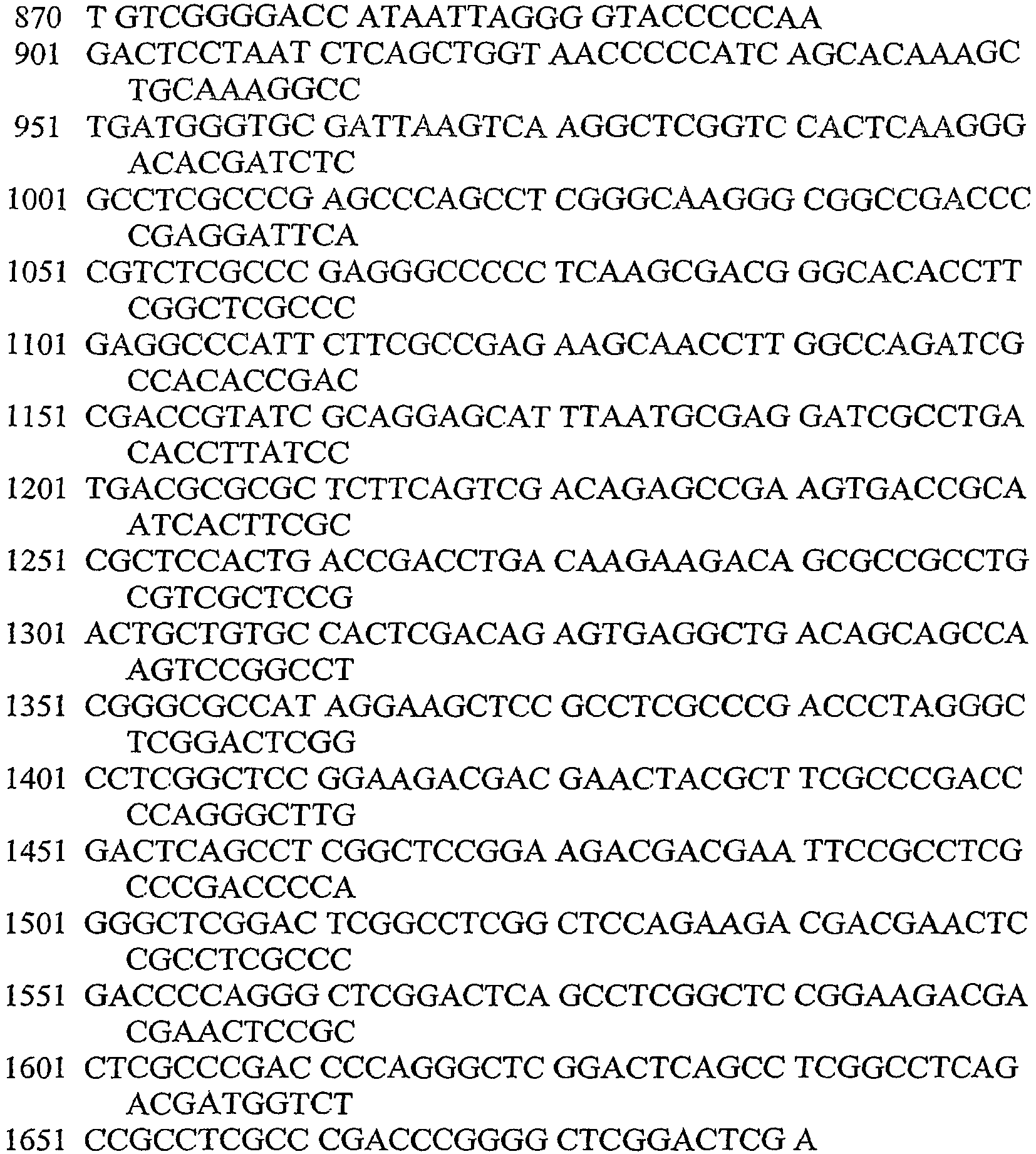
-
Region 4 (SEQ ID NO: 31) Fragment of cry1F gene


-
Region 5 (SEQ ID NO: 32) Fragment of maize chloroplast rpoC2 gene
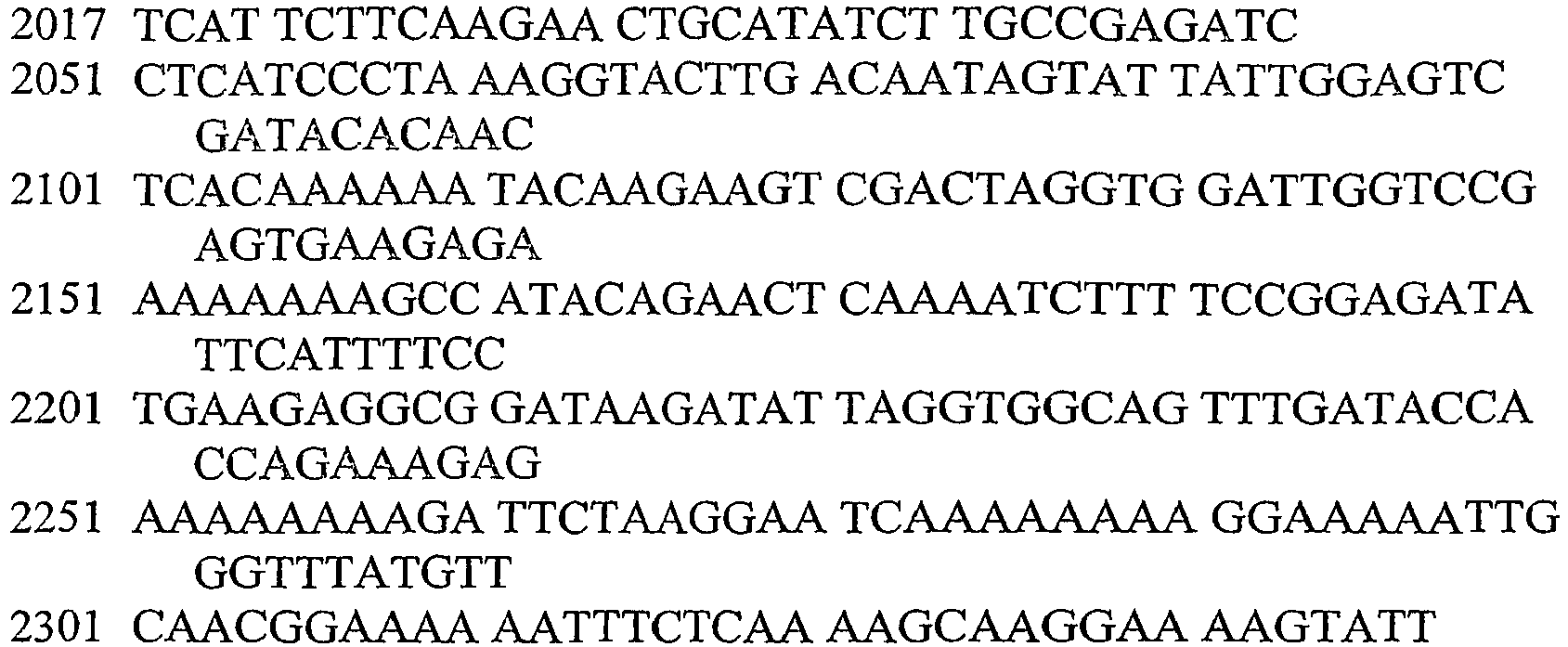
-
Region 6 (SEQ ID NO: 33) Fragment of maize chloroplast or ubiZM1(2) promoter

- Nucleotides 2355-2358 (CGT) connect Region 6 to Region 7a.
-
Region 7a (SEQ ID NO: 34) Fragment of pat gene

-
Region 7b (SEQ ID NO: 35) Fragment of pat gene (complement)

-
Region 7c (SEQ ID NO: 36) Fragment of cry1F gene (complement)
-
Region 8 (SEQ ID NO: 37) Fragment of Polylinker

- Region 9 (SEQ ID NO: 25) Full-length insert of PHI8999A
- In order to more fully describe the event TC1507 5' flanking sequence, homology searching was done against the GenBank public databases (
release 122, 2/01) using the Basic Local Alignment Search Tool (BLAST). The BLAST program performs sequence similarity searching and is particularly useful for identifying homologs to an unknown sequence. In addition to searching the public databases, pairwise alignments were performed using AlignX (InforMax Inc., Bethesda, MD) to look for homology between the maize event TC1507 flanking sequence and the PHI8999A transgenic insert. The results of these homology searches are presented in Table 1. The TC1507 5' flanking sequence is numbered withbase 1 being the furthest 5' to the insert and base 2830 at the starting point of the full-length PHI8999A transgenic insert (seeFIG. 1 ). The percent identity values indicate the percentage of identical matches across the length of the sequences analyzed. - In most cases, similarity searching with the event TC1507 5' flanking sequence resulted in a match to one unique sequence based on a very high percent identity value. Those sequences are identified in Table 1. In addition, there are two regions in the TC1507 5' DNA flanking sequence with high similarity to more than one known sequence. In regions 870-1681 and 2338-2354, the percent identity scores with both sequence fragments are sufficiently high that a single match (homolog) cannot be determined. The two possible homologs for each of these regions are indicated in Table 1.
- Highly similar sequences were identified for all but the first 669 base pairs of sequence. Generally, the results of similarity searching indicate high homology with maize genomic sequences 5' to base 1681. The region from base 1682 to the start of the PHI8999A insert at position 2830 contains some fragments associated with the transformation event.
Table 1. Sequence summary for event TC1507 insert Region Location in SEQ ID NO:24 Size bp % Identity Homolog Location in homologous sequence Description 1 1-669 669 N/A1 N/A N/A No significant homology detected 2 670-869 200 90.5 AF123535 52432-52632 (complement) Undescribed maize genomic sequence Region Location in SEQ ID NO:24 Seize bp % Identity Homolog Location in homologous sequence Description 3 870-1681 812 89.4 AF050439 1-801 Fragment of maize Huck-1 retrotransposon 5' LTR2 86.6 AF050438 1-797 Fragment of maize Huck-1 retro-transposon 3' LTR 4 1682-2016 335 100.0 PHI8999A 3149-3483 Fragment of cry1F gene 5 2017-2337 321 100.0 X86563 29429-29749 Fragment of maize chloroplast rpoC2 gene (RNA polymerase beta-2 subunit) 6 2338-2354 17 100.0 X86563 97643-97659 Fragment of maize chloroplast trnI gene (tRNA-Ile) 82.4 PHI8999A 182-197 Fragment of maize ubiZM1(2) promoter 7a 2358-2558 201 100.0 PHI8999A 5320-5475 Fragment of pat gene 7b 2559-2696 138 99 PHI8999A 5336-5518 (complement) Fragment of pat gene 7c 2697-2711 15 100.0 PHI8999A 2544-2558 (complement) Fragment of cry1F gene 8 2712-2829 118 100.0 PHI8999A 36-153 Fragment of polylinker region (bases 36-80) and ubiZM1(2) promoter (bases 81-153) 9 2830-9015 6186 100.0 PHI8999A 11 - 6196 Full-length insert of PHI8999A 10 9016-9565 550 100.0 PHI8999A 3906-4456 (complement) Inverted ORF25 terminator 11 9566-9693 128 100.0 NC_0016 66 121851-121978 (complement) & 100759-100886 Fragment of maize chloroplast rps12 rRNA (23S ribosomal RNA) Region Location in SEQ ID NO:24 Size bP % Identity Homolog Location in homologous sequence Description 12 9696-10087 392 99 NC_0016 66 17091-17483 (complement) Fragment of maize chloroplast genome 13 10088-10275 188 99 PHI8999A 5333-5520 (complement) Fragment of pat gene 14 10278-10358 81 100 NC_0016 66 137122-137202 (complement) Fragment of maize chloroplast "ORF241" - hypothetical protein gene 15 10359-10612 254 N/A1 N/A N/A No significant homology detected 16 10613-11361 749 N/A1 N/A N/A No description available 1 N/A; not applicable
2 LTR; long terminal repeat - PCR analysis was used to determine if
Regions Region 1 of the 5' Banking region from bp 25 to 324 (Reaction A - 300 bp amplicon); and from bp 25 to 480 (Reaction B - 456 bp amplicon). The expected amplicons were present in both the Hi-II unmodified corn line and in maize event TC1507. One PCR primer pair, Reaction C, spannedRegion 2 toRegion 3 of the 5' flanking region from bp 759 to 1182 (424 bp amplicon) and again produced PCR products of the expected size in both Hi-II and TC1507. Reaction D, spannedRegion 1 toRegion 3 of the 5' flanking region from bp 415 to 1182 (768 bp amplicon) and again produced PCR products of the expected size in both Hi-II and TC1507. Reactions E and F were designed as specific primer pairs for the pat gene region of the full-length insert of PHI8999A in TC1507 and thus an amplicon in the unmodified Hi-II corn line is not expected. The results indicate that both Reactions E and F are specific for a maize line transformed with a pat gene region and produce the expected amplicon, whereas no amplicon was produced in the unmodified Hi-II corn line. Reaction G was also designed as a primer pair that would produce an amplicon of 366 bp in the maize event TC1507 and no amplicon in the unmodified Hi-II corn line. - Reactions H and I were designed as specific primer pairs for TC1507 that would span the end of the transgenic insert into the 5' flanking region. In both Reactions H and I, the reverse primer was located in the ubiquitin promoter region of the full-length PHI8999A insert (
Region 9 in Table 1) and the forward primer was located inRegion 5, the rpoC2 gene fragment (see Table 1). Reaction H and Reaction I both produced an amplicon in maize line TC1507 and did not produce an amplicon in the unmodified control corn line. These results indicate that both Reactions H and I are specific for the TC1507 event. - The PCR results show that the undescribed sequence (Region 1) is present in the unmodified corn line Hi-II and that
Regions Table 2. PCR reactions for sequence 5' to the PHI8999A insert in maize event TC1507 and for regions within the full-length insert of PHI8999A in maize event TC1507 Reaction PCR Amplicon Location Amplicon Size (bp) Region in TC1507 flanking sequence or PHI8999A insert Amplicon present In Hi-II Amplicon present in maize line TC1507 A 25 - 324 bp in TC1507 flanking sequence 300 Region 1 Yes Yes B 25 - 480 bp in TC1507 flanking sequence 456 Region 1 Yes Yes Reaction PCR Amplicon Location Amplicon Size (bp) Region in TC1507 flanking sequence or PHI8999A insert Amplicon present In Hi-II Amplicon present in maize line TC1507 bp in TC1507 flanking sequence 3 D 415 - 1182 bp in TC1507 5' flanking sequence 768 Region 1 to Region3 Yes Yes E 4750 - 5794 bp in PHI8999A 1045 Region 9 (in full-length insert of PHI8999A 35S promoter to pat gene) No Yes Not Unique to TC1507 F 4827 - 5308 bp in PHI8999A 482 Region 9 (in full-length insert of PHI8999A 35S promoter to pat gene) No Yes Not Unique to TC1507 Detects cry IF fragment in 5' flanking region cry1F sequence in 5' flanking sequence and in full-lengtli insert of PHI8999A 366 Spans 335 bp Cry1F sequence in 5' flanking sequence and same sequence in the full-length insert No Yes H 2158 bp in Region 5 (rpoC2 gene fragment) to 3069 bp in Region 9 (full-length insert of PHI8999A) 912 Region 5 to Region 9 Unique to Insertion Event [SPANS UNIQUE JUNCTION REGIONS] No Yes Unique to TC1507 I 2158 bp in Region 5 (rpoC2 gene fragment) to 3001 bp in Region 9 (full-length insert of PHI8999A) 844 Region 5 to Region 9 Unique to Insertion Event [SPANS UNIQUE JUNCTION REGIONS] No Yes Unique to TC1507 Table 3. PCR primers for sequence 5' to the PHI8999A insert in TC1507 and for regions within the full-length insert of PHI8999A in maize event TC1507 Reaction Amplicon Size (bp) Primer Pair Primer Sequences 5' to 3' A 300 SEQ ID NO:10 CCCCTACCCCACCGACGTTTAT SEQ ID NO:11 TTGATTGGCAGGTCCGTGGGTC B 456 SEQ ID NO:10 CCCCTACCCCACCGACGTTTAT SEQ ID NO:12 CACAACGGCACAGAAACACGAA C 424 SEQ ID NO:13 GCGCACCCACCGGAACAAAATG SEQ ID NO:14 TCCTCGCATTAAATGCTCCTGC D 768 SEQ ID NO:15 CCTGGCACGCATTGACGCATGT SEQ ID NO:14 TCCTCGCATTAAATGCTCCTGC E 1045 SEQ ID NO:6 TAGAGGACCTAACAGAACTCGCCGT SEQ ID NO:7 GAGCTGGCAACTCAAAATCCCTTT Reaction Amplicon Size (bp) Primer Pair Primer Sequences 5' to 3' F 482 SEQ ID NO:8 AAAATCTTCGTCAACATGGTGGAGC SEQ ID NO:9 TAATCTCAACTGGTCTCCTCTCCGG G 366 SEQ ID NO:19 GGCTCGGACTCGACCTTTCTAT SEQ ID NO:20 GCAGTTCTTGAAGAATGAGTGA H 912 SEQ ID NO:1 
SEQ ID NO:2 
I 844 SEQ ID NO:2 
SEQ ID NO:23 CTTCAAACAAGTGTGACAAA - Two separate PCR approaches were used to extend the length of the sequence information 3' to the full-length PHI8999A insert in maize event TC1507. In the first approach PCR primer pairs were designed to amplify a product that spanned the junction between the full-length insert and the inverted ORF25 terminator, see
FIG. 1 for a depiction of the inverted ORF25 terminator. A forward primer was located at the end of the full-length PHI8999A insert and a series of reverse primers were located at 100 bp intervals in the inverted sequence. In this manner the length of the inverted fragment present in the maize event TC1507 could be determined within a 100 bp region based on the successful PCR reactions. This method indicated the inverted fragment contained the majority of the ORF25 terminator but no Cry1F sequence. PCR fragments were isolated and sequenced from this region. - In the second approach PCR primers were designed to walk out into the flanking DNA sequence from the inverted ORF25 terminator region as determined in the PCR experiment described above. Genomic DNA isolated from two to three individual plants of event TC1507 and an unmodified control corn line was digested with various restriction enzymes and then ligated to adaptors specific for the restriction enzyme used for digestion (Universal Genome Walker™ Kit, Clontech Laboratories, Inc. and Devon et al. (1995) Nucleic Acids Res. 23:1644-1645). Primary PCR was carried out using an ORF25 terminator specific primer and a primer homologous to the adaptor sequence ligated onto the digested DNA. In order to increase the specificity of the reaction a nested secondary PCR was performed again with another ORF25 terminator specific primer and a secondary primer homologous to the adaptor sequence with the secondary primers being internal to the respective primers used in the primary PCR. Products produced by the nested PCR were analyzed by agarose gel electrophoresis and fragments unique to TC1507 DNA samples were isolated and sequenced. Fragments were amplified from both the ORF25 terminator contained within the full-length insert and from the targeted (inverted) ORF25 terminator on the 3' end of the full-length PHI8999A insert. Fragments from the full-length insert were of a predicted size based on the knowledge of the restriction enzyme sites located in the full-length insert. Fragments produced from the 3' inverted ORF25 terminator appeared as fragments of unexpected size. Sequence analysis of amplified fragments from the 3' inverted ORF25 terminator resulted in flanking DNA sequence of 1043 bp. Resultant sequence from the above series of genome walking experiments was used to design additional primers to walk further out from the insert into the bordering maize genome with a final 3' flanking sequence, of 2346 bp.
- In order to describe the TC1507 3' flanking sequence, homology searching was done against the GenBank public databases using the Basic Local Alignment Search Tool (BLAST). The BLAST program performs sequence similarity searching and is particularly useful for identifying homologs to an unknown sequence. In addition to searching the public databases, alignments were performed using SeqMan 4.05™, Martinez and Needleman-Wunsch alignment algorithms (DNASTAR Inc.) to look for homology between the TC1507 3' flanking sequence and the PHI8999A transgenic insert. The results of these homology searches are presented in Table 1. The percent identity values indicate the percentage of identical matches across the length of the sequences analyzed. The results of similarity searching for the 3' flanking sequence indicate high homology with three regions of maize chloroplast DNA, a 188 bp fragment of the pat gene, and 254 bp of DNA (
Region 15, Table 1) with no significant homology. An additional 749 bp (Region 16) beyond Region 15 (see Table 1) was also sequenced. No similarity searching results are available forRegion 16. - PCR analysis on control and TC1507 genomic DNA determined that the 254 bp sequence (
Region 15, fragment of maize chloroplast "ORF241") is present in the maize genome. The DNA sequence ofRegion 15 in the 3' flanking region is not unique to the 3' flanking region of maize event TC1507 but is also present in the unmodified control corn line. The TC1507 3' flanking sequence is presented in Example 8 and diagrammed inFIG. 1 . -
-
Region 10 (SEQ ID NO: 38) Fragment ofORF25 Terminator (complement)

-
Region 11 (SEQ ID NO: 39) Fragment of maize chloroplast rps12 rRNA gene (complement)

-
Nucleotides 9694-9695 (CG) connect
Region 11 toRegion 12. -
Region 12 (SEQ ID NO: 40) Fragment of maize chloroplast genome
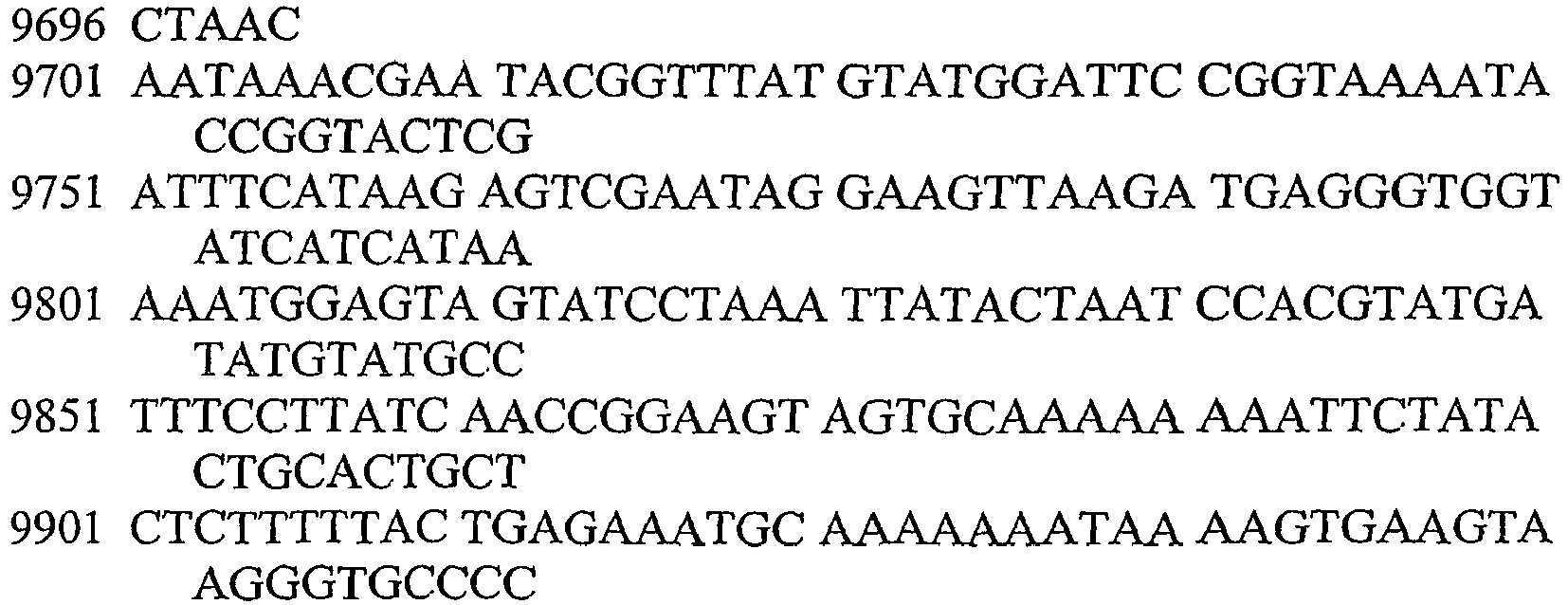

- Region 13 (SEQ ID NO: 41) Fragment of pat gene (complement)
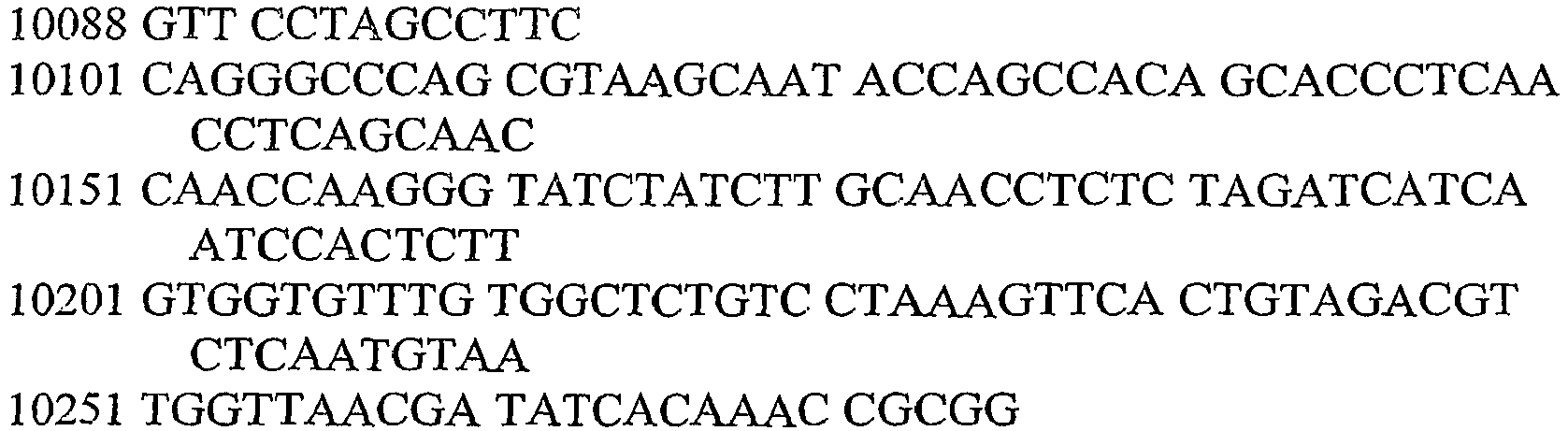
-
Nucleotides 10276-10277 (AA) connect
Region 13 toRegion 14. -
Region 14 (SEQ ID NO: 42) Fragment of maize chloroplast ORF241 (complement)

-
Region 15 (SEQ ID NO: 43) Maize genomic (no significant homology)
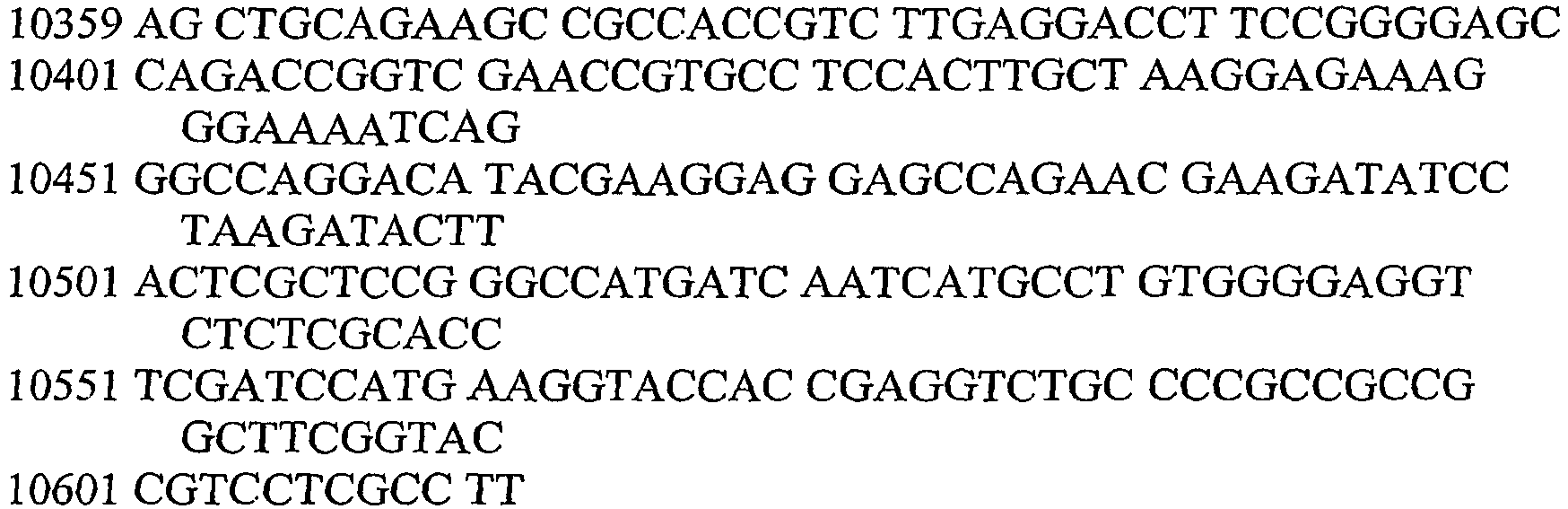
-
Region 16 (SEQ ID NO: 44) Maize genomic


- PCR analysis was used to determine if the undescribed region of sequence on the end of the 3' flanking sequence (
Region 15 in Table 1) is present in the unmodified control corn line used for transformation to produce maize event TC1507 and thus represents a border with corn genomic DNA. Successful PCR amplification ofRegion 15 in both maize line TC1507 and the unmodified Hi-II control corn line revealed thatRegion 15 was indeed present in corn genomic DNA. Five different PCR analyses were carried out on genomic DNA prepared from TC1507 and the unmodified Hi-II control corn line as outlined in Table 7 below using the primer sequences shown in Table 8. Three reactions were designed to amplify DNA withinRegion 15 of the 3' flanking region; Reaction L - producing a 175 bp amplicon, Reaction M - producing a 134 bp amplicon, and Reaction N - producing a 107 bp amplicon. The expected amplicons were present in both the unmodified control corn line and in maize line TC1507. Reactions J and K were designed as specific primer pairs for TC1507 that would span the end of the insert into the 3' flanking region. In Reaction J, the forward primer was located in the pat gene fragment on the 3' end of the full-length PHI8999A insert (Region 13 in Table 1) and the reverse primer was located in theundefined Region 15. In Reaction K the forward primer was located in the chloroplast hypothetical protein gene on the 3' end of the full-length insert (Region 14 in Table 1) and the reverse primer was located in theundefined Region 15. Both Reaction J and Reaction K produced an amplicon in maize line TC1507 and did not produce an amplicon in the unmodified control corn line. The results indicate that both Reactions J and K are specific for the TC1507 event. - The PCR results indicate that the undescribed sequence (Region 15) of the 3' flanking sequence of TC1507 is also present in genomic DNA isolated from the unmodified Hi-II control corn line. The DNA sequences amplified in Reactions L, M, and N are not unique to the 3' flanking region of TC1507 but are also present in the unmodified control corn line.
Table 7. PCR reactions for sequence 3' to the PHI8999A insert in maize event TC1507 Reaction Amplicon Size (bp) Region in TC1507 3' flanking sequence Amplicon present in Control Amplicon present in maize line TC1507 J 342 Region 13 (pat gene fragment) to Region 15No Yes K 252 Region 14 (chloroplast gene) to Region 15No Yes L 175 Region 15Yes Yes M 134 Region 15Yes Yes N 107 Region 15Yes Yes Table 8. PCR primers for sequence 3' to the PHI8999A insert in maize event TC1507 Reaction Amplicon Size (bp) Primer Pair Primer Sequences 5' to 3' J 342 SEQ ID NO:3 
SEQ ID NO:5 
K 252 SEQ ID NO:4 
SEQ ID NO:5 
L 175 SEQ ID NO:16 
SEQ ID NO:5 
M 134 SEQ ID NO:17 
SEQ ID NO:5 
N 107 SEQ ID NO:18 
SEQ ID NO:5 
- DNA event specific primer pairs were used to produce an amplicon diagnostic for TC1507. These event primer pairs include, but are not limited to, SEQ ID NO: 1 and SEQ ID NO: 2; SEQ ID NO: 2 and SEQ ID NO: 23; SEQ ID NO: 3 and SEQ ID NO: 5; and SEQ ID NO: 4 and SEQ ID NO: 5. In addition to these primer pairs, any primer pair derived from SEQ ID NO: 26 and SEQ ID NO: 27 that when used in a DNA amplification reaction produces a DNA amplicon diagnostic for TC1507 is an aspect of the present invention. The amplification conditions for this analysis are illustrated in Table 9, however, any modification of these methods that use DNA primers or complements thereof to produce an amplicon DNA molecule diagnostic for TC1507 is within the ordinary skill of the art. The preferred amplification conditions for reactions utilizing the PCR primers identified in SEQ ID NOS: 1, 2, and 23 are illustrated in Table 10. In addition, control primer pairs, which include SEQ ID NOS: 10 and 11; SEQ ID NOS: 10 and 12; SEQ ID NOS: 13 and 14; SEQ ID NOS: 14 and 15; SEQ ID NOS: 5 and 16; SEQ ID NOS: 5 and 17; and SEQ ID NOS: 5 and 18; for amplification of an endogenous corn gene are included as internal standards for the reaction conditions. Also included are primer pairs that will produce an amplicon in transgenic events containing a pat gene (SEQ ID NOS: 6 and 7; SEQ ID NOS: 8 and 9), and a primer pair that will produce an amplicon in transgenic events containing a cry1f gene (SEQ ID NOS: 19 and 20).
- The analysis of plant tissue DNA extracts to test for the presence of the TC1507 event should include a positive tissue DNA extract control (a DNA sample known to contain the transgenic sequences). A successful amplification of the positive control demonstrates that the PCR was run under conditions which allow for the amplification of target sequences. A negative, or wild-type, DNA extract control in which the template DNA provided is either genomic DNA prepared from a non-transgenic plant, or is a non-TC1507 transgenic plant, should also be included. Additionally a negative control that contains no template corn DNA extract will be a useful gauge of the reagents and conditions used in the PCR protocol.
- Additional DNA primer molecules of sufficient length can be selected from SEQ ID NO: 26 and SEQ ID NO: 27 by those skilled in the art of DNA amplification methods, and conditions optimized for the production of an amplicon that may differ from the methods shown in Table 9 or Table 10 but result in an amplicon diagnostic for event TC1507. The use of these DNA primer sequences with modifications to the methods shown in Table 9 and Table 10 are within the scope of the invention. The amplicon wherein at least one DNA primer molecule of sufficient length derived from SEQ ID NO: 26 and SEQ ID NO: 27 that is diagnostic for event TC1507 is an aspect of the invention. The amplicon wherein at least one DNA primer of sufficient length derived from any of the genetic elements of PHI8999A that is diagnostic for event TC1507 is an aspect of the invention. The assay for the TC1507 amplicon can be performed by using a Stratagene Robocycler, MJ Engine, Perkin-Elmer 9700, or Eppendorf Mastercycler Gradient thermocycler, or by methods and apparatus known to those skilled in the art.
Table 9. PCR Conditions: Conditions: Kit used: Perkin-Elmer AmpliTAQ Gold kit Volume Component 5 µl template (10 ng/µl) 4 µ l 2 µl each primer (10 µM) 2 µl 10X PCR Gold Buffer 2 µl 25 mM MgCl 22 µl 50X dNTP's (10 mM) 0.1 µl Amplitaq Gold Polymerase 4.9 µl H2O 20 µl Total Cycling Parameters GeneAmp® PCR System 9700 9 min 92°C 30 cycles: 94°C 30 sec 60°C 30 sec 72° C 1 min7 min 72° C Hold 4°C Table 10. PCR Conditions used with the Advantage®- GC 2 Polymerase Mix:Conditions: Kit used: Advantage®- GC 2 PolymeraseMix Volume Component 5 µl template (10 ng/µl) 5 µl 2.5 µl each primer (10 µM) 10 µl 5x GC2 Buffer 10 µl GC melt (1.0 M final conc.) 1.5 µl 50X dNTP's (10 mM) 1.0 µl Advantage GC2 Polymerase 17.5 µl H2O 50 µl Total Cycling Parameters GeneAmp® PCR System 9700 5 min 94° C 35 cycles: 94° C 1 min60° C 2 min72° C 3 min7 min 72° C Hold 4°C - Having illustrated and described the principles of the present invention, it should be apparent to persons skilled in the art that the invention can be modified in arrangement and detail without departing from such principles. We claim all modifications that are within the scope of the appended claims.
-
- <110> Dow AgroSciences LLC
E. I. du Pont de Nemours and Company Pioneer Hi-Bred International, Inc. - <120> Corn Event TC1507 and Methods for
Detection Thereof - <130> 1523-PCT
- <150>
US 60/467,772
<151> 2003-05-02 - <160> 57
- <170> FastSEQ for Windows Version 4.0
- <210> 1
<211> 30
<212> DNA
<213> Artificial Sequence - <220>
<223> Event specific primer sequence designed for TC1507 - <400> 1
gtagtactat agattatatt attcgtagag 30 - <210> 2
<211> 30
<212> DNA
<213> Artificial Sequence - <220>
<223> Event specific primer sequence designed for TC1507 - <400> 2
gccatacaga actcaaaatc ttttccggag 30 - <210> 3
<211> 25
<212> DNA
<213> Artificial Sequence - <220>
<223> Event specific primer designed for TC1507. - <400> 3
tgtggtgttt gtggctctgt cctaa 25 - <210> 4
<211> 25
<212> DNA
<213> Artificial Sequence - <220>
<223> Event specific primer for TC1507. - <400> 4
agcacctttt cattctttca tatac 25 - <210> 5
<211> 25
<212> DNA
<213> Artificial Sequence - <220>
<223> Genomic DNA primer sequence - <400> 5
gacctcccca caggcatgat tgatc 25 - <210> 6
<211> 25
<212> DNA
<213> Artificial Sequence - <220>
<223> Primer in full length insert, 35S promoter to pat gene - <400> 6
tagaggacct aacagaactc gccgt 25 - <210> 7
<211> 24
<212> DNA
<213> Artificial Sequence - <220>
<223> Primer in full length insert, 35S promoter to pat gene - <400> 7
gagctggcaa ctcaaaatcc cttt 24 - <210> 8
<211> 25
<212> DNA
<213> Artificial Sequence - <220>
<223> Primer in full length insert, 35S promoter to pat gene - <400> 8
aaaatcttcg tcaacatggt ggagc 25 - <210> 9
<211> 25
<212> DNA
<213> Artificial Sequence - <220>
<223> Primer in full length insert, 35S promoter to pat gene - <400> 9
taatctcaac tggtctcctc tccgg 25 - <210> 10
<211> 22
<212> DNA
<213> Artificial Sequence - <220>
<223> Primer - Zea mays genomic DNA - <400> 10
cccctacccc accgacgttt at 22 - <210> 11
<211> 22
<212> DNA
<213> Artificial Sequence - <220>
<223> Primer - Zea mays genomic DNA - <400> 11
ttgattggca ggtccgtggg tc 22 - <210> 12
<211> 22
<212> DNA
<213> Artificial Sequence - <220>
<223> Primer - Zea mays genomic DNA. - <400> 12
cacaacggca cagaaacacg aa 22 - <210> 13
<211> 22
<212> DNA
<213> Artificial Sequence - <220>
<223> Primer - Zea mays genomic DNA. - <400> 13
gcgcacccac cggaacaaaa tg 22 - <210> 14
<211> 22
<212> DNA
<213> Artificial Sequence - <220>
<223> Primer - Zea mays genomic DNA. - <400> 14
tcctcgcatt aaatgctcct gc 22 - <210> 15
<211> 22
<212> DNA
<213> Artificial Sequence - <220>
<223> Primer - Zea mays genomic DNA. - <400> 15
cctggcacgc attgacgcat gt 22 - <210> 16
<211> 25
<212> DNA
<213> Artificial Sequence - <220>
<223> Primer - Zea mays genomic DNA. - <400> 16
aagccgccac cgtcttgagg acctt 25 - <210> 17
<211> 25
<212> DNA
<213> Artificial Sequence - <220>
<223> Primer - Zea mays genomic DNA. - <400> 17
gtcgaaccgt gcctccactt gctaa 25 - <210> 18
<211> 25
<212> DNA
<213> Artificial Sequence - <220>
<223> Primer - Zea mays genomic DNA. - <400> 18
agaaagggaa aatcagggcc aggac 25 - <210> 19
<211> 22
<212> DNA
<213> Artificial Sequence - <220>
<223> Cry1F sequence primer - <400> 19
ggctcggact cgacctttct at 22 - <210> 20
<211> 22
<212> DNA
<213> Artificial Sequence - <220>
<223> Cry1F sequence primer - <400> 20
gcagttcttg aagaatgagt ga 22 - <210> 21
<211> 2829
<212> DNA
<213> 5' flanking sequence of event TC1507 - <400> 21

- <210> 22
<211> 2346
<212> DNA
<213> 3' flanking sequence of event TC1507 - <400> 22
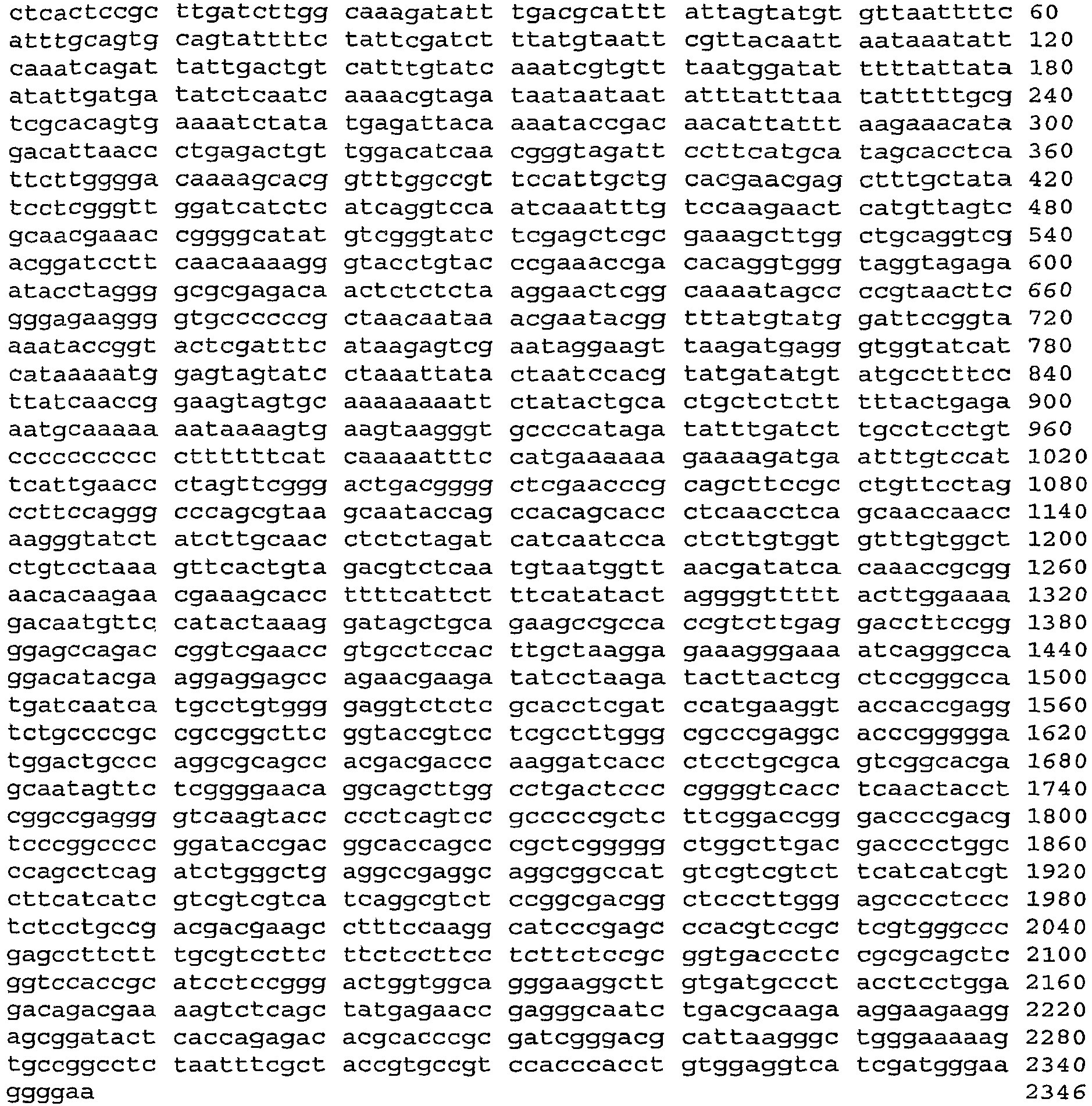
- <210> 23
<211> 20
<212> DNA
<213> Artificial Sequence - <220>
<223> Event specific primer sequence designed for TC1507 - <400> 23
cttcaaacaa gtgtgacaaa 20 - <210> 24
<211> 11361
<212> DNA
<213> Artificial Sequence - <220>
<223> The sequence represents the transgenic insert in maize line TC1507 as well as the sequence flanking the insertion sites. - <400> 24

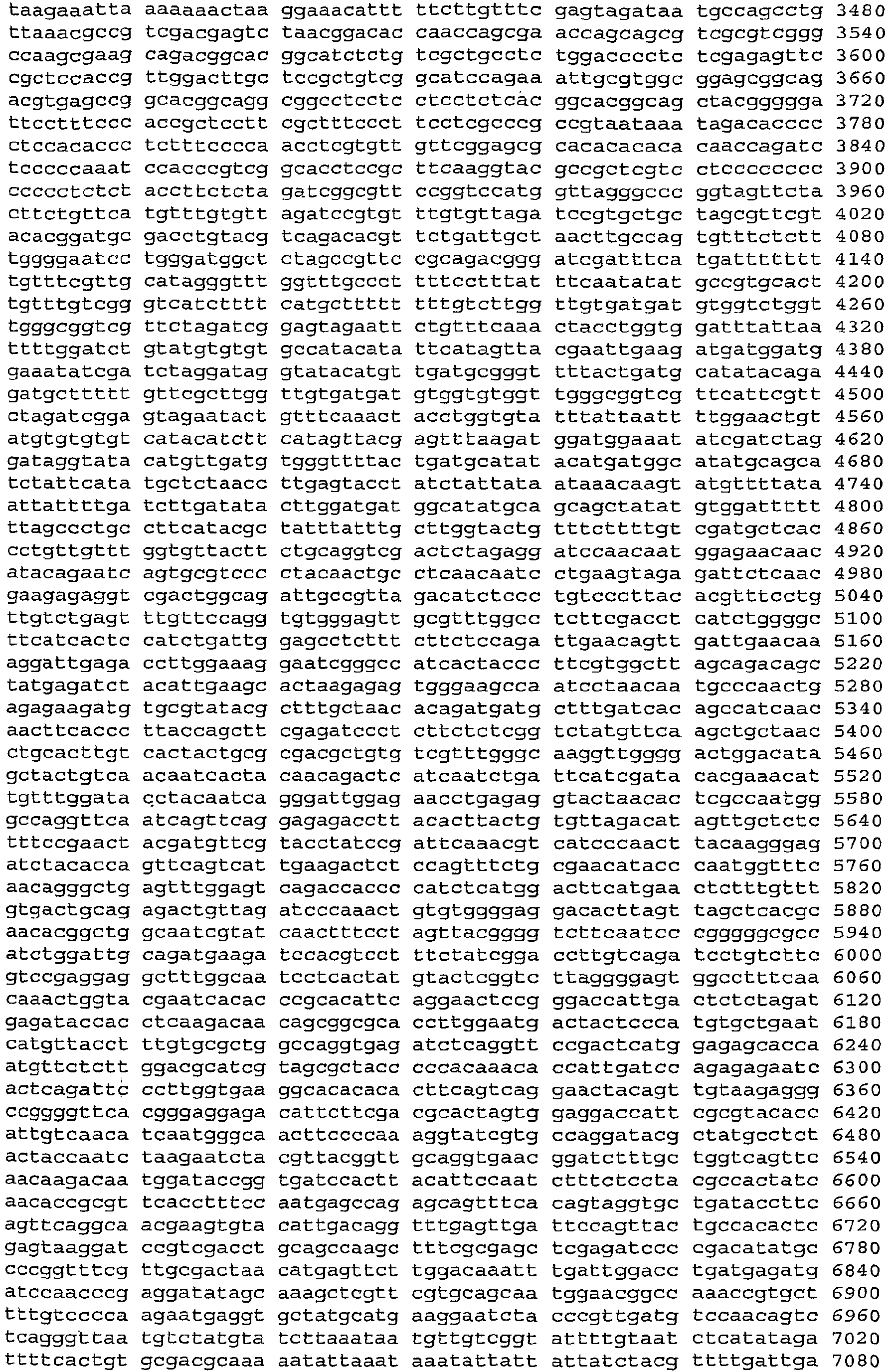

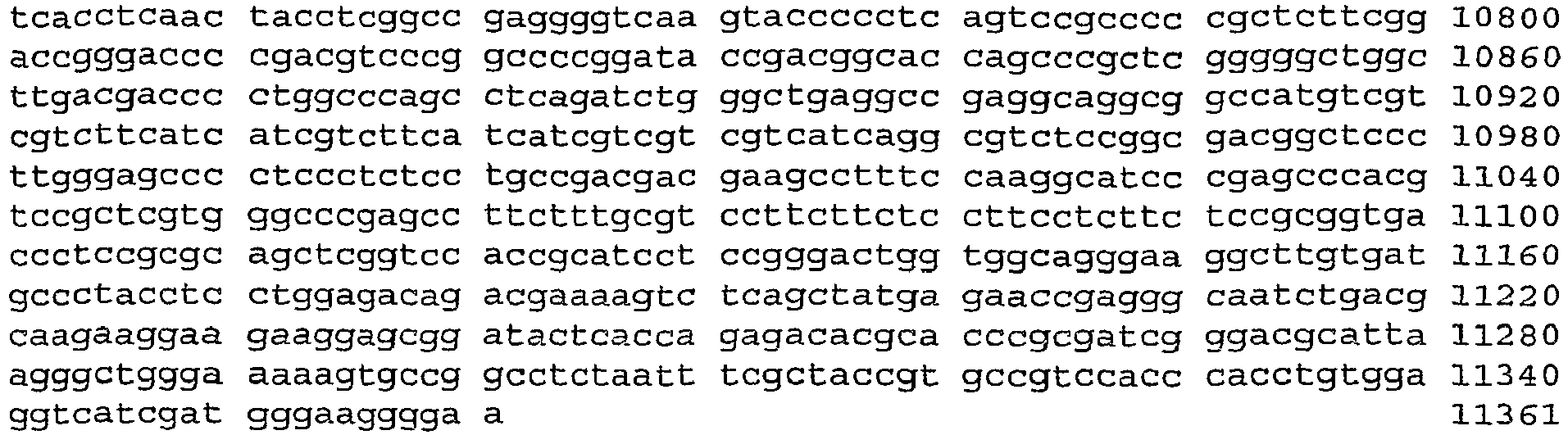
- <210> 25
<211> 6186
<212> DNA
<213> Artificial Sequence - <220>
<223> The sequence represents the DNA molecule used to transform maize line TC1507. This sequence represents insert PHI8999A. - <400> 25
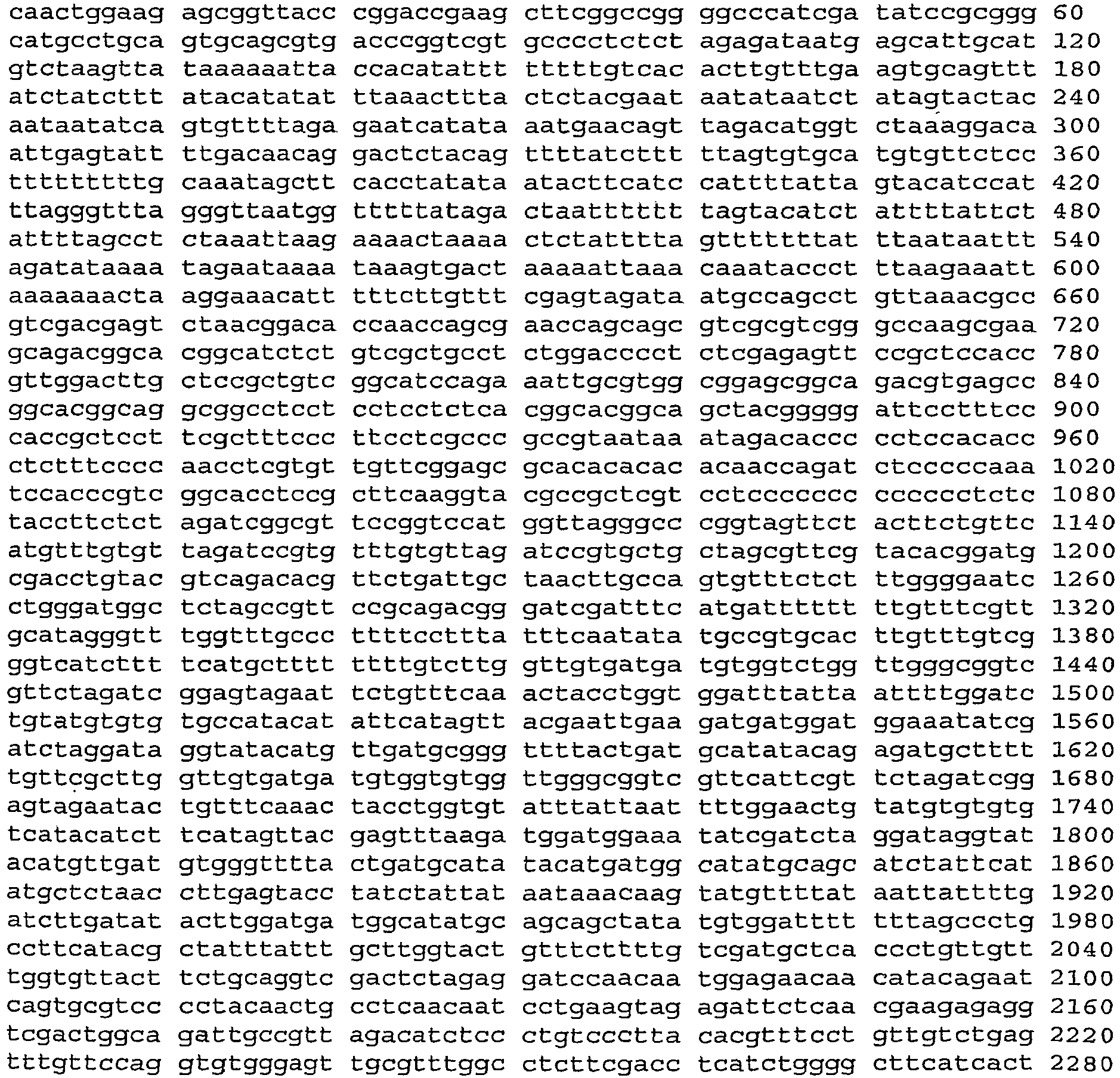
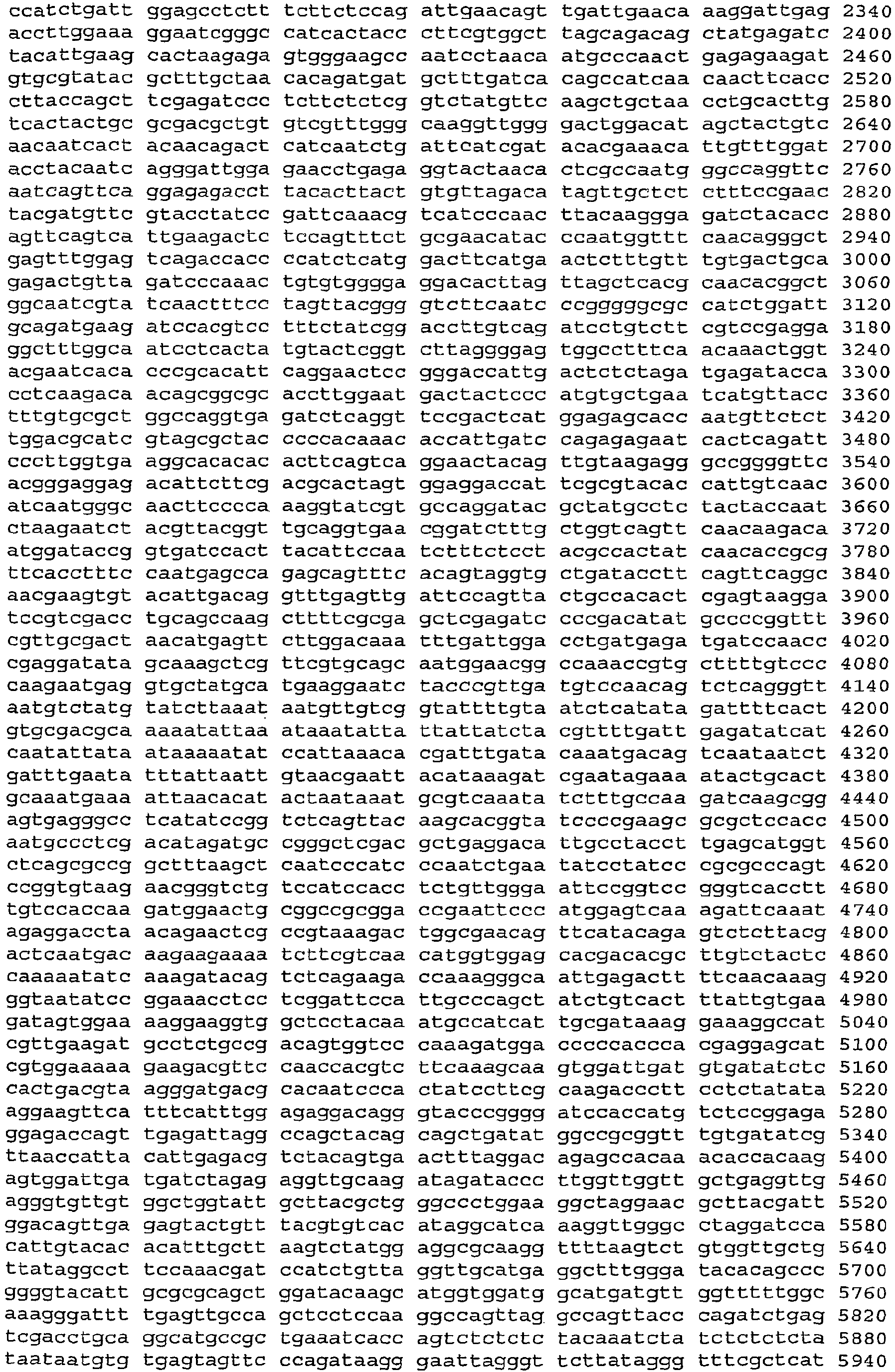

- <210> 26
<211> 3830
<212> DNA
<213> Artificial Sequence - <220>
<223> Sequence that represents part of the PHI8999A insert as well as flanking sequence 5' to the insert. - <400> 26


- <210> 27
<211> 3347
<212> DNA
<213> Artificial Sequence - <220>
<223> Sequence that represents part of the PHI8999A insert as well as flanking sequence 3' to the insert. - <400> 27


- <210> 28
<211> 669
<212> DNA
<213> Zea mays - <400> 28

- <210> 29
<211> 200
<212> DNA
<213> Zea mays - <400> 29

- <210> 30
<211> 812
<212> DNA
<213> Zea mays - <220>
<223> Fragment of maize Huck-1 retrotransposon - <400> 30
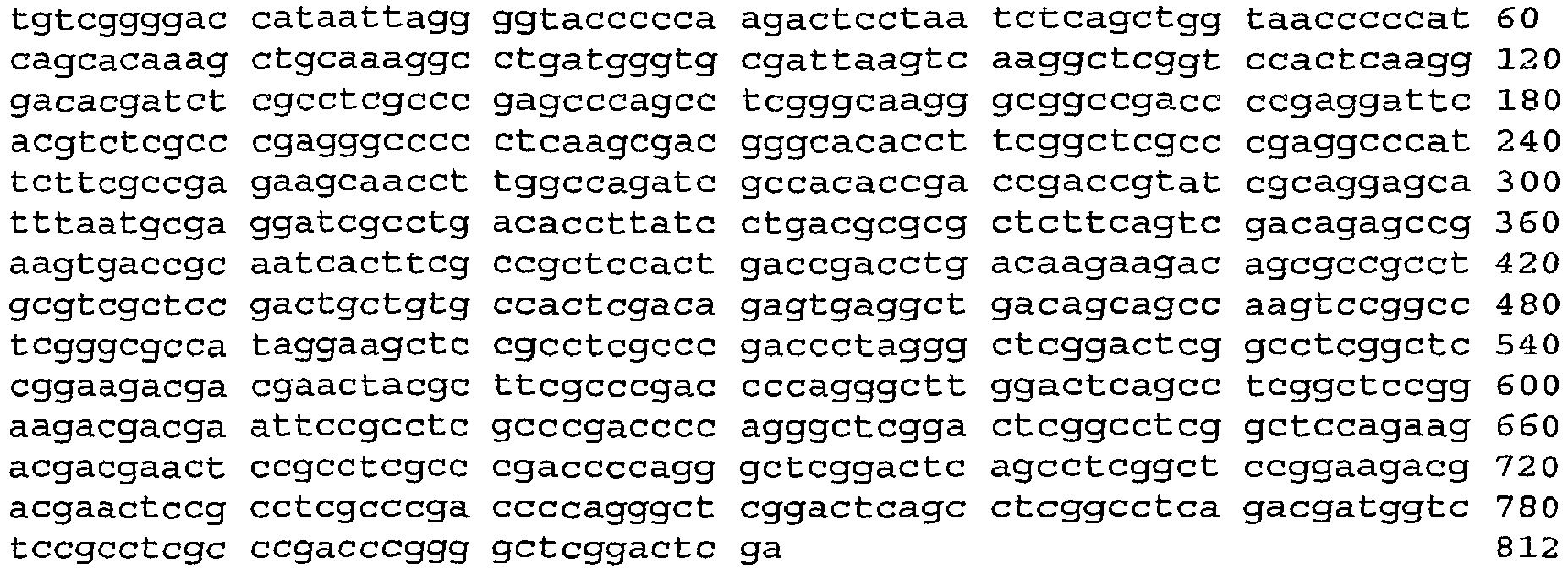
- <210> 31
<211> 335
<212> DNA
<213> Artificial Sequence - <220>
<223> Represents part of PHI8999A insert sequence - fragment of cry1F gene - <400> 31

- <210> 32
<211> 321
<212> DNA
<213> Zea mays - <220>
<223> Fragment of maize chloroplast rpoC2 gene - <400> 32

- <210> 33
<211> 17
<212> DNA
<213> Artificial Sequence - <220>
<223> Represents part of PHI8999A insert sequence-fragment of ubiZM1(2) promoter; also a fragment of the maize chloroplast trn1 gene - <400> 33
gtggctattt atctatc 17 - <210> 34
<211> 201
<212> DNA
<213> Artificial Sequence - <220>
<223> Represents part of PHI8999A insert sequence - fragment of pat gene - <400> 34

- <210> 35
<211> 138
<212> DNA
<213> Artificial Sequence - <220>
<223> Represents part of PHI8999A insert sequence - fragment of pat gene (complement) - <400> 35

- <210> 36
<211> 15
<212> DNA
<213> Artificial Sequence - <220>
<223> Represents part of PHI8999A insert sequence - fragment of cry1F gene (complement) - <400> 36
agagaagagg gatct 15 - <210> 37
<211> 118
<212> DNA
<213> Artificial Sequence - <220>
<223> Represents part of PHI8999A insert sequence - fragment of polylinker - <400> 37

- <210> 38
<211> 550
<212> DNA
<213> Artificial Sequence - <220>
<223> Represents part of PHI8999A insert sequence - fragment of ORF25 terminator (complement) - <400> 38

- <210> 39
<211> 128
<212> DNA
<213> Zea mays - <220>
<223> Fragment of maize chloroplast rps12 rRNA gene (complement) - <400> 39

- <210> 40
<211> 392
<212> DNA
<213> Zea mays - <220>
<223> Fragment of maize chloroplast genome - <400> 40

- <210> 41
<211> 188
<212> DNA
<213> Artificial Sequence - <220>
<223> Represents part of PHI8999A insert sequence - fragment of pat gene (complement) - <400> 41

- <210> 42
<211> 81
<212> DNA
<213> Zea mays - <220>
<223> Fragment of maize chloroplast ORF241 (complement) - <400> 42

- <210> 43
<211> 254
<212> DNA
<213> Zea mays - <400> 43

- <210> 44
<211> 749
<212> DNA
<213> Zea mays - <400> 44

- <210> 45
<211> 20
<212> DNA
<213> Artificial Sequence - <220>
<223> 5' event flanking sequence; junction betweenregions - <400> 45
tcggactcga cctttctatc 20 - <210> 46
<211> 20
<212 DNA
<213> Artificial Sequence - <220>
<223> 5' event flanking sequence; junction betweenregions - <400> 46
agagaatcac tcattcttca 20 - <210> 47
<211> 20
<212> DNA
<213> Artificial Sequence - <220>
<223> 5' event flanking sequence; junction betweenregions 5 and 6 - <400> 47
gaaaagtatt gtggctattt 20 - <210> 48
<211> 20
<212> DNA
<213> Artificial Sequence - <220>
<223> 5' event flanking sequence; junction between regions 6 and 7a - <400> 48
tctcaaggcc gcagctgata 20 - <210> 49
<211> 20
<212> DNA
<213> Artificial Sequence - <220>
<223> 5' event flanking sequence; junction between regions 7a and 7b - <400> 49
ggctaggaac cctcaacctc 20 - <210> 50
<211> 20
<212> DNA
<213> Artificial Sequence - <220>
<223> 5' event flanking sequence; junction betweenregions 7b and 7c - <400> 50
tcacaaaccg agagaagagg 20 - <210> 51
<211> 20
<212> DNA
<213> Artificial Sequence - <220>
<223> 5' event flanking sequence; junction betweenregions - <400> 51
agagggatct cgaagcttcg 20 - <210> 52
<211> 20
<212> DNA
<213> Artificial Sequence - <220>
<223> 5' event flanking sequence; junction betweenregions - <400> 52
aaaattacca caactggaag 20 - <210> 53
<211> 20
<212> DNA
<213> Artificial Sequence - <220>
<223> 3' event flanking sequence; junction betweenregions - <400> 53
agctatgttt ctcactccgc 20 - <210> 54
<211> 20
<212> DNA
<213> Artificial Sequence - <220>
<223> 3' event flanking sequence; junction betweenregions - <400> 54
acggatcctt caacaaaagg 20 - <210> 55
<211> 20
<212> DNA
<213> Artificial Sequence - <220>
<223> 3' event flanking sequence; junction betweenregions - <400> 55
gtgccccccg ctaacaataa 20 - <210> 56
<211> 20
<212> DNA
<213> Artificial Sequence - <220>
<223> 3' event flanking sequence; junction betweenregions - <400> 56
gcttccgcct gttcctagcc 20 - <210> 57
<211> 20
<212> DNA
<213> Artificial Sequence - <220>
<223> 3' event flanking sequence; junction betweenregions - <400> 57
aaaccgcgga acacaagaac 20
Claims (34)
- An isolated DNA molecule comprising a nucleotide sequence identified as SEQ ID NO:21, 22, 24, 26 or 27.
- A kit for identifying event TC1507 in a biological sample which detects a TC1507 specific region, said kit comprising a first primer which recognizes SEQ ID NO:21 or SEQ ID NO:22, and a second primer which recognizes SEQ ID NO:25.
- The kit of claim 2, wherein said at least first and second primers comprise the sequence of SEQ ID NO:1 and SEQ ID NO:2, respectively.
- The kit of claim 2, wherein said at least first and second primers comprise the sequence of SEQ ID NO:2 and SEQ ID NO:23, respectively.
- The kit of claim 2, wherein said at least first and second primers comprise the sequence of SEQ ID NO:3 and SEQ ID NO:5, respectively.
- The kit of claim 2, wherein said at least first and second primers comprise the sequence of SEQ ID NO:4 and SEQ ID NO:5, respectively.
- A DNA detection kit comprising at least one DNA molecule that is homologous or complementary to SEQ ID NO: 26 or 27, wherein the DNA molecule is specific for junction DNA of maize event TC1507 and is of a sufficient length of contiguous DNA polynucleotides to function in a DNA detection method.
- A kit for identifying event TC1507 in a biological sample, said kit comprising: a specific probe comprising a sequence which hybridizes with SEQ ID NO:21 and SEQ ID NO:25, contiguous therewith.
- A kit for identifying event TC1507 in a biological sample, said kit comprising: a specific probe comprising a sequence which hybridizes with SEQ ID NO:22 and SEQ ID NO:25, contiguous therewith.
- A DNA detection kit comprising a polynucleotide probe that hybridizes under stringent hybridization conditions with one or more DNA sequences selected from the group consisting of SEQ ID NO: 45, 46, 47, 49, 50, 51, 52, 54, 55, 56 and 57 and complements thereof.
- A DNA detection kit comprising a primer pair each comprising at least 10 nucleotides from SEQ ID NO:26 and SEQ ID NO:27, wherein each is on opposite sides of a sequence diagnostic for the TC1507 event insertion.
- A method for identifying event TC1507 in a biological sample, comprising detecting a TC1507 specific region with a probe or first primer which specifically recognizes a sequence within SEQ ID NO:21 or SEQ ID NO:22.
- The method of claim 12, further comprising amplifying a DNA fragment from a nucleic acid present in said biological sample using a polymerase chain reaction with at least two primers, wherein said first primer recognizes a sequence within SEQ ID NO:21 or SEQ ID NO:22, and a second primer recognizes a sequence within SEQ ID NO: 25.
- The method of claim 13, wherein said first primer recognizes a sequence within SEQ ID NO:21 and said second primer recognizes a sequence within SEQ ID NO: 25.
- The method of claim 12, wherein said first primer recognizes a sequence within SEQ ID NO:22 and a second primer recognizes a sequence within SEQ ID NO:25.
- The method of claim 14, wherein said first and second primers comprise: the sequence of SEQ ID NO:2 and SEQ ID NO:1 respectively; or the sequence of SEQ ID NO:2 and SEQ ID NO:23 respectively.
- The method of claim 15, wherein said first and second primers comprise: the sequence of SEQ ID NO:3 and SEQ ID NO:5 respectively; or the sequence of SEQ ID NO:4 and SEQ ID NO:5 respectively.
- The method of claim 16, comprising amplifying a fragment of about 912 bp, about 844 bp, about 342 bp, or about 252 bp using a TC1507 PCR identification protocol.
- A method of detecting the presence of maize event TC1507 or progeny thereof in a biological sample, comprising:(a) extracting a DNA sample from said biological sample;(b) providing DNA primer molecules SEQ ID NO:1 and SEQ ID NO:2, SEQ ID NO:2 and SEQ ID NO:23, SEQ ID NO:3 and SEQ ID NO:5, or SEQ ID NO:4 and SEQ ID NO:5;(c) providing DNA amplification reaction conditions;(d) performing said DNA amplification reaction, thereby producing a DNA amplicon molecule; and(e) detecting said DNA amplicon molecule, wherein the detection of said DNA amplicon molecule in said DNA amplification reaction indicates the presence of maize event TC1507.
- An isolated DNA molecule comprising the amplicon produced by the method of claim 19.
- A method of detecting the presence of DNA corresponding to the TC1507 event in a sample, the method comprising:(a) contacting the sample comprising maize DNA with a polynucleotide probe that hybridizes under stringent hybridization conditions with DNA from maize event TC1507 and does not hybridize under said stringent hybridization conditions with a non-TC1507 maize plant DNA;(b) subjecting the sample and probe to stringent hybridization conditions; and(c) detecting hybridization of the probe to the DNA, wherein detection of hybridization indicates the presence of the TC1507 event.
- An isolated DNA nucleotide primer sequence comprising a sequence selected from the group consisting of SEQ ID NO: 45, 46, 47, 49, 50, 51, 52, 54, 55, 56 and 57 or its complement.
- A pair of DNA molecules comprising: a first DNA molecule and a second DNA molecule, wherein the DNA molecules are of a sufficient length of contiguous nucleotides of SEQ ID NO:26 or its complement, or of SEQ ID NO:27 or its complement, to function as DNA primers or probes diagnostic for DNA extracted from a TC1507 corn plant or progeny thereof
- An isolated DNA molecule comprising a junction sequence comprising a sequence selected from the group consisting of SEQ ID NO: 45, 46, 47, 49, 50, 51, 52, 54, 55, 56 and 57 and complements thereof.
- A method for confirming seed purity, comprising detection of a TC1507 specific region with a specific primer or probe which specifically recognizes a sequence within SEQ ID NO:21 or SEQ ID NO:22, in a seed sample.
- A method for screening seeds for the presence of event TC1507, comprising detection of a TC1507 specific region with a specific primer or probe which specifically recognizes a sequence within SEQ ID NO:21 or SEQ ID NO:22 in a sample of a seed lot.
- An isolated DNA sequence comprising a sequence selected from the group consisting of DNA having at least one nucleotide sequence selected from the group consisting of SEQ ID NO: 45, 46, 47, 49, 50, 51, 52, 54, 55, 56 and 57 and complements thereof.
- A pair of isolated DNA sequences, each comprising at least ten nucleotides and which when used together in a DNA amplification procedure will produce an amplicon diagnostic for event TC1507.
- The pair of isolated DNA sequences of claim 28 wherein each is chosen from SEQ ID NO:26; or wherein each is chosen from SEQ ID NO:27.
- A method of detecting the presence of the TC1507 event insertion in corn tissue comprising:(a) selecting a primer pair each comprising at least ten nucleotides from SEQ ID NO:26 or SEQ ID NO:27 wherein each member of the pair is on opposite sides of a sequence diagnostic for said TC1507 event insertion;(b) contacting a sample of said corn tissue with said primer pair;(c) performing DNA amplification and analyzing for an amplicons.
- The method of claim 30 wherein each member of the primer pair is selected from the group consisting of SEQ ID NO: 1, 2, 3, 4, 5, 6, 7, 8, 9, 10, 11, 12, 13, 14, 15, 16, 17, 18, 19, 20, 23, 45, 46, 47, 49, 50, 51, 52, 54, 55, 56 and 57 and complements thereof.
- A method of detecting the presence of the TC1507 event insertion in corn tissue comprising:(a) contacting a sample of said corn tissue with a polynucleotide probe that hybridizes under stringent hybridization conditions with one or more DNA sequence selected from the group consisting of SEQ ID NO: 45, 46, 47, 49, 50, 51, 52, 54, 55, 56 and 57 and complements thereof;(b) subjecting said sample and probe to stringent hybridization conditions; and(c) analyzing for hybridization of the probe.
- The DNA detection kit of claim 11 wherein each member of the primer pair is selected from the group consisting of SEQ ID NO: 1, 2, 3, 4, 5, 6, 7, 8, 9, 10, 11, 12, 13, 14, 15, 16, 17, 18, 19, 20, 23, 45, 46, 47, 49, 50, 51, 52, 54, 55, 56 and 57 and complements thereof.
- A method for identifying TC1507 in a biological sample which detects a TC1507 specific region within SEQ ID NO: 24.
Priority Applications (2)
| Application Number | Priority Date | Filing Date | Title |
|---|---|---|---|
| EP15168051.9A EP2942402A1 (en) | 2003-05-02 | 2004-04-29 | Corn event tc1507 and methods for detection thereof |
| PL04751097T PL1620571T3 (en) | 2003-05-02 | 2004-04-29 | Corn event tc1507 and methods for detection thereof |
Applications Claiming Priority (2)
| Application Number | Priority Date | Filing Date | Title |
|---|---|---|---|
| US46777203P | 2003-05-02 | 2003-05-02 | |
| PCT/US2004/013538 WO2004099447A2 (en) | 2003-05-02 | 2004-04-29 | Corn event tc1507 and methods for detection thereof |
Related Child Applications (2)
| Application Number | Title | Priority Date | Filing Date |
|---|---|---|---|
| EP15168051.9A Division EP2942402A1 (en) | 2003-05-02 | 2004-04-29 | Corn event tc1507 and methods for detection thereof |
| EP15168051.9A Division-Into EP2942402A1 (en) | 2003-05-02 | 2004-04-29 | Corn event tc1507 and methods for detection thereof |
Publications (2)
| Publication Number | Publication Date |
|---|---|
| EP1620571A2 EP1620571A2 (en) | 2006-02-01 |
| EP1620571B1 true EP1620571B1 (en) | 2015-07-01 |
Family
ID=33435118
Family Applications (2)
| Application Number | Title | Priority Date | Filing Date |
|---|---|---|---|
| EP04751097.9A Expired - Lifetime EP1620571B1 (en) | 2003-05-02 | 2004-04-29 | Corn event tc1507 and methods for detection thereof |
| EP15168051.9A Withdrawn EP2942402A1 (en) | 2003-05-02 | 2004-04-29 | Corn event tc1507 and methods for detection thereof |
Family Applications After (1)
| Application Number | Title | Priority Date | Filing Date |
|---|---|---|---|
| EP15168051.9A Withdrawn EP2942402A1 (en) | 2003-05-02 | 2004-04-29 | Corn event tc1507 and methods for detection thereof |
Country Status (19)
| Country | Link |
|---|---|
| US (9) | US7288643B2 (en) |
| EP (2) | EP1620571B1 (en) |
| JP (2) | JP2006525028A (en) |
| KR (1) | KR101152465B1 (en) |
| AR (1) | AR044244A1 (en) |
| AU (1) | AU2004236718C1 (en) |
| BR (1) | BRPI0410027B1 (en) |
| CA (1) | CA2524493C (en) |
| CL (2) | CL2004000934A1 (en) |
| DK (1) | DK1620571T3 (en) |
| ES (1) | ES2546267T3 (en) |
| HU (1) | HUE028375T2 (en) |
| MX (1) | MXPA05011795A (en) |
| NZ (1) | NZ543450A (en) |
| PL (1) | PL1620571T3 (en) |
| PT (1) | PT1620571E (en) |
| TW (1) | TWI378103B (en) |
| WO (1) | WO2004099447A2 (en) |
| ZA (1) | ZA200508964B (en) |
Families Citing this family (409)
| Publication number | Priority date | Publication date | Assignee | Title |
|---|---|---|---|---|
| US6489542B1 (en) | 1998-11-04 | 2002-12-03 | Monsanto Technology Llc | Methods for transforming plants to express Cry2Ab δ-endotoxins targeted to the plastids |
| DK1620571T3 (en) | 2003-05-02 | 2015-10-05 | Dow Agrosciences Llc | MAJS TD1507 and methods for detecting it |
| UA98770C2 (en) | 2006-05-26 | 2012-06-25 | Монсанто Текнолоджи, Ллс | Corn plant and seeds corresponding to trangenic event mon89034, and methods for its determination and using |
| ES2546255T3 (en) * | 2006-06-03 | 2015-09-22 | Syngenta Participations Ag | MIR162 Corn Event |
| UY30621A1 (en) * | 2006-10-03 | 2008-05-31 | Monsanto Technology Llc | METHOD FOR THE PRODUCTION OF HYBRID CORN SEED AND COMPOSITIONS PRODUCED FROM THE SAME |
| US7928296B2 (en) | 2006-10-30 | 2011-04-19 | Pioneer Hi-Bred International, Inc. | Maize event DP-098140-6 and compositions and methods for the identification and/or detection thereof |
| US7897846B2 (en) | 2006-10-30 | 2011-03-01 | Pioneer Hi-Bred Int'l, Inc. | Maize event DP-098140-6 and compositions and methods for the identification and/or detection thereof |
| EP2162542A1 (en) * | 2007-06-11 | 2010-03-17 | Bayer BioScience N.V. | Insect resistant cotton plants comprising elite event ee-gh6 and methods for identifying same |
| EP2235047A1 (en) * | 2008-01-10 | 2010-10-06 | Pioneer Hi-Bred International Inc. | Novel bacillus thuringiensis gene with coleopteran activity |
| US8273535B2 (en) | 2008-02-08 | 2012-09-25 | Dow Agrosciences, Llc | Methods for detection of corn event DAS-59132 |
| CN102119216B (en) | 2008-02-14 | 2015-05-20 | 先锋国际良种公司 | Plant genomic DNA flanking SPT events and methods for identifying SPT events |
| MX2010011925A (en) * | 2008-05-01 | 2010-11-30 | Bayer Bioscience Nv | Armyworm insect resistance management in transgenic plants. |
| US8581046B2 (en) | 2010-11-24 | 2013-11-12 | Pioneer Hi-Bred International, Inc. | Brassica gat event DP-073496-4 and compositions and methods for the identification and/or detection thereof |
| WO2011075587A1 (en) * | 2009-12-16 | 2011-06-23 | Dow Agrosciences Llc | Combined use of cry1da and cry1fa proteins for insect resistance management |
| NZ601092A (en) * | 2009-12-16 | 2014-09-26 | Dow Agrosciences Llc | Combined use of cry1ca and cry1fa proteins for insect resistance management |
| WO2011075595A1 (en) * | 2009-12-17 | 2011-06-23 | Pioneer Hi-Bred International, Inc. | Maize event dp-043a47-3 and methods for detection thereof |
| PL2512226T3 (en) * | 2009-12-17 | 2019-10-31 | Pioneer Hi Bred Int | Maize event dp-004114-3 and methods for detection thereof |
| WO2011084632A1 (en) * | 2009-12-17 | 2011-07-14 | Pioneer Hi-Bred International, Inc. | Maize event dp-032316-8 and methods for detection thereof |
| WO2011075593A1 (en) * | 2009-12-17 | 2011-06-23 | Pioneer Hi-Bred International, Inc. | Maize event dp-040416-8 and methods for detection thereof |
| US20110151441A1 (en) * | 2009-12-18 | 2011-06-23 | Dow Agrosciences Llc | Endpoint taqman methods for determining zygosity of corn comprising tc1507 events |
| US8385559B2 (en) * | 2009-12-30 | 2013-02-26 | Robert Bosch Gmbh | Adaptive digital noise canceller |
| MA33933B1 (en) | 2010-01-22 | 2013-01-02 | Bayer Ip Gmbh | COMBINATIONS OF ACARICIDAL AND / OR INSECTICIDAL ACTIVE INGREDIENTS |
| CN103313971B (en) | 2010-11-15 | 2015-12-02 | 拜耳知识产权有限责任公司 | N-Arylpyrazole(thio)carboxamides |
| US8575431B2 (en) | 2010-11-24 | 2013-11-05 | Pioneer Hi-Bred International, Inc. | Brassica GAT event DP-061061-7 and compositions and methods for the identification and/or detection thereof |
| CN103476749A (en) | 2010-11-29 | 2013-12-25 | 拜耳知识产权有限责任公司 | Alpha,beta-unsaturated imines |
| EP2460407A1 (en) | 2010-12-01 | 2012-06-06 | Bayer CropScience AG | Agent combinations comprising pyridylethyl benzamides and other agents |
| AU2011334989A1 (en) | 2010-12-01 | 2013-06-13 | Bayer Intellectual Property Gmbh | Use of fluopyram for controlling nematodes in crops and for increasing yield |
| BR112013014427B1 (en) | 2010-12-12 | 2019-05-14 | Pioneer Hi-Bred International , Inc. | METHOD FOR PRODUCING A CARTRIDGE LIZARD FIELD (FAW) DERIVED COLONY UNDERSTANDING REDUCED SUSTAINABILITY TO CORN PLANTS PRODUCING CRY1F, FAW COLONY |
| RU2605324C2 (en) * | 2010-12-29 | 2016-12-20 | ДАУ АГРОСАЙЕНСИЗ ЭлЭлСи | Methods of determining zygosity in volume sample |
| EP2683239A1 (en) | 2011-03-10 | 2014-01-15 | Bayer Intellectual Property GmbH | Use of lipochito-oligosaccharide compounds for safeguarding seed safety of treated seeds |
| KR20180123175A (en) | 2011-03-23 | 2018-11-14 | 바이엘 인텔렉쳐 프로퍼티 게엠베하 | Active compound combinations |
| US20140051575A1 (en) | 2011-04-08 | 2014-02-20 | Juergen Benting | Fungicide hydroximoyl-tetrazole derivatives |
| JP5870186B2 (en) | 2011-04-22 | 2016-02-24 | バイエル・インテレクチュアル・プロパティ・ゲゼルシャフト・ミット・ベシュレンクテル・ハフツングBayer Intellectual Property GmbH | Active compound combination comprising (thio) carboxamide derivative and fungicidal active compound |
| JP5802830B2 (en) * | 2011-06-05 | 2015-11-04 | アップル インコーポレイテッド | System and method for displaying notifications received from multiple applications |
| ES2699258T3 (en) | 2011-06-14 | 2019-02-08 | Bayer Cropscience Ag | Use of an enaminocarbonyl compound in combination with a biological control agent |
| CN103717076B (en) | 2011-08-10 | 2016-04-13 | 拜耳知识产权股份有限公司 | Active compound combinations containing specific tetramic acid derivatives |
| CN103981149A (en) | 2011-08-22 | 2014-08-13 | 拜尔作物科学公司 | Methods and means to modify a plant genome |
| EP2561759A1 (en) | 2011-08-26 | 2013-02-27 | Bayer Cropscience AG | Fluoroalkyl-substituted 2-amidobenzimidazoles and their effect on plant growth |
| BR112014005471A2 (en) | 2011-09-12 | 2017-03-28 | Bayer Ip Gmbh | compounds of formula (i), (v), (vii), fungicidal composition, method for the control of crop phytopathogenic fungi, use of the compounds of formula (i) and process for the production of compositions for the control of phytopathogenic harmful fungi |
| PH12014500563A1 (en) | 2011-09-16 | 2022-05-02 | Bayer Ip Gmbh | Use of 5-phenyl-or 5-benzyl-2 isoxazoline-3 carboxylates for improving plant yield |
| AU2012307324A1 (en) | 2011-09-16 | 2014-03-06 | Bayer Intellectual Property Gmbh | Use of phenylpyrazolin-3-carboxylates for improving plant yield |
| CA2848620C (en) | 2011-09-16 | 2020-03-10 | Bayer Intellectual Property Gmbh | Use of cyprosulfamide for inducing a growth regulating response in useful plants and increasing the yield of harvested plant organs therefrom |
| ES2628436T3 (en) | 2011-10-04 | 2017-08-02 | Bayer Intellectual Property Gmbh | RNAi for the control of fungi and oomycetes by the inhibition of the sacropin dehydrogenase gene |
| CN103958531B (en) | 2011-11-21 | 2016-12-28 | 拜耳知识产权有限责任公司 | Antifungal N [(trisubstituted silicyl) methyl] carboxamide derivative |
| BR112014013031A2 (en) | 2011-11-30 | 2017-06-13 | Bayer Ip Gmbh | compost, fungicidal composition and method for fungal control |
| CA2859467C (en) | 2011-12-19 | 2019-10-01 | Bayer Cropscience Ag | Use of anthranilic acid diamide derivatives for pest control in transgenic crops |
| US9556158B2 (en) | 2011-12-29 | 2017-01-31 | Bayer Intellectual Property Gmbh | Fungicidal 3-[(pyridin-2-ylmethoxyimino)(phenyl)methyl]-2-substituted-1,2,4-oxadiazol-5(2H)-one derivatives |
| JP5976837B2 (en) | 2011-12-29 | 2016-08-24 | バイエル・インテレクチュアル・プロパティ・ゲゼルシャフト・ミット・ベシュレンクテル・ハフツングBayer Intellectual Property GmbH | Bactericidal 3-[(1,3-thiazol-4-ylmethoxyimino) (phenyl) methyl] -2-substituted-1,2,4-oxadiazol-5 (2H) -one derivatives |
| WO2013110594A1 (en) | 2012-01-25 | 2013-08-01 | Bayer Intellectual Property Gmbh | Active compound combinations containing fluopyram and biological control agent |
| MX350563B (en) | 2012-01-25 | 2017-09-11 | Bayer Ip Gmbh | Active compounds combination containing fluopyram bacillus and biologically control agent. |
| US8975469B1 (en) | 2012-02-21 | 2015-03-10 | Pioneer Hi Bred International Inc | Maize hybrid X13C704HR |
| US8952229B1 (en) | 2012-02-21 | 2015-02-10 | Pioneer Hi Bred International Inc | Maize inbred PH1K0H1 |
| UA113198C2 (en) | 2012-02-27 | 2016-12-26 | COMBINATIONS OF ACTIVE COMPOUNDS | |
| WO2013139949A1 (en) | 2012-03-23 | 2013-09-26 | Bayer Intellectual Property Gmbh | Compositions comprising a strigolactame compound for enhanced plant growth and yield |
| JP2015517996A (en) | 2012-04-12 | 2015-06-25 | バイエル・クロップサイエンス・アーゲーBayer Cropscience Ag | N-acyl-2- (cyclo) alkylpyrrolidines and piperidines useful as fungicides |
| CN102618658B (en) * | 2012-04-18 | 2013-10-09 | 四川省农业科学院分析测试中心 | Specific quantitative PCR (Polymerase Chain Reaction) accurate detection method for genetically modified maize TC1507 line |
| EP2838893B1 (en) | 2012-04-20 | 2019-03-13 | Bayer Cropscience AG | N-cycloalkyl-n-[(heterocyclylphenyl)methylene]-(thio)carboxamide derivatives |
| WO2013156560A1 (en) | 2012-04-20 | 2013-10-24 | Bayer Cropscience Ag | N-cycloalkyl-n-[(trisubstitutedsilylphenyl)methylene]-(thio)carboxamide derivatives |
| AR090558A1 (en) | 2012-04-24 | 2014-11-19 | Pioneer Hi Bred Int | CORN EVENT DP-004114-3 AND METHODS FOR DETECTION |
| ES2903185T3 (en) | 2012-05-08 | 2022-03-31 | Monsanto Technology Llc | Corn event MON 87411 |
| EP2662370A1 (en) | 2012-05-09 | 2013-11-13 | Bayer CropScience AG | 5-Halogenopyrazole benzofuranyl carboxamides |
| EP2662361A1 (en) | 2012-05-09 | 2013-11-13 | Bayer CropScience AG | Pyrazol indanyl carboxamides |
| EP2662364A1 (en) | 2012-05-09 | 2013-11-13 | Bayer CropScience AG | Pyrazole tetrahydronaphthyl carboxamides |
| EP2662363A1 (en) | 2012-05-09 | 2013-11-13 | Bayer CropScience AG | 5-Halogenopyrazole biphenylcarboxamides |
| BR112014027643B1 (en) | 2012-05-09 | 2019-04-24 | Bayer Cropscience Ag | PIRAZOLE-INDANIL-CARBOXAMIDES. |
| US9375005B2 (en) | 2012-05-09 | 2016-06-28 | Bayer Cropscience Ag | 5-halogenopyrazole indanyl carboxamides |
| EP2662360A1 (en) | 2012-05-09 | 2013-11-13 | Bayer CropScience AG | 5-Halogenopyrazole indanyl carboxamides |
| EP2662362A1 (en) | 2012-05-09 | 2013-11-13 | Bayer CropScience AG | Pyrazole indanyl carboxamides |
| AR091104A1 (en) | 2012-05-22 | 2015-01-14 | Bayer Cropscience Ag | COMBINATIONS OF ACTIVE COMPOUNDS THAT INCLUDE A LIPO-CHYTOOLIGOSACARIDE DERIVATIVE AND A NEMATICIDE, INSECTICIDE OR FUNGICIDE COMPOUND |
| WO2013178649A1 (en) | 2012-05-30 | 2013-12-05 | Bayer Cropscience Ag | Compositions comprising a biological control agent and a fungicide from the group consisting of inhibitors of the respiratory chain at complex i or ii. |
| CN104507311A (en) | 2012-05-30 | 2015-04-08 | 拜尔农作物科学股份公司 | Compositions comprising a biological control agent and an insecticide |
| MX355541B (en) | 2012-05-30 | 2018-04-20 | Bayer Cropscience Ag | Composition comprising a biological control agent and a fungicide selected from inhibitors of the lipid membrane synthesis, the melanine biosynthesis, the nucleic acid synthesis or the signal transduction. |
| KR20150021539A (en) | 2012-05-30 | 2015-03-02 | 바이엘 크롭사이언스 아게 | Composition comprising a biological control agent and a fungicide selected from inhibitors of the mitosis and cell division or compounds having a multi-site action |
| PL2854547T3 (en) | 2012-05-30 | 2019-02-28 | Bayer Cropscience Ag | Composition comprising a biological control agent and trifloxystrobin |
| US9380787B2 (en) | 2012-05-30 | 2016-07-05 | Bayer Cropscience Ag | Composition comprising a biological control agent and a fungicide selected from inhibitors of amino acid or protein biosynthesis, inhibitors of ATP production and inhibitors of the cell wall synthesis |
| BR112014029906A2 (en) | 2012-05-30 | 2018-04-17 | Bayer Cropscience Ag | compositions comprising a biological control agent and an insecticide. |
| WO2013178656A1 (en) | 2012-05-30 | 2013-12-05 | Bayer Cropscience Ag | Composition comprising a biological control agent and a fungicide |
| BR112014031900B8 (en) * | 2012-06-25 | 2023-05-16 | Dow Agrosciences Llc | ISOLATED DNA SEQUENCE, METHOD OF CONTROLING INSECTS, OF INCREASING THE YIELD OF A SOYBEAN CROP AND USE OF SOYBEAN EVENT 9582.816.151 |
| CN104602520A (en) | 2012-07-31 | 2015-05-06 | 拜尔农作物科学股份公司 | Compositions comprising a pesticidal terpene mixture and an insecticide |
| EP3683307A3 (en) | 2012-09-14 | 2020-07-29 | BASF Agricultural Solutions Seed US LLC | Hppd variants and methods of use |
| EP2719280A1 (en) | 2012-10-11 | 2014-04-16 | Bayer CropScience AG | Use of N-phenylethylpyrazole carboxamide derivatives or salts thereof for resistance management of phytopathogenic fungi |
| EP2908639A1 (en) | 2012-10-19 | 2015-08-26 | Bayer Cropscience AG | Active compound combinations comprising carboxamide derivatives |
| HRP20180540T1 (en) | 2012-10-19 | 2018-05-04 | Bayer Cropscience Ag | Method for treating plants against fungi resistant to fungicides using carboxamide or thiocarboxamide derivatives |
| AU2013333845B2 (en) | 2012-10-19 | 2017-06-08 | Bayer Cropscience Ag | Method of plant growth promotion using carboxamide derivatives |
| CA2888559C (en) | 2012-10-19 | 2021-03-02 | Bayer Cropscience Ag | Method for enhancing tolerance to abiotic stress in plants using carboxamide or thiocarboxamide derivatives |
| EP2735231A1 (en) | 2012-11-23 | 2014-05-28 | Bayer CropScience AG | Active compound combinations |
| CN104837351A (en) | 2012-11-30 | 2015-08-12 | 拜耳作物科学股份公司 | Binary fungicidal or pesticidal mixture |
| UA116223C2 (en) | 2012-11-30 | 2018-02-26 | Байєр Кропсайєнс Акцієнгезелльшафт | Binary fungicidal mixtures |
| EA030236B1 (en) | 2012-11-30 | 2018-07-31 | Байер Кропсайенс Акциенгезельшафт | Ternary fungicidal and pesticidal mixtures |
| EP2925134B1 (en) | 2012-11-30 | 2019-12-25 | Bayer CropScience AG | Ternary fungicidal mixtures |
| WO2014083031A2 (en) | 2012-11-30 | 2014-06-05 | Bayer Cropscience Ag | Binary pesticidal and fungicidal mixtures |
| US20150272130A1 (en) | 2012-12-03 | 2015-10-01 | Bayer Cropscience Ag | Composition comprising a biological control agent and a fungicide |
| EP2925146A2 (en) | 2012-12-03 | 2015-10-07 | Bayer CropScience AG | Composition comprising a biological control agent and a fungicide |
| WO2014086753A2 (en) | 2012-12-03 | 2014-06-12 | Bayer Cropscience Ag | Composition comprising biological control agents |
| MX2015006946A (en) | 2012-12-03 | 2015-09-08 | Bayer Cropscience Ag | Composition comprising biological control agents. |
| CN102972426B (en) * | 2012-12-03 | 2014-07-09 | 北京大北农科技集团股份有限公司 | Pest control method |
| US20150282490A1 (en) | 2012-12-03 | 2015-10-08 | Bayer Cropscience Ag | Composition comprising a biological control agent and a fungicide |
| PT2925142T (en) | 2012-12-03 | 2018-05-18 | Bayer Cropscience Ag | Composition comprising a biological control agent and an insecticide |
| US20150289518A1 (en) | 2012-12-03 | 2015-10-15 | Bayer Cropscience Ag | Composition comprising a biological control agent and an insecticide |
| WO2014086758A2 (en) | 2012-12-03 | 2014-06-12 | Bayer Cropscience Ag | Composition comprising a biological control agent and an insecticide |
| CN102972243B (en) * | 2012-12-11 | 2017-05-17 | 北京大北农科技集团股份有限公司 | Method for controlling pests |
| AR093909A1 (en) | 2012-12-12 | 2015-06-24 | Bayer Cropscience Ag | USE OF ACTIVE INGREDIENTS TO CONTROL NEMATODES IN CULTURES RESISTANT TO NEMATODES |
| AR093996A1 (en) | 2012-12-18 | 2015-07-01 | Bayer Cropscience Ag | BACTERICIDAL COMBINATIONS AND BINARY FUNGICIDES |
| BR112015014307A2 (en) | 2012-12-19 | 2017-07-11 | Bayer Cropscience Ag | difluoromethyl nicotinic tetrahydronaphthyl carboxamides |
| EP2953466A1 (en) | 2013-02-11 | 2015-12-16 | Bayer Cropscience LP | Compositions comprising gougerotin and an insecticide |
| AU2014214623A1 (en) | 2013-02-11 | 2015-08-13 | Bayer Cropscience Lp | Compositions comprising gougerotin and a fungicide |
| MX2015010259A (en) | 2013-02-11 | 2015-10-29 | Bayer Cropscience Lp | Compositions comprising a streptomyces-based biological control agent and another biological control agent. |
| US8907159B1 (en) | 2013-02-13 | 2014-12-09 | Pioneer Hi Bred International Inc | Maize inbred PH24DM |
| US8921672B1 (en) | 2013-02-13 | 2014-12-30 | Pioneer Hi Bred International Inc | Maize inbred PH24DS |
| US8916744B1 (en) | 2013-02-13 | 2014-12-23 | Pioneer Hi Bred International Inc | Maize inbred PH24DV |
| AU2014225732B2 (en) | 2013-03-07 | 2020-03-19 | BASF Agricultural Solutions Seed US LLC | Toxin genes and methods for their use |
| US9713332B2 (en) | 2013-03-13 | 2017-07-25 | Pioneer Hi-Bred International, Inc. | Glyphosate application for weed control in Brassica |
| EP3744727A1 (en) | 2013-03-14 | 2020-12-02 | Pioneer Hi-Bred International, Inc. | Compositions and methods to control insect pests |
| MX360160B (en) | 2013-03-15 | 2018-10-24 | Pioneer Hi Bred Int | PHI-4 POLYPEPTIDES and METHODS FOR THEIR USE. |
| BR112015025907A2 (en) | 2013-04-19 | 2017-07-25 | Bayer Cropscience Ag | binary insecticide or pesticide mixture |
| US20160058001A1 (en) | 2013-04-19 | 2016-03-03 | Bayer Cropscience Aktiengesellschaft | Method for improved utilization of the production potential of transgenic plants |
| TW201507722A (en) | 2013-04-30 | 2015-03-01 | Bayer Cropscience Ag | N-(2-halogen-2-phenethyl)carboxamides as nematicides and endoparasiticides |
| WO2014177514A1 (en) | 2013-04-30 | 2014-11-06 | Bayer Cropscience Ag | Nematicidal n-substituted phenethylcarboxamides |
| US9365863B2 (en) | 2013-05-08 | 2016-06-14 | Monsanto Technology Llc | Compositions and methods for deploying a transgenic refuge seed blend |
| US9770022B2 (en) | 2013-06-26 | 2017-09-26 | Bayer Cropscience Ag | N-cycloalkyl-N-[(bicyclylphenyl)methylene]-(thio)carboxamide derivatives |
| CA2920339C (en) | 2013-08-16 | 2023-10-24 | Pioneer Hi-Bred International, Inc. | Insecticidal proteins and methods for their use |
| ES2776730T3 (en) | 2013-09-13 | 2020-07-31 | Pioneer Hi Bred Int | Insecticidal proteins and methods for their use |
| AR097995A1 (en) | 2013-10-14 | 2016-04-27 | Syngenta Participations Ag | METHOD FOR SEEDING ROWS OF CROPS |
| ES2705577T3 (en) | 2013-12-05 | 2019-03-26 | Bayer Cropscience Ag | Derivatives of N-cyclopropyl-N - {[2- (1-cyclopropyl substituted) phenyl] methylene} - (thio) carboxamide |
| US10071967B2 (en) | 2013-12-05 | 2018-09-11 | Bayer Cropscience Aktiengesellschaft | N-cycloalkyl-N-{[2-(1-substitutedcycloalkyl)phenyl]methylene}-(thio)carboxamide derivatives |
| EP2885970A1 (en) | 2013-12-21 | 2015-06-24 | Bayer CropScience AG | Fungicide compositions comprising compound I, at least one succinate dehydrogenase (SDH) inhibitor and at least one triazole fungicide |
| PH12016501534B1 (en) | 2014-02-07 | 2024-06-05 | Du Pont | Insecticidal proteins and methods for their use |
| WO2015120270A1 (en) | 2014-02-07 | 2015-08-13 | Pioneer Hi Bred International, Inc. | Insecticidal proteins and methods for their use |
| EP3117003B1 (en) | 2014-03-11 | 2019-10-30 | BASF Agricultural Solutions Seed US LLC | Hppd variants and methods of use |
| UA124487C2 (en) | 2014-03-20 | 2021-09-29 | Монсанто Текнолоджі Елелсі | Transgenic maize event mon 87419 and methods of use thereof |
| WO2015160618A1 (en) | 2014-04-16 | 2015-10-22 | Bayer Cropscience Lp | Compositions comprising ningnanmycin and a biological control agent |
| WO2015160620A1 (en) | 2014-04-16 | 2015-10-22 | Bayer Cropscience Lp | Compositions comprising ningnanmycin and an insecticide |
| WO2015160619A1 (en) | 2014-04-16 | 2015-10-22 | Bayer Cropscience Lp | Compositions comprising ningnanmycin and a fungicide |
| US20170247719A1 (en) | 2014-09-17 | 2017-08-31 | Pioneer Hi-Bred International, Inc. | Compositions and methods to control insect pests |
| UA126192C2 (en) | 2014-10-16 | 2022-08-31 | Піонір Хай-Бред Інтернешнл, Інк. | INSECTICIDAL PROTEIN AND METHOD OF ITS APPLICATION |
| US20170359965A1 (en) | 2014-12-19 | 2017-12-21 | E I Du Pont De Nemours And Company | Polylactic acid compositions with accelerated degradation rate and increased heat stability |
| WO2016114973A1 (en) | 2015-01-15 | 2016-07-21 | Pioneer Hi Bred International, Inc | Insecticidal proteins and methods for their use |
| BR112017022000A2 (en) | 2015-04-13 | 2018-07-03 | Bayer Cropscience Ag | n-cycloalkyl-n- (biheterocyclylethylene) - (thio) carboxamide derivatives. |
| CN104878095B (en) * | 2015-04-30 | 2018-10-26 | 北京大北农科技集团股份有限公司 | Nucleic acid sequence and its detection method for detecting herbicide tolerant corn plant DBN9858 |
| CN116333064A (en) | 2015-05-19 | 2023-06-27 | 先锋国际良种公司 | Insecticidal proteins and methods of use thereof |
| EP3097782A1 (en) | 2015-05-29 | 2016-11-30 | Bayer CropScience Aktiengesellschaft | Methods for controlling phytopathogenic nematodes by combination of fluopyram and biological control agents |
| EP3310803A1 (en) | 2015-06-16 | 2018-04-25 | Pioneer Hi-Bred International, Inc. | Compositions and methods to control insect pests |
| PT3313867T (en) * | 2015-06-24 | 2022-01-31 | Syngenta Participations Ag | A nucleic acid molecule for conferring insecticidal properties in plants |
| CN116003550A (en) | 2015-08-06 | 2023-04-25 | 先锋国际良种公司 | Insecticidal proteins of plant origin and methods of use thereof |
| CA2992488A1 (en) | 2015-08-28 | 2017-03-09 | Pioneer Hi-Bred International, Inc. | Ochrobactrum-mediated transformation of plants |
| AU2016319093B2 (en) | 2015-09-11 | 2022-11-03 | BASF Agricultural Solutions Seed US LLC | HPPD variants and methods of use |
| CA3021391A1 (en) | 2016-04-19 | 2017-10-26 | Pioneer Hi-Bred International, Inc. | Insecticidal combinations of polypeptides having improved activity spectrum and uses thereof |
| CN109068660B (en) | 2016-05-04 | 2023-05-02 | 先锋国际良种公司 | Insecticidal proteins and methods of use thereof |
| WO2017218207A1 (en) | 2016-06-16 | 2017-12-21 | Pioneer Hi-Bred International, Inc. | Compositions and methods to control insect pests |
| UA127388C2 (en) | 2016-06-24 | 2023-08-09 | Піонір Хай-Бред Інтернешнл, Інк. | REGULATORY ELEMENT OF THE PLANT AND METHOD OF ITS APPLICATION |
| EP3478052B1 (en) | 2016-07-01 | 2021-08-25 | Pioneer Hi-Bred International, Inc. | Insecticidal proteins from plants and methods for their use |
| US20210292778A1 (en) | 2016-07-12 | 2021-09-23 | Pioneer Hi-Bred International, Inc. | Compositions and methods to control insect pests |
| CN109688816A (en) | 2016-07-29 | 2019-04-26 | 拜耳作物科学股份公司 | Active compound combinations and methods for protecting plant propagation material |
| WO2018084936A1 (en) | 2016-11-01 | 2018-05-11 | Pioneer Hi-Bred International, Inc. | Insecticidal proteins and methods for their use |
| EP3544991A1 (en) | 2016-11-23 | 2019-10-02 | BASF Agricultural Solutions Seed US LLC | Axmi669 and axmi991 toxin genes and methods for their use |
| US11174295B2 (en) | 2016-12-14 | 2021-11-16 | Pioneer Hi-Bred International, Inc. | Insecticidal proteins and methods for their use |
| WO2018114393A1 (en) | 2016-12-19 | 2018-06-28 | Basf Se | Substituted oxadiazoles for combating phytopathogenic fungi |
| CA3046226A1 (en) | 2016-12-22 | 2018-06-28 | Pioneer Hi-Bred International, Inc. | Insecticidal proteins and methods for their use |
| US11286498B2 (en) | 2017-01-18 | 2022-03-29 | BASF Agricultural Solutions Seed US LLC | Use of BP005 for the control of plant pathogens |
| WO2018136604A1 (en) | 2017-01-18 | 2018-07-26 | Bayer Cropscience Lp | Bp005 toxin gene and methods for its use |
| WO2018140214A1 (en) | 2017-01-24 | 2018-08-02 | Pioneer Hi-Bred International, Inc. | Nematicidal protein from pseudomonas |
| BR112019016394A2 (en) | 2017-02-08 | 2020-04-07 | Pioneer Hi Bred Int | DNA construct, molecular cell, breeding cell, transgenic plant or progeny thereof, composition and method for controlling an insect pest population |
| BR112019015338B1 (en) | 2017-02-21 | 2023-03-14 | Basf Se | COMPOUNDS OF FORMULA I, AGROCHEMICAL COMPOSITION, COATED SEED, USE OF THE COMPOUNDS AND METHOD TO COMBAT HARMFUL PHYTOPATHOGENIC FUNGI |
| BR112019018056A2 (en) | 2017-03-07 | 2020-08-11 | BASF Agricultural Solutions Seed US LLC | recombinant nucleic acid molecule, expression cassette, host cell, plants, transgenic seeds, recombinant polypeptide, methods for checking tolerance and for controlling weeds, utility product and use of the nucleotide sequence |
| WO2018184970A1 (en) | 2017-04-07 | 2018-10-11 | Basf Se | Substituted oxadiazoles for combating phytopathogenic fungi |
| WO2018188962A1 (en) | 2017-04-11 | 2018-10-18 | Basf Se | Substituted oxadiazoles for combating phytopathogenic fungi |
| WO2018195256A1 (en) | 2017-04-21 | 2018-10-25 | Bayer Cropscience Lp | Method of improving crop safety |
| EP3619207B1 (en) | 2017-05-04 | 2021-06-23 | Basf Se | Substituted 5-(haloalkyl)-5-hydroxy-isoxazolines for combating phytopathogenic fungi |
| WO2018202491A1 (en) | 2017-05-04 | 2018-11-08 | Basf Se | Substituted trifluoromethyloxadiazoles for combating phytopathogenic fungi |
| WO2018208882A1 (en) | 2017-05-11 | 2018-11-15 | Pioneer Hi-Bred International, Inc. | Insecticidal proteins and methods for their use |
| WO2018219797A1 (en) | 2017-06-02 | 2018-12-06 | Basf Se | Substituted oxadiazoles for combating phytopathogenic fungi |
| WO2018234139A1 (en) | 2017-06-19 | 2018-12-27 | Basf Se | 2 - [[5- (TRIFLUOROMETHYL) -1,2,4-OXADIAZOL-3-YL] ARYLOXY] (THIO) ACETAMIDES FOR THE CONTROL OF PHYTOPATHOGENIC FUNGI |
| AU2018308563B2 (en) | 2017-07-27 | 2024-01-04 | Basf Se | Use of herbicidal compositions based on L-glufosinate in tolerant field crops |
| WO2019025250A1 (en) | 2017-08-04 | 2019-02-07 | Basf Se | Substituted trifluoromethyloxadiazoles for combating phytopathogenic fungi |
| WO2019038042A1 (en) | 2017-08-21 | 2019-02-28 | Basf Se | Substituted trifluoromethyloxadiazoles for combating phytopathogenic fungi |
| US11076596B2 (en) | 2017-09-18 | 2021-08-03 | Basf Se | Substituted trifluoromethyloxadiazoles for combating phytopathogenic fungi |
| WO2019068811A1 (en) | 2017-10-06 | 2019-04-11 | Bayer Aktiengesellschaft | Compositions comprising fluopyram and tioxazafen |
| US20200165626A1 (en) | 2017-10-13 | 2020-05-28 | Pioneer Hi-Bred International, Inc. | Virus-induced gene silencing technology for insect control in maize |
| US11279944B2 (en) | 2017-10-24 | 2022-03-22 | BASF Agricultural Solutions Seed US LLC | Of herbicide tolerance to 4-hydroxyphenylpyruvate dioxygenase (HPPD) inhibitors by down-regulation of HPPD expression in soybean |
| WO2019083808A1 (en) | 2017-10-24 | 2019-05-02 | Basf Se | Improvement of herbicide tolerance to hppd inhibitors by down-regulation of putative 4-hydroxyphenylpyruvate reductases in soybean |
| US11147275B2 (en) | 2017-11-23 | 2021-10-19 | Basf Se | Substituted trifluoromethyloxadiazoles for combating phytopathogenic fungi |
| WO2019121143A1 (en) | 2017-12-20 | 2019-06-27 | Basf Se | Substituted cyclopropyl derivatives |
| WO2019137995A1 (en) | 2018-01-11 | 2019-07-18 | Basf Se | Novel pyridazine compounds for controlling invertebrate pests |
| WO2019145221A1 (en) | 2018-01-29 | 2019-08-01 | BASF Agro B.V. | New agrochemical formulations |
| WO2019154665A1 (en) | 2018-02-07 | 2019-08-15 | Basf Se | New pyridine carboxamides |
| CN111683933A (en) | 2018-02-07 | 2020-09-18 | 巴斯夫欧洲公司 | New pyridinecarboxamides |
| EA202092018A1 (en) | 2018-03-01 | 2021-02-01 | Басф Агро Б.В. | FUNGICIDE COMPOSITIONS OF MEFENTRIFLUKONAZOLE |
| WO2019169150A1 (en) | 2018-03-02 | 2019-09-06 | Pioneer Hi-Bred International, Inc. | Plant health assay |
| MX2020009435A (en) | 2018-03-14 | 2020-11-11 | Pioneer Hi Bred Int | Insecticidal proteins from plants and methods for their use. |
| CN116410286A (en) | 2018-03-14 | 2023-07-11 | 先锋国际良种公司 | Insecticidal proteins from plants and methods of use thereof |
| WO2019219464A1 (en) | 2018-05-15 | 2019-11-21 | Basf Se | Substituted trifluoromethyloxadiazoles for combating phytopathogenic fungi |
| BR112020023800A2 (en) | 2018-05-22 | 2021-02-23 | Pioneer Hi-Bred International, Inc. | plant regulatory elements and methods of using them |
| WO2019224092A1 (en) | 2018-05-22 | 2019-11-28 | Basf Se | Pesticidally active c15-derivatives of ginkgolides |
| BR112020024615A2 (en) | 2018-06-04 | 2021-03-02 | Bayer Aktiengesellschaft | herbicidal bicyclic benzoylpyrazoles |
| EP3613736A1 (en) | 2018-08-22 | 2020-02-26 | Basf Se | Substituted glutarimide derivatives |
| AU2019332792A1 (en) | 2018-08-29 | 2021-01-28 | Pioneer Hi-Bred International, Inc. | Insecticidal proteins and methods for their use |
| EP3628158A1 (en) | 2018-09-28 | 2020-04-01 | Basf Se | Pesticidal mixture comprising a mesoionic compound and a biopesticide |
| UA127747C2 (en) | 2018-10-23 | 2023-12-20 | Басф Се | TRICYCLIC PESTICIDE COMPOUNDS |
| EP3643705A1 (en) | 2018-10-24 | 2020-04-29 | Basf Se | Pesticidal compounds |
| EP3670501A1 (en) | 2018-12-17 | 2020-06-24 | Basf Se | Substituted [1,2,4]triazole compounds as fungicides |
| WO2020144308A1 (en) | 2019-01-11 | 2020-07-16 | Basf Se | Crystalline forms of 1-(1,2-dimethylpropyl)-n-ethyl-5-methyl-n-pyridazin-4-yl-pyrazole-4-carboxamide |
| CN109628632A (en) * | 2019-02-11 | 2019-04-16 | 黄埔出入境检验检疫局综合技术服务中心 | A kind of primer combination, probe, kit and method for transgenic corns MON87419 event-specific detection |
| EP3696177A1 (en) | 2019-02-12 | 2020-08-19 | Basf Se | Heterocyclic compounds for the control of invertebrate pests |
| US12439919B2 (en) | 2019-05-10 | 2025-10-14 | Bayer Cropscience Lp | Active compound combinations |
| BR112021019416A2 (en) | 2019-05-29 | 2021-12-07 | Basf Se | Compounds, composition, methods of protecting crops and combating, controlling, preventing or protecting against infestations, non-therapeutic method of treating infested animals, seed and use |
| EP3769623A1 (en) | 2019-07-22 | 2021-01-27 | Basf Se | Mesoionic imidazolium compounds and derivatives for combating animal pests |
| WO2020244970A1 (en) | 2019-06-06 | 2020-12-10 | Basf Se | New carbocyclic pyridine carboxamides |
| WO2020244969A1 (en) | 2019-06-06 | 2020-12-10 | Basf Se | Pyridine derivatives and their use as fungicides |
| WO2020244968A1 (en) | 2019-06-06 | 2020-12-10 | Basf Se | Fungicidal n-(pyrid-3-yl)carboxamides |
| EP3766879A1 (en) | 2019-07-19 | 2021-01-20 | Basf Se | Pesticidal pyrazole derivatives |
| BR112022000354A2 (en) | 2019-07-22 | 2022-05-10 | Bayer Ag | Pyrazoles and trizols substituted with amino at position 5 as pesticides |
| WO2021013720A1 (en) | 2019-07-23 | 2021-01-28 | Bayer Aktiengesellschaft | Novel heteroaryl-triazole compounds as pesticides |
| CN114423748A (en) | 2019-07-23 | 2022-04-29 | 拜耳公司 | Novel heteroaryl triazole compounds as pesticides |
| WO2021022069A1 (en) | 2019-08-01 | 2021-02-04 | Bayer Cropscience Lp | Method of improving cold stress tolerance and crop safety |
| EP3701796A1 (en) | 2019-08-08 | 2020-09-02 | Bayer AG | Active compound combinations |
| EP4034656A1 (en) | 2019-09-26 | 2022-08-03 | Bayer Aktiengesellschaft | Rnai-mediated pest control |
| WO2021063736A1 (en) | 2019-10-02 | 2021-04-08 | Basf Se | Bicyclic pyridine derivatives |
| BR112022004761A2 (en) | 2019-10-02 | 2022-06-21 | Bayer Ag | Active compound combinations comprising fatty acids |
| WO2021063735A1 (en) | 2019-10-02 | 2021-04-08 | Basf Se | New bicyclic pyridine derivatives |
| PH12022550874A1 (en) | 2019-10-09 | 2023-03-27 | Bayer Ag | Novel heteroaryl-triazole compounds as pesticides |
| DK4041721T3 (en) | 2019-10-09 | 2024-05-27 | Bayer Ag | PREVIOUSLY UNKNOWN HETEROARYLTRIAZOLE COMPOUNDS AS PESTICIDES |
| CN114787360B (en) | 2019-10-14 | 2025-09-16 | 巴斯夫农业种子解决方案美国有限责任公司 | Novel insect resistance genes and methods of use |
| US20230242935A1 (en) | 2019-10-14 | 2023-08-03 | BASF Agricultural Solutions Seed US LLC | Novel insect resistant genes and methods of use |
| BR112022008883A2 (en) | 2019-11-07 | 2022-08-23 | Bayer Ag | SUBSTITUTED SULFONYL AMIDES FOR ANIMAL PEST CONTROL |
| WO2021097162A1 (en) | 2019-11-13 | 2021-05-20 | Bayer Cropscience Lp | Beneficial combinations with paenibacillus |
| EP4061131A1 (en) | 2019-11-18 | 2022-09-28 | Bayer Aktiengesellschaft | Active compound combinations comprising fatty acids |
| TW202134226A (en) | 2019-11-18 | 2021-09-16 | 德商拜耳廠股份有限公司 | Novel heteroaryl-triazole compounds as pesticides |
| TW202136248A (en) | 2019-11-25 | 2021-10-01 | 德商拜耳廠股份有限公司 | Novel heteroaryl-triazole compounds as pesticides |
| CN115335392A (en) | 2020-01-31 | 2022-11-11 | 成对植物服务股份有限公司 | Suppression of plant shade-avoidance response |
| PE20221284A1 (en) | 2020-02-04 | 2022-09-05 | Corteva Agriscience Llc | COMPOSITIONS HAVING UTILITY AS PESTICIDES AND PROCESSES RELATED THERETO |
| US20230148601A1 (en) | 2020-02-18 | 2023-05-18 | Bayer Aktiengesellschaft | Novel heteroaryl-triazole compounds as pesticides |
| EP3708565A1 (en) | 2020-03-04 | 2020-09-16 | Bayer AG | Pyrimidinyloxyphenylamidines and the use thereof as fungicides |
| WO2021209490A1 (en) | 2020-04-16 | 2021-10-21 | Bayer Aktiengesellschaft | Cyclaminephenylaminoquinolines as fungicides |
| CN115697045B (en) | 2020-04-16 | 2024-10-11 | 成对植物服务股份有限公司 | Methods for controlling meristem size to improve crops |
| JP2023522350A (en) | 2020-04-21 | 2023-05-30 | バイエル・アクチエンゲゼルシヤフト | 2-(Het)aryl-substituted Fused Heterocyclic Derivatives as Pesticides |
| BR112022020902A2 (en) | 2020-04-24 | 2023-01-24 | Monsanto Technology Llc | MON95275 TRANSGENIC CORN EVENT AND METHODS FOR DETECTION AND ITS USES |
| BR112022021631A2 (en) | 2020-04-28 | 2022-12-06 | Basf Se | COMPOUNDS, COMPOSITION, METHODS TO COMBAT OR CONTROL INVERTEBRATE PEST, TO PROTECT GROWING PLANTS AND TO TREAT OR PROTECT AN ANIMAL, SEED AND USE OF A COMPOUND |
| EP3903584A1 (en) | 2020-04-28 | 2021-11-03 | Basf Se | Use of strobilurin type compounds for combating phytopathogenic fungi containing an amino acid substitution f129l in the mitochondrial cytochrome b protein conferring resistance to qo inhibitors iv |
| EP3903582A1 (en) | 2020-04-28 | 2021-11-03 | Basf Se | Use of strobilurin type compounds for combating phytopathogenic fungi containing an amino acid substitution f129l in the mitochondrial cytochrome b protein conferring resistance to qo inhibitors ii |
| EP3903583A1 (en) | 2020-04-28 | 2021-11-03 | Basf Se | Use of strobilurin type compounds for combating phytopathogenic fungi containing an amino acid substitution f129l in the mitochondrial cytochrome b protein conferring resistance to qo inhibitors iii |
| EP3903581A1 (en) | 2020-04-28 | 2021-11-03 | Basf Se | Use of strobilurin type compounds for combating phytopathogenic fungi containing an amino acid substitution f129l in the mitochondrial cytochrome b protein conferring resistance to qo inhibitors i |
| EP4146628A1 (en) | 2020-05-06 | 2023-03-15 | Bayer Aktiengesellschaft | Pyridine (thio)amides as fungicidal compounds |
| TWI891782B (en) | 2020-05-06 | 2025-08-01 | 德商拜耳廠股份有限公司 | Novel heteroaryl-triazole compounds as pesticides |
| BR112022023012A2 (en) | 2020-05-12 | 2022-12-20 | Bayer Ag | (THIO)AMIDES OF TRIAZINE AND PYRMIDINE AS FUNGICIDAL COMPOUNDS |
| EP3909950A1 (en) | 2020-05-13 | 2021-11-17 | Basf Se | Heterocyclic compounds for the control of invertebrate pests |
| EP4153566A1 (en) | 2020-05-19 | 2023-03-29 | Bayer CropScience Aktiengesellschaft | Azabicyclic(thio)amides as fungicidal compounds |
| CN116096230A (en) | 2020-06-02 | 2023-05-09 | 成对植物服务股份有限公司 | Method for controlling meristem size to improve crops |
| EP4161906A1 (en) | 2020-06-04 | 2023-04-12 | Bayer Aktiengesellschaft | Heterocyclyl pyrimidines and triazines as novel fungicides |
| KR20230024343A (en) | 2020-06-10 | 2023-02-20 | 바이엘 악티엔게젤샤프트 | Azabicyclyl-substituted heterocycles as fungicides |
| EP3945089A1 (en) | 2020-07-31 | 2022-02-02 | Basf Se | Use of strobilurin type compounds for combating phytopathogenic fungi containing an amino acid substitution f129l in the mitochondrial cytochrome b protein conferring resistance to qo inhibitors v |
| WO2021249800A1 (en) | 2020-06-10 | 2021-12-16 | Basf Se | Substituted [1,2,4]triazole compounds as fungicides |
| AR122661A1 (en) | 2020-06-17 | 2022-09-28 | Pairwise Plants Services Inc | MERISTEM SIZE CONTROL METHODS FOR CROP IMPROVEMENT |
| BR112022025344A2 (en) | 2020-06-18 | 2023-01-03 | Bayer Ag | COMPOSITION FOR USE IN AGRICULTURE |
| JP7735329B2 (en) | 2020-06-18 | 2025-09-08 | バイエル、アクチエンゲゼルシャフト | Oxadiazinylpyridazines as novel fungicides. |
| BR112022025692A2 (en) | 2020-06-19 | 2023-02-28 | Bayer Ag | 1,3,4-OXADIAZOLES AND THEIR DERIVATIVES AS FUNGICIDES |
| BR112022025710A2 (en) | 2020-06-19 | 2023-03-07 | Bayer Ag | 1,3,4-OXADIAZOLE PYRIMIDINES AND 1,3,4-OXADIAZOLE PYRIDINES AS FUNGICIDES |
| UY39276A (en) | 2020-06-19 | 2022-01-31 | Bayer Ag | USE OF 1,3,4-OXADIAZOL-2-ILPYRIMIDINE COMPOUNDS TO CONTROL PHYTOPATHOGENIC MICROORGANISMS, METHODS OF USE AND COMPOSITIONS. |
| UY39275A (en) | 2020-06-19 | 2022-01-31 | Bayer Ag | 1,3,4-OXADIAZOLE PYRIMIDINES AS FUNGICIDES, PROCESSES AND INTERMEDIARIES FOR THEIR PREPARATION, METHODS OF USE AND USES OF THE SAME |
| EP3929189A1 (en) | 2020-06-25 | 2021-12-29 | Bayer Animal Health GmbH | Novel heteroaryl-substituted pyrazine derivatives as pesticides |
| WO2022002818A1 (en) | 2020-07-02 | 2022-01-06 | Bayer Aktiengesellschaft | Heterocyclene derivatives as pest control agents |
| EP3960727A1 (en) | 2020-08-28 | 2022-03-02 | Basf Se | Use of strobilurin type compounds for combating phytopathogenic fungi containing an amino acid substitution f129l in the mitochondrial cytochrome b protein conferring resistance to qo inhibitors vi |
| CA3186978A1 (en) | 2020-07-14 | 2022-01-20 | Pioneer Hi-Bred International, Inc. | Insecticidal proteins and methods for their use |
| EP3939961A1 (en) | 2020-07-16 | 2022-01-19 | Basf Se | Strobilurin type compounds and their use for combating phytopathogenic fungi |
| WO2022017836A1 (en) | 2020-07-20 | 2022-01-27 | BASF Agro B.V. | Fungicidal compositions comprising (r)-2-[4-(4-chlorophenoxy)-2-(trifluoromethyl)phenyl]-1- (1,2,4-triazol-1-yl)propan-2-ol |
| US20230348928A1 (en) | 2020-08-10 | 2023-11-02 | Pioneer Hi-Bred International, Inc. | Plant regulatory elements and methods of use thereof |
| EP3970494A1 (en) | 2020-09-21 | 2022-03-23 | Basf Se | Use of strobilurin type compounds for combating phytopathogenic fungi containing an amino acid substitution f129l in the mitochondrial cytochrome b protein conferring resistance to qo inhibitors viii |
| WO2022033991A1 (en) | 2020-08-13 | 2022-02-17 | Bayer Aktiengesellschaft | 5-amino substituted triazoles as pest control agents |
| WO2022053453A1 (en) | 2020-09-09 | 2022-03-17 | Bayer Aktiengesellschaft | Azole carboxamide as pest control agents |
| WO2022058327A1 (en) | 2020-09-15 | 2022-03-24 | Bayer Aktiengesellschaft | Substituted ureas and derivatives as new antifungal agents |
| EP3974414A1 (en) | 2020-09-25 | 2022-03-30 | Bayer AG | 5-amino substituted pyrazoles and triazoles as pesticides |
| US20230397607A1 (en) | 2020-10-27 | 2023-12-14 | BASF Agro B.V. | Compositions comprising mefentrifluconazole |
| WO2022090069A1 (en) | 2020-11-02 | 2022-05-05 | Basf Se | Compositions comprising mefenpyr-diethyl |
| WO2022090071A1 (en) | 2020-11-02 | 2022-05-05 | Basf Se | Use of mefenpyr-diethyl for controlling phytopathogenic fungi |
| WO2022106304A1 (en) | 2020-11-23 | 2022-05-27 | BASF Agro B.V. | Compositions comprising mefentrifluconazole |
| CA3201212A1 (en) | 2020-12-14 | 2022-06-23 | Rizwan Shabbir SHAIKH | Sulfoximine pesticides |
| EP3915971A1 (en) | 2020-12-16 | 2021-12-01 | Bayer Aktiengesellschaft | Phenyl-s(o)n-phenylamidines and the use thereof as fungicides |
| WO2022129200A1 (en) | 2020-12-18 | 2022-06-23 | Bayer Aktiengesellschaft | Use of dhodh inhibitor for controlling resistant phytopathogenic fungi in crops |
| WO2022129196A1 (en) | 2020-12-18 | 2022-06-23 | Bayer Aktiengesellschaft | Heterobicycle substituted 1,2,4-oxadiazoles as fungicides |
| WO2022129190A1 (en) | 2020-12-18 | 2022-06-23 | Bayer Aktiengesellschaft | (hetero)aryl substituted 1,2,4-oxadiazoles as fungicides |
| WO2022129188A1 (en) | 2020-12-18 | 2022-06-23 | Bayer Aktiengesellschaft | 1,2,4-oxadiazol-3-yl pyrimidines as fungicides |
| EP4036083A1 (en) | 2021-02-02 | 2022-08-03 | Bayer Aktiengesellschaft | 5-oxy substituted heterocycles as pesticides |
| EP4043444A1 (en) | 2021-02-11 | 2022-08-17 | Basf Se | Substituted isoxazoline derivatives |
| CN117441015A (en) | 2021-02-11 | 2024-01-23 | 成对植物服务股份有限公司 | Methods and compositions for modifying cytokinin oxidase levels in plants |
| MX2023009799A (en) | 2021-02-25 | 2023-10-30 | Pairwise Plants Services Inc | METHODS AND COMPOSITIONS TO MODIFY THE ROOT ARCHITECTURE IN PLANTS. |
| BR112023019400A2 (en) | 2021-03-30 | 2023-12-05 | Bayer Ag | 3-(HETERO)ARYL-5-CHLORODIFLOROMETHYL-1,2,4-OXADIAZOLE AS A FUNGICIDE |
| BR112023019788A2 (en) | 2021-03-30 | 2023-11-07 | Bayer Ag | 3-(HETERO)ARYL-5-CHLORODIFLOROMETHYL-1,2,4-OXADIAZOLE AS A FUNGICIDE |
| CA3217066A1 (en) | 2021-05-03 | 2022-11-10 | Timothy H Anderson | Additives for enhancing the pesticidal effectiveness of pesticidal microorganisms |
| KR20240005019A (en) | 2021-05-06 | 2024-01-11 | 바이엘 악티엔게젤샤프트 | Alkylamide substituted, cyclic imidazoles and their use as pesticides |
| US20240294533A1 (en) | 2021-05-12 | 2024-09-05 | Bayer Aktiengesellschaft | 2-(het)aryl-substituted condensed heterocycle derivatives as pest control agents |
| EP4091451A1 (en) | 2021-05-17 | 2022-11-23 | BASF Agro B.V. | Compositions comprising mefentrifluconazole |
| US20240270727A1 (en) | 2021-05-18 | 2024-08-15 | Basf Se | New substituted pyridines as fungicide |
| WO2022243107A1 (en) | 2021-05-18 | 2022-11-24 | Basf Se | New substituted pyridines as fungicides |
| CN117355520A (en) | 2021-05-18 | 2024-01-05 | 巴斯夫欧洲公司 | New substituted quinolines for use as fungicides |
| US20220411813A1 (en) | 2021-06-17 | 2022-12-29 | Pairwise Plants Services, Inc. | Modification of growth regulating factor family transcription factors in soybean |
| UY39827A (en) | 2021-06-24 | 2023-01-31 | Pairwise Plants Services Inc | MODIFICATION OF UBIQUITIN LIGASE E3 HECT GENES TO IMPROVE PERFORMANCE TRAITS |
| EP4362663A1 (en) | 2021-07-01 | 2024-05-08 | Pairwise Plants Services, Inc. | Methods and compositions for enhancing root system development |
| EP4119547A1 (en) | 2021-07-12 | 2023-01-18 | Basf Se | Triazole compounds for the control of invertebrate pests |
| US20250019361A1 (en) | 2021-08-02 | 2025-01-16 | Basf Se | (3-quinolyl)-quinazoline |
| AU2022321882A1 (en) | 2021-08-02 | 2024-02-15 | Basf Se | (3-pirydyl)-quinazoline |
| CN118076742A (en) | 2021-08-12 | 2024-05-24 | 成对植物服务股份有限公司 | Modifying brassinolide receptor genes to improve yield traits |
| AU2022326207A1 (en) | 2021-08-13 | 2024-02-15 | Bayer Aktiengesellschaft | Active compound combinations and fungicide compositions comprising those |
| UY39902A (en) | 2021-08-17 | 2023-03-31 | Pairwise Plants Services Inc | METHODS AND COMPOSITIONS FOR MODIFYING HISTIDINE KINASE GENES AND CYTOKININ RECEPTORS IN PLANTS |
| EP4140986A1 (en) | 2021-08-23 | 2023-03-01 | Basf Se | Pyrazine compounds for the control of invertebrate pests |
| EP4392419B1 (en) | 2021-08-25 | 2025-07-23 | Bayer Aktiengesellschaft | Novel pyrazinyl-triazole compounds as pesticides |
| EP4140995A1 (en) | 2021-08-27 | 2023-03-01 | Basf Se | Pyrazine compounds for the control of invertebrate pests |
| US12359215B2 (en) | 2021-08-30 | 2025-07-15 | Pairwise Plants Services, Inc. | Modification of ubiquitin binding peptidase genes in plants for yield trait improvement |
| EP4144739A1 (en) | 2021-09-02 | 2023-03-08 | Bayer Aktiengesellschaft | Anellated pyrazoles as parasiticides |
| AR126938A1 (en) | 2021-09-02 | 2023-11-29 | Pairwise Plants Services Inc | METHODS AND COMPOSITIONS TO IMPROVE PLANT ARCHITECTURE AND PERFORMANCE TRAITS |
| EP4151631A1 (en) | 2021-09-20 | 2023-03-22 | Basf Se | Heterocyclic compounds for the control of invertebrate pests |
| US12540332B2 (en) | 2021-09-21 | 2026-02-03 | Pairwise Plants Services, Inc. | Methods and compositions for reducing pod shatter in canola |
| WO2023060028A1 (en) | 2021-10-04 | 2023-04-13 | Pairwise Plants Services, Inc. | Methods for improving floret fertility and seed yield |
| WO2023060152A2 (en) | 2021-10-07 | 2023-04-13 | Pairwise Plants Services, Inc. | Methods for improving floret fertility and seed yield |
| WO2023072670A1 (en) | 2021-10-28 | 2023-05-04 | Basf Se | Use of strobilurin type compounds for combating phytopathogenic fungi containing an amino acid substitution f129l in the mitochondrial cytochrome b protein conferring resistance to qo inhibitors x |
| WO2023072671A1 (en) | 2021-10-28 | 2023-05-04 | Basf Se | Use of strobilurin type compounds for combating phytopathogenic fungi containing an amino acid substitution f129l in the mitochondrial cytochrome b protein conferring resistance to qo inhibitors ix |
| US20250064060A1 (en) | 2021-11-03 | 2025-02-27 | Bayer Aktiengesellschaft | Bis(hetero)aryl thioether (thio)amides as fungicidal compounds |
| JP2024543953A (en) | 2021-11-30 | 2024-11-26 | バイエル、アクチエンゲゼルシャフト | Bis(hetero)arylthioether oxadiazines as antifungal compounds |
| EP4194453A1 (en) | 2021-12-08 | 2023-06-14 | Basf Se | Pyrazine compounds for the control of invertebrate pests |
| UY40060A (en) | 2021-12-09 | 2023-07-14 | Pairwise Plants Services Inc | METHODS TO IMPROVE FLORET FERTILITY AND SEED YIELD |
| EP4198033A1 (en) | 2021-12-14 | 2023-06-21 | Basf Se | Heterocyclic compounds for the control of invertebrate pests |
| EP4198023A1 (en) | 2021-12-16 | 2023-06-21 | Basf Se | Pesticidally active thiosemicarbazone compounds |
| AR128372A1 (en) | 2022-01-31 | 2024-04-24 | Pairwise Plants Services Inc | SUPPRESSION OF THE SHADE AVOIDANCE RESPONSE IN PLANTS |
| CN119012913A (en) | 2022-02-01 | 2024-11-22 | 环球化学股份有限公司 | Methods and compositions for controlling pests |
| WO2023148030A1 (en) | 2022-02-01 | 2023-08-10 | Globachem Nv | Methods and compositions for controlling pests in corn |
| EP4479392A1 (en) | 2022-02-17 | 2024-12-25 | Basf Se | Pesticidally active thiosemicarbazone compounds |
| EP4238971A1 (en) | 2022-03-02 | 2023-09-06 | Basf Se | Substituted isoxazoline derivatives |
| US20240327858A1 (en) | 2022-03-02 | 2024-10-03 | Pairwise Plants Services, Inc. | Modification of brassinosteroid receptor genes to improve yield traits |
| WO2023192838A1 (en) | 2022-03-31 | 2023-10-05 | Pairwise Plants Services, Inc. | Early flowering rosaceae plants with improved characteristics |
| CA3247405A1 (en) | 2022-04-07 | 2023-10-12 | Pairwise Plants Services, Inc. | Methods and compositions for improving resistance to fusarium head blight |
| EP4511387A1 (en) | 2022-04-21 | 2025-02-26 | Pairwise Plants Services, Inc. | Methods and compositions for improving yield traits |
| UY40250A (en) | 2022-05-02 | 2023-11-15 | Pairwise Plants Services Inc | METHODS AND COMPOSITIONS TO IMPROVE PERFORMANCE AND DISEASE RESISTANCE |
| KR20250004024A (en) | 2022-05-03 | 2025-01-07 | 바이엘 악티엔게젤샤프트 | Use of (5S)-3-[3-(3-chloro-2-fluorophenoxy)-6-methylpyridazin-4-yl]-5-(2-chloro-4-methylbenzyl)-5,6-dihydro-4H-1,2,4-oxadiazine for controlling unwanted microorganisms |
| KR20250004025A (en) | 2022-05-03 | 2025-01-07 | 바이엘 악티엔게젤샤프트 | Crystalline form of (5S)-3-[3-(3-chloro-2-fluorophenoxy)-6-methylpyridazin-4-yl]-5-(2-chloro-4-methylbenzyl)-5,6-dihydro-4H-1,2,4-oxadiazine |
| UY40255A (en) | 2022-05-05 | 2023-11-15 | Pairwise Plants Services Inc | METHODS AND COMPOSITIONS FOR MODIFYING ROOT ARCHITECTURE AND/OR IMPROVING PERFORMANCE RANGES |
| TW202345696A (en) | 2022-05-18 | 2023-12-01 | 美商科迪華農業科技有限責任公司 | Compositions having pesticidal utility and processes related thereto |
| UY40326A (en) | 2022-06-27 | 2023-12-29 | Pairwise Plants Services Inc | METHODS AND COMPOSITIONS FOR MODIFYING SHADE ESCAPE IN PLANTS |
| WO2024006791A1 (en) | 2022-06-29 | 2024-01-04 | Pairwise Plants Services, Inc. | Methods and compositions for controlling meristem size for crop improvement |
| CA3259679A1 (en) | 2022-06-29 | 2024-01-04 | Pairwise Plants Services, Inc. | Methods and compositions for controlling meristem size for crop improvement |
| AU2023317620A1 (en) | 2022-08-02 | 2025-02-13 | Basf Se | Pyrazolo pesticidal compounds |
| US20240043857A1 (en) | 2022-08-04 | 2024-02-08 | Pairwise Plants Services, Inc. | Methods and compositions for improving yield traits |
| US20240060081A1 (en) | 2022-08-11 | 2024-02-22 | Pairwise Plants Services, Inc. | Methods and compositions for controlling meristem size for crop improvement |
| UY40418A (en) | 2022-09-08 | 2024-04-02 | Pairwise Plants Services Inc | METHODS AND COMPOSITIONS TO IMPROVE PERFORMANCE CHARACTERISTICS IN PLANTS |
| EP4342885A1 (en) | 2022-09-20 | 2024-03-27 | Basf Se | N-(3-(aminomethyl)-phenyl)-5-(4-phenyl)-5-(trifluoromethyl)-4,5-dihydroisoxazol-3-amine derivatives and similar compounds as pesticides |
| WO2024068520A1 (en) | 2022-09-28 | 2024-04-04 | Bayer Aktiengesellschaft | 3-(hetero)aryl-5-chlorodifluoromethyl-1,2,4-oxadiazole as fungicide |
| EP4295688A1 (en) | 2022-09-28 | 2023-12-27 | Bayer Aktiengesellschaft | Active compound combination |
| WO2024068517A1 (en) | 2022-09-28 | 2024-04-04 | Bayer Aktiengesellschaft | 3-(hetero)aryl-5-chlorodifluoromethyl-1,2,4-oxadiazole as fungicide |
| WO2024068518A1 (en) | 2022-09-28 | 2024-04-04 | Bayer Aktiengesellschaft | 3-heteroaryl-5-chlorodifluoromethyl-1,2,4-oxadiazole as fungicide |
| WO2024068519A1 (en) | 2022-09-28 | 2024-04-04 | Bayer Aktiengesellschaft | 3-(hetero)aryl-5-chlorodifluoromethyl-1,2,4-oxadiazole as fungicide |
| EP4361126A1 (en) | 2022-10-24 | 2024-05-01 | Basf Se | Use of strobilurin type compounds for combating phytopathogenic fungi containing an amino acid substitution f129l in the mitochondrial cytochrome b protein conferring resistance to qo inhibitors xv |
| WO2024104822A1 (en) | 2022-11-16 | 2024-05-23 | Basf Se | Substituted tetrahydrobenzodiazepine as fungicides |
| CN120202195A (en) | 2022-11-16 | 2025-06-24 | 巴斯夫欧洲公司 | Substituted benzodiazepines as fungicides |
| EP4619393A1 (en) | 2022-11-16 | 2025-09-24 | Basf Se | Substituted benzodiazepines as fungicides |
| EP4619399A1 (en) | 2022-11-16 | 2025-09-24 | Basf Se | New substituted tetrahydrobenzoxazepine |
| EP4385326A1 (en) | 2022-12-15 | 2024-06-19 | Kimitec Biogorup | Biopesticide composition and method for controlling and treating broad spectrum of pests and diseases in plants |
| WO2024137438A2 (en) | 2022-12-19 | 2024-06-27 | BASF Agricultural Solutions Seed US LLC | Insect toxin genes and methods for their use |
| EP4389210A1 (en) | 2022-12-21 | 2024-06-26 | Basf Se | Heteroaryl compounds for the control of invertebrate pests |
| WO2024165343A1 (en) | 2023-02-08 | 2024-08-15 | Basf Se | New substituted quinoline compounds for combatitng phytopathogenic fungi |
| CN120603841A (en) | 2023-02-16 | 2025-09-05 | 成对植物服务股份有限公司 | Methods and compositions for altering shade avoidance in plants |
| AR132019A1 (en) | 2023-03-02 | 2025-05-21 | Pairwise Plants Services Inc | METHODS AND COMPOSITIONS FOR MODIFYING SHADE AVOIDANCE IN PLANTS |
| UY40664A (en) | 2023-03-09 | 2024-10-15 | Pairwise Plants Services Inc | MODIFICATION OF BRASSINOSTEROID SIGNALING PATHWAY GENES TO IMPROVE PERFORMANCE TRAITS |
| AU2024238668A1 (en) | 2023-03-17 | 2025-09-25 | Basf Se | Substituted pyridyl/pyrazidyl dihydrobenzothiazepine compounds for combatting phytopathogenic fungi |
| EP4455137A1 (en) | 2023-04-24 | 2024-10-30 | Basf Se | Pyrimidine compounds for the control of invertebrate pests |
| CN121335882A (en) | 2023-04-26 | 2026-01-13 | 巴斯夫欧洲公司 | The use of umbelliferone-type compounds to combat plant pathogenic fungi containing amino acid substitutions in mitochondrial cytochrome b proteins that confer resistance to the Qo inhibitor XVI, specifically F129L. |
| UY40746A (en) | 2023-05-18 | 2024-12-13 | Pairwise Plants Services Inc | METHODS AND COMPOSITIONS FOR IMPROVING PLANT PERFORMANCE CHARACTERISTICS |
| EP4467535A1 (en) | 2023-05-25 | 2024-11-27 | Basf Se | Lactam pesticidal compounds |
| WO2025008447A1 (en) | 2023-07-05 | 2025-01-09 | Bayer Aktiengesellschaft | Composition for use in agriculture |
| WO2025008226A1 (en) | 2023-07-05 | 2025-01-09 | Basf Se | Substituted quinolyl/quinoxalyl dihydropyrrolotriazine compounds for combatting phyto-pathogenic fungi |
| WO2025008446A1 (en) | 2023-07-05 | 2025-01-09 | Bayer Aktiengesellschaft | Composition for use in agriculture |
| WO2025008227A1 (en) | 2023-07-05 | 2025-01-09 | Basf Se | Substituted pyridyl/pyrazinyl dihydropyrrolotriazine compounds for combatting phytopath-ogenic fungi |
| EP4488269A1 (en) | 2023-07-06 | 2025-01-08 | Basf Se | Triazole compounds for the control of invertebrate pests |
| EP4488270A1 (en) | 2023-07-06 | 2025-01-08 | Basf Se | Triazole compounds for the control of invertebrate pests |
| EP4488273A1 (en) | 2023-07-06 | 2025-01-08 | Basf Se | Triazole compounds for the control of invertebrate pests |
| AR133164A1 (en) | 2023-07-18 | 2025-09-03 | Pairwise Plants Services Inc | METHODS AND COMPOSITIONS FOR MODIFYING ROOT ARCHITECTURE IN PLANTS |
| AR133310A1 (en) | 2023-07-27 | 2025-09-17 | Pairwise Plants Services Inc | METHODS AND COMPOSITIONS FOR MODIFYING PLANT PERFORMANCE TRAITS |
| WO2025026738A1 (en) | 2023-07-31 | 2025-02-06 | Bayer Aktiengesellschaft | 6-[5-(ethylsulfonyl)-1-methyl-1h-imidazol-4-yl]-7-methyl-3-(pentafluoroethyl)-7h-imidazo[4,5-c]pyridazine derivatives as pesticides |
| WO2025026815A1 (en) | 2023-08-01 | 2025-02-06 | Globachem Nv | Insecticidal mixtures |
| EP4501112A1 (en) | 2023-08-01 | 2025-02-05 | Globachem NV | Plant defense elicitors |
| WO2025032038A1 (en) | 2023-08-09 | 2025-02-13 | Bayer Aktiengesellschaft | Pyridazin-4-yloxadiazines as novel fungicides |
| WO2025031842A1 (en) | 2023-08-09 | 2025-02-13 | Basf Se | New substituted benzoxazepine picolinonitrile compounds for combatting phytopathogenic fungi |
| WO2025031843A1 (en) | 2023-08-09 | 2025-02-13 | Basf Se | New substituted benzoxazine picolinonitrile compounds for combatting phytopathogenic fungi |
| WO2025031668A1 (en) | 2023-08-09 | 2025-02-13 | Bayer Aktiengesellschaft | Azaheterobiaryl-substituted 4,5-dihydro-1h-2,4,5-oxadiazines as novel fungicides |
| AR133901A1 (en) | 2023-09-21 | 2025-11-12 | Pairwise Plants Services Inc | EARLY-BLOSSOMING BLACK RASPBERRY PLANTS WITH IMPROVED CHARACTERISTICS |
| WO2025068226A2 (en) | 2023-09-29 | 2025-04-03 | Basf Se | Methods for protecting plants using mixtures comprising sulfur and selected terpenes |
| WO2025078181A1 (en) | 2023-10-09 | 2025-04-17 | Basf Se | Fungicidal mixture comprising substituted pyridines |
| WO2025078183A1 (en) | 2023-10-09 | 2025-04-17 | Basf Se | Fungicidal mixture comprising substituted quinazolyl quinolines |
| WO2025078128A1 (en) | 2023-10-11 | 2025-04-17 | Bayer Aktiengesellschaft | Pyridazin-3-one-4-yloxadiazines as novel fungicides |
| US20250122522A1 (en) | 2023-10-11 | 2025-04-17 | Pairwise Plants Services, Inc. | Methods and compositions for improving crop yield traits |
| WO2025098876A1 (en) | 2023-11-10 | 2025-05-15 | Bayer Aktiengesellschaft | Active compound combinations having insecticidal/acaricidal properties |
| WO2025098875A1 (en) | 2023-11-10 | 2025-05-15 | Bayer Aktiengesellschaft | Active compound combinations having insecticidal/acaricidal properties |
| WO2025098874A1 (en) | 2023-11-10 | 2025-05-15 | Bayer Aktiengesellschaft | Active compound combinations having fungicidal/insecticidal/acaricidal properties |
| WO2025131902A1 (en) | 2023-12-21 | 2025-06-26 | Basf Se | Methods for protecting plants using mixtures comprising sulfur, selected terpenes and phosphites. |
| EP4574819A1 (en) | 2023-12-22 | 2025-06-25 | Basf Se | Diazinone compounds for the control of invertebrate pests |
| WO2025168620A1 (en) | 2024-02-07 | 2025-08-14 | Bayer Aktiengesellschaft | Heteroaryl-substituted 4,5-dihydro-1h-2,4,5-oxadiazines as novel fungicides |
| WO2025178902A1 (en) | 2024-02-22 | 2025-08-28 | Pairwise Plants Services, Inc. | Methods and compositions for improving yield characteristics in plants |
| WO2025180964A1 (en) | 2024-03-01 | 2025-09-04 | Basf Se | New substituted benzoxazepine compounds for combatting phytopathogenic fungi |
| WO2025186065A1 (en) | 2024-03-05 | 2025-09-12 | Bayer Aktiengesellschaft | Heteroaryl-substituted (aza)quinoxaline derivatives as pesticides |
| WO2025190927A1 (en) | 2024-03-14 | 2025-09-18 | Bayer Aktiengesellschaft | Active compound combinations having insecticidal/acaricidal properties |
| WO2025211272A1 (en) | 2024-04-04 | 2025-10-09 | Nihon Nohyaku Co., Ltd. | Pesticidal mixtures comprising an ethylsulfone compound |
| EP4640052A1 (en) | 2024-04-24 | 2025-10-29 | Basf Se | Mixtures of strobilurin type compounds for combating phytopathogenic fungi containing an amino acid substitution f129l in the mitochondrial cytochrome b protein conferring resistance to qo inhibitors with at least one further pesticide i |
| WO2025223904A1 (en) | 2024-04-24 | 2025-10-30 | Basf Se | Mixtures of strobilurin type compounds for combating phytopathogenic fungi containing an amino acid substitution f129l in the mitochondrial cytochrome b protein conferring resistance to qo inhibitors with at least one further pesticide i |
| EP4652842A1 (en) | 2024-05-21 | 2025-11-26 | Kimitec Biogroup S.L | Biopesticide composition, procedure of obtain thereof, and method for controlling and treating broad spectrum of pests, diseases and weeds in plants |
| EP4652843A1 (en) | 2024-05-21 | 2025-11-26 | Kimitec Biogroup S.L | Biopesticide composition, procedure of obtain thereof, and method for controlling and treating broad spectrum of pests in plants |
| WO2025257121A1 (en) | 2024-06-12 | 2025-12-18 | Bayer Aktiengesellschaft | Active compound combinations having insecticidal/acaricidal properties |
| WO2025257122A1 (en) | 2024-06-12 | 2025-12-18 | Bayer Aktiengesellschaft | Active compound combinations having insecticidal/acaricidal properties |
| WO2026002763A1 (en) | 2024-06-26 | 2026-01-02 | Basf Se | Pesticidal mixtures and applications of beauveria bassiana and dimpropyridaz |
| WO2026012814A1 (en) | 2024-07-10 | 2026-01-15 | Basf Se | Compositions and methods to enhance crop yield and plant health |
| WO2026021909A1 (en) | 2024-07-23 | 2026-01-29 | Basf Se | New substituted benzothiazine pyridine compounds for combatting phytopathogenic fungi |
| WO2026021910A1 (en) | 2024-07-23 | 2026-01-29 | Basf Se | New substituted benzothiazine pyridine compounds for combatting phytopathogenic fungi |
| WO2026021912A1 (en) | 2024-07-23 | 2026-01-29 | Basf Se | New substituted benzothiazine pyridine compounds for combatting phytopathogenic fungi |
| WO2026021911A1 (en) | 2024-07-23 | 2026-01-29 | Basf Se | New substituted benzothiazine pyridine compounds for combatting phytopathogenic fungi |
Family Cites Families (19)
| Publication number | Priority date | Publication date | Assignee | Title |
|---|---|---|---|---|
| US4945050A (en) | 1984-11-13 | 1990-07-31 | Cornell Research Foundation, Inc. | Method for transporting substances into living cells and tissues and apparatus therefor |
| US4683195A (en) | 1986-01-30 | 1987-07-28 | Cetus Corporation | Process for amplifying, detecting, and/or-cloning nucleic acid sequences |
| US4683202A (en) | 1985-03-28 | 1987-07-28 | Cetus Corporation | Process for amplifying nucleic acid sequences |
| US4800159A (en) | 1986-02-07 | 1989-01-24 | Cetus Corporation | Process for amplifying, detecting, and/or cloning nucleic acid sequences |
| US5188960A (en) * | 1989-06-27 | 1993-02-23 | Mycogen Corporation | Bacillus thuringiensis isolate active against lepidopteran pests, and genes encoding novel lepidopteran-active toxins |
| US6582908B2 (en) * | 1990-12-06 | 2003-06-24 | Affymetrix, Inc. | Oligonucleotides |
| US5474796A (en) * | 1991-09-04 | 1995-12-12 | Protogene Laboratories, Inc. | Method and apparatus for conducting an array of chemical reactions on a support surface |
| US5877012A (en) * | 1993-03-25 | 1999-03-02 | Novartis Finance Corporation | Class of proteins for the control of plant pests |
| AU708256B2 (en) * | 1995-10-13 | 1999-07-29 | Dow Agrosciences Llc | Modified bacillus thuringiensis gene for lepidopteran control in plants |
| US20020177526A1 (en) * | 1996-06-13 | 2002-11-28 | Yuguang Chen | Insecticidal seed coating |
| DK0991764T3 (en) * | 1997-06-12 | 2006-11-13 | Dow Agrosciences Llc | Regulatory sequences for transgenic plants |
| US6218188B1 (en) | 1997-11-12 | 2001-04-17 | Mycogen Corporation | Plant-optimized genes encoding pesticidal toxins |
| US6346655B1 (en) * | 1999-03-31 | 2002-02-12 | Syngenta Participations Ag | Trichothecne-Resistant transgenic plants |
| AR025349A1 (en) | 1999-08-23 | 2002-11-20 | Mycogen Corp | METHODS TO CONTROL GRAY WORM PESTS |
| US6395485B1 (en) | 2000-01-11 | 2002-05-28 | Aventis Cropscience N.V. | Methods and kits for identifying elite event GAT-ZM1 in biological samples |
| BRPI0100752B1 (en) | 2000-06-22 | 2015-10-13 | Monsanto Co | DNA Molecules and Pairs of Molecules, Processes for Detecting DNA Molecules and for Creating a Glyphosate Tolerant Trait in Corn Plants, as well as DNA Detection Kit |
| US6713259B2 (en) | 2000-09-13 | 2004-03-30 | Monsanto Technology Llc | Corn event MON810 and compositions and methods for detection thereof |
| HRP20050134A2 (en) | 2002-07-29 | 2005-06-30 | Monsanto Technology Llc | Corn event pv-zmir13 (mon863) plants and compositions and methods for detection thereof |
| DK1620571T3 (en) * | 2003-05-02 | 2015-10-05 | Dow Agrosciences Llc | MAJS TD1507 and methods for detecting it |
-
2004
- 2004-04-29 DK DK04751097.9T patent/DK1620571T3/en active
- 2004-04-29 JP JP2006514201A patent/JP2006525028A/en active Pending
- 2004-04-29 HU HUE04751097A patent/HUE028375T2/en unknown
- 2004-04-29 EP EP04751097.9A patent/EP1620571B1/en not_active Expired - Lifetime
- 2004-04-29 MX MXPA05011795A patent/MXPA05011795A/en active IP Right Grant
- 2004-04-29 ES ES04751097.9T patent/ES2546267T3/en not_active Expired - Lifetime
- 2004-04-29 KR KR1020057020845A patent/KR101152465B1/en not_active Expired - Lifetime
- 2004-04-29 NZ NZ543450A patent/NZ543450A/en not_active IP Right Cessation
- 2004-04-29 PL PL04751097T patent/PL1620571T3/en unknown
- 2004-04-29 CA CA2524493A patent/CA2524493C/en not_active Expired - Lifetime
- 2004-04-29 PT PT47510979T patent/PT1620571E/en unknown
- 2004-04-29 BR BRPI0410027-1A patent/BRPI0410027B1/en active IP Right Grant
- 2004-04-29 AU AU2004236718A patent/AU2004236718C1/en not_active Expired
- 2004-04-29 EP EP15168051.9A patent/EP2942402A1/en not_active Withdrawn
- 2004-04-29 WO PCT/US2004/013538 patent/WO2004099447A2/en not_active Ceased
- 2004-04-30 US US10/837,105 patent/US7288643B2/en not_active Expired - Lifetime
- 2004-04-30 TW TW093112237A patent/TWI378103B/en not_active IP Right Cessation
- 2004-05-03 AR ARP040101508A patent/AR044244A1/en not_active Application Discontinuation
- 2004-05-03 CL CL200400934A patent/CL2004000934A1/en unknown
-
2005
- 2005-11-07 ZA ZA200508964A patent/ZA200508964B/en unknown
-
2007
- 2007-07-06 US US11/774,236 patent/US7514544B2/en not_active Expired - Lifetime
- 2007-07-06 US US11/774,254 patent/US7435807B1/en not_active Expired - Lifetime
- 2007-07-06 US US11/774,204 patent/US7417132B2/en not_active Expired - Lifetime
- 2007-10-16 US US11/872,757 patent/US7449564B2/en not_active Expired - Lifetime
-
2009
- 2009-03-13 US US12/333,044 patent/US7989607B2/en not_active Expired - Lifetime
- 2009-06-24 CL CL2009001482A patent/CL2009001482A1/en unknown
-
2010
- 2010-10-28 US US12/914,271 patent/US8901378B2/en active Active
-
2012
- 2012-12-12 JP JP2012271425A patent/JP5674753B2/en not_active Expired - Lifetime
-
2014
- 2014-11-19 US US14/547,589 patent/US10023921B2/en active Active
-
2018
- 2018-06-19 US US16/011,908 patent/US20180363067A1/en not_active Abandoned
Non-Patent Citations (2)
| Title |
|---|
| ANONYMOUS: "OGM : pourquoi l'autorisation européenne de culture du maïs TC1507 ne va pas changer grand-chose dans l'immédiat | Atlantico.fr", 11 August 2014 (2014-08-11), XP055134128, Retrieved from the Internet <URL:http://www.atlantico.fr/decryptage/ogm-pourquoi-autorisation-europeenne-culture-mais-tc1507-ne-va-pas-changer-grand-chose-dans-immediat-marcel-kuntz-979208.html> [retrieved on 20140811] * |
| ANONYMOUS: "TC1507", 11 August 2014 (2014-08-11), XP055134135, Retrieved from the Internet <URL:http://www.sourcewatch.org/index.php/TC1507> [retrieved on 20140811] * |
Also Published As
Similar Documents
| Publication | Publication Date | Title |
|---|---|---|
| US20240124934A1 (en) | Corn Event DAS-59122-7 and Methods for Detection Thereof | |
| EP1620571B1 (en) | Corn event tc1507 and methods for detection thereof |
Legal Events
| Date | Code | Title | Description |
|---|---|---|---|
| PUAI | Public reference made under article 153(3) epc to a published international application that has entered the european phase |
Free format text: ORIGINAL CODE: 0009012 |
|
| 17P | Request for examination filed |
Effective date: 20051107 |
|
| AK | Designated contracting states |
Kind code of ref document: A2 Designated state(s): AT BE BG CH CY CZ DE DK EE ES FI FR GB GR HU IE IT LI LU MC NL PL PT RO SE SI SK TR |
|
| RIN1 | Information on inventor provided before grant (corrected) |
Inventor name: MEYER, TERRY E. Inventor name: KOZIEL, MICHAEL G. Inventor name: KEASCHALL, JOSEPH W. Inventor name: CARDINEAU, GUY A. Inventor name: VAN ZANTE, WILLIAM M. Inventor name: STUCKER, DAVID S. Inventor name: RITCHIE, STEVEN W. Inventor name: NARVA, KENNETH E. Inventor name: NIRUNSUKSIRI, WILAS Inventor name: HONDRED, DAVID Inventor name: MOELLENBECK, DANIEL Inventor name: RUDERT, MARJORIE L. Inventor name: BARBOUR, ERIC Inventor name: HARTNETT LOCKE, MARY E. Inventor name: CRESSMAN, ROBERT F., JR. Inventor name: TAGLIANI, LAURA A. Inventor name: BING, JAMES W. Inventor name: SANDERS, CRAIG D. Inventor name: STELMAN, STEVEN J. Inventor name: SHAO, AIHUA Inventor name: GUPTA, MANJU |
|
| DAX | Request for extension of the european patent (deleted) | ||
| 17Q | First examination report despatched |
Effective date: 20060309 |
|
| GRAP | Despatch of communication of intention to grant a patent |
Free format text: ORIGINAL CODE: EPIDOSNIGR1 |
|
| INTG | Intention to grant announced |
Effective date: 20150107 |
|
| GRAS | Grant fee paid |
Free format text: ORIGINAL CODE: EPIDOSNIGR3 |
|
| GRAA | (expected) grant |
Free format text: ORIGINAL CODE: 0009210 |
|
| AK | Designated contracting states |
Kind code of ref document: B1 Designated state(s): AT BE BG CH CY CZ DE DK EE ES FI FR GB GR HU IE IT LI LU MC NL PL PT RO SE SI SK TR |
|
| RAP1 | Party data changed (applicant data changed or rights of an application transferred) |
Owner name: PIONEER HI-BRED INTERNATIONAL, INC. Owner name: E. I. DU PONT DE NEMOURS AND COMPANY Owner name: DOW AGROSCIENCES, LLC |
|
| REG | Reference to a national code |
Ref country code: GB Ref legal event code: FG4D |
|
| REG | Reference to a national code |
Ref country code: AT Ref legal event code: REF Ref document number: 734006 Country of ref document: AT Kind code of ref document: T Effective date: 20150715 Ref country code: CH Ref legal event code: EP Ref country code: CH Ref legal event code: NV Representative=s name: VENI GMBH, CH |
|
| REG | Reference to a national code |
Ref country code: RO Ref legal event code: EPE |
|
| REG | Reference to a national code |
Ref country code: IE Ref legal event code: FG4D |
|
| REG | Reference to a national code |
Ref country code: DE Ref legal event code: R096 Ref document number: 602004047439 Country of ref document: DE |
|
| REG | Reference to a national code |
Ref country code: SE Ref legal event code: TRGR |
|
| REG | Reference to a national code |
Ref country code: NL Ref legal event code: T3 |
|
| REG | Reference to a national code |
Ref country code: PT Ref legal event code: SC4A Free format text: AVAILABILITY OF NATIONAL TRANSLATION Effective date: 20150817 |
|
| REG | Reference to a national code |
Ref country code: ES Ref legal event code: FG2A Ref document number: 2546267 Country of ref document: ES Kind code of ref document: T3 Effective date: 20150922 |
|
| REG | Reference to a national code |
Ref country code: DK Ref legal event code: T3 Effective date: 20150929 |
|
| REG | Reference to a national code |
Ref country code: PL Ref legal event code: T3 |
|
| REG | Reference to a national code |
Ref country code: AT Ref legal event code: MK05 Ref document number: 734006 Country of ref document: AT Kind code of ref document: T Effective date: 20150701 |
|
| PG25 | Lapsed in a contracting state [announced via postgrant information from national office to epo] |
Ref country code: FI Free format text: LAPSE BECAUSE OF FAILURE TO SUBMIT A TRANSLATION OF THE DESCRIPTION OR TO PAY THE FEE WITHIN THE PRESCRIBED TIME-LIMIT Effective date: 20150701 Ref country code: GR Free format text: LAPSE BECAUSE OF FAILURE TO SUBMIT A TRANSLATION OF THE DESCRIPTION OR TO PAY THE FEE WITHIN THE PRESCRIBED TIME-LIMIT Effective date: 20151002 |
|
| PG25 | Lapsed in a contracting state [announced via postgrant information from national office to epo] |
Ref country code: AT Free format text: LAPSE BECAUSE OF FAILURE TO SUBMIT A TRANSLATION OF THE DESCRIPTION OR TO PAY THE FEE WITHIN THE PRESCRIBED TIME-LIMIT Effective date: 20150701 |
|
| REG | Reference to a national code |
Ref country code: FR Ref legal event code: PLFP Year of fee payment: 13 |
|
| REG | Reference to a national code |
Ref country code: DE Ref legal event code: R097 Ref document number: 602004047439 Country of ref document: DE |
|
| PG25 | Lapsed in a contracting state [announced via postgrant information from national office to epo] |
Ref country code: IT Free format text: LAPSE BECAUSE OF FAILURE TO SUBMIT A TRANSLATION OF THE DESCRIPTION OR TO PAY THE FEE WITHIN THE PRESCRIBED TIME-LIMIT Effective date: 20150701 Ref country code: SK Free format text: LAPSE BECAUSE OF FAILURE TO SUBMIT A TRANSLATION OF THE DESCRIPTION OR TO PAY THE FEE WITHIN THE PRESCRIBED TIME-LIMIT Effective date: 20150701 Ref country code: EE Free format text: LAPSE BECAUSE OF FAILURE TO SUBMIT A TRANSLATION OF THE DESCRIPTION OR TO PAY THE FEE WITHIN THE PRESCRIBED TIME-LIMIT Effective date: 20150701 |
|
| PLBE | No opposition filed within time limit |
Free format text: ORIGINAL CODE: 0009261 |
|
| STAA | Information on the status of an ep patent application or granted ep patent |
Free format text: STATUS: NO OPPOSITION FILED WITHIN TIME LIMIT |
|
| 26N | No opposition filed |
Effective date: 20160404 |
|
| PG25 | Lapsed in a contracting state [announced via postgrant information from national office to epo] |
Ref country code: SI Free format text: LAPSE BECAUSE OF FAILURE TO SUBMIT A TRANSLATION OF THE DESCRIPTION OR TO PAY THE FEE WITHIN THE PRESCRIBED TIME-LIMIT Effective date: 20150701 |
|
| REG | Reference to a national code |
Ref country code: HU Ref legal event code: AG4A Ref document number: E028375 Country of ref document: HU |
|
| PG25 | Lapsed in a contracting state [announced via postgrant information from national office to epo] |
Ref country code: LU Free format text: LAPSE BECAUSE OF FAILURE TO SUBMIT A TRANSLATION OF THE DESCRIPTION OR TO PAY THE FEE WITHIN THE PRESCRIBED TIME-LIMIT Effective date: 20160429 |
|
| PG25 | Lapsed in a contracting state [announced via postgrant information from national office to epo] |
Ref country code: RO Free format text: LAPSE BECAUSE OF NON-PAYMENT OF DUE FEES Effective date: 20150701 |
|
| REG | Reference to a national code |
Ref country code: FR Ref legal event code: PLFP Year of fee payment: 14 |
|
| REG | Reference to a national code |
Ref country code: FR Ref legal event code: PLFP Year of fee payment: 15 |
|
| PG25 | Lapsed in a contracting state [announced via postgrant information from national office to epo] |
Ref country code: CY Free format text: LAPSE BECAUSE OF FAILURE TO SUBMIT A TRANSLATION OF THE DESCRIPTION OR TO PAY THE FEE WITHIN THE PRESCRIBED TIME-LIMIT Effective date: 20150701 |
|
| PG25 | Lapsed in a contracting state [announced via postgrant information from national office to epo] |
Ref country code: TR Free format text: LAPSE BECAUSE OF FAILURE TO SUBMIT A TRANSLATION OF THE DESCRIPTION OR TO PAY THE FEE WITHIN THE PRESCRIBED TIME-LIMIT Effective date: 20150701 Ref country code: MC Free format text: LAPSE BECAUSE OF FAILURE TO SUBMIT A TRANSLATION OF THE DESCRIPTION OR TO PAY THE FEE WITHIN THE PRESCRIBED TIME-LIMIT Effective date: 20150701 |
|
| PG25 | Lapsed in a contracting state [announced via postgrant information from national office to epo] |
Ref country code: BG Free format text: LAPSE BECAUSE OF FAILURE TO SUBMIT A TRANSLATION OF THE DESCRIPTION OR TO PAY THE FEE WITHIN THE PRESCRIBED TIME-LIMIT Effective date: 20150701 |
|
| REG | Reference to a national code |
Ref country code: DE Ref legal event code: R081 Ref document number: 602004047439 Country of ref document: DE Owner name: PIONEER HI-BRED INTERNATIONAL, INC., JOHNSTON, US Free format text: FORMER OWNERS: DOW AGROSCIENCES LLC, INDIANAPOLIS, IND., US; E.I. DU PONT DE NEMOURS AND COMPANY, WILMINGTON, DEL., US; PIONEER HI-BRED INTERNATIONAL, INC., JOHNSTON, IA., US Ref country code: DE Ref legal event code: R081 Ref document number: 602004047439 Country of ref document: DE Owner name: E.I. DU PONT DE NEMOURS AND COMPANY, WILMINGTO, US Free format text: FORMER OWNERS: DOW AGROSCIENCES LLC, INDIANAPOLIS, IND., US; E.I. DU PONT DE NEMOURS AND COMPANY, WILMINGTON, DEL., US; PIONEER HI-BRED INTERNATIONAL, INC., JOHNSTON, IA., US Ref country code: DE Ref legal event code: R081 Ref document number: 602004047439 Country of ref document: DE Owner name: CORTEVA AGRISCIENCE LLC, INDIANAPOLIS, US Free format text: FORMER OWNERS: DOW AGROSCIENCES LLC, INDIANAPOLIS, IND., US; E.I. DU PONT DE NEMOURS AND COMPANY, WILMINGTON, DEL., US; PIONEER HI-BRED INTERNATIONAL, INC., JOHNSTON, IA., US |
|
| REG | Reference to a national code |
Ref country code: NL Ref legal event code: HC Owner name: PIONEER HI-BRED INTERNATIONAL, INC.; US Free format text: DETAILS ASSIGNMENT: CHANGE OF OWNER(S), CHANGE OF OWNER(S) NAME; FORMER OWNER NAME: PIONEER HI-BRED INTERNATIONAL, INC. Effective date: 20220127 |
|
| REG | Reference to a national code |
Ref country code: BE Ref legal event code: HC Owner name: PIONEER HI-BRED INTERNATIONAL, INC.; US Free format text: DETAILS ASSIGNMENT: CHANGE OF OWNER(S), CHANGE OF OWNER(S) NAME; FORMER OWNER NAME: DOW AGROSCIENCES, LLC Effective date: 20211206 |
|
| REG | Reference to a national code |
Ref country code: HU Ref legal event code: HC9C Owner name: CORTEVA AGRISCIENCE LLC, US Free format text: FORMER OWNER(S): DOW AGROSCIENCES, LLC, US Ref country code: HU Ref legal event code: HC9C Owner name: PIONEER HI-BRED INTERNATIONAL, INC., US Free format text: FORMER OWNER(S): DOW AGROSCIENCES, LLC, US Ref country code: HU Ref legal event code: HC9C Owner name: E. I. DU PONT DE NEMOURS AND COMPANY, US Free format text: FORMER OWNER(S): DOW AGROSCIENCES, LLC, US |
|
| REG | Reference to a national code |
Ref country code: NL Ref legal event code: PD Owner name: CORTEVA AGRISCIENCE LLC; US Free format text: DETAILS ASSIGNMENT: CHANGE OF OWNER(S), ASSIGNMENT; FORMER OWNER NAME: PIONEER HI-BRED INTERNATIONAL, INC. Effective date: 20220825 |
|
| REG | Reference to a national code |
Ref country code: GB Ref legal event code: 732E Free format text: REGISTERED BETWEEN 20220929 AND 20221005 |
|
| REG | Reference to a national code |
Ref country code: DE Ref legal event code: R081 Ref document number: 602004047439 Country of ref document: DE Owner name: PIONEER HI-BRED INTERNATIONAL, INC., JOHNSTON, US Free format text: FORMER OWNERS: CORTEVA AGRISCIENCE LLC, INDIANAPOLIS, IN, US; E.I. DU PONT DE NEMOURS AND COMPANY, WILMINGTON, DEL., US; PIONEER HI-BRED INTERNATIONAL, INC., JOHNSTON, IA., US Ref country code: DE Ref legal event code: R081 Ref document number: 602004047439 Country of ref document: DE Owner name: CORTEVA AGRISCIENCE LLC, INDIANAPOLIS, US Free format text: FORMER OWNERS: CORTEVA AGRISCIENCE LLC, INDIANAPOLIS, IN, US; E.I. DU PONT DE NEMOURS AND COMPANY, WILMINGTON, DEL., US; PIONEER HI-BRED INTERNATIONAL, INC., JOHNSTON, IA., US |
|
| PGFP | Annual fee paid to national office [announced via postgrant information from national office to epo] |
Ref country code: IE Payment date: 20230310 Year of fee payment: 20 Ref country code: FR Payment date: 20230309 Year of fee payment: 20 |
|
| PGFP | Annual fee paid to national office [announced via postgrant information from national office to epo] |
Ref country code: SE Payment date: 20230310 Year of fee payment: 20 Ref country code: GB Payment date: 20230309 Year of fee payment: 20 Ref country code: BE Payment date: 20230315 Year of fee payment: 20 |
|
| P01 | Opt-out of the competence of the unified patent court (upc) registered |
Effective date: 20230512 |
|
| PGFP | Annual fee paid to national office [announced via postgrant information from national office to epo] |
Ref country code: NL Payment date: 20230314 Year of fee payment: 20 |
|
| PGFP | Annual fee paid to national office [announced via postgrant information from national office to epo] |
Ref country code: PT Payment date: 20230502 Year of fee payment: 20 Ref country code: ES Payment date: 20230510 Year of fee payment: 20 Ref country code: DK Payment date: 20230414 Year of fee payment: 20 Ref country code: DE Payment date: 20230307 Year of fee payment: 20 Ref country code: CZ Payment date: 20230419 Year of fee payment: 20 Ref country code: CH Payment date: 20230502 Year of fee payment: 20 |
|
| PGFP | Annual fee paid to national office [announced via postgrant information from national office to epo] |
Ref country code: PL Payment date: 20230315 Year of fee payment: 20 Ref country code: HU Payment date: 20230320 Year of fee payment: 20 |
|
| REG | Reference to a national code |
Ref country code: DE Ref legal event code: R071 Ref document number: 602004047439 Country of ref document: DE |
|
| REG | Reference to a national code |
Ref country code: CH Ref legal event code: PL |
|
| REG | Reference to a national code |
Ref country code: NL Ref legal event code: MK Effective date: 20240428 |
|
| REG | Reference to a national code |
Ref country code: DK Ref legal event code: EUP Expiry date: 20240429 |
|
| REG | Reference to a national code |
Ref country code: ES Ref legal event code: FD2A Effective date: 20240508 |
|
| REG | Reference to a national code |
Ref country code: BE Ref legal event code: MK Effective date: 20240429 |
|
| REG | Reference to a national code |
Ref country code: GB Ref legal event code: PE20 Expiry date: 20240428 |
|
| REG | Reference to a national code |
Ref country code: SE Ref legal event code: EUG |
|
| REG | Reference to a national code |
Ref country code: IE Ref legal event code: MK9A |
|
| PG25 | Lapsed in a contracting state [announced via postgrant information from national office to epo] |
Ref country code: IE Free format text: LAPSE BECAUSE OF EXPIRATION OF PROTECTION Effective date: 20240429 |
|
| PG25 | Lapsed in a contracting state [announced via postgrant information from national office to epo] |
Ref country code: GB Free format text: LAPSE BECAUSE OF EXPIRATION OF PROTECTION Effective date: 20240428 |
|
| PG25 | Lapsed in a contracting state [announced via postgrant information from national office to epo] |
Ref country code: ES Free format text: LAPSE BECAUSE OF EXPIRATION OF PROTECTION Effective date: 20240430 |
|
| PG25 | Lapsed in a contracting state [announced via postgrant information from national office to epo] |
Ref country code: CZ Free format text: LAPSE BECAUSE OF EXPIRATION OF PROTECTION Effective date: 20240429 |
|
| PG25 | Lapsed in a contracting state [announced via postgrant information from national office to epo] |
Ref country code: IE Free format text: LAPSE BECAUSE OF EXPIRATION OF PROTECTION Effective date: 20240429 Ref country code: GB Free format text: LAPSE BECAUSE OF EXPIRATION OF PROTECTION Effective date: 20240428 Ref country code: ES Free format text: LAPSE BECAUSE OF EXPIRATION OF PROTECTION Effective date: 20240430 Ref country code: CZ Free format text: LAPSE BECAUSE OF EXPIRATION OF PROTECTION Effective date: 20240429 |
|
| PG25 | Lapsed in a contracting state [announced via postgrant information from national office to epo] |
Ref country code: PT Free format text: LAPSE BECAUSE OF EXPIRATION OF PROTECTION Effective date: 20240509 |
|
| PG25 | Lapsed in a contracting state [announced via postgrant information from national office to epo] |
Ref country code: PT Free format text: LAPSE BECAUSE OF EXPIRATION OF PROTECTION Effective date: 20240509 |