KR20250004025A - Crystalline form of (5S)-3-[3-(3-chloro-2-fluorophenoxy)-6-methylpyridazin-4-yl]-5-(2-chloro-4-methylbenzyl)-5,6-dihydro-4H-1,2,4-oxadiazine - Google Patents
Crystalline form of (5S)-3-[3-(3-chloro-2-fluorophenoxy)-6-methylpyridazin-4-yl]-5-(2-chloro-4-methylbenzyl)-5,6-dihydro-4H-1,2,4-oxadiazine Download PDFInfo
- Publication number
- KR20250004025A KR20250004025A KR1020247039702A KR20247039702A KR20250004025A KR 20250004025 A KR20250004025 A KR 20250004025A KR 1020247039702 A KR1020247039702 A KR 1020247039702A KR 20247039702 A KR20247039702 A KR 20247039702A KR 20250004025 A KR20250004025 A KR 20250004025A
- Authority
- KR
- South Korea
- Prior art keywords
- spp
- methyl
- chloro
- strain
- species
- Prior art date
- Legal status (The legal status is an assumption and is not a legal conclusion. Google has not performed a legal analysis and makes no representation as to the accuracy of the status listed.)
- Pending
Links
Images


Classifications
-
- C—CHEMISTRY; METALLURGY
- C07—ORGANIC CHEMISTRY
- C07D—HETEROCYCLIC COMPOUNDS
- C07D413/00—Heterocyclic compounds containing two or more hetero rings, at least one ring having nitrogen and oxygen atoms as the only ring hetero atoms
- C07D413/02—Heterocyclic compounds containing two or more hetero rings, at least one ring having nitrogen and oxygen atoms as the only ring hetero atoms containing two hetero rings
- C07D413/04—Heterocyclic compounds containing two or more hetero rings, at least one ring having nitrogen and oxygen atoms as the only ring hetero atoms containing two hetero rings directly linked by a ring-member-to-ring-member bond
-
- A—HUMAN NECESSITIES
- A01—AGRICULTURE; FORESTRY; ANIMAL HUSBANDRY; HUNTING; TRAPPING; FISHING
- A01N—PRESERVATION OF BODIES OF HUMANS OR ANIMALS OR PLANTS OR PARTS THEREOF; BIOCIDES, e.g. AS DISINFECTANTS, AS PESTICIDES OR AS HERBICIDES; PEST REPELLANTS OR ATTRACTANTS; PLANT GROWTH REGULATORS
- A01N43/00—Biocides, pest repellants or attractants, or plant growth regulators containing heterocyclic compounds
- A01N43/48—Biocides, pest repellants or attractants, or plant growth regulators containing heterocyclic compounds having rings with two nitrogen atoms as the only ring hetero atoms
- A01N43/58—1,2-Diazines; Hydrogenated 1,2-diazines
-
- A—HUMAN NECESSITIES
- A01—AGRICULTURE; FORESTRY; ANIMAL HUSBANDRY; HUNTING; TRAPPING; FISHING
- A01N—PRESERVATION OF BODIES OF HUMANS OR ANIMALS OR PLANTS OR PARTS THEREOF; BIOCIDES, e.g. AS DISINFECTANTS, AS PESTICIDES OR AS HERBICIDES; PEST REPELLANTS OR ATTRACTANTS; PLANT GROWTH REGULATORS
- A01N43/00—Biocides, pest repellants or attractants, or plant growth regulators containing heterocyclic compounds
- A01N43/72—Biocides, pest repellants or attractants, or plant growth regulators containing heterocyclic compounds having rings with nitrogen atoms and oxygen or sulfur atoms as ring hetero atoms
- A01N43/88—Biocides, pest repellants or attractants, or plant growth regulators containing heterocyclic compounds having rings with nitrogen atoms and oxygen or sulfur atoms as ring hetero atoms six-membered rings with three ring hetero atoms
-
- A—HUMAN NECESSITIES
- A01—AGRICULTURE; FORESTRY; ANIMAL HUSBANDRY; HUNTING; TRAPPING; FISHING
- A01P—BIOCIDAL, PEST REPELLANT, PEST ATTRACTANT OR PLANT GROWTH REGULATORY ACTIVITY OF CHEMICAL COMPOUNDS OR PREPARATIONS
- A01P1/00—Disinfectants; Antimicrobial compounds or mixtures thereof
-
- A—HUMAN NECESSITIES
- A01—AGRICULTURE; FORESTRY; ANIMAL HUSBANDRY; HUNTING; TRAPPING; FISHING
- A01P—BIOCIDAL, PEST REPELLANT, PEST ATTRACTANT OR PLANT GROWTH REGULATORY ACTIVITY OF CHEMICAL COMPOUNDS OR PREPARATIONS
- A01P3/00—Fungicides
-
- C—CHEMISTRY; METALLURGY
- C07—ORGANIC CHEMISTRY
- C07B—GENERAL METHODS OF ORGANIC CHEMISTRY; APPARATUS THEREFOR
- C07B2200/00—Indexing scheme relating to specific properties of organic compounds
- C07B2200/13—Crystalline forms, e.g. polymorphs
Landscapes
- Life Sciences & Earth Sciences (AREA)
- Chemical & Material Sciences (AREA)
- Organic Chemistry (AREA)
- Wood Science & Technology (AREA)
- Pest Control & Pesticides (AREA)
- Engineering & Computer Science (AREA)
- Plant Pathology (AREA)
- Zoology (AREA)
- Environmental Sciences (AREA)
- General Chemical & Material Sciences (AREA)
- Chemical Kinetics & Catalysis (AREA)
- General Health & Medical Sciences (AREA)
- Agronomy & Crop Science (AREA)
- Health & Medical Sciences (AREA)
- Dentistry (AREA)
- Microbiology (AREA)
- Mycology (AREA)
- Agricultural Chemicals And Associated Chemicals (AREA)
Abstract
본 발명은 화학식 (I)에 따른 (5S)-3-[3-(3-클로로-2-플루오로페녹시)-6-메틸피리다진-4-일]-5-(2-클로로-4-메틸벤질)-5,6-디히드로-4H-1,2,4-옥사디아진의 신규 결정질 형태, 그의 제조 방법, 상기 신규 결정질 형태를 포함하는 농약 제제 및 식물 보호 적용에서의 그의 용도, 특히 살진균제로서의 그의 용도에 관한 것이다.

Description
본 발명은 화학식 (I)에 따른 (5S)-3-[3-(3-클로로-2-플루오로페녹시)-6-메틸피리다진-4-일]-5-(2-클로로-4-메틸벤질)-5,6-디히드로-4H-1,2,4-옥사디아진의 신규 결정질 형태, 그의 제조 방법, 신규 결정질 형태 B를 포함하는 농약 제제 및 식물 보호 적용에서의 그의 용도, 특히 살진균제로서의 그의 용도에 관한 것이다:The present invention relates to a novel crystalline form of (5S)-3-[3-(3-chloro-2-fluorophenoxy)-6-methylpyridazin-4-yl]-5-(2-chloro-4-methylbenzyl)-5,6-dihydro-4H-1,2,4-oxadiazine according to the formula (I), a process for its preparation, agrochemical preparations comprising the novel crystalline form B and their use in plant protection applications, in particular their use as fungicides:

(5S)-3-[3-(3-클로로-2-플루오로페녹시)-6-메틸피리다진-4-일]-5-(2-클로로-4-메틸벤질)-5,6-디히드로-4H-1,2,4-옥사디아진 및 그의 제조 방법은 WO 2020/127780으로부터 공지되어 있다. 선행 기술로부터 공지된 방법은 (5S)-3-[3-(3-클로로-2-플루오로페녹시)-6-메틸피리다진-4-일]-5-(2-클로로-4-메틸벤질)-5,6-디히드로-4H-1,2,4-옥사디아진을 무정형 고체로서 수득한다.(5S)-3-[3-(3-chloro-2-fluorophenoxy)-6-methylpyridazin-4-yl]-5-(2-chloro-4-methylbenzyl)-5,6-dihydro-4H-1,2,4-oxadiazine and a process for its preparation are known from WO 2020/127780. The process known from the prior art gives (5S)-3-[3-(3-chloro-2-fluorophenoxy)-6-methylpyridazin-4-yl]-5-(2-chloro-4-methylbenzyl)-5,6-dihydro-4H-1,2,4-oxadiazine as an amorphous solid.
다형성은 결정 격자에서 분자의 상이한 배열 및/또는 입체형태를 갖는 상이한 결정질 상으로 결정화하는 화합물의 능력이다. 따라서, 다형체는 동일한 화학적 화합물의 상이한 결정질 형태이다. 분자의 상이한 배열 및/또는 입체형태로 인해, 다형체는 상이한 물리적, 화학적 및/또는 생물학적 특성을 나타낼 수 있다. 영향을 받을 수 있는 특성은 용해도, 용해 속도, 안정성, 광학 및 기계적 특성 등을 포함하나 이에 제한되지는 않는다. 다형체의 상대 안정성은 그의 자유 에너지에 따라 달라지며, 즉 보다 안정한 다형체는 보다 낮은 자유 에너지를 갖는다. 지정된 세트의 실험 조건 하에 단지 1종의 다형체가 가장 낮은 자유 에너지를 갖는다. 이러한 다형체는 열역학적으로 안정한 형태이고, 모든 다른 다형체(들)는 준안정 형태(들)로 지칭된다. 준안정 형태는 열역학적으로 불안정하지만, 그럼에도 불구하고 그의 비교적 느린 변환 속도의 결과로서 제조, 단리 및 분석될 수 있는 것이다.Polymorphism is the ability of a compound to crystallize into different crystalline phases having different arrangements and/or conformations of the molecules in the crystal lattice. Thus, polymorphs are different crystalline forms of the same chemical compound. Because of the different arrangements and/or conformations of the molecules, polymorphs can exhibit different physical, chemical, and/or biological properties. Properties that can be affected include, but are not limited to, solubility, dissolution rate, stability, optical and mechanical properties, etc. The relative stability of polymorphs depends on their free energy, i.e., more stable polymorphs have lower free energies. Under a given set of experimental conditions, only one polymorph has the lowest free energy. This polymorph is the thermodynamically stable form, and all other polymorph(s) are referred to as metastable form(s). Metastable forms are thermodynamically unstable, but can nevertheless be prepared, isolated, and analyzed as a result of their relatively slow transformation rates.
상이한 다형체 형태 (본원에서 또한 다형체 또는 결정질 형태로 명명됨)의 활성 물질의 발생은 산업적 규모의 제조 뿐만 아니라 활성 물질을 함유하는 제제의 개발을 위해 결정적으로 중요한데, 이는 원치 않는 상 변화가 제제 및/또는 큰 결정의 증점 및 잠재적 응고로 이어질 수 있고, 이는 적용 장비, 예를 들어 농업 응용분야 기계에서의 분무 노즐에서의 폐쇄으로 이어질 수 있기 때문이다. 따라서, 결정질 변형의 존재 및 그의 특성에 대한 지식은 높은 관련성을 갖는다. 각각의 다형체는 고체 상태에서 분자의 특정한 균일한 패킹 및 배열을 특징으로 한다. 그러나, 주어진 화학적 화합물이 다형체를 적어도 형성하는지의 여부, 및 형성한다면, 상이한 다형체가 어떤 물리적 및 생물학적 특성을 가질 수 있는지 일반적으로 예측가능하지 않다.The occurrence of active substances in different polymorphic forms (also referred to herein as polymorphs or crystalline forms) is of crucial importance for the development of preparations containing the active substance as well as for industrial-scale production, since undesirable phase changes can lead to thickening and potential coagulation of the preparation and/or large crystals, which can lead to blockages in application equipment, e.g. spray nozzles in agricultural application machines. Therefore, knowledge of the existence and properties of crystalline modifications is of great relevance. Each polymorph is characterized by a specific uniform packing and arrangement of the molecules in the solid state. However, it is generally not possible to predict whether a given chemical compound will at least form polymorphs, and if so, what physical and biological properties the different polymorphs may have.
또한, 수화물 또는 용매화물로 명명되는 유사다형성 형태가 발생할 수 있다. 용매화물은 결정화 용매의 분자가 비용매화 분자로 이루어진 호스트 격자에 혼입된 결정질 분자 화합물이다. 혼입된 용매가 물인 경우, 수화물은 용매화물의 특별한 경우이다. 결정 격자 내의 용매 분자의 존재는 분자간 상호작용에 영향을 미치고, 각각의 용매화물에 독특한 물리적 특성을 부여한다. 따라서, 용매화물은 내부 에너지, 엔탈피, 엔트로피, 깁스 자유 에너지 및 열역학적 활성의 그 자체의 특징적인 값을 갖는다.In addition, pseudopolymorphic forms called hydrates or solvates can occur. Solvates are crystalline molecular compounds in which molecules of a crystallizing solvent are incorporated into a host lattice of nonsolvating molecules. When the incorporated solvent is water, hydrates are a special case of solvates. The presence of solvent molecules in the crystal lattice affects the intermolecular interactions and gives each solvate unique physical properties. Therefore, solvates have their own characteristic values of internal energy, enthalpy, entropy, Gibbs free energy, and thermodynamic activity.
[도면의 간단한 설명][Brief description of the drawing]
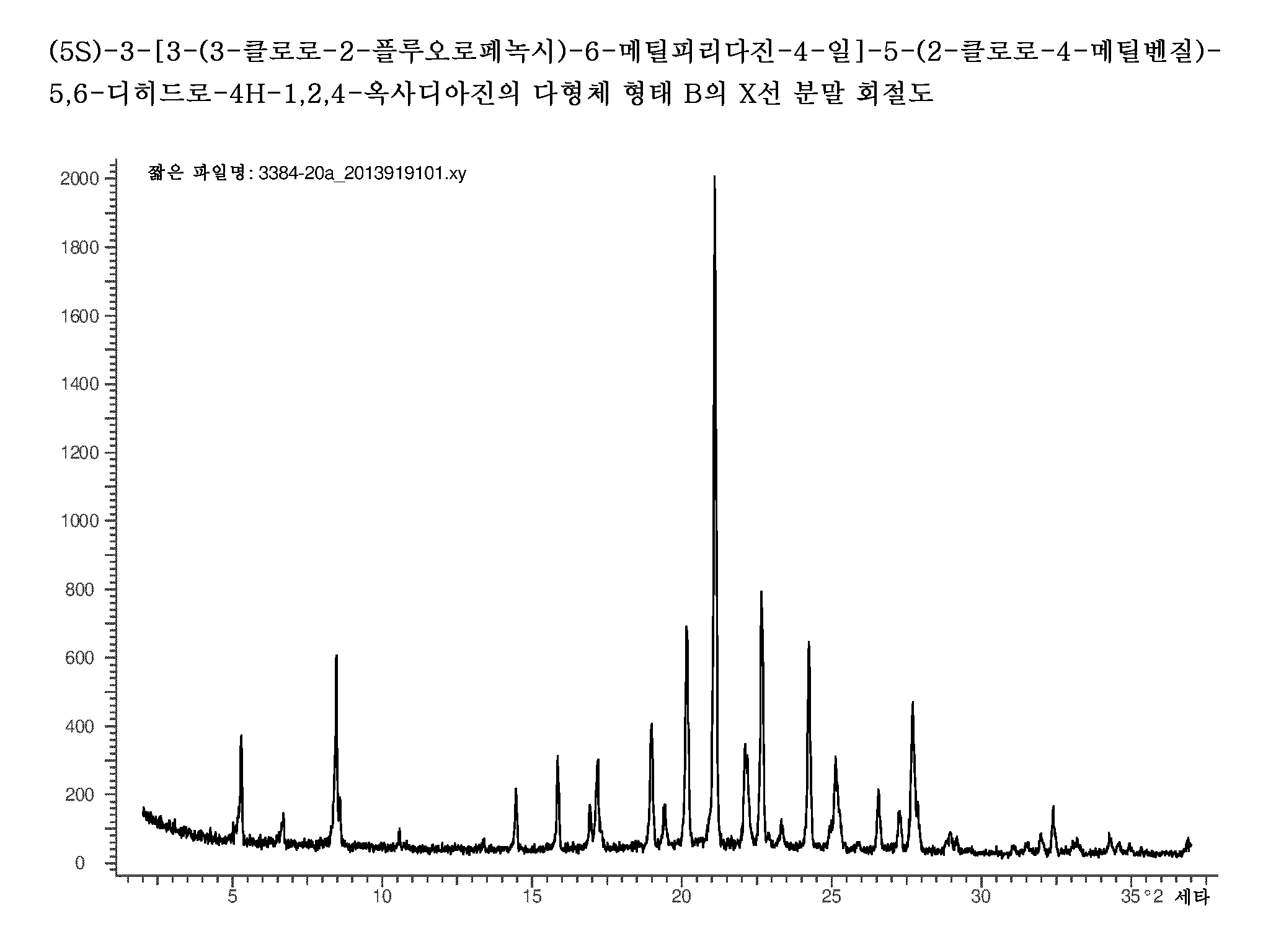
도 1a: (5S)-3-[3-(3-클로로-2-플루오로페녹시)-6-메틸피리다진-4-일]-5-(2-클로로-4-메틸벤질)-5,6-디히드로-4H-1,2,4-옥사디아진의 다형체 형태 B의 X선 분말 회절도Figure 1a: X-ray powder diffraction pattern of polymorph Form B of (5S)-3-[3-(3-chloro-2-fluorophenoxy)-6-methylpyridazin-4-yl]-5-(2-chloro-4-methylbenzyl)-5,6-dihydro-4H-1,2,4-oxadiazine.
도 1b: (5S)-3-[3-(3-클로로-2-플루오로페녹시)-6-메틸피리다진-4-일]-5-(2-클로로-4-메틸벤질)-5,6-디히드로-4H-1,2,4-옥사디아진의 다형체 형태 B의 FT 라만 스펙트럼Figure 1b: FT Raman spectrum of polymorph Form B of (5S)-3-[3-(3-chloro-2-fluorophenoxy)-6-methylpyridazin-4-yl]-5-(2-chloro-4-methylbenzyl)-5,6-dihydro-4H-1,2,4-oxadiazine.
도 1c: (5S)-3-[3-(3-클로로-2-플루오로페녹시)-6-메틸피리다진-4-일]-5-(2-클로로-4-메틸벤질)-5,6-디히드로-4H-1,2,4-옥사디아진의 다형체 형태 B의 IR 스펙트럼Figure 1c: IR spectrum of polymorph Form B of (5S)-3-[3-(3-chloro-2-fluorophenoxy)-6-methylpyridazin-4-yl]-5-(2-chloro-4-methylbenzyl)-5,6-dihydro-4H-1,2,4-oxadiazine.
도 2a: (5S)-3-[3-(3-클로로-2-플루오로페녹시)-6-메틸피리다진-4-일]-5-(2-클로로-4-메틸벤질)-5,6-디히드로-4H-1,2,4-옥사디아진의 다형체 형태 A의 X선 분말 회절도Figure 2a: X-ray powder diffraction pattern of polymorph Form A of (5S)-3-[3-(3-chloro-2-fluorophenoxy)-6-methylpyridazin-4-yl]-5-(2-chloro-4-methylbenzyl)-5,6-dihydro-4H-1,2,4-oxadiazine.
도 3a: 슬러리 실험 3 (8일/80℃ CH3CN/H2O) 후의 X선 분말 회절도Figure 3a: X-ray powder diffraction pattern after slurry experiment 3 (8 days/80°C CH 3 CN/H 2 O).
한 실시양태에서, 본 발명은 화학식 (I)에 따른 (5S)-3-[3-(3-클로로-2-플루오로페녹시)-6-메틸피리다진-4-일]-5-(2-클로로-4-메틸벤질)-5,6-디히드로-4H-1,2,4-옥사디아진의 신규 결정질 형태 B에 관한 것이다:In one embodiment, the present invention relates to a novel crystalline form B of (5S)-3-[3-(3-chloro-2-fluorophenoxy)-6-methylpyridazin-4-yl]-5-(2-chloro-4-methylbenzyl)-5,6-dihydro-4H-1,2,4-oxadiazine according to formula (I):

WO 2020/127780에 따른 방법으로 (5S)-3-[3-(3-클로로-2-플루오로페녹시)-6-메틸피리다진-4-일]-5-(2-클로로-4-메틸벤질)-5,6-디히드로-4H-1,2,4-옥사디아진을 바람직하지 않은 무정형 형태로서 수득하였다.(5S)-3-[3-(3-chloro-2-fluorophenoxy)-6-methylpyridazin-4-yl]-5-(2-chloro-4-methylbenzyl)-5,6-dihydro-4H-1,2,4-oxadiazine was obtained in an undesirable amorphous form by a method according to WO 2020/127780.
따라서, 본 발명의 목적은 탁월한 적용 특성, 특히 탁월한 생리화학적 특성, 예컨대 액상 수화제 (SC) 제제에서의 높은 안정성을 갖는 다형체 형태의 제공이다.Accordingly, it is an object of the present invention to provide a polymorphic form having excellent application properties, in particular excellent physicochemical properties, such as high stability in liquid suspension (SC) formulations.
화학식 (I)의 화합물은 2종의 변형체, A 및 B로 결정화시켰다. 다형체 형태 A 및 B는 거울상이성질체적으로 관련되어 49℃ 내지 66℃의 임계 전이 온도를 나타낸다. 이러한 온도 범위는 제제화 공정 동안 달성될 수 있고, 다형체 형태 B로부터 다형체 형태 A로의 고체 고체 변환으로 이어질 수 있으며, 이는 실온에서 형태 B로 재결정화되어 고체 기재 제제 유형에서 응집을 개시할 수 있다.The compound of formula (I) was crystallized into two forms, A and B. Polymorphic forms A and B are enantiomerically related and exhibit critical transition temperatures of 49°C to 66°C. This temperature range can be achieved during the formulation process and can lead to a solid-solid transformation from polymorphic form B to polymorphic form A, which can recrystallize at room temperature to form B to initiate aggregation in a solid-based formulation.
놀랍게도, 본 발명에 이르러 화학식 (I)의 화합물의 다형체 형태 B가 우수한 특성을 갖는 것으로 밝혀졌다. 다형체 형태 B는 선행 기술로부터 공지된 무정형 형태와 비교하여 제제의 제조를 위한 개선된 유익한 특성을 나타낸다. 특히, 다형체 형태 B는 액상 수화제 (SC) 제제에서 높은 안정성, 예컨대 높은 희석 안정성, 특히 현수성을 나타내고, 이로써 화학식 (I)의 화합물의 또 다른 다형체 형태로의 바람직하지 않은 전환이 방지되는 것을 보장한다. 다형체 전이는 SC 제제에서 불안정성 (J. Weiss et al., J. Am. Oil Chem. Soc. 2008, 85, 501-511; D.J. Burgess et al., Int. J. Pharmaceutics, 2014, Vol. 466, 223-232), 예컨대 보다 낮은 현수성을 유도하는 입자의 응집을 유발할 것으로 예상된다고 공지되어 있다. 추가로, 다형체 형태 B는 연장된 기간에 걸쳐 전이 온도 범위 초과에서 수행된 슬러리 실험에서 놀랍게도 높은 안정성을 나타낸다. 재결정화 이벤트는 관찰되지 않았다. 높은 안정성은 상기 기재된 바와 같은 특성의 연관된 변화가 방지되는 것을 보장하고, 따라서 화학식 (I)의 화합물의 다형체 형태 B를 포함하는 제제 및/또는 조성물의 안전성 및 품질을 증진시킨다.Surprisingly, it has now been found that the polymorph form B of the compound of formula (I) has superior properties. Polymorph form B exhibits improved advantageous properties for the preparation of formulations compared to the amorphous forms known from the prior art. In particular, polymorph form B exhibits high stability in liquid wettable powder (SC) formulations, for example high dilution stability, in particular suspendability, thereby ensuring that undesirable conversion of the compound of formula (I) to another polymorph form is prevented. It is known that polymorphic transitions are expected to lead to instability in SC formulations (J. Weiss et al., J. Am. Oil Chem. Soc. 2008, 85, 501-511; D.J. Burgess et al., Int. J. Pharmaceutics, 2014, Vol. 466, 223-232), for example agglomeration of particles which leads to lower suspendability. Additionally, polymorph Form B exhibits surprisingly high stability in slurry experiments performed above the transition temperature range over extended periods of time. No recrystallization events were observed. The high stability ensures that associated changes in properties as described above are prevented, thus enhancing the safety and quality of formulations and/or compositions comprising polymorph Form B of the compound of formula (I).
(5S)-3-[3-(3-클로로-2-플루오로페녹시)-6-메틸피리다진-4-일]-5-(2-클로로-4-메틸벤질)-5,6-디히드로-4H-1,2,4-옥사디아진의 다형체 형태 B는 25℃에서 Cu-Kα 1 방사선 (1.5406 Å)을 사용하여 기록된 각각의 회절 다이어그램에 기초한 X선 분말 회절측정법에 의해 특징화될 수 있다. 본 발명에 따른 다형체 형태 B는 하기 값으로서 제시된 반사 중 적어도 3개, 종종 적어도 5개, 특히 적어도 7개, 보다 특히 적어도 10개, 특히 모두를 나타낸다:The polymorph form B of (5S)-3-[3-(3-chloro-2-fluorophenoxy)-6-methylpyridazin-4-yl]-5-(2-chloro-4-methylbenzyl)-5,6-dihydro-4H-1,2,4-oxadiazine can be characterized by X-ray powder diffractometry on the basis of an individual diffraction diagram recorded at 25° C. using Cu-Kα 1 radiation (1.5406 Å). The polymorph form B according to the invention exhibits at least three, often at least five, especially at least seven, more especially at least ten and especially all of the reflections given below as values:
표 1: 다형체 형태 B의 X선 반사Table 1: X-ray reflection of polymorph form B

본 발명에 따른 다형체 형태 B는 추가로 도 1a에 도시된 X선 분말 회절도를 특징으로 한다.Polymorph Form B according to the present invention is further characterized by an X-ray powder diffraction pattern as depicted in FIG. 1a.
화학식 (I)의 화합물의 다형체 형태 B는 25℃에서 Cu-Kα 1 방사선을 사용한 X선 분말 회절도가 적어도 하기 반사: 20.2, 23.3 및 25.1, 바람직하게는 적어도 하기 반사: 20.2, 23.3, 25.1, 14.5 및 19.4, 보다 바람직하게는 적어도 하기 반사: 20.2, 23.3, 25.1, 14.5, 19.4, 23.4 및 10.6을 갖는 것을 특징으로 한다.Polymorph Form B of the compound of formula (I) is characterized by having an X-ray powder diffraction pattern using Cu-Kα 1 radiation at 25 °C of at least the following reflections: 20.2, 23.3 and 25.1, preferably at least the following reflections: 20.2, 23.3, 25.1, 14.5 and 19.4, more preferably at least the following reflections: 20.2, 23.3, 25.1, 14.5, 19.4, 23.4 and 10.6.
(5S)-3-[3-(3-클로로-2-플루오로페녹시)-6-메틸피리다진-4-일]-5-(2-클로로-4-메틸벤질)-5,6-디히드로-4H-1,2,4-옥사디아진의 다형체 형태 B는 또한 25℃에서 1064 nm의 레이저 파장 및 2 cm-1의 해상도로 기록된 각각의 스펙트럼에 기초한 라만 분광분석법에 의해 특징화될 수 있다. 본 발명에 따른 다형체 형태 B는 피크 최대치로서 하기에 제시된 밴드 중 적어도 3개 이상, 종종 적어도 5개, 특히 적어도 7개, 특히 모두를 나타낸다:The polymorph form B of (5S)-3-[3-(3-chloro-2-fluorophenoxy)-6-methylpyridazin-4-yl]-5-(2-chloro-4-methylbenzyl)-5,6-dihydro-4H-1,2,4-oxadiazine can also be characterized by Raman spectroscopy based on a respective spectrum recorded at 25° C. with a laser wavelength of 1064 nm and a resolution of 2 cm -1 . The polymorph form B according to the invention exhibits as peak maxima at least three, often at least five, especially at least seven, especially all of the bands given below:
표 2: 형태 B의 라만 밴드Table 2: Raman bands of form B


화학식 (I)의 화합물의 다형체 형태 B는 하기 밴드: 98, 112 및 1585, 바람직하게는 적어도 하기 밴드: 98, 112, 1585, 1279 및 2925, 보다 바람직하게는 적어도 하기 밴드: 98, 112, 1585, 1279, 2925, 688 및 1609를 특징으로 한다.Polymorphic form B of the compound of formula (I) is characterized by the following bands: 98, 112 and 1585, preferably at least the following bands: 98, 112, 1585, 1279 and 2925, more preferably at least the following bands: 98, 112, 1585, 1279, 2925, 688 and 1609.
(5S)-3-[3-(3-클로로-2-플루오로페녹시)-6-메틸피리다진-4-일]-5-(2-클로로-4-메틸벤질)-5,6-디히드로-4H-1,2,4-옥사디아진의 다형체 형태 B는 또한 25℃에서 범용 다이아몬드 ATR 장치 및 2 cm-1의 해상도로 기록된 각각의 스펙트럼에 기초한 적외선 분광분석법에 의해 특징화될 수 있다. 본 발명에 따른 다형체 형태 B는 피크 최대치로서 하기에 제시된 밴드 중 적어도 3개 이상, 종종 적어도 5개, 특히 적어도 7개, 특히 모두를 나타낸다:The polymorph form B of (5S)-3-[3-(3-chloro-2-fluorophenoxy)-6-methylpyridazin-4-yl]-5-(2-chloro-4-methylbenzyl)-5,6-dihydro-4H-1,2,4-oxadiazine can also be characterized by infrared spectroscopy based on a respective spectrum recorded at 25° C. with a universal diamond ATR apparatus and a resolution of 2 cm -1 . The polymorph form B according to the invention exhibits as peak maxima at least three, often at least five, especially at least seven, especially all of the bands given below:
표 3: 형태 B의 IR 밴드Table 3: IR bands of form B


화학식 (I)의 화합물의 다형체 형태 B는 하기 밴드: 1403, 819 및 806, 바람직하게는 적어도 하기 밴드: 1403, 819, 806, 1476 및 1274, 보다 바람직하게는 적어도 하기 밴드: 1403, 819, 806, 1476, 1274, 1383 및 921을 특징으로 한다.Polymorphic form B of the compound of formula (I) is characterized by the following bands: 1403, 819 and 806, preferably at least the following bands: 1403, 819, 806, 1476 and 1274, more preferably at least the following bands: 1403, 819, 806, 1476, 1274, 1383 and 921.
다형체 형태 B 이외에도, 하나의 추가의 다형체 형태 A (도 2a)가 확인되었으며, 이는 하기에서 추가로 특징화된다.In addition to polymorph form B, one additional polymorph form A (Figure 2a) was identified, which is further characterized below.
또 다른 실시양태에서, 본 발명은 화학식 (I)에 따른 (5S)-3-[3-(3-클로로-2-플루오로페녹시)-6-메틸피리다진-4-일]-5-(2-클로로-4-메틸벤질)-5,6-디히드로-4H-1,2,4-옥사디아진의 신규 결정질 형태 A에 관한 것이다:In another embodiment, the present invention relates to a novel crystalline form A of (5S)-3-[3-(3-chloro-2-fluorophenoxy)-6-methylpyridazin-4-yl]-5-(2-chloro-4-methylbenzyl)-5,6-dihydro-4H-1,2,4-oxadiazine according to formula (I):

(5S)-3-[3-(3-클로로-2-플루오로페녹시)-6-메틸피리다진-4-일]-5-(2-클로로-4-메틸벤질)-5,6-디히드로-4H-1,2,4-옥사디아진의 다형체 형태 A는 25℃에서 Cu-Kα 1 방사선 (1.5406 Å)을 사용하여 기록된 각각의 회절 다이어그램에 기초한 X선 분말 회절측정법에 의해 특징화될 수 있다. 다형체 형태 A는 하기 값으로서 제시된 반사 중 적어도 3개, 종종 적어도 5개, 특히 적어도 7개, 보다 특히 적어도 10개, 특히 모두를 나타낸다:Polymorph Form A of (5S)-3-[3-(3-chloro-2-fluorophenoxy)-6-methylpyridazin-4-yl]-5-(2-chloro-4-methylbenzyl)-5,6-dihydro-4H-1,2,4-oxadiazine can be characterized by X-ray powder diffractometry based on the respective diffraction diagram recorded at 25°C using Cu-Kα 1 radiation (1.5406 Å). Polymorph Form A exhibits at least three, often at least five, especially at least seven, more especially at least ten, especially all, of the reflections given below as values:
표 4: 다형체 형태 A의 X선 반사Table 4: X-ray reflection of polymorph form A


화학식 (I)의 화합물의 다형체 형태 A는 25℃에서 Cu-Kα 1 방사선을 사용한 X선 분말 회절도가 적어도 하기 반사: 16.9, 19.8 및 24.5, 바람직하게는 적어도 하기 반사: 16.9, 19.8, 24.5, 14.2 및 24.7, 보다 바람직하게는 적어도 하기 반사: 16.9, 19.8, 24.5, 14.2, 24.7, 20.8 및 21.8, 가장 바람직하게는 적어도 하기 반사: 16.9, 19.8, 24.5, 14.2, 24.7, 20.8, 21.8, 38.9, 38.3 및 29.5를 갖는 것을 특징으로 하고, 각각은 2θ 값 ± 0.2°로서 제시된다.Polymorph Form A of the compound of formula (I) is characterized by having an X-ray powder diffraction pattern using Cu-Kα 1 radiation at 25°C having at least the following reflections: 16.9, 19.8 and 24.5, preferably at least the following reflections: 16.9, 19.8, 24.5, 14.2 and 24.7, more preferably at least the following reflections: 16.9, 19.8, 24.5, 14.2, 24.7, 20.8 and 21.8, most preferably at least the following reflections: 16.9, 19.8, 24.5, 14.2, 24.7, 20.8, 21.8, 38.9, 38.3 and 29.5, each of which is given as a 2θ value ± 0.2°.
다형체 형태 A는 추가로 도 2a에 도시된 X선 분말 회절도를 특징으로 한다.Polymorph Form A is additionally characterized by an X-ray powder diffraction pattern depicted in Figure 2a.
다형체 형태 A 및 B의 열역학적 안정성은 매우 복잡하다. 둘 다의 형태는 49℃ 내지 66℃ 범위의 전이 온도와 거울상이성질체적으로 관련된다. 이들 온도 미만에서 다형체 형태 B는 열역학적으로 안정한 다형체이다. A로부터의 다형체는 보다 높은 온도에서 재결정화되지만, 보다 낮은 온도에서 다형체 형태 B로의 매우 빠른 전이를 나타낸다.The thermodynamic stability of polymorph forms A and B is very complex. Both forms are enantiomerically related with transition temperatures in the range of 49°C to 66°C. Below these temperatures, polymorph form B is the thermodynamically stable polymorph. Polymorphs from A recrystallize at higher temperatures, but exhibit a very rapid transition to polymorph form B at lower temperatures.
추가 실시양태에서, 본 발명은 하기 단계를 포함하는, 다형체 형태 B의 제조 방법에 관한 것이다:In a further embodiment, the present invention relates to a process for preparing polymorph Form B, comprising the following steps:
a) 화학식 (I)의 화합물을 적합한 용매 또는 용매 혼합물에 희석하는 단계,a) a step of diluting the compound of formula (I) in a suitable solvent or solvent mixture,
b) 단계 a)의 조성물을 적어도 70℃의 온도로 가열하는 단계, 및b) a step of heating the composition of step a) to a temperature of at least 70°C, and
c) 단계 b)로부터의 용액을 20℃ 미만의 온도로 냉각시키는 단계.c) A step of cooling the solution from step b) to a temperature below 20°C.
화학식 (I)에 따른 (5S)-3-[3-(3-클로로-2-플루오로페녹시)-6-메틸피리다진-4-일]-5-(2-클로로-4-메틸벤질)-5,6-디히드로-4H-1,2,4-옥사디아진의 화학적 제조는 WO 2020/127780으로부터 공지되어 있다. 따라서, 단계 a)에서 사용된 바와 같은 화학식 (I)의 화합물은 본원에서 전문이 참조된 WO 2020/127780에 따라 제조될 수 있다.The chemical preparation of (5S)-3-[3-(3-chloro-2-fluorophenoxy)-6-methylpyridazin-4-yl]-5-(2-chloro-4-methylbenzyl)-5,6-dihydro-4H-1,2,4-oxadiazine according to formula (I) is known from WO 2020/127780. Accordingly, the compound of formula (I) as used in step a) can be prepared according to WO 2020/127780, which is herein incorporated by reference in its entirety.
단계 a)에서의 화학식 (I)의 화합물은 본질적으로 (5S)-3-[3-(3-클로로-2-플루오로페녹시)-6-메틸피리다진-4-일]-5-(2-클로로-4-메틸벤질)-5,6-디히드로-4H-1,2,4-옥사디아진의 임의의 공지된 형태일 수 있다. 이는 (5S)-3-[3-(3-클로로-2-플루오로페녹시)-6-메틸피리다진-4-일]-5-(2-클로로-4-메틸벤질)-5,6-디히드로-4H-1,2,4-옥사디아진이 무정형 형태로 또는 상이한 다형체 형태의 혼합물로 또는 무정형 및 1종 이상의 상이한 다형체 형태를 함유하는 혼합물로 사용될 수 있다는 것을 의미한다.The compound of formula (I) in step a) can be essentially any known form of (5S)-3-[3-(3-chloro-2-fluorophenoxy)-6-methylpyridazin-4-yl]-5-(2-chloro-4-methylbenzyl)-5,6-dihydro-4H-1,2,4-oxadiazine. This means that (5S)-3-[3-(3-chloro-2-fluorophenoxy)-6-methylpyridazin-4-yl]-5-(2-chloro-4-methylbenzyl)-5,6-dihydro-4H-1,2,4-oxadiazine can be used in amorphous form or as a mixture of different polymorphic forms or as a mixture containing an amorphous form and one or more different polymorphic forms.
단계 a)에서 화학식 (I)의 화합물을 희석 및/또는 현탁시키는 데 사용될 수 있고 단계 c)에서 화학식 (I)의 화합물이 다형체 형태 B로 수득되는 적합한 용매 또는 용매 혼합물은 톨루엔, 테트라히드로푸란, 아세톤, 에틸 아세테이트, 아세토니트릴, 메탄올, 에탄올, 이소-프로판올, N,N-디메틸포름아미드, 1,4-디옥산 또는 DMSO, 바람직하게는 톨루엔, 에탄올 또는 1,4-디옥산이다.Suitable solvents or solvent mixtures which can be used to dilute and/or suspend the compound of formula (I) in step a) and from which the compound of formula (I) is obtained in polymorph form B in step c) are toluene, tetrahydrofuran, acetone, ethyl acetate, acetonitrile, methanol, ethanol, iso-propanol, N,N-dimethylformamide, 1,4-dioxane or DMSO, preferably toluene, ethanol or 1,4-dioxane.
(5S)-3-[3-(3-클로로-2-플루오로페녹시)-6-메틸피리다진-4-일]-5-(2-클로로-4-메틸벤질)-5,6-디히드로-4H-1,2,4-옥사디아진의 용액은 또한, (5S)-3-[3-(3-클로로-2-플루오로페녹시)-6-메틸피리다진-4-일]-5-(2-클로로-4-메틸벤질)-5,6-디히드로-4H-1,2,4-옥사디아진을 함유하는, 화학 반응에 의해 수득된 반응 혼합물을, 필요한 경우에 시약 및/또는 부산물의 제거 후에 본 발명에 따른 용매 또는 용매 혼합물로 옮김으로써 제조될 수 있다.A solution of (5S)-3-[3-(3-chloro-2-fluorophenoxy)-6-methylpyridazin-4-yl]-5-(2-chloro-4-methylbenzyl)-5,6-dihydro-4H-1,2,4-oxadiazine can also be prepared by transferring a reaction mixture obtained by a chemical reaction, containing (5S)-3-[3-(3-chloro-2-fluorophenoxy)-6-methylpyridazin-4-yl]-5-(2-chloro-4-methylbenzyl)-5,6-dihydro-4H-1,2,4-oxadiazine, if desired after removal of the reagents and/or by-products, to a solvent or solvent mixture according to the invention.
단계 b)에서, 용액 또는 슬러리는 통상적으로 적어도 70℃의 온도, 바람직하게는 적어도 90℃의 온도로 가열된다. 바람직한 실시양태에서, 각각의 용매 또는 용매 혼합물은 그의 비등 온도로 가열된다.In step b), the solution or slurry is typically heated to a temperature of at least 70° C., preferably to a temperature of at least 90° C. In a preferred embodiment, each solvent or solvent mixture is heated to its boiling temperature.
단계 c)에서, 용액 또는 슬러리를 20℃ 미만, 바람직하게는 0℃ 미만의 온도로 냉각시킨다.In step c), the solution or slurry is cooled to a temperature below 20°C, preferably below 0°C.
다형체 형태 B의 결정화는 형태 B의 시드 결정에 의한 시딩에 의해 촉진 또는 가속화될 수 있다.Crystallization of polymorph Form B can be facilitated or accelerated by seeding with seed crystals of Form B.
모액으로부터의 다형체 형태 B의 단리는 관련 기술분야에 공지된 통상의 기술, 예를 들어 여과, 원심분리 또는 경사분리에 의해 수행된다.Isolation of polymorph Form B from the mother liquor is carried out by conventional techniques known in the art, for example by filtration, centrifugation or decantation.
보다 바람직하게는, 다형체 형태 B는 용매 또는 용매 혼합물의 적어도 90 중량%가 증발될 때까지 용액 또는 슬러리를 단계 c)의 결정화 조건에서 정치시킴으로써 용매 또는 용매 혼합물로부터 단리된다.More preferably, polymorph Form B is isolated from the solvent or solvent mixture by allowing the solution or slurry to stand under the crystallization conditions of step c) until at least 90 wt. % of the solvent or solvent mixture has evaporated.
단리된 다형체 형태 B는 임의로 임의의 용매, 바람직하게는 결정화에 사용된 용매 또는 용매 혼합물, 물 또는 용매 또는 용매 혼합물과 물의 혼합물로 세척될 수 있다. 세척 단계는 임의로 반복될 수 있고, 이에 의해 물을 사용한 세척이 종종 마지막 세척 단계이다. 세척은 전형적으로 30℃ 미만, 종종 25℃ 미만, 특히 20℃ 미만의 온도에서, 임의로 0℃에서 수행된다. 추가의, 임의로 단계에서, 다형체 형태 B의 결정을 건조시킨 다음, 추가의 가공을 위해 공급할 수 있다.The isolated polymorph form B can optionally be washed with any solvent, preferably the solvent or solvent mixture used for crystallization, water or a mixture of the solvent or solvent mixture and water. The washing steps can optionally be repeated, whereby the washing with water is often the last washing step. The washing is typically carried out at a temperature of less than 30° C., often less than 25° C., especially less than 20° C., optionally at 0° C. In a further, optional step, the crystals of polymorph form B can be dried and then supplied for further processing.
본 발명에 따른 결정화에 의해, (5S)-3-[3-(3-클로로-2-플루오로페녹시)-6-메틸피리다진-4-일]-5-(2-클로로-4-메틸벤질)-5,6-디히드로-4H-1,2,4-옥사디아진의 형태 B는 적어도 85%, 특히 90%, 가장 바람직하게는 적어도 ≥ 95%로 수득된다.By the crystallization according to the present invention, form B of (5S)-3-[3-(3-chloro-2-fluorophenoxy)-6-methylpyridazin-4-yl]-5-(2-chloro-4-methylbenzyl)-5,6-dihydro-4H-1,2,4-oxadiazine is obtained in a yield of at least 85%, particularly 90%, most preferably at least ≥ 95%.
따라서, 본 발명의 특정한 실시양태는 적어도 85%, 종종 적어도 90% 또는 적어도 ≥ 95%의 다형체 형태 B로 이루어진 (5S)-3-[3-(3-클로로-2-플루오로페녹시)-6-메틸피리다진-4-일]-5-(2-클로로-4-메틸벤질)-5,6-디히드로-4H-1,2,4-옥사디아진에 관한 것이다.Accordingly, a particular embodiment of the present invention relates to (5S)-3-[3-(3-chloro-2-fluorophenoxy)-6-methylpyridazin-4-yl]-5-(2-chloro-4-methylbenzyl)-5,6-dihydro-4H-1,2,4-oxadiazine which consists of at least 85%, often at least 90% or at least ≥ 95% of polymorph Form B.
추가 실시양태에서, 본 발명은 (5S)-3-[3-(3-클로로-2-플루오로페녹시)-6-메틸피리다진-4-일]-5-(2-클로로-4-메틸벤질)-5,6-디히드로-4H-1,2,4-옥사디아진의 다형체 형태 B를 함유하는 통상의 제제 형태의 식물 보호제에 관한 것이다.In a further embodiment, the present invention relates to a plant protection agent in the form of a conventional formulation containing the polymorph form B of (5S)-3-[3-(3-chloro-2-fluorophenoxy)-6-methylpyridazin-4-yl]-5-(2-chloro-4-methylbenzyl)-5,6-dihydro-4H-1,2,4-oxadiazine.
본 발명의 바람직한 실시양태에서, 식물 보호제는 조성물에 존재하는 화학식 (I)의 화합물의 모든 형태의 총량을 기준으로 하여 90 중량% 초과, 바람직하게는 95 중량% 초과의 화학식 (I)의 화합물의 다형체 형태 B를 함유한다.In a preferred embodiment of the present invention, the plant protection agent contains more than 90 wt.-%, preferably more than 95 wt.-%, of the polymorph form B of the compound of formula (I), based on the total amount of all forms of the compound of formula (I) present in the composition.
놀랍게도, 본 발명에 이르러 다형체 형태 B가 개선된 취급 및 제제화 특성, 예컨대 특히 보다 높은 온도, 심지어 전이 온도 범위 초과에서의, SC 제제의 높은 안정성, 예컨대 높은 희석 안정성, 특히 높은 현수성을 갖는 것으로 밝혀졌다. 따라서, 추가 실시양태에서, 본 발명은 특히 전이 온도 범위 초과의 온도에서의 높은 안정성, 바람직하게는 높은 희석 안정성, 보다 바람직하게는 높은 현수성을 갖는 제제의 제조를 위한 화학식 (I)의 화합물의 다형체 형태 B의 용도에 관한 것이다.Surprisingly, it has now been found that polymorph form B has improved handling and formulation properties, such as high stability of SC formulations, in particular at higher temperatures, even above the transition temperature range, such as high dilution stability, in particular high suspendability. Therefore, in a further embodiment, the present invention relates to the use of polymorph form B of the compound of formula (I) for the preparation of formulations which have high stability, in particular at temperatures above the transition temperature range, preferably high dilution stability, more preferably high suspendability.
용도use
추가 실시양태에서, 본 발명은 원치 않는 미생물, 바람직하게는 원치 않는 진균 및 바이러스를 방제하기 위한 화학식 (I)의 화합물의 다형체 형태 B의 용도에 관한 것이다. 특정한 실시양태에서, 본 발명은 식물에서 원치 않는 진균을 방제하는 것에 관한 것이다. 본 발명의 특정한 실시양태에서, 유용한 식물은 트랜스제닉 식물이다.In a further embodiment, the present invention relates to the use of polymorphic form B of a compound of formula (I) for controlling unwanted microorganisms, preferably unwanted fungi and viruses. In a particular embodiment, the present invention relates to controlling unwanted fungi in plants. In a particular embodiment of the present invention, the useful plant is a transgenic plant.
추가 실시양태에서, 본 발명은 다형체 형태 B 또는 다형체 형태 B를 함유하는 상기 정의된 바와 같은 식물 보호제를 식물에 적용하는, 원치 않는 미생물을 방제하는 방법에 관한 것이다In a further embodiment, the present invention relates to a method for controlling unwanted microorganisms, comprising applying to a plant a plant protection agent as defined above containing polymorph form B or polymorph form B
본 발명의 화합물 및 조성물은 강력한 살미생물 활성 및/또는 식물 방어 조절 잠재력을 갖는다. 이들은 식물 상의 원치 않는 미생물, 예컨대 원치 않는 진균 및 바이러스를 방제하는 데 사용될 수 있다. 이들은 작물 보호에 (이들은 식물 질병을 유발하는 미생물을 방제함) 또는 하기 본원에 보다 상세히 기재된 바와 같은 물질 (예를 들어, 산업적 물질, 재목, 저장 제품)을 보호하는 데 특히 유용할 수 있다. 보다 구체적으로, 본 발명의 화합물 및 조성물은 종자, 발아 종자, 출아 묘목, 식물, 식물 부분, 과실, 수확 제품 및/또는 식물이 성장하는 토양을 원치 않는 미생물로부터 보호하는 데 사용될 수 있다.The compounds and compositions of the present invention have potent microbicidal activity and/or plant defense modulating potential. They can be used to control unwanted microorganisms on plants, such as unwanted fungi and viruses. They may be particularly useful for crop protection (they control microorganisms that cause plant diseases) or for protecting materials (e.g. industrial materials, timber, stored products) as described in more detail herein below. More specifically, the compounds and compositions of the present invention can be used to protect seeds, sprouting seeds, emerging seedlings, plants, plant parts, fruit, harvested products and/or the soil in which the plants grow from unwanted microorganisms.
본원에 사용된 바와 같은 방제 또는 방제는 원치 않는 미생물의 보호적, 치유적 및 박멸적 처리를 포괄한다. 원치 않는 미생물은 병원성 바이러스 또는 병원성 진균, 보다 구체적으로 식물병원성 바이러스 또는 식물병원성 진균일 수 있다. 하기 본원에 상술된 바와 같이, 이들 식물병원성 미생물은 광범위한 식물 질병의 원인 물질이다.Control or control as used herein encompasses protective, curative and extermination treatment of unwanted microorganisms. The unwanted microorganisms may be pathogenic viruses or pathogenic fungi, more specifically plant pathogenic viruses or plant pathogenic fungi. As described herein below, these plant pathogenic microorganisms are the causative agents of a wide range of plant diseases.
보다 구체적으로, 본 발명의 화합물 및 조성물은 살진균제로서 사용될 수 있다. 본 명세서의 목적상, 용어 "살진균제"는 원치 않는 진균, 예컨대 플라스모디오포로미세테스(Plasmodiophoromycetes), 키트리디오미세테스(Chytridiomycetes), 지고미세테스(Zygomycetes), 아스코미세테스(Ascomycetes), 바시디오미세테스(Basidiomycetes) 및 듀테로미세테스(Deuteromycetes)의 방제를 위한 작물 보호에 사용될 수 있는 화합물 또는 조성물을 지칭한다.More specifically, the compounds and compositions of the present invention can be used as fungicides. For the purposes of this specification, the term "fungicide" refers to a compound or composition that can be used in crop protection for the control of unwanted fungi, such as Plasmodiophoromycetes , Chytridiomycetes , Zygomycetes , Ascomycetes , Basidiomycetes and Deuteromycetes .
본 발명의 화합물 및 조성물은 또한 작물 보호에서 항바이러스제로서 사용될 수 있다. 예를 들어, 본 발명의 화합물 및 조성물은 식물 바이러스, 예컨대 담배 모자이크 바이러스 (TMV), 담배 얼룩무늬 바이러스, 담배 위축 바이러스 (TStuV), 담배 잎 말림 바이러스 (VLCV), 담배 너빌리아 모자이크 바이러스 (TVBMV), 담배 괴사성 왜성 바이러스 (TNDV), 담배 줄무늬 바이러스 (TSV), 감자 바이러스 X (PVX), 감자 바이러스 Y, S, M 및 A, 감자 아쿠바 모자이크 바이러스 (PAMV), 감자 몹-톱 바이러스 (PMTV), 감자 잎-말림 바이러스 (PLRV), 알팔파 모자이크 바이러스 (AMV), 오이 모자이크 바이러스 (CMV), 오이 녹색 얼룩모자이크 바이러스 (CGMMV), 오이 황색 바이러스 (CuYV), 수박 모자이크 바이러스 (WMV), 토마토 점무늬 시들음병 바이러스 (TSWV), 토마토 원형반점 바이러스 (TomRSV), 사탕수수 모자이크 바이러스 (SCMV), 벼 왜성 바이러스, 벼 줄무늬 바이러스, 벼 흑색-줄무늬 왜성 바이러스, 딸기 얼룩 바이러스 (SMoV), 딸기 엽맥 띠무늬 바이러스 (SVBV), 딸기 연황색 가장자리 바이러스 (SMYEV), 딸기 주름 바이러스 (SCrV), 넓은 콩 시들음병 바이러스 (BBWV) 및 멜론 괴사성 반점 바이러스 (MNSV)로부터의 질병에 영향을 미칠 수 있다.The compounds and compositions of the present invention can also be used as antiviral agents in crop protection. For example, the compounds and compositions of the present invention can be used to treat plant viruses, such as tobacco mosaic virus (TMV), tobacco mottle virus, tobacco dwarf virus (TStuV), tobacco leaf curl virus (VLCV), tobacco nervilia mosaic virus (TVBMV), tobacco necrotic dwarf virus (TNDV), tobacco streak virus (TSV), potato virus X (PVX), potato viruses Y, S, M, and A, potato acuba mosaic virus (PAMV), potato mob-top virus (PMTV), potato leaf-roll virus (PLRV), alfalfa mosaic virus (AMV), cucumber mosaic virus (CMV), cucumber green mottle mosaic virus (CGMMV), cucumber yellow virus (CuYV), watermelon mosaic virus (WMV), tomato spotted wilt virus (TSWV), tomato round spot virus (TomRSV), sugarcane mosaic virus (SCMV), rice dwarf virus, rice stripe virus, rice black-streaked dwarf virus, strawberry mottle virus (SMoV), strawberry vein banding virus It can affect diseases from Strawberry Virus Bacterial Virus (SVBV), Strawberry Yellow Edge Virus (SMYEV), Strawberry Wrinkle Virus (SCrV), Broad Bean Wilt Virus (BBWV) and Melon Necrotic Spot Virus (MNSV).
본 발명은 또한 본 발명의 화학식 (I)의 화합물의 다형체 형태 B 또는 적어도 하나의 본 발명의 조성물을 미생물 및/또는 그의 서식지 (식물, 식물 부분, 종자, 과실 또는 식물이 성장하는 토양)에 적용하는 단계를 포함하는, 식물 상에서 원치 않는 미생물, 예컨대 원치 않는 진균을 방제하는 방법에 관한 것이다.The present invention also relates to a method for controlling unwanted microorganisms, such as unwanted fungi, on plants, comprising the step of applying to the microorganism and/or its habitat (plant, plant part, seed, fruit or soil in which the plant grows) the polymorph form B of the compound of formula (I) of the present invention or at least one composition of the present invention.
전형적으로, 본 발명의 화합물 및 조성물이 식물병원성 진균을 방제하기 위한 치유 또는 보호 방법에 사용되는 경우에, 그의 유효하고 식물-상용성인 양은 식물, 식물 부분, 과실, 종자 또는 식물이 성장하는 토양 또는 기재에 적용된다. 식물을 재배하는 데 사용될 수 있는 적합한 기재는 무기계 기재, 예컨대 미네랄 울, 특히 스톤 울, 펄라이트, 샌드 또는 자갈; 유기 기재, 예컨대 토탄, 소나무 껍질 또는 톱밥; 및 석유계 기재, 예컨대 중합체 발포체 또는 플라스틱 비드를 포함한다. 유효하고 식물-상용성인 양은 농경지 상에 존재하거나 또는 나타나기 쉬운 진균을 방제 또는 파괴하기에 충분하고, 상기 작물에 대한 식물독성의 임의의 인지가능한 증상을 수반하지 않는 양을 의미한다. 이러한 양은 방제될 진균, 작물의 유형, 작물 성장기, 기후 조건 및 사용된 본 발명의 각각의 화합물 또는 조성물에 따라 광범위한 범위 내에서 달라질 수 있다. 이 양은 관련 기술분야의 통상의 기술자의 능력 내에 있는 체계적 현장 시험에 의해 결정될 수 있다.Typically, when the compounds and compositions of the present invention are used in a curative or protective method for controlling phytopathogenic fungi, an effective and plant-compatible amount thereof is applied to the plant, plant part, fruit, seed or soil or substrate on which the plant is grown. Suitable substrates that can be used to grow the plant include inorganic substrates such as mineral wool, especially stone wool, perlite, sand or gravel; organic substrates such as peat, pine bark or sawdust; and petroleum-based substrates such as polymer foams or plastic beads. An effective and plant-compatible amount means an amount sufficient to control or destroy fungi present or likely to appear on the field, and which does not entail any discernible symptoms of phytotoxicity to the crop. This amount can vary within wide ranges depending on the fungi to be controlled, the type of crop, the growing season of the crop, climatic conditions and the individual compound or composition of the present invention used. This amount can be determined by systematic field testing within the capabilities of a person skilled in the art.
식물 및 식물 부분Plants and plant parts
본 발명의 화합물 및 조성물은 임의의 식물 또는 식물 부분에 적용될 수 있다.The compounds and compositions of the present invention can be applied to any plant or plant part.
식물은 모든 식물 및 식물 군집, 예컨대 목적하는 및 목적하지 않는 야생 식물 또는 작물 식물 (자연 발생 작물 식물 포함)을 의미한다. 작물 식물은 통상적인 육종 및 최적화 방법에 의해 또는 생명공학 및 유전 공학 방법 또는 이들 방법의 조합에 의해 수득될 수 있는 식물일 수 있으며, 유전자 변형 식물 (GMO 또는 트랜스제닉 식물)을 포함하고, 식물 육종가의 권리에 의해 보호가능한 및 보호불가능한 식물 재배품종을 포함할 수 있다.Plants means all plants and plant communities, including both desired and undesired wild plants or crop plants (including naturally occurring crop plants). Crop plants may be plants which can be obtained by conventional breeding and optimization methods or by biotechnology and genetic engineering methods or a combination of these methods, and may include genetically modified plants (GMOs or transgenic plants) and plant cultivars protectable and non-protectable by plant breeders' rights.
식물 재배품종은 새로운 특성 ("형질")을 갖고 통상적인 육종, 돌연변이유발 또는 재조합 DNA 기술에 의해 수득된 식물을 의미하는 것으로 이해된다. 이는 재배품종, 변종, 생물형 또는 유전자형일 수 있다.A plant cultivar is understood to mean a plant obtained by conventional breeding, mutagenesis or recombinant DNA techniques, which has new characteristics ("traits"). It may be a cultivar, a variety, a biotype or a genotype.
식물 부분은 지면의 위 및 아래의 식물의 모든 부분 및 기관, 예컨대 싹, 잎, 가시, 자루, 줄기, 꽃, 과실체, 과실, 종자, 뿌리, 괴경 및 근경을 의미하는 것으로 이해된다. 식물 부분은 또한 수확된 물질 및 영양 및 생식 번식 물질, 예를 들어 묘목, 괴경, 근경, 자른 가지 및 종자를 포함한다.Plant parts are understood to mean all parts and organs of plants above and below the ground, such as buds, leaves, thorns, petioles, stems, flowers, fruit bodies, fruits, seeds, roots, tubers and rhizomes. Plant parts also include harvested material and vegetative and reproductive propagation material, such as seedlings, tubers, rhizomes, cut branches and seeds.
식물 및 식물 부분Plants and plant parts
본 발명의 화합물 및 조성물은 임의의 식물 또는 식물 부분에 적용될 수 있다.The compounds and compositions of the present invention can be applied to any plant or plant part.
식물은 모든 식물 및 식물 집단, 예컨대 목적하는 및 목적하지 않는 야생 식물 또는 작물 식물 (자연 발생 작물 식물 포함)을 의미한다. 작물 식물은 통상적인 육종 및 최적화 방법에 의해 또는 생명공학 및 유전 공학 방법 또는 이들 방법의 조합에 의해 수득될 수 있는 식물일 수 있으며, 유전자 변형 식물 (GMO 또는 트랜스제닉 식물) 및 식물 육종가의 권리에 의해 보호가능한 및 보호불가능한 식물 재배품종을 포함할 수 있다.Plants means all plants and plant populations, including both desired and undesired wild plants or crop plants (including naturally occurring crop plants). Crop plants may be plants obtained by conventional breeding and optimization methods or by biotechnology and genetic engineering methods or a combination of these methods, and may include genetically modified plants (GMOs or transgenic plants) and plant cultivars protectable and non-protectable by plant breeders' rights.
식물 재배품종은 새로운 특성 ("형질")을 갖고 통상적인 육종, 돌연변이유발 또는 재조합 DNA 기술에 의해 수득된 식물을 의미하는 것으로 이해된다. 이는 재배품종, 품종, 생물형 또는 유전자형일 수 있다.A plant cultivar is understood to mean a plant obtained by conventional breeding, mutagenesis or recombinant DNA techniques, which has new characteristics ("traits"). It may be a cultivar, variety, biotype or genotype.
식물 부분은 지면 위 및 아래의 식물의 모든 부분 및 기관, 예컨대 싹, 잎, 가시, 자루, 줄기, 꽃, 과실체, 과실, 종자, 뿌리, 괴경 및 근경을 의미하는 것으로 이해된다. 식물 부분은 또한 수확된 물질 및 영양 및 생식 번식 물질, 예를 들어 묘목, 괴경, 근경, 자른 가지 및 종자를 포함한다.Plant parts are understood to mean all parts and organs of plants above and below the ground, such as buds, leaves, thorns, petioles, stems, flowers, fruit bodies, fruits, seeds, roots, tubers and rhizomes. Plant parts also include harvested material and vegetative and reproductive propagation material, such as seedlings, tubers, rhizomes, cut branches and seeds.
본 발명의 방법에 따라 처리될 수 있는 식물은 하기를 포함한다: 목화, 아마, 포도나무, 과실, 채소, 예컨대 로사세아에(Rosaceae) 종 (예를 들어, 인과류 예컨대 사과 및 배, 뿐만 아니라 핵과류 예컨대 살구, 체리, 아몬드 및 복숭아, 및 장과류 예컨대 딸기), 리베시오이다에(Ribesioidae) 종, 주글란다세아에(Juglandaceae) 종, 베툴라세아에(Betulaceae) 종, 아나카르디아세아에(Anacardiaceae) 종, 파가세아에(Fagaceae) 종, 모라세아에(Moraceae) 종, 올레아세아에(Oleaceae) 종, 악티니다세아에(Actinidaceae) 종, 라우라세아에(Lauraceae) 종, 무사세아에(Musaceae) 종 (예를 들어, 바나나 나무 및 농장), 루비아세아에(Rubiaceae) 종 (예를 들어, 커피), 테아세아에(Theaceae) 종, 스테르쿨리세아에(Sterculiceae) 종, 루타세아에(Rutaceae) 종 (예를 들어, 레몬, 오렌지 및 자몽); 솔라나세아에(Solanaceae) 종 (예를 들어, 감자 및 토마토), 릴리아세아에(Liliaceae) 종, 아스테라세아에(Asteraceae) 종 (예를 들어, 상추), 움벨리페라에(Umbelliferae) 종, 크루시페라에(Cruciferae) 종, 케노포디아세아에(Chenopodiaceae) 종, 쿠쿠르비타세아에(Cucurbitaceae) 종 (예를 들어, 오이), 알리아세아에(Alliaceae) 종 (예를 들어, 부추, 양파), 파필리오나세아에(Papilionaceae) 종 (예를 들어, 완두); 주요 작물 식물, 예컨대 그라미네아에(Gramineae) 종 (예를 들어, 옥수수, 잔디, 곡류, 예컨대 밀, 호밀, 벼, 보리, 귀리, 기장 및 트리티케일), 아스테라세아에(Asteraceae) 종 (예를 들어, 해바라기), 브라시카세아에(Brassicaceae) 종 (예를 들어, 대두), 케노포디아세아에(Chenopodiaceae) 종 (예를 들어, 사탕무, 사료용 비트, 근대, 비트); 정원 및 목재 구역에 유용한 식물 및 관상용 식물; 및 이들 식물 각각의 유전자 변형된 품종.Plants which can be treated according to the method of the present invention include: cotton, flax, grapevines, fruits, vegetables, such as Rosaceae species (e.g., berries such as apples and pears, as well as stone fruits such as apricots, cherries, almonds and peaches, and berries such as strawberries), Ribesioidae species, Juglandaceae species, Betulaceae species, Anacardiaceae species, Fagaceae species, Moraceae species, Oleaceae species, Actinidaceae species, Lauraceae species, Musaceae species (e.g., banana trees and plantations), Rubiaceae ) species (e.g. coffee), Theaceae species, Sterculiceae species, Rutaceae species (e.g. lemons, oranges and grapefruit); Solanaceae species (e.g. potatoes and tomatoes), Liliaceae species, Asteraceae species (e.g. lettuce), Umbelliferae species, Cruciferae species, Chenopodiaceae species, Cucurbitaceae species (e.g. cucumbers), Alliaceae species (e.g. leeks, onions), Papilionaceae species (e.g. peas); Major crop plants, such as Gramineae species (e.g. maize, grasses, cereals such as wheat, rye, rice, barley, oats, millet and triticale), Asteraceae species (e.g. sunflower), Brassicaceae species (e.g. soybeans), Chenopodiaceae species (e.g. sugar beet, fodder beet, chard, beetroot); plants useful for gardens and timber areas and ornamental plants; and genetically modified varieties of each of these plants.
상기 개시된 방법에 의해 처리될 수 있는 식물 및 식물 재배품종은 1종 이상의 생물적 스트레스에 대해 저항성인 식물 및 식물 재배품종을 포함하며, 즉 상기 식물은 동물 및 미생물 해충, 예컨대 선충류, 곤충, 응애, 식물병원성 진균, 박테리아, 바이러스 및/또는 바이로이드에 대해 보다 우수한 방어를 나타낸다.Plants and plant cultivars that can be treated by the disclosed methods include plants and plant cultivars that are resistant to one or more biotic stresses, i.e. the plants exhibit better defenses against animal and microbial pests, such as nematodes, insects, mites, phytopathogenic fungi, bacteria, viruses and/or viroids.
상기 개시된 방법에 의해 처리될 수 있는 식물 및 식물 재배품종은 1종 이상의 비생물적 스트레스에 저항성인 식물을 포함한다. 비생물적 스트레스 조건은, 예를 들어 가뭄, 저온 노출, 열 노출, 삼투 스트레스, 홍수, 토양 염도 증가, 미네랄 노출 증가, 오존 노출, 고도의 광 노출, 제한된 질소 영양소 이용성, 제한된 인 영양소 이용성, 음지 회피를 포함할 수 있다.Plants and plant cultivars that can be treated by the disclosed methods include plants that are resistant to one or more abiotic stresses. Abiotic stress conditions can include, for example, drought, exposure to low temperature, exposure to heat, osmotic stress, flooding, increased soil salinity, increased exposure to minerals, exposure to ozone, exposure to high light, limited nitrogen nutrient availability, limited phosphorus nutrient availability, and shade avoidance.
상기 개시된 방법에 의해 처리될 수 있는 식물 및 식물 재배품종은 증진된 수확량 특징을 특징으로 하는 식물을 포함한다. 상기 식물에서의 수확량 증가는, 예를 들어 식물 생리학, 성장 및 발육, 예컨대 물 사용 효율, 수분 저류 효율의 개선, 질소 사용 개선, 탄소 동화 증진, 광합성 개선, 발아 효율 증가 및 성숙 가속화의 결과일 수 있다. 수확량은 (스트레스 및 비스트레스 조건 하에서), 조기 개화, 하이브리드 종자 생산을 위한 개화 조절, 묘목 활력, 식물 크기, 절간(internode) 수 및 거리, 뿌리 성장, 종자 크기, 과실 크기, 꼬투리 크기, 꼬투리 또는 이삭 수, 꼬투리 또는 이삭 당 종자 수, 종자 질량, 종자 충실률 증진, 종자 분산 감소, 꼬투리 열개 감소 및 도복 저항성을 포함하나 이에 제한되지는 않는 개선된 식물 아키텍쳐(architecture)에 또한 영향을 받을 수 있다. 추가의 수확량 형질은 종자 조성, 예컨대 탄수화물 함량 및 조성, 예를 들어 목화 또는 전분, 단백질 함량, 오일 함량 및 조성, 영양가, 반-영양 화합물의 감소, 개선된 가공성 및 보다 우수한 저장 안정성을 포함한다.Plants and plant cultivars that can be treated by the disclosed methods include plants characterized by enhanced yield characteristics. Increased yield in such plants can be a result of, for example, improved plant physiology, growth and development, such as improved water use efficiency, water retention efficiency, improved nitrogen use, enhanced carbon assimilation, improved photosynthesis, increased germination efficiency, and accelerated maturation. Yield can also be influenced by improved plant architecture, including but not limited to, improved plant architecture (under stress and non-stress conditions), earlier flowering, controlled flowering for hybrid seed production, seedling vigor, plant size, internode number and distance, root growth, seed size, fruit size, pod size, number of pods or spikes, number of seeds per pod or spike, seed mass, enhanced seed set, reduced seed dispersal, reduced pod dehiscence, and lodging resistance. Additional yield traits include seed composition, such as carbohydrate content and composition, e.g. cotton or starch, protein content, oil content and composition, nutritional value, reduction of semi-nutritional compounds, improved processability and better storage stability.
상기 개시된 방법에 의해 처리될 수 있는 식물 및 식물 재배품종은 일반적으로 보다 높은 수확량, 활력, 건강 및 생물적 및 비생물적 스트레스에 대한 저항성을 유발하는 잡종강세 또는 하이브리드 활력의 특징을 이미 발현하는 하이브리드 식물인 식물 및 식물 재배품종을 포함한다.Plants and plant cultivars that can be treated by the above disclosed methods generally include plants and plant cultivars that are hybrid plants that already express the characteristics of hybrid vigor or hybrid vigour which results in higher yields, vigor, health and resistance to biotic and abiotic stresses.
트랜스제닉 식물, 종자 처리 및 통합 이벤트Transgenic plants, seed treatments and integrated events
본 발명에 따른 화학식 (I)의 화합물의 다형체 형태 B는 이들 식물, 식물 재배품종 또는 식물 부분에 유리하고/거나 유용한 특성 (형질)을 부여하는 유전 물질을 제공받은 트랜스제닉 식물, 식물 재배품종 또는 식물 부분을 처리하는 데 유리하게 사용될 수 있다. 따라서, 본 발명을 1종 이상의 재조합 형질 또는 트랜스제닉 이벤트 또는 그의 조합과 합할 수 있는 것이 고려된다. 본 출원의 목적을 위해, 트랜스제닉 이벤트(들)는 식물 게놈의 염색체 내의 특정 위치 (유전자좌) 내로의 특정 재조합 DNA 분자의 삽입에 의해 일어난다. 삽입은 "이벤트"로 지칭되는 새로운 DNA 서열을 생성하며, 삽입된 재조합 DNA 분자, 및 바로 인접한/삽입된 DNA의 둘 다의 말단을 플랭킹하는 일정량의 게놈 DNA를 특징으로 한다. 이러한 형질(들) 또는 트랜스제닉 이벤트(들)는 해충 저항성, 물 사용 효율, 수확 성능, 가뭄 내성, 종자 품질, 개선된 영양 품질, 잡종 종자 생산 및 제초제 내성을 포함하나 이에 제한되지 않고, 여기서 형질은 이러한 형질 또는 트랜스제닉 이벤트가 결여된 식물과 대하여 측정된다. 이러한 유리한 및/또는 유용한 특성 (형질)의 구체적 예는 보다 우수한 식물 성장, 활력, 스트레스 내성, 지속성, 도복 저항성, 영양소 흡수, 식물 영양 및/또는 수확, 특히 개선된 성장, 고온 또는 저온에 대한 증가된 내성, 가뭄 또는 물 또는 토양 염도의 수준에 대한 증가된 내성, 증가된 개화 성능, 보다 용이한 수확, 가속화된 등숙, 보다 높은 수확, 수확된 산물의 보다 높은 품질 및/또는 보다 높은 영양가, 수확된 산물의 보다 우수한 저장 수명 및/또는 가공성 및 예컨대 곤충, 거미류, 선충류, 응애 및 민달팽이 및 달팽이에 대한 동물 및 미생물 해충에 대한 증가된 저항성이다.The polymorphic form B of the compound of formula (I) according to the present invention can advantageously be used to treat transgenic plants, plant cultivars or plant parts which have been provided with genetic material which imparts advantageous and/or useful characteristics (traits) to these plants, plant cultivars or plant parts. It is therefore contemplated that the present invention may be combined with one or more recombinant traits or transgenic events or combinations thereof. For the purposes of the present application, the transgenic event(s) is(are) caused by the insertion of a specific recombinant DNA molecule into a specific position (locus) within a chromosome of the plant genome. The insertion creates a new DNA sequence, referred to as an "event", and is characterized by a certain amount of genomic DNA flanking both the ends of the inserted recombinant DNA molecule and the immediately adjacent/inserted DNA. Such trait(s) or transgenic event(s) include but are not limited to pest resistance, water use efficiency, yield performance, drought tolerance, seed quality, improved nutritional quality, hybrid seed production and herbicide tolerance, wherein the trait is measured relative to a plant lacking such trait or transgenic event. Specific examples of such advantageous and/or useful characteristics (traits) are better plant growth, vigor, stress tolerance, persistence, lodging resistance, nutrient uptake, plant nutrition and/or yield, in particular improved growth, increased tolerance to high or low temperatures, increased tolerance to drought or to levels of water or soil salinity, increased flowering performance, easier harvest, accelerated maturation, higher harvest, higher quality and/or higher nutritional value of the harvested product, better shelf life and/or processability of the harvested product and increased resistance to animal and microbial pests such as insects, arachnids, nematodes, mites and slugs and snails.
이러한 동물 및 미생물 해충, 특히 곤충에 대한 내성의 특성을 부여하는 단백질을 코딩하는 DNA 서열 중, 문헌에 널리 기재되어 있고, 관련 기술분야의 통상의 기술자에게 널리 공지된, Bt 단백질을 코딩하는 바실루스 투린기엔시스(Bacillus thuringiensis)의 유전 물질이 특히 언급될 것이다. 또한, 박테리아, 예컨대 포토랍두스(Photorhabdus)로부터 추출된 단백질이 언급될 것이다 (WO97/17432 및 WO98/08932). Bt-Cry 또는 VIP 단백질 (Cry1A, CryIAb, CryIAc, CryIIA, CryIIIA, CryIIIB2, Cry9c, Cry2Ab, Cry3Bb 및 CryIF 단백질 또는 그의 독성 단편, 및 또한 그의 하이브리드 또는 조합을 포함), 특히 Cry1F 단백질 또는 Cry1F 단백질로부터 유래된 하이브리드 (예를 들어 하이브리드 Cry1A-Cry1F 단백질 또는 그의 독성 단편), Cry1A-유형 단백질 또는 그의 독성 단편, 바람직하게는 Cry1Ac 단백질 또는 Cry1Ac 단백질로부터 유래된 하이브리드 (예를 들어 하이브리드 Cry1Ab-Cry1Ac 단백질) 또는 Cry1Ab 또는 Bt2 단백질 또는 그의 독성 단편, Cry2Ae, Cry2Af 또는 Cry2Ag 단백질 또는 그의 독성 단편, Cry1A.105 단백질 또는 그의 독성 단편, VIP3Aa19 단백질, VIP3Aa20 단백질, VIP3A 단백질 (이는 COT202 또는 COT203 목화 이벤트에서 생산됨), VIP3Aa 단백질 또는 그의 독성 단편 (문헌 [Estruch et al. (1996), Proc Natl Acad Sci US A. 28;93(11):5389-94]에 기재된 바와 같음), Cry 단백질 (WO2001/47952에 기재된 바와 같음), 크세노랍두스(Xenorhabdus) (WO98/50427에 기재된 바와 같음), 세라티아(Serratia) (예를 들어 에스. 엔토모필라(S. entomophila)로부터) 또는 포토랍두스(Photorhabdus) 종의 균주로부터의 살곤충 단백질, 예컨대 포토랍두스(Photorhabdus)로부터의 Tc 단백질 (WO98/08932에 기재된 바와 같음)을 특히 언급할 것이다. 또한, 상기 명명된 임의의 서열, 특히 그의 독성 단편의 서열과 일부 아미노산 (1-10개, 바람직하게는 1-5개)이 상이하거나 또는 수송 펩티드 예컨대 색소체 수송 펩티드 또는 또 다른 단백질 또는 펩티드와 융합된 임의의 이들 단백질의 임의의 변이체 및 돌연변이체가 본원에 포함된다.Among the DNA sequences encoding proteins which confer resistance properties against such animal and microbial pests, in particular against insects, particular mention will be made of the genetic material of Bacillus thuringiensis encoding the Bt protein, which is widely described in the literature and well known to the person skilled in the art. Furthermore, proteins extracted from bacteria, for example Photorhabdus (WO97/17432 and WO98/08932). Bt-Cry or VIP protein (including Cry1A, CryIAb, CryIAc, CryIIA, CryIIIA, CryIIIB2, Cry9c, Cry2Ab, Cry3Bb and CryIF proteins or toxic fragments thereof, and also hybrids or combinations thereof), in particular a Cry1F protein or a hybrid derived from a Cry1F protein (e.g. a hybrid Cry1A-Cry1F protein or a toxic fragment thereof), a Cry1A-type protein or a toxic fragment thereof, preferably a Cry1Ac protein or a hybrid derived from a Cry1Ac protein (e.g. a hybrid Cry1Ab-Cry1Ac protein) or a Cry1Ab or a Bt2 protein or a toxic fragment thereof, a Cry2Ae, Cry2Af or Cry2Ag protein or a toxic fragment thereof, a Cry1A.105 protein or a toxic fragment thereof, a VIP3Aa19 protein, a VIP3Aa20 protein, a VIP3A protein (which is derived from COT202 or COT203 cotton) Particular mention will be made of insecticidal proteins from strains of the species Photorhabdus (as described in WO98/08932), e.g. the Tc protein from Photorhabdus (as described in WO98/08932), the VIP3Aa protein or a toxic fragment thereof (as described in the literature [Estruch et al. ( 1996 ), Proc Natl Acad Sci US A. 28 ;93(11):5389-94]) . Also encompassed herein are any variants and mutants of any of these proteins which differ from any of the above named sequences, particularly the sequence of a toxic fragment thereof, by some amino acids (1-10, preferably 1-5) or which are fused to a transport peptide such as a plastid transport peptide or to another protein or peptide.
이러한 특성의 또 다른 및 특히 강조되는 예는 1종 이상의 제초제, 예를 들어 이미다졸리논, 술포닐우레아, 글리포세이트 또는 포스피노트리신에 대해 부여된 내성이다. 형질전환된 식물 세포 및 식물에 특정 제초제에 대한 내성 특성을 부여하는 단백질을 코딩하는 DNA 서열 중에서, 글루폰시네이트 제초제에 대한 내성을 부여하는, bar 또는 PAT 유전자 또는 스트렙토미세스 코엘리콜로르(Streptomyces coelicolor) 유전자 (WO2009/152359에 기재됨), 적합한 EPSPS (5-에놀피루빌시키메이트-3-포스페이트-신타제)를 코딩하고 EPSPS를 표적으로 하는 제초제, 특히 글리포세이트 및 그의 염과 같은 제초제에 대한 내성을 부여하는 유전자, 글리포세이트 n-아세틸트랜스퍼라제를 코딩하는 유전자, 또는 글리포세이트 옥소리덕타제를 코딩하는 유전자가 특히 언급될 것이다. 추가의 적합한 제초제 내성 형질은 적어도 1종의 ALS (아세토락테이트 신타제) 억제제 (예를 들어 WO2007/024782), 돌연변이된 아라비돕시스 ALS/AHAS 유전자 (예를 들어 미국 특허 6,855,533), 2,4-D (2,4-디클로로페녹시아세트산)에 대한 내성을 부여하는 2,4-D-모노옥시게나제를 코딩하는 유전자, 및 디캄바 (3,6-디클로로-2-메톡시벤조산)에 대한 내성을 부여하는 디캄바 모노옥시게나제를 코딩하는 유전자를 포함한다.Another and particularly highlighted example of this property is the tolerance conferred to one or more herbicides, for example imidazolinones, sulfonylureas, glyphosate or phosphinothricin. Among the DNA sequences encoding proteins which confer resistance properties to certain herbicides on transformed plant cells and plants, particular mention will be made of the bar or PAT gene or the Streptomyces coelicolor gene (described in WO2009/152359) which confer resistance to glufonsinate herbicides, a gene encoding a suitable EPSPS (5-enolpyruvylshikimate-3-phosphate synthase) and which confer resistance to herbicides targeting EPSPS, in particular glyphosate and its salts, a gene encoding glyphosate n-acetyltransferase or a gene encoding glyphosate oxoriductase. Additional suitable herbicide tolerance traits include at least one ALS (acetolactate synthase) inhibitor (e.g., WO2007/024782), a mutated Arabidopsis ALS/AHAS gene (e.g., U.S. Patent 6,855,533), a gene encoding 2,4-D-monooxygenase that confers tolerance to 2,4-D (2,4-dichlorophenoxyacetic acid), and a gene encoding dicamba monooxygenase that confers tolerance to dicamba (3,6-dichloro-2-methoxybenzoic acid).
이러한 특성의 또 다른 예는 1종 이상의 식물병원성 진균, 예를 들어 아시아 대두 녹병에 대한 저항성이다. 이러한 질병에 대한 저항성의 특성을 부여하는 단백질을 코딩하는 DNA 서열 중에서, 글리신 토멘텔라로부터의, 예를 들어 WO2019/103918에 기재된 바와 같은 공개적으로 입수가능한 수탁 균주 PI441001, PI483224, PI583970, PI446958, PI499939, PI505220, PI499933, PI441008, PI505256 또는 PI446961 중 어느 하나로부터의 유전 물질이 특히 언급될 것이다.Another example of such a property is resistance to one or more phytopathogenic fungi, for example Asian soybean rust. Among the DNA sequences encoding a protein conferring the property of resistance to such a disease, particular mention will be made of genetic material from Glycine tomentella, for example from one of the publicly available accession strains PI441001, PI483224, PI583970, PI446958, PI499939, PI505220, PI499933, PI441008, PI505256 or PI446961 as described in WO2019/103918.
추가로 및 특히 강조되는 이러한 특성의 예는, 예를 들어 전신 획득 저항성 (SAR), 시스테민, 피토알렉신, 유도인자 및 또한 저항성 유전자 및 상응하게 발현된 단백질 및 독소로 인한 박테리아 및/또는 바이러스에 대한 증가된 저항성이다.Additionally and particularly emphasized examples of such properties are, for example, systemic acquired resistance (SAR), increased resistance to bacteria and/or viruses due to cysteine, phytoalexins, inducers and also resistance genes and correspondingly expressed proteins and toxins.
본 발명에 따라 바람직하게 처리될 수 있는 트랜스제닉 식물 또는 식물 재배품종의 특히 유용한 트랜스제닉 이벤트는 이벤트 531/ PV-GHBK04 (목화, 곤충 방제, WO2002/040677에 기재됨), 이벤트 1143-14A (목화, 곤충 방제, 기탁되지 않음, WO2006/128569에 기재됨); 이벤트 1143-51B (목화, 곤충 방제, 기탁되지 않음, WO2006/128570에 기재됨); 이벤트 1445 (목화, 제초제 내성, 기탁되지 않음, US-A 2002-120964 또는 WO2002/034946에 기재됨); 이벤트 17053 (벼, 제초제 내성, PTA-9843로서 기탁됨, WO2010/117737에 기재됨); 이벤트 17314 (벼, 제초제 내성, PTA-9844로서 기탁됨, WO2010/117735에 기재됨); 이벤트 281-24-236 (목화, 곤충 방제 - 제초제 내성, PTA-6233로서 기탁됨, WO2005/103266 또는 US-A 2005-216969에 기재됨); 이벤트 3006-210-23 (목화, 곤충 방제 - 제초제 내성, PTA-6233로서 기탁됨, US-A 2007-143876 또는 WO2005/103266에 기재됨); 이벤트 3272 (옥수수, 품질 형질, PTA-9972로서 기탁됨, WO2006/098952 또는 US-A 2006-230473에 기재됨); 이벤트 33391 (밀, 제초제 내성, PTA-2347로서 기탁됨, WO2002/027004에 기재됨), 이벤트 40416 (옥수수, 곤충 방제 - 제초제 내성, ATCC PTA-11508로서 기탁됨, WO 11/075593에 기재됨); 이벤트 43A47 (옥수수, 곤충 방제 - 제초제 내성, ATCC PTA-11509로서 기탁됨, WO2011/075595에 기재됨); 이벤트 5307 (옥수수, 곤충 방제, ATCC PTA-9561로서 기탁됨, WO2010/077816에 기재됨); 이벤트 ASR-368 (벤트그래스, 제초제 내성, ATCC PTA-4816로서 기탁됨, US-A 2006-162007 또는 WO2004/053062에 기재됨); 이벤트 B16 (옥수수, 제초제 내성, 기탁되지 않음, US-A 2003-126634에 기재됨); 이벤트 BPS-CV127- 9 (대두, 제초제 내성, NCIMB No. 41603로서 기탁됨, WO2010/080829에 기재됨); 이벤트 BLRl (유지종자 평지, 웅성 불임의 복구, NCIMB 41193로서 기탁됨, WO2005/074671에 기재됨), 이벤트 CE43-67B (목화, 곤충 방제, DSM ACC2724로서 기탁됨, US-A 2009-217423 또는 WO2006/128573에 기재됨); 이벤트 CE44-69D (목화, 곤충 방제, 기탁되지 않음, US-A 2010-0024077에 기재됨); 이벤트 CE44-69D (목화, 곤충 방제, 기탁되지 않음, WO2006/128571에 기재됨); 이벤트 CE46-02A (목화, 곤충 방제, 기탁되지 않음, WO2006/128572에 기재됨); 이벤트 COT102 (목화, 곤충 방제, 기탁되지 않음, US-A 2006-130175 또는 WO2004/039986에 기재됨); 이벤트 COT202 (목화, 곤충 방제, 기탁되지 않음, US-A 2007-067868 또는 WO2005/054479에 기재됨); 이벤트 COT203 (목화, 곤충 방제, 기탁되지 않음, WO2005/054480에 기재됨); 이벤트 DAS21606-3 / 1606 (대두, 제초제 내성, PTA-11028로서 기탁됨, WO2012/033794에 기재됨), 이벤트 DAS40278 (옥수수, 제초제 내성, ATCC PTA-10244로서 기탁됨, WO2011/022469에 기재됨); 이벤트 DAS-44406-6 / pDAB8264.44.06.l (대두, 제초제 내성, PTA-11336로서 기탁됨, WO2012/075426에 기재됨), 이벤트 DAS-14536-7 /pDAB8291.45.36.2 (대두, 제초제 내성, PTA-11335로서 기탁됨, WO2012/075429에 기재됨), 이벤트 DAS-59122-7 (옥수수, 곤충 방제 - 제초제 내성, ATCC PTA 11384로서 기탁됨, US-A 2006-070139에 기재됨); 이벤트 DAS-59132 (옥수수, 곤충 방제 - 제초제 내성, 기탁되지 않음, WO2009/100188에 기재됨); 이벤트 DAS68416 (대두, 제초제 내성, ATCC PTA-10442로서 기탁됨, WO2011/066384 또는 WO2011/066360에 기재됨); 이벤트 DP-098140-6 (옥수수, 제초제 내성, ATCC PTA-8296로서 기탁됨, US-A 2009-137395 또는 WO 08/112019에 기재됨); 이벤트 DP-305423-1 (대두, 품질 형질, 기탁되지 않음, US-A 2008-312082 또는 WO2008/054747에 기재됨); 이벤트 DP-32138-1 (옥수수, 혼성화 시스템, ATCC PTA-9158로서 기탁됨, US-A 2009-0210970 또는 WO2009/103049에 기재됨); 이벤트 DP-356043-5 (대두, 제초제 내성, ATCC PTA-8287로서 기탁됨, US-A 2010-0184079 또는 WO2008/002872에 기재됨); 이벤트 EE-I (가지, 곤충 방제, 기탁되지 않음, WO 07/091277에 기재됨); 이벤트 Fil 17 (옥수수, 제초제 내성, ATCC 209031로서 기탁됨, US-A 2006-059581 또는 WO 98/044140에 기재됨); 이벤트 FG72 (대두, 제초제 내성, PTA-11041로서 기탁됨, WO2011/063413에 기재됨), 이벤트 GA21 (옥수수, 제초제 내성, ATCC 209033로서 기탁됨, US-A 2005-086719 또는 WO 98/044140에 기재됨); 이벤트 GG25 (옥수수, 제초제 내성, ATCC 209032로서 기탁됨, US-A 2005-188434 또는 WO98/044140에 기재됨); 이벤트 GHB119 (목화, 곤충 방제 - 제초제 내성, ATCC PTA-8398로서 기탁됨, WO2008/151780에 기재됨); 이벤트 GHB614 (목화, 제초제 내성, ATCC PTA-6878로서 기탁됨, US-A 2010-050282 또는 WO2007/017186에 기재됨); 이벤트 GJ11 (옥수수, 제초제 내성, ATCC 209030로서 기탁됨, US-A 2005-188434 또는 WO98/044140에 기재됨); 이벤트 GM RZ13 (사탕무, 바이러스 저항성, NCIMB-41601로서 기탁됨, WO2010/076212에 기재됨); 이벤트 H7-l (사탕무, 제초제 내성, NCIMB 41158 또는 NCIMB 41159로서 기탁됨, US-A 2004-172669 또는 WO 2004/074492에 기재됨); 이벤트 JOPLINl (밀, 내병성, 기탁되지 않음, US-A 2008-064032에 기재됨); 이벤트 LL27 (대두, 제초제 내성, NCIMB41658로서 기탁됨, WO2006/108674 또는 US-A 2008-320616에 기재됨); 이벤트 LL55 (대두, 제초제 내성, NCIMB 41660로서 기탁됨, WO 2006/108675 또는 US-A 2008-196127에 기재됨); 이벤트 LLcotton25 (목화, 제초제 내성, ATCC PTA-3343로서 기탁됨, WO2003/013224 또는 USA 2003-097687에 기재됨); 이벤트 LLRICE06 (벼, 제초제 내성, ATCC 203353로서 기탁됨, US 6,468,747 또는 WO2000/026345에 기재됨); 이벤트 LLRice62 (벼, 제초제 내성, ATCC 203352로서 기탁됨, WO2000/026345에 기재됨), 이벤트 LLRICE601 (벼, 제초제 내성, ATCC PTA-2600로서 기탁됨, US-A 2008-2289060 또는 WO2000/026356에 기재됨); 이벤트 LY038 (옥수수, 품질 형질, ATCC PTA-5623로서 기탁됨, US-A 2007-028322 또는 WO2005/061720에 기재됨); 이벤트 MIR162 (옥수수, 곤충 방제, PTA-8166로서 기탁됨, US-A 2009-300784 또는 WO2007/142840에 기재됨); 이벤트 MIR604 (옥수수, 곤충 방제, 기탁되지 않음, US-A 2008-167456 또는 WO2005/103301에 기재됨); 이벤트 MON15985 (목화, 곤충 방제, ATCC PTA-2516로서 기탁됨, US-A 2004-250317 또는 WO2002/100163에 기재됨); 이벤트 MON810 (옥수수, 곤충 방제, 기탁되지 않음, US-A 2002-102582에 기재됨); 이벤트 MON863 (옥수수, 곤충 방제, ATCC PTA-2605로서 기탁됨, WO2004/011601 또는 US-A 2006-095986에 기재됨); 이벤트 MON87427 (옥수수, 수분 제어, ATCC PTA-7899로서 기탁됨, WO2011/062904에 기재됨); 이벤트 MON87460 (옥수수, 스트레스 내성, ATCC PTA-8910로서 기탁됨, WO2009/111263 또는 US-A 2011-0138504에 기재됨); 이벤트 MON87701 (대두, 곤충 방제, ATCC PTA-8194로서 기탁됨, US-A 2009-130071 또는 WO2009/064652에 기재됨); 이벤트 MON87705 (대두, 품질 형질 - 제초제 내성, ATCC PTA-9241로서 기탁됨, US-A 2010-0080887 또는 WO2010/037016에 기재됨); 이벤트 MON87708 (대두, 제초제 내성, ATCC PTA-9670로서 기탁됨, WO2011/034704에 기재됨); 이벤트 MON87712 (대두, 수율, PTA-10296로서 기탁됨, WO2012/051199에 기재됨), 이벤트 MON87754 (대두, 품질 형질, ATCC PTA-9385로서 기탁됨, WO2010/024976에 기재됨); 이벤트 MON87769 (대두, 품질 형질, ATCC PTA-8911로서 기탁됨, US-A 2011-0067141 또는 WO2009/102873에 기재됨); 이벤트 MON88017 (옥수수, 곤충 방제 - 제초제 내성, ATCC PTA-5582로서 기탁됨, US-A 2008-028482 또는 WO2005/059103에 기재됨); 이벤트 MON88913 (목화, 제초제 내성, ATCC PTA-4854로서 기탁됨, WO2004/072235 또는 US-A 2006-059590에 기재됨); 이벤트 MON88302 (유지종자 평지, 제초제 내성, PTA-10955로서 기탁됨, WO2011/153186에 기재됨), 이벤트 MON88701 (목화, 제초제 내성, PTA-11754로서 기탁됨, WO2012/134808에 기재됨), 이벤트 MON89034 (옥수수, 곤충 방제, ATCC PTA-7455로서 기탁됨, WO 07/140256 또는 US-A 2008-260932에 기재됨); 이벤트 MON89788 (대두, 제초제 내성, ATCC PTA-6708로서 기탁됨, US-A 2006-282915 또는 WO2006/130436에 기재됨); 이벤트 MSl 1 (유지종자 평지, 수분 제어 - 제초제 내성, ATCC PTA-850 또는 PTA-2485로서 기탁됨, WO2001/031042에 기재됨); 이벤트 MS8 (유지종자 평지, 수분 제어 - 제초제 내성, ATCC PTA-730로서 기탁됨, WO2001/041558 또는 US-A 2003-188347에 기재됨); 이벤트 NK603 (옥수수, 제초제 내성, ATCC PTA-2478로서 기탁됨, US-A 2007-292854에 기재됨); 이벤트 PE-7 (벼, 곤충 방제, 기탁되지 않음, WO2008/114282에 기재됨); 이벤트 RF3 (유지종자 평지, 수분 제어 - 제초제 내성, ATCC PTA-730로서 기탁됨, WO2001/041558 또는 US-A 2003-188347에 기재됨); 이벤트 RT73 (유지종자 평지, 제초제 내성, 기탁되지 않음, WO2002/036831 또는 US-A 2008-070260에 기재됨); 이벤트 SYHT0H2 / SYN-000H2-5 (대두, 제초제 내성, PTA-11226로서 기탁됨, WO2012/082548에 기재됨), 이벤트 T227-1 (사탕무, 제초제 내성, 기탁되지 않음, WO2002/44407 또는 US-A 2009-265817에 기재됨); 이벤트 T25 (옥수수, 제초제 내성, 기탁되지 않음, US-A 2001-029014 또는 WO2001/051654에 기재됨); 이벤트 T304-40 (목화, 곤충 방제 - 제초제 내성, ATCC PTA-8171로서 기탁됨, US-A 2010-077501 또는 WO2008/122406에 기재됨); 이벤트 T342-142 (목화, 곤충 방제, 기탁되지 않음, WO2006/128568에 기재됨); 이벤트 TC1507 (옥수수, 곤충 방제 - 제초제 내성, 기탁되지 않음, US-A 2005-039226 또는 WO2004/099447에 기재됨); 이벤트 VIP1034 (옥수수, 곤충 방제 - 제초제 내성, ATCC PTA-3925로서 기탁됨, WO2003/052073에 기재됨), 이벤트 32316 (옥수수, 곤충 방제 - 제초제 내성, PTA-11507로서 기탁됨, WO2011/084632에 기재됨), 이벤트 4114 (옥수수, 곤충 방제 - 제초제 내성, PTA-11506로서 기탁됨, WO2011/084621에 기재됨), 이벤트 EE-GM3 / FG72 (대두, 제초제 내성, ATCC 수탁 번호 PTA-11041)를 포함하고, 이는 임의로 이벤트 EE-GM1/LL27 또는 이벤트 EE-GM2/LL55 (WO2011/063413A2), 이벤트 DAS-68416-4 (대두, 제초제 내성, ATCC 수탁 번호 PTA-10442, WO2011/066360Al), 이벤트 DAS-68416-4 (대두, 제초제 내성, ATCC 수탁 번호 PTA-10442, WO2011/066384Al), 이벤트 DP-040416-8 (옥수수, 곤충 방제, ATCC 수탁 번호 PTA-11508, WO2011/075593Al), 이벤트 DP-043A47-3 (옥수수, 곤충 방제, ATCC 수탁 번호 PTA-11509, WO2011/075595Al), 이벤트 DP-004114-3 (옥수수, 곤충 방제, ATCC 수탁 번호 PTA-11506, WO2011/084621Al), 이벤트 DP-032316-8 (옥수수, 곤충 방제, ATCC 수탁 번호 PTA-11507, WO2011/084632Al), 이벤트 MON-88302-9 (유지종자 평지, 제초제 내성, ATCC 수탁 번호 PTA-10955, WO2011/153186Al), 이벤트 DAS-21606-3 (대두, 제초제 내성, ATCC 수탁 번호 PTA-11028, WO2012/033794A2), 이벤트 MON-87712-4 (대두, 품질 형질, ATCC 수탁 번호 PTA-10296, WO2012/051199A2), 이벤트 DAS-44406-6 (대두, 스태킹된 제초제 내성, ATCC 수탁 번호 PTA-11336, WO2012/075426Al), 이벤트 DAS-14536-7 (대두, 스태킹된 제초제 내성, ATCC 수탁 번호 PTA-11335, WO2012/075429Al), 이벤트 SYN-000H2-5 (대두, 제초제 내성, ATCC 수탁 번호 PTA-11226, WO2012/082548A2), 이벤트 DP-061061-7 (유지종자 평지, 제초제 내성, 이용가능한 수탁 번호 없음, WO2012071039Al), 이벤트 DP-073496-4 (유지종자 평지, 제초제 내성, 이용가능한 수탁 번호 없음, US2012131692), 이벤트 8264.44.06.1 (대두, 스태킹된 제초제 내성, 수탁 번호 PTA-11336, WO2012075426A2), 이벤트 8291.45.36.2 (대두, 스태킹된 제초제 내성, 수탁 번호 PTA-11335, WO2012075429A2), 이벤트 SYHT0H2 (대두, ATCC 수탁 번호 PTA-11226, WO2012/082548A2), 이벤트 MON88701 (목화, ATCC 수탁 번호 PTA-11754, WO2012/134808Al), 이벤트 KK179-2 (알팔파, ATCC 수탁 번호 PTA-11833, WO2013/003558Al), 이벤트 pDAB8264.42.32.1 (대두, 스태킹된 제초제 내성, ATCC 수탁 번호 PTA-11993, WO2013/010094Al), 이벤트 MZDT09Y (옥수수, ATCC 수탁 번호 PTA-13025, WO2013/012775Al)를 포함한다.Particularly useful transgenic events of the transgenic plants or plant cultivars which can be preferably treated according to the present invention are event 531/ PV-GHBK04 (cotton, insect control, described in WO2002/040677), event 1143-14A (cotton, insect control, not deposited, described in WO2006/128569); event 1143-51B (cotton, insect control, not deposited, described in WO2006/128570); event 1445 (cotton, herbicide tolerance, not deposited, described in US-A 2002-120964 or WO2002/034946); event 17053 (rice, herbicide tolerance, deposited as PTA-9843, described in WO2010/117737); Event 17314 (rice, herbicide tolerance, deposited as PTA-9844, described in WO2010/117735); Event 281-24-236 (cotton, insect control - herbicide tolerance, deposited as PTA-6233, described in WO2005/103266 or US-A 2005-216969); Event 3006-210-23 (cotton, insect control - herbicide tolerance, deposited as PTA-6233, described in US-A 2007-143876 or WO2005/103266); Event 3272 (maize, quality trait, deposited as PTA-9972, described in WO2006/098952 or US-A 2006-230473); Event 33391 (wheat, herbicide tolerance, deposited as PTA-2347, described in WO2002/027004), Event 40416 (maize, insect control - herbicide tolerance, deposited as ATCC PTA-11508, described in WO 11/075593); Event 43A47 (maize, insect control - herbicide tolerance, deposited as ATCC PTA-11509, described in WO2011/075595); Event 5307 (maize, insect control, deposited as ATCC PTA-9561, described in WO2010/077816); Event ASR-368 (bentgrass, herbicide tolerance, deposited as ATCC PTA-4816, described in US-A 2006-162007 or WO2004/053062); Event B16 (corn, herbicide tolerance, not deposited, described in US-A 2003-126634); Event BPS-CV127-9 (soybean, herbicide tolerance, deposited as NCIMB No. 41603, described in WO2010/080829); Event BLR1 (maintenance seed rape, restoration of male sterility, deposited as NCIMB 41193, described in WO2005/074671), Event CE43-67B (cotton, insect control, deposited as DSM ACC2724, described in US-A 2009-217423 or WO2006/128573); Event CE44-69D (cotton, insect control, not deposited, described in US-A 2010-0024077); Event CE44-69D (cotton, insect control, not deposited, described in WO2006/128571); Event CE46-02A (cotton, insect control, not deposited, described in WO2006/128572); Event COT102 (cotton, insect control, not deposited, described in US-A 2006-130175 or WO2004/039986); Event COT202 (cotton, insect control, not deposited, described in US-A 2007-067868 or WO2005/054479); Event COT203 (cotton, insect control, not deposited, described in WO2005/054480); Event DAS21606-3/1606 (soybean, herbicide tolerance, deposited as PTA-11028, described in WO2012/033794), Event DAS40278 (corn, herbicide tolerance, deposited as ATCC PTA-10244, described in WO2011/022469); Event DAS-44406-6 / pDAB8264.44.06.l (soybean, herbicide tolerance, deposited as PTA-11336, described in WO2012/075426), Event DAS-14536-7 / pDAB8291.45.36.2 (soybean, herbicide tolerance, deposited as PTA-11335, described in WO2012/075429), Event DAS-59122-7 (maize, insect control - herbicide tolerance, deposited as ATCC PTA 11384, described in US-A 2006-070139); Event DAS-59132 (maize, insect control - herbicide tolerance, not deposited, described in WO2009/100188); Event DAS68416 (soybean, herbicide tolerance, deposited as ATCC PTA-10442, described in WO2011/066384 or WO2011/066360); Event DP-098140-6 (corn, herbicide tolerance, deposited as ATCC PTA-8296, described in US-A 2009-137395 or WO 08/112019); Event DP-305423-1 (soybean, quality trait, not deposited, described in US-A 2008-312082 or WO2008/054747); Event DP-32138-1 (corn, hybridization system, deposited as ATCC PTA-9158, described in US-A 2009-0210970 or WO2009/103049); Event DP-356043-5 (soybean, herbicide tolerance, deposited as ATCC PTA-8287, described in US-A 2010-0184079 or WO2008/002872); Event EE-I (eggplant, insect control, not deposited, described in WO 07/091277); Event Fil 17 (corn, herbicide tolerance, deposited as ATCC 209031, described in US-A 2006-059581 or WO 98/044140); Event FG72 (soybean, herbicide tolerance, deposited as PTA-11041, described in WO2011/063413), Event GA21 (maize, herbicide tolerance, deposited as ATCC 209033, described in US-A 2005-086719 or WO 98/044140); Event GG25 (maize, herbicide tolerance, deposited as ATCC 209032, described in US-A 2005-188434 or WO98/044140); Event GHB119 (cotton, insect control - herbicide tolerance, deposited as ATCC PTA-8398, described in WO2008/151780); Event GHB614 (cotton, herbicide tolerance, deposited as ATCC PTA-6878, described in US-A 2010-050282 or WO2007/017186); Event GJ11 (maize, herbicide tolerance, deposited as ATCC 209030, described in US-A 2005-188434 or WO98/044140); Event GM RZ13 (sugar beet, virus resistance, deposited as NCIMB-41601, described in WO2010/076212); Event H7-l (sugar beet, herbicide tolerance, deposited as NCIMB 41158 or NCIMB 41159, described in US-A 2004-172669 or WO 2004/074492); Event JOPLINl (wheat, disease resistance, not deposited, described in US-A 2008-064032); Event LL27 (soybean, herbicide tolerance, deposited as NCIMB41658, described in WO2006/108674 or US-A 2008-320616); Event LL55 (soybean, herbicide tolerance, deposited as NCIMB 41660, described in WO 2006/108675 or US-A 2008-196127); Event LLcotton25 (cotton, herbicide tolerance, deposited as ATCC PTA-3343, described in WO2003/013224 or USA 2003-097687); Event LLRICE06 (rice, herbicide tolerance, deposited as ATCC 203353, described in US 6,468,747 or WO2000/026345); Event LLRice62 (rice, herbicide tolerance, deposited as ATCC 203352, described in WO2000/026345), Event LLRICE601 (rice, herbicide tolerance, deposited as ATCC PTA-2600, described in US-A 2008-2289060 or WO2000/026356); Event LY038 (corn, quality trait, deposited as ATCC PTA-5623, described in US-A 2007-028322 or WO2005/061720); Event MIR162 (corn, insect control, deposited as PTA-8166, described in US-A 2009-300784 or WO2007/142840); Event MIR604 (corn, insect control, not deposited, described in US-A 2008-167456 or WO2005/103301); Event MON15985 (cotton, insect control, deposited as ATCC PTA-2516, described in US-A 2004-250317 or WO2002/100163); Event MON810 (corn, insect control, not deposited, described in US-A 2002-102582); Event MON863 (corn, insect control, deposited as ATCC PTA-2605, described in WO2004/011601 or US-A 2006-095986); Event MON87427 (corn, pollination control, deposited as ATCC PTA-7899, described in WO2011/062904); Event MON87460 (corn, stress tolerance, deposited as ATCC PTA-8910, described in WO2009/111263 or US-A 2011-0138504); Event MON87701 (soybean, insect control, deposited as ATCC PTA-8194, described in US-A 2009-130071 or WO2009/064652); Event MON87705 (soybean, quality trait - herbicide tolerance, deposited as ATCC PTA-9241, described in US-A 2010-0080887 or WO2010/037016); Event MON87708 (soybean, herbicide tolerance, deposited as ATCC PTA-9670, described in WO2011/034704); Event MON87712 (soybean, yield, deposited as PTA-10296, described in WO2012/051199), Event MON87754 (soybean, quality trait, deposited as ATCC PTA-9385, described in WO2010/024976); Event MON87769 (soybean, quality trait, deposited as ATCC PTA-8911, described in US-A 2011-0067141 or WO2009/102873); Event MON88017 (corn, insect control - herbicide tolerance, deposited as ATCC PTA-5582, described in US-A 2008-028482 or WO2005/059103); Event MON88913 (cotton, herbicide tolerance, deposited as ATCC PTA-4854, described in WO2004/072235 or US-A 2006-059590); Event MON88302 (oilseed rape, herbicide tolerance, deposited as PTA-10955, described in WO2011/153186), Event MON88701 (cotton, herbicide tolerance, deposited as PTA-11754, described in WO2012/134808), Event MON89034 (maize, insect control, deposited as ATCC PTA-7455, described in WO 07/140256 or US-A 2008-260932); Event MON89788 (soybean, herbicide tolerance, deposited as ATCC PTA-6708, described in US-A 2006-282915 or WO2006/130436); Event MSl 1 (Oilseed rape, moisture control - herbicide tolerance, deposited as ATCC PTA-850 or PTA-2485, described in WO2001/031042); Event MS8 (Oilseed rape, moisture control - herbicide tolerance, deposited as ATCC PTA-730, described in WO2001/041558 or US-A 2003-188347); Event NK603 (Maize, herbicide tolerance, deposited as ATCC PTA-2478, described in US-A 2007-292854); Event PE-7 (Rice, insect control, not deposited, described in WO2008/114282); Event RF3 (Oilseed rape, moisture control - herbicide tolerance, deposited as ATCC PTA-730, described in WO2001/041558 or US-A 2003-188347); Event RT73 (Oilseed rape, herbicide tolerance, not deposited, described in WO2002/036831 or US-A 2008-070260); Event SYHT0H2 / SYN-000H2-5 (Soybean, herbicide tolerance, deposited as PTA-11226, described in WO2012/082548), Event T227-1 (Sugar beet, herbicide tolerance, not deposited, described in WO2002/44407 or US-A 2009-265817); Event T25 (Maize, herbicide tolerance, not deposited, described in US-A 2001-029014 or WO2001/051654); Event T304-40 (Cotton, insect control - herbicide tolerance, deposited as ATCC PTA-8171, described in US-A 2010-077501 or WO2008/122406); Event T342-142 (Cotton, insect control, not deposited, described in WO2006/128568); Event TC1507 (Maize, insect control - herbicide tolerance, not deposited, described in US-A 2005-039226 or WO2004/099447); Event VIP1034 (corn, insect control - herbicide tolerance, deposited as ATCC PTA-3925, described in WO2003/052073), event 32316 (corn, insect control - herbicide tolerance, deposited as PTA-11507, described in WO2011/084632), event 4114 (corn, insect control - herbicide tolerance, deposited as PTA-11506, described in WO2011/084621), event EE-GM3/FG72 (soybean, herbicide tolerance, ATCC Accession No. PTA-11041), optionally event EE-GM1/LL27 or event EE-GM2/LL55 (WO2011/063413A2), event DAS-68416-4 (soybean, herbicide tolerance, ATCC Accession No. PTA-10442, WO2011/066360Al), event DAS-68416-4 (soybean, herbicide tolerance, ATCC Accession No. PTA-10442, WO2011/066384Al), event DP-040416-8 (corn, insect control, ATCC Accession No. PTA-11508, WO2011/075593Al), event DP-043A47-3 (corn, insect control, ATCC Accession No. PTA-11509, WO2011/075595Al), event DP-004114-3 (corn, insect control, ATCC Accession No. PTA-11506, WO2011/084621Al), event DP-032316-8 (corn, insect control, ATCC Accession No. PTA-11507, WO2011/084632Al), event MON-88302-9 (oilseed rape, herbicide tolerance, ATCC Accession No. PTA-10955, WO2011/153186Al), event DAS-21606-3 (soybean, herbicide tolerance, ATCC Accession No. PTA-11028, WO2012/033794A2), event MON-87712-4 (soybean, quality trait, ATCC Accession No. PTA-10296, WO2012/051199A2), event DAS-44406-6 (soybean, stacked herbicide tolerance, ATCC Accession No. PTA-11336, WO2012/075426Al), event DAS-14536-7 (soybean, stacked herbicide tolerance, ATCC Accession No. PTA-11335, WO2012/075429Al), Event SYN-000H2-5 (soybean, herbicide tolerance, ATCC Accession No. PTA-11226, WO2012/082548A2), Event DP-061061-7 (oilseed rape, herbicide tolerance, no accession number available, WO2012071039Al), Event DP-073496-4 (oilseed rape, herbicide tolerance, no accession number available, US2012131692), Event 8264.44.06.1 (soybean, stacked herbicide tolerance, Accession No. PTA-11336, WO2012075426A2), Event 8291.45.36.2 (soybean, stacked herbicide tolerance, Accession No. PTA-11335, WO2012075429A2), Event SYHT0H2 (soybean, ATCC Accession No. PTA-11226, WO2012/082548A2), Event MON88701 (cotton, ATCC Accession No. PTA-11754, WO2012/134808Al), Event KK179-2 (alfalfa, ATCC Accession No. PTA-11833, WO2013/003558Al), Event pDAB8264.42.32.1 (soybean, stacked herbicide tolerance, ATCC Accession No. PTA-11993, WO2013/010094Al), Event MZDT09Y (corn, ATCC Accession No. PTA-13025, WO2013/012775Al).
또한, 이러한 트랜스제닉 이벤트의 목록은 미국 농무부 (USDA) 동식물 검역소 (APHIS)에 의해 제공되고, 월드 와이드 웹 (aphis.usda.gov) 상의 그의 웹사이트에서 확인될 수 있다. 본 출원의 경우, 본 출원의 출원일에 존재하는/한 바와 같이 이러한 목록의 상태가 관련된다.Additionally, a list of such transgenic events is provided by the United States Department of Agriculture (USDA) Animal and Plant Health Inspection Service (APHIS) and can be found on their website on the World Wide Web (aphis.usda.gov). For the purposes of this application, the status of such list as it existed/existed on the filing date of this application is relevant.
트랜스제닉 식물에서, 목적하는 해당 형질을 부여하는 유전자/이벤트는 또한 서로 조합되어 존재할 수 있다. 언급될 수 있는 트랜스제닉 식물의 예는 중요 작물 식물, 예컨대 곡류 (밀, 벼, 트리티케일, 보리, 호밀, 귀리), 옥수수, 대두, 감자, 사탕무, 사탕수수, 토마토, 완두 및 다른 유형의 채소, 목화, 담배, 유지종자 평지 및 또한 과실 식물 (사과, 배, 감귤류 및 포도인 과실 포함)을 포함하며, 옥수수, 대두, 밀, 벼, 감자, 목화, 사탕수수, 담배 및 유지종자 평지가 특히 강조된다. 특히 강조되는 형질은 곤충류, 거미류, 선충류 및 민달팽이 및 달팽이에 대한 식물의 증가된 저항성, 뿐만 아니라 1종 이상의 제초제에 대한 식물의 증가된 저항성이다.In transgenic plants, the genes/events imparting the desired trait may also be present in combination with each other. Examples of transgenic plants that may be mentioned include important crop plants, such as cereals (wheat, rice, triticale, barley, rye, oats), corn, soybeans, potatoes, sugar beets, sugar cane, tomatoes, peas and other types of vegetables, cotton, tobacco, oilseed rape and also fruit plants (including apples, pears, citrus fruits and grapes), with particular emphasis on corn, soybeans, wheat, rice, potatoes, cotton, sugar cane, tobacco and oilseed rape. Traits that are particularly emphasized are increased resistance of the plants to insects, arachnids, nematodes and slugs and snails, as well as increased resistance of the plants to one or more herbicides.
본 발명에 따라 바람직하게 처리될 수 있는 이러한 식물, 식물 부분 또는 식물 종자의 상업적으로 입수가능한 예는 상업용 제품 예컨대 제뉴이티(GENUITY)®, 드라우트가드(DROUGHTGARD)®, 스마트스택스(SMARTSTAX)®, 리브 컴플리트(RIB COMPLETE)®, 라운드업 레디(ROUNDUP READY)®, VT 더블 프로(VT DOUBLE PRO)®, VT 트리플 프로(VT TRIPLE PRO)®, 볼가드 II(BOLLGARD II)®, 라운드 레디 2 일드(ROUNDUP READY 2 YIELD)®, 일드가드(YIELDGARD)®, 라운드업 레디(ROUNDUP READY)®, 2 엑스텐드(2 XTEND)™, 인택타 RR2 프로(INTACTA RR2 PRO)®, 비스티브 골드(VISTIVE GOLD)® 및/또는 엑스텐드플렉스(XTENDFLEX)™ 상표명 하에 판매되거나 또는 유통되는 식물 종자를 포함한다.Commercially available examples of such plants, plant parts or plant seeds which may be preferably treated according to the present invention are commercial products such as GENUITY®, DROUGHTGARD®, SMARTSTAX®, RIB COMPLETE®, ROUNDUP READY®, VT DOUBLE PRO®, VT TRIPLE PRO®, BOLLGARD II®, ROUNDUP READY 2 YIELD®, YIELDGARD®, ROUNDUP READY®, 2 XTEND™, INTACTA RR2 PRO®, VISTIVE GOLD® and/or XTENDFLEX™ trade names. Includes plant seeds sold or distributed under the Act.
병원체Pathogen
화학식 (I)의 화합물의 다형체 형태 B는 바람직하게는 살진균제로서 사용될 수 있다. 상기 언급된 질병은 하기를 포함한다:Polymorphic form B of the compound of formula (I) can preferably be used as a fungicide. The diseases mentioned above include:
흰가루병 병원체, 예를 들어 블루메리아(Blumeria) 종, 예를 들어 블루메리아 그라미니스(Blumeria graminis); 레베일룰라(Leveillula) 종, 예를 들어 레베일룰라 타우리카(Leveillula Taurica); 포도스파에라(Podosphaera) 종, 예를 들어 포도스파에라 류코트리카(Podosphaera leucotricha) 또는 포도스파에라 크산티이(Podosphaera xanthii); 스파에로테카(Sphaerotheca) 종, 예를 들어 스파에로테카 풀리기네아(Sphaerotheca fuliginea); 에리시페(Erysiphe) 종, 예를 들어 에리시페 베타에(Erysiphe betae) 및 에리시페 네카토르(Erysiphe necator)로 인한 질병;Diseases caused by powdery mildew pathogens, for example Blumeria spp., for example Blumeria graminis ; Leveillula spp., for example Leveillula taurica ; Podosphaera spp., for example Podosphaera leucotricha or Podosphaera xanthii ; Sphaerotheca spp., for example Sphaerotheca fuliginea ; Erysiphe spp., for example Erysiphe betae and Erysiphe necator ;
녹병 병원체, 예를 들어 김노스포란기움(Gymnosporangium) 종, 예를 들어 김노스포란기움 사비나에(Gymnosporangium sabinae); 헤밀레이아(Hemileia) 종, 예를 들어 헤밀레이아 바스타트릭스(Hemileia vastatrix); 파코프소라(Phakopsora) 종, 예를 들어 파코프소라 파키리지(Phakopsora pachyrhizi) 또는 파코프소라 메이보미아에(Phakopsora meibomiae); 푹시니아(Puccinia) 종, 예를 들어 푹시니아 레콘디타(Puccinia recondita), 푹시니아 그라미니스(Puccinia graminis) 또는 푹시니아 스트리이포르미스(Puccinia striiformis); 우로미세스(Uromyces) 종, 예를 들어 우로미세스 아펜디쿨라투스(Uromyces appendiculatus)로 인한 질병;Rust pathogens, for example Gymnosporangium spp., for example Gymnosporangium sabinae ; Hemileia spp., for example Hemileia vastatrix ; Phakopsora spp., for example Phakopsora pachyrhizi or Phakopsora meibomiae ; Puccinia spp., for example Puccinia recondita, Puccinia graminis or Puccinia striiformis ; Diseases caused by Uromyces species, such as Uromyces appendiculatus;
예를 들어, 알테르나리아(Alternaria) 종, 예를 들어 알테르나리아 솔라니(Alternaria solani) 또는 알테르나리아 말리(Alternaria mali) 또는 알테르나리아 알테르나타(Alternaria alternata); 세르코스포라(Cercospora) 종, 예를 들어 세르코스포라 베티콜라(Cercospora beticola); 클라디오스포리움(Cladiosporium) 종, 예를 들어 클라디오스포리움 쿠쿠메리눔(Cladiosporium cucumerinum); 코클리오볼루스(Cochliobolus) 종, 예를 들어 코클리오볼루스 사티부스(Cochliobolus sativus) (분생포자 형태: 드레크슬레라(Drechslera), 동의어: 헬민토스포리움(Helminthosporium)) 또는 코클리오볼루스 미야베아누스(Cochliobolus miyabeanus); 콜레토트리쿰(Colletotrichum) 종, 예를 들어 콜레토트리쿰 린데무타니움(Colletotrichum lindemuthanium) 또는 콜레토트리쿰 캅시카(Colletotrichum capsica) 또는 콜레토트리쿰 아쿠타툼(Colletotrichum acutatum);코르다나(Cordana) 종 예를 들어 코르다나 무사에(Cordana musae), 코리네스포라(Corynespora) 종, 예를 들어 코리네스포라 카시이콜라(Corynespora cassiicola); 시클로코니움(Cycloconium) 종, 예를 들어 시클로코니움 올레아기눔(Cycloconium oleaginum); 디아포르테(Diaporthe) 종, 예를 들어 디아포르테 시트리(Diaporthe citri); 엘시노에(Elsinoe) 종, 예를 들어 엘시노에 파세티이(Elsinoe fawcettii); 글로에오스포리움(Gloeosporium) 종, 예를 들어 글로에오스포리움 라에티콜로르(Gloeosporium laeticolor); 글로메렐라(Glomerella) 종, 예를 들어 글로메렐라 신굴라타(Glomerella cingulata); 구이나르디아(Guignardia) 종, 예를 들어 구이나르디아 비드웰리(Guignardia bidwelli); 렙토스파에리아(Leptosphaeria) 종, 예를 들어 렙토스파에리아 마쿨란스(Leptosphaeria maculans); 마그나포르테(Magnaporthe) 종, 예를 들어 마그나포르테 그리세아(Magnaporthe grisea); 마르소니나(Marsonina) 종, 예를 들어 마르소니나 말리(Marsonina mali); 미크로도키움(Microdochium) 종, 예를 들어 미크로도키움 니발레(Microdochium nivale); 모닐리니아(Monilinia) 종, 예를 들어 모닐리니아 락사(Monilinia laxa); 미코스파에렐라(Mycosphaerella) 종, 예를 들어 미코스파에렐라 그라미니콜라(Mycosphaerella graminicola), 미코스파에렐라 아라키디콜라(Mycosphaerella arachidicola) 또는 미코스파에렐라 피지엔시스(Mycosphaerella fijiensis); 파에오스파에리아(Phaeosphaeria) 종, 예를 들어 파에오스파에리아 노도룸(Phaeosphaeria nodorum); 필라코라(Phyllachora) 종, 예를 들어 필라코라 마이디스(Phyllachora maydis), 피레노포라(Pyrenophora) 종, 예를 들어 피레노포라 테레스(Pyrenophora teres) 또는 피레노포라 트리티시 레펜티스(Pyrenophora tritici repentis); 라물라리아(Ramularia) 종, 예를 들어 라물라리아 콜로-시그니(Ramularia collo-cygni) 또는 라물라리아 아레올라(Ramularia areola); 린코스포리움(Rhynchosporium) 종, 예를 들어 린코스포리움 세칼리스(Rhynchosporium secalis); 세프토리아(Septoria) 종, 예를 들어 세프토리아 아피이(Septoria apii) 또는 세프토리아 리코페르시시(Septoria lycopersici); 세토스파에리아(Setosphaeria) 종, 예를 들어 세토스파에리아 투르시카(Setosphaeria turcica); 스클레로티니아(Sclerotinia) 종, 예를 들어 스클레로티니아 스클레로티오룸(Sclerotinia sclerotiorum); 스타고노스포라(Stagonospora) 종, 예를 들어 스타고노스포라 노도룸(Stagonospora nodorum); 스템필리움(Stemphylium) 종, 예를 들어 스템필리움 베시카리움(Stemphylium vesicarium); 티풀라(Typhula) 종, 예를 들어 티풀라 인카르나타(Typhula incarnata); 벤투리아(Venturia) 종, 예를 들어 벤투리아 이나에쿠알리스(Venturia inaequalis)로 인한 잎무늬병 및 잎시들음병;For example, Alternaria species, for example Alternaria solani or Alternaria mali or Alternaria alternata ; Cercospora species, for example Cercospora beticola ; Cladiosporium species, for example Cladiosporium cucumerinum ; Cochliobolus species, for example Cochliobolus sativus (conidial form: Drechslera , synonym: Helminthosporium ) or Cochliobolus miyabeanus ; Colletotrichum spp., for example Colletotrichum lindemuthanium , or Colletotrichum capsica , or Colletotrichum acutatum ; Cordana spp., for example Cordana musae , Corynespora spp., for example Corynespora cassiicola ; Cycloconium spp., for example Cycloconium oleaginum; Diaporthe spp., for example Diaporthe citri ; Elsinoe spp., for example Elsinoe fawcettii; Gloeosporium spp., for example Gloeosporium laeticolor ; Glomerella spp., for example Glomerella cingulata ; Guignardia spp., for example Guignardia bidwelli ; Leptosphaeria spp., for example Leptosphaeria maculans ; Magnaporthe spp., for example Magnaporthe grisea ; Marsonina spp., for example Marsonina mali ; Microdochium spp., for example Microdochium nivale ; Monilinia spp., for example Monilinia laxa ; Mycosphaerella spp., for example Mycosphaerella graminicola , Mycosphaerella arachidicola or Mycosphaerella fijiensis ; Phaeosphaeria spp., for example Phaeosphaeria nodorum ; Phyllachora spp., for example Phyllachora maydis , Pyrenophora spp., for example Pyrenophora teres or Pyrenophora tritici repentis ; Ramularia spp., for example Ramularia collo-cygni or Ramularia areola ; Rhynchosporium spp., for example Rhynchosporium secalis ; Septoria spp., for example Septoria apii or Septoria lycopersici ; Leaf spots and wilts caused by Setosphaeria spp., for example Setosphaeria turcica ; Sclerotinia spp., for example Sclerotinia sclerotiorum ; Stagonospora spp., for example Stagonospora nodorum ; Stemphylium spp., for example Stemphylium vesicarium ; Typhula spp., for example Typhula incarnata ; Venturia spp., for example Venturia inaequalis ;
예를 들어 코르티시움(Corticium) 종, 예를 들어 코르티시움 그라미네아룸(Corticium graminearum); 푸사리움(Fusarium) 종, 예를 들어 푸사리움 옥시스포룸(Fusarium oxysporum); 가에우만노미세스(Gaeumannomyces) 종, 예를 들어 가에우만노미세스 그라미니스(Gaeumannomyces graminis); 마르소니나(Marsonina) 종, 예를 들어 마르소니나 말리(Marsonina mali); 리족토니아(Rhizoctonia) 종, 예를 들어 리족토니아 솔라니(Rhizoctonia solani); 사로클라디움(Sarocladium) 종, 예를 들어 사로클라디움 오리자에(Sarocladium oryzae); 스클레로티움(Sclerotium) 종, 예를 들어 스클레로티움 오리자에(Sclerotium oryzae); 타페시아(Tapesia) 종, 예를 들어 타페시아 아쿠포르미스(Tapesia acuformis); 티엘라비옵시스(Thielaviopsis) 종, 예를 들어 티엘라비옵시스 바시콜라(Thielaviopsis basicola)로 인한 뿌리 및 줄기 질병;For example, Corticium spp., for example Corticium graminearum ; Fusarium spp., for example Fusarium oxysporum ; Gaeumannomyces spp., for example Gaeumannomyces graminis ; Marsonina spp., for example Marsonina mali ; Rhizoctonia spp., for example Rhizoctonia solani ; Sarocladium spp., for example Sarocladium oryzae ; Sclerotium spp., for example Sclerotium oryzae ; Root and stem diseases caused by Tapesia species, e.g. Tapesia acuformis; Thielaviopsis species, e.g. Thielaviopsis basicola ;
예를 들어 알테르나리아(Alternaria) 종, 예를 들어 알테르나리아(Alternaria) 종; 아스페르길루스(Aspergillus) 종, 예를 들어 아스페르길루스 플라부스(Aspergillus flavus); 클라도스포리움(Cladosporium) 종, 예를 들어 클라도스포리움 클라도스포리오이데스(Cladosporium cladosporioides); 클라비셉스(Claviceps) 종, 예를 들어 클라비셉스 푸르푸레아(Claviceps purpurea); 푸사리움(Fusarium) 종, 예를 들어 푸사리움 쿨모룸(Fusarium culmorum); 지베렐라(Gibberella) 종, 예를 들어 지베렐라 제아에(Gibberella zeae); 모노그라펠라(Monographella) 종, 예를 들어 모노그라펠라 니발리스(Monographella nivalis); 스타그노스포라(Stagnospora) 종, 예를 들어 스타그노스포라 노도룸(Stagnospora nodorum)으로 인한 이삭 및 원추화서 질병 (옥수수 속대 포함);For example, Alternaria spp., for example Alternaria spp.; Aspergillus spp., for example Aspergillus flavus ; Cladosporium spp., for example Cladosporium cladosporioides ; Claviceps spp., for example Claviceps purpurea ; Fusarium spp., for example Fusarium culmorum ; Gibberella spp., for example Gibberella zeae ; Monographella spp., for example Monographella nivalis ; Diseases of ears and panicles (including corn cobs) caused by Stagnospora species, e.g. Stagnospora nodorum ;
깜부기병 진균, 예를 들어 스파셀로테카(Sphacelotheca) 종, 예를 들어 스파셀로테카 레일리아나(Sphacelotheca reiliana); 틸레티아(Tilletia) 종, 예를 들어 틸레티아 카리에스(Tilletia caries) 또는 틸레티아 콘트로베르사(Tilletia controversa); 우로시스티스(Urocystis) 종, 예를 들어 우로시스티스 오쿨타(Urocystis occulta); 우스틸라고(Ustilago) 종, 예를 들어 우스틸라고 누다(Ustilago nuda)로 인한 질병;Diseases caused by smut fungi, for example Sphacelotheca spp., for example Sphacelotheca reiliana ; Tilletia spp., for example Tilletia caries or Tilletia controversa ; Urocystis spp., for example Urocystis occulta ; Ustilago spp., for example Ustilago nuda ;
예를 들어 아스페르길루스(Aspergillus) 종, 예를 들어 아스페르길루스 플라부스(Aspergillus flavus); 보트리티스(Botrytis) 종, 예를 들어 보트리티스 시네레아(Botrytis cinerea); 모닐리니아(Monilinia) 종, 예를 들어 모닐리니아 락사(Monilinia laxa); 페니실리움(Penicillium) 종, 예를 들어 페니실리움 엑스판숨(Penicillium expansum) 또는 페니실리움 푸르푸로게눔(Penicillium purpurogenum); 포몹시스(Phomopsis) 종, 예를 들어 포몹시스 비티콜라(Phomopsis viticola); 리조푸스(Rhizopus) 종, 예를 들어 리조푸스 스톨로니페르(Rhizopus stolonifer); 스클레로티니아(Sclerotinia) 종, 예를 들어 스클레로티니아 스클레로티오룸(Sclerotinia sclerotiorum); 베르티실리움(Verticilium) 종, 예를 들어 베르티실리움 알보아트룸(Verticilium alboatrum)으로 인한 과실썩음병;For example, Aspergillus species, for example Aspergillus flavus ; Botrytis species, for example Botrytis cinerea ; Monilinia species, for example Monilinia laxa ; Penicillium species, for example Penicillium expansum or Penicillium purpurogenum ; Phomopsis species, for example Phomopsis viticola ; Rhizopus species, for example Rhizopus stolonifer ; Fruit rots caused by Sclerotinia species, for example Sclerotinia sclerotiorum ; Verticilium species, for example Verticilium alboatrum ;
예를 들어 알테르나리아(Alternaria) 종, 예를 들어 알테르나리아 브라시시콜라(Alternaria brassicicola); 아파노미세스(Aphanomyces) 종, 예를 들어 아파노미세스 에우테이케스(Aphanomyces euteiches); 아스코키타(Ascochyta) 종, 예를 들어 아스코키타 렌티스(Ascochyta lentis); 아스페르길루스(Aspergillus) 종, 예를 들어 아스페르길루스 플라부스(Aspergillus flavus); 클라도스포리움(Cladosporium) 종, 예를 들어 클라도스포리움 헤르바룸(Cladosporium herbarum); 코클리오볼루스(Cochliobolus) 종, 예를 들어 코클리오볼루스 사티부스(Cochliobolus sativus) (분생포자 형태: 드레크슬레라(Drechslera), 비폴라리스(Bipolaris) Syn: 헬민토스포리움(Helminthosporium)); 콜레토트리쿰(Colletotrichum) 종, 예를 들어 콜레토트리쿰 코코데스(Colletotrichum coccodes); 푸사리움(Fusarium) 종, 예를 들어 푸사리움 쿨모룸(Fusarium culmorum); 지베렐라(Gibberella) 종, 예를 들어 지베렐라 제아에(Gibberella zeae); 마크로포미나(Macrophomina) 종, 예를 들어 마크로포미나 파세올리나(Macrophomina phaseolina); 미크로도키움(Microdochium) 종, 예를 들어 미크로도키움 니발레(Microdochium nivale); 모노그라펠라(Monographella) 종, 예를 들어 모노그라펠라 니발리스(Monographella nivalis); 페니실리움(Penicillium) 종, 예를 들어 페니실리움 엑스판숨(Penicillium expansum); 포마(Phoma) 종, 예를 들어 포마 링감(Phoma lingam); 포몹시스(Phomopsis) 종, 예를 들어 포몹시스 소제에(Phomopsis sojae); 피레노포라(Pyrenophora) 종, 예를 들어 피레노포라 그라미네아(Pyrenophora graminea); 피리쿨라리아(Pyricularia) 종, 예를 들어 피리쿨라리아 오리자에(Pyricularia oryzae); 리족토니아(Rhizoctonia) 종, 예를 들어 리족토니아 솔라니(Rhizoctonia solani); 리조푸스(Rhizopus) 종, 예를 들어 리조푸스 오리자에(Rhizopus oryzae); 스클레로티움(Sclerotium) 종, 예를 들어 스클레로티움 롤프시이(Sclerotium rolfsii); 세프토리아(Septoria) 종, 예를 들어 세프토리아 노도룸(Septoria nodorum); 티풀라(Typhula) 종, 예를 들어 티풀라 인카르나타(Typhula incarnata); 베르티실리움(Verticillium) 종, 예를 들어 베르티실리움 달리아에(Verticillium dahliae)로 인한 종자- 및 토양-매개 썩음병 및 시들음병, 및 또한 묘목의 질병;For example, Alternaria species, for example Alternaria brassicicola ; Aphanomyces species, for example Aphanomyces euteiches ; Ascochyta species, for example Ascochyta lentis ; Aspergillus species, for example Aspergillus flavus ; Cladosporium species, for example Cladosporium herbarum ; Cochliobolus spp., for example Cochliobolus sativus (conidial form: Drechslera, Bipolaris Syn: Helminthosporium); Colletotrichum spp., for example Colletotrichum coccodes ; Fusarium spp., for example Fusarium culmorum ; Gibberella spp., for example Gibberella zeae ; Macrophomina spp., for example Macrophomina phaseolina ; Microdochium species, for example Microdochium nivale ; Monographella species, for example Monographella nivalis ; Penicillium species, for example Penicillium expansum ; Phoma species, for example Phoma lingam ; Phomopsis species, for example Phomopsis sojae ; Pyrenophora species, for example Pyrenophora graminea ; Pyricularia species, for example Pyricularia oryzae ; Seed- and soil-borne rots and wilts, and also diseases of seedlings, caused by Rhizoctonia spp., for example Rhizoctonia solani ; Rhizopus spp., for example Rhizopus oryzae ; Sclerotium spp., for example Sclerotium rolfsii ; Septoria spp., for example Septoria nodorum ; Typhula spp., for example Typhula incarnata ; Verticillium spp., for example Verticillium dahliae ;
예를 들어 넥트리아(Nectria) 종, 예를 들어 넥트리아 갈리게나(Nectria galligena)로 인한 암, 벌레혹 및 빗자루병;For example, cancer, galls and broom disease caused by Nectria species, e.g., Nectria galligena ;
예를 들어 베르티실리움(Verticillium) 종, 예를 들어 베르티실리움 롱기스포룸(Verticillium longisporum); 푸사리움(Fusarium) 종, 예를 들어 푸사리움 옥시스포룸(Fusarium oxysporum)으로 인한 시들음병; Wilt diseases caused by, for example, Verticillium species, such as Verticillium longisporum ; Fusarium species, such as Fusarium oxysporum ;
예를 들어 엑소바시디움(Exobasidium) 종, 예를 들어 엑소바시디움 벡산스(Exobasidium vexans); 타프리나(Taphrina) 종, 예를 들어 타프리나 데포르만스(Taphrina deformans)로 인한 잎, 꽃 및 과실의 변형;Deformations of leaves, flowers and fruits, for example, due to Exobasidium species, for example, Exobasidium vexans ; Taphrina species, for example, Taphrina deformans ;
예를 들어 에스카(Esca) 종, 예를 들어 파에오모니엘라 클라미도스포라(Phaeomoniella chlamydospora), 파에오아크레모니움 알레오필룸(Phaeoacremonium aleophilum) 또는 포미티포리아 메디테라네아(Fomitiporia mediterranea); 가노더마(Ganoderma) 종, 예를 들어 가노더마 보니넨세(Ganoderma boninense)로 인한 목본 식물에서의 변성 질병;Degenerative diseases in woody plants caused, for example, by Esca species, for example, Phaeomoniella chlamydospora , Phaeoacremonium aleophilum or Fomitiporia mediterranea ; by Ganoderma species, for example, Ganoderma boninense ;
예를 들어 리족토니아(Rhizoctonia) 종, 예를 들어 리족토니아 솔라니(Rhizoctonia solani); 헬민토스포리움(Helminthosporium) 종, 예를 들어 헬민토스포리움 솔라니(Helminthosporium solani)로 인한 식물 괴경의 질병;Diseases of plant tubers caused, for example, by Rhizoctonia species, for example, Rhizoctonia solani ; Helminthosporium species, for example, Helminthosporium solani ;
대두의 질병:Diseases of soybeans:
예를 들어, 알테르나리아 잎점무늬병 (알테르나리아 종 아트란스 테누이시마(Alternaria spec. atrans tenuissima)), 탄저병 (콜레토트리쿰 글로에오스포로이데스 데마티움 변종 트룬카툼(Colletotrichum gloeosporoides dematium var. truncatum)), 갈색점무늬병 (세프토리아 글리시네스(Septoria glycines)), 세르코스포라 잎점무늬병 및 마름병 (세르코스포라 키쿠키이(Cercospora kikuchii)), 코아네포라 잎마름병 (코아네포라 인푼디불리페라 트리스포라(Choanephora infundibulifera trispora) (동의어)), 닥툴리오포라 잎점무늬병 (닥툴리오포라 글리시네스(Dactuliophora glycines)), 노균병 (페로노스포라 만슈리카(Peronospora manshurica)), 드레크슬레라 마름병 (드레크슬레라 글리시니(Drechslera glycini)), 콩점무늬병 (세르코스포라 소지나(Cercospora sojina)), 렙토스파에룰리나 잎점무늬병 (렙토스파에룰리나 트리폴리이(Leptosphaerulina trifolii)), 레베일룰라 흰가루병 (레베일룰라 타우리카(Leveillula Taurica)), 필로스티카 잎점무늬병 (필로스티카 소자에콜라(Phyllosticta sojaecola)), 흑점병 (포몹시스 소자에(Phomopsis sojae)), 흰가루병 (미크로스파에라 디푸사(Microsphaera diffusa)), 피레노카에타 잎점무늬병 (피레노카에타 글리시네스(Pyrenochaeta glycines)), 리족토니아 지상부, 잎 및 거미줄 마름병 (리족토니아 솔라니(Rhizoctonia solani)), 녹병 (파코프소라 파키리지(Phakopsora pachyrhizi), 파코프소라 메이보미아에(Phakopsora meibomiae)), 흑성병 (스파셀로마 글리시네스(Sphaceloma glycines)), 스템필리움 잎마름병 (스템필리움 보트리오숨(Stemphylium botryosum)), 돌연사 증후군 (푸사리움 비르굴리포르메(Fusarium virguliforme)), 표적 점무늬병 (코리네스포라 카시이콜라(Corynespora cassiicola))로 인한 잎, 줄기, 꼬투리 및 종자 상의 진균성 질병;For example, Alternaria leaf spot ( Alternaria spec. atrans tenuissima ), anthracnose ( Coletotrichum gloeosporoides dematium var. truncatum ), brown spot ( Septoria glycines ), Cercospora leaf spot and blight ( Cercospora kikuchii ), Choanephora leaf blight ( Choanephora infundibulifera trispora (syn.)), Dactuliophora leaf spot ( Dactuliophora glycines ), and downy mildew (Peronospora Peronospora manshurica ), Drechslera blight ( Drechslera glycini ), soybean spot ( Cercospora sojina ), Leptosphaerulina leaf spot ( Leptosphaerulina trifolii ), Leveillula powdery mildew ( Leveillula taurica ), Phyllosticta leaf spot ( Phyllosticta sojaecola ), black spot ( Phomopsis sojae ), powdery mildew ( Microsphaera diffusa ), Pyrenochaeta leaf spot ( Pyrenochaeta glycines ), Fungal diseases on leaves, stems, pods and seeds caused by Rhizoctonia aerial, leaf and web blight ( Rhizoctonia solani ), rust ( Phakopsora pachyrhizi , Phakopsora meibomiae ), black rot ( Sphaceloma glycines ), stemphylium leaf blight ( Stemphylium botryosum ), sudden death syndrome ( Fusarium virguliforme ), target spot ( Corynespora cassiicola );
예를 들어, 검은뿌리썩음병 (칼로넥트리아 크로탈라리아에(Calonectria crotalariae)), 검은썩음병 (마크로포미나 파세올리나(Macrophomina phaseolina)), 푸사리움 마름병 또는 시들음병, 뿌리썩음병 및 꼬투리 및 지제부 썩음병 (푸사리움 옥시스포룸(Fusarium oxysporum), 푸사리움 오르토세라스(Fusarium orthoceras), 푸사리움 세미텍툼(Fusarium semitectum), 푸사리움 에퀴세티(Fusarium equiseti)), 미콜렙토디스쿠스 뿌리썩음병 (미콜렙토디스쿠스 테레스트리스(mycoleptodiscus root rot)), 네오코스모스포라 (네오코스모스포라 바신펙타(Neocosmospora vasinfecta)), 흑점병 (디아포르테 파세올로룸(Diaporthe phaseolorum)), 줄기 동고병 (디아포르테 파세올로룸 변종 카울리보라(Diaporthe phaseolorum var. caulivora)), 갈색줄기썩음병 (피알로포라 그레가타(Phialophora gregata)), 리족토니아 뿌리썩음병, 줄기부패병 및 모잘록병 (리족토니아 솔라니(Rhizoctonia solani)), 스클레로티니아 줄기부패병 (스클레로티니아 스클레로티오룸(Sclerotinia sclerotiorum)), 스클레로티니아 백견병 (스클레로티니아 롤프시이(Sclerotinia rolfsii)), 티엘라비옵시스 뿌리썩음병 (티엘라비옵시스 바시콜라(Thielaviopsis basicola))으로 인한 뿌리 및 줄기 간기 상의 진균성 질병.For example, black root rot ( Calonectria crotalariae ), black rot ( Macrophomina phaseolina ), Fusarium blight or wilt, root rot and pod and stem rot ( Fusarium oxysporum, Fusarium orthoceras , Fusarium semitectum , Fusarium equiseti ), mycoleptodiscus root rot ( Mycoleptodiscus root rot ), Neocosmospora ( Neocosmospora vasinfecta ), black spot (Diaporte phaseolorum). Fungal diseases of roots and stem interphases caused by: stem rot ( Diaporthe phaseolorum ), stem canker ( Diaporthe phaseolorum var. caulivora ), brown stem rot ( Phialophora gregata ), Rhizoctonia root rot, stem rot and damping off ( Rhizoctonia solani ), Sclerotinia stem rot (Sclerotinia sclerotiorum ), Sclerotinia sclerosis ( Sclerotinia rolfsii ), and Thielaviopsis root rot ( Thielaviopsis basicola ).
바람직하게는, 본 발명은Preferably, the present invention comprises:
흰가루병 병원체, 예를 들어 블루메리아(Blumeria) 종, 예를 들어 블루메리아 그라미니스(Blumeria graminis); 레베일룰라(Leveillula) 종, 예를 들어 레베일룰라 타우리카(Leveillula Taurica); 포도스파에라(Podosphaera) 종, 예를 들어 포도스파에라 류코트리카(Podosphaera leucotricha) 또는 포도스파에라 크산티이(Podosphaera xanthii); 스파에로테카(Sphaerotheca) 종, 예를 들어 스파에로테카 풀리기네아(Sphaerotheca fuliginea); 에리시페(Erysiphe) 종, 예를 들어 에리시페 베타에(Erysiphe betae) 및 에리시페 네카토르(Erysiphe necator)로 인한 질병;Diseases caused by powdery mildew pathogens, for example Blumeria spp., for example Blumeria graminis ; Leveillula spp., for example Leveillula taurica ; Podosphaera spp., for example Podosphaera leucotricha or Podosphaera xanthii ; Sphaerotheca spp., for example Sphaerotheca fuliginea ; Erysiphe spp., for example Erysiphe betae and Erysiphe necator ;
녹병 병원체, 예를 들어 김노스포란기움(Gymnosporangium) 종, 예를 들어 김노스포란기움 사비나에(Gymnosporangium sabinae); 헤밀레이아(Hemileia) 종, 예를 들어 헤밀레이아 바스타트릭스(Hemileia vastatrix); 파코프소라(Phakopsora) 종, 예를 들어 파코프소라 파키리지(Phakopsora pachyrhizi) 또는 파코프소라 메이보미아에(Phakopsora meibomiae); 푹시니아(Puccinia) 종, 예를 들어 푹시니아 레콘디타(Puccinia recondita), 푹시니아 그라미니스(Puccinia graminis) 또는 푹시니아 스트리이포르미스(Puccinia striiformis); 우로미세스(Uromyces) 종, 예를 들어 우로미세스 아펜디쿨라투스(Uromyces appendiculatus)로 인한 질병;Rust pathogens, for example Gymnosporangium spp., for example Gymnosporangium sabinae ; Hemileia spp., for example Hemileia vastatrix ; Phakopsora spp., for example Phakopsora pachyrhizi or Phakopsora meibomiae ; Puccinia spp., for example Puccinia recondita, Puccinia graminis or Puccinia striiformis ; Diseases caused by Uromyces species, such as Uromyces appendiculatus;
예를 들어 알테르나리아(Alternaria) 종, 예를 들어 알테르나리아 솔라니(Alternaria solani) 또는 알테르나리아 말리(Alternaria mali) 또는 알테르나리아 알테르나타(Alternaria alternata); 세르코스포라(Cercospora) 종, 예를 들어 세르코스포라 베티콜라(Cercospora beticola); 클라디오스포리움(Cladiosporium) 종, 예를 들어 클라디오스포리움 쿠쿠메리눔(Cladiosporium cucumerinum); 코클리오볼루스(Cochliobolus) 종, 예를 들어 코클리오볼루스 사티부스(Cochliobolus sativus) (분생포자 형태: 드레크슬레라(Drechslera), 동의어: 헬민토스포리움(Helminthosporium)) 또는 코클리오볼루스 미야베아누스(Cochliobolus miyabeanus); 콜레토트리쿰(Colletotrichum) 종, 예를 들어 콜레토트리쿰 린데무타니움(Colletotrichum lindemuthanium) 또는 콜레토트리쿰 캅시카(Colletotrichum capsica) 또는 콜레토트리쿰 아쿠타툼(Colletotrichum acutatum); 코리네스포라(Corynespora) 종, 예를 들어 코리네스포라 카시이콜라(Corynespora cassiicola); 시클로코니움(Cycloconium) 종, 예를 들어 시클로코니움 올레아기눔(Cycloconium oleaginum); 디아포르테(Diaporthe) 종, 예를 들어 디아포르테 시트리(Diaporthe citri); 엘시노에(Elsinoe) 종, 예를 들어 엘시노에 파세티이(Elsinoe fawcettii); 글로에오스포리움(gloeosporium) 종, 예를 들어 글로에오스포리움 라에티콜로르(Gloeosporium laeticolor); 글로메렐라(Glomerella) 종, 예를 들어 글로메렐라 신굴라타(Glomerella cingulata); 구이나르디아(Guignardia) 종, 예를 들어 구이나르디아 비드웰리(Guignardia bidwelli); 렙토스파에리아(Leptosphaeria) 종, 예를 들어 렙토스파에리아 마쿨란스(Leptosphaeria maculans); 마그나포르테(Magnaporthe) 종, 예를 들어 마그나포르테 그리세아(Magnaporthe grisea); 마르소니나(Marsonina) 종, 예를 들어 마르소니나 말리(Marsonina mali); 미크로도키움(Microdochium) 종, 예를 들어 미크로도키움 니발레(Microdochium nivale); 모닐리니아(Monilinia) 종, 예를 들어 모닐리니아 락사(Monilinia laxa); 미코스파에렐라(Mycosphaerella) 종, 예를 들어 미코스파에렐라 그라미니콜라(Mycosphaerella graminicola), 미코스파에렐라 아라키디콜라(Mycosphaerella arachidicola) 또는 미코스파에렐라 피지엔시스(Mycosphaerella fijiensis); 파에오스파에리아(Phaeosphaeria) 종, 예를 들어 파에오스파에리아 노도룸(Phaeosphaeria nodorum); 필라코라(Phyllachora) 종, 예를 들어 필라코라 마이디스(Phyllachora maydis), 피레노포라(Pyrenophora) 종, 예를 들어 피레노포라 테레스(Pyrenophora teres) 또는 피레노포라 트리티시 레펜티스(Pyrenophora tritici repentis); 라물라리아(Ramularia) 종, 예를 들어 라물라리아 콜로-시그니(Ramularia collo-cygni) 또는 라물라리아 아레올라(Ramularia areola); 린코스포리움(Rhynchosporium) 종, 예를 들어 린코스포리움 세칼리스(Rhynchosporium secalis); 세프토리아(Septoria) 종, 예를 들어 세프토리아 아피이(Septoria apii) 또는 세프토리아 리코페르시시(Septoria lycopersici); 세토스파에리아(Setosphaeria) 종, 예를 들어 세토스파에리아 투르시카(Setosphaeria turcica); 스클레로티니아(Sclerotinia) 종, 예를 들어 스클레로티니아 스클레로티오룸(Sclerotinia sclerotiorum); 스타고노스포라(Stagonospora) 종, 예를 들어 스타고노스포라 노도룸(Stagonospora nodorum); 스템필리움(Stemphylium) 종, 예를 들어 스템필리움 베시카리움(Stemphylium vesicarium); 티풀라(Typhula) 종, 예를 들어 티풀라 인카르나타(Typhula incarnata); 벤투리아(Venturia) 종, 예를 들어 벤투리아 이나에쿠알리스(Venturia inaequalis)로 인한 잎무늬병 및 잎시들음병;For example , Alternaria species, for example Alternaria solani or Alternaria mali or Alternaria alternata ; Cercospora species, for example Cercospora beticola ; Cladiosporium species, for example Cladiosporium cucumerinum ; Cochliobolus species, for example Cochliobolus sativus (conidial form: Drechslera , synonym: Helminthosporium ) or Cochliobolus miyabeanus ; Colletotrichum spp., for example Colletotrichum lindemuthanium or Colletotrichum capsica or Colletotrichum acutatum; Corynespora spp., for example Corynespora cassiicola; Cycloconium spp., for example Cycloconium oleaginum ; Diaporthe spp., for example Diaporthe citri ; Elsinoe spp., for example Elsinoe fawcettii ; gloeosporium spp., for example Gloeosporium laeticolor ; Glomerella spp., for example Glomerella cingulata ; Guignardia spp., for example Guignardia bidwelli ; Leptosphaeria spp., for example Leptosphaeria maculans ; Magnaporthe spp., for example Magnaporthe grisea ; Marsonina spp., for example Marsonina mali ; Microdochium spp., for example Microdochium nivale ; Monilinia spp., for example Monilinia laxa ; Mycosphaerella spp., for example Mycosphaerella graminicola , Mycosphaerella arachidicola or Mycosphaerella fijiensis ; Phaeosphaeria spp., for example Phaeosphaeria nodorum ; Phyllachora spp., for example Phyllachora maydis; Pyrenophora spp., for example Pyrenophora teres or Pyrenophora tritici repenti s; Ramularia spp., for example Ramularia collo-cygni or Ramularia areola ; Rhynchosporium spp., for example Rhynchosporium secalis ; Septoria spp., for example Septoria apii or Septoria lycopersici ; Leaf spots and wilts caused by Setosphaeria spp., for example Setosphaeria turcica ; Sclerotinia spp., for example Sclerotinia sclerotiorum ; Stagonospora spp., for example Stagonospora nodorum ; Stemphylium spp., for example Stemphylium vesicarium ; Typhula spp., for example Typhula incarnata ; Venturia spp., for example Venturia inaequalis ;
예를 들어 코르티시움(Corticium) 종, 예를 들어 코르티시움 그라미네아룸(Corticium graminearum); 푸사리움(Fusarium) 종, 예를 들어 푸사리움 옥시스포룸(Fusarium oxysporum); 가에우만노미세스(Gaeumannomyces) 종, 예를 들어 가에우만노미세스 그라미니스(Gaeumannomyces graminis); 마르소니나(Marsonina) 종, 예를 들어 마르소니나 말리(Marsonina mali); 리족토니아(Rhizoctonia) 종, 예를 들어 리족토니아 솔라니(Rhizoctonia solani); 사로클라디움(Sarocladium) 종, 예를 들어 사로클라디움 오리자에(Sarocladium oryzae); 스클레로티움(Sclerotium) 종, 예를 들어 스클레로티움 오리자에(Sclerotium oryzae); 타페시아(Tapesia) 종, 예를 들어 타페시아 아쿠포르미스(Tapesia acuformis); 티엘라비옵시스(Thielaviopsis) 종, 예를 들어 티엘라비옵시스 바시콜라(Thielaviopsis basicola)로 인한 뿌리 및 줄기 질병;For example, Corticium spp., for example Corticium graminearum ; Fusarium spp., for example Fusarium oxysporum ; Gaeumannomyces spp., for example Gaeumannomyces graminis ; Marsonina spp., for example Marsonina mali ; Rhizoctonia spp., for example Rhizoctonia solani ; Sarocladium spp., for example Sarocladium oryzae ; Sclerotium spp., for example Sclerotium oryzae ; Root and stem diseases caused by Tapesia species, e.g. Tapesia acuformis; Thielaviopsis species, e.g. Thielaviopsis basicola ;
예를 들어 알테르나리아(Alternaria) 종, 예를 들어 알테르나리아(Alternaria) 종; 아스페르길루스(Aspergillus) 종, 예를 들어 아스페르길루스 플라부스(Aspergillus flavus); 클라도스포리움(Cladosporium) 종, 예를 들어 클라도스포리움 클라도스포리오이데스(Cladosporium cladosporioides); 클라비셉스(Claviceps) 종, 예를 들어 클라비셉스 푸르푸레아(Claviceps purpurea); 푸사리움(Fusarium) 종, 예를 들어 푸사리움 쿨모룸(Fusarium culmorum); 지베렐라(Gibberella) 종, 예를 들어 지베렐라 제아에(Gibberella zeae); 모노그라펠라(Monographella) 종, 예를 들어 모노그라펠라 니발리스(Monographella nivalis); 스타그노스포라(Stagnospora) 종, 예를 들어 스타그노스포라 노도룸(Stagnospora nodorum)으로 인한 이삭 및 원추화서 질병 (옥수수 속대 포함);For example, Alternaria spp., for example Alternaria spp.; Aspergillus spp., for example Aspergillus flavus ; Cladosporium spp., for example Cladosporium cladosporioides ; Claviceps spp., for example Claviceps purpurea ; Fusarium spp., for example Fusarium culmorum ; Gibberella spp., for example Gibberella zeae ; Monographella spp., for example Monographella nivalis ; Diseases of ears and panicles (including corn cobs) caused by Stagnospora species, e.g. Stagnospora nodorum ;
깜부기병 진균, 예를 들어 스파셀로테카(Sphacelotheca) 종, 예를 들어 스파셀로테카 레일리아나(Sphacelotheca reiliana); 틸레티아(Tilletia) 종, 예를 들어 틸레티아 카리에스(Tilletia caries) 또는 틸레티아 콘트로베르사(Tilletia controversa); 우로시스티스(Urocystis) 종, 예를 들어 우로시스티스 오쿨타(Urocystis occulta); 우스틸라고(Ustilago) 종, 예를 들어 우스틸라고 누다(Ustilago nuda)로 인한 질병;Diseases caused by smut fungi, for example Sphacelotheca spp., for example Sphacelotheca reiliana ; Tilletia spp., for example Tilletia caries or Tilletia controversa ; Urocystis spp., for example Urocystis occulta ; Ustilago spp., for example Ustilago nuda ;
예를 들어 아스페르길루스(Aspergillus) 종, 예를 들어 아스페르길루스 플라부스(Aspergillus flavus); 보트리티스(Botrytis) 종, 예를 들어 보트리티스 시네레아(Botrytis cinerea); 모닐리니아(Monilinia) 종, 예를 들어 모닐리니아 락사(Monilinia laxa); 페니실리움(Penicillium) 종, 예를 들어 페니실리움 엑스판숨(Penicillium expansum) 또는 페니실리움 푸르푸로게눔(Penicillium purpurogenum); 포몹시스(Phomopsis) 종, 예를 들어 포몹시스 비티콜라(Phomopsis viticola); 리조푸스(Rhizopus) 종, 예를 들어 리조푸스 스톨로니페르(Rhizopus stolonifer); 스클레로티니아(Sclerotinia) 종, 예를 들어 스클레로티니아 스클레로티오룸(Sclerotinia sclerotiorum); 베르티실리움(Verticilium) 종, 예를 들어 베르티실리움 알보아트룸(Verticilium alboatrum)으로 인한 과실썩음병;For example, Aspergillus species, for example Aspergillus flavus ; Botrytis species, for example Botrytis cinerea ; Monilinia species, for example Monilinia laxa ; Penicillium species, for example Penicillium expansum or Penicillium purpurogenum ; Phomopsis species, for example Phomopsis viticola ; Rhizopus species, for example Rhizopus stolonifer ; Fruit rots caused by Sclerotinia species, for example Sclerotinia sclerotiorum ; and Verticilium species, for example Verticilium alboatrum ;
예를 들어 알테르나리아(Alternaria) 종, 예를 들어 알테르나리아 브라시시콜라(Alternaria brassicicola); 아파노미세스(Aphanomyces) 종, 예를 들어 아파노미세스 에우테이케스(Aphanomyces euteiches); 아스코키타(Ascochyta) 종, 예를 들어 아스코키타 렌티스(Ascochyta lentis); 아스페르길루스(Aspergillus) 종, 예를 들어 아스페르길루스 플라부스(Aspergillus flavus); 클라도스포리움(Cladosporium) 종, 예를 들어 클라도스포리움 헤르바룸(Cladosporium herbarum); 코클리오볼루스(Cochliobolus) 종, 예를 들어 코클리오볼루스 사티부스(Cochliobolus sativus) (분생포자 형태: 드레크슬레라(Drechslera), 비폴라리스(Bipolaris) 동의어: 헬민토스포리움(Helminthosporium)); 콜레토트리쿰(Colletotrichum) 종, 예를 들어 콜레토트리쿰 코코데스(Colletotrichum coccodes); 푸사리움(Fusarium) 종, 예를 들어 푸사리움 쿨모룸(Fusarium culmorum); 지베렐라(Gibberella) 종, 예를 들어 지베렐라 제아에(Gibberella zeae); 마크로포미나(Macrophomina) 종, 예를 들어 마크로포미나 파세올리나(Macrophomina phaseolina); 미크로도키움(Microdochium) 종, 예를 들어 미크로도키움 니발레(Microdochium nivale); 모노그라펠라(Monographella) 종, 예를 들어 모노그라펠라 니발리스(Monographella nivalis); 페니실리움(Penicillium) 종, 예를 들어 페니실리움 엑스판숨(Penicillium expansum); 포마(Phoma) 종, 예를 들어 포마 링감(Phoma lingam); 포몹시스(Phomopsis) 종, 예를 들어 포몹시스 소자에(Phomopsis sojae); 피레노포라(Pyrenophora) 종, 예를 들어 피레노포라 그라미네아(Pyrenophora graminea); 피리쿨라리아(Pyricularia) 종, 예를 들어 피리쿨라리아 오리자에(Pyricularia oryzae); 리족토니아(Rhizoctonia) 종, 예를 들어 리족토니아 솔라니(Rhizoctonia solani); 리조푸스(Rhizopus) 종, 예를 들어 리조푸스 오리자에(Rhizopus oryzae); 스클레로티움(Sclerotium) 종, 예를 들어 스클레로티움 롤프시이(Sclerotium rolfsii); 세프토리아(Septoria) 종, 예를 들어 세프토리아 노도룸(Septoria nodorum); 티풀라(Typhula) 종, 예를 들어 티풀라 인카르나타(Typhula incarnata); 베르티실리움(Verticillium) 종, 예를 들어 베르티실리움 달리아에(Verticillium dahliae)로 인한 종자- 및 토양-매개 썩음병 및 시들음병, 및 또한 묘목의 질병;For example, Alternaria species, for example Alternaria brassicicola ; Aphanomyces species, for example Aphanomyces euteiches ; Ascochyta species, for example Ascochyta lentis ; Aspergillus species, for example Aspergillus flavus ; Cladosporium species, for example Cladosporium herbarum ; Cochliobolus spp., for example Cochliobolus sativus (conidial form: Drechslera , Bipolaris ; syn. Helminthosporium ); Colletotrichum spp., for example Colletotrichum coccodes ; Fusarium spp., for example Fusarium culmorum ; Gibberella spp., for example Gibberella zeae ; Macrophomina spp., for example Macrophomina phaseolina ; Microdochium species, for example Microdochium nivale ; Monographella species, for example Monographella nivalis ; Penicillium species, for example Penicillium expansum ; Phoma species, for example Phoma lingam ; Phomopsis species, for example Phomopsis sojae ; Pyrenophora species, for example Pyrenophora graminea ; Pyricularia species, for example Pyricularia oryzae ; Seed- and soil-borne rots and wilts, and also diseases of seedlings, caused by Rhizoctonia spp., for example Rhizoctonia solani ; Rhizopus spp., for example Rhizopus oryzae ; Sclerotium spp., for example Sclerotium rolfsii ; Septoria spp., for example Septoria nodorum ; Typhula spp., for example Typhula incarnata ; Verticillium spp., for example Verticillium dahliae ;
예를 들어 넥트리아(Nectria) 종, 예를 들어 넥트리아 갈리게나(Nectria galligena)로 인한 암, 벌레혹 및 빗자루병;For example, cancer, galls and broom disease caused by Nectria species, e.g., Nectria galligena ;
예를 들어 베르티실리움(Verticillium) 종, 예를 들어 베르티실리움 롱기스포룸(Verticillium longisporum); 푸사리움(Fusarium) 종, 예를 들어 푸사리움 옥시스포룸(Fusarium oxysporum)으로 인한 시들음병; Wilt diseases caused by, for example, Verticillium species, such as Verticillium longisporum ; Fusarium species, such as Fusarium oxysporum ;
예를 들어 엑소바시디움(Exobasidium) 종, 예를 들어 엑소바시디움 벡산스(Exobasidium vexans); 타프리나(Taphrina) 종, 예를 들어 타프리나 데포르만스(Taphrina deformans)로 인한 잎, 꽃 및 과실의 변형;Deformations of leaves, flowers and fruits, for example, due to Exobasidium species, for example, Exobasidium vexans ; Taphrina species, for example, Taphrina deformans ;
예를 들어 에스카(Esca) 종, 예를 들어 파에오모니엘라 클라미도스포라(Phaeomoniella chlamydospora), 파에오아크레모니움 알레오필룸(Phaeoacremonium aleophilum) 또는 포미티포리아 메디테라네아(Fomitiporia mediterranea); 가노더마(Ganoderma) 종, 예를 들어 가노더마 보니넨세(Ganoderma boninense)로 인한 목본 식물에서의 변성 질병;Degenerative diseases in woody plants caused, for example, by Esca species, for example, Phaeomoniella chlamydospora , Phaeoacremonium aleophilum or Fomitiporia mediterranea ; by Ganoderma species, for example, Ganoderma boninense ;
예를 들어 리족토니아(Rhizoctonia) 종, 예를 들어 리족토니아 솔라니(Rhizoctonia solani); 헬민토스포리움(Helminthosporium) 종, 예를 들어 헬민토스포리움 솔라니(Helminthosporium solani)로 인한 식물 괴경의 질병;Diseases of plant tubers caused, for example, by Rhizoctonia species, for example, Rhizoctonia solani ; Helminthosporium species, for example, Helminthosporium solani ;
대두의 질병:Diseases of soybeans:
예를 들어, 알테르나리아 잎점무늬병 (알테르나리아 종 아트란스 테누이시마(Alternaria spec. atrans tenuissima)), 탄저병 (콜레토트리쿰 글로에오스포로이데스 데마티움 변종 트룬카툼(Colletotrichum gloeosporoides dematium var. truncatum)), 갈색점무늬병 (세프토리아 글리시네스(Septoria glycines)), 세르코스포라 잎점무늬병 및 마름병 (세르코스포라 키쿠키이(Cercospora kikuchii)), 코아네포라 잎마름병 (코아네포라 인푼디불리페라 트리스포라(Choanephora infundibulifera trispora) (동의어)), 닥툴리오포라 잎점무늬병 (닥툴리오포라 글리시네스(Dactuliophora glycines)), 노균병 (페로노스포라 만슈리카(Peronospora manshurica)), 드레크슬레라 마름병 (드레크슬레라 글리시니(Drechslera glycini)), 콩점무늬병 (세르코스포라 소지나(Cercospora sojina)), 렙토스파에룰리나 잎점무늬병 (렙토스파에룰리나 트리폴리이(Leptosphaerulina trifolii)), 레베일룰라 흰가루병 (레베일룰라 타우리카(Leveillula Taurica)), 필로스티카 잎점무늬병 (필로스티카 소자에콜라(Phyllosticta sojaecola)), 흑점병 (포몹시스 소자에(Phomopsis sojae)), 흰가루병 (미크로스파에라 디푸사(Microsphaera diffusa)), 피레노카에타 잎점무늬병 (피레노카에타 글리시네스(Pyrenochaeta glycines)), 리족토니아 지상부, 잎 및 거미줄 마름병 (리족토니아 솔라니(Rhizoctonia solani)), 녹병 (파코프소라 파키리지(Phakopsora pachyrhizi), 파코프소라 메이보미아에(Phakopsora meibomiae)), 흑성병 (스파셀로마 글리시네스(Sphaceloma glycines)), 스템필리움 잎마름병 (스템필리움 보트리오숨(Stemphylium botryosum)), 돌연사 증후군 (푸사리움 비르굴리포르메(Fusarium virguliforme)), 표적 점무늬병 (코리네스포라 카시이콜라(Corynespora cassiicola))로 인한 잎, 줄기, 꼬투리 및 종자 상의 진균성 질병;For example, Alternaria leaf spot ( Alternaria spec. atrans tenuissima ), anthracnose ( Coletotrichum gloeosporoides dematium var. truncatum ), brown spot ( Septoria glycines ), Cercospora leaf spot and blight ( Cercospora kikuchii ), Choanephora leaf blight ( Choanephora infundibulifera trispora (syn.)), Dactuliophora leaf spot ( Dactuliophora glycines ), and downy mildew (Peronospora Peronospora manshurica ), Drechslera blight ( Drechslera glycini ), soybean spot ( Cercospora sojina ), Leptosphaerulina leaf spot ( Leptosphaerulina trifolii ), Leveillula powdery mildew ( Leveillula taurica ), Phyllosticta leaf spot ( Phyllosticta sojaecola ), black spot ( Phomopsis sojae ), powdery mildew ( Microsphaera diffusa ), Pyrenochaeta leaf spot ( Pyrenochaeta glycines ), Fungal diseases on leaves, stems, pods and seeds caused by Rhizoctonia aerial, leaf and web blight ( Rhizoctonia solani ), rust ( Phakopsora pachyrhizi , Phakopsora meibomiae ), black rot ( Sphaceloma glycines ), stemphylium leaf blight ( Stemphylium botryosum ), sudden death syndrome ( Fusarium virguliforme ), target spot ( Corynespora cassiicola );
예를 들어, 검은뿌리썩음병 (칼로넥트리아 크로탈라리아에(Calonectria crotalariae)), 검은썩음병 (마크로포미나 파세올리나(Macrophomina phaseolina)), 푸사리움 마름병 또는 시들음병, 뿌리썩음병 및 꼬투리 및 지제부 썩음병 (푸사리움 옥시스포룸(Fusarium oxysporum), 푸사리움 오르토세라스(Fusarium orthoceras), 푸사리움 세미텍툼(Fusarium semitectum), 푸사리움 에퀴세티(Fusarium equiseti)), 미콜렙토디스쿠스 뿌리썩음병 (미콜렙토디스쿠스 테레스트리스(mycoleptodiscus root rot)), 네오코스모스포라 (네오코스모스포라 바신펙타(Neocosmospora vasinfecta)), 흑점병 (디아포르테 파세올로룸(Diaporthe phaseolorum)), 줄기 동고병 (디아포르테 파세올로룸 변종 카울리보라(Diaporthe phaseolorum var. caulivora)), 갈색줄기썩음병 (피알로포라 그레가타(Phialophora gregata)), 리족토니아 뿌리썩음병, 줄기부패병 및 모잘록병 (리족토니아 솔라니(Rhizoctonia solani)), 스클레로티니아 줄기부패병 (스클레로티니아 스클레로티오룸(Sclerotinia sclerotiorum)), 스클레로티니아 백견병 (스클레로티니아 롤프시이(Sclerotinia rolfsii)), 티엘라비옵시스 뿌리썩음병 (티엘라비옵시스 바시콜라(Thielaviopsis basicola))으로 인한 뿌리 및 줄기 간기 상의 진균성 질병For example, black root rot ( Calonectria crotalariae ), black rot ( Macrophomina phaseolina ), Fusarium blight or wilt, root rot and pod and stem rot ( Fusarium oxysporum, Fusarium orthoceras , Fusarium semitectum , Fusarium equiseti ), mycoleptodiscus root rot ( Mycoleptodiscus root rot ), Neocosmospora ( Neocosmospora vasinfecta ), black spot (Diaporte phaseolorum). Fungal diseases of root and stem interphase caused by: stem rot ( Diaporthe phaseolorum ), stem canker ( Diaporthe phaseolorum var. caulivora ), brown stem rot ( Phialophora gregata ), Rhizoctonia root rot, stem rot and damping off ( Rhizoctonia solani ), Sclerotinia stem rot (Sclerotinia sclerotiorum ), Sclerotinia sclerosis ( Sclerotinia rolfsii ), and Thielaviopsis root rot ( Thielaviopsis basicola ).
을 방제하기 위한 화학식 (I)의 화합물의 다형체 형태 B의 용도에 관한 것이다.The present invention relates to the use of polymorphic form B of the compound of formula (I) for controlling .
보다 바람직하게는, 본 발명은More preferably, the present invention
흰가루병 병원체, 예를 들어 블루메리아(Blumeria) 종, 예를 들어 블루메리아 그라미니스(Blumeria graminis); 레베일룰라(Leveillula) 종, 예를 들어 레베일룰라 타우리카(Leveillula Taurica); 포도스파에라(Podosphaera) 종, 예를 들어 포도스파에라 류코트리카(Podosphaera leucotricha) 또는 포도스파에라 크산티이(Podosphaera xanthii); 스파에로테카(Sphaerotheca) 종, 예를 들어 스파에로테카 풀리기네아(Sphaerotheca fuliginea); 운시눌라(Uncinula) 종, 예를 들어 운시눌라 네카토르(Uncinula necator)로 인한 질병;Diseases caused by powdery mildew pathogens, for example Blumeria spp., for example Blumeria graminis ; Leveillula spp., for example Leveillula taurica ; Podosphaera spp., for example Podosphaera leucotricha or Podosphaera xanthii ; Sphaerotheca spp., for example Sphaerotheca fuliginea ; Uncinula spp., for example Uncinula necator ;
예를 들어 알테르나리아(Alternaria) 종, 예를 들어 알테르나리아 솔라니(Alternaria solani) 또는 알테르나리아 말리(Alternaria mali) 또는 알테르나리아 알테르나타(Alternaria alternata); 세르코스포라(Cercospora) 종, 예를 들어 세르코스포라 베티콜라(Cercospora beticola); 클라디오스포리움(Cladiosporium) 종, 예를 들어 클라디오스포리움 쿠쿠메리눔(Cladiosporium cucumerinum); 코클리오볼루스(Cochliobolus) 종, 예를 들어 코클리오볼루스 사티부스(Cochliobolus sativus) (분생포자 형태: 드레크슬레라(Drechslera), 동의어: 헬민토스포리움(Helminthosporium)) 또는 코클리오볼루스 미야베아누스(Cochliobolus miyabeanus); 콜레토트리쿰(Colletotrichum) 종, 예를 들어 콜레토트리쿰 린데무타니움(Colletotrichum lindemuthanium) 또는 콜레토트리쿰 캅시카(Colletotrichum capsica) 또는 콜레토트리쿰 아쿠타툼(Colletotrichum acutatum); 코리네스포라(Corynespora) 종, 예를 들어 코리네스포라 카시이콜라(Corynespora cassiicola); 시클로코니움(Cycloconium) 종, 예를 들어 시클로코니움 올레아기눔(Cycloconium oleaginum); 디아포르테(Diaporthe) 종, 예를 들어 디아포르테 시트리(Diaporthe citri); 엘시노에(Elsinoe) 종, 예를 들어 엘시노에 파세티이(Elsinoe fawcettii); 에리시페(Erysiphe) 종, 예를 들어 에리시페 베타에(Erysiphe betae); 글로에오스포리움(gloeosporium) 종, 예를 들어 글로에오스포리움 라에티콜로르(Gloeosporium laeticolor); 글로메렐라(Glomerella) 종, 예를 들어 글로메렐라 신굴라타(Glomerella cingulata); 구이나르디아(Guignardia) 종, 예를 들어 구이나르디아 비드웰리(Guignardia bidwelli); 렙토스파에리아(Leptosphaeria) 종, 예를 들어 렙토스파에리아 마쿨란스(Leptosphaeria maculans); 마그나포르테(Magnaporthe) 종, 예를 들어 마그나포르테 그리세아(Magnaporthe grisea); 마르소니나(Marsonina) 종, 예를 들어 마르소니나 말리(Marsonina mali); 미크로도키움(Microdochium) 종, 예를 들어 미크로도키움 니발레(Microdochium nivale); 모닐리니아(Monilinia) 종, 예를 들어 모닐리니아 락사(Monilinia laxa); 미코스파에렐라(Mycosphaerella) 종, 예를 들어 미코스파에렐라 그라미니콜라(Mycosphaerella graminicola), 미코스파에렐라 아라키디콜라(Mycosphaerella arachidicola) 또는 미코스파에렐라 피지엔시스(Mycosphaerella fijiensis); 파에오스파에리아(Phaeosphaeria) 종, 예를 들어 파에오스파에리아 노도룸(Phaeosphaeria nodorum); 피레노포라(Pyrenophora) 종, 예를 들어 피레노포라 테레스(Pyrenophora teres) 또는 피레노포라 트리티시 레펜티스(Pyrenophora tritici repentis); 라물라리아(Ramularia) 종, 예를 들어 라물라리아 콜로-시그니(Ramularia collo-cygni) 또는 라물라리아 아레올라(Ramularia areola); 린코스포리움(Rhynchosporium) 종, 예를 들어 린코스포리움 세칼리스(Rhynchosporium secalis); 세프토리아(Septoria) 종, 예를 들어 세프토리아 아피이(Septoria apii) 또는 세프토리아 리코페르시시(Septoria lycopersici); 세토스파에리아(Setosphaeria) 종, 예를 들어 세토스파에리아 투르시카(Setosphaeria turcica); 스클레로티니아(Sclerotinia) 종, 예를 들어 스클레로티니아 스클레로티오룸(Sclerotinia sclerotiorum); 스타고노스포라(Stagonospora) 종, 예를 들어 스타고노스포라 노도룸(Stagonospora nodorum); 스템필리움(Stemphylium) 종, 예를 들어 스템필리움 베시카리움(Stemphylium vesicarium); 티풀라(Typhula) 종, 예를 들어 티풀라 인카르나타(Typhula incarnata); 벤투리아(Venturia) 종, 예를 들어 벤투리아 이나에쿠알리스(Venturia inaequalis)로 인한 잎무늬병 및 잎시들음병;For example, Alternaria species, for example Alternaria solani or Alternaria mali or Alternaria alternata ; Cercospora species, for example Cercospora beticola ; Cladiosporium species, for example Cladiosporium cucumerinum ; Cochliobolus species, for example Cochliobolus sativus (conidial form: Drechslera , syn. Helminthosporium ) or Cochliobolus miyabeanus ; Colletotrichum spp., for example Colletotrichum lindemuthanium , or Colletotrichum capsica , or Colletotrichum acutatum ; Corynespora spp., for example Corynespora cassiicola ; Cycloconium spp., for example Cycloconium oleaginum ; Diaporthe spp., for example Diaporthe citri ; Elsinoe spp., for example Elsinoe fawcettii ; Erysiphe spp., for example Erysiphe betae ; gloeosporium spp., for example Gloeosporium laeticolor ; Glomerella spp., for example Glomerella cingulata ; Guignardia spp., for example Guignardia bidwelli ; Leptosphaeria spp., for example Leptosphaeria maculans ; Magnaporthe spp., for example Magnaporthe grisea ; Marsonina spp., for example Marsonina mali ; Microdochium spp., for example Microdochium nivale ; Monilinia spp., for example Monilinia laxa ; Mycosphaerella spp., for example Mycosphaerella graminicola , Mycosphaerella arachidicola or Mycosphaerella fijiensis ; Phaeosphaeria spp., for example Phaeosphaeria nodorum ; Pyrenophora spp., for example Pyrenophora teres or Pyrenophora tritici repentis ; Ramularia spp., for example Ramularia collo-cygni or Ramularia areola ; Rhynchosporium spp., for example Rhynchosporium secalis ; Septoria spp., for example Septoria apii or Septoria lycopersici ; Setosphaeria spp., for example Setosphaeria turcica ; Leaf spots and wilts caused by Sclerotinia spp., for example Sclerotinia sclerotiorum ; Stagonospora spp., for example Stagonospora nodorum ; Stemphylium spp., for example Stemphylium vesicarium ; Typhula spp., for example Typhula incarnata ; Venturia spp., for example Venturia inaequalis ;
예를 들어 코르티시움(Corticium) 종, 예를 들어 코르티시움 그라미네아룸(Corticium graminearum); 푸사리움(Fusarium) 종, 예를 들어 푸사리움 옥시스포룸(Fusarium oxysporum); 가에우만노미세스(Gaeumannomyces) 종, 예를 들어 가에우만노미세스 그라미니스(Gaeumannomyces graminis); 마르소니나(Marsonina) 종, 예를 들어 마르소니나 말리(Marsonina mali); 리족토니아(Rhizoctonia) 종, 예를 들어 리족토니아 솔라니(Rhizoctonia solani); 사로클라디움(Sarocladium) 종, 예를 들어 사로클라디움 오리자에(Sarocladium oryzae); 스클레로티움(Sclerotium) 종, 예를 들어 스클레로티움 오리자에(Sclerotium oryzae); 타페시아(Tapesia) 종, 예를 들어 타페시아 아쿠포르미스(Tapesia acuformis); 티엘라비옵시스(Thielaviopsis) 종, 예를 들어 티엘라비옵시스 바시콜라(Thielaviopsis basicola)으로 인한 뿌리 및 줄기 질병;For example, Corticium spp., for example Corticium graminearum ; Fusarium spp., for example Fusarium oxysporum ; Gaeumannomyces spp., for example Gaeumannomyces graminis ; Marsonina spp., for example Marsonina mali ; Rhizoctonia spp., for example Rhizoctonia solani ; Sarocladium spp., for example Sarocladium oryzae ; Sclerotium spp., for example Sclerotium oryzae ; Root and stem diseases caused by Tapesia species, e.g. Tapesia acuformis; Thielaviopsis species, e.g. Thielaviopsis basicola ;
예를 들어 알테르나리아(Alternaria) 종, 예를 들어 알테르나리아(Alternaria) 종; 아스페르길루스(Aspergillus) 종, 예를 들어 아스페르길루스 플라부스(Aspergillus flavus); 클라도스포리움(Cladosporium) 종, 예를 들어 클라도스포리움 클라도스포리오이데스(Cladosporium cladosporioides); 클라비셉스(Claviceps) 종, 예를 들어 클라비셉스 푸르푸레아(Claviceps purpurea); 푸사리움(Fusarium) 종, 예를 들어 푸사리움 쿨모룸(Fusarium culmorum); 지베렐라(Gibberella) 종, 예를 들어 지베렐라 제아에(Gibberella zeae); 모노그라펠라(Monographella) 종, 예를 들어 모노그라펠라 니발리스(Monographella nivalis); 스타그노스포라(Stagnospora) 종, 예를 들어 스타그노스포라 노도룸(Stagnospora nodorum)으로 인한 이삭 및 원추화서 질병 (옥수수 속대 포함);For example, Alternaria spp., for example Alternaria spp.; Aspergillus spp., for example Aspergillus flavus ; Cladosporium spp., for example Cladosporium cladosporioides ; Claviceps spp., for example Claviceps purpurea ; Fusarium spp., for example Fusarium culmorum ; Gibberella spp., for example Gibberella zeae ; Monographella spp., for example Monographella nivalis ; Diseases of ears and panicles (including corn cobs) caused by Stagnospora species, e.g. Stagnospora nodorum ;
예를 들어 아스페르길루스(Aspergillus) 종, 예를 들어 아스페르길루스 플라부스(Aspergillus flavus); 보트리티스(Botrytis) 종, 예를 들어 보트리티스 시네레아(Botrytis cinerea); 모닐리니아(Monilinia) 종, 예를 들어 모닐리니아 락사(Monilinia laxa); 페니실리움(Penicillium) 종, 예를 들어 페니실리움 엑스판숨(Penicillium expansum) 또는 페니실리움 푸르푸로게눔(Penicillium purpurogenum); 포몹시스(Phomopsis) 종, 예를 들어 포몹시스 비티콜라(Phomopsis viticola); 리조푸스(Rhizopus) 종, 예를 들어 리조푸스 스톨로니페르(Rhizopus stolonifer); 스클레로티니아(Sclerotinia) 종, 예를 들어 스클레로티니아 스클레로티오룸(Sclerotinia sclerotiorum); 베르티실리움(Verticilium) 종, 예를 들어 베르티실리움 알보아트룸(Verticilium alboatrum)으로 인한 과실썩음병;For example, Aspergillus species, for example Aspergillus flavus ; Botrytis species, for example Botrytis cinerea ; Monilinia species, for example Monilinia laxa ; Penicillium species, for example Penicillium expansum or Penicillium purpurogenum ; Phomopsis species, for example Phomopsis viticola ; Rhizopus species, for example Rhizopus stolonifer ; Fruit rots caused by Sclerotinia species, for example Sclerotinia sclerotiorum ; Verticilium species, for example Verticilium alboatrum ;
예를 들어 알테르나리아(Alternaria) 종, 예를 들어 알테르나리아 브라시시콜라(Alternaria brassicicola); 아파노미세스(Aphanomyces) 종, 예를 들어 아파노미세스 에우테이케스(Aphanomyces euteiches); 아스코키타(Ascochyta) 종, 예를 들어 아스코키타 렌티스(Ascochyta lentis); 아스페르길루스(Aspergillus) 종, 예를 들어 아스페르길루스 플라부스(Aspergillus flavus); 클라도스포리움(Cladosporium) 종, 예를 들어 클라도스포리움 헤르바룸(Cladosporium herbarum); 코클리오볼루스(Cochliobolus) 종, 예를 들어 코클리오볼루스 사티부스(Cochliobolus sativus) (분생포자 형태: 드레크슬레라(Drechslera), 비폴라리스(Bipolaris) 동의어: 헬민토스포리움(Helminthosporium)); 콜레토트리쿰(Colletotrichum) 종, 예를 들어 콜레토트리쿰 코코데스(Colletotrichum coccodes); 푸사리움(Fusarium) 종, 예를 들어 푸사리움 쿨모룸(Fusarium culmorum); 지베렐라(Gibberella) 종, 예를 들어 지베렐라 제아에(Gibberella zeae); 마크로포미나(Macrophomina) 종, 예를 들어 마크로포미나 파세올리나(Macrophomina phaseolina); 미크로도키움(Microdochium) 종, 예를 들어 미크로도키움 니발레(Microdochium nivale); 모노그라펠라(Monographella) 종, 예를 들어 모노그라펠라 니발리스(Monographella nivalis); 페니실리움(Penicillium) 종, 예를 들어 페니실리움 엑스판숨(Penicillium expansum); 포마(Phoma) 종, 예를 들어 포마 링감(Phoma lingam); 포몹시스(Phomopsis) 종, 예를 들어 포몹시스 소자에(Phomopsis sojae); 피레노포라(Pyrenophora) 종, 예를 들어 피레노포라 그라미네아(Pyrenophora graminea); 피리쿨라리아(Pyricularia) 종, 예를 들어 피리쿨라리아 오리자에(Pyricularia oryzae); 리족토니아(Rhizoctonia) 종, 예를 들어 리족토니아 솔라니(Rhizoctonia solani); 리조푸스(Rhizopus) 종, 예를 들어 리조푸스 오리자에(Rhizopus oryzae); 스클레로티움(Sclerotium) 종, 예를 들어 스클레로티움 롤프시이(Sclerotium rolfsii); 세프토리아(Septoria) 종, 예를 들어 세프토리아 노도룸(Septoria nodorum); 티풀라(Typhula) 종, 예를 들어 티풀라 인카르나타(Typhula incarnata); 베르티실리움(Verticillium) 종, 예를 들어 베르티실리움 달리아에(Verticillium dahliae)로 인한 종자- 및 토양-매개 썩음병 및 시들음병, 및 또한 묘목의 질병;For example, Alternaria species, for example Alternaria brassicicola ; Aphanomyces species, for example Aphanomyces euteiches ; Ascochyta species, for example Ascochyta lentis ; Aspergillus species, for example Aspergillus flavus ; Cladosporium species, for example Cladosporium herbarum ; Cochliobolus spp., for example Cochliobolus sativus (conidial form: Drechslera , Bipolaris ; syn. Helminthosporium ); Colletotrichum spp., for example Colletotrichum coccodes ; Fusarium spp., for example Fusarium culmorum ; Gibberella spp., for example Gibberella zeae ; Macrophomina spp., for example Macrophomina phaseolina ; Microdochium species, for example Microdochium nivale ; Monographella species, for example Monographella nivalis ; Penicillium species, for example Penicillium expansum ; Phoma species, for example Phoma lingam ; Phomopsis species, for example Phomopsis sojae ; Pyrenophora species, for example Pyrenophora graminea ; Pyricularia species, for example Pyricularia oryzae ; Seed- and soil-borne rots and wilts, and also diseases of seedlings, caused by Rhizoctonia spp., for example Rhizoctonia solani ; Rhizopus spp., for example Rhizopus oryzae ; Sclerotium spp., for example Sclerotium rolfsii ; Septoria spp., for example Septoria nodorum ; Typhula spp., for example Typhula incarnata ; Verticillium spp., for example Verticillium dahliae ;
예를 들어 푸사리움(Fusarium) 종, 예를 들어 푸사리움 옥시스포룸에(Fusarium oxysporum)로 인한 시들음병;Wilt diseases caused by Fusarium species, for example Fusarium oxysporum ;
대두의 질병:Diseases of soybeans:
예를 들어, 알테르나리아 잎점무늬병 (알테르나리아 종 아트란스 테누이시마(Alternaria spec. atrans tenuissima)), 탄저병 (콜레토트리쿰 글로에오스포로이데스 데마티움 변종 트룬카툼(Colletotrichum gloeosporoides dematium var. truncatum)), 갈색점무늬병 (세프토리아 글리시네스(Septoria glycines)), 세르코스포라 잎점무늬병 및 잎마름병 (세르코스포라 키쿠키이(Cercospora kikuchii)), 코아네포라 잎마름병 (코아네포라 인푼디불리페라 트리스포라(Choanephora infundibulifera trispora) (동의어)), 닥툴리오포라 잎점무늬병 (닥툴리오포라 글리시네스(Dactuliophora glycines)), 노균병 (페로노스포라 만슈리카(Peronospora manshurica)), 드레크슬레라 마름병 (드레크슬레라 글리시니(Drechslera glycini)), 콩점무늬병 (세르코스포라 소지나(Cercospora sojina)), 렙토스파에룰리나 잎점무늬병 (렙토스파에룰리나 트리폴리이(Leptosphaerulina trifolii)), 레베일룰라 흰가루병 (레베일룰라 타우리카(Leveillula Taurica)), 필로스티카 잎점무늬병 (필로스티카 소자에콜라(Phyllosticta sojaecola)), 흑점병 (포몹시스 소자에(Phomopsis sojae)), 흰가루병 (미크로스파에라 디푸사(Microsphaera diffusa)), 피레노카에타 잎점무늬병 (피레노카에타 글리시네스(Pyrenochaeta glycines)), 리족토니아 지상부, 잎 및 거미줄 마름병 (리족토니아 솔라니(Rhizoctonia solani)), 흑성병 (스파셀로마 글리시네스(Sphaceloma glycines)), 스템필리움 잎마름병 (스템필리움 보트리오숨(Stemphylium botryosum)), 돌연사 증후군 (푸사리움 비르굴리포르메(Fusarium virguliforme)), 표적 반점 (코리네스포라 카시이콜라(Corynespora cassiicola))로 인한 잎, 줄기, 꼬투리 및 종자 상의 진균성 질병;For example, Alternaria leaf spot ( Alternaria spec. atrans tenuissima ), anthracnose ( Coletotrichum gloeosporoides dematium var. truncatum ), brown spot ( Septoria glycines ), Cercospora leaf spot and blight ( Cercospora kikuchii ), Choanephora leaf blight ( Choanephora infundibulifera trispora (syn.)), Dactuliophora leaf spot ( Dactuliophora glycines ), and downy mildew (Peronospora Peronospora manshurica ), Drechslera blight ( Drechslera glycini ), soybean spot ( Cercospora sojina ), Leptosphaerulina leaf spot ( Leptosphaerulina trifolii ), Leveillula powdery mildew ( Leveillula taurica ), Phyllosticta leaf spot ( Phyllosticta sojaecola ), black spot ( Phomopsis sojae ), powdery mildew ( Microsphaera diffusa ), Pyrenochaeta leaf spot ( Pyrenochaeta glycines ), Fungal diseases on leaves, stems, pods and seeds caused by Rhizoctonia aerial, leaf and web blight ( Rhizoctonia solani ), black rot ( Sphaceloma glycines ), stem blight ( Stemphylium botryosum ), sudden death syndrome ( Fusarium virguliforme ), and target spot ( Corynespora cassiicola );
예를 들어, 검은뿌리썩음병 (칼로넥트리아 크로탈라리아에(Calonectria crotalariae)), 검은썩음병 (마크로포미나 파세올리나(Macrophomina phaseolina)), 푸사리움 마름병 또는 시들음병, 뿌리썩음병 및 꼬투리 및 지제부 썩음병 (푸사리움 옥시스포룸(Fusarium oxysporum), 푸사리움 오르토세라스(Fusarium orthoceras), 푸사리움 세미텍툼(Fusarium semitectum), 푸사리움 에퀴세티(Fusarium equiseti)), 미콜렙토디스쿠스 뿌리썩음병 (미콜렙토디스쿠스 테레스트리스(mycoleptodiscus root rot)), 네오코스모스포라 (네오코스모스포라 바신펙타(Neocosmospora vasinfecta)), 흑점병 (디아포르테 파세올로룸(Diaporthe phaseolorum)), 줄기 동고병 (디아포르테 파세올로룸 변종 카울리보라(Diaporthe phaseolorum var. caulivora)), 갈색줄기썩음병 (피알로포라 그레가타(Phialophora gregata)), 리족토니아 뿌리썩음병, 줄기부패병 및 모잘록병 (리족토니아 솔라니(Rhizoctonia solani)), 스클레로티니아 줄기부패병 (스클레로티니아 스클레로티오룸(Sclerotinia sclerotiorum)), 스클레로티니아 백견병 (스클레로티니아 롤프시이(Sclerotinia rolfsii)), 티엘라비옵시스 뿌리썩음병 (티엘라비옵시스 바시콜라(Thielaviopsis basicola))으로 인한 뿌리 및 줄기 간기 상의 진균성 질병For example, black root rot ( Calonectria crotalariae ), black rot ( Macrophomina phaseolina ), Fusarium blight or wilt, root rot and pod and stem rot ( Fusarium oxysporum, Fusarium orthoceras , Fusarium semitectum , Fusarium equiseti ), mycoleptodiscus root rot ( Mycoleptodiscus root rot ), Neocosmospora ( Neocosmospora vasinfecta ), black spot (Diaporte phaseolorum). Fungal diseases of roots and stem interphases caused by: stem rot ( Diaporthe phaseolorum ), stem canker ( Diaporthe phaseolorum var. caulivora ), brown stem rot ( Phialophora gregata ), Rhizoctonia root rot, stem rot and damping off ( Rhizoctonia solani ), Sclerotinia stem rot (Sclerotinia sclerotiorum ), Sclerotinia sclerosis ( Sclerotinia rolfsii ), and Thielaviopsis root rot ( Thielaviopsis basicola ).
을 방제하기 위한 화학식 (I)의 화합물의 다형체 형태 B의 용도에 관한 것이다.The present invention relates to the use of polymorphic form B of the compound of formula (I) for controlling .
가장 바람직하게는, 본 발명은Most preferably, the present invention
흰가루병 병원체, 스파에로테카(Sphaerotheca) 종, 예를 들어 스파에로테카 풀리기네아(Sphaerotheca fuliginea)로 인한 질병;Disease caused by powdery mildew pathogens, Sphaerotheca species, e.g. Sphaerotheca fuliginea ;
예를 들어 알테르나리아(Alternaria) 종, 예를 들어 알테르나리아 솔라니(Alternaria solani) 또는 알테르나리아 말리(Alternaria mali) 또는 알테르나리아 알테르나타(Alternaria alternata), 세르코스포라(Cercospora) 종, 예를 들어 세르코스포라 베티콜라(Cercospora beticola), 콜레토트리쿰(Colletotrichum) 종, 예를 들어 콜레토트리쿰 린데무타니움(Colletotrichum lindemuthanium) 또는 콜레토트리쿰 캅시카(Colletotrichum capsica) 또는 콜레토트리쿰 아쿠타툼(Colletotrichum acutatum); 디아포르테(Diaporthe) 종, 예를 들어 디아포르테 시트리(Diaporthe citri); 파에오스파에리아(Phaeosphaeria) 종, 예를 들어 파에오스파에리아 노도룸(Phaeosphaeria nodorum); 피레노포라(Pyrenophora) 종, 예를 들어 피레노포라 테레스(Pyrenophora teres) 또는 피레노포라 트리티시 레펜티스(Pyrenophora tritici repentis); 세프토리아(Septoria) 종, 예를 들어 세프토리아 아피이(Septoria apii) 또는 세프토리아 리코페르시시(Septoria lycopersici)로 인한 잎무늬병 및 잎시들음병;For example, Alternaria species, for example Alternaria solani or Alternaria mali or Alternaria alternata , Cercospora species, for example Cercospora beticola , Colletotrichum species, for example Colletotrichum lindemuthanium or Colletotrichum capsica or Colletotrichum acutatum ; Diaporthe species, for example Diaporthe citri ; Leaf spots and wilts caused by Phaeosphaeria spp., for example Phaeosphaeria nodorum ; Pyrenophora spp., for example Pyrenophora teres or Pyrenophora tritici repentis ; Septoria spp., for example Septoria apii or Septoria lycopersici ;
예를 들어 푸사리움(Fusarium) 종, 예를 들어 푸사리움 옥시스포룸(Fusarium oxysporum)으로 인한 뿌리 및 줄기 질병;Root and stem diseases caused by Fusarium species, for example Fusarium oxysporum ;
예를 들어 알테르나리아(Alternaria) 종, 예를 들어 알테르나리아 종; 푸사리움(Fusarium) 종, 예를 들어 푸사리움 쿨모룸(Fusarium culmorum); 보트리티스(Botrytis) 종, 예를 들어 보트리티스 시네레아(Botrytis cinerea)로 인한 이삭 및 원추화서 질병 (옥수수 속대 포함);Diseases of ears and panicles (including corn cobs) caused, for example, by Alternaria spp., for example, Alternaria spp.; Fusarium spp., for example, Fusarium culmorum ; and Botrytis spp., for example , Botrytis cinerea;
예를 들어 알테르나리아(Alternaria) 종, 예를 들어 알테르나리아 브라시시콜라(Alternaria brassicicola); 콜레토트리쿰(Colletotrichum) 종, 예를 들어 콜레토트리쿰 코코데스(Colletotrichum coccodes); 푸사리움(Fusarium) 종, 예를 들어 푸사리움 쿨모룸(Fusarium culmorum); 피레노포라(Pyrenophora) 종, 예를 들어 피레노포라 그라미네아(Pyrenophora graminea); 피리쿨라리아(Pyricularia) 종, 예를 들어 피리쿨라리아 오리자에(Pyricularia oryzae)로 인한 종자- 및 토양-매개 썩음병 및 시들음병 및 또한 묘목의 질병;Seed- and soil-borne rots and wilts and also diseases of seedlings caused, for example, by Alternaria spp., for example Alternaria brassicicola ; Colletotrichum spp., for example Colletotrichum coccodes ; Fusarium spp., for example Fusarium culmorum ; Pyrenophora spp., for example Pyrenophora graminea ; Pyricularia spp., for example Pyricularia oryzae ;
예를 들어 푸사리움(Fusarium) 종, 예를 들어 푸사리움 옥시스포룸(Fusarium oxysporum)으로 인한 시들음병;Wilt diseases caused by Fusarium species, for example Fusarium oxysporum ;
을 방제하기 위한 화학식 (I)의 화합물의 다형체 형태 B의 용도에 관한 것이다.The present invention relates to the use of polymorphic form B of the compound of formula (I) for controlling .
미코톡신Mycotoxin
또한, 화학식 (I)의 화합물의 다형체 형태 B 및 그를 포함하는 조성물은 수확된 물질 및 그로부터 제조된 식품 및 사료 중의 미코톡신 함량을 감소시킬 수 있다. 미코톡신은 특히, 독점적으로, 하기를 포함한다: 데옥시니발레놀 (DON), 니발레놀, 15-Ac-DON, 3-Ac-DON, T2- 및 HT2-독소, 푸모니신, 제아랄레논, 모닐리포르민, 푸사린, 디아세오톡시시르페놀 (DAS), 뷰베리신, 에니아틴, 푸사로프롤리페린, 푸사레놀, 오크라톡신, 파툴린, 에르고트 알칼로이드 및 아플라톡신 (예를 들어, 하기 진균에 의해 생산될 수 있음): 푸사리움(Fusarium) 종, 예컨대 에프. 아쿠미나툼(F. acuminatum), 에프. 아시아티쿰(F. asiaticum), 에프. 아베나세움(F. avenaceum), 에프. 크루크웰렌세(F. crookwellense), 에프. 쿨모룸(F. culmorum), 에프. 그라미네아룸(F. graminearum) (지베렐라 제아에(Gibberella zeae)), 에프. 에퀴세티(F. equiseti), 에프. 푸지코로이(F. fujikoroi), 에프. 무사룸(F. musarum), 에프. 옥시스포룸(F. oxysporum), 에프. 프롤리페라툼(F. proliferatum), 에프. 포아에(F. poae), 에프. 슈도그라미네아룸(F. pseudograminearum), 에프. 삼부시눔(F. sambucinum), 에프. 시르피(F. scirpi), 에프. 세미텍툼(F. semitectum), 에프. 솔라니(F. solani), 에프. 스포로트리코이데스(F. sporotrichoides), 에프. 랑세티아에(F. langsethiae), 에프. 서브글루티난스(F. subglutinans), 에프. 트리신크툼(F. tricinctum), 에프. 베르티실리오이데스(F. verticillioides) 등, 및 또한 아스페르길루스(Aspergillus) 종, 예컨대 에이. 플라부스(A. flavus), 에이. 파라시티쿠스(A. parasiticus), 에이. 노미우스(A. nomius), 에이. 오크라세우스(A. ochraceus), 에이. 클라바투스(A. clavatus), 에이. 테레우스(A. terreus), 에이. 베르시콜로르(A. versicolor), 페니실리움(Penicillium) 종, 예컨대 피. 베루코숨(P. verrucosum,), 피. 비리디카툼(P. viridicatum), 피. 시트리눔(P. citrinum), 피. 엑스판숨(P. expansum), 피. 클라비포르메(P. claviforme), 피. 로퀘포르티(P. roqueforti), 클라비셉스(Claviceps) 종, 예컨대 씨. 푸르푸레아(C. purpurea), 씨. 푸시포르미스(C. fusiformis), 씨. 파스팔리(C. paspali), 씨. 아프리카나(C. africana), 스타키보트리스(Stachybotrys) 종 등.Furthermore, the polymorph form B of the compound of formula (I) and compositions comprising it can reduce the mycotoxin content in harvested material and in foodstuffs and feeds prepared therefrom. Mycotoxins include, in particular, exclusively: deoxynivalenol (DON), nivalenol, 15-Ac-DON, 3-Ac-DON, T2- and HT2-toxins, fumonisins, zearalenone, moniliformin, fusarin, diaceotoxysirphenol (DAS), beauvericin, eniatin, fusaroproliferin, fusarenol, ochratoxins, patulin, ergot alkaloids and aflatoxins (which can be produced, for example, by fungi): Fusarium species, such as F. acuminatum , F. asiaticum , F. F. avenaceum , F. crookwellense , F. culmorum , F. graminearum ( Gibberella zeae ), F. equiseti , F. fujikoroi , F. musarum , F. oxysporum, F. proliferatum , F. poae, F. pseudograminearum , F. sambucinum , F. F. scirpi , F. semitectum , F. solani, F. sporotrichoides , F. langsethiae , F. subglutinans , F. tricinctum, F. verticillioides, etc., and also Aspergillus spp., e.g. A. flavus, A. parasiticus, A. nomius, A. ochraceus, A. clavatus, A. terreus , A. A. versicolor , Penicillium spp ., such as P. verrucosum, P. viridicatum, P. citrinum, P. expansum , P. claviforme , P. roqueforti , Claviceps spp., such as C. purpurea , C. fusiformis , C. paspali , C. africana , Stachybotrys spp.
물질 보호Material protection
화학식 (I)의 화합물의 다형체 형태 B 및 그를 포함하는 조성물은 또한 물질의 보호, 특히 식물병원성 진균에 의한 공격 및 파괴에 대한 산업 물질의 보호에 사용될 수 있다.Polymorphic form B of the compound of formula (I) and compositions comprising it can also be used for the protection of materials, in particular for the protection of industrial materials against attack and destruction by phytopathogenic fungi.
또한, 화학식 (I)의 화합물의 다형체 형태 B 및 그를 포함하는 조성물은 단독으로 또는 다른 활성 성분과의 조합으로써 항부착물 조성물로서 사용될 수 있다.Additionally, polymorphic form B of the compound of formula (I) and compositions comprising it can be used as anti-adhesive compositions, alone or in combination with other active ingredients.
본 발명의 문맥에서 산업적 물질은 산업에서 사용하기 위해 제조된 무생물 물질을 의미하는 것으로 이해된다. 예를 들어, 미생물 변경 또는 파괴로부터 보호되어야 하는 산업적 물질은 접착제, 글루, 종이, 벽지 및 보드/카드보드, 텍스타일, 카펫, 가죽, 목재, 섬유 및 티슈, 페인트 및 플라스틱 물품, 냉각 윤활제, 및 미생물에 의해 감염 또는 파괴될 수 있는 다른 물질일 수 있다. 미생물의 증식에 의해 손상될 수 있는 생산 플랜트 및 건물의 부분, 예를 들어 냉각수 회로, 냉각 및 가열 시스템 및 환기 및 공기-조화 유닛이 또한 보호될 물질의 범주 내에서 언급될 수 있다. 본 발명의 범위 내의 산업적 물질은 바람직하게는 접착제, 사이즈, 종이 및 카드, 가죽, 목재, 페인트, 냉각 윤활제 및 열 전달 유체, 보다 바람직하게는 목재를 포함한다.In the context of the present invention, industrial materials are understood to mean inanimate materials manufactured for use in industry. For example, industrial materials to be protected against microbial alteration or destruction may be adhesives, glues, paper, wallpaper and board/cardboard, textiles, carpets, leather, wood, fabrics and tissues, paints and plastic articles, cooling lubricants, and other materials which may be infected or destroyed by microorganisms. Parts of production plants and buildings which may be damaged by the proliferation of microorganisms, such as cooling water circuits, cooling and heating systems and ventilation and air-conditioning units, may also be mentioned within the scope of materials to be protected. Industrial materials within the scope of the present invention preferably include adhesives, sizes, paper and card, leather, wood, paints, cooling lubricants and heat transfer fluids, more preferably wood.
화학식 (I)의 화합물의 다형체 형태 B 및 그를 포함하는 조성물은 부작용, 예컨대 썩음, 부패, 변색, 탈색 또는 곰팡이 형성을 방지할 수 있다.Polymorphic form B of the compound of formula (I) and compositions comprising the same can prevent adverse effects, such as rotting, decay, discoloration, discoloration or mold formation.
목재의 처리의 경우에, 화학식 (I)의 화합물의 다형체 형태 B 및 그를 포함하는 조성물은 또한 재목 상에서 또는 내부에서 성장하기 쉬운 진균성 질병에 대해 사용될 수 있다.In the case of treatment of wood, the polymorph form B of the compound of formula (I) and compositions comprising it can also be used against fungal diseases which are prone to grow on or in wood.
재목은 모든 유형의 목재 종 및 건설을 위한 이러한 목재의 모든 유형의 작업물, 예를 들어 중실형 목재, 고밀도 목재, 적층 목재 및 합판을 의미한다. 또한, 화학식 (I)의 화합물의 다형체 형태 B 및 그를 포함하는 조성물은 염수 또는 기수와 접촉하는 물체, 특히 선체, 스크린, 그물, 건물, 계선구 및 신호전달 시스템을 오손으로부터 보호하는 데 사용될 수 있다.Lumber means all types of wood species and all types of working products of such wood for construction, for example solid wood, high-density wood, laminated wood and plywood. In addition, the polymorph form B of the compound of formula (I) and the compositions comprising it can be used for protecting objects in contact with salt water or brackish water, in particular hulls, screens, nets, buildings, moorings and signaling systems from fouling.
화학식 (I)의 화합물의 다형체 형태 B 및 그를 포함하는 조성물은 또한 저장 제품을 보호하는 데 사용될 수 있다. 저장 제품은 식물 또는 동물 기원의 천연 물질 또는 천연 기원의 그의 가공 제품을 의미하는 것으로 이해되며, 이를 위해 장기 보호가 요구된다. 식물성 기원의 저장 제품, 예를 들어 식물 또는 식물 부분, 예컨대 줄기, 잎, 괴경, 종자, 과실, 곡물은 신선하게 수확되거나 또는 (예비)건조, 습윤화, 파분쇄, 분쇄, 압착 또는 로스팅에 의한 가공 후에 보호될 수 있다. 저장 제품은 또한 가공되지 않은 재목, 예컨대 건설용 재목, 전기 폴 및 배리어 또는 완성된 제품, 예컨대 가구 형태를 모두 포함한다. 동물 기원의 저장 제품은, 예를 들어 히드, 가죽, 모피 및 모발이다. 화학식 (I)의 화합물의 다형체 형태 B 및 그를 포함하는 조성물은 부작용, 예컨대 썩음, 부패, 변색, 탈색 또는 곰팡이 형성을 방지할 수 있다.The polymorph form B of the compound of formula (I) and the compositions comprising it can also be used to protect stored products. Storage products are understood to mean natural substances of plant or animal origin or processed products thereof of natural origin, for which long-term protection is required. Stored products of plant origin, for example plants or plant parts, such as stems, leaves, tubers, seeds, fruits, grains, can be protected either freshly harvested or after processing by (pre-)drying, moistening, crushing, grinding, pressing or roasting. Stored products also include unprocessed timber, such as building timber, electrical poles and barriers or finished products, such as furniture forms. Stored products of animal origin are, for example, hides, leather, fur and hair. The polymorph form B of the compound of formula (I) and the compositions comprising it can prevent adverse effects, such as rotting, decay, discoloration, discoloration or the formation of mould.
산업 물질을 분해 또는 변경시킬 수 있는 미생물은, 예를 들어 박테리아, 진균, 효모, 조류 및 점액 유기체를 포함한다. 화학식 (I)의 화합물의 다형체 형태 B 및 그를 포함하는 조성물은 바람직하게는 진균, 특히 곰팡이, 목재-변색 및 목재-파괴 진균 (아스코미세테스, 바시디오미세테스, 듀테로미세테스 및 지고미세테스) 및 점균류 유기체 및 조류에 대해 작용한다. 예는 하기 속의 미생물을 포함한다: 알테르나리아(Alternaria), 예컨대 알테르나리아 테누이스(Alternaria tenuis); 아스페르길루스(Aspergillus), 예컨대 아스페르길루스 니거(Aspergillus niger); 카에토미움(Chaetomium), 예컨대 카에토미움 글로보숨(Chaetomium globosum); 코니오포라(Coniophora), 예컨대 코니오포라 푸에타나(Coniophora puetana); 렌티누스(Lentinus), 예컨대 렌티누스 티그리누스(Lentinus tigrinus); 페니실리움(Penicillium), 예컨대 페니실리움 글라우쿰(Penicillium glaucum); 폴리포루스(Polyporus), 예컨대 폴리포루스 베르시콜로르(Polyporus versicolor); 아우레오바시디움(Aureobasidium), 예컨대 아우레오바시디움 풀루란스(Aureobasidium pullulans); 스클레로포마(Sclerophoma), 예컨대 스클레로포마 피티오필라(Sclerophoma pityophila); 트리코더마(Trichoderma), 예컨대 트리코더마 비리데(Trichoderma viride); 오피오스토마(Ophiostoma) 종, 세라토시스티스(Ceratocystis) 종, 휴미콜라(Humicola) 종, 페트리엘라(Petriella) 종, 트리쿠루스(Trichurus) 종, 코리올루스(Coriolus) 종, 글로에오필룸(Gloeophyllum) 종, 플레우로투스(Pleurotus) 종, 포리아(Poria) 종, 세르풀라(Serpula) 종 및 티로미세스(Tyromyces) 종, 클라도스포리움(Cladosporium) 종, 파에실로미세스(Paecilomyces) 종, 뮤코르(Mucor) 종, 에스케리키아(Escherichia), 예컨대 에스케리키아 콜라이(Escherichia coli); 슈도모나스(Pseudomonas), 예컨대 슈도모나스 아에루기노사(Pseudomonas aeruginosa); 스타필로코쿠스(Staphylococcus), 예컨대 스타필로코쿠스 아우레우스(Staphylococcus aureus), 칸디다(Candida) 종 및 사카로미세스(Saccharomyces) 종, 예컨대 사카로미세스 세레비자에(Saccharomyces cerevisae).Microorganisms capable of decomposing or modifying industrial substances include, for example, bacteria, fungi, yeasts, algae and slime organisms. The polymorph form B of the compound of formula (I) and the compositions comprising it are preferably active against fungi, in particular moulds, wood-discoloring and wood-destroying fungi (Ascomycetes, Basidiomycetes, Deuteromycetes and Zygomycetes) and slime organisms and algae. Examples include microorganisms of the following genera: Alternaria , for example Alternaria tenuis ; Aspergillus , for example Aspergillus niger ; Chaetomium , for example Chaetomium globosum ; Coniophora , for example Coniophora puetana ; Lentinus , for example Lentinus tigrinus ; Penicillium , for example Penicillium glaucum ; Polyporus , for example Polyporus versicolor ; Aureobasidium , for example Aureobasidium pullulans ; Sclerophoma , for example Sclerophoma pityophila ; Trichoderma , for example Trichoderma viride ; Ophiostoma spp., Ceratocystis spp., Humicola spp., Petriella spp., Trichurus spp., Coriolus spp., Gloeophyllum spp., Pleurotus spp., Poria spp., Serpula spp., and Tyromyces spp., Cladosporium spp., Paecilomyces spp., Mucor spp., Escherichia , such as Escherichia coli ; Pseudomonas , such as Pseudomonas aeruginosa ; Staphylococcus , such as Staphylococcus aureus , Candida species and Saccharomyces species, such as Saccharomyces cerevisae .
식물 보호제는 살진균제, 살박테리아제, 살진드기제, 살선충제, 살곤충제, 생물학적 방제제 또는 제초제와 같은 1종 이상의 추가의 활성 성분을 추가로 포함할 수 있다. 비료, 성장 조절제, 경감제, 질화 억제제, 신호화학물질 및/또는 다른 농업상 유익한 작용제와의 혼합물이 또한 가능하다. 이는 활성 스펙트럼을 넓히거나 저항성의 발생을 방지하는 것을 가능하게 할 수 있다.The plant protection agent may additionally comprise one or more additional active ingredients, such as fungicides, bactericides, acaricides, nematicides, insecticides, biological control agents or herbicides. Mixtures with fertilizers, growth regulators, reducers, nitrification inhibitors, signal chemicals and/or other agriculturally beneficial agents are also possible. This may make it possible to broaden the spectrum of activity or to prevent the development of resistance.
추가 실시양태에서 본 발명은 살진균제, 살곤충제, 제초제, 살진드기제, 경감제 및/또는 식물 성장 조절제로 이루어진 군으로부터 선택된 1종 이상의 추가의 활성 물질(들)을 추가로 포함하는, 화학식 (I)의 화합물의 다형체 형태 B를 포함하는 식물 보호제에 관한 것이다.In a further embodiment the present invention relates to a plant protection agent comprising polymorph form B of a compound of formula (I), further comprising one or more additional active substance(s) selected from the group consisting of fungicides, insecticides, herbicides, acaricides, suppressants and/or plant growth regulators.
일반 명칭에 의해 본원에서 확인된 활성 화합물은 공지되어 있고, 예를 들어 살충제 편람 ("The Pesticide Manual" 17th Ed., British Crop Protection Council 2015)에 기재되어 있거나 또는 인터넷 (예를 들어, http://www.alanwood.net/pesticides)에서 찾아볼 수 있다.The active compounds identified herein by their common names are known and are described, for example, in the Pesticide Manual ("The Pesticide Manual" 17th Ed., British Crop Protection Council 2015) or can be found on the Internet (e.g. http://www.alanwood.net/pesticides).
본 발명의 화합물 및 조성물과 혼합될 수 있는 살진균제의 예는 하기와 같다:Examples of fungicides that can be mixed with the compounds and compositions of the present invention are as follows:
1) 에르고스테롤 생합성의 억제제, 예를 들어 (1.001) 시프로코나졸, (1.002) 디페노코나졸, (1.003) 에폭시코나졸, (1.004) 펜부코나졸, (1.005) 펜헥사미드, (1.006) 펜프로피딘, (1.007) 펜프로피모르프, (1.008) 펜피라자민, (1.009) 플루옥시티오코나졸, (1.010) 플루퀸코나졸, (1.011) 플루트리아폴, (1.012) 헥사코나졸, (1.013) 이마잘릴, (1.014) 이마잘릴 술페이트, (1.015) 이프코나졸, (1.016) 이프펜트리플루코나졸, (1.017) 메펜트리플루코나졸, (1.018) 메트코나졸, (1.019) 미클로부타닐, (1.020) 파클로부트라졸, (1.021) 펜코나졸, (1.022) 프로클로라즈, (1.023) 프로피코나졸, (1.024) 프로티오코나졸, (1.025) 피리속사졸, (1.026) 스피록사민, (1.027) 테부코나졸, (1.028) 테트라코나졸, (1.029) 트리아디메놀, (1.030) 트리데모르프, (1.031) 트리티코나졸, (1.032) (1R,2S,5S)-5-(4-클로로벤질)-2-(클로로메틸)-2-메틸-1-(1H-1,2,4-트리아졸-1-일메틸)시클로펜탄올, (1.033) (1S,2R,5R)-5-(4-클로로벤질)-2-(클로로메틸)-2-메틸-1-(1H-1,2,4-트리아졸-1-일메틸)시클로펜탄올, (1.034) (2R)-2-(1-클로로시클로프로필)-4-[(1R)-2,2-디클로로시클로프로필]-1-(1H-1,2,4-트리아졸-1-일)부탄-2-올, (1.035) (2R)-2-(1-클로로시클로프로필)-4-[(1S)-2,2-디클로로시클로프로필]-1-(1H-1,2,4-트리아졸-1-일)부탄-2-올, (1.036) (2R)-2-[4-(4-클로로페녹시)-2-(트리플루오로메틸)페닐]-1-(1H-1,2,4-트리아졸-1-일)프로판-2-올, (1.037) (2S)-2-(1-클로로시클로프로필)-4-[(1R)-2,2-디클로로시클로프로필]-1-(1H-1,2,4-트리아졸-1-일)부탄-2-올, (1.038) (2S)-2-(1-클로로시클로프로필)-4-[(1S)-2,2-디클로로시클로프로필]-1-(1H-1,2,4-트리아졸-1-일)부탄-2-올, (1.039) (2S)-2-[4-(4-클로로페녹시)-2-(트리플루오로메틸)페닐]-1-(1H-1,2,4-트리아졸-1-일)프로판-2-올, (1.040) (R)-[3-(4-클로로-2-플루오로페닐)-5-(2,4-디플루오로페닐)-1,2-옥사졸-4-일](피리딘-3-일)메탄올, (1.041) (S)-[3-(4-클로로-2-플루오로페닐)-5-(2,4-디플루오로페닐)-1,2-옥사졸-4-일](피리딘-3-일)메탄올, (1.042) [3-(4-클로로-2-플루오로페닐)-5-(2,4-디플루오로페닐)-1,2-옥사졸-4-일](피리딘-3-일)메탄올, (1.043) 1-({(2R,4S)-2-[2-클로로-4-(4-클로로페녹시)페닐]-4-메틸-1,3-디옥솔란-2-일}메틸)-1H-1,2,4-트리아졸, (1.044) 1-({(2S,4S)-2-[2-클로로-4-(4-클로로페녹시)페닐]-4-메틸-1,3-디옥솔란-2-일}메틸)-1H-1,2,4-트리아졸, (1.045) 1-{[3-(2-클로로페닐)-2-(2,4-디플루오로페닐)옥시란-2-일]메틸}-1H-1,2,4-트리아졸-5-일 티오시아네이트, (1.046) 1-{[rel(2R,3R)-3-(2-클로로페닐)-2-(2,4-디플루오로페닐)옥시란-2-일]메틸}-1H-1,2,4-트리아졸-5-일 티오시아네이트, (1.047) 1-{[rel(2R,3S)-3-(2-클로로페닐)-2-(2,4-디플루오로페닐)옥시란-2-일]메틸}-1H-1,2,4-트리아졸-5-일 티오시아네이트, (1.048) 2-[(2R,4R,5R)-1-(2,4-디클로로페닐)-5-히드록시-2,6,6-트리메틸헵탄-4-일]-2,4-디히드로-3H-1,2,4-트리아졸-3-티온, (1.049) 2-[(2R,4R,5S)-1-(2,4-디클로로페닐)-5-히드록시-2,6,6-트리메틸헵탄-4-일]-2,4-디히드로-3H-1,2,4-트리아졸-3-티온, (1.050) 2-[(2R,4S,5R)-1-(2,4-디클로로페닐)-5-히드록시-2,6,6-트리메틸헵탄-4-일]-2,4-디히드로-3H-1,2,4-트리아졸-3-티온, (1.051) 2-[(2R,4S,5S)-1-(2,4-디클로로페닐)-5-히드록시-2,6,6-트리메틸헵탄-4-일]-2,4-디히드로-3H-1,2,4-트리아졸-3-티온, (1.052) 2-[(2S,4R,5R)-1-(2,4-디클로로페닐)-5-히드록시-2,6,6-트리메틸헵탄-4-일]-2,4-디히드로-3H-1,2,4-트리아졸-3-티온, (1.053) 2-[(2S,4R,5S)-1-(2,4-디클로로페닐)-5-히드록시-2,6,6-트리메틸헵탄-4-일]-2,4-디히드로-3H-1,2,4-트리아졸-3-티온, (1.054) 2-[(2S,4S,5R)-1-(2,4-디클로로페닐)-5-히드록시-2,6,6-트리메틸헵탄-4-일]-2,4-디히드로-3H-1,2,4-트리아졸-3-티온, (1.055) 2-[(2S,4S,5S)-1-(2,4-디클로로페닐)-5-히드록시-2,6,6-트리메틸헵탄-4-일]-2,4-디히드로-3H-1,2,4-트리아졸-3-티온, (1.056) 2-[1-(2,4-디클로로페닐)-5-히드록시-2,6,6-트리메틸헵탄-4-일]-2,4-디히드로-3H-1,2,4-트리아졸-3-티온, (1.057) 2-[6-(4-브로모페녹시)-2-(트리플루오로메틸)-3-피리딜]-1-(1,2,4-트리아졸-1-일)프로판-2-올, (1.058) 2-[6-(4-클로로페녹시)-2-(트리플루오로메틸)-3-피리딜]-1-(1,2,4-트리아졸-1-일)프로판-2-올, (1.059) 2-{[3-(2-클로로페닐)-2-(2,4-디플루오로페닐)옥시란-2-일]메틸}-2,4-디히드로-3H-1,2,4-트리아졸-3-티온, (1.060) 2-{[rel(2R,3R)-3-(2-클로로페닐)-2-(2,4-디플루오로페닐)옥시란-2-일]메틸}-2,4-디히드로-3H-1,2,4-트리아졸-3-티온, (1.061) 2-{[rel(2R,3S)-3-(2-클로로페닐)-2-(2,4-디플루오로페닐)옥시란-2-일]메틸}-2,4-디히드로-3H-1,2,4-트리아졸-3-티온, (1.062) 3-[2-(1-클로로시클로프로필)-3-(3-클로로-2-플루오로-페닐)-2-히드록시-프로필]이미다졸-4-카르보니트릴, (1.063) 5-(4-클로로벤질)-2-(클로로메틸)-2-메틸-1-(1H-1,2,4-트리아졸-1-일메틸)시클로펜탄올, (1.064) 5-(알릴술파닐)-1-{[3-(2-클로로페닐)-2-(2,4-디플루오로페닐)옥시란-2-일]메틸}-1H-1,2,4-트리아졸, (1.065) 5-(알릴술파닐)-1-{[rel(2R,3R)-3-(2-클로로페닐)-2-(2,4-디플루오로페닐)옥시란-2-일]메틸}-1H-1,2,4-트리아졸, (1.066) 5-(알릴술파닐)-1-{[rel(2R,3S)-3-(2-클로로페닐)-2-(2,4-디플루오로페닐)옥시란-2-일]메틸}-1H-1,2,4-트리아졸, (1.067) 메틸 2-[2-클로로-4-(4-클로로페녹시)페닐]-2-히드록시-3-(1H-1,2,4-트리아졸-1-일)프로파노에이트, (1.068) N'-(2,5-디메틸-4-(2-메틸벤질)페닐)-N-에틸-N-메틸포름이미드아미드, (1.069) N'-(2-클로로-4-(4-시아노벤질)-5-메틸페닐)-N-에틸-N-메틸포름이미드아미드, (1.070) N'-(2-클로로-4-(4-메톡시벤질)-5-메틸페닐)-N-에틸-N-메틸포름이미드아미드, (1.071) N'-(2-클로로-5-메틸-4-페녹시페닐)-N-에틸-N-메틸이미도포름아미드, (1.072) N'-(4-벤질-2-클로로-5-메틸페닐)-N-에틸-N-메틸포름이미드아미드, (1.073) N'-[2-클로로-4-(2-플루오로페녹시)-5-메틸페닐]-N-에틸-N-메틸이미도포름아미드, (1.074) N'-[5-브로모-6-(2,3-디히드로-1H-인덴-2-일옥시)-2-메틸피리딘-3-일]-N-에틸-N-메틸이미도포름아미드, (1.075) N'-{4-[(4,5-디클로로-1,3-티아졸-2-일)옥시]-2,5-디메틸페닐}-N-에틸-N-메틸이미도포름아미드, (1.076) N'-{5-브로모-2-메틸-6-[(1-프로폭시프로판-2-일)옥시]피리딘-3-일}-N-에틸-N-메틸이미도포름아미드, (1.077) N'-{5-브로모-6-[(1R)-1-(3,5-디플루오로페닐)에톡시]-2-메틸피리딘-3-일}-N-에틸-N-메틸이미도포름아미드, (1.078) N'-{5-브로모-6-[(1S)-1-(3,5-디플루오로페닐)에톡시]-2-메틸피리딘-3-일}-N-에틸-N-메틸이미도포름아미드, (1.079) N'-{5-브로모-6-[(시스-4-이소프로필시클로헥실)옥시]-2-메틸피리딘-3-일}-N-에틸-N-메틸이미도포름아미드, (1.080) N'-{5-브로모-6-[(트랜스-4-이소프로필시클로헥실)옥시]-2-메틸피리딘-3-일}-N-에틸-N-메틸이미도포름아미드, (1.081) N'-{5-브로모-6-[1-(3,5-디플루오로페닐)에톡시]-2-메틸피리딘-3-일}-N-에틸-N-메틸이미도포름아미드, (1.082) N-이소프로필-N'-[5-메톡시-2-메틸-4-(2,2,2-트리플루오로-1-히드록시-1-페닐에틸)페닐]-N-메틸이미도포름아미드, (1.083) p-톨릴메틸 4-[(E)-[에틸(메틸)아미노]메틸렌아미노]-2,5-디메틸-벤조에이트.1) Inhibitors of ergosterol biosynthesis, for example (1.001) cyproconazole, (1.002) difenoconazole, (1.003) epoxiconazole, (1.004) fenbuconazole, (1.005) phenhexamide, (1.006) fenpropidine, (1.007) fenpropimorph, (1.008) fenpyrazamine, (1.009) fluoxythioconazole, (1.010) fluquinconazole, (1.011) flutriafol, (1.012) hexaconazole, (1.013) imazalil, (1.014) imazalil sulfate, (1.015) ipconazole, (1.016) ipfentrifluconazole, (1.017) Mefentrifluconazole, (1.018) Metconazole, (1.019) Myclobutanil, (1.020) Paclobutrazole, (1.021) Penconazole, (1.022) Prochloraz, (1.023) Propiconazole, (1.024) Prothioconazole, (1.025) Pyrisoxazole, (1.026) Spiroxamine, (1.027) Tebuconazole, (1.028) Tetraconazole, (1.029) Triadimenol, (1.030) Tridemorph, (1.031) Trichonazole, (1.032) (1R,2S,5S)-5-(4-chlorobenzyl)-2-(chloromethyl)-2-methyl-1-(1H-1,2,4-triazol-1-ylmethyl)cyclopentanol, (1.033) (1S,2R,5R)-5-(4-chlorobenzyl)-2-(chloromethyl)-2-methyl-1-(1H-1,2,4-triazol-1-ylmethyl)cyclopentanol, (1.034) (2R)-2-(1-chlorocyclopropyl)-4-[(1R)-2,2-dichlorocyclopropyl]-1-(1H-1,2,4-triazol-1-yl)butan-2-ol, (1.035) (2R)-2-(1-Chlorocyclopropyl)-4-[(1S)-2,2-dichlorocyclopropyl]-1-(1H-1,2,4-triazol-1-yl)butan-2-ol, (1.036) (2R)-2-[4-(4-chlorophenoxy)-2-(trifluoromethyl)phenyl]-1-(1H-1,2,4-triazol-1-yl)propan-2-ol, (1.037) (2S)-2-(1-Chlorocyclopropyl)-4-[(1R)-2,2-dichlorocyclopropyl]-1-(1H-1,2,4-triazol-1-yl)butan-2-ol, (1.038) (2S)-2-(1-chlorocyclopropyl)-4-[(1S)-2,2-dichlorocyclopropyl]-1-(1H-1,2,4-triazol-1-yl)butan-2-ol, (1.039) (2S)-2-[4-(4-chlorophenoxy)-2-(trifluoromethyl)phenyl]-1-(1H-1,2,4-triazol-1-yl)propan-2-ol, (1.040) (R)-[3-(4-chloro-2-fluorophenyl)-5-(2,4-difluorophenyl)-1,2-oxazol-4-yl](pyridin-3-yl)methanol, (1.041) (S)-[3-(4-chloro-2-fluorophenyl)-5-(2,4-difluorophenyl)-1,2-oxazol-4-yl](pyridin-3-yl)methanol, (1.042) [3-(4-chloro-2-fluorophenyl)-5-(2,4-difluorophenyl)-1,2-oxazol-4-yl](pyridin-3-yl)methanol, (1.043) 1-({(2R,4S)-2-[2-chloro-4-(4-chlorophenoxy)phenyl]-4-methyl-1,3-dioxolan-2-yl}methyl)-1H-1,2,4-triazole, (1.044) 1-({(2S,4S)-2-[2-chloro-4-(4-chlorophenoxy)phenyl]-4-methyl-1,3-dioxolan-2-yl}methyl)-1H-1,2,4-triazole, (1.045) 1-{[3-(2-chlorophenyl)-2-(2,4-difluorophenyl)oxiran-2-yl]methyl}-1H-1,2,4-triazol-5-yl thiocyanate, (1.046) 1-{[rel(2R,3R)-3-(2-chlorophenyl)-2-(2,4-difluorophenyl)oxiran-2-yl]methyl}-1H-1,2,4-triazol-5-yl thiocyanate, (1.047) 1-{[rel(2R,3S)-3-(2-chlorophenyl)-2-(2,4-difluorophenyl)oxiran-2-yl]methyl}-1H-1,2,4-triazol-5-yl thiocyanate, (1.048) 2-[(2R,4R,5R)-1-(2,4-dichlorophenyl)-5-hydroxy-2,6,6-trimethylheptan-4-yl]-2,4-dihydro-3H-1,2,4-triazole-3-thione, (1.049) 2-[(2R,4R,5S)-1-(2,4-dichlorophenyl)-5-hydroxy-2,6,6-trimethylheptan-4-yl]-2,4-dihydro-3H-1,2,4-triazole-3-thione, (1.050) 2-[(2R,4S,5R)-1-(2,4-dichlorophenyl)-5-hydroxy-2,6,6-trimethylheptan-4-yl]-2,4-dihydro-3H-1,2,4-triazole-3-thione, (1.051) 2-[(2R,4S,5S)-1-(2,4-dichlorophenyl)-5-hydroxy-2,6,6-trimethylheptan-4-yl]-2,4-dihydro-3H-1,2,4-triazole-3-thione, (1.052) 2-[(2S,4R,5R)-1-(2,4-dichlorophenyl)-5-hydroxy-2,6,6-trimethylheptan-4-yl]-2,4-dihydro-3H-1,2,4-triazole-3-thione, (1.053) 2-[(2S,4R,5S)-1-(2,4-dichlorophenyl)-5-hydroxy-2,6,6-trimethylheptan-4-yl]-2,4-dihydro-3H-1,2,4-triazole-3-thione, (1.054) 2-[(2S,4S,5R)-1-(2,4-dichlorophenyl)-5-hydroxy-2,6,6-trimethylheptan-4-yl]-2,4-dihydro-3H-1,2,4-triazole-3-thione, (1.055) 2-[(2S,4S,5S)-1-(2,4-dichlorophenyl)-5-hydroxy-2,6,6-trimethylheptan-4-yl]-2,4-dihydro-3H-1,2,4-triazole-3-thione, (1.056) 2-[1-(2,4-dichlorophenyl)-5-hydroxy-2,6,6-trimethylheptan-4-yl]-2,4-dihydro-3H-1,2,4-triazole-3-thione, (1.057) 2-[6-(4-bromophenoxy)-2-(trifluoromethyl)-3-pyridyl]-1-(1,2,4-triazol-1-yl)propan-2-ol, (1.058) 2-[6-(4-chlorophenoxy)-2-(trifluoromethyl)-3-pyridyl]-1-(1,2,4-triazol-1-yl)propan-2-ol, (1.059) 2-{[3-(2-chlorophenyl)-2-(2,4-difluorophenyl)oxiran-2-yl]methyl}-2,4-dihydro-3H-1,2,4-triazole-3-thione, (1.060) 2-{[rel(2R,3R)-3-(2-chlorophenyl)-2-(2,4-difluorophenyl)oxiran-2-yl]methyl}-2,4-dihydro-3H-1,2,4-triazole-3-thione, (1.061) 2-{[rel(2R,3S)-3-(2-chlorophenyl)-2-(2,4-difluorophenyl)oxiran-2-yl]methyl}-2,4-dihydro-3H-1,2,4-triazole-3-thione, (1.062) 3-[2-(1-chlorocyclopropyl)-3-(3-chloro-2-fluoro-phenyl)-2-hydroxy-propyl]imidazole-4-carbonitrile, (1.063) 5-(4-chlorobenzyl)-2-(chloromethyl)-2-methyl-1-(1H-1,2,4-triazol-1-ylmethyl)cyclopentanol, (1.064) 5-(Allylsulfanyl)-1-{[3-(2-chlorophenyl)-2-(2,4-difluorophenyl)oxiran-2-yl]methyl}-1H-1,2,4-triazole, (1.065) 5-(Allylsulfanyl)-1-{[rel(2R,3R)-3-(2-chlorophenyl)-2-(2,4-difluorophenyl)oxiran-2-yl]methyl}-1H-1,2,4-triazole, (1.066) 5-(Allylsulfanyl)-1-{[rel(2R,3S)-3-(2-chlorophenyl)-2-(2,4-difluorophenyl)oxiran-2-yl]methyl}-1H-1,2,4-triazole, (1.067) Methyl 2-[2-chloro-4-(4-chlorophenoxy)phenyl]-2-hydroxy-3-(1H-1,2,4-triazol-1-yl)propanoate, (1.068) N'-(2,5-dimethyl-4-(2-methylbenzyl)phenyl)-N-ethyl-N-methylformimidamide, (1.069) N'-(2-chloro-4-(4-cyanobenzyl)-5-methylphenyl)-N-ethyl-N-methylformimidamide, (1.070) N'-(2-chloro-4-(4-methoxybenzyl)-5-methylphenyl)-N-ethyl-N-methylformimidamide, (1.071) N'-(2-chloro-5-methyl-4-phenoxyphenyl)-N-ethyl-N-methylimidoformamide, (1.072) N'-(4-Benzyl-2-chloro-5-methylphenyl)-N-ethyl-N-methylformimidamide, (1.073) N'-[2-chloro-4-(2-fluorophenoxy)-5-methylphenyl]-N-ethyl-N-methylimidoformamide, (1.074) N'-[5-bromo-6-(2,3-dihydro-1H-inden-2-yloxy)-2-methylpyridin-3-yl]-N-ethyl-N-methylimidoformamide, (1.075) N'-{4-[(4,5-dichloro-1,3-thiazol-2-yl)oxy]-2,5-dimethylphenyl}-N-ethyl-N-methylimidoformamide, (1.076) N'-{5-bromo-2-methyl-6-[(1-propoxypropan-2-yl)oxy]pyridin-3-yl}-N-ethyl-N-methylimidoformamide, (1.077) N'-{5-bromo-6-[(1R)-1-(3,5-difluorophenyl)ethoxy]-2-methylpyridin-3-yl}-N-ethyl-N-methylimidoformamide, (1.078) N'-{5-bromo-6-[(1S)-1-(3,5-difluorophenyl)ethoxy]-2-methylpyridin-3-yl}-N-ethyl-N-methylimidoformamide, (1.079) N'-{5-bromo-6-[(cis-4-isopropylcyclohexyl)oxy]-2-methylpyridin-3-yl}-N-ethyl-N-methylimidoformamide, (1.080) N'-{5-bromo-6-[(trans-4-isopropylcyclohexyl)oxy]-2-methylpyridin-3-yl}-N-ethyl-N-methylimidoformamide, (1.081) N'-{5-bromo-6-[1-(3,5-difluorophenyl)ethoxy]-2-methylpyridin-3-yl}-N-ethyl-N-methylimidoformamide, (1.082) N-isopropyl-N'-[5-methoxy-2-methyl-4-(2,2,2-trifluoro-1-hydroxy-1-phenylethyl)phenyl]-N-methylimidoformamide, (1.083) p-Tolylmethyl 4-[(E)-[ethyl(methyl)amino]methyleneamino]-2,5-dimethyl-benzoate.
2) 복합체 I 또는 II에서의 호흡 연쇄의 억제제, 예를 들어 (2.001) 벤조빈디플루피르, (2.002) 빅사펜, (2.003) 보스칼리드, (2.004) 카르복신, (2.005) 시클로부트리플루람, (2.006) 플루베네테람, (2.007) 플루인다피르, (2.008) 플루오피람, (2.009) 플루톨라닐, (2.010) 플룩사피록사드, (2.011) 푸라메트피르, (2.012) 인피르플룩삼, (2.013) 이소페타미드, (2.014) 이소플루시프람, (2.015) 이소피라잠, (2.016) 펜플루펜, (2.017) 펜티오피라드, (2.018) 피디플루메토펜, (2.019) 피라프로포인, (2.020) 피라지플루미드, (2.021) 세닥산, (2.022) 티플루자미드 (일명 트리플루자미드), (2.023) 5,8-디플루오로-N-[2-(2-플루오로-4-{[4-(트리플루오로메틸)피리딘-2-일]옥시}페닐)에틸]퀴나졸린-4-아민, (2.024) 5-클로로-N-[2-[1-(4-클로로페닐)피라졸-3-일]옥시에틸]-6-에틸-피리미딘-4-아민, (2.025) N-[2-[1-(4-클로로페닐)피라졸-3-일]옥시에틸]퀴나졸린-4-아민, (2.026) 1,3-디메틸-N-(1,1,3-트리메틸-2,3-디히드로-1H-인덴-4-일)-1H-피라졸-4-카르복스아미드, (2.027) 1,3-디메틸-N-[(3R)-1,1,3-트리메틸-2,3-디히드로-1H-인덴-4-일]-1H-피라졸-4-카르복스아미드, (2.028) 1,3-디메틸-N-[(3S)-1,1,3-트리메틸-2,3-디히드로-1H-인덴-4-일]-1H-피라졸-4-카르복스아미드, (2.029) 1-메틸-3-(트리플루오로메틸)-N-[2'-(트리플루오로메틸)비페닐-2-일]-1H-피라졸-4-카르복스아미드, (2.030) 2-플루오로-6-(트리플루오로메틸)-N-(1,1,3-트리메틸-2,3-디히드로-1H-인덴-4-일)벤즈아미드, (2.031) 3-(디플루오로메틸)-1-메틸-N-(1,1,3-트리메틸-2,3-디히드로-1H-인덴-4-일)-1H-피라졸-4-카르복스아미드, (2.032) 3-(디플루오로메틸)-1-메틸-N-[(3S)-1,1,3-트리메틸-2,3-디히드로-1H-인덴-4-일]-1H-피라졸-4-카르복스아미드, (2.033) 3-(디플루오로메틸)-N-[(3R)-7-플루오로-1,1,3-트리메틸-2,3-디히드로-1H-인덴-4-일]-1-메틸-1H-피라졸-4-카르복스아미드, (2.034) 3-(디플루오로메틸)-N-[(3S)-7-플루오로-1,1,3-트리메틸-2,3-디히드로-1H-인덴-4-일]-1-메틸-1H-피라졸-4-카르복스아미드, (2.035) N-[(1R,4S)-9-(디클로로메틸렌)-1,2,3,4-테트라히드로-1,4-메타노나프탈렌-5-일]-3-(디플루오로메틸)-1-메틸-1H-피라졸-4-카르복스아미드, (2.036) N-[(1S,4R)-9-(디클로로메틸렌)-1,2,3,4-테트라히드로-1,4-메타노나프탈렌-5-일]-3-(디플루오로메틸)-1-메틸-1H-피라졸-4-카르복스아미드, (2.037) N-[1-(2,4-디클로로페닐)-1-메톡시프로판-2-일]-3-(디플루오로메틸)-1-메틸-1H-피라졸-4-카르복스아미드, (2.038) N-[rac-(1S,2S)-2-(2,4-디클로로페닐)시클로부틸]-2-(트리플루오로메틸)니코틴아미드.2) Inhibitors of the respiratory chain in complex I or II, for example (2.001) benzobindifflupyr, (2.002) bixafen, (2.003) boscalid, (2.004) carboxin, (2.005) cyclobuttripluram, (2.006) flubeneteram, (2.007) fluindapyr, (2.008) fluopyram, (2.009) flutolanil, (2.010) fluxapyroxad, (2.011) furametpyr, (2.012) infirfluxam, (2.013) isofetamide, (2.014) isofluripram, (2.015) isopyrazam, (2.016) fenflufen, (2.017) pentiopyrad, (2.018) Pidiflumetofen, (2.019) Pyrapropoin, (2.020) Pyrazinylflumide, (2.021) Sedaxane, (2.022) Thifluzamide (aka trifluzamide), (2.023) 5,8-difluoro-N-[2-(2-fluoro-4-{[4-(trifluoromethyl)pyridin-2-yl]oxy}phenyl)ethyl]quinazolin-4-amine, (2.024) 5-chloro-N-[2-[1-(4-chlorophenyl)pyrazol-3-yl]oxyethyl]-6-ethyl-pyrimidin-4-amine, (2.025) N-[2-[1-(4-chlorophenyl)pyrazol-3-yl]oxyethyl]quinazolin-4-amine, (2.026) 1,3-Dimethyl-N-(1,1,3-trimethyl-2,3-dihydro-1H-inden-4-yl)-1H-pyrazole-4-carboxamide, (2.027) 1,3-Dimethyl-N-[(3R)-1,1,3-trimethyl-2,3-dihydro-1H-inden-4-yl]-1H-pyrazole-4-carboxamide, (2.028) 1,3-Dimethyl-N-[(3S)-1,1,3-trimethyl-2,3-dihydro-1H-inden-4-yl]-1H-pyrazole-4-carboxamide, (2.029) 1-Methyl-3-(trifluoromethyl)-N-[2'-(trifluoromethyl)biphenyl-2-yl]-1H-pyrazole-4-carboxamide, (2.030) 2-Fluoro-6-(trifluoromethyl)-N-(1,1,3-trimethyl-2,3-dihydro-1H-inden-4-yl)benzamide, (2.031) 3-(difluoromethyl)-1-methyl-N-(1,1,3-trimethyl-2,3-dihydro-1H-inden-4-yl)-1H-pyrazole-4-carboxamide, (2.032) 3-(difluoromethyl)-1-methyl-N-[(3S)-1,1,3-trimethyl-2,3-dihydro-1H-inden-4-yl]-1H-pyrazole-4-carboxamide, (2.033) 3-(Difluoromethyl)-N-[(3R)-7-fluoro-1,1,3-trimethyl-2,3-dihydro-1H-inden-4-yl]-1-methyl-1H-pyrazole-4-carboxamide, (2.034) 3-(Difluoromethyl)-N-[(3S)-7-fluoro-1,1,3-trimethyl-2,3-dihydro-1H-inden-4-yl]-1-methyl-1H-pyrazole-4-carboxamide, (2.035) N-[(1R,4S)-9-(dichloromethylene)-1,2,3,4-tetrahydro-1,4-methanonaphthalen-5-yl]-3-(difluoromethyl)-1-methyl-1H-pyrazole-4-carboxamide, (2.036) N-[(1S,4R)-9-(Dichloromethylene)-1,2,3,4-tetrahydro-1,4-methanonaphthalen-5-yl]-3-(difluoromethyl)-1-methyl-1H-pyrazole-4-carboxamide, (2.037) N-[1-(2,4-dichlorophenyl)-1-methoxypropan-2-yl]-3-(difluoromethyl)-1-methyl-1H-pyrazole-4-carboxamide, (2.038) N-[rac-(1S,2S)-2-(2,4-dichlorophenyl)cyclobutyl]-2-(trifluoromethyl)nicotinamide.
3) 복합체 III에서의 호흡 연쇄의 억제제, 예를 들어 (3.001) 아메톡트라딘, (3.002) 아미술브로민, (3.003) 아족시스트로빈, (3.004) 쿠메톡시스트로빈, (3.005) 쿠목시스트로빈, (3.006) 시아조파미드, (3.007) 디목시스트로빈, (3.008) 에녹사스트로빈, (3.009) 파목사돈, (3.010) 페나미돈, (3.011) 펜피콕사미드, (3.012) 플로릴피콕사미드, (3.013) 플루페녹시스트로빈, (3.014) 플루옥사스트로빈, (3.015) 크레속심-메틸, (3.016) 만데스트로빈, (3.017) 메타릴피콕사미드, (3.018) 메토미노스트로빈, (3.019) 메틸테트라프롤, (3.020) 오리사스트로빈, (3.021) 피콕시스트로빈, (3.022) 피라클로스트로빈, (3.023) 피라메토스트로빈, (3.024) 피라옥시스트로빈, (3.025) 트리플록시스트로빈, (3.026) (2E)-2-{2-[({[(1E)-1-(3-{[(E)-1-플루오로-2-페닐비닐]옥시}페닐)에틸리덴]아미노}옥시)메틸]페닐}-2-(메톡시이미노)-N-메틸아세트아미드, (3.027) (2E,3Z)-5-{[1-(4-클로로-2-플루오로페닐)-1H-피라졸-3-일]옥시}-2-(메톡시이미노)-N,3-디메틸펜트-3-엔아미드, (3.028) (2E,3Z)-5-{[1-(4-클로로페닐)-1H-피라졸-3-일]옥시}-2-(메톡시이미노)-N,3-디메틸펜트-3-엔아미드, (3.029) (2R)-2-{2-[(2,5-디메틸페녹시)메틸]페닐}-2-메톡시-N-메틸아세트아미드, (3.030) (2S)-2-{2-[(2,5-디메틸페녹시)메틸]페닐}-2-메톡시-N-메틸아세트아미드, (3.031) (Z,2E)-5-[1-(2,4-디클로로페닐)피라졸-3-일]옥시-2-메톡시이미노-N,3-디메틸-펜트-3-엔아미드, (3.032) 메틸 (Z)-2-(5-시클로헥실-2-메틸-페녹시)-3-메톡시-프로프-2-에노에이트, (3.033) 메틸 (Z)-2-(5-시클로펜틸-2-메틸-페녹시)-3-메톡시-프로프-2-에노에이트, (3.034) 메틸 (Z)-3-메톡시-2-[2-메틸-5-(3-프로필피라졸-1-일)페녹시]프로프-2-에노에이트, (3.035) 메틸 (Z)-3-메톡시-2-[2-메틸-5-[3-(트리플루오로메틸)피라졸-1-일]페녹시]프로프-2-에노에이트, (3.036) 메틸 {5-[3-(2,4-디메틸페닐)-1H-피라졸-1-일]-2-메틸벤질}카르바메이트, (3.037) [rac-2-(4-브로모-7-플루오로-인돌-1-일)-1-메틸-프로필] (2S)-2-[(3-히드록시-4-메톡시-피리딘-2-카르보닐)아미노]프로파노에이트, (3.038) [rac-2-(7-브로모-4-플루오로-인돌-1-일)-1-메틸-프로필] (2S)-2-[(3-아세톡시-4-메톡시-피리딘-2-카르보닐)아미노]프로파노에이트, (3.039) [rac-2-(7-브로모인돌-1-일)-1-메틸-프로필] (2S)-2-[(3-히드록시-4-메톡시-피리딘-2-카르보닐)아미노]프로파노에이트, (3.040) [rac-2-(3,5-디클로로-2-피리딜)-1-메틸-프로필] (2S)-2-[(3-히드록시-4-메톡시-피리딘-2-카르보닐)아미노]프로파노에이트, (3.041) [(1S)-1-[1-(1-나프틸)시클로프로필]에틸] (2S)-2-[(3-아세톡시-4-메톡시-피리딘-2-카르보닐)아미노]프로파노에이트, (3.042) [(1S)-1-[1-(1-나프틸)시클로프로필]에틸] (2S)-2-[(3-히드록시-4-메톡시-피리딘-2-카르보닐)아미노]프로파노에이트, (3.043) [(1S)-1-[1-(1-나프틸)시클로프로필]에틸] (2S)-2-[[3-(아세톡시메톡시)-4-메톡시-피리딘-2-카르보닐]아미노]프로파노에이트, (3.044) [2-[[(1S)-2-[(1RS,2SR)-2-(3,5-디클로로-2-피리딜)-1-메틸-프로폭시]-1-메틸-2-옥소-에틸]카르바모일]-4-메톡시-3-피리딜]옥시메틸 2-메틸프로파노에이트, (3.045) N-(3-에틸-3,5,5-트리메틸시클로헥실)-3-포름아미도-2-히드록시벤즈아미드.3) Inhibitors of the respiratory chain in complex III, for example (3.001) ametoctradine, (3.002) amisulbromine, (3.003) azoxystrobin, (3.004) coumethoxystrobin, (3.005) coumoxystrobin, (3.006) cyazofamide, (3.007) dimoxystrobin, (3.008) enoxastrobin, (3.009) famoxadone, (3.010) phenamidon, (3.011) fenpicoxamide, (3.012) florilpicoxamide, (3.013) fluphenoxystrobin, (3.014) fluoxastrobin, (3.015) kresoxim-methyl, (3.016) mandestrobin, (3.017) metharilpicoxamide, (3.018) Metominostrobin, (3.019) Methyltetraprol, (3.020) Orysastrobin, (3.021) Picoxystrobin, (3.022) Pyraclostrobin, (3.023) Pyrametostrobin, (3.024) Pyraoxystrobin, (3.025) Trifloxystrobin, (3.026) (2E)-2-{2-[({[(1E)-1-(3-{[(E)-1-fluoro-2-phenylvinyl]oxy}phenyl)ethylidene]amino}oxy)methyl]phenyl}-2-(methoxyimino)-N-methylacetamide, (3.027) (2E,3Z)-5-{[1-(4-chloro-2-fluorophenyl)-1H-pyrazol-3-yl]oxy}-2-(methoxyimino)-N,3-dimethylpent-3-enamide, (3.028) (2E,3Z)-5-{[1-(4-chlorophenyl)-1H-pyrazol-3-yl]oxy}-2-(methoxyimino)-N,3-dimethylpent-3-enamide, (3.029) (2R)-2-{2-[(2,5-dimethylphenoxy)methyl]phenyl}-2-methoxy-N-methylacetamide, (3.030) (2S)-2-{2-[(2,5-dimethylphenoxy)methyl]phenyl}-2-methoxy-N-methylacetamide, (3.031) (Z,2E)-5-[1-(2,4-dichlorophenyl)pyrazol-3-yl]oxy-2-methoxyimino-N,3-dimethyl-pent-3-enamide, (3.032) Methyl (Z)-2-(5-cyclohexyl-2-methyl-phenoxy)-3-methoxy-prop-2-enoate, (3.033) Methyl (Z)-2-(5-cyclopentyl-2-methyl-phenoxy)-3-methoxy-prop-2-enoate, (3.034) Methyl (Z)-3-methoxy-2-[2-methyl-5-(3-propylpyrazol-1-yl)phenoxy]prop-2-enoate, (3.035) Methyl (Z)-3-methoxy-2-[2-methyl-5-[3-(trifluoromethyl)pyrazol-1-yl]phenoxy]prop-2-enoate, (3.036) methyl {5-[3-(2,4-dimethylphenyl)-1H-pyrazol-1-yl]-2-methylbenzyl}carbamate, (3.037) [rac-2-(4-bromo-7-fluoro-indol-1-yl)-1-methyl-propyl] (2S)-2-[(3-hydroxy-4-methoxy-pyridine-2-carbonyl)amino]propanoate, (3.038) [rac-2-(7-bromo-4-fluoro-indol-1-yl)-1-methyl-propyl] (2S)-2-[(3-acetoxy-4-methoxy-pyridine-2-carbonyl)amino]propanoate, (3.039) [rac-2-(7-bromoindol-1-yl)-1-methyl-propyl] (2S)-2-[(3-hydroxy-4-methoxy-pyridine-2-carbonyl)amino]propanoate, (3.040) [rac-2-(3,5-dichloro-2-pyridyl)-1-methyl-propyl] (2S)-2-[(3-hydroxy-4-methoxy-pyridine-2-carbonyl)amino]propanoate, (3.041) [(1S)-1-[1-(1-naphthyl)cyclopropyl]ethyl] (2S)-2-[(3-acetoxy-4-methoxy-pyridine-2-carbonyl)amino]propanoate, (3.042) [(1S)-1-[1-(1-naphthyl)cyclopropyl]ethyl] (2S)-2-[(3-hydroxy-4-methoxy-pyridine-2-carbonyl)amino]propanoate, (3.043) [(1S)-1-[1-(1-naphthyl)cyclopropyl]ethyl] (2S)-2-[[3-(acetoxymethoxy)-4-methoxy-pyridine-2-carbonyl]amino]propanoate, (3.044) [2-[[(1S)-2-[(1RS,2SR)-2-(3,5-dichloro-2-pyridyl)-1-methyl-propoxy]-1-methyl-2-oxo-ethyl]carbamoyl]-4-methoxy-3-pyridyl]oxymethyl 2-methylpropanoate, (3.045) N-(3-ethyl-3,5,5-trimethylcyclohexyl)-3-formamido-2-hydroxybenzamide.
4) 유사분열 및 세포 분열의 억제제, 예를 들어 (4.001) 카르벤다짐, (4.002) 디에토펜카르브, (4.003) 에타복삼, (4.004) 플루오피콜리드, (4.005) 플루오피모미드, (4.006) 메트라페논, (4.007) 펜시쿠론, (4.008) 피리다클로메틸, (4.009) 피리오페논 (클라자페논), (4.010) 티아벤다졸, (4.011) 티오파네이트-메틸, (4.012) 족사미드, (4.013) 3-클로로-5-(4-클로로페닐)-4-(2,6-디플루오로페닐)-6-메틸피리다진, (4.014) 3-클로로-5-(6-클로로피리딘-3-일)-6-메틸-4-(2,4,6-트리플루오로페닐)피리다진, (4.015) 4-(2-브로모-4-플루오로페닐)-N-(2,6-디플루오로페닐)-1,3-디메틸-1H-피라졸-5-아민, (4.016) 4-(2-브로모-4-플루오로페닐)-N-(2-브로모-6-플루오로페닐)-1,3-디메틸-1H-피라졸-5-아민, (4.017) 4-(2-브로모-4-플루오로페닐)-N-(2-브로모페닐)-1,3-디메틸-1H-피라졸-5-아민, (4.018) 4-(2-브로모-4-플루오로페닐)-N-(2-클로로-6-플루오로페닐)-1,3-디메틸-1H-피라졸-5-아민, (4.019) 4-(2-브로모-4-플루오로페닐)-N-(2-클로로페닐)-1,3-디메틸-1H-피라졸-5-아민, (4.020) 4-(2-브로모-4-플루오로페닐)-N-(2-플루오로페닐)-1,3-디메틸-1H-피라졸-5-아민, (4.021) 4-(2-클로로-4-플루오로페닐)-N-(2,6-디플루오로페닐)-1,3-디메틸-1H-피라졸-5-아민, (4.022) 4-(2-클로로-4-플루오로페닐)-N-(2-클로로-6-플루오로페닐)-1,3-디메틸-1H-피라졸-5-아민, (4.023) 4-(2-클로로-4-플루오로페닐)-N-(2-클로로페닐)-1,3-디메틸-1H-피라졸-5-아민, (4.024) 4-(2-클로로-4-플루오로페닐)-N-(2-플루오로페닐)-1,3-디메틸-1H-피라졸-5-아민, (4.025) 4-(4-클로로페닐)-5-(2,6-디플루오로페닐)-3,6-디메틸피리다진, (4.026) N-(2-브로모-6-플루오로페닐)-4-(2-클로로-4-플루오로페닐)-1,3-디메틸-1H-피라졸-5-아민, (4.027) N-(2-브로모페닐)-4-(2-클로로-4-플루오로페닐)-1,3-디메틸-1H-피라졸-5-아민, (4.028) N-(4-클로로-2,6-디플루오로페닐)-4-(2-클로로-4-플루오로페닐)-1,3-디메틸-1H-피라졸-5-아민.4) Inhibitors of mitosis and cell division, for example (4.001) carbendazim, (4.002) diethofencarb, (4.003) ethaboxam, (4.004) fluopicolide, (4.005) fluopimomide, (4.006) metrafenone, (4.007) pencycuron, (4.008) pyridaclomethyl, (4.009) pyriophenone (clazafenone), (4.010) thiabendazole, (4.011) thiophanate-methyl, (4.012) zoxamide, (4.013) 3-chloro-5-(4-chlorophenyl)-4-(2,6-difluorophenyl)-6-methylpyridazine, (4.014) 3-Chloro-5-(6-chloropyridin-3-yl)-6-methyl-4-(2,4,6-trifluorophenyl)pyridazine, (4.015) 4-(2-bromo-4-fluorophenyl)-N-(2,6-difluorophenyl)-1,3-dimethyl-1H-pyrazol-5-amine, (4.016) 4-(2-bromo-4-fluorophenyl)-N-(2-bromo-6-fluorophenyl)-1,3-dimethyl-1H-pyrazol-5-amine, (4.017) 4-(2-bromo-4-fluorophenyl)-N-(2-bromophenyl)-1,3-dimethyl-1H-pyrazol-5-amine, (4.018) 4-(2-Bromo-4-fluorophenyl)-N-(2-chloro-6-fluorophenyl)-1,3-dimethyl-1H-pyrazol-5-amine, (4.019) 4-(2-Bromo-4-fluorophenyl)-N-(2-chlorophenyl)-1,3-dimethyl-1H-pyrazol-5-amine, (4.020) 4-(2-Bromo-4-fluorophenyl)-N-(2-fluorophenyl)-1,3-dimethyl-1H-pyrazol-5-amine, (4.021) 4-(2-chloro-4-fluorophenyl)-N-(2,6-difluorophenyl)-1,3-dimethyl-1H-pyrazol-5-amine, (4.022) 4-(2-chloro-4-fluorophenyl)-N-(2-chloro-6-fluorophenyl)-1,3-dimethyl-1H-pyrazol-5-amine, (4.023) 4-(2-chloro-4-fluorophenyl)-N-(2-chlorophenyl)-1,3-dimethyl-1H-pyrazol-5-amine, (4.024) 4-(2-chloro-4-fluorophenyl)-N-(2-fluorophenyl)-1,3-dimethyl-1H-pyrazol-5-amine, (4.025) 4-(4-chlorophenyl)-5-(2,6-difluorophenyl)-3,6-dimethylpyridazine, (4.026) N-(2-bromo-6-fluorophenyl)-4-(2-chloro-4-fluorophenyl)-1,3-dimethyl-1H-pyrazol-5-amine, (4.027) N-(2-Bromophenyl)-4-(2-chloro-4-fluorophenyl)-1,3-dimethyl-1H-pyrazol-5-amine, (4.028) N-(4-chloro-2,6-difluorophenyl)-4-(2-chloro-4-fluorophenyl)-1,3-dimethyl-1H-pyrazol-5-amine.
5) 다중부위 작용을 가질 수 있는 화합물, 예를 들어 (5.001) 보르도 혼합물, (5.002) 캅타폴, (5.003) 캅탄, (5.004) 클로로탈로닐, (5.005) 수산화구리, (5.006) 나프텐산구리, (5.007) 산화구리, (5.008) 옥시염화구리, (5.009) 황산구리(2+), (5.010) 디티아논, (5.011) 도딘, (5.012) 폴페트, (5.013) 만코제브, (5.014) 마네브, (5.015) 메티람, (5.016) 메티람 아연, (5.017) 옥신-구리, (5.018) 프로피네브, (5.019) 황 및 칼슘 폴리술피드를 포함하는 황 제제, (5.020) 티람, (5.021) 지네브, (5.022) 지람, (5.023) 6-에틸-5,7-디옥소-6,7-디히드로-5H-피롤로[3',4':5,6][1,4]디티이노[2,3-c][1,2]티아졸-3-카르보니트릴.5) Compounds which may have multiple sites of action, for example (5.001) Bordeaux mixture, (5.002) captafol, (5.003) captan, (5.004) chlorothalonil, (5.005) copper hydroxide, (5.006) copper naphthenate, (5.007) copper oxide, (5.008) copper oxychloride, (5.009) copper (2+) sulfate, (5.010) dithianon, (5.011) dodine, (5.012) polpet, (5.013) mancozeb, (5.014) maneb, (5.015) metiram, (5.016) metiram zinc, (5.017) oxin-copper, (5.018) propineb, (5.019) sulfur preparations including sulfur and calcium polysulfides, (5.020) Thiram, (5.021) Zineb, (5.022) Ziram, (5.023) 6-Ethyl-5,7-dioxo-6,7-dihydro-5H-pyrrolo[3',4':5,6][1,4]dithiino[2,3-c][1,2]thiazole-3-carbonitrile.
6) 숙주 방어를 유도할 수 있는 화합물, 예를 들어 (6.001) 아시벤졸라르-S-메틸, (6.002) 포세틸-알루미늄, (6.003) 포세틸-칼슘, (6.004) 포세틸-소듐, (6.005) 이소티아닐, (6.006) 아인산 및 그의 염, (6.007) 프로베나졸, (6.008) 티아디닐.6) Compounds capable of inducing host defense, for example (6.001) acibenzolar-S-methyl, (6.002) fosetyl-aluminum, (6.003) fosetyl-calcium, (6.004) fosetyl-sodium, (6.005) isotianil, (6.006) phosphorous acid and its salts, (6.007) probenazole, (6.008) thiadinil.
7) 아미노산 및/또는 단백질 생합성의 억제제, 예를 들어 (7.001) 시프로디닐, (7.002) 카수가마이신, (7.003) 카수가마이신 히드로클로라이드 수화물, (7.004) 옥시테트라시클린, (7.005) 피리메타닐.7) Inhibitors of amino acid and/or protein biosynthesis, for example (7.001) cyprodinil, (7.002) kasugamycin, (7.003) kasugamycin hydrochloride hydrate, (7.004) oxytetracycline, (7.005) pyrimethanil.
8) ATP 생산의 억제제, 예를 들어 (8.001) 실티오팜.8) Inhibitors of ATP production, e.g. (8.001) Silthiopham.
9) 세포벽 합성의 억제제, 예를 들어 (9.001) 벤티아발리카르브, (9.002) 디메토모르프, (9.003) 플루모르프, (9.004) 이프로발리카르브, (9.005) 만디프로파미드, (9.006) 피리모르프, (9.007) 발리페날레이트, (9.008) (2E)-3-(4-tert-부틸페닐)-3-(2-클로로피리딘-4-일)-1-(모르폴린-4-일)프로프-2-엔-1-온, (9.009) (2Z)-3-(4-tert-부틸페닐)-3-(2-클로로피리딘-4-일)-1-(모르폴린-4-일)프로프-2-엔-1-온.9) Inhibitors of cell wall synthesis, for example (9.001) benthiavalicarb, (9.002) dimethomorph, (9.003) flumorph, (9.004) iprovalicarb, (9.005) mandipropamide, (9.006) pyrimorph, (9.007) valifenalate, (9.008) (2E)-3-(4-tert-butylphenyl)-3-(2-chloropyridin-4-yl)-1-(morpholin-4-yl)prop-2-en-1-one, (9.009) (2Z)-3-(4-tert-butylphenyl)-3-(2-chloropyridin-4-yl)-1-(morpholin-4-yl)prop-2-en-1-one.
10) 지질 합성 또는 수송 또는 막 합성의 억제제, 예를 들어 (10.001) 플루옥사피프롤린, (10.002) 나타마이신, (10.003) 옥사티아피프롤린, (10.004) 프로파모카르브, (10.005) 프로파모카르브 히드로클로라이드, (10.006) 프로파모카르브-포세틸레이트, (10.007) 톨클로포스-메틸, (10.008) 1-(4-{4-[(5R)-5-(2,6-디플루오로페닐)-4,5-디히드로-1,2-옥사졸-3-일]-1,3-티아졸-2-일}피페리딘-1-일)-2-[5-메틸-3-(트리플루오로메틸)-1H-피라졸-1-일]에타논, (10.009) 1-(4-{4-[(5S)-5-(2,6-디플루오로페닐)-4,5-디히드로-1,2-옥사졸-3-일]-1,3-티아졸-2-일}피페리딘-1-일)-2-[5-메틸-3-(트리플루오로메틸)-1H-피라졸-1-일]에타논, (10.010) 2-[3,5-비스(디플루오로메틸)-1H-피라졸-1-일]-1-[4-(4-{5-[2-(프로프-2-인-1-일옥시)페닐]-4,5-디히드로-1,2-옥사졸-3-일}-1,3-티아졸-2-일)피페리딘-1-일]에타논, (10.011) 2-[3,5-비스(디플루오로메틸)-1H-피라졸-1-일]-1-[4-(4-{5-[2-클로로-6-(프로프-2-인-1-일옥시)페닐]-4,5-디히드로-1,2-옥사졸-3-일}-1,3-티아졸-2-일)피페리딘-1-일]에타논, (10.012) 2-[3,5-비스(디플루오로메틸)-1H-피라졸-1-일]-1-[4-(4-{5-[2-플루오로-6-(프로프-2-인-1-일옥시)페닐]-4,5-디히드로-1,2-옥사졸-3-일}-1,3-티아졸-2-일)피페리딘-1-일]에타논, (10.013) 2-{(5R)-3-[2-(1-{[3,5-비스(디플루오로메틸)-1H-피라졸-1-일]아세틸}피페리딘-4-일)-1,3-티아졸-4-일]-4,5-디히드로-1,2-옥사졸-5-일}-3-클로로페닐 메탄술포네이트, (10.014) 2-{(5S)-3-[2-(1-{[3,5-비스(디플루오로메틸)-1H-피라졸-1-일]아세틸}피페리딘-4-일)-1,3-티아졸-4-일]-4,5-디히드로-1,2-옥사졸-5-일}-3-클로로페닐 메탄술포네이트, (10.015) 2-{3-[2-(1-{[3,5-비스(디플루오로메틸)-1H-피라졸-1-일]아세틸}피페리딘-4-일)-1,3-티아졸-4-일]-4,5-디히드로-1,2-옥사졸-5-일}페닐 메탄술포네이트, (10.016) 3-[2-(1-{[5-메틸-3-(트리플루오로메틸)-1H-피라졸-1-일]아세틸}피페리딘-4-일)-1,3-티아졸-4-일]-1,5-디히드로-2,4-벤조디옥세핀-6-일 메탄술포네이트, (10.017) 9-플루오로-3-[2-(1-{[5-메틸-3-(트리플루오로메틸)-1H-피라졸-1-일]아세틸}피페리딘-4-일)-1,3-티아졸-4-일]-1,5-디히드로-2,4-벤조디옥세핀-6-일 메탄술포네이트, (10.018) 3-[2-(1-{[3,5-비스(디플루오로메틸)-1H-피라졸-1-일]아세틸}피페리딘-4-일)-1,3-티아졸-4-일]-1,5-디히드로-2,4-벤조디옥세핀-6-일 메탄술포네이트, (10.019) 3-[2-(1-{[3,5-비스(디플루오로메틸)-1H-피라졸-1-일]아세틸}피페리딘-4-일)-1,3-티아졸-4-일]-9-플루오로-1,5-디히드로-2,4-벤조디옥세핀-6-일 메탄술포네이트.10) Inhibitors of lipid synthesis or transport or membrane synthesis, for example (10.001) fluoxapiproline, (10.002) natamycin, (10.003) oxathiapiproline, (10.004) propamocarb, (10.005) propamocarb hydrochloride, (10.006) propamocarb-focetylate, (10.007) tolclofos-methyl, (10.008) 1-(4-{4-[(5R)-5-(2,6-difluorophenyl)-4,5-dihydro-1,2-oxazol-3-yl]-1,3-thiazol-2-yl}piperidin-1-yl)-2-[5-methyl-3-(trifluoromethyl)-1H-pyrazol-1-yl]ethanone, (10.009) 1-(4-{4-[(5S)-5-(2,6-difluorophenyl)-4,5-dihydro-1,2-oxazol-3-yl]-1,3-thiazol-2-yl}piperidin-1-yl)-2-[5-methyl-3-(trifluoromethyl)-1H-pyrazol-1-yl]ethanone, (10.010) 2-[3,5-bis(difluoromethyl)-1H-pyrazol-1-yl]-1-[4-(4-{5-[2-(prop-2-yn-1-yloxy)phenyl]-4,5-dihydro-1,2-oxazol-3-yl}-1,3-thiazol-2-yl)piperidin-1-yl]ethanone, (10.011) 2-[3,5-bis(difluoromethyl)-1H-pyrazol-1-yl]-1-[4-(4-{5-[2-chloro-6-(prop-2-yn-1-yloxy)phenyl]-4,5-dihydro-1,2-oxazol-3-yl}-1,3-thiazol-2-yl)piperidin-1-yl]ethanone, (10.012) 2-[3,5-bis(difluoromethyl)-1H-pyrazol-1-yl]-1-[4-(4-{5-[2-fluoro-6-(prop-2-yn-1-yloxy)phenyl]-4,5-dihydro-1,2-oxazol-3-yl}-1,3-thiazol-2-yl)piperidin-1-yl]ethanone, (10.013) 2-{(5R)-3-[2-(1-{[3,5-bis(difluoromethyl)-1H-pyrazol-1-yl]acetyl}piperidin-4-yl)-1,3-thiazol-4-yl]-4,5-dihydro-1,2-oxazol-5-yl}-3-chlorophenyl methanesulfonate, (10.014) 2-{(5S)-3-[2-(1-{[3,5-bis(difluoromethyl)-1H-pyrazol-1-yl]acetyl}piperidin-4-yl)-1,3-thiazol-4-yl]-4,5-dihydro-1,2-oxazol-5-yl}-3-chlorophenyl methanesulfonate, (10.015) 2-{3-[2-(1-{[3,5-bis(difluoromethyl)-1H-pyrazol-1-yl]acetyl}piperidin-4-yl)-1,3-thiazol-4-yl]-4,5-dihydro-1,2-oxazol-5-yl}phenyl methanesulfonate, (10.016) 3-[2-(1-{[5-methyl-3-(trifluoromethyl)-1H-pyrazol-1-yl]acetyl}piperidin-4-yl)-1,3-thiazol-4-yl]-1,5-dihydro-2,4-benzodioxepin-6-yl methanesulfonate, (10.017) 9-Fluoro-3-[2-(1-{[5-methyl-3-(trifluoromethyl)-1H-pyrazol-1-yl]acetyl}piperidin-4-yl)-1,3-thiazol-4-yl]-1,5-dihydro-2,4-benzodioxepin-6-yl methanesulfonate, (10.018) 3-[2-(1-{[3,5-bis(difluoromethyl)-1H-pyrazol-1-yl]acetyl}piperidin-4-yl)-1,3-thiazol-4-yl]-1,5-dihydro-2,4-benzodioxepin-6-yl methanesulfonate, (10.019) 3-[2-(1-{[3,5-Bis(difluoromethyl)-1H-pyrazol-1-yl]acetyl}piperidin-4-yl)-1,3-thiazol-4-yl]-9-fluoro-1,5-dihydro-2,4-benzodioxepin-6-yl methanesulfonate.
11) 멜라닌 생합성의 억제제, 예를 들어 (11.001) 톨프로카르브, (11.002) 트리시클라졸.11) Inhibitors of melanin biosynthesis, e.g. (11.001) tolprocarb, (11.002) tricyclazole.
12) 핵산 합성의 억제제, 예를 들어 (12.001) 베날락실, (12.002) 베날락실-M (키랄락실), (12.003) 메탈락실, (12.004) 메탈락실-M (메페녹삼).12) Inhibitors of nucleic acid synthesis, for example (12.001) benalaxil, (12.002) benalaxil-M (chiralaxil), (12.003) metalaxil, (12.004) metalaxil-M (mefenoxam).
13) 신호 전달의 억제제, 예를 들어 (13.001) 플루디옥소닐, (13.002) 이프로디온, (13.003) 프로시미돈, (13.004) 프로퀴나지드, (13.005) 퀴녹시펜, (13.006) 빈클로졸린.13) Inhibitors of signal transduction, for example (13.001) fludioxonil, (13.002) iprodione, (13.003) procymidone, (13.004) proquinazid, (13.005) quinoxyfen, (13.006) vinclozolin.
14) 탈커플링제로서 작용할 수 있는 화합물, 예를 들어 (14.001) 플루아지남, (14.002) 멥틸디노캅.14) Compounds which can act as decoupling agents, for example, (14.001) fluazinam, (14.002) meptyldinocap.
15) 추가의 화합물, 예를 들어 (15.001) 아브시스산, (15.002) 아미노피리펜, (15.003) 벤티아졸, (15.004) 베톡사진, (15.005) 캡시마이신, (15.006) 카르본, (15.007) 키노메티오나트, (15.008) 클로로인코나지드, (15.009) 쿠프라넵, (15.010) 시플루페나미드, (15.011) 시목사닐, (15.012) 시프로술파미드, (15.013) 디피메티트론, (15.014) D-타가토스, (15.015) 플루페녹사디아잠, (15.016) 플루메틸술포림, (15.017) 플루티아닐, (15.018) 이플루페노퀸, (15.019) 메틸 이소티오시아네이트, (15.020) 밀디오마이신, (15.021) 니켈 디메틸디티오카르바메이트, (15.022) 니트로탈-이소프로필, (15.023) 옥시펜티인, (15.024) 펜타클로로페놀 및 염, (15.025) 피카르부트라족스, (15.026) 퀴노푸멜린, (15.027) 테부플로퀸, (15.028) 테클로프탈람, (15.029) 톨니파니드, (15.030) 2-(6-벤질피리딘-2-일)퀴나졸린, (15.031) 2-[6-(3-플루오로-4-메톡시페닐)-5-메틸피리딘-2-일]퀴나졸린, (15.032) 2-페닐페놀 및 염, (15.033) 4-아미노-5-플루오로피리미딘-2-올 (호변이성질체 형태: 4-아미노-5-플루오로피리미딘-2(1H)-온), (15.034) 4-옥소-4-[(2-페닐에틸)아미노]부탄산, (15.035) 5-아미노-1,3,4-티아디아졸-2-티올, (15.036) 5-클로로-N'-페닐-N'-(프로프-2-인-1-일)티오펜-2-술포노히드라지드, (15.037) 5-플루오로-2-[(4-플루오로벤질)옥시]피리미딘-4-아민, (15.038) 5-플루오로-2-[(4-메틸벤질)옥시]피리미딘-4-아민, (15.039) 부트-3-인-1-일 {6-[({[(Z)-(1-메틸-1H-테트라졸-5-일)(페닐)메틸렌]아미노}옥시)메틸]피리딘-2-일}카르바메이트, (15.040) 에틸 (2Z)-3-아미노-2-시아노-3-페닐아크릴레이트, (15.041) 메틸 2-[아세틸-[2-에틸술포닐-4-(트리플루오로메틸)벤조일]아미노]-5-(트리플루오로메톡시)벤조에이트, (15.042) N-아세틸-N-[2-브로모-4-(트리플루오로메톡시)페닐]-2-에틸술포닐-4-(트리플루오로메틸)벤즈아미드, (15.043) 페나진-1-카르복실산, (15.044) 프로필 3,4,5-트리히드록시벤조에이트, (15.045) 퀴놀린-8-올, (15.046) 퀴놀린-8-올 술페이트 (2:1), (15.047) (2R)-2-벤질-N-(8-플루오로-2-메틸-3-퀴놀릴)-2,4-디메틸-펜탄아미드, (15.048) (2S)-2-벤질-N-(8-플루오로-2-메틸-3-퀴놀릴)-2,4-디메틸-펜탄아미드, (15.049) 1-(4,5-디메틸-1H-벤즈이미다졸-1-일)-4,4-디플루오로-3,3-디메틸-3,4-디히드로이소퀴놀린, (15.050) 1-(4,5-디메틸벤즈이미다졸-1-일)-4,4,5-트리플루오로-3,3-디메틸-이소퀴놀린, (15.051) 1-(5-(플루오로메틸)-6-메틸-피리딘-3-일)-4,4-디플루오로-3,3-디메틸-3,4-디히드로이소퀴놀린, (15.052) 1-(5,6-디메틸피리딘-3-일)-4,4-디플루오로-3,3-디메틸-3,4-디히드로이소퀴놀린, (15.053) 1-(6-(디플루오로메틸)-5-메톡시-피리딘-3-일)-4,4-디플루오로-3,3-디메틸-3,4-디히드로이소퀴놀린, (15.054) 1-(6-(디플루오로메틸)-5-메틸-피리딘-3-일)-4,4-디플루오로-3,3-디메틸-3,4-디히드로이소퀴놀린, (15.055) 1-(6,7-디메틸피라졸로[1,5-a]피리딘-3-일)-4,4,5-트리플루오로-3,3-디메틸-이소퀴놀린, (15.056) 1-(6,7-디메틸피라졸로[1,5-a]피리딘-3-일)-4,4-디플루오로-3,3-디메틸-3,4-디히드로이소퀴놀린, (15.057) 2-{2-플루오로-6-[(8-플루오로-2-메틸퀴놀린-3-일)옥시]페닐}프로판-2-올, (15.058) 3-(4,4,5-트리플루오로-3,3-디메틸-3,4-디히드로이소퀴놀린-1-일)퀴놀린, (15.059) 3-(4,4-디플루오로-3,3-디메틸-3,4-디히드로이소퀴놀린-1-일)-8-플루오로퀴놀린, (15.060) 3-(4,4-디플루오로-5,5-디메틸-4,5-디히드로티에노[2,3-c]피리딘-7-일)퀴놀린, (15.061) 3-(5-플루오로-3,3,4,4-테트라메틸-3,4-디히드로이소퀴놀린-1-일)퀴놀린, (15.062) 4,4-디플루오로-3,3-디메틸-1-(4-메틸벤즈이미다졸-1-일)이소퀴놀린, (15.063) 4,4-디플루오로-3,3-디메틸-1-(6-메틸피라졸로[1,5-a]피리딘-3-일)이소퀴놀린, (15.064) 5-브로모-1-(5,6-디메틸피리딘-3-일)-3,3-디메틸-3,4-디히드로이소퀴놀린, (15.065) 7,8-디플루오로-N-[rac-1-벤질-1,3-디메틸-부틸]퀴놀린-3-카르복스아미드, (15.066) 8-플루오로-3-(5-플루오로-3,3,4,4-테트라메틸-3,4-디히드로이소퀴놀린-1-일)-퀴놀린, (15.067) 8-플루오로-3-(5-플루오로-3,3-디메틸-3,4-디히드로이소퀴놀린-1-일)-퀴놀린, (15.068) 8-플루오로-N-(4,4,4-트리플루오로-2-메틸-1-페닐부탄-2-일)퀴놀린-3-카르복스아미드, (15.069) 8-플루오로-N-[(1R)-1-[(3-플루오로페닐)메틸]-1,3-디메틸-부틸]퀴놀린-3-카르복스아미드, (15.070) 8-플루오로-N-[(1S)-1-[(3-플루오로페닐)메틸]-1,3-디메틸-부틸]퀴놀린-3-카르복스아미드, (15.071) 8-플루오로-N-[(2S)-4,4,4-트리플루오로-2-메틸-1-페닐부탄-2-일]퀴놀린-3-카르복스아미드, (15.072) 8-플루오로-N-[rac-1-[(3-플루오로페닐)메틸]-1,3-디메틸-부틸]퀴놀린-3-카르복스아미드, (15.073) 9-플루오로-2,2-디메틸-5-(퀴놀린-3-일)-2,3-디히드로-1,4-벤족사제핀, (15.074) N-(2,4-디메틸-1-페닐펜탄-2-일)-8-플루오로퀴놀린-3-카르복스아미드, (15.075) N-[(1R)-1-벤질-1,3-디메틸-부틸]-7,8-디플루오로-퀴놀린-3-카르복스아미드, (15.076) N-[(1S)-1-벤질-1,3-디메틸-부틸]-7,8-디플루오로-퀴놀린-3-카르복스아미드, (15.077) N-[(2R)-2,4-디메틸-1-페닐펜탄-2-일]-8-플루오로퀴놀린-3-카르복스아미드, (15.078) rac-2-벤질-N-(8-플루오로-2-메틸-3-퀴놀릴)-2,4-디메틸-펜탄아미드, (15.079) 1,1-디에틸-3-[[4-[5-(트리플루오로메틸)-1,2,4-옥사디아졸-3-일]페닐]메틸]우레아, (15.080) 1,3-디메톡시-1-[[4-[5-(트리플루오로메틸)-1,2,4-옥사디아졸-3-일]페닐]메틸]우레아, (15.081) 1-[[3-플루오로-4-(5-(트리플루오로메틸)-1,2,4-옥사디아졸-3-일)페닐]메틸]아제판-2-온, (15.082) 1-[[4-[5-(트리플루오로메틸)-1,2,4-옥사디아졸-3-일]페닐]메틸]피페리딘-2-온, (15.083) 1-메톡시-1-메틸-3-[[4-[5-(트리플루오로메틸)-1,2,4-옥사디아졸-3-일]페닐]메틸]우레아, (15.084) 1-메톡시-3-메틸-1-[[4-[5-(트리플루오로메틸)-1,2,4-옥사디아졸-3-일]페닐]메틸]우레아, (15.085) 1-메톡시-3-메틸-1-[[4-[5-(트리플루오로메틸)-1,2,4-옥사디아졸-3-일]페닐]메틸]우레아, (15.086) 2-(디플루오로메틸)-5-[2-[1-(2,6-디플루오로페닐)시클로프로폭시]피리미딘-5-일]-1,3,4-옥사디아졸, (15.087) 2,2-디플루오로-N-메틸-2-[4-[5-(트리플루오로메틸)-1,2,4-옥사디아졸-3-일]페닐]아세트아미드, (15.088) 3,3-디메틸-1-[[4-[5-(트리플루오로메틸)-1,2,4-옥사디아졸-3-일]페닐]메틸]피페리딘-2-온, (15.089) 3-에틸-1-메톡시-1-[[4-[5-(트리플루오로메틸)-1,2,4-옥사디아졸-3-일]페닐]메틸]우레아, (15.090) 4,4-디메틸-1-[[4-[5-(트리플루오로메틸)-1,2,4-옥사디아졸-3-일]페닐]메틸]피롤리딘-2-온, (15.091) 4,4-디메틸-2-[[4-[5-(트리플루오로메틸)-1,2,4-옥사디아졸-3-일]페닐]메틸]이속사졸리딘-3-온, (15.092) 4-[5-(트리플루오로메틸)-1,2,4-옥사디아졸-3-일]페닐 디메틸카르바메이트, (15.093) 5,5-디메틸-2-[[4-[5-(트리플루오로메틸)-1,2,4-옥사디아졸-3-일]페닐]메틸]이속사졸리딘-3-온, (15.094) 5-[5-(디플루오로메틸)-1,3,4-옥사디아졸-2-일]-N-[(1R)-1-(2,6-디플루오로페닐)에틸]피리미딘-2-아민, (15.095) 5-[5-(디플루오로메틸)-1,3,4-옥사디아졸-2-일]-N-[(1R)-1-(2,6-디플루오로페닐)프로필]피리미딘-2-아민, (15.096) 5-[5-(디플루오로메틸)-1,3,4-옥사디아졸-2-일]-N-[(1R)-1-(2-플루오로페닐)에틸]피리미딘-2-아민, (15.097) 5-[5-(디플루오로메틸)-1,3,4-옥사디아졸-2-일]-N-[(1R)-1-(2-플루오로페닐)에틸]피리미딘-2-아민, (15.098) 5-[5-(디플루오로메틸)-1,3,4-옥사디아졸-2-일]-N-[(1R)-1-(3,5-디플루오로페닐)에틸]피리미딘-2-아민, (15.099) 5-[5-(디플루오로메틸)-1,3,4-옥사디아졸-2-일]-N-[(1R)-1-페닐에틸]피리미딘-2-아민, (15.100) 5-[5-(디플루오로메틸)-1,3,4-옥사디아졸-2-일]-N-[1-(2-플루오로페닐)시클로프로필]피리미딘-2-아민, (15.101) 5-메틸-1-[[4-[5-(트리플루오로메틸)-1,2,4-옥사디아졸-3-일]페닐]메틸]피롤리딘-2-온, (15.102) 에틸 1-{4-[5-(트리플루오로메틸)-1,2,4-옥사디아졸-3-일]벤질}-1H-피라졸-4-카르복실레이트, (15.103) 메틸 {4-[5-(트리플루오로메틸)-1,2,4-옥사디아졸-3-일]페닐}카르바메이트, (15.104) N-(1-메틸시클로프로필)-4-[5-(트리플루오로메틸)-1,2,4-옥사디아졸-3-일]벤즈아미드, (15.105) N-(2,4-디플루오로페닐)-4-[5-(트리플루오로메틸)-1,2,4-옥사디아졸-3-일]벤즈아미드, (15.106) N,2-디메톡시-N-[[4-[5-(트리플루오로메틸)-1,2,4-옥사디아졸-3-일]페닐]메틸]프로판아미드, (15.107) N,N-디메틸-1-{4-[5-(트리플루오로메틸)-1,2,4-옥사디아졸-3-일]벤질}-1H-1,2,4-트리아졸-3-아민, (15.108) N-[(E)-메톡시이미노메틸]-4-[5-(트리플루오로메틸)-1,2,4-옥사디아졸-3-일]벤즈아미드, (15.109) N-[(E)-N-메톡시-C-메틸-카본이미도일]-4-[5-(트리플루오로메틸)-1,2,4-옥사디아졸-3-일]벤즈아미드, (15.110) N-[(Z)-메톡시이미노메틸]-4-[5-(트리플루오로메틸)-1,2,4-옥사디아졸-3-일]벤즈아미드, (15.111) N-[(Z)-N-메톡시-C-메틸-카본이미도일]-4-[5-(트리플루오로메틸)-1,2,4-옥사디아졸-3-일]벤즈아미드, (15.112) N-[[2,3-디플루오로-4-[5-(트리플루오로메틸)-1,2,4-옥사디아졸-3-일]페닐]메틸]-3,3,3-트리플루오로-프로판아미드, (15.113) N-[[4-[5-(트리플루오로메틸)-1,2,4-옥사디아졸-3-일]페닐]메틸]프로판아미드, (15.114) N-[4-[5-(트리플루오로메틸)-1,2,4-옥사디아졸-3-일]페닐]시클로프로판카르복스아미드, (15.115) N-{2,3-디플루오로-4-[5-(트리플루오로메틸)-1,2,4-옥사디아졸-3-일]벤질}부탄아미드, (15.116) N-{4-[5-(트리플루오로메틸)-1,2,4-옥사디아졸-3-일]벤질}시클로프로판카르복스아미드, (15.117) N-{4-[5-(트리플루오로메틸)-1,2,4-옥사디아졸-3-일]페닐}프로판아미드, (15.118) N-알릴-N-[[4-[5-(트리플루오로메틸)-1,2,4-옥사디아졸-3-일]페닐]메틸]아세트아미드, (15.119) N-알릴-N-[[4-[5-(트리플루오로메틸)-1,2,4-옥사디아졸-3-일]페닐]메틸]프로판아미드, (15.120) N-에틸-2-메틸-N-[[4-[5-(트리플루오로메틸)-1,2,4-옥사디아졸-3-일]페닐]메틸]프로판아미드, (15.121) N-메톡시-N-[[4-[5-(트리플루오로메틸)-1,2,4-옥사디아졸-3-일]페닐]메틸]시클로프로판카르복스아미드, (15.122) N-메틸-4-[5-(트리플루오로메틸)-1,2,4-옥사디아졸-3-일]벤즈아미드, (15.123) N-메틸-4-[5-(트리플루오로메틸)-1,2,4-옥사디아졸-3-일]벤젠카르보티오아미드, (15.124) N-메틸-N-페닐-4-[5-(트리플루오로메틸)-1,2,4-옥사디아졸-3-일]벤즈아미드.15) Additional compounds, for example (15.001) abscisic acid, (15.002) aminopyrifen, (15.003) bentiazole, (15.004) bethoxazine, (15.005) capsimycin, (15.006) carvone, (15.007) chinomethionate, (15.008) chloroinconazide, (15.009) cupranep, (15.010) cyflufenamide, (15.011) cymoxanil, (15.012) cyprosulfamide, (15.013) dipimethitron, (15.014) D-tagatose, (15.015) flufenoxadiazam, (15.016) flumethylsulforim, (15.017) Flutianil, (15.018) Iflufenoquine, (15.019) Methyl isothiocyanate, (15.020) Mildiomycin, (15.021) Nickel dimethyldithiocarbamate, (15.022) Nitrothal-isopropyl, (15.023) Oxypentyne, (15.024) Pentachlorophenol and salts, (15.025) Picarbutrazox, (15.026) Quinofumeline, (15.027) Tebufloquine, (15.028) Tecloptalam, (15.029) Tolniphanide, (15.030) 2-(6-Benzylpyridin-2-yl)quinazoline, (15.031) 2-[6-(3-Fluoro-4-methoxyphenyl)-5-methylpyridin-2-yl]quinazoline, (15.032) 2-Phenylphenol and salts, (15.033) 4-amino-5-fluoropyrimidin-2-ol (tautomeric form: 4-amino-5-fluoropyrimidin-2(1H)-one), (15.034) 4-oxo-4-[(2-phenylethyl)amino]butanoic acid, (15.035) 5-amino-1,3,4-thiadiazole-2-thiol, (15.036) 5-chloro-N'-phenyl-N'-(prop-2-yn-1-yl)thiophene-2-sulfonohydrazide, (15.037) 5-Fluoro-2-[(4-fluorobenzyl)oxy]pyrimidin-4-amine, (15.038) 5-Fluoro-2-[(4-methylbenzyl)oxy]pyrimidin-4-amine, (15.039) But-3-yn-1-yl {6-[({[(Z)-(1-methyl-1H-tetrazol-5-yl)(phenyl)methylene]amino}oxy)methyl]pyridin-2-yl}carbamate, (15.040) Ethyl (2Z)-3-amino-2-cyano-3-phenylacrylate, (15.041) Methyl 2-[acetyl-[2-ethylsulfonyl-4-(trifluoromethyl)benzoyl]amino]-5-(trifluoromethoxy)benzoate, (15.042) N-Acetyl-N-[2-bromo-4-(trifluoromethoxy)phenyl]-2-ethylsulfonyl-4-(trifluoromethyl)benzamide, (15.043) Phenazine-1-carboxylic acid, (15.044) Propyl 3,4,5-trihydroxybenzoate, (15.045) Quinolin-8-ol, (15.046) Quinolin-8-ol sulfate (2:1), (15.047) (2R)-2-Benzyl-N-(8-fluoro-2-methyl-3-quinolyl)-2,4-dimethyl-pentanamide, (15.048) (2S)-2-Benzyl-N-(8-fluoro-2-methyl-3-quinolyl)-2,4-dimethyl-pentanamide, (15.049) 1-(4,5-dimethyl-1H-benzimidazol-1-yl)-4,4-difluoro-3,3-dimethyl-3,4-dihydroisoquinoline, (15.050) 1-(4,5-dimethylbenzimidazol-1-yl)-4,4,5-trifluoro-3,3-dimethyl-isoquinoline, (15.051) 1-(5-(fluoromethyl)-6-methyl-pyridin-3-yl)-4,4-difluoro-3,3-dimethyl-3,4-dihydroisoquinoline, (15.052) 1-(5,6-dimethylpyridin-3-yl)-4,4-difluoro-3,3-dimethyl-3,4-dihydroisoquinoline, (15.053) 1-(6-(difluoromethyl)-5-methoxy-pyridin-3-yl)-4,4-difluoro-3,3-dimethyl-3,4-dihydroisoquinoline, (15.054) 1-(6-(difluoromethyl)-5-methyl-pyridin-3-yl)-4,4-difluoro-3,3-dimethyl-3,4-dihydroisoquinoline, (15.055) 1-(6,7-dimethylpyrazolo[1,5-a]pyridin-3-yl)-4,4,5-trifluoro-3,3-dimethyl-isoquinoline, (15.056) 1-(6,7-dimethylpyrazolo[1,5-a]pyridin-3-yl)-4,4-difluoro-3,3-dimethyl-3,4-dihydroisoquinoline, (15.057) 2-{2-Fluoro-6-[(8-fluoro-2-methylquinolin-3-yl)oxy]phenyl}propan-2-ol, (15.058) 3-(4,4,5-trifluoro-3,3-dimethyl-3,4-dihydroisoquinolin-1-yl)quinoline, (15.059) 3-(4,4-difluoro-3,3-dimethyl-3,4-dihydroisoquinolin-1-yl)-8-fluoroquinoline, (15.060) 3-(4,4-difluoro-5,5-dimethyl-4,5-dihydrothieno[2,3-c]pyridin-7-yl)quinoline, (15.061) 3-(5-fluoro-3,3,4,4-tetramethyl-3,4-dihydroisoquinolin-1-yl)quinoline, (15.062) 4,4-difluoro-3,3-dimethyl-1-(4-methylbenzimidazol-1-yl)isoquinoline, (15.063) 4,4-Difluoro-3,3-dimethyl-1-(6-methylpyrazolo[1,5-a]pyridin-3-yl)isoquinoline, (15.064) 5-bromo-1-(5,6-dimethylpyridin-3-yl)-3,3-dimethyl-3,4-dihydroisoquinoline, (15.065) 7,8-difluoro-N-[rac-1-benzyl-1,3-dimethyl-butyl]quinoline-3-carboxamide, (15.066) 8-Fluoro-3-(5-fluoro-3,3,4,4-tetramethyl-3,4-dihydroisoquinolin-1-yl)-quinoline, (15.067) 8-Fluoro-3-(5-fluoro-3,3-dimethyl-3,4-dihydroisoquinolin-1-yl)-quinoline, (15.068) 8-Fluoro-N-(4,4,4-trifluoro-2-methyl-1-phenylbutan-2-yl)quinoline-3-carboxamide, (15.069) 8-Fluoro-N-[(1R)-1-[(3-fluorophenyl)methyl]-1,3-dimethyl-butyl]quinoline-3-carboxamide, (15.070) 8-Fluoro-N-[(1S)-1-[(3-fluorophenyl)methyl]-1,3-dimethyl-butyl]quinoline-3-carboxamide, (15.071) 8-Fluoro-N-[(2S)-4,4,4-trifluoro-2-methyl-1-phenylbutan-2-yl]quinoline-3-carboxamide, (15.072) 8-Fluoro-N-[rac-1-[(3-fluorophenyl)methyl]-1,3-dimethyl-butyl]quinoline-3-carboxamide, (15.073) 9-Fluoro-2,2-dimethyl-5-(quinolin-3-yl)-2,3-dihydro-1,4-benzoxazepine, (15.074) N-(2,4-dimethyl-1-phenylpentan-2-yl)-8-fluoroquinoline-3-carboxamide, (15.075) N-[(1R)-1-benzyl-1,3-dimethyl-butyl]-7,8-difluoro-quinoline-3-carboxamide, (15.076) N-[(1S)-1-Benzyl-1,3-dimethyl-butyl]-7,8-difluoro-quinoline-3-carboxamide, (15.077) N-[(2R)-2,4-dimethyl-1-phenylpentan-2-yl]-8-fluoroquinoline-3-carboxamide, (15.078) rac-2-benzyl-N-(8-fluoro-2-methyl-3-quinolyl)-2,4-dimethyl-pentanamide, (15.079) 1,1-diethyl-3-[[4-[5-(trifluoromethyl)-1,2,4-oxadiazol-3-yl]phenyl]methyl]urea, (15.080) 1,3-Dimethoxy-1-[[4-[5-(trifluoromethyl)-1,2,4-oxadiazol-3-yl]phenyl]methyl]urea, (15.081) 1-[[3-fluoro-4-(5-(trifluoromethyl)-1,2,4-oxadiazol-3-yl)phenyl]methyl]azepan-2-one, (15.082) 1-[[4-[5-(trifluoromethyl)-1,2,4-oxadiazol-3-yl]phenyl]methyl]piperidin-2-one, (15.083) 1-methoxy-1-methyl-3-[[4-[5-(trifluoromethyl)-1,2,4-oxadiazol-3-yl]phenyl]methyl]urea, (15.084) 1-Methoxy-3-methyl-1-[[4-[5-(trifluoromethyl)-1,2,4-oxadiazol-3-yl]phenyl]methyl]urea, (15.085) 1-Methoxy-3-methyl-1-[[4-[5-(trifluoromethyl)-1,2,4-oxadiazol-3-yl]phenyl]methyl]urea, (15.086) 2-(Difluoromethyl)-5-[2-[1-(2,6-difluorophenyl)cyclopropoxy]pyrimidin-5-yl]-1,3,4-oxadiazole, (15.087) 2,2-Difluoro-N-methyl-2-[4-[5-(trifluoromethyl)-1,2,4-oxadiazol-3-yl]phenyl]acetamide, (15.088) 3,3-Dimethyl-1-[[4-[5-(trifluoromethyl)-1,2,4-oxadiazol-3-yl]phenyl]methyl]piperidin-2-one, (15.089) 3-Ethyl-1-methoxy-1-[[4-[5-(trifluoromethyl)-1,2,4-oxadiazol-3-yl]phenyl]methyl]urea, (15.090) 4,4-Dimethyl-1-[[4-[5-(trifluoromethyl)-1,2,4-oxadiazol-3-yl]phenyl]methyl]pyrrolidin-2-one, (15.091) 4,4-Dimethyl-2-[[4-[5-(trifluoromethyl)-1,2,4-oxadiazol-3-yl]phenyl]methyl]isoxazolidin-3-one, (15.092) 4-[5-(trifluoromethyl)-1,2,4-oxadiazol-3-yl]phenyl dimethylcarbamate, (15.093) 5,5-dimethyl-2-[[4-[5-(trifluoromethyl)-1,2,4-oxadiazol-3-yl]phenyl]methyl]isoxazolidin-3-one, (15.094) 5-[5-(difluoromethyl)-1,3,4-oxadiazol-2-yl]-N-[(1R)-1-(2,6-difluorophenyl)ethyl]pyrimidin-2-amine, (15.095) 5-[5-(difluoromethyl)-1,3,4-oxadiazol-2-yl]-N-[(1R)-1-(2,6-difluorophenyl)propyl]pyrimidin-2-amine, (15.096) 5-[5-(difluoromethyl)-1,3,4-oxadiazol-2-yl]-N-[(1R)-1-(2-fluorophenyl)ethyl]pyrimidin-2-amine, (15.097) 5-[5-(difluoromethyl)-1,3,4-oxadiazol-2-yl]-N-[(1R)-1-(2-fluorophenyl)ethyl]pyrimidin-2-amine, (15.098) 5-[5-(difluoromethyl)-1,3,4-oxadiazol-2-yl]-N-[(1R)-1-(3,5-difluorophenyl)ethyl]pyrimidin-2-amine, (15.099) 5-[5-(difluoromethyl)-1,3,4-oxadiazol-2-yl]-N-[(1R)-1-phenylethyl]pyrimidin-2-amine, (15.100) 5-[5-(difluoromethyl)-1,3,4-oxadiazol-2-yl]-N-[1-(2-fluorophenyl)cyclopropyl]pyrimidin-2-amine, (15.101) 5-methyl-1-[[4-[5-(trifluoromethyl)-1,2,4-oxadiazol-3-yl]phenyl]methyl]pyrrolidin-2-one, (15.102) Ethyl 1-{4-[5-(trifluoromethyl)-1,2,4-oxadiazol-3-yl]benzyl}-1H-pyrazole-4-carboxylate, (15.103) Methyl {4-[5-(trifluoromethyl)-1,2,4-oxadiazol-3-yl]phenyl}carbamate, (15.104) N-(1-Methylcyclopropyl)-4-[5-(trifluoromethyl)-1,2,4-oxadiazol-3-yl]benzamide, (15.105) N-(2,4-difluorophenyl)-4-[5-(trifluoromethyl)-1,2,4-oxadiazol-3-yl]benzamide, (15.106) N,2-Dimethoxy-N-[[4-[5-(trifluoromethyl)-1,2,4-oxadiazol-3-yl]phenyl]methyl]propanamide, (15.107) N,N-Dimethyl-1-{4-[5-(trifluoromethyl)-1,2,4-oxadiazol-3-yl]benzyl}-1H-1,2,4-triazol-3-amine, (15.108) N-[(E)-methoxyiminomethyl]-4-[5-(trifluoromethyl)-1,2,4-oxadiazol-3-yl]benzamide, (15.109) N-[(E)-N-methoxy-C-methyl-carbonimidoyl]-4-[5-(trifluoromethyl)-1,2,4-oxadiazol-3-yl]benzamide, (15.110) N-[(Z)-methoxyiminomethyl]-4-[5-(trifluoromethyl)-1,2,4-oxadiazol-3-yl]benzamide, (15.111) N-[(Z)-N-methoxy-C-methyl-carbonimidoyl]-4-[5-(trifluoromethyl)-1,2,4-oxadiazol-3-yl]benzamide, (15.112) N-[[2,3-difluoro-4-[5-(trifluoromethyl)-1,2,4-oxadiazol-3-yl]phenyl]methyl]-3,3,3-trifluoro-propanamide, (15.113) N-[[4-[5-(trifluoromethyl)-1,2,4-oxadiazol-3-yl]phenyl]methyl]propanamide, (15.114) N-[4-[5-(trifluoromethyl)-1,2,4-oxadiazol-3-yl]phenyl]cyclopropanecarboxamide, (15.115) N-{2,3-difluoro-4-[5-(trifluoromethyl)-1,2,4-oxadiazol-3-yl]benzyl}butanamide, (15.116) N-{4-[5-(trifluoromethyl)-1,2,4-oxadiazol-3-yl]benzyl}cyclopropanecarboxamide, (15.117) N-{4-[5-(trifluoromethyl)-1,2,4-oxadiazol-3-yl]phenyl}propanamide, (15.118) N-allyl-N-[[4-[5-(trifluoromethyl)-1,2,4-oxadiazol-3-yl]phenyl]methyl]acetamide, (15.119) N-allyl-N-[[4-[5-(trifluoromethyl)-1,2,4-oxadiazol-3-yl]phenyl]methyl]propanamide, (15.120) N-ethyl-2-methyl-N-[[4-[5-(trifluoromethyl)-1,2,4-oxadiazol-3-yl]phenyl]methyl]propanamide, (15.121) N-Methoxy-N-[[4-[5-(trifluoromethyl)-1,2,4-oxadiazol-3-yl]phenyl]methyl]cyclopropanecarboxamide, (15.122) N-Methyl-4-[5-(trifluoromethyl)-1,2,4-oxadiazol-3-yl]benzamide, (15.123) N-Methyl-4-[5-(trifluoromethyl)-1,2,4-oxadiazol-3-yl]benzenecarbothioamide, (15.124) N-Methyl-N-phenyl-4-[5-(trifluoromethyl)-1,2,4-oxadiazol-3-yl]benzamide.
상기 본원에 기재된 바와 같은 부류 (1) 내지 (15)의 모든 명명된 혼합 파트너는 유리 화합물 또는 그의 관능기가 이를 가능하게 하는 경우에 그의 농약 활성 염의 형태로 존재할 수 있다.All named mixing partners of classes (1) to (15) as described herein above may be present in the form of free compounds or their pesticide active salts if their functional groups enable this.
본 발명의 화합물 및 조성물은 또한 1종 이상의 생물학적 방제제와 조합될 수 있다.The compounds and compositions of the present invention may also be combined with one or more biological control agents.
본원에 사용된 용어 "생물학적 방제"는 생물학적 방제제의 사용 또는 사용에 의한 유해 유기체, 예컨대 식물병원성 진균 및/또는 곤충 및/또는 진드기 및/또는 선충류의 방제로서 정의된다.The term "biological control" as used herein is defined as the control of harmful organisms, such as phytopathogenic fungi and/or insects and/or mites and/or nematodes, by the use or application of biological control agents.
본원에 사용된 용어 "생물학적 방제제"는 유해 유기체 이외의 유기체 및/또는 생물학적 방제의 목적을 위해 이러한 유기체에 의해 생산된 단백질 또는 2차 대사물로서 정의된다. 제2 유기체의 돌연변이체는 생물학적 방제제의 정의 내에 포함될 것이다. 용어 "돌연변이체"는 모 균주의 변이체 뿐만 아니라 살충 활성이 모 균주에 의해 발현되는 것보다 더 큰 돌연변이체 또는 변이체를 수득하는 방법을 지칭한다. "모 균주"는 돌연변이유발 전의 원래 균주로서 본원에 정의된다. 이러한 돌연변이체를 수득하기 위해, 모 균주를 화학물질, 예컨대 N-메틸-N'-니트로-N-니트로소구아니딘, 에틸메탄술폰으로 또는 감마, X선 또는 UV-조사를 사용한 조사에 의해 또는 관련 기술분야의 통상의 기술자에게 널리 공지된 다른 수단에 의해 처리할 수 있다. 생물학적 방제제의 공지된 메카니즘은 뿌리의 표면 상의 공간에 대해 진균을 능가함으로써 뿌리썩음병을 방제하는 장 박테리아를 포함한다. 박테리아 독소, 예컨대 항생제는 병원체를 방제하는 데 사용되어 왔다. 독소는 단리되어 식물에 직접 적용될 수 있거나 또는 박테리아 종이 계내에서 독소를 생산하도록 투여될 수 있다.The term "biological control agent" as used herein is defined as an organism other than a harmful organism and/or a protein or secondary metabolite produced by such an organism for the purpose of biological control. Mutants of the second organism will be included within the definition of a biological control agent. The term "mutant" refers to a variant of a parent strain, as well as a method of obtaining a mutant or variant whose pesticidal activity is greater than that expressed by the parent strain. A "parent strain" is defined herein as the original strain prior to mutagenesis. To obtain such mutants, the parent strain may be treated with chemicals such as N-methyl-N'-nitro-N-nitrosoguanidine, ethylmethanesulfone, or by irradiation using gamma, X-ray or UV-irradiation, or by other means well known to those skilled in the art. Known mechanisms of biological control agents include enteric bacteria that control root rot by outcompeting fungi for space on the surface of roots. Bacterial toxins, such as antibiotics, have been used to control pathogens. The toxin may be isolated and applied directly to the plant, or the bacterial species may be administered to produce the toxin in situ.
"변이체"는 본문에 나타낸 바와 같은 NRRL 또는 ATCC 수탁 번호의 모든 식별 특성을 갖는 균주이고, 고엄격성 조건 하에 NRRL 또는 ATCC 수탁 번호의 게놈에 혼성화하는 게놈을 갖는 것으로 확인될 수 있다.A “variant” is a strain having all the identifying characteristics of the NRRL or ATCC accession number as indicated in the text, and can be identified as having a genome that hybridizes to the genome of the NRRL or ATCC accession number under high stringency conditions.
"혼성화"는 1개 이상의 폴리뉴클레오티드가 반응하여 뉴클레오티드 잔기의 염기 사이의 수소 결합을 통해 안정화된 복합체를 형성하는 반응을 지칭한다. 수소 결합은 왓슨-크릭 염기 쌍형성, 후그스타인 결합에 의해 또는 임의의 다른 서열-특이적 방식으로 발생할 수 있다. 복합체는 듀플렉스 구조를 형성하는 2개의 가닥, 다중-가닥 복합체를 형성하는 3개 이상의 가닥, 단일 자기-혼성화 가닥 또는 그의 임의의 조합을 포함할 수 있다. 혼성화 반응은 상이한 "엄격성"의 조건 하에 수행될 수 있다. 일반적으로, 저엄격성 혼성화 반응은 10 X SSC 또는 동등한 이온 강도/온도의 용액 중에서 약 40℃에서 수행된다. 중간 정도의 엄격성 혼성화는 전형적으로 약 50℃에서 6 X SSC에서 수행되고, 고엄격성 혼성화 반응은 일반적으로 약 60℃에서 1 X SSC에서 수행된다."Hybridization" refers to a reaction in which one or more polynucleotides react to form a complex that is stabilized by hydrogen bonding between the bases of the nucleotide residues. The hydrogen bonding may occur by Watson-Crick base pairing, Hoogstein bonding, or in any other sequence-specific manner. The complex may comprise two strands forming a duplex structure, three or more strands forming a multi-stranded complex, a single self-hybridizing strand, or any combination thereof. Hybridization reactions may be carried out under conditions of different "stringency." Typically, low stringency hybridization reactions are carried out at about 40°C in a solution of 10 X SSC or equivalent ionic strength/temperature. Moderate stringency hybridizations are typically carried out at about 50°C at 6 X SSC, and high stringency hybridization reactions are typically carried out at about 60°C at 1 X SSC.
지시된 NRRL 또는 ATCC 수탁 번호의 변이체는 또한 지시된 NRRL 또는 ATCC 수탁 번호의 게놈과 85% 초과, 보다 바람직하게는 90% 초과 또는 보다 바람직하게는 95% 초과의 서열 동일성인 게놈 서열을 갖는 균주로서 정의될 수 있다. 폴리뉴클레오티드 또는 폴리뉴클레오티드 영역 (또는 폴리펩티드 또는 폴리펩티드 영역)은 또 다른 서열과 특정 백분율 (예를 들어, 80%, 85%, 90% 또는 95%)의 "서열 동일성"을 갖는다는 것은, 정렬되었을 때, 염기 (또는 아미노산)의 백분율이 2개의 서열을 비교하는 데 있어서 동일하다는 것을 의미한다. 이 정렬 및 퍼센트 상동성 또는 서열 동일성은 관련 기술분야에 공지된 소프트웨어 프로그램, 예를 들어 문헌 [Current Protocols in Molecular Biology (F. M. Ausubel et al., eds., 1987)]에 기재된 것을 사용하여 결정될 수 있다.A variant of a given NRRL or ATCC Accession Number may also be defined as a strain having a genomic sequence that is greater than 85%, more preferably greater than 90%, or more preferably greater than 95% sequence identity to the genome of the given NRRL or ATCC Accession Number. A polynucleotide or polynucleotide region (or a polypeptide or polypeptide region) is said to have a particular percentage (e.g., 80%, 85%, 90%, or 95%) of "sequence identity" with another sequence, meaning that when aligned, the percentages of bases (or amino acids) are the same when comparing the two sequences. This alignment and percent homology or sequence identity can be determined using software programs known in the art, such as those described in Current Protocols in Molecular Biology (F. M. Ausubel et al., eds., 1987).
NRRL은 미국 61604 일리노이주 페로이라 노스 유니버시티 스트리트 1815 미국 농무부 농업 연구소 국립 농업 이용 연구 센터(National Center for Agricultural Utilization Research, Agricultural Research service)의 주소를 갖는, 특허 절차 목적의 미생물 기탁의 국제적 승인에 관한 부다페스트 조약 하에 미생물 균주를 기탁하기 위한 국제 기탁 기관인 아그리컬쳐럴 리서치 서비스 컬쳐 콜렉션(Agricultural Research Service Culture Collection)의 약어이다.NRRL is an abbreviation for the Agricultural Research Service Culture Collection, an international depository for the deposit of microorganism strains under the Budapest Treaty on the International Recognition of the Deposit of Microorganisms for the Purposes of Patent Procedure, National Center for Agricultural Utilization Research, Agricultural Research Service, USDA, 1815 North University Street, Ferroola, IL 61604, USA.
ATCC는 미국 10110 버지니아주 마나사스 유니버시티 불러바드 10801 ATCC 특허 기탁기관의 주소를 갖는, 특허 절차 목적의 미생물 기탁의 국제적 승인에 관한 부다페스트 조약 하에 미생물 균주를 기탁하기 위한 국제 기탁 기관인 아메리칸 타입 컬쳐 콜렉션(American Type Culture Collection)의 약어이다.ATCC is an abbreviation for the American Type Culture Collection, an international depository for the deposit of microorganism strains under the Budapest Treaty on the International Recognition of the Deposit of Microorganisms for the Purpose of Patent Procedure, having the address ATCC Patent Depository, 10801 University Boulevard, Manassas, VA 10110, USA.
본 발명의 화합물 및 조성물과 조합될 수 있는 생물학적 방제제의 예는 하기와 같다:Examples of biological control agents that may be combined with the compounds and compositions of the present invention include:
(A) 하기의 군으로부터 선택된 항박테리아제;(A) an antibacterial agent selected from the group consisting of:
(A1) 박테리아, 예컨대 (A1.01) 바실루스 서브틸리스(Bacillus subtilis), 특히 균주 QST713/AQ713 (미국 바이엘 크롭사이언스 엘피(Bayer CropScience LP)로부터 세레나데(SERENADE) OPTI 또는 세레나데 ASO로서 입수가능함, NRRL 수탁 번호 B21661, 미국 특허 번호 6,060,051); (A1.02) 바실루스(Bacillus) 종, 특히 수탁 번호 FERM BP-8234를 갖는 균주 D747 (쿠미아이 케미칼 인더스트리 캄파니, 리미티드(Kumiai Chemical Industry Co., Ltd.)로부터 더블 니켈(DOUBLE NICKEL)®로서 입수가능함), 미국 특허 번호 7,094,592; (A1.03) 바실루스 푸밀루스(Bacillus pumilus), 특히 NRRL 수탁 번호 50185를 갖는 균주 BU F-33 (바스프(BASF)로부터 카르티스사(CARTISSA)® 제품의 일부로서 입수가능함, EPA 등록 번호 71840-19); (A1.04) 수탁 번호 DSM 10271을 갖는 바실루스 서브틸리스 변종 아밀로리퀘파시엔스(Bacillus subtilis var. amyloliquefaciens) 균주 FZB24 (노보자임스(Novozymes)로부터 타에그로(TAEGRO)® 또는 타에그로® ECO (EPA 등록 번호 70127-5)로서 입수가능함); (A1.05) 수탁 번호 NRRL B-50972 또는 수탁 번호 NRRL B-67129를 갖는 파에니바실루스(Paenibacillus) 종 균주, WO 2016/154297; (A1.06) 바실루스 서브틸리스 균주 BU1814 (바스프 에스이(BASF SE)로부터 벨론디스(VELONDIS)® 플러스, 벨론디스® 플렉스 및 벨론디스® 엑스트라로서 입수가능함); (A1.07) 미츠이 & 캄파니(Mitsui & Co.)의 자회사인 세르티스 유에스에이 엘엘씨(Certis USA LLC)로부터의 바실루스 모자벤시스(Bacillus mojavensis) 균주 R3B (수탁 번호 NCAIM (P) B001389) (WO 2013/034938); (A1.08) 미츠이 앤 캄파니의 자회사인 세르티스 유에스에이 엘엘씨로부터의 바실루스 서브틸리스 CX-9060; (A1.09) 파에니바실루스 폴리믹사(Paenibacillus polymyxa), 특히 균주 AC-1 (예를 들어, 그린 바이오테크 캄파니 리미티드(Green Biotech Company Ltd.)로부터의 탑시드(TOPSEED)®); (A1.10) 슈도모나스 프로라딕스(Pseudomonas proradix) (예를 들어, 소르콘 파데나(Sourcon Padena)로부터의 프로라딕스(PRORADIX)®); (A1.11) 판토에아 아글로메란스(Pantoea agglomerans), 특히 균주 E325 (수탁 번호 NRRL B-21856) (노스웨스트 아그리 프로덕츠(Northwest Agri Products)로부터 블룸타임 바이올로지칼(BLOOMTIME BIOLOGICAL)™ FD 바이오살충제로서 입수가능함); 및(A1) a bacterium, such as (A1.01) Bacillus subtilis , in particular strain QST713/AQ713 (available as SERENADE OPTI or SERENADE ASO from Bayer CropScience LP, USA, NRRL Accession No. B21661, U.S. Patent No. 6,060,051); (A1.02) a Bacillus species, in particular strain D747 having Accession No. FERM BP-8234 (available as DOUBLE NICKEL® from Kumiai Chemical Industry Co., Ltd.), U.S. Patent No. 7,094,592; (A1.03) Bacillus pumilus , in particular strain BU F-33 having NRRL Accession No. 50185 (available from BASF as part of the CARTISSA® product, EPA Accession No. 71840-19); (A1.04) Bacillus subtilis var. amyloliquefaciens strain FZB24 having Accession No. DSM 10271 (available from Novozymes as TAEGRO® or TAEGRO® ECO (EPA Accession No. 70127-5)); (A1.05) Paenibacillus species strains having Accession No. NRRL B-50972 or Accession No. NRRL B-67129, WO 2016/154297; (A1.06) Bacillus subtilis strain BU1814 (available as VELONDIS® plus, VELONDIS® flex and VELONDIS® extra from BASF SE); (A1.07) Bacillus mojavensis strain R3B (Accession No. NCAIM (P) B001389) from Certis USA LLC, a subsidiary of Mitsui & Co. (WO 2013/034938); (A1.08) Bacillus subtilis CX-9060 from Certis USA LLC, a subsidiary of Mitsui &Co.; (A1.09) Paenibacillus polymyxa , particularly strain AC-1 (e.g., TOPSEED® from Green Biotech Company Ltd.); (A1.10) Pseudomonas proradix (e.g., PRORADIX® from Sourcon Padena ); (A1.11) Pantoea agglomerans , particularly strain E325 (accession number NRRL B-21856) (available from Northwest Agri Products as BLOOMTIME BIOLOGICAL™ FD bioinsecticide); and
(A2) 진균, 예컨대 (A2.01) 아우레오바시디움 풀루란스(Aureobasidium pullulans), 특히 균주 DSM14940의 배반포자, 균주 DSM 14941의 배반포자 또는 균주 DSM14940 및 DSM14941의 배반포자의 혼합물 (예를 들어, 바이오-펌(bio-ferm)로부터의 보텍터(BOTECTOR)® 및 블로섬 프로텍트(BLOSSOM PROTECT)®, 스위스); (A2.02) 슈도지마 아피디스(Pseudozyma aphidis) (예루살렘 헤브루 대학교의 이숨 리서치 디벨롭먼트 캄파니(Yissum Research Development Company of the Hebrew University of Jerusalem)의 WO2011/151819에 개시된 바와 같음); (A2.03) 사카로미세스 세레비지아에(Saccharomyces cerevisiae), 특히 프랑스 레사프레 에 꼼파니(Lesaffre et Compagnie)로부터의 균주 CNCM 번호 I-3936, CNCM 번호 I-3937, CNCM 번호 I-3938 또는 CNCM 번호 I-3939 (WO 2010/086790);(A2) Fungi, such as (A2.01) Aureobasidium pullulans , in particular blastocysts of strain DSM14940, blastocysts of strain DSM 14941 or a mixture of blastocysts of strains DSM14940 and DSM14941 (e.g. BOTECTOR® and BLOSSOM PROTECT® from bio-ferm, Switzerland); (A2.02) Pseudozyma aphidis (as disclosed in WO2011/151819 of Yissum Research Development Company of the Hebrew University of Jerusalem); (A2.03) Saccharomyces cerevisiae , in particular strains CNCM No. I-3936, CNCM No. I-3937, CNCM No. I-3938 or CNCM No. I-3939 from Lesaffre et Compagnie, France (WO 2010/086790);
(B) 하기의 군으로부터 선택된 생물학적 살진균제:(B) A biological fungicide selected from the group consisting of:
(B1) 박테리아, 예를 들어 (B1.01) 바실루스 서브틸리스, 특히 균주 QST713/AQ713 (NRRL 수탁 번호 B21661을 갖고 미국 소재의 바이엘 크롭사이언스 엘피로부터 세레나데 OPTI 또는 세레나데 ASO로서 입수가능하고, 미국 특허 번호 6,060,051에 기재됨); (B1.02) 바실루스 푸밀루스(Bacillus pumilus), 특히 균주 QST2808 (수탁 번호 NRRL B-30087을 갖는 바이엘 크롭사이언스 엘피 (미국)로부터 소나타(SONATA)®로서 입수가능하고, 미국 특허 번호 6,245,551에 기재됨); (B1.03) 바실루스 푸밀루스, 특히 균주 GB34 (바이엘 아게(Bayer AG)로부터 일드 쉴드(Yield Shield)®로서 입수가능함, 독일); (B1.04) 바실루스 푸밀루스, 특히 NRRL 수탁 번호 50185를 갖는 균주 BU F-33 (바스프로부터 카르티스사(CARTISSA) 제품의 일부로서 입수가능함, EPA 등록 번호 71840-19); (B1.05) 바실루스 아밀로리퀘파시엔스(Bacillus amyloliquefaciens), 특히 균주 D747 (쿠미아이 케미칼 인더스트리 캄파니, 리미티드로부터 수탁 번호 FERM BP-8234를 갖는 더블 니켈™로서 입수가능함, 미국 특허 번호 7,094,592); (B1.06) 바실루스 서브틸리스 Y1336 (타이완 비온-테크(Bion-Tech)로부터 바이오백(BIOBAC)® WP로서 입수가능함, 타이완에 등록 번호 4764, 5454, 5096 및 5277 하에 생물학적 살진균제로서 등록됨); (B1.07) 수탁 번호 NRRL B-50595를 갖는 바실루스 서브틸리스 균주 MBI 600 (바스프 에스이로부터 서브틸렉스(SUBTILEX)로서 입수가능함), 미국 특허 번호 5,061,495; (B1.08) 바실루스 서브틸리스 균주 GB03 (바이엘 아게로부터 코디악(Kodiak)®으로서 입수가능함, 독일); (B1.09) 수탁 번호 DSM 10271을 갖는 바실루스 서브틸리스 변종 아밀로리퀘파시엔스 균주 FZB24 (노보자임스로부터 타에그로® 또는 타에그로® ECO (EPA 등록 번호 70127-5)로서 입수가능함); (B1.10) 바실루스 미코이데스(Bacillus mycoides), 단리물 J, 수탁 번호 B-30890 (미츠이 & 캄파니의 자회사인 세르티스 유에스에이 엘엘씨로부터 BMJ TGAI® 또는 WG 및 라이프가드(LifeGard)™로서 입수가능함); (B1.11) 바실루스 리케니포르미스(Bacillus licheniformis), 특히 균주 SB3086, 수탁 번호 ATCC 55406, WO 2003/000051 (노보자임스로부터 에코가드(ECOGUARD)® 바이오살진균제 및 그린 릴리프(GREEN RELEAF)™로서 입수가능함); (B1.12) 수탁 번호 NRRL B-50972 또는 수탁 번호 NRRL B-67129을 갖는 파에니바실루스(Paenibacillus) 종 균주, WO 2016/154297; (B1.13) 바실루스 서브틸리스 균주 BU1814 (바스프 에스이로부터 벨론디스(VELONDIS)® 플러스, 벨론디스® 플렉스 및 벨론디스® 엑스트라로서 입수가능함); (B1.14) 미츠이 앤 캄파니의 자회사인 세르티스 유에스에이 엘엘씨로부터의 바실루스 서브틸리스 CX-9060; (B1.15) 바실루스 아밀로리퀘파시엔스 균주 F727 (균주 MBI110으로도 공지됨) (NRRL 수탁 번호 B-50768; WO 2014/028521) (마론 바이오 이노베이션스(Marrone Bio Innovations)로부터의 스타구스(STARGUS)®); (B1.16) 바실루스 아밀로리퀘파시엔스 균주 FZB42, 수탁 번호 DSM 23117 (아비텝(ABiTEP)로부터 리조비탈(RHIZOVITAL)®로서 입수가능함, 독일); (B1.17) 바실루스 리케니포르미스 FMCH001 및 바실루스 서브틸리스 FMCH002 (FMC 코포레이션(FMC Corporation)으로부터의 쿼트조(QUARTZO)® (WG) 및 프리센스(PRESENCE)® (WP)); (B1.18) 미츠이 & 캄파니의 자회사인 세르티스 유에스에이 엘엘씨로부터의 바실루스 모자벤시스 균주 R3B (수탁 번호 NCAIM (P) B001389) (WO 2013/034938); (B1.19) 바스프 에스이로부터의 파에니바실루스 폴리믹사 아종 플란타룸(Paenibacillus polymyxa ssp. plantarum) (WO 2016/020371); (B1.20) 바스프
에스이로부터의 파에니바실루스 에피피티쿠스(Paenibacillus epiphyticus) (WO 2016/020371); (B1.21) 수탁 번호 NRRL B-50897, WO 2017/019448을 갖는 슈도모나스 클로로라피스 균주 AFS009 (예를 들어, 아그바이옴 이노베이션스(AgBiome Innovations)로부터의 호울러(HOWLER)™ 및 지오(ZIO)®, 미국); (B1.22) 슈도모나스 클로로라피스(Pseudomonas chlororaphis), 특히 균주 MA342 (예를 들어, 바이오아그리(Bioagri) 및 코퍼트(Koppert)에 의한 세도몬(CEDOMON)®, 세랄(CERALL)® 및 세드레스(CEDRESS)®); (B1.23) 스트렙토미세스 리디쿠스(Streptomyces lydicus) 균주 WYEC108 (스트렙토미세스 리디쿠스 균주 WYCD108US로도 공지됨) (노보자임스로부터의 액티노-아론(ACTINO-IRON)® 및 액티노베이트(ACTINOVATE)®); (B1.24) 아그로박테리움 라디오박터(Agrobacterium radiobacter) 균주 K84 (예를 들어, 아그바이오켐(AgBioChem)으로부터의 갈트롤-A(GALLTROL-A)®, 캘리포니아주); (B1.25) 아그로박테리움 라디오박터 균주 K1026 (예를 들어, 바스프 에스이로부터의 노갈(NOGALL)™); (B1.26) 바실루스 서브틸리스 KTSB 균주 (도나기스(Donaghys)로부터의 폴리액티브(FOLIACTIVE)®); (B1.27) 바실루스 서브틸리스 IAB/BS03 (STK 바이오-Ag 테크놀로지스(STK Bio-Ag Technologies)로부터의 아비브(AVIV)™); (B1.28) 바실루스 서브틸리스 균주 Y1336 (타이완의 비온-테크(Bion-Tech)로부터 바이오백(BIOBAC)® WP로서 입수가능함, 타이완에 등록 번호 4764, 5454, 5096 및 5277로 생물학적 살진균제로서 등록됨); (B1.29) 바실루스 아밀로리퀘파시엔스 단리물 B246 (예를 들어, 프레토리아 대학교로부터의 아보그린(AVOGREEN)™); (B1.30) 바실루스 메틸로트로피쿠스(Bacillus methylotrophicus) 균주 BAC-9912 (차이니즈 아카데미 오브 사이언시스 인스티튜트 오브 어플라이드 에콜로지(Chinese Academy of Sciences' Institute of Applied Ecology)로부터임); (B1.31) 슈도모나스 프로라딕스 (예를 들어, 소르콘 파데나로부터의 프로라딕스(PRORADIX)®); (B1.32) 스트렙토미세스 그리세오비리디스(Streptomyces griseoviridis) 균주 K61 (스트렙토미세스 갈부스(Streptomyces galbus) 균주 K61로도 공지됨) (수탁 번호 DSM 7206) (베르데라(Verdera)로부터의 미코스톱(MYCOSTOP)®; 바이오웍스(BioWorks)로부터의 프레펜스(PREFENCE)®; 문헌 [Crop Protection 2006, 25, 468-475] 참조); (B1.33) 슈도모나스 플루오레센스(Pseudomonas fluorescens) 균주 A506 (예를 들어, 누팜(NuFarm)에 의한 블라이트반(BLIGHTBAN)® A506); 및(B1) a bacterium, for example (B1.01) Bacillus subtilis, in particular strain QST713/AQ713 (available as SERENADE OPTI or SERENADE ASO from Bayer CropScience LP, USA having NRRL Accession No. B21661 and described in US Patent No. 6,060,051); (B1.02) Bacillus pumilus , in particular strain QST2808 (available as SONATA® from Bayer CropScience LP, USA having NRRL B-30087 and described in US Patent No. 6,245,551); (B1.03) Bacillus pumilus, in particular strain GB34 (available as Yield Shield® from Bayer AG, Germany); (B1.04) Bacillus pumilus, in particular strain BU F-33 having NRRL Accession No. 50185 (available as part of the CARTISSA product range from BASF, EPA Registry Number 71840-19); (B1.05) Bacillus amyloliquefaciens , in particular strain D747 (available as DOUBLE NICKEL™ having Accession No. FERM BP-8234 from Kumiai Chemical Industries, Ltd., U.S. Patent No. 7,094,592); (B1.06) Bacillus subtilis Y1336 (available as BIOBAC® WP from Bion-Tech, Taiwan, registered in Taiwan as a biological fungicide under registration numbers 4764, 5454, 5096 and 5277); (B1.07) Bacillus
(B2) 진균, 예를 들어: (B2.01) 코니오티리움 미니탄스(Coniothyrium minitans), 특히 균주 CON/M/91-8 (수탁 번호 DSM-9660; 예를 들어 바이엘 크롭사이언스 바이올로직스 게엠베하로부터의 콘탄스(Contans)®); (B2.02) 메치니코위아 프룩티콜라(Metschnikowia fructicola), 특히 균주 NRRL Y-30752; (B2.03) 미크로스파에롭시스 오크라세아(Microsphaeropsis ochracea); (B2.04) 트리코더마 아트로비리데(Trichoderma atroviride), 특히 균주 SC1 (수탁 번호 CBS 122089, WO 2009/116106 및 미국 특허 번호 8,431,120 (Bi-PA로부터임), 균주 77B (안더매트 바이오콘트롤(Andermatt Biocontrol)로부터의 T77) 또는 균주 LU132 (예를 들어, 아그림 테크놀로지스 리미티드(Agrimm Technologies Limited)로부터의 센티넬(Sentinel)); (B2.05) 트리코데르마 하르지아눔(Trichoderma harzianum) 균주 T-22 (예를 들어, 안데르마트 바이오콘트롤 또는 코퍼트로부터의 트리아눔-P) 또는 균주 세파 심브(Cepa Simb)-T5 (심비오스 아그로(Simbiose Agro)로부터임); (B2.06) 글리오클라디움 로세움(Gliocladium roseum) (클로노스타키스 로세아 에프. 로세아(Clonostachys rosea f. rosea)로서 또한 공지됨), 특히 아주반트 플러스(Adjuvants Plus)로부터의 균주 321U, 문헌 [Xue (Efficacy of Clonostachys rosea strain ACM941 and fungicide seed treatments for controlling the root tot complex of field pea, Can Jour Plant Sci 83(3): 519-524)]에 개시된 바와 같은 균주 ACM941, 또는 균주 IK726 (Jensen DF, et al. Development of a biocontrol agent for plant disease control with special emphasis on the near commercial fungal antagonist Clonostachys rosea strain 'IK726'; Australas Plant Pathol. 2007;36:95-101); (B2.07) 탈라로미세스 플라부스(Talaromyces flavus), 균주 V117b; (B2.08) 트리코더마 비리데, 특히 균주 B35 (Pietr et al., 1993, Zesz. Nauk. A R w Szczecinie 161: 125-137); (B2.09) 트리코더마 아스페렐룸(Trichoderma asperellum), 특히 수탁 번호 FERM P-16510을 갖는 균주 SKT-1 (예를 들어, 쿠미아이 케미칼 인더스트리로부터의 에코-호프(ECO-HOPE)®), 균주 T34 (예를 들어, 바이오콘트롤 테크놀로지스 에스.엘.(Biocontrol Technologies S.L.)에 의한 T34 바이오콘트롤, 스페인) 또는 이사그로(Isagro)로부터의 균주 ICC 012; (B2.10) 트리코더마 아트로비리데, 균주 CNCM I-1237 (예를 들어, 에스퀴브(Esquive)® WP, 프랑스 아그락신); (B2.11) 트리코더마 아트로비리데, 균주 번호 V08/002387; (B2.12) 트리코더마 아트로비리데, 균주 NMI 번호 V08/002388; (B2.13) 트리코더마 아트로비리데, 균주 NMI 번호 V08/002389; (B2.14) 트리코더마 아트로비리데, 균주 NMI 번호 V08/002390; (B2.15) 트리코더마 아트로비리데, 균주 LC52 (예를 들어, 아그림 테크놀로지스 리미티드에 의한 테네트(Tenet)); (B2.16) 트리코더마 아트로비리데, 균주 ATCC 20476 (IMI 206040); (B2.17) 트리코더마 아트로비리데, 균주 T11 (IMI352941/CECT20498); (B2.18) 트리코더마 하르마툼(Trichoderma harmatum); (B2.19) 트리코더마 하르지아눔(Trichoderma harzianum); (B2.20) 트리코더마 하르지아눔 리파이(Trichoderma harzianum rifai) T39 (예를 들어, 트리코덱스(Trichodex)®, 마크테심(Makhteshim), 미국); (B2.21) 트리코더마 아스페렐룸(Trichoderma asperellum), 특히 균주 kd (예를 들어, 안데르마트 바이오콘트롤로부터의 T-Gro); (B2.22) 트리코더마 하르지아눔, 균주 ITEM 908 (예를 들어, 코퍼트로부터의 트리아눔-P(Trianum-P)); (B2.23) 트리코더마 하르지아눔, 균주 TH35 (예를 들어, 미콘트롤(Mycontrol)에 의한 루트-프로(Root-Pro)); (B2.24) 트리코더마 비렌스(Trichoderma virens) (글리오클라디움 비렌스(Gliocladium virens)로도 공지됨), 특히 균주 GL-21 (예를 들어, 세르티스에 의한 소일가드(SoilGard)), 미국; (B2.25) 트리코더마 비리데, 균주 TV1 (예를 들어, 코퍼트에 의한 트리아눔-P); (B2.26) 암펠로미세스 퀴스쿠알리스(Ampelomyces quisqualis), 특히 균주 AQ 10 (예를 들어, 인트라켐바이오 이탈리아(IntrachemBio Italia)에 의한 AQ 10®); (B2.27) 아우레오바시디움 풀루란스(Aureobasidium pullulans), 특히 균주 DSM14940의 배반포자; (B2.28) 아우레오바시디움 풀루란스, 특히 균주 DSM 14941의 배반포자; (B2.29) 아우레오바시디움 풀루란스(Aureobasidium pullulans), 특히 균주 DSM14940 및 DSM 14941의 배반포자의 혼합물 (예를 들어, 바이오-펌(bio-ferm)에 의한 보텍터(Botector)®, 스위스); (B2.30) 수탁 번호 CBS122244를 갖는 클라도스포리움 클라도스포리오이데스(Cladosporium cladosporioides), 균주 H39, US 2010/0291039 (스티칭 디엔스트 란드부쿤디히 온데르조크(Stichting Dienst Landbouwkundig Onderzoek)); (B2.31) 글리오클라디움 카테눌라툼 (동의어: 클로노스타키스 로세아 f. 카테눌레이트(Clonostachys rosea f. catenulate)) 균주 J1446 (예를 들어, 랄레만드(Lallemand)의 프레스톱(Prestop)®); (B2.32) 균주 KV01의 레카니실리움 레카니이(Lecanicillium lecanii) (이전에 베르티실리움 레카니이(Verticillium lecanii)로 공지됨) 분생자 (예를 들어, 코퍼트/아리스타(Arysta)에 의한 베르탈렉(Vertalec)®); (B2.33) 페니실리움 베르미쿨라툼(Penicillium vermiculatum); (B2.34) 피키아 아노말라(Pichia anomala), 균주 WRL-076 (NRRL Y-30842), 미국 특허 번호 7,579,183; (B2.35) 트리코더마 아트로비리데, 균주 SKT-1 (FERM P-16510), JP 특허 공개 (코가이) 11-253151 A; (B2.36) 트리코더마 아트로비리데, 균주 SKT-2 (FERM P-16511), JP 특허 공개 (코가이) 11-253151 A; (B2.37) 트리코더마 아트로비리데, 균주 SKT-3 (FERM P-17021), JP 특허 공개 (코가이) 11-253151 A; (B2.38) 트리코더마 감시이(Trichoderma gamsii) (이전에 티. 비리데(T. viride)), 균주 ICC080 (IMI CC 392151 CABI, 예를 들어 아그로비오솔 데 멕시코 에스.에이. 데 씨.브이.(AGROBIOSOL DE MEXICO, S.A. DE C.V.에 의한 바이오더마(BioDerma)); (B2.39) 트리코더마 하르지아눔, 균주 DB 103 (다구타트 바이오랩(Dagutat Biolab)에 의해 T-GRO® 7456으로서 입수가능함); (B2.40) 트리코더마 폴리스포룸(Trichoderma polysporum), 균주 IMI 206039 (예를 들어, 비나브 바이오-이노베이션 아베(BINAB Bio-Innovation AB, 스웨덴)에 의한 비나브 TF WP); (B2.41) 수탁 번호 Ts3550을 갖는 트리코더마 스트로마티쿰(Trichoderma stromaticum) (예를 들어, 세플락(CEPLAC)에 의한 트리코밥, 브라질); (B2.42) 수탁 번호 NM 99/06216을 갖는 울로클라디움 오우데만시이(Ulocladium oudemansii) 균주 U3 (예를 들어, 보트리-젠 리미티드(Botry-Zen Ltd)의 보트리-젠(BOTRY-ZEN)®, 뉴질랜드 및 바이오웍스, 인크.(BioWorks, Inc.)로부터의 보트리스톱(BOTRYSTOP)®); (B2.43) 수탁 번호 WCS850을 갖는 베르티실리움 알보-아트룸(Verticillium albo-atrum) (이전에 브이. 달리아에(V. dahliae)), 균주 WCS850 (센트랄 뷔로 포 펀자이 컬쳐스(Central Bureau for Fungi Cultures)에 기탁됨 (예를 들어, 트리 케어 이노베이션스(Tree Care Innovations)에 의한 더치 트리그(DUTCH TRIG)®)); (B2.44) 베르티실리움 클라미도스포리움(Verticillium chlamydosporium); (B2.45) 수탁 번호 CABI CC IMI 392716을 갖는 트리코더마 아스페렐룸 균주 ICC 012 (또한 트리코더마 하르지아눔 ICC012로도 공지됨) 및 수탁 번호 IMI 392151을 갖는 트리코더마 감시이 (이전에 티. 비리데) 균주 ICC 080 (예를 들어, 이사그로 유에스에이, 인크.(Isagro USA, Inc.)의 혼합물 및 바이오더마(BIODERMA)® (아그로비오솔 데 멕시코, 에스.에이. 데 씨.브이로부터의 바이오-탐(BIO-TAM)™); (B2.46) 트리코더마 아스페렐로이데스(Trichoderma asperelloides) JM41R (수탁 번호 NRRL B-50759) (바스프 에스이로부터의 트리코 플러스(TRICHO PLUS)®); (B2.47) 아스페르길루스 플라부스 균주 NRRL 21882 (신젠타(Syngenta)/켐키나(ChemChina)로부터의 아플라-가드(AFLA-GUARD)®로서 공지된 제품); (B2.48) 카에토미움 쿠프레움(Chaetomium cupreum) (수탁 번호 CABI 353812) (예를 들어, 아그리라이프(AgriLife)에 의한 바이오쿠프룸(BIOKUPRUM)™); (B2.49) 사카로미세스 세레비지아에(Saccharomyces cerevisiae), 특히 균주 LASO2 (아그로-레부레스(Agro-Levures) 등 데리베스(Derives)로부터), 균주 LAS117 세포벽 (세레비산(CEREVISANE)®, 레사프레(Lesaffre)로부터; 로메오(ROMEO)®, 바스프 에스이(BASF SE)로부터), 균주 CNCM 번호 I-3936, CNCM 번호 I-3937, CNCM 번호 I-3938, CNCM 번호 I-3939 (WO 2010/086790) (레사프레 에 컴패니(Lesaffre et Compagnie), 프랑스); (B2.50) 이전에 글리오클라디움 비렌스(Gliocladium virens) (수탁 번호 ATCC 20906)로 공지된 트리코더마 비렌스(Trichoderma virens) 균주 G-41 (예를 들어, 미국 바이오웍스로부터의 루트쉴드(ROOTSHIELD)® 플러스 WP 및 터프쉴드(TURFSHIELD)® 플러스 WP); (B2.51) 수탁 번호 ATCC 28012를 갖는 트리코더마 하마툼(Trichoderma hamatum); (B2.52) 수탁 번호 CNCM I-807을 갖는 암펠로미세스 퀴스쿠알리스 균주 AQ10 (예를 들어, 인트라켐바이오 이탈리아(IntrachemBio Italia)에 의한 AQ 10®); (B2.53) 플레비옵시스 기간테아(Phlebiopsis gigantea) 균주 VRA 1992 (단스타 발효물로부터의 로트스톱(ROTSTOP)® C); (B2.54) 바스프 에스이로부터의 페니실리움 스테키이(Penicillium steckii) (DSM 27859; WO 2015/067800); (B2.55) 카에토미움 글로보숨 (리발레(Rivale)에 의해 리바디옴(RIVADIOM)®으로서 입수가능함); (B2.56) 크립토코쿠스 플라베센스(Cryptococcus flavescens), 균주 3C (NRRL Y-50378); (B2.57) 닥틸라리아 칸디다(Dactylaria candida); (B2.58) 디로포스포라 알로페쿠리(Dilophosphora alopecuri) (트위스트 푼구스(TWIST FUNGUS)®로서 입수가능함); (B2.59) 푸사리움 옥시스포룸(Fusarium oxysporum), 균주 Fo47 (내츄럴 플랜트 프로텍션(Natural Plant Protection)에 의해 푸사클린(FUSACLEAN)®으로서 입수가능함); (B2.60) 슈도지마 플록쿨로사(Pseudozyma flocculosa), 균주 PF-A22 UL (플랜트 프로덕츠 캄파니(Plant Products Co.)에 의해 스포로덱스(SPORODEX)® L로서 입수가능함, 캘리포니아주); (B2.61) 트리코더마 감시이(Trichoderma gamsii) (이전에 티. 비리데(T. viride)), 균주 ICC 080 (IMI CC 392151 CABI) (아그로비오솔 데 멕시코 에스.에이. 데 씨.브이.에 의해 바이오더마®로서 입수가능함); (B2.62) 트리코더마 페르틸레(Trichoderma fertile) (예를 들어, 바스프로부터의 제품 트리코플러스(TrichoPlus)); (B2.63) 무스코도르 로세우스(Muscodor roseus), 특히 균주 A3-5 (수탁 번호 NRRL 30548); (B2.64) 심플리실리움 라노소니베움(Simplicillium lanosoniveum);(B2) Fungi, for example: (B2.01) Coniothyrium minitans , in particular strain CON/M/91-8 (Accession No. DSM-9660; e.g. Contans® from Bayer CropScience Biologics GmbH); (B2.02) Metschnikowia fructicola , in particular strain NRRL Y-30752; (B2.03) Microsphaeropsis ochracea ; (B2.04) Trichoderma atroviride , in particular strain SC1 (accession number CBS 122089, WO 2009/116106 and US Pat. No. 8,431,120 (from Bi-PA), strain 77B (T77 from Andermatt Biocontrol) or strain LU132 (e.g. Sentinel from Agrimm Technologies Limited); (B2.05) Trichoderma harzianum strain T-22 (e.g. Trianum-P from Andermatt Biocontrol or Copert) or strain Cepa Simb-T5 (from Simbiose Agro); (B2.06) Gliocladium roseum (also known as Clonostachys rosea f. rosea ), in particular strain 321U from Adjuvants Plus, strain ACM941 as disclosed in Xue (Efficacy of Clonostachys rosea strain ACM941 and fungicide seed treatments for controlling the root tot complex of field pea, Can Jour Plant Sci 83(3): 519-524)), or strain IK726 (Jensen DF, et al. Development of a biocontrol agent for plant disease control with special emphasis on the near commercial fungal antagonist Clonostachys rosea strain 'IK726'; Australas Plant Pathol. 2007;36:95-101); (B2.07) Talaromyces flavus (Talaromyces flavus) , strain V117b; (B2.08) Trichoderma viride, in particular strain B35 (Pietr et al., 1993, Zesz. Nauk. AR w Szczecinie 161: 125-137); (B2.09) Trichoderma asperellum , in particular strain SKT-1 having the accession number FERM P-16510 (e.g. ECO-HOPE® from Kumiai Chemical Industries, Spain), strain T34 (e.g. T34 Biocontrol by Biocontrol Technologies SL, Spain) or strain ICC 012 from Isagro; (B2.10) Trichoderma atroviride, strain CNCM I-1237 (e.g. Esquive® WP, Agraxin, France); (B2.11) Trichoderma atroviride, strain number V08/002387; (B2.12) Trichoderma atroviride, strain NMI number V08/002388; (B2.13) Trichoderma atroviride, strain NMI number V08/002389; (B2.14) Trichoderma atroviride, strain NMI number V08/002390; (B2.15) Trichoderma atroviride, strain LC52 (e.g. Tenet by Agrim Technologies Limited); (B2.16) Trichoderma atroviridae, strain ATCC 20476 (IMI 206040); (B2.17) Trichoderma atroviridae, strain T11 (IMI352941/CECT20498); (B2.18) Trichoderma harmatum ; (B2.19) Trichoderma harzianum ; (B2.20) Trichoderma harzianum rifai T39 (e.g. Trichoderma harzianum rifai , Makhteshim, USA); (B2.21) Trichoderma asperellum , in particular strain kd (e.g. T-Gro from Andermatt Biocontrol); (B2.22) Trichoderma harzianum, strain ITEM 908 (e.g. Trianum-P from Copert); (B2.23) Trichoderma harzianum, strain TH35 (e.g. Root-Pro by Mycontrol); (B2.24) Trichoderma virens (also known as Gliocladium virens ), in particular strain GL-21 (e.g. SoilGard by Certis), USA; (B2.25) Trichoderma viride, strain TV1 (e.g. Trianum-P by Copert); (B2.26) Ampelomyces quisqualis , in particular the strain AQ 10 (e.g. AQ 10® by IntrachemBio Italia); (B2.27) Aureobasidium pullulans , in particular blastocysts of the strain DSM14940; (B2.28) Aureobasidium pullulans, in particular blastocysts of the strain DSM 14941; (B2.29) Aureobasidium pullulans , in particular a mixture of blastocysts of strains DSM14940 and DSM 14941 (e.g. Botector® by bio-ferm, Switzerland); (B2.30) Cladosporium cladosporioides having accession number CBS122244, strain H39, US 2010/0291039 (Stichting Dienst Landbouwkundig Onderzoek); (B2.31) Gliocladium catenulatum (syn. Clonostachys rosea f. catenulate ) strain J1446 (e.g. Prestop®, Lallemand); (B2.32) Lecanicillium lecanii (formerly known as Verticillium lecanii) conidia of strain KV01 (e.g., Vertalec® by Copert/Arysta); (B2.33) Penicillium vermiculatum ; (B2.34) Pichia anomala , strain WRL-076 (NRRL Y-30842), US Patent No. 7,579,183; (B2.35) Trichoderma atroviridae , strain SKT-1 (FERM P-16510), JP Patent Publication (Kogai) 11-253151 A; (B2.36) Trichoderma atroviride, strain SKT-2 (FERM P-16511), JP Patent Publication (Kogai) 11-253151 A; (B2.37) Trichoderma atroviride, strain SKT-3 (FERM P-17021), JP Patent Publication (Kogai) 11-253151 A; (B2.38) Trichoderma gamsii (formerly T. viride), strain ICC080 (IMI CC 392151 CABI, e.g. BioDerma by AGROBIOSOL DE MEXICO, SA DE CV); (B2.39) Trichoderma harzianum, strain DB 103 (available as T-GRO® 7456 by Dagutat Biolab); (B2.40) Trichoderma polysporum , strain IMI 206039 (e.g. BINAB TF WP by BINAB Bio-Innovation AB, Sweden); (B2.41) Trichoderma stromaticum having accession number Ts3550 (e.g. Trichobap by CEPLAC, Brazil); (B2.42) Ulocladium oudemansii strain U3 having accession number NM 99/06216 (e.g. BOTRY-ZEN® from Botry-Zen Ltd, New Zealand and BOTRYSTOP® from BioWorks, Inc.); (B2.43) Verticillium albo-atrum (formerly V. dahliae) having accession number WCS850, strain WCS850 (Central Bureau of Fungi Cultures deposited with the Central Bureau for Fungi Cultures (e.g. DUTCH TRIG® by Tree Care Innovations); (B2.44) Verticillium chlamydosporium ; (B2.45) Trichoderma asperellum strain ICC 012 (also known as Trichoderma harzianum ICC012) with accession number CABI CC IMI 392716 and Trichoderma schisandra (formerly T. viride strain ICC 080 (e.g., a mixture from Isagro USA, Inc. and BIODERMA® (BIO-TAM™ from AgroBiosol de Mexico, SA de C.V.); (B2.46) Trichoderma asperelloides JM41R (Accession No. NRRL B-50759) (TRICHO PLUS® from BASF SE); (B2.47) Aspergillus flavus strain NRRL 21882 (known as AFLA-GUARD® from Syngenta/ChemChina); (B2.48) Chaetomium cupreum (Accession No. CABI 353812) (e.g. BIOKUPRUM™ by AgriLife); (B2.49) Saccharomyces cerevisiae , in particular strain LASO2 (from Agro-Levures et Derives), cell wall of strain LAS117 (CEREVISANE®, from Lesaffre; ROMEO®, from BASF SE), strains CNCM No. I-3936, CNCM No. I-3937, CNCM No. I-3938, CNCM No. I-3939 (WO 2010/086790) (Lesaffre et Compagnie, France); (B2.50) previously Trichoderma virens strain G-41 (e.g., ROOTSHIELD® plus WP and TURFSHIELD® plus WP from American BioWorks), also known as Gliocladium virens (Accession No. ATCC 20906); (B2.51) Trichoderma hamatum having Accession No. ATCC 28012; (B2.52) Ampelomyces quisqualis strain AQ10 having Accession No. CNCM I-807 (e.g.,
(C) 하기를 포함하는, 본 발명에 따른 화합물 조합물로 조합될 수 있는, 식물 성장 및/또는 식물 건강을 개선시키는 효과를 갖는 생물학적 방제제(C) A biological control agent having an effect of improving plant growth and/or plant health, which can be combined with a compound combination according to the present invention, comprising the following:
(C1) 하기로 이루어진 군으로부터 선택된 박테리아: (C1.01) 바실루스 푸밀루스, 특히 균주 QST2808 (수탁 번호 NRRL 번호 B-30087을 가짐); (C1.02) 바실루스 서브틸리스, 특히 균주 QST713/AQ713 (NRRL 수탁 번호 B-21661을 갖고, 미국 특허 번호 6,060,051에 기재됨; 바이엘 크롭사이언스 엘피, 미국)로부터 세레나데® OPTI 또는 세레나데® ASO로서 입수가능함); (C1.03) 바실루스 서브틸리스, 특히 균주 AQ30002 (수탁 번호 NRRL B-50421을 갖고, 미국 특허 출원 번호 13/330,576에 기재됨); (C1.04) 바실루스 서브틸리스, 특히 균주 AQ30004 (및 NRRL B-50455 및 미국 특허 출원 번호 13/330,576에 기재됨); (C.1.05) 시노리조비움 멜리로티(Sinorhizobium meliloti) 균주 NRG-185-1 (바이엘 크롭사이언스로부터의 니트라긴(NITRAGIN)® 골드); (C.1.06) 바실루스 서브틸리스 균주 BU1814 (바스프 에스이로부터 테쿠알리스(TEQUALIS)®로서 입수가능함); (C1.07) 바실루스 서브틸리스 rm303 (바이오필름 크롭 프로텍션(Biofilm Crop Protection)으로부터의 리조맥스(RHIZOMAX)®); (C1.08) 바실루스 아밀로리퀘파시엔스 pm414 (바이오필름 크롭 프로텍션으로부터의 롤리-페프타(LOLI-PEPTA)®); (C1.09) 바실루스 미코이데스(Bacillus mycoides) BT155 (NRRL 번호 B-50921), (C.1.10) 바실루스 미코이데스 EE118 (NRRL 번호 B-50918), (C1.11) 바실루스 미코이데스 EE141 (NRRL 번호 B-50916), (C1.12) 바실루스 미코이데스 BT46-3 (NRRL 번호 B-50922), (C1.13) 바실루스 세레우스(Bacillus cereus) 패밀리 구성원 EE128 (NRRL 번호 B-50917), (C1.14) 바실루스 투린기엔시스(Bacillus thuringiensis) BT013A (NRRL 번호 B-50924) (또한 바실루스 투린기엔시스 4Q7로도 공지됨), (C1.15) 바실루스 세레우스 패밀리 구성원 EE349 (NRRL 번호 B-50928), (C1.16) 바실루스 아밀로리퀘파시엔스 SB3281 (ATCC # PTA-7542; WO 2017/205258), (C1.17) 바실루스 아밀로리퀘파시엔스 TJ1000 (노보자임스로부터 퀵루트(QUIKROOTS)®로서 입수가능함); (C1.18) 바실루스 피르무스(Bacillus firmus), 특히 균주 CNMC I-1582 (예를 들어, 바스프 에스이로부터의 보티보(VOTIVO)®); (C1.19) 바실루스 푸밀루스(Bacillus pumilus), 특히 균주 GB34 (예를 들어, 바이엘 크롭 사이언스로부터의 일드 쉴드(YIELD SHIELD)®, 독일); (C1.20) 바실루스 아밀로리퀘파시엔스, 특히 균주 IN937a; (C1.21) 바실루스 아밀로리퀘파시엔스(Bacillus amyloliquefaciens), 특히 균주 FZB42 (예를 들어, 아비텝(ABiTEP)으로부터의 리조비탈(RHIZOVITAL)®, 독일); (C1.22) 바실루스 아밀로리퀘파시엔스 BS27 (수탁 번호 NRRL B-5015); (C1.23) 바실루스 리케니포르미스 FMCH001 및 바실루스 서브틸리스 FMCH002의 혼합물 (FMC 코포레이션으로부터 쿼트조® (WG), 프리센스® (WP)로서 입수가능함); (C1.24) 바실루스 세레우스, 특히 균주 BP01 (ATCC 55675; 예를 들어 아리스타 라이프사이언스(Arysta Lifescience, 미국)로부터의 메피클로르(MEPICHLOR)®); (C1.25) 바실루스 서브틸리스, 특히 균주 MBI 600 (예를 들어, 바스프 에스이로부터의 서브틸렉스(SUBTILEX)®); (C1.26) 브라디리조비움 자포니쿰(Bradyrhizobium japonicum) (예를 들어, 노보자임스로부터의 옵티마이즈(OPTIMIZE)®); (C1.27) 메소리조비움 시세르(Mesorhizobium cicer) (예를 들어, 바스프 에스이로부터의 노듈레이터(NODULATOR)); (C1.28) 리조비움 레구미노사리움 바이오바르 비시아에(Rhizobium leguminosarium biovar viciae) (예를 들어, 바스프 에스이로부터의 노듈레이터); (C1.29) 델프티아 아시도보란스(Delftia acidovorans), 특히 균주 RAY209 (예를 들어, 브레트 영 시즈(Brett Young Seeds)로부터의 바이오부스트(BIOBOOST)®); (C1.30) 락토바실루스(Lactobacillus) 종 (예를 들어, 락토파피(LactoPAFI)로부터의 락토플란트(LACTOPLANT)®); (C1.31) 파에니바실루스 폴리믹사(Paenibacillus polymyxa), 특히 균주 AC-1 (예를 들어, 그린 바이오테크 캄파니 리미티드(Green Biotech Company Ltd.)로부터의 탑시드(TOPSEED)®); (C1.32) 슈도모나스 프로라딕스(Pseudomonas proradix) (예를 들어, 소르콘 파데나(Sourcon Padena)로부터의 프로라딕스(PRORADIX)®); (C1.33) 아조스피릴룸 브라실렌세(Azospirillum brasilense) (예를 들어, 칼로, 인크.(KALO, Inc.)로부터의 비고르(VIGOR)®); (C1.34) 아조스피릴룸 리포페룸(Azospirillum lipoferum) (예를 들어, 테라맥스, 인크.(TerraMax, Inc.)로부터의 베르텍스-IF(VERTEX-IF)™); (C1.35) 아조토박터 비넬란디이(Azotobacter vinelandii) 및 클로스트리디움 파스테우리아눔(Clostridium pasteurianum)의 혼합물 (아그리노스(Agrinos)로부터 인비고레이트(INVIGORATE)®로서 입수가능함); (C1.36) 슈도모나스 아에루기노사(Pseudomonas aeruginosa), 특히 균주 PN1; (C1.37) 리조비움 레구미노사룸(Rhizobium leguminosarum), 특히 비브이. 비세아에(bv. viceae) 균주 Z25 (수탁 번호 CECT 4585); (C1.38) 아조리조비움 카울리노단스(Azorhizobium caulinodans), 특히 균주 ZB-SK-5; (C1.39) 아조토박터 크로오코쿰(Azotobacter chroococcum), 특히 균주 H23; (C1.40) 아조토박터 비넬란디이(Azotobacter vinelandii), 특히 균주 ATCC 12837; (C1.41) 바실루스 시아멘시스(Bacillus siamensis), 특히 균주 KCTC 13613T; (C1.42) 바실루스 테퀼렌시스(Bacillus tequilensis), 특히 균주 NII-0943; (C1.43) 세라티아 마르세센스(Serratia marcescens), 특히 균주 SRM (수탁 번호 MTCC 8708); (C1.44) 티오바실루스(Thiobacillus) 종 (예를 들어, 크로페이드 리미티드(Cropaid Ltd) UK로부터의 크로페이드(CROPAID)®); 및(C1) a bacterium selected from the group consisting of: (C1.01) Bacillus pumilus, in particular strain QST2808 (having Accession Number NRRL No. B-30087); (C1.02) Bacillus subtilis, in particular strain QST713/AQ713 (having NRRL Accession No. B-21661 and described in U.S. Patent No. 6,060,051; available from Bayer CropScience LP, USA as Serenade® OPTI or Serenade® ASO); (C1.03) Bacillus subtilis, in particular strain AQ30002 (having Accession Number NRRL B-50421 and described in U.S. Patent Application No. 13/330,576); (C1.04) Bacillus subtilis, particularly strain AQ30004 (and described in NRRL B-50455 and U.S. Patent Application No. 13/330,576); (C.1.05) Sinorhizobium meliloti strain NRG-185-1 (NITRAGIN® gold from Bayer CropScience); (C.1.06) Bacillus subtilis strain BU1814 (available as TEQUALIS® from BASF SE); (C1.07) Bacillus subtilis rm303 (RHIZOMAX® from Biofilm Crop Protection); (C1.08) Bacillus amyloliquefaciens pm414 (LOLI-PEPTA® from biofilm crop protection); (C1.09) Bacillus mycoides BT155 (NRRL no. B-50921), (C.1.10) Bacillus mycoides EE118 (NRRL no. B-50918), (C1.11) Bacillus mycoides EE141 (NRRL no. B-50916), (C1.12) Bacillus mycoides BT46-3 (NRRL no. B-50922), (C1.13) Bacillus cereus family member EE128 (NRRL no. B-50917), (C1.14) Bacillus thuringiensis BT013A (NRRL no. B-50924) (also known as Bacillus thuringiensis 4Q7), (C1.15) Bacillus cereus family members EE349 (NRRL No. B-50928), (C1.16) Bacillus amyloliquefaciens SB3281 (ATCC # PTA-7542; WO 2017/205258), (C1.17) Bacillus amyloliquefaciens TJ1000 (available as QUIKROOTS® from Novozymes); (C1.18) Bacillus firmus , in particular strain CNMC I-1582 (e.g. VOTIVO® from BASF SE); (C1.19) Bacillus pumilus , in particular strain GB34 (e.g. YIELD SHIELD® from Bayer Crop Science, Germany); (C1.20) Bacillus amyloliquefaciens, in particular strain IN937a; (C1.21) Bacillus amyloliquefaciens , in particular strain FZB42 (e.g. RHIZOVITAL® from AbiTEP, Germany); (C1.22) Bacillus amyloliquefaciens BS27 (Accession No. NRRL B-5015); (C1.23) a mixture of Bacillus licheniformis FMCH001 and Bacillus subtilis FMCH002 (available as Quatzo® (WG), Presense® (WP) from FMC Corporation); (C1.24) Bacillus cereus, in particular strain BP01 (ATCC 55675; e.g. MEPICHLOR® from Arysta Lifescience, USA); (C1.25) Bacillus subtilis, in particular strain MBI 600 (e.g. SUBTILEX® from BASF SE); (C1.26) Bradyrhizobium japonicum (e.g. OPTIMIZE® from Novozymes); (C1.27) Mesorhizobium cicer (e.g. NODULATOR from BASF SE); (C1.28) Rhizobium leguminosarium biovar viciae (e.g. Nodulator from BASF SE); (C1.29) Delftia acidovorans , in particular strain RAY209 (e.g. BIOBOOST® from Brett Young Seeds); (C1.30) Lactobacillus species (e.g. LACTOPLANT® from LactoPAFI); (C1.31) Paenibacillus polymyxa , in particular strain AC-1 (e.g. TOPSEED® from Green Biotech Company Ltd.); (C1.32) Pseudomonas proradix (e.g., PRORADIX® from Sourcon Padena ); (C1.33) Azospirillum brasilense (e.g., VIGOR® from KALO, Inc.); (C1.34) Azospirillum lipoferum (e.g., VERTEX-IF™ from TerraMax, Inc.); (C1.35) a mixture of Azotobacter vinelandii and Clostridium pasteurianum (available as INVIGORATE® from Agrinos); (C1.36) Pseudomonas aeruginosa , in particular strain PN1; (C1.37) Rhizobium leguminosarum , in particular bv. viceae strain Z25 (Accession No. CECT 4585); (C1.38) Azorhizobium caulinodans , in particular strain ZB-SK-5; (C1.39) Azotobacter chroococcum , in particular strain H23; (C1.40) Azotobacter vinelandii , in particular strain ATCC 12837; (C1.41) Bacillus siamensis , in particular strain KCTC 13613T; (C1.42) Bacillus tequilensis , in particular strain NII-0943; (C1.43) Serratia marcescens , in particular strain SRM (Accession No. MTCC 8708); (C1.44) Thiobacillus species (e.g. CROPAID® from Cropaid Ltd UK); and
(C2) (C2.01) 푸르푸레오실리움 릴라시눔(Purpureocillium lilacinum) (이전에 파에실로미세스 릴라시누스(Paecilomyces lilacinus)로 공지됨) 균주 251 (AGAL 89/030550; 예를 들어 바이엘 크롭사이언스 바이올로직스 게엠베하(Bayer CropScience Biologics GmbH)로부터의 바이오액트(BioAct))로 이루어진 군으로부터 선택된 진균; (C2.02) 페니실리움 빌라이이(Penicillium bilaii), 균주 ATCC 22348 (예를 들어, 액셀레론 바이오아그(Acceleron BioAg)로부터의 점프스타트(JumpStart)®), (C2.03) 탈라로미세스 플라부스(Talaromyces flavus), 균주 V117b; (C2.04) 트리코더마 아트로비리데 균주 CNCM I-1237 (예를 들어, 아그락신(Agrauxine)으로부터의 에스퀴브(Esquive)® WP, 프랑스), (C2.05) 트리코더마 비리데, 예를 들어 균주 B35 (Pietr et al., 1993, Zesz. Nauk. A R w Szczecinie 161: 125-137); (C2.06) 트리코더마 아트로비리데 균주 LC52 (트리코더마 아트로비리데 균주 LU132로도 공지됨; 예를 들어 아그림 테크놀로지스 리미티드로부터의 센티넬); (C2.07) 국제 출원 번호 PCT/IT2008/000196에 기재된 트리코더마 아트로비리데 균주 SC1; (C2.08) 트리코더마 아스페렐룸(Trichoderma asperellum) 균주 kd (예를 들어, 안데르마트 바이오콘트롤로부터의 T-Gro); (C2.09) 트리코더마 아스페렐룸 균주 Eco-T (플랜트 헬스 프로덕츠(Plant Health Products), 남아프리카 공화국); (C2.10) 트리코더마 하르지아눔 균주 T-22 (예를 들어, 안데르마트 바이오콘트롤 또는 코퍼트로부터의 트리아눔-P); (C2.11) 미로테시움 베루카리아(Myrothecium verrucaria) 균주 AARC-0255 (예를 들어, 발렌트 바이오사이언시스(Valent Biosciences)로부터의 디테라(DiTera)™); (C2.12) 페니실리움 빌라이이(Penicillium bilaii) 균주 ATCC 20851; (C2.13) 피티움 올리간드룸(Pythium oligandrum) 균주 M1 (ATCC 38472; 예를 들어 바이오프레프라티(Bioprepraty)로부터의 폴리베르숨(Polyversum), 체코); (C2.14) 트리코더마 비렌스(Trichoderma virens) 균주 GL-21 (예를 들어, 세르티스로부터의 소일가드®, 미국); (C2.15) 베르티실리움 알보-아트룸(Verticillium albo-atrum) (이전에 브이. 달리아에(V. dahliae)) 균주 WCS850 (CBS 276.92; 예를 들어 트리 케어 이노베이션스로부터의 더치 트리그); (C2.16) 트리코더마 아트로비리데, 특히 균주 번호 V08/002387, 균주 번호 NMI 번호 V08/002388, 균주 번호 NMI 번호 V08/002389, 균주 번호 NMI 번호 V08/002390; (C2.17) 트리코더마 하르지아눔 균주 ITEM 908; (C2.18) 트리코더마 하르지아눔, 균주 TSTh20; (C2.19) 트리코더마 하르지아눔 균주 1295-22; (C2.20) 피티움 올리간드룸(Pythium oligandrum) 균주 DV74; (C2.21) 리조포곤 아밀로포곤(Rhizopogon amylopogon) (예를 들어, 헬레나 케미칼 캄파니(Helena Chemical Company)로부터의 미코-솔(Myco-Sol)에 포함됨); (C2.22) 리조포곤 풀비글레바 (예를 들어, 헬레나 케미칼 캄파니로부터의 미코-솔에 포함됨); 및 (C2.23) 트리코더마 비렌스 균주 GI-3;(C2) a fungus selected from the group consisting of (C2.01) Purpureocillium lilacinum (formerly known as Paecilomyces lilacinus) strain 251 (AGAL 89/030550; e.g. BioAct from Bayer CropScience Biologics GmbH); (C2.02) Penicillium bilaii , strain ATCC 22348 (e.g. JumpStart® from Acceleron BioAg), (C2.03) Talaromyces flavus , strain V117b; (C2.04) Trichoderma atroviridae strain CNCM I-1237 (e.g. Esquive® WP from Agrauxine, France), (C2.05) Trichoderma viride, for example strain B35 (Pietr et al., 1993, Zesz. Nauk. AR w Szczecinie 161: 125-137); (C2.06) Trichoderma atroviridae strain LC52 (also known as Trichoderma atroviridae strain LU132; for example Sentinel from AgriM Technologies Ltd); (C2.07) Trichoderma atroviridae strain SC1 described in International Application No. PCT/IT2008/000196; (C2.08) Trichoderma asperellum strain kd (e.g., T-Gro from Andermatt Biocontrol); (C2.09) Trichoderma asperellum strain Eco-T (Plant Health Products, South Africa); (C2.10) Trichoderma harzianum strain T-22 (e.g., Trianum-P from Andermatt Biocontrol or Copert); (C2.11) Myrothecium verrucaria strain AARC-0255 (e.g., DiTera™ from Valent Biosciences); (C2.12) Penicillium bilaii strain ATCC 20851; (C2.13) Pythium oligandrum strain M1 (ATCC 38472; e.g. Polyversum from Bioprepraty, Czech Republic); (C2.14) Trichoderma virens strain GL-21 (e.g. SoilGard® from Certis, USA); (C2.15) Verticillium albo-atrum (formerly V. dahliae ) strain WCS850 (CBS 276.92; e.g. Dutch Trigg from Tree Care Innovations); (C2.16) Trichoderma atroviridae, in particular strain number V08/002387, strain number NMI number V08/002388, strain number NMI number V08/002389, strain number NMI number V08/002390; (C2.17) Trichoderma harzianum, strain ITEM 908; (C2.18) Trichoderma harzianum, strain TSTh20; (C2.19) Trichoderma harzianum, strain 1295-22; (C2.20) Pythium oligandrum, strain DV74; (C2.21) Rhizopong amylopogon (e.g., included in Myco-Sol from Helena Chemical Company); (C2.22) Rhizopong pulbigleba (e.g., included in Myco-Sol from Helena Chemical Company); and (C2.23) Trichoderma virens strain GI-3;
(D) 하기로부터 선택된 살곤충 활성 생물학적 방제제(D) An insecticidal active biological control agent selected from the following:
(D1) (D1.01) 바실루스 투린기엔시스 아종 아이자와이(aizawai), 특히 균주 ABTS-1857 (SD-1372; 예를 들어 발렌트 바이오사이언시스로부터의 센타리(XENTARI)®)로 이루어진 군으로부터 선택된 박테리아; (D1.02) 바실루스 미코이데스, 단리물 J (예를 들어, 미츠이 & 캄파니의 자회사인 세르티스 유에스에이 엘엘씨로부터의 BmJ); (D1.03) 바실루스 스파에리쿠스(Bacillus sphaericus), 특히 혈청형 H5a5b 균주 2362 (균주 ABTS-1743) (예를 들어, 발렌트 바이오사이언시스(Valent BioSciences)로부터의 벡토렉스(VECTOLEX)®, 미국); (D1.04) 베커 마이크로비알 프로덕츠(Becker Microbial Products), 일리노이주로부터의 바실루스 투린기엔시스 아종 쿠르스타키(kurstaki) 균주 BMP 123; (D1.05) 바실루스 투린기엔시스 아종 아이자와이, 특히 혈청형 H-7 (예를 들어, 발렌트 바이오사이언시스로부터의 플로르박(FLORBAC)® WG, 미국); (D1.06) 바실루스 투린기엔시스 아종 쿠르스타키 균주 HD-1 (예를 들어, 발렌트 바이오사이언시스(Valent BioSciences)로부터의 디펠(DIPEL)® ES, 미국); (D1.07) 바실루스 투린기엔시스 아종 쿠르스타키 균주 BMP 123 (베커 마이크로비알 프로덕츠, 일리노이주); (D1.08) 바실루스 투린기엔시스 이스라엘렌시스(israelensis) 균주 BMP 144 (예를 들어, 베커 마이크로비알 프로덕츠, 일리노이에 의한 아쿠아박(AQUABAC)®); (D1.09) 부르크홀데리아(Burkholderia) 종, 특히 부르크홀데리아 리노젠시스(Burkholderia rinojensis) 균주 A396 (부르크홀데리아 리노젠시스 균주 MBI 305로도 공지됨) (수탁 번호 NRRL B-50319; WO 2011/106491 및 WO 2013/032693; 예를 들어 마론 바이오 이노베이션스(Marrone Bio Innovations)로부터의 MBI-206 TGAI 및 젤토(ZELTO)®); (D1.10) 크로모박테리움 서브츠가에(Chromobacterium subtsugae), 특히 균주 PRAA4-1T (MBI-203; 예를 들어 마론 바이오 이노베이션스(Marrone Bio Innovations)로부터의 그란데보(GRANDEVO)®); (D1.11) 파에니바실루스 포필리아에(Paenibacillus popilliae) (이전에 바실루스 포필리아에; 예를 들어 세인트 가브리엘 래보러토리즈(St. Gabriel Laboratories)로부터의 밀키 포어 파우더(MILKY SPORE POWDER)™ 및 밀키 포어 그래뉼라(MILKY SPORE GRANULAR)™); (D1.12) 바실루스 투린기엔시스 아종 이스라엘렌시스 (혈청형 H-14) 균주 AM65-52 (수탁 번호 ATCC 1276) (예를 들어, 발렌트 바이오사이언시스(Valent BioSciences)에 의한 벡토박(VECTOBAC)®, 미국); (D1.13) 바실루스 투린기엔시스 변종 쿠르스타키 균주 EVB-113-19 (예를 들어, AEF 글로벌(AEF Global)로부터의 바이오프로텍(BIOPROTEC)®); (D1.14) 바실루스 투린기엔시스 아종 테네브리오니스(tenebrionis) 균주 NB 176 (SD-5428; 예를 들어 노보도르(NOVODOR)® FC, 바이오파(BioFa)로부터임, 독일); (D1.15) 바실루스 투린기엔시스 변종 자포넨시스(japonensis) 균주 부이부이; (D1.16) 바실루스 투린기엔시스 아종 쿠르스타키 균주 ABTS 351; (D1.17) 바실루스 투린기엔시스 아종 쿠르스타키 균주 PB 54; (D1.18) 바실루스 투린기엔시스 아종 쿠르스타키 균주 SA 11; (D1.19) 바실루스 투린기엔시스 아종 쿠르스타키 균주 SA 12; (D1.20) 바실루스 투린기엔시스 아종 쿠르스타키 균주 EG 2348; (D1.21) 바실루스 투린기엔시스 변종 콜메리(Colmeri) (예를 들어, 창저우 지앙하이 케미칼 팩토리(Changzhou Jianghai Chemical Factory)의 TIANBAOBTC); (D1.22) 바실루스 투린기엔시스 아종 아이자와이 균주 GC-91; (D1.23) 세라티아 엔토모필라(Serratia entomophila) (예를 들어, 라이트슨 시즈(Wrightson Seeds)에 의한 인베이드(INVADE)®); (D1.24) 세라티아 마르세센스(Serratia marcescens), 특히 균주 SRM (수탁 번호 MTCC 8708); 및 (D1.25) 볼바키아 피피엔티스(Wolbachia pipientis) ZAP 균주 (예를 들어, 모스퀴토메이트(MosquitoMate)로부터의 ZAP 메일스(ZAP MALES)®); 및(D1) (D1.01) a bacterium selected from the group consisting of Bacillus thuringiensis subsp. aizawai , in particular strain ABTS-1857 (SD-1372; e.g. XENTARI® from Valent BioSciences); (D1.02) Bacillus mycoides, isolate J (e.g. BmJ from Certis USA LLC, a subsidiary of Mitsui &Co.); (D1.03) Bacillus sphaericus , in particular serotype H5a5b strain 2362 (strain ABTS-1743) (e.g. VECTOLEX® from Valent BioSciences, USA); (D1.04) Bacillus thuringiensis subsp. kurstaki strain BMP 123 from Becker Microbial Products, Illinois; (D1.05) Bacillus thuringiensis subsp. aizawai, particularly serovar H-7 (e.g., FLORBAC® WG from Valent BioSciences, USA); (D1.06) Bacillus thuringiensis subsp. kurstaki strain HD-1 (e.g., DIPEL® ES from Valent BioSciences, USA); (D1.07) Bacillus thuringiensis subsp. kurstaki strain BMP 123 (Becker Microbial Products, Illinois); (D1.08) Bacillus thuringiensis israelensis strain BMP 144 (e.g. AQUABAC® by Becker Microvial Products, Illinois); (D1.09) Burkholderia species, in particular Burkholderia rinojensis strain A396 (also known as Burkholderia rinojensis strain MBI 305) (Accession No. NRRL B-50319; WO 2011/106491 and WO 2013/032693; e.g. MBI-206 TGAI and ZELTO® from Marrone Bio Innovations); (D1.10) Chromobacterium subtsugae , in particular strain PRAA4-1T (MBI-203; e.g. GRANDEVO® from Marrone Bio Innovations); (D1.11) Paenibacillus popilliae (formerly Bacillus popilliae; e.g. MILKY SPORE POWDER™ and MILKY SPORE GRANULAR™ from St. Gabriel Laboratories); (D1.12) Bacillus thuringiensis subsp. israelensis (serovar H-14) strain AM65-52 (Accession No. ATCC 1276) (e.g. VECTOBAC® by Valent BioSciences, USA); (D1.13) Bacillus thuringiensis var. kurstakii strain EVB-113-19 (e.g. BIOPROTEC® from AEF Global); (D1.14) Bacillus thuringiensis subsp. tenebrionis strain NB 176 (SD-5428; e.g. NOVODOR® FC from BioFa, Germany); (D1.15) Bacillus thuringiensis var. japonensis strain buibui; (D1.16) Bacillus thuringiensis subsp. kurstaki strain ABTS 351; (D1.17) Bacillus thuringiensis subsp. kurstaki strain PB 54; (D1.18) Bacillus thuringiensis subsp. kurstaki strain SA 11; (D1.19) Bacillus thuringiensis subsp. kurstaki strain SA 12; (D1.20) Bacillus thuringiensis subsp. kurstaki strain EG 2348; (D1.21) Bacillus thuringiensis var. Colmeri (e.g., TIANBAOBTC of Changzhou Jianghai Chemical Factory); (D1.22) Bacillus thuringiensis subsp. aizawai strain GC-91; (D1.23) Serratia entomophila (e.g. INVADE® from Wrightson Seeds); (D1.24) Serratia marcescens , in particular strain SRM (Accession No. MTCC 8708); and (D1.25) Wolbachia pipientis ZAP strains (e.g. ZAP MALES® from MosquitoMate); and
(D2) (D2.01) 이사리아 푸모소로세아(Isaria fumosorosea) (이전에 파에실로미세스 푸모소로세우스(Paecilomyces fumosoroseus)로 공지됨) 균주 아폽카 97로 이루어진 군으로부터 선택된 진균; (D2.02) 뷰베리아 바시아나(Beauveria bassiana) 균주 ATCC 74040 (예를 들어, 인트라켐 바이오 이탈리아(Intrachem Bio Italia)로부터의 나투랄리스(NATURALIS)®); (D2.03) 뷰베리아 바시아나(Beauveria bassiana) 균주 GHA (수탁 번호 ATCC74250; 예를 들어 라베람 인터내셔널 코포레이션(Laverlam International Corporation)으로부터의 보타니가드(BOTANIGUARD)® ES 및 마이콘트롤-O(MYCONTROL-O)®); (D2.04) 주프토라 라디칸스(Zoophtora radicans); (D2.05) 메타리지움 로베르트시이(Metarhizium robertsii) 15013-1 (NRRL 수탁 번호 67073 하에 기탁됨), (D2.06) 메타리지움 로베르트시이(Metarhizium robertsii) 23013-3 (NRRL 수탁 번호 67075 하에 기탁됨) 및 (D2.07) 메타리지움 아니소플리아에 3213-1 (NRRL 수탁 번호 67074 하에 기탁됨) (WO 2017/066094; 파이오니어 하이-브레드 인터내셔널(Pioneer Hi-Bred International)); (D2.08) 뷰베리아 바시아나(Beauveria bassiana) 균주 ATP02 (수탁 번호 DSM 24665);(D2) a fungus selected from the group consisting of (D2.01) Isaria fumosorosea (formerly known as Paecilomyces fumosoroseus) strain Apopka 97; (D2.02) Beauveria bassiana strain ATCC 74040 (e.g. NATURALIS® from Intrachem Bio Italia); (D2.03) Beauveria bassiana strain GHA (Accession No. ATCC74250; e.g. BOTANIGUARD® ES and MYCONTROL-O® from Laverlam International Corporation); (D2.04) Zoophtora radicans ; (D2.05) Metarhizium robertsii 15013-1 (deposited under NRRL Accession No. 67073), (D2.06) Metarhizium robertsii 23013-3 (deposited under NRRL Accession No. 67075) and (D2.07) Metarhizium anisophliae 3213-1 (deposited under NRRL Accession No. 67074) (WO 2017/066094; Pioneer Hi-Bred International); (D2.08) Beauveria bassiana strain ATP02 (Accession No. DSM 24665);
(E) 아독소피에스 오라나(Adoxophyes orana) (여름 과일 토르트릭스) 과립병 바이러스 (GV), 시디아 포모넬라(Cydia pomonella) (코들링 나방) 과립병 바이러스 (GV), 헬리코베르파 아르미게라(Helicoverpa armigera) (목화다래벌레) 핵 다각체병 바이러스 (NPV), 스포도프테라 엑시구아(Spodoptera exigua) (비트 거염벌레) mNPV, 스포도프테라 프루기페르다(Spodoptera frugiperda) (가을 거염벌레) mNPV, 및 스포도프테라 리토랄리스(Spodoptera littoralis) (아프리카 목화 잎벌레) NPV로 이루어진 군으로부터 선택된 바이러스.(E) A virus selected from the group consisting of Adoxophyes orana (summer fruit tortrix) granule virus (GV), Cydia pomonella (codling moth) granule virus (GV), Helicoverpa armigera (cotton bollworm) nuclear polyhedrosis virus (NPV), Spodoptera exigua (beet armyworm) mNPV, Spodoptera frugiperda (autumn armyworm) mNPV, and Spodoptera littoralis (African cotton bollworm) NPV.
(F) 식물 또는 식물 부분 또는 식물 기관에 '접종물'로서 첨가될 수 있으며 그의 특정한 특성에 의해 식물 성장 및 식물 건강을 촉진하는 박테리아 및 진균. 예는 하기와 같다: 아그로박테리움(Agrobacterium) 종, 아조리조비움 카울리노단스(Azorhizobium caulinodans), 아조스피릴룸(Azospirillum) 종, 아조토박터(Azotobacter) 종, 브라디리조비움(Bradyrhizobium) 종, 부르크홀데리아(Burkholderia) 종, 특히 부르크홀데리아 세파시아 (이전에 슈도모나스 세파시아(Pseudomonas cepacia)로 공지됨), 기가스포라(Gigaspora) 종, 또는 기가스포라 모노스포룸(Gigaspora monosporum), 글로무스(Glomus) 종, 라카리아(Laccaria) 종, 락토바실루스 부크네리(Lactobacillus buchneri), 파라글로무스(Paraglomus) 종, 피솔리투스 틴크토루스(Pisolithus tinctorus), 슈도모나스(Pseudomonas) 종, 리조비움(Rhizobium) 종, 특히 리조비움 트리폴리이(Rhizobium trifolii), 리조포곤(Rhizopogon) 종, 스클레로더마(Scleroderma) 종, 수일루스(Suillus) 종, 및 스트렙토미세스(Streptomyces) 종; 및(F) Bacteria and fungi which may be added as 'inoculants' to plants or plant parts or plant organs and which promote plant growth and plant health by virtue of their specific properties. Examples include: Agrobacterium spp., Azorhizobium caulinodans , Azospirillum spp., Azotobacter spp., Bradyrhizobium spp., Burkholderia spp., especially Burkholderia cepacia (formerly known as Pseudomonas cepacia ), Gigaspora spp., or Gigaspora monosporum , Glomus spp., Laccaria spp., Lactobacillus buchneri , Paraglomus spp., Physolithus Pisolithus tinctorus, Pseudomonas spp., Rhizobium spp., especially Rhizobium trifolii , Rhizopogon spp., Scleroderma spp., Suillus spp., and Streptomyces spp.; and
(G) 생물학적 방제제로서 사용될 수 있는 식물 추출물, 및 단백질 및 2차 대사물을 포함하는 미생물에 의해 형성된 생성물, 예컨대 알리움 사티붐(Allium sativum), 아르테미시아 아브신티움(Artemisia absinthium), 아자디라크틴, 바이오키퍼(Biokeeper) WP, 카시아 니그리칸스(Cassia nigricans), 셀라스트루스 안굴라투스(Celastrus angulatus), 케노포디움 안텔민티쿰(Chenopodium anthelminticum), 키틴, 아모르-젠(Armour-Zen), 드리오프테리스 필릭스-마스(Dryopteris filix-mas), 에퀴세툼 아르벤세(Equisetum arvense), 포툰 아자, 푼가스톱, 헤즈 업 (케노포디움 퀴노아(Chenopodium quinoa) 사포닌 추출물), 피레트룸/피레트린(Pyrethrum/Pyrethrins), 콰시아 아마라(Quassia amara), 퀘르쿠스(Quercus), 퀼라야(Quillaja), 레갈리아(Regalia), "레퀴엠(Requiem)™ 살곤충제", 로테논, 리아니아/리아노딘(ryania/ryanodine), 심피툼 오피시날레(Symphytum officinale), 타나세툼 불가레(Tanacetum vulgare), 티몰, 트리액트(Triact) 70, 트리콘(TriCon), 트로파에올룸 마주스(Tropaeulum majus), 우르티카 디오이카(Urtica dioica), 베라트리딘, 비스쿰 알붐(Viscum album), 브라시카세아에(Brassicaceae) 추출물, 특히 유지종자 평지 분말 또는 겨자 분말, 뿐만 아니라 올리브유로부터 얻은 살생물/살비 활성 물질, 특히 활성 성분으로서 탄소 사슬 길이가 C16-C20인 불포화 지방산/카르복실산, 예컨대 예를 들어 상품명 FLiPPER®의 제품에 함유된 것.(G) Plant extracts which can be used as biological control agents, and products formed by microorganisms including proteins and secondary metabolites, such as Allium sativum , Artemisia absinthium , azadirachtin, Biokeeper WP, Cassia nigricans , Celastrus angulatus, Chenopodium anthelminticum , chitin, Armour-Zen, Dryopteris filix-mas , Equisetum arvense , Fortun aja, Pungastop, Heads Up ( Chenopodium quinoa saponin extract), pyrethrum/pyrethrin ( Pyrethrum/Pyrethrins ), Quassia amara , Quercus , Quillaja , Regalia , "Requiem™ insecticide", rotenone, ryania/ryanodine , Symphytum officinale , Tanacetum vulgare , thymol, Triact 70, TriCon, Tropaeulum majus , Urtica dioica , veratridine, Viscum album, Brassicaceae extracts, especially oilseed rape meal or mustard meal, as well as biocidal/acaricidal active substances obtained from olive oil, In particular, unsaturated fatty acids/carboxylic acids with a carbon chain length of C 16 -C 20 as active ingredients, such as those contained in products under the trade name FLiPPER®.
본 발명의 화합물 및 조성물은 살곤충제, 살진드기제 및 살선충제로부터 선택된 1종 이상의 활성 성분과 조합될 수 있다.The compounds and compositions of the present invention may be combined with one or more active ingredients selected from insecticides, acaricides and nematicides.
"살곤충제" 뿐만 아니라 용어 "살곤충"은 곤충의 사멸률을 증가시키거나 성장 속도를 억제하는 물질의 능력을 지칭한다. 본원에 사용된 용어 "곤충"은 "곤충강"의 모든 유기체를 포함한다.The term "insecticide" as well as the term "insecticide" refers to the ability of a substance to increase the mortality rate or inhibit the growth rate of insects. As used herein, the term "insect" includes all organisms of the "class Insecta".
"살선충제" 및 "살선충"은 선충류의 사멸률을 증가시키거나 성장 속도를 억제하는 물질의 능력을 지칭한다. 일반적으로, 용어 "선충류"는 상기 유기체의 알, 유충(larvae), 유충(juvenile) 및 성숙 형태를 포함한다."Nematicide" and "nematicide" refer to the ability of a substance to increase the mortality rate or inhibit the growth rate of nematodes. In general, the term "nematode" includes eggs, larvae, juveniles, and mature forms of such organisms.
"살진드기제" 및 "살진드기"는 거미강, 진드기 아강에 속하는 외부기생충의 사멸률을 증가시키거나 또는 성장 속도를 억제하는 물질의 능력을 지칭한다."Acaricide" and "miticide" refer to the ability of a substance to increase the mortality rate or inhibit the growth rate of external parasites belonging to the class Arachnida, subclass Acaridae.
본 발명의 화합물 및 조성물과 혼합될 수 있는 살곤충제, 살진드기제 및 살선충제 각각의 예는 하기와 같다:Examples of insecticides, acaricides and nematicides that can be mixed with the compounds and compositions of the present invention are as follows:
(1) 아세틸콜린에스테라제 (AChE) 억제제, 바람직하게는 알라니카르브, 알디카르브, 벤디오카르브, 벤푸라카르브, 부토카르복심, 부톡시카르복심, 카르바릴, 카르보푸란, 카르보술판, 에티오펜카르브, 페노부카르브, 포르메타네이트, 푸라티오카르브, 이소프로카르브, 메티오카르브, 메토밀, 메톨카르브, 옥사밀, 피리미카르브, 프로폭수르, 티오디카르브, 티오파녹스, 트리아자메이트, 트리메타카르브, XMC 및 크실릴카르브로부터 선택된 카르바메이트 또는 아세페이트, 아자메티포스, 아진포스-에틸, 아진포스-메틸, 카두사포스, 클로르에톡시포스, 클로르펜빈포스, 클로르메포스, 클로르피리포스-메틸, 쿠마포스, 시아노포스, 데메톤-S-메틸, 디아지논, 디클로르보스/DDVP, 디크로토포스, 디메토에이트, 디메틸빈포스, 디술포톤, EPN, 에티온, 에토프로포스, 팜푸르, 페나미포스, 페니트로티온, 펜티온, 포스티아제이트, 헵테노포스, 이미시아포스, 이소펜포스, 이소프로필 O-(메톡시아미노티오포스포릴) 살리실레이트, 이속사티온, 말라티온, 메카르밤, 메타미도포스, 메티다티온, 메빈포스, 모노크로토포스, 날레드, 오메토에이트, 옥시데메톤-메틸, 파라티온-메틸, 펜토에이트, 포레이트, 포살론, 포스메트, 포스파미돈, 폭심, 피리미포스-메틸, 프로페노포스, 프로페탐포스, 프로티오포스, 피라클로포스, 피리다펜티온, 퀴날포스, 술포텝, 테부피림포스, 테메포스, 테르부포스, 테트라클로르빈포스, 티오메톤, 트리아조포스, 트리클로르폰 및 바미도티온으로부터 선택된 유기포스페이트.(1) Acetylcholinesterase (AChE) inhibitors, preferably carbamates or acephates selected from alanicarb, aldicarb, bendiocarb, benfuracarb, butocarboxime, butoxycarboxime, carbaryl, carbofuran, carbosulfan, ethiophencarb, fenobucarb, formethanate, furathiocarb, isoprocarb, methiocarb, methomyl, metolcarb, oxamyl, pirimicarb, propoxur, thiodicarb, thiophanox, triazamate, trimethacarb, XMC and xylylcarb, azamethifos, azinphos-ethyl, azinphos-methyl, cadusaphos, chlorethoxyphos, chlorfenbinphos, chlormephos, chlorpyrifos-methyl, coumaphos, cyanophos, demeton-S-methyl, diazinon, Dichlorvos/DDVP, Dicrotophos, Dimethoate, Dimethylvinphos, Disulphoton, EPN, Ethion, Etoprophos, Famphur, Fenamiphos, Fenitrothion, Fention, Fosthiazate, Heptenophos, Imiciaphos, Isofenphos, Isopropyl O-(methoxyaminothiophosphoryl) salicylate, Isoxathion, Malathion, Mecarbam, Methamidophos, Methidathione, Mevinphos, Monocrotophos, Naled, Omethoate, Oxydemeton-methyl, Parathion-methyl, Pentoate, Phorate, Phosalone, Phosmet, Phosphamidone, Phoximus, Pirimiphos-methyl, Profenophos, Propetamphos, Prothiophos, Pyraclophos, Pyridafention, Quinalphos, Sulphotep, Tebupirimphos, Temephos, Terbuphos, An organophosphate selected from tetrachlorvinphos, thiometone, triazophos, trichlorphone and bamidothione.
(2) GABA-게이팅 클로라이드 채널 차단제, 바람직하게는 클로르단 및 엔도술판으로부터 선택된 시클로디엔-유기염소 또는 에티프롤 및 피프로닐로부터 선택된 페닐피라졸 (피프롤).(2) GABA-gated chloride channel blockers, preferably cyclodiene-organochlorines selected from chlordane and endosulfan or phenylpyrazoles (piprole) selected from ethiprole and fipronil.
(3) 나트륨 채널 조정제, 바람직하게는 아크리나트린, 알레트린, d-시스-트랜스 알레트린, d-트랜스 알레트린, 비펜트린, 비오알레트린, 비오알레트린 s-시클로펜테닐 이성질체, 비오레스메트린, 시클로프로트린, 시플루트린, 베타-시플루트린, 시할로트린, 람다-시할로트린, 감마-시할로트린, 시페르메트린, 알파-시페르메트린, 베타-시페르메트린, 세타-시페르메트린, 제타-시페르메트린, 시페노트린 [(1R)-트랜스-이성질체], 델타메트린, 엠펜트린 [(EZ)-(1R)-이성질체], 에스펜발레레이트, 에토펜프록스, 펜프로파트린, 펜발레레이트, 플루시트리네이트, 플루메트린, 타우-플루발리네이트, 할펜프록스, 이미프로트린, 카데트린, 몸플루오로트린, 페르메트린, 페노트린 [(1R)-트랜스-이성질체], 프랄레트린, 피레트린 (피레트룸), 레스메트린, 실라플루오펜, 테플루트린, 테트라메트린, 테트라메트린 [(1R)-이성질체)], 트랄로메트린 및 트랜스플루트린 또는 DDT 또는 메톡시클로르로부터 선택된 피레트로이드.(3) Sodium channel modulators, preferably acrinathrin, allethrin, d-cis-trans allethrin, d-trans allethrin, bifenthrin, bioallethrin, bioallethrin s-cyclopentenyl isomer, bioresmethrin, cycloprothrin, cyfluthrin, beta-cyfluthrin, cyhalothrin, lambda-cyhalothrin, gamma-cyhalothrin, cypermethrin, alpha-cypermethrin, beta-cypermethrin, theta-cypermethrin, zeta-cypermethrin, cyphenothrin [(1R)-trans-isomer], deltamethrin, emfenthrin [(EZ)-(1R)-isomer], esfenvalerate, etofenprox, fenpropathrin, fenvalerate, flucitrinate, A pyrethroid selected from flumethrin, tau-fluvalinate, halfenprox, imiprothrin, cadethrin, bodyfluothrin, permethrin, phenothrin [(1R)-trans-isomer], pralethrin, pyrethrin (pyrethrum), resmethrin, silafluofen, tefluthrin, tetramethrin, tetramethrin [(1R)-isomer)], tralomethrin and transfluthrin or DDT or methoxychlor.
(4) 니코틴성 아세틸콜린 수용체 (nAChR) 경쟁적 조정제, 바람직하게는 아세타미프리드, 클로티아니딘, 디노테푸란, 이미다클로프리드, 니텐피람, 티아클로프리드 및 티아메톡삼으로부터 선택된 네오니코티노이드, 또는 니코틴 또는 술폭사플로르로부터 선택된 술폭시민, 또는 플루피라디푸론으로부터 선택된 부테놀리드 또는 트리플루메조피림으로부터 선택된 메소이온성 물질.(4) A nicotinic acetylcholine receptor (nAChR) competitive modulator, preferably a neonicotinoid selected from acetamiprid, clothianidin, dinotefuran, imidacloprid, nitenpyram, thiacloprid and thiamethoxam, or a sulfoximine selected from nicotine or sulfoxaflor, or a mesoionic substance selected from butenolide or triflumezopyrim selected from flupyradifurone.
(5) 니코틴성 아세틸콜린 수용체 (nAChR) 알로스테릭 조정제 (부위 I), 바람직하게는 스피네토람 및 스피노사드로부터 선택된 스피노신.(5) Nicotinic acetylcholine receptor (nAChR) allosteric modulators (site I), preferably spinosyns selected from spinetoram and spinosad.
(6) 글루타메이트-게이팅 클로라이드 채널 (GluCl) 알로스테릭 조정제, 바람직하게는 아바멕틴, 에마멕틴 벤조에이트, 레피멕틴 및 밀베멕틴으로부터 선택된 아베르멕틴/밀베마이신.(6) Glutamate-gated chloride channel (GluCl) allosteric modulators, preferably avermectins/milbemycins selected from abamectin, emamectin benzoate, lepimectin and milbemectin.
(7) 유충 호르몬 모방체, 바람직하게는 히드로프렌, 키노프렌 및 메토프렌 또는 페녹시카르브 또는 피리프록시펜으로부터 선택된 유충 호르몬 유사체.(7) A juvenile hormone mimic, preferably a juvenile hormone analogue selected from hydroprene, quinoprene and methoprene or phenoxycarb or pyriproxyfen.
(8) 기타 비-특이적 (다중-부위) 억제제, 바람직하게는 메틸 브로마이드 및 다른 알킬 할라이드로부터 선택된 알킬 할라이드 또는 클로로피크린 또는 술푸릴 플루오라이드 또는 보락스 또는 디아조메트 및 메탐으로부터 선택된 토주석 또는 메틸 이소시아네이트 발생기.(8) Other non-specific (multi-site) inhibitors, preferably alkyl halides selected from methyl bromide and other alkyl halides or chloropicrin or sulfuryl fluoride or borax or torus or methyl isocyanate generators selected from diazomet and metam.
(9) 현음 기관 TRPV 채널 조절제, 바람직하게는 피메트로진 및 피리플루퀴나존으로부터 선택된 피리딘 아조메탄 또는 아피도피로펜으로부터 선택된 피로펜.(9) TRPV channel modulators of the vocal cords, preferably pyridine azomethanes selected from pymetrozine and pyrifluquinazone, or pyrofen selected from apidopyrofen.
(10) 클로펜테진, 헥시티아족스, 디플로비다진 및 에톡사졸로부터 선택된 CHS1에 영향을 미치는 응애 성장 억제제.(10) A mite growth inhibitor affecting CHS1 selected from clofentezine, hexythiazox, diplovidazine and etoxazole.
(11) 바실루스 투린기엔시스 아종 이스라엘렌시스, 바실루스 스파에리쿠스, 바실루스 투린기엔시스 아종 아이자와이, 바실루스 투린기엔시스 아종 쿠르스타키, 바실루스 투린기엔시스 아종 테네브리오니스 및 Cry1Ab, Cry1Ac, Cry1Fa, Cry1A.105, Cry2Ab, Vip3A, mCry3A, Cry3Ab, Cry3Bb 및 Cry34Ab1/35Ab1로부터 선택된 B.t. 식물 단백질.(11) Bacillus thuringiensis subsp. israelensis, Bacillus sphaericus, Bacillus thuringiensis subsp. aizawai, Bacillus thuringiensis subsp. kurstakii, Bacillus thuringiensis subsp. tenebrionis and a B.t. plant protein selected from Cry1Ab, Cry1Ac, Cry1Fa, Cry1A.105, Cry2Ab, Vip3A, mCry3A, Cry3Ab, Cry3Bb and Cry34Ab1/35Ab1.
(12) 미토콘드리아 ATP 신타제의 억제제, 바람직하게는 디아펜티우론으로부터 선택된 ATP 교란제, 또는 아조시클로틴, 시헥사틴 및 펜부타틴 옥시드로부터 선택된 유기주석 화합물, 또는 프로파르기트 또는 테트라디폰.(12) An ATP disruptor selected from inhibitors of mitochondrial ATP synthase, preferably diafenthiuron, or an organotin compound selected from azocyclotin, cyhexatin and fenbutatin oxide, or propargite or tetradifon.
(13) 클로르페나피르, DNOC 및 술플루라미드로부터 선택된 양성자 구배의 파괴를 통한 산화성 인산화의 탈커플링제.(13) An agent that uncouples oxidative phosphorylation through disruption of the proton gradient selected from chlorphenapyr, DNOC and sulfuramide.
(14) 벤술탑, 카르탑 히드로클로라이드, 티오실람 및 티오술탑-소듐으로부터 선택된 니코틴성 아세틸콜린 수용체 채널 차단제.(14) A nicotinic acetylcholine receptor channel blocker selected from benzultap, cartap hydrochloride, thiocylam and thiosultap-sodium.
(15) CHS1에 영향을 미치는 키틴 생합성의 억제제, 바람직하게는 비스트리플루론, 클로르플루아주론, 디플루벤주론, 플루시클록수론, 플루페녹수론, 헥사플루무론, 루페누론, 노발루론, 노비플루무론, 테플루벤주론 및 트리플루무론으로부터 선택된 벤조일우레아.(15) Inhibitors of chitin biosynthesis affecting CHS1, preferably benzoylureas selected from bistrifluron, chlorfluazuron, diflubenzuron, flucycloxuron, flufenoxuron, hexaflumuron, lufenuron, novaluron, nobiflumuron, teflubenzuron and triflumuron.
(16) 부프로페진으로부터 선택된 제1형 키틴 생합성 억제제.(16) A type 1 chitin biosynthesis inhibitor selected from buprofezin.
(17) 시로마진으로부터 선택된 탈피 교란제 (특히 파리목, 즉 쌍시류용).(17) Moulting disruptors selected from the group of Cyromazine (especially for the order Diptera, i.e. Diptera).
(18) 엑디손 수용체 효능제, 바람직하게는 크로마페노지드, 할로페노지드, 메톡시페노지드 및 테부페노지드로부터 선택된 디아실히드라진.(18) An ecdysone receptor agonist, preferably a diacylhydrazine selected from chromafenozide, halofenozide, methoxyfenozide and tebufenozide.
(19) 아미트라즈로부터 선택된 옥토파민 수용체 효능제.(19) An octopamine receptor agonist selected from amitraz.
(20) 히드라메틸논, 아세퀴노실, 플루아크리피림 및 비페나제이트로부터 선택된 미토콘드리아 복합체 III 전자 수송 억제제.(20) Mitochondrial complex III electron transport inhibitors selected from hydramethylnon, acequinocyl, fluacrypyrim and bifenazate.
(21) 미토콘드리아 복합체 I 전자 수송 억제제, 바람직하게는 METI 살진드기제 및 페나자퀸, 펜피록시메이트, 피리미디펜, 피리다벤, 테부펜피라드 및 톨펜피라드로부터 선택된 살곤충제, 또는 로테논 (데리스(Derris)).(21) Mitochondrial complex I electron transport inhibitors, preferably METI acaricides and insecticides selected from fenazaquin, fenpyroximate, pyrimidifen, pyridaben, tebufenpyrad and tolfenpyrad, or rotenone ( Derris ).
(22) 전압-의존성 나트륨 채널 차단제, 바람직하게는 인독사카르브로부터 선택된 옥사디아진, 또는 메타플루미존으로부터 선택된 세미카르바존.(22) Voltage-dependent sodium channel blockers, preferably oxadiazines selected from indoxacarb, or semicarbazones selected from metaflumizone.
(23) 아세틸 CoA 카르복실라제의 억제제, 바람직하게는 스피로디클로펜, 스피로메시펜, 스피로피디온 및 스피로테트라마트로부터 선택된 테트론산 및 테트람산 유도체.(23) Inhibitors of acetyl CoA carboxylase, preferably tetronic and tetramic acid derivatives selected from spirodiclofen, spiromesifen, spiropidione and spirotetramat.
(24) 미토콘드리아 복합체 IV 전자 수송 억제제, 바람직하게는 알루미늄 포스피드, 칼슘 포스피드, 포스핀 및 아연 포스피드로부터 선택된 포스피드 또는 칼슘 시아나이드, 칼륨 시아나이드 및 나트륨 시아나이드로부터 선택된 시아나이드.(24) A mitochondrial complex IV electron transport inhibitor, preferably a phosphide selected from aluminum phosphide, calcium phosphide, phosphine and zinc phosphide or a cyanide selected from calcium cyanide, potassium cyanide and sodium cyanide.
(25) 미토콘드리아 복합체 II 전자 수송 억제제, 바람직하게는 시에노피라펜 및 시플루메토펜으로부터 선택된 베타-케토니트릴 유도체 또는 피플루부미드로부터 선택된 카르복스아닐리드.(25) Mitochondrial complex II electron transport inhibitors, preferably beta-ketonitrile derivatives selected from cyenopyrafen and cyflumetofen or carboxanilides selected from pyflubumide.
(28) 리아노딘 수용체 조절제, 바람직하게는 클로란트라닐리프롤, 시안트라닐리프롤, 시클라닐리프롤, 플루벤디아미드 및 테트라닐리프롤로부터 선택된 디아미드.(28) Ryanodine receptor modulators, preferably diamides selected from chlorantraniliprole, cyantraniliprole, cyclaniliprol, flubendiamide and tetraniliprole.
(29) 플로니카미드로부터 선택된 현음 기관 조절제 (규정되지 않은 표적 부위를 가짐).(29) A tone-regulating agent selected from flonicamide (with an undefined target site).
(30) GABA-게이팅 클로라이드 채널 알로스테릭 조정제, 바람직하게는 브로플라닐리드로부터 선택된 메타-디아미드 또는 플룩사메타미드로부터 선택된 이속사졸.(30) A GABA-gated chloride channel allosteric modulator, preferably a meta-diamide selected from broflanilide or an isoxazole selected from fluxamethamide.
(31) 바큘로바이러스, 바람직하게는 시디아 포모넬라 GV 및 타우마토티비아 류코트레타 (GV)로부터 선택된 그라눌로바이러스 (GV), 또는 안티카르시아 겜마탈리스 MNPV, 플루시피리프롤 및 헬리코베르파 아르미게라 NPV로부터 선택된 뉴클레오폴리헤드로바이러스 (NPV).(31) Baculovirus, preferably a granulovirus (GV) selected from Cydia pomonella GV and Thaumatotibia leukotreta (GV), or a nucleopolyhedrovirus (NPV) selected from Anticarcia gemmatalis MNPV, Flucipyriprol and Helicobacter armigera NPV.
(32) GS-오메가/카파 HXTX-Hv1a 펩티드로부터 선택된 니코틴성 아세틸콜린 수용체 알로스테릭 조정제 (부위 II).(32) A nicotinic acetylcholine receptor allosteric modulator (site II) selected from the GS-omega/kappa HXTX-Hv1a peptide.
(33) 아시노나피르, 아폭솔라너, 아자디라크틴, 벤클로티아즈, 벤족시메이트, 벤즈피리목산, 브로모프로필레이트, 키노메티오나트, 클로로프랄레트린, 크리올라이트, 시클로부트리플루람, 시클록사프리드, 시에트피라펜, 시할로디아미드, 시프로플라닐리드로부터 선택된 추가의 활성 화합물 (CAS 2375110-88-4), 디클로로메조티아즈, 디코폴, 딤프로피리다즈, 엡실론-메토플루트린, 엡실론-몸플루트린, 플로메토퀸, 플루아자인돌리진, 플루시피리프롤 (CAS 1771741-86-6), 플루엔술폰, 플루페네림, 플루페녹시스트로빈, 플루피프롤, 플루헥사폰, 플루오피람, 플루피리민, 플루랄라너, 푸페노지드, 플루펜티오페녹스, 구아디피르, 헵타플루트린, 이미다클로티즈, 이프로디온, 이소시클로세람, 카파-비펜트린, 카파-테플루트린, 로틸라너, 메페르플루트린, 니코플루프롤 (CAS 1771741-86-6), 옥사조술필, 파이총딩, 피리달릴, 피리플루퀴나존, 피리미노스트로빈, 사롤라너, 스피독사마트, 스피로부디클로펜, 테트라메틸플루트린, 테트라클로란트라닐리프롤, 티골라너, 티옥사자펜, 티오플루옥시메이트, 티클로피라조플로르, 아이오도메탄; 또한 바실루스 피르무스 (I-1582, 보티보) 및 아자디라크틴 (바이오님)을 기재로 하는 제제 및 또한 하기 화합물: 1-{2-플루오로-4-메틸-5-[(2,2,2-트리플루오로에틸)술피닐]페닐}-3-(트리플루오로메틸)-1H-1,2,4-트리아졸-5-아민 (WO2006/043635로부터 공지됨) (CAS 885026-50-6), 2-클로로-N-[2-{1-[(2E)-3-(4-클로로페닐)프로프-2-엔-1-일]피페리딘-4-일}-4-(트리플루오로메틸)페닐]이소니코틴아미드 (WO2006/003494로부터 공지됨) (CAS 872999-66-1), 3-(4-클로로-2,6-디메틸페닐)-4-히드록시-8-메톡시-1,8-디아자스피로[4.5]데스-3-엔-2-온 (WO 2010052161로부터 공지됨) (CAS 1225292-17-0), 3-(4-클로로-2,6-디메틸페닐)-8-메톡시-2-옥소-1,8-디아자스피로[4.5]데스-3-엔-4-일 에틸 카르보네이트 (EP2647626으로부터 공지됨) (CAS 1440516-42-6), PF1364 (JP2010/018586으로부터 공지됨) (CAS 1204776-60-2), (3E)-3-[1-[(6-클로로-3-피리딜)메틸]-2-피리딜리덴]-1,1,1-트리플루오로-프로판-2-온 (WO2013/144213으로부터 공지됨) (CAS 1461743-15-6), N-[3-(벤질카르바모일)-4-클로로페닐]-1-메틸-3-(펜타플루오로에틸)-4-(트리플루오로메틸)-1H-피라졸-5-카르복스아미드 (WO2010/051926으로부터 공지됨) (CAS 1226889-14-0), 5-브로모-4-클로로-N-[4-클로로-2-메틸-6-(메틸카르바모일)페닐]-2-(3-클로로-2-피리딜)피라졸-3-카르복스아미드 (CN103232431로부터 공지됨) (CAS 1449220-44-3), 4-[5-(3,5-디클로로페닐)-4,5-디히드로-5-(트리플루오로메틸)-3-이속사졸릴]-2-메틸-N-(시스-1-옥시도-3-티에타닐)-벤즈아미드, 4-[5-(3,5-디클로로페닐)-4,5-디히드로-5-(트리플루오로메틸)-3-이속사졸릴]-2-메틸-N-(트랜스-1-옥시도-3-티에타닐)-벤즈아미드 및 4-[(5S)-5-(3,5-디클로로페닐)-4,5-디히드로-5-(트리플루오로메틸)-3-이속사졸릴]-2-메틸-N-(시스-1-옥시도-3-티에타닐)벤즈아미드 (WO 2013/050317 A1로부터 공지됨) (CAS 1332628-83-7), N-[3-클로로-1-(3-피리디닐)-1H-피라졸-4-일]-N-에틸-3-[(3,3,3-트리플루오로프로필)술피닐]-프로판아미드, (+)-N-[3-클로로-1-(3-피리디닐)-1H-피라졸-4-일]-N-에틸-3-[(3,3,3-트리플루오로프로필)술피닐]-프로판아미드 및 (-)-N-[3-클로로-1-(3-피리디닐)-1H-피라졸-4-일]-N-에틸-3-[(3,3,3-트리플루오로프로필)술피닐]-프로판아미드 (WO 2013/162715 A2, WO 2013/162716 A2, US 2014/0213448 A1로부터 공지됨) (CAS 1477923-37-7), 5-[[(2E)-3-클로로-2-프로펜-1-일]아미노]-1-[2,6-디클로로-4-(트리플루오로메틸)페닐]-4-[(트리플루오로메틸)술피닐]-1H-피라졸-3-카르보니트릴 (CN 101337937 A로부터 공지됨) (CAS 1105672-77-2), 3-브로모-N-[4-클로로-2-메틸-6-[(메틸아미노)티옥소메틸]페닐]-1-(3-클로로-2-피리디닐)-1H-피라졸-5-카르복스아미드 (류다이번자쉬안난(Liudaibenjiaxuanan), CN 103109816 A로부터 공지됨) (CAS 1232543-85-9); N-[4-클로로-2-[[(1,1-디메틸에틸)아미노]카르보닐]-6-메틸페닐]-1-(3-클로로-2-피리디닐)-3-(플루오로메톡시)-1H-피라졸-5-카르복스아미드 (WO 2012/034403 A1로부터 공지됨) (CAS 1268277-22-0), N-[2-(5-아미노-1,3,4-티아디아졸-2-일)-4-클로로-6-메틸페닐]-3-브로모-1-(3-클로로-2-피리디닐)-1H-피라졸-5-카르복스아미드 (WO 2011/085575 A1로부터 공지됨) (CAS 1233882-22-8), 4-[3-[2,6-디클로로-4-[(3,3-디클로로-2-프로펜-1-일)옥시]페녹시]프로폭시]-2-메톡시-6-(트리플루오로메틸)-피리미딘 (CN 101337940 A로부터 공지됨) (CAS 1108184-52-6); (2E)- 및 2(Z)-2-[2-(4-시아노페닐)-1-[3-(트리플루오로메틸)페닐]에틸리덴]-N-[4-(디플루오로메톡시)페닐]-히드라진카르복스아미드 (CN 101715774 A로부터 공지됨) (CAS 1232543-85-9); 3-(2,2-디클로로에테닐)-2,2-디메틸-4-(1H-벤즈이미다졸-2-일)페닐-시클로프로판카르복실산 에스테르 (CN 103524422 A로부터 공지됨) (CAS 1542271-46-4); (4aS)-7-클로로-2,5-디히드로-2-[[(메톡시카르보닐)[4-[(트리플루오로메틸)티오]페닐]아미노]카르보닐]-인데노[1,2-e][1,3,4]옥사디아진-4a(3H)-카르복실산 메틸 에스테르 (CN 102391261 A로부터 공지됨) (CAS 1370358-69-2); 6-데옥시-3-O-에틸-2,4-디-O-메틸-, 1-[N-[4-[1-[4-(1,1,2,2,2-펜타플루오로에톡시)페닐]-1H-1,2,4-트리아졸-3-일]페닐]카르바메이트]-α-L-만노피라노스 (US 2014/0275503 A1로부터 공지됨) (CAS 1181213-14-8); 8-(2-시클로프로필메톡시-4-트리플루오로메틸-페녹시)-3-(6-트리플루오로메틸-피리다진-3-일)-3-아자비시클로[3.2.1]옥탄 (CAS 1253850-56-4), (8-안티)-8-(2-시클로프로필메톡시-4-트리플루오로메틸-페녹시)-3-(6-트리플루오로메틸-피리다진-3-일)-3-아자-비시클로[3.2.1]옥탄 (CAS 933798-27-7), (8-신)-8-(2-시클로프로필메톡시-4-트리플루오로메틸-페녹시)-3-(6-트리플루오로메틸-피리다진-3-일)-3-아자-비시클로[3.2.1]옥탄 (WO 2007040280 A1, WO 2007040282 A1로부터 공지됨) (CAS 934001-66-8), N-[4-(아미노티옥소메틸)-2-메틸-6-[(메틸아미노)카르보닐]페닐]-3-브로모-1-(3-클로로-2-피리디닐)-1H-피라졸-5-카르복스아미드 (CN 103265527 A로부터 공지됨) (CAS 1452877-50-7), 3-(4-클로로-2,6-디메틸페닐)-8-메톡시-1-메틸-1,8-디아자스피로[4.5]데칸-2,4-디온 (WO 2014/187846 A1로부터 공지됨) (CAS 1638765-58-8), 3-(4-클로로-2,6-디메틸페닐)-8-메톡시-1-메틸-2-옥소-1,8-디아자스피로[4.5]데스-3-엔-4-일-탄산 에틸 에스테르 (WO 2010/066780 A1, WO 2011151146 A1로부터 공지됨) (CAS 1229023-00-0), N-[1-(2,6-디플루오로페닐)-1H-피라졸-3-일]-2-(트리플루오로메틸)벤즈아미드 (WO 2014/053450 A1로부터 공지됨) (CAS 1594624-87-9), N-[2-(2,6-디플루오로페닐)-2H-1,2,3-트리아졸-4-일]-2-(트리플루오로메틸)벤즈아미드 (WO 2014/053450 A1로부터 공지됨) (CAS 1594637-65-6), N-[1-(3,5-디플루오로-2-피리디닐)-1H-피라졸-3-일]-2-(트리플루오로메틸)벤즈아미드 (WO 2014/053450 A1로부터 공지됨) (CAS 1594626-19-3), (3R)-3-(2-클로로-5-티아졸릴)-2,3-디히드로-8-메틸-5,7-디옥소-6-페닐-5H-티아졸로[3,2-a]피리미디늄 내부 염 (WO 2018/177970 A1로부터 공지됨) (CAS 2246757-58-2); 3-(2-클로로-5-티아졸릴)-2,3-디히드로-8-메틸-5,7-디옥소-6-페닐-5H-티아졸로[3,2-a]피리미디늄 내부 염 (WO 2018/177970 A1로부터 공지됨) (CAS 2246757-56-0); N-[3-클로로-1-(3-피리디닐)-1H-피라졸-4-일]-2-(메틸술포닐)-프로판아미드 (WO 2019/236274 A1로부터 공지됨) (CAS 2396747-83-2), N-[2-브로모-4-[1,2,2,2-테트라플루오로-1-(트리플루오로메틸)에틸]-6-(트리플루오로메틸)페닐]-2-플루오로-3-[(4-플루오로벤조일)아미노]-벤즈아미드 (WO 2019059412 A1로부터 공지됨) (CAS 1207977-87-4), 3-브로모-1-(3-클로로-2-피리디닐)-N-[4,6-디클로로-3-플루오로-2-[(메틸아미노)카르보닐]페닐]-1H-피라졸-5-카르복스아미드 (플루클로로디아미드; CN110835330 A, CN106977494 A로부터 공지됨) (CAS: 2129147-03-9).(33) Additional active compounds selected from acinonapyr, apoxolaner, azadirachtin, benclothiaz, benzoximate, benzpyrimoxane, bromopropylate, chinomethionate, chloropralethrin, cryolite, cyclobuttripluram, cycloxapride, sietpyrafen, cyhalodiamide, ciproflanilide (CAS 2375110-88-4), dichloromesothiaz, dicofol, dimpropyridaz, epsilon-metofluthrin, epsilon-momfluthrin, flometoquine, fluazaindolizine, flucipyriprol (CAS 1771741-86-6), fluensulfone, flufenerim, fluphenoxystrobin, flupiprole, fluhexaphone, fluopyram, flupyrimine, Fluralaner, fufenozide, flupentiophenox, guadipir, heptafluthrin, imidaclotiz, iprodione, isocycloceram, kappa-bifenthrin, kappa-tefluthrin, rotilaner, meperfluthrin, nicofluprole (CAS 1771741-86-6), oxazosulphyl, pichondaing, pyridalyl, pyrifluquinazone, pyriminostrobin, sarolaner, spidoxamat, spirobudiclofen, tetramethylfluthrin, tetrachlorantraniliprole, tigolaner, thioxazafen, thiofluoximate, ticlopyrazoflor, iodomethane; Also preparations based on Bacillus firmus (I-1582, Botivo) and Azadirachtin (Bionym) and also the following compounds: 1-{2-Fluoro-4-methyl-5-[(2,2,2-trifluoroethyl)sulfinyl]phenyl}-3-(trifluoromethyl)-1H-1,2,4-triazol-5-amine (known from WO2006/043635) (CAS 885026-50-6), 2-chloro-N-[2-{1-[(2E)-3-(4-chlorophenyl)prop-2-en-1-yl]piperidin-4-yl}-4-(trifluoromethyl)phenyl]isonicotinamide (known from WO2006/003494) (CAS 872999-66-1), 3-(4-chloro-2,6-dimethylphenyl)-4-hydroxy-8-methoxy-1,8-diazaspiro[4.5]dec-3-en-2-one (known from WO 2010052161) (CAS 1225292-17-0), 3-(4-chloro-2,6-dimethylphenyl)-8-methoxy-2-oxo-1,8-diazaspiro[4.5]dec-3-en-4-yl ethyl carbonate (known from EP2647626) (CAS 1440516-42-6), PF1364 (known from JP2010/018586) (CAS 1204776-60-2), (3E)-3-[1-[(6-chloro-3-pyridyl)methyl]-2-pyridylidene]-1,1,1-trifluoro-propan-2-one (known from WO2013/144213) (CAS 1461743-15-6), N-[3-(Benzylcarbamoyl)-4-chlorophenyl]-1-methyl-3-(pentafluoroethyl)-4-(trifluoromethyl)-1H-pyrazole-5-carboxamide (known from WO2010/051926) (CAS 1226889-14-0), 5-bromo-4-chloro-N-[4-chloro-2-methyl-6-(methylcarbamoyl)phenyl]-2-(3-chloro-2-pyridyl)pyrazole-3-carboxamide (Known from CN103232431) (CAS 1449220-44-3), 4-[5-(3,5-dichlorophenyl)-4,5-dihydro-5-(trifluoromethyl)-3-isoxazolyl]-2-methyl-N-(cis-1-oxido-3-thietanyl)-benzamide, 4-[5-(3,5-dichlorophenyl)-4,5-dihydro-5-(trifluoromethyl)-3-isoxazolyl]-2-methyl-N-(trans-1-oxido-3-thietanyl)-benzamide and 4-[(5S)-5-(3,5-dichlorophenyl)-4,5-dihydro-5-(trifluoromethyl)-3-isoxazolyl]-2-methyl-N-(cis-1-oxido-3-thietanyl)benzamide (WO Known from WO 2013/050317 A1) (CAS 1332628-83-7), N-[3-chloro-1-(3-pyridinyl)-1H-pyrazol-4-yl]-N-ethyl-3-[(3,3,3-trifluoropropyl)sulfinyl]-propanamide, (+)-N-[3-chloro-1-(3-pyridinyl)-1H-pyrazol-4-yl]-N-ethyl-3-[(3,3,3-trifluoropropyl)sulfinyl]-propanamide and (-)-N-[3-chloro-1-(3-pyridinyl)-1H-pyrazol-4-yl]-N-ethyl-3-[(3,3,3-trifluoropropyl)sulfinyl]-propanamide (WO 2013/162715 A2, WO 2013/162716 A2, known from US 2014/0213448 A1) (CAS 1477923-37-7), 5-[[(2E)-3-chloro-2-propen-1-yl]amino]-1-[2,6-dichloro-4-(trifluoromethyl)phenyl]-4-[(trifluoromethyl)sulfinyl]-1H-pyrazole-3-carbonitrile (known from CN 101337937 A) (CAS 1105672-77-2), 3-bromo-N-[4-chloro-2-methyl-6-[(methylamino)thioxomethyl]phenyl]-1-(3-chloro-2-pyridinyl)-1H-pyrazole-5-carboxamide (Liudaibenjiaxuanan, CN Known from 103109816 A) (CAS 1232543-85-9); N-[4-chloro-2-[[(1,1-dimethylethyl)amino]carbonyl]-6-methylphenyl]-1-(3-chloro-2-pyridinyl)-3-(fluoromethoxy)-1H-pyrazole-5-carboxamide (known from WO 2012/034403 A1) (CAS 1268277-22-0), N-[2-(5-amino-1,3,4-thiadiazol-2-yl)-4-chloro-6-methylphenyl]-3-bromo-1-(3-chloro-2-pyridinyl)-1H-pyrazole-5-carboxamide (known from WO 2011/085575 A1) (CAS 1233882-22-8), 4-[3-[2,6-Dichloro-4-[(3,3-dichloro-2-propen-1-yl)oxy]phenoxy]propoxy]-2-methoxy-6-(trifluoromethyl)-pyrimidine (known from CN 101337940 A) (CAS 1108184-52-6); (2E)- and 2(Z)-2-[2-(4-cyanophenyl)-1-[3-(trifluoromethyl)phenyl]ethylidene]-N-[4-(difluoromethoxy)phenyl]-hydrazinecarboxamide (known from CN 101715774 A) (CAS 1232543-85-9); 3-(2,2-Dichloroethenyl)-2,2-dimethyl-4-(1H-benzimidazol-2-yl)phenyl-cyclopropanecarboxylic acid ester (known from CN 103524422 A) (CAS 1542271-46-4); (4aS)-7-Chloro-2,5-dihydro-2-[[(methoxycarbonyl)[4-[(trifluoromethyl)thio]phenyl]amino]carbonyl]-indeno[1,2-e][1,3,4]oxadiazine-4a(3H)-carboxylic acid methyl ester (known from CN 102391261 A) (CAS 1370358-69-2); 6-Deoxy-3-O-ethyl-2,4-di-O-methyl-, 1-[N-[4-[1-[4-(1,1,2,2,2-pentafluoroethoxy)phenyl]-1H-1,2,4-triazol-3-yl]phenyl]carbamate]-α-L-mannopyranose (known from US 2014/0275503 A1) (CAS 1181213-14-8); 8-(2-Cyclopropylmethoxy-4-trifluoromethyl-phenoxy)-3-(6-trifluoromethyl-pyridazin-3-yl)-3-azabicyclo[3.2.1]octane (CAS 1253850-56-4), (8-anti)-8-(2-cyclopropylmethoxy-4-trifluoromethyl-phenoxy)-3-(6-trifluoromethyl-pyridazin-3-yl)-3-aza-bicyclo[3.2.1]octane (CAS 933798-27-7), (8-syn)-8-(2-cyclopropylmethoxy-4-trifluoromethyl-phenoxy)-3-(6-trifluoromethyl-pyridazin-3-yl)-3-aza-bicyclo[3.2.1]octane (WO 2007040280 A1, WO Known from 2007040282 A1) (CAS 934001-66-8), N-[4-(aminothioxomethyl)-2-methyl-6-[(methylamino)carbonyl]phenyl]-3-bromo-1-(3-chloro-2-pyridinyl)-1H-pyrazole-5-carboxamide (known from CN 103265527 A) (CAS 1452877-50-7), 3-(4-chloro-2,6-dimethylphenyl)-8-methoxy-1-methyl-1,8-diazaspiro[4.5]decane-2,4-dione (known from WO 2014/187846 A1) (CAS 1638765-58-8), 3-(4-chloro-2,6-dimethylphenyl)-8-methoxy-1-methyl-2-oxo-1,8-diazaspiro[4.5]dec-3-en-4-yl-carbonic acid ethyl ester (known from WO 2010/066780 A1, WO 2011151146 A1) (CAS 1229023-00-0), N-[1-(2,6-difluorophenyl)-1H-pyrazol-3-yl]-2-(trifluoromethyl)benzamide (known from WO 2014/053450 A1) (CAS 1594624-87-9), N-[2-(2,6-difluorophenyl)-2H-1,2,3-triazol-4-yl]-2-(trifluoromethyl)benzamide (WO Known from WO 2014/053450 A1) (CAS 1594637-65-6), N-[1-(3,5-Difluoro-2-pyridinyl)-1H-pyrazol-3-yl]-2-(trifluoromethyl)benzamide (known from WO 2014/053450 A1) (CAS 1594626-19-3), (3R)-3-(2-chloro-5-thiazolyl)-2,3-dihydro-8-methyl-5,7-dioxo-6-phenyl-5H-thiazolo[3,2-a]pyrimidinium inner salt (known from WO 2018/177970 A1) (CAS 2246757-58-2); 3-(2-Chloro-5-thiazolyl)-2,3-dihydro-8-methyl-5,7-dioxo-6-phenyl-5H-thiazolo[3,2-a]pyrimidinium inner salt (known from WO 2018/177970 A1) (CAS 2246757-56-0); N-[3-chloro-1-(3-pyridinyl)-1H-pyrazol-4-yl]-2-(methylsulfonyl)-propanamide (known from WO 2019/236274 A1) (CAS 2396747-83-2), N-[2-bromo-4-[1,2,2,2-tetrafluoro-1-(trifluoromethyl)ethyl]-6-(trifluoromethyl)phenyl]-2-fluoro-3-[(4-fluorobenzoyl)amino]-benzamide (known from WO 2019059412 A1) (CAS 1207977-87-4), 3-Bromo-1-(3-chloro-2-pyridinyl)-N-[4,6-dichloro-3-fluoro-2-[(methylamino)carbonyl]phenyl]-1H-pyrazole-5-carboxamide (flurochlorodiamide; known from CN110835330 A, CN106977494 A) (CAS: 2129147-03-9).
본 발명의 화합물 및 조성물과 혼합될 수 있는 살선충제의 예는 하기와 같다:Examples of nematicides that can be mixed with the compounds and compositions of the present invention are as follows:
(군 N-1) 아세틸콜린에스테라제 (AChE) 억제제, 바람직하게는 (N-1A) 알디카르브, 벤푸라카르브, 카르보푸란, 카르보술판 및 티오디카르브로부터 선택된 카르바메이트 또는 (N-1B) 카두사포스, 에토프로포스, 페나미포스, 포스티아제이트, 이미시아포스, 포레이트 및 테르부포스로부터 선택된 유기포스페이트.(Group N-1) Acetylcholinesterase (AChE) inhibitors, preferably (N-1A) carbamates selected from aldicarb, benfuracarb, carbofuran, carbosulfan and thiodicarb or (N-1B) organophosphates selected from cadusaphos, etoprophos, fenamiphos, fosthiazate, imiciaphos, phorate and terbufos.
(군 N-2) 글루타메이트-게이팅 클로라이드 채널 (GluCl) 알로스테릭 조정제, 바람직하게는 아바멕틴 및 에마멕틴 벤조에이트로부터 선택된 아베르멕틴.(Group N-2) Glutamate-gated chloride channel (GluCl) allosteric modulators, preferably avermectins selected from abamectin and emamectin benzoate.
(군 N-3) 미토콘드리아 복합체 II 전자 수송 억제제, 특히 숙시네이트-조효소 Q 리덕타제의 억제제, 바람직하게는 플루오피람으로부터 선택된 피리디닐메틸-벤즈아미드.(Group N-3) Pyridinylmethyl-benzamides selected from mitochondrial complex II electron transport inhibitors, particularly inhibitors of succinate-coenzyme Q reductase, preferably fluopyram.
(군 N-4) 지질 합성/성장 조절 조절제, 특히 아세틸 CoA 카르복실라제의 억제제, 바람직하게는 스피로테트라마트로부터 선택된 테트론산 및 테트람산 유도체.(Group N-4) Lipid synthesis/growth regulation regulators, particularly inhibitors of acetyl CoA carboxylase, preferably tetronic and tetramic acid derivatives selected from spirotetramatides.
(군 N-UN) 플루엔술폰, 플루아자인돌리진, 푸르푸랄, 이프로디온 및 티옥사자펜으로부터 선택된, 다양한 화학을 갖는 미지의 또는 불확실한 작용 방식의 화합물.(Group N-UN) Compounds of unknown or uncertain mode of action having various chemistries selected from fluenesulfone, fluazaindolizine, furfural, iprodione and thioxazaphene.
(군 N-UNX) 미지의 또는 불확실한 작용 방식의 화합물: 추정된 다중-부위 억제제, 바람직하게는 이황화탄소 및 디메틸 디술피드 (DMDS)로부터 선택된 휘발성 황 발생기, 또는 소듐 테트라티오카르보네이트로부터 선택된 이황화탄소 유리제, 또는 메틸 브로마이드 및 메틸 아이오다이드 (아이오도메탄)로부터 선택된 알킬 할라이드 또는 1,2-디브로모-3-클로로프로판 (DBCP) 및 1,3-디클로로프로펜으로부터 선택된 할로겐화 탄화수소, 또는 클로로피크린, 또는 알릴 이소티오시아네이트, 디아조메트, 메탐 칼륨 및 메탐 나트륨으로부터 선택된 메틸 이소티오시아네이트 발생기.(Group N-UNX) Compounds of unknown or uncertain mode of action: Putative multi-site inhibitors, preferably a volatile sulfur generator selected from carbon disulfide and dimethyl disulfide (DMDS), or a carbon disulfide liberator selected from sodium tetrathiocarbonate, or an alkyl halide selected from methyl bromide and methyl iodide (iodomethane), or a halogenated hydrocarbon selected from 1,2-dibromo-3-chloropropane (DBCP) and 1,3-dichloropropene, or chloropicrin, or a methyl isothiocyanate generator selected from allyl isothiocyanate, diazomet, metam potassium and metam sodium.
(군 N-UNB) 부르크홀데리아(Burkholderia) 종, 예를 들어 리노젠시스(rinojensis) A396, 바실루스(Bacillus) 종, 예를 들어 피르무스(firmus), 리케니포르미스(licheniformis), 아밀로리퀘파시엔스(amyloliquefaciens) 또는 서브틸리스(subtilis), 파스테우리아(Pasteuria) 종, 예를 들어 페네트란스(penetrans) 또는 니시자와에(nishizawae), 슈도모나스(Pseudomonas) 종, 예를 들어 클로로라피스(chlororaphis) 또는 플루오레센스(fluorescens) 및 스트렙토미세스(Streptomyces) 종, 예를 들어 리디쿠스(lydicus), 디클로이(dicklowii) 또는 알보그리세올루스(albogriseolus)로부터 선택된, 미지의 또는 불확실한 작용 방식의 박테리아 작용제 (비-Bt), 바람직하게는 박테리아 또는 박테리아-유래된 것.(Group N-UNB) selected from Burkholderia spp., for example rinojensis A396, Bacillus spp., for example firmus , licheniformis , amyloliquefaciens or subtilis , Pasteuria spp., for example penetrans or nishizawae , Pseudomonas spp., for example chlororaphis or fluorescens and Streptomyces spp., for example lydicus , dicklowii or albogriseolus . Bacterial agents of unknown or uncertain mode of action (non-Bt), preferably bacterial or bacterial-derived.
(군 N-UNF) 악티노미세스(Actinomyces) 종, 예를 들어 스트렙토코쿠스(streptococcus), 아르트로보트리스(Arthrobotrys) 종, 예를 들어 올리고스포라(oligospora), 아스페르길루스(Aspergillus) 종, 예를 들어 니거(niger), 무스코도르(Muscodor) 종, 예를 들어 알부스(albus), 미로테시움(Myrothecium) 종, 예를 들어 베루카리아(verrucaria), 파에실로미세스(Paecilomyces) 종, 예를 들어 릴라시누스(lilacinus) (푸르푸레오실리움 릴라시눔(Purpureocillium lilacinum)), 카르네우스(carneus) 또는 푸모소로세우스(fumosoroseus), 포코니아(Pochonia) 종, 예를 들어 클라미도스포리아(chlamydosporia) 및 트리코더마(Trichoderma) 종, 예를 들어 하르지아눔(harzianum), 비렌스(virens), 아트로비리데(atroviride) 또는 비리데(viride)로부터 선택된 미지의 또는 불확실한 작용 방식, 바람직하게는 진균 또는 진균-유래의 진균제.(Group N-UNF) Actinomyces spp., for example streptococcus , Arthrobotrys spp., for example oligospora , Aspergillus spp., for example niger , Muscodor spp., for example albus , Myrothecium spp., for example verrucaria , Paecilomyces spp., for example lilacinus ( Purpureocillium lilacinum ), carneus or fumosoroseus , Pochonia spp., for example Chlamydosporia chlamydosporia ) and Trichoderma species, for example harzianum , virens , atroviride or viride , preferably fungi or fungal-derived fungicidal agents of unknown or uncertain mode of action.
(군 N-UNE) 미지의 또는 불확실한 작용 방식을 갖는, 합성 추출물 및 비정제 오일을 포함한 식물 또는 동물 유래 작용제, 바람직하게는 아자디라크틴, 카멜리아 종자 케이크, 에센셜 오일, 마늘 추출물, 폰가미아 오일, 테르펜, 예를 들어 카르바크롤 및 퀼라자 사포나리아 추출물로부터 선택된 식물 또는 동물 유래 작용제.(Group N-UNE) Plant or animal derived agents having an unknown or uncertain mode of action, including synthetic extracts and unrefined oils, preferably plant or animal derived agents selected from azadirachtin, camellia seed cake, essential oils, garlic extract, pongamia oil, terpenes, for example carvacrol and Quillaja saponaria extract.
본 발명의 화합물 및 조성물과 혼합될 수 있는 제초제의 예는 하기와 같다:Examples of herbicides that can be mixed with the compounds and compositions of the present invention are as follows:
아세토클로르, 아시플루오르펜, 아시플루오르펜-메틸, 아시플루오르펜-소듐, 아클로니펜, 알라클로르, 알리도클로르, 알록시딤, 알록시딤-소듐, 아메트린, 아미카르바존, 아미도클로르, 아미도술푸론, 4-아미노-3-클로로-6-(4-클로로-2-플루오로-3-메틸페닐)-5-플루오로피리딘-2-카르복실산, 아미노시클로피라클로르, 아미노시클로피라클로르-칼륨, 아미노시클로피라클로르-메틸, 아미노피랄리드, 아미노피랄리드-디메틸암모늄, 아미노피랄리드-트리프로민, 아미트롤, 암모늄술파메이트, 아닐로포스, 아술람, 아술람-칼륨, 아술람 소듐, 아트라진, 아자페니딘, 아짐술푸론, 베플루부타미드, (S)-(-)-베플루부타미드, 베플루부타미드-M, 베나졸린, 베나졸린-에틸, 베나졸린-디메틸암모늄, 베나졸린-칼륨, 벤플루랄린, 벤푸레세이트, 벤술푸론, 벤술푸론-메틸, 벤술리드, 벤타존, 벤타존-소듐, 벤조비시클론, 벤조페납, 비시클로피론, 비페녹스, 빌라나포스, 빌라나포스-소듐, 비피라존, 비스피리박, 비스피리박-소듐, 빅슬로존, 브로마실, 브로마실-리튬, 브로마실-소듐, 브로모부티드, 브로모페녹심, 브로목시닐, 브로목시닐-부티레이트, -칼륨, -헵타노에이트 및 -옥타노에이트, 부속시논, 부타클로르, 부타페나실, 부타미포스, 부테나클로르, 부트랄린, 부트록시딤, 부틸레이트, 카펜스트롤, 캄벤디클로르, 카르베타미드, 카르펜트라존, 카르펜트라존-에틸, 클로람벤, 클로람벤-암모늄, 클로람벤-디올아민, 클로로암벤-메틸, 클로람벤-메틸암모늄, 클로람벤-소듐, 클로르브로무론, 클로르페낙, 클로르페낙-암모늄, 클로르페낙-소듐, 클로르펜프로프, 클로르펜프로프-메틸, 클로르플루레놀, 클로르플루레놀-메틸, 클로리다존, 클로리무론, 클로리무론-에틸, 클로로프탈림, 클로로톨루론, 클로르술푸론, 클로르탈, 클로르탈-디메틸, 클로르탈-모노메틸, 시니돈, 시니돈-에틸, 신메틸린, 엑소-(+)-신메틸린, 즉 (1R,2S,4S)-4-이소프로필-1-메틸-2-[(2-메틸벤질)옥시]-7-옥사비시클로[2.2.1]헵탄, 엑소-(-)-신메틸린, 즉 (1R,2S,4S)-4-이소프로필-1-메틸-2-[(2-메틸벤질)옥시]-7-옥사비시클로[2.2.1]헵탄, 시노술푸론, 클라시포스, 클레토딤, 클로디나포프, 클로디나포프-에틸, 클로디나포프-프로파르길, 클로마존, 클로메프로프, 클로피랄리드, 클로피랄리드-메틸, 클로피랄리드-올라민, 클로피랄리드-칼륨, 클로피랄리드-트리포민, 클로란술람, 클로란술람-메틸, 쿠밀루론, 시안아미드, 시아나진, 시클로에이트, 시클로피라닐, 시클로피리모레이트, 시클로술파무론, 시클록시딤, 시할로포프, 시할로포프-부틸, 시프라진, 2,4-D (암모늄, 부토틸, -부틸, 콜린, 디에틸암모늄, -디메틸암모늄, -디올아민, -도복실, -도데실암모늄, 에텍실, 에틸, 2-에틸헥실, 헵틸암모늄, 이소부틸, 이소옥틸, 이소프로필, 이소프로필암모늄, 리튬, 멥틸, 메틸, 칼륨, 테트라데실암모늄, 트리에틸암모늄, 트리이소프로판올암모늄, 트리프로민 및 트롤아민 그의 염 포함), 2,4-DB, 2,4-DB-부틸, -디메틸암모늄, 이소옥틸, -칼륨 및 -소듐, 다이무론 (딤론), 달라폰, 달라폰-칼슘, 달라폰-마그네슘, 달라폰-소듐, 다조메트, 다조메트-소듐, n-데칸올, 7-데옥시-D-세도헵툴로스, 데스메디팜, 데토실-피라졸레이트 (DTP), 디캄바 및 그의 염, 예를 들어 디캄바-비프로아민, 디캄바-N,N-비스(3-아미노프로필)메틸아민, 디캄바-부토틸, 디캄바-콜린, 디캄바-디글리콜아민, 디캄바-디메틸암모늄, 디캄바-디에탄올아민 암모늄, 디캄바-디에틸암모늄, 디캄바-이소프로필암모늄, 디캄바-메틸, 디캄바-모노에탄올아민, 디캄바-올라민, 디캄바-칼륨, 디캄바-소듐, 디캄바-트리에탄올아민, 디클로베닐, 2-(2,4-디클로로벤질)-4,4-디메틸-1,2-옥사졸리딘-3-온, 2-(2,5-디클로로벤질)-4,4-디메틸-1,2-옥사졸리딘-3-온, 디클로르프로프, 디클로르프로프-부토틸, 디클로르프로프-디메틸암모늄, 디클로르프로프-에텍실, 디클로르프로프-에틸암모늄, 디클로르프로프-이속틸, 디클로르프로프-메틸, 디클로르프로프-칼륨, 디클로르프로프-소듐, 디클로르프로프-P, 디클로르프로프-P-디메틸암모늄, 디클로르프로프-P-에텍실, 디클로르프로프-P-칼륨, 디클로르프로프-소듐, 디클로포프, 디클로포프-메틸, 디클로포프-P, 디클로포프-P-메틸, 디클로술람, 디펜조쿼트, 디펜조쿼트-메틸술페이트, 디플루페니칸, 디플루펜조피르, 디플루펜조피르-소듐, 디메푸론, 디메피페레이트, 디메술파제트, 디메타클로르, 디메타메트린, 디메테나미드, 디메테나미드-P, 디메트라술푸론, 디니트라민, 디노테르브, 디노테르브-아세테이트, 디페나미드, 디쿼트, 디쿼트-디브로미드, 디쿼트-디클로라이드, 디티오피르, 디우론, DNOC, DNOC-암모늄, DNOC-칼륨, DNOC-소듐, 엔도탈, 엔도탈-디암모늄, 엔도탈-이칼륨, 엔도탈-이나트륨, 에피리페나실 (S-3100), EPTC, 에스프로카르브, 에탈플루랄린, 에타메트술푸론, 에타메트술푸론-메틸, 에티오진, 에토푸메세이트, 에톡시펜, 에톡시펜-에틸, 에톡시술푸론, 에토벤자니드, F-5231, 즉 N-[2-클로르-4-플루오르-5-[4-(3-플루오르프로필)-4,5-디히드로-5-옥소-1H-테트라졸-1-일]-페닐]-에탄술폰아미드, F-7967, 즉 3-[7-클로르-5-플루오르-2-(트리플루오르메틸)-1H-벤즈이미다졸-4-일]-1-메틸-6-(트리플루오로메틸)피리미딘-2,4(1H,3H)-디온, 페녹사프로프, 페녹사프로프-P, 페녹사프로프-에틸, 페녹사프로프-P-에틸, 페녹사술폰, 펜피라존, 펜퀴노트리온, 펜트라자미드, 플람프로프, 플람프로프-이소프로필, 플람프로프-메틸, 플람프로프-M-이소프로필, 플람프로프-M-메틸, 플라자술푸론, 플로라술람, 플로르피라욱시펜, 플로르피라욱시펜-벤질, 플루아지포프, 플루아지포프-부틸, 플루아지포프-메틸, 플루아지포프-P, 플루아지포프-P-부틸, 플루카르바존, 플루카르바존-소듐, 플루세토술푸론, 플루클로랄린, 플루페나세트, 플루펜피르, 플루펜피르-에틸, 플루메트술람, 플루미클로락, 플루미클로락-펜틸, 플루미옥사진, 플루오메투론, 플루레놀, 플루레놀-부틸, -디메틸암모늄 및 -메틸, 플루오로글리코펜, 플루오로글리코펜-에틸, 플루프로파네이트, 플루프로파네이트-소듐, 플루피르술푸론, 플루피르술푸론-메틸, 플루피르술푸론-메틸-소듐, 플루리돈, 플루로클로리돈, 플루록시피르, 플루록시피르-부토메틸, 플루록시피르-멥틸, 플루르타몬, 플루티아세트, 플루티아세트-메틸, 포메사펜, 포메사펜-소듐, 포람술푸론, 포람술푸론 나트륨 염, 포사민, 포사민-암모늄, 글루포시네이트, 글루포시네이트-암모늄, 글루포시네이트-소듐, L-글루포시네이트-암모늄, L-글루포시네이트-소듐, 글루포시네이트-P-소듐, 글루포시네이트-P-암모늄, 글리포세이트, 글리포세이트-암모늄, -이소프로필암모늄, -디암모늄, -디메틸암모늄, -칼륨, -소듐, 세스퀴소듐 및 -트리메슘, H-9201, 즉 O-(2,4-디메틸-6-니트로페닐)-O-에틸-이소프로필포스포르아미도티오에이트, 할라욱시펜, 할라욱시펜-메틸, 할로사펜, 할로술푸론, 할로술푸론-메틸, 할록시포프, 할록시포프-P, 할록시포프-에톡시에틸, 할록시포프-P-에톡시에틸, 할록시포프-메틸, 할록시포프-P-메틸, 할록시포프-소듐, 헥사지논, HNPC-A8169, 즉 프로프-2-인-1-일 (2S)-2-{3-[(5-tert-부틸피리딘-2-일)옥시]페녹시}프로파노에이트, HW-02, 즉 1-(디메톡시포스포릴)-에틸-(2,4-디클로르페녹시)아세테이트, 히단토시딘, 이마자메타벤즈, 이마자메타벤즈-메틸, 이마자목스, 이마자목스-암모늄, 이마자픽, 이마자픽-암모늄, 이마자피르, 이마자피르-이소프로필암모늄, 이마자퀸, 이마자퀸-암모늄, 이마자퀸.메틸, 이마제타피르, 이마제타피르-임모늄, 이마조술푸론, 인다노판, 인다지플람, 아이오도술푸론, 아이오도술푸론-메틸, 아이오도술푸론-메틸-소듐, 이옥시닐, 이옥시닐-리튬, -옥타노에이트, -칼륨 및 소듐, 이프펜카르바존, 이소프로투론, 이소우론, 이속사벤, 이속사플루톨, 카르부틸레이트, KUH-043, 즉 3-({[5-(디플루오르메틸)-1-메틸-3-(트리플루오르메틸)-1H-피라졸-4-일]메틸}술포닐)-5,5-디메틸-4,5-디히드로-1,2-옥사졸, 케토스피라독스, 케토스피라독스-칼륨, 락토펜, 란코트리온, 레나실, 리누론, MCPA, MCPA-부토틸, -부틸, -디메틸암모늄, -디올아민, -2-에틸헥실, -에틸, -이소부틸, 이속틸, -이소프로필, -이소프로필암모늄, -메틸, 올라민, -칼륨, -소듐 및 -트롤아민, MCPB, MCPB-메틸, -에틸 및 -소듐, 메코프로프, 메코프로프-부토틸, 메코프로프- 디메틸암모늄, 메코프로프-디올아민, 메코프로프-에텍실, 메코프로프-에타딜, 메코프로프-이속틸, 메코프로프-메틸, 메코프로프-칼륨, 메코프로프-소듐, 및 메코프로프-트롤아민, 메코프로프-P, 메코프로프-P-부토틸, -디메틸암모늄, -2-에틸헥실 및 -칼륨, 메페나세트, 메플루이디드, 메플루이디드-디올아민, 메플루이디드-칼륨, 메소술푸론, 메소술푸론-메틸, 메소술푸론 나트륨 염, 메소트리온, 메타벤즈티아주론, 메탐, 메타미포프, 메타미트론, 메타자클로르, 메타조술푸론, 메타벤즈티아주론, 메티오피르술푸론, 메티오졸린, 메틸 이소티오시아네이트, 메토브로무론, 메톨라클로르, S-메톨라클로르, 메토술람, 메톡수론, 메트리부진, 메트술푸론, 메트술푸론-메틸, 몰리네이트, 모노리누론, 모노술푸론, 모노술푸론-메틸, MT-5950, 즉 N-[3-클로르-4-(1-메틸에틸)-페닐]-2-메틸펜탄아미드, NGGC-011, 나프로파미드, NC-310, 즉 4-(2,4-디클로르벤조일)-1-메틸-5-벤질옥시피라졸, NC-656, 즉 3-[(이소프로필술포닐)메틸]-N-(5-메틸-1,3,4-옥사디아졸-2-일)-5-(트리플루오로메틸)[1,2,4]트리아졸로[4,3-a]피리딘-8-카르복스아미드, 네부론, 니코술푸론, 노난산 산 (펠라르곤산), 노르플루라존, 올레산 (지방산), 오르벤카르브, 오르토술파무론, 오리잘린, 옥사디아르길, 옥사디아존, 옥사술푸론, 옥사지클로메폰, 옥시플루오르펜, 파라쿼트, 파라쿼트-디클로라이드, 파라쿼트-디메틸술페이트, 페불레이트, 펜디메탈린, 페녹스술람, 펜타클로르페놀, 펜톡사존, 페톡사미드, 석유 오일, 펜메디팜, 펜메디팜-에틸, 피클로람, 피클로람-디메틸암모늄, 피클로람-에텍실, 피클로람-이속틸, 피클로람-메틸, 피클로람-올라민, 피클로람-칼륨, 피클로람-트리에틸암모늄, 피클로람-트리프로민, 피클로람-트롤아민, 피콜리나펜, 피녹사덴, 피페로포스, 프레틸라클로르, 프리미술푸론, 프리미술푸론-메틸, 프로디아민, 프로폭시딤, 프로메톤, 프로메트린, 프로파클로르, 프로파닐, 프로파퀴자포프, 프로파진, 프로팜, 프로피소클로르, 프로폭시카르바존, 프로폭시카르바존-소듐, 프로피리술푸론, 프로피자미드, 프로술포카르브, 프로술푸론, 피라클로닐, 피라플루펜, 피라플루펜-에틸, 피라술포톨, 피라졸리네이트 (피라졸레이트), 피라조술푸론, 피라조술푸론-에틸, 피라족시펜, 피리밤벤즈, 피리밤벤즈-이소프로필, 피리밤벤즈-프로필, 피리벤족심, 피리부티카르브, 피리다폴, 피리데이트, 피리프탈리드, 피리미노박, 피리미노박-메틸, 피리미술판, 피리티오박, 피리티오박-소듐, 피록사술폰, 피록스술람, 퀸클로락, 퀸클로락-디메틸암모늄, 퀸클로락-메틸, 퀸메락, 퀴노클라민, 퀴잘로포프, 퀴잘로포프-에틸, 퀴잘로포프-P, 퀴잘로포프-P-에틸, 퀴잘로포프-P-테푸릴, QYM201, 즉 1-{2-클로로-3-[(3-시클로프로필-5-히드록시-1-메틸-1H-피라졸-4-일)카르보닐]-6-(트리플루오로메틸)페닐}피페리딘-2-온, 림술푸론, 사플루페나실, 세톡시딤, 시두론, 시마진, 시메트린, SL-261, 술코트리온, 술펜트라존, 술포메투론, 술포메투론-메틸, 술포술푸론, SYP-249, 즉 1-에톡시-3-메틸-1-옥소부트-3-엔-2-일-5-[2-클로르-4-(트리플루오로메틸)페녹시]-2-니트로벤조에이트, SYP-300, 즉 1-[7-플루오르-3-옥소-4-(프로프-2-인-1-일)-3,4-디히드로-2H-1,4-벤족사진-6-일]-3-프로필-2-티옥소이미다졸리딘-4,5-디온, 2,3,6-TBA, TCA (트리클로로 아세트산) 및 그의 염, 예를 들어 TCA-암모늄, TCA-칼슘, TCA-에틸, TCA-마그네슘, TCA-소듐, 테부티우론, 테푸릴트리온, 템보트리온, 테프랄록시딤, 테르바실, 테르부카르브, 테르부메톤, 테르부틸라진, 테르부트린, 테트라플루피롤리메트, 탁스토민, 테닐클로르, 티아조피르, 티엔카르바존, 티엔카르바존-메틸, 티펜술푸론, 티펜술푸론-메틸, 티오벤카르브, 티아페나실, 톨피랄레이트, 토프라메존, 트랄콕시딤, 트리아파몬, 트리-알레이트, 트리아술푸론, 트리아지플람, 트리베누론, 트리베누론-메틸, 트리클로피르, 트리클로피르-부토틸, 트리클로피르-콜린, 트리클로피르-에틸, 트리클로피르-트리에틸암모늄, 트리에타진, 트리플록시술푸론, 트리플록시술푸론-소듐, 트리플루디목사진, 트리플루랄린, 트리플루술푸론, 트리플루술푸론-메틸, 트리토술푸론, 우레아 술페이트, 베르놀레이트, XDE-848, ZJ-0862, 즉 3,4-디클로르-N-{2-[(4,6-디메톡시피리미딘-2-일)옥시]벤질}아닐린, 3-(2-클로로-4-플루오로-5-(3-메틸-2,6-디옥소-4-트리플루오로메틸-3,6-디히드로피리미딘-1 (2H)-일)페닐)-5-메틸-4,5-디히드로이속사졸-5-카르복실산 에틸 에스테르, 에틸-[(3-{2-클로르-4-플루오르-5-[3-메틸-2,6-디옥소-4-(트리플루오르메틸)-3,6-디히드로피리미딘-1(2H)-일]페녹시}피리딘-2-일)옥시]아세테이트, 3-클로로-2-[3-(디플루오로메틸)이속사졸릴-5-일]페닐-5-클로로피리미딘-2-일 에테르, 2-(3,4-디메톡시페닐)-4-[(2-히드록시-6-옥소시클로헥스-1-엔-1-일)카르보닐]-6-메틸피리다진-3(2H)-온, 2-({2-[(2-메톡시에톡시)메틸]-6-메틸피리딘-3-일}카르보닐)시클로헥산-1,3-디온, (5-히드록시-1-메틸-1H-피라졸-4-일)(3,3,4-트리메틸-1,1-디옥시도-2,3-디히드로-1-벤조티오펜-5-일)메타논, 1-메틸-4-[(3,3,4-트리메틸-1,1-디옥시도-2,3-디히드로-1-벤조티오펜-5-일)카르보닐]-1H-피라졸-5-일 프로판-1-술포네이트, 4-{2-클로로-3-[(3,5-디메틸-1H-피라졸-1-일)메틸]-4-(메틸술포닐)벤조일}-1-메틸-1H-피라졸-5-일-1,3-디메틸-1H-피라졸-4-카르복실레이트; 시아노메틸 4-아미노-3-클로로-5-플루오로-6-(7-플루오로-1H-인돌-6-일)피리딘-2-카르복실레이트, 프로프-2-인-1-일 4-아미노-3-클로로-5-플루오로-6-(7-플루오로-1H-인돌-6-일)피리딘-2-카르복실레이트, 메틸 4-아미노-3-클로로-5-플루오로-6-(7-플루오로-1H-인돌-6-일)피리딘-2-카르복실레이트, 4-아미노-3-클로로-5-플루오로-6-(7-플루오로-1H-인돌-6-일)피리딘-2-카르복실산, 벤질 4-아미노-3-클로로-5-플루오로-6-(7-플루오로-1H-인돌-6-일)피리딘-2-카르복실레이트, 에틸 4-아미노-3-클로로-5-플루오로-6-(7-플루오로-1H-인돌-6-일)피리딘-2-카르복실레이트, 메틸 4-아미노-3-클로로-5-플루오로-6-(7-플루오로-1-이소부티릴-1H-인돌-6-일)피리딘-2-카르복실레이트, 메틸 6-(1-아세틸-7-플루오로-1H-인돌-6-일)-4-아미노-3-클로로-5-플루오로피리딘-2-카르복실레이트, 메틸 4-아미노-3-클로로-6-[1-(2,2-디메틸프로파노일)-7-플루오로-1H-인돌-6-일]-5-플루오로피리딘-2-카르복실레이트, 메틸 4-아미노-3-클로로-5-플루오로-6-[7-플루오로-1-(메톡시아세틸)-1H-인돌-6-일]피리딘-2-카르복실레이트, 칼륨 4-아미노-3-클로로-5-플루오로-6-(7-플루오로-1H-인돌-6-일)피리딘-2-카르복실레이트, 소듐 4-아미노-3-클로로-5-플루오로-6-(7-플루오로-1H-인돌-6-일)피리딘-2-카르복실레이트, 부틸 4-아미노-3-클로로-5-플루오로-6-(7-플루오로-1H-인돌-6-일)피리딘-2-카르복실레이트, 4-히드록시-1-메틸-3-[4-(트리플루오로메틸)피리딘-2-일]이미다졸리딘-2-온, 3-(5-tert-부틸-1,2-옥사졸-3-일)-4-히드록시-1-메틸이미다졸리딘-2-온, 3-[5-클로로-4-(트리플루오로메틸)피리딘-2-일]-4-히드록시-1-메틸이미다졸리딘-2-온, 4-히드록시-1-메톡시-5-메틸-3-[4-(트리플루오로메틸)피리딘-2-일]이미다졸리딘-2-온, 6-[(2-히드록시-6-옥소시클로헥스-1-엔-1-일)카르보닐]-1,5-디메틸-3-(2-메틸페닐)퀴나졸린-2,4(1H,3H)-디온, 3-(2,6-디메틸페닐)-6-[(2-히드록시-6-옥소시클로헥스-1-엔-1-일)카르보닐]-1-메틸퀴나졸린-2,4(1H,3H)-디온, 2-[2-클로로-4-(메틸술포닐)-3-(모르폴린-4-일메틸)벤조일]-3-히드록시시클로헥스-2-엔-1-온, 1-(2-카르복시에틸)-4-(피리미딘-2-일)피리다진-1-윰 염 (음이온 예컨대 클로라이드, 아세테이트 또는 트리플루오로아세테이트 포함), 1-(2-카르복시에틸)-4-(피리다진-3-일)피리다진-1-윰 염 (음이온 예컨대 클로라이드, 아세테이트 또는 트리플루오로아세테이트 포함), 4-(피리미딘-2-일)-1-(2-술포에틸)피리다진-1-윰 염 (음이온 예컨대 클로라이드, 아세테이트 또는 트리플루오로아세테이트 포함), 4-(피리다진-3-일)-1-(2-술포에틸)피리다진-1-윰 염 (음이온 예컨대 클로라이드, 아세테이트 또는 트리플루오로아세테이트 포함), 1-(2-카르복시에틸)-4-(1,3-티아졸-2-일)피리다진-1-윰 염 (음이온 예컨대 클로라이드, 아세테이트 또는 트리플루오로아세테이트 포함), 1-(2-카르복시에틸)-4-(1,3-티아졸-2-일)피리다진-1-윰 염 (음이온 예컨대 클로라이드, 아세테이트 또는 트리플루오로아세테이트 포함).Acetochlor, Acifluorfen, Acifluorfen-methyl, Acifluorfen-sodium, Aclonifen, Alachlor, Alidochlor, Aloxydim, Aloxydim-sodium, Ametrin, Amicarbazone, Amidochlor, Amisulfuron, 4-Amino-3-chloro-6-(4-chloro-2-fluoro-3-methylphenyl)-5-fluoropyridine-2-carboxylic acid, Aminocyclopyrachlor, Aminocyclopyrachlor-potassium, Aminocyclopyrachlor-methyl, Aminopyralide, Aminopyralide-dimethylammonium, Aminopyralide-tripromine, Amitrole, Ammonium sulfamate, Anilofos, Asulam, Asulam-potassium, Asulam-sodium, Atrazine, Azafenidine, Azimsulfuron, Beflubutamide, (S)-(-)-Beflubutamide, Beflubutamide-M, Benazolin, Benazolin-ethyl, Benazolin-dimethylammonium, Benazolin-potassium, Benfluralin, Benfuresate, Bensulfuron, Bensulfuron-methyl, Bensulide, Bentazone, Bentazone-sodium, Benzobicyclone, Benzofenap, Bicyclopyrone, Bifenox, Bilanaphos, Bilanaphos-sodium, Bipyrazone, Bispiribac, Bispiribac-sodium, Bixlozone, Bromacil, Bromacil-lithium, Bromacil-sodium, Bromobutide, Bromophenoxime, Bromoxynil, Bromoxynil-butyrate, -potassium, -heptanoate and -octanoate, Bubusinone, Butachlor, Butafenacil, Butamiphos, Butenachlor, Butralin, butroxidim, butyrate, carfenstrol, cambendichlor, carbetamide, carfentrazone, carfentrazone-ethyl, chloramben, chloramben-ammonium, chloramben-diolamine, chloramben-methyl, chloramben-methylammonium, chloramben-sodium, chlorbromuron, chlorfenac, chlorfenac-ammonium, chlorfenac-sodium, chlorfenprop, chlorfenprop-methyl, chlorflurenol, chlorflurenol-methyl, chloridazone, chlorimuron, chlorimuron-ethyl, chlorophthalim, chlorotoluron, chlorsulfuron, chlorthal, chlorthal-dimethyl, chlorthal-monomethyl, cinidone, cinidone-ethyl, cinmethylin, exo-(+)-cinmethylin, i.e. (1R,2S,4S)-4-isopropyl-1-methyl-2-[(2-methylbenzyl)oxy]-7-oxabicyclo[2.2.1]heptane, exo-(-)-cinmethylin, i.e. (1R,2S,4S)-4-isopropyl-1-methyl-2-[(2-methylbenzyl)oxy]-7-oxabicyclo[2.2.1]heptane, cinosulfuron, clasiphos, clethodim, clodinafop, clodinafop-ethyl, clodinafop-propargyl, clomazone, clomeprop, clopyralid, clopyralid-methyl, clopyralid-olamine, clopyralid-potassium, clopyralid-triphomin, cloransulam, cloransulam-methyl, cumyluron, cyanamide, cyanazine, cycloate, cyclopyranil, Cyclopyrimorate, cyclosulfamuron, cyclooxydim, cyhalofop, cyhalofop-butyl, cyprazine, 2,4-D (ammonium, butotyl, -butyl, choline, diethylammonium, -dimethylammonium, -diolamine, -doboxyl, -dodecylammonium, etexyl, ethyl, 2-ethylhexyl, heptyl ammonium, isobutyl, isooctyl, isopropyl, isopropylammonium, lithium, meptyl, methyl, potassium, tetradecylammonium, triethylammonium, triisopropanolammonium, tripromine and trolamine including their salts), 2,4-DB, 2,4-DB-butyl, -dimethylammonium, isooctyl, -potassium and -sodium, dimuron (dymron), dalapon, dalapon-calcium, dalapon-magnesium, Dalapon-sodium, dazomet, dazomet-sodium, n-decanol, 7-deoxy-D-sedoheptulose, desmedipham, detoxyl-pyrazolate (DTP), dicamba and its salts, for example dicamba-biproamine, dicamba-N,N-bis(3-aminopropyl)methylamine, dicamba-butotyl, dicamba-choline, dicamba-diglycolamine, dicamba-dimethylammonium, dicamba-diethanolamine ammonium, dicamba-diethylammonium, dicamba-isopropylammonium, dicamba-methyl, dicamba-monoethanolamine, dicamba-olamine, dicamba-potassium, dicamba-sodium, dicamba-triethanolamine, dichlovenil, 2-(2,4-dichlorobenzyl)-4,4-dimethyl-1,2-oxazolidin-3-one, 2-(2,5-Dichlorobenzyl)-4,4-dimethyl-1,2-oxazolidin-3-one, dichlorprop, dichlorprop-butotyl, dichlorprop-dimethylammonium, dichlorprop-etexil, dichlorprop-ethylammonium, dichlorprop-isoxyl, dichlorprop-methyl, dichlorprop-potassium, dichlorprop-sodium, dichlorprop-P, dichlorprop-P-dimethylammonium, dichlorprop-P-etexil, dichlorprop-P-potassium, dichlorprop-sodium, diclofop, diclofop-methyl, diclofop-P, diclofop-P-methyl, diclosulam, difenzoquat, difenzoquat-methylsulfate, diflufenican, diflufenzopyr, Diflufenzopyr-sodium, dimefuron, dimepiperate, dimesulfazet, dimethachlor, dimethamethrin, dimethenamide, dimethenamide-P, dimetrasulfuron, dinitramine, dinoterb, dinoterb-acetate, diphenamide, diquat, diquat-dibromide, diquat-dichloride, dithiopyr, diuron, DNOC, DNOC-ammonium, DNOC-potassium, DNOC-sodium, endothal, endothal-diammonium, endothal-dipotassium, endothal-disodium, epirifenacil (S-3100), EPTC, esprocarb, ethalfluralin, ethametsulfuron, ethametsulfuron-methyl, ethiozine, etofumesate, ethoxyphene, Ethoxyphen-ethyl, ethoxysulfuron, etobenzanide, F-5231, i.e. N-[2-chloro-4-fluoro-5-[4-(3-fluoropropyl)-4,5-dihydro-5-oxo-1H-tetrazol-1-yl]-phenyl]-ethanesulfonamide, F-7967, i.e. 3-[7-chloro-5-fluoro-2-(trifluoromethyl)-1H-benzimidazol-4-yl]-1-methyl-6-(trifluoromethyl)pyrimidine-2,4(1H,3H)-dione, phenoxaprop, phenoxaprop-P, phenoxaprop-ethyl, phenoxaprop-P-ethyl, phenoxasulfone, fenpyrazone, fenquinotrione, fentrazamide, flamprop, flamprop-isopropyl, flamprop-methyl, Flamprop-M-isopropyl, Flamprop-M-methyl, Flazasulfuron, Florasulam, Florpyrauxifen, Florpyrauxifen-benzyl, Fluazifop, Fluazifop-butyl, Fluazifop-methyl, Fluazifop-P, Fluazifop-P-butyl, Flucarbazone, Flucarbazone-sodium, Flucetosulfuron, Fluchloralin, Flufenacet, Flufenpyr, Flufenpyr-ethyl, Flumetsulam, Flumiclorac, Flumiclorac-pentyl, Flumioxazin, Fluometuron, Flurenol, Flurenol-butyl, -dimethylammonium and -methyl, Fluoroglycophene, Fluoroglycophene-ethyl, Flupropanate, Flupropanate-sodium, Flupyrsulfuron, Flupyrsulfuron-methyl, flupyrsulfuron-methyl-sodium, fluridone, flurochloridone, fluroxypyr, fluroxypyr-butomethyl, fluroxypyr-meptyl, flurtamone, fluthiacet, fluthiacet-methyl, fomesafen, fomesafen-sodium, foramsulfuron, foramsulfuron sodium salt, fosamine, fosamine-ammonium, glufosinate, glufosinate-ammonium, glufosinate-sodium, L-glufosinate-ammonium, L-glufosinate-sodium, glufosinate-P-sodium, glufosinate-P-ammonium, glyphosate, glyphosate-ammonium, -isopropylammonium, -diammonium, -dimethylammonium, -potassium, -sodium, sesquisodium and -Trimestium, H-9201, i.e. O-(2,4-dimethyl-6-nitrophenyl)-O-ethyl-isopropylphosphoramidothioate, halauxifen, halauxifen-methyl, halosaphen, halosulfuron, halosulfuron-methyl, haloxyfop, haloxyfop-P, haloxyfop-ethoxyethyl, haloxyfop-P-ethoxyethyl, haloxyfop-methyl, haloxyfop-P-methyl, haloxyfop-sodium, hexazinone, HNPC-A8169, i.e. prop-2-yn-1-yl (2S)-2-{3-[(5-tert-butylpyridin-2-yl)oxy]phenoxy}propanoate, HW-02, i.e. 1-(Dimethoxyphosphoryl)-ethyl-(2,4-dichlorphenoxy)acetate, hydantosidine, imazametabenz, imazametabenz-methyl, imazamox, imazamox-ammonium, imazapic, imazapic-ammonium, imazapyr, imazapyr-isopropylammonium, imazaquin, imazaquin-ammonium, imazaquin.methyl, imazethapyr, imazethapyr-immonium, imazosulfuron, indanophane, indaziflam, iodosulfuron, iodosulfuron-methyl, iodosulfuron-methyl-sodium, ioxynil, ioxynil-lithium, -octanoate, -potassium and sodium, ipfencarbazone, isoproturon, isouron, isoxaben, isoxaflutole, Carbutylate, KUH-043, i.e. 3-({[5-(difluoromethyl)-1-methyl-3-(trifluoromethyl)-1H-pyrazol-4-yl]methyl}sulfonyl)-5,5-dimethyl-4,5-dihydro-1,2-oxazole, ketospiradox, ketospiradox-potassium, lactophen, lancotrienol, lenacil, linuron, MCPA, MCPA-butotyl, -butyl, -dimethylammonium, -diolamine, -2-ethylhexyl, -ethyl, -isobutyl, isoxysethyl, -isopropyl, -isopropylammonium, -methyl, olamine, -potassium, -sodium and -trolamin, MCPB, MCPB-methyl, -ethyl and -sodium, mecoprop, mecoprop-butotyl, mecoprop-dimethylammonium, Mecoprop-diolamine, mecoprop-etexil, mecoprop-etadyl, mecoprop-isoxyl, mecoprop-methyl, mecoprop-potassium, mecoprop-sodium, and mecoprop-trolamin, mecoprop-P, mecoprop-P-butotyl, -dimethylammonium, -2-ethylhexyl and -potassium, mefenacet, mefluidide, mefluidide-diolamine, mefluidide-potassium, mesosulfuron, mesosulfuron-methyl, mesosulfuron sodium salt, mesotrione, metabenzthiazuron, metam, metamifop, metamitrone, metazachlor, metazosulfuron, metabenzthiazuron, methiopyrsulfuron, methiozolin, methyl isothiocyanate, metobromuron, metolachlor, S-metolachlor, Metosulam, Methoxuron, Metribuzin, Metsulfuron, Metsulfuron-methyl, Molinate, Monolinuron, Monosulfuron, Monosulfuron-methyl, MT-5950, i.e. N-[3-chloro-4-(1-methylethyl)-phenyl]-2-methylpentanamide, NGGC-011, Napropamide, NC-310, i.e. 4-(2,4-dichlorobenzoyl)-1-methyl-5-benzyloxypyrazole, NC-656, i.e. 3-[(isopropylsulfonyl)methyl]-N-(5-methyl-1,3,4-oxadiazol-2-yl)-5-(trifluoromethyl)[1,2,4]triazolo[4,3-a]pyridine-8-carboxamide, Neburon, Nicosulfuron, Nonanoic acid (pelargonic acid), Norflurazon, Oleic acid (fatty acid), orbencarb, orthosulfamuron, oryzalin, oxadiargyl, oxadiazone, oxasulfuron, oxaziclomefone, oxyfluorfen, paraquat, paraquat-dichloride, paraquat-dimethylsulfate, pebulate, pendimethalin, phenoxsulam, pentachlorphenol, pentoxazone, petoxamide, petroleum oil, phenmedipham, phenmedipham-ethyl, picloram, picloram-dimethylammonium, picloram-etexil, picloram-isoxyl, picloram-methyl, picloram-olamine, picloram-potassium, picloram-triethylammonium, picloram-tripromine, picloram-trolamine, picolinafen, pinoxaden, piperophos, pretilachlor, primisulfuron, primisulfuron-methyl, prodiamine, propoxidim, prometon, Promethrin, propachlor, propanil, propaquizafop, propazine, propham, propisochlor, propoxycarbazone, propoxycarbazone-sodium, propyrisulfuron, propizamide, prosulfocarb, prosulfuron, pyraclonil, pyraflufen, pyraflufen-ethyl, pyrasulfotole, pyrazolinate (pyrazolate), pyrazosulfuron, pyrazosulfuron-ethyl, pyrazoxyfen, pyrivambenz, pyrivambenz-isopropyl, pyrivambenz-propyl, pyribenzoxime, pyributicarb, pyridafol, pyridate, pyriptalide, pyriminobac, pyriminobac-methyl, pyrimulpan, pyrithiobac, pyrithiobac-sodium, pyroxasulfone, pyroxsulam, quinclorac, quinclorac-dimethylammonium, Quinclorac-methyl, quinmerac, quinoclamine, quizalofop, quizalofop-ethyl, quizalofop-P, quizalofop-P-ethyl, quizalofop-P-tefuryl, QYM201, i.e. 1-{2-chloro-3-[(3-cyclopropyl-5-hydroxy-1-methyl-1H-pyrazol-4-yl)carbonyl]-6-(trifluoromethyl)phenyl}piperidin-2-one, rimsulfuron, saflufenacil, sethoxydim, ciduron, simazine, cimetrin, SL-261, sulcotrione, sulfentrazone, sulfometuron, sulfometuron-methyl, sulfosulfuron, SYP-249, i.e. 1-Ethoxy-3-methyl-1-oxobut-3-en-2-yl-5-[2-chloro-4-(trifluoromethyl)phenoxy]-2-nitrobenzoate, SYP-300, i.e. 1-[7-fluoro-3-oxo-4-(prop-2-yn-1-yl)-3,4-dihydro-2H-1,4-benzoxazin-6-yl]-3-propyl-2-thioxoimidazolidine-4,5-dione, 2,3,6-TBA, TCA (trichloroacetic acid) and its salts, for example TCA-ammonium, TCA-calcium, TCA-ethyl, TCA-magnesium, TCA-sodium, tebuthiuron, tefuryltrione, tembotrione, tepraloxydim, terbacil, terbucarb, terbumetone, terbuthylazine, Terbutrin, tetraflupyrrolimet, taxomin, tenylchlor, thiazopyr, thiencarbazone, thiencarbazone-methyl, thifensulfuron, thifensulfuron-methyl, thiobencarb, tiafenacil, tolpyralate, topramezone, tralcoxydim, triapamon, tri-alate, triasulfuron, triaziflam, tribenuron, tribenuron-methyl, triclopyr, triclopyr-butotyl, triclopyr-choline, triclopyr-ethyl, triclopyr-triethylammonium, triethazine, trifloxysulfuron, trifloxysulfuron-sodium, trifludimoxazine, trifluralin, triflusulfuron, triflusulfuron-methyl, tritosulfuron, urea sulfate, vernolate, XDE-848, ZJ-0862, namely 3,4-Dichloro-N-{2-[(4,6-dimethoxypyrimidin-2-yl)oxy]benzyl}aniline, 3-(2-chloro-4-fluoro-5-(3-methyl-2,6-dioxo-4-trifluoromethyl-3,6-dihydropyrimidin-1 (2H)-yl)phenyl)-5-methyl-4,5-dihydroisoxazole-5-carboxylic acid ethyl ester, ethyl-[(3-{2-chloro-4-fluoro-5-[3-methyl-2,6-dioxo-4-(trifluoromethyl)-3,6-dihydropyrimidin-1(2H)-yl]phenoxy}pyridin-2-yl)oxy]acetate, 3-chloro-2-[3-(difluoromethyl)isoxazolyl-5-yl]phenyl-5-chloropyrimidin-2-yl Ether, 2-(3,4-dimethoxyphenyl)-4-[(2-hydroxy-6-oxocyclohex-1-en-1-yl)carbonyl]-6-methylpyridazin-3(2H)-one, 2-({2-[(2-methoxyethoxy)methyl]-6-methylpyridin-3-yl}carbonyl)cyclohexane-1,3-dione, (5-hydroxy-1-methyl-1H-pyrazol-4-yl)(3,3,4-trimethyl-1,1-dioxido-2,3-dihydro-1-benzothiophen-5-yl)methanone, 1-methyl-4-[(3,3,4-trimethyl-1,1-dioxido-2,3-dihydro-1-benzothiophen-5-yl)carbonyl]-1H-pyrazol-5-yl Propane-1-sulfonate, 4-{2-chloro-3-[(3,5-dimethyl-1H-pyrazol-1-yl)methyl]-4-(methylsulfonyl)benzoyl}-1-methyl-1H-pyrazol-5-yl-1,3-dimethyl-1H-pyrazole-4-carboxylate; Cyanomethyl 4-amino-3-chloro-5-fluoro-6-(7-fluoro-1H-indol-6-yl)pyridine-2-carboxylate, prop-2-yn-1-yl 4-amino-3-chloro-5-fluoro-6-(7-fluoro-1H-indol-6-yl)pyridine-2-carboxylate, methyl 4-amino-3-chloro-5-fluoro-6-(7-fluoro-1H-indol-6-yl)pyridine-2-carboxylate, 4-amino-3-chloro-5-fluoro-6-(7-fluoro-1H-indol-6-yl)pyridine-2-carboxylic acid, benzyl 4-amino-3-chloro-5-fluoro-6-(7-fluoro-1H-indol-6-yl)pyridine-2-carboxylate, ethyl 4-Amino-3-chloro-5-fluoro-6-(7-fluoro-1H-indol-6-yl)pyridine-2-carboxylate, Methyl 4-amino-3-chloro-5-fluoro-6-(7-fluoro-1-isobutyryl-1H-indol-6-yl)pyridine-2-carboxylate, Methyl 6-(1-acetyl-7-fluoro-1H-indol-6-yl)-4-amino-3-chloro-5-fluoropyridine-2-carboxylate, Methyl 4-amino-3-chloro-6-[1-(2,2-dimethylpropanoyl)-7-fluoro-1H-indol-6-yl]-5-fluoropyridine-2-carboxylate, Methyl 4-amino-3-chloro-5-fluoro-6-[7-fluoro-1-(methoxyacetyl)-1H-indol-6-yl]pyridine-2-carboxylate, Potassium 4-amino-3-chloro-5-fluoro-6-(7-fluoro-1H-indol-6-yl)pyridine-2-carboxylate, Sodium 4-amino-3-chloro-5-fluoro-6-(7-fluoro-1H-indol-6-yl)pyridine-2-carboxylate, Butyl 4-amino-3-chloro-5-fluoro-6-(7-fluoro-1H-indol-6-yl)pyridine-2-carboxylate, 4-hydroxy-1-methyl-3-[4-(trifluoromethyl)pyridin-2-yl]imidazolidin-2-one, 3-(5-tert-butyl-1,2-oxazol-3-yl)-4-hydroxy-1-methylimidazolidin-2-one, 3-[5-chloro-4-(trifluoromethyl)pyridin-2-yl]-4-hydroxy-1-methylimidazolidin-2-one, 4-hydroxy-1-methoxy-5-methyl-3-[4-(trifluoromethyl)pyridin-2-yl]imidazolidin-2-one, 6-[(2-hydroxy-6-oxocyclohex-1-en-1-yl)carbonyl]-1,5-dimethyl-3-(2-methylphenyl)quinazoline-2,4(1H,3H)-dione, 3-(2,6-dimethylphenyl)-6-[(2-hydroxy-6-oxocyclohex-1-en-1-yl)carbonyl]-1-methylquinazoline-2,4(1H,3H)-dione, 2-[2-chloro-4-(methylsulfonyl)-3-(morpholin-4-ylmethyl)benzoyl]-3-hydroxycyclohex-2-en-1-one, 1-(2-carboxyethyl)-4-(pyrimidin-2-yl)pyridazin-1-ium salt (including anion such as chloride, acetate or trifluoroacetate), 1-(2-carboxyethyl)-4-(pyridazin-3-yl)pyridazin-1-ium salt (including anion such as chloride, acetate or trifluoroacetate), 4-(Pyrimidin-2-yl)-1-(2-sulfoethyl)pyridazin-1-ium salt (including anion such as chloride, acetate or trifluoroacetate), 4-(pyridazin-3-yl)-1-(2-sulfoethyl)pyridazin-1-ium salt (including anion such as chloride, acetate or trifluoroacetate), 1-(2-carboxyethyl)-4-(1,3-thiazol-2-yl)pyridazin-1-ium salt (including anion such as chloride, acetate or trifluoroacetate), 1-(2-carboxyethyl)-4-(1,3-thiazol-2-yl)pyridazin-1-ium salt (including anion such as chloride, acetate or trifluoroacetate).
본 발명의 화합물 및 조성물과 혼합될 수 있는 식물 성장 조절제의 예는 하기와 같다:Examples of plant growth regulators that can be mixed with the compounds and compositions of the present invention are as follows:
아브시스산 및 관련 유사체 [예를 들어 (2Z,4E)-5-[6-에티닐-1-히드록시-2,6-디메틸-4-옥소시클로헥스-2-엔-1-일]-3-메틸펜타-2,4-디엔산, 메틸-(2Z,4E)-5-[6-에티닐-1-히드록시-2,6-디메틸-4-옥소시클로헥스-2-엔-1-일]-3-메틸펜타-2,4-디에노에이트, (2Z,4E)-3-에틸-5-(1-히드록시-2,6,6-트리메틸-4-옥소시클로헥스-2-엔-1-일)펜타-2,4-디엔산, (2E,4E)-5-(1-히드록시-2,6,6-트리메틸-4-옥소시클로헥스-2-엔-1-일)-3-(트리플루오로메틸)펜타-2,4-디엔산, 메틸 (2E,4E)-5-(1-히드록시-2,6,6-트리메틸-4-옥소시클로헥스-2-엔-1-일)-3-(트리플루오로메틸)펜타-2,4-디에노에이트, (2Z,4E)-5-(2-히드록시-1,3-디메틸-5-옥소비시클로[4.1.0]헵트-3-엔-2-일)-3-메틸펜타-2,4-디엔산], 아시벤졸라르, 아시벤졸라르-S-메틸, S-아데노실호모시스테인, 알란토인, 2-아미노에톡시비닐글리신 (AVG), 아미노옥시아세트산 및 관련 에스테르 [예를 들어 (이소프로필리덴)-아미노옥시아세트산-2-(메톡시)-2-옥소에틸에스테르, (이소프로필리덴)-아미노옥시아세트산-2-(헥실옥시)-2-옥소에틸에스테르, (시클로헥실리덴)-아미노옥시아세트산-2-(이소프로필옥시)-2-옥소에틸에스테르], 1-아미노시클로프로프-1-일 카르복실산 및 그의 유도체 (예를 들어, DE3335514, EP30287, DE2906507 또는 US5123951에 개시됨), 5-아미노레불린산, 안시미돌, 6-벤질아미노퓨린, 비키닌, 브라시놀리드, 브라시놀리드-에틸, L-카날린, 카테킨 및 카테킨 (예를 들어, (2S,3R)-2-(3,4-디히드록시페닐)-3,4-디히드로-2H-크로멘-3,5,7-트리올), 키토올리고사카라이드 (CO; CO는 LCO의 특징인 펜던트 지방산 쇄가 결여되어 있다는 점에서 LCO와 상이함). 때때로 N-아세틸키토올리고사카라이드로 지칭되는 CO는 또한 GlcNAc 잔기로 구성되지만, 이들을 키틴 분자 [(C8H13NO5)n, CAS No. 1398-61-4] 및 키토산 분자 [(C5H11NO4)n, CAS No. 9012-76-4]), 키틴성 화합물, 클로르메쿼트 클로라이드, 클로프로프, 시클라닐리드, 3-(시클로프로프-1-에닐)프로피온산, 1-[2-(4-시아노-3,5-디시클로프로필페닐)아세트아미도]시클로헥산카르복실산, 1-[2-(4-시아노-3-시클로프로필페닐)아세트아미도]시클로헥산카르복실산, 다미노지드, 다조메트, 다조메트-나트륨, n-데칸올, 디케굴락, 디케굴락-나트륨, 엔도탈, 엔도탈-이칼륨, -이나트륨 및 모노(N,N-디메틸알킬암모늄), 에테폰, 플루메트랄린, 플루레놀, 플루레놀-부틸, 플루레놀-메틸, 플루르프리미돌, 포르클로르페누론, 지베렐산, 이나벤피드, 인돌-3-아세트산 (IAA), 4-인돌-3-일부티르산, 이소프로티올란, 프로베나졸, 자스몬산, 자스몬산 또는 그의 유도체 (예를 들어, 자스몬산 메틸 에스테르, 자스몬산 에틸 에스테르), 리포-키토올리고사카라이드 (LCO, 때때로 공생 노듈레이션 (Nod) 신호 (또는 Nod 인자) 또는 Myc 인자로 지칭됨)와 상이하게 만드는 측쇄 장식을 갖고, 비-환원 말단에서 축합된 N-연결된 지방 아실 쇄를 갖는 β-1,4-연결된 N-아세틸-D-글루코사민 ("GlcNAc") 잔기의 올리고사카라이드 백본으로 이루어진다. 관련 기술분야에서 이해되는 바와 같이, LCO는 백본 내의 GlcNAc 잔기의 수, 지방 아실 쇄의 포화의 길이 및 정도 및 환원 및 비-환원 당 잔기의 치환에서 상이하다), 리놀레산 또는 그의 유도체, 리놀렌산 또는 그의 유도체, 말레산 히드라지드, 메피쿼트 클로라이드, 메피쿼트 펜타보레이트, 1-메틸시클로프로펜, 3-메틸시클로프로펜, 1-에틸시클로프로펜, 1-n-프로필시클로프로펜, 1-시클로프로페닐메탄올, 메톡시비닐글리신 (MVG), 3'-메틸 아브시스산, 1-(4-메틸페닐)-N-(2-옥소-1-프로필-1,2,3,4-테트라히드로퀴놀린-6-일)메탄술폰아미드 및 관련 치환된 테트라히드로퀴놀린-6-일)메탄술폰아미드, (3E,3aR,8bS)-3-({[(2R)-4-메틸-5-옥소-2,5-디히드로푸란-2-일]옥시}메틸렌)-3,3a,4,8b-테트라히드로-2H-인데노[1,2-b]푸란-2-온 및 관련 락톤 (EP2248421에 요약된 바와 같음), 2-(1-나프틸)아세트아미드, 1-나프틸아세트산, 2-나프틸옥시아세트산, 니트로페놀레이트-혼합물, 4-옥소-4[(2-페닐에틸)아미노]부티르산, 파클로부트라졸, 4-페닐부티르산 및 그의 관련 염 (예를 들어, 소듐-4-페닐부타노에이트, 포타슘-4-페닐부타노에이트), 페닐알라닌, N-페닐프탈람산, 프로헥사디온, 프로헥사디온-칼슘, 푸트레신, 프로히드로자스몬, 리조비톡신, 살리실산, 살리실산 메틸 에스테르, 사르코신, 소듐 시클로프로프-1-엔-1-일 아세테이트, 소듐 시클로프로프-2-엔-1-일 아세테이트, 소듐-3-(시클로프로프-2-엔-1-일)프로파노에이트, 소듐-3-(시클로프로프-1-엔-1-일) 프로파노에이트, 사이드펑진(sidefungin), 스페르미딘, 스페르민, 스트리고락톤, 테크나젠, 티디아주론, 트리아콘탄올, 트리넥사팍, 트리넥사팍-에틸, 트립토판, 티토데프, 유니코나졸, 유니코나졸-P, 2-플루오로-N-(3-메톡시페닐)-9H-퓨린-6-아민.Abscisic acid and related analogues [e.g. (2Z,4E)-5-[6-ethynyl-1-hydroxy-2,6-dimethyl-4-oxocyclohex-2-en-1-yl]-3-methylpenta-2,4-dienoic acid, methyl-(2Z,4E)-5-[6-ethynyl-1-hydroxy-2,6-dimethyl-4-oxocyclohex-2-en-1-yl]-3-methylpenta-2,4-dienoate, (2Z,4E)-3-ethyl-5-(1-hydroxy-2,6,6-trimethyl-4-oxocyclohex-2-en-1-yl)penta-2,4-dienoic acid, (2E,4E)-5-(1-hydroxy-2,6,6-trimethyl-4-oxocyclohex-2-en-1-yl)-3-(trifluoromethyl)penta-2,4-dienoic acid, methyl (2E,4E)-5-(1-hydroxy-2,6,6-trimethyl-4-oxocyclohex-2-en-1-yl)-3-(trifluoromethyl)penta-2,4-dienoate, (2Z,4E)-5-(2-hydroxy-1,3-dimethyl-5-oxobicyclo[4.1.0]hept-3-en-2-yl)-3-methylpenta-2,4-dienoic acid], acibenzolar, acibenzolar-S-methyl, S-adenosylhomocysteine, allantoin, 2-aminoethoxyvinylglycine (AVG), Aminooxyacetic acid and related esters [e.g. (isopropylidene)-aminooxyacetic acid-2-(methoxy)-2-oxoethyl ester, (isopropylidene)-aminooxyacetic acid-2-(hexyloxy)-2-oxoethyl ester, (cyclohexylidene)-aminooxyacetic acid-2-(isopropyloxy)-2-oxoethyl ester], 1-aminocycloprop-1-yl carboxylic acid and derivatives thereof (e.g. disclosed in DE3335514, EP30287, DE2906507 or US5123951), 5-aminolevulinic acid, ancimidole, 6-benzylaminopurine, bikinin, brassinolide, brassinolide-ethyl, L-canaline, catechins and catechins (e.g. (2S,3R)-2-(3,4-dihydroxyphenyl)-3,4-dihydro-2H-chromen-3,5,7-triol), chitooligosaccharide (CO; CO differs from LCO in that it lacks the pendant fatty acid chain that is characteristic of LCO. CO, sometimes referred to as N-acetylchitooligosaccharide, is also composed of GlcNAc residues, but these are joined to chitin molecules [(C 8 H 13 NO 5 ) n , CAS No. 1398-61-4] and chitosan molecules [(C 5 H 11 NO 4 ) n , CAS No. 9012-76-4]), chitin compounds, chlormequat chloride, chlorprop, cyclanilide, 3-(cycloprop-1-enyl)propionic acid, 1-[2-(4-cyano-3,5-dicyclopropylphenyl)acetamido]cyclohexanecarboxylic acid, 1-[2-(4-cyano-3-cyclopropylphenyl)acetamido]cyclohexanecarboxylic acid, daminozide, dazomet, dazomet-sodium, n-decanol, dikegulac, dikegulac-sodium, endothal, endothal-dipotassium, -disodium and mono(N,N-dimethylalkylammonium), ethephon, flumetraline, flurenol, flurenol-butyl, flurenol-methyl, fluurprimidol, forchlorfenuron, gibberellic acid, It consists of an oligosaccharide backbone of β-1,4-linked N-acetyl-D-glucosamine ("GlcNAc") residues with a side chain decoration that differentiates it from inabenfide, indole-3-acetic acid (IAA), 4-indole-3-ylbutyric acid, isoprothiolane, probenazole, jasmonic acid, jasmonic acid or derivatives thereof (e.g., jasmonic acid methyl ester, jasmonic acid ethyl ester), lipo-chitooligosaccharides (LCO, sometimes referred to as symbiotic nodulation ( Nod ) signal (or Nod factor) or Myc factor) and an N-linked fatty acyl chain fused at the non-reducing terminus. As understood in the art, LCOs differ in the number of GlcNAc residues in the backbone, the length and degree of saturation of the fatty acyl chain and the substitution of reducing and non-reducing sugar residues), linoleic acid or a derivative thereof, linolenic acid or a derivative thereof, maleic acid hydrazide, mepiquat chloride, mepiquat pentaborate, 1-methylcyclopropene, 3-methylcyclopropene, 1-ethylcyclopropene, 1-n-propylcyclopropene, 1-cyclopropenylmethanol, methoxyvinylglycine (MVG), 3'-methyl abscisic acid, 1-(4-methylphenyl)-N-(2-oxo-1-propyl-1,2,3,4-tetrahydroquinolin-6-yl)methanesulfonamide and related substituted tetrahydroquinolin-6-yl)methanesulfonamides, (3E,3aR,8bS)-3-({[(2R)-4-methyl-5-oxo-2,5-dihydrofuran-2-yl]oxy}methylene)-3,3a,4,8b-tetrahydro-2H-indeno[1,2-b]furan-2-one and related lactones (as outlined in EP2248421), 2-(1-naphthyl)acetamide, 1-naphthylacetic acid, 2-naphthyloxyacetic acid, nitrophenolate mixtures, 4-oxo-4[(2-phenylethyl)amino]butyric acid, paclobutrazol, 4-phenylbutyric acid and its related salts (e.g. sodium-4-phenylbutanoate, potassium-4-phenylbutanoate), phenylalanine, N-phenylphthalamic acid, prohexadione, Prohexadione-calcium, putrescine, prohydrojasmone, rhizobitoxin, salicylic acid, salicylic acid methyl ester, sarcosine, sodium cycloprop-1-en-1-yl acetate, sodium cycloprop-2-en-1-yl acetate, sodium-3-(cycloprop-2-en-1-yl)propanoate, sodium-3-(cycloprop-1-en-1-yl)propanoate, sidefungin, spermidine, spermine, strigolactone, tecnazene, thidiazuron, triacontanol, trinexapac, trinexapac-ethyl, tryptophan, titodeph, uniconazole, uniconazole-P, 2-fluoro-N-(3-methoxyphenyl)-9H-purin-6-amine.
본 발명의 화합물 및 조성물과 혼합될 수 있는 독성경감제의 예는 하기와 같다:Examples of toxicity reducing agents that can be mixed with the compounds and compositions of the present invention are as follows:
S1) 헤테로시클릭 카르복실산 유도체의 군으로부터의 화합물:S1) Compounds from the group of heterocyclic carboxylic acid derivatives:
S1a) 디클로로페닐피라졸린-3-카르복실산 유형의 화합물 (S1a), 바람직하게는 1-(2,4-디클로로페닐)-5-(에톡시카르보닐)-5-메틸-2-피라졸린-3-카르복실산, 에틸 1-(2,4-디클로로페닐)-5-(에톡시카르보닐)-5-메틸-2-피라졸린-3-카르복실레이트 (S1-1) ("메펜피르-디에틸")와 같은 화합물 및 WO-A-91/07874에 기재된 바와 같은 관련 화합물;S1 a ) Compounds of the dichlorophenylpyrazoline-3-carboxylic acid type (S1 a ), preferably compounds such as 1-(2,4-dichlorophenyl)-5-(ethoxycarbonyl)-5-methyl-2-pyrazoline-3-carboxylic acid, ethyl 1-(2,4-dichlorophenyl)-5-(ethoxycarbonyl)-5-methyl-2-pyrazoline-3-carboxylate (S1-1) (“mefenpyr-diethyl”) and related compounds as described in WO-A-91/07874;
S1b) 디클로로페닐피라졸카르복실산의 유도체 (S1b), 바람직하게는 에틸 1-(2,4-디클로로페닐)-5-메틸피라졸-3-카르복실레이트 (S1-2), 에틸 1-(2,4-디클로로페닐)-5-이소프로필피라졸-3-카르복실레이트 (S1-3), 에틸 1-(2,4-디클로로페닐)-5-(1,1-디메틸에틸)피라졸-3-카르복실레이트 (S1-4)와 같은 화합물 및 EP-A-333131 131 및 EP-A-269806에 기재된 바와 같은 관련 화합물;S1 b ) Derivatives of dichlorophenylpyrazolecarboxylic acid (S1 b ), preferably compounds such as ethyl 1-(2,4-dichlorophenyl)-5-methylpyrazole-3-carboxylate (S1-2), ethyl 1-(2,4-dichlorophenyl)-5-isopropylpyrazole-3-carboxylate (S1-3), ethyl 1-(2,4-dichlorophenyl)-5-(1,1-dimethylethyl)pyrazole-3-carboxylate (S1-4) and related compounds as described in EP-A-333131 131 and EP-A-269806;
S1c) 1,5-디페닐피라졸-3-카르복실산의 유도체 (S1c), 바람직하게는 에틸 1-(2,4-디클로로페닐)-5-페닐피라졸-3-카르복실레이트 (S1-5), 메틸 1-(2-클로로페닐)-5-페닐피라졸-3-카르복실레이트 (S1-6)와 같은 화합물 및 예를 들어 EP-A-268554에 기재된 바와 같은 관련 화합물;S1 c ) Derivatives of 1,5-diphenylpyrazole-3-carboxylic acid (S1 c ), preferably compounds such as ethyl 1-(2,4-dichlorophenyl)-5-phenylpyrazole-3-carboxylate (S1-5), methyl 1-(2-chlorophenyl)-5-phenylpyrazole-3-carboxylate (S1-6) and related compounds as described for example in EP-A-268554;
S1d) 트리아졸카르복실산 유형의 화합물 (S1d), 바람직하게는 펜클로라졸 (에틸 에스테르), 즉 에틸 1-(2,4-디클로로페닐)-5-트리클로로메틸-1H-1,2,4-트리아졸-3-카르복실레이트 (S1-7)와 같은 화합물 및 EP-A-174562 및 EP-A-346620에 기재된 바와 같은 관련 화합물;S1 d ) Compounds of the triazolecarboxylic acid type (S1 d ), preferably fenchlorazole (ethyl ester), i.e. compounds such as ethyl 1-(2,4-dichlorophenyl)-5-trichloromethyl-1H-1,2,4-triazole-3-carboxylate (S1-7) and related compounds as described in EP-A-174562 and EP-A-346620;
S1e) 5-벤질- 또는 5-페닐-2-이속사졸린-3-카르복실산 또는 5,5-디페닐-2-이속사졸린-3-카르복실산 유형의 화합물 (S1e), 바람직하게는 에틸 5-(2,4-디클로로벤질)-2-이속사졸린-3-카르복실레이트 (S1-8) 또는 에틸 5-페닐-2-이속사졸린-3-카르복실레이트 (S1-9) 및 WO-A-91/08202에 기재된 바와 같은 관련 화합물, 또는 특허 출원 WO-A-95/07897에 기재된 바와 같은 5,5-디페닐-2-이속사졸린카르복실산 (S1-10) 또는 에틸 5,5-디페닐-2-이속사졸린-3-카르복실레이트 (S1-11) ("이속사디펜-에틸") 또는 n-프로필 5,5-디페닐-2-이속사졸린-3-카르복실레이트 (S1-12) 또는 에틸 5-(4-플루오로페닐)-5-페닐-2-이속사졸린-3-카르복실레이트 (S1-13)와 같은 화합물.S1 e ) Compounds of the 5-benzyl- or 5-phenyl-2-isoxazoline-3-carboxylic acid or 5,5-diphenyl-2-isoxazoline-3-carboxylic acid type (S1 e ), preferably ethyl 5-(2,4-dichlorobenzyl)-2-isoxazoline-3-carboxylate (S1-8) or ethyl 5-phenyl-2-isoxazoline-3-carboxylate (S1-9) and related compounds as described in WO-A-91/08202, or 5,5-diphenyl-2-isoxazolinecarboxylic acid (S1-10) or ethyl 5,5-diphenyl-2-isoxazoline-3-carboxylate (S1-11) (“isoxadiphen-ethyl”) or n-propyl as described in patent application WO-A-95/07897 Compounds such as 5,5-diphenyl-2-isoxazoline-3-carboxylate (S1-12) or ethyl 5-(4-fluorophenyl)-5-phenyl-2-isoxazoline-3-carboxylate (S1-13).
S2) 8-퀴놀린옥시 유도체의 군 (S2)으로부터의 화합물:S2) Compounds from the group of 8-quinolineoxy derivatives (S2):
S2a) 8-퀴놀린옥시아세트산 유형의 화합물 (S2a), 바람직하게는 1-메틸헥실 (5-클로로-8-퀴놀린옥시)아세테이트 ("클로퀸토세트-멕실") (S2-1), 1,3-디메틸부트-1-일 (5-클로로-8-퀴놀린옥시)아세테이트 (S2-2), 4-알릴옥시부틸 (5-클로로-8-퀴놀린옥시)아세테이트 (S2-3), 1-알릴옥시프로프-2-일 (5-클로로-8-퀴놀린옥시)아세테이트 (S2-4), 에틸 (5-클로로-8-퀴놀린옥시)아세테이트 (S2-5), 메틸 5-클로로-8-퀴놀린옥시아세테이트 (S2-6), 알릴 (5-클로로-8-퀴놀린옥시)아세테이트 (S2-7), 2-(2-프로필리덴이미녹시)-1-에틸 (5-클로로-8-퀴놀린옥시)아세테이트 (S2-8), 2-옥소프로프-1-일 (5-클로로-8-퀴놀린옥시)아세테이트 (S2-9) 및 EP-A-86750, EP-A-94349 및 EP-A-191736 또는 EP-A-0 492 366에 기재된 바와 같은 관련 화합물 및 또한 (5-클로로-8-퀴놀린옥시)아세트산 (S2-10), 그의 수화물 및 염, 예를 들어 WO-A-2002/34048에 기재된 바와 같은 그의 리튬, 나트륨, 칼륨, 칼슘, 마그네슘, 알루미늄, 철, 암모늄, 4급 암모늄, 술포늄 또는 포스포늄 염;S2 a ) Compounds of the 8-quinolineoxyacetic acid type (S2 a ), preferably 1-methylhexyl (5-chloro-8-quinolinoxy)acetate (“cloquintocet-mexyl”) (S2-1), 1,3-dimethylbut-1-yl (5-chloro-8-quinolinoxy)acetate (S2-2), 4-allyloxybutyl (5-chloro-8-quinolinoxy)acetate (S2-3), 1-allyloxyprop-2-yl (5-chloro-8-quinolinoxy)acetate (S2-4), ethyl (5-chloro-8-quinolinoxy)acetate (S2-5), methyl 5-chloro-8-quinolinoxyacetate (S2-6), allyl (5-chloro-8-quinolinoxy)acetate (S2-7), 2-(2-propylideneiminoxy)-1-ethyl (5-chloro-8-quinolinoxy)acetate (S2-8), 2-oxoprop-1-yl (5-chloro-8-quinolinoxy)acetate (S2-9) and related compounds as described in EP-A-86750, EP-A-94349 and EP-A-191736 or EP-A-0 492 366 and also (5-chloro-8-quinolinoxy)acetic acid (S2-10), hydrates and salts thereof, for example lithium, sodium, potassium, calcium, magnesium, aluminium, iron, ammonium, quaternary ammonium, sulfonium or phosphonium salts thereof as described in WO-A-2002/34048;
S2b) (5-클로로-8-퀴놀린옥시)말론산 유형의 화합물 (S2b), 바람직하게는 화합물, 예컨대 디에틸 (5-클로로-8-퀴놀린옥시)말로네이트, 디알릴 (5-클로로-8-퀴놀린옥시)말로네이트, 메틸 에틸 (5-클로로-8-퀴놀린옥시)말로네이트 및 (EP-A-0 582 198에 기재된 바와 같은 관련 화합물.S2 b ) Compounds of (5-chloro-8-quinolinoxy)malonic acid type (S2 b ), preferably compounds such as diethyl (5-chloro-8-quinolinoxy)malonate, diallyl (5-chloro-8-quinolinoxy)malonate, methyl ethyl (5-chloro-8-quinolinoxy)malonate and related compounds as described in (EP-A-0 582 198).
S3) 출아전 경감제 (토양-작용 경감제)로서 빈번하게 사용되는 디클로로아세트아미드 유형 (S3)의 활성 화합물, 예를 들어 "디클로르미드" (N,N-디알릴-2,2-디클로로아세트아미드) (S3-1), 스타우퍼(Stauffer)로부터의 "R-29148" (3-디클로로아세틸-2,2,5-트리메틸-1,3-옥사졸리딘) (S3-2), 스타우퍼로부터의 "R-28725" (3-디클로로아세틸-2,2-디메틸-1,3-옥사졸리딘) (S3-3), "베녹사코르" (4-디클로로아세틸-3,4-디히드로-3-메틸-2H-1,4-벤족사진) (S3-4), PPG 인더스트리즈(PPG Industries)로부터의 "PPG-1292" (N-알릴-N-[(1,3-디옥솔란-2-일)메틸]디클로로아세트아미드) (S3-5), 사그로-켐(Sagro-Chem)으로부터의 "DKA-24" (N-알릴-N-[(알릴아미노카르보닐)메틸]디클로로아세트아미드) (S3-6), 니트로케미아(Nitrokemia) 또는 몬산토(Monsanto)로부터의 "AD-67" 또는 "MON 4660" (3-디클로로아세틸-1-옥사-3-아자스피로[4.5]데칸) (S3-7), 트리-케미칼 RT로부터의 "TI-35" (1-디클로로아세틸아제판) (S3-8), "디클로논" (디시클로논) 또는 "BAS145138" 또는 "LAB145138" (S3-9), 바스프로부터의 ((RS)-1-디클로로아세틸-3,3,8a-트리메틸퍼히드로피롤로[1,2-a]피리미딘-6-온), "푸릴라졸" 또는 "MON 13900" ((RS)-3-디클로로아세틸-5-(2-푸릴)-2,2-디메틸옥사졸리딘) (S3-10) 및 그의 (R) 이성질체 (S3-11).S3) Active compounds of the dichloroacetamide type (S3), which are frequently used as pre-emergence reducers (soil-acting reducers), for example "Dichlormid" (N,N-diallyl-2,2-dichloroacetamide) (S3-1), "R-29148" from Stauffer (3-dichloroacetyl-2,2,5-trimethyl-1,3-oxazolidine) (S3-2), "R-28725" from Stauffer (3-dichloroacetyl-2,2-dimethyl-1,3-oxazolidine) (S3-3), "Benoxacor" (4-dichloroacetyl-3,4-dihydro-3-methyl-2H-1,4-benzoxazine) (S3-4), "PPG-1292" from PPG Industries (N-allyl-N-[(1,3-dioxolan-2-yl)methyl]dichloroacetamide) (S3-5), "DKA-24" from Sagro-Chem (N-allyl-N-[(allylaminocarbonyl)methyl]dichloroacetamide) (S3-6), "AD-67" or "MON 4660" (3-dichloroacetyl-1-oxa-3-azaspiro[4.5]decane) from Nitrokemia or Monsanto (S3-7), "TI-35" (1-dichloroacetylasepane) from Tri-Chem RT (S3-8), "Diclonon" (dicyclonon) or "BAS145138" or "LAB145138" (S3-9), from BASF. ((RS)-1-Dichloroacetyl-3,3,8a-trimethylperhydropyrrolo[1,2-a]pyrimidin-6-one), "furilazole" or "MON 13900" ((RS)-3-dichloroacetyl-5-(2-furyl)-2,2-dimethyloxazolidine) (S3-10) and its (R) isomer (S3-11).
S4) 아실술폰아미드의 부류 (S4)로부터의 화합물:S4) Compounds from the class of acylsulfonamides (S4):
S4a) WO-A-97/45016에 기재된 바와 같은 N-아실술폰아미드 및 그의 염,S4 a ) N-acylsulfonamides and salts thereof as described in WO-A-97/45016,
S4b) WO-A-99/16744에 기재된 바와 같은 4-(벤조일술파모일)벤즈아미드 유형의 화합물 및 그의 염,S4 b ) Compounds of the 4-(benzoylsulfamoyl)benzamide type and salts thereof as described in WO-A-99/16744,
S4c) EP-A-365484에 기재된 바와 같은 벤조일술파모일페닐우레아 부류로부터의 화합물,S4 c ) Compounds from the class of benzoylsulfamoylphenylureas as described in EP-A-365484,
예를 들어 1-[4-(N-2-메톡시벤조일술파모일)페닐]-3-메틸우레아, 1-[4-(N-2-메톡시벤조일술파모일)페닐]-3,3-디메틸우레아 및 1-[4-(N-4,5-디메틸벤조일술파모일)페닐]-3-메틸우레아;For example, 1-[4-(N-2-methoxybenzoylsulfamoyl)phenyl]-3-methylurea, 1-[4-(N-2-methoxybenzoylsulfamoyl)phenyl]-3,3-dimethylurea and 1-[4-(N-4,5-dimethylbenzoylsulfamoyl)phenyl]-3-methylurea;
S4d) N-페닐술포닐테레프탈아미드 유형의 화합물 및 그의 염, 예를 들어 CN 101838227로부터 공지됨.S4 d ) Compounds of the N-phenylsulfonylterephthalamide type and salts thereof, known for example from CN 101838227.
S5) 히드록시방향족 및 방향족-지방족 카르복실산 유도체의 부류로부터의 활성 화합물 (S5), 예를 들어 WO-A-2004/084631, WO-A-2005/015994, WO-A-2005/016001에 기재된 바와 같은 에틸 3,4,5-트리아세톡시벤조에이트, 3,5-디메톡시-4-히드록시벤조산, 3,5-디히드록시벤조산, 4-히드록시살리실산, 4-플루오로살리실산, 2-히드록시신남산, 2,4-디클로로신남산.S5) Active compounds (S5) from the class of hydroxyaromatic and aromatic-aliphatic carboxylic acid derivatives, for example ethyl 3,4,5-triacetoxybenzoate, 3,5-dimethoxy-4-hydroxybenzoic acid, 3,5-dihydroxybenzoic acid, 4-hydroxysalicylic acid, 4-fluorosalicylic acid, 2-hydroxycinnamic acid, 2,4-dichlorocinnamic acid as described in WO-A-2004/084631, WO-A-2005/015994, WO-A-2005/016001.
S6) 1,2-디히드로퀴녹살린-2-온의 부류 (S6)로부터의 활성 화합물, 예를 들어 WO-A-2005/112630에 기재된 바와 같은 1-메틸-3-(2-티에닐)-1,2-디히드로퀴녹살린-2-온, 1-메틸-3-(2-티에닐)-1,2-디히드로퀴녹살린-2-티온, 1-(2-아미노에틸)-3-(2-티에닐)-1,2-디히드로퀴녹살린-2-온 히드로클로라이드, 1-(2-메틸술포닐아미노에틸)-3-(2-티에닐)-1,2-디히드로퀴녹살린-2-온.S6) Active compounds from the class of 1,2-dihydroquinoxalin-2-ones (S6), for example 1-methyl-3-(2-thienyl)-1,2-dihydroquinoxalin-2-one, 1-methyl-3-(2-thienyl)-1,2-dihydroquinoxalin-2-thione, 1-(2-aminoethyl)-3-(2-thienyl)-1,2-dihydroquinoxalin-2-one hydrochloride, 1-(2-methylsulfonylaminoethyl)-3-(2-thienyl)-1,2-dihydroquinoxalin-2-one as described in WO-A-2005/112630.
S7) 디페닐메톡시아세트산 유도체의 부류 (S7)로부터의 화합물, 예를 들어 메틸 디페닐메톡시아세테이트 (CAS 등록 번호 41858-19-9) (S7-1), WO-A-98/38856에 기재된 바와 같은 에틸 디페닐메톡시아세테이트 또는 디페닐메톡시아세트산.S7) Compounds from the class of diphenylmethoxyacetic acid derivatives (S7), for example methyl diphenylmethoxyacetate (CAS registry number 41858-19-9) (S7-1), ethyl diphenylmethoxyacetate or diphenylmethoxyacetic acid as described in WO-A-98/38856.
S8) WO-A-98/27049에 기재된 바와 같은 2-플루오로아크릴산 유도체.S8) 2-Fluoroacrylic acid derivatives as described in WO-A-98/27049.
S9) 3-(5-테트라졸릴카르보닐)-2-퀴놀론의 부류 (S9)로부터의 활성 화합물, 예를 들어 1,2-디히드로-4-히드록시-1-에틸-3-(5-테트라졸릴카르보닐)-2-퀴놀론 (CAS 등록 번호 219479-18-2), WO-A-199/000020에 기재된 바와 같은 1,2-디히드로-4-히드록시-1-메틸-3-(5-테트라졸릴카르보닐)-2-퀴놀론 (CAS 등록 번호 95855-00-8);S9) Active compounds from the class of 3-(5-tetrazolylcarbonyl)-2-quinolones (S9), for example 1,2-dihydro-4-hydroxy-1-ethyl-3-(5-tetrazolylcarbonyl)-2-quinolone (CAS registry number 219479-18-2), 1,2-dihydro-4-hydroxy-1-methyl-3-(5-tetrazolylcarbonyl)-2-quinolone (CAS registry number 95855-00-8) as described in WO-A-199/000020;
S10) WO-A-2007/023719 및 WO-A-2007/023764에 기재된 바와 같은 N-아실술폰아미드.S10) N-Acylsulfonamides as described in WO-A-2007/023719 and WO-A-2007/023764.
S11) 종자-드레싱제로서 공지된 옥시이미노 화합물 유형 (S11)의 활성 화합물, 예를 들어S11) Active compounds of the oxyimino compound type (S11) known as seed-dressing agents, for example
"옥사베트리닐" ((Z)-1,3-디옥솔란-2-일메톡시이미노(페닐)아세토니트릴) (S11-1), 메톨라클로르 손상에 대한 기장/수수용 종자-드레싱 경감제로서 공지됨,"Oxabetrinil" ((Z)-1,3-dioxolan-2-ylmethoxyimino(phenyl)acetonitrile) (S11-1), known as a seed-dressing alleviator for metolachlor damage in millet/sorghum,
"플룩소페님" (1-(4-클로로페닐)-2,2,2-트리플루오로-1-에타논 O-(1,3-디옥솔란-2-일메틸)옥심) (S11-2), 메톨라클로르 손상에 대한 기장/수수를 위한 종자-드레싱 경감제로서 공지됨, 및"Fluxofenim" (1-(4-chlorophenyl)-2,2,2-trifluoro-1-ethanone O-(1,3-dioxolan-2-ylmethyl)oxime) (S11-2), known as a seed-dressing alleviator for millet/sorghum against metolachlor damage, and
"시오메트리닐" 또는 "CGA-43089" ((Z)-시아노메톡시이미노(페닐)아세토니트릴) (S11-3), 메톨라클로르 손상에 대한 기장/수수를 위한 종자-드레싱 경감제로서 공지됨."Cyometrinil" or "CGA-43089" ((Z)-Cyanomethoxyimino(phenyl)acetonitrile) (S11-3), known as a seed-dressing alleviator for millet/sorghum against metolachlor damage.
S12) 이소티오크로마논 부류 (S12)로부터의 활성 화합물, 예를 들어 메틸 [(3-옥소-1H-2-벤조티오피란-4(3H)-일리덴)메톡시]아세테이트 (CAS 등록 번호 205121-04-6) (S12-1) 및 WO-A-1998/13361로부터의 관련 화합물.S12) Active compounds from the isothiochromanone class (S12), for example methyl [(3-oxo-1H-2-benzothiopyran-4(3H)-ylidene)methoxy]acetate (CAS reg. no. 205121-04-6) (S12-1) and related compounds from WO-A-1998/13361.
S13) 군 (S13)으로부터의 1종 이상의 화합물:S13) One or more compounds from group (S13):
"나프탈산 무수물" (1,8-나프탈렌디카르복실산 무수물) (S13-1), 티오카르바메이트 제초제 손상에 대한 옥수수용 종자-드레싱 경감제로서 공지됨,"Naphthalic anhydride" (1,8-naphthalenedicarboxylic anhydride) (S13-1), known as a seed-dressing agent for corn to reduce damage from thiocarbamate herbicides,
"펜클로림" (4,6-디클로로-2-페닐피리미딘) (S13-2), 파종 벼에서의 프레틸라클로르에 대한 경감제로서 공지됨,"Phenchlorim" (4,6-dichloro-2-phenylpyrimidine) (S13-2), known as a potent suppressor for pretilachlor in seeded rice,
"플루라졸" (벤질 2-클로로-4-트리플루오로메틸-1,3-티아졸-5-카르복실레이트) (S13-3), 알라클로르 및 메톨라클로르 손상에 대한 기장/수수를 위한 종자-드레싱 경감제로서 공지됨,"Plurazole" (benzyl 2-chloro-4-trifluoromethyl-1,3-thiazole-5-carboxylate) (S13-3), known as a seed-dressing reliever for millet/sorghum against alachlor and metolachlor damage,
"CL 304415" (CAS 등록 번호 31541-57-8),"CL 304415" (CAS registration number 31541-57-8),
아메리칸 시아나미드(American Cyanamid)로부터의 (4-카르복시-3,4-디히드로-2H-1-벤조피란-4-아세트산) (S13-4), 이미다졸리논에 의한 손상에 대해 옥수수를 위한 독성경감제로서 공지됨,(4-carboxy-3,4-dihydro-2H-1-benzopyran-4-acetic acid) (S13-4) from American Cyanamid, known as a toxicity reducing agent for corn against damage caused by imidazolinones,
"MG 191" (CAS 등록 번호 96420-72-3) (2-디클로로메틸-2-메틸-1,3-디옥솔란) (S13-5) (니트로케미아(Nitrokemia)), 옥수수용 경감제로서 공지됨,"MG 191" (CAS reg. no. 96420-72-3) (2-Dichloromethyl-2-methyl-1,3-dioxolane) (S13-5) (Nitrokemia), known as a reducing agent for corn,
"MG 838" (CAS 등록 번호 133993-74-5),"MG 838" (CAS registration number 133993-74-5),
니트로케미아로부터의 (2-프로페닐 1-옥사-4-아자스피로[4.5]데칸-4-카르보디티오에이트) (S13-6)(2-Prophenyl 1-oxa-4-azaspiro[4.5]decane-4-carbodithioate) (S13-6) from nitrochemia
"디술포톤" (O,O-디에틸 S-2-에틸티오에틸 포스포로디티오에이트) (S13-7),"Disulfotone" (O,O-diethyl S-2-ethylthioethyl phosphorodithioate) (S13-7),
"디에톨레이트" (O,O-디에틸 O-페닐 포스포로티오에이트) (S13-8),"Dietolate" (O,O-diethyl O-phenyl phosphorothioate) (S13-8),
"메페네이트" (4-클로로페닐 메틸카르바메이트) (S13-9)."Mephenate" (4-chlorophenyl methylcarbamate) (S13-9).
S14) 잡초에 대한 제초 작용 이외에도, 또한 작물 식물, 예컨대 벼에 대해 경감제 작용을 갖는 활성 화합물, 예를 들어S14) In addition to herbicidal action on weeds, active compounds also having a herbicidal action on crop plants, e.g. rice, for example
"디메피페레이트" 또는 "MY-93" (S-1-메틸 1-페닐에틸피페리딘-1-카르보티오에이트), 제초제 몰리네이트에 의한 손상에 대해 벼용 경감제로서 공지됨,"Dimepiperate" or "MY-93" (S-1-methyl 1-phenylethylpiperidine-1-carbothioate), known as a rice reducer against damage by the herbicide molinate,
"다이무론" 또는 "SK 23" (1-(1-메틸-1-페닐에틸)-3-p-톨릴우레아), 이마조술푸론 제초제 손상에 대한 벼용 독성경감제로서 공지됨,"Daimuron" or "SK 23" (1-(1-methyl-1-phenylethyl)-3-p-tolylurea), known as a toxicity reducing agent for rice against damage by the herbicide imazosulfuron,
"쿠밀루론" = "JC-940" (3-(2-클로로페닐메틸)-1-(1-메틸-1-페닐에틸)우레아, JP-A-60087254 참조), 일부 제초제에 의한 손상에 대해 벼용 독성경감제로서 공지됨,"Cumiluron" = "JC-940" (3-(2-chlorophenylmethyl)-1-(1-methyl-1-phenylethyl)urea, see JP-A-60087254), known as a toxicity reducing agent for rice against damage caused by some herbicides,
"메톡시페논" 또는 "NK 049" (3,3'-디메틸-4-메톡시벤조페논), 일부 제초제에 의한 손상에 대해 벼용 독성경감제로서 공지됨,"Methoxyphenone" or "NK 049" (3,3'-dimethyl-4-methoxybenzophenone), known as a toxicity reducer for rice against damage caused by some herbicides,
"CSB" (쿠미아이로부터의 (1-브로모-4-(클로로메틸술포닐)벤젠) (CAS 등록 번호 54091-06-4), 벼에서 일부 제초제에 의한 손상에 대한 경감제로서 공지됨."CSB" ((1-bromo-4-(chloromethylsulfonyl)benzene from Kumiai) (CAS reg. no. 54091-06-4), known as a mitigator of damage caused by some herbicides in rice.
S15) WO-A-2008/131861 및 WO-A-2008/131860에 기재된 바와 같은 피리딘-2-옥시-3-카본아미드.S15) Pyridine-2-oxy-3-carbonamide as described in WO-A-2008/131861 and WO-A-2008/131860.
S16) 주로 제초제로서 사용되지만 또한 작물 식물에 대해 경감제 작용을 갖는 활성 화합물, 예를 들어 (2,4-디클로로페녹시)아세트산 (2,4-D), (4-클로로페녹시)아세트산, (R,S)-2-(4-클로로-o-톨릴옥시)프로피온산 (메코프로프), 4-(2,4-디클로로페녹시)부티르산 (2,4-DB), (4-클로로-o-톨릴옥시)아세트산 (MCPA), 4-(4-클로로-o-톨릴옥시)부티르산, 4-(4-클로로페녹시)부티르산, 3,6-디클로로-2-메톡시벤조산 (디캄바), 1-(에톡시카르보닐)에틸 3,6-디클로로-2-메톡시벤조에이트 (락티디클로르-에틸).S16) Active compounds which are mainly used as herbicides, but also have a phytoprotective effect on crop plants, for example (2,4-dichlorophenoxy)acetic acid (2,4-D), (4-chlorophenoxy)acetic acid, (R,S)-2-(4-chloro-o-tolyloxy)propionic acid (mecoprop), 4-(2,4-dichlorophenoxy)butyric acid (2,4-DB), (4-chloro-o-tolyloxy)acetic acid (MCPA), 4-(4-chloro-o-tolyloxy)butyric acid, 4-(4-chlorophenoxy)butyric acid, 3,6-dichloro-2-methoxybenzoic acid (dicamba), 1-(ethoxycarbonyl)ethyl 3,6-dichloro-2-methoxybenzoate (lactidichlor-ethyl).
본 발명의 화합물 및 조성물과 혼합될 수 있는 질화 억제제의 예는 2-(3,4-디메틸-1H-피라졸-1-일)숙신산, 2-(4,5-디메틸-1H-피라졸-1-일)숙신산, 3,4-디메틸 피라졸륨 글리콜레이트, 3,4-디메틸 피라졸륨 시트레이트, 3,4-디메틸 피라졸륨 락테이트, 3,4-디메틸 피라졸륨 만델레이트, 1,2,4-트리아졸, 4-클로로-3-메틸피라졸, N-((3(5)-메틸-1H-피라졸-1-일)메틸)아세트아미드, N-((3(5)-메틸-1H-피라졸-1-일)메틸)포름아미드, N-((3(5),4-디메틸피라졸-1-일)메틸)포름아미드, N-((4-클로로-3(5)-메틸-피라졸-1-일)메틸)포름아미드; 디시안디아미드, 우레아 및 포름알데히드의 반응 부가물, 트리아조닐- 포름알데히드-디시안디아미드 부가물, 2-시아노-1-((4-옥소-1,3,5-트리아지난-1-일)메틸)구아니딘, 1-((2-시아노구아니디노)메틸)우레아, 2-시아노-1-((2-시아노구아니디노)메틸)구아니딘, 2-클로로-6-(트리클로로메틸)-피리딘 (니트라피린 또는 N-서브), 디시안디아미드, 3,4-디메틸 피라졸 포스페이트, 4,5-디메틸 피라졸 포스페이트, 3,4-디메틸피라졸, 4,5-디메틸 피라졸, 암모늄티오술페이트, 님, 님의 성분을 기재로 하는 생성물, 리놀레산, 알파-리놀렌산, 메틸 p-쿠마레이트, 메틸 페룰레이트, 메틸 3-(4-히드록시페닐) 프로피오네이트, 카란진, 브라키알락톤, p-벤조퀴논 소르골레온, 4-아미노-1,2,4-트리아졸 히드로클로라이드, 1-아미도-2-티오우레아, 2-아미노-4-클로로-6-메틸피리미딘, 2-메르캅토-벤조티아졸, 5-에톡시-3-트리클로로메틸-1,2,4-티오디아졸 (테라졸, 에트리디아졸), 2-술파닐아미도티아졸, 3-메틸피라졸, 1,2,4-트리아졸 티오우레아, 시안 아미드, 멜라민, 제올라이트 분말, 카테콜, 벤조퀴논, 사붕산나트륨, 알릴티오우레아, 클로레이트 염 및 황산아연으로 이루어진 군으로부터 선택된다.Examples of nitrification inhibitors that can be mixed with the compounds and compositions of the present invention include 2-(3,4-dimethyl-1H-pyrazol-1-yl)succinic acid, 2-(4,5-dimethyl-1H-pyrazol-1-yl)succinic acid, 3,4-dimethyl pyrazolium glycolate, 3,4-dimethyl pyrazolium citrate, 3,4-dimethyl pyrazolium lactate, 3,4-dimethyl pyrazolium mandelate, 1,2,4-triazole, 4-chloro-3-methylpyrazole, N-((3(5)-methyl-1H-pyrazol-1-yl)methyl)acetamide, N-((3(5)-methyl-1H-pyrazol-1-yl)methyl)formamide, N-((3(5),4-dimethylpyrazol-1-yl)methyl)formamide, N-((4-chloro-3(5)-methyl-pyrazol-1-yl)methyl)formamide; Reaction adducts of dicyandiamide, urea and formaldehyde, triazonyl-formaldehyde-dicyandiamide adduct, 2-cyano-1-((4-oxo-1,3,5-triazinane-1-yl)methyl)guanidine, 1-((2-cyanoguanidino)methyl)urea, 2-cyano-1-((2-cyanoguanidino)methyl)guanidine, 2-chloro-6-(trichloromethyl)-pyridine (nitrapyrin or N-sub), dicyandiamide, 3,4-dimethyl pyrazole phosphate, 4,5-dimethyl pyrazole phosphate, 3,4-dimethylpyrazole, 4,5-dimethyl pyrazole, ammonium thiosulfate, neem, products based on neem components, linoleic acid, alpha-linolenic acid, methyl p-coumarate, methyl ferulate, methyl 3-(4-hydroxyphenyl) propionate, karanzine, brachyalactone, p-benzoquinone sorgoleone, 4-amino-1,2,4-triazole hydrochloride, 1-amido-2-thiourea, 2-amino-4-chloro-6-methylpyrimidine, 2-mercapto-benzothiazole, 5-ethoxy-3-trichloromethyl-1,2,4-thiodiazole (terazole, etridiazole), 2-sulfanilamidothiazole, 3-methylpyrazole, 1,2,4-triazole thiourea, cyanamide, melamine, zeolite powder, catechol, benzoquinone, sodium tetraborate, allylthiourea, chlorate salts and zinc sulfate.
본 발명의 화합물 및 조성물은 1종 이상의 농업상 유익한 작용제와 조합될 수 있다.The compounds and compositions of the present invention may be combined with one or more agriculturally beneficial agents.
농업상 유익한 작용제의 예는 생물자극제, 식물 성장 조절제, 식물 신호 분자, 성장 증진제, 미생물 자극 분자, 생체분자, 토양 개량제, 영양소, 식물 영양소 증진제 등, 예컨대 리포-키토올리고사카라이드 (LCO), 키토올리고사카라이드 (CO), 키틴성 화합물, 플라보노이드, 자스몬산 또는 그의 유도체 (예를 들어, 자스모네이트), 시토키닌, 옥신, 지베렐린, 아브시스산, 에틸렌, 브라시노스테로이드, 살리실레이트, 마크로- 및 마이크로-영양소, 리놀레산 또는 그의 유도체, 리놀렌산 또는 그의 유도체, 카리킨 및 유익한 미생물 (예를 들어, 리조비움(Rhizobium) 종, 브라디리조비움(Bradyrhizobium) 종, 시노리조비움(Sinorhizobium) 종, 아조리조비움(Azorhizobium) 종, 글로무스(Glomus) 종, 기가스포라(Gigaspora) 종, 히메노시포우스(Hymenoscyphous) 종, 오이디오덴드론(Oidiodendron) 종, 락카리아(Laccaria) 종, 피솔리투스(Pisolithus) 종, 리조포곤(Rhizopogon) 종, 스클레로데르마(Scleroderma) 종, 리족토니아(Rhizoctonia) 종, 아시네토박터(Acinetobacter) 종, 아르트로박터(Arthrobacter) 종, 아르트로보트리스(Arthrobotrys) 종, 아스페르길루스(Aspergillus) 종, 아조스피릴룸(Azospirillum) 종, 바실루스(Bacillus) 종, 부르크홀데리아(Burkholderia) 종, 칸디다(Candida) 종, 크리세오모나스(Chryseomonas) 종, 엔테로박터(Enterobacter) 종, 유페니실리움(Eupenicillium) 종, 엑시구오박테리움(Exiguobacterium) 종, 클레브시엘라(Klebsiella) 종, 클루이베라(Kluyvera) 종, 미크로박테리움(Microbacterium) 종, 무코르(Mucor) 종, 파에실로미세스(Paecilomyces) 종, 파에니바실루스(Paenibacillus) 종, 페니실리움(Penicillium) 종, 슈도모나스(Pseudomonas) 종, 세라티아(Serratia) 종, 스테노트로포모나스(Stenotrophomonas) 종, 스트렙토미세스(Streptomyces) 종, 스트렙토스포란기움(Streptosporangium) 종, 스와미나타니아(Swaminathania) 종, 티오바실루스(Thiobacillus) 종, 토룰로스포라(Torulospora) 종, 비브리오(Vibrio) 종, 크산토박터(Xanthobacter) 종, 크산토모나스(Xanthomonas) 종 등) 및 그의 조합을 포함한다.Examples of agriculturally beneficial agents include biostimulants, plant growth regulators, plant signaling molecules, growth enhancers, microbial stimulants, biomolecules, soil conditioners, nutrients, plant nutrient enhancers, etc., such as lipo-chitooligosaccharides (LCO), chitooligosaccharides (CO), chitinous compounds, flavonoids, jasmonic acid or derivatives thereof (e.g. jasmonates), cytokinins, auxins, gibberellins, abscisic acid, ethylene, brassinosteroids, salicylates, macro- and micronutrients, linoleic acid or derivatives thereof, linolenic acid or derivatives thereof, karrikins and beneficial microorganisms (e.g. Rhizobium spp., Bradyrhizobium spp., Sinorhizobium spp., Azorhizobium spp., Glomus spp., Gigaspora spp., Hymenoscyphous spp., Oidiodendron spp., Laccaria spp., Pisolithus spp., Rhizopogon spp., Scleroderma spp., Rhizoctonia spp., Acinetobacter spp., Arthrobacter spp., Arthrobotrys spp., Aspergillus spp., Azospirillum spp., Bacillus spp., Burkholderia spp., Candida spp., Chryseomonas spp., Enterobacter spp. Enterobacter spp., Eupenicillium spp., Exiguobacterium spp., Klebsiella spp., Kluyvera spp., Microbacterium spp., Mucor spp., Paecilomyces spp., Paenibacillus spp., Penicillium spp., Pseudomonas spp., Serratia spp., Stenotrophomonas spp., Streptomyces spp., Streptosporangium spp., Swaminathania spp., and Thiobacillus spp. These include Thiobacillus species, Torulospora species, Vibrio species, Xanthobacter species, Xanthomonas species, etc., and combinations thereof.
일부 실시양태에 따르면, 본 발명의 화합물 및 조성물은 1종 이상의 생물자극제와 조합될 수 있다. 생물자극제는 대사 또는 생리학적 과정, 예컨대 호흡, 광합성, 핵산 흡수, 이온 흡수, 영양소 전달 또는 그의 조합을 증진시킬 수 있다. 본 발명의 조성물에 포함되거나 사용될 수 있는 생물자극제의 비제한적 예는 해조 추출물 (예를 들어, 아스코필룸 노도숨(ascophyllum nodosum); 베이폴란 알가에(BAYFOLAN ALGAE), 아글루콘 게엠베하(Aglukon GmbH), 독일), 박테리아 추출물 (예를 들어, 1종 이상의 디아조트로프, 포스페이트-가용화 마이크로오르가프자포니즘 및/또는 생물살충제의 추출물), 진균 추출물, 휴민산 (예를 들어, 포타슘 휴메이트), 풀브산, 미오-이노시톨, 및/또는 글리신, 단백질 가수분해물 및 아미노산 (둘 다 동물 베이폴란 앰비션(AMBITION) & 베이폴란 코브레(cobre), SICIT, 이탈리아) 및 식물 기원으로부터의 것), 무기 화합물 (예를 들어, 실리카) 및 그의 임의의 조합을 포함할 수 있다. 일부 실시양태에 따라, 생물자극제는 하기를 포함할 수 있다: 1종 이상의 아조스피릴룸 추출물 (예를 들어, 에이. 브라질렌스(A. brasilense) INTA Az-39를 포함하는 배지의 추출물), 1종 이상의 브라디리조비움 추출물 (예를 들어, 비. 엘카니이(B. elkanii) SEMIA 501, 비. 엘카니이 SEMIA 587, 비. 엘카니이 SEMIA 5019, 비. 자포니쿰(B. japonicum) NRRL B-50586 (또한 NRRL B-59565로서 기탁됨), 비. 자포니쿰 NRRL B-50587 (또한 NRRL B-59566으로서 기탁됨), 비. 자포니쿰 NRRL B-50588 (또한 NRRL B-59567로서 기탁됨), 비. 자포니쿰 NRRL B-50589 (또한 NRRL B-59568로서 기탁됨), 비. 자포니쿰 NRRL B-50590 (또한 NRRL B-59569로서 기탁됨), 비. 자포니쿰 NRRL B-50591 (또한 NRRL B-59570으로서 기탁됨), 비. 자포니쿰 NRRL B-50592 (또한 NRRL B-59571로서 기탁됨), 비. 자포니쿰 NRRL B-50593 (또한 NRRL B-59572로서 기탁됨), 비. 자포니쿰 NRRL B-50594 (또한 NRRL B-50493으로서 기탁됨), 비. 자포니쿰 NRRL B-50608, 비. 자포니쿰 NRRL B-50609, 비. 자포니쿰 NRRL B-50610, 비. 자포니쿰 NRRL B-50611, 비. 자포니쿰 NRRL B-50612, 비. 자포니쿰 NRRL B-50726, 비. 자포니쿰 NRRL B-50727, 비. 자포니쿰 NRRL B-50728, 비. 자포니쿰 NRRL B-50729, 비. 자포니쿰 NRRL B-50730, 비. 자포니쿰 SEMIA 566, 비. 자포니쿰 SEMIA 5079, 비. 자포니쿰 SEMIA 5080, 비. 자포니쿰 USDA 6, 비. 자포니쿰 USDA 110, 비. 자포니쿰 USDA 122, 비. 자포니쿰 USDA 123, 비. 자포니쿰 USDA 127, 비. 자포니쿰 USDA 129 및/또는 비. 자포니쿰 USDA 532C를 포함하는 배지의 추출물), 1종 이상의 리조비움 추출물 (예를 들어, 알. 레구미노사룸(R. leguminosarum) SO12A-2를 포함하는 배지의 추출물), 1종 이상의 시노리조비움 추출물 (예를 들어, 에스. 프레디이(S. fredii) CCBAU114 및/또는 에스. 프레디이 USDA 205를 포함하는 배지의 추출물), 1종 이상의 페니실리움 추출물 (예를 들어, 피. 빌라이아에(P. bilaiae) ATCC 18309, 피. 빌라이아에 ATCC 20851, 피. 빌라이아에 ATCC 22348, 피. 빌라이아에 NRRL 50162, 피. 빌라이아에 NRRL 50169, 피. 빌라이아에 NRRL 50776, 피. 빌라이아에 NRRL 50777, 피. 빌라이아에 NRRL 50778, 피. 빌라이아에 NRRL 50777, 피. 빌라이아에 NRRL 50778, 피. 빌라이아에 NRRL 50779, 피. 빌라이아에 NRRL 50780, 피. 빌라이아에 NRRL 50781, 피. 빌라이아에 NRRL 50782, 피. 빌라이아에 NRRL 50783, 피. 빌라이아에 NRRL 50784, 피. 빌라이아에 NRRL 50785, 피. 빌라이아에 NRRL 50786, 피. 빌라이아에 NRRL 50787, 피. 빌라이아에 NRRL 50788, 피. 빌라이아에 RS7B-SD1, 피. 브레비콤팩툼(P. brevicompactum) AgRF18, 피. 카네센스(P. canescens) ATCC 10419, 피. 엑스판숨(P. expansum) ATCC 24692, 피. 엑스판숨 YT02, 피. 펠라타눔(P. fellatanum) ATCC 48694, 피. 가에스트리보루스(P. gaestrivorus) NRRL 50170, 피. 글라브룸(P. glabrum) DAOM 239074, 피. 글라브룸 CBS 229.28, 피. 잔티넬룸(P. janthinellum) ATCC 10455, 피. 라노소코에룰레움(P. lanosocoeruleum) ATCC 48919, 피. 라디쿰(P. radicum) ATCC 201836, 피. 라디쿰 FRR 4717, 피. 라디쿰 FRR 4719, 피. 라디쿰 N93/47267 및/또는 피. 라이스트리키이(P. raistrickii) ATCC 10490을 포함하는 배지의 추출물), 1종 이상의 슈도모나스 추출물 (예를 들어, 피. 제세니이(P. jessenii) PS06을 포함하는 배지의 추출물), 1종 이상의 살진드기, 살곤충 및/또는 살선충 추출물 (예를 들어, 바실루스 피르무스(Bacillus firmus) I-1582, 바실루스 미코이데스(Bacillus mycoides) AQ726, NRRL B-21664; 뷰베리아 바시아나(Beauveria bassiana) ATCC-74040, 뷰베리아 바시아나 ATCC-74250, 부르크홀데리아(Burkholderia) 종 A396 종 nov. 리노젠시스(rinojensis), NRRL B-50319, 크로모박테리움 서브츠가에(Chromobacterium subtsugae) NRRL B-30655, 크로모박테리움 바시니이(Chromobacterium vaccinii) NRRL B-50880, 플라보박테리움(Flavobacterium) H492, NRRL B-50584, 메타리지움 아니소플리아에(Metarhizium anisopliae) F52 (또한 메타리지움 아니소플리아에(Metarhizium anisopliae) 균주 52, 메타리지움 아니소플리아에 균주 7, 메타리지움 아니소플리아에 균주 43 및 메타리지움 아니소플리아에 BIO-1020, TAE-001로 공지됨; DSM 3884, DSM 3885, ATCC 90448, SD 170 및 ARSEF 7711로서 기탁됨) 및/또는 파에실로미세스 푸모소로세우스(Paecilomyces fumosoroseus) FE991을 포함하는 배지의 추출물) 및/또는 1종 이상의 살진균 추출물 (예를 들어, 암펠로미세스 퀴스쿠알리스(Ampelomyces quisqualis) AQ 10® (인트라켐 바이오 게엠베하 운트 코. 카게(Intrachem Bio GmbH & Co. KG), 독일)을 포함하는 배지의 추출물), 아스페르길루스 플라부스(Aspergillus flavus) 알파-가드(AFLA-GUARD)® (신젠타 크롭 프로텍션, 인크.(Syngenta Crop Protection, Inc.), 스위스), 아우레오바시디움 풀루란스 보텍터(BOTECTOR)® (바이오-펌 게엠베하(bio-ferm GmbH), 독일), 바실루스 푸밀루스(Bacillus pumilus) AQ717 (NRRL B-21662), 바실루스 푸밀루스 NRRL B-30087, 바실루스 AQ175 (ATCC 55608), 바실루스 AQ177 (ATCC 55609), 바실루스 서브틸리스 AQ713 (NRRL B-21661), 바실루스 서브틸리스 AQ743 (NRRL B-21665), 바실루스 아밀로리퀘파시엔스(Bacillus amyloliquefaciens) FZB24, 바실루스 아밀로리퀘파시엔스 NRRL B-50349, 바실루스 아밀로리퀘파시엔스 TJ1000 (1BE로도 공지됨, 단리물 ATCC BAA-390), 바실루스 투린기엔시스 AQ52 (NRRL B-21619), 칸디다 올레오필라(Candida oleophila) I-82 (예를 들어, 에코젠 인크.(Ecogen Inc.)로부터의 아스피레(ASPIRE)®, 미국), 칸디다 사이토아나(Candida saitoana) 바이오큐어(BIOCURE)® (리소자임과의 혼합물; 바스프, 미국) 및 바이오코트(BIOCOAT)® (아리스탈라이프 사이언스, 리미티드(ArystaLife Science, Ltd.), 노스캐롤라이나주 캐리), 클로노스타키스 로세아 에프. 카테눌라타(Clonostachys rosea f. catenulata) (글리오클라디움 카테눌라툼(Gliocladium catenulatum)으로도 지칭됨) J1446 (프레스톱(PRESTOP)®, 핀란드 베르데라), 코니오티리움 미니탄스(Coniothyrium minitans) 콘탄스(CONTANS)® (프로피타(Prophyta), 독일), 크리포넥트리아 파라시티카(Cryphonectria parasitica) (CNICM, 프랑스), 크립토코쿠스 알비두스(Cryptococcus albidus) 일드 플러스(YIELD PLUS)® (앵커 바이오-테크놀로지스(Anchor Bio-Technologies), 남아프리카), 푸사리움 옥시스포룸(Fusarium oxysporum) 바이오폭스(BIOFOX)® (에스.아이.에이.피.에이.(S.I.A.P.A.)로부터임,이탈리아) 및 푸사클레안(FUSACLEAN)® (내추럴 플랜트 프로텍션(Natural Plant Protection)), 프랑스), 메치니코위아 프룩티콜라(Metschnikowia fructicola) 쉬머(SHEMER)® (아그로그린(Agrogreen), 이스라엘), 미크로도키움 디메룸(Microdochium dimerum) 안티보트(ANTIBOT)® (아그라욱신(Agrauxine), 프랑스), 무스코도르 알부스(Muscodor albus) NRRL 30547, 무스코도르 로세우스(Muscodor roseus) NRRL 30548, 플레비옵시스 기간테아(Phlebiopsis gigantea) 로스톱(ROTSOP)® (베르데라(Verdera), 핀란드), 슈도지마 플록쿨로사(Pseudozyma flocculosa) 스포로덱스(SPORODEX)® (플랜트 프로덕츠 캄파니 리미티드(Plant Products Co. Ltd.), 캐나다), 피티움 올리고안드룸(Pythium oligandrum) DV74 (폴리베르숨(POLYVERSUM)®, 레메슬로 SSRO(Remeslo SSRO), 바이오프레파라티(Biopreparaty), 체코), 레이노우트리아 사클리넨시스(Reynoutria sachlinensis) (예를 들어, 마론 바이오이노베이션스(Marrone BioInnovations)로부터의 레갈리아(REGALIA)®, 미국), 스트렙토미세스(Streptomyces) NRRL B-30145, 스트렙토미세스 M1064, 스트렙토미세스 갈부스(Streptomyces galbus) NRRL 30232, 스트렙토미세스 리디쿠스(Streptomyces lydicus) WYEC 108 (ATCC 55445), 스트렙토미세스 비올라세우스니거(Streptomyces violaceusniger) YCED 9 (ATCC 55660; 데-타치(DE-THATCH)-9®, 데콤프(DECOMP)-9® 및 타치 콘트롤(THATCH CONTROL)®, 아이다호 리서치 파운데이션(Idaho Research Foundation), 미국), 스트렙토미세스 WYE 53 (ATCC 55750; 데-타치-9®, 데콤프-9® 및 타치 콘트롤®, 아이다호 리서치 파운데이션, 미국), 탈라로미세스 플라부스(Talaromyces flavus) V117b (프로투스(PROTUS)®, 프로피타(Prophyta), 독일), 트리코더마 아스페렐룸(Trichoderma asperellum) SKT-1 (에코-호페(ECO-HOPE)®, 쿠미아이 케미칼 인더스트리 캄파니, 리미티드(Kumiai Chemical Industry Co., Ltd.), 일본), 트리코더마 아트로비리데(Trichoderma atroviride) LC52 (센티넬(SENTINEL)®, 아그림 테크놀로지스 리미티드, 뉴질랜드), 트리코더마 하르지아눔 T-22 (플란트쉴드(PLANTSHIELD)®, 데르 피르마 바이오웍스 인크.(der Firma BioWorks Inc.), 미국), 트리코더마 하르지아눔 TH-35 (루트 프로(ROOT PRO)®, 미콘트롤 리미티드(Mycontrol Ltd.), 이스라엘), 트리코더마 하르지아눔 T-39 (트리코덱스(TRICHODEX)®, 미콘트롤 리미티드, 이스라엘; 트리코더마 2000(TRICHODERMA 2000)®, 마크테심 리미티드(Makhteshim Ltd.), 이스라엘), 트리코더마 하르지아눔 ICC012 및 트리코더마 비리데 트리코펠 (아그림 테크놀로지스 리미티드, 뉴질랜드), 트리코더마 하르지아눔 ICC012 및 트리코더마 비리데 ICC080 (레메디에르(REMEDIER)® WP, 이사그로 리세르카, 이탈리아), 트리코더마 폴리스포룸 및 트리코더마 하르지아눔 (비납(BINAB)®, 비납 바이오-이노베이션 아베(BINAB Bio-Innovation AB), 스웨덴), 트리코더마 스트로마티쿰(Trichoderma stromaticum) 트리코밥(TRICOVAB)® (C.E.P.L.A.C., 브라질), 트리코더마 비렌스(Trichoderma virens) GL-21 (소일가드(SOILGARD)®, 세르티스 엘엘씨(Certis LLC), 미국), 트리코더마 비렌스 G1-3, ATCC 57678, 트리코더마 비렌스 G1-21 (써모 트릴로지 코포레이션(Thermo Trilogy Corporation), 캘리포니아주 와스코), 트리코더마 비렌스 G1-3 및 바실루스 아밀로리퀘파시엔스 FZB2, 트리코더마 비렌스 G1-3 및 바실루스 아밀로리퀘파시엔스 NRRL B-50349, 트리코더마 비렌스 G1-3 및 바실루스 아밀로리퀘파시엔스 TJ1000, 트리코더마 비렌스 G1-21 및 바실루스 아밀로리퀘파시엔스 FZB24, 트리코더마 비렌스 G1-21 및 바실루스 아밀로리퀘파시엔스 NRRL B-50349, 트리코더마 비렌스 G1-21 및 바실루스 아밀로리퀘파시엔스 TJ1000, 트리코더마 비리데 트리에코(TRIECO)® (에코센스 랩스. (인도) 피브이티. 리미티드(Ecosense Labs. (India) Pvt. Ltd.), 인도, 티. 스타네스 & 캄파니 리미티드(T. Stanes & Co. Ltd.)로부터의 바이오-큐어(BIO-CURE)® F, 인도), 트리코더마 비리데 TV1 (아그리바이오텍 에스알엘(Agribiotec srl), 이탈리아), 트리코더마 비리데 ICC080 및/또는 울로클라디움 오우데만시이(Ulocladium oudemansii) HRU3 (보트리-젠(BOTRY-ZEN)®, 보트리-젠 리미티드(Botry-Zen Ltd), 뉴질랜드)) 및 그의 조합.According to some embodiments, the compounds and compositions of the present invention can be combined with one or more biostimulants. A biostimulant can enhance a metabolic or physiological process, such as respiration, photosynthesis, nucleic acid uptake, ion uptake, nutrient transport, or a combination thereof. Non-limiting examples of biostimulants that can be included or used in the compositions of the present invention include algae extracts (e.g., ascophyllum nodosum ; BAYFOLAN ALGAE, Aglukon GmbH, Germany), bacterial extracts (e.g., extracts of one or more diazotrophs, phosphate-solubilized microorganisms and/or biopesticides), fungal extracts, humic acids (e.g., potassium humate), fulvic acid, myo-inositol, and/or glycine, protein hydrolysates and amino acids (both from animals BAYFOLAN AMBITION & BAYFOLAN cobre, SICIT, Italy) and those from plant origin), inorganic compounds (e.g., silica), and any combination thereof. According to some embodiments, the biostimulant may comprise: one or more Azospirillum extracts (e.g., an extract of a medium comprising A. brasilense INTA Az-39), one or more Bradyrhizobium extracts (e.g., B. elkanii SEMIA 501, B. elkanii SEMIA 587, B. elkanii SEMIA 5019, B. japonicum NRRL B-50586 (also deposited as NRRL B-59565), B. japonicum NRRL B-50587 (also deposited as NRRL B-59566), B. japonicum NRRL B-50588 (also deposited as NRRL B-59567), B. japonicum NRRL B-50589 (also deposited as NRRL B-59568), B. japonicum NRRL B-50590 (also deposited as NRRL B-59569), B. japonicum NRRL B-50591 (also deposited as NRRL B-59570), B. japonicum NRRL B-50592 (also deposited as NRRL B-59571), B. japonicum NRRL B-50593 (also deposited as NRRL B-59572), B. japonicum NRRL B-50594 (also deposited as NRRL B-50493), B. japonicum NRRL B-50608, B. japonicum NRRL B-50609, B. japonicum NRRL B-50610, B. japonicum NRRL B-50611, B. japonicum NRRL B-50612, B. japonicum NRRL B-50726, B. japonicum NRRL B-50727, B. japonicum NRRL B-50728, B. japonicum NRRL B-50729, B. japonicum NRRL B-50730, B. japonicum SEMIA 566, B. japonicum SEMIA 5079, B. japonicum SEMIA 5080, B. japonicum USDA 6, B. japonicum USDA 110, B. japonicum USDA 122, B. japonicum USDA 123, B. japonicum USDA 127, B. japonicum USDA 129 and/or B. an extract of a medium comprising R. japonicum USDA 532C), one or more Rhizobium extracts (e.g., an extract of a medium comprising R. leguminosarum SO12A-2), one or more Cynorhizobium extracts (e.g., an extract of a medium comprising S. fredii CCBAU114 and/or S. fredii USDA 205), one or more Penicillium extracts (e.g., P. bilaiae ATCC 18309, P. bilaiae ATCC 20851, P. bilaiae ATCC 22348, P. bilaiae NRRL 50162, P. bilaiae NRRL 50169, P. bilaiae NRRL 50776, P. bilaiae NRRL 50777, P. villaeae NRRL 50778, P. villaeae NRRL 50777, P. villaeae NRRL 50778, P. villaeae NRRL 50779, P. villaeae NRRL 50780, P. villaeae NRRL 50781, P. villaeae NRRL 50782, P. villaeae NRRL 50783, P. villaeae NRRL 50784, P. villaeae NRRL 50785, P. villaeae NRRL 50786, P. villaeae NRRL 50787, P. villaeae NRRL 50788, P. villaeae RS7B-SD1, P. brevicompactum AgRF18, P. canescens ATCC 10419, P. expansum ATCC 24692, P. expansum YT02, P. fellatanum ATCC 48694, P. gaestrivorus NRRL 50170, P. glabrum DAOM 239074, P. glabrum CBS 229.28, P. janthinellum ATCC 10455, P. lanosocoeruleum ATCC 48919, P. radicum ATCC 201836, P. radicum FRR 4717, P. P. radicum FRR 4719, P. radicum N93/47267 and/or P. An extract of a medium comprising P. raistrickii ATCC 10490), one or more Pseudomonas extracts (e.g., an extract of a medium comprising P. jessenii PS06), one or more acaricidal, insecticidal and/or nematicidal extracts (e.g., Bacillus firmus I-1582, Bacillus mycoides AQ726, NRRL B-21664; Beauveria bassiana ATCC-74040, Beauveria bassiana ATCC-74250, Burkholderia sp. A396 sp. nov. rinojensis , NRRL B-50319, Chromobacterium subtsugae subtsugae ) NRRL B-30655, Chromobacterium vaccinii NRRL B-50880, Flavobacterium H492, NRRL B-50584, Metarhizium anisopliae F52 (also known as Metarhizium anisopliae strain 52, Metarhizium anisopliae strain 7, Metarhizium anisopliae strain 43 and Metarhizium anisopliae BIO-1020, TAE-001; deposited as DSM 3884, DSM 3885, ATCC 90448, SD 170 and ARSEF 7711) and/or Paecilomyces fumosoroseus fumosoroseus ) FE991) and/or one or more fungicidal extracts (e.g., an extract of a medium comprising
일부 실시양태에 따라, 본 발명의 화합물 및 조성물은 1종 이상의 리포-키토올리고사카라이드 (LCO), 키토올리고사카라이드 (CO) 및/또는 키틴성 화합물과 조합될 수 있다. LCO (때때로 공생 결절 (Nod) 신호 (또는 Nod 인자) 또는 Myc 인자로 지칭됨)는 비-환원 말단에서 축합된 N-연결된 지방 아실 쇄를 갖는 β-1,4-연결된 N-아세틸-D-글루코사민 ("GlcNAc") 잔기의 올리고사카라이드 백본으로 이루어진다. 관련 기술분야에서 이해되는 바와 같이, LCO는 백본 내의 GlcNAc 잔기의 수, 지방 아실 쇄의 길이 및 포화도 및 환원 및 비-환원 당 잔기의 치환에서 상이하다. 예를 들어, 문헌 [Denarie et al., Ann. Rev. Biochem. 65:503 (1996); Diaz et al., Mol. Plant-Microbe Interactions 13:268 (2000); Hungria et al., Soil Biol. Biochem. 29:819 (1997); Hamel et al., Planta 232:787 (2010); and Prome et al., Pure & Appl. Chem. 70(1):55 (1998)을 참조한다.According to some embodiments, the compounds and compositions of the present invention can be combined with one or more lipo-chitooligosaccharides (LCOs), chitooligosaccharides (COs), and/or chitinous compounds. LCOs (sometimes referred to as Nod signaling (or Nod factors) or Myc factors) are comprised of an oligosaccharide backbone of β-1,4-linked N-acetyl-D-glucosamine ("GlcNAc") residues with N-linked fatty acyl chains fused at the non-reducing termini. As is understood in the art, LCOs differ in the number of GlcNAc residues in the backbone, the length and saturation of the fatty acyl chains, and the substitution of reducing and non-reducing sugar residues. See, e.g., Denarie et al., Ann. Rev. Biochem. 65:503 (1996); Diaz et al., Mol. Plant-Microbe Interactions 13:268 (2000); Hungria et al., Soil Biol. Biochem. 29:819 (1997); Hamel et al., Planta 232:787 (2010); and Prome et al., Pure & Appl. Chem. See 70(1):55 (1998).
LCO (및 그의 유도체)는 다양한 형태의 순도로 포함되거나 이용될 수 있고, 단독으로 또는 LCO-생산 박테리아 또는 진균의 배양물의 형태로 사용될 수 있다. 예를 들어, 옵티미즈(OPTIMIZE)® (바이엘 캄파니(Bayer Company)로부터 상업적으로 입수가능함)는 LCO를 생산하는 브라디리조비움 자포니쿰(Bradyrhizobium japonicum)의 배양물을 함유한다. 실질적으로 순수한 LCO를 제공하는 방법은 LCO 및 미생물의 혼합물로부터 미생물 세포를 제거하거나 또는 예를 들어 미국 특허 번호 5,549,718에 기재된 바와 같이 LCO 용매 상 분리에 이어서 HPLC 크로마토그래피를 통해 LCO 분자를 계속 단리 및 정제하는 것을 포함한다. 정제는 반복 HPLC에 의해 증진될 수 있고, 정제된 LCO 분자는 장기간 저장을 위해 동결-건조될 수 있다. 본 개시내용의 조성물 및 방법은 LCO의 유사체, 유도체, 수화물, 이성질체, 염 및/또는 용매화물을 포함할 수 있다. LCO는 임의의 적합한 양(들)/농도(들)로 본 발명에 따른 조성물에 혼입될 수 있다. 예를 들어, 본 발명에 따른 조성물은 약 1 x 10-20 M 내지 약 1 x 10⁻¹ M LCO(들)를 포함한다. LCO의 양/농도는 식물에 긍정적인 형질 또는 이익을 부여하는 데, 예컨대 조성물이 적용되는 식물의 성장 및/또는 수확량을 증진시키는 데 효과적인 양일 수 있다. 일부 실시양태에 따라, LCO 양/농도는 조성물의 1종 이상의 다른 구성성분, 예컨대 CO 및/또는 하나 이상의 살충제로부터의 유익한 기여 없이 식물의 수확량을 증진시키는 데 효과적이지 않다.LCO (and its derivatives) can be included or utilized in a variety of purities and can be used alone or in the form of cultures of LCO-producing bacteria or fungi. For example, OPTIMIZE® (commercially available from Bayer Company) contains a culture of Bradyrhizobium japonicum that produces LCO. Methods for providing substantially pure LCO include removing microbial cells from a mixture of LCO and microorganisms or further isolating and purifying the LCO molecule via HPLC chromatography followed by LCO solvent phase separation, as described in, for example, U.S. Pat. No. 5,549,718. Purification can be enhanced by repeat HPLC, and the purified LCO molecule can be freeze-dried for long-term storage. The compositions and methods of the present disclosure can include analogs, derivatives, hydrates, isomers, salts and/or solvates of LCO. LCO can be incorporated into the composition according to the present invention in any suitable amount(s)/concentration(s). For example, the composition according to the present invention comprises from about 1 x 10 -20 M to about 1 x 10 -1 M LCO(s). The amount/concentration of LCO can be an amount effective to impart a positive trait or benefit to the plant, such as to enhance growth and/or yield of the plant to which the composition is applied. According to some embodiments, the amount/concentration of LCO is not effective to enhance yield of the plant without the beneficial contribution of one or more other components of the composition, such as CO and/or one or more pesticides.
본 발명의 화합물 및 조성물은 임의의 적합한 CO와 조합될 수 있고, 아마도 1종 이상의 LCO와 조합될 수 있다. CO는 LCO의 특징인 펜던트 지방산 쇄가 없다는 점에서 LCO와 상이하다. 때때로 N-아세틸키토올리고사카라이드로 지칭되는 CO는 또한 GlcNAc 잔기로 구성되지만, 이들을 키틴 분자 [(C8H13NO5)n, CAS No. 1398-61-4] 및 키토산 분자 [(C5H11NO4)n, CAS No. 9012-76-4]와 상이하게 만드는 측쇄 장식을 갖는다. 예를 들어, 문헌 [D'Haeze et al., Glycobiol. 12(6):79R (2002); Demont-Caulet et al., Plant Physiol. 120(1):83 (1999); Hanel et al., Planta 232:787 (2010); Muller et al., Plant Physiol. 124:733 (2000); Robina et al., Tetrahedron 58:521-530 (2002); Rouge et al., Docking of Chitin Oligomers and Nod Factors on Lectin Domains of the LysM-RLK Receptors in the Medicago-Rhizobium Symbiosis, in The Molecular Immunology of Complex Carbohydrates-3 (Springer Science, 2011); Van der Holst et al., Curr. Opin. Struc. Biol. 11:608 (2001); 및 Wan et al., Plant Cell 21:1053 (2009)]을 참조한다. CO는 임의의 적합한 공급원으로부터 수득될 수 있다. 예를 들어, CO는 LCO로부터 유래될 수 있다. 예를 들어, 한 측면에서, 본 발명에 따른 조성물은 아조리조비움(Azorhizobium), 브라디리조비움(Bradyrhizobium) (예를 들어, 비. 자포니쿰(B. japonicum)), 메소리조비움(Mesorhizobium), 리조비움(Rhizobium) (예를 들어, 알. 레구미노사룸(R. leguminosarum)), 시노리조비움(Sinorhizobium) (예를 들어, 에스. 멜리로티(S. meliloti)) 또는 미코리잘 진균 (예를 들어, 글로무스 인트라라디쿠스(Glomus intraradicus))의 균주로부터 수득된 (즉, 단리 및/또는 정제된) LCO로부터 유래된 1종 이상의 CO를 포함한다. 대안적으로, CO는 합성일 수 있다. 재조합 CO의 제조 방법은 관련 기술분야에 공지되어 있다. 예를 들어, 문헌 [Cottaz et al., Meth. Eng. 7(4):311 (2005); Samain et al., Carbohydrate Res. 302:35 (1997.); 및 Samain et al., J. Biotechnol. 72:33 (1999)]을 참조하고, 그의 내용 및 개시내용은 본원에 참조로 포함된다.The compounds and compositions of the present invention may be combined with any suitable CO, and perhaps with one or more LCOs. COs differ from LCOs in that they lack the pendant fatty acid chain that is characteristic of LCOs. COs, sometimes referred to as N-acetylchitooligosaccharides, are also composed of GlcNAc residues, but have side chain decorations that make them different from chitin molecules [(C 8 H 13 NO 5 ) n , CAS No. 1398-61-4] and chitosan molecules [(C 5 H 11 NO 4 ) n , CAS No. 9012-76-4]. See, e.g., D'Haeze et al., Glycobiol. 12( 6 ):79R (2002); Demont-Caulet et al., Plant Physiol. 120(1):83 (1999); Hanel et al., Planta 232:787 (2010); Muller et al., Plant Physiol. 124:733 (2000); Robina et al., Tetrahedron 58:521-530 (2002); Rouge et al., Docking of Chitin Oligomers and Nod Factors on Lectin Domains of the LysM-RLK Receptors in the Medicago-Rhizobium Symbiosis, in The Molecular Immunology of Complex Carbohydrates-3 (Springer Science, 2011); Van der Holst et al., Curr. Opin. Struc. Biol. 11:608 (2001); and Wan et al., Plant Cell 21:1053 (2009)]. The CO can be obtained from any suitable source. For example, the CO can be derived from LCO. For example, in one aspect, a composition according to the present invention comprises at least one CO derived from an LCO obtained (i.e., isolated and/or purified) from a strain of Azorhizobium , Bradyrhizobium (e.g., B. japonicum), Mesorhizobium , Rhizobium (e.g., R. leguminosarum), Sinorhizobium (e.g., S. meliloti ), or a mycorrhizal fungus (e.g., Glomus intraradicus ). Alternatively, the CO can be synthetic. Methods for preparing recombinant CO are known in the art. See, e.g., Cottaz et al., Meth. Eng. 7(4):311 (2005); Samain et al., Carbohydrate Res. 302:35 (1997.); and Samain et al., J. Biotechnol. 72:33 (1999), the contents and disclosures of which are incorporated herein by reference.
CO (및 그의 유도체)는 다양한 형태의 순도로 포함되거나 이용될 수 있고, 단독으로 또는 CO-생산 박테리아 또는 진균의 배양물의 형태로 사용될 수 있다. 본 발명의 화합물 및 조성물은 CO의 수화물, 이성질체, 염 및/또는 용매화물과 조합될 수 있는 것으로 이해되어야 한다. CO는 임의의 적합한 양(들)/농도(들)로 사용될 수 있다. 예를 들어, 본 발명에 따른 조성물은 약 1 x 10-20 M 내지 약 1 x 10⁻¹ M CO를 포함할 수 있다. CO의 양/농도는 식물에 긍정적인 형질 또는 이익을 주거나 부여하는 데, 예컨대 토양 미생물 환경, 영양소 흡수를 증진시키는 데 또는 조성물이 적용되는 식물의 성장 및/또는 수확량을 증가시키는 데 효과적인 양일 수 있다. 일부 실시양태에 따르면, CO 양/농도는 조성물의 1종 이상의 다른 성분, 예컨대 LCO 및/또는 1종 이상의 접종물, 생체분자, 영양소 또는 살충제로부터의 유익한 기여 없이 식물의 성장을 증진시키는 데 효과적이지 않을 수 있다.CO (and its derivatives) may be included or utilized in a variety of purities and may be used alone or in the form of cultures of CO-producing bacteria or fungi. It should be understood that the compounds and compositions of the present invention may be combined with hydrates, isomers, salts and/or solvates of CO. CO may be utilized in any suitable amount(s)/concentration(s). For example, a composition according to the present invention may comprise from about 1 x 10 -20 M to about 1 x 10 -1 M CO. The amount/concentration of CO may be an amount effective to impart or impart a positive trait or benefit to a plant, such as enhancing soil microbial environment, nutrient uptake, or increasing growth and/or yield of a plant to which the composition is applied. In some embodiments, the amount/concentration of CO may not be effective to enhance plant growth without the beneficial contributions of one or more other components of the composition, such as LCO and/or one or more inoculants, biomolecules, nutrients, or pesticides.
본 발명의 화합물 및 조성물은 1종 이상의 적합한 키틴성 화합물, 예컨대, 예를 들어 키틴, 키토산 및 그의 이성질체, 염 및 용매화물과 조합될 수 있다. 진균의 세포벽 및 곤충 및 갑각류의 외골격의 주요 성분인 키틴 및 키토산은 GlcNAc 잔기로 구성된다. 키틴 및 키토산은 상업적으로 입수될 수 있거나 또는 곤충, 갑각류 껍질 또는 진균 세포벽으로부터 제조될 수 있다. 키틴 및 키토산의 제조 방법은 관련 기술분야에 공지되어 있다. 예를 들어, 미국 특허 번호 4,536,207 (갑각류 껍데기로부터의 제조) 및 5,965,545 (게 껍데기로부터의 제조 및 상업적 키토산의 가수분해); 및 문헌 [Pochanavanich et al., Lett. Appl. Microbiol. 35:17 (2002) (진균 세포벽으로부터의 제조)을 참조한다. 탈아세틸화 키틴 및 키토산, 예를 들어 15 kD 미만의 저분자량 키토산 올리고머 및 0.5 내지 2 kD의 키틴 올리고머; 약 15 kD의 분자량을 갖는 "실제 등급" 키토산; 및 70 kD 이하의 고분자량 키토산은 35% 미만 내지 90% 초과의 범위의 탈아세틸화로 수득될 수 있고, 넓은 범위의 분자량을 포함한다. 종자 처리를 위해 제제화된 키틴 및 키토산 조성물은 상업적으로 입수가능하다. 시판 제품은, 예를 들어 엘렉사(ELEXA)® (플랜트 디펜스 부스터즈, 인크.(Plant Defense Boosters, Inc.)) 및 비온드(BEYOND)™ (아그리하우스, 인크.(Agrihouse, Inc.))를 포함한다.The compounds and compositions of the present invention may be combined with one or more suitable chitinous compounds, such as, for example, chitin, chitosan and isomers, salts and solvates thereof. Chitin and chitosan, which are major components of the cell walls of fungi and the exoskeletons of insects and crustaceans, are composed of GlcNAc residues. Chitin and chitosan are commercially available or can be prepared from insect or crustacean shells or fungal cell walls. Methods for preparing chitin and chitosan are known in the art. See, for example, U.S. Pat. Nos. 4,536,207 (preparation from crustacean shells) and 5,965,545 (preparation from crab shells and hydrolysis of commercial chitosan); and Pochanavanich et al., Lett. Appl. Microbiol. 35:17 (2002) (preparation from fungal cell walls). Deacetylated chitin and chitosan, such as low molecular weight chitosan oligomers less than 15 kD and chitin oligomers of 0.5 to 2 kD; “real grade” chitosan having molecular weights of about 15 kD; and high molecular weight chitosans of up to 70 kD, can be obtained with deacetylation ranging from less than 35% to greater than 90% and encompass a wide range of molecular weights. Chitin and chitosan compositions formulated for seed treatment are commercially available. Commercially available products include, for example, ELEXA® (Plant Defense Boosters, Inc.) and BEYOND™ (Agrihouse, Inc.).
본 발명의 화합물 및 조성물은 안토시아니딘, 안토크산틴, 칼콘, 쿠마린, 플라바논, 플라바노놀, 플라반 및 이소플라보노이드, 뿐만 아니라 그의 유사체, 유도체, 수화물, 이성질체, 중합체, 염 및 용매화물을 포함하나 이에 제한되지는 않는 1종 이상의 적합한 플라보노이드와 조합될 수 있다. 플라보노이드는 3-탄소 가교에 의해 연결된 2개의 방향족 고리의 일반 구조를 갖는 페놀계 화합물이다. 플라보노이드의 부류는 관련 기술분야에 공지되어 있다. 예를 들어, 문헌 [Jain et al., J. Plant Biochem. & Biotechnol. 11:1 (2002); 및 Shaw et al., Environ. Microbiol. 11:1867 (2006)]을 참조하고, 그의 내용 및 개시내용은 본원에 참조로 포함된다. 여러 플라보노이드 화합물이 상업적으로 입수가능하다. 플라보노이드 화합물은 예를 들어 미국 특허 5,702,752; 5,990,291; 및 6,146,668에 기재된 바와 같이 식물 또는 종자로부터 단리될 수 있다. 플라보노이드 화합물은 또한 유전자 조작된 유기체, 예컨대 효모에 의해 생산될 수 있다. 예를 들어, 문헌 [Ralston et al., Plant Physiol. 137:1375 (2005)]을 참조한다.The compounds and compositions of the present invention may be combined with one or more suitable flavonoids, including but not limited to anthocyanidins, anthoxanthins, chalcones, coumarins, flavanones, flavanonols, flavans and isoflavonoids, as well as analogs, derivatives, hydrates, isomers, polymers, salts and solvates thereof. Flavonoids are phenolic compounds having the general structure of two aromatic rings joined by a three-carbon bridge. Classes of flavonoids are known in the art. See, e.g., Jain et al., J. Plant Biochem. & Biotechnol. 11:1 (2002); and Shaw et al., Environ. Microbiol. 11:1867 (2006), the contents and disclosures of which are incorporated herein by reference. Many flavonoid compounds are commercially available. Flavonoid compounds are described, for example, in U.S. Pat. Nos. 5,702,752; 5,990,291; and 6,146,668. Flavonoid compounds can also be produced by genetically engineered organisms, such as yeast. See, e.g., Ralston et al., Plant Physiol. 137:1375 (2005).
일부 실시양태에 따르면, 본 발명의 화합물 및 조성물은 1종 이상의 플라바논, 예컨대 부틴, 에리오디티올, 헤스페레틴, 헤스페리딘, 호모에리오디톨, 이소사쿠라네틴, 나린게닌, 나린진, 피노셈브린, 폰시린, 사쿠라네틴, 사쿠라닌 및/또는 스테루빈 중 1종 이상, 1종 이상의 플라바노놀, 예컨대 디히드로캄페롤 및/또는 탁시폴린, 1종 이상의 플라반, 예컨대 1종 이상의 플라반-3-올 (예를 들어, 카테킨 (C), 카테킨 3-갈레이트 (Cg), 에피카테킨 (EC), 에피갈로카테킨 (EGC), 에피카테킨 3-갈레이트 (ECg), 에피갈카테킨 3-갈레이트 (EGCg), 에피아프젤레킨, 피세티니돌, 갈로카테킨 (GC), 갈로카테킨 3-갈레이트 (GCg), 구이부르티니돌, 메스퀴톨, 로비네티니돌, 테아플라빈-3-갈레이트, 테아플라빈-3'-갈레이트, 테플라빈-3,3'-디갈레이트, 테아루비긴), 플라반-4-올 (예를 들어, 아피포롤 및/또는 루테오포롤) 및/또는 플라반-3,4-디올 (예를 들어, 류코시아니딘, 류코델피니딘, 류코피세티니딘, 류코말비딘, 류코펠라르고니딘, 류코페오니딘, 류코로비네티니딘, 멜라카시딘 및/또는 테라카시딘) 및/또는 그의 이량체, 삼량체, 올리고머 및/또는 중합체 (예를 들어, 1종 이상의 프로안토시아니딘), 1종 이상의 이소플라보노이드, 예컨대 1종 이상의 이소플라본 또는 플라보노이드 유도체 (예를 들어, 비오카닌 A, 다이드제인, 포르모노네틴, 게니스테인 및/또는 글리시테인), 이소플라반 (예를 들어, 에쿠올, 이온코카르판 및/또는 락시플로란), 이소플라반디올, 이소플라벤 (예를 들어, 글라브렌, 하기닌 D 및/또는 2-메톡시주다이신), 쿠메스탄 (예를 들어, 쿠메스트롤, 플리카딘 및/또는 웨델로락톤), 프테로카르판, 로에토노이드, 네오플라보노이드 (예를 들어, 칼로필롤리드, 쿠타레아게닌, 달베르기크로멘, 달베르긴, 니베틴) 및/또는 프테로카르판 (예를 들어, 비투카르핀 A, 비투카르핀 B, 에리브라에딘 A, 에리브라에딘 B, 에리트라비신 II, 에리트라비신-1, 에리크리스타갈린, 글리시놀, 글리세올리딘, 글리세올린, 글리시리졸, 막키아인, 메디카르핀, 모리시아닌, 오리엔탄올, 파세올린, 피사틴, 스트리아틴, 트리폴리리진) 및 그의 조합과 조합될 수 있다. 플라보노이드 및 그의 유도체는 다형체 및 결정질 형태를 포함하나 이에 제한되지는 않는 임의의 적합한 형태로 본 발명의 조성물에 포함될 수 있다. 플라보노이드는 임의의 적합한 양(들) 또는 농도(들)로 본 발명에 따른 조성물에 포함될 수 있다. 플라보노이드(들)의 양/농도는 식물에 이익을 부여하는 데 효과적인 양일 수 있으며, 이는 토양 미생물 또는 다른 수단에 대한 활성을 통해 간접적으로 이루어질 수 있으며, 예컨대 식물 영양 및/또는 수확량을 증진시키는 데 효과적이다. 일부 실시양태에 따르면, 플라보노이드 양/농도는 조성물의 1종 이상의 다른 성분, 예컨대 LCO, CO 및/또는 1종 이상의 살충제로부터의 유익한 기여 없이 식물의 영양 또는 수확량을 증진시키는 데 효과적이지 않을 수 있다.According to some embodiments, the compounds and compositions of the present invention comprise one or more flavanones, such as one or more of butin, erioditiol, hesperetin, hesperidin, homoerioditol, isosakuranetin, naringenin, naringin, pinocembrin, poncirin, sakuranetin, sakuranin and/or sterubin, one or more flavanonols, such as dihydrokaempferol and/or taxifolin, one or more flavans, such as one or more flavan-3-ols (e.g., catechin (C), catechin 3-gallate ( Cg ), epicatechin (EC), epigallocatechin (EGC), epicatechin 3-gallate (ECg), epigalcatechin 3-gallate (EGCg), epiafzeleckin, fisetinidol, gallocatechin (GC), gallocatechin 3-gallate (GCg), guiburtinidole, mesquitol, robinettinidol, theaflavin-3-gallate, theaflavin-3'-gallate, teflavin-3,3'-digallate, thearubigin), flavan-4-ols (e.g. apiphorol and/or luteophorol) and/or flavan-3,4-diols (e.g. leucocyanidins, leucodelphinidins, leucophysetinidins, leucomalvidins, leucopelargonidins, leucopheonidins, leucorobinetinidins, melacacidins and/or teracacidins) and/or dimers, trimers, oligomers and/or polymers thereof (e.g. one or more proanthocyanidins), one or more isoflavonoids, such as one or more isoflavones or flavonoid derivatives (e.g. biochanin A, daidzein, formononetin, genistein and/or glycitein), isoflavans (e.g. equol, ioncocarphan and/or laxfloran), isoflavanediols, isoflavenes (e.g. glabrene, haginine D and/or 2-methoxyzudaicin), coumestans (e.g. coumestrol, plicadin and/or wedelolactone), pterocarphanes, roethonoids, neoflavonoids (e.g. calophyllolide, cutareagenin, dalbergichromene, dalbergin, nivetin) and/or pterocarphanes (e.g. bitucarpine A, bitucarpine B, erybraedin A, erybraedin B, erythravicin II, erythravicin-1, erycristagallin, glycinol, glyceoolidin, glyceoline, Flavonoids and their derivatives may be included in the compositions of the present invention in any suitable form, including but not limited to, polymorphs and crystalline forms. The flavonoids may be included in the compositions according to the present invention in any suitable amount(s) or concentration(s). The amount/concentration of the flavonoid(s) may be an amount effective to confer a benefit to the plant, which may be indirectly through activity on soil microorganisms or other means, such as being effective in enhancing plant nutrition and/or yield. In some embodiments, the flavonoid amount/concentration may not be effective in enhancing plant nutrition or yield without the beneficial contribution of one or more other components of the composition, such as LCO, CO and/or one or more pesticides.
본 발명의 화합물 및 조성물은 자스몬산 ([1R-[1α,2β(Z)]]-3-옥소-2-(펜테닐)시클로펜탄아세트산; JA), 리놀레산 ((Z,Z)-9,12-옥타데카디엔산) 및/또는 리놀렌산 ((Z,Z,Z)-9,12,15-옥타데카디엔산) 및 그의 유사체, 유도체, 수화물, 이성질체, 중합체, 염 및 용매화물을 포함하나 이에 제한되지는 않는 1종 이상의 적합한 비-플라보노이드 nod-유전자 유도제(들)와 조합될 수 있다. 자스몬산 및 그의 메틸 에스테르, 메틸 자스모네이트 (MeJA) (총괄적으로 자스모네이트로 공지됨)는 일부 식물 (예를 들어, 밀), 진균 (예를 들어, 보트리오디플로디아 테오브로마에(Botryodiplodia theobromae), 지브렐라 푸지쿠로이(Gibbrella fujikuroi)), 효모 (예를 들어, 사카로미세스 세레비지아에(Saccharomyces cerevisiae)) 및 박테리아 (예를 들어, 에스케리키아 콜라이(Escherichia coli))에서 자연적으로 발생하는 옥타데카노이드-기재 화합물이다. 리놀레산 및 리놀렌산은 자스몬산의 생합성 과정에서 생성될 수 있다. 자스모네이트, 리놀레산 및 리놀렌산 (및 이들의 유도체)은 리조박테리아에 의한 LCO 생산 또는 nod 유전자 발현의 유도제인 것으로 보고되어 있다. 예를 들어, 문헌 [Mabood et al., Plant Physiol. Biochem. 44(11):759 (2006); Mabood et al., Agr. J. 98(2):289 (2006); Mabood et al., Field Crops Res.95(2-3):412 (2006); and Mabood & Smith, Linoleic and linolenic acid induce the expression of nod genes in Bradyrhizobium japonicum USDA 3, Plant Biol. (2001)]을 참조한다.The compounds and compositions of the present invention may be combined with one or more suitable non-flavonoid nod-gene inducers(s), including but not limited to jasmonic acid ([1R-[1α,2β(Z)]]-3-oxo-2-(pentenyl)cyclopentaneacetic acid; JA), linoleic acid ((Z,Z)-9,12-octadecadienoic acid) and/or linolenic acid ((Z,Z,Z)-9,12,15-octadecadienoic acid) and analogs, derivatives, hydrates, isomers, polymers, salts and solvates thereof. Jasmonic acid and its methyl ester, methyl jasmonate (MeJA) (collectively known as jasmonates) are octadecanoid-based compounds that occur naturally in some plants (e.g., wheat), fungi (e.g., Botryodiplodia theobromae , Gibbrella fujikuroi ), yeasts (e.g., Saccharomyces cerevisiae ) and bacteria (e.g., Escherichia coli ). Linoleic acid and linolenic acid can be produced during the biosynthesis of jasmonic acid. Jasmonates, linoleic acid and linolenic acid (and their derivatives) have been reported to be inducers of LCO production or nod gene expression by rhizobacteia. See, e.g., Mabood et al., Plant Physiol. Biochem. 44(11):759 (2006); Mabood et al., Agr. J. 98(2):289 (2006); Mabood et al., Field Crops Res.95(2-3):412 (2006); and Mabood & Smith, Linoleic and linolenic acid induce the expression of nod genes in Bradyrhizobium japonicum USDA 3, Plant Biol. (2001)].
본 발명에 따른 화합물 및 조성물과 조합되어 포함되거나 사용될 수 있는 자스몬산, 리놀레산 및 리놀렌산의 유도체는 그의 에스테르, 아미드, 글리코시드 및 염을 포함한다. 대표적인 에스테르는 리놀레산, 리놀렌산 또는 자스몬산의 카르복실 기가 --COR 기로 대체된 화합물이고, 여기서 R은 --OR1 기이고, 여기서 R1은 알킬 기, 예컨대 C1-C8 비분지형 또는 분지형 알킬 기, 예를 들어 메틸, 에틸 또는 프로필 기; 알케닐 기, 예컨대 C2-C8 비분지형 또는 분지형 알케닐 기; 알키닐 기, 예컨대 C2-C8 비분지형 또는 분지형 알키닐 기; 예를 들어 6 내지 10개의 탄소 원자를 갖는 아릴 기; 또는 예를 들어 4 내지 9개의 탄소 원자를 갖는 헤테로아릴 기이고, 여기서 헤테로아릴 기 내의 헤테로원자는 예를 들어 N, O, P 또는 S일 수 있다. 대표적인 아미드는 리놀레산, 리놀렌산 또는 자스몬산의 카르복실 기가 --COR 기로 대체된 화합물이고, 여기서 R은 NR2R3 기이고, 여기서 R2 및 R3은 각각 독립적으로 수소; 알킬 기, 예컨대 C1-C8 비분지형 또는 분지형 알킬 기, 예를 들어 메틸, 에틸 또는 프로필 기; 알케닐 기, 예컨대 C2-C8 비분지형 또는 분지형 알케닐 기; 알키닐 기, 예컨대 C2-C8 비분지형 또는 분지형 알키닐 기; 예를 들어 6 내지 10개의 탄소 원자를 갖는 아릴 기; 또는 예를 들어 4 내지 9개의 탄소 원자를 갖는 헤테로아릴 기이고, 여기서 헤테로아릴 기 내의 헤테로원자는 예를 들어 N, O, P 또는 S일 수 있다. 에스테르는 공지된 방법, 예컨대 산-촉매된 친핵성 첨가에 의해 제조될 수 있고, 여기서 카르복실산은 촉매량의 무기 산의 존재 하에 알콜과 반응한다. 아미드는 또한 공지된 방법에 의해, 예컨대 카르복실산을 적절한 아민과 커플링제, 예컨대 디시클로헥실 카르보디이미드 (DCC)의 존재 하에 중성 조건 하에 반응시킴으로써 제조될 수 있다. 리놀레산, 리놀렌산 및 자스몬산의 적합한 염은, 예를 들어 염기 부가염을 포함한다. 이들 화합물의 대사상 허용되는 염기 염을 제조하기 위한 시약으로서 사용될 수 있는 염기는 양이온 예컨대 알칼리 금속 양이온 (예를 들어, 칼륨 및 나트륨) 및 알칼리 토금속 양이온 (예를 들어, 칼슘 및 마그네슘)으로부터 유래된 것들을 포함한다. 이들 염은 리놀레산, 리놀렌산, 또는 자스몬산의 용액을 염기의 용액과 혼합함으로써 용이하게 제조될 수 있다. 염은 용액으로부터 침전되고 여과에 의해 수집될 수 있거나 또는 용매의 증발과 같은 다른 수단에 의해 회수될 수 있다.Derivatives of jasmonic acid, linoleic acid and linolenic acid which can be included or used in combination with the compounds and compositions according to the present invention include esters, amides, glycosides and salts thereof. Representative esters are compounds wherein the carboxyl group of linoleic acid, linolenic acid or jasmonic acid is replaced by a --COR group, wherein R is a --OR 1 group, wherein R 1 is an alkyl group, such as a C 1 -C 8 unbranched or branched alkyl group, for example a methyl, ethyl or propyl group; an alkenyl group, such as a C 2 -C 8 unbranched or branched alkenyl group; an alkynyl group, such as a C 2 -C 8 unbranched or branched alkynyl group; an aryl group, for example having 6 to 10 carbon atoms; or a heteroaryl group having, for example, 4 to 9 carbon atoms, wherein the heteroatom in the heteroaryl group can be, for example, N, O, P or S. Representative amides are compounds wherein the carboxyl group of linoleic acid, linolenic acid or jasmonic acid is replaced by a --COR group, wherein R is a NR 2 R 3 group, wherein R 2 and R 3 are each independently hydrogen; an alkyl group, such as a C 1 -C 8 unbranched or branched alkyl group, such as a methyl, ethyl or propyl group; an alkenyl group, such as a C 2 -C 8 unbranched or branched alkenyl group; an alkynyl group, such as a C 2 -C 8 unbranched or branched alkynyl group; an aryl group, for example, having 6 to 10 carbon atoms; or a heteroaryl group having from 4 to 9 carbon atoms, wherein the heteroatoms in the heteroaryl group can be, for example, N, O, P or S. Esters can be prepared by known methods, such as by acid-catalyzed nucleophilic addition, wherein a carboxylic acid is reacted with an alcohol in the presence of a catalytic amount of a mineral acid. Amides can also be prepared by known methods, such as by reacting a carboxylic acid with a suitable amine and a coupling agent, such as dicyclohexyl carbodiimide (DCC), under neutral conditions. Suitable salts of linoleic acid, linolenic acid and jasmonic acid include, for example, base addition salts. Bases which can be used as reagents for preparing metabolically acceptable base salts of these compounds include those derived from cations such as alkali metal cations (e.g., potassium and sodium) and alkaline earth metal cations (e.g., calcium and magnesium). These salts can be readily prepared by mixing a solution of linoleic acid, linolenic acid, or jasmonic acid with a solution of a base. The salts precipitate out of the solution and can be collected by filtration or recovered by other means such as evaporation of the solvent.
비-플라보노이드 nod-유전자 유도제는 임의의 적합한 양(들)/농도(들)로 본 발명에 따른 화합물 및 조성물과 조합하여 사용될 수 있다. 예를 들어, 비-플라보노이드 nod-유전자 유도제의 양/농도는 식물에 긍정적인 형질 또는 이익을 주거나 부여하는 데, 예컨대 조성물이 적용되는 식물의 성장 및/또는 수확량을 증진시키는 데 효과적인 양일 수 있다. 일부 실시양태에 따라, 비-플라보노이드 nod-유전자 유도제의 양/농도는 조성물의 1종 이상의 다른 성분, 예컨대 LCO, CO 및/또는 1종 이상의 살충제로부터의 유익한 기여 없이 식물의 성장 및/또는 수확량을 증진시키는 데 효과적이지 않을 수 있다.Non-flavonoid nod-gene inducers can be used in combination with the compounds and compositions according to the present invention in any suitable amount(s)/concentration(s). For example, the amount/concentration of the non-flavonoid nod-gene inducer can be an amount that is effective to impart or impart a positive trait or benefit to the plant, such as to enhance growth and/or yield of the plant to which the composition is applied. According to some embodiments, the amount/concentration of the non-flavonoid nod-gene inducer can be ineffective to enhance growth and/or yield of the plant without the beneficial contribution of one or more other components of the composition, such as LCO, CO, and/or one or more pesticides.
본 발명의 화합물 및 조성물은 2H-푸로[2,3-c]피란-2-온, 뿐만 아니라 그의 유사체, 유도체, 수화물, 이성질체, 중합체, 염 및 용매화물을 포함하나 이에 제한되지는 않는 카라킨과 조합될 수 있다. 카라킨의 생물학상 허용되는 염의 예는 생물학상 허용되는 산으로 형성된 산 부가염을 포함하며, 그의 예는 히드로클로라이드, 히드로브로마이드, 술페이트 또는 비술페이트, 포스페이트 또는 히드로겐 포스페이트, 아세테이트, 벤조에이트, 숙시네이트, 푸마레이트, 말레에이트, 락테이트, 시트레이트, 타르트레이트, 글루코네이트; 메탄술포네이트, 벤젠술포네이트 및 p-톨루엔술폰산을 포함한다. 추가의 생물학적으로 허용되는 금속 염은 염기와의 알칼리 금속 염을 포함할 수 있으며, 그의 예는 나트륨 및 칼륨 염을 포함한다. 카라킨은 임의의 적합한 양(들) 또는 농도(들)로 본 발명에 따른 조성물에 혼입될 수 있다. 예를 들어, 카라킨의 양/농도는 식물에 긍정적인 형질 또는 이익을 주거나 부여하는 데, 예컨대 조성물이 적용되는 식물의 성장 및/또는 수확량을 증진시키는 데 효과적인 양 또는 농도일 수 있다. 한 측면에서, 카라킨 양/농도는 조성물의 1종 이상의 다른 성분, 예컨대 LCO, CO 및/또는 1종 이상의 살충제로부터의 유익한 기여 없이 식물의 성장 및/또는 수확량을 증진시키는 데 효과적이지 않을 수 있다.The compounds and compositions of the present invention can be combined with caraquine, including but not limited to 2H-furo[2,3-c]pyran-2-one, as well as analogs, derivatives, hydrates, isomers, polymers, salts and solvates thereof. Examples of biologically acceptable salts of caraquine include acid addition salts formed with biologically acceptable acids, examples of which include the hydrochloride, hydrobromide, sulfate or bisulfate, phosphate or hydrogen phosphate, acetate, benzoate, succinate, fumarate, maleate, lactate, citrate, tartrate, gluconate; methanesulfonate, benzenesulfonate and p-toluenesulfonic acid. Additional biologically acceptable metal salts can include alkali metal salts with bases, examples of which include the sodium and potassium salts. Caraquine may be incorporated into the compositions according to the present invention in any suitable amount(s) or concentration(s). For example, the amount/concentration of caraquine may be an amount or concentration that is effective to impart or impart a positive trait or benefit to a plant, such as to enhance the growth and/or yield of a plant to which the composition is applied. In one aspect, the amount/concentration of caraquine may not be effective to enhance the growth and/or yield of a plant without the beneficial contribution of one or more other components of the composition, such as LCO, CO, and/or one or more pesticides.
본 발명의 화합물 및 조성물은 1종 이상의 안토시아니딘 및/또는 안토크산틴, 예컨대 시아니딘, 델피니딘, 말비딘, 펠라르고니딘, 페오니딘, 페투니딘, 플라본 (예를 들어, 아피게닌, 바이칼레인, 크리신, 7,8-디히드록시플라본, 디오스민, 플라복세이트, 6-히드록시플라본, 루테올린, 스쿠텔라레인, 탄게리틴 및/또는 우고닌) 및/또는 플라보놀 (예를 들어, 아무렌신, 아스트라갈린, 아잘레아틴, 아잘레인, 피세틴, 푸라노플라보놀 갈란긴, 고시페틴, 3-히드록시플라본, 히페로시드, 이카리인, 이소퀘르세틴, 캠페라이드, 캠페리트린, 캠페롤, 이소람네틴, 모린, 미리세틴, 미리시트린, 나츠다이다인, 파키포돌, 피라노플라보놀 퀘르세틴, 퀘리시틴, 람나진, 람네틴, 로비닌, 루틴, 스피라에오시드, 트록세루틴 및/또는 잔토람닌) 및 그의 조합 중 1종 이상과 조합될 수 있다.The compounds and compositions of the present invention comprise one or more anthocyanidins and/or anthoxanthins, such as cyanidin, delphinidin, malvidin, pelargonidin, peonidin, petunidin, flavones (e.g. apigenin, baicalein, chrysin, 7,8-dihydroxyflavone, diosmin, flavoxate, 6-hydroxyflavone, luteolin, scutellarein, tangeritin and/or wogonin) and/or flavonols (e.g. amurensin, astragalin, azaleatin, azalein, fisetin, furanoflavonols galangin, gossypetin, 3-hydroxyflavones, hyperoside, icariin, isoquercetin, kaempferide, kaempferitrin, kaempferol, isorhamnetin, morin, myricetin, myricitrin, natsudaidain, pachypodol, It may be combined with one or more of the pyranoflavonols quercetin, quericitin, rhamnazine, rhamnetin, robinin, rutin, spiraeoside, troxerutin and/or xanthoramnin) and combinations thereof.
본 발명의 화합물 및 조성물은 글루코노락톤 및/또는 그의 유사체, 유도체, 수화물, 이성질체, 중합체, 염 및/또는 용매화물과 조합될 수 있다. 글루코노락톤은 임의의 적합한 양(들)/농도(들)로 본 발명에 따른 조성물에 혼입될 수 있다. 예를 들어, 글루코노락톤 양/농도의 양/농도는 식물에 긍정적인 형질 또는 이익을 주거나 부여하는 데, 예컨대 조성물이 적용되는 식물의 성장 및/또는 수확량을 증진시키는 데 효과적인 양일 수 있다. 한 측면에서, 글루코노락톤 양/농도는 조성물의 1종 이상의 다른 성분, 예컨대 LCO, CO 및/또는 1종 이상의 살충제로부터의 유익한 기여 없이 식물의 성장 및/또는 수확량을 증진시키는 데 효과적이지 않을 수 있다.The compounds and compositions of the present invention can be combined with gluconolactone and/or analogs, derivatives, hydrates, isomers, polymers, salts and/or solvates thereof. Gluconolactone can be incorporated into the compositions according to the present invention in any suitable amount(s)/concentration(s). For example, the amount/concentration of gluconolactone can be an amount that is effective to impart or confer a positive trait or benefit to a plant, such as to enhance the growth and/or yield of a plant to which the composition is applied. In one aspect, the amount/concentration of gluconolactone can be ineffective to enhance the growth and/or yield of a plant without the beneficial contribution of one or more other components of the composition, such as LCO, CO and/or one or more pesticides.
본 발명의 화합물 및 조성물은 1종 이상의 적합한 영양소(들) 및/또는 비료(들), 예컨대 유기 산 (예를 들어, 아세트산, 시트르산, 락트산, 말산, 타우린 등), 다량무기질 (예를 들어, 인, 칼슘, 마그네슘, 칼륨, 나트륨, 철 등), 미량 무기질 (예를 들어, 붕소, 코발트, 클로라이드, 크로뮴, 구리, 플루오라이드, 아이오딘, 철, 망가니즈, 몰리브데넘, 셀레늄, 아연 등), 비타민, (예를 들어, 비타민 A, 비타민 B 착물 (즉, 비타민 B1, 비타민 B2, 비타민 B3, 비타민 B5, 비타민 B6, 비타민 B7, 비타민 B8, 비타민 B9, 비타민 B12, 콜린), 비타민 C, 비타민 D, 비타민 E, 비타민 K.) 및/또는 카로티노이드 (α-카로틴, β-카로틴, 크립토크산틴, 루테인, 리코펜, 제아크산틴 등) 및 그의 조합과 조합될 수 있다. 한 측면에서, 본 발명의 화합물 및 조성물은 인, 붕소, 염소, 구리, 철, 망가니즈, 몰리브데넘 및/또는 아연을 포함한 식물 또는 미생물의 다량- 및 미량영양소와 조합될 수 있다. 일부 실시양태에 따르면, 본 발명의 화합물 및 조성물은 1종 이상의 유익한 미량영양소와 조합될 수 있다. 본원에 기재된 조성물에 사용하기 위한 미량영양소의 비제한적 예는 비타민 (예를 들어, 비타민 A, 비타민 B 복합체 (즉, 비타민 B1, 비타민 B2, 비타민 B3, 비타민 B5, 비타민 B6, 비타민 B7, 비타민 B8, 비타민 B9, 비타민 B12, 콜린), 비타민 C, 비타민 D, 비타민 E, 비타민 K, 카로티노이드 (α-카로틴, β-카로틴, 크립토크산틴, 루테인, 리코펜, 제아크산틴 등), 다량무기질 (예를 들어, 인, 칼슘, 마그네슘, 칼륨, 나트륨, 철 등), 미량 무기질 (예를 들어, 붕소, 코발트, 클로라이드, 크로뮴, 구리, 플루오라이드, 아이오딘, 철, 망가니즈, 몰리브데넘, 셀레늄, 아연 등), 유기 산 (예를 들어, 아세트산, 시트르산, 락트산, 말산, 타우린 등) 및 그의 조합 (베이폴란 시큐어(secure), 베이폴란 컴플리트(complete), 베이폴란 에너지(energy), 베이폴란 파워(power), 아글루콘 게엠베하, 독일)을 포함할 수 있다. 특정한 측면에서, 조성물은 인, 붕소, 염소, 구리, 철, 망가니즈, 몰리브데넘 및/또는 아연 및 그의 조합을 포함할 수 있다. 인을 포함하는 조성물의 경우, 임의의 적합한 인 공급원이 사용될 수 있는 것으로 고려된다. 예를 들어, 인은 암석 포스페이트 공급원, 예컨대 모노암모늄 포스페이트, 디암모늄 포스페이트, 모노칼슘 포스페이트, 슈퍼 포스페이트, 트리플 슈퍼 포스페이트 및/또는 암모늄 폴리포스페이트, 유기 인 공급원 또는 1종 이상의 미생물 (예를 들어, 페니실리움 빌라이아에(Penicillium bilaiae))에 의해 가용화될 수 있는 인 공급원으로부터 유래될 수 있다.The compounds and compositions of the present invention may further comprise one or more suitable nutrient(s) and/or fertilizer(s), such as organic acids (e.g., acetic acid, citric acid, lactic acid, malic acid, taurine, etc.), macrominerals (e.g., phosphorus, calcium, magnesium, potassium, sodium, iron, etc.), trace minerals (e.g., boron, cobalt, chloride, chromium, copper, fluoride, iodine, iron, manganese, molybdenum, selenium, zinc, etc.), vitamins (e.g., vitamin A, vitamin B complexes (i.e., vitamin B 1 , vitamin B 2 , vitamin B 3 , vitamin B 5 , vitamin B 6 , vitamin B 7 , vitamin B 8 , vitamin B 9 , vitamin B 12 , choline), vitamin C, vitamin D, vitamin E, vitamin K.) and/or carotenoids (α-carotene, β-carotene, (e.g., cryptoxanthin, lutein, lycopene, zeaxanthin, etc.) and combinations thereof. In one aspect, the compounds and compositions of the present invention can be combined with macro- and micronutrients of plants or microorganisms, including phosphorus, boron, chlorine, copper, iron, manganese, molybdenum, and/or zinc. In some embodiments, the compounds and compositions of the present invention can be combined with one or more beneficial micronutrients. Non-limiting examples of micronutrients for use in the compositions described herein include vitamins (e.g., vitamin A, vitamin B complex (i.e., vitamin B1, vitamin B2, vitamin B3, vitamin B5, vitamin B6, vitamin B7, vitamin B8, vitamin B9, vitamin B12, choline), vitamin C, vitamin D, vitamin E, vitamin K, carotenoids (α-carotene, β-carotene, cryptoxanthin, lutein, lycopene, zeaxanthin, etc.), macrominerals (e.g., phosphorus, calcium, magnesium, potassium, sodium, iron, etc.), trace minerals (e.g., boron, cobalt, chloride, chromium, copper, fluoride, iodine, iron, manganese, molybdenum, selenium, zinc, etc.), organic acids (e.g., acetic acid, citric acid, lactic acid, malic acid, taurine, etc.), and combinations thereof (e.g., Baypholan Secure, The composition may include (e.g., Baypolan Complete, Baypolan Energy, Baypolan Power, Aglucon GmbH, Germany). In certain aspects, the composition may include phosphorus, boron, chlorine, copper, iron, manganese, molybdenum and/or zinc and combinations thereof. For compositions including phosphorus, it is contemplated that any suitable phosphorus source may be used. For example, the phosphorus may be derived from a rock phosphate source, such as monoammonium phosphate, diammonium phosphate, monocalcium phosphate, superphosphate, triple superphosphate and/or ammonium polyphosphate, an organic phosphorus source or a phosphorus source capable of being solubilized by one or more microorganisms (e.g., Penicillium bilaiae ).
제제Preparation
추가 실시양태에서, 본 발명은 화학식 (I)의 (5S)-3-[3-(3-클로로-2-플루오로페녹시)-6-메틸피리다진-4-일]-5-(2-클로로-4-메틸벤질)-5,6-디히드로-4H-1,2,4-옥사디아진의 다형체 형태 B를 함유하는 통상의 제제 형태의 식물 보호제에 관한 것이다.In a further embodiment, the present invention relates to a plant protection agent in the form of a conventional formulation containing the polymorph form B of (5S)-3-[3-(3-chloro-2-fluorophenoxy)-6-methylpyridazin-4-yl]-5-(2-chloro-4-methylbenzyl)-5,6-dihydro-4H-1,2,4-oxadiazine of formula (I).
본 발명의 바람직한 실시양태에서, 식물 보호제는 조성물에 존재하는 화학식 (I)의 화합물의 모든 형태의 총량을 기준으로 하여 90 중량% 초과, 바람직하게는 95 중량% 초과의 화학식 (I)의 화합물의 다형체 형태 B를 함유한다.In a preferred embodiment of the present invention, the plant protection agent contains more than 90 wt.-%, preferably more than 95 wt.-%, of the polymorph form B of the compound of formula (I), based on the total amount of all forms of the compound of formula (I) present in the composition.
보다 바람직한 실시양태에서, 본 발명은 화학식 (I)의 화합물의 다형체 형태 B, 1종 이상의 분산제, 1종 이상의 소포제, 1종 이상의 살생물제, 1종 이상의 레올로지 첨가제, 1종 이상의 동결방지제 및/또는 1종 이상의 담체를 포함하는 액상 수화제 (SC) 제제에 관한 것이다.In a more preferred embodiment, the present invention relates to a liquid hydrate (SC) formulation comprising polymorph form B of a compound of formula (I), at least one dispersant, at least one anti-foaming agent, at least one biocide, at least one rheology additive, at least one anti-freeze agent and/or at least one carrier.
추가 실시양태에서, 본 발명은 화학식 (I)의 화합물의 다형체 형태 B를 포함하는 농약 제제, 엽면 적용을 위한 그의 용도, 낮은 분무 부피에서의 그의 용도, 무인 항공 시스템 (UAS), 무인 운반 차량 (UGV) 및 통상의 노즐 뿐만 아니라 펄스 폭 조절 분무 노즐 또는 회전 디스크 액적 적용기가 장착된 트랙터 장착 붐 분무기에 의한 그의 용도, 및 특히 왁스상 잎 상에서의 농업 질병을 방제하기 위한 그의 용도에 관한 것이고, 특히 본 발명은 특히 분무 적용에서 감소된 드리프트를 갖는 농약 조성물에 관한 것이다.In a further embodiment, the present invention relates to an agrochemical formulation comprising the polymorph form B of the compound of formula (I), to its use for foliar application, to its use at low spray volumes, to its use by unmanned aerial systems (UAS), unmanned guided vehicles (UGVs) and tractor-mounted boom sprayers equipped with pulse-width-modulated spray nozzles or rotating disk droplet applicators as well as by conventional nozzles, and to its use for controlling agricultural diseases on waxy leaves, and in particular the present invention relates to agrochemical compositions having reduced drift in particular in spray application.
한 측면에서, 본 발명은 하기를 포함하는 제제에 관한 것이다:In one aspect, the present invention relates to a formulation comprising:
a) 화학식 (I)의 화합물의 다형체 형태 B 및 1종 이상의 추가의 활성 성분 예컨대 살진균제, 살박테리아제, 살진드기제, 살선충제, 살곤충제, 생물학적 방제제 또는 제초제,a) polymorphic form B of a compound of formula (I) and at least one additional active ingredient such as a fungicide, a bactericide, acaricide, nematicide, insecticide, biological control agent or herbicide,
b) 1종 이상의 드리프트 감소제,b) one or more drift reducing agents;
c) 1종 이상의 확산제,c) one or more dispersing agents;
d) 1종 이상의 흡수 증진제,d) one or more absorption enhancers;
e) 1종 이상의 내우성(rain-fast) 첨가제,e) one or more rain-fast additives;
f) 다른 제제,f) other preparations,
g) 1종 이상의 담체, 부피 (1L 또는 1 kg)까지g) One or more carriers, up to a volume of 1 L or 1 kg;
한 바람직한 실시양태에서 b)는 식물성 오일 또는 식물성 오일 에스테르 또는 디에스테르이고, 또 다른 실시양태에서 성분 b)는 중합체 드리프트 감소제이다.In one preferred embodiment, component b) is a vegetable oil or a vegetable oil ester or diester, and in another embodiment, component b) is a polymeric drift reducing agent.
드리프트 감소제 b)Drift reducer b)
적합한 드리프트 감소제는 폴리(에틸렌 옥시드), 여기서 중합체는 바람직하게는 0.5 내지 12백만 g/mol, 보다 바람직하게는 0.75 내지 10백만 g/mol, 가장 바람직하게는 1 내지 8백만 g/mol의 평균 분자량을 가짐, 및 히드록시프로필 구아, 뿐만 아니라 식물성 오일 및 식물성 오일 에스테르 및 디에스테르 (글리세린 및 프로필렌 글리콜과의 에스테르 포함)이다.Suitable drift reducing agents are poly(ethylene oxide), wherein the polymer preferably has an average molecular weight of from 0.5 to 12 million g/mol, more preferably from 0.75 to 10 million g/mol, most preferably from 1 to 8 million g/mol, and hydroxypropyl guar, as well as vegetable oils and vegetable oil esters and diesters (including esters with glycerin and propylene glycol).
메틸, 에틸, 이소프로필, 이소부틸, 부틸, 헥실 및 에틸헥실 에스테르가 특히 바람직하다.Methyl, ethyl, isopropyl, isobutyl, butyl, hexyl and ethylhexyl esters are particularly preferred.
보다 바람직한 식물성 오일 및 에스테르는 메틸 올레에이트, 메틸 팔미테이트, 평지씨 오일 메틸 에스테르, 이소프로필 미리스테이트, 이소프로필 팔미테이트, 에틸헥실 팔미테이트, 에틸헥실 올레에이트, 에틸헥실 미리스테이트/라우레이트의 혼합물, 에틸헥실 라우레이트, 에틸헥실 카프릴레이트/카프레이트의 혼합물, 디이소프로필 아디페이트, 코코넛 오일 프로필렌글리콜 디에스테르, 해바라기 오일, 평지씨 오일, 옥수수 오일, 대두 오일, 쌀겨 오일, 올리브 오일, 땅콩 오일, 혼합 카프릴산 및 카프르산 트리글리세리드 및 혼합 데카노일 및 옥타노일 글리세리드로 이루어진 군으로부터 선택된다.More preferred vegetable oils and esters are selected from the group consisting of methyl oleate, methyl palmitate, rapeseed oil methyl ester, isopropyl myristate, isopropyl palmitate, ethylhexyl palmitate, ethylhexyl oleate, mixtures of ethylhexyl myristate/laurate, ethylhexyl laurate, mixtures of ethylhexyl caprylate/caprate, diisopropyl adipate, coconut oil propylene glycol diesters, sunflower oil, rapeseed oil, corn oil, soybean oil, rice bran oil, olive oil, peanut oil, mixed caprylic and capric triglycerides and mixed decanoyl and octanoyl glycerides.
미네랄 오일이 드리프트 감소제로서 또한 적합하다.Mineral oil is also suitable as a drift reducer.
확산제 c)Dispersant c)
적합한 확산제는 술포숙시네이트 금속 염과 1-10개의 탄소 원자를 포함하는 분지형 또는 선형 알콜의 모노- 및 디에스테르, 특히 알칼리 금속 염, 보다 특히 나트륨 염, 가장 특히 나트륨 디옥틸술포숙시네이트; 뿐만 아니라 유기실리콘 에톡실레이트 예컨대 하기 CAS 번호 27306-78-1, 67674-67-3, 134180-76-0을 갖는 유기개질된 폴리실록산/트리실록산 알콕실레이트, 예를 들어 실웨트(Silwet)® L77, 실웨트® 408, 실웨트® 806, 브레이크쓰루(BreakThru)® S240, 브레이크쓰루® S278을 포함하는 군으로부터 선택된다.Suitable dispersing agents are selected from the group comprising mono- and diesters of sulfosuccinate metal salts and branched or linear alcohols containing 1 to 10 carbon atoms, in particular the alkali metal salts, more particularly the sodium salts, most particularly sodium dioctylsulfosuccinate; as well as organosilicon ethoxylates, for example organomodified polysiloxane/trisiloxane alkoxylates having the CAS numbers 27306-78-1, 67674-67-3, 134180-76-0, for example Silwet® L77, Silwet® 408, Silwet® 806, BreakThru® S240, BreakThru® S278.
다른 적합한 확산제는 1 내지 6개의 EO를 갖는 에톡실화 디아세틸렌-디올, 예를 들어 서피놀(Surfynol)® 420 및 440, 뿐만 아니라 1-헥산올, 3,5,5-트리메틸-, 에톡실화, 프로폭실화 (CAS-No. 204336-40-3), 예를 들어 브레이크-트루(Break-Thru)® 비브란트(Vibrant)이다.Other suitable dispersants are ethoxylated diacetylene-diols having 1 to 6 EO units, for example Surfynol® 420 and 440, as well as 1-hexanol, 3,5,5-trimethyl-, ethoxylated, propoxylated (CAS-No. 204336-40-3), for example Break-Thru® Vibrant.
폴리알킬렌옥시드 개질된 헵타메틸트리실록산이 바람직하고, 보다 바람직하게는 실록산 기 폴리(옥시-1,2-에탄디일),.알파.-메틸-오메가-[3-[1,3,3,3-테트라메틸-1-[(트리메틸실릴)옥시]디실록사닐]프로폭시] (CAS-No. 27306-78-1), 폴리(옥시-1,2-에탄디일),.알파.-[3-[1,3,3,3-테트라메틸-1-[(트리메틸실릴)옥시]디실록사닐]프로필]-.오메가-히드록시 (CAS- No. 67674-67-3), 및 옥시란, 메틸-, 옥시란과의 중합체, 모노3-1,3,3,3-테트라메틸-1-(트리메틸실릴)옥시디실록사닐프로필 에테르 (CAS-No. 134180-76-0)를 포함하는 군으로부터 선택된다.Polyalkylene oxide modified heptamethyltrisiloxane is preferred, more preferably siloxane group poly(oxy-1,2-ethanediyl),.alpha.-methyl-omega-[3-[1,3,3,3-tetramethyl-1-[(trimethylsilyl)oxy]disiloxanyl]propoxy] (CAS-No. 27306-78-1), poly(oxy-1,2-ethanediyl),.alpha.-[3-[1,3,3,3-tetramethyl-1-[(trimethylsilyl)oxy]disiloxanyl]propyl]-.omega-hydroxy (CAS-No. 67674-67-3), and polymers with oxirane, methyl-, oxirane, mono3-1,3,3,3-tetramethyl-1-(trimethylsilyl)oxydisiloxanylpropyl ether (CAS-No. is selected from the group consisting of (134180-76-0).
바람직하게는, 확산제는 나트륨 디옥틸술포숙시네이트, 폴리알킬렌옥시드 개질된 헵타메틸트리실록산 및 에톡실화 디아세틸렌-디올을 포함하는 군으로부터 선택된다.Preferably, the dispersing agent is selected from the group comprising sodium dioctylsulfosuccinate, polyalkyleneoxide modified heptamethyltrisiloxane and ethoxylated diacetylene-diols.
흡수 증진제 d)absorption enhancer d)
흡수 증진제는 또한 하기 화합물 군으로부터 선택될 수 있다:The absorption enhancer may also be selected from the following group of compounds:
다른 적합한 흡수 증진제는 바람직하게는 에톡실화 알콜, 프로폭시-에톡실화 알콜, 에톡실화 카르복실산, 프로폭시-에톡실화 카르복실산 또는 8-18개의 탄소 원자 및 평균 5-40개의 EO 단위를 갖는 지방산을 포함하는 글리세린의 에톡실화 모노-, 디- 또는 트리에스테르를 포함하는 군으로부터 선택된 알콜 에톡실레이트이다. 상기 에톡실화 또는 프로폭시-에톡실화 알콜 또는 카르복실산은 임의로 나머지 알콜 관능기에 메틸 라디칼을 첨가함으로써 추가로 개질된다 ("Me 말단-캡핑" 참조). d)에 따른 용어 "알콜"은 6-22개의 탄소 원자를 갖는 분지형 또는 선형, 포화 또는 불포화일 수 있고 임의로 추가의 치환기, 예컨대 OH 기를 보유하는 알콜을 지칭한다. d)에 따른 용어 "카르복실산"은 6-22개의 탄소 원자를 갖는 분지형 또는 선형, 포화 또는 불포화일 수 있고 임의로 추가의 치환기, 예컨대 OH 기를 보유하는 카르복실산을 지칭한다.Other suitable absorption enhancers are alcohol ethoxylates, preferably selected from the group comprising ethoxylated alcohols, propoxy-ethoxylated alcohols, ethoxylated carboxylic acids, propoxy-ethoxylated carboxylic acids or ethoxylated mono-, di- or triesters of glycerin comprising fatty acids having 8 to 18 carbon atoms and an average of 5 to 40 EO units. The ethoxylated or propoxy-ethoxylated alcohols or carboxylic acids are optionally further modified by adding a methyl radical to the remaining alcohol functionality (see "Me end-capping"). The term "alcohol" according to d) refers to an alcohol which has 6 to 22 carbon atoms and which may be branched or linear, saturated or unsaturated and which optionally carries further substituents, such as OH groups. The term "carboxylic acid" according to d) refers to a carboxylic acid having 6-22 carbon atoms, which may be branched or linear, saturated or unsaturated, and optionally bearing additional substituents, such as OH groups.
예로서 d)에 따른 적합한 성분은 하기와 같다:Suitable ingredients according to d) for example are as follows:
- 2-20개의 EO 단위를 갖는 에톡실화 선형 및/또는 분지형 지방 알콜 (예를 들어, 클라리언트(Clariant)의 게나폴(Genapol)® X-유형);- Ethoxylated linear and/or branched fatty alcohols having 2-20 EO units (e.g. Genapol® X-type from Clariant);
- 2-20개의 EO 단위를 포함하는 메틸 말단-캡핑된 에톡실화 선형 및/또는 분지형 지방 알콜 (예를 들어, 클라리언트의 게나폴® XM-유형);- Methyl end-capped ethoxylated linear and/or branched fatty alcohols containing 2-20 EO units (e.g. Clariant's Genapol® XM-type);
- 2-20개의 EO 단위를 포함하는 에톡실화 코코넛 알콜 (예를 들어, 클라리언트의 게나폴® C-유형);- Ethoxylated coconut alcohols containing 2-20 EO units (e.g. Clariant's Genapol® C-type);
- 2-20개의 EO 단위를 포함하는 에톡실화 C12/15 알콜 (예를 들어, 신페로닉(Synperonic)® A-유형의 크로다(Croda));- Ethoxylated C12/15 alcohols containing 2-20 EO units (e.g. Croda of Synperonic® A-type);
- 분지형 또는 선형 프로폭시-에톡실화 알콜, 예를 들어 솔베이(Solvay)의 안타록스(Antarox)® B/848, 크로다의 아틀라스(Atlas)® G5000, 레바코(Levaco)의 루크라물(Lucramul)® HOT 5902;- Branched or linear propoxy-ethoxylated alcohols, e.g. Antarox® B/848 from Solvay, Atlas® G5000 from Croda, Lucramul® HOT 5902 from Levaco;
- 프로폭시-에톡실화 지방산, Me 말단-캡핑, 예를 들어 라이온의 레오팻(Leofat)® OC0503M;- Propoxy-ethoxylated fatty acids, Me end-capped, e.g. Leofat® OC0503M from Lion;
- 알킬 에테르 시트레이트 계면활성제 (예를 들어, 애드시(Adsee) CE 범위, 악조 노벨(Akzo Nobel));- Alkyl ether citrate surfactants (e.g. Adsee CE range, Akzo Nobel);
- 알킬폴리사카라이드 (예를 들어, 바스프의 아그니크(Agnique)® PG8107, PG8105; 크로다의 아트플러스(Atplus)® 438, AL-2559, AL-2575);- Alkyl polysaccharides (e.g. Agnique® PG8107, PG8105 from BASF; Atplus® 438, AL-2559, AL-2575 from Croda);
- 8-18개의 탄소 원자 및 평균 10-40개의 EO 단위를 갖는 지방산을 포함하는 글리세린의 에톡실화 모노- 또는 디에스테르 (예를 들어, 크로다의 크로볼(Crovol)® 제품 범위);- Ethoxylated mono- or diesters of glycerin containing fatty acids with 8-18 carbon atoms and an average of 10-40 EO units (e.g. the Crovol® product range from Croda);
- 평균 5-40개의 EO 단위를 포함하는 피마자 오일 에톡실레이트 (예를 들어, 누리온(Nouryon)의 베롤(Berol)® 범위, 클라리언트의 에멀소겐(Emulsogen)® EL 범위);- Castor oil ethoxylates containing an average of 5-40 EO units (e.g. Berol® range from Nouryon, Emulsogen® EL range from Clariant);
- 2-20개의 EO 단위를 포함하는 에톡실화 올레산 (예를 들어, 알카물스® A 및 AP);- Ethoxylated oleic acids containing 2-20 EO units (e.g. Alkamuls® A and AP);
- 8-18개의 탄소 원자 및 평균 10-50개의 EO 단위를 갖는 지방산을 포함하는 에톡실화 소르비탄 지방산 에스테르 (예를 들어, 아를라톤(Arlatone)® T, 트윈 범위).- Ethoxylated sorbitan fatty acid esters containing fatty acids having 8-18 carbon atoms and an average of 10-50 EO units (e.g. Arlatone® T, Tween range).
내우성 첨가제 e)Inner Rain Additive e)
적합한 내우성 첨가제는 아크릴계 유화 중합체 또는 중합체 분산액 및 스티렌계 유화 중합체 또는 중합체 분산액이고, d)는 -100℃ 내지 30℃, 바람직하게는 -60℃ 내지 20℃, 보다 바람직하게는 -50℃ 내지 10℃, 가장 바람직하게는 -45℃ 내지 5℃ 범위의 Tg을 갖는 수성 중합체 분산액, 예를 들어 아크로날(Acronal) V215, 아크로날 3612, 리코머(Licomer) ADH 205 및 아트플러스(Atplus) FA이다. 리코머 ADH205 및 아트플러스 FA가 특히 바람직하다.Suitable weathering additives are acrylic emulsifying polymers or polymer dispersions and styrenic emulsifying polymers or polymer dispersions, and d) are aqueous polymer dispersions having a Tg in the range from -100° C. to 30° C., preferably from -60° C. to 20° C., more preferably from -50° C. to 10° C., and most preferably from -45° C. to 5° C., for example Acronal V215, Acronal 3612, Licomer ADH 205 and Atplus FA. Licomer ADH205 and Atplus FA are particularly preferred.
바람직하게는, 중합체는 아크릴 중합체, 스티렌 중합체, 비닐 중합체 및 그의 유도체, 폴리올레핀, 폴리우레탄 및 천연 중합체 및 그의 유도체로 이루어진 군으로부터 선택된다.Preferably, the polymer is selected from the group consisting of acrylic polymers, styrenic polymers, vinyl polymers and derivatives thereof, polyolefins, polyurethanes and natural polymers and derivatives thereof.
보다 바람직하게는, 중합체는 아크릴 중합체, 스티렌 부타디엔 공중합체, 스티렌-말레산 무수물 공중합체, 폴리비닐 알콜, 폴리비닐 아세테이트, 부분 가수분해된 폴리비닐 아세테이트, 메틸 비닐 에테르-말레산 무수물 공중합체, 카르복시-개질된 폴리비닐 알콜, 아세토아세틸-개질된 폴리비닐 알콜, 디아세톤-개질된 폴리비닐 알콜 및 규소-개질된 폴리비닐 알콜, 이소프로필렌-말레산 무수물 공중합체, 폴리우레탄, 셀룰로스, 젤라틴, 카에신, 산화된 전분, 전분-비닐 아세테이트 그라프트 공중합체, 히드록시에틸 셀룰로스, 메틸 셀룰로스, 에틸 셀룰로스, 카르복시메틸 셀룰로스 및 아세틸 셀룰로스로 이루어진 군으로부터 선택된다.More preferably, the polymer is selected from the group consisting of acrylic polymers, styrene butadiene copolymers, styrene-maleic anhydride copolymers, polyvinyl alcohol, polyvinyl acetate, partially hydrolyzed polyvinyl acetate, methyl vinyl ether-maleic anhydride copolymers, carboxyl-modified polyvinyl alcohols, acetoacetyl-modified polyvinyl alcohols, diacetone-modified polyvinyl alcohols and silicon-modified polyvinyl alcohols, isopropylene-maleic anhydride copolymers, polyurethanes, cellulose, gelatin, caesin, oxidized starch, starch-vinyl acetate graft copolymers, hydroxyethyl cellulose, methyl cellulose, ethyl cellulose, carboxymethyl cellulose and acetyl cellulose.
가장 바람직하게는 중합체는 아크릴레이트 및 스티렌의 공중합체로부터 선택된다. 상기 아크릴레이트는 2-에틸-헥실 아크릴레이트, 부틸 아크릴레이트, sec-부틸 아크릴레이트, 에틸 아크릴레이트, 메틸 아크릴레이트, 아크릴산, 아크릴아미드, 이소-부틸 아크릴레이트, 메틸 메타크릴레이트 또는 그의 조합을 포함하는 목록으로부터 선택된다. 상기 스티렌은 스티렌, tert-부틸 스티렌, 파라-메틸 스티렌 또는 그의 조합을 포함하는 목록으로부터 선택된다.Most preferably, the polymer is selected from a copolymer of acrylates and styrene. The acrylate is selected from the list comprising 2-ethyl-hexyl acrylate, butyl acrylate, sec-butyl acrylate, ethyl acrylate, methyl acrylate, acrylic acid, acrylamide, iso-butyl acrylate, methyl methacrylate or combinations thereof. The styrene is selected from the list comprising styrene, tert-butyl styrene, para-methyl styrene or combinations thereof.
바람직한 실시양태에서, 상기 기재된 바와 같은 중합체는 40000 이하, 바람직하게는 10000 이하의 분자량을 갖는다.In a preferred embodiment, the polymer as described above has a molecular weight of 40000 or less, preferably 10000 or less.
바람직한 실시양태에서, 중합체 D는 WO 2017/202684에 기재된 바와 같은 유화 중합체이다.In a preferred embodiment, polymer D is an emulsifying polymer as described in WO 2017/202684.
유리 전이 온도 (Tg)는 많은 중합체에 대해 공지되어 있고, 본 발명에서, 달리 정의되지 않는 한, 문헌 [ASTM E1356-08 (2014) "Standard Test Method for Assignment of the Glass Transition Temperatures by Differential Scanning Calorimetry"]에 따라 결정되며, 여기서 샘플은 DSC 전에 110℃에서 1시간 동안 건조되어 N2 하에 20℃/분으로 -100℃ 내지 100℃에서 측정된 10-15 mg의 DSC 샘플 크기의 물 및/또는 용매의 효과를 제거하고, Tg는 전이 영역의 중간점으로서 정의된다.The glass transition temperature (Tg) is known for many polymers and, in the present invention, unless otherwise defined, is determined according to the literature [ASTM E1356-08 (2014) "Standard Test Method for Assignment of the Glass Transition Temperatures by Differential Scanning Calorimetry"], wherein the sample is dried at 110°C for 1 hour prior to DSC to remove the effects of water and/or solvents, with a DSC sample size of 10-15 mg measured from -100°C to 100°C at 20°C/min under N2, and Tg is defined as the midpoint of the transition region.
다른 제제 f)Other formulations f)
f1 적합한 비이온성 계면활성제 또는 분산 보조제 f1)은 농약 제제에서 통상적으로 사용될 수 있는 이러한 유형의 모든 물질이다. 바람직하게는, 바람직하게는 6,000 g/mol 초과의 분자량 또는 45% 초과의 폴리에틸렌 옥시드 함량, 보다 바람직하게는 6,000 g/mol 초과의 분자량 및 45% 초과의 폴리에틸렌 옥시드 함량을 갖는 폴리에틸렌 옥시드-폴리프로필렌 옥시드 블록 공중합체, 폴리옥시알킬렌아민 유도체, 폴리비닐피롤리돈, 폴리비닐 알콜 및 폴리비닐피롤리돈의 공중합체 및 (메트)아크릴산 및 (메트)아크릴산 에스테르의 공중합체. 상기 언급된 예 중에서, 선택된 부류는 임의로 포스페이트화, 술폰화 또는 술페이트화되고, 염기로 중화될 수 있다.f1 Suitable nonionic surfactants or dispersing aids f1) are all substances of this type which can be conventionally used in pesticide preparations. Preferably, polyethylene oxide-polypropylene oxide block copolymers having a molecular weight of more than 6,000 g/mol or a polyethylene oxide content of more than 45%, more preferably a molecular weight of more than 6,000 g/mol and a polyethylene oxide content of more than 45%, polyoxyalkyleneamine derivatives, polyvinylpyrrolidone, copolymers of polyvinyl alcohol and polyvinylpyrrolidone and copolymers of (meth)acrylic acid and (meth)acrylic acid esters. Of the abovementioned examples, selected classes may optionally be phosphated, sulfonated or sulfated and may be neutralized with a base.
가능한 음이온성 계면활성제 f1)은 농약 제제에서 통상적으로 사용될 수 있는 이러한 유형의 모든 물질이다. 알킬술폰산 또는 알킬인산 뿐만 아니라 알킬아릴술폰산 또는 알킬아릴인산의 알칼리 금속, 알칼리 토금속 및 암모늄 염이 바람직하다. 음이온성 계면활성제 또는 분산 보조제의 추가의 바람직한 군은 폴리스티렌술폰산의 알칼리 금속, 알칼리 토금속 및 암모늄 염, 폴리비닐술폰산의 염, 알킬나프탈렌 술폰산의 염, 나프탈렌-술폰산-포름알데히드 축합 생성물의 염, 나프탈렌술폰산, 페놀술폰산 및 포름알데히드의 축합 생성물의 염 및 리그노술폰산의 염이다.Possible anionic surfactants f1) are all substances of this type which can be conventionally used in pesticide preparations. Preference is given to alkali metal, alkaline earth metal and ammonium salts of alkylsulfonic acids or alkylphosphoric acids as well as of alkylarylsulfonic acids or alkylarylphosphoric acids. A further preferred group of anionic surfactants or dispersing auxiliaries are alkali metal, alkaline earth metal and ammonium salts of polystyrenesulfonic acid, salts of polyvinylsulfonic acid, salts of alkylnaphthalene sulfonic acids, salts of naphthalene-sulfonic acid-formaldehyde condensation products, salts of condensation products of naphthalenesulfonic acid, phenolsulfonic acid and formaldehyde and salts of lignosulfonic acids.
f2 레올로지 개질제는 저장 동안 분산된 활성 성분의 중력 분리를 감소시키는 농도로 레시피에 첨가되는 경우에 낮은 전단 속도에서 점도의 실질적인 증가를 유발하는 첨가제이다. 본 발명의 목적상, 낮은 전단 속도는 0.1 s-1 이하로 정의되고, 실질적인 증가는 x2 초과로 정의된다. 점도는 회전 전단 레오미터에 의해 측정될 수 있다.f2 Rheology modifiers are additives that cause a substantial increase in viscosity at low shear rates when added to a recipe in a concentration that reduces the gravitational separation of the dispersed active ingredient during storage. For the purposes of the present invention, low shear rates are defined as less than or equal to 0.1 s-1, and substantial increases are defined as greater than x2. Viscosity can be measured by a rotational shear rheometer.
적합한 레올로지 개질제 E2)는 예로서 하기와 같다:Suitable rheology modifiers E2) include, for example:
- 크산탄 검 및 히드록시에틸 셀룰로스를 포함하는 폴리사카라이드. 예는 켈잔(Kelzan)®, 로도폴(Rhodopol)® G 및 23, 사티악산(Satiaxane)® CX911 및 나트로솔(Natrosol)® 250 범위이다.- Polysaccharides containing xanthan gum and hydroxyethyl cellulose. Examples are the Kelzan®, Rhodopol® G and 23, Satiaxane® CX911 and Natrosol® 250 ranges.
- 몬모릴로나이트, 벤토나이트, 세피올라이트, 아타풀자이트, 라포나이트, 헥토라이트를 포함하는 점토. 예는 비검(Veegum)® R, 반 겔(Van Gel)® B, 벤톤(Bentone)® 34, 38, CT, HC, EW, 판겔(Pangel)® M100, M200, M300, S, M, W, 아타겔(Attagel)® 50, 라포나이트(Laponite)® RD,- Clays including montmorillonite, bentonite, sepiolite, attapulgite, laponite and hectorite. Examples include Veegum® R, Van Gel® B, Bentone® 34, 38, CT, HC, EW, Pangel® M100, M200, M300, S, M, W, Attagel® 50, Laponite® RD,
- 발연 및 침강 실리카, 예는 에어로실(Aerosil)® 200, 시퍼나트(Sipernat)® 22이다.- Fumed and precipitated silica, examples include
크산탄 검, 몬모릴로나이트 점토, 벤토나이트 점토 및 발연 실리카가 바람직하다.Xanthan gum, montmorillonite clay, bentonite clay and fumed silica are preferred.
f3 적합한 소포제 물질 e3)은 이러한 목적을 위해 농약 작용제에 통상적으로 사용될 수 있는 모든 물질이다. 실리콘 오일, 실리콘 오일 제제가 바람직하다. 예는 블루스타 실리콘즈(Bluestar Silicones)로부터의 실콜랩스(Silcolapse)® 426 및 432, 바커(Wacker)로부터의 실폼(Silfoam)® SRE 및 SC132, 실켐(Silchem)으로부터의 SAF-184®, 바실돈 케미칼 캄파니 리미티드(Basildon Chemical Company Ltd)로부터의 폼-클리어 아라프로(Foam-Clear ArraPro)-S®, 모멘티브(Momentive)로부터의 SAG® 1572 및 SAG® 30 [디메틸 실록산 및 실리콘, CAS 번호 63148-62-9]이다. SAG® 1572가 바람직하다.f3 Suitable antifoaming substances e3) are all substances which can be customarily used in pesticide agents for this purpose. Silicone oils, silicone oil preparations are preferred. Examples are Silcolapse® 426 and 432 from Bluestar Silicones, Silfoam® SRE and SC132 from Wacker, SAF-184® from Silchem, Foam-Clear ArraPro-S® from Basildon Chemical Company Ltd, SAG® 1572 and SAG® 30 [dimethyl siloxane and silicone, CAS number 63148-62-9] from Momentive. SAG® 1572 is preferred.
f4 적합한 동결방지제는 이러한 목적을 위해 농약 작용제에 통상적으로 사용될 수 있는 모든 물질이다. 적합한 예는 프로필렌 글리콜, 에틸렌 글리콜, 우레아 및 글리세린이다.f4 Suitable antifreeze agents are all substances which can be conventionally used in pesticide agents for this purpose. Suitable examples are propylene glycol, ethylene glycol, urea and glycerin.
f5 적합한 다른 제제 e5)는 예로서 살생물제, 착색제, pH 조정제, 완충제, 안정화제, 항산화제, 불활성 충전 물질, 함습제, 결정 성장 억제제, 미량영양소로부터 선택된다:f5 Other suitable agents e5) are selected, for example, from biocides, colorants, pH adjusters, buffers, stabilizers, antioxidants, inert fillers, humectants, crystal growth inhibitors, micronutrients:
가능한 보존제는 이러한 목적을 위해 농약 작용제에 통상적으로 사용될 수 있는 모든 물질이다. 보존제의 적합한 예는 5-클로로-2-메틸-4-이소티아졸린-3-온 [CAS-번호 26172-55-4], 2-메틸-4-이소티아졸린-3-온 [CAS-번호 2682-20-4] 또는 1,2-벤즈이소티아졸-3(2H)-온 [CAS-번호 2634-33-5]을 함유하는 제제이다. 언급될 수 있는 예는 프레벤톨(Preventol)® D7 (란세스(Lanxess)), 카톤(Kathon)® CG/ICP (다우(Dow)), 액티시드(Acticide)® SPX (토르 게엠베하(Thor GmbH)) 및 프록셀(Proxel)® GXL (아크 케미칼스(Arch Chemicals))이다.Possible preservatives are all substances which can be conventionally used in pesticide agents for this purpose. Suitable examples of preservatives are preparations containing 5-chloro-2-methyl-4-isothiazolin-3-one [CAS No. 26172-55-4], 2-methyl-4-isothiazolin-3-one [CAS No. 2682-20-4] or 1,2-benzisothiazol-3(2H)-one [CAS No. 2634-33-5]. Examples which may be mentioned are Preventol® D7 (Lanxess), Kathon® CG/ICP (Dow), Acticide® SPX (Thor GmbH) and Proxel® GXL (Arch Chemicals).
가능한 착색제는 이러한 목적을 위해 농약 작용제에 통상적으로 사용될 수 있는 모든 물질이다. 이산화티타늄, 카본 블랙, 산화아연, 청색 안료, 브릴리언트 블루 FCF, 적색 안료 및 퍼머넌트 레드 FGR이 예로서 언급될 수 있다.Possible colorants are all substances which can be conventionally used in pesticide agents for this purpose. Titanium dioxide, carbon black, zinc oxide, blue pigments, Brilliant Blue FCF, red pigments and Permanent Red FGR may be mentioned as examples.
가능한 pH 조정제 및 완충제는 이러한 목적을 위해 농약 작용제에 통상적으로 사용될 수 있는 모든 물질이다. 시트르산, 황산, 염산, 수산화나트륨, 인산수소나트륨 (Na2HPO4), 인산이수소나트륨 (NaH2PO4), 인산이수소칼륨 (KH2PO4), 인산수소칼륨 (K2HPO4)이 예로서 언급될 수 있다.Possible pH adjusters and buffers are all substances which can be conventionally used in pesticide agents for this purpose. Citric acid, sulfuric acid, hydrochloric acid, sodium hydroxide, sodium hydrogen phosphate (Na 2 HPO 4 ), sodium dihydrogen phosphate (NaH 2 PO 4 ), potassium dihydrogen phosphate (KH 2 PO 4 ), potassium hydrogen phosphate (K 2 HPO 4 ) may be mentioned as examples.
적합한 안정화제 및 항산화제는 이러한 목적을 위해 농약 작용제에 통상적으로 사용될 수 있는 모든 물질이다. 부틸히드록시톨루엔 [3,5-디-tert-부틸-4-히드록시톨루올, CAS-No. 128-37-0]이 바람직하다.Suitable stabilizers and antioxidants are all substances which can be conventionally used in pesticide agents for this purpose. Butylated hydroxytoluene [3,5-di-tert-butyl-4-hydroxytoluol, CAS-No. 128-37-0] is preferred.
담체 (g)는 농약 제제에서 이러한 목적을 위해 통상적으로 사용될 수 있는 것들이다.Carriers (g) are those commonly used for this purpose in pesticide formulations.
담체는 일반적으로 불활성이고 용매로서 사용될 수 있는 고체 또는 액체, 천연 또는 합성, 유기 또는 무기 물질이다. 담체는 일반적으로, 예를 들어 식물, 식물 부분 또는 종자에 대한 화합물의 적용을 개선시킨다.A carrier is generally an inert, solid or liquid, natural or synthetic, organic or inorganic substance that can be used as a solvent. A carrier generally improves the application of a compound to, for example, a plant, plant part or seed.
고체 담체의 적합한 예는 암모늄 염, 특히 황산암모늄, 인산암모늄 및 질산암모늄, 천연 암분, 예컨대 카올린, 점토, 활석, 백악, 석영, 아타풀자이트, 몬모릴로나이트 및 규조토, 실리카 겔 및 합성 암분, 예컨대 미분 실리카, 알루미나 및 실리케이트를 포함하나 이에 제한되지는 않는다. 과립을 제조하는 데 전형적으로 유용한 고체 담체의 예는 파쇄 및 분획화된 천연 암석, 예컨대 방해석, 대리석, 부석, 세피올라이트 및 돌로마이트, 무기 및 유기 가루의 합성 과립 및 유기 물질, 예컨대 종이, 톱밥, 코코넛 쉘, 옥수수 속대 및 담배 줄기의 과립을 포함하나 이에 제한되지는 않는다.Suitable examples of solid carriers include, but are not limited to, ammonium salts, especially ammonium sulfate, ammonium phosphate and ammonium nitrate, natural rock meals such as kaolin, clay, talc, chalk, quartz, attapulgite, montmorillonite and diatomaceous earth, silica gel and synthetic rock meals such as finely divided silica, alumina and silicates. Examples of solid carriers typically useful for preparing the granules include, but are not limited to, crushed and fractionated natural rocks such as calcite, marble, pumice, sepiolite and dolomite, synthetic granules of inorganic and organic powders and granules of organic materials such as paper, sawdust, coconut shells, corn cobs and tobacco stalks.
바람직한 고체 담체는 점토, 활석 및 실리카로부터 선택된다.Preferred solid carriers are selected from clay, talc and silica.
적합한 액체 담체의 예는 물, 유기 용매 및 그의 조합을 포함하나 이에 제한되지는 않는다. 적합한 용매의 예는, 예를 들어 하기 부류로부터의 극성 및 비극성 유기 화학 액체를 포함한다:Examples of suitable liquid carriers include, but are not limited to, water, organic solvents, and combinations thereof. Examples of suitable solvents include, for example, polar and nonpolar organic chemical liquids from the following classes:
- 알콜 및 폴리올 (임의로 또한 치환, 에테르화 및/또는 에스테르화될 수 있음, 예컨대 에탄올, 프로판올, 부탄올, 벤질알콜, 시클로헥산올 또는 글리콜, 2-에틸 헥산올),- alcohols and polyols (optionally also substituted, etherified and/or esterified, such as ethanol, propanol, butanol, benzyl alcohol, cyclohexanol or glycols, 2-ethyl hexanol),
- 에테르, 예컨대 디옥틸 에테르, 테트라히드로푸란, 디메틸 이소소르비드, 솔케탈, 시클로펜틸 메틸 에테르, 다우아놀(Dowanol) 제품 범위 하에 다우(Dow)에 의해 제공되는 용매, 예를 들어 다우아놀 DPM, 아니솔, 페네톨, 상이한 분자량 등급의 디메틸 폴리에틸렌 글리콜, 상이한 분자량 등급의 디메틸 폴리프로필렌 글리콜, 디벤질 에테르,- ethers, such as dioctyl ether, tetrahydrofuran, dimethyl isosorbide, solketal, cyclopentyl methyl ether, solvents supplied by Dow under the Dowanol product range, for example Dowanol DPM, anisole, phenetole, dimethyl polyethylene glycol of different molecular weight grades, dimethyl polypropylene glycol of different molecular weight grades, dibenzyl ethers,
- 케톤 (예컨대 아세톤, 메틸 에틸 케톤, 메틸 이소부틸 케톤, 시클로펜타논, 시클로헥사논, 시클로헵타논, 아세토페논, 프로피오페논),- Ketones (e.g. acetone, methyl ethyl ketone, methyl isobutyl ketone, cyclopentanone, cyclohexanone, cycloheptanone, acetophenone, propiophenone),
- 락테이트 에스테르, 예컨대 메틸 락테이트, 에틸 락테이트, 프로필 락테이트, 부틸 락테이트, 2-에틸 헥실 락테이트,- Lactate esters, such as methyl lactate, ethyl lactate, propyl lactate, butyl lactate, 2-ethylhexyl lactate,
- (폴리)에테르, 예컨대 상이한 분자량 등급의 폴리에틸렌 글리콜, 상이한 분자량 등급의 폴리프로필렌 글리콜- (Poly) ethers, such as polyethylene glycols of different molecular weight grades, polypropylene glycols of different molecular weight grades.
- 비치환 및 치환된 아민- Unsubstituted and substituted amines
- 아미드 (예컨대, 디메틸포름아미드, 또는 N,N-디메틸 락트아미드, 또는 N-포르밀 모르폴린, 또는 지방산 아미드 예컨대 N,N-디메틸 데칸아미드 또는 N,N-디메틸 데스-9-엔아미드) 및 그의 에스테르- Amides (e.g., dimethylformamide, or N,N-dimethyl lactamide, or N-formyl morpholine, or fatty acid amides such as N,N-dimethyl decanamide or N,N-dimethyl des-9-enamide) and esters thereof
- 락탐 (예컨대 2-피롤리돈 또는 N-알킬피롤리돈, 예컨대 N-메틸피롤리돈, 또는 N-부틸피롤리돈, 또는 N-옥틸피롤리돈, 또는 N-도데실피롤리돈, 또는 N-메틸 카프로락탐, N-알킬 카프로락탐)- Lactams (e.g. 2-pyrrolidone or N-alkylpyrrolidone, for example N-methylpyrrolidone, or N-butylpyrrolidone, or N-octylpyrrolidone, or N-dodecylpyrrolidone, or N-methyl caprolactam, N-alkyl caprolactam)
- 락톤 (예컨대 감마-부티로락톤, 감마-발레로락톤, 델타-발레로락톤, 또는 알파-메틸 감마-부티로락톤),- lactones (e.g. gamma-butyrolactone, gamma-valerolactone, delta-valerolactone, or alpha-methyl gamma-butyrolactone),
- 술폰 및 술폭시드 (예컨대 디메틸 술폭시드),- Sulphones and sulfoxides (e.g. dimethyl sulfoxide),
- 니트릴, 예컨대 선형 또는 시클릭 알킬 니트릴, 특히 아세토니트릴, 시클로헥산 카르보니트릴, 옥타노니트릴, 도데카노니트릴),- nitriles, such as linear or cyclic alkyl nitriles, especially acetonitrile, cyclohexanecarbonitrile, octanonitrile, dodecanonitrile),
- 선형 및 시클릭 카르보네이트, 예컨대 디에틸 카르보네이트, 디프로필 카르보네이트, 디부틸 카르보네이트, 디옥틸 카르보네이트, 또는 에틸렌 카르보네이트, 프로필렌 카르보네이트, 부틸렌 카르보네이트, 글리세린 카르보네이트- linear and cyclic carbonates, such as diethyl carbonate, dipropyl carbonate, dibutyl carbonate, dioctyl carbonate, or ethylene carbonate, propylene carbonate, butylene carbonate, glycerin carbonate;
가장 바람직한 담체는 물이다.The most desirable carrier is water.
이들 분무 액체는 통상의 방법에 의해, 즉, 예를 들어 분무, 붓기 또는 주입에 의해, 특히 분무에 의해, 가장 특히 UAV에 의한 분무에 의해 적용된다.These atomised liquids are applied by conventional means, i.e. for example by spraying, pouring or injecting, in particular by spraying, most particularly by spraying by UAV.
A. 방법 및 약어A. Methods and Abbreviations
A-1. 방법A-1. Method
본 출원의 일부인 모든 데이터는 달리 나타내지 않는 한 하기 기재된 방법에 따라 제조하였다. 측정을 위해 사용된 샘플을 직접 사용하고, 어떠한 추가의 샘플 제조도 수행하지 않았다.All data that are part of this application were prepared according to the method described below unless otherwise indicated. The samples used for measurements were used directly and no additional sample preparation was performed.
LogP 값의 측정Measurement of LogP values
본원에 제공된 바와 같은 LogP 값의 측정은 EEC 지침 79/831 부록 V.A8에 따라 역상 칼럼 상에서 HPLC (고성능 액체 크로마토그래피)에 의해, 용리액으로서 0.1% 포름산 / 물 및 아세토니트릴 (10% 아세토니트릴에서 95% 아세토니트릴로의 선형 구배)을 사용하여 산성 범위에서 LC-UV의 측정에 의해 결정된 방법으로 수행하였다.The measurement of LogP values as provided herein was performed by HPLC (high performance liquid chromatography) on a reversed-phase column according to EEC Directive 79/831 Annex V.A8, using 0.1% formic acid/water and acetonitrile as eluent (linear gradient from 10% acetonitrile to 95% acetonitrile) in the acidic range as determined by measurement by LC-UV.
보정은 기지의 LogP 값을 갖는 직쇄 알칸2-온 (3 내지 16개의 탄소 원자를 가짐)으로 수행하였다 (연속적인 알카논 사이의 선형 내삽과 함께 체류 시간을 사용한 LogP 값의 측정). 람다-최대-값은 200 nm 내지 400 nm의 UV-스펙트럼 및 크로마토그래피 신호의 피크 값을 사용하여 결정하였다.Calibration was performed with straight-chain alkanes (having 3 to 16 carbon atoms) having known LogP values (measurement of LogP values using retention times with linear interpolation between successive alkanones). Lambda-max-values were determined using the peak values of the UV-spectra and chromatographic signals from 200 nm to 400 nm.
1H-NMR 데이터 1 H-NMR data
본원에 제공된 선택된 실시예의 1H-NMR 데이터는 1H-NMR-피크 목록의 형태로 기재된다. 각각의 신호 피크에 대해 d-값 (ppm) 및 신호 강도 (둥근 괄호)를 열거한다. d-값 - 신호 강도 쌍 사이에 경계선으로서 세미콜론이 존재한다.The 1 H-NMR data of selected examples provided herein are presented in the form of a 1 H-NMR peak list. For each signal peak, the d-value (ppm) and signal intensity (in round brackets) are listed. A semicolon exists as a demarcation between d-value-signal intensity pairs.
따라서, 실시예의 피크 목록은 하기 형태를 갖는다:Therefore, the peak list of the example has the following form:
δ1 (강도 1); δ2 (강도 2);........; δi (강도 i);......; δn (강도 n)δ1 (intensity 1); δ2 (intensity 2);........; δi (intensity i);......; δn (intensity n)
예리한 신호의 강도는 NMR 스펙트럼의 인쇄된 예에서의 신호의 높이 (cm)와 상관관계가 있고, 신호 강도의 실제 관계를 보여준다. 넓은 신호로부터 여러 피크 또는 신호의 중간 및 스펙트럼에서 가장 강한 신호와 비교한 그의 상대 강도가 제시될 수 있다.The intensity of a sharp signal is correlated to the height (cm) of the signal in a printed example of an NMR spectrum, showing the actual relationship of signal intensity. From a broad signal, its relative intensity compared to several peaks or the middle of the signal and the strongest signal in the spectrum can be presented.
1H 스펙트럼에 대한 화학적 이동을 보정하기 위해, 본 발명자들은 테트라메틸실란 및/또는 특히 DMSO 중에서 측정된 스펙트럼의 경우에 사용된 용매의 화학적 이동을 사용한다. 따라서, NMR 피크 목록에서, 테트라메틸실란 피크가 발생할 수 있지만, 반드시 그러한 것은 아니다.To correct the chemical shifts for the 1 H spectra, the inventors use the chemical shifts of the solvent used, particularly in the case of spectra measured in tetramethylsilane and/or DMSO. Thus, in the NMR peak list, the tetramethylsilane peak may, but does not necessarily, occur.
1H-NMR 피크 목록은 전형적 1H-NMR 출력물과 유사하며, 따라서 통상적으로 전형적 NMR-해석에서 열거된 모든 피크를 함유한다.The 1 H-NMR peak list is similar to a typical 1 H-NMR output and therefore usually contains all peaks listed in a typical NMR interpretation.
추가로, 이들은 용매, 또한 본 발명의 목적인 목적 화합물의 입체이성질체 및/또는 불순물의 피크의 신호를 전형적 1H-NMR 출력물과 같이 나타낼 수 있다.Additionally, they can exhibit peak signals of solvents, stereoisomers of the target compound of the present invention and/or impurities, as in a typical 1 H-NMR output.
용매 및/또는 물의 델타-범위에서의 화합물 신호를 제시하기 위해, 용매의 통상의 피크, 예를 들어 DMSO-D6에서의 DMSO의 피크 및 물의 피크는 본 발명자들의 1H-NMR 피크 목록에 제시되고, 통상적으로 평균적으로 높은 강도를 갖는다.To present the compound signals in the delta-range of the solvent and/or water, the typical peaks of the solvent, e.g. the peak of DMSO in DMSO-D 6 and the peak of water, are presented in our 1 H-NMR peak lists and typically have high intensities on average.
목적 화합물의 입체이성질체의 피크 및/또는 불순물의 피크는 통상적으로 목적 화합물 (예를 들어, 순도 > 90%)의 피크보다 평균적으로 더 낮은 강도를 갖는다.The peaks of stereoisomers of the target compound and/or peaks of impurities typically have lower intensities on average than the peaks of the target compound (e.g., purity > 90%).
이러한 입체이성질체 및/또는 불순물은 특정한 제조 방법에 전형적일 수 있다. 따라서, 그의 피크는 "부산물-지문"을 통해 본 발명의 제조 방법의 재현을 인식하는 것을 도울 수 있다.These stereoisomers and/or impurities may be typical of a particular manufacturing method. Therefore, their peaks may help to identify the reproducibility of the manufacturing method of the present invention through a "byproduct-fingerprint".
공지된 방법 (MestreC, ACD-시뮬레이션, 그러나 또한 실험적으로 평가된 기대치 포함)으로 목적 화합물의 피크를 계산하는 전문가는 필요에 따라 임의로 추가의 강도 필터를 사용하여 목적 화합물의 피크를 단리할 수 있다. 이러한 단리는 전형적 1H-NMR 해석에서의 관련 피크 선별과 유사할 것이다.Experts who calculate the peaks of the target compound by known methods (MestreC, ACD-simulation, but also including experimentally evaluated expectations) can optionally isolate the peaks of the target compound by using additional intensity filters if necessary. This isolation would be similar to the selection of relevant peaks in a typical 1 H-NMR analysis.
피크 목록을 사용한 NMR-데이터 설명의 추가의 세부사항은 연구 공개 데이터베이스 번호 564025의 간행물 "Citation of NMR Peaklist Data within Patent Applications"에서 찾아볼 수 있다.Additional details on NMR data description using peak lists can be found in the publication "Citation of NMR Peaklist Data within Patent Applications" under research public database number 564025.
거울상이성질체의 분리Separation of mirror images
라세미체의 거울상이성질체 분리는 이동상으로서의 초임계 이산화탄소 및 개질제로서의 저급 알콜, 보다 바람직하게는 15 내지 30 부피%로 구성된 비의 메탄올, 에탄올 또는 이소프로판올을 사용하는 정제용 초임계 유체 크로마토그래피에 의해 수행된다. 총 유량은 70 - 100 ml/분의 범위이고, 크로마토그래피 분리는 30℃ 내지 50℃ 범위의 온도 및 70 bar 내지 130 bar 범위의 배압에서, 상업적으로 입수가능하고 하기와 같이 공지된 온도조절된 키랄 고정상 중 1종에서 수행된다:The enantiomer separation of the racemates is carried out by preparative supercritical fluid chromatography using supercritical carbon dioxide as mobile phase and a lower alcohol, more preferably methanol, ethanol or isopropanol, in a ratio of 15 to 30 vol % as modifier. The total flow rate is in the range of 70 - 100 ml/min and the chromatographic separation is carried out at a temperature in the range of 30 to 50° C and a back pressure in the range of 70 to 130 bar on one of the commercially available and known thermostatically controlled chiral stationary phases:
- 다이셀 케미칼 인더스트리즈, 리미티드(Daicel Chemical Industries, Ltd)로부터의 키랄팩(ChiralPak)® IA, 250x20mm.- ChiralPak® IA, 250x20mm from Daicel Chemical Industries, Ltd.
- 룩스(Lux)® 아밀로스-1, 250x21.2mm 5μm, 페노메넥스 인크.(Phenomenex Inc.)로부터 패킹된 악시아.- Lux® Amylose-1, 250x21.2mm 5μm, Axia packed by Phenomenex Inc.
- 룩스® 셀룰로스-1, 250x21.2mm 5μm, 페노메넥스 인크.로부터 패킹된 악시아.- Lux® Cellulose-1, 250x21.2mm 5μm, Axia packed by Phenomenex Inc.
- 룩스® i-셀룰로스-5, 250x21.2mm 5μm, 페노메넥스 인크.로부터 패킹된 악시아.- Lux® i-Cellulose-5, 250x21.2mm 5μm, Axia packed by Phenomenex Inc.
XRPDXRPD
X선 회절 패턴은 XRD-회절계 엑스퍼트 프로(X'Pert PRO) (패널리티컬(PANalytical)) 및 STOE STADI-P (방사선 Cu K 알파 1, 파장 1.5406 Å)를 사용하여 실온에서 기록하였다. 모든 X선 반사는 ± 0.2°의 해상도를 갖는 °2θ (세타) 값 (피크 최대치)으로서 제시된다.X-ray diffraction patterns were recorded at room temperature using an XRD diffractometer X'Pert PRO (PANalytical) and a STOE STADI-P (radiation Cu K alpha 1, wavelength 1.5406 Å). All X-ray reflections are presented as °2θ (theta) values (peak maximum) with a resolution of ± 0.2°.
라만Raman
라만 스펙트럼을 실온에서 브루커(Bruker)로부터의 FT-라만-분광광도계 (모델 멀티람(MultiRam))를 사용하여 기록하였다. 해상도는 2 cm-1이었다. 측정은 유리 바이알 또는 알루미늄 디스크에서 수행하였다.Raman spectra were recorded at room temperature using an FT-Raman spectrophotometer (model MultiRam) from Bruker. The resolution was 2 cm -1 . Measurements were performed in glass vials or on aluminum disks.
IRIR
IR-ATR-스펙트럼을 실온에서 브루커(Bruker)로부터의 범용 다이아몬드 ATR 장치를 갖는 FT-IR-분광광도계 텐서(Tensor) 37 또는 알파를 사용하여 기록하였다. 해상도는 2 cm-1이었다.IR-ATR spectra were recorded at room temperature using a FT-IR spectrophotometer Tensor 37 or Alpha with a universal diamond ATR unit from Bruker. The resolution was 2 cm -1 .
TGATGA
TGA 온도기록도는 퍼킨-엘머(Perkin-Elmer)로부터의 열천칭 (모델 TGA 8000) 및 메틀러 톨레도(Mettler Toledo)로부터의 (모델 TGA/DSC 3+)을 사용하여 기록하였다. 개방 백금 팬 (퍼킨 엘머) 및 천공 알루미늄 팬 (메틀러)을 사용하여 10 Kmin-1의 가열 속도로 측정을 수행하였다. 유동 기체는 질소였다.TGA thermograms were recorded using a thermobalance (model TGA 8000) from Perkin-Elmer and a (model TGA/DSC 3+) from Mettler Toledo. Measurements were performed at a heating rate of 10 K min -1 using open platinum pans (Perkin-Elmer) and perforated aluminum pans (Mettler). The flowing gas was nitrogen.
B. 실시예B. Example
B-1. 합성 제조B-1. Synthetic manufacturing
실시예 1: (5S)-3-[3-(3-클로로-2-플루오로페녹시)-6-메틸피리다진-4-일]-5-(2-클로로-4-메틸벤질)-5,6-디히드로-4H-1,2,4-옥사디아진 (I) [2446130-20-5]의 제조Example 1: Preparation of (5S)-3-[3-(3-chloro-2-fluorophenoxy)-6-methylpyridazin-4-yl]-5-(2-chloro-4-methylbenzyl)-5,6-dihydro-4H-1,2,4-oxadiazine (I) [2446130-20-5]
단계 1: N-[(2RS)-1-클로로-3-(2-클로로-4-메틸페닐)프로판-2-일]-3-(3-클로로-2-플루오로페녹시)-6-메틸피리다진-4-카르복스아미드 [2446133-45-3]의 제조Step 1: Preparation of N-[(2RS)-1-chloro-3-(2-chloro-4-methylphenyl)propan-2-yl]-3-(3-chloro-2-fluorophenoxy)-6-methylpyridazine-4-carboxamide [2446133-45-3]
아르곤 하에, 3-(3-클로로-2-플루오로-페녹시)-6-메틸-피리다진-4-카르복실산 [2435607-79-5] (175 g, 619 mmol) 및 (2RS)-1-클로로-3-(2-클로로-4-메틸페닐)프로판-2-아민 히드로클로라이드 (1:1) [2446132-78-9] (262 g, 928 mmol)를 3 L 디클로로메탄 중에 현탁시킨 다음, 프로판포스폰산 무수물 (682 mL, 2290 mmol)을 10분에 걸쳐 천천히 첨가하고, N,N-디이소프로필에틸아민 (393 mL, 2250 mmol)을 적가하고, 반응물을 실온에서 18시간 동안 교반하였다. 그 후, 반응 혼합물을 1.5 L 포화 수성 중탄산나트륨 용액에 붓고, 물 1 L을 첨가하였다. 혼합물을 디클로로메탄 500 ml로 2회 추출하였다. 합한 유기 층을 황산나트륨으로 건조시키고, 여과하고, 증발시켰다. 생성물을 3 kg 실리카 겔 칼럼 (고체 침착물) 상에서 칼럼 크로마토그래피에 의해 용리 구배 헵탄/에틸 아세테이트 100/0에서 0/100으로 정제하였다. 용매를 증발시킨 후, 표제 화합물 250 g (100% 순도, 83% 수율)을 고체로서 회수하였다.Under argon, 3-(3-chloro-2-fluoro-phenoxy)-6-methyl-pyridazine-4-carboxylic acid [2435607-79-5] (175 g, 619 mmol) and (2RS)-1-chloro-3-(2-chloro-4-methylphenyl)propan-2-amine hydrochloride (1:1) [2446132-78-9] (262 g, 928 mmol) were suspended in 3 L dichloromethane, then propanephosphonic anhydride (682 mL, 2290 mmol) was slowly added over 10 minutes, N,N-diisopropylethylamine (393 mL, 2250 mmol) was added dropwise, and the reaction was stirred at room temperature for 18 h. Afterwards, the reaction mixture was poured into 1.5 L saturated aqueous sodium bicarbonate solution, and 1 L water was added. The mixture was extracted twice with 500 ml dichloromethane. The combined organic layers were dried over sodium sulfate, filtered and evaporated. The product was purified by column chromatography on a 3 kg silica gel column (solid deposit), elution gradient heptane/ethyl acetate 100/0 to 0/100. After evaporation of the solvent, 250 g (100% purity, 83% yield) of the title compound was recovered as a solid.
단계 2: N-[(2RS)-1-클로로-3-(2-클로로-4-메틸페닐)프로판-2-일]-3-(3-클로로-2-플루오로페녹시)-N'-히드록시-6-메틸피리다진-4-카르복스이미드아미드 [2446133-13-5]의 제조Step 2: Preparation of N-[(2RS)-1-chloro-3-(2-chloro-4-methylphenyl)propan-2-yl]-3-(3-chloro-2-fluorophenoxy)-N'-hydroxy-6-methylpyridazine-4-carboximidamide [2446133-13-5]
톨루엔 (3 L) 중 N-[(2RS)-1-클로로-3-(2-클로로-4-메틸페닐)프로판-2-일]-3-(3-클로로-2-플루오로페녹시)-6-메틸피리다진-4-카르복스아미드 [2446133-45-3] (249 g, 515 mmol)의 용액에 오염화인 (215 g, 1030 mmol)을 첨가하였다. 반응 혼합물을 75℃에서 1시간 동안 교반한 다음, 감압 하에 농축시켰다. 잔류물을 1,4-디옥산 (1.2 L) 중에 용해시키고, 15℃에서 1,4-디옥산 (2.8 L) 중에 희석된 히드록실아민 (681 g, 10.3 mol, 물 중 50%)의 용액을 반응 혼합물에 30분에 걸쳐 첨가하였다. 실온에서 16시간 동안 교반한 후, 반응 혼합물을 물 (6 L)로 희석하고, 이어서 염산 6M 1.6 L을 천천히 첨가하였다. 수성 상을 에틸 아세테이트 (4 x 750 mL)로 추출하였다. 유기 추출물을 염수 (1 L)로 세척하고, 황산나트륨 상에서 건조시키고, 여과하고, 감압 하에 농축시켰다. 용매를 증발시켜 표제 생성물 309 g (80% 순도, 96% 수율)을 황색 오일로서 수득하였다.To a solution of N-[(2RS)-1-chloro-3-(2-chloro-4-methylphenyl)propan-2-yl]-3-(3-chloro-2-fluorophenoxy)-6-methylpyridazine-4-carboxamide [2446133-45-3] (249 g, 515 mmol) in toluene (3 L) was added pentachlorobenzene (215 g, 1030 mmol). The reaction mixture was stirred at 75 °C for 1 h and then concentrated under reduced pressure. The residue was dissolved in 1,4-dioxane (1.2 L) and a solution of hydroxylamine (681 g, 10.3 mol, 50% in water) diluted in 1,4-dioxane (2.8 L) at 15 °C was added to the reaction mixture over 30 min. After stirring at room temperature for 16 h, the reaction mixture was diluted with water (6 L), followed by the slow addition of 1.6 L of 6 M hydrochloric acid. The aqueous phase was extracted with ethyl acetate (4 x 750 mL). The organic extract was washed with brine (1 L), dried over sodium sulfate, filtered and concentrated under reduced pressure. The solvent was evaporated to give 309 g (80% purity, 96% yield) of the title product as a yellow oil.
단계 3: (5RS)-3-[3-(3-클로로-2-플루오로페녹시)-6-메틸피리다진-4-일]-5-(2-클로로-4-메틸벤질)-5,6-디히드로-4H-1,2,4-옥사디아진 [2446129-82-2]의 제조Step 3: Preparation of (5RS)-3-[3-(3-chloro-2-fluorophenoxy)-6-methylpyridazin-4-yl]-5-(2-chloro-4-methylbenzyl)-5,6-dihydro-4H-1,2,4-oxadiazine [2446129-82-2]
아세토니트릴 (5 L) 및 물 (50 mL) 중 N-[(2RS)-1-클로로-3-(2-클로로-4-메틸페닐)프로판-2-일]-3-(3-클로로-2-플루오로페녹시)-N'-히드록시-6-메틸피리다진-4-카르복스이미드아미드 [2446133-13-5] (278 g, 474 mmol)의 용액에 칼륨 tert-부톡시드 (173 g, 830 mmol)를 첨가하였다. 반응 혼합물을 45℃에서 45분 동안 교반하였다. 반응 혼합물을 물 (1 L)로 희석하고, 아세토니트릴을 진공 하에 증발시켰다. 생성된 혼합물을 물 (8 L)로 희석하고, 에틸 아세테이트 (3 x 1.5 L)로 추출하였다. 합한 유기 층을 염수 (2 x 1 L)로 세척하고, 황산마그네슘 상에서 건조시키고, 여과하고, 농축시켰다. 잔류물을 먼저 3 kg 실리카 겔 칼럼 (고체 침착물) 상에서 칼럼 크로마토그래피에 의해 용리 구배 디클로로메탄 100에서 디클로로메탄/에틸 아세테이트 70/30으로 정제한 다음, 1.5 kg 실리카 겔 칼럼 고체 침착물 상에서 칼럼 크로마토그래피에 의해 구배 헵탄 100에서 에틸 아세테이트 100으로 재차 정제하였다. 수집된 분획을 농축시켜 오렌지색 점착성 고체를 수득하였다. 고체를 헵탄 500 ml 중에서 50℃에서 2시간 동안 연화처리한 다음, 여과하여 표제 화합물 115 g (99% 순도, 50% 수율)을 수득하였다.To a solution of N-[(2RS)-1-chloro-3-(2-chloro-4-methylphenyl)propan-2-yl]-3-(3-chloro-2-fluorophenoxy)-N'-hydroxy-6-methylpyridazine-4-carboximidamide [2446133-13-5] (278 g, 474 mmol) in acetonitrile (5 L) and water (50 mL) was added potassium tert-butoxide (173 g, 830 mmol). The reaction mixture was stirred at 45 °C for 45 min. The reaction mixture was diluted with water (1 L), and the acetonitrile was evaporated under vacuum. The resulting mixture was diluted with water (8 L) and extracted with ethyl acetate (3 x 1.5 L). The combined organic layers were washed with brine (2 x 1 L), dried over magnesium sulfate, filtered and concentrated. The residue was purified first by column chromatography on a 3 kg silica gel column (solid deposit) with a gradient from dichloromethane 100 to dichloromethane/ethyl acetate 70/30, then again by column chromatography on a 1.5 kg silica gel column (solid deposit) with a gradient from heptane 100 to ethyl acetate 100. The collected fractions were concentrated to give an orange sticky solid. The solid was triturated in 500 ml of heptane at 50 °C for 2 h, then filtered to give 115 g (99% purity, 50% yield) of the title compound.
거울상이성질체의 분리Separation of mirror images
정제용 규모의 분리는 210nm 내지 280nm, 바람직하게는 220 내지 254nm 범위의 UV-검출을 갖는 Pic 솔루션(Pic Solution)으로부터의 장치 SFC-PICLAB 하이브리드 10-150 상에서 수행하였다.Separations on a purification scale were performed on an apparatus SFC-PICLAB Hybrid 10-150 from Pic Solution with UV detection in the range of 210 nm to 280 nm, preferably 220 to 254 nm.
(5RS)-3-[3-(3-클로로-2-플루오로페녹시)-6-메틸피리다진-4-일]-5-(2-클로로-4-메틸벤질)-5,6-디히드로-4H-1,2,4-옥사디아진 (부분입체이성질체의 혼합물) (17 g, 99% 순도)을 정제용 초임계 유체 크로마토그래피에 의해 분리하여 (5R)-3-[3-(3-클로로-2-플루오로페녹시)-6-메틸피리다진-4-일]-5-(2-클로로-4-메틸벤질)-5,6-디히드로-4H-1,2,4-옥사디아진 (8.71 g, 100% 순도) 및 (5S)-3-[3-(3-클로로-2-플루오로페녹시)-6-메틸피리다진-4-일]-5-(2-클로로-4-메틸벤질)-5,6-디히드로-4H-1,2,4-옥사디아진 (I) (8.77 g, 100% 순도)을 수득하였다.(5RS)-3-[3-(3-chloro-2-fluorophenoxy)-6-methylpyridazin-4-yl]-5-(2-chloro-4-methylbenzyl)-5,6-dihydro-4H-1,2,4-oxadiazine (mixture of diastereoisomers) (17 g, 99% purity) was separated by preparative supercritical fluid chromatography to give (5R)-3-[3-(3-chloro-2-fluorophenoxy)-6-methylpyridazin-4-yl]-5-(2-chloro-4-methylbenzyl)-5,6-dihydro-4H-1,2,4-oxadiazine (8.71 g, 100% purity) and (5S)-3-[3-(3-chloro-2-fluorophenoxy)-6-methylpyridazin-4-yl]-5-(2-chloro-4-methylbenzyl)-5,6-dihydro-4H-1,2,4-oxadiazine (I) (8.77 g, 100% purity) was obtained.
칼럼: 키랄팩® IA, 250x20mm.; 용리액 A: CO2; 용리액 B: 메탄올; 등용매 25%Column: Chiralpak® IA, 250x20mm.; Eluent A: CO2 ; Eluent B: Methanol;
분석용 키랄 HPLC. 칼럼 키랄팩® IB N-5 150x2,15 μm; 용리액 A: 물 + 0.1% HCOOH; 용리액 B: 아세토니트릴 + 0.1% HCOOH; 등용매 45:55 A/B; 유량: 0.175 ml/분; UV: 220 nm; 오븐: 25℃Analytical chiral HPLC. Column ChiralPak® IB N-5 150x2.15 μm; Eluent A: water + 0.1% HCOOH; Eluent B: acetonitrile + 0.1% HCOOH; Isocratic 45:55 A/B; Flow rate: 0.175 ml/min; UV: 220 nm; Oven: 25°C
(5R)-3-[3-(3-클로로-2-플루오로페녹시)-6-메틸피리다진-4-일]-5-(2-클로로-4-메틸벤질)-5,6-디히드로-4H-1,2,4-옥사디아진: Rt = 12.33분; 광회전: +79.7° (c=1.21, CDCl3, 25℃) 농도 c는 g/100 mL로 표현된다.(5R)-3-[3-(3-chloro-2-fluorophenoxy)-6-methylpyridazin-4-yl]-5-(2-chloro-4-methylbenzyl)-5,6-dihydro-4H-1,2,4-oxadiazine: R t = 12.33 min; optical rotation: +79.7° (c = 1.21, CDCl 3 , 25 °C). Concentrations c are expressed in g/100 mL.
(5S)-3-[3-(3-클로로-2-플루오로페녹시)-6-메틸피리다진-4-일]-5-(2-클로로-4-메틸벤질)-5,6-디히드로-4H-1,2,4-옥사디아진 (I): Rt = 13.09분; 광회전: -81.4° (c=1.16, CDCl3, 25℃) 농도 c는 g/100 mL로 표현된다.(5S)-3-[3-(3-chloro-2-fluorophenoxy)-6-methylpyridazin-4-yl]-5-(2-chloro-4-methylbenzyl)-5,6-dihydro-4H-1,2,4-oxadiazine (I): R t = 13.09 min; optical rotation: -81.4° (c = 1.16, CDCl 3 , 25 °C). Concentrations c are expressed in g/100 mL.
LogP: 3.88LogP: 3.88
1H-NMR (600.2 MHz, CDCl3): 1H -NMR (600.2 MHz, CDCl 3 ):
δ= 7.9188 (5.3); 7.3551 (0.6); 7.3490 (0.7); 7.3445 (1.1); 7.3389 (1.2); 7.3333 (0.7); 7.3280 (0.7); 7.2619 (5.8); 7.1515 (3.6); 7.1452 (2.0); 7.1397 (2.8); 7.1100 (2.3); 7.1090 (2.3); 7.0607 (2.1); 7.0479 (2.3); 6.7461 (1.2); 6.7449 (1.2); 6.7334 (1.1); 6.7322 (1.1); 6.0010 (1.2); 4.2055 (1.0); 4.1999 (1.1); 4.1873 (1.2); 4.1817 (1.2); 4.0168 (0.4); 4.0118 (0.5); 4.0075 (0.6); 4.0045 (0.6); 4.0016 (0.6); 3.9973 (0.6); 3.9923 (0.4); 3.8732 (1.3); 3.8641 (1.2); 3.8550 (1.2); 3.8459 (1.1); 3.1400 (0.9); 3.1316 (0.9); 3.1175 (1.0); 3.1091 (1.0); 2.8832 (1.1); 2.8676 (1.1); 2.8608 (1.0); 2.8452 (0.9); 2.6415 (16.0); 2.1863 (11.5); 1.5862 (2.0); 0.0000 (7.7)δ= 7.9188 (5.3); 7.3551 (0.6); 7.3490 (0.7); 7.3445 (1.1); 7.3389 (1.2); 7.3333 (0.7); 7.3280 (0.7); 7.2619 (5.8); 7.1515 (3.6); 7.1452 (2.0); 7.1397 (2.8); 7.1100 (2.3); 7.1090 (2.3); 7.0607 (2.1); 7.0479 (2.3); 6.7461 (1.2); 6.7449 (1.2); 6.7334 (1.1); 6.7322 (1.1); 6.0010 (1.2); 4.2055 (1.0); 4.1999 (1.1); 4.1873 (1.2); 4.1817 (1.2); 4.0168 (0.4); 4.0118 (0.5); 4.0075 (0.6); 4.0045 (0.6); 4.0016 (0.6); 3.9973 (0.6); 3.9923 (0.4); 3.8732 (1.3); 3.8641 (1.2); 3.8550 (1.2); 3.8459 (1.1); 3.1400 (0.9); 3.1316 (0.9); 3.1175 (1.0); 3.1091 (1.0); 2.8832 (1.1); 2.8676 (1.1); 2.8608 (1.0); 2.8452 (0.9); 2.6415 (16.0); 2.1863 (11.5); 1.5862 (2.0); 0.0000 (7.7)
B-2. (5S)-3-[3-(3-클로로-2-플루오로페녹시)-6-메틸피리다진-4-일]-5-(2-클로로-4-메틸벤질)-5,6-디히드로-4H-1,2,4-옥사디아진의 다형체 형태 BB-2. Polymorph Form B of (5S)-3-[3-(3-chloro-2-fluorophenoxy)-6-methylpyridazin-4-yl]-5-(2-chloro-4-methylbenzyl)-5,6-dihydro-4H-1,2,4-oxadiazine
B-2-1. 다형체 형태 B의 제조B-2-1. Preparation of polymorph form B
화학식 (I)의 화합물을 각각의 비등 온도에서 각각의 용매 (표 5에 제공됨) 중에 용해시켰다. 용액을 여과하고, 4, 3 또는 2개의 부분으로 나누었다 (사용된 용매에 따라, 존재하는 경우). 상이한 부분을The compounds of formula (I) were dissolved in the respective solvents (given in Table 5) at their respective boiling temperatures. The solutions were filtered and divided into 4, 3 or 2 parts (depending on the solvent used, if any). The different parts were
a) 실온에서a) At room temperature
b) 냉장고 (4℃ 내지 7℃)에서b) In the refrigerator (4℃ to 7℃)
c) 냉동고 (-20℃ 내지 -18℃)에서c) In a freezer (-20℃ to -18℃)
건조될 때까지, 각각 저장하고,Store each until dry,
d) 임의로, 역용매를 첨가하였다.d) Optionally, an antisolvent was added.
표 5. 형태 B의 결정화에 사용된 용매Table 5. Solvents used for crystallization of Form B
표 5의 실시예 4 내지 16은 다형체 형태 B를 생성하였다. 다형체 B의 수득된 결정을 단리하고, X선 분말 회절 (XRPD), 라만- 및 IR-분광측정법에 의해 분석하였다.Examples 4 to 16 of Table 5 produced polymorph Form B. The resulting crystals of polymorph B were isolated and analyzed by X-ray powder diffraction (XRPD), Raman- and IR-spectroscopy.
B-3. (5S)-3-[3-(3-클로로-2-플루오로페녹시)-6-메틸피리다진-4-일]-5-(2-클로로-4-메틸벤질)-5,6-디히드로-4H-1,2,4-옥사디아진의 다형체 형태 AB-3. Polymorph Form A of (5S)-3-[3-(3-chloro-2-fluorophenoxy)-6-methylpyridazin-4-yl]-5-(2-chloro-4-methylbenzyl)-5,6-dihydro-4H-1,2,4-oxadiazine
B-3-1. 다형체 형태 A의 제조B-3-1. Preparation of polymorph form A
다형체 형태 A의 제조 방법Method for preparing polymorph form A
다형체 형태 A의 결정을 수득하기 위해, 온도-의존성 X선 분말 회절 (XRPD) 실험을 수행하였으며, 여기서 재결정화를 상이한 온도에서 허용하였다. 상 변화는 가열시 60℃에서 및 냉각시 40℃에서 관찰되었다. 다형체 형태 A의 X선 회절 패턴은 75℃에서 관찰되었다.To obtain crystals of polymorph Form A, temperature-dependent X-ray powder diffraction (XRPD) experiments were performed, wherein recrystallization was allowed at different temperatures. The phase change was observed at 60°C upon heating and at 40°C upon cooling. The X-ray diffraction pattern of polymorph Form A was observed at 75°C.
다형체 A의 수득된 결정을 단리하고, X선 분말 회절 (XRPD)에 의해 분석하였다.The obtained crystals of polymorph A were isolated and analyzed by X-ray powder diffraction (XRPD).
C. 화학식 (I)의 (5S)-3-[3-(3-클로로-2-플루오로페녹시)-6-메틸피리다진-4-일]-5-(2-클로로-4-메틸벤질)-5,6-디히드로-4H-1,2,4-옥사디아진의 다형체 형태 B의 특성C. Characterization of polymorphic form B of (5S)-3-[3-(3-chloro-2-fluorophenoxy)-6-methylpyridazin-4-yl]-5-(2-chloro-4-methylbenzyl)-5,6-dihydro-4H-1,2,4-oxadiazine of formula (I)
C-1. 제제예C-1. Preparation example
다형체 형태 B의 화학식 (I)의 화합물의 제제를 표 6의 레시피에 따라 액상 수화제 (SC) 제제로서 제조하였다. 먼저 살생물제와 함께 물 중 로도폴 23의 2% 겔을 제조함으로써 제제를 제조하였다. 나머지 성분을 하기 순서로 교반하면서 혼합하였다: 용해될 때까지 물, 동결방지제, 소포제 및 분산제, 이어서 화학식 (I)의 화합물의 다형체 형태 B의 분말을 첨가하고, 혼합에 의해 분산시키고, 비드 밀에서 분쇄하여 1 내지 10 마이크로미터 (Dv50)의 입자 크기를 수득하였다. 분쇄된 분산액에 2% 로도폴 23 겔을 저전단 혼합하면서 첨가하여 SC 제제를 제조하였다. 이어서, 샘플을 70℃ 및 80℃에서 저장함으로써 제제를 안정성 시험에 적용하였다.A formulation of the compound of formula (I) in polymorph form B was prepared as a liquid wettable powder (SC) formulation according to the recipe in Table 6. The formulation was prepared by first preparing a 2% gel of rhodopol 23 in water together with a biocide. The remaining ingredients were mixed with stirring in the following sequence: water, anti-freeze, anti-foam and dispersant until dissolved, then the powder of polymorph form B of the compound of formula (I) was added, dispersed by mixing and ground in a bead mill to obtain a particle size of 1 to 10 micrometers (Dv50). 2% rhodopol 23 gel was added to the ground dispersion with low shear mixing to prepare a SC formulation. The formulation was then subjected to stability testing by storing the samples at 70°C and 80°C.
표 6. SC 제제 레시피 1Table 6. SC formulation recipe 1

물리적 측면은 샘플의 육안 검사에 의해 결정하였고, 현미경적 외관은 SC 제제를 대략 1%로 희석하고 본 발명에 따른 화학식 (I)의 화합물의 다형체 형태 B의 결정의 응집 상태 및 크기를 관찰함으로써 결정하였다. 희석 안정성 (현수성으로도 지칭됨)은 바닥에 특별히 좁은 단부를 갖는 눈금 실린더에서 CIPAC C 물 (경도 500 ppm) (www.cipac.org MT18.1) 중에서 혼합함으로써 100 ml의 1%v/v 분산액을 제조하여 1시간 후 임의의 침강물의 부피를 가시화함으로써 결정하였다. 측정은 실온에서 수행하였다.The physical aspects were determined by visual inspection of the samples, the microscopic appearance was determined by diluting the SC preparation to approximately 1% and observing the agglomeration state and the size of the crystals of the polymorph form B of the compound of formula (I) according to the present invention. The dilution stability (also referred to as suspendability) was determined by preparing 100 ml of a 1% v/v dispersion by mixing in CIPAC C water (
표 7. 제제 레시피 1의 안정성Table 7. Stability of formulation recipe 1

미량#는 0.1 mL 미만의 입자가 100 mL의 샘플 부피에서 관찰될 수 있다는 것을 의미한다.Trace # means that particles less than 0.1 mL can be observed in a sample volume of 100 mL.
표 7에 적용된 온도는 샘플을 2주 동안 54℃의 온도에 적용하는 표준 절차에 사용된 것보다 훨씬 더 높다.The temperatures applied in Table 7 are much higher than those used in the standard procedure of subjecting the samples to a temperature of 54°C for two weeks.
표 7의 결과는 70℃에서 1주 후 및 80℃에서 5일 후에 현미경 하의 프로브, 외관 및 현수성에서 차이를 나타내지 않는다. 특히, 현수성과 관련하여, 화학식 (I)의 화합물의 다형체 형태 B를 포함하는 SC 제제는 프로브를 70℃ (1주 동안) 및 80℃ (5일 동안)의 온도에 적용한 후에도 단지 미량 (0.1 mL 미만)의 입자를 나타낸다. 이들 온도는 49℃ 내지 66℃의 전이 온도 범위를 초과한다. 다형체 A로의 전이는 관찰되지 않았다.The results in Table 7 show no difference in the probe, appearance and suspendability under a microscope after 1 week at 70°C and after 5 days at 80°C. In particular, with respect to suspendability, the SC formulation comprising polymorph Form B of the compound of formula (I) shows only traces (less than 0.1 mL) of particles even after subjecting the probe to temperatures of 70°C (for 1 week) and 80°C (for 5 days). These temperatures are above the transition temperature range of 49°C to 66°C. No transition to polymorph A was observed.
이들 결과는 다형체 B가 수일 동안 다형체 B에서 다형체 A로의 전이 온도 범위 초과의 온도에 적용되는 경우에도 놀랍게도 높은 안정성을 나타낸다는 것을 제시한다. 따라서, 화학식 (I)의 화합물의 다형체 형태 B를 포함하는 SC 제제는 놀랍게도 높은 안정성, 바람직하게는 높은 희석 안정성, 보다 바람직하게는 높은 현수성을 가지며, 이는 다형체 전이가 SC 제제에서 불안정성을 유발할 것으로 예상되기 때문에 유의한 관련성을 갖는다.These results suggest that polymorph Form B exhibits surprisingly high stability even when subjected to temperatures exceeding the transition temperature range from polymorph Form B to polymorph Form A for several days. Thus, SC formulations comprising polymorph Form B of the compound of formula (I) have surprisingly high stability, preferably high dilution stability, more preferably high suspendability, which is of significant relevance since polymorphic transitions are expected to cause instability in SC formulations.
C-2. 슬러리 실험C-2. Slurry experiment
화학식 (I)의 화합물을 각각의 용매 중에 현탁시키고, 표 8에 제시된 바와 같이 0℃, 40℃ (250 u/분의 Mya4 교반기 스테이션) 및 80℃ (교반 수준 6의 리액티-썸 III)에서 교반하였다. 3 내지 8일 후, 추가량의 용매를 현탁액에 첨가하였다. 2개의 실험에서, 추가의 물질을 4일 후에 첨가하였다. 8일 후, 현탁액을 주위 조건에서 건조시켰다.The compound of formula (I) was suspended in each solvent and stirred at 0°C, 40°C (Mya4 stirrer station at 250 u/min) and 80°C (Reacti-Therm III with stirring level 6) as shown in Table 8. After 3 to 8 days, additional amounts of solvent were added to the suspension. In two experiments, additional material was added after 4 days. After 8 days, the suspensions were dried under ambient conditions.
수득된 결정을 단리하고, X선 분말 회절 (XRPD) 분광측정법, DSC 및 TGA에 의해 분석하였다. 도 3a는 슬러리 실험 3 후의 XRPD를 나타낸다.The obtained crystals were isolated and analyzed by X-ray powder diffraction (XRPD) spectroscopy, DSC and TGA. Figure 3a shows the XRPD after slurry experiment 3.
표 8:Table 8:

* 83 mg을 4일 후에 첨가하였다. * 83 mg was added 4 days later.
** 272 mg을 4일 후에 첨가하였다. ** 272 mg was added 4 days later.
Claims (18)

a) 화학식 (I)의 화합물을 적합한 용매 또는 용매 혼합물에 희석하는 단계,
b) 단계 a)의 조성물을 적어도 70℃의 온도로 가열하는 단계, 및
c) 단계 b)로부터의 용액을 20℃ 미만의 온도로 냉각시키는 단계.A method for preparing a crystalline form B according to any one of claims 1 to 6, comprising the following steps:
a) a step of diluting the compound of formula (I) in a suitable solvent or solvent mixture,
b) a step of heating the composition of step a) to a temperature of at least 70°C, and
c) A step of cooling the solution from step b) to a temperature below 20°C.
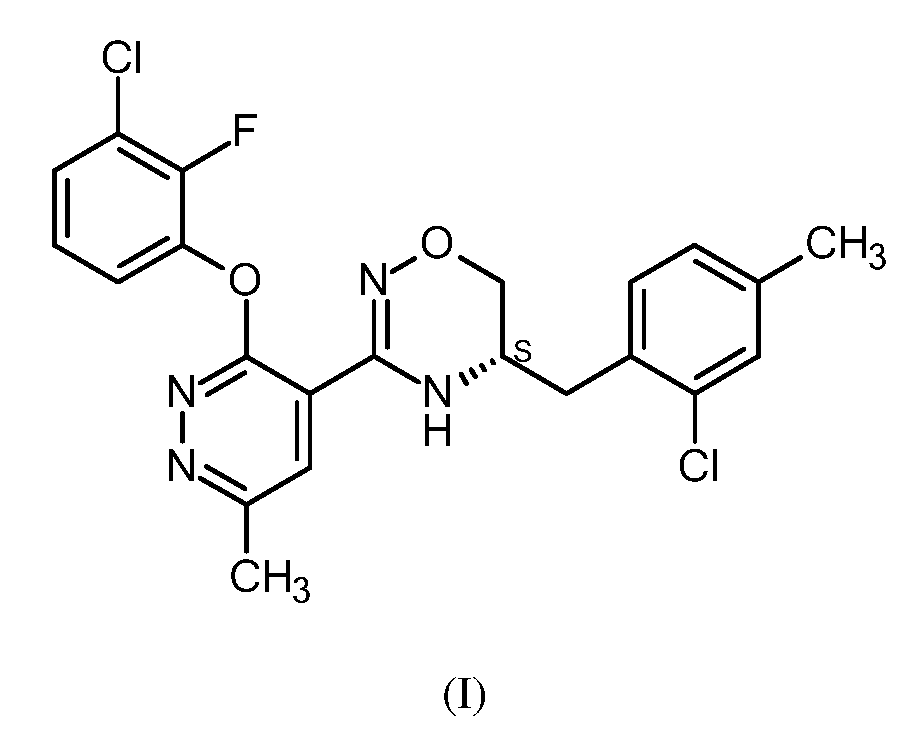
Applications Claiming Priority (3)
| Application Number | Priority Date | Filing Date | Title |
|---|---|---|---|
| EP22171399 | 2022-05-03 | ||
| EP22171399.3 | 2022-05-03 | ||
| PCT/EP2023/061071 WO2023213670A1 (en) | 2022-05-03 | 2023-04-27 | Crystalline forms of (5s)-3-[3-(3-chloro-2-fluorophenoxy)-6-methylpyridazin-4-yl]-5-(2-chloro-4-methylbenzyl)-5,6-dihydro-4h-1,2,4-oxadiazine |
Publications (1)
| Publication Number | Publication Date |
|---|---|
| KR20250004025A true KR20250004025A (en) | 2025-01-07 |
Family
ID=81580044
Family Applications (1)
| Application Number | Title | Priority Date | Filing Date |
|---|---|---|---|
| KR1020247039702A Pending KR20250004025A (en) | 2022-05-03 | 2023-04-27 | Crystalline form of (5S)-3-[3-(3-chloro-2-fluorophenoxy)-6-methylpyridazin-4-yl]-5-(2-chloro-4-methylbenzyl)-5,6-dihydro-4H-1,2,4-oxadiazine |
Country Status (10)
| Country | Link |
|---|---|
| US (1) | US20250304566A1 (en) |
| EP (1) | EP4519256A1 (en) |
| JP (1) | JP2025516326A (en) |
| KR (1) | KR20250004025A (en) |
| CN (1) | CN119522219A (en) |
| AR (1) | AR129211A1 (en) |
| AU (1) | AU2023263693A1 (en) |
| CA (1) | CA3251478A1 (en) |
| IL (1) | IL316272A (en) |
| WO (1) | WO2023213670A1 (en) |
Families Citing this family (6)
| Publication number | Priority date | Publication date | Assignee | Title |
|---|---|---|---|---|
| WO2025093606A1 (en) * | 2023-11-03 | 2025-05-08 | Bayer Aktiengesellschaft | Process for preparation of substituted n-(2-chloroethyl)-n´-hydroxy-3-phenoxypyridazine-3- carboxamidines and substituted 3-(3-phenoxypyridazin-4-yl)-5,6-dihydro-4h-1,2,4-oxadiazines |
| WO2025172100A1 (en) | 2024-02-15 | 2025-08-21 | Basf Se | Fungicidal compositions comprising 8-fluoroquinoline-3-carboxamide compounds |
| WO2025172099A1 (en) | 2024-02-15 | 2025-08-21 | Basf Se | Fungicidal compositions comprising 6-methyl-pyridazin derivatives |
| WO2025195882A1 (en) | 2024-03-21 | 2025-09-25 | Basf Se | Fungicidal compositions comprising strobilurine derivatives |
| WO2025195881A1 (en) | 2024-03-21 | 2025-09-25 | Basf Se | Fungicidal compositions comprising strobilurine derivatives |
| WO2025247771A1 (en) | 2024-05-28 | 2025-12-04 | Bayer Aktiengesellschaft | Novel process for preparation of substituted 3-(3-phenoxypyridazin-4-yl)-5,6-dihydro-4h-1,2,4- oxadiazines |
Family Cites Families (198)
| Publication number | Priority date | Publication date | Assignee | Title |
|---|---|---|---|---|
| US2009A (en) | 1841-03-18 | Improvement in machines for boring war-rockets | ||
| US24077A (en) | 1859-05-17 | Window-sash supporter | ||
| US137395A (en) | 1873-04-01 | Improvement in nuts | ||
| US70139A (en) | 1867-10-22 | warfield | ||
| US2006A (en) | 1841-03-16 | Clamp for crimping leather | ||
| US2010A (en) | 1841-03-18 | Machine foe | ||
| DE2906507A1 (en) | 1979-02-20 | 1980-08-28 | Bayer Ag | Plant growth regulating compsn. - contg. alpha amino cyclo:alkanoic acid derivs., e.g. for dwarfing cereals |
| DE2948024A1 (en) | 1979-11-29 | 1981-08-27 | Bayer Ag, 5090 Leverkusen | 1-AMINO-CYCLOPROPANCARBONIC ACID DERIVATIVES, METHOD FOR THE PRODUCTION THEREOF AND THEIR USE AS PLANT GROWTH REGULATORS |
| MA19709A1 (en) | 1982-02-17 | 1983-10-01 | Ciba Geigy Ag | APPLICATION OF QUINOLEIN DERIVATIVES TO THE PROTECTION OF CULTIVATED PLANTS. |
| EP0094349B1 (en) | 1982-05-07 | 1994-04-06 | Ciba-Geigy Ag | Use of quinoline derivatives for the protection of cultivated plants |
| US4536207A (en) | 1983-07-26 | 1985-08-20 | Igi Biotechnology, Inc. | Nematocidally active chitin-protein complex |
| DE3335514A1 (en) | 1983-09-30 | 1985-04-18 | Bayer Ag, 5090 Leverkusen | 1-METHYLAMINO-CYCLOPROPAN-1-CARBONIC ACID DERIVATIVES |
| JPS6087254A (en) | 1983-10-19 | 1985-05-16 | Japan Carlit Co Ltd:The | Novel urea compound and herbicide containing the same |
| DE3525205A1 (en) | 1984-09-11 | 1986-03-20 | Hoechst Ag, 6230 Frankfurt | PLANT PROTECTIVE AGENTS BASED ON 1,2,4-TRIAZOLE DERIVATIVES AND NEW DERIVATIVES OF 1,2,4-TRIAZOLE |
| DE3680212D1 (en) | 1985-02-14 | 1991-08-22 | Ciba Geigy Ag | USE OF CHINOLINE DERIVATIVES FOR PROTECTING CROPS. |
| US5123951A (en) | 1986-03-31 | 1992-06-23 | Rhone-Poulenc Nederland B.V. | Synergistic plant growth regulator compositions |
| DE3633840A1 (en) | 1986-10-04 | 1988-04-14 | Hoechst Ag | PHENYLPYRAZOLIC CARBONIC ACID DERIVATIVES, THEIR PRODUCTION AND USE AS PLANT GROWTH REGULATORS AND SAFENERS |
| EP0268554B1 (en) | 1986-10-22 | 1991-12-27 | Ciba-Geigy Ag | 1,5-diphenyl pyrazole-3-carbonic-acid derivatives for the protection of cultured plants |
| GB8805394D0 (en) | 1988-03-07 | 1988-04-07 | Agricultural Genetics Co | Antibiotic |
| DE3817192A1 (en) | 1988-05-20 | 1989-11-30 | Hoechst Ag | PLANT-PROTECTIVE AGENTS CONTAINING 1,2,4-TRIAZOLE DERIVATIVES AND NEW DERIVATIVES OF 1,2,4-TRIAZOLE |
| ES2054088T3 (en) | 1988-10-20 | 1994-08-01 | Ciba Geigy Ag | SULFAMOILFENILUREAS. |
| DE3939010A1 (en) | 1989-11-25 | 1991-05-29 | Hoechst Ag | ISOXAZOLINE, METHOD FOR THE PRODUCTION THEREOF AND THEIR USE AS A PLANT PROTECTIVE AGENT |
| DE3939503A1 (en) | 1989-11-30 | 1991-06-06 | Hoechst Ag | NEW PYRAZOLINE FOR THE PROTECTION OF CULTURAL PLANTS AGAINST HERBICIDES |
| US5549718A (en) | 1990-04-06 | 1996-08-27 | Centre National De La Recherche Scientifique (C.N.R.S.) | Substance with lipo-oligosaccharide structure capable of acting as plant-specific symbiotic signals, processes for producing them and their applications |
| US6395966B1 (en) | 1990-08-09 | 2002-05-28 | Dekalb Genetics Corp. | Fertile transgenic maize plants containing a gene encoding the pat protein |
| EP0492366B1 (en) | 1990-12-21 | 1997-03-26 | Hoechst Schering AgrEvo GmbH | New 5-chloroquinolin-8-oxyalkanecarbonic acid derivatives, process for their preparation and their use as antidotes for herbicides |
| TW259690B (en) | 1992-08-01 | 1995-10-11 | Hoechst Ag | |
| DE4331448A1 (en) | 1993-09-16 | 1995-03-23 | Hoechst Schering Agrevo Gmbh | Substituted isoxazolines, processes for their preparation, compositions containing them and their use as safeners |
| HU226259B1 (en) | 1995-04-20 | 2008-07-28 | American Cyanamid Co | Structure-based designed herbicide resistant products |
| RO121280B1 (en) | 1995-11-06 | 2007-02-28 | Wisconsin Alumini Research Foundation | Insectidicidal toxic proteins from photorhabdus |
| US5702752A (en) | 1996-03-13 | 1997-12-30 | Archer Daniels Midland Company | Production of isoflavone enriched fractions from soy protein extracts |
| DE19621522A1 (en) | 1996-05-29 | 1997-12-04 | Hoechst Schering Agrevo Gmbh | New N-acylsulfonamides, new mixtures of herbicides and antidots and their use |
| US5821361A (en) | 1996-06-11 | 1998-10-13 | Protein Technologies International, Inc. | Recovery of isoflavones from soy molasses |
| IL128590A0 (en) | 1996-08-29 | 2000-01-31 | Dow Agro Sciences Llc | Insecticidal protein toxins from photorhabdus |
| EP0929543B1 (en) | 1996-09-26 | 2001-10-31 | Syngenta Participations AG | Herbicidal composition |
| US5965545A (en) | 1996-10-15 | 1999-10-12 | State Of Israel, Ministry Of Agriculture, Agricultural Research Organization, The Volcani Center | Compositions and method for controlling fungal disease in plants |
| DE19652961A1 (en) | 1996-12-19 | 1998-06-25 | Hoechst Schering Agrevo Gmbh | New 2-fluoroacrylic acid derivatives, new mixtures of herbicides and antidots and their use |
| US6071856A (en) | 1997-03-04 | 2000-06-06 | Zeneca Limited | Herbicidal compositions for acetochlor in rice |
| CA2285618C (en) | 1997-04-03 | 2015-07-07 | Dekalb Genetics Corporation | Glyphosate resistant maize lines |
| US6146668A (en) | 1997-04-28 | 2000-11-14 | Novogen, Inc. | Preparation of isoflavones from legumes |
| DK0915909T3 (en) | 1997-05-05 | 2007-10-08 | Dow Agrosciences Llc | Insecticidal protein toxins from Xenorhabdus |
| DK0981540T3 (en) | 1997-05-09 | 2006-11-06 | Agraquest Inc | New Bacillus strain for the control of plant diseases and of maize roots |
| DE19727410A1 (en) | 1997-06-27 | 1999-01-07 | Hoechst Schering Agrevo Gmbh | 3- (5-tetrazolylcarbonyl) -2-quinolones and crop protection agents containing them |
| DE19742951A1 (en) | 1997-09-29 | 1999-04-15 | Hoechst Schering Agrevo Gmbh | Acylsulfamoylbenzoic acid amides, crop protection agents containing them and process for their preparation |
| JP3691265B2 (en) | 1997-11-13 | 2005-09-07 | クミアイ化学工業株式会社 | Disease control agent for rice seedling |
| AU1336200A (en) | 1998-11-03 | 2000-05-22 | Aventis Cropscience N.V. | Glufosinate tolerant rice |
| US6333449B1 (en) | 1998-11-03 | 2001-12-25 | Plant Genetic Systems, N.V. | Glufosinate tolerant rice |
| US6245551B1 (en) | 1999-03-30 | 2001-06-12 | Agraquest, Inc. | Strain of Bacillus pumilus for controlling plant diseases caused by fungi |
| US6509516B1 (en) | 1999-10-29 | 2003-01-21 | Plant Genetic Systems N.V. | Male-sterile brassica plants and methods for producing same |
| US6506963B1 (en) | 1999-12-08 | 2003-01-14 | Plant Genetic Systems, N.V. | Hybrid winter oilseed rape and methods for producing same |
| DE60041505D1 (en) | 1999-12-28 | 2009-03-19 | Bayer Bioscience Nv | INTEGRITY PROTEINS OF BACILLUS THURINGIENSIS |
| US6395485B1 (en) | 2000-01-11 | 2002-05-28 | Aventis Cropscience N.V. | Methods and kits for identifying elite event GAT-ZM1 in biological samples |
| BRPI0100752B1 (en) | 2000-06-22 | 2015-10-13 | Monsanto Co | DNA Molecules and Pairs of Molecules, Processes for Detecting DNA Molecules and for Creating a Glyphosate Tolerant Trait in Corn Plants, as well as DNA Detection Kit |
| US6713259B2 (en) | 2000-09-13 | 2004-03-30 | Monsanto Technology Llc | Corn event MON810 and compositions and methods for detection thereof |
| EP1322773A2 (en) | 2000-09-29 | 2003-07-02 | Monsanto Technology LLC | Glyphosate tolerant wheat plant 33391 and compositions and methods for detection thereof |
| AR031027A1 (en) | 2000-10-23 | 2003-09-03 | Syngenta Participations Ag | AGROCHEMICAL COMPOSITIONS |
| EP1366070A2 (en) | 2000-10-25 | 2003-12-03 | Monsanto Technology LLC | Cotton event pv-ghgt07(1445) and compositions and methods for detection thereof |
| AU2002230899B2 (en) | 2000-10-30 | 2006-11-09 | Monsanto Technology Llc | Canola event PV-BNGT04(RT73) and compositions and methods for detection thereof |
| AU2002236442A1 (en) | 2000-11-20 | 2002-05-27 | Monsanto Technology Llc | Cotton event pv-ghbk04 (531) and compositions and methods for detection thereof |
| EP1337669A2 (en) | 2000-11-30 | 2003-08-27 | Ses Europe N.V./S.A. | Glyphosate resistant transgenic sugar beet characterised by a specific transgene insertion (t227-1), methods and primers for the detection of said insertion |
| EG26529A (en) | 2001-06-11 | 2014-01-27 | مونسانتو تكنولوجى ل ل سى | Cotton event mon 15985 and compositions and methods for detection thereof |
| US6569425B2 (en) | 2001-06-22 | 2003-05-27 | David Joseph Drahos | Bacillus licheniformis biofungicide |
| US6818807B2 (en) | 2001-08-06 | 2004-11-16 | Bayer Bioscience N.V. | Herbicide tolerant cotton plants having event EE-GH1 |
| JP4071036B2 (en) | 2001-11-26 | 2008-04-02 | クミアイ化学工業株式会社 | Bacillus sp. D747 strain and plant disease control agent and pest control agent using the same |
| WO2003052073A2 (en) | 2001-12-17 | 2003-06-26 | Syngenta Participations Ag | Novel corn event |
| HRP20050134A2 (en) | 2002-07-29 | 2005-06-30 | Monsanto Technology Llc | Corn event pv-zmir13 (mon863) plants and compositions and methods for detection thereof |
| GB0225129D0 (en) | 2002-10-29 | 2002-12-11 | Syngenta Participations Ag | Improvements in or relating to organic compounds |
| AU2003299579B2 (en) | 2002-12-05 | 2008-09-04 | Monsanto Technology Llc | Bentgrass event ASR-368 and compositions and methods for detection thereof |
| CN1753998B (en) | 2003-02-12 | 2017-02-15 | 孟山都技术有限公司 | Cotton event MON88913 and its composition and detection method |
| CN102391988A (en) | 2003-02-20 | 2012-03-28 | Kws萨特股份公司 | Glyphosate tolerant sugar beet |
| US7335816B2 (en) | 2003-02-28 | 2008-02-26 | Kws Saat Ag | Glyphosate tolerant sugar beet |
| MXPA05010296A (en) | 2003-03-26 | 2005-11-17 | Bayer Cropscience Gmbh | Use of aromatic hydroxy compounds as safeners. |
| DK1620571T3 (en) | 2003-05-02 | 2015-10-05 | Dow Agrosciences Llc | MAJS TD1507 and methods for detecting it |
| DE10335726A1 (en) | 2003-08-05 | 2005-03-03 | Bayer Cropscience Gmbh | Use of hydroxyaromatics as safener |
| DE10335725A1 (en) | 2003-08-05 | 2005-03-03 | Bayer Cropscience Gmbh | Safener based on aromatic-aliphatic carboxylic acid derivatives |
| AU2004295386A1 (en) | 2003-12-01 | 2005-06-16 | Syngenta Participations Ag | Insect resistant cotton plants and methods of detecting the same |
| WO2005054480A2 (en) | 2003-12-01 | 2005-06-16 | Syngenta Participations Ag | Insect resistant cotton plants and methods of detecting the same |
| US7157281B2 (en) | 2003-12-11 | 2007-01-02 | Monsanto Technology Llc | High lysine maize compositions and event LY038 maize plants |
| US8212113B2 (en) | 2003-12-15 | 2012-07-03 | Monsanto Technology Llc | Corn plant Mon88017 and compositions and methods for detection thereof |
| GB0402106D0 (en) | 2004-01-30 | 2004-03-03 | Syngenta Participations Ag | Improved fertility restoration for ogura cytoplasmic male sterile brassica and method |
| UA94893C2 (en) | 2004-03-25 | 2011-06-25 | Сингента Партисипейшнс Аг | Transgenic maize plant mir604 |
| US7179965B2 (en) | 2004-03-26 | 2007-02-20 | Dow Agrosciences Llc | Cry1F and Cry1Ac transgenic cotton lines and event-specific identification thereof |
| DE102004023332A1 (en) | 2004-05-12 | 2006-01-19 | Bayer Cropscience Gmbh | Quinoxaline-2-one derivatives, crop protection agents containing them, and processes for their preparation and their use |
| GB0414438D0 (en) | 2004-06-28 | 2004-07-28 | Syngenta Participations Ag | Chemical compounds |
| CA2581725C (en) | 2004-10-20 | 2013-01-08 | Kumiai Chemical Industry Co., Ltd. | 3-triazolylphenyl sulfide derivative, and insecticide, miticide and nematicide containing it as an active ingredient |
| WO2006098952A2 (en) | 2005-03-16 | 2006-09-21 | Syngenta Participations Ag | Corn event 3272 and methods of detection thereof |
| CA2603944C (en) | 2005-04-08 | 2015-06-23 | Bayer Bioscience N.V. | Elite event a2704-12 comprising the integration of the phosphinothricin acetyltransferase (pat) gene into soybeans, and methods and kits for identifying such event in biological samples |
| JP5281392B2 (en) | 2005-04-11 | 2013-09-04 | バイエル・クロップサイエンス・エヌ・ヴェー | Elite event A5547-127 and methods and kits for identifying the event in biological samples |
| PT1885176T (en) | 2005-05-27 | 2016-11-28 | Monsanto Technology Llc | EVENT MON89788 OF SOYBEANS AND METHODS FOR ITS DETECTION |
| WO2006128571A2 (en) | 2005-06-02 | 2006-12-07 | Syngenta Participations Ag | Ce44-69d , insecticidal transgenic cotton expressing cry1ab |
| WO2006128569A2 (en) | 2005-06-02 | 2006-12-07 | Syngenta Participations Ag | 1143-14a, insecticidal transgenic cotton expressing cry1ab |
| WO2006128572A1 (en) | 2005-06-02 | 2006-12-07 | Syngenta Participations Ag | Ce46-02a insecticidal cotton |
| WO2006128570A1 (en) | 2005-06-02 | 2006-12-07 | Syngenta Participations Ag | 1143-51b insecticidal cotton |
| WO2006128573A2 (en) | 2005-06-02 | 2006-12-07 | Syngenta Participations Ag | Ce43- 67b, insecticidal transgenic cotton expressing cry1ab |
| WO2006128568A2 (en) | 2005-06-02 | 2006-12-07 | Syngenta Participations Ag | T342-142, insecticidal transgenic cotton expressing cry1ab |
| MX2008001839A (en) | 2005-08-08 | 2008-04-09 | Bayer Bioscience Nv | Herbicide tolerant cotton plants and methods for identifying same. |
| JPWO2007023719A1 (en) | 2005-08-22 | 2009-02-26 | クミアイ化学工業株式会社 | Pesticide mitigation agent and herbicide composition with reduced phytotoxicity |
| ATE544861T1 (en) | 2005-08-24 | 2012-02-15 | Pioneer Hi Bred Int | METHODS AND COMPOSITIONS FOR EXPRESSING A POLYNUCLEOTIDE OF INTEREST |
| WO2007023764A1 (en) | 2005-08-26 | 2007-03-01 | Kumiai Chemical Industry Co., Ltd. | Agent for reduction of harmful effect of herbicide and herbicide composition having reduced harmful effect |
| CN102936221B (en) | 2005-10-06 | 2014-09-10 | 日本曹达株式会社 | Bridged cyclic amine compound and pest control agent |
| WO2011066360A1 (en) | 2009-11-24 | 2011-06-03 | Dow Agrosciences Llc | Detection of aad-12 soybean event 416 |
| JP5164862B2 (en) | 2006-02-10 | 2013-03-21 | マハラシュートラ ハイブリッド シーズ カンパニー リミテッド(マヒコ) | Transgenic eggplant including EE-1 event (SOLANUMELONGENA) |
| UA98770C2 (en) | 2006-05-26 | 2012-06-25 | Монсанто Текнолоджи, Ллс | Corn plant and seeds corresponding to trangenic event mon89034, and methods for its determination and using |
| ES2546255T3 (en) | 2006-06-03 | 2015-09-22 | Syngenta Participations Ag | MIR162 Corn Event |
| US7951995B2 (en) | 2006-06-28 | 2011-05-31 | Pioneer Hi-Bred International, Inc. | Soybean event 3560.4.3.5 and compositions and methods for the identification and detection thereof |
| US7928295B2 (en) | 2006-08-24 | 2011-04-19 | Bayer Bioscience N.V. | Herbicide tolerant rice plants and methods for identifying same |
| US20080064032A1 (en) | 2006-09-13 | 2008-03-13 | Syngenta Participations Ag | Polynucleotides and uses thereof |
| US7928296B2 (en) | 2006-10-30 | 2011-04-19 | Pioneer Hi-Bred International, Inc. | Maize event DP-098140-6 and compositions and methods for the identification and/or detection thereof |
| EP3067425A1 (en) | 2006-10-31 | 2016-09-14 | E. I. du Pont de Nemours and Company | Soybean event dp-305423-1 and constructs for the generation thereof |
| US7579183B1 (en) | 2006-12-01 | 2009-08-25 | The United States Of America As Represented By The Secretary Of Agriculture | Saprophytic yeast, Pichia anomala |
| WO2008114282A2 (en) | 2007-03-19 | 2008-09-25 | Maharashtra Hybrid Seeds Company Limited | Transgenic rice (oryza sativa) comprising pe-7 event and method of detection thereof |
| WO2008122406A1 (en) | 2007-04-05 | 2008-10-16 | Bayer Bioscience N.V. | Insect resistant cotton plants and methods for identifying same |
| EP1987717A1 (en) | 2007-04-30 | 2008-11-05 | Bayer CropScience AG | Pyridon carboxamides, agents containing these but not impacting useful plants and method for their manufacture and application |
| EP1987718A1 (en) | 2007-04-30 | 2008-11-05 | Bayer CropScience AG | Utilisation of pyridine-2-oxy-3-carbon amides as safener |
| EP2162542A1 (en) | 2007-06-11 | 2010-03-17 | Bayer BioScience N.V. | Insect resistant cotton plants comprising elite event ee-gh6 and methods for identifying same |
| EP2209897A1 (en) | 2007-11-15 | 2010-07-28 | Monsanto Technology, LLC | Soybean plant and seed corresponding to transgenic event mon87701 and methods for detection thereof |
| EP2070417A1 (en) | 2007-12-14 | 2009-06-17 | Plant Research International B.V. | Novel micro-organisms controlling plant pathogens |
| US8273535B2 (en) | 2008-02-08 | 2012-09-25 | Dow Agrosciences, Llc | Methods for detection of corn event DAS-59132 |
| CN102119216B (en) | 2008-02-14 | 2015-05-20 | 先锋国际良种公司 | Plant genomic DNA flanking SPT events and methods for identifying SPT events |
| JP5767813B2 (en) | 2008-02-15 | 2015-08-19 | モンサント テクノロジー エルエルシー | Soybean plants and seeds corresponding to the transgenic event MON87769 and methods for detecting them |
| ES2590177T3 (en) | 2008-02-29 | 2016-11-18 | Monsanto Technology Llc | MON87460 corn plant event and compositions and procedures for its detection |
| BRPI0822486B1 (en) | 2008-03-21 | 2019-04-02 | Trentino Sviluppo S.P.A. | TRICHODERMA ATROVIRIDE SC1 FOR BIOLOGICAL CONTROL OF FUNGAL DISEASES IN PLANTS |
| US20110195845A1 (en) | 2008-06-11 | 2011-08-11 | Dow Agrosciences Llc | Constructs for Expressing Herbicide Tolerance Genes, Related Plants, and Related Trait Combinations |
| JP5268461B2 (en) | 2008-07-14 | 2013-08-21 | Meiji Seikaファルマ株式会社 | PF1364 substance, its production method, production strain, and agricultural and horticultural insecticide containing the same as an active ingredient |
| CN101337940B (en) | 2008-08-12 | 2012-05-02 | 国家农药创制工程技术研究中心 | Nitrogen heterocyclic ring dichloro allyl ether compound with insecticidal activity |
| CN101337937B (en) | 2008-08-12 | 2010-12-22 | 国家农药创制工程技术研究中心 | N-benz-3-substituted amino pyrazoles compounds with insecticidal activity |
| WO2010024976A1 (en) | 2008-08-29 | 2010-03-04 | Monsanto Technology Llc | Soybean plant and seed corresponding to transgenic event mon87754 and methods for detection thereof |
| BRPI0920827A2 (en) | 2008-09-29 | 2015-08-18 | Monsanto Technology Llc | Mon87705 soybean transgenic event and methods for its detection |
| CN101715774A (en) | 2008-10-09 | 2010-06-02 | 浙江化工科技集团有限公司 | Preparation and use of compound having insecticidal activity |
| EP2184273A1 (en) | 2008-11-05 | 2010-05-12 | Bayer CropScience AG | Halogen substituted compounds as pesticides |
| GB0820344D0 (en) | 2008-11-06 | 2008-12-17 | Syngenta Ltd | Herbicidal compositions |
| CA2746394C (en) | 2008-12-12 | 2017-08-29 | Syngenta Limited | Spiroheterocyclic n-oxypiperidines as pesticides |
| MX346321B (en) | 2008-12-16 | 2017-03-15 | Syngenta Participations Ag | EVENT 5307 OF CORN. |
| CA2747676A1 (en) | 2008-12-19 | 2010-07-08 | Syngenta Participations Ag | Transgenic sugar beet event gm rz13 |
| WO2010080829A1 (en) | 2009-01-07 | 2010-07-15 | Basf Agrochemical Products B.V. | Soybean event 127 and methods related thereto |
| FR2941463B1 (en) | 2009-01-27 | 2012-12-28 | Lesaffre & Cie | STRAINS OF SACCHAROMYCES CEREVISIAE WITH PHYTOSANITARY SKILLS |
| JP5769698B2 (en) | 2009-03-30 | 2015-08-26 | モンサント テクノロジー エルエルシー | Genetically modified rice event 17314 and method of use thereof |
| CN102333439B (en) | 2009-03-30 | 2015-04-22 | 孟山都技术公司 | Rice transgenic event 17053 and methods of use thereof |
| EP2248421A1 (en) | 2009-05-07 | 2010-11-10 | GMI - Gregor-Mendel-Institut für Molekulare Pflanzenbiologie GmbH | Accumulation of biomass in plants |
| CA3038144C (en) | 2009-08-19 | 2023-03-14 | Yunxing Cory Cui | Aad-1 event das-40278-9, related transgenic corn lines, and event-specific identification thereof |
| JP5726878B2 (en) | 2009-09-17 | 2015-06-03 | モンサント テクノロジー エルエルシー | Soybean transgenic event MON87708 and method of use thereof |
| UA115762C2 (en) | 2009-11-23 | 2017-12-26 | Монсанто Текнолоджи Ллс | RECOMBINANT DNA MOLECULE INDICATING THE PRESENCE OF THE TRANSGENIC EVENT MON 87427 MAIS |
| CA2781598C (en) | 2009-11-23 | 2020-06-02 | Bayer Cropscience N.V. | Herbicide tolerant soybean plants and methods for identifying same |
| US8581046B2 (en) | 2010-11-24 | 2013-11-12 | Pioneer Hi-Bred International, Inc. | Brassica gat event DP-073496-4 and compositions and methods for the identification and/or detection thereof |
| IN2012DN04843A (en) | 2009-11-24 | 2015-09-25 | Dow Agrosciences Llc | |
| WO2011084632A1 (en) | 2009-12-17 | 2011-07-14 | Pioneer Hi-Bred International, Inc. | Maize event dp-032316-8 and methods for detection thereof |
| WO2011075593A1 (en) | 2009-12-17 | 2011-06-23 | Pioneer Hi-Bred International, Inc. | Maize event dp-040416-8 and methods for detection thereof |
| WO2011075595A1 (en) | 2009-12-17 | 2011-06-23 | Pioneer Hi-Bred International, Inc. | Maize event dp-043a47-3 and methods for detection thereof |
| PL2512226T3 (en) | 2009-12-17 | 2019-10-31 | Pioneer Hi Bred Int | Maize event dp-004114-3 and methods for detection thereof |
| WO2011085575A1 (en) | 2010-01-15 | 2011-07-21 | 江苏省农药研究所股份有限公司 | Ortho-heterocyclyl formanilide compounds, their synthesis methods and use |
| AR080234A1 (en) | 2010-02-25 | 2012-03-21 | Marrone Bio Innovations Inc | BACTERIAL CEPA ISOLATED FROM THE BURKHOLDERIA AND METABOLITES PESTICIDES OF THE SAME |
| CN101838227A (en) | 2010-04-30 | 2010-09-22 | 孙德群 | Safener of benzamide herbicide |
| BR112012030408A2 (en) | 2010-05-31 | 2015-09-29 | Syngenta Participations Ag | crop breeding method |
| HUE045305T2 (en) | 2010-06-01 | 2019-12-30 | Yissum Res Dev Co Of Hebrew Univ Jerusalem Ltd | Use of pseudozyma aphidis as a biocontrol agent against various plant pathogens and fungi in human and livestock and for plant growth promotion |
| KR101941297B1 (en) | 2010-06-04 | 2019-01-22 | 몬산토 테크놀로지 엘엘씨 | Transgenic brassica event mon 88302 and methods of use thereof |
| BR112013005431A2 (en) | 2010-09-08 | 2016-06-07 | Dow Agrosciences Llc | "aad-12 event 1606 and related transgenic soybean strains". |
| CN101967139B (en) | 2010-09-14 | 2013-06-05 | 中化蓝天集团有限公司 | Fluoro methoxylpyrazole-containing o-formylaminobenzamide compound, synthesis method and application thereof |
| WO2012051199A2 (en) | 2010-10-12 | 2012-04-19 | Monsanto Technology Llc | Soybean plant and seed corresponding to transgenic event mon87712 and methods for detection thereof |
| WO2012071039A1 (en) | 2010-11-24 | 2012-05-31 | Pioner Hi-Bred International, Inc. | Brassica gat event dp-061061-7 and compositions and methods for the identification and/or detection thereof |
| WO2012075429A1 (en) | 2010-12-03 | 2012-06-07 | Dow Agrosciences Llc | Stacked herbicide tolerance event 8291.45.36.2, related transgenic soybean lines, and detection thereof |
| AU2011336364B2 (en) | 2010-12-03 | 2017-04-13 | Corteva Agriscience Llc | Stacked herbicide tolerance event 8264.44.06.1, related transgenic soybean lines, and detection thereof |
| TWI667347B (en) | 2010-12-15 | 2019-08-01 | 瑞士商先正達合夥公司 | Soybean event syht0h2 and compositions and methods for detection thereof |
| ES2743728T3 (en) | 2011-03-30 | 2020-02-20 | Monsanto Technology Llc | GM 88701 GM cotton transgenic event and procedures for its use |
| EP2726618A1 (en) | 2011-06-30 | 2014-05-07 | Monsanto Technology LLC | Alfalfa plant and seed corresponding to transgenic event kk 179-2 and methods for detection thereof |
| UY34199A (en) | 2011-07-13 | 2013-02-28 | Dow Agrosciences Llc | ? 8264.42.32.1 EVENT OF TOLERANCE STACKED ON HERBICIDES, TRANSGENIC SOY LINES RELATED TO AND THEIR DETECTION ?. |
| WO2013012643A1 (en) | 2011-07-15 | 2013-01-24 | Syngenta Participations Ag | Polynucleotides encoding trehalose-6-phosphate phosphatase and methods of use thereof |
| AU2012301466B2 (en) | 2011-08-27 | 2015-07-23 | Marrone Bio Innovations, Inc. | Isolated bacterial strain of the genus Burkholderia and pesticidal metabolites therefrom-formulations and uses |
| HU231053B1 (en) | 2011-09-08 | 2020-03-30 | Szegedi Tudományegyetem | Copper-resistant, fengycin hyperproducing bacillus mojavensis strain for protection against plant pests, its use and compounds containing the same |
| WO2013050317A1 (en) | 2011-10-03 | 2013-04-11 | Syngenta Limited | Polymorphs of an isoxazoline derivative |
| CN102391261A (en) | 2011-10-14 | 2012-03-28 | 上海交通大学 | N-substituted dioxazine compound as well as preparation method and application thereof |
| US9334238B2 (en) | 2012-03-30 | 2016-05-10 | Basf Se | N-substituted pyridinylidenes for combating animal pests |
| EP2647626A1 (en) | 2012-04-03 | 2013-10-09 | Syngenta Participations AG. | 1-Aza-spiro[4.5]dec-3-ene and 1,8-diaza-spiro[4.5]dec-3-ene derivatives as pesticides |
| US9282739B2 (en) | 2012-04-27 | 2016-03-15 | Dow Agrosciences Llc | Pesticidal compositions and processes related thereto |
| US8901153B2 (en) | 2012-04-27 | 2014-12-02 | Dow Agrosciences, Llc. | Pesticidal compositions and processes related thereto |
| US9125419B2 (en) | 2012-08-14 | 2015-09-08 | Marrone Bio Innovations, Inc. | Bacillus sp. strain with antifungal, antibacterial and growth promotion activity |
| CR20190436A (en) | 2012-10-02 | 2019-10-29 | Bayer Cropscience Ag | Heterocyclic compounds as pesticides |
| CN103109816B (en) | 2013-01-25 | 2014-09-10 | 青岛科技大学 | Thiobenzamide compounds and application thereof |
| CN103232431B (en) | 2013-01-25 | 2014-11-05 | 青岛科技大学 | Dihalogenated pyrazole amide compound and its use |
| US20140275503A1 (en) | 2013-03-13 | 2014-09-18 | Dow Agrosciences Llc | Process for the preparation of certain triaryl rhamnose carbamates |
| BR112015029268B1 (en) | 2013-05-23 | 2020-10-20 | Syngenta Participations Ag | pesticide composition, combination package, use, method of increasing the effectiveness and reducing the phytotoxicity of pesticide-active tetramic acid compounds, non-therapeutic method to combat and control pests |
| CN103265527B (en) | 2013-06-07 | 2014-08-13 | 江苏省农用激素工程技术研究中心有限公司 | Anthranilamide compound as well as preparation method and application thereof |
| CN103524422B (en) | 2013-10-11 | 2015-05-27 | 中国农业科学院植物保护研究所 | Benzimidazole derivative, and preparation method and purpose thereof |
| US10240216B2 (en) | 2013-11-11 | 2019-03-26 | Basf Se | Antifungal penicillium strains, fungicidal extrolites thereof, and their use |
| CA2956880C (en) | 2014-08-04 | 2023-04-25 | Basf Se | Antifungal paenibacillus strains, fusaricidin-type compounds, and their use |
| KR102859105B1 (en) | 2015-03-26 | 2025-09-12 | 바이엘 크롭사이언스 엘피 | A novel paenibacillus strain, antifungal compounds, and methods for their use |
| WO2017019448A1 (en) | 2015-07-24 | 2017-02-02 | AgBiome, Inc. | Modified biological control agents and their uses |
| CN106413117B (en) | 2015-07-29 | 2021-08-17 | 索尼公司 | Apparatus and method for wireless communication system, base station side and user equipment side |
| EA201890945A1 (en) | 2015-10-12 | 2018-10-31 | Пайонир Хай-Бред Интернэшнл, Инк. | BIOLOGICAL PREPARATIONS AND THEIR APPLICATION WITH RESPECT TO PLANTS |
| CN106977494B (en) | 2016-01-16 | 2021-04-30 | 海利尔药业集团股份有限公司 | Substituted pyrazole amide compounds and application thereof |
| EP3248465A1 (en) | 2016-05-25 | 2017-11-29 | Bayer CropScience Aktiengesellschaft | Agrochemical formulation based on emulsion polymers |
| AU2017272058A1 (en) | 2016-05-26 | 2019-01-17 | Novozymes Bioag A/S | Bacillus and lipochitooligosaccharide for improving plant growth |
| CN110461854A (en) | 2017-03-31 | 2019-11-15 | 巴斯夫欧洲公司 | Process for the preparation of chiral 2,3-dihydrothiazolo[3,2-A]pyrimidine-4-onium compounds |
| NZ763636A (en) | 2017-09-20 | 2025-12-19 | Mitsui Chemicals Crop & Life Solutions Inc | Prolonged ectoparasite-controlling agent for animal |
| BR112020010066A2 (en) | 2017-11-21 | 2020-11-03 | Syngenta Participations Ag | new resistance genes associated with disease resistance in soybeans |
| JP7245268B2 (en) | 2018-06-08 | 2023-03-23 | コルテバ アグリサイエンス エルエルシー | Molecules with pesticidal utility, and compositions and methods related thereto |
| CN110835330A (en) | 2018-08-15 | 2020-02-25 | 海利尔药业集团股份有限公司 | Preparation method of substituted pyrazole amide compound with insecticidal activity |
| AR117461A1 (en) | 2018-12-20 | 2021-08-04 | Bayer Ag | HETEROCYCLYL PYRIDAZINE COMPOUNDS AS FUNGICIDES |
| EP4167740A1 (en) * | 2020-06-18 | 2023-04-26 | Bayer Aktiengesellschaft | Active compound combinations |
-
2023
- 2023-04-27 KR KR1020247039702A patent/KR20250004025A/en active Pending
- 2023-04-27 EP EP23722868.9A patent/EP4519256A1/en active Pending
- 2023-04-27 WO PCT/EP2023/061071 patent/WO2023213670A1/en not_active Ceased
- 2023-04-27 AU AU2023263693A patent/AU2023263693A1/en active Pending
- 2023-04-27 IL IL316272A patent/IL316272A/en unknown
- 2023-04-27 US US18/862,335 patent/US20250304566A1/en active Pending
- 2023-04-27 CN CN202380038100.0A patent/CN119522219A/en active Pending
- 2023-04-27 CA CA3251478A patent/CA3251478A1/en active Pending
- 2023-04-27 JP JP2024565019A patent/JP2025516326A/en active Pending
- 2023-05-03 AR ARP230101073A patent/AR129211A1/en unknown
Also Published As
| Publication number | Publication date |
|---|---|
| EP4519256A1 (en) | 2025-03-12 |
| CA3251478A1 (en) | 2023-11-09 |
| AU2023263693A1 (en) | 2024-10-31 |
| JP2025516326A (en) | 2025-05-27 |
| WO2023213670A1 (en) | 2023-11-09 |
| IL316272A (en) | 2024-12-01 |
| AR129211A1 (en) | 2024-07-31 |
| US20250304566A1 (en) | 2025-10-02 |
| CN119522219A (en) | 2025-02-25 |
Similar Documents
| Publication | Publication Date | Title |
|---|---|---|
| US20250304566A1 (en) | Crystalline forms of (5s)-3-[3-(3-chloro-2-fluorophenoxy)-6-methylpyridazin-4-yl]-5-(2-chloro-4-methylbenzyl)-5,6-dihydro-4h-1,2,4-oxadiazine | |
| TW202200016A (en) | Active compound combination | |
| KR20250004024A (en) | Use of (5S)-3-[3-(3-chloro-2-fluorophenoxy)-6-methylpyridazin-4-yl]-5-(2-chloro-4-methylbenzyl)-5,6-dihydro-4H-1,2,4-oxadiazine for controlling unwanted microorganisms | |
| EP3897154A1 (en) | 1,3,4-oxadiazoles and their derivatives as new antifungal agents | |
| EP4384016B1 (en) | Active compound combinations and fungicide compositions comprising those | |
| WO2022207496A1 (en) | 3-(hetero)aryl-5-chlorodifluoromethyl-1,2,4-oxadiazole as fungicide | |
| WO2022207494A1 (en) | 3-(hetero)aryl-5-chlorodifluoromethyl-1,2,4-oxadiazole as fungicide | |
| EP4295688A1 (en) | Active compound combination | |
| JP2023527036A (en) | Combinations of active compounds | |
| TW202112771A (en) | Thienylhydroxyisoxazolines and derivatives thereof | |
| TW202214105A (en) | 1,3,4-oxadiazole pyrimidines and1,3,4-oxadiazole pyridines as fungicides | |
| WO2024068517A1 (en) | 3-(hetero)aryl-5-chlorodifluoromethyl-1,2,4-oxadiazole as fungicide | |
| TW201945344A (en) | 1-(5-substituted imidazol-1-yl)but-3-en derivatives and their use as fungicides | |
| WO2019122319A1 (en) | Trisubstitutedsilylmethylheteroaryloxyquinolines and analogues | |
| WO2021255170A1 (en) | 1,3,4-oxadiazole pyrimidines as fungicides | |
| WO2020254490A1 (en) | Phenoxyphenyl hydroxyisoxazolines and analogues as new antifungal agents | |
| WO2024068518A1 (en) | 3-heteroaryl-5-chlorodifluoromethyl-1,2,4-oxadiazole as fungicide | |
| WO2024068519A1 (en) | 3-(hetero)aryl-5-chlorodifluoromethyl-1,2,4-oxadiazole as fungicide | |
| WO2024068520A1 (en) | 3-(hetero)aryl-5-chlorodifluoromethyl-1,2,4-oxadiazole as fungicide | |
| TW201843138A (en) | Trisubstitutedsilylmethylphenoxyquinolines and analogues | |
| TW201843162A (en) | Trisubstitutedsilylbenzylbenzimidazoles and analogues | |
| TW202214107A (en) | 1,3,4-oxadiazole pyrimidines as fungicides |
Legal Events
| Date | Code | Title | Description |
|---|---|---|---|
| PA0105 | International application |
Patent event date: 20241128 Patent event code: PA01051R01D Comment text: International Patent Application |
|
| PG1501 | Laying open of application |