EP1152009B2 - Novel nucleosides and oligonucleotide analogues - Google Patents
Novel nucleosides and oligonucleotide analogues Download PDFInfo
- Publication number
- EP1152009B2 EP1152009B2 EP00902887.9A EP00902887A EP1152009B2 EP 1152009 B2 EP1152009 B2 EP 1152009B2 EP 00902887 A EP00902887 A EP 00902887A EP 1152009 B2 EP1152009 B2 EP 1152009B2
- Authority
- EP
- European Patent Office
- Prior art keywords
- group
- amino
- oxo
- pyrimidin
- protected
- Prior art date
- Legal status (The legal status is an assumption and is not a legal conclusion. Google has not performed a legal analysis and makes no representation as to the accuracy of the status listed.)
- Expired - Lifetime
Links
Classifications
-
- C—CHEMISTRY; METALLURGY
- C07—ORGANIC CHEMISTRY
- C07H—SUGARS; DERIVATIVES THEREOF; NUCLEOSIDES; NUCLEOTIDES; NUCLEIC ACIDS
- C07H19/00—Compounds containing a hetero ring sharing one ring hetero atom with a saccharide radical; Nucleosides; Mononucleotides; Anhydro-derivatives thereof
- C07H19/02—Compounds containing a hetero ring sharing one ring hetero atom with a saccharide radical; Nucleosides; Mononucleotides; Anhydro-derivatives thereof sharing nitrogen
- C07H19/04—Heterocyclic radicals containing only nitrogen atoms as ring hetero atom
-
- C—CHEMISTRY; METALLURGY
- C07—ORGANIC CHEMISTRY
- C07H—SUGARS; DERIVATIVES THEREOF; NUCLEOSIDES; NUCLEOTIDES; NUCLEIC ACIDS
- C07H19/00—Compounds containing a hetero ring sharing one ring hetero atom with a saccharide radical; Nucleosides; Mononucleotides; Anhydro-derivatives thereof
- C07H19/02—Compounds containing a hetero ring sharing one ring hetero atom with a saccharide radical; Nucleosides; Mononucleotides; Anhydro-derivatives thereof sharing nitrogen
- C07H19/04—Heterocyclic radicals containing only nitrogen atoms as ring hetero atom
- C07H19/06—Pyrimidine radicals
- C07H19/10—Pyrimidine radicals with the saccharide radical esterified by phosphoric or polyphosphoric acids
-
- A—HUMAN NECESSITIES
- A61—MEDICAL OR VETERINARY SCIENCE; HYGIENE
- A61K—PREPARATIONS FOR MEDICAL, DENTAL OR TOILETRY PURPOSES
- A61K31/00—Medicinal preparations containing organic active ingredients
- A61K31/70—Carbohydrates; Sugars; Derivatives thereof
- A61K31/7042—Compounds having saccharide radicals and heterocyclic rings
- A61K31/7052—Compounds having saccharide radicals and heterocyclic rings having nitrogen as a ring hetero atom, e.g. nucleosides, nucleotides
- A61K31/706—Compounds having saccharide radicals and heterocyclic rings having nitrogen as a ring hetero atom, e.g. nucleosides, nucleotides containing six-membered rings with nitrogen as a ring hetero atom
-
- A—HUMAN NECESSITIES
- A61—MEDICAL OR VETERINARY SCIENCE; HYGIENE
- A61P—SPECIFIC THERAPEUTIC ACTIVITY OF CHEMICAL COMPOUNDS OR MEDICINAL PREPARATIONS
- A61P17/00—Drugs for dermatological disorders
- A61P17/06—Antipsoriatics
-
- A—HUMAN NECESSITIES
- A61—MEDICAL OR VETERINARY SCIENCE; HYGIENE
- A61P—SPECIFIC THERAPEUTIC ACTIVITY OF CHEMICAL COMPOUNDS OR MEDICINAL PREPARATIONS
- A61P29/00—Non-central analgesic, antipyretic or antiinflammatory agents, e.g. antirheumatic agents; Non-steroidal antiinflammatory drugs [NSAID]
-
- A—HUMAN NECESSITIES
- A61—MEDICAL OR VETERINARY SCIENCE; HYGIENE
- A61P—SPECIFIC THERAPEUTIC ACTIVITY OF CHEMICAL COMPOUNDS OR MEDICINAL PREPARATIONS
- A61P31/00—Antiinfectives, i.e. antibiotics, antiseptics, chemotherapeutics
- A61P31/12—Antivirals
-
- A—HUMAN NECESSITIES
- A61—MEDICAL OR VETERINARY SCIENCE; HYGIENE
- A61P—SPECIFIC THERAPEUTIC ACTIVITY OF CHEMICAL COMPOUNDS OR MEDICINAL PREPARATIONS
- A61P31/00—Antiinfectives, i.e. antibiotics, antiseptics, chemotherapeutics
- A61P31/12—Antivirals
- A61P31/14—Antivirals for RNA viruses
- A61P31/16—Antivirals for RNA viruses for influenza or rhinoviruses
-
- A—HUMAN NECESSITIES
- A61—MEDICAL OR VETERINARY SCIENCE; HYGIENE
- A61P—SPECIFIC THERAPEUTIC ACTIVITY OF CHEMICAL COMPOUNDS OR MEDICINAL PREPARATIONS
- A61P31/00—Antiinfectives, i.e. antibiotics, antiseptics, chemotherapeutics
- A61P31/12—Antivirals
- A61P31/14—Antivirals for RNA viruses
- A61P31/18—Antivirals for RNA viruses for HIV
-
- A—HUMAN NECESSITIES
- A61—MEDICAL OR VETERINARY SCIENCE; HYGIENE
- A61P—SPECIFIC THERAPEUTIC ACTIVITY OF CHEMICAL COMPOUNDS OR MEDICINAL PREPARATIONS
- A61P31/00—Antiinfectives, i.e. antibiotics, antiseptics, chemotherapeutics
- A61P31/12—Antivirals
- A61P31/20—Antivirals for DNA viruses
- A61P31/22—Antivirals for DNA viruses for herpes viruses
-
- A—HUMAN NECESSITIES
- A61—MEDICAL OR VETERINARY SCIENCE; HYGIENE
- A61P—SPECIFIC THERAPEUTIC ACTIVITY OF CHEMICAL COMPOUNDS OR MEDICINAL PREPARATIONS
- A61P35/00—Antineoplastic agents
-
- A—HUMAN NECESSITIES
- A61—MEDICAL OR VETERINARY SCIENCE; HYGIENE
- A61P—SPECIFIC THERAPEUTIC ACTIVITY OF CHEMICAL COMPOUNDS OR MEDICINAL PREPARATIONS
- A61P43/00—Drugs for specific purposes, not provided for in groups A61P1/00-A61P41/00
-
- C—CHEMISTRY; METALLURGY
- C07—ORGANIC CHEMISTRY
- C07H—SUGARS; DERIVATIVES THEREOF; NUCLEOSIDES; NUCLEOTIDES; NUCLEIC ACIDS
- C07H19/00—Compounds containing a hetero ring sharing one ring hetero atom with a saccharide radical; Nucleosides; Mononucleotides; Anhydro-derivatives thereof
- C07H19/02—Compounds containing a hetero ring sharing one ring hetero atom with a saccharide radical; Nucleosides; Mononucleotides; Anhydro-derivatives thereof sharing nitrogen
- C07H19/04—Heterocyclic radicals containing only nitrogen atoms as ring hetero atom
- C07H19/06—Pyrimidine radicals
-
- C—CHEMISTRY; METALLURGY
- C07—ORGANIC CHEMISTRY
- C07H—SUGARS; DERIVATIVES THEREOF; NUCLEOSIDES; NUCLEOTIDES; NUCLEIC ACIDS
- C07H19/00—Compounds containing a hetero ring sharing one ring hetero atom with a saccharide radical; Nucleosides; Mononucleotides; Anhydro-derivatives thereof
- C07H19/02—Compounds containing a hetero ring sharing one ring hetero atom with a saccharide radical; Nucleosides; Mononucleotides; Anhydro-derivatives thereof sharing nitrogen
- C07H19/04—Heterocyclic radicals containing only nitrogen atoms as ring hetero atom
- C07H19/16—Purine radicals
-
- C—CHEMISTRY; METALLURGY
- C07—ORGANIC CHEMISTRY
- C07H—SUGARS; DERIVATIVES THEREOF; NUCLEOSIDES; NUCLEOTIDES; NUCLEIC ACIDS
- C07H19/00—Compounds containing a hetero ring sharing one ring hetero atom with a saccharide radical; Nucleosides; Mononucleotides; Anhydro-derivatives thereof
- C07H19/02—Compounds containing a hetero ring sharing one ring hetero atom with a saccharide radical; Nucleosides; Mononucleotides; Anhydro-derivatives thereof sharing nitrogen
- C07H19/04—Heterocyclic radicals containing only nitrogen atoms as ring hetero atom
- C07H19/16—Purine radicals
- C07H19/20—Purine radicals with the saccharide radical esterified by phosphoric or polyphosphoric acids
-
- C—CHEMISTRY; METALLURGY
- C12—BIOCHEMISTRY; BEER; SPIRITS; WINE; VINEGAR; MICROBIOLOGY; ENZYMOLOGY; MUTATION OR GENETIC ENGINEERING
- C12N—MICROORGANISMS OR ENZYMES; COMPOSITIONS THEREOF; PROPAGATING, PRESERVING, OR MAINTAINING MICROORGANISMS; MUTATION OR GENETIC ENGINEERING; CULTURE MEDIA
- C12N15/00—Mutation or genetic engineering; DNA or RNA concerning genetic engineering, vectors, e.g. plasmids, or their isolation, preparation or purification; Use of hosts therefor
- C12N15/09—Recombinant DNA-technology
- C12N15/11—DNA or RNA fragments; Modified forms thereof; Non-coding nucleic acids having a biological activity
- C12N15/113—Non-coding nucleic acids modulating the expression of genes, e.g. antisense oligonucleotides; Antisense DNA or RNA; Triplex- forming oligonucleotides; Catalytic nucleic acids, e.g. ribozymes; Nucleic acids used in co-suppression or gene silencing
-
- Y—GENERAL TAGGING OF NEW TECHNOLOGICAL DEVELOPMENTS; GENERAL TAGGING OF CROSS-SECTIONAL TECHNOLOGIES SPANNING OVER SEVERAL SECTIONS OF THE IPC; TECHNICAL SUBJECTS COVERED BY FORMER USPC CROSS-REFERENCE ART COLLECTIONS [XRACs] AND DIGESTS
- Y02—TECHNOLOGIES OR APPLICATIONS FOR MITIGATION OR ADAPTATION AGAINST CLIMATE CHANGE
- Y02P—CLIMATE CHANGE MITIGATION TECHNOLOGIES IN THE PRODUCTION OR PROCESSING OF GOODS
- Y02P20/00—Technologies relating to chemical industry
- Y02P20/50—Improvements relating to the production of bulk chemicals
- Y02P20/55—Design of synthesis routes, e.g. reducing the use of auxiliary or protecting groups
-
- Y—GENERAL TAGGING OF NEW TECHNOLOGICAL DEVELOPMENTS; GENERAL TAGGING OF CROSS-SECTIONAL TECHNOLOGIES SPANNING OVER SEVERAL SECTIONS OF THE IPC; TECHNICAL SUBJECTS COVERED BY FORMER USPC CROSS-REFERENCE ART COLLECTIONS [XRACs] AND DIGESTS
- Y10—TECHNICAL SUBJECTS COVERED BY FORMER USPC
- Y10T—TECHNICAL SUBJECTS COVERED BY FORMER US CLASSIFICATION
- Y10T436/00—Chemistry: analytical and immunological testing
- Y10T436/14—Heterocyclic carbon compound [i.e., O, S, N, Se, Te, as only ring hetero atom]
- Y10T436/142222—Hetero-O [e.g., ascorbic acid, etc.]
- Y10T436/143333—Saccharide [e.g., DNA, etc.]
Definitions
- the present invention relates to novel oligonucleotide analogues, which exhibit antisense or antigene activity having excellent stability, or exhibit excellent activity as a detection agent (probe) for a specific gene or as a primer for starting amplification, and to novel nucleoside analogues which are intermediates for their production.
- Oligonucleotide analogues which have excellent antisense or antigene activity and which are stable in the body are expected to be useful pharmaceuticals.
- oligonucleotide analogues having a high degree of stable complementary chain formation ability with DNA or mRNA are useful as detection agents for a specific gene or as primers for starting amplification.
- naturally-occurring oligonucleotides are known to be quickly decomposed by various nucleases present in the blood and cells. In some cases, naturally-occurring oligonucleotides may not have sufficient sensitivity for use as detection agents for specific genes or as primers for starting amplification due to limitations on their affinity with complementary base sequences.
- non-naturally-occurring oligonucleotide analogues have been produced, and have been attempted to be developed for use as pharmaceuticals or detection agents for specific genes.
- known examples of such non-naturally-occurring oligonucleotide analogues include those in which an oxygen atom attached to a phosphorus atom in a phosphodiester bond of an oligonucleotide is replaced with a sulfur atom, those in which said oxygen atom is replaced with a methylene group, those in which said oxygen atom is replaced with a boron atom, and those in which a sugar moiety or base moiety of an oligonucleotide is chemically modified.
- ISIS Corp. has developed thioate-type oligonucleotide ISIS2922 (Vitravene) as a therapeutic agent for human cytomegalovirus retinitis and ISIS2922 has been put on the open market in the United States.
- WO-A-9839352 discloses nucleoside analogues having a linking group -O-CH 2 -between the 2' and 4' positions thereof and oligonticleotides containing said nucleosides which are said to possess some nuclease resistance.
- WO 9914226 discloses nucleosides containing a -O-(CH 2 ) 2 - linking group between the 2' and 3' positions thereof and oligonucleotides containing said nucleosides. These are said to have potential use for antisense therapy but there is no suggestion that the use of this linkage might improve stability to nucleases.
- oligonucleotide analogues having excellent antisense or antigene activity, excellent stability in the body and a low incidence of adverse side effects.
- oligonucleotide analogues or nucleoside analogues having an ether bond in said molecules are useful as an antisense or antigene pharmaceutical having excellent stability, a detection agent (probe) for a specific gene, a primer for starting amplification or as intermediates for their production, and accomplished the present invention.
- novel nucleoside analogues of the present invention are compounds of the formula (1): [wherein R 1 and R 2 are the same or different and represent a hydrogen atom, a hydroxyl protecting group, a phosphoric acid group, a protected phosphoric acid group or -P(R 3 )R 4 [wherein R 3 and R 4 are the same or different and represent a hydroxyl group, a protected hydroxyl group, a mercapto group, a protected mercapto group, an amino group, an alkoxy group having from 1 to 4 carbon atoms, an alkylthio group having from 1 to 4 carbon atoms, a cyanoalkoxy group having from 1 to 5 carbon atoms or an amino group substituted by an alkyl group having from 1 to 4 carbon atoms]; A is a methylene group; and B represents a purin-9-yl group, a 2-oxo-pyrimidin-1-yl group or a substituted purin-9-yl group or a substituted
- the oligonucleotide analogues of the present invention are oligonucleotide analogues having one or two or more structures of the formula (2) : [wherein A is a methylene group; and B represents a purin-9-yl group, a 2-oxo-pyrimidin-1-yl group or a substituted purin-9-yl group or a substituted 2-oxo-pyrimidin-1-yl group having a substituent selected from the following ⁇ group]; or a pharmacologically acceptable salt thereof.
- the protecting group of "the hydroxyl protecting group” of R 1 and R 2 and “the protected hydroxyl group” of R 3 and R 4 or the ⁇ group in the above formula (1) or (2) refers to a protecting group which can be cleaved by a chemical method such as hydrogenolysis, decomposition, hydrolysis, electrolysis and photolysis or a biological method such as hydrolysis in the human body, and such protecting groups may include "an aliphatic acyl group” such as an alkylcarbonyl group, e.g., formyl, acetyl, propionyl, butyryl, isobutyryl, pentanoyl, pivaloyl, valeryl, isovaleryl, octanoyl, nonanoyl, decanoyl, 3-methylnonanoyl, 8-methylnonanoyl, 3-ethyloctanoyl, 3,7-dimethyloctanoyl, undecanoyl, dodecanoy
- the hydroxyl protecting group" of R 1 and R 2 may referably include "the aliphatic acyl group", “the aromatic acyl group”, “the methyl group substituted by from 1 to 3 aryl groups”, “the methyl group substituted by from 1 to 3 aryl groups wherein said aryl ring is substituted by a lower alkyl, lower alkoxy, halogen or cyano group” or "the silyl group”; more preferably an acetyl group, a benzoyl group, a benzyl group, a p-methoxybenzoyl group, a dimethoxytrityl group, a monomethoxytrityl group or a tert-butyldiphenylsilyl group.
- the protecting group of the "protected hydroxyl group" of R 3 and R 4 or the ⁇ group may preferably include "the aliphatic acyl group” or "the aromatic acyl group", more preferably a benzoyl group.
- the protecting group of "the protected phosphoric acid group" of R 1 and R 2 in the above formula (1) represents a protecting group which can be cleaved by a chemical method such as hydrogenolysis, hydrolysis, electrolysis and photolysis and a biological method such as hydrolysis in the human body and such protecting groups may include "a lower alkyl group” such as methyl, ethyl, n-propyl, isopropyl, n-butyl, isobutyl, s-butyl, tert-butyl, n-pentyl, isopentyl, 2-methylbutyl, neopentyl, 1-ethylpropyl, n-hexyl, isohexyl, 4-methylpentyl, 3-methylpentyl, 2-methylpentyl, 1-methylpentyl, 3,3-dimethylbutyl, 2,2-dimethylbutyl, 1,1-dimethylbutyl, 1,2-dimethylbutyl, 1,
- the alkoxy group having from 1 to 4 carbon atoms" of R 3 and R 4 or the ⁇ group in the above formula (1) or (2) may include methoxy, ethoxy, n-propoxy, isopropoxy, n-butoxy, isobutoxy, s-butoxy or tert-butoxy, preferably a methoxy or ethoxy group.
- the protecting group of "the protected mercapto group” of R 3 and R 4 or the ⁇ group in the above formula (1) or (2) may include, in addition to the hydroxyl protecting groups mentioned above, "a group which forms a disulfide” such as an alkylthio group, e.g., methylthio, ethylthio, tert-butylthio and an aralkylthio group such as benzylthio, preferably "the aliphatic acyl group” or "the aromatic acyl group", more preferably a benzoyl group.
- a group which forms a disulfide such as an alkylthio group, e.g., methylthio, ethylthio, tert-butylthio and an aralkylthio group such as benzylthio, preferably "the aliphatic acyl group” or "the aromatic acyl group", more preferably a benzoyl group.
- the alkylthio group having from 1 to 4 carbon atoms" of R 3 and R 4 or the ⁇ group in the above formula (1) or (2) may include methylthio, ethylthio, propylthio, isopropylthio, butylthio, isobutylthio, s-butylthio and tert-butylthio, preferably a methylthio or ethylthio group.
- the protecting group of "the protected amino group” of the ⁇ group in the above formula (1) or (2) may include "an aliphatic acyl group” such as an alkylcarbonyl group, e.g., formyl, acetyl, propionyl, butyryl, isobutyryl, pentanoyl, pivaloyl, valeryl, isovaleryl, octanoyl, nonanoyl, decanoyl, 3-methylnonanoyl, 8-methylnonanoyl, 3-ethyloctanoyl, 3,7-dimethyloctanoyl, undecanoyl, dodecanoyl, tridecanoyl, tetradecanoyl, pentadecanoyl, hexadecanoyl, 1-methylpentadecanoyl, 14-methylpentadecanoyl, 13,13-dimethyl-tetradecanoyl, hepta
- the amino group substituted by an alkyl group having from 1 to 4 carbon atoms" of R 3 and R 4 or the ⁇ group in the above formula (1) or (2) may include methylamino, ethylamino, propylamino, isopropylamino, butylamino, isobutylamino, s-butylamino, tert-butylamino, dimethylamino, diethylamino, dipropylamino, diisopropylamino, dibutylamino, diisobutylamino, di(s-butyl)amino and di(tert-butyl)amino, preferably methylamino, ethylamino, dimethylamino, diethylamino or diisopropylamino.
- the cyanoalkoxy group having from 1 to 5 carbon atoms" of R 3 and R 4 in the above formula (1) represents a group in which the above-described "the alkoxy group having from 1 to 4 carbon atoms" is substituted by a cyano group, and such a group may include cyanomethoxy, 2-cyanoethoxy, 3-cyanopropoxy, 4-cyanobutoxy, 3-cyano-2-methylpropoxy or 1-cyanornethyl-1,1-dimethylmethoxy, preferably a 2-cyanoethoxy group.
- the alkyl group having from 1 to 4 carbon atoms of the ⁇ group in the above formula (1) or (2) may include methyl, ethyl, propyl, isopropyl, butyl, isobutyl, s-butyl and tert-butyl, preferably a methyl or ethyl group.
- the halogen atom" of the ⁇ group in the above formula (1) or (2) may include a fluorine atom, a chlorine atom, a bromine atom or an iodine atom, preferably a fluorine atom or a chlorine atom.
- the preferred groups of "the purin-9-yl group” and “the substituted purin-9-yl group” of B in the above formula (1) or (2) may include, as a whole, 6-aminopurin-9-yl (i.e., adeninyl), 6-aminopurin-9-yl the amino group of which is protected, 2,6-diaminopurin-9-yl, 2-amino-6-chloropurin-9-yl, 2-amino-6-chloropurin-9-yl the amino group of which is protected, 2-amino-6-fluoropurin-9-yl, 2-amino-6-fluoropurin-9-yl the amino group of which is protected, 2-amino-6-bromopurin-9-yl, 2-amino-6-bromopurin-9-yl the amino group of which is protected, 2-amino-6-hydroxypurin-9-yl (i.e., guaninyl), 2-amino-6-hydroxypurin-9-
- the preferred groups of "the 2-oxo-pyrimidin-1-yl group” and "the substituted 2-oxo-pyrimidin-1-yl group” of B in the above formula (1) or (2) may include, as a whole, 2-oxo-4-amino-pyrimidin-1-yl (i.e., cytosinyl), 2-oxo-4-amino-pyrimidin-1-yl the amino group of which is protected, 2-oxo-4-amino-5-fluoro-pyrimidin-1-yl, 2-oxo-4-amino-5-fluoro-pyrimidin-1-yl the amino group of which is protected, 4-amino-2-oxo-5-chloro-pyrimidin-1-yl, 2-oxo-4-methoxy-pyrimidin-1-yl, 2-oxo-4-mercapto-pyrimidin-1-yl, 2-oxo-4-hydroxy-pyrimidin-1-yl (i.e., uracinyl), 2-ox
- the oligonucleotide analogue refers to a non-natural type of "oligonucleotide” derivative in which from 2 to 50 "nucleosides", which may be the same or different, are bonded through a phosphoric acid diester bond and such analogues may preferably include sugar derivatives in which the sugar moiety is modified; thioate derivatives in which the phosphoric acid diester bond moiety is thioated; ester products in which a terminal phosphoric acid moiety is esterified; and amide products in which an amino group on a purine base is amidated, more preferably the sugar derivatives in which the sugar moiety is modified and the thioate derivatives in which the phosphoric acid diester moiety is thioated.
- the salt thereof refers to salts of the compound (1) of the present invention since they can be converted to salts and such salts may preferably include inorganic salts for example metal salts such as alkali metal salts, e.g., sodium salts, potassium salts and lithium salts, alkaline earth metal salts, e.g., calcium salts and magnesium salts, aluminum salts, iron salts, zinc salts, copper salts, nickel salts and cobalt salts; amine salts such as inorganic salts, e.g., ammonium salts, organic salts, e.g., t-octylamine salts, dibenzylamine salts, morpholine salts, glucosamine salts, phenylglycine alkyl ester salts, ethylenediamine salts, N-methylglucamine salts, guanidine salts, diethylamine salts, triethylamine salts, dicyclohexylamine salts,
- the pharmacologically acceptable salts thereof refers to a salt thereof, and such salts may preferably include inorganic salts for example metal salts such as alkali metal salts, e.g., sodium salts, potassium salts lithium salts, alkaline earth metal salts, e.g., calcium salts and magnesium salts, aluminum salts, iron salts, zinc salts, copper salts, nickel salts and cobalt salts; amine salts such as inorganic salts, e.g., ammonium salts, organic salts, e.g., t-octylamine salts, dibenzylamine salts, morpholine salts, glucosamine salts, phenylglycine alkyl ester salts, ethylenediamine salts, N-methylglucamine salts, guanidine salts
- metal salts such as alkali metal salts, e.g., sodium salts, potassium salts lithium salts, alkaline earth metal salt
- preferred compounds may include
- the above (1) and (2), (3) and (4) or (6) and (7) indicate the more preferred compounds as the number becomes larger and in the formula (1), the compound obtained by optionally selecting R 1 from (1) and (2), optionally selecting R 2 from (3) and (4), and optionally selecting B from (6) and (7) or by optionally combining them and the salts thereof are preferred and the compounds and the salts thereof selected from the following groups are particularly preferred.
- the preferred compounds may include
- preferred compounds include the compounds (1-5), (1-7), (1-23), (1-24), (1-31), (1-35), (1-39), (1-43), (1-177), (1-178), (1-185), (1-186), (1-193), (1-194), (1-201), (1-202), (2-1), (2-2), (2-3), (2-4), (2-10), (2-15), (2-19), (2-22), (2-27), (2-31), (2-34), (2-39), (2-43), (2-46), (2-51), (2-55), (2-225), (2-226), (2-233), (2-234), (2-235) or (2-236), more preferred compounds may include 2'-O,4'-C-ethyleneguanosine (1-5), 2'-O,4'-C-ethyleneadenosine (1-7), 3',5'-di-O-benzyl-2'-O,4'-C-ethylene-6-N-benzoyladenosine (1-23), 3',5'-di-O-benzyl-2'-O
- the compound (1) of the present invention can be produced according to Process A described below.
- X represents a protecting group
- Y represents a protecting group
- A has the same meaning as defined above
- B 1 represents a purin-9-yl group, a substituted purin-9-yl group or a substituted 2-oxo-pyrimidin-1-yl group, said substituents being selected from the above substituents ⁇ but with the exclusion of an unprotected amino group of "an amino group which may be protected”
- B 2 represents a purin-9-yl group, a substituted purin-9-yl group or a substituted 2-oxo-pyrimidin-1-yl group, said substituents being selected from the above substituents abut with the exclusion of protected amino groups of "an amino group which may be protected”
- R 7 represents a group which forms a leaving group
- R 8 represents an aliphatic acyl group having from 1 to 4 carbon atoms.
- the protecting group of X is the same group as "the hydroxyl protecting group" in the above R 1 .
- the protecting group of Y is the same group as "the hydroxyl protecting group" in the above R 2 .
- the group which forms a leaving group" of R 7 may include a lower alkylsulfonyl group such as methanesulfonyl and ethanesulfonyl; a halogen-substituted lower alkylsulfonyl group such as trifluoromethanesulfonyl; and an arylsulfonyl group such as p-toluenesulfonyl; preferably a methanesulfonyl group or a p-toluenesulfonyl group.
- the aliphatic acyl group having from 2 to 4 carbon atoms may include acetyl, propionyl, butyryl groups and the like, preferably an acetyl group.
- the present step is to prepare a compound (4) by reacting a compound (3) which can be prepared by Methods B to D described later with a reagent for introducing a leaving group in the presence of a base catalyst in an inert solvent.
- the solvent employable here may include aliphatic hydrocarbons such as hexane, heptane, ligroin and petroleum ether; aromatic hydrocarbons such as benzene, toluene and xylene; halogenated hydrocarbons such as methylene chloride, chloroform, carbon tetrachloride, dichloroethane, chlorobenzene and dichlorobenzene; esters such as ethyl formate, ethyl acetate, propyl acetate, butyl acetate and diethyl carbonate; ethers such as diethyl ether, diisopropyl ether, tetrahydrofuran, dioxane, dimethoxyethane and diethylene glycol dimethyl ether; ketones such as acetone, methyl ethyl ketone, methyl isobutyl ketone, isophorone and cyclohexanone; nitro compounds such as nitroe
- the base catalyst employable here may preferably include a base such as triethylamine, pyridine and dimethylaminopyridine.
- the reagent for introducing a leaving group may include alkylsulfonyl halides such as methanesulfonyl chloride and ethanesulfonyl bromide; and arylsulfonyl halides such as p-toluenesulfonyl chloride, preferably methanesulfonyl chloride and p-toluenesulfonyl chloride.
- the reaction temperature varies depending on the starting material, the solvent, the reagent for introducing a leaving group and the base catalyst, but is usually from 0°C to 50°C, preferably from 10°C to 40°C.
- the reaction time varies depending on the starting material, the solvent, the reagent for introducing a leaving group, the base catalyst and the reaction temperature, but is usually from 10 minutes to 24 hours, preferably from 1 to 10 hours.
- the desired compound (4) of the present reaction is obtained, for example, by neutralizing the reaction solution, concentrating the reaction mixture, adding an organic solvent immiscible with water such as ethyl acetate, washing with water, separating an organic layer containing the desired compound, drying over anhydrous magnesium sulfate and distilling off the solvent.
- the desired product thus obtained can be further purified, if necessary, by a conventional method, for example, recrystallization and silica gel column chromatography.
- the present step is to prepare the compound (5) by reacting the compound (4) prepared in Step A-1 with an acid anhydride in the presence of an acid catalyst in a solvent.
- the solvent employable here may include ethers such as diethyl ether, dioxane and tetrahydrofuran; nitriles such as acetonitrile and isobutyronitrile; amides such as formamide, N,N-dimethylformamide, N,N-dimethylacetamide, N-methyl-2-pyrrolidone, N-methylpyrrolidinone and hexamethylphosphororic triamide; and organic acids such as acetic acid; preferably acetic acid.
- ethers such as diethyl ether, dioxane and tetrahydrofuran
- nitriles such as acetonitrile and isobutyronitrile
- amides such as formamide, N,N-dimethylformamide, N,N-dimethylacetamide, N-methyl-2-pyrrolidone, N-methylpyrrolidinone and hexamethylphosphororic triamide
- organic acids such as
- the acid catalyst employable here may include inorganic acids such as hydrochloric acid, sulfuric acid and nitric acid, preferably sulfuric acid (particularly concentrated sulfuric acid).
- inorganic acids such as hydrochloric acid, sulfuric acid and nitric acid, preferably sulfuric acid (particularly concentrated sulfuric acid).
- the acid anhydride employable here may include an anhydride of a lower aliphatic carboxylic acid such as acetic anhydride and propionic acid anhydride, preferably acetic anhydride.
- the reaction temperature varies depending on the starting material, the solvent, the acid catalyst and the acid anhydride and is usually from 0°C to 50°C, preferably from 10°C to 40°C.
- the reaction time varies depending on the starting material, the solvent, the acid catalyst, the acid anhydride and the reaction temperature, but is usually from 10 minutes to 12 hours, preferably from 30 minutes to 3 hours.
- the desired compound (5) of the present reaction is obtained, for example, by concentrating the reaction mixture, adding an organic solvent immiscible with water such as ethyl acetate, washing with water, separating an organic layer containing the desired compound, drying over anhydrous magnesium sulfate and distilling off the solvent.
- an organic solvent immiscible with water such as ethyl acetate
- the desired product thus obtained can be further purified, if necessary, by a conventional method, for example, recrystallization, silica gel column chromatography and the like.
- the present step is to prepare the compound (6) by reacting the compound (5) prepared in Step A-2 with a trimethylsilylated compound corresponding to the purine or pyrimidine which may have a desired substituent prepared according to a reference ( H. Vorbrggen, K. Krolikiewicz and B. Bennua, Chem. Ber., 114, 1234-1255 (1981 )) in the presence of an acid catalyst in an inert solvent.
- a reference H. Vorbrggen, K. Krolikiewicz and B. Bennua, Chem. Ber., 114, 1234-1255 (1981 )
- the solvent employable here may include aromatic hydrocarbons such as benzene, toluene, xylene; halogenated hydrocarbons such as methylene chloride, chloroform, carbon tetrachloride, 1,2-dichloroethane, chlorobenzene and dichlorobenzene; nitriles such as acetonitrile and isobutyronitrile; amides such as formamide, N,N-dimethylformamide, N,N-dimethylacetamide, N-methyl-2-pyrrolidone, N-methylpyrrolidinone and hexamethylphosphoric triamide; carbon sulfide; preferably 1,2-dichloroethane.
- aromatic hydrocarbons such as benzene, toluene, xylene
- halogenated hydrocarbons such as methylene chloride, chloroform, carbon tetrachloride, 1,2-dichloroethane, chlorobenzene and dichlorobenzen
- the acid catalyst employable here may include Lewis acid catalysts such as AlCl 3 , SnCl 4 , TiCl 4 , ZnCl 2 , BF 3 , trimethylsilyl trifluoromethanesulfonate; preferably trimethylsilyl trifluoromethanesulfonate.
- Lewis acid catalysts such as AlCl 3 , SnCl 4 , TiCl 4 , ZnCl 2 , BF 3 , trimethylsilyl trifluoromethanesulfonate; preferably trimethylsilyl trifluoromethanesulfonate.
- the reaction temperature varies depending on the starting material, the solvent and the acid catalyst but is usually from 0°C to 100°C, preferably from 50°C to 80°C.
- the reaction time varies depending on the starting material, the solvent, the acid catalyst and the reaction temperature but is usually from 1 hour to 24 hours, preferably from 1 hour to 8 hours.
- the desired compound (6) of the present reaction is obtained, for example, by concentrating the reaction mixture, adding an organic solvent immiscible with water such as ethyl acetate, washing with water, separating an organic layer containing the desired compound, drying over anhydrous magnesium sulfate and distilling off the solvent.
- an organic solvent immiscible with water such as ethyl acetate
- the desired product thus obtained can be further purified, if necessary, by a conventional method, for example, recrystallization, silica gel column chromatography and the like.
- the present step is to prepare the compound (1a) of the present invention by cyclization of the compound (6) prepared by Step A-3 in the presence of a base catalyst in an inert solvent.
- the solvent employable here may include water; pyridine derivatives; acetonitriles such as acetonitrile and isobutyronitrile; amides such as formamide, N,N-dimethylformamide, N,N-dimethylacetamide, N-methyl-2-pyrrolidone, N-methylpyrrolidinone and hexamethylphosphoric triamide; and a mixture thereof, preferably a mixture of water and pyridine.
- the base catalyst employable here may include alkali metal hydroxides such as sodium hydroxide and potassium hydroxide; alkali metal carbonates such as sodium carbonate and potassium carbonate; alkali metal alkoxides such as sodium methoxide and sodium ethoxide; and aqueous ammonia; preferably alkali metal hydroxides (particularly sodium hydroxide).
- alkali metal hydroxides such as sodium hydroxide and potassium hydroxide
- alkali metal carbonates such as sodium carbonate and potassium carbonate
- alkali metal alkoxides such as sodium methoxide and sodium ethoxide
- aqueous ammonia preferably alkali metal hydroxides (particularly sodium hydroxide).
- the reaction temperature varies depending on the starting material, the solvent and the base catalyst but is usually from 0°C to 50°C, preferably from 10°C to 30°C.
- the reaction time varies depending on the starting material, the solvent, the acid catalyst and the reaction temperature but is usually from 1 minute to 5 hours, preferably from 1 minute to 30 minutes.
- the desired compound (1a) of the present reaction is obtained, for example, by concentrating the reaction mixture, adding an organic solvent immiscible with water such as ethyl acetate, washing with water, separating an organic layer containing the desired compound, drying over anhydrous magnesium sulfate and distilling off the solvent.
- an organic solvent immiscible with water such as ethyl acetate
- the desired product thus obtained can be further purified, if necessary, by a conventional method, for example, recrystallization, silica gel column chromatography and the like.
- the present step is to prepare the compound (1b) by reacting the compound (1a) obtained by Step A-4 with a deprotecting reagent in an inert solvent.
- the deprotection method varies depending on the kind of protecting group and is not particularly limited unless it causes other side reactions and can be carried out, for example, by a method described in " Protective Groups in Organic Synthesis” (Theodora W. Greene and Peter G. M. Wuts, 1999, Published by A Wiley-Interscience Publication ).
- the deprotection method can be carried out by the following methods in the case where the protecting group is (1) "an aliphatic acyl group or an aromatic acyl group", (2) "a methyl group substituted by from 1 to 3 aryl groups” or "a methyl group substituted by from 1 to 3 aryl groups the aryl ring of which is substituted by lower alkyl, lower alkoxy, halogen or cyano group” or (3) "a silyl group".
- the reaction is sometimes promoted by adding organic acids such as formic acid, acetic acid and propionic acid thereto.
- the solvent employable here is not particularly limited so long as it does not inhibit the reaction and dissolves the starting material to some extent and may preferably include ethers such as diethyl ether, diisopropyl ether, tetrahydrofuran, dioxane, dimethoxyethane and diethylene glycol dimethyl ether; nitriles such as acetonitrile and isobutyronitrile; water; organic acids such as acetic acid; and a mixture thereof
- the reaction temperature is from 0°C to 100°C, preferably from 20°C to 70°C.
- the reaction time is from 5 minutes to 48 hours, preferably from one hour to 24 hours.
- the desired compound (1b) of the present reaction is obtained, for example, by concentrating the reaction mixture, adding an organic solvent immiscible with water such as ethyl acetate, washing with water, separating an organic layer containing the desired compound, drying over anhydrous magnesium sulfate and distilling off the solvent.
- the desired product thus obtained can be further purified, if necessary, by a conventional method, for example, recrystallization, silica gel column chromatography and the like.
- the present step is to prepare the compound (1c) of the present invention by reacting the compound (1b) obtained in Step A-5 with a deprotection reagent in an inert solvent.
- the deprotection method varies depending on the kind of protecting group and is not particularly limited so long as it does not cause other side reactions and can be carried out, for example, by a method described in " Protective Groups in Organic Synthesis” (by Theodora W. Greene, 1981, published by A Wiley-Interscience Publication ).
- the deprotection method can be carried out by the following method in the case where the protecting group is an aliphatic acyl group or an aromatic acyl group.
- the deprotection method is usually carried out by reacting with a base in an inert solvent in the case where the protecting group is an aliphatic acyl group or an aromatic acyl group.
- the solvent employable here is not particularly limited so long as it is easily mixed with water, does not inhibit the reaction and dissolves the starting material to some extent and may include aqueous or anhydrous alcohols such as methanol and ethanol; amides such as dimethylformamide and dimethylacetamide; halogenated hydrocarbons such as methylene chloride, chloroform, 1,2-dichloroethane or carbon tetrachloride; and ethers such as tetrahydrofuran, diethyl ether and dioxane; preferably alcohols; more preferably methanol.
- aqueous or anhydrous alcohols such as methanol and ethanol
- amides such as dimethylformamide and dimethylacetamide
- halogenated hydrocarbons such as methylene chloride, chloroform, 1,2-dichloroethane or carbon tetrachloride
- ethers such as tetrahydrofuran, diethyl ether and dioxane
- the base employable here may include alkali metal hydroxides such as lithium hydroxide, potassium hydroxide and sodium hydroxide; alkali metal carbonates such as sodium carbonate and potassium carbonate; alkali metal alkoxides such as sodium methoxide and sodium ethoxide; and ammonia; preferably ammonia.
- alkali metal hydroxides such as lithium hydroxide, potassium hydroxide and sodium hydroxide
- alkali metal carbonates such as sodium carbonate and potassium carbonate
- alkali metal alkoxides such as sodium methoxide and sodium ethoxide
- ammonia preferably ammonia.
- the reaction temperature is from 0°C to 50°C, preferably from 10°C to 40°C.
- the reaction time is from 10 minutes to 24 hours, preferably from 10 minutes to 15 hours.
- the desired compound (1c) of the present reaction is obtained, for example, by concentrating the reaction mixture, adding an organic solvent immiscible with water such as ethyl acetate, washing with water, separating an organic layer containing the desired compound, drying over anhydrous magnesium sulfate and distilling off the solvent.
- the desired product thus obtained can be further purified, if necessary, by a conventional method, for example, recrystallization, silica gel column chromatography and the like.
- the intermediate (3) described above can be prepared by Processes B and C described below.
- the group which forms a leaving group of R 9 may include the group described in the above R 7 , preferably a trifluoromethanesulfonyl group.
- the compound (7) i.e., the starting material used in Process B or Process C can be prepared by the following method.
- the present step is to prepare the compound (8) by reacting the compound (7) prepared by the above method with a reagent for introducing a leaving group in the presence of a base catalyst in an inert solvent.
- the solvent employable here may include amides such as dimethylformamide and dimethylacetamide; halogenated hydrocarbons such as methylene chloride, chloroform, 1,2-dichloroethane or carbon tetrachloride; and ethers such as tetrahydrofuran, diethyl ether and dioxane; preferably methylene chloride.
- amides such as dimethylformamide and dimethylacetamide
- halogenated hydrocarbons such as methylene chloride, chloroform, 1,2-dichloroethane or carbon tetrachloride
- ethers such as tetrahydrofuran, diethyl ether and dioxane
- the base catalyst employable here may preferably include a base such as triethylamine, pyridine and dimethylaminopyridine.
- the reagent employable for introducing a leaving group may preferably include trifluoromethanesulfonic acid chloride or trifluoromethanesulfonic anhydride.
- the reaction temperature varies depending on the starting material, the solvent and the acid catalyst, but is usually from -100°C to -50°C, preferably from -100°C to -70°C.
- the reaction time varies depending on the starting material, the solvent, the acid catalyst and the reaction temperature but is usually from 30 minutes to 12 hours, preferably from 30 minutes to 3 hours.
- the desired compound (8) of the present reaction is obtained, for example, by concentrating the reaction mixture, adding an organic solvent immiscible with water such as ethyl acetate, washing with water, separating an organic layer containing the desired compound, drying over anhydrous magnesium sulfate and distilling off the solvent.
- an organic solvent immiscible with water such as ethyl acetate
- the desired product thus obtained can be further purified, if necessary, by a conventional method, for example, recrystallization, silica gel column chromatography and the like.
- the present step is to prepare the compound (9) by reacting the compound (8) prepared by Step B-1 with a cyanating reagent in an inert solvent.
- the solvent employable here may include amides such as dimethylformamide and dimethylacetamide; halogenated hydrocarbons such as methylene chloride, chloroform, 1,2-dichloroethane or carbon tetrachloride; ethers such as tetrahydrofuran, diethyl ether and dioxane; acetonitrile; dimethylsulfoxide and the like; preferably amides (dimethylformamide).
- amides such as dimethylformamide and dimethylacetamide
- halogenated hydrocarbons such as methylene chloride, chloroform, 1,2-dichloroethane or carbon tetrachloride
- ethers such as tetrahydrofuran, diethyl ether and dioxane
- acetonitrile dimethylsulfoxide and the like
- dimethylsulfoxide and the like preferably amides (dimethylformamide).
- the cyanating reagent employable here may include KCN, NaCN and trimethylsilane cyanide, preferably NaCN.
- the reaction temperature varies depending on the starting material, the solvent and the cyanating reagent but is usually from 0°C to 100°C, preferably from 30°C to 70°C.
- the reaction time varies depending on the starting material, the solvent, the cyanating reagent and the reaction temperature but is usually from 30 minutes to 12 hours, preferably from one 1 to 3 hours.
- the desired compound (9) of the present reaction is obtained, for example, by concentrating the reaction mixture, adding an organic solvent immiscible with water such as ethyl acetate, washing with water, separating an organic layer containing the desired compound, drying over anhydrous magnesium sulfate and distilling off the solvent.
- an organic solvent immiscible with water such as ethyl acetate
- the desired product thus obtained can be further purified, if necessary, by a conventional method, for example, recrystallization, silica gel column chromatography and the like.
- the present step is to prepare the compound (10) by reacting the compound (9) prepared in Step B-2 with a reducing agent in an inert solvent.
- the solvent employable here may include halogenated hydrocarbons such as methylene chloride, chloroform, 1,2-dichloroethane or carbon tetrachloride; aliphatic hydrocarbons such as hexane, heptane, ligroin and petroleum ether; aromatic hydrocarbons such as benzene, toluene and xylene; ethers such as diethyl ether, diisopropyl ether, tetrahydrofuran, dioxane, dimethoxyethane and diethylene glycol dimethyl ether; and ketones such as acetone, methyl ethyl ketone, methyl isobutyl ketone isophorone and cyclohexanone; preferably halogenated hydrocarbons (particularly methylene chloride).
- halogenated hydrocarbons such as methylene chloride, chloroform, 1,2-dichloroethane or carbon tetrachloride
- the reducing agent employable here may include diisobutyl aluminum hydride and triethoxy aluminum hydride, preferably diisobutyl aluminum hydride.
- the reaction temperature varies depending on the starting material, the solvent and the reducing agent but is usually from -100°C to -50°C, preferably from -90°C to -70°C.
- the reaction time varies depending on the starting material, the solvent, the reducing agent and the reaction temperature but is usually from 30 minutes to 12 hours, preferably from 1 hour to 5 hours.
- the desired compound (10) of the present reaction is obtained, for example, by concentrating the reaction mixture, adding an organic solvent immiscible with water such as ethyl acetate, washing with water, separating an organic layer containing the desired compound, drying over anhydrous magnesium sulfate and distilling off the solvent.
- an organic solvent immiscible with water such as ethyl acetate
- the desired product thus obtained can be further purified, if necessary, by a conventional method, for example, recrystallization, silica gel column chromatography and the like.
- the present step is to prepare the compound (3a), one of the starting materials of Process A by reacting the compound (10) prepared in Step B-3 with a reducing agent in an inert solvent.
- the solvent employable here may include alcohols such as methanol, ethanol, n-propanol, isopropanol, n-butanol, isobutanol, t-butanol, isoamyl alcohol, diethylene glycol, glycerine, octanol, cyclohexanol and methyl cellosolve; and acetic acid; preferably alcohols (particularly ethanol).
- alcohols such as methanol, ethanol, n-propanol, isopropanol, n-butanol, isobutanol, t-butanol, isoamyl alcohol, diethylene glycol, glycerine, octanol, cyclohexanol and methyl cellosolve; and acetic acid; preferably alcohols (particularly ethanol).
- the reducing agent employable here may include alkali metal boron hydrides such as sodium boron hydride and lithium boron hydride; aluminum hydride compounds such as lithium aluminum hydride and lithium triethoxide aluminum hydride; and borane; preferably sodium boron hydride.
- alkali metal boron hydrides such as sodium boron hydride and lithium boron hydride
- aluminum hydride compounds such as lithium aluminum hydride and lithium triethoxide aluminum hydride
- borane preferably sodium boron hydride.
- the reaction temperature varies depending on the starting material, the solvent and the reducing agent but is usually from 0°C to 50°C, preferably from 10°C to 40°C.
- the reaction time varies depending on the starting material, the solvent, the reducing agent and the reaction temperature but is usually from 10 minutes to 12 hours, preferably from 30 minutes to 5 hours.
- the desired compound (3a) of the present reaction is obtained, for example, by decomposing the reducing agent, concentrating the reaction mixture, adding an organic solvent immiscible with water such as ethyl acetate, washing with water, separating an organic layer containing the desired compound, drying over anhydrous magnesium sulfate and distilling off the solvent.
- the desired product thus obtained can be further purified, if necessary, by a conventional method, for example, recrystallization, silica gel column chromatography and the like.
- the present step is to prepare the compound (11) by reacting the compound (7) prepared in the above process with an oxidizing agent in an inert solvent.
- the solvent employable here may include aliphatic hydrocarbons such as hexane, heptane, ligroin and petroleum ether; aromatic hydrocarbons such as benzene, toluene and xylene; halogenated hydrocarbons such as methylene chloride, chloroform, carbon tetrachloride, dichloroethane, chlorobenzene and dichlorobenzene; esters such as ethyl formate, ethyl acetate, propyl acetate, butyl acetate and diethyl carbonate; ethers such as diethyl ether, diisopropyl ether, tetrahydrofuran, dioxane, dimethoxyethane, diethylene glycol dimethyl ether; and ketones such as acetone, methyl ethyl ketone, methyl isobutyl ketone, isophorone and cyclohexanone; preferably halogenated hydro
- the oxidizing agent employable here may include the Swem reagent for oxidation, the Dess-Martin reagent for oxidation, a chromium trioxide complex such as pyridine hydrochloride/chromium trioxide complex (pyridinium chlorochromate and pyridinium dichromate), preferably the Swern reagent for oxidation (namely, dimethyl sulfoxide-oxalyl chloride).
- a chromium trioxide complex such as pyridine hydrochloride/chromium trioxide complex (pyridinium chlorochromate and pyridinium dichromate)
- the Swern reagent for oxidation namely, dimethyl sulfoxide-oxalyl chloride
- the reaction temperature varies depending on the starting material, the solvent and the oxidizing agent but is usually from -100°C to -50°C, preferably from -100°C to -70°C.
- the reaction time varies depending on the starting material, the solvent, the oxidizing agent and the reaction temperature but is usually from 30 minutes to 12 hours, preferably from 1 hour to 5 hours.
- the desired compound (11) of the present reaction is obtained, for example, by decomposing the oxidizing agent, concentrating the reaction mixture, adding an organic solvent immiscible with water such as ethyl acetate, washing with water, separating an organic layer containing the desired compound, drying over anhydrous magnesium sulfate and distilling off the solvent.
- the desired product thus obtained can be further purified, if necessary, by a conventional method, for example, recrystallization, silica gel column chromatography and the like.
- the present step is to prepare the compound (12) by reacting the compound (11) prepared in Step C-1 with a carbon-increasing reagent in an inert solvent.
- the solvent employable here may include aliphatic hydrocarbons such as hexane, heptane, ligroin and petroleum ether; aromatic hydrocarbons such as benzene, toluene and xylene; halogenated hydrocarbons such as methylene chloride, chloroform, carbon tetrachloride, dichloroethane, chlorobenzene and dichlorobenzene; esters such as ethyl formate, ethyl acetate, propyl acetate, butyl acetate and diethyl carbonate; ethers such as diethyl ether, diisopropyl ether, tetrahydrofuran, dioxane, dimethoxyethane, diethylene glycol dimethyl ether; and ketones such as acetone, methyl ethyl ketone, methyl isobutyl ketone, isophorone and cyclohexanone; preferably halogenated hydro
- the reagent employable here may include the Wittig reagent, Homer-Emmons reagent, Peterson reaction reagent, TiCl 4 -CH 2 Cl 2 -Zn system reaction agent and Tebbe reagent, preferably the Wittig reagent, Horner-Emmons reagent and Tebbe reagent.
- the reaction temperature varies depending on the starting material, the solvent and the carbon-increasing reagent but is usually from -20°C to 20°C, preferably 0°C.
- the reaction time varies depending on the starting material, the solvent, the carbon-increasing reagent and the reaction temperature but is usually from 30 minutes to 12 hours, preferably from 1 hour to 5 hours.
- the desired compound (12) of the present reaction is obtained, for example, by concentrating the reaction mixture, adding an organic solvent immiscible with water such as ethyl acetate, washing with water, separating an organic layer containing the desired compound, drying over anhydrous magnesium sulfate and distilling off the solvent.
- an organic solvent immiscible with water such as ethyl acetate
- the desired product thus obtained can be further purified, if necessary, by a conventional method, for example, recrystallization, silica gel column chromatography and the like.
- the present step is to prepare the compound (3a) by selectively introducing a hydroxyl group to a terminal carbon of olefin of the compound (12) prepared in Step C-2 in an inert solvent.
- the solvent employable here may include aliphatic hydrocarbons such as hexane, heptane, ligroin and petroleum ether; aromatic hydrocarbons such as benzene, toluene and xylene; halogenated hydrocarbons such as methylene chloride, chloroform, carbon tetrachloride, dichloroethane, chlorobenzene and dichlorobenzene; esters such as ethyl formate, ethyl acetate, propyl acetate, butyl acetate and diethyl carbonate; ethers such as diethyl ether, diisopropyl ether, tetrahydrofuran, dioxane, dimethoxyethane and diethylene glycol dimethyl ether; and ketones such as acetone, methyl ethyl ketone, methyl isobutyl ketone, isophorone and cyclohexanone; preferably ethers (particularly
- the reaction reagent employable here may include borane, disiamyl borane, thexyl borane, 9-BBN (9-borabicyclo[3.3.1]nonane), preferably the 9-BBN.
- the reaction temperature varies depending on the starting material, the solvent and the reagent but is usually from 0°C to 50°C, preferably from 10°C to 40°C.
- the reaction time varies depending on the starting material, the solvent, the reagent and the reaction temperature but is usually from 6 hours to 48 hours, preferably from 12 hours to 24 hours.
- the desired compound (3a) of the present reaction is obtained, for example, by concentrating the reaction mixture, adding an organic solvent immiscible with water such as ethyl acetate, washing with water, separating an organic layer containing the desired compound, drying over anhydrous magnesium sulfate and distilling off the solvent.
- an organic solvent immiscible with water such as ethyl acetate
- the desired product thus obtained can be further purified, if necessary, by a conventional method, for example, recrystallization, silica gel column chromatography and the like.
- Oligonucleotides containing a modified nucleoside or a thioate derivative thereof can be prepared by Process E described below using the compound (1) of the present invention.
- R 13 represents a hydroxyl protecting group (particularly a trityl group which may be substituted by a methoxy group);
- R 14 represents a phosphonyl group or a group formed by reacting mono-substituted chloro(alkoxy)phosphines or di-substituted alkoxyphosphines described later.
- the present step is to prepare the compound (15) by reacting the compound (1) prepared in Process A with a protecting reagent in an inert solvent.
- the solvent employable here may preferably include aromatic hydrocarbons such as benzene, toluene and xylene; halogenated hydrocarbons such as methylene chloride, chloroform, carbon tetrachloride, dichloroethane, chlorobenzene and dichlorobenzene; esters such as ethyl formate, ethyl acetate, propyl acetate, butyl acetate and diethyl carbonate; ethers such as diethyl ether, diisopropyl ether, tetrahydrofuran, dioxane, dimethoxyethane and diethylene glycol dimethyl ether; ketones such as acetone, methyl ethyl ketone, methyl isobutyl ketone, isophorone and cyclohexanone; nitrated compounds such as nitroethane and nitrobenzene; nitriles such as acetonitrile and isobuty
- the protecting reagent employable here is not particularly limited so long as only the 5'-position can be selectively protected and it can be removed under acidic or neutral conditions but may preferably include triarylmethyl halides such as trityl chloride, monomethoxytrityl chloride and dimethoxytrityl chloride.
- the base employable here may include heterocyclic amines such as pyridine, dimethylaminopyridine and pyrrolidinopyridine; and aliphatic tertiary amines such as trimethylamine and triethylamine; preferably pyridine, dimethylaminopyridine and pyrrolidinopyridine.
- heterocyclic amines such as pyridine, dimethylaminopyridine and pyrrolidinopyridine
- aliphatic tertiary amines such as trimethylamine and triethylamine
- the reaction temperature varies depending on the starting material, the reagent and the solvent but is usually from 0°C to 150°C, preferably from 20°C to 100°C.
- the reaction time varies depending on the starting material, the solvent and the reaction temperature but is usually from 1 hour to 100 hours, preferably from 2 hours to 24 hours.
- the desired compound (15) of the present reaction is obtained, for example, by concentrating the reaction mixture, adding an organic solvent immiscible with water such as ethyl acetate, washing with water, separating an organic layer containing the desired compound, drying over anhydrous magnesium sulfate and distilling off the solvent.
- an organic solvent immiscible with water such as ethyl acetate
- the desired product thus obtained can be further purified, if necessary, by a conventional method, for example, recrystallization, silica gel column chromatography and the like.
- the present step is to prepare the compound (16) by reacting the compound (15) prepared in Step E-1 with mono-substituted chloro(alkoxy)phosphines or di-substituted alkoxyphosphines usually used for amiditation in an inert solvent.
- the solvent employable here is not particularly limited so long as it does not affect the reaction and may preferably include ethers such as tetrahydrofuran, diethyl ether and dioxane; and halogenated hydrocarbons such as methylene chloride, chloroform, carbon tetrachloride, dichloroethane, chlorobenzene and dichlorobenzene.
- ethers such as tetrahydrofuran, diethyl ether and dioxane
- halogenated hydrocarbons such as methylene chloride, chloroform, carbon tetrachloride, dichloroethane, chlorobenzene and dichlorobenzene.
- the mono-substituted chloro(alkoxy)phosphines employable here may include phosphine drivatives such as chloro(morpholino)methoxyphosphine, chloro(morpholino)cyanoethoxyphosphine, chloro(dimethylamino)methoxyphosphine, chloro(dimethylamino)cyanoethoxyphosphine, chloro(diisopropylamino)methoxyphosphine and chloro(diisopropylamino)cyanoethoxyphosphine, preferably chloro(morpholino)methoxyphosphine, chloro(morpholino)cyanoethoxyphosphine, chloro(diisopropylamino)methoxyphosphine and chloro(diisopropylamino)cyanoethoxyphosphine.
- phosphine drivatives such as chloro(morpholino)methoxypho
- an acid trapping agent is used and in such case, the acid trapping agent employable here may include heterocyclic amines such as pyridine and dimethylaminopyridine; and aliphatic amines such as trimethylamine, triethylamine and diisopropylamine; preferably aliphatic amines (particularly diisopropylamine).
- heterocyclic amines such as pyridine and dimethylaminopyridine
- aliphatic amines such as trimethylamine, triethylamine and diisopropylamine
- aliphatic amines particularly diisopropylamine
- the di-substituted alkoxyphosphines employable here may include phosphine derivatives such as bis(diisopropylamino)cyanoethoxyphosphine, bis(diethylamino)methanesulfonylethoxyphosphine, bis(diisopropylarnino)(2,2,2-trichloroethoxy)phosphine and bis(diisopropylamino)(4-chlorophenylmethoxy)phosphine, preferably bis(diisopropylamino)cyanoethoxyphosphine.
- phosphine derivatives such as bis(diisopropylamino)cyanoethoxyphosphine, bis(diethylamino)methanesulfonylethoxyphosphine, bis(diisopropylarnino)(2,2,2-trichloroethoxy)phosphine and bis(diis
- the acid employable may preferably include tetrazole, acetic acid or p-toluenesulfonic acid.
- the reaction temperature is not particularly limited but is usually from 0°C to 80°C, preferably room temperature.
- the reaction time varies depending on the starting material, the reagent and the reaction temperature, but is usually from 5 minutes to 30 hours, preferably from 30 minutes to 10 hours in the case where the reaction is carried out at room temperature.
- the desired compound (16) of the present reaction is obtained, for example, by appropriately neutralizing the reaction mixture, removing insolubles by filtration in the case where they exist, adding an organic solvent immiscible with water such as ethyl acetate, washing with water, separating an organic layer containing the desired compound, drying over anhydrous magnesium sulfate and distilling off the solvent.
- the desired product thus obtained can be further purified, if necessary, by a conventional method, for example, recrystallization, reprecipitation or chromatography and the like.
- the present step is to prepare the compound (16) by reacting the compound (15) prepared in Step E-1 with tris-(1,2,4-triazolyl)phosphite in an inert solvent (preferably halogenated hydrocarbons such as methylene chloride), followed by the addition of water to effect H-phosphonation.
- an inert solvent preferably halogenated hydrocarbons such as methylene chloride
- the reaction temperature is not particularly limited, but is usually from -20°C to 100°C, preferably from 10 to 40°C.
- the reaction time varies depending on the starting material, the reagent and the reaction temperature and is usually from 5 minutes to 30 hours, preferably 30 minutes in the case where the reaction is carried out at room temperature.
- the desired compound (16) of the present reaction is obtained, for example, by appropriately neutralizing the reaction mixture, removing insolubles by filtration in the case where they exist, adding an organic solvent immiscible with water such as ethyl acetate, washing with water, separating an organic layer containing the desired compound, drying over anhydrous magnesium sulfate and distilling off the solvent.
- the desired product thus obtained can be further purified, if necessary, by a conventional method, for example, recrystallization, reprecipitation or chromatography and the like.
- the target oligonucleotide analogue is produced by an automated DNA synthesizer using at least one compound (16) prepared in step E-2 and commercially available phosphoramidite reagents required for producing an oligonucleotide analogue of a desired nucleotide sequence in accordance with conventional methods.
- oligonucleotide analogue having a desired nucleotide sequence can be synthesized by a DNA synthesizer such as the Perkin-Elmer Model 392 using the phosphoramidite method in accordance with the method described in the literature ( Nucleic Acids Research, 12, 4539 (1984 )).
- a thioate derivative in accordance with the method described in the literature ( Tetrahedron Letters, 32, 3005 (1991 ), J. Am. Chem. Soc., 112, 1253 (1990 )) using, besides sulfur, a reagent that forms a thioate by reacting with trivalent phosphoric acid such as tetraethylthiuram disulfide (TETD, Applied Biosystems Inc.) or Beaucage reagent (Millipore Corp.).
- TETD tetraethylthiuram disulfide
- Beaucage reagent Millipore Corp.
- the resulting crude oligonucleotide analogue can be purified by OligoPak (reverse phase chromatocolumn) and the purity of the product can be confirmed by HPLC analysis.
- the chain length of the resulting oligonucleotide analogue is normally 2 to 50 units, and preferably 10 to 30 units, in nucleoside units.
- the complementary chain formation ability and nuclease enzyme resistance of the resulting oligonucleotide analogue can be determined according to the methods described below.
- the hybrid formation ability of the oligonucleotide analogue of the present invention with respect to complementary DNA and RNA can be determined by annealing the various resulting oligonucleotide analogues with an oligonucleotide analogue composed of naturally-occurring DNA or RNA having a complementary sequence and measuring the melting temperature (Tm value).
- a sample solution containing equal amounts of oligonucleotide analogue and naturally-occurring complementary oligonucleotide in sodium phosphate buffer solution was put into a boiling water bath and then slowly cooled to room temperature over the course of time (annealing). The temperature of the solution was then raised little by little from 20°C to 90°C in the cell chamber of a spectrophotometer (e.g., Shimadzu UV-2100PC) followed by measurement of ultraviolet absorption at 260 nm.
- a spectrophotometer e.g., Shimadzu UV-2100PC
- nucleases that are used include snake venom phosphodiesterase, endonuclease P1 and endonuclease S1.
- Tris-HCl buffer is used in the case of snake venom phosphodiesterase
- sodium acetate buffer is used in the case of endonuclease P1.
- metal ions are added to the buffer solution as necessary. Examples of metal ions used include Mg 2+ in the case of snake venom phosphodiesterase and Zn 2+ in the case of endonuclease.
- the reaction temperature is preferably 0 to 100°C, and more preferably 30 to 50°C.
- Ethylenediamine tetraacetic acid is added after a predetermined amount of time followed by heating at 100°C for 2 minutes in order to quench the reaction.
- Examples of methods used to assay the amount of oligonucleotide remaining include a method in which the oligonucleotide is labelled with a radioisotope, etc. followed by assaying the cleavage reaction product with an image analyzer and so forth, a method in which the cleavage reaction product is assayed by reverse phase high-performance liquid chromatography (HPLC), and a method in which the cleavage reaction product is stained with a dye (such as ethidium bromide) and assayed by image processing using a computer.
- a dye such as ethidium bromide
- Dosage forms of the oligonucleotide analogue having one, or two or more structures of the formula (2) of the present invention may be tablets, capsules, granules, powders or syrup for oral administration, or injections or suppositories for parenteral administration.
- These dosage forms are prepared by well-known methods using additives such as excipients (for example, organic excipients such as sugar derivatives, e.g. lactose, sucrose, glucose, mannitol and sorbitol; starch derivatives, e.g. corn starch, potato starch, ⁇ -starch and dextrin; cellulose derivatives, e.g.
- silicate derivatives e.g. light silicic anhydride, synthesized aluminium silicate, calcium silicate and magnesium aluminate metasilicate
- phosphates e.g. calcium hydrogenphosphate
- carbonates e.g. calcium carbonate
- sulfates e.g.
- lubricants for example, stearic acid, stearic acid metal salts such as calcium stearate and magnesium stearate; talc; colloidal silica; waxes such as bee gum and spermaceti; boric acid; adipic acid; sulfates, e.g.
- binders for example, hydroxypropyl cellulose, hydroxypropyl methyl cellulose, polyvinyl pyrrolidone, Macrogol and compounds similar to the above excipients
- disintegrants for example, cellulose derivatives, such as low-substituted hydroxypropyl cellulose, carboxymethyl cellulose, calcium carboxymethyl cellulose and internally bridged sodium carboxymethyl cellulose; and chemically modified starch-celluloses such as carboxymethyl starch, sodium carboxymethyl starch and bridged polyvinyl pyrrolidone), stabilizers (paraoxybenzoates such as methylparaben and propylparaben; alcohols such as
- the dose will vary depending on the condition of the disease, age of the patient, administration methods, etc., for example, in the case of oral administration, it is desirable to administer an active ingredient in an amount of from 0.01 mg/kg of body weight (preferably 0.1 mg/kg of body weight) to 1000 mg/kg of body weight (preferably 100 mg/kg of body weight) and in the case of intravenous administration, it is desirable to administer an active ingredient in an amount of from 0.001 mg/kg of body weight (preferably 0.01 mg/kg of body weight) to 100 mg/kg of body weight (preferably 10 mg/kg of body weight), as a single dose a day or in divided dose at several times for a day respectively.
- Example 2 A solution of the compound obtained in Example 2 (0.1 g, 0.268 mmol) in methanol saturated with ammonia (12 ml) was allowed to stand overnight. The mixture was concentrated to dryness to afford the title compound (0.054 g, 75%) as a white solid.
- Example 4 A solution of the compound obtained in Example 4 (6.53 g, 9.66 mmol) in anhydrous pyridine was azeotropically refluxed in order to remove water. The product was dissolved under nitrogen atmosphere in anhydrous dichloromethane (142 ml). N,N-diisopropylamine (2.80 ml, 16.1 mmol) was added to the solution and then 2-cyanoethyl N,N-diisopropylchlorophophoramidite (2.16 ml, 9.66 mmol) was added dropwise in an ice bath. The mixture was stirred at room temperature for 6 hours.
- the reaction mixture was washed with saturated aqueous sodium hydrogencarbonate solution and saturated aqueous sodium chloride solution and concentrated in vacuo.
- Example 7 A solution of the compound obtained in Example 7 (1.45 g, 5.10 mmol) in anhydrous pyridine was azeotropically refluxed in order to remove water. The product was dissolved in anhydrous pyridine (44 ml) under nitrogen atmosphere and 4,4'-dimethoxytritylchloride (2.59 g, 7.65 mmol) was added to the solution and the mixture was stirred at room temperature overnight. A small amount of methanol was added to the reaction mixture and then the solvent was evaporated in vacuo. The residue was partitioned between water and chloroform and the organic layer was washed with saturated aqueous sodium hydrogencarbonate solution and saturated aqueous sodium chloride solution and concentrated in vacuo.
- Example 8 A solution of the compound obtained in Example 8 (4.72 g, 8.05 mmol) in anhydrous pyridine was azeotropically refluxed in order to remove water. The product was dissolved under nitrogen atmosphere in anhydrous dichloromethane (142 ml). N,N-diisopropylamine (2.80 ml, 16.1 mmol) was added to the solution and then 2-cyanoethyl N,N-diisopropylchlorophophoramidite (2.16 ml, 9.66 mmol) was added dropwise in an ice bath. The mixture was stirred at room temperature for 6 hours.
- the reaction mixture was washed with saturated aqueous sodium hydrogencarbonate solution and saturated aqueous sodium chloride solution and concentrated in vacuo.
- Example 11 A solution of the compound obtained in Example 11 (14 mg, 0.035 mmol) in anhydrous pyridine was azeotropically refluxed in order to remove water.
- the product was dissolved in anhydrous pyridine (1 ml) under nitrogen atmosphere and 4,4'-dimethoxytritylchloride (18 mg, 0.053 mmol) was added to the solution and the mixture was stirred at 40°C for 5 hours.
- a small amount of methanol was added to the reaction mixture and then the solvent was evaporated in vacuo.
- the residue was partitioned between water and chloroform and the organic layer was washed with saturated aqueous sodium hydrogencarbonate solution and saturated aqueous sodium chloride solution and concentrated in vacuo.
- Example 16 A solution of the compound obtained in Example 16 (28 mg, 0.104 mmol) in anhydrous pyridine was azeotropically refluxed in order to remove water.
- the product was dissolved in anhydrous pyridine (3 ml) under nitrogen atmosphere and 4,4'-dimethoxytritylchloride (50 mg, 0.15 mmol) was added to the solution and the mixture was stirred at room temperature overnight.
- a small amount of methanol was added to the reaction mixture and then the solvent was evaporated in vacuo.
- the residue was partitioned between water and chloroform and the organic layer was washed with saturated aqueous sodium hydrogencarbonate solution and saturated aqueous sodium chloride solution and concentrated in vacuo.
- Example 17 A solution of the compound obtained in Example 17 (6 mg, 0.0105 mmol) in anhydrous pyridine was azeotropically refluxed in order to remove water. The product was dissolved under nitrogen atmosphere in anhydrous dichloromethane (0.5 ml). Tetrazole N,N-diisopropylamine salt (3 mg) was added to the solution and then 2-cyanoethyl N,N,N',N'-tetraisopropylphophoramidite (about 5 ⁇ l) was added dropwise in an ice bath. The mixture was stirred at room temperature overnight. The reaction mixture was washed with saturated aqueous sodium hydrogencarbonate solution and saturated aqueous sodium chloride solution and concentrated in vacuo.
- Example 21 A solution of the compound obtained in Example 21 (35 mg, 0.0507 mmol) in anhydrous pyridine was azeotropically refluxed in order to remove water. The product was dissolved under nitrogen atmosphere in anhydrous dichloromethane (1 ml). Tetrazole N,N-diisopropylamine salt (17 mg) was added to the solution and then 2-cyanoethyl N,N,N',N'-teiraisopropylphophoranudite (32 ⁇ l, 0.1 mmol) was added dropwise in an ice bath. The mixture was stirred at room temperature overnight. The reaction mixture was washed with saturated aqueous sodium hydrogencarbonate solution and saturated aqueous sodium chloride solution and concentrated in vacuo.
- Example 25 A solution of the compound obtained in Example 25 (5 mg, 0.013 mmol) in anhydrous pyridine was azeotropically refluxed in order to remove water. The product was dissolved in anhydrous pyridine (1 ml) under nitrogen atmosphere and to 4,4'-dimethoxytritylchloride (14 mg, 0.04 mmol) was added to the solution and the mixture was stirred at 40°C for 3 hours. A small amount of methanol was added to the reaction mixture and then the solvent was evaporated in vacuo.
- Synthesis of an oligonucleotide derivative was carried out using a mechanical nucleic acid synthesiser (ABI mode1392 DNA/RNA synthesiser: a product of Perkin-Elmer Corporation) on a scale of 1.0 ⁇ mole.
- the solvents, reagents and concentrations of phosphoramidite in every synthetic cycle are the same as those in the synthesis of natural oligonucleotides.
- Solvents, reagents and phosphoramidites of the natural type nucleosides are products of PE Biosystems Corporation.
- Every modified oligonucleotide derivative sequence was synthesized by repetition of condensation of the compound obtained in Example 9 or amidites containing the 4 species of nucleic acid base for nucleotide synthesis with 5'-hydroxythymidine produced by deprotection of the DMTr group of 5'-0-DMTr-thymidine (1.0 ⁇ mole) using trichloroacetic acid, the 3'-hydroxy group of the thymidine being attached to a CGP carrier.
- the synthetic cycle is as follows:
- the 5'-DTMr group was removed and then the carrier containing the desired product was conventionally treated with concentrated aqueous ammonia solution in order to detach the oligomer from the carrier and to deprotect the cyanoethyl group which is protecting the phosphoric group.
- the amino protecting group in adenine, guanine and cytosine was removed from the oligomer.
- the oligonucleotide derivative was purified by reverse-phase HPLC (HPLC: LC-VP: a product of Shimazu Corp.; column : Wakopak WS-DNA: a product of Wako Pure Chemical Industry Ltd.) to afford the desired oligonucleotide.
- oligonucleotide 1 which oligonucleotide is hereinafter refered to as "oligonucleotide 1" was obtained (0.23 ⁇ mol, yield 23%). 5'- gcgtttttgct -3' (exemplification of sequence number 2 in the sequence list) wherein the sugar moiety of the thymidines at base numbers 4 to 8 is 2'-O,4'-C ethylene.
- Oxalyl chloride (6.02 ml, 69.0 mmol) was added to methylenechloride (200 ml) cooled at -78°C. A solution of dimethylsulfoxide (7.87 ml, 110 mmol) in anhydrous methylenechloride (100 ml) was added dropwise to this solution. After stirring for 20 minutes a solution of 3,5-di-O-benzyl-1,2-O-isopropylidene- ⁇ -D-erythropentofuranose (9210 mg, 23.02 mmol) in anhydrous dichloromethane (100 ml) was added dropwise to this mixture and the mixture was stirred for 30 minutes.
- Triethylamine (28 ml, 200 mmol) was added to this reaction mixture and the mixture was slowly warmed to room temperature.
- the reaction mixture was partitioned between the dichloromethane and water (about 300 ml).
- the organic layer was washed with water (about 300 ml) and saturated aqueous sodium chloride solution (about 300 ml), dried over anhydrous magnesium sulfate and then concentrated in vacuo.
- Triethylamine (1.8 ml, 13 mmol), dimethylaminopyridine (30 mg, 0.25 mmol), and p-toluenesulfonyl chloride (858 mg, 4.5 mmol) were added to a solution of the compound obtained in Reference example 4 which was azeotropically refluxed with toluene (1035 mg, 2.5 mmol) in anhydrous dichloromethane (35 ml) under nitrogen atmosphere at 0°C and the mixture was stirred at room temperature overnight. The reaction mixture was partitioned between the dichloromethane and saturated aqueous sodium hydrogencarbonate solution (about 100 ml).
- Trimethylsilylated thymine (500 mg, about 2 mmol), which was prepared according to a method of H.Vorbrggen, K. Krolikiewicz and B. Bennua (Chem.Ber., 114, 1234-1255 (1981 )), was added to a solution of the compound obtained in Reference example 9 (650 mg, 1.06 mmol) in anhydrous 1,2-dichloroethane (15 ml) at room temperature under nitrogen atmosphere.
- Trimethylsilyl trifluoromethanesulfonate (0.36 ml, 2 mmol) was added dropwise to the mixture and the mixture was stirred at 50°C for 1 hour.
- Saturated aqueous sodium hydrogencarbonate solution (about 50 ml) was added to the reaction mixture and the mixture was filtered through celite.
- Dichloromethane (about 50 ml) was added to the filtrate.
- the organic layer was washed with saturated aqueous sodium hydrogencarbonate solution (about 50 ml) and saturated aqueous sodium chloride solution (about 50 ml) and dried over anhydrous magnesium sulfate and then concentrated in vacuo.
- Trimethylsilylated benzoylcytosine (300 mg, about 1.0 mmol), which was prepared according to a method of H. Vorbrggen, K. Krolikiewicz and B. Bennua (Chem.Ber., 114, 1234-1255 (1981 )), was added to a solution of the compound obtained in Reference example 9 (383 mg, 0.626 mmol) in anhydrous 1,2-dichloroethane (4 ml). Trimethylsilyl trifluoromethanesulfonate (0.18 ml, 0.995 mmol) at 0°C was added to the mixture and the mixture was stirred at 50°C for 1 hour.
- Trimethylsilylated benzoyladenosine 500 mg, about 2.0 mmol
- H.Vorbrggen K. Krolikiewicz and B. Bennua
- a solution of the compound obtained in Reference example 9 600 mg, 0.98 mmol
- anhydrous 1,2-dichloroethane 15 ml
- trimethylsilyl trifluoromethanesulfonate 0.36 ml, 2 mmol
- Trimethylsilylated uracil 200 mg, about 0.8 mmol
- H.Vorbrggen K. Krolikiewicz and B. Bennua
- a solution of the compound obtained in Reference example 9 200 mg, 0.327 mmol
- anhydrous 1,2-dichloroethane 8 ml
- trimethylsilyl trifluoromethanesulfonate 0.145 ml, 0.8 mmol
- Trimethylsilylated benzoyl 5-methylcytosine 400 mg, about 1.2 mmol
- H.Vorbrggen K. Krolikiewicz
- B. Bennua B. Bennua
- Trimethylsilylated isobutyrylguanosine (650 mg, about 1.5 mmol), which was prepared according to a method of H.Vorbrggen, K. Krolikiewicz and B. Bennua (Chem.Ber., 114, 1234-1255 (1981 )), was added to a solution of the compound obtained in Reference example 9 (400 mg, 0.65 mmol) in anhydrous 1,2-dichloroethane (10 ml) at room temperature under nitrogen atmosphere. After addition of trimethylsilyl trifluoromethanesulfonate (0.2 ml, 1.2 mmol) to the mixture and the mixture was stirred at 50°C for 4 hour.
- Naturally-occurring DNA (hereinafter referred to as oligonucleotide (4)) having the sequence indicated by the sequence 5'-gcgttttttgct-3' (Sequence No. 2 of the Sequence List), which is the same sequence as oligonucleotide (1) (compound of Example 29), was used as the control, and the same procedure was performed.
- Tm melting temperature
- the oligonucleotide analogue of the present invention exhibited a remarkably higher Tm as well as remarkably higher complementary chain formation ability as compared with naturally-occurring DNA.
- Exonuclease or endonuclease was mixed into a buffer solution of oligonucleotide held at 37°C for 15 minutes. The mixed solution was then held at 37°C for a predetermined amount of time. Ethylenediamine tetraacetic acid (EDTA) was added to a portion of the mixed solution and the mixture was heated at 100°C for 2 minutes in order to stop the reaction. The amount of oligonucleotide remaining in the mixture was determined by reverse phase high-performance liquid column chromatography, and the time-based changes in the amount of oligonucleotide in the presence of nuclease were measured.
- EDTA Ethylenediamine tetraacetic acid
- the oligonucleotide analogues of the present invention demonstrate remarkable nuclease resistance.
- novel oligonucleotide analogue and nucleoside analogue of the present invention are useful as antisense or antigene pharmaceuticals having excellent stability, as detection agents (probes) of a specific gene, as primers for starting amplification or as intermediates for their production.
Landscapes
- Health & Medical Sciences (AREA)
- Chemical & Material Sciences (AREA)
- Life Sciences & Earth Sciences (AREA)
- Organic Chemistry (AREA)
- General Health & Medical Sciences (AREA)
- Engineering & Computer Science (AREA)
- Molecular Biology (AREA)
- Genetics & Genomics (AREA)
- Biotechnology (AREA)
- Biochemistry (AREA)
- Medicinal Chemistry (AREA)
- Pharmacology & Pharmacy (AREA)
- Animal Behavior & Ethology (AREA)
- Public Health (AREA)
- Veterinary Medicine (AREA)
- Virology (AREA)
- General Chemical & Material Sciences (AREA)
- Nuclear Medicine, Radiotherapy & Molecular Imaging (AREA)
- Chemical Kinetics & Catalysis (AREA)
- Bioinformatics & Cheminformatics (AREA)
- Communicable Diseases (AREA)
- Oncology (AREA)
- Biomedical Technology (AREA)
- General Engineering & Computer Science (AREA)
- Wood Science & Technology (AREA)
- Zoology (AREA)
- Dermatology (AREA)
- Microbiology (AREA)
- Pain & Pain Management (AREA)
- Physics & Mathematics (AREA)
- Biophysics (AREA)
- Pulmonology (AREA)
- Plant Pathology (AREA)
- Rheumatology (AREA)
- Tropical Medicine & Parasitology (AREA)
- AIDS & HIV (AREA)
- Epidemiology (AREA)
- Pharmaceuticals Containing Other Organic And Inorganic Compounds (AREA)
- Saccharide Compounds (AREA)
- Measuring Or Testing Involving Enzymes Or Micro-Organisms (AREA)
Abstract
Description
- The present invention relates to novel oligonucleotide analogues, which exhibit antisense or antigene activity having excellent stability, or exhibit excellent activity as a detection agent (probe) for a specific gene or as a primer for starting amplification, and to novel nucleoside analogues which are intermediates for their production.
- Oligonucleotide analogues, which have excellent antisense or antigene activity and which are stable in the body are expected to be useful pharmaceuticals. In addition, oligonucleotide analogues having a high degree of stable complementary chain formation ability with DNA or mRNA are useful as detection agents for a specific gene or as primers for starting amplification.
- In contrast, naturally-occurring oligonucleotides are known to be quickly decomposed by various nucleases present in the blood and cells. In some cases, naturally-occurring oligonucleotides may not have sufficient sensitivity for use as detection agents for specific genes or as primers for starting amplification due to limitations on their affinity with complementary base sequences.
- In order to overcome these shortcomings, various non-naturally-occurring oligonucleotide analogues have been produced, and have been attempted to be developed for use as pharmaceuticals or detection agents for specific genes. Namely, known examples of such non-naturally-occurring oligonucleotide analogues include those in which an oxygen atom attached to a phosphorus atom in a phosphodiester bond of an oligonucleotide is replaced with a sulfur atom, those in which said oxygen atom is replaced with a methylene group, those in which said oxygen atom is replaced with a boron atom, and those in which a sugar moiety or base moiety of an oligonucleotide is chemically modified. For example, ISIS Corp. has developed thioate-type oligonucleotide ISIS2922 (Vitravene) as a therapeutic agent for human cytomegalovirus retinitis and ISIS2922 has been put on the open market in the United States.
-
WO-A-9839352 WO 9914226 - However, in consideration of the potency of the antisense or antigene activity in the above non-naturally-occurring oligonucleotide analogues, namely the ability to form a stable complementary chain with DNA or mRNA, stability with respect to various nucleases, and the manifestation of adverse side effects due to non-specific bonding with various proteins in the body, there has been a need for a non-naturally-occurring oligonucleotide analogue having even better stability in the body, a low incidence of adverse side effects and a high ability to form complementary chains.
- The inventors of the present invention conducted intensive research over a long period of time on non-naturally-occurring oligonucleotide analogues having excellent antisense or antigene activity, excellent stability in the body and a low incidence of adverse side effects. As a result of that research, they found that oligonucleotide analogues or nucleoside analogues having an ether bond in said molecules are useful as an antisense or antigene pharmaceutical having excellent stability, a detection agent (probe) for a specific gene, a primer for starting amplification or as intermediates for their production, and accomplished the present invention.
- In the following, the present invention will be described in detail.
- The novel nucleoside analogues of the present invention are compounds of the formula (1):
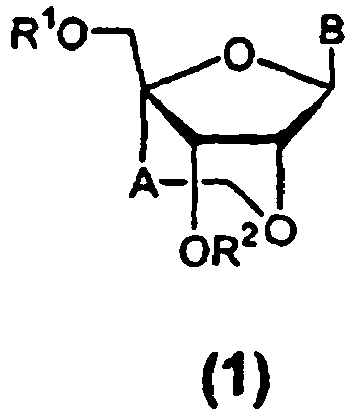
A is a methylene group; and
B represents a purin-9-yl group, a 2-oxo-pyrimidin-1-yl group or a substituted purin-9-yl group or a substituted 2-oxo-pyrimidin-1-yl group having a substituent selected from the following α group];
or salts thereof. - The oligonucleotide analogues of the present invention are oligonucleotide analogues having one or two or more structures of the formula (2) :
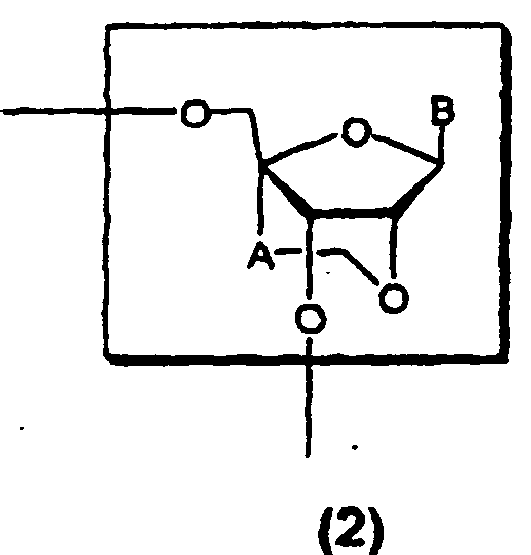
or a pharmacologically acceptable salt thereof. - a hydroxyl group,
a protected hydroxyl group,
an alkoxy group having from 1 to 4 carbon atoms,
a mercapto group,
a protected mercapto group,
an alkylthio group having from 1 to 4 carbon atoms,
an amino group,
a protected amino group,
an amino group substituted by an alkyl group having from 1 to 4 carbon atoms,
an alkyl group having from 1 to 4 carbon atoms, and
a halogen atom. - The protecting group of "the hydroxyl protecting group" of R1 and R2 and "the protected hydroxyl group" of R3 and R4 or the α group in the above formula (1) or (2) refers to a protecting group which can be cleaved by a chemical method such as hydrogenolysis, decomposition, hydrolysis, electrolysis and photolysis or a biological method such as hydrolysis in the human body, and such protecting groups may include "an aliphatic acyl group" such as an alkylcarbonyl group, e.g., formyl, acetyl, propionyl, butyryl, isobutyryl, pentanoyl, pivaloyl, valeryl, isovaleryl, octanoyl, nonanoyl, decanoyl, 3-methylnonanoyl, 8-methylnonanoyl, 3-ethyloctanoyl, 3,7-dimethyloctanoyl, undecanoyl, dodecanoyl, tridecanoyl, tetradecanoyl, pentadecanoyl, hexadecanoyl, 1-methylpentadecanoyl, 14-methylpentadecanoyl, 13,13-dimethyltetradecanoyl, heptadecanoyl, 15-methylhexadecanoyl, octadecanoyl, 1-methylheptadecanoyl, nonadecanoyl, eicosanoyl and heneicosanoyl, a carboxylated alkylcarbonyl group, e.g., succinoyl, glutaroyl and adipoyl, a halogeno lower alkylcarbonyl group, e.g., chloroacetyl, dichloroacetyl, trichloroacetyl and trifluoroacetyl, a lower alkoxy lower alkylcarbonyl group, e.g., methoxyacetyl, and an unsaturated alkylcarbonyl group, e.g., (E)-2-methyl-2-butenoyl;
"an aromatic acyl group" such as an arylcarbonyl group, e.g., benzoyl, α-naphthoyl and β-naphthoyl, a halogenoarylcarbonyl group, e.g., 2-bromobenzoyl and 4-chlorobenzoyl, a lower alkylated arylcarbonyl group, e.g., 2,4,6-trimethylbenzoyl and 4-toluoyl, a lower alkoxylated arylcarbonyl group, e.g., 4-anisoyl, a carboxylated arylcarbonyl group, e.g., 2-carboxybenzoyl, 3-carboxybenzoyl and 4-carboxybenzoyl, a nitrated arylcarbonyl group, e.g., 4-nitrobenzoyl and 2-nitrobenzoyl, a lower alkoxy carbonylated arylcarbonyl group, e.g., 2-(methoxycarbonyl)benzoyl and an arylated arylcarbonyl group, e.g., 4-phenylbenzoyl;
"a tetrahydropyranyl group or a tetrahydrothiopyranyl group" such as tetrahydropyran-2-yl, 3-bromotetrahydropyran-2-yl, 4-methoxytetrahydropyran-4-yl, tetrahydrothiopyran-2-yl and 4-niethoxytetrahydrothiopyran-4-yl;
"a tetrahydrofuranyl group or a tetrahydrothiofuranyl group" such as tetrahydrofuran-2-yl and tetrahydrothiofuran-2-yl;
"a silyl group" such as a tri-lower alkylsilyl group, e.g., trimethylsilyl, triethylsilyl, isopropyldimethylsilyl, t-butyldimethylsilyl, methyldiisopropylsilyl, methyldi-t-butylsilyl and triisopropylsilyl and a tri-lower alkylsilyl group substituted by one or two aryl groups, e.g., diphenylmethylsilyl, diphenylbutylsilyl, diphenylisopropylsilyl and phenyldiisopropylsilyl;
"a lower alkoxymethyl group" such as methoxymethyl, 1,1-dimethyl-1-methoxymethyl, ethoxymethyl, propoxymethyl, isopropoxymethyl, butoxymethyl and t-butoxymethyl;
"a lower alkoxylated lower alkoxymethyl group" such as 2-methoxyethoxymethyl;
"a halogeno lower alkoxymethyl group" such as 2,2,2-trichloroethoxymethyl and bis(2-chloroethoxy)methyl;
"a lower alkoxylated ethyl group" such as 1-ethoxyethyl and 1-(isopropoxy)ethyl;
"a halogenated ethyl group" such as 2,2,2-trichloroethyl;
"a methyl group substituted by from 1 to 3 aryl groups" such as benzyl, α-naphthylmethyl, β-naphthylmethyl, diphenylmethyl, triphenylmethyl, α-naphthyldiphenylmethyl and 9-anthrylmethyl;
"a methyl group substituted by from 1 to 3 aryl groups wherein said aryl ring is substituted by a lower alkyl, lower alkoxy, halogen or cyano group" such as 4-methylbenzyl, 2,4,6-trimethylbenzyl, 3,4,5-trimethylbenzyl, 4-methoxybenzyl, 4-methoxyphenyldiphenylmethyl, 4,4'-dimethoxytriphenylmethyl, 2-nitrobenzyl, 4-nitrobenzyl, 4-chlorobenzyl, 4-bromobenzyl and 4-cyanobenzyl;
"a lower alkoxycarbonyl group" such as methoxycarbonyl, ethoxycarbonyl, t-butoxycarbonyl and isobutoxycarbonyl;
"a lower alkoxycarbonyl group substituted by halogen or a tri-lower alkylsilyl group" such as 2,2,2-trichloroethoxycarbonyl and 2-trimethylsilylethoxycarbonyl;
"an alkenyloxycarbonyl group" such as vinyloxycarbonyl and allyloxycarbonyl; and
"an aralkyloxycarbonyl group wherein said aryl ring may be substituted by one or two lower alkoxy or nitro groups" such as benzyloxycarbonyl, 4-methoxybenzyloxycarbonyl, 3,4-dimethoxybenzyloxycarbonyl, 2-nitrobenzyloxy-carbonyl and 4-nitrobenzyloxycarbonyl. - "The hydroxyl protecting group" of R1 and R2 may referably include "the aliphatic acyl group", "the aromatic acyl group", "the methyl group substituted by from 1 to 3 aryl groups", "the methyl group substituted by from 1 to 3 aryl groups wherein said aryl ring is substituted by a lower alkyl, lower alkoxy, halogen or cyano group" or "the silyl group"; more preferably an acetyl group, a benzoyl group, a benzyl group, a p-methoxybenzoyl group, a dimethoxytrityl group, a monomethoxytrityl group or a tert-butyldiphenylsilyl group.
- The protecting group of the "protected hydroxyl group" of R3 and R4 or the α group may preferably include "the aliphatic acyl group" or "the aromatic acyl group", more preferably a benzoyl group.
- The protecting group of "the protected phosphoric acid group" of R1 and R2 in the above formula (1) represents a protecting group which can be cleaved by a chemical method such as hydrogenolysis, hydrolysis, electrolysis and photolysis and a biological method such as hydrolysis in the human body and such protecting groups may include "a lower alkyl group" such as methyl, ethyl, n-propyl, isopropyl, n-butyl, isobutyl, s-butyl, tert-butyl, n-pentyl, isopentyl, 2-methylbutyl, neopentyl, 1-ethylpropyl, n-hexyl, isohexyl, 4-methylpentyl, 3-methylpentyl, 2-methylpentyl, 1-methylpentyl, 3,3-dimethylbutyl, 2,2-dimethylbutyl, 1,1-dimethylbutyl, 1,2-dimethylbutyl, 1,3-dimethylbutyl, 2,3-dimethylbutyl and 2-ethylbutyl;
"a cyanated lower alkyl group" such as 2-cyanoethyl and 2-cyano-1,1-dimethylethyl;
"an ethyl group substituted by a silyl group" such as 2-methyldiphenylsilylethyl, 2-trimethylsilylethyl and 2-triphenylsilylethyl;
"a halogenated lower alkyl group" such as 2,2,2-trichloroethyl, 2,2,2-tribromoethyl, 2,2,2-trifluoroethyl and 2,2,2-trichloro-1,1-dimethylethyl;
"a lower alkenyl group" such as ethenyl, 1-propenyl, 2-propenyl, 1-methyl-2-propenyl, 1-methyl-1-propenyl, 2-methyl-1-propenyl, 2-methyl-2-propenyl, 2-ethyl-2-propenyl, 1-butenyl, 2-butenyl, 1-methyl-2-butenyl, 1-methyl-1-butenyl, 3-methyl-2-butenyl, 1-ethyl-2-butenyl, 3-butenyl, 1-methyl-3-butenyl, 2-methyl-3-butenyl, 1-ethyl-3-butenyl, 1-pentenyl, 2-pentenyl, 1-methyl-2-pentenyl, 2-methyl-2-pentenyl, 3-pentenyl, 1-methyl-3-pentenyl, 2-methyl-3-pentenyl, 4-pentenyl, 1-methyl-4-pentenyl, 2-methyl-4-pentenyl, 1-hexenyl, 2-hexenyl, 3-hexenyl, 4-hexenyl and 5-hexenyl, "a cycloalkyl group" such as cyclopropyl, cyclobutyl, cyclopentyl, cyclohexyl, cycloheptyl, norbornyl and adamantyl;
"a cyanated lower alkenyl group" such as 2-cyanobutenyl;
"an aralkyl group" such as benzyl, α-naphthylmethyl, β-naphthyhnethyl, indenylmethyl, phenanethrenylmethyl, anthracenylmethyl, diphenylmethyl, triphenylmethyl, 1-phenethyl, 2-phenethyl, 1-naphthylethyl, 2-naphthylethyl, 1-phenylpropyl, 2-phenylpropyl, 3-phenylpropyl, 1-naphthylpropyl, 2-naphthylpropyl, 3-naphthylpropyl, 1-phenylbutyl, 2-phenylbutyl, 3-phenylbutyl, 4-phenylbutyl, 1-naphthylbutyl, 2-naphthylbutyl, 3-naphthylbutyl, 4-naphthylbutyl, 1-phenylpentyl, 2-phenylpentyl, 3-phenylpentyl, 4-phenylpentyl, 5-phenylpentyl, 1-naphthylpentyl, 2-naphthylpentyl, 3-naphthylpentyl, 4-naphthylpentyl, 5-naphthylpentyl, 1-phenylhexyl, 2-phenylhexyl, 3-phenylhexyl, 4-phenylhexyl, 5-phenylhexyl, 6-phenylhexyl, 1-naphthylhexyl, 2-naphthylhexyl, 3-naphthylhexyl, 4-naphthylhexyl, 5-naphthylhexyl and 6-naphthylhexyl;
"an aralkyl group wherein said aryl ring is substituted by a nitro group or a halogen atom" such as 4-chlorobenzyl, 2-(4-nitrophenyl)ethyl, o-nitrobenzyl, 4-nitrobenzyl, 2,4-di-nitrobenzyl and 4-chloro-2-nitrobenzyl;
"an aryl group" such as phenyl, indenyl, naphthyl, phenanthrenyl and anthracenyl; and "an aryl group substituted by a lower alkyl group, a halogen atom or a nitro group" such as 2-methylphenyl, 2,6-dimethylphenyl, 2-chlorophenyl, 4-chlorophenyl,
2,4-dichlorophenyl, 2,5-dichlorophenyl, 2-bromophenyl, 4-nitrophenyl and 4-chlaro-2-nitrophenyl;
preferably "the lower alkyl group", "the lower alkyl group substituted by a cyano group", "the aralkyl group" or "the aralkyl group wherein said aryl ring is substituted by a nitro group or a halogen atom"; more preferably a 2-cyanoethyl group, a 2,2,2-trichloroethyl group or a benzyl group. - "The alkoxy group having from 1 to 4 carbon atoms" of R3 and R4 or the α group in the above formula (1) or (2) may include methoxy, ethoxy, n-propoxy, isopropoxy, n-butoxy, isobutoxy, s-butoxy or tert-butoxy, preferably a methoxy or ethoxy group.
- The protecting group of "the protected mercapto group" of R3 and R4 or the α group in the above formula (1) or (2) may include, in addition to the hydroxyl protecting groups mentioned above, "a group which forms a disulfide" such as an alkylthio group, e.g., methylthio, ethylthio, tert-butylthio and an aralkylthio group such as benzylthio, preferably "the aliphatic acyl group" or "the aromatic acyl group", more preferably a benzoyl group.
- "The alkylthio group having from 1 to 4 carbon atoms" of R3 and R4 or the α group in the above formula (1) or (2) may include methylthio, ethylthio, propylthio, isopropylthio, butylthio, isobutylthio, s-butylthio and tert-butylthio, preferably a methylthio or ethylthio group.
- The protecting group of "the protected amino group" of the α group in the above formula (1) or (2) may include
"an aliphatic acyl group" such as an alkylcarbonyl group, e.g., formyl, acetyl, propionyl, butyryl, isobutyryl, pentanoyl, pivaloyl, valeryl, isovaleryl, octanoyl, nonanoyl, decanoyl, 3-methylnonanoyl, 8-methylnonanoyl, 3-ethyloctanoyl, 3,7-dimethyloctanoyl, undecanoyl, dodecanoyl, tridecanoyl, tetradecanoyl, pentadecanoyl, hexadecanoyl, 1-methylpentadecanoyl, 14-methylpentadecanoyl, 13,13-dimethyl-tetradecanoyl, heptadecanoyl, 15-methylhexadecanoyl, octadecanoyl, 1-methyl-heptadecanoyl, nonadecanoyl, eicosanoyl and heneicosanoyl, a carboxylated alkylcarbonyl group, e.g., succinoyl, glutaroyl and adipoyl, a halogeno lower alkylcarbonyl group, e.g., chloroacetyl, dichloroacetyl, trichloroacetyl and trifluoroacetyl, a lower alkoxy lower alkylcarbonyl group, e.g., methoxyacetyl, and an unsaturated alkylcarbonyl group, e.g., (E)-2-methyl-2-butenoyl;
"an aromatic acyl group" such as an arylcarbonyl group, e.g., benzoyl, α-naphthoyl and β-naphthoyl, a halogenoarylcarbonyl group, e.g., 2-bromobenzoyl and
4-chlorobenzoyl, a lower alkylated arylcarbonyl group, e.g., 2,4,6-trimethylbenzoyl and
4-toluoyl, a lower alkoxylated arylcarbonyl group, e.g., 4-anisoyl, a carboxylated arylcarbonyl group, e.g., 2-carboxybenzoyl, 3-carboxybenzoyl and 4-carboxybenzoyl, a nitrated arylcarbonyl group, e.g., 4-nitrobenzoyl and 2-nitrobenzoyl, a lower alkoxy carbonylated arylcarbonyl group, e.g., 2-(methoxycarbonyl)benzoyl and an arylated arylcarbonyl group, e.g., 4-phenylbenzoyl;
"a lower alkoxycarbonyl group" such as methoxycarbonyl, ethoxycarbonyl,
t-butoxycarbonyl and isobutoxycarbonyl;
"a lower alkoxycarbonyl group substituted by halogen or a tri-lower alkylsilyl group" such as 2,2,2-trichloroethoxycarbonyl and 2-trimethylsilylethoxycarbonyl;
"an alkenyloxycarbonyl group" such as vinyloxycarbonyl and allyloxycarbonyl; and "an aralkyloxycarbonyl group wherein said aryl ring may be substituted by a lower alkoxy or nitro group" such as benzyloxycarbonyl, 4-methoxybenzyloxycarbonyl, 3,4-dimethoxybenzyloxycarbonyl, 2-nitrobenzyloxycarbonyl, and 4-nitrobenzyloxycarbonyl, preferably "the aliphatic acyl group or "the aromatic acyl group", more preferably a benzoyl group. - "The amino group substituted by an alkyl group having from 1 to 4 carbon atoms" of R3 and R4 or the α group in the above formula (1) or (2) may include methylamino, ethylamino, propylamino, isopropylamino, butylamino, isobutylamino, s-butylamino, tert-butylamino, dimethylamino, diethylamino, dipropylamino, diisopropylamino, dibutylamino, diisobutylamino, di(s-butyl)amino and di(tert-butyl)amino, preferably methylamino, ethylamino, dimethylamino, diethylamino or diisopropylamino.
- "The cyanoalkoxy group having from 1 to 5 carbon atoms" of R3 and R4 in the above formula (1) represents a group in which the above-described "the alkoxy group having from 1 to 4 carbon atoms" is substituted by a cyano group, and such a group may include cyanomethoxy, 2-cyanoethoxy, 3-cyanopropoxy, 4-cyanobutoxy, 3-cyano-2-methylpropoxy or 1-cyanornethyl-1,1-dimethylmethoxy, preferably a 2-cyanoethoxy group.
- "The alkyl group having from 1 to 4 carbon atoms" of the α group in the above formula (1) or (2) may include methyl, ethyl, propyl, isopropyl, butyl, isobutyl, s-butyl and tert-butyl, preferably a methyl or ethyl group.
- "The halogen atom" of the α group in the above formula (1) or (2) may include a fluorine atom, a chlorine atom, a bromine atom or an iodine atom, preferably a fluorine atom or a chlorine atom.
- The preferred groups of "the purin-9-yl group" and "the substituted purin-9-yl group" of B in the above formula (1) or (2) may include, as a whole, 6-aminopurin-9-yl (i.e., adeninyl), 6-aminopurin-9-yl the amino group of which is protected, 2,6-diaminopurin-9-yl, 2-amino-6-chloropurin-9-yl, 2-amino-6-chloropurin-9-yl the amino group of which is protected, 2-amino-6-fluoropurin-9-yl, 2-amino-6-fluoropurin-9-yl the amino group of which is protected, 2-amino-6-bromopurin-9-yl, 2-amino-6-bromopurin-9-yl the amino group of which is protected, 2-amino-6-hydroxypurin-9-yl (i.e., guaninyl), 2-amino-6-hydroxypurin-9-yl the amino group of which is protected, 2-amino-6-hydroxypurin-9-yl the amino and hydroxyl groups of which are protected, 6-amino-2-methoxypurin-9-yl, 6-amino-2-chloropurin-9-yl, 6-amino-2-fluoropurin-9-yl, 2,6-dimethoxypurin-9-yl, 2,6-dichloropurin-9-yl or 6-mercaptopurin-9-yl, more preferably a 6-benzoylaminopurin-9-yl, adeninyl, 2-isobutyrylamino-6-hydroxypurin-9-yl or guaninyl group.
- The preferred groups of "the 2-oxo-pyrimidin-1-yl group" and "the substituted 2-oxo-pyrimidin-1-yl group" of B in the above formula (1) or (2) may include, as a whole, 2-oxo-4-amino-pyrimidin-1-yl (i.e., cytosinyl), 2-oxo-4-amino-pyrimidin-1-yl the amino group of which is protected, 2-oxo-4-amino-5-fluoro-pyrimidin-1-yl, 2-oxo-4-amino-5-fluoro-pyrimidin-1-yl the amino group of which is protected, 4-amino-2-oxo-5-chloro-pyrimidin-1-yl, 2-oxo-4-methoxy-pyrimidin-1-yl, 2-oxo-4-mercapto-pyrimidin-1-yl, 2-oxo-4-hydroxy-pyrimidin-1-yl (i.e., uracinyl), 2-oxo-4-hydroxy-5-methylpyrimidin-1-yl (i.e., thyminyl) or 4-amino-5-methyl-2-oxo-pyrimidin-1-yl (i.e., 5-methylcytosinyl) group, more preferably 2-oxo-4-benzoylamino-pyrimidin-1-yl, cytosinyl, thyminyl, uracinyl, 2-oxo-4-benzoylamino-5-methyl-pyrimidin-1-yl or 5-methylcytosinyl group.
"The nucleoside analogue" refers to a non-natural type of "nucleoside" in which a purine or pyrimidine group is attached to sugar. - "The oligonucleotide analogue" refers to a non-natural type of "oligonucleotide" derivative in which from 2 to 50 "nucleosides", which may be the same or different, are bonded through a phosphoric acid diester bond and such analogues may preferably include sugar derivatives in which the sugar moiety is modified; thioate derivatives in which the phosphoric acid diester bond moiety is thioated; ester products in which a terminal phosphoric acid moiety is esterified; and amide products in which an amino group on a purine base is amidated, more preferably the sugar derivatives in which the sugar moiety is modified and the thioate derivatives in which the phosphoric acid diester moiety is thioated.
- "The salt thereof" refers to salts of the compound (1) of the present invention since they can be converted to salts and such salts may preferably include inorganic salts for example metal salts such as alkali metal salts, e.g., sodium salts, potassium salts and lithium salts, alkaline earth metal salts, e.g., calcium salts and magnesium salts, aluminum salts, iron salts, zinc salts, copper salts, nickel salts and cobalt salts; amine salts such as inorganic salts, e.g., ammonium salts, organic salts, e.g., t-octylamine salts, dibenzylamine salts, morpholine salts, glucosamine salts, phenylglycine alkyl ester salts, ethylenediamine salts, N-methylglucamine salts, guanidine salts, diethylamine salts, triethylamine salts, dicyclohexylamine salts, N,N'-dibenzylethylenediamine salts, chloroprocaine salts, procaine salts, diethanol amine salts, N-benzyl-phenethylamine salts, piperazine salts, tetramethylammonium salts and a tris(hydroxymethyl)aminomethane salts; inorganic acid salts such as hydrohalogenic acid salts, e.g., hydrofluoric acid salts, hydrochloric acid salts, hydrobromic acid salts and hydroiodic acid salts, nitric acid salts, perchloric acid salts, sulfuric acid salts and phosphoric acid salts; organic acid salts such as lower alkanesulfonic acid salts, e.g., methanesulfonic acid salts, trifluoromethanesulfonic acid salts and ethanesulfonic acid salts, arylsulfonic acid salts, e.g., benzenesulfonic acid salts and p-toluenesulfonic acid salts, acetic acid salts, malic acid salts, fumaric acid salts, succinic acid salts, citric acid salts, tartaric acid salts, oxalic acid salts and maleic acid salts; and amino acid salts such as glycine salts, lysine salts, arginine salts, omithine salts, glutamic acid salts and aspartic acid salts.
- Since the modified oligonucleotides or the polynucleotide analogues of the present invention can be converted to a salt, "the pharmacologically acceptable salts thereof" refers to a salt thereof, and such salts may preferably include inorganic salts for example metal salts such as alkali metal salts, e.g., sodium salts, potassium salts lithium salts, alkaline earth metal salts, e.g., calcium salts and magnesium salts, aluminum salts, iron salts, zinc salts, copper salts, nickel salts and cobalt salts; amine salts such as inorganic salts, e.g., ammonium salts, organic salts, e.g., t-octylamine salts, dibenzylamine salts, morpholine salts, glucosamine salts, phenylglycine alkyl ester salts, ethylenediamine salts, N-methylglucamine salts, guanidine salts, diethylamine salts, triethylamine salts, dicyclohexylamine salts, N,N'-dibenzylethylenediamine salts, chloroprocaine salts, procaine salts, diethanolamine salts, N-benzyl-phenethylamine salts, piperazine salts, tetramethylammonium salts and tris(hydroxymethyl)aminomethane salts; inorganic acid salts such as hydrohalogenic acid salts, e.g., hydrofluoric acid salts, hydrochloric acid salts, hydrobromic acid salts and hydroiodic acid salts, nitric acid salts, perchloric acid salts, sulfuric acid salts and phosphoric acid salts; organic acid salts such as lower alkanesulfonic acid salts, e.g., methanesulfonic acid salts, trifluoromethanesulfonic acid salts and ethanesulfonic acid salts, arylsulfonic acid salts, e.g., benzenesulfonic acid salts and p-toluenesulfonic acid salts, acetic acid salts, malic acid salts, fumaric acid salts, succinic acid salts, citric acid salts, tartaric acid salts, oxalic acid salts and maleic acid salts; and amino acid salts such as glycine salts, lysine salts, arginine salts, ornithine salts, glutamic acid salts and aspartic acid salts.
- Of the compounds (1) and the salts thereof of the present invention, preferred compounds may include
- (1) compounds in which R1 is a hydrogen atom, an aliphatic acyl group, an aromatic acyl group, a methyl group substituted by from 1 to 3 aryl groups, a methyl group substituted by from 1 to 3 aryl groups the aryl ring of which is substituted by a lower alkyl, lower alkoxy, halogen or cyano group, or a silyl group, and salts thereof;
- (2) compounds in which R1 is a hydrogen atom, an acetyl group, a benzoyl group, a benzyl group, a p-methoxybenzyl group, a dimethoxytrityl group, a mono-methoxytrityl group or a tert-butyldiphenylsilyl group, and salts thereof;
- (3) compounds in which R2 is a hydrogen atom, an aliphatic acyl group, an aromatic acyl group, a methyl group substituted by from 1 to 3 aryl groups, a 4-methyl-benzyl, 2,4,6-trimethylbenzyl, 3,4,5-trimethylbenzyl, 4-methoxybenzyl, 4-methoxy-phenyldiphenylmethyl, 4,4'-dimemoxytriphenylmethyl, 2-nitrobenzyl, 4-nitrobenzyl, 4-chlorobenzyl, 4-bromobenzyl or 4-cyanobenzyl group, a silyl group, a phosphoramidite group, a phosphonyl group, a phosphoric acid group or a protected phosphoric acid group, and salts thereof;
- (4) compounds in which R2 is a hydrogen atom, an acetyl group, a benzoyl group, a benzyl group, a p-methoxybenzyl group, a tert-butyldiphenylsilyl group, -P(OC2H4CN)(NCH(CH3)2), -P(OCH3)(NCH(CH3)2), a phosphonyl group or a 2-chlorophenyl or 4-chlorophenyl phosphoric acid group, and salts thereof;
- (6) compounds in which B is a 6-aminopurin-9-yl (i.e., adeninyl), 6-aminopurin-9-yl the amino group of which is protected, 2,6-diaminopurin-9-yl, 2-amino-6-chloropurin-9-yl, 2-amino-6-chloropurin-9-yl the amino group of which is protected, 2-amino-6-fluoropurin-9-yl, 2-amino-6-fluoropurin-9-yl the amino group of which is protected, 2-amino-6-bromopurin-9-yl, 2-amino-6-bromopurin-9-yl the amino group of which is protected, 2-amino-6-hydroxypurin-9-yl (i.e., guaninyl), 2-amino-6-hydroxypurin-9-yl the amino group of which is protected, 2-amino-6-hydroxypurin-9-yl the amino group and hydroxyl group of which are protected, 6-amino-2-methoxypurin-9-yl, 6-amino-2-chloropurin-9-yl, 6-amino-2-fluoropurin-9-yl, 2,6-dimethoxypurin-9-yl, 2,6-dichloropurin-9-yl, 6-mercaptopurin-9-yl, 2-oxo-4-amino-pyrimidin-1-yl (i.e., cytosinyl), 2-oxo-4-amino-pyrimidin-1-yl the amino group of which is protected, 2-oxo-4-amino-5-fluoro-pyrimidin-1-yl, 2-oxo-4-amino-5-fluoro-pyrimidin-1-yl the amino group of which is protected, 4-amino-2-oxo-5-chloro-pyrimidin-1-yl, 2-oxo-4-methoxy-pyrimidin-1-yl, 2-oxo-4-mercapto-pyrimidin-1-yl, 2-oxo-4-hydroxy-pyrimidin-1-yl (i.e., uracinyl), 2-oxo-4-hydroxy-5-methylpyrimidin-1-yl (i.e., thyminyl), 4-amino-5-methyl-2-oxo-pyrimidin-1-yl (i.e., 5-methylcytosinyl) group or 4-amino-5-methyl-2-oxo-pyrimidin-1-yl group the amino of which group is protected, and salts thereof; and
- (7) compounds in which B is a 6-benzoylaminopurin-9-yl, adeninyl, 2-isobutyrylamino-6-hydroxypurin-9-yl, guaninyl, 2-oxo-4-benzoylamino-pyrimidin-1-yl, cytosinyl, 2-oxo-5-methyl-4-benzoylamino-pyrimidin-1-yl, 5-methylcytosinyl, uracinyl or thyminyl group, and salts thereof.
- The above (1) and (2), (3) and (4) or (6) and (7) indicate the more preferred compounds as the number becomes larger and in the formula (1), the compound obtained by optionally selecting R1 from (1) and (2), optionally selecting R2 from (3) and (4), and optionally selecting B from (6) and (7) or by optionally combining them and the salts thereof are preferred and the compounds and the salts thereof selected from the following groups are particularly preferred.
- 2'-O,4'-C-ethyleneguanosine,
2'-O,4'-C-ethyleneadenosine,
3',5'-di-O-benzyl-2'-O,4'-C-ethylene-6-N-benzoyladenosine,
3',5'-di-O-benzyl-2'-O,4'-C-ethylene-2-N-isobutyrylguanosine,
5'-O-dimethoxytrityl-2'-O,4'-C-ethylene-6-N-benzoyladenosine,
5'-O-dimethoxytrityl-2'-O,4'-C-ethylene-2-N-isobutyrylguanosine,
2'-O,4'-C-ethylene-2-N-isobutyrylguanosine,
2'-O,4'-C-ethylene-6-N-benzoyladenosine,
5'-O-dimethoxytrityl-2'-O,4'-C-ethylene-6-N-benzoyladenosine-3'-O-(2-cyanoethyl N,N-diisopropyl)phosphoramidite,
5'-O-dimethoxytrityl-2'-O,4'-C-ethylene-2-N-isobutyrylguanosine-3'-O-(2-cyanoethyl N,N-diisopropyl)phosphoramidite,
2'-O,4'-C-ethyleneuridine,
2'-O,4'-C-ethylene-5-methyluridine,
2'-O,4'-C-ethylenecytidine,
2'-O,4'-C-ethylene-5-methylcytidine,
3',5'-di-O-benzyl-2'-O,4'-C-ethyleneunidine,
5'-O-dimethoxytrityl-2'-O,4'-C-ethyleneuridine,
3',5'-di-O-benzyl-2'-O,4'-C-ethylene-5-methyluridine,
5'-O-dimethoxytrityl-2'-O,4'-C-ethylene-5-methyluridine,
3',5'-di-O-benzyl-2'-O,4'-C-ethylene-4-N-benzoylcytidine,
5'-O-dimethoxytrityl-2'-O,4'-C-ethylene-4-N-benzoylcytidine,
3',5'-di-O-benzyl-2'-O,4'-C-ethylene-4-N-benzoyl-5-methylcytidine,
5'-O-dimethoxytrityl-2'-O,4'-C-ethylene-4-N-benzoyl-5-methylcytidine,
2'-O,4'-C-ethylene-4-N-benzoylcytidine,
2'-O,4'-C-ethylene-4-N-benzoyl-5-methylcytidine,
5'-O-dimethoxytrityl-2'-O,4'-C-ethylene-uridine-3'-O-(2-cyanoethyl N,N-diisopropyl)phosphoramidite,
5'-O-dimethoxytrityl-2'-O,4'-C-ethylene-5-methyluridine-3'-O-(2-cyanoethyl N,N-diisopropyl)phosphoramidite,
5'-O-dimethoxytrityl-2'-O,4'-C-ethylene-4-N-benzoylcytidine-3'-O-(2-cyanoethyl N,N-diisopropyl)phosphoramidite, and
5'-O-dimethoxytrityl-2'-O,4'-C-ethylene-4-N-benzoyl-5-methylcytidine-3'-O-(2-cyanoethyl N,N-diisoprapyl)phosphoramidite. - Of the oligonucleotide analogues containing one or two or more structures of the formula (2) and the pharmacologically acceptable salts thereof of the present invention, the preferred compounds may include
- (8) oligonucleotide analogues in which A is a methylene group, and pharmacologically acceptable salts thereof;
- (9) oligonucleotide analogues in which B is a 6-aminopurin-9-yl (i.e., adeninyl), 6-aminopurin-9-yl the amino group of which is protected, 2,6-diaminopurin-9-yl, 2-amino-6-chloropurin-9-yl, 2-amino-6-chloropurin-9-yl the amino group of which is protected, 2-amino-6-fluoropurin-9-yl, 2-amino-6-fluoropurin-9-yl the amino group of which is protected, 2-amino-6-bromopurin-9-yl, 2-amino-6-bromopurin-9-yl the amino group of which is protected, 2-amino-6-hydroxypurin-9-yl (i.e., guaninyl), 2-amino-6-hydroxypurin-9-yl the amino group of which is protected, 2-amino-6-hydroxypurin-9-yl the amino group and hydroxyl group of which are protected, 6-amino-2-methoxypurin-9-yl, 6-amino-2-chloropurin-9-yl, 6-amina-2-fluoropurin-9-yl, 2,6-dimethoxypurin-9-yl, 2,6-dichloropurin-9-yl, 6-mercaptopurin-9-yl, 2-oxo-4-amino-pyrimidin-1-yl (i.e., cytosinyl), 2-oxo-4-amino-pyrimidin-1-yl the amino group of which is protected, 2-oxo-4-amino-5-fluoro-pyrimidin-1-yl, 2-oxo-4-amino-5-fluoro-pyrimidin-1-yl the amino group of which is protected, 4-amino-2-oxo-5-chloro-pyrimidin-1-yl, 2-oxo-4-methoxy-pyrimidin-1-yl, 2-oxo-4-mercapto-pyrimidin-1-yl, 2-oxo-4-hydroxy-pyrimidin-1-yl (i.e., uracinyl), 2-oxo-4-hydroxy-5-methylpyrimidin-1-yl (i.e., thyminyl), 4-amino-5-methyl-2-oxo-pyrimidin-1-yl (i.e., 5-methylcytosinyl) group or a 4-amino-5-methyl-2-oxo-pyrimidin-1-yl group the amino group of which is protected, and pharmacologically acceptable salts thereof; and
- (10) oligonucleotide analogues in which B is a 6-benzoylaminopurin-9-yl, adeninyl, 2-isobutyrylamino-6-hydroxypurin-9-yl, guaninyl, 2-oxo-4-benzoylamino-pyrimidin-1-yl, cytosinyl, 2-oxo-5-methyl-4-benzoylamino-pyrimidin-1-yl, 5-methylcytosinyl, uracinyl or thyminyl group, and pharmacologically acceptable salts thereof.
- The above (9) and (10) indicate the more preferred oligonucleotide analogues as the number becomes larger, and in the formula (2), the oligonucleotide analogues obtained by optionally selecting A from (8) and optionally selecting B from (9) and (10) or optionally combining these and the pharmacologically acceptable salts thereof are preferred.
- The specific compounds included in the compound of the above formula (1) of the present invention are illustrated in Tables 1 and 2. However, the compounds of the present invention are not limited to those.
- In Table 1 and Table 2 Exe. com. num. represents Exemplification compound number, Me represents a methyl group, Bn represents a benzyl group, Bz represents a benzoyl group, PMB represents a p-methoxybenzyl group, Tr represents a triphenylmethyl group, MMTr represents a 4-methoxytriphenylmethyl (monomethoxytrityl) group, DMTr represents a 4,4'-dimethoxytriphenylmethyl (dimethoxytrityl) group, TMTr represents a 4,4',4"-trimethoxytriphenylmethyl (trimethoxytrityl) group, TMS represents a trimethylsilyl group, TBDMS represents a tert-butyldimethylsilyl group, TBDPS represents a tert-butyldiphenylsilyl group and TIPS represents a triisopropylsilyl group.
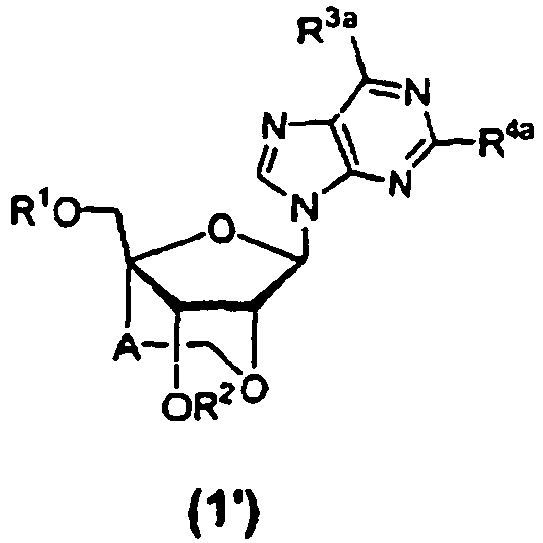
[Table 1] Exe. com. num. A R1 R2 R3a R4a 1-1 CH2 H H H H 1-2 CH2 H H H NH2 1-3 CH2 H H H OH 1-4 CH2 H H OH H 1-5 CH2 H H OH NH2 1-6 CH2 H H OH OH 1-7 CH2 H H NH2 H 1-8 CH2 H H NH2 NH2 1-9 CH2 H H NH2 Cl 1-10 CH2 H H NH2 F 1-11 CH2 H H NH2 Br 1-12 CH2 H H NH2 OH 1-13 CH2 H H OMe H 1-14 CH2 H H OMe OMe 1-15 CH2 H H OMe NH2 1-16 CH2 H H Cl H 1-17 CH2 H H Br H 1-18 CH2 H H F H 1-19 CH2 H H Cl Cl 1-20 CH2 H H SH H 1-21 CH2 Bn H NHBz H 1-22 CH2 Bn H OH NHCOCH(CH3)2 1-23 CH2 Bn Bn NHBz H 1-24 CH2 Bn Bn OH NHCOCH(CH3)2 1-25 CH2 PMB H NHBz H 1-26 CH2 PMB H OH NHCOCH(CH3)2 1-27 CH2 PMB PMB NHBz H 1-28 CH2 PMB PMB OH NHCOCH(CH3)2 1-29 CH2 Tr H NHBz H 1-30 CH2 MMTr H NHBz H 1-31 CH2 DMTr H NHBz H 1-32 CH2 TMTr H NHBz H 1-33 CH2 Tr H OH NHCOCH(CH3)2 1-34 CH2 MMTr H OH NHCOCH(CH3)2 1-35 CH2 DMTr H OH NHCOCH(CH3)2 1-36 CH2 TMTr H OH NHCOCH(CH3)2 1-37 CH2 TMS H NHBz H 1-38 CH2 TBDMS H NHBz H 1-39 CH2 TBDPS H NHBz H 1-40 CH2 TIPS H NHBz H 1-41 CH2 TMS H OH NHCOCH(CH3)2 1-42 CH2 TBDMS H OH NHCOCH(CH3)2 1-43 CH2 TBDPS H OH NHCOCH(CH3)2 1-44 CH2 TIPS H OH NHCOCH(CH3)2 1-177 CH2 H H OH NHCOCH(CH3)2 1-178 CH2 H H NHBz H 1-185 CH2 DMTr P(N(iPr)2)(OC2H4CN) OH NHCOCH(CH3)2 1-186 CH2 DMTr P(N(iPr)2)(OC2H4CN) NHBz H 1-201 CH2 DMTr P(O)(OH)H OH NHCOCH(CH3)2 1-202 CH2 DMTr P(O)(OH)H NHBz H 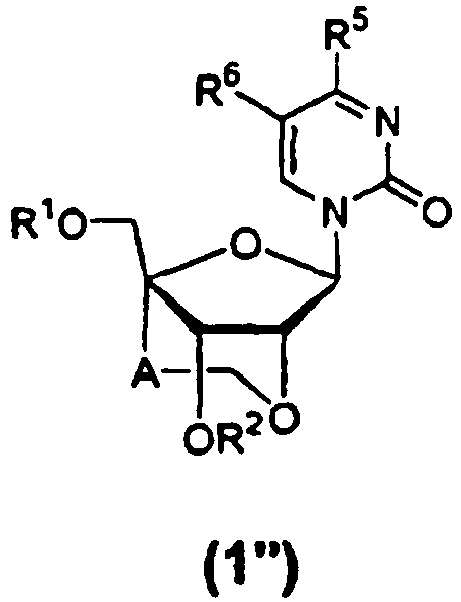
[Table 2] Exe. com. num. A R1 R2 R5 R6 2-1 CH2 H H OH H 2-2 CH2 H H OH CH3 2-3 CH2 H H NH2 H 2-4 CH2 H H NH2 CH3 2-5 CH2 H H NH2 F 2-6 CH2 H H Cl H 2-7 CH2 H H OMe H 2-8 CH2 H H SH H 2-9 CH2 Bn H OH H 2-10 CH2 Bn Bn OH H 2-11 CH2 PMB H OH H 2-12 CH2 PMB PMB OH H 2-13 CH2 Tr H OH H 2-14 CH2 MMTr H OH H 2-15 CH2 DMTr H OH H 2-16 CH2 TMTr H OH H 2-17 CH2 TMS H OH H 2-18 CH2 TBDMS H OH H 2-19 CH2 TBDPS H OH H 2-20 CH2 TIPS H OH H 2-21 CH2 Bn H OH CH3 2-22 CH2 Bn Bn OH CH3 2-23 CH2 PMB H OH CH3 2-24 CH2 PMB PMB OH CH3 2-25 CH2 Tr H OH CH3 2-26 CH2 MMTr H OH CH3 2-27 CH2 DMTr H OH CH3 2-28 CH2 TMTr H OH CH3 2-29 CH2 TMS H OH CH3 2-30 CH2 TBDMS H OH CH3 2-31 CH2 TBDPS H OH CH3 2-32 CH2 TIPS H OH CH3 2-33 CH2 Bn H NHBz H 2-34 CH2 Bn Bn NHBz H 2-35 CH2 PMB H NHBz H 2-36 CH2 PMB PMB NHBz H 2-37 CH2 Tr H NHBz H 2-38 CH2 MMTr H NHBz H 2-39 CH2 DMTr H NHBz H 2-40 CH2 TMTr H NHBz H 2-41 CH2 TMS H NHBz H 2-42 CH2 TBDMS H NHBz H 2-43 CH2 TBDPS H NHBz H 2-44 CH2 TIPS H NHBz H 2-45 CH2 Bn H NHBz CH3 2-46 CH2 Bn Bn NHBz CH3 2-47 CH2 PMB H NHBz CH3 2-48 CH2 PMB PMB NHBz CH3 2-49 CH2 Tr H NHBz CH3 2-50 CH2 MMTr H NHBz CH3 2-51 CH2 DMTr H NHBz CH3 2-52 CH2 TMTr H NHBz CH3 2-53 CH2 TMS H NHBz CH3 2-54 CH2 TBDMS H NHBz CH3 2-55 CH2 TBDPS H NHBz CH3 2-56 CH2 TIPS H NHBz CH3 2-225 CH2 H H NHBz H 2-226 CH2 H H NHBz CH3 2-233 CH2 DMTr P(N(iPr)2)(OC2H4CN) OH H 2-234 CH2 DMTr P(N(iPr)2)(OC2H4CN) OH CH3 2-235 CH2 DMTr P(N(iPr)2)(OC2H4CN) NHBz H 2-236 CH2 DMTr P(N(iPr)2)(OC2H4CN) NHBz CH3 2-249 CH2 DMTr P(N(iPr)2)(OCH3) OH H 2-250 CH2 DMTr P(N(iPr)2)(OCH3) OH CH3 2-251 CH2 DMTr P(N(iPr)2)(OCH3) NHBz H 2-252 CH2 DMTr P(N(iPr)2)(OCH3) NHBz CH3 - In the above Table 1 and Table 2, preferred compounds include the compounds (1-5), (1-7), (1-23), (1-24), (1-31), (1-35), (1-39), (1-43), (1-177), (1-178), (1-185), (1-186), (1-193), (1-194), (1-201), (1-202), (2-1), (2-2), (2-3), (2-4), (2-10), (2-15), (2-19), (2-22), (2-27), (2-31), (2-34), (2-39), (2-43), (2-46), (2-51), (2-55), (2-225), (2-226), (2-233), (2-234), (2-235) or (2-236), more preferred compounds may include
2'-O,4'-C-ethyleneguanosine (1-5),
2'-O,4'-C-ethyleneadenosine (1-7),
3',5'-di-O-benzyl-2'-O,4'-C-ethylene-6-N-benzoyladenosine (1-23),
3',5'-di-O-benzyl-2'-O,4'-C-ethylene-2-N-isobutyrylguanosine (1-24),
5'-O-dimethoxytrityl-2'-O,4'-C-ethylene-6-N-benzoyladenosine (1-31),
5'-O-dimethoxytrityl-2'-O,4'-C-ethylene-2-N-isobutyrylguanosine (1-35),
2'-O,4'-C-ethylene-2-N-isobutyrylguanosine (1-177),
2'-O,4'-C-ethylene-6-N-benzoyladenosine (1-178),
5'-O-dimethoxytrityl-2'-O,4'-C-ethylene-2-N-isobutyrylguanosine-3'-O-(2-cyanoethyl N,N-diisopropyl)phosphoramidite (1-185),
5'-O-dimethoxytrityl-2'-O,4'-C-ethylene-6-N-benzoyladenosine-3'-O-(2-cyanoethyl N,N-diisopropyl)phosphoramidite (1-186),
2'-O,4'-C-ethyleneuridine (2-1),
2'-O,4'-C-ethylene-5-methyluridine (2-2),
2'-O,4'-C-ethylenecytidine (2-3),
2'-O,4'-C-ethylene-5-methylcytidine (2-4),
3',5'-di-O-benzyl-2'-O,4'-C-ethyleneuridine (2-10),
5'-O-dimethoxytrityl-2'-O,4'-C-ethyleneuridine (2-15),
3',5'-di-O-benzyl-2'-O,4'-C-ethylene-5-methyluridine (2-22),
5'-O-dimethoxytrityl-2'-O,4'-C-ethylene-5-methyluridine (2-27),
3',5'-di-O-benzyl-2'-O,4'-C-ethylene-4-N-benzoylcytidine (2-34),
5'-O-dimethoxytrityl-2'-O,4'-C-ethylene-4-N-benzoylcytidine (2-39),
3',5'-di-O-benzyl-2'-O,4'-C-ethylene-4-N-benzoyl-5-methylcytidine (2-46),
5'-O-dimethoxytrityl-2'-O,4'-C-ethylene-4-N-benzoyl-5-methylcytidine (2-51),
2'-O,4'-C-ethylene-4-N-benzoylcytidine (2-225),
2'-O,4'-C-ethylene-4-N-benzoyl-5-methylcytidine (2-226),
5'-O-dimethoxycrityl-2'-O,4'-C-ethylene-uridine-3'-O-(2-cyanoethyl N,N-diisopropyl)phosphoramidite (2-233),
5'-O-dimethoxytrityl-2'-O,4'-C-ethylene-5-methyluridine-3'-O-(2-cyanoethyl N,N-diisopropyl)phosphoramidite (2-234),
5'-O-dimethoxytrityl-2'-O,4'-C-ethylene-4-N-benzoylcytidine-3'-O-(2-cyanoethyl N,N-diisopropyl)phosphoramidite (2-235), and
5'-O-dimethoxyirityl-2'-O,4'-C-ethylene-4-N-benzoyl-5-methylcytidine-3'-O-(2-cyanoethyl N,N-diisopropyl)phosphoramidite (2-236). - The compound (1) of the present invention can be produced according to Process A described below.
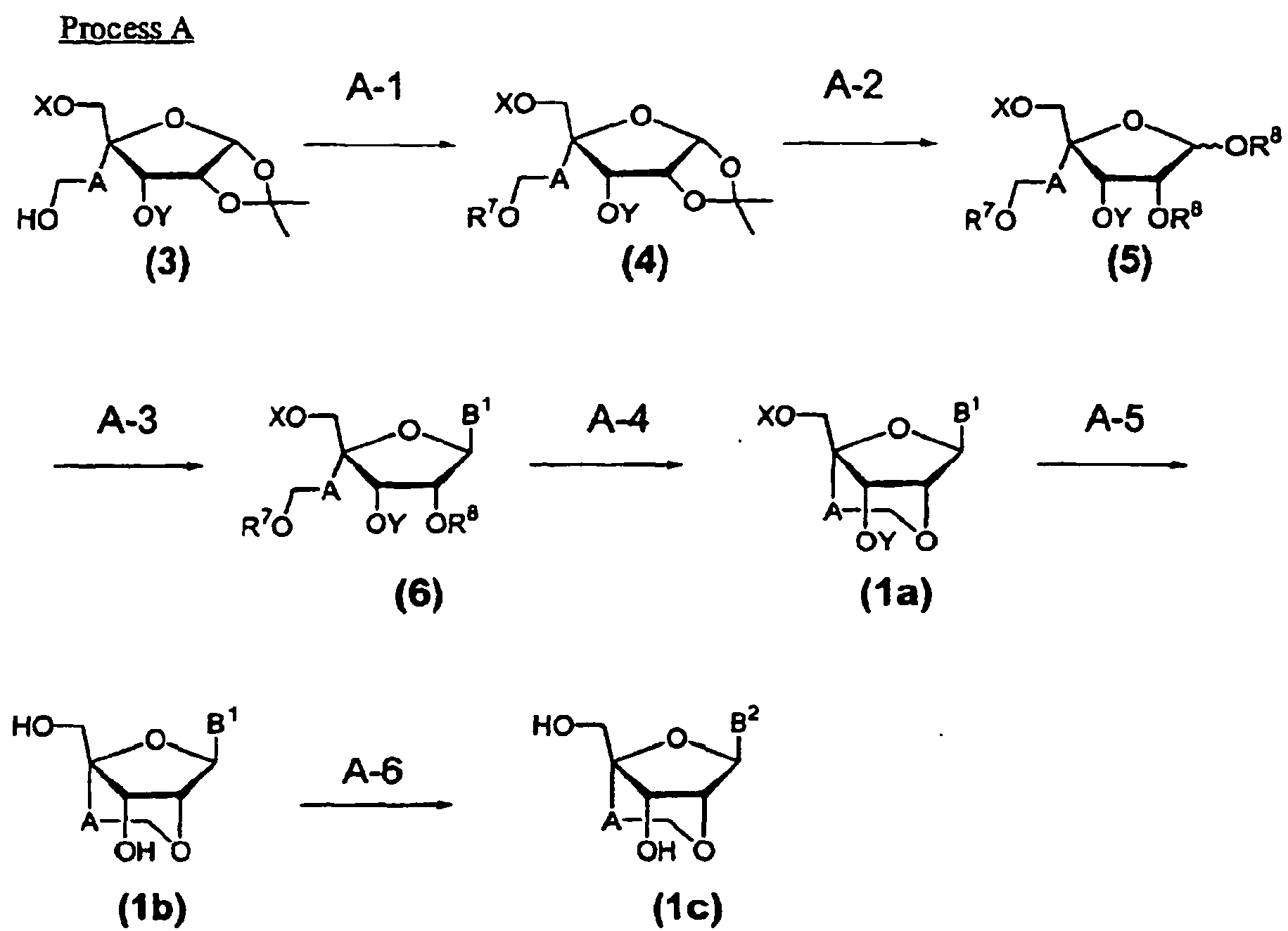
- In Process A, X represents a protecting group; Y represents a protecting group; A has the same meaning as defined above; while B1 represents a purin-9-yl group, a substituted purin-9-yl group or a substituted 2-oxo-pyrimidin-1-yl group, said substituents being selected from the above substituents α but with the exclusion of an unprotected amino group of "an amino group which may be protected"; while B2 represents a purin-9-yl group, a substituted purin-9-yl group or a substituted 2-oxo-pyrimidin-1-yl group, said substituents being selected from the above substituents abut with the exclusion of protected amino groups of "an amino group which may be protected"; R7 represents a group which forms a leaving group; and R8 represents an aliphatic acyl group having from 1 to 4 carbon atoms.
- The protecting group of X is the same group as "the hydroxyl protecting group" in the above R1.
- The protecting group of Y is the same group as "the hydroxyl protecting group" in the above R2.
- "The group which forms a leaving group" of R7 may include a lower alkylsulfonyl group such as methanesulfonyl and ethanesulfonyl; a halogen-substituted lower alkylsulfonyl group such as trifluoromethanesulfonyl; and an arylsulfonyl group such as p-toluenesulfonyl; preferably a methanesulfonyl group or a p-toluenesulfonyl group.
- "The aliphatic acyl group having from 2 to 4 carbon atoms" of R8 may include acetyl, propionyl, butyryl groups and the like, preferably an acetyl group.
- In the following, each step of Process A will be described in detail.
- The present step is to prepare a compound (4) by reacting a compound (3) which can be prepared by Methods B to D described later with a reagent for introducing a leaving group in the presence of a base catalyst in an inert solvent.
- The solvent employable here may include aliphatic hydrocarbons such as hexane, heptane, ligroin and petroleum ether; aromatic hydrocarbons such as benzene, toluene and xylene; halogenated hydrocarbons such as methylene chloride, chloroform, carbon tetrachloride, dichloroethane, chlorobenzene and dichlorobenzene; esters such as ethyl formate, ethyl acetate, propyl acetate, butyl acetate and diethyl carbonate; ethers such as diethyl ether, diisopropyl ether, tetrahydrofuran, dioxane, dimethoxyethane and diethylene glycol dimethyl ether; ketones such as acetone, methyl ethyl ketone, methyl isobutyl ketone, isophorone and cyclohexanone; nitro compounds such as nitroethane and nitrobenzene; nitriles such as acetonitrile and isobutyronitrile; amides such as formamide, N,N-dimethylformamide, N,N-dimethylacetamide, N-methyl-2-pyrrolidone, N-methylpyrrolidinone and hexamethylphosphoric triamide; sulfoxides such as sulfolane; and pyridine derivatives; preferably pyridine.
- The base catalyst employable here may preferably include a base such as triethylamine, pyridine and dimethylaminopyridine.
- The reagent for introducing a leaving group may include alkylsulfonyl halides such as methanesulfonyl chloride and ethanesulfonyl bromide; and arylsulfonyl halides such as p-toluenesulfonyl chloride, preferably methanesulfonyl chloride and p-toluenesulfonyl chloride.
- The reaction temperature varies depending on the starting material, the solvent, the reagent for introducing a leaving group and the base catalyst, but is usually from 0°C to 50°C, preferably from 10°C to 40°C.
- The reaction time varies depending on the starting material, the solvent, the reagent for introducing a leaving group, the base catalyst and the reaction temperature, but is usually from 10 minutes to 24 hours, preferably from 1 to 10 hours.
- After the reaction, the desired compound (4) of the present reaction is obtained, for example, by neutralizing the reaction solution, concentrating the reaction mixture, adding an organic solvent immiscible with water such as ethyl acetate, washing with water, separating an organic layer containing the desired compound, drying over anhydrous magnesium sulfate and distilling off the solvent.
- The desired product thus obtained can be further purified, if necessary, by a conventional method, for example, recrystallization and silica gel column chromatography.
- The present step is to prepare the compound (5) by reacting the compound (4) prepared in Step A-1 with an acid anhydride in the presence of an acid catalyst in a solvent.
- The solvent employable here may include ethers such as diethyl ether, dioxane and tetrahydrofuran; nitriles such as acetonitrile and isobutyronitrile; amides such as formamide, N,N-dimethylformamide, N,N-dimethylacetamide, N-methyl-2-pyrrolidone, N-methylpyrrolidinone and hexamethylphosphororic triamide; and organic acids such as acetic acid; preferably acetic acid.
- The acid catalyst employable here may include inorganic acids such as hydrochloric acid, sulfuric acid and nitric acid, preferably sulfuric acid (particularly concentrated sulfuric acid).
- The acid anhydride employable here may include an anhydride of a lower aliphatic carboxylic acid such as acetic anhydride and propionic acid anhydride, preferably acetic anhydride.
- The reaction temperature varies depending on the starting material, the solvent, the acid catalyst and the acid anhydride and is usually from 0°C to 50°C, preferably from 10°C to 40°C.
- The reaction time varies depending on the starting material, the solvent, the acid catalyst, the acid anhydride and the reaction temperature, but is usually from 10 minutes to 12 hours, preferably from 30 minutes to 3 hours.
- After the reaction, the desired compound (5) of the present reaction is obtained, for example, by concentrating the reaction mixture, adding an organic solvent immiscible with water such as ethyl acetate, washing with water, separating an organic layer containing the desired compound, drying over anhydrous magnesium sulfate and distilling off the solvent.
- The desired product thus obtained can be further purified, if necessary, by a conventional method, for example, recrystallization, silica gel column chromatography and the like.
- The present step is to prepare the compound (6) by reacting the compound (5) prepared in Step A-2 with a trimethylsilylated compound corresponding to the purine or pyrimidine which may have a desired substituent prepared according to a reference (H. Vorbrggen, K. Krolikiewicz and B. Bennua, Chem. Ber., 114, 1234-1255 (1981)) in the presence of an acid catalyst in an inert solvent.
- The solvent employable here may include aromatic hydrocarbons such as benzene, toluene, xylene; halogenated hydrocarbons such as methylene chloride, chloroform, carbon tetrachloride, 1,2-dichloroethane, chlorobenzene and dichlorobenzene; nitriles such as acetonitrile and isobutyronitrile; amides such as formamide, N,N-dimethylformamide, N,N-dimethylacetamide, N-methyl-2-pyrrolidone, N-methylpyrrolidinone and hexamethylphosphoric triamide; carbon sulfide; preferably 1,2-dichloroethane.
- The acid catalyst employable here may include Lewis acid catalysts such as AlCl3, SnCl4, TiCl4, ZnCl2, BF3, trimethylsilyl trifluoromethanesulfonate; preferably trimethylsilyl trifluoromethanesulfonate.
- The reaction temperature varies depending on the starting material, the solvent and the acid catalyst but is usually from 0°C to 100°C, preferably from 50°C to 80°C.
- The reaction time varies depending on the starting material, the solvent, the acid catalyst and the reaction temperature but is usually from 1 hour to 24 hours, preferably from 1 hour to 8 hours.
- After the reaction, the desired compound (6) of the present reaction is obtained, for example, by concentrating the reaction mixture, adding an organic solvent immiscible with water such as ethyl acetate, washing with water, separating an organic layer containing the desired compound, drying over anhydrous magnesium sulfate and distilling off the solvent.
- The desired product thus obtained can be further purified, if necessary, by a conventional method, for example, recrystallization, silica gel column chromatography and the like.
- The present step is to prepare the compound (1a) of the present invention by cyclization of the compound (6) prepared by Step A-3 in the presence of a base catalyst in an inert solvent.
- The solvent employable here may include water; pyridine derivatives; acetonitriles such as acetonitrile and isobutyronitrile; amides such as formamide, N,N-dimethylformamide, N,N-dimethylacetamide, N-methyl-2-pyrrolidone, N-methylpyrrolidinone and hexamethylphosphoric triamide; and a mixture thereof, preferably a mixture of water and pyridine.
- The base catalyst employable here may include alkali metal hydroxides such as sodium hydroxide and potassium hydroxide; alkali metal carbonates such as sodium carbonate and potassium carbonate; alkali metal alkoxides such as sodium methoxide and sodium ethoxide; and aqueous ammonia; preferably alkali metal hydroxides (particularly sodium hydroxide).
- The reaction temperature varies depending on the starting material, the solvent and the base catalyst but is usually from 0°C to 50°C, preferably from 10°C to 30°C.
- The reaction time varies depending on the starting material, the solvent, the acid catalyst and the reaction temperature but is usually from 1 minute to 5 hours, preferably from 1 minute to 30 minutes.
- After the reaction, the desired compound (1a) of the present reaction is obtained, for example, by concentrating the reaction mixture, adding an organic solvent immiscible with water such as ethyl acetate, washing with water, separating an organic layer containing the desired compound, drying over anhydrous magnesium sulfate and distilling off the solvent.
- The desired product thus obtained can be further purified, if necessary, by a conventional method, for example, recrystallization, silica gel column chromatography and the like.
- The present step is to prepare the compound (1b) by reacting the compound (1a) obtained by Step A-4 with a deprotecting reagent in an inert solvent.
- The deprotection method varies depending on the kind of protecting group and is not particularly limited unless it causes other side reactions and can be carried out, for example, by a method described in "Protective Groups in Organic Synthesis" (Theodora W. Greene and Peter G. M. Wuts, 1999, Published by A Wiley-Interscience Publication).
- Particularly, the deprotection method can be carried out by the following methods in the case where the protecting group is (1) "an aliphatic acyl group or an aromatic acyl group", (2) "a methyl group substituted by from 1 to 3 aryl groups" or "a methyl group substituted by from 1 to 3 aryl groups the aryl ring of which is substituted by lower alkyl, lower alkoxy, halogen or cyano group" or (3) "a silyl group".
- (1) In the case where the protecting group is an aliphatic acyl group or an aromatic acyl group, the deprotection reaction is usually carried out by treating it with a base in an inert solvent.
The solvent employable here is not particularly limited so long as it is easily mixed with water, does not inhibit the reaction and dissolves the starting material to some extent and may include aqueous or anhydrous amides such as dimethylformamide and dimethylacetamide; halogenated hydrocarbons such as methylene chloride, chloroform, 1,2-dichloroethane or carbon tetrachloride; and ethers such as tetrahydrofuran, diethyl ether and dioxane; preferably ethers, more preferably tetrahydrofuran.
The base employable here may include alkali metal hydroxides such as lithium hydroxide, potassium hydroxide and sodium hydroxide; alkali metal carbonates such as sodium carbonate and potassium carbonate; alkali metal alkoxides such as sodium methoxide and sodium ethoxide; and an ammonia solution such as aqueous ammonia and ammonia/methanol solution.
The reaction temperature is from 0°C to 60°C, preferably from 20°C to 40°C.
The reaction time is from 10 minutes to 24 hours, preferably from 1 hour to 3 hours.
After the reaction, the desired compound (1b) of the present reaction is obtained, for example, by concentrating the reaction mixture, adding an organic solvent immiscible with water such as ethyl acetate, washing with water, separating an organic layer containing the desired compound, drying over anhydrous magnesium sulfate and distilling off the solvent.
The desired product thus obtained can be further purified, if necessary, by a conventional method, for example, recrystallization, silica gel column chromatography and the like. - (2) In the case where the protecting group is "a methyl group substituted by from one to three aryl groups" or "a methyl group substituted by from one to three aryl groups the aryl ring of which is substituted by a lower alkyl, lower alkoxy, halogen or cyano group", the reaction is carried out in an inert solvent using a reducing agent.
The solvent employable here may preferably include alcohols such as methanol, ethanol and isopropanol; ethers such as diethyl ether, tetrahydrofuran and dioxane; aromatic hydrocarbons such as toluene, benzene and xylene; aliphatic hydrocarbons such as hexane and cyclohexane; esters such as ethyl acetate and propyl acetate; organic acids such as acetic acid; or a mixture of these organic solvents and water.
The reducing agent employable here is not particularly limited so long as it is usually used for a catalytic reduction and may preferably include palladium on carbon, Raney nickel, platinum oxide, platinum black, rhodium-aluminum oxide, triphenylphosphine-rhodium chloride and palladium-barium sulfate.
The pressure is not particularly limited but is usually from 1 to 10 atm.
The reaction temperature is from 0°C to 60°C, preferably from 20°C to 40°C.
The reaction time is from 10 minutes to 24 hours, preferably from one hour to three hours.
After the reaction, the desired compound (1b) of the present reaction is obtained, for example, by removing the reducing agent from the reaction mixture, adding an organic solvent immiscible with water such as ethyl acetate, washing with water, separating an organic layer containing the desired compound, drying over anhydrous magnesium sulfate and distilling off the solvent. The desired product thus obtained can be further purified, if necessary, by a conventional method, for example, recrystallization, silica gel column chromatography and the like.
In the case where the protecting group is "a methyl group substituted by three aryl groups", i.e., a trityl group, the deprotection reaction can be also carried out using an acid.
In this case, the solvent employable here may include aromatic hydrocarbons such as benzene, toluene and xylene; halogenated hydrocarbons such as methylene chloride, chloroform, carbon tetrachloride, 1,2-dichloroethane, chlorobenzene and dichlorobenzene; alcohols such as methanol, ethanol, isopropanol and tert-butanol; nitriles such as acetonitrile and isobutyronitrile; amides such as formamide, N,N-dimethylformamide, N,N-dimethylacetamide, N-methyl-2-pyrrolidone, N-methylpyrrolidinone and hexamethylphosphoric triamide; and organic acids such as acetic acid; preferably organic acids (particularly acetic acid) or alcohols (particularly tert-butanol).
The acid employable here may preferably include acetic acid or trifluoroacetic acid.
The reaction temperature is from 0°C to 60°C, preferably from 20°C to 40°C.
The reaction time is from 10 minutes to 24 hours, preferably from one 1 to 3 hours.
After the reaction, the desired compound (1b) of the present reaction is obtained, for example, by neutralizing the reaction mixture, adding an organic solvent immiscible with water such as ethyl acetate, washing with water, separating an organic layer containing the desired compound, drying over anhydrous magnesium sulfate and distilling off the solvent.
The desired product thus obtained can be further purified, if necessary, by a conventional method, for example, recrystallization, silica gel column chromatography and the like. - (3) In the case where the protecting group is "a silyl group", it can usually be removed by treating with a compound producing a fluorine anion such as tetrabutylammonium fluoride, hydrofluoric acid, hydrofluoric acid-pyridine and potassium fluoride, or organic acids such as acetic acid, methanesulfonic acid, paratoluenesulfonic acid, trifluoroacetic acid and trifluoromethanesulfonic acid, or inorganic acids such as hydrochloric acid.
- In the case where the protecting group is removed by a fluorine anion, the reaction is sometimes promoted by adding organic acids such as formic acid, acetic acid and propionic acid thereto.
- The solvent employable here is not particularly limited so long as it does not inhibit the reaction and dissolves the starting material to some extent and may preferably include ethers such as diethyl ether, diisopropyl ether, tetrahydrofuran, dioxane, dimethoxyethane and diethylene glycol dimethyl ether; nitriles such as acetonitrile and isobutyronitrile; water; organic acids such as acetic acid; and a mixture thereof
- The reaction temperature is from 0°C to 100°C, preferably from 20°C to 70°C.
- The reaction time is from 5 minutes to 48 hours, preferably from one hour to 24 hours.
- After the reaction, the desired compound (1b) of the present reaction is obtained, for example, by concentrating the reaction mixture, adding an organic solvent immiscible with water such as ethyl acetate, washing with water, separating an organic layer containing the desired compound, drying over anhydrous magnesium sulfate and distilling off the solvent. The desired product thus obtained can be further purified, if necessary, by a conventional method, for example, recrystallization, silica gel column chromatography and the like.
- The present step is to prepare the compound (1c) of the present invention by reacting the compound (1b) obtained in Step A-5 with a deprotection reagent in an inert solvent.
- The deprotection method varies depending on the kind of protecting group and is not particularly limited so long as it does not cause other side reactions and can be carried out, for example, by a method described in "Protective Groups in Organic Synthesis" (by Theodora W. Greene, 1981, published by A Wiley-Interscience Publication).
- Particularly, the deprotection method can be carried out by the following method in the case where the protecting group is an aliphatic acyl group or an aromatic acyl group.
- Namely, the deprotection method is usually carried out by reacting with a base in an inert solvent in the case where the protecting group is an aliphatic acyl group or an aromatic acyl group.
- The solvent employable here is not particularly limited so long as it is easily mixed with water, does not inhibit the reaction and dissolves the starting material to some extent and may include aqueous or anhydrous alcohols such as methanol and ethanol; amides such as dimethylformamide and dimethylacetamide; halogenated hydrocarbons such as methylene chloride, chloroform, 1,2-dichloroethane or carbon tetrachloride; and ethers such as tetrahydrofuran, diethyl ether and dioxane; preferably alcohols; more preferably methanol.
- The base employable here may include alkali metal hydroxides such as lithium hydroxide, potassium hydroxide and sodium hydroxide; alkali metal carbonates such as sodium carbonate and potassium carbonate; alkali metal alkoxides such as sodium methoxide and sodium ethoxide; and ammonia; preferably ammonia.
- The reaction temperature is from 0°C to 50°C, preferably from 10°C to 40°C.
- The reaction time is from 10 minutes to 24 hours, preferably from 10 minutes to 15 hours. After the reaction, the desired compound (1c) of the present reaction is obtained, for example, by concentrating the reaction mixture, adding an organic solvent immiscible with water such as ethyl acetate, washing with water, separating an organic layer containing the desired compound, drying over anhydrous magnesium sulfate and distilling off the solvent.
- The desired product thus obtained can be further purified, if necessary, by a conventional method, for example, recrystallization, silica gel column chromatography and the like.
- The intermediate (3) described above can be prepared by Processes B and C described below.
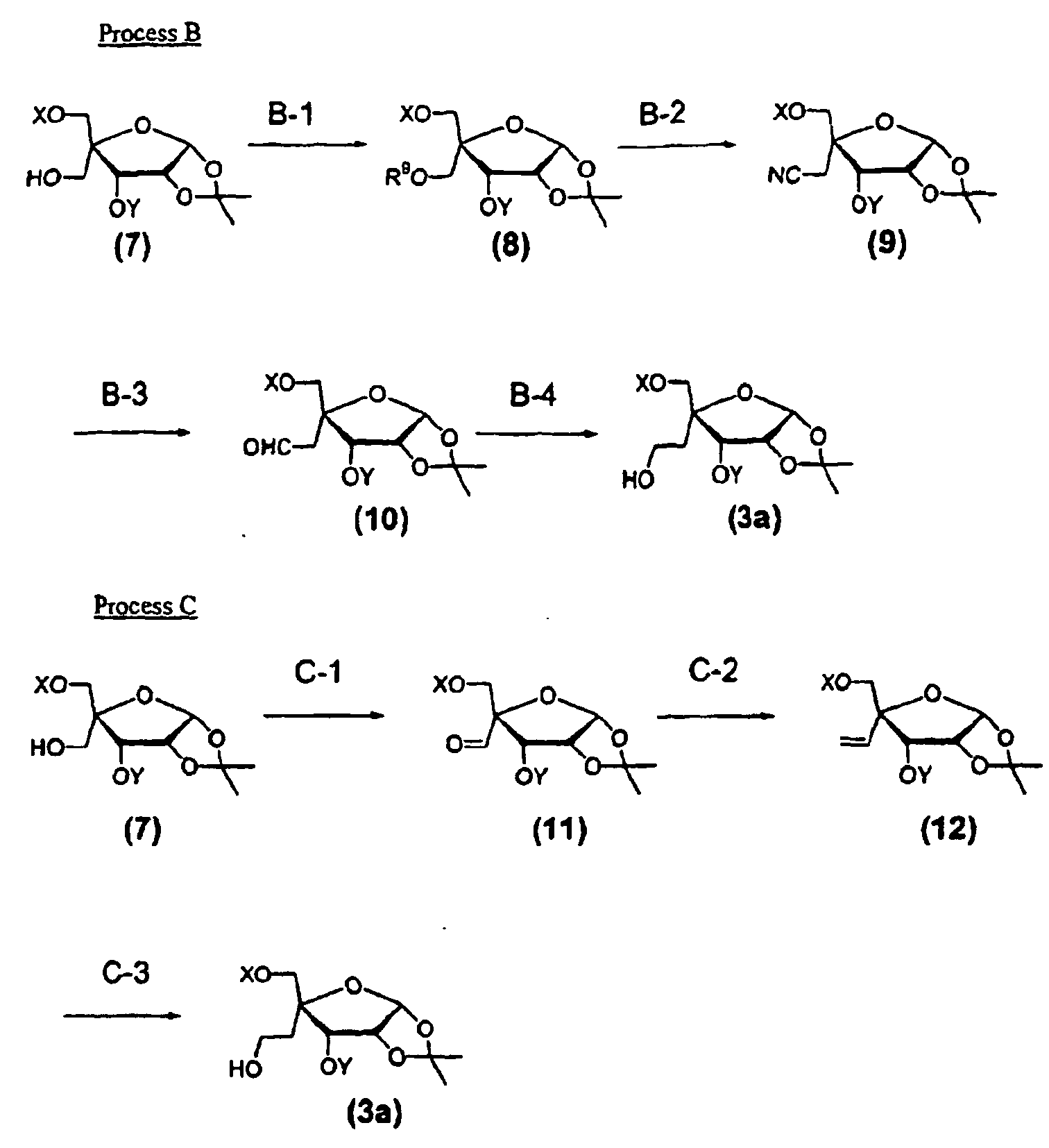
- In Processes B and C, X and Y have the same meanings as defined above; R9 represents a group which forms a leaving group.
- The group which forms a leaving group of R9 may include the group described in the above R7, preferably a trifluoromethanesulfonyl group.
- The compound (7), i.e., the starting material used in Process B or Process C can be prepared by the following method.
- Namely, a compound corresponding to the compound (6) of which the "X" moiety is a hydrogen atom is prepared from 1,1,5,6-diisopropylidene D-glucose on public sale according to the method of the literature (R.D. Youssefyeh, J.P.H. Verheyden, J.G. Moffatt. J. Org. Chem., 44,1301-1309 (1979)) and subsequently the compound (6) can be prepared according to the method of the literature (T. Waga, T. Nishizaki, I. Miyakawa, H. Ohrui, H. Meguro, Biosci. Biotechnol. Biochem., 57, 1433-1438 (1993)) (in the case of X = Bn).
- The present step is to prepare the compound (8) by reacting the compound (7) prepared by the above method with a reagent for introducing a leaving group in the presence of a base catalyst in an inert solvent.
- The solvent employable here may include amides such as dimethylformamide and dimethylacetamide; halogenated hydrocarbons such as methylene chloride, chloroform, 1,2-dichloroethane or carbon tetrachloride; and ethers such as tetrahydrofuran, diethyl ether and dioxane; preferably methylene chloride.
- The base catalyst employable here may preferably include a base such as triethylamine, pyridine and dimethylaminopyridine.
- The reagent employable for introducing a leaving group may preferably include trifluoromethanesulfonic acid chloride or trifluoromethanesulfonic anhydride.
- The reaction temperature varies depending on the starting material, the solvent and the acid catalyst, but is usually from -100°C to -50°C, preferably from -100°C to -70°C.
- The reaction time varies depending on the starting material, the solvent, the acid catalyst and the reaction temperature but is usually from 30 minutes to 12 hours, preferably from 30 minutes to 3 hours.
- After the reaction, the desired compound (8) of the present reaction is obtained, for example, by concentrating the reaction mixture, adding an organic solvent immiscible with water such as ethyl acetate, washing with water, separating an organic layer containing the desired compound, drying over anhydrous magnesium sulfate and distilling off the solvent.
- The desired product thus obtained can be further purified, if necessary, by a conventional method, for example, recrystallization, silica gel column chromatography and the like.
- The present step is to prepare the compound (9) by reacting the compound (8) prepared by Step B-1 with a cyanating reagent in an inert solvent.
- The solvent employable here may include amides such as dimethylformamide and dimethylacetamide; halogenated hydrocarbons such as methylene chloride, chloroform, 1,2-dichloroethane or carbon tetrachloride; ethers such as tetrahydrofuran, diethyl ether and dioxane; acetonitrile; dimethylsulfoxide and the like; preferably amides (dimethylformamide).
- The cyanating reagent employable here may include KCN, NaCN and trimethylsilane cyanide, preferably NaCN.
- The reaction temperature varies depending on the starting material, the solvent and the cyanating reagent but is usually from 0°C to 100°C, preferably from 30°C to 70°C.
- The reaction time varies depending on the starting material, the solvent, the cyanating reagent and the reaction temperature but is usually from 30 minutes to 12 hours, preferably from one 1 to 3 hours.
- After the reaction, the desired compound (9) of the present reaction is obtained, for example, by concentrating the reaction mixture, adding an organic solvent immiscible with water such as ethyl acetate, washing with water, separating an organic layer containing the desired compound, drying over anhydrous magnesium sulfate and distilling off the solvent.
- The desired product thus obtained can be further purified, if necessary, by a conventional method, for example, recrystallization, silica gel column chromatography and the like.
- The present step is to prepare the compound (10) by reacting the compound (9) prepared in Step B-2 with a reducing agent in an inert solvent.
- The solvent employable here may include halogenated hydrocarbons such as methylene chloride, chloroform, 1,2-dichloroethane or carbon tetrachloride; aliphatic hydrocarbons such as hexane, heptane, ligroin and petroleum ether; aromatic hydrocarbons such as benzene, toluene and xylene; ethers such as diethyl ether, diisopropyl ether, tetrahydrofuran, dioxane, dimethoxyethane and diethylene glycol dimethyl ether; and ketones such as acetone, methyl ethyl ketone, methyl isobutyl ketone isophorone and cyclohexanone; preferably halogenated hydrocarbons (particularly methylene chloride).
- The reducing agent employable here may include diisobutyl aluminum hydride and triethoxy aluminum hydride, preferably diisobutyl aluminum hydride.
- The reaction temperature varies depending on the starting material, the solvent and the reducing agent but is usually from -100°C to -50°C, preferably from -90°C to -70°C.
- The reaction time varies depending on the starting material, the solvent, the reducing agent and the reaction temperature but is usually from 30 minutes to 12 hours, preferably from 1 hour to 5 hours.
- After the reaction, the desired compound (10) of the present reaction is obtained, for example, by concentrating the reaction mixture, adding an organic solvent immiscible with water such as ethyl acetate, washing with water, separating an organic layer containing the desired compound, drying over anhydrous magnesium sulfate and distilling off the solvent.
- The desired product thus obtained can be further purified, if necessary, by a conventional method, for example, recrystallization, silica gel column chromatography and the like.
- The present step is to prepare the compound (3a), one of the starting materials of Process A by reacting the compound (10) prepared in Step B-3 with a reducing agent in an inert solvent.
- The solvent employable here may include alcohols such as methanol, ethanol, n-propanol, isopropanol, n-butanol, isobutanol, t-butanol, isoamyl alcohol, diethylene glycol, glycerine, octanol, cyclohexanol and methyl cellosolve; and acetic acid; preferably alcohols (particularly ethanol).
- The reducing agent employable here may include alkali metal boron hydrides such as sodium boron hydride and lithium boron hydride; aluminum hydride compounds such as lithium aluminum hydride and lithium triethoxide aluminum hydride; and borane; preferably sodium boron hydride.
- The reaction temperature varies depending on the starting material, the solvent and the reducing agent but is usually from 0°C to 50°C, preferably from 10°C to 40°C.
- The reaction time varies depending on the starting material, the solvent, the reducing agent and the reaction temperature but is usually from 10 minutes to 12 hours, preferably from 30 minutes to 5 hours.
- After the reaction, the desired compound (3a) of the present reaction is obtained, for example, by decomposing the reducing agent, concentrating the reaction mixture, adding an organic solvent immiscible with water such as ethyl acetate, washing with water, separating an organic layer containing the desired compound, drying over anhydrous magnesium sulfate and distilling off the solvent.
- The desired product thus obtained can be further purified, if necessary, by a conventional method, for example, recrystallization, silica gel column chromatography and the like.
- The present step is to prepare the compound (11) by reacting the compound (7) prepared in the above process with an oxidizing agent in an inert solvent.
- The solvent employable here may include aliphatic hydrocarbons such as hexane, heptane, ligroin and petroleum ether; aromatic hydrocarbons such as benzene, toluene and xylene; halogenated hydrocarbons such as methylene chloride, chloroform, carbon tetrachloride, dichloroethane, chlorobenzene and dichlorobenzene; esters such as ethyl formate, ethyl acetate, propyl acetate, butyl acetate and diethyl carbonate; ethers such as diethyl ether, diisopropyl ether, tetrahydrofuran, dioxane, dimethoxyethane, diethylene glycol dimethyl ether; and ketones such as acetone, methyl ethyl ketone, methyl isobutyl ketone, isophorone and cyclohexanone; preferably halogenated hydrocarbons (particularly methylene chloride).
- The oxidizing agent employable here may include the Swem reagent for oxidation, the Dess-Martin reagent for oxidation, a chromium trioxide complex such as pyridine hydrochloride/chromium trioxide complex (pyridinium chlorochromate and pyridinium dichromate), preferably the Swern reagent for oxidation (namely, dimethyl sulfoxide-oxalyl chloride).
- The reaction temperature varies depending on the starting material, the solvent and the oxidizing agent but is usually from -100°C to -50°C, preferably from -100°C to -70°C.
- The reaction time varies depending on the starting material, the solvent, the oxidizing agent and the reaction temperature but is usually from 30 minutes to 12 hours, preferably from 1 hour to 5 hours.
- After the reaction, the desired compound (11) of the present reaction is obtained, for example, by decomposing the oxidizing agent, concentrating the reaction mixture, adding an organic solvent immiscible with water such as ethyl acetate, washing with water, separating an organic layer containing the desired compound, drying over anhydrous magnesium sulfate and distilling off the solvent.
- The desired product thus obtained can be further purified, if necessary, by a conventional method, for example, recrystallization, silica gel column chromatography and the like.
- The present step is to prepare the compound (12) by reacting the compound (11) prepared in Step C-1 with a carbon-increasing reagent in an inert solvent.
- The solvent employable here may include aliphatic hydrocarbons such as hexane, heptane, ligroin and petroleum ether; aromatic hydrocarbons such as benzene, toluene and xylene; halogenated hydrocarbons such as methylene chloride, chloroform, carbon tetrachloride, dichloroethane, chlorobenzene and dichlorobenzene; esters such as ethyl formate, ethyl acetate, propyl acetate, butyl acetate and diethyl carbonate; ethers such as diethyl ether, diisopropyl ether, tetrahydrofuran, dioxane, dimethoxyethane, diethylene glycol dimethyl ether; and ketones such as acetone, methyl ethyl ketone, methyl isobutyl ketone, isophorone and cyclohexanone; preferably halogenated hydrocarbons (particularly methylene chloride).
- The reagent employable here may include the Wittig reagent, Homer-Emmons reagent, Peterson reaction reagent, TiCl4-CH2Cl2-Zn system reaction agent and Tebbe reagent, preferably the Wittig reagent, Horner-Emmons reagent and Tebbe reagent.
- The reaction temperature varies depending on the starting material, the solvent and the carbon-increasing reagent but is usually from -20°C to 20°C, preferably 0°C.
- The reaction time varies depending on the starting material, the solvent, the carbon-increasing reagent and the reaction temperature but is usually from 30 minutes to 12 hours, preferably from 1 hour to 5 hours.
- After the reaction, the desired compound (12) of the present reaction is obtained, for example, by concentrating the reaction mixture, adding an organic solvent immiscible with water such as ethyl acetate, washing with water, separating an organic layer containing the desired compound, drying over anhydrous magnesium sulfate and distilling off the solvent.
- The desired product thus obtained can be further purified, if necessary, by a conventional method, for example, recrystallization, silica gel column chromatography and the like.
- The present step is to prepare the compound (3a) by selectively introducing a hydroxyl group to a terminal carbon of olefin of the compound (12) prepared in Step C-2 in an inert solvent.
- The solvent employable here may include aliphatic hydrocarbons such as hexane, heptane, ligroin and petroleum ether; aromatic hydrocarbons such as benzene, toluene and xylene; halogenated hydrocarbons such as methylene chloride, chloroform, carbon tetrachloride, dichloroethane, chlorobenzene and dichlorobenzene; esters such as ethyl formate, ethyl acetate, propyl acetate, butyl acetate and diethyl carbonate; ethers such as diethyl ether, diisopropyl ether, tetrahydrofuran, dioxane, dimethoxyethane and diethylene glycol dimethyl ether; and ketones such as acetone, methyl ethyl ketone, methyl isobutyl ketone, isophorone and cyclohexanone; preferably ethers (particularly tetrahydrofuran).
- The reaction reagent employable here may include borane, disiamyl borane, thexyl borane, 9-BBN (9-borabicyclo[3.3.1]nonane), preferably the 9-BBN.
- The reaction temperature varies depending on the starting material, the solvent and the reagent but is usually from 0°C to 50°C, preferably from 10°C to 40°C.
- The reaction time varies depending on the starting material, the solvent, the reagent and the reaction temperature but is usually from 6 hours to 48 hours, preferably from 12 hours to 24 hours.
- After the reaction, the desired compound (3a) of the present reaction is obtained, for example, by concentrating the reaction mixture, adding an organic solvent immiscible with water such as ethyl acetate, washing with water, separating an organic layer containing the desired compound, drying over anhydrous magnesium sulfate and distilling off the solvent.
- The desired product thus obtained can be further purified, if necessary, by a conventional method, for example, recrystallization, silica gel column chromatography and the like.
- Oligonucleotides containing a modified nucleoside or a thioate derivative thereof can be prepared by Process E described below using the compound (1) of the present invention.
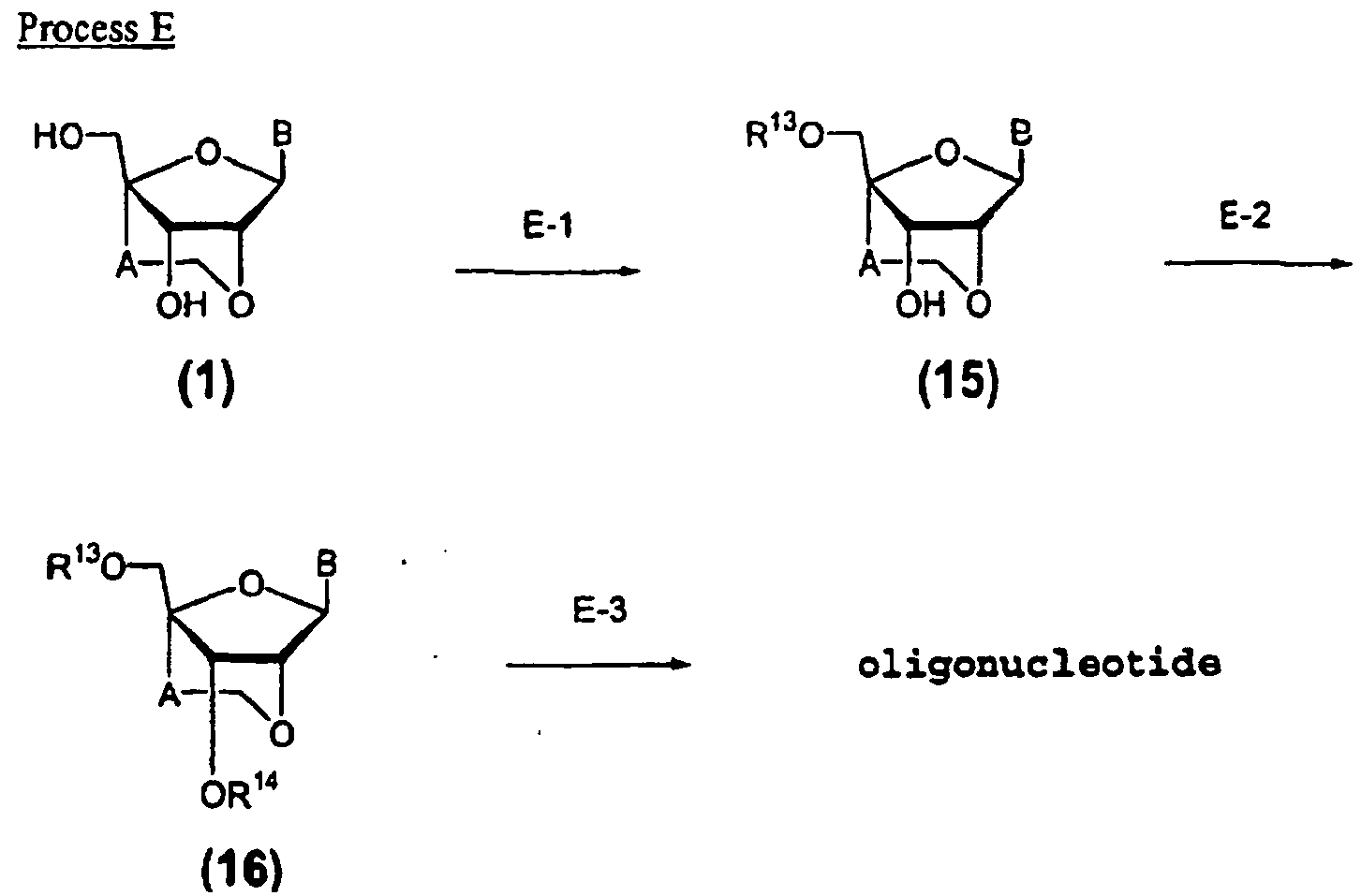
- In Process E, A and B have the same meaning as defined above; R13 represents a hydroxyl protecting group (particularly a trityl group which may be substituted by a methoxy group); R14 represents a phosphonyl group or a group formed by reacting mono-substituted chloro(alkoxy)phosphines or di-substituted alkoxyphosphines described later.
- The present step is to prepare the compound (15) by reacting the compound (1) prepared in Process A with a protecting reagent in an inert solvent.
- The solvent employable here may preferably include aromatic hydrocarbons such as benzene, toluene and xylene; halogenated hydrocarbons such as methylene chloride, chloroform, carbon tetrachloride, dichloroethane, chlorobenzene and dichlorobenzene; esters such as ethyl formate, ethyl acetate, propyl acetate, butyl acetate and diethyl carbonate; ethers such as diethyl ether, diisopropyl ether, tetrahydrofuran, dioxane, dimethoxyethane and diethylene glycol dimethyl ether; ketones such as acetone, methyl ethyl ketone, methyl isobutyl ketone, isophorone and cyclohexanone; nitrated compounds such as nitroethane and nitrobenzene; nitriles such as acetonitrile and isobutyronitrile; amides such as formamide, dimethylformamide (DMF), dimethylacetamide and hexamethylphosphoric triamide; sulfoxides such as dimethyl sulfoxide and sulfolane; aliphatic tertiary amines such as triinethylamine, triethylamine and N-methylmorpholine; and aromatic amines such as pyridine and picoline; more preferably halogenated hydrocarbons (particularly methylene chloride) and aromatic amines (particularly pyridine).
- The protecting reagent employable here is not particularly limited so long as only the 5'-position can be selectively protected and it can be removed under acidic or neutral conditions but may preferably include triarylmethyl halides such as trityl chloride, monomethoxytrityl chloride and dimethoxytrityl chloride.
- In the case where triarylmethyl halides are used as the protecting reagent, a base is usually used.
- In such case, the base employable here may include heterocyclic amines such as pyridine, dimethylaminopyridine and pyrrolidinopyridine; and aliphatic tertiary amines such as trimethylamine and triethylamine; preferably pyridine, dimethylaminopyridine and pyrrolidinopyridine.
- In the case where a liquid base is used as the solvent, since the base itself functions as an acid trapping agent, it is not necessary to add another base.
- The reaction temperature varies depending on the starting material, the reagent and the solvent but is usually from 0°C to 150°C, preferably from 20°C to 100°C. The reaction time varies depending on the starting material, the solvent and the reaction temperature but is usually from 1 hour to 100 hours, preferably from 2 hours to 24 hours.
- After the reaction, the desired compound (15) of the present reaction is obtained, for example, by concentrating the reaction mixture, adding an organic solvent immiscible with water such as ethyl acetate, washing with water, separating an organic layer containing the desired compound, drying over anhydrous magnesium sulfate and distilling off the solvent.
- The desired product thus obtained can be further purified, if necessary, by a conventional method, for example, recrystallization, silica gel column chromatography and the like.
- The present step is to prepare the compound (16) by reacting the compound (15) prepared in Step E-1 with mono-substituted chloro(alkoxy)phosphines or di-substituted alkoxyphosphines usually used for amiditation in an inert solvent.
- The solvent employable here is not particularly limited so long as it does not affect the reaction and may preferably include ethers such as tetrahydrofuran, diethyl ether and dioxane; and halogenated hydrocarbons such as methylene chloride, chloroform, carbon tetrachloride, dichloroethane, chlorobenzene and dichlorobenzene.
- The mono-substituted chloro(alkoxy)phosphines employable here may include phosphine drivatives such as chloro(morpholino)methoxyphosphine, chloro(morpholino)cyanoethoxyphosphine, chloro(dimethylamino)methoxyphosphine, chloro(dimethylamino)cyanoethoxyphosphine, chloro(diisopropylamino)methoxyphosphine and chloro(diisopropylamino)cyanoethoxyphosphine, preferably chloro(morpholino)methoxyphosphine, chloro(morpholino)cyanoethoxyphosphine, chloro(diisopropylamino)methoxyphosphine and chloro(diisopropylamino)cyanoethoxyphosphine.
- In the case where the mono-substituted-chloro(alkoxy)phosphines are used, an acid trapping agent is used and in such case, the acid trapping agent employable here may include heterocyclic amines such as pyridine and dimethylaminopyridine; and aliphatic amines such as trimethylamine, triethylamine and diisopropylamine; preferably aliphatic amines (particularly diisopropylamine).
- The di-substituted alkoxyphosphines employable here may include phosphine derivatives such as bis(diisopropylamino)cyanoethoxyphosphine, bis(diethylamino)methanesulfonylethoxyphosphine, bis(diisopropylarnino)(2,2,2-trichloroethoxy)phosphine and bis(diisopropylamino)(4-chlorophenylmethoxy)phosphine, preferably bis(diisopropylamino)cyanoethoxyphosphine.
- In the case where the di-substituted alkoxyphosphines are used, an acid is used, and in such case, the acid employable may preferably include tetrazole, acetic acid or p-toluenesulfonic acid.
- The reaction temperature is not particularly limited but is usually from 0°C to 80°C, preferably room temperature.
- The reaction time varies depending on the starting material, the reagent and the reaction temperature, but is usually from 5 minutes to 30 hours, preferably from 30 minutes to 10 hours in the case where the reaction is carried out at room temperature.
- After the reaction, the desired compound (16) of the present reaction is obtained, for example, by appropriately neutralizing the reaction mixture, removing insolubles by filtration in the case where they exist, adding an organic solvent immiscible with water such as ethyl acetate, washing with water, separating an organic layer containing the desired compound, drying over anhydrous magnesium sulfate and distilling off the solvent. The desired product thus obtained can be further purified, if necessary, by a conventional method, for example, recrystallization, reprecipitation or chromatography and the like.
- Alternatively, the present step is to prepare the compound (16) by reacting the compound (15) prepared in Step E-1 with tris-(1,2,4-triazolyl)phosphite in an inert solvent (preferably halogenated hydrocarbons such as methylene chloride), followed by the addition of water to effect H-phosphonation.
- The reaction temperature is not particularly limited, but is usually from -20°C to 100°C, preferably from 10 to 40°C.
- The reaction time varies depending on the starting material, the reagent and the reaction temperature and is usually from 5 minutes to 30 hours, preferably 30 minutes in the case where the reaction is carried out at room temperature.
- After the reaction, the desired compound (16) of the present reaction is obtained, for example, by appropriately neutralizing the reaction mixture, removing insolubles by filtration in the case where they exist, adding an organic solvent immiscible with water such as ethyl acetate, washing with water, separating an organic layer containing the desired compound, drying over anhydrous magnesium sulfate and distilling off the solvent. The desired product thus obtained can be further purified, if necessary, by a conventional method, for example, recrystallization, reprecipitation or chromatography and the like.
- In this step, the target oligonucleotide analogue is produced by an automated DNA synthesizer using at least one compound (16) prepared in step E-2 and commercially available phosphoramidite reagents required for producing an oligonucleotide analogue of a desired nucleotide sequence in accordance with conventional methods.
- An oligonucleotide analogue having a desired nucleotide sequence can be synthesized by a DNA synthesizer such as the Perkin-Elmer Model 392 using the phosphoramidite method in accordance with the method described in the literature (Nucleic Acids Research, 12, 4539 (1984)).
- In addition, in the case of converting to a thioate as desired, a thioate derivative can be obtained in accordance with the method described in the literature (Tetrahedron Letters, 32, 3005 (1991), J. Am. Chem. Soc., 112, 1253 (1990)) using, besides sulfur, a reagent that forms a thioate by reacting with trivalent phosphoric acid such as tetraethylthiuram disulfide (TETD, Applied Biosystems Inc.) or Beaucage reagent (Millipore Corp.).
- The resulting crude oligonucleotide analogue can be purified by OligoPak (reverse phase chromatocolumn) and the purity of the product can be confirmed by HPLC analysis.
- The chain length of the resulting oligonucleotide analogue is normally 2 to 50 units, and preferably 10 to 30 units, in nucleoside units.
- The complementary chain formation ability and nuclease enzyme resistance of the resulting oligonucleotide analogue can be determined according to the methods described below.
- The hybrid formation ability of the oligonucleotide analogue of the present invention with respect to complementary DNA and RNA can be determined by annealing the various resulting oligonucleotide analogues with an oligonucleotide analogue composed of naturally-occurring DNA or RNA having a complementary sequence and measuring the melting temperature (Tm value).
- A sample solution containing equal amounts of oligonucleotide analogue and naturally-occurring complementary oligonucleotide in sodium phosphate buffer solution was put into a boiling water bath and then slowly cooled to room temperature over the course of time (annealing). The temperature of the solution was then raised little by little from 20°C to 90°C in the cell chamber of a spectrophotometer (e.g., Shimadzu UV-2100PC) followed by measurement of ultraviolet absorption at 260 nm.
- To the oligonucleotide in a buffer solution was added a nuclease and the mixture was warmed. Examples of nucleases that are used include snake venom phosphodiesterase, endonuclease P1 and endonuclease S1. Although there are no particular restrictions on the buffer solution provided it is a buffer solution suitable for enzymes, Tris-HCl buffer is used in the case of snake venom phosphodiesterase, while sodium acetate buffer is used in the case of endonuclease P1. In addition, metal ions are added to the buffer solution as necessary. Examples of metal ions used include Mg2+ in the case of snake venom phosphodiesterase and Zn2+ in the case of endonuclease. The reaction temperature is preferably 0 to 100°C, and more preferably 30 to 50°C.
- Ethylenediamine tetraacetic acid (EDTA) is added after a predetermined amount of time followed by heating at 100°C for 2 minutes in order to quench the reaction.
- Examples of methods used to assay the amount of oligonucleotide remaining include a method in which the oligonucleotide is labelled with a radioisotope, etc. followed by assaying the cleavage reaction product with an image analyzer and so forth, a method in which the cleavage reaction product is assayed by reverse phase high-performance liquid chromatography (HPLC), and a method in which the cleavage reaction product is stained with a dye (such as ethidium bromide) and assayed by image processing using a computer.
- Dosage forms of the oligonucleotide analogue having one, or two or more structures of the formula (2) of the present invention may be tablets, capsules, granules, powders or syrup for oral administration, or injections or suppositories for parenteral administration. These dosage forms are prepared by well-known methods using additives such as excipients (for example, organic excipients such as sugar derivatives, e.g. lactose, sucrose, glucose, mannitol and sorbitol; starch derivatives, e.g. corn starch, potato starch, α-starch and dextrin; cellulose derivatives, e.g. crystalline cellulose; gum arabic; dextran; and Pullulan; and inorganic excipients such as silicate derivatives, e.g. light silicic anhydride, synthesized aluminium silicate, calcium silicate and magnesium aluminate metasilicate; phosphates, e.g. calcium hydrogenphosphate; carbonates, e.g. calcium carbonate; and sulfates, e.g. calcium sulfate), lubricants (for example, stearic acid, stearic acid metal salts such as calcium stearate and magnesium stearate; talc; colloidal silica; waxes such as bee gum and spermaceti; boric acid; adipic acid; sulfates, e.g. sodium sulfate; glycol; fumaric acid; sodium benzoate; DL-leucine; fatty acid sodium salt; laurylsulfates such as sodium laurylsulfate and magnesium laurylsulfate; silicic acids such as silicic anhydride and silicic acid hydrate; and the above starch derivatives), binders (for example, hydroxypropyl cellulose, hydroxypropyl methyl cellulose, polyvinyl pyrrolidone, Macrogol and compounds similar to the above excipients), disintegrants (for example, cellulose derivatives, such as low-substituted hydroxypropyl cellulose, carboxymethyl cellulose, calcium carboxymethyl cellulose and internally bridged sodium carboxymethyl cellulose; and chemically modified starch-celluloses such as carboxymethyl starch, sodium carboxymethyl starch and bridged polyvinyl pyrrolidone), stabilizers (paraoxybenzoates such as methylparaben and propylparaben; alcohols such as chlorobutanol, benzyl alcohol and phenylethyl alcohol; benzalkonium chloride; phenol derivatives such as phenol and cresol; thimerosal; dehydroacetic acid; and sorbic acid), corrigents (for example, sweeteners, souring agents, flavors, etc. usually used), diluents, etc.
- While the dose will vary depending on the condition of the disease, age of the patient, administration methods, etc., for example, in the case of oral administration, it is desirable to administer an active ingredient in an amount of from 0.01 mg/kg of body weight (preferably 0.1 mg/kg of body weight) to 1000 mg/kg of body weight (preferably 100 mg/kg of body weight) and in the case of intravenous administration, it is desirable to administer an active ingredient in an amount of from 0.001 mg/kg of body weight (preferably 0.01 mg/kg of body weight) to 100 mg/kg of body weight (preferably 10 mg/kg of body weight), as a single dose a day or in divided dose at several times for a day respectively.
- An aqueous 2N sodium hydroxide solution (68 ml) was added to a solution of the compound obtained in Reference example 11 (6.80 g, 8.86 mmol) in pyridine (136 ml) at 0°C and the mixture was stirred at room temperature for 1 hour. The reaction mixture was neutralized by dropwise addition of aqueous 20% acetic acid and extracted with chloroform. The chloroform layer was washed with saturated aqueous sodium chloride solution and concentrated in vacuo. The residue was purified by chromatography on a silica gel column (using dichloromethane : methanol = 100 : 3 as the eluant) to afford the title compound (3.3 g, 6.02 mmol, 68%).
1H-NMR(400MHz, CDCl3): 8.64(2H, brs), 7.89(2H, d, 7.6Hz), 7.64-7.60(1H, m), 7.54-7.51(2H, m), 7.48-7.37(3H, m), 7.36-7.26(8H, m), 6.18(1H,s), 4.70(1H, d, 11Hz), 4.60(1H, d, 11Hz), 4.55(1H, d, 11Hz), 4.46(1H, d, 2.9Hz), 4.42(1H, d, 11Hz), 4.10-4.02(2H,m), 3.89(1H, d, 2.9Hz), 3.75(1H, d, 11Hz), 3.62(1H, d, 11Hz), 2.34-2.26(1H, m), 1.39-1.36(1H, m).
FAB-MAS(mNBA):554(M+H)+ - A solution (31.7 ml) of 1.0 M trichloroborane in dichloromethane was added dropwise to a solution of the compound obtained in Example 1 (2.06 g, 3.72 mmol) in anhydrous methylenechloride (317 ml) at -78°C and the mixture was stirred at -78°C for 1 hour. The reaction mixture was slowly warmed to -20°C and the reaction vessel was placed into an ice-sodium chloride bath and the mixture was stirred at between -20°C and -10°C for 2 hours. Methanol (12 ml) was slowly added to the mixture and the mixture was stirred for 10 minutes. The pH of the reaction mixture was adjust to 7-8 by dropwise addition of saturated aqueous sodium hydrogencarbonate solution. The mixture was warmed to room temperature and concentrated in vacuo. The residue was purified by chromatography on a silica gel column (using dichloromethane : methanol = 100 : 5 as the eluant) to afford the title compound (1.21 g, 3.24 mmol, 87%) as a white solid.
1H-NMR(SOOMHz, DMSO-d6) : 11.23(1H,brs), 8.70(1H,d,7.2Hz), 8.00(2H,d,7.5Hz), 7.3-6(4H,m), 5.97(1H,s), 5.35(1H,dd,5 and 10Hz), 4.10(1H,dd,5 and 10Hz), 4.03(1H,d,3.2Hz), 3.95-3.85(2H,m) 3.83(1H,d,3.2Hz), 3.65-3.51(2H,m), 2.06-1.98(1H,m), 1.26(1).
FAB-MAS(mNBA):374(M+H)+ - A solution of the compound obtained in Example 2 (0.1 g, 0.268 mmol) in methanol saturated with ammonia (12 ml) was allowed to stand overnight. The mixture was concentrated to dryness to afford the title compound (0.054 g, 75%) as a white solid.
1H-NMR(500MHz, DMSO-d6): 8.18(1H, d, 7.4Hz), 7.10(2H, br), 5.84(1H, s), 5.69(1H, d, 7.6Hz), 5.27-5.24(2H, m), 3.86(1H, d, 3.2Hz), 3.90-3.78(2H, m), 3.76(1H, d, 3.2Hz), 3.56(1H, dd, 5.5 and 12Hz), 3.49(1H, dd, 5.5 and 12Hz), 2.01-1.93(1H,dt, 7.5 and 12Hz), 1.22(1H, dd, 3.6 and 13Hz).
FAB-MAS(mNBA):270(M+H)+ - A solution of the compound obtained in Example 2 (1.29 g, 3.46 mmol) in anhydrous pyridine was azeotropically refluxed in order to remove water. The product was dissolved in anhydrous pyridine (26 ml) under nitrogen atmosphere and 4,4'-dimethoxytritylchloride (1.76 g, 5.18 mmol) was added to the solution and the mixture was stirred at room temperature overnight. A small amount of methanol was added to the reaction mixture and then the solvent was evaporated in vacuo. The residue was partitioned between water and chloroform and the organic layer was washed with saturated aqueous sodium hydrogencarbonate solution and saturated aqueous sodium chloride solution and concentrated in vacuo. The residue was purified by chromatography on a silica gel column (using dichloromethane : methanol = 100 : 5 as the eluant) to afford the title compound (2.10 g, 3.11 mmol, 90%) as a colorless amorphous solid.
1H-NMR(270MHz, DMSO-d6): 11.27(1H,brs), 8.59(1H,m), 6.92-8.01(19H,m), 6.03(1H,s), 5.56(1H,m), 4.17(1H,m), 4.08(1H,m), 3.86(2H,m), 3.77(6H,s), 3.24(2H,m), 1.98(1H,m), 1.24(1H,m). FAB-MAS(mNBA):676(M+H)+ - A solution of the compound obtained in Example 4 (6.53 g, 9.66 mmol) in anhydrous pyridine was azeotropically refluxed in order to remove water. The product was dissolved under nitrogen atmosphere in anhydrous dichloromethane (142 ml). N,N-diisopropylamine (2.80 ml, 16.1 mmol) was added to the solution and then 2-cyanoethyl N,N-diisopropylchlorophophoramidite (2.16 ml, 9.66 mmol) was added dropwise in an ice bath. The mixture was stirred at room temperature for 6 hours. The reaction mixture was washed with saturated aqueous sodium hydrogencarbonate solution and saturated aqueous sodium chloride solution and concentrated in vacuo. The residue was purified by chromatography on a silica gel column (using dichloromethane : triethylamine = 50 : 1 - dichloromethane : ethyl acetate : triethylamine = 60 : 30 : 1 as the eluant) to afford the title compound (7.10 g, 8.11 mmol, 84%) as a pale white compound.
1H-NMR(400MHz, CDCl3) : 1.1-1.2(12H,m), 1.35(1H,m), 2.11(1H,m), 2.3(2H,m), 3.35-3.7(6H,m), 3.8(6H,m), 3.9-4.1(2H,m), 4.33(1H,m), 4.45(1H,m), 6.23(1H,s), 6.9(4H,m), 7.3-7.9(15H,m), 8.7-8.8(1H,m). - An aqueous 2N sodium hydroxide solution and mixture solution (5 ml), said mixture solution comprised of pyridine : methanol : water = 65 : 30 : 5, were added to the compound obtained in Reference example 10 (418 mg, 0.62 mmol) in pyridine : methanol : water = 65 : 30 : 5 (5 ml) at 0°C and the mixture was stirred at room temperature for 15 minutes. The reaction mixture was neutralized with 1N hydrochloric acid and extracted with ethyl acetate (about 30 ml). The organic layer was washed with saturated aqueous sodium hydrogencarbonate solution (about 30 ml) and saturated aqueous sodium chloride solution (about 30 ml), dried over anhydrous magnesium sulfate and then concentrated in vacuo. The residue was purified by chromatography on a silica gel column (using hexane : ethyl acetate = 1 : 1 as the eluant) to afford a colorless amorphous solid (228 mg, 0.49 mmol, 79%).
1H-NMR (400MHz, CDCl3) : 1.35(1H, d, 13Hz), 1.41(3H, s), 2.28(1H, dt, 9.4 and 13Hz), 3.60(1H, d, 11Hz), 3.76(1H, d, 11Hz), 3.94(1H, d, 3.0Hz), 4.10(1H, d, 7.0Hz), 4.14(1H, d, 7.0Hz), 4.31(1H, d, 3.0Hz), 4.51(1H, d, 12Hz), 4.54(1H, d, 12Hz), 4.58(1H, d, 12Hz), 4.75(1H, d, 12Hz), 6.06(1H, s), 7.3(10H, m), 7.91(1H, s), 8.42(1H, brs).
FAB-MAS(mNBA):465(M+H)+ - A solution of the compound obtained in Example 6 (195 mg, 0.42 mmol) in methanol (10 ml) was stirred under hydrogen atmosphere at atmospheric pressure in the presence of a hydrogenation catalyst for 5 hours. The reaction mixture was filtered in order to remove catalyst and the filtrate was concentrated in vacuo. The residue was purified by chromatography on a silica gel column (using dichloromethane : methanol = 10 : 1 as the eluant) to afford a colorless powder (76 mg, 0.268 mmol, 64%).
1H-NMR (400MHz, CD3OD) : 1.33(1H, dd, 3.8 and 13Hz), 1.86(3H, d, 0.9Hz), 1.94(1H, ddd, 7.5, 11.7 and 13Hz), 3.68(1H, d, 12Hz), 3.75(1H, d, 12Hz), 3.9-4.0(2H, m), 4.05(1H, d, 3.2Hz), 4.09(1H, d, 3.2Hz), 6.00(1H, s), 8.28(1H, d, 1.1Hz).
FAB-MAS(mNBA):285 (M+H)+ - A solution of the compound obtained in Example 7 (1.45 g, 5.10 mmol) in anhydrous pyridine was azeotropically refluxed in order to remove water. The product was dissolved in anhydrous pyridine (44 ml) under nitrogen atmosphere and 4,4'-dimethoxytritylchloride (2.59 g, 7.65 mmol) was added to the solution and the mixture was stirred at room temperature overnight. A small amount of methanol was added to the reaction mixture and then the solvent was evaporated in vacuo. The residue was partitioned between water and chloroform and the organic layer was washed with saturated aqueous sodium hydrogencarbonate solution and saturated aqueous sodium chloride solution and concentrated in vacuo. The residue was purified by chromatography on a silica gel column (using dichloromethane : methanol = 100 : 10 as the eluant) to afford the title compound (2.42 g, 4.13 mmol, 81%) as colorless amorphous solid.
1H-NMR(270MHz, DMSO-d6) : 11.36(1H,s), 7.68(1H,s), 6.90-7.44(13H,m), 5.89(1H,s), 5.55(1H,d), 4.09(1H,m), 4.04(1H,d), 3.82(2H,m), 3.74(6H,s), 3.19(2H,m), 1.99(1H,m), 1.36(1H,m), 1.17(3H,s).
FAB-MAS(mNBA):587(M+H)+ - A solution of the compound obtained in Example 8 (4.72 g, 8.05 mmol) in anhydrous pyridine was azeotropically refluxed in order to remove water. The product was dissolved under nitrogen atmosphere in anhydrous dichloromethane (142 ml). N,N-diisopropylamine (2.80 ml, 16.1 mmol) was added to the solution and then 2-cyanoethyl N,N-diisopropylchlorophophoramidite (2.16 ml, 9.66 mmol) was added dropwise in an ice bath. The mixture was stirred at room temperature for 6 hours. The reaction mixture was washed with saturated aqueous sodium hydrogencarbonate solution and saturated aqueous sodium chloride solution and concentrated in vacuo. The residue was purified by chromatography on a silica gel column (using hexane : ethyl acetate : triethylamine = 50 : 50 : 1 - hexane : ethyl acetate : triethylamine = 30 : 60 : 1 as the eluant) to afford the title compound (5.64 g, 7.17 mmol, 89%) as a colorless amorphous solid.
1H-NMR(400MHz, CDCl3) :1.1-1.2(15H,m), 1.4(1H,m), 2.08(1H,m), 2.4(2H,m), 3.2-4.0(14H,m), 4.38(2H,m), 4.47(1H,m), 6.06(1H,s), 6.8-6.9(4H,m), 7.2-7.5(9H,m), 7.91(1H,m).
FAB-MAS(mNBA):787(M+H)+ - An aqueous 2N sodium hydroxide solution and mixture solution (5 ml), said mixture solution comprised of pyridine : methanol : water = 65 : 30 : 5, were added to compound obtained in Reference example 12 (238 mg, 0.30 mmol) in pyridine : methanol : water = 65 : 30 : 5 (5 ml) at 0°C and the mixture was stirred at room temperature for 15 minutes. The reaction mixture was neutralized with 1N hydrochloric acid and extracted with ethyl acetate (about 30 ml). The organic layer was washed with saturated aqueous sodium hydrogencarbonate solution (about 30 ml) and saturated aqueous sodium chloride solution (about 30 ml), dried over anhydrous magnesium sulfate and then concentrated in vacuo. The residue was purified by chromatography on a silica gel column (using dichloromethane : methanol = 50 : 1 as the eluant) to afford a colorless amorphous solid (133 mg, 0.23 mmol, 78%).
1H-NMR (400MHz, CDCl3) : 1.44(1H, d, 13Hz), 2.31(1H, dd, 13 and 19Hz), 3.56(1H, d, 11Hz), 3.70(1H, d, 11Hz), 4.10(2H, m), 4.24(1H, s), 4.45(1H, d, 12Hz), 4.53-4.67(4H, m), 6.52(1H, s), 7.3(10H, m), 7.53(2H, m), 7.62(1H, m), 8.03(2H, d, 7.6Hz), 8.66(1H, s), 8.78(1H, s), 9.00(1H, brs).
FAB-MAS(mNBA):578(M+H)+ - A 1M boron trichloride solution (1.5 ml, 1.5 mmol) in dichloromethane was slowly added dropwise to a solution of the compound obtained in Example 10 (116 mg, 0.20 mmol) in anhydrous methylenechloride (5 ml) at -78°C and the mixture was stirred at -78°C for 3 hours. To the reaction mixture was added a 1M boron trichloride solution (1.5 ml, 1.5 mmol) in dichloromethane and the mixture was stirred for 2 hours. The mixture was slowly warmed to room temperature and then quickly cooled to -78°C and then methanol (5 ml) was added to the mixture. The reaction mixture was slowly warmed to room temperature and concentrated in vacuo. The residue was purified by chromatography on a silica gel column (using dichloromethane : methanol = 9 : 1 as the eluant) to afford a white powder (49 mg, 0.17 mmol, 84%).
1H-NMR (400MHz, CD3OD) : 1.45(1H, dd, 4.3 and 13Hz), 2.12(1H, m), 3.72(1H, d, 12Hz), 3.79(1H, d, 12Hz), 4.04(1H, dd, 7.3 and 12Hz), 4.15(1H, dt, 4.3 and 9.4Hz), 4.36(1H, d, 3.2Hz), 4.43(1H, d, 3.2Hz), 6.57(1H, s), 7.57(2H, m), 7.66(1H, m), 8.09(2H, d, 8.0Hz), 8.72(1H, s), 8.85(1H, s).
FAB-MAS{mNBA):398(M+H)+ - A solution of the compound obtained in Example 11 (14 mg, 0.035 mmol) in methanol saturated with ammonia (1 ml) was allowed to stand overnight. The mixture was concentrated and the residue was purified by chromatography on a silica gel column (using dichloromethane : methanol = 10 : 1 as the eluant) to afford a white powder (10 mg, 0.034 mmol, 98%).
1H-NMR (400MHz, CD3CD) : 1.32(1H, dd, 4 and 13Hz), 2.04(1H, dt, 7.4 and 12Hz), 3.53(1H, dd, 5 and 12Hz), 3.61(1H, dd, 5.2 and 12Hz), 3.90(1H, dd, 7.4 and 12Hz), 3.97(1H, dt, 4 and 12Hz), 4.15(1H, d, 3.1Hz), 4.21(1H, d, 3.1Hz), 5.27(1H, t, 5.2Hz), 5.39(1H, d, 3.1Hz), 6.33(1H, s), 7.29(2H, s), 7.66(1H, m), 8.14(1H, s), 8.42(1H, s).
FAB-MAS(mNBA):294(M+H)+
UV(λmax) : 260(pH7), 260(pH1), 258(pH13) - A solution of the compound obtained in Example 11 (14 mg, 0.035 mmol) in anhydrous pyridine was azeotropically refluxed in order to remove water. The product was dissolved in anhydrous pyridine (1 ml) under nitrogen atmosphere and 4,4'-dimethoxytritylchloride (18 mg, 0.053 mmol) was added to the solution and the mixture was stirred at 40°C for 5 hours. A small amount of methanol was added to the reaction mixture and then the solvent was evaporated in vacuo. The residue was partitioned between water and chloroform and the organic layer was washed with saturated aqueous sodium hydrogencarbonate solution and saturated aqueous sodium chloride solution and concentrated in vacuo. The residue was purified by chromatography on a silica gel column (using dichloromethane : methanol = 100 : 5 as the eluant) to afford the title compound (18 mg, 0.026 mmol, 73%) as a colorless amorphous solid.
1H-NMR (400MHz, CDCl3):1.63(1H,m), 2.14(1H,7.5,12,and 13Hz), 3.37(1H,d,11Hz), 3.41(1H,d,11Hz), 3.79(6H,s), 4.10(2H,m), 4.48(1H,d, 3.3Hz), 4.59(1H,d,3.3Hz), 6.54(1H,s), 6.85(4H,m), 7.2-7.6(12H,m), 8.02(2H,m), 8.45(1H,s), 8.82(1H,s), 9.02(1H,brs). FAB-MAS(mNBA):700(M+H)+ - A solution of the compound obtained in Example 13 (16 mg, 0.023 mmol) in anhydrous pyridine was azeotropically refluxed in order to remove water. The product was dissolved under nitrogen atmosphere in anhydrous dichloromethane (0.5 ml). Tetrazole N,N-diisopropylamine salt (10 mg) was added to the solution and then 2-cyanoethyl N,N,N',N'-tetraisopropylphophoramidite (about 20 µl) was added dropwise in an ice bath. The mixture was stirred at room temperature overnight. The reaction mixture was washed with saturated aqueous sodium hydrogencarbonate solution and saturated aqueous sodium chloride solution and concentrated in vacuo. The residue was purified by chromatography on a silica gel column (using dichloromethane : ethyl acetate = 2 : 1 as the eluant) to afford the title compound (20 mg, 0.022 mmol, 97%) as a white solid.
1H-NMR(400MHz, CDCl3) : 1.0-1.2(12H,m), 1.54(1H,m), 2.15(1H,m), 2.33(2H,m), 3.3-3.6(6H,m), 3.80(6H,s), 4.08(2H,m), 4.65(1H,m), 4.75(1H,m), 6.53(1H,s), 6.84(4H,m), 7.2-7.6(12H,m), 8.01(2H,m), 8.53(1H,s), 8.83(1H,s), 9.01(1H,brs). FAB-MAS(mNBA):900(M+H)+ - An aqueous 1N sodium hydroxide solution (2 ml) was added to a solution of the compound obtained in Reference example 13 (194 mg, 0.292 mmol) in pyridine (3 ml) at 0°C and the mixture was stirred at room temperature for 30 minutes. The reaction mixture was neutralized with 1N hydrochloric acid and extracted with ethyl acetate (10 ml). The organic layer was washed with saturated aqueous sodium hydrogencarbonate solution and saturated aqueous sodium chloride solution, dried over anhydrous magnesium sulfate and then concentrated in vacuo. The residue was purified by chromatography on a silica gel column (using dichloromethane : methanol = 100: 3 as the eluant) to afford an colorless oil (105 mg, 0.233 mmol, 80%).
1H-NMR (400MHz, CDCl3) : 1.36(1H,m), 2.29(1H,m), 3.63(1H,d,11Hz), 3.74(1H,d, 11Hz), 3.87(1H,d, 2.9Hz), 4.03(2H, m), 4.29(1H,d,2.9Hz), 4.49(1H,d, 12Hz), 4.50(1H,d,11Hz), 4.53(1H,d,11 Hz), 4.73(1H,d,12Hz), 5.20(1H,dd, 2 and 8Hz), 6.04(1H,s), 7.2-7.4(10H,m), 8.13(1H,d,8.2Hz), 8.57(1H,brs).
FAB-MAS(mNBA):451(M+H)+ - A solution of the compound obtained in Example 15 (100 mg, 0.222 mmol) in methanol (4 ml) was stirred under hydrogen atmosphere at atmospheric pressure in the presence of a hydrogenation catalyst for 5 hours. The reaction mixture was filtered in order to remove catalyst and the filtrate was concentrated in vacuo. The residue was purified by chromatography on a silica gel column (using dichloromethane : methanol = 10 : 1 as the eluant) to afford a colorless oil (45 mg, 0.167 mmol, 75%).
1H-NMR (400MHz, CD3OD) : 1.35(1H,dd,4 and 13Hz), 2.13(1H,ddd, 7,11 and 13Hz), 3.66(1H,d,12Hz), 3.73(1H,d,12Hz), 3.91-4.08(2H,m), 4.01(1H,d,3.2Hz), 4.12(1H,d,3.2Hz), 5.66(1H,d,8.2Hz), 6.00(1H,s), 8.37(1H,d,8.2Hz).
FAB-MAS(mNBA):271(M+H)+ - A solution of the compound obtained in Example 16 (28 mg, 0.104 mmol) in anhydrous pyridine was azeotropically refluxed in order to remove water. The product was dissolved in anhydrous pyridine (3 ml) under nitrogen atmosphere and 4,4'-dimethoxytritylchloride (50 mg, 0.15 mmol) was added to the solution and the mixture was stirred at room temperature overnight. A small amount of methanol was added to the reaction mixture and then the solvent was evaporated in vacuo. The residue was partitioned between water and chloroform and the organic layer was washed with saturated aqueous sodium hydrogencarbonate solution and saturated aqueous sodium chloride solution and concentrated in vacuo. The residue was purified by chromatography on a silica gel column (using dichloromethane : methanol = 100 : 3 as the eluant) to afford the title compound (25 mg, 0.044 mmol, 42%) as a colorless oil.
1H-NMR (400MHz, CD3OD) : 1.35(1H,dd, 3 and 14Hz), 2.03(1H,ddd, 8,11 and 14Hz), 2.46(1H,d,8Hz), 3.36(1H,d,11Hz), 3.41(1H,d,11Hz), 3.80(3H,s), 3.81 (3H,s), 3.97(2H,m), 4.21(1), 4.33(1H,brm), 5.31(1H,m), 6.10(1H,s), 6.86(4H,m), 7.2-7.5(9H,m), 8.27(1H,d,8.2Hz), 8.43(1H,brs).
FAB-MAS(mNBA):573 (M+H)+ - A solution of the compound obtained in Example 17 (6 mg, 0.0105 mmol) in anhydrous pyridine was azeotropically refluxed in order to remove water. The product was dissolved under nitrogen atmosphere in anhydrous dichloromethane (0.5 ml). Tetrazole N,N-diisopropylamine salt (3 mg) was added to the solution and then 2-cyanoethyl N,N,N',N'-tetraisopropylphophoramidite (about 5 µl) was added dropwise in an ice bath. The mixture was stirred at room temperature overnight. The reaction mixture was washed with saturated aqueous sodium hydrogencarbonate solution and saturated aqueous sodium chloride solution and concentrated in vacuo. The residue was purified by chromatography on a silica gel column (using dichloromethane : ethyl acetate = 2 : 1 as the eluant) to afford the title compound (8 mg) as a white solid.
1H-NMR(400MHz, CDCl3) : 1.1-1.2(13H,m), 2.09(1H,m), 2.4(2H,m), 3.3-3.6(6H,m), 3.81(6H,m), 3.94(2H,m), 4.35(1H, m), 4.47(1H,m), 5.18(1H,d,8.2Hz), 6.08(1H,s), 6.86(4H,m), 7.2-7.4(9H,m), 8.31(1H,d,8.2Hz).
FAB-MAS(mNBA):773(M+H)+ - An aqueous 1N sodium hydroxide solution (5 ml) was added to a solution of the compound obtained in Reference example 14 (310 mg, 0.396 mmol) in pyridine (5 ml) at 0°C and the mixture was stirred at room temperature for 20 minutes. The reaction mixture was neutralized by dropwise addition of aqueous 20% acetic acid and extracted with dichloromethane. The dichloromethane layer was washed with saturated aqueous sodium chloride solution and concentrated in vacuo. The residue was purified by chromatography on a silica gel column (using dichloromethane : methanol = 100 : 2 as the eluant) to afford the title compound (190 mg, 0.334 mmol, 84%).
1H-NMR(400MHz, CDCl3): 1.37(1H,m), 1.58(3H,s), 2.30(1H,dt,10 and 13Hz), 3.64(1H,d,11Hz), 3.79(1H,d,11Hz), 3.95(1H,d,3.0Hz), 4.04(2H,dd,2.3 and 10Hz), 4.37(1H,d,3.0Hz), 4.50(1H,d,12Hz), 4.56(1H,d,11Hz), 4.61(1H,d,11Hz), 4.76(1H,d,12Hz), 6.11(1H,s), 7.2-7.5(13H,m), 8.09(1H,s), 8.29(2H,m).
FAB-MAS(mNBA):568(M+H)+ - A 1M boron trichloride solution (1.6 ml) in dichloromethane was added dropwise to a solution of the compound obtained in Example 19 (120 mg, 0.211 mmol) in anhydrous dichloromethane (5 ml) at -78°C and the mixture was stirred at -78°C for 4 hours. Methanol (1 ml) was slowly added dropwise to the mixture and the mixture was stirred for 10 minutes. The pH of the reaction mixture was adjusted to 7-8 by dropwise addition of saturated aqueous sodium hydrogencarbonate solution. The reaction mixture was warmed to room temperature and concentrated in vacuo. The residue was purified by chromatography on a silica gel column (using dichloromethane : methanol = 100 : 6 as the eluant) to afford the title compound (29 mg, 0.075 mmol, 36%) as a white solid.
1H-NMR(400MHz, d-DMSO) : 1.24(1H,m), 2.01(3H,s), 2.0(1H,m), 3.54(1H,dd,5.4 and 12Hz), 3.64(1H,dd,5.4 and 12Hz), 3.88(3H,m), 4.10(1H,m), 5.36(1H,d,5.4Hz), 5.49(1H,t,5.0Hz), 5.95(1H,s), 7.4-7.6(3H,m), 8.21(2H,m), 8.49(1H,s), 13.17(1H,brs). FAB-MAS(mNBA):388(M+H)+ - A solution of the compound obtained in Example 20 (44 mg, 0.114 mmol) in anhydrous pyridine was azeotropically refluxed in order to remove water. The product was dissolved in anhydrous pyridine (1 ml) under nitrogen atmosphere and 4,4'-dimethoxytritylchloride (60 mg, 0.177 mmol) was added to the solution and the mixture was stirred at room temperature overnight. A small amount of methanol was added to the reaction mixture and then the solvent was evaporated in vacuo. The residue was partitioned between water and chloroform. The organic layer was washed with saturated aqueous sodium hydrogencarbonate solution and saturated aqueous sodium chloride solution and concentrated in vacuo. The residue was purified by chromatography on a silica gel column (using dichloromethane : methanol = 100 : 4 as the eluant) to afford the title compound (73 mg, 0.106 mmol, 93%) as a colorless oil.
1H-NMR(400MHz, CDCl3) : 1.46(1H,m), 1.49(3H,s), 2.06(1H,m), 2.59(1H,d, 8.6Hz), 3.3b(1H,d,11Hz), 3.39(1H,d,11Hz), 3.80(3H, s), 3.81(3H, s), 3.99(2H,m), 4.30(1H,d, 3.3Hz), 4.39(1H,m), 6.12(1H,s), 6.85(4H,m), 7.2-7.5(12H,m), 8.03(1H,s), 8.28(2H,m). FAB-MAS(mNBA):573(M+H)+ - A solution of the compound obtained in Example 21 (35 mg, 0.0507 mmol) in anhydrous pyridine was azeotropically refluxed in order to remove water. The product was dissolved under nitrogen atmosphere in anhydrous dichloromethane (1 ml). Tetrazole N,N-diisopropylamine salt (17 mg) was added to the solution and then 2-cyanoethyl N,N,N',N'-teiraisopropylphophoranudite (32 µl, 0.1 mmol) was added dropwise in an ice bath. The mixture was stirred at room temperature overnight. The reaction mixture was washed with saturated aqueous sodium hydrogencarbonate solution and saturated aqueous sodium chloride solution and concentrated in vacuo. The residue was purified by chromatography on a silica gel column (using dichloromethane : ethyl acetate = 2 : I as the eluant) to afford the title compound (40 mg, 0.0445 mmol, 89%) as a white solid.
1H-NMR(400MHz, CDCl3) :1.1-1.2(12H,m), 1.36(3H,s), 1.37(1H,m), 2.10(1H,m), 2.36(2H,m), 3.3-3.6(6H,m), 3.81(6H,m), 3.98(2H,m), 4.42(1H,m), 4.49(1H,m), 6.11(1H,s), 6.88(4H,m), 7.2-7.5(12H,m), 8.14(1H,s), 8.28(2H,m).
FAB-MAS(mNBA):890(M+H)+ - A solution of the compound obtained in Example 20(11.6 mg, 0.030 mmol) in methanol saturated with ammonia (2 ml) was allowed to stand overnight. The mixture was concentrated to afford a white solid (8.5 mg, 0.030 mmol).
1H-NMR(400MHz, d-DMSO) : 1.20(1H,m), 1.82(3H,s), 1.97(1H,m), 3.49(1H,dd,5 and 12Hz), 3.58(1H,dd,5 and 12Hz), 3.85(2H,m), 5.23(1H,d,5Hz), 5.32(1H,t,5Hz), 5.84(1H,s), 6.7(1H,brs), 7.2(1H,brs), 8.08(1H,s).
FAB-MAS(mNBA):284(M+H)+
UV(λmax) : 279(pH7), 289(pH1), 279(pH13) - An aqueous 1N sodium hydroxide solution (2 ml) was added to a solution of the compound obtained in Reference example 15 (about 200 mg) in pyridine (2 ml) and the mixture was stirred at room temperature for 15 minutes. The reaction mixture was neutralized with 1N hydrochloric acid and extracted with ethyl acetate. The organic layer was washed with saturated aqueous sodium hydrogencarbonate solution and saturated aqueous sodium chloride solution, dried over anhydrous magnesium sulfate and then concentrated in vacuo. The residue was purified by chromatography on a silica gel column (using dichloromethane : methanol = 50 : 1 as the eluant) to afford a colorless amorphous solid (20 mg, 0.036 mmol, 6%, 2 steps).
1H-NMR (400MHz, CDCl3) : 1.27(3H,s), 1.29(3H,s), 1.43(1H,dd,3 and 13Hz), 2.28(1H,m), 2.59(1H,qui,6.9Hz), 3.54(1H,d,11Hz), 3.68(1H,d,11Hz), 4.03(2H,m), 4.15(1H,d,3.0Hz), 4.31(1H,d,3.0Hz), 4.45(1H,d,12), 4.56(1H,d,12Hz), 4.61(1H,d,12Hz), 4.63(1H,d,12Hz), 6.18(1H,s), 7.2-7.4(10H,m), 8.19(1H,s), 11.93(1H,brs). FAB-MAS(mNBA):564(M+H)+ - A solution of the compound obtained in Example 24 (10 mg, 0.018 mmol) in methanol (2 ml) was stirred under hydrogen atmosphere at atmospheric pressure in the presence of a hydrogenation catalyst for 5 hours. The reaction mixture was filtered in order to remove catalyst and the filtrate was concentrated in vacuo. The residue was purified by chromatography on a silica gel column (using dichloromethane : methanol = 10 : 2 as the eluant) to afford a colorless oil (5 mg, 0.013 mmol, 72%).
1H-NMR (400MHz, CD3OD) :1.21(3H,s), 1.22(3H,s), 1.41(1H,dd, 4 and 13Hz), 2.18(1H,m), 2.69(1H,qui,6.9Hz), 3.69(1H,d,12Hz), 3.76(1H,d,12Hz), 4.0(2H,m), 4.26(1H,d,3.2Hz), 4.30(1H,d,3.2Hz), 6.30(1H,s), 8.40(1H,s).
FAB-MAS(mNBA):380(M+H)+ - A solution of the compound obtained in Example 25 (5 mg, 0.013 mmol) in anhydrous pyridine was azeotropically refluxed in order to remove water. The product was dissolved in anhydrous pyridine (1 ml) under nitrogen atmosphere and to 4,4'-dimethoxytritylchloride (14 mg, 0.04 mmol) was added to the solution and the mixture was stirred at 40°C for 3 hours. A small amount of methanol was added to the reaction mixture and then the solvent was evaporated in vacuo. The residue was purified by chromatography on a silica gel column (using dichloromethane : methanol = 100 : 6 as the eluant) to afford the title compound (4 mg, 0.0059 mmol, 45%) as colorless solid.
1H-NMR (400MHz, CDCl3) :1.26(3H,d,1.4Hz), 1.28(3H,d,1.4Hz), 1.66(1H,m), 2.15(1H,m), 2.59(1H,qui,6.9Hz), 3.65(1H,m), 3.78(1H,m), 4.06(2H,m), 4.35(1H,m), 4.38(1H,d,3.2Hz), 6.23(1H,s), 6.8(4H,m), 7.2-7.5(9H,m), 8.01(1H,s), 8.19(1H,brs).
FAB-MAS(mNBA):682(M+H)+ - A solution of the compound obtained in Example 26 (4 mg, 0.0058 mmol) in anhydrous pyridine was azeotropically refluxed in order to remove water. The product was dissolved under nitrogen atmosphere in anhydrous dichloromethane (0.5 ml). Tetrazole N,N-diisopropylamine salt (5 mg) was added to the solution and then 2-cyanoethyl N,N,N',N'-tetraisopropylphophoramidite (9 µl, 0.03 mmol) was added dropwise in an ice bath. The mixture was stirred at room temperature for 1 hour. The reaction mixture was washed with saturated aqueous sodium hydrogencarbonate solution and saturated aqueous sodium chloride solution and concentrated in vacuo. The residue was purified by chromatography on a silica gel column (using dichloromethane : ethyl acetate = 2 : 1 as the eluant) to afford the title compound (4 mg) as a white solid.
1H-NMR(400MHz, CDCl3) :1.1-1.4(19H,m), 2.1(1H,m), 2.4(2H,m), 2.6(1H,m), 3.3-3.6(6H, m), 3.8(6H,s), 4.0-4.6(4H,m), 6.2(1H,s), 6.8(4H,m), 7.2-7.5(9H,m), 8.1(1H,s). - A solution of the compound obtained in Example 25 (0.5 mg) in methanol saturated with ammonia (0.5 ml) was allowed to stand at 60°C for 5 hours. The mixture was concentrated to afford a white powder (0.4 mg).
FAB-MAS(mNBA):310(M+H)+ UV(λmax): 255(pH7), 256(pH1), 258-266(pH13) - Synthesis of an oligonucleotide derivative was carried out using a mechanical nucleic acid synthesiser (ABI mode1392 DNA/RNA synthesiser: a product of Perkin-Elmer Corporation) on a scale of 1.0 µmole. The solvents, reagents and concentrations of phosphoramidite in every synthetic cycle are the same as those in the synthesis of natural oligonucleotides. Solvents, reagents and phosphoramidites of the natural type nucleosides are products of PE Biosystems Corporation. Every modified oligonucleotide derivative sequence was synthesized by repetition of condensation of the compound obtained in Example 9 or amidites containing the 4 species of nucleic acid base for nucleotide synthesis with 5'-hydroxythymidine produced by deprotection of the DMTr group of 5'-0-DMTr-thymidine (1.0 µmole) using trichloroacetic acid, the 3'-hydroxy group of the thymidine being attached to a CGP carrier. The synthetic cycle is as follows:
- 1) detritylation trichloroacetic acid/dichloromethane; 35sec
- 2) coupling phosphoramidite (about 20eq), tetrazole/acetonitrile; 25sec or 10min
- 3) capping 1-methylirnidazole/tetrahydrofuran, acetic anhydride/pyridine/tetrahydrofuran; 15sec
- 4) oxidation iodine/water/pyridine/tetrahydrofuran; 15sec
- In the above cycle 2) when the compound obtained in Example 9 was used the reaction time was 10 minutes and when phosphoramidites were used the reaction time was 25 seconds.
- After synthesis of a desired oligonucleotide derivative sequence, the 5'-DTMr group was removed and then the carrier containing the desired product was conventionally treated with concentrated aqueous ammonia solution in order to detach the oligomer from the carrier and to deprotect the cyanoethyl group which is protecting the phosphoric group. The amino protecting group in adenine, guanine and cytosine was removed from the oligomer. The oligonucleotide derivative was purified by reverse-phase HPLC (HPLC: LC-VP: a product of Shimazu Corp.; column : Wakopak WS-DNA: a product of Wako Pure Chemical Industry Ltd.) to afford the desired oligonucleotide.
- According to this synthetic method the following oligonucleotide sequence (which oligonucleotide is hereinafter refered to as "oligonucleotide 1") was obtained (0.23 µmol, yield 23%).
5'- gcgttttttgct -3' (exemplification of sequence number 2 in the sequence list) wherein the sugar moiety of the thymidines at base numbers 4 to 8 is 2'-O,4'-C ethylene. - Anhydrous pyridine (0.60 ml, 7.5 mmol) was added was added to a solution of 3,5-di-O-benzyl-4-hydroxymethyl-1,2-O-isopropylidene-α-D-erythropentofuranose (2000 mg, 5:0 mmol) in anhydrous dichloromethane (50 ml) and trifluoromethanesulfonic anhydride (1010 mg, 6.0 mmol) under nitrogen atmosphere at -78°C and the mixture was stirred for 40 minutes. The reaction mixture was partitioned between the methylenechloride and saturated aqueous sodium hydrogencarbonate solution (about 100 ml). The organic layer was washed with saturated aqueous sodium hydrogencarbonate solution (about 100 ml) and saturated aqueous sodium chloride solution (about 100 ml), dried over anhydrous magenesium sulfate and then concentrated in vacuo to give a white powder (2520 mg, 4.73 mmol, 95%) which was used in the next reaction without further purification.
1H-NMR (400MHz, CDCl3) : 1.34(3H, s), 1.63(3H, s), 3.48(1H, d, 10Hz), 3.53(1H, d, 10Hz), 4.21(1H, d, 5.0Hz), 4.5(4H, m), 4.74(1H, d, 12Hz), 4.80(1H, d, 12Hz), 5.01(1H, d, 12Hz), 5.73(1H, d, 4.6Hz), 7.3(10H, m). - The compound obtained in Reference example 1 (2520 mg, 4.73 mmol) was dissolved in dimethylsulfoxide (50 ml) at 90°C. To the solution was added sodium cyanide (463 mg, 9.46 mmol) at room temperature and the mixture was stirred at 50°C for 3 hours. The reaction mixture was partitioned between water (about 100 ml) and ethyl acetate (about 100 ml). The organic layer was washed with saturated aqueous sodium chloride solution (about 100 ml), dried over anhydrous magnesium sulfate and then concentrated in vacuo. The residue was purified by chromatography on silica gel (using hexane : ethyl acetate = 4 : 1) to give a colorless oil (1590 mg, 3.89 mmol, 82%).
1H-NMR (400MHz, CDCl3) : 1.34(3H, s), 1.62(3H, s), 2.88(1H, d, 17Hz), 3.15(1H, d, 17Hz), 3.50(1H, d, 10Hz), 3.58(1H, d, 10Hz), 4.08(1H, d, 5. 1Hz), 4.52(1H, d, 12Hz), 4.56(1H, d, 12Hz), 4.57(1H, m), 4.58(1H, d, 12Hz), 4.76(1H, d, 12Hz), 5.73(1H, d, 3.7Hz), 7.3(10H, m). - A 1.5M toluene solution of isobutylaluminium hydride (2 ml, 3.0 mmol) was slowly added dropwise to a solution of the compound obtained in Reference example 2 (610 mg, 1.49 mmol) in dichloromethane (10 ml) under nitrogen atmosphere at -78°C and the mixture was stirred for 1 hour at -78°C and then warmed to room temperature. To the reaction mixture was added methanol (5 ml) and saturated aqueous ammonium chloride solution (about 20 ml) and this mixture was stirred for 30 minutes. The reaction mixture was extracted with ethyl acetate (about 30 ml). The organic layer was washed with saturated aqueous sodium hydrogencarbonate solution (about 30 ml) and saturated aqueous sodium chloride solution (about 30 ml), dried over anhydrous magenesium sulfate and then concentrated in vacuo to give a product which was used in the next reaction without further purification.
- NaBH4 (7.6 mg, 0.2 mmol) was added to a solution of the compound obtained in Reference example 3 (154 mg, 0.377 mmol) in ethanol (5 ml) and the mixture was stirred at room temperature for 1 hour. The reaction mixture was partitioned between ethyl acetate (about 10 ml) and water (about 10 ml) and the organic layer was washed with saturated aqueous sodium chloride solution (about 10 ml), dried over anhydrous magenesium sulfate and then concentrated in vacuo. The residue was purified by chromatography on silica gel (using hexane : ethyl acetate = 2 : 1) to give a colorless oil (117 mg, 0.284 mmol, 75%).
1H-NMR (400MHz, CDCl3) : 1.33(3H, s), 1.66(3H, s), 1.78(1H, ddd, 4.0, 8.5, 15Hz), 2.51(1H, ddd, 3.4, 6.4, 15Hz), 3.31(1H, d, 10Hz), 3.54(1H, d, 10Hz), 3.80(2H,m), 4.13(1H, d, 5.3Hz), 4.43(1H, d, 12Hz), 4.52(1H, d, 12Hz), 4.55(1H, d, 12Hz), 4.65(1H, dd, 4.0, 5.3Hz), 4.77(1H, d, 12Hz), 5.77(1H, d, 4.0 Hz), 7.3 (10H, m).
FABMS(mNBA):415(M+H)+, [α]D+57.4°(0.91, methanol). - Oxalyl chloride (6.02 ml, 69.0 mmol) was added to methylenechloride (200 ml) cooled at -78°C. A solution of dimethylsulfoxide (7.87 ml, 110 mmol) in anhydrous methylenechloride (100 ml) was added dropwise to this solution. After stirring for 20 minutes a solution of 3,5-di-O-benzyl-1,2-O-isopropylidene-α-D-erythropentofuranose (9210 mg, 23.02 mmol) in anhydrous dichloromethane (100 ml) was added dropwise to this mixture and the mixture was stirred for 30 minutes. Triethylamine (28 ml, 200 mmol) was added to this reaction mixture and the mixture was slowly warmed to room temperature. The reaction mixture was partitioned between the dichloromethane and water (about 300 ml). The organic layer was washed with water (about 300 ml) and saturated aqueous sodium chloride solution (about 300 ml), dried over anhydrous magnesium sulfate and then concentrated in vacuo. The residue was purified by chromatography on silica gel (using hexane : ethyl acetate = 5 : 1) to give a colorless oil (8310 mg, 20.88 mmol, 91 %).
1H-NMR (400MHz, CDCl3): 1.35(3H, s), 1.60(3H, s), 3.61(1H, d, 11Hz), 3.68(1H, d, 11Hz), 4.37(1H, d, 4.4Hz), 4.46(1H, d, 12Hz), 4.52(1H, d, 12Hz), 4.59(1H, d, 12Hz), 4.59(1H, dd, 3.4, 4.4Hz), 4.71(1H, d, 12Hz), 5.84(1H, d, 3.4Hz), 7.3 (10H, m), 9.91(1H, s). FABMS(mNBA):397(M-H)+, 421(M+Na)+,
[α]D+27.4°(0.51, methanol). - A 0.5M toluene solution of Tebbe reagent (44 ml, 22 mmol) was added to a solution of the compound obtained in Reference example 5 (8310 mg, 20.88 mmol) in anhydrous tetrahydrofuran (300 ml) under nitrogen atmosphere at 0°C and the mixture was stirred at 0°C for 1 hour. Diethyl ether (300 ml) was added to the reaction mixture and then added 0.1N aqueous sodium hydroxide solution (20 ml) was slowly added. The mixture was filtrated through celite in order to remove precipitates and the precipitates were washed with diethyl ether (about 100 ml). The organic layer was dried over anhydrous magnesium sulfate and then concentrated in vacuo. The residue was purified by chromatography on basic alumina using dichloromethane to afford crude product which was further purified by chromatography on silica gel (using hexane : ethyl acetate = 8 : 1 - 5 : 1) to give a colorless oil (5600 mg, 14.14 mmol, 68%).
1H-NMR (400MHz, CDCl3) : 1.28(3H, s), 1.52(3H, s), 3.31(1H, d, 11Hz), 3.34(1H, d, 11Hz), 4.25(1H, d, 4.9Hz), 4.40(1H, d, 12Hz), 4.52(1H, d, 12Hz), 4.57(1H, dd, 3.9, 4.9Hz), 4.59(1H, d, 12Hz), 4.76(1H, d, 12Hz), 5.25(1H, dd, 1.8, 11 Hz), 5.52(1H, dd, 1.8, 18Hz), 5.76(1H, d, 3.9Hz), 6.20(1H, dd, 11, 18Hz), 7.3 (10H, m).
FABMS(mNBA):419(M+Na)+ - A 0.5M tetrahydrofuran solution of 9-BBN (9-borabicyclo[3.3.1]nonane) (80 ml, 40 mmol) was added dropwise to a solution of the compound obtained in Reference example 6 (5500 mg, 13.89 mmol) in anhydrous tetrahydrofuran (200 ml) under nitrogen atmosphere and the mixture was stirred at room temperature overnight. Water was added to the reaction mixture until evolution of gas ceased, 3N aqueous sodium hydroxide solution (30 ml) was added and then slowly 30% aqueous hydrogen peroxide solution was added keeping between 30 and 50°C. This mixture was stirred for 30 minutes and partitioned between saturated aqueous sodium chloride solution (about 200 ml) and ethyl acetate (200 ml). The organic layer was washed with neutral phosphoric acid buffer solution (about 200 ml) and saturated aqueous sodium chloride solution (about 200 ml) and dried over anhydrous magnesium sulfate and then concentrated in vacuo. The residue was purified by chromatography on silica gel (using hexane : ethyl acetate = 2 : 1 - 1 : 1) to give a colorless oil (5370 mg, 12.97 mmol, 93%).
1H-NMR (400MHz, CDCl3) : 1.33(3H, s), 1.66(3H, s), 1.78(1H, ddd, 4.0, 8.5, 15Hz), 2.51(1H, ddd, 3.4, 6.4,15H), 3.31(1H, d, 10Hz), 3.54(1H, d, 10Hz), 3.80(2H,m), 4.13(1H, d, 5.3Hz), 4.43(1H, d, 12Hz), 4.52(1H, d, 12Hz), 4.55(1H, d, 12Hz), 4.65(1H, dd, 4.0, 5.3Hz), 4.77(1H, d, 12Hz), 5.77(1H, d, 4.0 Hz), 7.3 (10H, m).
FABMS(mNBA):415(M+H)+, [α]D+57.4°(0.91, methanol). - Triethylamine (1.8 ml, 13 mmol), dimethylaminopyridine (30 mg, 0.25 mmol), and p-toluenesulfonyl chloride (858 mg, 4.5 mmol) were added to a solution of the compound obtained in Reference example 4 which was azeotropically refluxed with toluene (1035 mg, 2.5 mmol) in anhydrous dichloromethane (35 ml) under nitrogen atmosphere at 0°C and the mixture was stirred at room temperature overnight. The reaction mixture was partitioned between the dichloromethane and saturated aqueous sodium hydrogencarbonate solution (about 100 ml). The organic layer was washed with saturated aqueous sodium hydrogencarbonate solution (about 100 ml) and saturated aqueous sodium chloride solution (about 100 ml) and dried over anhydrous magnesium sulfate and then concentrated in vacuo. The residue was purified by chromatography on silica gel (using hexane : ethyl acetate = 3 : 1) to give a colorless oil (1340 mg, 2.6 mmol, 94%).
1H-NMR (400MHz, CDCl3) : 1.33(3H, s), 1.49(3H, s), 1.99(1H, dt, 7.6 and 15 Hz), 2.47(3H, s), 2.60(1H, ddd, 5.7, 7.6, 15Hz), 3.28(1H, d, 10Hz), 3.45(1H, d, 10Hz), 4.11(1H, d, 5.3Hz), 4.32(2H,m), 4.42(1H, d, 12Hz), 4.50(1H, d, 12Hz), 4.54(1H, d, 12Hz), 4.62(1H, dd, 4.0, 5.2Hz), 4.76(1H, d, 12Hz), 5.74(1H, d, 4.0 Hz), 7.3 (12H,m), 7.78(2H, d, 8.3Hz).
FAB-MAS(mNBA):569(M+H)+ - Acetic anhydride (1.88 ml, 20 mmol) and concentrated sulfuric acid (0.01 ml) were added to a solution of the compound obtained in Reference example 8 (1340 mg, 2.36 mmol) in acetic acid (15 ml) and the mixture was stirred at room temperature for 1 hour. The reaction mixture was poured into water (60 ml) in an ice-bath and stirred for 30 minutes and then partitioned between saturated aqueous sodium chloride solution (about 100 ml) and ethyl acetate (about 100 ml). The organic layer was washed with neutral phosphoric acid buffer solution, saturated aqueous sodium hydrogencarbonate solution and saturated aqueous sodium chloride solution and dried over anhydrous magnesium sulfate and then concentrated. The residue was purified by chromatography on silica gel (using hexane : ethyl acetate = 2 : 1) to give a colorless oil (1290 mg, 2.11 mmol, 89%, α : β = 1 : 5).
1H-NMR (400MHz, CDCl3) : (β derivative) 1.86(3H, s), 2.05(3H, s), 2.08(1H, m), 2.18(1H, m), 2.42(3H, s), 3.30(1H, d, 10Hz), 3.33(1H, d, 10Hz), 4.23(1H, d, 5.1Hz), 4.24(2H, m), 4.42(2H, s), 4.45(1H, d, 12Hz), 4.55(1H, d, 12Hz), 5.28(1H, d, 5.1Hz), 6.01(1H, s), 7.3 (12H, m), 7.73(2H, d, 8.3Hz).
FAB-MAS(mNBA):613(M+H)+ - 2'-O-Acetyl-3',5'-di-O-benzyl-4'-p-toluenesulfonyloxyethyl-5-methyluridine Trimethylsilylated thymine (500 mg, about 2 mmol), which was prepared according to a method of H.Vorbrggen, K. Krolikiewicz and B. Bennua (Chem.Ber., 114, 1234-1255 (1981)), was added to a solution of the compound obtained in Reference example 9 (650 mg, 1.06 mmol) in anhydrous 1,2-dichloroethane (15 ml) at room temperature under nitrogen atmosphere. Trimethylsilyl trifluoromethanesulfonate (0.36 ml, 2 mmol) was added dropwise to the mixture and the mixture was stirred at 50°C for 1 hour. Saturated aqueous sodium hydrogencarbonate solution (about 50 ml) was added to the reaction mixture and the mixture was filtered through celite. Dichloromethane (about 50 ml) was added to the filtrate. The organic layer was washed with saturated aqueous sodium hydrogencarbonate solution (about 50 ml) and saturated aqueous sodium chloride solution (about 50 ml) and dried over anhydrous magnesium sulfate and then concentrated in vacuo. The residue was purified by chromatography on silica gel (using hexane : ethyl acetate = 1.2 : 1) to give a colorless amorphous solid (432 mg, 0.64 mmol, 60%).
1H-NMR (400MHz, CDCl3) : 1.52(3H, d, 0.9Hz), 1.94(1H, dt, 7.5 and 15Hz), 2.06(3H, s), 2.23(1H, dt, 6.0 and 15Hz), 2.42(3H, s), 3.38(1H, d, 10Hz), 3.67(1H, d, 10Hz), 4.17(), 4.36(1H, d, 6.0Hz), 4.41(1H, d, 12Hz), 4.44(1H, d, 12Hz), 4.48(1H, d, 12Hz), 4.58(1H, d, 12Hz), 5.39(1H, dd, 5.1 and 6.0Hz), 6.04(1H, d, 5.1Hz), 7.3 (1), 7.73(2H, dt, 1.8 and 8.3Hz), 8.18(1H, s).
FAB-MAS(mNBA):679(M+H)+ - Trimethylsilylated benzoylcytosine (300 mg, about 1.0 mmol), which was prepared according to a method of H. Vorbrggen, K. Krolikiewicz and B. Bennua (Chem.Ber., 114, 1234-1255 (1981)), was added to a solution of the compound obtained in Reference example 9 (383 mg, 0.626 mmol) in anhydrous 1,2-dichloroethane (4 ml). Trimethylsilyl trifluoromethanesulfonate (0.18 ml, 0.995 mmol) at 0°C was added to the mixture and the mixture was stirred at 50°C for 1 hour. Saturated aqueous sodium hydrogencarbonate solution (about 10 ml) and methylenechloride (about 20 ml) was added to the mixture and then the mixture was stirred. The resulting white precipitates were filtered off through celite. The organic layer of the filtrate was washed with saturated aqueous sodium chloride solution (about 20 ml) and dried over anhydrous magnesium sulfate and then concentrated in vacuo to give a colorless amorphous solid (397 mg, 83%).
1H-NMR(400MHz, CDCl3) : 8.70(1H, br), 8.18(1H, d, 7.4Hz), 7.87(2H, d, 7.5Hz), 7.72(2H, d, 8.3Hz), 7.61-7.57(1H, m), 7.51-7.48(2H, m), 7.43-7.21(13H,m), 6.02(1H, d, 2.9Hz), 5.40(1H, dd, 5.8, 2.9Hz), 4.57(1H, d, 11Hz), 4.39(1H, d, 11Hz), 4.32-4.28(3H, m), 4.19-4.16(2H,m), 3.69(1H, d,11Hz), 3.31(1H, d, 11Hz), 2.40(3H, s), 2.30-2.23(1 H, m), 2.06 (3H, s), 1.95-1.89(1 H, m)
FAB-MAS(mNBA):768(M+H)+ - Trimethylsilylated benzoyladenosine (500 mg, about 2.0 mmol), which was prepared according to a method of H.Vorbrggen, K. Krolikiewicz and B. Bennua (Chem.Ber., 114, 1234-1255 (1981)), was added to a solution of the compound obtained in Reference example 9 (600 mg, 0.98 mmol) in anhydrous 1,2-dichloroethane (15 ml) at room temperature under nitrogen atmosphere. After dropwise addition of trimethylsilyl trifluoromethanesulfonate (0.36 ml, 2 mmol) to the mixture, the mixture was stirred at 50°C for 4 hour. Saturated aqueous sodium hydrogencarbonate solution (about 50 ml) and dichloromethane (50 ml) were added to the reaction mixture and the mixture was partitioned between these two layers. The organic layer was washed with saturated aqueous sodium hydrogencarbonate solution (about 50 ml) and saturated aqueous sodium chloride solution (about 50 ml) and dried over anhydrous magnesium sulfate and then concentrated in vacuo. The residue was purified by chromatography on silica gel (using dichloromethane : methanol = 50 : 1) to give a colorless amorphous solid (405 mg, 0.51 mmol, 52%).
1H-NMR (400MHz, CDCl3) : 2.0(1H, m), 2.06(3H, s), 2.32(1H, dt, 6.0 and 15Hz), 2.40(3H, s), 3.36(1H, d, 10Hz), 3.58(1H, d, 10Hz), 4.22(), 4.39(1H, d, 12Hz), 4.45(1H, d, 12Hz), 4.47(1H, d, 12Hz), 4.59(1H, d, 12Hz), 4.62(1H, d, 5.6Hz), 5.94(1H, dd, 4.5 and 5.6Hz), 6.21(1H, d, 4.5Hz), 7.2-7.3 (12H, m), 7.54(2H, m), 7.62(1H, dt, 1.2 and 6.2Hz), 7.72(2H, d, 8.3Hz), 8.02(2H, m), 8.21(1H, s), 8.75(1H, s), 8.97(1H, brs).
FAB-MAS(mNBA):792(M+H)+ - Trimethylsilylated uracil (200 mg, about 0.8 mmol), which was prepared according to a method of H.Vorbrggen, K. Krolikiewicz and B. Bennua (Chem.Ber., 114, 1234-1255 (1981)), was added to a solution of the compound obtained in Reference example 9 (200 mg, 0.327 mmol) in anhydrous 1,2-dichloroethane (8 ml) at room temperature under nitrogen atmosphere. After dropwise addition of trimethylsilyl trifluoromethanesulfonate (0.145 ml, 0.8 mmol) to the mixture, the mixture was stirred at 70°C for 1 hour. Saturated aqueous sodium hydrogencarbonate solution (about 10 ml) was added to the reaction mixture, the mixture was filtered through celite and dichloromethane (about 10 ml) was added to the filtrate. The organic layer was washed with saturated aqueous sodium hydrogencarbonate solution and saturated aqueous sodium chloride solution and dried over anhydrous magnesium sulfate and then concentrated in vacuo. The residue was purified by chromatography on silica gel (using dichloromethane : methanol = 100 : 2) to give a colorless oil (199 mg, 0.299 mmol, 92%).
1H-NMR (400MHz, CDCl3) : 1.94(1H,dt,7.4 and 15Hz), 2.07(3H,s), 2.23(1H,dt,5.9 and 15Hz), 2.43(3H,s), 3.36(1H,d,10Hz), 3.65(1H,d,10Hz), 4.17(2H,dd,6 and 7Hz), 4.31(1H,d, 5.9Hz), 4.38(1H,d,11Hz), 4.39(1H,d,11Hz), 4.40(1H,d, 11Hz), 4.58(1H,d, 11Hz), 5.29(1H,dd,2.4 and 8.2Hz),5.33(1H,dd,4.5 and 6Hz), 6.00(1H,d,4.5Hz), 7.2-7.4(12H,m),7.61(1H,d,8.2Hz), 7.74(1H,d,8.3Hz), 8.14(1H,brs).
FAB-MAS(mNBA):665(M+H)+ - Trimethylsilylated benzoyl 5-methylcytosine (400 mg, about 1.2 mmol), which was prepared according to a method of H.Vorbrggen, K. Krolikiewicz and B. Bennua (Chem.Ber., 114, 1234-1255 (1981)) was added to a solution of the compound obtained in Reference example 9 (400 mg, 0.653 mmol) in anhydrous 1,2-dichloroethane (6 ml). After addition of trimethylsilyl trifluoromethanesulfonate (0.180 µl, 1.0 mmol) to the mixture at 0°C, the mixture was stirred at 50°C for 1 hour. The reaction mixture was warmed to room temperature. Saturated aqueous sodium hydrogencarbonate solution (about 5 ml) and methylenechloride (about 10 ml) were added to the reaction mixture and the mixture was stirred. The mixture was filtered through celite in order to remove white precipitates. The organic layer of the filtrate was washed with saturated aqueous sodium chloride solution and dried over anhydrous magnesium sulfate and then concentrated in vacuo to give a colorless amorphous solid (320 mg, 0.409 mmol, 63%).
1H-NMR(400MHz, CDCl3) : 1.68(3H,s), 1.95(1H,dt,7.3 and 15Hz), 2.07(3H,s), 2.25(1H,dt,6 and 15Hz), 2.43(3H,s), 3.40(1H,d,10Hz), 3.71(1H,d,10Hz), 4.18(2H,m), 4.37(1H,d,5.8Hz), 4.42(1H,d,12Hz), 4.46(1H,d,12Hz), 4.51(1H,d, 12Hz), 4.61(1 H,d, 12Hz), 5.42(1H,dd,4.9 and 5.8Hz), 6.07(1H,d,4.9Hz), 7.2-7.6(17H,m), 7.74(2H,d, 8.3Hz), 8.28(2H, d,7.0Hz).
FAB-MAS(mNBA):782(M+H)+ - Trimethylsilylated isobutyrylguanosine (650 mg, about 1.5 mmol), which was prepared according to a method of H.Vorbrggen, K. Krolikiewicz and B. Bennua (Chem.Ber., 114, 1234-1255 (1981)), was added to a solution of the compound obtained in Reference example 9 (400 mg, 0.65 mmol) in anhydrous 1,2-dichloroethane (10 ml) at room temperature under nitrogen atmosphere. After addition of trimethylsilyl trifluoromethanesulfonate (0.2 ml, 1.2 mmol) to the mixture and the mixture was stirred at 50°C for 4 hour. Saturated aqueous sodium hydrogencarbonate solution (about 5 ml) was added to the reaction mixture and the organic layer was washed with saturated aqueous sodium hydrogencarbonate solution and saturated aqueous sodium chloride solution and dried over anhydrous magnesium sulfate and then concentrated in vacuo to give a product which was used in the next reaction without further purification.
- A sample solution (1000 µL) having a final concentration of NaCl of 100 mM, sodium phosphate buffer solution (pH 7.2) of 10 mM, oligonucleotide (1) of 4 µM, and complementary DNA (hereinafter referred to as oligonucleotide (2)), having a sequence indicated by its complementary chain (sequence: 5'-agcaaaaaacgc-3' (Sequence No. 1 of the Sequence List) or complementary RNA (hereinafter referred to as oligonucleotide (3)) having a sequence indicated by the sequence 5'-agcaaaaaacgc-3' (Sequence No. 1 of the Sequence List), of 4µM was warmed in a boiling water bath and slowly cooled to room temperature over the course of about two hours. The sample solution was then heated and measured using a spectrophotometer (UV-3100PC : a product of Shimadzu Corp.). The sample was heated in a cell (cell thickness: 1.0 cm, cylindrical jacket type) by circulating water heated with an incubator (Haake FE2 : a product of EKO Corp.), and the temperature was monitored using a digital thermometer (SATO SK1250MC). The temperature was raised from 20°C to 95°C and the intensity of ultraviolet absorbance at the maximum absorption wavelength in the vicinity of 260 nm was measured for each 1°C increase in temperature. Naturally-occurring DNA (hereinafter referred to as oligonucleotide (4)) having the sequence indicated by the sequence 5'-gcgttttttgct-3' (Sequence No. 2 of the Sequence List), which is the same sequence as oligonucleotide (1) (compound of Example 29), was used as the control, and the same procedure was performed.
- The temperature at which the amount of change per 1°C reached a maximum was taken to be Tm (melting temperature), and the complementary chain formation ability of the oligonucleotide analogue was evaluated at this temperature.
- The following shows the results of measuring the Tm values of oligonucleotide (4) (naturally-occurring DNA) and oligonucleotide (1) (Compound of Example 29) relative to oligonucleotide (2) (complementary DNA) and oligonucleotide (3) (complementary RNA).
[Table 3] Tm (°C) Compound Oligonucleotide (2) Oligonucleotide (3) Oligonucleotide (4) 48 44 Oligonucleotide (1) 61 75 - As is clear from the above table, the oligonucleotide analogue of the present invention exhibited a remarkably higher Tm as well as remarkably higher complementary chain formation ability as compared with naturally-occurring DNA.
- Exonuclease or endonuclease was mixed into a buffer solution of oligonucleotide held at 37°C for 15 minutes. The mixed solution was then held at 37°C for a predetermined amount of time. Ethylenediamine tetraacetic acid (EDTA) was added to a portion of the mixed solution and the mixture was heated at 100°C for 2 minutes in order to stop the reaction. The amount of oligonucleotide remaining in the mixture was determined by reverse phase high-performance liquid column chromatography, and the time-based changes in the amount of oligonucleotide in the presence of nuclease were measured.
- The oligonucleotide analogues of the present invention demonstrate remarkable nuclease resistance.
- The novel oligonucleotide analogue and nucleoside analogue of the present invention are useful as antisense or antigene pharmaceuticals having excellent stability, as detection agents (probes) of a specific gene, as primers for starting amplification or as intermediates for their production.
Claims (17)
- A compound of formula (1):
 R1 and R2 are the same or different and represent a hydrogen atom, a hydroxyl protecting group, a phosphoric acid group, a protected phosphoric acid group or -P(R3)R4 [wherein R3 and R4 are the same or different and represent a hydroxyl group, a protected hydroxyl group, a mercapto group, a protected mercapto group, an amino group, an alkoxy group having from 1 to 4 carbon atoms, an alkylthio group having from 1 to 4 carbon atoms, a cyanoalkoxy group having from 1 to 5 carbon atoms or an amino group substituted by an alkyl group having from 1 to 4 carbon atoms];A is a methylene group; andB represents a purin-9-yl group, a 2-oxo-pyrimidin-1-yl group or a substituted purin-9-yl group or a substituted 2-oxo-pyrimidin-1-yl group having a substituent selected from the following α group;or a salt thereof,α groupa hydroxyl group,a protected hydroxyl group,an alkoxy group having from 1 to 4 carbon atoms,a mercapto group,a protected mercapto group,an alkylthio group having from 1 to 4 carbon atoms,an amino group,a protected amino group,an amino group substituted by an alkyl group having from 1 to 4 carbon atoms,an alkyl group having from 1 to 4 carbon atoms, anda halogen atom.
 - The compound according to Claim 1 or a salt thereof, wherein R1 is a hydrogen atom, an aliphatic acyl group, an aromatic acyl group, a methyl group substituted by from 1 to 3 aryl groups, a methyl group substituted by from 1 to 3 aryl groups the aryl ring of which is substituted by a lower alkyl, lower alkoxy, halogen or cyano group, or a silyl group.
- The compound according to Claim 1 or a salt thereof, wherein R1 is a hydrogen atom, an acetyl group, a benzoyl group, a benzyl group, a p-methoxybenzyl group, a dimethoxytrityl group, a mono-methoxytrityl group or a tert-butyldiphenylsilyl group.
- The compound according to any one of Claims 1 to 3 or a salt thereof, wherein R2 is a hydrogen atom, an aliphatic acyl group, an aromatic acyl group, a methyl group substituted by from 1 to 3 aryl groups, a 4-methylbenzyl, 2,4,6-trimethylbenzyl, 3,4,5-trimethylbenzyl, 4-methoxy-benzyl, 4-methoxy-phenyldiphenylmethyl, 4,4'-dimethoxytriphenylmethyl, 2-nitrobenzyl, 4-nitrobenzyl, 4-chlorobenzyl, 4-bromobenzyl or 4-cyanobenzyl group, a silyl group, a phosphoramidite group, a phosphonyl group, a phosphoric acid group or a protected phosphoric acid group.
- The compound according to any one of Claims 1 to 3 or a salt thereof, wherein R2 is a hydrogen atom, an acetyl group, a benzoyl group, a benzyl group, a p-methoxy-benzyl group, a tert-butyldiphenylsilyl group, -P(OC2H4CN)(NCH(CH3)2), -P(OCH3)(NCH(CH3)2), a phosphonyl group or a 2-chlorophenyl or 4-chlorophenyl phosphoric acid group.
- The compound according to any one of Claims 1 to 5 or a salt thereof, wherein B is a 6-aminopurin-9-yl (i.e., adeninyl), 6-aminopurin-9-yl the amino group of which is protected, 2,6-diaminopurin-9-yl, 2-amino-6-chloropurin-9-yl, 2-amino-6-chloropurin-9-yl the amino group of which is protected, 2-amino-6-fluoropurin-9-yl, 2-amino-6-fluoropurin-9-yl the amino group of which is protected, 2-amino-6-bromopurin-9-yl, 2-amino-6-bromopurin-9-yl the amino group of which is protected, 2-amino-6-hydroxypurin-9-yl (i.e., guaninyl), 2-amino-6-hydroxypurin-9-yl the amino group of which is protected, 2-amino-6-hydroxypurin-9-yl the amino group and hydroxyl group of which are protected, 6-amino-2-methoxypurin-9-yl, 6-amino-2-chloropurin-9-yl, 6-amino-2-fluoropurin-9-yl, 2,6-dimethoxypurin-9-yl, 2,6-dichloropurin-9-yl, 6-mercaptopurin-9-yl, 2-oxo-4-amino-pyrimidin-1-yl (i.e., cytosinyl), 2-oxo-4-amino-pyrimidin-1-yl the amino group of which is protected, 2-oxo-4-amino-5-fluoro-pyrimidin-1-yl, 2-oxo-4-amino-5-fluoro-pyrimidin-1-yl the amino group of which is protected, 4-amino-2-oxo-5-chloro-pyrimidin-1-yl, 2-oxo-4-methoxy-pyrimidin-1-yl, 2-oxo-4-mercapto-pyrimidin-1-yl, 2-oxo-4-hydroxy-pyrimidin-1-yl (i.e., uracinyl), 2-oxo-4-hydroxy-S-methylpyrimidin-1-yl (i.e., thyminyl), 4-amino-5-methyl-2-oxo-pyrimidin-1-yl (i.e., methylcytosinyl) group or 4-amino-5-methyl-2-oxo-pyrimidin-1-yl group the amino group of which is protected.
- The compound according to any one of Claims 1 to 5 or a salt thereof, wherein B is a 6-benzoylaminopurin-9-yl, adeninyl, 2-isobutyrylamino-6-hydroxypurin-9-yl, guaninyl, 2-oxo-4-benzoylamino-pyrimidin-1-yl, cytosinyl, 2-oxo-5-methyl-4-benzoylamino-pyrimidin-1-yl, 5-methylcytosinyl, uracinyl or thyminyl group.
- A compound according to Claim 1 or a salt thereof selected from the following group:2'-O,4'-C-ethyleneguanosine,2'-O,4'-C-ethyleneadenosine,3',5'-di-O-benzyl-2'-O,4'-C-ethylene-6-N-benzoyladenosine,3',5'-di-O-benzyl-2'-O,4'-C-ethylene-2-N-isobutyrylguanosine,5'-O-dimethoxytrityl-2'-O,4'-C-ethylene-6-N-benzoyladenosine,5'-O-dimethoxytrityl-2'-O,4'-C-ethylene-2-N-isobutyrylguanosine,2'-O,4'-C-ethylene-2-N-isobutyrylguanosine,2'-O,4'-C-ethylene-6-N-benzoyladenosine,5'-O-dimethoxytrityl-2'-O,4'-C-ethylene-6-N-benzoyladenosine-3'-O-(2-cyanoethyl N,N-diisopropyl)phosphoramidite,5'-O-dimethoxytrityl-2'-O,4'-C-ethylene-2-N-isobutyrylguanosine-3'-O-(2-cyanoethyl N,N-diisopropyl)phosphoramidite,2'-O,4'-C-ethyleneuridine,2'-O,4'-C-ethylene-5-methyluridine,2'-O,4'-C-ethylenecytidine,2'-O,4'-C-ethylene-5-methylcytidine,3',5'-di-O-benzyl-2'-O,4'-C-ethyleneuridine,5'-O-dimethoxytrityl-2'-O,4'-C-ethyleneuridine,3',5'-di-O-benzyl-2'-O,4'-C-ethylene-5-methyluridine,5'-O-dimethoxytrityl-2'-O,4'-C-ethylene-5-methyluridine,3',5'-di-O-benzyl-2'-O,4'-C-ethylene-4-N-benzoylcytidine,5'-O-dimethoxytrityl-2'-O,4'-C-ethylene-4-N-benzoylcytidine,3',5'-di-O-benzyl-2'-O,4'-C-ethylene-4-N-benzoyl-5-methylcytidine,5'-O-dimethoxytrityl-2'-O,4'-C-ethylene-4-N-benzoyl-5-methylcytidine,2'-O,4'-C-ethylene-4-N-benzoylcytidine,2'-O,4'-C-ethylene-4-N-benzoyl-5-methylcytidine,5'-O-dimethoxytrityl-2'-O,4'-C-ethylene-uridine-3'-O-(2-cyanoethyl N,N-diisopropyl)phosphoramidite,5'-O-dimethoxytrityl-2'-O,4'-C-ethylene-5-methyluridine-3'-O-(2-cyanoethyl N,N-diisopropyl)phosphoramidite,5'-O-dimethoxytrityl-2'-O,4'-C-ethylene-4-N-benzoylcytidine-3'-O-(2-cyanoethyl N,N-diisopropyl)phosphoramidite, and5'-O-dimethoxytrityl-2'-O,4'-C-ethylene-4-N-benzoyl-5-methylcytidine-3'-O-(2-cyanoethyl N,N-diisopropyl)phosphoramidite.
- An oligonucleotide analogue having one or two or more structures of formula (2):
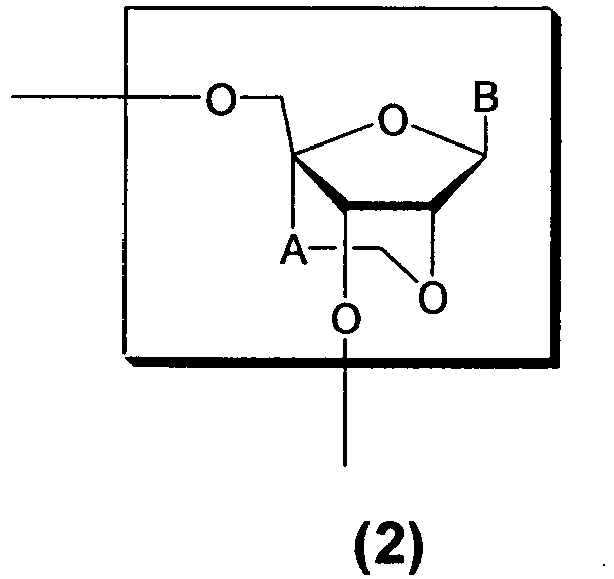 A is a methylene group; andB represents a purin-9-yl group, a 2-oxo-pyrimidin-1-yl group or a substituted purin-9-yl group or a substituted 2-oxo-pyrimidin-1-yl group having a substituent selected from the following α group;or a pharmacologically acceptable salt thereof;α groupa hydroxyl group,a protected hydroxyl group,an alkoxy group having from 1 to 4 carbon atoms,a mercapto group,a protected mercapto group,an alkylthio group having from 1 to 4 carbon atoms,an amino group,a protected amino group,an amino group substituted by an alkyl group having from 1 to 4 carbon atoms,an alkyl group having from 1 to 4 carbon atoms, anda halogen atom.
 - The oligonucleotide analogue according to Claim 9 or a pharmacologically acceptable salt thereof, wherein B is a 6-aminopurin-9-yl (i.e., adeninyl), 6-aminopurin-9-yl the amino group of which is protected, 2,6-diamino-purin-9-yl, 2-amino-6-chloropurin-9-yl, 2-amino-6-chloropurin-9-yl the amino group of which is protected, 2-amino-6-fluoropurin-9-yl, 2-amino-6-fluoropurin-9-yl the amino group of which is protected, 2-amino-6-bromopurin-9-yl, 2-amino-6-bromopurin-9-yl the amino group of which is protected, 2-amino-6-hydroxypurin-9-yl (i.e., guaninyl), 2-amino-6-hydroxypurin-9-yl the amino group of which is protected, 2-amino-6-hydroxypurin-9-yl the amino group and hydroxyl group of which are protected, 6-amino-2-methoxypurin-9-yl, 6-amino-2-chloropurin-9-yl, 6-amino-2-fluoropurin-9-yl, 2,6-dimethoxypurin-9-yl, 2,6-dichloro-purin-9-yl, 6-mercaptopurin-9-yl, 2-oxo-4-amino-pyrimidin-1-yl (i.e., cytosinyl), 2-oxo-4-amino-pyrimidin-1-yl the amino group of which is protected, 2-oxo-4-amino-5-fluoro-pyrimidin-1-yl, 2-oxo-4-amino-5-fluoro-pyrimidin-1-yl the amino group of which is protected, 4-amino-2-oxo-5-chloro-pyrimidin-1-yl, 2-oxo-4-methoxy-pyrimidin-1-yl, 2-oxo-4-mercapto-pyrimidin-1-yl, 2-oxo-4-hydroxy-pyrimidin-1-yl (i.e., uracinyl), 2-oxo-4-hydroxy-5-methylpyrimidin-1-yl (i.e., thyminyl), 4-amino-5-methyl-2-oxo-pyrimidin-1-yl (i.e., methylcytosinyl) group or 4-amino-5-methyl-2-oxo-pyrimidin-1-yl group the amino group of which is protected.
- The oligonucleotide analogue according to Claim 9 or a pharmacologically acceptable salt thereof, wherein B is a 6-benzoylaminopurin-9-yl, adeninyl, 2-isobutyrylamino-6-hydroxypurin-9-yl, guaninyl, 2-oxo-4-benzoylamino-pyrimidin-1-yl, cytosinyl, 2-oxo-5-methyl-4-benzoylamino-pyrimidin-1-yl, 5-methylcytosinyl, uracinyl or thyminyl group.
- A pharmaceutical composition comprising an effective amount of a pharmacologically active compound together with a carrier or diluent therefor, wherein said pharmacologically active compound is an oligonucleotide analogue according to any one of claims 9 to 11 or a pharmacologically acceptable salt thereof
- A probe for a gene comprising an oligonucleotide analogue according to any one of claims 9 to 11.
- A primer for starting amplification comprising an oligonucleotide analogue according to any one of claims 9 to 11.
- The use of an oligonucleotide analogue according to any one of claims 9 to 11 or a pharmacologically acceptable salt thereof in the manufacture of a medicament for the prevention or treatment of diseases preventable or treatable by the ability of said oligonucleotide analogue to exhibit pharmacologically useful antisense activity in the body of the patient after administration thereof.
- The use of an oligonucleotide analogue according to any one of claims 9 to 11 or a pharmacologically acceptable salt thereof in the manufacture of a medicament for the prevention or treatment of diseases preventable or treatable by the ability of said oligonucleotide analogue to exhibit pharmacologically useful antigene activity in the body of the patient after administration thereof.
- An oligonucleotide analogue according to any one of claims 9 to 11 or a pharmacologically acceptable salt thereof for use as a medicament.
Priority Applications (2)
| Application Number | Priority Date | Filing Date | Title |
|---|---|---|---|
| DE60017711.4T DE60017711T3 (en) | 1999-02-12 | 2000-02-10 | ANALOGUE OF NUCLEOSIDES AND OLIGONUCLEOTIDES |
| DK00902887.9T DK1152009T4 (en) | 1999-02-12 | 2000-02-10 | HIS UNKNOWN NUCLEOSIDES AND OLIGONUCLEOTIDE ANALOGS |
Applications Claiming Priority (3)
| Application Number | Priority Date | Filing Date | Title |
|---|---|---|---|
| JP3386399 | 1999-02-12 | ||
| JP3386399 | 1999-02-12 | ||
| PCT/JP2000/000725 WO2000047599A1 (en) | 1999-02-12 | 2000-02-10 | Novel nucleosides and oligonucleotide analogues |
Publications (4)
| Publication Number | Publication Date |
|---|---|
| EP1152009A1 EP1152009A1 (en) | 2001-11-07 |
| EP1152009A4 EP1152009A4 (en) | 2002-06-05 |
| EP1152009B1 EP1152009B1 (en) | 2005-01-26 |
| EP1152009B2 true EP1152009B2 (en) | 2017-09-06 |
Family
ID=12398349
Family Applications (1)
| Application Number | Title | Priority Date | Filing Date |
|---|---|---|---|
| EP00902887.9A Expired - Lifetime EP1152009B2 (en) | 1999-02-12 | 2000-02-10 | Novel nucleosides and oligonucleotide analogues |
Country Status (26)
| Country | Link |
|---|---|
| US (4) | US7335765B2 (en) |
| EP (1) | EP1152009B2 (en) |
| JP (1) | JP3420984B2 (en) |
| KR (1) | KR100573231B1 (en) |
| CN (1) | CN1273478C (en) |
| AT (1) | ATE287897T2 (en) |
| AU (1) | AU758956B2 (en) |
| BR (1) | BRPI0008131B8 (en) |
| CA (1) | CA2361318C (en) |
| CZ (1) | CZ296576B6 (en) |
| DE (1) | DE60017711T3 (en) |
| DK (1) | DK1152009T4 (en) |
| ES (1) | ES2234563T5 (en) |
| HK (1) | HK1040084B (en) |
| HU (1) | HU228398B1 (en) |
| ID (1) | ID30093A (en) |
| IL (2) | IL144338A0 (en) |
| NO (1) | NO320441B1 (en) |
| NZ (1) | NZ513402A (en) |
| PL (1) | PL208245B1 (en) |
| PT (1) | PT1152009E (en) |
| RU (1) | RU2233844C2 (en) |
| TR (2) | TR200604211T1 (en) |
| TW (1) | TW513438B (en) |
| WO (1) | WO2000047599A1 (en) |
| ZA (1) | ZA200106544B (en) |
Cited By (1)
| Publication number | Priority date | Publication date | Assignee | Title |
|---|---|---|---|---|
| US11279929B2 (en) | 2018-07-03 | 2022-03-22 | Hoffmann-La Roche, Inc. | Oligonucleotides for modulating Tau expression |
Families Citing this family (468)
| Publication number | Priority date | Publication date | Assignee | Title |
|---|---|---|---|---|
| US7119184B2 (en) * | 1991-08-12 | 2006-10-10 | Isis Pharmaceuticals, Inc. | Oligonucleotides having A-DNA form and B-DNA form conformational geometry |
| US7812149B2 (en) | 1996-06-06 | 2010-10-12 | Isis Pharmaceuticals, Inc. | 2′-Fluoro substituted oligomeric compounds and compositions for use in gene modulations |
| US5898031A (en) | 1996-06-06 | 1999-04-27 | Isis Pharmaceuticals, Inc. | Oligoribonucleotides for cleaving RNA |
| US9096636B2 (en) | 1996-06-06 | 2015-08-04 | Isis Pharmaceuticals, Inc. | Chimeric oligomeric compounds and their use in gene modulation |
| JP4148662B2 (en) * | 2000-08-10 | 2008-09-10 | 第一三共株式会社 | Nucleic acid reagents and pharmaceuticals containing nucleosides and oligonucleotide analogs |
| JP4151751B2 (en) * | 1999-07-22 | 2008-09-17 | 第一三共株式会社 | New bicyclonucleoside analogues |
| DE60119562T2 (en) * | 2000-10-04 | 2007-05-10 | Santaris Pharma A/S | IMPROVED SYNTHESIS OF PURIN-BLOCKED NUCLEIC ACID ANALOGUE |
| GB0114719D0 (en) * | 2001-06-15 | 2001-08-08 | Glaxo Group Ltd | Compound |
| WO2003033696A1 (en) * | 2001-10-18 | 2003-04-24 | Sankyo Company, Limited | Vegf antisense compound |
| JP4383176B2 (en) * | 2002-02-13 | 2009-12-16 | 武 今西 | Nucleoside analogues and oligonucleotide derivatives containing the nucleotide analogues thereof |
| US20040219565A1 (en) | 2002-10-21 | 2004-11-04 | Sakari Kauppinen | Oligonucleotides useful for detecting and analyzing nucleic acids of interest |
| WO2004041889A2 (en) | 2002-11-05 | 2004-05-21 | Isis Pharmaceuticals, Inc. | Polycyclic sugar surrogate-containing oligomeric compounds and compositions for use in gene modulation |
| AU2003290598A1 (en) | 2002-11-05 | 2004-06-03 | Isis Pharmaceuticals, Inc. | Modified oligonucleotides for use in rna interference |
| AU2003281969B2 (en) | 2002-11-18 | 2011-01-27 | Roche Innovation Center Copenhagen A/S | Amino-LNA, thio-LNA and alpha-L-oxy-LN |
| AU2013201786B2 (en) * | 2002-11-18 | 2015-04-02 | Roche Innovation Center Copenhagen A/S | Amino-LNA, thio-LNA and alpha-L-oxy-LN |
| JP5132025B2 (en) * | 2002-11-19 | 2013-01-30 | 第一三共株式会社 | Novel 2 ', 5'-oligoadenylic acid analogues |
| TWI347948B (en) * | 2002-11-19 | 2011-09-01 | Sankyo Co | Novel 2',5'-oligoadenylic acid compositions |
| CA2507125C (en) | 2002-11-25 | 2014-04-22 | Masafumi Matsuo | Ena nucleic acid pharmaceuticals capable of modifying splicing of mrna precursors |
| ES2385828T3 (en) | 2003-06-20 | 2012-08-01 | Exiqon A/S | Probes, libraries and kits for analysis of nucleic acid mixtures and procedures for building them |
| US7683036B2 (en) | 2003-07-31 | 2010-03-23 | Regulus Therapeutics Inc. | Oligomeric compounds and compositions for use in modulation of small non-coding RNAs |
| EP1661905B9 (en) * | 2003-08-28 | 2012-12-19 | IMANISHI, Takeshi | Novel artificial nucleic acids of n-o bond crosslinkage type |
| US20050053981A1 (en) * | 2003-09-09 | 2005-03-10 | Swayze Eric E. | Gapped oligomeric compounds having linked bicyclic sugar moieties at the termini |
| US7480382B2 (en) * | 2003-09-30 | 2009-01-20 | Microsoft Corporation | Image file container |
| GB0324854D0 (en) * | 2003-10-24 | 2003-11-26 | Expresson Biosystems Ltd | App/ena antisense |
| DE602004015832D1 (en) | 2003-11-07 | 2008-09-25 | Daiichi Sankyo Co Ltd | METHOD FOR DETECTING GENETIC POLYMORPHISM |
| US8569474B2 (en) | 2004-03-09 | 2013-10-29 | Isis Pharmaceuticals, Inc. | Double stranded constructs comprising one or more short strands hybridized to a longer strand |
| EP1783216A1 (en) * | 2004-05-28 | 2007-05-09 | Sankyo Company, Limited | Telomerase-inhibitory ena oligonucleotide |
| US8394947B2 (en) | 2004-06-03 | 2013-03-12 | Isis Pharmaceuticals, Inc. | Positionally modified siRNA constructs |
| US7884086B2 (en) | 2004-09-08 | 2011-02-08 | Isis Pharmaceuticals, Inc. | Conjugates for use in hepatocyte free uptake assays |
| WO2006059507A1 (en) * | 2004-11-30 | 2006-06-08 | Sankyo Company, Limited | 11β-HSD1 ANTISENSE COMPOUND |
| US20060257902A1 (en) * | 2005-03-25 | 2006-11-16 | Ambion, Inc. | Methods and compositions for depleting abundant RNA transcripts |
| EP1931780B1 (en) | 2005-08-29 | 2016-01-06 | Regulus Therapeutics Inc. | Antisense compounds having enhanced anti-microrna activity |
| US9862770B2 (en) | 2005-10-19 | 2018-01-09 | Ibc Pharmaceuticals, Inc. | Multivalent antibody complexes targeting IGF-1R show potent toxicity against solid tumors |
| US20100226884A1 (en) | 2009-01-20 | 2010-09-09 | Immunomedics, Inc. | Novel Class of Monospecific and Bispecific Humanized Antibodies that Target the Insulin-like Growth Factor Type I Receptor (IGF-1R) |
| US8883162B2 (en) * | 2005-10-19 | 2014-11-11 | Ibc Pharmaceuticals, Inc. | Multivalent antibody complexes targeting IGF-1R show potent toxicity against solid tumors |
| WO2007064945A2 (en) | 2005-12-01 | 2007-06-07 | Pronai Therapeutics, Inc. | Cancer therapies and pharmaceutical compositions used therein |
| WO2007066737A1 (en) * | 2005-12-09 | 2007-06-14 | Riken | Method for replication of nucleic acid and novel artificial base pair |
| CN101437933B (en) | 2005-12-28 | 2013-11-06 | 斯克里普斯研究所 | Natural antisense and non-coding RNA transcripts as drug targets |
| CN102908630B (en) | 2006-01-27 | 2014-11-19 | Isis制药公司 | 6-modified bicyclic nucleic acid analogs |
| US7569686B1 (en) | 2006-01-27 | 2009-08-04 | Isis Pharmaceuticals, Inc. | Compounds and methods for synthesis of bicyclic nucleic acid analogs |
| WO2007090073A2 (en) | 2006-01-27 | 2007-08-09 | Isis Pharmaceuticals, Inc. | Oligomeric compounds and compositions for the use in modulation of micrornas |
| ES2386578T3 (en) * | 2006-05-05 | 2012-08-23 | Isis Pharmaceuticals, Inc. | Compounds and procedures to modulate PCSK9 expression |
| EP2505649A1 (en) | 2006-05-05 | 2012-10-03 | Isis Pharmaceuticals, Inc. | Compounds and methods for modulating expression of GCGR |
| US7666854B2 (en) | 2006-05-11 | 2010-02-23 | Isis Pharmaceuticals, Inc. | Bis-modified bicyclic nucleic acid analogs |
| US7547684B2 (en) | 2006-05-11 | 2009-06-16 | Isis Pharmaceuticals, Inc. | 5′-modified bicyclic nucleic acid analogs |
| DK2410054T4 (en) | 2006-10-18 | 2020-02-10 | Ionis Pharmaceuticals Inc | Antisense Compounds |
| US8093222B2 (en) | 2006-11-27 | 2012-01-10 | Isis Pharmaceuticals, Inc. | Methods for treating hypercholesterolemia |
| US8084437B2 (en) * | 2006-11-27 | 2011-12-27 | Isis Pharmaceuticals, Inc. | Methods for treating hypercholesterolemia |
| WO2009045469A2 (en) | 2007-10-02 | 2009-04-09 | Amgen Inc. | Increasing erythropoietin using nucleic acids hybridizable to micro-rna and precursors thereof |
| US20100292301A1 (en) * | 2007-02-28 | 2010-11-18 | Elena Feinstein | Novel sirna structures |
| WO2008150729A2 (en) | 2007-05-30 | 2008-12-11 | Isis Pharmaceuticals, Inc. | N-substituted-aminomethylene bridged bicyclic nucleic acid analogs |
| ES2386492T3 (en) | 2007-06-08 | 2012-08-21 | Isis Pharmaceuticals, Inc. | Carbocyclic bicyclic nucleic acid analogs |
| US20110046206A1 (en) * | 2007-06-22 | 2011-02-24 | Isis Pharmaceuticals, Inc. | Double strand compositions comprising differentially modified strands for use in gene modulation |
| ATE538127T1 (en) | 2007-07-05 | 2012-01-15 | Isis Pharmaceuticals Inc | 6-DISUBSTITUTED BICYCLIC NUCLEIC ACID ANALOGUES |
| RU2487716C2 (en) | 2007-10-03 | 2013-07-20 | Кварк Фармасьютикалс, Инк. | New structures of small interfering rna (sirna) |
| US8546556B2 (en) * | 2007-11-21 | 2013-10-01 | Isis Pharmaceuticals, Inc | Carbocyclic alpha-L-bicyclic nucleic acid analogs |
| US20110105584A1 (en) * | 2007-12-12 | 2011-05-05 | Elena Feinstein | Rtp80il sirna compounds and methods of use thereof |
| US8614311B2 (en) | 2007-12-12 | 2013-12-24 | Quark Pharmaceuticals, Inc. | RTP801L siRNA compounds and methods of use thereof |
| WO2009090639A2 (en) * | 2008-01-15 | 2009-07-23 | Quark Pharmaceuticals, Inc. | Sirna compounds and methods of use thereof |
| EP2265627A2 (en) | 2008-02-07 | 2010-12-29 | Isis Pharmaceuticals, Inc. | Bicyclic cyclohexitol nucleic acid analogs |
| AU2009213147A1 (en) | 2008-02-11 | 2009-08-20 | Rxi Pharmaceuticals Corp. | Modified RNAi polynucleotides and uses thereof |
| AU2009227549A1 (en) * | 2008-03-20 | 2009-09-24 | Quark Pharmaceuticals, Inc. | Novel siRNA compounds for inhibiting RTP801 |
| DK2285819T3 (en) | 2008-04-04 | 2013-12-02 | Isis Pharmaceuticals Inc | OLIGOMER COMPOUNDS INCLUDING NEUTRAL BONDED, TERMINAL BICYCLIC NUCLEOSIDES |
| EP2285385A4 (en) * | 2008-04-15 | 2013-01-16 | Quark Pharmaceuticals Inc | siRNA COMPOUNDS FOR INHIBITING NRF2 |
| US8222221B2 (en) | 2008-06-04 | 2012-07-17 | The Board Of Regents Of The University Of Texas System | Modulation of gene expression through endogenous small RNA targeting of gene promoters |
| WO2009147684A2 (en) | 2008-06-06 | 2009-12-10 | Quark Pharmaceuticals, Inc. | Compositions and methods for treatment of ear disorders |
| TWI455944B (en) | 2008-07-01 | 2014-10-11 | Daiichi Sankyo Co Ltd | Double-stranded polynucleotides |
| US8815818B2 (en) | 2008-07-18 | 2014-08-26 | Rxi Pharmaceuticals Corporation | Phagocytic cell delivery of RNAI |
| JP2011529686A (en) | 2008-07-29 | 2011-12-15 | ザ ボード オブ リージェンツ オブ ザ ユニバーシティー オブ テキサス システム | Selective inhibition of polyglutamine protein expression |
| US8252762B2 (en) * | 2008-08-25 | 2012-08-28 | Excaliard Pharmaceuticals, Inc. | Antisense oligonucleotides directed against connective tissue growth factor and uses thereof |
| CN102405286A (en) | 2008-09-22 | 2012-04-04 | 阿克赛医药公司 | Reduced size self-delivering rnai compounds |
| WO2010036698A1 (en) | 2008-09-24 | 2010-04-01 | Isis Pharmaceuticals, Inc. | Substituted alpha-l-bicyclic nucleosides |
| RU2604489C2 (en) * | 2008-10-03 | 2016-12-10 | КьюРНА,Инк.,US | Treatment of apolipoprotein-a1 related diseases by inhibition of natural antisense transcript to apolipoprotein-a1 |
| WO2010059226A2 (en) | 2008-11-19 | 2010-05-27 | Rxi Pharmaceuticals Corporation | Inhibition of map4k4 through rnai |
| KR101829469B1 (en) | 2008-12-04 | 2018-03-30 | 큐알엔에이, 인크. | Treatment of erythropoietin (epo) related diseases by inhibition of natural antisense transcript to epo |
| RU2746478C2 (en) | 2008-12-04 | 2021-04-14 | КьюРНА, Инк. | Treatment of tumors of diseases related to the genom-suppressor by therapy of natural transcript inhibition in anti-significant orientation regarding this gene |
| CN102341498B (en) | 2008-12-04 | 2017-12-19 | 库尔纳公司 | Natural antisense transcripton by suppressing VEGF (VEGF) treats the related diseases of VEGF |
| AU2009335740B2 (en) | 2008-12-17 | 2016-04-21 | Sarepta Therapeutics, Inc. | Antisense compositions and methods for modulating contact hypersensitivity or contact dermatitis |
| US20110288155A1 (en) | 2008-12-18 | 2011-11-24 | Elena Feinstein | Sirna compounds and methods of use thereof |
| WO2010078536A1 (en) | 2009-01-05 | 2010-07-08 | Rxi Pharmaceuticals Corporation | Inhibition of pcsk9 through rnai |
| WO2010090762A1 (en) | 2009-02-04 | 2010-08-12 | Rxi Pharmaceuticals Corporation | Rna duplexes with single stranded phosphorothioate nucleotide regions for additional functionality |
| EP2396038B1 (en) | 2009-02-12 | 2015-10-21 | CuRNA, Inc. | Treatment of brain derived neurotrophic factor (bdnf) related diseases by inhibition of natural antisense transcript to bdnf |
| EP2408919B1 (en) | 2009-03-16 | 2017-10-18 | CuRNA, Inc. | Treatment of nuclear factor (erythroid-derived 2)-like 2 (nrf2) related diseases by inhibition of natural antisense transcript to nrf2 |
| ES2627763T3 (en) | 2009-03-17 | 2017-07-31 | Curna, Inc. | Treatment of diseases related to the delta 1 homologue (dlk1) by inhibition of natural antisense transcript to dlk1 |
| EP2421972A2 (en) | 2009-04-24 | 2012-02-29 | The Board of Regents of The University of Texas System | Modulation of gene expression using oligomers that target gene regions downstream of 3' untranslated regions |
| DE102009019476A1 (en) * | 2009-05-04 | 2010-11-11 | Biametrics Marken Und Rechte Gmbh | Recognizable carrier for optical measuring methods |
| WO2010129746A2 (en) | 2009-05-06 | 2010-11-11 | Curna, Inc. | Treatment of tristetraproline (ttp) related diseases by inhibition of natural antisense transcript to ttp |
| CN102459596B (en) | 2009-05-06 | 2016-09-07 | 库尔纳公司 | Treatment of Lipid Transport and Metabolism Gene-Associated Diseases by Inhibition of Natural Antisense Transcripts Targeting Lipid Transport and Metabolism Genes |
| KR101742334B1 (en) | 2009-05-08 | 2017-06-01 | 큐알엔에이, 인크. | Treatment of dystrophin family related diseases by inhibition of natural antisense transcript to dmd family |
| DK2432881T3 (en) | 2009-05-18 | 2018-02-26 | Curna Inc | TREATMENT OF REPROGRAMMING FACTOR-RELATED DISEASES BY INHIBITING NATURAL ANTISENSE TRANSCRIPTS TO A REPROGRAMMING FACTOR |
| KR101703695B1 (en) | 2009-05-22 | 2017-02-08 | 큐알엔에이, 인크. | Treatment of transcription factor e3 (tfe3) and insulin receptor substrate 2 (irs2) related diseases by inhibition of natural antisense transcript to tfe3 |
| ES2618576T3 (en) | 2009-05-28 | 2017-06-21 | Curna, Inc. | Treatment of diseases related to an antiviral gene by inhibiting a natural antisense transcript to an antiviral gene |
| DK3276004T3 (en) | 2009-06-08 | 2020-04-06 | Quark Pharmaceuticals Inc | PROCEDURES FOR TREATING CHRONIC NONUS DISEASE |
| CA2765509C (en) | 2009-06-16 | 2021-08-17 | Joseph Collard | Treatment of paraoxonase 1 (pon1) related diseases by inhibition of natural antisense transcript to pon1 |
| JP5944311B2 (en) | 2009-06-16 | 2016-07-05 | クルナ・インコーポレーテッド | Treatment of collagen gene-related diseases by suppression of natural antisense transcripts against collagen genes |
| KR101807323B1 (en) | 2009-06-24 | 2017-12-08 | 큐알엔에이, 인크. | Ttreatment of tumor necrosis factor receptor 2 (tnfr2) related diseases by inhibition of natural antisense transcript to tnfr2 |
| US8921330B2 (en) | 2009-06-26 | 2014-12-30 | Curna, Inc. | Treatment of down syndrome gene related diseases by inhibition of natural antisense transcript to a down syndrome gene |
| CN102712925B (en) | 2009-07-24 | 2017-10-27 | 库尔纳公司 | Treatment of SIRTUIN (SIRT)-associated diseases by inhibiting the natural antisense transcript of SIRTUIN (SIRT) |
| WO2011017516A2 (en) | 2009-08-05 | 2011-02-10 | Curna, Inc. | Treatment of insulin gene (ins) related diseases by inhibition of natural antisense transcript to an insulin gene (ins) |
| EP2462153B1 (en) | 2009-08-06 | 2015-07-29 | Isis Pharmaceuticals, Inc. | Bicyclic cyclohexose nucleic acid analogs |
| US9044493B2 (en) | 2009-08-11 | 2015-06-02 | Curna, Inc. | Treatment of Adiponectin related diseases by inhibition of natural antisense transcript to an Adiponectin |
| JP5943836B2 (en) | 2009-08-21 | 2016-07-05 | カッパーアールエヌエー,インコーポレイテッド | Treatment of CHIP-related diseases by inhibition of natural antisense transcripts on 'HSP70 interacting protein C-terminus' (CHIP) |
| WO2011031482A2 (en) | 2009-08-25 | 2011-03-17 | Curna, Inc. | Treatment of 'iq motif containing gtpase activating protein' (iqgap) related diseases by inhibition of natural antisense transcript to iqgap |
| KR101802540B1 (en) | 2009-09-25 | 2017-11-28 | 큐알엔에이, 인크. | Treatment of filaggrin (flg) related diseases by modulation of flg expression and activity |
| US20120220649A1 (en) | 2009-10-30 | 2012-08-30 | Daiichi Sankyo Company, Limited | Modified double-stranded polynucleotide |
| US20110110860A1 (en) | 2009-11-02 | 2011-05-12 | The Board Of Regents Of The University Of Texas System | Modulation of ldl receptor gene expression with double-stranded rnas targeting the ldl receptor gene promoter |
| KR101718534B1 (en) | 2009-12-09 | 2017-03-22 | 닛토덴코 가부시키가이샤 | MODULATION OF hsp47 EXPRESSION |
| US8778904B2 (en) | 2009-12-09 | 2014-07-15 | Quark Pharmaceuticals, Inc. | Methods and compositions for treating diseases, disorders or injury of the CNS |
| ES2661813T3 (en) | 2009-12-16 | 2018-04-04 | Curna, Inc. | Treatment of diseases related to membrane transcription factor peptidase, site 1 (mbtps1) by inhibition of the natural antisense transcript to the mbtps1 gene |
| US9068183B2 (en) | 2009-12-23 | 2015-06-30 | Curna, Inc. | Treatment of uncoupling protein 2 (UCP2) related diseases by inhibition of natural antisense transcript to UCP2 |
| CN102869776B (en) | 2009-12-23 | 2017-06-23 | 库尔纳公司 | HGF relevant diseases are treated by suppressing the natural antisense transcript of HGF (HGF) |
| JP5982288B2 (en) | 2009-12-29 | 2016-08-31 | カッパーアールエヌエー,インコーポレイテッド | Treatment of tumor protein 63-related diseases by inhibition of natural antisense transcripts against tumor protein 63 (p63) |
| EP2519633B1 (en) | 2009-12-29 | 2017-10-25 | CuRNA, Inc. | Treatment of nuclear respiratory factor 1 (nrf1) related diseases by inhibition of natural antisense transcript to nrf1 |
| WO2011082281A2 (en) | 2009-12-31 | 2011-07-07 | Curna, Inc. | Treatment of insulin receptor substrate 2 (irs2) related diseases by inhibition of natural antisense transcript to irs2 and transcription factor e3 (tfe3) |
| KR101878501B1 (en) | 2010-01-04 | 2018-08-07 | 큐알엔에이, 인크. | Treatment of interferon regulatory factor 8 (irf8) related diseases by inhibition of natural antisense transcript to irf8 |
| WO2011085066A2 (en) | 2010-01-06 | 2011-07-14 | Curna, Inc. | Treatment of pancreatic developmental gene related diseases by inhibition of natural antisense transcript to a pancreatic developmental gene |
| WO2011084193A1 (en) | 2010-01-07 | 2011-07-14 | Quark Pharmaceuticals, Inc. | Oligonucleotide compounds comprising non-nucleotide overhangs |
| WO2011085102A1 (en) | 2010-01-11 | 2011-07-14 | Isis Pharmaceuticals, Inc. | Base modified bicyclic nucleosides and oligomeric compounds prepared therefrom |
| CN102803493B (en) | 2010-01-11 | 2018-07-31 | 库尔纳公司 | SHBG relevant diseases are treated by inhibiting the natural antisense transcript of sex hormone binding globulin (SHBG) |
| KR101853510B1 (en) | 2010-01-25 | 2018-06-20 | 큐알엔에이, 인크. | Treatment of rnase h1 related diseases by inhibition of natural antisense transcript to rnase h1 |
| US9574191B2 (en) | 2010-02-03 | 2017-02-21 | The Board Of Regents Of The University Of Texas System | Selective inhibition of polyglutamine protein expression |
| CA2790506A1 (en) | 2010-02-22 | 2011-08-25 | Curna, Inc. | Treatment of pyrroline-5-carboxylate reductase 1 (pycr1) related diseases by inhibition of natural antisense transcript to pycr1 |
| EP2545941A4 (en) | 2010-03-12 | 2013-10-23 | Daiichi Sankyo Co Ltd | METHOD FOR THE PROLIFERATION OF CARDIOMYOCYTES USING A MICRO-RNA |
| WO2011115818A1 (en) | 2010-03-17 | 2011-09-22 | Isis Pharmaceuticals, Inc. | 5'-substituted bicyclic nucleosides and oligomeric compounds prepared therefrom |
| RU2615143C2 (en) | 2010-03-24 | 2017-04-04 | Адвирна | Self-delivered rnai compounds of reduced size |
| KR20180044433A (en) | 2010-03-24 | 2018-05-02 | 알엑스아이 파마슈티칼스 코포레이션 | Rna interference in dermal and fibrotic indications |
| CN103200945B (en) | 2010-03-24 | 2016-07-06 | 雷克西制药公司 | RNA interference in ocular syndromes |
| CN102869777B (en) | 2010-04-02 | 2018-11-02 | 库尔纳公司 | CSF3 relevant diseases are treated by inhibiting the natural antisense transcript of colony stimulating factor 3 (CSF3) |
| EP2556160A4 (en) | 2010-04-09 | 2013-08-21 | Curna Inc | Treatment of fibroblast growth factor 21 (fgf21) related diseases by inhibition of natural antisense transcript to fgf21 |
| EP2601204B1 (en) | 2010-04-28 | 2016-09-07 | Ionis Pharmaceuticals, Inc. | Modified nucleosides and oligomeric compounds prepared therefrom |
| WO2011139387A1 (en) | 2010-05-03 | 2011-11-10 | Opko Curna, Llc | Treatment of sirtuin (sirt) related diseases by inhibition of natural antisense transcript to a sirtuin (sirt) |
| TWI586356B (en) | 2010-05-14 | 2017-06-11 | 可娜公司 | Treatment of par4 related diseases by inhibition of natural antisense transcript to par4 |
| KR101857090B1 (en) | 2010-05-26 | 2018-06-26 | 큐알엔에이, 인크. | Treatment of atonal homolog 1 (atoh1) related diseases by inhibition of natural antisense transcript to atoh1 |
| CA2799596C (en) | 2010-05-26 | 2020-09-22 | Curna, Inc. | Treatment of methionine sulfoxide reductase a (msra) related diseases by inhibition of natural antisense transcript to msra |
| US8957200B2 (en) | 2010-06-07 | 2015-02-17 | Isis Pharmaceuticals, Inc. | Bicyclic nucleosides and oligomeric compounds prepared therefrom |
| CN103025873B (en) | 2010-06-23 | 2018-05-08 | 库尔纳公司 | Treatment of SCNA-associated diseases by inhibiting natural antisense transcripts of voltage-gated sodium channel alpha subunit (SCNA) |
| RU2611190C2 (en) | 2010-07-14 | 2017-02-21 | Курна, Инк. | Treatment of diseases related with gene dlg by inhibition of natural antisense transcript of dlg gene |
| EP2412724A1 (en) | 2010-07-29 | 2012-02-01 | Centre National de la Recherche Scientifique (C.N.R.S) | Regulation of Glypican 4 activity to modulate the fate of stem cells and uses thereof |
| CA2813901C (en) | 2010-10-06 | 2019-11-12 | Curna, Inc. | Treatment of sialidase 4 (neu4) related diseases by inhibition of natural antisense transcript to neu4 |
| EP2630241B1 (en) | 2010-10-22 | 2018-10-17 | CuRNA, Inc. | Treatment of alpha-l-iduronidase (idua) related diseases by inhibition of natural antisense transcript to idua |
| US10000752B2 (en) | 2010-11-18 | 2018-06-19 | Curna, Inc. | Antagonat compositions and methods of use |
| RU2608493C2 (en) | 2010-11-23 | 2017-01-18 | Курна, Инк. | Treating diseases, associated with nanog, by inhibition of natural antisense nanog transcript |
| KR20140001224A (en) | 2010-12-02 | 2014-01-06 | 다이이찌 산쿄 가부시키가이샤 | Modified single-strand polynucleotide |
| WO2012109395A1 (en) | 2011-02-08 | 2012-08-16 | Isis Pharmaceuticals, Inc. | Oligomeric compounds comprising bicyclic nucleotides and uses thereof |
| SG192961A1 (en) | 2011-03-03 | 2013-09-30 | Quark Pharmaceuticals Inc | Compositions and methods for treating lung disease and injury |
| CN103562387A (en) | 2011-03-03 | 2014-02-05 | 夸克医药公司 | Oligonucleotide modulation of the Toll-like receptor pathway |
| US9796979B2 (en) | 2011-03-03 | 2017-10-24 | Quark Pharmaceuticals Inc. | Oligonucleotide modulators of the toll-like receptor pathway |
| US10196637B2 (en) | 2011-06-08 | 2019-02-05 | Nitto Denko Corporation | Retinoid-lipid drug carrier |
| TWI658830B (en) | 2011-06-08 | 2019-05-11 | 日東電工股份有限公司 | HSP47 expression regulation and enhancement of retinoid liposomes |
| US9593330B2 (en) | 2011-06-09 | 2017-03-14 | Curna, Inc. | Treatment of frataxin (FXN) related diseases by inhibition of natural antisense transcript to FXN |
| US9273366B2 (en) | 2011-06-15 | 2016-03-01 | Grifols Therapeutics Inc. | Methods, compositions, and kits for determining human immunodeficiency virus (HIV) |
| EP3556859B1 (en) | 2011-08-11 | 2021-04-07 | Ionis Pharmaceuticals, Inc. | Selective antisense compounds and uses thereof |
| US10583128B2 (en) | 2011-09-06 | 2020-03-10 | Curna, Inc. | Treatment of diseases related to alpha subunits of sodium channels, voltage-gated (SCNxA) with small molecules |
| CA2848753C (en) | 2011-09-14 | 2022-07-26 | Rana Therapeutics, Inc. | Multimeric oligonucleotide compounds |
| SG11201401648RA (en) | 2011-11-03 | 2014-05-29 | Quark Pharmaceuticals Inc | Methods and compositions for neuroprotection |
| EP2790736B1 (en) | 2011-12-12 | 2018-01-31 | Oncoimmunin, Inc. | In vivo delivery of oligonucleotides |
| WO2013119602A1 (en) | 2012-02-06 | 2013-08-15 | President And Fellows Of Harvard College | Arrdc1-mediated microvesicles (armms) and uses thereof |
| ES2694592T3 (en) | 2012-03-15 | 2018-12-21 | Curna, Inc. | Treatment of diseases related to brain-derived neurotrophic factor (BDNF) by inhibition of the natural antisense transcript of BDNF |
| EP2831232A4 (en) | 2012-03-30 | 2015-11-04 | Univ Washington | METHODS OF MODULATING THE EXPRESSION OF TAU TO REDUCE THE STROKE AND MODIFY A NEURODEGENERATIVE SYMPTOM |
| WO2013154799A1 (en) | 2012-04-09 | 2013-10-17 | Isis Pharmaceuticals, Inc. | Tricyclic nucleosides and oligomeric compounds prepared therefrom |
| EP2850092B1 (en) | 2012-04-09 | 2017-03-01 | Ionis Pharmaceuticals, Inc. | Tricyclic nucleic acid analogs |
| WO2013159108A2 (en) | 2012-04-20 | 2013-10-24 | Isis Pharmaceuticals, Inc. | Oligomeric compounds comprising bicyclic nucleotides and uses thereof |
| KR102028784B1 (en) | 2012-05-16 | 2019-10-04 | 트랜슬레이트 바이오 인코포레이티드 | Compositions and methods for modulating gene expression |
| US10837014B2 (en) | 2012-05-16 | 2020-11-17 | Translate Bio Ma, Inc. | Compositions and methods for modulating SMN gene family expression |
| US10059941B2 (en) | 2012-05-16 | 2018-08-28 | Translate Bio Ma, Inc. | Compositions and methods for modulating SMN gene family expression |
| AU2013262709A1 (en) | 2012-05-16 | 2015-01-22 | Rana Therapeutics, Inc. | Compositions and methods for modulating MECP2 expression |
| JP2013256452A (en) * | 2012-06-11 | 2013-12-26 | Kawaken Fine Chem Co Ltd | Melanin production inhibitor and its composition |
| ES2798301T3 (en) | 2012-06-18 | 2020-12-10 | Daiichi Sankyo Co Ltd | Intermediate for production of nucleoside analogues, and procedure for their production |
| US9993522B2 (en) | 2012-09-18 | 2018-06-12 | Uti Limited Partnership | Treatment of pain by inhibition of USP5 de-ubiquitinase |
| US9695418B2 (en) | 2012-10-11 | 2017-07-04 | Ionis Pharmaceuticals, Inc. | Oligomeric compounds comprising bicyclic nucleosides and uses thereof |
| US9029335B2 (en) | 2012-10-16 | 2015-05-12 | Isis Pharmaceuticals, Inc. | Substituted 2′-thio-bicyclic nucleosides and oligomeric compounds prepared therefrom |
| EP2914742A1 (en) | 2012-11-05 | 2015-09-09 | Pronai Therapeutics, Inc. | Methods of using biomarkers for the treatment of cancer by modulation of bcl2!expression |
| US10398661B2 (en) | 2013-02-28 | 2019-09-03 | The Board Of Regents Of The University Of Texas System | Methods for classifying a cancer as susceptible to TMEPAI-directed therapies and treating such cancers |
| WO2014143158A1 (en) | 2013-03-13 | 2014-09-18 | The Broad Institute, Inc. | Compositions and methods for labeling of agents |
| US9273349B2 (en) | 2013-03-14 | 2016-03-01 | Affymetrix, Inc. | Detection of nucleic acids |
| WO2014153236A1 (en) | 2013-03-14 | 2014-09-25 | Isis Pharmaceuticals, Inc. | Compositions and methods for modulating tau expression |
| WO2014176259A1 (en) | 2013-04-22 | 2014-10-30 | Icahn School Of Medicine At Mount Sinai | Mutations in pdgfrb and notch3 as causes of autosomal dominant infantile myofibromatosis |
| DK2991656T3 (en) | 2013-05-01 | 2020-03-23 | Ionis Pharmaceuticals Inc | COMPOSITIONS AND PROCEDURES FOR MODULATING APOLIPOPROTEIN C-III EXPRESSION |
| TW202246503A (en) | 2013-07-19 | 2022-12-01 | 美商百健Ma公司 | Compositions for modulating tau expression |
| US10174328B2 (en) | 2013-10-04 | 2019-01-08 | Translate Bio Ma, Inc. | Compositions and methods for treating amyotrophic lateral sclerosis |
| US11162096B2 (en) | 2013-10-14 | 2021-11-02 | Ionis Pharmaceuticals, Inc | Methods for modulating expression of C9ORF72 antisense transcript |
| WO2015075166A1 (en) | 2013-11-22 | 2015-05-28 | INSERM (Institut National de la Santé et de la Recherche Médicale) | Methods and pharmaceutical compositions for treatment of a bacterial infection |
| CN113151180A (en) | 2013-12-02 | 2021-07-23 | 菲奥医药公司 | Immunotherapy of cancer |
| EP3099798B1 (en) | 2014-01-29 | 2018-06-27 | INSERM (Institut National de la Santé et de la Recherche Médicale) | Oligonucleotides and methods for inhibiting or reducing bacterial biofilms |
| SG10201910844SA (en) | 2014-04-01 | 2020-01-30 | Biogen Ma Inc | Compositions for modulating sod-1 expression |
| WO2015168108A2 (en) | 2014-04-28 | 2015-11-05 | Rxi Pharmaceuticals Corporation | Methods for treating cancer using nucleic targeting mdm2 or mycn |
| EP3137476B1 (en) | 2014-04-28 | 2019-10-09 | Ionis Pharmaceuticals, Inc. | Linkage modified oligomeric compounds |
| DK3137596T3 (en) | 2014-05-01 | 2019-09-02 | Ionis Pharmaceuticals Inc | COMPOSITIONS AND PROCEDURES FOR MODULATION OF COMPLEMENT FACTOR B EXPRESSION |
| GB201410693D0 (en) | 2014-06-16 | 2014-07-30 | Univ Southampton | Splicing modulation |
| TW201620526A (en) | 2014-06-17 | 2016-06-16 | 愛羅海德研究公司 | Composition and method for inhibiting α-1 antitrypsin gene expression |
| WO2016017422A1 (en) * | 2014-07-31 | 2016-02-04 | 国立大学法人大阪大学 | Crosslinking nucleoside and nucleotide |
| IL234246A0 (en) | 2014-08-21 | 2014-11-30 | Omrix Biopharmaceuticals Ltd | Stabilized thrombin |
| KR102689262B1 (en) | 2014-09-05 | 2024-07-30 | 피오 파마슈티칼스 코프. | Methods for treating aging and skin disorders using nucleic acids targeting tyr or mmp1 |
| SG11201702682PA (en) | 2014-10-03 | 2017-04-27 | Cold Spring Harbor Lab | Targeted augmentation of nuclear gene output |
| US9816080B2 (en) | 2014-10-31 | 2017-11-14 | President And Fellows Of Harvard College | Delivery of CAS9 via ARRDC1-mediated microvesicles (ARMMs) |
| AU2015364508A1 (en) | 2014-12-18 | 2017-07-06 | Alnylam Pharmaceuticals, Inc. | ReversirTM compounds |
| US9688707B2 (en) | 2014-12-30 | 2017-06-27 | Ionis Pharmaceuticals, Inc. | Bicyclic morpholino compounds and oligomeric compounds prepared therefrom |
| WO2016112132A1 (en) | 2015-01-06 | 2016-07-14 | Ionis Pharmaceuticals, Inc. | Compositions for modulating expression of c9orf72 antisense transcript |
| US10407678B2 (en) | 2015-04-16 | 2019-09-10 | Ionis Pharmaceuticals, Inc. | Compositions for modulating expression of C9ORF72 antisense transcript |
| CN108135923B (en) | 2015-07-06 | 2021-03-02 | 菲奥医药公司 | Nucleic acid molecules targeting superoxide dismutase 1 (SOD1) |
| WO2017007825A1 (en) | 2015-07-06 | 2017-01-12 | Rxi Pharmaceuticals Corporation | Methods for treating neurological disorders using a synergistic small molecule and nucleic acids therapeutic approach |
| EP3324980B1 (en) | 2015-07-17 | 2021-11-10 | Alnylam Pharmaceuticals, Inc. | Multi-targeted single entity conjugates |
| JP6835826B2 (en) | 2015-08-24 | 2021-02-24 | ロシュ イノベーション センター コペンハーゲン エーエス | LNA-G process |
| US10196639B2 (en) | 2015-10-09 | 2019-02-05 | University Of Southampton | Modulation of gene expression and screening for deregulated protein expression |
| EP3365446A4 (en) | 2015-10-19 | 2019-06-26 | Phio Pharmaceuticals Corp. | SELF ADMINISTRATION-REDUCED SIZE NUCLEIC ACID COMPOUNDS TARGETING LONGS NON-CODING LONGS |
| WO2017068087A1 (en) | 2015-10-22 | 2017-04-27 | Roche Innovation Center Copenhagen A/S | Oligonucleotide detection method |
| US11273151B2 (en) | 2015-11-04 | 2022-03-15 | Icahn School Of Medicine At Mount Sinai | Methods of treating tumors and cancer, and identifying candidate subjects for such treatment |
| HRP20210227T1 (en) | 2015-11-12 | 2021-03-19 | F. Hoffmann - La Roche Ag | Oligonucleotides for inducing paternal ube3a expression |
| WO2017096395A1 (en) | 2015-12-04 | 2017-06-08 | Ionis Pharmaceuticals, Inc. | Methods of treating breast cancer |
| JP7049248B2 (en) | 2015-12-14 | 2022-04-06 | コールド スプリング ハーバー ラボラトリー | Autosomal dominant mental retardation-5 and antisense oligomers for the treatment of Dravet syndrome |
| US11096956B2 (en) | 2015-12-14 | 2021-08-24 | Stoke Therapeutics, Inc. | Antisense oligomers and uses thereof |
| JOP20200228A1 (en) | 2015-12-21 | 2017-06-16 | Novartis Ag | Compositions and methods for decreasing tau expression |
| CN114736901B (en) | 2016-03-14 | 2024-05-31 | 豪夫迈·罗氏有限公司 | Oligonucleotides for reducing PD-L1 expression |
| WO2017161168A1 (en) | 2016-03-16 | 2017-09-21 | Ionis Pharmaceuticals, Inc. | Modulation of dyrk1b expression |
| AU2017234678A1 (en) | 2016-03-16 | 2018-08-16 | Ionis Pharmaceuticals, Inc. | Methods of modulating KEAP1 |
| WO2017178656A1 (en) | 2016-04-14 | 2017-10-19 | Roche Innovation Center Copenhagen A/S | TRITYL-MONO-GalNAc COMPOUNDS AND THEIR USE |
| WO2017189730A1 (en) | 2016-04-26 | 2017-11-02 | Icahn School Of Medicine At Mount Sinai | Treatment of hippo pathway mutant tumors and methods of identifying subjects as candidates for treatment |
| MA45496A (en) | 2016-06-17 | 2019-04-24 | Hoffmann La Roche | NUCLEIC ACID MOLECULES FOR PADD5 OR PAD7 MRNA REDUCTION FOR TREATMENT OF HEPATITIS B INFECTION |
| CA3023514A1 (en) | 2016-06-17 | 2017-12-21 | Ionis Pharmaceuticals, Inc. | Modulation of gys1 expression |
| MA45620A (en) | 2016-07-01 | 2019-05-08 | Hoffmann La Roche | OLIGONUCLEOTIDES ANTISENS FOR MODULATION OF HTRA1 EXPRESSION |
| WO2018009466A1 (en) | 2016-07-05 | 2018-01-11 | Aduro Biotech, Inc. | Locked nucleic acid cyclic dinucleotide compounds and uses thereof |
| AU2017296195A1 (en) | 2016-07-11 | 2019-01-24 | Translate Bio Ma, Inc. | Nucleic acid conjugates and uses thereof |
| CA3037042A1 (en) | 2016-09-14 | 2018-03-22 | Janssen Biopharma, Inc. | Modified oligonucleotides and methods of use |
| JOP20190065A1 (en) | 2016-09-29 | 2019-03-28 | Ionis Pharmaceuticals Inc | Compounds and Methods for Reducing the Expression of TAU |
| WO2018067546A1 (en) | 2016-10-03 | 2018-04-12 | President And Fellows Of Harvard College | Delivery of therapeutic rnas via arrdc1-mediated microvesicles |
| WO2018087200A1 (en) | 2016-11-11 | 2018-05-17 | Roche Innovation Center Copenhagen A/S | Therapeutic oligonucleotides capture and detection |
| WO2018102745A1 (en) | 2016-12-02 | 2018-06-07 | Cold Spring Harbor Laboratory | Modulation of lnc05 expression |
| CA3047894A1 (en) | 2016-12-28 | 2018-07-05 | Daiichi Sankyo Company, Limited | Therapeutic drug for alport's syndrome |
| KR102675026B1 (en) | 2017-01-10 | 2024-06-17 | 애로우헤드 파마슈티컬스 인코포레이티드 | Alpha-1 antitrypsin (AAT) RNAi agents, compositions comprising AAT RNAi agents, and methods of use |
| WO2018130581A1 (en) | 2017-01-13 | 2018-07-19 | Roche Innovation Center Copenhagen A/S | Antisense oligonucleotides for modulating rela expression |
| WO2018130582A1 (en) | 2017-01-13 | 2018-07-19 | Roche Innovation Center Copenhagen A/S | Antisense oligonucleotides for modulating rel expression |
| WO2018130585A1 (en) | 2017-01-13 | 2018-07-19 | Roche Innovation Center Copenhagen A/S | Antisense oligonucleotides for modulating relb expression |
| US20190367920A1 (en) | 2017-01-13 | 2019-12-05 | Roche Innovation Center Copenhagen A/S | Antisense oligonucleotides for modulating nfkb1 expression |
| US20190345495A1 (en) | 2017-01-13 | 2019-11-14 | Roche Innovation Center Copenhagen A/S | Antisense oligonucleotides for modulating nfkb2 expression |
| US11180756B2 (en) | 2017-03-09 | 2021-11-23 | Ionis Pharmaceuticals | Morpholino modified oligomeric compounds |
| ES2987873T3 (en) * | 2017-03-10 | 2024-11-18 | Lakewood Amedex Inc | Antimicrobial compounds, compositions and uses thereof |
| US11377468B2 (en) | 2017-03-10 | 2022-07-05 | Lakewood Amedex, Inc. | Antimicrobial compounds, compositions, and uses thereof |
| US11795192B2 (en) | 2017-03-10 | 2023-10-24 | Lakewood Amedex, Inc. | Antimicrobial compounds, compositions, and uses thereof |
| US12030908B2 (en) | 2017-03-10 | 2024-07-09 | Lakewood Amedex, Inc. | Antimicrobial compounds, compositions, and uses thereof |
| US11963974B2 (en) | 2017-03-10 | 2024-04-23 | National Center For Child Health And Development | Antisense oligonucleotide and composition for prevention or treatment of glycogen storage disease type Ia |
| WO2018169063A1 (en) | 2017-03-17 | 2018-09-20 | 国立大学法人千葉大学 | Novel technique for treating cancer using structurally-reinforced s-tud |
| US11179411B2 (en) | 2017-05-18 | 2021-11-23 | Kyoto University | Composition for prevention or treatment of spinocerebellar ataxia type 36 |
| US20190055564A1 (en) | 2017-06-01 | 2019-02-21 | F. Hoffmann-La Roche Ag | Antisense oligonucleotides for modulating htra1 expression |
| EP3628737A4 (en) | 2017-07-05 | 2021-01-20 | Osaka University | Ena antisense oligonucleotide for inhibition of alpha-synuclein expression |
| WO2019013141A1 (en) | 2017-07-10 | 2019-01-17 | 国立大学法人大阪大学 | Antisense oligonucleotide controlling expression amount of tdp-43 and use thereof |
| WO2019030313A2 (en) | 2017-08-11 | 2019-02-14 | Roche Innovation Center Copenhagen A/S | Oligonucleotides for modulating ube3c expression |
| CA3071033A1 (en) | 2017-08-18 | 2019-02-21 | Ionis Pharmaceuticals, Inc. | Modulation of the notch signaling pathway for treatment of respiratory disorders |
| WO2019038228A1 (en) | 2017-08-22 | 2019-02-28 | Roche Innovation Center Copenhagen A/S | Oligonucleotides for modulating tom1 expression |
| KR102318434B1 (en) | 2017-08-25 | 2021-11-01 | 스톡 테라퓨틱스, 인크. | Antisense oligomers for the treatment of conditions and diseases |
| WO2019051173A1 (en) | 2017-09-08 | 2019-03-14 | Ionis Pharmaceuticals, Inc. | Modulators of smad7 expression |
| WO2019053661A2 (en) | 2017-09-14 | 2019-03-21 | Alios Biopharma, Inc. | Galnac derivatives |
| WO2019073018A1 (en) | 2017-10-13 | 2019-04-18 | Roche Innovation Center Copenhagen A/S | Methods for identifying improved stereodefined phosphorothioate oligonucleotide variants of antisense oligonucleotides utilising sub-libraries of partially stereodefined oligonucleotides |
| KR102431353B1 (en) | 2017-10-16 | 2022-08-10 | 에프. 호프만-라 로슈 아게 | NUCLEIC ACID MOLECULE FOR REDUCTION OF PAPD5 AND PAPD7 mRNA FOR TREATING HEPATITIS B INFECTION |
| US11261445B2 (en) | 2017-10-17 | 2022-03-01 | Inserm (Institut National De La Sante Et De La Recherche Medicale) | Combination treatment for cystic fibrosis |
| WO2019111791A1 (en) * | 2017-12-07 | 2019-06-13 | 第一三共株式会社 | Antisense oligonucleotide capable of cancelling intron retention in dystrophin gene |
| EP3724333A2 (en) | 2017-12-11 | 2020-10-21 | Roche Innovation Center Copenhagen A/S | Oligonucleotides for modulating fndc3b expression |
| WO2019115417A2 (en) | 2017-12-12 | 2019-06-20 | Roche Innovation Center Copenhagen A/S | Oligonucleotides for modulating rb1 expression |
| JP2021507253A (en) | 2017-12-21 | 2021-02-22 | エフ.ホフマン−ラ ロシュ アーゲーF. Hoffmann−La Roche Aktiengesellschaft | Companion diagnostics for HTRA1 RNA antagonists |
| EP3728592B1 (en) | 2017-12-22 | 2024-05-29 | Roche Innovation Center Copenhagen A/S | Oligonucleotides comprising a phosphorodithioate internucleoside linkage |
| JP7476101B2 (en) | 2017-12-22 | 2024-04-30 | ロシュ イノベーション センター コペンハーゲン エーエス | Gapmer oligonucleotides containing phosphorodithioate internucleoside linkages |
| EP3728590B1 (en) | 2017-12-22 | 2025-07-02 | Roche Innovation Center Copenhagen A/S | Novel thiophosphoramidites |
| CN111699258A (en) | 2018-01-10 | 2020-09-22 | 哥本哈根罗氏创新中心 | Oligonucleotides for modulating expression of PIAS4 |
| EP3737424A4 (en) | 2018-01-10 | 2021-10-27 | Translate Bio MA, Inc. | COMPOSITIONS AND METHODS FOR FACILITATING THE DELIVERY OF SYNTHETIC NUCLEIC ACIDS TO CELLS |
| EP3737760A1 (en) | 2018-01-12 | 2020-11-18 | Roche Innovation Center Copenhagen A/S | Oligonucleotides for modulating gsk3b expression |
| JP7547201B2 (en) | 2018-01-12 | 2024-09-09 | ブリストル-マイヤーズ スクイブ カンパニー | Antisense oligonucleotides targeting alpha-synuclein and uses thereof - Patents.com |
| PE20210172A1 (en) | 2018-01-12 | 2021-01-29 | Roche Innovation Ct Copenhagen As | ANTI-SENSE OLIGONUCLEOTIDES FOR ALPHA-SINUCLEIN AND USES THEREOF |
| MY203356A (en) | 2018-01-12 | 2024-06-25 | Bristol Myers Squibb Co | Antisense oligonucleotides targeting alpha-synuclein and uses thereof |
| EP3740574A1 (en) | 2018-01-17 | 2020-11-25 | Roche Innovation Center Copenhagen A/S | Oligonucleotides for modulating erc1 expression |
| JP2021511029A (en) | 2018-01-18 | 2021-05-06 | ロシュ イノベーション センター コペンハーゲン エーエス | Antisense oligonucleotide targeting SREBP1 |
| WO2019145386A1 (en) | 2018-01-26 | 2019-08-01 | Roche Innovation Center Copenhagen A/S | Oligonucleotides for modulating csnk1d expression |
| BR112020016170A2 (en) | 2018-02-09 | 2020-12-15 | Genentech, Inc. | THERAPEUTIC AND ANTISENSE OLIGONUCLEOTIDS, CONJUGATE, PHARMACEUTICALLY ACCEPTABLE SALT, PHARMACEUTICAL COMPOSITION, IN VITRO OR IN VIVO METHOD TO MODULATE THE EXPRESSION OF TMEM106B, METHOD FOR TREATING OR PREVENTING ILLNESS, USE |
| CN112020559A (en) | 2018-02-21 | 2020-12-01 | 百时美施贵宝公司 | CAMK2D antisense oligonucleotides and uses thereof |
| CN115976028B (en) | 2018-03-09 | 2025-03-25 | 第一三共株式会社 | Drugs for the treatment of glycogenopathies type Ia |
| JP2021515784A (en) | 2018-03-13 | 2021-06-24 | ヤンセン ファーマシューティカ エヌ.ベー. | Usage in Modified Oligonucleotides and Tauopathy |
| CR20200453A (en) | 2018-04-05 | 2021-03-02 | Centre Leon Berard | Use of fubp1 inhibitors for treating hepatitis b virus infection |
| US12060558B2 (en) | 2018-05-04 | 2024-08-13 | Stoke Therapeutics, Inc. | Methods and compositions for treatment of cholesteryl ester storage disease |
| MX2020011570A (en) | 2018-05-07 | 2020-11-24 | Alnylam Pharmaceuticals Inc | Extrahepatic delivery. |
| WO2019215065A1 (en) | 2018-05-07 | 2019-11-14 | Roche Innovation Center Copenhagen A/S | Massively parallel discovery methods for oligonucleotide therapeutics |
| WO2019215175A1 (en) | 2018-05-08 | 2019-11-14 | Roche Innovation Center Copenhagen A/S | Oligonucleotides for modulating myh7 expression |
| EP3793685A1 (en) | 2018-05-18 | 2021-03-24 | F. Hoffmann-La Roche AG | Pharmaceutical compositions for treatment of microrna related diseases |
| WO2019224172A1 (en) | 2018-05-25 | 2019-11-28 | Roche Innovation Center Copenhagen A/S | Novel process for making allofuranose from glucofuranose |
| JP7379387B2 (en) | 2018-06-05 | 2023-11-14 | エフ. ホフマン-ラ ロシュ アーゲー | Oligonucleotides for controlling ATXN2 expression |
| KR20210019498A (en) | 2018-06-13 | 2021-02-22 | 다이이찌 산쿄 가부시키가이샤 | Medicine for myocardial disorder |
| JP7555542B2 (en) | 2018-06-18 | 2024-09-25 | ユニバーシティー オブ ロチェスター | Methods for treating schizophrenia and other neuropsychiatric disorders |
| KR20210054502A (en) | 2018-06-21 | 2021-05-13 | 유니버시티 오브 로체스터 | How to treat or hinder the development of Huntington's disease |
| WO2020007702A1 (en) | 2018-07-02 | 2020-01-09 | Roche Innovation Center Copenhagen A/S | Antisense oligonucleotides targeting bcl2l11 |
| WO2020007772A1 (en) | 2018-07-02 | 2020-01-09 | Roche Innovation Center Copenhagen A/S | Antisense oligonucleotides targeting gbp-1 |
| WO2020007700A1 (en) | 2018-07-02 | 2020-01-09 | Roche Innovation Center Copenhagen A/S | Antisense oligonucleotides targeting spi1 |
| CN112469827B (en) | 2018-07-04 | 2024-05-24 | 学校法人爱知医科大学 | Antisense oligonucleotides for controlling splicing of Tau and uses thereof |
| WO2020007889A1 (en) | 2018-07-05 | 2020-01-09 | Roche Innovation Center Copenhagen A/S | Antisense oligonucleotides targeting stat1 |
| WO2020007826A1 (en) | 2018-07-05 | 2020-01-09 | Roche Innovation Center Copenhagen A/S | Antisense oligonucleotides targeting mbtps1 |
| WO2020011743A1 (en) | 2018-07-09 | 2020-01-16 | Roche Innovation Center Copenhagen A/S | Antisense oligonucleotides targeting mafb |
| WO2020011653A1 (en) | 2018-07-09 | 2020-01-16 | Roche Innovation Center Copenhagen A/S | Antisense oligonucleotides targeting kynu |
| WO2020011745A2 (en) | 2018-07-11 | 2020-01-16 | Roche Innovation Center Copenhagen A/S | Antisense oligonucleotides targeting cers6 |
| WO2020011869A2 (en) | 2018-07-11 | 2020-01-16 | Roche Innovation Center Copenhagen A/S | Antisense oligonucleotides targeting tlr2 |
| WO2020011744A2 (en) | 2018-07-11 | 2020-01-16 | Roche Innovation Center Copenhagen A/S | Antisense oligonucleotides targeting cers5 |
| MX2021000404A (en) | 2018-07-13 | 2021-03-25 | Hoffmann La Roche | Oligonucleotides for modulating rtel1 expression. |
| EP3830101B1 (en) | 2018-07-31 | 2025-11-19 | Roche Innovation Center Copenhagen A/S | Oligonucleotides comprising a phosphorotrithioate internucleoside linkage |
| KR20210040060A (en) | 2018-07-31 | 2021-04-12 | 로슈 이노베이션 센터 코펜하겐 에이/에스 | Oligonucleotides Containing Phosphorotrithioate Internucleoside Linkages |
| US12097263B2 (en) | 2018-08-02 | 2024-09-24 | Dyne Therapeutics, Inc. | Muscle targeting complexes and uses thereof for treating myotonic dystrophy |
| US12018087B2 (en) | 2018-08-02 | 2024-06-25 | Dyne Therapeutics, Inc. | Muscle-targeting complexes comprising an anti-transferrin receptor antibody linked to an oligonucleotide and methods of delivering oligonucleotide to a subject |
| US11911484B2 (en) | 2018-08-02 | 2024-02-27 | Dyne Therapeutics, Inc. | Muscle targeting complexes and uses thereof for treating myotonic dystrophy |
| CN112585280A (en) | 2018-08-23 | 2021-03-30 | 罗氏创新中心哥本哈根有限公司 | Micro RNA-134 biomarkers |
| WO2020038971A1 (en) | 2018-08-23 | 2020-02-27 | Roche Innovation Center Copenhagen A/S | Antisense oligonucleotides targeting vcan |
| WO2020038973A1 (en) | 2018-08-23 | 2020-02-27 | Roche Innovation Center Copenhagen A/S | Antisense oligonucleotides targeting sptlc1 |
| WO2020038976A1 (en) | 2018-08-23 | 2020-02-27 | Roche Innovation Center Copenhagen A/S | Antisense oligonucleotides targeting usp8 |
| EP3844274A1 (en) | 2018-08-28 | 2021-07-07 | Roche Innovation Center Copenhagen A/S | Neoantigen engineering using splice modulating compounds |
| EP3620519A1 (en) | 2018-09-04 | 2020-03-11 | F. Hoffmann-La Roche AG | Use of isolated milk extracellular vesicles for delivering oligonucleotides orally |
| AU2019350765A1 (en) | 2018-09-28 | 2021-05-27 | Alnylam Pharmaceuticals, Inc. | Transthyretin (TTR) iRNA compositions and methods of use thereof for treating or preventing TTR-associated ocular diseases |
| AU2019361999A1 (en) | 2018-10-17 | 2021-02-25 | Lakewood Amedex, Inc. | Methods and compositions for treating oral mucositis |
| JP2022512877A (en) | 2018-11-01 | 2022-02-07 | エフ.ホフマン-ラ ロシュ アーゲー | Antisense oligonucleotide targeting TIA1 |
| TW202028222A (en) | 2018-11-14 | 2020-08-01 | 美商Ionis製藥公司 | Modulators of foxp3 expression |
| WO2020102630A1 (en) | 2018-11-15 | 2020-05-22 | Ionis Pharmaceuticals, Inc. | Modulators of irf5 expression |
| JP7467457B2 (en) | 2018-11-22 | 2024-04-15 | ロシュ イノベーション センター コペンハーゲン エーエス | Pyridinium salts as activators in the synthesis of stereodefined oligonucleotides. |
| WO2020109344A1 (en) | 2018-11-29 | 2020-06-04 | F. Hoffmann-La Roche Ag | Occular administration device for antisense oligonucleotides |
| WO2020109343A1 (en) | 2018-11-29 | 2020-06-04 | F. Hoffmann-La Roche Ag | Combination therapy for treatment of macular degeneration |
| EP3894556A1 (en) | 2018-12-11 | 2021-10-20 | University of Rochester | Methods of treating schizophrenia and other neuropsychiatric disorders |
| WO2020136125A2 (en) | 2018-12-21 | 2020-07-02 | Boehringer Ingelheim International Gmbh | Antisense oligonucleotides targeting card9 |
| WO2020152303A1 (en) | 2019-01-25 | 2020-07-30 | F. Hoffmann-La Roche Ag | Lipid vesicle for oral drug delivery |
| EP3917540A1 (en) * | 2019-01-31 | 2021-12-08 | Ionis Pharmaceuticals, Inc. | Modulators of yap1 expression |
| EP3923962A2 (en) | 2019-02-13 | 2021-12-22 | University of Rochester | Gene networks that mediate remyelination of the human brain |
| EP3927716A1 (en) | 2019-02-20 | 2021-12-29 | Roche Innovation Center Copenhagen A/S | Novel phosphoramidites |
| WO2020169695A1 (en) | 2019-02-20 | 2020-08-27 | Roche Innovation Center Copenhagen A/S | Phosphonoacetate gapmer oligonucleotides |
| WO2020173845A1 (en) | 2019-02-26 | 2020-09-03 | Roche Innovation Center Copenhagen A/S | Oligonucleotide formulation method |
| CA3131700A1 (en) | 2019-02-27 | 2020-09-03 | Ionis Pharmaceuticals, Inc. | Modulators of malat1 expression |
| US12215382B2 (en) | 2019-03-01 | 2025-02-04 | The General Hospital Corporation | Liver protective MARC variants and uses thereof |
| JP2022522898A (en) | 2019-03-05 | 2022-04-20 | エフ.ホフマン-ラ ロシュ アーゲー | Intracellular targeting of molecules |
| SG11202109587TA (en) | 2019-03-21 | 2021-10-28 | Codiak Biosciences Inc | Extracellular vesicle conjugates and uses thereof |
| WO2020203896A1 (en) | 2019-03-29 | 2020-10-08 | シスメックス株式会社 | New artificial nucleic acid, production method therefor, and use thereof |
| JP7725370B2 (en) | 2019-04-03 | 2025-08-19 | ブリストル-マイヤーズ スクイブ カンパニー | ANGPTL2 antisense oligonucleotides and uses thereof |
| US11286485B2 (en) | 2019-04-04 | 2022-03-29 | Hoffmann-La Roche Inc. | Oligonucleotides for modulating ATXN2 expression |
| CN113785060A (en) | 2019-04-04 | 2021-12-10 | 豪夫迈·罗氏有限公司 | Oligonucleotides for modulating ATXN2 expression |
| CN113661168A (en) | 2019-04-16 | 2021-11-16 | 罗氏创新中心哥本哈根有限公司 | New method for preparing nucleotide P (V) monomer |
| WO2020221705A1 (en) | 2019-04-30 | 2020-11-05 | Roche Innovation Center Copenhagen A/S | Novel process for preparing rhenium chelated mag3 oligonucleotides |
| WO2020226960A1 (en) | 2019-05-03 | 2020-11-12 | Dicerna Pharmaceuticals, Inc. | Double-stranded nucleic acid inhibitor molecules with shortened sense strands |
| EP3969052A1 (en) | 2019-05-17 | 2022-03-23 | Alnylam Pharmaceuticals Inc. | Oral delivery of oligonucleotides |
| WO2020245233A1 (en) | 2019-06-06 | 2020-12-10 | F. Hoffmann-La Roche Ag | Antisense oligonucleotides targeting atxn3 |
| CA3142593C (en) * | 2019-06-19 | 2025-05-20 | Yamasa Corporation | Crosslinked nucleoside intermediate crystal and method for producing same, and method for producing crosslinked nucleoside amidite |
| JP7715345B2 (en) | 2019-06-26 | 2025-07-30 | 神戸天然物化学株式会社 | Nucleic acid drug that suppresses the production of myostatin gene mRNA |
| EP3997225A1 (en) | 2019-07-10 | 2022-05-18 | INSERM (Institut National de la Santé et de la Recherche Médicale) | Methods for the treatment of epilepsy |
| BR112021024764A2 (en) | 2019-07-12 | 2022-04-19 | Daiichi Sankyo Co Ltd | Antisense oligonucleotide capable of altering pre-mRNA splicing of dux4 |
| CN114787358A (en) | 2019-07-18 | 2022-07-22 | 罗切斯特大学 | Cell type selective immunoprotection of cells |
| EP3956450B1 (en) | 2019-07-26 | 2025-08-13 | Ionis Pharmaceuticals, Inc. | Compounds and methods for modulating gfap |
| WO2021030769A1 (en) | 2019-08-14 | 2021-02-18 | Codiak Biosciences, Inc. | Extracellular vesicles with nras antisense oligonucleotides |
| JP2022544290A (en) | 2019-08-14 | 2022-10-17 | コディアック バイオサイエンシーズ, インコーポレイテッド | Extracellular vesicles with antisense oligonucleotides targeting KRAS |
| US20250115904A1 (en) | 2019-08-14 | 2025-04-10 | Lonza Sales Ag | Extracellular vesicle-aso constructs targeting stat6 |
| CN114729366A (en) | 2019-08-14 | 2022-07-08 | 科迪亚克生物科学公司 | Extracellular vesicle-ASO constructs targeting CEBP/beta |
| CN114829586A (en) | 2019-08-14 | 2022-07-29 | 科迪亚克生物科学公司 | Extracellular vesicle-NLRP 3 antagonists |
| US20220354963A1 (en) | 2019-08-14 | 2022-11-10 | Codiak Biosciences, Inc. | Extracellular vesicle linked to molecules and uses thereof |
| CN114555621B (en) | 2019-08-15 | 2025-10-28 | Ionis制药公司 | Bond-modified oligomeric compounds and uses thereof |
| WO2021049504A1 (en) | 2019-09-10 | 2021-03-18 | 第一三共株式会社 | Galnac-oligonucleotide conjugate for liver-targeted delivery use, and method for producing same |
| EP4034247A1 (en) | 2019-09-25 | 2022-08-03 | Codiak BioSciences, Inc. | Sting agonist comprising exosomes for treating neuroimmunological disorders |
| US12503497B2 (en) | 2019-09-26 | 2025-12-23 | President And Fellows Of Harvard College | Minimal arrestin domain containing protein 1(ARRDC1) constructs |
| WO2021074657A1 (en) | 2019-10-17 | 2021-04-22 | INSERM (Institut National de la Santé et de la Recherche Médicale) | Combination treatment for cystic fibrosis |
| IL292286A (en) * | 2019-10-18 | 2022-06-01 | Daiichi Sankyo Co Ltd | Method for producing bicyclic phosphoramidite |
| CN111109591A (en) | 2019-10-25 | 2020-05-08 | 新疆红旗坡农业发展集团有限公司 | Intestinal microecology high-efficiency reconstruction type apple enzyme and processing technology |
| CA3160329A1 (en) | 2019-11-06 | 2021-05-14 | Alnylam Pharmaceuticals, Inc. | Extrahepatic delivery |
| EP4055165A1 (en) | 2019-11-06 | 2022-09-14 | Alnylam Pharmaceuticals, Inc. | Transthyretin (ttr) irna compositions and methods of use thereof for treating or preventing ttr-associated ocular diseases |
| WO2021099394A1 (en) | 2019-11-19 | 2021-05-27 | INSERM (Institut National de la Santé et de la Recherche Médicale) | Antisense oligonucleotides and their use for the treatment of cancer |
| JP2023506540A (en) | 2019-12-19 | 2023-02-16 | エフ. ホフマン-ラ ロシュ エージー. | Use of SCAMP3 inhibitors to treat hepatitis B virus infection |
| CN115516091A (en) | 2019-12-19 | 2022-12-23 | 豪夫迈·罗氏有限公司 | Use of COPS3 inhibitors for treating hepatitis B virus infection |
| JP7634542B2 (en) | 2019-12-19 | 2025-02-21 | エフ. ホフマン-ラ ロシュ アーゲー | Use of SEPT9 inhibitors for treating hepatitis B virus infection - Patents.com |
| CN114829601A (en) | 2019-12-19 | 2022-07-29 | 豪夫迈·罗氏有限公司 | Use of SBDS inhibitors for the treatment of hepatitis b virus infection |
| CN114867856A (en) | 2019-12-19 | 2022-08-05 | 豪夫迈·罗氏有限公司 | Use of SARAF inhibitors for the treatment of hepatitis B virus infection |
| AR120817A1 (en) | 2019-12-20 | 2022-03-23 | Hoffmann La Roche | ENHANCED OLIGONUCLEOTIDES TO INHIBIT SCN9A EXPRESSION |
| CN114828852A (en) | 2019-12-24 | 2022-07-29 | 豪夫迈·罗氏有限公司 | Combination of HBV-targeted antiviral agents and/or immunomodulatory agents for the treatment of HBV |
| CA3163490A1 (en) | 2019-12-24 | 2021-07-01 | F. Hoffman-La Roche Ag | Pharmaceutical combination of a therapeutic oligonucleotide targeting hbv and a tlr7 agonist for treatment of hbv |
| WO2021158810A1 (en) | 2020-02-05 | 2021-08-12 | Bristol-Myers Squibb Company | Oligonucleotides for splice modulation of camk2d |
| JP2023516142A (en) | 2020-02-28 | 2023-04-18 | エフ・ホフマン-ラ・ロシュ・アクチェンゲゼルシャフト | Oligonucleotides for modulating CD73 exon 7 splicing |
| JP6953053B1 (en) | 2020-03-11 | 2021-10-27 | 隆光 矢野 | Single-stranded nucleic acid molecules and compositions for inducing a -1 frameshift |
| WO2021184021A1 (en) | 2020-03-13 | 2021-09-16 | Codiak Biosciences, Inc. | Extracellular vesicle-aso constructs targeting pmp22 |
| WO2021184020A1 (en) | 2020-03-13 | 2021-09-16 | Codiak Biosciences, Inc. | Methods of treating neuroinflammation |
| JP2023520201A (en) | 2020-03-31 | 2023-05-16 | ヤンセン バイオファーマ インク. | Synthesis of oligonucleotides and related compounds |
| EP4150084A1 (en) | 2020-05-11 | 2023-03-22 | Genentech, Inc. | Complement component 4 inhibitors for treating neurological diseases, and related compositons, systems and methods of using same |
| JP2023527693A (en) | 2020-05-11 | 2023-06-30 | ジェネンテック, インコーポレイテッド | Complement Component C1R Inhibitors and Related Compositions, Systems, and Methods of Using The Same for Treating Neurological Disorders |
| IL298063A (en) | 2020-05-11 | 2023-01-01 | Stoke Therapeutics Inc | Opa1 antisense oligomers for treatment of conditions and diseases |
| EP4149486A1 (en) | 2020-05-11 | 2023-03-22 | Genentech, Inc. | Complement component c1s inhibitors for treating a neurological disease, and related compositions, systems and methods of using same |
| EP4150083A1 (en) | 2020-05-13 | 2023-03-22 | F. Hoffmann-La Roche AG | Oligonucleotide agonists targeting progranulin |
| JP2023526096A (en) | 2020-05-22 | 2023-06-20 | エフ. ホフマン-ラ ロシュ アーゲー | Oligonucleotides for splice regulation of CARD9 |
| US20230212572A1 (en) | 2020-06-09 | 2023-07-06 | Roche Innovation Center Copenhagen A/S | Guanosine Analogues for Use in Therapeutics Polynucleotides |
| AR122731A1 (en) | 2020-06-26 | 2022-10-05 | Hoffmann La Roche | IMPROVED OLIGONUCLEOTIDES TO MODULATE FUBP1 EXPRESSION |
| US20240018524A1 (en) | 2020-07-10 | 2024-01-18 | INSERM (Institut National de la Santé et de la Recherche Médicale) | Methods and compositions for treating epilepsy |
| WO2022018155A1 (en) | 2020-07-23 | 2022-01-27 | F. Hoffmann-La Roche Ag | Lna oligonucleotides for splice modulation of stmn2 |
| WO2022018187A1 (en) | 2020-07-23 | 2022-01-27 | F. Hoffmann-La Roche Ag | Oligonucleotides targeting rna binding protein sites |
| CA3187977A1 (en) | 2020-07-28 | 2022-02-03 | Knc Laboratories Co., Ltd. | Antisense oligonucleotide inducing exon skipping of angiotensin converting enzyme 2 gene |
| JP2023538630A (en) | 2020-08-21 | 2023-09-08 | エフ. ホフマン-ラ ロシュ アーゲー | Use of A1CF inhibitors to treat hepatitis B virus infection |
| WO2022043531A1 (en) * | 2020-08-28 | 2022-03-03 | Janssen Sciences Ireland Unlimited Company | 7'-substituted 2'-o-4'-c-ethylene-bridged nucleic acid (ena) monomers and uses thereof |
| WO2022065413A1 (en) | 2020-09-25 | 2022-03-31 | 株式会社理研ジェネシス | Novel artificial nucleic acid, method for producing same, and use thereof |
| WO2022076596A1 (en) | 2020-10-06 | 2022-04-14 | Codiak Biosciences, Inc. | Extracellular vesicle-aso constructs targeting stat6 |
| US20220177883A1 (en) | 2020-12-03 | 2022-06-09 | Hoffmann-La Roche Inc. | Antisense Oligonucleotides Targeting ATXN3 |
| US20230060373A1 (en) | 2020-12-03 | 2023-03-02 | Hoffmann-La Roche Inc. | Antisense Oligonucleotides Targeting ATXN3 |
| CN116568696A (en) | 2020-12-08 | 2023-08-08 | 豪夫迈·罗氏有限公司 | Novel synthesis of phosphorodithioate oligonucleotides |
| CN116583603A (en) | 2020-12-18 | 2023-08-11 | 豪夫迈·罗氏有限公司 | Antisense oligonucleotides targeting progranulin |
| WO2022136140A1 (en) | 2020-12-22 | 2022-06-30 | F. Hoffmann-La Roche Ag | Oligonucleotides targeting xbp1 |
| WO2022147223A2 (en) | 2020-12-31 | 2022-07-07 | Alnylam Pharmaceuticals, Inc. | 2'-modified nucleoside based oligonucleotide prodrugs |
| AU2021414227A1 (en) * | 2020-12-31 | 2023-07-06 | Dyne Therapeutics, Inc. | Muscle targeting complexes and uses thereof for treating myotonic dystrophy |
| AU2021411579A1 (en) | 2020-12-31 | 2023-07-13 | Alnylam Pharmaceuticals, Inc. | Cyclic-disulfide modified phosphate based oligonucleotide prodrugs |
| TW202246500A (en) | 2021-02-02 | 2022-12-01 | 瑞士商赫孚孟拉羅股份公司 | Enhanced oligonucleotides for inhibiting rtel1 expression |
| KR20230146603A (en) | 2021-02-17 | 2023-10-19 | 론자 세일즈 아게 | Extracellular vesicles linked to biologically active molecules via optimized linkers and anchoring moieties |
| CA3207944A1 (en) | 2021-02-17 | 2022-08-25 | Ajay Verma | Extracellular vesicle-nlrp3 antagonist |
| EP4299743A4 (en) | 2021-02-26 | 2025-01-29 | KNC Laboratories Co., Ltd. | NUCLEIC ACID DRUG EXPRESSING A MYOSTATIN SPLICE VARIANT |
| IL307298A (en) | 2021-03-31 | 2023-11-01 | Entrada Therapeutics Inc | Cyclic cell penetrating peptides |
| CA3213989A1 (en) | 2021-04-01 | 2022-10-06 | Conlin O'NEIL | Extracellular vesicle compositions |
| WO2022240721A1 (en) | 2021-05-10 | 2022-11-17 | Entrada Therapeutics, Inc. | Compositions and methods for modulating interferon regulatory factor-5 (irf-5) activity |
| US20250051780A1 (en) | 2021-05-10 | 2025-02-13 | Entrada Therapeutics, Inc. | COMPOSITIONS AND METHODS FOR MODULATING mRNA SPLICING |
| KR20240012425A (en) | 2021-05-10 | 2024-01-29 | 엔트라다 테라퓨틱스, 인크. | Compositions and methods for intracellular therapeutics |
| AU2022288115A1 (en) | 2021-06-08 | 2023-12-07 | F. Hoffmann-La Roche Ag | Oligonucleotide progranulin agonists |
| KR20240038967A (en) | 2021-06-23 | 2024-03-26 | 엔트라다 테라퓨틱스, 인크. | Antisense compounds and methods for targeting CUG repeats |
| US11969475B2 (en) | 2021-07-09 | 2024-04-30 | Dyne Therapeutics, Inc. | Muscle targeting complexes and uses thereof for treating facioscapulohumeral muscular dystrophy |
| WO2023283403A2 (en) | 2021-07-09 | 2023-01-12 | Alnylam Pharmaceuticals, Inc. | Bis-rnai compounds for cns delivery |
| US11633498B2 (en) | 2021-07-09 | 2023-04-25 | Dyne Therapeutics, Inc. | Muscle targeting complexes and uses thereof for treating myotonic dystrophy |
| MX2024000981A (en) | 2021-07-21 | 2024-02-12 | Alnylam Pharmaceuticals Inc | Metabolic disorder-associated target gene irna compositions and methods of use thereof. |
| EP4388094A1 (en) | 2021-08-16 | 2024-06-26 | Vib Vzw | Oligonucleotides for modulating synaptogyrin-3 expression |
| US20240390508A1 (en) | 2021-08-21 | 2024-11-28 | Takeda Pharmaceutical Company Limited | Human transferrin receptor binding peptide-drug conjugate |
| KR20240082344A (en) | 2021-09-01 | 2024-06-10 | 엔트라다 테라퓨틱스, 인크. | Compounds and methods for skipping exon 44 in Duchenne muscular dystrophy |
| JP2024536132A (en) | 2021-09-29 | 2024-10-04 | エフ. ホフマン-ラ ロシュ アーゲー | RNA editing method |
| KR20240101590A9 (en) | 2021-10-15 | 2025-12-10 | 알닐람 파마슈티칼스 인코포레이티드 | Extrahepatic delivery IRNA composition and method of using the same |
| WO2023078883A1 (en) | 2021-11-03 | 2023-05-11 | F. Hoffmann-La Roche Ag | Oligonucleotides for modulating apolipoprotein e4 expression |
| CN118284695A (en) | 2021-11-11 | 2024-07-02 | 豪夫迈·罗氏有限公司 | Drug combinations used to treat HBV |
| EP4444882A1 (en) | 2021-12-07 | 2024-10-16 | F. Hoffmann-La Roche AG | Antisense oligonucleotides targeting actl6b |
| JP2024546887A (en) | 2021-12-17 | 2024-12-26 | ジェネンテック, インコーポレイテッド | Oligonucleotide GBA Agonists |
| CN119095603A (en) | 2021-12-17 | 2024-12-06 | 豪夫迈·罗氏有限公司 | Combinations of oligonucleotides for regulating RTEL1 and FUBP1 |
| JP2024547071A (en) | 2021-12-20 | 2024-12-26 | エフ. ホフマン-ラ ロシュ アーゲー | Threose nucleic acid antisense oligonucleotides and methods thereof |
| EP4453211A1 (en) | 2021-12-22 | 2024-10-30 | Camp4 Therapeutics Corporation | Modulation of gene transcription using antisense oligonucleotides targeting regulatory rnas |
| JPWO2023127857A1 (en) | 2021-12-27 | 2023-07-06 | ||
| EP4465994A1 (en) | 2022-01-20 | 2024-11-27 | Genentech, Inc. | Antisense oligonucleotides for modulating tmem106b expression |
| EP4472737A1 (en) | 2022-02-01 | 2024-12-11 | University of Rochester | Gpr17 promoter-based targeting and transduction of glial progenitor cells |
| WO2023152369A1 (en) | 2022-02-14 | 2023-08-17 | INSERM (Institut National de la Santé et de la Recherche Médicale) | Nucleic acid mir-9 inhibitor for the treatment of cystic fibrosis |
| AR128558A1 (en) | 2022-02-21 | 2024-05-22 | Hoffmann La Roche | ANTISENSE OLIGONUCLEOTIDE |
| WO2023176863A1 (en) | 2022-03-16 | 2023-09-21 | 第一三共株式会社 | Chemically-modified oligonucleotide having rnai activity |
| TW202345867A (en) | 2022-03-16 | 2023-12-01 | 日商第一三共股份有限公司 | Sirna suppressing expression of transferrin receptor 2 |
| CA3255934A1 (en) | 2022-04-15 | 2023-10-19 | Dyne Therapeutics, Inc. | Muscle targeting complexes and formulations for treating myotonic dystrophy |
| WO2023217890A1 (en) | 2022-05-10 | 2023-11-16 | F. Hoffmann-La Roche Ag | Antisense oligonucleotides targeting cfp-elk1 intergene region |
| JP2025516680A (en) | 2022-05-13 | 2025-05-30 | アルナイラム ファーマシューティカルズ, インコーポレイテッド | Single-stranded loop oligonucleotide |
| EP4526445A1 (en) | 2022-05-18 | 2025-03-26 | F. Hoffmann-La Roche AG | Improved oligonucleotides targeting rna binding protein sites |
| IL317425A (en) | 2022-06-10 | 2025-02-01 | Camp4 Therapeutics Corp | Methods of modulating progranulin expression using antisense oligonucleotides targeting regulatory rnas |
| EP4540386A1 (en) | 2022-06-17 | 2025-04-23 | F. Hoffmann-La Roche AG | Antisense oligonucleotides for targeting progranulin |
| WO2024006999A2 (en) | 2022-06-30 | 2024-01-04 | Alnylam Pharmaceuticals, Inc. | Cyclic-disulfide modified phosphate based oligonucleotide prodrugs |
| EP4558149A1 (en) | 2022-07-21 | 2025-05-28 | Institut National de la Santé et de la Recherche Médicale | Methods and compositions for treating chronic pain disorders |
| WO2024026474A1 (en) | 2022-07-29 | 2024-02-01 | Regeneron Pharmaceuticals, Inc. | Compositions and methods for transferrin receptor (tfr)-mediated delivery to the brain and muscle |
| WO2024040041A1 (en) | 2022-08-15 | 2024-02-22 | Dicerna Pharmaceuticals, Inc. | Regulation of activity of rnai molecules |
| WO2024039776A2 (en) | 2022-08-18 | 2024-02-22 | Alnylam Pharmaceuticals, Inc. | Universal non-targeting sirna compositions and methods of use thereof |
| EP4332221A1 (en) | 2022-08-29 | 2024-03-06 | Roche Innovation Center Copenhagen A/S | Threose nucleic acid antisense oligonucleotides and methods thereof |
| AU2023337487A1 (en) | 2022-09-06 | 2025-02-13 | F. Hoffmann-La Roche Ag | Double-stranded rna molecule for administration to the eye |
| JP2025532985A (en) | 2022-09-30 | 2025-10-03 | アルナイラム ファーマシューティカルズ, インコーポレイテッド | Modified double-stranded RNA agents |
| WO2024098061A2 (en) | 2022-11-04 | 2024-05-10 | Genkardia Inc. | Oligonucleotide-based therapeutics targeting cyclin d2 for the treatment of heart failure |
| EP4612184A1 (en) | 2022-11-04 | 2025-09-10 | Regeneron Pharmaceuticals, Inc. | Calcium voltage-gated channel auxiliary subunit gamma 1 (cacng1) binding proteins and cacng1-mediated delivery to skeletal muscle |
| US20240173426A1 (en) | 2022-11-14 | 2024-05-30 | Regeneron Pharmaceuticals, Inc. | Compositions and methods for fibroblast growth factor receptor 3-mediated delivery to astrocytes |
| KR20250113490A (en) | 2022-12-01 | 2025-07-25 | 캠프4 테라퓨틱스 코포레이션 | Modulation of SYNGAP1 gene transcription using antisense oligonucleotides targeting regulatory RNA |
| WO2024126654A1 (en) | 2022-12-14 | 2024-06-20 | F. Hoffmann-La Roche Ag | Antisense oligonucleotides targeting actl6b |
| CN120752339A (en) | 2023-01-06 | 2025-10-03 | 国家医疗保健研究所 | Intravenous administration of antisense oligonucleotides for the treatment of pain |
| WO2024160756A1 (en) | 2023-01-30 | 2024-08-08 | Vib Vzw | Suppressors of tauopathies |
| CN120813691A (en) | 2023-02-09 | 2025-10-17 | 阿尔尼拉姆医药品有限公司 | REVERSIR molecules and methods of use thereof |
| EP4669749A1 (en) | 2023-02-21 | 2025-12-31 | Vib Vzw | OLIGONUCLEOTIDES FOR MODULATION OF SYNAPTOGYRIN-3 EXPRESSION |
| EP4669750A2 (en) | 2023-02-21 | 2025-12-31 | Vib Vzw | HIBITORS OF SYNAPTOGYRIN-3 EXPRESSION |
| WO2024216155A1 (en) | 2023-04-12 | 2024-10-17 | Alnylam Pharmaceuticals, Inc. | Extrahepatic delivery of double-stranded rna agents |
| CN121263524A (en) | 2023-05-04 | 2026-01-02 | 豪夫迈·罗氏有限公司 | Oligonucleotides that can upregulate glucocerebroside lipase expression |
| WO2024233864A2 (en) | 2023-05-10 | 2024-11-14 | Dicerna Pharmaceuticals, Inc. | Galnac-conjugated rnai oligonucleotides |
| WO2024238385A2 (en) | 2023-05-12 | 2024-11-21 | Alnylam Pharmaceuticals, Inc. | Single-stranded loop oligonucleotides |
| AR132975A1 (en) | 2023-06-16 | 2025-08-13 | Hoffmann La Roche | DOUBLE-STRANDED OLIGONUCLEOTIDES TO MODULATE JAK1 EXPRESSION |
| WO2025008406A1 (en) | 2023-07-04 | 2025-01-09 | Institut National de la Santé et de la Recherche Médicale | Antisense oligonucleotides and their use for the treatment of cancer |
| WO2025054459A1 (en) | 2023-09-08 | 2025-03-13 | Dicerna Pharmaceuticals, Inc. | Rnai oligonucleotide conjugates |
| WO2025064660A2 (en) | 2023-09-21 | 2025-03-27 | Alnylam Pharmaceuticals, Inc. | Activin a receptor type 1c (acvr1c) irna compositions and methods of use thereof |
| WO2025132962A2 (en) | 2023-12-21 | 2025-06-26 | F. Hoffmann-La Roche Ag | Antisense oligonucleotide |
| CN117510564B (en) * | 2024-01-08 | 2024-03-08 | 苏州诺维康生物科技有限公司 | Synthesis method of medical intermediate N2-Ac-5'-O-DMT-2' -O-propargyl guanosine |
| WO2025237990A1 (en) | 2024-05-14 | 2025-11-20 | Institut National de la Santé et de la Recherche Médicale | Antisense oligonucleotides and their use for the treatment of pulmonary fibrosis |
| WO2025252669A1 (en) | 2024-06-03 | 2025-12-11 | Evotec International Gmbh | Modified oligonucleotides for reducing atxn3 expression |
| WO2025255388A1 (en) | 2024-06-05 | 2025-12-11 | Camp4 Therapeutics Corporation | Modulation of syngap1 gene transcription using antisense oligonucleotides targeting regulatory rnas |
Family Cites Families (42)
| Publication number | Priority date | Publication date | Assignee | Title |
|---|---|---|---|---|
| US3687808A (en) | 1969-08-14 | 1972-08-29 | Univ Leland Stanford Junior | Synthetic polynucleotides |
| NZ209840A (en) | 1983-10-17 | 1988-11-29 | Kaji Akira | A method of inhibiting viral propagation by hybridising dna with the viral rna thus blocking its action |
| US5194428A (en) | 1986-05-23 | 1993-03-16 | Worcester Foundation For Experimental Biology | Inhibition of influenza virus replication by oligonucleotide phosphorothioates |
| US4806463A (en) | 1986-05-23 | 1989-02-21 | Worcester Foundation For Experimental Biology | Inhibition of HTLV-III by exogenous oligonucleotides |
| US5004810A (en) | 1988-09-30 | 1991-04-02 | Schering Corporation | Antiviral oligomers |
| US5457189A (en) | 1989-12-04 | 1995-10-10 | Isis Pharmaceuticals | Antisense oligonucleotide inhibition of papillomavirus |
| US5620963A (en) | 1991-10-15 | 1997-04-15 | Isis Pharmaceuticals, Inc. | Oligonucleotides for modulating protein kinase C having phosphorothioate linkages of high chiral purity |
| US5514788A (en) | 1993-05-17 | 1996-05-07 | Isis Pharmaceuticals, Inc. | Oligonucleotide modulation of cell adhesion |
| US5591623A (en) | 1990-08-14 | 1997-01-07 | Isis Pharmaceuticals, Inc. | Oligonucleotide modulation of cell adhesion |
| US5514577A (en) | 1990-02-26 | 1996-05-07 | Isis Pharmaceuticals, Inc. | Oligonucleotide therapies for modulating the effects of herpes viruses |
| US5248670A (en) | 1990-02-26 | 1993-09-28 | Isis Pharmaceuticals, Inc. | Antisense oligonucleotides for inhibiting herpesviruses |
| US5166195A (en) | 1990-05-11 | 1992-11-24 | Isis Pharmaceuticals, Inc. | Antisense inhibitors of the human immunodeficiency virus phosphorothioate oligonucleotides |
| BR9106747A (en) | 1990-08-14 | 1993-07-20 | Isis Pharmaceuticals Inc | OLIGONUCLEOTIDEO OR OLIGONUCLEOTIDE ANALOG AND PROCESS FOR TREATING AN ANIMAL SUSPECTED TO BE INFECTED BY INFLUENZA VIRUS |
| US6111094A (en) | 1990-08-14 | 2000-08-29 | Isis Pharmaceuticals Inc. | Enhanced antisense modulation of ICAM-1 |
| US5442049A (en) | 1992-11-19 | 1995-08-15 | Isis Pharmaceuticals, Inc. | Oligonucleotides for modulating the effects of cytomegalovirus infections |
| HUT63430A (en) | 1990-08-16 | 1993-08-30 | Isis Pharmaceuticals Inc | Process for producing oligonucleotides influencing the effect of cytomegalovirus infection |
| US5691461A (en) | 1990-08-16 | 1997-11-25 | Isis Pharmaceuticals, Inc. | Oligonucleotides inhibiting candida germ tube formation |
| JP2515230Y2 (en) * | 1990-08-31 | 1996-10-30 | 徹 松井 | Road float with threader |
| RU2131436C1 (en) * | 1990-09-13 | 1999-06-10 | Санофи | Nuclease-resistant oligonucleosides, method of preparing thereof, and nuclease-resistant nucleoside dimer |
| US5242906A (en) | 1991-04-22 | 1993-09-07 | University Of North Carolina At Chapel Hill | Antisense oligonucleotides against Epstein-Barr virus |
| WO1994008003A1 (en) | 1991-06-14 | 1994-04-14 | Isis Pharmaceuticals, Inc. | ANTISENSE OLIGONUCLEOTIDE INHIBITION OF THE ras GENE |
| DK0590082T3 (en) | 1991-06-14 | 1999-11-08 | Isis Pharmaceuticals Inc | Antisense oligonucleotide inhibition of the ras gene |
| US5582986A (en) | 1991-06-14 | 1996-12-10 | Isis Pharmaceuticals, Inc. | Antisense oligonucleotide inhibition of the ras gene |
| US5607923A (en) | 1991-10-15 | 1997-03-04 | Isis Pharmaceuticals, Inc. | Oligonucleotides for modulating cytomegalovirus having phosphorothioate linkages of high chiral purity |
| US5661134A (en) | 1991-10-15 | 1997-08-26 | Isis Pharmaceuticals, Inc. | Oligonucleotides for modulating Ha-ras or Ki-ras having phosphorothioate linkages of high chiral purity |
| US5681747A (en) | 1992-03-16 | 1997-10-28 | Isis Pharmaceuticals, Inc. | Nucleic acid sequences encoding protein kinase C and antisense inhibition of expression thereof |
| US5523389A (en) | 1992-09-29 | 1996-06-04 | Isis Pharmaceuticals, Inc. | Inhibitors of human immunodeficiency virus |
| US5985558A (en) | 1997-04-14 | 1999-11-16 | Isis Pharmaceuticals Inc. | Antisense oligonucleotide compositions and methods for the inibition of c-Jun and c-Fos |
| JP3124037B2 (en) | 1995-04-07 | 2001-01-15 | ヤコブセン,モーゲンス,ハブステーン | Photochemical immobilization of ligands using quinones |
| US6127533A (en) | 1997-02-14 | 2000-10-03 | Isis Pharmaceuticals, Inc. | 2'-O-aminooxy-modified oligonucleotides |
| GB2337541B (en) * | 1997-03-07 | 2001-04-25 | Kvaerner Oilfield Prod As | Termination of a tension member for use as a tendon for a tension leg platform |
| JP3756313B2 (en) * | 1997-03-07 | 2006-03-15 | 武 今西 | Novel bicyclonucleosides and oligonucleotide analogues |
| US5877309A (en) | 1997-08-13 | 1999-03-02 | Isis Pharmaceuticals, Inc. | Antisense oligonucleotides against JNK |
| NZ503765A (en) * | 1997-09-12 | 2002-04-26 | Exiqon As | Bi-cyclic and tri-cyclic nucleotide analogues |
| US6794499B2 (en) * | 1997-09-12 | 2004-09-21 | Exiqon A/S | Oligonucleotide analogues |
| US7572582B2 (en) | 1997-09-12 | 2009-08-11 | Exiqon A/S | Oligonucleotide analogues |
| US5955443A (en) | 1998-03-19 | 1999-09-21 | Isis Pharmaceuticals Inc. | Antisense modulation of PECAM-1 |
| US7084125B2 (en) * | 1999-03-18 | 2006-08-01 | Exiqon A/S | Xylo-LNA analogues |
| JP2002543214A (en) * | 1999-05-04 | 2002-12-17 | エクシコン エ/エス | L-ribo-LNA analog |
| JP4151751B2 (en) | 1999-07-22 | 2008-09-17 | 第一三共株式会社 | New bicyclonucleoside analogues |
| DK1210357T3 (en) | 1999-09-10 | 2008-07-21 | Geron Corp | Oligonucleotide N3 '-P5' Thiophosphoramidates: Synthesis and Use thereof |
| EP1783216A1 (en) | 2004-05-28 | 2007-05-09 | Sankyo Company, Limited | Telomerase-inhibitory ena oligonucleotide |
-
2000
- 2000-02-10 EP EP00902887.9A patent/EP1152009B2/en not_active Expired - Lifetime
- 2000-02-10 RU RU2001124910/04A patent/RU2233844C2/en active
- 2000-02-10 WO PCT/JP2000/000725 patent/WO2000047599A1/en not_active Ceased
- 2000-02-10 IL IL14433800A patent/IL144338A0/en unknown
- 2000-02-10 BR BRPI0008131A patent/BRPI0008131B8/en not_active IP Right Cessation
- 2000-02-10 KR KR1020017009992A patent/KR100573231B1/en not_active Expired - Lifetime
- 2000-02-10 NZ NZ513402A patent/NZ513402A/en not_active IP Right Cessation
- 2000-02-10 AU AU24598/00A patent/AU758956B2/en not_active Expired
- 2000-02-10 CA CA002361318A patent/CA2361318C/en not_active Expired - Lifetime
- 2000-02-10 TR TR2006/042112006/04211T patent/TR200604211T1/en unknown
- 2000-02-10 PT PT00902887T patent/PT1152009E/en unknown
- 2000-02-10 HU HU0105367A patent/HU228398B1/en unknown
- 2000-02-10 ES ES00902887.9T patent/ES2234563T5/en not_active Expired - Lifetime
- 2000-02-10 AT AT00902887T patent/ATE287897T2/en active
- 2000-02-10 HK HK02101460.7A patent/HK1040084B/en not_active IP Right Cessation
- 2000-02-10 CN CNB008056277A patent/CN1273478C/en not_active Expired - Lifetime
- 2000-02-10 CZ CZ20012574A patent/CZ296576B6/en not_active IP Right Cessation
- 2000-02-10 DE DE60017711.4T patent/DE60017711T3/en not_active Expired - Lifetime
- 2000-02-10 ID IDW00200101604A patent/ID30093A/en unknown
- 2000-02-10 DK DK00902887.9T patent/DK1152009T4/en active
- 2000-02-10 TR TR2001/02328T patent/TR200102328T2/en unknown
- 2000-02-10 PL PL349570A patent/PL208245B1/en unknown
- 2000-02-11 TW TW089102314A patent/TW513438B/en not_active IP Right Cessation
- 2000-02-14 JP JP2000034560A patent/JP3420984B2/en not_active Expired - Lifetime
-
2001
- 2001-07-16 IL IL144338A patent/IL144338A/en not_active IP Right Cessation
- 2001-08-08 ZA ZA200106544A patent/ZA200106544B/en unknown
- 2001-08-09 US US09/925,673 patent/US7335765B2/en not_active Expired - Lifetime
- 2001-08-10 NO NO20013899A patent/NO320441B1/en not_active IP Right Cessation
-
2003
- 2003-05-05 US US10/430,705 patent/US7314923B2/en not_active Expired - Lifetime
-
2007
- 2007-07-27 US US11/881,775 patent/US7816333B2/en not_active Expired - Fee Related
-
2010
- 2010-07-22 US US12/804,500 patent/US8957201B2/en not_active Expired - Fee Related
Non-Patent Citations (13)
| Title |
|---|
| BASTIDE L. ET AL: "Peptide Nucleic Acids, Morpholinos and Related Antisense Biomolecules", vol. CHPT. 2, 2006, KLUWER ACADEMIC/PLENUM PUBLISHERS, NEW YORK, pages: 18 - 27 † |
| BLACKBURN G.M. ET AL: "Nucleic Acids in Chemistry and Biology", 1990, IRL PRESS, OXFORD, pages: 20,22,31 - 53,88,89 † |
| BRAASCH D.A. ET AL: "Locked nucleic acid (LNA): fine-tuning the recognition of DNA and RNA", CHEMISTRY & BIOLOGY, vol. 8, 2001, pages 1 - 7 † |
| CHRISTENSEN N.K. ET AL: "A novel class of oligonucleotide analogues containing 2'-O,3'-C-linked ¬3.2.0|Bicyclorabinonucleoside monomers: synthesis, thermal affinity studies, and molecular modeling", J. AM. CHEM. SOC., vol. 120, 1998, pages 5458 - 5463 † |
| COOK D.: "Antisense Drug Technology (Principles Stratgies and Applications)", vol. CHPT. 2, 2001, MARCEL DEKKER INC., NEW YORK, pages: 26 - 51 † |
| CROOKE S.T.: "Antisense Drug Technology", vol. CHPT. 19, 2008, CRC PRESS, pages: 537 - 539 † |
| HANSEN J.B. ET AL: "SPC3042: a proapoptotic survivin inhibitor", MOL CANCER THER, vol. 7, no. 9, 2008, pages 2736 - 2745 † |
| KOIZUMI M. ET AL: "Triplex formation with 2'-O,4'-C-ethylene-bridged nucleic acids (ENA) having C3'-endo conformation at physiological pH", NUCLEIC ACIDS RESEARCH, vol. 31, no. 12, 2003, pages 3267 - 3273 † |
| MORITA K. ET AL: "Synthesis and properties of 2'-O,4'-C-ethylene-bridged nucleic acids (ENA) as effective antisense oligonucleotides", BIOORGANIC & MEDICINAL CHEMISTRY, vol. 11, 2003, pages 2211 - 2226 † |
| NIELSEN P. ET AL: "A novel class of conformationally restricted oligonucleotide analogues: synthesis of 2',3'-bridged monomers and RNA-selective hybridisation", CHEM. COMMUN., vol. 11, 1997, pages 825 - 826 † |
| OBIKA S. ET AL: "2'-O,4'-C-Methylene bridged nucleic acid (2',4'-BNA): synthesis and triplex-forming properties", BIOORGANIC & MEDICAL CHEMISTRY, vol. 9, 2001, pages 1001 - 1011 † |
| Sigma Catalogue (1996) Biochemicals Organic Compounds and Diagnostic Reagents pages 1948-1949 † |
| VERBEURE B. ET AL: "RNase H mediated cleavage of RNA by cyclohexene nucleic acid (CeNA)", NUCLEIC ACIDS RESEARCH, vol. 29, no. 24, 2001, pages 4941 - 4947 † |
Cited By (2)
| Publication number | Priority date | Publication date | Assignee | Title |
|---|---|---|---|---|
| US11279929B2 (en) | 2018-07-03 | 2022-03-22 | Hoffmann-La Roche, Inc. | Oligonucleotides for modulating Tau expression |
| US11753640B2 (en) | 2018-07-03 | 2023-09-12 | Hoffmann-La Roche Inc. | Oligonucleotides for modulating Tau expression |
Also Published As
Similar Documents
| Publication | Publication Date | Title |
|---|---|---|
| EP1152009B2 (en) | Novel nucleosides and oligonucleotide analogues | |
| JP4731324B2 (en) | N-O bond cross-linked novel artificial nucleic acid | |
| EP1201678B1 (en) | Novel bicyclonucleoside analogues | |
| JP5030998B2 (en) | Nucleoside analogues and oligonucleotide derivatives containing the nucleotide analogues thereof | |
| EP2415777B1 (en) | Process for producing nucleoside | |
| EP2447273A1 (en) | Method for synthesizing nucleic acid | |
| Seela et al. | Phosphoramidites of base-modified 2′-deoxyinosine isosteres and solid-phase synthesis of d (GCI* CGC) oligomers containing an ambiguous base | |
| JP4255227B2 (en) | 2 ', 4'-BNA oligonucleotide with N3'-P5' linkage | |
| MXPA01008145A (en) | Novel nucleosides and oligonucleotide analogues | |
| JP2004307464A (en) | New artificial nucleic acid with saccharide s-type conformation | |
| HK1044776B (en) | Novel bicyclonucleoside analogues | |
| JP2002284793A (en) | Nucleic acid reagent containing new bicyclonucleoside analog |
Legal Events
| Date | Code | Title | Description |
|---|---|---|---|
| PUAI | Public reference made under article 153(3) epc to a published international application that has entered the european phase |
Free format text: ORIGINAL CODE: 0009012 |
|
| 17P | Request for examination filed |
Effective date: 20010801 |
|
| AK | Designated contracting states |
Kind code of ref document: A1 Designated state(s): AT BE CH CY DE DK ES FI FR GB GR IE IT LI LU MC NL PT SE |
|
| A4 | Supplementary search report drawn up and despatched |
Effective date: 20020418 |
|
| AK | Designated contracting states |
Kind code of ref document: A4 Designated state(s): AT BE CH CY DE DK ES FI FR GB GR IE IT LI LU MC NL PT SE |
|
| 17Q | First examination report despatched |
Effective date: 20031006 |
|
| GRAP | Despatch of communication of intention to grant a patent |
Free format text: ORIGINAL CODE: EPIDOSNIGR1 |
|
| RAP1 | Party data changed (applicant data changed or rights of an application transferred) |
Owner name: SANKYO COMPANY, LIMITED Owner name: SANKYO LIFETECH COMPANY LIMITED |
|
| GRAP | Despatch of communication of intention to grant a patent |
Free format text: ORIGINAL CODE: EPIDOSNIGR1 |
|
| GRAS | Grant fee paid |
Free format text: ORIGINAL CODE: EPIDOSNIGR3 |
|
| GRAA | (expected) grant |
Free format text: ORIGINAL CODE: 0009210 |
|
| AK | Designated contracting states |
Kind code of ref document: B1 Designated state(s): AT BE CH CY DE DK ES FI FR GB GR IE IT LI LU MC NL PT SE |
|
| REG | Reference to a national code |
Ref country code: GB Ref legal event code: FG4D |
|
| REG | Reference to a national code |
Ref country code: CH Ref legal event code: EP |
|
| REG | Reference to a national code |
Ref country code: IE Ref legal event code: FG4D |
|
| REG | Reference to a national code |
Ref country code: CH Ref legal event code: NV Representative=s name: A. BRAUN, BRAUN, HERITIER, ESCHMANN AG PATENTANWAE |
|
| REF | Corresponds to: |
Ref document number: 60017711 Country of ref document: DE Date of ref document: 20050303 Kind code of ref document: P |
|
| REG | Reference to a national code |
Ref country code: DK Ref legal event code: T3 |
|
| REG | Reference to a national code |
Ref country code: SE Ref legal event code: TRGR |
|
| REG | Reference to a national code |
Ref country code: GR Ref legal event code: EP Ref document number: 20050400397 Country of ref document: GR |
|
| REG | Reference to a national code |
Ref country code: PT Ref legal event code: SC4A Free format text: AVAILABILITY OF NATIONAL TRANSLATION Effective date: 20050127 |
|
| REG | Reference to a national code |
Ref country code: HK Ref legal event code: GR Ref document number: 1040084 Country of ref document: HK |
|
| REG | Reference to a national code |
Ref country code: ES Ref legal event code: FG2A Ref document number: 2234563 Country of ref document: ES Kind code of ref document: T3 |
|
| PLBI | Opposition filed |
Free format text: ORIGINAL CODE: 0009260 |
|
| ET | Fr: translation filed | ||
| PLAX | Notice of opposition and request to file observation + time limit sent |
Free format text: ORIGINAL CODE: EPIDOSNOBS2 |
|
| 26 | Opposition filed |
Opponent name: EXIQON A/S Effective date: 20051026 Opponent name: SANTARIS PHARMA A/S Effective date: 20051026 |
|
| NLR1 | Nl: opposition has been filed with the epo |
Opponent name: SANTARIS PHARMA A/S Opponent name: EXIQON A/S |
|
| PLAF | Information modified related to communication of a notice of opposition and request to file observations + time limit |
Free format text: ORIGINAL CODE: EPIDOSCOBS2 |
|
| PLBB | Reply of patent proprietor to notice(s) of opposition received |
Free format text: ORIGINAL CODE: EPIDOSNOBS3 |
|
| BECA | Be: change of holder's address |
Owner name: MITSUBISHI-KAGAKU FOODS CORP.3-5-1, NIHONBASHI HON Effective date: 20050126 Owner name: DAIICHI SANKYO CY LTD Effective date: 20050126 Owner name: MITSUBISHI-KAGAKU FOODS CORP.3-5-1, NIHONBASHI HON Effective date: 20071123 Owner name: 11-1 SHIBA-KOEN 2-CHOME, MINATO-KU, TOKYO 105-0011 Effective date: 20071123 Owner name: 11-1 SHIBA-KOEN 2-CHOME, MINATO-KU, TOKYO 105-0011 Effective date: 20050126 Owner name: DAIICHI SANKYO CY LTD Effective date: 20071123 |
|
| BECH | Be: change of holder |
Owner name: DAIICHI SANKYO CY LTD Effective date: 20050126 Owner name: MITSUBISHI-KAGAKU FOODS CORP.3-5-1, NIHONBASHI HON Effective date: 20071123 Owner name: 11-1 SHIBA-KOEN 2-CHOME, MINATO-KU, TOKYO 105-0011 Effective date: 20071123 Owner name: MITSUBISHI-KAGAKU FOODS CORP. Effective date: 20050126 Owner name: DAIICHI SANKYO CY LTD Effective date: 20071123 |
|
| NLS | Nl: assignments of ep-patents |
Owner name: DAIICHI SANKYO COMPANY LIMITED Effective date: 20071122 Owner name: MITSUBISHI-KAGAKU FOODS CORPORATION Effective date: 20071122 |
|
| REG | Reference to a national code |
Ref country code: PT Ref legal event code: PC4A Owner name: MITSUBISHI-KAGAKU FOODS CORPORATION, JP Effective date: 20080128 |
|
| REG | Reference to a national code |
Ref country code: PT Ref legal event code: PC4A Owner name: DAIICHI SANKYO COMPANY, LIMITED, JP Effective date: 20080206 |
|
| REG | Reference to a national code |
Ref country code: GB Ref legal event code: 732E |
|
| REG | Reference to a national code |
Ref country code: CH Ref legal event code: NV Representative=s name: RITSCHER & PARTNER AG Ref country code: CH Ref legal event code: PUEA Owner name: DAIICHI SANKYO COMPANY LIMITED Free format text: SANKYO LIFETECH COMPANY LIMITED#4-23-14, HONGO, BUNKYO-KU#TOKYO 113-0033 (JP) $ DAIICHI SANKYO COMPANY LIMITED#3-5-1 NIHONBASHI HONCHO#CHUO-KU, TOKYO (JP) -TRANSFER TO- DAIICHI SANKYO COMPANY LIMITED#3-5-1 NIHONBASHI HONCHO#CHUO-KU, TOKYO (JP) $ MITSUBISHI-KAGAKU FOODS CORPORATION#11-1 SHIBA-KOEN 2-CHOME MINATO-KU#TOKYO 105-0011 (JP) Ref country code: CH Ref legal event code: PUE Owner name: SANKYO LIFETECH COMPANY LIMITED Free format text: SANKYO COMPANY, LIMITED#5-1, NIHONBASHI HONCHO 3-CHOME, CHUO-KU#TOKYO 103-8426 (JP) $ SANKYO LIFETECH COMPANY LIMITED#4-23-14, HONGO, BUNKYO-KU#TOKYO 113-0033 (JP) -TRANSFER TO- SANKYO LIFETECH COMPANY LIMITED#4-23-14, HONGO, BUNKYO-KU#TOKYO 113-0033 (JP) $ DAIICHI SANKYO COMPANY LIMITED#3-5-1 NIHONBASHI HONCHO#CHUO-KU, TOKYO (JP) |
|
| REG | Reference to a national code |
Ref country code: FR Ref legal event code: TQ |
|
| REG | Reference to a national code |
Ref country code: ES Ref legal event code: PC2A |
|
| PLAB | Opposition data, opponent's data or that of the opponent's representative modified |
Free format text: ORIGINAL CODE: 0009299OPPO |
|
| R26 | Opposition filed (corrected) |
Opponent name: SANTARIS PHARMA A/S Effective date: 20051026 Opponent name: EXIQON A/S Effective date: 20051026 |
|
| NLR1 | Nl: opposition has been filed with the epo |
Opponent name: SANTARIS PHARMA A/S Opponent name: EXIQON A/S |
|
| PLAB | Opposition data, opponent's data or that of the opponent's representative modified |
Free format text: ORIGINAL CODE: 0009299OPPO |
|
| R26 | Opposition filed (corrected) |
Opponent name: EXIQON A/S Effective date: 20051026 Opponent name: SANTARIS PHARMA A/S Effective date: 20051026 |
|
| RAP2 | Party data changed (patent owner data changed or rights of a patent transferred) |
Owner name: MITSUBISHI-KAGAKU FOODS CORPORATION Owner name: DAIICHI SANKYO COMPANY, LIMITED |
|
| NLR1 | Nl: opposition has been filed with the epo |
Opponent name: SANTARIS PHARMA A/S Opponent name: EXIQON A/S |
|
| NLT2 | Nl: modifications (of names), taken from the european patent patent bulletin |
Owner name: DAIICHI SANKYO COMPANY, LIMITED EN MITSUBISHI-KAGA Effective date: 20091216 |
|
| RAP2 | Party data changed (patent owner data changed or rights of a patent transferred) |
Owner name: MITSUBISHI-KAGAKU FOODS CORPORATION Owner name: DAIICHI SANKYO COMPANY, LIMITED |
|
| RDAF | Communication despatched that patent is revoked |
Free format text: ORIGINAL CODE: EPIDOSNREV1 |
|
| NLT2 | Nl: modifications (of names), taken from the european patent patent bulletin |
Owner name: DAIICHI SANKYO COMPANY, LIMITED EN MITSUBISHI-KAGA Effective date: 20100217 |
|
| APBM | Appeal reference recorded |
Free format text: ORIGINAL CODE: EPIDOSNREFNO |
|
| APBP | Date of receipt of notice of appeal recorded |
Free format text: ORIGINAL CODE: EPIDOSNNOA2O |
|
| APAH | Appeal reference modified |
Free format text: ORIGINAL CODE: EPIDOSCREFNO |
|
| APBQ | Date of receipt of statement of grounds of appeal recorded |
Free format text: ORIGINAL CODE: EPIDOSNNOA3O |
|
| REG | Reference to a national code |
Ref country code: CH Ref legal event code: PUE Owner name: DAIICHI SANKYO COMPANY, LIMITED Free format text: DAIICHI SANKYO COMPANY LIMITED#3-5-1 NIHONBASHI HONCHO#CHUO-KU, TOKYO (JP) $ MITSUBISHI-KAGAKU FOODS CORPORATION#11-1 SHIBA-KOEN 2-CHOME MINATO-KU#TOKYO 105-0011 (JP) -TRANSFER TO- DAIICHI SANKYO COMPANY, LIMITED#3-5-1, NIHONBASHI HONCHO CHUO-KU#TOKYO 103-8426 (JP) Ref country code: CH Ref legal event code: NV Representative=s name: SERVOPATENT GMBH |
|
| RAP2 | Party data changed (patent owner data changed or rights of a patent transferred) |
Owner name: DAIICHI SANKYO COMPANY, LIMITED |
|
| PLAB | Opposition data, opponent's data or that of the opponent's representative modified |
Free format text: ORIGINAL CODE: 0009299OPPO |
|
| REG | Reference to a national code |
Ref country code: PT Ref legal event code: PC4A Owner name: DAIICHI SANKYO COMPANY, LIMITED, JP Effective date: 20110317 |
|
| REG | Reference to a national code |
Ref country code: NL Ref legal event code: SD Effective date: 20110308 |
|
| REG | Reference to a national code |
Ref country code: GB Ref legal event code: 732E Free format text: REGISTERED BETWEEN 20110317 AND 20110323 |
|
| PLAB | Opposition data, opponent's data or that of the opponent's representative modified |
Free format text: ORIGINAL CODE: 0009299OPPO |
|
| R26 | Opposition filed (corrected) |
Opponent name: EXIQON A/S Effective date: 20051026 Opponent name: SANTARIS PHARMA A/S Effective date: 20051026 |
|
| R26 | Opposition filed (corrected) |
Opponent name: EXIQON A/S Effective date: 20051026 Opponent name: SANTARIS PHARMA A/S Effective date: 20051026 |
|
| REG | Reference to a national code |
Ref country code: DE Ref legal event code: R081 Ref document number: 60017711 Country of ref document: DE Owner name: DAIICHI SANKYO CO., LTD., JP Free format text: FORMER OWNER: DAIICHI SANKYO CO., LTD., MITSUBISHI-KAGAKU FOODS CORP., , JP Effective date: 20110502 Ref country code: DE Ref legal event code: R081 Ref document number: 60017711 Country of ref document: DE Owner name: DAIICHI SANKYO CO., LTD., JP Free format text: FORMER OWNERS: DAIICHI SANKYO CO., LTD., TOKYO, JP; MITSUBISHI-KAGAKU FOODS CORP., TOKIO/TOKYO, JP Effective date: 20110502 |
|
| APAH | Appeal reference modified |
Free format text: ORIGINAL CODE: EPIDOSCREFNO |
|
| PLAB | Opposition data, opponent's data or that of the opponent's representative modified |
Free format text: ORIGINAL CODE: 0009299OPPO |
|
| R26 | Opposition filed (corrected) |
Opponent name: EXIQON A/S Effective date: 20051026 Opponent name: SANTARIS PHARMA A/S Effective date: 20051026 |
|
| APBU | Appeal procedure closed |
Free format text: ORIGINAL CODE: EPIDOSNNOA9O |
|
| PLAB | Opposition data, opponent's data or that of the opponent's representative modified |
Free format text: ORIGINAL CODE: 0009299OPPO |
|
| R26 | Opposition filed (corrected) |
Opponent name: ROCHE INNOVATION CENTER COPENHAGEN A/S Effective date: 20051026 |
|
| PLBP | Opposition withdrawn |
Free format text: ORIGINAL CODE: 0009264 |
|
| PLAY | Examination report in opposition despatched + time limit |
Free format text: ORIGINAL CODE: EPIDOSNORE2 |
|
| PLBC | Reply to examination report in opposition received |
Free format text: ORIGINAL CODE: EPIDOSNORE3 |
|
| REG | Reference to a national code |
Ref country code: FR Ref legal event code: PLFP Year of fee payment: 17 |
|
| REG | Reference to a national code |
Ref country code: FR Ref legal event code: PLFP Year of fee payment: 18 |
|
| APBM | Appeal reference recorded |
Free format text: ORIGINAL CODE: EPIDOSNREFNO |
|
| APBP | Date of receipt of notice of appeal recorded |
Free format text: ORIGINAL CODE: EPIDOSNNOA2O |
|
| APAH | Appeal reference modified |
Free format text: ORIGINAL CODE: EPIDOSCREFNO |
|
| APBU | Appeal procedure closed |
Free format text: ORIGINAL CODE: EPIDOSNNOA9O |
|
| PUAH | Patent maintained in amended form |
Free format text: ORIGINAL CODE: 0009272 |
|
| STAA | Information on the status of an ep patent application or granted ep patent |
Free format text: STATUS: PATENT MAINTAINED AS AMENDED |
|
| 27A | Patent maintained in amended form |
Effective date: 20170906 |
|
| AK | Designated contracting states |
Kind code of ref document: B2 Designated state(s): AT BE CH CY DE DK ES FI FR GB GR IE IT LI LU MC NL PT SE |
|
| REG | Reference to a national code |
Ref country code: DE Ref legal event code: R102 Ref document number: 60017711 Country of ref document: DE |
|
| REG | Reference to a national code |
Ref country code: CH Ref legal event code: AELC |
|
| REG | Reference to a national code |
Ref country code: DK Ref legal event code: T4 Effective date: 20171206 |
|
| REG | Reference to a national code |
Ref country code: NL Ref legal event code: FP |
|
| REG | Reference to a national code |
Ref country code: SE Ref legal event code: RPEO |
|
| REG | Reference to a national code |
Ref country code: FR Ref legal event code: PLFP Year of fee payment: 19 |
|
| REG | Reference to a national code |
Ref country code: ES Ref legal event code: DC2A Ref document number: 2234563 Country of ref document: ES Kind code of ref document: T5 Effective date: 20180117 |
|
| REG | Reference to a national code |
Ref country code: GR Ref legal event code: EP Ref document number: 20170403187 Country of ref document: GR Effective date: 20180420 |
|
| PGFP | Annual fee paid to national office [announced via postgrant information from national office to epo] |
Ref country code: LU Payment date: 20190124 Year of fee payment: 20 |
|
| PGFP | Annual fee paid to national office [announced via postgrant information from national office to epo] |
Ref country code: IE Payment date: 20190211 Year of fee payment: 20 Ref country code: FI Payment date: 20190211 Year of fee payment: 20 Ref country code: NL Payment date: 20190116 Year of fee payment: 20 Ref country code: DE Payment date: 20190129 Year of fee payment: 20 Ref country code: IT Payment date: 20190221 Year of fee payment: 20 Ref country code: MC Payment date: 20190129 Year of fee payment: 20 Ref country code: CH Payment date: 20190215 Year of fee payment: 20 Ref country code: ES Payment date: 20190304 Year of fee payment: 20 Ref country code: FR Payment date: 20190111 Year of fee payment: 20 Ref country code: GB Payment date: 20190206 Year of fee payment: 20 |
|
| PGFP | Annual fee paid to national office [announced via postgrant information from national office to epo] |
Ref country code: BE Payment date: 20190116 Year of fee payment: 20 Ref country code: DK Payment date: 20190212 Year of fee payment: 20 Ref country code: AT Payment date: 20190125 Year of fee payment: 20 Ref country code: GR Payment date: 20190110 Year of fee payment: 20 Ref country code: SE Payment date: 20190212 Year of fee payment: 20 |
|
| PGFP | Annual fee paid to national office [announced via postgrant information from national office to epo] |
Ref country code: CY Payment date: 20190207 Year of fee payment: 20 Ref country code: PT Payment date: 20190208 Year of fee payment: 20 |
|
| REG | Reference to a national code |
Ref country code: DE Ref legal event code: R071 Ref document number: 60017711 Country of ref document: DE |
|
| REG | Reference to a national code |
Ref country code: NL Ref legal event code: MK Effective date: 20200209 |
|
| REG | Reference to a national code |
Ref country code: DK Ref legal event code: EUP Expiry date: 20200210 |
|
| REG | Reference to a national code |
Ref country code: CH Ref legal event code: PL |
|
| REG | Reference to a national code |
Ref country code: GB Ref legal event code: PE20 Expiry date: 20200209 |
|
| REG | Reference to a national code |
Ref country code: AT Ref legal event code: MK07 Ref document number: 287897 Country of ref document: AT Kind code of ref document: T Effective date: 20200210 |
|
| REG | Reference to a national code |
Ref country code: FI Ref legal event code: MAE |
|
| REG | Reference to a national code |
Ref country code: IE Ref legal event code: MK9A |
|
| REG | Reference to a national code |
Ref country code: BE Ref legal event code: MK Effective date: 20200210 |
|
| REG | Reference to a national code |
Ref country code: SE Ref legal event code: EUG |
|
| PG25 | Lapsed in a contracting state [announced via postgrant information from national office to epo] |
Ref country code: IE Free format text: LAPSE BECAUSE OF EXPIRATION OF PROTECTION Effective date: 20200210 Ref country code: PT Free format text: LAPSE BECAUSE OF EXPIRATION OF PROTECTION Effective date: 20200220 Ref country code: GB Free format text: LAPSE BECAUSE OF EXPIRATION OF PROTECTION Effective date: 20200209 |
|
| REG | Reference to a national code |
Ref country code: ES Ref legal event code: FD2A Effective date: 20200723 |
|
| PG25 | Lapsed in a contracting state [announced via postgrant information from national office to epo] |
Ref country code: ES Free format text: LAPSE BECAUSE OF EXPIRATION OF PROTECTION Effective date: 20200211 |
|
| REG | Reference to a national code |
Ref country code: AT Ref legal event code: UEP Ref document number: 287897 Country of ref document: AT Kind code of ref document: T Effective date: 20170906 |