JP2025516680A - Single-stranded loop oligonucleotide - Google Patents
Single-stranded loop oligonucleotide Download PDFInfo
- Publication number
- JP2025516680A JP2025516680A JP2024566788A JP2024566788A JP2025516680A JP 2025516680 A JP2025516680 A JP 2025516680A JP 2024566788 A JP2024566788 A JP 2024566788A JP 2024566788 A JP2024566788 A JP 2024566788A JP 2025516680 A JP2025516680 A JP 2025516680A
- Authority
- JP
- Japan
- Prior art keywords
- nucleotides
- stranded oligonucleotide
- nucleotide
- formula
- modified
- Prior art date
- Legal status (The legal status is an assumption and is not a legal conclusion. Google has not performed a legal analysis and makes no representation as to the accuracy of the status listed.)
- Pending
Links
Classifications
-
- C—CHEMISTRY; METALLURGY
- C12—BIOCHEMISTRY; BEER; SPIRITS; WINE; VINEGAR; MICROBIOLOGY; ENZYMOLOGY; MUTATION OR GENETIC ENGINEERING
- C12N—MICROORGANISMS OR ENZYMES; COMPOSITIONS THEREOF; PROPAGATING, PRESERVING, OR MAINTAINING MICROORGANISMS; MUTATION OR GENETIC ENGINEERING; CULTURE MEDIA
- C12N15/00—Mutation or genetic engineering; DNA or RNA concerning genetic engineering, vectors, e.g. plasmids, or their isolation, preparation or purification; Use of hosts therefor
- C12N15/09—Recombinant DNA-technology
- C12N15/11—DNA or RNA fragments; Modified forms thereof; Non-coding nucleic acids having a biological activity
- C12N15/113—Non-coding nucleic acids modulating the expression of genes, e.g. antisense oligonucleotides; Antisense DNA or RNA; Triplex- forming oligonucleotides; Catalytic nucleic acids, e.g. ribozymes; Nucleic acids used in co-suppression or gene silencing
-
- C—CHEMISTRY; METALLURGY
- C12—BIOCHEMISTRY; BEER; SPIRITS; WINE; VINEGAR; MICROBIOLOGY; ENZYMOLOGY; MUTATION OR GENETIC ENGINEERING
- C12N—MICROORGANISMS OR ENZYMES; COMPOSITIONS THEREOF; PROPAGATING, PRESERVING, OR MAINTAINING MICROORGANISMS; MUTATION OR GENETIC ENGINEERING; CULTURE MEDIA
- C12N15/00—Mutation or genetic engineering; DNA or RNA concerning genetic engineering, vectors, e.g. plasmids, or their isolation, preparation or purification; Use of hosts therefor
- C12N15/09—Recombinant DNA-technology
- C12N15/11—DNA or RNA fragments; Modified forms thereof; Non-coding nucleic acids having a biological activity
- C12N15/111—General methods applicable to biologically active non-coding nucleic acids
-
- C—CHEMISTRY; METALLURGY
- C12—BIOCHEMISTRY; BEER; SPIRITS; WINE; VINEGAR; MICROBIOLOGY; ENZYMOLOGY; MUTATION OR GENETIC ENGINEERING
- C12N—MICROORGANISMS OR ENZYMES; COMPOSITIONS THEREOF; PROPAGATING, PRESERVING, OR MAINTAINING MICROORGANISMS; MUTATION OR GENETIC ENGINEERING; CULTURE MEDIA
- C12N2310/00—Structure or type of the nucleic acid
- C12N2310/10—Type of nucleic acid
- C12N2310/14—Type of nucleic acid interfering nucleic acids [NA]
-
- C—CHEMISTRY; METALLURGY
- C12—BIOCHEMISTRY; BEER; SPIRITS; WINE; VINEGAR; MICROBIOLOGY; ENZYMOLOGY; MUTATION OR GENETIC ENGINEERING
- C12N—MICROORGANISMS OR ENZYMES; COMPOSITIONS THEREOF; PROPAGATING, PRESERVING, OR MAINTAINING MICROORGANISMS; MUTATION OR GENETIC ENGINEERING; CULTURE MEDIA
- C12N2310/00—Structure or type of the nucleic acid
- C12N2310/30—Chemical structure
- C12N2310/31—Chemical structure of the backbone
- C12N2310/314—Phosphoramidates
-
- C—CHEMISTRY; METALLURGY
- C12—BIOCHEMISTRY; BEER; SPIRITS; WINE; VINEGAR; MICROBIOLOGY; ENZYMOLOGY; MUTATION OR GENETIC ENGINEERING
- C12N—MICROORGANISMS OR ENZYMES; COMPOSITIONS THEREOF; PROPAGATING, PRESERVING, OR MAINTAINING MICROORGANISMS; MUTATION OR GENETIC ENGINEERING; CULTURE MEDIA
- C12N2310/00—Structure or type of the nucleic acid
- C12N2310/30—Chemical structure
- C12N2310/31—Chemical structure of the backbone
- C12N2310/315—Phosphorothioates
-
- C—CHEMISTRY; METALLURGY
- C12—BIOCHEMISTRY; BEER; SPIRITS; WINE; VINEGAR; MICROBIOLOGY; ENZYMOLOGY; MUTATION OR GENETIC ENGINEERING
- C12N—MICROORGANISMS OR ENZYMES; COMPOSITIONS THEREOF; PROPAGATING, PRESERVING, OR MAINTAINING MICROORGANISMS; MUTATION OR GENETIC ENGINEERING; CULTURE MEDIA
- C12N2310/00—Structure or type of the nucleic acid
- C12N2310/30—Chemical structure
- C12N2310/31—Chemical structure of the backbone
- C12N2310/318—Chemical structure of the backbone where the PO2 is completely replaced, e.g. MMI or formacetal
- C12N2310/3183—Diol linkers, e.g. glycols or propanediols
-
- C—CHEMISTRY; METALLURGY
- C12—BIOCHEMISTRY; BEER; SPIRITS; WINE; VINEGAR; MICROBIOLOGY; ENZYMOLOGY; MUTATION OR GENETIC ENGINEERING
- C12N—MICROORGANISMS OR ENZYMES; COMPOSITIONS THEREOF; PROPAGATING, PRESERVING, OR MAINTAINING MICROORGANISMS; MUTATION OR GENETIC ENGINEERING; CULTURE MEDIA
- C12N2310/00—Structure or type of the nucleic acid
- C12N2310/30—Chemical structure
- C12N2310/32—Chemical structure of the sugar
- C12N2310/321—2'-O-R Modification
-
- C—CHEMISTRY; METALLURGY
- C12—BIOCHEMISTRY; BEER; SPIRITS; WINE; VINEGAR; MICROBIOLOGY; ENZYMOLOGY; MUTATION OR GENETIC ENGINEERING
- C12N—MICROORGANISMS OR ENZYMES; COMPOSITIONS THEREOF; PROPAGATING, PRESERVING, OR MAINTAINING MICROORGANISMS; MUTATION OR GENETIC ENGINEERING; CULTURE MEDIA
- C12N2310/00—Structure or type of the nucleic acid
- C12N2310/30—Chemical structure
- C12N2310/33—Chemical structure of the base
- C12N2310/334—Modified C
-
- C—CHEMISTRY; METALLURGY
- C12—BIOCHEMISTRY; BEER; SPIRITS; WINE; VINEGAR; MICROBIOLOGY; ENZYMOLOGY; MUTATION OR GENETIC ENGINEERING
- C12N—MICROORGANISMS OR ENZYMES; COMPOSITIONS THEREOF; PROPAGATING, PRESERVING, OR MAINTAINING MICROORGANISMS; MUTATION OR GENETIC ENGINEERING; CULTURE MEDIA
- C12N2310/00—Structure or type of the nucleic acid
- C12N2310/30—Chemical structure
- C12N2310/33—Chemical structure of the base
- C12N2310/335—Modified T or U
-
- C—CHEMISTRY; METALLURGY
- C12—BIOCHEMISTRY; BEER; SPIRITS; WINE; VINEGAR; MICROBIOLOGY; ENZYMOLOGY; MUTATION OR GENETIC ENGINEERING
- C12N—MICROORGANISMS OR ENZYMES; COMPOSITIONS THEREOF; PROPAGATING, PRESERVING, OR MAINTAINING MICROORGANISMS; MUTATION OR GENETIC ENGINEERING; CULTURE MEDIA
- C12N2310/00—Structure or type of the nucleic acid
- C12N2310/30—Chemical structure
- C12N2310/33—Chemical structure of the base
- C12N2310/336—Modified G
-
- C—CHEMISTRY; METALLURGY
- C12—BIOCHEMISTRY; BEER; SPIRITS; WINE; VINEGAR; MICROBIOLOGY; ENZYMOLOGY; MUTATION OR GENETIC ENGINEERING
- C12N—MICROORGANISMS OR ENZYMES; COMPOSITIONS THEREOF; PROPAGATING, PRESERVING, OR MAINTAINING MICROORGANISMS; MUTATION OR GENETIC ENGINEERING; CULTURE MEDIA
- C12N2310/00—Structure or type of the nucleic acid
- C12N2310/30—Chemical structure
- C12N2310/34—Spatial arrangement of the modifications
- C12N2310/344—Position-specific modifications, e.g. on every purine, at the 3'-end
-
- C—CHEMISTRY; METALLURGY
- C12—BIOCHEMISTRY; BEER; SPIRITS; WINE; VINEGAR; MICROBIOLOGY; ENZYMOLOGY; MUTATION OR GENETIC ENGINEERING
- C12N—MICROORGANISMS OR ENZYMES; COMPOSITIONS THEREOF; PROPAGATING, PRESERVING, OR MAINTAINING MICROORGANISMS; MUTATION OR GENETIC ENGINEERING; CULTURE MEDIA
- C12N2310/00—Structure or type of the nucleic acid
- C12N2310/30—Chemical structure
- C12N2310/35—Nature of the modification
- C12N2310/351—Conjugate
-
- C—CHEMISTRY; METALLURGY
- C12—BIOCHEMISTRY; BEER; SPIRITS; WINE; VINEGAR; MICROBIOLOGY; ENZYMOLOGY; MUTATION OR GENETIC ENGINEERING
- C12N—MICROORGANISMS OR ENZYMES; COMPOSITIONS THEREOF; PROPAGATING, PRESERVING, OR MAINTAINING MICROORGANISMS; MUTATION OR GENETIC ENGINEERING; CULTURE MEDIA
- C12N2310/00—Structure or type of the nucleic acid
- C12N2310/30—Chemical structure
- C12N2310/35—Nature of the modification
- C12N2310/351—Conjugate
- C12N2310/3515—Lipophilic moiety, e.g. cholesterol
-
- C—CHEMISTRY; METALLURGY
- C12—BIOCHEMISTRY; BEER; SPIRITS; WINE; VINEGAR; MICROBIOLOGY; ENZYMOLOGY; MUTATION OR GENETIC ENGINEERING
- C12N—MICROORGANISMS OR ENZYMES; COMPOSITIONS THEREOF; PROPAGATING, PRESERVING, OR MAINTAINING MICROORGANISMS; MUTATION OR GENETIC ENGINEERING; CULTURE MEDIA
- C12N2310/00—Structure or type of the nucleic acid
- C12N2310/50—Physical structure
- C12N2310/51—Physical structure in polymeric form, e.g. multimers, concatemers
-
- C—CHEMISTRY; METALLURGY
- C12—BIOCHEMISTRY; BEER; SPIRITS; WINE; VINEGAR; MICROBIOLOGY; ENZYMOLOGY; MUTATION OR GENETIC ENGINEERING
- C12N—MICROORGANISMS OR ENZYMES; COMPOSITIONS THEREOF; PROPAGATING, PRESERVING, OR MAINTAINING MICROORGANISMS; MUTATION OR GENETIC ENGINEERING; CULTURE MEDIA
- C12N2310/00—Structure or type of the nucleic acid
- C12N2310/50—Physical structure
- C12N2310/53—Physical structure partially self-complementary or closed
- C12N2310/531—Stem-loop; Hairpin
Landscapes
- Health & Medical Sciences (AREA)
- Engineering & Computer Science (AREA)
- Life Sciences & Earth Sciences (AREA)
- Genetics & Genomics (AREA)
- Biomedical Technology (AREA)
- Chemical & Material Sciences (AREA)
- Molecular Biology (AREA)
- Organic Chemistry (AREA)
- Biotechnology (AREA)
- General Engineering & Computer Science (AREA)
- Zoology (AREA)
- Bioinformatics & Cheminformatics (AREA)
- Wood Science & Technology (AREA)
- Microbiology (AREA)
- Plant Pathology (AREA)
- Physics & Mathematics (AREA)
- Biochemistry (AREA)
- General Health & Medical Sciences (AREA)
- Biophysics (AREA)
- Pharmaceuticals Containing Other Organic And Inorganic Compounds (AREA)
Abstract
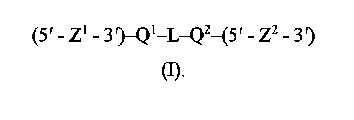
本発明の一態様は、式(I):(5’-Z1-3’)-Q1-L-Q2-(5’-Z2-3’)(I)によって表される配列を有する一本鎖オリゴヌクレオチドに関する。式(I)において、Z1は、標的遺伝子と実質的に相補的である、15~100の適宜修飾されたヌクレオチドを含む、第1のオリゴヌクレオチドであり;Z2は、Z1と実質的に相補的である、15~100の適宜修飾されたヌクレオチドを含む、第2のオリゴヌクレオチドであり;Z1およびZ2は、3またはそれ以上の連続塩基対を含む鎖内二重鎖領域を形成することができる。Lは、連結基である。Q1およびQ2は、それぞれ独立に0~12の適宜修飾されたヌクレオチドを表す。式(I)の少なくとも1つのヌクレオチドは、修飾ヌクレオチドである。本発明の他の態様は、対象において1つまたは複数の標的遺伝子の発現を阻害する医薬組成物および方法に関する。
One aspect of the present invention relates to a single stranded oligonucleotide having a sequence represented by formula (I): (5'-Z 1 -3')-Q 1 -L-Q 2 -(5'-Z 2 -3')(I). In formula (I), Z 1 is a first oligonucleotide comprising 15-100 appropriately modified nucleotides that is substantially complementary to a target gene; Z 2 is a second oligonucleotide comprising 15-100 appropriately modified nucleotides that is substantially complementary to Z 1 ; Z 1 and Z 2 can form an intrastrand duplex region comprising 3 or more consecutive base pairs. L is a linking group. Q 1 and Q 2 each independently represent 0-12 appropriately modified nucleotides. At least one nucleotide of formula (I) is a modified nucleotide. Another aspect of the present invention relates to pharmaceutical compositions and methods for inhibiting expression of one or more target genes in a subject.
Description
関連出願の相互参照
本出願は、その両方ともその全体が参照により本明細書に組み込まれる、2022年5月13日に出願された米国特許仮出願第63/364,715号、および2022年8月29日に出願された米国特許仮出願第63/401,946号の優先権の利益を主張する。
CROSS-REFERENCE TO RELATED APPLICATIONS This application claims the benefit of priority to U.S. Provisional Patent Application No. 63/364,715, filed May 13, 2022, and U.S. Provisional Patent Application No. 63/401,946, filed August 29, 2022, both of which are incorporated by reference herein in their entireties.
配列リスト
本出眼は、XMLフォーマットで提出された配列リストを含有し、これによりその全体が参照により本明細書に組み込まれる。2023年5月12日に作成された前記XMLコピーは、29520_1509-PCT_ALN-464_SL.xmlと名付けられ、サイズは1,482,842バイトである。
SEQUENCE LISTING This application contains a Sequence Listing that has been submitted in XML format and is hereby incorporated by reference in its entirety. The XML copy, created on May 12, 2023, is named 29520_1509-PCT_ALN-464_SL.xml and is 1,482,842 bytes in size.
本発明は、一般に、一本鎖ループオリゴヌクレオチドによるRNA干渉技術の分野に関する。 The present invention relates generally to the field of RNA interference technology using single-stranded loop oligonucleotides.
ヌクレオ塩基、リボース糖、およびリン酸骨格の化学修飾は、二本鎖RNAi剤で使用され、これらの治療用オリゴヌクレオチドの薬物様特性を改善し、前臨床および臨床開発においてGalNAcオリゴヌクレオチドコンジュゲートに好ましい薬理学的特性を付与する。 Chemical modifications of the nucleobases, ribose sugars, and phosphate backbones are used in double-stranded RNAi agents to improve the drug-like properties of these therapeutic oligonucleotides and confer favorable pharmacological properties to GalNAc oligonucleotide conjugates in preclinical and clinical development.
様々なsiRNAデザインが、より良い安定性および効力を達成するために開発された。現在の研究は、化学修飾を組み込むことにより、安定性および期間関連課題に取り組んだが、二本鎖siRNAの合成におけるプロセス関連課題を見落としている。センス鎖およびアンチセンス鎖は、典型的には別々に合成され、一本鎖として単調な多段階精製を経て、次いで二重鎖へとアニールされ、この二重鎖は、もう一度精製および品質管理をさらに受ける。このプロセスは、複雑であり、時間がかかり、高価であり、および環境持続可能性の懸念が生じる。 Various siRNA designs have been developed to achieve better stability and efficacy. Current research has addressed stability and duration-related issues by incorporating chemical modifications, but overlooks process-related issues in the synthesis of double-stranded siRNA. The sense and antisense strands are typically synthesized separately, undergo tedious multi-step purification as single strands, and then annealed into a duplex, which once again undergoes further purification and quality control. This process is complex, time-consuming, expensive, and raises environmental sustainability concerns.
しかしながら、製造および精製プロセスを簡単にするが、同時に、RNAi剤の有効性を保存または改善することを含む、RNAi剤の改善されたデザインが、引き続き必要とされている。 However, there remains a need for improved designs of RNAi agents that simplify the manufacturing and purification process while at the same time preserving or improving the efficacy of the RNAi agents.
本発明の一態様は、式(I):
(5’-Z1-3’)-Q1-L-Q2-(5’-Z2-3’) (I)
[式中:
Z1は、標的遺伝子と実質的に相補的である、10~100の適宜修飾されたヌクレオチド(例えば、15~100)を含む、第1のオリゴヌクレオチドであり;
Z2は、Z1と実質的に相補的である、10~100の適宜修飾されたヌクレオチド(例えば、15~100)を含む、第2のオリゴヌクレオチドであり;
Z1およびZ2は、3またはそれ以上の連続塩基対を含む鎖内二重鎖領域を形成することができ;
Lは、連結基であり;
Q1およびQ2は、それぞれ独立に0~12の適宜修飾されたヌクレオチドを表す]
によって表される配列を有する、標的遺伝子の発現を阻害することができる一本鎖オリゴヌクレオチドであって、
式(I)の少なくとも1つのヌクレオチドは、修飾ヌクレオチドである、
一本鎖オリゴヌクレオチドに関する。
One aspect of the present invention is a compound of formula (I):
(5'-Z 1 -3')-Q 1 -L-Q 2 -(5'-Z 2 -3') (I)
[In the formula:
Z1 is a first oligonucleotide that is substantially complementary to a target gene and comprises 10-100 optionally modified nucleotides (e.g., 15-100);
Z2 is a second oligonucleotide substantially complementary to Z1 and containing 10-100 optionally modified nucleotides (e.g., 15-100);
Z1 and Z2 can form an intrastrand duplex region containing 3 or more consecutive base pairs;
L is a linking group;
Q1 and Q2 each independently represent 0 to 12 optionally modified nucleotides.
A single-stranded oligonucleotide capable of inhibiting expression of a target gene, having a sequence represented by:
At least one nucleotide of formula (I) is a modified nucleotide.
Concerning single-stranded oligonucleotides.
第1のオリゴヌクレオチドZ1および第2のオリゴヌクレオチドZ2は、それぞれ独立に、15~100の適宜修飾されたヌクレオチドを含みうる。例えば、Z1およびZ2は、それぞれ独立に、15~40、15~25、または19~23の適宜修飾されたヌクレオチドを含みうる。一部の実施形態において、第1のオリゴヌクレオチドZ1および第2のオリゴヌクレオチドZ2は、それぞれ独立に、少なくとも10、11、12、13、14、15、16、17、18、19、20、21、22、23、24、25、26、27、28、29、30、31、32、33、34、35、36、37、38、39、40、41、42、43、44、45、46、47、48、49、または50ヌクレオチド長を含みうる。Z1およびZ2は、それぞれ独立に、約10~約50ヌクレオチド、約10~約40ヌクレオチド、約15~約40ヌクレオチド、約10~約35ヌクレオチド、約10~約30ヌクレオチド、約10~約25ヌクレオチド、約10~約20ヌクレオチド、約15~約50ヌクレオチド、約15~約40ヌクレオチド、約15~約35ヌクレオチド、約15~約30ヌクレオチド、約15~約25ヌクレオチド、約15~約20ヌクレオチド、約19~約23ヌクレオチド、約19~約21ヌクレオチド、または約18~約20ヌクレオチド長を有しうる。第1のオリゴヌクレオチドZ1および第2のオリゴヌクレオチドZ2の各ヌクレオチドは、独立に、および適宜修飾されうる。一部の実施形態において、Z1およびZ2はそれぞれ、同じ数の適宜修飾されたヌクレオチドを含有する。 The first oligonucleotide Z1 and the second oligonucleotide Z2 can each independently comprise 15 to 100 appropriately modified nucleotides. For example, Z1 and Z2 can each independently comprise 15 to 40, 15 to 25, or 19 to 23 appropriately modified nucleotides. In some embodiments, the first oligonucleotide Z1 and the second oligonucleotide Z2 can each independently comprise at least 10, 11, 12, 13, 14, 15, 16, 17, 18, 19, 20, 21, 22, 23, 24, 25, 26, 27, 28 , 29, 30, 31, 32, 33, 34, 35, 36, 37, 38, 39, 40 , 41, 42, 43, 44, 45, 46, 47, 48, 49, or 50 nucleotides in length. Z 1 and Z 2 can each independently have a length of about 10 to about 50 nucleotides, about 10 to about 40 nucleotides, about 15 to about 40 nucleotides, about 10 to about 35 nucleotides, about 10 to about 30 nucleotides, about 10 to about 25 nucleotides, about 10 to about 20 nucleotides, about 15 to about 50 nucleotides, about 15 to about 40 nucleotides, about 15 to about 35 nucleotides, about 15 to about 30 nucleotides, about 15 to about 25 nucleotides, about 15 to about 20 nucleotides, about 19 to about 23 nucleotides, about 19 to about 21 nucleotides, or about 18 to about 20 nucleotides. Each nucleotide of the first oligonucleotide Z 1 and the second oligonucleotide Z 2 can be independently and optionally modified. In some embodiments, Z 1 and Z 2 each contain the same number of optionally modified nucleotides.
Q1およびQ2は、それぞれ独立に、0~12の適宜修飾されたヌクレオチドを含みうる。例えば、Q1およびQ2は、それぞれ独立に、0~10、0~6、0~4、0~3、0~2、1~6、1~4、1~3、または2~3の適宜修飾されたヌクレオチドを含みうる。一部の実施形態において、Q1およびQ2は、それぞれ0である。一部の実施形態において、Q1およびQ2の1つは0である。一部の実施形態において、Q1およびQ2は、同じ数の適宜修飾されたヌクレオチドを有する。 Q1 and Q2 can each independently contain 0-12 appropriately modified nucleotides. For example, Q1 and Q2 can each independently contain 0-10, 0-6, 0-4, 0-3, 0-2, 1-6, 1-4, 1-3, or 2-3 appropriately modified nucleotides. In some embodiments, Q1 and Q2 are each 0. In some embodiments, one of Q1 and Q2 is 0. In some embodiments, Q1 and Q2 have the same number of appropriately modified nucleotides.
一部の実施形態において、一本鎖オリゴヌクレオチドは、連結基Lで切断されうる。第1のオリゴヌクレオチドZ1は、標的遺伝子(例えば、標的mRNAまたはDNA)と実質的に相補的であるアンチセンス鎖へと切断され、第2のオリゴヌクレオチドZ2は、Z1と実質的に相補的であるセンス鎖へと切断されうる。 In some embodiments, the single-stranded oligonucleotide can be cleaved at the linking group L. A first oligonucleotide Z1 can be cleaved into an antisense strand that is substantially complementary to a target gene (e.g., a target mRNA or DNA), and a second oligonucleotide Z2 can be cleaved into a sense strand that is substantially complementary to Z1 .
第1のオリゴヌクレオチドZ1および第2のオリゴヌクレオチドZ2は、3またはそれ以上の連続塩基対(例えば、3、4、5、6、7、8、9、10、11、12、13、14、15、16、17、18、19、20、21、22、23、24、または25塩基対の二重鎖領域)を含む、分子間二本鎖領域を形成しうる。例えば、二重鎖領域は、10~25、15~25、19~23、19、20、21、22、または23塩基対を含みうる。Z1およびZ2によって形成された鎖内二重鎖領域は、全ての連続塩基対を含有しうるか、または3以下(例えば、0、1、2、または3)のミスマッチ塩基対を含有しうる。 A first oligonucleotide Z1 and a second oligonucleotide Z2 can form an intermolecular duplex region that includes three or more consecutive base pairs (e.g., a duplex region of 3, 4, 5, 6, 7, 8, 9, 10, 11, 12, 13, 14, 15, 16, 17, 18, 19, 20, 21, 22, 23, 24, or 25 base pairs). For example, the duplex region can include 10-25, 15-25, 19-23, 19, 20, 21, 22, or 23 base pairs. The intrastrand duplex region formed by Z1 and Z2 can contain all consecutive base pairs or can contain no more than three (e.g., 0, 1, 2, or 3) mismatched base pairs.
一部の実施形態において、一本鎖オリゴヌクレオチドは、少なくとも1つの化学修飾を含む。一部の実施形態において、第1のオリゴヌクレオチドZ1および第2のオリゴヌクレオチドZ2のそれぞれは、少なくとも1つの化学修飾を含む。一部の実施形態において、Z2の全てのヌクレオチドは、修飾ヌクレオチドである。一部の実施形態において、Z1の全てのヌクレオチドは、修飾ヌクレオチドである。一部の実施形態において、一本鎖オリゴヌクレオチドの全てのヌクレオチドは修飾される。 In some embodiments, the single-stranded oligonucleotide comprises at least one chemical modification. In some embodiments, each of the first oligonucleotide Z1 and the second oligonucleotide Z2 comprises at least one chemical modification. In some embodiments, all nucleotides of Z2 are modified nucleotides. In some embodiments, all nucleotides of Z1 are modified nucleotides. In some embodiments, all nucleotides of the single-stranded oligonucleotide are modified.
ヌクレオチド(複数可)への化学修飾は、ヌクレオシド間連結修飾、ヌクレオ塩基修飾、糖修飾、またはこれらの組合せを含みうる。 Chemical modifications to the nucleotide(s) may include internucleoside linkage modifications, nucleobase modifications, sugar modifications, or combinations thereof.
ある特定の実施形態において、化学修飾は、LNA、ENA、HNA、CeNA、2’-O-メトキシアルキル(例えば、2’-O-メトキシメチル、2’-O-メトキシエチル、または2’-O-2-メトキシプロパニル)、2’-O-アルキル(例えば、2’-Oメチル)、2’-O-アリール、2’-C-アリール、2’-フルオロ、2’-デオキシ、2’-O-N-メチルアセトアミド(2’-O-NMA)、2’-O-ジメチルアミノエトキシエチル(2’-O-DMAEOE)、2’-O-アミノプロピル(2’-O-AP)、2’-ara-F、L-ヌクレオシド修飾(例えば、2’-修飾L-ヌクレオシド、例えば、2’-デオキシ-L-ヌクレオシド)、BNA脱塩基糖、脱塩基環状および開放鎖アルキル、ならびにこれらの組合せからなる群から選択される。 In certain embodiments, the chemical modification is selected from the group consisting of LNA, ENA, HNA, CeNA, 2'-O-methoxyalkyl (e.g., 2'-O-methoxymethyl, 2'-O-methoxyethyl, or 2'-O-2-methoxypropanyl), 2'-O-alkyl (e.g., 2'-O-methyl), 2'-O-aryl, 2'-C-aryl, 2'-fluoro, 2'-deoxy, 2'-O-N-methylacetamide (2'-O-NMA), 2'-O-dimethylaminoethoxyethyl (2'-O-DMAEOE), 2'-O-aminopropyl (2'-O-AP), 2'-ara-F, L-nucleoside modifications (e.g., 2'-modified L-nucleosides, e.g., 2'-deoxy-L-nucleosides), BNA abasic sugars, abasic cyclic and open chain alkyls, and combinations thereof.
ある特定の実施形態において、化学修飾は、少なくとも1つの修飾ヌクレオチドからなる群から選択され、デオキシヌクレオチド、3’末端デオキシチミジン(dT)ヌクレオチド、2’-O-メチル修飾ヌクレオチド、2’-フルオロ修飾ヌクレオチド、2’-デオキシ修飾ヌクレオチド、ロックヌクレオチド(例えば、LNA)、アンロックヌクレオチド(例えば、UNA)、構造的に制限されたヌクレオチド、拘束エチルヌクレオチド、脱塩基ヌクレオチド、2’-アミノ-修飾ヌクレオチド、2’-O-アリール-修飾ヌクレオチド、2’-C-アルキル-修飾ヌクレオチド、2’-ヒドロキシ-修飾ヌクレオチド、2’-メトキシエチル修飾ヌクレオチド、2’-O-アルキル-修飾ヌクレオチド、モルホリノヌクレオチド、ホスホロアミデート、ヌクレオチドを含む非天然塩基、テトラヒドロピラン修飾ヌクレオチド、1,5-アンヒドロヘキシトール修飾ヌクレオチド、シクロへキセニル修飾ヌクレオチド、5’-ホスホロチオエート基を含むヌクレオチド、5’-メチルホスホネート基を含むヌクレオチド、5’リン酸または5’リン酸模倣体を含むヌクレオチド、ビニルホスホネートを含むヌクレオチド、グリコール核酸(GNA)を含むヌクレオチド、グリコール核酸(GNA)S異性体(S-GNA)を含むヌクレオチド、2-ヒドロキシメチル-テトラヒドロフラン-5-リン酸を含むヌクレオチド、2’-デオキシチミジン-3’リン酸を含むヌクレオチド、2’-デオキシグアノシン-3’-リン酸を含むヌクレオチド、2’-5’-連結ヌクレオチド(「3’-RNA」)、またはコレステリル誘導体またはドデカノン酸ビスデシルアミド基に連結した末端ヌクレオチドである。 In certain embodiments, the chemical modification is selected from the group consisting of at least one modified nucleotide, including deoxynucleotides, 3' terminal deoxythymidine (dT) nucleotides, 2'-O-methyl modified nucleotides, 2'-fluoro modified nucleotides, 2'-deoxy modified nucleotides, locked nucleotides (e.g., LNA), unlocked nucleotides (e.g., UNA), conformationally restricted nucleotides, constrained ethyl nucleotides, abasic nucleotides, 2'-amino-modified nucleotides, 2'-O-aryl-modified nucleotides, 2'-C-alkyl-modified nucleotides, 2'-hydroxy-modified nucleotides, 2'-methoxyethyl-modified nucleotides, 2'-O-alkyl-modified nucleotides, morpholino nucleotides, phosphoramidates, non-natural bases including nucleotides, tetrahydrofuran ... pyran-modified nucleotides, 1,5-anhydrohexitol-modified nucleotides, cyclohexenyl-modified nucleotides, nucleotides containing a 5'-phosphorothioate group, nucleotides containing a 5'-methylphosphonate group, nucleotides containing a 5' phosphate or a 5' phosphate mimic, nucleotides containing a vinylphosphonate, nucleotides containing glycol nucleic acid (GNA), nucleotides containing glycol nucleic acid (GNA) S-isomers (S-GNA), nucleotides containing 2-hydroxymethyl-tetrahydrofuran-5-phosphate, nucleotides containing 2'-deoxythymidine-3' phosphate, nucleotides containing 2'-deoxyguanosine-3'-phosphate, 2'-5'-linked nucleotides ("3'-RNA"), or terminal nucleotides linked to a cholesteryl derivative or a dodecanoic acid bisdecylamide group.
ある特定の実施形態において、化学修飾は、2’-O-メチル、2’-O-アリール、2’-O-メトキシアルキル(例えば、2’-O-メトキシメチル、2’-O-メトキシエチル、または2’-O-2-メトキシプロパニル)、2’-デオキシ、2’-フルオロ、およびこれらの組合せからなる群から選択される2’-修飾である。 In certain embodiments, the chemical modification is a 2'-modification selected from the group consisting of 2'-O-methyl, 2'-O-aryl, 2'-O-methoxyalkyl (e.g., 2'-O-methoxymethyl, 2'-O-methoxyethyl, or 2'-O-2-methoxypropanyl), 2'-deoxy, 2'-fluoro, and combinations thereof.
一部の実施形態において、約100%、95%、90%、85%、80%、75%、70%、65%、60%、55%、50%、45%、40%、35%または30%のZ1が修飾される。一部の実施形態において、Z2の約100%、95%、90%、85%、80%、75%、70%、65%、60%、55%、50%、45%、40%、35%または30%のZ2が修飾される。一部の実施形態において、約100%、95%、90%、85%、80%、75%、70%、65%、60%、55%、50%、45%、40%、35%または30%の一本鎖オリゴヌクレオチドの全てのヌクレオチドが修飾される。例えば、50%の全てのヌクレオチドが修飾される場合、一本鎖オリゴヌクレオチドに存在する50%の全てのヌクレオチドが、本明細書に記載の少なくとも1つの修飾を含有する。 In some embodiments, about 100%, 95%, 90%, 85%, 80%, 75%, 70%, 65%, 60%, 55%, 50%, 45%, 40%, 35% or 30 % of Z1 are modified. In some embodiments, about 100%, 95%, 90%, 85%, 80%, 75%, 70%, 65%, 60%, 55%, 50%, 45%, 40%, 35% or 30% of Z2 are modified. In some embodiments, about 100%, 95%, 90%, 85%, 80%, 75%, 70%, 65%, 60%, 55%, 50%, 45%, 40%, 35% or 30% of all nucleotides of the single-stranded oligonucleotide are modified. For example, if 50% of all nucleotides are modified, then 50% of all nucleotides present in a single stranded oligonucleotide will contain at least one modification described herein.
一実施形態において、一本鎖オリゴヌクレオチドのヌクレオチドの少なくとも50%は、独立に、2’-O-メチル、2’-O-アリール、2’-O-メトキシアルキル(例えば、2’-O-メトキシメチル、2’-O-メトキシエチル、または2’-O-2-メトキシプロパニル)、2’-デオキシ、または2’-フルオロによって修飾される。 In one embodiment, at least 50% of the nucleotides of the single stranded oligonucleotide are independently modified with 2'-O-methyl, 2'-O-aryl, 2'-O-methoxyalkyl (e.g., 2'-O-methoxymethyl, 2'-O-methoxyethyl, or 2'-O-2-methoxypropanyl), 2'-deoxy, or 2'-fluoro.
一部の実施形態において、6つの3’-末端ヌクレオチド内の5つのヌクレオチド間連結の1つまたは複数は、修飾ヌクレオチド間連結である。一部の実施形態において、6つの5’-末端ヌクレオチド内の5つのヌクレオチド間連結の1つまたは複数は、修飾ヌクレオチド間連結である。 In some embodiments, one or more of the five internucleotide linkages within the six 3'-terminal nucleotides are modified internucleotide linkages. In some embodiments, one or more of the five internucleotide linkages within the six 5'-terminal nucleotides are modified internucleotide linkages.
一部の実施形態において、Z2の6つの5’-末端ヌクレオチド内の5つのヌクレオチド間連結の1つまたは複数は、修飾ヌクレオチド間連結である。一部の実施形態において、Z1の6つの5’-末端ヌクレオチド内の5つのヌクレオチド間連結の1つまたは複数は、修飾ヌクレオチド間連結である。 In some embodiments, one or more of the five internucleotide linkages within the six 5'-terminal nucleotides of Z2 are modified internucleotide linkages. In some embodiments, one or more of the five internucleotide linkages within the six 5'-terminal nucleotides of Z1 are modified internucleotide linkages.
一部の実施形態において、一本鎖オリゴヌクレオチドは、Z1の3’-末端ヌクレオチドとQ1の第1のヌクレオチドの間に1つまたは複数の修飾ヌクレオチド間連結をさらに含む。一部の実施形態において、一本鎖オリゴヌクレオチドは、Q1のヌクレオチド間に1つまたは複数の修飾ヌクレオチド間連結をさらに含む。 In some embodiments, the single stranded oligonucleotide further comprises one or more modified internucleotide linkages between the 3'-terminal nucleotide of Z1 and the first nucleotide of Q1 . In some embodiments, the single stranded oligonucleotide further comprises one or more modified internucleotide linkages between nucleotides of Q1 .
一部の実施形態において、一本鎖オリゴヌクレオチドは、ヌクレオチド配列の5’末端にリン酸またはリン酸模倣体をさらに含む(例えば、Z1および/またはZ2)。一部の実施形態において、一本鎖オリゴヌクレオチドは、ヌクレオチド配列の5’末端にリン酸模倣体を含む(例えば、Z1および/またはZ2)。一実施形態において、少なくとも1つのリン酸模倣体はZ1の5’末端にある。一実施形態において、リン酸模倣体は、5’-ビニルホスホネート(VP)である。一実施形態において、リン酸模倣体は、5’-シクロプロピルホスホネートである。一実施形態において、リン酸模倣体は、5’-ビニルホスフェートである。 In some embodiments, the single stranded oligonucleotide further comprises a phosphate or phosphate mimetic at the 5' end of the nucleotide sequence (e.g., Z1 and/or Z2 ). In some embodiments, the single stranded oligonucleotide further comprises a phosphate mimetic at the 5' end of the nucleotide sequence (e.g., Z1 and/or Z2 ). In one embodiment, at least one phosphate mimetic is at the 5' end of Z1 . In one embodiment, the phosphate mimetic is a 5'-vinyl phosphonate (VP). In one embodiment, the phosphate mimetic is a 5'-cyclopropyl phosphonate. In one embodiment, the phosphate mimetic is a 5'-vinyl phosphate.
一部の実施形態において、式(I)の一本鎖オリゴヌクレオチドの5’末端もしくは3’末端ヌクレオチドは、2’-5’-連結ヌクレオチド修飾を含み;または5’末端もしくは3’末端ヌクレオチドは、脱塩基ヌクレオチド、逆位ヌクレオチド、または逆位脱塩基ヌクレオチド(例えば、リボヌクレオチド)にコンジュゲートされ、ホスホジエステル、ホスホロチオエート、またはホスホジチオエート結合を介してもよい。 In some embodiments, the 5'- or 3'-terminal nucleotide of the single-stranded oligonucleotide of formula (I) comprises a 2'-5'-linked nucleotide modification; or the 5'- or 3'-terminal nucleotide is conjugated to an abasic nucleotide, an inverted nucleotide, or an inverted abasic nucleotide (e.g., a ribonucleotide), optionally via a phosphodiester, phosphorothioate, or phosphodithioate linkage.
一部の実施形態において、式(I)の一本鎖オリゴヌクレオチドの5’末端または3’末端ヌクレオチドは、修飾され、モノ-、ジ-、トリ-、テトラ-、ペンタ-、もしくはポリプロリノール、またはモノ-、ジ-、トリ-、テトラ-、ペンタ-もしくはポリヒドロキシプロリノールを含有する連結部分を含む。 In some embodiments, the 5'- or 3'-terminal nucleotide of the single-stranded oligonucleotide of formula (I) is modified to include a linking moiety containing mono-, di-, tri-, tetra-, penta-, or polyprolinol, or mono-, di-, tri-, tetra-, penta-, or polyhydroxyprolinol.
一部の実施形態において、一本鎖オリゴヌクレオチドは、少なくとも1つの末端、キラル修飾(例えば、末端、キラルリン原子)をさらに含む。 In some embodiments, the single-stranded oligonucleotide further comprises at least one terminal, chiral modification (e.g., a terminal, chiral phosphorus atom).
ヌクレオチド間連結への、部位特異的、キラル修飾は、ヌクレオチド配列の5’末端、3’末端、または5’末端と3’末端の両方に存在しうる。これは、本明細書において、「末端、キラル」修飾と呼ばれている。末端修飾は、末端領域の3’または5’末端位置、例えば、末端ヌクレオチドまたはヌクレオチド配列の最後2、3、4、5、6、7、8、9、もしくは10ヌクレオチド内の位置に存在しうる。キラル純粋なリン原子のそれぞれは、Rp配置またはSp配置、およびこれらの組合せのいずれかでありうる。キラル修飾およびキラル修飾RNA剤に関する詳細は、その全体が参照により本明細書に組み込まれる、WO2019/126651A1に見出されうる。 Site-specific, chiral modifications to internucleotide linkages can occur at the 5' end, the 3' end, or both the 5' and 3' ends of the nucleotide sequence. This is referred to herein as a "terminal, chiral" modification. Terminal modifications can occur at the 3' or 5' terminal position of the terminal region, e.g., at the terminal nucleotide or at a position within the last 2, 3, 4, 5, 6, 7, 8, 9, or 10 nucleotides of the nucleotide sequence. Each of the chirally pure phosphorus atoms can be in either the Rp or Sp configuration, and combinations thereof. Further details regarding chiral modifications and chirally modified RNA agents can be found in WO2019/126651A1, which is incorporated herein by reference in its entirety.
一部の実施形態において、一本鎖オリゴヌクレオチドは、少なくとも2つの連続ホスホロチオエートまたはメチルホスホネートヌクレオチド間連結修飾を含む。一部の実施形態において、一本鎖オリゴヌクレオチドは、2つの連続ホスホロチオエートまたはメチルホスホネートヌクレオチド間連結修飾の少なくとも2つのブロックを含む。一部の実施形態において、一本鎖オリゴヌクレオチドは、2つの連続ホスホロチオエートまたはメチルホスホネートヌクレオチド間連結修飾の少なくとも3つのブロックを含む。 In some embodiments, the single-stranded oligonucleotide comprises at least two consecutive phosphorothioate or methylphosphonate internucleotide linkage modifications. In some embodiments, the single-stranded oligonucleotide comprises at least two blocks of two consecutive phosphorothioate or methylphosphonate internucleotide linkage modifications. In some embodiments, the single-stranded oligonucleotide comprises at least three blocks of two consecutive phosphorothioate or methylphosphonate internucleotide linkage modifications.
一部の実施形態において、一本鎖オリゴヌクレオチドは、ヌクレオチド配列の(5’末端からカウントして)最初の5ヌクレオチドにおける、少なくとも2つのホスホロチオエートヌクレオチド間連結を有する(例えば、Z1および/またはZ2)。 In some embodiments, the single stranded oligonucleotide has at least two phosphorothioate internucleotide linkages in the first five nucleotides (counting from the 5' end) of the nucleotide sequence (eg, Z 1 and/or Z 2 ).
一部の実施形態において、一本鎖オリゴヌクレオチド(例えば、Z1および/またはZ2)のヌクレオチド配列は、1、2、3、4、5、6、7、8、9、10、11、12、13、14、15、16、17、または18のリン酸ヌクレオチド間連結によって分けられた1つ、2つ、または3つのホスホロチオエートヌクレオチド間連結の2つのブロックを含む。 In some embodiments, the nucleotide sequence of a single stranded oligonucleotide (e.g., Z1 and/or Z2 ) comprises two blocks of 1, 2, or 3 phosphorothioate internucleotide linkages separated by 1, 2, 3, 4, 5, 6, 7, 8, 9, 10, 11, 12, 13, 14, 15, 16, 17, or 18 phosphate internucleotide linkages.
一実施形態において、一本鎖オリゴヌクレオチド(例えば、Z1および/またはZ2)のヌクレオチド配列は、ヌクレオチド配列の5’末端からカウントして、ヌクレオチド配列の18~23位内に、少なくとも2つの連続ホスホロチオエートヌクレオチド間連結修飾を含む。一実施形態において、一本鎖オリゴヌクレオチド(例えば、Z1および/またはZ2)のヌクレオチド配列は、ヌクレオチド配列の5’末端からカウントして、ヌクレオチド配列の1~5位内に、少なくとも2つの連続ホスホロチオエートヌクレオチド間連結修飾を含む。 In one embodiment, the nucleotide sequence of the single stranded oligonucleotide (e.g., Z1 and/or Z2 ) comprises at least two consecutive phosphorothioate internucleotide linkage modifications within positions 18-23 of the nucleotide sequence, counting from the 5' end of the nucleotide sequence. In one embodiment, the nucleotide sequence of the single stranded oligonucleotide (e.g., Z1 and/or Z2 ) comprises at least two consecutive phosphorothioate internucleotide linkage modifications within positions 1-5 of the nucleotide sequence, counting from the 5' end of the nucleotide sequence.
一部の実施形態において、一本鎖オリゴヌクレオチドのZ1およびZ2のそれぞれは、少なくとも2つの連続ホスホロチオエートヌクレオチド間連結修飾を含む。一実施形態において、一本鎖オリゴヌクレオチドのZ1およびZ2のそれぞれは、ヌクレオチド配列の18~23位内に少なくとも2つの連続ホスホロチオエートヌクレオチド間連結修飾、およびヌクレオチド配列の5’末端からカウントして、ヌクレオチド配列の1~5位内に少なくとも2つの連続ホスホロチオエートヌクレオチド間連結修飾を含む。 In some embodiments, each of the single stranded oligonucleotides Z 1 and Z 2 comprises at least two consecutive phosphorothioate internucleotide linkage modifications. In one embodiment, each of the single stranded oligonucleotides Z 1 and Z 2 comprises at least two consecutive phosphorothioate internucleotide linkage modifications within positions 18-23 of the nucleotide sequence and at least two consecutive phosphorothioate internucleotide linkage modifications within positions 1-5 of the nucleotide sequence, counting from the 5' end of the nucleotide sequence.
上記の実施形態の全てにおいて、標的遺伝子は、mRNA、pre-mRNA、マイクロRNA、pre-miRNA、長鎖ノンコーディングRNA(lncRNA)、またはDNAでありうる。 In all of the above embodiments, the target gene can be mRNA, pre-mRNA, microRNA, pre-miRNA, long non-coding RNA (lncRNA), or DNA.
上記の実施形態の全てにおいて、一本鎖オリゴヌクレオチドは、阻害一本鎖オリゴヌクレオチド、例えば、アンチセンスオリゴヌクレオチド(ASO)、antimiR(antagomir)オリゴヌクレオチド、マイクロRNA模倣体、supermir、アプタマー、U1アダプター、三重鎖形成性オリゴヌクレオチド、RNA活性化因子、免疫刺激オリゴヌクレオチド、デコイオリゴヌクレオチド、ヘテロ二重鎖形成性オリゴヌクレオチド、または一本鎖siRNA(ss-siRNA)オリゴヌクレオチドでありうる。 In all of the above embodiments, the single-stranded oligonucleotide can be an inhibitory single-stranded oligonucleotide, such as an antisense oligonucleotide (ASO), an antimiR (antagomir) oligonucleotide, a microRNA mimic, a supermir, an aptamer, a U1 adaptor, a triplex-forming oligonucleotide, an RNA activator, an immunostimulatory oligonucleotide, a decoy oligonucleotide, a heteroduplex-forming oligonucleotide, or a single-stranded siRNA (ss-siRNA) oligonucleotide.
一部の実施形態において、一本鎖オリゴヌクレオチド(例えば、Z1および/またはZ2)の5’末端または3’末端の少なくとも1つ、2つ、3つ、4つ、または5つの末端リン含有連結のそれぞれは、ホスホロチオエート連結ではない。一実施形態において、一本鎖オリゴヌクレオチド(例えば、Z1および/またはZ2)の5’末端または3’末端の少なくとも1つ、2つ、3つ、4つ、または5つの末端リン含有連結のそれぞれは、それぞれ独立に、天然のリン酸基もしくはホスホジエステル連結、または窒素修飾リン含有連結(PN-連結)である。 In some embodiments, each of at least one, two, three, four, or five terminal phosphorus-containing linkages at the 5'- or 3'-terminus of a single-stranded oligonucleotide (e.g., Z1 and/or Z2 ) is not a phosphorothioate linkage. In one embodiment, each of at least one, two, three, four, or five terminal phosphorus-containing linkages at the 5'- or 3'-terminus of a single-stranded oligonucleotide (e.g., Z1 and/or Z2 ) is independently a natural phosphate or phosphodiester linkage, or a nitrogen-modified phosphorus-containing linkage (PN-linkage).
一部の実施形態において、PN連結は、式
-N(R)P(=X)(OH)O-もしくは-OP(=X)(OH)N(R)-、-O-P(NR)(=X)O-、N(SO2R)P(=X)(OH)O-もしくは-OP(=X)(OH)N(SO2R)-、または-O-P(NSO2R)(=X)O-[式中、Xは、OまたはSであり;Rは、適宜置換されたアルキル、アリール、ヘテロアリールまたはヘテロシクリルでありうる;またはNRは、適宜置換された環状グアニジン部分、適宜置換されたトリアゾリル基、またはTmg基(
In some embodiments, the PN linkage is of the formula -N(R)P(=X)(OH)O- or -OP(=X)(OH)N(R)-, -O-P(NR)(=X)O-, N(SO 2 R)P(=X)(OH)O- or -OP(=X)(OH)N(SO 2 R)-, or -O-P(NSO 2 R)(=X)O-, where X is O or S; R can be an optionally substituted alkyl, aryl, heteroaryl, or heterocyclyl; or NR is an optionally substituted cyclic guanidine moiety, an optionally substituted triazolyl group, or a Tmg group (
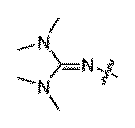
一部の実施形態において、PN連結は、適宜置換された環状グアニンジン部分を含む。例えば、PN連結は、 In some embodiments, the PN linkage comprises an optionally substituted cyclic guanidine moiety. For example, the PN linkage is
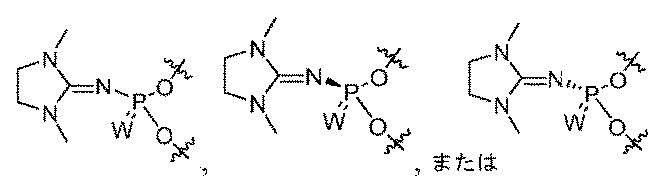
一部の実施形態において、PN連結は、トリアゾール部分(例えば、適宜置換されたトリアゾール基)を含む。例えば、PN連結は、 In some embodiments, the PN linkage includes a triazole moiety (e.g., an appropriately substituted triazole group). For example, the PN linkage is

一部の実施形態において、PN連結は、アルキン部分(例えば、適宜置換されたアルキニル基)を含む。例えば、PN連結は、 In some embodiments, the PN linkage includes an alkyne moiety (e.g., an optionally substituted alkynyl group). For example, the PN linkage is
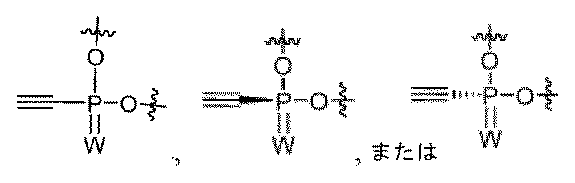
一部の実施形態において、PN連結は、Tmg基( In some embodiments, the PN linkage is a Tmg group (


さらに好適なPN連結は、その全体が参照により本明細書に組み込まれる、WO2019/032642およびWO2021/030778に記載されるものを含みうる。 Further suitable PN linkages may include those described in WO2019/032642 and WO2021/030778, the entireties of which are incorporated herein by reference.
一部の実施形態において、式(I)のLは、切断型連結基である。一部の実施形態において、切断型連結基は、任意の型の細胞のホモジネート、トリトソーム、サイトゾル、またはエンドソームにおいて切断可能である。例えば、切断型連結基は、肝臓ホモジネート、肝臓トリトソーム、肝臓リソソーム、肝臓サイトゾル、肝臓エンドソーム、脳ホモジネート、脳トリトソーム、脳リソソーム、脳サイトゾル、または脳エンドソームにおいて切断可能でありうる。ある特定の実施形態において、切断型連結基は、レドックス切断型リンカー(例えば、還元型切断型リンカー;例えば、ジスルフィド基)、酸切断型リンカー(例えば、ヒドラゾン基、エステル基、アセタール基、またはケタール基)、エステラーゼ切断型リンカー(例えば、エステル基)、ホスファターゼ切断型リンカー(例えば、エステル基)、ペプチダーゼ切断型リンカー(例えば、エステル基)、またはエンドソーム切断型リンカー(またはプロテアーゼ切断型リンカー、例えば炭水化物リンカー)である。 In some embodiments, L in formula (I) is a cleavable linking group. In some embodiments, the cleavable linking group is cleavable in homogenates, tritosomes, cytosols, or endosomes of any type of cell. For example, the cleavable linking group may be cleavable in liver homogenates, liver tritosomes, liver lysosomes, liver cytosol, liver endosomes, brain homogenates, brain tritosomes, brain lysosomes, brain cytosol, or brain endosomes. In certain embodiments, the cleavable linking group is a redox-cleavable linker (e.g., a reduction-cleavable linker; e.g., a disulfide group), an acid-cleavable linker (e.g., a hydrazone group, an ester group, an acetal group, or a ketal group), an esterase-cleavable linker (e.g., an ester group), a phosphatase-cleavable linker (e.g., an ester group), a peptidase-cleavable linker (e.g., an ester group), or an endosome-cleavable linker (or a protease-cleavable linker, e.g., a carbohydrate linker).
一部の実施形態において、切断型連結基(テザー)は、エンドソーム切断型リンカーまたはプロテアーゼ切断型リンカー、例えば、炭水化物リンカーであり、リンカーは、血液または血清(または細胞外条件を摸倣するために選択されたインビトロ条件下)と比較して、細胞において(または細胞内条件を摸倣するために選択されたインビトロ条件下)、少なくとも1.25倍速く切断される。 In some embodiments, the cleavable linker (tether) is an endosomal or protease-cleavable linker, e.g., a carbohydrate linker, and the linker is cleaved at least 1.25 times faster in cells (or under in vitro conditions selected to mimic intracellular conditions) compared to blood or serum (or under in vitro conditions selected to mimic extracellular conditions).
一部の実施形態において、式(I)のLは、式:#-(N)n-**によって表される連結部分を含有する。この式では、#は、Q1への結合であり、**は、Q2への結合であり;nは3~12であり;各Nは、独立に、連結部分である。例えば、各Nは、独立に、3またはそれ以上の原子の鎖長を有する連結単量体でありうる。 In some embodiments, L of formula (I) contains a linking moiety represented by the formula: #-(N) n - ** , where # is a bond to Q1 , ** is a bond to Q2 , n is 3-12, and each N is independently a linking moiety. For example, each N can independently be a linking monomer having a chain length of 3 or more atoms.
本明細書において、「鎖長」という用語は、連結単量体によって形成された最も短い線状鎖の原子の数を指す。例えば、 As used herein, the term "chain length" refers to the number of atoms in the shortest linear chain formed by linked monomers. For example,

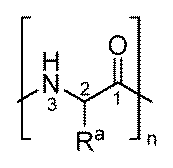
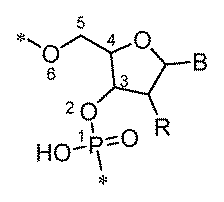
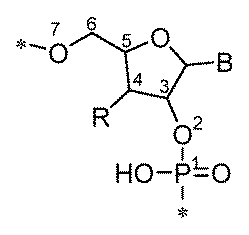
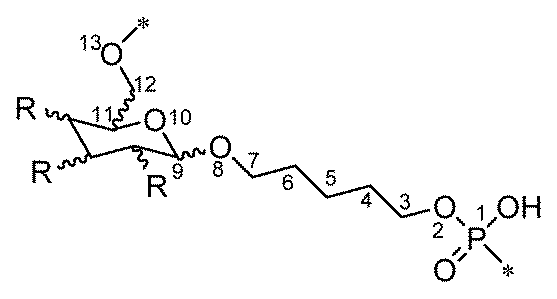
一部の実施形態において、式(I)のLにおける1つまたは複数の連結部分(N)は、適宜修飾されたヌクレオチドでありうる。 In some embodiments, one or more linking moieties (N) in L of formula (I) may be an appropriately modified nucleotide.
一部の実施形態において、式(I)のLにおける1つまたは複数の連結部分は、独立に、2’-デオキシヌクレオチド(dN)、2’-デオキシ-2’-フルオロヌクレオチド(fN)、リボヌクレオチド(rN)、2’-O-メチルヌクレオチド(mN)、および2’-araヌクレオチド(aN)(例えば、2’-ara-2’-デオキシ、2’-ara-2’-F、2’-ara-2’-OMe、または2’-araリボヌクレオチド)からなる群から選択されうる。ara-ヌクレオチドは、リボヌクレオチドと比較して、2’炭素原子において反対の立体化学的特徴がある。 In some embodiments, one or more linking moieties in L of formula (I) can be independently selected from the group consisting of 2'-deoxynucleotides (dN), 2'-deoxy-2'-fluoronucleotides (fN), ribonucleotides (rN), 2'-O-methyl nucleotides (mN), and 2'-ara nucleotides (aN) (e.g., 2'-ara-2'-deoxy, 2'-ara-2'-F, 2'-ara-2'-OMe, or 2'-ara ribonucleotides). Ara-nucleotides have the opposite stereochemical characteristics at the 2' carbon atom compared to ribonucleotides.
ある特定の実施形態において、式(I)のLにおける1つまたは複数の連結部分(N)は、ホスホジエステル、ホスホトリエステル(Rp配置またはSp配置のいずれかに連結リン原子を含んでもよい)、ホスホン酸水素(hydrogen phosphonate)、ホスホン酸アルキルまたはホスホン酸アリール、ホスホロアミデート(Rp配置またはSp配置のいずれかに連結リン原子を含んでもよい)、ホスホロチオエート(Rp配置またはSp配置のいずれかに連結リン原子を含んでもよい)、メチレンメチルイミノ、窒素修飾リン含有連結(PN連結)(Rp配置またはSp配置のいずれかに連結リン原子を含んでもよい)、チオジエステル、チオノカルバメート、N,N’-ジメチルヒドラジン、ホスホロセレネート(phosphoroselenate)、ボラノホスフェート(borano phosphate)、ボラノホスフェートエステル、アミド、ヒドロキシルアミノ、シロキサン、ジアルキルシロキサン、カルボキサミド、カルボネート、カルボキシメチル、カルバメート、カルボキシレートエステル、チオエーテル、エチレンオキシドリンカー、スルフィド、スルホネート、スルホンアミド、スルホネートエステル、チオホルムアセタール、ホルムアセタール、オキシム、メチレンイミノ、メチレンカルボニルアミノ、メチレンヒドラゾ、メチレンジメチルヒドラゾ、メチレンオキシメチルイミノ、エーテル、チオアセトアミド、およびこれらの組合せからなる群から選択される修飾ヌクレオチド間連結を含有しうる。 In certain embodiments, one or more linking moieties (N) in L of formula (I) are selected from the group consisting of phosphodiester, phosphotriester (which may contain a linking phosphorus atom in either the Rp or Sp configuration), hydrogen phosphonate, alkyl or aryl phosphonate, phosphoramidate (which may contain a linking phosphorus atom in either the Rp or Sp configuration), phosphorothioate (which may contain a linking phosphorus atom in either the Rp or Sp configuration), methylenemethylimino, nitrogen-modified phosphorus-containing linkage (PN linkage) (which may contain a linking phosphorus atom in either the Rp or Sp configuration), thiodiester, thionocarbamate, N,N'-dimethylhydrazine, phosphoroselenate, boranophosphate, phosphate-containing ... phosphate), boranophosphate ester, amide, hydroxylamino, siloxane, dialkylsiloxane, carboxamide, carbonate, carboxymethyl, carbamate, carboxylate ester, thioether, ethylene oxide linker, sulfide, sulfonate, sulfonamide, sulfonate ester, thioformacetal, formacetal, oxime, methyleneimino, methylenecarbonylamino, methylenehydrazo, methylenedimethylhydrazo, methyleneoxymethylimino, ether, thioacetamide, and combinations thereof.
ある特定の実施形態において、式(I)のLにおける1つまたは複数の連結部分(N)は、脂肪族飽和または不飽和アルキル鎖;リン酸、ホスホネート、ホスホラミデート(Rp配置またはSp配置のいずれかに連結リン原子を含んでもよい)、ホスホジエステル、ホスホトリエステル(Rp配置またはSp配置のいずれかに連結リン原子を含んでもよい)、ホスホロチオエート(Rp配置またはSp配置のいずれかに連結リン原子を含んでもよい)、および窒素修飾リン含有連結(PN連結)(Rp配置またはSp配置のいずれかに連結リン原子を含んでもよい)を含むリン含有連結;ジエチレングリコール、トリエチレングリコール、テトラ、ペンタ、ヘキサ、ヘプタ、オクタ、ノナ、またはデカエチレングリコールを含む(ポリ)エチレングリコール鎖;グリセロールまたはグリセロールエステル;アミノアルキルエーテル;およびこれらの組合せからなる群から選択される部分を含有しうる。 In certain embodiments, one or more linking moieties (N) in L of formula (I) may contain a moiety selected from the group consisting of an aliphatic saturated or unsaturated alkyl chain; a phosphorus-containing linkage, including phosphate, phosphonate, phosphoramidate (which may contain the linking phosphorus atom in either the Rp or Sp configuration), phosphodiester, phosphotriester (which may contain the linking phosphorus atom in either the Rp or Sp configuration), phosphorothioate (which may contain the linking phosphorus atom in either the Rp or Sp configuration), and nitrogen-modified phosphorus-containing linkage (PN linkage) (which may contain the linking phosphorus atom in either the Rp or Sp configuration); a (poly)ethylene glycol chain, including diethylene glycol, triethylene glycol, tetra-, penta-, hexa-, hepta-, octa-, nona-, or decaethylene glycol; glycerol or a glycerol ester; an amino alkyl ether; and combinations thereof.
一部の実施形態において、式(I)のLにおける1つまたは複数の連結部分(N)は、DNA、RNA、ジスルフィド、アミド、ガラクトサミンの官能化単糖またはオリゴ糖、グルコサミン、グルコース、ガラクトース、マンノース、およびこれらの組合せからなる群から選択される部分を含有しうる。 In some embodiments, one or more linking moieties (N) in L of formula (I) may contain a moiety selected from the group consisting of DNA, RNA, disulfides, amides, functionalized mono- or oligosaccharides of galactosamine, glucosamine, glucose, galactose, mannose, and combinations thereof.
一部の実施形態において、式(I)のLにおける1つまたは複数の連結部分(N)は、独立に、 In some embodiments, one or more linking moieties (N) in L of formula (I) are independently:
一部の実施形態において、式(I)のLにおける1つまたは複数の連結部分(N)は、独立に、 In some embodiments, one or more linking moieties (N) in L of formula (I) are independently:
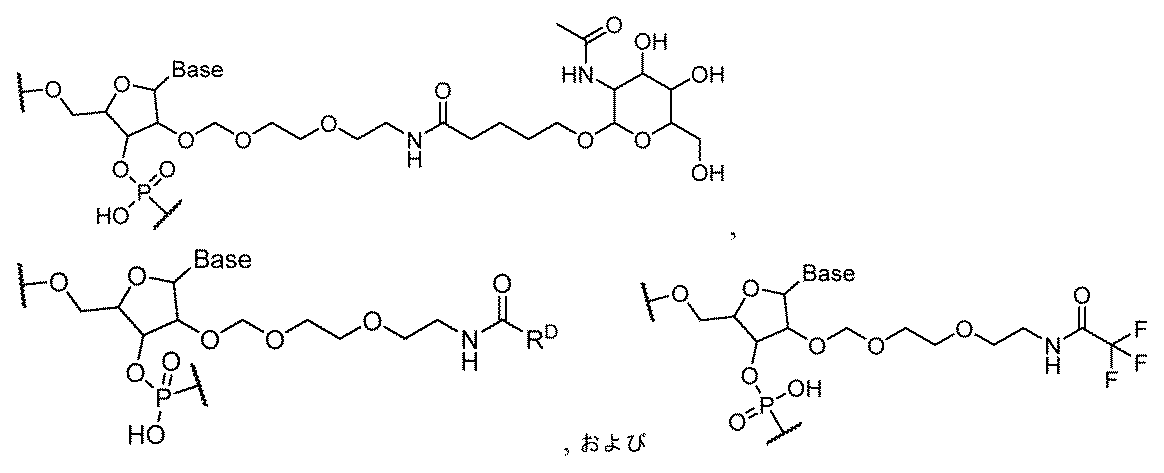
Baseは適宜修飾されたヌクレオ塩基であり、
RDは、C4~30アルキル、C4~30アルケニル(alkyenyl)、またはC4~30アルキニルである]
からなる群から選択されうる。
Base is an appropriately modified nucleobase,
R D is a C 4-30 alkyl, a C 4-30 alkenyl , or a C 4-30 alkynyl .
may be selected from the group consisting of:
一部の実施形態において、式(I)のLにおける1つまたは複数の連結部分(N)は、リガンドと適宜コンジュゲートされたモノ、ジ、トリ、テトラ、ペンタ、またはポリプロリノール;リガンドと適宜コンジュゲートされたモノ、ジ、トリ、テトラ、ペンタ、またはポリヒドロキシプロリノール;適宜修飾されたヌクレオチド;またはこれらの組合せを含む。 In some embodiments, one or more linking moieties (N) in L of formula (I) include mono-, di-, tri-, tetra-, penta-, or polyprolinol optionally conjugated to a ligand; mono-, di-, tri-, tetra-, penta-, or polyhydroxyprolinol optionally conjugated to a ligand; an optionally modified nucleotide; or a combination thereof.
一部の実施形態において、式(I)のLは、リガンドと適宜コンジュゲートされた、1つまたは複数のモノ、ジ、トリ、テトラ、ペンタまたはポリプロリノール;および1つまたは複数の適宜修飾されたヌクレオチドを含有する。 In some embodiments, L in formula (I) contains one or more mono-, di-, tri-, tetra-, penta- or polyprolinols, optionally conjugated to a ligand; and one or more optionally modified nucleotides.
一部の実施形態において、式(I)のLは、リガンドと適宜コンジュゲートされた、1つまたは複数のモノ、ジ、トリ、テトラ、ペンタまたはポリヒドロキシプロリノール;およびの1つまたは複数の適宜修飾されたヌクレオチドを含有する。 In some embodiments, L of formula (I) contains one or more mono-, di-, tri-, tetra-, penta- or polyhydroxyprolinols; and one or more optionally modified nucleotides, optionally conjugated to a ligand.
一部の実施形態において、式(I)のLにおける1つまたは複数の連結部分(N)は、 In some embodiments, one or more linking moieties (N) in L of formula (I) are

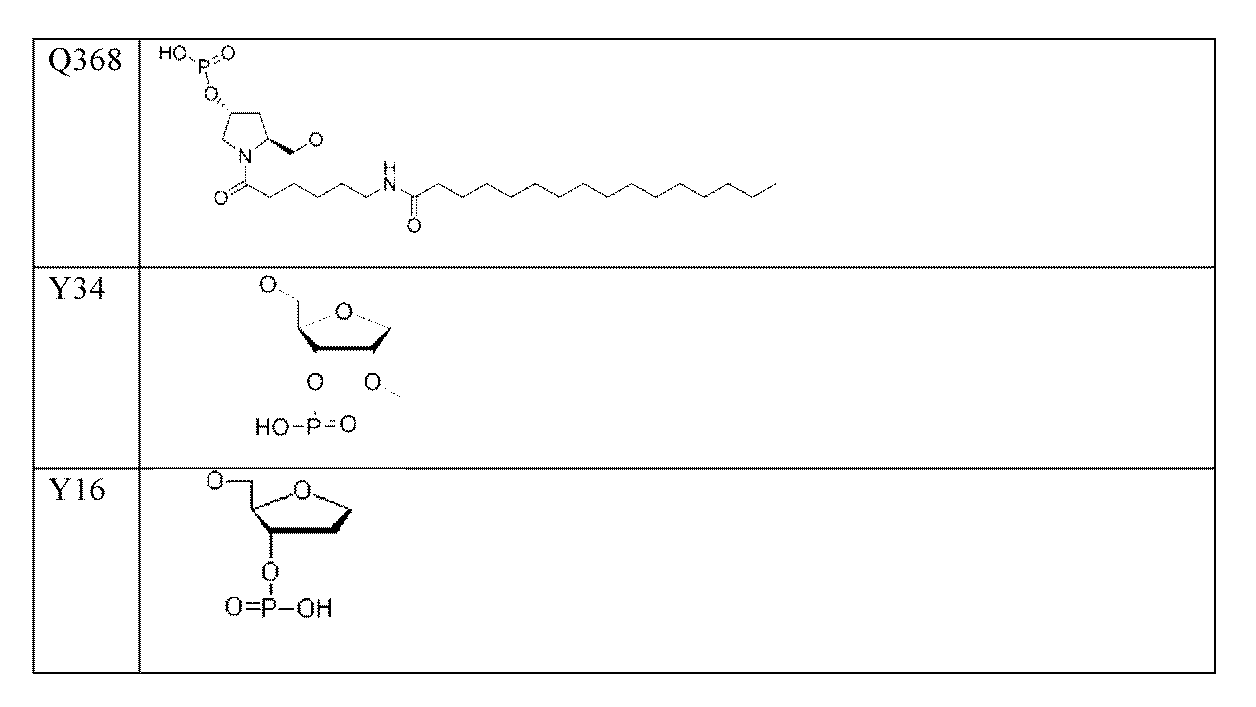
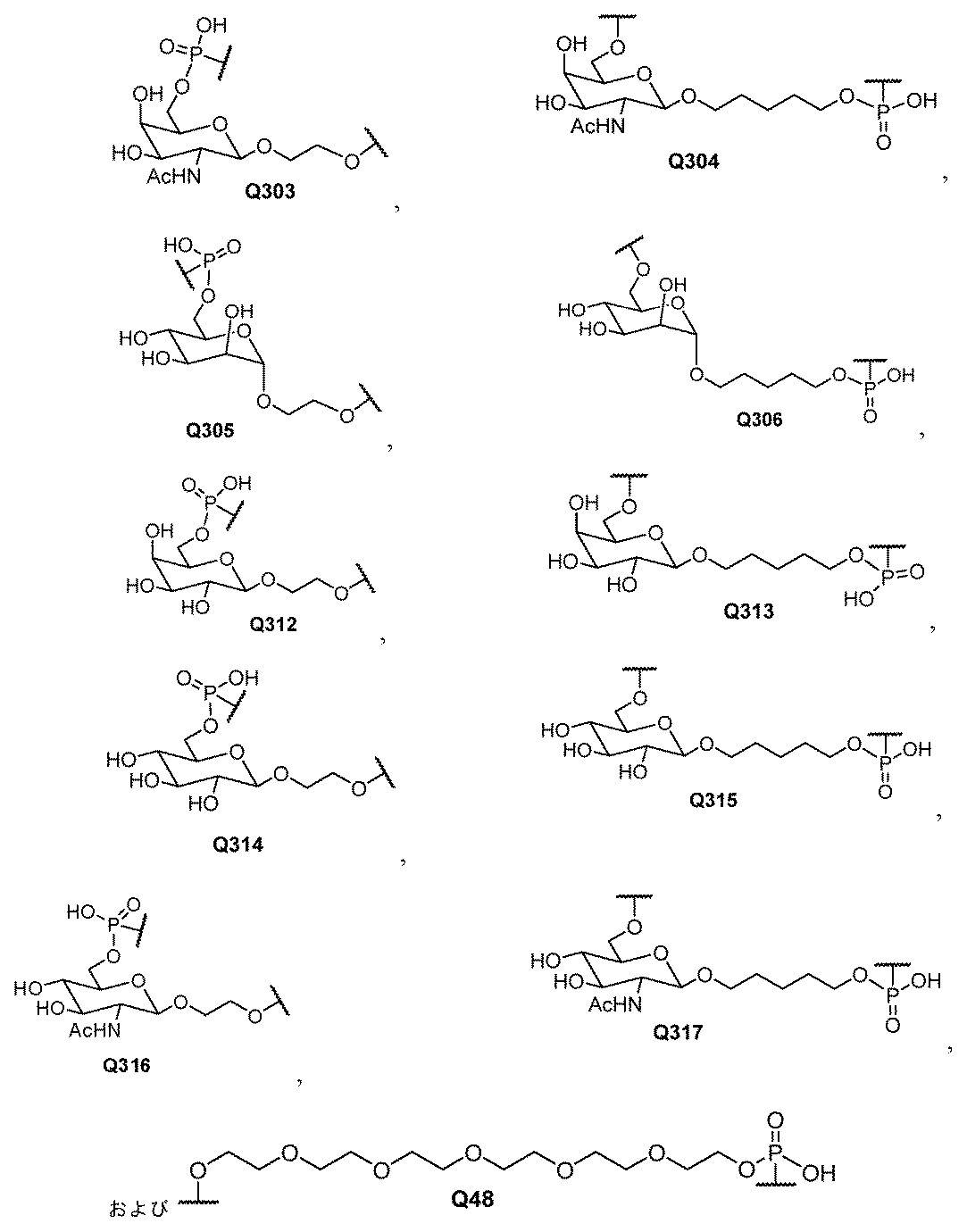
一部の実施形態において、式(I)のLは、式:#-(N)n-**によって表される連結部分を含有する。この式では、#は、Q1への結合であり、**は、Q2への結合であり;nは3~12であり;各Nは、独立に、適宜修飾されたヌクレオチド、Y34、Y16、Q48、Q303、Q304、Q305、Q306、Q312、Q313、Q314、Q315、Q316、Q317、Q8、Q11、Q150、Q151、Q173、Q221、Q222、Q367、またはQ368である。一部の実施形態において、nは3~8、4~8、3~7、4~7、3~6、4~6、または3~5である。一実施形態において、nは5である。 In some embodiments, L of formula (I) contains a linking moiety represented by the formula: #-(N) n - ** , where # is a bond to Q1 , ** is a bond to Q2 , n is 3-12, and each N is independently an optionally modified nucleotide, Y34, Y16, Q48, Q303, Q304, Q305, Q306, Q312, Q313, Q314, Q315, Q316, Q317, Q8, Q11, Q150, Q151, Q173, Q221, Q222, Q367, or Q368. In some embodiments, n is 3-8, 4-8, 3-7, 4-7, 3-6, 4-6, or 3-5. In one embodiment, n is 5.
一部の実施形態において、式(I)のLは、3~5つの2’-デオキシヌクレオチド、2’-デオキシ-2’-フルオロヌクレオチドのトリプレット、リボヌクレオチドのトリプレット、2’-O-メチルヌクレオチドのトリプレット、またはQ304のトリプレットを含有する。 In some embodiments, L of formula (I) contains 3 to 5 2'-deoxynucleotides, triplets of 2'-deoxy-2'-fluoronucleotides, triplets of ribonucleotides, triplets of 2'-O-methyl nucleotides, or triplets of Q304.
一部の実施形態において、式(I)のLは、以下:
#-mN-mN-mN-mN-mN-**、
#-rN-rN-rN-rN-rN-**、
#-rN-rN-fN-fN-fN-**、
#-dN-dN-fN-fN-fN-**、
#-dN-rN-rN-rN-dN-**、
#-dN-dN-dN-dN-dN-**、
#-mN-mN-dN-dN-dN-**、
#-mN-mN-rN-dN-dN-**、
#-mN-mN-rN-rN-rN-**、および
#-mN-mN-fN-fN-fN-**、
[式中:
dNは、2’-デオキシヌクレオチドを表し、
fNは、2’-デオキシ-2’-フルオロヌクレオチドを表し、
rNは、リボヌクレオチドを表し、
mNは、2’-O-メチルヌクレオチドを表す]
の1つを含有する。
In some embodiments, L in formula (I) is:
#-mN-mN-mN-mN-mN- ** ,
#-rN-rN-rN-rN-rN- ** ,
#-rN-rN-fN-fN-fN- ** ,
#-dN-dN-fN-fN-fN- ** ,
#-dN-rN-rN-rN-dN- ** ,
#-dN-dN-dN-dN-dN- ** ,
#-mN-mN-dN-dN-dN- ** ,
#-mN-mN-rN-dN-dN- ** ,
#-mN-mN-rN-rN-rN- ** , and #-mN-mN-fN-fN-fN- ** ,
[In the formula:
dN represents a 2'-deoxynucleotide;
fN represents 2'-deoxy-2'-fluoro nucleotide;
rN represents a ribonucleotide;
mN represents a 2'-O-methyl nucleotide.
It contains one of the following:
一部の実施形態において、式(I)のLは、以下:
#---mN-mN-Q304-Q304-Q304---**、
#---dN-dN-Q304-Q304-Q304---**、
#---rN-rN-Q304-Q304-Q304---**、
#---rN-dN-Q304-Q304-Q304---**、および
#---dN-rN-Q304-Q304-Q304---**、
[式中:
dNは、2’-デオキシヌクレオチドを表し、
fNは、2’-デオキシ-2’-フルオロヌクレオチドを表し、
rNは、リボヌクレオチドを表し、
mNは、2’-O-メチルヌクレオチドを表す]
の1つを含有する。
In some embodiments, L in formula (I) is:
#---mN-mN-Q304-Q304-Q304--- ** ,
#---dN-dN-Q304-Q304-Q304--- ** ,
#---rN-rN-Q304-Q304-Q304--- ** ,
#---rN-dN-Q304-Q304-Q304--- ** , and #---dN-rN-Q304-Q304-Q304--- ** ,
[In the formula:
dN represents a 2'-deoxynucleotide;
fN represents 2'-deoxy-2'-fluoro nucleotide;
rN represents a ribonucleotide;
mN represents a 2'-O-methyl nucleotide.
It contains one of the following:
上記の実施形態において、Lにおけるヌクレオチド間の1つまたは複数のヌクレオチド間連結は、独立に、ホスホジエステル、ホスホトリエステル(Rp配置またはSp配置のいずれかに連結リン原子を含んでもよい)、ホスホン酸水素、ホスホン酸アルキルまたはホスホン酸アリール、ホスホロアミデート(Rp配置またはSp配置のいずれかに連結リン原子を含んでもよい)、ホスホロチオエート(Rp配置またはSp配置のいずれかに連結リン原子を含んでもよい)、および窒素修飾リン含有連結(PN連結)(Rp配置またはSp配置のいずれかに連結リン原子を含んでもよい)からなる群から選択される修飾ヌクレオチド間連結でありうる。 In the above embodiments, one or more internucleotide linkages between nucleotides in L may be independently a modified internucleotide linkage selected from the group consisting of phosphodiester, phosphotriester (which may contain a linking phosphorus atom in either the Rp or Sp configuration), hydrogen phosphonate, alkyl or aryl phosphonate, phosphoramidate (which may contain a linking phosphorus atom in either the Rp or Sp configuration), phosphorothioate (which may contain a linking phosphorus atom in either the Rp or Sp configuration), and nitrogen-modified phosphorus-containing linkage (PN linkage) (which may contain a linking phosphorus atom in either the Rp or Sp configuration).
ある特定の実施形態において、式(I)のLは、トリアゾール連結、アミド連結、スルフィドまたはジスルフィド連結、リン酸連結、オキシム連結、ヒドラゾ連結、N,N’-ジアルキレンヒドラゾ連結、メチレンイミノ連結、メチレンカルボニルアミノ連結、メチレンメチルイミノ連結、メチレンヒドラゾ連結、メチレンジメチルヒドラゾ連結、メチレンオキシメチルイミノ連結、ヒドロキシルアミノ連結、ホルムアセタール連結、アルキルまたはアリール連結、PEG連結、エーテル連結、チオエーテル連結、チオジエステル連結、チオノカルバメート連結、チオアセトアミド連結、スルホン酸連結、スルホンアミド連結、スルホン酸エステル連結、チオホルムアセタール連結、尿素連結、炭酸塩連結、アミン連結、マレイミド-チオエーテル連結、ホスホジエステル連結、ホスホトリエステル連結、ホスホン酸水素連結、アルキルまたはアリールホスホン酸連結、ホスホラミデート連結、ホスホロチオエート連結、窒素修飾リン含有連結(PN-連結)、ホスホロセレネート連結、ボラノホスフェート連結、ボラノホスフェートエステル連結、スルホンアミド連結、カルバメート連結、カルボキサミド連結、カルボキシメチル連結、カルボキシレートエステル連結、シロキサン連結、ジアルキルシロキサン連結、エチレンオキシド連結、およびこれらの組合せからなる群から選択される1つまたは複数の連結部分を含有しうる。 In certain embodiments, L in formula (I) is a triazole linkage, an amide linkage, a sulfide or disulfide linkage, a phosphate linkage, an oxime linkage, a hydrazo linkage, an N,N'-dialkylenehydrazo linkage, a methyleneimino linkage, a methylenecarbonylamino linkage, a methylenemethylimino linkage, a methylenehydrazo linkage, a methylenedimethylhydrazo linkage, a methyleneoxymethylimino linkage, a hydroxylamino linkage, a formacetal linkage, an alkyl or aryl linkage, a PEG linkage, an ether linkage, a thioether linkage, a thiodiester linkage, a thionocarbamate linkage, a thioacetamide linkage, a sulfonic acid linkage, a sulfonamide linkage, a sulfonate ester linkage, a thioforma ... It may contain one or more linking moieties selected from the group consisting of cetal linkages, urea linkages, carbonate linkages, amine linkages, maleimide-thioether linkages, phosphodiester linkages, phosphotriester linkages, hydrogen phosphonate linkages, alkyl or aryl phosphonate linkages, phosphoramidate linkages, phosphorothioate linkages, nitrogen-modified phosphorus-containing linkages (PN-linkages), phosphoroselenate linkages, boranophosphate linkages, boranophosphate ester linkages, sulfonamide linkages, carbamate linkages, carboxamide linkages, carboxymethyl linkages, carboxylate ester linkages, siloxane linkages, dialkylsiloxane linkages, ethylene oxide linkages, and combinations thereof.
ある特定の実施形態において、式(I)のLは、ピロリジニル、ピラゾリニル、ピラゾリジニル、イミダゾリニル、イミダゾリジニル、ピペリジニル、ピペラジニル、[1,3]ジオキソラン、オキサゾリジニル、イソキサゾリジニル、モルホリニル、チアゾリジニル、イソチアゾリジニル、キノキサリニル、ピリダジノニル、テトラヒドロフラニル、およびデカリニルからなる群から選択される1つまたは複数の環状基を含有しうる。 In certain embodiments, L in formula (I) may contain one or more cyclic groups selected from the group consisting of pyrrolidinyl, pyrazolinyl, pyrazolidinyl, imidazolinyl, imidazolidinyl, piperidinyl, piperazinyl, [1,3]dioxolane, oxazolidinyl, isoxazolidinyl, morpholinyl, thiazolidinyl, isothiazolidinyl, quinoxalinyl, pyridazinonyl, tetrahydrofuranyl, and decalinyl.
一部の実施形態において、式(I)のLは、ヌクレオチドベースのリンカー(テザー)を含有する。一部の実施形態において、Lは、非ヌクレオチドベースのリンカー(テザー)を含有する。 In some embodiments, L in formula (I) contains a nucleotide-based linker (tether). In some embodiments, L contains a non-nucleotide-based linker (tether).
ある特定の実施形態において、Lに含有されるヌクレオチドベースまたは非ヌクレオチドベースのリンカー(テザー)は、体液中で安定である、安定なリンカー(テザー)である。例えば、ヌクレオチドベースまたは非ヌクレオチドベースの安定なリンカー(テザー)は、血漿または人工脳脊髄液中で安定である。 In certain embodiments, the nucleotide-based or non-nucleotide-based linker (tether) contained in L is a stable linker (tether) that is stable in body fluids. For example, the nucleotide-based or non-nucleotide-based stable linker (tether) is stable in plasma or artificial cerebrospinal fluid.
ある特定の実施形態において、切断型連結基(テザー)は、 In certain embodiments, the cleavable linker (tether) is


からなる群から選択される部分を含む。
The moiety is selected from the group consisting of:
ある特定の実施形態において、切断型連結基(テザー)は、以下:
-(CH2)12-(C12リンカーまたはQ50)、
-(CH2)6-S-S-(CH2)6-(C6-S-S-C6リンカーまたはQ51)、
Q151(
In certain embodiments, the cleavable tether is:
-( CH2 ) 12- ( C12 linker or Q50),
-( CH2 ) 6 -S-S-( CH2 ) 6- (C6-S-S-C6 linker or Q51),
Q151(
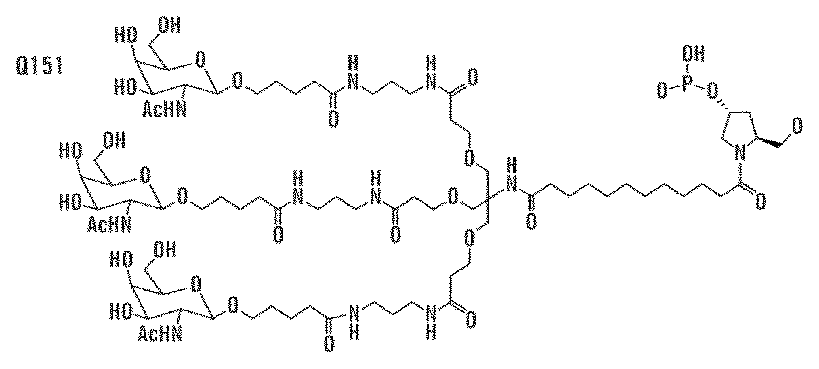

-(CH2)9-(CH2)n-CH2-[式中、nは0または1~20である];
リガンドと適宜コンジュゲートされたモノ-、ジ-、トリ-、テトラ-、ペンタ-またはポリプロリノール、
リガンドと適宜コンジュゲートされたモノ-、ジ-、トリ-、テトラ-、ペンタ-またはポリヒドロキシプロリノール
から選択される部分を含む。
-( CH2 ) 9- ( CH2 ) n - CH2- , where n is 0 or 1 to 20;
mono-, di-, tri-, tetra-, penta- or polyprolinols, appropriately conjugated with a ligand;
It comprises a moiety selected from mono-, di-, tri-, tetra-, penta-, or polyhydroxyprolinol optionally conjugated to a ligand.
ある特定の実施形態において、切断型連結基(テザー)は、1~15ヌクレオチド長の核酸リンカーを含む。例えば、核酸リンカーは、2~7、5~7、2~5、または3、4、もしくは5の適宜修飾されたヌクレオチド長でありうる。 In certain embodiments, the cleavable linking group (tether) comprises a nucleic acid linker that is 1-15 nucleotides in length. For example, the nucleic acid linker can be 2-7, 5-7, 2-5, or 3, 4, or 5 appropriately modified nucleotides in length.
ある特定の実施形態において、切断型連結基(テザー)は、2’-O-メチルヌクレオチド、2’-フルオロヌクレオチド、デオキシリボヌクレオチド、およびリボヌクレオチドからなる群から選択される1つまたは複数のヌクレオチドを含む核酸リンカーを含む。一実施形態において、全ての核酸リンカーヌクレオチドは、同じ型のヌクレオチドである。一実施形態において、核酸リンカーは、2’-O-メチルヌクレオチドを完全に含み、2’-フルオロヌクレオチドを完全に含み、またはデオキシリボヌクレオチドを完全に含む。 In certain embodiments, the cleavable linking group (tether) comprises a nucleic acid linker that comprises one or more nucleotides selected from the group consisting of 2'-O-methyl nucleotides, 2'-fluoro nucleotides, deoxyribonucleotides, and ribonucleotides. In one embodiment, all of the nucleic acid linker nucleotides are the same type of nucleotide. In one embodiment, the nucleic acid linker is entirely composed of 2'-O-methyl nucleotides, entirely composed of 2'-fluoro nucleotides, or entirely composed of deoxyribonucleotides.
ある特定の実施形態において、切断型連結基(テザー)は、修飾されたリボヌクレオチド配列を含むポリヌクレオチドを含み、2’-O-メチルリボヌクレオチド修飾、2’-フルオロ-リボヌクレオチド修飾、異なる3’-修飾(3’-リボ、3’-O-メチル、3’--デオキシ、3’-フルオロ)を有する2’-5’-連結ヌクレオチド、グリコール核酸(GNA)修飾、ロック核酸(LNA)修飾、ヘキサノール核酸(HNA)修飾、脱塩基リボース修飾、脱塩基デオキシリボース修飾、および脱塩基ヒドロキシプロリノール修飾からなる群から選択される1つまたは複数の修飾を含むポリヌクレオチドでもよい。 In certain embodiments, the cleavable linking group (tether) comprises a polynucleotide comprising a modified ribonucleotide sequence, which may be a polynucleotide comprising one or more modifications selected from the group consisting of 2'-O-methyl ribonucleotide modifications, 2'-fluoro-ribonucleotide modifications, 2'-5'-linked nucleotides with different 3'-modifications (3'-ribo, 3'-O-methyl, 3'-deoxy, 3'-fluoro), glycol nucleic acid (GNA) modifications, locked nucleic acid (LNA) modifications, hexanol nucleic acid (HNA) modifications, abasic ribose modifications, abasic deoxyribose modifications, and abasic hydroxyprolinol modifications.
一部の実施形態において、式(I)の一本鎖オリゴヌクレオチドの連結基Lは、DICERによって切断可能である、ヌクレオチドベースの切断型連結基(テザー)を含む。一部の実施形態において、一本鎖オリゴヌクレオチドは、DICERによって切断可能な基質を含む。 In some embodiments, the linking group L of the single-stranded oligonucleotide of formula (I) comprises a nucleotide-based cleavable linking group (tether) that is cleavable by DICER. In some embodiments, the single-stranded oligonucleotide comprises a substrate that is cleavable by DICER.
ある特定の実施形態において、一本鎖オリゴヌクレオチドは、一本鎖オリゴヌクレオチドの少なくとも1つのヌクレオチド配列(例えば、Z1および/またはZ2)において、5’-一リン酸の代謝物を生成することができる切断型連結基(ヌクレオチドベースまたは非ヌクレオチドベース)を含有する。 In certain embodiments, the single-stranded oligonucleotide contains a cleavable linker (nucleotide-based or non-nucleotide-based) capable of generating a 5'-monophosphate metabolite in at least one nucleotide sequence (e.g., Z1 and/or Z2 ) of the single-stranded oligonucleotide.
一部の実施形態において、一本鎖オリゴヌクレオチドは、1つまたは複数のリガンド(例えば、ターゲティングリガンド)をさらに含みうる。一実施形態において、Z1は、配列の5’または3’末端に、少なくとも1つのリガンド(例えば、ターゲティングリガンド)を含む。一実施形態において、Z2は、配列の5’または3’末端に、少なくとも1つのリガンド(例えば、ターゲティングリガンド)を含む。一実施形態において、Z1およびZ2のそれぞれは、配列の5’または3’末端に、少なくとも1つのリガンド(例えば、ターゲティングリガンド)を含む。 In some embodiments, the single stranded oligonucleotide may further comprise one or more ligands (e.g., targeting ligands). In one embodiment, Z 1 comprises at least one ligand (e.g., targeting ligand) at the 5' or 3' end of the sequence. In one embodiment, Z 2 comprises at least one ligand (e.g., targeting ligand) at the 5' or 3' end of the sequence. In one embodiment, each of Z 1 and Z 2 comprises at least one ligand (e.g., targeting ligand) at the 5' or 3' end of the sequence.
ある特定の実施形態において、少なくとも1つのリガンドは、親油性部分である。 In certain embodiments, at least one ligand is a lipophilic moiety.
一実施形態において、親油性部分は、脂質、コレステロール、レチノイン酸、コール酸、アダマンタン酢酸、1-ピレン酪酸、ドコサン酸(DCA)、ジヒドロテストステロン、1,3-ビス-O(ヘキサデシル)グリセロール、ゲラニルオキシヘキシアノール(geranyloxyhexyanol)、ヘキサデシルグリセロール、ボルネオール、メントール、1,3-プロパンジオール、ヘプタデシル基、パルミチン酸、ミリスチン酸、リトコール酸、O3-(オレオイル)リトコール酸、O3-(オレオイル)コレン酸、ジメトキシトリチル、またはフェノキサジンである。ある特定の実施形態において、脂質は、エイコサペンタエン酸(EPA)およびドコサヘキサエン酸(DHA)からなる群から選択される、脂肪酸(オメガ-3脂肪酸、例えば)である。 In one embodiment, the lipophilic moiety is a lipid, cholesterol, retinoic acid, cholic acid, adamantane acetic acid, 1-pyrenebutyric acid, docosanoic acid (DCA), dihydrotestosterone, 1,3-bis-O(hexadecyl)glycerol, geranyloxyhexyanol, hexadecylglycerol, borneol, menthol, 1,3-propanediol, heptadecyl radical, palmitic acid, myristic acid, lithocholic acid, O3-(oleoyl)lithocholic acid, O3-(oleoyl)cholenoic acid, dimethoxytrityl, or phenoxazine. In certain embodiments, the lipid is a fatty acid (omega-3 fatty acid, for example) selected from the group consisting of eicosapentaenoic acid (EPA) and docosahexaenoic acid (DHA).
一部の実施形態において、親油性部分は、飽和または不飽和C4~C30炭化水素鎖(例えば、C4~C30アルキルまたはアルケニル)、ならびにヒドロキシル、アミン、カルボン酸、スルホン酸、リン酸、チオール、アジド、およびアルキンからなる群から選択される任意の官能基を含有する。 In some embodiments, the lipophilic moiety contains a saturated or unsaturated C4 - C30 hydrocarbon chain (e.g., a C4 - C30 alkyl or alkenyl) and any functional group selected from the group consisting of hydroxyl, amine, carboxylic acid, sulfonic acid, phosphate, thiol, azide, and alkyne.
一部の実施形態において、親油性部分は、飽和または不飽和C6~C18炭化水素鎖(例えば、線状C6~C18アルキルまたはアルケニル)、例えば、飽和または不飽和C16炭化水素鎖(例えば、線状C16アルキルまたはアルケニル)を含有する。一部の実施形態において、親油性部分は、飽和または不飽和C14~C24炭化水素鎖(例えば、線状C14~C24アルキルまたはアルケニル)、例えば、飽和または不飽和C22炭化水素鎖(例えば、線状C22アルキルまたはアルケニル)を含有する。例えば、一本鎖オリゴヌクレオチドの1つまたは複数の非末端位置は、以下の構造: In some embodiments, the lipophilic moiety contains a saturated or unsaturated C 6 -C 18 hydrocarbon chain (e.g., a linear C 6 -C 18 alkyl or alkenyl), such as a saturated or unsaturated C 16 hydrocarbon chain (e.g., a linear C 16 alkyl or alkenyl). In some embodiments, the lipophilic moiety contains a saturated or unsaturated C 14 -C 24 hydrocarbon chain (e.g., a linear C 14 -C 24 alkyl or alkenyl), such as a saturated or unsaturated C 22 hydrocarbon chain (e.g., a linear C 22 alkyl or alkenyl). For example, one or more non-terminal positions of the single stranded oligonucleotide have the following structure:
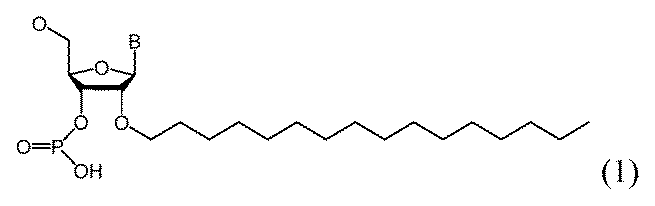
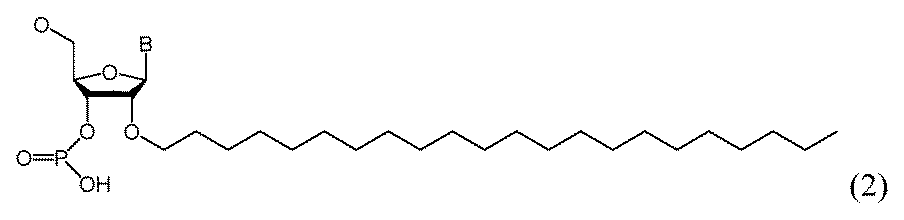
n-ヘキサデシル鎖またはn-ドコサニル鎖を、C4~C30炭化水素鎖と置換する類似の修飾は、「2’-C4~C30炭化水素鎖」と呼ばれる(または、C6~C18炭化水素鎖またはC14~C24炭化水素鎖との置換は、「2’-C6~C18炭化水素鎖」または「2’-C14~C24炭化水素鎖」と呼ばれる)。 A similar modification replacing an n-hexadecyl or n-docosanyl chain with a C 4 -C 30 hydrocarbon chain is referred to as a "2'-C 4 -C 30 hydrocarbon chain" (or a C 6 -C 18 or C 14 -C 24 hydrocarbon chain is referred to as a "2'-C 6 -C 18 hydrocarbon chain" or "2'-C 14 -C 24 hydrocarbon chain").
関連する実施形態において、Z1およびZ2の少なくとも1つの1つまたは複数の非末端ヌクレオチド位置は、式(1)の2’-C4~C30炭化水素鎖構造、2’-C6~C18炭化水素鎖構造、2’-C14~C24炭化水素鎖構造、2’-C16構造、または式(2)の2’-C22構造を有する。 In related embodiments, one or more non-terminal nucleotide positions of at least one of Z1 and Z2 have a 2'- C4 to C30 hydrocarbon chain structure of formula (1), a 2'- C6 to C18 hydrocarbon chain structure, a 2'- C14 to C24 hydrocarbon chain structure, a 2'- C16 structure, or a 2'- C22 structure of formula (2).
一実施形態において、Z1とZ2の両方の1つまたは複数の非末端ヌクレオチド位置は、式(1)の2’-C4~C30炭化水素鎖構造、2’-C6~C18炭化水素鎖構造、2’-C14~C24炭化水素鎖構造、2’-C16構造、または式(2)の2’-C22構造を有する。 In one embodiment, one or more non-terminal nucleotide positions of both Z1 and Z2 have a 2'- C4 to C30 hydrocarbon chain structure of formula (1), a 2'-C6 to C18 hydrocarbon chain structure, a 2'- C14 to C24 hydrocarbon chain structure, a 2'-C16 structure, or a 2'-C22 structure of formula (2).
一部の実施形態において、親油性部分は、1つまたは複数のリン脂質を含有する。 In some embodiments, the lipophilic portion contains one or more phospholipids.
一部の実施形態において、親油性部分は、その全てが、その全体を参照により本明細書に組み込まれる、国際PCT出願公開WO2019/232255A1およびWO2021/108662A1、ならびに米国特許第10,184,124号に開示される、1つまたは複数の脂質または親油性リガンドを含有する。 In some embodiments, the lipophilic moiety contains one or more lipids or lipophilic ligands as disclosed in International PCT Publication Nos. WO 2019/232255 A1 and WO 2021/108662 A1, and U.S. Pat. No. 10,184,124, all of which are incorporated herein by reference in their entireties.
一部の実施形態において、リガンドは、以下の式: In some embodiments, the ligand has the following formula:

の1つまたは複数を含む。
The present invention includes one or more of the following:
一部の実施形態において、リガンドは、その全てが、その全体を参照により本明細書に組み込まれる、国際PCT出願公開WO2017/053999、WO2019/118916、WO2022/031433、WO2022/056269、WO2022/056273、およびWO2022/056277に開示されるものを含む。 In some embodiments, the ligands include those disclosed in International PCT Publications WO2017/053999, WO2019/118916, WO2022/031433, WO2022/056269, WO2022/056273, and WO2022/056277, all of which are incorporated by reference in their entireties.
一部の実施形態において、Z1およびZ2の少なくとも1つは、ヌクレオチド配列の9~12位を除く1つまたは複数の内部位置(すなわち非末端位置);例えば、1位としてヌクレオチド配列の5’末端からそれぞれカウントして、ヌクレオチド配列の4~8位および13~18;ヌクレオチド配列の5、6、7、15、および17位;またはヌクレオチド配列の4、6、7、および8位に独立にコンジュゲートした1つまたは複数の親油性部分を含む。 In some embodiments, at least one of Z1 and Z2 comprises one or more lipophilic moieties independently conjugated to one or more internal positions (i.e., non-terminal positions) other than positions 9-12 of the nucleotide sequence; for example, positions 4-8 and 13-18 of the nucleotide sequence, respectively, counting from the 5' end of the nucleotide sequence as position 1; positions 5, 6, 7, 15, and 17 of the nucleotide sequence; or positions 4, 6, 7, and 8 of the nucleotide sequence.
一部の実施形態において、Z1およびZ2の少なくとも1つは、ヌクレオチド配列の5’末端からカウントして、ヌクレオチド配列の6位に独立にコンジュゲートした1つまたは複数の親油性部分を含む。一実施形態において、Z1およびZ2のそれぞれは、ヌクレオチド配列の6位にコンジュゲートした親油性部分を含み;親油性部分は、飽和もしくは不飽和C6~C18炭化水素鎖、または飽和もしくは不飽和C14~C24炭化水素鎖を含んでもよく;親油性部分は、飽和もしくは不飽和C16炭化水素鎖または飽和もしくは不飽和C22炭化水素鎖を含んでもよい。 In some embodiments, at least one of Z1 and Z2 comprises one or more lipophilic moieties independently conjugated to position 6 of the nucleotide sequence, counting from the 5' end of the nucleotide sequence. In one embodiment, each of Z1 and Z2 comprises a lipophilic moiety conjugated to position 6 of the nucleotide sequence; the lipophilic moiety may comprise a saturated or unsaturated C6 - C18 hydrocarbon chain, or a saturated or unsaturated C14 - C24 hydrocarbon chain; the lipophilic moiety may comprise a saturated or unsaturated C16 hydrocarbon chain or a saturated or unsaturated C22 hydrocarbon chain.
一部の実施形態において、Z1およびZ2の少なくとも1つは、ヌクレオチド配列の1つまたは複数の内部位置(すなわち非末端位置);例えば、1位としてヌクレオチド配列の5’末端からそれぞれカウントして、ヌクレオチド配列の6~10位および15~18位;ならびにヌクレオチド配列の15位および17位に独立にコンジュゲートした1つまたは複数の親油性部分を含む。 In some embodiments, at least one of Z1 and Z2 comprises one or more lipophilic moieties independently conjugated to one or more internal positions (i.e., non-terminal positions) of the nucleotide sequence; for example, positions 6-10 and 15-18 of the nucleotide sequence, respectively, counting from the 5' end of the nucleotide sequence as position 1; and positions 15 and 17 of the nucleotide sequence.
一部の実施形態において、少なくとも1つのリガンドは、抗体、抗原、葉酸、受容体リガンド、炭化水素、アプタマー、インテグリン受容体リガンド、ケモカイン受容体リガンド、トランスフェリン、ビオチン、セロトニン受容体リガンド、PSMA、エンドセリン、GCPII、ソマトスタチン、LDLおよびHDLリガンドからなる群から選択されるターゲティングリガンドである。一実施形態において、少なくとも1つのリガンドは、インテグリン受容体リガンドである。 In some embodiments, at least one ligand is a targeting ligand selected from the group consisting of an antibody, an antigen, folate, a receptor ligand, a carbohydrate, an aptamer, an integrin receptor ligand, a chemokine receptor ligand, transferrin, biotin, a serotonin receptor ligand, PSMA, endothelin, GCPII, somatostatin, LDL and HDL ligands. In one embodiment, at least one ligand is an integrin receptor ligand.
ターゲティングリガンドは、適宜リンカーまたは担体を介して、ヌクレオチド配列(例えば、Z11およびZ12)の内部位置にコンジュゲートされうる。あるいは、ターゲティングリガンドは、適宜リンカーまたは担体を介して、Z11およびZ12の3’末端または5’末端にコンジュゲートされうる。 The targeting ligand may be conjugated to an internal position of the nucleotide sequence (e.g., Z11 and Z12 ) via a suitable linker or carrier. Alternatively, the targeting ligand may be conjugated to the 3' or 5' end of Z11 and Z12 via a suitable linker or carrier.
ある特定の実施形態において、少なくとも1つのリガンドは、炭化水素ベースのリガンドである。炭化水素ベースのリガンドは、D-ガラクトース、多価ガラクトース、N-アセチル-D-ガラクトサミン(GalNAc)、多価GalNAc、D-マンノース、多価マンノース、多価ラクトース、N-アセチル-グルコサミン、グルコース、多価グルコース、多価フコース、グリコシル化ポリアミノアシド、またはレクチンでありうる。 In certain embodiments, at least one ligand is a carbohydrate-based ligand. The carbohydrate-based ligand can be D-galactose, multivalent galactose, N-acetyl-D-galactosamine (GalNAc), multivalent GalNAc, D-mannose, multivalent mannose, multivalent lactose, N-acetyl-glucosamine, glucose, multivalent glucose, multivalent fucose, glycosylated polyamino acid, or a lectin.
ある特定の実施形態において、炭化水素ベースのリガンドは、ASGPRリガンドである。例えば、ASGPRリガンドは、二価または三価の分岐状リンカー、例えば: In certain embodiments, the hydrocarbon-based ligand is an ASGPR ligand. For example, the ASGPR ligand may be linked to a bivalent or trivalent branched linker, such as:
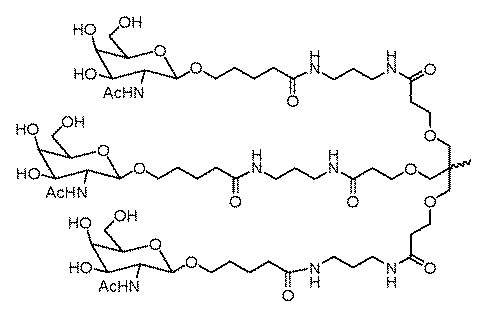
ある特定の実施形態において、少なくとも1つのリガンドは、ヌクレオチド配列(例えば、Z1およびZ2)の3’末端、5’末端、または内部位置にコンジュゲートされうる。 In certain embodiments, at least one ligand may be conjugated to the 3' end, the 5' end, or an internal position of the nucleotide sequence (eg, Z 1 and Z 2 ).
一部の実施形態において、少なくとも1つのリガンドは、オリゴヌクレオチドのリボ糖(ribosugar)への直接接合を介して、一本鎖オリゴヌクレオチドにコンジュゲートされうる。あるいは、リガンドは、1つまたは複数のリンカー(テザー)、および/または担体を介して、一本鎖オリゴヌクレオチドにコンジュゲートされうる。 In some embodiments, at least one ligand may be conjugated to the single-stranded oligonucleotide via direct conjugation to the ribosugar of the oligonucleotide. Alternatively, the ligand may be conjugated to the single-stranded oligonucleotide via one or more linkers (tethers) and/or carriers.
一部の実施形態において、リガンドは、一価または分岐状二価もしくは三価のリンカーを介して一本鎖オリゴヌクレオチドにコンジュゲートされうる。 In some embodiments, the ligand may be conjugated to the single-stranded oligonucleotide via a monovalent or branched divalent or trivalent linker.
一部の実施形態において、リガンドは、1つまたは複数のヌクレオチド(複数可)を置換する担体を介して一本鎖オリゴヌクレオチドにコンジュゲートされうる。担体は、環式基または非環式基でありうる。一実施形態において、環式基は、シクロヘキシル、ピロリジニル、ピラゾリニル、ピラゾリジニル、イミダゾリニル、イミダゾリジニル、ピペリジニル、ピペラジニル、[1,3]ジオキソラン、オキサゾリジニル、イソキサゾリジニル、モルホリニル、チアゾリジニル、イソチアゾリジニル、キノキサリニル、ピリダジノニル、テトラヒドロフラニル、およびデカリニルからなる群から選択される。一実施形態において、非環式基は、セリノール骨格またはジエタノールアミン骨格に基づく部分である。 In some embodiments, the ligand may be conjugated to the single-stranded oligonucleotide via a carrier that replaces one or more nucleotide(s). The carrier may be a cyclic or acyclic group. In one embodiment, the cyclic group is selected from the group consisting of cyclohexyl, pyrrolidinyl, pyrazolinyl, pyrazolidinyl, imidazolinyl, imidazolidinyl, piperidinyl, piperazinyl, [1,3]dioxolane, oxazolidinyl, isoxazolidinyl, morpholinyl, thiazolidinyl, isothiazolidinyl, quinoxalinyl, pyridazinonyl, tetrahydrofuranyl, and decalinyl. In one embodiment, the acyclic group is a moiety based on a serinol backbone or a diethanolamine backbone.
一部の実施形態において、一本鎖オリゴヌクレオチドは、
(a)Z1およびZ2は、それぞれ独立に、19~23の適宜修飾されたヌクレオチドを含有すること;
(b)Q1およびQ2は、それぞれ独立に、0~2の適宜修飾されたヌクレオチドを含有すること;
(c)Z1およびZ2によって形成された二重鎖領域は3以下のミスマッチ塩基対を含有すること;
(d)Z1およびZ2によって形成された二重鎖領域は平滑末端を形成すること;
(e)Z2の少なくとも1つのヌクレオチドは、修飾ヌクレオチドであること;
(f)Z1の少なくとも1つのヌクレオチドは、修飾ヌクレオチドであること;
(g)Z2は、少なくとも1つの修飾ヌクレオチド間連結を含むこと;
(h)Z1は、少なくとも1つの修飾ヌクレオチド間連結を含むこと;
(i)5’末端ヌクレオチドは、5’-リン酸または5’-リン酸模倣体修飾を含むこと;
(j)3’末端ヌクレオチドは、リガンドにコンジュゲートされ、リンカーを介してもよいこと;
(k)Z1は、標的遺伝子に対して3つ以下のミスマッチを含有すること;
(l)Z1およびZ2は、それぞれ独立に、19~23の適宜修飾されたヌクレオチドを含有すること;ならびに
(m)Lは、式:#-(N)n-**[式中、nは3~5であり;各Nは、独立に、適宜修飾されたヌクレオチド、Y16、Y34、Q48、Q303、Q304、Q305、Q306、Q312、Q313、Q314、Q315、Q316、Q317、Q8、Q11、Q150、Q151、Q173、Q221、Q222、Q367、またはQ368である]によって表される連結部分を含有すること
の1つまたは複数によって特徴付けられうる。
In some embodiments, the single stranded oligonucleotide comprises:
(a) Z1 and Z2 each independently contain 19 to 23 optionally modified nucleotides;
(b) Q1 and Q2 each independently contain 0 to 2 optionally modified nucleotides;
(c) the duplex region formed by Z1 and Z2 contains no more than three mismatched base pairs;
(d) the duplex region formed by Z1 and Z2 forms a blunt end;
(e) at least one nucleotide of Z2 is a modified nucleotide;
(f) at least one nucleotide of Z1 is a modified nucleotide;
(g) Z2 contains at least one modified internucleotide linkage;
(h) Z1 contains at least one modified internucleotide linkage;
(i) the 5'-terminal nucleotide contains a 5'-phosphate or a 5'-phosphate mimetic modification;
(j) the 3' terminal nucleotide is conjugated to a ligand, optionally via a linker;
(k) Z1 contains no more than three mismatches to the target gene;
(l) Z1 and Z2 each independently contain 19-23 optionally modified nucleotides; and (m) L contains a linking moiety represented by the formula: #-(N) n - ** , where n is 3-5; each N is independently an optionally modified nucleotide, Y16, Y34, Q48, Q303, Q304, Q305, Q306, Q312, Q313, Q314, Q315, Q316, Q317, Q8, Q11, Q150, Q151, Q173, Q221, Q222, Q367, or Q368.
一部の実施形態において、一本鎖オリゴヌクレオチドは、上記の特徴の2またはそれ以上、3またはそれ以上、4またはそれ以上、5またはそれ以上、6またはそれ以上、7またはそれ以上、8またはそれ以上、9またはそれ以上、10またはそれ以上、11またはそれ以上、12またはそれ以上、または全てによって特徴付けられうる。 In some embodiments, the single stranded oligonucleotide may be characterized by two or more, three or more, four or more, five or more, six or more, seven or more, eight or more, nine or more, ten or more, eleven or more, twelve or more, or all of the above features.
一部の実施形態において、一本鎖オリゴヌクレオチドは、
(a)Z1およびZ2は、それぞれ独立に、21の適宜修飾されたヌクレオチドを含有すること;
(b)Q1およびQ2は、それぞれ独立に、2の適宜修飾されたヌクレオチドを含有すること;
(c)Z1およびZ2によって形成された二重鎖領域は3以下のミスマッチ塩基対を含有すること;
(d)Z1およびZ2によって形成された二重鎖領域は平滑末端を形成すること;
(e)Z2の全てのヌクレオチドは、修飾ヌクレオチドであること;
(f)Z1の全てのヌクレオチドは、修飾ヌクレオチドであること;
(g)Z2は、少なくとも2つの連続修飾ヌクレオチド間連結を含むこと;
(h)Z1は、少なくとも2つの連続修飾ヌクレオチド間連結を含むこと;
(i)Z1の5’末端ヌクレオチドは、5’-リン酸または5’-リン酸模倣体修飾を含むこと;
(j)Z2の3’末端ヌクレオチドは、リガンドにコンジュゲートされ、リンカーを介してもよいこと;
(k)Z1は、標的遺伝子に対して3つ以下のミスマッチを含有すること;ならびに
(l)Lは、式:#-(N)n-**[式中、nは5であり;各Nは、独立に、適宜修飾されたヌクレオチドまたはQ304である]によって表される連結部分を含有すること
の1つまたは複数によって特徴付けられうる。
In some embodiments, the single stranded oligonucleotide comprises:
(a) Z1 and Z2 each independently contain 21 optionally modified nucleotides;
(b) Q1 and Q2 each independently contain two optionally modified nucleotides;
(c) the duplex region formed by Z1 and Z2 contains no more than three mismatched base pairs;
(d) the duplex region formed by Z1 and Z2 forms a blunt end;
(e) all nucleotides of Z2 are modified nucleotides;
(f) all nucleotides of Z1 are modified nucleotides;
(g) Z2 comprises at least two consecutive modified internucleotide linkages;
(h) Z1 comprises at least two consecutive modified internucleotide linkages;
(i) the 5'-terminal nucleotide of Z1 contains a 5'-phosphate or a 5'-phosphate mimetic modification;
(j) the 3' terminal nucleotide of Z2 is conjugated to a ligand, optionally via a linker;
(k) Z1 contains no more than three mismatches to the target gene; and (l) L contains a linking moiety represented by the formula: #-(N) n - ** , where n is 5; and each N is independently an optionally modified nucleotide or Q304.
一部の実施形態において、一本鎖オリゴヌクレオチドは、上記の特徴の2またはそれ以上、3またはそれ以上、4またはそれ以上、5またはそれ以上、6またはそれ以上、7またはそれ以上、8またはそれ以上、9またはそれ以上、10またはそれ以上、11またはそれ以上、12またはそれ以上、または全てによって特徴付けられうる。 In some embodiments, the single stranded oligonucleotide may be characterized by two or more, three or more, four or more, five or more, six or more, seven or more, eight or more, nine or more, ten or more, eleven or more, twelve or more, or all of the above features.
本発明の別の態様は、式(II)または(III):
(5’-Z11-3’)-L-QS-(5’-Z12-3’) (II)、
(3’-Z11-5’)-L-QS-(3’-Z12-5’) (III)、
[式中:
Z11は、標的遺伝子と実質的に相補的である、15~100の適宜修飾されたヌクレオチドを含む、第1のオリゴヌクレオチドであり;
Z12は、Z11と実質的に相補的である、10~100の適宜修飾されたヌクレオチドを含む、第2のオリゴヌクレオチドであり;
Z11およびZ12は、7またはそれ以上の連続塩基対を含む鎖内二重鎖領域を形成することができ;
QSは、0~12の適宜修飾されたヌクレオチドを表し、
Lは、任意の連結基である]
による一本鎖オリゴヌクレオチドであって、
式(II)の少なくとも1つのヌクレオチドは、修飾ヌクレオチドであり;ならびに
式(III)の少なくとも1つのヌクレオチドは、修飾ヌクレオチドであり、ここで、
式(II)の、Z11の3’末端の少なくとも1つのヌクレオチド、式(III)の、Z11の5’末端の少なくとも1つのヌクレオチドは、いずれもLおよびQSと共に、Z11およびZ12を接続するループ領域を形成する、
一本鎖オリゴヌクレオチドに関する。
Another aspect of the present invention is a compound represented by formula (II) or (III):
(5'-Z 11 -3')-L-Q S -(5'-Z 12 -3') (II),
(3'-Z 11 -5') -L-Q S -(3'-Z 12 -5') (III),
[In the formula:
Z11 is a first oligonucleotide substantially complementary to a target gene, the first oligonucleotide comprising 15 to 100 optionally modified nucleotides;
Z12 is a second oligonucleotide substantially complementary to Z11 and comprising 10 to 100 optionally modified nucleotides;
Z11 and Z12 can form an intrastrand duplex region containing 7 or more consecutive base pairs;
QS represents 0 to 12 optionally modified nucleotides;
L is any linking group.
A single stranded oligonucleotide according to
At least one nucleotide of formula (II) is a modified nucleotide; and at least one nucleotide of formula (III) is a modified nucleotide, wherein
At least one nucleotide at the 3' end of Z 11 in formula (II) and at least one nucleotide at the 5' end of Z 11 in formula (III) form a loop region connecting Z 11 and Z 12 together with L and QS ;
Concerning single-stranded oligonucleotides.
一部の実施形態において、一本鎖オリゴヌクレオチドは、阻害一本鎖オリゴヌクレオチド、例えば、アンチセンスオリゴヌクレオチド(ASO)、antimiR(antagomir)オリゴヌクレオチド、マイクロRNA模倣体、supermir、アプタマー、U1アダプター、三重鎖形成性オリゴヌクレオチド、RNA活性化因子、免疫刺激オリゴヌクレオチド、デコイオリゴヌクレオチド、ヘテロ二重鎖形成性オリゴヌクレオチド、または一本鎖siRNA(ss-siRNA)オリゴヌクレオチドでありうる。 In some embodiments, the single-stranded oligonucleotide can be an inhibitory single-stranded oligonucleotide, e.g., an antisense oligonucleotide (ASO), an antimiR (antagomir) oligonucleotide, a microRNA mimic, a supermir, an aptamer, a U1 adaptor, a triplex-forming oligonucleotide, an RNA activator, an immunostimulatory oligonucleotide, a decoy oligonucleotide, a heteroduplex-forming oligonucleotide, or a single-stranded siRNA (ss-siRNA) oligonucleotide.
第1のオリゴヌクレオチドZ11および第2のオリゴヌクレオチドZ12は、それぞれ独立に、10~100の適宜修飾されたヌクレオチドを含みうる。例えば、Z11およびZ12は、それぞれ独立に、10~40、10~30、12~26、12~23、12~21、15~26、15~23、15~21、19~26、19~23、または19~21の適宜修飾されたヌクレオチドを含む。一部の実施形態において、第1のオリゴヌクレオチドZ11および第2のオリゴヌクレオチドZ12は、それぞれ独立に、少なくとも10、11、12、13、14、15、16、17、18、19、20、21、22、23、24、25、26、27、28、29、30、31、32、33、34、35、36、37、38、39、40、41、42、43、44、45、46、47、48、49、または50ヌクレオチド長を含みうる。Z11およびZ12は、それぞれ独立に、約10~約50ヌクレオチド、約10~約40ヌクレオチド、約10~約35ヌクレオチド、約10~約30ヌクレオチド、約10~約26ヌクレオチド、約10~約23ヌクレオチド、約10~約21ヌクレオチド、約12~約50ヌクレオチド、約12~約40ヌクレオチド、約12~約35ヌクレオチド、約12~約30ヌクレオチド、約12~約26ヌクレオチド、約12~約23ヌクレオチド、約12~約21ヌクレオチド、約15~約50ヌクレオチド、約15~約40ヌクレオチド、約15~約35ヌクレオチド、約15~約30ヌクレオチド、約15~約26ヌクレオチド、約15~約23ヌクレオチド、約15~約21ヌクレオチド、約19~約50ヌクレオチド、約19~約40ヌクレオチド、約19~約35ヌクレオチド、約19~約30ヌクレオチド、約19~約26ヌクレオチド、約19~約23ヌクレオチド、約19~約21ヌクレオチド、または約18~約20ヌクレオチド長を有しうる。 The first oligonucleotide Z11 and the second oligonucleotide Z12 can each independently comprise from 10 to 100 appropriately modified nucleotides. For example, Z11 and Z12 each independently comprise from 10 to 40, 10 to 30, 12 to 26, 12 to 23, 12 to 21, 15 to 26, 15 to 23, 15 to 21, 19 to 26, 19 to 23, or 19 to 21 appropriately modified nucleotides. In some embodiments, the first oligonucleotide Z11 and the second oligonucleotide Z12 may each independently comprise at least 10, 11, 12, 13, 14, 15, 16, 17, 18, 19, 20, 21, 22, 23, 24, 25, 26, 27, 28, 29, 30, 31, 32, 33, 34, 35, 36, 37, 38, 39, 40, 41, 42, 43, 44, 45, 46, 47, 48 , 49, or 50 nucleotides in length. 12 is independently from about 10 to about 50 nucleotides, from about 10 to about 40 nucleotides, from about 10 to about 35 nucleotides, from about 10 to about 30 nucleotides, from about 10 to about 26 nucleotides, from about 10 to about 23 nucleotides, from about 10 to about 21 nucleotides, from about 12 to about 50 nucleotides, from about 12 to about 40 nucleotides, from about 12 to about 35 nucleotides, from about 12 to about 30 nucleotides, from about 12 to about 26 nucleotides, from about 12 to about 23 nucleotides, from about 12 to about 21 nucleotides, from about 15 to about The nucleic acid sequence may have a length of about 50 nucleotides, about 15 to about 40 nucleotides, about 15 to about 35 nucleotides, about 15 to about 30 nucleotides, about 15 to about 26 nucleotides, about 15 to about 23 nucleotides, about 15 to about 21 nucleotides, about 19 to about 50 nucleotides, about 19 to about 40 nucleotides, about 19 to about 35 nucleotides, about 19 to about 30 nucleotides, about 19 to about 26 nucleotides, about 19 to about 23 nucleotides, about 19 to about 21 nucleotides, or about 18 to about 20 nucleotides.
一部の実施形態において、Z11およびZ12は、それぞれ独立に、10~40の適宜修飾されたヌクレオチドを含む。一部の実施形態において、Z11およびZ12は、それぞれ独立に、12~26の適宜修飾されたヌクレオチドを含む。 In some embodiments, Z 11 and Z 12 each independently comprises 10 to 40 optionally modified nucleotides. In some embodiments, Z 11 and Z 12 each independently comprises 12 to 26 optionally modified nucleotides.
一部の実施形態において、Z11およびZ12は、それぞれ、同じ数の適宜修飾されたヌクレオチドを含有する。一部の実施形態において、Z11は、Z12より多くの適宜修飾されたヌクレオチドを含有する。一部の実施形態において、Z11は、19~26の適宜修飾されたヌクレオチドを含み、Z12は、12~21の適宜修飾されたヌクレオチドを含む。 In some embodiments, Z11 and Z12 each contain the same number of appropriately modified nucleotides. In some embodiments, Z11 contains more appropriately modified nucleotides than Z12 . In some embodiments, Z11 contains 19-26 appropriately modified nucleotides and Z12 contains 12-21 appropriately modified nucleotides.
一部の実施形態において、一本鎖オリゴヌクレオチドは、連結基Lで切断されうる。第1のオリゴヌクレオチドZ11は、標的遺伝子(例えば、標的mRNAまたはDNA)と実質的に相補的であるアンチセンス鎖へと切断され、第2のオリゴヌクレオチドZ12は、Z11と実質的に相補的であるセンス鎖へと切断されうる。 In some embodiments, the single-stranded oligonucleotide can be cleaved at the linking group L. The first oligonucleotide Z11 can be cleaved into an antisense strand that is substantially complementary to a target gene (e.g., a target mRNA or DNA), and the second oligonucleotide Z12 can be cleaved into a sense strand that is substantially complementary to Z11 .
QSは、0~12の適宜修飾されたヌクレオチドを含みうる。例えば、QSは、0~10、0~6、0~4、0~3、0~2、1~6、1~4、1~3、1~2、または2~3の適宜修飾されたヌクレオチドを含みうる。一部の実施形態において、QSは、0である。一部の実施形態において、QSは、1~6の適宜修飾されたヌクレオチドである。一部の実施形態において、QSは、2の適宜修飾されたヌクレオチドである。一部の実施形態において、QSは、1の適宜修飾されたヌクレオチドである。 Q S can comprise 0-12 optionally modified nucleotides. For example, Q S can comprise 0-10, 0-6, 0-4, 0-3, 0-2, 1-6, 1-4, 1-3, 1-2, or 2-3 optionally modified nucleotides. In some embodiments, Q S is 0. In some embodiments, Q S is 1-6 optionally modified nucleotides. In some embodiments, Q S is 2 optionally modified nucleotides. In some embodiments, Q S is 1 optionally modified nucleotide.
一部の実施形態において、QSの1つまたは複数のヌクレオチドは、Z11の反対のヌクレオチドとミスマッチ塩基対を形成する。一部の実施形態において、QSは、2の適宜修飾されたヌクレオチドであり、以下:
QSの両ヌクレオチドは、Z11のそれらの反対のヌクレオチドとミスマッチ塩基対を形成すること
QSの1つのヌクレオチドは、Z11の反対のヌクレオチドとミスマッチ塩基対を形成する(例えば、Z12の隣のQSのヌクレオチドは、Z11の反対のそれらのヌクレオチドとミスマッチ塩基対を形成する)こと、または
QSの両ヌクレオチドは、Z11のそれらの反対のヌクレオチドと塩基対を形成すること
の1つによって特徴付けられる。
In some embodiments, one or more nucleotides of QS form a mismatch base pair with the opposite nucleotide of Z11 . In some embodiments, QS is two optionally modified nucleotides, one or more of the following:
Both nucleotides of QS form a mismatched base pair with their opposite nucleotide of Z11 ; one nucleotide of QS forms a mismatched base pair with the opposite nucleotide of Z11 (e.g., the nucleotide of QS next to Z12 forms a mismatched base pair with their opposite nucleotide of Z11 ); or both nucleotides of QS form a base pair with their opposite nucleotide of Z11 .
第1のオリゴヌクレオチドZ11は、標的遺伝子と実質的に相補的であり、すなわち、Z11は、標的遺伝子と3以下(例えば、0、1、2、または3)のミスマッチを含有する。一部の実施形態において、標的遺伝子は、mRNA、pre-mRNA、マイクロRNA、pre-miRNA、長鎖ノンコーディングRNA(lncRNA)、またはDNAでありうる。 The first oligonucleotide Z11 is substantially complementary to the target gene, i.e., Z11 contains 3 or less (e.g., 0, 1, 2, or 3) mismatches with the target gene. In some embodiments, the target gene can be an mRNA, a pre-mRNA, a microRNA, a pre-miRNA, a long non-coding RNA (lncRNA), or a DNA.
第1のオリゴヌクレオチドZ11および第2のオリゴヌクレオチドZ12は、例えば、7またはそれ以上の連続塩基対を含む、鎖内二重鎖領域を形成することができる。一部の実施形態において、Z11およびZ12は、7、8、9、10、11、12、13、14、15、16、17、18、19、20、21、22、23、24、25、26、27、28、29、30、31、32、33、34、35、36、37、38、39、または40塩基対を含む、鎖内二重鎖領域を形成することができる。一部の実施形態において、Z11およびZ12は、Z12の全てのヌクレオチドとの塩基対を有する鎖内二重鎖領域を形成することができる。Z11およびZ12によって形成された鎖内二重鎖領域は、全ての連続塩基対を含有しうるか、または最大3のミスマッチ塩基対(例えば、0、1、2、または3)を含有しうる。一部の実施形態において、Z11およびZ12によって形成された鎖内二重鎖領域は、1のミスマッチ塩基対を含有する。 The first oligonucleotide Z11 and the second oligonucleotide Z12 can form an intrastrand duplex region, for example, comprising 7 or more consecutive base pairs.In some embodiments, Z11 and Z12 can form an intrastrand duplex region, comprising 7, 8, 9, 10, 11, 12, 13, 14, 15, 16, 17, 18, 19, 20, 21, 22, 23, 24, 25, 26, 27, 28, 29, 30, 31, 32, 33, 34, 35, 36, 37 , 38, 39 or 40 base pairs.In some embodiments, Z11 and Z12 can form an intrastrand duplex region with all nucleotides of Z12 having base pairs. The intrastrand duplex region formed by Z11 and Z12 may contain all consecutive base pairs or may contain up to 3 mismatched base pairs (e.g., 0, 1, 2, or 3). In some embodiments, the intrastrand duplex region formed by Z11 and Z12 contains 1 mismatched base pair.
一部の実施形態において、第1のオリゴヌクレオチドZ11および第2のオリゴヌクレオチドZ12は、Z11のシード領域(例えば、アンチセンス鎖のシード領域;例えば、アンチセンス鎖の5’末端の2~8位)において鎖内二重鎖領域を形成することができる。 In some embodiments, the first oligonucleotide Z11 and the second oligonucleotide Z12 can form an intrastrand duplex region in the seed region of Z11 (e.g., the seed region of the antisense strand; e.g., positions 2-8 of the 5' end of the antisense strand).
一部の実施形態において、第1のオリゴヌクレオチドZ11は、3’末端または5’末端においてループを含有する。一部の実施形態において、第1のオリゴヌクレオチドZ11は、W-LP[式中、Wは、Z12と少なくとも7塩基対の鎖内二重鎖領域を形成することができ、LPは、適宜Lと共に、3’末端または5’末端においてWとZ12の間にループを形成する]を含む。一部の実施形態において、WおよびZ12は、7、8、9、10、11、12、13、14、15、16、17、18、19、20、21、22、23、24、25、26、27、28、29、30、31、32、33、34、35、36、37、38、39、または40塩基対を含む、鎖内二重鎖領域を形成することができる。一部の実施形態において、WおよびZ12は、Z12の全てのヌクレオチドとの塩基対を有する鎖内二重鎖領域を形成することができる。WおよびZ12によって形成された鎖内二重鎖領域は、全ての連続塩基対を含有しうるか、または3以下(例えば、0、1、2、または3)のミスマッチ塩基対を含有しうる。 In some embodiments, the first oligonucleotide Z11 contains a loop at the 3' or 5' end. In some embodiments, the first oligonucleotide Z11 comprises W-LP, where W can form an intrastrand duplex region of at least 7 base pairs with Z12 , and LP, optionally with L, forms a loop between W and Z12 at the 3' or 5' end. In some embodiments, W and Z12 can form an intrastrand duplex region that includes 7, 8, 9, 10, 11, 12, 13 , 14, 15, 16, 17, 18, 19, 20, 21, 22, 23, 24, 25, 26, 27, 28, 29, 30, 31, 32, 33, 34, 35, 36, 37, 38, 39, or 40 base pairs. In some embodiments, W and Z12 can form an intrastrand duplex region that has base pairs with all nucleotides of Z12 . The intrastrand duplex region formed by W and Z12 may contain all contiguous base pairs or may contain no more than 3 (eg, 0, 1, 2, or 3) mismatched base pairs.
一部の実施形態において、一本鎖オリゴヌクレオチドは、式(IIa)または式(IIIa): In some embodiments, the single-stranded oligonucleotide has formula (IIa) or formula (IIIa):
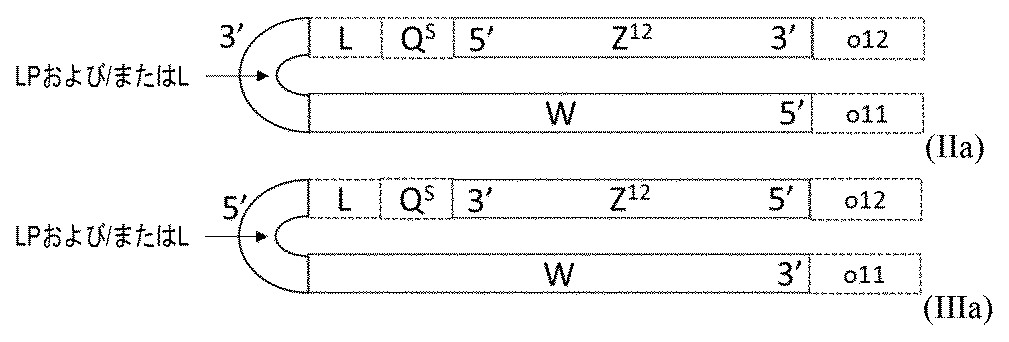
Z11は、W-LPを含み、
Wは、Z12と少なくとも7塩基対の鎖内二重鎖領域を形成し、
LPは、適宜Lと共に、3’末端または5’末端においてWとZ12の間にループを形成し、
Z 11 includes W-LP;
W forms an intrastrand duplex region of at least 7 base pairs with Z12 ;
LP, together with L as appropriate, forms a loop at the 3' or 5' end between W and Z12 ;


によって表される。
It is represented by:
一部の実施形態において、非ループ末端においてZ11およびZ12によって形成された二重鎖領域は、平滑末端を有する。一部の実施形態において、非ループ末端においてWおよびZ12によって形成された二重鎖領域は、平滑末端を有する。 In some embodiments, the duplex region formed by Z11 and Z12 at the non-looped end has a blunt end. In some embodiments, the duplex region formed by W and Z12 at the non-looped end has a blunt end.
一部の実施形態において、非ループ末端におけるZ11は、1~3ヌクレオチド長のオーバーハングを有する。一部の実施形態において、非ループ末端におけるWは、1~3ヌクレオチド長のオーバーハングを有する。一部の実施形態において、 In some embodiments, Z at the non-loop end has an overhang 1-3 nucleotides in length. In some embodiments, W at the non-loop end has an overhang 1-3 nucleotides in length. In some embodiments,

一部の実施形態において、Z12は、1~3ヌクレオチド長のオーバーハングを有する。一部の実施形態において、 In some embodiments, Z12 has an overhang 1-3 nucleotides in length.

一部の実施形態において、オーバーハングは1ヌクレオチド長である。一部の実施形態において、オーバーハングは2ヌクレオチド長である。一部の実施形態において、オーバーハングは3ヌクレオチド長である。 In some embodiments, the overhang is 1 nucleotide long. In some embodiments, the overhang is 2 nucleotides long. In some embodiments, the overhang is 3 nucleotides long.
一本鎖オリゴヌクレオチド内のヌクレオチドのそれぞれは、独立に、および適宜修飾されうる。第1のオリゴヌクレオチドZ11および第2のオリゴヌクレオチドZ12内のヌクレオチドのそれぞれは、独立に、および適宜修飾されうる。 Each of the nucleotides in the single stranded oligonucleotide may be independently and appropriately modified. Each of the nucleotides in the first oligonucleotide Z11 and the second oligonucleotide Z12 may be independently and appropriately modified.
一部の実施形態において、一本鎖オリゴヌクレオチドは、少なくとも1つの化学修飾を含む。一部の実施形態において、第1のオリゴヌクレオチドZ11および第2のオリゴヌクレオチドZ12のそれぞれは、少なくとも1つの化学修飾を含む。一部の実施形態において、Wは、少なくとも1つの化学修飾を含む。一部の実施形態において、Z11の全てのヌクレオチドは、修飾ヌクレオチドである。一部の実施形態において、Wの全てのヌクレオチドは、修飾ヌクレオチドである。一部の実施形態において、Z12の全てのヌクレオチドは、修飾ヌクレオチドである。一部の実施形態において、一本鎖オリゴヌクレオチドの全てのヌクレオチドは修飾される。 In some embodiments, the single stranded oligonucleotide comprises at least one chemical modification. In some embodiments, each of the first oligonucleotide Z11 and the second oligonucleotide Z12 comprises at least one chemical modification. In some embodiments, W comprises at least one chemical modification. In some embodiments, every nucleotide of Z11 is a modified nucleotide. In some embodiments, every nucleotide of W is a modified nucleotide. In some embodiments, every nucleotide of Z12 is a modified nucleotide. In some embodiments, every nucleotide of the single stranded oligonucleotide is modified.
ヌクレオチド(複数可)への化学修飾は、ヌクレオシド間連結修飾、ヌクレオ塩基修飾、糖修飾、またはこれらの組合せを含みうる。 Chemical modifications to the nucleotide(s) may include internucleoside linkage modifications, nucleobase modifications, sugar modifications, or combinations thereof.
ある特定の実施形態において、化学修飾は、LNA、ENA、HNA、CeNA、2’-O-メトキシアルキル(例えば、2’-O-メトキシメチル、2’-O-メトキシエチル、または2’-O-2-メトキシプロパニル)、2’-O-アルキル、2’-O-アリール、2’-C-アリール、2’-フルオロ、2’-デオキシ、2’-O-N-メチルアセトアミド(2’-O-NMA)、2’-O-ジメチルアミノエトキシエチル(2’-O-DMAEOE)、2’-O-アミノプロピル(2’-O-AP)、2’-ara-F、L-ヌクレオシド修飾(例えば、2’-修飾L-ヌクレオシド、例えば、2’-デオキシ-L-ヌクレオシド)、BNA脱塩基糖、脱塩基環状および開放鎖アルキル、ならびにこれらの組合せからなる群から選択される。 In certain embodiments, the chemical modification is selected from the group consisting of LNA, ENA, HNA, CeNA, 2'-O-methoxyalkyl (e.g., 2'-O-methoxymethyl, 2'-O-methoxyethyl, or 2'-O-2-methoxypropanyl), 2'-O-alkyl, 2'-O-aryl, 2'-C-aryl, 2'-fluoro, 2'-deoxy, 2'-O-N-methylacetamide (2'-O-NMA), 2'-O-dimethylaminoethoxyethyl (2'-O-DMAEOE), 2'-O-aminopropyl (2'-O-AP), 2'-ara-F, L-nucleoside modifications (e.g., 2'-modified L-nucleosides, e.g., 2'-deoxy-L-nucleosides), BNA abasic sugars, abasic cyclic and open chain alkyls, and combinations thereof.
ある特定の実施形態において、化学修飾は、少なくとも1つの修飾ヌクレオチドからなる群から選択され、デオキシヌクレオチド、3’末端デオキシチミジン(dT)ヌクレオチド、2’-O-メチル修飾ヌクレオチド、2’-フルオロ修飾ヌクレオチド、2’-デオキシ修飾ヌクレオチド、ロックヌクレオチド(LNA)、アンロックヌクレオチド(UNA)、構造的に制限されたヌクレオチド、拘束エチルヌクレオチド、脱塩基ヌクレオチド、2’-アミノ-修飾ヌクレオチド、2’-O-アリール-修飾ヌクレオチド、2’-C-アルキル-修飾ヌクレオチド、2’-ヒドロキシ-修飾ヌクレオチド、2’-メトキシエチル修飾ヌクレオチド、2’-O-アルキル-修飾ヌクレオチド、モルホリノヌクレオチド、ホスホロアミデート、ヌクレオチドを含む非天然塩基、テトラヒドロピラン修飾ヌクレオチド、1,5-アンヒドロヘキシトール修飾ヌクレオチド、シクロへキセニル修飾ヌクレオチド、5’-ホスホロチオエート基を含むヌクレオチド、5’-メチルホスホネート基を含むヌクレオチド、5’リン酸または5’リン酸模倣体を含むヌクレオチド、ビニルホスホネートを含むヌクレオチド、グリコール核酸(GNA)を含むヌクレオチド、グリコール核酸(GNA)S異性体(S-GNA)を含むヌクレオチド、2-ヒドロキシメチル-テトラヒドロフラン-5-リン酸を含むヌクレオチド、2’-デオキシチミジン-3’リン酸を含むヌクレオチド、2’-デオキシグアノシン-3’-リン酸を含むヌクレオチド、2’-5’-連結ヌクレオチド(「3’-RNA」)、またはコレステリル誘導体またはドデカノン酸ビスデシルアミド基に連結した末端ヌクレオチドである。 In certain embodiments, the chemical modification is selected from the group consisting of at least one modified nucleotide, including deoxynucleotides, 3'-terminal deoxythymidine (dT) nucleotides, 2'-O-methyl modified nucleotides, 2'-fluoro modified nucleotides, 2'-deoxy modified nucleotides, locked nucleotides (LNA), unlocked nucleotides (UNA), conformationally restricted nucleotides, constrained ethyl nucleotides, abasic nucleotides, 2'-amino-modified nucleotides, 2'-O-aryl-modified nucleotides, 2'-C-alkyl-modified nucleotides, 2'-hydroxy-modified nucleotides, 2'-methoxyethyl-modified nucleotides, 2'-O-alkyl-modified nucleotides, morpholino nucleotides, phosphoramidates, non-natural bases including nucleotides, tetrahydropyran modified nucleotides, modified nucleotides, 1,5-anhydrohexitol modified nucleotides, cyclohexenyl modified nucleotides, nucleotides containing a 5'-phosphorothioate group, nucleotides containing a 5'-methylphosphonate group, nucleotides containing a 5' phosphate or a 5' phosphate mimic, nucleotides containing vinyl phosphonate, nucleotides containing glycol nucleic acid (GNA), nucleotides containing glycol nucleic acid (GNA) S isomers (S-GNA), nucleotides containing 2-hydroxymethyl-tetrahydrofuran-5-phosphate, nucleotides containing 2'-deoxythymidine-3' phosphate, nucleotides containing 2'-deoxyguanosine-3'-phosphate, 2'-5'-linked nucleotides ("3'-RNA"), or terminal nucleotides linked to a cholesteryl derivative or a dodecanoic acid bisdecylamide group.
ある特定の実施形態において、化学修飾は、2’-O-メチル、2’-O-アリール、2’-O-メトキシアルキル(例えば、2’-O-メトキシメチル、2’-O-メトキシエチル、または2’-O-2-メトキシプロパニル)、2’-デオキシ、2’-フルオロ、およびこれらの組合せからなる群から選択される2’-修飾である。 In certain embodiments, the chemical modification is a 2'-modification selected from the group consisting of 2'-O-methyl, 2'-O-aryl, 2'-O-methoxyalkyl (e.g., 2'-O-methoxymethyl, 2'-O-methoxyethyl, or 2'-O-2-methoxypropanyl), 2'-deoxy, 2'-fluoro, and combinations thereof.
一部の実施形態において、約100%、95%、90%、85%、80%、75%、70%、65%、60%、55%、50%、45%、40%、35%または30%のZ11が修飾される。一部の実施形態において、約100%、95%、90%、85%、80%、75%、70%、65%、60%、55%、50%、45%、40%、35%または30%のZ12が修飾される。一部の実施形態において、一本鎖オリゴヌクレオチドの約100%、95%、90%、85%、80%、75%、70%、65%、60%、55%、50%、45%、40%、35%または30%の全てのヌクレオチドが修飾される。例えば、50%の全てのヌクレオチドが修飾される場合、一本鎖オリゴヌクレオチドに存在する50%の全てのヌクレオチドが、本明細書に記載の少なくとも1つの修飾を含有する。 In some embodiments, about 100%, 95%, 90%, 85%, 80%, 75%, 70%, 65%, 60%, 55%, 50%, 45%, 40%, 35% or 30% of Z11 are modified. In some embodiments, about 100%, 95%, 90%, 85%, 80%, 75%, 70%, 65%, 60%, 55%, 50%, 45%, 40%, 35% or 30% of Z12 are modified. In some embodiments, about 100%, 95%, 90%, 85%, 80%, 75%, 70%, 65%, 60%, 55%, 50%, 45%, 40%, 35% or 30% of all nucleotides of the single stranded oligonucleotide are modified. For example, if 50% of all nucleotides are modified, then 50% of all nucleotides present in a single stranded oligonucleotide will contain at least one modification described herein.
一実施形態において、一本鎖オリゴヌクレオチドのヌクレオチドの少なくとも50%は、独立に、2’-O-メチル、2’-O-アリール、2’-O-メトキシアルキル(例えば、2’-O-メトキシメチル、2’-O-メトキシエチル、または2’-O-2-メトキシプロパニル)、2’-デオキシ、または2’-フルオロによって修飾される。 In one embodiment, at least 50% of the nucleotides of the single stranded oligonucleotide are independently modified with 2'-O-methyl, 2'-O-aryl, 2'-O-methoxyalkyl (e.g., 2'-O-methoxymethyl, 2'-O-methoxyethyl, or 2'-O-2-methoxypropanyl), 2'-deoxy, or 2'-fluoro.
一部の実施形態において、式(II)(もしくはIIa)または式(III)(もしくは(IIIa)の一本鎖オリゴヌクレオチドは、以下のヌクレオチド間連結修飾の1つまたは複数をさらに含む;
(i)6つの3’末端ヌクレオチド内の1つまたは複数のヌクレオチド間連結は、修飾ヌクレオチド間連結である;および
(ii)6つの5’末端ヌクレオチド内の1つまたは複数のヌクレオチド間連結は、修飾ヌクレオチド間連結である。
In some embodiments, the single stranded oligonucleotide of Formula (II) (or IIa) or Formula (III) (or (IIIa) further comprises one or more of the following internucleotide linkage modifications:
(i) one or more internucleotide linkages within the six 3'-terminal nucleotides are modified internucleotide linkages; and (ii) one or more internucleotide linkages within the six 5'-terminal nucleotides are modified internucleotide linkages.
一部の実施形態において、式(II)(もしくはIIa)または式(III)(もしくは(IIIa)の一本鎖オリゴヌクレオチドは、式(II)のZ11の8つの3’末端ヌクレオチド内の1つまたは複数のヌクレオチド間連結をさらに含むか、または式(III)のZ11の8つの5’末端ヌクレオチド内の1つまたは複数のヌクレオチド間連結は、修飾ヌクレオチド間連結である。 In some embodiments, the single-stranded oligonucleotide of formula (II) (or IIa) or formula (III) (or IIIa) further comprises one or more internucleotide linkages within the eight 3'-terminal nucleotides of Z 11 of formula (II), or one or more internucleotide linkages within the eight 5'-terminal nucleotides of Z 11 of formula (III) are modified internucleotide linkages.
一部の実施形態において、式(II)(もしくはIIa)または式(III)(もしくは(IIIa)の一本鎖オリゴヌクレオチドは、以下のヌクレオチド間連結修飾の1つまたは複数をさらに含む;
(i)6つの3’末端ヌクレオチド内の2つの連続ヌクレオチド間連結は、修飾ヌクレオチド間連結である;および
(ii)6つの5’末端ヌクレオチド内の2つの連続ヌクレオチド間連結は、修飾ヌクレオチド間連結である。
In some embodiments, the single stranded oligonucleotide of Formula (II) (or IIa) or Formula (III) (or (IIIa) further comprises one or more of the following internucleotide linkage modifications:
(i) two consecutive internucleotide linkages within the six 3'-terminal nucleotides are modified internucleotide linkages; and (ii) two consecutive internucleotide linkages within the six 5'-terminal nucleotides are modified internucleotide linkages.
一部の実施形態において、一本鎖オリゴヌクレオチドが5’末端または3’末端ヌクレオチドへのリガンドの末端コンジュゲーションを含有するか、または脱塩基ヌクレオチド、逆位ヌクレオチド、または逆位脱塩基ヌクレオチドの末端コンジュゲーションを含有する場合、次いで、その末端において、末端ヌクレオチドへの上記のヌクレオチド間連結修飾が除去されうる。 In some embodiments, if the single stranded oligonucleotide contains a terminal conjugation of a ligand to the 5' or 3' terminal nucleotide, or a terminal conjugation of an abasic nucleotide, an inverted nucleotide, or an inverted abasic nucleotide, then the internucleotide linkage modification described above to the terminal nucleotide at that end can be removed.
一部の実施形態において、式(II)(もしくはIIa)または式(III)(もしくは(IIIa))の一本鎖オリゴヌクレオチドは、以下のヌクレオチド間連結修飾の1つをさらに含む;
(i)式(II)(もしくはIIa)のZ11の8つの3’末端ヌクレオチド内の1つまたは複数のヌクレオチド間連結、または式(III)(もしくは(IIIa))のZ11の8つの5’末端ヌクレオチド内の1つまたは複数のヌクレオチド間連結は、修飾ヌクレオチド間連結である;
(ii)式(II)(もしくはIIa)のZ11の6つの5’末端ヌクレオチド内の1つまたは複数のヌクレオチド間連結、または式(III)(もしくは(IIIa))のZ11の6つの3’末端ヌクレオチド内の1つまたは複数のヌクレオチド間連結は、修飾ヌクレオチド間連結である;
(iii)式(II)(もしくは(IIa))のZ12の6つの5’末端ヌクレオチド内の1つまたは複数のヌクレオチド間連結、または式(III)(もしくは(IIIa))のZ12の6つの3’末端ヌクレオチド内の1つまたは複数のヌクレオチド間連結は、修飾ヌクレオチド間連結である;ならびに
(iv)式(II)(もしくは(IIa))のZ12の6つの3’末端ヌクレオチド内の1つまたは複数のヌクレオチド間連結、または式(III)(もしくは(IIIa))のZ12の6つの5’末端ヌクレオチド内の1つまたは複数のヌクレオチド間連結は、修飾ヌクレオチド間連結である。
In some embodiments, the single stranded oligonucleotide of Formula (II) (or IIa) or Formula (III) (or (IIIa)) further comprises one of the following internucleotide linkage modifications:
(i) one or more internucleotide linkages within the eight 3'-terminal nucleotides of Z 11 of formula (II) (or IIa) or one or more internucleotide linkages within the eight 5'-terminal nucleotides of Z 11 of formula (III) (or (IIIa)) are modified internucleotide linkages;
(ii) one or more internucleotide linkages within the six 5'-terminal nucleotides of Z 11 of formula (II) (or IIa) or one or more internucleotide linkages within the six 3'-terminal nucleotides of Z 11 of formula (III) (or (IIIa)) are modified internucleotide linkages;
(iii) one or more internucleotide linkages within the six 5'-terminal nucleotides of Z 12 of formula (II) (or (IIa)), or one or more internucleotide linkages within the six 3'-terminal nucleotides of Z 12 of formula (III) (or (IIIa)), are modified internucleotide linkages; and (iv) one or more internucleotide linkages within the six 3'-terminal nucleotides of Z 12 of formula (II) (or (IIa)), or one or more internucleotide linkages within the six 5'-terminal nucleotides of Z 12 of formula (III) (or (IIIa)), are modified internucleotide linkages.
一部の実施形態において、式(II)(もしくはIIa)または式(III)(もしくは(IIIa))の一本鎖オリゴヌクレオチドは、以下のヌクレオチド間連結修飾の1つまたは複数をさらに含む;
(i)式(II)(もしくは(IIa))のZ12の3つの5’末端ヌクレオチド内の2つの連続ヌクレオチド間連結、または式(III)(もしくは(IIIa))のZ12の3つの3’末端ヌクレオチド内の2つの連続ヌクレオチド間連結は、修飾ヌクレオチド間連結である;
(ii)式(II)(もしくは(IIa))のZ12の3つの3’末端ヌクレオチド内の2つの連続ヌクレオチド間連結、または式(III)(もしくは(IIIa))のZ12の3つの5’末端ヌクレオチド内の2つの連続ヌクレオチド間連結は、修飾ヌクレオチド間連結である;ならびに
(iii)式(II)(もしくは(IIa))のZ11の3つまたは4つの5’末端ヌクレオチド内の2つの連続ヌクレオチド間連結、または式(III)(もしくは(IIIa))のZ11の3つまたは4つの3’末端ヌクレオチド内の2つの連続ヌクレオチド間連結は、修飾ヌクレオチド間連結である。
In some embodiments, the single stranded oligonucleotide of Formula (II) (or IIa) or Formula (III) (or (IIIa)) further comprises one or more of the following internucleotide linkage modifications:
(i) two consecutive internucleotide linkages within the three 5'-terminal nucleotides of Z 12 of formula (II) (or (IIa)), or two consecutive internucleotide linkages within the three 3'-terminal nucleotides of Z 12 of formula (III) (or (IIIa)) are modified internucleotide linkages;
(ii) two consecutive internucleotide linkages within the three 3'-terminal nucleotides of Z 12 of formula (II) (or (IIa)), or two consecutive internucleotide linkages within the three 5'-terminal nucleotides of Z 12 of formula (III) (or (IIIa)), are modified internucleotide linkages; and (iii) two consecutive internucleotide linkages within the three or four 5'-terminal nucleotides of Z 11 of formula (II) (or (IIa)), or two consecutive internucleotide linkages within the three or four 3'-terminal nucleotides of Z 11 of formula (III) (or (IIIa)), are modified internucleotide linkages.
一部の実施形態において、式(II)(またはIIa)の一本鎖オリゴヌクレオチドは、Z12の5’末端ヌクレオチドとQSの第1のヌクレオチドの間に1つまたは複数の修飾ヌクレオチド間連結をさらに含む。一部の実施形態において、式(III)(または(IIIa))の一本鎖オリゴヌクレオチドは、Z12の3’末端ヌクレオチドとQSの第1のヌクレオチドの間に1つまたは複数の修飾ヌクレオチド間連結をさらに含む。一部の実施形態において、式(II)(もしくはIIa)または式(III)(もしくはIIIa)の一本鎖オリゴヌクレオチドは、QSのヌクレオチド間に1つまたは複数の修飾ヌクレオチド間連結をさらに含む。 In some embodiments, the single-stranded oligonucleotide of formula (II) (or IIa) further comprises one or more modified internucleotide linkages between the 5'-terminal nucleotide of Z12 and the first nucleotide of QS . In some embodiments, the single-stranded oligonucleotide of formula (III) (or (IIIa)) further comprises one or more modified internucleotide linkages between the 3'-terminal nucleotide of Z12 and the first nucleotide of QS . In some embodiments, the single-stranded oligonucleotide of formula (II) (or IIa) or formula (III) (or IIIa) further comprises one or more modified internucleotide linkages between the nucleotides of QS .
一部の実施形態において、上記の実施形態すべてにおいて、修飾ヌクレオチド間連結は、ホスホロチオエート連結である。 In some embodiments, in all of the above embodiments, the modified internucleotide linkage is a phosphorothioate linkage.
一部の実施形態において、式(II)(もしくは(IIa))または式(III)(もしくは(IIIa)の一本鎖オリゴヌクレオチドは、少なくとも2つの連続ホスホロチオエートまたはメチルホスホネートヌクレオチド間連結修飾を含む。一部の実施形態において、一本鎖オリゴヌクレオチドは、2つの連続ホスホロチオエートまたはメチルホスホネートヌクレオチド間連結修飾の少なくとも2つのブロックを含む。一部の実施形態において、一本鎖オリゴヌクレオチドは、2つの連続ホスホロチオエートまたはメチルホスホネートヌクレオチド間連結修飾の少なくとも3つのブロックを含む。 In some embodiments, a single-stranded oligonucleotide of formula (II) (or (IIa)) or formula (III) (or (IIIa)) comprises at least two consecutive phosphorothioate or methylphosphonate internucleotide linkage modifications. In some embodiments, a single-stranded oligonucleotide comprises at least two blocks of two consecutive phosphorothioate or methylphosphonate internucleotide linkage modifications. In some embodiments, a single-stranded oligonucleotide comprises at least three blocks of two consecutive phosphorothioate or methylphosphonate internucleotide linkage modifications.
一部の実施形態において、式(II)(もしくはIIa)または式(III)(もしくは(IIIa)の一本鎖オリゴヌクレオチドは、ヌクレオチド配列(例えば、Z11および/またはZ12)の最初の6ヌクレオチド内に少なくとも2つのホスホロチオエートヌクレオチド間連結を有する。 In some embodiments, the single-stranded oligonucleotide of Formula (II) (or IIa) or Formula (III) (or (IIIa) has at least two phosphorothioate internucleotide linkages within the first six nucleotides of the nucleotide sequence (e.g., Z 11 and/or Z 12 ).
一部の実施形態において、一本鎖オリゴヌクレオチド(例えば、Z11および/またはZ12)のヌクレオチド配列は、1、2、3、4、5、6、7、8、9、10、11、12、13、14、15、16、17、または18のリン酸ヌクレオチド間連結によって分けられた1つ、2つ、または3つのホスホロチオエートヌクレオチド間連結の2つのブロックを含む。 In some embodiments, the nucleotide sequence of a single stranded oligonucleotide (e.g., Z 11 and/or Z 12 ) comprises two blocks of 1, 2, or 3 phosphorothioate internucleotide linkages separated by 1, 2, 3, 4, 5, 6, 7, 8, 9, 10, 11, 12, 13, 14, 15, 16, 17, or 18 phosphate internucleotide linkages.
一実施形態において、式(II)(もしくはIIa)または式(III)(もしくは(IIIa)の一本鎖オリゴヌクレオチドのヌクレオチド配列(例えば、Z11および/またはZ12)は、ヌクレオチド配列の5’末端からカウントして、ヌクレオチド配列の18~23位内に、少なくとも2つの連続ホスホロチオエートヌクレオチド間連結修飾を含む。一実施形態において、一本鎖オリゴヌクレオチドのヌクレオチド配列(例えば、Z11および/またはZ12)は、ヌクレオチド配列の5’末端からカウントして、ヌクレオチド配列の1~5位内に、少なくとも2つの連続ホスホロチオエートヌクレオチド間連結修飾を含む。 In one embodiment, the nucleotide sequence (e.g., Z 11 and/or Z 12 ) of a single stranded oligonucleotide of Formula (II) (or IIa) or Formula (III) (or (IIIa)) comprises at least two consecutive phosphorothioate internucleotide linkage modifications within positions 18-23 of the nucleotide sequence, counting from the 5' end of the nucleotide sequence. In one embodiment, the nucleotide sequence (e.g., Z 11 and/or Z 12 ) of a single stranded oligonucleotide comprises at least two consecutive phosphorothioate internucleotide linkage modifications within positions 1-5 of the nucleotide sequence, counting from the 5' end of the nucleotide sequence.
一部の実施形態において、一本鎖オリゴヌクレオチドのZ11およびZ12のそれぞれは、少なくとも2つの連続ホスホロチオエートヌクレオチド間連結修飾を含む。一実施形態において、一本鎖オリゴヌクレオチドのZ11およびZ12のそれぞれは、ヌクレオチド配列の18~23位内に少なくとも2つの連続ホスホロチオエートヌクレオチド間連結修飾、およびヌクレオチド配列の5’末端からカウントして、ヌクレオチド配列の1~5位内に少なくとも2つの連続ホスホロチオエートヌクレオチド間連結修飾を含む。 In some embodiments, each of Z11 and Z12 of the single stranded oligonucleotide comprises at least two consecutive phosphorothioate internucleotide linkage modifications. In one embodiment, each of Z11 and Z12 of the single stranded oligonucleotide comprises at least two consecutive phosphorothioate internucleotide linkage modifications within positions 18-23 of the nucleotide sequence, and at least two consecutive phosphorothioate internucleotide linkage modifications within positions 1-5 of the nucleotide sequence, counting from the 5' end of the nucleotide sequence.
一部の実施形態において、非ループ末端におけるZ11は、1~3ヌクレオチド長のオーバーハングを有する。一実施形態において、非ループ末端におけるZ11は、2ヌクレオチド長のオーバーハングを有し(例えば、Z11の3’末端)、2つのオーバーハングの間にホスホロチオエートヌクレオチド間連結を有する。一実施形態において、非ループ末端におけるZ11は、2ヌクレオチド長のオーバーハングを有し、末端の3ヌクレオチドの間に2つのホスホロチオエートヌクレオチド間連結を有し(例えば、Z11の3’末端)、3ヌクレオチドのうちの2つはオーバーハングヌクレオチドであり、3つ目はオーバーハングヌクレオチドの次の対合ヌクレオチドである。 In some embodiments, Z11 at the non-looped end has an overhang 1-3 nucleotides in length. In one embodiment, Z11 at the non-looped end has an overhang 2 nucleotides in length (e.g., at the 3' end of Z11 ) with a phosphorothioate internucleotide linkage between the two overhangs. In one embodiment, Z11 at the non-looped end has an overhang 2 nucleotides in length with two phosphorothioate internucleotide linkages between the terminal three nucleotides (e.g., at the 3' end of Z11 ), two of the three nucleotides being overhanging nucleotides and the third being the next pairing nucleotide to the overhanging nucleotide.
一部の実施形態において、式(II)(もしくはIIa)または式(III)(もしくは(IIIa)の一本鎖オリゴヌクレオチドは、ヌクレオチド配列(例えば、Z11および/またはZ12)の5’末端にリン酸またはリン酸模倣体をさらに含む。一部の実施形態において、一本鎖オリゴヌクレオチドは、ヌクレオチド配列(例えば、Z11および/またはZ12)の5’末端にリン酸模倣体を含む。一実施形態において、少なくとも1つのリン酸摸倣体は、Z11の5’末端にある。一実施形態において、リン酸模倣体は、5’-ビニルホスホネート(VP)である。一実施形態において、リン酸模倣体は、5’-シクロプロピルホスホネートである。一実施形態において、リン酸模倣体は、5’-ビニルホスフェートである。 In some embodiments, the single stranded oligonucleotide of Formula (II) (or IIa) or Formula (III) (or (IIIa) further comprises a phosphate or a phosphate mimetic at the 5'-terminus of the nucleotide sequence (e.g., Z 11 and/or Z 12 ). In some embodiments, the single stranded oligonucleotide comprises a phosphate mimetic at the 5'-terminus of the nucleotide sequence (e.g., Z 11 and/or Z 12 ). In one embodiment, at least one phosphate mimetic is at the 5'-terminus of Z 11. In one embodiment, the phosphate mimetic is 5'-vinyl phosphonate (VP). In one embodiment, the phosphate mimetic is 5'-cyclopropyl phosphonate. In one embodiment, the phosphate mimetic is 5'-vinyl phosphate.
一部の実施形態において、式(II)(もしくはIIa)または式(III)(もしくは(IIIa)の一本鎖オリゴヌクレオチドは、少なくとも1つの末端、キラルリン原子をさらに含む。 In some embodiments, the single-stranded oligonucleotide of formula (II) (or IIa) or formula (III) (or (IIIa) further comprises at least one terminal, chiral phosphorus atom.
一部の実施形態において、式(II)(もしくはIIa)または式(III)(もしくは(IIIa)の一本鎖オリゴヌクレオチドの5’末端もしくは3’末端ヌクレオチドは、2’-5’-連結ヌクレオチド修飾を含むか、または5’末端もしくは3’末端ヌクレオチドは、脱塩基ヌクレオチド、逆位ヌクレオチド、または逆位脱塩基ヌクレオチド(例えば、リボヌクレオチド)にコンジュゲートされ、ホスホジエステル、ホスホロチオエート、またはホスホジチオエート連結を介してもよい。 In some embodiments, the 5'- or 3'-terminal nucleotide of the single-stranded oligonucleotide of formula (II) (or IIa) or formula (III) (or (IIIa) comprises a 2'-5'-linked nucleotide modification, or the 5'- or 3'-terminal nucleotide is conjugated to an abasic nucleotide, an inverted nucleotide, or an inverted abasic nucleotide (e.g., a ribonucleotide), optionally via a phosphodiester, phosphorothioate, or phosphodithioate linkage.
一部の実施形態において、式(II)(もしくはIIa)または式(III)(もしくは(IIIa)の一本鎖オリゴヌクレオチドの5’末端もしくは3’末端ヌクレオチドは、修飾され、モノ-、ジ-、トリ-、テトラ-、ペンタ-もしくはポリプロリノール、またはモノ-、ジ-、トリ-、テトラ-、ペンタ-もしくはポリヒドロキシプロリノールを含有する連結部分を含む。 In some embodiments, the 5' or 3' terminal nucleotide of the single stranded oligonucleotide of formula (II) (or IIa) or formula (III) (or (IIIa) is modified to include a linking moiety containing mono-, di-, tri-, tetra-, penta- or polyprolinol, or mono-, di-, tri-, tetra-, penta- or polyhydroxyprolinol.
一部の実施形態において、一本鎖オリゴヌクレオチド(例えば、Z11および/またはZ12)の5’末端または3’末端の少なくとも1つ、2つ、3つ、4つ、または5つの末端リン含有連結のそれぞれは、ホスホロチオエート連結ではない。一実施形態において、一本鎖オリゴヌクレオチド(例えば、Z11および/またはZ12)の5’末端または3’末端の少なくとも1つ、2つ、3つ、4つ、または5つの末端リン含有連結のそれぞれは、それぞれ独立に、天然のリン酸基もしくはホスホジエステル連結、またはPN-連結である。 In some embodiments, each of at least one, two, three, four, or five terminal phosphorus-containing linkages at the 5'- or 3'-terminus of a single-stranded oligonucleotide (e.g., Z 11 and/or Z 12 ) is not a phosphorothioate linkage. In one embodiment, each of at least one, two, three, four, or five terminal phosphorus-containing linkages at the 5'- or 3'-terminus of a single-stranded oligonucleotide (e.g., Z 11 and/or Z 12 ) is independently a natural phosphate or phosphodiester linkage, or a PN-linkage.
一部の実施形態において、一本鎖オリゴヌクレオチド(例えば、Z11および/またはZ12)の5’末端または3’末端の少なくとも1つ、2つ、3つ、4つ、または5つの末端リン含有連結のそれぞれは、-N(R)P(=X)(OH)O-または-OP(=X)(OH)N(R)-、-O-P(NR)(=X)O-、N(SO2R)P(=X)(OH)O-または-OP(=X)(OH)N(SO2R)-、または-O-P(NSO2R)(=X)O-[式中、Xは、OまたはSであり;Rは、適宜置換されたアルキル、アリール、ヘテロアリールまたはヘテロシクリルでありうる;またはNRは、適宜置換された環状グアニジン部分、適宜置換されたトリアゾリル基、またはTmg基 In some embodiments, each of at least one, two, three, four, or five terminal phosphorus-containing linkages at the 5'-end or 3'-end of a single stranded oligonucleotide (e.g., Z 11 and/or Z 12 ) is -N(R)P(═X)(OH)O- or -OP(═X)(OH)N(R)-, -O-P(NR)(═X)O-, N(SO 2 R)P(═X)(OH)O- or -OP(═X)(OH)N(SO 2 R)-, or -O-P(NSO 2 R)(═X)O-, where X is O or S; R can be an optionally substituted alkyl, aryl, heteroaryl, or heterocyclyl; or NR is an optionally substituted cyclic guanidine moiety, an optionally substituted triazolyl group, or a Tmg group.
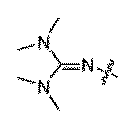
一部の実施形態において、一本鎖オリゴヌクレオチド(例えば、Z11および/またはZ12)の5’末端または3’末端の少なくとも1つ、2つ、3つ、4つ、または5つの末端リン含有連結のそれぞれは、適宜置換された環状グアニンジン部分、例えば、 In some embodiments, each of at least one, two, three, four, or five terminal phosphorus-containing linkages at the 5' or 3' end of a single stranded oligonucleotide (eg, Z 11 and/or Z 12 ) is an optionally substituted cyclic guanidine moiety, such as

一部の実施形態において、一本鎖オリゴヌクレオチド(例えば、Z11および/またはZ12)の5’末端または3’末端の少なくとも1つ、2つ、3つ、4つ、または5つの末端リン含有連結のそれぞれは、トリアゾール部分(例えば、適宜置換されたトリアゾール基)、例えば、 In some embodiments, each of at least one, two, three, four, or five terminal phosphorus-containing linkages at the 5'-terminus or 3'-terminus of a single stranded oligonucleotide (eg, Z 11 and/or Z 12 ) is a triazole moiety (eg, an appropriately substituted triazole group), e.g.,
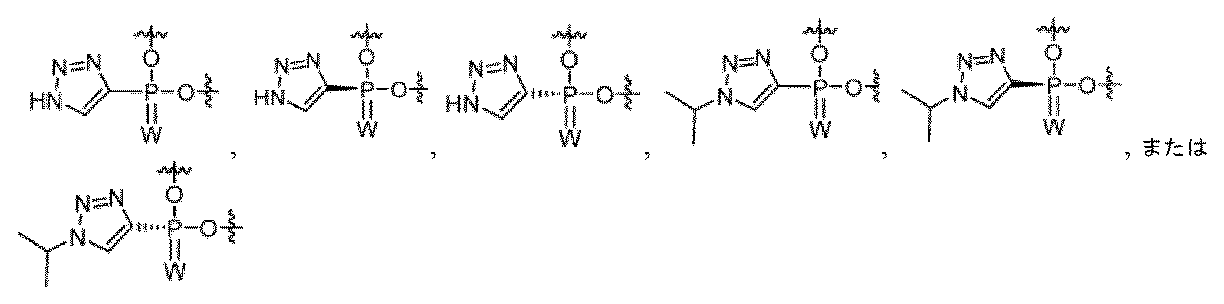
一部の実施形態において、一本鎖オリゴヌクレオチド(例えば、Z11および/またはZ12)の5’末端または3’末端の少なくとも1つ、2つ、3つ、4つ、または5つの末端リン含有連結のそれぞれは、アルキン部分(例えば、適宜置換されたアルキニル基)、例えば、 In some embodiments, each of at least one, two, three, four, or five terminal phosphorus-containing linkages at the 5'-terminus or 3'-terminus of a single stranded oligonucleotide (eg, Z 11 and/or Z 12 ) is an alkyne moiety (eg, an optionally substituted alkynyl group), e.g.,
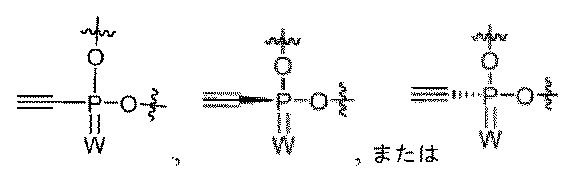
一部の実施形態において、一本鎖オリゴヌクレオチド(例えば、Z11および/またはZ12)の5’末端または3’末端の少なくとも1つ、2つ、3つ、4つ、または5つの末端リン含有連結のそれぞれは、Tmg基 In some embodiments, each of at least one, two, three, four, or five terminal phosphorus-containing linkages at the 5'-terminus or 3'-terminus of a single stranded oligonucleotide (eg, Z 11 and/or Z 12 ) is a Tmg group.
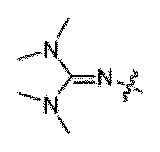
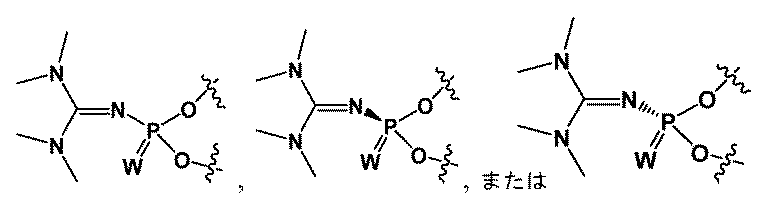
上記全ての実施形態において、PN連結は、立体化学的に制御されうる。 In all of the above embodiments, the PN linkage can be stereochemically controlled.
一部の実施形態において、式(II)(もしくはIIa)または式(III)(もしくは(IIIa)の一本鎖オリゴヌクレオチドにおいて、L、QS、またはZ12に接続した、Z11の3~5つの末端ヌクレオチドは、2’-デオキシヌクレオチド(dN)、2’-デオキシ-2’-フルオロヌクレオチド(fN)、リボヌクレオチド(rN)、2’-O-メチルヌクレオチド(mN)、および2’-araヌクレオチド(aN)からなる群から選択される修飾を含有する。 In some embodiments, in the single stranded oligonucleotide of Formula (II) (or IIa) or Formula (III) (or (IIIa), the 3 to 5 terminal nucleotides of Z 11 connected to L, Q S or Z 12 contain a modification selected from the group consisting of 2'-deoxynucleotides (dN), 2'-deoxy-2'-fluoronucleotides (fN), ribonucleotides (rN), 2'-O-methyl nucleotides (mN), and 2'-ara nucleotides (aN).
一部の実施形態において、式(II)(もしくはIIa)または式(III)(もしくは(IIIa)の一本鎖オリゴヌクレオチドにおいて、L、QS、またはZ12に接続した、Z11の3つの末端ヌクレオチドは、
#-fN-fN-fN-**、
#-dN-dN-dN-**、
#-dN-dN-rN-**、
#-dN-rN-dN-**、
#-rN-dN-dN-**、
#-rN-rN-dN-**、
#-rN-dN-rN-**、
#-dN-rN-rN-**、および
#-rN-rN-rN-**
[式中:
#は、Z11への結合であり、**は、L、QS、またはZ12への結合であり
dNは、2’-デオキシヌクレオチドを表し、
fNは、2’-デオキシ-2’-フルオロヌクレオチドを表し、
rNは、リボヌクレオチドを表し、
mNは、2’-O-メチルヌクレオチドを表す]
からなる群から選択される修飾を有する。
In some embodiments, in the single stranded oligonucleotide of Formula (II) (or IIa) or Formula (III) (or (IIIa), the three terminal nucleotides of Z 11 connected to L, Q S , or Z 12 are
#-fN-fN-fN- ** ,
#-dN-dN-dN- ** ,
#-dN-dN-rN- ** ,
#-dN-rN-dN- ** ,
#-rN-dN-dN- ** ,
#-rN-rN-dN- ** ,
#-rN-dN-rN- ** ,
#-dN-rN-rN- ** and #-rN-rN-rN -**
[In the formula:
# is a bond to Z11 , ** is a bond to L, QS , or Z12 , dN represents a 2'-deoxynucleotide,
fN represents 2'-deoxy-2'-fluoro nucleotide;
rN represents a ribonucleotide;
mN represents a 2'-O-methyl nucleotide.
The compound has a modification selected from the group consisting of:
一部の実施形態において、式(II)(もしくはIIa)または式(III)(もしくは(IIIa)の一本鎖オリゴヌクレオチドにおいて、L、QS、またはZ12に接続した、Z11の5つの末端ヌクレオチドは、
#-dN-dN-fN-fN-fN-**、
#-dN-dN-rN-dN-dN-**、
#-dN-dN-rN-rN-rN-**、
#-dN-dN-dN-dN-dN-**、
#-mN-mN-fN-fN-fN-**、
#-mN-mN-dN-dN-dN-**、
#-mN-mN-rN-dN-dN-**、
#-mN-mN-rN-rN-rN-**、および
[式中:
#は、Z11への結合であり、**は、L、QS、またはZ12への結合であり
dNは、2’-デオキシヌクレオチドを表し、
fNは、2’-デオキシ-2’-フルオロヌクレオチドを表し、
rNは、リボヌクレオチドを表し、
mNは、2’-O-メチルヌクレオチドを表す]
からなる群から選択される修飾を有する。
In some embodiments, in the single stranded oligonucleotide of formula (II) (or IIa) or formula (III) (or (IIIa), the five terminal nucleotides of Z 11 connected to L, Q S , or Z 12 are
#-dN-dN-fN-fN-fN- ** ,
#-dN-dN-rN-dN-dN- ** ,
#-dN-dN-rN-rN-rN- ** ,
#-dN-dN-dN-dN-dN- ** ,
#-mN-mN-fN-fN-fN- ** ,
#-mN-mN-dN-dN-dN- ** ,
#-mN-mN-rN-dN-dN- ** ,
#-mN-mN-rN-rN-rN- ** , and
# is a bond to Z11 , ** is a bond to L, QS , or Z12 , dN represents a 2'-deoxynucleotide,
fN represents 2'-deoxy-2'-fluoro nucleotide;
rN represents a ribonucleotide;
mN represents a 2'-O-methyl nucleotide.
The compound has a modification selected from the group consisting of:
一部の実施形態において、第1のオリゴヌクレオチドZ11は、Z11の5’末端から11、12、および13位に3つの連続2’-O-メチル修飾の少なくとも1つのモチーフを含有し、モチーフの次のヌクレオチドは、2’-O-メチル修飾されない。 In some embodiments, the first oligonucleotide Z 11 contains at least one motif of three consecutive 2'-O-methyl modifications at positions 11, 12, and 13 from the 5' end of Z 11 , and the nucleotide following the motif is not 2'-O-methyl modified.
一部の実施形態において、第2のオリゴヌクレオチドZ12は、適宜QSと共に、3つの連続2’-F修飾の少なくとも1つのモチーフを含有し、モチーフの次のヌクレオチドは、2’-F修飾されない。 In some embodiments, the second oligonucleotide Z 12 contains at least one motif of three consecutive 2'-F modifications, optionally with Q S , where the nucleotide following the motif is not 2'-F modified.
一部の実施形態において、3つの連続修飾(3つの連続2’-O-メチル修飾または3つの連続2’-F修飾)のモチーフの位置は、以下:
モチーフはQS、Z12の1および2位にあり、Z11は19ヌクレオチド長であってもよいこと;
モチーフはZ12の1、2および3位にあり、Z11は20ヌクレオチド長であってもよいこと;
モチーフはZ12の2、3および4位にあり、Z11は21ヌクレオチド長であってもよいこと;
モチーフはZ12の3、4および5位にあり、Z11は22ヌクレオチド長であってもよいこと;または
モチーフはZ12の4、5および6位にあり、Z11は23ヌクレオチド長であってもよいこと;
の1つによって特徴付けられる。
In some embodiments, the position of the motif of three consecutive modifications (three consecutive 2'-O-methyl modifications or three consecutive 2'-F modifications) is as follows:
the motif is at positions 1 and 2 of QS , Z12 , and Z11 may be 19 nucleotides in length;
the motif is at positions 1, 2 and 3 of Z12 , and Z11 may be 20 nucleotides long;
the motif is at positions 2, 3 and 4 of Z12 and Z11 may be 21 nucleotides long;
the motif is at positions 3, 4 and 5 of Z12 , and Z11 may be 22 nucleotides in length; or the motif is at positions 4, 5 and 6 of Z12 , and Z11 may be 23 nucleotides in length;
It is characterized by one of the following:
一部の実施形態において、Z12は、適宜QSと共に、その位置がZ11の一部ではない限り、モチーフの2位前である位置(モチーフがn位である場合、n-2位)において2’-O-メチルまたは2’-F修飾を含有する。 In some embodiments, Z 12 , optionally together with Q S , contains a 2'-O-methyl or 2'-F modification at the position 2 before the motif (or at the n-2 position if the motif is at the n-position), unless that position is part of Z 11 .
一部の実施形態において、Lは切断型連結基である。一部の実施形態において、切断型連結基は、任意の型の細胞のホモジネート、トリトソーム、サイトゾル、またはエンドソームにおいて切断可能である。例えば、切断型連結基は、肝臓ホモジネート、肝臓トリトソーム、肝臓リソソーム、肝臓サイトゾル、肝臓エンドソーム、脳ホモジネート、脳トリトソーム、脳リソソーム、脳サイトゾル、または脳エンドソームにおいて切断可能でありうる。ある特定の実施形態において、切断型連結基は、レドックス切断型リンカー(例えば、還元型切断型リンカー;例えば、ジスルフィド基)、酸切断型リンカー(例えば、ヒドラゾン基、エステル基、アセタール基、またはケタール基)、エステラーゼ切断型リンカー(例えば、エステル基)、ホスファターゼ切断型リンカー(例えば、エステル基)、ペプチダーゼ切断型リンカー(例えば、エステル基)、またはエンドソーム切断型リンカー(またはプロテアーゼ切断型リンカー、例えば炭水化物リンカー)である。 In some embodiments, L is a cleavable linking group. In some embodiments, the cleavable linking group is cleavable in homogenates, tritosomes, cytosols, or endosomes of any type of cell. For example, the cleavable linking group can be cleavable in liver homogenates, liver tritosomes, liver lysosomes, liver cytosol, liver endosomes, brain homogenates, brain tritosomes, brain lysosomes, brain cytosol, or brain endosomes. In certain embodiments, the cleavable linking group is a redox-cleavable linker (e.g., a reduction-cleavable linker; e.g., a disulfide group), an acid-cleavable linker (e.g., a hydrazone group, an ester group, an acetal group, or a ketal group), an esterase-cleavable linker (e.g., an ester group), a phosphatase-cleavable linker (e.g., an ester group), a peptidase-cleavable linker (e.g., an ester group), or an endosome-cleavable linker (or a protease-cleavable linker, e.g., a carbohydrate linker).
一部の実施形態において、切断型連結基(テザー)は、エンドソーム切断型リンカーまたはプロテアーゼ切断型リンカー、例えば、炭水化物リンカーであり、リンカーは、血液または血清(または細胞外条件を摸倣するために選択されたインビトロ条件下)と比較して、細胞において(または細胞内条件を摸倣するために選択されたインビトロ条件下)、少なくとも1.25倍速く切断される。 In some embodiments, the cleavable linker (tether) is an endosomal or protease-cleavable linker, e.g., a carbohydrate linker, and the linker is cleaved at least 1.25 times faster in cells (or under in vitro conditions selected to mimic intracellular conditions) compared to blood or serum (or under in vitro conditions selected to mimic extracellular conditions).
一部の実施形態において、Lは式(II)(もしくはIIa)または式III(もしくはIIIa)に存在し、式:#-(N)n-**によって表される連結部分を含有する。この式では、#は、Z11への結合であり、**は、QSまたはZ12への結合であり;nは3~12であり;各Nは、独立に、3またはそれ以上の原子の鎖長を有する連結単量体である。例えば、各Nは、独立に、3またはそれ以上の原子の鎖長を有する連結単量体でありうる。「鎖長」は、本明細書において、上記に規定される。一部の実施形態において、nは3~8、4~8、3~7、4~7、3~6、4~6、または3~5である。一実施形態において、nは3である。 In some embodiments, L is present in Formula (II) (or IIa) or Formula III (or IIIa) and contains a linking moiety represented by the formula: #-(N) n - ** . In this formula, # is a bond to Z 11 , ** is a bond to Q S or Z 12 ; n is 3 to 12; and each N is independently a linking monomer having a chain length of 3 or more atoms. For example, each N can be independently a linking monomer having a chain length of 3 or more atoms. "Chain length" is defined herein above. In some embodiments, n is 3 to 8, 4 to 8, 3 to 7, 4 to 7, 3 to 6, 4 to 6, or 3 to 5. In one embodiment, n is 3.
一部の実施形態において、式(II)(もしくはIIa)または式III(もしくはIIIa)のLにおける1つまたは複数の連結部分(N)は、適宜修飾されたヌクレオチドでありうる。 In some embodiments, one or more linking moieties (N) in L of formula (II) (or IIa) or formula III (or IIIa) can be an appropriately modified nucleotide.
一部の実施形態において、式(II)(もしくはIIa)または式III(もしくはIIIa)のLにおける1つまたは複数の連結部分(N)は、独立に、2’-デオキシヌクレオチド(dN)、2’-デオキシ-2’-フルオロヌクレオチド(fN)、リボヌクレオチド(rN)、2’-O-メチルヌクレオチド(mN)、および2’-araヌクレオチド(aN)(例えば、2’-ara-2’-デオキシ、2’-ara-2’-F、2’-ara-2’-OMe、または2’-araリボヌクレオチド)からなる群から選択されうる。 In some embodiments, one or more linking moieties (N) in L of formula (II) (or IIa) or formula III (or IIIa) can be independently selected from the group consisting of 2'-deoxynucleotides (dN), 2'-deoxy-2'-fluoronucleotides (fN), ribonucleotides (rN), 2'-O-methyl nucleotides (mN), and 2'-ara nucleotides (aN) (e.g., 2'-ara-2'-deoxy, 2'-ara-2'-F, 2'-ara-2'-OMe, or 2'-ara ribonucleotides).
ある特定の実施形態において、式(II)(もしくはIIa)または式III(もしくはIIIa)のLにおける1つまたは複数の連結部分(N)は、ホスホジエステル、ホスホトリエステル(Rp配置またはSp配置のいずれかに連結リン原子を含んでもよい)、ホスホン酸水素、ホスホン酸アルキルまたはホスホン酸アリール、ホスホロアミデート(Rp配置またはSp配置のいずれかに連結リン原子を含んでもよい)、ホスホロチオエート(Rp配置またはSp配置のいずれかに連結リン原子を含んでもよい)、メチレンメチルイミノ、窒素修飾リン含有連結(PN連結)(Rp配置またはSp配置のいずれかに連結リン原子を含んでもよい)、チオジエステル、チオノカルバメート、N,N’-ジメチルヒドラジン、ホスホロセレネート、ボラノホスフェート、ボラノホスフェートエステル、アミド、ヒドロキシルアミノ、シロキサン、ジアルキルシロキサン、カルボキサミド、カルボネート、カルボキシメチル、カルバメート、カルボキシレートエステル、チオエーテル、エチレンオキシドリンカー、スルフィド、スルホネート、スルホンアミド、スルホネートエステル、チオホルムアセタール、ホルムアセタール、オキシム、メチレンイミノ、メチレンカルボニルアミノ、メチレンヒドラゾ、メチレンジメチルヒドラゾ、メチレンオキシメチルイミノ、エーテル、チオアセトアミド、およびこれらの組合せからなる群から選択される修飾ヌクレオチド間連結を含有しうる。 In certain embodiments, one or more linking moieties (N) in L of formula (II) (or IIa) or formula III (or IIIa) are selected from the group consisting of phosphodiester, phosphotriester (which may contain a linking phosphorus atom in either the Rp or Sp configuration), hydrogen phosphonate, alkyl or aryl phosphonate, phosphoramidate (which may contain a linking phosphorus atom in either the Rp or Sp configuration), phosphorothioate (which may contain a linking phosphorus atom in either the Rp or Sp configuration), methylenemethylimino, nitrogen-modified phosphorus-containing linkage (PN linkage) (which may contain a linking phosphorus atom in either the Rp or Sp configuration), thiodiester, thionocarbamate, The modified internucleotide linkage may be selected from the group consisting of N,N'-dimethylhydrazine, phosphoroselenate, boranophosphate, boranophosphate ester, amide, hydroxylamino, siloxane, dialkylsiloxane, carboxamide, carbonate, carboxymethyl, carbamate, carboxylate ester, thioether, ethylene oxide linker, sulfide, sulfonate, sulfonamide, sulfonate ester, thioformacetal, formacetal, oxime, methyleneimino, methylenecarbonylamino, methylenehydrazo, methylenedimethylhydrazo, methyleneoxymethylimino, ether, thioacetamide, and combinations thereof.
ある特定の実施形態において、式(II)(もしくはIIa)または式III(もしくはIIIa)のLにおける1つまたは複数の連結部分(N)は、脂肪族飽和または不飽和アルキル鎖;リン酸、ホスホネート、ホスホラミデート(Rp配置またはSp配置のいずれかに連結リン原子を含んでもよい)、ホスホジエステル、ホスホトリエステル(Rp配置またはSp配置のいずれかに連結リン原子を含んでもよい)、ホスホロチオエート(Rp配置またはSp配置のいずれかに連結リン原子を含んでもよい)、および窒素修飾リン含有連結(PN連結)(Rp配置またはSp配置のいずれかに連結リン原子を含んでもよい)を含むリン含有連結;ジエチレングリコール、トリエチレングリコール、テトラ、ペンタ、ヘキサ、ヘプタ、オクタ、ノナ、またはデカエチレングリコールを含む(ポリ)エチレングリコール鎖;グリセロールまたはグリセロールエステル;アミノアルキルエーテル;およびこれらの組合せからなる群から選択される部分を含有しうる。 In certain embodiments, one or more linking moieties (N) in L of formula (II) (or IIa) or formula III (or IIIa) may contain a moiety selected from the group consisting of: aliphatic saturated or unsaturated alkyl chains; phosphorus-containing linkages including phosphates, phosphonates, phosphoramidates (which may contain the linking phosphorus atom in either the Rp or Sp configuration), phosphodiesters, phosphotriesters (which may contain the linking phosphorus atom in either the Rp or Sp configuration), phosphorothioates (which may contain the linking phosphorus atom in either the Rp or Sp configuration), and nitrogen-modified phosphorus-containing linkages (PN linkages) (which may contain the linking phosphorus atom in either the Rp or Sp configuration); (poly)ethylene glycol chains including diethylene glycol, triethylene glycol, tetra-, penta-, hexa-, hepta-, octa-, nona-, or decaethylene glycol; glycerol or glycerol esters; amino alkyl ethers; and combinations thereof.
一部の実施形態において、式(II)(もしくはIIa)または式III(もしくはIIIa)のLにおける1つまたは複数の連結部分(N)は、DNA、RNA、ジスルフィド、アミド、官能化単糖またはガラクトサミンのオリゴ糖、グルコサミン、グルコース、ガラクトース、マンノース、およびこれらの組合せからなる群から選択される部分を含有しうる。 In some embodiments, one or more linking moieties (N) in L of formula (II) (or IIa) or formula III (or IIIa) may contain a moiety selected from the group consisting of DNA, RNA, disulfides, amides, functionalized monosaccharides or oligosaccharides of galactosamine, glucosamine, glucose, galactose, mannose, and combinations thereof.
一部の実施形態において、式(II)(もしくはIIa)または式III(もしくはIIIa)のLにおける1つまたは複数の連結部分(N)は、独立に、 In some embodiments, one or more linking moieties (N) in L of formula (II) (or IIa) or formula III (or IIIa) are independently
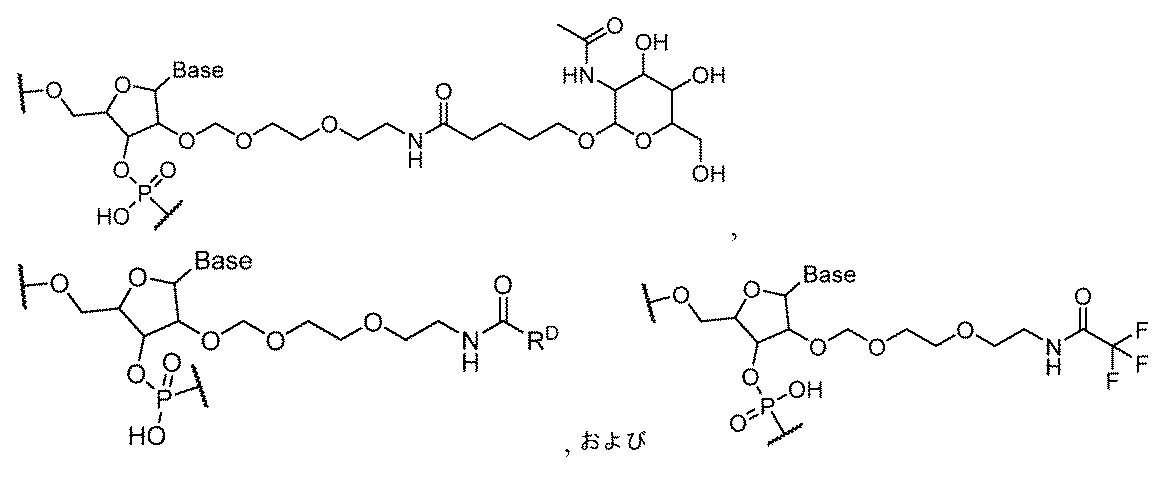
Baseは適宜修飾されたヌクレオ塩基であり、
RDは、C4~30アルキル、C4~30アルケニル、またはC4~30アルキニルである]
からなる群から選択されうる。
Base is an appropriately modified nucleobase,
R D is a C 4-30 alkyl , a C 4-30 alkenyl , or a C 4-30 alkynyl .
may be selected from the group consisting of:
一部の実施形態において、式(II)(もしくはIIa)または式III(もしくはIIIa)のLにおける1つまたは複数の連結部分(N)は、リガンドと適宜コンジュゲートされたモノ-、ジ-、トリ-、テトラ-、ペンタ-、またはポリプロリノール;リガンドと適宜コンジュゲートされたモノ-、ジ-、トリ-、テトラ-、ペンタ-、またはポリヒドロキシプロリノール;適宜修飾されたヌクレオチド;またはこれらの組合せを含む。 In some embodiments, one or more linking moieties (N) in L of Formula (II) (or IIa) or Formula III (or IIIa) include mono-, di-, tri-, tetra-, penta-, or polyprolinol optionally conjugated to a ligand; mono-, di-, tri-, tetra-, penta-, or polyhydroxyprolinol optionally conjugated to a ligand; an optionally modified nucleotide; or a combination thereof.
一部の実施形態において、式(II)(もしくはIIa)または式III(もしくはIIIa)のLは、リガンドと適宜コンジュゲートされた、1つまたは複数のモノ-、ジ-、トリ-、テトラ-、ペンタ-またはポリプロリノール;および1つまたは複数の適宜修飾されたヌクレオチドを含有する。 In some embodiments, L of formula (II) (or IIa) or formula III (or IIIa) contains one or more mono-, di-, tri-, tetra-, penta- or polyprolinols, optionally conjugated to a ligand; and one or more optionally modified nucleotides.
一部の実施形態において、式(II)(もしくはIIa)または式III(もしくはIIIa)のLは、リガンドと適宜コンジュゲートされた、1つまたは複数のモノ-、ジ-、トリ-、テトラ-、ペンタ-またはポリヒドロキシプロリノール;およびの1つまたは複数の適宜修飾されたヌクレオチドを含有する。 In some embodiments, L of formula (II) (or IIa) or formula III (or IIIa) contains one or more mono-, di-, tri-, tetra-, penta- or polyhydroxyprolinols, optionally conjugated to a ligand; and one or more optionally modified nucleotides.
一部の実施形態において、式(II)(もしくはIIa)または式III(もしくはIIIa)のLにおける1つまたは複数の連結部分(N)は、独立に、Y16、Y34、Q48、Q303、Q304、Q305、Q306、Q312、Q313、Q314、Q315、Q316、Q317、Q8、Q11、Q150、Q151、Q173、Q221、Q222、Q367、およびQ368からなる群から選択されうる。 In some embodiments, one or more linking moieties (N) in L of formula (II) (or IIa) or formula III (or IIIa) may be independently selected from the group consisting of Y16, Y34, Q48, Q303, Q304, Q305, Q306, Q312, Q313, Q314, Q315, Q316, Q317, Q8, Q11, Q150, Q151, Q173, Q221, Q222, Q367, and Q368.
一部の実施形態において、式(II)(もしくはIIa)または式III(もしくはIIIa)のLにおける各連結部分(N)は、独立に、適宜修飾されたヌクレオチド、Y16、Y34、Q48、Q303、Q304、Q305、Q306、Q312、Q313、Q314、Q315、Q316、Q317、Q8、Q11、Q150、Q151、Q173、Q221、Q222、Q367、またはQ368である。 In some embodiments, each linking moiety (N) in L of formula (II) (or IIa) or formula III (or IIIa) is independently an appropriately modified nucleotide, Y16, Y34, Q48, Q303, Q304, Q305, Q306, Q312, Q313, Q314, Q315, Q316, Q317, Q8, Q11, Q150, Q151, Q173, Q221, Q222, Q367, or Q368.
一部の実施形態において、式(II)(もしくはIIa)または式III(もしくはIIIa)のLは、3~5つの2’-デオキシヌクレオチド、2’-デオキシ-2’-フルオロヌクレオチドのトリプレット、リボヌクレオチドのトリプレット、2’-O-メチルヌクレオチドのトリプレット、またはQ304のトリプレットを含有する。一実施形態において、Lは、Q304のトリプレットを含有する。 In some embodiments, L of formula (II) (or IIa) or formula III (or IIIa) contains 3 to 5 2'-deoxynucleotides, 2'-deoxy-2'-fluoronucleotide triplets, ribonucleotide triplets, 2'-O-methyl nucleotide triplets, or Q304 triplets. In one embodiment, L contains a Q304 triplet.
一部の実施形態において、式(II)(もしくはIIa)または式III(もしくはIIIa)のLの位置は、以下:
Lの全ての連結単量体は、LPと共に、WとZ12の間にループを形成すること;
Lの1つまたは複数の連結単量体は、LPと共に、WとZ12の間にループを形成し、Lの1つまたは複数の連結単量体は、ループ領域ではないこと;
Lの1つまたは複数の連結単量体は、LPと共に、WとZ12の間にループを形成し、Lの1つまたは複数の連結単量体は、ループではなく、QSに接続されていること;ならびに
Lの1つまたは複数の連結単量体は、LPと共に、WとZ12の間にループを形成し、Lの1つまたは複数の連結単量体は、ループではなく、Z12に接続されていること
の1つによって特徴付けられる。
In some embodiments, the position of L in formula (II) (or IIa) or formula III (or IIIa) is:
all linking monomers of L together with LP form a loop between W and Z12 ;
one or more linking monomers of L together with LP form a loop between W and Z12 , and one or more linking monomers of L are not a loop region;
One or more linking monomers of L, together with LP, form a loop between W and Z12 , and one or more linking monomers of L are connected to QS , rather than a loop; and one or more linking monomers of L, together with LP, form a loop between W and Z12 , and one or more linking monomers of L are connected to Z12 , rather than a loop.
上記の実施形態において、式(II)(もしくはIIa)または式III(もしくはIIIa)のLにおけるヌクレオチド間の1つまたは複数のヌクレオチド間連結は、独立に、ホスホジエステル、ホスホトリエステル(Rp配置またはSp配置のいずれかに連結リン原子を含んでもよい)、ホスホン酸水素、ホスホン酸アルキルまたはホスホン酸アリール、ホスホロアミデート(Rp配置またはSp配置のいずれかに連結リン原子を含んでもよい)、ホスホロチオエート(Rp配置またはSp配置のいずれかに連結リン原子を含んでもよい)、および窒素修飾リン含有連結(PN連結)(Rp配置またはSp配置のいずれかに連結リン原子を含んでもよい)からなる群から選択される修飾ヌクレオチド間連結でありうる。 In the above embodiments, one or more internucleotide linkages between nucleotides in L of formula (II) (or IIa) or formula III (or IIIa) can be independently a modified internucleotide linkage selected from the group consisting of a phosphodiester, a phosphotriester (which may contain a linking phosphorus atom in either the Rp or Sp configuration), a hydrogen phosphonate, an alkyl or aryl phosphonate, a phosphoramidate (which may contain a linking phosphorus atom in either the Rp or Sp configuration), a phosphorothioate (which may contain a linking phosphorus atom in either the Rp or Sp configuration), and a nitrogen-modified phosphorus-containing linkage (PN linkage) (which may contain a linking phosphorus atom in either the Rp or Sp configuration).
ある特定の実施形態において、式(II)(もしくはIIa)または式III(もしくはIIIa)のLは、トリアゾール連結、アミド連結、スルフィドまたはジスルフィド連結、リン酸連結、オキシム連結、ヒドラゾ連結、N,N’-ジアルキレンヒドラゾ連結、メチレンイミノ連結、メチレンカルボニルアミノ連結、メチレンメチルイミノ連結、メチレンヒドラゾ連結、メチレンジメチルヒドラゾ連結、メチレンオキシメチルイミノ連結、ヒドロキシルアミノ連結、ホルムアセタール連結、アルキルまたはアリール連結、PEG連結、エーテル連結、チオエーテル連結、チオジエステル連結、チオノカルバメート連結、チオアセトアミド連結、スルホン酸連結、スルホンアミド連結、スルホン酸エステル連結、チオホルムアセタール連結、尿素連結、炭酸塩連結、アミン連結、マレイミド-チオエーテル連結、ホスホジエステル連結、ホスホトリエステル連結、ホスホン酸水素連結、アルキルまたはアリールホスホン酸連結、ホスホラミデート連結、ホスホロチオエート連結、窒素修飾リン含有連結(PN-連結)、ホスホロセレネート連結、ボラノホスフェート連結、ボラノホスフェートエステル連結、スルホンアミド連結、カルバメート連結、カルボキサミド連結、カルボキシメチル連結、カルボキシレートエステル連結、シロキサン連結、ジアルキルシロキサン連結、エチレンオキシド連結、およびこれらの組合せからなる群から選択される1つまたは複数の連結部分を含有しうる。 In certain embodiments, L of formula (II) (or IIa) or formula III (or IIIa) is a triazole linkage, an amide linkage, a sulfide or disulfide linkage, a phosphate linkage, an oxime linkage, a hydrazo linkage, an N,N'-dialkylenehydrazo linkage, a methyleneimino linkage, a methylenecarbonylamino linkage, a methylenemethylimino linkage, a methylenehydrazo linkage, a methylenedimethylhydrazo linkage, a methyleneoxymethylimino linkage, a hydroxylamino linkage, a formacetal linkage, an alkyl or aryl linkage, a PEG linkage, an ether linkage, a thioether linkage, a thiodiester linkage, a thionocarbamate linkage, a thioacetamide linkage, a sulfonic acid linkage, a sulfonamide linkage, a sulfone linkage, a hydroxylamino linkage, a formacetal linkage, an alkyl or aryl linkage, a PEG linkage, an ether linkage, a thioether linkage, a thiodiester linkage, a thionocarbamate linkage, a thioacetamide linkage, a sulfonylamino linkage, a sulfonylamino linkage, a hydroxyl ... It may contain one or more linking moieties selected from the group consisting of acid ester linkages, thioformacetal linkages, urea linkages, carbonate linkages, amine linkages, maleimide-thioether linkages, phosphodiester linkages, phosphotriester linkages, hydrogen phosphonate linkages, alkyl or aryl phosphonate linkages, phosphoramidate linkages, phosphorothioate linkages, nitrogen-modified phosphorus-containing linkages (PN-linkages), phosphoroselenate linkages, boranophosphate linkages, boranophosphate ester linkages, sulfonamide linkages, carbamate linkages, carboxamide linkages, carboxymethyl linkages, carboxylate ester linkages, siloxane linkages, dialkylsiloxane linkages, ethylene oxide linkages, and combinations thereof.
ある特定の実施形態において、式(II)(もしくはIIa)または式III(もしくはIIIa)のLは、ピロリジニル、ピラゾリニル、ピラゾリジニル、イミダゾリニル、イミダゾリジニル、ピペリジニル、ピペラジニル、[1,3]ジオキソラン、オキサゾリジニル、イソキサゾリジニル、モルホリニル、チアゾリジニル、イソチアゾリジニル、キノキサリニル、ピリダジノニル、テトラヒドロフラニル、およびデカリニルからなる群から選択される1つまたは複数の環状基を含有しうる。 In certain embodiments, L of formula (II) (or IIa) or formula III (or IIIa) may contain one or more cyclic groups selected from the group consisting of pyrrolidinyl, pyrazolinyl, pyrazolidinyl, imidazolinyl, imidazolidinyl, piperidinyl, piperazinyl, [1,3]dioxolane, oxazolidinyl, isoxazolidinyl, morpholinyl, thiazolidinyl, isothiazolidinyl, quinoxalinyl, pyridazinonyl, tetrahydrofuranyl, and decalinyl.
一部の実施形態において、式(II)(もしくはIIa)または式III(もしくはIIIa)のLは、ヌクレオチドベースのリンカー(テザー)を含有する。一部の実施形態において、Lは、非ヌクレオチドベースのリンカー(テザー)を含有する。 In some embodiments, L of formula (II) (or IIa) or formula III (or IIIa) contains a nucleotide-based linker (tether). In some embodiments, L contains a non-nucleotide-based linker (tether).
ある特定の実施形態において、式(II)(もしくはIIa)または式III(もしくはIIIa)のLに含有されるヌクレオチドベースまたは非ヌクレオチドベースのリンカー(テザー)は、体液中で安定である、安定なリンカー(テザー)である。例えば、ヌクレオチドベースまたは非ヌクレオチドベースの安定なリンカー(テザー)は、血漿または人工脳脊髄液中で安定である。 In certain embodiments, the nucleotide-based or non-nucleotide-based linker (tether) contained in L of formula (II) (or IIa) or formula III (or IIIa) is a stable linker (tether) that is stable in body fluids. For example, the nucleotide-based or non-nucleotide-based stable linker (tether) is stable in plasma or artificial cerebrospinal fluid.
ある特定の実施形態において、切断型連結基(テザー)は、上記のように、式(CL-1)または(CL-2)の部分を含む。 In certain embodiments, the cleavable linker (tether) comprises a moiety of formula (CL-1) or (CL-2), as described above.
ある特定の実施形態において、切断型連結基(テザー)は、以下:
-(CH2)12-(C12リンカーまたはQ50)、
-(CH2)6-S-S-(CH2)6-(C6-S-S-C6リンカーまたはQ51)、
Q151、
Q173、
-CH2CH2O-(CH2CH2)n-CH2CH2O-CH2CH2O-[式中、nは0または1~20である];
-(CH2)9-(CH2)n-CH2-[式中、nは0または1~20である];
リガンドと適宜コンジュゲートされたモノ-、ジ-、トリ-、テトラ-、ペンタ-またはポリプロリノール、
リガンドと適宜コンジュゲートされたモノ-、ジ-、トリ-、テトラ-、ペンタ-またはポリヒドロキシプロリノール
から選択される部分を含む。
In certain embodiments, the cleavable tether is:
-( CH2 ) 12- (C12 linker or Q50),
-( CH2 ) 6 -S-S-( CH2 ) 6- (C6-S-S-C6 linker or Q51),
Q151,
Q173,
-CH2CH2O- (CH2CH2 ) n- CH2CH2O -CH2CH2O- , wherein n is 0 or 1 to 20 ;
-( CH2 ) 9- ( CH2 ) n - CH2- , where n is 0 or 1 to 20;
mono-, di-, tri-, tetra-, penta- or polyprolinols, appropriately conjugated with a ligand;
It comprises a moiety selected from mono-, di-, tri-, tetra-, penta-, or polyhydroxyprolinol optionally conjugated to a ligand.
ある特定の実施形態において、切断型連結基(テザー)は、1~15ヌクレオチド長の核酸リンカーを含む。例えば、核酸リンカーは、2~7、5~7、2~5、または3、4、もしくは5の適宜修飾されたヌクレオチド長でありうる。 In certain embodiments, the cleavable linking group (tether) comprises a nucleic acid linker that is 1-15 nucleotides in length. For example, the nucleic acid linker can be 2-7, 5-7, 2-5, or 3, 4, or 5 appropriately modified nucleotides in length.
ある特定の実施形態において、切断型連結基(テザー)は、2’-O-メチルヌクレオチド、2’-フルオロヌクレオチド、デオキシリボヌクレオチド、およびリボヌクレオチドからなる群から選択される1つまたは複数のヌクレオチドを含む核酸リンカーを含む。一実施形態において、全ての核酸リンカーヌクレオチドは、同じ型のヌクレオチドである。一実施形態において、核酸リンカーは、2’-O-メチルヌクレオチドを完全に含み、2’-フルオロヌクレオチドを完全に含み、またはデオキシリボヌクレオチドを完全に含む。 In certain embodiments, the cleavable linking group (tether) comprises a nucleic acid linker that comprises one or more nucleotides selected from the group consisting of 2'-O-methyl nucleotides, 2'-fluoro nucleotides, deoxyribonucleotides, and ribonucleotides. In one embodiment, all of the nucleic acid linker nucleotides are the same type of nucleotide. In one embodiment, the nucleic acid linker is entirely composed of 2'-O-methyl nucleotides, entirely composed of 2'-fluoro nucleotides, or entirely composed of deoxyribonucleotides.
ある特定の実施形態において、切断型連結基(テザー)は、修飾されたリボヌクレオチド配列を含むポリヌクレオチドを含み、2’-O-メチルリボヌクレオチド修飾、2’-フルオロ-リボヌクレオチド修飾、異なる3’-修飾(3’-リボ、3’-O-メチル、3’-デオキシ、3’-フルオロ)を有する2’-5’-連結ヌクレオチド、グリコール核酸(GNA)修飾、ロック核酸(LNA)修飾、ヘキサノール核酸(HNA)修飾、脱塩基リボース修飾、脱塩基デオキシリボース修飾、および脱塩基ヒドロキシプロリノール修飾からなる群から選択される1つまたは複数の修飾を含むポリヌクレオチドでもよい。 In certain embodiments, the cleavable linking group (tether) comprises a polynucleotide comprising a modified ribonucleotide sequence, which may be a polynucleotide comprising one or more modifications selected from the group consisting of 2'-O-methyl ribonucleotide modifications, 2'-fluoro-ribonucleotide modifications, 2'-5'-linked nucleotides with different 3'-modifications (3'-ribo, 3'-O-methyl, 3'-deoxy, 3'-fluoro), glycol nucleic acid (GNA) modifications, locked nucleic acid (LNA) modifications, hexanol nucleic acid (HNA) modifications, abasic ribose modifications, abasic deoxyribose modifications, and abasic hydroxyprolinol modifications.
一部の実施形態において、式(II)(もしくはIIa)または式III(もしくはIIIa)の一本鎖オリゴヌクレオチドの連結基Lは、DICERによって切断可能である、ヌクレオチドベースの切断型連結基(テザー)を含む。一部の実施形態において、一本鎖オリゴヌクレオチドは、DICERによって切断可能な基質を含む。 In some embodiments, the linking group L of the single-stranded oligonucleotide of formula (II) (or IIa) or formula III (or IIIa) comprises a nucleotide-based cleavable linking group (tether) that is cleavable by DICER. In some embodiments, the single-stranded oligonucleotide comprises a substrate that is cleavable by DICER.
ある特定の実施形態において、式(II)(もしくはIIa)または式III(もしくはIIIa)の一本鎖オリゴヌクレオチドは、一本鎖オリゴヌクレオチドの少なくとも1つのヌクレオチド配列(例えば、Z11および/またはZ12)において、5’-一リン酸の代謝物を生成することができる切断型連結基(ヌクレオチドベースまたは非ヌクレオチドベース)を含有する。 In certain embodiments, the single-stranded oligonucleotide of Formula (II) (or IIa) or Formula III (or IIIa) contains a cleavable linker (nucleotide-based or non-nucleotide-based) capable of generating a 5'-monophosphate metabolite at at least one nucleotide sequence (e.g., Z11 and/or Z12 ) of the single-stranded oligonucleotide.
一部の実施形態において、式(II)(もしくはIIa)または式III(もしくはIIIa)の一本鎖オリゴヌクレオチドは、1つまたは複数のリガンド(例えば、ターゲティングリガンド)をさらに含みうる。一実施形態において、Z11は、配列の5’または3’末端に、少なくとも1つのリガンド(例えば、ターゲティングリガンド)を含む。一実施形態において、Z12は、配列の5’または3’末端に、少なくとも1つのリガンド(例えば、ターゲティングリガンド)を含む。一実施形態において、Z11およびZ12のそれぞれは、配列の5’または3’末端に、少なくとも1つのリガンド(例えば、ターゲティングリガンド)を含む。 In some embodiments, the single-stranded oligonucleotide of formula (II) (or IIa) or formula III (or IIIa) may further comprise one or more ligands (e.g., targeting ligands). In one embodiment, Z 11 comprises at least one ligand (e.g., targeting ligand) at the 5' or 3' end of the sequence. In one embodiment, Z 12 comprises at least one ligand (e.g., targeting ligand) at the 5' or 3' end of the sequence. In one embodiment, each of Z 11 and Z 12 comprises at least one ligand (e.g., targeting ligand) at the 5' or 3' end of the sequence.
一部の実施形態において、少なくとも1つのリガンドは、適宜リンカーまたは担体を介して、ヌクレオチド配列(例えば、Z11およびZ12)の内部位置にコンジュゲートされる。一部の実施形態において、少なくとも1つのリガンドは、適宜リンカーまたは担体を介して、Z11またはZ12の3’末端または5’末端にコンジュゲートされる。一部の実施形態において、少なくとも1つのリガンドは、オリゴヌクレオチドのリボ糖(ribosugar)への直接接合を介して一本鎖オリゴヌクレオチドにコンジュゲートされうる。あるいは、リガンドは、1つまたは複数のリンカー(テザー)、および/または担体を介して、一本鎖オリゴヌクレオチドにコンジュゲートされうる。 In some embodiments, at least one ligand is conjugated to an internal position of the nucleotide sequence (e.g., Z11 and Z12 ), optionally via a linker or carrier. In some embodiments, at least one ligand is conjugated to the 3' or 5' end of Z11 or Z12 , optionally via a linker or carrier. In some embodiments, at least one ligand may be conjugated to the single-stranded oligonucleotide via direct conjugation to the ribosugar of the oligonucleotide. Alternatively, the ligand may be conjugated to the single-stranded oligonucleotide via one or more linkers (tethers), and/or carriers.
一部の実施形態において、内部位置は、QSの1~4ヌクレオチド位上流または下流の1つを指しうる。一部の実施形態において、内部位置は、Z11の5’末端から11、12、および13位に対合したZ12のヌクレオチドの1~4ヌクレオチド位上流または下流の1つを指しうる。 In some embodiments, the internal position may refer to one of 1 to 4 nucleotide positions upstream or downstream of Q S. In some embodiments, the internal position may refer to one of 1 to 4 nucleotide positions upstream or downstream of nucleotides of Z 12 paired at positions 11, 12, and 13 from the 5' end of Z 11 .
Z12では、リガンドのみのコンジュゲーションのための内部位置をカウントする目的のため、QSに接続される末端ヌクレオチド(Z12では)は、内部位置として考えられうる。 In Z12 , for the purposes of counting internal positions for ligand-only conjugation, the terminal nucleotide (in Z12 ) connected to QS can be considered as an internal position.
一部の実施形態において、内部位置は、そこから、
ループ領域に直接接続されるQSおよび/またはZ12のヌクレオチドが除外されること;および/または
Z11の5’末端から2または14位が除外されること;および/または
Z11の5’末端から11、12、および13位が除外されること;および/または
Z11の5’末端から11、12、および13位に対合したQSおよび/またはZ12の位置が除外されること;および/または
式(II)または(IIa)では、Z12の3’末端およびZ11の5’末端から2つまたは3つの末端位置が除外されること;および/または
式(III)または(IIIa)では、Z12の5’末端およびZ11の3’末端から2つまたは3つの末端位置が除外されること
によって特徴付けられうる。
In some embodiments, the internal location is
and/or excluding positions 2 or 14 from the 5' end of Z11 ; and/or excluding positions 11, 12, and 13 from the 5' end of Z11 ; and/or excluding positions of QS and/or Z12 paired with positions 11, 12 , and 13 from the 5' end of Z11 ; and/or in formula (II) or (IIa), excluding two or three terminal positions from the 3' end of Z12 and the 5' end of Z11 ; and/or in formula (III) or (IIIa), excluding two or three terminal positions from the 5' end of Z12 and the 3' end of Z11 .
一部の実施形態において、リガンドは、一価または分岐状二価もしくは三価のリンカーを介して一本鎖オリゴヌクレオチドへとコンジュゲートされうる。 In some embodiments, the ligand may be conjugated to the single-stranded oligonucleotide via a monovalent or branched divalent or trivalent linker.
一部の実施形態において、リガンドは、1つまたは複数のヌクレオチド(複数可)を置換する担体を介して一本鎖オリゴヌクレオチドへとコンジュゲートされうる。担体は、環式基または非環式基でありうる。一実施形態において、環式基は、シクロヘキシル、ピロリジニル、ピラゾリニル、ピラゾリジニル、イミダゾリニル、イミダゾリジニル、ピペリジニル、ピペラジニル、[1,3]ジオキソラン、オキサゾリジニル、イソキサゾリジニル、モルホリニル、チアゾリジニル、イソチアゾリジニル、キノキサリニル、ピリダジノニル、テトラヒドロフラニル、およびデカリニルからなる群から選択される。一実施形態において、非環状基は、セリノール骨格またはジエタノールアミン骨格に基づく部分である。 In some embodiments, the ligand may be conjugated to the single-stranded oligonucleotide via a carrier that replaces one or more nucleotide(s). The carrier may be a cyclic or acyclic group. In one embodiment, the cyclic group is selected from the group consisting of cyclohexyl, pyrrolidinyl, pyrazolinyl, pyrazolidinyl, imidazolinyl, imidazolidinyl, piperidinyl, piperazinyl, [1,3]dioxolane, oxazolidinyl, isoxazolidinyl, morpholinyl, thiazolidinyl, isothiazolidinyl, quinoxalinyl, pyridazinonyl, tetrahydrofuranyl, and decalinyl. In one embodiment, the acyclic group is a moiety based on a serinol backbone or a diethanolamine backbone.
ある特定の実施形態において、少なくとも1つのリガンドは、親油性部分を含む。 In certain embodiments, at least one ligand comprises a lipophilic moiety.
一実施形態において、親油性部分は、脂質、コレステロール、レチノイン酸、コール酸、アダマンタン酢酸、1-ピレン酪酸、ドコサン酸(DCA)、ジヒドロテストステロン、1,3-ビス-O(ヘキサデシル)グリセロール、ゲラニルオキシヘキシアノール(geranyloxyhexyanol)、ヘキサデシルグリセロール、ボルネオール、メントール、1,3-プロパンジオール、ヘプタデシル基、パルミチン酸、ミリスチン酸、リトコール酸、O3-(オレオイル)リトコール酸、O3-(オレオイル)コレン酸、ジメトキシトリチル、またはフェノキサジンである。ある特定の実施形態において、脂質は、エイコサペンタエン酸(EPA)およびドコサヘキサエン酸(DHA)からなる群から選択される、脂肪酸(オメガ-3脂肪酸、例えば)である。 In one embodiment, the lipophilic moiety is a lipid, cholesterol, retinoic acid, cholic acid, adamantane acetic acid, 1-pyrenebutyric acid, docosanoic acid (DCA), dihydrotestosterone, 1,3-bis-O(hexadecyl)glycerol, geranyloxyhexyanol, hexadecylglycerol, borneol, menthol, 1,3-propanediol, heptadecyl radical, palmitic acid, myristic acid, lithocholic acid, O3-(oleoyl)lithocholic acid, O3-(oleoyl)cholenoic acid, dimethoxytrityl, or phenoxazine. In certain embodiments, the lipid is a fatty acid (omega-3 fatty acid, for example) selected from the group consisting of eicosapentaenoic acid (EPA) and docosahexaenoic acid (DHA).
一部の実施形態において、親油性部分は、飽和または不飽和C4~C30炭化水素鎖(例えば、C4~C30アルキルまたはアルケニル)、ならびにヒドロキシル、アミン、カルボン酸、スルホン酸、リン酸、チオール、アジド、およびアルキンからなる群から選択される任意の官能基を含有する。 In some embodiments, the lipophilic moiety contains a saturated or unsaturated C4 - C30 hydrocarbon chain (e.g., a C4 - C30 alkyl or alkenyl) and any functional group selected from the group consisting of hydroxyl, amine, carboxylic acid, sulfonic acid, phosphate, thiol, azide, and alkyne.
一部の実施形態において、親油性部分は、飽和または不飽和C6~C18炭化水素鎖(例えば、線状C6~C18アルキルまたはアルケニル)、例えば、飽和または不飽和C16炭化水素鎖(例えば、線状C16アルキルまたはアルケニル)を含有する。一部の実施形態において、親油性部分は、飽和または不飽和C14~C24炭化水素鎖(例えば、線状C14~C24アルキルまたはアルケニル)、例えば、飽和または不飽和C22炭化水素鎖(例えば、線状C22アルキルまたはアルケニル)を含有する。例えば、一本鎖オリゴヌクレオチドの1つまたは複数の非末端位置は、本明細書において上記のように、式(I)[式中、Bは、天然または修飾ヌクレオチド塩基(例えば、アデニン、グアニン、シトシン、チミンもしくはウラシル、またはそれらの修飾された誘導体)であり、n-ヘキサデシル鎖は親油性部分である]の「2’-C16」修飾を有しうる。別の例において、一本鎖オリゴヌクレオチドの1つまたは複数の非末端位置は、本明細書において上記のように、式(2)[式中、Bは、天然または修飾ヌクレオチド塩基(例えば、アデニン、グアニン、シトシン、チミンもしくはウラシル、またはそれらの修飾された誘導体)であり、n-ドコサニル鎖は親油性部分である]の「2’-C22」修飾を有しうる。 In some embodiments, the lipophilic moiety contains a saturated or unsaturated C 6 -C 18 hydrocarbon chain (e.g., a linear C 6 -C 18 alkyl or alkenyl), e.g., a saturated or unsaturated C 16 hydrocarbon chain (e.g., a linear C 16 alkyl or alkenyl). In some embodiments, the lipophilic moiety contains a saturated or unsaturated C 14 -C 24 hydrocarbon chain (e.g., a linear C 14 -C 24 alkyl or alkenyl), e.g., a saturated or unsaturated C 22 hydrocarbon chain (e.g., a linear C 22 alkyl or alkenyl). For example, one or more non-terminal positions of the single-stranded oligonucleotide may have a "2'-C 16 " modification of formula (I), as described herein above, where B is a natural or modified nucleotide base (e.g., adenine, guanine, cytosine, thymine or uracil, or a modified derivative thereof), and the n- hexadecyl chain is the lipophilic moiety. In another example, one or more non-terminal positions of a single stranded oligonucleotide may have a "2'-C22" modification of formula (2), as described herein above, where B is a natural or modified nucleotide base (e.g., adenine, guanine, cytosine, thymine or uracil, or a modified derivative thereof), and the n-docosanyl chain is a lipophilic moiety .
n-ヘキサデシル鎖またはn-ドコサニル鎖を、C4~C30炭化水素鎖と置換する類似の修飾は、「2’-C4~C30炭化水素鎖」と呼ばれる(または、C6~C18炭化水素鎖もしくはC14~C24炭化水素鎖との置換は、「2’-C6~C18炭化水素鎖」または「2’-C14~C24炭化水素鎖」と呼ばれる)。 A similar modification replacing an n-hexadecyl or n-docosanyl chain with a C 4 -C 30 hydrocarbon chain is referred to as a "2'-C 4 -C 30 hydrocarbon chain" (or a C 6 -C 18 or C 14 -C 24 hydrocarbon chain is referred to as a "2'-C 6 -C 18 hydrocarbon chain" or "2'-C 14 -C 24 hydrocarbon chain").
関連する実施形態において、Z11およびZ12の少なくとも1つの1つまたは複数の非末端ヌクレオチド位置は、式(1)の2’-C4~C30炭化水素鎖構造、2’-C6~C18炭化水素鎖構造、2’-C14~C24炭化水素鎖構造、2’-C16構造、または式(2)の2’-C22構造を有する。 In related embodiments, one or more non-terminal nucleotide positions of at least one of Z 11 and Z 12 have a 2'-C 4 -C 30 hydrocarbon chain structure of formula (1), a 2'-C 6 -C 18 hydrocarbon chain structure, a 2'-C 14 -C 24 hydrocarbon chain structure, a 2'-C 16 structure, or a 2'-C 22 structure of formula (2).
一部の実施形態において、親油性部分は、1つまたは複数のリン脂質を含有する。 In some embodiments, the lipophilic portion contains one or more phospholipids.
一部の実施形態において、親油性部分は、その全てが、その全体を参照により本明細書に組み込まれる、国際PCT出願公開WO2019/232255A1およびWO2021/108662A1、および米国特許第10,184,124号に開示される、1つまたは複数の脂質または親油性リガンドを含有する。 In some embodiments, the lipophilic moiety contains one or more lipids or lipophilic ligands as disclosed in International PCT Publication Nos. WO 2019/232255 A1 and WO 2021/108662 A1, and U.S. Pat. No. 10,184,124, all of which are incorporated herein by reference in their entireties.
一部の実施形態において、リガンドは、本明細書において上記のように、式(L-1)、(L-2)、(L-3)、または(L-4)の1つまたは複数のリガンドを含む。 In some embodiments, the ligand comprises one or more ligands of formula (L-1), (L-2), (L-3), or (L-4), as described herein above.
一部の実施形態において、リガンドは、その全てが、その全体を参照により本明細書に組み込まれる、国際PCT出願公開WO2017/053999、WO2019/118916、WO2022/031433、WO2022/056269、WO2022/056273、およびWO2022/056277に開示されるものを含む。 In some embodiments, the ligands include those disclosed in International PCT Publications WO2017/053999, WO2019/118916, WO2022/031433, WO2022/056269, WO2022/056273, and WO2022/056277, all of which are incorporated by reference in their entireties.
一部の実施形態において、親油性部分は、飽和または不飽和C4~C30(例えば、C4~C18)炭化水素鎖、ならびにヒドロキシル、アミン、カルボン酸(carboylic acid)、スルホン酸、リン酸、チオール、アジド、およびアルキンからなる群から選択される任意の官能基を含有する。 In some embodiments, the lipophilic moiety contains a saturated or unsaturated C4 - C30 (e.g., C4 - C18 ) hydrocarbon chain and any functional group selected from the group consisting of hydroxyl, amine, carboylic acid, sulfonic acid, phosphate, thiol, azide, and alkyne.
一部の実施形態において、親油性部分は、適宜リンカーまたは担体を介して、Z11またはZ12の1つまたは複数の内部位置へとコンジュゲートされる。 In some embodiments, the lipophilic moiety is conjugated to one or more internal positions of Z 11 or Z 12 , optionally via a linker or carrier.
一部の実施形態において、Z11およびZ12の少なくとも1つは、ヌクレオチド配列の9~12位を除く1つまたは複数の内部位置(すなわち非末端位置);例えば、1位としてヌクレオチド配列の5’末端からカウントして、ヌクレオチド配列の4~8位および13~18;ヌクレオチド配列の5、6、7、15、および17位;またはヌクレオチド配列の4、6、7、および8位に独立にコンジュゲートした1つまたは複数の親油性部分を含む。 In some embodiments, at least one of Z11 and Z12 comprises one or more lipophilic moieties independently conjugated to one or more internal positions (i.e., non-terminal positions) other than positions 9-12 of the nucleotide sequence; for example, positions 4-8 and 13-18 of the nucleotide sequence, counting from the 5' end of the nucleotide sequence as position 1; positions 5, 6, 7, 15, and 17 of the nucleotide sequence; or positions 4, 6, 7, and 8 of the nucleotide sequence.
一部の実施形態において、Z11およびZ12の少なくとも1つは、ヌクレオチド配列の5’末端からカウントして、ヌクレオチド配列の6位に独立にコンジュゲートした1つまたは複数の親油性部分を含む。一実施形態において、Z11およびZ12のそれぞれは、ヌクレオチド配列の6位にコンジュゲートした親油性部分を含み;親油性部分は、飽和もしくは不飽和C4~C30(例えば、C4~C18)炭化水素鎖、または飽和もしくは不飽和C14~C24炭化水素鎖を含んでもよく;親油性部分は、飽和もしくは不飽和C16炭化水素鎖または飽和もしくは不飽和C22炭化水素鎖を含んでもよい。 In some embodiments, at least one of Z 11 and Z 12 comprises one or more lipophilic moieties independently conjugated to the 6-position of the nucleotide sequence, counting from the 5'-end of the nucleotide sequence. In one embodiment, each of Z 11 and Z 12 comprises a lipophilic moiety conjugated to the 6-position of the nucleotide sequence; the lipophilic moiety may comprise a saturated or unsaturated C 4 -C 30 (e.g., C 4 -C 18 ) hydrocarbon chain, or a saturated or unsaturated C 14 -C 24 hydrocarbon chain; the lipophilic moiety may comprise a saturated or unsaturated C 16 hydrocarbon chain, or a saturated or unsaturated C 22 hydrocarbon chain.
一部の実施形態において、Z11およびZ12の少なくとも1つは、ヌクレオチド配列の1つまたは複数の非末端位置;例えば、1位としてヌクレオチド配列の5’末端からカウントして、ヌクレオチド配列の6~10位および15~18位;ヌクレオチド配列の15位および17位に独立にコンジュゲートした1つまたは複数の親油性部分を含む。 In some embodiments, at least one of Z11 and Z12 comprises one or more lipophilic moieties independently conjugated to one or more non-terminal positions of the nucleotide sequence; for example, counting from the 5' end of the nucleotide sequence as position 1, positions 6-10 and 15-18 of the nucleotide sequence; positions 15 and 17 of the nucleotide sequence.
一部の実施形態において、少なくとも1つの親油性部分は、式(II)(もしくはIIa)または式(III)(もしくは(IIIa))の一本鎖オリゴヌクレオチドの内部位置にコンジュゲートされ、内部位置から、
Z11の5’末端から2位または14位が除外される;および/または
Z11の5’末端から11、12、および13位が除外される;および/または
Z11の5’末端から11、12、および13位に対合したQSおよび/またはZ12の位置が除外される;および/または
式(II)または(IIa)では、Z12の3’末端およびZ11の5’末端から2つまたは3つの末端位置が除外されてもよい;および/または
式(III)または(IIIa)では、Z12の5’末端およびZ11の3’末端から2つまたは3つの末端位置が除外されてもよい。
In some embodiments, at least one lipophilic moiety is conjugated to an internal position of the single stranded oligonucleotide of Formula (II) (or IIa) or Formula (III) (or (IIIa)), and from the internal position:
Positions 2 or 14 are excluded from the 5' end of Z11 ; and/or positions 11, 12, and 13 are excluded from the 5' end of Z11 ; and/or positions of QS and/or Z12 paired with positions 11, 12, and 13 are excluded from the 5' end of Z11 ; and/or in formula (II) or (IIa), two or three terminal positions may be excluded from the 3' end of Z12 and the 5' end of Z11 ; and/or in formula (III) or (IIIa), two or three terminal positions may be excluded from the 5' end of Z12 and the 3' end of Z11 .
一部の実施形態において、少なくとも1つのリガンドは、抗体、抗原、葉酸、受容体リガンド、炭化水素、アプタマー、インテグリン受容体リガンド、ケモカイン受容体リガンド、トランスフェリン、ビオチン、セロトニン受容体リガンド、PSMA、エンドセリン、GCPII、ソマトスタチン、LDLおよびHDLリガンドからなる群から選択されるターゲティングリガンドである。一実施形態において、少なくとも1つのリガンドは、インテグリン受容体リガンドである。 In some embodiments, at least one ligand is a targeting ligand selected from the group consisting of an antibody, an antigen, folate, a receptor ligand, a carbohydrate, an aptamer, an integrin receptor ligand, a chemokine receptor ligand, transferrin, biotin, a serotonin receptor ligand, PSMA, endothelin, GCPII, somatostatin, LDL and HDL ligands. In one embodiment, at least one ligand is an integrin receptor ligand.
ターゲティングリガンドは、適宜リンカーまたは担体を介して、ヌクレオチド配列(例えば、Z11およびZ12)の内部位置にコンジュゲートされうる。あるいは、ターゲティングリガンドは、適宜リンカーまたは担体を介して、Z11またはZ12の3’末端または5’末端にコンジュゲートされうる。 The targeting ligand may be conjugated to an internal position of the nucleotide sequence (e.g., Z11 and Z12 ) via a suitable linker or carrier. Alternatively, the targeting ligand may be conjugated to the 3' or 5' end of Z11 or Z12 via a suitable linker or carrier.
ある特定の実施形態において、少なくとも1つのリガンドは、炭化水素ベースのリガンドである。炭化水素ベースのリガンドは、D-ガラクトース、多価ガラクトース、N-アセチル-D-ガラクトサミン(GalNAc)、多価GalNAc、D-マンノース、多価マンノース、多価ラクトース、N-アセチル-グルコサミン、グルコース、多価グルコース、多価フコース、グリコシル化ポリアミノアシド、またはレクチンでありうる。 In certain embodiments, at least one ligand is a carbohydrate-based ligand. The carbohydrate-based ligand can be D-galactose, multivalent galactose, N-acetyl-D-galactosamine (GalNAc), multivalent GalNAc, D-mannose, multivalent mannose, multivalent lactose, N-acetyl-glucosamine, glucose, multivalent glucose, multivalent fucose, glycosylated polyamino acid, or a lectin.
一部の実施形態において、炭化水素ベースのリガンドは、二価または三価の分岐状リンカー、例えば: In some embodiments, the hydrocarbon-based ligand is a bivalent or trivalent branched linker, such as:
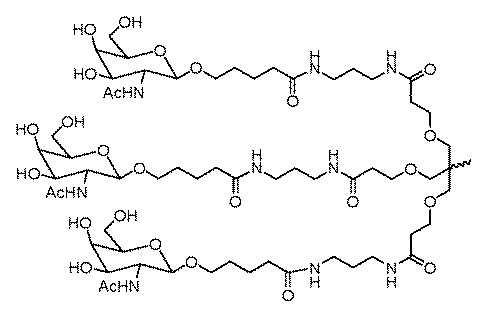
一部の実施形態において、1つまたは複数のターゲティングリガンド(例えば、炭化水素ベースのリガンド)は、2位または14位を除く、Z11の内部位置にコンジュゲートされる。 In some embodiments, one or more targeting ligands (eg, carbohydrate-based ligands) are conjugated to an internal position of Z 11 , other than the 2- or 14-position.
一本鎖オリゴヌクレオチドに関する本発明の上記の態様において、式(I)、式(II)(もしくはIIa)、または式III(もしくはIIIa)の一本鎖オリゴヌクレオチドの、ヌクレオチド配列の5’末端におけるリン酸模倣体修飾は、5’末端ホスホロチオエート(5’-PS)、5’末端ホスホロジチオエート(5’-PS2)、5’末端ビニルホスホネート(5’-VP)、5’末端メチルホスホネート(MePhos)、または5’-デオキシ-5’-C-マロニルでありうる。一実施形態において、リン酸模倣体は、5’-ビニルホスホネート(VP)である。5’-VPは、5’-E-VP異性体(すなわち、トランス-ビニルホスホネート)、5’-Z-VP異性体(すなわち、シス-ビニルホスフェート)、またはこれらの混合物のいずれかでありうる。 In the above aspects of the invention relating to single-stranded oligonucleotides, the phosphate mimetic modification at the 5'-end of the nucleotide sequence of the single-stranded oligonucleotide of formula (I), formula (II) (or IIa), or formula III (or IIIa) can be 5'-terminal phosphorothioate (5'-PS), 5'-terminal phosphorodithioate (5'-PS2), 5'-terminal vinyl phosphonate (5'-VP), 5'-terminal methyl phosphonate (MePhos), or 5'-deoxy-5'-C-malonyl. In one embodiment, the phosphate mimetic is 5'-vinyl phosphonate (VP). The 5'-VP can be either a 5'-E-VP isomer (i.e., trans-vinyl phosphonate), a 5'-Z-VP isomer (i.e., cis-vinyl phosphate), or a mixture thereof.
一実施形態において、リン酸模倣体は、5’-ビニルホスホネート(VP)である。一実施形態において、リン酸模倣体は、5’-シクロプロピルホスホネートである。一実施形態において、リン酸摸倣体は、5’-ビニルホスフェートである。 In one embodiment, the phosphate mimetic is 5'-vinyl phosphonate (VP). In one embodiment, the phosphate mimetic is 5'-cyclopropyl phosphonate. In one embodiment, the phosphate mimetic is 5'-vinyl phosphate.
別の実施形態において、一本鎖オリゴヌクレオチドは、アンチセンス鎖(すなわち、Z1)の5’末端に、リン酸またはリン酸模倣体をさらに含む。リン酸模倣体は、5’-ビニルホスホネート(VP)でもよい。リン酸模倣体が5’-ビニルホスホネート(VP)である場合、5’末端ヌクレオチドは、以下の構造、 In another embodiment, the single stranded oligonucleotide further comprises a phosphate or phosphate mimetic at the 5'-end of the antisense strand (ie, Z 1 ). The phosphate mimetic can be a 5'-vinylphosphonate (VP). When the phosphate mimetic is a 5'-vinylphosphonate (VP), the 5'-terminal nucleotide has the following structure:
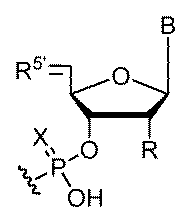
Xは、OまたはSであり;
Rは、水素、ヒドロキシ、フルオロ、またはC1~20アルコキシ(例えば、メトキシまたはn-ヘキサデシルオキシ)であり;
R5’は、=C(H)-P(O)(OH)2であり、C5’炭素とR5’の間の二重結合は、EまたはZ方向(例えば、E方向)であり、ならびに
Bは、ヌクレオ塩基または修飾ヌクレオ塩基であり、Bはアデニン、グアニン、シトシン、チミン、またはウラシルでもよい]
を有しうる。
X is O or S;
R is hydrogen, hydroxy, fluoro, or C 1-20 alkoxy (e.g., methoxy or n-hexadecyloxy);
R5 ' is =C(H)-P(O)(OH) 2 , the double bond between the C5' carbon and R5 ' is in the E or Z orientation (e.g., E orientation), and B is a nucleobase or a modified nucleobase, where B can be adenine, guanine, cytosine, thymine, or uracil.
may have.
一実施形態において、R5’は、=C(H)-P(O)(OH)2であり、C5’炭素とR5’の間の二重結合は、E方向である。別の実施形態において、Rはメトキシであり、R5’は、=C(H)-P(O)(OH)2であり、C5’炭素とR5’の間の二重結合は、E方向である。別の実施形態において、XはSであり、Rはメトキシであり、R5’は、=C(H)-P(O)(OH)2であり、C5’炭素とR5’の間の二重結合は、E方向である。 In one embodiment, R 5' is ═C(H)—P(O)(OH) 2 and the double bond between the C5' carbon and R 5' faces E. In another embodiment, R is methoxy and R 5' is ═C(H)—P(O)(OH) 2 and the double bond between the C5' carbon and R 5' faces E. In another embodiment, X is S, R is methoxy and R 5' is ═C(H)—P(O)(OH) 2 and the double bond between the C5' carbon and R 5' faces E.
一部の実施形態において、5’末端ヌクレオチドの4’位における-CH2OH基は、式-O-CH2-P(O)(OR)2[式中、各Rは、独立に、水素またはC1~4アルキルである(例えば、1つのR基は水素であり、1つのR基はメチルであり;または両R基は水素である)]のリン酸模倣体と置換される。 In some embodiments, the -CH 2 OH group at the 4' position of the 5' terminal nucleotide is replaced with a phosphomimetic of the formula -O-CH 2 -P(O)(OR) 2 , where each R is independently hydrogen or C 1-4 alkyl (e.g., one R group is hydrogen and one R group is methyl; or both R groups are hydrogen).
一実施形態において、リン酸摸倣体は、5’-シクロプロピルホスホネート(VP)であり、すなわち、5’末端ヌクレオチドの4’位におけるCH2OH基は、式-Cy-P(O)(OR)2[式中、Cyはシクロプロピル環であり、各Rは、独立に、水素またはC1~4アルキルである(例えば、1つのR基が水素であるか、または両R基が水素である)]の基によって置換される。 In one embodiment, the phosphomimetic is a 5'-cyclopropylphosphonate (VP), i.e., the CH 2 OH group at the 4' position of the 5'-terminal nucleotide is replaced by a group of the formula -Cy-P(O)(OR) 2 , where Cy is a cyclopropyl ring and each R is independently hydrogen or C 1-4 alkyl (e.g., one R group is hydrogen or both R groups are hydrogen).
一部の例示的な実施形態において、5’末端リン酸模倣体は、 In some exemplary embodiments, the 5' terminal phosphate mimetic is
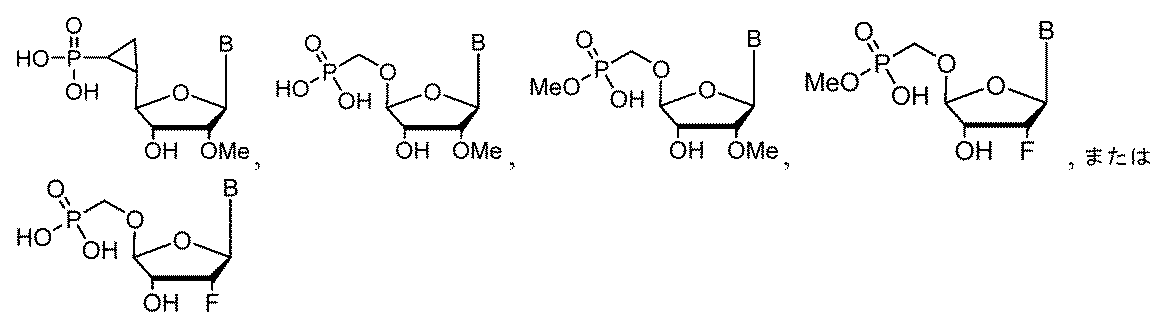
一部の実施形態において、5’末端リン酸模倣体は、修飾された5’末端ヌクレオチドの一部である。例えば、リン酸模倣体は、構造 In some embodiments, the 5' terminal phosphate mimetic is part of a modified 5' terminal nucleotide. For example, the phosphate mimetic has the structure
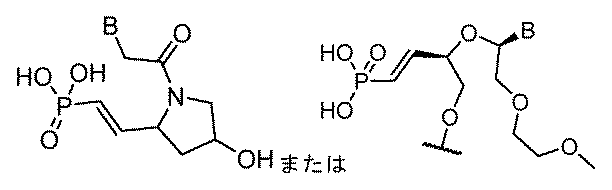
を有する、修飾された5’末端ヌクレオチドの一部でありうる。
It may be part of a modified 5' terminal nucleotide having the following structure:
一部の実施形態において、5’末端リン酸模倣体は、5’-リン酸プロドラッグまたは5’-ホスホネートプロドラッグも含みうる。一部の実施形態において、5’-リン酸プロドラッグまたは5’-ホスホネートプロドラッグは、参照により本明細書に組み込まれるWO2022/147214に開示の式の構造を有する。一部の例示的な実施形態において、5’-リン酸プロドラッグまたは5’-ホスホネートプロドラッグは、Pmmds( In some embodiments, the 5'-terminal phosphate mimetic may also include a 5'-phosphate prodrug or a 5'-phosphonate prodrug. In some embodiments, the 5'-phosphate prodrug or the 5'-phosphonate prodrug has a structure according to the formula disclosed in WO 2022/147214, which is incorporated herein by reference. In some exemplary embodiments, the 5'-phosphate prodrug or the 5'-phosphonate prodrug is a Pmmds (
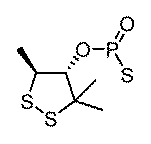
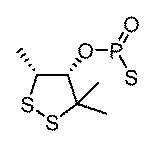
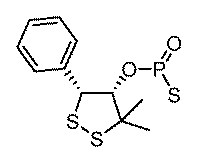

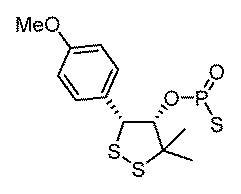
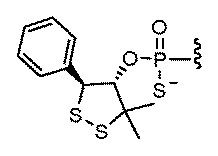
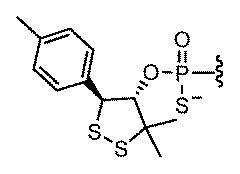

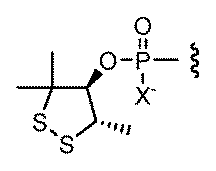
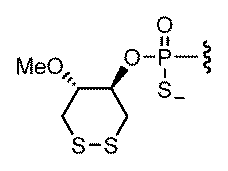
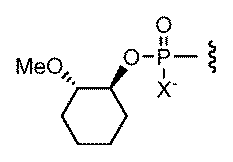
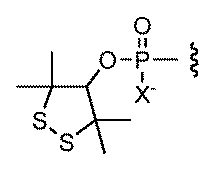
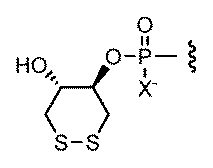
である。
It is.
一部の例示的な実施形態において、5’-リン酸プロドラッグまたは5’-ホスホネートプロドラッグは、 In some exemplary embodiments, the 5'-phosphate prodrug or 5'-phosphonate prodrug is


本発明の別の態様は、上記の式(I)の2つの一本鎖オリゴヌクレオチドを含むオリゴヌクレオチドコンストラクトに関し、2つの一本鎖オリゴヌクレオチドは共有結合される。 Another aspect of the present invention relates to an oligonucleotide construct comprising two single-stranded oligonucleotides of formula (I) above, the two single-stranded oligonucleotides being covalently linked.
本発明の別の態様は、上記の式(II)(もしくはIIa)または(III)(もしくはIIIa)の2つの一本鎖オリゴヌクレオチドを含むオリゴヌクレオチドコンストラクトに関し、2つの一本鎖オリゴヌクレオチドは共有結合される。 Another aspect of the present invention relates to an oligonucleotide construct comprising two single-stranded oligonucleotides of formula (II) (or IIa) or (III) (or IIIa) above, wherein the two single-stranded oligonucleotides are covalently linked.
一部の実施形態において、オリゴヌクレオチドコンストラクトを形成する少なくとも1つの一本鎖オリゴヌクレオチドは、式(I)由来のものである。一部の実施形態において、オリゴヌクレオチドコンストラクトを形成する少なくとも1つの一本鎖オリゴヌクレオチドは、式(II)(またはIIa)由来のものである。一部の実施形態において、オリゴヌクレオチドコンストラクトを形成する少なくとも1つの一本鎖オリゴヌクレオチドは、式(III)(またはIIIa)由来のものである。 In some embodiments, at least one single-stranded oligonucleotide forming the oligonucleotide construct is derived from formula (I). In some embodiments, at least one single-stranded oligonucleotide forming the oligonucleotide construct is derived from formula (II) (or IIa). In some embodiments, at least one single-stranded oligonucleotide forming the oligonucleotide construct is derived from formula (III) (or IIIa).
一部の実施形態において、2つの一本鎖オリゴヌクレオチドの共有結合は、各一本鎖オリゴヌクレオチドの連結基Lにおいて存在する。 In some embodiments, the covalent bond between the two single-stranded oligonucleotides occurs at the linking group L of each single-stranded oligonucleotide.
一部の実施形態において、2つの一本鎖オリゴヌクレオチドは、オキシム、アミノオキシ、トリアゾールまたは融合トリアゾール、ホスホジエステル、ホスホトリエステル、ホスホン酸水素、ホスホン酸アルキルまたはホスホン酸アリール、ホスホロアミデート、ホスホロチオエート、窒素修飾リン含有連結(PN連結)、メチレンメチルイミノ、チオジエステル、チオノカルバメート、N,N’-ジメチルヒドラジン、ホスホロセレネート、ボラノホスフェート、ボラノホスフェートエステル、アミド、ヒドロキシルアミノ、シロキサン、ジアルキルシロキサン、カルボキサミド、カルボネート、カルボキシメチル、カルバメート、カルボキシレートエステル、チオエーテル、エチレンオキシドリンカー、スルフィド、スルホネート、スルホンアミド、スルホネートエステル、チオホルムアセタール、ホルムアセタール、メチレンイミノ、メチレンカルボニルアミノ、メチレンヒドラゾ、メチレンジメチルヒドラゾ、メチレンオキシメチルイミノ、エーテル、チオアセトアミド、およびこれらの組合せからなる群から選択されるテザリング基によって共有結合される。 In some embodiments, the two single-stranded oligonucleotides are oxime, aminooxy, triazole or fused triazole, phosphodiester, phosphotriester, hydrogen phosphonate, alkyl or aryl phosphonate, phosphoramidate, phosphorothioate, nitrogen-modified phosphorus-containing linkage (PN linkage), methylenemethylimino, thiodiester, thionocarbamate, N,N'-dimethylhydrazine, phosphoroselenate, boranophosphate, boranophosphate ester, amide, hydroxylamino, siloxy Covalently attached by a tethering group selected from the group consisting of sucrose, dialkylsiloxane, carboxamide, carbonate, carboxymethyl, carbamate, carboxylate ester, thioether, ethylene oxide linker, sulfide, sulfonate, sulfonamide, sulfonate ester, thioformacetal, formacetal, methyleneimino, methylenecarbonylamino, methylenehydrazo, methylenedimethylhydrazo, methyleneoxymethylimino, ether, thioacetamide, and combinations thereof.
一部の実施形態において、テザリング基は、オキシム、アミノオキシ、またはトリアゾールもしくは融合トリアゾールである。例示的なテザリング基および2つの一本鎖オリゴヌクレオチドを共有結合し、オリゴヌクレオチドコンストラクトを形成するための例示的なプロセスは、以下のスキーム7.1~7.4に示される。 In some embodiments, the tethering group is an oxime, aminooxy, or triazole or fused triazole. Exemplary tethering groups and exemplary processes for covalently linking two single-stranded oligonucleotides to form an oligonucleotide construct are shown below in Schemes 7.1-7.4.
2つの一本鎖オリゴヌクレオチドは、同じかまたは異なってもよい。 The two single-stranded oligonucleotides may be the same or different.
一部の実施形態において、オリゴヌクレオチドコンストラクトを形成する2つの一本鎖オリゴヌクレオチドは同じである。一実施形態において、オリゴヌクレオチドコンストラクトを形成する一本鎖オリゴヌクレオチドは、式(I)由来のものである。一実施形態において、オリゴヌクレオチドコンストラクトを形成する一本鎖オリゴヌクレオチドは、式(II)(またはIIa)由来のものである。一実施形態において、オリゴヌクレオチドコンストラクトを形成する一本鎖オリゴヌクレオチドは、式(III)(またはIIIa)由来のものである。 In some embodiments, the two single-stranded oligonucleotides forming the oligonucleotide construct are the same. In one embodiment, the single-stranded oligonucleotides forming the oligonucleotide construct are from formula (I). In one embodiment, the single-stranded oligonucleotides forming the oligonucleotide construct are from formula (II) (or IIa). In one embodiment, the single-stranded oligonucleotides forming the oligonucleotide construct are from formula (III) (or IIIa).
一部の実施形態において、オリゴヌクレオチドコンストラクトを形成する2つの一本鎖オリゴヌクレオチドは異なる。 In some embodiments, the two single-stranded oligonucleotides that form the oligonucleotide construct are different.
一部の実施形態において、オリゴヌクレオチドコンストラクトを形成する2つの一本鎖オリゴヌクレオチドは、式(I)由来の2つの異なる一本鎖オリゴヌクレオチドである。一部の実施形態において、1つの一本鎖オリゴヌクレオチドのZ1および/またはZ2は、もう1つの一本鎖オリゴヌクレオチドのZ1および/またはZ2とは異なる修飾を含有する。一部の実施形態において、1つの一本鎖オリゴヌクレオチドのLは、他の一本鎖オリゴヌクレオチドのLとは異なる。一部の実施形態において、1つの一本鎖オリゴヌクレオチドのQ1および/またはQ2は、他の一本鎖オリゴヌクレオチドのQ1および/またはQ2とは異なる。一部の実施形態において、1つの一本鎖オリゴヌクレオチドは、他の一本鎖オリゴヌクレオチドとは異なるリガンドを含有する。例えば、1つの一本鎖オリゴヌクレオチドはリガンドを含有し、他の一本鎖オリゴヌクレオチドはリガンドを含有しないか、または異なるリガンドを含有する。一部の実施形態において、1つの一本鎖オリゴヌクレオチドは、他の一本鎖オリゴヌクレオチド上のリガンドとは異なる位置にあるリガンドを含有する。 In some embodiments, the two single-stranded oligonucleotides forming the oligonucleotide construct are two different single-stranded oligonucleotides from formula (I). In some embodiments, Z1 and/or Z2 of one single-stranded oligonucleotide contain a different modification from Z1 and/or Z2 of the other single-stranded oligonucleotide. In some embodiments, L of one single-stranded oligonucleotide is different from L of the other single-stranded oligonucleotide. In some embodiments, Q1 and/or Q2 of one single-stranded oligonucleotide is different from Q1 and/or Q2 of the other single -stranded oligonucleotide. In some embodiments, one single-stranded oligonucleotide contains a different ligand from the other single-stranded oligonucleotide. For example, one single-stranded oligonucleotide contains a ligand, and the other single - stranded oligonucleotide does not contain a ligand or contains a different ligand. In some embodiments, one single-stranded oligonucleotide contains a ligand that is located at a different position from the ligand on the other single-stranded oligonucleotide.
一部の実施形態において、オリゴヌクレオチドコンストラクトを形成する2つの一本鎖オリゴヌクレオチドは、式(II)(もしくはIIa)または(III)(もしくはIIIa)由来の2つの異なる一本鎖オリゴヌクレオチドである。一部の実施形態において、1つの一本鎖オリゴヌクレオチドは式(II)(またはIIa)由来であり、他の一本鎖オリゴヌクレオチドは式(III)(またはIIIa)由来である。一部の実施形態において、1つの一本鎖オリゴヌクレオチドのZ11および/またはZ12は、他の一本鎖オリゴヌクレオチドのZ11および/またはZ12とは異なる修飾を含有する。一部の実施形態において、1つの一本鎖オリゴヌクレオチドのLは、他の一本鎖オリゴヌクレオチドのLとは異なる。例えば、1つの一本鎖オリゴヌクレオチドはLを含有し、他の一本鎖オリゴヌクレオチドはLを含有しないか、または異なるLを含有する。一部の実施形態において、1つの一本鎖オリゴヌクレオチドのQSは、他の一本鎖オリゴヌクレオチドのQSとは異なる。例えば、1つの一本鎖オリゴヌクレオチドはQSを含有し、他の一本鎖オリゴヌクレオチドはQSを含有しないか、または異なるQSを含有する。一部の実施形態において、1つの一本鎖オリゴヌクレオチドは、他の一本鎖オリゴヌクレオチドとは異なるリガンドを含有する。例えば、1つの一本鎖オリゴヌクレオチドはリガンドを含有し、他の一本鎖オリゴヌクレオチドはリガンドを含有しないか、または異なるリガンドを含有する。一部の実施形態において、1つの一本鎖オリゴヌクレオチドは、他の一本鎖オリゴヌクレオチド上のリガンドとは異なる位置にあるリガンドを含有する。 In some embodiments, the two single-stranded oligonucleotides forming the oligonucleotide construct are two different single-stranded oligonucleotides derived from formula (II) (or IIa) or (III) (or IIIa). In some embodiments, one single-stranded oligonucleotide is derived from formula (II) (or IIa), and the other single-stranded oligonucleotide is derived from formula (III) (or IIIa). In some embodiments, Z11 and/or Z12 of one single-stranded oligonucleotide contain a modification different from Z11 and/or Z12 of the other single-stranded oligonucleotide. In some embodiments, L of one single-stranded oligonucleotide is different from L of the other single-stranded oligonucleotide. For example, one single-stranded oligonucleotide contains L, and the other single-stranded oligonucleotide does not contain L or contains a different L. In some embodiments, QS of one single-stranded oligonucleotide is different from QS of the other single-stranded oligonucleotide. For example, one single-stranded oligonucleotide contains QS , and the other single-stranded oligonucleotide does not contain QS or contains a different QS . In some embodiments, one single-stranded oligonucleotide contains a different ligand from the other single-stranded oligonucleotide. For example, one single-stranded oligonucleotide contains a ligand, and the other single-stranded oligonucleotide does not contain a ligand or contains a different ligand. In some embodiments, one single-stranded oligonucleotide contains a ligand that is at a different position from the ligand on the other single-stranded oligonucleotide.
一部の実施形態において、オリゴヌクレオチドコンストラクトを形成する2つの一本鎖オリゴヌクレオチドは、式(I)由来の1つの一本鎖オリゴヌクレオチドおよび式(II)(もしくはIIa)または式(III)(もしくはIIIa)由来の別の一本鎖オリゴヌクレオチドを有する、2つの異なる一本鎖オリゴヌクレオチドである。 In some embodiments, the two single-stranded oligonucleotides forming the oligonucleotide construct are two different single-stranded oligonucleotides having one single-stranded oligonucleotide from formula (I) and another single-stranded oligonucleotide from formula (II) (or IIa) or formula (III) (or IIIa).
本発明の別の態様は、式(I)による上記の一本鎖オリゴヌクレオチド、および薬学的に許容される賦形剤を含む医薬組成物に関する。 Another aspect of the present invention relates to a pharmaceutical composition comprising the above single-stranded oligonucleotide according to formula (I) and a pharma- ceutically acceptable excipient.
本発明の別の態様は、式(II)(もしくは(IIa))または式(III)(もしくは(IIIa))による上記の一本鎖オリゴヌクレオチド、および薬学的に許容される賦形剤を含む医薬組成物に関する。 Another aspect of the present invention relates to a pharmaceutical composition comprising the above single-stranded oligonucleotide according to formula (II) (or (IIa)) or formula (III) (or (IIIa)) and a pharma- ceutically acceptable excipient.
本発明の別の態様は、式(I)、(II)(もしくは(IIa))、または式(III)(もしくは(IIIa))による2つの一本鎖オリゴヌクレオチドを含む、上記のオリゴヌクレオチドコンストラクト、および薬学的に許容される賦形剤を含む医薬組成物に関する。 Another aspect of the present invention relates to a pharmaceutical composition comprising the above-described oligonucleotide construct, which comprises two single-stranded oligonucleotides according to formula (I), (II) (or (IIa)), or formula (III) (or (IIIa)), and a pharma- ceutically acceptable excipient.
一本鎖オリゴヌクレオチドに関する上記の実施形態全て、ヌクレオチド配列(複数可)、式(I)および式(I)に規定の全ての変数、式(II)-(IIa)および式(II)-(IIa)に規定の全ての変数、式(III)-(IIIa)および式(III)-(IIIa)に規定の全ての変数、ヌクレオチド配列上の化学修飾、オリゴヌクレオチド内の連結基L、2つの一本鎖オリゴヌクレオチドを共有結合するテザリング基、ならびに一本鎖オリゴヌクレオチドに関連する本発明の上記の態様において開示されたリガンドおよびリガンドコンジュゲーションは、医薬組成物に関する本発明のこの態様に好適である。 All of the above embodiments relating to single stranded oligonucleotides, the nucleotide sequence(s), formula (I) and all variables set forth in formula (I), formula (II)-(IIa) and all variables set forth in formula (II)-(IIa), formula (III)-(IIIa) and all variables set forth in formula (III)-(IIIa), chemical modifications on the nucleotide sequence, the linking group L within the oligonucleotide, the tethering group covalently linking two single stranded oligonucleotides, and the ligands and ligand conjugations disclosed in the above aspects of the invention relating to single stranded oligonucleotides are suitable for this aspect of the invention relating to pharmaceutical compositions.
本発明の別の態様は、対象の細胞において1つまたは複数の標的遺伝子の活性または発現を阻害するのに十分な量で、式(I)により上記の一本鎖オリゴヌクレオチドと対象の細胞を接触させるステップか、またはそれらを対象に投与するステップを含む、対象において1つまたは複数の標的遺伝子の発現を阻害するための方法に関する。 Another aspect of the invention relates to a method for inhibiting expression of one or more target genes in a subject, comprising contacting cells of the subject with, or administering to the subject, a single-stranded oligonucleotide as described above according to formula (I) in an amount sufficient to inhibit activity or expression of the one or more target genes in the cells of the subject.
本発明の別の態様は、対象の細胞において1つまたは複数の標的遺伝子の活性または発現を阻害するのに十分な量で、式(II)(もしくは(IIa))または(III)(もしくは(IIIa))により上記の一本鎖オリゴヌクレオチドと対象の細胞を接触させるステップか、またはそれらを対象に投与するステップを含む、対象において1つまたは複数の標的遺伝子の発現を阻害するための方法に関する。 Another aspect of the invention relates to a method for inhibiting expression of one or more target genes in a subject, comprising contacting cells of the subject with, or administering to the subject, a single-stranded oligonucleotide as described above according to formula (II) (or (IIa)) or (III) (or (IIIa)) in an amount sufficient to inhibit activity or expression of the one or more target genes in the cells of the subject.
本発明の別の態様は、対象の細胞において1つまたは複数の標的遺伝子の活性または発現を阻害するのに十分な量で、式(I)、(II)(もしくは(IIa))または(III)(もしくは(IIIa))による2つの一本鎖オリゴヌクレオチドを含む、上記のオリゴヌクレオチドコンストラクトと対象の細胞を接触させるステップか、またはそれらを対象に投与するステップを含む、対象において1つまたは複数の標的遺伝子の発現を阻害するための方法に関する。 Another aspect of the invention relates to a method for inhibiting expression of one or more target genes in a subject, comprising contacting cells of the subject with or administering to the subject an oligonucleotide construct as described above, comprising two single-stranded oligonucleotides according to formula (I), (II) (or (IIa)) or (III) (or (IIIa)), in an amount sufficient to inhibit activity or expression of the one or more target genes in the cells of the subject.
一本鎖オリゴヌクレオチドに関する上記の実施形態全て、ヌクレオチド配列(複数可)、式(I)および式(I)に規定の全ての変数、式(II)-(IIa)および式(II)-(IIa)に規定の全ての変数、式(III)-(IIIa)および式(III)-(IIIa)に規定の全ての変数、ヌクレオチド配列上の化学修飾、オリゴヌクレオチド内の連結基L、2つの一本鎖オリゴヌクレオチドを共有結合するテザリング基、ならびに一本鎖オリゴヌクレオチドに関連する本発明の上記の態様において開示されたリガンドおよびリガンドコンジュゲーションは、対象において1つまたは複数の標的遺伝子の発現を阻害するための方法に関する本発明のこの態様に好適である。 All of the above embodiments relating to single stranded oligonucleotides, the nucleotide sequence(s), formula (I) and all variables set forth in formula (I), formula (II)-(IIa) and all variables set forth in formula (II)-(IIa), formula (III)-(IIIa) and all variables set forth in formula (III)-(IIIa), chemical modifications on the nucleotide sequence, linking group L within the oligonucleotide, tethering groups covalently linking two single stranded oligonucleotides, and the ligands and ligand conjugations disclosed in the above aspects of the invention relating to single stranded oligonucleotides are suitable for this aspect of the invention relating to a method for inhibiting expression of one or more target genes in a subject.
一部の実施形態において、細胞は対象内である。一実施形態において、対象はヒトである。一実施形態において、対象は、非ヒト哺乳動物、例えば、アカゲザル(rhesus monkey)、カニクイザル(cynomolgous)、マウス、またはラットである。 In some embodiments, the cell is in a subject. In one embodiment, the subject is a human. In one embodiment, the subject is a non-human mammal, such as a rhesus monkey, a cynomolgous monkey, a mouse, or a rat.
本発明の上記の態様の全てにおいて、一本鎖オリゴヌクレオチドは、適切な対照と比較して(例えば、未処置もしくはプラセボ処置した対象と比較して、または、例えば、一本鎖オリゴヌクレオチドまたは二本鎖核酸剤による処置の前に測定した、処置対象における標的mRNAまたはタンパク質レベルを含む、参照値と比較して)、それぞれ少なくとも15%、対象の組織における1つまたは複数の標的遺伝子の活性または発現を阻害することができ、適切な対照と比較して、それぞれ、少なくとも20%、少なくとも25%、少なくとも30%、少なくとも35%、少なくとも40%、少なくとも45%、少なくとも50%、少なくとも55%、少なくとも60%、少なくとも65%、少なくとも70%、少なくとも75%、少なくとも80%、少なくとも85%、少なくとも90%、少なくとも95%、対象の組織における1つまたは複数の標的遺伝子の活性または発現を阻害することができてもよい。一実施形態において、適切な対照は未処置対象である。一実施形態において、適切な対照は、参照値、例えば、対象への一本鎖オリゴヌクレオチドの投与の前に対象で得られた値である。 In all of the above aspects of the invention, the single-stranded oligonucleotide may inhibit the activity or expression of one or more target genes in a tissue of a subject by at least 15%, respectively, compared to a suitable control (e.g., compared to an untreated or placebo-treated subject, or compared to a reference value, including, for example, target mRNA or protein levels in a treated subject, measured prior to treatment with a single-stranded oligonucleotide or a double-stranded nucleic acid agent), and may inhibit the activity or expression of one or more target genes in a tissue of a subject by at least 20%, at least 25%, at least 30%, at least 35%, at least 40%, at least 45%, at least 50%, at least 55%, at least 60%, at least 65%, at least 70%, at least 75%, at least 80%, at least 85%, at least 90%, at least 95%, respectively, compared to a suitable control. In one embodiment, a suitable control is an untreated subject. In one embodiment, a suitable control is a reference value, e.g., a value obtained in a subject prior to administration of a single-stranded oligonucleotide to the subject.
本発明者らは、鎖内二重鎖領域を形成し、切断型連結基によって2つのオリゴヌクレオチドを接続し、一本鎖コンストラクトを生成することができる、2つの化学的に修飾したオリゴヌクレオチドを使用して一本鎖ループオリゴヌクレオチドを調製する新規の戦略をデザインした。一本鎖ループオリゴヌクレオチドは、一本鎖コンストラクトが、インビボで有効である二重鎖RNAi剤へと切断されるように好適な速度で切断をもたらすようにデザインされる。一本鎖ループオリゴヌクレオチドは、一本鎖として合成され、配列相補性により自己アニールして、一本鎖として精製される。三触角性GalNAcなどのデリバリーリガンドは、合成中に容易に取り込まれうる。本明細書に記載の一本鎖ループオリゴヌクレオチドは、インビボで有効にsiRNAを代謝および放出する能力により、血漿中での安定性を有する。本明細書で議論した一本鎖ループオリゴヌクレオチドは、スループットを増加し、合成時間全体を減少することにより、RNAi剤の製造および精製を簡単にするが、同時に、インビボで切断される場合、RNAi剤の有効性は保存または改善されるように改善されたデザインを提供する。
一本鎖オリゴヌクレオチド構造デザイン
The present inventors have designed a novel strategy to prepare single-stranded loop oligonucleotides using two chemically modified oligonucleotides that can form an intrastranded duplex region and connect the two oligonucleotides by a cleavable linker to generate a single-stranded construct. The single-stranded loop oligonucleotide is designed to provide a suitable cleavage rate so that the single-stranded construct is cleaved into a duplex RNAi agent that is effective in vivo. The single-stranded loop oligonucleotide is synthesized as a single strand, self-anneals by sequence complementarity, and purified as a single strand. Delivery ligands such as triantennary GalNAc can be easily incorporated during synthesis. The single-stranded loop oligonucleotides described herein have stability in plasma due to their ability to effectively metabolize and release siRNA in vivo. The single-stranded loop oligonucleotides discussed herein simplify the manufacture and purification of RNAi agents by increasing throughput and decreasing overall synthesis time, while at the same time providing an improved design so that the effectiveness of the RNAi agent is preserved or improved when cleaved in vivo.
Single-stranded oligonucleotide structure design
本発明の一態様は、式(I):
(5’-Z1-3’)-Q1-L-Q2-(5’-Z2-3’) (I)
[式中:
Z1は、標的遺伝子と実質的に相補的である、15~100の適宜修飾されたヌクレオチドを含む、第1のオリゴヌクレオチドであり;
Z2は、Z1と実質的に相補的である、15~100の適宜修飾されたヌクレオチドを含む、第2のオリゴヌクレオチドであり;
Z1およびZ2は、3またはそれ以上の連続塩基対を含む鎖内二重鎖領域を形成することができ;
Lは、連結基であり;
Q1およびQ2は、それぞれ独立に0~12の適宜修飾されたヌクレオチドを表す]
によって表される配列を有する、標的遺伝子の発現を阻害することができる一本鎖オリゴヌクレオチドであって、
式(I)の少なくとも1つのヌクレオチドは、修飾ヌクレオチドである、
一本鎖オリゴヌクレオチドに関する。
One aspect of the present invention is a compound of formula (I):
(5'-Z 1 -3')-Q 1 -L-Q 2 -(5'-Z 2 -3') (I)
[In the formula:
Z1 is a first oligonucleotide substantially complementary to a target gene, the first oligonucleotide comprising 15 to 100 optionally modified nucleotides;
Z2 is a second oligonucleotide substantially complementary to Z1 and containing 15 to 100 optionally modified nucleotides;
Z1 and Z2 can form an intrastrand duplex region containing 3 or more consecutive base pairs;
L is a linking group;
Q1 and Q2 each independently represent 0 to 12 optionally modified nucleotides.
A single-stranded oligonucleotide capable of inhibiting expression of a target gene, having a sequence represented by:
At least one nucleotide of formula (I) is a modified nucleotide.
Concerning single-stranded oligonucleotides.
一本鎖オリゴヌクレオチドは、連結基Lによって2つのオリゴヌクレオチドを接続することにより形成される。一部の例示的な一本鎖オリゴヌクレオチドコンストラクトは、スキーム1および2に図示される。 A single-stranded oligonucleotide is formed by connecting two oligonucleotides via a linking group L. Some exemplary single-stranded oligonucleotide constructs are illustrated in Schemes 1 and 2.
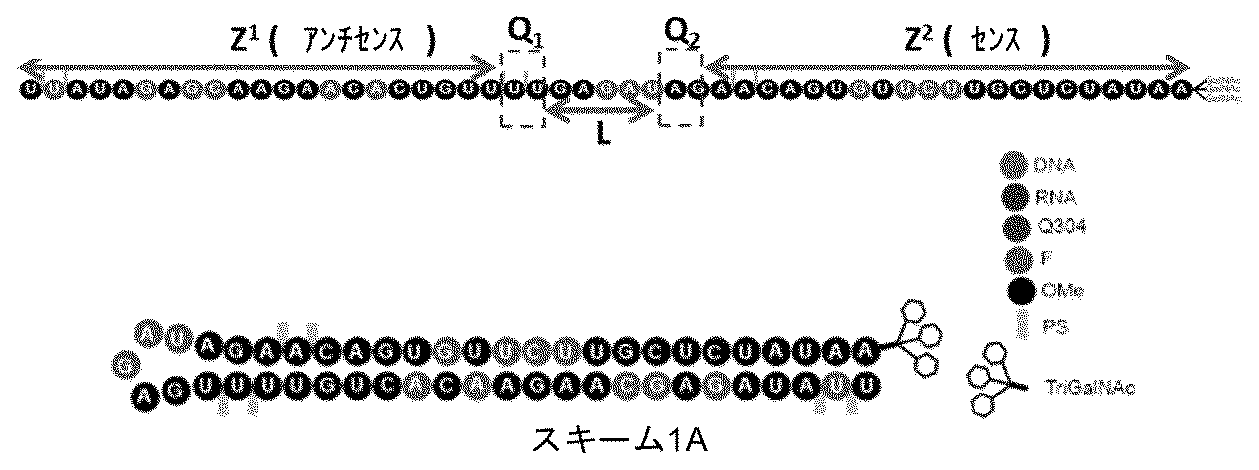

スキーム1および2に示すように、一部の実施形態において、Z1は、標的遺伝子と実質的に相補的である、第1のオリゴヌクレオチドを表し(例えば、アンチセンス鎖);Z2は、Z1と実質的に相補的である、第2のオリゴヌクレオチドである(例えば、センス鎖)。一部の実施形態において、Z1およびZ2は、Z1およびZ2の対応するヌクレオチド間に鎖内二重鎖領域を形成することができ、一本鎖オリゴヌクレオチドは、連結基Lによって形成されたループ領域を含有する(およびおそらくQ1およびQ2)。一部の実施形態において、Q1およびQ2は、それぞれ独立に、存在しないことがある。一部の実施形態において、Q1およびQ2は、それぞれ独立に、それぞれ、第1のオリゴヌクレオチドZ1および第2のオリゴヌクレオチドZ2にオーバーハングとして存在しうる。スキーム1および2に示すように、Lは、修飾または非修飾ヌクレオチドを含有しうる連結基である。一部の実施形態において、スキーム2に示すように、Lは、Q304などの非ヌクレオチドベースのリンカーを含有しうる。一部の実施形態において、スキーム1および2に示すように、(Z1、Z2、Q1、Q2、およびLを含む)一本鎖オリゴヌクレオチド全体のヌクレオチドは、DNA、RNA、2’-F、または2’-OMeなどの様々な化学修飾を含有しうる。一部の実施形態において、スキーム1および2に示すように、一本鎖オリゴヌクレオチドは、Z2(例えば、センス鎖)の3’末端において三価の分岐状リンカー As shown in Schemes 1 and 2, in some embodiments, Z1 represents a first oligonucleotide that is substantially complementary to a target gene (e.g., antisense strand); Z2 is a second oligonucleotide that is substantially complementary to Z1 (e.g., sense strand). In some embodiments, Z1 and Z2 can form an intrastrand duplex region between corresponding nucleotides of Z1 and Z2 , and the single-stranded oligonucleotide contains a loop region formed by a linking group L (and possibly Q1 and Q2 ). In some embodiments, Q1 and Q2 can each independently be absent. In some embodiments, Q1 and Q2 can each independently be present as an overhang on the first oligonucleotide Z1 and the second oligonucleotide Z2 , respectively. As shown in Schemes 1 and 2, L is a linking group that can contain modified or unmodified nucleotides. In some embodiments, as shown in Scheme 2, L can contain a non-nucleotide-based linker, such as Q304. In some embodiments, as shown in Schemes 1 and 2, the nucleotides throughout the single-stranded oligonucleotide (including Z 1 , Z 2 , Q 1 , Q 2 , and L) may contain various chemical modifications, such as DNA, RNA, 2′-F, or 2′-OMe. In some embodiments, as shown in Schemes 1 and 2, the single-stranded oligonucleotide may contain a trivalent branched linker at the 3′ end of Z 2 (e.g., the sense strand).
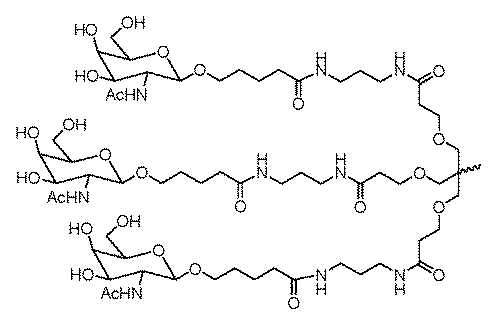
第1のオリゴヌクレオチドZ1および第2のオリゴヌクレオチドZ2のそれぞれは、少なくとも10、11、12、13、14、15、16、17、18、19、20、21、22、23、24、25、26、27、28、29、30、31、32、33、34、35、36、37、38、39、40、41、42、43、44、45、46、47、48、49、または50ヌクレオチド長でありうる。第1のオリゴヌクレオチドZ1および第2のオリゴヌクレオチドZ2のそれぞれは、約10~約50ヌクレオチド、約10~約40ヌクレオチド、約10~約35ヌクレオチド、約10~約30ヌクレオチド、約10~約25ヌクレオチド、約10~約20ヌクレオチド、約15~約50ヌクレオチド、約15~約40ヌクレオチド、約15~約35ヌクレオチド、約15~約30ヌクレオチド、約15~約25ヌクレオチド、約15~約20ヌクレオチド、または約18~約20ヌクレオチド長を有しうる。一実施形態において、第1のオリゴヌクレオチドZ1および第2のオリゴヌクレオチドZ2のそれぞれは、少なくとも15ヌクレオチド長である。一実施形態において、第1のオリゴヌクレオチドZ1および第2のオリゴヌクレオチドZ2のそれぞれは、少なくとも18ヌクレオチド長である。 Each of the first oligonucleotide Z1 and the second oligonucleotide Z2 can be at least 10, 11, 12, 13, 14, 15, 16, 17, 18, 19, 20, 21, 22, 23, 24, 25, 26, 27, 28, 29, 30, 31, 32, 33, 34, 35, 36, 37, 38, 39, 40, 41, 42, 43, 44, 45, 46, 47, 48, 49, or 50 nucleotides in length. Each of the first oligonucleotide Z1 and the second oligonucleotide Z2 can have a length of about 10 to about 50 nucleotides, about 10 to about 40 nucleotides, about 10 to about 35 nucleotides, about 10 to about 30 nucleotides, about 10 to about 25 nucleotides, about 10 to about 20 nucleotides, about 15 to about 50 nucleotides, about 15 to about 40 nucleotides, about 15 to about 35 nucleotides, about 15 to about 30 nucleotides, about 15 to about 25 nucleotides, about 15 to about 20 nucleotides, or about 18 to about 20 nucleotides. In one embodiment, each of the first oligonucleotide Z1 and the second oligonucleotide Z2 is at least 15 nucleotides in length. In one embodiment, each of the first oligonucleotide Z1 and the second oligonucleotide Z2 is at least 18 nucleotides in length.
本発明の別の態様は、
式(II)または(III):
(5’-Z11-3’)-L-QS-(5’-Z12-3’) (II)、
(3’-Z11-5’)-L-QS-(3’-Z12-5’) (III)、
[式中:
Z11は、標的遺伝子と実質的に相補的である、15~100の適宜修飾されたヌクレオチドを含む、第1のオリゴヌクレオチドであり;
Z12は、Z11と実質的に相補的である、10~100の適宜修飾されたヌクレオチドを含む、第2のオリゴヌクレオチドであり;
Z11およびZ12は、7またはそれ以上の連続塩基対を含む鎖内二重鎖領域を形成することができ;
QSは、0~12の適宜修飾されたヌクレオチドを表し、
Lは、任意の連結基である]
による一本鎖オリゴヌクレオチドであって、
式(II)の少なくとも1つのヌクレオチドは、修飾ヌクレオチドであり;ならびに
式(III)の少なくとも1つのヌクレオチドは、修飾ヌクレオチドであり、ここで、
式(II)の、Z11の3’末端の少なくとも1つのヌクレオチド、式(III)の、Z11の5’末端の少なくとも1つのヌクレオチドは、いずれもLおよびQSと共に、Z11およびZ12を接続するループ領域を形成する、
一本鎖オリゴヌクレオチドに関する。
Another aspect of the present invention is a method for producing a
Formula (II) or (III):
(5'-Z 11 -3') -LQ S -(5'-Z 12 -3') (II),
(3'-Z 11 -5') -L-Q S -(3'-Z 12 -5') (III),
[In the formula:
Z11 is a first oligonucleotide substantially complementary to a target gene, the first oligonucleotide comprising 15 to 100 optionally modified nucleotides;
Z12 is a second oligonucleotide substantially complementary to Z11 and comprising 10 to 100 optionally modified nucleotides;
Z11 and Z12 can form an intrastrand duplex region containing 7 or more consecutive base pairs;
QS represents 0 to 12 optionally modified nucleotides;
L is any linking group.
A single stranded oligonucleotide according to
At least one nucleotide of formula (II) is a modified nucleotide; and at least one nucleotide of formula (III) is a modified nucleotide, wherein
At least one nucleotide at the 3' end of Z 11 in formula (II) and at least one nucleotide at the 5' end of Z 11 in formula (III) form a loop region connecting Z 11 and Z 12 together with L and QS ;
Concerning single-stranded oligonucleotides.
一本鎖オリゴヌクレオチドは、適宜連結基Lにより、2つのオリゴヌクレオチドを接続することによって形成される。 A single-stranded oligonucleotide is formed by connecting two oligonucleotides, optionally with a linking group L.
一部の実施形態において、一本鎖オリゴヌクレオチドは、式(IIa)または式(IIIa): In some embodiments, the single-stranded oligonucleotide has formula (IIa) or formula (IIIa):
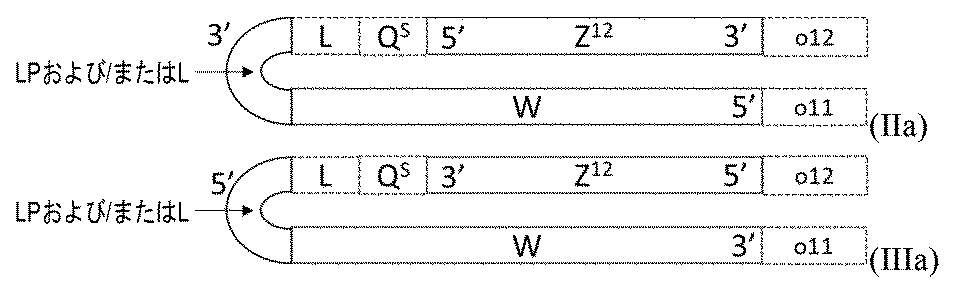
Z11は、W-LPを含み、
Wは、Z12と少なくとも7塩基対の鎖内二重鎖領域を形成し、
LPは、適宜Lと共に、3’末端または5’末端においてWとZ12の間にループを形成し、
Z 11 includes W-LP;
W forms an intrastrand duplex region of at least 7 base pairs with Z12 ;
LP, together with L as appropriate, forms a loop at the 3' or 5' end between W and Z12 ;


によって表される。
It is represented by:
一部の例示的な一本鎖オリゴヌクレオチドは、スキーム1B.1~1B.5およびスキーム2B.1~2B.4に図示される。 Some exemplary single-stranded oligonucleotides are illustrated in Schemes 1B.1-1B.5 and Schemes 2B.1-2B.4.
一部の例示的な一本鎖オリゴヌクレオチドは、スキーム1B.1~1B.5によって図示されるように、式(II)または(IIa)に規定される、Z11およびZ12の方向(例えば、5’-3’方向)および接続を有しうる。スキーム1B.1~1B.5のそれぞれにおいて図示されるPSヌクレオチド間連結は、例示的であり、存在しても、または存在しなくてもよい。ある特定の実施形態において、3’および5’末端において図示したPSヌクレオチド間連結が存在するが、内部のPSヌクレオチド間連結は存在しない。 Some exemplary single stranded oligonucleotides can have the orientation (e.g., 5'-3' orientation) and connection of Z11 and Z12 as defined in formula (II) or (IIa), as illustrated by Schemes 1B.1-1B.5. The PS internucleotide linkages illustrated in each of Schemes 1B.1-1B.5 are exemplary and may be present or absent. In certain embodiments, the illustrated PS internucleotide linkages at the 3' and 5' ends are present, but no internal PS internucleotide linkages are present.
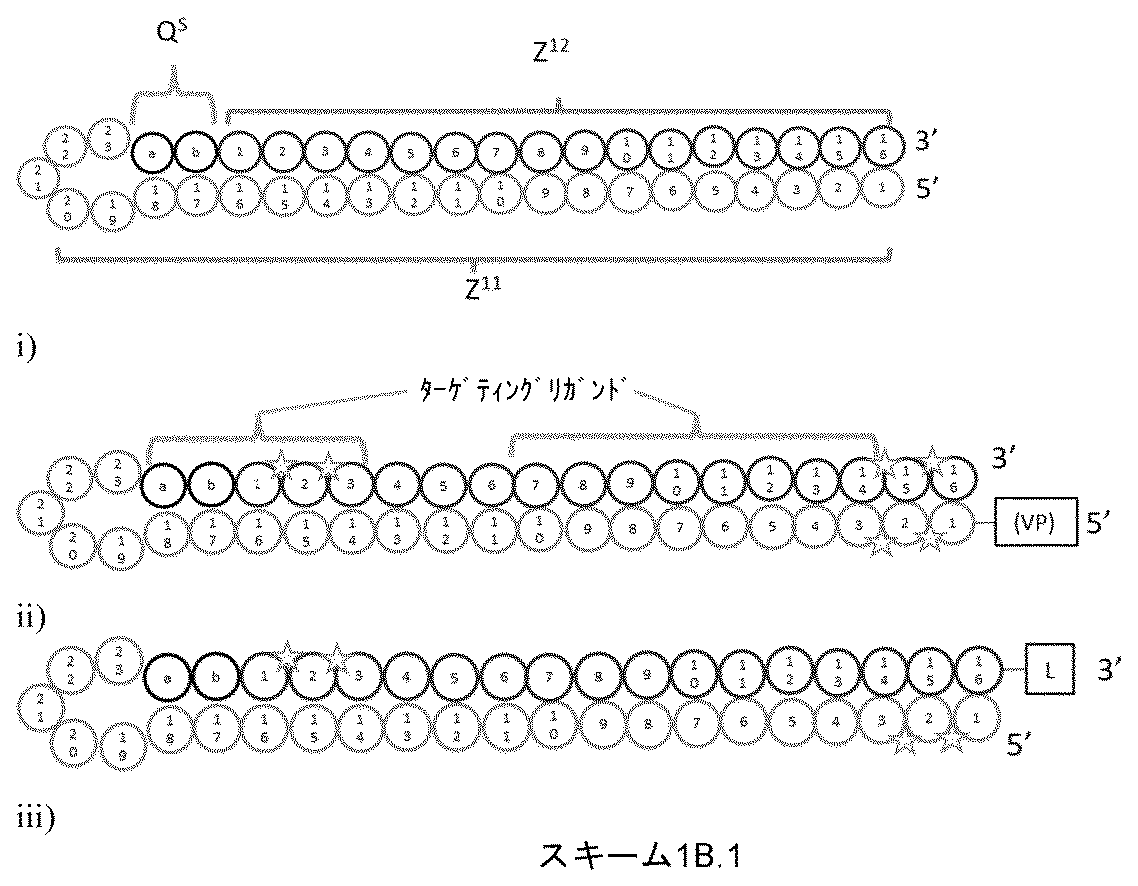
スキーム1B.1に示すように、一部の実施形態において、Z11は、標的遺伝子(例えば、アンチセンス鎖)と実質的に相補的である、第1のオリゴヌクレオチドを表し;Z12は、Z11(例えば、センス鎖)と実質的に相補的である、第2のオリゴヌクレオチドである。一部の実施形態において、Z11およびZ12は、Z11およびZ12の対応するヌクレオチド間に鎖内二重鎖領域を形成することができ、一本鎖オリゴヌクレオチドは、ループ領域LPを含有する(おそらく連結基Lを含む;マークしない)。 As shown in Scheme 1B.1, in some embodiments, Z11 represents a first oligonucleotide that is substantially complementary to a target gene (e.g., antisense strand); Z12 is a second oligonucleotide that is substantially complementary to Z11 (e.g., sense strand). In some embodiments, Z11 and Z12 can form an intrastrand duplex region between corresponding nucleotides of Z11 and Z12 , and the single-stranded oligonucleotide contains a loop region LP (possibly including a linking group L; not marked).
一部の実施形態において、QSは、存在しないことがある。一部の実施形態において、QSは、aおよびbによって表され、それはスペーサーであってもよく、Z11のそれらの反対のヌクレオチドとマッチまたはミスマッチ塩基対を形成する任意の適宜修飾されたヌクレオチドでありうる(例えば、スキーム1B.1の、17位および18位の2つの対応するヌクレオチド)。一実施形態において、aとbの両方が、Z11の、それらの反対のヌクレオチドとマッチ塩基対を形成する。一実施形態において、aとbの両方が、Z11の、それらの反対のヌクレオチドとミスマッチ塩基対を形成する。一実施形態において、aおよびbの1つは、Z11の、その反対のヌクレオチドとマッチ塩基対を形成し、別のaおよびbは、Z11の、その反対のヌクレオチドとミスマッチ塩基対を形成する。一実施形態において、bは、Z11の、その反対のヌクレオチドとミスマッチ塩基対を形成する(例えば、bは、スキーム1B.1に示すように、17位のヌクレオチドとミスマッチである)。一実施形態において、aは、Z11の、その反対のヌクレオチドとミスマッチ塩基対を形成する(例えば、aは、スキーム1B.1に示すように、18位のヌクレオチドとミスマッチである)。 In some embodiments, QS may be absent. In some embodiments, QS is represented by a and b, which may be a spacer or any appropriately modified nucleotide that forms a match or mismatch base pair with their opposite nucleotide of Z11 (e.g., the two corresponding nucleotides at positions 17 and 18 in Scheme 1B.1). In one embodiment, both a and b form a match base pair with their opposite nucleotide of Z11 . In one embodiment, both a and b form a mismatch base pair with their opposite nucleotide of Z11 . In one embodiment, one of a and b forms a match base pair with its opposite nucleotide of Z11 , and another a and b form a mismatch base pair with its opposite nucleotide of Z11 . In one embodiment, b forms a mismatch base pair with its opposite nucleotide of Z11 (e.g., b is mismatched with the nucleotide at position 17 as shown in Scheme 1B.1). In one embodiment, a forms a mismatched base pair with the opposite nucleotide of Z 11 (eg, a is mismatched with the nucleotide at position 18, as shown in Scheme 1B.1).
一部の実施形態において、一本鎖オリゴヌクレオチドは、Z11またはZ12の最初の6ヌクレオチドまたは最後の6ヌクレオチド内に、1つまたは2つのホスホロチオエートヌクレオチド間連結修飾(例えば、2つの連続ホスホロチオエートヌクレオチド間連結修飾)を含有する(すなわち、Z11またはZ12のいずれかの5’末端または3’末端のいずれかから末端6位におけるヌクレオチド間の1つまたは2つのホスホロチオエートヌクレオチド間連結修飾)。一実施形態において、一本鎖オリゴヌクレオチドは、Z11またはZ12の最初の3ヌクレオチドまたは最後の3ヌクレオチド内に、2つの連続ホスホロチオエートヌクレオチド間連結修飾を含有する(すなわち、Z11またはZ12のいずれかの5’末端または3’末端のいずれかから末端3位間のヌクレオチド間連結は、2つの連続ホスホロチオエートヌクレオチド間連結修飾、例えば、スキーム1B.1のiii)に「星」として示すホスホロチオエートヌクレオチド間連結修飾によって修飾される)。 In some embodiments, the single stranded oligonucleotide contains one or two phosphorothioate internucleotide linkage modifications (e.g., two consecutive phosphorothioate internucleotide linkage modifications) within the first 6 or last 6 nucleotides of Z11 or Z12 (i.e., one or two phosphorothioate internucleotide linkage modifications between the nucleotides at the terminal 6 positions from either the 5'-end or 3'-end of either Z11 or Z12 ). In one embodiment, the single stranded oligonucleotide contains two consecutive phosphorothioate internucleotide linkage modifications within the first 3 or last 3 nucleotides of Z11 or Z12 (i.e., the internucleotide linkage between the terminal 3 positions from either the 5' -end or 3'-end of either Z11 or Z12 is modified by two consecutive phosphorothioate internucleotide linkage modifications, e.g., the phosphorothioate internucleotide linkage modification shown as a "star" in iii) of Scheme 1B.1).
一部の実施形態において、一本鎖オリゴヌクレオチドは、Z11の最後の8ヌクレオチド内に、1つまたは2つのホスホロチオエートヌクレオチド間連結修飾(例えば、2つの連続ホスホロチオエートヌクレオチド間連結修飾)を含有する。一実施形態において、一本鎖オリゴヌクレオチドは、23ヌクレオチド長のZ11を有し、16~23位のヌクレオチド間に2つのホスホロチオエートヌクレオチド間連結修飾(例えば、スキーム1B.1に示すように、Z11の16~17、17~18、19~20、20~21、21~22位のヌクレオチド間に2つのホスホロチオエートヌクレオチド間連結修飾)を含有する。 In some embodiments, the single stranded oligonucleotide contains one or two phosphorothioate internucleotide linkage modifications (e.g., two consecutive phosphorothioate internucleotide linkage modifications) within the last 8 nucleotides of Z 11. In one embodiment, the single stranded oligonucleotide has a Z 11 length of 23 nucleotides and contains two phosphorothioate internucleotide linkage modifications between nucleotides 16-23 (e.g., two phosphorothioate internucleotide linkage modifications between nucleotides 16-17, 17-18, 19-20, 20-21, 21-22 of Z 11 , as shown in Scheme 1B.1).
一部の実施形態において、一本鎖オリゴヌクレオチドは、Z12の最初の3ヌクレオチド内に、1つまたは2つのホスホロチオエートヌクレオチド間連結修飾(例えば、2つの連続ホスホロチオエートヌクレオチド間連結修飾)を含有する(例えば、スキーム1B.1に示すように、Z12の1~2および/または2~3位のヌクレオチド間に1つまたは2つのホスホロチオエートヌクレオチド間連結修飾)。一実施形態において、一本鎖オリゴヌクレオチドは、Z12の1~2位および2~3位のヌクレオチド間の2つの連続ホスホロチオエートヌクレオチド間連結修飾、Z12の最後の3ヌクレオチド間(例えば、14~15位および15~16位)の2つの連続ホスホロチオエートヌクレオチド間連結修飾、およびスキーム1B.1のii)に示すように、Z11の1~2位および2~3位のヌクレオチド間の2つの連続ホスホロチオエートヌクレオチド間連結修飾を含有する。 In some embodiments, the single stranded oligonucleotide contains one or two phosphorothioate internucleotide linkage modifications (e.g., two consecutive phosphorothioate internucleotide linkage modifications) within the first three nucleotides of Z 12 (e.g., one or two phosphorothioate internucleotide linkage modifications between nucleotides 1-2 and/or 2-3 of Z 12 , as shown in Scheme 1B.1). In one embodiment, the single stranded oligonucleotide contains two consecutive phosphorothioate internucleotide linkage modifications between nucleotides 1-2 and 2-3 of Z 12 , two consecutive phosphorothioate internucleotide linkage modifications between the last three nucleotides of Z 12 (e.g., positions 14-15 and 15-16), and two consecutive phosphorothioate internucleotide linkage modifications between nucleotides 1-2 and 2-3 of Z 11 , as shown in Scheme 1B.1 ii).
一部の実施形態において、スキーム1B.1のii)に示すように、一本鎖オリゴヌクレオチドは、ヌクレオチド配列(例えば、Z11および/またはZ12)の5’末端において、本明細書に記載の、5’-リン酸修飾または5’-リン酸模倣体修飾(例えば、スキーム1B.1のii)に示すように、Z11の5’末端における5’末端ビニルホスホネート(5’-VP))を含みうる。 In some embodiments, as shown in Scheme 1B.1 ii), the single stranded oligonucleotide can include a 5'-phosphate modification or a 5'-phosphate mimetic modification, as described herein, at the 5' end of the nucleotide sequence (e.g., Z 11 and/or Z 12 ) (e.g., a 5'-terminal vinyl phosphonate (5'-VP) at the 5' end of Z 11 , as shown in Scheme 1B.1 ii).
一部の実施形態において、一本鎖オリゴヌクレオチドは、1つまたは複数のリガンド(例えば、本明細書に記載の肝外デリバリーのための親油性部分)をさらに含みうる。一部の実施形態において、1つまたは複数の親油性部分は、Z11の1つまたは複数の内部位置(すなわち、非末端位置)へと独立にコンジュゲートされる。一実施形態において、1つまたは複数の親油性部分は、スキーム1B.1のii)に示すように、Z11の5’末端から11位、12位、13位の1つまたは複数へと独立にコンジュゲートされる。一実施形態において、1つまたは複数の親油性部分は、2位または14位を除く、Z11の1つまたは複数の内部位置へと独立にコンジュゲートされる。一実施形態において、1つまたは複数の親油性部分は、スキーム1B.1のii)に示すように、Z11の5’末端から11位、12位、13位と対合したQSおよび/またはZ12の位置を除く、Z12および/またはQSの1つまたは複数の位置へと独立にコンジュゲートされる。 In some embodiments, the single stranded oligonucleotide may further comprise one or more ligands (e.g., lipophilic moieties for extrahepatic delivery as described herein). In some embodiments, one or more lipophilic moieties are independently conjugated to one or more internal positions (i.e., non-terminal positions) of Z 11 . In one embodiment, one or more lipophilic moieties are independently conjugated to one or more of positions 11, 12, 13 from the 5' end of Z 11 as shown in Scheme 1B.1 ii). In one embodiment, one or more lipophilic moieties are independently conjugated to one or more internal positions of Z 11 excluding positions 2 or 14. In one embodiment, one or more lipophilic moieties are independently conjugated to one or more positions of Z 12 and/or Q S excluding positions of Q S and/or Z 12 paired with positions 11, 12, 13 from the 5' end of Z 11 as shown in Scheme 1B.1 ii).
一部の実施形態において、一本鎖オリゴヌクレオチドは、1つまたは複数のターゲティングリガンド(例えば、本明細書に記載の肝臓ターゲティング炭水化物ベースのリガンド)をさらに含みうる。一部の実施形態において、1つまたは複数のターゲティングリガンド(例えば、炭水化物ベースのリガンド)は、(スキーム1B.1のiii)に示すように)Z11もしくはZ12の3’末端、またはZ11もしくはZ12の内部位置へとコンジュゲートされる。一部の実施形態において、1つまたは複数のターゲティングリガンド(例えば、炭水化物ベースのリガンド)は、2位または14位を除く、Z11の内部位置へとコンジュゲートされる。一部の実施形態において、1つまたは複数のターゲティングリガンド(例えば、炭水化物ベースのリガンド)は、スキーム1B.1のiii)に示すように、Z12の3’末端へとコンジュゲートされる。 In some embodiments, the single-stranded oligonucleotide may further comprise one or more targeting ligands (e.g., liver-targeting carbohydrate-based ligands described herein). In some embodiments, one or more targeting ligands (e.g., carbohydrate-based ligands) are conjugated to the 3'-terminus of Z11 or Z12 , or to an internal position of Z11 or Z12 (as shown in Scheme 1B.1 iii). In some embodiments, one or more targeting ligands (e.g., carbohydrate-based ligands) are conjugated to an internal position of Z11 , except for positions 2 or 14. In some embodiments, one or more targeting ligands (e.g., carbohydrate-based ligands) are conjugated to the 3'-terminus of Z12 , as shown in Scheme 1B.1 iii).
一部の実施形態において、一本鎖オリゴヌクレオチドが、5’末端もしくは3’末端ヌクレオチドへのリガンドの末端コンジュゲーションを含有するか、または5’末端もしくは3’末端ヌクレオチドへの脱塩基ヌクレオチド、逆位ヌクレオチド、もしくは逆位脱塩基ヌクレオチドの末端コンジュゲーションを含有する場合、次いで、その末端において、末端ヌクレオチドへの上記のヌクレオチド間連結修飾が除去されうる(例えば、スキーム1B.1のiii)に示すように、Z12の3’末端へのリガンドのコンジュゲーションにより、Z12の3’末端への、末端6位もしくは3位のヌクレオチド間の1つまたは2つのホスホロチオエートヌクレオチド間連結修飾が除去されうる)。 In some embodiments, when a single stranded oligonucleotide contains a terminal conjugation of a ligand to the 5'- or 3'-terminal nucleotide, or a terminal conjugation of an abasic nucleotide, an inverted nucleotide, or an inverted abasic nucleotide to the 5'- or 3'-terminal nucleotide, then at that end, the above-mentioned internucleotide linkage modification to the terminal nucleotide can be removed (e.g., as shown in Scheme 1B.1 iii), the conjugation of a ligand to the 3'-end of Z 12 can remove one or two phosphorothioate internucleotide linkage modifications between the terminal 6- or 3-position nucleotides to the 3'-end of Z 12 ).

一部の実施形態において、スキーム1B.2に示すように、Z11は、19~23の適宜修飾されたヌクレオチドを含み、Z12は、12~16の適宜修飾されたヌクレオチドを含み、QSは、2の適宜修飾されたヌクレオチドを含む。 In some embodiments, Z11 comprises 19-23 optionally modified nucleotides, Z12 comprises 12-16 optionally modified nucleotides, and QS comprises 2 optionally modified nucleotides, as shown in Scheme 1B.2.
一部の実施形態において、スキーム1B.2に示すように、非ループ末端(例えば、Z11の5’末端)におけるZ11およびZ12によって形成された二重鎖領域は平滑末端を有する。 In some embodiments, as shown in Scheme 1B.2, the duplex region formed by Z 11 and Z 12 at the non-loop end (eg, the 5' end of Z 11 ) has a blunt end.
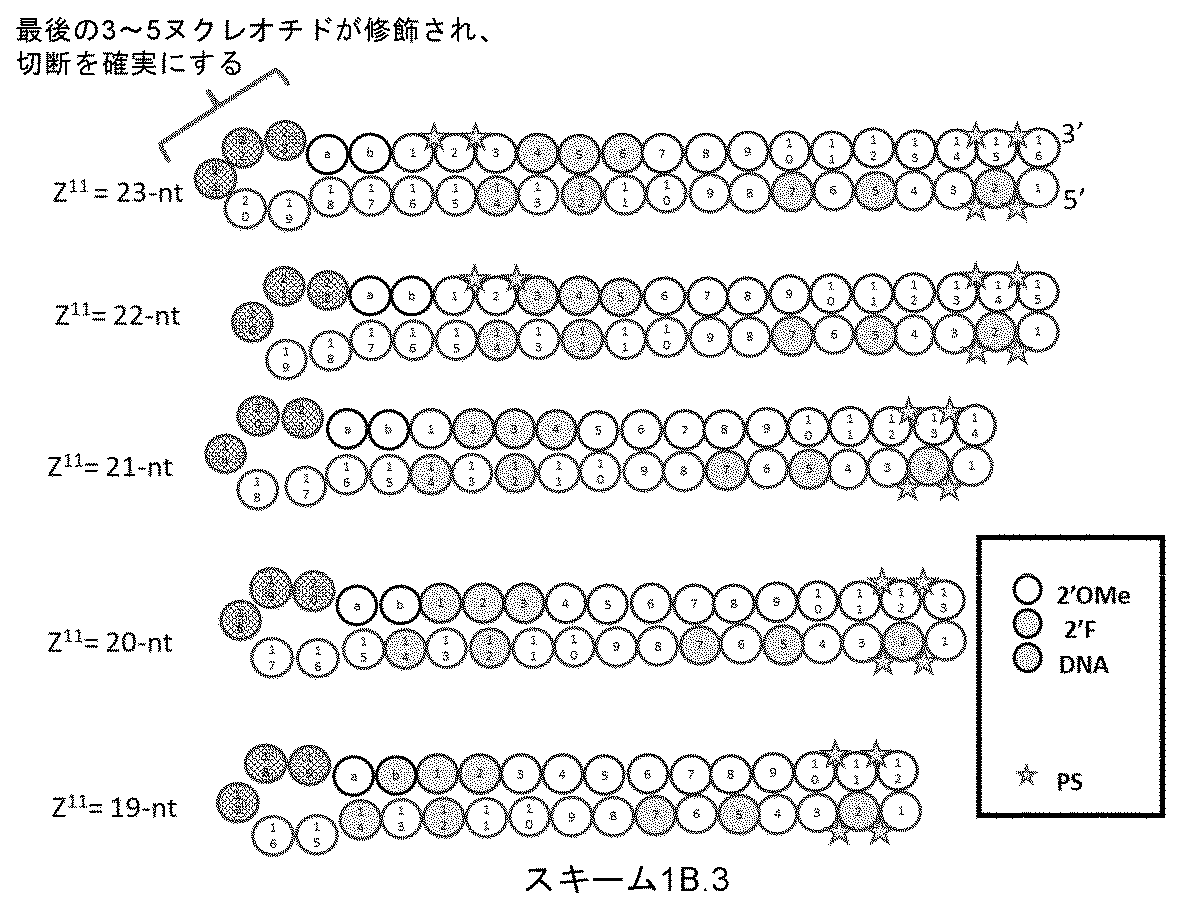
一部の実施形態において、スキーム1B.3に示すように、Z11は、19~23の適宜修飾されたヌクレオチドを含み、Z12は、12~16の適宜修飾されたヌクレオチドを含み、QSは、2の適宜修飾されたヌクレオチドを含む。 In some embodiments, Z11 comprises 19-23 optionally modified nucleotides, Z12 comprises 12-16 optionally modified nucleotides, and QS comprises 2 optionally modified nucleotides, as shown in Scheme 1B.3.
一部の実施形態において、スキーム1B.3に示すように、L、QS、またはZ12に接続した、Z11の3~5つの末端ヌクレオチドは、2’-デオキシヌクレオチド(dN)、2’-デオキシ-2’-フルオロヌクレオチド(fN)、リボヌクレオチド(rN)、2’-O-メチルヌクレオチド(mN)、および2’-araヌクレオチド(aN)からなる群から選択される修飾を含有し、切断を確実にする。一部の実施形態において、L、QS、またはZ12に接続した、Z11の5つの末端ヌクレオチドは、
#-dN-dN-fN-fN-fN-**、
#-dN-dN-rN-dN-dN-**、
#-dN-dN-rN-rN-rN-**、
#-dN-dN-dN-dN-dN-**、
#-mN-mN-fN-fN-fN-**、
#-mN-mN-dN-dN-dN-**、
#-mN-mN-rN-dN-dN-**、
#-mN-mN-rN-rN-rN-**、および
[式中:
#は、Z11への結合であり、**は、L、QS、またはZ12への結合であり
dNは、2’-デオキシヌクレオチドを表し、
fNは、2’-デオキシ-2’-フルオロヌクレオチドを表し、
rNは、リボヌクレオチドを表し、および
mNは、2’-O-メチルヌクレオチドを表す]
からなる群から選択される修飾を有する。
In some embodiments, as shown in Scheme 1B.3, the three to five terminal nucleotides of Z 11 connected to L, Q S , or Z 12 contain a modification selected from the group consisting of 2'-deoxynucleotides (dN), 2'-deoxy-2'-fluoronucleotides (fN), ribonucleotides (rN), 2'-O-methyl nucleotides (mN), and 2'-ara nucleotides (aN) to ensure cleavage. In some embodiments, the five terminal nucleotides of Z 11 connected to L, Q S , or Z 12 contain a modification selected from the group consisting of 2'-deoxynucleotides (dN), 2'-deoxy-2'-fluoro nucleotides (fN), ribonucleotides (rN), 2'-O-methyl nucleotides (mN), and 2'-ara nucleotides ( aN) to ensure cleavage.
#-dN-dN-fN-fN-fN- ** ,
#-dN-dN-rN-dN-dN- ** ,
#-dN-dN-rN-rN-rN- ** ,
#-dN-dN-dN-dN-dN- ** ,
#-mN-mN-fN-fN-fN- ** ,
#-mN-mN-dN-dN-dN- ** ,
#-mN-mN-rN-dN-dN- ** ,
#-mN-mN-rN-rN-rN- ** , and
# is a bond to Z11 , ** is a bond to L, QS , or Z12 , dN represents a 2'-deoxynucleotide,
fN represents 2'-deoxy-2'-fluoro nucleotide;
rN represents a ribonucleotide, and mN represents a 2'-O-methyl nucleotide.
The compound has a modification selected from the group consisting of:
一部の実施形態において、スキーム1B.3に示すように、L、QS、またはZ12に接続した、Z11の3つの末端ヌクレオチドは、2’-フルオロ、2’-デオキシ、および2’-OH、例えば
#-fN-fN-fN-**、
#-dN-dN-dN-**、
#-dN-dN-rN-**、
#-dN-rN-dN-**、
#-rN-dN-dN-**、および
#-rN-rN-dN-**、
#-rN-dN-rN-**、
#-dN-rN-rN-**、
#-rN-rN-rN-**
からなる群から独立に選択される修飾を有する。
In some embodiments, the three terminal nucleotides of Z 11 connected to L, Q S , or Z 12 are 2′-fluoro, 2′-deoxy, and 2′-OH, e.g., #-fN-fN-fN- ** , as shown in Scheme 1B.3.
#-dN-dN-dN- ** ,
#-dN-dN-rN- ** ,
#-dN-rN-dN- ** ,
#-rN-dN-dN- ** , and #-rN-rN-dN- ** ,
#-rN-dN-rN- ** ,
#-dN-rN-rN- ** ,
#-rN-rN-rN- **
and each of the modifications is independently selected from the group consisting of:
一実施形態において、スキーム1B.3に示すように、一本鎖オリゴヌクレオチドは、Z11の1~2位および2~3位のヌクレオチド間の2つの連続ホスホロチオエートヌクレオチド間連結修飾、およびZ12の最後3ヌクレオチドの間の2つの連続ホスホロチオエートヌクレオチド間連結修飾を含有する。 In one embodiment, as shown in Scheme 1B.3, the single stranded oligonucleotide contains two consecutive phosphorothioate internucleotide linkage modifications between nucleotides 1-2 and 2-3 of Z11 , and two consecutive phosphorothioate internucleotide linkage modifications between the last three nucleotides of Z12 .
一実施形態において、スキーム1B.3に示すように、一本鎖オリゴヌクレオチドは、6つの末端ホスホロチオエートヌクレオチド間連結修飾;Z11の1~2位および2~3位におけるヌクレオチド間の2つの連続ホスホロチオエートヌクレオチド間連結修飾、Z12の最後3ヌクレオチドの間の2つの連続ホスホロチオエートヌクレオチド間連結修飾、およびZ12の1~2位および2~3位のヌクレオチド間の2つの連続ホスホロチオエートヌクレオチド間連結修飾を含有する。 In one embodiment, as shown in Scheme 1B.3, the single stranded oligonucleotide contains six terminal phosphorothioate internucleotide linkage modifications; two consecutive phosphorothioate internucleotide linkage modifications between nucleotides at positions 1-2 and 2-3 of Z 11 , two consecutive phosphorothioate internucleotide linkage modifications between the last three nucleotides of Z 12 , and two consecutive phosphorothioate internucleotide linkage modifications between nucleotides at positions 1-2 and 2-3 of Z 12 .
一部の実施形態において、スキーム1B.3に示すように、第2のオリゴヌクレオチドZ12は、適宜QSと共に、3つの連続2’-F修飾の少なくとも1つのモチーフを含有し、モチーフの次のヌクレオチドは、2’-F修飾されない。一部の実施形態において、3つの連続修飾のモチーフの位置は、以下:
モチーフはQS、Z12の1および2位にあり、Z11は19ヌクレオチド長であってもよいこと;
モチーフはZ12の1、2および3位にあり、Z11は20ヌクレオチド長であってもよいこと;
モチーフはZ12の2、3および4位にあり、Z11は21ヌクレオチド長であってもよいこと;
モチーフはZ12の3、4および5位にあり、Z11は22ヌクレオチド長であってもよいこと;または
モチーフはZ12の4、5および6位にあり、Z11は23ヌクレオチド長であってもよいこと;
の1つによって特徴付けられる。
In some embodiments, as shown in Scheme 1B.3, the second oligonucleotide Z 12 contains at least one motif of three consecutive 2'-F modifications, optionally with Q S , and the nucleotide following the motif is not 2'-F modified. In some embodiments, the position of the motif of three consecutive modifications is as follows:
the motif is at positions 1 and 2 of QS , Z12 , and Z11 may be 19 nucleotides in length;
the motif is at positions 1, 2 and 3 of Z12 , and Z11 may be 20 nucleotides long;
the motif is at positions 2, 3 and 4 of Z12 and Z11 may be 21 nucleotides long;
the motif is at positions 3, 4 and 5 of Z12 , and Z11 may be 22 nucleotides in length; or the motif is at positions 4, 5 and 6 of Z12 , and Z11 may be 23 nucleotides in length;
It is characterized by one of the following:
一部の実施形態において、スキーム1B.3に示すように、第1のオリゴヌクレオチドZ11は、2位および14位において2’-O-メチルではない修飾を含有する。一実施形態において、スキーム1B.3に示すように、第1のオリゴヌクレオチドZ11は、14位において2’-F修飾を含有する。 In some embodiments, as shown in Scheme 1B.3, the first oligonucleotide Z 11 contains modifications that are not 2'-O-methyl at positions 2 and 14. In one embodiment, as shown in Scheme 1B.3, the first oligonucleotide Z 11 contains a 2'-F modification at position 14.
一部の実施形態において、スキーム1B.3に示すように、第1のオリゴヌクレオチドZ11は、2、5、7、および12位に、1つまたは複数の2’-デオキシ(DNA)修飾を含有する。 In some embodiments, the first oligonucleotide Z 11 contains one or more 2′-deoxy (DNA) modifications at positions 2, 5, 7, and 12, as shown in Scheme 1B.3.
一部の実施形態において、スキーム1B.3に示すように、Z11およびZ12の全ての残りの修飾は、2’-O-メチル修飾である。 In some embodiments, all remaining modifications of Z 11 and Z 12 are 2′-O-methyl modifications, as shown in Scheme 1B.3.
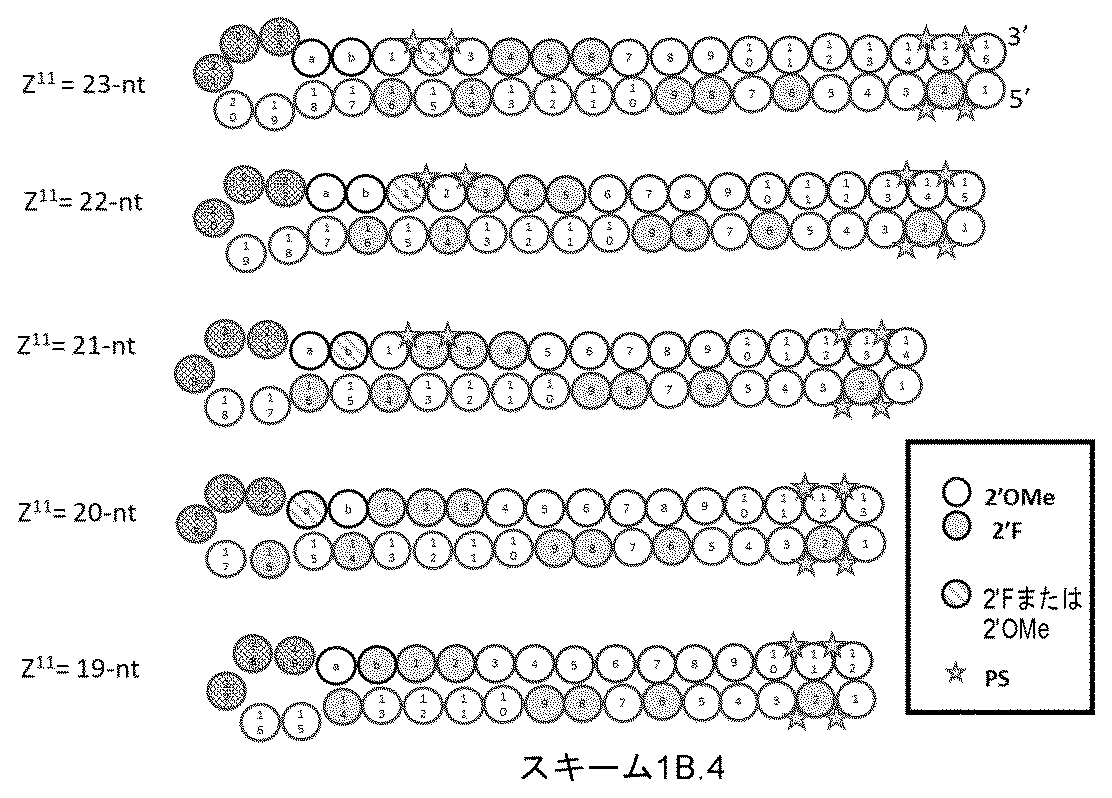
一部の実施形態において、スキーム1B.4に示すように、Z11は、19~23の適宜修飾されたヌクレオチドを含み、Z12は、12~16の適宜修飾されたヌクレオチドを含み、QSは、2の適宜修飾されたヌクレオチドを含む。 In some embodiments, Z11 comprises 19-23 optionally modified nucleotides, Z12 comprises 12-16 optionally modified nucleotides, and QS comprises 2 optionally modified nucleotides, as shown in Scheme 1B.4.
一部の実施形態において、スキーム1B.4に示すように、L、QS、またはZ12に接続した、Z11の3~5つの末端ヌクレオチドは、2’-デオキシヌクレオチド(dN)、2’-デオキシ-2’-フルオロヌクレオチド(fN)、リボヌクレオチド(rN)、2’-O-メチルヌクレオチド(mN)、および2’-araヌクレオチド(aN)からなる群から選択される修飾を含有し、切断を確実にする。一部の実施形態において、L、QS、またはZ12に接続した、Z11の5つの末端ヌクレオチドは、
#-dN-dN-fN-fN-fN-**、
#-dN-dN-rN-dN-dN-**、
#-dN-dN-rN-rN-rN-**、
#-dN-dN-dN-dN-dN-**、
#-mN-mN-fN-fN-fN-**、
#-mN-mN-dN-dN-dN-**、
#-mN-mN-rN-dN-dN-**、
#-mN-mN-rN-rN-rN-**、および
[式中:
#は、Z11への結合であり、**は、L、QS、またはZ12への結合であり
dNは、2’-デオキシヌクレオチドを表し、
fNは、2’-デオキシ-2’-フルオロヌクレオチドを表し、
rNは、リボヌクレオチドを表し、
mNは、2’-O-メチルヌクレオチドを表す]
からなる群から選択される修飾を有する。
In some embodiments, as shown in Scheme 1B.4, the three to five terminal nucleotides of Z 11 connected to L, Q S , or Z 12 contain a modification selected from the group consisting of 2'-deoxynucleotides (dN), 2'-deoxy-2'-fluoronucleotides (fN), ribonucleotides (rN), 2'-O-methyl nucleotides (mN), and 2'-ara nucleotides (aN) to ensure cleavage. In some embodiments, the five terminal nucleotides of Z 11 connected to L, Q S , or Z 12 contain a modification selected from the group consisting of 2'-deoxynucleotides (dN), 2'-deoxy-2'-fluoro nucleotides (fN), ribonucleotides (rN), 2'-O-methyl nucleotides (mN), and 2'-ara nucleotides ( aN) to ensure cleavage.
#-dN-dN-fN-fN-fN- ** ,
#-dN-dN-rN-dN-dN- ** ,
#-dN-dN-rN-rN-rN- ** ,
#-dN-dN-dN-dN-dN- ** ,
#-mN-mN-fN-fN-fN- ** ,
#-mN-mN-dN-dN-dN- ** ,
#-mN-mN-rN-dN-dN- ** ,
#-mN-mN-rN-rN-rN- ** , and
# is a bond to Z11 , ** is a bond to L, QS , or Z12 , dN represents a 2'-deoxynucleotide,
fN represents 2'-deoxy-2'-fluoro nucleotide;
rN represents a ribonucleotide;
mN represents a 2'-O-methyl nucleotide.
The compound has a modification selected from the group consisting of:
一部の実施形態において、スキーム1B.4に示すように、L、QS、またはZ12に接続した、Z11の3つの末端ヌクレオチドは、2’-フルオロ、2’-デオキシ、および2’-OH、例えば
#-fN-fN-fN-**、
#-dN-dN-dN-**、
#-dN-dN-rN-**、
#-dN-rN-dN-**、
#-rN-dN-dN-**、
#-rN-rN-dN-**、
#-rN-dN-rN-**、
#-dN-rN-rN-**、および
#-rN-rN-rN-**
からなる群から独立に選択される修飾を有する。
In some embodiments, the three terminal nucleotides of Z 11 connected to L, Q S , or Z 12 are 2′-fluoro, 2′-deoxy, and 2′-OH, e.g., #-fN-fN-fN- ** , as shown in Scheme 1B.4.
#-dN-dN-dN- ** ,
#-dN-dN-rN- ** ,
#-dN-rN-dN- ** ,
#-rN-dN-dN- ** ,
#-rN-rN-dN- ** ,
#-rN-dN-rN- ** ,
#-dN-rN-rN- ** and #-rN-rN-rN -**
and each of the modifications is independently selected from the group consisting of:
一実施形態において、スキーム1B.4に示すように、一本鎖オリゴヌクレオチドは、Z11の1~2位および2~3位のヌクレオチド間の2つの連続ホスホロチオエートヌクレオチド間連結修飾、およびZ12の最後3ヌクレオチドの間の2つの連続ホスホロチオエートヌクレオチド間連結修飾を含有する。 In one embodiment, as shown in Scheme 1B.4, the single stranded oligonucleotide contains two consecutive phosphorothioate internucleotide linkage modifications between nucleotides 1-2 and 2-3 of Z11 , and two consecutive phosphorothioate internucleotide linkage modifications between the last three nucleotides of Z12 .
一実施形態において、スキーム1B.4に示すように、一本鎖オリゴヌクレオチドは、6つの末端ホスホロチオエートヌクレオチド間連結修飾;Z11の1~2位および2~3位におけるヌクレオチド間の2つの連続ホスホロチオエートヌクレオチド間連結修飾、Z12の最後3ヌクレオチドの間の2つの連続ホスホロチオエートヌクレオチド間連結修飾、およびZ12の1~2位および2~3位のヌクレオチド間の2つの連続ホスホロチオエートヌクレオチド間連結修飾を含有する。 In one embodiment, as shown in Scheme 1B.4, the single stranded oligonucleotide contains six terminal phosphorothioate internucleotide linkage modifications; two consecutive phosphorothioate internucleotide linkage modifications between nucleotides at positions 1-2 and 2-3 of Z 11 , two consecutive phosphorothioate internucleotide linkage modifications between the last three nucleotides of Z 12 , and two consecutive phosphorothioate internucleotide linkage modifications between nucleotides at positions 1-2 and 2-3 of Z 12 .
一部の実施形態において、スキーム1B.4に示すように、第2のオリゴヌクレオチドZ12は、適宜QSと共に、3つの連続2’-F修飾の少なくとも1つのモチーフを含有し、モチーフの次のヌクレオチドは、2’-F修飾されない。一部の実施形態において、3つの連続修飾のモチーフの位置は、以下:
モチーフはQS、Z12の1および2位にあり、Z11は19ヌクレオチド長であってもよいこと;
モチーフはZ12の1、2および3位にあり、Z11は20ヌクレオチド長であってもよいこと;
モチーフはZ12の2、3および4位にあり、Z11は21ヌクレオチド長であってもよいこと;
モチーフはZ12の3、4および5位にあり、Z11は22ヌクレオチド長であってもよいこと;または
モチーフはZ12の4、5および6位にあり、Z11は23ヌクレオチド長であってもよいこと
の1つによって特徴付けられる。
In some embodiments, as shown in Scheme 1B.4, the second oligonucleotide Z 12 contains at least one motif of three consecutive 2'-F modifications, optionally with Q S , and the nucleotide following the motif is not 2'-F modified. In some embodiments, the position of the motif of three consecutive modifications is as follows:
the motif is at positions 1 and 2 of QS , Z12 , and Z11 may be 19 nucleotides in length;
the motif is at positions 1, 2 and 3 of Z12 , and Z11 may be 20 nucleotides long;
the motif is at positions 2, 3 and 4 of Z12 and Z11 may be 21 nucleotides long;
The motif is characterized by one of: the motif is at positions 3, 4 and 5 of Z12 , and Z11 may be 22 nucleotides long; or the motif is at positions 4, 5 and 6 of Z12 , and Z11 may be 23 nucleotides long.
一部の実施形態において、スキーム1B.4に示すように、Z12は、適宜QSと共に、その位置がZ11の一部ではない限り、3つの連続2’-F修飾のモチーフの2位前である位置(モチーフがn位で開始する場合、n-2位)において2’-O-メチルまたは2’-F修飾を含有する。一実施形態において、スキーム1B.4に示すように、Z12は、適宜QSと共に、その位置がZ11の一部ではない限り、3つの連続2’-F修飾のモチーフの2位前である位置(モチーフがn位で開始する場合、n-2位)において2’-F修飾を含有する。 In some embodiments, as shown in Scheme 1B.4, Z 12 , optionally with Q S , contains a 2'-O-methyl or 2'-F modification at a position that is 2 positions before the motif of three consecutive 2'-F modifications (position n-2 if the motif starts at position n), unless that position is part of Z 11. In one embodiment, as shown in Scheme 1B.4, Z 12 , optionally with Q S , contains a 2'-F modification at a position that is 2 positions before the motif of three consecutive 2'-F modifications (position n-2 if the motif starts at position n), unless that position is part of Z 11 .
一部の実施形態において、スキーム1B.4に示すように、第1のオリゴヌクレオチドZ11は、2位および14位における2’-O-メチルではない修飾を含有する。一実施形態において、スキーム1B.4に示すように、第1のオリゴヌクレオチドZ11は、14位に2’-F修飾を含有する。 In some embodiments, as shown in Scheme 1B.4, the first oligonucleotide Z 11 contains modifications that are not 2'-O-methyl at positions 2 and 14. In one embodiment, as shown in Scheme 1B.4, the first oligonucleotide Z 11 contains a 2'-F modification at position 14.
一部の実施形態において、スキーム1B.4に示すように、第1のオリゴヌクレオチドZ11は、2、6、8、9、14、および16位に、1つまたは複数の2’-F修飾を含有する。 In some embodiments, the first oligonucleotide Z 11 contains one or more 2′-F modifications at positions 2, 6, 8, 9, 14, and 16, as shown in Scheme 1B.4.
一部の実施形態において、スキーム1B.4に示すように、Z11およびZ12の全ての残りの修飾は、2’-O-メチル修飾である。 In some embodiments, all remaining modifications of Z 11 and Z 12 are 2'-O-methyl modifications, as shown in Scheme 1B.4.

一部の実施形態において、Lは式(II)(もしくはIIa)または式III(もしくはIIIa)に存在し、式:#-(N)n-**によって表される連結部分を含有する。この式では、#は、Z11への結合であり、**は、QSまたはZ12への結合であり;nは3~12であり;各Nは、独立に、3またはそれ以上の原子の鎖長を有する連結単量体である。一部の実施形態において、nは3~8、4~8、3~7、4~7、3~6、4~6、または3~5である。一実施形態において、nは3である。 In some embodiments, L is present in Formula (II) (or IIa) or Formula III (or IIIa) and contains a linking moiety represented by the formula: #-(N) n - ** , where # is a bond to Z 11 , ** is a bond to Q S or Z 12 ; n is 3 to 12; and each N is independently a linking monomer having a chain length of 3 or more atoms. In some embodiments, n is 3 to 8, 4 to 8, 3 to 7, 4 to 7, 3 to 6, 4 to 6, or 3 to 5. In one embodiment, n is 3.
一部の実施形態において、スキーム1B.5に示すように、Lの全ての連結単量体(例えば、Q304)は、LPと共に、W(Z11)とZ12の間にループを形成する。一部の実施形態において、スキーム1B.5に示すように、Lの1つまたは複数の連結単量体(例えば、Q304)は、LPと共に、W(Z11)とZ12の間にループを形成し、Lの1つまたは複数の連結単量体(例えば、Q304)は、ループ領域ではない。一部の実施形態において、スキーム1B.5に示すように、Lの1つまたは複数の連結単量体(例えば、Q304)は、LPと共に、W(Z11)とZ12の間にループを形成し、Lの1つまたは複数の連結単量体(例えば、Q304)は、ループではなく、QSに接続される(a)。一部の実施形態において、スキーム1B.5に示すように、Lの1つまたは複数の連結単量体(例えば、Q304)は、LPと共に、W(Z11)とZ12の間にループを形成し、Lの1つまたは複数の連結単量体(例えば、Q304)は、ループではなく、Z12に接続される。 In some embodiments, as shown in Scheme 1B.5, all linking monomers of L (e.g., Q304) form a loop with LP between W( Z11 ) and Z12 . In some embodiments, as shown in Scheme 1B.5, one or more linking monomers of L (e.g., Q304) form a loop with LP between W( Z11 ) and Z12 , and one or more linking monomers of L (e.g., Q304) are not loop regions. In some embodiments, as shown in Scheme 1B.5, one or more linking monomers of L (e.g., Q304) form a loop with LP between W( Z11 ) and Z12 , and one or more linking monomers of L (e.g., Q304) are not loops but are connected to QS (a). In some embodiments, as shown in Scheme 1B. As shown in FIG. 5, one or more linking monomers of L (e.g., Q304) together with LP form a loop between W ( Z11 ) and Z12 , and one or more linking monomers of L (e.g., Q304) are connected to Z12 rather than to the loop.
一部の実施形態において、Lにおける1つまたは複数の連結部分(N)は、適宜修飾されたヌクレオチドでありうる。一部の実施形態において、Lにおける1つまたは複数の連結部分(N)は、独立に、2’-デオキシヌクレオチド(dN)、2’-デオキシ-2’-フルオロヌクレオチド(fN)、リボヌクレオチド(rN)、2’-O-メチルヌクレオチド(mN)、および2’-araヌクレオチド(aN)(例えば、2’-ara-2’-デオキシ、2’-ara-2’-F、2’-ara-2’-OMe、または2’-araリボヌクレオチド)からなる群から選択されうる。 In some embodiments, one or more linking moieties (N) in L can be appropriately modified nucleotides. In some embodiments, one or more linking moieties (N) in L can be independently selected from the group consisting of 2'-deoxynucleotides (dN), 2'-deoxy-2'-fluoronucleotides (fN), ribonucleotides (rN), 2'-O-methyl nucleotides (mN), and 2'-ara nucleotides (aN) (e.g., 2'-ara-2'-deoxy, 2'-ara-2'-F, 2'-ara-2'-OMe, or 2'-ara ribonucleotides).
一部の実施形態において、Lにおける1つまたは複数の連結部分(N)は、独立に、Y16、Y34、Q48、Q303、Q304、Q305、Q306、Q312、Q313、Q314、Q315、Q316、Q317、Q8、Q11、Q150、Q151、Q173、Q221、Q222、Q367、およびQ368からなる群から選択されうる。 In some embodiments, one or more linking moieties (N) in L may be independently selected from the group consisting of Y16, Y34, Q48, Q303, Q304, Q305, Q306, Q312, Q313, Q314, Q315, Q316, Q317, Q8, Q11, Q150, Q151, Q173, Q221, Q222, Q367, and Q368.
一部の実施形態において、スキーム1B.5に示すように、Lは、Q304のトリプレットを含有する。 In some embodiments, L contains a triplet of Q304, as shown in Scheme 1B.5.
一部の実施形態において、スキーム1B.4に示すように、一本鎖オリゴヌクレオチドは、Z11の1~2位および2~3位のヌクレオチド間の2つの連続ホスホロチオエートヌクレオチド間連結修飾、Z12の最後3ヌクレオチドの間の2つの連続ホスホロチオエートヌクレオチド間連結修飾、およびZ12の1~2位および2~3位のヌクレオチド間の2つの連続ホスホロチオエートヌクレオチド間連結修飾を含有する。 In some embodiments, as shown in Scheme 1B.4, the single stranded oligonucleotide contains two consecutive phosphorothioate internucleotide linkage modifications between nucleotides 1-2 and 2-3 of Z11 , two consecutive phosphorothioate internucleotide linkage modifications between the last three nucleotides of Z12 , and two consecutive phosphorothioate internucleotide linkage modifications between nucleotides 1-2 and 2-3 of Z12 .
一部の実施形態において、スキーム1B.5に示すように、一本鎖オリゴヌクレオチドは、Z11の最後5、6、または7ヌクレオチド内に、1つまたは2つのホスホロチオエートヌクレオチド間連結修飾(例えば、2つの連続ホスホロチオエートヌクレオチド間連結修飾)を含有する。 In some embodiments, as shown in Scheme 1B.5, the single-stranded oligonucleotide contains one or two phosphorothioate internucleotide linkage modifications (e.g., two consecutive phosphorothioate internucleotide linkage modifications) within the last 5, 6, or 7 nucleotides of Z11 .
一実施形態において、スキーム1B.5に示すように、一本鎖オリゴヌクレオチドは、6つの末端ホスホロチオエートヌクレオチド間連結修飾;Z11の1~2位および2~3位におけるヌクレオチド間の2つの連続ホスホロチオエートヌクレオチド間連結修飾、Z12の最後3ヌクレオチドの間の2つの連続ホスホロチオエートヌクレオチド間連結修飾、およびZ12の1~2位および2~3位におけるヌクレオチド間の2つの連続ホスホロチオエートヌクレオチド間連結修飾を含有する。 In one embodiment, as shown in Scheme 1B.5, the single stranded oligonucleotide contains six terminal phosphorothioate internucleotide linkage modifications; two consecutive phosphorothioate internucleotide linkage modifications between nucleotides at positions 1-2 and 2-3 of Z 11 , two consecutive phosphorothioate internucleotide linkage modifications between the last three nucleotides of Z 12 , and two consecutive phosphorothioate internucleotide linkage modifications between nucleotides at positions 1-2 and 2-3 of Z 12 .
一実施形態において、スキーム1B.5に示すように、一本鎖オリゴヌクレオチドは、8つの末端ホスホロチオエートヌクレオチド間連結修飾;Z11の1~2位および2~3位におけるヌクレオチド間の2つの連続ホスホロチオエートヌクレオチド間連結修飾;Z12の最後3ヌクレオチドの間の2つの連続ホスホロチオエートヌクレオチド間連結修飾;Z12の1~2位および2~3位におけるヌクレオチド間の2つの連続ホスホロチオエートヌクレオチド間連結修飾;およびZ11の最後5、6、または7ヌクレオチド内に、2つの連続ホスホロチオエートヌクレオチド間連結修飾を含有する。 In one embodiment, as shown in Scheme 1B.5, the single stranded oligonucleotide contains eight terminal phosphorothioate internucleotide linkage modifications; two consecutive phosphorothioate internucleotide linkage modifications between nucleotides at positions 1-2 and 2-3 of Z 11 ; two consecutive phosphorothioate internucleotide linkage modifications between the last three nucleotides of Z 12 ; two consecutive phosphorothioate internucleotide linkage modifications between nucleotides at positions 1-2 and 2-3 of Z 12 ; and two consecutive phosphorothioate internucleotide linkage modifications within the last 5, 6, or 7 nucleotides of Z 11 .
一部の例示的な一本鎖オリゴヌクレオチドは、スキーム2B.1~2B.4によって図示されるように、式(III)または(IIIa)に規定される、Z11およびZ12の方向(例えば、5’-3’方向)および接続を有しうる。 Some exemplary single-stranded oligonucleotides can have the orientation (eg, 5'-3' orientation) and connectivity of Z11 and Z12 as defined in formula (III) or (IIIa), as illustrated by Schemes 2B.1-2B.4.

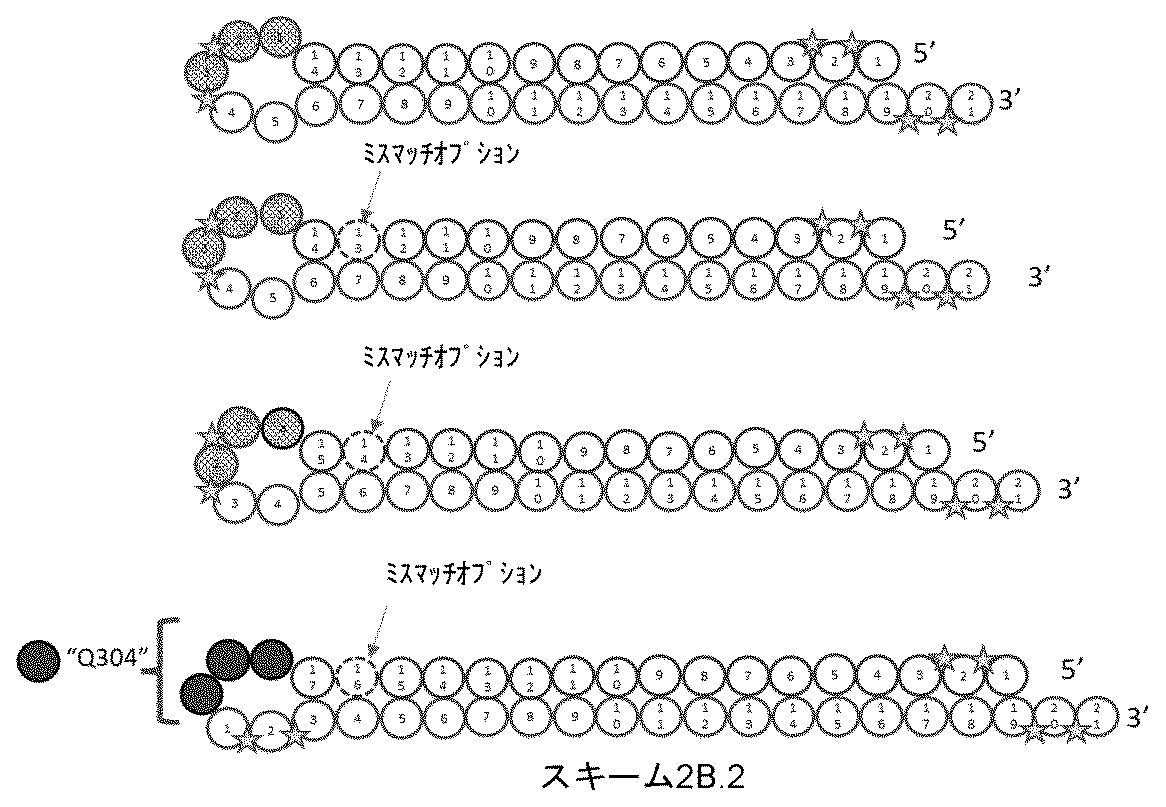

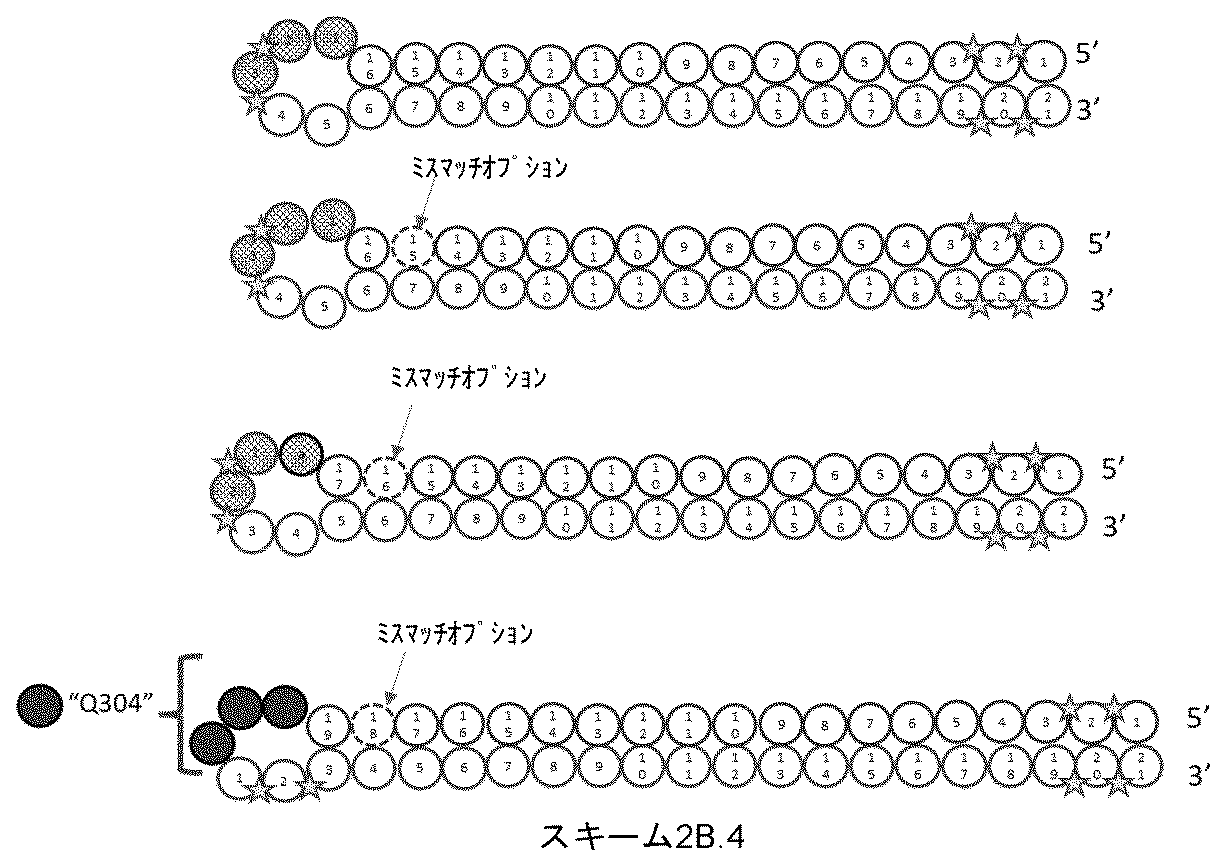
一部の実施形態において、Z11は、19~23の適宜修飾されたヌクレオチドを含み、Z12は、16~19の適宜修飾されたヌクレオチドを含み、QSは、2つの適宜修飾されたヌクレオチドを含み、存在しなくても、または存在してもよい。 In some embodiments, Z11 comprises 19-23 optionally modified nucleotides, Z12 comprises 16-19 optionally modified nucleotides, and QS comprises 2 optionally modified nucleotides and may be absent or present.
一部の実施形態において、スキーム2B.1に示すように、Z11は、23の適宜修飾されたヌクレオチドを含み、Z12は、16~19の適宜修飾されたヌクレオチドを含む。一部の実施形態において、スキーム2B.2に示すように、Z11は、21の適宜修飾されたヌクレオチドを含み、Z12は、14~17の適宜修飾されたヌクレオチドを含む。一部の実施形態において、スキーム2B.3に示すように、Z11は、23の適宜修飾されたヌクレオチドを含み、Z12は、18~21の適宜修飾されたヌクレオチドを含む。一部の実施形態において、スキーム2B.4に示すように、Z11は、21の適宜修飾されたヌクレオチドを含み、Z12は、16~19の適宜修飾されたヌクレオチドを含む。 In some embodiments, Z 11 comprises 23 optionally modified nucleotides and Z 12 comprises 16-19 optionally modified nucleotides, as shown in Scheme 2B.1. In some embodiments, Z 11 comprises 21 optionally modified nucleotides and Z 12 comprises 14-17 optionally modified nucleotides, as shown in Scheme 2B.2. In some embodiments, Z 11 comprises 23 optionally modified nucleotides and Z 12 comprises 18-21 optionally modified nucleotides, as shown in Scheme 2B.3. In some embodiments, Z 11 comprises 21 optionally modified nucleotides and Z 12 comprises 16-19 optionally modified nucleotides, as shown in Scheme 2B.4.
一部の実施形態において、スキーム2B.3および2B.4に示すように、非ループ末端(例えば、Z11の3’末端)におけるZ11およびZ12によって形成された二重鎖領域は平滑末端を有する。 In some embodiments, the duplex region formed by Z 11 and Z 12 at the non-loop end (eg, the 3′ end of Z 11 ) has a blunt end, as shown in Schemes 2B.3 and 2B.4.
一部の実施形態において、非ループ末端におけるZ11は、1~3ヌクレオチド長のオーバーハングを有する。一実施形態において、非ループ末端におけるZ11は、2ヌクレオチド長のオーバーハングを有する(例えば、スキーム2B.1および2B.2に示すように、Z11の3’末端)。一実施形態において、スキーム2B.1および2B.2に示すように、非ループ末端におけるZ11は、2ヌクレオチド長のオーバーハングを有し、2つのオーバーハングヌクレオチド間にホスホロチオエートヌクレオチド間連結を有する。 In some embodiments, Z 11 at the non-loop end has an overhang 1-3 nucleotides in length. In one embodiment, Z 11 at the non-loop end has an overhang 2 nucleotides in length (e.g., the 3' end of Z 11 , as shown in Schemes 2B.1 and 2B.2). In one embodiment, Z 11 at the non-loop end has an overhang 2 nucleotides in length with a phosphorothioate internucleotide linkage between the two overhanging nucleotides, as shown in Schemes 2B.1 and 2B.2.
一実施形態において、スキーム2B.1および2B.2に示すように、非ループ末端におけるZ11は、2ヌクレオチド長のオーバーハングを有し(例えば、Z11の3’末端)、末端の3ヌクレオチドの間に2つのホスホロチオエートヌクレオチド間連結を有し(例えば、Z11の3’末端)、3ヌクレオチドのうちの2つはオーバーハングヌクレオチドであり、3つ目はオーバーハングヌクレオチドの次の対合ヌクレオチドである。 In one embodiment, as shown in Schemes 2B.1 and 2B.2, Z11 at the non-looped end has a 2-nucleotide long overhang (e.g., at the 3' end of Z11 ) and has two phosphorothioate internucleotide linkages between the terminal three nucleotides (e.g., at the 3' end of Z11 ), two of the three nucleotides are overhanging nucleotides and the third is the next pairing nucleotide to the overhanging nucleotide.
一部の実施形態において、スキーム2B.1および2B.2に示すように、一本鎖オリゴヌクレオチドは、Z11の最初の4ヌクレオチド内またはZ12の最初の3ヌクレオチド内に、1つまたは2つのホスホロチオエートヌクレオチド間連結修飾(例えば、2つの連続ホスホロチオエートヌクレオチド間連結修飾)を含有する。 In some embodiments, as shown in Schemes 2B.1 and 2B.2, the single-stranded oligonucleotide contains one or two phosphorothioate internucleotide linkage modifications (e.g., two consecutive phosphorothioate internucleotide linkage modifications) within the first four nucleotides of Z11 or the first three nucleotides of Z12 .
一部の実施形態において、スキーム2B.1~2B.4に示すように、一本鎖オリゴヌクレオチドは、6つの末端ホスホロチオエートヌクレオチド間連結修飾;Z12の1~2位および2~3位におけるヌクレオチド間の2つの連続ホスホロチオエートヌクレオチド間連結修飾;Z11の最初の4ヌクレオチドの間のヌクレオチド間に2つの連続ホスホロチオエートヌクレオチド間連結修飾;およびZ11の最後の3ヌクレオチドの間の2つの連続ホスホロチオエートヌクレオチド間連結修飾を含有する。 In some embodiments, as shown in Schemes 2B.1-2B.4, the single stranded oligonucleotide contains six terminal phosphorothioate internucleotide linkage modifications; two consecutive phosphorothioate internucleotide linkage modifications between nucleotides at positions 1-2 and 2-3 of Z 12 ; two consecutive phosphorothioate internucleotide linkage modifications between nucleotides among the first four nucleotides of Z 11 ; and two consecutive phosphorothioate internucleotide linkage modifications between the last three nucleotides of Z 11 .
一部の実施形態において、スキーム2B.1~2B.4に示すように、一本鎖オリゴヌクレオチドは、8つの末端ホスホロチオエートヌクレオチド間連結修飾;Z12の1~2位および2~3位におけるヌクレオチド間の2つの連続ホスホロチオエートヌクレオチド間連結修飾;Z12の最後の3ヌクレオチドの間の2つの連続ホスホロチオエートヌクレオチド間連結修飾;Z11の最初の4ヌクレオチドの間の2つの連続ホスホロチオエートヌクレオチド間連結修飾;およびZ11の最後の3ヌクレオチドの間の2つの連続ホスホロチオエートヌクレオチド間連結修飾を含有する。 In some embodiments, as shown in Schemes 2B.1-2B.4, the single stranded oligonucleotide contains eight terminal phosphorothioate internucleotide linkage modifications; two consecutive phosphorothioate internucleotide linkage modifications between nucleotides at positions 1-2 and 2-3 of Z 12 ; two consecutive phosphorothioate internucleotide linkage modifications between the last three nucleotides of Z 12 ; two consecutive phosphorothioate internucleotide linkage modifications between the first four nucleotides of Z 11 ; and two consecutive phosphorothioate internucleotide linkage modifications between the last three nucleotides of Z 11 .
一部の実施形態において、一本鎖オリゴヌクレオチドが、5’末端もしくは3’末端ヌクレオチドへのリガンドの末端コンジュゲーションを含有するか、または5’末端もしくは3’末端ヌクレオチドへの脱塩基ヌクレオチド、逆位ヌクレオチド、もしくは逆位脱塩基ヌクレオチドの末端コンジュゲーションを含有する場合、次いで、その末端において、末端ヌクレオチドへの上記のヌクレオチド間連結修飾が除去されうる(例えば、スキーム2B.1~2B.4に示すように、Z12の5’末端へのリガンドのコンジュゲーションにより、Z12の5’末端への、末端6位もしくは3位のヌクレオチド間の1つまたは2つのホスホロチオエートヌクレオチド間連結修飾が除去されうる)。 In some embodiments, when a single stranded oligonucleotide contains a terminal conjugation of a ligand to the 5'- or 3'-terminal nucleotide, or a terminal conjugation of an abasic nucleotide, an inverted nucleotide, or an inverted abasic nucleotide to the 5'- or 3'-terminal nucleotide, then at that end, the above-mentioned internucleotide linkage modifications to the terminal nucleotide can be removed (e.g., as shown in Schemes 2B.1-2B.4, conjugation of a ligand to the 5'-end of Z 12 can remove one or two phosphorothioate internucleotide linkage modifications between the terminal 6- or 3-position nucleotides to the 5'-end of Z 12 ).
一部の実施形態において、スキーム2B.1~2B.4に示すように、Z11およびZ12によって形成された鎖内二重鎖領域は、全ての連続塩基対を含有しうるか、または最大3(例えば、0、1、2、または3)のミスマッチ塩基対を含有しうる。一実施形態において、Z12は、Z11の反対のヌクレオチドとミスマッチ塩基対を形成する1つのヌクレオチドを含有しうる(例えば、Z12の最後のヌクレオチド、または最後のヌクレオチドがn番目のヌクレオチドである場合n-1番目のヌクレオチド)。 In some embodiments, as shown in Schemes 2B.1-2B.4, the intrastrand duplex region formed by Z11 and Z12 can contain all contiguous base pairs or can contain up to three (e.g., 0, 1, 2, or 3) mismatched base pairs. In one embodiment, Z12 can contain one nucleotide that forms a mismatched base pair with the opposite nucleotide of Z11 (e.g., the last nucleotide of Z12 , or the n-1 nucleotide if the last nucleotide is the n nucleotide).
一部の実施形態において、スキーム2B.1~2B.4に示すように、L、QS、またはZ12に接続した、Z11の3~5つの末端ヌクレオチドは、2’-デオキシヌクレオチド(dN)、2’-デオキシ-2’-フルオロヌクレオチド(fN)、リボヌクレオチド(rN)、2’-O-メチルヌクレオチド(mN)、および2’-araヌクレオチド(aN)からなる群から選択される修飾を含有し、切断を確実にする。一部の実施形態において、L、QS、またはZ12に接続した、Z11の5つの末端ヌクレオチドは、
#-dN-dN-fN-fN-fN-**、
#-dN-dN-rN-dN-dN-**、
#-dN-dN-rN-rN-rN-**、
#-dN-dN-dN-dN-dN-**、
#-mN-mN-fN-fN-fN-**、
#-mN-mN-dN-dN-dN-**、
#-mN-mN-rN-dN-dN-**、および
#-mN-mN-rN-rN-rN-**、
からなる群から選択される修飾を有する。
In some embodiments, as shown in Schemes 2B.1-2B.4, the three to five terminal nucleotides of Z 11 connected to L, Q S , or Z 12 contain modifications selected from the group consisting of 2'-deoxynucleotides (dN), 2'-deoxy-2'-fluoro nucleotides (fN), ribonucleotides (rN), 2'-O-methyl nucleotides (mN), and 2'-ara nucleotides (aN) to ensure cleavage. In some embodiments, the five terminal nucleotides of Z 11 connected to L, Q S , or Z 12 contain modifications selected from the group consisting of 2'-deoxy-2'-fluoro nucleotides (fN), ribonucleotides (rN), 2'-O-methyl nucleotides (mN), and 2'-ara nucleotides (aN ) to ensure cleavage.
#-dN-dN-fN-fN-fN- ** ,
#-dN-dN-rN-dN-dN- ** ,
#-dN-dN-rN-rN-rN- ** ,
#-dN-dN-dN-dN-dN- ** ,
#-mN-mN-fN-fN-fN- ** ,
#-mN-mN-dN-dN-dN- ** ,
#-mN-mN-rN-dN-dN- ** , and #-mN-mN-rN-rN-rN- ** ,
The compound has a modification selected from the group consisting of:
一部の実施形態において、スキーム2B.1~2B.4に示すように、L、QS、またはZ12に接続した、Z11の3つの末端ヌクレオチドは、2’-フルオロ、2’-デオキシ、および2’-OH、例えば
#-fN-fN-fN-**、
#-dN-dN-dN-**、
#-dN-dN-rN-**、
#-dN-rN-dN-**、
#-rN-dN-dN-**、
#-rN-rN-dN-**、
#-rN-dN-rN-**、
#-dN-rN-rN-**、および
#-rN-rN-rN-**
からなる群から独立に選択される修飾を有する。
In some embodiments, the three terminal nucleotides of Z 11 connected to L, Q S , or Z 12 are 2′-fluoro, 2′-deoxy, and 2′-OH, e.g., #-fN-fN-fN- ** , as shown in Schemes 2B.1-2B.4.
#-dN-dN-dN- ** ,
#-dN-dN-rN- ** ,
#-dN-rN-dN- ** ,
#-rN-dN-dN- ** ,
#-rN-rN-dN- ** ,
#-rN-dN-rN- ** ,
#-dN-rN-rN- ** and #-rN-rN-rN -**
and each of the modifications is independently selected from the group consisting of:
一部の実施形態において、Lは式(II)(もしくはIIa)または式III(もしくはIIIa)に存在し、式:#-(N)n-**によって表される連結部分を含有する。この式では、#は、Z11への結合であり、**は、QSまたはZ12への結合であり;nは3~12であり;各Nは、独立に、3またはそれ以上の原子の鎖長を有する連結単量体である。一部の実施形態において、nは3~8、4~8、3~7、4~7、3~6、4~6、または3~5である。一実施形態において、nは3である。 In some embodiments, L is present in Formula (II) (or IIa) or Formula III (or IIIa) and contains a linking moiety represented by the formula: #-(N) n - ** , where # is a bond to Z 11 , ** is a bond to Q S or Z 12 ; n is 3 to 12; and each N is independently a linking monomer having a chain length of 3 or more atoms. In some embodiments, n is 3 to 8, 4 to 8, 3 to 7, 4 to 7, 3 to 6, 4 to 6, or 3 to 5. In one embodiment, n is 3.
一部の実施形態において、スキーム2B.1~2B.4に示すように、Lの全ての連結単量体(例えば、Q304)は、LPと共に、W(Z11)とZ12の間にループを形成する。一部の実施形態において、スキーム2B.1~2B.4に示すように、Lの1つまたは複数の連結単量体(例えば、Q304)は、LPと共に、W(Z11)とZ12の間にループを形成し、Lの1つまたは複数の連結単量体(例えば、Q304)は、ループ領域ではない。一部の実施形態において、スキーム2B.1~2B.4に示すように、Lの1つまたは複数の連結単量体(例えば、Q304)は、LPと共に、W(Z11)とZ12の間にループを形成し、Lの1つまたは複数の連結単量体(例えば、Q304)は、ループではなく、QSに接続される(a)。一部の実施形態において、スキーム2B.1~2B.4に示すように、Lの1つまたは複数の連結単量体(例えば、Q304)は、LPと共に、W(Z11)とZ12の間にループを形成し、Lの1つまたは複数の連結単量体(例えば、Q304)は、ループではなく、Z12に接続される。 In some embodiments, as shown in Schemes 2B.1-2B.4, all linking monomers of L (e.g., Q304) together with LP form a loop between W(Z 11 ) and Z 12. In some embodiments, as shown in Schemes 2B.1-2B.4, one or more linking monomers of L (e.g., Q304) together with LP form a loop between W(Z 11 ) and Z 12 , and one or more linking monomers of L (e.g., Q304) are not in the loop region. In some embodiments, as shown in Schemes 2B.1-2B.4, one or more linking monomers of L (e.g., Q304) together with LP form a loop between W(Z 11 ) and Z 12, and one or more linking monomers of L (e.g., Q304) are not in the loop but are connected to Q S (a). In some embodiments, as shown in Schemes 2B.1-2B.4, one or more linking monomers of L (e.g., Q304) together with LP form a loop between W(Z 11 ) and Z 12 , and one or more linking monomers of L (e.g., Q304) are not in the loop but are connected to Q S (b). As shown in FIG. 4, one or more linking monomers of L (e.g., Q304) together with LP form a loop between W ( Z11 ) and Z12 , and one or more linking monomers of L (e.g., Q304) are connected to Z12 rather than to the loop.
一部の実施形態において、Lにおける1つまたは複数の連結部分(N)は、適宜修飾されたヌクレオチドでありうる。一部の実施形態において、Lにおける1つまたは複数の連結部分(N)は、独立に、2’-デオキシヌクレオチド(dN)、2’-デオキシ-2’-フルオロヌクレオチド(fN)、リボヌクレオチド(rN)、2’-O-メチルヌクレオチド(mN)、および2’-araヌクレオチド(aN)(例えば、2’-ara-2’-デオキシ、2’-ara-2’-F、2’-ara-2’-OMe、または2’-araリボヌクレオチド)からなる群から選択されうる。 In some embodiments, one or more linking moieties (N) in L can be appropriately modified nucleotides. In some embodiments, one or more linking moieties (N) in L can be independently selected from the group consisting of 2'-deoxynucleotides (dN), 2'-deoxy-2'-fluoronucleotides (fN), ribonucleotides (rN), 2'-O-methyl nucleotides (mN), and 2'-ara nucleotides (aN) (e.g., 2'-ara-2'-deoxy, 2'-ara-2'-F, 2'-ara-2'-OMe, or 2'-ara ribonucleotides).
一部の実施形態において、Lにおける1つまたは複数の連結部分(N)は、独立に、Y16、Y34、Q48、Q303、Q304、Q305、Q306、Q312、Q313、Q314、Q315、Q316、Q317、Q8、Q11、Q150、Q151、Q173、Q221、Q222、Q367、およびQ368からなる群から選択されうる。 In some embodiments, one or more linking moieties (N) in L may be independently selected from the group consisting of Y16, Y34, Q48, Q303, Q304, Q305, Q306, Q312, Q313, Q314, Q315, Q316, Q317, Q8, Q11, Q150, Q151, Q173, Q221, Q222, Q367, and Q368.
一実施形態において、スキーム2B.1~2B.4に示すように、Lは、Q304のトリプレットを含有する。 In one embodiment, L contains a triplet of Q304, as shown in Schemes 2B.1-2B.4.
一本鎖オリゴヌクレオチド配列は、DICERによって切断可能な基質でありうる。 The single-stranded oligonucleotide sequence can be a substrate that can be cleaved by DICER.
本発明の別の態様は、上記のように、式(I)の2つの一本鎖オリゴヌクレオチドを含むオリゴヌクレオチドコンストラクトに関し、2つの一本鎖オリゴヌクレオチドは共有結合される。一部の実施形態において、テザリング基を介して2つの一本鎖オリゴヌクレオチドは共有結合される。2つの一本鎖オリゴヌクレオチドを共有結合し、オリゴヌクレオチドコンストラクトを形成する、例示的なテザリング基および例示的なプロセスが、以下のスキーム7.1~7.4に示される。 Another aspect of the invention relates to an oligonucleotide construct comprising two single-stranded oligonucleotides of formula (I), as described above, wherein the two single-stranded oligonucleotides are covalently linked. In some embodiments, the two single-stranded oligonucleotides are covalently linked via a tethering group. Exemplary tethering groups and exemplary processes for covalently linking two single-stranded oligonucleotides to form an oligonucleotide construct are shown in Schemes 7.1-7.4 below.
本発明のある特定の実施形態は、2つのオリゴヌクレオチドを接続し、一本鎖オリゴヌクレオチドを形成するための連結基デザインに関する。本発明のある特定の実施形態は、2つのオリゴヌクレオチドを接続し、オリゴヌクレオチドコンストラクトを形成するための、テザリング基デザインに関する(すなわち、二価染色体スタイル)。
リンカー/テザー
Certain embodiments of the invention relate to linking group designs for connecting two oligonucleotides to form a single stranded oligonucleotide. Certain embodiments of the invention relate to tethering group designs for connecting two oligonucleotides to form an oligonucleotide construct (i.e., bivalent style).
Linker/Tether
リンカー/テザーは、一本鎖オリゴヌクレオチドの連結基Lに含有され、2つのオリゴヌクレオチドを接続して一本鎖オリゴヌクレオチドを形成しうる。 The linker/tether can be contained in the linking group L of a single-stranded oligonucleotide to connect two oligonucleotides to form a single-stranded oligonucleotide.
リンカー/テザーは、オリゴヌクレオチドコンストラクトのテザリング基に含有され(すなわち二価染色体スタイル)、2つの一本鎖オリゴヌクレオチドを接続してオリゴヌクレオチドコンストラクトを形成しうる。 The linker/tether can be contained in the tethering group of the oligonucleotide construct (i.e., bivalent style) and connect two single-stranded oligonucleotides to form the oligonucleotide construct.
リンカー/テザーは、例えば、担体を介して、一本鎖オリゴヌクレオチドにリガンドを接続するためにも使用されうる。 Linkers/tethers can also be used to connect ligands to single-stranded oligonucleotides, for example via a carrier.
用語「リンカー」、「連結」、「連結基」、「連結部分」、および「テザー」は、交換可能に使用されうる。 The terms "linker," "link," "linking group," "linking moiety," and "tether" may be used interchangeably.
連結基Lは、複数のリンカー/テザーを含有してもよく、それぞれ同じかまたは異なってもよい。 The linking group L may contain multiple linkers/tethers, each of which may be the same or different.
一本鎖オリゴヌクレオチドの連結基Lは、ヌクレオチドベースまたは非ヌクレオチドベースのリンカーでありうる。連結基Lは、体液中(例えば、血漿または人工脳脊髄液中)で安定である、安定なリンカーでありうる。あるいは、連結基Lは、切断型連結基(例えば、生物切断型リンカー)でありうる。 The linking group L of the single-stranded oligonucleotide can be a nucleotide-based or non-nucleotide-based linker. The linking group L can be a stable linker that is stable in body fluids (e.g., plasma or artificial cerebrospinal fluid). Alternatively, the linking group L can be a cleavable linking group (e.g., a biocleavable linker).
リンカー/テザーは、「テザリング接合点(TAP)」において、リガンドに接続されうる。リンカー/テザーは、任意のC1~C100炭素含有部分(例えば、C1~C75、C1~C50、C1~C20、C1~C10;C1、C2、C3、C4、C5、C6、C7、C8、C9、またはC10)を含み、少なくとも1つの窒素原子を有しうる。ある特定の実施形態において、窒素原子は、リンカー/テザーの末端アミノまたはアミド(NHC(O)-)基の部分を形成し、リガンドの接続点として用いうる。リンカー/テザー(下線)の非限定的な例は、TAP-(CH 2 ) n NH-;TAP-C(O)(CH 2 ) n NH-;TAP-NR’’’’(CH 2 ) n NH-、TAP-C(O)-(CH 2 ) n -C(O)-;TAP-C(O)-(CH 2 ) n -C(O)O-;TAP-C(O)-O-;TAP-C(O)-(CH 2 ) n -NH-C(O)-;TAP-C(O)-(CH 2 ) n -;TAP-C(O)-NH-;TAP-C(O)-;TAP-(CH 2 ) n -C(O)-;TAP-(CH 2 ) n -C(O)O-;TAP-(CH 2 ) n -;またはTAP-(CH 2 ) n -NH-C(O)-を含み、ここで、nは、1~20(例えば、1、2、3、4、5、6、7、8、9、10、11、12、13、14、15、16、17、18、19、または20)であり、R’’’’は、C1~C6アルキルである。好ましくは、nは、5、6、または11である。他の実施形態において、窒素は、末端オキシアミノ基、例えば、-ONH2、またはヒドラジノ基、-NHNH2の一部を形成しうる。リンカー/テザーは、例えば、ヒドロキシ、アルコキシ、ペルハロアルキルによって置換されてもよく、および/または1つまたは複数のさらなるヘテロ原子、例えば、N、O、またはSを挿入されてもよい。好ましいテザリングされたリガンドは、例えば、TAP-(CH 2 ) n NH(LIGAND);TAP-C(O)(CH 2 ) n NH(LIGAND);TAP-NR’’’’(CH 2 ) n NH(LIGAND);TAP-(CH 2 ) n ONH(LIGAND);TAP-C(O)(CH 2 ) n ONH(LIGAND);TAP-NR’’’’(CH 2 ) n ONH(LIGAND);TAP-(CH 2 ) n NHNH 2 (LIGAND),TAP-C(O)(CH 2 ) n NHNH 2 (LIGAND);TAP-NR’’’’(CH 2 ) n NHNH 2 (LIGAND);TAP-C(O)-(CH 2 ) n -C(O)(LIGAND);TAP-C(O)-(CH 2 ) n -C(O)O(LIGAND);TAP-C(O)-O(LIGAND);TAP-C(O)-(CH 2 ) n -NH-C(O)(LIGAND);TAP-C(O)-(CH 2 ) n (LIGAND);TAP-C(O)-NH(LIGAND);TAP-C(O)(LIGAND);TAP-(CH 2 ) n -C(O)(LIGAND);TAP-(CH 2 ) n -C(O)O(LIGAND);TAP-(CH 2 ) n (LIGAND);またはTAP-(CH 2 ) n -NH-C(O)(LIGAND)を含みうる。一部の実施形態において、アミノ末端リンカー/テザー(例えば、NH2、ONH2、NH2NH2)は、リガンドとイミノ結合(すなわち、C=N)を形成しうる。一部の実施形態において、アミノ末端リンカー/テザー(例えば、NH2、ONH2、NH2NH2)は、例えば、C(O)CF3によってアシル化されうる。 The linker/tether may be connected to the ligand at a "tethering junction point (TAP)." The linker/tether may comprise any C1 - C100 carbon-containing moiety (e.g., C1 - C75 , C1 - C50 , C1 - C20 , C1 - C10 ; C1 , C2 , C3 , C4, C5 , C6 , C7 , C8 , C9 , or C10 ) and may have at least one nitrogen atom. In certain embodiments, the nitrogen atom forms part of the terminal amino or amido (NHC(O)-) group of the linker/tether and may serve as the attachment point for the ligand. Non-limiting examples of linkers/tethers (underlined) are: TAP- (CH 2 ) n NH- ; TAP- C(O)(CH 2 ) n NH- ; TAP- NR''''(CH 2 ) n NH- ; TAP -C(O)-(CH 2 ) n -C(O)- ; TAP- C(O)-(CH 2 ) n -C(O)O- ; TAP- C(O)-O- ; TAP- C(O)-(CH 2 ) n- NH-C(O)- ; TAP- C(O)-(CH 2 ) n- ; TAP- C(O)-NH- ; TAP- C(O)- ; TAP- (CH 2 ) n -C(O)- ; TAP- (CH 2 ) n -C(O)O- ; TAP- (CH2 ) n- ; or TAP- ( CH2 ) n -NH-C(O)- , where n is 1-20 (e.g., 1, 2, 3, 4, 5, 6, 7, 8, 9, 10, 11, 12, 13, 14, 15, 16, 17, 18, 19, or 20) and R'''' is a C1 - C6 alkyl. Preferably, n is 5, 6, or 11. In other embodiments, the nitrogen may form part of a terminal oxyamino group, e.g., -ONH2 , or a hydrazino group, -NHNH2 . The linker/tether may be substituted, e.g., by hydroxy, alkoxy, perhaloalkyl, and/or may have one or more further heteroatoms inserted, e.g., N, O, or S. Preferred tethered ligands are, for example, TAP- (CH2 ) nNH ( LIGAND) ; TAP- C(O)(CH2 ) nNH ( LIGAND) ; TAP- NR''''(CH2 ) nNH ( LIGAND) ; TAP- (CH2 ) nONH ( LIGAND) ; TAP- C(O)(CH2 ) nONH ( LIGAND) ; TAP- NR''''(CH2 ) nONH ( LIGAND) ; TAP- (CH2 ) nNHNH2 ( LIGAND) , TAP- C(O)( CH2 ) nNHNH2 ( LIGAND ) ;TAP- NR''''(CH 2 ) n NHNH 2 (LIGAND) ; TAP- C(O)-(CH 2 ) n -C(O)(LIGAND) ; TAP- C(O)-(CH 2 ) n -C(O)O(LIGAND) ; TAP- C(O)-O(LIGAND) ;TAP- C(O)-(CH2 ) n - NH-C(O)(LIGAND) ;TAP- C(O)-(CH2 ) n ( LIGAND) ;TAP- C(O)-NH(LIGAND) ;TAP- C(O)(LIGAND) ;TAP- ( CH2 ) n -C(O)(LIGAND) ; TAP- (CH2 ) n - C(O)O(LIGAND) ; TAP- ( CH2 ) n (LIGAND) ; or TAP- ( CH2 ) n- NH-C(O)(LIGAND) . In some embodiments, the amino-terminated linker/tether (e.g., NH2 , ONH2 , NH2NH2 ) may form an imino bond (i.e., C=N) with the ligand. In some embodiments, the amino-terminated linker/tether (e.g., NH2 , ONH2 , NH2NH2 ) may be acylated, for example, with C( O ) CF3 .
一部の実施形態において、リンカー/テザーは、メルカプト基(すなわち、SH)またはオレフィン(例えば、CH=CH2)によって終結されうる。例えば、テザーは、TAP-(CH 2 ) n -SH、TAP-C(O)(CH 2 ) n SH、TAP-(CH 2 ) n -(CH=CH 2 )、またはTAP-C(O)(CH 2 ) n (CH=CH 2 )であってもよく、ここで、nは、本明細書の別の箇所において記載されるとおりでありうる。テザーは、例えば、ヒドロキシ、アルコキシ、ペルハロアルキルによって適宜置換されてもよく、および/または1つまたは複数のさらなるヘテロ原子、例えば、N、O、またはSを適宜挿入されてもよい。二重結合は、シスもしくはトランス、またはEもしくはZでありうる。 In some embodiments, the linker/tether may be terminated by a mercapto group (i.e., SH) or an olefin (e.g., CH= CH2 ). For example, the tether may be TAP- (CH2 ) n - SH , TAP- C(O)( CH2 ) nSH , TAP- (CH2 ) n- ( CH=CH2 ) , or TAP- C(O)(CH2 ) n ( CH=CH2 ) , where n may be as described elsewhere herein. The tether may be optionally substituted, e.g., by hydroxy, alkoxy, perhaloalkyl, and/or may optionally include one or more additional heteroatoms, e.g., N, O, or S. The double bonds may be cis or trans, or E or Z.
他の実施形態において、リンカー/テザーは、好ましくはリンカー/テザーの末端位置において、求電子性部分を含みうる。例示的な求電子性部分は、例えば、アルデヒド、ハロゲン化アルキル、メシラート、トシラート、ノシラート、もしくはブロシラート、または活性化されたカルボン酸エステル、例えば、NHSエステル、またはペンタフルオロフェニルエステルを含む。好ましいリンカー/テザー(下線)は、TAP-(CH 2 ) n CHO;TAP-C(O)(CH 2 ) n CHO;またはTAP-NR’’’’(CH 2 ) n CHO(ここで、nは1~6であり、R’’’’はC1~C6アルキルである);またはTAP-(CH 2 ) n C(O)ONHS;TAP-C(O)(CH 2 ) n C(O)ONHS;またはTAP-NR’’’’(CH 2 ) n C(O)ONHS(ここで、nは1~6であり、R’’’’はC1~C6アルキルである);TAP-(CH 2 ) n C(O)OC 6 F 5 ;TAP-C(O)(CH 2 ) n C(O)OC 6 F 5 ;またはTAP-NR’’’’(CH 2 ) n C(O)OC 6 F 5 (ここで、nは1~11であり、R’’’’はC1~C6アルキルである);または-(CH 2 ) n CH 2 LG;TAP-C(O)(CH 2 ) n CH 2 LG;またはTAP-NR’’’’(CH 2 ) n CH 2 LG[ここで、nは本明細書の別の箇所において記載され、R’’’’は、C1~C6アルキルある(LGは、基、例えば、ハロゲン化物、メシレート、トシレート、ノシレート、ブロシラートを放出しうる)]を含む。テザリングは、リガンドの求核基、例えば、チオールまたはアミノ基を、テザーの求電子基とカップリングすることにより行われうる。 In other embodiments, the linker/tether may include an electrophilic moiety, preferably at a terminal position of the linker/tether. Exemplary electrophilic moieties include, for example, an aldehyde, an alkyl halide, a mesylate, a tosylate, a nosylate, or a brosylate, or an activated carboxylic acid ester, for example, an NHS ester, or a pentafluorophenyl ester. Preferred linkers/tethers (underlined) are : TAP- (CH2 ) nCHO ; TAP - C(O)(CH2 ) nCHO ; or TAP- NR''''(CH2 ) nCHO ( where n is 1-6 and R'''' is C1 - C6 alkyl ); or TAP- (CH2 ) nC ( O)ONHS ; TAP- C(O)(CH2 ) nC ( O)ONHS ; or TAP- NR''''(CH2 ) nC ( O)ONHS (where n is 1-6 and R '''' is C1 - C6 alkyl); TAP- (CH2 ) nC ( O)OC6F5 ; TAP- C (O)( CH2 ) n C(O)OC 6 F 5 ; or TAP- NR''''(CH 2 ) n C(O)OC 6 F 5 , where n is 1-11 and R'''' is C 1 -C 6 alkyl; or -(CH 2 ) n CH 2 LG ; TAP- C(O)(CH 2 ) n CH 2 LG ; or TAP- NR''''(CH 2 ) n CH 2 LG , where n is as described elsewhere herein and R'''' is C 1 -C 6 alkyl (LG can release groups such as halide, mesylate, tosylate, nosylate, brosylate). Tethering can be performed by coupling a nucleophilic group on the ligand, such as a thiol or amino group, with an electrophilic group on the tether.
他の実施形態において、リンカー/テザーの末端位置において、フタルイミド基(K)を含むことが、単量体のために望ましいことがある。 In other embodiments, it may be desirable for the monomer to include a phthalimide group (K) at the terminal position of the linker/tether.

他の実施形態において、他の保護されたアミノ基、例えば、アロック、モノメトキシトリチル(MMT)、トリフルオロアセチル、Fmoc、またはアリールスルホニル(例えば、アリール部分は、オルソニトロフェニル、またはオルソ、パラ-ジニトロフェニルでありうる)はリンカー/テザーの末端位置にありうる。 In other embodiments, other protected amino groups, such as alloc, monomethoxytrityl (MMT), trifluoroacetyl, Fmoc, or arylsulfonyl (e.g., the aryl moiety can be ortho-nitrophenyl, or ortho, para-dinitrophenyl), can be at the terminal position of the linker/tether.
本明細書において記載される任意のリンカー/テザーは、1つまたは複数のさらなる連結基、例えば、-O-(CH2)n-、-(CH2)n-SS-、-(CH2)n-、または-(CH=CH)-をさらに含みうる。 Any of the linkers/tethers described herein may further include one or more additional linking groups, for example, -O-(CH 2 ) n -, -(CH 2 ) n -SS-, -(CH 2 ) n -, or -(CH═CH)-.
切断型リンカー/テザー
一部の実施形態において、少なくとも1つのリンカー/テザーは、レドックス切断型リンカー、酸切断型リンカー、エステラーゼ切断型リンカー、ホスファターゼ切断型リンカー、ペプチダーゼ切断型リンカー、またはエンドソーム切断型リンカーでありうる。
Cleavable Linkers/Tethers In some embodiments, at least one linker/tether can be a redox-cleavable linker, an acid-cleavable linker, an esterase-cleavable linker, a phosphatase-cleavable linker, a peptidase-cleavable linker, or an endosome-cleavable linker.
一実施形態において、少なくとも1つのリンカー/テザーは、還元的切断型リンカー(例えば、ジスルフィド基)でありうる。 In one embodiment, at least one linker/tether can be a reductively cleavable linker (e.g., a disulfide group).
一実施形態において、少なくとも1つのリンカー/テザーは、酸切断型リンカー(例えば、ヒドラゾン基、エステル基、アセタール基、またはケタール基)でありうる。 In one embodiment, at least one linker/tether can be an acid-cleavable linker (e.g., a hydrazone group, an ester group, an acetal group, or a ketal group).
一実施形態において、少なくとも1つのリンカー/テザーは、エステラーゼ切断型リンカー(例えば、エステル基)でありうる。 In one embodiment, at least one linker/tether can be an esterase-cleavable linker (e.g., an ester group).
一実施形態において、少なくとも1つのリンカー/テザーは、ホスファターゼ切断型リンカー(例えば、リン酸基)でありうる。 In one embodiment, at least one linker/tether can be a phosphatase-cleavable linker (e.g., a phosphate group).
一実施形態において、少なくとも1つのリンカー/テザーは、ペプチダーゼ切断型リンカー(例えば、ペプチド結合)でありうる。 In one embodiment, at least one linker/tether can be a peptidase-cleavable linker (e.g., a peptide bond).
一実施形態において、少なくとも1つのリンカー/テザーは、エンドソーム切断型リンカー(またはプロテアーゼ切断型リンカー、例えば炭水化物リンカー)でありうる。例えば、炭水化物リンカーは、血液または血清(または、細胞外条件を模倣するように選択されたインビトロ条件下)と比較して、細胞(または、細胞内条件を模倣するように選択されたインビトロ条件下)において、少なくとも1.25倍速く切断される。 In one embodiment, at least one linker/tether can be an endosomally cleavable linker (or a protease cleavable linker, e.g., a carbohydrate linker). For example, the carbohydrate linker is cleaved at least 1.25 times faster in cells (or under in vitro conditions selected to mimic intracellular conditions) compared to blood or serum (or under in vitro conditions selected to mimic extracellular conditions).
切断型連結基は、切断剤、例えば、pH、レドックス能、または分解性分子の存在に感受性である。一般に、切断剤は、血清中または血液中より、細胞の内部において、高頻度であるか、または高レベルもしくは高活性において見出される。このような分解剤の例は、特定の基質について選択されるレドックス剤、または基質特異性を有さないレドックス剤であって、例えば、細胞内に存在し、還元によりレドックス切断型連結基を分解しうるメルカプタン;エステラーゼ;エンドソーム、または酸性環境、例えば、5もしくはこれ未満のpHを結果としてもたらす酸性環境を創出しうる薬剤;一般酸、ペプチダーゼ(基質特異的でありうる)、およびホスファターゼとして作用することにより、酸切断型連結基を加水分解または分解しうる酵素などの、酸化酵素または還元酵素もしくは還元剤を含むレドックス剤を含む。 Cleavable linkers are sensitive to a cleaving agent, e.g., pH, redox activity, or the presence of a degradable molecule. In general, cleaving agents are found more frequently or at higher levels or activity inside cells than in serum or blood. Examples of such degraders include redox agents that are selective for a particular substrate, or redox agents that have no substrate specificity, e.g., redox agents that are present within cells and contain oxidases or reductases or reducing agents, such as mercaptans that can degrade redox-cleavable linkers by reduction; esterases; endosomes; or agents that can create an acidic environment, e.g., a pH of 5 or less; enzymes that can hydrolyze or degrade acid-cleavable linkers by acting as general acids, peptidases (which can be substrate specific), and phosphatases.
ジスルフィド結合などの切断型連結基は、pHに感受性でありうる。ヒト血清のpHは、7.4であるが、細胞内の平均pHは、やや低値であり、約7.1~7.3の範囲である。エンドソームは、5.5~6.0の範囲の、酸性度が強いpHを有し、リソソームは、およそ5.0の、酸性度がなお強いpHを有する。一部のテザーは、好ましいpHで切断され、これにより、iRNA剤を細胞内部のリガンド(例えば、ターゲティングまたは細胞透過性リガンド、例えばコレステロール)から、または所望の細胞コンパートメントへと放出する連結基を有するであろう。 Cleavable linking groups, such as disulfide bonds, can be sensitive to pH. The pH of human serum is 7.4, while the average pH inside cells is somewhat lower, ranging from about 7.1 to 7.3. Endosomes have a more acidic pH, ranging from 5.5 to 6.0, and lysosomes have an even more acidic pH of approximately 5.0. Some tethers will have a linking group that cleaves at a preferred pH, thereby releasing the iRNA agent from the ligand (e.g., a targeting or cell-permeable ligand, such as cholesterol) inside the cell or into a desired cellular compartment.
リガンドをiRNA剤へと連結する化学接合(例えば、連結基)は、ジスルフィド結合を含みうる。iRNA剤/リガンド複合体がエンドサイトーシスによって細胞へと取り込まれる場合、エンドソームの酸性環境は、ジスルフィド結合の切断を引き起こし、それによりリガンドからiRNA剤を放出する(Quintana et al., Pharm Res. 19:1310-1316, 2002;Patri et al., Curr. Opin. Curr. Biol. 6:466-471, 2002)。リガンドは、ターゲティングリガンドまたはiRNA剤の治療効果を補足しうる第2の治療剤でありうる。 The chemical bond (e.g., linking group) linking the ligand to the iRNA agent can include a disulfide bond. When the iRNA agent/ligand complex is taken up into a cell by endocytosis, the acidic environment of the endosome causes cleavage of the disulfide bond, thereby releasing the iRNA agent from the ligand (Quintana et al., Pharm Res. 19:1310-1316, 2002; Patri et al., Curr. Opin. Curr. Biol. 6:466-471, 2002). The ligand can be a targeting ligand or a second therapeutic agent that can complement the therapeutic effect of the iRNA agent.
テザーは、特定の酵素によって切断される連結基を含みうる。テザーへと組み込まれる連結基の種類は、iRNA剤によってターゲティングされる細胞に依存しうる。例えば、肝臓細胞においてmRNAをターゲティングするiRNA剤は、エステル基を含むテザーにコンジュゲートされうる。肝臓細胞は、エステラーゼに富むので、テザーは、エステラーゼに富まない細胞型よりも、肝臓細胞においてより効率的に切断されるであろう。テザーの切断は、テザーの遠位端に接合されるリガンドから、iRNA剤を放出し、それにより、iRNA剤のサイレンシング活性を増強する可能性がある。エステラーゼに富む、他の細胞型は、肺、腎皮質、および精巣の細胞を含む。 The tether may include a linking group that is cleaved by a specific enzyme. The type of linking group incorporated into the tether may depend on the cell targeted by the iRNA agent. For example, an iRNA agent that targets mRNA in liver cells may be conjugated to a tether that includes an ester group. Because liver cells are rich in esterases, the tether will be cleaved more efficiently in liver cells than in cell types that are not rich in esterases. Cleavage of the tether may release the iRNA agent from the ligand attached to the distal end of the tether, thereby enhancing the silencing activity of the iRNA agent. Other cell types that are rich in esterases include lung, renal cortex, and testicular cells.
ペプチド結合を含有するテザーは、iRNA剤へとコンジュゲートされ、ペプチダーゼに富む細胞型、例えば肝臓細胞および滑膜細胞へとターゲティングすることができる。例えば、炎症性疾患(例えば、関節リウマチ)の処置のためなど、滑膜細胞をターゲティングするiRNA剤は、ペプチド結合を含有するテザーにコンジュゲートされうる。 A tether containing a peptide bond can be conjugated to an iRNA agent to target cell types rich in peptidases, such as liver cells and synovial cells. For example, an iRNA agent that targets synovial cells, such as for the treatment of inflammatory diseases (e.g., rheumatoid arthritis), can be conjugated to a tether containing a peptide bond.
一般に、候補切断型連結基の好適性は、候補連結基を切断する分解剤(または分解条件)の能力を試験することにより、評価されうる。また、候補切断型連結基を、血液中の切断、または他の非標的組織、例えば、対象へと投与された場合に、iRNA剤が曝露される組織との接触時における切断に抵抗する能力について調べることも所望されるであろう。また、候補切断型連結基を、血液中の切断、または他の非標的組織との接触時における切断に抵抗する能力について調べることも所望されるであろう。したがって、第1の条件が、標的細胞内の切断を指し示すように選択され、第2の条件が、他の組織内、または体液中、例えば、血液中もしくは血清中の切断を指し示すように選択される場合の、第1の条件と、第2の条件との間における、切断に対する相対感受性を決定することができる。評価は、無細胞系、細胞、細胞培養物、器官培養物もしくは組織培養物、または動物全体において実施されうる。無細胞条件または培養条件で初期評価を行い、動物全体における、さらなる評価により確認することが有用でありうる。好ましい実施形態において、有用な候補化合物は、血液または血清中(または、細胞外条件を模倣するように選択されたインビトロ条件下において)と比較して、細胞(または、細胞内条件を模倣するように選択されたインビボ条件下)において、少なくとも2、4、10または100倍の速度において切断される。 In general, the suitability of a candidate cleavable linking group can be evaluated by testing the ability of a degradation agent (or degradation condition) to cleave the candidate linking group. It may also be desirable to test the candidate cleavable linking group for its ability to resist cleavage in blood or upon contact with other non-target tissues, such as tissues to which the iRNA agent would be exposed when administered to a subject. It may also be desirable to test the candidate cleavable linking group for its ability to resist cleavage in blood or upon contact with other non-target tissues. Thus, the relative susceptibility to cleavage between a first condition selected to be indicative of cleavage in target cells and a second condition selected to be indicative of cleavage in other tissues or in bodily fluids, such as blood or serum, can be determined. Evaluation may be performed in a cell-free system, cells, cell cultures, organ or tissue cultures, or whole animals. It may be useful to perform initial evaluations in cell-free or culture conditions and confirm with further evaluations in whole animals. In preferred embodiments, useful candidate compounds are cleaved at least 2, 4, 10, or 100 times faster in cells (or in vivo conditions selected to mimic intracellular conditions) compared to in blood or serum (or in vitro conditions selected to mimic extracellular conditions).
切断型リンカーは、様々な組織および細胞構造、例えば、任意の型の細胞のホモジネート、トリトソーム、サイトゾル、またはエンドソーム、例えば、肝臓ホモジネート、肝臓トリトソーム、肝臓リソソーム、肝臓サイトゾル、肝臓エンドソーム、脳ホモジネート、脳トリトソーム、脳リソソーム、脳サイトゾル、または脳エンドソームにおいて切断可能でありうる。 The cleavable linker may be cleavable in various tissues and cellular structures, e.g., homogenates, tritosomes, cytosol, or endosomes of any type of cell, e.g., liver homogenates, liver tritosomes, liver lysosomes, liver cytosol, liver endosomes, brain homogenates, brain tritosomes, brain lysosomes, brain cytosol, or brain endosomes.
レドックス切断型連結基
切断型連結基の1つのクラスは、還元または酸化時に切断される、レドックス切断型連結基である。還元的切断型連結基の例は、ジスルフィド連結基(-S-S-)である。候補切断型連結基が、好適な「還元的切断型連結基」であるのかどうか、または、例えば、特定のiRNA部分および特定のターゲティング剤を伴う使用に適するのかどうかを決定するため、本明細書において記載される方法を検討することができる。例えば、候補物質は、ジチオトレイトール(DTT)、または細胞内、例えば、標的細胞内において観察される切断速度を模倣する、当技術分野において公知の試薬を使用する、他の還元剤を伴うインキュベーションにより評価されうる。候補物質はまた、血液中条件または血清中条件を模倣するように選択される条件下においても評価されうる。好ましい実施形態において、候補化合物は、血中の最大において10%まで切断される。好ましい実施形態において、有用な候補化合物は、血液中(または、細胞外条件を模倣するように選択されたインビトロ条件下)と比較して、細胞(または、細胞内条件を模倣するように選択されたインビボ条件下)において、少なくとも2、4、10または100倍の速度において分解される。候補化合物の切断速度は、標準的な酵素反応速度アッセイを、細胞内媒体(media)を模倣するように選び出された条件下において使用して決定され、細胞外媒体を模倣するように選び出された条件と比較されうる。
Redox-cleavable linkers One class of cleavable linkers is redox-cleavable linkers that are cleaved upon reduction or oxidation. An example of a reductively cleavable linker is a disulfide linker (-S-S-). To determine whether a candidate cleavable linker is a suitable "reductively cleavable linker" or is suitable for use, for example, with a particular iRNA moiety and a particular targeting agent, methods described herein can be considered. For example, candidate substances can be evaluated by incubation with dithiothreitol (DTT) or other reducing agents using reagents known in the art that mimic cleavage rates observed in cells, e.g., target cells. Candidate substances can also be evaluated under conditions selected to mimic blood or serum conditions. In a preferred embodiment, the candidate compound is cleaved up to 10% in blood. In preferred embodiments, useful candidate compounds are degraded at least 2, 4, 10 or 100 times faster in cells (or under in vivo conditions selected to mimic intracellular conditions) compared to blood (or under in vitro conditions selected to mimic extracellular conditions). The cleavage rate of the candidate compound can be determined using standard enzyme kinetic assays under conditions selected to mimic the intracellular media and compared to conditions selected to mimic the extracellular media.
リン酸ベースの切断型連結基
リン酸ベースの連結基は、リン酸基を分解または加水分解する薬剤により切断される。細胞において、リン酸基を切断する薬剤の例は、細胞内のホスファターゼなどの酵素である。リン酸ベースの連結基の例は、-O-P(O)(ORk)-O-、-O-P(S)(ORk)-O-、-O-P(S)(SRk)-O-、-S-P(O)(ORk)-O-、-O-P(O)(ORk)-S-、-S-P(O)(ORk)-S-、-O-P(S)(ORk)-S-、-S-P(S)(ORk)-O-、-O-P(O)(Rk)-O-、-O-P(S)(Rk)-O-、-S-P(O)(Rk)-O-、-S-P(S)(Rk)-O-、-S-P(O)(Rk)-S-、-O-P(S)(Rk)-S-である。好ましい実施形態は、-O-P(O)(OH)-O-、-O-P(S)(OH)-O-、-O-P(S)(SH)-O-、-S-P(O)(OH)-O-、-O-P(O)(OH)-S-、-S-P(O)(OH)-S-、-O-P(S)(OH)-S-、-S-P(S)(OH)-O-、-O-P(O)(H)-O-、-O-P(S)(H)-O-、-S-P(O)(H)-O-、-S-P(S)(H)-O-、-S-P(O)(H)-S-、-O-P(S)(H)-S-である。好ましい実施形態は、-O-P(O)(OH)-O-である。これらの候補連結点は、上記において記載された方法と類似の方法を使用して評価されうる。
Phosphate-Based Cleavable Linkers Phosphate-based linkers are cleaved by agents that degrade or hydrolyze the phosphate group. In cells, examples of agents that cleave phosphate groups are enzymes such as intracellular phosphatases. Examples of phosphate based linking groups are -O-P(O)(ORk)-O-, -O-P(S)(ORk)-O-, -O-P(S)(SRk)-O-, -S-P(O)(ORk)-O-, -O-P(O)(ORk)-S-, -S-P(O)(ORk)-S-, -O-P(S)(ORk)-S-, -S-P(S)(ORk)-O-, -O-P(O)(Rk)-O-, -O-P(S)(Rk)-O-, -S-P(O)(Rk)-O-, -S-P(S)(Rk)-O-, -S-P(O)(Rk)-S-, -O-P(S)(Rk)-S-. Preferred embodiments are -O-P(O)(OH)-O-, -O-P(S)(OH)-O-, -O-P(S)(SH)-O-, -S-P(O)(OH)-O-, -O-P(O)(OH)-S-, -S-P(O)(OH)-S-, -O-P(S)(OH)-S-, -S-P(S)(OH)-O-, -O-P(O)(H)-O-, -O-P(S)(H)-O-, -S-P(O)(H)-O-, -S-P(S)(H)-O-, -S-P(O)(H)-S-, -O-P(S)(H)-S-. A preferred embodiment is -O-P(O)(OH)-O-. These candidate junctions can be evaluated using methods similar to those described above.
酸切断型連結基
酸切断型連結基は、酸性条件下で切断される連結基である。好ましい実施形態において、酸切断型連結基は、pHを約6.5以下(例えば、約6.0、5.5、5.0、またはこれ未満)とする酸性環境において、または一般酸として作用しうる酵素などの薬剤により、切断される。細胞内において、エンドソームおよびリソソームなど、特異的な低pH細胞小器官は、酸切断型連結基のための切断環境をもたらす。酸切断型連結基の例は、ヒドラゾン、ケタール、アセタール、エステル、およびアミノ酸のエステルを含むが、これらに限定されない。酸切断型基は、一般式、-C=NN-、C(O)O、または-OC(O)を有しうる。好ましい実施形態は、エステル(アルコキシ基)の酸素へと接合された炭素が、アリール基、置換アルキル基、またはジメチルペンチルもしくはt-ブチルなどの三級アルキル基である実施形態である。これらの候補連結基は、上記において記載された方法と類似の方法を使用して評価されうる。
Acid-cleavable linking groups Acid-cleavable linking groups are linking groups that are cleaved under acidic conditions. In preferred embodiments, acid-cleavable linking groups are cleaved in an acidic environment with a pH of about 6.5 or less (e.g., about 6.0, 5.5, 5.0, or less) or by an agent, such as an enzyme, that can act as a general acid. Within cells, specific low pH organelles, such as endosomes and lysosomes, provide a cleavage environment for acid-cleavable linking groups. Examples of acid-cleavable linking groups include, but are not limited to, hydrazones, ketals, acetals, esters, and esters of amino acids. Acid-cleavable groups may have the general formula -C=NN-, C(O)O, or -OC(O). A preferred embodiment is one in which the carbon attached to the oxygen of the ester (alkoxy group) is an aryl group, a substituted alkyl group, or a tertiary alkyl group, such as dimethylpentyl or t-butyl. These candidate linking groups may be evaluated using methods similar to those described above.
エステルベースの連結基
エステルベースの連結基は、細胞内のエステラーゼおよびアミダーゼなどの酵素によって切断される。エステルベースの切断型連結基の例は、アルキレン基、アルケニレン基およびアルキニレン基のエステルを含むが、これらに限定されない。エステル切断型連結基は、一般式、C(O)O-、または-OC(O)-を有する。これらの候補連結基は、上記において記載された方法と類似の方法を使用して評価されうる。
Ester-Based Linking Groups Ester-based linking groups are cleaved by enzymes such as esterases and amidases within cells. Examples of ester-based cleavable linking groups include, but are not limited to, esters of alkylene, alkenylene, and alkynylene groups. Ester-cleavable linking groups have the general formula, C(O)O-, or -OC(O)-. These candidate linking groups can be evaluated using methods similar to those described above.
ペプチドベースの切断基
ペプチドベースの連結基は、細胞内のペプチダーゼおよびプロテアーゼなどの酵素によって切断される。ペプチドベースの切断型連結基は、オリゴペプチド(例えば、ジペプチド、トリペプチドなど)およびポリペプチドをもたらすように、アミノ酸の間において形成されるペプチド結合である。ペプチドベースの切断基は、アミド基(-C(O)NH-)を含まない。アミド基は、任意のアルキレン、アルケニレンまたはアルキニレンの間に形成されうる。ペプチド結合は、アミノ酸の間において形成されて、ペプチドおよびタンパク質をもたらす、特殊な種類のアミド結合である。ペプチドベースの切断基は、一般に、アミノ酸の間において形成され、ペプチドおよびタンパク質をもたらすペプチド結合(すなわち、アミド結合)に限定され、アミド官能基の全体を含まない。ペプチド切断型連結基は、一般式、-NHCHR1C(O)NHCHR2C(O)-[式中、R1および2は、2つの隣接するアミノ酸のR基である]を有する。これらの候補は上記において記載されたものと類似の方法を使用して評価されうる。
生物切断型リンカー/テザー
Peptide-Based Cleavage Groups Peptide-based linking groups are cleaved by enzymes such as peptidases and proteases within cells. Peptide-based cleavable linking groups are peptide bonds formed between amino acids to give rise to oligopeptides (e.g., dipeptides, tripeptides, etc.) and polypeptides. Peptide-based cleavable groups do not include amide groups (-C(O)NH-). Amide groups can be formed between any alkylene, alkenylene, or alkynylene. A peptide bond is a special type of amide bond formed between amino acids to give rise to peptides and proteins. Peptide-based cleavable groups are generally limited to peptide bonds (i.e., amide bonds) formed between amino acids to give rise to peptides and proteins, and do not include the entirety of the amide functionality. Peptide-based cleavable linking groups have the general formula -NHCHR 1 C(O)NHCHR 2 C(O)-, where R 1 and 2 are the R groups of two adjacent amino acids. These candidates can be evaluated using methods similar to those described above.
Biocleavable Linkers/Tethers
リンカーは、分子の2つの部分を接続する、ヌクレオチドおよび非ヌクレオチドリンカーまたはこれらの組合せである、生物切断型リンカーも含みうる。例えば、生物切断型リンカーは、一本鎖オリゴヌクレオチドの2つのオリゴヌクレオチオドを接続する連結基Lの一部として使用されうる。一部の実施形態において、わずかな静電気的か、または2つの個々のヌクレオチド配列間のスタッキング相互作用がリンカーを表しうる。 Linkers may also include biocleavable linkers, which are nucleotide and non-nucleotide linkers or combinations thereof that connect two portions of a molecule. For example, a biocleavable linker may be used as part of the linking group L that connects two oligonucleotides of a single-stranded oligonucleotide. In some embodiments, slight electrostatic or stacking interactions between two individual nucleotide sequences may represent the linker.
非ヌクレオチドリンカーは、単糖、二糖、オリゴ糖、およびそれらの誘導体、脂肪族、脂環式、複素環式、およびこれらの組合せ由来のテザーまたはリンカーを含む。 Non-nucleotidic linkers include tethers or linkers derived from monosaccharides, disaccharides, oligosaccharides and their derivatives, aliphatic, alicyclic, heterocyclic, and combinations thereof.
一部の実施形態において、少なくとも1つのリンカー(テザー)は、DNA、RNA、ジスルフィド、アミド、ガラクトサミンの官能性単糖またはオリゴ糖、グルコサミン、グルコース、ガラクトース、およびマンノース、ならびにこれらの組合せからなる群から選択される生物切断型リンカーである。 In some embodiments, at least one linker (tether) is a biocleavable linker selected from the group consisting of DNA, RNA, disulfides, amides, functional mono- or oligosaccharides of galactosamine, glucosamine, glucose, galactose, and mannose, and combinations thereof.
一部の実施形態において、切断型リンカー(または生物切断型リンカー)は、1つまたは複数の炭水化物(糖類)部分および/またはペプチドリンカーを含有する。切断型リンカー(または生物切断型リンカー)は、2つのヌクレオチド配列またはオリゴヌクレオチドを接続する、ヌクレオチド配列もしくはオリゴヌクレオチドをリガンドと接続する、またはリガンドとエンドソーム切断剤を接続するために使用されうる。 In some embodiments, the cleavable linker (or bio-cleavable linker) contains one or more carbohydrate (sugar) moieties and/or a peptide linker. The cleavable linker (or bio-cleavable linker) can be used to connect two nucleotide sequences or oligonucleotides, to connect a nucleotide sequence or oligonucleotide to a ligand, or to connect a ligand to an endosomal cleaving agent.
一部の実施形態において、生物切断型炭水化物リンカーは、以下の特徴:
i)生物切断型炭水化物リンカーは、1~10の糖類単位を有しうること、
ii)糖類部分は、2つのヌクレオチド配列またはオリゴヌクレオチドを接続することができる少なくとも1つのアノマー連結を有すること、
iii)2つまたはそれ以上の糖類が存在する場合、これらのヌクレオチド配列またはオリゴヌクレオチドは、1~3、1~4、または1~6糖連結を介して連結されうること
iv)2つまたはそれ以上の糖類が存在する場合、これらのヌクレオチド配列またはオリゴヌクレオチドは、アルキル鎖を介しても連結されうること
の1つまたは複数を有する。
In some embodiments, the bio-cleavable carbohydrate linker has the following characteristics:
i) the biocleavable carbohydrate linker may have 1-10 saccharide units;
ii) the saccharide moiety has at least one anomeric linkage capable of connecting two nucleotide sequences or oligonucleotides;
iii) when two or more sugars are present, these nucleotide sequences or oligonucleotides may be linked via 1-3, 1-4, or 1-6 sugar linkages; and iv) when two or more sugars are present, these nucleotide sequences or oligonucleotides may also be linked via an alkyl chain.
例示的な生物分解型リンカーは、 Exemplary biodegradable linkers are:

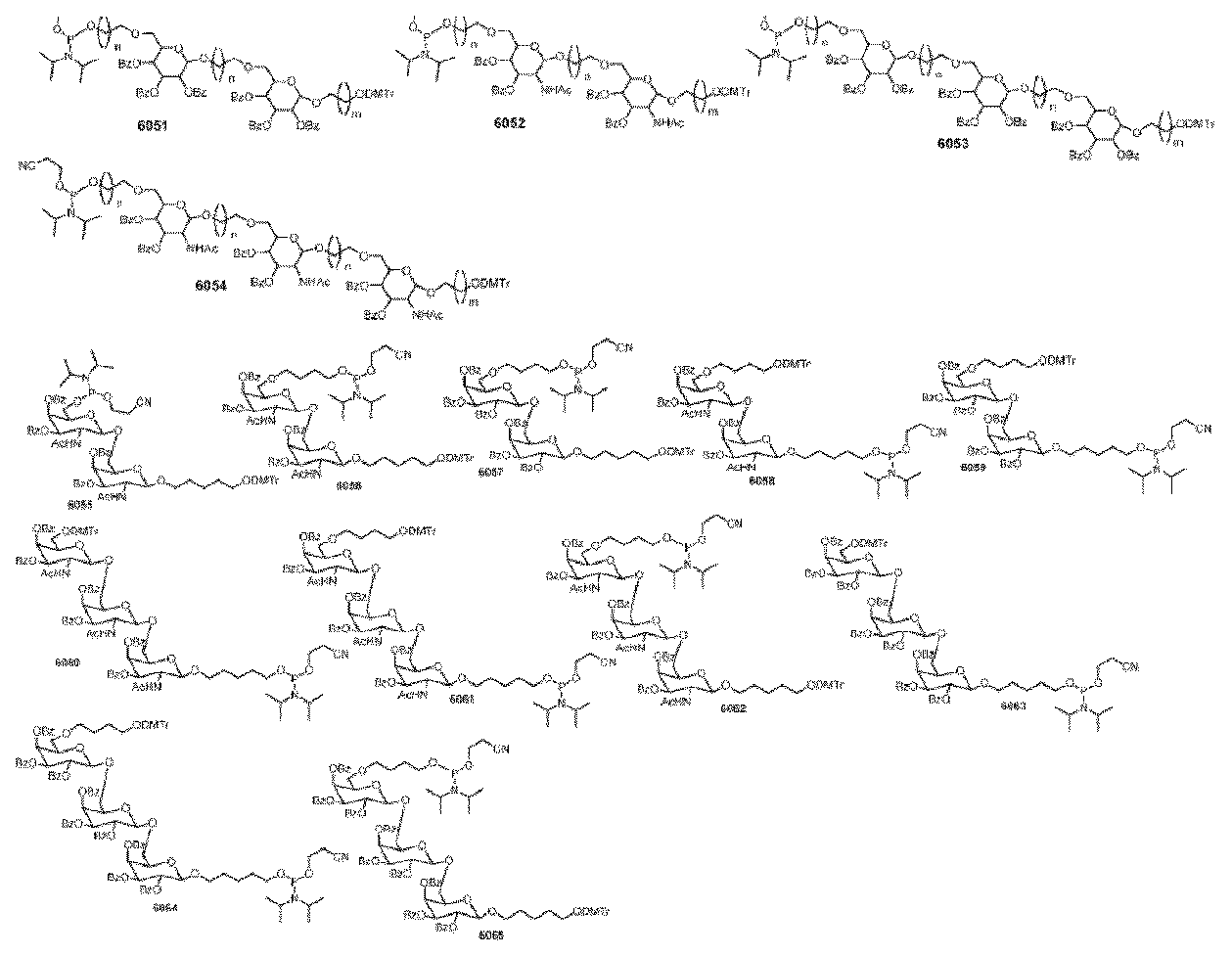
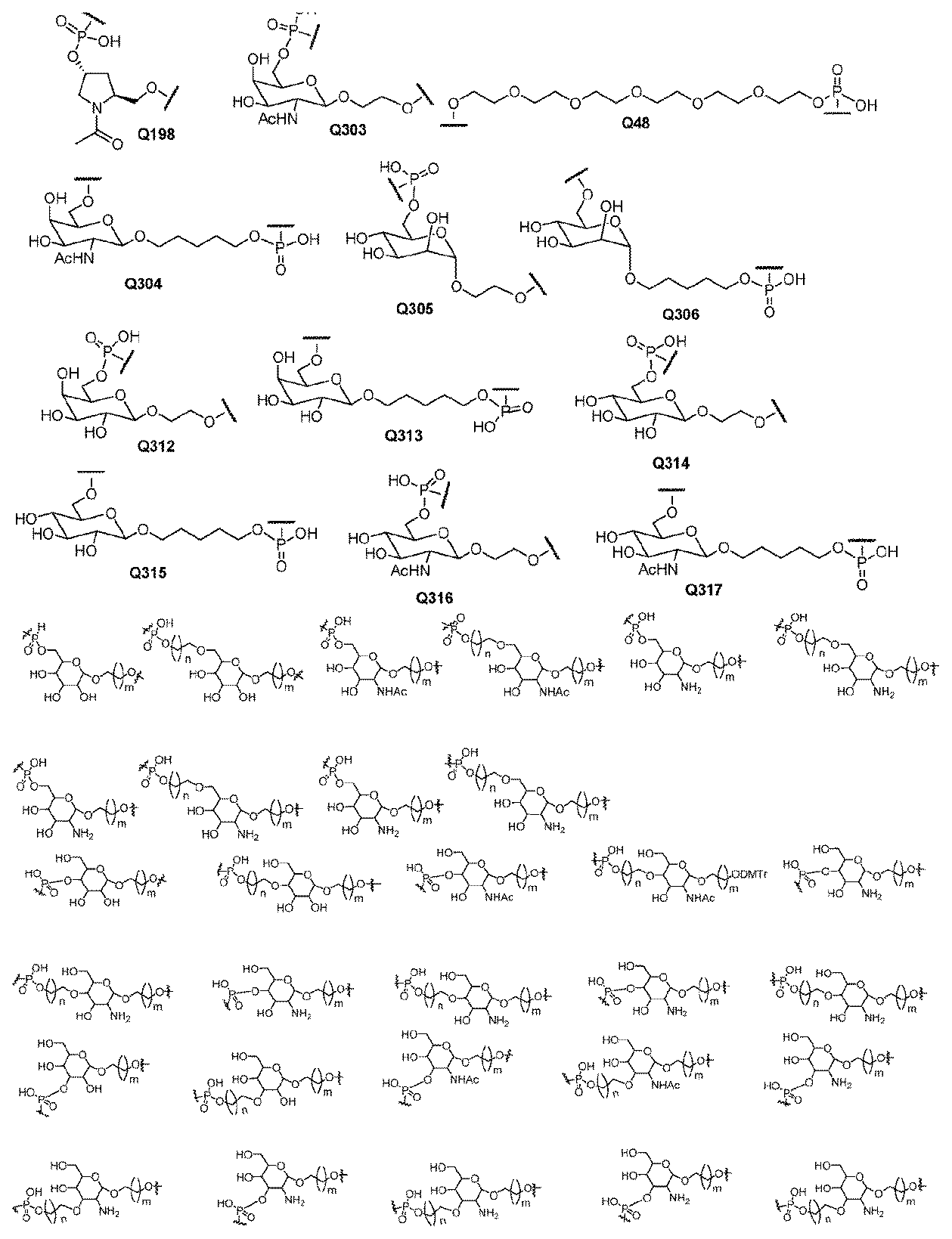
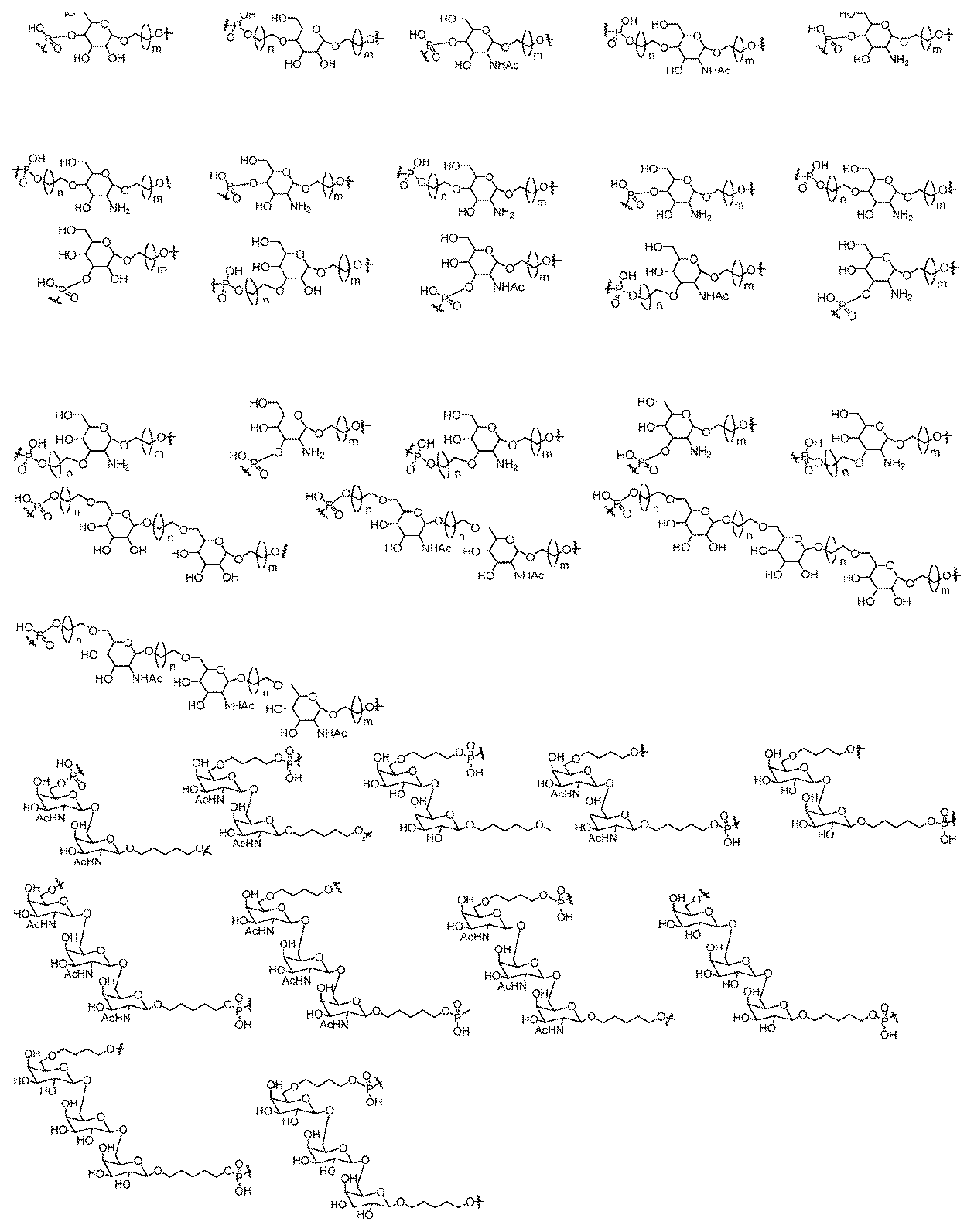
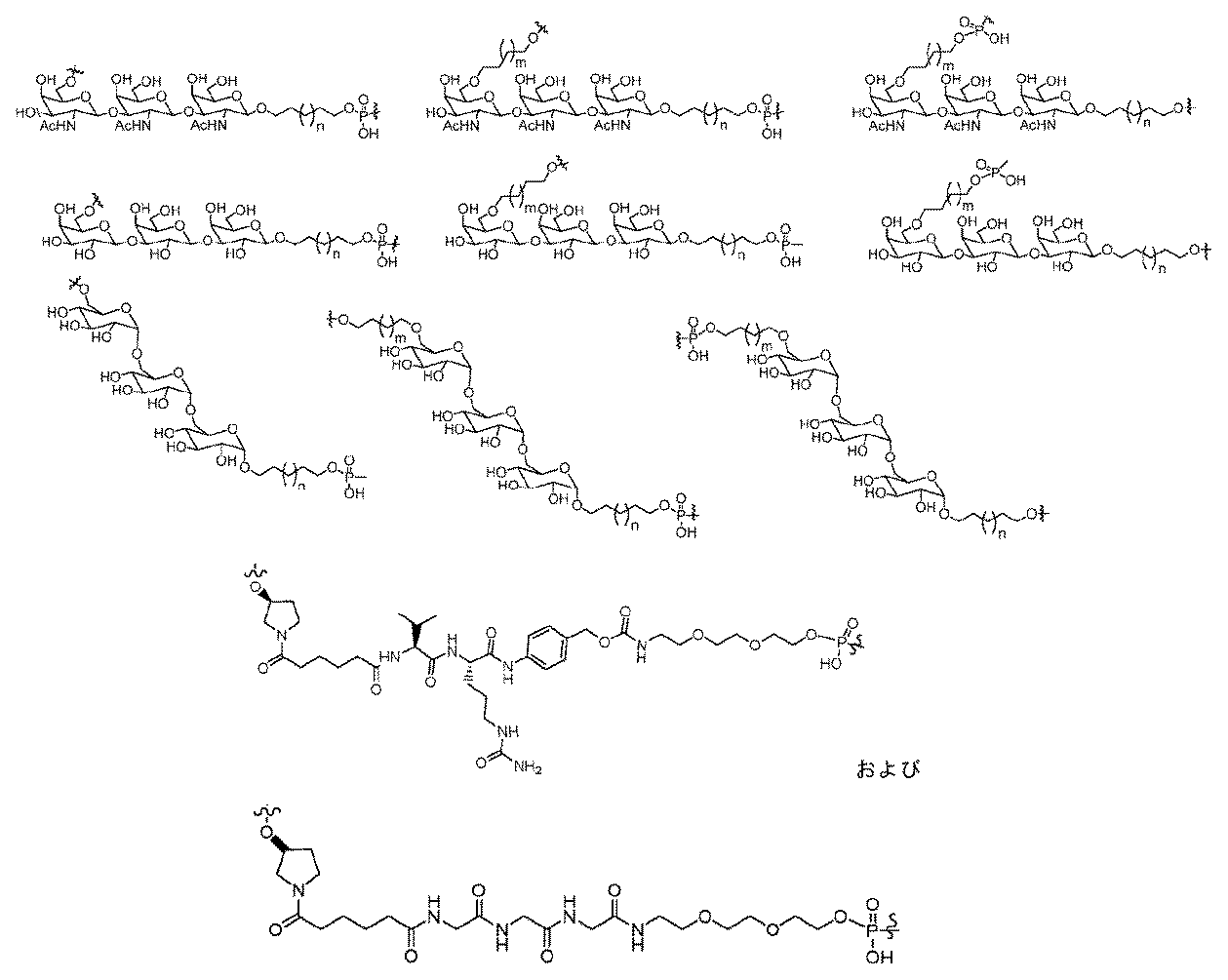
を含む。
Includes.
一部の実施形態において、切断型リンカー(または生物切断型リンカー)は、以下の群: In some embodiments, the cleavable linker (or biocleavable linker) is selected from the following group:
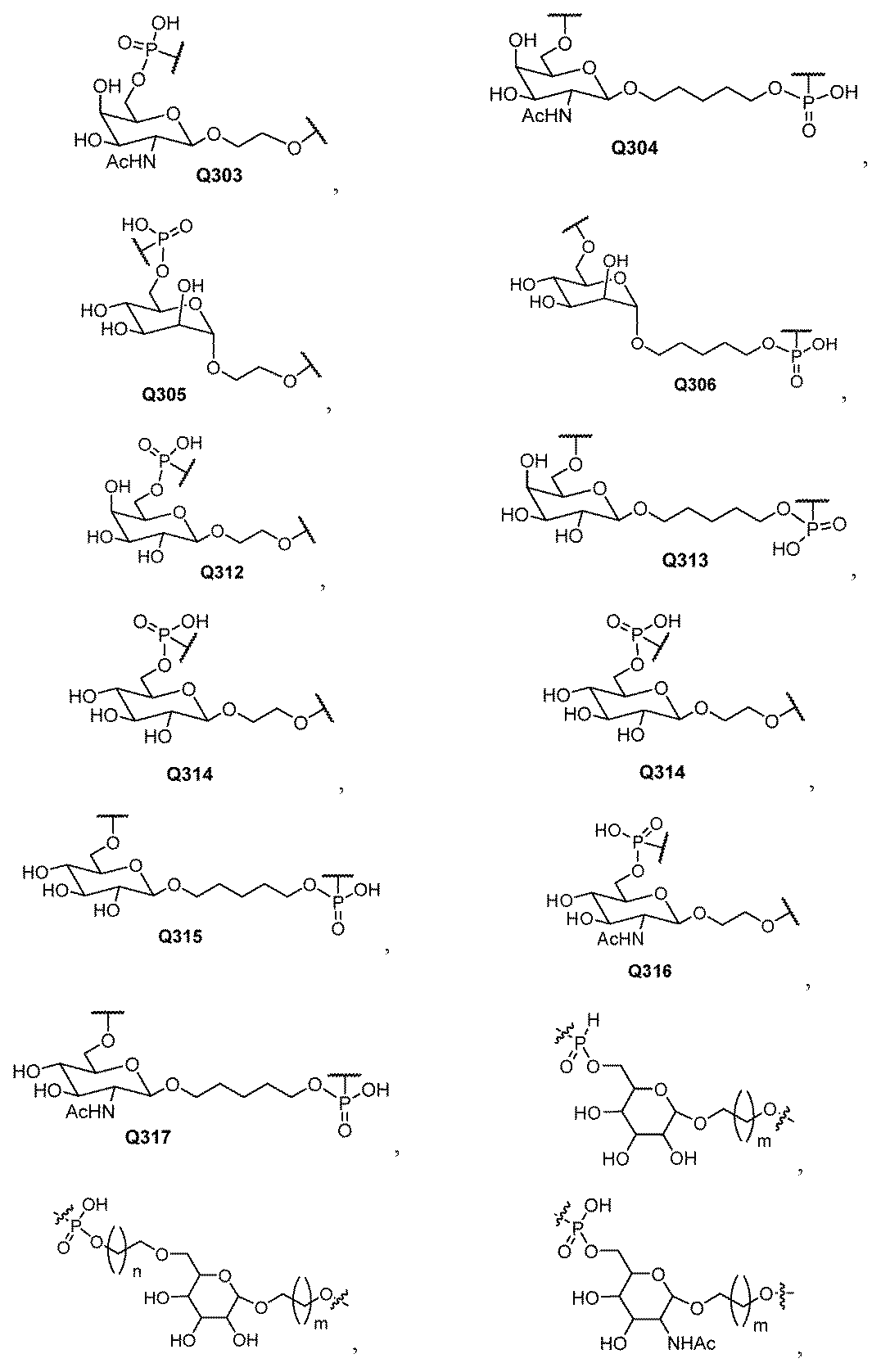

一部の実施形態において、エンドソーム切断型リンカーは、2つまたはそれ以上の上記の糖類単位を含む。 In some embodiments, the endosomally cleavable linker comprises two or more of the above saccharide units.
一部の実施形態において、エンドソーム切断型リンカーは、1~10の糖類単位を含む。 In some embodiments, the endosomally cleavable linker comprises 1-10 saccharide units.
一部の実施形態において、エンドソーム切断型リンカーは、2~10の糖類単位を含む。一部の実施形態において、エンドソーム切断型リンカーの糖類単位は、Q303、Q304、Q305、Q306、Q312、Q313、Q314、Q315、Q316およびQ317からなる群から選択される。 In some embodiments, the endosomally-cleavable linker comprises 2-10 saccharide units. In some embodiments, the saccharide units of the endosomally-cleavable linker are selected from the group consisting of Q303, Q304, Q305, Q306, Q312, Q313, Q314, Q315, Q316 and Q317.
一部の実施形態において、エンドソーム切断型リンカーは、2、3、または4の糖類単位を含む。一部の実施形態において、糖類単位は、Q303、Q304、Q305、Q306、Q312、Q313、Q314、Q315、Q316およびQ317からなる群から選択される。例えば、糖類単位はQ304でありうる。 In some embodiments, the endosomally cleavable linker comprises 2, 3, or 4 saccharide units. In some embodiments, the saccharide units are selected from the group consisting of Q303, Q304, Q305, Q306, Q312, Q313, Q314, Q315, Q316, and Q317. For example, the saccharide unit can be Q304.
一実施形態において、エンドソーム切断型リンカーが、
-Q303Q303-、-Q303Q303Q303-、-Q303Q303Q303Q303-、
-Q304Q304-、-Q304Q304Q304-、-Q304Q304Q304Q304-、
-Q305Q305-、-Q305Q305Q305-、-Q306Q306-、-Q306Q306Q306-、
-Q312Q312-、-Q312Q312Q312-、-Q313Q313-、-Q313Q313Q313-、
-Q314Q314-、-Q314Q314Q314-、-Q315Q315-、-Q315Q315Q315-、
-Q316Q316-、-Q316Q316Q316-、-Q317Q317-、または-Q317Q317Q317-
を含む。
In one embodiment, the endosomally-cleavable linker is
-Q303Q303-, -Q303Q303Q303-, -Q303Q303Q303Q303-,
-Q304Q304-, -Q304Q304Q304-, -Q304Q304Q304Q304-,
-Q305Q305-, -Q305Q305Q305-, -Q306Q306-, -Q306Q306Q306-,
-Q312Q312-, -Q312Q312Q312-, -Q313Q313-, -Q313Q313Q313-,
-Q314Q314-, -Q314Q314Q314-, -Q315Q315-, -Q315Q315Q315-,
-Q316Q316-, -Q316Q316Q316-, -Q317Q317-, or -Q317Q317Q317-
Includes.
一実施形態において、エンドソーム切断型リンカーは、 In one embodiment, the endosome-cleavable linker is

一実施形態において、エンドソーム切断型リンカーは、
-Q198Q48Q303Q303Q48-、-Q198Q303Q48Q303-、-Q198Q48Q303Q303Q48-、
-Q198Q303Q48Q303-、-Q198Q303Q303Q303Q303-、-Q198Q303Q303Q303-、
-Q198Q303Q303-、-Q198Q304Q304Q304Q304-、-Q198Q304Q304Q304-、
-Q198Q304Q304-、-Q198Q48Q303Q303Q48-、-Q198Q303Q48Q303-、
-Q198Q303Q303-、-Q48Q303Q303Q48-、または-Q303Q48Q303-
を含む。
In one embodiment, the endosomally-cleavable linker is
-Q198Q48Q303Q303Q48-, -Q198Q303Q48Q303-, -Q198Q48Q303Q303Q48-,
-Q198Q303Q48Q303-, -Q198Q303Q303Q303Q303-, -Q198Q303Q303Q303-,
-Q198Q303Q303-, -Q198Q304Q304Q304Q304-, -Q198Q304Q304Q304-,
-Q198Q304Q304-, -Q198Q48Q303Q303Q48-, -Q198Q303Q48Q303-,
-Q198Q303Q303-, -Q48Q303Q303Q48-, or -Q303Q48Q303-
Includes.
生物切断型リンカーについてのさらなる議論は、その全内容が参照により本明細書に組み込まれる、WO2018136620に見出されうる。
担体
Further discussion of bio-cleavable linkers can be found in WO2018136620, the entire contents of which are incorporated herein by reference.
Carrier
ある特定の実施形態において、一本鎖オリゴヌクレオチドの2つのオリゴヌクレオチドを接続する連結基Lは、1つまたは複数の担体を含有する。ある特定の実施形態において、1つまたは複数のリガンドは、1つまたは複数の担体を介して一本鎖オリゴヌクレオチドへとコンジュゲートされている。一部の実施形態において、担体は、1つまたは複数のヌクレオチド(複数可)を置換しうる。 In certain embodiments, the linking group L connecting the two oligonucleotides of the single-stranded oligonucleotide contains one or more carriers. In certain embodiments, one or more ligands are conjugated to the single-stranded oligonucleotide via one or more carriers. In some embodiments, the carrier may replace one or more nucleotide(s).
担体は、環状基または非環状基でありうる。一実施形態において、環状基は、ピロリジニル、ピラゾリニル、ピラゾリジニル、イミダゾリニル、イミダゾリジニル、ピペリジニル、ピペラジニル、[1,3]ジオキソラン、オキサゾリジニル、イソキサゾリジニル、モルホリニル、チアゾリジニル、イソチアゾリジニル、キノキサリニル、ピリダジノニル、テトラヒドロフリル、およびデカリニルからなる群から選択される。一実施形態において、非環状基は、セリノール骨格またはジエタノールアミン骨格に基づく部分である。 The carrier can be a cyclic or acyclic group. In one embodiment, the cyclic group is selected from the group consisting of pyrrolidinyl, pyrazolinyl, pyrazolidinyl, imidazolinyl, imidazolidinyl, piperidinyl, piperazinyl, [1,3]dioxolane, oxazolidinyl, isoxazolidinyl, morpholinyl, thiazolidinyl, isothiazolidinyl, quinoxalinyl, pyridazinonyl, tetrahydrofuryl, and decalinyl. In one embodiment, the acyclic group is a moiety based on a serinol backbone or a diethanolamine backbone.
一部の実施形態において、担体は、一本鎖オリゴヌクレオチド(例えば、Z1および/またはZ2)のヌクレオチド配列の内部位置(複数可)の1つまたは複数のヌクレオチド(複数可)を置換する。 In some embodiments, a carrier replaces one or more nucleotide(s) at an internal position(s) of the nucleotide sequence of a single stranded oligonucleotide (eg, Z 1 and/or Z 2 ).
本明細書において、サブユニットのリボース糖がこのように置きかえられたリボヌクレオチドサブユニットは、リボース置換修飾サブユニット(RRMS)と称される。担体は、環状または非環状部分であってもよく、2つの「骨格接合点」(例えば、ヒドロキシル基)およびリガンドを含みうる。リガンドは、担体に直接接合されうるか、または上記のように、介在するリンカー/テザーによって担体に間接的に接合されうる。 Ribonucleotide subunits in which the ribose sugar of the subunit has been replaced in this manner are referred to herein as ribose replacement modified subunits (RRMS). The carrier may be a cyclic or acyclic moiety and may contain two "backbone attachment points" (e.g., hydroxyl groups) and a ligand. The ligand may be directly attached to the carrier or indirectly attached to the carrier by an intervening linker/tether, as described above.
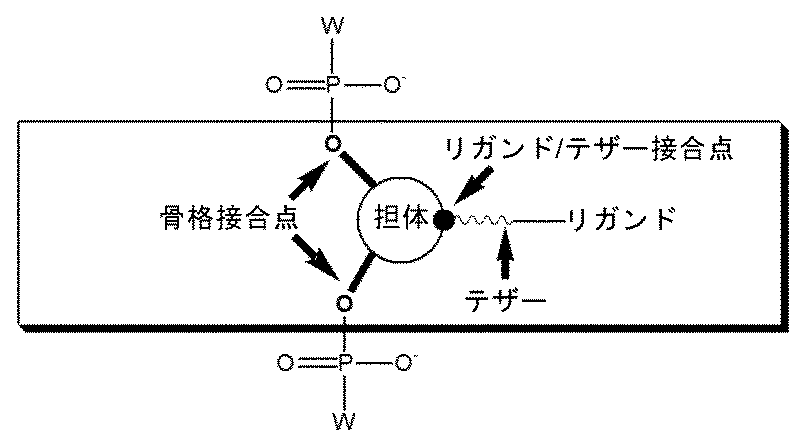
リガンドコンジュゲート単量体サブユニットは、一本鎖オリゴヌクレオチドのヌクレオチド配列(例えば、Z1および/またはZ2)の5’または3’末端サブユニットであってもよく、すなわち、2つの「W」基のうちの1つが、ヒドロキシル基であってもよく、他の「W」基が、2つまたはそれ以上の非修飾または修飾リボヌクレオチドの鎖であってもよい。あるいは、リガンドコンジュゲート単量体サブユニットは、内部位置を占有してもよく、両方の「W」基が1つまたは複数の非修飾または修飾リボヌクレオチドであってもよい。1つより多くのリガンドコンジュゲート単量体サブユニットが、一本鎖オリゴヌクレオチドに存在しうる。 A ligand-conjugated monomeric subunit may be the 5' or 3' terminal subunit of a nucleotide sequence (e.g., Z1 and/or Z2 ) of a single-stranded oligonucleotide, i.e., one of the two "W" groups may be a hydroxyl group and the other "W" group may be a chain of two or more unmodified or modified ribonucleotides. Alternatively, a ligand-conjugated monomeric subunit may occupy an internal position, where both "W" groups may be one or more unmodified or modified ribonucleotides. More than one ligand-conjugated monomeric subunit may be present in a single-stranded oligonucleotide.
糖置換ベースの単量体、例えば、リガンドコンジュゲート単量体(環状)
環状糖置換ベースの単量体、例えば、糖置換ベースのリガンドコンジュゲート単量体は、本明細書において、RRMS単量体化合物とも称される。担体は、以下に提供する一般式(LCM-2)を有しうる(その構造において、好ましい骨格接合点は、R1もしくはR2、R3もしくはR4、またはYがCR9R10である場合、R9およびR10から選択されうる(2つの位置は、2つの骨格接合点、例えば、R1およびR4、またはR4およびR9を与えるように選択される))。好ましいテザリング接合点は、XがCH2である場合、R7;R5またはR6を含む。担体は、鎖ヘと組み込まれうる実体として以下に記載される。したがって、構造が、接合点の1つ(末端位置の場合)または2つ(内部位置の場合)、例えば、R1もしくはR2、R3もしくは4、またはR9もしくはR10(Yが、CR9R10である場合)は、リン酸、または修飾リン酸、例えば、骨格を含有する硫黄に接続される状況も包含することが理解される。例えば、上記で命名したR基の1つは、-CH2-であってもよく、ここで、1つの結合は担体に接続され、1つは骨格原子に接続され、例えば、酸素または中心リン原子を連結する。
Sugar-substitution-based monomers, e.g., ligand-conjugated monomers (cyclic)
Cyclic sugar substitution based monomers, e.g., sugar substitution based ligand conjugate monomers, are also referred to herein as RRMS monomer compounds. The carriers may have the general formula (LCM-2) provided below, in which preferred backbone attachment points may be selected from R1 or R2 , R3 or R4 , or R9 and R10 when Y is CR9R10 (two positions selected to provide two backbone attachment points, e.g., R1 and R4 , or R4 and R9 ). Preferred tethering attachment points include R7 when X is CH2 ; R5 or R6 . The carriers are described below as entities that may be incorporated into the chain. Thus, it is understood that the structures also encompass situations where one (if terminal positions) or two (if internal positions) of the attachment points, e.g., R1 or R2 , R3 or 4 , or R9 or R10 (if Y is CR9R10 ), are connected to a phosphate or modified phosphate, e.g., a sulfur containing backbone. For example, one of the R groups named above may be -CH2- , where one bond is connected to the carrier and one is connected to a backbone atom, e.g., linking the oxygen or central phosphorus atom.
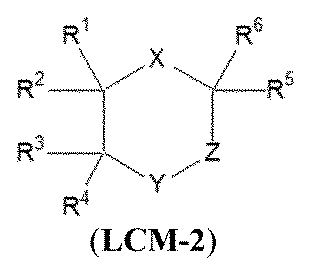
Xは、N(CO)R7、NR7またはCH2であり;
Yは、NR8、O、S、CR9R10であり;
Zは、CR11R12であるか、または存在せず;
R1、R2、R3、R4、R9、およびR10の少なくとも2つが、ORaおよび/または(CH2)nORbであれば、各R1、R2、R3、R4、R9、およびR10は、独立に、H、ORaおよび/または(CH2)nORbであり、;
各R5、R6、R11、およびR12は、独立に、リガンド、H、1~3R13によって置換されてもよいC1~C6アルキル、またはC(O)NHR7であり;またはR5およびR11は、共に、R14によって置換されてもよいC3~C8シクロアルキルであり;
R7は、リガンドであってもよく、例えば、R7は、Rdであってもよいか、またはR7は、例えば、テザリング部分、例えば、NRcRdによって置換されたC1~C20アルキル、またはNHC(O)Rdによって置換されたC1~C20アルキルを介して、担体に間接的にテザリングされたリガンドであってもよく;
R8は、HまたはC1~C6アルキルであり;
R13は、ヒドロキシ、C1~C4アルコキシ、またはハロであり;
R14は、NRCR7であり;
R15は、シアノによって置換されてもよいC1~C6アルキル、またはC2~C6アルケニルであり;
R16は、C1~C10アルキルであり;
R17は、液相または固相支持試薬であり;
Lは、-C(O)(CH2)qC(O)-、または-C(O)(CH2)qS-であり;
Raは、保護基、例えば、CAr3;(例えば、ジメトキシトリチル基)またはSi(X5’)(X5’’)(X5’’’)であり、ここで、(X5’)、(X5’’)、および(X5’’’)は、本明細書の別の箇所において記載され、
Rbは、P(O)(O-)H、P(OR15)N(R16)2またはL-R17であり;
RCは、HまたはC1~C6アルキルであり;
Rdは、Hまたはリガンドであり;
各Arは、独立に、C1~C4アルコキシによって置換されてもよいC6~C10アリールであり、
nは、1~4であり;qは、0~4である。
X is N(CO) R7 , NR7 or CH2 ;
Y is NR8 , O, S, CR9R10 ;
Z is CR 11 R 12 or absent;
if at least two of R 1 , R 2 , R 3 , R 4 , R 9 , and R 10 are OR a and/or (CH 2 ) n OR b , then each R 1 , R 2 , R 3 , R 4 , R 9 , and R 10 is independently H, OR a and/or (CH 2 ) n OR b ;
Each R 5 , R 6 , R 11 , and R 12 is independently a ligand, H, C 1 -C 6 alkyl optionally substituted by 1-3 R 13 , or C(O)NHR 7 ; or R 5 and R 11 together are C 3 -C 8 cycloalkyl optionally substituted by R 14 ;
R 7 can be a ligand, e.g., R 7 can be R d , or R 7 can be a ligand indirectly tethered to a carrier, e.g., via a tethering moiety, e.g., C 1 -C 20 alkyl substituted by NR c R d , or C 1 -C 20 alkyl substituted by NHC(O)R d ;
R 8 is H or C 1 -C 6 alkyl;
R 13 is hydroxy, C 1 -C 4 alkoxy, or halo;
R14 is NRCR7 ;
R 15 is C 1 -C 6 alkyl or C 2 -C 6 alkenyl optionally substituted by cyano;
R 16 is C 1 -C 10 alkyl;
R 17 is a liquid or solid phase supported reagent;
L is -C(O)( CH2 ) qC (O)-, or -C(O)( CH2 ) qS- ;
R a is a protecting group, for example, CAr 3 ; (e.g., a dimethoxytrityl group) or Si(X 5 ')(X 5 '')(X 5 '''), where (X 5 '), (X 5 ''), and (X 5 '''') are as described elsewhere herein;
R b is P(O)(O-)H, P(OR 15 )N(R 16 ) 2 or L-R 17 ;
R C is H or C 1 -C 6 alkyl;
R d is H or a ligand;
each Ar is independently a C 6 -C 10 aryl optionally substituted with a C 1 -C 4 alkoxy;
n is 1 to 4; q is 0 to 4.
例示的な担体は、例えば、XがN(CO)R7またはNR7であり、YがCR9R10であり、Zが存在しないか;またはXがN(CO)R7またはNR7であり、YがCR9R10であり、ZがCR11R12であるか、またはXがN(CO)R7またはNR7であり、YがOであり、ZがCR11R12であるか、またはXがCH2であり、YがCR9R10であり、ZがCR11R12であり、R5およびR11が共にC6シクロアルキル(H、z=2)を形成するか、またはインダン環系、例えば、XがCH2であり;YがCR9R10であり;ZがCR11R12であり、R5およびR11が共にC5シクロアルキル(H、z=1)を形成するものを含む。 Exemplary carriers are, for example, those in which X is N(CO) R7 or NR7 , Y is CR9R10 , and Z is absent; or X is N(CO) R7 or NR7 , Y is CR9R10 , and Z is CR11R12 ; or X is N(CO) R7 or NR7 , Y is O , and Z is CR11R12 ; or X is CH2 , Y is CR9R10 , and Z is CR11R12 , and R5 and R11 together form a C6 cycloalkyl (H, z= 2 ) , or an indane ring system, for example, X is CH2 ; Y is CR9R10 ; Z is CR11R12 , and R5 and R11 together form a C6 cycloalkyl (H , z= 2 ) . 5 cycloalkyl (H, z=1).
ある特定の実施形態において、担体は、ピロリン環系または4-ヒドロキシピロリン環系、例えば、XがN(CO)R7またはNR7であり、YがCR9R10であり、Zが存在しない(D)に基づきうる。 In certain embodiments, the carrier may be based on a pyrroline ring system or a 4-hydroxypyrroline ring system, eg, where X is N(CO)R 7 or NR 7 , Y is CR 9 R 10 , and Z is absent (D).
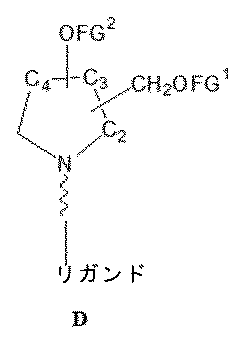
OFG1は、好ましくは、五員環の炭素の1つに接続した、第一炭素、例えば、環外アルキレン基、例えばメチレン基へと接合される(DのCH2OFG1)。OFG2は、好ましくは、五員環の炭素の1つへと直接接合される(DのOFG2)。ピロリンベースの担体では、CH2OFG1はC-2へと接合されてもよく、OFG2はC-3へと接合されてもよく;または-CH2OFG1はC-3へと接合されてもよく、OFG2はC-4へと接合されてもよい。ある特定の実施形態において、CH2OFG1およびOFG2は、上記で参照した炭素の1つへと対置換されてもよい。3-ヒドロキシプロリンベースの担体では、-CH2OFG1はC-2へと接合されてもよく、OFG2はC-4へと接合されてもよい。ピロリン-および4-ヒドロキシプロリンベースの単量体は、したがって、結合回転が、特定の連結、例えば、環の存在から生じる制限によって制限される連結(例えば、炭素-炭素結合)を含有しうる。したがって、CH2OFG1およびOFG2は、上記で描写した対のいずれかにおいて互いに関してシスまたはトランスでありうる。したがって、全てのシス/トランス異性体が、明確に含まれる。単量体は、1つまたは複数の不斉中心を含有してもよく、したがって、ラセミ体およびラセミ体混合物、単一の鏡像異性体、個々のジアステレオマーおよびジアステレオマー混合物として生じてもよい。単量体の全てのそのような異性体形態が明確に含まれる(例えば、CH2OFG1およびOFG2を持つ中心は、両方ともR配置を有しうるか;または両方ともS配置を有しうるか;または1つの中心はR配置を有し、他の中心はS配置を有しうる、およびこの逆の場合もある)。テザリング接合点は、好ましくは窒素である。担体Dの好ましい例は、以下: OFG 1 is preferably attached to the first carbon, e.g., an exocyclic alkylene group, e.g., a methylene group, connected to one of the carbons of the five-membered ring (CH 2 OFG 1 of D). OFG 2 is preferably attached directly to one of the carbons of the five-membered ring (OFG 2 of D). In pyrroline-based carriers, CH 2 OFG 1 may be attached to C-2 and OFG 2 may be attached to C-3; or -CH 2 OFG 1 may be attached to C-3 and OFG 2 may be attached to C-4. In certain embodiments, CH 2 OFG 1 and OFG 2 may be substituted onto one of the carbons referenced above. In 3-hydroxyproline-based carriers, -CH 2 OFG 1 may be attached to C-2 and OFG 2 may be attached to C-4. Pyrroline- and 4-hydroxyproline-based monomers may therefore contain linkages (e.g., carbon-carbon bonds) in which bond rotation is restricted by restrictions resulting from the presence of certain linkages, e.g., rings. Thus, CH 2 OFG 1 and OFG 2 may be cis or trans with respect to each other in any of the pairs depicted above. Thus, all cis/trans isomers are expressly included. The monomers may contain one or more asymmetric centers and thus may occur as racemates and racemic mixtures, single enantiomers, individual diastereomers and diastereomeric mixtures. All such isomeric forms of the monomers are expressly included (e.g., the centers bearing CH 2 OFG 1 and OFG 2 may both have the R configuration; or both may have the S configuration; or one center may have the R configuration and the other center may have the S configuration, and vice versa). The tethering junction is preferably nitrogen. Preferred examples of carrier D are:

ある特定の実施形態において、担体は、ピペリジン環系(E)に基づいてもよく、例えば、Xは、N(CO)R7またはNR7であり、YはCR9R10であり、ZはCR11R12である。 In certain embodiments, the carrier may be based on a piperidine ring system (E), for example, X is N(CO) R7 or NR7 , Y is CR9R10 , and Z is CR11R12 .

ある特定の実施形態において、担体は、ピペリジン環系(F)に基づいてもよく、例えば、XはN(CO)R7またはNR7であり、YはNR8であり、ZはCR11R12であるかまたは、モルホリン環系(G)に基づいてもよく、例えば、XはN(CO)R7またはNR7であり、YはOであり、ZはCR11R12である。 In certain embodiments, the carrier may be based on a piperidine ring system (F), e.g., X is N(CO) R7 or NR7 , Y is NR8 , and Z is CR11R12 , or a morpholine ring system (G), e.g., X is N(CO) R7 or NR7 , Y is O, and Z is CR11R12 .
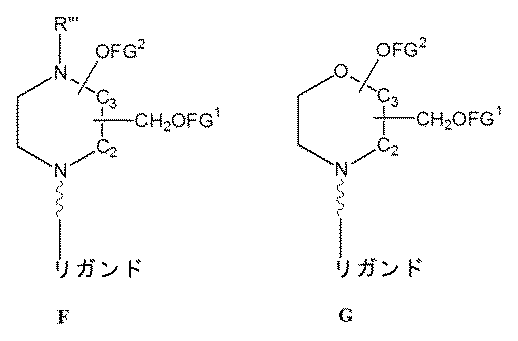
OFG1は、好ましくは、六員環の炭素の1つに接続した、第一炭素、例えば、環外アルキレン基、例えばメチレン基へと接合される(FまたはGの-CH2OFG1)。OFG2は、好ましくは、六員環の炭素の1つへと直接接合される(FまたはGのOFG2)。FとGの両方では、-CH2OFG1はC-2へと接合されてもよく、OFG2はC-3へと接合されてもよく;またはこの逆の場合もある。ある特定の実施形態において、CH2OFG1およびOFG2は、上記で参照した炭素の1つへと対置換されてもよい。ピペラジン-およびモルホリンベースの単量体は、したがって、結合回転が、特定の連結、例えば、環の存在から生じる制限により制限される連結(例えば、炭素-炭素結合)を含有しうる。したがって、CH2OFG1およびOFG2は、上記で描写した対のいずれかにおいて互いに関してシスまたはトランスでありうる。したがって、全てのシス/トランス異性体が、明確に含まれる。単量体は、1つまたは複数の不斉中心を含有してもよく、したがって、ラセミ体およびラセミ体混合物、単一の鏡像異性体、個々のジアステレオマーおよびジアステレオマー混合物として生じてもよい。単量体の全てのそのような異性体形態が明確に含まれる(例えば、CH2OFG1およびOFG2を持つ中心は、両方ともR配置を有しうるか;または両方ともS配置を有しうるか;または1つの中心はR配置を有し、他の中心はS配置を有しうる、およびこの逆の場合もある)。テザリング接合点は、FおよびGの両方において、好ましくは窒素である。 OFG 1 is preferably attached to a first carbon, e.g., an exocyclic alkylene group, e.g., a methylene group, connected to one of the carbons of the six-membered ring (-CH 2 OFG 1 of F or G). OFG 2 is preferably attached directly to one of the carbons of the six-membered ring (OFG 2 of F or G). In both F and G, -CH 2 OFG 1 may be attached to C-2 and OFG 2 may be attached to C-3; or vice versa. In certain embodiments, CH 2 OFG 1 and OFG 2 may be counter-substituted to one of the carbons referenced above. Piperazine- and morpholine-based monomers may therefore contain linkages (e.g., carbon-carbon bonds) where bond rotation is restricted by certain linkages, e.g., restrictions resulting from the presence of a ring. Thus, CH 2 OFG 1 and OFG 2 can be cis or trans with respect to each other in any of the pairs depicted above. Thus, all cis/trans isomers are expressly included. The monomers may contain one or more asymmetric centers and therefore may occur as racemates and racemic mixtures, single enantiomers, individual diastereomers and diastereomeric mixtures. All such isomeric forms of the monomers are expressly included (e.g., the centers with CH 2 OFG 1 and OFG 2 may both have the R configuration; or both may have the S configuration; or one center may have the R configuration and the other center may have the S configuration, and vice versa). The tethering junction is preferably nitrogen in both F and G.
ある特定の実施形態において、担体は、デカリン環系に基づいてもよく、例えば、XはCH2であり、YはCR9R10であり、ZはCR11R12であり、R5およびR11は共にC6シクロアルキル(H、z=2)を形成するか、またはインダン環系に基づいてもよく、例えば、XはCH2であり、YはCR9R10であり、ZはCR11R12であり、R5およびR11は共にC5シクロアルキル(H、z=1)を形成する。 In certain embodiments, the carrier may be based on a decalin ring system, e.g., X is CH2 , Y is CR9R10 , Z is CR11R12 , and R5 and R11 together form a C6 cycloalkyl (H, z= 2 ), or an indane ring system, e.g., X is CH2 , Y is CR9R10 , Z is CR11R12 , and R5 and R11 together form a C5 cycloalkyl (H, z = 1).

OFG1は、好ましくは、C-2、C-3、C-4、またはC-5の1つに接続した、第一炭素、例えば、環外メチレン基(n=1)またはエチレン基(n=2)へと接合される[Hの-(CH2)nOFG1]。OFG2は、好ましくは、C-2、C-3、C-4、またはC-5の1つへと直接接合される(Hの-OFG2)。-CH2OFG1およびOFG2は、環に対になる方法で配置されてもよく、すなわち、両方の基が、同じ炭素、例えば、C-2、C-3、C-4、またはC-5へと接合されてもよい。あるいは、-(CH2)nOFG1およびOFG2は、環に隣接する方法で配置されてもよく、すなわち、両方の基が隣接する環炭素原子に接合されてもよく、例えば、-(CH2)nOFG1はC-2へと接合されてもよく、OFG2はC-3へと接合されてもよく;-(CH2)nOFG1はC-3へと接合されてもよく、OFG2はC-2へと接合されてもよく;-(CH2)nOFG1はC-3へと接合されてもよく、OFG2はC-4へと接合されてもよく;または、-(CH2)nOFG1はC-4へと接合されてもよく、OFG2はC-3へと接合されてもよく;-(CH2)nOFG1はC-4へと接合されてもよく、OFG2はC-5へと接合されてもよく;または-(CH2)nOFG1はC-5へと接合されてもよく、OFG2はC-4へと接合されてもよい。デカリンまたはインダンベースの単量体は、したがって、結合回転が、特定の連結、例えば、環の存在から生じる制限により制限される連結(例えば、炭素-炭素結合)を含有しうる。したがって、-(CH2)nOFG1およびOFG2は、上記で描写した対のいずれかにおいて互いに関してシスまたはトランスでありうる。したがって、全てのシス/トランス異性体が、明確に含まれる。単量体は、1つまたは複数の不斉中心を含有してもよく、したがって、ラセミ体およびラセミ体混合物、単一の鏡像異性体、個々のジアステレオマーおよびジアステレオマー混合物として生じてもよい。単量体の全てのそのような異性体形態が明確に含まれる(例えば、CH2OFG1およびOFG2を持つ中心は、両方ともR配置を有しうるか;または両方ともS配置を有しうるか;または1つの中心はR配置を有し、他の中心はS配置を有しうる、およびこの逆の場合もある)。好ましい実施形態において、C-1およびC-6における置換基は、互いに関してトランスである。テザリング接合点は、好ましくはC-6またはC-7である。 OFG 1 is preferably attached to a first carbon, e.g., an exocyclic methylene group (n=1) or ethylene group (n=2), connected to one of C-2, C-3, C-4, or C-5 [-( CH2 ) nOFG1 of H]. OFG 2 is preferably attached directly to one of C-2, C-3, C-4, or C- 5 ( -OFG2 of H). -CH2OFG 1 and OFG 2 may be arranged in a pairwise manner on the ring, i.e., both groups may be attached to the same carbon, e.g., C-2, C-3, C-4, or C-5. Alternatively, -( CH2 ) nOFG 1 and OFG 2 may be positioned in an adjacent manner on the ring, i.e., both groups may be attached to adjacent ring carbon atoms, for example, -( CH2 ) nOFG 1 may be attached to C-2 and OFG 2 may be attached to C-3; -( CH2 ) nOFG 1 may be attached to C-3 and OFG 2 may be attached to C-2; -( CH2 ) nOFG 1 may be attached to C-3 and OFG 2 may be attached to C-4; or -( CH2 ) nOFG 1 may be attached to C-4 and OFG 2 may be attached to C-3; -( CH2 ) nOFG 1 may be attached to C-4 and OFG 2 may be attached to C-5; or -(CH 2 ) nOFG 1 may be joined to C-5 and OFG 2 may be joined to C-4. Decalin or indane based monomers may therefore contain linkages (e.g., carbon-carbon bonds) where bond rotation is restricted by restrictions resulting from the presence of certain linkages, e.g., rings. Thus, -( CH2 ) nOFG 1 and OFG 2 may be cis or trans with respect to one another in any of the pairs depicted above. Thus, all cis/trans isomers are expressly included. Monomers may contain one or more asymmetric centers and therefore occur as racemates and racemic mixtures, single enantiomers, individual diastereomers and diastereomeric mixtures. All such isomeric forms of the monomers are expressly included (e.g., the centers with CH 2 OFG 1 and OFG 2 may both have the R configuration; or both may have the S configuration; or one center may have the R configuration and the other the S configuration, and vice versa). In a preferred embodiment, the substituents at C-1 and C-6 are trans with respect to each other. The tethering junction is preferably at C-6 or C-7.
他の担体は、3-ヒドロキシプロリン(J)に基づくものを含みうる。 Other carriers may include those based on 3-hydroxyproline (J).
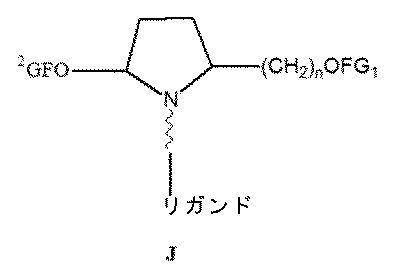
より代表的な環状、糖置換ベースの担体についての詳細は、その全体が参照により本明細書に組み込まれる、米国特許第7,745,608号および同第8,017,762号に見出されうる。 Details regarding more representative cyclic, sugar-substituted based carriers can be found in U.S. Pat. Nos. 7,745,608 and 8,017,762, which are incorporated by reference in their entireties.
糖置換ベースの単量体(非環状)
非環状の糖置換ベースの単量体、例えば糖置換ベースのリガンドコンジュゲート単量体は、本明細書において、リボース置換単量体サブユニット(RRMS)単量体化合物とも称される。好ましい非環状担体は、式LCM-3またはLCM-4:
Sugar-based monomers (non-cyclic)
Acyclic sugar-substitution-based monomers, such as sugar-substitution-based ligand-conjugate monomers, are also referred to herein as ribose-substituted monomeric subunit (RRMS) monomer compounds. Preferred acyclic carriers have the formula LCM-3 or LCM-4:
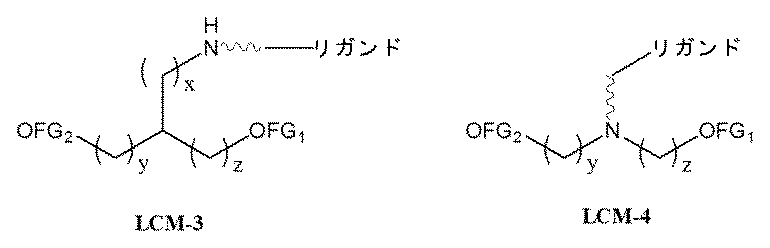
一部の実施形態において、各x、y、およびzは、互いに独立に、0、1、2、または3でありうる。式LCM-3において、yおよびzが異なる場合、次いで、第三炭素はR配置またはS配置のいずれかを有しうる。好ましい実施形態において、xはゼロであり、yおよびzは、式LCM-3(例えば、セリノールに基づく)においてそれぞれ1であり、yおよびzは、式LCM-3においてそれぞれ1である。以下の式LCM-3またはLCM-4のそれぞれは、例えば、ヒドロキシ、アルコキシ、ペルハロアルキルによって置換されてもよい。 In some embodiments, each x, y, and z can be, independently of one another, 0, 1, 2, or 3. When y and z are different in formula LCM-3, then the third carbon can have either the R or S configuration. In a preferred embodiment, x is zero, y and z are each 1 in formula LCM-3 (e.g., based on serinol), and y and z are each 1 in formula LCM-3. Each of the following formulas LCM-3 or LCM-4 may be substituted, for example, by hydroxy, alkoxy, perhaloalkyl.
より代表的な非環状、糖置換ベースの担体についての詳細は、その全体が参照により本明細書に組み込まれる、米国特許第7,745,608号および同第8,017,762号に見出されうる。 Details regarding more representative acyclic, sugar-substituted based carriers can be found in U.S. Pat. Nos. 7,745,608 and 8,017,762, which are incorporated by reference in their entireties.
一部の実施形態において、一本鎖オリゴヌクレオチドは、ヌクレオチド配列(例えば、Z1および/またはZ2)の5’末端にコンジュゲートした1つまたは複数のリガンドを含む。 In some embodiments, the single stranded oligonucleotide comprises one or more ligands conjugated to the 5' end of a nucleotide sequence (eg, Z 1 and/or Z 2 ).
ある特定の実施形態において、リガンドは、担体および/またはリンカーを介してヌクレオチド配列(例えば、Z1および/またはZ2)の5’末端にコンジュゲートされる。一実施形態において、リガンドは、式: In certain embodiments, the ligand is conjugated to the 5' end of the nucleotide sequence (eg, Z 1 and/or Z 2 ) via a carrier and/or linker. In one embodiment, the ligand has the formula:
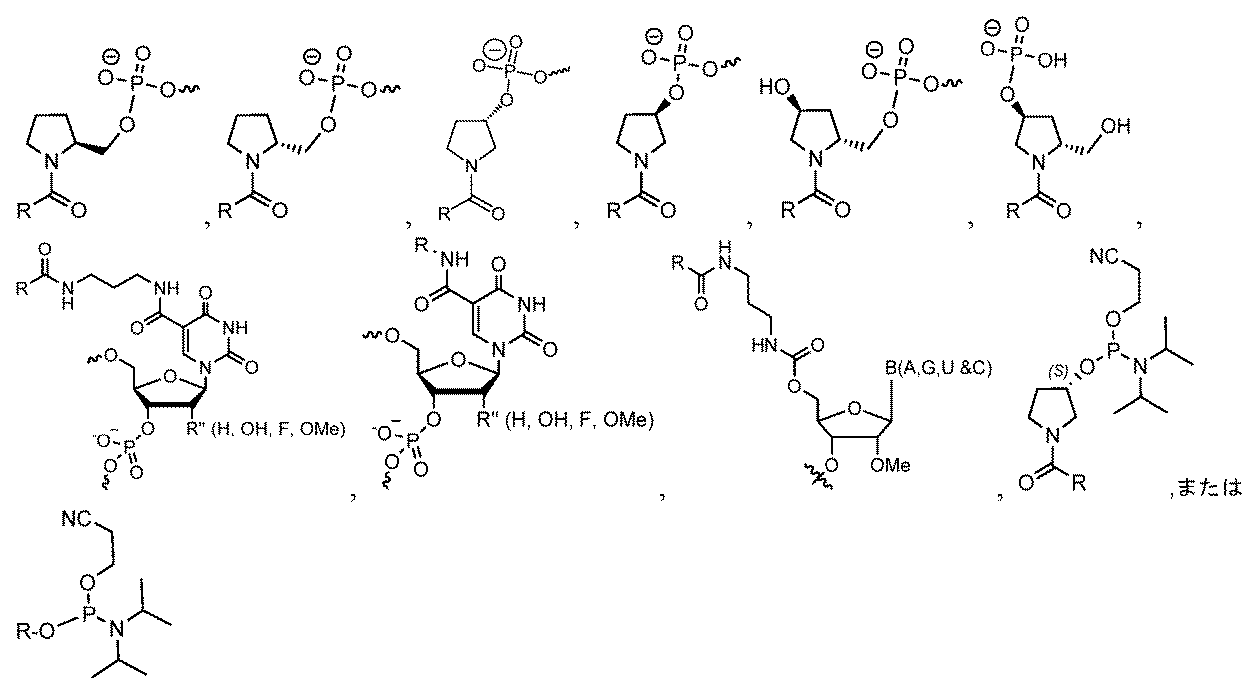
一部の実施形態において、一本鎖オリゴヌクレオチドは、ヌクレオチド配列(例えば、Z1および/またはZ2)の3’末端にコンジュゲートした1つまたは複数のリガンドを含む。 In some embodiments, the single stranded oligonucleotide comprises one or more ligands conjugated to the 3' end of a nucleotide sequence (eg, Z 1 and/or Z 2 ).
ある特定の実施形態において、リガンドは、担体および/またはリンカーを介して、ヌクレオチド配列(例えば、Z1および/またはZ2)の3’末端にコンジュゲートされる。一実施形態において、リガンドは、式: In certain embodiments, the ligand is conjugated to the 3' end of the nucleotide sequence (eg, Z 1 and/or Z 2 ) via a carrier and/or linker. In one embodiment, the ligand has the formula:
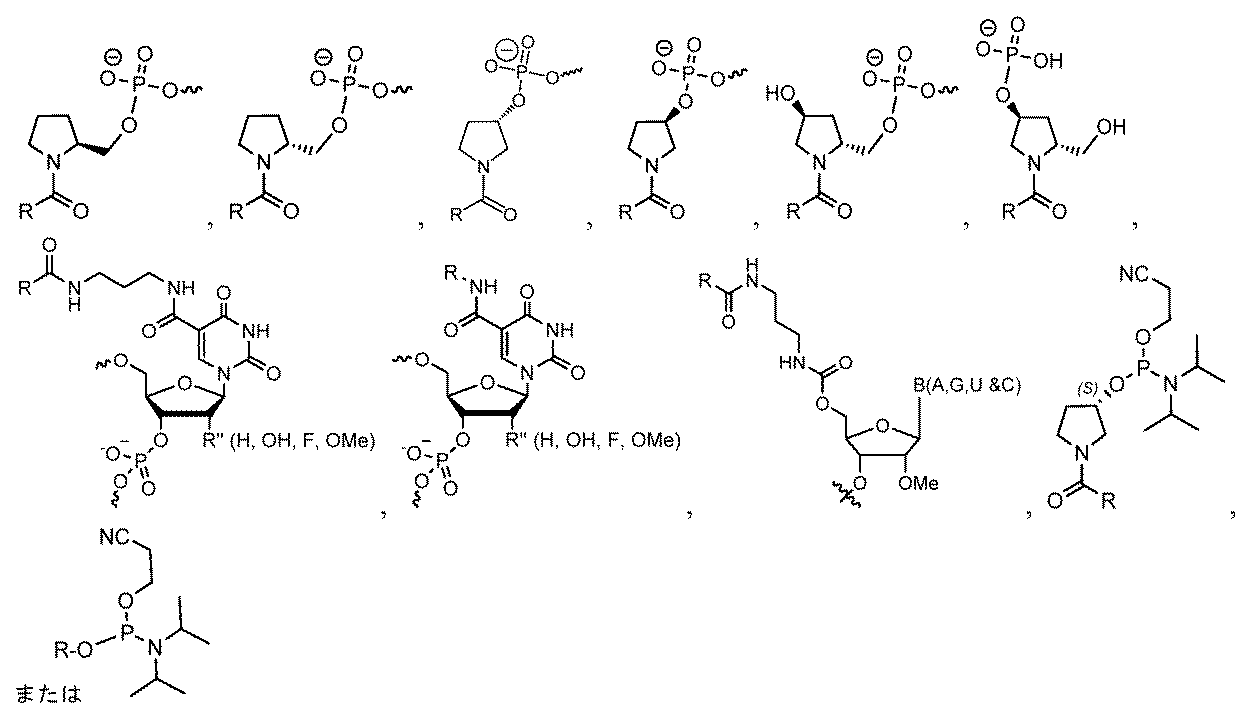
一部の実施形態において、リガンドは、1つまたは複数のリンカー(テザー)および/または担体を介して、ヌクレオチド配列(例えば、Z1および/またはZ2)にコンジュゲートされる。一実施形態において、リガンドは、1つまたは複数のリンカー(テザー)を介してヌクレオチド配列(例えば、Z1および/またはZ2)にコンジュゲートされる。 In some embodiments, the ligand is conjugated to the nucleotide sequence (e.g., Zi and/or Z2 ) via one or more linkers (tethers) and/or carriers. In one embodiment, the ligand is conjugated to the nucleotide sequence (e.g., Zi and/or Z2 ) via one or more linkers (tethers).
一実施形態において、リガンドは、環状担体を介して、適宜1つまたは複数の介在するリンカー(テザー)を介して、ヌクレオチド配列(例えば、Z1および/またはZ2)の5’末端または3’末端にコンジュゲートされる。 In one embodiment, the ligand is conjugated to the 5' or 3' end of a nucleotide sequence (eg, Z 1 and/or Z 2 ) via a cyclic carrier, optionally via one or more intervening linkers (tethers).
一部の実施形態において、リガンドは、少なくとも1つのヌクレオチド配列(例えば、Z1および/またはZ2)上の1つまたは複数の内部位置にコンジュゲートされる。ヌクレオチド配列の内部位置は、ヌクレオチド配列の3’末端および5’末端からの末端位置を除く(例えば、2位:3’末端からカウントして1位および5’末端からカウントして1位を除く)、ヌクレオチオド配列の任意の位置のヌクレオチドを指す。 In some embodiments, the ligand is conjugated to one or more internal positions on at least one nucleotide sequence (e.g., Z1 and/or Z2 ). An internal position of a nucleotide sequence refers to a nucleotide at any position of the nucleotide sequence excluding the terminal positions from the 3' and 5' ends of the nucleotide sequence (e.g., position 2: excluding position 1 counting from the 3' end and position 1 counting from the 5' end).
一実施形態において、リガンドは、少なくとも1つのヌクレオチド配列(例えば、Z1および/またはZ2)上の1つまたは複数の内部位置にコンジュゲートされ、ヌクレオチド配列の各末端から末端2位を除く全ての位置を含む(例えば、4位:3’末端からカウントして1位および2位ならびに5’末端からカウントして1位および2位を除く)。一実施形態において、親油性部分は、少なくとも1つのヌクレオチド配列(例えば、Z1および/またはZ2)上の1つまたは複数の内部位置にコンジュゲートされ、ヌクレオチド配列の各末端から末端3位を除く全ての位置を含む(例えば、6位:3’末端からカウントして1位、2位および3位ならびに5’末端からカウントして1位、2位および3位を除く)。 In one embodiment, the ligand is conjugated to one or more internal positions on at least one nucleotide sequence (e.g., Z1 and/or Z2 ), including all positions from each end of the nucleotide sequence except the terminal 2 positions (e.g., position 4: excluding positions 1 and 2 counting from the 3' end and positions 1 and 2 counting from the 5' end). In one embodiment, the lipophilic moiety is conjugated to one or more internal positions on at least one nucleotide sequence (e.g., Z1 and/or Z2 ), including all positions from each end of the nucleotide sequence except the terminal 3 positions (e.g., position 6: excluding positions 1, 2 and 3 counting from the 3' end and positions 1, 2 and 3 counting from the 5' end).
一実施形態において、リガンドは、ヌクレオチド配列の切断部位領域を除く、少なくとも1つのヌクレオチド配列(例えば、Z1および/またはZ2)上の1つまたは複数の内部位置にコンジュゲートされ、例えば、リガンドは、ヌクレオチド配列の5’末端からカウントして9~12位にコンジュゲートされず、例えば、リガンドは、ヌクレオチド配列(例えば、Z1および/またはZ2)の5’末端からカウントして9~11位にコンジュゲートされない。あるいは、内部位置は、ヌクレオチド配列(例えば、Z1および/またはZ2)の3’末端からカウントして11~13位を除く。一実施形態において、内部位置は、ヌクレオチド配列の5’末端からカウントして12~14位を除く。 In one embodiment, the ligand is conjugated to one or more internal positions on at least one nucleotide sequence (e.g., Z1 and/or Z2 ) excluding the cleavage site region of the nucleotide sequence, e.g., the ligand is not conjugated to positions 9-12 counting from the 5' end of the nucleotide sequence, e.g., the ligand is not conjugated to positions 9-11 counting from the 5' end of the nucleotide sequence (e.g., Z1 and/or Z2 ). Alternatively, the internal positions exclude positions 11-13 counting from the 3' end of the nucleotide sequence (e.g., Z1 and/or Z2 ) . In one embodiment, the internal positions exclude positions 12-14 counting from the 5' end of the nucleotide sequence.
一実施形態において、リガンドは、少なくとも1つのヌクレオチド配列(例えば、Z1および/またはZ2)上の1つまたは複数の内部位置にコンジュゲートされ、3’末端からカウントして、ヌクレオチド配列の11~13位、および5’末端からカウントして、ヌクレオチド配列(例えば、Z1および/またはZ2)の12~14位を除く。 In one embodiment, the ligand is conjugated to one or more internal positions on at least one nucleotide sequence (e.g., Z1 and/or Z2 ), excluding positions 11-13 of the nucleotide sequence, counting from the 3' end, and positions 12-14 of the nucleotide sequence (e.g., Z1 and/or Z2 ), counting from the 5' end.
一実施形態において、1つまたは複数のリガンドは、以下の内部位置の1つまたは複数にコンジュゲートされる:5’末端からカウントして、ヌクレオチド配列(例えば、Z1および/またはZ2)の4~8位および13~18位、ならびにヌクレオチド配列(例えば、Z1および/またはZ2)の6~10位および15~18位。 In one embodiment, the one or more ligands are conjugated to one or more of the following internal positions: counting from the 5' end, positions 4-8 and 13-18 of the nucleotide sequence (e.g., Z1 and/or Z2 ), and positions 6-10 and 15-18 of the nucleotide sequence (e.g., Z1 and/or Z2 ).
一実施形態において、1つまたは複数のリガンドは、以下の内部位置の1つまたは複数にコンジュゲートされる:5’末端からカウントして、ヌクレオチド配列(例えば、Z1および/またはZ2)の5、6、7、15、および17位、ならびにヌクレオチド配列(例えば、Z1および/またはZ2)の15および17位。 In one embodiment, one or more ligands are conjugated to one or more of the following internal positions: positions 5, 6, 7, 15, and 17 of a nucleotide sequence (e.g., Z1 and/or Z2 ), and positions 15 and 17 of a nucleotide sequence (e.g., Z1 and/or Z2 ), counting from the 5' end.
一部の実施形態において、リガンドは、一本鎖オリゴヌクレオチドのヌクレオ塩基、糖部分、またはヌクレオシド間連結にコンジュゲートされる。
リガンド
In some embodiments, the ligand is conjugated to a nucleobase, a sugar moiety, or an internucleoside linkage of a single-stranded oligonucleotide.
Ligand
ある特定の実施形態において、一本鎖オリゴヌクレオチドは、1つまたは複数のコンジュゲート基の共有接合によりさらに修飾される。一般に、コンジュゲート基は、薬力学的、薬物動態学的、結合、吸収、細胞内分布、細胞への取込み、電荷およびクリアランスを含むがこれらに限定されない、接合した一本鎖オリゴヌクレオチドの1つまたは複数の特性を修飾する。コンジュゲート基は化学技術分野において常套的に使用され、オリゴマー化合物などの親化合物に直接、または任意の連結部分もしくは連結基を介して連結される。コンジュゲート基の好ましいリストは、インターカレーター、レポーター分子、ポリアミン、ポリアミド、ポリエチレングリコール、チオエーテル、ポリエーテル、コレステロール、チオコレステロール、コール酸部分、葉酸、脂質、リン脂質、ビオチン、フェナジン、フェナントリジン、アントラキノン、アダマンタン、アクリジン、フルオレセイン、ローダミン、クマリン、色素を含むがこれらに限定されない。 In certain embodiments, the single-stranded oligonucleotide is further modified by the covalent attachment of one or more conjugate groups. In general, the conjugate group modifies one or more properties of the attached single-stranded oligonucleotide, including, but not limited to, pharmacodynamics, pharmacokinetics, binding, absorption, intracellular distribution, cellular uptake, charge, and clearance. Conjugate groups are routinely used in the chemical arts and are linked to a parent compound, such as an oligomeric compound, directly or via any linking moiety or group. A preferred list of conjugate groups includes, but is not limited to, intercalators, reporter molecules, polyamines, polyamides, polyethylene glycols, thioethers, polyethers, cholesterol, thiocholesterol, cholic acid moieties, folic acid, lipids, phospholipids, biotin, phenazine, phenanthridine, anthraquinone, adamantane, acridine, fluorescein, rhodamine, coumarin, and dyes.
一部の実施形態において、一本鎖オリゴヌクレオチドは、特定のCNS組織へのデリバリーを媒介する受容体をターゲティングするターゲティングリガンドをさらに含む。これらのターゲティングリガンドは、特異的な局所(例えば、髄腔内)および全身デリバリーを可能にするために、親油性部分と組み合わせてコンジュゲートされうる。 In some embodiments, the single-stranded oligonucleotide further comprises a targeting ligand that targets a receptor that mediates delivery to a specific CNS tissue. These targeting ligands can be combined and conjugated with lipophilic moieties to allow for specific local (e.g., intrathecal) and systemic delivery.
CNS組織への受容体媒介デリバリーをターゲティングする例示的なターゲティングリガンドは、Angiopep-2のようなペプチドリガンド、リポタンパク質レセプター関連タンパク質(LRP)リガンド、bEnd.3細胞結合リガンド;トランスフェリン受容体(TfR)リガンド(脳内の鉄輸送系および脳実質へのカーゴ輸送を利用しうる);マノース受容体リガンド(嗅神経鞘細胞、グリア細胞をターゲティングする)、グルコーストランスポータータンパク質、およびLDL受容体リガンドである。 Exemplary targeting ligands for receptor-mediated delivery to CNS tissues are peptide ligands such as Angiopep-2, lipoprotein receptor-related protein (LRP) ligands, bEnd.3 cell-binding ligands; transferrin receptor (TfR) ligands (which may utilize the iron transport system in the brain and transport cargo to the brain parenchyma); mannose receptor ligands (targeting olfactory ensheathing cells, glial cells), glucose transporter proteins, and LDL receptor ligands.
一部の実施形態において、一本鎖オリゴヌクレオチドは、特定の眼組織へのデリバリーを媒介する受容体をターゲティングするターゲティングリガンドをさらに含む。これらのターゲティングリガンドは、特異的な局所(例えば、髄腔内)および全身デリバリーを可能にするために、親油性部分と組み合わせてコンジュゲートされうる。眼組織への受容体媒介デリバリーをターゲティングする例示的なターゲティングリガンドは、オールトランスレチノールのような親油性リガンド(レチノイン酸受容体をターゲティングする);H-Gly-Arg-Gly-Asp-Ser-Pro-Lys-Cys-OH(配列番号1)またはシクロ(-Arg-Gly-Asp-D-Phe-Cys)(配列番号2)のようなRGDペプチド(網膜色素上皮細胞をターゲティングする);LDL受容体リガンド;および炭水化物ベースのリガンド(後眼の内皮細胞をターゲティングする)である。 In some embodiments, the single-stranded oligonucleotide further comprises a targeting ligand that targets a receptor that mediates delivery to a specific ocular tissue. These targeting ligands can be conjugated in combination with a lipophilic moiety to allow specific local (e.g., intrathecal) and systemic delivery. Exemplary targeting ligands that target receptor-mediated delivery to ocular tissues are lipophilic ligands such as all-trans-retinol (to target retinoic acid receptors); RGD peptides such as H-Gly-Arg-Gly-Asp-Ser-Pro-Lys-Cys-OH (SEQ ID NO: 1) or cyclo(-Arg-Gly-Asp-D-Phe-Cys) (SEQ ID NO: 2) (to target retinal pigment epithelial cells); LDL receptor ligands; and carbohydrate-based ligands (to target posterior ocular endothelial cells).
本発明に適する好ましいコンジュゲート基は、コレステロール部分などの脂質部分(Letsinger et al., Proc. Natl. Acad. Sci. USA, 1989, 86, 6553);コール酸(Manoharan et al., Bioorg. Med. Chem. Lett., 1994, 4, 1053);チオエーテル、例えばヘキシル-S-トリチルチオール(Manoharan et al., Ann. N.Y. Acad. Sci., 1992, 660, 306; Manoharan et al., Bioorg. Med. Chem. Let., 1993, 3, 2765);チオコレステロール(Oberhauser et al., Nucl. Acids Res., 1992, 20, 533);脂肪族鎖、例えばドデカンジオールもしくはウンデシル残基(Saison-Behmoaras et al., EMBO J., 1991, 10, 111; Kabanov et al., FEBS Lett., 1990, 259, 327; Svinarchuk et al., Biochimie, 1993, 75, 49);リン脂質、例えばジ-ヘキサデシル-rac-グリセロールもしくはトリエチルアンモニウム-1,2-ジ-O-ヘキサデシル-rac-グリセロ-3-H-ホスホネート(Manoharan et al., Tetrahedron Lett., 1995, 36, 3651; Shea et al., Nucl. Acids Res., 1990, 18, 3777);ポリアミン鎖またはポリエチレングリコール鎖(Manoharan et al., Nucleosides & Nucleotides, 1995, 14, 969);アダマンタン酢酸(Manoharan et al., Tetrahedron Lett., 1995, 36, 3651);パルミチル部分(Mishra et al., Biochim. Biophys. Acta, 1995, 1264, 229);またはオクタデシルアミン部分もしくはヘキシルアミノ-カルボニル-オキシコレステロール部分(Crooke et al., J. Pharmacol. Exp. Ther., 1996, 277, 923)を含む。 Preferred conjugate groups suitable for the present invention are lipid moieties such as cholesterol moieties (Letsinger et al., Proc. Natl. Acad. Sci. USA, 1989, 86, 6553); cholic acid (Manoharan et al., Bioorg. Med. Chem. Lett., 1994, 4, 1053); thioethers, e.g., hexyl-S-tritylthiol (Manoharan et al., Ann. N.Y. Acad. Sci., 1992, 660, 306; Manoharan et al., Bioorg. Med. Chem. Let., 1993, 3, 2765); thiocholesterol (Oberhauser et al., Nucl. Acids Res., 1992, 20, 533); aliphatic chains, e.g., dodecanediol or undecyl residues (Saison-Behmoaras et al., J. Am. Chem. Soc., 1999, 10, 1053); et al., EMBO J., 1991, 10, 111; Kabanov et al., FEBS Lett., 1990, 259, 327; Svinarchuk et al., Biochimie, 1993, 75, 49); phospholipids, such as di-hexadecyl-rac-glycerol or triethylammonium-1,2-di-O-hexadecyl-rac-glycero-3-H-phosphonate (Manoharan et al., Tetrahedron Lett., 1995, 36, 3651; Shea et al., Nucl. Acids Res., 1990, 18, 3777); polyamine or polyethylene glycol chains (Manoharan et al., Nucleosides & Nucleotides, 1995, 14, 111); 969); adamantane acetic acid (Manoharan et al., Tetrahedron Lett., 1995, 36, 3651); a palmityl moiety (Mishra et al., Biochim. Biophys. Acta, 1995, 1264, 229); or an octadecylamine or hexylamino-carbonyl-oxycholesterol moiety (Crooke et al., J. Pharmacol. Exp. Ther., 1996, 277, 923).
一般に、様々な実体、例えばリガンドは、本明細書に記載のオリゴマー化合物にカップリングされうる。リガンドは、天然に存在する分子、または組換え分子もしくは合成分子を含むことができる。リガンドの例は、ポリリシン(PLL)、ポリL-アスパラギン酸、ポリL-グルタミン酸、スチレン-無水マレイン酸コポリマー、ポリ(L-ラクチド-co-グリコリド)コポリマー、ジビニルエーテル-無水マレイン酸コポリマー、N-(2-ヒドロキシプロピル)メタクリルアミドコポリマー(HMPA)、ポリエチレングリコール(PEG、例えば、PEG-2K、PEG-5K、PEG-10K、PEG-12K、PEG-15K、PEG-20K、PEG-40K)、MPEG、[MPEG]2、ポリビニルアルコール(PVA)、ポリウレタン、ポリ(2-エチルアクリル酸)、N-イソプロピルアクリルアミドポリマー、ポリホスファジン、ポリエチレンイミン、カチオン性基、スペルミン、スペルミジン、ポリアミン、シュードペプチド-ポリアミン、ペプチド模倣体ポリアミン、デンドリマーポリアミン、アルギニン、アミジン、プロトアミン、カチオン性脂質、カチオン性ポルフィリン、ポリアミンの四級塩、チロトロピン、メラノトロピン、レクチン、糖タンパク質、サーファクタントタンパク質A、ムチン、グリコシル化ポリアミノ酸、トランスフェリン、ビスホスホネート、ポリグルタメート、ポリアスパレート、アプタマー、アシアロフェツイン、ヒアルロナン、プロコラーゲン、免疫グロブリン(例えば、抗体)、インスリン、トランスフェリン、アルブミン、糖-アルブミンコンジュゲート、挿入剤(例えば、アクリジン)、架橋剤(例えば、ソラーレン、マイトマイシンC)、ポルフィリン(例えば、TPPC4、テキサフィリン、サフィリン)、複素環芳香族炭水化物(例えば、フェナジン、ジヒドロフェナジン)、人工エンドヌクレアーゼ(例えば、EDTA)、親油性分子[例えば、ステロイド、胆汁酸、コレステロール、コール酸、アダマンタン酢酸、1-ピレン酪酸、ジヒドロテストステロン、1,3-ビス-O(ヘキサデシル)グリセロール、ゲラニルオキシヘキシル基、ヘキサデシルグリセロール、ボルネオール、メントール、1,3-プロパンジオール、ヘプタデシル基、パルミチン酸、ミリスチン酸、O3-(オレオイル)リトコール酸、O3-(オレオイル)コレン酸、ジメトキシトリチル、またはフェノキサジン]、ペプチド(例えば、アルファ-ヘリックス型ペプチド、両親媒性ペプチド、RGDペプチド、細胞透過性ペプチド、エンドソーム溶解/膜融合ペプチド)、アルキル化剤、リン酸、アミノ、メルカプト、ポリアミノ、アルキル、置換されたアルキル、放射性標識化マーカー、酵素、ハプテン(例えば、ビオチン)、輸送/吸収促進剤(例えば、ナプロキセン、アスピリン、ビタミンE、葉酸)、合成リボヌクレアーゼ(例えば、イミダゾール、ビスイミダゾール、ヒスタミン、イミダゾールクラスター、アクリジン-イミダゾールコンジュゲート、テトラアザ大員環のEu3+複合体)、ジニトロフェニル、HRP、AP、抗体、ホルモンおよびホルモン受容体、レクチン、炭水化物、多価炭水化物、ビタミン(例えば、ビタミンA、ビタミンE、ビタミンK、ビタミンB、例えば、葉酸、B12、リボフラビン、ビオチン、およびピリドキサル)、ビタミン補因子、リポ多糖、p38MAPキナーゼの活性化因子、NF-κBの活性化因子、タキソン(taxon)、ビンクリスチン、ビンブラスチン、サイトカラシン、ノコダゾール、ジャプラキノリド、ラトルンクリンA、ファロイジン、スウィンホリドA、インダノシン、ミオセルビン(myoservin)、腫瘍壊死因子アルファ(TNFアルファ)、インターロイキン-1ベータ、ガンマインターフェロン、天然または組換え低密度リポタンパク質(LDL)、天然または組換え高密度リポタンパク質(HDL)、および細胞透過剤(例えば、ヘリックス型細胞透過剤)を含むがこれらに限定されない。 In general, a variety of entities, e.g., ligands, can be coupled to the oligomeric compounds described herein. Ligands can include naturally occurring molecules, or recombinant or synthetic molecules. Examples of ligands include polylysine (PLL), poly-L-aspartic acid, poly-L-glutamic acid, styrene-maleic anhydride copolymers, poly(L-lactide-co-glycolide) copolymers, divinyl ether-maleic anhydride copolymers, N-(2-hydroxypropyl) methacrylamide copolymers (HMPA), polyethylene glycols (PEG, e.g., PEG-2K, PEG-5K, PEG-10K, PEG-12K, PEG-15K, PEG-20K, PEG-40K), MPEG, [MPEG] 2 , polyvinyl alcohol (PVA), polyurethane, poly(2-ethylacrylic acid), N-isopropylacrylamide polymer, polyphosphazine, polyethyleneimine, cationic groups, spermine, spermidine, polyamines, pseudopeptide-polyamines, peptidomimetic polyamines, dendrimer polyamines, arginine, amidines, protamines, cationic lipids, cationic porphyrins, quaternary salts of polyamines, thyrotropin, melanotropin, lectins, glycoproteins, surfactant protein A, mucins, glycosylated polyamino acids, transferrin, bisphosphonates, polyglutamates, polyaspartates, aptamers, asialofetuin, hyaluronan, procollagen, immunoglobulins (e.g., antibodies), insulin, thrombin, sferrin, albumin, sugar-albumin conjugates, intercalating agents (e.g., acridine), crosslinking agents (e.g., psoralen, mitomycin C), porphyrins (e.g., TPPC4, texaphyrin, sapphyrin), heterocyclic aromatic carbohydrates (e.g., phenazine, dihydrophenazine), artificial endonucleases (e.g., EDTA), lipophilic molecules [e.g., steroids, bile acids, cholesterol, cholic acid, adamantane acetic acid, 1-pyrene butyric acid, dihydrotestosterone, 1,3-bis-O(hexadecyl)glycerol, geranyloxyhexyl group, hexadecylglycerol, borneol, menthol, 1,3-propanediol, heptadecyl group, palmitic acid, myristic acid, O3-(oleoyl)lithocholic acid, O3-(oleoyl)cholene acid, dimethoxytrityl, or phenoxazine], peptides (e.g., alpha-helical peptides, amphipathic peptides, RGD peptides, cell penetrating peptides, endosomolytic/membrane fusogenic peptides), alkylating agents, phosphate, amino, mercapto, polyamino, alkyl, substituted alkyl, radiolabeled markers, enzymes, haptens (e.g., biotin), transport/absorption enhancers (e.g., naproxen, aspirin, vitamin E, folic acid), synthetic ribonucleases (e.g., imidazole, bisimidazole, histamine, imidazole clusters, acridine-imidazole conjugates, Eu3+ complexes of tetraazamacrocycles), dinitrophenyl, HRP, AP, antibodies, hormones and hormone receptors, lectins, carbohydrates, polyvalent carbohydrates, vitamins Examples of suitable anti-inflammatory agents include, but are not limited to, agonists (e.g., vitamin A, vitamin E, vitamin K, B vitamins such as folic acid, B12, riboflavin, biotin, and pyridoxal), vitamin cofactors, lipopolysaccharides, activators of p38 MAP kinase, activators of NF-κB, taxon, vincristine, vinblastine, cytochalasin, nocodazole, japlakinolide, latrunculin A, phalloidin, swinholide A, indanocine, myoservin, tumor necrosis factor alpha (TNF-alpha), interleukin-1 beta, gamma interferon, natural or recombinant low density lipoprotein (LDL), natural or recombinant high density lipoprotein (HDL), and cell permeabilizing agents (e.g., helical cell permeabilizing agents).
ペプチドおよびペプチド模倣体リガンドは、天然に存在するまたは修飾されたペプチド、例えば、DまたはLペプチド;α、β、またはγペプチド;N-メチルペプチド;アザペプチド;1つまたは複数のアミドすなわちペプチド結合が、1つまたは複数の尿素、チオ尿素、カルバメート、またはスルホニル尿素結合で置換されたペプチド;または環状ペプチドを有するものを含む。ペプチド模倣体(本明細書においてまた、オリゴペプチド模倣体とも言及される)は、天然ペプチドと同様の、規定された三次元構造へとフォールディングすることが可能な分子である。ペプチドまたはペプチド模倣体リガンドは、約5~50アミノ酸長、例えば、約5、10、15、20、25、30、35、40、45、または50アミノ酸長でありうる。 Peptide and peptidomimetic ligands include naturally occurring or modified peptides, e.g., D or L peptides; α, β, or γ peptides; N-methyl peptides; azapeptides; peptides in which one or more amide or peptide bonds are replaced with one or more urea, thiourea, carbamate, or sulfonylurea bonds; or cyclic peptides. Peptidomimetics (also referred to herein as oligopeptidomimetics) are molecules capable of folding into defined three-dimensional structures similar to natural peptides. Peptide or peptidomimetic ligands can be about 5-50 amino acids in length, e.g., about 5, 10, 15, 20, 25, 30, 35, 40, 45, or 50 amino acids in length.
例示的な両親媒性ペプチドは、セクロピン、リコトキシン、パラダキシン、ブフォリン、CPF、ボンビニン様ペプチド(BLP)、カテリシジン、セラトトキシン、セクロピン、リコトキシン、パラダキシン、ブフォリン、CPF、ボンビニン様ペプチド(BLP)、カテリシジン、セラトトキシン、S.クラバ(S.clava)ペプチド、メクラウナギ腸内抗菌ペプチド(HFIAP)、マガイニン、ブレビニン-2、ダーマセプチン、メリチン、プレウロシジン、H2Aペプチド、ツメガエル(Xenopus)ペプチド、エスクレンチニス(esculentinis)-1、ケーリン(caerin)を含むがこれらに限定されない。 Exemplary amphipathic peptides include, but are not limited to, cecropin, lycotoxin, paradaxin, buforin, CPF, bombinin-like peptide (BLP), cathelicidin, ceratotoxin, cecropin, lycotoxin, paradaxin, buforin, CPF, bombinin-like peptide (BLP), cathelicidin, ceratotoxin, S. clava peptide, hagfish intestinal antimicrobial peptide (HFIAP), magainin, brevinin- 2 , dermaseptin, melittin, pleurocidin, H2A peptide, Xenopus peptide, esculentinis-1, and caerin.
本明細書において使用される、「エンドソーム溶解リガンド」という用語は、エンドソーム溶解特性を有する分子を指す。エンドソーム溶解リガンドは、本発明の組成物、またはその成分の溶解、および/またはエンドソーム、リソソーム、小胞体(ER)、ゴルジ体、微小管、ペルオキシソーム、または細胞内の他の小胞体などの細胞コンパートメントから細胞質への輸送を促進する。いくつかの例示的なエンドソーム溶解リガンドは、イミダゾール、ポリまたはオリゴイミダゾール、直鎖状または分岐状ポリエチレンイミン(PEI)、直鎖状および分岐状ポリアミン、例えば、スペルミン、カチオン性直鎖状および分岐状ポリアミン、ポリカルボキシレート、ポリカチオン、マスクされたオリゴもしくはポリカチオンまたはアニオン、アセタール、ポリアセタール、ケタール/ポリケタール、オルトエステル、マスクされたもしくはマスクされていないカチオン性電荷またはアニオン性電荷を有する直鎖状もしくは分岐状ポリマー、カチオン性電荷またはアニオン性電荷をマスクされたもしくはマスクされていないデンドリマー、ポリアニオン性ペプチド、ポリアニオン性ペプチド模倣体、pH感受性ペプチド、天然および合成の膜融合脂質、天然および合成のカチオン性脂質を含むがこれらに限定されない。 As used herein, the term "endosomolytic ligand" refers to a molecule that has endosomolytic properties. Endosomolytic ligands promote the lysis and/or transport of the compositions of the invention, or components thereof, from a cellular compartment, such as an endosome, lysosome, endoplasmic reticulum (ER), Golgi apparatus, microtubules, peroxisomes, or other endoplasmic reticulum within a cell, to the cytoplasm. Some exemplary endosomolytic ligands include, but are not limited to, imidazoles, poly- or oligoimidazoles, linear or branched polyethyleneimines (PEI), linear and branched polyamines, such as spermine, cationic linear and branched polyamines, polycarboxylates, polycations, masked oligo- or polycations or anions, acetals, polyacetals, ketals/polyketals, orthoesters, linear or branched polymers with masked or unmasked cationic or anionic charges, dendrimers with masked or unmasked cationic or anionic charges, polyanionic peptides, polyanionic peptidomimetics, pH-sensitive peptides, natural and synthetic fusogenic lipids, natural and synthetic cationic lipids.
例示的なエンドソーム溶解/膜融合ペプチドは、AALEALAEALEALAEALEALAEAAAAGGC(GALA)(配列番号3);AALAEALAEALAEALAEALAEALAAAAGGC(EALA)(配列番号4);ALEALAEALEALAEA(配列番号5);GLFEAIEGFIENGWEGMIWDYG(INF-7)(配列番号6);GLFGAIAGFIENGWEGMIDGWYG(Inf HA-2)(配列番号7);GLFEAIEGFIENGWEGMIDGWYGCGLFEAIEGFIENGWEGMIDGWYGC(diINF-7)(配列番号8);GLFEAIEGFIENGWEGMIDGGCGLFEAIEGFIENGWEGMIDGGC(diINF-3)(配列番号9);GLFGALAEALAEALAEHLAEALAEALEALAAGGSC(GLF)(配列番号10);GLFEAIEGFIENGWEGLAEALAEALEALAAGGSC(GALA-INF3)(配列番号11);GLFEAIEGFIENGWEGnIDGKGLFEAIEGFIENGWEGnIDG(INF-5,nはノルロイシンである)(配列番号12);LFEALLELLESLWELLLEA(JTS-1)(配列番号13);GLFKALLKLLKSLWKLLLKA(ppTG1)(配列番号14);GLFRALLRLLRSLWRLLLRA(ppTG20)(配列番号15);WEAKLAKALAKALAKHLAKALAKALKACEA(KALA)(配列番号16);GLFFEAIAEFIEGGWEGLIEGC(HA)(配列番号17);GIGAVLKVLTTGLPALISWIKRKRQQ(メリチン)(配列番号18);H5WYG(配列番号19);およびCHK6HC(配列番号20)を含むがこれらに限定されない。 Exemplary endosomolytic/fusogenic peptides include: AALEALAEALEALEALEAEALAEAAAAAGGC (GALA) (SEQ ID NO: 3); AALAEALAEALAEALAEALAEALAAAAGGC (EALA) (SEQ ID NO: 4); ALEAEALEALEALAEA (SEQ ID NO: 5); GLFEAIEGFIENGWEGMIWDYG (INF-7) (SEQ ID NO: 6); GLFGAIAGFIENGWEGMIDGWYG (INF-8) (SEQ ID NO: 7); HA-2) (SEQ ID NO: 7); GLFEAIEGFIENGWEGMIDGWYGCGLFEAIEGFIENGWEGMIDGWYGC (diINF-7) (SEQ ID NO: 8); GLFEAIEGFIENGWEGMIDGGCGLFEAIEGFIENGWEGMIDGGC (diINF-3) (SEQ ID NO: 9); GLFGALAEAEAEALAEHLAEALAEAALEALAAGGSC (GLF) (SEQ ID NO: 10); GLFEAIEGFIENGWEGLAEALAEAALEALAAGGSC (GALA-INF3) (SEQ ID NO: 11); GLFEAIEGFIENGWEGnIDGKGLFEAIE GFIENGWEGnIDG (INF-5, where n is norleucine) (SEQ ID NO: 12); LFEALLELLESLWELLLEA (JTS-1) (SEQ ID NO: 13); GLFKALLKLLKSLWKLLLKA (ppTG1) (SEQ ID NO: 14); GLFRALLRLLRSLWRLLLA (ppTG20) (SEQ ID NO: 15); WEAKLAKALAKALAKHLAKALAKALKACEA (KALA) (SEQ ID NO: 16); GLFFEAIAEFIEGGWEGLIEGC (HA) (SEQ ID NO: 17); GIGAVLKVLTTGLPALISWIKRKRQQ (melittin) (SEQ ID NO: 18); H 5 WYG (SEQ ID NO: 19); and CHK 6 HC (SEQ ID NO: 20).
理論に束縛されることを望まずに述べると、膜融合脂質は膜と融合し、結果として膜を不安定にする。膜融合脂質は通常、小さな頭部基と不飽和アシル鎖を持つ。例示的な膜融合脂質は、1,2-ジレオイル-sn-3-ホスホエタノールアミン(DOPE)、ホスファチジルエタノールアミン(POPE)、パルミトイルオイルホスファチジルコリン(POPC)、(6Z,9Z,28Z,31Z)-ヘプタトリアコンタ-6,9,28、31-テトラエン-19-オール(Di-Lin)、N-メチル(2,2-ジ((9Z,12Z)-オクタデカ-9,12-ジエニル)-1,3-ジオキソラン-4-イル)メタナミン(DLin-k-DMA)およびN-メチル-2-(2,2-ジ((9Z,12Z)-オクタデカ-9,12-ジエニル)-1,3-ジオキソラン-4-イル)エタノールアミン(本明細書ではXTCとも称する)を含むがこれらに限定されない。 Without wishing to be bound by theory, fusogenic lipids fuse with membranes, thereby destabilizing them. Fusogenic lipids usually have small head groups and unsaturated acyl chains. Exemplary membrane fusogenic lipids include, but are not limited to, 1,2-dileoyl-sn-3-phosphoethanolamine (DOPE), phosphatidylethanolamine (POPE), palmitoyloylphosphatidylcholine (POPC), (6Z,9Z,28Z,31Z)-heptatriaconta-6,9,28,31-tetraen-19-ol (Di-Lin), N-methyl(2,2-di((9Z,12Z)-octadeca-9,12-dienyl)-1,3-dioxolan-4-yl)methanamine (DLin-k-DMA) and N-methyl-2-(2,2-di((9Z,12Z)-octadeca-9,12-dienyl)-1,3-dioxolan-4-yl)ethanolamine (also referred to herein as XTC).
本発明に適するエンドソーム溶解活性を有する合成ポリマーは、それらの内容が、参照によりそれらの全体において本明細書に組み込まれる、米国特許出願公開第2009/0048410号、同第2009/0023890号、同第2008/0287630号、同第2008/0287628号、同第2008/0281044号、同第2008/0281041号、同第2008/0269450号、同第2007/0105804号、同第20070036865号、および同第2004/0198687号に記載される。 Synthetic polymers with endosomolytic activity suitable for the present invention are described in U.S. Patent Application Publication Nos. 2009/0048410, 2009/0023890, 2008/0287630, 2008/0287628, 2008/0281044, 2008/0281041, 2008/0269450, 2007/0105804, 20070036865, and 2004/0198687, the contents of which are incorporated herein by reference in their entireties.
例示的な細胞透過性ペプチドは、RQIKIWFQNRRMKWKK(ペネトラチン)(配列番号21);GRKKRRQRRRPPQC(Tat断片48~60)(配列番号22);GALFLGWLGAAGSTMGAWSQPKKKRKV(シグナル配列ベースのペプチド)(配列番号23);LLIILRRRIRKQAHAHSK(PVEC)(配列番号24);GWTLNSAGYLLKINLKALAALAKKIL(トランスポータン)(配列番号25);KLALKLALKALKAALKLA(両親媒性モデルペプチド)(配列番号26);RRRRRRRRR(Arg9)(配列番号27);KFFKFFKFFK(細菌細胞壁透過性ペプチド)(配列番号28);LLGDFFRKSKEKIGKEFKRIVQRIKDFLRNLVPRTES(LL-37)(配列番号29);SWLSKTAKKLENSAKKRISEGIAIAIQGGPR(セクロピンP1)(配列番号30);ACYCRIPACIAGERRYGTCIYQGRLWAFCC(α-デフェンシン)(配列番号31);DHYNCVSSGGQCLYSACPIFTKIQGTCYRGKAKCCK(β-デフェンシン)(配列番号32);RRRPRPPYLPRPRPPPFFPPRLPPRIPPGFPPRFPPRFPGKR-NH2(PR-39)(配列番号33);ILPWKWPWWPWRR-NH2(インドリシジン)(配列番号34);AAVALLPAVLLALLAP(RFGF)(配列番号35);AALLPVLLAAP(RFGFアナログ)(配列番号36);およびRKCRIVVIRVCR(バクテネシン)(配列番号37)を含むがこれらに限定されない。 Exemplary cell penetrating peptides are RQIKIWFQNRRMKWKK (penetratin) (SEQ ID NO: 21); GRKKRRQRRRPPQC (Tat fragment 48-60) (SEQ ID NO: 22); GALFLGWLGAAGSTMGAWSQPKKKRKV (signal sequence based peptide) (SEQ ID NO: 23); LLIILRRRRIRKQAHAHSK (PVEC) (SEQ ID NO: 24); GWTLNSAGYLLK INLKALAALAKKIL (transportan) (SEQ ID NO: 25); KLALKLALKALKAALKAALKLA (amphipathic model peptide) (SEQ ID NO: 26); RRRRRRRRRR (Arg9) (SEQ ID NO: 27); KFFKFFKFFK (bacterial cell wall penetrating peptide) (SEQ ID NO: 28); LLGDFFRKSKEKIGKEFKRIVQRIKDFLRNLVPRTES (LL-37) (SEQ ID NO: 2 9); SWLSKTAKKLENSAKKRISEGIAIAIQGGPR (cecropin P1) (SEQ ID NO: 30); ACYCRIPACIAGERRRYGTCIYQGRLWAFCC (α-defensin) (SEQ ID NO: 31); DHYNCVSSGQCLYSACPIFTKIQGTCYRGKAKCCK (β-defensin) (SEQ ID NO: 32); RRRPRPPYLPRPRPPPFFPPRLPP These include, but are not limited to, RIPPGFPPRFPPRRFPGKR-NH2 (PR-39) (SEQ ID NO: 33); ILPWKWPWWPWRR-NH2 (indolicidin) (SEQ ID NO: 34); AAVALLPAVLLALLAP (RFGF) (SEQ ID NO: 35); AALLPVLLAAP (RFGF analog) (SEQ ID NO: 36); and RKCRIVVIRVCR (bactenecin) (SEQ ID NO: 37).
例示的なカチオン性基は、例えばO-AMINE(AMINE=NH2;アルキルアミノ、ジアルキルアミノ、ヘテロシクリル、アリールアミノ、ジアリールアミノ、ヘテロアリールアミノ、またはジヘテロアリールアミノ、エチレンジアミン、ポリアミノ)から誘導される、プロトン化アミノ基;アミノアルコキシ、例えば、O(CH2)nAMINE(AMINE=NH2;アルキルアミノ、ジアルキルアミノ、ヘテロシクリル、アリールアミノ、ジアリールアミノ、ヘテロアリールアミノ、またはジヘテロアリールアミノ、エチレンジアミン、ポリアミノ);アミノ(例えばNH2;アルキルアミノ、ジアルキルアミノ、ヘテロシクリル、アリールアミノ、ジアリールアミノ、ヘテロアリールアミノ、ジヘテロアリールアミノ、またはアミノ酸);およびNH(CH2CH2NH)nCH2CH2-AMINE(AMINE=NH2;アルキルアミノ、ジアルキルアミノ、ヘテロシクリル、アリールアミノ、ジアリールアミノ、ヘテロアリールアミノ、またはジヘテロアリールアミノ)を含むがこれらに限定されない。 Exemplary cationic groups are protonated amino groups, e.g., derived from O-AMINE (AMINE = NH 2 ; alkylamino, dialkylamino, heterocyclyl, arylamino, diarylamino, heteroarylamino, or diheteroarylamino, ethylenediamine, polyamino); aminoalkoxy, e.g., O(CH 2 ) n AMINE (AMINE = NH 2 ; alkylamino, dialkylamino, heterocyclyl, arylamino, diarylamino, heteroarylamino, or diheteroarylamino, ethylenediamine, polyamino); amino (e.g., NH 2 ; alkylamino, dialkylamino, heterocyclyl, arylamino, diarylamino, heteroarylamino, diheteroarylamino, or amino acid); and NH(CH 2 CH 2 NH) n CH 2 CH 2 -AMINE (AMINE = NH 2 ; alkylamino, dialkylamino, heterocyclyl, arylamino, diarylamino, heteroarylamino, or diheteroarylamino).
本明細書において使用される、「ターゲティングリガンド」という用語は、選択標的、例えば、細胞、細胞型、組織、臓器、体内の領域、またはコンパートメント、例えば、細胞コンパートメント、組織コンパートメントもしくは臓器のコンパートメントに対するアフィニティーの増強をもたらす任意の分子を指す。いくつかの例示的なターゲティングリガンドは、抗体、抗原、葉酸、受容体リガンド、炭水化物、アプタマー、インテグリン受容体リガンド、ケモカイン受容体リガンド、トランスフェリン、ビオチン、セロトニン受容体リガンド、PSMA、エンドセリン、GCPII、ソマトスタチン、LDLおよびHDLリガンドを含むがこれらに限定されない。 As used herein, the term "targeting ligand" refers to any molecule that provides enhanced affinity for a selected target, e.g., a cell, cell type, tissue, organ, region in the body, or compartment, e.g., a cell compartment, tissue compartment, or organ compartment. Some exemplary targeting ligands include, but are not limited to, antibodies, antigens, folate, receptor ligands, carbohydrates, aptamers, integrin receptor ligands, chemokine receptor ligands, transferrin, biotin, serotonin receptor ligands, PSMA, endothelin, GCPII, somatostatin, LDL, and HDL ligands.
炭水化物ベースのターゲティングリガンドは、D-ガラクトース、多価ガラクトース、N-アセチル-D-ガラクトサミン(GalNAc)、多価GalNAc、例えば、GalNAc2、およびGalNAc3(GalNAcおよび多価GalNAcは、本明細書ではGalNAcコンジュゲートと総称する);D-マンノース、多価マンノース、多価ラクトース、N-アセチルグルコサミン、グルコース、多価グルコース、多価フコース、グリコシル化ポリアミノ酸およびレクチンを含むがこれらに限定されない。多価という用語は、1つを超える単糖ユニットが存在することを示す。このような単糖サブユニットはグリコシド連結を介して互いに連結されるか、あるいは足場分子に連結されうる。 Carbohydrate-based targeting ligands include, but are not limited to, D-galactose, multivalent galactose, N-acetyl-D-galactosamine (GalNAc), multivalent GalNAc, e.g., GalNAc 2 , and GalNAc 3 (GalNAc and multivalent GalNAc are collectively referred to herein as GalNAc conjugates); D-mannose, multivalent mannose, multivalent lactose, N-acetylglucosamine, glucose, multivalent glucose, multivalent fucose, glycosylated polyamino acids, and lectins. The term multivalent indicates that more than one monosaccharide unit is present. Such monosaccharide subunits can be linked to each other via glycosidic linkages or to a scaffold molecule.
リガンドとして本発明に適する多数の葉酸および葉酸アナログが、米国特許第2,816,110号;同第5,552,545号;同第6,335,434号および同第7,128,893号に記載され、これらの内容は参照によりそれらの全体において本明細書に組み込まれる。 A number of folates and folate analogs suitable as ligands for the present invention are described in U.S. Pat. Nos. 2,816,110; 5,552,545; 6,335,434, and 7,128,893, the contents of which are incorporated herein by reference in their entireties.
本明細書において使用される、「PKモジュレーティングリガンド」および「PKモジュレーター」という用語は、本発明の組成物の薬物動態をモジュレートすることができる分子を指す。いくつかの例示的なPKモジュレーターは、親油性分子、胆汁酸、ステロール、リン脂質アナログ、ペプチド、タンパク質結合剤、ビタミン、脂肪酸、フェノキサジン、アスピリン、ナプロキセン、イブプロフェン、スプロフェン、ケトプロフェン、(S)-(+)-プラノプロフェン、カルプロフェン、PEG、ビオチン、およびトランスサイレチア結合リガンド(例えば、テトラヨードチロ酢酸(tetraiidothyroacetic acid)、2,4,6-トリヨードフェノールおよびフルフェナム酸)を含むがこれらに限定されない。多数のホスホロチオエート糖間連結を含むオリゴマー化合物も血清タンパク質に結合することが知られており、したがって、短いオリゴマー化合物、例えば、約5~30ヌクレオチドを含むオリゴヌクレオチド(例えば、5~25ヌクレオチド、好ましくは5~20ヌクレオチド、例えば、5、6、7、8、9、10、11、12、13、14、15、16、17、18、19、または20ヌクレオチド)、および骨格中に複数のホスホロチオエート結合を含むものもまた、リガンドとして(例えば、PKモジュレーティングリガンドとして)本発明に適する。PKモジュレーティングオリゴヌクレオチドは、少なくとも3、4、5、6、7、8、9、10、11、12、13、14、15またはそれ以上のホスホロチオエート連結および/またはホスホロジチオエート連結を含むことができる。一部の実施形態において、PKモジュレーティングオリゴヌクレオチド内の全てのヌクレオチド間連結は、ホスホロチオエート連結および/またはホスホロジチオエート連結である。加えて、血清成分(例えば、血清タンパク質)に結合するアプタマーもまた、PKモジュレーティングリガンドとして本発明に適する。血清成分(例えば血清タンパク質)への結合は、Oravcova, et al., Journal of Chromatography B (1996), 677: 1-27に記載されているようなアルブミン結合アッセイから予測されうる。 As used herein, the terms "PK modulating ligand" and "PK modulator" refer to a molecule that can modulate the pharmacokinetics of the compositions of the invention. Some exemplary PK modulators include, but are not limited to, lipophilic molecules, bile acids, sterols, phospholipid analogs, peptides, protein binders, vitamins, fatty acids, phenoxazines, aspirin, naproxen, ibuprofen, suprofen, ketoprofen, (S)-(+)-pranoprofen, carprofen, PEG, biotin, and transthyretin binding ligands (e.g., tetraiodothyroacetic acid, 2,4,6-triiodophenol, and flufenamic acid). Oligomeric compounds containing multiple phosphorothioate intersugar linkages are also known to bind serum proteins, and therefore, shorter oligomeric compounds, e.g., oligonucleotides containing about 5-30 nucleotides (e.g., 5-25 nucleotides, preferably 5-20 nucleotides, e.g., 5, 6, 7, 8, 9, 10, 11, 12, 13, 14, 15, 16, 17, 18, 19, or 20 nucleotides), and those containing multiple phosphorothioate linkages in the backbone, are also suitable for the present invention as ligands (e.g., as PK modulating ligands). PK modulating oligonucleotides can contain at least 3, 4, 5, 6, 7, 8, 9, 10, 11, 12, 13, 14, 15 or more phosphorothioate and/or phosphorodithioate linkages. In some embodiments, all of the internucleotide linkages in a PK modulating oligonucleotide are phosphorothioate and/or phosphorodithioate linkages. In addition, aptamers that bind to serum components (e.g., serum proteins) are also suitable as PK modulating ligands in the present invention. Binding to serum components (e.g., serum proteins) can be predicted from albumin binding assays such as those described in Oravcova, et al., Journal of Chromatography B (1996), 677: 1-27.
2つまたはこれを超えるリガンドが存在する場合、リガンドは全て同じ特性を持つこともあれば、全て異なる特性を持つこともあり、またはいくつかのリガンドが同じ特性を持ち、他のリガンドが異なる特性を持つこともある。例えば、リガンドはターゲティング特性を有し、エンドソーム溶解活性を有し、またはPKモジュレーティング特性を有しうる。好ましい実施形態において、全てのリガンドが異なる特性を有する。 When two or more ligands are present, the ligands may all have the same properties, all have different properties, or some ligands may have the same properties and other ligands may have different properties. For example, a ligand may have targeting properties, endosomolytic activity, or PK modulating properties. In a preferred embodiment, all ligands have different properties.
リガンドまたはテザーリガンドは、単量体が一本鎖オリゴヌクレオチドの成分に組み込まれる際に前記単量体上に存在しうる。一部の実施形態において、リガンドは、「前駆体」単量体が一本鎖オリゴヌクレオチドの成分に組み込まれた後に、前記「前駆体」単量体へのカップリングを介して組み込まれうる。例えば、例えばアミノ末端テザー(すなわち、関連するリガンドを有さない)、例えば単量体-リンカー-NH2を有する単量体は、一本鎖オリゴヌクレオチドの成分に組み込まれうる。その後の操作、すなわち、前駆体単量体が一本鎖オリゴヌクレオチドの成分に組み込まれた後、求電子基、例えば、ペンタフルオロフェニルエステルまたはアルデヒド基を有するリガンドは、リガンドの求電子基を前駆体単量体のテザーの末端求核基とカップリングさせることによって、続いて前駆体単量体に接合されうる。 The ligand or tethered ligand may be present on the monomer when the monomer is incorporated into a single-stranded oligonucleotide component. In some embodiments, the ligand may be incorporated via coupling to a "precursor" monomer after the "precursor" monomer has been incorporated into a single-stranded oligonucleotide component. For example, a monomer having an amino-terminated tether (i.e., no associated ligand), e.g., monomer-linker- NH2, may be incorporated into a single-stranded oligonucleotide component. In a subsequent operation, i.e., after the precursor monomer has been incorporated into a single-stranded oligonucleotide component, a ligand having an electrophilic group, e.g., a pentafluorophenyl ester or aldehyde group, may be subsequently attached to the precursor monomer by coupling the electrophilic group of the ligand with the terminal nucleophilic group of the tether of the precursor monomer.
別の例において、クリックケミストリー反応に関与するのに適した化学基を有する単量体、例えばアジドまたはアルキン末端のテザー/リンカーは、組み込まれうる。その後の操作で、すなわち、前駆体単量体が鎖に組み込まれた後、相補的な化学基、例えばアルキンまたはアジドを有するリガンドは、アルキンとアジドを一緒にカップリングさせることによって、前駆体単量体に接合されうる。 In another example, a monomer bearing a chemical group suitable for participating in a click chemistry reaction, such as an azide or alkyne terminated tether/linker, can be incorporated. In a subsequent operation, i.e., after the precursor monomer is incorporated into the chain, a ligand bearing a complementary chemical group, such as an alkyne or azide, can be attached to the precursor monomer by coupling the alkyne and azide together.
一部の実施形態において、リガンドは、一本鎖オリゴヌクレオチドのヌクレオ塩基、糖部分、またはヌクレオシド間連結にコンジュゲートされうる。プリンヌクレオ塩基またはその誘導体へのコンジュゲートは、環内原子および環外原子を含む任意の位置において起こりうる。一部の実施形態において、プリンヌクレオ塩基の2位、6位、7位、または8位は、コンジュゲート部分に接合される。ピリミジンヌクレオ塩基またはその誘導体へのコンジュゲートはまた、任意の位置において起こりうる。一部の実施形態において、ピリミジンヌクレオ塩基の2位、5位および6位は、コンジュゲート部分で置換されうる。リガンドがヌクレオ塩基にコンジュゲートする場合、好ましい位置は、ハイブリダイゼーションを妨げない、すなわち、塩基対形成に必要な水素結合相互作用を妨げない位置である。 In some embodiments, the ligand may be conjugated to a nucleobase, sugar moiety, or internucleoside linkage of a single-stranded oligonucleotide. Conjugation to a purine nucleobase or derivative thereof may occur at any position, including endocyclic and exocyclic atoms. In some embodiments, positions 2, 6, 7, or 8 of a purine nucleobase are joined to a conjugate moiety. Conjugation to a pyrimidine nucleobase or derivative thereof may also occur at any position. In some embodiments, positions 2, 5, and 6 of a pyrimidine nucleobase may be substituted with a conjugate moiety. When a ligand is conjugated to a nucleobase, preferred positions are those that do not interfere with hybridization, i.e., do not interfere with hydrogen bonding interactions necessary for base pairing.
ヌクレオシドの糖部分へのコンジュゲートは、任意の炭素原子において起こりうる。コンジュゲート部分に接合しうる糖部分の炭素原子の例は、2’、3’および5’炭素原子を含む。1’位はまた、脱塩基残基内などのコンジュゲート部分に接合されうる。ヌクレオシド間連結もまた、コンジュゲート部分を保有しうる。リン含有連結(例えば、ホスホジエステル、ホスホロチオエート、ホスホロジチオエート、ホスホロアミデートなど)の場合、コンジュゲート部分は、リン原子、またはリン原子に結合したO、N、またはS原子に直接接合されうる。アミンまたはアミド含有ヌクレオシド間結合(例えば、PNA)の場合、コンジュゲート部分は、アミンまたはアミドの窒素原子または隣接する炭素原子に接合されうる。 Conjugation to the sugar moiety of the nucleoside can occur at any carbon atom. Examples of carbon atoms of the sugar moiety that can be attached to the conjugate moiety include the 2', 3', and 5' carbon atoms. The 1' position can also be attached to the conjugate moiety, such as in an abasic residue. Internucleoside linkages can also bear conjugate moieties. In the case of phosphorus-containing linkages (e.g., phosphodiester, phosphorothioate, phosphorodithioate, phosphoramidate, etc.), the conjugate moiety can be attached directly to the phosphorus atom, or to an O, N, or S atom attached to the phosphorus atom. In the case of amine- or amide-containing internucleoside linkages (e.g., PNA), the conjugate moiety can be attached to the nitrogen atom or adjacent carbon atom of the amine or amide.
オリゴヌクレオチドのコンジュゲートを調製する方法は数多くある。一般に、オリゴヌクレオチドは、オリゴヌクレオチド上の反応性基(例えば、OH、SH、アミン、カルボキシル、アルデヒドなど)をコンジュゲート部分上の反応性基と接触させることにより、コンジュゲート部位に接合される。一部の実施形態において、一方の反応性基は求電子性であり、他方の反応性基は求核性である。 There are many methods for preparing oligonucleotide conjugates. Generally, an oligonucleotide is attached to a conjugate moiety by contacting a reactive group (e.g., OH, SH, amine, carboxyl, aldehyde, etc.) on the oligonucleotide with a reactive group on the conjugate moiety. In some embodiments, one reactive group is electrophilic and the other reactive group is nucleophilic.
例えば、求電子基はカルボニル含有官能性であり、求核基はアミンまたはチオールでありうる。連結基を有する、または有さない核酸および関連オリゴマー化合物のコンジュゲーション方法は、例えば、参照によりその全体において本明細書に組み込まれる、Manoharan in Antisense Research and Applications, Crooke and LeBleu, eds., CRC Press, Boca Raton, Fla., 1993, Chapter 17のような文献によく記載されている。 For example, the electrophilic group can be a carbonyl-containing functionality and the nucleophilic group can be an amine or thiol. Methods for conjugation of nucleic acids and related oligomeric compounds, with or without linking groups, are well described in references such as, for example, Manoharan in Antisense Research and Applications, Crooke and LeBleu, eds., CRC Press, Boca Raton, Fla., 1993, Chapter 17, which is incorporated herein by reference in its entirety.
核酸コンジュゲートの調製について教示する、代表的な米国特許は、これらの内容が参照によりそれらの全体において本明細書に組み込まれる、米国特許第4,828,979号;同第4,948,882号;同第5,218,105号;同第5,525,465号;同第5,541,313号;同第5,545,730号;同第5,552,538号;同第5,578,717号;同第5,580,731号;同第5,580,731号;同第5,591,584号;同第5,109,124号;同第5,118,802号;同第5,138,045号;同第5,414,077号;同第5,486,603号;同第5,512,439号;同第5,578,718号;同第5,608,046号;同第4,587,044号;同第4,605,735号;同第4,667,025号;同第4,762,779号;同第4,789,737号;同第4,824,941号;同第4,835,263号;同第4,876,335号;同第4,904,582号;同第4,958,013号;同第5,082,830号;同第5,112,963号;同第5,214,136号;同第5,082,830号;同第5,112,963号;同第5,149,782号;同第5,214,136号;同第5,245,022号;同第5,254,469号;同第5,258,506号;同第5,262,536号;同第5,272,250号;同第5,292,873号;同第5,317,098号;同第5,371,241号;同第5,391,723号;同第5,416,203号;同第5,451,463号;同第5,510,475号;同第5,512,667号;同第5,514,785号;同第5,565,552号;同第5,567,810号;同第5,574,142号;同第5,585,481号;同第5,587,371号;同第5,595,726号;同第5,597,696号;同第5,599,923号;同第5,599,928号;同第5,672,662号;同第5,688,941号;同第5,714,166号;同第6,153,737号;同第6,172,208号;同第6,300,319号;同第6,335,434号;同第6,335,437号;同第6,395,437号;同第6,444,806号;同第6,486,308号;同第6,525,031号;同第6,528,631号;同第6,559,279号を含むがこれらに限定されない。 Representative U.S. patents which teach the preparation of nucleic acid conjugates include U.S. Pat. Nos. 4,828,979; 4,948,882; 5,218,105; 5,525,465; 5,541,313; 5,545,730; 5,552,538; 5,578,717; 5,580,731; 5,580,731; 5,591,584; 5,109,124; 5,118,802; 5,138,045; and 5,414, the contents of which are incorporated herein by reference in their entireties. , No. 5,486,603; No. 5,512,439; No. 5,578,718; No. 5,608,046; No. 4,58 No. 7,044; No. 4,605,735; No. 4,667,025; No. 4,762,779; No. 4,789,737; No. 4,82 No. 4,941; No. 4,835,263; No. 4,876,335; No. 4,904,582; No. 4,958,013; No. 5,0 No. 82,830; No. 5,112,963; No. 5,214,136; No. 5,082,830; No. 5,112,963; No. 5,1 No. 49,782; No. 5,214,136; No. 5,245,022; No. 5,254,469; No. 5,258,506; No. 5, No. 262,536; No. 5,272,250; No. 5,292,873; No. 5,317,098; No. 5,371,241; No. 5, No. 391,723; No. 5,416,203; No. 5,451,463; No. 5,510,475; No. 5,512,667; No. 5 , 514,785; 5,565,552; 5,567,810; 5,574,142; 5,585,481; 5 , 587,371; 5,595,726; 5,597,696; 5,599,923; 5,599,928; 5,672,662; 5,688,941; 5,714,166; 6,153,737; 6,172,208; Including, but not limited to, Nos. 6,300,319; 6,335,434; 6,335,437; 6,395,437; 6,444,806; 6,486,308; 6,525,031; 6,528,631; and 6,559,279.
一部の実施形態において、一本鎖オリゴヌクレオチドは、肝臓組織をターゲティングする1つまたは複数のターゲティングリガンドをさらに含む。一部の実施形態において、少なくとも1つのターゲティングリガンドは、炭水化物ベースのリガンドである。一部の実施形態において、炭水化物ベースのリガンドは、ASGPRリガンドである。一実施形態において、少なくとも1つのターゲティングリガンドはGalNAcベースのコンジュゲートである。 In some embodiments, the single stranded oligonucleotide further comprises one or more targeting ligands that target liver tissue. In some embodiments, at least one targeting ligand is a carbohydrate-based ligand. In some embodiments, the carbohydrate-based ligand is an ASGPR ligand. In one embodiment, at least one targeting ligand is a GalNAc-based conjugate.
一部の実施形態において、炭水化物ベースのリガンドは、その全体が参照により本明細書に組み込まれる、WO2015/006740の表2、表2A、表3、表3A、表4、または表4Aに列挙したリガンドのいずれか1つである。 In some embodiments, the carbohydrate-based ligand is any one of the ligands listed in Table 2, Table 2A, Table 3, Table 3A, Table 4, or Table 4A of WO 2015/006740, the entire contents of which are incorporated herein by reference.
一部の実施形態において、これらの炭水化物ベースのリガンドを接合する二価または三価の分岐状リンカーのような分岐状リンカーを含むリンカーは、その全体が参照により本明細書に組み込まれる、WO2015/006740の表1または表1Aに列挙したリンカー(複数可)および表5に列挙したスペーサー(複数可)を含む。 In some embodiments, linkers, including branched linkers such as bivalent or trivalent branched linkers, that conjugate these carbohydrate-based ligands include the linker(s) listed in Table 1 or Table 1A and the spacer(s) listed in Table 5 of WO2015/006740, the entire contents of which are incorporated herein by reference.
一部の実施形態において、GalNAcベースのコンジュゲートは、代謝的に(metagolically)不安定なグリコシド連結を代謝的に安定なグリコシド連結へと変更する、グリコシド連結中のSもしくはN原子、またはCH2基を含有するGalNAc類似体であり、例えば、以下のスキームによって示すように、グリコシド連結中の「O」が、SもしくはN原子、または-CH2-基によって置換されている。 In some embodiments, the GalNAc-based conjugates are GalNAc analogs that contain an S or N atom or a CH2 group in the glycosidic linkage that alters a metabolically unstable glycosidic linkage into a metabolically stable glycosidic linkage, e.g., the "O" in the glycosidic linkage is replaced with an S or N atom or a -CH2- group, as shown by the following scheme:

一部の実施形態において、GalNAcベースのコンジュゲートは、以下の構造の1つを有するGalNAc類似体である: In some embodiments, the GalNAc-based conjugate is a GalNAc analog having one of the following structures:
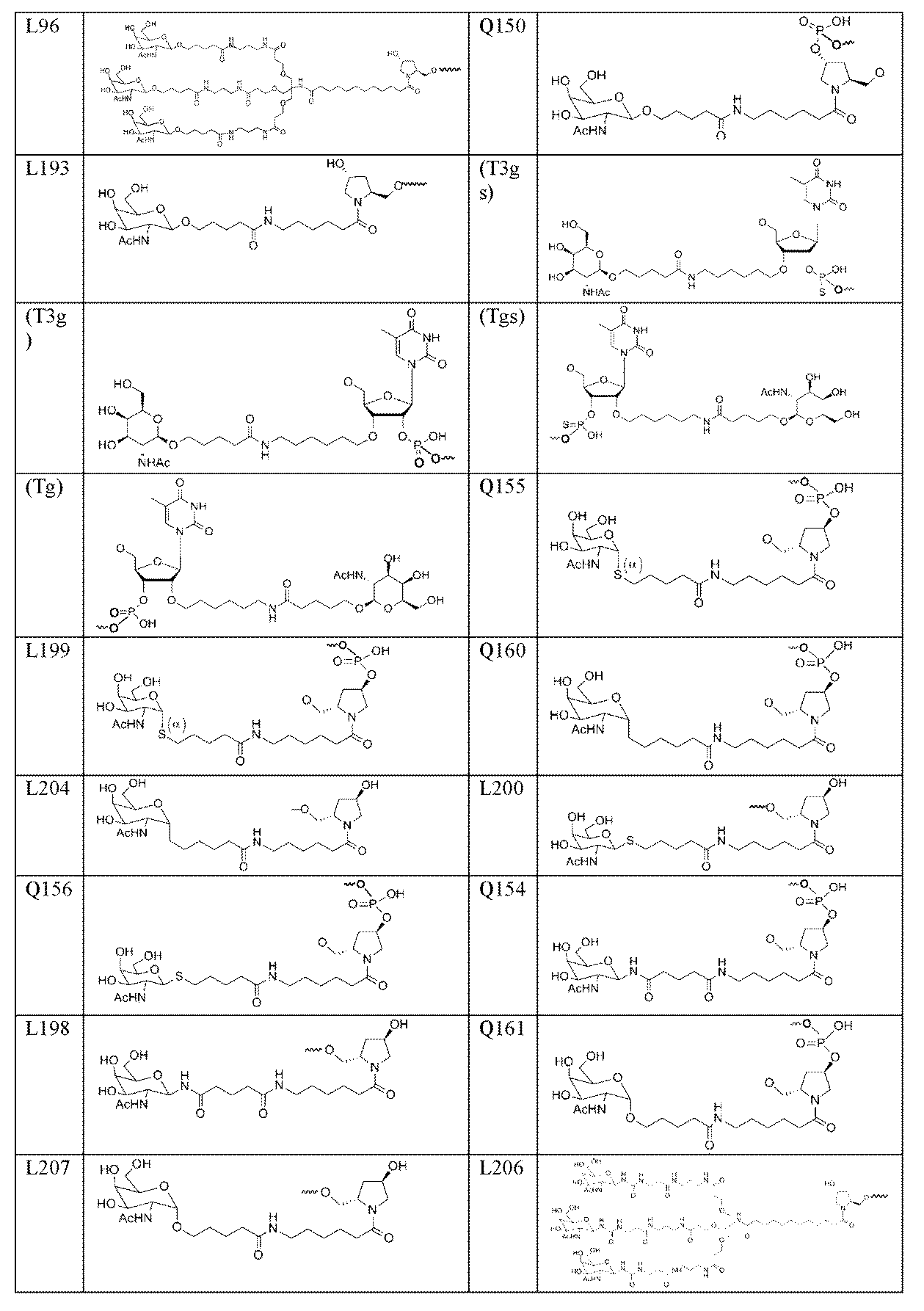
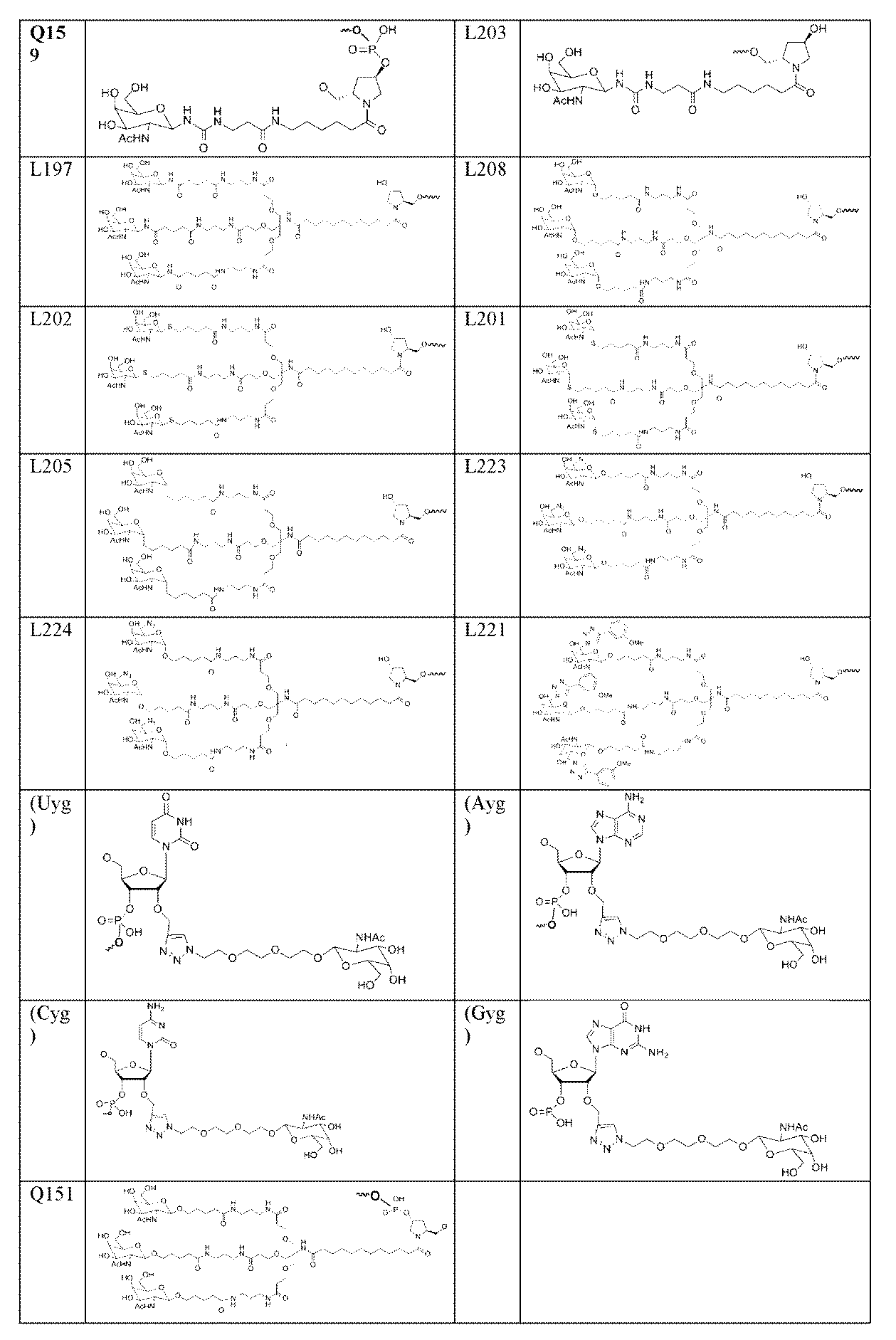
上記の表に列挙したGalNAc類似体は、その全体が参照により本明細書に組み込まれる、WO2015/006740に記載の方法を使用して調製されうる。 The GalNAc analogs listed in the table above can be prepared using the methods described in WO2015/006740, the entirety of which is incorporated herein by reference.
一部の実施形態において、GalNAcベースのコンジュゲートは、以下の構造: In some embodiments, the GalNAc-based conjugate has the following structure:

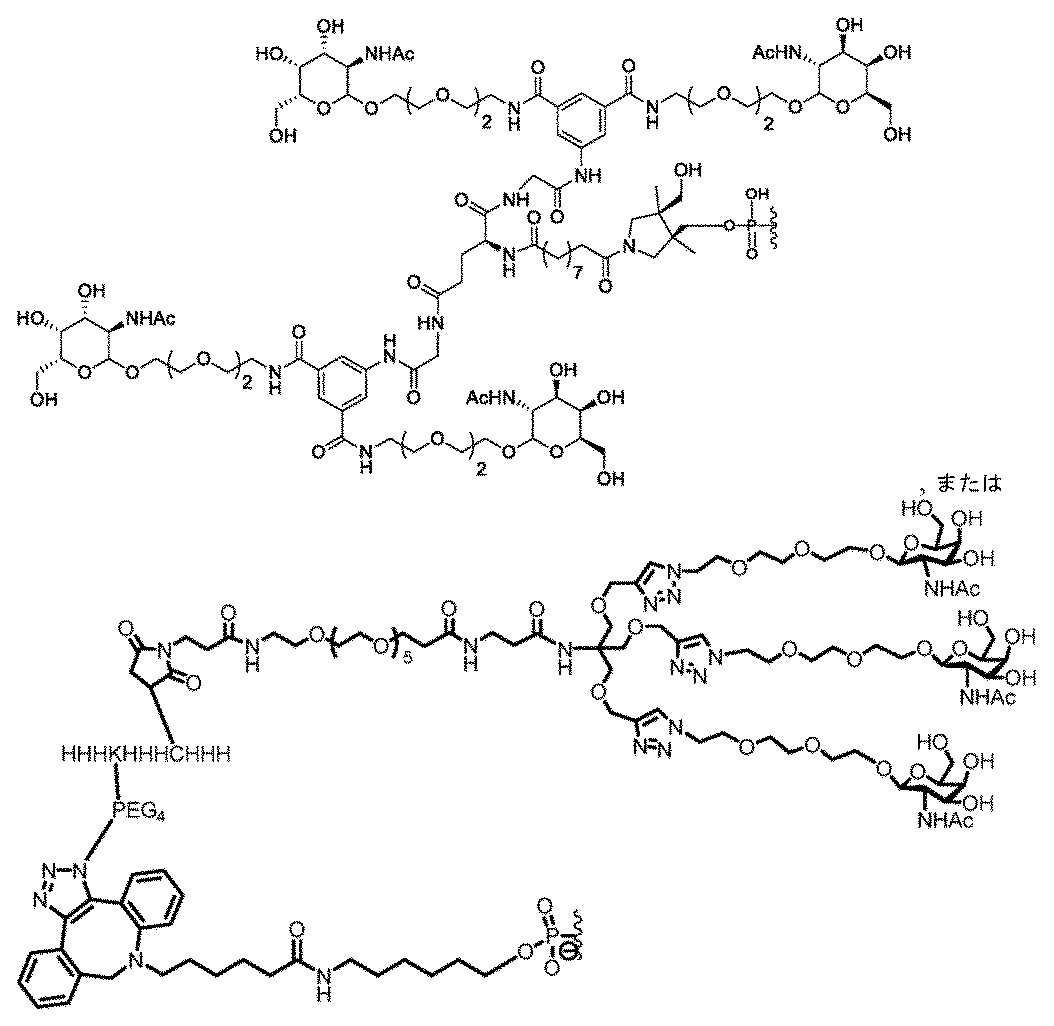
ある特定の実施形態において、一本鎖オリゴヌクレオチドは、以下に示す構造: In certain embodiments, the single-stranded oligonucleotide has the structure shown below:

LGは、独立に、各出現について、リガンド、例えば炭水化物、例えば単糖、二糖、三糖、四糖、多糖であり、
Z’、Z’’、Z’’’およびZ’’’’は、各々、独立に、各出現について、OまたはSである]
を有するリガンドをさらに含む。
L G is, independently, for each occurrence, a ligand, e.g., a carbohydrate, e.g., a monosaccharide, disaccharide, trisaccharide, tetrasaccharide, polysaccharide;
Z', Z'', Z''', and Z'''' are each independently, for each occurrence, O or S.
The ligand further comprises:
ある特定の実施形態において、一本鎖オリゴヌクレオチドは、式(II)、(III)、(IV)または(V): In certain embodiments, the single-stranded oligonucleotide has formula (II), (III), (IV) or (V):
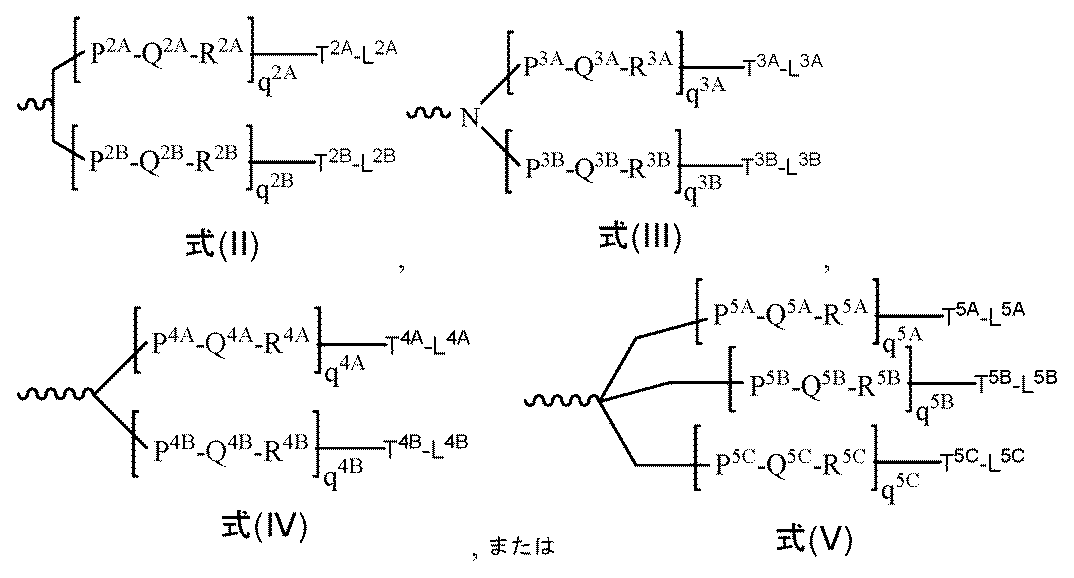
q2A、q2B、q3A、q3B、q4A、q4B、q5A、q5Bおよびq5Cは、独立に、各出現について、0~20を表し、この場合、反復単位は、同じ場合もあり、異なる場合もあり;
QおよびQ’は、独立に、各出現について、存在しないか、または-(P7-Q7-R7)p-T7-もしくは-T7-Q7-T7’-B-T8’-Q8-T8であり;
P2A、P2B、P3A、P3B、P4A、P4B、P5A、P5B、P5C、P7、T2A、T2B、T3A、T3B、T4A、T4B、T4A、T5B、T5C、T7、T7’、T8およびT8’は、各々、独立に、各出現について、存在しないか、またはCO、NH、O、S、OC(O)、NHC(O)、CH2、CH2NH、もしくはCH2Oであり;
Bは、-CH2-N(BL)-CH2-であり;
BLは、-TB-QB-TB’-Rxであり;
Q2A、Q2B、Q3A、Q3B、Q4A、Q4B、Q5A、Q5B、Q5C、Q7、Q8およびQBは、独立に、各出現について、存在しないか、またはアルキレン、置換アルキレンであり、この場合、1つまたは複数のメチレンは、O、S、S(O)、SO2、N(RN)、C(R’)=C(R’)、C≡C、またはC(O)のうちの1つまたは複数により、中断される場合もあり、終結する場合もあり;
TBおよびTB’は、各々、独立に、各出現について、存在しないか、またはCO、NH、O、S、OC(O)、OC(O)O、NHC(O)、NHC(O)NH、NHC(O)O、CH2、CH2NHもしくはCH2Oであり;
Rxは、親油性[例えば、コレステロール、コール酸、アダマンタン酢酸、1-ピレン酪酸、ジヒドロテストステロン、1,3-ビス-O(ヘキサデシル)グリセロール、ゲラニルオキシヘキシル基、ヘキサデシルグリセロール、ボルネオール、メントール、1,3-プロパンジオール、ヘプタデシル基、パルミチン酸、ミリスチン酸、O3-(オレオイル)リトコール酸、O3-(オレオイル)コレン酸、ジメトキシトリチル、またはフェノキサジン)、ビタミン(例えば、葉酸、ビタミンA、ビタミンE、ビオチン、ピリドキサル)、ペプチド、炭水化物(例えば、単糖、二糖、三糖、四糖、オリゴ糖、多糖)、エンドソーム溶解成分、ステロイド(例えばウバオール、ヘシゲニン(hecigenin)、ジオスゲニン)、テルペン(例えば、トリテルペン、例えば、サルササポゲニン、フリーデリン、エピフリーデラノール誘導体化リトコール酸)、またはカチオン性脂質であり;
R1、R2、R2A、R2B、R3A、R3B、R4A、R4B、R5A、R5B、R5C、R7は、各々、独立に、各出現について、存在しないか、またはNH、O、S、CH2、C(O)O、C(O)NH、NHCH(Ra)C(O)、-C(O)-CH(Ra)-NH-、CO、CH=N-O
q 2A , q 2B , q 3A , q 3B , q 4A , q 4B , q 5A , q 5B and q 5C independently, for each occurrence, represent 0 to 20, where the repeating units may be the same or different;
Q and Q' are independently, for each occurrence, absent, -(P 7 -Q 7 -R 7 ) p -T 7 -, or -T 7 -Q 7 -T 7' -B-T 8' -Q 8 -T 8 ;
P2A , P2B , P3A, P3B , P4A , P4B , P5A, P5B , P5C , P7 , T2A , T2B , T3A , T3B, T4A , T4B , T4A , T5B , T5C , T7 , T7 ' , T8 and T8' are each independently, for each occurrence, absent or CO, NH, O, S, OC ( O), NHC(O), CH2 , CH2NH , or CH2O ;
B is -CH2 -N(B L ) -CH2- ;
B L is -T B -Q B -T B' -R x ;
Q2A , Q2B , Q3A , Q3B , Q4A , Q4B , Q5A , Q5B , Q5C , Q7 , Q8 and QB are independently, for each occurrence, absent, alkylene, substituted alkylene, where one or more methylenes may be interrupted or terminated by one or more of O, S, S(O), SO2 , N( RN ), C(R')=C(R'), C≡C, or C(O);
T B and T B' are each, independently, for each occurrence, absent, CO, NH, O, S, OC(O), OC(O)O, NHC(O), NHC(O)NH, NHC(O)O, CH 2 , CH 2 NH, or CH 2 O;
R x is a lipophilic [e.g., cholesterol, cholic acid, adamantane acetic acid, 1-pyrene butyric acid, dihydrotestosterone, 1,3-bis-O(hexadecyl)glycerol, geranyloxyhexyl group, hexadecylglycerol, borneol, menthol, 1,3-propanediol, heptadecyl group, palmitic acid, myristic acid, O3-(oleoyl)lithocholic acid, O3-(oleoyl)cholenoic acid, dimethoxytrityl, or phenoxy]. sasin), vitamins (e.g., folic acid, vitamin A, vitamin E, biotin, pyridoxal), peptides, carbohydrates (e.g., monosaccharides, disaccharides, trisaccharides, tetrasaccharides, oligosaccharides, polysaccharides), endosomolytic components, steroids (e.g., uvaol, hecigenin, diosgenin), terpenes (e.g., triterpenes, e.g., sarsasapogenin, friedelin, epifriedelanol-derivatized lithocholic acid), or cationic lipids;
R 1 , R 2 , R 2A , R 2B , R 3A , R 3B , R 4A , R 4B , R 5A , R 5B , R 5C , R 7 are each, independently for each occurrence, absent or NH, O, S, CH 2 , C(O)O, C(O)NH, NHCH(R a )C(O), -C(O)-CH(R a )-NH-, CO, CH═N-O

L1、L2A、L2B、L3A、L3B、L4A、L4B、L5A、L5BおよびL5Cは、各々、独立に、各出現について、炭水化物(例えば、単糖、二糖、三糖、四糖、オリゴ糖、および多糖)であり;
R’およびR”は、各々、独立に、H、C1~C6アルキル、OH、SH、またはN(RN)2であり;
RNは、独立に、各出現について、H、メチル、エチル、プロピル、イソプロピル、ブチルまたはベンジルであり;
Raは、Hまたはアミノ酸側鎖であり;
Z’、Z’’、Z’’’およびZ’’’’は、各々、独立に、各出現について、OまたはSであり;
pは、独立に、各出現について、0~20を表す]
のリガンドを含む。
L1 , L2A , L2B , L3A , L3B , L4A , L4B , L5A , L5B and L5C are each, independently for each occurrence, a carbohydrate (e.g., a monosaccharide, a disaccharide, a trisaccharide, a tetrasaccharide, an oligosaccharide, and a polysaccharide);
R' and R" are each independently H, C1 - C6 alkyl, OH, SH, or N(R N ) 2 ;
R N is independently, for each occurrence, H, methyl, ethyl, propyl, isopropyl, butyl, or benzyl;
R a is H or an amino acid side chain;
Z', Z'', Z''', and Z'''' are each independently, for each occurrence, O or S;
p independently for each occurrence represents 0 to 20.
The ligands include:
上記において論じられたように、リガンドはリンカーまたは担体を介して一本鎖オリゴヌクレオチドにコンジュゲートされうるため、およびリンカーまたは担体は分枝状リンカーを含有することができるため、一本鎖オリゴヌクレオチドは担体への同一または異なる骨格接合点を介して、または分岐状リンカー(複数可)を介して複数のリガンドを含有することができる。例えば、分岐状リンカーの分岐点は、二価、三価、四価、五価、もしくは六価の原子、またはそのような複数の原子価を示す基でありうる。ある特定の実施形態において、分岐点は、-N、-N(Q)-C、-O-C、-S-C、-SS-C、-C(O)N(Q)-C、-OC(O)N(Q)-C、-N(Q)C(O)-C、または-N(Q)C(O)O-C、[式中、Qは、独立に、各出現について、Hまたは適宜置換されたアルキルである]である。他の実施形態において、分岐点は、グリセロールまたはグリセロール誘導体である。 As discussed above, because the ligands can be conjugated to the single-stranded oligonucleotide via a linker or carrier, and because the linker or carrier can contain a branched linker, the single-stranded oligonucleotide can contain multiple ligands via the same or different backbone attachment points to the carrier, or via a branched linker(s). For example, the branch point of the branched linker can be a divalent, trivalent, tetravalent, pentavalent, or hexavalent atom, or a group exhibiting such multiple valencies. In certain embodiments, the branch point is -N, -N(Q)-C, -O-C, -S-C, -SS-C, -C(O)N(Q)-C, -OC(O)N(Q)-C, -N(Q)C(O)-C, or -N(Q)C(O)O-C, where Q is independently, for each occurrence, H or an optionally substituted alkyl. In other embodiments, the branch point is glycerol or a glycerol derivative.
ある特定の実施形態において、一本鎖オリゴヌクレオチドにコンジュゲートしたASGPRリガンドは、二価または三価の分岐状リンカーによって接合された1つまたは複数のGalNAc誘導体である。 In certain embodiments, the ASGPR ligand conjugated to the single-stranded oligonucleotide is one or more GalNAc derivatives joined by a bivalent or trivalent branched linker.
ある特定の実施形態において、一本鎖オリゴヌクレオチドは、 In certain embodiments, the single-stranded oligonucleotide is
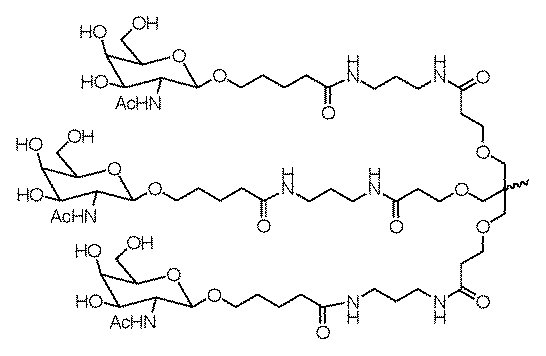
ある特定の実施形態において、一本鎖オリゴヌクレオチドは、 In certain embodiments, the single-stranded oligonucleotide is
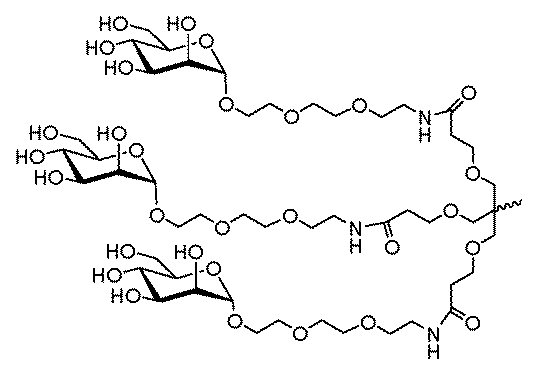
ある特定の実施形態において、一本鎖オリゴヌクレオチドは、 In certain embodiments, the single-stranded oligonucleotide is
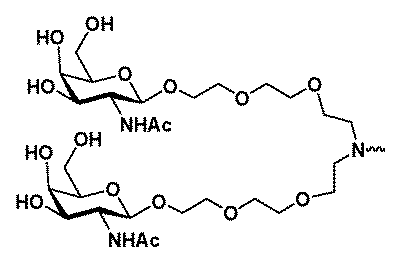
ある特定の実施形態において、一本鎖オリゴヌクレオチドは、 In certain embodiments, the single-stranded oligonucleotide is
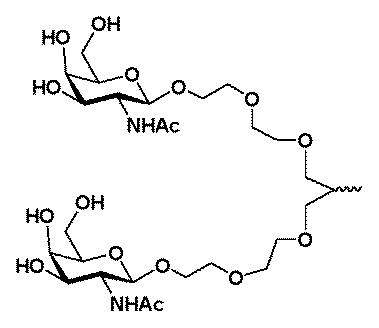
ある特定の実施形態において、一本鎖オリゴヌクレオチドは、 In certain embodiments, the single-stranded oligonucleotide is
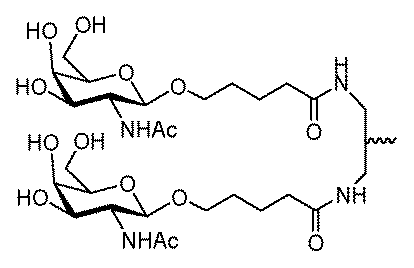
ある特定の実施形態において、一本鎖オリゴヌクレオチドは、 In certain embodiments, the single-stranded oligonucleotide is
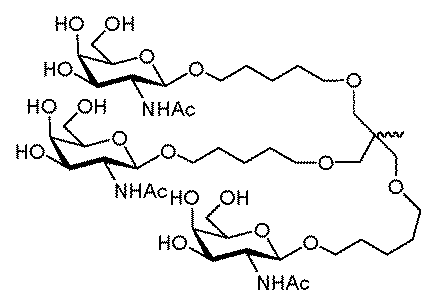
ある特定の実施形態において、一本鎖オリゴヌクレオチドは、 In certain embodiments, the single-stranded oligonucleotide is
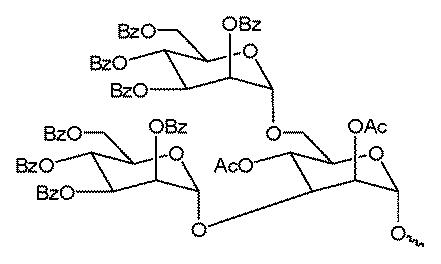
ある特定の実施形態において、一本鎖オリゴヌクレオチドは、 In certain embodiments, the single-stranded oligonucleotide is
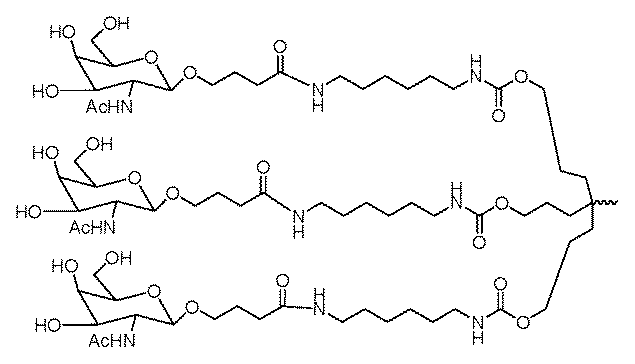
ある特定の実施形態において、一本鎖オリゴヌクレオチドは、 In certain embodiments, the single-stranded oligonucleotide is
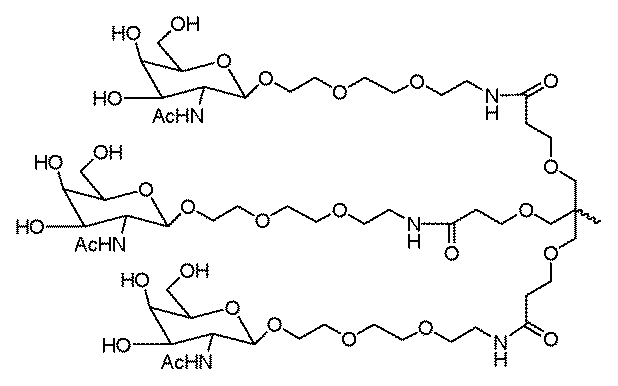
ある特定の実施形態において、一本鎖オリゴヌクレオチドは、 In certain embodiments, the single-stranded oligonucleotide is
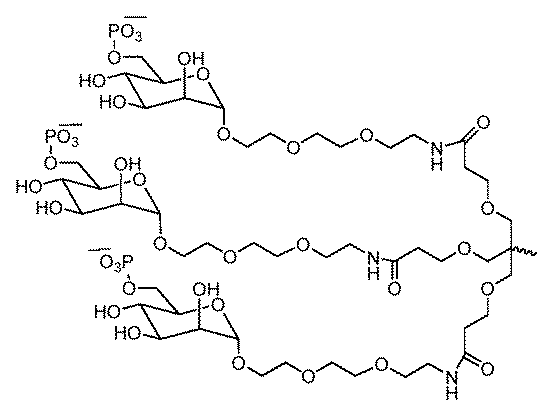
ある特定の実施形態において、一本鎖オリゴヌクレオチドは、 In certain embodiments, the single-stranded oligonucleotide is
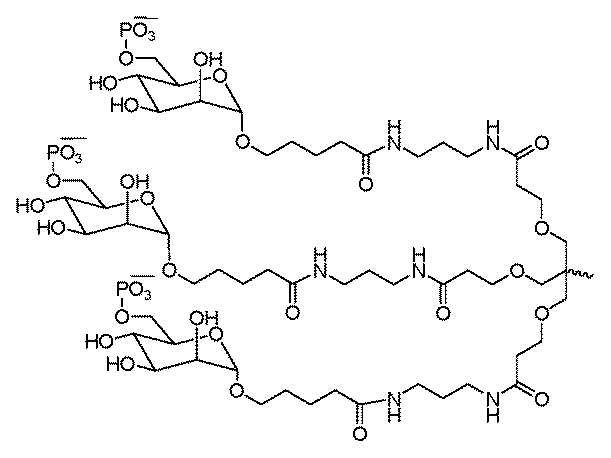
ある特定の実施形態において、一本鎖オリゴヌクレオチドは、 In certain embodiments, the single-stranded oligonucleotide is

ある特定の実施形態において、一本鎖オリゴヌクレオチドは、 In certain embodiments, the single-stranded oligonucleotide is
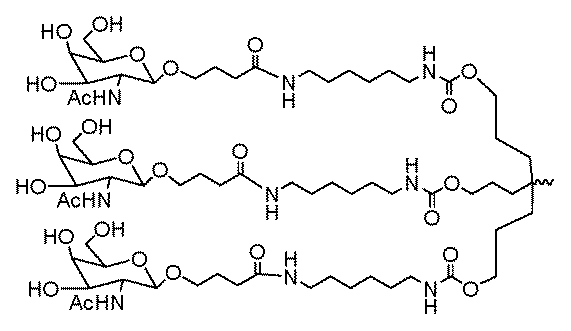
例示的なリガンド単量体
Exemplary Ligand Monomers
ある特定の実施形態において、一本鎖オリゴヌクレオチドは、 In certain embodiments, the single-stranded oligonucleotide is
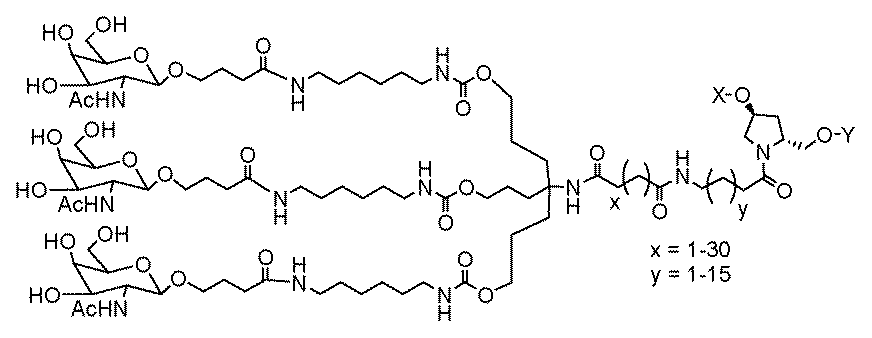
ある特定の実施形態において、一本鎖オリゴヌクレオチドは、 In certain embodiments, the single-stranded oligonucleotide is
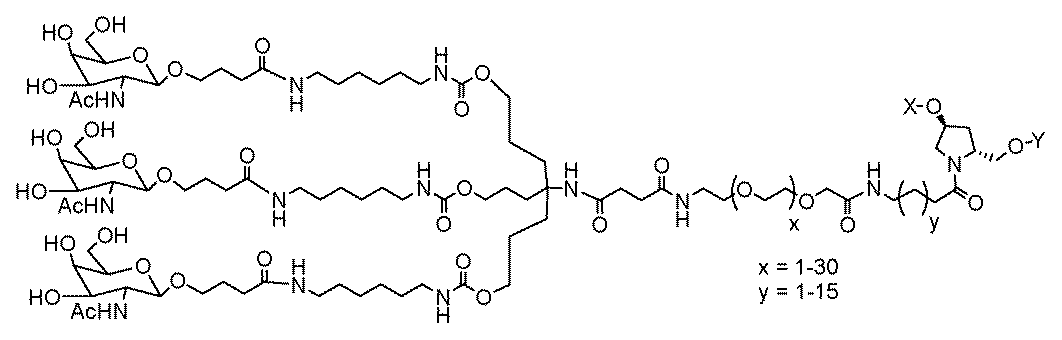
ある特定の実施形態において、一本鎖オリゴヌクレオチドは、 In certain embodiments, the single-stranded oligonucleotide is
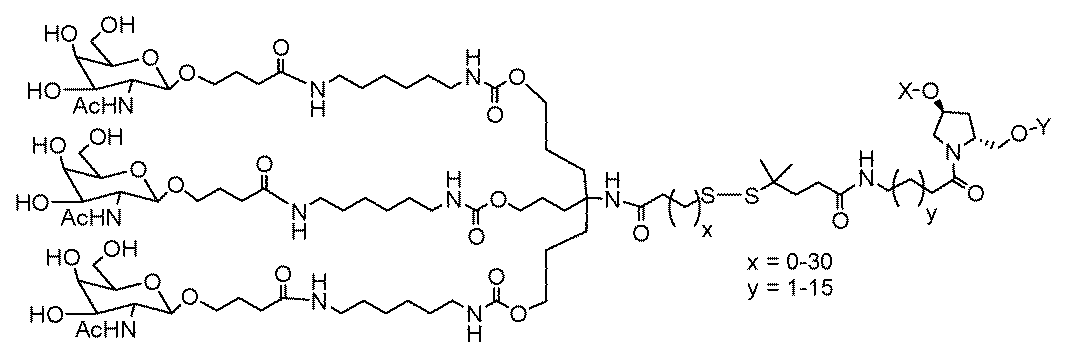
ある特定の実施形態において、一本鎖オリゴヌクレオチドは、 In certain embodiments, the single-stranded oligonucleotide is
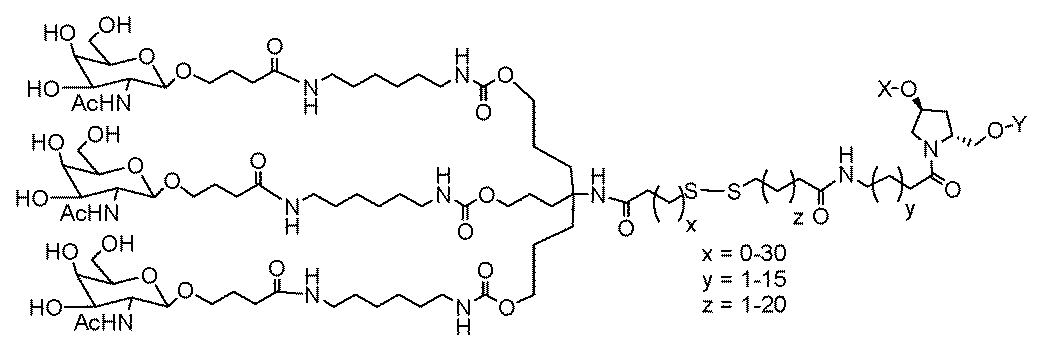
ある特定の実施形態において、一本鎖オリゴヌクレオチドは、 In certain embodiments, the single-stranded oligonucleotide is
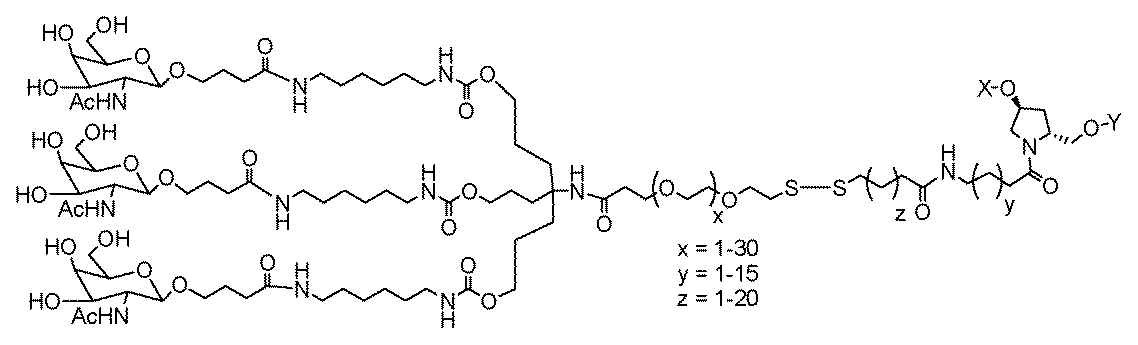
ある特定の実施形態において、一本鎖オリゴヌクレオチドは、 In certain embodiments, the single-stranded oligonucleotide is

ある特定の実施形態において、一本鎖オリゴヌクレオチドは、 In certain embodiments, the single-stranded oligonucleotide is
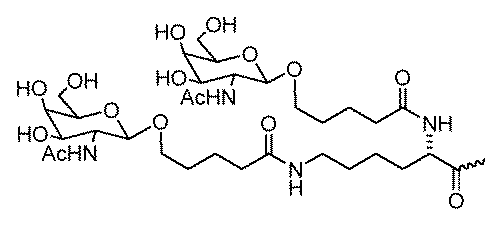
ある特定の実施形態において、一本鎖オリゴヌクレオチドは、 In certain embodiments, the single-stranded oligonucleotide is
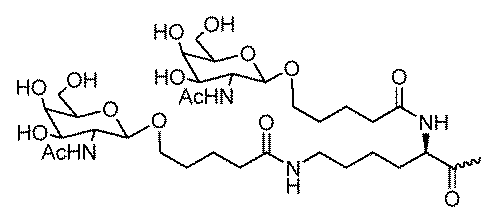
ある特定の実施形態において、一本鎖オリゴヌクレオチドは、 In certain embodiments, the single-stranded oligonucleotide is
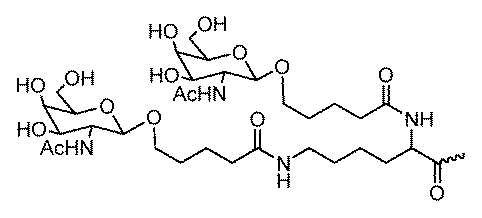
ある特定の実施形態において、一本鎖オリゴヌクレオチドは、 In certain embodiments, the single-stranded oligonucleotide is

ある特定の実施形態において、一本鎖オリゴヌクレオチドは、 In certain embodiments, the single-stranded oligonucleotide is

ある特定の実施形態において、一本鎖オリゴヌクレオチドは、 In certain embodiments, the single-stranded oligonucleotide is

ある特定の実施形態において、一本鎖オリゴヌクレオチドは、 In certain embodiments, the single-stranded oligonucleotide is
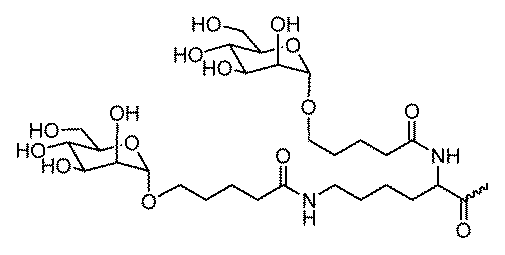
ある特定の実施形態において、一本鎖オリゴヌクレオチドは、 In certain embodiments, the single-stranded oligonucleotide is
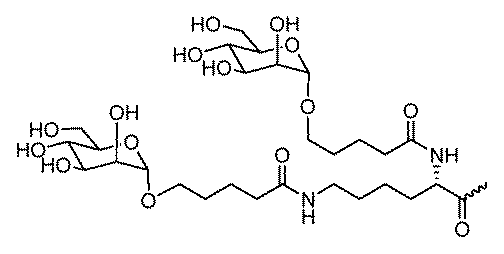
ある特定の実施形態において、一本鎖オリゴヌクレオチドは、 In certain embodiments, the single-stranded oligonucleotide is

ある特定の実施形態において、一本鎖オリゴヌクレオチドは、 In certain embodiments, the single-stranded oligonucleotide is

ある特定の実施形態において、一本鎖オリゴヌクレオチドは、 In certain embodiments, the single-stranded oligonucleotide is
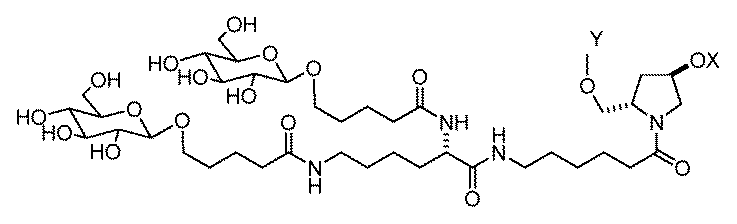
ある特定の実施形態において、一本鎖オリゴヌクレオチドは、 In certain embodiments, the single-stranded oligonucleotide is

ある特定の実施形態において、一本鎖オリゴヌクレオチドは、 In certain embodiments, the single-stranded oligonucleotide is
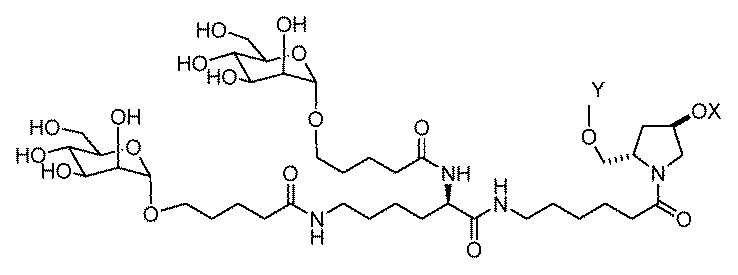
ある特定の実施形態において、本発明の一本鎖オリゴヌクレオチドは、 In certain embodiments, the single-stranded oligonucleotide of the present invention is
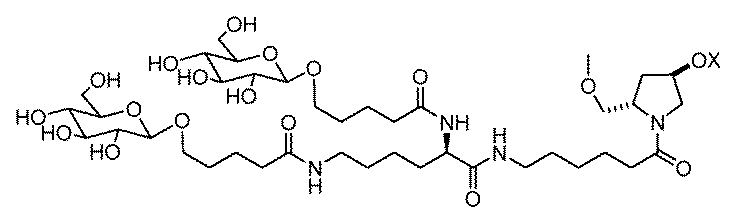
ある特定の実施形態において、一本鎖オリゴヌクレオチドは、 In certain embodiments, the single-stranded oligonucleotide is

一部の実施形態において、L2AとL2Bの両方は同じである。一部の実施形態において、L2AとL2Bの両方は異なる。 In some embodiments, both L 2A and L 2B are the same. In some embodiments, both L 2A and L 2B are different.
一部の実施形態において、L3AとL3Bの両方は同じである。一部の実施形態において、L3AとL3Bの両方は異なる。 In some embodiments, both L 3A and L 3B are the same. In some embodiments, both L 3A and L 3B are different.
一部の実施形態において、L4AとL4Bの両方は同じである。一部の実施形態において、L4AとL4Bの両方は異なる。 In some embodiments, both L4A and L4B are the same. In some embodiments, both L4A and L4B are different.
一部の実施形態において、L5A、L5BおよびL5Cの全ては同じである。一部の実施形態において、L5A、L5BおよびL5Cの2つは同じである。一部の実施形態において、L5AおよびL5Bは同じである。一部の実施形態において、L5AおよびL5Cは同じである。一部の実施形態において、L5BおよびL5Cは同じである。 In some embodiments, all of L5A , L5B and L5C are the same. In some embodiments, two of L5A , L5B and L5C are the same. In some embodiments, L5A and L5B are the same. In some embodiments, L5A and L5C are the same. In some embodiments, L5B and L5C are the same.
ある特定の実施形態において、一本鎖オリゴヌクレオチドは、 In certain embodiments, the single-stranded oligonucleotide is
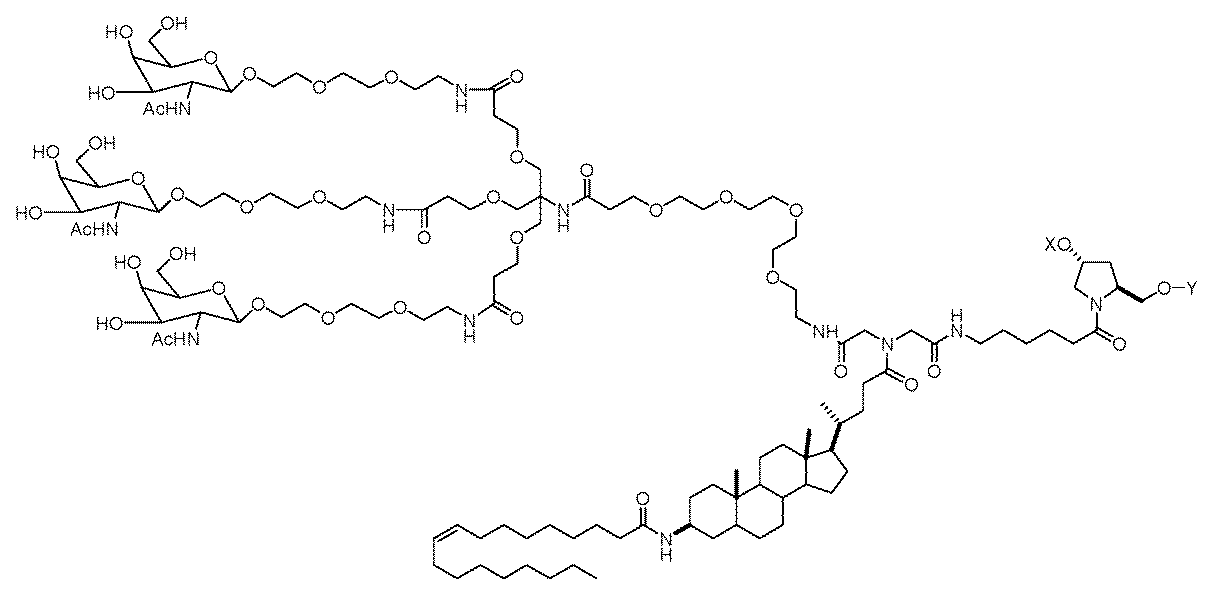
ある特定の実施形態において、一本鎖オリゴヌクレオチドは、 In certain embodiments, the single-stranded oligonucleotide is

ある特定の実施形態において、一本鎖オリゴヌクレオチドは、 In certain embodiments, the single-stranded oligonucleotide is
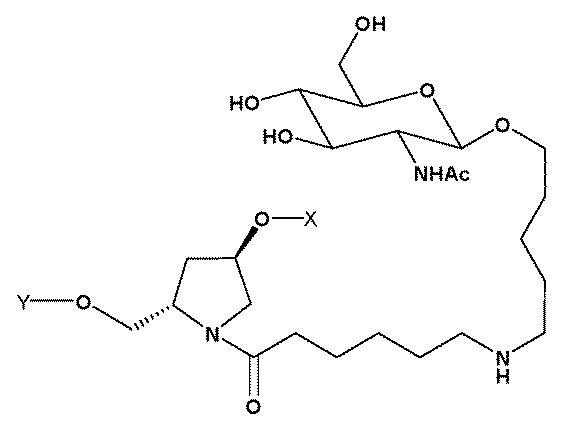
ある特定の実施形態において、一本鎖オリゴヌクレオチドは、 In certain embodiments, the single-stranded oligonucleotide is

の単量体を含む。
Contains the monomer.
ある特定の実施形態において、一本鎖オリゴヌクレオチドは、 In certain embodiments, the single-stranded oligonucleotide is

の単量体を含む。
Contains the monomer.
ある特定の実施形態において、一本鎖オリゴヌクレオチドは、 In certain embodiments, the single-stranded oligonucleotide is
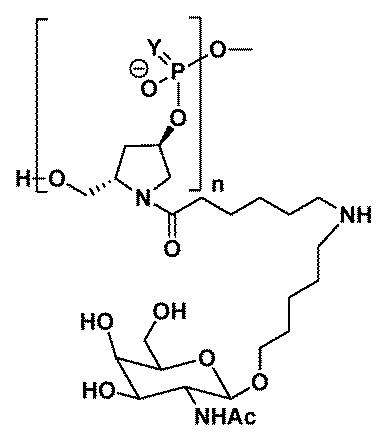
の単量体を含む。
Contains the monomer.
ある特定の実施形態において、一本鎖オリゴヌクレオチドは、構造: In certain embodiments, the single-stranded oligonucleotide has the structure:

の単量体を含む。
Contains the monomer.
一部の実施形態において、一本鎖オリゴヌクレオチドは、 In some embodiments, the single-stranded oligonucleotide is
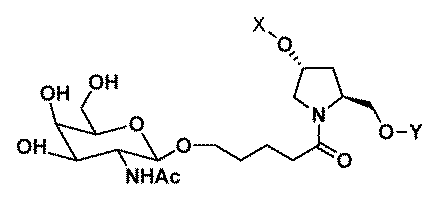
一部の実施形態において、一本鎖オリゴヌクレオチドは、 In some embodiments, the single-stranded oligonucleotide is

の単量体を含む。
Contains the monomer.
一部の実施形態において、一本鎖オリゴヌクレオチドは、 In some embodiments, the single-stranded oligonucleotide is
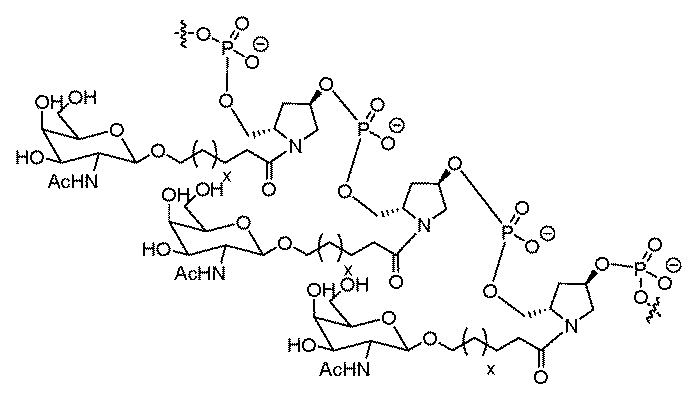
の単量体を含む。
Contains the monomer.
一部の実施形態において、一本鎖オリゴヌクレオチドは、 In some embodiments, the single-stranded oligonucleotide is

の単量体を含む。
Contains the monomer.
ある特定の実施形態において、一本鎖オリゴヌクレオチドは、 In certain embodiments, the single-stranded oligonucleotide is

の単量体を含む。
Contains the monomer.
ある特定の実施形態において、一本鎖オリゴヌクレオチドは、 In certain embodiments, the single-stranded oligonucleotide is
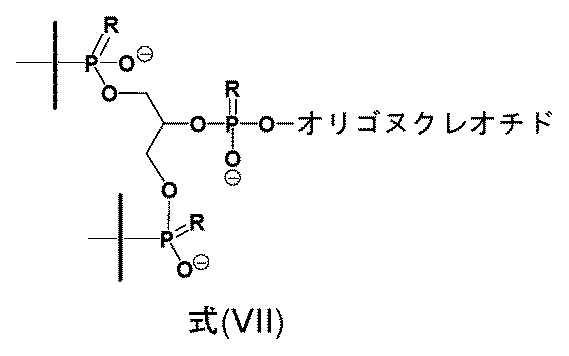
の単量体を含む。
Contains the monomer.
ある特定の実施形態において、一本鎖オリゴヌクレオチドは、 In certain embodiments, the single-stranded oligonucleotide is
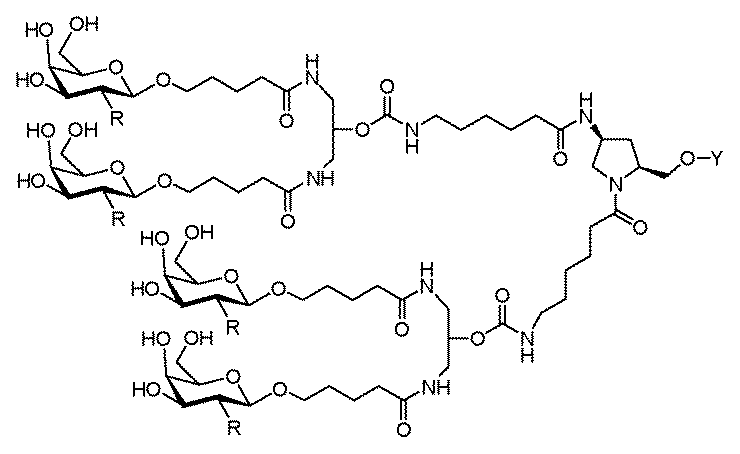
の単量体を含む。
Contains the monomer.
ある特定の実施形態において、一本鎖オリゴヌクレオチドは、 In certain embodiments, the single-stranded oligonucleotide is

一部の実施形態において、一本鎖オリゴヌクレオチドは、 In some embodiments, the single-stranded oligonucleotide is

の単量体を含む。
Contains the monomer.
一部の実施形態において、一本鎖オリゴヌクレオチドは、 In some embodiments, the single-stranded oligonucleotide is
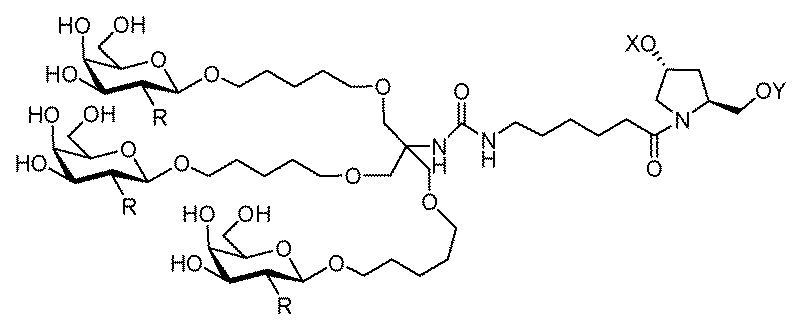
の単量体を含む。
Contains the monomer.
一部の実施形態において、一本鎖オリゴヌクレオチドは、 In some embodiments, the single-stranded oligonucleotide is
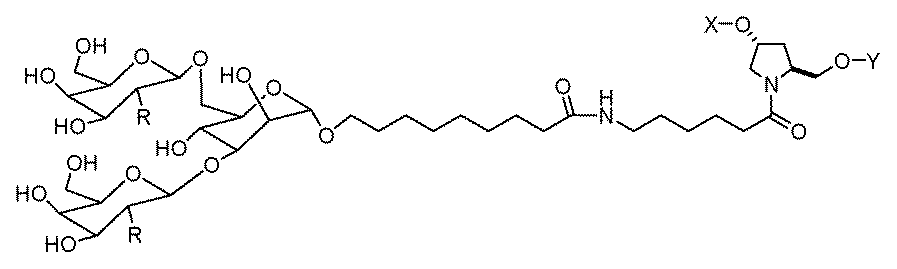
の単量体を含む。
Contains the monomer.
ある特定の実施形態において、一本鎖オリゴヌクレオチドは、 In certain embodiments, the single-stranded oligonucleotide is
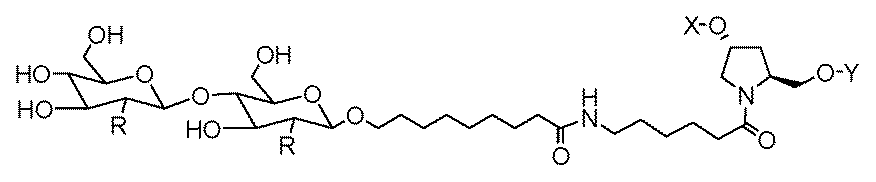
の単量体を含む。
Contains the monomer.
ある特定の実施形態では、一本鎖オリゴヌクレオチドは、 In certain embodiments, the single-stranded oligonucleotide is

上記の単量体において、XおよびYは、それぞれ独立に、各出現について、H、保護基、リン酸基、ホスホジエステル基、活性化リン酸基、活性化亜リン酸基、ホスホラミダイト、固体支持体、-P(Z’)(Z’’)O-ヌクレオシド、-P(Z’)(Z’’)O-オリゴヌクレオチド、脂質、PEG、ステロイド、ポリマー、ヌクレオチド、ヌクレオシド、またはオリゴヌクレオチドであり;ならびにZ’およびZ’’は、それぞれ独立に、各出現について、OまたはSである。 In the above monomers, X and Y are each independently, for each occurrence, H, a protecting group, a phosphate group, a phosphodiester group, an activated phosphate group, an activated phosphite group, a phosphoramidite, a solid support, -P(Z')(Z'')O-nucleoside, -P(Z')(Z'')O-oligonucleotide, a lipid, a PEG, a steroid, a polymer, a nucleotide, a nucleoside, or an oligonucleotide; and Z' and Z'' are each independently, for each occurrence, O or S.
一部の実施形態において、一本鎖オリゴヌクレオチドは、 In some embodiments, the single-stranded oligonucleotide is

ある特定の実施形態において、一本鎖オリゴヌクレオチドは、 In certain embodiments, the single-stranded oligonucleotide is
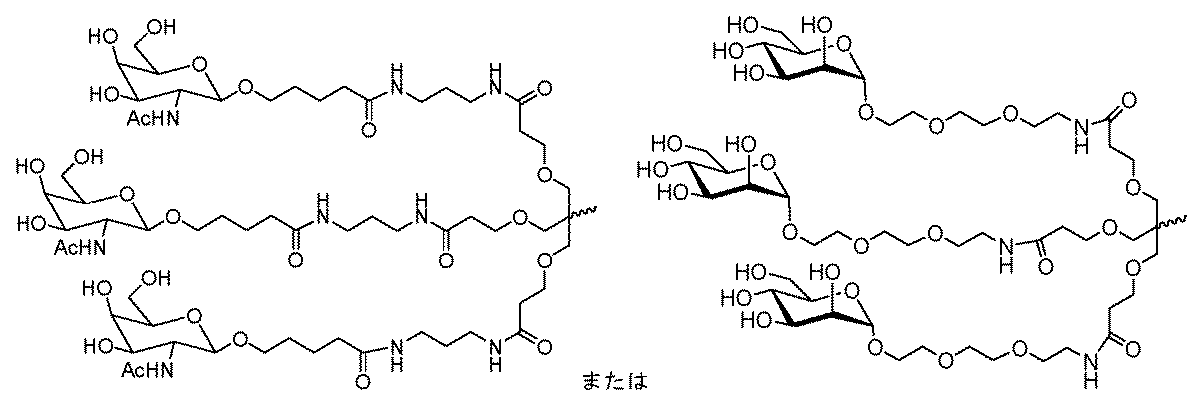
ある特定の実施形態において、一本鎖オリゴヌクレオチドは、 In certain embodiments, the single-stranded oligonucleotide is
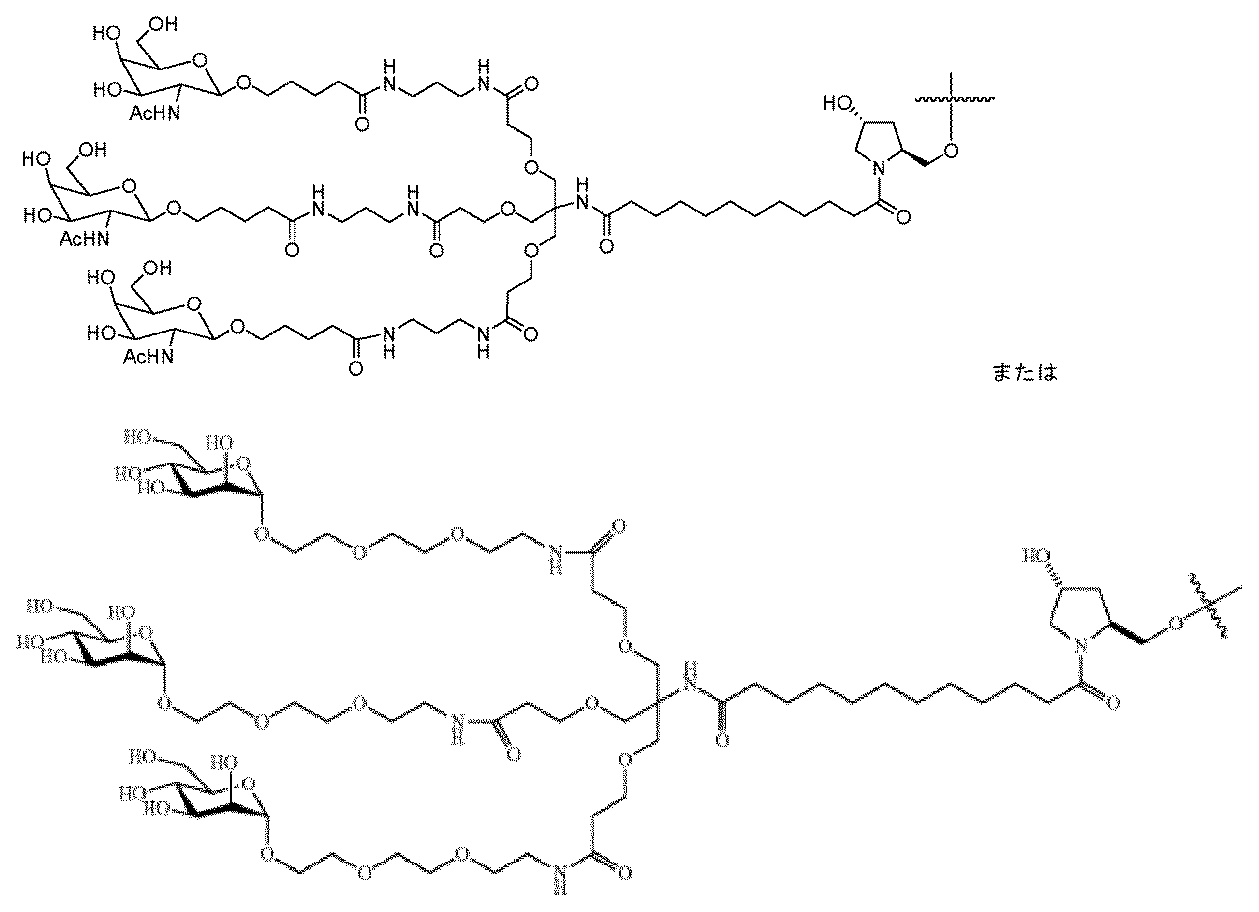
ある特定の実施形態において、一本鎖オリゴヌクレオチドにコンジュゲートした少なくとも1つのリガンドは、親油性部分である。 In certain embodiments, at least one ligand conjugated to the single-stranded oligonucleotide is a lipophilic moiety.
用語「親油性」または「親油性部分」は、脂質への親和性を有する任意の化合物または化学部分を広く指す。親油性部分の親油性を特徴付ける1つの方法は、オクタノール・水分配係数、logKowにより、Kowは、平衡時の二相系の、オクタノール相における化学物質の濃度の、水相におけるその濃度に対する比である。オクタノール・水分配係数は、物質の研究室で測定した特性である。しかしながら、第1原理または実験的方法を使用して算出される、化学物質の構造成分に帰する係数を使用することによっても予測されうる(例えば、その全内容が参照により本明細書に組み込まれる、Tetko et al., J. Chem. Inf. Comput. Sci. 41:1407-21 (2001)を参照されたい)。それは、水よりも、非水系または油系環境を好む、物質の傾向の熱力学的測定を提供する(すなわち、その親水性/親油性バランス)。原則として、化学物質は、そのlogKowが0を超える場合、特性が親油性である。典型的には、親油性部分は、1を超える、1.5を超える、2を超える、3を超える、4を超える、5を超える、または10を超えるlogKowを持つ。例えば、6-アミノヘキサノールのlogKowは、例えば、およそ0.7であると予測される。同じ方法を使用して、コレステリルN-(ヘキサン-6-オール)カルバメートのlogKowは、10.7であると予測される。 The term "lipophilic" or "lipophilic moiety" broadly refers to any compound or chemical moiety that has an affinity for lipids. One way to characterize the lipophilicity of a lipophilic moiety is by the octanol-water partition coefficient, log Kow , where Kow is the ratio of the concentration of a chemical in the octanol phase to its concentration in the water phase of a two-phase system at equilibrium. The octanol-water partition coefficient is a laboratory measured property of a substance. However, it can also be predicted by using coefficients attributed to structural components of a chemical, calculated using first principles or experimental methods (see, for example, Tetko et al., J. Chem. Inf. Comput. Sci. 41:1407-21 (2001), the entire contents of which are incorporated herein by reference). It provides a thermodynamic measure of a substance's tendency to prefer non-aqueous or oil-based environments over water (i.e., its hydrophilic/lipophilic balance). As a general rule, a chemical is lipophilic in character if its log Kow is greater than 0. Typically, lipophilic moieties have a log Kow greater than 1, greater than 1.5, greater than 2, greater than 3, greater than 4, greater than 5, or greater than 10. For example, the log Kow of 6-aminohexanol is predicted to be approximately 0.7. Using the same method, the log Kow of cholesteryl N-(hexan-6-ol) carbamate is predicted to be 10.7.
分子の親油性は、それが持つ官能基に関して変更されうる。例えば、親油性部分の末端へのヒドロキシル基またはアミン基の付加は、親油性部分の分配係数(例えば、logKow)値を増加または減少させうる。 The lipophilicity of a molecule can be altered with respect to the functional groups it bears. For example, the addition of hydroxyl or amine groups to the termini of a lipophilic moiety can increase or decrease the partition coefficient (e.g., log K ow ) value of the lipophilic moiety.
あるいは、1つまたは複数の親油性部分にコンジュゲートした、一本鎖オリゴヌクレオチドの疎水性は、そのタンパク質結合特性によって測定されうる。例えば、一本鎖オリゴヌクレオチドの血漿タンパク質結合アッセイにおける未結合画分は、一本鎖オリゴヌクレオチドの相対疎水性と正に相関するように決定することができ、それは1本鎖オリゴヌクレオチドのサイレンシング活性と正に相関しうる。 Alternatively, the hydrophobicity of a single-stranded oligonucleotide conjugated to one or more lipophilic moieties can be measured by its protein binding properties. For example, the unbound fraction in a plasma protein binding assay of a single-stranded oligonucleotide can be determined to positively correlate with the relative hydrophobicity of the single-stranded oligonucleotide, which can positively correlate with the silencing activity of the single-stranded oligonucleotide.
一実施形態において、決定した血漿タンパク質結合アッセイは、ヒト血清アルブミンタンパク質を使用する、電気泳動移動度シフトアッセイ(EMSA)である。結合アッセイにおいて未結合の1本鎖オリゴヌクレオチドの画分によって測定された、1本鎖オリゴヌクレオチドの疎水性は、一本鎖オリゴヌクレオチドのインビボデリバリーの増強のため、0.15を超える、0.2を超える、0.25を超える、0.3を超える、0.35を超える、0.4を超える、0.45を超える、または0.5を超える。 In one embodiment, the plasma protein binding assay determined is an electrophoretic mobility shift assay (EMSA) using human serum albumin protein. The hydrophobicity of the single stranded oligonucleotide, as measured by the fraction of unbound single stranded oligonucleotide in the binding assay, is greater than 0.15, greater than 0.2, greater than 0.25, greater than 0.3, greater than 0.35, greater than 0.4, greater than 0.45, or greater than 0.5 for enhanced in vivo delivery of the single stranded oligonucleotide.
したがって、一本鎖オリゴヌクレオチドの内部位置(複数可)への親油性部分のコンジュゲートは、一本鎖オリゴヌクレオチドのインビボデリバリーを増強するために最適な疎水性を提供する。 Thus, conjugation of a lipophilic moiety to an internal position(s) of a single-stranded oligonucleotide provides optimal hydrophobicity for enhancing in vivo delivery of the single-stranded oligonucleotide.
ある特定の実施形態において、親油性部分は、脂肪族、脂環式などの環式、または多環脂環式などの多環式化合物、例えば、ステロイド(例えば、ステロール)または線状もしくは分岐状脂肪族炭化水素である。親油性部分は、一般に、環式もしくは非環式でありうる炭化水素鎖を含む。炭化水素鎖は、様々な置換基および/または1つもしくは複数のヘテロ原子、例えば酸素原子もしくは窒素原子を含みうる。そのような親油性脂肪族部分は、飽和または不飽和C4~C30炭化水素鎖(例えば、C6~C18炭化水素またはC14~C24炭化水素)、飽和または不飽和脂肪酸、ワックス(例えば、脂肪酸の一価アルコールエステルおよび脂肪ジアミド)、テルペン(例えば、C10テルペン、C15セスキテルペン、C20ジテルペン、C30トリテルペン、およびC40テトラテルペン)および他の多環脂環式炭化水素を含むがこれらに限定されない。例えば、親油性部分は、C4~C30炭化水素鎖(例えば、C4~C30アルキルまたはアルケニル)を含有しうる。一部の実施形態において、親油性部分は、飽和もしくは不飽和C6~C18炭化水素鎖(例えば、線状C6~C18アルキルまたはアルケニル)または飽和もしくは不飽和C14~C24炭化水素鎖(例えば、線状C14~C24アルキルまたはアルケニル)を含有する。一実施形態において、親油性部分は、飽和もしくは不飽和C16炭化水素鎖(例えば、線状C16アルキルまたはアルケニル)または飽和もしくは不飽和C22炭化水素鎖(例えば、線状C22アルキルまたはアルケニル)を含有する。 In certain embodiments, the lipophilic moiety is aliphatic, cyclic, such as alicyclic, or polycyclic, such as polycyclic alicyclic, e.g., steroids (e.g., sterols) or linear or branched aliphatic hydrocarbons. The lipophilic moiety generally comprises a hydrocarbon chain, which may be cyclic or acyclic. The hydrocarbon chain may comprise various substituents and/or one or more heteroatoms, such as oxygen or nitrogen atoms. Such lipophilic aliphatic moieties include, but are not limited to, saturated or unsaturated C4 - C30 hydrocarbon chains (e.g., C6 - C18 or C14 - C24 hydrocarbons), saturated or unsaturated fatty acids, waxes (e.g., monohydric alcohol esters and fatty diamides of fatty acids), terpenes (e.g., C10 terpenes, C15 sesquiterpenes, C20 diterpenes, C30 triterpenes, and C40 tetraterpenes), and other polycyclic alicyclic hydrocarbons. For example, the lipophilic portion may contain a C 4 -C 30 hydrocarbon chain (e.g., a C 4 -C 30 alkyl or alkenyl). In some embodiments, the lipophilic portion contains a saturated or unsaturated C 6 -C 18 hydrocarbon chain (e.g., a linear C 6 -C 18 alkyl or alkenyl) or a saturated or unsaturated C 14 -C 24 hydrocarbon chain (e.g., a linear C 14 -C 24 alkyl or alkenyl). In one embodiment, the lipophilic portion contains a saturated or unsaturated C 16 hydrocarbon chain (e.g., a linear C 16 alkyl or alkenyl) or a saturated or unsaturated C 22 hydrocarbon chain (e.g., a linear C 22 alkyl or alkenyl).
親油性部分は、親油性部分にすでに存在するか、または一本鎖オリゴヌクレオチドに導入される官能基、例えばヒドロキシ基(例えば、-CO-CH2-OH)を介して、当技術分野で公知の任意の方法によって一本鎖オリゴヌクレオチドに接合されうる。親油性部分にすでに存在するか、または一本鎖オリゴヌクレオチドに導入される官能基は、ヒドロキシル、アミン、カルボン酸、スルホン酸、リン酸、チオール、アジド、およびアルキンを含むが、これに限定されない。 Lipophilic moieties can be conjugated to single-stranded oligonucleotides by any method known in the art via functional groups already present on the lipophilic moiety or introduced into the single-stranded oligonucleotide, such as hydroxy groups (e.g., --CO--CH 2 --OH). Functional groups already present on the lipophilic moiety or introduced into the single-stranded oligonucleotide include, but are not limited to, hydroxyl, amine, carboxylic acid, sulfonic acid, phosphate, thiol, azide, and alkyne.
一本鎖オリゴヌクレオチドと親油性部分のコンジュゲーションは、例えば、ヒドロキシ基とアルキル基R-、アルカノイル基RCO-、または置換されたカルバモイル基RNHCO-の間に、エーテルまたはカルボン酸またはカルバモイルエステル連結の形成により生じうる。アルキル基Rは、環式(例えば、シクロヘキシル)または非環式(例えば、直鎖または分岐鎖;および飽和または不飽和)でありうる。アルキル基Rは、ブチル、ペンチル、ヘキシル、ヘプチル、オクチル、ノニル、デシル、ウンデシル、ドデシル、トリデシル、テトラデシル、ペンタデシル、ヘキサデシル、ヘプタデシルまたはオクタデシル基等でありうる。 Conjugation of the single-stranded oligonucleotide to the lipophilic moiety can occur, for example, by formation of an ether or carboxylic acid or carbamoyl ester linkage between a hydroxy group and an alkyl group R-, an alkanoyl group RCO-, or a substituted carbamoyl group RNHCO-. The alkyl group R can be cyclic (e.g., cyclohexyl) or acyclic (e.g., straight or branched chain; and saturated or unsaturated). The alkyl group R can be a butyl, pentyl, hexyl, heptyl, octyl, nonyl, decyl, undecyl, dodecyl, tridecyl, tetradecyl, pentadecyl, hexadecyl, heptadecyl, or octadecyl group, etc.
一部の実施形態において、親油性部分は、リンカーを介して一本鎖オリゴヌクレオチドにコンジュゲートされ、リンカーは、エーテル、チオエーテル、尿素、カルボン酸、アミン、アミド、マレイミド-チオエーテル、ジスルフィド、ホスホジエステル、スルホンアミド連結、クリック反応の産物(例えば、アジド-アルキン付加環化からのトリアゾール)、またはカルバメートを含有する。 In some embodiments, the lipophilic moiety is conjugated to the single-stranded oligonucleotide via a linker, the linker containing an ether, a thioether, a urea, a carboxylic acid, an amine, an amide, a maleimide-thioether, a disulfide, a phosphodiester, a sulfonamide linkage, a product of a click reaction (e.g., a triazole from an azide-alkyne cycloaddition), or a carbamate.
別の実施形態において、親油性部分は、ステロールなどのステロイドである。ステロイドは、ペルヒドロ-1,2-シクロペンタノフェナントレン環系を含有する多環式化合物である。ステロイドは、胆汁酸(例えば、コール酸、デオキシコール酸およびデヒドロコール酸)、コルチゾン、ジゴキシゲニン、テストステロン、コレステロールおよびカチオン性ステロイド、例えばコルチゾンを含むがこれらに限定されない。「コレステロール誘導体」は、例えば、置換基の置換、付加または除去による、コレステロール由来の化合物を指す。 In another embodiment, the lipophilic moiety is a steroid, such as a sterol. Steroids are polycyclic compounds that contain a perhydro-1,2-cyclopentanophenanthrene ring system. Steroids include, but are not limited to, bile acids (e.g., cholic acid, deoxycholic acid, and dehydrocholic acid), cortisone, digoxigenin, testosterone, cholesterol, and cationic steroids, such as cortisone. "Cholesterol derivative" refers to a compound derived from cholesterol, for example, by substitution, addition, or removal of substituents.
別の実施形態において、親油性部分は、芳香族部分である。この文脈において、用語「芳香族」は、広く単環式および多環式芳香族炭化水素を指す。芳香族基は、適宜置換されうる、1~3個の芳香環を含むC6~C14アリール部分;そのいずれかが、独立に適宜置換または未置換でありうる、アルキル基に共有結合されるアリール基を含む、「アラルキル」または「アリールアルキル」基;および「ヘテロアリール」基を含むがこれらに限定されない。本明細書において使用される、「ヘテロアリール」という用語は、5~14個の環原子、好ましくは、5、6、9、または10個の環原子を有する;環状配列で共有された6、10、または14π電子を有する、ならびに、炭素原子に加えて、窒素(N)、酸素(O)、および硫黄(S)からなる群から選択される1個と約3個の間のヘテロ原子を有する基を指す。 In another embodiment, the lipophilic moiety is an aromatic moiety. In this context, the term "aromatic" refers broadly to monocyclic and polycyclic aromatic hydrocarbons. Aromatic groups include, but are not limited to, C 6 -C 14 aryl moieties containing one to three aromatic rings, which may be optionally substituted; "aralkyl" or "arylalkyl" groups comprising an aryl group covalently bonded to an alkyl group, either of which may be independently optionally substituted or unsubstituted; and "heteroaryl" groups. As used herein, the term "heteroaryl" refers to groups having 5 to 14 ring atoms, preferably 5, 6, 9, or 10 ring atoms; having 6, 10, or 14 pi-electrons shared in a cyclic arrangement, and having, in addition to carbon atoms, between one and about three heteroatoms selected from the group consisting of nitrogen (N), oxygen (O), and sulfur (S).
本明細書において用いられる、「置換」アルキル、シクロアルキル、アリール、ヘテロアリール、または複素環基は、1と約4の間、好ましくは1と約3の間、より好ましくは、1または2の非水素置換を有するものである。好適な置換は、ハロ、ヒドロキシ、ニトロ、ハロアルキル、アルキル、アルカリル、アリール、アラルキル、アルコキシ、アリールオキシ、アミノ、アシルアミノ、アルキルカルバモイル、アリールカルバモイル、アミノアルキル、アルコキシカルボニル、カルボキシ、ヒドロキシアルキル、アルカンスルホニル、アレーンスルホニル、アルカンスルホンアミド、アレンスルホンアミド、アラルキルスルホンアミド、アルキルカルボニル、アシルオキシ、シアノ、およびウレイド基を含むがこれらに限定されない。 As used herein, a "substituted" alkyl, cycloalkyl, aryl, heteroaryl, or heterocyclic group is one having between 1 and about 4, preferably between 1 and about 3, and more preferably 1 or 2 non-hydrogen substitutions. Suitable substitutions include, but are not limited to, halo, hydroxy, nitro, haloalkyl, alkyl, alkaryl, aryl, aralkyl, alkoxy, aryloxy, amino, acylamino, alkylcarbamoyl, arylcarbamoyl, aminoalkyl, alkoxycarbonyl, carboxy, hydroxyalkyl, alkanesulfonyl, arenesulfonyl, alkanesulfonamido, arenesulfonamido, aralkylsulfonamido, alkylcarbonyl, acyloxy, cyano, and ureido groups.
一部の実施形態において、親油性部分は、アラルキル基、例えば、2-アリールプロパノイル部分である。アラルキル基の構造特徴は、親油性部分が、インビボで少なくとも1つのタンパク質に結合するように選択される。ある特定の実施形態において、アラルキル基の構造特徴は、親油性部分が、血清、血管、または細胞タンパク質に結合するように選択される。ある特定の実施形態において、アラルキル基の構造特徴は、アルブミン、免疫グロブリン、リポタンパク質、α-2-マクログロブリン、またはα-1-糖タンパク質への結合を促進する。 In some embodiments, the lipophilic moiety is an aralkyl group, e.g., a 2-arylpropanoyl moiety. The structural features of the aralkyl group are selected such that the lipophilic moiety binds to at least one protein in vivo. In certain embodiments, the structural features of the aralkyl group are selected such that the lipophilic moiety binds to serum, vascular, or cellular proteins. In certain embodiments, the structural features of the aralkyl group promote binding to albumin, immunoglobulins, lipoproteins, α-2-macroglobulin, or α-1-glycoprotein.
ある特定の実施形態において、リガンドは、ナプロキセンまたはナプロキセンの構造誘導体である。ナプロキセンの合成手順は、その全体が参照により本明細書に組み込まれる、米国特許第3,904,682号および米国特許第4,009,197号に見出されうる。ナプロキセンは、化学名(S)-6-メトキシ-α-メチル-2-ナフタレン酢酸であり、構造は In certain embodiments, the ligand is naproxen or a structural derivative of naproxen. Synthetic procedures for naproxen can be found in U.S. Pat. Nos. 3,904,682 and 4,009,197, which are incorporated by reference in their entireties. Naproxen has the chemical name (S)-6-methoxy-α-methyl-2-naphthaleneacetic acid and the structure is

ある特定の実施形態において、リガンドは、イブプロフェンまたはイブプロフェンの構造誘導体である。イブプロフェンの合成手順は、その全体が参照により本明細書に組み込まれる、米国特許第3,228,831号に見出されうる。イブプロフェンの構造は、 In certain embodiments, the ligand is ibuprofen or a structural derivative of ibuprofen. Procedures for the synthesis of ibuprofen can be found in U.S. Pat. No. 3,228,831, which is incorporated herein by reference in its entirety. The structure of ibuprofen is:
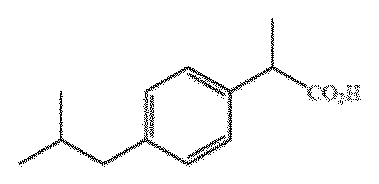
さらに例示的なアラルキル基は、その全体が参照により本明細書に組み込まれる、米国特許第7,626,014号に例示される。 Further exemplary aralkyl groups are exemplified in U.S. Pat. No. 7,626,014, the entirety of which is incorporated herein by reference.
別の実施形態において、好適な親油性部分は、脂質、コレステロール、レチノイン酸、コール酸、アダマンタン酢酸、1-ピレン酪酸、ジヒドロテストステロン、1,3-ビス-O(ヘキサデシル)グリセロール、グラニルオキシヘキサノール(geranyloxyhexyanol)、ヘキサデシルグリセロール、ボルネオール、メントール、1,3-プロパンジオール、ヘプタデシル基、パルミチン酸、ミリスチン酸、O3-(オレオイル)リトコール酸、O3-(オレオイル)コレン酸、イブプロフェン、ナプロキセン、ジメトキシトリチル、またはフェノキサジンを含む。 In another embodiment, suitable lipophilic moieties include lipids, cholesterol, retinoic acid, cholic acid, adamantane acetic acid, 1-pyrenebutyric acid, dihydrotestosterone, 1,3-bis-O(hexadecyl)glycerol, geranyloxyhexyanol, hexadecylglycerol, borneol, menthol, 1,3-propanediol, heptadecyl groups, palmitic acid, myristic acid, O3-(oleoyl)lithocholic acid, O3-(oleoyl)cholenic acid, ibuprofen, naproxen, dimethoxytrityl, or phenoxazine.
一部の実施形態において、親油性部分は、C6~C30酸(例えば、ヘキサン酸、ヘプタン酸、オクタン酸、ノナン酸、デカン酸、ウンデカン酸、ドデカン酸、トリデカン酸、テトラデカン酸、ペンタデカン酸、ヘキサデカン酸、ヘプタデカン産、オクタデカン酸、オレイン酸、リノール酸、アラキドン酸、シス-4,7,10,13,16,19-ドコサヘキサンエン酸、ビタミンA、ビタミンE、コレステロールなど)またはC6~C30アルコール(例えば、ヘキサノール、ヘプタノール、オクタノール、ノナノール、デカノール、ウンデカノール、ドデカノール、トリデカノール、テトラデカノール、ペンタデカノール、ヘキサデカノール、ヘプタデカノール、オクタデカノール、オレイルアルコール、リノレイルアルコール、アラキドン酸アルコール、シス-4,7、10,13,16,19-ドコサヘキサノール、レチノール、ビタミンE、コレステロールなど)である。一例において、親油性部分は、ドコサヘキサエン酸である。 In some embodiments, the lipophilic moiety is a C 6 -C 30 acid (e.g., hexanoic acid, heptanoic acid, octanoic acid, nonanoic acid, decanoic acid, undecanoic acid, dodecanoic acid, tridecanoic acid, tetradecanoic acid, pentadecanoic acid, hexadecanoic acid, heptadecanoic acid, octadecanoic acid, oleic acid, linoleic acid, arachidonic acid, cis-4,7,10,13,16,19-docosahexanoic acid, vitamin A, vitamin E, cholesterol, etc.) or a C 6 -C 30 alcohols (e.g., hexanol, heptanol, octanol, nonanol, decanol, undecanol, dodecanol, tridecanol, tetradecanol, pentadecanol, hexadecanol, heptadecanol, octadecanol, oleyl alcohol, linoleyl alcohol, arachidonic acid alcohol, cis-4,7,10,13,16,19-docosahexanol, retinol, vitamin E, cholesterol, etc.). In one example, the lipophilic moiety is docosahexaenoic acid.
ある特定の実施形態において、特に親油性部分が低い親油性または疎水性を有する場合、1つより多くの親油性部分が、一本鎖オリゴヌクレオチドに組み込まれうる。一実施形態において、2つまたはそれ以上の親油性部分は、一本鎖オリゴヌクレオチドの同じ鎖に組み込まれる。一実施形態において、一本鎖オリゴヌクレオチドの各鎖は、組み込まれた1つまたは複数の親油性部分を有する。一実施形態において、2つまたはそれ以上の親油性部分は、一本鎖オリゴヌクレオチドの同じ位置(すなわち、同じヌクレオ塩基、同じ糖部分、または同じヌクレオシド間連結)に組み込まれる。これは、例えば、担体を介して2つもしくはそれ以上の親油性部分をコンジュゲートすること、および/または分岐状リンカーを介して2つもしくはそれ以上の親油性部分をコンジュゲートすること、および/または連続的に親油性部分を連結する1つまたは複数のリンカーにより、1つもしくは複数のリンカーを介して2つもしくはそれ以上の親油性部分をコンジュゲートすることによって達成されうる。 In certain embodiments, more than one lipophilic moiety may be incorporated into a single-stranded oligonucleotide, especially if the lipophilic moiety has low lipophilicity or hydrophobicity. In one embodiment, two or more lipophilic moieties are incorporated into the same strand of a single-stranded oligonucleotide. In one embodiment, each strand of a single-stranded oligonucleotide has one or more lipophilic moieties incorporated therein. In one embodiment, two or more lipophilic moieties are incorporated into the same position of a single-stranded oligonucleotide (i.e., the same nucleobase, the same sugar moiety, or the same internucleoside linkage). This may be accomplished, for example, by conjugating two or more lipophilic moieties via a carrier, and/or by conjugating two or more lipophilic moieties via a branched linker, and/or by conjugating two or more lipophilic moieties via one or more linkers, with one or more linkers linking the lipophilic moieties in succession.
親油性部分は、一本鎖オリゴヌクレオチドのリボ糖への直接接合を介して、一本鎖オリゴヌクレオチドへとコンジュゲートされうる。あるいは、親油性部分は、リンカーまたは担体を介して一本鎖オリゴヌクレオチドへとコンジュゲートされうる。 The lipophilic moiety may be conjugated to the single-stranded oligonucleotide via direct conjugation to the ribosugar of the single-stranded oligonucleotide. Alternatively, the lipophilic moiety may be conjugated to the single-stranded oligonucleotide via a linker or carrier.
ある特定の実施形態において、親油性部分は、1つまたは複数のリンカー(テザー)を介して、一本鎖オリゴヌクレオチドへとコンジュゲートされうる。 In certain embodiments, the lipophilic moiety may be conjugated to the single-stranded oligonucleotide via one or more linkers (tethers).
一実施形態において、親油性部分は、エーテル、チオエーテル、尿素、炭酸塩、アミン、アミド、マレイミド-チオエーテル、ジスルフィド、ホスホジエステル、スルホンアミド結合、クリック反応の産物(例えば、アジド-アルキン環状付加からのトリアゾール)、またはカルバメートを含有するリンカーを介して、一本鎖オリゴヌクレオチドにコンジュゲートされる。 In one embodiment, the lipophilic moiety is conjugated to the single-stranded oligonucleotide via a linker that contains an ether, a thioether, a urea, a carbonate, an amine, an amide, a maleimide-thioether, a disulfide, a phosphodiester, a sulfonamide bond, a product of a click reaction (e.g., a triazole from an azide-alkyne cycloaddition), or a carbamate.
定義
特記されない限り、本明細書中において記載される分析化学、合成有機化学、および医薬品化学と関連して使用される命名法、ならびにその手順および技術は、当技術分野において周知かつ一般的に使用されるものである。化学合成および化学分析には、標準的な技術が使用されうる。特定のそのような技術および手順は、例えば、あらゆる目的のために参照によりそれらの全体において本明細書に組み込まれる、“Carbohydrate Modifications in Antisense Research” Edited by Sangvi and Cook, American Chemical Society, Washington D.C., 1994;“Remington's Pharmaceutical Sciences,” Mack Publishing Co., Easton, Pa., 18th edition, 1990;および“Antisense Drug Technology, Principles, Strategies, and Applications” Edited by Stanley T. Crooke, CRC Press, Boca Raton, Fla.;およびSambrook et al., “Molecular Cloning, A laboratory Manual,” 2nd Edition, Cold Spring Harbor Laboratory Press, 1989、に見られる。許可される場合、本明細書の開示において全体を通して言及される全ての特許、出願、公開された出願および他の刊行物ならびに他のデータは、その全体が参照により本明細書に組み込まれる。
Definitions Unless otherwise specified, the nomenclature used in connection with, and the procedures and techniques of, analytical chemistry, synthetic organic chemistry, and medicinal chemistry described herein are those well known and commonly used in the art. Standard techniques may be used for chemical synthesis and chemical analysis. Certain such techniques and procedures can be found, for example, in "Carbohydrate Modifications in Antisense Research" Edited by Sangvi and Cook, American Chemical Society, Washington DC, 1994; "Remington's Pharmaceutical Sciences," Mack Publishing Co., Easton, Pa., 18th edition, 1990; and "Antisense Drug Technology, Principles, Strategies, and Applications" Edited by Stanley T. Crooke, CRC Press, Boca Raton, Fla.; and Sambrook et al., "Molecular Cloning, A laboratory Manual," 2nd Edition, Cold Spring Harbor Laboratory Press, 1989, which are incorporated herein by reference in their entirety for all purposes. Where permitted, all patents, applications, published applications and other publications and other data referred to throughout this disclosure are incorporated herein by reference in their entirety.
特に断りのない限り、以下の用語は以下の意味を持つ。 Unless otherwise stated, the following terms have the following meanings:
本明細書において使用される、「標的核酸」という用語は、siRNA化合物によって発現または活性をモジュレートすることができる任意の核酸分子を指す。標的核酸には、標的タンパク質をコードするDNAから転写されたRNA(プレmRNAおよびmRNAまたはその一部を含むがこれらに限定されない)、ならびにそのようなRNAから誘導されたcDNA、およびmiRNAを含むがこれらに限定されない。例えば、標的核酸は、その発現が特定の障害または疾患状態と関連する細胞遺伝子(または、遺伝子から転写されるmRNA)でありうる。一部の実施形態において、標的核酸は、感染病原体由来の核酸分子でありうる。 As used herein, the term "target nucleic acid" refers to any nucleic acid molecule whose expression or activity can be modulated by an siRNA compound. Target nucleic acids include, but are not limited to, RNA (including, but not limited to, pre-mRNA and mRNA or portions thereof) transcribed from DNA encoding a target protein, as well as cDNAs derived from such RNAs, and miRNAs. For example, a target nucleic acid can be a cellular gene (or an mRNA transcribed from the gene) whose expression is associated with a particular disorder or disease state. In some embodiments, a target nucleic acid can be a nucleic acid molecule from an infectious agent.
本明細書において使用される、「iRNA」という用語は、RNA転写物のターゲティング切断を媒介する薬剤を指す。これらの薬剤は、RNAi誘導サイレンシング複合体(RISC)として知られる細胞質多タンパク質複合体と会合する。RNA干渉を誘導するのに有効な薬剤は、本明細書では、siRNA、RNAi剤、またはiRNA剤とも呼ばれる。したがって、これらの用語は、本明細書において互換的に使用されうる。本明細書において使用される、iRNAという用語は、マイクロRNAおよびプレマイクロRNAを含む。さらに、本明細書において使用される本発明の「化合物(compound)」または「化合物(compounds)」は、iRNA剤も指し、iRNA剤と互換的に使用されうる。 As used herein, the term "iRNA" refers to an agent that mediates targeted cleavage of an RNA transcript. These agents associate with a cytoplasmic multiprotein complex known as the RNAi-induced silencing complex (RISC). Agents effective to induce RNA interference are also referred to herein as siRNAs, RNAi agents, or iRNA agents. Thus, these terms may be used interchangeably herein. As used herein, the term iRNA includes microRNAs and pre-microRNAs. Additionally, the "compounds" or "compounds" of the present invention as used herein also refer to iRNA agents and may be used interchangeably with iRNA agents.
iRNA剤は、標的遺伝子に対して十分な相同性を有する領域を含み、ヌクレオチドに関して十分な長さを有し、iRNA剤またはその断片が標的遺伝子の下方調節を媒介することができるものでなければならない。(説明を容易にするために、本明細書では、ヌクレオチドまたはリボヌクレオチドという用語を、iRNA剤の1つまたは複数の単量体サブユニットに関して使用することがある。本明細書において、「リボヌクレオチド」または「ヌクレオチド」という用語の用法は、修飾RNAまたはヌクレオチド代用物の場合、1つまたは複数の位置における修飾ヌクレオチド、または代用物置換部分を指すこともあることが理解されるであろう)。したがって、iRNA剤は、標的RNAと少なくとも部分的に、一部の実施形態においては完全に相補的な領域であるか、またはそれを含む。iRNA剤と標的との間に完全な相補性がある必要はないが、iRNA剤またはその切断産物が、標的RNA、例えばmRNAのRNAi切断などにより、配列特異的サイレンシングを方向付けることを可能にするのに十分な対応性がなければならない。相補性、または標的鎖との相同性の程度は、アンチセンス鎖において最も重要である。特にアンチセンス鎖において完全な相補性が望まれることが多いが、一部の実施形態は、特にアンチセンス鎖において、1つまたは複数の、例えば6、5、4、3、2、またはそれ以下のミスマッチを含むことができる(標的RNAに関して)。センス鎖は、分子の全体的な二本鎖(double stranded)の性質を維持するために、アンチセンス鎖と十分に相補的であればよい。 An iRNA agent must include a region having sufficient homology to a target gene and be of sufficient length, in terms of nucleotides, such that the iRNA agent, or a fragment thereof, can mediate downregulation of the target gene. (For ease of explanation, the term nucleotide or ribonucleotide may be used herein with respect to one or more monomeric subunits of an iRNA agent. It will be understood that the use of the term "ribonucleotide" or "nucleotide" herein may also refer to the modified nucleotide, or surrogate replacement moiety, at one or more positions, in the case of a modified RNA or nucleotide surrogate.) Thus, an iRNA agent is or includes a region that is at least partially, and in some embodiments fully, complementary to a target RNA. There need not be perfect complementarity between an iRNA agent and a target, but there must be sufficient correspondence to allow the iRNA agent, or its cleavage products, to direct sequence-specific silencing, such as by RNAi cleavage of a target RNA, e.g., an mRNA. Complementarity, or the degree of homology with the target strand, is most important in the antisense strand. While perfect complementarity is often desired, particularly in the antisense strand, some embodiments can include one or more, e.g., 6, 5, 4, 3, 2, or fewer, mismatches (with respect to the target RNA), particularly in the antisense strand. The sense strand need only be sufficiently complementary to the antisense strand to maintain the overall double-stranded nature of the molecule.
iRNA剤は、インターフェロン応答を引き起こすのに十分な長さの分子[Dicerによって切断され(Bernstein et al. 2001. Nature, 409:363-366)、RISC(RNAi誘導サイレンシング複合体)に入ることができる]、およびインターフェロン応答を引き起こさない程度に十分に短い分子(この分子もまた、Dicerによって切断され、および/またはRISCに入ることができる)、例えば、RISCに入ることができるサイズの分子、例えば、Dicerによる切断産物に似た分子を含む。インターフェロン応答を引き起こさないように十分に短い分子は、本明細書ではsiRNA剤またはより短いiRNA剤と呼ばれる。本明細書において使用される、「siRNA剤またはより短いiRNA剤」とは、ヒト細胞において有害なインターフェロン応答を誘発しないように十分に短いiRNA剤、例えば、二本鎖RNA剤または一本鎖剤を指し、例えば、60、50、40、または30ヌクレオチド対未満の二本鎖領域を有する。siRNA剤、またはその切断産物は、例えば標的RNAに関してRNAiを誘導することによって、標的遺伝子を下方調節することができ、標的は内因性または病原体の標的RNAを含んでいてもよい。 iRNA agents include molecules that are long enough to trigger an interferon response [which can be cleaved by Dicer (Bernstein et al. 2001. Nature, 409:363-366) and enter RISC (RNAi-induced silencing complex)], and molecules that are short enough not to trigger an interferon response (which can also be cleaved by Dicer and/or enter RISC), e.g., molecules of a size that allows them to enter RISC, e.g., molecules that resemble the cleavage products of Dicer. Molecules that are short enough not to trigger an interferon response are referred to herein as siRNA agents or shorter iRNA agents. As used herein, "siRNA agents or shorter iRNA agents" refers to iRNA agents, e.g., double-stranded RNA agents or single-stranded agents, that are short enough not to induce a deleterious interferon response in human cells, e.g., having a double-stranded region of less than 60, 50, 40, or 30 nucleotide pairs. The siRNA agent, or its cleavage product, can downregulate a target gene, for example by inducing RNAi with respect to the target RNA, which may include an endogenous or pathogen target RNA.
本明細書において使用される、「一本鎖オリゴヌクレオチド」または「一本鎖iRNA剤」は、1分子から構成されるオリゴヌクレオチドまたはiRNA剤である。一本鎖オリゴヌクレオチドは、鎖内対合により形成される二重鎖領域を含んでいてもよく、例えば、ヘアピン構造、ダンベル構造、パンハンドル構造であってもよいし、それを含んでいてもよい。一本鎖オリゴヌクレオチドまたはiRNA剤は、標的分子に対してアンチセンスであってもよい。一本鎖オリゴヌクレオチドまたはiRNA剤は、RISCに入り、標的mRNAのRISC媒介切断に関与することができるように、十分に長くてもよい。一本鎖オリゴヌクレオチドまたはiRNA剤は、少なくとも14ヌクレオチド、他の実施形態において少なくとも15、20、25、29、35、40、または50ヌクレオチドの長さである。ある特定の実施形態において、長さが200、100、または60ヌクレオチド未満である。ある特定の実施形態において、一本鎖オリゴヌクレオチドは、連結基によって連結された2つのオリゴヌクレオチドを含有する。 As used herein, a "single stranded oligonucleotide" or "single stranded iRNA agent" is an oligonucleotide or iRNA agent that is composed of one molecule. A single stranded oligonucleotide may include a duplex region formed by intrastrand pairing, e.g., may be or may include a hairpin, dumbbell, or panhandle structure. A single stranded oligonucleotide or iRNA agent may be antisense to a target molecule. A single stranded oligonucleotide or iRNA agent may be sufficiently long so that it can enter RISC and participate in RISC-mediated cleavage of a target mRNA. A single stranded oligonucleotide or iRNA agent is at least 14 nucleotides, and in other embodiments at least 15, 20, 25, 29, 35, 40, or 50 nucleotides in length. In certain embodiments, the length is less than 200, 100, or 60 nucleotides. In certain embodiments, a single stranded oligonucleotide contains two oligonucleotides linked by a linking group.
ループとは、オリゴヌクレオチドまたはiRNA鎖の一部が、他の鎖または同じ鎖の別の部分と塩基対を形成する際に、二重鎖中の対向するヌクレオチドと対になっていない領域を指す。 A loop refers to a region in which a portion of an oligonucleotide or iRNA strand is not paired with the opposing nucleotide in the duplex when base pairing with the other strand or with another portion of the same strand.
ヘアピンオリゴヌクレオチドまたはiRNA剤は、17、18、19、29、21、22、23、24、または25ヌクレオチド対かまたは少なくとも17、18、19、29、21、22、23、24、または25ヌクレオチド対の二重鎖領域を有するであろう。二重鎖領域は、200、100、または50以下の長さであってもよい。ある特定の実施形態において、二重鎖領域の範囲は、15~30、17~23、19~23、および19~21ヌクレオチド対の長さである。ヘアピンは、一部の実施形態においては3’末端、ある特定の実施形態においてはヘアピンのアンチセンス側に、一本鎖突出または末端非対合領域を有してもよい。一部の実施形態において、突出は、2~3ヌクレオチドの長さである。 A hairpin oligonucleotide or iRNA agent will have a duplex region of 17, 18, 19, 29, 21, 22, 23, 24, or 25 nucleotide pairs or at least 17, 18, 19, 29, 21, 22, 23, 24, or 25 nucleotide pairs. The duplex region may be 200, 100, or 50 or less in length. In certain embodiments, the duplex region ranges from 15-30, 17-23, 19-23, and 19-21 nucleotide pairs in length. The hairpin may have a single-stranded overhang or terminal unpaired region at the 3' end in some embodiments, and at the antisense side of the hairpin in certain embodiments. In some embodiments, the overhang is 2-3 nucleotides in length.
本明細書において使用される、「二本鎖(double-stranded)オリゴヌクレオチド」、「二本鎖核酸剤」、または「二本鎖(ds)iRNA剤」とは、鎖間ハイブリダイゼーションが二重鎖構造の領域を形成しうる、1つまたは複数の、場合によっては2本の鎖を含むオリゴヌクレオチド、核酸剤、またはiRNA剤を指す。 As used herein, a "double-stranded oligonucleotide," "double-stranded nucleic acid agent," or "double-stranded (ds) iRNA agent" refers to an oligonucleotide, nucleic acid agent, or iRNA agent that includes one or more, and possibly two, strands in which interstrand hybridization can form a region of duplex structure.
本明細書において使用される、「活性」、「siRNA活性」、または「RNAi活性」という用語は、オリゴヌクレオチド、核酸剤、またはiRNA剤による遺伝子サイレンシングを指す。 As used herein, the terms "activity," "siRNA activity," or "RNAi activity" refer to gene silencing by an oligonucleotide, nucleic acid agent, or iRNA agent.
本明細書において使用される、オリゴヌクレオチド、核酸剤、またはiRNA剤による「遺伝子サイレンシング」とは、標的遺伝子を持つ細胞におけるmRNAレベルが、少なくとも約5%、少なくとも約10%、少なくとも約20%、少なくとも約30%、少なくとも約40%、少なくとも約50%、少なくとも約60%、少なくとも約70%、少なくとも約80%、少なくとも約90%、少なくとも約95%、少なくとも約99%、最大100%、およびmiRNAまたはRNA干渉分子が存在しない場合に細胞内で見出されるmRNAレベルの間の任意の整数まで減少することを指す。好ましい一実施形態において、mRNAレベルは、少なくとも約70%、少なくとも約80%、少なくとも約90%、少なくとも約95%、少なくとも約99%、最大100%、および5%と100%の間の任意の整数まで減少する。 As used herein, "gene silencing" by an oligonucleotide, nucleic acid agent, or iRNA agent refers to a reduction in mRNA levels in a cell harboring a target gene by at least about 5%, at least about 10%, at least about 20%, at least about 30%, at least about 40%, at least about 50%, at least about 60%, at least about 70%, at least about 80%, at least about 90%, at least about 95%, at least about 99%, up to 100%, and any integer between the mRNA levels found in the cell in the absence of the miRNA or RNA interference molecule. In a preferred embodiment, the mRNA levels are reduced by at least about 70%, at least about 80%, at least about 90%, at least about 95%, at least about 99%, up to 100%, and any integer between 5% and 100%.
本明細書において使用される、「遺伝子発現をモジュレートする」という用語は、遺伝子の発現、または1つもしくは複数のタンパク質もしくはタンパク質サブユニットをコードするRNA分子もしくは同等のRNA分子のレベルが、モジュレーターの非存在下で観察される発現、レベル、または活性よりも大きいかまたは小さいように、上方調節されるかまたは下方調節されることを意味する。例えば、「モジュレートする」という用語は「阻害する」を意味するが、「モジュレートする」という用語の使用はこの定義に限定されない。 As used herein, the term "modulate gene expression" means that the expression of a gene or the level of an RNA molecule encoding one or more proteins or protein subunits or equivalent RNA molecules is upregulated or downregulated such that it is greater or less than the expression, level, or activity observed in the absence of the modulator. For example, the term "modulate" can mean "inhibit," although use of the term "modulate" is not limited to this definition.
本明細書において使用される、遺伝子発現モジュレーションは、遺伝子の発現、または1つもしくは複数のタンパク質もしくはタンパク質サブユニットをコードするRNA分子もしくは同等のRNA分子のレベルが、siRNAの非存在下で観察されるものと少なくとも5%、10%、20%、30%、40%、50%、60%、70%、80%、90%、100%、2倍、3倍、4倍、5倍以上異なる場合に生じる。この差の%および/または倍率は、例えば、 As used herein, gene expression modulation occurs when the expression of a gene or the level of an RNA molecule encoding one or more proteins or protein subunits or equivalent RNA molecules differs by at least 5%, 10%, 20%, 30%, 40%, 50%, 60%, 70%, 80%, 90%, 100%, 2-fold, 3-fold, 4-fold, 5-fold or more from that observed in the absence of siRNA. The percentage and/or fold difference can be expressed, for example, as follows:
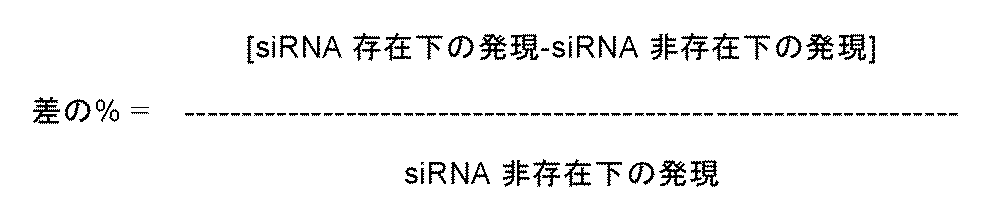
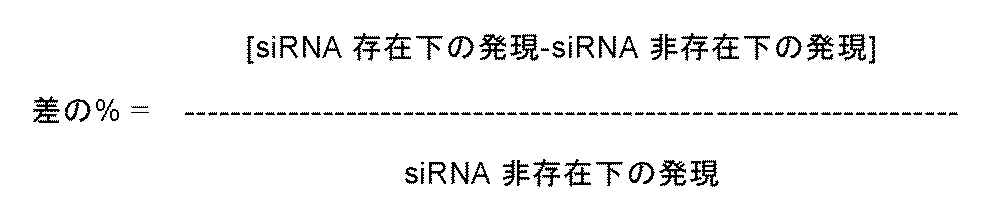
本明細書において使用される、遺伝子発現に関連して「阻害する」、「下方調節する」、または「低下する」という用語は、遺伝子の発現、または1つもしくは複数のタンパク質もしくはタンパク質サブユニットをコードするRNA分子もしくは同等のRNA分子のレベル、または1つもしくは複数のタンパク質もしくはタンパク質サブユニットの活性が、モジュレーターの非存在下で観察されるものよりも低下することを意味する。遺伝子発現が下方調節されるのは、遺伝子の発現、または1つもしくは複数のタンパク質もしくはタンパク質サブユニットをコードするRNA分子もしくは同等のRNA分子のレベル、または1つもしくは複数のタンパク質もしくはタンパク質サブユニットの活性が、対応するモジュレートされていない対照と比較して少なくとも10%低下する場合であり、好ましくは少なくとも10%、20%、30%、40%、50%、60%、70%、80%、90%、95%、98%、99%、または最も好ましくは100%(すなわち、遺伝子発現がない)低下する場合である。 As used herein, the terms "inhibit," "downregulate," or "reduce" in relation to gene expression means that the expression of a gene, or the level of an RNA molecule or equivalent RNA molecule encoding one or more proteins or protein subunits, or the activity of one or more proteins or protein subunits, is reduced below that observed in the absence of a modulator. Gene expression is downregulated when the expression of a gene, or the level of an RNA molecule or equivalent RNA molecule encoding one or more proteins or protein subunits, or the activity of one or more proteins or protein subunits, is reduced by at least 10% compared to a corresponding unmodulated control, preferably by at least 10%, 20%, 30%, 40%, 50%, 60%, 70%, 80%, 90%, 95%, 98%, 99%, or most preferably 100% (i.e., no gene expression).
本明細書において使用される、遺伝子発現に関連して「増加する」、または「上方調節する」、という用語は、遺伝子の発現、または1つもしくは複数のタンパク質もしくはタンパク質サブユニットをコードするRNA分子もしくは同等のRNA分子のレベル、または1つもしくは複数のタンパク質もしくはタンパク質サブユニットの活性が、モジュレーターの非存在下で観察されるものよりも増加することを意味する。遺伝子発現が上方調節されるのは、遺伝子の発現、または1つもしくは複数のタンパク質もしくはタンパク質サブユニットをコードするRNA分子もしくは同等のRNA分子のレベル、または1つもしくは複数のタンパク質もしくはタンパク質サブユニットの活性が、対応するモジュレートされていない対照と比較して少なくとも10%増加する場合であり、好ましくは少なくとも10%、20%、30%、40%、50%、60%、70%、80%、90%、95%、98%、100%、1.1倍、1.25倍、1.5倍、1.75倍、2倍、3倍、4倍、5倍、10倍、50倍、100倍またはそれ以上増加する場合である。 As used herein, the terms "increase" or "upregulate" in relation to gene expression means that the expression of a gene, or the level of an RNA molecule or equivalent RNA molecule encoding one or more proteins or protein subunits, or the activity of one or more proteins or protein subunits, is increased above that observed in the absence of a modulator. Gene expression is upregulated when the expression of a gene, or the level of an RNA molecule or equivalent RNA molecule encoding one or more proteins or protein subunits, or the activity of one or more proteins or protein subunits, is increased by at least 10% compared to a corresponding unmodulated control, preferably by at least 10%, 20%, 30%, 40%, 50%, 60%, 70%, 80%, 90%, 95%, 98%, 100%, 1.1-fold, 1.25-fold, 1.5-fold, 1.75-fold, 2-fold, 3-fold, 4-fold, 5-fold, 10-fold, 50-fold, 100-fold or more.
本明細書において使用される、「増加した」または「増加する」という用語は、一般に、統計的に(statically)有意な量の増加を意味する。疑義を避けるために、「増加した」とは、基準レベルと比較して少なくとも10%の増加、例えば、少なくとも約20%、少なくとも約30%、少なくとも約40%、少なくとも約50%、少なくとも約60%、少なくとも約70%、少なくとも約80%の増加を意味する、または少なくとも約90%、または最大100%までの増加、または基準レベルと比較して10~100%の間の任意の増加、または基準レベルと比較して少なくとも約2倍、または少なくとも約3倍、または少なくとも約4倍、または少なくとも約5倍、または少なくとも約10倍の増加、または基準レベルと比較して2倍から10倍以上の間の任意の増加を意味する。 As used herein, the term "increased" or "increase" generally refers to an increase by a statistically significant amount. For the avoidance of doubt, "increased" means an increase of at least 10% compared to the base level, e.g., at least about 20%, at least about 30%, at least about 40%, at least about 50%, at least about 60%, at least about 70%, at least about 80% increase, or at least about 90%, or up to 100%, or any increase between 10-100% compared to the base level, or at least about 2-fold, or at least about 3-fold, or at least about 4-fold, or at least about 5-fold, or at least about 10-fold increase compared to the base level, or any increase between 2-fold and 10-fold or more compared to the base level.
本明細書において使用される、「低下した」または「低下する」という用語は、一般に、統計的に有意な量の減少を意味する。しかしながら、疑義を避けるために、「低下した」とは、基準レベルと比較して少なくとも10%の減少、例えば、少なくとも約20%、または少なくとも約30%、または少なくとも約40%、または少なくとも約50%、または少なくとも約60%、または少なくとも約70%、または少なくとも約80%、または少なくとも約90%、または最大100%(すなわち、基準試料と比較して、存在しないレベル)までの減少、または基準レベルと比較して10~100%の間の任意の減少を意味する。 As used herein, the term "reduced" or "reducing" generally refers to a statistically significant amount of reduction. However, for the avoidance of doubt, "reduced" refers to a reduction of at least 10% compared to a reference level, e.g., at least about 20%, or at least about 30%, or at least about 40%, or at least about 50%, or at least about 60%, or at least about 70%, or at least about 80%, or at least about 90%, or up to 100% (i.e., a level that is absent compared to a reference sample), or any reduction between 10-100% compared to a reference level.
二本鎖核酸剤は、ハイブリダイズして二重鎖構造を形成するのに十分な相補性を持つ2本のオリゴヌクレオチド鎖を含む。一般に、二重鎖構造は、8から30の間、15から30の間、18から25の間、19から24の間、または19から21の間の塩基対の長さである。一部の実施形態において、25から30の間の塩基対の長さの、長い二本鎖核酸剤が好ましい。一部の実施形態において、10から15の間の塩基対の長さの、短い二本鎖核酸剤が好ましい。別の実施形態において、二本鎖核酸剤は少なくとも21ヌクレオチド長である。 A double-stranded nucleic acid agent comprises two oligonucleotide strands that are sufficiently complementary to hybridize to form a duplex structure. Generally, the duplex structure is between 8 and 30, between 15 and 30, between 18 and 25, between 19 and 24, or between 19 and 21 base pairs in length. In some embodiments, long double-stranded nucleic acid agents are preferred, between 25 and 30 base pairs in length. In some embodiments, short double-stranded nucleic acid agents are preferred, between 10 and 15 base pairs in length. In another embodiment, the double-stranded nucleic acid agent is at least 21 nucleotides in length.
本明細書において使用される、「アンチセンス鎖」または「アンチセンスオリゴヌクレオチド」という語句は、目的の標的配列に実質的にまたは100%相補的なオリゴマー化合物を指す。「アンチセンス鎖」という語句は、2つの別々の鎖から形成されるオリゴマー化合物、およびヘアピンまたはダンベル型構造を形成することができる単分子オリゴマー化合物の両方のアンチセンス領域を含む。「アンチセンス鎖」および「ガイド鎖」という用語は、本明細書において互換的に使用される。 As used herein, the phrase "antisense strand" or "antisense oligonucleotide" refers to an oligomeric compound that is substantially or 100% complementary to a target sequence of interest. The phrase "antisense strand" includes the antisense regions of both oligomeric compounds formed from two separate strands, and unimolecular oligomeric compounds that can form hairpin or dumbbell-shaped structures. The terms "antisense strand" and "guide strand" are used interchangeably herein.
「センス鎖」という語句は、メッセンジャーRNAまたはDNA配列のような標的配列と全部または一部が同じヌクレオシド配列を有するオリゴマー化合物を指す。「センス鎖」および「パッセンジャー鎖」という用語は、本明細書において互換的に使用される。 The phrase "sense strand" refers to an oligomeric compound having a nucleoside sequence that is the same in whole or in part as a target sequence, such as a messenger RNA or DNA sequence. The terms "sense strand" and "passenger strand" are used interchangeably herein.
「特異的にハイブリダイズ可能」および「相補的」とは、核酸が別の核酸配列と従来のワトソン-クリック型または他の非従来型のいずれかによって水素結合(複数可)を形成できることを意味する。本発明の核酸分子に関して、核酸分子とその相補配列との結合自由エネルギーは、核酸の関連機能、例えばRNAi活性を進行させるのに十分である。核酸分子の結合自由エネルギーの決定は、当技術分野において周知である(例えば、Turner et al, 1987, CSH Symp. Quant. Biol. LII pp.123-133; Frier et al., 1986, Proc. Nat. Acad. Sci. USA 83:9373-9377; Turner et al., 1987, /. Am. Chem. Soc. 109:3783-3785を参照されたい)。相補性パーセントとは、第2の核酸配列と水素結合(例えば、ワトソン-クリック型塩基対)を形成できる核酸分子中の連続した残基の百分率を示す(例えば、10のうち5、6、7、8、9、10が50%、60%、70%、80%、90%、100%相補性)。「完全相補性」または100%相補性とは、核酸配列の全ての連続する残基が、第2の核酸配列の同じ数の連続する残基と水素結合することを意味する。完全相補性未満とは、2本の鎖のヌクレオシド単位の一部ではあるが、全てではなく、互いに水素結合できる状況を指す。「実質的相補性」とは、90%以上の相補性を示すポリヌクレオチド鎖を指し、オーバーハングなど、非相補性となるように選択されたポリヌクレオチド鎖の領域を除く。特異的結合は、特異的結合が望まれる条件下、すなわち、インビボアッセイまたは治療的処置の場合には生理学的条件下、インビトロアッセイの場合にはアッセイが実施される条件下において、オリゴマー化合物の非標的配列への非特異的結合を回避するのに十分な程度の相補性を必要とする。非標的配列は典型的には少なくとも5ヌクレオチド異なる。 "Specifically hybridizable" and "complementary" mean that a nucleic acid can form hydrogen bond(s) with another nucleic acid sequence, either by conventional Watson-Crick or other non-conventional methods. With respect to the nucleic acid molecules of the present invention, the binding free energy between the nucleic acid molecule and its complementary sequence is sufficient to allow the relevant function of the nucleic acid to proceed, e.g., RNAi activity. Determination of the binding free energy of nucleic acid molecules is well known in the art (see, e.g., Turner et al, 1987, CSH Symp. Quant. Biol. LII pp.123-133; Frier et al., 1986, Proc. Nat. Acad. Sci. USA 83:9373-9377; Turner et al., 1987, /. Am. Chem. Soc. 109:3783-3785). Percent complementarity refers to the percentage of contiguous residues in a nucleic acid molecule that can form hydrogen bonds (e.g., Watson-Crick base pairs) with a second nucleic acid sequence (e.g., 5, 6, 7, 8, 9, 10 out of 10 are 50%, 60%, 70%, 80%, 90%, 100% complementary). "Fully complementary" or 100% complementary means that all contiguous residues of a nucleic acid sequence will hydrogen bond with the same number of contiguous residues of a second nucleic acid sequence. Less than fully complementary refers to a situation in which some, but not all, of the nucleoside units of the two strands can hydrogen bond with each other. "Substantial complementarity" refers to polynucleotide strands that exhibit 90% or greater complementarity, excluding regions of the polynucleotide strands that are selected to be non-complementary, such as overhangs. Specific binding requires a sufficient degree of complementarity to avoid non-specific binding of the oligomeric compound to non-target sequences under conditions where specific binding is desired, i.e., physiological conditions in the case of in vivo assays or therapeutic treatments, or conditions under which the assay is performed in the case of in vitro assays. The non-target sequences typically differ by at least 5 nucleotides.
一部の実施形態において、二本鎖核酸剤の二本鎖領域は、10、11、12、13、14、15、16、17、18、19、20、21、22、23、24、25、26、27、28、29、30、またはそれ以上のヌクレオチド対の長さと等しいか、または少なくとも10、11、12、13、14、15、16、17、18、19、20、21、22、23、24、25、26、27、28、29、30、またはそれ以上のヌクレオチド対の長さである。 In some embodiments, the double-stranded region of the double-stranded nucleic acid agent is equal to or at least 10, 11, 12, 13, 14, 15, 16, 17, 18, 19, 20, 21, 22, 23, 24, 25, 26, 27, 28, 29, 30, or more nucleotide pairs in length.
一部の実施形態において、二本鎖核酸剤の第1のオリゴヌクレオチドは、14、15、16、17、18、19、20、21、22、23、24、25、26、27、28、29、または30ヌクレオチドの長さと等しいか、または少なくとも14、15、16、17、18、19、20、21、22、23、24、25、26、27、28、29、または30ヌクレオチドの長さである。 In some embodiments, the first oligonucleotide of the double-stranded nucleic acid agent is equal to or at least 14, 15, 16, 17, 18, 19, 20, 21, 22, 23, 24, 25, 26, 27, 28, 29, or 30 nucleotides in length.
一部の実施形態において、二本鎖核酸剤の第2のオリゴヌクレオチドは、10、11、12、13、14、15、16、17、18、19、20、21、22、23、24、25、26、27、28、29、または30ヌクレオチドの長さと等しいか、または少なくとも10、11、12、13、14、15、16、17、18、19、20、21、22、23、24、25、26、27、28、29、または30ヌクレオチドの長さである。 In some embodiments, the second oligonucleotide of the double-stranded nucleic acid agent is equal to or at least 10, 11, 12, 13, 14, 15, 16, 17, 18, 19, 20, 21, 22, 23, 24, 25, 26, 27, 28, 29, or 30 nucleotides in length.
一実施形態において、二本鎖核酸剤の第1および第2のオリゴヌクレオチドは、それぞれ15~30ヌクレオチドの長さである。 In one embodiment, the first and second oligonucleotides of the double-stranded nucleic acid agent are each 15-30 nucleotides in length.
一実施形態において、二本鎖核酸剤の第1および第2のオリゴヌクレオチドは、それぞれ19~25ヌクレオチドの長さである。 In one embodiment, the first and second oligonucleotides of the double-stranded nucleic acid agent are each 19-25 nucleotides in length.
一実施形態において、二本鎖核酸剤の第1および第2のオリゴヌクレオチドは、それぞれ21~23ヌクレオチドの長さである。 In one embodiment, the first and second oligonucleotides of the double-stranded nucleic acid agent are each 21-23 nucleotides in length.
一部の実施形態において、1つのオリゴヌクレオチドは、二本鎖領域中に1~5本の一本鎖ヌクレオチドの少なくとも1つのストレッチを有する。「二本鎖領域中の一本鎖ヌクレオチドのストレッチ」とは、一本鎖ストレッチの両端に少なくとも1つのヌクレオチド塩基対が存在することを意味する。一部の実施形態において、両鎖は、二本鎖領域中に、1~5(例えば、1、2、3、4、または5)の一本鎖ヌクレオチドの少なくとも1つのストレッチを有する。両鎖が、二本鎖領域中に1~5(例えば、1、2、3、4、または5)の一本鎖ヌクレオチドのストレッチを有する場合、このような一本鎖ヌクレオチドは、互いに対向しうる(例えば、ミスマッチのストレッチ)、または第2のオリゴヌクレオチドが第1のオリゴヌクレオチドの一本鎖ヌクレオチドに対向する、逆もまた同様である一本鎖ヌクレオチドを有さない(例えば、一本鎖ループ)ように配置されうる。一部の実施形態において、一本鎖ヌクレオチドは、いずれかの末端から8ヌクレオチド以内に存在し、例えば2つのオリゴヌクレオチド間の相補性の領域の5’末端または3’末端のいずれかから8ヌクレオチド以内、例えば8、7、6、5、4、3、または2ヌクレオチド以内に存在する。 In some embodiments, one oligonucleotide has at least one stretch of 1-5 single-stranded nucleotides in the double-stranded region. By "stretch of single-stranded nucleotides in the double-stranded region" it is meant that there is at least one nucleotide base pair at both ends of the single-stranded stretch. In some embodiments, both strands have at least one stretch of 1-5 (e.g., 1, 2, 3, 4, or 5) single-stranded nucleotides in the double-stranded region. When both strands have a stretch of 1-5 (e.g., 1, 2, 3, 4, or 5) single-stranded nucleotides in the double-stranded region, such single-stranded nucleotides can be opposite each other (e.g., a mismatched stretch) or can be arranged such that the second oligonucleotide does not have a single-stranded nucleotide opposite a single-stranded nucleotide of the first oligonucleotide, or vice versa (e.g., a single-stranded loop). In some embodiments, the single stranded nucleotide is within 8 nucleotides of either end, e.g., within 8 nucleotides, e.g., within 8, 7, 6, 5, 4, 3, or 2 nucleotides, of either the 5' or 3' end of the region of complementarity between the two oligonucleotides.
一実施形態において、二本鎖核酸剤は、末端の少なくとも1つに一本鎖突出を含む。一実施形態において、一本鎖突出は、1、2、または3ヌクレオチドの長さである。 In one embodiment, the double-stranded nucleic acid agent includes a single-stranded overhang on at least one of the termini. In one embodiment, the single-stranded overhang is 1, 2, or 3 nucleotides in length.
一実施形態において、二本鎖核酸剤の第2のオリゴヌクレオチドは、21ヌクレオチドの長さであり、第1のオリゴヌクレオチドは、23ヌクレオチドの長さであり、ここで、第1および第2のオリゴヌクレオチドは、3’末端に2ヌクレオチド長い一本鎖突出を有する21連続塩基対の二本鎖領域を形成する。 In one embodiment, the second oligonucleotide of the double-stranded nucleic acid agent is 21 nucleotides in length and the first oligonucleotide is 23 nucleotides in length, where the first and second oligonucleotides form a double-stranded region of 21 contiguous base pairs with a 2 nucleotide long single-stranded overhang at the 3' end.
一部の実施形態において、二本鎖核酸剤の各オリゴヌクレオチドは、参照によりその全体において本明細書に組み込まれるPCT公開第2004080406号に記載されているようなZXY構造を有する。 In some embodiments, each oligonucleotide of the double-stranded nucleic acid agent has a ZXY structure as described in PCT Publication No. 2004080406, which is incorporated herein by reference in its entirety.
ある特定の実施形態において、2つのヌクレオチド配列は共に連結されて長い鎖を形成しうる。2つのヌクレオチド配列は、(N)n(式中、Nは、独立に、修飾ヌクレオチドまたは非修飾ヌクレオチドであり、nは、3~23である)を含むが、これに限定されない、オリゴヌクレオチドリンカーによって共に連結されうる。一部の実施形態において、nは、3~10、例えば、3、4、5、6、7、8、9、または10である。一部の実施形態において、オリゴヌクレオチドリンカーは、GNRA、(G)4、(U)4、および(dT)4(式中、Nは、修飾ヌクレオチドまたは非修飾ヌクレオチドであり、Rは、修飾プリンヌクレオチドまたは非修飾プリンヌクレオチドである)からなる群から選択される。リンカー中のヌクレオチドの一部は、リンカー中の他のヌクレオチドとの塩基対相互作用に含まれうる。2つのヌクレオチド配列は、非ヌクレオチドベースのリンカー、例えば、本明細書において記載されるリンカーによって、共に連結されてもよい。本明細書において記載される任意のオリゴヌクレオチド化学修飾またはバリエーションが、オリゴヌクレオチドリンカーに使用されうることは、当業者に理解されるであろう。 In certain embodiments, two nucleotide sequences may be linked together to form a long chain. Two nucleotide sequences may be linked together by an oligonucleotide linker, including but not limited to, (N) n , where N is independently a modified or unmodified nucleotide and n is 3-23. In some embodiments, n is 3-10, e.g., 3, 4, 5, 6, 7, 8, 9, or 10. In some embodiments, the oligonucleotide linker is selected from the group consisting of GNRA, (G) 4 , (U) 4 , and (dT) 4 , where N is a modified or unmodified nucleotide and R is a modified or unmodified purine nucleotide. Some of the nucleotides in the linker may be involved in base pairing interactions with other nucleotides in the linker. Two nucleotide sequences may be linked together by a non-nucleotide based linker, e.g., the linkers described herein. It will be understood by those of skill in the art that any of the oligonucleotide chemical modifications or variations described herein may be used in the oligonucleotide linker.
ある特定の実施形態において、特異的結合が望まれる条件下、すなわち、インビボアッセイまたは治療的処置の場合には生理学的条件下、インビトロアッセイの場合にはアッセイが実施される条件下において、非標的核酸配列へのアンチセンス化合物の非特異的結合を回避するのに十分な程度の相補性が存在する場合、2本の鎖は特異的にハイブリダイズする。 In certain embodiments, the two strands specifically hybridize if there is a sufficient degree of complementarity to avoid nonspecific binding of the antisense compound to non-target nucleic acid sequences under conditions where specific binding is desired, i.e., physiological conditions in the case of an in vivo assay or therapeutic treatment, or conditions under which the assay is performed in the case of an in vitro assay.
本明細書において使用される、「厳密なハイブリダイゼーション条件」または「厳密な条件」とは、アンチセンス化合物がその標的配列にハイブリダイズするが、他の配列には最小限の数しかハイブリダイズしない条件を指す。厳密な条件は配列に依存し、異なる状況では異なり、アンチセンス化合物が標的配列にハイブリダイズする「厳密な条件」は、アンチセンス化合物の性質および組成、ならびにそれらが研究されるアッセイによって決定される。 As used herein, "stringent hybridization conditions" or "stringent conditions" refers to conditions under which an antisense compound hybridizes to its target sequence but only to a minimal number of other sequences. Stringent conditions are sequence-dependent and will be different in different circumstances, and the "stringent conditions" under which an antisense compound hybridizes to a target sequence are determined by the nature and composition of the antisense compound and the assay in which they are studied.
ヌクレオチド親和性修飾の組み込みは、非修飾化合物と比較して、より多くのミスマッチを許容しうることが当技術分野で理解されている。同様に、ある特定のオリゴヌクレオチド配列は、他のオリゴヌクレオチド配列よりもミスマッチに対してより許容度が高いことがある。当業者であれば、融解温度(Tm)を決定することなどにより、オリゴヌクレオチド間、またはオリゴヌクレオチドと標的核酸間の適切なミスマッチ数を決定することができる。TmまたはΔTmは、当業者に周知の技術によって計算されうる。例えば、Freier et al.(Nucleic Acids Research, 1997, 25, 22: 4429-4443)に記載されている技術により、当業者は、RNA:DNA二重鎖の融解温度を上昇させる能力についてヌクレオチド修飾を評価することができる。 It is understood in the art that the incorporation of nucleotide affinity modifications may tolerate more mismatches compared to unmodified compounds. Similarly, certain oligonucleotide sequences may be more tolerant of mismatches than other oligonucleotide sequences. One of skill in the art can determine the appropriate number of mismatches between oligonucleotides, or between an oligonucleotide and a target nucleic acid, such as by determining the melting temperature (Tm). Tm or ΔTm may be calculated by techniques well known to those of skill in the art. For example, one of skill in the art can evaluate nucleotide modifications for their ability to increase the melting temperature of an RNA:DNA duplex by techniques described in Freier et al. (Nucleic Acids Research, 1997, 25, 22: 4429-4443).
一本鎖オリゴヌクレオチドは、ヌクレオチド配列の5’末端にリン含有基を含みうる。5’末端のリン含有基は、5’末端ホスフェート(5’-P)、5’末端ホスホロチオエート(5’-PS)、5’末端ホスホロジチオエート(5’-PS2)、5’末端ビニルホスホネート(5’-VP)、5’末端メチルホスホネート(MePhos)、または5’-デオキシ-5’-C-マロニル( The single stranded oligonucleotide may contain a phosphorus-containing group at the 5'-end of the nucleotide sequence. The phosphorus-containing group at the 5'-end may be 5'-terminal phosphate (5'-P), 5'-terminal phosphorothioate (5'-PS), 5'-terminal phosphorodithioate (5'-PS 2 ), 5'-terminal vinylphosphonate (5'-VP), 5'-terminal methylphosphonate (MePhos), or 5'-deoxy-5'-C-malonyl (
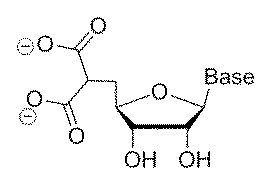
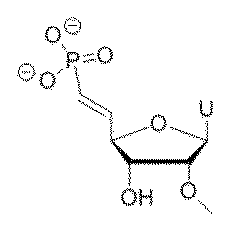
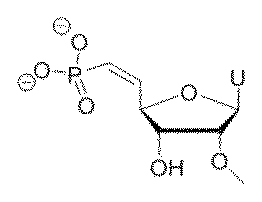
一実施形態において、一本鎖オリゴヌクレオチドは、ヌクレオチド配列(例えば、Z1および/またはZ2)の5’末端にリン含有基を含む。 In one embodiment, the single stranded oligonucleotide comprises a phosphorus-containing group at the 5' end of a nucleotide sequence (eg, Z 1 and/or Z 2 ).
一実施形態において、一本鎖オリゴヌクレオチドは、少なくとも1つのヌクレオチド配列(例えば、Z1および/またはZ2)に5’-Pを含む。 In one embodiment, the single stranded oligonucleotide comprises a 5'-P in at least one nucleotide sequence (eg, Z 1 and/or Z 2 ).
一実施形態において、一本鎖オリゴヌクレオチドは、少なくとも1つのヌクレオチド配列(例えば、Z1および/またはZ2)に5’-PSを含む。 In one embodiment, the single stranded oligonucleotide comprises a 5'-PS in at least one nucleotide sequence (eg, Z 1 and/or Z 2 ).
一実施形態において、一本鎖オリゴヌクレオチドは、少なくとも1つのヌクレオチド配列(例えば、Z1および/またはZ2)に5’-VPを含む。一実施形態において、一本鎖オリゴヌクレオチドは、少なくとも1つのヌクレオチド配列(例えば、Z1および/またはZ2)に5’-A1-VPを含む。一実施形態において、一本鎖オリゴヌクレオチドは、少なくとも1つのヌクレオチド配列(例えば、Z1および/またはZ2)に5’-Z-VPを含む。 In one embodiment, the single stranded oligonucleotide comprises 5'-VP in at least one nucleotide sequence (e.g., Z1 and/or Z2 ). In one embodiment, the single stranded oligonucleotide comprises 5'-A1-VP in at least one nucleotide sequence (e.g., Z1 and/or Z2 ). In one embodiment, the single stranded oligonucleotide comprises 5'-Z-VP in at least one nucleotide sequence (e.g., Z1 and/or Z2 ).
一実施形態において、一本鎖オリゴヌクレオチドは、少なくとも1つのヌクレオチド配列(例えば、Z1および/またはZ2)に5’-PS2を含む。 In one embodiment, the single stranded oligonucleotide comprises a 5'-PS 2 in at least one nucleotide sequence (eg, Z 1 and/or Z 2 ).
一実施形態において、一本鎖オリゴヌクレオチドは、少なくとも1つのヌクレオチド配列(例えば、Z1および/またはZ2)に5’-デオキシ-5’-C-マロニルを含む。 In one embodiment, the single stranded oligonucleotide contains 5'-deoxy-5'-C-malonyl in at least one nucleotide sequence (eg, Z 1 and/or Z 2 ).
一実施形態において、100%、95%、90%、85%、80%、75%、70%、65%、60%、55%、50%、45%、40%、35%または30%の一本鎖オリゴヌクレオチドが修飾される。例えば、50%の一本鎖オリゴヌクレオチドが修飾される場合、一本鎖オリゴヌクレオチドに存在する50%の全てのヌクレオチドが、本明細書において記載される修飾を含有する。 In one embodiment, 100%, 95%, 90%, 85%, 80%, 75%, 70%, 65%, 60%, 55%, 50%, 45%, 40%, 35% or 30% of the single stranded oligonucleotides are modified. For example, if 50% of the single stranded oligonucleotides are modified, then 50% of all nucleotides present in the single stranded oligonucleotides contain a modification as described herein.
一実施形態において、一本鎖オリゴヌクレオチドのZ1およびZ2の各ヌクレオチドは、非環状ヌクレオチド、LNA、HNA、CeNA、2’-メトキシエチル、2’-O-メチル、2’-O-アリル、2’-C-アリル、2’-デオキシ、2’-フルオロ、2’-O-N-メチルアセトアミド(2’-O-NMA)、2’-O-ジメチルアミノエトキシエチル(2’-O-DMAEOE)、2’-O-アミノプロピル(2’-O-AP)、または2’-アラ-Fによって独立して修飾される。 In one embodiment, each nucleotide of Z 1 and Z 2 of the single stranded oligonucleotide is independently modified with an acyclic nucleotide, LNA, HNA, CeNA, 2'-methoxyethyl, 2'-O-methyl, 2'-O-allyl, 2'-C-allyl, 2'-deoxy, 2'-fluoro, 2'-O-N-methylacetamide (2'-O-NMA), 2'-O-dimethylaminoethoxyethyl (2'-O-DMAEOE), 2'-O-aminopropyl (2'-O-AP), or 2'-ara-F.
一実施形態において、一本鎖オリゴヌクレオチドのヌクレオチド配列(例えば、Z1および/またはZ2)は、少なくとも2つの異なる修飾を含有する。 In one embodiment, the nucleotide sequence of a single stranded oligonucleotide (eg, Z 1 and/or Z 2 ) contains at least two different modifications.
一実施形態において、一本鎖オリゴヌクレオチドは2’-F修飾を含有しない。 In one embodiment, the single stranded oligonucleotide does not contain a 2'-F modification.
一実施形態において、一本鎖オリゴヌクレオチドは、ホスホロチオエートまたはメチルホスホネートヌクレオチド間連結の1つまたは複数のブロックを含む。一例において、一本鎖オリゴヌクレオチドは、2つのホスホロチオエートヌクレオチド間連結またはメチルホスホネートヌクレオチド間連結の1つのブロックを含む。例えば、ホスホロチオエートヌクレオチド間連結またはメチルホスホネートヌクレオチド間連結の2つのブロックは、16~18個のリン酸ヌクレオチド間連結により隔てられている。 In one embodiment, the single stranded oligonucleotide comprises one or more blocks of phosphorothioate or methylphosphonate internucleotide linkages. In one example, the single stranded oligonucleotide comprises two phosphorothioate or one block of methylphosphonate internucleotide linkages. For example, the two blocks of phosphorothioate or methylphosphonate internucleotide linkages are separated by 16-18 phosphate internucleotide linkages.
一実施形態において、ヌクレオチド配列(例えば、Z1および/またはZ2)の5’末端の1位のヌクレオチドは、A、dA、dU、U、およびdTからなる群より選択される。一実施形態において、ヌクレオチド配列(例えば、Z1および/またはZ2)の5’末端から1番目、2番目、および3番目の塩基対の少なくとも1つは、AU塩基対である。 In one embodiment, the nucleotide at position 1 of the 5' end of a nucleotide sequence (e.g., Z1 and/or Z2 ) is selected from the group consisting of A, dA, dU, U, and dT. In one embodiment, at least one of the first, second, and third base pairs from the 5' end of a nucleotide sequence (e.g., Z1 and/or Z2 ) is an AU base pair.
一実施形態において、一本鎖オリゴヌクレオチドは、標的RNAと100%相補的であり、それにハイブリダイズし、RNA干渉によりその発現を阻害する。別の実施形態において、一本鎖オリゴヌクレオチドは、標的RNAに対して少なくとも95%、少なくとも90%、少なくとも85%、少なくとも80%、少なくとも75%、少なくとも70%、少なくとも65%、少なくとも60%、少なくとも55%、または少なくとも50%相補的である。 In one embodiment, the single stranded oligonucleotide is 100% complementary to the target RNA, hybridizes thereto, and inhibits its expression by RNA interference. In another embodiment, the single stranded oligonucleotide is at least 95%, at least 90%, at least 85%, at least 80%, at least 75%, at least 70%, at least 65%, at least 60%, at least 55%, or at least 50% complementary to the target RNA.
本明細書の一部の実施形態においては、標的遺伝子の発現を阻害することができる一本鎖オリゴヌクレオチドが提供される。一本鎖オリゴヌクレオチドは、少なくとも1つの熱不安定性ヌクレオチドを含有する。 In some embodiments of the present specification, a single-stranded oligonucleotide capable of inhibiting expression of a target gene is provided. The single-stranded oligonucleotide contains at least one thermolabile nucleotide.
熱不安定性ヌクレオチドは、例えば、21ヌクレオチドの長さのヌクレオチド配列(例えば、Z1および/またはZ2)の5’末端の14~17位の間に生じうる。ヌクレオチド配列は、立体的に要求される2’-OMe修飾よりも小さい少なくとも2つの修飾核酸を含有しうる。好ましくは、立体的に要求される2’-OMeより小さい2つの修飾核酸は、11ヌクレオチドの長さによって分離される。例えば、2つの修飾核酸は、5’末端の2位および14位にある。 The thermolabile nucleotide may occur, for example, between positions 14-17 at the 5' end of a nucleotide sequence (e.g., Z1 and/or Z2 ) that is 21 nucleotides in length. The nucleotide sequence may contain at least two modified nucleic acids that are less than sterically demanding 2'-OMe modifications. Preferably, the two modified nucleic acids that are less than sterically demanding 2'-OMe are separated by a length of 11 nucleotides. For example, the two modified nucleic acids are at positions 2 and 14 at the 5' end.
一部の実施形態において、一本鎖オリゴヌクレオチドは、式(II):
5’np-Na-(XXX)i-Nb-YYY-Nb-(ZZZ)j-Na-nq3’
(II)
[式中:
iおよびjは、それぞれ独立に、0または1であり;
pおよびqは、それぞれ独立に、0~6であり;
各Naは、独立に、0~25の修飾ヌクレオチドを含み、各配列が、少なくとも2つの、修飾が異なるヌクレオチドを含むオリゴヌクレオチド配列を表し;
各Nbは、独立に、1、2、3、4、5または6の修飾ヌクレオチドを含むオリゴヌクレオチド配列を表し、
各npおよび各nqは、独立に、突出ヌクレオチドを表し;
ここで、NbとYとは、同じ修飾を有さず;
ここで、XXX、YYY、およびZZZは、それぞれ独立に、3つの連続ヌクレオチド上の、3つの同一な修飾による、1つのモチーフを表す]
により表されうる配列を含有する。
In some embodiments, the single stranded oligonucleotide has the formula (II):
5'np-Na-(XXX)i-Nb-YYY-Nb-(ZZZ)j-Na-nq3'
(II)
[In the formula:
i and j are each independently 0 or 1;
p and q are each independently 0 to 6;
each Na independently represents an oligonucleotide sequence containing 0-25 modified nucleotides, and each sequence contains at least two nucleotides with different modifications;
each Nb independently represents an oligonucleotide sequence that contains 1, 2, 3, 4, 5, or 6 modified nucleotides;
each np and each nq independently represents an overhanging nucleotide;
where Nb and Y do not have the same modification;
where XXX, YYY, and ZZZ each independently represent a motif with three identical modifications on three consecutive nucleotides.
The present invention contains a sequence which can be represented by:
一部の実施形態において、一本鎖オリゴヌクレオチドは、1、2、3、4、5、6、7、8、9、10、11または12の2’-F修飾(複数可)を含有する。一例において、一本鎖オリゴヌクレオチドは9または10の2’-F修飾を含有する。 In some embodiments, the single stranded oligonucleotide contains 1, 2, 3, 4, 5, 6, 7, 8, 9, 10, 11 or 12 2'-F modification(s). In one example, the single stranded oligonucleotide contains 9 or 10 2'-F modifications.
一本鎖オリゴヌクレオチドは、少なくとも1つのホスホロチオエートヌクレオチド間連結またはメチルホスホネートヌクレオチド間連結をさらに含みうる。ホスホロチオエートヌクレオチド間連結またはメチルホスホネートヌクレオチド間連結による修飾は、一本鎖オリゴヌクレオチドの任意のヌクレオチドにおいて生じうる。例えば、ヌクレオチド間連結による修飾は、少なくとも1つのヌクレオチド配列上の、あらゆるヌクレオチドにおいて生じる場合もあり;各ヌクレオチド間連結による修飾は、少なくとも1つのヌクレオチド配列上の交互パターンにおいて生じる場合もある。 The single-stranded oligonucleotide may further comprise at least one phosphorothioate or methylphosphonate internucleotide linkage. The phosphorothioate or methylphosphonate internucleotide linkage modification may occur at any nucleotide of the single-stranded oligonucleotide. For example, the internucleotide linkage modification may occur at every nucleotide in at least one nucleotide sequence; each internucleotide linkage modification may occur in an alternating pattern in at least one nucleotide sequence.
一部の実施形態において、本明細書に開示される本発明の化合物は、miRNA模倣体である。1つのデザインにおいて、miRNA模倣体は、二本鎖分子(例えば、約16~約31ヌクレオチドの間の長さの二本鎖領域を有する)であり、所与のmiRNAの成熟鎖と同一性を有する1つまたは複数の配列を含有する。二本鎖miRNA模倣体は、二本鎖iRNAについて上記のものと同様のデザインを有する。一部の実施形態においては、miRNA模倣体は、16~31の間のヌクレオチドの二重鎖領域と、以下の化学修飾パターンの1つまたは複数を含む:センス鎖は、ヌクレオチド1と2(センス鎖の5’末端からカウントする)の2’-O-メチル修飾、および全てのCとUを含有し、アンチセンス鎖の修飾は、全てのCとUの2’F修飾、オリゴヌクレオチドの5’末端のリン酸化、および2ヌクレオチド3’突出に関連する安定化させられたヌクレオチド間連結を含みうる。 In some embodiments, the compounds of the invention disclosed herein are miRNA mimetics. In one design, the miRNA mimic is a double-stranded molecule (e.g., having a double-stranded region between about 16 and about 31 nucleotides in length) and contains one or more sequences that have identity to the mature strand of a given miRNA. The double-stranded miRNA mimic has a design similar to that described above for the double-stranded iRNA. In some embodiments, the miRNA mimic contains a double-stranded region of between 16 and 31 nucleotides and one or more of the following chemical modification patterns: the sense strand contains 2'-O-methyl modifications of nucleotides 1 and 2 (counting from the 5' end of the sense strand) and all Cs and Us, and modifications of the antisense strand may include 2'F modifications of all Cs and Us, phosphorylation of the 5' end of the oligonucleotide, and stabilized internucleotide linkages associated with two-nucleotide 3' overhangs.
一部の実施形態において、本明細書において開示される本発明の化合物は、antimirである。一部の実施形態において、本発明の化合物は、ヌクレオチドベースのリンカーまたは非ヌクレオチドベースのリンカー、例えば本開示に記載のリンカーを介して互いに共有結合で連結された、または互いに非共有結合で連結された、少なくとも2つのantimirを含む。「antimir」、「マイクロRNA阻害剤」または「miR阻害剤」という用語は同義であり、特定のmiRNAの活性を阻害するオリゴヌクレオチドまたは修飾オリゴヌクレオチドを指す。阻害剤は、一本鎖、二本鎖(RNA/RNAまたはRNA/DNA二重鎖)、ヘアピンデザインを含む様々な配置を採用することができ、一般に、マイクロRNA阻害剤は、標的とするmiRNAの成熟鎖(または鎖)と相補的または部分的に相補的な1つまたは複数の配列または配列の一部を含み、さらに、miRNA阻害剤は、成熟miRNAの逆相補配列である配列の5’および3’に位置する付加的な配列を含むこともできる。付加的な配列は、成熟miRNAが由来するpri-miRNAにおいて成熟miRNAに隣接する配列の逆相補配列でありうる、または付加的な配列は任意の配列(A、G、C、U、またはdTの混合物を有する)でありうる。一部の実施形態において、付加的な配列の一方または両方は、ヘアピンを形成することができる任意の配列である。したがって、一部の実施形態において、miRNAの逆相補配列である配列は、5’側および3’側にヘアピン構造によって挟まれている。マイクロRNA阻害剤は、二本鎖の場合、反対鎖上のヌクレオチド間のミスマッチを含むことができる。さらに、マイクロRNA阻害剤は、阻害剤の細胞内への取り込みを促進するために、コンジュゲート部分と連結させることができる。 In some embodiments, the compounds of the invention disclosed herein are antimirs. In some embodiments, the compounds of the invention include at least two antimirs covalently linked to each other or non-covalently linked to each other via a nucleotide-based or non-nucleotide-based linker, such as those described in this disclosure. The terms "antimir", "microRNA inhibitor" or "miR inhibitor" are synonymous and refer to oligonucleotides or modified oligonucleotides that inhibit the activity of a specific miRNA. Inhibitors can adopt a variety of configurations, including single-stranded, double-stranded (RNA/RNA or RNA/DNA duplexes), hairpin designs, and generally, microRNA inhibitors include one or more sequences or portions of sequences that are complementary or partially complementary to the mature strand (or strands) of the targeted miRNA, and further, miRNA inhibitors can also include additional sequences located 5' and 3' of the sequence that is the reverse complement of the mature miRNA. The additional sequence may be the reverse complement of the sequence adjacent to the mature miRNA in the pri-miRNA from which it is derived, or the additional sequence may be any sequence (having a mixture of A, G, C, U, or dT). In some embodiments, one or both of the additional sequences are any sequence capable of forming a hairpin. Thus, in some embodiments, the sequence that is the reverse complement of the miRNA is flanked on the 5' and 3' sides by hairpin structures. When double-stranded, the microRNA inhibitor may include mismatches between nucleotides on opposite strands. Additionally, the microRNA inhibitor may be linked to a conjugate moiety to facilitate uptake of the inhibitor into cells.
ヘアピンmiRNA阻害剤を含むマイクロRNA阻害剤については、Vermeulen et al., "Double-Stranded Regions Are Essential Design Components Of Potent Inhibitors of RISC Function," RNA 13: 723-730 (2007)、およびWO2007/095387およびWO2008/036825に詳細に記載されており、これらの各文献はその全内容が参照により本明細書に組み込まれる。当業者であれば、所望のmiRNAについてデータベースから配列を選択し、本明細書において開示される方法に有用な阻害剤をデザインすることができる。 MicroRNA inhibitors, including hairpin miRNA inhibitors, are described in detail in Vermeulen et al., "Double-Stranded Regions Are Essential Design Components Of Potent Inhibitors of RISC Function," RNA 13: 723-730 (2007), and WO2007/095387 and WO2008/036825, each of which is incorporated herein by reference in its entirety. One of skill in the art can select a sequence from a database for a desired miRNA and design an inhibitor useful in the methods disclosed herein.
一部の実施形態において、本明細書において開示される本発明の化合物は、antagomirである。一部の実施形態において、本発明の化合物は、ヌクレオチドベースのリンカーまたは非ヌクレオチドベースのリンカー、例えば本開示に記載のリンカーを介して互いに共有結合で連結された、または互いに非共有結合で連結された、少なくとも2つのantagomirを含む。antagomirは、RNA様オリゴヌクレオチドであり、RNAse保護および薬理学的特性、例えば、組織および細胞への取込みの強化のための様々な修飾を有する。それらは、例えば、糖の完全な2’-O-メチル化、ホスホロチオエート糖間結合、および例えば、3’末端のコレステロール部分により、通常のRNAとは異なる。好ましい実施形態において、antagomirは、全てのヌクレオチドにおける2’-O-メチル修飾、3’末端におけるコレステロール部分、5’-末端の最初の2位における2つのホスホロチオエート糖鎖間結合、および分子の3’末端における4つのホスホロチオエート連結を含む。antagomirは、antagomirと内因性miRNAを含む二重鎖を形成することにより、内因性miRNAを効率的に抑制するために使用することができ、それによりmiRNA誘導遺伝子サイレンシングを防ぐことができる。antagomirを介したmiRNAサイレンシングの一例は、miR-122のサイレンシングであり、Krutzfeldt et al, Nature, 2005, 438: 685-689に記載され、参照によりその全体において本明細書に明示的に組み込まれる。 In some embodiments, the compounds of the invention disclosed herein are antagomirs. In some embodiments, the compounds of the invention include at least two antagomirs, covalently linked to each other via a nucleotide-based or non-nucleotide-based linker, such as a linker described in this disclosure, or non-covalently linked to each other. Antagomirs are RNA-like oligonucleotides with various modifications for RNAse protection and enhanced pharmacological properties, such as uptake into tissues and cells. They differ from normal RNA, for example, by complete 2'-O-methylation of the sugars, phosphorothioate intersugar linkages, and, for example, a cholesterol moiety at the 3' end. In a preferred embodiment, the antagomirs include 2'-O-methyl modifications at all nucleotides, a cholesterol moiety at the 3' end, two phosphorothioate intersugar linkages at the first two positions of the 5'-end, and four phosphorothioate linkages at the 3' end of the molecule. Antagomirs can be used to efficiently suppress endogenous miRNAs by forming a duplex containing the antagomir and the endogenous miRNA, thereby preventing miRNA-induced gene silencing. One example of antagomir-mediated miRNA silencing is the silencing of miR-122, described in Krutzfeldt et al, Nature, 2005, 438: 685-689, expressly incorporated herein by reference in its entirety.
最近の研究では、dsRNAが遺伝子発現を活性化することも見出されており、このメカニズムは「小分子RNA誘導遺伝子活性化」またはRNAa(活性化RNA)と呼ばれている。例えば、Li, L.C. et al. Proc Natl Acad Sci U S A. (2006), 103(46):17337-42、および Li L.C. (2008)、"Small RNA-Mediated Gene Activation". RNA and the Regulation of Gene Expression: A Hidden Layer of Complexity. Caister Academic Press. ISBN 978-1-904455-25-7を参照されたい。遺伝子プロモーターをターゲティングするdsRNAは、関連遺伝子の強力な転写活性化を誘導することが示されている。RNAaを引き起こす内因性miRNAはヒトにおいても見出されている。Check E. Nature (2007). 448 (7156): 855-858。 Recent studies have also found that dsRNA can activate gene expression, a mechanism called "small RNA-induced gene activation" or RNAa (activating RNA). See, for example, Li, L.C. et al. Proc Natl Acad Sci U S A. (2006), 103(46):17337-42, and Li L.C. (2008), "Small RNA-Mediated Gene Activation". RNA and the Regulation of Gene Expression: A Hidden Layer of Complexity. Caister Academic Press. ISBN 978-1-904455-25-7. dsRNA targeting gene promoters has been shown to induce strong transcriptional activation of associated genes. Endogenous miRNAs that trigger RNAa have also been found in humans. Check E. Nature (2007). 448 (7156): 855-858.
もう一つの驚くべき観察は、RNAaによる遺伝子の活性化が長期間持続するということである。遺伝子発現の誘導は10日以上続くことが確認されている。RNAaの効果が長く続くのは、dsRNA標的部位のエピジェネティックな変化に起因している可能性がある。一部の実施形態において、RNA活性化因子は遺伝子の発現を増加させることができる。一部の実施形態において、増加した遺伝子発現は、生存能力、成長発育、および/または再生を阻害する。 Another surprising observation is that gene activation by RNAa is long-lasting. Induction of gene expression has been observed to last for more than 10 days. The long-lasting effect of RNAa may be due to epigenetic changes at the dsRNA target site. In some embodiments, RNA activators can increase gene expression. In some embodiments, increased gene expression inhibits viability, growth and/or reproduction.
したがって、一部の実施形態において、本明細書において開示される本発明の化合物は、活性化RNAである。一部の実施形態において、本発明の化合物は、ヌクレオチドベースのリンカーまたは非ヌクレオチドベースのリンカー、例えば本開示に記載のリンカーを介して互いに共有結合で連結された、または互いに非共有結合で連結された、少なくとも2つの活性化RNAを含む。 Thus, in some embodiments, the compounds of the invention disclosed herein are activator-RNAs. In some embodiments, the compounds of the invention include at least two activator-RNAs covalently linked to each other or non-covalently linked to each other via a nucleotide-based or non-nucleotide-based linker, such as a linker described in this disclosure.
したがって、一部の実施形態において、本明細書において開示される本発明の化合物は、三重鎖形成オリゴヌクレオチド(TFO)である。一部の実施形態において、本発明の化合物は、ヌクレオチドベースのリンカーまたは非ヌクレオチドベースのリンカー、例えば本開示に記載のリンカーを介して互いに共有結合で連結された、または互いに非共有結合で連結された、少なくとも2つのTFOを含む。最近の研究は、二本鎖ヘリックス型DNA中のポリプリン/ポリピリミジン領域を配列特異的に認識し結合する三重鎖形成オリゴヌクレオチドがデザインされうることを示している。これらの認識規則は、Maher III, L.J., et al., Science (1989) vol. 245, pp 725-730; Moser, H. E., et al., Science (1987) vol. 238, pp 645-630; Beal, P.A., et al., Science (1992) vol. 251, pp 1360-1363; Conney, M., et al., Science (1988) vol. 241, pp 456-459 およびHogan, M.E., et al., EP Publication 375408に概説される。インターカレーターの導入や糖間結合の置換などのオリゴヌクレオチドの修飾、および結合条件(pHおよび陽イオン濃度)の最適化は、電荷反発や不安定性などのTFO活性に固有の障害を克服するのに役立っており、最近、合成オリゴヌクレオチドが特定の配列に標的化できることが示された(最近の総説は、Seidman and Glazer, J Clin Invest 2003;l 12:487-94を参照されたい)。一般に、三重鎖形成オリゴヌクレオチドは、以下のような配列が対応する:
オリゴ3’-AGGT
二重鎖5’-AGCT
二重鎖3’-TCGA
Thus, in some embodiments, the compound of the present invention disclosed herein is a triplex-forming oligonucleotide (TFO).In some embodiments, the compound of the present invention comprises at least two TFOs that are covalently linked to each other or non-covalently linked to each other via a nucleotide-based or non-nucleotide-based linker, such as the linker described in the present disclosure.Recent studies have shown that triplex-forming oligonucleotides can be designed to sequence-specifically recognize and bind to polypurine/polypyrimidine regions in double-stranded helical DNA. These recognition rules are outlined in Maher III, LJ, et al., Science (1989) vol. 245, pp 725-730; Moser, HE, et al., Science (1987) vol. 238, pp 645-630; Beal, PA, et al., Science (1992) vol. 251, pp 1360-1363; Conney, M., et al., Science (1988) vol. 241, pp 456-459 and Hogan, ME, et al., EP Publication 375408. Modifications of oligonucleotides, such as the introduction of intercalators or replacement of intersugar linkages, and optimization of binding conditions (pH and cation concentration) have helped to overcome the inherent obstacles to TFO activity, such as charge repulsion and instability, and it has recently been shown that synthetic oligonucleotides can be targeted to specific sequences (for a recent review, see Seidman and Glazer, J Clin Invest 2003;l 12:487-94). In general, triplex-forming oligonucleotides correspond to sequences such as:
Oligo 3'-AGGT
Double stranded 5'-AGCT
Double stranded 3'-TCGA
しかしながら、A-ATおよびG-GCのトリプレットが最も三重らせんの安定性が高いことが示されている(Reither and Jeltsch, BMC Biochem, 2002, Septl2, Epub)。同じ著者らは、A-ATおよびG-GCの規則に従ってデザインされたTFOは非特異的な三重鎖を形成しないことを示し、三重鎖形成が実際に配列特異的であることを示している。 However, it has been shown that A-AT and G-GC triplets provide the highest triplex stability (Reither and Jeltsch, BMC Biochem, 2002, Septl2, Epub). The same authors showed that TFOs designed according to the A-AT and G-GC rules do not form nonspecific triplexes, indicating that triplex formation is indeed sequence-specific.
したがって、どのような所与の配列についても、三重鎖形成配列が考案されうる。三重鎖形成オリゴヌクレオチドは、好ましくは少なくとも15ヌクレオチドの長さ、より好ましくは25ヌクレオチドの長さ、さらにより好ましくは30ヌクレオチド以上の長さ、最大50または100ヌクレオチドである。 Thus, for any given sequence, triplex-forming sequences can be devised. Triplex-forming oligonucleotides are preferably at least 15 nucleotides in length, more preferably 25 nucleotides in length, even more preferably 30 nucleotides or more in length, up to 50 or 100 nucleotides in length.
標的DNAとの三重らせん構造の形成は、立体的および機能的な変化を誘導し、転写の開始と伸長を遮断し、内因性DNAに所望の配列変化を導入することを可能にし、遺伝子発現の特異的な下方調節をもたらす。TFOで処理した細胞におけるこのような遺伝子発現抑制の例は、哺乳動物細胞におけるエピソームsupFGlと内因性HPRT遺伝子のノックアウト(Vasquez et al., Nucl Acids Res. 1999;27: 1176-81、およびPuri, et al, J Biol Chem, 2001;276:28991-98)、前立腺がんの病因学において重要なEts2転写因子の配列特異的および標的特異的な発現の下方調節(Carbone, et al, Nucl Acid Res. 2003 ;31:833-43)、ならびに炎症誘発性ICAM-I遺伝子(Besch et al, J Biol Chem, 2002;277:32473-79)を含む。さらに、VuyisichとBealは最近、配列特異的TFOがdsRNAに結合し、RNA依存性キナーゼなどのdsRNA依存性酵素の活性を阻害することを示した(Vuyisich and Beal, Nuc. Acids Res 2000;28:2369-74)。 Formation of a triple helix structure with the target DNA induces conformational and functional changes, blocking transcription initiation and elongation and allowing the introduction of desired sequence changes into endogenous DNA, resulting in specific downregulation of gene expression. Examples of such gene silencing in TFO-treated cells include knockout of episomal supFGl and endogenous HPRT genes in mammalian cells (Vasquez et al., Nucl Acids Res. 1999;27: 1176-81, and Puri, et al, J Biol Chem, 2001;276:28991-98), sequence- and target-specific downregulation of expression of the Ets2 transcription factor, important in the pathogenesis of prostate cancer (Carbone, et al, Nucl Acid Res. 2003;31:833-43), and the proinflammatory ICAM-I gene (Besch et al, J Biol Chem, 2002;277:32473-79). Furthermore, Vuyisich and Beal recently demonstrated that sequence-specific TFOs bind to dsRNA and inhibit the activity of dsRNA-dependent enzymes such as RNA-dependent kinases (Vuyisich and Beal, Nuc. Acids Res 2000;28:2369-74).
さらに、上記の原則に従ってデザインされたTFOは、DNA修復を効果的に行うことができる指向性突然変異誘発を誘導することができ、その結果、内因性遺伝子の発現の下方調節と上方調節の両方を行うことができる(Seidman and Glazer, J Clin Invest 2003; 112:487-94)。効果的なTFOのデザイン、合成および投与の詳細な説明は、Froehlerらの米国特許出願第2003 017068号および第2003 0096980号、ならびにEmanueleらの米国特許出願第2002 0128218号および第2002 0123476号、ならびにLawnの米国特許第5,721,138号に見出すことができ、これらの内容は、それらの全体が参照により本明細書に組み込まれる。 Furthermore, TFOs designed according to the above principles can induce directed mutagenesis that can effectively effect DNA repair, resulting in both down- and up-regulation of endogenous gene expression (Seidman and Glazer, J Clin Invest 2003; 112:487-94). Detailed descriptions of the design, synthesis, and administration of effective TFOs can be found in U.S. Patent Applications 2003 017068 and 2003 0096980 to Froehler et al., U.S. Patent Applications 2002 0128218 and 2002 0123476 to Emanuele et al., and U.S. Patent No. 5,721,138 to Lawn, the contents of which are incorporated herein by reference in their entireties.
核酸修飾
一部の実施形態において、一本鎖オリゴヌクレオチドは、本明細書において記載される少なくとも1つの核酸修飾を含む。例えば、少なくとも1つの修飾は、修飾ヌクレオシド間連結、修飾ヌクレオ塩基、修飾糖、およびこれらの任意の組合せからなる群から選択される。限定せずに述べると、そのような修飾は、一本鎖オリゴヌクレオチドのどこかに存在しうる。例えば、修飾は、RNA分子の1つに存在しうる。
Nucleic acid modification In some embodiments, single-stranded oligonucleotide comprises at least one nucleic acid modification as described herein.For example, at least one modification is selected from the group consisting of modified internucleoside linkage, modified nucleobase, modified sugar, and any combination thereof.Without being limited, such modification can be present anywhere in single-stranded oligonucleotide.For example, modification can be present in one of RNA molecules.
核酸修飾(ヌクレオ塩基)
ヌクレオシドの天然に存在する塩基部分は、典型的には、複素環式塩基である。そのような複素環式塩基の2つの最も一般的なクラスは、プリンおよびピリミジンである。ペントフラノシル糖を含むこれらのヌクレオシドについては、リン酸基が、糖の2’、3’、または5’ヒドロキシル部分へと連結されうる。オリゴヌクレオチドの形成において、これらのリン酸基は、隣接するヌクレオシドを互いに共有結合し、線状ポリマー化合物を形成する。オリゴヌクレオチド内で、リン酸基は、一般に、オリゴヌクレオチドのヌクレオシド間骨格を形成すると言われる。RNAおよびDNAの天然に存在する結合または骨格は、3’から5’へのホスホジエステル結合である。
Nucleic acid modifications (nucleobases)
The naturally occurring base portion of a nucleoside is typically a heterocyclic base. The two most common classes of such heterocyclic bases are purines and pyrimidines. For those nucleosides that contain a pentofuranosyl sugar, the phosphate group can be linked to the 2', 3', or 5' hydroxyl moiety of the sugar. In forming oligonucleotides, these phosphate groups covalently link adjacent nucleosides to one another to form a linear polymeric compound. Within oligonucleotides, the phosphate groups are commonly said to form the internucleoside backbone of the oligonucleotide. The naturally occurring linkage or backbone of RNA and DNA is the 3' to 5' phosphodiester bond.
プリンヌクレオ塩基アデニン(A)およびグアニン(G)などの「非修飾」または「天然」ヌクレオ塩基、ならびにピリミジンヌクレオ塩基チミン(T)、シトシン(C)およびウラシル(U)に加えて、当業者に公知の多くの修飾ヌクレオ塩基またはヌクレオ塩基模倣体は、本明細書において記載される化合物に適している。非修飾または天然のヌクレオ塩基は、修飾されるかまたは置換され、改善された特性を有するiRNAを提供することができる。例えば、ヌクレアーゼ耐性オリゴヌクレオチドは、これらの塩基により、または合成および天然ヌクレオ塩基(例えば、イノシン、キサンチン、ヒポキサンチン、ヌブラリン(nubularine)、イソグアニシン、またはツベルシジン)、および本明細書において記載されるオリゴマー修飾のうちのいずれか1つにより調製されうる。あるいは、上記の塩基のうちのいずれかの置換または修飾類似体および「ユニバーサル塩基」が用いられうる。天然塩基が、非天然および/またはユニバーサル塩基によって置換される場合、ヌクレオチドは、修飾ヌクレオ塩基および/または本明細書のヌクレオ塩基修飾を含むと言われる。修飾ヌクレオ塩基および/またはヌクレオ塩基修飾は、天然、非天然、およびユニバーサル塩基も含み、コンジュゲートされている部分、例えば本明細書において記載されるリガンドを含む。ヌクレオ塩基とのコンジュゲーションのための好ましいコンジュゲート部分は、適切なアルキル、アルケニル、またはアミド結合を有するリンカーを介して、ヌクレオ塩基へとコンジュゲートされうるカチオン性アミノ基を含む。 In addition to "unmodified" or "natural" nucleobases such as the purine nucleobases adenine (A) and guanine (G), and the pyrimidine nucleobases thymine (T), cytosine (C) and uracil (U), many modified nucleobases or nucleobase mimetics known to those skilled in the art are suitable for the compounds described herein. Unmodified or natural nucleobases can be modified or substituted to provide iRNAs with improved properties. For example, nuclease-resistant oligonucleotides can be prepared with these bases or with synthetic and natural nucleobases (e.g., inosine, xanthine, hypoxanthine, nubularine, isoguanisine, or tubercidin) and any one of the oligomer modifications described herein. Alternatively, substituted or modified analogs of any of the above bases and "universal bases" can be used. When a natural base is replaced by a non-natural and/or universal base, the nucleotide is said to contain a modified nucleobase and/or a nucleobase modification herein. Modified nucleobases and/or nucleobase modifications include natural, non-natural, and universal bases, and include conjugated moieties, such as ligands, described herein. Preferred conjugation moieties for conjugation with nucleobases include cationic amino groups that can be conjugated to the nucleobase via a linker having a suitable alkyl, alkenyl, or amide bond.
本明細書において記載されるオリゴマー化合物は、ヌクレオ塩基(当技術分野では、簡単に「塩基」と呼ばれることが多い)修飾または置換も含みうる。本明細書において使用される、「非修飾」または「天然」ヌクレオ塩基は、プリン塩基アデニン(A)およびグアニン(G)、ならびにピリミジン塩基チミン(T)、シトシン(C)およびウラシル(U)を含む。例示的な修飾ヌクレオ塩基は、他の合成および天然ヌクレオ塩基、例えば、イノシン、キサンチン、ヒポキサンチン、ヌブラリン、イソグアニシン、ツベルシジン、2-(ハロ)アデニン、2-(アルキル)アデニン、2-(プロピル)アデニン、2-(アミノ)アデニン、2-(アミノアルキル)アデニン、2-(アミノプロピル)アデニン、2-(メチルチオ)-N6-(イソペンテニル)アデニン、6-(アルキル)アデニン、6-(メチル)アデニン、7-(デアザ)アデニン、8-(アルケニル)アデニン、8-(アルキル)アデニン、8-(アルキニル)アデニン、8-(アミノ)アデニン、8-(ハロ)アデニン、8-(ヒドロキシル)アデニン、8-(チオアルキル)アデニン、8-(チオール)アデニン、N6-(イソペンチル)アデニン、N6-(メチル)アデニン、N6,N6-(ジメチル)アデニン、2-(アルキル)グアニン、2-(プロピル)グアニン、6-(アルキル)グアニン、6-(メチル)グアニン、7-(アルキル)グアニン、7-(メチル)グアニン、7-(デアザ)グアニン、8-(アルキル)グアニン、8-(アルケニル)グアニン、8-(アルキニル)グアニン、8-(アミノ)グアニン、8-(ハロ)グアニン、8-(ヒドロキシル)グアニン、8-(チオアルキル)グアニン、8-(チオール)グアニン、N-(メチル)グアニン、2-(チオ)シトシン、3-(デアザ)-5-(アザ)シトシン、3-(アルキル)シトシン、3-(メチル)シトシン、5-(アルキル)シトシン、5-(アルキニル)シトシン、5-(ハロ)シトシン、5-(メチル)シトシン、5-(プロピニル)シトシン、5-(プロピニル)シトシン、5-(トリフルオロメチル)シトシン、6-(アゾ)シトシン、N4-(アセチル)シトシン、3-(3-アミノ-3-カルボキシプロピル)ウラシル、2-(チオ)ウラシル、5-(メチル)-2-(チオ)ウラシル、5-(メチルアミノメチル)-2-(チオ)ウラシル、4-(チオ)ウラシル、5-(メチル)-4-(チオ)ウラシル、5-(メチルアミノメチル)-4-(チオ)ウラシル、5-(メチル)-2,4-(ジチオ)ウラシル、5-(メチルアミノメチル)-2,4-(ジチオ)ウラシル、5-(2-アミノプロピル)ウラシル、5-(アルキル)ウラシル、5-(アルキニル)ウラシル、5-(アリルアミノ)ウラシル、5-(アミノアリル)ウラシル、5-(アミノアルキル)ウラシル、5-(グアニジニウムアルキル)ウラシル、5-(1,3-ジアゾール-1-アルキル)ウラシル、5-(シアノアルキル)ウラシル、5-(ジアルキルアミノアルキル)ウラシル、5-(ジメチルアミノアルキル)ウラシル、5-(ハロ)ウラシル、5-(メトキシ)ウラシル、ウラシル-5-オキシ酢酸、5-(メトキシカルボニルメチル)-2-(チオ)ウラシル、5-(メトキシカルボニル-メチル)ウラシル、5-(プロピニル)ウラシル、5-(プロピニル)ウラシル、5-(トリフルオロメチル)ウラシル、6-(アゾ)ウラシル、ジヒドロウラシル、N3-(メチル)ウラシル、5-ウラシル(すなわち、シュードウラシル)、2-(チオ)シュードウラシル、4-(チオ)シュードウラシル、2,4-(ジチオ)シュードウラシル、5-(アルキル)シュードウラシル、5-(メチル)シュードウラシル、5-(アルキル)-2-(チオ)シュードウラシル、5-(メチル)-2-(チオ)シュードウラシル、5-(アルキル)-4-(チオ)シュードウラシル、5-(メチル)-4-(チオ)シュードウラシル、5-(アルキル)-2,4-(ジチオ)シュードウラシル、5-(メチル)-2,4-(ジチオ)シュードウラシル、1-置換シュードウラシル、1-置換2(チオ)-シュードウラシル、1-置換-4-(チオ)シュードウラシル、1-置換2,4-(ジチオ)シュードウラシル、1-(アミノカルボニルエチレニル)-シュードウラシル、1-(アミノカルボニルエチレニル)-2(チオ)-シュードウラシル、1-(アミノカルボニルエチレニル)-4-(チオ)シュードウラシル、1-(アミノカルボニルエチレニル)-2,4-(ジチオ)シュードウラシル、1-(アミノアルキルアミノカルボニルエチレニル)-シュードウラシル、1-(アミノアルキルアミノカルボニルエチレニル)-2(チオ)-シュードウラシル、1-(アミノアルキルアミノカルボニルエチレニル)-4-(チオ)シュードウラシル、1-(アミノアルキルアミノカルボニルエチレニル)-2,4-(ジチオ)シュードウラシル、1,3-(ジアザ)-2-(オキソ)-フェノキサジン-1-イル、1-(アザ)-2-(チオ)-3-(アザ)-フェノキサジン-1-イル、1,3-(ジアザ)-2-(オキソ)-フェンチアジン-1-イル、1-(アザ)-2-(チオ)-3-(アザ)-フェンチアジン-1-イル、7-置換1,3-(ジアザ)-2-(オキソ)-フェノキサジン-1-イル、7-置換1-(アザ)-2-(チオ)-3-(アザ)-フェノキサジン-1-イル、7-置換1,3-(ジアザ)-2-(オキソ)-フェンチアジン-1-イル、7-置換1-(アザ)-2-(チオ)-3-(アザ)-フェンチアジン-1-イル、7-(アミノアルキルヒドロキシ)-1,3-(ジアザ)-2-(オキソ)-フェノキサジン-1-イル、7-(アミノアルキルヒドロキシ)-1-(アザ)-2-(チオ)-3-(アザ)-フェノキサジン-1-イル、7-(アミノアルキルヒドロキシ)-1,3-(ジアザ)-2-(オキソ)-フェンチアジン-1-イル、7-(アミノアルキルヒドロキシ)-1-(アザ)-2-(チオ)-3-(アザ)-フェンチアジン-1-イル、7-(グアニジウムアルキルヒドロキシ)-1,3-(ジアザ)-2-(オキソ)-フェノキサジン-1-イル、7-(グアニジニウムアルキルヒドロキシ)-1-(アザ)-2-(チオ)-3-(アザ)-フェノキサジン-1-イル、7-(グアニジニウムアルキル-ヒドロキシ)-1,3-(ジアザ)-2-(オキソ)-フェンチアジン-1-イル、7-(グアニジニウムアルキルヒドロキシ)-1-(アザ)-2-(チオ)-3-(アザ)-フェンチアジン-1-イル、1,3,5-(トリアザ)-2,6-(ジオキサ)-ナフタレン、イノシン、キサンチン、ヒポキサンチン、ヌブラリン、ツベルシジン、イソグアニシン、イノシニル、2-アザ-イノシニル、7-デアザ-イノシニル、ニトロイミダゾリル、ニトロピラゾリル、ニトロベンジミダゾリル、二トロインダゾリル、アミノインドリル、ピロロピリミジニル、3-(メチル)イソカルボスチリリル、5-(メチル)イソカルボスチリリル、3-(メチル)-7-(プロピニル)イソカルボスチリリル、7-(アザ)インドリル、6-(メチル)-7-(アザ)インドリル、イミジゾピリジニル(imidizopyridinyl)、9-(メチル)-イミジゾピリジニル、ピロールピリジニル、イソカルボスチリリル、7-(プロピニル)イソカルボスチリリル、プリピニル-7-(アザ)インドリル、2,4,5-(トリメチル)フェニル、4-(メチル)インドリル、4,6-(ジメチル)インドリル、フェニル、ナフタレニル、アントラセニル、フェナントラセニル、ピレニル、スチルベニル、テトラセニル、ペンタセニル、ジフルオロトリル、4-(フルオロ)-6-(メチル)ベンゾイミダゾール、4-(メチル)ベンゾイミダゾール、6-(アゾ)チミン、2-ピリジノン、5-ニトロインドール、3-ニトロピロール、6-(アザ)ピリミジン、2-(アミノ)プリン、2,6-(ジアミノ)プリン、5-置換ピリミジン、N2-置換プリン、N6-置換プリン、O6-置換プリン、置換1,2,4-トリアゾール、ピロロ-ピリミジン-2-オン-3-イル、6-フェニル-ピロロ-ピリミジン-2-オン-3-イル、パラ-置換-6-フェニル-ピロロ-ピリミジン-2-オン-3-イル、オルソ-置換-6-フェニル-ピロロ-ピリミジン-2-オン-3-イル、ビス-オルソ-置換-6-フェニル-ピロロ-ピリミジン-2-オン-3-イル、パラ-(アミノアルキルヒドロキシ)-6-フェニル-ピロロ-ピリミジン-2-オン-3-イル、オルソ-(アミノアルキルヒドロキシ)-6-フェニル-ピロロ-ピリミジン-2-オン-3-イル、ビス-オルソ-(アミノアルキルヒドロキシ)-6-フェニル-ピロロ-ピリミジン-2-オン-3-イル、ピリドピリミジン-3-イル、2-オキソ-7-アミノ-ピリドピリミジン-3-イル、2-オキソ-ピリドピリミジン-3-イル、またはそれらの任意のO-アルキル化もしくはN-アルキル化誘導体を含むが、これらに限定されない。あるいは、上記の塩基および「ユニバーサル塩基」のうちのいずれかの置換または修飾類似体も用いられうる。 The oligomeric compounds described herein may also include nucleobase (often referred to in the art simply as "base") modifications or substitutions. As used herein, "unmodified" or "natural" nucleobases include the purine bases adenine (A) and guanine (G), and the pyrimidine bases thymine (T), cytosine (C), and uracil (U). Exemplary modified nucleobases include other synthetic and natural nucleobases, such as inosine, xanthine, hypoxanthine, nubularine, isoguanisine, tubercidin, 2-(halo)adenine, 2-(alkyl)adenine, 2-(propyl)adenine, 2-(amino)adenine, 2-(aminoalkyl)adenine, 2-(aminopropyl)adenine, 2-(methylthio)-N 6 -(isopentenyl)adenine, 6-(alkyl)adenine, 6-(methyl)adenine, 7-(deaza)adenine, 8-(alkenyl)adenine, 8-(alkyl)adenine, 8-(alkynyl)adenine, 8-(amino)adenine, 8-(halo)adenine, 8-(hydroxyl)adenine, 8-(thioalkyl)adenine, 8-(thiol)adenine, N 6 -(isopentyl)adenine, N 6 -(methyl)adenine, N 6 ,N 6 -(dimethyl)adenine, 2-(alkyl)guanine, 2-(propyl)guanine, 6-(alkyl)guanine, 6-(methyl)guanine, 7-(alkyl)guanine, 7-(methyl)guanine, 7-(deaza)guanine, 8-(alkyl)guanine, 8-(alkenyl)guanine, 8-(alkynyl)guanine, 8-(amino)guanine, 8-(halo)guanine, 8-(hydroxyl)guanine, 8-(thioalkyl)guanine, cytosine, 8-(thiol)guanine, N-(methyl)guanine, 2-(thio)cytosine, 3-(deaza)-5-(aza)cytosine, 3-(alkyl)cytosine, 3-(methyl)cytosine, 5-(alkyl)cytosine, 5-(alkynyl)cytosine, 5-(halo)cytosine, 5-(methyl)cytosine, 5-(propynyl)cytosine, 5-(propynyl)cytosine, 5-(trifluoromethyl)cytosine, 6-(azo)cytosine, N-(methyl)cytos ... -(acetyl)cytosine, 3-(3-amino-3-carboxypropyl)uracil, 2-(thio)uracil, 5-(methyl)-2-(thio)uracil, 5-(methylaminomethyl)-2-(thio)uracil, 4-(thio)uracil, 5-(methyl)-4-(thio)uracil, 5-(methylaminomethyl)-4-(thio)uracil, 5-(methyl)-2,4-(dithio)uracil, 5-(methylaminomethyl)-2,4-(dithio)uracil, 5-(2-aminopropyl)uracil, 5-(alkyl)uracil, 5-(alkynyl)uracil, 5-(allylamino)uracil, 5-(aminoallyl)uracil , 5-(aminoalkyl)uracil, 5-(guanidinium alkyl)uracil, 5-(1,3-diazole-1-alkyl)uracil, 5-(cyanoalkyl)uracil, 5-(dialkylaminoalkyl)uracil, 5-(dimethylaminoalkyl)uracil, 5-(halo)uracil, 5-(methoxy)uracil, uracil-5-oxyacetic acid, 5-(methoxycarbonylmethyl)-2-(thio)uracil, 5-(methoxycarbonyl-methyl)uracil, 5-(propynyl)uracil, 5-(propynyl)uracil, 5-(trifluoromethyl)uracil, 6-(azo)uracil, dihydrouracil, N 3 -(methyl)uracil, 5-uracil (i.e., pseudouracil), 2-(thio)pseudouracil, 4-(thio)pseudouracil, 2,4-(dithio)pseudouracil, 5-(alkyl)pseudouracil, 5-(methyl)pseudouracil, 5-(alkyl)-2-(thio)pseudouracil, 5-(methyl)-2-(thio)pseudouracil, 5-(alkyl)-4-(thio)pseudouracil, 5-(methyl)-4-(thio)pseudouracil, 5-(alkyl)-2,4-(dithio)pseudouracil, 5-( methyl)-2,4-(dithio)pseudouracil, 1-substituted pseudouracil, 1-substituted 2(thio)-pseudouracil, 1-substituted-4-(thio)pseudouracil, 1-substituted 2,4-(dithio)pseudouracil, 1-(aminocarbonylethylenyl)-pseudouracil, 1-(aminocarbonylethylenyl)-2(thio)-pseudouracil, 1-(aminocarbonylethylenyl)-4-(thio)pseudouracil, 1-(aminocarbonylethylenyl)-2,4-(dithio)pseudouracil, 1-(aminoalkylamino 1-(aminoalkylaminocarbonylethylenyl)-2(thio)-pseudouracil, 1-(aminoalkylaminocarbonylethylenyl)-4-(thio)pseudouracil, 1-(aminoalkylaminocarbonylethylenyl)-2,4-(dithio)pseudouracil, 1,3-(diaza)-2-(oxo)-phenoxazin-1-yl, 1-(aza)-2-(thio)-3-(aza)-phenoxazin-1-yl, 1,3-(diaza)-2-(oxo)-phenthiazin-1-yl , 1-(aza)-2-(thio)-3-(aza)-phenthiazin-1-yl, 7-substituted 1,3-(diaza)-2-(oxo)-phenoxazin-1-yl, 7-substituted 1-(aza)-2-(thio)-3-(aza)-phenoxazin-1-yl, 7-substituted 1,3-(diaza)-2-(oxo)-phenthiazin-1-yl, 7-substituted 1-(aza)-2-(thio)-3-(aza)-phenthiazin-1-yl, 7-substituted 1-(aza)-2-(oxo)-phenthiazin-1-yl, 7-substituted 1-(aza)-2-(thio)-3-(aza)-phenthiazin-1-yl, 7-(aminoalkylhydroxy)-1,3-(diaza)-2-(oxo)-phenoxazin-1-yl, 7-(aminoalkyl hydroxy)-1-(aza)-2-(thio)-3-(aza)-phenoxazin-1-yl, 7-(aminoalkylhydroxy)-1,3-(diaza)-2-(oxo)-phenthiazin-1-yl, 7-(aminoalkylhydroxy)-1-(aza)-2-(thio)-3-(aza)-phenthiazin-1-yl, 7-(guanidiniumalkylhydroxy)-1,3-(diaza)-2-(oxo)-phenoxazin-1-yl, 7-(guanidiniumalkylhydroxy)-1-(aza)-2-(thio)-3-(aza)-phenoxazin-1-yl 7-(guanidinium alkyl hydroxy)-1,3-(diaza)-2-(oxo)-phenthiazin-1-yl, 7-(guanidinium alkyl hydroxy)-1-(aza)-2-(thio)-3-(aza)-phenthiazin-1-yl, 1,3,5-(triaza)-2,6-(dioxa)-naphthalene, inosine, xanthine, hypoxanthine, nubularine, tubercidin, isoguanisine, inosinyl, 2-aza-inosinyl, 7-deaza-inosinyl, nitroimidazolyl, nitropyrazolyl, nitrobenzyl Midazolyl, nitroindazolyl, aminoindolyl, pyrrolopyrimidinyl, 3-(methyl)isocarbostyrilyl, 5-(methyl)isocarbostyrilyl, 3-(methyl)-7-(propynyl)isocarbostyrilyl, 7-(aza)indolyl, 6-(methyl)-7-(aza)indolyl, imidizopyridinyl, 9-(methyl)-imidizopyridinyl, pyrrolepyridinyl, isocarbostyrilyl, 7-(propynyl)isocarbostyrilyl, pripinyl-7-(aza)indolyl, 2,4 , 5-(trimethyl)phenyl, 4-(methyl)indolyl, 4,6-(dimethyl)indolyl, phenyl, naphthalenyl, anthracenyl, phenanthracenyl, pyrenyl, stilbenyl, tetracenyl, pentacenyl, difluorotolyl, 4-(fluoro)-6-(methyl)benzimidazole, 4-(methyl)benzimidazole, 6-(azo)thymine, 2-pyridinone, 5-nitroindole, 3-nitropyrrole, 6-(aza)pyrimidine, 2-(amino)purine, 2,6-(diamino)purine, 5-substituted pyrimidine, N 2 -substituted purine, N 6 -substituted purine, O 6 -substituted purines, substituted 1,2,4-triazoles, pyrrolo-pyrimidin-2-one-3-yl, 6-phenyl-pyrrolo-pyrimidin-2-one-3-yl, para-substituted-6-phenyl-pyrrolo-pyrimidin-2-one-3-yl, ortho-substituted-6-phenyl-pyrrolo-pyrimidin-2-one-3-yl, bis-ortho-substituted-6-phenyl-pyrrolo-pyrimidin-2-one-3-yl, para-(aminoalkylhydroxy)-6-phenyl-pyrrolo-pyrimidin-2-one Examples of bases include, but are not limited to, ortho-(aminoalkylhydroxy)-6-phenyl-pyrrolo-pyrimidin-2-one-3-yl, ortho-(aminoalkylhydroxy)-6-phenyl-pyrrolo-pyrimidin-2-one-3-yl, bis-ortho-(aminoalkylhydroxy)-6-phenyl-pyrrolo-pyrimidin-2-one-3-yl, pyridopyrimidin-3-yl, 2-oxo-7-amino-pyridopyrimidin-3-yl, 2-oxo-pyridopyrimidin-3-yl, or any O- or N-alkylated derivatives thereof. Alternatively, substituted or modified analogs of any of the above bases and "universal bases" may also be used.
本明細書において使用される、ユニバーサルヌクレオ塩基は、融解挙動、細胞内酵素による認識、またはiRNA二重鎖の活性に実質的に影響しない、4つの天然に存在するヌクレオ塩基の全てと塩基対合しうる任意のヌクレオ塩基である。一部の例示的なユニバーサルヌクレオ塩基は、2,4-ジフルオロトルエン、ニトロピロリル、ニトロインドリル、8-アザ-7-デアザアデニン、4-フルオロ-6-メチルベンゾイミダゾール、4-メチルベンゾイミダゾール、3-メチルイソカルボスチリリル、5-メチルイソカルボスチリリル、3-メチル-7-プロピニルイソカルボスチリリル、7-アザインドリル、6-メチル-7-アザインドリル、イミジゾピリジニル、9-メチル-イミジゾピリジニル、ピロールピリジニル、イソカルボスチリリル、7-プロピニルイソカルボスチリリル、プリピニル-7-アザインドリル、2,4,5-トリメチルフェニル、4-メチルイノリル(methylinolyl)、4,6-ジメチルインドリル、フェニル、ナフタレニル、アントラセニル、フェナントラセニル、ピレニル、スチルベニル、テトラセニル、ペンタセニル、およびこれらの構造誘導体を含むが、これらに限定されない(例えば、Loakes, 2001, Nucleic Acids Research, 29, 2437-2447を参照されたい)。 As used herein, a universal nucleobase is any nucleobase that can base pair with all four naturally occurring nucleobases without substantially affecting the melting behavior, recognition by intracellular enzymes, or activity of an iRNA duplex. Some exemplary universal nucleobases are 2,4-difluorotoluene, nitropyrrolyl, nitroindolyl, 8-aza-7-deazaadenine, 4-fluoro-6-methylbenzimidazole, 4-methylbenzimidazole, 3-methylisocarbostyrilyl, 5-methylisocarbostyrilyl, 3-methyl-7-propynylisocarbostyrilyl, 7-azaindolyl, 6-methyl-7-azaindolyl, imidizopyridinyl, 9-methyl-imidizopyridinyl, 10-methyl-12-pyridinyl, 15-methyl-16-pyridinyl, 17-methyl-18-pyridinyl, 19-methyl-19-pyridinyl, 20-methyl-19-pyridinyl, 21-methyl-19-pyridinyl, 22-methyl-19-pyridinyl, 23-methyl-19-pyridinyl, 24-methyl-19-pyridinyl, 25-methyl-19-pyridinyl, 26-methyl-19-pyridinyl, 27-methyl-19-pyridinyl, 28-methyl-19-pyridinyl, 29-methyl-19-pyridinyl, 30-methyl-19-pyridinyl, 31-methyl-19-pyridinyl, 32-methyl-19-pyridinyl, 33-methyl-19-pyridinyl, 34-methyl-19-pyridinyl, 35-methyl-19-pyridinyl, 36-methyl-19-pyridinyl, 3 These include, but are not limited to, diphenyl, pyrrole pyridinyl, isocarbostyrylyl, 7-propynylisocarbostyrylyl, propynyl-7-azaindolyl, 2,4,5-trimethylphenyl, 4-methylinolyl, 4,6-dimethylindolyl, phenyl, naphthalenyl, anthracenyl, phenanthracenyl, pyrenyl, stilbenyl, tetracenyl, pentacenyl, and structural derivatives thereof (see, for example, Loakes, 2001, Nucleic Acids Research, 29, 2437-2447).
さらなるヌクレオ塩基は、米国特許第3,687,808号に開示されるもの;2009年3月26日に出願された、国際公開第PCT/US09/038425号に開示されるもの;Concise Encyclopedia Of Polymer Science And Engineering, pages 858-859, Kroschwitz, J. I., ed. John Wiley & Sons, 1990に開示されるもの;English et al., Angewandte Chemie, International Edition, 1991, 30, 613によって開示されるもの;Modified Nucleosides in Biochemistry, Biotechnology and Medicine, Herdewijin, P.Ed. Wiley-VCH, 2008に開示されるもの;およびSanghvi, Y.S., Chapter 15, dsRNA Research and Applications, pages 289-302, Crooke, S.T. and Lebleu, B., Eds., CRC Press, 1993によって開示されるものを含む。上記の全ての内容は、参照により本明細書に組み込まれる。 Additional nucleobases include those disclosed in U.S. Pat. No. 3,687,808; those disclosed in International Publication No. PCT/US09/038425, filed March 26, 2009; those disclosed in Concise Encyclopedia Of Polymer Science And Engineering, pages 858-859, Kroschwitz, J. I., ed. John Wiley & Sons, 1990; those disclosed by English et al., Angewandte Chemie, International Edition, 1991, 30, 613; those disclosed in Modified Nucleosides in Biochemistry, Biotechnology and Medicine, Herdewijin, P.Ed. Wiley-VCH, 2008; and those disclosed in Sanghvi, Y.S., Chapter 15, dsRNA Research and Applications, pages 289-302, Crooke, S.T. and Lebleu, B., Eds., CRC Press, 1993, all of which are incorporated herein by reference.
ある特定の実施形態において、修飾ヌクレオ塩基は、例えば、7-デアザプリン、5-メチルシトシン、またはG-クランプなどの、親ヌクレオ塩基と構造がかなり類似しているヌクレオ塩基である。ある特定の実施形態において、ヌクレオ塩基模倣体は、より複雑な構造、例えば、三環系フェノキサジンヌクレオ塩基模倣体を含む。上記の調製のための方法は、修飾ヌクレオ塩基が当業者に周知であることに注意する。 In certain embodiments, the modified nucleobase is a nucleobase that is substantially similar in structure to the parent nucleobase, such as, for example, a 7-deazapurine, 5-methylcytosine, or G-clamp. In certain embodiments, the nucleobase mimic comprises a more complex structure, for example, a tricyclic phenoxazine nucleobase mimic. It is noted that methods for the preparation of the above modified nucleobases are well known to those of skill in the art.
核酸修飾(糖)
本明細書において提供される、一本鎖オリゴヌクレオチドは、修飾糖部分を有する、ヌクレオシドまたはヌクレオチドを含む、1つまたは複数(例えば、1、2、3、4、5、6、7、8、9、10、11、12、13、14、15、またはそれ以上)の単量体を含みうる。例えば、ヌクレオシドのフラノシル糖環は、置換基の付加、ロック核酸または二環式核酸を形成する2つの非ジェミナル環原子の架橋を含むが、これに限定されない、多くの方法で修飾されうる。ある特定の実施形態において、オリゴマー化合物は、LNAである1つまたは複数(例えば、1、2、3、4、5、6、7、8、9、10、11、12、13、14、15、またはそれ以上)の単量体を含む。
Nucleic acid modification (sugar)
As provided herein, single-stranded oligonucleotides may contain one or more (e.g., 1, 2, 3, 4, 5, 6, 7, 8, 9, 10, 11, 12, 13, 14, 15, or more) monomers that contain nucleosides or nucleotides with modified sugar moieties. For example, the furanosyl sugar ring of a nucleoside may be modified in a number of ways, including, but not limited to, the addition of a substituent, bridging of two non-geminal ring atoms to form a locked nucleic acid or a bicyclic nucleic acid. In certain embodiments, the oligomeric compound contains one or more (e.g., 1, 2, 3, 4, 5, 6, 7, 8, 9, 10, 11, 12, 13, 14, 15, or more) monomers that are LNA.
ロック核酸の一部の実施形態において、フラノシルの2’位は、独立に、-[C(R1)(R2)]n-、-[C(R1)(R2)]n-O-、-[C(R1)(R2)]n-N(R1)-、-[C(R1)(R2)]n-N(R1)-O-、-[C(R1R2)]n-O-N(R1)-、-C(R1)=C(R2)-O-、-C(R1)=N-、-C(R1)=N-O-、-C(=NR1)-、-C(=NR1)-O-、-C(=O)-、-C(=O)O-、-C(=S)-、-C(=S)O-、-C(=S)S-、-O-、-Si(R1)2-、-S(=O)x-、および-N(R1)-;
[式中:
xは、0、1、または2であり;
nは、1、2、3、または4であり;
各R1およびR2は、独立に、H、保護基、ヒドロキシル、C1~C12アルキル、置換C1~C12アルキル、C2~C12アルケニル、置換C2~C12アルケニル、C2~C12アルキニル、置換C2~C12アルキニル、C5~C20アリール、置換C5~C20アリール、複素環式ラジカル、置換複素環式ラジカル、ヘテロアリール、置換ヘテロアリール、C5~C7非環式ラジカル、置換C5~C7非環式ラジカル、ハロゲン、OJ1、NJ1J2、SJ1、N3、COOJ1、アシル(C(=O)-H)、置換アシル、CN、スルホニル(S(=O)2-J1)、またはスルホキシル(S(=O)-J1)であり;ならびに
各J1およびJ2は、独立に、H、C1~C12アルキル、置換C1~C12アルキル、C2~C12アルケニル、置換C2~C12アルケニル、C2~C12アルキニル、置換C2~C12アルキニル、C5~C20アリール、置換C5~C20アリール、アシル(C(=O)-H)、置換アシル、複素環式ラジカル、置換複素環式ラジカル、C1~C12アミノアルキル、置換C1~C12アミノアルキルまたは保護基である]
から選択されるリンカーによって4’位へと接続される。
In some embodiments of locked nucleic acids, the 2' position of the furanosyl is independently -[C(R1)(R2)] n -, -[C(R1)(R2)] n -O-, -[C(R1)(R2)] n -N(R1)-, -[C(R1)(R2)] n -N(R1)-O-, -[C(R1R2)] n -O-N(R1)-, -C(R1)=C(R2)-O-, -C(R1)=N-, -C(R1)=N-O-, -C(=NR1)-, -C(=NR1) -O-, -C(=O)-, -C(=O)O-, -C(=S)-, -C(=S)O-, -C(=S)S-, -O-, -Si(R1)2-, -S(=O) x −, and −N(R1)−;
[In the formula:
x is 0, 1, or 2;
n is 1, 2, 3, or 4;
each R1 and R2 is independently H, a protecting group, hydroxyl, C1-C12 alkyl, substituted C1-C12 alkyl, C2-C12 alkenyl, substituted C2-C12 alkenyl, C2-C12 alkynyl, substituted C2-C12 alkynyl, C5-C20 aryl, substituted C5-C20 aryl, heterocyclic radical, substituted heterocyclic radical, heteroaryl, substituted heteroaryl, C5-C7 acyclic radical, substituted C5-C7 acyclic radical, halogen, OJ1, NJ1J2, SJ1, N3, COOJ1, acyl (C(=O)-H), substituted acyl, CN, sulfonyl (S(=O)2-J1), or sulfoxyl (S(=O)-J1); and each J1 and J2 is independently H, C1-C12 alkyl, substituted C1-C12 alkyl, C2-C12 alkenyl, substituted C2-C12 alkenyl, C2-C12 alkynyl, substituted C2-C12 alkynyl, C5-C20 aryl, substituted C5-C20 aryl, acyl (C(=O)-H), substituted acyl, heterocyclic radical, substituted heterocyclic radical, C1-C12 aminoalkyl, substituted C1-C12 aminoalkyl, or a protecting group.
is connected to the 4' position by a linker selected from:
一部の実施形態において、LNA化合物のリンカーの各々は、独立に、-[C(R1)(R2)]n-、-[C(R1)(R2)]n-O-、-C(R1R2)-N(R1)-O-または-C(R1R2)-O-N(R1)-である。別の実施形態において、前記リンカーの各々は、独立に、4’-CH2-2’、4’-(CH2)2-2’、4’-(CH2)3-2’、4’-CH2-O-2’、4’-(CH2)2-O-2’、4’-CH2-O-N(R1)-2’および4’-CH2-N(R1)-O-2’-[式中、各R1は、独立に、H、保護基またはC1~C12アルキルである]である。 In some embodiments, each of the linkers of the LNA compound is independently -[C(R1)(R2)] n -, -[C(R1)(R2)] n -O-, -C(R1R2)-N(R1)-O- or -C(R1R2)-O-N(R1)-. In another embodiment, each of said linkers is independently 4'-CH 2 -2', 4'-(CH 2 ) 2 -2', 4'-(CH 2 ) 3 -2', 4'-CH 2 -O-2', 4'-(CH 2 ) 2 -O-2', 4'-CH 2 -O-N(R1)-2' and 4'-CH 2 -N(R1)-O-2'-, where each R1 is independently H, a protecting group or a C1-C12 alkyl.
ある特定のLNAが調製されており、特許文献ならびに科学論文に開示されている(Singh et al., Chem. Commun., 1998, 4, 455-456;Koshkin et al., Tetrahedron, 1998, 54, 3607-3630;Wahlestedt et al., Proc. Natl. Acad. Sci. U.S.A., 2000, 97, 5633-5638;Kumar et al., Bioorg. Med. Chem. Lett., 1998, 8, 2219-2222;WO94/14226;WO2005/021570;Singh et al., J. Org. Chem., 1998, 63, 10035-10039;LNAを開示する、取得したUS特許および公開出願の例は、例えば、米国特許第7,053,207号;同第6,268,490号;同第6,770,748号;同第6,794,499号;同第7,034,133号;および同第6,525,191号;ならびに米国付与前公開公報第2004-0171570号;同第2004-0219565号;同第2004-0014959号;同第2003-0207841号;同第2004-0143114号;および同第20030082807号を含む)。 Certain LNAs have been prepared and are disclosed in the patent and scientific literature (Singh et al., Chem. Commun., 1998, 4, 455-456; Koshkin et al., Tetrahedron, 1998, 54, 3607-3630; Wahlestedt et al., Proc. Natl. Acad. Sci. U.S.A., 2000, 97, 5633-5638; Kumar et al., Bioorg. Med. Chem. Lett., 1998, 8, 2219-2222; WO 94/14226; WO 2005/021570; Singh et al., J. Org. Chem., 1998, 63, 10035-10039; examples of issued US patents and published applications disclosing LNAs include, for example, U.S. Patent Nos. 7,053,207; 6,268,490; 6,770,748; 6,794,499; 7,034,133; and 6,525,191; and U.S. Pregrant Publication Nos. 2004-0171570; 2004-0219565; 2004-0014959; 2003-0207841; 2004-0143114; and 20030082807).
本明細書において、リボシル糖環の2’-ヒドロキシル基が、糖環の4’炭素原子へと連結され、それにより、メチレンオキシ(4’-CH2-O-2’)結合を形成して、二環式糖部分を形成するLNAも提供される(Elayadi et al., Curr. Opinion Invens. Drugs, 2001, 2, 558-561;Braasch et al., Chem. Biol., 2001, 8 1-7;およびOrum et al., Curr. Opinion Mol. Ther., 2001, 3, 239-243に概説される;米国特許第6,268,490号および同第6,670,461号も参照されたい)。結合は、2’酸素原子と4’炭素原子を架橋するメチレン(-CH2-)基であってもよく、そのために、メチレンオキシ(4’-CH2-O-2’)LNAという用語が二環式部分に使用され、この位置がエチレン基の場合、エチレンオキシ(4’-CH2CH2-O-2’)LNAという用語が使用される(Singh et al., Chem. Commun., 1998, 4, 455-456:Morita et al., Bioorganic Medicinal Chemistry, 2003, 11, 2211-2226)。メチレンオキシ(4’-CH2-O-2’)LNAおよび他の二環式糖類似体は、相補性のDNAおよびRNAによる非常に高い二重鎖熱安定性(Tm=+3~+10℃)、3’-エキソヌクレアーゼ分解に対する安定性、および優れた溶解性を示す。BNAを含む強力および非毒性のアンチセンスオリゴヌクレオチドが記載されている(Wahlestedt et al., Proc. Natl. Acad. Sci. U.S.A., 2000, 97, 5633-5638)。 Also provided herein are LNAs in which the 2'-hydroxyl group of a ribosyl sugar ring is linked to the 4' carbon atom of the sugar ring, thereby forming a methyleneoxy (4'-CH 2 -O-2') linkage to form a bicyclic sugar moiety (reviewed in Elayadi et al., Curr. Opinion Invens. Drugs, 2001, 2, 558-561; Braasch et al., Chem. Biol., 2001, 8 1-7; and Orum et al., Curr. Opinion Mol. Ther., 2001, 3, 239-243; see also U.S. Pat. Nos. 6,268,490 and 6,670,461). The linkage may be a methylene (-CH 2 -) group bridging the 2' oxygen atom and the 4' carbon atom, hence the term methyleneoxy (4'-CH 2 -O-2') LNA is used for the bicyclic moiety, and when this position is an ethylene group, the term ethyleneoxy (4'-CH 2 CH 2 -O-2') LNA is used (Singh et al., Chem. Commun., 1998, 4, 455-456; Morita et al., Bioorganic Medicinal Chemistry, 2003, 11, 2211-2226). Methyleneoxy (4'-CH 2 -O-2') LNA and other bicyclic sugar analogs exhibit very high duplex thermal stability (Tm = +3 to +10°C) with complementary DNA and RNA, stability against 3'-exonuclease degradation, and good solubility. Potent and non-toxic antisense oligonucleotides, including BNAs, have been described (Wahlestedt et al., Proc. Natl. Acad. Sci. USA, 2000, 97, 5633-5638).
議論されているメチレンオキシ(4’-CH2-O-2’)LNAの異性体は、3’エクソヌクレアーゼに対して優れた安定性を有することが示されているアルファ-L-メチレンオキシ(4’-CH2-O-2’)LNAである。アルファ-L-メチレンオキシ(4’-CH2-O-2’)LNAは、アンチセンスギャップマーおよび強力なアンチセンス活性を示したキメラへと組み込まれた(Frieden et al., Nucleic Acids Research, 2003, 21, 6365-6372)。 The isomer of methyleneoxy (4'-CH 2 -O-2') LNA discussed is alpha-L-methyleneoxy (4'-CH 2 -O-2') LNA, which has been shown to have superior stability against 3' exonucleases. Alpha-L-methyleneoxy (4'-CH 2 -O-2') LNA has been incorporated into antisense gapmers and chimeras that have shown strong antisense activity (Frieden et al., Nucleic Acids Research, 2003, 21, 6365-6372).
メチレンオキシ(4’-CH2-O-2’)LNA単量体アデニン、シトシン、グアニン、5-メチル-シトシン、チミンおよびウラシルは、それらのオリゴマー化と共に、それらの合成および調製、ならびに核酸認識特性が記載されている(Koshkin et al., Tetrahedron, 1998, 54, 3607-3630)。それらのBNAおよび調製も、WO98/39352およびWO99/14226に記載される。 Methyleneoxy (4'-CH 2 -O-2') LNA monomers adenine, cytosine, guanine, 5-methyl-cytosine, thymine and uracil have been described, along with their synthesis and preparation and nucleic acid recognition properties, along with their oligomerization (Koshkin et al., Tetrahedron, 1998, 54, 3607-3630). These BNAs and preparation are also described in WO 98/39352 and WO 99/14226.
メチレンオキシ(4’-CH2-O-2’)LNAの類似体、ホスホロチオエート-メチレンオキシ(4’-CH2-O-2’)LNAおよび2’-チオ-LNAも調製されている(Kumar et al., Bioorg. Med. Chem. Lett., 1998, 8, 2219-2222)。核酸ポリメラーゼの基質としてオリゴデオキシリボヌクレオチド二重鎖を含むロックヌクレオシド類似体の調製も記載されている(Wengel et al., WO99/14226)。さらに、2’-アミノ-LNA、新規の構造的に制限された高親和性オリゴヌクレオチド類似体の合成が、当技術分野で記載されている(Singh et al., J. Org. Chem., 1998, 63, 10035-10039)。さらに、2’-アミノ-および2’-メチルアミノ-LNAが調製され、相補性RNAおよびDNA鎖とのそれらの二重鎖の熱安定性が先に報告されている。 Analogs of methyleneoxy (4'-CH 2 -O-2') LNA, phosphorothioate-methyleneoxy (4'-CH 2 -O-2') LNA and 2'-thio-LNA have also been prepared (Kumar et al., Bioorg. Med. Chem. Lett., 1998, 8, 2219-2222). The preparation of locked nucleoside analogs containing oligodeoxyribonucleotide duplexes as substrates for nucleic acid polymerases has also been described (Wengel et al., WO 99/14226). Furthermore, the synthesis of 2'-amino-LNA, a novel conformationally restricted high affinity oligonucleotide analog, has been described in the art (Singh et al., J. Org. Chem., 1998, 63, 10035-10039). In addition, 2'-amino- and 2'-methylamino-LNAs have been prepared and the thermal stability of their duplexes with complementary RNA and DNA strands has been previously reported.
修飾糖部分が周知であり、その標的のためのアンチセンス化合物の親和性を変更、典型的には、増加させる、および/またはヌクレアーゼ耐性を増加させるために使用されうる。好ましい修飾糖の代表的なリストは、メチレンオキシ(4’-CH2-O-2’)LNAおよびエチレンオキシ(4’-(CH2)2-O-2’架橋)ENAを含む、二環式修飾糖;置換糖、特に2’-F、2’-OCH3または2’-O(CH2)2-OCH3置換基を有する2’置換糖;および4’-チオ修飾糖を含むが、これらに限定されない。糖は、中でも、糖模倣基とも置きかえられうる。修飾糖の調製のための方法は、当業者に周知である。そのような修飾糖の調製を教示する一部の代表的な特許および公報は、米国特許第4,981,957号;同第5,118,800号;同第5,319,080号;同第5,359,044号;同第5,393,878号;同第5,446,137号;同第5,466,786号;同第5,514,785号;同第5,519,134号;同第5,567,811号;同第5,576,427号;同第5,591,722号;同第5,597,909号;同第5,610,300号;同第5,627,053号;同第5,639,873号;同第5,646,265号;同第5,658,873号;同第5,670,633号;同第5,792,747号;同第5,700,920号;同第6,531,584号;および同第6,600,032号;ならびにWO2005/121371を含むが、これらに限定されない。 Modified sugar moieties are well known and can be used to alter, typically increase, the affinity of an antisense compound for its target and/or to increase nuclease resistance. A representative list of preferred modified sugars includes, but is not limited to, bicyclic modified sugars, including methyleneoxy (4'-CH 2 -O-2') LNA and ethyleneoxy (4'-(CH 2 ) 2 -O-2' bridged) ENA; substituted sugars, particularly 2'-substituted sugars having 2'-F, 2'-OCH 3 or 2'-O(CH 2 ) 2 -OCH 3 substituents; and 4'-thio modified sugars. Sugars can also be replaced with sugar mimetic groups, among others. Methods for the preparation of modified sugars are well known to those of skill in the art. Some representative patents and publications which teach the preparation of such modified sugars are U.S. Pat. Nos. 4,981,957; 5,118,800; 5,319,080; 5,359,044; 5,393,878; 5,446,137; 5,466,786; 5,514,785; 5,519,134; 5,567,811; 5,576,427; 5,591 ,722; 5,597,909; 5,610,300; 5,627,053; 5,639,873; 5,646,265; 5,658,873; 5,670,633; 5,792,747; 5,700,920; 6,531,584; and 6,600,032; and WO 2005/121371.
「オキシ」-2’ヒドロキシル基修飾の例は、アルコキシまたはアリールオキシ(OR、例えば、R=H、アルキル、シクロアルキル、アリール、アラルキル、ヘテロアリールまたは糖);ポリエチレングリコール(PEG)、O(CH2CH2O)nCH2CH2OR、n=1~50;ヌクレオシドのフラノース部分が、フラノース環の2つの炭素原子を接続する架橋を含み、それにより二環式環系を形成する「ロック」核酸(LNA);O-AMINEまたはO-(CH2)nAMINE(n=1~10、AMINE=NH2;アルキルアミノ、ジアルキルアミノ、ヘテロシクリル、アリールアミノ、ジアリールアミノ、ヘテロアリールアミノ、ジヘテロアリールアミノ、エチレンジアミンまたはポリアミノ);およびO-CH2CH2(NCH2CH2NMe2)2を含む。 Examples of "oxy"-2' hydroxyl group modifications include alkoxy or aryloxy (OR, e.g., R = H, alkyl, cycloalkyl, aryl, aralkyl, heteroaryl or sugar); polyethylene glycol (PEG), O ( CH2CH2O ) nCH2CH2OR , n = 1-50; "locked" nucleic acids (LNA) in which the furanose portion of the nucleoside contains a bridge connecting two carbon atoms of the furanose ring, thereby forming a bicyclic ring system; O-AMINE or O-( CH2 ) nAMINE (n = 1-10, AMINE = NH2 ; alkylamino, dialkylamino, heterocyclyl, arylamino, diarylamino, heteroarylamino, diheteroarylamino, ethylenediamine or polyamino); and O- CH2CH2 ( NCH2CH2NMe2 ) 2 .
「デオキシ」修飾は、水素(すなわち、一本鎖突出に特に適した、デオキシリボース糖);ハロ(例えば、フルオロ);アミノ(例えば、NH2;アルキルアミノ、ジアルキルアミノ、ヘテロシクリル、アリールアミノ、ジアリールアミノ、ヘテロアリールアミノ、ジヘテロアリールアミノ、またはアミノ酸);NH(CH2CH2NH)nCH2CH2-AMINE(AMINE=NH2;アルキルアミノ、ジアルキルアミノ、ヘテロシクリル、アリールアミノ、ジアリールアミノ、ヘテロアリールアミノ、またはジヘテロアリールアミノ);-NHC(O)R(R=アルキル、シクロアルキル、アリール、アラルキル、ヘテロアリールまたは糖);シアノ;メルカプト;アルキル-チオ-アルキル;チオアルコキシ;チオアルキル;アルキル;シクロアルキル;アリール;アルケニルおよびアルキニルを含み、それらは、例えばアミノ機能性によって置換されてもよい。 "Deoxy" modifications include hydrogen (i.e., a deoxyribose sugar, particularly suited for single-stranded overhangs); halo (e.g., fluoro); amino (e.g., NH 2 ; alkylamino, dialkylamino, heterocyclyl, arylamino, diarylamino, heteroarylamino, diheteroarylamino, or amino acid); NH(CH 2 CH 2 NH) n CH 2 CH 2 -AMINE (AMINE = NH 2 ; alkylamino, dialkylamino, heterocyclyl, arylamino, diarylamino, heteroarylamino, or diheteroarylamino); -NHC(O)R (R = alkyl, cycloalkyl, aryl, aralkyl, heteroaryl, or sugar); cyano; mercapto; alkyl-thio-alkyl; thioalkoxy; thioalkyl; alkyl; cycloalkyl; aryl; alkenyl, and alkynyl, which may be substituted, for example, by amino functionalities.
他の好適な2’修飾、例えば修飾MOEは、その内容が参照により本明細書に組み込まれる、米国特許出願公開第20130130378号に記載される。 Other suitable 2' modifications, such as modified MOE, are described in U.S. Patent Application Publication No. 20130130378, the contents of which are incorporated herein by reference.
2’位における修飾は、アラビノース構造に存在しうる。「アラビノース構造」という用語は、アラビノースの2’-OHと同じ配置内のリボースのC2’における置換基の配置を指す。 Modifications at the 2' position can be present in the arabinose structure. The term "arabinose structure" refers to the arrangement of substituents at C2' of ribose in the same configuration as the 2'-OH of arabinose.
糖は、糖の同じ炭素において、2つの異なる修飾、例えば、gem修飾を含みうる。糖基は、リボース内の対応する炭素のものと反対の立体化学的配置を持つ、1つまたは複数の炭素も含有しうる。したがって、オリゴマー化合物は、糖として、例えば、アラビノースを含有する1つまたは複数の単量体を含みうる。単量体は、糖、例えばアルファ-ヌクレオシドの1位にアルファ結合を有しうる。単量体は、4’位に反対配置、例えば、C5’およびH4’も有しうるか、またはそれらを置きかえる置換基が互いに交換される。C5’およびH4’、またはそれらを置きかえる置換基が、互いに交換される場合、糖は、4’位において修飾されると言われる。 A sugar may contain two different modifications, e.g., gem modifications, at the same carbon of the sugar. The sugar group may also contain one or more carbons that have the opposite stereochemical configuration to that of the corresponding carbon in ribose. Thus, an oligomeric compound may contain one or more monomers that contain, e.g., arabinose, as the sugar. The monomer may have an alpha linkage at the 1-position of the sugar, e.g., an alpha-nucleoside. The monomer may also have the opposite configuration at the 4' position, e.g., C5' and H4', or the substituents that replace them are exchanged for each other. When C5' and H4', or the substituents that replace them, are exchanged for each other, the sugar is said to be modified at the 4' position.
本明細書において開示される一本鎖オリゴヌクレオチドは、脱塩基糖、すなわち、C-1’においてヌクレオ塩基を欠損するか、またはC1’におけるヌクレオ塩基の代わりに他の化学基を有する糖も含みうる。例えば、その全内容が本明細書に組み込まれる、米国特許第5,998,203号を参照されたい。これらの脱塩基糖は、1つまたは複数の構成糖原子においても、修飾をさらに含有しうる。一本鎖オリゴヌクレオチドは、L異性体、例えば、L-ヌクレオシドである、1つまたは複数の糖も含有しうる。糖基への修飾は、硫黄、適宜置換された窒素またはCH2基による、4’-Oの置換も含みうる。一部の実施形態において、C1’とヌクレオ塩基の間の結合は、α構造である。 Single-stranded oligonucleotides disclosed herein can also contain abasic sugars, i.e., sugars lacking a nucleobase at C-1' or having other chemical groups in place of the nucleobase at C1'. See, for example, U.S. Pat. No. 5,998,203, the entire contents of which are incorporated herein. These abasic sugars can further contain modifications at one or more of the constituent sugar atoms. Single-stranded oligonucleotides can also contain one or more sugars that are L-isomers, e.g., L-nucleosides. Modifications to the sugar group can also include replacement of the 4'-O with sulfur, an appropriately substituted nitrogen, or a CH2 group. In some embodiments, the linkage between the C1' and the nucleobase is in the α configuration.
糖修飾は、非環式ヌクレオチドも含んでよく、ここで、リボース炭素間のC-C結合(例えば、C1’-C2’、C2’-C3’、C3’-C4’、C4’-O4’、C1’-O4’)は存在せず、および/またはリボース炭素または酸素の少なくとも1つ(例えば、C1’、C2’、C3’、C4’、またはO4’)は、独立に、または組み合わせて、ヌクレオチドには存在である。一部の実施形態において、非環式ヌクレオチドは、 Sugar modifications may also include acyclic nucleotides, in which the C-C bond between the ribose carbons (e.g., C1'-C2', C2'-C3', C3'-C4', C4'-O4', C1'-O4') is absent and/or at least one of the ribose carbons or oxygens (e.g., C1', C2', C3', C4', or O4'), independently or in combination, is present in the nucleotide. In some embodiments, the acyclic nucleotide is
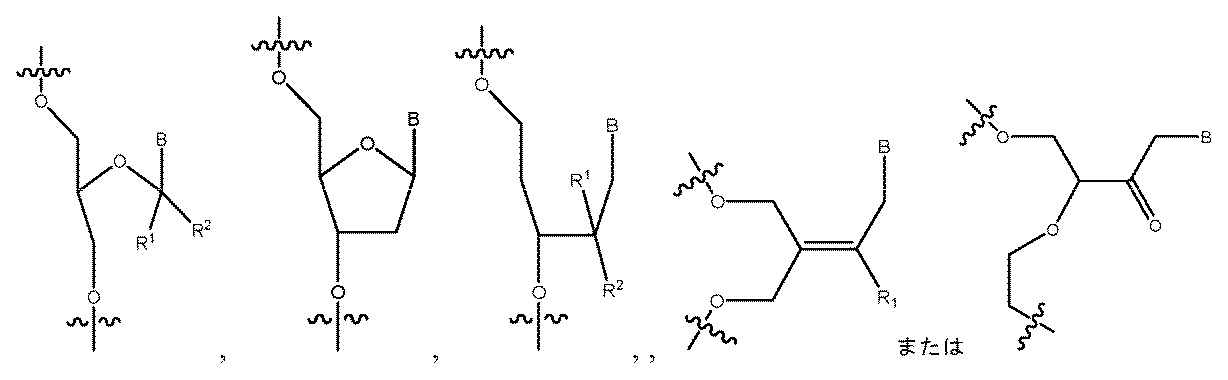
である。
It is.
一部の実施形態において、糖修飾は、アラビノース構造において、2’-H、2’-O-Me(2’-O-メチル)、2’-O-MOE(2’-O-メトキシエチル)、2’-F、2’-O-[2-(メチルアミノ)-2-オキソエチル](2’-O-NMA)、2’-S-メチル、2’-O-CH2-(4’-C)(LNA)、2’-O-CH2CH2-(4’-C)(ENA)、2’-O-アミノプロピル(2’-O-AP)、2’-O-ジメチルアミノエチル(2’-O-DMAOE)、2’-O-ジメチルアミノプロピル(2’-O-DMAP)、2’-O-ジメチルアミノエチルオキシエチル(2’-O-DMAEOE)およびgem2’-OMe/2’-OMeを有する2’Fからなる群から選択される。 In some embodiments, the sugar modification is selected from the group consisting of 2'-H, 2'-O-Me (2'-O-methyl), 2'-O-MOE (2'-O-methoxyethyl), 2'-F, 2'-O-[2-(methylamino)-2-oxoethyl] (2'-O-NMA), 2'-S-methyl, 2'-O-CH 2 -(4'-C) (LNA), 2'-O-CH 2 CH 2 -(4'-C) (ENA), 2'-O-aminopropyl (2'-O-AP), 2'-O-dimethylaminoethyl (2'-O-DMAOE), 2'-O-dimethylaminopropyl (2'-O-DMAP), 2'-O-dimethylaminoethyloxyethyl (2'-O-DMAEOE) and 2'F with gem 2'-OMe/2'-OMe in the arabinose structure.
特定のヌクレオチドが、その2’位を介して次のヌクレオチドへと連結される場合、本明細書において記載される糖修飾は、特定のヌクレオチド、例えばその2’位を介して連結されるヌクレオチドのため、糖の3’位に配置されうることが理解される。3’位における修飾は、キシロース構造中に存在しうる。「キシロース構造」という用語は、キシロース糖の3’-OHと同じ構造内のリボースのC3’における置換基の配置を指す。 When a particular nucleotide is linked to the next nucleotide through its 2' position, it is understood that the sugar modifications described herein can be placed at the 3' position of the sugar for the particular nucleotide, e.g., the nucleotide linked through its 2' position. The modification at the 3' position can be present in a xylose structure. The term "xylose structure" refers to the placement of the substituents at the C3' of the ribose in the same structure as the 3'-OH of the xylose sugar.
C4’および/またはC1’へと接合された水素は、直鎖または分岐鎖の、適宜置換されたアルキル、適宜置換されたアルケニル、適宜置換されたアルキニルによって置換されてもよく、アルキル、アルケニル、およびアルキニルの骨格は、1つまたは複数のO、S、S(O)、SO2、N(R’)、C(O)、N(R’)C(O)O、OC(O)N(R’)、CH(Z’)、リン酸含有結合、適宜置換されたアリール、適宜置換されたヘテロアリール、適宜置換された複素環または適宜置換されたシクロアルキルを含有してもよく、R’は、水素、アシルまたは適宜置換された脂肪族であり、Z’は、OR11、COR11、CO2R11、 The hydrogen bonded to C4' and/or C1' may be replaced by a straight or branched chain, optionally substituted alkyl, optionally substituted alkenyl, optionally substituted alkynyl, and the alkyl, alkenyl, and alkynyl backbone may contain one or more of O, S, S(O), SO 2 , N(R'), C(O), N(R')C(O)O, OC(O)N(R'), CH(Z'), phosphate-containing linkages, optionally substituted aryl, optionally substituted heteroaryl, optionally substituted heterocycle, or optionally substituted cycloalkyl, where R' is hydrogen, acyl, or optionally substituted aliphatic, and Z' is OR 11 , COR 11 , CO 2 R 11 ,
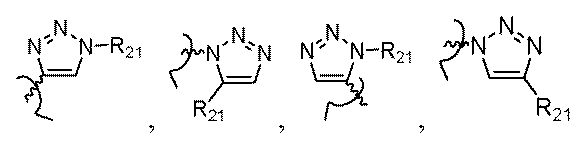
一部の実施形態において、C4’およびC5’は、好ましくは少なくとも1つの-PX(Y)-[式中、Xは、H、OH、OM、SH、適宜置換されたアルキル、適宜置換されたアルコキシ、適宜置換されたアルキルチオ、適宜置換されたアルキルアミノまたは適宜置換されたジアルキルアミノであり、Mは、独立に、各出現について、全体的な荷電が+1であるアルカリ金属または遷移金属であり;Yは、O、S、またはNR’(式中、R’は、水素、適宜置換された芳香族である)]を含む適宜置換された複素環を共に形成する。好ましくは、この修飾は、iRNAの5’末端である。 In some embodiments, C4' and C5' together preferably form an optionally substituted heterocycle containing at least one -PX(Y)-, where X is H, OH, OM, SH, optionally substituted alkyl, optionally substituted alkoxy, optionally substituted alkylthio, optionally substituted alkylamino, or optionally substituted dialkylamino, M is independently, for each occurrence, an alkali metal or transition metal with an overall charge of +1; and Y is O, S, or NR', where R' is hydrogen, optionally substituted aromatic. Preferably, this modification is at the 5' end of the iRNA.
ある特定の実施形態において、LNAは、式: In certain embodiments, the LNA has the formula:
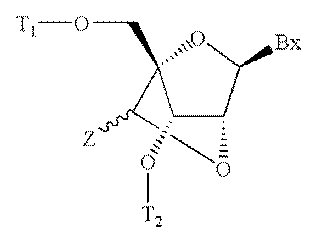
Bxは、複素環式塩基部分であり;
T1は、Hまたはヒドロキシル保護基であり;
T2は、H、ヒドロキシル保護基または反応性リン酸基であり;
Zは、C1~C6アルキル、C2~C6アルケニル、C2~C6アルキニル、置換C1~C6アルキル、置換C2~C6アルケニル、置換C2~C6アルキニル、アシル、置換アシル、または置換アミドである]
を有する二環式ヌクレオシドを含む。
Bx is a heterocyclic base moiety;
T1 is H or a hydroxyl protecting group;
T2 is H, a hydroxyl protecting group or a reactive phosphate group;
Z is C 1 -C 6 alkyl, C 2 -C 6 alkenyl, C 2 -C 6 alkynyl, substituted C 1 -C 6 alkyl, substituted C 2 -C 6 alkenyl, substituted C 2 -C 6 alkynyl, acyl, substituted acyl, or substituted amido.
The bicyclic nucleosides include those having the formula:
ある特定の実施形態において、本発明の化合物は、式: In certain embodiments, the compound of the present invention has the formula:
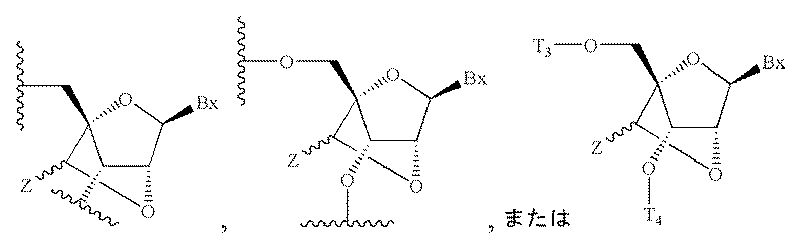
Bxは、複素環式塩基部分であり;
T3は、H、ヒドロキシル保護基、連結されたコンジュゲート基またはヌクレオシドへと接合されたヌクレオシド間連結基、ヌクレオチド、オリゴヌクレオシド、オリゴヌクレオチド、単量体サブユニット、またはオリゴマー化合物であり;
T4は、H、ヒドロキシル保護基、連結されたコンジュゲート基またはヌクレオシドへと接合されたヌクレオシド間連結基、ヌクレオチド、オリゴヌクレオシド、オリゴヌクレオチド、単量体サブユニットまたはオリゴマー化合物であり;
ここで、少なくとも1つのT3およびT4は、ヌクレオシドへと接合されたヌクレオシド間連結基、ヌクレオチド、オリゴヌクレオシド、オリゴヌクレオチド、単量体サブユニットまたはオリゴマー化合物であり;ならびに
Zは、C1~C6アルキル、C2~C6アルケニル、C2~C6アルキニル、置換C1~C6アルキル、置換C2~C6アルケニル、置換C2~C6アルキニル、アシル、置換アシル、または置換アミドである]
の、少なくとも1つの単量体を含む。
Bx is a heterocyclic base moiety;
T3 is H, a hydroxyl protecting group, a linked conjugate group or an internucleoside linking group attached to a nucleoside, a nucleotide, an oligonucleoside, an oligonucleotide, a monomeric subunit, or an oligomeric compound;
T4 is H, a hydroxyl protecting group, a linked conjugate group or an internucleoside linking group attached to a nucleoside, a nucleotide, an oligonucleoside, an oligonucleotide, a monomeric subunit or an oligomeric compound;
wherein at least one of T3 and T4 is an internucleoside linking group attached to a nucleoside, a nucleotide, an oligonucleoside, an oligonucleotide, a monomeric subunit, or an oligomeric compound; and Z is C1 - C6 alkyl, C2 - C6 alkenyl, C2 - C6 alkynyl, substituted C1 -C6 alkyl, substituted C2 - C6 alkenyl, substituted C2 - C6 alkynyl, acyl, substituted acyl, or substituted amide.
The copolymer comprises at least one monomer of the formula:
ある特定のそのような実施形態において、LNAは、以下: In one particular such embodiment, the LNA comprises:
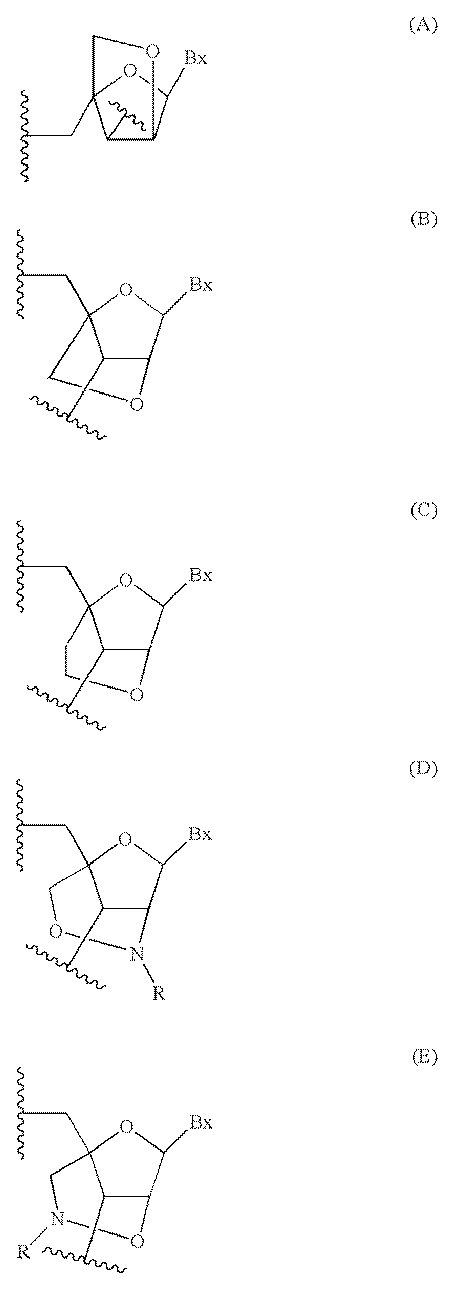
ある特定の実施形態において、一本鎖オリゴヌクレオチドは、上記の式の少なくとも2つの連続する単量体の少なくとも2つの領域を含む。ある特定の実施形態において、一本鎖オリゴヌクレオチドは、ギャップモチーフを含む。ある特定の実施形態において、一本鎖オリゴヌクレオチドは、約8から約14の連続するβ-D-2’-デオキシリボフラノシルヌクレオシドからの少なくとも1つの領域を含む。ある特定の実施形態において、一本鎖オリゴヌクレオチドは、約9から約12の連続するβ-D-2’-デオキシリボフラノシルヌクレオシドからの少なくとも1つの領域を含む。 In certain embodiments, the single-stranded oligonucleotide comprises at least two regions of at least two consecutive monomers of the above formula. In certain embodiments, the single-stranded oligonucleotide comprises a gap motif. In certain embodiments, the single-stranded oligonucleotide comprises at least one region of about 8 to about 14 consecutive β-D-2'-deoxyribofuranosyl nucleosides. In certain embodiments, the single-stranded oligonucleotide comprises at least one region of about 9 to about 12 consecutive β-D-2'-deoxyribofuranosyl nucleosides.
ある特定の実施形態において、一本鎖オリゴヌクレオチドは、少なくとも1つ(例えば、1、2、3、4、5、6、7、8、9、10、11、12、13、14、15、またはそれ以上)の式: In certain embodiments, the single-stranded oligonucleotide has at least one (e.g., 1, 2, 3, 4, 5, 6, 7, 8, 9, 10, 11, 12, 13, 14, 15, or more) of the formula:
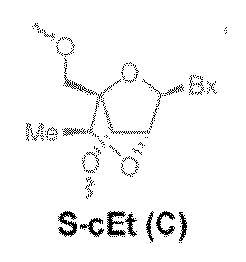
の(S)-cEt単量体を含む。
The (S)-cEt monomer comprises
ある特定の実施形態において、単量体は、糖模倣体を含む。ある特定のそのような実施形態において、模倣体は、糖または糖-ヌクレオシド間連結の組合せの代わりに使用され、ヌクレオ塩基は、選択された標的へのハイブリダイゼーションのために維持される。糖模倣体の代表的な例は、シクロへキセニルまたはモルホリノを含むが、これらに限定されない。糖-ヌクレオシド間連結の模倣体の組合せの代表的な例は、ペプチド核酸(PNA)および非荷電アキラル連結によって連結されたモルホリノ基を含むが、これらに限定されない。一部の例において、模倣体は、ヌクレオ塩基の代わりに使用される。代表的なヌクレオ塩基模倣体は、当技術分野で周知であり、三環式フェノキサジン類似体およびユニバーサル塩基を含むが、これらに限定されない(参照により本明細書に組み込まれる、Berger et al., Nuc Acid Res. 2000, 28:2911-14)。糖、ヌクレオシドおよびヌクレオ塩基模倣体の合成方法は、当業者に周知である。 In certain embodiments, the monomer comprises a sugar mimetic. In certain such embodiments, the mimetic is used in place of the sugar or sugar-internucleoside linkage combination, and the nucleobase is maintained for hybridization to a selected target. Representative examples of sugar mimetics include, but are not limited to, cyclohexenyl or morpholino. Representative examples of sugar-internucleoside linkage mimetic combinations include, but are not limited to, peptide nucleic acid (PNA) and morpholino groups linked by uncharged achiral linkages. In some examples, the mimetic is used in place of the nucleobase. Representative nucleobase mimetics are well known in the art and include, but are not limited to, tricyclic phenoxazine analogs and universal bases (Berger et al., Nuc Acid Res. 2000, 28:2911-14, incorporated herein by reference). Methods for the synthesis of sugar, nucleoside and nucleobase mimetics are well known to those of skill in the art.
核酸修飾(糖間結合)
本明細書において、単量体(修飾および非修飾ヌクレオシドおよびヌクレオチドを含むが、これらに限定されない)を共に連結し、それにより、オリゴマー化合物、例えば、オリゴヌクレオチドを形成する連結基が記載される。そのような連結基は、糖間結合とも称される。連結基の2つの主なクラスは、リン原子の存在または不在によって規定される。代表的なリン含有結合は、ホスホジエステル(P=O)、ホスホトリエステル、メチルホスホネート、ホスホラミデート、およびホスホロチオエート(P=S)を含むが、これらに限定されない。代表的な非リン含有連結基は、メチレンメチルイミノ(-CH2-N(CH3)-O-CH2-)、チオジエステル(-O-C(O)-S-)、チオノカルバメート(-O-C(O)(NH)-S-);シロキサン(-O-Si(H)2-O-);およびN,N’-ジメチルヒドラジン(-CH2-N(CH3)-N(CH3)-)を含むが、これらに限定されない。天然のホスホジエステル結合と比較して、修飾された結合は、オリゴヌクレオチドのヌクレアーゼ耐性を変更する、典型的には増加させるように使用されうる。ある特定の実施形態において、キラル原子を有する結合は、ラセミ混合物、別々の鏡像異性体として調製されうる。代表的なキラル結合は、アルキルホスホネートおよびホスホロチオエートを含むが、これらに限定されない。リン含有結合および非リン含有結合の調製方法は、当業者に周知である。
Nucleic acid modification (sugar bond)
Herein, linking groups are described that link monomers (including but not limited to modified and unmodified nucleosides and nucleotides) together to form oligomeric compounds, such as oligonucleotides. Such linking groups are also referred to as intersugar linkages. Two main classes of linking groups are defined by the presence or absence of a phosphorus atom. Representative phosphorus-containing linkages include, but are not limited to, phosphodiester (P=O), phosphotriester, methylphosphonate, phosphoramidate, and phosphorothioate (P=S). Representative non-phosphorus-containing linking groups include, but are not limited to, methylenemethylimino (-CH 2 -N(CH 3 )-O-CH2-), thiodiester (-O-C(O)-S-), thionocarbamate (-O-C(O)(NH)-S-); siloxane (-O-Si(H) 2 -O-); and N,N'-dimethylhydrazine (-CH 2 -N(CH 3 )-N(CH 3 )-). Compared to the native phosphodiester linkage, modified linkages may be used to alter, typically increase, the nuclease resistance of oligonucleotides. In certain embodiments, linkages with chiral atoms may be prepared as racemic mixtures, separate enantiomers. Representative chiral linkages include, but are not limited to, alkylphosphonates and phosphorothioates. Methods for the preparation of phosphorus-containing and non-phosphorus-containing linkages are well known to those of skill in the art.
連結基におけるリン酸基は、異なる置換基によって酸素の1つを置換することによって修飾されうる。この修飾の1つの結果は、核酸分解へのオリゴヌクレオチドの耐性を増加させうる。修飾リン酸基の例は、ホスホロチオエート、ホスホロセレネート(phosphoroselenate)、ボラノホスフェート(borano phosphate)、ボラノホスフェートエステル、ホスホン酸水素(hydrogen phosphonate)、ホスホロアミデート、ホスホン酸アルキルまたはホスホン酸アリール、およびリン酸トリエステルを含む。一部の実施形態において、結合中の非架橋リン酸の酸素原子のうちの1つを、以下:S、Se、BR3(Rは、水素、アルキル、アリールである)、C(すなわち、アルキル基、アリール基等)、H、NR2(Rは、水素、適宜置換されたアルキル、アリール)、またはOR(Rは、適宜置換されたアルキルまたはアリール)のうちのいずれかによって置換されうる。非修飾リン酸基内のリン原子は、アキラルである。しかしながら、非架橋酸素のうちの1つを、上記の原子または原子の群のうちの1つと置換することで、リン原子をキラルにさせ、言い換えると、この方法で修飾したリン酸基内のリン原子は不斉中心である。不斉中心のリン原子は、「R」配置(本明細書においては、Rp)または「S」配置(本明細書においては、Sp)のいずれかを持つことができる。 The phosphate group in the linking group can be modified by replacing one of the oxygens with different substituents. One result of this modification can increase the resistance of the oligonucleotide to nucleic acid degradation. Examples of modified phosphate groups include phosphorothioate, phosphoroselenate, boranophosphate, boranophosphate ester, hydrogen phosphonate, phosphoramidate, alkyl or aryl phosphonate, and phosphate triester. In some embodiments, one of the oxygen atoms of the non-bridging phosphate in the linkage can be replaced by any of the following: S, Se, BR3 (R is hydrogen, alkyl, aryl), C (i.e., alkyl, aryl, etc.), H, NR2 (R is hydrogen, optionally substituted alkyl, aryl), or OR (R is optionally substituted alkyl or aryl). The phosphorus atom in an unmodified phosphate group is achiral. However, by replacing one of the non-bridging oxygens with one of the atoms or groups of atoms described above, the phosphorus atom is made chiral, in other words, the phosphorus atom in a phosphate group modified in this manner is an asymmetric center. The phosphorus atom in the asymmetric center can have either the "R" configuration (herein referred to as Rp) or the "S" configuration (herein referred to as Sp).
ホスホロチオエートは、硫黄によって置換された非架橋酸素の両方を有する。ホスホロジチオエートのリン中心は、アキラルであり、オリゴヌクレオチドジアステレオマーの形成を妨げる。したがって、理論に束縛されることを望まずに述べると、キラル中心、例えばホスホロジチオエート形成を除く、非架橋酸素の両方への修飾が望ましいことがあり、それらはジアステレオマー混合物を産生できない。したがって、非架橋酸素は、独立に、O、S、Se、B、C、H、N、またはOR(Rは、アルキルまたはアリールである)のうちのいずれか1つでありうる。 Phosphorothioates have both non-bridging oxygens replaced by sulfur. The phosphorus center of phosphorodithioates is achiral, preventing the formation of oligonucleotide diastereomers. Thus, without wishing to be bound by theory, modifications to both of the non-bridging oxygens may be desirable, except for chiral centers, such as phosphorodithioate formation, which cannot produce diastereomeric mixtures. Thus, the non-bridging oxygens can be independently any one of O, S, Se, B, C, H, N, or OR (where R is alkyl or aryl).
リン酸リンカーは、架橋酸素(すなわち、リン酸塩を単量体の糖へと連結させる酵素)を、窒素(架橋ホスホロアミデート)、硫黄(架橋ホスホロチオエート)および炭素(架橋メチレンホスホネート)での置換によって修飾することもできる。置換は、連結酸素のいずれか1つにおいて、または連結酸素の両方において生じうる。架橋酸素がヌクレオシドの3’-酸素である場合、炭素での置換が好ましい。架橋酸素がヌクレオシドの5’-酸素である場合、窒素での置換が好ましい。 Phosphate linkers can also be modified by substitution of the bridging oxygen (i.e., the enzyme that links the phosphate to the monomeric sugar) at nitrogen (bridging phosphoramidates), sulfur (bridging phosphorothioates), and carbon (bridging methylene phosphonates). Substitution can occur at either one of the linking oxygens or at both linking oxygens. When the bridging oxygen is the 3'-oxygen of the nucleoside, substitution at carbon is preferred. When the bridging oxygen is the 5'-oxygen of the nucleoside, substitution at nitrogen is preferred.
リン酸へと連結された少なくとも1つの酸素が置換されたか、またはリン酸基が非リン酸基によって置換された修飾リン酸結合は、「非ホスホジエステル糖間結合」または「非ホスホジエステルリンカー」とも呼ばれる。 Modified phosphate linkages in which at least one oxygen linked to the phosphate has been replaced or the phosphate group has been replaced by a non-phosphate group are also referred to as "non-phosphodiester intersugar linkages" or "non-phosphodiester linkers."
ある特定の実施形態において、リン酸基は、コネクターを含有する非リン酸、例えば、デホスホリンカーによって置換されうる。デホスホリンカーは、本明細書において、非ホスホジエステルリンカーとも称される。理論に束縛されることを望まずに述べると、荷電ホスホジエステル基は、核酸分解の反応中心であるため、中性の構造模倣体でのその置換は、ヌクレアーゼ安定性の増強を与えると考えられる。また、理論に束縛されることを望まずに述べると、一部の実施形態において、荷電リン酸基が中性の部分によって置換される変更を導入することが望ましいことがある。 In certain embodiments, the phosphate group can be replaced by a non-phosphate containing connector, e.g., a dephospho linker. A dephospho linker is also referred to herein as a non-phosphodiester linker. Without wishing to be bound by theory, it is believed that since the charged phosphodiester group is the reactive center for nucleic acid degradation, its replacement with a neutral structural mimic confers enhanced nuclease stability. Also, without wishing to be bound by theory, in some embodiments, it may be desirable to introduce a modification in which the charged phosphate group is replaced by a neutral moiety.
リン酸基を置換することができる部分の例は、アミド(例えば、アミド-3(3’-CH2-C(=O)-N(H)-5’)およびアミド-4(3’-CH2-N(H)-C(=O)-5’))、ヒドロキシルアミノ、シロキサン(ジアルキルシロキサン)、カルボキサミド、カルボネート、カルボキシメチル、カルバメート、カルボキシレートエステル、チオエーテル、エチレンオキシドリンカー、スルフィド、スルホネート、スルホンアミド、スルホネートエステル、チオホルムアセタール(3’-S-CH2-O-5’)、ホルムアセタール(3’-O-CH2-O-5’)、オキシム、メチレンイミノ、メチレンカルボニルアミノ、メチレンメチルイミノ(MMI、3’-CH2-N(CH3)-O-5’)、メチレンヒドラゾ、メチレンジメチルヒドラゾ、メチレンオキシメチルイミノ、エーテル(C3’-O-C5’)、チオエーテル(C3’-S-C5’)、チオアセトアミド(C3’-N(H)-C(=O)-CH2-S-C5’、C3’-O-P(O)-O-SS-C5’、C3’-CH2-NH-NH-C5’、3’-NHP(O)(OCH3)-O-5’および3’-NHP(O)(OCH3)-O-5’、ならびに混合したN、O、SおよびCH2構成成分を含有する非イオン性結合を含むが、これらに限定されない。例えば、Carbohydrate Modifications in Antisense Research; Y.S. Sanghvi and P.D. Cook Eds. ACS Symposium Series 580; Chapters 3 and 4, (pp. 40-65)を参照されたい。好ましい実施形態は、メチレンメチルイミノ(MMI)、メチレンカルボニルアミノ、アミド、カルバメート、およびエチレンオキシドリンカーを含む。 Examples of moieties that can replace the phosphate group are amide (e.g., amide-3 (3'-CH 2 -C(=O)-N(H)-5') and amide-4 (3'-CH 2 -N(H)-C(=O)-5')), hydroxylamino, siloxane (dialkylsiloxane), carboxamide, carbonate, carboxymethyl, carbamate, carboxylate ester, thioether, ethylene oxide linker, sulfide, sulfonate, sulfonamide, sulfonate ester, thioformacetal (3'-S-CH 2 -O-5'), formacetal (3'-O-CH 2 -O-5'), oxime, methyleneimino, methylenecarbonylamino, methylenemethylimino (MMI, 3'-CH 2 -N(CH 3 )-O-5'), methylenehydrazo, methylenedimethylhydrazo, methyleneoxymethylimino, ether (C3'-O-C5'), thioether (C3'-S-C5'), thioacetamide (C3'-N(H)-C(=O)-CH2- S -C5', C3'-O-P(O)-O-SS-C5', C3'- CH2 -NH-NH-C5', 3'-NHP(O)( OCH3 )-O-5' and 3'-NHP(O)( OCH3 )-O-5', as well as non-ionic linkages containing mixed N, O, S and CH2 moieties. For example, see Carbohydrate Modifications in Antisense Research; YS Sanghvi and PD Cook Eds. ACS Symposium Series 580; Chapters 3 and 4, (pp. 40-65). Preferred embodiments include methylenemethylimino (MMI), methylenecarbonylamino, amide, carbamate, and ethylene oxide linkers.
当業者には、ある特定の例において、非架橋酸素の置換が、隣接する2’-OHにより糖間結合の切断の増強をもたらすことができ、したがって、多くの場合、非架橋酸素の修飾は、2’-OHの修飾、例えば、隣接する糖間結合、例えば、アラビノース糖、2’-O-アルキル、2’-F、LNAおよびENAの切断に参加しない修飾を必要としうることは周知である。 Those skilled in the art are aware that in certain instances, substitution of a non-bridging oxygen can result in enhanced cleavage of the intersugar bond by the adjacent 2'-OH, and thus in many cases modification of the non-bridging oxygen may require modification of the 2'-OH, e.g., modifications that do not participate in cleavage of adjacent intersugar bonds, e.g., arabinose sugars, 2'-O-alkyls, 2'-F, LNAs, and ENAs.
好ましい非ホスホジエステル糖間結合は、ホスホロチオエート、Sp異性体の少なくとも1%、5%、10%、20%、30%、40%、50%、60%、70%、80%、90%、95%またはそれ以上の鏡像異性体過剰を有するホスホロチオエート、Rp異性体の少なくとも1%、5%、10%、20%、30%、40%、50%、60%、70%、80%、90%、95%またはそれ以上の鏡像異性体過剰を有するホスホロチオエート、ホスホロジチオエート、ホスホトリエステル、アミノアルキルホスホトリオエステル、アルキル-ホスホネート(例えば、メチル-ホスホネート)、セレノホスフェート、ホスホラミデート(例えば、N-アルキルホスホラミデート)、およびボラノホスホネートを含む。 Preferred non-phosphodiester intersugar linkages include phosphorothioates, phosphorothioates with an enantiomeric excess of at least 1%, 5%, 10%, 20%, 30%, 40%, 50%, 60%, 70%, 80%, 90%, 95% or more of the Sp isomer, phosphorothioates with an enantiomeric excess of at least 1%, 5%, 10%, 20%, 30%, 40%, 50%, 60%, 70%, 80%, 90%, 95% or more of the Rp isomer, phosphorodithioates, phosphotriesters, aminoalkylphosphotrioesters, alkyl-phosphonates (e.g., methyl-phosphonates), selenophosphates, phosphoramidates (e.g., N-alkylphosphoramidates), and boranophosphonates.
一部の実施形態において、一本鎖オリゴヌクレオチドは、少なくとも1つ(例えば、1、2、3、4、5、6、7、8、9、10、11、12、13、14、15またはそれ以上および最大全てを含む)の修飾または非ホスホジエステル結合を含む。一部の実施形態において、一本鎖オリゴヌクレオチドは、少なくとも1つ(例えば、1、2、3、4、5、6、7、8、9、10、11、12、13、14、15またはそれ以上および最大全てを含む)のホスホジエステル結合を含む。 In some embodiments, the single-stranded oligonucleotide contains at least one (e.g., 1, 2, 3, 4, 5, 6, 7, 8, 9, 10, 11, 12, 13, 14, 15 or more and up to and including all) modified or non-phosphodiester bond. In some embodiments, the single-stranded oligonucleotide contains at least one (e.g., 1, 2, 3, 4, 5, 6, 7, 8, 9, 10, 11, 12, 13, 14, 15 or more and up to and including all) phosphodiester bond.
一本鎖オリゴヌクレオチドは、リン酸リンカーおよび糖がヌクレアーゼ耐性ヌクレオシドまたはヌクレオチド代用物によって置換されるようにも構築されうる。理論に束縛されることを望まずに述べると、繰り返し荷電された骨格の不在が、ポリアニオンを認識するタンパク質(例えば、ヌクレアーゼ)への結合を減らすと考えられる。一部の実施形態において、中性の代用物骨格によって塩基がテザリングされる変更を導入することが望ましいことがある。例は、モルホリノ、シクロブチル、ピロリジン、ペプチド核酸(PNA)、アミノエチルグリシルPNA(aegPNA)および骨格-伸長ピロリジンPNA(bepPNA)ヌクレオシド代用物を含む。好ましい代用物は、PNA代用物である。 Single-stranded oligonucleotides can also be constructed such that the phosphate linker and sugar are replaced by nuclease-resistant nucleoside or nucleotide surrogates. Without wishing to be bound by theory, it is believed that the absence of a repeatedly charged backbone reduces binding to proteins that recognize polyanions (e.g., nucleases). In some embodiments, it may be desirable to introduce modifications in which the bases are tethered by a neutral surrogate backbone. Examples include morpholino, cyclobutyl, pyrrolidine, peptide nucleic acid (PNA), aminoethylglycyl PNA (aegPNA), and backbone-extended pyrrolidine PNA (bepPNA) nucleoside surrogates. A preferred surrogate is a PNA surrogate.
本明細書において記載される一本鎖オリゴヌクレオチドは、1つまたは複数の不斉中心を含有してもよく、したがって、糖アノマーなどの(R)または(S)として、またはアミノ酸などの(D)または(L)として、絶対立体化学の観点で規定されうる、エナンチオマー、ジアステレオマー、および他の立体異性配置を生じうる。本明細書において提供される一本鎖オリゴヌクレオチドには、全てのそのような可能性のある異性体、ならびにそれらのラセミ体および光学的に純粋な形態が含まれる。 The single-stranded oligonucleotides described herein may contain one or more asymmetric centers and thus may give rise to enantiomers, diastereomers, and other stereoisomeric configurations that may be specified in terms of absolute stereochemistry, such as (R) or (S), such as sugar anomers, or (D) or (L), such as amino acids. The single-stranded oligonucleotides provided herein include all such possible isomers, as well as their racemic and optically pure forms.
核酸修飾(末端修飾)
一本鎖オリゴヌクレオチドのセンスまたはアンチセンスヌクレオチド配列の末端は修飾されうる。そのような修飾は、ヌクレオチド配列一端または両端でありうる。例えば、3’および/または5’末端は、他の機能性分子部分、例えばラベリング部分、例えば、フルオロフォア(例えば、ピレン、TAMRA、フルオレセイン、Cy3またはCy5色素)または保護基(例えば、硫黄、ケイ素、ホウ素、またはエステルに基づく)へとコンジュゲートされうる。機能性分子の実体は、リン酸基および/またはリンカーを介して糖へと接合されうる。リンカーの末端原子は、リン酸基の連結原子または糖のC-3’またはC’-5、O、N、SまたはC基へと接続するかまたはそれらを置換することができる。あるいは、リンカーは、ヌクレオチド代用物(例えば、PNA)の末端原子へと接続するかまたはそれらを置換することができる。
Nucleic acid modification (end modification)
The ends of the sense or antisense nucleotide sequence of the single-stranded oligonucleotide may be modified. Such modifications may be at one or both ends of the nucleotide sequence. For example, the 3' and/or 5' ends may be conjugated to other functional molecular moieties, such as labeling moieties, such as fluorophores (e.g., pyrene, TAMRA, fluorescein, Cy3 or Cy5 dyes) or protecting groups (e.g., sulfur, silicon, boron, or ester-based). The functional molecular entities may be attached to the sugar via the phosphate group and/or a linker. The terminal atom of the linker may be connected to or replace the linking atom of the phosphate group or the C-3' or C'-5, O, N, S or C group of the sugar. Alternatively, the linker may be connected to or replace the terminal atom of a nucleotide surrogate (e.g., PNA).
活性をモジュレートするのに有用な末端修飾は、リン酸またはリン酸類似体による配列の5’末端の修飾を含む。ある特定の実施形態において、配列の5’末端は、リン酸化されるか、またはホスホリル類似体を含む。例示的な5’-リン酸修飾は、RISC媒介性遺伝子サイレンシングに対応するものを含む。5’末端における修飾は、対象の免疫系の刺激または阻害においても有用でありうる。一部の実施形態において、オリゴマー化合物の5’末端は、修飾 Terminal modifications useful for modulating activity include modification of the 5' end of the sequence with a phosphate or phosphate analog. In certain embodiments, the 5' end of the sequence is phosphorylated or includes a phosphoryl analog. Exemplary 5'-phosphate modifications include those that correspond to RISC-mediated gene silencing. Modifications at the 5' end may also be useful in stimulating or inhibiting the immune system of a subject. In some embodiments, the 5' end of the oligomeric compound is modified

を含む。一部の実施形態において、nは、1または2である。Aは、糖の5’炭素へと連結した酸素を置換することが理解される。nが0である場合、WおよびYは、それらが接合されるPと共に、適宜置換された5~8員の複素環を形成することができ、WおよびYは、それぞれ独立に、O、S、NR’、またはアルキレンである。好ましくは、複素環は、アリールまたはヘテロアリールによって置換される。一部の実施形態において、5’末端ヌクレオチドのC5’の1つまたは両方の水素は、ハロゲン、例えばFによって置換される。
In some embodiments, n is 1 or 2. It is understood that A replaces the oxygen linked to the 5' carbon of the sugar. When n is 0, W and Y together with P to which they are attached can form an optionally substituted 5-8 membered heterocycle, where W and Y are each independently O, S, NR', or alkylene. Preferably, the heterocycle is substituted by aryl or heteroaryl. In some embodiments, one or both hydrogens on the C5' of the 5' terminal nucleotide are replaced by halogen, e.g., F.
例示的な5’修飾は、5’-一リン酸((HO)2(O)P-O-5’);5’-二リン酸((HO)2(O)P-O-P(HO)(O)-O-5’);5’-三リン酸((HO)2(O)P-O-(HO)(O)P-O-P(HO)(O)-O-5’);5’-モノチオリン酸(ホスホロチオエート;(HO)2(S)P-O-5’);5’-モノジチオリン酸(ホスホロジチオエート;(HO)(HS)(S)P-O-5’)、5’-ホスホロチオエート((HO)2(O)P-S-5’);5’-アルファ-チオ三リン酸;5’-ベータ-チオ三リン酸;5’-ガンマ-チオ三リン酸;5’-ホスホラミデート((HO)2(O)P-NH-5’,(HO)(NH2)(O)P-O-5’)を含むが、これらに限定されない。他の5’修飾は、5’-アルキルホスホネート(R(OH)(O)P-O-5’、R=アルキル、例えば、メチル、エチル、イソプロピル、プロピル等)、5’-アルキルエーテルホスホネート(R(OH)(O)P-O-5’、R=アルキルエーテル、例えば、メトキシメチル(CH2OMe)、エトキシメチル等)を含む。他の例示的な5’修飾は、Zが、少なくとも1度、適宜置換されたアルキルである、例えば、((HO)2(X)P-O[-(CH2)a-O-P(X)(OH)-O]b-5’、((HO)2(X)P-O[-(CH2)a-P(X)(OH)-O]b-5’、((HO)2(X)P-[-(CH2)a-O-P(X)(OH)-O]b-5’;ジアルキル末端リン酸およびリン酸模倣体:HO[-(CH2)a-O-P(X)(OH)-O]b-5’、H2N[-(CH2)a-O-P(X)(OH)-O]b-5’、H[-(CH2)a-O-P(X)(OH)-O]b-5’、Me2N[-(CH2)a-O-P(X)(OH)-O]b-5’、HO[-(CH2)a-P(X)(OH)-O]b-5’、H2N[-(CH2)a-P(X)(OH)-O]b-5’、H[-(CH2)a-P(X)(OH)-O]b-5’、Me2N[-(CH2)a-P(X)(OH)-O]b-5’[式中、aおよびbは、各々独立に、1~10である]を含む。他の実施形態は、BH3、BH3 -、および/またはSeによる酸素および/または硫黄の置換を含む。 Exemplary 5' modifications are 5'-monophosphate ((HO) 2 (O)P-O-5');5'-diphosphate ((HO) 2 (O)P-O-P(HO)(O)-O-5');5'-triphosphate ((HO) 2 (O)P-O-(HO)(O)P-O-P(HO)(O)-O-5');5'-monothiophosphate(phosphorothioate;(HO)2(S)P-O-5');5'-monodithiophosphate(phosphorodithioate;(HO)(HS)(S)P-O-5'),5'-phosphorothioate((HO)2(O)P-S-5');5'-alpha-thiotriphosphate;5'-beta-thiotriphosphate;5'-gamma-thiotriphosphate;5'-phosphoramidate ((HO) 2 (S)P-O-5'). (O)P-NH-5', (HO)(NH 2 )(O)P-O-5'). Other 5' modifications include 5'-alkyl phosphonates (R(OH)(O)P-O-5', R=alkyl, e.g., methyl, ethyl, isopropyl, propyl, etc.), 5'-alkyl ether phosphonates (R(OH)(O)P-O-5', R=alkyl ether, e.g., methoxymethyl (CH 2 OMe), ethoxymethyl, etc.). Other exemplary 5' modifications are those in which Z is an alkyl optionally substituted at least once, e.g., ((HO) 2 (X)P-O[-(CH 2 ) a -O-P(X)(OH)-O] b -5', ((HO) 2 (X)P-O[-(CH 2 ) a -P(X)(OH)-O] b -5', ((HO)2(X)P-[-(CH 2 ) a -O-P(X)(OH)-O] b -5'; dialkyl terminal phosphates and phosphate mimetics: HO[-(CH 2 ) a -O-P(X)(OH)-O] b -5', H 2 N[-(CH 2 ) a -O-P(X)(OH)-O] b -5', H[-(CH 2 ) a -O-P(X)(OH)-O] b -5', Me 2 N[-(CH 2 ) a -O-P(X)(OH)-O] b -5', HO[-(CH 2 ) a -P(X)(OH)-O] b -5', H 2 N[-(CH 2 ) a -P(X)(OH)-O] b -5', H[-(CH 2 ) a -P(X)(OH)-O] b -5', Me 2 N[-(CH 2 ) a -P( X)(OH)-O] b -5', where a and b are each independently 1 to 10. Other embodiments include replacement of oxygen and/or sulfur by BH 3 , BH 3 - , and/or Se.
末端修飾は、分布をモニタリングするためにも有用であり、このような場合に、付加される好ましい基は、フルオロフォア、例えば、フルオレセインまたはAlexa色素、例えば、Alexa488を含む。末端修飾は、取込みを増強するためにも有用であり、このために有用な修飾は、ターゲティングリガンドを含む。末端修飾は、別の部分へのオリゴヌクレオチドの架橋のためにも有用であり;このために有用な修飾は、マイトマイシンC、ソラレン、およびこれらの誘導体を含む。 Terminal modifications are also useful for monitoring distribution, in such cases preferred groups added include fluorophores, such as fluorescein or Alexa dyes, such as Alexa 488. Terminal modifications are also useful for enhancing uptake, modifications useful for this purpose include targeting ligands. Terminal modifications are also useful for crosslinking an oligonucleotide to another moiety; modifications useful for this purpose include mitomycin C, psoralens, and derivatives thereof.
熱不安定性修飾
二本鎖核酸剤または一本鎖オリゴヌクレオチドなどの、本発明の化合物は、アンチセンス鎖のシード領域(すなわち、アンチセンス鎖の5’末端の2~8位)と向かい合う部位において、センス鎖に熱不安定性修飾を組み込むことにより、解離および融解するiRNA二重鎖の傾向を増加させることにより(二重鎖会合の自由エネルギーを減少させる)、RNA干渉について最適化されうる。この修飾は、アンチセンス鎖のシード領域において解離または融解する二重鎖の傾向を増加させることができる。
Thermolabile Modifications Compounds of the invention, such as double-stranded nucleic acid agents or single-stranded oligonucleotides, can be optimized for RNA interference by increasing the tendency of the iRNA duplex to dissociate and melt (reducing the free energy of duplex association) by incorporating a thermolabile modification in the sense strand at a site opposite the seed region of the antisense strand (i.e., positions 2-8 of the 5' end of the antisense strand). This modification can increase the tendency of the duplex to dissociate or melt at the seed region of the antisense strand.
熱不安定性修飾は、脱塩基修飾;対向鎖内の対向ヌクレオチドとのミスマッチ;および2’-デオキシ修飾などの糖修飾、または非環式ヌクレオチド、例えば、アンロック核酸(UNA)またはグリセロール核酸(GNA)を含みうる。 Thermolabile modifications can include abasic modifications; mismatches with the opposing nucleotide in the opposing strand; and sugar modifications such as 2'-deoxy modifications, or acyclic nucleotides, e.g., unlocked nucleic acid (UNA) or glycerol nucleic acid (GNA).
例示的な脱塩基修飾は: Exemplary abasic modifications are:
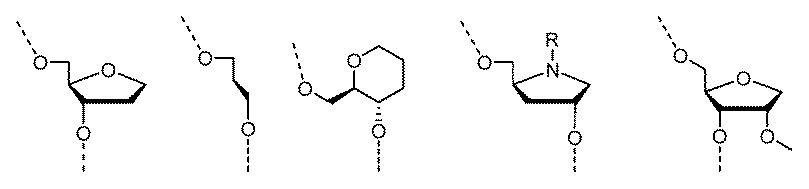
例示的な糖修飾は: Exemplary sugar modifications are:

二重鎖の熱不安定性修飾は、1つまたは複数の Thermal labile modifications of the duplex can be one or more
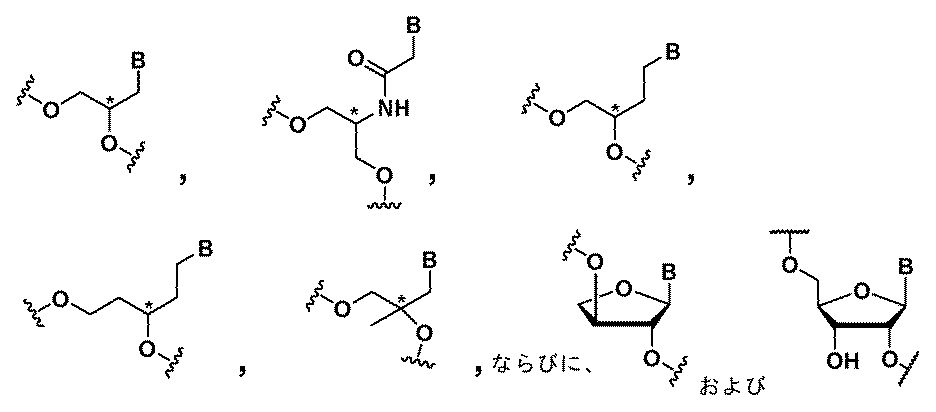
式中、Bは適宜修飾されたヌクレオ塩基であり、*は(R)-、(S)-またはラセミ立体化学を表す。
wherein B is an appropriately modified nucleobase, and * represents (R)-, (S)- or racemic stereochemistry.
ある特定の実施形態において、二重鎖の熱不安定性修飾は、1つまたは複数の In certain embodiments, the duplex thermolabile modifications include one or more
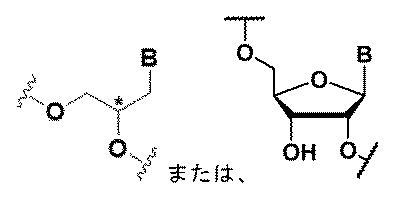
Bは適宜修飾されたヌクレオ塩基であり、*は(R)-、(S)-またはラセミ立体化学を表す(例えば、S-立体化学)。
B is an appropriately modified nucleobase; * represents (R)-, (S)- or racemic stereochemistry (eg, S-stereochemistry).
「非環式ヌクレオチド」という用語は、非環式リボース糖を有する任意のヌクレオチドを指し、例えば、リボース炭素間の任意の結合(例えば、C1’-C2’、C2’-C3’、C3’-C4’、C4’-O4’、またはC1’-O4’)は存在せず、および/またはリボース炭素または酸素の少なくとも1つ(例えば、C1’、C2’、C3’、C4’、またはO4’)は、独立に、または組み合わせて、ヌクレオチドには存在である。一部の実施形態において、非環式ヌクレオチドは、 The term "acyclic nucleotide" refers to any nucleotide having an acyclic ribose sugar, e.g., any bond between the ribose carbons (e.g., C1'-C2', C2'-C3', C3'-C4', C4'-O4', or C1'-O4') is absent, and/or at least one of the ribose carbons or oxygens (e.g., C1', C2', C3', C4', or O4'), independently or in combination, is absent in the nucleotide. In some embodiments, an acyclic nucleotide is:
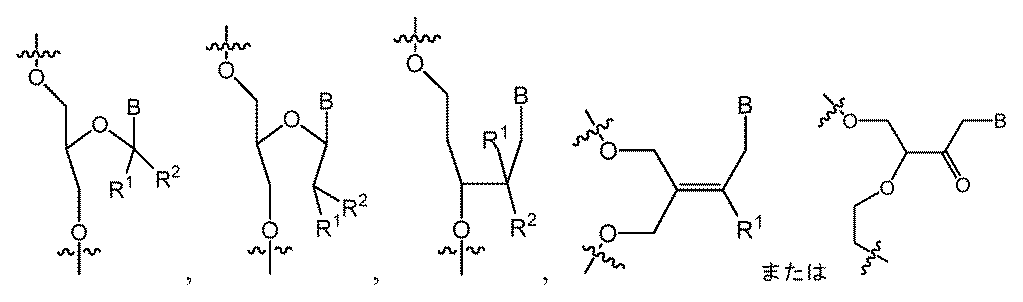
「GNA」という用語は、DNAまたはRNAと類似のポリマーであるが、ホスホジエステル結合によって連結された反復するグリコール単位から構成される、その「骨格」の組成が異なるグリコール核酸を指す: The term "GNA" refers to glycol nucleic acids, which are polymers similar to DNA or RNA, but differ in the composition of their "backbone," which is made up of repeating glycol units linked by phosphodiester bonds:
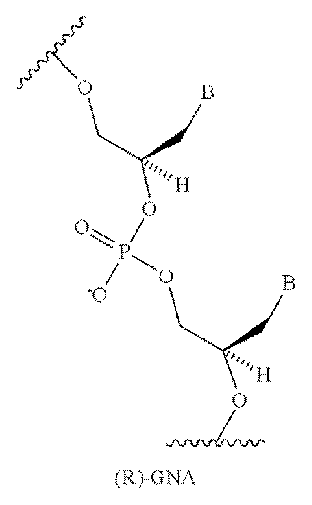
熱不安定性修飾は、熱不安定性ヌクレオチドと、二本鎖核酸剤の二重鎖内の対向鎖における対向ヌクレオチドの間のミスマッチ(すなわち、非相補性塩基対)でありうる。例示的なミスマッチ塩基対は、G:G、G:A、G:U、G:T、A:A、A:C、C:C、C:U、C:T、U:U、T:T、U:T、またはこれらの組合せを含む。当技術分野で公知の他のミスマッチ塩基対も、本発明に適している。ミスマッチは、天然に存在するヌクレオチドか、または修飾ヌクレオチドのいずれかであるヌクレオチド間で生じ、すなわち、ミスマッチ塩基対は、ヌクレオチドのリボース糖への修飾によらず、それぞれのヌクレオチドからのヌクレオ塩基間で生じうる。ある特定の実施形態において、本発明の化合物は、ミスマッチ塩基対内に、2’-デオキシヌクレオ塩基である、少なくとも1つのヌクレオ塩基を含有する;例えば、2’-デオキシヌクレオ塩基は、センス鎖内である。 A thermolabile modification can be a mismatch (i.e., a non-complementary base pair) between a thermolabile nucleotide and an opposing nucleotide in an opposing strand within a duplex of a double-stranded nucleic acid agent. Exemplary mismatch base pairs include G:G, G:A, G:U, G:T, A:A, A:C, C:C, C:U, C:T, U:U, T:T, U:T, or combinations thereof. Other mismatch base pairs known in the art are also suitable for the present invention. Mismatches can occur between nucleotides that are either naturally occurring or modified nucleotides, i.e., mismatch base pairs can occur between nucleobases from respective nucleotides regardless of the modification to the ribose sugar of the nucleotide. In certain embodiments, the compounds of the present invention contain at least one nucleobase within a mismatched base pair that is a 2'-deoxynucleobase; for example, the 2'-deoxynucleobase is in the sense strand.
脱塩基ヌクレオチド、非環式ヌクレオチド修飾(UNAおよびGNAを含む)、およびミスマッチ修飾のさらなる例は、その全体が参照により本明細書に組み込まれる、WO2011/133876に詳細に記載されている。 Further examples of abasic nucleotides, acyclic nucleotide modifications (including UNA and GNA), and mismatch modifications are described in detail in WO2011/133876, which is incorporated herein by reference in its entirety.
熱不安定性修飾は、対向塩基と水素結合を形成する能力を低減または消失したユニバーサル塩基、およびリン酸修飾も含みうる。 Thermolabile modifications can also include universal bases that have reduced or eliminated the ability to form hydrogen bonds with the opposing base, and phosphate modifications.
対向鎖内の塩基と水素結合を形成する能力を欠損または完全に消失したヌクレオ塩基修飾は、その全体が参照により本明細書に組み込まれる、WO2010/0011895に記載される、dsRNA二重鎖の中心領域の不安定性について評価された。例示的なヌクレオ塩基修飾は: Nucleobase modifications that lack or completely abolish the ability to form hydrogen bonds with bases in the opposing strand were evaluated for instability of the central region of the dsRNA duplex, as described in WO 2010/0011895, which is incorporated herein by reference in its entirety. Exemplary nucleobase modifications are:

天然のホスホジエステル結合と比較して、dsRNA二重鎖の熱安定性を減少させることが公知の例示的なリン酸修飾は: Exemplary phosphate modifications known to decrease the thermal stability of dsRNA duplexes compared to natural phosphodiester bonds are:

一部の実施形態において、本発明の化合物は、2’-5’結合(2’-H、2’-OHおよび2’-OMeによる、ならびにP=OまたはP=Sによる)を含みうる。例えば、2’-5’結合修飾を使用して、ヌクレアーゼ耐性を促進するか、またはアンチセンス鎖へのセンス鎖の結合を阻害することができるか、またはセンス鎖の5’末端において使用して、RISCによるセンス鎖の活性化を避けることができる。 In some embodiments, the compounds of the invention may contain 2'-5' linkages (with 2'-H, 2'-OH and 2'-OMe, as well as with P=O or P=S). For example, 2'-5' linkage modifications can be used to promote nuclease resistance or inhibit binding of the sense strand to the antisense strand, or at the 5' end of the sense strand to prevent activation of the sense strand by RISC.
別の実施形態において、本発明の化合物は、L糖(例えば、2’-H、2’-OHおよび2’-OMeを有するLリボース、L-アラビノース)を含みうる。例えば、これらのL糖修飾を使用して、ヌクレアーゼ耐性を促進するか、またはアンチセンス鎖へのセンス鎖の結合を阻害することができるか、またはセンス鎖の5’末端において使用して、RISCによるセンス鎖の活性化を避けることができる。 In another embodiment, the compounds of the invention may include L sugars (e.g., L-ribose, L-arabinose with 2'-H, 2'-OH and 2'-OMe). For example, these L sugar modifications can be used to promote nuclease resistance or inhibit binding of the sense strand to the antisense strand, or can be used at the 5' end of the sense strand to avoid activation of the sense strand by RISC.
一部の実施形態において、本明細書において開示される一本鎖オリゴヌクレオチドの少なくとも1つのヌクレオチド配列は、5’リン酸化されるか、または5’プリン末端にホスホリル類似体を含む。5’-リン酸修飾は、RISC媒介性の遺伝子サイレンシングと対応するものを含む。好適な修飾は、5’-一リン酸((HO)2(O)P-O-5’);5’-二リン酸((HO)2(O)P-O-P(HO)(O)-O-5’);5’-三リン酸((HO)2(O)P-O-(HO)(O)P-O-P(HO)(O)-O-5’);5’-グアノシンキャップ(7-メチル化または非メチル化)(7m-G-O-5’-(HO)(O)P-O-(HO)(O)P-O-P(HO)(O)-O-5’);5’-アデノシンキャップ(Appp)、および任意の修飾または非修飾ヌクレオチドキャップ構造(N-O-5’-(HO)(O)P-O-(HO)(O)P-O-P(HO)(O)-O-5’);5’-モノチオリン酸(ホスホロチオエート;(HO)2(S)P-O-5’);5’-モノジチオリン酸(ホスホロジチオエート;(HO)(HS)(S)P-O-5’)、5’-ホスホロチオエート((HO)2(O)P-S-5’);任意のさらなる組合せの酸素/硫黄置換一リン酸、二リン酸および三リン酸(例えば、5’-アルファ-チオ三リン酸、5’-ガンマ-チオ三リン酸等)、5’-ホスホラミデート((HO)2(O)P-NH-5’,(HO)(NH2)(O)P-O-5’)、5’-アルキルホスホネート(R=アルキル=メチル、エチル、イソプロピル、プロピル等、例えば、PR(OH)(O)-O-5’-、5’-アルケニルホスホネート(すなわち、ビニル、置換ビニル)、(OH)2(O)P-5’-CH2-)、5’-アルキルエーテルホスホネート(R=アルキルエーテル=メトキシメチル(MeOCH2-)、エトキシメチル等、例えば、PR(OH)(O)-O-5’-)を含む。 In some embodiments, at least one nucleotide sequence of the single stranded oligonucleotide disclosed herein is 5' phosphorylated or contains a phosphoryl analog at the 5' purine terminus. 5'-phosphate modifications include those that correspond to RISC-mediated gene silencing. Suitable modifications include 5'-monophosphate ((HO) 2 (O)P-O-5');5'-diphosphate ((HO) 2 (O)P-O-P(HO)(O)-O-5');5'-triphosphate ((HO) 2 (O)P-O-(HO)(O)P-O-P(HO)(O)-O-5');5'-guanosine cap (7-methylated or unmethylated) (7m-G-O-5'-(HO)(O)P-O-(HO)(O)P-O-P(HO)(O)-O-5');5'-adenosine cap (Appp), and any modified or unmodified nucleotide cap structure (N-O-5'-(HO)(O)P-O-(HO)(O)P-O-P(HO)(O)-O-5');5'-monothiophosphate(phosphorothioate; (HO) 2 (S)P-O-5');5'-monodithiophosphate(phosphorodithioate;(HO)(HS)(S)P-O-5'),5'-phosphorothioate ((HO) 2 (O)P-S-5'); any additional combination of oxygen/sulfur substituted monophosphates, diphosphates and triphosphates (e.g., 5'-alpha-thiotriphosphate, 5'-gamma-thiotriphosphate, etc.), 5'-phosphoramidates ((HO) 2 (O)P-NH-5', (HO)(NH2)(O)P-O-5'), 5'-alkyl phosphonates (R=alkyl=methyl, ethyl, isopropyl, propyl, etc., e.g., PR(OH)(O)-O-5'-, 5'-alkenyl phosphonates (i.e., vinyl, substituted vinyl), (OH) 2 (O)P-5'- CH2- ), 5'-alkyl ether phosphonates (R=alkyl ether=methoxymethyl (MeOCH2-), ethoxymethyl, etc., e.g., PR(OH)(O)-O-5'-).
標的遺伝子
限定されるものではないが、一本鎖オリゴヌクレオチドの標的遺伝子は、望ましくない細胞増殖を促進する遺伝子、成長因子遺伝子、成長因子受容体遺伝子、キナーゼを発現する遺伝子、アダプタータンパク質遺伝子、Gタンパク質スーパーファミリー分子をコードする遺伝子、転写因子をコードする遺伝子、血管新生を媒介する遺伝子、ウイルス遺伝子、ウイルス複製に必要な遺伝子、ウイルス機能を媒介する細胞遺伝子、細菌病原体の遺伝子、アメーバ性病原体の遺伝子、寄生性病原体の遺伝子、真菌性病原体の遺伝子、望ましくない免疫応答を媒介する遺伝子、痛みのプロセシングを媒介する遺伝子、神経疾患を媒介する遺伝子、ヘテロ接合性の喪失によって特徴づけられる細胞に見られるアレン遺伝子、または多型遺伝子の1つのallege遺伝子を含むが、これらに限定されない。
Target Genes Target genes for single-stranded oligonucleotides include, but are not limited to, genes that promote unwanted cell proliferation, growth factor genes, growth factor receptor genes, genes expressing kinases, adaptor protein genes, genes encoding G protein superfamily molecules, genes encoding transcription factors, genes that mediate angiogenesis, viral genes, genes required for viral replication, cellular genes that mediate viral functions, genes of bacterial pathogens, genes of amoebic pathogens, genes of parasitic pathogens, genes of fungal pathogens, genes that mediate unwanted immune responses, genes that mediate pain processing, genes that mediate neurological disorders, allele genes found in cells characterized by loss of heterozygosity, or allele genes of one of the polymorphic genes.
限定されるものではないが、特定の例示的な一本鎖オリゴヌクレオチドの標的遺伝子は、PCSK-9、ApoC3、AT3、AGT、ALAS1、TMPR、HAO1、AGT、C5、CCR-5、PDGFベータ遺伝子;Erb-B遺伝子、Src遺伝子;CRK遺伝子;GRB2遺伝子;RAS遺伝子;MEKK遺伝子;JNK遺伝子;RAF遺伝子;Erk1/2遺伝子;PCNA(p21)遺伝子;MYB遺伝子;c-MYC遺伝子;JUN遺伝子;FOS遺伝子;BCL-2遺伝子;サイクリンD遺伝子;VEGF遺伝子;EGFR遺伝子;サイクリンA遺伝子;サイクリンE遺伝子;WNT-1遺伝子;ベータ-カテニン遺伝子;c-MET遺伝子;PKC遺伝子;NFKB遺伝子;STAT3遺伝子;サバイビン遺伝子;Her2/Neu遺伝子;トポイソメラーゼI遺伝子;トポイソメラーゼIIアルファ遺伝子;p73遺伝子;p21(WAF1/CIP1)遺伝子、p27(KIP1)遺伝子;PPM1D遺伝子;カベオリンI遺伝子;MIBI遺伝子;MTAI遺伝子;M68遺伝子;腫瘍抑制遺伝子;p53遺伝子;DN-p63遺伝子;pRb腫瘍抑制遺伝子;APC1腫瘍抑制遺伝子;BRCA1腫瘍抑制遺伝子;PTEN腫瘍抑制遺伝子;MLL融合遺伝子、例えば、MLL-AF9、BCR/ABL融合遺伝子;TEL/AML1融合遺伝子;EWS/FLI1融合遺伝子;TLS/FUS1融合遺伝子;PAX3/FKHR融合遺伝子;AML1/ETO融合遺伝子;アルファv-インテグリン遺伝子;Flt-1受容体遺伝子;チューブリン遺伝子;ヒトパピローマウイルス遺伝子、ヒトパピローマウイルスの複製に必要な遺伝子、ヒト免疫不全ウイルス遺伝子、ヒト免疫不全ウイルスの複製に必要な遺伝子、A型肝炎ウイルス遺伝子、A型肝炎ウイルスの複製に必要な遺伝子、B型肝炎ウイルス遺伝子、B型肝炎ウイルスの複製に必要な遺伝子、C型肝炎ウイルス遺伝子、C型肝炎ウイルスの複製に必要な遺伝子、D型肝炎ウイルス遺伝子、D型肝炎ウイルスの複製に必要な遺伝子、E型肝炎ウイルス遺伝子、E型肝炎ウイルスの複製に必要な遺伝子、F型肝炎ウイルス遺伝子、F型肝炎ウイルスの複製に必要な遺伝子、G型肝炎ウイルス遺伝子、G型肝炎ウイルスの複製に必要な遺伝子、H型肝炎ウイルス遺伝子、H型肝炎ウイルスの複製に必要な遺伝子、呼吸器合胞体ウイルス遺伝子、呼吸器合胞体ウイルスの複製に必要な遺伝子、単純ヘルペスウイルス遺伝子、単純ヘルペスウイルスの複製に必要な遺伝子、ヘルペスサイトメガロウイルス遺伝子、ヘルペスサイトメガロウイルスの複製に必要な遺伝子、ヘルペスエプスタインバーウイルス遺伝子、ヘルペスエプスタインバーウイルスの複製に必要な遺伝子、カポジ肉腫関連ヘルペスウイルス遺伝子、カポジ肉腫関連ヘルペスウイルスの複製に必要な遺伝子、JCウイルス遺伝子、JCウイルスの複製に必要なヒト遺伝子、ミクソウイルス遺伝子、ミクソウイルス遺伝子の複製に必要な遺伝子、ライノウイルス遺伝子、ライノウイルスの複製に必要な遺伝子、コロナウイルス遺伝子、コロナウイルスの複製に必要な遺伝子、ウエストナイルウイルス遺伝子、ウエストナイルウイルスの複製に必要な遺伝子、セントルイス脳炎遺伝子、セントルイス脳炎の複製に必要な遺伝子、ダニ媒介性脳炎ウイルス遺伝子、ダニ媒介性脳炎ウイルスの複製に必要な遺伝子、マレーバレー脳炎ウイルス遺伝子、マレーバレー脳炎ウイルスの複製に必要な遺伝子、デングウイルス遺伝子、デングウイルス遺伝子の複製に必要な遺伝子、サルウイルス40遺伝子、サルウイルス40の複製に必要な遺伝子、ヒトT細胞リンパ球向性ウイルス遺伝子、ヒトT細胞リンパ球向性ウイルスの複製に必要な遺伝子、モロニーマウス白血病ウイルス遺伝子、モロニーマウス白血病ウイルスの複製に必要な遺伝子、脳心筋炎ウイルス遺伝子、脳心筋炎ウイルスの複製に必要な遺伝子、麻疹ウイルス遺伝子、麻疹ウイルスの複製に必要な遺伝子、水痘帯状疱疹ウイルス遺伝子、水痘帯状疱疹ウイルスの複製に必要な遺伝子、アデノウイルス遺伝子、アデノウイルスの複製に必要な遺伝子、黄熱ウイルス遺伝子、黄熱ウイルスの複製に必要な遺伝子、ポリオウイルス遺伝子、ポリオウイルスの複製に必要な遺伝子、ポックスウイルス遺伝子、ポックスウイルスの複製に必要な遺伝子、プラスモディウム遺伝子、プラスモディウム遺伝子の複製に必要な遺伝子、マイコバクテリウム・ウルセランス(Mycobacterium ulcerans)遺伝子、マイコバクテリウム・ウルセランスの複製に必要な遺伝子、結核菌(Mycobacterium tuberculosis)遺伝子、結核菌の複製に必要な遺伝子、ライ菌(Mycobacterium leprae)遺伝子、ライ菌の複製に必要な遺伝子、黄色ブドウ球菌(Staphylococcus aureus)遺伝子、黄色ブドウ球菌の複製に必要な遺伝子、肺炎球菌(Streptococcus pneumoniae)遺伝子、肺炎球菌の複製に必要な遺伝子、化膿性連鎖球菌(Streptococcus pyogenes)遺伝子、化膿性連鎖球菌の複製に必要な遺伝子、肺炎クラミジア(Chlamydia pneumoniae)遺伝子、肺炎クラミジアの複製に必要な遺伝子、肺炎マイコプラズマ(Mycoplasma pneumoniae)遺伝子、肺炎マイコプラズマの複製に必要な遺伝子、インテグリン遺伝子、セレクチン遺伝子、補体系遺伝子、ケモカイン遺伝子、ケモカイン受容体遺伝子、GCSF遺伝子、Gro1遺伝子、Gro2遺伝子、Gro3遺伝子、PF4遺伝子、MIG遺伝子、前血小板塩基性タンパク質遺伝子、MIP-1I遺伝子、MIP-1J遺伝子、RANTES遺伝子、MCP-1遺伝子、MCP-2遺伝子、MCP-3遺伝子、CMBKR1遺伝子、CMBKR2遺伝子、CMBKR3遺伝子、CMBKR5v遺伝子、AIF-1遺伝子、I-309遺伝子、イオンチャネルの構成要素に対する遺伝子、神経伝達物質受容体に対する遺伝子、神経伝達物質リガンドに対する遺伝子、アミロイドファミリー遺伝子、プレセニリン遺伝子、HD遺伝子、DRPLA遺伝子、SCA1遺伝子、SCA2遺伝子、MJD1遺伝子、CACNL1A4遺伝子、SCA7遺伝子、SCA8遺伝子、ヘテロ接合性喪失(LOH)細胞に見られる対立遺伝子、多型遺伝子の1つの対立遺伝子、およびそれらの組合せを含むがこれらに限定されない。 Specific exemplary target genes for single stranded oligonucleotides include, but are not limited to, PCSK-9, ApoC3, AT3, AGT, ALAS1, TMPR, HAO1, AGT, C5, CCR-5, PDGF beta gene; Erb-B gene, Src gene; CRK gene; GRB2 gene; RAS gene; MEKK gene; JNK gene; RAF gene; Erk1/2 gene; PCNA (p21) gene; MYB gene; c-MYC gene; JUN gene; FOS gene; BCL-2 gene; Cyclin D gene; VEGF gene; GF gene; EGFR gene; cyclin A gene; cyclin E gene; WNT-1 gene; beta-catenin gene; c-MET gene; PKC gene; NFKB gene; STAT3 gene; survivin gene; Her2/Neu gene; topoisomerase I gene; topoisomerase II alpha gene; p73 gene; p21 (WAF1/CIP1) gene, p27 (KIP1) gene; PPM1D gene; caveolin I gene; MIBI gene; MTAI gene; M68 gene; tumor suppressor gene; p53 gene; DN-p63 gene; pRb tumor suppressor gene; APC1 tumor suppressor gene; BRCA1 tumor suppressor gene; PTEN tumor suppressor gene; MLL fusion genes, e.g., MLL-AF9, BCR/ABL fusion gene; TEL/AML1 fusion gene; EWS/FLI1 fusion gene; TLS/FUS1 fusion gene; PAX3/FKHR fusion gene; AML1/ETO fusion gene; alpha v-integrin gene; Flt-1 receptor gene; tubulin gene; human papillomavirus genes, genes required for replication of human papillomavirus gene, human immunodeficiency virus gene, gene required for human immunodeficiency virus replication, hepatitis A virus gene, gene required for hepatitis A virus replication, hepatitis B virus gene, gene required for hepatitis B virus replication, hepatitis C virus gene, gene required for hepatitis C virus replication, hepatitis D virus gene, gene required for hepatitis D virus replication, hepatitis E virus gene, gene required for hepatitis E virus replication, hepatitis F virus gene, gene required for hepatitis F virus replication, hepatitis G virus gene, genes required for hepatitis G virus replication, hepatitis H virus genes, genes required for hepatitis H virus replication, respiratory syncytial virus genes, genes required for respiratory syncytial virus replication, herpes simplex virus genes, genes required for herpes simplex virus replication, herpes cytomegalovirus genes, genes required for herpes cytomegalovirus replication, herpes Epstein-Barr virus genes, genes required for herpes Epstein-Barr virus replication, Kaposi's sarcoma-associated herpes virus genes, genes required for Kaposi's sarcoma-associated herpes virus replication, JC virus genes, human genes required for JC virus replication, myxovirus genes, genes required for myxovirus gene replication, rhinovirus genes, genes required for rhinovirus replication, coronavirus genes, genes required for coronavirus replication, West Nile virus genes, genes required for West Nile virus replication, St. Louis encephalitis genes, genes required for St. Louis encephalitis replication, tick-borne encephalitis virus genes, tick-borne encephalitis virus replication genes required for replication, Murray Valley encephalitis virus genes, genes required for Murray Valley encephalitis virus replication, dengue virus genes, genes required for dengue virus replication, simian virus 40 genes, genes required for simian virus 40 replication, human T cell lymphotropic virus genes, genes required for human T cell lymphotropic virus replication, Moloney murine leukemia virus genes, genes required for Moloney murine leukemia virus replication, encephalomyocarditis virus genes, genes required for encephalomyocarditis virus replication, measles virus genes, genes required for measles virus replication, varicella zoster virus genes, genes required for varicella zoster virus replication, adenovirus genes, genes required for adenovirus replication, yellow fever virus genes, genes required for yellow fever virus replication, poliovirus genes, genes required for poliovirus replication, poxvirus genes, genes required for poxvirus replication, plasmodium genes, genes required for plasmodium replication, Mycobacterium ulcerans ulcerans genes, genes required for Mycobacterium ulcerans replication, Mycobacterium tuberculosis genes, genes required for Mycobacterium tuberculosis replication, Mycobacterium leprae genes, genes required for Mycobacterium leprae replication, Staphylococcus aureus genes, genes required for Staphylococcus aureus replication, Streptococcus pneumoniae genes, genes required for Streptococcus pneumoniae replication, Streptococcus pyogenes genes, genes required for Streptococcus pyogenes replication, Chlamydia pneumoniae pneumoniae genes, genes required for replication of Chlamydia pneumoniae, Mycoplasma pneumoniae genes, genes required for replication of Mycoplasma pneumoniae, integrin genes, selectin genes, complement system genes, chemokine genes, chemokine receptor genes, GCSF gene, Gro1 gene, Gro2 gene, Gro3 gene, PF4 gene, MIG gene, proplatelet basic protein gene, MIP-1I gene, MIP-1J gene, RANTES gene, MCP-1 gene, MCP-2 gene, MCP-3 gene, CMBKR1 gene, CMBKR2 gene, CMBKR3 gene, CMBKR These include, but are not limited to, the 5v gene, the AIF-1 gene, the I-309 gene, genes for components of ion channels, genes for neurotransmitter receptors, genes for neurotransmitter ligands, amyloid family genes, presenilin genes, HD genes, DRPLA genes, SCA1 genes, SCA2 genes, MJD1 genes, CACNL1A4 genes, SCA7 genes, SCA8 genes, alleles found in loss of heterozygosity (LOH) cells, single alleles of polymorphic genes, and combinations thereof.
ヘテロ接合性喪失(LOH)は、LOHの領域における配列、例えば遺伝子についてヘミ接合性をもたらすことがある。これは、正常細胞と疾患状態の細胞、例えばがん細胞との間に有意な遺伝的差異をもたらすことがあり、正常細胞と疾患状態の細胞、例えばがん細胞との間に有用な差異を提供する。この差異は、遺伝子または他の配列が、二倍体細胞ではヘテロ接合体であるが、LOHを有する細胞ではヘミ接合体であるために生じることがある。LOHの領域は、その喪失が望ましくない増殖を促進する遺伝子、例えば腫瘍抑制遺伝子、および例えば他の遺伝子、場合によっては正常な機能、例えば成長に必須な遺伝子を含む他の配列を含むことが多い。本発明の方法は、部分的には、本発明の組成物を有する必須遺伝子の1つの対立遺伝子の特異的モジュレーションに依存する。 Loss of heterozygosity (LOH) can result in hemizygosity for a sequence, e.g., a gene, in the region of LOH. This can result in significant genetic differences between normal and diseased cells, e.g., cancer cells, providing useful differences between normal and diseased cells, e.g., cancer cells. This difference can arise because a gene or other sequence is heterozygous in a diploid cell but hemizygous in a cell with LOH. Regions of LOH often contain other sequences, including genes whose loss promotes undesirable proliferation, e.g., tumor suppressor genes, and other genes, possibly essential for normal function, e.g., growth. The methods of the invention rely, in part, on the specific modulation of one allele of an essential gene with the compositions of the invention.
ある特定の実施形態において、本発明は、マイクロRNAをモジュレートする一本鎖オリゴヌクレオチドを提供する。 In certain embodiments, the present invention provides single-stranded oligonucleotides that modulate microRNA.
一部の実施形態において、本発明は、肝外デリバリー用の一本鎖オリゴヌクレオチドを提供し、CNS遺伝子または眼遺伝子を標的とする。 In some embodiments, the present invention provides single stranded oligonucleotides for extrahepatic delivery to target CNS or ocular genes.
本明細書の一部の実施形態において、早期発症家族性アルツハイマー病に対するAPP、脊髄小脳失調症2およびALSに対するATXN2、ならびに筋萎縮性側索硬化症および前頭側頭型認知症に対するC9orf72を標的とする一本鎖オリゴヌクレオチドが提供される。 In some embodiments herein, single-stranded oligonucleotides are provided that target APP for early-onset familial Alzheimer's disease, ATXN2 for spinocerebellar ataxia 2 and ALS, and C9orf72 for amyotrophic lateral sclerosis and frontotemporal dementia.
本明細書の一部の実施形態において、ALSに対するTARDBP、前頭側頭型認知症に対するMAPT(タウ)、およびハンチントン病に対するHTTを標的とするsciRNA剤が提供される。 In some embodiments herein, sciRNA agents are provided that target TARDBP for ALS, MAPT (tau) for frontotemporal dementia, and HTT for Huntington's disease.
本明細書の一部の実施形態において、パーキンソン病に対するSNCA、ALSに対するFUS、脊髄小脳失調症3に対するATXN3、SCA1に対するATXN1、SCA7およびSCA8に対する遺伝子、DRPLAに対するATN1、XLMRに対するMeCP2、プリオン病に対するPRNP、劣性CNS障害:ラフォラ病、DM1(CNSおよび骨格筋)に対するDMPK、およびhATTR(CNS、眼球および全身)に対するTTRを標的とする一本鎖オリゴヌクレオチドが提供される。 In some embodiments herein, single stranded oligonucleotides are provided that target SNCA for Parkinson's disease, FUS for ALS, ATXN3 for spinocerebellar ataxia 3, ATXN1 for SCA1, genes for SCA7 and SCA8, ATN1 for DRPLA, MeCP2 for XLMR, PRNP for prion disease, recessive CNS disorder: Lafora's disease, DMPK for DM1 (CNS and skeletal muscle), and TTR for hATTR (CNS, ocular and systemic).
脊髄小脳失調症は遺伝性の脳機能障害である。SCA1-8のような脊髄小脳失調症の優性遺伝型は、疾患修飾療法のない壊滅的な障害である。例示的な標的にはSCA2、SCA3、SCA1が含まれる。 Spinocerebellar ataxias are inherited brain dysfunction disorders. Dominantly inherited forms of spinocerebellar ataxias, such as SCA1-8, are devastating disorders with no disease-modifying therapies. Exemplary targets include SCA2, SCA3, and SCA1.
CNS遺伝子および眼球遺伝子のさらなる例は、その内容が、参照によりその全体において本明細書に組み込まれる、WO2019/217459に見出すことができる。 Further examples of CNS and ocular genes can be found in WO2019/217459, the contents of which are incorporated herein by reference in their entirety.
候補オリゴヌクレオチドの評価
薬剤または修飾分子と対照分子を適切な条件に曝露し、選択された特性の有無を評価することによって、候補オリゴヌクレオチドまたはiRNA剤、例えば修飾RNAを、選択された特性について評価することができる。例えば、分解物に対する耐性は以下のように評価することができる。候補の修飾RNA(および対照分子、通常は非修飾型)を、分解条件、例えば、分解剤、例えば、ヌクレアーゼを含む環境に曝露することができる。例えば、生体試料、例えば、治療的使用において遭遇する可能性のある環境に類似したもの、例えば、血液または細胞画分、例えば、無細胞ホモジネートまたは破壊された細胞を使用することができる。次いで、候補および対照は、多くのアプローチのいずれかによって分解に対する抵抗性を評価されうる。例えば、放射性標識や酵素標識、Cy3またはCy5のような蛍光標識などを用いて、候補または対照は曝露前に標識されうる。対照および修飾RNAは、分解剤とインキュベートすることができ、適宜対照、例えば不活性化、例えば熱不活性化した分解剤とインキュベートすることもできる。次いで、修飾分子と対照分子の物理的パラメータ、例えばサイズが決定される。それらは、物理的方法、例えばポリアクリルアミドゲル電気泳動やサイズ分画カラムによって決定され、分子が元の長さを維持しているかどうかを評価したり、機能的に評価したりされうる。あるいは、ノーザンブロット解析は、非標識修飾分子の長さをアッセイするために使用されうる。
Candidate oligonucleotide evaluation Candidate oligonucleotides or iRNA agents, e.g., modified RNAs, can be evaluated for a selected property by exposing the agent or modified molecule and the control molecule to appropriate conditions and evaluating the presence or absence of the selected property. For example, resistance to degradation can be evaluated as follows. Candidate modified RNAs (and control molecules, usually unmodified) can be exposed to degradative conditions, e.g., an environment that includes a degradative agent, e.g., a nuclease. For example, a biological sample, e.g., one that resembles an environment that may be encountered in therapeutic use, e.g., blood or a cellular fraction, e.g., cell-free homogenate or disrupted cells, can be used. Candidates and controls can then be evaluated for resistance to degradation by any of a number of approaches. For example, candidates or controls can be labeled prior to exposure, e.g., with a radioactive or enzymatic label, a fluorescent label such as Cy3 or Cy5, or the like. Control and modified RNAs can be incubated with the degradative agent, and optionally with a control, e.g., an inactivated, e.g., heat-inactivated, degradative agent. A physical parameter, e.g., size, of the modified and control molecules is then determined. They can be determined by physical methods, such as polyacrylamide gel electrophoresis or size fractionation columns, to assess whether the molecules maintain their original length, or can be functionally assessed. Alternatively, Northern blot analysis can be used to assay the length of unlabeled modified molecules.
機能的アッセイもまた、候補薬剤を評価するために使用されうる。この修飾が、遺伝子発現を抑制する分子の能力を変化させるかどうかを決定するために、機能的アッセイは、最初に、または以前の非機能的アッセイ(例えば、分解に対する耐性のアッセイ)の後に適用されうる。例えば、細胞、例えばマウスやヒト細胞などの哺乳動物細胞は、蛍光タンパク質、例えばGFPを発現するプラスミド、および蛍光タンパク質をコードする転写産物に相同な候補RNA剤を用いて共導入されうる(例えば、WO00/44914を参照されたい)。例えば、GFP mRNAに相同な修飾dsiRNAは、トランスフェクションが候補dsiRNAを含まなかった対照細胞、例えば、薬剤を添加しなかった対照および/または非修飾RNAを添加した対照と比較して、細胞蛍光の減少をモニターすることにより、GFP発現を阻害する能力についてアッセイされうる。遺伝子発現に対する候補薬剤の有効性は、修飾および非修飾dsiRNA化合物の存在下における細胞蛍光を比較することで評価されうる。 Functional assays can also be used to evaluate candidate agents. A functional assay can be applied first, or after a previous non-functional assay (e.g., an assay for resistance to degradation), to determine whether the modification changes the ability of the molecule to suppress gene expression. For example, cells, e.g., mammalian cells, such as mouse or human cells, can be co-transfected with a plasmid expressing a fluorescent protein, e.g., GFP, and a candidate RNA agent that is homologous to a transcript encoding the fluorescent protein (see, e.g., WO 00/44914). For example, a modified dsiRNA homologous to GFP mRNA can be assayed for its ability to inhibit GFP expression by monitoring the decrease in cellular fluorescence compared to control cells in which the transfection did not include the candidate dsiRNA, e.g., a control in which no agent was added and/or a control in which unmodified RNA was added. The effectiveness of the candidate agent on gene expression can be evaluated by comparing cellular fluorescence in the presence of modified and unmodified dsiRNA compounds.
代替的な機能的アッセイにおいて、マウスの内因性遺伝子、例えばc-mosのような母性発現遺伝子に相同な候補dsiRNA化合物は、未成熟マウスの卵母細胞に注入され、インビボで遺伝子発現を阻害する薬剤の能力を評価されうる(例えばWO01/36646を参照されたい)。卵母細胞の表現型、例えば分裂中期IIにおいて停止を維持する能力は、薬剤が発現を阻害していることの指標としてモニターされうる。例えば、dsiRNA化合物によるc-mosmRNAの切断は、卵母細胞を分裂中期の停止から抜け出させ、単為発生を開始させるであろう(Colledge et al. Nature 370: 65-68, 1994; Hashimoto et al. Nature, 370:68-71, 1994)。標的RNAレベルに対する修飾剤の効果は、陰性対照と比較して、標的mRNAレベルの減少をアッセイするためのノーザンブロット、または標的タンパク質レベルの減少をアッセイするためのウェスタンブロットによって検証されうる。対照は、薬剤を添加しない細胞および/または非修飾RNAを添加した細胞を含むことができる。 In an alternative functional assay, candidate dsiRNA compounds homologous to endogenous mouse genes, e.g., maternally expressed genes such as c-mos, can be injected into immature mouse oocytes to assess the ability of the agent to inhibit gene expression in vivo (see, e.g., WO 01/36646). Oocyte phenotype, e.g., ability to maintain metaphase II arrest, can be monitored as an indication that the agent is inhibiting expression. For example, cleavage of c-mos mRNA by dsiRNA compounds will cause oocytes to exit metaphase arrest and initiate parthenogenesis (Colledge et al. Nature 370: 65-68, 1994; Hashimoto et al. Nature, 370:68-71, 1994). The effect of the modifier on target RNA levels can be verified by Northern blots to assay for reduction in target mRNA levels, or Western blots to assay for reduction in target protein levels, relative to a negative control. Controls can include cells with no drug added and/or cells with unmodified RNA added.
生理学的効果
本明細書に記載の一本鎖オリゴヌクレオチド化合物は、ヒトおよび非ヒト動物配列の両方とsiRNAの相補性によって治療毒性の決定が容易になるようにデザインされうる。これらの方法により、siRNAは、ヒト由来の核酸配列および少なくとも1つの非ヒト動物、例えば、齧歯動物、反芻動物または霊長動物などの非ヒト哺乳動物由来の核酸配列に完全に相補的な配列から構成されうる。例えば、非ヒト哺乳動物は、マウス、ラット、イヌ、ブタ、ヤギ、ヒツジ、ウシ、サル、ボノボ(Pan paniscus)、チンパンジー(Pan troglodytes)、アカゲザル(Macaca mulatto)、またはカニクイザルでありうる。siRNA化合物の配列は、非ヒト哺乳動物およびヒトの相同遺伝子、例えば、がん遺伝子または腫瘍抑制遺伝子内の配列と相補的でありうる。非ヒト哺乳動物におけるsiRNA化合物の毒性を決定することにより、ヒトにおけるsiRNA化合物の毒性を外挿することができる。より精力的な毒性試験について、siRNAはヒトと相補的であり、1を超える、例えば2、3、またはそれ以上の非ヒト動物と相補的でありうる。
Physiological Effects The single-stranded oligonucleotide compounds described herein can be designed such that the complementarity of siRNA with both human and non-human animal sequences facilitates the determination of therapeutic toxicity.By these methods, siRNA can be composed of a nucleic acid sequence from human and a sequence that is completely complementary to a nucleic acid sequence from at least one non-human animal, such as a rodent, ruminant, or primate.For example, the non-human mammal can be a mouse, a rat, a dog, a pig, a goat, a sheep, a cow, a monkey, a bonobo (Pan paniscus), a chimpanzee (Pan troglodytes), a rhesus monkey (Macaca mulatto), or a cynomolgus monkey.The sequence of the siRNA compound can be complementary to a sequence in a homologous gene, such as an oncogene or a tumor suppressor gene, in non-human mammals and humans.By determining the toxicity of the siRNA compound in non-human mammals, the toxicity of the siRNA compound in humans can be extrapolated. For more robust toxicity testing, the siRNA can be complementary to humans and to more than one non-human animal, for example, two, three, or more.
本明細書に記載の方法は、ヒトに対する一本鎖オリゴヌクレオチドのあらゆる生理学的効果、例えば、毒性効果のような望ましくない効果、またはあらゆる肯定的な効果、もしくは所望の効果を相関付けるために使用されうる。 The methods described herein can be used to correlate any physiological effects of single-stranded oligonucleotides on humans, e.g., undesirable effects such as toxic effects, or any positive or desired effects.
オリゴヌクレオチドの細胞への取込みの増加
本明細書において、一本鎖オリゴヌクレオチドの細胞への取込みおよび/または細胞内標的化を増加させる共有結合的に結合したコンジュゲートを含む種々の一本鎖オリゴヌクレオチド組成物が記載される。
Increasing Cellular Uptake of Oligonucleotides Described herein are various single-stranded oligonucleotide compositions that contain covalently attached conjugates that increase cellular uptake and/or intracellular targeting of single-stranded oligonucleotides.
さらに、一本鎖オリゴヌクレオチド化合物および、一本鎖オリゴヌクレオチドの細胞内への取込みに影響を及ぼす薬物を投与することを含む本発明の方法が提供される。薬物は、一本鎖オリゴヌクレオチド化合物を投与する前、後、または同時に投与されうる。薬物は、一本鎖オリゴヌクレオチド化合物に共有結合または非共有結合で連結されうる。薬物は、例えば、リポ多糖、p38MAPキナーゼの活性化因子、またはNF-κBの活性化因子でありうる。薬物は細胞に対して一過性の効果を持つことができる。薬物は、例えば、細胞の細胞骨格を破壊することによって、例えば、細胞の微小管、マイクロフィラメント、および/または中間フィラメントを破壊することによって、一本鎖オリゴヌクレオチド化合物の細胞内への取込みを増加させることができる。薬物は、例えば、タキソン、ビンクリスチン、ビンブラスチン、サイトカラシン、ノコダゾール、ジャプラキノリド、ラトルンクリンA、ファロイジン、スウィンホリドA、インダノシン、またはミオセルビン(myoservin)でありうる。薬物はまた、例えば炎症反応を活性化することによって、所与の細胞または組織への一本鎖オリゴヌクレオチド化合物の取込みを増加させることができる。このような効果を持つ例示的な薬物は、腫瘍壊死因子α(TNFα)、インターロイキン-1ベータ、CpGモチーフ、ガンマインターフェロン、またはより一般的にはtoll様受容体を活性化する薬剤を含む。 Further provided are methods of the invention that include administering a single-stranded oligonucleotide compound and a drug that affects uptake of the single-stranded oligonucleotide into a cell. The drug can be administered before, after, or simultaneously with administration of the single-stranded oligonucleotide compound. The drug can be covalently or non-covalently linked to the single-stranded oligonucleotide compound. The drug can be, for example, lipopolysaccharide, an activator of p38 MAP kinase, or an activator of NF-κB. The drug can have a transient effect on the cell. The drug can increase uptake of the single-stranded oligonucleotide compound into a cell, for example, by disrupting the cytoskeleton of the cell, for example, by disrupting the microtubules, microfilaments, and/or intermediate filaments of the cell. The drug can be, for example, taxon, vincristine, vinblastine, cytochalasin, nocodazole, japlakinolide, latrunculin A, phalloidin, swinholide A, indanocine, or myoservin. Drugs can also increase the uptake of single-stranded oligonucleotide compounds into a given cell or tissue, for example, by activating an inflammatory response. Exemplary drugs with such effects include tumor necrosis factor alpha (TNFα), interleukin-1 beta, CpG motifs, gamma interferon, or more generally, agents that activate toll-like receptors.
医薬組成物
一態様において、本発明は、上記の実施形態に従って本明細書に記載される一本鎖オリゴヌクレオチドを含む医薬組成物を特色付ける。一本鎖オリゴヌクレオチドは、標的遺伝子を標的化しうるアンチセンス鎖を含む。標的遺伝子は、内因性ヒト遺伝子の転写物でありうる。一実施形態において、医薬組成物は、エマルジョン、マイクロエマルジョン、クリーム、ゼリー、またはリポソームでありうる。
Pharmaceutical Composition In one aspect, the invention features a pharmaceutical composition comprising a single-stranded oligonucleotide described herein according to the above embodiments. The single-stranded oligonucleotide comprises an antisense strand capable of targeting a target gene. The target gene can be a transcript of an endogenous human gene. In one embodiment, the pharmaceutical composition can be an emulsion, microemulsion, cream, jelly, or liposome.
一例において、医薬組成物は、局所デリバリー剤と混合された一本鎖オリゴヌクレオチドを含む。局所デリバリー剤は、複数の極微小の小胞でありうる。極微小の小胞は、リポソームでありうる。一部の実施形態において、リポソームは、カチオン性リポソームである。 In one example, the pharmaceutical composition includes a single-stranded oligonucleotide mixed with a topical delivery agent. The topical delivery agent can be a plurality of microscopic vesicles. The microscopic vesicles can be liposomes. In some embodiments, the liposomes are cationic liposomes.
別の態様において、医薬組成物は、局所浸透促進剤と混合された一本鎖オリゴヌクレオチドを含む。一実施形態において、局所浸透促進剤は、脂肪酸である。脂肪酸は、アラキドン酸、オレイン酸、ラウリン酸、カプリル酸、カプリン酸、ミリスチン酸、パルミチン酸、ステアリン酸、リノール酸、リノレン酸、ジカプリン酸、トリカプリン酸、モノオレイン、ジラウリン、グリセリル1-モノカプリン酸、1-ドデシルアザシクロヘプタン-2-オン、アシルカルニチン、アシルコリン、またはC1-10アルキルエステル、モノグリセリド、ジグリセリドまたはこれらの薬学的に許容される塩でありうる。 In another aspect, the pharmaceutical composition comprises a single stranded oligonucleotide mixed with a topical penetration enhancer. In one embodiment, the topical penetration enhancer is a fatty acid. The fatty acid can be arachidonic acid, oleic acid, lauric acid, caprylic acid, capric acid, myristic acid, palmitic acid, stearic acid, linoleic acid, linolenic acid, dicapric acid, tricapric acid, monoolein, dilaurin, glyceryl 1-monocaprate, 1-dodecylazacycloheptan-2-one, acylcarnitine, acylcholine, or C 1-10 alkyl ester, monoglyceride, diglyceride, or a pharma- ceutically acceptable salt thereof.
別の実施形態において、局所浸透促進剤は、胆汁酸塩である。胆汁酸塩は、コール酸、デヒドロコール酸、デオキシコール酸、グルコール酸、グリコール酸、グリコデオキシコール酸、タウロコール酸、タウロデオキシコール酸、ケノデオキシコール酸、ウルソデオキシコール酸、タウロ-24,25-ジヒドロフシジン酸ナトリウム、グリコジヒドロフシジン酸ナトリウム、ポリオキシエチレン-9-ラウリルエーテルまたはこれらの薬学的に許容される塩でありうる。 In another embodiment, the topical penetration enhancer is a bile salt. The bile salt may be cholic acid, dehydrocholic acid, deoxycholic acid, glycolic acid, glycolic acid, glycodeoxycholic acid, taurocholic acid, taurodeoxycholic acid, chenodeoxycholic acid, ursodeoxycholic acid, sodium tauro-24,25-dihydrofusidate, sodium glycodihydrofusidate, polyoxyethylene-9-lauryl ether, or a pharma- ceutically acceptable salt thereof.
別の実施形態において、浸透促進剤は、キレート剤である。キレート剤は、EDTA、クエン酸、サリチル酸(salicyclate)、コラーゲンのN-アシル誘導体、ラウレス-9、ベータジケトンのN-アミノアシル誘導体またはこれらの混合物でありうる。 In another embodiment, the penetration enhancer is a chelating agent. The chelating agent can be EDTA, citric acid, salicylic acid, N-acyl derivatives of collagen, laureth-9, N-aminoacyl derivatives of beta-diketones, or mixtures thereof.
別の実施形態において、浸透促進剤は、界面活性剤、例えば、イオン性または非イオン性界面活性剤である。界面活性剤は、ラウリル硫酸ナトリウム、ポリオキシエチレン-9-ラウリルエーテル、ポリオキシエチレン-20-セチルエーテル、ペルフルオロ化合物のエマルジョンまたはこれらの混合物でありうる。 In another embodiment, the penetration enhancer is a surfactant, for example, an ionic or non-ionic surfactant. The surfactant can be sodium lauryl sulfate, polyoxyethylene-9-lauryl ether, polyoxyethylene-20-cetyl ether, an emulsion of a perfluoro compound, or a mixture thereof.
別の実施形態において、浸透促進剤は、不飽和環状尿素、1-アルキル-アルコン、1-アルケニルアザシクロ-アルカノン(alakanones)、ステロイド性抗炎症剤およびこれらの混合物からなる群から選択されうる。さらに別の実施形態において、浸透促進剤は、グリコール、ピロール、アゾン、またはテルペンでありうる。 In another embodiment, the penetration enhancer may be selected from the group consisting of unsaturated cyclic ureas, 1-alkyl-alkones, 1-alkenylazacyclo-alkanones, steroidal anti-inflammatory agents, and mixtures thereof. In yet another embodiment, the penetration enhancer may be a glycol, pyrrole, azone, or a terpene.
一態様において、本発明は、経口デリバリーに適した形でsciRNA化合物を含む医薬組成物を特色付ける。一実施形態において、経口デリバリーは、一本鎖オリゴヌクレオチド化合物組成物を、消化管、例えば、小腸、結腸(例えば、結腸がんを処置するため)などの細胞または領域に送達するために使用されうる。経口デリバリー形態は、錠剤、カプセル剤またはゲルカプセル剤でありうる。一実施形態において、医薬組成物の一本鎖オリゴヌクレオチド化合物は、細胞接着タンパク質の発現をモジュレートし、細胞増殖速度をモジュレートし、または真核病原体もしくはレトロウイルスに対する生物学的活性を有する。別の実施形態において、医薬組成物は、哺乳動物の胃における錠剤、カプセル剤またはゲルカプセル剤の溶解を実質的に防止する腸溶性材料を含む。一部の実施形態において、腸溶性材料はコーティングである。コーティングは、アセテートフタレート、プロピレングリコール、ソルビタンモノオレエート(sorbitan monoleate)、セルロースアセテートトリメリテート、ヒドロキシプロピルメチルセルロースフタレートまたはセルロースアセテートフタレートでありうる。 In one aspect, the invention features a pharmaceutical composition comprising a sciRNA compound in a form suitable for oral delivery. In one embodiment, oral delivery can be used to deliver a single stranded oligonucleotide compound composition to cells or regions of the digestive tract, such as the small intestine, colon (e.g., to treat colon cancer), etc. The oral delivery form can be a tablet, capsule, or gel capsule. In one embodiment, the single stranded oligonucleotide compound of the pharmaceutical composition modulates expression of a cell adhesion protein, modulates cell proliferation rate, or has biological activity against a eukaryotic pathogen or retrovirus. In another embodiment, the pharmaceutical composition includes an enteric material that substantially prevents dissolution of the tablet, capsule, or gel capsule in the mammalian stomach. In some embodiments, the enteric material is a coating. The coating can be acetate phthalate, propylene glycol, sorbitan monooleate, cellulose acetate trimellitate, hydroxypropyl methylcellulose phthalate, or cellulose acetate phthalate.
別の実施形態において、医薬組成物の経口剤形は浸透促進剤を含む。浸透促進剤は、胆汁酸塩または脂肪酸でありうる。胆汁酸塩は、ウルソデオキシコール酸、ケノデオキシコール酸、およびその塩でありうる。脂肪酸は、カプリン酸、ラウリン酸およびその塩でありうる。 In another embodiment, the oral dosage form of the pharmaceutical composition includes a penetration enhancer. The penetration enhancer can be a bile salt or a fatty acid. The bile salt can be ursodeoxycholic acid, chenodeoxycholic acid, and salts thereof. The fatty acid can be capric acid, lauric acid, and salts thereof.
別の実施形態において、医薬組成物の経口剤形は賦形剤を含む。一例において、賦形剤はポリエチレングリコールである。別の例において、賦形剤はプレシロール(precirol)である。 In another embodiment, the oral dosage form of the pharmaceutical composition includes an excipient. In one example, the excipient is polyethylene glycol. In another example, the excipient is precirol.
別の実施形態において、医薬組成物の経口剤形は可塑剤を含む。可塑剤は、ジエチルフタレート、トリアセチンジブチルセバケート、ジブチルフタレートまたはトリエチルシトレートでありうる。 In another embodiment, the oral dosage form of the pharmaceutical composition includes a plasticizer. The plasticizer can be diethyl phthalate, triacetin dibutyl sebacate, dibutyl phthalate, or triethyl citrate.
一態様において、本発明は、一本鎖オリゴヌクレオチド化合物およびデリバリー媒体を含む医薬組成物を特色付ける。 In one aspect, the invention features a pharmaceutical composition that includes a single-stranded oligonucleotide compound and a delivery vehicle.
一実施形態において、デリバリー媒体は、局所投与経路によって一本鎖オリゴヌクレオチド化合物を細胞にデリバリーすることができる。デリバリー媒体は、極微小の小胞でありうる。一例において、極微小の小胞はリポソームである。一部の実施形態において、リポソームは、カチオン性リポソームである。別の例において、極微小の小胞はミセルである。 In one embodiment, the delivery vehicle can deliver the single stranded oligonucleotide compound to cells via a local administration route. The delivery vehicle can be a microscopic vesicle. In one example, the microscopic vesicle is a liposome. In some embodiments, the liposome is a cationic liposome. In another example, the microscopic vesicle is a micelle.
一態様において、本発明は、注射可能な剤形中に、一本鎖オリゴヌクレオチドを含む医薬組成物を特色付ける。一実施形態において、医薬組成物の注射可能な剤形は、滅菌水溶液または分散剤および滅菌粉末を含む。一部の実施形態において、滅菌溶液は、水;生理食塩水;不揮発性油、ポリエチレングリコール、グリセリン、またはプロピレングリコールを含みうる。 In one aspect, the invention features a pharmaceutical composition comprising a single-stranded oligonucleotide in an injectable dosage form. In one embodiment, the injectable dosage form of the pharmaceutical composition comprises a sterile aqueous solution or dispersion and a sterile powder. In some embodiments, the sterile solution may comprise water; saline; fixed oils, polyethylene glycol, glycerin, or propylene glycol.
一態様において、本発明は経口剤形中に、一本鎖オリゴヌクレオチドを含む医薬組成物を特色付ける。一実施形態において、経口剤形は、錠剤、カプセル剤およびゲルカプセル剤からなる群から選択される。別の実施形態において、医薬組成物は、哺乳動物の胃における錠剤、カプセル剤またはゲルカプセル剤の溶解を実質的に防止する腸溶性材料を含む。一部の実施形態において、腸溶性材料はコーティングである。コーティングは、アセテートフタレート、プロピレングリコール、ソルビタンモノオレエート(sorbitan monoleate)、セルロースアセテートトリメリテート、ヒドロキシプロピルメチルセルロースフタレートまたはセルロースアセテートフタレートでありうる。一実施形態において、医薬組成物の経口剤形は、浸透促進剤、例えば、本明細書に記載の浸透促進剤を含む。 In one aspect, the invention features a pharmaceutical composition comprising a single-stranded oligonucleotide in an oral dosage form. In one embodiment, the oral dosage form is selected from the group consisting of a tablet, a capsule, and a gel capsule. In another embodiment, the pharmaceutical composition comprises an enteric material that substantially prevents dissolution of the tablet, capsule, or gel capsule in the mammalian stomach. In some embodiments, the enteric material is a coating. The coating can be acetate phthalate, propylene glycol, sorbitan monooleate, cellulose acetate trimellitate, hydroxypropyl methylcellulose phthalate, or cellulose acetate phthalate. In one embodiment, the oral dosage form of the pharmaceutical composition comprises a penetration enhancer, e.g., a penetration enhancer described herein.
一態様において、本発明は、直腸剤形中に、一本鎖オリゴヌクレオチド化合物を含む医薬組成物を特色付ける。一実施形態において、直腸剤形は浣腸である。別の実施形態において、直腸剤形は坐薬である。 In one aspect, the invention features a pharmaceutical composition including a single-stranded oligonucleotide compound in a rectal dosage form. In one embodiment, the rectal dosage form is an enema. In another embodiment, the rectal dosage form is a suppository.
一態様において、本発明は、膣剤形中に、一本鎖オリゴヌクレオチド化合物を含む医薬組成物を特色付ける。一実施形態において、膣剤形は坐薬である。別の実施形態において、膣剤形はフォーム、クリームまたはゲルである。 In one aspect, the invention features a pharmaceutical composition including a single stranded oligonucleotide compound in a vaginal dosage form. In one embodiment, the vaginal dosage form is a suppository. In another embodiment, the vaginal dosage form is a foam, cream, or gel.
一態様において、本発明は、上記の実施形態に従って本明細書に記載される一本鎖オリゴヌクレオチドを肺または鼻の剤形に含む医薬組成物を特色付ける。一実施形態において、一本鎖オリゴヌクレオチド化合物は、粒子、例えば、巨大粒子、例えば、微粒子に組み込まれる。粒子は、噴霧乾燥、凍結乾燥、蒸発、流動層乾燥、真空乾燥、またはそれらの組合せによって製造されうる。微粒子は、懸濁液、粉末、または移植可能な固体として製剤化されうる。 In one aspect, the invention features a pharmaceutical composition comprising a single-stranded oligonucleotide described herein according to the above embodiments in a pulmonary or nasal dosage form. In one embodiment, the single-stranded oligonucleotide compound is incorporated into a particle, e.g., a large particle, e.g., a microparticle. The particle may be produced by spray drying, freeze drying, evaporation, fluidized bed drying, vacuum drying, or a combination thereof. The microparticle may be formulated as a suspension, a powder, or an implantable solid.
処置法およびデリバリー経路
本開示の別の態様は、細胞内での標的遺伝子の発現を低減する方法であって、前記細胞を上記の実施形態に従って本明細書に記載される一本鎖オリゴヌクレオチドと接触させることを含む方法に関する。一実施形態において、細胞は、肝臓細胞(heptic cell)である。一実施形態において、細胞は、肝外細胞(extraheptic cell)である。
Treatment Methods and Delivery Routes Another aspect of the present disclosure relates to a method for reducing expression of a target gene in a cell, comprising contacting said cell with a single-stranded oligonucleotide as described herein according to the above embodiments. In one embodiment, the cell is a hepatic cell. In one embodiment, the cell is an extrahepatic cell.
本開示の別の態様は、対象内での標的遺伝子の発現を低減する方法であって、上記の実施形態に従って本明細書に記載される一本鎖オリゴヌクレオチドを対象に投与することを含む方法に関する。 Another aspect of the present disclosure relates to a method of reducing expression of a target gene in a subject, the method comprising administering to the subject a single stranded oligonucleotide as described herein according to the above embodiments.
一本鎖オリゴヌクレオチドは、標的とする遺伝子の種類や処置される障害の種類に応じて、様々な経路で対象へとデリバリーされうる。一部の実施形態において、一本鎖オリゴヌクレオチドは、肝的に投与される。一部の実施形態において、一本鎖オリゴヌクレオチドは、眼投与(例えば、硝子体内投与)または髄腔内投与などの肝外投与される。 The single-stranded oligonucleotide can be delivered to the subject by a variety of routes, depending on the type of gene being targeted and the type of disorder being treated. In some embodiments, the single-stranded oligonucleotide is administered intrahepatically. In some embodiments, the single-stranded oligonucleotide is administered extrahepatically, such as ocularly (e.g., intravitreally) or intrathecally.
一実施形態において、一本鎖オリゴヌクレオチドは、髄腔内に投与される。一本鎖オリゴヌクレオチドの髄腔内投与により、本方法は、脳または脊椎組織、例えば、皮質、小脳、頸椎、腰椎、および胸椎における標的遺伝子の発現を低下させることができる。 In one embodiment, the single-stranded oligonucleotide is administered intrathecally. By intrathecal administration of the single-stranded oligonucleotide, the method can reduce expression of a target gene in brain or spinal tissue, e.g., cortex, cerebellum, cervical vertebrae, lumbar vertebrae, and thoracic vertebrae.
説明を容易にするために、この節の製剤、組成物および方法は、修飾一本鎖オリゴヌクレオチド化合物に関して主に議論される。しかしながら、これらの製剤、組成物および方法は、他の化合物、例えば非修飾一本鎖オリゴヌクレオチド化合物を用いて実施することができ、そのような実施は本発明の範囲内であることが理解されよう。iRNAを含む組成物は、様々な経路で対象にデリバリーされうる。例示的な経路は、静脈内、局所、直腸、肛門、膣、鼻、肺、および眼を含む。 For ease of exposition, the formulations, compositions and methods in this section are discussed primarily with respect to modified single-stranded oligonucleotide compounds. However, it will be understood that these formulations, compositions and methods can be practiced with other compounds, such as unmodified single-stranded oligonucleotide compounds, and such practice is within the scope of the present invention. Compositions including iRNAs can be delivered to a subject by a variety of routes. Exemplary routes include intravenous, topical, rectal, anal, vaginal, nasal, pulmonary, and ocular.
一本鎖オリゴヌクレオチドは、投与に適した医薬組成物へと組み込まれうる。そのような組成物は、典型的には、1つまたは複数の種の一本鎖オリゴヌクレオチドおよび薬学的に許容される担体を含む。本明細書において使用される言葉「薬学的に許容される担体」は、薬剤投与に適合性である、溶媒、分散媒、コーティング、抗菌剤および抗真菌剤、等張剤および吸収遅延剤等のいずれかおよび全てを含むことが意図される。薬学的に活性な物質のためのそのような媒体または薬剤の使用は、当技術分野で周知である。従来の媒体または薬剤のいずれかが活性な化合物と不適合性である場合を除いて、組成物中でのそれらの使用が想定される。補助的な活性化合物も、組成物へと組み込まれうる。 The single-stranded oligonucleotides may be incorporated into pharmaceutical compositions suitable for administration. Such compositions typically include one or more species of single-stranded oligonucleotides and a pharma- ceutically acceptable carrier. As used herein, the term "pharma- ceutically acceptable carrier" is intended to include any and all solvents, dispersion media, coatings, antibacterial and antifungal agents, isotonic and absorption delaying agents, and the like, that are compatible with pharmaceutical administration. The use of such media or agents for pharma- ceutical active substances is well known in the art. Except insofar as any conventional media or agent is incompatible with the active compound, its use in the composition is contemplated. Supplementary active compounds may also be incorporated into the composition.
本発明の医薬組成物は、局所処置または全身処置が望ましいかどうかに基づく、および処置される領域に基づく多数の形で投与されうる。投与は、局所(眼内、膣内、直腸、鼻腔内、経皮を含む)、経口、または非経口であってもよい。非経口投与は、静脈内点滴投与、皮下投与、腹腔内投与または筋肉注射投与、または髄腔内投与もしくは脳室内投与を含む。 The pharmaceutical compositions of the present invention may be administered in a number of ways based on whether local or systemic treatment is desired and based on the area to be treated. Administration may be topical (including intraocular, intravaginal, rectal, intranasal, transdermal), oral, or parenteral. Parenteral administration includes intravenous drip administration, subcutaneous administration, intraperitoneal or intramuscular injection administration, or intrathecal or intraventricular administration.
投与の経路および部位は、ターゲティングを増強するように選択されうる。例えば、筋細胞をターゲティングするには、目的の筋肉に筋肉内注射するのが論理的な選択であろう。肺細胞は、iRNA剤をエアロゾルの形で投与することによってターゲティングされうる。血管内皮細胞は、バルーンカテーテルにiRNAをコーティングし、機械的にDNAを導入することによってターゲティングされうる。 The route and site of administration can be selected to enhance targeting. For example, to target muscle cells, intramuscular injection into the muscle of interest would be a logical choice. Lung cells can be targeted by administering the iRNA agent in aerosol form. Vascular endothelial cells can be targeted by coating a balloon catheter with the iRNA and mechanically introducing the DNA.
局所投与のための製剤は、経皮パッチ、軟膏、ローション、クリーム、ゲル、ドロップ、坐薬、スプレー、液体、および粉末を含みうる。従来の医薬担体、水性、粉末または油性基剤、増粘剤等は、必要であるかまたは所望でありうる。コーティングしたコンドーム、グローブ等も、有用でありうる。 Formulations for topical administration may include transdermal patches, ointments, lotions, creams, gels, drops, suppositories, sprays, liquids, and powders. Conventional pharmaceutical carriers, aqueous, powder or oily bases, thickeners, and the like may be necessary or desirable. Coated condoms, gloves, and the like may also be useful.
経口投与用の組成物は、粉末もしくは顆粒、水中懸濁液または水溶液、シロップ剤、エリキシル剤もしくは非水性媒体、錠剤、カプセル剤、ロゼンジ剤またはトローチ剤を含む。錠剤の場合、使用できる担体は、乳糖、クエン酸ナトリウム、およびリン酸塩を含む。澱粉などの各種崩壊剤、ステアリン酸マグネシウム、ラウリル硫酸ナトリウム、タルクなどの滑沢剤が、錠剤に一般的に使用される。カプセルの形態で経口投与する場合、有用な希釈剤は乳糖と高分子量ポリエチレングリコールである。経口投与のために水性懸濁液が必要な場合、核酸組成物は乳化剤および懸濁剤と組み合わせることができる。所望により、ある特定の甘味剤および/または香味剤を加えることができる。 Compositions for oral administration include powders or granules, suspensions or solutions in water, syrups, elixirs or non-aqueous media, tablets, capsules, lozenges or pastilles. For tablets, carriers that can be used include lactose, sodium citrate, and phosphates. Various disintegrants such as starch, and lubricants such as magnesium stearate, sodium lauryl sulfate, and talc are commonly used for tablets. For oral administration in capsule form, useful diluents are lactose and high molecular weight polyethylene glycols. When aqueous suspensions are required for oral administration, the nucleic acid composition can be combined with emulsifying and suspending agents. Certain sweetening and/or flavoring agents can be added, if desired.
髄腔内または脳室内投与用の組成物は、無菌水溶液が含まれていてもよく、緩衝剤、希釈剤、その他の適切な添加剤も含まれていてもよい。 Compositions for intrathecal or intraventricular administration may include sterile aqueous solutions, and may also include buffers, diluents, and other suitable additives.
非経口投与用の製剤は、無菌水溶液が含まれていてもよく、緩衝剤、希釈剤、その他の適切な添加剤も含まれていてもよい。脳室内注射は、例えば、リザーバに取り付けられた脳室内カテーテルによって容易に行われうる。静脈内使用の場合、調製物が等張になるように溶質の総濃度は制御されうる。 Formulations for parenteral administration may include sterile aqueous solutions, which may also contain buffers, diluents, and other suitable additives. Intraventricular injection may be facilitated, for example, by an intraventricular catheter attached to a reservoir. For intravenous use, the total concentration of solutes may be controlled to render the preparation isotonic.
眼投与には、軟膏または滴下可能な液体は、アプリケーターまたはスポイトのような当技術分野で公知の眼デリバリーシステムによってデリバリーされうる。このような組成物は、ヒアルロン酸、コンドロイチン硫酸、ヒドロキシプロピルメチルセルロースまたはポリ(ビニルアルコール)のような粘液模倣剤(mucomimetics)、ソルビン酸、EDTAまたはベンジルクロニウムクロリドのような保存剤、および通常の量の希釈剤および/または担体を含むことができる。 For ocular administration, ointments or droppable liquids may be delivered by ocular delivery systems known in the art, such as applicators or droppers. Such compositions may contain mucomimetics such as hyaluronic acid, chondroitin sulfate, hydroxypropyl methylcellulose or poly(vinyl alcohol), preservatives such as sorbic acid, EDTA or benzylcuronium chloride, and conventional amounts of diluents and/or carriers.
一実施形態において、一本鎖オリゴヌクレオチド組成物の投与は、非経口、例えば、静脈内(例えば、ボーラスとして、または拡散性注入として)、皮内、腹腔内、筋肉内、髄腔内、脳室内、頭蓋内、皮下、経粘膜、頬、舌下、内視鏡、直腸、経口、膣、局所、肺、鼻内、尿道、または眼である。投与は、対象または他の人、例えば医療提供者によって提供されうる。医薬は、計量された用量で、または定量をデリバリーするディスペンサーで提供されうる。選択されたデリバリー様式を、以下に詳述する。 In one embodiment, administration of the single stranded oligonucleotide composition is parenteral, e.g., intravenous (e.g., as a bolus or as a diffusive infusion), intradermal, intraperitoneal, intramuscular, intrathecal, intraventricular, intracranial, subcutaneous, transmucosal, buccal, sublingual, endoscopic, rectal, oral, vaginal, topical, pulmonary, intranasal, urethral, or ocular. Administration may be provided by the subject or another person, e.g., a health care provider. Medication may be provided in metered doses or in a dispenser that delivers a metered amount. Selected modes of delivery are described in more detail below.
髄腔内投与。一実施形態において、一本鎖オリゴヌクレオチドは髄腔内注射(すなわち、脳および脊髄組織を浸す髄液への注射)によってデリバリーされる。髄液中への一本鎖オリゴヌクレオチドの髄腔内注射は、ボーラス注射として、または皮下に埋め込むことができるミニポンプを介して行うことができ、髄液中への一本鎖オリゴヌクレオチドの定期的かつ一定したデリバリーを提供する。髄液が産生される脈絡叢から脊髄、後根神経節を経て、小脳、皮質を経て、髄液がCNSから出ることができるクモ膜顆粒まで髄液が循環することから、注入される化合物のサイズ、安定性、溶解度によっては、髄腔内にデリバリーされた分子はCNS全体の標的にヒットする可能性がある。 Intrathecal Administration. In one embodiment, the single-stranded oligonucleotide is delivered by intrathecal injection (i.e., injection into the cerebrospinal fluid that bathes the brain and spinal cord tissue). Intrathecal injection of the single-stranded oligonucleotide into the cerebrospinal fluid can be performed as a bolus injection or via a minipump that can be implanted subcutaneously to provide regular and consistent delivery of the single-stranded oligonucleotide into the cerebrospinal fluid. Depending on the size, stability, and solubility of the compound injected, molecules delivered intrathecally may hit targets throughout the CNS, since the cerebrospinal fluid circulates from the choroid plexus, where it is produced, through the spinal cord, dorsal root ganglion, cerebellum, cortex, and to the arachnoid granulations, where it can exit the CNS.
一部の実施形態において、髄腔内投与はポンプを介して行われる。ポンプは、外科的に移植された浸透圧ポンプであってもよい。一実施形態において、浸透圧ポンプは、髄腔内投与を容易にするために脊柱管のくも膜下腔に移植される。 In some embodiments, intrathecal administration is via a pump. The pump may be a surgically implanted osmotic pump. In one embodiment, the osmotic pump is implanted in the subarachnoid space of the spinal canal to facilitate intrathecal administration.
一部の実施形態において、髄腔内投与は、医薬品の容量を含有するリザーバと、リザーバに含有される医薬品の一部をデリバリーするように構成されたポンプとを含む医薬品髄腔内デリバリーシステムを介して行われる。この髄腔内デリバリーシステムに関する詳細は、2015年1月28日に出願されたPCT/US2015/013253に記載され、参照によりその全体において本明細書に組み込まれる。 In some embodiments, intrathecal administration is via an intrathecal drug delivery system that includes a reservoir containing a volume of the drug and a pump configured to deliver a portion of the drug contained in the reservoir. Details regarding this intrathecal delivery system are described in PCT/US2015/013253, filed January 28, 2015, and incorporated herein by reference in its entirety.
髄腔内注射した一本鎖オリゴヌクレオチドの量は標的遺伝子ごとに異なる場合があり、適用しなければならない適切な量は、標的遺伝子ごとに個別に決定しなければならない場合がある。典型的には、この量は10μg~2mg、好ましくは50μg~1500μg、より好ましくは100μg~1000μgの間の範囲である。 The amount of single-stranded oligonucleotide injected intrathecally may vary for each target gene, and the appropriate amount that must be applied may have to be determined for each target gene individually. Typically, this amount ranges between 10 μg and 2 mg, preferably between 50 μg and 1500 μg, more preferably between 100 μg and 1000 μg.
直腸投与。本発明はまた、本明細書に記載の一本鎖オリゴヌクレオチドの直腸投与またはデリバリーのための方法、組成物、およびキットを提供する。 Rectal Administration. The present invention also provides methods, compositions, and kits for rectal administration or delivery of the single-stranded oligonucleotides described herein.
したがって、一本鎖オリゴヌクレオチド化合物は、直腸投与、例えば直腸から結腸下部または結腸上部に導入されうる。この方法は、炎症性障害、望ましくない細胞増殖を特徴とする障害、例えばポリープ、または結腸がんの処置に特に有用である。 Thus, single stranded oligonucleotide compounds can be administered rectally, e.g., via the rectum to the lower or upper colon. This method is particularly useful for treating inflammatory disorders, disorders characterized by unwanted cell proliferation, e.g., polyps, or colon cancer.
医薬は、例えば、大腸の検査やポリープの切除に使用されるものと同様の、柔軟性のあるカメラ誘導装置など、医薬をデリバリーするための手段を含む分注装置を導入することによって、大腸内の部位にデリバリーされうる。 Medications may be delivered to sites within the colon by introducing a dispensing device that includes a means for delivering the medication, such as a flexible camera-guided device similar to those used for colonic examination and polyp removal.
一本鎖オリゴヌクレオチドの直腸投与は、浣腸による。浣腸の一本鎖オリゴヌクレオチドは、生理食塩水または緩衝溶液に溶解されうる。直腸投与はまた、他の成分、例えば賦形剤、例えばココアバターまたはヒドロプロピルメチルセルロースを含むことができる坐薬によっても行うことができる。 Rectal administration of the single-stranded oligonucleotide is by enema. The enema single-stranded oligonucleotide may be dissolved in saline or a buffer solution. Rectal administration may also be by suppository, which may contain other ingredients, e.g., excipients, e.g., cocoa butter or hydropropylmethylcellulose.
眼のデリバリー。本明細書に記載の一本鎖オリゴヌクレオチドは、眼組織に投与されうる。例えば、医薬は、眼の表面または近傍の組織、例えば、まぶたの内側に適用されうる。局所的に、例えば、噴霧、点眼、洗眼薬、または軟膏として適用されうる。投与は、対象または他の人、例えば医療提供者によって提供されうる。医薬は、計量された用量で、または定量された用量をデリバリーするディスペンサーで提供されうる。医薬は、眼球の内部に投与することもでき、選択した領域または構造に導入することができる針または他のデリバリーデバイスによって導入されうる。眼の処置は、眼球またはその近傍組織の炎症の処置に特に望ましい。 Ocular Delivery. The single stranded oligonucleotides described herein can be administered to ocular tissue. For example, the medicament can be applied to the surface of the eye or to nearby tissue, such as the inside of the eyelid. It can be applied topically, for example, as a spray, eye drops, eyewash, or ointment. Administration can be provided by the subject or another person, such as a health care provider. The medicament can be provided in a metered dose or in a dispenser that delivers a metered dose. The medicament can also be administered internally to the eye, introduced by a needle or other delivery device that can be introduced to a selected area or structure. Ocular treatments are particularly desirable for treating inflammation of the eye or nearby tissues.
ある特定の実施形態において、一本鎖オリゴヌクレオチドは、眼周囲注射、結膜注射、テノン嚢下注射、前房内注射、硝子体内注射、眼内注射、前部もしくは後部強膜近傍注射、網膜下注射、結膜下注射、眼球後注射、または毛細胆管内注射、などの眼組織注射によって;網膜ペレット、眼内挿入物、坐薬または多孔質、非多孔質、もしくはゼラチン状の材料を含むインプラントなどのカテーテルまたは他の配置デバイスを使用して眼に直接適用する方法によって;局所点眼薬または軟膏によって;または結膜嚢内の、もしくは強膜に隣接して(経強膜)移植された、もしくは強膜内の(強膜内)、もしくは眼内の徐放デバイスによって眼に直接デリバリーされうる。前房内注射は、薬剤が線維柱帯網に到達するように角膜から前房に注入されうる。毛細胆管内注射は、シュレム管に排出される静脈コレクターチャネル、またはシュレム管に注入されうる。 In certain embodiments, the single stranded oligonucleotide may be delivered directly to the eye by ocular tissue injection, such as periocular, conjunctival, sub-Tenon, intracameral, intravitreal, intraocular, anterior or posterior juxtascleral, subretinal, subconjunctival, retrobulbar, or intrabilecanalicular injection; by direct application to the eye using a catheter or other placement device, such as a retinal pellet, intraocular insert, suppository, or implant comprising a porous, non-porous, or gelatinous material; by topical eye drops or ointments; or by sustained release devices implanted in the conjunctival sac, or adjacent to the sclera (transscleral), or within the sclera (intrascleral), or intraocular. Intracameral injections may be injected through the cornea into the anterior chamber so that the drug reaches the trabecular meshwork. Intracanalicular injections may be injected into the venous collector channel draining into Schlemm's canal, or into Schlemm's canal.
一実施形態においては、一本鎖オリゴヌクレオチドは、医療従事者が使用するための即時注射可能な形態のあらかじめ充填されたシリンジを用いるなどして、硝子体内注射により眼、例えば眼の硝子体室に投与されうる。 In one embodiment, the single stranded oligonucleotide can be administered to the eye, e.g., the vitreous chamber of the eye, by intravitreal injection, such as by using a pre-filled syringe in a ready-to-inject form for use by a healthcare professional.
眼内デリバリーについては、一本鎖オリゴヌクレオチドは、眼科的に許容される保存剤、共溶媒、界面活性剤、粘度増強剤、浸透促進剤、緩衝剤、塩化ナトリウム、または水と組み合わせて、水性の無菌眼内用懸濁液または溶液を形成しうる。溶液製剤は、コンジュゲートを生理学的に許容される等張水性緩衝液に溶解することによって調製されうる。さらに、溶液は、一本鎖オリゴヌクレオチドの溶解を補助するために許容される界面活性剤を含んでいてもよい。一本鎖オリゴヌクレオチドの保持を改善するために、ヒドロキシメチルセルロース、ヒドロキシエチルセルロース、メチルセルロース、ポリビニルピロリドンなどの粘度構築剤は、医薬組成物に添加されてもよい。 For intraocular delivery, the single-stranded oligonucleotide may be combined with an ophthalmologically acceptable preservative, co-solvent, surfactant, viscosity enhancer, penetration enhancer, buffer, sodium chloride, or water to form an aqueous sterile intraocular suspension or solution. A solution formulation may be prepared by dissolving the conjugate in a physiologically acceptable isotonic aqueous buffer. Additionally, the solution may contain an acceptable surfactant to aid in dissolving the single-stranded oligonucleotide. To improve retention of the single-stranded oligonucleotide, viscosity building agents such as hydroxymethylcellulose, hydroxyethylcellulose, methylcellulose, polyvinylpyrrolidone, etc. may be added to the pharmaceutical composition.
無菌の眼内軟膏製剤を調製するために、一本鎖オリゴヌクレオチドを、鉱物油、液体ラノリン、または白色ワセリンなどの適切な媒体中で保存剤と組み合わせる。無菌の眼内用ゲル製剤は、例えば、CARBOPOL(登録商標)-940(BF Goodrich、Charlotte、N.C.)などの組合せから調製した親水性基剤中に、一本鎖オリゴヌクレオチドを当技術分野で公知の方法に従って懸濁させることにより調製されうる。 To prepare a sterile intraocular ointment formulation, the single-stranded oligonucleotide is combined with a preservative in a suitable vehicle, such as mineral oil, liquid lanolin, or white petrolatum. A sterile intraocular gel formulation may be prepared by suspending the single-stranded oligonucleotide in a hydrophilic base prepared from a combination, such as, for example, CARBOPOL®-940 (BF Goodrich, Charlotte, N.C.), according to methods known in the art.
局所投与。本明細書に記載の一本鎖オリゴヌクレオチド化合物のいずれも、皮膚に直接投与されうる。例えば、医薬は、局所的に適用されうるか、または例えば、皮膚に浸透するが、例えば、その下の筋肉組織には浸透しないマイクロニードルまたはマイクロニードルのバッテリーの使用によって、皮膚の層中にデリバリーされうる。一本鎖オリゴヌクレオチド組成物の投与は局所的でありうる。局所的適用は、例えば、対象の真皮または表皮に組成物をデリバリーすることができる。局所投与は、経皮パッチ、軟膏、ローション、クリーム、ゲル、ドロップ、坐薬、スプレー、液体または粉末の形態でありうる。局所投与用組成物は、リポソーム、ミセル、エマルジョン、または他の親油性分子アセンブリ-として製剤化されうる。経皮投与は、イオントフォレーシス、フォノフォレーシス、ソノフォレーシスなどの少なくとも1つの浸透促進剤を用いて行うことができる。 Topical Administration. Any of the single-stranded oligonucleotide compounds described herein may be administered directly to the skin. For example, the medicament may be applied topically or delivered into a layer of the skin, for example, by use of a microneedle or battery of microneedles that penetrate the skin but not, for example, the underlying muscle tissue. Administration of the single-stranded oligonucleotide composition may be local. Topical application may, for example, deliver the composition to the dermis or epidermis of the subject. Topical administration may be in the form of a transdermal patch, ointment, lotion, cream, gel, drop, suppository, spray, liquid or powder. Compositions for topical administration may be formulated as liposomes, micelles, emulsions, or other lipophilic molecular assemblies. Transdermal administration may be performed using at least one penetration enhancer, such as iontophoresis, phonophoresis, sonophoresis, etc.
一部の実施形態において、一本鎖オリゴヌクレオチドは、局所投与により対象にデリバリーされる。「局所投与」とは、対象の表面に製剤を直接接触させることによる対象へのデリバリーを指す。局所投与の最も一般的な形態は皮膚への投与であるが、本明細書に開示される組成物はまた、体の他の表面、例えば、眼、粘膜、体腔の表面、または体内表面に直接適用されうる。上述したように、最も一般的な局所投与は皮膚への投与である。この用語は、局所投与および経皮投与を含むがこれらに限定されない、いくつかの投与経路を包含する。これらの投与様式は、典型的には、皮膚の透過性バリアの浸透と、標的組織または層への効率的なデリバリーを含む。局所投与は、表皮および真皮に浸透し、最終的に組成物の全身デリバリーを達成する手段として使用されうる。局所投与はまた、オリゴヌクレオチドを対象の表皮もしくは真皮、またはその特定の層、またはその下の組織に選択的にデリバリーする手段として使用されうる。 In some embodiments, the single-stranded oligonucleotide is delivered to a subject by topical administration. "Topical administration" refers to delivery to a subject by directly contacting a surface of the subject with the formulation. The most common form of topical administration is to the skin, but the compositions disclosed herein may also be applied directly to other surfaces of the body, such as the eye, mucous membranes, surfaces of a body cavity, or internal surfaces. As mentioned above, the most common topical administration is to the skin. The term encompasses several routes of administration, including but not limited to topical and transdermal administration. These modes of administration typically involve penetration of the permeability barrier of the skin and efficient delivery to the target tissue or layer. Topical administration may be used as a means to penetrate the epidermis and dermis and ultimately achieve systemic delivery of the composition. Topical administration may also be used as a means to selectively deliver oligonucleotides to the epidermis or dermis of a subject, or to specific layers thereof, or to tissues below.
本明細書において使用される、「皮膚」という用語は、動物の表皮および/または真皮を指す。哺乳動物の皮膚は、2つの大きな、明確に異なる層から構成されている。皮膚の外側の層は表皮と呼ばれる。表皮は、角質層、顆粒層、有棘層、基底層からなり、角質層は皮膚の表面にあり、基底層は表皮の最も深い部分にある。表皮の厚さは、体の場所によって50μmから0.2mmの間である。 As used herein, the term "skin" refers to the epidermis and/or dermis of an animal. Mammalian skin is composed of two major, distinct layers. The outer layer of skin is called the epidermis. The epidermis is composed of the stratum corneum, stratum granulosum, stratum spinosum, and stratum basale, with the stratum corneum being at the surface of the skin and the stratum basale being at the deepest part of the epidermis. The thickness of the epidermis ranges from 50 μm to 0.2 mm, depending on the location on the body.
表皮の下には真皮があり、真皮は表皮よりもかなり厚い。真皮は主に繊維状のコラーゲンで構成されている。コラーゲンの束は、特に血管、リンパ管、腺、神経終末、免疫学的に活性な細胞を支えている。 Beneath the epidermis lies the dermis, which is much thicker than the epidermis. It is composed mainly of fibrous collagen. Collagen bundles support, among other things, blood vessels, lymphatic vessels, glands, nerve endings, and immunologically active cells.
臓器としての皮膚の主要な機能の1つは、体内への物質の侵入を調節することである。皮膚の主要な透過性バリアは角質層によって提供され、様々な分化状態の細胞が何層にも重なって形成されている。角質層の細胞間の空間は、格子状に配列された様々な脂質で満たされており、皮膚の透過性バリアをさらに高めるためにシールを提供する。 One of the main functions of the skin as an organ is to regulate the entry of substances into the body. The main permeability barrier of the skin is provided by the stratum corneum, which is made up of many layers of cells in various states of differentiation. The spaces between the cells of the stratum corneum are filled with various lipids arranged in a lattice pattern, providing a seal to further enhance the permeability barrier of the skin.
皮膚によって提供される透過性バリアは、分子量が約750Da以上の分子に対してはほとんど透過しないようになっている。より大きな分子が皮膚の透過性バリアを通過するためには、通常の浸透圧以外のメカニズムを利用しなければならない。 The permeability barrier provided by the skin is nearly impermeable to molecules with a molecular weight of approximately 750 Da or greater. Larger molecules must use mechanisms other than normal osmotic pressure to pass through the skin's permeability barrier.
いくつかの要因が、投与薬剤に対する皮膚の透過性を決定する。これらの要因は、処置される皮膚の特性、デリバリー剤の特性、薬物とデリバリー剤および薬物と皮膚の相互作用、適用される薬物の投与量、処置の形態、処置後レジメンなどを含む。表皮および真皮を選択的に標的とするために、予め選択された層への薬物の浸透を可能にする1つまたは複数の浸透促進剤を含む組成物を製剤化することが可能な場合がある。 Several factors determine the permeability of the skin to the administered agent. These factors include the characteristics of the skin being treated, the characteristics of the delivery agent, the drug-delivery agent and drug-skin interactions, the dose of drug applied, the form of treatment, the post-treatment regimen, etc. To selectively target the epidermis and dermis, it may be possible to formulate the composition with one or more penetration enhancers that allow the drug to penetrate into preselected layers.
経皮デリバリーは脂溶性の治療薬を投与するための有用な経路である。真皮は表皮よりも透過性が高いため、擦り傷や火傷、剥皮した皮膚からの吸収がより速い。皮膚への血流を増加させる炎症などの生理的状態も経皮吸収を促進する。この経路による吸収は、油性媒体(塗擦剤)の使用、または1つもしくは複数の浸透促進剤の使用によって増強されうる。経皮経路を介して本明細書に開示される組成物をデリバリーする他の有効な方法は、皮膚の水和および制御放出局所パッチの使用を含む。経皮経路は、全身療法および/または局所療法のために本明細書に開示される組成物をデリバリーする潜在的に有効な手段を提供する。 Transdermal delivery is a useful route for administering lipid-soluble therapeutic agents. The dermis is more permeable than the epidermis, so absorption is more rapid through abrasions, burns, and denuded skin. Physiological conditions such as inflammation, which increase blood flow to the skin, also promote transdermal absorption. Absorption via this route may be enhanced by the use of an oil-based vehicle (immolation agent) or the use of one or more penetration enhancers. Other effective methods of delivering the compositions disclosed herein via the transdermal route include hydration of the skin and the use of controlled release topical patches. The transdermal route provides a potentially effective means of delivering the compositions disclosed herein for systemic and/or local therapy.
さらに、イオントフォレーシス(電界の影響下における生体膜を介したイオン性溶質の移動)(Lee et al., Critical Reviews in Therapeutic Drug Carrier Systems, 1991, p. 163)、フォノフォレーシスまたはソノフォレーシス(生体膜、特に皮膚および角膜を介した様々な治療剤の吸収を増強するための超音波の使用)(Lee et al., Critical Reviews in Therapeutic Drug Carrier Systems, 1991, p. 166)、および投与部位における投与位置および保持に関する媒体特性の最適化(Lee et al., Critical Reviews in Therapeutic Drug Carrier Systems, 1991, p. 168)は、皮膚および粘膜部位を横切って局所適用組成物の輸送を増強するための有用な方法である。 In addition, iontophoresis (the movement of ionic solutes through biological membranes under the influence of an electric field) (Lee et al., Critical Reviews in Therapeutic Drug Carrier Systems, 1991, p. 163), phonophoresis or sonophoresis (the use of ultrasound to enhance the absorption of various therapeutic agents through biological membranes, particularly the skin and cornea) (Lee et al., Critical Reviews in Therapeutic Drug Carrier Systems, 1991, p. 166), and optimization of media properties for location and retention at the administration site (Lee et al., Critical Reviews in Therapeutic Drug Carrier Systems, 1991, p. 168) are useful methods for enhancing the transport of topically applied compositions across skin and mucosal sites.
提供される組成物および方法はまた、培養または保存された真皮組織および動物において、インビトロで種々のタンパク質および遺伝子の機能を調べるために使用されることがある。したがって、本発明はあらゆる遺伝子の機能を調べるために適用されうる。本発明の方法はまた、治療的または予防的に使用されうる。例えば、乾癬、扁平苔癬、中毒性表皮壊死症、多形滲出性紅斑、基底細胞がん、扁平上皮がん、悪性黒色腫、パジェット病、カポジ肉腫、肺線維症、ライム病、皮膚のウイルス、真菌および細菌感染症などの疾患に罹患していることが知られているか、その疑いがある動物の処置のため。 The compositions and methods provided may also be used to investigate the function of various proteins and genes in vitro in cultured or preserved dermal tissues and animals. Thus, the present invention may be applied to investigate the function of any gene. The methods of the present invention may also be used therapeutically or prophylactically, for example, to treat animals known or suspected to be suffering from diseases such as psoriasis, lichen planus, toxic epidermal necrolysis, erythema multiforme exudativum, basal cell carcinoma, squamous cell carcinoma, malignant melanoma, Paget's disease, Kaposi's sarcoma, pulmonary fibrosis, Lyme disease, viral, fungal and bacterial infections of the skin.
肺へのデリバリー。本明細書に記載の一本鎖オリゴヌクレオチドのいずれも、肺系に投与されうる。肺投与は、吸入によって、または肺系へのデリバリーデバイスの導入によって、例えば、医薬を吐出することができるデリバリーデバイスの導入によって達成されうる。ある特定の実施形態は、吸入による肺へのデリバリー方法を使用することがある。医薬は、例えば湿式または乾式の医薬を、吸入されうるように十分に小さい形態でデリバリーするディスペンサーによって提供されうる。デバイスは、定量された用量の医薬をデリバリーすることができる。対象または他の人が医薬を投与することができる。肺へのデリバリーは、肺組織に直接影響を与える障害だけでなく、他の組織に影響を与える障害にも有効である。sciRNA化合物は、肺へのデリバリーのために液体または非液体、例えば粉末、結晶、エアロゾルとして製剤化されうる。 Pulmonary Delivery. Any of the single stranded oligonucleotides described herein may be administered to the pulmonary system. Pulmonary administration may be accomplished by inhalation or by introduction of a delivery device into the pulmonary system, for example, by introduction of a delivery device capable of expelling the medicament. Certain embodiments may use a pulmonary delivery method by inhalation. The medicament may be provided by a dispenser that delivers, for example, a wet or dry medicament in a form small enough to be inhaled. The device may deliver a metered dose of the medicament. The medicament may be administered by the subject or another person. Pulmonary delivery is effective for disorders that directly affect lung tissue as well as disorders that affect other tissues. The sciRNA compounds may be formulated as liquids or non-liquids, for example, powders, crystals, aerosols, for delivery to the lungs.
一本鎖オリゴヌクレオチドを含む組成物は、肺へのデリバリーによって対象に投与されうる。肺デリバリー組成物は、分散剤内の組成物、例えばiRNAが肺胞領域を通って直接血液循環に容易に吸収されうる肺に到達するように、分散剤の患者による吸入によってデリバリーされうる。肺へのデリバリーは、肺の疾患を処置するために、全身デリバリーと局所的デリバリーの両方において有効でありうる。 Compositions including single-stranded oligonucleotides can be administered to a subject by pulmonary delivery. Pulmonary delivery compositions can be delivered by inhalation by the patient of a dispersion such that the composition in the dispersion, e.g., iRNA, reaches the lungs where it can be readily absorbed through the alveolar region directly into the blood circulation. Pulmonary delivery can be effective in both systemic and localized delivery to treat pulmonary diseases.
肺へのデリバリーは、噴霧製剤、エアロゾル製剤、ミセル製剤、乾燥粉末ベースの製剤の使用を含む、様々なアプローチによって達成されうる。デリバリーは、液体ネブライザー、エアロゾルベースの吸入器、および乾燥粉末分散デバイスを用いて達成されうる。定量デバイスが使用されてもよい。噴霧器や吸入器を使用する利点の1つは、デバイスが自給式であるため、汚染の可能性が最小化されることである。例えば、乾燥粉末分散デバイスは、乾燥粉末として容易に製剤化されうる薬物をデリバリーする。iRNA組成物は、凍結乾燥粉末もしくは噴霧乾燥粉末として、それ自体で、または適切な粉末担体と組み合わせて、安定に保存されうる。吸入用組成物のデリバリーは、タイマー、用量カウンター、時間測定装置、または時間インジケーターを含むことができる投与タイミング要素によって媒介され、これらの要素がデバイスに組み込まれると、エアロゾル医薬の投与中、患者への投与量の追跡、コンプライアンスのモニタリング、および/または投与のトリガーが可能になる。 Pulmonary delivery can be achieved by a variety of approaches, including the use of nebulized, aerosolized, micelle, and dry powder-based formulations. Delivery can be achieved using liquid nebulizers, aerosol-based inhalers, and dry powder dispersion devices. Metered dose devices may also be used. One advantage of using nebulizers and inhalers is that the devices are self-contained, minimizing the possibility of contamination. For example, dry powder dispersion devices deliver drugs that can be easily formulated as dry powders. iRNA compositions can be stably stored as lyophilized or spray-dried powders, either by themselves or in combination with a suitable powder carrier. Delivery of the inhalation composition is mediated by a dosing timing element, which can include a timer, dose counter, time measuring device, or time indicator, which, when incorporated into the device, allows tracking of patient dosing, monitoring compliance, and/or triggering of dosing during administration of the aerosolized medicine.
「粉末」という用語は、微細に分散した固体粒子からなり、流動性があり、吸入デバイスにおいて容易に分散させることができ、その後、粒子が肺胞への浸透を可能にするために肺に到達するように対象によって吸入されうる組成物を意味する。したがって、粉末は「呼吸可能」であると言われる。例えば、平均粒径は直径約10μm未満であり、比較的均一な球状分布を有する。一部の実施形態において、直径は約7.5μm未満であり、一部の実施形態において、約5.0μm未満である。通常、粒径分布は直径約0.1μmから約5μmの間、時には約0.3μmから約5μmの間である。 The term "powder" refers to a composition that consists of finely dispersed solid particles, is free-flowing, can be easily dispersed in an inhalation device, and can then be inhaled by a subject to reach the lungs to allow the particles to penetrate the alveoli. Thus, the powder is said to be "respirable." For example, the average particle size is less than about 10 μm in diameter and has a relatively uniform spherical distribution. In some embodiments, the diameter is less than about 7.5 μm, and in some embodiments, less than about 5.0 μm. Typically, the particle size distribution is between about 0.1 μm and about 5 μm in diameter, and sometimes between about 0.3 μm and about 5 μm.
「乾燥」という用語は、組成物が約10重量%(%w)を下回る水分含量を有することを意味し、通常は約5%wを下回り、場合によっては約3%wを下回る。乾燥組成物は、吸入デバイス内で容易に分散してエアロゾルを形成するような粒子を含みうる。 The term "dry" means that the composition has a moisture content of less than about 10% by weight (% w), typically less than about 5% w, and in some cases less than about 3% w. A dry composition may include particles that disperse readily in an inhalation device to form an aerosol.
「治療有効量」という用語は、予測される生理学的応答を与えるために、処置される対象において所望のレベルの薬物を提供するのに必要な、組成物中に存在する量である。 The term "therapeutically effective amount" is the amount present in a composition necessary to provide a desired level of drug in the subject being treated to give the expected physiological response.
「生理学的有効量」という用語は、所望の緩和効果または治癒効果を与えるために対象にデリバリーされる量である。 The term "physiologically effective amount" is the amount delivered to a subject to provide the desired palliative or curative effect.
「薬学的に許容される担体」という用語は、担体が肺に重大な毒性学的悪影響を及ぼすことなく肺に取り込まれうることを意味する。 The term "pharmaceutical acceptable carrier" means that the carrier can be taken into the lungs without causing significant adverse toxicological effects to the lungs.
担体として有用な医薬賦形剤の種類は、ヒト血清アルブミン(HSA)のような安定化剤、炭水化物、アミノ酸、ポリペプチドのような充填剤;pH調整剤または緩衝剤;塩化ナトリウムのような塩などを含む。これらの担体は、結晶状であっても非晶質であってもよく、あるいは両者の混合物であってもよい。 Types of pharmaceutical excipients useful as carriers include stabilizers such as human serum albumin (HSA), bulking agents such as carbohydrates, amino acids, polypeptides; pH adjusters or buffers; salts such as sodium chloride; and the like. These carriers may be crystalline or amorphous, or a mixture of both.
特に価値のある充填剤は、適合性のある炭水化物、ポリペプチド、アミノ酸、またはこれらの組合せを含む。好適な炭水化物は、ガラクトース、D-マンノース、ソルボースなどの単糖;ラクトース、トレハロースなどの二糖;2-ヒドロキシプロピル-ベータ-シクロデキストリンなどのシクロデキストリン;およびラフィノース、マルトデキストリン、デキストランなどの多糖;マンニトール、キシリトールなどのアルジトールを含む。一群の炭水化物は、ラクトース、トレハロース、ラフィノースマルトデキストリン、マンニトールを含んでもよい。好適なポリペプチドは、アスパルテームを含む。アミノ酸は、アラニンおよびグリシンを含み、グリシンは一部の実施形態において使用される。 Particularly valuable bulking agents include compatible carbohydrates, polypeptides, amino acids, or combinations thereof. Suitable carbohydrates include monosaccharides such as galactose, D-mannose, sorbose, etc.; disaccharides such as lactose, trehalose; cyclodextrins such as 2-hydroxypropyl-beta-cyclodextrin; and polysaccharides such as raffinose, maltodextrin, dextran; alditols such as mannitol, xylitol. A group of carbohydrates may include lactose, trehalose, raffinose maltodextrin, mannitol. Suitable polypeptides include aspartame. Amino acids include alanine and glycine, with glycine being used in some embodiments.
本発明の組成物の微量成分である添加剤は、噴霧乾燥時のコンフォメーション安定性のため、および粉末の分散性を向上させるために含まれていてもよい。これらの添加剤は、トリプトファン、チロシン、ロイシン、フェニルアラニンなどの疎水性アミノ酸を含む。 Additives that are minor components of the compositions of the invention may be included for conformational stability during spray drying and to improve powder dispersibility. These additives include hydrophobic amino acids such as tryptophan, tyrosine, leucine, and phenylalanine.
適切なpH調整剤または緩衝剤は、クエン酸ナトリウム、アスコルビン酸ナトリウムなどの有機酸および塩基から調製される有機塩を含む;クエン酸ナトリウムは、一部の実施形態において使用されうる。 Suitable pH adjusters or buffers include organic salts prepared from organic acids and bases, such as sodium citrate, sodium ascorbate, etc.; sodium citrate may be used in some embodiments.
ミセル化iRNA製剤の肺投与は、テトラフルオロエタン、ヘプタフルオロエタン、ジメチルフルオロプロパン、テトラフルオロプロパン、ブタン、イソブタン、ジメチルエーテル、その他の非CFCおよびCFC噴霧剤などの噴霧剤を用いた定量噴霧式デバイスにより達成されうる。 Pulmonary administration of micellar iRNA formulations can be accomplished with a metered dose device using propellants such as tetrafluoroethane, heptafluoroethane, dimethylfluoropropane, tetrafluoropropane, butane, isobutane, dimethyl ether, and other non-CFC and CFC propellants.
経口または経鼻デリバリー。本明細書に記載の一本鎖オリゴヌクレオチドのいずれも、経口投与され、例えば、錠剤、カプセル剤、ゲルカプセル剤、ロゼンジ剤、トローチ剤または液体シロップ剤の形態で投与されうる。さらに、組成物は、口腔の表面に局所的に適用されうる。 Oral or Nasal Delivery. Any of the single-stranded oligonucleotides described herein may be administered orally, for example, in the form of a tablet, capsule, gel capsule, lozenge, troche, or liquid syrup. Additionally, the compositions may be applied topically to surfaces in the oral cavity.
本明細書に記載の一本鎖オリゴヌクレオチドのいずれも、経鼻投与されうる。経鼻投与は、鼻へのデリバリーデバイスの導入によって、例えば、医薬を吐出することができるデリバリーデバイスの導入によって達成されうる。経鼻投与の方法は、スプレー、エアロゾル、液体、例えば滴下による、または鼻腔表面への局所投与を含む。医薬は、例えば湿式または乾式の医薬を、吸入されうるように十分に小さい形態でデリバリーするディスペンサーによって提供されうる。デバイスは、定量された用量の医薬をデリバリーすることができる。対象または他の人が医薬を投与することができる。 Any of the single stranded oligonucleotides described herein may be administered intranasally. Nasal administration may be accomplished by introduction of a delivery device into the nose, for example, by introduction of a delivery device capable of expelling a medicament. Methods of nasal administration include by spray, aerosol, liquid, e.g., drops, or topical administration to the nasal surface. The medicament may be provided, for example, by a dispenser that delivers the medicament in a wet or dry form, in a form small enough to be inhaled. The device may deliver a metered dose of the medicament. The subject or another person may administer the medicament.
経鼻デリバリーは、鼻組織に直接影響を与える障害だけでなく、他の組織に影響を与える障害にも有効である。一本鎖オリゴヌクレオチドは、経鼻デリバリーのために液体または非液体、例えば、粉末、結晶として製剤化されうる。本明細書において使用される、「結晶性」という用語は、結晶の構造または特性を有する固体、すなわち、平面が一定の角度で交差し、規則的な内部構造を有する三次元構造の粒子を表す。本発明の組成物は、異なる結晶形態を有することがある。結晶形態は、例えば噴霧乾燥などの様々な方法によって調製されうる。 Nasal delivery is effective not only for disorders that directly affect nasal tissues, but also for disorders that affect other tissues. Single-stranded oligonucleotides can be formulated as liquids or non-liquids, e.g., powders, crystals, for nasal delivery. As used herein, the term "crystalline" refers to solids that have the structure or properties of a crystal, i.e., particles with a three-dimensional structure in which planes intersect at regular angles and have a regular internal structure. The compositions of the present invention may have different crystalline morphologies. Crystalline morphologies can be prepared by various methods, e.g., spray drying.
経口および経鼻の両膜は、他の投与経路よりも優れている。例えば、これらの膜から投与される薬物は、作用発現が早く、治療的血漿中濃度が得られ、肝代謝による初回通過効果を避け、薬物が過酷な胃腸(GI)環境に曝露されるのを避けることができる。さらに、膜部位へのアクセスが容易であるため、薬物の適用、局在化、除去が容易であるという利点が挙げられる。 Both oral and nasal membranes offer advantages over other routes of administration. For example, drugs administered through these membranes have a rapid onset of action, achieve therapeutic plasma concentrations, avoid the first-pass effect of hepatic metabolism, and avoid exposure of the drug to the harsh gastrointestinal (GI) environment. Further advantages include easy access to the membrane site, allowing for easy application, localization, and removal of the drug.
経口デリバリーにおいては、組成物は口腔の表面、例えば、舌の腹側表面および口腔底の膜を含む舌下粘膜または頬の粘膜を構成する頬粘膜にターゲティングされうる。舌下粘膜は比較的透過性が高いため、多くの薬物の迅速な吸収と許容可能な生物学的利用能が得られる。さらに、舌下粘膜は便利で受け入れられやすく、簡単にアクセスできる。 For oral delivery, compositions may be targeted to surfaces of the oral cavity, such as the sublingual mucosa, which includes the ventral surface of the tongue and the membrane on the floor of the mouth, or the buccal mucosa, which constitutes the mucosa of the cheek. The relatively high permeability of the sublingual mucosa allows for rapid absorption and acceptable bioavailability of many drugs. Additionally, the sublingual mucosa is convenient, well tolerated, and easily accessible.
分子が口腔粘膜を透過する能力は、分子サイズ、脂質の溶解度、ペプチドタンパク質のイオン化に関係しているように見える。1000ダルトン未満の低分子は速やかに粘膜を通過するようである。分子サイズが大きくなると、透過性は急速に低下する。脂溶性化合物は非脂溶性分子よりも透過性が高い。吸収が最大になるのは、分子がイオン化していないか、電荷が中性の場合である。したがって、帯電分子は口腔粘膜からの吸収に最大の難関をもたらす。 The ability of molecules to penetrate the oral mucosa appears to be related to molecular size, lipid solubility, and peptide protein ionization. Small molecules less than 1000 daltons appear to cross the mucosa rapidly. As molecular size increases, permeability decreases rapidly. Lipid-soluble compounds are more permeable than non-lipid-soluble molecules. Absorption is greatest when the molecule is non-ionized or neutrally charged. Thus, charged molecules pose the greatest challenge to absorption across the oral mucosa.
一本鎖オリゴヌクレオチドの医薬組成物はまた、吸入することなく、定量噴霧式ディスペンサーから、上記のような混合ミセル化医薬製剤および噴霧剤を腔内に噴霧することによって、ヒトの頬腔に投与されうる。一実施形態において、医薬製剤と噴霧剤を頬腔に噴霧する前に、まずディスペンサーを振る。例えば、医薬は頬腔内に噴霧されるか、または直接、例えば液体、固体、またはゲルの形態で頬腔内の表面に適用されうる。この投与は、頬腔、例えば、歯肉または舌の炎症の処置に特に望ましく、例えば、一実施形態において、頬への投与は、例えば、吸入することなく、ディスペンサー、例えば、医薬組成物および噴霧剤を吐出する定量噴霧式ディスペンサーから、腔内に噴霧することによって行われる。 The single-stranded oligonucleotide pharmaceutical composition may also be administered to a human's buccal cavity by spraying the mixed micellar pharmaceutical formulation and propellant as described above into the cavity from a metered dose dispenser without inhalation. In one embodiment, the dispenser is first shaken before spraying the pharmaceutical formulation and propellant into the buccal cavity. For example, the pharmaceutical may be sprayed into the buccal cavity or applied directly to a surface in the buccal cavity, e.g., in liquid, solid, or gel form. This administration is particularly desirable for treating inflammation of the buccal cavity, e.g., gums or tongue, e.g., in one embodiment, administration to the buccal cavity is by spraying into the cavity from a dispenser, e.g., a metered dose dispenser that dispenses the pharmaceutical composition and propellant, without inhalation.
キット
ある特定の他の態様において、本発明は、上記の実施形態に従って本明細書に記載される一本鎖オリゴヌクレオチドの医薬製剤を含有する適切な容器を含むキットを提供する。ある特定の実施形態において、医薬製剤の個々の成分は、1つの容器により提供されうる。代替的に、医薬製剤の成分を、2つまたはこれを超える容器、例えば、一本鎖オリゴヌクレオチドの調製物のための1つの容器、および担体化合物のための、少なくとも別の容器により、個別に提供することが所望される場合もある。キットは、1つの箱の中の、1つまたは複数の容器など、多数の異なる構成においてパッケージングされうる。異なる成分は、例えば、キットと共に提供される指示書に従い組み合わされうる。成分は、例えば、医薬組成物を調製および投与するために、本明細書において記載される方法に従い組み合わされうる。キットはまた、デリバリーデバイスも含みうる。
Kits In certain other aspects, the present invention provides kits comprising a suitable container containing the pharmaceutical formulation of single-stranded oligonucleotides described herein according to the above embodiments. In certain embodiments, the individual components of the pharmaceutical formulation can be provided in one container. Alternatively, it may be desirable to provide the components of the pharmaceutical formulation separately in two or more containers, for example, one container for the preparation of single-stranded oligonucleotides and at least another container for the carrier compound. The kits can be packaged in many different configurations, such as one or more containers in a box. The different components can be combined, for example, according to the instructions provided with the kit. The components can be combined, for example, according to the methods described herein to prepare and administer the pharmaceutical composition. The kits can also include a delivery device.
本発明は、限定的なものとみなされるべきではない、以下の実施例により、さらに例示される。本出願を通して引用される、全ての参考文献、係属中の特許出願および公開特許の内容は、参照により本明細書に明示的に組み込まれる。 The present invention is further illustrated by the following examples, which should not be construed as limiting. The contents of all references, pending patent applications and published patents cited throughout this application are expressly incorporated herein by reference.
本発明は、現に一般的に記載されており、次の実施例を参照することによってさらに容易に理解されるであろうが、それらは、本発明の特定の態様および実施態様の例示の目的のためにのみ含まれるのであり、本発明を限定すべく意図されるのではない。
表1.核酸配列表示において使用される、ヌクレオチド単量体の略号。これらの単量体は、オリゴヌクレオチド内に存在する場合、5’-3’-ホスホジエステル結合により相互に連結されることが理解されるであろう;ヌクレオチドが2’-フルオロ修飾を含有する場合、次いで、フルオロが、親ヌクレオチドのその位置においてヒドロキシを置換することが理解される(すなわち、それは、2’-デオキシ-2’-フルオロヌクレオチドである)。略号は、オリゴヌクレオチドの3’-末端位置に置かれる場合、3’-リン酸(すなわち、それらは3’-OHである)を省略することが理解される。
Having now generally described the invention, it will be more readily understood by reference to the following examples, which are included solely for the purpose of illustrating certain aspects and embodiments of the invention and are not intended to limit the invention.
Table 1. Nucleotide monomer abbreviations used in nucleic acid sequence representation. These monomers, when present in an oligonucleotide, will be understood to be linked to each other by a 5'-3'-phosphodiester bond; if a nucleotide contains a 2'-fluoro modification, then it is understood that the fluoro replaces the hydroxy at that position of the parent nucleotide (i.e., it is a 2'-deoxy-2'-fluoro nucleotide). The abbreviations, when placed at the 3'-terminal position of an oligonucleotide, are understood to omit the 3'-phosphate (i.e., they are 3'-OH).
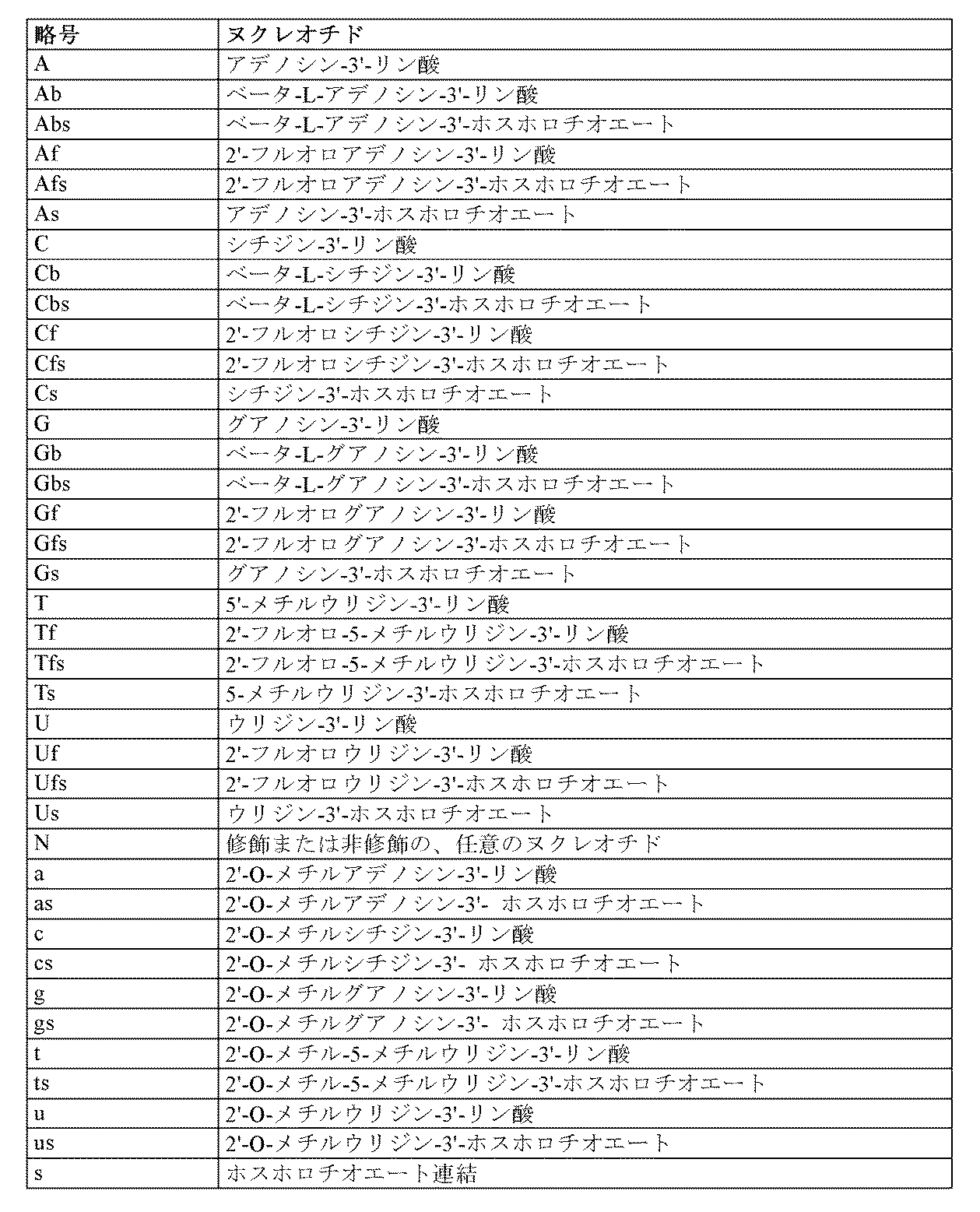
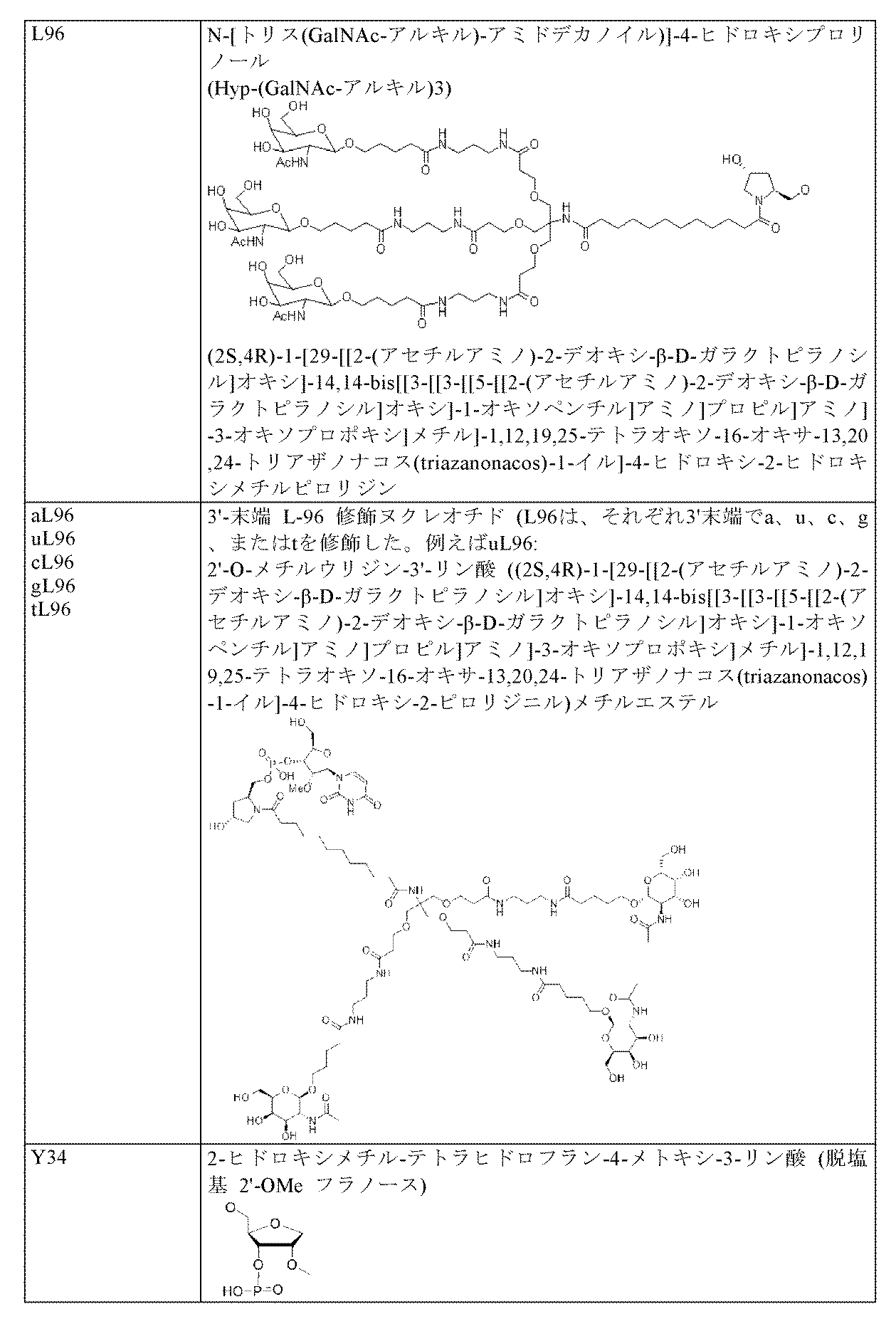
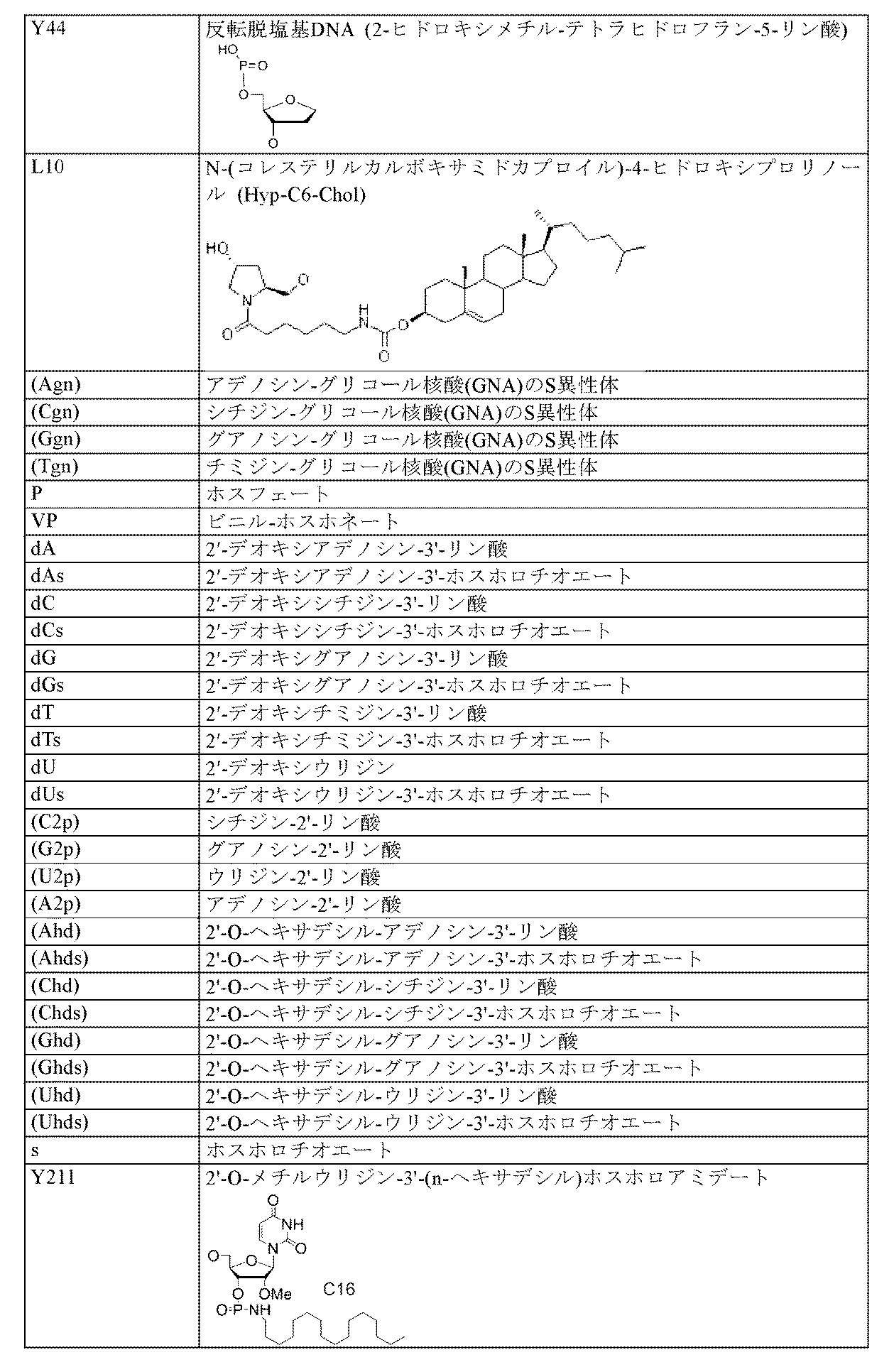
一本鎖ループオリゴヌクレオチド
本例において、例示的な一本鎖ループオリゴヌクレオチドが合成された。
Single-Stranded Loop Oligonucleotides In this example, an exemplary single-stranded loop oligonucleotide was synthesized.
一本鎖ループオリゴヌクレオチドの合成
オリゴヌクレオチドはMerMade-12DNA/RNA合成機を使用して合成した。Glen ResearchのSterling溶媒/試薬、Prime Synthesisの500Å制御型多孔性ガラス(CPG)固体支持体、Thermoの2’-デオキシ3’-ホスホルアミダイト、Hongeneの2’-OMeおよび2’-Fヌクレオシド3’-ホスホルアミダイトは全て入手したものを使用した。2’-OMe-ウリジン-5’-ビス-POM-(E)ビニルホスホネート(VP)3’-ホスホロアミダイトは、以前に公表された手順に従って合成し[Parmar et al., J. Med. Chem., 61, 734-744 (2018)、その内容が、参照によりその全体において本明細書に組み込まれる]、85%アセトニトリル15%ジメチルホルムアミド(DMF)中に0.15Mに溶解し、合成機の標準条件を用いてカップリングした。GalNAc CPG支持体は以前に記載されたように調製し、使用した[Nair et al., J. Am. Chem. Soc., 136, 16958-16961 (2014)、その内容が、参照によりその全体において本明細書に組み込まれる]。低含水アセトニトリルはEMD Chemicalsから購入した。アセトニトリル中に0.6Mの5-(S-エチルチオ)-1H-テトラゾールの溶液を活性化剤として使用した。ホスホロアミダイト溶液は、2’-OMeウリジンおよびシチジンの共溶媒として15%DMF含有無水アセトニトリル中において0.15Mであった。酸化試薬は、THF/ピリジン/水中に0.02MのI2であった。N,N-ジメチル-N’-(3-チオキソ-3H-1,2,4-ジチアゾール-5-イル)メタンイミダミド(DDTT)、ピリジン中0.09Mを硫化試薬として使用した。脱トリチル化試薬は、ジクロロメタン(DCM)中3%のジクロロ酢酸(DCA)を用いた。
Synthesis of Single-Stranded Loop Oligonucleotides Oligonucleotides were synthesized using a MerMade-12 DNA/RNA synthesizer. Sterling solvents/reagents from Glen Research, 500 Å controlled pore glass (CPG) solid supports from Prime Synthesis, 2'-deoxy 3'-phosphoramidites from Thermo, 2'-OMe and 2'-F nucleoside 3'-phosphoramidites from Hongene were all used as received. 2'-OMe-uridine-5'-bis-POM-(E) vinylphosphonate (VP) 3'-phosphoramidite was synthesized according to a previously published procedure [Parmar et al., J. Med. Chem., 61, 734-744 (2018), the contents of which are incorporated herein by reference in their entirety], dissolved at 0.15 M in 85% acetonitrile 15% dimethylformamide (DMF), and coupled using standard conditions on the synthesizer. GalNAc CPG support was prepared and used as previously described [Nair et al., J. Am. Chem. Soc., 136, 16958-16961 (2014), the contents of which are incorporated herein by reference in their entirety]. Low water content acetonitrile was purchased from EMD Chemicals. A solution of 0.6 M 5-(S-ethylthio)-1H-tetrazole in acetonitrile was used as the activating agent. The phosphoramidite solution was 0.15 M in anhydrous acetonitrile with 15% DMF as a cosolvent for 2'-OMe uridine and cytidine. The oxidation reagent was 0.02 M I2 in THF/pyridine/water. N,N-Dimethyl-N'-(3-thioxo-3H-1,2,4-dithiazol-5-yl)methanimidamide (DDTT), 0.09 M in pyridine, was used as the sulfurizing reagent. The detritylation reagent was 3% dichloroacetic acid (DCA) in dichloromethane (DCM).
固相合成終了後、CPG固体支持体を無水アセトニトリル中5%(v/v)ピペリジンで3回洗浄し、各フローの後に5分間保持した。次いで、支持体を無水アセトニトリルで洗浄し、アルゴンで乾燥させた。次いで、オリゴヌクレオチドを28~30%(w/v)NH4OHとともに、35℃で20時間インキュベートした。VP含有オリゴヌクレオチドの場合、CPG固体支持体を、5%(v/v)のジエチルアミンを含有する28~30%(w/v)NH4OHと、35℃で20時間インキュベートした[O'Shea et al., Tetrahedron, 74, 6182-6186 (2018)、その内容が、参照によりその全体において本明細書に組み込まれる]。溶媒をろ過により回収し、分析前に支持体を水を用いて洗浄した。約1 OD260ユニット/mLのオリゴヌクレオチド溶液を粗物質の分析に使用し、30~50μLの溶液を注入した。LC/ESI-MSは、XBridge C8カラム(2.1×50mm、2.5μm)を用いたAgilent 6130シングル四重極LC/MSシステムにおいて60℃で実施した。Buffer Aは水中の200mMの1,1,1,3,3,3-ヘキサフルオロ-2-プロパノールおよび16.3mMのトリエチルアミンからなり、Buffer Bは100%メタノールであった。10分間かけたBuffer Bの0%から40%の勾配の後、0.70mL/分の流速で洗浄と再キャリブレーションを行った。カラム温度は75℃であった。以前に記載されたように、全てのオリゴヌクレオチドを精製、脱塩し、さらにアニールしてGalNAc-オリゴヌクレオチドを形成した[Nair et al., J. Am. Chem. Soc., 136, 16958-16961 (2014)、その内容が、参照によりその全体において本明細書に組み込まれる]。 After the solid phase synthesis was completed, the CPG solid support was washed three times with 5% (v/v) piperidine in anhydrous acetonitrile, with a 5 min hold after each flow. The support was then washed with anhydrous acetonitrile and dried with argon. The oligonucleotides were then incubated with 28-30% (w/v) NH 4 OH at 35° C. for 20 hours. For VP-containing oligonucleotides, the CPG solid support was incubated with 28-30% (w/v) NH 4 OH containing 5% (v/v) diethylamine at 35° C. for 20 hours [O'Shea et al., Tetrahedron, 74, 6182-6186 (2018), the contents of which are incorporated herein by reference in their entirety]. The solvent was collected by filtration and the support was washed with water before analysis. An oligonucleotide solution of approximately 1 OD 260 units/mL was used for the analysis of the crude material, and 30-50 μL of the solution was injected. LC/ESI-MS was performed on an Agilent 6130 single quadrupole LC/MS system using an XBridge C8 column (2.1 x 50 mm, 2.5 μm) at 60°C. Buffer A consisted of 200 mM 1,1,1,3,3,3-hexafluoro-2-propanol and 16.3 mM triethylamine in water, and Buffer B was 100% methanol. A gradient from 0% to 40% Buffer B over 10 min was followed by cleaning and recalibration at a flow rate of 0.70 mL/min. The column temperature was 75°C. All oligonucleotides were purified, desalted, and further annealed to form GalNAc-oligonucleotides as previously described [Nair et al., J. Am. Chem. Soc., 136, 16958-16961 (2014), the contents of which are incorporated herein by reference in their entirety].
配列デザインを図1~2および以下の表1に示す。 The sequence design is shown in Figures 1-2 and Table 1 below.
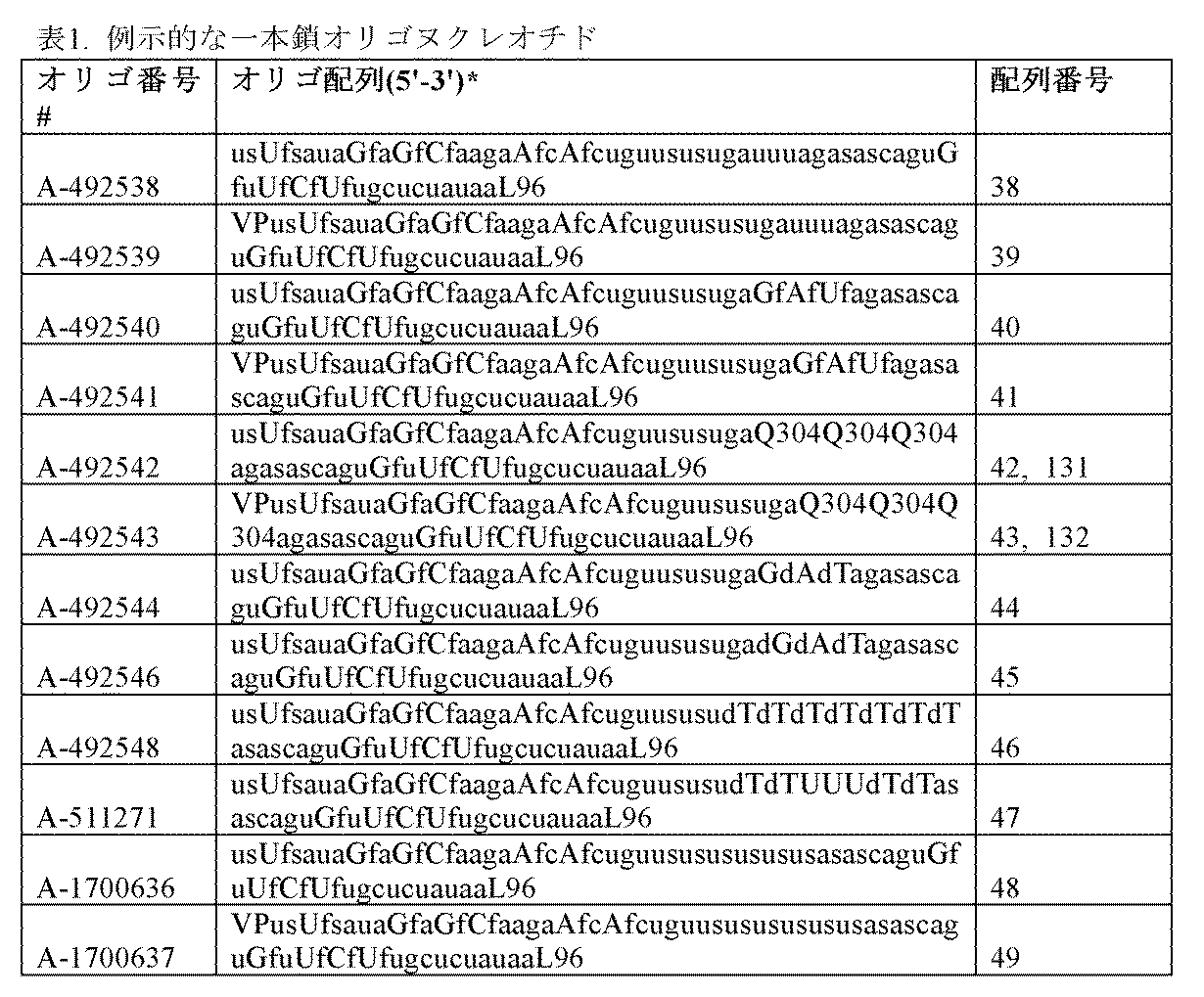
S-PS連結;小文字のヌクレオチド-2’-OMe;大文字のヌクレオチド-リボヌクレオチド(RNA);「d」に大文字のヌクレオチドが続く-2’-デオキシ(DNA);大文字のヌクレオチドに「f」が続く-2’-F;VP-5’-(E)-ビニルホスホネート;
Q304-
S-PS linkage; lower case nucleotides-2'-OMe; upper case nucleotides-ribonucleotides (RNA); upper case nucleotides followed by "d"-2'-deoxy (DNA); upper case nucleotides followed by "f"-2'-F;VP-5'-(E)-vinylphosphonate;
Q304-
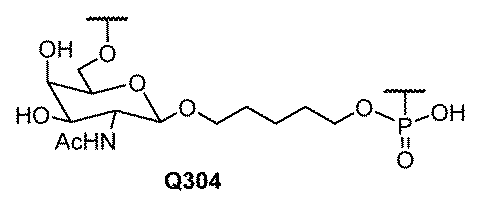

表1のこれらの一本鎖オリゴヌクレオチドの塩基配列(すなわち、ヌクレオチドに修飾を加えていない配列)を表2に示す。 The base sequences of these single-stranded oligonucleotides in Table 1 (i.e., the sequences without nucleotide modifications) are shown in Table 2.
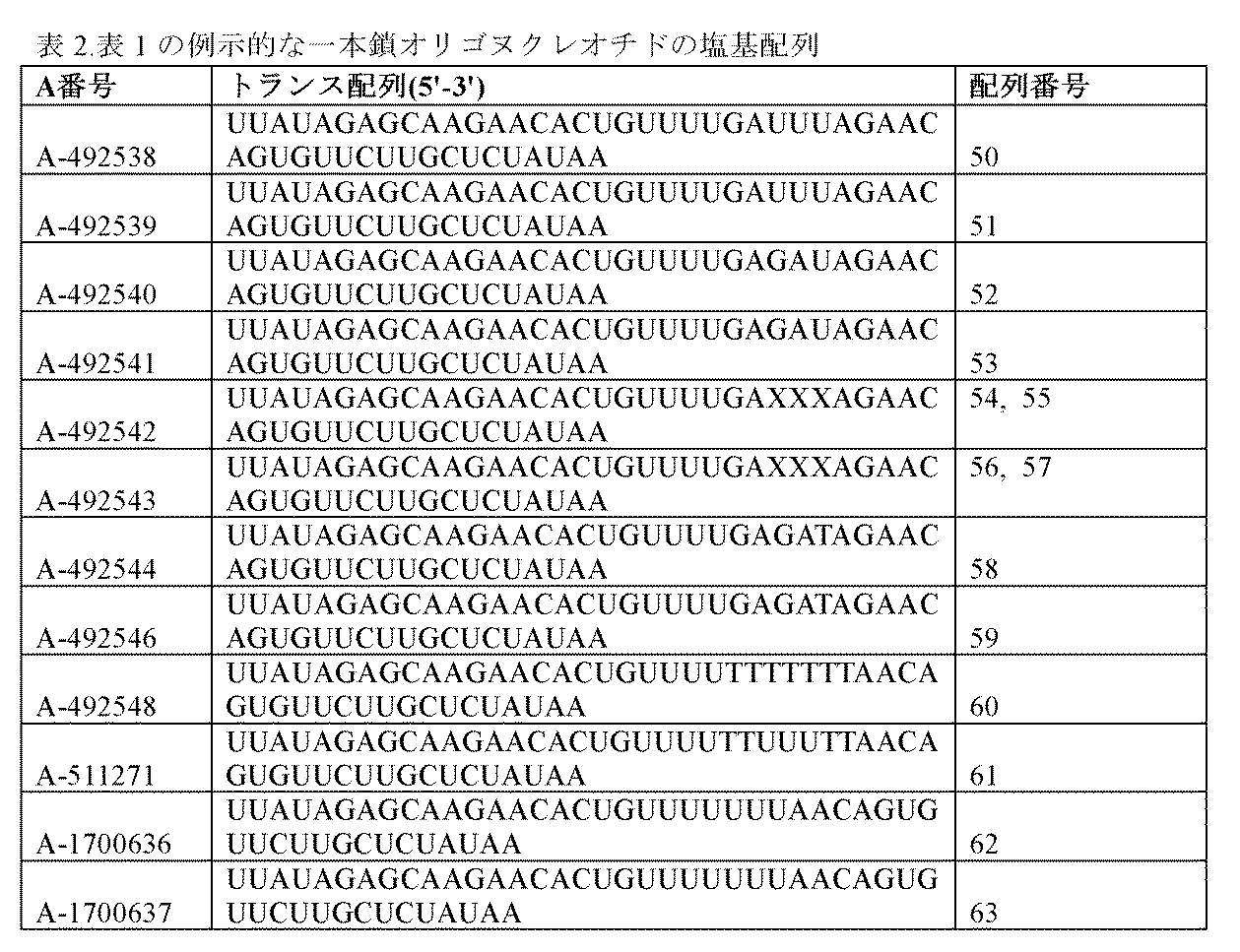
親siRNA二重鎖の配列を以下の表3に示す。 The sequences of the parent siRNA duplexes are shown in Table 3 below.

血漿および肝臓ホモジネート中のオリゴヌクレオチドのインビトロ安定性/代謝
上記の全ての例示的な一本鎖オリゴヌクレオチドのインビトロ代謝を、親siRNA二重鎖と比較して、マウス血漿およびマウス肝臓ホモジネートにおいて評価した。
In Vitro Stability/Metabolism of Oligonucleotides in Plasma and Liver Homogenate The in vitro metabolism of all the exemplary single stranded oligonucleotides described above was evaluated in mouse plasma and mouse liver homogenate in comparison to the parent siRNA duplexes.
その内容が、参照によりその全体において本明細書に組み込まれる、Jahns et al.. Nucleic Acids Research 49, 10250-10264 (2021)によって記載されたように、インビトロ代謝を、ラット血漿(BioIVT、型番CUSTOMBIOFBLD)および肝臓ホモジネート(BioIVT、特注)において実施した。最終反応混合物は、1mMのMgCl2、1mMのMnCl2、および2mMのCaCl2であった。一本鎖オリゴヌクレオチドを血漿または肝臓ホモジネートと20μg/mLにおいてインキュベートした。反応混合物を37℃で24時間穏やかに振盪しながらインキュベートした。内部標準物質(オリゴヌクレオチドU21、最終濃度1μg/mL)を含有する450μLのClarity OTX溶解-ローディング緩衝液(Phenomenex、型番AL0-8579)を加えて反応を停止し、分析まで-80℃で凍結した。 In vitro metabolism was performed in rat plasma (BioIVT, model number CUSTOMBIOFBLD) and liver homogenate (BioIVT, custom order) as described by Jahns et al. Nucleic Acids Research 49, 10250-10264 (2021), the contents of which are incorporated herein by reference in their entirety. The final reaction mixture was 1 mM MgCl 2 , 1 mM MnCl 2 , and 2 mM CaCl 2 . Single-stranded oligonucleotides were incubated with plasma or liver homogenate at 20 μg/mL. The reaction mixture was incubated at 37° C. for 24 hours with gentle shaking. The reaction was stopped by adding 450 μL of Clarity OTX lysis-loading buffer (Phenomenex, cat. no. AL0-8579) containing an internal standard (oligonucleotide U 21 , final concentration 1 μg/mL) and frozen at −80° C. until analysis.
その内容が、参照によりその全体において本明細書に組み込まれる、Liu et al., Bioanalysis, 11, 1967-1980 (2018)によって記載されているように、Clarity OTX 96ウェル固相抽出プレートを使用して、反応混合物からオリゴヌクレオチドを濃縮した。試料を、メタノール、続いてHPLCグレードの水中2mMのアジ化ナトリウムを含む50mMの酢酸アンモニウムによって前処理したSPEカラムにロードした。50/50(v/v)の水とアセトニトリル(pH5.5)中に50mMの酢酸アンモニウムをカラムの洗浄に使用した。次いで、40/10/50(v/v/v)のアセトニトリル/テトラヒドロフラン/水(pH8.8)中に10mMのEDTA、100mMの重炭酸アンモニウムを含有する溶出緩衝液を使用してオリゴヌクレオチドを溶出した。溶出液を窒素下で乾燥させ、LC-MS分析用に120μLのLC-MSグレードの水に再懸濁した。 Oligonucleotides were enriched from the reaction mixture using Clarity OTX 96-well solid-phase extraction plates as described by Liu et al., Bioanalysis, 11, 1967-1980 (2018), the contents of which are incorporated herein by reference in their entirety. Samples were loaded onto an SPE column pretreated with methanol followed by 50 mM ammonium acetate with 2 mM sodium azide in HPLC grade water. 50 mM ammonium acetate in 50/50 (v/v) water and acetonitrile (pH 5.5) was used to wash the column. Oligonucleotides were then eluted using an elution buffer containing 10 mM EDTA, 100 mM ammonium bicarbonate in 40/10/50 (v/v/v) acetonitrile/tetrahydrofuran/water (pH 8.8). The eluate was dried under nitrogen and resuspended in 120 μL of LC-MS grade water for LC-MS analysis.
30μLの試料をWaters X-Bridge BEH C8XP Column(型番176002554、130Å、2.5μm、2.1mm×30mm、80℃)に注入し、LC-MSグレードの水(Fisher、型番7732-18-5)中、16mMのトリエチルアミン(Sigma、型番471283)、200mMの1,1,1,3,3,3,3-ヘキサフルオロ-2-プロパノール(Fisher、型番67-56-1)の勾配を用いて分離した;移動相Bは100%メタノール(Fisher、カタログ番号67-56-1)であった。勾配は1%の移動相Bから開始し、4.3分かけて35%のBまで進行させた後、カラムを1%の移動相Bで1分間平衡化した。データは高分解能質量分析計(Thermo Scientific Q Exactive)のフルスキャンモードで取得した。スキャン範囲は500~3000m/z、分解能は70,000、スプレー電圧は2.8kVを用いてデータを取得した。補助ガス温度とキャピラリー温度は300℃に設定した。 30 μL of sample was injected onto a Waters X-Bridge BEH C8XP Column (p/n 176002554, 130 Å, 2.5 μm, 2.1 mm × 30 mm, 80°C) and separated using a gradient of 16 mM triethylamine (Sigma, p/n 471283), 200 mM 1,1,1,3,3,3,3-hexafluoro-2-propanol (Fisher, p/n 67-56-1) in LC-MS grade water (Fisher, p/n 7732-18-5); mobile phase B was 100% methanol (Fisher, catalog no. 67-56-1). The gradient started at 1% mobile phase B and progressed to 35% B over 4.3 min, after which the column was equilibrated with 1% mobile phase B for 1 min. Data were acquired in full scan mode on a high-resolution mass spectrometer (Thermo Scientific Q Exactive). Data were acquired using a scan range of 500-3000 m/z, a resolution of 70,000, and a spray voltage of 2.8 kV. The auxiliary gas temperature and capillary temperature were set at 300°C.
その内容が、参照によりその全体において本明細書に組み込まれる、Liu et al., Bioanalysis,11,1967-1980(2018)に記載されているように、全データをProMass HRデコンボリューションソフトウェア(Novatia、LLC)を用いて処理し、代謝物を同定した。 All data were processed and metabolites identified using ProMass HR deconvolution software (Novatia, LLC) as described in Liu et al., Bioanalysis, 11, 1967-1980 (2018), the contents of which are incorporated herein by reference in their entirety.
図2に示すように、一本鎖オリゴヌクレオチドまたは親siRNA鎖のいずれも、血漿中においては8時間まで分解が検出されなかった。 As shown in Figure 2, no degradation of either the single-stranded oligonucleotide or the parent siRNA strand was detected in plasma up to 8 hours.
上記の例示的な一本鎖オリゴヌクレオチドおよび親siRNA二重鎖の血漿代謝の概要を図3に示す。 An overview of the plasma metabolism of the exemplary single-stranded oligonucleotides and parent siRNA duplexes shown above is shown in Figure 3.
LC-MSによる代謝物分析においては、血漿中においては分解に有意差は認められず、24時間後も全ての一本鎖オリゴヌクレオチドは無傷のままであった。 Metabolite analysis by LC-MS showed no significant differences in degradation in plasma, and all single-stranded oligonucleotides remained intact after 24 hours.
2’-Fのトリプレット(a triplet of)(A-492540);2’-デオキシ(DNA)のトリプレット(A-492546);ポリdT(A-492548);およびRNAのトリプレット(A-511271)を含有するループ領域を有する一本鎖オリゴヌクレオチドは、肝臓ホモジネート中において24時間までに効率的に代謝され(連結基L、すなわちループ領域において切断された)、23mer(例えば、親AD-64228に示されるようなアンチセンス鎖)を生じることが観察された。 Single-stranded oligonucleotides with loop regions containing a triplet of 2'-F (A-492540); a triplet of 2'-deoxy (DNA) (A-492546); poly dT (A-492548); and a triplet of RNA (A-511271) were observed to be efficiently metabolized (cleaved at the linker L, i.e., the loop region) in liver homogenates by 24 hours to yield 23-mers (e.g., antisense strands as shown in parent AD-64228).
2’-OMe(A-492538、A-492539);Q304(A-492542);2’-OMeおよびPS(A-1700637)を含有する、より安定なループ領域を有する一本鎖オリゴヌクレオチドは、肝臓ホモジネート中において24時間では23merの形成を示さなかった。 Single-stranded oligonucleotides with more stable loop regions containing 2'-OMe (A-492538, A-492539); Q304 (A-492542); 2'-OMe and PS (A-1700637) did not show 23mer formation in liver homogenates at 24 hours.
上記の例示的な一本鎖オリゴヌクレオチドおよび親siRNA二重鎖の肝臓ホモジネート代謝の概要を図4に示す。 A summary of the liver homogenate metabolism of the exemplary single-stranded oligonucleotides and parent siRNA duplexes shown above is shown in Figure 4.
一本鎖ループオリゴヌクレオチドコンジュゲートのインビボ活性
マウスにおいて、上記の例示的な一本鎖オリゴヌクレオチド(表1に示す)によるmTTR発現の阻害を、0.2mg/kg、0.4mg/kg、および1mg/kgの単回投与において実施した。
In Vivo Activity of Single-Stranded Loop Oligonucleotide Conjugates Inhibition of mTTR expression in mice with the exemplary single-stranded oligonucleotides described above (shown in Table 1) was performed at single doses of 0.2 mg/kg, 0.4 mg/kg, and 1 mg/kg.
約8週齢の雌C57BL/6マウスをCharles River Laboratoriesから入手し、各群に無作為に割り付けた。マウスは試験開始前に48時間室内で馴化させた。動物にループマーsiRNA、siRNA、またはPBS生理食塩水対照を10μL/gの濃度で皮下投与した。この試験で用いた用量は0.2、0.4、1mg/kgであった。試験化合物はリン酸緩衝生理食塩水(PBS、pH7.4)に希釈した。全ての溶液は注射時まで4℃において保存した。IACUC承認のプロトコールに従い、後眼窩出血法を用いて血液を採取した。試料はBecton Dickinson血清分離試験管(Fisher Scientific、型番BD365967)中に採取した。 Female C57BL/6 mice, approximately 8 weeks of age, were obtained from Charles River Laboratories and randomly assigned to each group. Mice were allowed to acclimate in the room for 48 hours before the start of the study. Animals were administered loopmer siRNA, siRNA, or PBS saline control subcutaneously at a concentration of 10 μL/g. Doses used in this study were 0.2, 0.4, and 1 mg/kg. Test compounds were diluted in phosphate buffered saline (PBS, pH 7.4). All solutions were stored at 4°C until injection. Blood was collected using a retro-orbital bleed method according to an IACUC-approved protocol. Samples were collected in Becton Dickinson serum separator tubes (Fisher Scientific, model no. BD365967).
TTRの分析については、血清試料を室温において1時間保持した後、微量遠心機によって21,000×g、室温において10分間回転させた。血清は1.5mLの微量遠心試験管に移し、アッセイ時まで-80℃において保存した。血清試料を1:4,000に希釈し、マウスプレアルブミンの検出に特異的なALPCOの市販キット(型番41-PALMS-E01)を用いてアッセイした。タンパク質濃度(μg/mL)は精製TTR標準品との比較により決定し、製造業者の使用説明書に従った。 For TTR analysis, serum samples were held at room temperature for 1 hour and then spun in a microcentrifuge at 21,000 x g for 10 minutes at room temperature. Serum was transferred to 1.5 mL microcentrifuge tubes and stored at -80°C until assayed. Serum samples were diluted 1:4,000 and assayed using a commercial kit from ALPCO (product no. 41-PALMS-E01) specific for the detection of mouse prealbumin. Protein concentration (μg/mL) was determined by comparison to purified TTR standards and followed the manufacturer's instructions.
結果は、これらの一本鎖オリゴヌクレオチド(GalNAcコンジュゲートを有する)がマウスにおいて効率的なサイレンシングを示したことを示している。2’-Fのトリプレットおよび2’-デオキシ(DNA)のトリプレットを含むループ領域(連結基L)を有する一本鎖オリゴヌクレオチドは、親二重鎖siRNAと比較して、同等または増強された効力を示したが、より安定なループ領域を有する一本鎖オリゴヌクレオチドは、効力の発現の遅延を示した。 The results show that these single-stranded oligonucleotides (with GalNAc conjugates) demonstrated efficient silencing in mice. Single-stranded oligonucleotides with loop regions (linker group L) containing a 2'-F triplet and a 2'-deoxy(DNA) triplet demonstrated comparable or enhanced potency compared to the parent duplex siRNA, whereas single-stranded oligonucleotides with more stable loop regions demonstrated delayed onset of potency.
さらなる一本鎖オリゴヌクレオチド
SOD1をターゲティングするさらなる一本鎖ループオリゴヌクレオチドをスキーム3.1~3.3に示す。化学修飾の表示は表1と同じである。(Uhd)は2’-O-ヘキサデシル-ウリジン-3’-リン酸である。Q304は、
Further single-stranded oligonucleotides targeting SOD1 are shown in Schemes 3.1-3.3. The designations of chemical modifications are the same as in Table 1. (Uhd) is 2'-O-hexadecyl-uridine-3'-phosphate. Q304 is

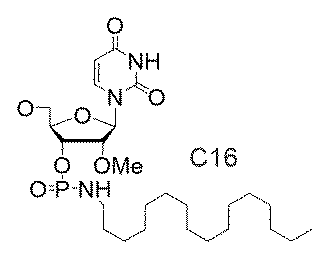
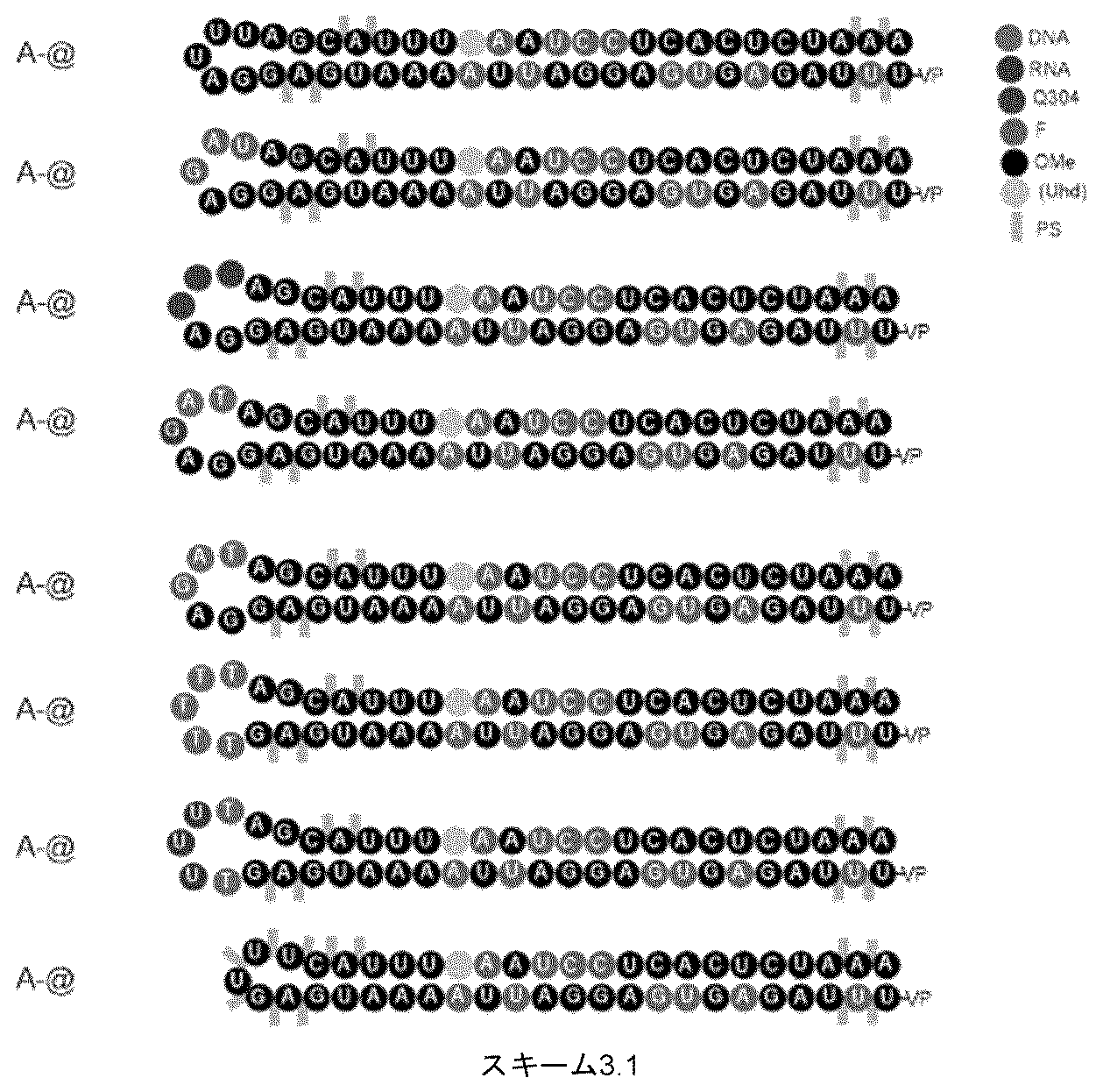
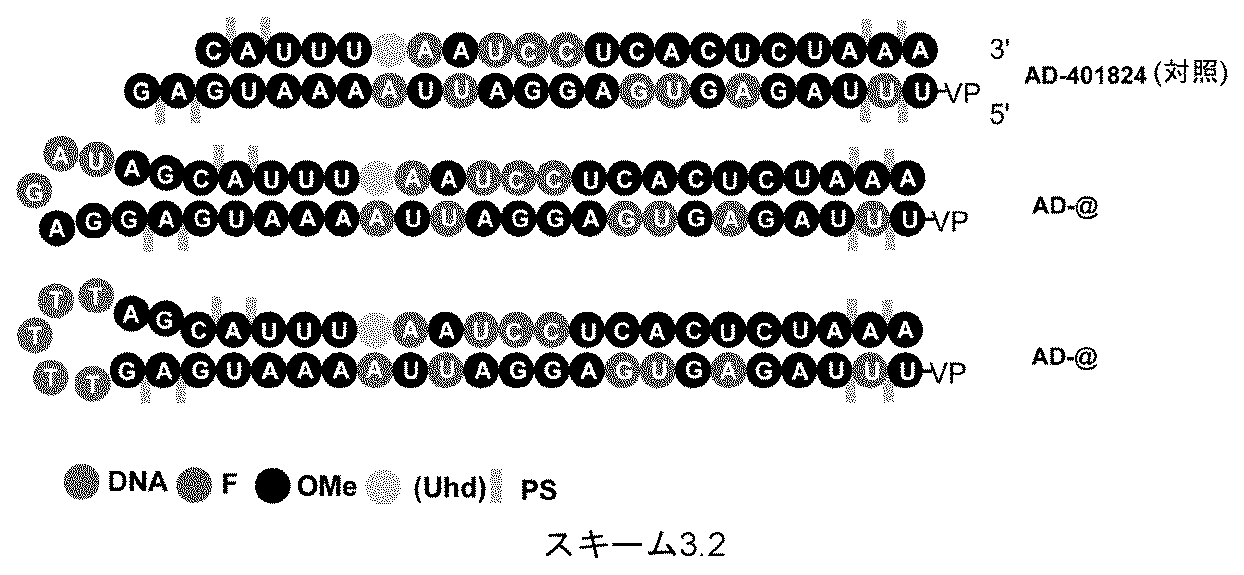
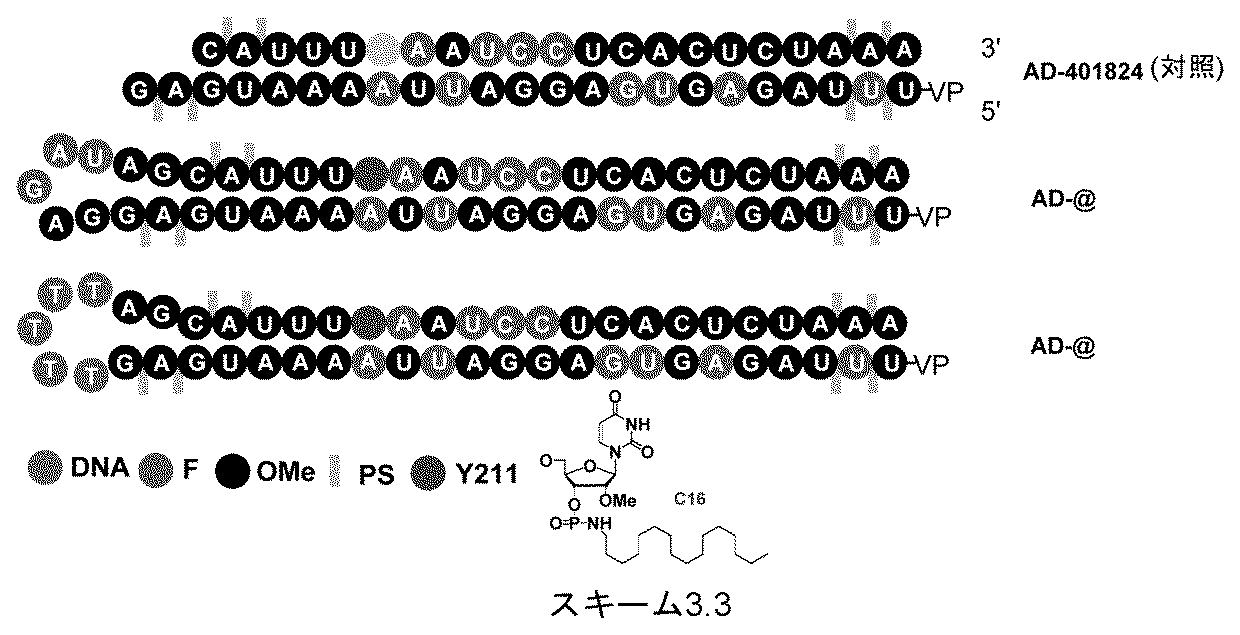
β-catをターゲティングするさらなる一本鎖ループオリゴヌクレオチドをスキーム4.1~4.4に示す。化学修飾の表示は表1と同じである。L10は、 Further single-stranded loop oligonucleotides targeting β-cat are shown in Schemes 4.1 to 4.4. The chemical modifications are as shown in Table 1. L10 is
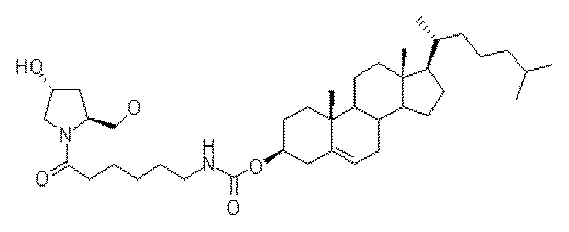

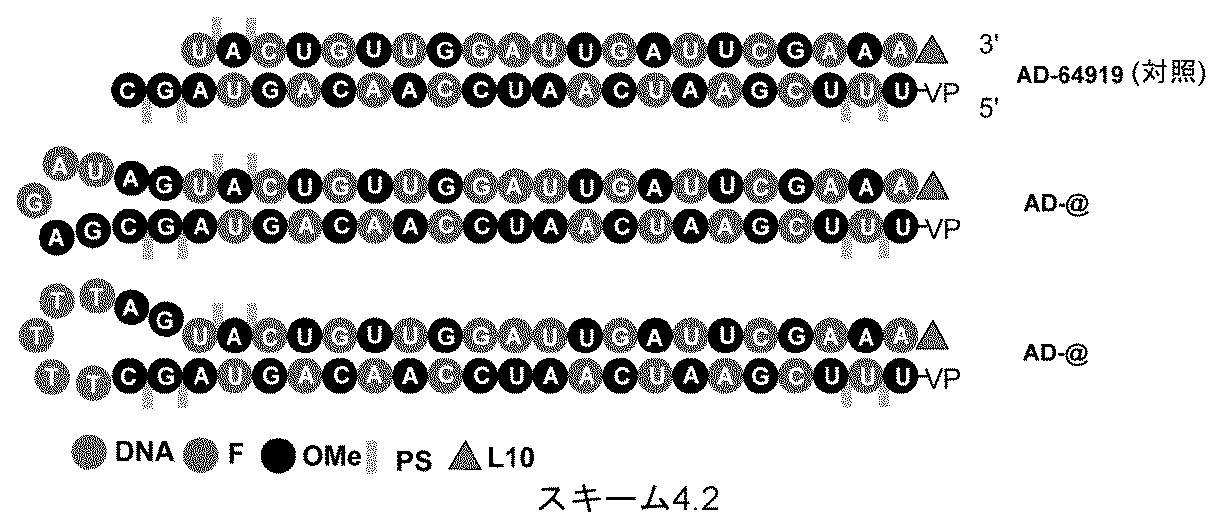
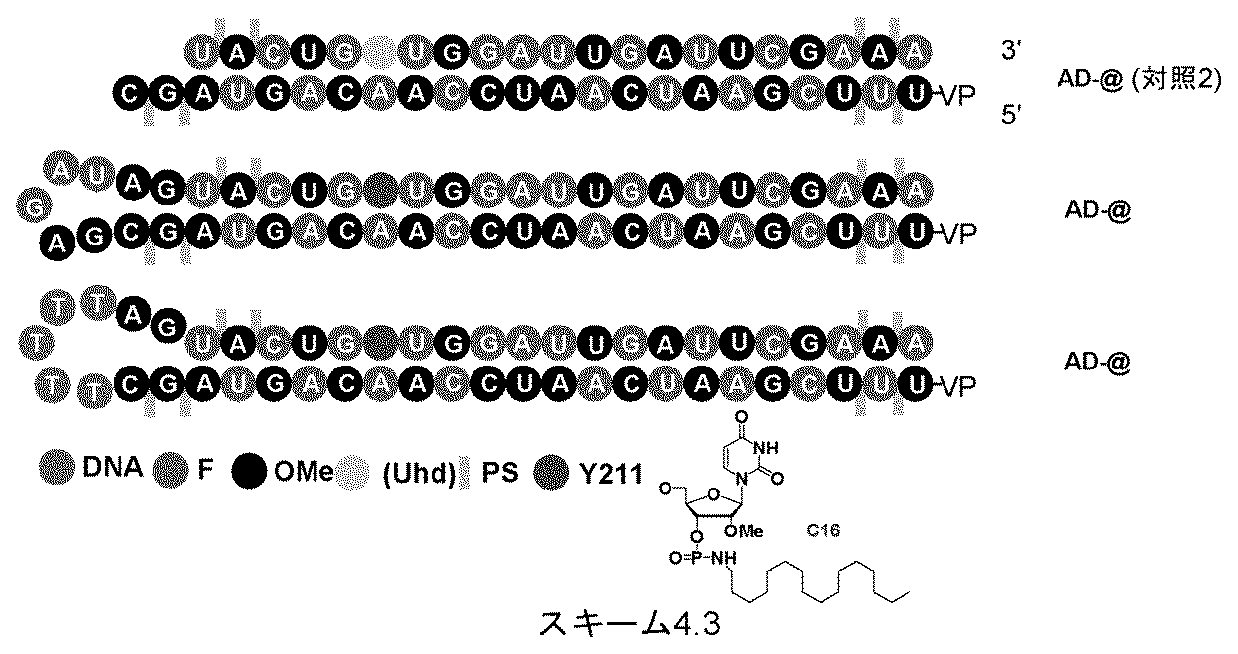

oc-mTTRをターゲティングするさらなる一本鎖ループオリゴヌクレオチドをスキーム5.1~5.2に示す。化学修飾の表示は表1と同じである。 Additional single-stranded loop oligonucleotides targeting oc-mTTR are shown in Schemes 5.1-5.2. Chemical modifications are indicated as in Table 1.

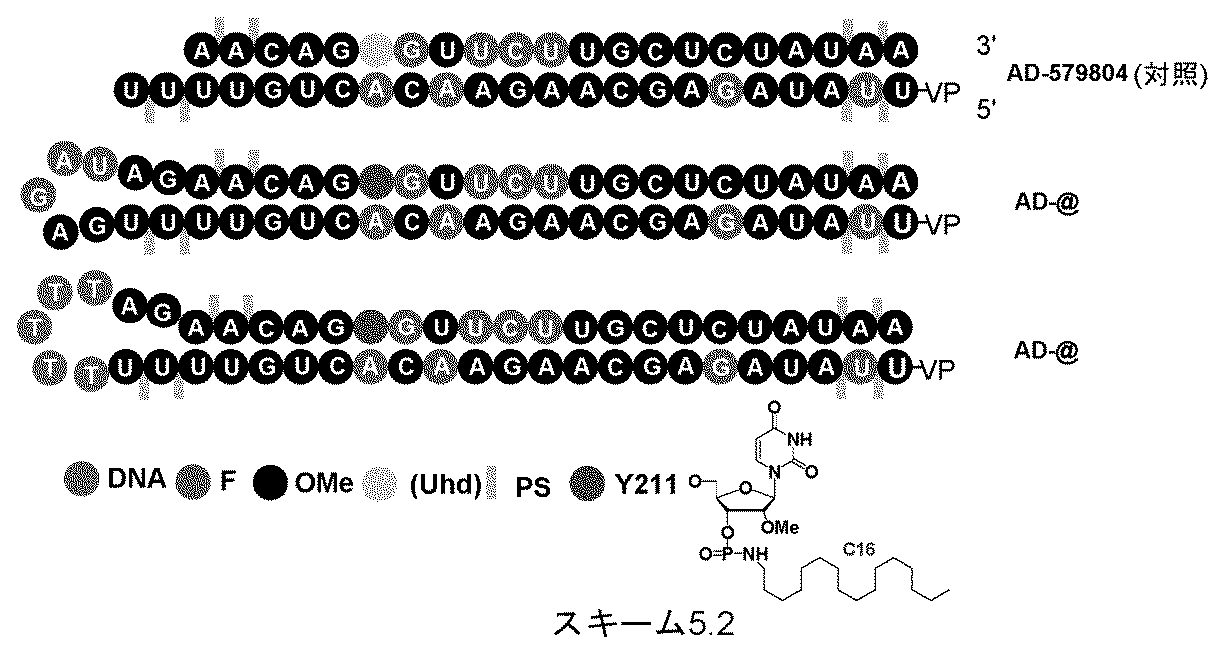
h/cTTRをターゲティングするさらなる一本鎖ループオリゴヌクレオチドをスキーム6.1~6.2に示す。化学修飾の表示は表1と同じである。 Additional single-stranded loop oligonucleotides targeting h/cTTR are shown in Schemes 6.1-6.2. Chemical modifications are represented as in Table 1.
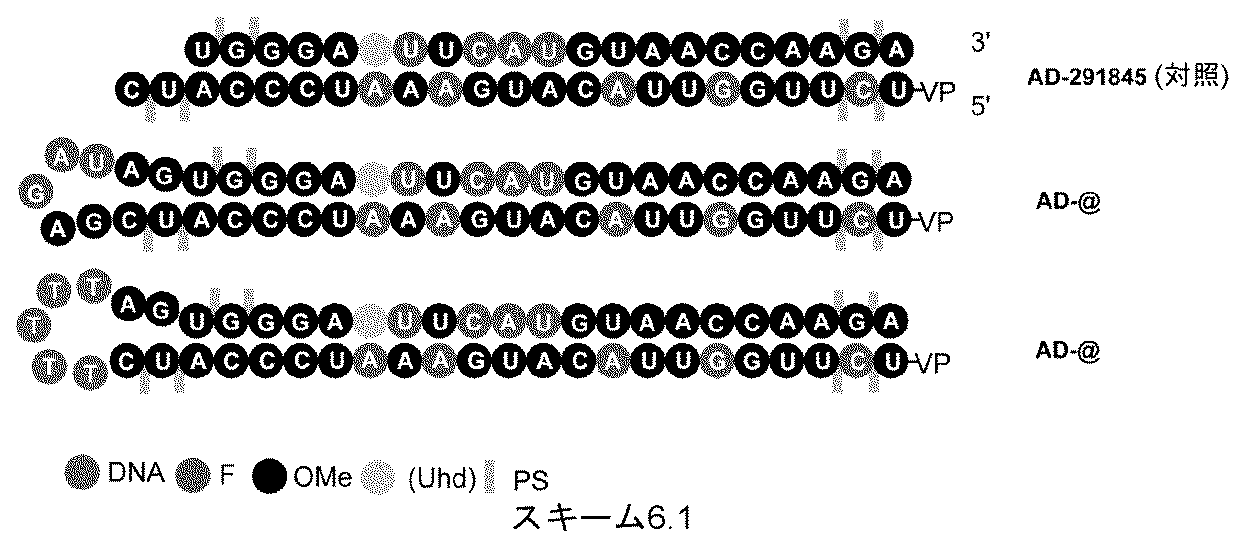
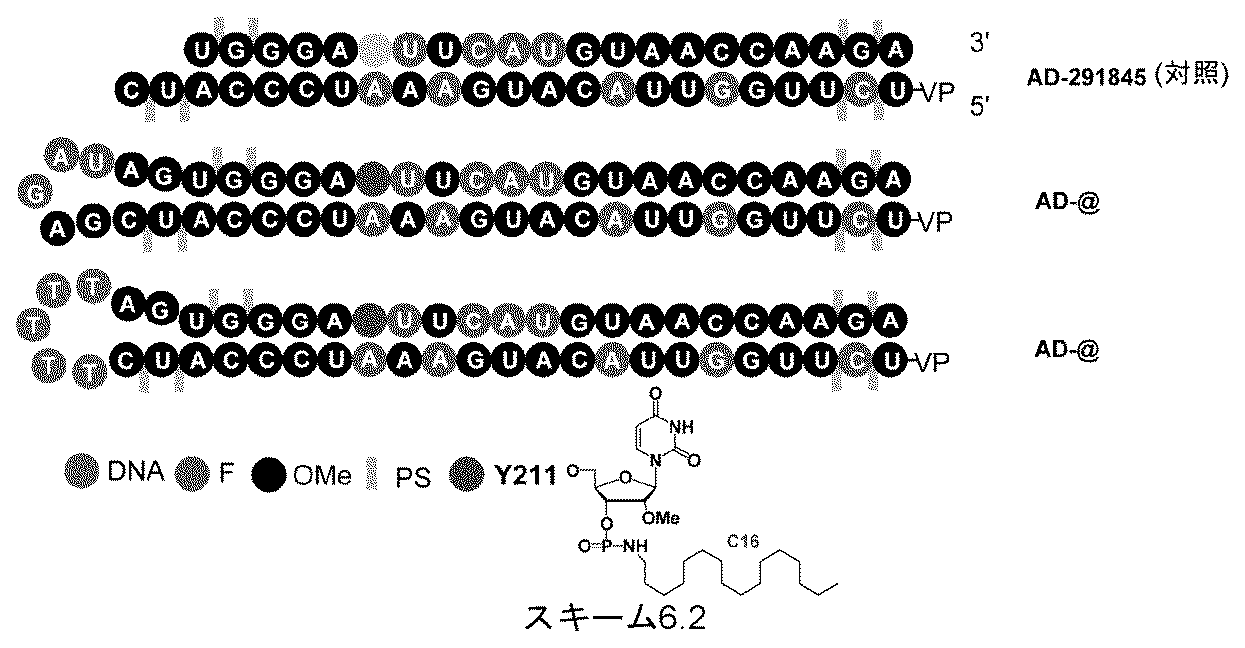
2つの一本鎖ループオリゴヌクレオチドを含むオリゴヌクレオチドコンストラクト
2つの一本鎖ループオリゴヌクレオチドを含むオリゴヌクレオチドコンストラクトの様々なデザインを、スキーム7.1~7.3に示す。これらのスキームにおいては、2つの一本鎖ループオリゴヌクレオチドはループ領域においてリンカーによって接続され、ジェミニ型構造を形成する。2つの一本鎖ループオリゴヌクレオチドを接続するリンカーは、本開示に開示される任意のものでありうる。リンカーの例を以下のスキーム7.1~7.3に示す。オリゴヌクレオチドが接続される2つの一本鎖ループオリゴヌクレオチドのループ領域(複数可)内のヌクレオチド(複数可)は、リンカーがオリゴヌクレオチドに接続するのを容易にするために、本開示において開示される任意の化学修飾を受けうる。オリゴヌクレオチドが接続されるループ領域(複数可)のヌクレオチド(複数可)の例示的な修飾を、以下のスキーム7.1~7.3に示す。
Oligonucleotide Constructs Comprising Two Single-Stranded Loop Oligonucleotides Various designs of oligonucleotide constructs comprising two single-stranded loop oligonucleotides are shown in Schemes 7.1-7.3. In these schemes, the two single-stranded loop oligonucleotides are connected by a linker in the loop region to form a gemini-type structure. The linker connecting the two single-stranded loop oligonucleotides can be any disclosed in the present disclosure. Examples of linkers are shown in Schemes 7.1-7.3 below. The nucleotide(s) in the loop region(s) of the two single-stranded loop oligonucleotides to which the oligonucleotides are connected can undergo any chemical modification disclosed in the present disclosure to facilitate the linker connecting to the oligonucleotides. Exemplary modifications of the nucleotide(s) in the loop region(s) to which the oligonucleotides are connected are shown in Schemes 7.1-7.3 below.
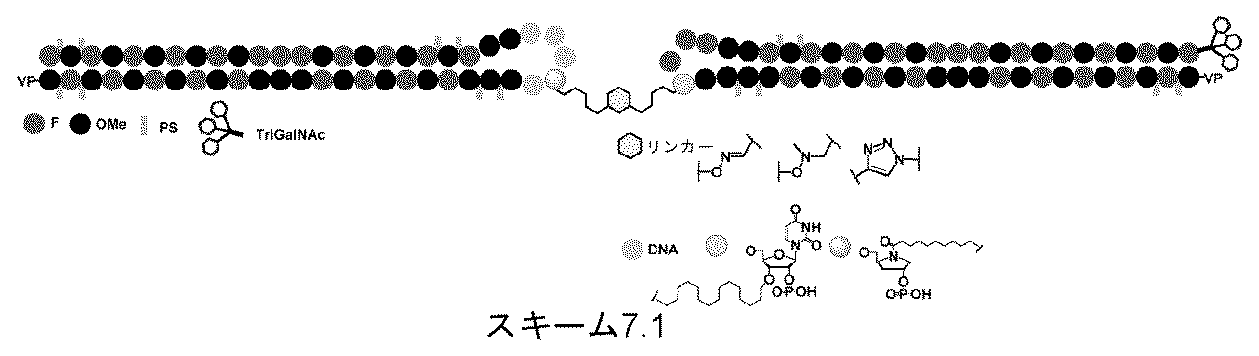

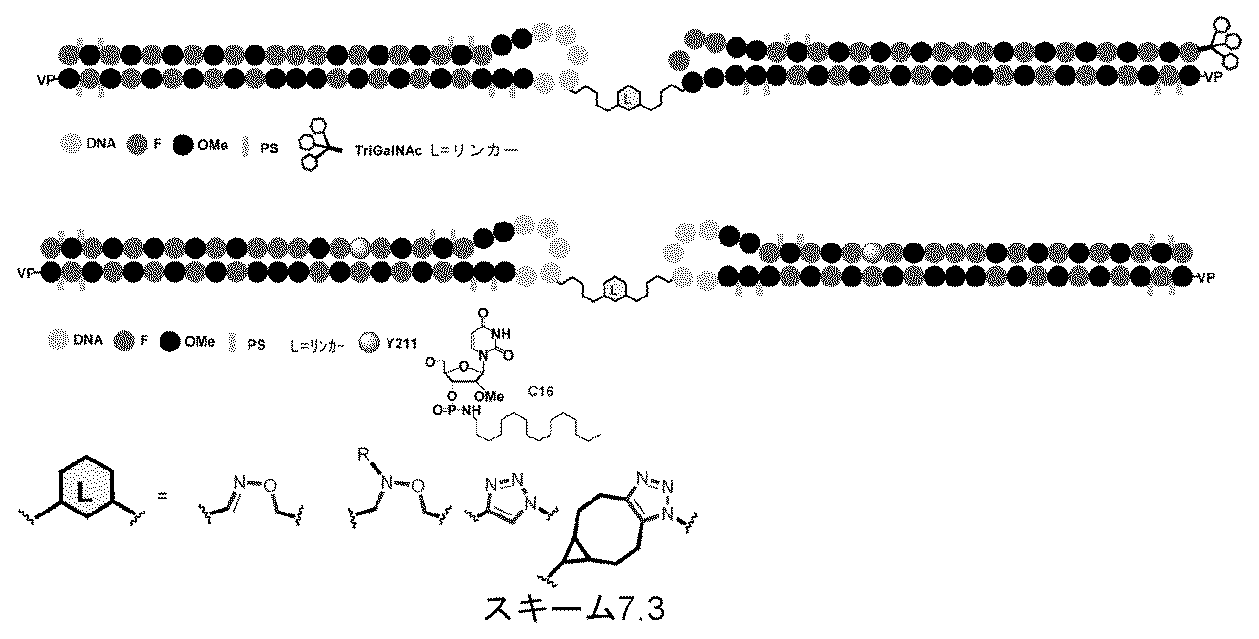
2つの一本鎖ループオリゴヌクレオチドを接続するリンカーは、 The linker that connects the two single-stranded loop oligonucleotides is

例えば、一本鎖ループオリゴヌクレオチドからジェミニ型構造を有するオリゴヌクレオチドコンストラクトを形成する例示的なプロセスをスキーム7.4に示すが、2つの一本鎖ループオリゴヌクレオチドを接続するリンカーはオキシムリンカーまたはアミノオキシリンカーである。 For example, an exemplary process for forming an oligonucleotide construct having a gemini structure from single-stranded loop oligonucleotides is shown in Scheme 7.4, where the linker connecting the two single-stranded loop oligonucleotides is an oxime linker or an aminooxy linker.

例示的な一本鎖オリゴヌクレオチド
GalNAcコンジュゲート一本鎖オリゴヌクレオチドの化学合成
本例においては、センス鎖とアンチセンス鎖がリンカー基によって接続された一本鎖ループオリゴヌクレオチドコンストラクトがデザインされた。
Exemplary Single-Stranded Oligonucleotides Chemical Synthesis of GalNAc-Conjugated Single-Stranded Oligonucleotides In this example, a single-stranded loop oligonucleotide construct was designed in which the sense and antisense strands were connected by a linker group.
一本鎖ループオリゴヌクレオチドの合成手順は、前述の実施例1と同じである。一本鎖ループオリゴヌクレオチドの合成スキームを以下のスキーム8に示す。 The synthesis procedure for the single-stranded loop oligonucleotide is the same as that described in Example 1 above. The synthesis scheme for the single-stranded loop oligonucleotide is shown in Scheme 8 below.
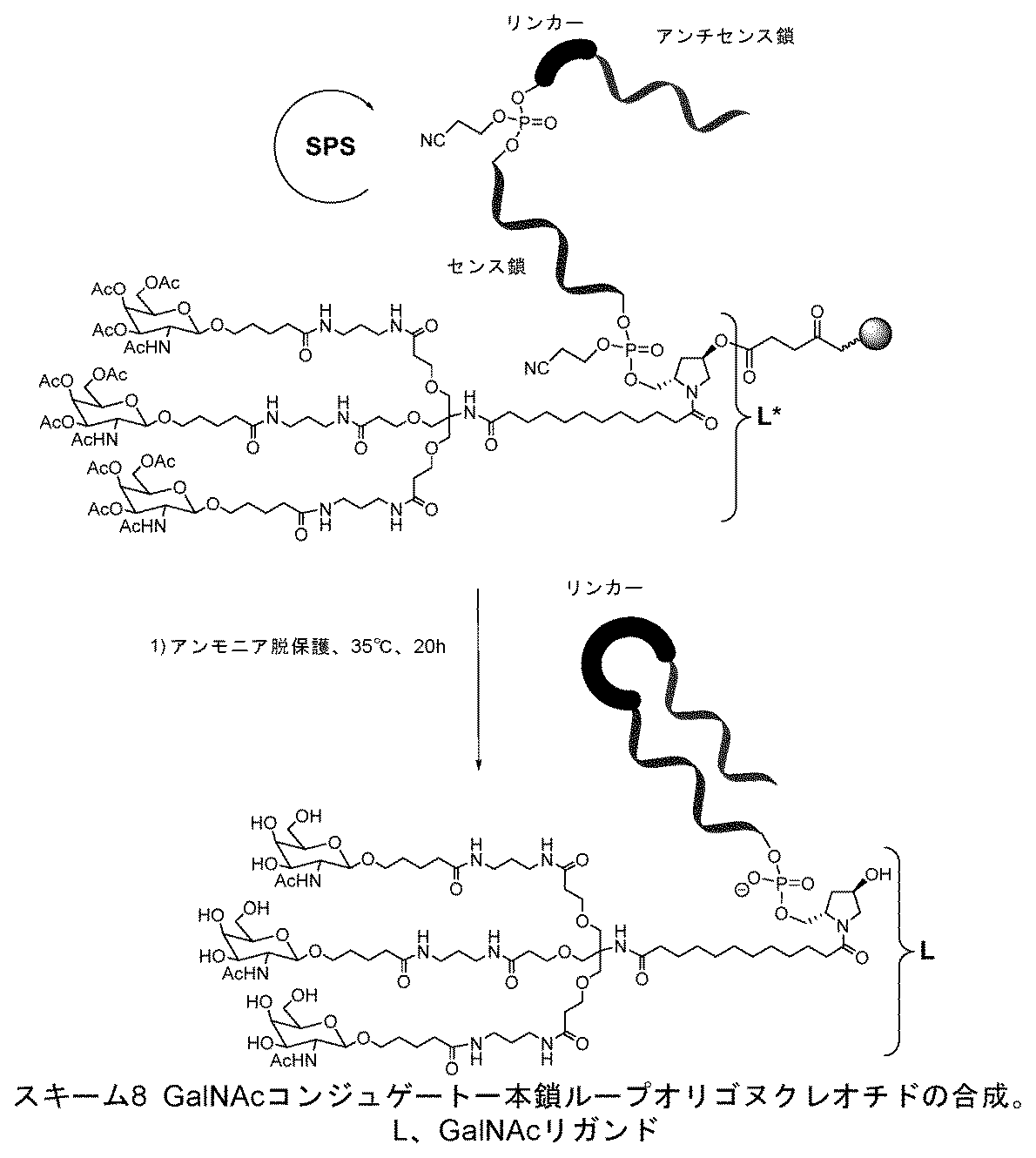
一本鎖ループオリゴヌクレオチドの合成は一本鎖の合成のみであり、典型的な二重鎖siRNAの合成のための二段階の合成とアニーリングを避けることができる。さらに、接続構造は二重鎖の熱安定性を低下させることなく、代謝安定性を高めることができる。 The synthesis of single-stranded loop oligonucleotides requires only one strand, avoiding the two-step synthesis and annealing required for the synthesis of typical double-stranded siRNAs. Furthermore, the connecting structure can increase the metabolic stability without reducing the thermal stability of the duplex.
一本鎖ループオリゴヌクレオチドコンジュゲートのデザイン
本例においては、RISC機構に効率的にロードされ、その後RNAi経路を通じて標的遺伝子をノックダウンできる一本鎖化学修飾RNAがデザインされた。一本鎖ループオリゴヌクレオチドのデザインのために、齧歯動物のTTRをターゲティングする5’センス鎖に接合された3価のGalNAcを含有するsiRNA二重鎖を親として用いた(ON-1)。センス鎖の5’末端をアンチセンス鎖の3’末端へ接続するループ領域は、循環中で安定で、肝臓において内在化した後にヌクレアーゼによって切断されうるループマーとなるように、複数の化学的手法を用いてデザインされた。ループ領域の化学修飾の効果は、ループ領域の安定性が異なる様々な一本鎖ループオリゴヌクレオチドを比較することによって示された(表4)。
Design of single-stranded loop oligonucleotide conjugates In this example, single-stranded chemically modified RNAs were designed that could be efficiently loaded into the RISC machinery and subsequently knock down target genes through the RNAi pathway. For the design of single-stranded loop oligonucleotides, a siRNA duplex containing a trivalent GalNAc conjugated to a 5' sense strand targeting rodent TTR was used as a parent (ON-1). The loop region connecting the 5' end of the sense strand to the 3' end of the antisense strand was designed using multiple chemical approaches to result in a loopmer that is stable in circulation and can be cleaved by nucleases after internalization in the liver. The effect of chemical modification of the loop region was shown by comparing various single-stranded loop oligonucleotides with different stability of the loop region (Table 4).
例えば、1つのオリゴヌクレオチドは、2’-OMe修飾ヌクレオチドを含有するループ領域を含有し(On-2)、次いで、ループ領域のヌクレオチドの3つが、より安定性の低い2’-F修飾ヌクレオチドによって置換され(On-3)、次いで、ループは、RNAおよびDNA塩基の組合せ(On-4、On-5)または2’-OMeデザインを有する完全なDNA塩基(On-6およびOn-7)のいずれかを使用することによって、非修飾ヌクレオチドを導入することによってさらに不安定化された。また、最大の安定性を提供するために、ホスホロチオエートが2’-OMe修飾領域(On-8)に使用された。さらに、2’-OMe-および2’-F-含有一本鎖ループオリゴヌクレオチド(On-9、On-10、On-11)の一本鎖ループオリゴヌクレオチドデザインにおける有効性への影響を理解するために、5’-(E)-ビニルホスホネートが一本鎖ループオリゴヌクレオチドに含まれた。 For example, one oligonucleotide contained a loop region containing 2'-OMe modified nucleotides (On-2), then three of the nucleotides in the loop region were replaced by less stable 2'-F modified nucleotides (On-3), and then the loop was further destabilized by introducing unmodified nucleotides by using either a combination of RNA and DNA bases (On-4, On-5) or a completely DNA base with a 2'-OMe design (On-6 and On-7). Also, phosphorothioates were used in the 2'-OMe modified region (On-8) to provide maximum stability. Additionally, 5'-(E)-vinyl phosphonates were included in the single-stranded loop oligonucleotides to understand the impact on efficacy in single-stranded loop oligonucleotide design of 2'-OMe- and 2'-F-containing single-stranded loop oligonucleotides (On-9, On-10, On-11).
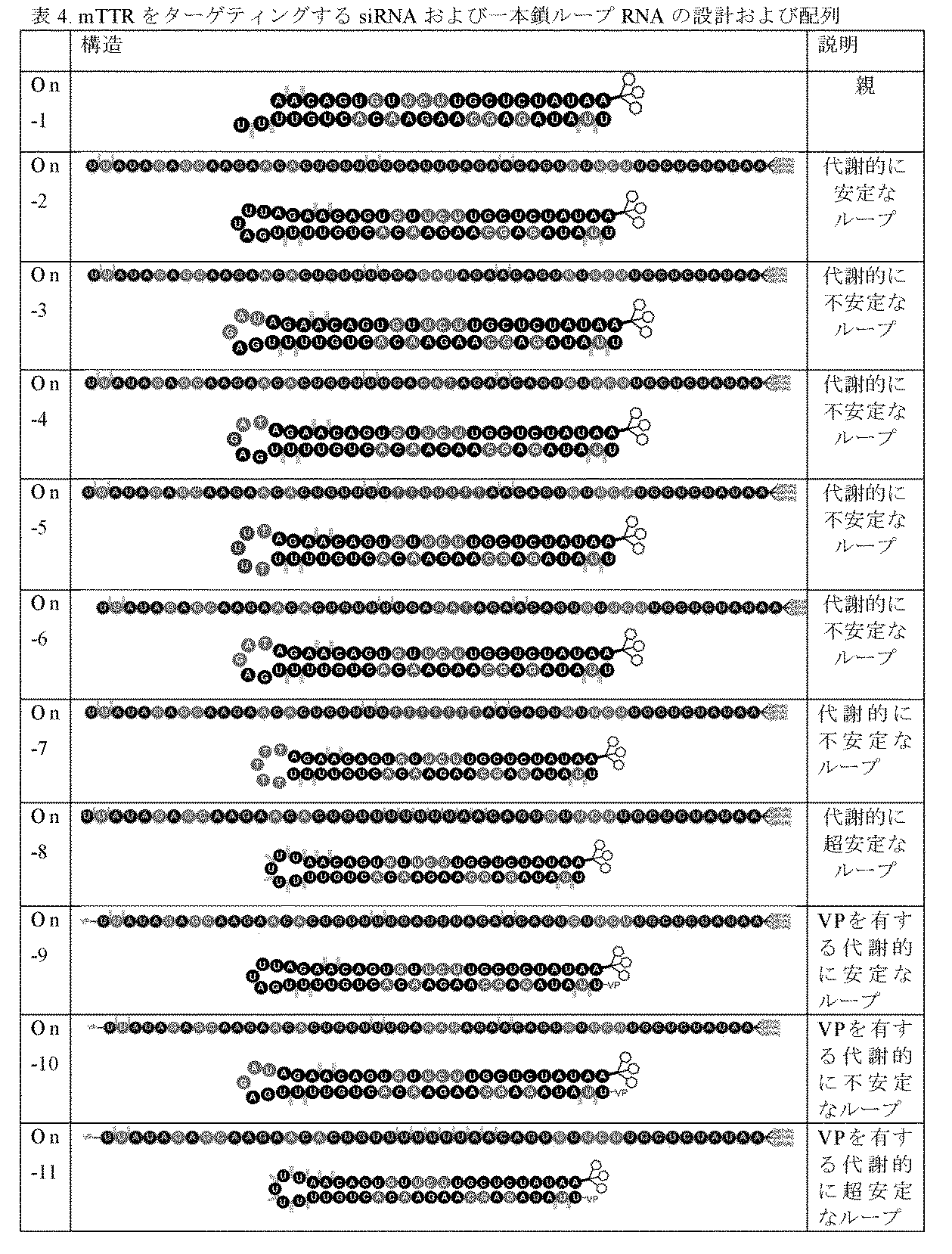
一本鎖ループオリゴヌクレオチドコンジュゲートのインビボ活性
C57BL/6マウスのTTRをノックダウンする一本鎖ループオリゴヌクレオチドの有効性を評価した。例示的な一本鎖ループオリゴヌクレオチドを、陽性対照としての二本鎖siRNAとともに、3つの異なる用量レベル(1mg/kg、0.4mg/kg、および0.2mg/kg)を用いてマウスに単回投与した。
In vivo activity of single-stranded loop oligonucleotide conjugates The efficacy of single-stranded loop oligonucleotides to knockdown TTR in C57BL/6 mice was evaluated. Exemplary single-stranded loop oligonucleotides were administered once to mice using three different dose levels (1 mg/kg, 0.4 mg/kg, and 0.2 mg/kg) along with double-stranded siRNA as a positive control.
マウスにおけるインビボ活性試験の実験プロトコールは、前述の実施例1と同じである。 The experimental protocol for in vivo activity testing in mice was the same as that described in Example 1 above.
最高用量の1mg/kg(図5A)においては、全ての例示的な一本鎖ループオリゴヌクレオチドによってTTRの有意なノックダウンが達成されたが、これらの例示的な一本鎖ループオリゴヌクレオチドのデザインを順位付けするには、ノックダウンの差はわずかであった。次の用量レベルである0.4mg/kg(図5B)においては、ON-11はTTRタンパク質のノックダウンが遅れて投与後21日目に最低レベルに達したが、他の例示的な一本鎖ループオリゴヌクレオチドは同等の効力を持って14日目に最低レベルに達した。 At the highest dose of 1 mg/kg (FIG. 5A), all exemplary single-stranded loop oligonucleotides achieved significant knockdown of TTR, but the differences in knockdown were insufficient to rank the exemplary single-stranded loop oligonucleotide designs. At the next dose level, 0.4 mg/kg (FIG. 5B), ON-11 delayed knockdown of TTR protein, reaching nadir levels at 21 days post-dose, while the other exemplary single-stranded loop oligonucleotides were comparable in efficacy, reaching nadir levels at 14 days.
より高用量(1mg/kgおよび0.4mg/kg)においては、一本鎖ループオリゴヌクレオチドは親二本鎖siRNAと同等の有効性を示した。 At higher doses (1 mg/kg and 0.4 mg/kg), the single-stranded loop oligonucleotides showed efficacy comparable to the parent double-stranded siRNA.
最低用量の0.2mg/mL(図5C)においては、これらの一本鎖ループオリゴヌクレオチドにおける効力の違いが観察された。ハイブリッドRNA/DNAループデザインを含有するOn-5および5’-VPを有する2’Fループデザインを含有するOn-13は、親ds-SiRNAと同等の最高の効力を示した(mTTRの80%ノックダウン、図5C)。DNAループデザインを含有する一本鎖ループオリゴヌクレオチド(On-7)は、On-3(約55%)、On-6、およびOn-9(約50%のKD)に続いて、約60%のノックダウンを有し、次に高い効力を示した。ホスホロチオエートを有する2’-OMe(On-2)および2’-OMe(On-11)を含有する一本鎖ループオリゴヌクレオチドは、それぞれ約30%(On-2)および20%(On-11)の相対的に低い効力を示した。より高い0.4mg/kg用量において観察されたOn-11による遅延した活性は、0.2mg/kg用量では観察されなかった。 At the lowest dose of 0.2 mg/mL (Figure 5C), differences in potency were observed among these single-stranded loop oligonucleotides. On-5 containing a hybrid RNA/DNA loop design and On-13 containing a 2'F loop design with 5'-VP showed the highest potency (80% knockdown of mTTR, Figure 5C), comparable to the parent ds-SiRNA. The single-stranded loop oligonucleotide containing a DNA loop design (On-7) showed the next highest potency with approximately 60% knockdown, followed by On-3 (approximately 55%), On-6, and On-9 (approximately 50% KD). The single-stranded loop oligonucleotides containing 2'-OMe (On-2) and 2'-OMe (On-11) with phosphorothioates showed relatively low potency of approximately 30% (On-2) and 20% (On-11), respectively. The delayed activity of On-11 observed at the higher 0.4 mg/kg dose was not observed at the 0.2 mg/kg dose.
ラット血漿中のオリゴヌクレオチドコンジュゲートのインビトロ安定性/代謝
例示的な一本鎖ループオリゴヌクレオチドと直鎖状siRNA対照のラット血漿におけるインビトロ代謝安定性を調べ、比較した。ラットマトリックスは、マウスと比較して長期的なインビボクリアランスを予測するのに適しているため、ラット血漿および肝臓ホモジネートは、マウス血漿および肝臓ホモジネートの代用物として選択された。
In Vitro Stability/Metabolism of Oligonucleotide Conjugates in Rat Plasma The in vitro metabolic stability of exemplary single-stranded loop oligonucleotides and linear siRNA controls in rat plasma was examined and compared. Rat plasma and liver homogenate were chosen as surrogates for mouse plasma and liver homogenate because the rat matrix is more predictive of long-term in vivo clearance compared to mouse.
ラット血漿におけるインビトロ代謝安定性試験の実験プロトコールは、前述の実施例1と同じである。 The experimental protocol for the in vitro metabolic stability test in rat plasma was the same as that described in Example 1 above.
オリゴヌクレオチドをラット血漿中で37℃、24時間インキュベートし、高分解能液体クロマトグラフィー質量分析を用いて代謝物プロファイリングを実施した。結果を図6および表5に要約する。 Oligonucleotides were incubated in rat plasma for 24 hours at 37°C and metabolite profiling was performed using high-resolution liquid chromatography-mass spectrometry. The results are summarized in Figure 6 and Table 5.
全ての例示的な一本鎖ループオリゴヌクレオチドおよび対照について、血漿中では顕著な代謝は観察されず、親の大部分は24時間後も無傷のままであった(99%以上)。 For all exemplary single-stranded loop oligonucleotides and controls, no significant metabolism was observed in plasma, with the majority of the parent remaining intact (>99%) after 24 hours.

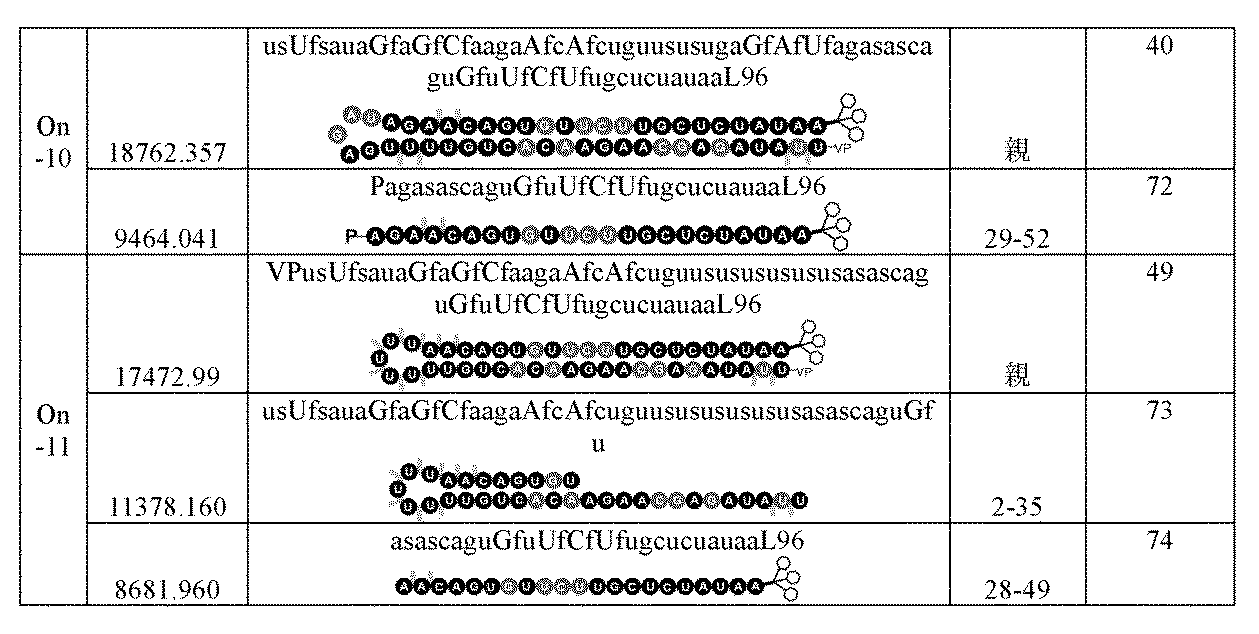
ラット肝臓ホモジネート中のオリゴヌクレオチドコンジュゲートのインビトロ安定性/代謝
例示的な一本鎖ループオリゴヌクレオチドと直鎖状siRNA対照のラット肝臓ホモジネートにおけるインビトロ代謝安定性を調べ、比較した。
In Vitro Stability/Metabolism of Oligonucleotide Conjugates in Rat Liver Homogenate The in vitro metabolic stability of exemplary single-stranded loop oligonucleotides and linear siRNA controls in rat liver homogenate was examined and compared.
ラット肝臓ホモジネートにおけるインビトロ代謝安定性試験の実験プロトコールは、前述の実施例1と同じである。 The experimental protocol for the in vitro metabolic stability test in rat liver homogenate was the same as that described in Example 1 above.
オリゴヌクレオチドをラット肝臓ホモジネート中で37℃、24時間インキュベートし、高分解能液体クロマトグラフィー質量分析を用いて代謝物プロファイリングを実施した。結果を図7および表6に要約する。 Oligonucleotides were incubated in rat liver homogenate at 37°C for 24 hours and metabolite profiling was performed using high-resolution liquid chromatography mass spectrometry. The results are summarized in Figure 7 and Table 6.
親ds-siRNA(On-1)アンチセンス鎖については、有意な代謝は観察されなかった。1つのGalNAcの喪失が、On-1について観察された主要なアンチセンス代謝物であった(図7a)。On-2のループ領域においては代謝は観察されなかった。On-2について観察された主要な代謝物は、一本鎖ループオリゴヌクレオチドの39~41領域付近の切断に伴うものであり、この領域はOn-1(ds-siRNA対照)のセンス鎖フルオロトリプレット領域ヌクレオチド9~11に対応する。On-3(図7b)について観察された主要な代謝物はヌクレオチド23であり、対照On-1(7628.094Da)におけるアンチセンス鎖に対応する。複数の代謝物がループ領域のヌクレオチド29、30、31、32において観察され、ds-siRNAが主要な生成物として放出された。On-4(図7c)の主要な代謝物は、やはり23merのアンチセンス鎖(7628.094Da)であった。一本鎖ループオリゴヌクレオチドは30位において切断され、22merの対応するセンスが主要な代謝物として放出された。ハイブリッドRNA-DNAループデザインを含有するOn-5(図7d)は、代謝物として23merを放出したが、センス鎖の切断は31位においては観察されず、代わりに30位(8862.887)において切断が観察され、放出された生成物のセンス鎖上に追加のdTが残った。DNAトリプレットを持つOn-6(図7e)も23merの対応するアンチセンス鎖を代謝物として放出したが、センス鎖上の切断は観察されなかった。複数のデオキシチミジン(dT)ループ領域を含有するOn-7(図7f)は、On-1の21merセンス鎖に対応する23位(質量7628.094Da)と31位(8761.919Da)において明確な切断を示した。ループ領域にホスホロチオエートを含有するOn-8(図7g)については、ループ領域における切断は観察されず、安定なループを示し、フルオロヌクレオチドに隣接するsiRNAの非ループ領域に複数の微量な代謝物が観察された。On-2の5’-(E)-ビニルホスホネートを含有する対応物であるOn-9(図7h)は、2’-OMeを含有するループ領域においては代謝がなく、On-2と同様の代謝パターンを示した。On-3の5’-(E)-ビニルホスホネートを含有する対応物であるOn-10(図7i)は、On-3と同様の代謝パターンを示し、それぞれ23(7704.066)および21mer(8761.919Da)のアンチセンス鎖およびセンス鎖を放出し、ならびに29、30および32ヌクレオチドにおいて複数の切断を示した。On-8の5’-(E)-ビニルホスホネートを含有する対応物であるOn-11(図7j)は、同様に、2’-OMeおよびホスホロチオエートを含有するループ領域においては代謝を示さなかった。 No significant metabolism was observed for the parent ds-siRNA (On-1) antisense strand. Loss of one GalNAc was the major antisense metabolite observed for On-1 (Figure 7a). No metabolism was observed in the loop region of On-2. The major metabolite observed for On-2 was associated with cleavage near the 39-41 region of the single-stranded loop oligonucleotide, which corresponds to nucleotides 9-11 of the sense strand fluoro triplet region of On-1 (ds-siRNA control). The major metabolite observed for On-3 (Figure 7b) was nucleotide 23, which corresponds to the antisense strand in control On-1 (7628.094 Da). Multiple metabolites were observed at nucleotides 29, 30, 31, and 32 of the loop region, with ds-siRNA released as the major product. The major metabolite for On-4 (Figure 7c) was again the 23-mer antisense strand (7628.094 Da). The single-stranded loop oligonucleotide was cleaved at position 30, with the corresponding sense 22-mer released as the major metabolite. On-5 (Fig. 7d), which contains a hybrid RNA-DNA loop design, released a 23-mer as a metabolite, but no sense strand cleavage was observed at position 31, instead cleavage was observed at position 30 (8862.887), leaving an additional dT on the sense strand of the released product. On-6 (Fig. 7e), which has a DNA triplet, also released the corresponding antisense strand of the 23-mer as a metabolite, but no cleavage on the sense strand was observed. On-7 (Fig. 7f), which contains multiple deoxythymidine (dT) loop regions, showed clear cleavage at positions 23 (mass 7628.094 Da) and 31 (8761.919 Da), which correspond to the 21-mer sense strand of On-1. For On-8 (Fig. 7g), which contains phosphorothioates in the loop region, no cleavage was observed in the loop region, indicating a stable loop, and multiple minor metabolites were observed in the non-loop region of the siRNA adjacent to the fluoronucleotides. On-9 (Fig. 7h), the 5'-(E)-vinylphosphonate-containing counterpart of On-2, showed a metabolic pattern similar to On-2, with no metabolism in the 2'-OMe-containing loop region. On-10 (Fig. 7i), the 5'-(E)-vinylphosphonate-containing counterpart of On-3, showed a metabolic pattern similar to On-3, releasing antisense and sense strands of 23 (7704.066) and 21-mers (8761.919 Da), respectively, and multiple cleavage at 29, 30, and 32 nucleotides. On-11 (Figure 7j), the 5'-(E)-vinylphosphonate-containing counterpart of On-8, similarly showed no metabolism in the loop region containing 2'-OMe and phosphorothioate.
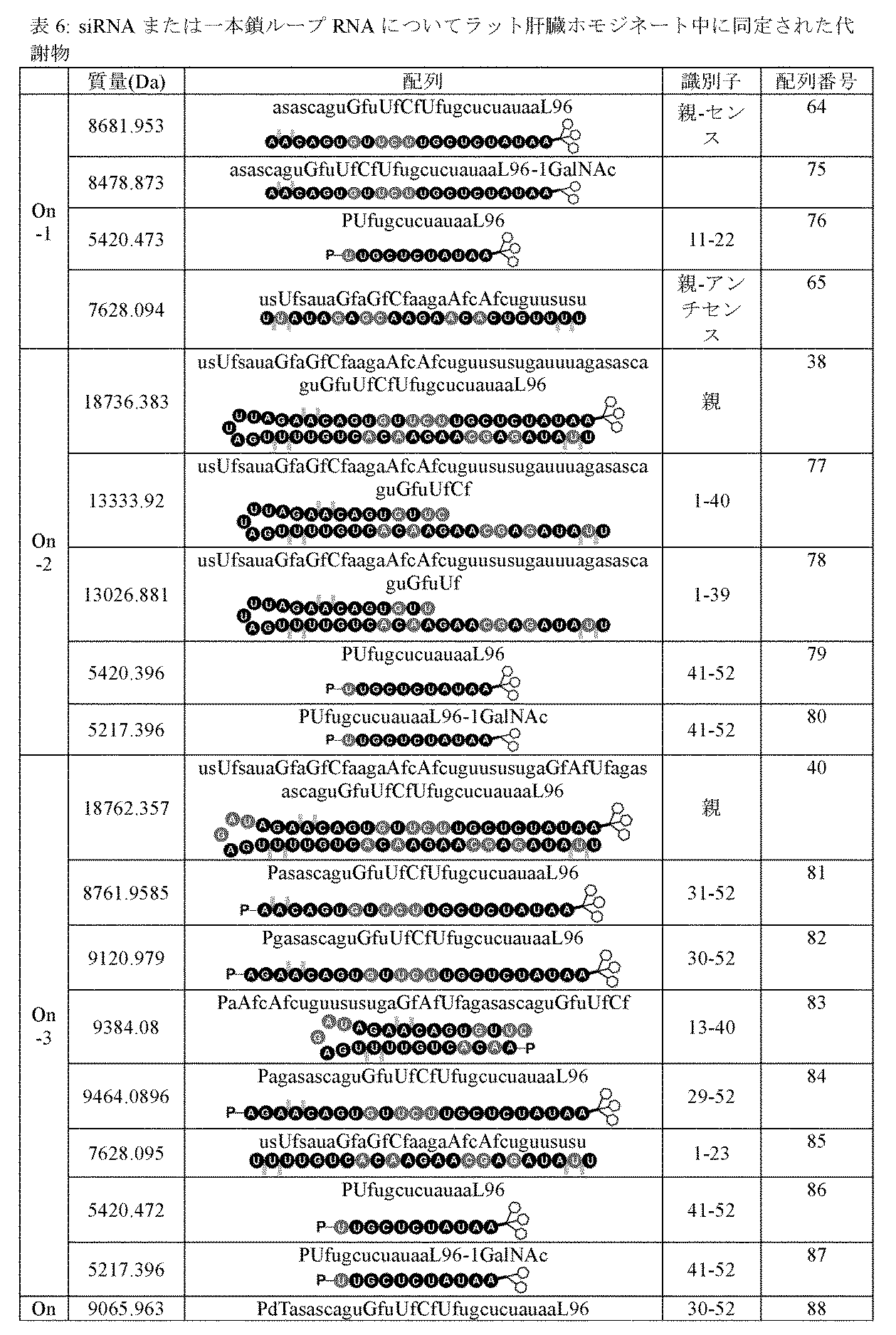
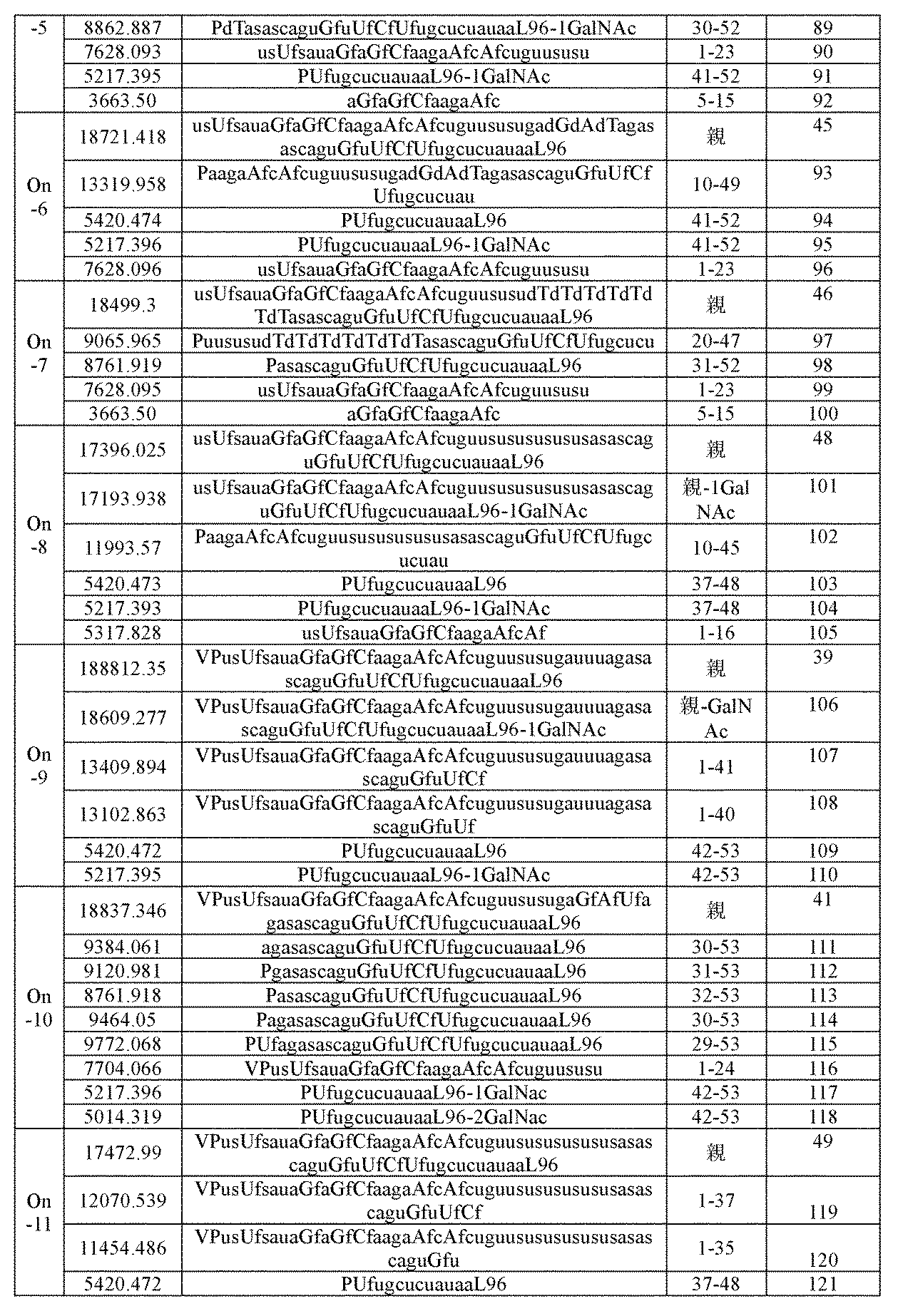
LC-MS強度とmTTRノックダウンとの相関。
相関分析は、GraphPad Prism8.4.3(GraphPad Software、San Diego、California USA)を用いて行った。親ループマーRNAまたは形成されたアンチセンス22/23merのいずれかの強度とmTTRノックダウンとを相関付けるために、ピアソンの相関分析を行い、両側P値を算出した。P値が0.05未満を統計的に有意とした。
Correlation of LC-MS intensity with mTTR knockdown.
Correlation analysis was performed using GraphPad Prism 8.4.3 (GraphPad Software, San Diego, California, USA). To correlate the intensity of either the parent loopmer RNA or the formed antisense 22/23mer with mTTR knockdown, Pearson's correlation analysis was performed and two-sided P values were calculated. A P value of less than 0.05 was considered statistically significant.
RNA-DNAハイブリッドループ領域を含有する一本鎖ループオリゴヌクレオチドOn-5は、インビボにおいて親ds-SiRNA対照、約75%KDと同等の最も高い効果を示し、インビトロ代謝においては、ループ領域が完全に代謝され(完全長の親は観察されなかった)、23merのアンチセンス鎖と22merのセンス鎖が放出された。完全なDNA含有ループ領域を有するOn-7は、約60%KDの効力によって2位であり、また、肝臓ホモジネート中において23merのアンチセンス鎖と21merのセンス鎖に完全に分解された。On-3(2’-OMeを有する2’-Fトリプレット)とOn-9(DNAトリプレット2’-OMe)は、約50%の効力を示し、肝臓ホモジネートとよく相関し、24時間後に有意な量の一本鎖ループオリゴヌクレオチドが安定であることを示した。肝臓ホモジネートにおいて23merアンチセンスの放出が最小限であることを示す一本鎖ループオリゴヌクレオチド(On-3、2’OMeループ;On-8、2’OMeおよびホスホロチオエートループ)は、インビボにおける有効性が比較的(relevatively)低い(<25%ノックダウン)。 Single-stranded loop oligonucleotide On-5, containing an RNA-DNA hybrid loop region, showed the highest efficacy in vivo, comparable to the parent ds-SiRNA control, with a KD of approximately 75%, and in vitro metabolism showed complete metabolism of the loop region (no full-length parent was observed), releasing a 23-mer antisense strand and a 22-mer sense strand. On-7, with an intact DNA-containing loop region, came in second with a potency of approximately 60% KD, and was also completely degraded in liver homogenate to a 23-mer antisense strand and a 21-mer sense strand. On-3 (2'-F triplet with 2'-OMe) and On-9 (DNA triplet 2'-OMe) showed approximately 50% potency, correlated well with liver homogenate, and demonstrated significant amounts of single-stranded loop oligonucleotides stable after 24 hours. Single-stranded loop oligonucleotides (On-3, 2'OMe loop; On-8, 2'OMe and phosphorothioate loop) that show minimal release of 23mer antisense in liver homogenates have relatively low efficacy in vivo (<25% knockdown).
上述のインビトロ肝臓ホモジネート代謝安定性実験から抽出したイオンクロマトグラフィーピークの強度を、インビボmTTRノックダウンデータに対してプロットした。一本鎖ループオリゴヌクレオチドの構造活性関係を区別して理解するために、より低用量の0.2mg/kg投与群を使用した。 The intensities of ion chromatography peaks extracted from the in vitro liver homogenate metabolic stability experiments described above were plotted against the in vivo mTTR knockdown data. A lower dose of 0.2 mg/kg was used to differentiate and understand the structure-activity relationships of the single-stranded loop oligonucleotides.
第1の条件においては、親RNAの喪失を追跡し、その強度を、0.2mg/kg用量のマウスから得た最低レベルの平均mTTRノックダウンと相関付けた。無傷の一本鎖ループオリゴヌクレオチド強度と%mTTRノックダウンとの間に、ピアソンrが-0.8300(P=0.01)(図8A)の統計的に有意な負の相関が観察され、無傷の一本鎖ループオリゴヌクレオチドが高濃度で存在すると、RISCローディングの利用可能性が制限されるため、インビボでのノックダウンが減少することが示された。 In the first condition, loss of parental RNA was tracked and its intensity correlated with the lowest level of mean mTTR knockdown obtained from mice at the 0.2 mg/kg dose. A statistically significant negative correlation was observed between intact single-stranded loop oligonucleotide intensity and % mTTR knockdown with a Pearson r of -0.8300 (P=0.01) (Figure 8A), indicating that the presence of high concentrations of intact single-stranded loop oligonucleotides reduces knockdown in vivo due to limited availability for RISC loading.
第2の条件においては、ds-siRNAのアンチセンス鎖に対応する22/23mer代謝物の形成は、%KDと相関した。アンチセンス代謝物の形成と%mTTRノックダウンとの間に、ピアソンrが0.8118(P=0.04)(図8B)という統計的に有意な正の相関が観察され、アンチセンス22/23mer代謝物の形成がインビボでの有効性に不可欠であることが示された。この図はまた、代謝物形成濃度がノックダウン有効性とよく相関していることを示していた。 In the second condition, the formation of 22/23mer metabolites corresponding to the antisense strand of ds-siRNA correlated with %KD. A statistically significant positive correlation was observed between antisense metabolite formation and %mTTR knockdown, with Pearson's r of 0.8118 (P=0.04) (Figure 8B), indicating that the formation of antisense 22/23mer metabolites is essential for efficacy in vivo. This figure also showed that the metabolite formation concentration correlated well with knockdown efficacy.
これらの結果は、一本鎖ループオリゴヌクレオチドのループ領域をヌクレアーゼが切断して二本鎖siRNAを放出することが、効率的な標的ノックダウンに不可欠であることを示している。 These results indicate that nuclease cleavage of the loop region of the single-stranded loop oligonucleotide to release the double-stranded siRNA is essential for efficient target knockdown.
5’-VPの添加は、2’OMe含有On-9および2’F含有On-10の両方において効力を増強した(図9B)。2’OMe含有配列On-2およびOn-9においては代謝の違いは観察されなかった;特に、23merアンチセンスの放出は観察されなかった。2’-F含有配列On-10においては、5’-VP修飾のないバージョン(On-3)と比較して、切断部位の数の増加が観察された。両方の一本鎖ループオリゴヌクレオチドにおいて、23merは5’-VP修飾の有無にかかわらず放出された。 The addition of 5'-VP enhanced the potency of both 2'OMe-containing On-9 and 2'F-containing On-10 (Figure 9B). No metabolic differences were observed in the 2'OMe-containing sequences On-2 and On-9; in particular, no release of the 23-mer antisense was observed. In the 2'-F-containing sequence On-10, an increased number of cleavage sites was observed compared to the version without the 5'-VP modification (On-3). In both single-stranded loop oligonucleotides, the 23-mer was released with or without the 5'-VP modification.
要約すると、一本鎖ループオリゴヌクレオチドのループ領域に天然のDNAやRNAのヌクレオ塩基、または2’-Fヌクレオ塩基を導入すると、ループが不安定化し、効率的なヌクレアーゼ切断と二本鎖siRNAの放出が起こり、それがさらにRISCにロードされ、遺伝子サイレンシングを引き起こすことが示された。このループ領域の代謝の増加により、効率的な遺伝子ノックダウンのために、siRNA二重鎖が放出される。2’-OMeやホスホロチオエートなどの修飾を用いることで、ループ領域が安定化し、ヌクレアーゼによる切断を受けにくくなり、一本鎖ループオリゴヌクレオチドの活性が低下した。5’-VPの添加は一本鎖ループオリゴヌクレオチドの活性を増強した。
[実施例4]
In summary, the introduction of natural DNA or RNA nucleobases or 2'-F nucleobases into the loop region of single-stranded loop oligonucleotides was shown to destabilize the loop, leading to efficient nuclease cleavage and release of double-stranded siRNA, which can then be loaded into RISC and cause gene silencing. Increased metabolism of this loop region releases the siRNA duplex for efficient gene knockdown. The use of modifications such as 2'-OMe and phosphorothioate stabilized the loop region, making it less susceptible to nuclease cleavage and reducing the activity of single-stranded loop oligonucleotides. The addition of 5'-VP enhanced the activity of single-stranded loop oligonucleotides.
[Example 4]
例示的な一本鎖オリゴヌクレオチド
本例においては、一本鎖ループオリゴヌクレオチドに異なる特性を付与するために、「ループ」リンカーの異なるサイズと化学を例示している。本例において使用したオリゴヌクレオチドを図10に示す。それらの配列は上記の表1に示され、特徴付けられている。親siRNA二重鎖の配列を上記の表3に示す。一本鎖ループオリゴヌクレオチドの合成手順は、前述の実施例1と同じである。
Exemplary Single-Stranded Oligonucleotides In this example, different sizes and chemistries of the "loop" linker are illustrated to impart different properties to the single-stranded loop oligonucleotides. The oligonucleotides used in this example are shown in Figure 10. Their sequences are shown and characterized in Table 1 above. The sequences of the parent siRNA duplexes are shown in Table 3 above. The synthesis procedure for the single-stranded loop oligonucleotides is the same as in Example 1 above.
上記の全ての例示的な一本鎖オリゴヌクレオチドのインビトロ代謝を、親siRNA二重鎖と比較して、マウス血漿および肝臓ホモジネートにおいて評価した。インビトロ代謝試験の実験プロトコールは、前述の実施例1と同じである。 The in vitro metabolism of all the above exemplary single-stranded oligonucleotides was evaluated in mouse plasma and liver homogenates in comparison with the parent siRNA duplex. The experimental protocol for the in vitro metabolism study is the same as that described in Example 1 above.
マウスにおいて、上記の例示的な一本鎖オリゴヌクレオチドによるmTTR発現の阻害を、20日間にわたり、0.2mg/kgの単回投与において実施した。インビボノックダウン試験の実験プロトコールは、前述の実施例1と同じである。 Inhibition of mTTR expression in mice with the exemplary single-stranded oligonucleotides described above was performed at a single dose of 0.2 mg/kg for 20 days. The experimental protocol for the in vivo knockdown study was the same as that described in Example 1 above.
結果を図11A~11Bに示す。図11Aは、0.2mg/kgの単回投与したマウスにおける上記の例示的な一本鎖オリゴヌクレオチド(図10に示す)によるmTTR発現の阻害を示す。図11Bは、同じオリゴヌクレオチドであるが5’-(E)-ビニルホスホネート(VP)修飾を有するものと比較した、0.2mg/kgの単回投与したマウスにおける特定の例示的な一本鎖オリゴヌクレオチド(図10に示す)によるmTTR発現の阻害を示す。この結果は、5’-(E)-(VP)修飾が、一本鎖オリゴヌクレオチドのループが半不安定である場合に、マウスにおける効力の喪失を回復するのに役立ちうることを示している。これらの結果はまた、一本鎖オリゴヌクレオチドの細胞内ループ切断がインビボにおけるノックダウン活性を支持することを示す。
[実施例5]
The results are shown in Figures 11A-11B. Figure 11A shows inhibition of mTTR expression by the exemplary single stranded oligonucleotides described above (shown in Figure 10) in mice at a single dose of 0.2 mg/kg. Figure 11B shows inhibition of mTTR expression by certain exemplary single stranded oligonucleotides (shown in Figure 10) in mice at a single dose of 0.2 mg/kg compared to the same oligonucleotide but with a 5'-(E)-vinylphosphonate (VP) modification. The results indicate that the 5'-(E)-(VP) modification can help restore loss of potency in mice when the loop of the single stranded oligonucleotide is hemi-labile. These results also indicate that intracellular loop cleavage of the single stranded oligonucleotide supports knockdown activity in vivo.
[Example 5]
例示的な一本鎖オリゴヌクレオチド
本例においては、センス鎖とアンチセンス鎖とをそれぞれ5’末端と3’末端において接続する切断可能なリンカーを有する、例示的な一本鎖ループオリゴヌクレオチドが構築された。切断可能なリンカーはプロドラッグとして働くことができる。リンカーが組織内で切断されると、親二本鎖siRNAを放出することができる。本例において用いられた一本鎖ループオリゴヌクレオチドの配列を以下の表7に示す;親siRNA二重鎖の配列も以下の表7に示す。一本鎖ループオリゴヌクレオチドの合成手順は、前述の実施例1のものと同じである。
Exemplary single-stranded oligonucleotides In this example, an exemplary single-stranded loop oligonucleotide was constructed with a cleavable linker connecting the sense strand and the antisense strand at the 5'-end and 3'-end, respectively. The cleavable linker can act as a prodrug. When the linker is cleaved in tissue, the parent double-stranded siRNA can be released. The sequence of the single-stranded loop oligonucleotide used in this example is shown in Table 7 below; the sequence of the parent siRNA duplex is also shown in Table 7 below. The synthesis procedure of the single-stranded loop oligonucleotide is the same as that of Example 1 above.
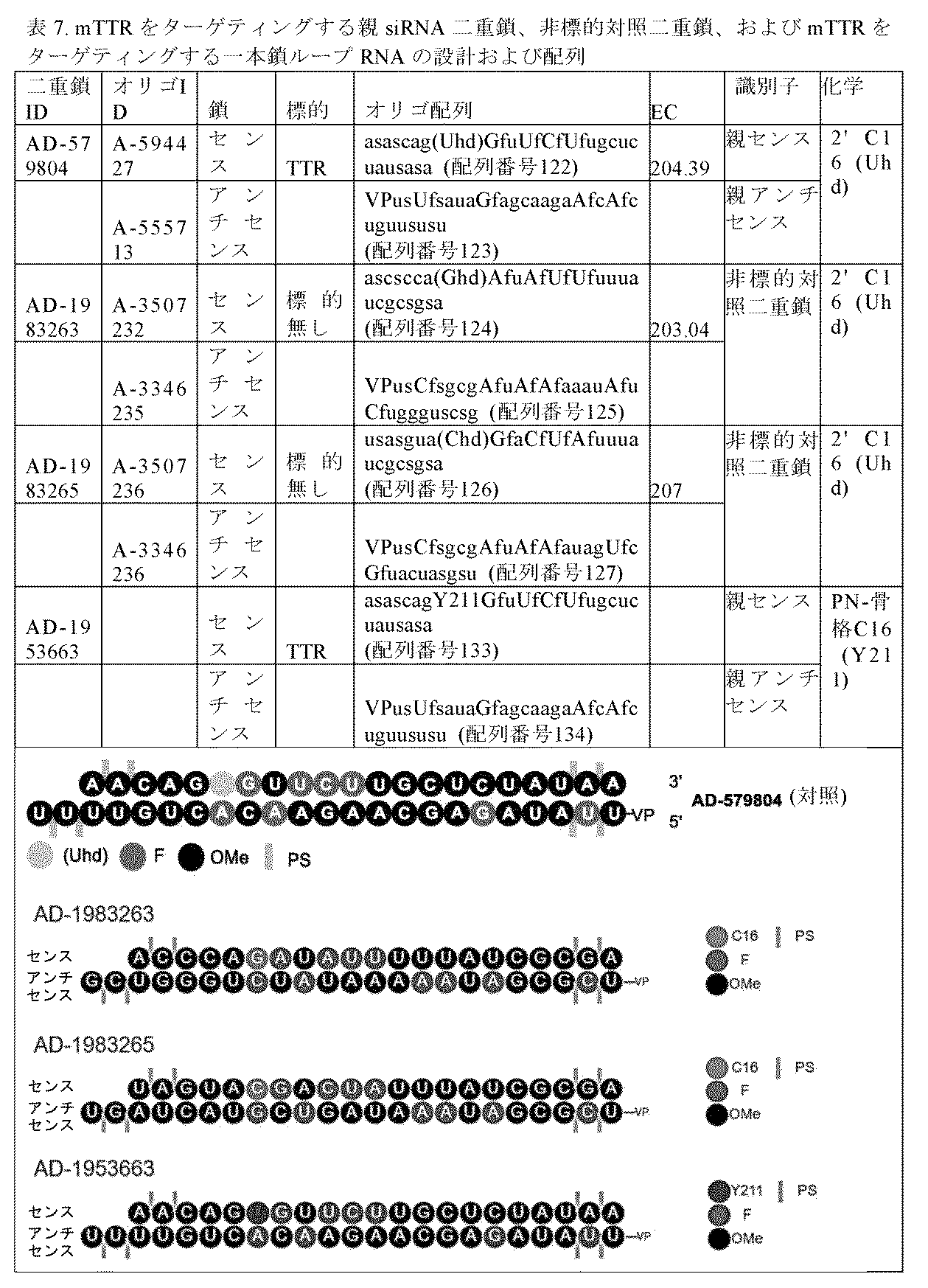
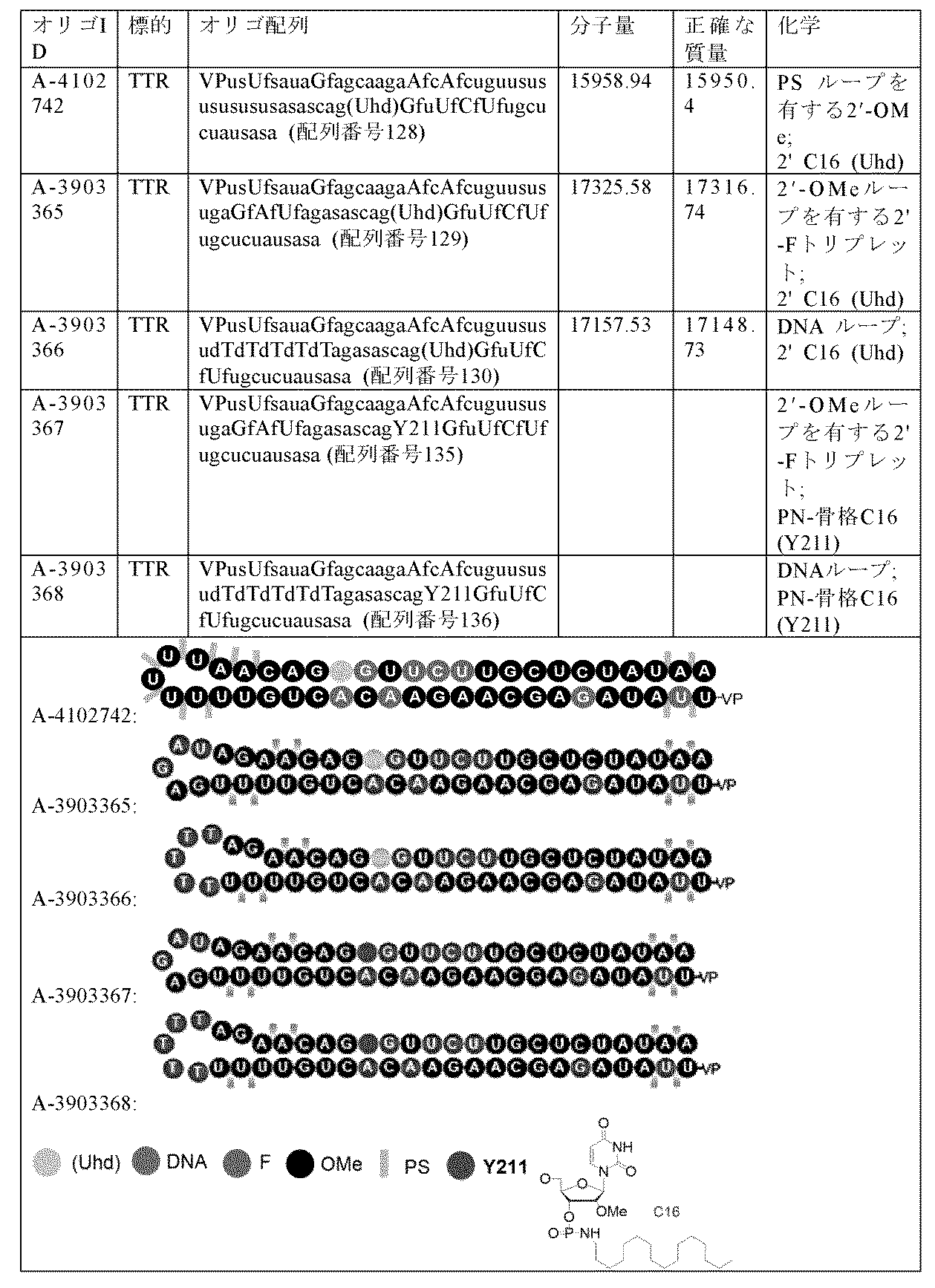
s-PS連結;小文字のヌクレオチド-2’-OMe;「d」に大文字のヌクレオチドが続く-2’-デオキシ(DNA);大文字のヌクレオチドに「f」が続く-2’-F;VP-5’-(E)-ビニルホスホネート;Uhd-2’-O-ヘキサデシル-ウリジン-3’-リン酸;Ghd-2’-O-ヘキサデシル-グアノシン-3’-リン酸;Chd-2’-O-ヘキサデシル-シチジン-3’-リン酸
s-PS linkage; lower case nucleotide-2'-OMe;"d" followed by capitalized nucleotide-2'-deoxy (DNA); capitalized nucleotide followed by "f"-2'-F;VP-5'-(E)-vinylphosphonate;Uhd-2'-O-hexadecyl-uridine-3'-phosphate;Ghd-2'-O-hexadecyl-guanosine-3'-phosphate;Chd-2'-O-hexadecyl-cytidine-3'-phosphate
C57BL/6マウスにおける、TTRをノックダウンするための上記の例示的な一本鎖オリゴヌクレオチドによるmTTR発現の阻害を、表8に記載のインビボ評価プロトコールおよび投与レジメンに従って評価した。マウスにおけるインビボ活性試験の実験プロトコールは、前述の実施例1のものと同じである。 Inhibition of mTTR expression by the above exemplary single stranded oligonucleotides for knocking down TTR in C57BL/6 mice was evaluated according to the in vivo evaluation protocol and dosing regimen described in Table 8. The experimental protocol for in vivo activity testing in mice is the same as that described in Example 1 above.
略述すると、例示的な一本鎖ループオリゴヌクレオチドを、2.5mg/mlの用量レベルを用いて、雌C57BL/6マウスに単回によって静脈内投与した。親二本鎖siRNA二重鎖(ループなし)を対照として投与した。また、対照として2つの非標的二本鎖siRNA二重鎖(ループなし)を投与した。全眼から組織を採取し、D14に瞬間凍結した。これらの例示的な一本鎖ループオリゴヌクレオチドおよびsiRNA二重鎖対照による、D14のマウス全眼組織におけるTTRmRNAノックダウンの結果を、qPCRによって分析した。 Briefly, the exemplary single-stranded loop oligonucleotides were administered intravenously in a single dose to female C57BL/6 mice using a dose level of 2.5 mg/ml. A parent double-stranded siRNA duplex (no loop) was administered as a control. Two non-targeting double-stranded siRNA duplexes (no loop) were also administered as controls. Tissues were harvested from whole eyes and snap frozen on D14. The results of TTR mRNA knockdown by these exemplary single-stranded loop oligonucleotides and siRNA duplex controls in mouse whole eye tissues on D14 were analyzed by qPCR.
結果を図12に示す。2’C16骨格デザインを有するオリゴヌクレオチドについては、DNAループ領域を含有する一本鎖ループオリゴヌクレオチドが、親ds-siRNA対照(約75%KD)ほどではないが、インビボ活性において最も高い効力(約60%KD)を示した。PN骨格C16デザインを有するオリゴヌクレオチドも同様の傾向を示した。異なるループ領域を含有する例示的な一本鎖ループオリゴヌクレオチドによるインビボ活性の全体的な傾向は以下の通りであった:DNAループ領域>2’-OMeを有する2’-Fトリプレット>PSを有する2’-OMe。 The results are shown in Figure 12. For oligonucleotides with a 2'C16 backbone design, single-stranded loop oligonucleotides containing a DNA loop region showed the highest potency in in vivo activity (-60% KD), although not as potent as the parent ds-siRNA control (-75% KD). Oligonucleotides with a PN backbone C16 design showed a similar trend. The overall trend in in vivo activity with exemplary single-stranded loop oligonucleotides containing different loop regions was as follows: DNA loop region > 2'-F triplet with 2'-OMe > 2'-OMe with PS.
PSループ領域を有する2’-OMeを含有する一本鎖ループオリゴヌクレオチドは、比較的低いインビボ有効性を示した(例えば、A-3903366、約30%KD)が、これはおそらくその「非切断型」の性質によるものであろう。 Single-stranded loop oligonucleotides containing 2'-OMe with a PS loop region have shown relatively low in vivo efficacy (e.g., A-3903366, approximately 30% KD), likely due to their "non-cleavable" nature.

Claims (40)
(5’-Z1-3’)-Q1-L-Q2-(5’-Z2-3’) (I)
[式中:
Z1は、標的遺伝子と実質的に相補的である、10~100の適宜修飾されたヌクレオチドを含む、第1のオリゴヌクレオチドであり;
Z2は、Z1と実質的に相補的である、10~100の適宜修飾されたヌクレオチドを含む、第2のオリゴヌクレオチドであり;
Z1およびZ2は、3またはそれ以上の連続塩基対を含む鎖内二重鎖領域を形成することができ;
Lは、連結基であり;
Q1およびQ2は、それぞれ独立に0~12の適宜修飾されたヌクレオチドを表す]
による一本鎖オリゴヌクレオチドであって、
式(I)の少なくとも1つのヌクレオチドは、修飾ヌクレオチドである、
一本鎖オリゴヌクレオチド。 Formula (I):
(5'-Z 1 -3')-Q 1 -L-Q 2 -(5'-Z 2 -3') (I)
[In the formula:
Z1 is a first oligonucleotide substantially complementary to a target gene, the first oligonucleotide comprising 10 to 100 optionally modified nucleotides;
Z2 is a second oligonucleotide substantially complementary to Z1 and containing 10 to 100 optionally modified nucleotides;
Z1 and Z2 can form an intrastrand duplex region containing 3 or more consecutive base pairs;
L is a linking group;
Q1 and Q2 each independently represent 0 to 12 optionally modified nucleotides.
A single stranded oligonucleotide according to
At least one nucleotide of formula (I) is a modified nucleotide.
Single-stranded oligonucleotide.
[式中:
#は、Q1への結合であり、**は、Q2への結合である;
nは3~12である;および
各Nは、独立に、3またはそれ以上の原子の鎖長を有する連結単量体である]
によって表される連結部分を含有する、請求項1~4のいずれか一項に記載の一本鎖オリゴヌクレオチド。 L is a group represented by the formula: #-(N) n - **
[In the formula:
# is a bond to Q1 , ** is a bond to Q2 ;
n is 3 to 12; and each N is independently a linking monomer having a chain length of 3 or more atoms.
The single-stranded oligonucleotide according to any one of claims 1 to 4, comprising a linking portion represented by:


Baseは適宜修飾されたヌクレオ塩基であり、
RDは、C4~30アルキル、C4~30アルケニル(alkyenyl)、またはC4~30アルキニルである]
からなる群から選択される、請求項5~10のいずれか一項に記載の一本鎖オリゴヌクレオチド。 One or more N are independently
Base is an appropriately modified nucleobase,
R D is a C 4-30 alkyl, a C 4-30 alkenyl , or a C 4-30 alkynyl .
The single-stranded oligonucleotide according to any one of claims 5 to 10, selected from the group consisting of:
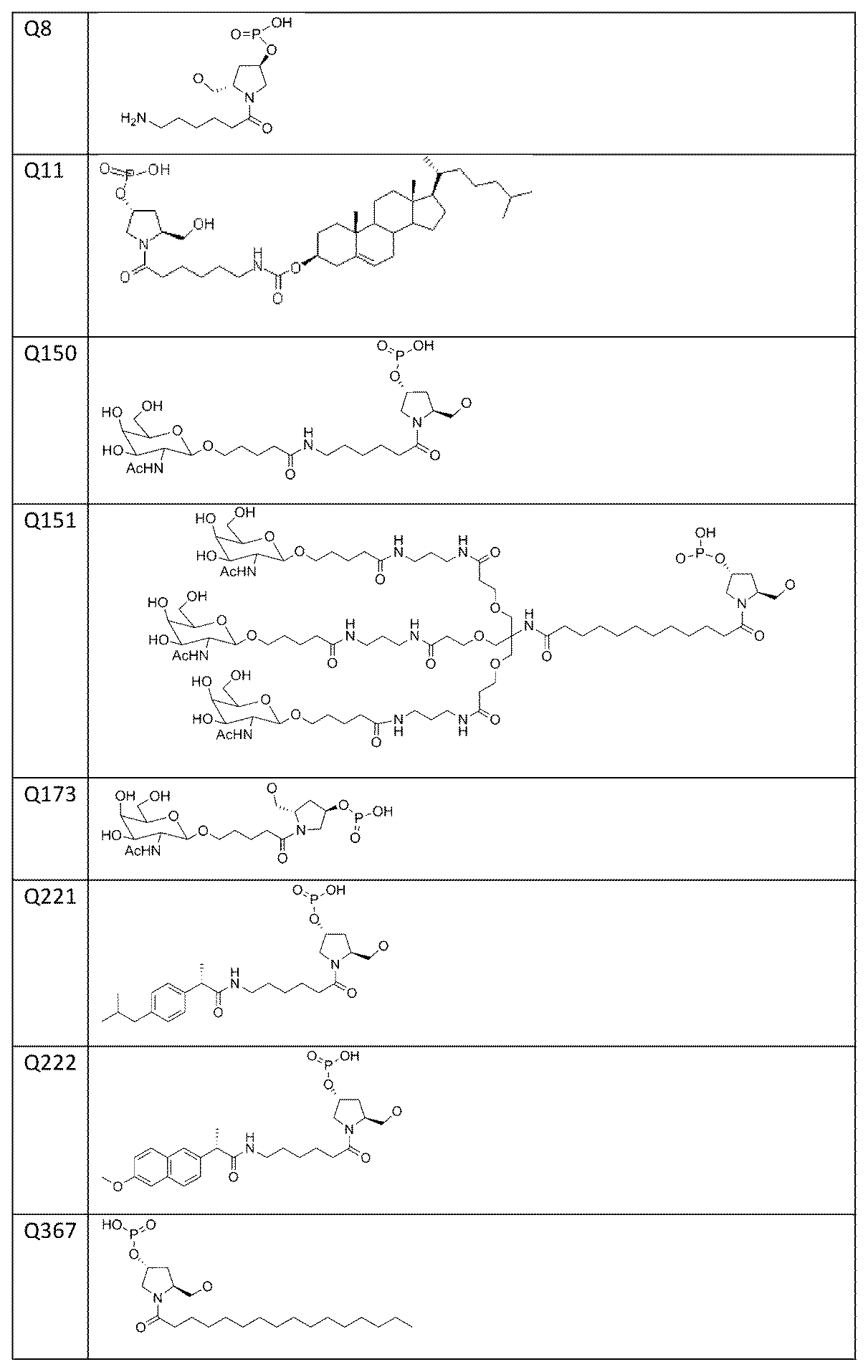
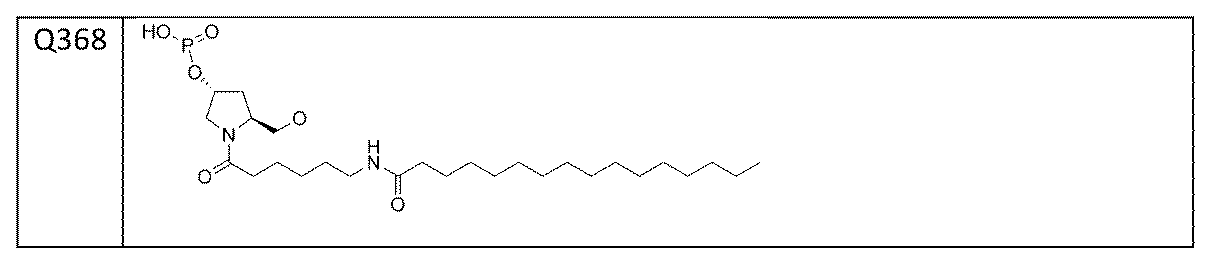
[式中:
#は、Q1への結合であり、**は、Q2への結合である;
nは3~10である;および
各Nは、独立に、適宜修飾されたヌクレオチド、Y16、Y34、Q48、Q303、Q304、Q305、Q306、Q312、Q313、Q314、Q315、Q316、Q317、Q8、Q11、Q150、Q151、Q173、Q221、Q222、Q367、またはQ368である]
によって表される連結部分を含有する、請求項1~4のいずれか一項に記載の一本鎖オリゴヌクレオチド。 L is a group represented by the formula: #-(N) n - **
[In the formula:
# is a bond to Q1 , ** is a bond to Q2 ;
n is 3 to 10; and each N is independently an appropriately modified nucleotide, Y16, Y34, Q48, Q303, Q304, Q305, Q306, Q312, Q313, Q314, Q315, Q316, Q317, Q8, Q11, Q150, Q151, Q173, Q221, Q222, Q367, or Q368.
The single-stranded oligonucleotide according to any one of claims 1 to 4, comprising a linking portion represented by:
#-mN-mN-mN-mN-mN-**、
#-rN-rN-rN-rN-rN-**、
#-rN-rN-fN-fN-fN-**、
#-dN-dN-fN-fN-fN-**、
#-dN-rN-rN-rN-dN-**、
#-dN-dN-dN-dN-dN-**、
#-mN-mN-dN-dN-dN-**、
#-mN-mN-rN-dN-dN-**、
#-mN-mN-rN-rN-rN-**、および
#-mN-mN-fN-fN-fN-**、
[式中:
dNは、2’-デオキシヌクレオチドを表し、
fNは、2’-デオキシ-2’-フルオロヌクレオチドを表し、
rNは、リボヌクレオチドを表し、
mNは、2’-O-メチルヌクレオチドを表す]
からなる群から選択される、請求項14~17のいずれか一項に記載の一本鎖オリゴヌクレオチド。 L,
#-mN-mN-mN-mN-mN- ** ,
#-rN-rN-rN-rN-rN- ** ,
#-rN-rN-fN-fN-fN- ** ,
#-dN-dN-fN-fN-fN- ** ,
#-dN-rN-rN-rN-dN- ** ,
#-dN-dN-dN-dN-dN- ** ,
#-mN-mN-dN-dN-dN- ** ,
#-mN-mN-rN-dN-dN- ** ,
#-mN-mN-rN-rN-rN- ** , and #-mN-mN-fN-fN-fN- ** ,
[In the formula:
dN represents a 2'-deoxynucleotide;
fN represents 2'-deoxy-2'-fluoro nucleotide;
rN represents a ribonucleotide;
mN represents a 2'-O-methyl nucleotide.
The single-stranded oligonucleotide according to any one of claims 14 to 17, selected from the group consisting of:
#---mN-mN-Q304-Q304-Q304---**、
#---dN-dN-Q304-Q304-Q304---**、
#---dN-rN-Q304-Q304-Q304---**、
#---rN-dN-Q304-Q304-Q304---**、および
#---dN-rN-Q304-Q304-Q304---**、
[式中:
dNは、2’-デオキシヌクレオチドを表し、
fNは、2’-デオキシ-2’-フルオロヌクレオチドを表し、
rNは、リボヌクレオチドを表し、
mNは、2’-O-メチルヌクレオチドを表す]
からなる群から選択される、請求項14~17のいずれか一項に記載の一本鎖オリゴヌクレオチド。 L,
#---mN-mN-Q304-Q304-Q304--- ** ,
#---dN-dN-Q304-Q304-Q304--- ** ,
#---dN-rN-Q304-Q304-Q304--- ** ,
#---rN-dN-Q304-Q304-Q304--- ** , and #---dN-rN-Q304-Q304-Q304--- ** ,
[In the formula:
dN represents a 2'-deoxynucleotide;
fN represents 2'-deoxy-2'-fluoro nucleotide;
rN represents a ribonucleotide;
mN represents a 2'-O-methyl nucleotide.
The single-stranded oligonucleotide according to any one of claims 14 to 17, selected from the group consisting of:
(b)Q1およびQ2は、それぞれ独立に、0~2の適宜修飾されたヌクレオチドを含有すること;
(c)Z1およびZ2によって形成された二重鎖領域は3以下のミスマッチ塩基対を含有すること;
(d)Z1およびZ2によって形成された二重鎖領域は平滑末端を形成すること;
(e)Z2の少なくとも1つのヌクレオチドは、修飾ヌクレオチドであること;
(f)Z1の少なくとも1つのヌクレオチドは、修飾ヌクレオチドであること;
(g)Z2は、少なくとも1つの修飾ヌクレオチド間連結を含むこと;
(h)Z1は、少なくとも1つの修飾ヌクレオチド間連結を含むこと;
(i)5’末端ヌクレオチドは、5’-リン酸または5’-リン酸模倣体修飾を含むこと;
(j)3’末端ヌクレオチドは、適宜リンカーを介して、リガンドにコンジュゲートされていること;
(k)Z1は、標的遺伝子に対して3つ以下のミスマッチを含有すること;
(l)Lは、式:#-(N)n-**[式中、nは3~5であり、各Nは、独立に、適宜修飾されたヌクレオチド、Q48、Q303、Q304、Q305、Q306、Q312、Q313、Q314、Q315、Q316、Q317、Q8、Q11、Q150、Q151、Q173、Q221、Q222、Q367、またはQ368である]によって表される連結部分を含有すること
の1つまたは複数によって特徴付けられる、請求項1~30のいずれか一項に記載の一本鎖オリゴヌクレオチド。 (a) Z1 and Z2 each independently contain 19 to 23 optionally modified nucleotides;
(b) Q1 and Q2 each independently contain 0 to 2 optionally modified nucleotides;
(c) the duplex region formed by Z1 and Z2 contains no more than three mismatched base pairs;
(d) the duplex region formed by Z1 and Z2 forms a blunt end;
(e) at least one nucleotide of Z2 is a modified nucleotide;
(f) at least one nucleotide of Z1 is a modified nucleotide;
(g) Z2 contains at least one modified internucleotide linkage;
(h) Z1 contains at least one modified internucleotide linkage;
(i) the 5'-terminal nucleotide contains a 5'-phosphate or a 5'-phosphate mimetic modification;
(j) the 3' terminal nucleotide is conjugated to a ligand, optionally via a linker;
(k) Z1 contains no more than three mismatches to the target gene;
(l) the single stranded oligonucleotide of any one of claims 1 to 30, characterized by one or more of the following: L contains a linking moiety represented by the formula: #-(N) n - ** , where n is 3 to 5 and each N is independently an optionally modified nucleotide, Q48, Q303, Q304, Q305, Q306, Q312, Q313, Q314, Q315, Q316, Q317, Q8, Q11, Q150, Q151, Q173, Q221, Q222, Q367, or Q368.
(b)Q1およびQ2は、それぞれ独立に、2の適宜修飾されたヌクレオチドを含有すること;
(c)Z1およびZ2によって形成された二重鎖領域は3以下のミスマッチ塩基対を含有すること;
(d)Z1およびZ2によって形成された二重鎖領域は平滑末端を形成すること;
(e)Z2の全てのヌクレオチドは、修飾ヌクレオチドであること;
(f)Z1の全てのヌクレオチドは、修飾ヌクレオチドであること;
(g)Z2は、少なくとも2つの連続修飾ヌクレオチド間連結を含むこと;
(h)Z1は、少なくとも2つの連続修飾ヌクレオチド間連結を含むこと;
(i)Z1の5’末端ヌクレオチドは、5’-リン酸または5’-リン酸模倣体修飾を含むこと;
(j)Z2の3’末端ヌクレオチドは、適宜リンカーを介して、リガンドにコンジュゲートされていること;
(k)Z1は、標的遺伝子に対して3つ以下のミスマッチを含有すること;ならびに
(l)Lは、式:#-(N)n-**[式中、nは5であり、各Nは、独立に、適宜修飾されたヌクレオチドまたはQ304である]によって表される連結部分を含有すること
の1つまたは複数によって特徴付けられる、請求項31に記載の一本鎖オリゴヌクレオチド。 (a) Z1 and Z2 each independently contain 21 optionally modified nucleotides;
(b) Q1 and Q2 each independently contain two optionally modified nucleotides;
(c) the duplex region formed by Z1 and Z2 contains no more than three mismatched base pairs;
(d) the duplex region formed by Z1 and Z2 forms a blunt end;
(e) all nucleotides of Z2 are modified nucleotides;
(f) all nucleotides of Z1 are modified nucleotides;
(g) Z2 comprises at least two consecutive modified internucleotide linkages;
(h) Z1 comprises at least two consecutive modified internucleotide linkages;
(i) the 5'-terminal nucleotide of Z1 contains a 5'-phosphate or a 5'-phosphate mimetic modification;
(j) the 3' terminal nucleotide of Z2 is conjugated to a ligand, optionally via a linker;
(k) Z1 contains no more than three mismatches to the target gene; and (l) L contains a linking moiety represented by the formula: #-(N) n - ** , where n is 5 and each N is independently an optionally modified nucleotide or Q304.
Applications Claiming Priority (5)
| Application Number | Priority Date | Filing Date | Title |
|---|---|---|---|
| US202263364715P | 2022-05-13 | 2022-05-13 | |
| US63/364,715 | 2022-05-13 | ||
| US202263401946P | 2022-08-29 | 2022-08-29 | |
| US63/401,946 | 2022-08-29 | ||
| PCT/US2023/066971 WO2023220744A2 (en) | 2022-05-13 | 2023-05-12 | Single-stranded loop oligonucleotides |
Publications (1)
| Publication Number | Publication Date |
|---|---|
| JP2025516680A true JP2025516680A (en) | 2025-05-30 |
Family
ID=86732265
Family Applications (1)
| Application Number | Title | Priority Date | Filing Date |
|---|---|---|---|
| JP2024566788A Pending JP2025516680A (en) | 2022-05-13 | 2023-05-12 | Single-stranded loop oligonucleotide |
Country Status (4)
| Country | Link |
|---|---|
| US (1) | US20250304957A1 (en) |
| EP (1) | EP4522742A2 (en) |
| JP (1) | JP2025516680A (en) |
| WO (1) | WO2023220744A2 (en) |
Families Citing this family (2)
| Publication number | Priority date | Publication date | Assignee | Title |
|---|---|---|---|---|
| WO2024238385A2 (en) * | 2023-05-12 | 2024-11-21 | Alnylam Pharmaceuticals, Inc. | Single-stranded loop oligonucleotides |
| CN120230161A (en) * | 2023-12-29 | 2025-07-01 | 苏州时安生物技术有限公司 | Nucleic acid conjugate, preparation method and application thereof |
Family Cites Families (150)
| Publication number | Priority date | Publication date | Assignee | Title |
|---|---|---|---|---|
| US5218A (en) | 1847-08-07 | Improvement in plows | ||
| US105A (en) | 1836-12-15 | knight | ||
| US1706803A (en) | 1928-02-10 | 1929-03-26 | Kenneth F Middour | Ash pit |
| US2816110A (en) | 1956-11-23 | 1957-12-10 | Merck & Co Inc | Methods for the production of substituted pteridines |
| GB971700A (en) | 1961-02-02 | 1964-09-30 | Boots Pure Drug Co Ltd | Anti-Inflammatory Agents |
| US4009197A (en) | 1967-01-13 | 1977-02-22 | Syntex Corporation | 2-(6-Substituted-2'-naphthyl) acetic acid derivatives and the salts and esters thereof |
| US3904682A (en) | 1967-01-13 | 1975-09-09 | Syntex Corp | 2-(6{40 -Methoxy-2{40 -naphthyl)acetic acid |
| US3687808A (en) | 1969-08-14 | 1972-08-29 | Univ Leland Stanford Junior | Synthetic polynucleotides |
| JPS5927900A (en) | 1982-08-09 | 1984-02-14 | Wakunaga Seiyaku Kk | Oligonucleotide derivative and its preparation |
| FR2540122B1 (en) | 1983-01-27 | 1985-11-29 | Centre Nat Rech Scient | NOVEL COMPOUNDS COMPRISING A SEQUENCE OF OLIGONUCLEOTIDE LINKED TO AN INTERCALATION AGENT, THEIR SYNTHESIS PROCESS AND THEIR APPLICATION |
| US4605735A (en) | 1983-02-14 | 1986-08-12 | Wakunaga Seiyaku Kabushiki Kaisha | Oligonucleotide derivatives |
| US4948882A (en) | 1983-02-22 | 1990-08-14 | Syngene, Inc. | Single-stranded labelled oligonucleotides, reactive monomers and methods of synthesis |
| US4824941A (en) | 1983-03-10 | 1989-04-25 | Julian Gordon | Specific antibody to the native form of 2'5'-oligonucleotides, the method of preparation and the use as reagents in immunoassays or for binding 2'5'-oligonucleotides in biological systems |
| US4587044A (en) | 1983-09-01 | 1986-05-06 | The Johns Hopkins University | Linkage of proteins to nucleic acids |
| US5118802A (en) | 1983-12-20 | 1992-06-02 | California Institute Of Technology | DNA-reporter conjugates linked via the 2' or 5'-primary amino group of the 5'-terminal nucleoside |
| US5118800A (en) | 1983-12-20 | 1992-06-02 | California Institute Of Technology | Oligonucleotides possessing a primary amino group in the terminal nucleotide |
| FR2567892B1 (en) | 1984-07-19 | 1989-02-17 | Centre Nat Rech Scient | NOVEL OLIGONUCLEOTIDES, THEIR PREPARATION PROCESS AND THEIR APPLICATIONS AS MEDIATORS IN DEVELOPING THE EFFECTS OF INTERFERONS |
| US5430136A (en) | 1984-10-16 | 1995-07-04 | Chiron Corporation | Oligonucleotides having selectably cleavable and/or abasic sites |
| US5258506A (en) | 1984-10-16 | 1993-11-02 | Chiron Corporation | Photolabile reagents for incorporation into oligonucleotide chains |
| US4828979A (en) | 1984-11-08 | 1989-05-09 | Life Technologies, Inc. | Nucleotide analogs for nucleic acid labeling and detection |
| US4762779A (en) | 1985-06-13 | 1988-08-09 | Amgen Inc. | Compositions and methods for functionalizing nucleic acids |
| US5317098A (en) | 1986-03-17 | 1994-05-31 | Hiroaki Shizuya | Non-radioisotope tagging of fragments |
| JPS638396A (en) | 1986-06-30 | 1988-01-14 | Wakunaga Pharmaceut Co Ltd | Poly-labeled oligonucleotide derivative |
| US4904582A (en) | 1987-06-11 | 1990-02-27 | Synthetic Genetics | Novel amphiphilic nucleic acid conjugates |
| US5585481A (en) | 1987-09-21 | 1996-12-17 | Gen-Probe Incorporated | Linking reagents for nucleotide probes |
| US5525465A (en) | 1987-10-28 | 1996-06-11 | Howard Florey Institute Of Experimental Physiology And Medicine | Oligonucleotide-polyamide conjugates and methods of production and applications of the same |
| DE3738460A1 (en) | 1987-11-12 | 1989-05-24 | Max Planck Gesellschaft | MODIFIED OLIGONUCLEOTIDS |
| US5082830A (en) | 1988-02-26 | 1992-01-21 | Enzo Biochem, Inc. | End labeled nucleotide probe |
| US5109124A (en) | 1988-06-01 | 1992-04-28 | Biogen, Inc. | Nucleic acid probe linked to a label having a terminal cysteine |
| US5149782A (en) | 1988-08-19 | 1992-09-22 | Tanox Biosystems, Inc. | Molecular conjugates containing cell membrane-blending agents |
| US5262536A (en) | 1988-09-15 | 1993-11-16 | E. I. Du Pont De Nemours And Company | Reagents for the preparation of 5'-tagged oligonucleotides |
| US5512439A (en) | 1988-11-21 | 1996-04-30 | Dynal As | Oligonucleotide-linked magnetic particles and uses thereof |
| CA2006008C (en) | 1988-12-20 | 2000-02-15 | Donald J. Kessler | Method for making synthetic oligonucleotides which bind specifically to target sites on duplex dna molecules, by forming a colinear triplex, the synthetic oligonucleotides and methods of use |
| US5457183A (en) | 1989-03-06 | 1995-10-10 | Board Of Regents, The University Of Texas System | Hydroxylated texaphyrins |
| US5599923A (en) | 1989-03-06 | 1997-02-04 | Board Of Regents, University Of Tx | Texaphyrin metal complexes having improved functionalization |
| US5391723A (en) | 1989-05-31 | 1995-02-21 | Neorx Corporation | Oligonucleotide conjugates |
| US4958013A (en) | 1989-06-06 | 1990-09-18 | Northwestern University | Cholesteryl modified oligonucleotides |
| US5451463A (en) | 1989-08-28 | 1995-09-19 | Clontech Laboratories, Inc. | Non-nucleoside 1,3-diol reagents for labeling synthetic oligonucleotides |
| US5254469A (en) | 1989-09-12 | 1993-10-19 | Eastman Kodak Company | Oligonucleotide-enzyme conjugate that can be used as a probe in hybridization assays and polymerase chain reaction procedures |
| US5591722A (en) | 1989-09-15 | 1997-01-07 | Southern Research Institute | 2'-deoxy-4'-thioribonucleosides and their antiviral activity |
| EP0942000B1 (en) | 1989-10-24 | 2004-06-23 | Isis Pharmaceuticals, Inc. | 2'-Modified oligonucleotides |
| US5292873A (en) | 1989-11-29 | 1994-03-08 | The Research Foundation Of State University Of New York | Nucleic acids labeled with naphthoquinone probe |
| US5486603A (en) | 1990-01-08 | 1996-01-23 | Gilead Sciences, Inc. | Oligonucleotide having enhanced binding affinity |
| US5578718A (en) | 1990-01-11 | 1996-11-26 | Isis Pharmaceuticals, Inc. | Thiol-derivatized nucleosides |
| US6153737A (en) | 1990-01-11 | 2000-11-28 | Isis Pharmaceuticals, Inc. | Derivatized oligonucleotides having improved uptake and other properties |
| US6005087A (en) | 1995-06-06 | 1999-12-21 | Isis Pharmaceuticals, Inc. | 2'-modified oligonucleotides |
| US5646265A (en) | 1990-01-11 | 1997-07-08 | Isis Pharmceuticals, Inc. | Process for the preparation of 2'-O-alkyl purine phosphoramidites |
| US5670633A (en) | 1990-01-11 | 1997-09-23 | Isis Pharmaceuticals, Inc. | Sugar modified oligonucleotides that detect and modulate gene expression |
| US5214136A (en) | 1990-02-20 | 1993-05-25 | Gilead Sciences, Inc. | Anthraquinone-derivatives oligonucleotides |
| AU7579991A (en) | 1990-02-20 | 1991-09-18 | Gilead Sciences, Inc. | Pseudonucleosides and pseudonucleotides and their polymers |
| GB9009980D0 (en) | 1990-05-03 | 1990-06-27 | Amersham Int Plc | Phosphoramidite derivatives,their preparation and the use thereof in the incorporation of reporter groups on synthetic oligonucleotides |
| DK0455905T3 (en) | 1990-05-11 | 1998-12-07 | Microprobe Corp | Dipsticks for nucleic acid hybridization assays and method for covalent immobilization of oligonucleotides |
| US5608046A (en) | 1990-07-27 | 1997-03-04 | Isis Pharmaceuticals, Inc. | Conjugated 4'-desmethyl nucleoside analog compounds |
| US5138045A (en) | 1990-07-27 | 1992-08-11 | Isis Pharmaceuticals | Polyamine conjugated oligonucleotides |
| US5688941A (en) | 1990-07-27 | 1997-11-18 | Isis Pharmaceuticals, Inc. | Methods of making conjugated 4' desmethyl nucleoside analog compounds |
| US5245022A (en) | 1990-08-03 | 1993-09-14 | Sterling Drug, Inc. | Exonuclease resistant terminally substituted oligonucleotides |
| US5512667A (en) | 1990-08-28 | 1996-04-30 | Reed; Michael W. | Trifunctional intermediates for preparing 3'-tailed oligonucleotides |
| ATE198598T1 (en) | 1990-11-08 | 2001-01-15 | Hybridon Inc | CONNECTION OF MULTIPLE REPORTER GROUPS ON SYNTHETIC OLIGONUCLEOTIDES |
| US20020123476A1 (en) | 1991-03-19 | 2002-09-05 | Emanuele R. Martin | Therapeutic delivery compositions and methods of use thereof |
| US5371241A (en) | 1991-07-19 | 1994-12-06 | Pharmacia P-L Biochemicals Inc. | Fluorescein labelled phosphoramidites |
| ES2103918T3 (en) | 1991-10-17 | 1997-10-01 | Ciba Geigy Ag | BICYCLE NUCLEOSIDES, OLIGONUCLEOTIDES, PROCEDURE FOR THEIR OBTAINING AND INTERMEDIATE PRODUCTS. |
| US6335434B1 (en) | 1998-06-16 | 2002-01-01 | Isis Pharmaceuticals, Inc., | Nucleosidic and non-nucleosidic folate conjugates |
| US5359044A (en) | 1991-12-13 | 1994-10-25 | Isis Pharmaceuticals | Cyclobutyl oligonucleotide surrogates |
| US5159079A (en) | 1991-12-20 | 1992-10-27 | Eli Lilly And Company | 2-piperidones as intermediates for 5-deaza-10-oxo- and 5-deaza-10-thio-5,6,7,8-tetrahydrofolic acids |
| US5565552A (en) | 1992-01-21 | 1996-10-15 | Pharmacyclics, Inc. | Method of expanded porphyrin-oligonucleotide conjugate synthesis |
| US5595726A (en) | 1992-01-21 | 1997-01-21 | Pharmacyclics, Inc. | Chromophore probe for detection of nucleic acid |
| FR2687679B1 (en) | 1992-02-05 | 1994-10-28 | Centre Nat Rech Scient | OLIGOTHIONUCLEOTIDES. |
| EP0577558A2 (en) | 1992-07-01 | 1994-01-05 | Ciba-Geigy Ag | Carbocyclic nucleosides having bicyclic rings, oligonucleotides therefrom, process for their preparation, their use and intermediates |
| US6172208B1 (en) | 1992-07-06 | 2001-01-09 | Genzyme Corporation | Oligonucleotides modified with conjugate groups |
| US5272250A (en) | 1992-07-10 | 1993-12-21 | Spielvogel Bernard F | Boronated phosphoramidate compounds |
| EP0673559A1 (en) | 1992-12-14 | 1995-09-27 | Honeywell Inc. | Motor system with individually controlled redundant windings |
| US5721138A (en) | 1992-12-15 | 1998-02-24 | Sandford University | Apolipoprotein(A) promoter and regulatory sequence constructs and methods of use |
| US5574142A (en) | 1992-12-15 | 1996-11-12 | Microprobe Corporation | Peptide linkers for improved oligonucleotide delivery |
| CA2159631A1 (en) | 1993-03-30 | 1994-10-13 | Sanofi | Acyclic nucleoside analogs and oligonucleotide sequences containing them |
| DE4311944A1 (en) | 1993-04-10 | 1994-10-13 | Degussa | Coated sodium percarbonate particles, process for their preparation and detergent, cleaning and bleaching compositions containing them |
| DE69433036T2 (en) | 1993-09-03 | 2004-05-27 | Isis Pharmaceuticals, Inc., Carlsbad | AMINODERIVATIZED NUCLEOSIDES AND OLIGONUCLEOSIDES |
| US5446137B1 (en) | 1993-12-09 | 1998-10-06 | Behringwerke Ag | Oligonucleotides containing 4'-substituted nucleotides |
| US5519134A (en) | 1994-01-11 | 1996-05-21 | Isis Pharmaceuticals, Inc. | Pyrrolidine-containing monomers and oligomers |
| MX9504664A (en) | 1994-03-07 | 1997-05-31 | Dow Chemical Co | CONJUGATES OF BIOACTIVE AND / OR DIRECTED DENDRIMEROS. |
| US5627053A (en) | 1994-03-29 | 1997-05-06 | Ribozyme Pharmaceuticals, Inc. | 2'deoxy-2'-alkylnucleotide containing nucleic acid |
| US5597696A (en) | 1994-07-18 | 1997-01-28 | Becton Dickinson And Company | Covalent cyanine dye oligonucleotide conjugates |
| US5597909A (en) | 1994-08-25 | 1997-01-28 | Chiron Corporation | Polynucleotide reagents containing modified deoxyribose moieties, and associated methods of synthesis and use |
| US5580731A (en) | 1994-08-25 | 1996-12-03 | Chiron Corporation | N-4 modified pyrimidine deoxynucleotides and oligonucleotide probes synthesized therewith |
| US5792747A (en) | 1995-01-24 | 1998-08-11 | The Administrators Of The Tulane Educational Fund | Highly potent agonists of growth hormone releasing hormone |
| US5801155A (en) | 1995-04-03 | 1998-09-01 | Epoch Pharmaceuticals, Inc. | Covalently linked oligonucleotide minor grove binder conjugates |
| US5672662A (en) | 1995-07-07 | 1997-09-30 | Shearwater Polymers, Inc. | Poly(ethylene glycol) and related polymers monosubstituted with propionic or butanoic acids and functional derivatives thereof for biotechnical applications |
| US7144869B2 (en) | 1995-12-13 | 2006-12-05 | Mirus Bio Corporation | Nucleic acid injected into hapatic vein lumen and delivered to primate liver |
| US8217015B2 (en) | 2003-04-04 | 2012-07-10 | Arrowhead Madison Inc. | Endosomolytic polymers |
| US5998203A (en) | 1996-04-16 | 1999-12-07 | Ribozyme Pharmaceuticals, Inc. | Enzymatic nucleic acids containing 5'-and/or 3'-cap structures |
| US6444806B1 (en) | 1996-04-30 | 2002-09-03 | Hisamitsu Pharmaceutical Co., Inc. | Conjugates and methods of forming conjugates of oligonucleotides and carbohydrates |
| WO2005121371A2 (en) | 2004-06-03 | 2005-12-22 | Isis Pharmaceuticals, Inc. | Double strand compositions comprising differentially modified strands for use in gene modulation |
| US6770748B2 (en) | 1997-03-07 | 2004-08-03 | Takeshi Imanishi | Bicyclonucleoside and oligonucleotide analogue |
| JP3756313B2 (en) | 1997-03-07 | 2006-03-15 | 武 今西 | Novel bicyclonucleosides and oligonucleotide analogues |
| US6794499B2 (en) | 1997-09-12 | 2004-09-21 | Exiqon A/S | Oligonucleotide analogues |
| NZ503765A (en) | 1997-09-12 | 2002-04-26 | Exiqon As | Bi-cyclic and tri-cyclic nucleotide analogues |
| US6300319B1 (en) | 1998-06-16 | 2001-10-09 | Isis Pharmaceuticals, Inc. | Targeted oligonucleotide conjugates |
| US6043352A (en) | 1998-08-07 | 2000-03-28 | Isis Pharmaceuticals, Inc. | 2'-O-Dimethylaminoethyloxyethyl-modified oligonucleotides |
| US6335437B1 (en) | 1998-09-07 | 2002-01-01 | Isis Pharmaceuticals, Inc. | Methods for the preparation of conjugated oligomers |
| WO2000044914A1 (en) | 1999-01-28 | 2000-08-03 | Medical College Of Georgia Research Institute, Inc. | Composition and method for in vivo and in vitro attenuation of gene expression using double stranded rna |
| EP1152009B2 (en) | 1999-02-12 | 2017-09-06 | Daiichi Sankyo Company, Limited | Novel nucleosides and oligonucleotide analogues |
| US7084125B2 (en) | 1999-03-18 | 2006-08-01 | Exiqon A/S | Xylo-LNA analogues |
| JP2002543214A (en) | 1999-05-04 | 2002-12-17 | エクシコン エ/エス | L-ribo-LNA analog |
| US6525191B1 (en) | 1999-05-11 | 2003-02-25 | Kanda S. Ramasamy | Conformationally constrained L-nucleosides |
| US8137695B2 (en) | 2006-08-18 | 2012-03-20 | Arrowhead Madison Inc. | Polyconjugates for in vivo delivery of polynucleotides |
| US20080281041A1 (en) | 1999-06-07 | 2008-11-13 | Rozema David B | Reversibly Masked Polymers |
| US8211468B2 (en) | 1999-06-07 | 2012-07-03 | Arrowhead Madison Inc. | Endosomolytic polymers |
| JP4151751B2 (en) | 1999-07-22 | 2008-09-17 | 第一三共株式会社 | New bicyclonucleoside analogues |
| US6395437B1 (en) | 1999-10-29 | 2002-05-28 | Advanced Micro Devices, Inc. | Junction profiling using a scanning voltage micrograph |
| GB9927444D0 (en) | 1999-11-19 | 2000-01-19 | Cancer Res Campaign Tech | Inhibiting gene expression |
| US6559279B1 (en) | 2000-09-08 | 2003-05-06 | Isis Pharmaceuticals, Inc. | Process for preparing peptide derivatized oligomeric compounds |
| DE10133858A1 (en) * | 2001-07-12 | 2003-02-06 | Aventis Pharma Gmbh | Synthetic double-stranded oligonucleotides for targeted inhibition of gene expression |
| US8138383B2 (en) | 2002-03-11 | 2012-03-20 | Arrowhead Madison Inc. | Membrane active heteropolymers |
| US8008355B2 (en) | 2002-03-11 | 2011-08-30 | Roche Madison Inc. | Endosomolytic poly(vinyl ether) polymers |
| NZ536467A (en) | 2002-05-06 | 2006-11-30 | Endocyte Inc | Vitamin-targeted imaging agents |
| US7569575B2 (en) | 2002-05-08 | 2009-08-04 | Santaris Pharma A/S | Synthesis of locked nucleic acid derivatives |
| US20040219565A1 (en) | 2002-10-21 | 2004-11-04 | Sakari Kauppinen | Oligonucleotides useful for detecting and analyzing nucleic acids of interest |
| WO2004041889A2 (en) | 2002-11-05 | 2004-05-21 | Isis Pharmaceuticals, Inc. | Polycyclic sugar surrogate-containing oligomeric compounds and compositions for use in gene modulation |
| AU2003299864A1 (en) * | 2002-12-27 | 2004-07-29 | P. Radhakrishnan | Sirna compounds and methods for the downregulation of gene expression |
| US8017762B2 (en) | 2003-04-17 | 2011-09-13 | Alnylam Pharmaceuticals, Inc. | Modified iRNA agents |
| EP2660322A3 (en) | 2003-04-17 | 2013-11-13 | Alnylam Pharmaceuticals Inc. | Modified iRNA agents |
| EP1661905B9 (en) | 2003-08-28 | 2012-12-19 | IMANISHI, Takeshi | Novel artificial nucleic acids of n-o bond crosslinkage type |
| EP1768998A2 (en) | 2004-04-27 | 2007-04-04 | Alnylam Pharmaceuticals Inc. | Single-stranded and double-stranded oligonucleotides comprising a 2-arylpropyl moiety |
| EP1986697B1 (en) | 2006-02-17 | 2016-06-29 | GE Healthcare Dharmacon, Inc. | Compositions and methods for inhibiting gene silencing by rna interference |
| US8017109B2 (en) | 2006-08-18 | 2011-09-13 | Roche Madison Inc. | Endosomolytic poly(acrylate) polymers |
| AU2007299705B2 (en) | 2006-09-22 | 2012-09-06 | Dharmacon, Inc. | Duplex oligonucleotide complexes and methods for gene silencing by RNA interference |
| JP5635412B2 (en) | 2007-12-04 | 2014-12-03 | アルニラム ファーマスーティカルズ インコーポレイテッドAlnylam Pharmaceuticals, Inc. | Targeted lipid |
| EP2321414B1 (en) | 2008-07-25 | 2018-01-10 | Alnylam Pharmaceuticals, Inc. | Enhancement of sirna silencing activity using universal bases or mismatches in the sense strand |
| EP2454371B1 (en) * | 2009-07-13 | 2021-01-20 | Somagenics, Inc. | Chemical modification of small hairpin rnas for inhibition of gene expression |
| CN103200945B (en) | 2010-03-24 | 2016-07-06 | 雷克西制药公司 | RNA interference in ocular syndromes |
| US10913767B2 (en) | 2010-04-22 | 2021-02-09 | Alnylam Pharmaceuticals, Inc. | Oligonucleotides comprising acyclic and abasic nucleosides and analogs |
| US9165756B2 (en) | 2011-06-08 | 2015-10-20 | Xenex Disinfection Services, Llc | Ultraviolet discharge lamp apparatuses with one or more reflectors |
| CA3177846A1 (en) | 2013-07-11 | 2015-01-15 | Alnylam Pharmaceuticals, Inc. | Oligonucleotide-ligand conjugates and process for their preparation |
| EP3353306A4 (en) | 2015-09-25 | 2019-06-05 | Ionis Pharmaceuticals, Inc. | ANTISENSE CONJUGATED COMPOUNDS AND THEIR USE |
| JP7244424B2 (en) | 2017-01-18 | 2023-03-22 | アルニラム ファーマスーティカルズ インコーポレイテッド | endosomal cleavable linker |
| EP3660153A4 (en) * | 2017-07-26 | 2021-04-21 | Nissan Chemical Corporation | Single-stranded oligonucleotide |
| CN111032057A (en) | 2017-08-08 | 2020-04-17 | 波涛生命科学有限公司 | Oligonucleotide compositions and methods thereof |
| SG11202003230UA (en) | 2017-11-13 | 2020-05-28 | Silence Therapeutics Gmbh | Nucleic acids for inhibiting expression of lpa in a cell |
| EP4257691A3 (en) | 2017-12-14 | 2024-01-10 | Ionis Pharmaceuticals, Inc. | Conjugated antisense compounds and their use |
| AU2018392782B2 (en) | 2017-12-21 | 2023-08-31 | Alnylam Pharmaceuticals, Inc. | Chirally-enriched double-stranded RNA agents |
| MX2020011570A (en) | 2018-05-07 | 2020-11-24 | Alnylam Pharmaceuticals Inc | Extrahepatic delivery. |
| IL279102B2 (en) | 2018-05-30 | 2024-10-01 | Dtx Pharma Inc | Lipid Modified Nucleic Acid Compounds and Methods |
| WO2020044186A2 (en) * | 2018-08-27 | 2020-03-05 | Dmitry Samarsky | Products and compositions |
| CN114555621B (en) | 2019-08-15 | 2025-10-28 | Ionis制药公司 | Bond-modified oligomeric compounds and uses thereof |
| IL293341A (en) | 2019-11-26 | 2022-07-01 | Dtx Pharma Inc | Compound comprising a nucleic acid and a half-life extension motif |
| TW202214857A (en) * | 2020-06-19 | 2022-04-16 | 法商昂席歐公司 | New conjugated nucleic acid molecules and their uses |
| CA3187220A1 (en) | 2020-08-04 | 2022-02-10 | Dicerna Pharmaceuticals, Inc. | Systemic delivery of oligonucleotides |
| IL301186A (en) | 2020-09-11 | 2023-05-01 | Arrowhead Pharmaceuticals Inc | Skeletal muscle transport systems and methods of use |
| UY39420A (en) | 2020-09-11 | 2022-03-31 | Arrowhead Pharmaceuticals Inc | LIPID CONJUGATES FOR THE TRANSPORT OF THERAPEUTIC AGENTS |
| CA3189071A1 (en) | 2020-09-11 | 2022-03-17 | Xiaokai Li | Skeletal muscle delivery platforms and methods of use |
| AU2021411579A1 (en) | 2020-12-31 | 2023-07-13 | Alnylam Pharmaceuticals, Inc. | Cyclic-disulfide modified phosphate based oligonucleotide prodrugs |
-
2023
- 2023-05-12 JP JP2024566788A patent/JP2025516680A/en active Pending
- 2023-05-12 US US18/864,172 patent/US20250304957A1/en active Pending
- 2023-05-12 WO PCT/US2023/066971 patent/WO2023220744A2/en not_active Ceased
- 2023-05-12 EP EP23729633.0A patent/EP4522742A2/en active Pending
Also Published As
| Publication number | Publication date |
|---|---|
| US20250304957A1 (en) | 2025-10-02 |
| EP4522742A2 (en) | 2025-03-19 |
| WO2023220744A3 (en) | 2023-12-28 |
| WO2023220744A2 (en) | 2023-11-16 |
Similar Documents
| Publication | Publication Date | Title |
|---|---|---|
| JP7641339B2 (en) | Extrahepatic delivery | |
| WO2020257194A1 (en) | Delivery of oligonucleotides to the striatum | |
| WO2021092371A2 (en) | Extrahepatic delivery | |
| AU2020279101B2 (en) | Oral delivery of oligonucleotides | |
| US20230257745A1 (en) | Circular siRNAs | |
| JP2024501857A (en) | Cyclic disulfide-modified phosphate-based oligonucleotide prodrugs | |
| US20250270562A1 (en) | Bis-rnai compounds for cns delivery | |
| US20250304957A1 (en) | Single-stranded loop oligonucleotides | |
| JP2025532985A (en) | Modified double-stranded RNA agents | |
| WO2024238385A2 (en) | Single-stranded loop oligonucleotides | |
| JP2025522880A (en) | Cyclic disulfide-modified phosphate-based oligonucleotide prodrugs | |
| EA048153B1 (en) | EXTRAHEPATIC DELIVERY |