KR20140001224A - Modified single-strand polynucleotide - Google Patents
Modified single-strand polynucleotide Download PDFInfo
- Publication number
- KR20140001224A KR20140001224A KR1020137013927A KR20137013927A KR20140001224A KR 20140001224 A KR20140001224 A KR 20140001224A KR 1020137013927 A KR1020137013927 A KR 1020137013927A KR 20137013927 A KR20137013927 A KR 20137013927A KR 20140001224 A KR20140001224 A KR 20140001224A
- Authority
- KR
- South Korea
- Prior art keywords
- polynucleotide
- group
- integer
- formula
- salt
- Prior art date
- Legal status (The legal status is an assumption and is not a legal conclusion. Google has not performed a legal analysis and makes no representation as to the accuracy of the status listed.)
- Withdrawn
Links
- 0 COc1cc(*)c(*)c(*)c1 Chemical compound COc1cc(*)c(*)c(*)c1 0.000 description 1
Images


Classifications
-
- C—CHEMISTRY; METALLURGY
- C12—BIOCHEMISTRY; BEER; SPIRITS; WINE; VINEGAR; MICROBIOLOGY; ENZYMOLOGY; MUTATION OR GENETIC ENGINEERING
- C12N—MICROORGANISMS OR ENZYMES; COMPOSITIONS THEREOF; PROPAGATING, PRESERVING, OR MAINTAINING MICROORGANISMS; MUTATION OR GENETIC ENGINEERING; CULTURE MEDIA
- C12N15/00—Mutation or genetic engineering; DNA or RNA concerning genetic engineering, vectors, e.g. plasmids, or their isolation, preparation or purification; Use of hosts therefor
- C12N15/09—Recombinant DNA-technology
- C12N15/11—DNA or RNA fragments; Modified forms thereof; Non-coding nucleic acids having a biological activity
- C12N15/113—Non-coding nucleic acids modulating the expression of genes, e.g. antisense oligonucleotides; Antisense DNA or RNA; Triplex- forming oligonucleotides; Catalytic nucleic acids, e.g. ribozymes; Nucleic acids used in co-suppression or gene silencing
-
- C—CHEMISTRY; METALLURGY
- C12—BIOCHEMISTRY; BEER; SPIRITS; WINE; VINEGAR; MICROBIOLOGY; ENZYMOLOGY; MUTATION OR GENETIC ENGINEERING
- C12N—MICROORGANISMS OR ENZYMES; COMPOSITIONS THEREOF; PROPAGATING, PRESERVING, OR MAINTAINING MICROORGANISMS; MUTATION OR GENETIC ENGINEERING; CULTURE MEDIA
- C12N15/00—Mutation or genetic engineering; DNA or RNA concerning genetic engineering, vectors, e.g. plasmids, or their isolation, preparation or purification; Use of hosts therefor
- C12N15/09—Recombinant DNA-technology
- C12N15/11—DNA or RNA fragments; Modified forms thereof; Non-coding nucleic acids having a biological activity
-
- A—HUMAN NECESSITIES
- A61—MEDICAL OR VETERINARY SCIENCE; HYGIENE
- A61K—PREPARATIONS FOR MEDICAL, DENTAL OR TOILETRY PURPOSES
- A61K31/00—Medicinal preparations containing organic active ingredients
- A61K31/70—Carbohydrates; Sugars; Derivatives thereof
- A61K31/7088—Compounds having three or more nucleosides or nucleotides
-
- A—HUMAN NECESSITIES
- A61—MEDICAL OR VETERINARY SCIENCE; HYGIENE
- A61K—PREPARATIONS FOR MEDICAL, DENTAL OR TOILETRY PURPOSES
- A61K48/00—Medicinal preparations containing genetic material which is inserted into cells of the living body to treat genetic diseases; Gene therapy
-
- A—HUMAN NECESSITIES
- A61—MEDICAL OR VETERINARY SCIENCE; HYGIENE
- A61P—SPECIFIC THERAPEUTIC ACTIVITY OF CHEMICAL COMPOUNDS OR MEDICINAL PREPARATIONS
- A61P1/00—Drugs for disorders of the alimentary tract or the digestive system
-
- A—HUMAN NECESSITIES
- A61—MEDICAL OR VETERINARY SCIENCE; HYGIENE
- A61P—SPECIFIC THERAPEUTIC ACTIVITY OF CHEMICAL COMPOUNDS OR MEDICINAL PREPARATIONS
- A61P1/00—Drugs for disorders of the alimentary tract or the digestive system
- A61P1/04—Drugs for disorders of the alimentary tract or the digestive system for ulcers, gastritis or reflux esophagitis, e.g. antacids, inhibitors of acid secretion, mucosal protectants
-
- A—HUMAN NECESSITIES
- A61—MEDICAL OR VETERINARY SCIENCE; HYGIENE
- A61P—SPECIFIC THERAPEUTIC ACTIVITY OF CHEMICAL COMPOUNDS OR MEDICINAL PREPARATIONS
- A61P1/00—Drugs for disorders of the alimentary tract or the digestive system
- A61P1/16—Drugs for disorders of the alimentary tract or the digestive system for liver or gallbladder disorders, e.g. hepatoprotective agents, cholagogues, litholytics
-
- A—HUMAN NECESSITIES
- A61—MEDICAL OR VETERINARY SCIENCE; HYGIENE
- A61P—SPECIFIC THERAPEUTIC ACTIVITY OF CHEMICAL COMPOUNDS OR MEDICINAL PREPARATIONS
- A61P11/00—Drugs for disorders of the respiratory system
-
- A—HUMAN NECESSITIES
- A61—MEDICAL OR VETERINARY SCIENCE; HYGIENE
- A61P—SPECIFIC THERAPEUTIC ACTIVITY OF CHEMICAL COMPOUNDS OR MEDICINAL PREPARATIONS
- A61P11/00—Drugs for disorders of the respiratory system
- A61P11/06—Antiasthmatics
-
- A—HUMAN NECESSITIES
- A61—MEDICAL OR VETERINARY SCIENCE; HYGIENE
- A61P—SPECIFIC THERAPEUTIC ACTIVITY OF CHEMICAL COMPOUNDS OR MEDICINAL PREPARATIONS
- A61P13/00—Drugs for disorders of the urinary system
- A61P13/12—Drugs for disorders of the urinary system of the kidneys
-
- A—HUMAN NECESSITIES
- A61—MEDICAL OR VETERINARY SCIENCE; HYGIENE
- A61P—SPECIFIC THERAPEUTIC ACTIVITY OF CHEMICAL COMPOUNDS OR MEDICINAL PREPARATIONS
- A61P17/00—Drugs for dermatological disorders
- A61P17/04—Antipruritics
-
- A—HUMAN NECESSITIES
- A61—MEDICAL OR VETERINARY SCIENCE; HYGIENE
- A61P—SPECIFIC THERAPEUTIC ACTIVITY OF CHEMICAL COMPOUNDS OR MEDICINAL PREPARATIONS
- A61P19/00—Drugs for skeletal disorders
-
- A—HUMAN NECESSITIES
- A61—MEDICAL OR VETERINARY SCIENCE; HYGIENE
- A61P—SPECIFIC THERAPEUTIC ACTIVITY OF CHEMICAL COMPOUNDS OR MEDICINAL PREPARATIONS
- A61P19/00—Drugs for skeletal disorders
- A61P19/02—Drugs for skeletal disorders for joint disorders, e.g. arthritis, arthrosis
-
- A—HUMAN NECESSITIES
- A61—MEDICAL OR VETERINARY SCIENCE; HYGIENE
- A61P—SPECIFIC THERAPEUTIC ACTIVITY OF CHEMICAL COMPOUNDS OR MEDICINAL PREPARATIONS
- A61P25/00—Drugs for disorders of the nervous system
- A61P25/28—Drugs for disorders of the nervous system for treating neurodegenerative disorders of the central nervous system, e.g. nootropic agents, cognition enhancers, drugs for treating Alzheimer's disease or other forms of dementia
-
- A—HUMAN NECESSITIES
- A61—MEDICAL OR VETERINARY SCIENCE; HYGIENE
- A61P—SPECIFIC THERAPEUTIC ACTIVITY OF CHEMICAL COMPOUNDS OR MEDICINAL PREPARATIONS
- A61P27/00—Drugs for disorders of the senses
- A61P27/02—Ophthalmic agents
-
- A—HUMAN NECESSITIES
- A61—MEDICAL OR VETERINARY SCIENCE; HYGIENE
- A61P—SPECIFIC THERAPEUTIC ACTIVITY OF CHEMICAL COMPOUNDS OR MEDICINAL PREPARATIONS
- A61P29/00—Non-central analgesic, antipyretic or antiinflammatory agents, e.g. antirheumatic agents; Non-steroidal antiinflammatory drugs [NSAID]
-
- A—HUMAN NECESSITIES
- A61—MEDICAL OR VETERINARY SCIENCE; HYGIENE
- A61P—SPECIFIC THERAPEUTIC ACTIVITY OF CHEMICAL COMPOUNDS OR MEDICINAL PREPARATIONS
- A61P3/00—Drugs for disorders of the metabolism
- A61P3/04—Anorexiants; Antiobesity agents
-
- A—HUMAN NECESSITIES
- A61—MEDICAL OR VETERINARY SCIENCE; HYGIENE
- A61P—SPECIFIC THERAPEUTIC ACTIVITY OF CHEMICAL COMPOUNDS OR MEDICINAL PREPARATIONS
- A61P3/00—Drugs for disorders of the metabolism
- A61P3/08—Drugs for disorders of the metabolism for glucose homeostasis
- A61P3/10—Drugs for disorders of the metabolism for glucose homeostasis for hyperglycaemia, e.g. antidiabetics
-
- A—HUMAN NECESSITIES
- A61—MEDICAL OR VETERINARY SCIENCE; HYGIENE
- A61P—SPECIFIC THERAPEUTIC ACTIVITY OF CHEMICAL COMPOUNDS OR MEDICINAL PREPARATIONS
- A61P31/00—Antiinfectives, i.e. antibiotics, antiseptics, chemotherapeutics
-
- A—HUMAN NECESSITIES
- A61—MEDICAL OR VETERINARY SCIENCE; HYGIENE
- A61P—SPECIFIC THERAPEUTIC ACTIVITY OF CHEMICAL COMPOUNDS OR MEDICINAL PREPARATIONS
- A61P35/00—Antineoplastic agents
-
- A—HUMAN NECESSITIES
- A61—MEDICAL OR VETERINARY SCIENCE; HYGIENE
- A61P—SPECIFIC THERAPEUTIC ACTIVITY OF CHEMICAL COMPOUNDS OR MEDICINAL PREPARATIONS
- A61P35/00—Antineoplastic agents
- A61P35/02—Antineoplastic agents specific for leukemia
-
- A—HUMAN NECESSITIES
- A61—MEDICAL OR VETERINARY SCIENCE; HYGIENE
- A61P—SPECIFIC THERAPEUTIC ACTIVITY OF CHEMICAL COMPOUNDS OR MEDICINAL PREPARATIONS
- A61P37/00—Drugs for immunological or allergic disorders
- A61P37/02—Immunomodulators
-
- A—HUMAN NECESSITIES
- A61—MEDICAL OR VETERINARY SCIENCE; HYGIENE
- A61P—SPECIFIC THERAPEUTIC ACTIVITY OF CHEMICAL COMPOUNDS OR MEDICINAL PREPARATIONS
- A61P37/00—Drugs for immunological or allergic disorders
- A61P37/08—Antiallergic agents
-
- A—HUMAN NECESSITIES
- A61—MEDICAL OR VETERINARY SCIENCE; HYGIENE
- A61P—SPECIFIC THERAPEUTIC ACTIVITY OF CHEMICAL COMPOUNDS OR MEDICINAL PREPARATIONS
- A61P7/00—Drugs for disorders of the blood or the extracellular fluid
- A61P7/06—Antianaemics
-
- A—HUMAN NECESSITIES
- A61—MEDICAL OR VETERINARY SCIENCE; HYGIENE
- A61P—SPECIFIC THERAPEUTIC ACTIVITY OF CHEMICAL COMPOUNDS OR MEDICINAL PREPARATIONS
- A61P9/00—Drugs for disorders of the cardiovascular system
- A61P9/10—Drugs for disorders of the cardiovascular system for treating ischaemic or atherosclerotic diseases, e.g. antianginal drugs, coronary vasodilators, drugs for myocardial infarction, retinopathy, cerebrovascula insufficiency, renal arteriosclerosis
-
- A—HUMAN NECESSITIES
- A61—MEDICAL OR VETERINARY SCIENCE; HYGIENE
- A61P—SPECIFIC THERAPEUTIC ACTIVITY OF CHEMICAL COMPOUNDS OR MEDICINAL PREPARATIONS
- A61P9/00—Drugs for disorders of the cardiovascular system
- A61P9/12—Antihypertensives
-
- C—CHEMISTRY; METALLURGY
- C07—ORGANIC CHEMISTRY
- C07C—ACYCLIC OR CARBOCYCLIC COMPOUNDS
- C07C235/00—Carboxylic acid amides, the carbon skeleton of the acid part being further substituted by oxygen atoms
- C07C235/02—Carboxylic acid amides, the carbon skeleton of the acid part being further substituted by oxygen atoms having carbon atoms of carboxamide groups bound to acyclic carbon atoms and singly-bound oxygen atoms bound to the same carbon skeleton
- C07C235/04—Carboxylic acid amides, the carbon skeleton of the acid part being further substituted by oxygen atoms having carbon atoms of carboxamide groups bound to acyclic carbon atoms and singly-bound oxygen atoms bound to the same carbon skeleton the carbon skeleton being acyclic and saturated
- C07C235/08—Carboxylic acid amides, the carbon skeleton of the acid part being further substituted by oxygen atoms having carbon atoms of carboxamide groups bound to acyclic carbon atoms and singly-bound oxygen atoms bound to the same carbon skeleton the carbon skeleton being acyclic and saturated having the nitrogen atom of at least one of the carboxamide groups bound to an acyclic carbon atom of a hydrocarbon radical substituted by singly-bound oxygen atoms
-
- C—CHEMISTRY; METALLURGY
- C07—ORGANIC CHEMISTRY
- C07C—ACYCLIC OR CARBOCYCLIC COMPOUNDS
- C07C235/00—Carboxylic acid amides, the carbon skeleton of the acid part being further substituted by oxygen atoms
- C07C235/02—Carboxylic acid amides, the carbon skeleton of the acid part being further substituted by oxygen atoms having carbon atoms of carboxamide groups bound to acyclic carbon atoms and singly-bound oxygen atoms bound to the same carbon skeleton
- C07C235/32—Carboxylic acid amides, the carbon skeleton of the acid part being further substituted by oxygen atoms having carbon atoms of carboxamide groups bound to acyclic carbon atoms and singly-bound oxygen atoms bound to the same carbon skeleton the carbon skeleton containing six-membered aromatic rings
- C07C235/34—Carboxylic acid amides, the carbon skeleton of the acid part being further substituted by oxygen atoms having carbon atoms of carboxamide groups bound to acyclic carbon atoms and singly-bound oxygen atoms bound to the same carbon skeleton the carbon skeleton containing six-membered aromatic rings having the nitrogen atoms of the carboxamide groups bound to hydrogen atoms or to acyclic carbon atoms
-
- C—CHEMISTRY; METALLURGY
- C07—ORGANIC CHEMISTRY
- C07C—ACYCLIC OR CARBOCYCLIC COMPOUNDS
- C07C235/00—Carboxylic acid amides, the carbon skeleton of the acid part being further substituted by oxygen atoms
- C07C235/42—Carboxylic acid amides, the carbon skeleton of the acid part being further substituted by oxygen atoms having carbon atoms of carboxamide groups bound to carbon atoms of six-membered aromatic rings and singly-bound oxygen atoms bound to the same carbon skeleton
- C07C235/44—Carboxylic acid amides, the carbon skeleton of the acid part being further substituted by oxygen atoms having carbon atoms of carboxamide groups bound to carbon atoms of six-membered aromatic rings and singly-bound oxygen atoms bound to the same carbon skeleton with carbon atoms of carboxamide groups and singly-bound oxygen atoms bound to carbon atoms of the same non-condensed six-membered aromatic ring
- C07C235/48—Carboxylic acid amides, the carbon skeleton of the acid part being further substituted by oxygen atoms having carbon atoms of carboxamide groups bound to carbon atoms of six-membered aromatic rings and singly-bound oxygen atoms bound to the same carbon skeleton with carbon atoms of carboxamide groups and singly-bound oxygen atoms bound to carbon atoms of the same non-condensed six-membered aromatic ring having the nitrogen atom of at least one of the carboxamide groups bound to an acyclic carbon atom of a hydrocarbon radical substituted by singly-bound oxygen atoms
-
- C—CHEMISTRY; METALLURGY
- C07—ORGANIC CHEMISTRY
- C07C—ACYCLIC OR CARBOCYCLIC COMPOUNDS
- C07C235/00—Carboxylic acid amides, the carbon skeleton of the acid part being further substituted by oxygen atoms
- C07C235/42—Carboxylic acid amides, the carbon skeleton of the acid part being further substituted by oxygen atoms having carbon atoms of carboxamide groups bound to carbon atoms of six-membered aromatic rings and singly-bound oxygen atoms bound to the same carbon skeleton
- C07C235/44—Carboxylic acid amides, the carbon skeleton of the acid part being further substituted by oxygen atoms having carbon atoms of carboxamide groups bound to carbon atoms of six-membered aromatic rings and singly-bound oxygen atoms bound to the same carbon skeleton with carbon atoms of carboxamide groups and singly-bound oxygen atoms bound to carbon atoms of the same non-condensed six-membered aromatic ring
- C07C235/56—Carboxylic acid amides, the carbon skeleton of the acid part being further substituted by oxygen atoms having carbon atoms of carboxamide groups bound to carbon atoms of six-membered aromatic rings and singly-bound oxygen atoms bound to the same carbon skeleton with carbon atoms of carboxamide groups and singly-bound oxygen atoms bound to carbon atoms of the same non-condensed six-membered aromatic ring having the nitrogen atom of at least one of the carboxamide groups bound to a carbon atom of a six-membered aromatic ring
-
- C—CHEMISTRY; METALLURGY
- C07—ORGANIC CHEMISTRY
- C07C—ACYCLIC OR CARBOCYCLIC COMPOUNDS
- C07C37/00—Preparation of compounds having hydroxy or O-metal groups bound to a carbon atom of a six-membered aromatic ring
-
- C—CHEMISTRY; METALLURGY
- C12—BIOCHEMISTRY; BEER; SPIRITS; WINE; VINEGAR; MICROBIOLOGY; ENZYMOLOGY; MUTATION OR GENETIC ENGINEERING
- C12N—MICROORGANISMS OR ENZYMES; COMPOSITIONS THEREOF; PROPAGATING, PRESERVING, OR MAINTAINING MICROORGANISMS; MUTATION OR GENETIC ENGINEERING; CULTURE MEDIA
- C12N15/00—Mutation or genetic engineering; DNA or RNA concerning genetic engineering, vectors, e.g. plasmids, or their isolation, preparation or purification; Use of hosts therefor
- C12N15/09—Recombinant DNA-technology
- C12N15/11—DNA or RNA fragments; Modified forms thereof; Non-coding nucleic acids having a biological activity
- C12N15/111—General methods applicable to biologically active non-coding nucleic acids
-
- C—CHEMISTRY; METALLURGY
- C12—BIOCHEMISTRY; BEER; SPIRITS; WINE; VINEGAR; MICROBIOLOGY; ENZYMOLOGY; MUTATION OR GENETIC ENGINEERING
- C12N—MICROORGANISMS OR ENZYMES; COMPOSITIONS THEREOF; PROPAGATING, PRESERVING, OR MAINTAINING MICROORGANISMS; MUTATION OR GENETIC ENGINEERING; CULTURE MEDIA
- C12N2310/00—Structure or type of the nucleic acid
- C12N2310/30—Chemical structure
- C12N2310/31—Chemical structure of the backbone
- C12N2310/318—Chemical structure of the backbone where the PO2 is completely replaced, e.g. MMI or formacetal
- C12N2310/3183—Diol linkers, e.g. glycols or propanediols
-
- C—CHEMISTRY; METALLURGY
- C12—BIOCHEMISTRY; BEER; SPIRITS; WINE; VINEGAR; MICROBIOLOGY; ENZYMOLOGY; MUTATION OR GENETIC ENGINEERING
- C12N—MICROORGANISMS OR ENZYMES; COMPOSITIONS THEREOF; PROPAGATING, PRESERVING, OR MAINTAINING MICROORGANISMS; MUTATION OR GENETIC ENGINEERING; CULTURE MEDIA
- C12N2310/00—Structure or type of the nucleic acid
- C12N2310/50—Physical structure
- C12N2310/53—Physical structure partially self-complementary or closed
- C12N2310/531—Stem-loop; Hairpin
-
- C—CHEMISTRY; METALLURGY
- C12—BIOCHEMISTRY; BEER; SPIRITS; WINE; VINEGAR; MICROBIOLOGY; ENZYMOLOGY; MUTATION OR GENETIC ENGINEERING
- C12N—MICROORGANISMS OR ENZYMES; COMPOSITIONS THEREOF; PROPAGATING, PRESERVING, OR MAINTAINING MICROORGANISMS; MUTATION OR GENETIC ENGINEERING; CULTURE MEDIA
- C12N2320/00—Applications; Uses
- C12N2320/50—Methods for regulating/modulating their activity
- C12N2320/51—Methods for regulating/modulating their activity modulating the chemical stability, e.g. nuclease-resistance
Landscapes
- Health & Medical Sciences (AREA)
- Chemical & Material Sciences (AREA)
- Organic Chemistry (AREA)
- Life Sciences & Earth Sciences (AREA)
- Engineering & Computer Science (AREA)
- General Health & Medical Sciences (AREA)
- Bioinformatics & Cheminformatics (AREA)
- Medicinal Chemistry (AREA)
- Pharmacology & Pharmacy (AREA)
- Animal Behavior & Ethology (AREA)
- Public Health (AREA)
- Veterinary Medicine (AREA)
- Nuclear Medicine, Radiotherapy & Molecular Imaging (AREA)
- General Chemical & Material Sciences (AREA)
- Chemical Kinetics & Catalysis (AREA)
- Genetics & Genomics (AREA)
- Biomedical Technology (AREA)
- Molecular Biology (AREA)
- Biotechnology (AREA)
- General Engineering & Computer Science (AREA)
- Wood Science & Technology (AREA)
- Zoology (AREA)
- Physics & Mathematics (AREA)
- Biophysics (AREA)
- Biochemistry (AREA)
- Plant Pathology (AREA)
- Microbiology (AREA)
- Diabetes (AREA)
- Epidemiology (AREA)
- Pulmonology (AREA)
- Immunology (AREA)
- Hematology (AREA)
- Oncology (AREA)
- Neurology (AREA)
- Neurosurgery (AREA)
- Rheumatology (AREA)
- Urology & Nephrology (AREA)
- Physical Education & Sports Medicine (AREA)
- Heart & Thoracic Surgery (AREA)
- Obesity (AREA)
Abstract
RNA 분해 효소에 안정적인, RNA 간섭 작용을 갖는 폴리뉴클레오티드 등을 제공하는 것.
표적 유전자에 대한 센스 사슬 폴리뉴클레오티드, 및 그 센스 사슬 폴리뉴클레오티드에 상보적인 염기 배열을 갖는 안티센스 사슬 폴리뉴클레오티드를 갖는 2 개 사슬 폴리뉴클레오티드를 유래로 하고, 이 안티센스 사슬의 5' 말단 및 센스 사슬의 3' 말단이 각각에 있어서 인산디에스테르 구조를 형성한 페닐기를 함유하는 링커에 의해 결합되어 있는 구조를 갖는 1 개 사슬 폴리뉴클레오티드.It provides a polynucleotide etc. which have RNA interference effect which are stable to an RNA decomposing enzyme.
A two chain polynucleotide having a sense chain polynucleotide for a target gene and an antisense chain polynucleotide having a base sequence complementary to the sense chain polynucleotide, wherein the 5 'terminus of the antisense chain and 3 of the sense chain are derived. 1 chain polynucleotide which has a structure where the terminal is bound by the linker containing the phenyl group which formed the phosphate diester structure in each.
Description
본 발명은 RNA 간섭 작용 및/또는 유전자 발현 억제 작용을 갖는 1 개 사슬 폴리뉴클레오티드, 그 폴리뉴클레오티드의 사용, 그 폴리뉴클레오티드를 사용한 유전자 발현 억제 방법, 그 폴리뉴클레오티드를 함유하는 의약 등에 관한 것이다.The present invention relates to a single-chain polynucleotide having an RNA interference action and / or a gene expression inhibiting action, the use of the polynucleotide, a method for inhibiting gene expression using the polynucleotide, a medicine containing the polynucleotide and the like.
세포, 조직 또는 개체 내의 표적 유전자의 발현을 저해시키는 방법으로서 당해 세포, 조직 또는 개체 내에 2 개 사슬 RNA 를 도입하는 수법이 있다. 2 개 사슬 RNA 의 도입에 따라, 그 배열에 상동성을 갖는 mRNA 가 분해되고, 표적 유전자의 발현이 저해된다. 이런 효과는 「RNA 간섭」또는 「RNAi」라고 불린다. RNA 간섭은 선충에서 처음으로 보고되었고 (예를 들어, 비특허문헌 1 참조), 그 후에 식물에서도 보고되었다 (예를 들어, 비특허문헌 2 참조).As a method of inhibiting expression of a target gene in a cell, tissue or individual, there is a method of introducing two-chain RNA into the cell, tissue or individual. With the introduction of two-chain RNAs, mRNAs homologous to the sequence are degraded and expression of the target genes is inhibited. This effect is called "RNA interference" or "RNAi". RNA interference was reported for the first time in nematodes (see, eg, Non-Patent Document 1), and subsequently in plants (see, eg, Non-Patent Document 2).
3' 말단에 2 뉴클레오티드의 오버행을 갖는, 센스 사슬, 안티센스 사슬 각각 21 뉴클레오티드로 이루어지는 2 개 사슬 RNA (small interfering RNA : siRNA) 는, 척추 동물의 배양 세포에 있어서, RNA 간섭 작용을 갖는 것이 보고되어 있다 (예를 들어, 비특허문헌 3 참조). siRNA 는 유전자 기능의 동정, 유용 물질 생산에 적합한 세포주의 스크리닝, 질환에 관여하는 유전자의 제어 등에 유용하다고 여겨지고 있지만, RNA 분해 효소에 의해 용이하게 분해된다는 성질을 갖는다 (예를 들어, 비특허문헌 4 참조).Small interfering RNAs (siRNAs) consisting of 21 nucleotides each of the sense chain and the antisense chain having an overhang of 2 nucleotides at the 3 'end have been reported to have RNA interference in cultured cells of vertebrates. (For example, refer nonpatent literature 3). siRNA is considered to be useful for identification of gene function, screening of cell lines suitable for production of useful substances, control of genes involved in diseases, etc., but has the property of being readily degraded by RNA degrading enzymes (eg, Non-Patent Document 4). Reference).
RNA 분해 효소에 대해 안정적인 RNA 간섭 작용을 갖는 2 개 사슬 폴리뉴클레오티드로는, siRNA 를 구성하는 RNA 대신에 DNA 및 2'-OMeRNA 를 교대로 조합한 뉴클레오티드 유닛을 갖는 2 개 사슬 폴리뉴클레오티드가 보고되어 있다 (특허문헌 1 참조).As two-chain polynucleotides having stable RNA interference with respect to RNA degrading enzymes, two-chain polynucleotides having nucleotide units in which DNA and 2'-OMeRNA are alternately combined instead of RNA constituting siRNA have been reported. (See Patent Document 1).
siRNA 의 센스 사슬, 안티센스 사슬의 5' 말단의 수식에 관해서는, 몇 가지 보고가 있다. 센스 사슬 또는 안티센스 사슬의 5' 말단에 6-아미노헥실인산기를 갖는 siRNA 는 표적 mRNA 발현 억제 활성이 있다고 보고되어 있다 (예를 들어, 비특허문헌 5 참조). 한편, 안티센스 사슬의 5' 말단에 동일한 6-아미노헥실인산기를 갖는 siRNA 는 표적 mRNA 발현 억제 활성이 없다고 보고되어 있다 (예를 들어, 비특허문헌 6 참조). 또, 센스 사슬의 5' 말단에 3-아미노프로필인산기를 갖는 siRNA 는 표적 mRNA 발현 억제 활성이 있지만, 안티센스 사슬의 5' 말단에 3-아미노프로필인산기를 갖는 siRNA 는 표적 mRNA 발현 억제 활성이 없다고 보고되어 있다 (예를 들어, 비특허문헌 7 참조). 안티센스 사슬의 5' 말단에 동일한 6-아미노헥실인산기 또는 3-아미노프로필인산기를 갖는 siRNA 는, 미수식 siRNA 와 비교하여, 표적 mRNA 발현 억제 활성의 저하가 보이지만 완전히 활성이 상실되는 것이 아니라고 보고되어 있다 (예를 들어, 비특허문헌 8 참조).There are several reports regarding the modification of the sense chain of the siRNA and the 5 'end of the antisense chain. SiRNA having a 6-aminohexyl phosphate group at the 5 'end of the sense chain or the antisense chain is reported to have a target mRNA expression inhibitory activity (see Non-Patent
센스 사슬 또는 안티센스 사슬의 5' 말단에 플루오레세인을 갖는 siRNA 에 있어서도 표적 mRNA 발현 억제 활성을 갖는다고 보고되어 있다 (예를 들어, 비특허문헌 9 참조). 센스 사슬 또는 안티센스 사슬의 5' 말단에 스테로이드 또는 지질의 구조를 갖는 siRNA에 있어서, 센스 사슬의 5' 말단에 스테로이드 또는 지질의 구조를 갖는 siRNA 에서는, 표적 mRNA 의 발현을 억제하는 활성을 갖는다고 보고되어 있다 (예를 들어, 비특허문헌 8 참조). UV 조사에 의해 탈리될 수 있는 오르토니트로벤질 유도체를 안티센스 사슬의 5' 말단에 갖는 경우, UV 조사를 이용하여 표적 mRNA 발현 억제하는 활성을 제어할 수 있다고 보고되어 있다 (예를 들어, 비특허문헌 10 참조).It is reported that siRNA which has a fluorescein at the 5 'end of a sense chain or an antisense chain also has a target mRNA expression inhibitory activity (for example, refer nonpatent literature 9). In siRNAs having a steroid or lipid structure at the 5 'end of a sense chain or an antisense chain, an siRNA having a structure of a steroid or lipid at the 5' end of a sense chain is reported to have an activity of inhibiting expression of a target mRNA. (For example, refer nonpatent literature 8). It is reported that when the orthonitrobenzyl derivative which can be detached by UV irradiation is located at the 5 'end of the antisense chain, the activity of inhibiting target mRNA expression can be controlled using UV irradiation (e.g., non-patent literature). 10).
센스 사슬의 3' 말단과 안티센스 사슬의 5' 말단을 4 개 정도의 뉴클레오티드 유닛으로 이루어지는 루프로 결합한 siRNA 는 1 개 사슬 폴리뉴클레오티드가 되어, short hairpin RNA (shRNA) 라고 불린다. 줄기 부분이 19 염기쌍인 shRNA 는, 그것과 동일한 염기 배열을 갖는 19 염기쌍의 siRNA 와 비교하여, 활성이 저하되는 것이 나타나 있다 (예를 들어, 비특허문헌 9 참조). 또, 루프 내의 2 개의 뉴클레오티드를 프로필인산 유닛 등의 비뉴클레오티드 링커로 치환한 19 염기쌍의 줄기로 이루어지는 shRNA 가 합성되어, 표적 mRNA 발현 억제 활성이 측정되었지만, 미수식 shRNA 와 비교하여 활성의 향상은 인정되지 않았다 (예를 들어, 비특허문헌 9 참조). 센스 사슬의 3' 말단과 안티센스 사슬의 5' 말단을 비뉴클레오티드 링커로 결합한 siRNA 로서 오르토니트로벤질 유도체를 사용한 예가 있다 (예를 들어, 비특허문헌 8 참조). 이 오르토니트로벤질 유도체로 결합한 19 염기쌍의 siRNA 는 미수식 siRNA 와 비교하여 표적 mRNA 발현 억제 활성이 저하되어 있다. 또한, 이 siRNA 를 트랜스펙트한 배양 세포에 10 분간 UV 조사하여, 표적 mRNA 발현 억제 활성이 측정되었지만, 미수식 siRNA 와 비교하여 표적 mRNA 발현 억제 활성이 저하되어 있다. 안티센스 사슬의 5' 말단 및 센스 사슬의 3' 말단이 각각에 있어서 인산디에스테르 구조를 형성한 페닐기를 함유하는 링커에 의해 결합되어 있는 구조를 갖는 1 개 사슬 폴리뉴클레오티드는 알려져 있지 않다.The siRNA that binds the 3 'end of the sense chain and the 5' end of the antisense chain in a loop of about 4 nucleotide units becomes a single chain polynucleotide and is called short hairpin RNA (shRNA). It is shown that shRNA whose stem part is 19 base pairs reduces activity compared with the 19 base pair siRNA which has the same base sequence as it (for example, refer nonpatent literature 9). In addition, a shRNA consisting of a 19-base pair of stems in which two nucleotides in a loop were substituted with a nonnucleotide linker such as a propylphosphate unit was synthesized, and the target mRNA expression inhibitory activity was measured, but the improvement in activity was recognized as compared to an unmodified shRNA. It did not (for example, refer nonpatent literature 9). There is an example in which orthonitrobenzyl derivatives are used as siRNAs in which the 3 'end of the sense chain and the 5' end of the antisense chain are bound with a nonnucleotide linker (see, for example, Non-Patent Document 8). The siRNA of 19 base pairs bound with this orthonitrobenzyl derivative has a lowered target mRNA expression inhibitory activity as compared to an unmodified siRNA. In addition, the target mRNA expression inhibitory activity was measured by UV irradiation of the siRNA-transfected cultured cells for 10 minutes, but the target mRNA expression inhibitory activity was lowered compared to the unmodified siRNA. One-chain polynucleotides having a structure in which the 5 'end of the antisense chain and the 3' end of the sense chain are each bonded by a linker containing a phenyl group that forms a phosphate diester structure are not known.
RNAi 활성에 관여하는 것이 알려져 있는 Argonaute 단백질 (Ago) 과 안티센스 사슬의 복합체 X 선 해석으로부터, 안티센스 사슬의 5' 말단의 인산기 및 그 근방의 뉴클레오티드가 Ago 의 PIWI 도메인에 강하게 결합되어 있는 것이 나타나 있다 (예를 들어, 비특허문헌 11 참조). 화학 합성된 siRNA 를 세포 내에 도입하면, 센스 사슬과 안티센스 사슬의 양방의 5' 말단이 인산화되는 것이 보고되어 있다 (예를 들어, 비특허문헌 12 참조). 인간 세포에 있어서는, RNA 키나아제 hClp1 이 siRNA 의 5'-인산화를 담당하고 있는 것이 보고되어 있다 (예를 들어, 비특허문헌 13 참조). 5' 말단을 인산화한 siRNA 와 5' 말단을 인산화하지 않은 siRNA 를 세포 내에 도입하여 RNAi 활성을 비교하면, 양자의 활성에 차이가 보이지 않았던 점에서, 5' 말단 비인산화 siRNA 는 세포 내에서 용이하게 인산화를 받는 것으로 생각할 수 있다 (예를 들어, 비특허문헌 9 참조).Complex X-ray analysis of Argonaute protein (Ago) and antisense chains, which are known to be involved in RNAi activity, have shown that the phosphate group at the 5 'end of the antisense chain and its nucleotides are strongly bound to the PIWI domain of Ago ( See, for example, Non Patent Literature 11). When chemically synthesized siRNA is introduced into a cell, it is reported that both 5 'ends of the sense chain and the antisense chain are phosphorylated (see Non-Patent
센스 사슬의 3' 말단과 안티센스 사슬의 5' 말단이 루프로 결합된 shRNA 를 사용한 경우에는, 세포 내에서 Dicer 또는 엔도뉴클레아제에 의해 절단되어, 5' 말단의 인산기를 갖는 안티센스 사슬이 생성된다 (예를 들어, 비특허문헌 9 참조). 루프 내의 2 개의 뉴클레오티드를 프로필인산 유닛으로 치환한 19 염기쌍의 줄기로 이루어지는 shRNA 에서는, 프로필인산 유닛이 뉴클레아제 내성이기 때문에, 세포 내에서 Dicer 또는 엔도뉴클레아제에 의한 절단을 기대할 수 없다 (예를 들어, 비특허문헌 9 참조). 또, 오르토니트로벤질 유도체를 루프에 갖는 19 염기쌍의 shRNA 는 UV 조사에 의해 5' 말단의 인산기를 갖는 안티센스 사슬이 생성되는 것을 기대할 수 있지만, 부작용의 염려나 생체 내부로의 송달을 고려하면, UV 조사를 생체에 응용하는 것이 곤란하다 (예를 들어, 비특허문헌 8 참조). UV 조사하지 않고, 세포 내에서 Dicer 또는 엔도뉴클레아제에 의해 절단되어 5' 말단의 인산기를 갖는 안티센스 사슬이 생성되고, 비뉴클레오티드만으로 이루어지는 링커를 루프에 갖고, 19 염기쌍 이하의 줄기로 이루어지는 1 개 사슬 폴리뉴클레오티드는 알려져 있지 않다.When using shRNAs in which the 3 'end of the sense chain and the 5' end of the antisense chain are looped together, it is cleaved by Dicer or an endonuclease in the cell, resulting in an antisense chain having a 5 'terminal phosphate group. (For example, refer nonpatent literature 9). In shRNAs consisting of 19 base pairs of stems in which two nucleotides in a loop are substituted with propylphosphate units, cleavage by Dicer or endonucleases cannot be expected in cells because the propylphosphate units are nuclease resistant (eg See, for example, Non Patent Literature 9). In addition, a 19 base pair shRNA having an orthonitrobenzyl derivative in a loop can be expected to generate an antisense chain having a 5 'terminal phosphate group by UV irradiation. It is difficult to apply irradiation to a living body (for example, see nonpatent literature 8). Without UV irradiation, it cut | disconnected by Dicer or an endonuclease in cell, and the antisense chain which has a 5 'terminal phosphate group is produced | generated, and the linker which consists only of nonnucleotides in a loop, and consists of a stem of 19 base pairs or less Chain polynucleotides are not known.
본 발명자들은 RNA 간섭 작용 및/또는 유전자 발현 억제 작용을 갖는 폴리뉴클레오티드를 취득하기 위해 예의 연구를 실시한 바, RNA 간섭 작용 및/또는 유전자 발현 억제 작용을 갖는, 표적 유전자에 대한 센스 사슬 폴리뉴클레오티드, 및 그 센스 사슬 폴리뉴클레오티드에 상보적인 염기 배열을 갖는 안티센스 사슬 폴리뉴클레오티드를 갖는 2 개 사슬 폴리뉴클레오티드를 유래로 하고, 이 안티센스 사슬의 5' 말단 및 센스 사슬의 3' 말단이, 각각에 있어서 인산디에스테르 구조를 형성한 페닐기를 함유하는 링커에 의해 결합되어 있는 구조를 갖는 1 개 사슬 폴리뉴클레오티드를 찾아내어, 본 발명을 완성시켰다.The present inventors conducted intensive studies to obtain polynucleotides having RNA interference action and / or gene expression inhibitory action, and thus sense chain polynucleotides to target genes having RNA interference action and / or gene expression inhibition action, and It is derived from a two chain polynucleotide having an antisense chain polynucleotide having a base sequence complementary to the sense chain polynucleotide, and the 5 'end of the antisense chain and the 3' end of the sense chain are diester phosphates in each. One chain polynucleotide having a structure bonded by a linker containing a phenyl group having a structure was found to complete the present invention.
본 발명의 하나의 과제는 RNA 간섭 작용 및/또는 유전자 발현 억제 작용을 갖는 폴리뉴클레오티드를 제공하는 것이다.One object of the present invention is to provide a polynucleotide having RNA interference action and / or gene expression inhibitory action.
본 발명의 하나의 과제는 RNA 분해 효소에 안정적인 RNA 간섭 작용 및/또는 유전자 발현 억제 작용을 갖는 폴리뉴클레오티드를 제공하는 것이다.One object of the present invention is to provide a polynucleotide having a stable RNA interference action and / or gene expression inhibitory action on the RNA degradation enzyme.
본 발명의 다른 하나의 과제는 상기 폴리뉴클레오티드에 의해 유전자 발현을 억제하는 방법을 제공하는 것이다.Another object of the present invention is to provide a method for inhibiting gene expression by the polynucleotide.
본 발명의 다른 하나의 과제는 상기 폴리뉴클레오티드를 함유하는 의약품을 제공하는 것이다.Another object of the present invention is to provide a pharmaceutical product containing the polynucleotide.
즉, 본 발명은,That is, the present invention,
(1) 표적 유전자에 대한 센스 사슬 폴리뉴클레오티드, 및 그 센스 사슬 폴리뉴클레오티드에 상보적인 염기 배열을 갖는 안티센스 사슬 폴리뉴클레오티드를 갖는 폴리뉴클레오티드로서, 그 안티센스 사슬 폴리뉴클레오티드의 5' 말단과 그 센스 사슬 폴리뉴클레오티드의 3' 말단의 각각에 있어서, 인산디에스테르 구조를 형성하고 있는 다음 식으로 나타내는 구조의 링커에 의해 결합된 폴리뉴클레오티드 또는 그 염(1) a polynucleotide having a sense chain polynucleotide to a target gene and an antisense chain polynucleotide having a base sequence complementary to the sense chain polynucleotide, wherein the 5 'end of the antisense chain polynucleotide and the sense chain polynucleotide are A polynucleotide or a salt thereof bonded to a linker having a structure represented by the following formula, which forms a diester phosphate structure at each of the 3 'end of
[화학식 1][Formula 1]

식 중,Wherein,
페닐기에 결합되어 있는 산소 원자는 안티센스 사슬의 5' 말단에 결합하여 인산디에스테르 구조를 형성하고, The oxygen atom bonded to the phenyl group is bonded to the 5 'end of the antisense chain to form a diester phosphate structure,
R1, R2 및 R3 중 어느 1 개는 다음 식으로 나타내는 구조:R 1 , R 2 And Any one of R 3 is represented by the following formula:
-L1-(CH2)m-L2-L3-(CH2CH2O)n1-(CH2)n2-O→ -L 1- (CH 2 ) m -L 2 -L 3- (CH 2 CH 2 O) n1- (CH 2 ) n2 -O →
를 나타내지만, 식 중, In the formula,
m 은 0 내지 4 의 정수를 나타내고, m represents an integer of 0 to 4,
n1 은 0 내지 4 의 정수를 나타내고, n1 represents the integer of 0-4,
n2 는 0 또는 2 내지 10 의 정수를 나타내고, n2 represents 0 or an integer from 2 to 10,
L1 은 단결합 또는 -O- 를 나타내고, L 1 represents a single bond or -O-,
L2 는 단결합 또는 -CH(-NH-L4-R)- 를 나타내고, L 2 represents a single bond or -CH (-NH-L 4 -R)-,
L3 은 L2 와의 결합을 기점으로 하여 단결합, -(C=O)-NH- 또는 -NH-(C=O)- 를 나타내지만, L 3 represents a single bond,-(C = O) -NH- or -NH- (C = O)-, starting from the bond with L 2 ,
L3 이 단결합 이외일 때, n2 는 2 내지 10 의 정수를 나타낸다.When L <3> is other than a single bond, n2 represents the integer of 2-10.
L1 및 L2 가 단결합이고, m 이 1, n1 및 n2 가 0 일 때, L3-O→ 는, L 1 And When L 2 is a single bond and m is 1, n1 and n2 are 0, L 3 -O → is
-CH(COOH)NH-(아미노산 잔기)j-Ser, -CH (COOH) NH- (amino acid residue) j -Ser,
-CH(COOH)NH-(아미노산 잔기)j-Thr, -CH (COOH) NH- (amino acid residue) j -Thr,
-CH(NH2)CO-(아미노산 잔기)j-Ser, 또는 -CH (NH 2 ) CO- (amino acid residue) j -Ser, or
-CH(NH2)CO-(아미노산 잔기)j-Thr, -CH (NH 2 ) CO- (amino acid residue) j -Thr,
을 나타내지만, 이들의 세린 및 트레오닌의 수산기 부분은 센스 사슬 폴리뉴클레오티드의 3' 말단의 인산기와 결합하고 있고, 또한 세린 및 트레오닌의 아미노기는 아실기로 치환되어 있어도 되고, Although the hydroxyl group portion of these serine and threonine is bonded to the phosphate group at the 3 'end of the sense chain polynucleotide, the amino group of the serine and threonine may be substituted with an acyl group,
j 는 0 내지 2 의 정수를 나타내고, j represents an integer of 0 to 2,
L4 는 단결합, -(C=O)-(CH2)k-NH-, 또는 -(C=O)-(CH2)k- 를 나타내고, L 4 represents a single bond,-(C = O)-(CH 2 ) k -NH-, or-(C = O)-(CH 2 ) k- ,
k 는 1 내지 6 의 정수를 나타내고, k represents an integer of 1 to 6,
R 은 수소 원자, 탄소수 1 내지 6 의 알킬기, 포화 또는 불포화이어도 되는 탄소수 2 내지 30 의 탄화수소카르보닐기, 포화 또는 불포화이어도 되는 탄소수 2 내지 30 의 탄화수소옥시카르보닐기를 나타낸다.R represents a hydrogen atom, an alkyl group having 1 to 6 carbon atoms, a hydrocarbon carbonyl group having 2 to 30 carbon atoms which may be saturated or unsaturated, or a hydrocarbonoxycarbonyl group having 2 to 30 carbon atoms which may be saturated or unsaturated.
R1, R2 및 R3 중 나머지 2 개는 각각 독립적으로, R 1 , R 2 And The other two of R 3 are each independently,
수소 원자, Hydrogen atom,
치환기를 갖고 있어도 되는 탄소수 1 내지 8 의 알킬기, An alkyl group having 1 to 8 carbon atoms which may have a substituent;
치환기를 갖고 있어도 되는 탄소수 1 내지 8 의 알콕시기, An alkoxy group having 1 to 8 carbon atoms which may have a substituent,
할로겐 원자, Halogen atoms,
탄소수 1 내지 9 의 알킬기를 갖는 알킬카르보닐아미노기, 및 An alkylcarbonylamino group having an alkyl group having 1 to 9 carbon atoms, and
치환기를 갖고 있어도 되는 탄소수 1 내지 8 의 알킬기를 포함하는 알킬카르보닐기, Alkylcarbonyl group containing the C1-C8 alkyl group which may have a substituent,
로 이루어지는 군의 기에서 선택되는 기를 나타낸다,Group selected from the group consisting of
(2) R1 및 R3 이 수소 원자인 (1) 에 기재된 폴리뉴클레오티드 또는 그 염,(2) R 1 And The polynucleotide or the salt thereof according to (1), wherein R 3 is a hydrogen atom;
(3) L1 및 L2 가 단결합이고, L3 이 -(C=O)-NH- 이고, m 과 n2 의 합이 3 이상의 정수인 (2) 에 기재된 폴리뉴클레오티드 또는 그 염,(3) L 1 And The polynucleotide according to (2) or a salt thereof, wherein L 2 is a single bond, L 3 is-(C = O) -NH-, and the sum of m and n2 is an integer of 3 or more,
(4) L1 및 L2 가 단결합이고, L3 이 -(C=O)-NH- 이고, m 과 n2 의 합이 8 이상의 정수인 (2) 에 기재된 폴리뉴클레오티드 또는 그 염,(4) L 1 And The polynucleotide according to (2) or a salt thereof, wherein L 2 is a single bond, L 3 is-(C = O) -NH-, and the sum of m and n2 is an integer of 8 or more,
(5) L1 및 L2 가 단결합이고, L3 이 -(C=O)-NH- 이고, m 이 0 또는 2 이고, n2 가 6 이상의 정수인 (2) 에 기재된 폴리뉴클레오티드 또는 그 염,(5) L 1 And The polynucleotide according to (2) or a salt thereof, wherein L 2 is a single bond, L 3 is-(C = O) -NH-, m is 0 or 2, n2 is an integer of 6 or more,
(6) L1 및 L2 가 단결합이고, L3 이 -(C=O)-NH- 이고, m 이 0 또는 2 이고, n2 가 6 또는 8 인 (2) 에 기재된 폴리뉴클레오티드 또는 그 염,(6) L 1 And The polynucleotide according to (2) or a salt thereof, wherein L 2 is a single bond, L 3 is-(C = O) -NH-, m is 0 or 2, n2 is 6 or 8,
(7) L1 및 L2 가 단결합이고, L3 이 -(C=O)-NH- 이고, m 이 0 또는 2 이고, n2 가 8 인 (2) 에 기재된 폴리뉴클레오티드 또는 그 염,(7) L 1 And The polynucleotide according to (2) or a salt thereof, wherein L 2 is a single bond, L 3 is-(C = O) -NH-, m is 0 or 2 and n2 is 8;
(8) R1 및 R3 이 수소 원자이고, L1 및 L2 가 단결합이고, L3 이 -(C=O)-NH- 이고, m 이 2 이고, n2 가 8 인 (1) 에 기재된 폴리뉴클레오티드 또는 그 염,(8) R 1 And R 3 is a hydrogen atom, L 1 And The polynucleotide according to (1) or a salt thereof, wherein L 2 is a single bond, L 3 is-(C = O) -NH-, m is 2 and n2 is 8;
(9) 표적 유전자에 대한 센스 사슬 폴리뉴클레오티드, 및 그 센스 사슬 폴리뉴클레오티드에 상보적인 염기 배열을 갖는 안티센스 사슬 폴리뉴클레오티드를 갖는 폴리뉴클레오티드로서, 그 안티센스 사슬 폴리뉴클레오티드의 5' 말단과 그 센스 사슬 폴리뉴클레오티드의 3' 말단이 인산디에스테르 결합을 통해 링커에 의해 결합된 다음 식으로 나타내는 구조의 폴리뉴클레오티드 또는 그 염(9) a polynucleotide having a sense chain polynucleotide to a target gene and an antisense chain polynucleotide having a base sequence complementary to the sense chain polynucleotide, wherein the 5 'end of the antisense chain polynucleotide and the sense chain polynucleotide are A polynucleotide or a salt thereof having a structure represented by the following formula wherein the 3 'end of is bonded by a linker via a phosphodiester bond;
[화학식 2](2)

식 중,Wherein,
p 는 0 내지 4 의 정수를 나타내고,p represents an integer of 0 to 4,
q 는 4 내지 10 의 정수를 나타내고,q represents an integer of 4 to 10,
L5 는 단결합 또는 -O- 를 나타내고,L 5 represents a single bond or -O-,
L6 은 (CH2)p 와의 결합을 기점으로 하여 -(C=O)-NH- 또는 -NH-(C=O)- 를 나타내고, L 6 represents-(C = O) -NH- or -NH- (C = O)-starting from the bond with (CH 2 ) p ,
L5 의 벤젠 고리 상의 결합 위치는 파라 위치 또는 메타 위치이고,The bonding position on the benzene ring of L 5 is para or meta;
L5 가 -O- 일 때는, p 는 1 내지 4 의 정수를 나타낸다,When L 5 is -O-, p represents an integer of 1 to 4,
(10) p 와 q 의 합이 3 이상의 정수이고, L5 가 단결합이고, L6 이 -(C=O)-NH- 이고, L5 의 벤젠 고리 상의 결합 위치가 파라 위치인 (9) 에 기재된 폴리뉴클레오티드 또는 그 염,(9) wherein the sum of p and q is an integer of at least 3, L 5 is a single bond, L 6 is-(C = O) -NH-, and the bonding position on the benzene ring of L 5 is para; Polynucleotides or salts thereof,
(11) p 와 q 의 합이 8 이상의 정수이고, L5 가 단결합이고, L6 이 -(C=O)-NH- 이고, L5 의 벤젠 고리 상의 결합 위치가 파라 위치인 (9) 에 기재된 폴리뉴클레오티드 또는 그 염,(11) the sum of p and q is an integer of 8 or greater, L 5 is a single bond, L 6 is-(C = O) -NH-, and the bonding position on the benzene ring of L 5 is para; Polynucleotides or salts thereof,
(12) p 가 0 또는 2 이고, q 가 6 이상의 정수이고, L5 가 단결합이고, L6 이 -(C=O)-NH- 이고, L5 의 벤젠 고리 상의 결합 위치가 파라 위치인 (9) 에 기재된 폴리뉴클레오티드 또는 그 염,(12) p is 0 or 2, q is an integer of 6 or more, L 5 is a single bond, L 6 is-(C = O) -NH-, and the bonding position on the benzene ring of L 5 is a para position; The polynucleotide according to (9) or a salt thereof,
(13) p 가 0 또는 2 이고, q 가 6 또는 8 이고, L5 가 단결합이고, L6 이 -(C=O)-NH- 이고, L5 의 벤젠 고리 상의 결합 위치가 파라 위치인 (9) 에 기재된 폴리뉴클레오티드 또는 그 염,(13) p is 0 or 2, q is 6 or 8, L 5 is a single bond, L 6 is-(C = O) -NH-, and the bonding position on the benzene ring of L 5 is para; The polynucleotide according to (9) or a salt thereof,
(14) p 가 0 또는 2 이고, q 가 8 이고, L5 가 단결합이고, L6 이 -(C=O)-NH- 이고, L5 의 벤젠 고리 상의 결합 위치가 파라 위치인 (9) 에 기재된 폴리뉴클레오티드 또는 그 염,(14) p is 0 or 2, q is 8, L 5 is a single bond, L 6 is-(C = O) -NH-, and the bonding position on the benzene ring of L 5 is para; Polynucleotides or salts thereof,
(15) p 가 2 이고, q 가 8 이고, L5 가 단결합이고, L6 이 -(C=O)-NH- 이고, L5 의 벤젠 고리 상의 결합 위치가 파라 위치인 (9) 에 기재된 폴리뉴클레오티드 또는 그 염,(15) to (9) in which p is 2, q is 8, L 5 is a single bond, L 6 is-(C = O) -NH-, and the bonding position on the benzene ring of L 5 is para; Described polynucleotides or salts thereof,
(16) 센스 사슬 폴리뉴클레오티드가 이하의 식 (II) 에 나타내는 폴리뉴클레오티드로 이루어지고, 안티센스 사슬 폴리뉴클레오티드가 이하의 식 (III) 에 나타내는 폴리뉴클레오티드로 이루어지고, 또한 이하의 (a) 내지 (d) 에 나타내는 특징을 갖는 (1) 내지 (15) 중 어느 한 항에 기재된 폴리뉴클레오티드 또는 그 염:(16) A sense chain polynucleotide consists of the polynucleotide shown by following formula (II), An antisense chain polynucleotide consists of the polynucleotide shown by following formula (III), and (a)-(d) Polynucleotide or salt thereof as described in any one of (1)-(15) which has the characteristics shown to:

(a) γ 는 RNA, β 는 2'-OMeRNA, λ 및 υ 은 DNA 를 나타낸다;(a) γ represents RNA, β represents 2′-OMeRNA, λ and υ represent DNA;
(b) t 및 u 는 동일 또는 상이하며, 0 ∼ 5 중 어느 것의 정수를 나타낸다.;(b) t and u are the same or different and represent the integer of any of 0-5 .;
(c) 식 (II) 로 나타내는 폴리뉴클레오티드 중 (γ-β)9-γ 는 표적 유전자와 동일한 뉴클레오티드 배열로 이루어진다;(c) (γ-β) 9 -γ in the polynucleotide represented by Formula (II) consists of the same nucleotide sequence as the target gene;
(d) 식 (II) 에 있어서의 (γ-β)9-γ 와 식 (III) 에 있어서의 β-(γ-β)9 는 서로 상보적인 뉴클레오티드 배열로 이루어진다,(d) formula β- (γ-β) in the (γ-β) 9 -γ the formula (III) in (II) 9 is composed of a nucleotide sequence complementary to each other,
(17) 센스 사슬 폴리뉴클레오티드가 이하의 식 (IV) 에 나타내는 폴리뉴클레오티드로 이루어지고, 안티센스 사슬 폴리뉴클레오티드가 이하의 식 (V) 에 나타내는 폴리뉴클레오티드로 이루어지고, 또한 이하의 (a) 내지 (d) 에 나타내는 특징을 갖는 (1) 내지 (15) 중 어느 한 항에 기재된 폴리뉴클레오티드 또는 그 염:(17) The sense chain polynucleotide consists of a polynucleotide represented by the following formula (IV), the antisense chain polynucleotide consists of a polynucleotide represented by the following formula (V), and further (a) to (d) Polynucleotide or salt thereof as described in any one of (1)-(15) which has the characteristics shown to:

(a) α 및 β 는 상이하여 DNA 또는 2'-OMeRNA, δ 및 λ 는 동일 또는 상이하여 DNA 또는 2'-OMeRNA, υ 은 동일 또는 상이하여 DNA, RNA 및 2'-OMeRNA 에서 선택되는 어느 것의 뉴클레오티드를 나타낸다;(a) α and β are different so that DNA or 2'-OMeRNA, δ and λ are the same or different so that DNA or 2'-OMeRNA, υ is the same or different and selected from DNA, RNA and 2'-OMeRNA Nucleotides;
(b) p 는 0 또는 1 의 정수를 나타내고, t 는 p 가 0 일 때는 0 이고, p 가 1 일 때는 0 ∼ 5 중 어느 것의 정수를 나타낸다. s 는 0 또는 1 의 정수를 나타내고, u 는 0 ∼ 5 중 어느 것의 정수를 나타낸다.;(b) p represents the integer of 0 or 1, t represents 0 when p is 0, and represents the integer of any of 0-5 when p is 1. s represents the integer of 0 or 1, and u represents the integer of any of 0-5 .;
(c) 식 (IV) 로 나타내는 폴리뉴클레오티드 중 (α-β)9-αp 는 표적 유전자와 동일한 뉴클레오티드 배열로 이루어진다;(c) (α-β) 9- α p in the polynucleotide represented by Formula (IV) consists of the same nucleotide sequence as the target gene;
(d) 식 (IV) 에 있어서의 (α-β)9 와 식 (V) 에 있어서의 (α-β)9 는 서로 상보적인 뉴클레오티드 배열로 이루어진다,(d) formula (α-β) in the (α-β) 9 and formula (V) in the (IV) 9 is composed of a nucleotide sequence complementary to each other,
(18) 센스 사슬 폴리뉴클레오티드가 이하의 식 (VI) 에 나타내는 폴리뉴클레오티드로 이루어지고, 안티센스 사슬 폴리뉴클레오티드가 이하의 식 (VII) 에 나타내는 폴리뉴클레오티드로 이루어지고, 또한, 이하의 (a) 내지 (d) 에 나타내는 특징을 갖는 (1) 내지 (15) 중 어느 한 항에 기재된 폴리뉴클레오티드 또는 그 염:(18) The sense chain polynucleotide consists of a polynucleotide represented by the following formula (VI), the antisense chain polynucleotide consists of a polynucleotide represented by the following formula (VII), and further includes the following (a) to ( Polynucleotide or salt thereof as described in any one of (1)-(15) which has the characteristic shown to d):

(a) α 및 β 는 상이하여 DNA 또는 2'-OMeRNA, δ 및 λ 는 동일 또는 상이하여 DNA 또는 2'-OMeRNA, υ 은 동일 또는 상이하여 DNA, RNA 및 2'-OMeRNA 에서 선택되는 어느 것의 뉴클레오티드를 나타낸다;(a) α and β are different so that DNA or 2'-OMeRNA, δ and λ are the same or different so that DNA or 2'-OMeRNA, υ is the same or different and selected from DNA, RNA and 2'-OMeRNA Nucleotides;
(b) p 는 0 또는 1 의 정수를 나타내고, t 는 p 가 0 일 때는 0 이고, p 가 1 일 때는 0 ∼ 5 중 어느 것의 정수를 나타낸다. s 는 0 또는 1 의 정수를 나타내고, u 는 0 ∼ 5 중 어느 것의 정수를 나타낸다;(b) p represents the integer of 0 or 1, t represents 0 when p is 0, and represents the integer of any of 0-5 when p is 1. s represents the integer of 0 or 1, and u represents the integer of any of 0-5;
(c) 식 (VI) 으로 나타내는 폴리뉴클레오티드 중 β-(α-β)8-αp 는 표적 유전자와 동일한 뉴클레오티드 배열로 이루어진다;(c) β- (α-β) 8 -α p in the polynucleotide represented by the formula (VI) consists of the same nucleotide sequence as the target gene;
(d) 식 (VI) 에 있어서의 (α-β)8 과 식 (VII) 에 있어서의 (α-β)8 은 서로 상보적인 뉴클레오티드 배열로 이루어진다,(d) formula (α-β) in the (α-β) 8 and the formula (VII) in the (VI) 8 is composed of one another in a complementary nucleotide sequence,
(19) α 가 DNA, β 가 2'-OMeRNA 인 것을 특징으로 하는 (17) 또는 (18) 에 기재된 폴리뉴클레오티드 또는 그 염,(19) The polynucleotide or salt thereof according to (17) or (18), wherein α is DNA and β is 2'-OMeRNA,
(20) λt 및υu 가 동일 또는 상이하여 티민 염기, 아데닌 염기 또는 구아닌 염기를 갖는 DNA, 또는, 우라실 염기, 아데닌 염기 또는 구아닌 염기를 갖는 2'-OMeRNA 중 어느 하나인 것을 특징으로 하는 (16) 내지 (19) 중 어느 한 항에 기재된 폴리뉴클레오티드 또는 그 염,(20) λ t and ν u are the same or different and have any one of DNA having thymine base, adenine base or guanine base, or 2'-OMeRNA having uracil base, adenine base or guanine base ( The polynucleotide according to any one of 16) to (19) or a salt thereof,
(21) t 가 0, u 가 2 인 것을 특징으로 하는 (16) 내지 (20) 중 어느 한 항에 기재된 폴리뉴클레오티드 또는 그 염,(21) t is 0 and u is 2, the polynucleotide according to any one of (16) to (20) or a salt thereof,
(22) p 및 t 가 0, s 가 1, u 가 2 인 것을 특징으로 하는 (17) 내지 (20) 중 어느 한 항에 기재된 폴리뉴클레오티드 또는 그 염,(22) the polynucleotide or salt thereof according to any one of (17) to (20), wherein p and t are 0, s is 1, and u is 2.
(23) p 및 t 가 0, s 가 0 또는 1, u 가 2 이고, υ2 가 DNA 또는 2'-OMeRNA 인 것을 특징으로 하는 (17) 내지 (20) 중 어느 한 항에 기재된 폴리뉴클레오티드 또는 그 염,(23) The polynucleotide according to any one of (17) to (20), wherein p and t are 0, s is 0 or 1, u is 2, υ 2 is DNA or 2'-OMeRNA, or Salt,
(24) 센스 사슬 폴리뉴클레오티드가 이하의 식 (VIII) 에 나타내는 폴리뉴클레오티드로 이루어지고, 안티센스 사슬 폴리뉴클레오티드가 이하의 식 (IX) 에 나타내는 폴리뉴클레오티드로 이루어지고, 또한, 이하의 (a) 내지 (c) 에 나타내는 특징을 갖는 (1) 내지 (15) 중 어느 한 항에 기재된 폴리뉴클레오티드 또는 그 염:(24) The sense chain polynucleotide consists of a polynucleotide represented by the following formula (VIII), the antisense chain polynucleotide consists of a polynucleotide represented by the following formula (IX), and further includes the following (a) to ( The polynucleotide of any one of (1)-(15) which has the characteristics shown to c), or its salt:

(a) α 가 DNA, β 가 2'-OMeRNA 이다;(a) α is DNA and β is 2'-OMeRNA;
(b) 식 (IX) 로 나타내는 폴리뉴클레오티드 중 β-(α-β)9 는 표적 유전자와 상보적인 뉴클레오티드 배열로 이루어진다;(b) β- (α-β) 9 in the polynucleotide represented by formula (IX) consists of a nucleotide sequence complementary to a target gene;
(c) 식 (VIII) 에 있어서의 (α-β)9 와 식 (IX) 에 있어서의 (α-β)9 는 서로 상보적인 뉴클레오티드 배열로 이루어진다,(c) formula (α-β) in the (α-β) 9 and formula (IX) in the (VIII) 9 is composed of a nucleotide sequence complementary to each other,
(25) 2'-OMeRNA 의 임의의 1 ∼ 4 잔기가 ENA 또는 2',4'-BNA/LNA 로 치환되어 있는 것을 특징으로 하는 (16) 내지 (24) 중 어느 한 항에 기재된 폴리뉴클레오티드 또는 그 염,(25) The polynucleotide according to any one of (16) to (24), wherein any 1 to 4 residues of 2'-OMeRNA are substituted with ENA or 2 ', 4'-BNA / LNA. Salt,
(26) DNA 의 임의의 1 ∼ 4 잔기가 RNA, ENA 또는 2',4'-BNA/LNA 로 치환되어 있는 것을 특징으로 하는 (16) 내지 (25) 중 어느 한 항에 기재된 폴리뉴클레오티드 또는 그 염,(26) The polynucleotide according to any one of (16) to (25), wherein any 1 to 4 residues of DNA are substituted with RNA, ENA, or 2 ', 4'-BNA / LNA. salt,
(27) 각 뉴클레오티드가 인산디에스테르 결합 또는 포스포로티오에이트 결합으로 결합되어 있는 것을 특징으로 하는 (1) 내지 (26) 중 어느 한 항에 기재된 폴리뉴클레오티드 또는 그 염,(27) The polynucleotide according to any one of (1) to (26) or a salt thereof, wherein each of the nucleotides is bonded by a phosphate diester bond or a phosphorothioate bond;
(28) (1) 내지 (27) 중 어느 한 항에 기재된 폴리뉴클레오티드 또는 그 염을 유효 성분으로서 함유하는 의약,(28) A pharmaceutical comprising the polynucleotide according to any one of (1) to (27) or a salt thereof as an active ingredient,
(29) 유전자 발현에서 유래하는 질환을 치료하기 위한 (29) 에 기재된 의약,(29) the medicament according to (29) for treating a disease resulting from gene expression,
(30) (1) 내지 (29) 에서 선택되는 폴리뉴클레오티드 또는 그 염을 포유 동물에 투여하는 것에 의한 표적 유전자의 발현 억제 방법,(30) A method of inhibiting expression of a target gene by administering a polynucleotide selected from (1) to (29) or a salt thereof to a mammal,
(31) (1) 내지 (27) 중 어느 한 항에 기재된 폴리뉴클레오티드 또는 그 염을 함유하는 시약.(31) A reagent containing the polynucleotide according to any one of (1) to (27) or a salt thereof.
(32) 식 (X) (32) Formula (X)
[화학식 3](3)

[식 중, Tr 은 수산기의 보호기를 나타내고, p 는 0 내지 4 의 정수를 나타내고, q 는 4 내지 10 의 정수를 나타내고, L5 는 단결합 또는 -O- 를 나타내고, L6 은 (CH2)p 와의 결합을 기점으로 하여 -(C=O)-NH- 또는 -NH-(C=O)- 를 나타내고, L5 의 벤젠 고리 상의 결합 위치는 파라 위치 또는 메타 위치이다][Wherein, Tr represents a protecting group of a hydroxyl group, p represents an integer of 0 to 4, q represents an integer of 4 to 10, L 5 represents a single bond or -O-, and L 6 represents (CH 2 ) as the starting point for engagement with the p - (C = O) -NH- or -NH- (C = O) - represents a, bond position on the benzene ring of the L 5 is a para or meta position;
을 갖는 화합물 또는 그 염,Compounds having or salts thereof,
(33) Tr 이 4-메톡시트리틸기, 4,4'-디메톡시트리틸기, 픽실기, 트리틸기, 레불리닐기, 또는 비스(트리메틸실릴옥시)(시클로헥실옥시)실릴기인 (32) 에 기재된 폴리뉴클레오티드 또는 그 염,(33) wherein Tr is a 4-methoxytrityl group, 4,4'-dimethoxytrityl group, pisyl group, trityl group, levulinyl group, or bis (trimethylsilyloxy) (cyclohexyloxy) silyl group (32) Polynucleotides or salts thereof,
(34) Tr 이 4-메톡시트리틸기 또는 4,4'-디메톡시트리틸기이고, p 와 q 의 합이 3 이상의 정수이고, L5 가 단결합이고, L6 이 -(C=O)-NH- 이고, L5 의 벤젠 고리 상의 결합 위치가 파라 위치인 (32) 에 기재된 폴리뉴클레오티드 또는 그 염,(34) Tr is a 4-methoxytrityl group or 4,4'-dimethoxytrityl group, the sum of p and q is an integer of 3 or more, L 5 is a single bond, and L 6 is-(C = O) The polynucleotide according to (32) or a salt thereof, wherein -NH-, and the binding position on the benzene ring of L 5 is para;
(35) Tr 이 4-메톡시트리틸기 또는 4,4'-디메톡시트리틸기이고, p 와 q 의 합이 8 이상의 정수이고, L5 가 단결합이고, L6 이 -(C=O)-NH- 이고, L5 의 벤젠 고리 상의 결합 위치가 파라 위치인 (32) 에 기재된 폴리뉴클레오티드 또는 그 염,(35) Tr is a 4-methoxytrityl group or 4,4'-dimethoxytrityl group, the sum of p and q is an integer of 8 or more, L 5 is a single bond, and L 6 is-(C = O) The polynucleotide according to (32) or a salt thereof, wherein -NH-, and the binding position on the benzene ring of L 5 is para;
(36) Tr 이 4-메톡시트리틸기 또는 4,4'-디메톡시트리틸기이고, p 가 0 또는 2 이고, q 가 6 이상의 정수이고, L5 가 단결합이고, L6 이 -(C=O)-NH- 이고, L5 의 벤젠 고리 상의 결합 위치가 파라 위치인 (32) 에 기재된 폴리뉴클레오티드 또는 그 염,(36) Tr is a 4-methoxytrityl group or 4,4'-dimethoxytrityl group, p is 0 or 2, q is an integer of 6 or more, L 5 is a single bond, and L 6 is-(C = O) -NH- and the polynucleotide according to (32) or a salt thereof, wherein the binding position on the benzene ring of L 5 is para;
(37) Tr 이 4-메톡시트리틸기 또는 4,4'-디메톡시트리틸기이고, p 가 0 또는 2 이고, q 가 6 또는 8 이고, L5 가 단결합이고, L6 이 -(C=O)-NH- 이고, L5 의 벤젠 고리 상의 결합 위치가 파라 위치인 (32) 에 기재된 폴리뉴클레오티드 또는 그 염,(37) Tr is a 4-methoxytrityl group or 4,4'-dimethoxytrityl group, p is 0 or 2, q is 6 or 8, L 5 is a single bond, and L 6 is-(C = O) -NH- and the polynucleotide according to (32) or a salt thereof, wherein the binding position on the benzene ring of L 5 is para;
(38) Tr 이 4-메톡시트리틸기 또는 4,4'-디메톡시트리틸기이고, p 가 0 또는 2 이고, q 가 8 이고, L5 가 단결합이고, L6 이 -(C=O)-NH- 이고, L5 의 벤젠 고리 상의 결합 위치가 파라 위치인 (32) 에 기재된 폴리뉴클레오티드 또는 그 염,(38) Tr is a 4-methoxytrityl group or 4,4'-dimethoxytrityl group, p is 0 or 2, q is 8, L 5 is a single bond, and L 6 is-(C = O The polynucleotide according to (32) or a salt thereof, wherein -NH-, and the binding position on the benzene ring of L 5 is para;
(39) Tr 이 4-메톡시트리틸기 또는 4,4'-디메톡시트리틸기이고, p 가 2 이고, q 가 8 이고, L5 가 단결합이고, L6 이 -(C=O)-NH- 이고, L5 의 벤젠 고리 상의 결합 위치가 파라 위치인 (32) 에 기재된 폴리뉴클레오티드 또는 그 염,(39) Tr is a 4-methoxytrityl group or 4,4'-dimethoxytrityl group, p is 2, q is 8, L 5 is a single bond, and L 6 is-(C = O)- The polynucleotide according to (32) or a salt thereof, wherein NH- and the binding position on the benzene ring of L 5 is para;
(40) Tr 이 4,4'-디메톡시트리틸기이고, p 가 2 이고, q 가 8 이고, L5 가 단결합이고, L6 이 -(C=O)-NH- 이고, L5 의 벤젠 고리 상의 결합 위치가 파라 위치인 (32) 에 기재된 화합물 또는 그 염,(40) Tr is a 4,4'-dimethoxytrityl group, p is 2, q is 8, L 5 is a single bond, L 6 is-(C = O) -NH-, and L 5 is The compound or a salt thereof according to (32), wherein the bonding position on the benzene ring is para;
(41) 표적 유전자에 대한 센스 사슬 폴리뉴클레오티드, 및 그 센스 사슬 폴리뉴클레오티드에 상보적인 염기 배열을 갖는 안티센스 사슬 폴리뉴클레오티드를 갖는 폴리뉴클레오티드로서, 그 안티센스 사슬 폴리뉴클레오티드의 5' 말단과 그 센스 사슬 폴리뉴클레오티드의 3' 말단이 인산디에스테르 결합을 통해 X 에 의해 결합된, 식 (XI) (41) A polynucleotide having a sense chain polynucleotide to a target gene and an antisense chain polynucleotide having a base sequence complementary to the sense chain polynucleotide, wherein the 5 'end of the antisense chain polynucleotide and the sense chain polynucleotide are Formula (XI) wherein the 3 'end of is bonded by X via a phosphodiester bond
[화학식 4][Chemical Formula 4]

을 갖는 화합물 [식 중, W2' 는 5' 말단 및 3' 말단의 수산기를 제외한 센스 사슬 폴리뉴클레오티드를 나타내고, W1'-Y' 는 5' 말단 및 3' 말단의 수산기를 제외한 안티센스 사슬 폴리뉴클레오티드를 나타내고, X 는 식 (XII) With a compound: wherein, W 2 "is the 5 'end and 3' indicates the sense polynucleotide chain except for the hydroxyl group of the terminal, W 1 '-Y' is the 5 'end and 3' antisense chain polyester other than a hydroxyl group of the terminal Nucleotides and X represents formula (XII)
[화학식 5][Chemical Formula 5]

[식 중, p 는 0 내지 4 의 정수를 나타내고, q 는 4 내지 10 의 정수를 나타내고, L5 는 단결합 또는 -O- 를 나타내고, L6 은 (CH2)p 와의 결합을 기점으로 하여 -(C=O)-NH- 또는 -NH-(C=O)- 를 나타내고, L5 의 벤젠 고리 상의 결합 위치는 파라 위치 또는 메타 위치이고, L5 가 -O- 일 때는, p 는 1 내지 4 의 정수를 나타낸다] 를 나타내고, 말단의 메틸렌기는 그 센스 사슬 폴리뉴클레오티드의 3' 말단에 결합하여 인산디에스테르 결합을 형성하고, 페닐기에 결합되어 있는 산소 원자는 그 안티센스 사슬 폴리뉴클레오티드의 5' 말단에 결합하여 인산디에스테르 결합을 형성한다] 을 제조하는 방법으로서,[Wherein p represents an integer of 0 to 4, q represents an integer of 4 to 10, L 5 represents a single bond or -O-, and L 6 represents a bond with (CH 2 ) p as a starting point. - (C = O) -NH- or -NH- (C = O) - represents a, bond position on the benzene ring of the L 5 is a para or meta position, when the L 5 is -O-, p is 1, To an integer of 4 to 4]. The terminal methylene group is bonded to the 3 'end of the sense chain polynucleotide to form a diester phosphate bond, and the oxygen atom bonded to the phenyl group is 5' of the antisense chain polynucleotide. Is bonded to the terminal to form a phosphate diester bond]
(i) 식 Tr-O-X-H [식 중, Tr 은 수산기의 보호기를 나타내고, X 의 -(CH2)q- 는 Tr-O- 에 결합하고, 페닐기에 결합되어 있는 산소 원자는 수소에 결합한다] 를 갖는 화합물의 수산기를, 식 (XIII) (i) Tr-OXH, wherein Tr represents a protecting group of a hydroxyl group,-(CH 2 ) q -of X is bonded to Tr-O-, and an oxygen atom bonded to a phenyl group is bonded to hydrogen; The hydroxyl group of the compound which has a formula (XIII)
[화학식 6][Chemical Formula 6]

또는, 식 (XIV) Or formula (XIV)
[화학식 7][Formula 7]
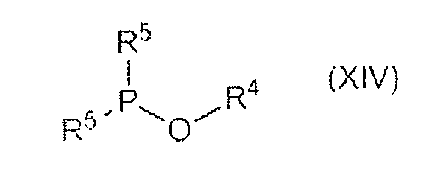
[식 중, R4 는 2-시아노에틸기, 메틸기, 메탄술포닐에틸기, 2,2,2-트리클로로에틸기, 또는 4-클로로페닐메틸기를 나타내고, R5 는 모르폴리노기, 디이소프로필아미노기, 디에틸아미노기, 또는 디메틸아미노기를 나타낸다] 를 갖는 화합물과 반응시켜, 식 (XV) [Wherein, R 4 represents a 2-cyanoethyl group, a methyl group, a methanesulfonylethyl group, a 2,2,2-trichloroethyl group, or a 4-chlorophenylmethyl group, and R 5 represents a morpholino group or a diisopropylamino group , Diethylamino group, or dimethylamino group] is reacted with a compound having the formula (XV)
[화학식 8][Formula 8]

를 갖는 화합물을 제조하는 공정;Preparing a compound having a compound;
(ii) 상기 (i) 에서 얻어진 화합물을 포스포라미디트법에 의해, 식 HO-W1-Y-CPG [식 중, W1-Y 는 5' 말단 및 3' 말단의 수산기를 제외한 보호된 안티센스 사슬 폴리뉴클레오티드를 나타내고, CPG 는 폴리뉴클레오티드와 결합할 수 있는 링커를 갖는 폴리머 서포트를 나타낸다] 를 갖는 화합물과 반응시키고, 계속해서, 포스포라미디트법에 의해, 식 Tr1-O-W2-O-P(=O)(OR4)-O- [식 중, Tr1 은 수산기의 보호기를 나타내고, W2 는 5' 말단 및 3' 말단의 수산기를 제외한 보호된 센스 사슬 폴리뉴클레오티드를 나타낸다] 부분을 제조하고, 식 (XVI) (ii) The compound obtained in the above (i) was subjected to the phosphoramidite method, wherein the formula HO-W 1 -Y-CPG [wherein W 1 -Y is protected except for hydroxyl groups at the 5 'end and 3'end; Antisense chain polynucleotide, CPG represents polymer support having a linker capable of binding to the polynucleotide], and then, by phosphoramidite, the formula Tr 1 -OW 2 -OP (= O) (OR 4 ) -O- wherein Tr 1 represents a protecting group of a hydroxyl group and W 2 represents a protected sense chain polynucleotide excluding 5 'and 3' terminal hydroxyl groups And formula (XVI)
[화학식 9][Chemical Formula 9]

을 갖는 화합물을 제조하는 공정;및,A process for preparing a compound having;
(iii) 상기 (ii) 에서 얻어진 화합물을 CPG 로부터 잘라내고, 보호기의 제거를 실시하는 공정으로 이루어지는, 식 (XI) 을 갖는 화합물을 제조하는 방법,(iii) a method for producing a compound having formula (XI), which comprises a step of cutting off the compound obtained in the above (ii) from CPG and removing the protecting group;
(42) Tr 및 Tr1 이 동일 또는 상이하여, 4-메톡시트리틸기, 4,4'-디메톡시트리틸기, 픽실기, 트리틸기, 레불리닐기, 또는 비스(트리메틸실릴옥시)(시클로헥실옥시)실릴기인 (41) 에 기재된 방법,(42) Tr and Tr 1 are the same or different, and 4-methoxytrityl group, 4,4'-dimethoxytrityl group, pisyl group, trityl group, levinyl group, or bis (trimethylsilyloxy) (cyclohex) The method described in (41) which is a siloxy) silyl group,
(43) Tr 및 Tr1 이 동일 또는 상이하여, 4-메톡시트리틸기 또는 4,4'-디메톡시트리틸기이고, p 와 q 의 합이 3 이상의 정수이고, L5 가 단결합이고, L6 이 -(C=O)-NH- 이고, L5 의 벤젠 고리 상의 결합 위치가 파라 위치인 (41) 에 기재된 방법,(43) Tr and Tr 1 are the same or different, and are a 4-methoxytrityl group or a 4,4'-dimethoxytrityl group, the sum of p and q is an integer of 3 or more, L 5 is a single bond, L 6 is-(C = O) -NH-, and the method according to (41), wherein the bonding position on the benzene ring of L 5 is para-position;
(44) Tr 및 Tr1 이 동일 또는 상이하여, 4-메톡시트리틸기 또는 4,4'-디메톡시트리틸기이고, p 와 q 의 합이 8 이상의 정수이고, L5 가 단결합이고, L6 이 -(C=O)-NH- 이고, L5 의 벤젠 고리 상의 결합 위치가 파라 위치인 (41) 에 기재된 방법,(44) Tr and Tr 1 are the same or different and are a 4-methoxytrityl group or a 4,4'-dimethoxytrityl group, the sum of p and q is an integer of 8 or more, L 5 is a single bond, L 6 is-(C = O) -NH-, and the method according to (41), wherein the bonding position on the benzene ring of L 5 is para-position;
(45) Tr 및 Tr1 이 동일 또는 상이하여, 4-메톡시트리틸기 또는 4,4'-디메톡시트리틸기이고, p 가 0 또는 2 이고, q 가 6 이상의 정수이고, L5 가 단결합이고, L6 이 -(C=O)-NH- 이고, L5 의 벤젠 고리 상의 결합 위치가 파라 위치인 (41) 에 기재된 방법,(45) Tr and Tr 1 are the same or different, are 4-methoxytrityl group or 4,4'-dimethoxytrityl group, p is 0 or 2, q is an integer of 6 or more, and L 5 is a single bond; The process according to (41) wherein L 6 is-(C = O) -NH-, and the bonding position on the benzene ring of L 5 is para position,
(46) Tr 및 Tr1 이 동일 또는 상이하여, 4-메톡시트리틸기 또는 4,4'-디메톡시트리틸기이고, p 가 0 또는 2 이고, q 가 6 또는 8 이고, L5 가 단결합이고, L6 이 -(C=O)-NH- 이고, L5 의 벤젠 고리 상의 결합 위치가 파라 위치인 (41) 에 기재된 방법,(46) Tr and Tr 1 are the same or different and are a 4-methoxytrityl group or a 4,4'-dimethoxytrityl group, p is 0 or 2, q is 6 or 8, and L 5 is a single bond The process according to (41) wherein L 6 is-(C = O) -NH-, and the bonding position on the benzene ring of L 5 is para position,
(47) Tr 및 Tr1 이 동일 또는 상이하여, 4-메톡시트리틸기 또는 4,4'-디메톡시트리틸기이고, p 가 0 또는 2 이고, q 가 8 이고, L5 가 단결합이고, L6 이 -(C=O)-NH- 이고, L5 의 벤젠 고리 상의 결합 위치가 파라 위치인 (41) 에 기재된 방법,(47) Tr and Tr 1 are the same or different and are a 4-methoxytrityl group or a 4,4'-dimethoxytrityl group, p is 0 or 2, q is 8, L 5 is a single bond, The method described in (41) wherein L 6 is-(C = O) -NH-, and the bonding position on the benzene ring of L 5 is para-position;
(48) Tr 및 Tr1 이 동일 또는 상이하여, 4-메톡시트리틸기 또는 4,4'-디메톡시트리틸기이고, p 가 2 이고, q 가 8 이고, L5 가 단결합이고, L6 이 -(C=O)-NH- 이고, L5 의 벤젠 고리 상의 결합 위치가 파라 위치인 (41) 에 기재된 방법,(48) Tr and Tr 1 are the same or different and are a 4-methoxytrityl group or a 4,4'-dimethoxytrityl group, p is 2, q is 8, L 5 is a single bond, L 6 The method according to (41), wherein-(C = O) -NH- is and the bonding position on the benzene ring of L 5 is para;
(49) Tr 및 Tr1 이 4,4'-디메톡시트리틸기이고, p 가 2 이고, q 가 8 이고, L5 가 단결합이고, L6 이 -(C=O)-NH- 이고, L5 의 벤젠 고리 상의 결합 위치가 파라 위치인 (41) 에 기재된 방법,(49) Tr and Tr 1 are 4,4'-dimethoxytrityl groups, p is 2, q is 8, L 5 is a single bond, L 6 is-(C = O) -NH-, The method according to (41), wherein the bonding position on the benzene ring of L 5 is para-position;
(50) R4 가 2-시아노에틸기, 메틸기, 메탄술포닐에틸기, 2,2,2-트리클로로에틸기, 또는 4-클로로페닐메틸기이고, R5 가 모르폴리노기, 디이소프로필아미노기, 디에틸아미노기, 또는 디메틸아미노기인 (41) 내지 (49) 중 어느 한 항에 기재된 방법,(50) R 4 is 2-cyanoethyl group, methyl group, methanesulfonylethyl group, 2,2,2-trichloroethyl group, or 4-chlorophenylmethyl group, R 5 is morpholino group, diisopropylamino group, di The method according to any one of (41) to (49), which is an ethylamino group or a dimethylamino group,
(51) R4 가 2-시아노에틸기 또는 메틸기이고, R5 가 모르폴리노기 또는 디이소프로필아미노기인 (41) 내지 (49) 중 어느 한 항에 기재된 방법,(51) The method according to any one of (41) to (49), wherein R 4 is a 2-cyanoethyl group or a methyl group, and R 5 is a morpholino group or a diisopropylamino group,
(52) 식 (XIII) 을 갖는 화합물이 클로로(모르폴리노)메톡시포스핀, 클로로(모르폴리노)시아노에톡시포스핀, 클로로(디이소프로필아미노)메톡시포스핀 또는 클로로(디이소프로필아미노)시아노에톡시포스핀인 (41) 내지 (49) 중 어느 한 항에 기재된 방법,(52) Compounds having formula (XIII) include chloro (morpholino) methoxyphosphine, chloro (morpholino) cyanoethoxyphosphine, chloro (diisopropylamino) methoxyphosphine or chloro (di The method according to any one of (41) to (49), which is isopropylamino) cyanoethoxyphosphine,
(53) 식 (XIV) 를 갖는 화합물이 비스(디이소프로필아미노)시아노에톡시포스핀인 (41) 내지 (49) 중 어느 한 항에 기재된 방법,(53) The method according to any one of (41) to (49), wherein the compound having formula (XIV) is bis (diisopropylamino) cyanoethoxyphosphine;
(54) 하기에서 선택되는 폴리뉴클레오티드 또는 그 염(54) a polynucleotide or salt thereof selected from

[식 중, Ap, Gp, Cp, Tp, Ts, Am1p, Gm1p, Cm1p, Um1p, Um1t 는 다음 식으로 나타내는 구조의 뉴클레오시드, 또는, 뉴클레오티드를 나타내고,[ Wherein , A p , G p , C p , T p , T s , A m1p , G m1p , C m1p , U m1p , U m1t represent nucleosides or nucleotides of the structure represented by the following formula,
[화학식 10][Formula 10]

X 의 전방은 표적 유전자에 대한 센스 사슬 폴리뉴클레오티드를 나타내고, X 의 후방은 그 센스 사슬 폴리뉴클레오티드에 상보적인 염기 배열을 갖는 안티센스 사슬 폴리뉴클레오티드를 갖는 폴리뉴클레오티드를 나타내고, X 는 식 (XVII) The front of X represents the sense chain polynucleotide for the target gene, the rear of X represents the polynucleotide having an antisense chain polynucleotide having a base sequence complementary to the sense chain polynucleotide, and X is the formula (XVII)
[화학식 11][Formula 11]

로 나타내는 구조의 링커를 나타내고, 말단의 메틸렌기는 그 센스 사슬 폴리뉴클레오티드의 3' 말단에 결합하여 인산디에스테르 결합을 형성하고, 페닐기에 결합되어 있는 산소 원자는 그 안티센스 사슬 폴리뉴클레오티드의 5' 말단에 결합하여 인산디에스테르 결합을 형성한다],A methylene group at the terminal is bonded to the 3 'end of the sense chain polynucleotide to form a diester phosphate bond, and the oxygen atom bonded to the phenyl group is at the 5' end of the antisense chain polynucleotide. To form a diester phosphate bond];
(55) (54) 에 기재된 폴리뉴클레오티드 또는 그 염을 유효 성분으로서 함유하는 의약,(55) A pharmaceutical comprising the polynucleotide according to (54) or a salt thereof as an active ingredient,
(56) Hsp47 유전자의 발현에서 유래하는 질환을 치료하기 위한 (55) 에 기재된 의약,(56) the medicament according to (55) for treating a disease resulting from expression of the Hsp47 gene,
(57) Hsp47 유전자의 발현에서 유래하는 질환이 섬유증인 (56) 에 기재된 의약,(57) The pharmaceutical according to (56), wherein the disease resulting from the expression of the Hsp47 gene is fibrosis,
(58) (54) 에 기재된 폴리뉴클레오티드 또는 그 염을 포유 동물에 투여하는 것에 의한 Hsp47 유전자의 발현 억제 방법,(58) A method of inhibiting expression of the Hsp47 gene by administering a polynucleotide or a salt thereof according to (54) to a mammal,
(59) (54) 에 기재된 폴리뉴클레오티드 또는 그 염을 함유하는 시약,(59) a reagent containing the polynucleotide according to (54) or a salt thereof,
으로 이루어진다.Lt; / RTI >
본 발명에 의해, RNA 간섭 작용 및/또는 유전자 발현 억제 작용을 갖는 폴리뉴클레오티드가 제공되었다. 또, 본 발명에 의해, RNA 분해 효소, 포스파타아제, 및 엑소뉴클레아제에서 선택되는 적어도 어느 하나에 대해 안정적인 RNA 간섭 작용 및/또는 유전자 발현 억제 작용을 갖는 폴리뉴클레오티드가 제공되었다. 또 본 발명에 의해, RNA 분해 효소, 포스파타아제, 및 엑소뉴클레아제에 대해 안정적인 RNA 간섭 작용 및/또는 유전자 발현 억제 작용을 갖는 폴리뉴클레오티드가 제공되었다. 또, 본 발명에 의해, 센스 사슬 폴리뉴클레오티드와 안티센스 사슬 폴리뉴클레오티드를 각각 제조하는 공정이 불필요하고, 또한 양사슬이 동량이 되도록 정확히 혼합하여 2 개 사슬을 형성시키는 번잡한 조작이 불필요하고, RNA 간섭 작용 및/또는 유전자 발현 억제 작용을 갖는 폴리뉴클레오티드가 제공되었다. 그 폴리뉴클레오티드를 사용하여 각종 유전자의 기능 해석이 가능해지고, 또, 그 폴리뉴클레오티드를 포함하는 의약품이 제공된다.By the present invention, polynucleotides having RNA interference action and / or gene expression inhibitory action have been provided. In addition, the present invention provides a polynucleotide having a stable RNA interference action and / or a gene expression inhibitory action against at least one selected from RNA degrading enzyme, phosphatase, and exonuclease. In addition, the present invention provides a polynucleotide having a stable RNA interference action and / or a gene expression suppression action against RNA degrading enzyme, phosphatase, and exonuclease. In addition, according to the present invention, a process for producing a sense chain polynucleotide and an antisense chain polynucleotide, respectively, is unnecessary, and a complicated operation for forming two chains by accurately mixing the two chains in the same amount is unnecessary, and RNA interference is unnecessary. Polynucleotides having an action and / or a gene expression inhibitory action have been provided. The polynucleotide can be used for functional analysis of various genes, and a pharmaceutical product containing the polynucleotide is provided.
또 본 발명에 의해, 그 폴리뉴클레오티드를 얻기 위해서 유용한 합성 중간체가 제공되었다. 또 본 발명에 의해, 그 폴리뉴클레오티드의 제조 방법이 제공되었다.In addition, the present invention provides a synthetic intermediate useful for obtaining the polynucleotide. In addition, the present invention provides a method for producing the polynucleotide.
도 1 은 A-1 공정의 개요를 나타내는 도면이다.
도 2 는 C 법 및 D 법의 개요를 나타내는 도면이다.
도 3 은 E 법 및 F 법의 개요를 나타내는 도면이다.
도 4 는 G 법의 개요를 나타내는 도면이다.
도 5 는 참고예 3 ∼ 참고예 14, 참고예 17, 참고예 21 ∼ 참고예 23 에 기재된 화합물의 구조를 나타내는 도면이다.
도 6 은 인간 β-카테닌 유전자에 대한 폴리뉴클레오티드를 나타내는 도면이다. 이하, 각 도면 중, 센스 사슬, 안티센스 사슬의 실시예의 폴리뉴클레오티드의 조합을 나타낸다. 심볼 중, 흑색 원 (●) 은 DNA, 백색 원 (○) 은 2'-O-메틸 RNA 를 나타낸다. 흑색 원-백색 원 사이의 선은 뉴클레오시드 사이의 인산디에스테르 결합을 나타낸다. 도면 중의 p 는 -P(=O)(OH)- 를 나타내고, p 가 결합하고 있는 경우, 폴리뉴클레오티드의 말단의 수산기의 수소 원자는 제외된다. 폴리뉴클레오티드의 말단에 아무것도 결합하고 있지 않은 경우, DNA, 또는, 2'-O-메틸 RNA 의 3' 말단 또는 5' 말단은 OH 기이다. n 은 탄소수를 나타낸다. 도 7 및 도 11 에서도 동일하다. 또, 각 폴리뉴클레오티드의 염기 배열도 나타낸다.
도 7 은 인간 β-카테닌 유전자에 대한 폴리뉴클레오티드를 나타내는 도면이다.
도 8 은 리얼 타임 PCR 해석에 의한 폴리뉴클레오티드의 유전자 억제 활성을 나타내는 도면이다.
도 9 는 리얼 타임 PCR 해석에 의한 폴리뉴클레오티드의 유전자 억제 활성을 나타내는 도면이다.
도 10 은 참고예 24 ∼ 참고예 31 에 기재된 화합물의 구조를 나타내는 도면이다.
도 11 은 인간 β-카테닌 유전자에 대한 폴리뉴클레오티드를 나타내는 도면이다.
도 12 는 리얼 타임 PCR 해석에 의한 폴리뉴클레오티드의 유전자 억제 활성을 나타내는 도면이다.
도 13 은 인간 β-카테닌 유전자에 대한 폴리뉴클레오티드를 나타내는 도면이다. 심볼 중, 백색 사각 (□) 은 RNA, 흑색 원 (●) 은 DNA, 백색 원 (○) 은 2'-O-메틸 RNA 를 나타낸다. 각 뉴클레오시드 사이를 잇는 선은 인산디에스테르 결합을 나타낸다. 도면 중의 p 는 -P(=O)(OH)- 를 나타내고, p 가 결합하고 있는 경우, 폴리뉴클레오티드의 말단의 수산기의 수소 원자는 제외된다. 폴리뉴클레오티드의 말단에 아무것도 결합하고 있지 않은 경우, RNA, DNA, 또는, 2'-O-메틸 RNA 의 3' 말단 또는 5' 말단은 OH 기이다. n 은 탄소수를 나타낸다. 도 15, 도 16 및 도 19 에서도 동일하다. 또, 각 폴리뉴클레오티드의 염기 배열도 나타낸다.
도 14 는 리얼 타임 PCR 해석에 의한 폴리뉴클레오티드의 유전자 억제 활성을 나타내는 도면이다.
도 15 는 마우스 PKR 유전자에 대한 폴리뉴클레오티드를 나타내는 도면이다.
도 16 은 래트, 인간 Hsp47 유전자에 대한 폴리뉴클레오티드를 나타내는 도면이다. 도면 중의 s 는 포스포로티오에이트 결합을 나타낸다.
도 17 은 리얼 타임 PCR 해석에 의한 폴리뉴클레오티드의 유전자 억제 활성을 나타내는 도면이다. 폴리뉴클레오티드의 농도로서 백색 바는 0.1 nM 의 경우를 나타내고, 흑색 바는 1 nM 의 경우를 나타낸다. 도 18 및 도 20 에서도 동일하다.
도 18 은 리얼 타임 PCR 해석에 의한 폴리뉴클레오티드의 유전자 억제 활성을 나타내는 도면이다.
도 19 는 래트, 인간 Hsp47 유전자에 대한 폴리뉴클레오티드를 나타내는 도면이다.
도 20 은 리얼 타임 PCR 해석에 의한 폴리뉴클레오티드의 유전자 억제 활성을 나타내는 도면이다.1 is a diagram showing an outline of the A-1 step.
2 is a diagram showing an outline of the C method and the D method.
3 is a view showing an outline of the E method and the F method.
4 is a diagram showing an outline of the G method.
5 is a diagram showing the structure of the compound described in Reference Examples 3 to 14, Reference Example 17, and Reference Examples 21 to 23.
6 shows polynucleotides for the human β-catenin gene. Hereinafter, in each figure, the combination of the polynucleotide of the Example of a sense chain and an antisense chain is shown. In the symbols, black circles (●) represent DNA, and white circles (○) represent 2'-O-methyl RNA. The line between the black circle and the white circle represents the diester phosphate bond between the nucleosides. P in the figure represents -P (= O) (OH)-, and when p is bonded, the hydrogen atom of the hydroxyl group at the terminal of the polynucleotide is excluded. When nothing is bound to the terminal of a polynucleotide, the 3 'end or 5' end of DNA or 2'-O-methyl RNA is an OH group. n represents carbon number. The same applies to FIGS. 7 and 11. Moreover, the base sequence of each polynucleotide is also shown.
Fig. 7 shows the polynucleotides for the human β-catenin gene.
Fig. 8 shows gene suppression activity of polynucleotides by real-time PCR analysis.
9 shows gene suppression activity of polynucleotides by real-time PCR analysis.
10 is a view showing the structure of the compound described in Reference Examples 24 to 31. FIG.
11 shows polynucleotides for the human β-catenin gene.
Fig. 12 shows gene suppression activity of polynucleotides by real-time PCR analysis.
Fig. 13 shows the polynucleotides for the human β-catenin gene. In the symbol, white square (□) represents RNA, black circle (●) represents DNA, and white circle (○) represents 2'-O-methyl RNA. The line between each nucleoside represents a diester phosphate bond. P in the figure represents -P (= O) (OH)-, and when p is bonded, the hydrogen atom of the hydroxyl group at the terminal of the polynucleotide is excluded. When nothing is bound to the terminal of the polynucleotide, the 3 'end or 5' end of the RNA, DNA, or 2'-0-methyl RNA is an OH group. n represents carbon number. The same applies to FIGS. 15, 16, and 19. Moreover, the base sequence of each polynucleotide is also shown.
Fig. 14 shows gene suppression activity of polynucleotides by real-time PCR analysis.
Fig. 15 shows the polynucleotides for the mouse PKR gene.
Fig. 16 shows the polynucleotides for the rat, human Hsp47 gene. S in the figure represents a phosphorothioate bond.
Fig. 17 shows gene suppression activity of polynucleotides by real-time PCR analysis. As a concentration of polynucleotides, the white bars represent the case of 0.1 nM and the black bars represent the case of 1 nM. The same applies to FIGS. 18 and 20.
Fig. 18 shows gene suppression activity of polynucleotides by real-time PCR analysis.
19 shows polynucleotides for the rat, human Hsp47 gene.
Fig. 20 shows gene suppression activity of polynucleotides by real-time PCR analysis.
1. 용어의 설명1. Explanation of Terms
본 명세서에 있어서, 「표적 유전자」 란, 이것을 도입하는 세포, 조직 또는 고체 (이하 이것을 「피도입체」라고 칭하는 경우가 있다) 에 있어서 RNA 이면 특별히 제한되지 않고, 단백질로 번역되는 mRNA 이어도 단백질로 번역되지 않는 논코딩 RNA 이어도 된다. 논코딩 RNA 로는, 기능성 RNA, 예를 들어, mRNA 의 비번역 영역, tRNA, rRNA, mRNA 형 ncRNA (mRNA-like non-coding RNA), 장사슬 ncRNA (long non-coding RNA), snRNA (small nuclear RNA), snoRNA (small nucleolar RNA), miRNA (microRNA) 등을 들 수 있다. 구체적으로는, 도입하는 피도입체에 내재성의 것이어도 되고, 유전자 도입 등의 수법에 의해 도입되는 외래성의 것이어도 된다. 또, 염색체 상에 존재하는 유전자이어도 되고, 염색체 외의 것이어도 된다. 외래성의 유전자로는, 예를 들어, 피도입체에 감염 가능한 바이러스, 박테리아, 진균류 또는 원생 동물 유래의 것을 들 수 있는데 이들에 제한되지 않는다. 유전자의 기능에 대해서는 이미 알려진 것이어도 되고, 알려지지 않은 것이어도 된다.In the present specification, "target gene" is not particularly limited as long as it is RNA in cells, tissues or solids (hereinafter sometimes referred to as "subject") which introduce this. The non-translated RNA may be untranslated. Non-coding RNAs include, but are not limited to, functional RNAs such as non-translated regions of mRNA, tRNAs, rRNAs, mRNA-like non-coding RNAs (mRNAs), long non-coding RNAs (ncRNAs), and snRNAs (small nuclear). RNA), snoRNA (small nucleolar RNA), miRNA (microRNA), and the like. Specifically, it may be intrinsic to the introduced body to be introduced, or may be foreign to be introduced by a technique such as gene introduction. Moreover, the gene which exists on a chromosome may be sufficient, and a thing other than a chromosome may be sufficient. Exogenous genes include, but are not limited to, those derived from viruses, bacteria, fungi, or protozoa, which can infect the subject. The function of a gene may be known or unknown.
그러한 표적 유전자의 예로는, 특정 질환을 갖는 환자에 있어서 특이적으로 발현이 상승하고 있는 및/또는 특이적으로 변이하고 있는 유전자를 들 수 있으며, 질환으로는, 중추 질환 (예를 들어, 알츠하이머 병, 치매, 섭식 장해 등), 염증성 질환 (예를 들어, 알레르기, 류마티스, 변형성 관절증, 에리테마토서스 등), 순환기 질환 (예를 들어, 고혈압증, 심장 비대, 협심증, 동맥경화증, 고콜레스테롤혈증 등), 암 (예를 들어, 비소세포 폐암, 난소암, 전립선암, 위암, 췌장암, 간암, 방광암, 유방암, 자궁 경부암, 대장암, 결장암, 직장암 등), 호흡기 질환 (예를 들어, 폐렴, 기관지염, 천식, 만성 폐색성 폐질환 등), 당뇨병, 당뇨병 망막증, 당뇨병성 신장 질환, 빈혈 (예를 들어, 만성 질환에 수반하는 빈혈, 철불응성 철결핍성 빈혈 등), 가령성 황반 변성증, 면역계 질환 (예를 들어, 크론병, 아토피성 피부염, 자가 면역 질환, 면역 부전, 백혈병 등), 간장·담낭 질환 (예를 들어, 비알코올성 지방성 간염, 간경변, 간염, 간부전, 담즙울체증, 결석 등), 소화관 질환 (예를 들어, 궤양, 장염, 흡수 불량 등), 감염증, 비만, 섬유증 (폐 섬유증, 간 섬유증, 신장 섬유증, 골수 섬유증 등) 을 들 수 있고, 이들 질환의 원인 유전자로는, 예를 들어, kinesin spindle protein (KSP), vascular endothelial growth factor, (VEGF), transthyretin (TTR), proprotein convertase subtilisn/kexin type 9 (PCSK9), polo-like kinase (PLK), ApoB-100, ribonucleotide reductase M2 subunit (RRM2), clusterin, heat shock protein 27 (Hsp27), survivin, eukaryotic initiation factor-4E (eIF-4E), intercellular adhesion molecule 1 (ICAM-1), alpha subunit of the interleukin 4 receptor (IL-4R-alpha), Factor XI, Factor VII, N-ras, H-ras, K-ras, bcl-2, bcl-xL, Her-1, Her-2, Her-3, Her-4, MDR-1, 인간 β-카테닌 유전자, DDX3 (DEAD (Asp-Glu-Ala-Asp) box polypeptide 3, X-linked), Myeloid Cell Leukemia Sequence 1 (MCL1) 유전자, PKR (Eif2ak2), Hsp47 (Serpinh1), Hepcidin, 활성화 프로테인 C (APC), survivin, signal tranducer and activator of transcription (STAT3) 을 들 수 있지만 이들에 한정되지는 않는다.Examples of such target genes include genes whose expression is specifically elevated and / or which are specifically mutated in patients with specific diseases, and diseases include, for example, central diseases (eg, Alzheimer's disease). , Dementia, eating disorders, etc.), inflammatory diseases (e.g., allergies, rheumatism, deformed arthrosis, erythematosus, etc.), circulatory diseases (e.g., hypertension, cardiac hypertrophy, angina pectoris, arteriosclerosis, hypercholesterolemia, etc.) ), Cancer (e.g., non-small cell lung cancer, ovarian cancer, prostate cancer, stomach cancer, pancreatic cancer, liver cancer, bladder cancer, breast cancer, cervical cancer, colon cancer, colon cancer, rectal cancer, etc.), respiratory disease (e.g. pneumonia, bronchitis) , Asthma, chronic obstructive pulmonary disease, etc.), diabetes mellitus, diabetic retinopathy, diabetic kidney disease, anemia (e.g., anemia accompanying chronic diseases, iron refractory iron deficiency anemia, etc.), such as macular degeneration, immunity Diseases (e.g., Crohn's disease, atopic dermatitis, autoimmune diseases, immunodeficiency, leukemia, etc.), liver and gallbladder diseases (e.g., nonalcoholic fatty hepatitis, cirrhosis, hepatitis, liver failure, cholestasis, stones, etc.) ), Digestive tract diseases (e.g., ulcers, enteritis, poor absorption), infectious diseases, obesity, fibrosis (pulmonary fibrosis, liver fibrosis, kidney fibrosis, myeloid fibrosis, etc.). For example, kinesin spindle protein (KSP), vascular endothelial growth factor (VEGF), transthyretin (TTR), proprotein convertase subtilisn / kexin type 9 (PCSK9), polo-like kinase (PLK), ApoB-100, ribonucleotide reductase M2 subunit (RRM2), clusterin, heat shock protein 27 (Hsp27), survivin, eukaryotic initiation factor-4E (eIF-4E), intercellular adhesion molecule 1 (ICAM-1), alpha subunit of the
본 명세서에 있어서, 「천연형 뉴클레오시드」란, 2'-데옥시아데노신, 2'-데옥시구아노신, 2'-데옥시시티딘, 2'-데옥시-5-메틸시티딘, 티미딘 등의 2'-데옥시뉴클레오시드, 아데노신, 구아노신, 시티딘, 5-메틸시티딘, 우리딘 등의 리보뉴클레오시드를 말한다. 또, 「올리고뉴클레오티드」란, 뉴클레오시드의 당 부분이 인산과 에스테르를 형성하고 있는 화합물로 구성되는 올리고뉴클레오티드를 말한다. 본 명세서에 있어서는, 올리고뉴클레오티드와 폴리뉴클레오티드는 동일한 의미로 사용하고 있다.As used herein, the term "natural nucleoside" includes 2'-deoxyadenosine, 2'-deoxyguanosine, 2'-deoxycytidine, 2'-deoxy-5-methylcytidine, and thymine. Ribonucleosides, such as 2'-deoxynucleoside, adenosine, guanosine, cytidine, 5-methylcytidine, and uridine, such as dean. Moreover, an "oligonucleotide" means the oligonucleotide comprised from the compound in which the sugar part of nucleoside forms the ester with phosphoric acid. In this specification, oligonucleotide and polynucleotide are used by the same meaning.
본 명세서에 있어서는 2'-데옥시아데노신을 At, 2'-데옥시구아노신을 Gt, 2'-데옥시시티딘을 Ct, 2'-데옥시-5-메틸시티딘을 5meCt, 티미딘을 Tt, 2'-데옥시우리딘을 Ut, 아데노신을 Art, 구아노신을 Grt, 시티딘을 Crt, 5-메틸시티딘을 5meCrt, 우리딘을 Urt 로 표기하는 경우도 있다. 또, 본 명세서 중에서는, 2'-데옥시아데노신뉴클레오티드를 Ap, 2'-데옥시구아노신뉴클레오티드를 Gp, 2'-데옥시시티딘뉴클레오티드를 Cp, 2'-데옥시-5-메틸시티딘뉴클레오티드를 5meCp, 티미딘뉴클레오티드를 Tp, 2'-데옥시우리딘뉴클레오티드를 Up, 아데노신뉴클레오티드를 Arp, 구아노신뉴클레오티드를 Grp, 시티딘뉴클레오티드를 Crp, 5-메틸시티딘뉴클레오티드를 5meCrp, 우라실뉴클레오티드를 Urp 로 표기하는 경우도 있다.In the present specification, 2'-deoxyadenosine is A t , 2'-deoxyguanosine is G t , 2'-deoxycytidine is C t , 2'-deoxy-5-methylcytidine is 5meC t , Thymidine as T t , 2'-deoxyuridine as U t , adenosine as A rt , guanosine as G rt , cytidine as C rt , 5-methylcytidine as 5meC rt , and uridine as U rt In some cases. In the present specification, 2'-deoxyadenosine nucleotide is A p , 2'-deoxyguanosine nucleotide is G p , and 2'-deoxycytidine nucleotide is C p , 2'-deoxy-5- Methylcytidine nucleotide 5meC p , thymidine nucleotide T p , 2'-deoxyuridine nucleotide U p , adenosine nucleotide A rp , guanosine nucleotide G rp , cytidine nucleotide C rp , 5-methyl The cytidine nucleotide may be expressed as 5meC rp and the uracil nucleotide as U rp .
본 명세서에 있어서는 뉴클레오티드의 인산에스테르 대신에 포스포로티오에이트에스테르가 되어 있는 포스포로티오에이트에스테르에 대해서, Ap 에 대응되는 것으로서 As, Gp 에 대응되는 것으로서 Gs, Cp 에 대응되는 것으로서 Cs, 5meCp 에 대응되는 것으로서 5meCs, Tp 에 대응되는 것으로서 Ts, Up 에 대응되는 것으로서 Us, Arp 에 대응되는 것으로서 Ars, Grp 에 대응되는 것으로서 Grs, Crp 에 대응되는 것으로서 Crs, 5meCrp 에 대응되는 것으로서 5meCrs, Urp 에 대응되는 것으로서 Urs 로 표기하는 경우도 있다.For phosphorothioate esters which In is a phosphorothioate ester in place of phosphate esters of nucleotides herein, as corresponding to A p as corresponding to A s, G p as corresponding to G s, C p As corresponding to C s , 5meC p As corresponding to 5meC s , T p As corresponding to T s , U p As corresponding to U s , A rp As corresponding to A rs , G rp As corresponding to G rs , C rp Corresponding to C rs , 5meC rp , corresponding to 5meC rs , U rp , and sometimes referred to as U rs .
본 명세서에서의 「당 수식 뉴클레오시드」란, 뉴클레오시드의 당 부분이 수식되어 있는 뉴클레오시드를 말한다.As used herein, the term "sugar modified nucleoside" refers to a nucleoside in which a sugar portion of a nucleoside is modified.
이 중, 2'-O-메틸 수식의 예로는, 2'-O-메틸 뉴클레오시드 및 2'-O-메틸 뉴클레오티드가 있고, Art 에 대응되는 것으로서 Am1t, Grt 에 대응되는 것으로서 Gm1t, Crt 에 대응되는 것으로서 Cm1t, 5meCrt 에 대응되는 것으로서 5meCm1t, Urt 에 대응되는 것으로서 Um1t, Arp 에 대응되는 것으로서 Am1p, Grp 에 대응되는 것으로서 Gm1p, Crp 에 대응되는 것으로서 Cm1p, 5meCrp 에 대응되는 것으로서 5meCm1p, Urp 에 대응되는 것으로서 Um1p, Ars 에 대응되는 것으로서 Am1s, Grs 에 대응되는 것으로서 Gm1s, Crs 에 대응되는 것으로서 Cm1s, 5meCs 에 대응되는 것으로서 5meCm1s, Urs 에 대응되는 것으로서 Um1s 로 표기하는 경우도 있다.Among these, examples of 2'-O-methyl modifications include 2'-O-methyl nucleosides and 2'-O-methyl nucleotides, which correspond to A rt and correspond to A m1t and G rt as G. As corresponding to m1t and C rt As corresponding to C m1t and 5meC rt As corresponding to 5meC m1t and U rt As corresponding to U m1t and A rp As corresponding to A m1p and G rp As in G m1p and C rp Corresponding to C m1p , 5meC rp , Corresponding to 5meC m1p , U rp , Corresponding to U m1p , A rs , Corresponding to A m1s , G rs , Corresponding to G m1s , C rs , C m1s , 5meC s , which corresponds to 5meC m1s , U rs , may also be referred to as U m1s .
본 명세서에 있어서 2'-O,4'-C-에틸렌뉴클레오티드 유닛 및 「ENA 유닛」이란 상기의 각 뉴클레오시드, 각 뉴클레오티드에 있어서 ENA 를 갖는 것을 말하고, At 에 대응되는 것으로서 A2t, Ap 에 대응되는 것으로서 Ae2p, As 에 대해서는 Ae2s, Gt 에 대응되는 것으로서 G2t, Gp 에 대응되는 것으로서 Ge2p, Gs 에 대해서는 Ge2s, 5meCt 에 대응되는 것으로서 C2t, 5meCp 에 대응되는 것으로서 Ce2p, 5meCs에 대해서는 Ce2s, Tt 에 대응되는 것으로서 T2t, Tp 에 대응되는 것으로서 Te2p, Ts에 대해서는 Te2s와 같이 ENA 유닛을 갖는 뉴클레오시드 및 뉴클레오티드를 표기하는 경우도 있다.In the present specification, the 2'-O, 4'-C-ethylenenucleotide unit and the "ENA unit" refer to those having ENA in each of the nucleosides and nucleotides described above, and correspond to A t as A 2t , A A e2p , A s as corresponding to p on For A e2s, as corresponding to as t G corresponding to G 2t, G p G e2p, G s on Is corresponding to G e2s , 5meC t , and corresponds to C 2t , 5meC p , and corresponds to C e2p , 5meC s For C e2s , T t , which corresponds to T 2t , T p , corresponds to T e2p , T s For example, nucleosides and nucleotides having an ENA unit, such as T e2s , may be indicated.
본 명세서에 있어서 2'-O,4'-C-메틸렌뉴클레오티드 유닛 및 「2',4'-BNA/LNA 유닛」이란 상기의 각 뉴클레오시드, 각 뉴클레오티드에 있어서 2',4'-BNA/LNA 를 갖는 것을 말하고, At 에 대응되는 것으로서 A1t, Ap 에 대응되는 것으로서 Ae1p, As 에 대해서는 Ae1s, Gt 에 대응되는 것으로서 G1t, Gp 에 대응되는 것으로서 Ge1p, Gs 에 대해서는 Ge1s, 5meCt 에 대응되는 것으로서 C1t, 5meCp 에 대응되는 것으로서 Ce1p, 5meCs 에 대해서는 Ce1s, Tt 에 대응되는 것으로서 T1t, Tp 에 대응되는 것으로서 Te1p, Ts 에 대해서는 Te1s 와 같이 2',4'-BNA/LNA 유닛을 갖는 뉴클레오시드 및 뉴클레오티드를 표기하는 경우도 있다.In the present specification, the 2'-O, 4'-C-methylenenucleotide unit and the "2 ', 4'-BNA / LNA unit" are each nucleoside and 2', 4'-BNA / in each nucleotide. Refers to having LNA, A t Corresponding to A 1t , A p As corresponding to A e1p , A s on For A e1s , G t Corresponding to G 1t , G p As corresponding to G e1p , G s on For G e1s , 5meC t Corresponding to C 1t , 5meC p Corresponding to C e1p , 5meC s on For C e1s , T t Corresponding to T 1t , T p Corresponding to T e1p , T s on About T e1s In some cases, nucleosides and nucleotides having 2 ', 4'-BNA / LNA units are indicated.
이하에 각 뉴클레오티드의 구조식을 나타낸다.The structural formula of each nucleotide is shown below.
[화학식 12][Chemical Formula 12]

[화학식 13][Chemical Formula 13]

[화학식 14][Formula 14]

[화학식 15][Chemical Formula 15]

[화학식 16][Chemical Formula 16]
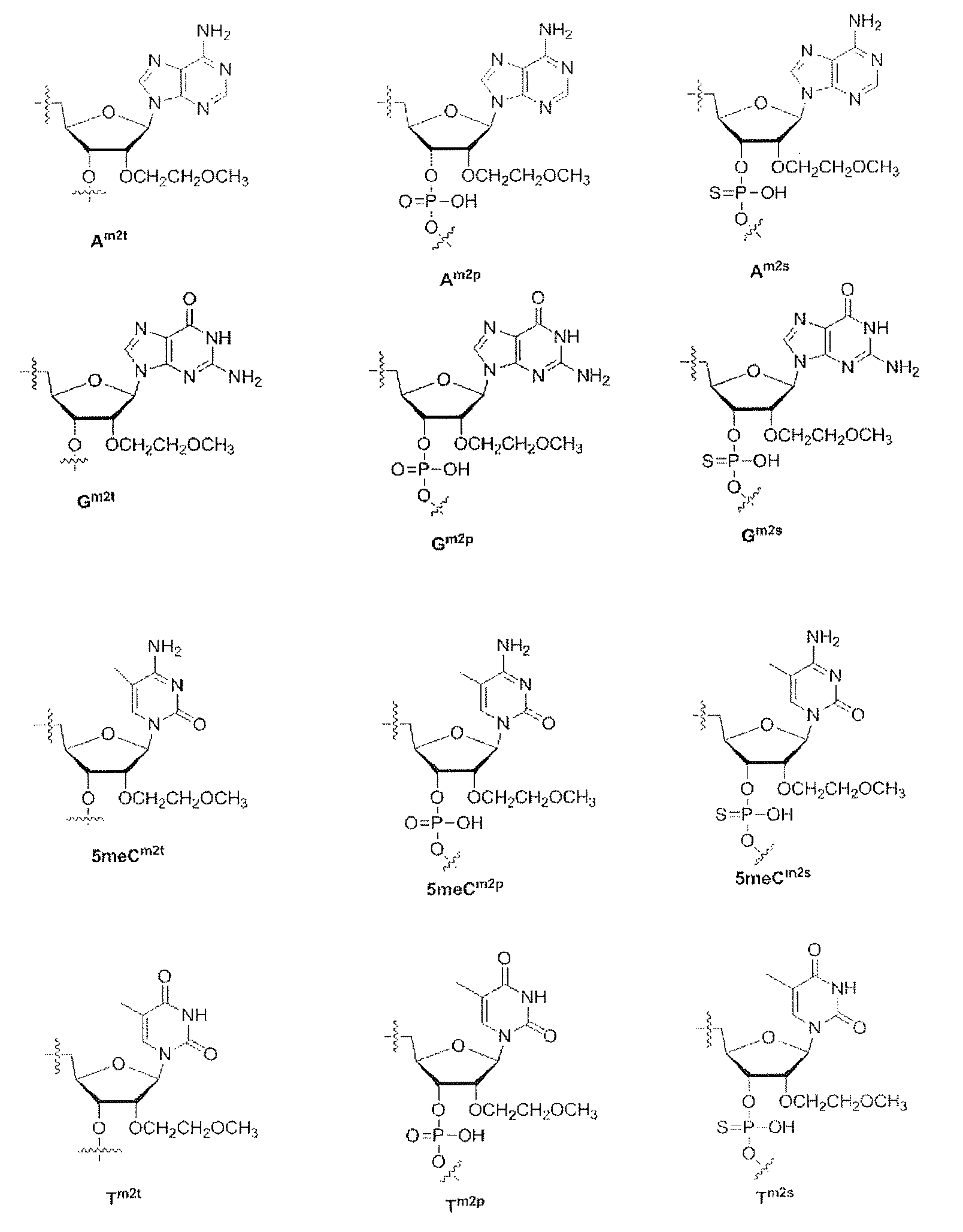
[화학식 17][Chemical Formula 17]

본 명세서 중에 있어서의 폴리뉴클레오티드 또는 그 염은 표적 유전자에 대한 센스 사슬 폴리뉴클레오티드, 및 그 센스 사슬 폴리뉴클레오티드에 상보적인 염기 배열을 갖는 안티센스 사슬 폴리뉴클레오티드를 갖는 2 개 사슬 폴리뉴클레오티드를 유래로 하고, 이 안티센스 사슬의 5' 말단 및 센스 사슬의 3' 말단이 각각에 있어서 인산디에스테르 구조를 형성한 하기 구조식으로 나타내는 구조의 링커에 의해 결합되어 있는 1 개 사슬 구조를 갖는 것이 특징이다. 즉, 폴리뉴클레오티드-3'-P(=O)(OH)-[링커]-P(=O)(OH)-5'-폴리뉴클레오티드의 구조를 형성하고 있다. [여기서, 『폴리뉴클레오티드-3'』 는 폴리뉴클레오티드의 3' 말단의 수산기 상의 수소 원자를 갖지 않는 구조를 나타내고, 『5'-폴리뉴클레오티드』 는 폴리뉴클레오티드의 5' 말단의 수산기 상의 수소 원자를 갖지 않는 구조를 나타낸다]The polynucleotide or salt thereof in the present specification is derived from a two-chain polynucleotide having a sense chain polynucleotide to a target gene and an antisense chain polynucleotide having a base sequence complementary to the sense chain polynucleotide. It is a feature that the 5 'end of the antisense chain and the 3' end of the sense chain each have a single chain structure bonded by a linker having a structure represented by the following structural formula in which a phosphate diester structure is formed. That is, the structure of polynucleotide-3'-P (= O) (OH)-[linker] -P (= O) (OH) -5'-polynucleotide is formed. [Herein, "polynucleotide-3 '" represents a structure having no hydrogen atom on the hydroxyl group at the 3' end of the polynucleotide, and "5'-polynucleotide" does not have a hydrogen atom on the hydroxyl group at the 5 'end of the polynucleotide. Does not represent the structure]
이 링커는 페닐기를 함유하고 있고, 이 페닐기에 결합하는 산소 원자 부분, 다음 화학식 18 의 구조식에 있어서 명시되고 있는 산소 원자를 나타내는데, 안티센스 사슬의 5' 말단과의 결합 부분이며, 5' 말단에 있어서 인산디에스테르 결합을 형성하여 결합하고 있다. 이 페닐기는 R1, R2 및 R3 을 추가로 갖고 있으며, 그 중의 1 개가 센스 사슬의 3' 말단과의 결합 부위로 되어 있어 인산디에스테르 결합을 형성하여 결합한다. 또한, R1, R2 및 R3 의 페닐기에 대한 결합이 산소 원자를 개재하고 있어도 이들 산소 원자는 안티센스 사슬의 5' 말단에 대한 결합 부위로는 되지 않는다. 이 링커의 구조는 다음과 같다.This linker contains a phenyl group and represents an oxygen atom moiety bonded to the phenyl group, an oxygen atom specified in the structural formula of the following formula (18), which is a binding moiety to the 5 'end of the antisense chain, Phosphate diester bonds are formed and bonded. This phenyl group is R 1 , R 2 And R 3 , and one of them serves as a binding site to the 3 ′ end of the sense chain to form a diester phosphate bond to bond. In addition, R 1 , R 2 And Although the bond to the phenyl group of R <3> interposes an oxygen atom, these oxygen atoms do not become a binding site with respect to the 5 'end of an antisense chain. The structure of this linker is as follows:
[화학식 18][Chemical Formula 18]

식 중,Wherein,
명시되어 있는 페닐기에 결합한 산소 원자는 안티센스 사슬의 5' 말단에 결합하여 인산디에스테르 구조를 형성하고, The oxygen atom bonded to the specified phenyl group is bonded to the 5 'end of the antisense chain to form a diester phosphate structure,
R1, R2 및 R3 중 어느 1 개는 다음 식으로 나타내는 구조:R 1 , R 2 And Any one of R 3 is represented by the following formula:
-L1-(CH2)m-L2-L3-(CH2CH2O)n1-(CH2)n2-O→ -L 1- (CH 2 ) m -L 2 -L 3- (CH 2 CH 2 O) n1- (CH 2 ) n2 -O →
를 나타내지만, 식 중, In the formula,
m 은 0 내지 4 의 정수를 나타내고, m represents an integer of 0 to 4,
n1 은 0 내지 4 의 정수를 나타내고, n1 represents the integer of 0-4,
n2 는 0 또는 2 내지 10 의 정수를 나타내고, n2 represents 0 or an integer from 2 to 10,
L1 은 단결합 또는 -O- 를 나타내고, L 1 represents a single bond or -O-,
L2 는 단결합 또는 -CH(-NH-L4-R)- 를 나타내고, L 2 represents a single bond or -CH (-NH-L 4 -R)-,
L3 은 단결합, -(C=O)-NH- 또는 -NH-(C=O)- 를 나타내지만, L 3 represents a single bond,-(C = O) -NH- or -NH- (C = O)-,
L3 이 단결합 이외일 때, n2 는 2 내지 10 의 정수를 나타낸다.When L <3> is other than a single bond, n2 represents the integer of 2-10.
L1 및 L2 가 단결합이고, m 이 1, n1 및 n2 가 0 일 때, L3-O→ 는,L 1 And When L 2 is a single bond and m is 1, n1 and n2 are 0, L 3 -O → is
-CH(COOH)NH-(아미노산 잔기)j-Ser, -CH (COOH) NH- (amino acid residue) j -Ser,
-CH(COOH)NH-(아미노산 잔기)j-Thr, -CH (COOH) NH- (amino acid residue) j -Thr,
-CH(NH2)CO-(아미노산 잔기)j-Ser, 또는 -CH (NH 2 ) CO- (amino acid residue) j -Ser, or
-CH(NH2)CO-(아미노산 잔기)j-Thr, -CH (NH 2 ) CO- (amino acid residue) j -Thr,
을 나타내지만, 이들의 세린 또는 트레오닌의 수산기 부분은 센스 사슬 폴리뉴클레오티드의 3' 말단의 인산기와 결합하여 인산디에스테르 구조를 형성하고 있고, However, the hydroxyl portion of these serine or threonine is combined with the phosphate group of the 3 'end of the sense chain polynucleotide to form a diester phosphate structure,
j 는 0 내지 2 의 정수를 나타내고, j represents an integer of 0 to 2,
L4 는 단결합, -(C=O)-(CH2)k-NH- 또는 -(C=O)-(CH2)k- 를 나타내고, L 4 represents a single bond,-(C = O)-(CH 2 ) k -NH- or-(C = O)-(CH 2 ) k- ,
k 는 1 내지 6 의 정수를 나타내고, k represents an integer of 1 to 6,
R 은 수소 원자, 탄소수 1 내지 6 의 알킬기, 포화 또는 불포화이어도 되는 탄소수 2 내지 30 의 탄화수소카르보닐기, 포화 또는 불포화이어도 되는 탄소수 2 내지 30 의 탄화수소옥시카르보닐기를 나타낸다.R represents a hydrogen atom, an alkyl group having 1 to 6 carbon atoms, a hydrocarbon carbonyl group having 2 to 30 carbon atoms which may be saturated or unsaturated, or a hydrocarbonoxycarbonyl group having 2 to 30 carbon atoms which may be saturated or unsaturated.
R1, R2 및 R3 중 나머지 2 개는 각각 독립적으로,R 1 , R 2 And The other two of R 3 are each independently,
수소 원자,Hydrogen atom,
치환기를 갖고 있어도 되는 탄소수 1 내지 8 의 알킬기,An alkyl group having 1 to 8 carbon atoms which may have a substituent;
치환기를 갖고 있어도 되는 탄소수 1 내지 8 의 알콕시기,An alkoxy group having 1 to 8 carbon atoms which may have a substituent,
할로겐 원자,Halogen atoms,
탄소수 1 내지 9 의 알킬기를 갖는 알킬카르보닐아미노기, 및An alkylcarbonylamino group having an alkyl group having 1 to 9 carbon atoms, and
치환기를 갖고 있어도 되는 탄소수 1 내지 8 의 알킬기를 포함하는 알킬카르보닐기,Alkylcarbonyl group containing the C1-C8 alkyl group which may have a substituent,
로 이루어지는 군의 기에서 선택되는 기를 나타낸다.The group selected from the group of the group which consists of these is shown.
링커에 포함되는 페닐기에는 R1, R2 및 R3 이 존재하지만, 그 중의 1 개는 링커 기능을 가진, 센스 사슬의 3' 말단과의 결합 부위로 되어 있고, 구조적으로는 인산디에스테르 구조를 형성하는 것을 특징으로 하고 있다. 나머지 2 개는 링커 기능은 없고, 페닐기 상의 단순한 치환기이다.The phenyl group included in the linker includes R 1 and R 2 And Although R <3> exists, one of them becomes a binding site with the 3 'terminal of a sense chain which has a linker function, and is characterized by forming a diester phosphate structure structurally. The other two have no linker function and are simple substituents on the phenyl group.
링커 기능을 완수하는 구조 중 페닐기 부분을 제외한 부분, 즉, -L1-(CH2)m-L2-L3-(CH2CH2O)n1-(CH2)n2-O→ 에 대해 설명한다.Part of the structure that completes the linker function excluding the phenyl group part, that is, -L 1- (CH 2 ) m -L 2 -L 3- (CH 2 CH 2 O) n 1- (CH 2 ) n 2 -O → Explain.
L1 은 단결합이거나 또는 2 가의 산소 원자의 -O- 이다.L 1 is a single bond or -O- of a divalent oxygen atom.
L2 는 단결합이거나 또는 메틸렌 탄소 원자 상에 치환기를 갖고 있어도 되는 아미노기를 갖는 구조이다. 이 아미노기는 링커 구조 L4 를 통해 치환기 R 을 갖는다.L 2 is a single bond or a structure having an amino group which may have a substituent on the methylene carbon atom. This amino group has a substituent R via a linker structure L 4 .
L4 는 단결합이거나, 메틸렌기 또는 탄소수 2 내지 4 의 폴리메틸렌기이거나, 또는 -(C=O)-CH2-CH2-(C=O)-O- 구조이다. -(C=O)-CH2-CH2-(C=O)-O- 구조의 카르보닐기는 아미노기와는 구조식의 좌단에서 결합하고, -NH-(C=O)-CH2-CH2-(C=O)-O- 의 구조를 형성한다.L 4 is a single bond, a methylene group, a polymethylene group having 2 to 4 carbon atoms, or a — (C═O) —CH 2 —CH 2 — (C═O) —O— structure. The carbonyl group of the-(C = O) -CH 2 -CH 2- (C = O) -O- structure is bonded to the amino group at the left end of the structural formula, and -NH- (C = O) -CH 2 -CH 2- It forms the structure of (C = O) -O-.
R 이 탄소수 1 내지 6 의 알킬기일 때, 이 알킬기는 직사슬형이어도 분지사슬형이어도 어느 것이어도 된다. 예를 들어, 메틸기, 에틸기, 프로필기, 이소프로필기, 부틸기, 이소부틸기, 제 2 급 부틸기, 펜틸기, 헥실기 등을 들 수 있다.When R is an alkyl group having 1 to 6 carbon atoms, the alkyl group may be either linear or branched. For example, methyl group, ethyl group, propyl group, isopropyl group, butyl group, isobutyl group, secondary butyl group, pentyl group, hexyl group, etc. are mentioned.
R 이 탄소수 1 내지 6 의 알킬기일 때, 이것은 직사슬형 또는 분지사슬형 중 어느 것이어도 된다. 예를 들어, 메틸기, 에틸기, 프로필기, 이소프로필기, 부틸기, 이소부틸기, 제 2 급 부틸기, 펜틸기, 헥실기 등을 들 수 있다.When R is an alkyl group having 1 to 6 carbon atoms, this may be either linear or branched. For example, methyl group, ethyl group, propyl group, isopropyl group, butyl group, isobutyl group, secondary butyl group, pentyl group, hexyl group, etc. are mentioned.
R 이 포화 또는 불포화이어도 되는 탄소수 2 내지 30 의 탄화수소카르보닐기 (탄화수소기 -(C=O)-) 일 때, 또는 포화 또는 불포화이어도 되는 탄소수 2 내지 30 의 탄화수소옥시카르보닐기 (탄화수소기 -O-(C=O)-) 일 때, 이들 탄화수소기 부분은 직사슬형 또는 분지사슬형이어도 된다. 또, 탄화수소기는 포화이어도 되지만, 불포화이어도 된다. 이와 같은 탄화수소기로는 지방족 탄화수소로부터 유도된 기를 들 수 있다. 탄화수소기로는 탄소수 30 까지의 알킬기를 들 수 있다. 이 밖에 이 알킬기 내의 탄소 탄소 결합이 이중 결합이 되어 불포화가 된 알칸류이어도 된다. 또한, 이 탄화수소기 부분은 불포화 결합을 포함하여, 축합 고리형 구조로 되어 있어도 된다. 이와 같은 고리형 탄화수소기로서 콜레스테릴기를 들 수 있다.When R is a hydrocarbon carbonyl group having 2 to 30 carbon atoms (hydrocarbon group-(C = O)-) which may be saturated or unsaturated, or a hydrocarbonoxycarbonyl group having 2 to 30 carbon atoms (hydrocarbon group -O- (C) which may be saturated or unsaturated = O)-), these hydrocarbon group moieties may be linear or branched. Moreover, although a hydrocarbon group may be saturated, it may be unsaturated. Such hydrocarbon groups include groups derived from aliphatic hydrocarbons. Examples of the hydrocarbon group include an alkyl group having up to 30 carbon atoms. In addition, alkanes in which the carbon-carbon bond in the alkyl group becomes a double bond and become unsaturated may be used. Moreover, this hydrocarbon group part may have a condensed cyclic structure including an unsaturated bond. A cholesteryl group is mentioned as such a cyclic hydrocarbon group.
[화학식 19][Chemical Formula 19]

L3 은 단결합이거나, -(C=O)-NH- 또는 -NH-(C=O)- 의 구조가 된다. L3 은 좌단이 L2 와 결합하고 있고, 경우에 따라서는 화학식 8 에 나타내고 있는 페닐기와 직결하는 경우도 있다. 또한 L3 이 단결합이 아닐 때, 즉 L3 이 -(C=O)-NH- 또는 -NH-(C=O)- 일 때, 이들에 결합하는 하기 구조에 있어서 메틸렌기 또는 폴리메틸렌기가 반드시 존재한다. 즉, 이 경우에 있어서 n2 는 0 으로는 되지 않는다.L 3 may be a single bond or a structure of — (C═O) —NH— or —NH— (C═O) —. The left end of L 3 is bonded to L 2 , and in some cases, L 3 is directly connected to the phenyl group represented by the formula (8). In addition, when L 3 is not a single bond, that is, when L 3 is-(C = O) -NH- or -NH- (C = O)-, the methylene group or the polymethylene group in the following structure bonded thereto Necessarily exists. In other words, n2 does not become 0 in this case.
L3 의 우단에는 -(CH2CH2O)n1-(CH2)n2-O→ 가 결합하는 구조이다. 디메틸렌옥시 구조는 1 개 (n1 = 1), 또는 이것을 1 단위로 해서 반복된 2 내지 4 개 (n1 = 2 ∼ 4) 가 결합해도 된다. 또한, 경우에 따라서는 이 디메틸렌옥시 구조는 존재하지 않는 경우도 있다. 디메틸렌옥시 구조는 2 또는 3 개의 반복인 것이 바람직하다. 즉, n1 로는 2 또는 3 이 바람직하다. 보다 바람직하게는 디메틸렌옥시 구조가 2 개인 경우이고, n1 로는 2 가 보다 바람직하다.At the right end of L 3 ,-(CH 2 CH 2 O) n1- (CH 2 ) n2 -O → is bonded. The dimethylene oxy structure may be bonded to one (n1 = 1), or 2 to 4 (n1 = 2 to 4) which are repeated by making this one unit. In some cases, this dimethyleneoxy structure does not exist. The dimethyleneoxy structure is preferably two or three repetitions. That is, as n1, 2 or 3 is preferable. More preferably, it is the case of two dimethyleneoxy structures, and 2 is more preferable as n1.
이 디메틸렌옥시 구조의 우단에는 메틸렌기 또는 9 까지의 폴리메틸렌기가 결합하지만, 이 메틸렌기 또는 폴리메틸렌기는 존재하지 않는 경우도 있다. 메틸렌기 또는 폴리메틸렌기로는 폴리메틸렌기가 바람직하다. 폴리메틸렌기로서 존재하는 경우, 사슬 길이는 탄소수로 2 내지 10 이 되는 것이 바람직하다. 폴리메틸렌 사슬은 사슬 길이가 긴 것 쪽이 바람직하고, 탄소수 5 이상의 폴리메틸렌 사슬이 바람직하다. 더욱 바람직하게는 탄소수 7 이상의 폴리메틸렌 사슬이다.Although the methylene group or the polymethylene group of up to 9 couple | bonds with the right end of this dimethylene oxy structure, this methylene group or the polymethylene group may not exist. As a methylene group or a polymethylene group, a polymethylene group is preferable. When present as a polymethylene group, the chain length is preferably 2 to 10 carbon atoms. The longer the chain length of the polymethylene chain is preferable, and the polymethylene chain having 5 or more carbon atoms is preferable. More preferably, they are polymethylene chains with 7 or more carbon atoms.
디메틸렌옥시 구조와 메틸렌기 또는 폴리메틸렌기는 혼재하고 있어도 되고, 이 경우, 사슬 길이로서 원자수 2 내지 10 정도의 것이면 된다.The dimethyleneoxy structure, the methylene group, or the polymethylene group may be mixed, and in this case, what is necessary is just a thing of about 2-10 atomic atoms as chain length.
L1 및 L2 가 단결합이고, m 이 1 이고 n1 및 n2 가 0 일 때, -L1-(CH2)m-L2-L3-(CH2CH2O)n1-(CH2)n2-O→ 부분은 L3-O→ 가 되지만, 이 L3-O→ 는 -CH(COOH)NH-(아미노산 잔기)j-Ser, -CH(COOH)NH-(아미노산 잔기)j-Thr, -CH(NH2)CO-(아미노산 잔기)j-Ser, 또는 -CH(NH2)CO-(아미노산 잔기)j-Thr 의 각각의 구조를 나타낸다.L 1 And When L 2 is a single bond, m is 1 and n1 and n2 are 0, -L 1- (CH 2 ) m -L 2 -L 3- (CH 2 CH 2 O) n1- (CH 2 ) n2- O → moiety becomes L 3 -O →, but this L 3 -O → is -CH (COOH) NH- (amino acid residue) j-Ser, -CH (COOH) NH- (amino acid residue) j-Thr,- Each structure of CH (NH 2 ) CO- (amino acid residue) j-Ser or -CH (NH 2 ) CO- (amino acid residue) j-Thr is shown.
이 각 구조는 폴리펩티드로 되어 있지만, 그 폴리펩티드의 일단은 티로신이고, 타단은 수산기 함유 아미노산이면 된다. 또한, 티로신의 페닐기는 5' 말단과의 인산디에스테르 구조의 결합 부위이며, 타단의 아미노산의 수산기 부분은 3' 말단과의 인산디에스테르 구조의 결합 부위로 되어 있다. 3' 말단과 결합하고 있는 아미노산은 수산기를 함유하는 아미노산이면 어느 것이어도 되고, 세린 또는 트레오닌이면 된다. 또한, 이 세린 및 트레오닌의 아미노기는 아실기에 의해 치환되어 있어도 된다. 이 아실기는 페닐카르보닐기 또는 알킬카르보닐기이어도 된다. 페닐카르보닐기의 페닐기는 탄소수 1 내지 6 의 알킬기, 탄소수 1 내지 6 의 알콕시기, 할로겐 원자 등으로 치환되어 있어도 된다. 알킬카르보닐기의 알킬기는 탄소수 1 내지 6 의 알킬기이면 되고, 직사슬형이어도 분지사슬형이어도 되고, 탄소수 1 내지 6 의 알콕시기, 할로겐 원자 등으로 추가로 치환되어 있어도 된다. 이와 같은 아실기 중에서는 알킬카르보닐기가 좋고, 특히 아세틸기가 바람직하다.Each of these structures is a polypeptide, but one end of the polypeptide is tyrosine and the other end is a hydroxyl group-containing amino acid. In addition, the phenyl group of tyrosine is a binding site of the phosphate diester structure with 5 'terminal, and the hydroxyl group part of the amino acid of the other end becomes a binding site of the phosphate diester structure with 3' terminal. The amino acid couple | bonded with the 3 'terminal may be any amino acid containing a hydroxyl group, and may be serine or threonine. In addition, the amino group of this serine and threonine may be substituted by the acyl group. This acyl group may be a phenylcarbonyl group or an alkylcarbonyl group. The phenyl group of the phenylcarbonyl group may be substituted by a C1-C6 alkyl group, a C1-C6 alkoxy group, a halogen atom, etc. The alkyl group of the alkylcarbonyl group may be an alkyl group having 1 to 6 carbon atoms, may be linear or branched, or may be further substituted with an alkoxy group having 1 to 6 carbon atoms, a halogen atom, or the like. In such an acyl group, an alkylcarbonyl group is good and especially an acetyl group is preferable.
예를 들어, ←O-Ph-CH(COOH)NH-(아미노산 잔기)j-Ser 의 구조는 티로신의 아미노기에 세린, 또는 세린이 말단인 폴리펩티드가 결합한 구조이다. 이 펩티드 구조는, ←O-Ph-CH(NH2)CO-(아미노산 잔기)j-Ser 과 같이, 티로신의 카르복시 말단에서 폴리펩티드를 형성해도 된다.For example, the structure of O-Ph-CH (COOH) NH- (amino acid residue) j-Ser is a structure in which the serine or the polypeptide of the serine terminal is bound to the amino group of tyrosine. The peptide structure may form a polypeptide at the carboxy terminus of tyrosine, such as ← O-Ph-CH (NH 2 ) CO- (amino acid residue) j-Ser.
폴리펩티드를 형성하는 아미노산은 L- 형, D- 형, DL- 형 중 어느 것이어도 된다.The amino acid which forms a polypeptide may be any of L-type, D-type, and DL-type.
폴리펩티드로는 디펩티드 내지 테트라펩티드이면 된다. 티로신과 세린 또는 트레오닌의 중간에 결합하는 아미노산으로는 특별히 제한은 없지만, 글리신, 알라닌, β-알라닌, 발린, 류신, 이소류신, 메티오닌, 페닐알라닌, 트립토판, 프롤린, 히스티딘, 아르기닌, 리신, 시스테인, 글루타민, 아스파라긴, 세린, 트레오닌, 티로신, 아스파르트산, 글루탐산 등의 아미노산이면 된다. 아미노산으로서 바람직한 것은 글리신, 알라닌, β-알라닌이다. 티로신과 세린 또는 트레오닌의 중간에 결합하는 디아미노산으로는 특별히 제한은 없지만, 상기 아미노산으로 구성되는 디아미노산이면 된다. 아미노산으로서 바람직한 것은 글리신-글리신, 글리신-알라닌, 글리신-β-알라닌, 알라닌-글리신, 알라닌-알라닌, 알라닌-β-알라닌, β-알라닌-글리신, β-알라닌-알라닌, β-알라닌-β-알라닌이다.The polypeptide may be a dipeptide or a tetrapeptide. There are no particular limitations on the amino acid binding between tyrosine and serine or threonine, but glycine, alanine, β-alanine, valine, leucine, isoleucine, methionine, phenylalanine, tryptophan, proline, histidine, arginine, lysine, cysteine, glutamine, The amino acid may be asparagine, serine, threonine, tyrosine, aspartic acid or glutamic acid. Preferred as amino acids are glycine, alanine, β-alanine. Although there is no restriction | limiting in particular as diamino acid couple | bonded between tyrosine, a serine, or threonine, What is necessary is just the diamino acid comprised from the said amino acid. Preferred amino acids are glycine-glycine, glycine-alanine, glycine-β-alanine, alanine-glycine, alanine-alanine, alanine-β-alanine, β-alanine-glycine, β-alanine-alanine, β-alanine-β- Alanine.
링커를 구성하는 페닐기 상에 존재하고 있는 R1, R2 및 R3 중 어느 1 개는 -L1-(CH2)m-L2-L3-(CH2CH2O)n1-(CH2)n2-O→ 로 나타내는 구조로 링커 기능을 완수한다. R1, R2 및 R3 중의 2 개는 페닐기 상의 치환기이다. 이와 같은 치환기로는, 수소 원자, 치환기를 갖고 있어도 되는 탄소수 1 내지 8 의 알킬기, 치환기를 갖고 있어도 되는 탄소수 1 내지 8 의 알콕시기, 할로겐 원자, 탄소수 1 내지 9 의 알킬기를 갖는 알킬카르보닐아미노기, 및 치환기를 갖고 있어도 되는 탄소수 1 내지 8 의 알킬기를 포함하는 알킬카르보닐기로 이루어지는 군의 기에서 선택되는 기이면 된다.R 1 and R 2 present on the phenyl group constituting the linker And Any one of R 3 fulfills the linker function with a structure represented by -L 1- (CH 2 ) m -L 2 -L 3- (CH 2 CH 2 O) n 1- (CH 2 ) n 2 -O →. R 1 , R 2 And Two of R 3 are a substituent on the phenyl group. As such a substituent, a hydrogen atom, the C1-C8 alkyl group which may have a substituent, the C1-C8 alkoxy group which may have a substituent, the alkylcarbonylamino group which has a halogen atom, a C1-C9 alkyl group, And a group selected from the group consisting of alkylcarbonyl groups containing an alkyl group having 1 to 8 carbon atoms which may have a substituent.
R1, R2 및 R3 중의 2 개가 치환기를 갖고 있어도 되는 탄소수 1 내지 8 의 알킬기일 때, 알킬기로는 직사슬형 또는 분지사슬형 중 어느 것이어도 된다. 예를 들어, 메틸기, 에틸기, 프로필기, 이소프로필기, 부틸기, 이소부틸기, 제 2 급 부틸기, 펜틸기, 헥실기, 헵틸기, 옥틸기 등을 들 수 있다. 알킬기가 치환기를 가질 때, 치환기로는, 수산기, 아미노기, 할로겐 원자, 탄소수 1 내지 6 의 알킬티오기, 탄소수 1 내지 6 의 알콕시기, 카르복시기, 탄소수 1 내지 6 의 알콕시기를 함유하는 알콕시카르보닐기로 이루어지는 군의 기에서 선택되는 기 1 또는 1 이상의 기를 치환기로서 갖고 있어도 된다. 치환기가 1 이상인 경우에는, 동일해도 상이해도 어느 것이어도 된다. 수산기 또는 아미노기가 알킬기의 치환기일 때, 이들은 알킬기의 말단의 탄소 원자 상에 치환된 것이 보다 바람직하다. 수산기를 갖는 알킬기로서 하이드록시메틸기, 2-하이드록시에틸기, 2-하이드록시프로필기, 3-하이드록시프로필기가 바람직하다. 할로겐 원자를 알킬기의 치환기로서 갖는 경우, 알킬기는 탄소수 1 내지 6 의 직사슬형 또는 분지상 중 어느 것이어도 되지만, 보다 바람직하게는 메틸기 또는 에틸기 상에 할로겐 원자를 갖는 것이고, 특히 메틸기가 바람직하다. 할로겐 원자가 알킬기의 치환기일 때, 할로겐 원자로는 불소 원자가 바람직하다. 불소 원자의 수는 모노 치환으로부터 퍼플루오로 치환까지 중 어느 것이어도 된다. 모노플루오로메틸기, 디플루오로메틸기, 트리플루오로메틸기, 및 2,2,2-트리플루오로에틸기를 예시할 수 있다. 모노플루오로메틸기, 디플루오로메틸기 및 트리플루오로메틸기가 바람직하다. 탄소수 1 내지 6 의 알킬티오기 및 탄소수 1 내지 6 의 알콕시기로는, 직사슬형 또는 분지사슬형 중 어느 것이어도 되고, 예를 들어, 메틸기, 에틸기, 프로필기, 이소프로필기, 부틸기, 이소부틸기, 제 2 급 부틸기 등을 들 수 있다. 카르복시기 또는 탄소수 1 내지 6 의 알콕시기를 함유하는 알콕시카르보닐기가 알킬기의 치환기일 때, 이들은 알킬기의 말단의 탄소 원자 상에 치환된 것이 보다 바람직하다. 탄소수 1 내지 6 의 알콕시기를 함유하는 알콕시카르보닐기의 알킬기는 직사슬형 또는 분지사슬형 중 어느 것이어도 되고, 예를 들어, 메틸기, 에틸기, 프로필기, 이소프로필기, 부틸기, 이소부틸기, 제 2 급 부틸기 등을 들 수 있다.R 1 , R 2 And When two of R <3> is a C1-C8 alkyl group which may have a substituent, any of a linear or branched chain may be sufficient as an alkyl group. For example, methyl group, ethyl group, propyl group, isopropyl group, butyl group, isobutyl group, secondary butyl group, pentyl group, hexyl group, heptyl group, octyl group, etc. are mentioned. When the alkyl group has a substituent, the substituent includes a hydroxyl group, an amino group, a halogen atom, an alkylthio group having 1 to 6 carbon atoms, an alkoxy group having 1 to 6 carbon atoms, a carboxyl group and an alkoxycarbonyl group containing an alkoxy group having 1 to 6 carbon atoms. You may have
R1, R2 및 R3 중의 2 개가 치환기를 갖고 있어도 되는 탄소수 1 내지 8 의 알콕시기일 때, 이 알콕시기는 상기에 나타낸 알킬기와 산소 원자로 구성된 알콕시기이면 된다.R 1 , R 2 And When two of R <3> are a C1-C8 alkoxy group which may have a substituent, this alkoxy group should just be the alkoxy group comprised by the alkyl group and oxygen atom shown above.
R1, R2 및 R3 중의 2 개가 할로겐 원자인 경우, 불소 원자, 염소 원자, 브롬 원자, 또는 요오드 원자이면 된다. 이들 중에서는 염소 원자 또는 불소 원자가 바람직하고, 보다 바람직하게는 불소 원자이다.R 1 , R 2 And When two of R <3> is a halogen atom, what is necessary is just a fluorine atom, a chlorine atom, a bromine atom, or an iodine atom. In these, a chlorine atom or a fluorine atom is preferable, More preferably, it is a fluorine atom.
R1, R2 및 R3 중의 2 개가 치환기를 갖고 있어도 되는 탄소수 1 내지 9 의 알킬기를 포함하는 알킬카르보닐기 (지방족 아실기) 일 때, 이 알킬 부분은 상기에서 나타낸 탄소수 1 내지 8 의 알킬기를 포함하는 탄소수 9 까지의 알킬기이면 되고, 알킬카르보닐기는 이와 같은 알킬기와 카르보닐기로 구성되는 것이면 된다. 알킬카르보닐기로는 아세틸기가 바람직하다.R 1 , R 2 And When two of R <3> are an alkylcarbonyl group (aliphatic acyl group) containing the C1-C9 alkyl group which may have a substituent, this alkyl part is a C9-C9 alkyl group containing the C1-C8 alkyl group shown above What is necessary is just an alkylcarbonyl group, and what is necessary is just to be comprised from such an alkyl group and a carbonyl group. As the alkylcarbonyl group, an acetyl group is preferable.
R1, R2 및 R3 으로는, R1 및 R3 이 수소 원자이고, R2 가 -L1-(CH2)m-L2-L3-(CH2CH2O)n1-(CH2)n2-O→ 로 나타내는 링커 구조인 경우가 바람직하다.R 1 , R 2 And With R 3 , R 1 And R 3 is a hydrogen atom and R 2 is a linker structure represented by -L 1- (CH 2 ) m -L 2 -L 3- (CH 2 CH 2 O) n1- (CH 2 ) n2 -O → desirable.
또한, R1 및 R3 이 수소 원자일 때 이하의 조합이 바람직하다;Also, R 1 And When R <3> is a hydrogen atom, the following combination is preferable;
L1 및 L2 가 단결합이고, L3 이 -(C=O)-NH- 이고, m 과 n2 의 합이 3 이상의 정수인 경우.L 1 And L 2 is a single bond, L 3 is-(C = O) -NH-, and the sum of m and n2 is an integer of 3 or more.
L1 및 L2 가 단결합이고, L3 이 -(C=O)-NH- 이고, m 과 n2 의 합이 8 이상의 정수인 경우.L 1 And L 2 is a single bond, L 3 is-(C = O) -NH-, and the sum of m and n2 is an integer of 8 or more.
L1 및 L2 가 단결합이고, L3 이 -(C=O)-NH- 이고, m 이 0 또는 2 이고, n2 가 6 이상의 정수인 경우.L 1 And L 2 is a single bond, L 3 is-(C = O) -NH-, m is 0 or 2 and n2 is an integer of 6 or more.
L1 및 L2 가 단결합이고, L3 이 -(C=O)-NH- 이고, m 이 0 또는 2 이고, n2 가 6 또는 8 인 경우.L 1 And L 2 is a single bond, L 3 is-(C = O) -NH-, m is 0 or 2 and n2 is 6 or 8.
L1 및 L2 가 단결합이고, L3 이 -(C=O)-NH- 이고, m 이 0 또는 2 이고, n2 가 8 인 경우.L 1 And L 2 is a single bond, L 3 is-(C = O) -NH-, m is 0 or 2 and n2 is 8.
L1 및 L2 가 단결합이고, L3 이 -(C=O)-NH- 이고, m 이 2 이고, n2 가 8 인 경우.L 1 And L 2 is a single bond, L 3 is-(C = O) -NH-, m is 2 and n2 is 8.
본 명세서 중에 있어서는, 상기 표적 유전자에 대한 센스 사슬 폴리뉴클레오티드, 및 그 센스 사슬 폴리뉴클레오티드에 상보적인 염기 배열을 갖는 안티센스 사슬 폴리뉴클레오티드를 갖는 2 개 사슬 폴리뉴클레오티드를 유래로 하고, 이 안티센스 사슬의 5' 말단 및 센스 사슬의 3' 말단이 각각에 있어서 인산디에스테르 구조를 형성한 하기 구조식으로 나타내는 구조의 링커에 의해 결합되어 있는 1 개 사슬 구조를 갖는 것을 특징으로 하고, 폴리뉴클레오티드-3'-P(=O)(OH)-[링커]-P(=O)(OH)-5'-폴리뉴클레오티드의 구조를 형성하고 있는 폴리뉴클레오티드를 「3L5-폴리뉴클레오티드」 라고도 한다.In the present specification, a two-chain polynucleotide having a sense chain polynucleotide for the target gene and an antisense chain polynucleotide having a base sequence complementary to the sense chain polynucleotide is derived from the 5 'of the antisense chain. The terminal and the 3 'end of the sense chain each have a single chain structure bonded by a linker having a structure represented by the following structural formula that forms a phosphate diester structure, and polynucleotide-3'-P ( The polynucleotide which forms the structure of = O) (OH)-[linker] -P (= O) (OH) -5'-polynucleotide is also called "3L5-polynucleotide."
3L5-폴리뉴클레오티드로는, 다음 식으로 나타내는 구조의 폴리뉴클레오티드가 바람직하다.As 3L5-polynucleotide, the polynucleotide of the structure shown by following Formula is preferable.
[화학식 20][Chemical Formula 20]

식 중,Wherein,
p 는 0 내지 4 의 정수를 나타내고,p represents an integer of 0 to 4,
q 는 4 내지 10 의 정수를 나타내고,q represents an integer of 4 to 10,
L5 는 단결합 또는 -O- 를 나타내고,L 5 represents a single bond or -O-,
L6 은 (CH2)p 와의 결합을 기점으로 하여 -(C=O)-NH- 또는 -NH-(C=O)- 를 나타내고, L 6 represents-(C = O) -NH- or -NH- (C = O)-starting from the bond with (CH 2 ) p ,
L5 의 벤젠 고리 상의 결합 위치는 파라 위치 또는 메타 위치이고,The bonding position on the benzene ring of L 5 is para or meta;
L5 가 -O- 일 때는, p 는 1 내지 4 의 정수를 나타낸다.When L <5> is -O-, p shows the integer of 1-4.
또한, 이하의 조합이 보다 바람직하다;Moreover, the following combination is more preferable;
p 와 q 의 합이 3 이상의 정수이고, L5 가 단결합이고, L6 이 -(C=O)-NH- 이고, L5 의 벤젠 고리 상의 결합 위치가 파라 위치인 경우.When the sum of p and q is an integer of 3 or more, L 5 is a single bond, L 6 is-(C = O) -NH-, and the bonding position on the benzene ring of L 5 is para.
p 와 q 의 합이 8 이상의 정수이고, L5 가 단결합이고, L6 이 -(C=O)-NH- 이고, L5 의 벤젠 고리 상의 결합 위치가 파라 위치인 경우.When the sum of p and q is an integer of 8 or more, L 5 is a single bond, L 6 is-(C = O) -NH-, and the bonding position on the benzene ring of L 5 is a para position.
p 가 0 또는 2 이고, q 가 6 이상의 정수이고, L5 가 단결합이고, L6 이 -(C=O)-NH- 이고, L5 의 벤젠 고리 상의 결합 위치가 파라 위치인 경우.p is 0 or 2, q is an integer of 6 or more, L 5 is a single bond, L 6 is-(C = O) -NH-, and the bonding position on the benzene ring of L 5 is a para position.
p 가 0 또는 2 이고, q 가 6 또는 8 이고, L5 가 단결합이고, L6 이 -(C=O)-NH- 이고, L5 의 벤젠 고리 상의 결합 위치가 파라 위치인 경우.p is 0 or 2, q is 6 or 8, L 5 is a single bond, L 6 is-(C = O) -NH- and the bonding position on the benzene ring of L 5 is para.
p 가 0 또는 2 이고, q 가 8 이고, L5 가 단결합이고, L6 이 -(C=O)-NH- 이고, L5 의 벤젠 고리 상의 결합 위치가 파라 위치인 경우.p is 0 or 2, q is 8, L 5 is a single bond, L 6 is-(C = O) -NH- and the bonding position on the benzene ring of L 5 is para.
p 가 2 이고, q 가 8 이고, L5 가 단결합이고, L6 이 -(C=O)-NH- 이고, L5 의 벤젠 고리 상의 결합 위치가 파라 위치인 경우.p is 2, q is 8, L 5 is a single bond, L 6 is-(C = O) -NH- and the bonding position on the benzene ring of L 5 is para.
본 명세서 중에서의 「상보적인 뉴클레오티드」란, 뉴클레오티드의 염기 부분이 상보하는 뉴클레오티드를 말하며, 예를 들어, 염기 부분이 아데닌과 티민, 구아닌과 시토신, 구아닌과 5-메틸시토신 및 아데닌과 우라실인 뉴클레오티드는 서로 상보적인 뉴클레오티드이다.The term "complementary nucleotide" in the present specification refers to a nucleotide to which the base portion of the nucleotide is complementary. For example, a nucleotide whose base portion is adenine and thymine, guanine and cytosine, guanine and 5-methylcytosine, and adenine and uracil Nucleotides that are complementary to each other.
본 명세서 중에서의 「상보적인 뉴클레오티드 배열」이란, 대상이 되는 뉴클레오티드 배열에 대하여, 모두가 상보적인 뉴클레오티드로 이루어지는 뉴클레오티드 배열에 부가하여, 1 또는 몇 개의 뉴클레오티드가 상보적인 뉴클레오티드는 아니지만, 폴리뉴클레오티드끼리가 염기쌍을 형성하는 뉴클레오티드 배열도 포함한다.In the present specification, the term "complementary nucleotide sequence" refers to a nucleotide sequence of interest, in addition to a nucleotide sequence consisting of nucleotides that are all complementary to each other, but one or several nucleotides are not complementary nucleotides, but polynucleotides are base pairs. Also included are nucleotide sequences that form.
본 명세서 중에 있어서의 폴리뉴클레오티드의 2 개 사슬 구조란, 2 종의 폴리뉴클레오티드의 서로 상보적인 뉴클레오티드 배열끼리가 왓슨-크릭 염기쌍을 형성하여 2 개 사슬의 구조를 갖고 있는 것 및 1 개 사슬 폴리뉴클레오티드의 내부에 있어서의 상보적인 배열끼리가 왓슨-크릭 염기쌍를 형성하여 1 개 사슬 폴리뉴클레오티드 내부에 있어서 2 개 사슬 구조를 갖는 것도 말한다.In the present specification, the two-chain structure of a polynucleotide means that two or more complementary nucleotide sequences of two polynucleotides form a Watson-Crick base pair to have a two-chain structure and one-chain polynucleotide. Complementary arrangements in the interior form Watson-Crick base pairs, which means that they have a two-chain structure inside a single-chain polynucleotide.
본 명세서 중에 있어서의 3L5-폴리뉴클레오티드는 상보적인 뉴클레오티드끼리가 왓슨-크릭 염기쌍를 형성하여 2 개 사슬 구조를 형성하는 1 개 사슬 폴리뉴클레오티드이지만, 모든 폴리뉴클레오티드가 왓슨-크릭 염기쌍를 형성하고 있지 않아도 된다.The 3L5-polynucleotide in the present specification is a one-chain polynucleotide in which complementary nucleotides form Watson-Crick base pairs to form a two-chain structure, but all polynucleotides do not have to form Watson-Crick base pairs.
본 명세서 중에서는, 3L5-폴리뉴클레오티드를 구성하는 폴리뉴클레오티드 중, 표적 유전자와 동일한 뉴클레오티드 배열을 포함하는 것을 표적 유전자에 대한 패신저 사슬 (passenger strand) 또는 센스 사슬이라고 부르며, 표적 유전자와 상보적인 뉴클레오티드 배열을 포함하는 것을 표적 유전자에 대한 가이드 사슬 (guide strand) 또는 안티센스 사슬이라고 부른다. 표적 유전자에 대한 안티센스 사슬은 표적 유전자의 mRNA 와 상보적인 뉴클레오티드 배열을 갖는다.In the present specification, among the polynucleotides constituting the 3L5-polynucleotide, the one containing the same nucleotide sequence as the target gene is called a passerer chain or sense chain for the target gene and is complementary to the target gene. It is called a guide strand (antisense chain) for the target gene containing a. The antisense chain for the target gene has a nucleotide sequence complementary to the mRNA of the target gene.
본 명세서 중에 있어서, 표적 유전자 「표적 유전자와 동일한 뉴클레오티드 배열로 이루어진다」 란, 표적 유전자의 적어도 일부의 뉴클레오티드 배열과 동일한 배열로 이루어지는 것을 말하는데, 완전히 동일한 배열에 부가하여, 3L5-폴리뉴클레오티드가 표적 유전자에 대한 RNA 간섭 작용 및/또는 유전자 발현 억제 작용을 갖는 한에 있어서, 실질적으로 동일한 배열도 포함한다. 「표적 유전자와 상보적인 뉴클레오티드 배열로 이루어진다」 란, 표적 유전자의 적어도 일부의 뉴클레오티드 배열과 상보적인 배열로 이루어지는 것을 말하는데, 완전히 상보적인 배열에 부가하여, 3L5-폴리뉴클레오티드가 표적 유전자에 대한 RNA 간섭 작용 및/또는 유전자 발현 억제 작용을 갖는 한에 있어서, 실질적으로 동일한 배열도 포함한다. 또, 표적 유전자에 SNPs 등이 알려져 있는 경우, 그들의 변이를 갖는 배열도 동일한 뉴클레오티드 배열에 포함된다. 본 명세서 중에 있어서, 표적 유전자와 상보적인 뉴클레오티드 배열을 포함하여 표적 유전자에 대해 RNA 간섭 작용 및/또는 유전자 발현 억제 작용을 갖는 폴리뉴클레오티드를 표적 유전자에 대한 폴리뉴클레오티드라고 한다.In the present specification, the term "consisting of the same nucleotide sequence as the target gene" means that the target gene is composed of the same sequence as the nucleotide sequence of at least a part of the target gene. As long as it has an RNA interference action and / or gene expression inhibitory action, substantially the same arrangement is included. The term “consisting of a nucleotide sequence complementary to a target gene” refers to a sequence complementary to at least a portion of a nucleotide sequence of a target gene. In addition to a completely complementary sequence, 3L5-polynucleotides interact with RNA to a target gene. And / or so long as they have a gene expression inhibitory effect. Moreover, when SNPs etc. are known to a target gene, the sequence which has these mutations is also contained in the same nucleotide sequence. In the present specification, a polynucleotide having an RNA interference action and / or a gene expression inhibitory action on a target gene, including a nucleotide sequence complementary to the target gene, is called a polynucleotide to a target gene.
표적 유전자에 대한 3L5-폴리뉴클레오티드의 뉴클레오티드 배열은 표적 유전자에 대한 RNA 간섭 작용 및/또는 유전자 발현 억제 작용을 갖는 한에 있어서 특별히 제한되지 않지만, 예를 들어, 컴퓨터 소프트웨어 (예를 들어, GENETYX (등록상표):GENETYX COORPORATION 제조 등) 를 사용하여 표적 유전자에 대한 RNA 간섭 작용을 갖는 것으로 예상된 배열에 기초하여 센스 사슬 및 안티센스 사슬의 배열을 결정함으로써 결정할 수도 있고, 또한 선택된 배열에 기초하여 제조한 3L5-폴리뉴클레오티드의 RNA 간섭 작용 및/또는 유전자 발현 억제 작용을 확인함으로써 결정할 수도 있다.The nucleotide sequence of the 3L5-polynucleotide to the target gene is not particularly limited as long as it has RNA interference action and / or gene expression inhibitory action on the target gene, but is not limited to, for example, computer software (eg, GENETYX (registration). Trademark): can be determined by determining the arrangement of the sense chain and the antisense chain based on the arrangement expected to have RNA interference with the target gene using GENETYX COORPORATION, etc.), or 3L5 prepared based on the selected arrangement It may also be determined by identifying the RNA interference action and / or gene expression inhibitory action of the polynucleotide.
본 명세서 중에 있어서 유전자 발현 억제 작용이란, 유전자의 발현을 완전히 억제하는 작용 외에, 컨트롤에 비해 유전자의 발현을 감소시키는 작용도 포함되고, 유전자 억제 (gene silencing) 도 유전자 발현 억제 작용에 포함된다. 또, 본 명세서에 있어서는, 유전자 발현 억제 작용과 유전자 발현 억제 활성을 동일한 의미로 사용하고 있다.In the present specification, the gene expression inhibitory action includes not only the action of completely inhibiting the expression of the gene, but also the action of reducing the expression of the gene as compared to the control, and gene silencing is also included in the gene expression suppression action. In addition, in this specification, gene expression inhibitory activity and gene expression inhibitory activity are used by the same meaning.
RNA 간섭 작용 및/또는 유전자 발현 억제 작용은 당업자가 통상적으로 실시하는 방법으로 확인할 수 있는데, 예를 들어, 표적 유전자가 발현하고 있는 세포에 표적 유전자에 대한 3L5-폴리뉴클레오티드를 투여하여 일정 시간 경과 후의 표적 유전자의 번역 산물인 단백질을 웨스턴 블롯 해석에 의해 정량하여 단백질의 발현량을 컨트롤과 비교함으로써 확인할 수 있다. 또, 리얼 타임 PCR 의 수법에 의해 표적 유전자에 대한 1 개 사슬 폴리뉴클레오티드 투여 후의 표적 유전자의 발현량을 리얼 타임으로 측정함으로써도 확인할 수 있다.RNA interference and / or gene expression inhibitory activity can be confirmed by those skilled in the art, for example, after a certain period of time by administering a 3L5-polynucleotide for a target gene to a cell expressing the target gene. The protein, which is the translation product of the target gene, can be quantified by Western blot analysis and confirmed by comparing the expression level of the protein with the control. Moreover, it can also confirm by measuring in real time the expression amount of the target gene after single chain polynucleotide administration with respect to a target gene by the technique of real-time PCR.
표적 유전자의 적어도 일부의 뉴클레오티드 배열과 동일 또는 실질적으로 동일한 배열을 갖는 폴리뉴클레오티드란, 표적 유전자의 뉴클레오티드 배열 중, 어느 부분이어도 되는 18 뉴클레오티드 이상의 배열과 동일 또는 실질적으로 동일한 배열로 이루어지는 폴리뉴클레오티드이다. 여기서, 「실질적으로 동일한 배열」 이란, 표적 유전자의 뉴클레오티드 배열과 70 % 이상, 바람직하게는 80 % 이상, 더욱 바람직하게는 90 % 이상의 상동성을 갖는 배열을 말한다. 뉴클레오티드 배열의 상동성은 BLAST (등록상표) 등의 공지된 유전자 해석 소프트웨어를 사용하여 계산할 수 있다.A polynucleotide having the same or substantially the same sequence as the nucleotide sequence of at least part of the target gene is a polynucleotide consisting of the same or substantially the same sequence as the 18 or more nucleotide sequence which may be any part of the nucleotide sequence of the target gene. Here, an "substantially identical sequence" refers to an sequence having a homology of 70% or more, preferably 80% or more, and more preferably 90% or more with the nucleotide sequence of the target gene. Homology of the nucleotide sequence can be calculated using known genetic analysis software such as BLAST®.
본 명세서에 첨부하는 배열표에 있어서, 각 배열의 <223> 의 항목 중에서“cm”은 2'-O-메틸시티딘 (2'-O-Methylcytidine) 을 나타내고, “um”은 2'-O-메틸우리딘 (2'-O-Methyluridine) 을 나타내고, “gm”은 2'-O-메틸구아노신 (2'-O-Methylguanosine) 을 나타낸다.In the array table attached to this specification, in the <223> item of each array, "cm" represents 2'-O-methylcytidine (2'-O-Methylcytidine), and "um" is 2'-O. -Methyluridine (2'-O-Methyluridine), and "gm" represents 2'-O-methylguanosine (2'-O-Methylguanosine).
2. 3L5-폴리뉴클레오티드2. 3L5-polynucleotide
본 발명에 있어서의 3L5-폴리뉴클레오티드를 구성하는 센스 사슬 및 안티센스 사슬의 사슬 길이는, RNA 간섭 작용 및/또는 유전자 발현 억제 작용을 갖는 한, 18 뉴클레오티드로부터, 표적 유전자의 오픈 리딩 프레임 (ORF) 의 전체 길이까지 중 어떠한 길이라도 된다. 센스 사슬로는, 18 ∼ 21 사슬 길이의 것이 바람직하고, 18 ∼ 19 사슬 길이의 것이 더욱 바람직하다. 안티센스 사슬로는, 19 ∼ 21 사슬 길이의 것이 바람직하고, 21 사슬 길이의 것이 더욱 바람직하다. 3L5-폴리뉴클레오티드는 그 전체가 2 개 사슬 구조일 필요는 없고 5' 및/또는 3' 말단이 일부 돌출한 것도 포함하며, 그 돌출 말단은 1 ∼ 5 뉴클레오티드, 바람직하게는 1 ∼ 3 뉴클레오티드, 더욱 바람직하게는 2 뉴클레오티드이다. 또, 가장 바람직한 예로는, 안티센스 사슬의 폴리뉴클레오티드의 3' 말단이 2 뉴클레오티드 돌출하고 있는 (오버행 구조) 구조를 갖고, 18 염기쌍를 형성하고 있는 폴리뉴클레오티드를 들 수 있다.The chain length of the sense chain and the antisense chain constituting the 3L5-polynucleotide in the present invention is from 18 nucleotides of the open reading frame (ORF) of the target gene as long as it has RNA interference action and / or gene expression inhibitory action. It may be any length up to the full length. As a sense chain, the thing of 18-21 chain length is preferable, and the thing of 18-19 chain length is more preferable. As antisense chain, the thing of 19-21 chain length is preferable, and the thing of 21 chain length is more preferable. The 3L5-polynucleotides do not need to have a two-chain structure in their entirety and include those with some protruding 5 'and / or 3' ends, the protruding ends being 1-5 nucleotides, preferably 1-3 nucleotides, more Preferably 2 nucleotides. Moreover, the most preferable example is the polynucleotide which has the structure (overhang structure) in which the 3 'terminal of the polynucleotide of an antisense chain protrudes 2 nucleotides, and forms 18 base pairs.
3L5-폴리뉴클레오티드는 하기의 (a) ∼ (h) 에서 선택되는 적어도 어느 하나의 성질을 갖는다.The 3L5-polynucleotide has at least one property selected from the following (a) to (h).
(a) 표적 유전자에 대한 RNA 간섭 작용 및/또는 유전자 발현 억제 작용을 갖는다; (a) has RNA interference and / or gene expression inhibitory activity on the target gene;
(b) RNA 분해 효소에 안정적이고, 표적 유전자에 대한 RNA 간섭 작용 및/또는 유전자 발현 억제 작용을 갖는다; (b) is stable to RNA degrading enzymes and has RNA interference and / or gene expression inhibitory activity against a target gene;
(c) 포스파타아제에 대해 안정적이고, 표적 유전자에 대한 RNA 간섭 작용 및/또는 유전자 발현 억제 작용을 갖는다; (c) is stable against phosphatase and has RNA interference and / or gene expression inhibitory activity against the target gene;
(d) 엑소뉴클레아제에 대해 안정적이고, 표적 유전자에 대한 RNA 간섭 작용 및/또는 유전자 발현 억제 작용을 갖는다; (d) is stable against exonucleases and has RNA interference and / or gene expression inhibitory activity against the target gene;
(e) RNA 분해 효소, 포스파타아제 및 엑소뉴클레아제에 대해 안정적이고, 표적 유전자에 대한 RNA 간섭 작용 및/또는 유전자 발현 억제 작용을 갖는다; (e) is stable against RNA degrading enzymes, phosphatase and exonuclease, and has RNA interference and / or gene expression inhibitory activity against the target gene;
(f) 안티센스 사슬이 포스파타아제에 대해 안정적이고, 표적 유전자에 대한 RNA 간섭 작용 및/또는 유전자 발현 억제 작용을 갖는다; (f) the antisense chain is stable to phosphatase and has RNA interference and / or gene expression inhibitory activity on the target gene;
(g) 안티센스 사슬이 엑소뉴클레아제에 대해 안정적이고, 표적 유전자에 대한 RNA 간섭 작용 및/또는 유전자 발현 억제 작용을 갖는다; (g) the antisense chain is stable to exonucleases and has RNA interference and / or gene expression inhibitory activity on the target gene;
(h) 안티센스 사슬이 5'-3' 엑소뉴클레아제에 대해 안정적이고, 표적 유전자에 대한 RNA 간섭 작용 및/또는 유전자 발현 억제 작용을 갖는다.(h) Antisense chains are stable to 5'-3 'exonuclease and have RNA interference and / or gene expression inhibitory activity on the target gene.
2-1.2-1.
3L5-폴리뉴클레오티드의 일례로는, 표적 유전자에 대한 센스 사슬 폴리뉴클레오티드, 및 그 센스 사슬 폴리뉴클레오티드에 상보적인 염기 배열을 갖는 안티센스 사슬 폴리뉴클레오티드를 갖는 2 개 사슬 폴리뉴클레오티드를 유래로 하고, 이 안티센스 사슬의 5' 말단 및 센스 사슬의 3' 말단이, 각각에 있어서 인산디에스테르 구조를 형성한 하기 구조식으로 나타내는 구조의 링커에 의해 결합되어 있는 구조를 갖는 것이 특징인, 즉, 폴리뉴클레오티드-3'-P(=O)(OH)-[링커]-P(=O)(OH)-5'-폴리뉴클레오티드의 구조를 형성하고 있는 [여기서, 『폴리뉴클레오티드 -3'』 는 폴리뉴클레오티드의 3' 말단의 수산기 상의 수소 원자를 갖지 않는 구조를 나타내고, 『5'-폴리뉴클레오티드』 는 폴리뉴클레오티드의 5' 말단의 수산기 상의 수소 원자를 갖지 않는 구조를 나타낸다] 폴리뉴클레오티드를 들 수 있다.An example of a 3L5-polynucleotide is a two-chain polynucleotide having a sense chain polynucleotide for a target gene, and an antisense chain polynucleotide having a base sequence complementary to the sense chain polynucleotide, wherein the antisense chain It is characterized by having the structure which the 5 'terminal of and the 3' terminal of a sense chain have couple | bonded with the linker of the structure shown by the following structural formula which formed the phosphate diester structure in each, ie, polynucleotide-3'- P (= O) (OH)-[linker] -P (= O) (OH) -5'- [wherein "polynucleotide-3 '" is the 3' end of the polynucleotide Represents a structure that does not have a hydrogen atom on the hydroxyl group of, and "5'-polynucleotide" represents a structure that does not have a hydrogen atom on the hydroxyl group of the 5 'terminal of the polynucleotide ] It may be a polynucleotide.
3L5-폴리뉴클레오티드의 다른 일례로는, 센스 사슬 및 안티센스 사슬이 18 내지 23 염기 길이로 이루어지고, 단리된 2 개 사슬 구조를 갖는 RNA 분자로서, 각 RNA 사슬이 18 ∼ 23 염기 길이를 갖고, 적어도 1 개의 사슬이 1 ∼ 3 염기로 이루어지는 3' 돌출부를 갖는 것이고, 그 RNA 분자는 표적 특이적인 RNA 간섭이 가능한 것이고, 3' 돌출부를 제외하는 그 RNA 분자의 1 개의 사슬이 미리 결정된 mRNA 표적 분자에 대해 100 % 의 동일성을 갖는 배열로 이루어지고, 또한, 그 mRNA 표적 분자가 세포 또는 생물 중에 존재하는 것인 상기 RNA 분자이며, 안티센스 사슬의 5' 말단 및 센스 사슬의 3' 말단이 각각에 있어서 인산디에스테르 구조를 형성한 링커에 의해 결합되어 있는 구조를 갖는 폴리뉴클레오티드를 들 수 있다.Another example of a 3L5-polynucleotide is an RNA molecule having an isolated two-chain structure in which the sense chain and the antisense chain are 18 to 23 bases in length, each RNA chain having 18 to 23 bases in length, at least One chain has a 3 'overhang of 1 to 3 bases, the RNA molecule capable of target specific RNA interference, and one chain of the RNA molecule excluding the 3' overhang is directed to a predetermined mRNA target molecule. Is an RNA molecule in which the mRNA target molecule is present in a cell or an organism, wherein the 5 'end of the antisense chain and the 3' end of the sense chain are phosphoric acid in each, respectively. The polynucleotide which has a structure couple | bonded with the linker which formed the diester structure is mentioned.
3L5-폴리뉴클레오티드의 다른 일례로는, 센스 사슬 폴리뉴클레오티드가 이하의 식 (II) 에 나타내는 폴리뉴클레오티드로 이루어지고, 안티센스 사슬 폴리뉴클레오티드가 이하의 식 (III) 에 나타내는 폴리뉴클레오티드로 이루어지고, 안티센스 사슬의 5' 말단 및 센스 사슬의 3' 말단이 각각에 있어서 인산디에스테르 구조를 형성한 링커에 의해 결합되어 있는 구조를 갖고, 또한 이하의 (a) 내지 (d) 에 나타내는 특징을 갖는, 폴리뉴클레오티드 또는 그 염을 들 수 있다:As another example of a 3L5-polynucleotide, a sense chain polynucleotide consists of a polynucleotide represented by the following formula (II), an antisense chain polynucleotide consists of a polynucleotide represented by the following formula (III), and an antisense chain A polynucleotide having a structure in which the 5 'terminus and the 3' terminus of the sense chain are bonded to each other by a linker that forms a phosphate diester structure, and further have the characteristics shown in the following (a) to (d). Or the salt thereof:

(a) γ 는 RNA, β 는 2'-OMeRNA, λ 및 υ 은 DNA 를 나타낸다;(a) γ represents RNA, β represents 2′-OMeRNA, λ and υ represent DNA;
(b) t 및 u 는 동일 또는 상이하며, 0 ∼ 5 중 어느 것의 정수를 나타낸다;(b) t and u are the same or different and represent an integer of any of 0 to 5;
(c) 식 (III) 으로 나타내는 폴리뉴클레오티드 중 (γ-β)9-γ 는 표적 유전자와 동일한 뉴클레오티드 배열로 이루어진다;(c) (γ-β) 9 -γ in the polynucleotide represented by Formula (III) consists of the same nucleotide sequence as the target gene;
(d) 식 (II) 에 있어서의 (γ-β)9-γ 와 식 (III) 에 있어서의 β-(γ-β)9 는 서로 상보적인 뉴클레오티드 배열로 이루어진다.(d) β- (γ-β ) in the (γ-β) 9 -γ the formula (III) in the formula (II) 9 is composed of a nucleotide sequence complementary to each other.
γ, β, λ 및 υ 은 뉴클레오시드 유닛을 나타내고, 각 뉴클레오시드 사이를 잇는 선은 인산디에스테르 결합 또는 포스포로티오에이트 결합을 나타낸다. 뉴클레오시드 유닛이란, 상기 서술한 「천연형 뉴클레오시드」나 「당 수식 뉴클레오시드」 와 같은 핵산 염기의 N-글루코실체로 폴리뉴클레오티드의 구성 단위를 나타낸다.γ, β, λ and ν represent nucleoside units, and the line between each nucleoside represents a diester phosphate bond or a phosphorothioate bond. A nucleoside unit represents the structural unit of a polynucleotide with the N-glucosyl body of nucleic acid bases like the above-mentioned "natural nucleoside" and "sugar modified nucleoside".
3L5-폴리뉴클레오티드의 다른 일례로는, 센스 사슬 폴리뉴클레오티드가 이하의 식 (IV) 에 나타내는 폴리뉴클레오티드로 이루어지고, 안티센스 사슬 폴리뉴클레오티드가 이하의 식 (V) 에 나타내는 폴리뉴클레오티드로 이루어지고, 안티센스 사슬의 5' 말단 및 센스 사슬의 3' 말단이 각각에 있어서 인산디에스테르 구조를 형성한 링커에 의해 결합되어 있는 구조를 갖고, 또한 이하의 (a) 내지 (d) 에 나타내는 특징을 갖는, 폴리뉴클레오티드 또는 그 염을 들 수 있다:As another example of a 3L5-polynucleotide, a sense chain polynucleotide consists of a polynucleotide represented by the following formula (IV), an antisense chain polynucleotide consists of a polynucleotide represented by the following formula (V), and an antisense chain A polynucleotide having a structure in which the 5 'terminus and the 3' terminus of the sense chain are bonded to each other by a linker that forms a phosphate diester structure, and further have the characteristics shown in the following (a) to (d). Or the salt thereof:

(a) α 및 β 는 상이하여 DNA 또는 2'-OMeRNA, δ 및 λ 는 동일 또는 상이하여 DNA 또는 2'-OMeRNA, υ 은 동일 또는 상이하여 DNA, RNA 및 2'-OMeRNA 에서 선택되는 어느 것의 뉴클레오티드를 나타낸다;(a) α and β are different so that DNA or 2'-OMeRNA, δ and λ are the same or different so that DNA or 2'-OMeRNA, υ is the same or different and selected from DNA, RNA and 2'-OMeRNA Nucleotides;
(b) p 는 0 또는 1 의 정수를 나타내고, t 는 p 가 0 일 때는 0 이고, p 가 1 일 때는 0 ∼ 5 중 어느 것의 정수를 나타낸다. s 는 0 또는 1 의 정수를 나타내고, u 는 0 ∼ 5 중 어느 것의 정수를 나타낸다.;(b) p represents the integer of 0 or 1, t represents 0 when p is 0, and represents the integer of any of 0-5 when p is 1. s represents the integer of 0 or 1, and u represents the integer of any of 0-5 .;
(c) 식 (IV) 로 나타내는 폴리뉴클레오티드 중 (α-β)9-αp 는 표적 유전자와 동일한 뉴클레오티드 배열로 이루어진다;(c) (α-β) 9- α p in the polynucleotide represented by Formula (IV) consists of the same nucleotide sequence as the target gene;
(d) 식 (IV) 에 있어서의 (α-β)9 와 식 (V) 에 있어서의 (α-β)9 는 서로 상보적인 뉴클레오티드 배열로 이루어진다.(d) (α-β) in the (α-β) 9 and formula (V) of the formula (IV) 9 is composed of a nucleotide sequence complementary to each other.
α, β, δ 및 λ 는 뉴클레오시드 유닛을 나타내고, 각 뉴클레오시드 사이를 잇는 선은 인산디에스테르 결합 또는 포스포로티오에이트 결합을 나타낸다. 뉴클레오시드 유닛이란, 상기 서술한 「천연형 뉴클레오시드」나 「당 수식 뉴클레오시드」 와 같은 핵산 염기의 N-글루코실체로 폴리뉴클레오티드의 구성 단위를 나타낸다.α, β, δ and λ represent nucleoside units, and the line between each nucleoside represents a diester phosphate bond or a phosphorothioate bond. A nucleoside unit represents the structural unit of a polynucleotide with the N-glucosyl body of nucleic acid bases like the above-mentioned "natural nucleoside" and "sugar modified nucleoside".
3L5-폴리뉴클레오티드의 다른 일례로는, 센스 사슬 폴리뉴클레오티드가 이하의 식 (VI) 에 나타내는 폴리뉴클레오티드로 이루어지고, 안티센스 사슬 폴리뉴클레오티드가 이하의 식 (VII) 에 나타내는 폴리뉴클레오티드로 이루어지고, 안티센스 사슬의 5' 말단 및 센스 사슬의 3' 말단이 각각에 있어서 인산디에스테르 구조를 형성한 링커에 의해 결합되어 있는 구조를 갖고, 또한, 이하의 (a) 내지 (d) 에 나타내는 특징을 갖는, 폴리뉴클레오티드 또는 그 염을 들 수 있다:As another example of a 3L5-polynucleotide, a sense chain polynucleotide consists of a polynucleotide represented by the following formula (VI), an antisense chain polynucleotide consists of a polynucleotide represented by the following formula (VII), and an antisense chain A poly having a structure in which the 5 'end of the compound and the 3' end of the sense chain are bonded by a linker having a diester phosphate structure in each, and further having the characteristics shown in the following (a) to (d). Nucleotides or salts thereof;

(a) α 및 β 는 상이하여 DNA 또는 2'-OMeRNA, δ 및 λ 는 동일 또는 상이하여 DNA 또는 2'-OMeRNA, υ 은 동일 또는 상이하여 DNA, RNA 및 2'-OMeRNA 에서 선택되는 어느 것의 뉴클레오티드를 나타낸다;(a) α and β are different so that DNA or 2'-OMeRNA, δ and λ are the same or different so that DNA or 2'-OMeRNA, υ is the same or different and selected from DNA, RNA and 2'-OMeRNA Nucleotides;
(b) p 는 0 또는 1 의 정수를 나타내고, t 는 p 가 0 일 때는 0 이고, p 가 1 일 때는 0 ∼ 5 중 어느 것의 정수를 나타낸다. s 는 0 또는 1 의 정수를 나타내고, u 는 0 ∼ 5 중 어느 것의 정수를 나타낸다;(b) p represents the integer of 0 or 1, t represents 0 when p is 0, and represents the integer of any of 0-5 when p is 1. s represents the integer of 0 or 1, and u represents the integer of any of 0-5;
(c) 식 (VI) 으로 나타내는 폴리뉴클레오티드 중 β-(α-β)8-αp 는 표적 유전자와 동일한 뉴클레오티드 배열로 이루어진다;(c) β- (α-β) 8 -α p in the polynucleotide represented by the formula (VI) consists of the same nucleotide sequence as the target gene;
(d) 식 (VI) 에 있어서의 (α-β)8 과 식 (VII) 에 있어서의 (α-β)8 은 서로 상보적인 뉴클레오티드 배열로 이루어진다.(d) formula (α-β) in the (α-β) 8 and the formula (VII) in the (VI) 8 are each made of a complementary nucleotide sequence.
3L5-폴리뉴클레오티드의 다른 일례로는, 센스 사슬 폴리뉴클레오티드가 이하의 식 (VIII) 에 나타내는 폴리뉴클레오티드로 이루어지고, 안티센스 사슬 폴리뉴클레오티드가 이하의 식 (IX) 에 나타내는 폴리뉴클레오티드로 이루어지고, 안티센스 사슬의 5' 말단 및 센스 사슬의 3' 말단이 각각에 있어서 인산디에스테르 구조를 형성한 링커에 의해 결합되어 있는 구조를 갖고, 또한, 이하의 (a) 내지 (c) 에 나타내는 특징을 갖는 (1) 에 기재된 폴리뉴클레오티드 또는 그 염을 들 수 있다:As another example of a 3L5-polynucleotide, a sense chain polynucleotide consists of a polynucleotide represented by the following formula (VIII), an antisense chain polynucleotide consists of a polynucleotide represented by the following formula (IX), and an antisense chain (1) which has the structure which the 5 'terminal of and the 3' terminal of a sense chain are respectively bonded by the linker which formed the diester phosphate structure, and has the characteristic shown to the following (a)-(c) ) Polynucleotides or salts thereof:

(a) α 가 DNA, β 가 2'-OMeRNA 이다;(a) α is DNA and β is 2'-OMeRNA;
(b) 식 (IX) 로 나타내는 폴리뉴클레오티드 중 β-(α-β)9 는 표적 유전자와 상보적인 뉴클레오티드 배열로 이루어진다;(b) β- (α-β) 9 in the polynucleotide represented by formula (IX) consists of a nucleotide sequence complementary to a target gene;
(c) 식 (VIII) 에 있어서의 (α-β)9 와 식 (IX) 에 있어서의 (α-β)9 는 서로 상보적인 뉴클레오티드 배열로 이루어진다.(c) (α-β) in the (α-β) 9 and formula (IX) of the formula (VIII) 9 is composed of a nucleotide sequence complementary to each other.
3L5-폴리뉴클레오티드에는, RNA 간섭 작용 및/또는 유전자 발현 억제 작용을 갖는 한에 있어서, 3L5-폴리뉴클레오티드 중의 임의의 1 ∼ 4 잔기를 다른 당 수식 뉴클레오티드로 치환한 것도 포함된다.The 3L5-polynucleotide includes those in which any 1 to 4 residues in the 3L5-polynucleotide are replaced with other sugar-modified nucleotides so long as they have RNA interference action and / or gene expression inhibitory action.
당 수식 뉴클레오티드에는, 본 발명이 속하는 기술 분야에서 알려져 있는 당 수식의 모든 양식을 포함한다. 당 수식 뉴클레오티드는 모든 복소 고리 염기 부위 및 인터뉴클레오시드 결합을 유지할 수 있고, 또한 상기 당 수식과는 독립된 그룹을 포함한다. 당 수식 뉴클레오티드의 그룹은 2'-수식 뉴클레오시드, 4'-티오 수식 뉴클레오시드, 4'-티오-2'-수식 뉴클레오시드 및 2 고리형 당 수식 뉴클레오시드를 포함한다.Sugar-modified nucleotides include all forms of sugar-modified known in the art. Sugar modified nucleotides can retain all heterocyclic base sites and internucleoside linkages, and also include groups independent of these sugar modifications. Groups of sugar modified nucleotides include 2'-modified nucleosides, 4'-thio modified nucleosides, 4'-thio-2'-modified nucleosides and bicyclic sugar modified nucleosides.
2'-수식 뉴클레오티드의 예로는, 할로, 알릴, 아미노, 아지드, O-알릴, O-C1-C10 알킬, OCF3, O-(CH2)2-O-CH3, 2'-O(CH2)2SCH3, O-(CH2)2-O-N(Rm)(Rn), 또는 O-CH2-C(=O)-N(Rm)(Rn) 이고, 각 Rm 과 Rn 이 개별적으로 H, 아미노 보호기, 또는 치환 또는 비치환 C1-C10 알킬이다. 바람직한 2'- 수식은 -F, -OCH3, 또는 -O-(CH2)2-O-CH3 이다. 더욱 바람직하게는 -OCH3 이다.Examples of 2'-modified nucleotides include halo, allyl, amino, azide, O-allyl, OC 1 -C 10 alkyl, OCF 3 , O- (CH 2 ) 2 -O-CH 3 , 2'-O ( CH 2 ) 2 SCH 3 , O- (CH 2 ) 2 -ON (R m ) (R n ), or O-CH 2 -C (= O) -N (R m ) (R n ), each R m and R n are individually H, an amino protecting group, or substituted or unsubstituted C 1 -C 10 alkyl. Preferred 2′-modifications are —F, —OCH 3 , or —O— (CH 2 ) 2 —O—CH 3 . More preferably -OCH 3 .
4'-티오 수식 뉴클레오시드의 예로는, 4'-산소 원자가 황 원자로 치환된 β-D-리보뉴클레오시드를 들 수 있다 (Hoshika, S. et al. FEBS Lett. 579, p.3115-3118, (2005);Dande, P. et al. J. Med. Chem. 49, p.1624-1634 (2006);Hoshika, S. et al. ChemBioChem. 8, p.2133-2138, (2007)).Examples of 4'-thio modified nucleosides include β-D-ribonucleosides in which 4'-oxygen atoms are replaced with sulfur atoms (Hoshika, S. et al. FEBS Lett. 579, p.3115- 3118, (2005); Dande, P. et al. J. Med. Chem. 49, p. 1624-1634 (2006); Hoshika, S. et al. Chem BioChem. 8, p. 2133-2138, (2007) ).
4'-티오-2'-수식 뉴클레오시드의 예로는, 2'-H, 또는, 2'-O-메틸을 유지하는 4'-티오-2'-수식 뉴클레오시드를 들 수 있다 (Matsugami, et al. Nucleic Acids Res. 36, 1805 (2008)).Examples of 4'-thio-2'-modified nucleosides include 2'-H, or 4'-thio-2'-modified nucleosides holding 2'-0-methyl (Matsugami , et al. Nucleic Acids Res. 36, 1805 (2008)).
2 고리형 당 수식 뉴클레오시드의 예로는, 리보오스 고리의 2 원자를 가교함으로써 형성된 제 2 고리를 유지하는 뉴클레오시드를 들 수 있고, 그러한 뉴클레오시드의 예로는, 2'-산소 원자와 4'-탄소 원자를 메틸렌 사슬로 가교한 2',4'-BNA/LNA (bridged nucleic acids/locked nucleic acids) (Obika, S. et al. Tetrahedron Lett., 38, p.8735- (1997).;Obika, S. et al., Tetrahedron Lett., 39, p.5401- (1998).;A. A. Koshkin, A. A. et al. Tetrahedron, 54, p.3607 (1998).;Obika, S. Bioorg. Med. Chem., 9, p.1001 (2001)), 2',4'-BNA/LNA 의 메틸렌 사슬을 1 탄소 연장한 에틸렌 사슬로 가교한 ENA (2'-O,4'-C-ethylene-bridged nucleic acids) 를 들 수 있다 (Morita, K. et al. Bioorg. Med. Chem. Lett., 12, p.73 (2002).;Morita, K. et al. Bioorg. Med. Chem., 11, p.2211 (2003)).Examples of bicyclic sugar-modified nucleosides include nucleosides that retain a second ring formed by bridging two atoms of a ribose ring, and examples of such nucleosides include 2'-oxygen atoms and 4 2 ', 4'-BNA / LNA (bridged nucleic acids / locked nucleic acids) crosslinking' -carbon atoms with methylene chains (Obika, S. et al. Tetrahedron Lett., 38, p.8735- (1997). Obika, S. et al., Tetrahedron Lett., 39, p.5401- (1998) .; AA Koshkin, AA et al. Tetrahedron, 54, p.3607 (1998) .; Obika, S. Bioorg.Med Chem., 9, p. 1001 (2001)), ENA (2'-O, 4'-C-ethylene-), which crosslinks the methylene chain of 2 ', 4'-BNA / LNA with a 1 carbon extended ethylene chain. bridged nucleic acids) (Morita, K. et al. Bioorg. Med. Chem. Lett., 12, p. 73 (2002) .; Morita, K. et al. Bioorg. Med. Chem., 11 , p. 2211 (2003).
2'-OMeRNA 를 포함하는 3L5-폴리뉴클레오티드 중의 2'-OMeRNA 의 임의의 1 ∼ 4 잔기가 당 수식 뉴클레오티드로 치환되어 있는 경우에, 보다 바람직한 당 수식 뉴클레오티드는 상기의 당 수식 뉴클레오티드 중, 동일 또는 상이하며 ENA 또는 2',4'-BNA/LNA 이다.When any 1 to 4 residues of 2'-OMeRNA in the 3L5-polynucleotide including 2'-OMeRNA are substituted with sugar-modified nucleotides, more preferable sugar-modified nucleotides are the same or different among the sugar-modified nucleotides described above. ENA or 2 ', 4'-BNA / LNA.
3L5-폴리뉴클레오티드에는, 폴리뉴클레오티드 중의 DNA 의 1 ∼ 4 잔기가 동일 또는 상이하며, RNA, ENA 또는 2',4'-BNA/LNA 로 치환되어 있는 폴리뉴클레오티드도 포함된다.The 3L5-polynucleotide includes polynucleotides in which 1 to 4 residues of DNA in the polynucleotide are the same or different and substituted with RNA, ENA, or 2 ', 4'-BNA / LNA.
2-2 3L5-폴리뉴클레오티드 센스 사슬의 합성 방법2-2 Synthesis of 3L5-polynucleotide sense chain
3L5-폴리뉴클레오티드를 구성하는 폴리뉴클레오티드의 조제 방법으로는 원하는 폴리뉴클레오티드를 합성할 수 있는 한 특별히 제한은 없지만, 이미 알려진 화학 합성법 (인산트리에스테르법, 포스포라미디트법, 또는, H-포스포네이트법 등) 을 사용할 수 있다. 예를 들어, 시판되는 핵산 합성기를 사용하여, 시판되는 DNA/RNA 합성에 사용되는 시약을 이용하여 합성할 수 있다.The method for preparing the polynucleotide constituting the 3L5-polynucleotide is not particularly limited as long as it is possible to synthesize the desired polynucleotide, but there are known chemical synthesis methods (phosphate ester, phosphoramidite, or H-phospho). Nate method) can be used. For example, it can be synthesized using a commercial nucleic acid synthesizer using a reagent used for commercial DNA / RNA synthesis.
2-3 3L5-폴리뉴클레오티드의 합성 방법2-3 Synthesis of 3L5-polynucleotide
3L5-폴리뉴클레오티드를 합성할 수 있는 한 그 제조 방법에 제한은 없지만, 예를 들어, 이하의 방법에 의해 합성할 수 있다.Although there is no restriction | limiting in the manufacturing method as long as 3L5-polynucleotide can be synthesize | combined, For example, it can synthesize | combine by the following method.
2-3-1 A 법2-3-1 A method
2-3-1-1 A-1 공정2-3-1-1 A-1 Process
A-1 공정의 개요를 도 1 에 나타낸다.The outline of the A-1 process is shown in FIG.
본 공정은 원하는 뉴클레오시드가 결합한 폴리머 서포트 (1) (A-1 법 중, Tr1-O-Y-CPG 로 나타낸다. 식 중, CPG 는 폴리뉴클레오티드와 결합할 수 있는 링커를 갖는 폴리머 서포트를 나타내고, Y 는, 5'- 및 3'- 수산기를 제외한, 핵산 염기부의 아미노기가 보호된 뉴클레오시드 유닛을 나타낸다.) 를 사용하여, 원하는 뉴클레오티드 배열로 이루어지는 올리고뉴클레오티드 유연체인 화합물 (2) 를 제조하는 공정이다 (A 법 중, HO-W1-Y-CPG 로 나타낸다. 식 중, W1-Y 는 5'- 말단 및 3'- 말단의 수산기를 제외한 보호된 폴리뉴클레오티드를 나타낸다. Tr1 은 수산기의 보호기를 나타낸다.).This process is represented by the polymer support (1) to which the desired nucleoside is bound (in the method A-1, represented by Tr 1 -OY-CPG. In the formula, CPG represents a polymer support having a linker capable of binding to a polynucleotide, Y represents a nucleoside unit in which the amino group of the nucleic acid base portion is protected except for the 5'- and 3'- hydroxyl groups.) A process for producing compound (2) which is an oligonucleotide flexible consisting of a desired nucleotide sequence (In A method, it is represented by HO-W 1 -Y-CPG. In the formula, W 1 -Y represents a protected polynucleotide excluding 5'- and 3'-terminal hydroxyl groups. Tr 1 represents a hydroxyl group). Protecting groups).
Tr1 은 핵산의 보호기를 탈리하지 않고 탈보호가 가능한 수산기의 보호기이면 특별히 한정은 없지만, 예를 들어, 4-메톡시트리틸기, 4,4'-디메톡시트리틸기, 픽실기, 트리틸기, 레불리닐기, 비스(트리메틸실릴옥시)(시클로헥실옥시)실릴기를 들 수 있으며, 바람직하게는 4-메톡시트리틸기, 4,4'-디메톡시트리틸기이다.The Tr 1 is not particularly limited as long as it is a protecting group of a hydroxyl group that can be deprotected without detaching the protecting group of the nucleic acid. For example, 4-methoxytrityl group, 4,4'-dimethoxytrityl group, pixyl group, trityl group, A levolinyl group and bis (trimethylsilyloxy) (cyclohexyloxy) silyl group are mentioned, Preferably, they are 4-methoxy trityl group and 4,4'- dimethoxy trityl group.
핵산 염기부의 아미노기의 보호기로는, 통상적으로 사용되는 것이면 특별히 제한은 없지만, 예를 들어, 벤조일기, 이소부티릴기, 아세틸기, 페녹시아세틸기, 4-(t-부틸)페녹시아세틸기, 알릴옥시카르보닐기, p-니트로페닐에틸카르보닐기를 들 수 있다.There is no restriction | limiting in particular if it is a conventionally used protecting group of the amino group of a nucleic acid base part, For example, a benzoyl group, isobutyryl group, an acetyl group, a phenoxyacetyl group, 4- (t-butyl) phenoxyacetyl group, And an allyloxycarbonyl group and p-nitrophenylethylcarbonyl group.
CPG 로는, 콘트롤드 포아 글래스, 롱 체인 알킬아미노 콘트롤드 포아 글래스 (Oligonucleotide synthesis Edited by M. J. Gait, IRL Press, 1984, pp84-115), 폴리스티렌 비즈 (Tetrahedron Lett. 34, 3373 (1994)) 등을 들 수 있다. 그 때 폴리머 서포트 상에 아미노프로필기, 아미노헥실기와 같은 아미노알킬기를 갖는 것을 들 수 있다.Examples of CPG include controlled pore glass, long chain alkylamino controlled pore glass (Oligonucleotide synthesis Edited by MJ Gait, IRL Press, 1984, pp84-115), polystyrene beads (Tetrahedron Lett. 34, 3373 (1994)), and the like. Can be. In that case, what has an aminoalkyl group, such as an aminopropyl group and an aminohexyl group, on a polymer support is mentioned.
폴리뉴클레오티드와 결합할 수 있는 링커로는, Y 의 3' 위치에 대해 산소 원자를 개재하여 숙신산을 사용하여 에스테르 결합한 -OC(=O)-CH2CH2C(=O)- 가 사용되고, 숙신산의 타방의 카르복실산은 폴리머 서포트 상의 아미노기와 아미드 결합하고 있는 것을 들 수 있다. 숙신산 외에, 사르코신 (-OC(=O)-CH2CH2C(=O)-), 옥살산 링커 (-OC(=O)C(=O)-) 등을 들 수 있다.As a linker capable of binding to a polynucleotide, -OC (= O) -CH 2 CH 2 C (= O)-which is ester-bonded with succinic acid via an oxygen atom to the 3 'position of Y is used, and succinic acid is used. The other carboxylic acid of which has the amide bond with the amino group on a polymer support is mentioned. In addition to succinic acid, sarcosine (-OC (= 0) -CH 2 CH 2 C (= 0)-), oxalic acid linker (-OC (= 0) C (= 0)) and the like can be given.
Tr1-O-Y-CPG 로서, Tr1 이 4,4'-디메톡시트리틸기이고, CPG 가 Y 의 3' 위치에 대해 산소 원자를 개재하여 숙신산을 사용하여 에스테르 결합한 -OC(=O)-CH2CH2C(=O)- 가 사용되고, 숙신산의 타방의 카르복실산이 폴리머 서포트 상의 아미노기와 아미드 결합을 하고 있는 것의 시판품의 예로서, Glen Research 사의 2'-OMe-A-RNA-CPG (20-3600-10), 2'-OMe-C-RNA-CPG (20-3610-10), 2'-OMe-G-RNA-CPG (20-3621-10), 2'-OMe-U-RNA-CPG (20-3630-10), Bz-A-RNA-CPG (20-3303-10), Ac-C-RNA-CPG (20-3315-10), iPr-Pac-G-RNA-CPG (20-3324-10), U-RNA-CPG (20-3330-10), dA-CPG (20-2000-10), dC-CPG (20-2010-10) dG-CPG (20-2020-10), dT-CPG (20-2030-10) 등을 들 수 있다.Tr 1 -OY-CPG, wherein Tr 1 is a 4,4'-dimethoxytrityl group, and CPG is -OC (= O) -CH ester-bonded using succinic acid via an oxygen atom to the 3 'position of Y; 2'-OMe-A-RNA-CPG (20) by Glen Research is used as an example of a commercially available product in which 2 CH 2 C (= O)-is used and the other carboxylic acid of succinic acid has an amide bond with an amino group on the polymer support. -3600-10), 2'-OMe-C-RNA-CPG (20-3610-10), 2'-OMe-G-RNA-CPG (20-3621-10), 2'-OMe-U-RNA -CPG (20-3630-10), Bz-A-RNA-CPG (20-3303-10), Ac-C-RNA-CPG (20-3315-10), iPr-Pac-G-RNA-CPG ( 20-3324-10), U-RNA-CPG (20-3330-10), dA-CPG (20-2000-10), dC-CPG (20-2010-10) dG-CPG (20-2020-10 ), dT-CPG (20-2030-10), and the like.
화합물 (2) 를 제조하는데 필요한 포스포라미디트 시약 등을 사용하여, DNA 자동 합성기를 이용한 통상적인 포스포라미디트법에 의해 화합물 (2) 를 제조한다. 원하는 뉴클레오티드 배열을 갖는 올리고뉴클레오티드 유연체는 DNA 합성기, 예를 들어 퍼킨엘머사의 포스포라미디트법에 의한 모델 392 등을 사용하여 문헌 (Nucleic Acids Research, 12, 4539 (1984)) 에 기재된 방법에 준하여 합성할 수 있다.Compound (2) is manufactured by the conventional phosphoramidite method using a DNA automatic synthesizer, using the phosphoramidite reagent etc. which are necessary for preparing compound (2). Oligonucleotide flexibles having the desired nucleotide sequence were prepared according to the method described in Nucleic Acids Research, 12, 4539 (1984) using a DNA synthesizer, for example, Model 392 by Perkinelmer's phosphoramidite method and the like. Can be synthesized.
또 원하는 바에 따라, 올리고뉴클레오티드 유연체를 티오에이트화하는 경우에는, 황 외에 테트라에틸티우람디술파이드 (TETD, 어플라이드 바이오시스템즈사), Beaucage 시약, 페닐아세틸디술파이드/피리딘-아세토니트릴 (1:1 v/v) 용액 (Ravikumar, V. T. et al. Bioorg. Med. Chem. Lett. (2006) 16, p.2513-2517) 등의 시약을 사용하여, 문헌 (Tetarhedron Letters, 32, 3005 (1991), J. Am. Chem. Soc., 112, 1253 (1990)) 에 기재된 방법에 준하여 티오에이트 유도체를 얻을 수 있다.If desired, in the case of thioating the oligonucleotide flexible body, in addition to sulfur, tetraethylthiuram disulfide (TETD, Applied Biosystems), Beaucage reagent, phenylacetyl disulfide / pyridine-acetonitrile (1: 1) v / v) solution (Tavirhedron Letters, 32, 3005 (1991), using reagents such as Ravikumar, VT et al. Bioorg. Med. Chem. Lett. (2006) 16, p. 2513-2517) Thioate derivatives can be obtained according to the method described in J. Am. Chem. Soc., 112, 1253 (1990)).
2-3-2 C 법2-3-2 C method
C 법의 개요를 도 2 에 나타낸다.The outline of the C method is shown in FIG.
2-3-2-1 C-1 공정2-3-2-1 C-1 process
본 공정은, 불활성 용제 중, 화합물 (9) 에, 탈산제의 존재하, 산성 조건하에서 제거할 수 있는 보호화 시약 (바람직하게는 디메톡시트리틸클로라이드) 을 반응시켜, 화합물 (9) 의 수산기를 보호한 화합물 (10) 을 얻는 공정이다.In this step, a protecting agent (preferably dimethoxytrityl chloride) which can be removed under acidic conditions in the presence of a deoxidizer in the inert solvent is reacted to react the hydroxyl group of the compound (9). It is a process of obtaining the protected compound (10).
사용되는 용제로는, 반응을 저해하지 않고, 출발 물질을 어느 정도 용해하는 것이면 특별히 한정은 없지만, 벤젠, 톨루엔, 자일렌과 같은 방향족 탄화수소류;메틸렌클로라이드, 클로로포름과 같은 할로겐화 탄화수소류;에테르, 테트라하이드로푸란, 디옥산, 디메톡시에탄과 같은 에테르류;디메틸포름아미드, 디메틸아세트아미드, 헥사메틸포스포로트리아미드와 같은 아미드류;디메틸술폭사이드와 같은 술폭사이드류;아세톤, 메틸에틸케톤과 같은 케톤류;피리딘과 같은 복소 고리 아민류 또는 아세토니트릴과 같은 니트릴류를 들 수 있고, 바람직하게는 복소 고리 아민류 (특히 피리딘) 를 들 수 있다.The solvent to be used is not particularly limited as long as it does not inhibit the reaction and dissolves the starting material to some extent, but aromatic hydrocarbons such as benzene, toluene and xylene; halogenated hydrocarbons such as methylene chloride and chloroform; ether and tetra Ethers such as hydrofuran, dioxane and dimethoxyethane; amides such as dimethylformamide, dimethylacetamide and hexamethylphosphorotriamide; sulfoxides such as dimethyl sulfoxide; ketones such as acetone and methyl ethyl ketone Heterocyclic amines such as pyridine or nitriles such as acetonitrile, and heterocyclic amines (particularly pyridine) are preferable.
사용되는 보호화 시약으로는, 트리틸클로라이드, 모노메톡시트리틸클로라이드, 디메톡시트리틸클로라이드, 트리메톡시트리틸클로라이드 등의 트리틸할라이드류를 들 수 있는데, 바람직하게는 모노메톡시트리틸클로라이드, 디메톡시트리틸클로라이드이다.Examples of the protection reagent to be used include trityl halides such as trityl chloride, monomethoxytrityl chloride, dimethoxytrityl chloride, trimethoxytrityl chloride, and preferably monomethoxytrityl. Chloride, dimethoxytritylchloride.
사용되는 탈산제로는 반응을 저해하지 않고, 생성물 및 출발 물질을 분해하지 않는 것이면 특별히 한정은 없지만, 바람직하게는 피리딘, 디메틸아미노피리딘과 같은 방향족 아민류이다.The deoxidizer to be used is not particularly limited as long as it does not inhibit the reaction and does not decompose the product and the starting material, but is preferably aromatic amines such as pyridine and dimethylaminopyridine.
반응 온도와 반응 시간에 대해서는 사용하는 보호화 시약이나 탈산제의 종류에 따라 상이한데, 보호화 시약으로서 디메톡시트리틸클로라이드를 사용하고, 피리딘을 용제와 탈산제와 겸하여 사용하는 경우에는 실온에서 2 시간이다.The reaction temperature and the reaction time vary depending on the type of protection reagent and deoxidizer used, but when dimethoxytrityl chloride is used as the protection reagent and pyridine is used in combination with a solvent and a deoxidizer, it is 2 hours at room temperature. .
반응 종료 후, 목적 화합물은 통상적인 방법에 따라 반응 혼합물로부터 채취된다. 예를 들어, 반응 혼합물을 적절히 중화하고, 또, 불용물이 존재하는 경우에는 여과에 의해 제거한 후, 물과 아세트산에틸과 같은 혼화하지 않는 유기 용매를 첨가하고, 수세 후, 목적 화합물을 포함하는 유기층을 분리하고, 무수 황산마그네슘 등으로 건조 후, 용제를 증류 제거함으로써 얻어진다. 얻어진 목적 화합물은 필요하다면, 통상적인 방법, 예를 들어 재결정, 재침전 또는 크로마토그래피 등에 의해 추가로 정제할 수 있다.After completion of the reaction, the target compound is taken from the reaction mixture according to a conventional method. For example, the reaction mixture is neutralized appropriately, and if an insoluble matter is present, it is removed by filtration, an immiscible organic solvent such as ethyl acetate is added, and the organic layer containing the target compound is washed with water. It is obtained by separating off and drying with anhydrous magnesium sulfate or the like and then distilling off the solvent. If desired, the desired compound can be further purified by conventional methods such as recrystallization, reprecipitation or chromatography.
2-3-2-2 C-2 공정2-3-2-2 C-2 process
본 공정은, 불활성 용제 중, 화합물 (10) 의 카르복실기에, 아미노기를 갖고 있는 페놀과 반응시켜, 아미드 결합을 갖는 화합물 (11) 을 형성시키는 공정이다.This step is a step of forming a compound (11) having an amide bond by reacting with a phenol having an amino group in a carboxyl group of the compound (10) in an inert solvent.
사용되는 용제로는, 반응을 저해하지 않는 것이면 특별히 한정은 없지만, 벤젠, 톨루엔, 자일렌과 같은 방향족 탄화수소류;메틸렌클로라이드, 클로로포름, 사염화탄소, 디클로로에탄, 클로로벤젠, 디클로로벤젠과 같은 할로겐화 탄화수소류;포름산에틸, 아세트산에틸, 아세트산프로필, 아세트산부틸, 탄산디에틸과 같은 에스테르류, 아세톤, 메틸에틸케톤메틸이소부틸케톤, 이소포론, 시클로헥사논과 같은 케톤류;니트로에탄, 니트로벤젠과 같은 니트로 화합물류;아세토니트릴, 이소부티로니트릴과 같은 니트릴류;포름아미드, 디메틸포름아미드 (DMF), 디메틸아세트아미드, 헥사메틸포스포로트리아미드와 같은 아미드류;디메틸술폭사이드, 술포란과 같은 술폭사이드류를 들 수 있고. 바람직하게는 할로겐화 탄화수소류 (특히 메틸렌클로라이드), 아미드류 (특히 디메틸포름아미드) 이다.The solvent used is not particularly limited as long as it does not inhibit the reaction, but aromatic hydrocarbons such as benzene, toluene and xylene; halogenated hydrocarbons such as methylene chloride, chloroform, carbon tetrachloride, dichloroethane, chlorobenzene and dichlorobenzene; Esters such as ethyl formate, ethyl acetate, propyl acetate, butyl acetate and diethyl carbonate, ketones such as acetone, methyl ethyl ketone methyl isobutyl ketone, isophorone and cyclohexanone; nitro compounds such as nitroethane and nitrobenzene; Nitriles such as acetonitrile and isobutyronitrile; amides such as formamide, dimethylformamide (DMF), dimethylacetamide, hexamethylphosphorotriamide; sulfoxides such as dimethyl sulfoxide and sulfolane. I can. Preferred are halogenated hydrocarbons (particularly methylene chloride) and amides (particularly dimethylformamide).
사용되는 페놀로는, 4-아미노페놀, 3-아미노페놀을 들 수 있지만, 바람직하게는 4-아미노페놀이다.Examples of the phenol used include 4-aminophenol and 3-aminophenol, but preferably 4-aminophenol.
사용되는 아미드 형성 시약으로는, 예를 들어, N-하이드록시숙신이미드, 1-하이드록시벤조트리아졸, N-하이드록시-5-노르보르넨-2,3-디카르복시이미드와 같은 N-하이드록시 화합물류;1,1'-옥살릴디이미다졸, N,N'-카르보닐디이미다졸과 같은 디이미다졸 화합물류;2,2'-디피리딜디술파이드와 같은 디술파이드 화합물류;N,N'-디숙신이미딜카보네이트와 같은 숙신산 화합물류;N,N'-비스(2-옥소-3-옥사졸리디닐)포스피닉클로라이드와 같은 포스피닉클로라이드 화합물류;N,N'-디숙신이미딜옥살레이트 (DSO), N,N-디프탈이미딜옥살레이트 (DPO), N,N'-비스(노르보르네닐숙신이미딜)옥살레이트 (BNO), 1,1'-비스(벤조트리아졸릴)옥살레이트 (BBTO), 1,1'-비스(6-클로로벤조트리아졸릴)옥살레이트 (BCTO), 1,1'-비스(6-트리플루오로메틸벤조트리아졸릴)옥살레이트 (BTBO) 와 같은 옥살레이트 화합물류, 디시클로헥실카르보디이미드 (DCC), 1-(3-디메틸아미노프로필)-3-에틸카르보디이미드 (EDC) 등의 카르보디이미드류를 들 수 있고, 바람직하게는 디이미다졸 화합물류, 카르보디이미드류 (특히, EDC) 이다.As the amide forming reagent used, for example, N- such as N-hydroxysuccinimide, 1-hydroxybenzotriazole, N-hydroxy-5-norbornene-2,3-dicarboxyimide Hydroxy compounds; diimidazole compounds such as 1,1'-oxalyldiimidazole and N, N'-carbonyldiimidazole; disulfide compounds such as 2,2'-dipyridyldisulfide Succinic acid compounds, such as N, N'-disuccinimidyl carbonate; Phosphine chloride compounds, such as N, N'-bis (2-oxo-3-oxazolidinyl) phosphonic chloride; N, N'- Disuccisinimidyl oxalate (DSO), N, N-diphthalimidyl oxalate (DPO), N, N'-bis (norbornenylsuccinimidyl) oxalate (BNO), 1,1'-bis (Benzotriazolyl) oxalate (BBTO), 1,1'-bis (6-chlorobenzotriazolyl) oxalate (BCTO), 1,1'-bis (6-trifluoromethylbenzotriazolyl) oxalate Such as (BTBO) Carbodiimides such as salate compounds, dicyclohexylcarbodiimide (DCC), 1- (3-dimethylaminopropyl) -3-ethylcarbodiimide (EDC), and the like. Dazole compounds and carbodiimides (in particular, EDC).
반응 보조 시약으로서 1-하이드록시벤조트리아졸 (HOBT) 을 첨가해도 된다.You may add 1-hydroxybenzotriazole (HOBT) as a reaction coagent.
반응 온도 및 반응 시간은 사용되는 아미드 형성 시약 및 용제의 종류에 따라 상이하지만, 0 ℃ 내지 100 ℃ 에서 5 내지 50 시간, 특히 4-아미노페놀과 EDC 를 메틸렌클로라이드 중에서 사용하는 경우에는 실온에서 18 시간이다.The reaction temperature and reaction time vary depending on the type of amide forming reagent and solvent used, but 5 to 50 hours at 0 ° C. to 100 ° C., especially 18 hours at room temperature when 4-aminophenol and EDC are used in methylene chloride. to be.
반응 종료 후, 목적 화합물은 통상적인 방법에 따라 반응 혼합물로부터 채취된다. 예를 들어, 반응 혼합물을 적절히 중화하고, 또, 불용물이 존재하는 경우에는 여과에 의해 제거한 후, 물과 아세트산에틸과 같은 혼화하지 않는 유기 용매를 첨가하고, 수세 후, 목적 화합물을 포함하는 유기층을 분리하고, 무수 황산마그네슘 등으로 건조 후, 용제를 증류 제거함으로써 얻어진다. 얻어진 목적 화합물은 필요하다면, 통상적인 방법, 예를 들어 재결정, 재침전 또는 크로마토그래피 등에 의해 추가로 정제할 수 있다.After completion of the reaction, the target compound is taken from the reaction mixture according to a conventional method. For example, the reaction mixture is neutralized appropriately, and if an insoluble matter is present, it is removed by filtration, an immiscible organic solvent such as ethyl acetate is added, and the organic layer containing the target compound is washed with water. It is obtained by separating off and drying with anhydrous magnesium sulfate or the like and then distilling off the solvent. If desired, the desired compound can be further purified by conventional methods such as recrystallization, reprecipitation or chromatography.
2-3-3 D 법2-3-3D method
D 법의 개요를 도 2 에 나타낸다. 도면 중, n1, n2, m, 및 L1 은 상기와 동일한 것을 나타내며, 구체적으로는, m 은 0 내지 4 의 정수를 나타내고, L1 은 단결합 또는 -O- 를 나타낸다.The outline of the D method is shown in FIG. In the figure, n1, n2, m, and L 1 represent the same meanings as defined above, and specifically, m is an integer of 0 to 4, L 1 represents a single bond or -O-.
2-3-3-1 D-1a 공정2-3-3-1 D-1a process
본 공정은, 불활성 용제 중, 화합물 (12a) 의 아미노기에, 카르복실기를 갖고 있는 페놀과 반응시켜, 아미드 결합을 갖는 화합물 (13a) 를 형성시키는 공정이다.This step is a step of reacting an amino group of the compound (12a) with a phenol having a carboxyl group in an inert solvent to form a compound (13a) having an amide bond.
사용되는 페놀로는, 3-하이드록시페닐아세트산, 4-하이드록시페닐아세트산, 3-(3-하이드록시페닐)프로피온산, 3-(4-하이드록시페닐)프로피온산, 4-(3-하이드록시페닐)발레르산, 4-(4-하이드록시페닐)발레르산, 3-하이드록시페녹시아세트산, 4-하이드록시페녹시아세트산 등을 들 수 있지만, 바람직하게는 3-(4-하이드록시페닐)프로피온산이다.Examples of the phenol used include 3-hydroxyphenylacetic acid, 4-hydroxyphenylacetic acid, 3- (3-hydroxyphenyl) propionic acid, 3- (4-hydroxyphenyl) propionic acid and 4- (3-hydroxyphenyl ) Valeric acid, 4- (4-hydroxyphenyl) valeric acid, 3-hydroxyphenoxyacetic acid, 4-hydroxyphenoxyacetic acid and the like, but preferably 3- (4-hydroxyphenyl) propionic acid to be.
본 공정은 C-2 공정과 동일한 방법으로 실시할 수 있다.This step can be carried out in the same manner as in the C-2 step.
2-3-3-2 D-2a 공정2-3-3-2 D-2a Process
본 공정은, 불활성 용제 중, 화합물 (13a) 에, 탈산제의 존재하, 산성 조건하에서 제거할 수 있는 보호화 시약 (바람직하게는 디메톡시트리틸클로라이드) 을 반응시켜, 화합물 (13a) 의 수산기를 보호한 화합물 (14a) 를 얻는 공정이다.In this step, a protecting reagent (preferably dimethoxytrityl chloride) which can be removed under acidic conditions in the presence of a deoxidizer in a inert solvent is reacted to react the hydroxyl group of the compound (13a). It is a process of obtaining the protected compound (14a).
본 공정은 C-1 공정과 동일한 방법으로 실시할 수 있다.This step can be carried out in the same manner as in the step C-1.
2-3-3-3 D-1b 공정2-3-3-3 D-1b process
본 공정은, 불활성 용제 중, 화합물 (12b) 의 아미노기에, 카르복실기를 갖고 있는 페놀과 반응시켜, 아미드 결합을 갖는 화합물 (13b) 를 형성시키는 공정이다.This step is a step of reacting an amino group of the compound (12b) with a phenol having a carboxyl group in an inert solvent to form a compound (13b) having an amide bond.
사용되는 페놀로는, 3-하이드록시페닐아세트산, 4-하이드록시페닐아세트산, 3-(3-하이드록시페닐)프로피온산, 3-(4-하이드록시페닐)프로피온산, 4-(3-하이드록시페닐)발레르산, 4-(4-하이드록시페닐)발레르산, 3-하이드록시페녹시아세트산, 4-하이드록시페녹시아세트산 등을 들 수 있지만, 바람직하게는 3-(4-하이드록시페닐)프로피온산이다.Examples of the phenol used include 3-hydroxyphenylacetic acid, 4-hydroxyphenylacetic acid, 3- (3-hydroxyphenyl) propionic acid, 3- (4-hydroxyphenyl) propionic acid and 4- (3-hydroxyphenyl ) Valeric acid, 4- (4-hydroxyphenyl) valeric acid, 3-hydroxyphenoxyacetic acid, 4-hydroxyphenoxyacetic acid and the like, but preferably 3- (4-hydroxyphenyl) propionic acid to be.
본 공정은 C-2 공정과 동일한 방법으로 실시할 수 있다.This step can be carried out in the same manner as in the C-2 step.
2-3-3-4 D-2b 공정2-3-3-4 D-2b Process
본 공정은, 불활성 용제 중, 화합물 (13b) 에, 탈산제의 존재하, 산성 조건하에서 제거할 수 있는 보호화 시약 (바람직하게는 디메톡시트리틸클로라이드) 을 반응시켜, 화합물 (13b) 의 수산기를 보호한 화합물 (14b) 를 얻는 공정이다.In this step, a protective reagent (preferably dimethoxytrityl chloride) which can be removed under acidic conditions in the presence of a deoxidizer in a inert solvent is reacted to react the hydroxyl group of the compound (13b). It is a process of obtaining the protected compound (14b).
본 공정은 C-1 공정과 동일한 방법으로 실시할 수 있다.This step can be carried out in the same manner as in the step C-1.
2-3-3-5 D-1c 공정2-3-3-5 D-1c process
본 공정은, 불활성 용제 중, 화합물 (12a) 의 아미노기에, 카르복실기를 갖고 있는 페놀과 반응시켜, 아미드 결합을 갖는 화합물 (13c) 를 형성시키는 공정이다.This step is a step of reacting an amino group of the compound (12a) with a phenol having a carboxyl group in an inert solvent to form a compound (13c) having an amide bond.
사용되는 페놀로는, N-[(9H-플루오렌-9-일메톡시)카르보닐]-L-티로신을 들 수 있다.Examples of the phenol used include N-[(9H-fluorene-9-ylmethoxy) carbonyl] -L-tyrosine.
본 공정은 C-2 공정과 동일한 방법으로 실시할 수 있다.This step can be carried out in the same manner as in the C-2 step.
2-3-3-6 D-2c 공정2-3-3-6 D-2c process
본 공정은, 불활성 용제 중, 화합물 (13c) 에, 탈산제의 존재하, 산성 조건하에서 제거할 수 있는 보호화 시약 (바람직하게는 디메톡시트리틸클로라이드) 을 반응시켜, 화합물 (13c) 의 수산기를 보호한 화합물 (14c) 를 얻는 공정이다.In this step, a protective reagent (preferably dimethoxytrityl chloride) which can be removed under acidic conditions in the presence of a deoxidizer in the inert solvent is reacted to react the hydroxyl group of the compound (13c). It is a process of obtaining the protected compound (14c).
본 공정은 C-1 공정과 동일한 방법으로 실시할 수 있다.This step can be carried out in the same manner as in the step C-1.
2-3-4 E 법2-3-4 E method
E 법의 개요를 도 3 에 나타낸다.The outline of the E method is shown in FIG.
2-3-4-1 E-1 공정2-3-4-1 E-1 process
본 공정은, 불활성 용제 중, 화합물 (15) 에, 탈산제의 존재하, 산성 조건하에서 제거할 수 있는 보호화 시약 (바람직하게는 모노메톡시트리틸클로라이드) 을 반응시켜, 화합물 (15) 의 수산기를 보호한 화합물 (16) 을 얻는 공정이다.In this step, the protecting group (preferably monomethoxytrityl chloride) which can be removed under acidic conditions in the presence of a deoxidizer in the inert solvent is reacted with the hydroxyl group of the compound (15). It is a process of obtaining the compound (16) which protected the.
본 공정은 C-1 공정과 동일한 방법으로 실시할 수 있다.This step can be carried out in the same manner as in the step C-1.
2-3-4-2 E-2 공정2-3-4-2 E-2 Process
본 공정은, 불활성 용제 중, 화합물 (16) 의 카르복실기에, 티로신에스테르와 반응시켜, 아미드 결합을 갖는 화합물 (17) 을 형성시키는 공정이다.This step is a step of reacting a carboxyl group of the compound (16) with a tyrosine ester in an inert solvent to form a compound (17) having an amide bond.
사용되는 티로신에스테르로는, 티로신메틸에스테르, 티로신에틸에스테르 등을 들 수 있지만, 바람직하게는 티로신에틸에스테르이다.Although tyrosine methyl ester, tyrosine ethyl ester, etc. are mentioned as a tyrosine ester used, Preferably it is tyrosine ethyl ester.
본 공정은 C-2 공정과 동일한 방법으로 실시할 수 있다.This step can be carried out in the same manner as in the C-2 step.
E 법의 개요를 도 3 에 나타낸다.The outline of the E method is shown in FIG.
2-3-5 F 법2-3-5 F method
F 법의 개요를 도 3 에 나타낸다. 도면 중, A 는 -CH2-, -CH(CH3)-, -CH2CH2-, -CH[CH2CH(CH3)2]-, 및, -CH[CH(CH3)CH2CH3]- 를 나타낸다.The outline of the F method is shown in FIG. In the figure, A represents -CH 2- , -CH (CH 3 )-, -CH 2 CH 2- , -CH [CH 2 CH (CH 3 ) 2 ]-, and -CH [CH (CH 3 ) CH 2 CH 3 ]-is represented.
2-3-5-1 F-1 공정2-3-5-1 F-1 Process
본 공정은, 불활성 용제 중, 화합물 (18) 의 아미노기에, 아미노기가 t-Boc 기로 보호된 아미노산 (19) 과 반응시켜, 아미드 결합을 갖는 화합물 (20) 을 형성시키는 공정이다.This step is a step of forming a compound (20) having an amide bond by reacting the amino group of the compound (18) with an
t-Boc 기로 보호된 아미노산의 종류로는, 글리신, 알라닌, β-알라닌, 류신, 이소류신 등을 들 수 있지만, 바람직하게는, 글리신, 알라닌, β-알라닌이다.Examples of the amino acid protected by the t-Boc group include glycine, alanine, β-alanine, leucine and isoleucine, but are preferably glycine, alanine, and β-alanine.
본 공정은 C-2 공정과 동일한 방법으로 실시할 수 있다.This step can be carried out in the same manner as in the C-2 step.
2-3-5-2 F-2 공정2-3-5-2 F-2 Process
본 공정은, 불활성 용제 중, 화합물 (20) 에 탈보호화 시약을 반응시켜, 아미노기의 보호기를 선택적으로 제거하여, 화합물 (21) 을 제조하는 공정이다.This step is a step of producing compound (21) by reacting compound (20) with a deprotection reagent in an inert solvent to selectively remove the protecting group of the amino group.
사용되는 용제로는, 바람직하게는, 벤젠, 톨루엔, 자일렌과 같은 방향족 탄화수소류;메틸렌클로라이드, 클로로포름, 사염화탄소, 디클로로에탄, 클로로벤젠, 디클로로벤젠과 같은 할로겐화 탄화수소류;포름산에틸, 아세트산에틸, 아세트산프로필, 아세트산부틸, 탄산디에틸과 같은 에스테르류;디에틸에테르, 디이소프로필에테르, 테트라하이드로푸란, 디옥산, 디메톡시에탄, 디에틸렌글리콜디메틸에테르와 같은 에테르류;메탄올, 에탄올, n-프로판올, 이소프로판올, n-부탄올, 이소부탄올, t-부탄올, 이소아밀알코올, 디에틸렌글리콜, 글리세린, 옥탄올, 시클로헥산올, 메틸셀로솔브와 같은 알코올류;아세톤, 메틸에틸케톤, 메틸이소부틸케톤, 이소포론, 시클로헥사논과 같은 케톤류;니트로에탄, 니트로벤젠과 같은 니트로 화합물류;아세토니트릴, 이소부티로니트릴과 같은 니트릴류;포름아미드, 디메틸포름아미드, 디메틸아세트아미드, 헥사메틸포스포로트리아미드와 같은 아미드류;디메틸술폭사이드, 술포란과 같은 술폭사이드류를 들 수 있고, 더욱 바람직하게는, 알코올류 (특히 메탄올, 에탄올) 나 염화메틸렌 및 탈보호화 시약으로서 아세트산을 사용하는 경우에는 아세트산과 물의 혼액을 들 수 있다.As a solvent used, Preferably, aromatic hydrocarbons, such as benzene, toluene, xylene; Halogenated hydrocarbons, such as methylene chloride, chloroform, carbon tetrachloride, dichloroethane, chlorobenzene, dichlorobenzene; ethyl formate, ethyl acetate, acetic acid Esters such as propyl, butyl acetate and diethyl carbonate; ethers such as diethyl ether, diisopropyl ether, tetrahydrofuran, dioxane, dimethoxyethane, diethylene glycol dimethyl ether; methanol, ethanol, n-propanol Alcohols such as isopropanol, n-butanol, isobutanol, t-butanol, isoamyl alcohol, diethylene glycol, glycerin, octanol, cyclohexanol, methyl cellosolve; acetone, methyl ethyl ketone, methyl isobutyl ketone Ketones such as isophorone and cyclohexanone; nitro compounds such as nitroethane and nitrobenzene; acetonitrile Nitriles such as reel and isobutyronitrile; amides such as formamide, dimethylformamide, dimethylacetamide, hexamethylphosphorotriamide; sulfoxides such as dimethyl sulfoxide and sulfolane. Preferably, when acetic acid is used as alcohols (especially methanol, ethanol), methylene chloride, and a deprotection reagent, a mixture of acetic acid and water is mentioned.
사용되는 탈보호화 시약으로는, 통상적으로 사용되는 것이면 특별히 제한은 없지만, 보호기가 t-Boc 기인 경우에는, 예를 들어 아세트산, 디클로로아세트산, 트리플루오로아세트산, 염산 및 브롬화아연과 같은 루이스산류를 들 수 있고, 바람직하게는 아세트산, 디클로로아세트산, 트리플루오로아세트산이다.The deprotection reagent to be used is not particularly limited as long as it is conventionally used. However, when the protecting group is a t-Boc group, for example, Lewis acids such as acetic acid, dichloroacetic acid, trifluoroacetic acid, hydrochloric acid, and zinc bromide may be mentioned. And acetic acid, dichloroacetic acid, trifluoroacetic acid.
반응 온도는 사용되는 시약, 원료, 용제 등에 따라 상이하지만, 통상적으로 ―10 내지 100 ℃ 이고, 바람직하게는 0 내지 50 ℃ 이다.Although reaction temperature changes with reagents, raw materials, a solvent, etc. which are used, it is -10-100 degreeC normally, Preferably it is 0-50 degreeC.
반응 시간은 사용되는 원료, 용제, 반응 온도 등에 따라 상이하지만, 통상적으로 1 분간 내지 50 시간이고, 바람직하게는 1 분간 내지 24 시간이다.Although reaction time changes with raw materials, a solvent, reaction temperature, etc. which are used, they are normally 1 minute-50 hours, Preferably they are 1 minute-24 hours.
반응 종료 후, 목적 화합물은 통상적인 방법에 따라 반응 혼합물로부터 채취된다.After completion of the reaction, the target compound is taken from the reaction mixture according to a conventional method.
2-3-5-3 F-3 공정2-3-5-3 F-3 Process
본 공정은, 불활성 용제 중, 화합물 (21) 의 아미노기에, 화합물 (16) 과 반응시켜, 아미드 결합을 갖는 화합물 (22) 를 형성시키는 공정이다.This step is a step of reacting the amino group of the compound (21) with the compound (16) in an inert solvent to form the compound (22) having an amide bond.
본 공정은 C-2 공정과 동일한 방법으로 실시할 수 있다.This step can be carried out in the same manner as in the C-2 step.
2-3-6 G 법2-3-6G method
G 법의 개요를 도 4 에 나타낸다.The outline of the G method is shown in FIG.
2-3-6-1 G-1 공정2-3-6-1 G-1 Process
본 공정은 C-2 공정에서 제조되는 화합물 (11), D-2a 공정에서 제조되는 화합물 (14a), D-2b 공정에서 제조되는 화합물 (14b), D-2c 공정에서 제조되는 화합물 (14c), E-2 공정에서 제조되는 화합물 (17), 및, F-3 공정에서 제조되는 화합물 (22) 의 페놀 (도 4 중, Tr-O-X-H 로 나타낸다. Tr 은 수산기의 보호기를 나타낸다.) 의 수산기에, 아미디트화에 사용하는 모노 치환-클로로(알콕시)포스핀류 (도 4 중, R5-P(-O-R4)-Cl 로 나타낸다) 또는 디 치환-알콕시포스핀류 (도 4 중, (R5-)2P(-O-R4) 로 나타낸다) 를 반응시켜, 화합물 (23) 을 제조하는 공정이다.This step is carried out in the compound (11) produced in the step C-2, the compound (14a) produced in the step D-2a, the compound (14b) produced in the step D-2b, and the compound (14c) produced in the step D-2c. , Hydroxyl group of the compound (17) produced in the step E-2, and the phenol of the compound (22) produced in the step F-3 (represented by Tr-OXH in FIG. 4. Tr represents a protecting group of a hydroxyl group.) Monosubstituted-chloro (alkoxy) phosphines (represented by R 5 -P (-OR 4 ) -Cl in FIG. 4) or di-substituted alkoxyphosphines used in amiditization (in FIG. 4, (R 5- ) 2 P (represented by -OR 4 )) to react to prepare a compound (23).
Tr 은 핵산의 보호기를 탈리하지 않고 탈보호가 가능한 수산기의 보호기이면 특별히 한정은 없지만, 예를 들어, 4-메톡시트리틸기, 4,4'-디메톡시트리틸기, 픽실기, 트리틸기, 레불리닐기, 비스(트리메틸실릴옥시)(시클로헥실옥시)실릴기를 들 수 있고, 바람직하게는, 4-메톡시트리틸기, 4,4'-디메톡시트리틸기이다.The Tr is not particularly limited as long as it is a protecting group of a hydroxyl group that can be deprotected without detaching the protecting group of the nucleic acid. For example, 4-methoxytrityl group, 4,4'-dimethoxytrityl group, pixyl group, trityl group, and le A butyl group and bis (trimethylsilyloxy) (cyclohexyloxy) silyl group are mentioned, Preferably, they are 4-methoxy trityl group and 4,4'- dimethoxy trityl group.
사용되는 용제로는, 반응에 영향을 주지 않는 것이면 특별히 한정은 없지만, 바람직하게는, 테트라하이드로푸란, 디에틸에테르, 디옥산과 같은 에테르류;메틸렌클로라이드, 클로로포름, 사염화탄소, 디클로로에탄, 클로로벤젠, 디클로로벤젠과 같은 할로겐화 탄화수소류를 들 수 있다.The solvent to be used is not particularly limited as long as it does not affect the reaction. Preferably, ethers such as tetrahydrofuran, diethyl ether and dioxane; methylene chloride, chloroform, carbon tetrachloride, dichloroethane, chlorobenzene, And halogenated hydrocarbons such as dichlorobenzene.
본 공정도 중의 R4 는 2-시아노에틸기, 메틸기, 메탄술포닐에틸기, 2,2,2-트리클로로에틸기, 알릴기를 들 수 있고, 바람직하게는 시아노에틸기, 메틸기이다.R 4 in this process chart includes a 2-cyanoethyl group, a methyl group, a methanesulfonylethyl group, a 2,2,2-trichloroethyl group and an allyl group, and preferably a cyanoethyl group and a methyl group.
본 공정도 중의 R5 는 모르폴리노기, 디이소프로필아미노기, 디에틸아미노기, 디메틸아미노기를 들 수 있고, 바람직하게는 디이소프로필아미노기이다.R <5> in this process chart contains a morpholino group, a diisopropylamino group, a diethylamino group, and a dimethylamino group, Preferably it is a diisopropylamino group.
사용되는 모노 치환-클로로(알콕시)포스핀류로는, 예를 들어, 클로로(모르폴리노)메톡시포스핀, 클로로(모르폴리노)시아노에톡시포스핀, 클로로(디메틸아미노)메톡시포스핀, 클로로(디메틸아미노)시아노에톡시포스핀, 클로로(디이소프로필아미노)메톡시포스핀, 클로로(디이소프로필아미노)시아노에톡시포스핀과 같은 포스핀류를 들 수 있고, 바람직하게는, 클로로(모르폴리노)메톡시포스핀, 클로로(모르폴리노)시아노에톡시포스핀, 클로로(디이소프로필아미노)메톡시포스핀, 클로로(디이소프로필아미노)시아노에톡시포스핀이다.As mono substituted chloro (alkoxy) phosphines to be used, for example, chloro (morpholino) methoxy phosphine, chloro (morpholino) cyano ethoxy phosphine, and chloro (dimethylamino) methoxy phosphate Phosphines such as pin, chloro (dimethylamino) cyanoethoxyphosphine, chloro (diisopropylamino) methoxyphosphine, chloro (diisopropylamino) cyanoethoxyphosphine, and the like. Chloro (morpholino) methoxyphosphine, chloro (morpholino) cyanoethoxyphosphine, chloro (diisopropylamino) methoxyphosphine, chloro (diisopropylamino) cyanoethoxyphosph Pin.
모노 치환-클로로(알콕시)포스핀류를 사용하는 경우에는, 탈산제가 사용되고, 그 경우에, 사용되는 탈산제로는, 피리딘, 디메틸아미노피리딘과 같은 복소 고리 아민류, 트리메틸아민, 트리에틸아민, 디이소프로필에틸아민과 같은 지방족 아민류를 들 수 있지만, 바람직하게는 지방족 아민류 (특히 디이소프로필에틸아민) 이다.In the case of using mono-substituted chloro (alkoxy) phosphines, a deoxidizer is used, and in that case, as the deoxidizer used, heterocyclic amines such as pyridine and dimethylaminopyridine, trimethylamine, triethylamine and diisopropyl Aliphatic amines, such as ethylamine, are mentioned, but aliphatic amines (especially diisopropylethylamine) are preferable.
사용되는 디 치환-알콕시포스핀류로는, 예를 들어, 비스(디이소프로필아미노)시아노에톡시포스핀, 비스(디에틸아미노)메탄술포닐에톡시포스핀, 비스(디이소프로필아미노)(2,2,2-트리클로로에톡시)포스핀, 비스(디이소프로필아미노)(4-클로로페닐메톡시)포스핀과 같은 포스핀류를 들 수 있고, 바람직하게는 비스(디이소프로필아미노)시아노에톡시포스핀이다.Examples of the di-substituted alkoxyphosphines to be used include bis (diisopropylamino) cyanoethoxyphosphine, bis (diethylamino) methanesulfonylethoxyphosphine and bis (diisopropylamino). Phosphines such as (2,2,2-trichloroethoxy) phosphine and bis (diisopropylamino) (4-chlorophenylmethoxy) phosphine, and preferably bis (diisopropylamino). Cyanoethoxyphosphine.
디 치환-알콕시포스핀류를 사용하는 경우에는, 산이 사용되고, 그 경우에 사용되는 산으로는, 바람직하게는 테트라졸, 아세트산 또는 p-톨루엔술폰산이다.In the case of using di-alkoxyphosphines, an acid is used, and the acid used in that case is preferably tetrazole, acetic acid or p-toluenesulfonic acid.
반응 온도는 특별히 한정은 없지만, 통상적으로 0 내지 80 ℃ 이고, 바람직하게는 실온이다.Although reaction temperature is not specifically limited, Usually, it is 0-80 degreeC, Preferably it is room temperature.
반응 시간은 사용하는 원료, 시약, 온도 등에 따라 상이하지만, 통상적으로 5 분 내지 30 시간이고, 바람직하게는, 실온에서 반응한 경우, 30 분 내지 10 시간이다.Although reaction time changes with raw materials, reagent, temperature, etc. to be used, it is normally 5 minutes-30 hours, Preferably, when reacting at room temperature, it is 30 minutes-10 hours.
반응 종료 후, 본 반응의 목적 화합물 (7) 은, 예를 들어, 반응 혼합물을 적절히 중화하고, 또, 불용물이 존재하는 경우에는, 여과에 의해 제거한 후, 물과 아세트산에틸과 같은 혼화하지 않는 유기 용매를 첨가하고, 수세 후, 목적 화합물을 포함하는 유기층을 분리하고, 무수 황산마그네슘 등으로 건조 후, 용제를 증류 제거함으로써 얻어진다.After completion of the reaction, the target compound (7) of the present reaction is appropriately neutralized, for example, and, if an insoluble matter is present, is removed by filtration and then does not mix with water and ethyl acetate. An organic solvent is added, and after washing with water, the organic layer containing the target compound is separated, dried over anhydrous magnesium sulfate and the like, and then obtained by distilling off the solvent.
얻어진 목적 화합물은 필요하다면, 통상적인 방법, 예를 들어, 재결정, 재침전 또는 크로마토그래피 등에 의해 추가로 정제할 수 있다.The desired compound obtained can be further purified, if necessary, by conventional methods such as recrystallization, reprecipitation or chromatography.
2-3-6-2 G-2 공정2-3-6-2 G-2 Process
본 공정은 A-1 에서 제조되는 화합물 (2) 에 G-1 에서 제조되는 화합물 (23) 을 DNA 자동 합성기를 사용한 통상적인 포스포라미디트법에 의해 화합물 (24) 를 제조하는 공정이다 (도면 중, W2 는 5' 말단 및 3' 말단의 수산기를 제외한 보호된 센스 사슬 폴리뉴클레오티드를 나타내고, W1-Y 는 5' 말단 및 3' 말단의 수산기를 제외한 보호된 안티센스 사슬 폴리뉴클레오티드를 나타내고, Tr1 은 수산기의 보호기를 나타낸다).This step is a step of producing the compound (24) by the conventional phosphoramidite method using the automatic DNA synthesizer using the compound (23) prepared in G-1 as the compound (2) prepared in A-1 (Fig. Among them, W 2 represents a protected sense chain polynucleotide excluding 5 'and 3' terminal hydroxyl groups, W 1 -Y represents a protected antisense chain polynucleotide excluding 5 'and 3' terminal hydroxyl groups, Tr 1 represents a protecting group of a hydroxyl group).
Tr1 은 핵산의 보호기를 탈리하지 않고 탈보호가 가능한 수산기의 보호기이면 특별히 한정은 없지만, 예를 들어, 4-메톡시트리틸기, 4,4'-디메톡시트리틸기, 픽실기, 트리틸기, 레불리닐기, 비스(트리메틸실릴옥시)(시클로헥실옥시)실릴기를 들 수 있고, 바람직하게는 4-메톡시트리틸기, 4,4'-디메톡시트리틸기이다.The Tr 1 is not particularly limited as long as it is a protecting group of a hydroxyl group that can be deprotected without detaching the protecting group of the nucleic acid. For example, 4-methoxytrityl group, 4,4'-dimethoxytrityl group, pixyl group, trityl group, A levolinyl group and bis (trimethylsilyloxy) (cyclohexyloxy) silyl group are mentioned, Preferably, they are 4-methoxy trityl group and 4,4'- dimethoxy trityl group.
DNA 자동 합성기를 사용한 통상적인 포스포라미디트법에 의해 화합물 (24) 를 제조한다. 원하는 뉴클레오티드 배열을 갖는 올리고뉴클레오티드 유연체는 DNA 합성기, 예를 들어 퍼킨엘머사의 포스포라미디트법에 의한 모델 392 등을 사용하여 문헌 (Nucleic Acids Research, 12, 4539 (1984)) 에 기재된 방법에 준하여 합성할 수 있다.Compound (24) is prepared by conventional phosphoramidite using a DNA automated synthesizer. Oligonucleotide flexibles having the desired nucleotide sequence were prepared according to the method described in Nucleic Acids Research, 12, 4539 (1984) using a DNA synthesizer, for example, Model 392 by Perkinelmer's phosphoramidite method and the like. Can be synthesized.
또 원하는 바에 따라, 올리고뉴클레오티드 유연체를 티오에이트화하는 경우에는, 황 외에 테트라에틸티우람디술파이드 (TETD, 어플라이드 바이오시스템즈사), Beaucage 시약, 페닐아세틸디술파이드/피리딘-아세토니트릴 (1:1 v/v) 용액 (Ravikumar, V. T. et al. Bioorg. Med. Chem. Lett. (2006) 16, p.2513-2517) 등의 시약을 사용하여, 문헌 (Tetarhedron Letters, 32, 3005 (1991), J. Am. Chem. Soc., 112, 1253 (1990)) 에 기재된 방법에 준하여 티오에이트 유도체를 얻을 수 있다.If desired, in the case of thioating the oligonucleotide flexible body, in addition to sulfur, tetraethylthiuram disulfide (TETD, Applied Biosystems), Beaucage reagent, phenylacetyl disulfide / pyridine-acetonitrile (1: 1) v / v) solution (Tavirhedron Letters, 32, 3005 (1991), using reagents such as Ravikumar, VT et al. Bioorg. Med. Chem. Lett. (2006) 16, p. 2513-2517) Thioate derivatives can be obtained according to the method described in J. Am. Chem. Soc., 112, 1253 (1990)).
2-3-6-3 G-3 공정2-3-6-3 G-3 Process
본 공정은 G-2 에서 제조되는 화합물 (24) 의 CPG 로부터 잘라내고, 보호기의 제거를 실시하여, 최종 화합물 (25) 를 제조하는 공정이다 (도면 중, 식 중, W2' 는 5' 말단 및 3' 말단의 수산기를 제외한 센스 사슬 폴리뉴클레오티드를 나타내고, W1'-Y' 는 5' 말단 및 3' 말단의 수산기를 제외한 안티센스 사슬 폴리뉴클레오티드를 나타낸다).This step is a step of cutting out the CPG of the compound (24) produced in G-2, removing the protecting group, and producing the final compound (25) (W 2 ' is 5' terminal in the formula. and 3 'indicates the sense polynucleotide chain except for the hydroxyl group of the terminal, W 1' -Y '5' represents an antisense polynucleotide chain except for the hydroxyl group of the terminal and 3 'ends).
사용하는 염기로는, 진한 암모니아수, 메탄올성 암모니아, 에탄올성 암모니아, 진한 암모니아수-에탄올 (3:1 V/V) 혼액, 진한 암모니아수-40 % 메틸아민 수용액 (1:1 V/V) 혼액, 메틸아민, 0.5 M LiOH 수용액, 3.5 M 트리에틸아민/메탄올 용액의 (1:10 V/V) 혼액을 들 수 있고, 바람직하게는 진한 암모니아수, 진한 암모니아수-에탄올 혼액 (3:1 V/V) 이다.As the base to be used, concentrated ammonia water, methanolic ammonia, ethanol ammonia, concentrated ammonia water-ethanol (3: 1 V / V) mixture, concentrated ammonia water-40% methylamine aqueous solution (1: 1 V / V) mixture, methyl A (1:10 V / V) mixed solution of an amine, a 0.5 M LiOH aqueous solution and a 3.5 M triethylamine / methanol solution is preferable, and a thick ammonia water and a concentrated ammonia water-ethanol mixture (3: 1 V / V) are mentioned. .
반응 온도는 특별히 한정은 없지만, 통상적으로 ―50 내지 80 ℃ 이며, 바람직하게는 실온 내지 60 ℃ 이다.Although reaction temperature is not specifically limited, Usually, it is -50-80 degreeC, Preferably it is room temperature to 60 degreeC.
반응 시간은 사용하는 원료, 시약, 온도 등에 따라 상이하지만, 통상적으로 5 분 내지 30 시간이며, 바람직하게는, 60 ℃ 에서 반응한 경우, 5 시간이다.Although reaction time changes with raw materials, reagent, temperature, etc. to be used, it is 5 minutes-30 hours normally, Preferably it is 5 hours, when reacting at 60 degreeC.
반응 종료 후, 용제를 증류 제거함으로써 얻어지는 화합물이, Tr1 이 결합하고 있는 경우, 역상 크로마토그래피, 이온 교환 크로마토그래피 (고속 액체 크로마토그래피를 포함한다) 등의 각종 크로마토그래피 등의 정제 조작으로 정제할 수 있다.After completion of the reaction, in the case where a compound obtained by the solvent was distilled off, Tr 1 is a bond, (including high performance liquid chromatography), reverse phase chromatography, ion exchange chromatography for purification by a purification operation such as various types of chromatography, such as Can be.
Tr1 이, 예를 들어 4-메톡시트리틸기, 4,4'-디메톡시트리틸기, 픽실기, 트리틸기 등이 염기성 조건으로 탈보호되고 있지 않는 경우, F-2 공정과 동일한 방법의 산성 조건으로 Tr1 을 탈보호할 수 있다. 바람직하게는, 80 % 아세트산수이다.When Tr 1 is not deprotected under basic conditions, for example, 4-methoxytrityl group, 4,4'-dimethoxytrityl group, pixyl group, trityl group, etc., the acidity of the method similar to F-2 process Under conditions, Tr 1 may be deprotected. Preferably, it is 80% acetic acid water.
이와 같이 하여 얻어지는 화합물 (25) 를 포함하는 반응 혼합물을, 역상 크로마토그래피, 이온 교환 크로마토그래피 (고속 액체 크로마토그래피를 포함한다) 등의 각종 크로마토그래피 등, 통상적인 핵산의 정제에 사용되는 정제 조작으로 정제함으로써, 화합물 (25) 를 얻을 수 있다.The reaction mixture containing the compound (25) thus obtained is subjected to purification operations used for the purification of normal nucleic acids such as various phase chromatography such as reverse phase chromatography and ion exchange chromatography (including high-speed liquid chromatography). Compound (25) can be obtained by refine | purifying.
본 방법에 의해, 3L5-폴리뉴클레오티드 및 센스 사슬의 3' 말단과 안티센스 사슬의 5' 말단의 인산이 수식되어 있지 않은 2 개 사슬 폴리뉴클레오티드를 취득할 수 있다.By this method, it is possible to obtain 3L5-polynucleotides and two-chain polynucleotides in which the phosphoric acid at the 3 'end of the sense chain and the 5' end of the antisense chain is not modified.
3L5-폴리뉴클레오티드에는, 3L5-폴리뉴클레오티드에 콜레스테롤 유닛, 지질 유닛 또는 비타민 E 유닛을 도입한 것 (예를 들어, Lorenz, C. et al. Bioorg. Med. Chem. Lett., 14, p.4975-4977 (2004);Soutschek, J., et al. Nature, 432, p.173-178, (2004);Wolfrum, C. et al. Nature Biotech. 25, p.1149-1157, (2007)) Kubo, T. et al. Oligonucleotides, 17, p.1-20, (2007);Kubo, T., et al. Biochem. Biophys. Res. Comm. 365, p.54-61, (2008);Nishina, K., et al., Mol. Ther. 16, p.734-740, (2008) 참조) 및 3L5-폴리뉴클레오티드의 말단에, 단백질에 결합되는 핵산 분자인 앱타머 (aptamer) 를 결합시킨 것도 포함한다.In the 3L5-polynucleotide, a cholesterol unit, a lipid unit, or a vitamin E unit is introduced into the 3L5-polynucleotide (for example, Lorenz, C. et al. Bioorg. Med. Chem. Lett., 14, p.4975 -4977 (2004); Soutschek, J., et al. Nature, 432, p. 173-178, (2004); Wolff, C. et al. Nature Biotech. 25, p. 1149-1157, (2007)) Kubo, T. et al. Oligonucleotides, 17, p. 1-20, (2007); Kubo, T., et al. Biochem. Biophys. Res. Comm. 365, p. 54-61, (2008); Nishina, K., et al., Mol. Ther. 16, p. 734-740, (2008)) and the end of the 3L5-polynucleotide to which an aptamer, a nucleic acid molecule bound to a protein, is bound.
3L5-폴리뉴클레오티드에는, 3L5-폴리뉴클레오티드와 모노클로날 항체 (또는 그 적절한 결합 부분) 나, 단백질 (또는 그 적절한 올리고펩티드프래그먼트) 이 결합한 것도 포함한다 (예를 들어, Song, et al. Nature Biotech. 23, p.709-717 (2005);Xia et al. Pharm. Res. 24, p.2309-2316 (2007), Kumar, et al. Nature, 448, p.39-43 (2007) 참조).3L5-polynucleotides include those in which 3L5-polynucleotides and monoclonal antibodies (or their appropriate binding moieties) or proteins (or their appropriate oligopeptide fragments) bind (for example, Song, et al.
또, 3L5-폴리뉴클레오티드에는, 3L5-폴리뉴클레오티드에 카티오닉 폴리머를 첨가함으로써, 정전하를 띤 복합체로 한 것도 포함한다 (장기 및 세포에 대한 분포를 달성할 수 있던 예로서, Leng et al. J. Gen. Med. 7, p.977-986 (2005), Baigude et al. 2, p.237-241, ACS Chem. Biol. (2007), Yadava et al. Oligonucleotide 17, p.213-222 (2007) 참조).In addition, the 3L5-polynucleotide also includes a complex having an electrostatic charge by adding a cationic polymer to the 3L5-polynucleotide (Leng et al. J. Gen. Med. 7, p.977-986 (2005), Baigude et al. 2, p.237-241, ACS Chem. Biol. (2007), Yadava et al.
3L5-폴리뉴클레오티드에는, 상기 3L5-폴리뉴클레오티드의 모든 약학적으로 허용 가능한 염류, 에스테르, 또는 그러한 에스테르의 염류를 포함한다.3L5-polynucleotides include all pharmaceutically acceptable salts, esters, or salts of such esters of the 3L5-polynucleotide.
3L5-폴리뉴클레오티드의 약학적으로 허용 가능한 염류로는, 바람직하게는 나트륨염, 칼륨염, 리튬염과 같은 알칼리 금속염, 칼슘염, 마그네슘염과 같은 알칼리 토금속염, 알루미늄염, 철염, 아연염, 구리염, 니켈염, 코발트염 등의 금속염;암모늄염과 같은 무기염, t-옥틸아민염, 디벤질아민염, 모르폴린염, 글루코사민염, 페닐글리신알킬에스테르염, 에틸렌디아민염, N-메틸글루카민염, 구아니딘염, 디에틸아민염, 트리에틸아민염, 디시클로헥실아민염, N,N'-디벤질에틸렌디아민염, 클로로프로카인염, 프로카인염, 디에탄올아민염, N-벤질-페네틸아민염, 피페라진염, 테트라메틸암모늄염, 트리스(하이드록시메틸)아미노메탄염과 같은 유기염 등의 아민염;불화수소산염, 염산염, 브롬화수소산염, 요오드화수소산염과 같은 할로겐 원자화 수소산염, 질산염, 과염소산염, 황산염, 인산염 등의 무기산염;메탄술폰산염, 트리플루오로메탄술폰산염, 에탄술폰산염과 같은 저급 알칸술폰산염, 벤젠술폰산염, p-톨루엔술폰산염과 같은 아릴술폰산염, 아세트산염, 말산염, 푸마르산염, 숙신산염, 시트르산염, 타르타르산염, 옥살산염, 말레산염 등의 유기산염;및, 글리신염, 리신염, 아르기닌염, 오르니틴염, 글루탐산염, 아스파르트산염과 같은 아미노산염을 들 수 있다.Pharmaceutically acceptable salts of 3L5-polynucleotides are preferably alkali metal salts such as sodium salts, potassium salts, lithium salts, alkaline earth metal salts such as calcium salts, magnesium salts, aluminum salts, iron salts, zinc salts and copper. Metal salts such as salts, nickel salts and cobalt salts; inorganic salts such as ammonium salts, t-octylamine salts, dibenzylamine salts, morpholine salts, glucosamine salts, phenylglycine alkyl ester salts, ethylenediamine salts and N-methylglucamine Salt, guanidine salt, diethylamine salt, triethylamine salt, dicyclohexylamine salt, N, N'-dibenzylethylenediamine salt, chloroprocaine salt, procaine salt, diethanolamine salt, N-benzyl- Amine salts such as phenethylamine salts, piperazine salts, tetramethylammonium salts and organic salts such as tris (hydroxymethyl) aminomethane salts; halogenated hydrochloride salts such as hydrofluoric acid salts, hydrochloride salts, hydrobromide salts and hydroiodide salts; Nitrate Inorganic acid salts, such as perchlorate, sulfate, and phosphate; lower alkanesulfonates such as methane sulfonate, trifluoromethane sulfonate and ethane sulfonate, aryl sulfonates such as p-toluene sulfonate and acetate Organic acid salts such as malate, fumarate, succinate, citrate, tartarate, oxalate and maleate; and amino acid salts such as glycine, lysine, arginine, ornithine, glutamate and aspartate. Can be mentioned.
3L5-폴리뉴클레오티드를 함유하는 조성물은 예를 들어 리포솜, 수용체 표적 분자, 경구, 직장, 국소적 또는 도입, 분배 및/또는 흡수를 보조하기 위한 다른 처방으로서, 다른 분자, 분자 구조 또는 화합물의 혼합물과 혼합되고, 봉입되고, 공액된다.Compositions containing 3L5-polynucleotides may be combined with other molecules, molecular structures or mixtures, for example as liposomes, receptor target molecules, oral, rectal, topical or other formulations to aid incorporation, distribution and / or absorption. Mixed, enclosed, and conjugated.
3L5-폴리뉴클레오티드를 질환의 예방약 또는 치료약으로서 사용하는 경우에는, 상기 폴리뉴클레오티드 또는 그 약리학상 허용되는 염을, 그 자체 또는 적절히 약리학적으로 허용되는, 부형제, 희석제 등과 혼합하여, 정제, 캡슐제, 과립제, 산제 또는 시럽제 등에 의해 경구적으로, 또는 주사제, 좌제, 첩부제, 또는 외용제 등에 의해 비경구적으로 투여할 수 있다.When the 3L5-polynucleotide is used as a prophylactic or therapeutic drug for a disease, the polynucleotide or a pharmacologically acceptable salt thereof is mixed with an excipient, diluent, or the like by itself or as appropriate pharmacologically acceptable tablets, capsules, It can be administered orally by granules, powders or syrups, or parenterally by injections, suppositories, patches, or external preparations.
이들 제제는 부형제 (예를 들어, 유당, 백당, 포도당, 만니톨, 소르비톨과 같은 당 유도체;옥수수 전분, 감자 전분, α 전분, 덱스트린과 같은 전분 유도체;결정 셀룰로오스와 같은 셀룰로오스 유도체;아라비아검;덱스트란;풀루란과 같은 유기계 부형제;및, 경질 무수 규산, 합성 규산알루미늄, 규산칼슘, 메타규산알루민산마그네슘과 같은 규산염 유도체;인산수소칼슘과 같은 인산염;탄산칼슘과 같은 탄산염;황산칼슘과 같은 황산염 등의 무기계 부형제를 들 수 있다), 활택제 (예를 들어, 스테아르산, 스테아르산칼슘, 스테아르산마그네슘과 같은 스테아르산 금속염;탤크;콜로이드 실리카;비즈 왁스, 경랍과 같은 왁스류;붕산;아디프산;황산나트륨과 같은 황산염;글리콜;푸마르산;벤조산나트륨;DL 류신;라우릴황산나트륨, 라우릴황산마그네슘과 같은 라우릴황산염;무수 규산, 규산 수화물과 같은 규산류;및, 상기 전분 유도체를 들 수 있다), 결합제 (예를 들어, 하이드록시프로필셀룰로오스, 하이드록시프로필메틸셀룰로오스, 폴리비닐피롤리돈, 매크로골 및, 상기 부형제와 동일한 화합물을 들 수 있다), 붕괴제 (예를 들어, 저치환도 하이드록시프로필셀룰로오스, 카르복시메틸셀룰로오스, 카르복시메틸셀룰로오스칼슘, 내부 가교 카르복시메틸셀룰로오스나트륨과 같은 셀룰로오스 유도체;카르복시메틸스타치, 카르복시메틸스타치나트륨, 가교 폴리비닐피롤리돈과 같은 화학 수식된 전분ㆍ셀룰로오스류를 들 수 있다), 유화제 (예를 들어, 벤토나이트, 비이검과 같은 콜로이드성 점토;수산화마그네슘, 수산화알루미늄과 같은 금속 수산화물;라우릴황산나트륨, 스테아르산칼슘과 같은 음이온 계면활성제;염화벤잘코늄과 같은 양이온 계면활성제;및, 폴리옥시에틸렌알킬에테르, 폴리옥시에틸렌소르비탄 지방산 에스테르, 자당 지방산 에스테르와 같은 비이온 계면활성제를 들 수 있다), 안정제 (메틸파라벤, 프로필파라벤과 같은 파라옥시벤조산에스테르류;클로로부탄올, 벤질알코올, 페닐에틸알코올과 같은 알코올류;염화벤잘코늄;페놀, 크레졸과 같은 페놀류;티메로살;데하이드로아세트산;및, 소르브산을 들 수 있다), 교미 교취제 (예를 들어, 통상적으로 사용되는, 감미료, 산미료, 향료 등을 들 수 있다), 희석제 등의 첨가제를 사용하여 주지된 방법으로 제조된다.These formulations include excipients (e.g., sugar derivatives such as lactose, white sugar, glucose, mannitol, sorbitol; corn starch, potato starch, α starch, starch derivatives such as dextrin; cellulose derivatives such as crystalline cellulose; gum arabic; dextran Organic excipients such as pullulan and silicate derivatives such as hard silicic anhydride, synthetic aluminum silicate, calcium silicate and magnesium aluminate silicate; phosphates such as calcium hydrogen phosphate; carbonates such as calcium carbonate; sulfates such as calcium sulfate, etc. Inorganic excipients), lubricants (e.g., stearic acid metal salts such as stearic acid, calcium stearate, magnesium stearate; talc; colloidal silica; beads wax, wax such as sperm; boric acid; adipic Acids; sulfates such as sodium sulfate; glycols; fumaric acid; sodium benzoate; DL leucine; sodium lauryl sulfate, laurate Lauryl sulfate such as magnesium sulfate; silicic acids such as anhydrous silicic acid and silicic acid hydrate; and the starch derivatives mentioned above; a binder (for example, hydroxypropyl cellulose, hydroxypropyl methyl cellulose, polyvinylpyrrolye) Don, macrogol and the same compound as the above excipients; disintegrants (for example, low-substituted hydroxypropyl cellulose, carboxymethyl cellulose, carboxymethyl cellulose calcium, internal cross-linked carboxymethyl cellulose sodium Derivatives; chemically modified starch and cellulose such as carboxymethyl starch, carboxymethyl starch sodium, crosslinked polyvinylpyrrolidone), emulsifiers (for example, colloidal clay such as bentonite, non-gum); Metal hydroxides such as magnesium hydroxide and aluminum hydroxide; sodium lauryl sulfate, stearate Anionic surfactants such as calcium acid; cationic surfactants such as benzalkonium chloride; and nonionic surfactants such as polyoxyethylene alkyl ethers, polyoxyethylene sorbitan fatty acid esters, and sucrose fatty acid esters; Paraoxybenzoic acid esters such as methyl paraben and propyl paraben; alcohols such as chlorobutanol, benzyl alcohol and phenylethyl alcohol; benzalkonium chloride; phenols such as phenol and cresol; thimerosal; dehydroacetic acid; and sorbic acid It is prepared by a well-known method using additives, such as a coagulant | coating agent (for example, a commonly used sweetener, an acidulant, a fragrance | flavor, etc.), and a diluent.
3. 3L5-폴리뉴클레오티드의 세포, 조직 또는 개체에 대한 도입 및 표적 유전자의 발현 조절3. Introduction of 3L5-polynucleotides into Cells, Tissues or Individuals and Regulation of Target Gene Expression
상기와 같이 조제된 3L5-폴리뉴클레오티드를 도입하는 피도입체로는, 표적 유전자가 그 세포 내에서 RNA 에 전사될 수 있는 것이면 특별히 제한되지 않는다. 피도입체로는 세포, 조직 또는 개체를 의미한다.The derivative to introduce the 3L5-polynucleotide prepared as described above is not particularly limited as long as the target gene can be transcribed into RNA in the cell. By insert is meant a cell, tissue or individual.
3L5-폴리뉴클레오티드가 사용되는 세포로는, 생식 계열 세포, 체성 세포, 분화 전능성 세포, 다분화능 세포, 분할 세포, 비분할 세포, 실질 조직 세포, 상피 세포, 불멸화 세포, 형질 전환 세포, 신경 세포 또는 면역 세포 중 어느 것이어도 된다.Examples of cells in which 3L5-polynucleotide is used include germ line cells, somatic cells, differentiated pluripotent cells, multipotent cells, split cells, non-dividing cells, parenchymal cells, epithelial cells, immortalized cells, transformed cells, neurons or Any of the immune cells may be used.
조직으로는 단일 세포 배아 또는 구성성 세포, 또는 다중 세포 배아, 태아 조직 등을 포함한다. 또, 상기 분화 세포로는, 예를 들어, 지방 세포, 선유아 세포, 줄기 세포, 심근 세포, 내피 세포, 신경 세포, 글리어, 혈액 세포, 거핵구, 림프구, 매크로파지, 호중구, 호산구, 호염기구, 마스트 세포, 백혈구, 과립구, 케라틴 생성 세포, 연골 세포, 골아 세포, 파골 세포, 간 세포 및 내분비선 또는 외분비선의 세포 등을 들 수 있다. 이와 같은 세포의 예로는, CHO-K1 세포 (RIKEN Cell bank), 쇼죠바에 S2 세포 (Schneider, I. et al., J. Embryol. Exp. Morph., 27, p.353-365 (1972), 인간 HeLa 세포 (ATCC : CCL-2), 또는 인간 HEK293 세포 (ATCC : CRL-1573) 등이 바람직하게 사용된다.Tissues include single cell embryos or constituent cells, or multi cell embryos, fetal tissues, and the like. In addition, as the differentiated cells, for example, fat cells, fibroblasts, stem cells, cardiomyocytes, endothelial cells, nerve cells, glea, blood cells, megakaryocytes, lymphocytes, macrophages, neutrophils, eosinophils, basophils, Mast cells, leukocytes, granulocytes, keratinocytes, chondrocytes, osteoblasts, osteoclasts, hepatocytes and cells of endocrine or exocrine glands. Examples of such cells include CHO-K1 cells (RIKEN Cell bank), Shojoba S2 cells (Schneider, I. et al., J. Embryol. Exp. Morph., 27, p. 353-365 (1972), Human HeLa cells (ATCC: CCL-2), human HEK293 cells (ATCC: CRL-1573) and the like are preferably used.
또한 3L5-폴리뉴클레오티드의 피도입체로서 사용되는 개체로서 구체적으로는, 식물, 동물, 원생 동물, 바이러스, 박테리아, 또는 진균류에 속하는 것 등을 들 수 있다. 식물은 단자엽 식물, 쌍자엽 식물 또는 나자 식물이어도 되고, 동물은 척추 동물 또는 무척추 동물이어도 된다. 척추 동물로는 마우스, 래트, 원숭이, 개 및 인간을 포함하는 포유류가 바람직하다.Specific examples of the individual to be used as a derivative of the 3L5-polynucleotide include those belonging to plants, animals, protozoa, viruses, bacteria, or fungi. The plant may be a monocotyledonous plant, a dicotyledonous plant or a bare plant, and the animal may be a vertebrate or invertebrate. Preferred vertebrates include mammals including mice, rats, monkeys, dogs, and humans.
피도입체에 대한 3L5-폴리뉴클레오티드의 도입 방법으로는, 피도입체가 세포 또는 조직인 경우에는, 칼슘포스페이트법, 일렉트로포레이션법, 리포펙션법, 바이러스 감염, 3L5-폴리뉴클레오티드 용액에 대한 침지, 또는 형질 전환법 등이 이용된다. 또, 배아에 도입하는 방법으로는, 마이크로인젝션, 일렉트로포레이션법, 또는 바이러스 감염 등을 들 수 있다. 피도입체가 식물인 경우에는 식물체의 체강 또는 간질 세포 등에 대한 주입 또는 관류, 또는 분무에 의한 방법이 이용된다. 또, 동물 개체인 경우에는, 경구, 국소, 피하, 근육 내 및 정맥 내 투여, 비경구, 경질 (經膣), 경직장, 경비, 경안, 경막 내 투여 등에 의해 전신적으로 도입하는 방법, 또는 일렉트로포레이션법이나 바이러스 감염 등이 사용된다. 경구 도입의 방법으로는, 3L5-폴리뉴클레오티드를 생물의 음식물과 직접 혼합하는 방법을 사용할 수도 있다.As a method of introducing 3L5-polynucleotide into a subject, when the subject is a cell or tissue, calcium phosphate method, electroporation method, lipofection method, viral infection, immersion in 3L5-polynucleotide solution, Or a transformation method is used. Moreover, as a method to introduce into an embryo, a microinjection, an electroporation method, a virus infection, etc. are mentioned. In the case where the subject is a plant, a method by infusion, perfusion, or spraying of the body cavity or stromal cells or the like of the plant is used. Moreover, in the case of an animal individual, it is introduced systemically by oral, topical, subcutaneous, intramuscular and intravenous administration, parenteral, dura, transrectal, nasal, intraocular, intradural administration, or electrophoresis. Reduction and viral infections are used. As a method for oral introduction, a method of directly mixing 3L5-polynucleotide with food of a living organism can also be used.
3L5-폴리뉴클레오티드를 환자에게 도입하는 방법에 대해서는, 상기에 추가하여 콜로이드 분산계를 사용할 수 있다.In addition to the above, a colloidal dispersion system can be used for the method of introducing 3L5-polynucleotide into a patient.
콜로이드 분산계는 화합물의 생체 내의 안정성을 높이는 효과나, 특정 장기, 조직 또는 세포로 화합물을 효율적으로 수송하는 효과가 기대된다.The colloidal dispersion system is expected to enhance the stability of the compound in vivo or to efficiently transport the compound to specific organs, tissues, or cells.
콜로이드 분산계는 통상적으로 사용되는 것이면 한정하지 않지만, 고분자 복합체, 나노 캡슐, 미크로스페어, 비즈 및 수중 유계의 유화제, 미셀, 혼합 미셀 및 리포솜을 포함하는 지질을 베이스로 하는 분산계를 들 수 있고, 바람직하게는 특정 장기, 조직 또는 세포로 화합물을 효율적으로 수송하는 효과가 있는, 복수의 리포솜, 인공막의 소포 (小胞) 이다 (Mannino et al., Biotechniques, 1988, 6, p.682-;Blume and Cevc, Biochem. et Biophys. Acta, 1990, 1029, p.91-;Lappalainen et al., Antiviral Res., 1994, 23, p.119-;Chonn and Cullis, Current Op. Biotech., 1995, 6, p.698-).The colloidal dispersion system is not limited as long as it is commonly used, but may be a dispersion system based on lipids including polymer composites, nanocapsules, micropairs, beads and oil-in-water emulsifiers, micelles, mixed micelles and liposomes. Are vesicles of a plurality of liposomes and membranes that have the effect of efficiently transporting compounds to specific organs, tissues, or cells (Mannino et al., Biotechniques, 1988, 6, p.682-; Blume and Cevc , Biochem. Et Biophys.Acta, 1990, 1029, p.91-; Lapalainen et al., Antiviral Res., 1994, 23, p.119-; Chonn and Cullis, Current Op. Biotech., 1995, 6, p .698-).
0.2 - 0.4 ㎛ 의 사이즈 범위를 취하는 단막 리포솜은 거대 분자를 함유하는 수성 완충액의 상당한 비율을 피포화 (被包化) 시킬 수 있고, 화합물은 이 수성 내막에 피포화되어 생물학적으로 활성인 형태로 뇌 세포로 수송된다 (Fraley et al., Trends Biochem. Sci., 1981, 6, p.77-).Single membrane liposomes with a size range of 0.2-0.4 μm can encapsulate a significant proportion of aqueous buffer containing macromolecules, and the compound is encapsulated in this aqueous lining and the brain in biologically active form. Transported to cells (Fraley et al., Trends Biochem. Sci., 1981, 6, p. 77-).
리포솜의 조성은 통상적으로 지질, 특히 인지질, 특히 상전이 온도가 높은 인지질을 1 종 또는 그 이상의 스테로이드, 특히 콜레스테롤과 통상적으로 복합시킨 것이다.The composition of liposomes is usually a combination of lipids, in particular phospholipids, in particular phospholipids with high phase transition temperatures, with one or more steroids, especially cholesterol.
리포솜 생산에 유용한 지질의 예는, 포스파티딜 글리세롤, 포스파티딜 콜린, 포스파티딜 세린, 스핑고 지질, 포스파티딜 에탄올아민, 세레브로시드 및 강글리오시드와 같은 포스파티딜 화합물을 포함한다.Examples of lipids useful for the production of liposomes include phosphatidyl compounds such as phosphatidyl glycerol, phosphatidyl choline, phosphatidyl serine, sphingolipids, phosphatidyl ethanolamine, cerebroside and gangliosides.
특히 유용한 것은 디아실포스파티딜글리세롤이며, 여기서는 지질 부분이 14 - 18 의 탄소 원자, 특히 16 - 18 의 탄소 원자를 함유하며, 포화되어 있다 (14 - 18 의 탄소 원자 사슬의 내부에 이중 결합이 결여되어 있다).Particularly useful are diacylphosphatidylglycerols, wherein the lipid moiety contains 14-18 carbon atoms, in particular 16-18 carbon atoms, and is saturated (without double bonds inside the carbon atom chain of 14-18 have).
대표적인 인지질은 포스파티딜콜린, 디팔미토일포스파티딜콜린 및 디스테아로일포스파티딜콜린을 포함한다.Representative phospholipids include phosphatidylcholine, dipalmitoylphosphatidylcholine and distearoylphosphatidylcholine.
리포솜을 포함하는 콜로이드 분산계의 표적화는 수동적 또는 능동적 중 어느 것이어도 된다.The targeting of the colloidal dispersion system comprising liposomes may be either passive or active.
수동적인 표적화는 동양모세혈관을 함유하는 장기의 망내계 세포에 분포하고자 하는 리포솜 본래의 경향을 이용함으로써 달성된다.Passive targeting is achieved by utilizing the inherent tendency of liposomes to distribute to intracellular systems of organs containing oriental capillaries.
한편, 능동적인 표적화는, 예를 들어, 바이러스의 단백질 코트 (Morishita et al., Proc. Natl. Acad. Sci. (U.S.A.), 1993, 90, p.8474-), 모노클로날 항체 (또는 그 적절한 결합 부분), 당, 당 지질 또는 단백질 (또는 그 적절한 올리고펩티드프래그먼트) 과 같은 특정 리간드를 리포솜에 결합시키는 것, 또는 천연으로 존재하는 국재 부위 이외의 장기 및 세포형에 대한 분포를 달성하기 위해서 리포솜의 조성을 바꿈으로써 리포솜을 수식하는 수법 등을 들 수 있다.Active targeting, on the other hand, may be, for example, protein coats of viruses (Morishita et al., Proc. Natl. Acad. Sci. (USA), 1993, 90, p.8474-), monoclonal antibodies (or their Binding specific ligands such as appropriate binding moieties), sugars, sugar lipids or proteins (or suitable oligopeptide fragments thereof) to liposomes, or to achieve distribution to organs and cell types other than naturally occurring local sites. The method of modifying a liposome by changing a composition of a liposome, etc. are mentioned.
표적화된 콜로이드 분산계의 표면은 여러가지 방식으로 수식될 수 있다.The surface of the targeted colloidal dispersion system can be modified in many ways.
리포솜으로 표적된 딜리버리 시스템에서는, 지질 이중층과의 긴밀한 회합에 있어서 표적 리간드를 유지하기 위해서, 리포솜의 지질 이중층에 지질기가 포함될 수 있다.In delivery systems targeted with liposomes, a lipid group may be included in the lipid bilayer of the liposome to maintain the target ligand in close association with the lipid bilayer.
지질 사슬을 표적 리간드와 연결시키기 위해서 여러가지 연결기가 사용될 수 있다.Various linkers can be used to link the lipid chain with the target ligand.
3L5-폴리뉴클레오티드의 딜리버리가 소망되는 세포 상에 지배적으로 발견되는 특정 세포 표면 분자에 결합되는 표적 리간드는, 예를 들어, (1) 딜리버리가 소망되는 세포에 의해 지배적으로 발현되는 특정의 세포 수용체와 결합되어 있고, 호르몬, 성장 인자 또는 그 적절한 올리고펩티드프래그먼트, 또는 (2) 표적 세포 상에서 지배적으로 발견되는 항원성 에피토프와 특이적으로 결합되는 폴리클로날 또는 모노클로날 항체, 또는 그 적절한 프래그먼트 (예를 들어, Fab;F(ab')2) 일 수 있다.Target ligands that bind to specific cell surface molecules found predominantly on the cells where delivery of the 3L5-polynucleotide is desired include, for example, (1) specific cell receptors that are dominantly expressed by the cells for which delivery is desired. Polyclonal or monoclonal antibodies that are bound and specifically bind to hormones, growth factors or suitable oligopeptide fragments thereof, or (2) antigenic epitopes predominantly found on target cells, or suitable fragments thereof (eg For example, Fab; F (ab ') 2).
2 종 또는 그 이상의 생물 활성제는 단일 리포솜 내부에서 복합시켜 투여할 수도 있다.Two or more biologically active agents can also be administered in combination within a single liposome.
내용물의 세포 내 안정성 및/또는 표적화를 높이는 약제를 콜로이드 분산계에 추가하는 것도 가능하다.It is also possible to add agents to the colloidal dispersion that enhance intracellular stability and / or targeting of the contents.
3L5-폴리뉴클레오티드 또는 그 약리학상 허용되는 염의 사용량은 증상, 연령 등에 따라 상이한데, 경구 투여인 경우에는, 1 회당 하한 1 ㎎ (바람직하게는 30 ㎎), 상한 2000 ㎎ (바람직하게는 1500 ㎎) 을, 정맥 내 투여 또는 피하 투여인 경우에는, 1 회당 하한 0.5 ㎎ (바람직하게는 5 ㎎), 상한 500 ㎎ (바람직하게는 250 ㎎) 을, 기관 내 투여인 경우에는, 1 회당 하한 0.5 ㎎ (바람직하게는, 5 ㎎), 상한 500 ㎎ (바람직하게는, 250 ㎎) 을, 안구 내 투여인 경우에는, 1 회당 하한 0.05 ㎎ (바람직하게는, 0.5 ㎎), 상한 10 ㎎ (바람직하게는, 5 ㎎) 을, 성인에 대하여, 1 일당 1 내지 3 회 증상에 따라 투여하는 것이 바람직하다. 또, 안정성이 높아진 약제의 경우에는, 1 주간에 1 내지 3 회, 더욱 안정성이 높아진 약제의 경우에는, 1 개월에 1 내지 3 회 증상에 따라 투여하는 것이 바람직하다.The amount of 3L5-polynucleotide or a pharmacologically acceptable salt thereof varies depending on symptoms, age, and the like. In the case of oral administration, the lower limit is 1 mg (preferably 30 mg) and the upper limit 2000 mg (preferably 1500 mg) per dose. In the case of intravenous or subcutaneous administration, the lower limit 0.5 mg (preferably 5 mg) per dose, the upper limit 500 mg (preferably 250 mg), and in the case of intratracheal administration, the lower limit 0.5 mg per dose ( Preferably, 5 mg), the upper limit 500 mg (preferably 250 mg), in the case of intraocular administration, the lower limit 0.05 mg (preferably 0.5 mg) per one time, the
국소적 투여에 대한 약학적 조성물 및 처방은 경피적 패치, 연고, 로션, 크림, 겔, 엿, 좌약, 스프레이, 액체 및 분말을 포함한다.Pharmaceutical compositions and prescriptions for topical administration include percutaneous patches, ointments, lotions, creams, gels, syrups, suppositories, sprays, liquids and powders.
실시예Example
이하, 실시예, 참고예 및 시험예에서 본 발명을 더욱 구체적으로 설명하는데, 본 발명은 이들에 한정되는 것은 아니다. 또한, 하기 실시예에 있어서, 유전자 조작에 관한 각 조작은 특별히 명시되어 있지 않는 한, 「몰레큘러 클로닝 (Molecular Cloning)」[Sambrook, J., Fritsch, E.F. 및 Maniatis, T. 저, Cold Spring Harbor Laboratory Press 에서 1989 년에 발간] 에 기재된 방법에 의해 실시하거나, 또는 시판되는 시약이나 키트를 사용하는 경우에는 시판품의 지시서에 따라 사용하였다. 실시예에서 합성된 각 폴리뉴클레오티드의 X 의 구조식, 질량 분석계로 측정된 각 폴리뉴클레오티드의 분자량의 측정값을 표 1 에 나타냈다.Hereinafter, although an Example, a reference example, and a test example demonstrate this invention further more concretely, this invention is not limited to these. In addition, in the following Example, each operation regarding gene manipulation "Molecular Cloning" [Sambrook, J., Fritsch, E.F. And Maniatis, T., published in 1989 by Cold Spring Harbor Laboratory Press, or when using commercially available reagents or kits. The measured value of the molecular weight of each polynucleotide measured by the structural formula of X of each polynucleotide synthesize | combined in the Example and the mass spectrometer is shown in Table 1.
(참고예 1) (Reference Example 1)

핵산 자동 합성기 (퍼킨엘머사 제조 ABI model 394 DNA/RNA synthesizer) 를 사용하여 0.2 μ㏖ 스케일의 RNA 합성 프로그램에 따라 실시하였다. 각 합성 사이클에 있어서의 용매, 시약, 포스포라미디트의 농도는 천연 올리고데옥시뉴클레오티드 합성의 경우와 동일한 것을 사용하였다.It carried out according to the RNA synthesis program of 0.2 micromol scale using the nucleic acid automatic synthesizer (ABI model 394 DNA / RNA synthesizer by a Perkin Elmer company). The concentrations of the solvent, reagent, and phosphoramidite in each synthesis cycle were the same as in the case of natural oligodeoxynucleotide synthesis.
데옥시뉴클레오시드포스포라미디트를 사용하는 경우에는, 5'-O-디메톡시트리틸-6-N-벤조일-2'-데옥시아데노신-3'-O-(2-시아노에틸 N,N-디이소프로필)포스포라미디트, 5'-O-디메톡시트리틸-2-N-이소부티릴-2'-데옥시구아노신-3'-O-(2-시아노에틸 N,N-디이소프로필)포스포라미디트, 5'-O-디메톡시트리틸-4-N-벤조일-2'-데옥시시티딘-3'-O-(2-시아노에틸 N,N-디이소프로필)포스포라미디트, 5'-O-디메톡시트리틸티미딘-3'-O-(2-시아노에틸 N,N-디이소프로필)포스포라미디트를 Proligo 사에서 구입하여 적절히 조정하여 사용하였다.In case of using deoxynucleosidephosphoramidite, 5'-O-dimethoxytrityl-6-N-benzoyl-2'-deoxyadenosine-3'-O- (2-cyanoethyl N , N-diisopropyl) phosphoramidite, 5'-O-dimethoxytrityl-2-N-isobutyryl-2'-deoxyguanosine-3'-O- (2-cyanoethyl N , N-diisopropyl) phosphoramidite, 5'-O-dimethoxytrityl-4-N-benzoyl-2'-deoxycytidine-3'-O- (2-cyanoethyl N, N -Diisopropyl) phosphoramidite, 5'-O-dimethoxytritylthymidine-3'-O- (2-cyanoethyl N, N-diisopropyl) phosphoramidite purchased from Proligo It was used as appropriate.
2'-O-메틸뉴클레오시드포스포라미디트를 사용하는 경우에는, 5'-O-디메톡시트리틸-6-N-벤조일-2'-O-메틸아데노신-3'-O-(2-시아노에틸 N,N-디이소프로필)포스포라미디트, 5'-O-디메톡시트리틸-2-N-이소부티릴-2'-O-메틸구아노신-3'-O-(2-시아노에틸 N,N-디이소프로필)포스포라미디트, 5'-O-디메톡시트리틸-4-N-아세틸-2'-O-메틸시티딘-3'-O-(2-시아노에틸 N,N-디이소프로필)포스포라미디트, 5'-O-디메톡시트리틸-2'-O-메틸우리딘-3'-O-(2-시아노에틸 N,N-디이소프로필)포스포라미디트를 Glen Research 에서 구입하여 적절히 조제하여 사용하였다.In case of using 2'-0-methylnucleosidephosphoramidite, 5'-0-dimethoxytrityl-6-N-benzoyl-2'-0-methyladenosine-3'-0- (2 -Cyanoethyl N, N-diisopropyl) phosphoramidite, 5'-O-dimethoxytrityl-2-N-isobutyryl-2'-O-methylguanosine-3'-O- ( 2-cyanoethyl N, N-diisopropyl) phosphoramidite, 5'-O-dimethoxytrityl-4-N-acetyl-2'-O-methylcytidine-3'-O- (2 -Cyanoethyl N, N-diisopropyl) phosphoramidite, 5'-O-dimethoxytrityl-2'-O-methyluridine-3'-O- (2-cyanoethyl N, N -Diisopropyl) phosphoramidite was purchased from Glen Research and used appropriately.
리보뉴클레오시드포스포라미디트를 사용하는 경우에는, 5'-O-디메톡시트리틸-6-N-벤조일-2'-O-(tert-부틸디메틸실릴)아데노신-3'-O-(2-시아노에틸 N,N-디이소프로필)포스포라미디트, 5'-O-디메톡시트리틸-2-N-디메틸포름아미딘-2'-O-(tert-부틸디메틸실릴)구아노신-3'-O-(2-시아노에틸 N,N-디이소프로필)포스포라미디트, 5'-O-디메톡시트리틸-4-N-아세틸-2'-O-(tert-부틸디메틸실릴)시티딘-3'-O-(2-시아노에틸 N,N-디이소프로필)포스포라미디트, 5'-O-디메톡시트리틸-2'-O-(tert-부틸디메틸실릴)우리딘-3'-O-(2-시아노에틸 N,N-디이소프로필)포스포라미디트를 Proligo 사에서 구입하여 적절히 조제하여 사용하였다.When ribonucleoside phosphamide is used, 5'-O-dimethoxytrityl-6-N-benzoyl-2'-O- (tert-butyldimethylsilyl) adenosine-3'-O- ( 2-cyanoethyl N, N-diisopropyl) phosphoramidite, 5'-O-dimethoxytrityl-2-N-dimethylformamidine-2'-O- (tert-butyldimethylsilyl) guano Cin-3'-0- (2-cyanoethyl N, N-diisopropyl) phosphoramidite, 5'-0-dimethoxytrityl-4-N-acetyl-2'-0- (tert- Butyldimethylsilyl) cytidine-3'-O- (2-cyanoethyl N, N-diisopropyl) phosphoramidite, 5'-O-dimethoxytrityl-2'-O- (tert-butyl Dimethylsilyl) uridine-3'-O- (2-cyanoethyl N, N-diisopropyl) phosphoramidite was purchased from Proligo and prepared and used appropriately.
2'-O,4'-C-에틸렌뉴클레오시드포스포라미디트를 사용하는 경우에는, 일본 특허 제3420984호의 실시예 14 (5'-O-디메톡시트리틸-2'-O,4'-C-에틸렌-6-N-벤조일아데노신-3'-O-(2-시아노에틸 N,N-디이소프로필)포스포라미디트), 실시예 27 (5'-O-디메톡시트리틸-2'-O,4'-C-에틸렌-2-N-이소부티릴구아노신-3'-O-(2-시아노에틸 N,N-디이소프로필)포스포라미디트), 실시예 22 (5'-O-디메톡시트리틸-2'-O,4'-C-에틸렌-4-N-벤조일-5-메틸시티딘-3'-O-(2-시아노에틸 N,N-디이소프로필)포스포라미디트), 실시예 9 (5'-O-디메톡시트리틸-2'-O,4'-C-에틸렌-5-메틸우리딘-3'-O-(2-시아노에틸 N,N-디이소프로필)포스포라미디트) 의 화합물을 적절히 조제하여 사용하였다.In the case of using 2'-O, 4'-C-ethylenenucleoside phosphamide, Example 14 of Japanese Patent No. 3420984 (5'-O-dimethoxytrityl-2'-O, 4 ' -C-ethylene-6-N-benzoyladenosine-3'-O- (2-cyanoethyl N, N-diisopropyl) phosphoramidite), Example 27 (5'-O-dimethoxytrityl) -2'-O, 4'-C-ethylene-2-N-isobutyrylguanosine-3'-O- (2-cyanoethyl N, N-diisopropyl) phosphoramidite), Example 22 (5'-O-dimethoxytrityl-2'-O, 4'-C-ethylene-4-N-benzoyl-5-methylcytidine-3'-O- (2-cyanoethyl N, N -Diisopropyl) phosphoramidite), Example 9 (5'-O-dimethoxytrityl-2'-O, 4'-C-ethylene-5-methyluridine-3'-O- (2 -Cyanoethyl N, N-diisopropyl) phosphoramidite) was used as appropriately prepared.
5'- 말단에 인산기 부분이 있는 경우에는, 포스파링크 (ABI 제조) 를 적절히 조제하여 사용하였다.When there was a phosphate group moiety at the 5'-terminus, phosphalink (manufactured by ABI) was appropriately prepared and used.
포스포라미디트는 적절히 핵산 자동 합성기에 부착하여 원하는 배열을 갖는 폴리뉴클레오티드를 합성하였다. 고상 담체로서 원하는 뉴클레오시드가 결합된 CPG (콘트롤드 포아 글래스;어플라이드 바이오시스템 제조, 또는 Glen Research 제조) 0.5 μ㏖ 을 사용하여 표기의 폴리뉴클레오티드를 합성하였다. 핵산 자동 합성기의 최종 공정에서 산처리를 하지 않았다 (디메톡시트리틸기가 올리고뉴클레오티드 상에 결합되어 있다). 본 폴리뉴클레오티드에 있어서는, 암모니아수로 처리한 후, 역상 HPLC (시마즈 제작소 제조 LC-10VP, 칼럼 (Merck, Chromolith Performance RP-18e (4.6×100 mm)), A 용액 : 5 % 아세토니트릴, 0.1 M 아세트산트리에틸아민 수용액 (TEAA), pH 7.0, B 용액 : 아세토니트릴, B % : 10 % → 60 % (10 min, linear gradient);60 ℃ ;2 ㎖/min;260 nm) 로 정제하여 디메톡시트리틸기를 갖는 목적물의 피크를 모았다. 물을 첨가하고 감압하 증류 제거함으로써, TEAA 를 제거하였다. 디메톡시트리틸기가 결합되어 있는 경우에는, 80 % 아세트산 수용액 (2 ㎖) 을 첨가하고 20 분 방치함으로써, 디메톡시트리틸기의 탈보호를 실시하였다. 용매를 증류 제거한 후, 잔류물을 500 ㎕ 의 물에 용해시키고, 아세트산에틸로 세정하여, 동결 건조 후, 목적으로 하는 올리고뉴클레오티드를 얻었다. 또 필요에 따라, 7 M 우레아를 함유하는 20 % 폴리아크릴아미드 겔 전기 영동 (1x TBE, 600 V, 4 시간) 으로 정제하였다. 전기 영동 후, UV 램프를 사용하여 밴드를 가시화하고, 나이프를 사용하여 밴드를 잘라내고, 1 ㎖ 의 0.2 M NaCl, 10 mM EDTA (pH 7.2) 의 용액을 첨가하고, 하룻밤 방치시켜, 폴리뉴클레오티드를 겔편으로부터 용출시켰다. 에탄올을 첨가하여 올리고뉴클레오티드를 침전시키고, 원심하여 회수하였다. 본 폴리뉴클레오티드의 분자량은 부 (負) 이온 ESI 질량 분석에 의해 동정하였다Phosphoramidite was appropriately attached to a nucleic acid auto synthesizer to synthesize polynucleotides with the desired arrangement. The polynucleotide of the designation was synthesize | combined using 0.5 micromol of CPG (controlled pore glass; the product made by Applied Biosystem, or Glen Research) which the desired nucleoside couple | bonded as a solid carrier. Acid treatment was not performed in the final process of the nucleic acid auto synthesizer (dimethoxytrityl group bound on the oligonucleotide). In this polynucleotide, after treatment with aqueous ammonia, reversed phase HPLC (LC-10VP manufactured by Shimadzu Corporation, column (Merck, Chromolith Performance RP-18e (4.6 × 100 mm)), A solution: 5% acetonitrile, 0.1 M acetic acid Triethylamine aqueous solution (TEAA), pH 7.0, solution B: acetonitrile, B%: 10% to 60% (10 min, linear gradient); Purified by 60 ° C; 2 mL / min; 260 nm The peak of the target object which has a tilt group was collected. TEAA was removed by adding water and distilling off under reduced pressure. When the dimethoxytrityl group was bonded, deprotection of the dimethoxytrityl group was performed by adding 80% acetic acid aqueous solution (2 ml) and allowing to stand for 20 minutes. After distilling off the solvent, the residue was dissolved in 500 µl of water, washed with ethyl acetate, and freeze-dried to obtain the desired oligonucleotide. Moreover, if necessary, it refine | purified by 20% polyacrylamide gel electrophoresis (1x TBE, 600V, 4 hours) containing 7M urea. After electrophoresis, the bands were visualized using a UV lamp, the bands were cut out using a knife, and a solution of 1 mL of 0.2 M NaCl, 10 mM EDTA, pH 7.2 was added and left overnight to allow polynucleotides to be removed. It eluted from the gel piece. Ethanol was added to precipitate the oligonucleotides and recovered by centrifugation. The molecular weight of this polynucleotide was identified by negative ion ESI mass spectrometry.
분자량:계산값:5767.86, 측정값:5767.78Molecular weight: A calculated value: 5767.86, a measured value: 5767.78
염기 배열:인간 β-카테닌 유전자 (GenBank accession No. NM_001904.3) 의 뉴클레오티드 번호 3139-3156 의 배열을 포함한다.Nucleotide sequence: Contains the sequence of nucleotide numbers 3139-3156 of the human β-catenin gene (GenBank accession No. NM # 001904.3).
(실시예 1) (Example 1)

CT-437 은 배열표의 배열 번호 1 에 나타내는 폴리뉴클레오티드의 3' 말단의 뉴클레오티드와 배열 번호 2 에 나타내는 폴리뉴클레오티드의 5' 말단의 뉴클레오티드가 X 와의 인산디에스테르 결합을 통해 결합되어 있는 폴리뉴클레오티드이다.CT-437 is a polynucleotide in which the nucleotide at the 3 'end of the polynucleotide shown in SEQ ID NO: 1 and the nucleotide at the 5' end of the polynucleotide shown in SEQ ID NO: 2 are bonded via a phosphate diester bond with X.
참고예 1 과 동일하게 CT-437 을 합성했다. 본 폴리뉴클레오티드에 있어서는, X 부분에 이하와 같이 조제한 X 아미디트 시약을 커플링했다. 참고예 3 에서 취득된 화합물 (20 ㎎) 을 아세토니트릴:염화메틸렌 (1:1 v/v) 2 ㎖ 에 용해시키고, 2-cyanoethyl tetraisopropylphosphorodiamidite (74 ㎕, 0.23 m㏖), 1 H Tetrazole 0.45 M 아세토니트릴 용액 360 ㎕ 를 추가하고, 2 시간 교반했다. TLC 로 반응의 진행을 확인 후, 필터 여과를 실시하여, X 아미디트 시약을 조제했다. CT-437 의 구조를 도 6 에 나타낸다.CT-437 was synthesize | combined similarly to the reference example 1. In this polynucleotide, the X amidite reagent prepared as described below was coupled to the X moiety. The compound (20 mg) obtained in Reference Example 3 was dissolved in 2 ml of acetonitrile: methylene chloride (1: 1 v / v), 2-cyanoethyl tetraisopropylphosphorodiamidite (74 µl, 0.23 mmol), and 1 H Tetrazole 0.45 M aceto 360 microliters of nitrile solutions were added, and it stirred for 2 hours. After TLC confirmed the progress of reaction, filter filtration was performed and the X amidite reagent was prepared. The structure of CT-437 is shown in FIG.
(실시예 2) (Example 2)

실시예 1 과 동일하게 CT-455 를 합성했다. 본 폴리뉴클레오티드에 있어서는, X 부분의 아미디트 시약은 참고예 4 에서 취득된 화합물 (20 ㎎) 을 사용하여 조제했다.CT-455 was synthesize | combined similarly to Example 1. In this polynucleotide, the amidite reagent of the X moiety was prepared using the compound (20 mg) obtained in Reference Example 4.
CT-455 는 배열표의 배열 번호 1 에 나타내는 폴리뉴클레오티드의 3' 말단의 뉴클레오티드와 배열 번호 2 에 나타내는 폴리뉴클레오티드의 5' 말단의 뉴클레오티드가 X 와의 인산디에스테르 결합을 통해 결합되어 있는 폴리뉴클레오티드이다. CT-455 의 구조를 도 6 에 나타낸다.CT-455 is a polynucleotide in which the nucleotide at the 3 'end of the polynucleotide shown in SEQ ID NO: 1 and the nucleotide at the 5' end of the polynucleotide shown in SEQ ID NO: 2 are bonded via a phosphate diester bond with X. The structure of CT-455 is shown in FIG.
(실시예 3) (Example 3)

실시예 1 과 동일하게 CT-456 을 합성했다. 본 폴리뉴클레오티드에 있어서는, X 부분의 아미디트 시약은 참고예 5 에서 취득된 화합물 (20 ㎎) 을 사용하여 조제했다.CT-456 was synthesize | combined similarly to Example 1. In this polynucleotide, the amidite reagent of the X part was prepared using the compound (20 mg) obtained by the reference example 5.
CT-456 은 배열표의 배열 번호 1 에 나타내는 폴리뉴클레오티드의 3' 말단의 뉴클레오티드와 배열 번호 2 에 나타내는 폴리뉴클레오티드의 5' 말단의 뉴클레오티드가 X 와의 인산디에스테르 결합을 통해 결합되어 있는 폴리뉴클레오티드이다. CT-456 의 구조를 도 6 에 나타낸다.CT-456 is a polynucleotide in which the nucleotide at the 3 'end of the polynucleotide shown in SEQ ID NO: 1 of the sequence table and the nucleotide at the 5' end of the polynucleotide shown in SEQ ID NO: 2 are bound via a phosphate diester bond with X. The structure of CT-456 is shown in FIG.
(실시예 4) (Example 4)

실시예 1 과 동일하게 CT-446 을 합성했다. 본 폴리뉴클레오티드에 있어서는, X 부분의 아미디트 시약은 참고예 6 에서 취득된 화합물 (20 ㎎) 을 사용하여 조제했다.CT-446 was synthesized in the same manner as in Example 1. In this polynucleotide, the amidite reagent of the X moiety was prepared using the compound (20 mg) obtained in Reference Example 6.
CT-446 은 배열표의 배열 번호 1 에 나타내는 폴리뉴클레오티드의 3' 말단의 뉴클레오티드와 배열 번호 2 에 나타내는 폴리뉴클레오티드의 5' 말단의 뉴클레오티드가 X 와의 인산디에스테르 결합을 통해 결합되어 있는 폴리뉴클레오티드이다. CT-446 의 구조를 도 6 에 나타낸다.CT-446 is a polynucleotide in which the nucleotide at the 3 'end of the polynucleotide shown in SEQ ID NO: 1 and the nucleotide at the 5' end of the polynucleotide shown in SEQ ID NO: 2 are bonded via a phosphate diester bond with X. The structure of CT-446 is shown in FIG.
(실시예 5) (Example 5)

실시예 1 과 동일하게 CT-447 을 합성했다. 본 폴리뉴클레오티드에 있어서는, X 부분의 아미디트 시약은 참고예 7 에서 취득된 화합물 (20 ㎎) 을 사용하여 조제했다.CT-447 was synthesized in the same manner as in Example 1. In this polynucleotide, the amidite reagent of the X part was prepared using the compound (20 mg) obtained by the reference example 7.
CT-447 은 배열표의 배열 번호 1 에 나타내는 폴리뉴클레오티드의 3' 말단의 뉴클레오티드와 배열 번호 2 에 나타내는 폴리뉴클레오티드의 5' 말단의 뉴클레오티드가 X 와의 인산디에스테르 결합을 통해 결합되어 있는 폴리뉴클레오티드이다. CT-447 의 구조를 도 6 에 나타낸다.CT-447 is a polynucleotide in which the nucleotide at the 3 'end of the polynucleotide shown in SEQ ID NO: 1 of the sequence table and the nucleotide at the 5' end of the polynucleotide shown in SEQ ID NO: 2 are bonded via a phosphate diester bond with X. The structure of CT-447 is shown in FIG.
(실시예 6) (Example 6)

실시예 1 과 동일하게 CT-448 을 합성했다. 본 폴리뉴클레오티드에 있어서는, X 부분의 아미디트 시약은 참고예 8 에서 취득된 화합물 (20 ㎎) 을 사용하여 조제했다.CT-448 was synthesize | combined similarly to Example 1. In this polynucleotide, the amidite reagent of the X part was prepared using the compound (20 mg) obtained by the reference example 8.
CT-448 은 배열표의 배열 번호 1 에 나타내는 폴리뉴클레오티드의 3' 말단의 뉴클레오티드와 배열 번호 2 에 나타내는 폴리뉴클레오티드의 5' 말단의 뉴클레오티드가 X 와의 인산디에스테르 결합을 통해 결합되어 있는 폴리뉴클레오티드이다. CT-448 의 구조를 도 6 에 나타낸다.CT-448 is a polynucleotide in which the nucleotide at the 3 'end of the polynucleotide shown in SEQ ID NO: 1 of the sequence table and the nucleotide at the 5' end of the polynucleotide shown in SEQ ID NO: 2 are bonded via a phosphate ester bond with X. The structure of CT-448 is shown in FIG.
(실시예 7) (Example 7)

실시예 1 과 동일하게 CT-449 를 합성했다. 본 폴리뉴클레오티드에 있어서는, X 부분의 아미디트 시약은 참고예 9 에서 취득된 화합물 (20 ㎎) 을 사용하여 조제했다.CT-449 was synthesize | combined similarly to Example 1. In this polynucleotide, the amidite reagent of the X part was prepared using the compound (20 mg) obtained by the reference example 9.
CT-449 는 배열표의 배열 번호 1 에 나타내는 폴리뉴클레오티드의 3' 말단의 뉴클레오티드와 배열 번호 2 에 나타내는 폴리뉴클레오티드의 5' 말단의 뉴클레오티드가 X 와의 인산디에스테르 결합을 통해 결합되어 있는 폴리뉴클레오티드이다. CT-449 의 구조를 도 6 에 나타낸다.CT-449 is a polynucleotide in which the nucleotide at the 3 'end of the polynucleotide shown in SEQ ID NO: 1 of the sequence table and the nucleotide at the 5' end of the polynucleotide shown in SEQ ID NO: 2 are bonded via a phosphate diester bond with X. The structure of CT-449 is shown in FIG.
(실시예 8) (Example 8)

실시예 1 과 동일하게 CT-450 을 합성했다. 본 폴리뉴클레오티드에 있어서는, X 부분의 아미디트 시약은 참고예 10 에서 취득된 화합물 (20 ㎎) 을 사용하여 조제했다.CT-450 was synthesized in the same manner as in Example 1. In this polynucleotide, the amidite reagent of the X moiety was prepared using the compound (20 mg) obtained in Reference Example 10.
CT-450 은 배열표의 배열 번호 1 에 나타내는 폴리뉴클레오티드의 3' 말단의 뉴클레오티드와 배열 번호 2 에 나타내는 폴리뉴클레오티드의 5' 말단의 뉴클레오티드가 X 와의 인산디에스테르 결합을 통해 결합되어 있는 폴리뉴클레오티드이다. CT-450 의 구조를 도 6 에 나타낸다.CT-450 is a polynucleotide in which the nucleotide at the 3 'end of the polynucleotide shown in SEQ ID NO: 1 of the sequence table and the nucleotide at the 5' end of the polynucleotide shown in SEQ ID NO: 2 are bonded via a phosphate diester bond with X. The structure of CT-450 is shown in FIG.
(실시예 9) (Example 9)

실시예 1 과 동일하게 CT-451 을 합성했다. 본 폴리뉴클레오티드에 있어서는, X 부분의 아미디트 시약은 참고예 11 에서 취득된 화합물 (20 ㎎) 을 사용하여 조제했다.CT-451 was synthesized in the same manner as in Example 1. In this polynucleotide, the amidite reagent of the X moiety was prepared using the compound (20 mg) obtained in Reference Example 11.
CT-451 은 배열표의 배열 번호 1 에 나타내는 폴리뉴클레오티드의 3' 말단의 뉴클레오티드와 배열 번호 2 에 나타내는 폴리뉴클레오티드의 5' 말단의 뉴클레오티드가 X 와의 인산디에스테르 결합을 통해 결합되어 있는 폴리뉴클레오티드이다. CT-451 의 구조를 도 6 에 나타낸다.CT-451 is a polynucleotide in which the nucleotide at the 3 'end of the polynucleotide shown in SEQ ID NO: 1 of the sequence table and the nucleotide at the 5' end of the polynucleotide shown in SEQ ID NO: 2 are bonded via a phosphate diester bond with X. The structure of CT-451 is shown in FIG.
(실시예 10) (Example 10)

실시예 1 과 동일하게 CT-452 를 합성했다. 본 폴리뉴클레오티드에 있어서는, X 부분의 아미디트 시약은 참고예 12 에서 취득된 화합물 (20 ㎎) 을 사용하여 조제했다.CT-452 was synthesized in the same manner as in Example 1. In this polynucleotide, the amidite reagent of the X moiety was prepared using the compound (20 mg) obtained in Reference Example 12.
CT-452 는 배열표의 배열 번호 1 에 나타내는 폴리뉴클레오티드의 3' 말단의 뉴클레오티드와 배열 번호 2 에 나타내는 폴리뉴클레오티드의 5' 말단의 뉴클레오티드가 X 와의 인산디에스테르 결합을 통해 결합되어 있는 폴리뉴클레오티드이다. CT-452 의 구조를 도 6 에 나타낸다.CT-452 is a polynucleotide in which nucleotides of the 3 'end of the polynucleotide shown in SEQ ID NO: 1 of the sequence table and nucleotides of the 5' end of the polynucleotide shown in SEQ ID NO: 2 are bonded via a phosphate ester bond with X. The structure of CT-452 is shown in FIG.
(실시예 11) (Example 11)

실시예 1 과 동일하게 CT-453 을 합성했다. 본 폴리뉴클레오티드에 있어서는, X 부분의 아미디트 시약은 참고예 13 에서 취득된 화합물 (20 ㎎) 을 사용하여 조제했다.CT-453 was synthesize | combined similarly to Example 1. In this polynucleotide, the amidite reagent of the X moiety was prepared using the compound (20 mg) obtained in Reference Example 13.
CT-453 은 배열표의 배열 번호 1 에 나타내는 폴리뉴클레오티드의 3' 말단의 뉴클레오티드와 배열 번호 2 에 나타내는 폴리뉴클레오티드의 5' 말단의 뉴클레오티드가 X 와의 인산디에스테르 결합을 통해 결합되어 있는 폴리뉴클레오티드이다. CT-453 의 구조를 도 6 에 나타낸다.CT-453 is a polynucleotide in which the nucleotide at the 3 'end of the polynucleotide shown in SEQ ID NO: 1 of the sequence table and the nucleotide at the 5' end of the polynucleotide shown in SEQ ID NO: 2 are bonded via a phosphate diester bond with X. The structure of CT-453 is shown in FIG.
(실시예 12) (Example 12)

실시예 1 과 동일하게 CT-454 를 합성했다. 본 폴리뉴클레오티드에 있어서는, X 부분의 아미디트 시약은 참고예 14 에서 취득된 화합물 (20 ㎎) 을 사용하여 조제했다.CT-454 was synthesize | combined similarly to Example 1. In this polynucleotide, the amidite reagent of the X moiety was prepared using the compound (20 mg) obtained in Reference Example 14.
CT-454 는 배열표의 배열 번호 1 에 나타내는 폴리뉴클레오티드의 3' 말단의 뉴클레오티드와 배열 번호 2 에 나타내는 폴리뉴클레오티드의 5' 말단의 뉴클레오티드가 X 와의 인산디에스테르 결합을 통해 결합되어 있는 폴리뉴클레오티드이다. CT-454 의 구조를 도 6 에 나타낸다.CT-454 is a polynucleotide in which nucleotides of the 3 'end of the polynucleotide shown in SEQ ID NO: 1 of the sequence table and nucleotides of the 5' end of the polynucleotide shown in SEQ ID NO: 2 are bonded via a phosphate diester bond with X. The structure of CT-454 is shown in FIG.
(실시예 13) (Example 13)

실시예 1 과 동일하게 CT-460 을 합성했다. 본 폴리뉴클레오티드에 있어서는, X 부분의 아미디트 시약은 참고예 17 에서 취득된 화합물 (20 ㎎) 을 사용하여 조제했다.CT-460 was synthesized in the same manner as in Example 1. In this polynucleotide, the amidite reagent of the X moiety was prepared using the compound (20 mg) obtained in Reference Example 17.
CT-460 은 배열표의 배열 번호 1 에 나타내는 폴리뉴클레오티드의 3' 말단의 뉴클레오티드와 배열 번호 2 에 나타내는 폴리뉴클레오티드의 5' 말단의 뉴클레오티드가 X 와의 인산디에스테르 결합을 통해 결합되어 있는 폴리뉴클레오티드이다. CT-460 의 구조를 도 7 에 나타낸다.CT-460 is a polynucleotide in which the nucleotide at the 3 'end of the polynucleotide shown in SEQ ID NO: 1 of the sequence table and the nucleotide at the 5' end of the polynucleotide shown in SEQ ID NO: 2 are bonded via a phosphate diester bond with X. The structure of CT-460 is shown in FIG.
(실시예 14) (Example 14)

실시예 1 과 동일하게 CT-461 을 합성했다. 본 폴리뉴클레오티드에 있어서는, X 부분의 아미디트 시약은 참고예 21 에서 취득된 화합물 (20 ㎎) 을 사용하여 조제했다.CT-461 was synthesize | combined similarly to Example 1. In this polynucleotide, the amidite reagent of the X moiety was prepared using the compound (20 mg) obtained in Reference Example 21.
CT-461 은 배열표의 배열 번호 1 에 나타내는 폴리뉴클레오티드의 3' 말단의 뉴클레오티드와 배열 번호 2 에 나타내는 폴리뉴클레오티드의 5' 말단의 뉴클레오티드가 X 와의 인산디에스테르 결합을 통해 결합되어 있는 폴리뉴클레오티드이다. CT-461 의 구조를 도 7 에 나타낸다.CT-461 is a polynucleotide in which the nucleotide at the 3 'end of the polynucleotide shown in SEQ ID NO: 1 of the sequence table and the nucleotide at the 5' end of the polynucleotide shown in SEQ ID NO: 2 are bonded via a phosphate diester bond with X. The structure of CT-461 is shown in FIG.
(실시예 15) (Example 15)

실시예 1 과 동일하게 CT-462 를 합성했다. 본 폴리뉴클레오티드에 있어서는, X 부분의 아미디트 시약은 참고예 22 에서 취득된 화합물 (20 ㎎) 을 사용하여 조제했다.CT-462 was synthesize | combined similarly to Example 1. In this polynucleotide, the amidite reagent of the X portion was prepared using the compound (20 mg) obtained in Reference Example 22.
CT-462 는 배열표의 배열 번호 1 에 나타내는 폴리뉴클레오티드의 3' 말단의 뉴클레오티드와 배열 번호 2 에 나타내는 폴리뉴클레오티드의 5' 말단의 뉴클레오티드가 X 와의 인산디에스테르 결합을 통해 결합되어 있는 폴리뉴클레오티드이다. CT-462 의 구조를 도 7 에 나타낸다.CT-462 is a polynucleotide in which the nucleotide at the 3 'end of the polynucleotide shown in SEQ ID NO: 1 of the sequence table and the nucleotide at the 5' end of the polynucleotide shown in SEQ ID NO: 2 are bonded via a phosphate diester bond with X. The structure of CT-462 is shown in FIG.
(실시예 16) (Example 16)

실시예 1 과 동일하게 CT-463 을 합성했다. 본 폴리뉴클레오티드에 있어서는, X 부분의 아미디트 시약은 참고예 23 에서 취득된 화합물 (20 ㎎) 을 사용하여 조제했다.CT-463 was synthesize | combined similarly to Example 1. In this polynucleotide, the amidite reagent of the X portion was prepared using the compound (20 mg) obtained in Reference Example 23.
CT-463 은 배열표의 배열 번호 1 에 나타내는 폴리뉴클레오티드의 3' 말단의 뉴클레오티드와 배열 번호 2 에 나타내는 폴리뉴클레오티드의 5' 말단의 뉴클레오티드가 X 와의 인산디에스테르 결합을 통해 결합되어 있는 폴리뉴클레오티드이다. CT-463 의 구조를 도 7 에 나타낸다.CT-463 is a polynucleotide in which the nucleotide at the 3 'end of the polynucleotide shown in SEQ ID NO: 1 of the sequence table and the nucleotide at the 5' end of the polynucleotide shown in SEQ ID NO: 2 are bonded via a phosphate diester bond with X. The structure of CT-463 is shown in FIG.
(실시예 17) (Example 17)

실시예 1 과 동일하게 CT-464 를 합성했다. 본 폴리뉴클레오티드에 있어서는, X 부분의 아미디트 시약은 참고예 26 에서 취득된 화합물 (20 ㎎) 을 사용하여 조제했다.CT-464 was synthesize | combined similarly to Example 1. In this polynucleotide, the amidite reagent of the X moiety was prepared using the compound (20 mg) obtained in Reference Example 26.
CT-464 는 배열표의 배열 번호 1 에 나타내는 폴리뉴클레오티드의 3' 말단의 뉴클레오티드와 배열 번호 2 에 나타내는 폴리뉴클레오티드의 5' 말단의 뉴클레오티드가 X 와의 인산디에스테르 결합을 통해 결합되어 있는 폴리뉴클레오티드이다. CT-464 의 구조를 도 7 에 나타낸다.CT-464 is a polynucleotide in which the nucleotide at the 3 'end of the polynucleotide shown in SEQ ID NO: 1 of the sequence table and the nucleotide at the 5' end of the polynucleotide shown in SEQ ID NO: 2 are bonded via a phosphate diester bond with X. The structure of CT-464 is shown in FIG.
(실시예 18) (Example 18)

실시예 1 과 동일하게 CT-465 를 합성했다. 본 폴리뉴클레오티드에 있어서는, X 부분의 아미디트 시약은 참고예 24 에서 취득된 화합물 (20 ㎎) 을 사용하여 조제했다.CT-465 was synthesized in the same manner as in Example 1. In this polynucleotide, the amidite reagent of the X moiety was prepared using the compound (20 mg) obtained in Reference Example 24.
CT-465 는 배열표의 배열 번호 1 에 나타내는 폴리뉴클레오티드의 3' 말단의 뉴클레오티드와 배열 번호 2 에 나타내는 폴리뉴클레오티드의 5' 말단의 뉴클레오티드가 X 와의 인산디에스테르 결합을 통해 결합되어 있는 폴리뉴클레오티드이다. CT-465 의 구조를 도 7 에 나타낸다.CT-465 is a polynucleotide in which nucleotides of the 3 'end of the polynucleotide shown in SEQ ID NO: 1 of the sequence table and nucleotides of the 5' end of the polynucleotide shown in SEQ ID NO: 2 are bonded via a phosphate diester bond with X. The structure of CT-465 is shown in FIG.
(실시예 19) (Example 19)

실시예 1 과 동일하게 CT-466 을 합성했다. 본 폴리뉴클레오티드에 있어서는, X 부분의 아미디트 시약은 참고예 25 에서 취득된 화합물 (20 ㎎) 을 사용하여 조제했다.CT-466 was synthesized in the same manner as in Example 1. In this polynucleotide, the amidite reagent of the X portion was prepared using the compound (20 mg) obtained in Reference Example 25.
CT-466 은 배열표의 배열 번호 1 에 나타내는 폴리뉴클레오티드의 3' 말단의 뉴클레오티드와 배열 번호 2 에 나타내는 폴리뉴클레오티드의 5' 말단의 뉴클레오티드가 X 와의 인산디에스테르 결합을 통해 결합되어 있는 폴리뉴클레오티드이다. CT-466 의 구조를 도 7 에 나타낸다.CT-466 is a polynucleotide in which the nucleotide at the 3 'end of the polynucleotide shown in SEQ ID NO: 1 of the sequence table and the nucleotide at the 5' end of the polynucleotide shown in SEQ ID NO: 2 are bonded via a phosphate diester bond with X. The structure of CT-466 is shown in FIG.
(실시예 20) (Example 20)

실시예 1 과 동일하게 CT-467 을 합성했다. 본 폴리뉴클레오티드에 있어서는, X 부분의 아미디트 시약은 참고예 27 에서 취득된 화합물 (20 ㎎) 을 사용하여 조제했다.CT-467 was synthesize | combined similarly to Example 1. In this polynucleotide, the amidite reagent of the X moiety was prepared using the compound (20 mg) obtained in Reference Example 27.
CT-467 은 배열표의 배열 번호 1 에 나타내는 폴리뉴클레오티드의 3' 말단의 뉴클레오티드와 배열 번호 2 에 나타내는 폴리뉴클레오티드의 5' 말단의 뉴클레오티드가 X 와의 인산디에스테르 결합을 통해 결합되어 있는 폴리뉴클레오티드이다. CT-467 의 구조를 도 7 에 나타낸다.CT-467 is a polynucleotide in which the nucleotide at the 3 'end of the polynucleotide shown in SEQ ID NO: 1 of the sequence table and the nucleotide at the 5' end of the polynucleotide shown in SEQ ID NO: 2 are bonded via a phosphate diester bond with X. The structure of CT-467 is shown in FIG.
(실시예 21) (Example 21)

실시예 1 과 동일하게 CT-468 을 합성했다. 본 폴리뉴클레오티드에 있어서는, X 부분의 아미디트 시약은 참고예 28 에서 취득된 화합물 (20 ㎎) 을 사용하여 조제했다.CT-468 was synthesized in the same manner as in Example 1. In this polynucleotide, the amidite reagent of the X moiety was prepared using the compound (20 mg) obtained in Reference Example 28.
CT-468 은 배열표의 배열 번호 1 에 나타내는 폴리뉴클레오티드의 3' 말단의 뉴클레오티드와 배열 번호 2 에 나타내는 폴리뉴클레오티드의 5' 말단의 뉴클레오티드가 X 와의 인산디에스테르 결합을 통해 결합되어 있는 폴리뉴클레오티드이다. CT-468 의 구조를 도 7 에 나타낸다.CT-468 is a polynucleotide in which the nucleotide at the 3 'end of the polynucleotide shown in SEQ ID NO: 1 of the sequence table and the nucleotide at the 5' end of the polynucleotide shown in SEQ ID NO: 2 are bonded via a phosphate diester bond with X. The structure of CT-468 is shown in FIG.
(실시예 22) (Example 22)

실시예 1 과 동일하게 CT-469 를 합성했다. 본 폴리뉴클레오티드에 있어서는, X 부분의 아미디트 시약은 참고예 29 에서 취득된 화합물 (20 ㎎) 을 사용하여 조제했다.CT-469 was synthesize | combined similarly to Example 1. In this polynucleotide, the amidite reagent of the X moiety was prepared using the compound (20 mg) obtained in Reference Example 29.
CT-469 는 배열표의 배열 번호 1 에 나타내는 폴리뉴클레오티드의 3' 말단의 뉴클레오티드와 배열 번호 2 에 나타내는 폴리뉴클레오티드의 5' 말단의 뉴클레오티드가 X 와의 인산디에스테르 결합을 통해 결합되어 있는 폴리뉴클레오티드이다. CT-469 의 구조를 도 7 에 나타낸다.CT-469 is a polynucleotide in which the nucleotide at the 3 'end of the polynucleotide shown in SEQ ID NO: 1 and the nucleotide at the 5' end of the polynucleotide shown in SEQ ID NO: 2 are bonded via a phosphate diester bond with X. The structure of CT-469 is shown in FIG.
(실시예 23) (Example 23)

실시예 1 과 동일하게 CT-470 을 합성했다. 본 폴리뉴클레오티드에 있어서는, X 부분의 아미디트 시약은 참고예 30 에서 취득된 화합물 (20 ㎎) 을 사용하여 조제했다.CT-470 was synthesized in the same manner as in Example 1. In this polynucleotide, the amidite reagent of the X portion was prepared using the compound (20 mg) obtained in Reference Example 30.
CT-470 은 배열표의 배열 번호 1 에 나타내는 폴리뉴클레오티드의 3' 말단의 뉴클레오티드와 배열 번호 2 에 나타내는 폴리뉴클레오티드의 5' 말단의 뉴클레오티드가 X 와의 인산디에스테르 결합을 통해 결합되어 있는 폴리뉴클레오티드이다. CT-470 의 구조를 도 7 에 나타낸다.CT-470 is a polynucleotide in which the nucleotide at the 3 'end of the polynucleotide shown in SEQ ID NO: 1 and the nucleotide at the 5' end of the polynucleotide shown in SEQ ID NO: 2 are bonded via a phosphate diester bond with X. The structure of CT-470 is shown in FIG.
(실시예 24) (Example 24)

실시예 1 과 동일하게 CT-471 을 합성했다. 본 폴리뉴클레오티드에 있어서는, X 부분의 아미디트 시약은 참고예 31 에서 취득된 화합물 (20 ㎎) 을 사용하여 조제했다.CT-471 was synthesized in the same manner as in Example 1. In this polynucleotide, the amidite reagent of the X moiety was prepared using the compound (20 mg) obtained in Reference Example 31.
CT-471 은 배열표의 배열 번호 1 에 나타내는 폴리뉴클레오티드의 3' 말단의 뉴클레오티드와 배열 번호 2 에 나타내는 폴리뉴클레오티드의 5' 말단의 뉴클레오티드가 X 와의 인산디에스테르 결합을 통해 결합되어 있는 폴리뉴클레오티드이다. CT-471 의 구조를 도 7 에 나타낸다.CT-471 is a polynucleotide in which nucleotides of the 3 'end of the polynucleotide shown in SEQ ID NO: 1 of the sequence table and nucleotides of the 5' end of the polynucleotide shown in SEQ ID NO: 2 are bonded via a phosphate diester bond with X. The structure of CT-471 is shown in FIG.
(실시예 25) (Example 25)

실시예 1 과 동일하게 CT-472 를 합성했다. 본 폴리뉴클레오티드에 있어서는, X 부분의 아미디트 시약은 참고예 14 에서 취득된 화합물 (20 ㎎) 을 사용하여 조제했다.CT-472 was synthesized in the same manner as in Example 1. In this polynucleotide, the amidite reagent of the X moiety was prepared using the compound (20 mg) obtained in Reference Example 14.
CT-472 는 배열표의 배열 번호 3 에 나타내는 폴리뉴클레오티드의 3' 말단의 뉴클레오티드와 배열 번호 4 에 나타내는 폴리뉴클레오티드의 5' 말단의 뉴클레오티드가 X 와의 인산디에스테르 결합을 통해 결합되어 있는 폴리뉴클레오티드이다. CT-472 의 구조를 도 7 에 나타낸다.CT-472 is a polynucleotide in which the nucleotide at the 3 'end of the polynucleotide shown in SEQ ID NO: 3 of the sequence table and the nucleotide at the 5' end of the polynucleotide shown in SEQ ID NO: 4 are bonded via a phosphodiester bond with X. The structure of CT-472 is shown in FIG.
(실시예 26) (Example 26)

실시예 1 과 동일하게 CT-473 을 합성했다. 본 폴리뉴클레오티드에 있어서는, X 부분의 아미디트 시약은 참고예 14 에서 취득된 화합물 (20 ㎎) 을 사용하여 조제했다.CT-473 was synthesize | combined similarly to Example 1. In this polynucleotide, the amidite reagent of the X moiety was prepared using the compound (20 mg) obtained in Reference Example 14.
CT-473 은 배열표의 배열 번호 5 에 나타내는 폴리뉴클레오티드의 3' 말단의 뉴클레오티드와 배열 번호 6 에 나타내는 폴리뉴클레오티드의 5' 말단의 뉴클레오티드가 X 와의 인산디에스테르 결합을 통해 결합되어 있는 폴리뉴클레오티드이다. CT-473 의 구조를 도 7 에 나타낸다.CT-473 is a polynucleotide in which the nucleotide at the 3 'end of the polynucleotide shown in SEQ ID NO: 5 of the sequence table and the nucleotide at the 5' end of the polynucleotide shown in SEQ ID NO: 6 are bonded via a phosphate diester bond with X. The structure of CT-473 is shown in FIG.
실시예 1 ∼ 16 에 기재된 폴리뉴클레오티드의 X 부분의 구조와 분자량을 표 1 에 나타낸다. 표 중, X 의 말단의 메틸렌기는 센스 사슬 폴리뉴클레오티드의 3' 말단에 결합하여 인산디에스테르 결합을 형성하고, 페닐기에 결합되어 있는 산소 원자는 안티센스 사슬 폴리뉴클레오티드의 5' 말단에 결합하여 인산디에스테르 결합을 형성한다.Table 1 shows the structure and molecular weight of the X moiety of the polynucleotides described in Examples 1 to 16. In the table, the methylene group at the terminal of X is bonded to the 3 'end of the sense chain polynucleotide to form a diester phosphate bond, and the oxygen atom bonded to the phenyl group is bonded at the 5' end of the antisense chain polynucleotide to diester phosphate To form a bond.

실시예 17 ∼ 26 에 기재된 폴리뉴클레오티드의 X 부분의 구조와 분자량을 표 2 에 나타낸다. 표 중, X 의 말단의 메틸렌기는 센스 사슬 폴리뉴클레오티드의 3' 말단에 결합하여 인산디에스테르 결합을 형성하고, 페닐기에 결합되어 있는 산소 원자는 안티센스 사슬 폴리뉴클레오티드의 5' 말단에 결합하여 인산디에스테르 결합을 형성한다.Table 2 shows the structure and molecular weight of the X moiety of the polynucleotides described in Examples 17 to 26. In the table, the methylene group at the terminal of X is bonded to the 3 'end of the sense chain polynucleotide to form a diester phosphate bond, and the oxygen atom bonded to the phenyl group is bonded at the 5' end of the antisense chain polynucleotide to diester phosphate To form a bond.

(참고예 2) (Reference Example 2)

참고예 1 과 동일하게 CT-157 을 합성했다. CT-157 의 구조를 도 6 에 나타낸다.CT-157 was synthesized in the same manner as in Reference Example 1. The structure of CT-157 is shown in FIG.
염기 배열:인간 β-카테닌 유전자 (GenBank accession No. NM_001904.3) 의 뉴클레오티드 번호 3139-3157 에 상보적인 배열을 포함한다.Base sequence: Complementary to the nucleotide number 3139-3157 of the human β-catenin gene (GenBank accession No. NM # 001904.3).
(참고예 3) (Reference Example 3)
6-(4,4'-dimethoxytrityloxy)hexanoic acid (722 ㎎, 1.67 m㏖, J. Org. Chem., 1995, 60, 3358-3364) 를 메틸렌클로라이드 2 ㎖ 에 용해하고, 4-아미노페놀 (200 ㎎, 1.84 m㏖), EDC (288 ㎎, 2.5 m㏖), HOBT (225 ㎎, 2.5 m㏖), 트리에틸아민 (260 ㎕) 을 첨가하고, 하룻밤 교반했다. 반응의 종결을 TLC 로 확인 후, 메틸렌클로라이드, 5 % 탄산수소나트륨 수용액으로 분액하고, 유기상을 포화 식염수로 세정했다. 유기상을 황산나트륨으로 건조 후, 용매를 감압하 농축했다. 잔류물을 실리카 겔 칼럼 (30 g, 2 % 메탄올/메틸렌클로라이드) 으로 정제하여, 아모르퍼스상의 화합물을 얻었다 (649 ㎎).6- (4,4'-dimethoxytrityloxy) hexanoic acid (722 mg, 1.67 mmol, J. Org.Chem., 1995, 60, 3358-3364) was dissolved in 2 ml of methylene chloride and 4-aminophenol (200 Mg, 1.84 mmol), EDC (288 mg, 2.5 mmol), HOBT (225 mg, 2.5 mmol) and triethylamine (260 µL) were added and stirred overnight. After confirming completion of the reaction by TLC, the mixture was separated with methylene chloride and 5% aqueous sodium hydrogen carbonate solution, and the organic phase was washed with saturated brine. After drying the organic phase with sodium sulfate, the solvent was concentrated under reduced pressure. The residue was purified by silica gel column (30 g, 2% methanol / methylene chloride) to give an amorphous compound (649 mg).

(참고예 4) (Reference Example 4)
8-hydroxyoctanoic acid (100 ㎎, 0.59 m㏖) 를 피리딘 1.5 ㎖ 에 용해하고, 4,4'-dimethoxytrityl chloride (237 ㎎, 0.7 m㏖) 를 첨가하고, 하룻밤 교반했다. 반응의 종결을 TLC 로 확인 후, 메틸렌클로라이드, 물로 분액하고, 유기상을 황산나트륨으로 건조 후, 용매를 감압하 농축했다. 잔류물을 실리카 겔 칼럼 (4 g, 메틸렌클로라이드) 으로 정제하여, 아모르퍼스상의 8-(4,4'-dimethoxytrityloxy)octanoic acid 를 얻었다 (348 ㎎). 얻어진 8-(4,4'-dimethoxytrityloxy)octanoic acid 를 메틸렌클로라이드 1 ㎖ 에 용해하고, 4-아미노페놀 (70.9 ㎎, 0.64 m㏖), EDC (101.6 ㎎, 0.88 m㏖), HOBT (79 ㎎, 0.886 m㏖), 트리에틸아민 (92 ㎕) 을 첨가하고, 하룻밤 교반했다. 반응의 종결을 TLC 로 확인 후, 실리카 겔 칼럼 (5 g, 30 % → 50 % 아세트산에틸/n-헥산) 으로 정제하여, 아모르퍼스상의 화합물을 얻었다 (148 ㎎). 8-hydroxyoctanoic acid (100 mg, 0.59 mmol) was dissolved in 1.5 mL of pyridine, 4,4'-dimethoxytrityl chloride (237 mg, 0.7 mmol) was added, and the mixture was stirred overnight. After completion of the reaction by TLC, the mixture was separated with methylene chloride and water, the organic phase was dried over sodium sulfate, and the solvent was concentrated under reduced pressure. The residue was purified by silica gel column (4 g, methylene chloride) to obtain an amorphous 8- (4,4'-dimethoxytrityloxy) octanoic acid (348 mg). The obtained 8- (4,4'-dimethoxytrityloxy) octanoic acid was dissolved in 1 ml of methylene chloride, 4-aminophenol (70.9 mg, 0.64 mmol), EDC (101.6 mg, 0.88 mmol), HOBT (79 mg, 0.886 mmol) and triethylamine (92 µl) were added, and the mixture was stirred overnight. After completion of the reaction by TLC, the resultant was purified by a silica gel column (5 g, 30% to 50% ethyl acetate / n-hexane) to obtain an amorphous compound (148 mg).

(참고예 5) (Reference Example 5)
10-(4,4'-dimethoxytrityloxy)decanoic acid (0.707 g, 1.19 m㏖, Tetrahedron Letters, 1994, 35, 2353-2356) 을 메틸렌클로라이드 2 ㎖ 에 용해하고, 4-아미노페놀 (141.8 ㎎, 1.28 m㏖), EDC (203 ㎎, 1.76 m㏖), HOBT (158 ㎎, 1.76 m㏖), 트리에틸아민 (183 ㎕) 을 첨가하고, 하룻밤 교반했다. 반응의 종결을 TLC 로 확인 후, 실리카 겔 칼럼 (7.5 g, 30 % → 50 % 아세트산에틸/n-헥산) 으로 정제하여, 아모르퍼스상의 화합물을 얻었다 (485 ㎎).10- (4,4'-dimethoxytrityloxy) decanoic acid (0.707 g, 1.19 mmol, Tetrahedron Letters, 1994, 35, 2353-2356) was dissolved in 2 ml of methylene chloride and 4-aminophenol (141.8 mg, 1.28 m Mol), EDC (203 mg, 1.76 mmol), HOBT (158 mg, 1.76 mmol), and triethylamine (183 μl) were added and stirred overnight. After completion of the reaction by TLC, the resultant was purified by a silica gel column (7.5 g, 30% to 50% ethyl acetate / n-hexane) to obtain an amorphous compound (485 mg).

(참고예 6) (Reference Example 6)
4-아미노-1-부탄올 (160.45 ㎎, 1.8 m㏖), 4-하이드록시벤조산 (207.18 ㎎, 1.5 m㏖) 에 대해, EDC (383 ㎎, 2 m㏖), HOBT (67.5 ㎎, 0.5 m㏖) 가 메틸렌클로라이드 3 ㎖ 에 용해된 용액을 첨가하고, 추가로 트리에틸아민 (260 ㎕) 을 첨가하여, 하룻밤 진탕했다. 반응의 종결을 TLC 로 확인 후, 실리카 겔 칼럼 (5 g, 메틸렌클로라이드 → 아세트산에틸로 용출) 으로 정제하여, 오일상의 아미드 화합물을 얻었다 (0.20 g). 이것을 피리딘 1.5 ㎖ 에 용해하고, 4,4'-dimethoxytrityl chloride (500 ㎎, 1.5 m㏖) 를 첨가하고, 실온에서 3 시간 교반했다. 반응의 종결을 TLC 로 확인 후, 메탄올 0.5 ㎖ 를 첨가하고, 아세트산에틸, 5 % 탄산수소나트륨 수용액으로 분액하고, 유기상의 용매를 감압하 농축했다. 잔류물을 실리카 겔 칼럼 (10 g, 40 % → 50 % 아세트산에틸/n-헥산) 으로 정제하여, 아모르퍼스상의 화합물을 얻었다 (325 ㎎).For 4-amino-1-butanol (160.45 mg, 1.8 mmol), 4-hydroxybenzoic acid (207.18 mg, 1.5 mmol), EDC (383 mg, 2 mmol), HOBT (67.5 mg, 0.5 mmol) The solution which melt | dissolved in 3 ml of methylene chlorides was added, triethylamine (260 microliters) was further added, and it stirred overnight. After the completion of the reaction was confirmed by TLC, the residue was purified by a silica gel column (5 g, eluted with methylene chloride to ethyl acetate) to obtain an oily amide compound (0.20 g). This was dissolved in 1.5 ml of pyridine, 4,4'-dimethoxytrityl chloride (500 mg, 1.5 mmol) was added, and the mixture was stirred at room temperature for 3 hours. After completion | finish of reaction was confirmed by TLC, 0.5 ml of methanol was added, liquid-separated into ethyl acetate and 5% sodium hydrogencarbonate aqueous solution, and the solvent of the organic phase was concentrated under reduced pressure. The residue was purified by a silica gel column (10 g, 40% to 50% ethyl acetate / n-hexane) to obtain an amorphous compound (325 mg).

(참고예 7) (Reference Example 7)
6-아미노-1-헥산올 (210.94 ㎎, 1.8 m㏖), 4-하이드록시벤조산 (207.18 ㎎, 1.5 m㏖) 을 사용해서 참고예 6 과 동일하게 합성하여, 아모르퍼스상의 화합물을 얻었다 (445 ㎎).6-amino-1-hexanol (210.94 mg, 1.8 mmol) and 4-hydroxybenzoic acid (207.18 mg, 1.5 mmol) were synthesized in the same manner as in Reference Example 6 to obtain an amorphous compound (445 Mg).

(참고예 8) (Reference Example 8)
8-아미노-1-옥탄올 (261.43 ㎎, 1.8 m㏖), 4-하이드록시벤조산 (207.18 ㎎, 1.5 m㏖) 을 사용해서 참고예 6 과 동일하게 합성하여, 아모르퍼스상의 화합물을 얻었다 (486 ㎎).8-amino-1-octanol (261.43 mg, 1.8 mmol) and 4-hydroxybenzoic acid (207.18 mg, 1.5 mmol) were synthesized in the same manner as in Reference Example 6 to obtain an amorphous compound (486 Mg).

(참고예 9) (Reference Example 9)
4-아미노-1-부탄올 (160.45 ㎎, 1.8 m㏖), 3-하이드록시벤조산 (207.18 ㎎, 1.5 m㏖) 을 사용해서 참고예 6 과 동일하게 합성하여, 아모르퍼스상의 화합물을 얻었다 (566 ㎎).4-amino-1-butanol (160.45 mg, 1.8 mmol) and 3-hydroxybenzoic acid (207.18 mg, 1.5 mmol) were synthesized in the same manner as in Reference Example 6 to obtain an amorphous compound (566 mg). ).

(참고예 10) (Reference Example 10)
6-아미노-1-헥산올 (210.94 ㎎, 1.8 m㏖), 3-하이드록시벤조산 (207.18 ㎎, 1.5 m㏖) 을 사용해서 참고예 6 과 동일하게 합성하여, 아모르퍼스상의 화합물을 얻었다 (580 ㎎).6-amino-1-hexanol (210.94 mg, 1.8 mmol) and 3-hydroxybenzoic acid (207.18 mg, 1.5 mmol) were synthesized in the same manner as in Reference Example 6 to obtain an amorphous compound (580 Mg).

(참고예 11) (Reference Example 11)
8-아미노-1-옥탄올 (261.43 ㎎, 1.8 m㏖), 3-하이드록시벤조산 (207.18 ㎎, 1.5 m㏖) 을 사용해서 참고예 6 과 동일하게 합성하여, 아모르퍼스상의 화합물을 얻었다 (675 ㎎).8-amino-1-octanol (261.43 mg, 1.8 mmol) and 3-hydroxybenzoic acid (207.18 mg, 1.5 mmol) were synthesized in the same manner as in Reference Example 6 to obtain an amorphous compound (675). Mg).

(참고예 12) (Reference Example 12)
4-아미노-1-부탄올 (160.45 ㎎, 1.8 m㏖), 3-(4-하이드록시페닐)프로피온산 (249.26 ㎎, 1.5 m㏖) 을 사용해서 참고예 6 과 동일하게 합성하여, 아모르퍼스상의 화합물을 얻었다 (540 ㎎).Amorphous compound synthesized in the same manner as in Reference Example 6 using 4-amino-1-butanol (160.45 mg, 1.8 mmol) and 3- (4-hydroxyphenyl) propionic acid (249.26 mg, 1.5 mmol). Was obtained (540 mg).
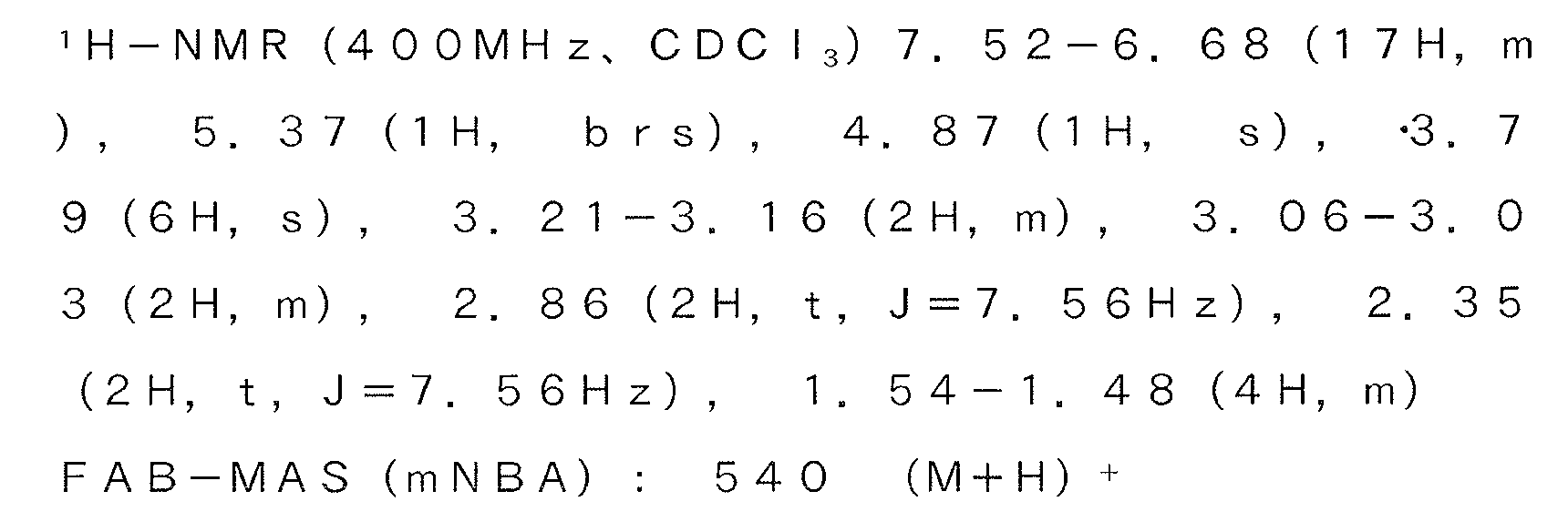
(참고예 13) (Reference Example 13)
6-아미노-1-헥산올 (210.94 ㎎, 1.8 m㏖), 3-(4-하이드록시페닐)프로피온산 (249.26 ㎎, 1.5 m㏖) 을 사용해서 참고예 6 과 동일하게 합성하여, 아모르퍼스상의 화합물을 얻었다 (559 ㎎).6-amino-1-hexanol (210.94 mg, 1.8 mmol) and 3- (4-hydroxyphenyl) propionic acid (249.26 mg, 1.5 mmol) were synthesized in the same manner as in Reference Example 6 to form an amorphous phase. Compound was obtained (559 mg).

(참고예 14) (Reference Example 14)
8-아미노-1-옥탄올 (261.43 ㎎, 1.8 m㏖), 3-(4-하이드록시페닐)프로피온산 (249.26 ㎎, 1.5 m㏖) 을 사용하여 참고예 6 과 동일하게 합성하여, 엿상의 화합물을 얻었다 (720 ㎎).Compound which was synthesized in the same manner as in Reference Example 6 using 8-amino-1-octanol (261.43 mg, 1.8 mmol) and 3- (4-hydroxyphenyl) propionic acid (249.26 mg, 1.5 mmol) Was obtained (720 mg).

(참고예 15) (Reference Example 15)
N-(4-methoxytrityl)-L-tyrosine ethyl esterN- (4-methoxytrityl) -L-tyrosine ethyl ester
L-티로신 에틸 (418 ㎎, 2 m㏖) 을 피리딘 5 ㎖ 에 용해하고, 4-methoxytrityl chloride (741 ㎎, 2.4 m㏖) 를 첨가하고, 실온에서 5 시간 교반했다. 반응의 종결을 TLC 로 확인 후, 아세트산에틸, 5 % 탄산수소나트륨 수용액으로 분액하고, 유기상을 황산나트륨으로 건조 후, 용매를 감압하 농축했다. 잔류물을 실리카 겔 칼럼 (30 g, 30 % 아세트산에틸/n-헥산) 으로 정제하여, 아모르퍼스상의 화합물을 얻었다 (687 ㎎).L-tyrosine ethyl (418 mg, 2 mmol) was dissolved in 5 ml of pyridine, 4-methoxytrityl chloride (741 mg, 2.4 mmol) was added, and the mixture was stirred at room temperature for 5 hours. After confirming completion of the reaction by TLC, the mixture was separated with ethyl acetate and 5% aqueous sodium hydrogen carbonate solution, the organic phase was dried over sodium sulfate, and the solvent was concentrated under reduced pressure. The residue was purified by silica gel column (30 g, 30% ethyl acetate / n-hexane) to give an amorphous compound (687 mg).

(참고예 16) (Reference Example 16)
3-(4-methoxytrityloxy)-2-acetylamino-propionic acid (Ac-Ser(MMTr)-OH)3- (4-methoxytrityloxy) -2-acetylamino-propionic acid (Ac-Ser (MMTr) -OH)
N-아세틸-D,L-세린 (1.775 g, 12 m㏖) 을 피리딘 20 ㎖ 에 용해하고, 4-methoxytrityl chloride (4.1 g, 13.2 m㏖) 를 첨가하고, 실온에서 하룻밤 교반했다. 반응의 종결을 TLC 로 확인 후, 아세트산에틸, 5 % 탄산수소나트륨 수용액으로 분액하고, 유기상을 황산나트륨으로 건조 후, 용매를 감압하 농축했다. 잔류물을 실리카 겔 칼럼 (120 g, 30 % 아세톤/n-헥산) 으로 정제하여, 아모르퍼스상의 화합물을 얻었다 (3.93 g).N-acetyl-D, L-serine (1.775 g, 12 mmol) was dissolved in 20 ml of pyridine, 4-methoxytrityl chloride (4.1 g, 13.2 mmol) was added, and the mixture was stirred at room temperature overnight. After confirming completion of the reaction by TLC, the mixture was separated with ethyl acetate and 5% aqueous sodium bicarbonate solution, the organic phase was dried over sodium sulfate, and the solvent was concentrated under reduced pressure. The residue was purified by silica gel column (120 g, 30% acetone / n-hexane) to give an amorphous compound (3.93 g).

(참고예 17) (Reference Example 17)
Ac-Ser(MMTr)-Tyr-OEtAc-Ser (MMTr) -Tyr-OEt
참고예 16 의 화합물 (629 ㎎, 1.5 m㏖ Ac-Ser(MMTr)-OH) 을 메틸렌클로라이드 3 ㎖ 에 용해하고, L-티로신 에틸 (334 ㎎, 1.6 m㏖), EDC (383 ㎎, 2 m㏖), HOBT (67.5 ㎎, 0.5 m㏖), 트리에틸아민 (260 ㎕) 을 첨가하고, 4 시간 교반했다. 반응액을 실리카 겔 칼럼 (15 g, 40 % → 50 % 아세트산에틸/n-헥산) 으로 정제하여, 아모르퍼스상의 화합물을 얻었다 (460 ㎎).The compound of Reference Example 16 (629 mg, 1.5 mmol Ac-Ser (MMTr) -OH) was dissolved in 3 mL of methylene chloride, L-tyrosine ethyl (334 mg, 1.6 mmol), EDC (383 mg, 2 m) Mol), HOBT (67.5 mg, 0.5 mmol) and triethylamine (260 µL) were added, and the mixture was stirred for 4 hours. The reaction solution was purified by a silica gel column (15 g, 40% to 50% ethyl acetate / n-hexane) to obtain an amorphous compound (460 mg).

(참고예 18) (Reference Example 18)
t-Boc-βAla-Tyr-OEtt-Boc-βAla-Tyr-OEt
N-t-Boc-β-Alanine (283 ㎎, 1.5 m㏖, t-Boc-βAla-OH), L-티로신 에틸 (376 ㎎, 1.8 m㏖, H-Tyr-OEt) 을 사용해서 참고예 17 과 동일하게 합성하여, 아모르퍼스상의 화합물을 얻었다 (497 ㎎).Same as Reference Example 17 using Nt-Boc-β-Alanine (283 mg, 1.5 mmol, t-Boc-βAla-OH) and L-tyrosine ethyl (376 mg, 1.8 mmol, H-Tyr-OEt) Was synthesized to obtain an amorphous compound (497 mg).
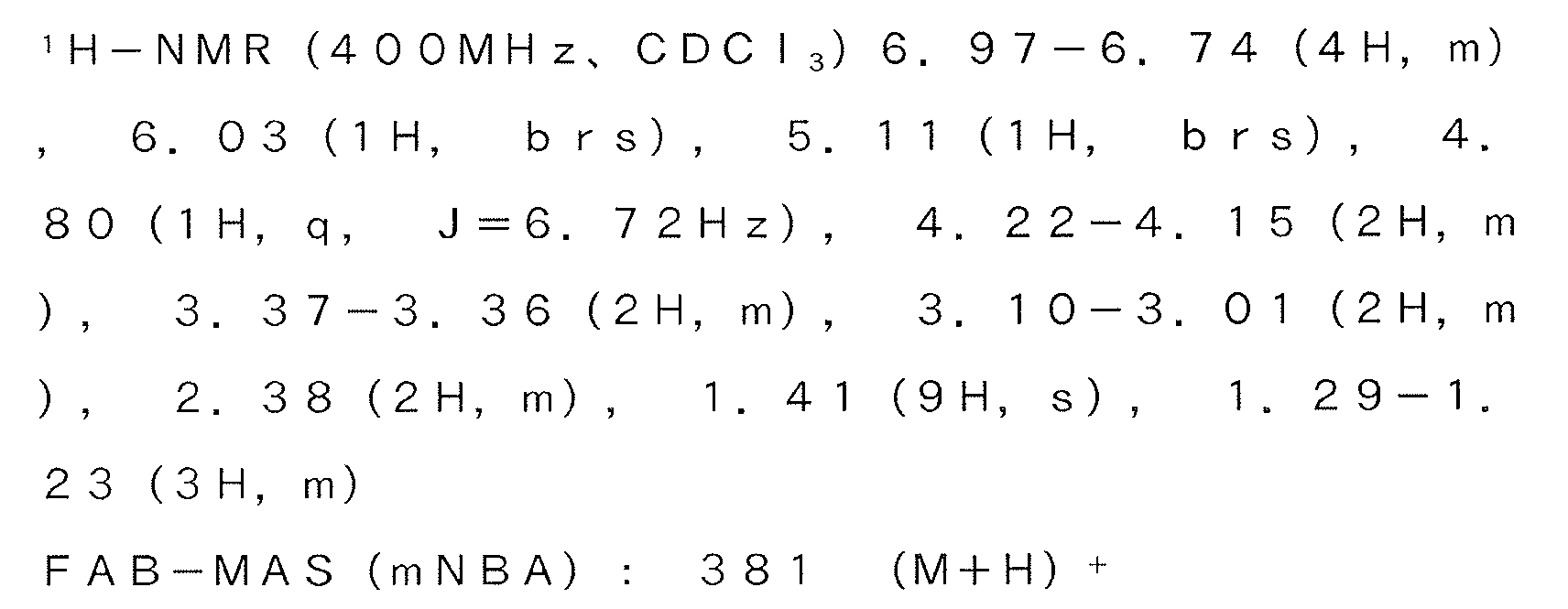
(참고예 19) (Reference Example 19)
t-Boc-Ala-Tyr-OEtt-Boc-Ala-Tyr-OEt
N-t-Boc-Alanine (283 ㎎, 1.5 m㏖, t-Boc-Ala-OH), L-티로신 에틸 (376 ㎎, 1.8 m㏖) 을 사용해서 참고예 17 과 동일하게 합성하여, 아모르퍼스상의 화합물을 얻었다 (490 ㎎).Amorphous compound synthesized in the same manner as in Reference Example 17 using Nt-Boc-Alanine (283 mg, 1.5 mmol, t-Boc-Ala-OH) and L-tyrosine ethyl (376 mg, 1.8 mmol). Was obtained (490 mg).

(참고예 20) (Reference Example 20)
t-Boc-Gly-Tyr-OEtt-Boc-Gly-Tyr-OEt
N-t-Boc-Glycine (263 ㎎, 1.5 m㏖), L-티로신 에틸 (376 ㎎, 1.8 m㏖) 을 사용해서 참고예 17 과 동일하게 합성하여, 아모르퍼스상의 화합물을 얻었다 (434 ㎎).Synthesis was carried out in the same manner as in Reference Example 17 using N-t-Boc-Glycine (263 mg, 1.5 mmol) and L-tyrosine ethyl (376 mg, 1.8 mmol) to obtain an amorphous compound (434 mg).

(참고예 21) (Reference Example 21)
Ac-Ser(MMTr)-βAla-Tyr-OEtAc-Ser (MMTr) -βAla-Tyr-OEt
참고예 18 에서 취득된 화합물 (490 ㎎, 1.29 m㏖) 을 메틸렌클로라이드 4 ㎖ 에 용해하고, TFA 4 ㎖ 를 첨가하고, 실온에서 15 분 방치 후, 용매를 감압하 농축했다. 잔류물을 메틸렌클로라이드 3 ㎖, 트리에틸아민 (260 ㎕) 에 용해하고, 참고예 16 에서 취득된 화합물 (544 ㎎, 1.3 m㏖), EDC (383 ㎎, 2 m㏖), HOBT (67.5 ㎎, 0.5 m㏖), 트리에틸아민 (260 ㎕) 을 첨가하고, 하룻밤 교반했다. 반응액을 실리카 겔 칼럼 (20 g, 80 % 아세트산에틸/n-헥산 → 아세트산에틸) 으로 정제하여, 아모르퍼스상의 화합물을 얻었다 (469 ㎎).The compound (490 mg, 1.29 mmol) obtained in the reference example 18 was dissolved in 4 ml of methylene chloride, 4 ml of TFA was added, and the solvent was concentrated under reduced pressure after standing at room temperature for 15 minutes. The residue was dissolved in 3 ml of methylene chloride, triethylamine (260 µl), and the compound obtained in Reference Example 16 (544 mg, 1.3 mmol), EDC (383 mg, 2 mmol), HOBT (67.5 mg, 0.5 mmol) and triethylamine (260 µL) were added, and the mixture was stirred overnight. The reaction solution was purified by a silica gel column (20 g, 80% ethyl acetate / n-hexane to ethyl acetate) to obtain an amorphous compound (469 mg).

(참고예 22) (Reference Example 22)
Ac-Ser(MMTr)-Ala-Tyr-OEtAc-Ser (MMTr) -Ala-Tyr-OEt
참고예 19 의 화합물 (485 ㎎, 1.26 m㏖), 참고예 16 에서 취득된 화합물 (544 ㎎, 1.3 m㏖) 을 사용하여 참고예 21 과 동일하게 합성하여, 백색 고체의 화합물을 얻었다 (448 ㎎).The compound of Reference Example 19 (485 mg, 1.26 mmol) and the compound (544 mg, 1.3 mmol) obtained in Reference Example 16 were synthesized in the same manner as in Reference Example 21 to obtain a white solid compound (448 mg). ).

(참고예 23) (Reference Example 23)
Ac-Ser(MMTr)-Gly-Tyr-OEtAc-Ser (MMTr) -Gly-Tyr-OEt
참고예 20 에서 취득된 화합물 (430 ㎎, 1.17 m㏖), 참고예 16 에서 취득된 화합물 (544 ㎎, 1.3 m㏖) 을 사용하여 참고예 21 과 동일하게 합성하여, 백색 고체의 화합물을 얻었다 (486 ㎎).Using the compound obtained in Reference Example 20 (430 mg, 1.17 mmol) and the compound obtained in Reference Example 16 (544 mg, 1.3 mmol), the compound was synthesized in the same manner as in Reference Example 21 to obtain a white solid compound ( 486 mg).

(참고예 24) (Reference Example 24)
10-아미노-1-데칸올 (260 ㎎, 1.5 m㏖), 4-하이드록시벤조산 (299 ㎎, 1.8 m㏖) 을 사용해서 참고예 6 과 동일하게 합성하여, 아모르퍼스상의 화합물을 얻었다 (568 ㎎).Synthesis was carried out in the same manner as in Reference Example 6 using 10-amino-1-decanol (260 mg, 1.5 mmol) and 4-hydroxybenzoic acid (299 mg, 1.8 mmol) to obtain an amorphous compound (568). Mg).

(참고예 25) (Reference Example 25)
10-아미노-1-데칸올 (260 ㎎, 1.5 m㏖), 3-(4-하이드록시페닐)프로피온산 (249 ㎎, 1.8 m㏖) 을 사용하여 참고예 6 과 동일하게 합성하여, 엿상의 화합물을 얻었다 (411 ㎎).Compound which was synthesized in the same manner as in Reference Example 6 using 10-amino-1-decanol (260 mg, 1.5 mmol) and 3- (4-hydroxyphenyl) propionic acid (249 mg, 1.8 mmol) Was obtained (411 mg).

(참고예 26) (Reference Example 26)
8-아미노-1-옥탄올 (218 ㎎, 1.5 m㏖), (4-하이드록시페녹시)아세트산 (303 ㎎, 1.8 m㏖) 을 사용하여 참고예 6 과 동일하게 합성하여, 엿상의 화합물을 얻었다 (489 ㎎).Synthesis was carried out in the same manner as in Reference Example 6 using 8-amino-1-octanol (218 mg, 1.5 mmol) and (4-hydroxyphenoxy) acetic acid (303 mg, 1.8 mmol) to obtain a crumb compound. Obtained (489 mg).

(참고예 27) (Reference Example 27)
10-아미노-1-데칸올 (260 ㎎, 1.5 m㏖), (4-하이드록시페녹시)아세트산 (303 ㎎, 1.8 m㏖) 을 사용하여 참고예 6 과 동일하게 합성하여, 엿상의 화합물을 얻었다 (579 ㎎).Synthesis was carried out in the same manner as in Reference Example 6 using 10-amino-1-decanol (260 mg, 1.5 mmol) and (4-hydroxyphenoxy) acetic acid (303 mg, 1.8 mmol) to obtain a crumb compound. Obtained (579 mg).

(참고예 28) (Reference Example 28)
(PEO)3-mono-amine (CHEM-IPEX INTERNATIONAL, 224 ㎎, 1.5 m㏖), 4-하이드록시벤조산 (299 ㎎, 1.8 m㏖) 을 사용해서 참고예 6 과 동일하게 합성하여, 아모르퍼스상의 화합물을 얻었다 (520 ㎎).(PEO) 3- mono-amine (CHEM-IPEX INTERNATIONAL, 224 mg, 1.5 mmol) and 4-hydroxybenzoic acid (299 mg, 1.8 mmol) were synthesized in the same manner as in Reference Example 6 to obtain an amorphous phase. Compound obtained (520 mg).

(참고예 29) (Reference Example 29)
(PEO)3-mono-amine (CHEM-IPEX INTERNATIONAL, 224 ㎎, 1.5 m㏖), 3-(4-하이드록시페닐)프로피온산 (249 ㎎, 1.8 m㏖) 을 사용하여 참고예 6 과 동일하게 합성하여, 엿상의 화합물을 얻었다 (543 ㎎).(PEO) 3- mono-amine (CHEM-IPEX INTERNATIONAL, 224 mg, 1.5 mmol) and 3- (4-hydroxyphenyl) propionic acid (249 mg, 1.8 mmol) were synthesized in the same manner as in Reference Example 6 Then, the acicular compound was obtained (543 mg).

(참고예 30) (Reference Example 30)
(PEO)3-mono-amine (CHEM-IPEX INTERNATIONAL, 224 ㎎, 1.5 m㏖), (4-하이드록시페녹시)아세트산 (303 ㎎, 1.8 m㏖) 을 사용하여 참고예 6 과 동일하게 합성하여, 엿상의 화합물을 얻었다 (471 ㎎).(PEO) 3- mono-amine (CHEM-IPEX INTERNATIONAL, 224 mg, 1.5 mmol) and (4-hydroxyphenoxy) acetic acid (303 mg, 1.8 mmol) were synthesized in the same manner as in Reference Example 6 , The acicular compound was obtained (471 mg).

(참고예 31) (Reference Example 31)
8-아미노-1-옥탄올 (218 ㎎, 1.5 m㏖), N-[(9H-플루오렌-9-일메톡시)카르보닐]-L-티로신 (N-Fmoc-L-티로신, 726 ㎎, 1.8 m㏖) 을 사용해서 참고예 6 과 동일하게 합성하여, 아모르퍼스상의 화합물을 얻었다 (358 ㎎).8-amino-1-octanol (218 mg, 1.5 mmol), N-[(9H-fluorene-9-ylmethoxy) carbonyl] -L-tyrosine (N-Fmoc-L-tyrosine, 726 mg, 1.8 mmol) was synthesized in the same manner as in Reference Example 6 to obtain an amorphous compound (358 mg).

(참고예 32) (Reference Example 32)

참고예 1 과 동일하게 CT-106 을 합성했다. 단, 목적 배열을 갖는 보호된 폴리뉴클레오티드 유연체를 암모니아수:에탄올 용액 (3:1 v/v) 2 ㎖ 로 55 ℃, 16 시간 처리함으로써 올리고머를 지지체로부터 잘라냄과 함께, 인산기의 보호기인 시아노에틸기와 핵산 염기상의 보호기를 떼어냈다. CPG 를 여과하여 제거하고, 에탄올로 세정하고, 여과액과 세액과 합하여, 용매를 감압하 증류 제거했다. 남은 잔류물에 Triethylamine trihydrofluoride 를 0.3 ㎖ 첨가하고, 실온에서 19 시간 방치 후, 정제했다. CT-106 의 구조를 도 13 에 나타낸다.CT-106 was synthesized in the same manner as in Reference Example 1. However, the oligomer was cut out from the support by treating the protected polynucleotide flexible body having the desired sequence with 55 ml of ammonia water: ethanol solution (3: 1 v / v) at 55 ° C for 16 hours, and cyano, which is a protecting group of the phosphate group. The ethyl group and the protecting group on the nucleic acid base were removed. CPG was removed by filtration, washed with ethanol, combined with the filtrate and the washing solution, and the solvent was distilled off under reduced pressure. 0.3 ml of Triethylamine trihydrofluoride was added to the remaining residue, and the mixture was left at room temperature for 19 hours to be purified. The structure of CT-106 is shown in FIG.
분자량:계산값:6727.16, 측정값:6726.73Molecular weight: A calculated value: 6767.16, a measured value: 6726.73
염기 배열:인간 β-카테닌 유전자 (GenBank accession No. NM_001904.3) 의 뉴클레오티드 번호 3139-3157 의 배열을 포함한다.Nucleotide sequence: Contains the sequence of nucleotide numbers 3139-3157 of the human β-catenin gene (GenBank accession No. NM # 001904.3).
(참고예 33) (Reference Example 33)

참고예 32 와 동일하게 CT-041 을 합성했다. CT-041 의 구조를 도 13 에 나타낸다.CT-041 was synthesize | combined similarly to the reference example 32. The structure of CT-041 is shown in FIG.
분자량:계산값:6565.88, 측정값:6565.34Molecular weight : Calculated value : 6565.88, Measured value : 6565.34
염기 배열:인간 β-카테닌 유전자 (GenBank accession No. NM_001904.3) 의 뉴클레오티드 번호 3139-3157 에 상보적인 배열을 포함한다.Base sequence: Complementary to the nucleotide number 3139-3157 of the human β-catenin gene (GenBank accession No. NM # 001904.3).
(참고예 34) CT-001Reference Example 34 CT-001

참고예 32 와 동일하게 CT-001 을 합성했다. CT-001 의 구조를 도 13 에 나타낸다.CT-001 was synthesized in the same manner as in Reference Example 32. The structure of CT-001 is shown in FIG.
분자량:계산값:6849.46, 측정값:6850.8Molecular weight: A calculated value: 6849.46, a measured value: 6850.8
염기 배열:인간 β-카테닌 유전자 (GenBank accession No. NM_001904.3) 의 뉴클레오티드 번호 3139-3157 의 배열을 포함한다.Nucleotide sequence: Contains the sequence of nucleotide numbers 3139-3157 of the human β-catenin gene (GenBank accession No. NM # 001904.3).
(참고예 35) CT-005Reference Example 35 CT-005

참고예 32 와 동일하게 CT-005 를 합성했다. CT-005 의 구조를 도 13 에 나타낸다. CT-005 was synthesized in the same manner as in Reference Example 32. The structure of CT-005 is shown in FIG.
분자량:계산값:6702.20, 측정값:6702.2Molecular weight: A calculated value: 6702.20, a measured value: 6702.2
염기 배열:인간 β-카테닌 유전자 (GenBank accession No. NM_001904.3) 의 뉴클레오티드 번호 3139-3157 에 상보적인 배열을 포함한다.Base sequence: Complementary to the nucleotide number 3139-3157 of the human β-catenin gene (GenBank accession No. NM # 001904.3).
참고예 3 ∼ 14, 17 및 21 ∼ 23 에 기재된 화합물의 구조를 도 5 에 나타내고, 참고예 24 ∼ 31 에 기재된 화합물의 구조를 도 10 에 나타낸다.The structure of the compound of Reference Examples 3-14, 17, and 21-23 is shown in FIG. 5, and the structure of the compound of Reference Examples 24-31 is shown in FIG.
(실시예 27) 2 개 사슬 구조 형성을 위한 어닐링Example 27 Annealing for Two Chain Structure Formation
상기 참고예 1 및 참고예 2 의 조합으로, 센스 사슬 및 안티센스 사슬을 300 p㏖ 씩 1 개의 튜브에 넣어, 감압하 건조시키고, 30 ㎕ 의 siRNA suspension buffer (QIAGEN) 를 첨가하여, 65 ℃, 1 분간 가온한 후, 실온에 5 분간 방치하고, 센스 사슬 및 안티센스 사슬을 어닐링시켜, 10 μM 의 2 개 사슬 폴리뉴클레오티드 용액을 얻었다.In the combination of Reference Example 1 and Reference Example 2, the sense chain and the antisense chain were placed in one tube of 300 mmol each, dried under reduced pressure, and 30 µl of siRNA suspension buffer (QIAGEN) was added thereto. After warming for 5 minutes, the mixture was allowed to stand at room temperature for 5 minutes, and the sense chain and the antisense chain were annealed to obtain a 10 μM two-chain polynucleotide solution.
2 개 사슬 폴리뉴클레오티드는 센스 사슬, 안티센스 사슬의 조합만으로 나타내는 경우도 있다. 즉, 예를 들어, CT-169/CT-157 의 조합으로 이루어지는 2 개 사슬 폴리뉴클레오티드는 간단히 「CT169/CT157」 또는 「CT169/157」 으로도 표기한다.Two-chain polynucleotides may be represented only by a combination of a sense chain and an antisense chain. In other words, for example, a two-chain polynucleotide consisting of a combination of CT-169 / CT-157 is simply referred to as "CT169 / CT157" or "CT169 / 157".
본 방법에 의해, 도 6 및 7 에 나타내는, 2 개 사슬 폴리뉴클레오티드 및 안티센스 사슬의 5' 와 센스 사슬의 3' 가 인산디에스테르 결합을 통해 링커로 결합되어 있는 3L5-폴리뉴클레오티드를 취득할 수 있다.According to this method, it is possible to obtain 3L5-polynucleotides in which the two-chain polynucleotides shown in FIGS. 6 and 7 and 5 'of the antisense chain and 3' of the sense chain are bound by a linker via a phosphate diester bond. .
(시험예 1) (Test Example 1)
이하와 같이 1 개 사슬 또는 2 개 사슬 폴리뉴클레오티드에 의한 인간 β-카테닌 유전자 발현 억제 활성의 강도를 비교했다.The intensity | strength of the human (beta) -catenin gene expression suppression activity by one chain or two chain polynucleotide was compared as follows.
(1) 트랜스펙션(1) transfection
인간 대장암 SW480 세포주 (인간 대장선암 유래) 를, 10 % Fetal bovine serum 을 포함하는 RPMI1640 배지 (Invitrogen 사 제조) 중에 100000 cells/㎖ 의 농도로 조제했다. 그리고, 12 구멍 평저 플레이트 (Corning 사 제조) 에 1 ㎖ 씩 파종하고, 37 ℃, 5.0 % 탄산 가스하에서 1 일간 배양했다. 리포펙션 시약 Lipofectamine RNAiMAX (Invitrogen 사 제조) 를 7.5 ㎕, 1 개 사슬 또는 2 개 사슬 폴리뉴클레오티드 용액을 최종 농도가 0.3, 0.03, 및 0.003 nM 이 되도록 OPTI-MEM 배지 중에서 혼합하고, 20 분 실온에서 가만히 정지시켰다. 각 웰에 혼합액을 첨가하고, 추가로 3 일간 배양을 계속했다.Human colorectal cancer SW480 cell line (derived from human colorectal adenocarcinoma) was prepared at a concentration of 100000 cells / ml in RPMI1640 medium (manufactured by Invitrogen) containing 10% Fetal bovine serum. Then, 1 mL of seedlings were seeded in a 12-hole flat plate (manufactured by Corning Co., Ltd.), and cultured for 1 day under 37 ° C and 5.0% carbon dioxide gas. Lipofectamine RNAiMAX (manufactured by Invitrogen) was mixed with 7.5 μl, one-chain or two-chain polynucleotide solution in OPTI-MEM medium to a final concentration of 0.3, 0.03, and 0.003 nM, and left still at room temperature for 20 minutes. Stopped. The mixed solution was added to each well, and the culture was further continued for 3 days.
(2) 리얼 타임 PCR(2) Real Time PCR
트랜스펙션 후, 웰로부터 배양 상청을 제거하여, RNeasy Mini kit (QIAGEN 사 제조) 에서 mRNA 를 추출했다. 얻어진 mRNA 를 iScriptTMcDNA Synthesis kit (QIAGEN 사 제조) 에서 설명서의 기재에 따라 0.5 ㎍ RNA 로부터 cDNA 를 조제했다. 다음으로, 리얼 타임 PCR 을 위해서 인간 β-카테닌 유전자 PCR 프라이머 (primer set ID:HA135664, 다카라 바이오사 제조), 내부 표준으로서 사람-GAPDH 유전자에 대한 PCR 프라이머 (primer set ID:HA067812, 다카라 바이오사 제조) 및 PCR 에 필요한 약제를 포함하는 리얼 타임 PCR 키트 (QIAGEN 사 제조) 를 사용하여 다음과 같이 mRNA 의 정량을 실시했다.After transfection, the culture supernatant was removed from the wells, and mRNA was extracted from the RNeasy Mini kit (manufactured by QIAGEN). CDNA was prepared from the 0.5 µg RNA of the obtained mRNA according to the description in the iScript TM cDNA Synthesis kit (manufactured by QIAGEN). Next, for real-time PCR, the human β-catenin gene PCR primer (primer set ID: HA135664, manufactured by Takara Bio Co., Ltd.), and the PCR primer for the human-GAPDH gene (primer set ID: HA067812, manufactured by Takara Bio Co., Ltd.) as internal standards. MRNA was quantified as follows using a real-time PCR kit (manufactured by QIAGEN) containing a chemical agent necessary for PCR).
β 카테닌 유전자 ID:HA135664β-catenin gene ID: HA135664
포워드 프라이머 5'-TCTGAGGACAAGCCACAAGATTACA-3' (배열 번호 11) Forward primer 5'-TCTGAGGACAAGCCACAAGATTACA-3 '(SEQ ID NO: 11)
리버스 프라이머 5'-TGGGCACCAATATCAAGTCCAA-3' (배열 번호 12) Reverse primer 5'-TGGGCACCAATATCAAGTCCAA-3 '(SEQ ID NO: 12)
GAPDH 유전자 ID:HA067812GAPDH Gene ID: HA067812
포워드 프라이머 5'-GCACCGTCAAGGCTGAGAAC-3' (배열 번호 13) Forward primer 5'-GCACCGTCAAGGCTGAGAAC-3 '(SEQ ID NO: 13)
리버스 프라이머 5'-TGGTGAAGACGCCAGTGGA-3' (배열 번호 14) Reverse primer 5'-TGGTGAAGACGCCAGTGGA-3 '(SEQ ID NO: 14)
96 구멍 PCR 플레이트 (Applied Biosystems 사 제조) 1 웰당, 리얼 타임 PCR 키트에 포함되는 2×QuantiTect SYBR GREEN PCR Master Mix 를 25 ㎕, RNase-Free Water 를 18 ㎕, 각 PCR 프라이머를 5 ㎕ (최종 농도 0.3 μM), 조제한 cDNA 용액을 2 ㎕ 첨가하여 총량을 50 ㎕ 로 하고, Mx3000P (STRATAGENE 사 제조) 에 세트하여, 이하의 조건으로 PCR 을 실시했다.For each well of a 96-hole PCR plate (manufactured by Applied Biosystems), 25 µl of 2 × QuantiTect SYBR GREEN PCR Master Mix included in the real-time PCR kit, 18 µl of RNase-Free Water, and 5 µl of each PCR primer (final concentration 0.3) 2 microliters of the prepared cDNA solution was added, the total amount was 50 microliters, it set to Mx3000P (made by STRATAGENE), and PCR was performed on condition of the following.
PCR 초기 활성화 95 ℃, 15 분간 PCR initial activation at 95 ℃, 15 minutes
PCR 94 ℃, 15초간 PCR 94 ℃, 15 seconds
56 ℃, 30초 56 ℃, 30 seconds
72 ℃, 30초 72 ℃, 30 seconds
이 PCR 사이클은 40 회 반복했다. 검량선은 리포펙션 시약만으로 처리한 세포 (=NC) 에서 추출한 mRNA 로부터 조제한 cDNA 5 배 희석한 것을 사용하였다. 검량선을 바탕으로, 각 트랜스펙턴트의 인간 β-카테닌과 인간 GAPDH 를 정량하고, 인간 β-카테닌 유전자량을 인간 GAPDH 량으로 나눈 상대량을 그래프에 플롯했다. 리얼 타임 PCR 은 N = 2 로 실시하고, 그래프에는 그 평균을 나타냈다 (폴리뉴클레오티드의 구조 및 그 뉴클레오티드 배열은 도 6 및 도 7 에 나타내고 있다).This PCR cycle was repeated 40 times. As the calibration curve, a 5-fold diluted cDNA prepared from mRNA extracted from cells treated with only lipofection reagent (= NC) was used. Based on the calibration curve, human β-catenin and human GAPDH of each transfectant were quantified, and a relative amount obtained by dividing the amount of human β-catenin gene by the amount of human GAPDH was plotted on the graph. Real-time PCR was performed at N = 2, and the average was shown in the graph (the structure of a polynucleotide and its nucleotide sequence are shown in FIG. 6 and FIG. 7).
(3) 리얼 타임 PCR 해석(3) Real time PCR analysis
(a) 유전자 억제 활성 해석 1(a) Gene
CT-169/CT-157, CT-437, CT-455, CT-456, CT-446, CT-447, CT-448, CT-449, CT-450, CT-451, CT-452, CT-453, CT-454, 및, CT-461 (구조는 도 6 및 도 7 참조) 의 β-카테닌 유전자 발현 억제 활성을 조사했다.CT-169 / CT-157, CT-437, CT-455, CT-456, CT-446, CT-447, CT-448, CT-449, CT-450, CT-451, CT-452, CT- The β-catenin gene expression inhibitory activity of 453, CT-454, and CT-461 (refer to FIG. 6 and FIG. 7 for structure) was examined.
도 8 에 나타내는 바와 같이, CT-437, CT-455, CT-456, CT-446, CT-447, CT-448, CT-449, CT-450, CT-451, CT-452, CT-453, CT-454, 및, CT-461 은 CT-169/CT-157 과 동일하게 β-카테닌 유전자의 발현을 강하게 억제했다. CT-448 및 CT-454 는 CT-169/CT-157 보다 강한 활성을 나타냈다. 이것은, 안티센스 사슬 5' 말단과 센스 사슬 3' 말단을 수식 페닐기를 사용하여 인산기를 통해 결합한 1 개 사슬 폴리뉴클레오티드가 강한 유전자의 발현 억제 활성을 갖는 것을 나타낸다.As shown in FIG. 8, CT-437, CT-455, CT-456, CT-446, CT-447, CT-448, CT-449, CT-450, CT-451, CT-452 and CT-453 , CT-454, and CT-461 strongly inhibited the expression of the β-catenin gene similarly to CT-169 / CT-157. CT-448 and CT-454 showed stronger activity than CT-169 / CT-157. This indicates that the one-chain polynucleotide having the antisense chain 5 'end and the sense chain 3' end bonded via a phosphate group using a modified phenyl group has a strong gene expression suppressing activity.
(시험예 2) (Test Example 2)
시험예 1 과 동일하게 1 개 사슬 또는 2 개 사슬 폴리뉴클레오티드에 의한 인간 β-카테닌 유전자 발현 억제 활성의 강도를 비교했다.In the same manner as in Test Example 1, the intensity of human β-catenin gene expression inhibitory activity by one-chain or two-chain polynucleotides was compared.
리얼 타임 PCR 해석Real time PCR analysis
a) 유전자 억제 활성 해석 1a) Genetic
CT-169/CT-157, CT-460, CT-461, CT-462, 및, CT-463 (구조는 도 7 참조) 의 β-카테닌 유전자 발현 억제 활성을 조사했다.(Beta) -catenin gene expression inhibitory activity of CT-169 / CT-157, CT-460, CT-461, CT-462, and CT-463 (refer FIG. 7 for structure) was investigated.
도 9 에 나타내는 바와 같이, CT-460, CT-461, CT-462, 및, CT-463 은 CT-169/CT-157 보다 β-카테닌 유전자의 발현을 강하게 억제했다. 이것은, 안티센스 사슬 5' 말단과 센스 사슬 3' 말단을 수식 페닐기를 사용하여 인산기를 통해 결합한 1 개 사슬 폴리뉴클레오티드가 강한 유전자의 발현 억제 활성을 갖는 것을 나타낸다.As shown in FIG. 9, CT-460, CT-461, CT-462, and CT-463 strongly inhibited the expression of the β-catenin gene than CT-169 / CT-157. This indicates that the one-chain polynucleotide having the antisense chain 5 'end and the sense chain 3' end bonded via a phosphate group using a modified phenyl group has a strong gene expression suppressing activity.
(시험예 3) (Test Example 3)
1 개 사슬 또는 2 개 사슬 폴리뉴클레오티드에 의한 인간 β-카테닌 유전자 발현 억제 활성의 강도를 비교했다.The intensity of human β-catenin gene expression inhibitory activity by one chain or two chain polynucleotides was compared.
(1) 트랜스펙션(1) transfection
인간 대장암 SW480 세포주 (인간 대장선암 유래) 를, 10 % Fetal bovine serum 을 포함하는 RPMI1640 배지 (Invitrogen 사 제조) 중에 100000 cells/㎖ 의 농도로 조제했다. 그리고, 12 구멍 평저 플레이트 (Corning 사 제조) 에 1 ㎖ 씩 파종했다. 다음으로, 리포펙션 시약 Lipofectamine RNAiMAX (Invitrogen 사 제조) 를 7.5 ㎕, 1 개 사슬 또는 2 개 사슬 폴리뉴클레오티드 용액을 최종 농도가 0.3, 0.03, 및 0.003 nM 이 되도록 OPTI-MEM 배지 중에서 혼합하고, 20 분 실온에서 가만히 정지시켰다. 각 웰에 혼합액을 첨가하고, 37 ℃, 5.0 % 탄산 가스하 3 일간 배양을 계속했다.Human colorectal cancer SW480 cell line (derived from human colorectal adenocarcinoma) was prepared at a concentration of 100000 cells / ml in RPMI1640 medium (manufactured by Invitrogen) containing 10% Fetal bovine serum. And 1 ml was planted every 12 hole flat plate (made by Corning). Next, the lipofection reagent Lipofectamine RNAiMAX (manufactured by Invitrogen) was mixed with 7.5 μl, one-chain or two-chain polynucleotide solution in OPTI-MEM medium to a final concentration of 0.3, 0.03, and 0.003 nM, and 20 minutes. It was stopped at room temperature. The mixed solution was added to each well, and culture | cultivation was continued for 3 days under 37 degreeC and 5.0% carbonic acid gas.
(2) 리얼 타임 PCR(2) Real Time PCR
시험예 1 과 동일한 방법으로 실시했다.It carried out by the same method as the test example 1.
(3) 리얼 타임 PCR 해석(3) Real time PCR analysis
a) 유전자 억제 활성 해석 1a) Genetic
CT-169/CT-157, CT-448, CT-454, CT-464, CT-465, CT-466, CT-467, CT-468, CT-469, CT-470, 및, CT-471 (구조는 도 11 참조) 의 β-카테닌 유전자 발현 억제 활성을 조사했다.CT-169 / CT-157, CT-448, CT-454, CT-464, CT-465, CT-466, CT-467, CT-468, CT-469, CT-470, and CT-471 ( The structure was examined for β-catenin gene expression inhibitory activity.
도 12 에 나타내는 바와 같이, CT-470 은 CT-169/CT-157 과 마찬가지로 β-카테닌 유전자의 발현을 강하게 억제했다. CT-448, CT-454, CT-464, CT-465, CT-466, CT-467, CT-468, CT-469, 및, CT-471 은 CT-169/CT-157 보다 강한 활성을 나타냈다. 이것은, 안티센스 사슬 5' 말단과 센스 사슬 3' 말단을 수식 페닐기를 사용하여 인산기를 통해 결합한 1 개 사슬 폴리뉴클레오티드가 강한 유전자의 발현 억제 활성을 갖는 것을 나타낸다.As shown in FIG. 12, CT-470 strongly suppressed the expression of the β-catenin gene in the same manner as in CT-169 / CT-157. CT-448, CT-454, CT-464, CT-465, CT-466, CT-467, CT-468, CT-469, and CT-471 showed stronger activity than CT-169 / CT-157. . This indicates that the one-chain polynucleotide having the antisense chain 5 'end and the sense chain 3' end bonded via a phosphate group using a modified phenyl group has a strong gene expression suppressing activity.
b) 유전자 억제 활성 해석 2 b) Gene
CT-106/CT-041, 및, CT-472 (구조는 도 13 참조) 의 β-카테닌 유전자 발현 억제 활성을 조사했다.(Beta) -catenin gene expression inhibitory activity of CT-106 / CT-041 and CT-472 (refer FIG. 13 for structure) was investigated.
도 14 에 나타내는 바와 같이, CT-472 는 CT-106/CT-041 과 동일하게 β-카테닌 유전자의 발현을 강하게 억제했다. 이것은, 안티센스 사슬 5' 말단과 센스 사슬 3' 말단을 수식 페닐기를 사용하여 인산기를 통해 결합한 1 개 사슬 폴리뉴클레오티드가 강한 유전자의 발현 억제 활성을 갖는 것을 나타낸다.As shown in FIG. 14, CT-472 strongly inhibited the expression of the β-catenin gene in the same manner as in CT-106 / CT-041. This indicates that the one-chain polynucleotide having the antisense chain 5 'end and the sense chain 3' end bonded via a phosphate group using a modified phenyl group has a strong gene expression suppressing activity.
c) 유전자 억제 활성 해석 4 c) Gene
CT-001/CT-005, 및, CT-473 (구조는 도 13 참조) 의 β-카테닌 유전자 발현 억제 활성을 조사했다.The β-catenin gene expression inhibitory activity of CT-001 / CT-005 and CT-473 (see FIG. 13 for structure) was examined.
도 14 에 나타내는 바와 같이, CT-473 은 CT-001/CT-005 보다 β-카테닌 유전자의 발현을 강하게 억제했다. 이것은, 안티센스 사슬 5' 말단과 센스 사슬 3' 말단을 수식 페닐기를 사용하여 인산기를 통해 결합한 1 개 사슬 폴리뉴클레오티드가 강한 유전자의 발현 억제 활성을 갖는 것을 나타낸다.As shown in FIG. 14, CT-473 inhibited the expression of the β-catenin gene more strongly than CT-001 / CT-005. This indicates that the one-chain polynucleotide having the antisense chain 5 'end and the sense chain 3' end bonded via a phosphate group using a modified phenyl group has a strong gene expression suppressing activity.
(실시예 27) (Example 27)

실시예 1 과 동일하게 PK-009 를 합성했다. 본 폴리뉴클레오티드에 있어서는, X 부분의 아미디트 시약은 참고예 14 에서 취득된 화합물 (20 ㎎) 을 사용하여 조제했다.PK-009 was synthesize | combined similarly to Example 1. In this polynucleotide, the amidite reagent of the X moiety was prepared using the compound (20 mg) obtained in Reference Example 14.
PK-009 는 배열표의 배열 번호 17 에 나타내는 폴리뉴클레오티드의 3' 말단의 뉴클레오티드와 배열 번호 18 에 나타내는 폴리뉴클레오티드의 5' 말단의 뉴클레오티드가 X 와의 인산디에스테르 결합을 통해 결합되어 있는 폴리뉴클레오티드이다. PK-009 의 구조를 도 15 에 나타낸다.PK-009 is a polynucleotide in which the nucleotide at the 3 'end of the polynucleotide shown in SEQ ID NO: 17 of the Sequence Listing and the nucleotide at the 5' end of the polynucleotide shown in SEQ ID NO: 18 are bonded via a phosphate ester bond with X. The structure of PK-009 is shown in FIG.
(실시예 28) (Example 28)

실시예 1 과 동일하게 HS-005 를 합성했다. 본 폴리뉴클레오티드에 있어서는, X 부분의 아미디트 시약은 참고예 14 에서 취득된 화합물 (20 ㎎) 을 사용하여 조제했다.HS-005 was synthesized in the same manner as in Example 1. In this polynucleotide, the amidite reagent of the X moiety was prepared using the compound (20 mg) obtained in Reference Example 14.
HS-005 는 배열표의 배열 번호 23 에 나타내는 폴리뉴클레오티드의 3' 말단의 뉴클레오티드와 배열 번호 24 에 나타내는 폴리뉴클레오티드의 5' 말단의 뉴클레오티드가 X 와의 인산디에스테르 결합을 통해 결합되어 있는 폴리뉴클레오티드이다. HS-005 의 구조를 도 16 에 나타낸다.HS-005 is a polynucleotide in which the nucleotide at the 3 'end of the polynucleotide shown in SEQ ID NO: 23 of the sequence table and the nucleotide at the 5' end of the polynucleotide shown in SEQ ID NO: 24 are bound via a phosphate diester bond with X. The structure of HS-005 is shown in FIG.
(실시예 29) (Example 29)

실시예 1 과 동일하게 HS-006 을 합성했다. 본 폴리뉴클레오티드에 있어서는, X 부분의 아미디트 시약은 참고예 14 에서 취득된 화합물 (20 ㎎) 을 사용하여 조제했다.HS-006 was synthesize | combined similarly to Example 1. In this polynucleotide, the amidite reagent of the X moiety was prepared using the compound (20 mg) obtained in Reference Example 14.
HS-006 은 배열표의 배열 번호 25 에 나타내는 폴리뉴클레오티드의 3' 말단의 뉴클레오티드와 배열 번호 26 에 나타내는 폴리뉴클레오티드의 5' 말단의 뉴클레오티드가 X 와의 인산디에스테르 결합을 통해 결합되어 있는 폴리뉴클레오티드이다. HS-006 의 구조를 도 16 에 나타낸다.HS-006 is a polynucleotide in which nucleotides of the 3 'end of the polynucleotide shown in SEQ ID NO: 25 of the sequence table and nucleotides of the 5' end of the polynucleotide shown in SEQ ID NO: 26 are bonded via a phosphate diester bond with X. The structure of HS-006 is shown in FIG.
(실시예 30) (Example 30)

실시예 1 과 동일하게 HS-005 를 합성했다. 본 폴리뉴클레오티드에 있어서는, X 부분의 아미디트 시약은 참고예 14 에서 취득된 화합물 (20 ㎎) 을 사용하여 조제했다. 본 폴리뉴클레오티드에 있어서는, 포스포로티오에이트 결합 부분은 0.2 M 페닐아세틸디술파이드/피리딘-아세토니트릴 (1:1 v/v) 용액 3 분간 처리함으로써 조제했다.HS-005 was synthesized in the same manner as in Example 1. In this polynucleotide, the amidite reagent of the X moiety was prepared using the compound (20 mg) obtained in Reference Example 14. In this polynucleotide, the phosphorothioate binding moiety was prepared by treating 0.2 M phenylacetyl disulfide / pyridine-acetonitrile (1: 1 v / v) solution for 3 minutes.
HS-005s 는 배열표의 배열 번호 27 에 나타내는 폴리뉴클레오티드의 3' 말단의 뉴클레오티드와 배열 번호 28 에 나타내는 폴리뉴클레오티드의 5' 말단의 뉴클레오티드가 X 와의 인산디에스테르 결합을 통해 결합되어 있는 폴리뉴클레오티드이다. HS-005s 의 구조를 도 16 에 나타낸다.HS-005s is a polynucleotide in which nucleotides of the 3 'end of the polynucleotide shown in SEQ ID NO: 27 of the sequence table and nucleotides of the 5' end of the polynucleotide shown in SEQ ID NO: 28 are bound via a phosphate diester bond with X. The structure of HS-005s is shown in FIG.
(실시예 31) (Example 31)

실시예 1 과 동일하게 HS-006s 를 합성했다. 본 폴리뉴클레오티드에 있어서는, X 부분의 아미디트 시약은 참고예 14 에서 취득된 화합물 (20 ㎎) 을 사용하여 조제했다. 본 폴리뉴클레오티드에 있어서는, 포스포로티오에이트 결합 부분은 0.2 M 페닐아세틸디술파이드/피리딘-아세토니트릴 (1:1 v/v) 용액 3 분간 처리함으로써 조제했다.HS-006s were synthesized in the same manner as in Example 1. In this polynucleotide, the amidite reagent of the X moiety was prepared using the compound (20 mg) obtained in Reference Example 14. In this polynucleotide, the phosphorothioate binding moiety was prepared by treating 0.2 M phenylacetyl disulfide / pyridine-acetonitrile (1: 1 v / v) solution for 3 minutes.
HS-006s 는 배열표의 배열 번호 29 에 나타내는 폴리뉴클레오티드의 3' 말단의 뉴클레오티드와 배열 번호 30 에 나타내는 폴리뉴클레오티드의 5' 말단의 뉴클레오티드가 X 와의 인산디에스테르 결합을 통해 결합되어 있는 폴리뉴클레오티드이다. HS-006s 의 구조를 도 16 에 나타낸다.HS-006s is a polynucleotide in which nucleotides of the 3 'end of the polynucleotide shown in SEQ ID NO: 29 of the sequence table and nucleotides of the 5' end of the polynucleotide shown in SEQ ID NO: 30 are bonded via a phosphate diester bond with X. The structure of HS-006s is shown in FIG.
(실시예 32) (Example 32)

실시예 1 과 동일하게 HS-012 를 합성했다. 본 폴리뉴클레오티드에 있어서는, X 부분의 아미디트 시약은 참고예 14 에서 취득된 화합물 (20 ㎎) 을 사용하여 조제했다.HS-012 was synthesize | combined similarly to Example 1. In this polynucleotide, the amidite reagent of the X moiety was prepared using the compound (20 mg) obtained in Reference Example 14.
HS-012 는 배열표의 배열 번호 33 에 나타내는 폴리뉴클레오티드의 3' 말단의 뉴클레오티드와 배열 번호 34 에 나타내는 폴리뉴클레오티드의 5' 말단의 뉴클레오티드가 X 와의 인산디에스테르 결합을 통해 결합되어 있는 폴리뉴클레오티드이다. HS-012 의 구조를 도 19 에 나타낸다.HS-012 is a polynucleotide in which the nucleotide at the 3 'end of the polynucleotide shown in SEQ ID NO: 33 of the sequence table and the nucleotide at the 5' end of the polynucleotide shown in SEQ ID NO: 34 are bonded via a phosphate diester bond with X. The structure of HS-012 is shown in FIG.
실시예 27 ∼ 32 에 기재된 폴리뉴클레오티드의 X 부분의 구조와 분자량을 표 3 에 나타낸다. 표 중, X 의 말단의 메틸렌기는 센스 사슬 폴리뉴클레오티드의 3' 말단에 결합하여 인산디에스테르 결합을 형성하고, 페닐기에 결합되어 있는 산소 원자는 안티센스 사슬 폴리뉴클레오티드의 5' 말단에 결합하여 인산디에스테르 결합을 형성한다.Table 3 shows the structure and molecular weight of the X moiety of the polynucleotides described in Examples 27 to 32. In the table, the methylene group at the terminal of X is bonded to the 3 'end of the sense chain polynucleotide to form a diester phosphate bond, and the oxygen atom bonded to the phenyl group is bonded at the 5' end of the antisense chain polynucleotide to diester phosphate To form a bond.

(참고예 36) (Reference Example 36)

참고예 32 와 동일하게 PK-001 을 합성했다. PK-001 의 구조를 도 15 에 나타낸다.PK-001 was synthesized in the same manner as in Reference Example 32. The structure of PK-001 is shown in FIG.
분자량:계산값:6658.04, 측정값:6658.23Molecular weight: A calculated value: 6658.04, a measured value: 6658.23
염기 배열:RNA-dependent protein kinase 유전자 (GenBank accession No. NM_011163) 의 뉴클레오티드 번호 743-762 의 배열을 포함한다.Nucleotide sequence: Contains the sequences of nucleotide numbers 743-762 of the RNA-dependent protein kinase gene (GenBank accession No. NM # 011163).
(참고예 37) (Reference Example 37)

참고예 32 와 동일하게 PK-002 를 합성했다. PK-002 의 구조를 도 15 에 나타낸다.PK-002 was synthesize | combined similarly to the reference example 32. The structure of PK-002 is shown in FIG.
분자량:계산값:6674.04, 측정값:6673.91Molecular weight: A calculated value: 6674.04, a measured value: 6673.91
염기 배열:RNA-dependent protein kinase 유전자 (GenBank accession No. NM_011163) 의 뉴클레오티드 번호 743-762 에 상보적인 배열을 포함한다.Nucleotide sequence: Contains a sequence complementary to nucleotide numbers 743-762 of the RNA-dependent protein kinase gene (GenBank accession No. NM # 011163).
(참고예 38) (Reference Example 38)

참고예 32 와 동일하게 HS-001 의 센스 사슬을 합성했다. HS-001 의 센스 사슬의 구조를 도 16 에 나타낸다.In the same manner as in Reference Example 32, a sense chain of HS-001 was synthesized. The structure of the sense chain of HS-001 is shown in FIG.
분자량:계산값:6710.12, 측정값:6710.37Molecular weight: A calculated value: 6710.12, a measured value: 6710.37
염기 배열:heat shock protein 47 유전자 (GenBank accession No. NM_001235) 의 뉴클레오티드 번호 1601-1619 의 배열을 포함한다.Base sequence: The sequence of nucleotide number 1601-1619 of the heat shock protein 47 gene (GenBank accession No. NM # 001235) is included.
(참고예 39) (Reference Example 39)

참고예 32 와 동일하게 HS-001 의 센스 사슬을 합성했다. HS-001 의 안티센스 사슬의 구조를 도 16 에 나타낸다.In the same manner as in Reference Example 32, a sense chain of HS-001 was synthesized. The structure of the antisense chain of HS-001 is shown in FIG.
분자량:계산값:6590.04, 측정값:6589.88Molecular weight: A calculated value: 6590.04, a measured value: 6589.88
염기 배열:heat shock protein 47 유전자 (GenBank accession No. NM_001235) 의 뉴클레오티드 번호 1601-1619 에 상보적인 배열을 포함한다.Base sequence: The sequence complementary to nucleotide number 1601-1619 of the heat shock protein 47 gene (GenBank accession No. NM # 001235).
(참고예 40) (Reference Example 40)

참고예 32 와 동일하게 HS-001 의 센스 사슬을 합성했다. HS-001 의 센스 사슬의 구조를 도 16 에 나타낸다.In the same manner as in Reference Example 32, a sense chain of HS-001 was synthesized. The structure of the sense chain of HS-001 is shown in FIG.
분자량:계산값:6733.16, 측정값:6733.22Molecular weight: A calculated value: 6733.16, a measured value: 6733.22
염기 배열:heat shock protein 47 유전자 (GenBank accession No. NM_001235) 의 뉴클레오티드 번호 1602-1619 의 배열을 포함한다.Nucleotide sequence: Contains the sequence of nucleotide numbers 1602-1619 of the heat shock protein 47 gene (GenBank accession No. NM # 001235).
(참고예 41) (Reference Example 41)

참고예 32 와 동일하게 HS-001 의 센스 사슬을 합성했다. HS-001 의 안티센스 사슬의 구조를 도 16 에 나타낸다.In the same manner as in Reference Example 32, a sense chain of HS-001 was synthesized. The structure of the antisense chain of HS-001 is shown in FIG.
분자량:계산값:6567.00, 측정값:6566.99Molecular weight: A calculated value: 6567.00, a measured value: 6566.99
염기 배열:heat shock protein 47 유전자 (GenBank accession No. NM_001235) 의 뉴클레오티드 번호 1602-1619 에 상보적인 배열을 포함한다.Base sequence: Complementary to the nucleotide number 1602-1619 of the heat shock protein 47 gene (GenBank accession No. NM # 001235).
(시험예 4) (Test Example 4)
1 개 사슬 또는 2 개 사슬 폴리뉴클레오티드에 의한 마우스 PKR (Eif2ak2) 유전자 발현 억제 활성 측정법을 나타낸다.Mouse PKR (Eif2ak2) gene expression inhibitory activity assay by one chain or two chain polynucleotide is shown.
Mouse embryonic fibroblast 에 리포펙션 시약 Lipofectamine RNAiMAX (Invitrogen 사 제조) 을 사용하여 도 15 에 기재된 1 개 사슬 또는 2 개 사슬 폴리뉴클레오티드를 도입할 수 있다.In the mouse embryonic fibroblast, a lipofectamine RNAiMAX (manufactured by Invitrogen) can be introduced into the single- or two-chain polynucleotide described in FIG. 15.
트랜스펙션 24 내지 48 시간 후에, 세포로부터 RNeasy Mini Kit (QIAGEN 사 제조) 를 사용하여 전체 RNA 를 추출하고, mRNA 를 Super ScriptIII First-Strand Synthesis Super Mix for qRT-PCR (Invitrogen 사 제조) 를 사용하여 cDNA 에 역전사한다. SYBR Green 을 사용한 정량적 PCR 시스템 (Applied Biosystems) 에 의해 PKR 유전자, 내부 표준으로서 36B4 유전자의 발현량을 측정한다. 프라이머는 참고 문헌 (Nakamura T, et al., Cell, 140, 338-348 (2010)) 에 따라, PKR:5'-AAAACAAGGTGGATTGTCACACG-3' 와 5'-GTTGGGCTCACACTGTTCATAAT-3', 36B4:5'-CACTGGTCTAGGACCCGAGAA-3' 와 5'-AGGGGGAGATGTTCAGCATGT-3' 를 사용한다. 각 샘플의 PKR mRNA 양을 동일한 샘플의 36B4 mRNA 양으로 나눔으로써 보정하고, 1 개 사슬 또는 2 개 사슬 폴리뉴클레오티드에 의한 상대적인 유전자 억제의 강도를 측정할 수 있다.After 24 to 48 hours of transfection, the whole RNA was extracted from the cells using the RNeasy Mini Kit (manufactured by QIAGEN), and mRNA was extracted using Super Script III First-Strand Synthesis Super Mix for qRT-PCR (manufactured by Invitrogen). Reverse transcription to cDNA. The expression level of the PKR gene and 36B4 gene as an internal standard was measured by a quantitative PCR system (Applied Biosystems) using SYBR Green. Primers can be obtained from PKR: 5'-AAAACAAGGTGGATTGTCACACG-3 'and 5'-GTTGGGCTCACACTGTTCATAAT-3', 36B4: 5'-CACTGGTCTAGGACCCGAGAA, according to Nakamura T, et al., Cell, 140, 338-348 (2010). -3 'and 5'-AGGGGGAGATGTTCAGCATGT-3' are used. The amount of PKR mRNA in each sample can be corrected by dividing by the amount of 36B4 mRNA in the same sample and the relative intensity of gene inhibition by one or two chain polynucleotides can be determined.
(시험예 5) (Test Example 5)
이하와 같이 1 개 사슬 또는 2 개 사슬 폴리뉴클레오티드에 의한 래트 Hsp47 (Serpinh1) 유전자 발현 억제 활성을 측정했다.Rat Hsp47 (Serpinh1) gene expression inhibitory activity by one-chain or two-chain polynucleotide was measured as follows.
(1) 트랜스펙션(1) transfection
12 구멍 평저 플레이트 (스미토모 베이크라이트사 제조) 에 200 ㎕ 의 OPTI-MEM 배지 (Invitrogen 사 제조) 와 1 개 사슬 또는 2 개 사슬 폴리뉴클레오티드 용액 (최종 농도 1 및 0.1 nM) 을 추가했다. 네거티브 컨트롤로서 Qiagen 사로부터 구입한 AllStars Negative Control siRNA 를 사용하였다. 거기에 리포펙션 시약 Lipofectamine RNAiMAX (Invitrogen 사 제조) 를 1.2 ㎕ 추가해서 혼합하여 10 분간 내지 20 분간 실온에서 가만히 정지시켰다. 그 동안에 래트 NRK-52E 세포주를, 10 % Fetal bovine serum 을 포함하는 Dulbecco's modified Eagle's medium (Invitrogen 사 제조) 중에 62500 cells/㎖ 의 농도로 조제했다. 그리고, 리포솜 - 폴리뉴클레오티드 희석액이 들어간 플레이트의 각 웰에 1 ㎖ 씩 파종하고, 37 ℃, 5 % 이산화탄소 조건하에 있어서 배양했다.To the 12-hole flat plate (manufactured by Sumitomo Bakelite Co., Ltd.), 200 µl of OPTI-MEM medium (manufactured by Invitrogen) and one-chain or two-chain polynucleotide solution (
(2) 리얼 타임 PCR(2) Real Time PCR
트랜스펙션 27 시간 후, 세포로부터 RNeasy Mini Kit (QIAGEN 사 제조) 를 사용하여 전체 RNA 를 추출했다. Hsp47 mRNA 레벨은 SuperScriptIII First-Strand Synthesis Super Mix for qRT-PCR (Invitrogen 사 제조) 을 사용하여 cDNA 에 역전사한 후 TaqMan 프로브를 사용한 정량적 PCR 에 의해 측정했다. Hsp47 유전자에 대한 프라이머, 프로브는 TaqMan Gene Expression Assay (Applied Biosystems 사 제조 Assay ID Rn00567777_m1) 를 사용하였다. TaqMan 반응은 ABI Prism 7900HT Sequence detection system (Applied Biosystems 사 제조) 을 사용하여 실시했다. 내부 표준으로서 동일한 샘플의 ribosomal RNA (rRNA) 의 발현 레벨을 측정했다. rRNA 측정의 프라이머, 프로브에는 TaqMan Ribosomal RNA Control Reagents VICTM Probe (Applied Biosystems 사 제조, 카탈로그 번호:4308329) 를 사용하였다.After 27 hours of transfection, total RNA was extracted from the cells using the RNeasy Mini Kit (manufactured by QIAGEN). Hsp47 mRNA levels were measured by quantitative PCR using TaqMan probes after reverse transcription to cDNA using SuperScript III First-Strand Synthesis Super Mix for qRT-PCR (Invitrogen). As a primer and probe for the Hsp47 gene, TaqMan Gene Expression Assay (Assay ID Rn00567777_m1 manufactured by Applied Biosystems) was used. TaqMan reaction was performed using an ABI Prism 7900HT Sequence detection system (manufactured by Applied Biosystems). The expression level of ribosomal RNA (rRNA) of the same sample was measured as an internal standard. Measurement of rRNA primers, probes TaqMan Ribosomal RNA Control Reagents VIC TM Probe : was used (Applied Biosystems Co., Ltd., Cat. No. 4308329).
각 샘플의 Hsp47 mRNA 양을 rRNA 양으로 나누고, 트랜스펙션 시약만을 첨가하여 폴리뉴클레오티드를 첨가하지 않은 세포의 값을 1 로 하여 상대량을 도 17 에 플롯했다 (도면 중, AllStars Negative Control siRNA (카탈로그 번호:1027280) 를 사용한 경우에는, nagtive si 로 표기했다). 도 17 은 독립된 3 회의 실험 결과의 평균과 그 S. D. 값을 나타냈다 (폴리뉴클레오티드의 구조 및 그 뉴클레오티드 배열은 도 16 에 나타내고 있다).The amount of Hsp47 mRNA of each sample was divided by the amount of rRNA, and the relative amount was plotted in FIG. 17 with only the transfection reagent added and the value of the cells without polynucleotide added as 1 (AllStars Negative Control siRNA (catalogue in the figure) (Number: 1027280), nagtive si was used). FIG. 17 shows the average of three independent experimental results and their S. D. values (the structure of the polynucleotide and its nucleotide arrangement are shown in FIG. 16).
(2) 리얼 타임 PCR 해석(2) Real time PCR analysis
(a) 유전자 억제 활성 해석 1(a) Gene
2 개 사슬 폴리뉴클레오티드 HS-001, 2 개 사슬 폴리뉴클레오티드 HS-002, 1 개 사슬 폴리뉴클레오티드 HS-005, 및, 1 개 사슬 폴리뉴클레오티드 HS-006 (구조는 도 16 참조) 의 래트 Hsp47 유전자 발현 억제 활성을 조사했다.Inhibition of rat Hsp47 gene expression of two-chain polynucleotide HS-001, two-chain polynucleotide HS-002, one-chain polynucleotide HS-005, and one-chain polynucleotide HS-006 (see FIG. 16 for structure). The activity was investigated.
도 17 에 나타내는 바와 같이, HS-005 는 HS-001 보다 래트 Hsp47 유전자의 발현을 강하게 억제하고, HS-006 은 HS-002 보다 래트 Hsp47 유전자의 발현을 강하게 억제했다. 이 때, AllStars Negative Control siRNA 는 Hsp47 유전자의 억제 활성을 나타내지 않았다. 이것은, 안티센스 사슬 5' 말단과 센스 사슬 3' 말단을 수식 페닐기를 사용하여 인산기를 통해 결합한 1 개 사슬 폴리뉴클레오티드가 2 개 사슬 폴리뉴클레오티드보다 강한 유전자의 발현 억제 활성을 갖는 것을 나타낸다.As shown in FIG. 17, HS-005 suppressed the expression of the rat Hsp47 gene more strongly than HS-001, and HS-006 suppressed the expression of the rat Hsp47 gene more strongly than HS-002. At this time, AllStars Negative Control siRNA did not show the inhibitory activity of the Hsp47 gene. This indicates that one-chain polynucleotide, in which the antisense chain 5 'end and the sense chain 3' end are bonded through a phosphate group using a modified phenyl group, has a stronger expression inhibiting activity than a two-chain polynucleotide.
(시험예 6) (Test Example 6)
1 개 사슬 또는 2 개 사슬 폴리뉴클레오티드에 의한 래트 Hsp47 (Serpinh1) 유전자 발현 억제 활성을 측정했다.Rat Hsp47 (Serpinh1) gene expression inhibitory activity by one chain or two chain polynucleotides was measured.
(1) 트랜스펙션(1) transfection
2 개 사슬 폴리뉴클레오티드인 HS-001, HS-002, 1 개 사슬 폴리뉴클레오티드 HS-005s, 및, HS-006s (구조는 도 16 참조) 를 사용하여, 시험예 5 와 동일하게 실시했다. 단, NRK-52E 세포에 대한 핵산의 도입은 24 구멍 평저 플레이트 (스미토모 베이크라이트사 제조) 를 사용하여 시험예 5 의 절반 양의 계에서 실시했다.It carried out similarly to the test example 5 using HS-001, HS-002 which are 2-chain polynucleotides, 1-chain polynucleotide HS-005s, and HS-006s (refer FIG. 16 for a structure). However, introduction of nucleic acid into NRK-52E cells was carried out in a system of half the amount of Test Example 5 using a 24-hole flat plate (manufactured by Sumitomo Bakelite Co., Ltd.).
(2) 리얼 타임 PCR(2) Real Time PCR
시험예 5 와 동일하게 실시했다.It carried out similarly to the test example 5.
(a) 유전자 억제 활성 해석 1(a) Gene
2 개 사슬 폴리뉴클레오티드인 HS-001, HS-002, 1 개 사슬 폴리뉴클레오티드 HS-005s, 및, HS-006s 의 래트 Hsp47 유전자 발현 억제 활성을 조사했다.Rat Hsp47 gene expression inhibitory activity of two-chain polynucleotides HS-001, HS-002, one-chain polynucleotide HS-005s, and HS-006s was examined.
도 18 에 나타내는 바와 같이, HS-005s 및 HS-006s 는, HS-001, 및 HS-002 와 비교하여, 동등 또는 그 이상으로 래트 Hsp47 유전자의 발현을 강하게 억제했다. 이것은, 안티센스 사슬 5' 말단과 센스 사슬 3' 말단을 수식 페닐기를 사용하여 인산기를 통해 결합한 1 개 사슬 폴리뉴클레오티드가 2 개 사슬 폴리뉴클레오티드보다 강한 유전자의 발현 억제 활성을 갖는 것을 나타낸다.As shown in FIG. 18, HS-005s and HS-006s strongly inhibited the expression of the rat Hsp47 gene in comparison with HS-001 and HS-002. This indicates that one-chain polynucleotide, in which the antisense chain 5 'end and the sense chain 3' end are bonded through a phosphate group using a modified phenyl group, has a stronger expression inhibiting activity than a two-chain polynucleotide.
(시험예 7) (Test Example 7)
1 개 사슬 또는 2 개 사슬 폴리뉴클레오티드에 의한 래트 Hsp47 (Serpinh1) 유전자 발현 억제 활성을 측정했다.Rat Hsp47 (Serpinh1) gene expression inhibitory activity by one chain or two chain polynucleotides was measured.
(1) 트랜스펙션(1) transfection
국제 공개 제2011/072082 에 기재된 2 개 사슬 폴리뉴클레오티드인 siHSP47C (배열표의 배열 번호 31 및 32, 구조는 도 19 참조), 및, 1 개 사슬 폴리뉴클레오티드 HS-012 (구조는 도 19 참조) 를 사용하여, 시험예 6 과 동일하게 실시했다. Using the two-chain polynucleotide siHSP47C described in International Publication No. 2011/072082 (SEQ ID NOs: 31 and 32 of the Sequence Listing, see FIG. 19 for structure), and one chain polynucleotide HS-012 (see Figure 19 for structure). It carried out similarly to the test example 6.
siHSP47C 센스 사슬 5'-GGACAGGCCUCUACAACUATT-3' (배열 번호 31)siHSP47C sense chain 5'-GGACAGGCCUCUACAACUATT-3 '(SEQ ID NO: 31)
siHSP47C 안티센스 사슬 5'-UAGUUGUAGAGGCCUGUCCTT-3' (배열 번호 32) siHSP47C antisense chain 5'-UAGUUGUAGAGGCCUGUCCTT-3 '(SEQ ID NO: 32)
(2) 리얼 타임 PCR(2) Real Time PCR
시험예 5 와 동일하게 실시했다.It carried out similarly to the test example 5.
(a) 유전자 억제 활성 해석 1(a) Gene
2 개 사슬 폴리뉴클레오티드인 siHSP47C, 및, 1 개 사슬 폴리뉴클레오티드 HS-012 의 래트 Hsp47 유전자 발현 억제 활성을 조사했다.The rat Hsp47 gene expression inhibitory activity of the two-chain polynucleotide siHSP47C and one-chain polynucleotide HS-012 was examined.
도 20 에 나타내는 바와 같이, HS-012 는 siHSP47C 와 비교하여, 동등 또는 그 이상으로 래트 Hsp47 유전자의 발현을 강하게 억제했다. 이것은, 안티센스 사슬 5' 말단과 센스 사슬 3' 말단을 수식 페닐기를 사용하여 인산기를 통해 결합한 1 개 사슬 폴리뉴클레오티드가 2 개 사슬 폴리뉴클레오티드보다 강한 유전자의 발현 억제 활성을 갖는 것을 나타낸다.As shown in FIG. 20, HS-012 strongly inhibited the expression of the rat Hsp47 gene in comparison with siHSP47C. This indicates that one-chain polynucleotide, in which the antisense chain 5 'end and the sense chain 3' end are bonded through a phosphate group using a modified phenyl group, has a stronger expression inhibiting activity than a two-chain polynucleotide.
산업상 이용가능성Industrial availability
본 발명에 의해, RNA 간섭 작용 및/또는 유전자 발현 억제 작용을 갖는 1 개 사슬 폴리뉴클레오티드를 제공할 수 있었다. 또, 본 발명에 의해, RNA 분해 효소에 대해 안정적이고, RNA 간섭 작용 및/또는 유전자 발현 억제 작용을 갖는 1 개 사슬 폴리뉴클레오티드를 제공할 수 있었다.According to the present invention, one-chain polynucleotides having RNA interference action and / or gene expression inhibitory action can be provided. In addition, according to the present invention, it is possible to provide a single-chain polynucleotide which is stable against RNA degrading enzyme and has an RNA interference action and / or a gene expression inhibiting action.
그 1 개 사슬 폴리뉴클레오티드는 유전자의 기능 해석, 의약품 등에 이용하는 것이 가능하지만, 본 1 개 사슬 폴리뉴클레오티드를 이용할 수 있는 한에 있어서 그 산업 분야는 제한되지 않는다.The single-chain polynucleotide can be used for functional analysis of genes, pharmaceuticals, etc., but the industrial field is not limited as long as the single-chain polynucleotide can be used.
배열 번호 1:CT-169 Array number 1: CT-169
배열 번호 2:CT-157 Array number 2: CT-157
배열 번호 3:CT-472 의 센스 사슬 영역 SEQ ID NO: 3: Sense chain region of CT-472
배열 번호 4:CT-472 의 안티센스 사슬 영역 SEQ ID NO: 4: Antisense chain region of CT-472
배열 번호 5:CT-473 의 센스 사슬 영역 SEQ ID NO: 5: Sense chain region of CT-473
배열 번호 6:CT-473 의 안티센스 사슬 영역 SEQ ID NO: 6: Antisense chain region of CT-473
배열 번호 7:CT-106 Array number 7: CT-106
배열 번호 8:CT-041 Array number 8: CT-041
배열 번호 9:CT-001 Array number 9: CT-001
배열 번호 10:CT-005 Array number 10: CT-005
배열 번호 11:β 카테닌 유전자 포워드 프라이머 SEQ ID NO: 11: β-catenin gene forward primer
배열 번호 12:β 카테닌 유전자 리버스 프라이머 SEQ ID NO: 12: β-catenin gene reverse primer
배열 번호 13:GAPDH 유전자 포워드 프라이머 SEQ ID NO: 13: GAPDH gene forward primer
배열 번호 14:GAPDH 유전자 리버스 프라이머 SEQ ID NO: 14: GAPDH gene reverse primer
배열 번호 15:PK-001 Array number 15: PK-001
배열 번호 16:PK-002 Array number 16: PK-002
배열 번호 17:PK-009 의 센스 사슬 영역 SEQ ID NO: 17: Sense chain region of PK-009
배열 번호 18:PK-009 의 안티센스 사슬 영역 SEQ ID NO: 18: Antisense chain region of PK-009
배열 번호 19:HS-001 의 센스 사슬 SEQ ID NO: 19: Sense chain of HS-001
배열 번호 20:HS-001 의 안티센스 사슬 SEQ ID NO: 20: Antisense chain of HS-001
배열 번호 21:HS-002 의 센스 사슬 SEQ ID NO: 21: Sense chain of HS-002
배열 번호 22:HS-002 의 안티센스 사슬 SEQ ID NO: 22: Antisense Chain of HS-002
배열 번호 23:HS-005 의 센스 사슬 영역 SEQ ID NO: 23: Sense chain region of HS-005
배열 번호 24:HS-005 의 안티센스 사슬 영역 SEQ ID NO: 24: Antisense chain region of HS-005
배열 번호 25:HS-006 의 센스 사슬 영역 SEQ ID NO: 25: Sense chain region of HS-006
배열 번호 26:HS-006 의 안티센스 사슬 영역 SEQ ID NO: 26: Antisense chain region of HS-006
배열 번호 27:HS-005s 의 센스 사슬 영역 SEQ ID NO: 27: Sense chain region of HS-005s
배열 번호 28:HS-005s 의 안티센스 사슬 영역 SEQ ID NO: 28: Antisense chain region of HS-005s
배열 번호 29:HS-006s 의 센스 사슬 영역 SEQ ID NO: 29: Sense chain region of HS-006s
배열 번호 30:HS-006s 의 안티센스 사슬 영역 SEQ ID NO: 30: Antisense chain region of HS-006s
배열 번호 31:siHSP47C 의 센스 사슬 SEQ ID NO: 31: sense chain of siHSP47C
배열 번호 32:siHSP47C 의 안티센스 사슬 SEQ ID NO: 32: antisense chain of siHSP47C
배열 번호 33:HS-012 의 센스 사슬 영역 SEQ ID NO: 33: Sense chain region of HS-012
배열 번호 34:HS-012 의 안티센스 사슬 영역 SEQ ID NO: 34: Antisense chain region of HS-012
SEQUENCE LISTING
<110> DAIICHI SANKYO COMPANY, LTD.
<120> modified single-stranded polynucleotides
<130> FP1145
<150> JP2010-269498
<151> 2010-12-02
<150> JP2011-100159
<151> 2011-04-27
<160> 34
<170> PatentIn version 3.4
<210> 1
<211> 18
<212> DNA
<213> Artificial Sequence
<220>
<223> sense strand
<220>
<221> modified_base
<222> (2)..(2)
<223> cm
<220>
<221> modified_base
<222> (4)..(4)
<223> cm
<220>
<221> modified_base
<222> (6)..(6)
<223> 2'-O-methyladenosine
<220>
<221> modified_base
<222> (8)..(8)
<223> 2'-O-methyladenosine
<220>
<221> modified_base
<222> (10)..(10)
<223> um
<220>
<221> modified_base
<222> (12)..(12)
<223> gm
<220>
<221> modified_base
<222> (14)..(14)
<223> um
<220>
<221> modified_base
<222> (16)..(16)
<223> 2'-O-methyladenosine
<220>
<221> modified_base
<222> (18)..(18)
<223> 2'-O-methyladenosine
<400> 1
gcacaagaau ggaucaca 18
<210> 2
<211> 21
<212> DNA
<213> Artificial Sequence
<220>
<223> antisense strand
<220>
<221> modified_base
<222> (1)..(1)
<223> um
<220>
<221> modified_base
<222> (3)..(3)
<223> gm
<220>
<221> modified_base
<222> (5)..(5)
<223> gm
<220>
<221> modified_base
<222> (7)..(7)
<223> um
<220>
<221> modified_base
<222> (9)..(9)
<223> cm
<220>
<221> modified_base
<222> (11)..(11)
<223> um
<220>
<221> modified_base
<222> (13)..(13)
<223> cm
<220>
<221> modified_base
<222> (15)..(15)
<223> um
<220>
<221> modified_base
<222> (17)..(17)
<223> um
<220>
<221> modified_base
<222> (19)..(19)
<223> cm
<220>
<221> modified_base
<222> (21)..(21)
<223> um
<400> 2
utgtgaucca utctugugct u 21
<210> 3
<211> 21
<212> RNA
<213> Artificial Sequence
<220>
<223> sense strand region of CT-472
<400> 3
gcacaagaau ggaucacaau u 21
<210> 4
<211> 21
<212> RNA
<213> Artificial Sequence
<220>
<223> antisense strand region of CT-472
<400> 4
uugugaucca uucuugugcu u 21
<210> 5
<211> 19
<212> DNA
<213> Artificial Sequence
<220>
<223> sense strand region of CT-473
<220>
<221> modified_base
<222> (2)..(2)
<223> cm
<220>
<221> modified_base
<222> (4)..(4)
<223> cm
<220>
<221> modified_base
<222> (6)..(6)
<223> 2'-O-methyladenosine
<220>
<221> modified_base
<222> (8)..(8)
<223> 2'-O-methyladenosine
<220>
<221> modified_base
<222> (10)..(10)
<223> um
<220>
<221> modified_base
<222> (12)..(12)
<223> gm
<220>
<221> modified_base
<222> (14)..(14)
<223> um
<220>
<221> modified_base
<222> (16)..(16)
<223> 2'-O-methyladenosine
<220>
<221> modified_base
<222> (18)..(18)
<223> 2'-O-methyladenosine
<400> 5
gcacaagaau ggaucacaa 19
<210> 6
<211> 21
<212> DNA
<213> Artificial Sequence
<220>
<223> antisense strand region of CT-473
<220>
<221> modified_base
<222> (1)..(1)
<223> um
<220>
<221> modified_base
<222> (3)..(3)
<223> gm
<220>
<221> modified_base
<222> (5)..(5)
<223> gm
<220>
<221> modified_base
<222> (7)..(7)
<223> um
<220>
<221> modified_base
<222> (9)..(9)
<223> cm
<220>
<221> modified_base
<222> (11)..(11)
<223> um
<220>
<221> modified_base
<222> (13)..(13)
<223> cm
<220>
<221> modified_base
<222> (15)..(15)
<223> um
<220>
<221> modified_base
<222> (17)..(17)
<223> um
<220>
<221> modified_base
<222> (19)..(19)
<223> cm
<400> 6
uugugaucca uucuugugcu u 21
<210> 7
<211> 21
<212> RNA
<213> Artificial Sequence
<220>
<223> CT-106
<400> 7
gcacaagaau ggaucacaau u 21
<210> 8
<211> 21
<212> RNA
<213> Artificial Sequence
<220>
<223> CT-041
<400> 8
uugugaucca uucuugugcu u 21
<210> 9
<211> 21
<212> DNA
<213> Artificial Sequence
<220>
<223> CT-001
<220>
<221> modified_base
<222> (2)..(2)
<223> cm
<220>
<221> modified_base
<222> (4)..(4)
<223> cm
<220>
<221> modified_base
<222> (6)..(6)
<223> 2'-O-methyladenosine
<220>
<221> modified_base
<222> (8)..(8)
<223> 2'-O-methyladenosine
<220>
<221> modified_base
<222> (10)..(10)
<223> um
<220>
<221> modified_base
<222> (12)..(12)
<223> gm
<220>
<221> modified_base
<222> (14)..(14)
<223> um
<220>
<221> modified_base
<222> (16)..(16)
<223> 2'-O-methyladenosine
<220>
<221> modified_base
<222> (18)..(18)
<223> 2'-O-methyladenosine
<400> 9
gcacaagaau ggaucacaat t 21
<210> 10
<211> 21
<212> DNA
<213> Artificial Sequence
<220>
<223> CT-005
<220>
<221> modified_base
<222> (1)..(1)
<223> um
<220>
<221> modified_base
<222> (3)..(3)
<223> gm
<220>
<221> modified_base
<222> (5)..(5)
<223> gm
<220>
<221> modified_base
<222> (7)..(7)
<223> um
<220>
<221> modified_base
<222> (9)..(9)
<223> cm
<220>
<221> modified_base
<222> (11)..(11)
<223> um
<220>
<221> modified_base
<222> (13)..(13)
<223> cm
<220>
<221> modified_base
<222> (15)..(15)
<223> um
<220>
<221> modified_base
<222> (17)..(17)
<223> um
<220>
<221> modified_base
<222> (19)..(19)
<223> cm
<400> 10
uugugaucca uucuugugct t 21
<210> 11
<211> 25
<212> DNA
<213> Artificial
<220>
<223> beta-catenin forward primer
<400> 11
tctgaggaca agccacaaga ttaca 25
<210> 12
<211> 22
<212> DNA
<213> Artificial
<220>
<223> beta-catenin reverse primer
<400> 12
tgggcaccaa tatcaagtcc aa 22
<210> 13
<211> 20
<212> DNA
<213> Artificial
<220>
<223> GAPDH forward primer
<400> 13
gcaccgtcaa ggctgagaac 20
<210> 14
<211> 19
<212> DNA
<213> Artificial
<220>
<223> GAPDH reverse primer
<400> 14
tggtgaagac gccagtgga 19
<210> 15
<211> 21
<212> RNA
<213> Artificial Sequence
<220>
<223> PK-001
<400> 15
gcucgucuau gacaaguaau u 21
<210> 16
<211> 21
<212> RNA
<213> Artificial Sequence
<220>
<223> PK-002
<400> 16
uuacuuguca uagacgagcu g 21
<210> 17
<211> 18
<212> DNA
<213> Artificial Sequence
<220>
<223> sense strand region of PK-009
<220>
<221> modified_base
<222> (2)..(2)
<223> cm
<220>
<221> modified_base
<222> (4)..(4)
<223> cm
<220>
<221> modified_base
<222> (6)..(6)
<223> um
<220>
<221> modified_base
<222> (8)..(8)
<223> um
<220>
<221> modified_base
<222> (10)..(10)
<223> um
<220>
<221> modified_base
<222> (12)..(12)
<223> 2'-O-methyladenosine
<220>
<221> modified_base
<222> (14)..(14)
<223> 2'-O-methyladenosine
<220>
<221> modified_base
<222> (16)..(16)
<223> gm
<220>
<221> modified_base
<222> (18)..(18)
<223> 2'-O-methyladenosine
<400> 17
gctcgucuau gacaagta 18
<210> 18
<211> 21
<212> DNA
<213> Artificial Sequence
<220>
<223> antisense strand region of PK-009
<220>
<221> modified_base
<222> (1)..(1)
<223> um
<220>
<221> modified_base
<222> (3)..(3)
<223> 2'-O-methyladenosine
<220>
<221> modified_base
<222> (5)..(5)
<223> um
<220>
<221> modified_base
<222> (7)..(7)
<223> gm
<220>
<221> modified_base
<222> (9)..(9)
<223> cm
<220>
<221> modified_base
<222> (11)..(11)
<223> um
<220>
<221> modified_base
<222> (13)..(13)
<223> gm
<220>
<221> modified_base
<222> (15)..(15)
<223> cm
<220>
<221> modified_base
<222> (17)..(17)
<223> 2'-O-methyladenosine
<220>
<221> modified_base
<222> (19)..(19)
<223> cm
<220>
<221> modified_base
<222> (21)..(21)
<223> um
<400> 18
utacutgtca uagacgagct u 21
<210> 19
<211> 21
<212> DNA
<213> Artificial Sequence
<220>
<223> sense strand of HS-001
<400> 19
ugagacacau gggugcuaut t 21
<210> 20
<211> 21
<212> DNA
<213> Artificial Sequence
<220>
<223> antisense strand of HS-001
<400> 20
auagcaccca ugugucucat t 21
<210> 21
<211> 21
<212> DNA
<213> Artificial Sequence
<220>
<223> sense strand of HS-002
<400> 21
gagacacaug ggugcuauat t 21
<210> 22
<211> 21
<212> DNA
<213> Artificial Sequence
<220>
<223> antisense strand of HS-002
<400> 22
uauagcaccc augugucuct t 21
<210> 23
<211> 18
<212> DNA
<213> Artificial Sequence
<220>
<223> sense strand region of HS-005
<220>
<221> modified_base
<222> (2)..(2)
<223> gm
<220>
<221> modified_base
<222> (4)..(4)
<223> gm
<220>
<221> modified_base
<222> (6)..(6)
<223> cm
<220>
<221> modified_base
<222> (8)..(8)
<223> cm
<220>
<221> modified_base
<222> (10)..(10)
<223> um
<220>
<221> modified_base
<222> (12)..(12)
<223> gm
<220>
<221> modified_base
<222> (14)..(14)
<223> um
<220>
<221> modified_base
<222> (16)..(16)
<223> cm
<220>
<221> modified_base
<222> (18)..(18)
<223> 2'-O-methyladenosine
<400> 23
cgagacacau gggugcta 18
<210> 24
<211> 21
<212> DNA
<213> Artificial Sequence
<220>
<223> antisense strand region of HS-005
<220>
<221> modified_base
<222> (1)..(1)
<223> um
<220>
<221> modified_base
<222> (3)..(3)
<223> 2'-O-methyladenosine
<220>
<221> modified_base
<222> (5)..(5)
<223> cm
<220>
<221> modified_base
<222> (7)..(7)
<223> cm
<220>
<221> modified_base
<222> (9)..(9)
<223> cm
<220>
<221> modified_base
<222> (11)..(11)
<223> um
<220>
<221> modified_base
<222> (13)..(13)
<223> um
<220>
<221> modified_base
<222> (15)..(15)
<223> um
<220>
<221> modified_base
<222> (17)..(17)
<223> um
<220>
<221> modified_base
<222> (19)..(19)
<223> gm
<220>
<221> modified_base
<222> (21)..(21)
<223> um
<400> 24
utagcaccca ugugucucgt u 21
<210> 25
<211> 18
<212> DNA
<213> Artificial Sequence
<220>
<223> sense strand region of HS-006
<220>
<221> modified_base
<222> (2)..(2)
<223> 2'-O-methyladenosine
<220>
<221> modified_base
<222> (4)..(4)
<223> 2'-O-methyladenosine
<220>
<221> modified_base
<222> (6)..(6)
<223> 2'-O-methyladenosine
<220>
<221> modified_base
<222> (8)..(8)
<223> 2'-O-methyladenosine
<220>
<221> modified_base
<222> (10)..(10)
<223> gm
<220>
<221> modified_base
<222> (12)..(12)
<223> gm
<220>
<221> modified_base
<222> (14)..(14)
<223> gm
<220>
<221> modified_base
<222> (16)..(16)
<223> um
<220>
<221> modified_base
<222> (18)..(18)
<223> um
<400> 25
cagacacatg ggtgcuau 18
<210> 26
<211> 21
<212> DNA
<213> Artificial Sequence
<220>
<223> antisense strand region of HS-006
<220>
<221> modified_base
<222> (1)..(1)
<223> um
<220>
<221> modified_base
<222> (3)..(3)
<223> um
<220>
<221> modified_base
<222> (5)..(5)
<223> gm
<220>
<221> modified_base
<222> (7)..(7)
<223> 2'-O-methyladenosine
<220>
<221> modified_base
<222> (9)..(9)
<223> cm
<220>
<221> modified_base
<222> (11)..(11)
<223> 2'-O-methyladenosine
<220>
<221> modified_base
<222> (13)..(13)
<223> gm
<220>
<221> modified_base
<222> (15)..(15)
<223> gm
<220>
<221> modified_base
<222> (17)..(17)
<223> cm
<220>
<221> modified_base
<222> (19)..(19)
<223> gm
<220>
<221> modified_base
<222> (21)..(21)
<223> um
<400> 26
uauagcaccc atgtgtctgt u 21
<210> 27
<211> 18
<212> DNA
<213> Artificial Sequence
<220>
<223> sense strand region of HS-005s
<220>
<221> modified_base
<222> (2)..(2)
<223> gm
<220>
<221> modified_base
<222> (4)..(4)
<223> gm
<220>
<221> modified_base
<222> (6)..(6)
<223> cm
<220>
<221> modified_base
<222> (8)..(8)
<223> cm
<220>
<221> modified_base
<222> (10)..(10)
<223> um
<220>
<221> modified_base
<222> (12)..(12)
<223> gm
<220>
<221> modified_base
<222> (14)..(14)
<223> um
<220>
<221> modified_base
<222> (16)..(16)
<223> cm
<220>
<221> modified_base
<222> (18)..(18)
<223> 2'-O-methyladenosine
<400> 27
cgagacacau gggugcta 18
<210> 28
<211> 21
<212> DNA
<213> Artificial Sequence
<220>
<223> antisense strand region of HS-005s
<220>
<221> modified_base
<222> (1)..(1)
<223> um
<220>
<221> modified_base
<222> (3)..(3)
<223> 2'-O-methyladenosine
<220>
<221> modified_base
<222> (5)..(5)
<223> cm
<220>
<221> modified_base
<222> (7)..(7)
<223> cm
<220>
<221> modified_base
<222> (9)..(9)
<223> cm
<220>
<221> modified_base
<222> (11)..(11)
<223> um
<220>
<221> modified_base
<222> (13)..(13)
<223> um
<220>
<221> modified_base
<222> (15)..(15)
<223> um
<220>
<221> modified_base
<222> (17)..(17)
<223> um
<220>
<221> modified_base
<222> (19)..(19)
<223> gm
<220>
<221> modified_base
<222> (21)..(21)
<223> um
<400> 28
utagcaccca ugugucucgt u 21
<210> 29
<211> 18
<212> DNA
<213> Artificial Sequence
<220>
<223> sense strand region of HS-006s
<220>
<221> modified_base
<222> (2)..(2)
<223> 2'-O-methyladenosine
<220>
<221> modified_base
<222> (4)..(4)
<223> 2'-O-methyladenosine
<220>
<221> modified_base
<222> (6)..(6)
<223> 2'-O-methyladenosine
<220>
<221> modified_base
<222> (8)..(8)
<223> 2'-O-methyladenosine
<220>
<221> modified_base
<222> (10)..(10)
<223> gm
<220>
<221> modified_base
<222> (12)..(12)
<223> gm
<220>
<221> modified_base
<222> (14)..(14)
<223> gm
<220>
<221> modified_base
<222> (16)..(16)
<223> um
<220>
<221> modified_base
<222> (18)..(18)
<223> um
<400> 29
cagacacatg ggtgcuau 18
<210> 30
<211> 21
<212> DNA
<213> Artificial Sequence
<220>
<223> antisense strand region of HS-006s
<220>
<221> modified_base
<222> (1)..(1)
<223> um
<220>
<221> modified_base
<222> (3)..(3)
<223> um
<220>
<221> modified_base
<222> (5)..(5)
<223> gm
<220>
<221> modified_base
<222> (7)..(7)
<223> 2'-O-methyladenosine
<220>
<221> modified_base
<222> (9)..(9)
<223> cm
<220>
<221> modified_base
<222> (11)..(11)
<223> 2'-O-methyladenosine
<220>
<221> modified_base
<222> (13)..(13)
<223> gm
<220>
<221> modified_base
<222> (15)..(15)
<223> gm
<220>
<221> modified_base
<222> (17)..(17)
<223> cm
<220>
<221> modified_base
<222> (19)..(19)
<223> gm
<220>
<221> modified_base
<222> (21)..(21)
<223> um
<400> 30
uauagcaccc atgtgtctgt u 21
<210> 31
<211> 21
<212> DNA
<213> Artificial Sequence
<220>
<223> sense strand of siHSP47C
<400> 31
ggacaggccu cuacaacuat t 21
<210> 32
<211> 21
<212> DNA
<213> Artificial Sequence
<220>
<223> antisense strand of siHSP47C
<400> 32
uaguuguaga ggccugucct t 21
<210> 33
<211> 18
<212> DNA
<213> Artificial Sequence
<220>
<223> sense strand region of HS-012
<220>
<221> modified_base
<222> (2)..(2)
<223> gm
<220>
<221> modified_base
<222> (4)..(4)
<223> cm
<220>
<221> modified_base
<222> (6)..(6)
<223> gm
<220>
<221> modified_base
<222> (8)..(8)
<223> cm
<220>
<221> modified_base
<222> (10)..(10)
<223> um
<220>
<221> modified_base
<222> (12)..(12)
<223> um
<220>
<221> modified_base
<222> (14)..(14)
<223> cm
<220>
<221> modified_base
<222> (16)..(16)
<223> 2'-O-methyladenosine
<220>
<221> modified_base
<222> (18)..(18)
<223> um
<400> 33
cgacaggccu cuacaacu 18
<210> 34
<211> 21
<212> DNA
<213> Artificial Sequence
<220>
<223> antisense strand region of HS-012
<220>
<221> modified_base
<222> (1)..(1)
<223> um
<220>
<221> modified_base
<222> (3)..(3)
<223> gm
<220>
<221> modified_base
<222> (5)..(5)
<223> um
<220>
<221> modified_base
<222> (7)..(7)
<223> um
<220>
<221> modified_base
<222> (9)..(9)
<223> gm
<220>
<221> modified_base
<222> (11)..(11)
<223> gm
<220>
<221> modified_base
<222> (13)..(13)
<223> cm
<220>
<221> modified_base
<222> (15)..(15)
<223> um
<220>
<221> modified_base
<222> (17)..(17)
<223> um
<220>
<221> modified_base
<222> (19)..(19)
<223> gm
<220>
<221> modified_base
<222> (21)..(21)
<223> um
<400> 34
uagtuguaga ggccugucgt u 21
SEQUENCE LISTING
<110> DAIICHI SANKYO COMPANY, LTD.
<120> modified single-stranded polynucleotides
<130> FP1145
<150> JP2010-269498
<151> 2010-12-02
<150> JP2011-100159
<151> 2011-04-27
<160> 34
<170> PatentIn version 3.4
<210> 1
<211> 18
<212> DNA
<213> Artificial Sequence
<220>
<223> sense strand
<220>
<221> modified_base
<222> (2) (2)
<223> cm
<220>
<221> modified_base
<222> (4) (4)
<223> cm
<220>
<221> modified_base
<222> (6)
<223> 2'-O-methyladenosine
<220>
<221> modified_base
≪ 222 > (8)
<223> 2'-O-methyladenosine
<220>
<221> modified_base
≪ 222 > (10)
<223> um
<220>
<221> modified_base
(12). (12)
<223> gm
<220>
<221> modified_base
≪ 222 > (14)
<223> um
<220>
<221> modified_base
≪ 222 > (16)
<223> 2'-O-methyladenosine
<220>
<221> modified_base
<222> (18). (18)
<223> 2'-O-methyladenosine
<400> 1
gcacaagaau ggaucaca 18
<210> 2
<211> 21
<212> DNA
<213> Artificial Sequence
<220>
<223> antisense strand
<220>
<221> modified_base
<222> (1)
<223> um
<220>
<221> modified_base
≪ 222 > (3)
<223> gm
<220>
<221> modified_base
≪ 222 > (5)
<223> gm
<220>
<221> modified_base
<222> (7) (7)
<223> um
<220>
<221> modified_base
≪ 222 > (9)
<223> cm
<220>
<221> modified_base
≪ 222 > (11)
<223> um
<220>
<221> modified_base
≪ 222 > (13)
<223> cm
<220>
<221> modified_base
≪ 222 > (15)
<223> um
<220>
<221> modified_base
≪ 222 > (17)
<223> um
<220>
<221> modified_base
<222> (19). (19)
<223> cm
<220>
<221> modified_base
≪ 222 > (21)
<223> um
<400> 2
utgtgaucca utctugugct u 21
<210> 3
<211> 21
<212> RNA
<213> Artificial Sequence
<220>
<223> sense strand region of CT-472
<400> 3
gcacaagaau ggaucacaau u 21
<210> 4
<211> 21
<212> RNA
<213> Artificial Sequence
<220>
<223> antisense strand region of CT-472
<400> 4
uugugaucca uucuugugcu u 21
<210> 5
<211> 19
<212> DNA
<213> Artificial Sequence
<220>
<223> sense strand region of CT-473
<220>
<221> modified_base
<222> (2) (2)
<223> cm
<220>
<221> modified_base
<222> (4) (4)
<223> cm
<220>
<221> modified_base
<222> (6)
<223> 2'-O-methyladenosine
<220>
<221> modified_base
≪ 222 > (8)
<223> 2'-O-methyladenosine
<220>
<221> modified_base
≪ 222 > (10)
<223> um
<220>
<221> modified_base
(12). (12)
<223> gm
<220>
<221> modified_base
≪ 222 > (14)
<223> um
<220>
<221> modified_base
≪ 222 > (16)
<223> 2'-O-methyladenosine
<220>
<221> modified_base
<222> (18). (18)
<223> 2'-O-methyladenosine
<400> 5
gcacaagaau ggaucacaa 19
<210> 6
<211> 21
<212> DNA
<213> Artificial Sequence
<220>
<223> antisense strand region of CT-473
<220>
<221> modified_base
<222> (1)
<223> um
<220>
<221> modified_base
≪ 222 > (3)
<223> gm
<220>
<221> modified_base
≪ 222 > (5)
<223> gm
<220>
<221> modified_base
<222> (7) (7)
<223> um
<220>
<221> modified_base
≪ 222 > (9)
<223> cm
<220>
<221> modified_base
≪ 222 > (11)
<223> um
<220>
<221> modified_base
≪ 222 > (13)
<223> cm
<220>
<221> modified_base
≪ 222 > (15)
<223> um
<220>
<221> modified_base
≪ 222 > (17)
<223> um
<220>
<221> modified_base
<222> (19). (19)
<223> cm
<400> 6
Claims (59)
[화학식 1]

식 중,
페닐기에 결합되어 있는 산소 원자는 안티센스 사슬의 5' 말단에 결합하여 인산디에스테르 구조를 형성하고,
R1, R2 및 R3 중 어느 1 개는 다음 식으로 나타내는 구조:
-L1-(CH2)m-L2-L3-(CH2CH2O)n1-(CH2)n2-O→
를 나타내지만, 식 중,
m 은 0 내지 4 의 정수를 나타내고,
n1 은 0 내지 4 의 정수를 나타내고,
n2 는 0 또는 2 내지 10 의 정수를 나타내고,
L1 은 단결합 또는 -O- 를 나타내고,
L2 는 단결합 또는 -CH(-NH-L4-R)- 를 나타내고,
L3 은 L2 와의 결합을 기점으로 하여 단결합, -(C=O)-NH- 또는 -NH-(C=O)- 를 나타내지만,
L3 이 단결합 이외일 때, n2 는 2 내지 10 의 정수를 나타낸다.
L1 및 L2 가 단결합이고, m 이 1, n1 및 n2 가 0 일 때, L3-O→ 는,
-CH(COOH)NH-(아미노산 잔기)j-Ser,
-CH(COOH)NH-(아미노산 잔기)j-Thr,
-CH(NH2)CO-(아미노산 잔기)j-Ser, 또는
-CH(NH2)CO-(아미노산 잔기)j-Thr,
을 나타내지만, 이들의 세린 및 트레오닌의 수산기 부분은 센스 사슬 폴리뉴클레오티드의 3' 말단의 인산기와 결합하고 있고, 또한 세린 및 트레오닌의 아미노기는 아실기로 치환되어 있어도 되고,
j 는 0 내지 2 의 정수를 나타내고,
L4 는 단결합, -(C=O)-(CH2)k-NH-, 또는 -(C=O)-(CH2)k- 를 나타내고,
k 는 1 내지 6 의 정수를 나타내고,
R 은 수소 원자, 탄소수 1 내지 6 의 알킬기, 포화 또는 불포화이어도 되는 탄소수 2 내지 30 의 탄화수소카르보닐기, 포화 또는 불포화이어도 되는 탄소수 2 내지 30 의 탄화수소옥시카르보닐기를 나타낸다.
R1, R2 및 R3 중 나머지 2 개는 각각 독립적으로,
수소 원자,
치환기를 갖고 있어도 되는 탄소수 1 내지 8 의 알킬기,
치환기를 갖고 있어도 되는 탄소수 1 내지 8 의 알콕시기,
할로겐 원자,
탄소수 1 내지 9 의 알킬기를 갖는 알킬카르보닐아미노기, 및
치환기를 갖고 있어도 되는 탄소수 1 내지 8 의 알킬기를 포함하는 알킬카르보닐기,
로 이루어지는 군의 기에서 선택되는 기를 나타낸다.A polynucleotide having a sense chain polynucleotide for a target gene and an antisense chain polynucleotide having a base sequence complementary to the sense chain polynucleotide, wherein the 5 'end of the antisense chain polynucleotide and the 3' of the sense chain polynucleotide are In each terminal, the polynucleotide or its salt couple | bonded with the linker of the structure shown by following formula which forms the diester phosphate structure.
[Chemical Formula 1]
Wherein,
The oxygen atom bonded to the phenyl group is bonded to the 5 'end of the antisense chain to form a diester phosphate structure,
R 1 , R 2 And Any one of R 3 is represented by the following formula:
-L 1- (CH 2 ) m -L 2 -L 3- (CH 2 CH 2 O) n1- (CH 2 ) n2 -O →
In the formula,
m represents an integer of 0 to 4,
n1 represents the integer of 0-4,
n2 represents 0 or an integer from 2 to 10,
L 1 represents a single bond or -O-,
L 2 represents a single bond or -CH (-NH-L 4 -R)-,
L 3 represents a single bond,-(C = O) -NH- or -NH- (C = O)-, starting from the bond with L 2 ,
When L <3> is other than a single bond, n2 represents the integer of 2-10.
L 1 And When L 2 is a single bond and m is 1, n1 and n2 are 0, L 3 -O → is
-CH (COOH) NH- (amino acid residue) j -Ser,
-CH (COOH) NH- (amino acid residue) j -Thr,
-CH (NH 2 ) CO- (amino acid residue) j -Ser, or
-CH (NH 2 ) CO- (amino acid residue) j -Thr,
Although the hydroxyl group portion of these serine and threonine is bonded to the phosphate group at the 3 'end of the sense chain polynucleotide, the amino group of the serine and threonine may be substituted with an acyl group,
j represents an integer of 0 to 2,
L 4 represents a single bond,-(C = O)-(CH 2 ) k -NH-, or-(C = O)-(CH 2 ) k- ,
k represents an integer of 1 to 6,
R represents a hydrogen atom, an alkyl group having 1 to 6 carbon atoms, a hydrocarbon carbonyl group having 2 to 30 carbon atoms which may be saturated or unsaturated, or a hydrocarbonoxycarbonyl group having 2 to 30 carbon atoms which may be saturated or unsaturated.
R 1 , R 2 And The other two of R 3 are each independently,
Hydrogen atom,
An alkyl group having 1 to 8 carbon atoms which may have a substituent;
An alkoxy group having 1 to 8 carbon atoms which may have a substituent,
Halogen atoms,
An alkylcarbonylamino group having an alkyl group having 1 to 9 carbon atoms, and
Alkylcarbonyl group containing the C1-C8 alkyl group which may have a substituent,
The group selected from the group of the group which consists of these is shown.
R1 및 R3 이 수소 원자인 폴리뉴클레오티드 또는 그 염.The method of claim 1,
R 1 And Polynucleotide or its salt whose R <3> is a hydrogen atom.
L1 및 L2 가 단결합이고, L3 이 -(C=O)-NH- 이고, m 과 n2 의 합이 3 이상의 정수인 폴리뉴클레오티드 또는 그 염.3. The method of claim 2,
L 1 And The polynucleotide or its salt whose L <2> is a single bond, L <3> is-(C = O) -NH-, and the sum of m and n2 is an integer of 3 or more.
L1 및 L2 가 단결합이고, L3 이 -(C=O)-NH- 이고, m 과 n2 의 합이 8 이상의 정수인 폴리뉴클레오티드 또는 그 염.3. The method of claim 2,
L 1 And The polynucleotide or its salt whose L <2> is a single bond, L <3> is-(C = O) -NH-, and the sum of m and n2 is an integer of 8 or more.
L1 및 L2 가 단결합이고, L3 이 -(C=O)-NH- 이고, m 이 0 또는 2 이고, n2 가 6 이상의 정수인 폴리뉴클레오티드 또는 그 염.3. The method of claim 2,
L 1 And The polynucleotide or its salt whose L <2> is a single bond, L <3> is-(C = O) -NH-, m is 0 or 2, and n2 is an integer of 6 or more.
L1 및 L2 가 단결합이고, L3 이 -(C=O)-NH- 이고, m 이 0 또는 2 이고, n2 가 6 또는 8 인 폴리뉴클레오티드 또는 그 염.3. The method of claim 2,
L 1 And A polynucleotide or a salt thereof, wherein L 2 is a single bond, L 3 is — (C═O) —NH—, m is 0 or 2 and n 2 is 6 or 8.
L1 및 L2 가 단결합이고, L3 이 -(C=O)-NH- 이고, m 이 0 또는 2 이고, n2 가 8 인 폴리뉴클레오티드 또는 그 염.3. The method of claim 2,
L 1 And A polynucleotide or a salt thereof, wherein L 2 is a single bond, L 3 is-(C = O) -NH-, m is 0 or 2 and n2 is 8.
R1 및 R3 이 수소 원자이고, L1 및 L2 가 단결합이고, L3 이 -(C=O)-NH- 이고, m 이 2 이고, n2 가 8 인 폴리뉴클레오티드 또는 그 염.The method of claim 1,
R 1 And R 3 is a hydrogen atom, L 1 And The polynucleotide or its salt whose L <2> is a single bond, L <3> is-(C = O) -NH-, m is 2, n2 is 8.
[화학식 2]

식 중,
p 는 0 내지 4 의 정수를 나타내고,
q 는 4 내지 10 의 정수를 나타내고,
L5 는 단결합 또는 -O- 를 나타내고,
L6 은 (CH2)p 와의 결합을 기점으로 하여 -(C=O)-NH- 또는 -NH-(C=O)- 를 나타내고,
L5 의 벤젠 고리 상의 결합 위치는 파라 위치 또는 메타 위치이고,
L5 가 -O- 일 때는, p 는 1 내지 4 의 정수를 나타낸다.A polynucleotide having a sense chain polynucleotide for a target gene and an antisense chain polynucleotide having a base sequence complementary to the sense chain polynucleotide, wherein the 5 'end of the antisense chain polynucleotide and the 3' of the sense chain polynucleotide Polynucleotides or salts thereof of the structure represented by the following formula whose ends are joined by a linker via a diester phosphate bond;
(2)
Wherein,
p represents an integer of 0 to 4,
q represents an integer of 4 to 10,
L 5 represents a single bond or -O-,
L 6 represents-(C = O) -NH- or -NH- (C = O)-starting from the bond with (CH 2 ) p ,
The bonding position on the benzene ring of L 5 is para or meta;
When L <5> is -O-, p shows the integer of 1-4.
p 와 q 의 합이 3 이상의 정수이고, L5 가 단결합이고, L6 이 -(C=O)-NH- 이고, L5 의 벤젠 고리 상의 결합 위치가 파라 위치인 폴리뉴클레오티드 또는 그 염.The method of claim 9,
The polynucleotide or its salt whose sum of p and q is an integer greater than or equal to 3, L <5> is a single bond, L <6> is-(C = O) -NH-, and the bonding position on the benzene ring of L <5> is a para position.
p 와 q 의 합이 8 이상의 정수이고, L5 가 단결합이고, L6 이 -(C=O)-NH- 이고, L5 의 벤젠 고리 상의 결합 위치가 파라 위치인 폴리뉴클레오티드 또는 그 염.The method of claim 9,
The polynucleotide or its salt whose sum of p and q is an integer of 8 or more, L <5> is a single bond, L <6> is-(C = O) -NH-, and the bonding position on the benzene ring of L <5> is a para position.
p 가 0 또는 2 이고, q 가 6 이상의 정수이고, L5 가 단결합이고, L6 이 -(C=O)-NH- 이고, L5 의 벤젠 고리 상의 결합 위치가 파라 위치인 폴리뉴클레오티드 또는 그 염.The method of claim 9,
a polynucleotide in which p is 0 or 2, q is an integer of 6 or more, L 5 is a single bond, L 6 is-(C = O) -NH-, and the binding position on the benzene ring of L 5 is para; or Its salt.
p 가 0 또는 2 이고, q 가 6 또는 8 이고, L5 가 단결합이고, L6 이 -(C=O)-NH- 이고, L5 의 벤젠 고리 상의 결합 위치가 파라 위치인 폴리뉴클레오티드 또는 그 염.The method of claim 9,
a polynucleotide in which p is 0 or 2, q is 6 or 8, L 5 is a single bond, L 6 is-(C = O) -NH-, and the binding position on the benzene ring of L 5 is para; or Its salt.
p 가 0 또는 2 이고, q 가 8 이고, L5 가 단결합이고, L6 이 -(C=O)-NH- 이고, L5 의 벤젠 고리 상의 결합 위치가 파라 위치인 폴리뉴클레오티드 또는 그 염.The method of claim 9,
polynucleotides or salts thereof in which p is 0 or 2, q is 8, L 5 is a single bond, L 6 is-(C = O) -NH-, and the bonding position on the benzene ring of L 5 is para; .
p 가 2 이고, q 가 8 이고, L5 가 단결합이고, L6 이 -(C=O)-NH- 이고, L5 의 벤젠 고리 상의 결합 위치가 파라 위치인 폴리뉴클레오티드 또는 그 염.The method of claim 9,
A polynucleotide or a salt thereof, wherein p is 2, q is 8, L 5 is a single bond, L 6 is-(C = O) -NH-, and the binding position on the benzene ring of L 5 is para.
센스 사슬 폴리뉴클레오티드가 이하의 식 (II) 에 나타내는 폴리뉴클레오티드로 이루어지고, 안티센스 사슬 폴리뉴클레오티드가 이하의 식 (III) 에 나타내는 폴리뉴클레오티드로 이루어지고, 또한 이하의 (a) 내지 (d) 에 나타내는 특징을 갖는 폴리뉴클레오티드 또는 그 염:

(a) γ 는 RNA, β 는 2'-OMeRNA, λ 및 υ 은 DNA 를 나타낸다;
(b) t 및 u 는 동일 또는 상이하며, 0 ∼ 5 중 어느 것의 정수를 나타낸다;
(c) 식 (II) 로 나타내는 폴리뉴클레오티드 중 (γ-β)9-γ 는 표적 유전자와 동일한 뉴클레오티드 배열로 이루어진다;
(d) 식 (II) 에 있어서의 (γ-β)9-γ 와 식 (III) 에 있어서의 β-(γ-β)9 는 서로 상보적인 뉴클레오티드 배열로 이루어진다.The method according to any one of claims 1 to 15,
A sense chain polynucleotide consists of the polynucleotide shown by following formula (II), An antisense chain polynucleotide consists of the polynucleotide shown by following formula (III), and is shown by following (a)-(d) Polynucleotides or salts thereof having characteristics:
(a) γ represents RNA, β represents 2′-OMeRNA, λ and υ represent DNA;
(b) t and u are the same or different and represent an integer of any of 0 to 5;
(c) (γ-β) 9 -γ in the polynucleotide represented by Formula (II) consists of the same nucleotide sequence as the target gene;
(d) β- (γ-β ) in the (γ-β) 9 -γ the formula (III) in the formula (II) 9 is composed of a nucleotide sequence complementary to each other.
센스 사슬 폴리뉴클레오티드가 이하의 식 (IV) 에 나타내는 폴리뉴클레오티드로 이루어지고, 안티센스 사슬 폴리뉴클레오티드가 이하의 식 (V) 에 나타내는 폴리뉴클레오티드로 이루어지고, 또한 이하의 (a) 내지 (d) 에 나타내는 특징을 갖는 폴리뉴클레오티드 또는 그 염:

(a) α 및 β 는 상이하여 DNA 또는 2'-OMeRNA, δ 및 λ 는 동일 또는 상이하여 DNA 또는 2'-OMeRNA, υ 은 동일 또는 상이하여 DNA, RNA 및 2'-OMeRNA 에서 선택되는 어느 것의 뉴클레오티드를 나타낸다;
(b) p 는 0 또는 1 의 정수를 나타내고, t 는 p 가 0 일 때는 0 이고, p 가 1 일 때는 0 ∼ 5 중 어느 것의 정수를 나타낸다. s 는 0 또는 1 의 정수를 나타내고, u 는 0 ∼ 5 중 어느 것의 정수를 나타낸다;
(c) 식 (IV) 로 나타내는 폴리뉴클레오티드 중 (α-β)9-αp 는 표적 유전자와 동일한 뉴클레오티드 배열로 이루어진다;
(d) 식 (IV) 에 있어서의 (α-β)9 와 식 (V) 에 있어서의 (α-β)9 는 서로 상보적인 뉴클레오티드 배열로 이루어진다.The method according to any one of claims 1 to 15,
A sense chain polynucleotide consists of the polynucleotide shown by following formula (IV), An antisense chain polynucleotide consists of the polynucleotide shown by following formula (V), and is shown by following (a)-(d) Polynucleotides or salts thereof having characteristics:
(a) α and β are different so that DNA or 2'-OMeRNA, δ and λ are the same or different so that DNA or 2'-OMeRNA, υ is the same or different and selected from DNA, RNA and 2'-OMeRNA Nucleotides;
(b) p represents the integer of 0 or 1, t represents 0 when p is 0, and represents the integer of any of 0-5 when p is 1. s represents the integer of 0 or 1, and u represents the integer of any of 0-5;
(c) (α-β) 9- α p in the polynucleotide represented by Formula (IV) consists of the same nucleotide sequence as the target gene;
(d) (α-β) in the (α-β) 9 and formula (V) of the formula (IV) 9 is composed of a nucleotide sequence complementary to each other.
센스 사슬 폴리뉴클레오티드가 이하의 식 (VI) 에 나타내는 폴리뉴클레오티드로 이루어지고, 안티센스 사슬 폴리뉴클레오티드가 이하의 식 (VII) 에 나타내는 폴리뉴클레오티드로 이루어지고, 또한, 이하의 (a) 내지 (d) 에 나타내는 특징을 갖는 폴리뉴클레오티드 또는 그 염:

(a) α 및 β 는 상이하여 DNA 또는 2'-OMeRNA, δ 및 λ 는 동일 또는 상이하여 DNA 또는 2'-OMeRNA, υ 은 동일 또는 상이하여 DNA, RNA 및 2'-OMeRNA 에서 선택되는 어느 것의 뉴클레오티드를 나타낸다;
(b) p 는 0 또는 1 의 정수를 나타내고, t 는 p 가 0 일 때는 0 이고, p 가 1 일 때는 0 ∼ 5 중 어느 것의 정수를 나타낸다. s 는 0 또는 1 의 정수를 나타내고, u 는 0 ∼ 5 중 어느 것의 정수를 나타낸다;
(c) 식 (VI) 에서 나타나는 폴리뉴클레오티드 중 β-(α-β)8-αp 는 표적 유전자와 동일한 뉴클레오티드 배열로 이루어진다;
(d) 식 (VI) 에 있어서의 (α-β)8 과 식 (VII) 에 있어서의 (α-β)8 은 서로 상보적인 뉴클레오티드 배열로 이루어진다.The method according to any one of claims 1 to 15,
A sense chain polynucleotide consists of the polynucleotide shown by following formula (VI), An antisense chain polynucleotide consists of the polynucleotide shown by following formula (VII), and also to following (a)-(d) Polynucleotide or its salt which has a characteristic to show:
(a) α and β are different so that DNA or 2'-OMeRNA, δ and λ are the same or different so that DNA or 2'-OMeRNA, υ is the same or different and selected from DNA, RNA and 2'-OMeRNA Nucleotides;
(b) p represents the integer of 0 or 1, t represents 0 when p is 0, and represents the integer of any of 0-5 when p is 1. s represents the integer of 0 or 1, and u represents the integer of any of 0-5;
(c) β- (α-β) 8 -α p in the polynucleotide represented by formula (VI) consists of the same nucleotide sequence as the target gene;
(d) formula (α-β) in the (α-β) 8 and the formula (VII) in the (VI) 8 are each made of a complementary nucleotide sequence.
α가 DNA, β 가 2'-OMeRNA 인 것을 특징으로 하는 폴리뉴클레오티드 또는 그 염.The method according to claim 17 or 18,
A polynucleotide or a salt thereof, wherein α is DNA and β is 2'-OMeRNA.
λt 및υu 가 동일 또는 상이하여 티민 염기, 아데닌 염기 또는 구아닌 염기를 갖는 DNA, 또는, 우라실 염기, 아데닌 염기 또는 구아닌 염기를 갖는 2'-OMeRNA 중 어느 하나인 것을 특징으로 하는 폴리뉴클레오티드 또는 그 염.20. The method according to any one of claims 16 to 19,
λ t and ν u are the same or different and have either thymine base, adenine base or guanine base, or 2′-OMeRNA having uracil base, adenine base or guanine base, or a polynucleotide thereof salt.
t 가 0, u 가 2 인 것을 특징으로 하는 폴리뉴클레오티드 또는 그 염.21. The method according to any one of claims 16 to 20,
t is 0, u is 2, or a polynucleotide or salt thereof.
p 및 t 가 0, s 가 1, u 가 2 인 것을 특징으로 하는 폴리뉴클레오티드 또는 그 염.21. The method according to any one of claims 17 to 20,
p and t are 0, s is 1, u is 2, or a polynucleotide or salt thereof.
p 및 t 가 0, s 가 0 또는 1, u 가 2 이고, υ2 가 DNA 또는 2'-OMeRNA 인 것을 특징으로 하는 폴리뉴클레오티드 또는 그 염.21. The method according to any one of claims 17 to 20,
p and t are 0, s is 0 or 1, u is 2, υ 2 is DNA or 2'-OMeRNA, or a polynucleotide or salt thereof.
센스 사슬 폴리뉴클레오티드가 이하의 식 (VIII) 에 나타내는 폴리뉴클레오티드로 이루어지고, 안티센스 사슬 폴리뉴클레오티드가 이하의 식 (IX) 에 나타내는 폴리뉴클레오티드로 이루어지고, 또한, 이하의 (a) 내지 (c) 에 나타내는 특징을 갖는 폴리뉴클레오티드 또는 그 염:

(a) α 가 DNA, β 가 2'-OMeRNA 이다;
(b) 식 (IX) 로 나타내는 폴리뉴클레오티드 중 β-(α-β)9 는 표적 유전자와 상보적인 뉴클레오티드 배열로 이루어진다;
(c) 식 (VIII) 에 있어서의 (α-β)9 와 식 (IX) 에 있어서의 (α-β)9 는 서로 상보적인 뉴클레오티드 배열로 이루어진다.The method according to any one of claims 1 to 15,
A sense chain polynucleotide consists of the polynucleotide shown by following formula (VIII), An antisense chain polynucleotide consists of the polynucleotide shown by following formula (IX), and also to following (a)-(c) Polynucleotide or its salt which has a characteristic to show:
(a) α is DNA and β is 2'-OMeRNA;
(b) β- (α-β) 9 in the polynucleotide represented by formula (IX) consists of a nucleotide sequence complementary to a target gene;
(c) (α-β) in the (α-β) 9 and formula (IX) of the formula (VIII) 9 is composed of a nucleotide sequence complementary to each other.
2'-OMeRNA 의 임의의 1 ∼ 4 잔기가 ENA 또는 2',4'-BNA/LNA 로 치환되어 있는 것을 특징으로 하는 폴리뉴클레오티드 또는 그 염.25. The method according to any one of claims 16 to 24,
A polynucleotide or a salt thereof, wherein any 1 to 4 residues of 2'-OMeRNA are substituted with ENA or 2 ', 4'-BNA / LNA.
DNA 의 임의의 1 ∼ 4 잔기가 RNA, ENA 또는 2',4'-BNA/LNA 로 치환되어 있는 것을 특징으로 하는 폴리뉴클레오티드 또는 그 염.26. The method according to any one of claims 16 to 25,
A polynucleotide or a salt thereof, wherein any 1 to 4 residues of DNA are substituted with RNA, ENA, or 2 ', 4'-BNA / LNA.
각 뉴클레오티드가 인산디에스테르 결합 또는 포스포로티오에이트 결합으로 결합되어 있는 것을 특징으로 하는 폴리뉴클레오티드 또는 그 염.27. The method according to any one of claims 1 to 26,
A polynucleotide or a salt thereof, wherein each nucleotide is bound by a phosphodiester bond or a phosphorothioate bond.
유전자 발현에서 유래하는 질환을 치료하기 위한 의약.29. The method of claim 28,
A medicament for treating a disease resulting from gene expression.
[화학식 3]

[식 중, Tr 은 수산기의 보호기를 나타내고, p 는 0 내지 4 의 정수를 나타내고, q 는 4 내지 10 의 정수를 나타내고, L5 는 단결합 또는 -O- 를 나타내고, L6 은 (CH2)p 와의 결합을 기점으로 하여 -(C=O)-NH- 또는 -NH-(C=O)- 를 나타내고, L5 의 벤젠 고리 상의 결합 위치는 파라 위치 또는 메타 위치이다]
을 갖는 화합물 또는 그 염.The formula (X)
(3)
[Wherein, Tr represents a protecting group of a hydroxyl group, p represents an integer of 0 to 4, q represents an integer of 4 to 10, L 5 represents a single bond or -O-, and L 6 represents (CH 2 ) as the starting point for engagement with the p - (C = O) -NH- or -NH- (C = O) - represents a, bond position on the benzene ring of the L 5 is a para or meta position;
Compounds or salts thereof.
Tr 이 4-메톡시트리틸기, 4,4'-디메톡시트리틸기, 픽실기, 트리틸기, 레불리닐기, 또는 비스(트리메틸실릴옥시)(시클로헥실옥시)실릴기인 폴리뉴클레오티드 또는 그 염.33. The method of claim 32,
The polynucleotide or its salt whose Tr is 4-methoxytrityl group, 4,4'- dimethoxytrityl group, pisyl group, trityl group, levulinyl group, or bis (trimethylsilyloxy) (cyclohexyloxy) silyl group.
Tr 이 4-메톡시트리틸기 또는 4,4'-디메톡시트리틸기이고, p 와 q 의 합이 3 이상의 정수이고, L5 가 단결합이고, L6 이 -(C=O)-NH- 이고, L5 의 벤젠 고리 상의 결합 위치가 파라 위치인 폴리뉴클레오티드 또는 그 염.33. The method of claim 32,
Tr is a 4-methoxytrityl group or 4,4'-dimethoxytrityl group, the sum of p and q is an integer of 3 or more, L 5 is a single bond, L 6 is-(C = O) -NH- And a binding position on the benzene ring of L 5 is a para position or a salt thereof.
Tr 이 4-메톡시트리틸기 또는 4,4'-디메톡시트리틸기이고, p 와 q 의 합이 8 이상의 정수이고, L5 가 단결합이고, L6 이 -(C=O)-NH- 이고, L5 의 벤젠 고리 상의 결합 위치가 파라 위치인 폴리뉴클레오티드 또는 그 염.33. The method of claim 32,
Tr is a 4-methoxytrityl group or 4,4'-dimethoxytrityl group, the sum of p and q is an integer of 8 or more, L 5 is a single bond, L 6 is-(C = O) -NH- And a binding position on the benzene ring of L 5 is a para position or a salt thereof.
Tr 이 4-메톡시트리틸기 또는 4,4'-디메톡시트리틸기이고, p 가 0 또는 2 이고, q 가 6 이상의 정수이고, L5 가 단결합이고, L6 이 -(C=O)-NH- 이고, L5 의 벤젠 고리 상의 결합 위치가 파라 위치인 폴리뉴클레오티드 또는 그 염.33. The method of claim 32,
Tr is a 4-methoxytrityl group or 4,4'-dimethoxytrityl group, p is 0 or 2, q is an integer of 6 or more, L 5 is a single bond, and L 6 is-(C = O) -NH- and a polynucleotide or a salt thereof wherein the binding position on the benzene ring of L 5 is para.
Tr 이 4-메톡시트리틸기 또는 4,4'-디메톡시트리틸기이고, p 가 0 또는 2 이고, q 가 6 또는 8 이고, L5 가 단결합이고, L6 이 -(C=O)-NH- 이고, L5 의 벤젠 고리 상의 결합 위치가 파라 위치인 폴리뉴클레오티드 또는 그 염.33. The method of claim 32,
Tr is a 4-methoxytrityl group or 4,4'-dimethoxytrityl group, p is 0 or 2, q is 6 or 8, L 5 is a single bond, and L 6 is-(C = O) -NH- and a polynucleotide or a salt thereof wherein the binding position on the benzene ring of L 5 is para.
Tr 이 4-메톡시트리틸기 또는 4,4'-디메톡시트리틸기이고, p 가 0 또는 2 이고, q 가 8 이고, L5 가 단결합이고, L6 이 -(C=O)-NH- 이고, L5 의 벤젠 고리 상의 결합 위치가 파라 위치인 폴리뉴클레오티드 또는 그 염.33. The method of claim 32,
Tr is a 4-methoxytrityl group or 4,4'-dimethoxytrityl group, p is 0 or 2, q is 8, L 5 is a single bond, and L 6 is-(C = O) -NH -A polynucleotide or a salt thereof wherein the binding position on the benzene ring of L 5 is para.
Tr 이 4-메톡시트리틸기 또는 4,4'-디메톡시트리틸기이고, p 가 2 이고, q 가 8 이고, L5 가 단결합이고, L6 이 -(C=O)-NH- 이고, L5 의 벤젠 고리 상의 결합 위치가 파라 위치인 폴리뉴클레오티드 또는 그 염.33. The method of claim 32,
Tr is a 4-methoxytrityl group or 4,4'-dimethoxytrityl group, p is 2, q is 8, L 5 is a single bond, L 6 is-(C = O) -NH- , Polynucleotide or a salt thereof wherein the binding position on the benzene ring of L 5 is para.
Tr 이 4,4'-디메톡시트리틸기이고, p 가 2 이고, q 가 8 이고, L5 가 단결합이고, L6 이 -(C=O)-NH- 이고, L5 의 벤젠 고리 상의 결합 위치가 파라 위치인 화합물 또는 그 염.33. The method of claim 32,
Tr is a 4,4'-dimethoxytrityl group, p is 2, q is 8, L 5 is a single bond, L 6 is-(C = O) -NH-, and on the benzene ring of L 5 Compounds or salts thereof wherein the binding position is para position.
[화학식 4]

을 갖는 화합물 [식 중, W2' 는 5' 말단 및 3' 말단의 수산기를 제외한 센스 사슬 폴리뉴클레오티드를 나타내고, W1'-Y' 는 5' 말단 및 3' 말단의 수산기를 제외한 안티센스 사슬 폴리뉴클레오티드를 나타내고, X 는 식 (XII)
[화학식 5]

[식 중, p 는 0 내지 4 의 정수를 나타내고, q 는 4 내지 10 의 정수를 나타내고, L5 는 단결합 또는 -O- 를 나타내고, L6 은 (CH2)p 와의 결합을 기점으로 하여 -(C=O)-NH- 또는 -NH-(C=O)- 를 나타내고, L5 의 벤젠 고리 상의 결합 위치는 파라 위치 또는 메타 위치이고, L5 가 -O- 일 때는, p 는 1 내지 4 의 정수를 나타낸다] 를 나타내고, 말단의 메틸렌기는 그 센스 사슬 폴리뉴클레오티드의 3' 말단에 결합하여 인산디에스테르 결합을 형성하고, 페닐기에 결합되어 있는 산소 원자는 그 안티센스 사슬 폴리뉴클레오티드의 5' 말단에 결합하여 인산디에스테르 결합을 형성한다] 을 제조하는 방법으로서,
(i) 식 Tr-O-X-H [식 중, Tr 은 수산기의 보호기를 나타내고, X 의 -(CH2)q- 는 Tr-O- 에 결합하고, 페닐기에 결합되어 있는 산소 원자는 수소에 결합한다] 를 갖는 화합물의 수산기를, 식 (XIII)
[화학식 6]

또는, 식 (XIV)
[화학식 7]

[식 중, R4 는 2-시아노에틸기, 메틸기, 메탄술포닐에틸기, 2,2,2-트리클로로에틸기, 또는 4-클로로페닐메틸기를 나타내고, R5 는 모르폴리노기, 디이소프로필아미노기, 디에틸아미노기, 또는 디메틸아미노기를 나타낸다] 를 갖는 화합물과 반응시켜, 식 (XV)
[화학식 8]

를 갖는 화합물을 제조하는 공정;
(ii) 상기 (i) 에서 얻어진 화합물을 포스포라미디트법에 의해, 식 HO-W1-Y-CPG [식 중, W1-Y 는 5' 말단 및 3' 말단의 수산기를 제외한 보호된 안티센스 사슬 폴리뉴클레오티드를 나타내고, CPG 는 폴리뉴클레오티드와 결합할 수 있는 링커를 갖는 폴리머 서포트를 나타낸다] 를 갖는 화합물과 반응시키고, 계속해서, 포스포라미디트법에 의해, 식 Tr1-O-W2-O-P(=O)(OR4)-O- [식 중, Tr1 은 수산기의 보호기를 나타내고, W2 는 5' 말단 및 3' 말단의 수산기를 제외한 보호된 센스 사슬 폴리뉴클레오티드를 나타낸다] 부분을 제조하고, 식 (XVI)
[화학식 9]

을 갖는 화합물을 제조하는 공정;및,
(iii) 상기 (ii) 에서 얻어진 화합물을 CPG 로부터 잘라내고, 보호기의 제거를 실시하는 공정으로 이루어지는, 식 (XI) 을 갖는 화합물을 제조하는 방법.A polynucleotide having a sense chain polynucleotide for a target gene and an antisense chain polynucleotide having a base sequence complementary to the sense chain polynucleotide, wherein the 5 'end of the antisense chain polynucleotide and the 3' of the sense chain polynucleotide Formula (XI) wherein the terminus is bonded by X via a phosphodiester bond
[Chemical Formula 4]
With a compound: wherein, W 2 "is the 5 'end and 3' indicates the sense polynucleotide chain except for the hydroxyl group of the terminal, W 1 '-Y' is the 5 'end and 3' antisense chain polyester other than a hydroxyl group of the terminal Nucleotides and X represents formula (XII)
[Chemical Formula 5]
[Wherein p represents an integer of 0 to 4, q represents an integer of 4 to 10, L 5 represents a single bond or -O-, and L 6 represents a bond with (CH 2 ) p as a starting point. - (C = O) -NH- or -NH- (C = O) - represents a, bond position on the benzene ring of the L 5 is a para or meta position, when the L 5 is -O-, p is 1, To an integer of 4 to 4]. The terminal methylene group is bonded to the 3 'end of the sense chain polynucleotide to form a diester phosphate bond, and the oxygen atom bonded to the phenyl group is 5' of the antisense chain polynucleotide. Is bonded to the terminal to form a phosphate diester bond]
(i) Tr-OXH, wherein Tr represents a protecting group of a hydroxyl group,-(CH 2 ) q -of X is bonded to Tr-O-, and an oxygen atom bonded to a phenyl group is bonded to hydrogen; The hydroxyl group of the compound which has a formula (XIII)
[Chemical Formula 6]
Or formula (XIV)
(7)
[Wherein, R 4 represents a 2-cyanoethyl group, a methyl group, a methanesulfonylethyl group, a 2,2,2-trichloroethyl group, or a 4-chlorophenylmethyl group, and R 5 represents a morpholino group or a diisopropylamino group , Diethylamino group, or dimethylamino group] is reacted with a compound having the formula (XV)
[Chemical Formula 8]
Preparing a compound having a compound;
(ii) The compound obtained in the above (i) was subjected to the phosphoramidite method, wherein the formula HO-W 1 -Y-CPG [wherein W 1 -Y is protected except for hydroxyl groups at the 5 'end and 3'end; Antisense chain polynucleotide, CPG represents polymer support having a linker capable of binding to the polynucleotide], and then, by phosphoramidite, the formula Tr 1 -OW 2 -OP (= O) (OR 4 ) -O- wherein Tr 1 represents a protecting group of a hydroxyl group and W 2 represents a protected sense chain polynucleotide excluding 5 'and 3' terminal hydroxyl groups And formula (XVI)
[Chemical Formula 9]
A process for preparing a compound having;
(iii) A method for producing a compound having formula (XI), which comprises a step of cutting off the compound obtained in the above (ii) from CPG and removing the protecting group.
Tr 및 Tr1 이 동일 또는 상이하여, 4-메톡시트리틸기, 4,4'-디메톡시트리틸기, 픽실기, 트리틸기, 레불리닐기, 또는 비스(트리메틸실릴옥시)(시클로헥실옥시)실릴기인 방법.42. The method of claim 41,
Tr and Tr 1 are the same or different, 4-methoxytrityl group, 4,4'-dimethoxytrityl group, pisyl group, trityl group, levinyl group, or bis (trimethylsilyloxy) (cyclohexyloxy) How to be silyl.
Tr 및 Tr1 이 동일 또는 상이하여, 4-메톡시트리틸기 또는 4,4'-디메톡시트리틸기이고, p 와 q 의 합이 3 이상의 정수이고, L5 가 단결합이고, L6 이 -(C=O)-NH- 이고, L5 의 벤젠 고리 상의 결합 위치가 파라 위치인 방법.42. The method of claim 41,
Tr and Tr 1 are the same or different and are a 4-methoxytrityl group or a 4,4'-dimethoxytrityl group, the sum of p and q is an integer of 3 or more, L 5 is a single bond, and L 6 is- (C = O) -NH-, and the bonding position on the benzene ring of L 5 is para position.
Tr 및 Tr1 이 동일 또는 상이하여, 4-메톡시트리틸기 또는 4,4'-디메톡시트리틸기이고, p 와 q 의 합이 8 이상의 정수이고, L5 가 단결합이고, L6 이 -(C=O)-NH- 이고, L5 의 벤젠 고리 상의 결합 위치가 파라 위치인 방법.42. The method of claim 41,
Tr and Tr 1 are the same or different and are a 4-methoxytrityl group or a 4,4'-dimethoxytrityl group, the sum of p and q is an integer of 8 or more, L 5 is a single bond, and L 6 is- (C = O) -NH-, and the bonding position on the benzene ring of L 5 is para position.
Tr 및 Tr1 이 동일 또는 상이하여, 4-메톡시트리틸기 또는 4,4'-디메톡시트리틸기이고, p 가 0 또는 2 이고, q 가 6 이상의 정수이고, L5 가 단결합이고, L6 이 -(C=O)-NH- 이고, L5 의 벤젠 고리 상의 결합 위치가 파라 위치인 방법.42. The method of claim 41,
Tr and Tr 1 are the same or different and are a 4-methoxytrityl group or a 4,4'-dimethoxytrityl group, p is 0 or 2, q is an integer of 6 or more, L 5 is a single bond, L 6 is-(C = O) -NH-, and the bonding position on the benzene ring of L 5 is para position.
Tr 및 Tr1 이 동일 또는 상이하여, 4-메톡시트리틸기 또는 4,4'-디메톡시트리틸기이고, p 가 0 또는 2 이고, q 가 6 또는 8 이고, L5 가 단결합이고, L6 이 -(C=O)-NH- 이고, L5 의 벤젠 고리 상의 결합 위치가 파라 위치인 방법.42. The method of claim 41,
Tr and Tr 1 are the same or different and are a 4-methoxytrityl group or a 4,4'-dimethoxytrityl group, p is 0 or 2, q is 6 or 8, L 5 is a single bond, L 6 is-(C = O) -NH-, and the bonding position on the benzene ring of L 5 is para position.
Tr 및 Tr1 이 동일 또는 상이하여, 4-메톡시트리틸기 또는 4,4'-디메톡시트리틸기이고, p 가 0 또는 2 이고, q 가 8 이고, L5 가 단결합이고, L6 이 -(C=O)-NH- 이고, L5 의 벤젠 고리 상의 결합 위치가 파라 위치인 방법.42. The method of claim 41,
Tr and Tr 1 are the same or different and are a 4-methoxytrityl group or a 4,4'-dimethoxytrityl group, p is 0 or 2, q is 8, L 5 is a single bond, and L 6 is -(C = O) -NH-, and the bonding position on the benzene ring of L 5 is para position.
Tr 및 Tr1 이 동일 또는 상이하여, 4-메톡시트리틸기 또는 4,4'-디메톡시트리틸기이고, p 가 2 이고, q 가 8 이고, L5 가 단결합이고, L6 이 -(C=O)-NH- 이고, L5 의 벤젠 고리 상의 결합 위치가 파라 위치인 방법.42. The method of claim 41,
Tr and Tr 1 are the same or different and are a 4-methoxytrityl group or a 4,4'-dimethoxytrityl group, p is 2, q is 8, L 5 is a single bond, and L 6 is-( C = O) -NH-, and the bonding position on the benzene ring of L 5 is para position.
Tr 및 Tr1 이 4,4'-디메톡시트리틸기이고, p 가 2 이고, q 가 8 이고, L5 가 단결합이고, L6 이 -(C=O)-NH- 이고, L5 의 벤젠 고리 상의 결합 위치가 파라 위치인 방법.42. The method of claim 41,
Tr and Tr 1 are 4,4′-dimethoxytrityl groups, p is 2, q is 8, L 5 is a single bond, L 6 is — (C═O) —NH—, and L 5 is The bonding position on the benzene ring is the para position.
R4 가 2-시아노에틸기, 메틸기, 메탄술포닐에틸기, 2,2,2-트리클로로에틸기, 또는 4-클로로페닐메틸기이고, R5 가 모르폴리노기, 디이소프로필아미노기, 디에틸아미노기, 또는 디메틸아미노기인 방법.A method according to any one of claims 41 to 49,
R 4 is 2-cyanoethyl group, methyl group, methanesulfonylethyl group, 2,2,2-trichloroethyl group, or 4-chlorophenylmethyl group, R 5 is morpholino group, diisopropylamino group, diethylamino group, Or a dimethylamino group.
R4 가 2-시아노에틸기 또는 메틸기이고, R5 가 모르폴리노기 또는 디이소프로필아미노기인 방법.A method according to any one of claims 41 to 49,
R 4 is a 2-cyanoethyl group or a methyl group, and R 5 is a morpholino group or a diisopropylamino group.
식 (XIII) 을 갖는 화합물이 클로로(모르폴리노)메톡시포스핀, 클로로(모르폴리노)시아노에톡시포스핀, 클로로(디이소프로필아미노)메톡시포스핀 또는 클로로(디이소프로필아미노)시아노에톡시포스핀인 방법.A method according to any one of claims 41 to 49,
Compounds having formula (XIII) may be selected from the group consisting of chloro (morpholino) methoxyphosphine, chloro (morpholino) cyanoethoxyphosphine, chloro (diisopropylamino) methoxyphosphine or chloro (diisopropylamino ) Cyanoethoxyphosphine.
식 (XIV) 를 갖는 화합물이 비스(디이소프로필아미노)시아노에톡시포스핀인 방법.A method according to any one of claims 41 to 49,
The compound having formula (XIV) is bis (diisopropylamino) cyanoethoxyphosphine.

[식 중, Ap, Gp, Cp, Tp, Ts, Am1p, Gm1p, Cm1p, Um1p, Um1t 는 다음 식으로 나타내는 구조의 뉴클레오시드, 또는, 뉴클레오티드를 나타내고,
[화학식 10]

X 의 전방은 표적 유전자에 대한 센스 사슬 폴리뉴클레오티드를 나타내고, X 의 후방은 그 센스 사슬 폴리뉴클레오티드에 상보적인 염기 배열을 갖는 안티센스 사슬 폴리뉴클레오티드를 갖는 폴리뉴클레오티드를 나타내고, X 는 식 (XVII)
[화학식 11]

로 나타내는 구조의 링커를 나타내고, 말단의 메틸렌기는 그 센스 사슬 폴리뉴클레오티드의 3' 말단에 결합하여 인산디에스테르 결합을 형성하고, 페닐기에 결합되어 있는 산소 원자는 그 안티센스 사슬 폴리뉴클레오티드의 5' 말단에 결합하여 인산디에스테르 결합을 형성한다].Polynucleotide or salt thereof selected from
[ Wherein , A p , G p , C p , T p , T s , A m1p , G m1p , C m1p , U m1p , U m1t represent nucleosides or nucleotides of the structure represented by the following formula,
[Formula 10]
The front of X represents the sense chain polynucleotide for the target gene, the rear of X represents the polynucleotide having an antisense chain polynucleotide having a base sequence complementary to the sense chain polynucleotide, and X is the formula (XVII)
(11)
A methylene group at the terminal is bonded to the 3 'end of the sense chain polynucleotide to form a diester phosphate bond, and the oxygen atom bonded to the phenyl group is at the 5' end of the antisense chain polynucleotide. To form a diester phosphate bond].
Hsp47 유전자의 발현에서 유래하는 질환을 치료하기 위한 의약.56. The method of claim 55,
A medicament for treating a disease resulting from the expression of the Hsp47 gene.
Hsp47 유전자의 발현에서 유래하는 질환이 섬유증인 의약.57. The method of claim 56,
A medicament wherein the disease resulting from the expression of the Hsp47 gene is fibrosis.
Applications Claiming Priority (5)
| Application Number | Priority Date | Filing Date | Title |
|---|---|---|---|
| JPJP-P-2010-269498 | 2010-12-02 | ||
| JP2010269498 | 2010-12-02 | ||
| JPJP-P-2011-100159 | 2011-04-27 | ||
| JP2011100159 | 2011-04-27 | ||
| PCT/JP2011/077758 WO2012074038A1 (en) | 2010-12-02 | 2011-12-01 | Modified single-strand polynucleotide |
Publications (1)
| Publication Number | Publication Date |
|---|---|
| KR20140001224A true KR20140001224A (en) | 2014-01-06 |
Family
ID=46171963
Family Applications (1)
| Application Number | Title | Priority Date | Filing Date |
|---|---|---|---|
| KR1020137013927A Withdrawn KR20140001224A (en) | 2010-12-02 | 2011-12-01 | Modified single-strand polynucleotide |
Country Status (12)
| Country | Link |
|---|---|
| US (1) | US8987226B2 (en) |
| EP (1) | EP2647713B1 (en) |
| JP (1) | JP5939685B2 (en) |
| KR (1) | KR20140001224A (en) |
| CN (1) | CN103370416A (en) |
| AU (1) | AU2011337658A1 (en) |
| BR (1) | BR112013013522A2 (en) |
| CA (1) | CA2819944A1 (en) |
| ES (1) | ES2664992T3 (en) |
| RU (1) | RU2013129999A (en) |
| TW (1) | TW201307376A (en) |
| WO (1) | WO2012074038A1 (en) |
Families Citing this family (12)
| Publication number | Priority date | Publication date | Assignee | Title |
|---|---|---|---|---|
| US9663784B2 (en) | 2012-05-26 | 2017-05-30 | Bonac Corporation | Single-stranded nucleic acid molecule for regulating expression of gene having delivering function |
| TW201534578A (en) | 2013-07-08 | 2015-09-16 | Daiichi Sankyo Co Ltd | Novel lipid |
| JP6486836B2 (en) | 2013-12-26 | 2019-03-20 | 学校法人東京医科大学 | Artificial mimic miRNA for gene expression control and use thereof |
| KR102357337B1 (en) * | 2013-12-27 | 2022-01-28 | 가부시키가이샤 보낙 | Artificial match-type mirna for controlling gene expression and use therefor |
| US9517270B2 (en) | 2014-12-08 | 2016-12-13 | The Board Of Regents Of The University Of Texas System | Lipocationic polymers and uses thereof |
| MX381947B (en) | 2014-12-27 | 2025-03-11 | Bonac Corp | NATURAL MIRNA TO CONTROL GENE EXPRESSION AND USE. |
| JP6602847B2 (en) | 2015-03-27 | 2019-11-06 | 株式会社ボナック | Single-stranded nucleic acid molecule with delivery function and gene expression control ability |
| WO2020172199A1 (en) * | 2019-02-19 | 2020-08-27 | Pioneer Biolabs, Llc | Guide strand library construction and methods of use thereof |
| WO2021049504A1 (en) | 2019-09-10 | 2021-03-18 | 第一三共株式会社 | Galnac-oligonucleotide conjugate for liver-targeted delivery use, and method for producing same |
| WO2023176863A1 (en) | 2022-03-16 | 2023-09-21 | 第一三共株式会社 | Chemically-modified oligonucleotide having rnai activity |
| TW202345867A (en) | 2022-03-16 | 2023-12-01 | 日商第一三共股份有限公司 | Sirna suppressing expression of transferrin receptor 2 |
| TW202528539A (en) * | 2023-09-20 | 2025-07-16 | 日商第一三共股份有限公司 | Sirna suppressing expression of phospholamban |
Family Cites Families (13)
| Publication number | Priority date | Publication date | Assignee | Title |
|---|---|---|---|---|
| EP1152009B2 (en) | 1999-02-12 | 2017-09-06 | Daiichi Sankyo Company, Limited | Novel nucleosides and oligonucleotide analogues |
| WO2002008174A1 (en) * | 2000-07-26 | 2002-01-31 | Patrick Anthony Riley | Phenylethylamine derivatives and their use in the treatment of melanoma |
| EP1627061B1 (en) | 2001-05-18 | 2009-08-12 | Sirna Therapeutics, Inc. | RNA INTERFERENCE MEDIATED INHIBITION OF GENE EXPRESSION USING CHEMICALLY MODIFIED SHORT INTERFERING NUCLEIC ACID (siNA) |
| WO2004015075A2 (en) * | 2002-08-08 | 2004-02-19 | Dharmacon, Inc. | Short interfering rnas having a hairpin structure containing a non-nucleotide loop |
| ATE439438T1 (en) * | 2003-05-23 | 2009-08-15 | Sirna Therapeutics Inc | RNA INTERFERENCE-MEDIATED INHIBITION OF GENE EXPRESSION USING CHEMICALLY MODIFIED SINA (SHORT INTERFERING NUCLEIC ACID) |
| US9371348B2 (en) * | 2006-11-27 | 2016-06-21 | The Trustees Of The University Of Pennsylvania | Photocleavable oligonucleotide and uses thereof |
| DK2129680T3 (en) * | 2007-03-21 | 2015-08-10 | Brookhaven Science Ass Llc | COMBINED hairpin ANTISENSE COMPOSITIONS AND METHODS FOR MODULATING EXPRESSION OF |
| CA2699773A1 (en) * | 2007-09-27 | 2009-04-02 | Sirion Therapeutics, Inc. | Methods and compounds for treating retinol-related diseases |
| WO2009074076A1 (en) * | 2007-11-29 | 2009-06-18 | Suzhou Ribo Life Science Co., Ltd | A complex molecule interfering the expression of target genes and its preparing methods |
| TWI455944B (en) * | 2008-07-01 | 2014-10-11 | Daiichi Sankyo Co Ltd | Double-stranded polynucleotides |
| JP5464401B2 (en) * | 2009-02-24 | 2014-04-09 | 国立大学法人岐阜大学 | Oligonucleotide derivative, oligonucleotide construct using oligonucleotide derivative, compound for synthesizing oligonucleotide derivative, and method for producing oligonucleotide derivative |
| US20120220649A1 (en) | 2009-10-30 | 2012-08-30 | Daiichi Sankyo Company, Limited | Modified double-stranded polynucleotide |
| KR101718534B1 (en) | 2009-12-09 | 2017-03-22 | 닛토덴코 가부시키가이샤 | MODULATION OF hsp47 EXPRESSION |
-
2011
- 2011-12-01 KR KR1020137013927A patent/KR20140001224A/en not_active Withdrawn
- 2011-12-01 CN CN2011800666483A patent/CN103370416A/en active Pending
- 2011-12-01 ES ES11845160.8T patent/ES2664992T3/en active Active
- 2011-12-01 JP JP2012546925A patent/JP5939685B2/en active Active
- 2011-12-01 BR BR112013013522A patent/BR112013013522A2/en not_active IP Right Cessation
- 2011-12-01 RU RU2013129999/10A patent/RU2013129999A/en not_active Application Discontinuation
- 2011-12-01 US US13/991,209 patent/US8987226B2/en active Active
- 2011-12-01 TW TW100144094A patent/TW201307376A/en unknown
- 2011-12-01 WO PCT/JP2011/077758 patent/WO2012074038A1/en not_active Ceased
- 2011-12-01 EP EP11845160.8A patent/EP2647713B1/en active Active
- 2011-12-01 AU AU2011337658A patent/AU2011337658A1/en not_active Abandoned
- 2011-12-01 CA CA2819944A patent/CA2819944A1/en not_active Abandoned
Also Published As
| Publication number | Publication date |
|---|---|
| EP2647713A1 (en) | 2013-10-09 |
| CA2819944A1 (en) | 2012-06-07 |
| AU2011337658A1 (en) | 2013-07-04 |
| ES2664992T3 (en) | 2018-04-24 |
| CN103370416A (en) | 2013-10-23 |
| JP5939685B2 (en) | 2016-06-22 |
| US20130253038A1 (en) | 2013-09-26 |
| JPWO2012074038A1 (en) | 2014-05-19 |
| TW201307376A (en) | 2013-02-16 |
| RU2013129999A (en) | 2015-01-10 |
| US8987226B2 (en) | 2015-03-24 |
| EP2647713B1 (en) | 2018-02-21 |
| BR112013013522A2 (en) | 2019-09-24 |
| WO2012074038A1 (en) | 2012-06-07 |
| EP2647713A4 (en) | 2015-11-25 |
Similar Documents
| Publication | Publication Date | Title |
|---|---|---|
| KR20140001224A (en) | Modified single-strand polynucleotide | |
| JP5637849B2 (en) | Double-stranded polynucleotide | |
| RU2695430C2 (en) | Antisense nucleic acids | |
| JP7105065B2 (en) | Ligand-modified double-stranded nucleic acid | |
| JP2020534254A (en) | Oligonucleotide composition and its method | |
| JP2021502120A (en) | Nucleic acid for suppressing LPA expression in cells | |
| JP2008501694A (en) | Double-stranded composition having individually modified strands for use in gene regulation | |
| CN114533900A (en) | Oligonucleotide compositions and methods thereof | |
| EP3052107A2 (en) | Organic compounds to treat hepatitis b virus | |
| JPWO2017179660A1 (en) | Micro RNA-143 derivative | |
| JP2021505175A (en) | Oligonucleotides for regulating the expression of FNDC3B | |
| CN117813383B (en) | siRNA, drug and application thereof for inhibiting CIDEB gene expression | |
| US20250188477A1 (en) | CHEMICALLY MODIFIED OLIGONUCLEOTIDE HAVING RNAi ACTIVITY | |
| EP2495323A1 (en) | Modified double-stranded polynucleotide | |
| HK1189911A (en) | Modified single-strand polynucleotide | |
| RU2567664C2 (en) | Antisense nucleic acids | |
| WO2025063239A1 (en) | SIRNA CAPABLE OF SUPPRESSING EXPRESSION OF α-SYNUCLEIN | |
| HK40114768A (en) | Chemically-modified oligonucleotide having rnai activity | |
| WO2025063238A1 (en) | Sirna for suppressing expression of phospholamban | |
| CN111615558A (en) | Oligonucleotides for Regulating ERC1 Expression |
Legal Events
| Date | Code | Title | Description |
|---|---|---|---|
| PA0105 | International application |
Patent event date: 20130530 Patent event code: PA01051R01D Comment text: International Patent Application |
|
| PG1501 | Laying open of application | ||
| PC1203 | Withdrawal of no request for examination | ||
| WITN | Application deemed withdrawn, e.g. because no request for examination was filed or no examination fee was paid |