WO2020007826A1 - Antisense oligonucleotides targeting mbtps1 - Google Patents
Antisense oligonucleotides targeting mbtps1 Download PDFInfo
- Publication number
- WO2020007826A1 WO2020007826A1 PCT/EP2019/067674 EP2019067674W WO2020007826A1 WO 2020007826 A1 WO2020007826 A1 WO 2020007826A1 EP 2019067674 W EP2019067674 W EP 2019067674W WO 2020007826 A1 WO2020007826 A1 WO 2020007826A1
- Authority
- WO
- WIPO (PCT)
- Prior art keywords
- seq
- oligonucleotide
- nucleosides
- region
- nucleotide sequence
- Prior art date
- Legal status (The legal status is an assumption and is not a legal conclusion. Google has not performed a legal analysis and makes no representation as to the accuracy of the status listed.)
- Ceased
Links
Classifications
-
- C—CHEMISTRY; METALLURGY
- C12—BIOCHEMISTRY; BEER; SPIRITS; WINE; VINEGAR; MICROBIOLOGY; ENZYMOLOGY; MUTATION OR GENETIC ENGINEERING
- C12N—MICROORGANISMS OR ENZYMES; COMPOSITIONS THEREOF; PROPAGATING, PRESERVING, OR MAINTAINING MICROORGANISMS; MUTATION OR GENETIC ENGINEERING; CULTURE MEDIA
- C12N15/00—Mutation or genetic engineering; DNA or RNA concerning genetic engineering, vectors, e.g. plasmids, or their isolation, preparation or purification; Use of hosts therefor
- C12N15/09—Recombinant DNA-technology
- C12N15/11—DNA or RNA fragments; Modified forms thereof; Non-coding nucleic acids having a biological activity
- C12N15/113—Non-coding nucleic acids modulating the expression of genes, e.g. antisense oligonucleotides; Antisense DNA or RNA; Triplex- forming oligonucleotides; Catalytic nucleic acids, e.g. ribozymes; Nucleic acids used in co-suppression or gene silencing
- C12N15/1137—Non-coding nucleic acids modulating the expression of genes, e.g. antisense oligonucleotides; Antisense DNA or RNA; Triplex- forming oligonucleotides; Catalytic nucleic acids, e.g. ribozymes; Nucleic acids used in co-suppression or gene silencing against enzymes
-
- C—CHEMISTRY; METALLURGY
- C12—BIOCHEMISTRY; BEER; SPIRITS; WINE; VINEGAR; MICROBIOLOGY; ENZYMOLOGY; MUTATION OR GENETIC ENGINEERING
- C12N—MICROORGANISMS OR ENZYMES; COMPOSITIONS THEREOF; PROPAGATING, PRESERVING, OR MAINTAINING MICROORGANISMS; MUTATION OR GENETIC ENGINEERING; CULTURE MEDIA
- C12N2310/00—Structure or type of the nucleic acid
- C12N2310/10—Type of nucleic acid
- C12N2310/11—Antisense
-
- C—CHEMISTRY; METALLURGY
- C12—BIOCHEMISTRY; BEER; SPIRITS; WINE; VINEGAR; MICROBIOLOGY; ENZYMOLOGY; MUTATION OR GENETIC ENGINEERING
- C12N—MICROORGANISMS OR ENZYMES; COMPOSITIONS THEREOF; PROPAGATING, PRESERVING, OR MAINTAINING MICROORGANISMS; MUTATION OR GENETIC ENGINEERING; CULTURE MEDIA
- C12N2310/00—Structure or type of the nucleic acid
- C12N2310/30—Chemical structure
- C12N2310/31—Chemical structure of the backbone
- C12N2310/315—Phosphorothioates
-
- C—CHEMISTRY; METALLURGY
- C12—BIOCHEMISTRY; BEER; SPIRITS; WINE; VINEGAR; MICROBIOLOGY; ENZYMOLOGY; MUTATION OR GENETIC ENGINEERING
- C12N—MICROORGANISMS OR ENZYMES; COMPOSITIONS THEREOF; PROPAGATING, PRESERVING, OR MAINTAINING MICROORGANISMS; MUTATION OR GENETIC ENGINEERING; CULTURE MEDIA
- C12N2310/00—Structure or type of the nucleic acid
- C12N2310/30—Chemical structure
- C12N2310/32—Chemical structure of the sugar
- C12N2310/323—Chemical structure of the sugar modified ring structure
- C12N2310/3231—Chemical structure of the sugar modified ring structure having an additional ring, e.g. LNA, ENA
-
- C—CHEMISTRY; METALLURGY
- C12—BIOCHEMISTRY; BEER; SPIRITS; WINE; VINEGAR; MICROBIOLOGY; ENZYMOLOGY; MUTATION OR GENETIC ENGINEERING
- C12N—MICROORGANISMS OR ENZYMES; COMPOSITIONS THEREOF; PROPAGATING, PRESERVING, OR MAINTAINING MICROORGANISMS; MUTATION OR GENETIC ENGINEERING; CULTURE MEDIA
- C12N2310/00—Structure or type of the nucleic acid
- C12N2310/30—Chemical structure
- C12N2310/33—Chemical structure of the base
- C12N2310/334—Modified C
- C12N2310/3341—5-Methylcytosine
-
- C—CHEMISTRY; METALLURGY
- C12—BIOCHEMISTRY; BEER; SPIRITS; WINE; VINEGAR; MICROBIOLOGY; ENZYMOLOGY; MUTATION OR GENETIC ENGINEERING
- C12N—MICROORGANISMS OR ENZYMES; COMPOSITIONS THEREOF; PROPAGATING, PRESERVING, OR MAINTAINING MICROORGANISMS; MUTATION OR GENETIC ENGINEERING; CULTURE MEDIA
- C12N2310/00—Structure or type of the nucleic acid
- C12N2310/30—Chemical structure
- C12N2310/34—Spatial arrangement of the modifications
- C12N2310/341—Gapmers, i.e. of the type ===---===
-
- C—CHEMISTRY; METALLURGY
- C12—BIOCHEMISTRY; BEER; SPIRITS; WINE; VINEGAR; MICROBIOLOGY; ENZYMOLOGY; MUTATION OR GENETIC ENGINEERING
- C12N—MICROORGANISMS OR ENZYMES; COMPOSITIONS THEREOF; PROPAGATING, PRESERVING, OR MAINTAINING MICROORGANISMS; MUTATION OR GENETIC ENGINEERING; CULTURE MEDIA
- C12N2310/00—Structure or type of the nucleic acid
- C12N2310/30—Chemical structure
- C12N2310/34—Spatial arrangement of the modifications
- C12N2310/346—Spatial arrangement of the modifications having a combination of backbone and sugar modifications
-
- C—CHEMISTRY; METALLURGY
- C12—BIOCHEMISTRY; BEER; SPIRITS; WINE; VINEGAR; MICROBIOLOGY; ENZYMOLOGY; MUTATION OR GENETIC ENGINEERING
- C12N—MICROORGANISMS OR ENZYMES; COMPOSITIONS THEREOF; PROPAGATING, PRESERVING, OR MAINTAINING MICROORGANISMS; MUTATION OR GENETIC ENGINEERING; CULTURE MEDIA
- C12N2310/00—Structure or type of the nucleic acid
- C12N2310/30—Chemical structure
- C12N2310/35—Nature of the modification
- C12N2310/351—Conjugate
- C12N2310/3515—Lipophilic moiety, e.g. cholesterol
Definitions
- the present invention relates to antisense LNA oligonucleotides (oligomers) complementary to MBTPS1 pre-mRNA exon sequences, which are capable of inhibiting the expression of MBTPS1.
- Inhibition of MBTPS1 expression is beneficial for a range of medical disorders including cardiovascular disease (CVD), hepatitis C, cancer such as skin cancer and arenavirus infection.
- CVD cardiovascular disease
- hepatitis C cancer such as skin cancer and arenavirus infection.
- MBTPS1 (Membrane-bound transcription factor site-1 protease), frequently also referred to as subtilisin/kexin-isozyme 1 (SKI-1 ), is a protein belonging to the subtilisin-like proprotein convertase family. Members of this family process protein precursors trafficking through regulated or constitutive branches of the secretory pathway.
- the MBTPS1 protein has site-1 proteolytic activity (EC 3.4.21.1 12) and cleaves the endoplasmic reticulum (ER) loop of sterol regulatory element-binding protein transcription factors (Brown et al., PNAS, 1999, 96 (20): 11041-8). Further substrates of MBTPS1 are e.g. viral glycoproteins (Rojek et al., J. Virol., 2008, 82 (12): 6045-6051 ).
- MBTPS1 has been implicated to play a role in many diseases and disorders (see Seidah et al., Nat Rev Drug Discov. 2012,11 (5):367-83). Inhibition of the gene with the inhibitors 2-0- tetradecanoylphorbol-13-acetate and tunicamycin induces apoptosis in human melanoma cells. Therefore, MBTPS1 was suggested as target for melanoma therapy (Weiss et al., Journal of Investigative Dermatology, 2014, 134(1 ), 168 - 175).
- MBTPS1 small molecule inhibitors of MBTPS1
- a non-peptidyl small- molecule aminopyrrolidine-amide inhibitor which inhibits glycoprotein processing of the Lassa virus (which is an arenavirus). It was suggested that inhibitors of MBTPS1 could be applied for the treatment of arenavirus infection (Urata S, et al. J Virol. 201 1 Jan; 85(2):795- 803).
- Other arenaviruses which require MBTPS1 activity in the host are Crimean-Congo haemorrhagic fever virus and lymphocytic choriomeningitis virus (Seidah et al., Nat Rev Drug Discov. 2012,11 (5):367-83).
- MBTPS1 non-peptidyl small-molecule aminopyrrolidine-amide inhibitor of MBTPS1 was shown to have an effect the life cycle of hepatitis C virus. Therefore, downregulation of MBTPS1 has been suggested as an approach in the treatment of Hepatitis C (Olmstead et al, 2012, PLoS Pathog. 8, e1002468). Finally, it was shown that human cells that were contacted with an inhibitor of MBTPS1 had reduced expression of lipogenic enzymes. This suggests the application of MBTPS1 inhibitors as effective agents for reducing blood lipid levels. Accordingly, MBTPS1 inhibitors might be used in the treatment of cardiovascular disease (CVD).
- CVD cardiovascular disease
- WO2011/084455 discloses antisense oligonucleotides that target natural occurring antisense polynucleotides of the MBTPS 1 gene. The administration of the antisense oligonucleotides resulted in upregulation of MBTPS 1 expression.
- MBTPS1 MBTPS1 transcript
- oligonucleotides including LNA gapmer oligonucleotides, which target these regions of the MBTPS1 premRNA or mature mRNA.
- the present invention identifies oligonucleotides which inhibit human MBTPS1 which are useful in the treatment of a range of medical disorders including cardiovascular disease (CVD), hepatitis C, cancer such as skin cancer and arenavirus infection (e.g. Lassa virus infection).
- CVD cardiovascular disease
- hepatitis C cancer
- cancer such as skin cancer
- arenavirus infection e.g. Lassa virus infection
- the invention provides for an antisense oligonucleotide, 10-30 nucleotides in length, targeting a human MBTPS1 target nucleic acid, wherein the antisense oligonucleotide is capable of inhibiting the expression of human MBTPS1 in a cell which is expressing human MBTPS1.
- the invention provides for an antisense oligonucleotide, 10-30 nucleotides in length, targeting a human MBTPS1 target nucleic acid, wherein said antisense oligonucleotide comprises a contiguous nucleotide sequence 10 - 30 nucleotides in length, wherein the contiguous nucleotide sequence is at least 90% complementary, such as fully complementary, to a sequence selected from the group consisting of SEQ ID NO 15 and 16.
- the invention provides for an antisense oligonucleotide, 10-30 nucleotides in length, targeting a human MBTPS1 target nucleic acid, wherein said antisense oligonucleotide comprises a contiguous nucleotide sequence 10 - 30 nucleotides in length, wherein the contiguous nucleotide sequence is at least 90% complementary, such as fully
- the invention provides for an antisense oligonucleotide, 10-30 nucleotides in length, wherein said antisense oligonucleotide comprises a contiguous nucleotide sequence 10 - 30 nucleotides in length, wherein the contiguous nucleotide sequence is at least 90%
- antisense oligonucleotide is capable of inhibiting the expression of human MBTPS1 in a cell which is expressing human MBTPS1.
- the invention provides for an LNA antisense oligonucleotide, 10-30 nucleotides in length, wherein said antisense oligonucleotide comprises a contiguous nucleotide sequence 10 - 30 nucleotides in length, wherein the contiguous nucleotide sequence is at least 90%
- antisense oligonucleotide is capable of inhibiting the expression of human MBTPS1 in a cell which is expressing human MBTPS1.
- the invention provides for a gapmer antisense oligonucleotide, 10-30 nucleotides in length, wherein said antisense oligonucleotide comprises a contiguous nucleotide sequence 10 - 30 nucleotides in length, wherein the contiguous nucleotide sequence is at least 90%
- antisense oligonucleotide is capable of inhibiting the expression of human MBTPS1 in a cell which is expressing human MBTPS1.
- the invention provides for an LNA gapmer antisense oligonucleotide, 10-30 nucleotides in length, wherein said antisense oligonucleotide comprises a contiguous nucleotide sequence 10 - 30 nucleotides in length, wherein the contiguous nucleotide sequence is at least 90% complementary, such as fully complementary, to SEQ ID NO 15, wherein the antisense oligonucleotide is capable of inhibiting the expression of human MBTPS1 in a cell which is expressing human MBTPS1.
- the invention provides for an antisense oligonucleotide, 10-30 nucleotides in length, wherein said antisense oligonucleotide comprises a contiguous nucleotide sequence 10 - 30 nucleotides in length, wherein the contiguous nucleotide sequence is at least 90% complementary, such as fully complementary, to a sequence selected from the group consisting of SEQ ID NO 11 , SEQ ID NO 12, SEQ ID NO 13, SEQ ID NO 14 and SEQ ID NO 17, wherein the antisense oligonucleotide is capable of inhibiting the expression of human MBTPS1 in a cell which is expressing human MBTPS1.
- the invention provides for an LNA antisense oligonucleotide, 10-30 nucleotides in length, wherein said antisense oligonucleotide comprises a contiguous nucleotide sequence 10 - 30 nucleotides in length, wherein the contiguous nucleotide sequence is at least 90% complementary, such as fully complementary, to a sequence selected from the group consisting of SEQ ID NO 11 , SEQ ID NO 12, SEQ ID NO 13, SEQ ID NO 14 and SEQ ID NO 17, wherein the antisense oligonucleotide is capable of inhibiting the expression of human MBTPS1 in a cell which is expressing human MBTPS1.
- the invention provides for a gapmer antisense oligonucleotide, 10-30 nucleotides in length, wherein said antisense oligonucleotide comprises a contiguous nucleotide sequence 10 - 30 nucleotides in length, wherein the contiguous nucleotide sequence is at least 90% complementary, such as fully complementary to a sequence selected from the group consisting of SEQ ID NO 11 , SEQ ID NO 12, SEQ ID NO 13, SEQ ID NO 14 and SEQ ID NO 17, wherein the antisense oligonucleotide is capable of inhibiting the expression of human MBTPS1 in a cell which is expressing human MBTPS1.
- the invention provides for an LNA gapmer antisense oligonucleotide, 10-30 nucleotides in length, wherein said antisense oligonucleotide comprises a contiguous nucleotide sequence 10 - 30 nucleotides in length, wherein the contiguous nucleotide sequence is at least 90% complementary, such as fully complementary, to a sequence selected from the group consisting of SEQ ID NO 11 , SEQ ID NO 12, SEQ ID NO 13, SEQ ID NO 14 and SEQ ID NO 17, wherein the antisense oligonucleotide is capable of inhibiting the expression of human MBTPS1 in a cell which is expressing human MBTPS1.
- the invention provides for an antisense oligonucleotide, 10-30 nucleotides in length, wherein said antisense oligonucleotide comprises a contiguous nucleotide sequence 10 - 30 nucleotides in length, wherein the contiguous nucleotide sequence is at least 90% complementary, such as fully complementary to SEQ ID NO 1 1 wherein the antisense oligonucleotide is capable of inhibiting the expression of human MBTPS1 transcript in a cell which is expressing human MBTPS1 transcript.
- the invention provides for an antisense oligonucleotide, 10-30 nucleotides in length, wherein said antisense oligonucleotide comprises a contiguous nucleotide sequence 10 - 30 nucleotides in length, wherein the contiguous nucleotide sequence is at least 90% complementary, such as fully complementary to SEQ ID NO 12 wherein the antisense oligonucleotide is capable of inhibiting the expression of human MBTPS1 transcript in a cell which is expressing human MBTPS1 transcript.
- the invention provides for an antisense oligonucleotide, 10-30 nucleotides in length, wherein said antisense oligonucleotide comprises a contiguous nucleotide sequence 10 - 30 nucleotides in length, wherein the contiguous nucleotide sequence is at least 90% complementary, such as fully complementary to SEQ ID NO 13, wherein the antisense oligonucleotide is capable of inhibiting the expression of human MBTPS1 transcript in a cell which is expressing human MBTPS1 transcript.
- the invention provides for an antisense oligonucleotide, 10-30 nucleotides in length, wherein said antisense oligonucleotide comprises a contiguous nucleotide sequence 10 - 30 nucleotides in length, wherein the contiguous nucleotide sequence is at least 90% complementary, such as fully complementary to SEQ ID NO 14, wherein the antisense oligonucleotide is capable of inhibiting the expression of human MBTPS1 transcript in a cell which is expressing human MBTPS1 transcript.
- the invention provides for an antisense oligonucleotide, 10-30 nucleotides in length, wherein said antisense oligonucleotide comprises a contiguous nucleotide sequence 10 - 30 nucleotides in length, wherein the contiguous nucleotide sequence is at least 90% complementary, such as fully complementary to SEQ ID NO 17, wherein the antisense oligonucleotide is capable of inhibiting the expression of human MBTPS1 transcript in a cell which is expressing human MBTPS1 transcript.
- the oligonucleotide of the invention as referred to or claimed herein may be in the form of a pharmaceutically acceptable salt.
- the invention provides for a conjugate comprising the oligonucleotide according to the invention, and at least one conjugate moiety covalently attached to said oligonucleotide.
- the invention provides for a pharmaceutical composition
- a pharmaceutical composition comprising the oligonucleotide or conjugate of the invention and a pharmaceutically acceptable diluent, solvent, carrier, salt and/or adjuvant.
- the invention provides for an in vivo or in vitro method for modulating MBTPS1 expression in a target cell which is expressing MBTPS1, said method comprising administering an oligonucleotide or conjugate or pharmaceutical composition of the invention in an effective amount to said cell.
- the invention provides for a method for treating or preventing a disease comprising administering a therapeutically or prophylactically effective amount of an oligonucleotide, conjugate or the pharmaceutical composition of the invention to a subject suffering from or susceptible to the disease.
- the disease is selected from the group consisting of cardiovascular disease (CVD), hepatitis C, cancer such as skin cancer and arenavirus infection.
- CVD cardiovascular disease
- hepatitis C cancer such as skin cancer and arenavirus infection.
- the invention provides for the oligonucleotide, conjugate or the pharmaceutical composition of the invention for use in medicine.
- the invention provides for the oligonucleotide, conjugate or the pharmaceutical composition of the invention for use in the treatment or prevention of a disease selected from the group consisting of cardiovascular disease (CVD), hepatitis C, cancer such as skin cancer and arenavirus infection.
- CVD cardiovascular disease
- hepatitis C cancer
- cancer such as skin cancer and arenavirus infection.
- the invention provides for the use of the oligonucleotide, conjugate or the pharmaceutical composition of the invention, for the preparation of a medicament for treatment or prevention of a disease selected from the group consisting of cardiovascular disease (CVD), hepatitis C, cancer such as skin cancer and arenavirus infection.
- CVD cardiovascular disease
- hepatitis C cancer
- cancer such as skin cancer and arenavirus infection.
- Figure 1 Testing in vitro efficacy of various antisense oligonucleotides targeting human MBTPS1 mRNA in THP-1and A431 cell lines at single concentration.
- Figure 2 Testing in vitro efficacy of various antisense oligonucleotides targeting mouse MBTPS1 mRNA in J774A.1 and MPC-1 1 cell lines at single concentration.
- Figure 3 Comparison of in vitro efficacy for antisense oligonucleotides targeting human MBTPS1 mRNA in A431 and THP-1 cell lines at single concentration shows good correlation. Two motifs with very efficient targeting are highlighted.
- Figure 4 Comparison of in vitro efficacy for antisense oligonucleotides targeting mouse MBTPS1 mRNA in J774A.1 and MPC-1 1 cell lines at single concentration shows good correlation. Two motifs with very efficient targeting are highlighted.
- Figure 5 IC50 values for selected oligonucleotides targeting human MBTPS1 mRNA in vitro in A431 and THP-1 cell lines.
- Figure 6 Testing selected oligonucleotides targeting human MBTPS1 mRNA in vitro for concentration dependent potency and efficacy in A431 cell line.
- Figure 7 Testing selected oligonucleotides targeting human MBTPS1 mRNA in vitro for concentration dependent potency and efficacy in THP-1 cell line.
- FIG. 8 Trivalent GalNAc conjugates.
- the wavy line represents the covalent bond to the phosphodiester linkage at the 5’ end of the oligonucleotide.
- oligonucleotide as used herein is defined as it is generally understood by the skilled person as a molecule comprising two or more covalently linked nucleosides. Such covalently bound nucleosides may also be referred to as nucleic acid molecules or oligomers. Oligonucleotides are commonly made in the laboratory by solid-phase chemical synthesis followed by purification. When referring to a sequence of the oligonucleotide, reference is made to the sequence or order of nucleobase moieties, or modifications thereof, of the covalently linked nucleotides or nucleosides.
- the oligonucleotide of the invention is man-made, and is chemically synthesized, and is typically purified or isolated.
- the oligonucleotide of the invention may comprise one or more modified nucleosides or nucleotides.
- Antisense oligonucleotide as used herein is defined as oligonucleotides capable of modulating expression of a target gene by hybridizing to a target nucleic acid, in particular to a contiguous sequence on a target nucleic acid.
- the antisense oligonucleotides are not essentially double stranded and are therefore not siRNAs or shRNAs.
- the antisense oligonucleotides of the present invention are single stranded.
- single stranded oligonucleotides of the present invention can form hairpins or intermolecular duplex structures (duplex between two molecules of the same oligonucleotide), as long as the degree of intra or inter self-complementarity is less than 50% across of the full length of the oligonucleotide
- sequence refers to the region of the oligonucleotide which is complementary to the target nucleic acid.
- the term is used interchangeably herein with the term“contiguous nucleobase sequence” and the term“oligonucleotide motif sequence”.
- the nucleotides of the oligonucleotide constitute the contiguous nucleotide sequence.
- the oligonucleotide comprises the contiguous nucleotide sequence, such as a F-G-F’ gapmer region, and may optionally comprise further nucleotide(s), for example a nucleotide linker region which may be used to attach a functional group to the contiguous nucleotide sequence.
- the nucleotide linker region may or may not be complementary to the target nucleic acid.
- the contiguous nucleotide sequence is 100% complementary to the target nucleic acid.
- Nucleotides are the building blocks of oligonucleotides and polynucleotides, and for the purposes of the present invention include both naturally occurring and non-naturally occurring nucleotides.
- nucleotides such as DNA and RNA nucleotides comprise a ribose sugar moiety, a nucleobase moiety and one or more phosphate groups (which is absent in nucleosides).
- Nucleosides and nucleotides may also interchangeably be referred to as“units” or“monomers”.
- modified nucleoside or“nucleoside modification” as used herein refers to nucleosides modified as compared to the equivalent DNA or RNA nucleoside by the introduction of one or more modifications of the sugar moiety or the (nucleo)base moiety.
- the modified nucleoside comprise a modified sugar moiety.
- modified nucleoside may also be used herein interchangeably with the term“nucleoside analogue” or modified“units” or modified“monomers”.
- Nucleosides with an unmodified DNA or RNA sugar moiety are termed DNA or RNA nucleosides herein. Nucleosides with modifications in the base region of the DNA or RNA nucleoside are still generally termed DNA or RNA if they allow Watson Crick base pairing.
- modified internucleoside linkage is defined as generally understood by the skilled person as linkages other than phosphodiester (PO) linkages, that covalently couples two nucleosides together.
- the oligonucleotides of the invention may therefore comprise modified internucleoside linkages.
- the modified internucleoside linkage increases the nuclease resistance of the oligonucleotide compared to a phosphodiester linkage.
- the internucleoside linkage includes phosphate groups creating a phosphodiester bond between adjacent nucleosides.
- Modified internucleoside linkages are particularly useful in stabilizing oligonucleotides for in vivo use, and may serve to protect against nuclease cleavage at regions of DNA or RNA nucleosides in the oligonucleotide of the invention, for example within the gap region of a gapmer oligonucleotide, as well as in regions of modified nucleosides, such as region F and F’.
- the oligonucleotide comprises one or more internucleoside linkages modified from the natural phosphodiester, such one or more modified internucleoside linkages that is for example more resistant to nuclease attack.
- Nuclease resistance may be determined by incubating the oligonucleotide in blood serum or by using a nuclease resistance assay (e.g. snake venom phosphodiesterase (SVPD)), both are well known in the art.
- SVPD snake venom phosphodiesterase
- Internucleoside linkages which are capable of enhancing the nuclease resistance of an oligonucleotide are referred to as nuclease resistant internucleoside linkages.
- At least 50% of the internucleoside linkages in the oligonucleotide, or contiguous nucleotide sequence thereof are modified, such as at least 60%, such as at least 70%, such as at least 80 or such as at least 90% of the internucleoside linkages in the oligonucleotide, or contiguous nucleotide sequence thereof, are nuclease resistant internucleoside linkages.
- all of the internucleoside linkages of the oligonucleotide, or contiguous nucleotide sequence thereof are nuclease resistant internucleoside linkages. It will be recognized that, in some embodiments the nucleosides which link the oligonucleotide of the invention to a non-nucleotide functional group, such as a conjugate, may be phosphodiester.
- a preferred modified internucleoside linkage is phosphorothioate.
- Phosphorothioate internucleoside linkages are particularly useful due to nuclease resistance, beneficial pharmacokinetics and ease of manufacture.
- at least 50% of the internucleoside linkages in the oligonucleotide, or contiguous nucleotide sequence thereof are phosphorothioate, such as at least 60%, such as at least 70%, such as at least 80% or such as at least 90% of the internucleoside linkages in the oligonucleotide, or contiguous nucleotide sequence thereof, are phosphorothioate.
- all of the internucleoside linkages of the oligonucleotide, or contiguous nucleotide sequence thereof are phosphorothioate.
- Nuclease resistant linkages such as phosphorothioate linkages, are particularly useful in oligonucleotide regions capable of recruiting nuclease when forming a duplex with the target nucleic acid, such as region G for gapmers.
- Phosphorothioate linkages may, however, also be useful in non-nuclease recruiting regions and/or affinity enhancing regions such as regions F and F’ for gapmers.
- Gapmer oligonucleotides may, in some embodiments comprise one or more phosphodiester linkages in region F or F’, or both region F and F’, which the internucleoside linkage in region G may be fully phosphorothioate.
- all the internucleoside linkages in the contiguous nucleotide sequence of the oligonucleotide are phosphorothioate linkages.
- antisense oligonucleotide may comprise other internucleoside linkages (other than phosphodiester and phosphorothioate), for example alkyl phosphonate / methyl phosphonate internucleosides, which according to EP2 742 135 may for example be tolerated in an otherwise DNA phosphorothioate gap region.
- nucleobase includes the purine (e.g. adenine and guanine) and pyrimidine (e.g. uracil, thymine and cytosine) moiety present in nucleosides and nucleotides which form hydrogen bonds in nucleic acid hybridization.
- pyrimidine e.g. uracil, thymine and cytosine
- nucleobase also encompasses modified nucleobases which may differ from naturally occurring nucleobases, but are functional during nucleic acid hybridization.
- nucleobase refers to both naturally occurring nucleobases such as adenine, guanine, cytosine, thymidine, uracil, xanthine and hypoxanthine, as well as non-naturally occurring variants. Such variants are for example described in Hirao et al (2012) Accounts of Chemical Research vol 45 page 2055 and Bergstrom (2009) Current Protocols in Nucleic Acid
- the nucleobase moiety is modified by changing the purine or pyrimidine into a modified purine or pyrimidine, such as substituted purine or substituted pyrimidine, such as a nucleobased selected from isocytosine, pseudoisocytosine, 5-methyl cytosine, 5-thiozolo-cytosine, 5-propynyl-cytosine, 5-propynyl-uracil, 5-bromouracil 5- thiazolo-uracil, 2-thio-uracil, 2’thio-thymine, inosine, diaminopurine, 6-aminopurine, 2- aminopurine, 2,6-diaminopurine and 2-chloro-6-aminopurine.
- a nucleobased selected from isocytosine, pseudoisocytosine, 5-methyl cytosine, 5-thiozolo-cytosine, 5-propynyl-cytosine, 5-propynyl-uracil, 5-bromour
- the nucleobase moieties may be indicated by the letter code for each corresponding nucleobase, e.g. A, T, G, C or U, wherein each letter may optionally include modified nucleobases of equivalent function.
- the nucleobase moieties are selected from A, T, G, C, and 5-methyl cytosine.
- 5-methyl cytosine LNA nucleosides may be used.
- modified oligonucleotide describes an oligonucleotide comprising one or more sugar-modified nucleosides and/or modified internucleoside linkages.
- chimeric oligonucleotide is a term that has been used in the literature to describe oligonucleotides with modified nucleosides.
- Watson-Crick base pairs are guanine (G)-cytosine (C) and adenine (A) - thymine (T)/uracil (U).
- G guanine
- A adenine
- T thymine
- U uracil
- oligonucleotides may comprise nucleosides with modified nucleobases, for example 5-methyl cytosine is often used in place of cytosine, and as such the term complementarity encompasses Watson Crick base-paring between non-modified and modified nucleobases (see for example Hirao et al (2012) Accounts of Chemical Research vol 45 page 2055 and Bergstrom (2009)
- % complementary refers to the number of nucleotides in percent of a contiguous nucleotide sequence in a nucleic acid molecule (e.g. oligonucleotide) which, at a given position, are complementary to (i.e. form Watson Crick base pairs with) a contiguous sequence of nucleotides, at a given position of a separate nucleic acid molecule (e.g. the target nucleic acid or target sequence).
- a nucleic acid molecule e.g. oligonucleotide
- the percentage is calculated by counting the number of aligned bases that form pairs between the two sequences (when aligned with the target sequence 5’-3’ and the oligonucleotide sequence from 3’-5’), dividing by the total number of nucleotides in the oligonucleotide and multiplying by 100. In such a comparison a nucleobase/nucleotide which does not align (form a base pair) is termed a mismatch.
- insertions and deletions are not allowed in the calculation of % complementarity of a contiguous nucleotide sequence.
- nucleic acid molecule refers to the proportion of nucleotides (expressed in percent) of a contiguous nucleotide sequence in a nucleic acid molecule (e.g.
- oligonucleotide which across the contiguous nucleotide sequence, are identical to a reference sequence (e.g. a sequence motif).
- nucleobases are disregarded as long as the functional capacity of the nucleobase to form Watson Crick base pairing is retained (e.g. 5-methyl cytosine is considered identical to a cytosine for the purpose of calculating % identity).
- hybridizing or“hybridizes” as used herein is to be understood as two nucleic acid strands (e.g. an oligonucleotide and a target nucleic acid) forming hydrogen bonds between base pairs on opposite strands thereby forming a duplex.
- the affinity of the binding between two nucleic acid strands is the strength of the hybridization. It is often described in terms of the melting temperature (T m ) defined as the temperature at which half of the oligonucleotides are duplexed with the target nucleic acid. At physiological conditions T m is not strictly proportional to the affinity (Mergny and Lacroix, 2003, Oligonucleotides 13:515-537).
- AG° is the energy associated with a reaction where aqueous concentrations are 1 M, the pH is 7, and the temperature is 37°C.
- the hybridization of oligonucleotides to a target nucleic acid is a spontaneous reaction and for spontaneous reactions AG° is less than zero.
- AG° can be measured experimentally, for example, by use of the isothermal titration calorimetry (ITC) method as described in Hansen et al., 1965, Chem. Comm. 36-38 and Holdgate et al., 2005, Drug Discov Today. The skilled person will know that commercial equipment is available for AG° measurements.
- ITC isothermal titration calorimetry
- AG° can also be estimated numerically by using the nearest neighbor model as described by SantaLucia, 1998, Proc Natl Acad Sci USA. 95: 1460-1465 using appropriately derived thermodynamic parameters described by Sugimoto et al., 1995, Biochemistry 34:1 121 1-1 1216 and McTigue et al., 2004, Biochemistry 43:5388-5405.
- oligonucleotides of the present invention hybridize to a target nucleic acid with estimated AG° values below -10 kcal for oligonucleotides that are 10-30 nucleotides in length.
- the degree or strength of hybridization is measured by the standard state Gibbs free energy AG°.
- the oligonucleotides may hybridize to a target nucleic acid with estimated AG° values below the range of -10 kcal, such as below -15 kcal, such as below - 20 kcal and such as below -25 kcal for oligonucleotides that are 8-30 nucleotides in length.
- the oligonucleotides hybridize to a target nucleic acid with an estimated AG° value of -10 to -60 kcal, such as -12 to -40, such as from -15 to -30 kcal or- 16 to -27 kcal such as -18 to -25 kcal.
- the target nucleic acid is a nucleic acid which encodes mammalian MBTPS1 and may for example be a gene, a MBTPS1 RNA, a mRNA, a pre- mRNA, a mature mRNA or a cDNA sequence.
- the target may therefore be referred to as an MBTPS1 target nucleic acid.
- the target nucleic acid encodes an MBTPS1 protein, in particular mammalian MBTPS1 , such as the human MBTPS1 gene encoding pre-mRNA or mRNA sequences provided herein as SEQ ID NO 15 or 16.
- the target nucleic acid is selected from the group consisting of SEQ ID NO 15 or 16 or naturally occurring variants thereof (e.g. MBTPS1 sequences encoding a mammalian MBTPS1 protein).
- the target nucleic acid may be a cDNA or a synthetic nucleic acid derived from DNA or RNA.
- the oligonucleotide of the invention is typically capable of inhibiting the expression of the MBTPS1 target nucleic acid in a cell which is expressing the MBTPS1 target nucleic acid.
- oligonucleotide of the invention is typically complementary to the MBTPS1 target nucleic acid, as measured across the length of the oligonucleotide, optionally with the exception of one or two mismatches, and optionally excluding nucleotide based linker regions which may link the oligonucleotide to an optional functional group such as a conjugate, or other non- complementary terminal nucleotides (e.g. region D’ or D”).
- the target nucleic acid is a messenger RNA, such as a mature mRNA or a pre-mRNA which encodes mammalian MBTPS1 protein, such as human MBTPS1 , e.g.
- SEQ ID NO 15 and 16 are DNA sequences - it will be understood that target RNA sequences have uracil (U) bases in place of the thymidine bases (T).
- the oligonucleotide of the invention targets SEQ ID NO 15.
- the oligonucleotide of the invention targets SEQ ID NO 16.
- the oligonucleotide of the invention targets SEQ ID NO 15 and SEQ
- target sequence refers to a sequence of nucleotides present in the target nucleic acid which comprises the nucleobase sequence which is complementary to the oligonucleotide of the invention.
- the target sequence consists of a region on the target nucleic acid which is complementary to the contiguous nucleotide sequence of the oligonucleotide of the invention.
- target sequence regions as defined by regions of the human MBTPS1 pre-mRNA (using SEQ ID NO 15 as a reference) which may be targeted by the oligonucleotides of the invention.
- the target sequence is longer than the complementary sequence of a single oligonucleotide, and may, for example represent a preferred region of the target nucleic acid which may be targeted by several oligonucleotides of the invention.
- the oligonucleotide of the invention comprises a contiguous nucleotide sequence which is complementary to or hybridizes to the target nucleic acid, such as a sub-sequence of the target nucleic acid, such as a target sequence described herein.
- the oligonucleotide comprises a contiguous nucleotide sequence which are complementary to a target sequence present in the target nucleic acid molecule.
- the contiguous nucleotide sequence (and therefore the target sequence) comprises of at least 10 contiguous nucleotides, such as 9, 10, 11 , 12, 13, 14, 15, 16, 17, 18, 19, 20, 21 , 22, 23, 24, 25, 26, 27, 28, 29 or 30 contiguous nucleotides, such as from 12-25, such as from 14-18 contiguous nucleotides.
- the inventors have identified particularly effective sequences of the MBTPS1 target nucleic acid which may be targeted by the oligonucleotide of the invention.
- the target sequence is SEQ ID NO 1 1.
- the target sequence is SEQ ID NO 12.
- the target sequence is SEQ ID NO 13.
- the target sequence is SEQ ID NO 14.
- the target sequence is SEQ ID NO 17.
- SEQ ID NO 11 T CAGT G ACT G GT ACAACACTT CT GTT AT G A
- SEQ ID NO 12 TTTT GAG GT GATT CAG AT AAAAGAAAAACA
- SEQ ID NO 13 CT GGT ACAACACTT CT G (15, 16)
- SEQ ID NO 17 CCCT AGT GATTTT GAGGT GATT CAGAT AAAAGAAAAACAGA (15, 16)
- the invention provides for an antisense oligonucleotide, 10-30 nucleotides in length, wherein said antisense oligonucleotide comprises a contiguous nucleotide sequence 10 - 30 nucleotides in length, wherein the contiguous nucleotide sequence is at least 90% complementary, such as fully complementary to an exon region of SEQ ID NO 15, selected from the group consisting of Ex_1 - Ex_23 (see following table).
- the invention provides for an antisense oligonucleotide, 10-30
- said antisense oligonucleotide comprises a contiguous nucleotide sequence 10 - 30 nucleotides in length, wherein the contiguous nucleotide sequence is at least 90% complementary, such as fully complementary to a region of SEQ ID NO 15, selected from the group consisting of 1 - 172; 14800 - 15286; 17597 - 17854;
- the invention provides for an antisense oligonucleotide, 10-30
- said antisense oligonucleotide comprises a contiguous nucleotide sequence 10 - 30 nucleotides in length, wherein the contiguous nucleotide sequence is at least 90% complementary, such as fully complementary to an intron region of SEQ ID NO 15 , selected from the group consisting of lnt_1 - lnt_22 (see following table).
- the invention provides for an antisense oligonucleotide, 10-30
- said antisense oligonucleotide comprises a contiguous nucleotide sequence 10 - 30 nucleotides in length, wherein the contiguous nucleotide sequence is at least 90% complementary, such as fully complementary to a region of SEQ ID NO 15, selected from the group consisting of 172 - 14800; 15286 - 17597; 17854 - 21102; 21305 - 23086; 23196 - 23610; 23719 - 25059; 25175 - 25965; 26032 - 29447; 29549 - 31773; 31924 - 34999; 35160 - 42166; 42310 - 46131 ; 46319 - 46869; 47041 - 48453;
- the invention provides for an antisense oligonucleotide, 10-30 nucleotides in length, wherein said antisense oligonucleotide comprises a contiguous nucleotide sequence 10-30 nucleotides in length, wherein the contiguous nucleotide sequence is at least 90% complementary, such as fully complementary to a region of SEQ ID NO 15, selected from the group consisting of 1210 - 1224; 2063 - 2078; 2993 - 3013;
- the invention provides for an antisense oligonucleotide, 10-30
- said antisense oligonucleotide comprises a contiguous nucleotide sequence 10-30 nucleotides in length, wherein the contiguous nucleotide sequence is at least 90% complementary, such as fully complementary to a region of SEQ ID NO 15, selected from the group consisting of 33 - 47; 49 - 119; 121 - 161; 163- 185; 187 - 203; 251 - 265; 267 - 294; 306 - 348; 350 - 367; 401 - 415; 417 - 445; 477 - 508; 510 - 524; 531 - 559; 561 - 588; 616 - 635; 637 - 678; 683 - 697; 699 - 724; 760 - 774; 810 - 828; 830 - 847; 866-885; 912-955; 948-963; 958-980; 982-9
- a“target cell” as used herein refers to a cell which is expressing the target nucleic acid.
- the target cell may be in vivo or in vitro.
- the target cell is a mammalian cell such as a rodent cell, such as a mouse cell or a rat cell, or a primate cell such as a monkey cell or a human cell.
- the target cell expresses MBTPS1 mRNA, such as the MBTPS1 pre-mRNA, e.g. SEQ ID NO 15, or MBTPS1 mature mRNA (SEQ ID NO 16).
- MBTPS1 mRNA such as the MBTPS1 pre-mRNA, e.g. SEQ ID NO 15, or MBTPS1 mature mRNA (SEQ ID NO 16).
- the poly A tail of MBTPS1 mRNA is typically disregarded for antisense oligonucleotide targeting.
- naturally occurring variant refers to variants of MBTPS1 gene or transcripts which originate from the same genetic loci as the target nucleic acid, but may differ for example, by virtue of degeneracy of the genetic code causing a multiplicity of codons encoding the same amino acid, or due to alternative splicing of pre-mRNA, or the presence of polymorphisms, such as single nucleotide polymorphisms (SNPs), and allelic variants. Based on the presence of the sufficient complementary sequence to the oligonucleotide, the
- oligonucleotide of the invention may therefore target the target nucleic acid and naturally occurring variants thereof.
- the homo sapiens MBTPS1 gene is located at chromosome 16, 84053761..841 16943, complement (NC_000016.10, Gene ID 8720).
- the naturally occurring variants have at least 95% such as at least 98% or at least 99% homology to a mammalian MBTPS1 target nucleic acid, such as a target nucleic acid selected form the group consisting of SEQ ID NO 15 or 16. In some embodiments the naturally occurring variants have at least 99% homology to the human MBTPS1 target nucleic acid of SEQ ID NO 15.
- modulation of expression is to be understood as an overall term for an oligonucleotide’s ability to alter the amount of MBTPS1 protein or MBTPS1 mRNA when compared to the amount of MBTPS1 or MBTPS1 mRNA prior to administration of the oligonucleotide.
- modulation of expression may be determined by reference to a control experiment. It is generally understood that the control is an individual or target cell treated with a saline composition or an individual or target cell treated with a non-targeting oligonucleotide (mock).
- One type of modulation is an oligonucleotide’s ability to inhibit, down-regulate, reduce, suppress, remove, stop, block, prevent, lessen, lower, avoid or terminate expression of MBTPS1 , e.g. by degradation of MBTPS1 mRNA.
- a high affinity modified nucleoside is a modified nucleotide which, when incorporated into the oligonucleotide enhances the affinity of the oligonucleotide for its complementary target, for example as measured by the melting temperature (T m ).
- a high affinity modified nucleoside of the present invention preferably result in an increase in melting temperature between +0.5 to +12°C, more preferably between +1.5 to +10°C and most preferably between+3 to +8°C per modified nucleoside.
- Numerous high affinity modified nucleosides are known in the art and include for example, many 2’ substituted nucleosides as well as locked nucleic acids (LNA) (see e.g. Freier & Altmann; Nucl. Acid Res., 1997, 25, 4429-4443 and Uhlmann; Curr. Opinion in Drug Development, 2000, 3(2), 293-213).
- the oligomer of the invention may comprise one or more nucleosides which have a modified sugar moiety, i.e. a modification of the sugar moiety when compared to the ribose sugar moiety found in DNA and RNA.
- nucleosides with modification of the ribose sugar moiety have been made, primarily with the aim of improving certain properties of oligonucleotides, such as affinity and/or nuclease resistance.
- Such modifications include those where the ribose ring structure is modified, e.g. by replacement with a hexose ring (HNA), or a bicyclic ring, which typically have a biradicle bridge between the C2 and C4 carbons on the ribose ring (LNA), or an unlinked ribose ring which typically lacks a bond between the C2 and C3 carbons (e.g. UNA).
- HNA hexose ring
- LNA ribose ring
- UNA unlinked ribose ring which typically lacks a bond between the C2 and C3 carbons
- Other sugar modified nucleosides include, for example, bicyclohexose nucleic acids (WO201 1/017521 ) or tricyclic nucleic acids (WO2013/154798). Modified nucleosides also include nucleosides where the sugar moiety is replaced with a non-sugar moiety, for example in the
- Sugar modifications also include modifications made via altering the substituent groups on the ribose ring to groups other than hydrogen, or the 2’-OH group naturally found in DNA and RNA nucleosides. Substituents may, for example be introduced at the 2’, 3’, 4’ or 5’ positions.
- a 2’ sugar modified nucleoside is a nucleoside which has a substituent other than H or -OH at the 2’ position (2’ substituted nucleoside) or comprises a 2’ linked biradicle capable of forming a bridge between the 2’ carbon and a second carbon in the ribose ring, such as LNA (2’ - 4’ biradicle bridged) nucleosides.
- the 2’ modified sugar may provide enhanced binding affinity and/or increased nuclease resistance to the oligonucleotide.
- 2’ substituted modified nucleosides are 2’-0-alkyl-RNA, 2’-0-methyl-RNA, 2’- alkoxy-RNA, 2’-0-methoxyethyl-RNA (MOE), 2’-amino-DNA, 2’-Fluoro-RNA, and 2’-F-ANA nucleoside.
- 2’ substituted does not include 2’ bridged molecules like LNA.
- LNA Locked Nucleic Acids
- A“LNA nucleoside” is a 2’- modified nucleoside which comprises a biradical linking the C2’ and C4’ of the ribose sugar ring of said nucleoside (also referred to as a“2’- 4’ bridge”), which restricts or locks the conformation of the ribose ring.
- These nucleosides are also termed bridged nucleic acid or bicyclic nucleic acid (BNA) in the literature.
- BNA bicyclic nucleic acid
- the locking of the conformation of the ribose is associated with an enhanced affinity of hybridization (duplex stabilization) when the LNA is incorporated into an oligonucleotide for a complementary RNA or DNA molecule. This can be routinely determined by measuring the melting temperature of the oligonucleotide/complement duplex.
- Non limiting, exemplary LNA nucleosides are disclosed in WO 99/014226, WO
- LNA nucleosides are beta-D-oxy-LNA, 6’-methyl-beta-D-oxy LNA such as (S)-6’-methyl-beta-D-oxy-LNA (ScET) and ENA.
- a particularly advantageous LNA is beta-D-oxy-LNA.
- the RNase H activity of an antisense oligonucleotide refers to its ability to recruit RNase H when in a duplex with a complementary RNA molecule.
- WO01/23613 provides in vitro methods for determining RNaseH activity, which may be used to determine the ability to recruit RNaseH.
- an oligonucleotide is deemed capable of recruiting RNase H if it, when provided with a complementary target nucleic acid sequence, has an initial rate, as measured in pmol/l/min, of at least 5%, such as at least 10% or more than 20% of the of the initial rate determined when using a oligonucleotide having the same base sequence as the modified oligonucleotide being tested, but containing only DNA monomers with
- the antisense oligonucleotide of the invention, or contiguous nucleotide sequence thereof may be a gapmer.
- the antisense gapmers are commonly used to inhibit a target nucleic acid via RNase H mediated degradation.
- a gapmer oligonucleotide comprises at least three distinct structural regions a 5’-flank, a gap and a 3’-flank, F-G-F’ in the‘5 -> 3’ orientation.
- The“gap” region (G) comprises a stretch of contiguous DNA nucleotides which enable the oligonucleotide to recruit RNase H.
- the gap region is flanked by a 5’ flanking region (F) comprising one or more sugar modified nucleosides, advantageously high affinity sugar modified nucleosides, and by a 3’ flanking region (F’) comprising one or more sugar modified nucleosides, advantageously high affinity sugar modified nucleosides.
- the one or more sugar modified nucleosides in region F and F’ enhance the affinity of the oligonucleotide for the target nucleic acid (i.e. are affinity enhancing sugar modified nucleosides).
- the one or more sugar modified nucleosides in region F and F’ are 2’ sugar modified nucleosides, such as high affinity 2’ sugar modifications, such as independently selected from LNA and 2’-MOE.
- the 5’ and 3’ most nucleosides of the gap region are DNA nucleosides, and are positioned adjacent to a sugar modified nucleoside of the 5’ (F) or 3’ (F’) region respectively.
- the flanks may further defined by having at least one sugar modified nucleoside at the end most distant from the gap region, i.e. at the 5’ end of the 5’ flank and at the 3’ end of the 3’ flank.
- Regions F-G-F’ form a contiguous nucleotide sequence.
- Antisense oligonucleotides of the invention, or the contiguous nucleotide sequence thereof, may comprise a gapmer region of formula F-G-F’.
- the overall length of the gapmer design F-G-F’ may be, for example 12 to 32 nucleosides, such as 13 to 24, such as 14 to 22 nucleosides, Such as from 14 to17, such as 16 to18 nucleosides.
- the gapmer oligonucleotide of the present invention can be represented by the following formulae:
- Fi-8-G5-i6-F’i -8 such as
- the overall length of the gapmer regions F-G-F’ is at least 12, such as at least 14 nucleotides in length.
- Regions F, G and F’ are further defined below and can be incorporated into the F-G-F’ formula. Gapmer - Region G
- Region G is a region of nucleosides which enables the oligonucleotide to recruit RNaseH, such as human RNase H1 , typically DNA nucleosides.
- RNaseH is a cellular enzyme which recognizes the duplex between DNA and RNA, and enzymatically cleaves the RNA molecule.
- gapmers may have a gap region (G) of at least 5 or 6 contiguous DNA nucleosides, such as 5 - 16 contiguous DNA nucleosides, such as 6 - 15 contiguous DNA nucleosides, such as 7-14 contiguous DNA nucleosides, such as 8 - 12 contiguous DNA nucleotides, such as 8 - 12 contiguous DNA nucleotides in length.
- the gap region G may, in some embodiments consist of 6, 7, 8, 9, 10, 1 1 , 12, 13, 14, 15 or 16 contiguous DNA nucleosides.
- One or more cytosine (C) DNA in the gap region may in some instances be methylated (e.g.
- the gap region G may consist of 6, 7, 8, 9, 10, 11 , 12, 13, 14, 15 or 16 contiguous phosphorothioate linked DNA nucleosides. In some embodiments, all internucleoside linkages in the gap are phosphorothioate linkages.
- Modified nucleosides which allow for RNaseH recruitment when they are used within the gap region include, for example, alpha-L-LNA, C4’ alkylated DNA (as described in PCT/EP2009/050349 and Vester et al., Bioorg. Med. Chem. Lett. 18 (2008) 2296 - 2300, both incorporated herein by reference), arabinose derived nucleosides like ANA and 2'F-ANA (Mangos et al. 2003 J. AM. CHEM. SOC. 125, 654-661 ), UNA
- UNA unlocked nucleic acid
- the modified nucleosides used in such gapmers may be nucleosides which adopt a 2’ endo (DNA like) structure when introduced into the gap region, i.e. modifications which allow for RNaseH recruitment).
- the DNA Gap region (G) described herein may optionally contain 1 to 3 sugar modified nucleosides which adopt a 2’ endo (DNA like) structure when introduced into the gap region.
- gapmers with a gap region comprising one or more 3’endo modified nucleosides are referred to as“gap-breaker” or“gap-disrupted” gapmers, see for example WO2013/022984.
- Gap-breaker oligonucleotides retain sufficient region of DNA nucleosides within the gap region to allow for RNaseH recruitment. The ability of gapbreaker
- oligonucleotide design to recruit RNaseH is typically sequence or even compound specific - see Rukov et al. 2015 Nucl. Acids Res. Vol. 43 pp. 8476-8487, which discloses“gapbreaker” oligonucleotides which recruit RNaseH which in some instances provide a more specific cleavage of the target RNA.
- Modified nucleosides used within the gap region of gap- breaker oligonucleotides may for example be modified nucleosides which confer a 3’endo confirmation, such 2’ -O-methyl (OMe) or 2’-0-MOE (MOE) nucleosides, or beta-D LNA nucleosides (the bridge between C2’ and C4’ of the ribose sugar ring of a nucleoside is in the beta conformation), such as beta-D-oxy LNA or ScET nucleosides.
- 2’ -O-methyl (OMe) or 2’-0-MOE (MOE) nucleosides or beta-D LNA nucleosides (the bridge between C2’ and C4’ of the ribose sugar ring of a nucleoside is in the beta conformation), such as beta-D-oxy LNA or ScET nucleosides.
- the gap region of gap-breaker or gap-disrupted gapmers have a DNA nucleosides at the 5’ end of the gap (adjacent to the 3’ nucleoside of region F), and a DNA nucleoside at the 3’ end of the gap (adjacent to the 5’ nucleoside of region F’).
- Gapmers which comprise a disrupted gap typically retain a region of at least 3 or 4 contiguous DNA nucleosides at either the 5’ end or 3’ end of the gap region.
- Exemplary designs for gap-breaker oligonucleotides include
- region G is within the brackets [D n -E r - D m ], D is a contiguous sequence of DNA nucleosides, E is a modified nucleoside (the gap-breaker or gap-disrupting nucleoside), and F and F’ are the flanking regions as defined herein, and with the proviso that the overall length of the gapmer regions F-G-F’ is at least 12, such as at least 14 nucleotides in length.
- region G of a gap disrupted gapmer comprises at least 6 DNA nucleosides, such as 6, 7, 8, 9, 10, 11 , 12, 13, 14, 15 or 16 DNA nucleosides.
- the DNA nucleosides may be contiguous or may optionally be interspersed with one or more modified nucleosides, with the proviso that the gap region G is capable of mediating RNaseH recruitment.
- Region F is positioned immediately adjacent to the 5’ DNA nucleoside of region G.
- the 3’ most nucleoside of region F is a sugar modified nucleoside, such as a high affinity sugar modified nucleoside, for example a 2’ substituted nucleoside, such as a MOE nucleoside, or an LNA nucleoside.
- Region F’ is positioned immediately adjacent to the 3’ DNA nucleoside of region G.
- the 5’ most nucleoside of region F’ is a sugar modified nucleoside, such as a high affinity sugar modified nucleoside, for example a 2’ substituted nucleoside, such as a MOE nucleoside, or an LNA nucleoside.
- Region F is 1 - 8 contiguous nucleotides in length, such as 2-6, such as 3-4 contiguous nucleotides in length.
- the 5’ most nucleoside of region F is a sugar modified nucleoside.
- the two 5’ most nucleoside of region F are sugar modified nucleoside.
- the 5’ most nucleoside of region F is an LNA nucleoside.
- the two 5’ most nucleoside of region F are LNA nucleosides.
- the two 5’ most nucleoside of region F are 2’ substituted nucleoside nucleosides, such as two 3’ MOE nucleosides.
- the 5’ most nucleoside of region F is a 2’ substituted nucleoside, such as a MOE nucleoside.
- Region F’ is 2 - 8 contiguous nucleotides in length, such as 3-6, such as 4-5 contiguous nucleotides in length.
- the 3’ most nucleoside of region F’ is a sugar modified nucleoside.
- the two 3’ most nucleoside of region F’ are sugar modified nucleoside.
- the two 3’ most nucleoside of region F’ are LNA nucleosides.
- the 3’ most nucleoside of region F’ is an LNA nucleoside.
- the two 3’ most nucleoside of region F’ are 2’ substituted nucleoside nucleosides, such as two 3’ MOE nucleosides.
- the 3’ most nucleoside of region F’ is a 2’ substituted nucleoside, such as a MOE nucleoside. It should be noted that when the length of region F or F’ is one, it is advantageously an LNA nucleoside.
- region F and F’ independently consists of or comprises a contiguous sequence of sugar modified nucleosides.
- the sugar modified nucleosides of region F may be independently selected from 2’-0-alkyl-RNA units, 2’-0- methyl-RNA, 2’-amino-DNA units, 2’-fluoro-DNA units, 2’-alkoxy-RNA, MOE units, LNA units, arabino nucleic acid (ANA) units and 2’-fluoro-ANA units.
- region F and F’ independently comprises both LNA and a 2’ substituted modified nucleosides (mixed wing design).
- region F and F’ consists of only one type of sugar modified nucleosides, such as only MOE or only beta-D-oxy LNA or only ScET. Such designs are also termed uniform flanks or uniform gapmer design.
- all the nucleosides of region F or F’, or F and F’ are LNA
- nucleosides such as independently selected from beta-D-oxy LNA, ENA or ScET
- region F consists of 1-5, such as 2-4, such as 3-4 such as 1 , 2, 3, 4 or 5 contiguous LNA nucleosides.
- all the nucleosides of region F and F’ are beta-D-oxy LNA nucleosides.
- all the nucleosides of region F or F ⁇ or F and F’ are 2’ substituted nucleosides, such as OMe or MOE nucleosides.
- region F consists of 1 , 2, 3, 4, 5, 6, 7, or 8 contiguous OMe or MOE nucleosides.
- flanking regions can consist of 2’ substituted nucleosides, such as OMe or MOE nucleosides. In some embodiments it is the 5’ (F) flanking region that consists 2’ substituted nucleosides, such as OMe or MOE nucleosides whereas the 3’ (F’) flanking region comprises at least one LNA nucleoside, such as beta-D-oxy LNA nucleosides or cET nucleosides.
- LNA nucleoside such as beta-D-oxy LNA nucleosides or cET nucleosides.
- the 3’ (F’) flanking region that consists 2’ substituted nucleosides, such as OMe or MOE nucleosides whereas the 5’ (F) flanking region comprises at least one LNA nucleoside, such as beta-D-oxy LNA nucleosides or cET nucleosides.
- all the modified nucleosides of region F and F’ are LNA nucleosides, such as independently selected from beta-D-oxy LNA, ENA or ScET nucleosides, wherein region F or F’, or F and F’ may optionally comprise DNA nucleosides (an alternating flank, see definition of these for more details).
- all the modified nucleosides of region F and F’ are beta-D-oxy LNA nucleosides, wherein region F or F’, or F and F’ may optionally comprise DNA nucleosides (an alternating flank, see definition of these for more details).
- the 5’ most and the 3’ most nucleosides of region F and F’ are LNA nucleosides, such as beta-D-oxy LNA nucleosides or ScET nucleosides.
- the internucleoside linkage between region F and region G is a phosphorothioate internucleoside linkage. In some embodiments, the internucleoside linkage between region F’ and region G is a phosphorothioate internucleoside linkage. In some embodiments, the internucleoside linkages between the nucleosides of region F or F’, F and F’ are phosphorothioate internucleoside linkages.
- An LNA gapmer is a gapmer wherein either one or both of region F and F’ comprises or consists of LNA nucleosides.
- a beta-D-oxy gapmer is a gapmer wherein either one or both of region F and F’ comprises or consists of beta-D-oxy LNA nucleosides.
- the LNA gapmer is of formula: [LNA]i-s-[region G] -[LNA]i-s, wherein region G is as defined in the Gapmer region G definition.
- a MOE gapmers is a gapmer wherein regions F and F’ consist of MOE nucleosides.
- the MOE gapmer is of design [MOE]i-e-[Region G]-[MOE] i_e, such as [MOE]2-7-[Region G]s-i 6 -[MOE] 2-7, such as [MOE]3-6-[Region G]-[MOE] 3-6, wherein region G is as defined in the Gapmer definition.
- MOE gapmers with a 5-10-5 design (MOE-DNA-MOE) have been widely used in the art.
- a mixed wing gapmer is an LNA gapmer wherein one or both of region F and F’ comprise a 2’ substituted nucleoside, such as a 2’ substituted nucleoside independently selected from the group consisting of 2’-0-alkyl-RNA units, 2’-0-methyl-RNA, 2’-amino-DNA units, 2’- fluoro-DNA units, 2’-alkoxy-RNA, MOE units, arabino nucleic acid (ANA) units and 2’-fluoro- ANA units, such as a MOE nucleosides.
- a 2’ substituted nucleoside independently selected from the group consisting of 2’-0-alkyl-RNA units, 2’-0-methyl-RNA, 2’-amino-DNA units, 2’- fluoro-DNA units, 2’-alkoxy-RNA, MOE units, arabino nucleic acid (ANA) units and 2’-fluoro- ANA units, such as a MOE nucleosides.
- region F and F’, or both region F and F’ comprise at least one LNA nucleoside
- the remaining nucleosides of region F and F’ are independently selected from the group consisting of MOE and LNA.
- at least one of region F and F’, or both region F and F’ comprise at least two LNA nucleosides
- the remaining nucleosides of region F and F’ are independently selected from the group consisting of MOE and LNA.
- one or both of region F and F’ may further comprise one or more DNA nucleosides.
- Oligonucleotides with alternating flanks are LNA gapmer oligonucleotides where at least one of the flanks (F or F’) comprises DNA in addition to the LNA nucleoside(s).
- at least one of region F or F’, or both region F and F’ comprise both LNA nucleosides and DNA nucleosides.
- the flanking region F or F’, or both F and F’ comprise at least three nucleosides, wherein the 5’ and 3’ most nucleosides of the F and/or F’ region are LNA nucleosides.
- region F or F’, or both region F and F’ comprise both LNA nucleosides and DNA nucleosides.
- the flanking region F or F’, or both F and F’ comprise at least three nucleosides, wherein the 5’ and 3’ most nucleosides of the F or F’ region are LNA nucleosides, and there is at least one DNA nucleoside positioned between the 5’ and 3’ most LNA nucleosides of region F or F’ (or both region F and F’).
- the oligonucleotide of the invention may in some embodiments comprise or consist of the contiguous nucleotide sequence of the oligonucleotide which is complementary to the target nucleic acid, such as the gapmer F-G-F’, and further 5’ and/or 3’ nucleosides.
- the further 5’ and/or 3’ nucleosides may or may not be fully complementary to the target nucleic acid.
- nucleosides may be referred to as region D’ and D” herein.
- region D’ or D may be used for the purpose of joining the contiguous nucleotide sequence, such as the gapmer, to a conjugate moiety or another functional group.
- region D may be used for joining the contiguous nucleotide sequence with a conjugate moiety.
- a conjugate moiety is can serve as a biocleavable linker. Alternatively it may be used to provide exonucleoase protection or for ease of synthesis or manufacture.
- Region D’ and D can be attached to the 5’ end of region F or the 3’ end of region F’, respectively to generate designs of the following formulas D’-F-G-F’, F-G-F’-D” or
- F-G-F’ is the gapmer portion of the oligonucleotide and region D’ or D” constitute a separate part of the oligonucleotide.
- Region D’ or D may independently comprise or consist of 1 , 2, 3, 4 or 5 additional nucleotides, which may be complementary or non-complementary to the target nucleic acid.
- the nucleotide adjacent to the F or F’ region is not a sugar-modified nucleotide, such as a DNA or RNA or base modified versions of these.
- the D’ or D’ region may serve as a nuclease susceptible biocleavable linker (see definition of linkers).
- the additional 5’ and/or 3’ end nucleotides are linked with phosphodiester linkages, and are DNA or RNA.
- Nucleotide based biocleavable linkers suitable for use as region D’ or D are disclosed in WO2014/076195, which include by way of example a phosphodiester linked DNA dinucleotide.
- the use of biocleavable linkers in poly-oligonucleotide constructs is disclosed in WO2015/1 13922, where they are used to link multiple antisense constructs (e.g. gapmer regions) within a single oligonucleotide.
- the oligonucleotide of the invention comprises a region D’ and/or D” in addition to the contiguous nucleotide sequence which constitutes the gapmer.
- the oligonucleotide of the present invention can be represented by the following formulae:
- F-G-F Fi-8-G5-i6-F’2-8
- D’-F-G-F’-D in particular D’ I-3 - Fi-8-G5-i6-F’2-8-D”i -3
- the internucleoside linkage positioned between region D’ and region F is a phosphodiester linkage. In some embodiments the internucleoside linkage positioned between region F’ and region D” is a phosphodiester linkage.
- conjugate refers to an oligonucleotide which is covalently linked to a non-nucleotide moiety (conjugate moiety or region C or third region).
- Conjugation of the oligonucleotide of the invention to one or more non-nucleotide moieties may improve the pharmacology of the oligonucleotide, e.g. by affecting the activity, cellular distribution, cellular uptake or stability of the oligonucleotide.
- the conjugate moiety modify or enhance the pharmacokinetic properties of the oligonucleotide by improving cellular distribution, bioavailability, metabolism, excretion, permeability, and/or cellular uptake of the oligonucleotide.
- the conjugate may target the oligonucleotide to a specific organ, tissue or cell type and thereby enhance the effectiveness of the oligonucleotide in that organ, tissue or cell type.
- the conjugate may serve to reduce activity of the oligonucleotide in non-target cell types, tissues or organs, e.g. off target activity or activity in non-target cell types, tissues or organs.
- the non-nucleotide moiety is selected from the group consisting of carbohydrates, cell surface receptor ligands, drug substances, hormones, lipophilic substances, polymers, proteins, peptides, toxins (e.g. bacterial toxins), vitamins, viral proteins (e.g. capsids) or combinations thereof.
- a linkage or linker is a connection between two atoms that links one chemical group or segment of interest to another chemical group or segment of interest via one or more covalent bonds.
- Conjugate moieties can be attached to the oligonucleotide directly or through a linking moiety (e.g. linker or tether).
- Linkers serve to covalently connect a third region, e.g. a conjugate moiety (Region C), to a first region, e.g. an oligonucleotide or contiguous nucleotide sequence or gapmer region F-G-F’ (region A).
- the conjugate or oligonucleotide conjugate of the invention may optionally, comprise a linker region (second region or region B and/or region Y) which is positioned between the oligonucleotide or contiguous nucleotide sequence complementary to the target nucleic acid (region A or first region) and the conjugate moiety (region C or third region).
- a linker region second region or region B and/or region Y
- Region B refers to biocleavable linkers comprising or consisting of a physiologically labile bond that is cleavable under conditions normally encountered or analogous to those encountered within a mammalian body.
- Conditions under which physiologically labile linkers undergo chemical transformation include chemical conditions such as pH, temperature, oxidative or reductive conditions or agents, and salt concentration found in or analogous to those encountered in mammalian cells.
- Mammalian intracellular conditions also include the presence of enzymatic activity normally present in a mammalian cell such as from proteolytic enzymes or hydrolytic enzymes or nucleases.
- the biocleavable linker is susceptible to S1 nuclease cleavage.
- DNA phosphodiester containing biocleavable linkers are described in more detail in WO 2014/076195 (hereby incorporated by reference) - see also region D’ or D” herein.
- Region Y refers to linkers that are not necessarily biocleavable but primarily serve to covalently connect a conjugate moiety (region C or third region), to an oligonucleotide (region A or first region).
- the region Y linkers may comprise a chain structure or an oligomer of repeating units such as ethylene glycol, amino acid units or amino alkyl groups.
- the oligonucleotide conjugates of the present invention can be constructed of the following regional elements A-C, A-B-C, A-B-Y-C, A-Y-B-C or A-Y-C.
- the linker (region Y) is an amino alkyl, such as a C2 - C36 amino alkyl group, including, for example C6 to C12 amino alkyl groups. In a preferred embodiment the linker (region Y) is a C6 amino alkyl group.
- the conjugate moiety comprises or is an asialoglycoprotein receptor targeting moiety, which may include, for example galactose, galactosamine, N-formyl- galactosamine, Nacetylgalactosamine, N-propionyl-galactosamine, N-n-butanoyl- galactosamine, and N-isobutanoylgalactos-amine.
- the conjugate moiety comprises a galactose cluster, such as N-acetylgalactosamine trimer.
- the conjugate moiety comprises a GalNAc (N-acetylgalactosamine), such as a mono-valent, di-valent, tri-valent of tetra-valent GalNAc.
- GalNAc N-acetylgalactosamine
- Trivalent GalNAc conjugates may be used to target the compound to the liver (see e.g. US 5,994517 and Hangeland et al., Bioconjug Chem. 1995 Nov-Dec;6(6):695-701 , W02009/126933, WO2012/089352,
- the conjugate of the invention comprises the trilavent GalNAc conjugate disclosed in figure 8.
- Exemplary conjugates of the invention include:
- a capital letter represents a beta-D-oxy LNA nucleoside
- a lower case letter represents a DNA nucleoside
- each LNA cytosine is 5-methyl cytosine
- m c is 5- methyl cytosine DNA
- subscript s represents a phosphorothioate
- GN2-C6 is a 5’ conjugate of formula:
- a linkage or linker is a connection between two atoms that links one chemical group or segment of interest to another chemical group or segment of interest via one or more covalent bonds.
- Conjugate moieties can be attached to the oligonucleotide directly or through a linking moiety (e.g. linker or tether).
- Linkers serve to covalently connect a third region, e.g. a conjugate moiety to an oligonucleotide (e.g. the termini of region A or C).
- the conjugate or oligonucleotide conjugate of the invention may optionally, comprise a linker region which is positioned between the oligonucleotide and the conjugate moiety.
- the linker between the conjugate and oligonucleotide is biocleavable.
- Biocleavable linkers comprising or consisting of a physiologically labile bond that is cleavable under conditions normally encountered or analogous to those encountered within a mammalian body.
- Conditions under which physiologically labile linkers undergo chemical transformation include chemical conditions such as pH, temperature, oxidative or reductive conditions or agents, and salt concentration found in or analogous to those encountered in mammalian cells.
- Mammalian intracellular conditions also include the presence of enzymatic activity normally present in a mammalian cell such as from proteolytic enzymes or hydrolytic enzymes or nucleases.
- the biocleavable linker is susceptible to S1 nuclease cleavage.
- the nuclease susceptible linker comprises between 1 and 10 nucleosides, such as 1 , 2, 3, 4, 5, 6, 7, 8, 9 or 10 nucleosides, more preferably between 2 and 6 nucleosides and most preferably between 2 and 4 linked nucleosides comprising at least two consecutive phosphodiester linkages, such as at least 3 or 4 or 5 consecutive phosphodiester linkages.
- the nucleosides are DNA or RNA.
- Phosphodiester containing biocleavable linkers are described in more detail in WO 2014/076195 (hereby incorporated by reference).
- Conjugates may also be linked to the oligonucleotide via non biocleavable linkers, or in some embodiments the conjugate may compise a non-cleavable linker which is covalently attached to the biocleavable linker.
- Linkers that are not necessarily biocleavable but primarily serve to covalently connect a conjugate moiety to an oligonucleotide or
- linkers may comprise a chain structure or an oligomer of repeating units such as ethylene glycol, amino acid units or amino alkyl groups.
- the linker (region Y) is an amino alkyl, such as a C2 - C36 amino alkyl group, including, for example C6 to C12 amino alkyl groups.
- the linker (region Y) is a C6 amino alkyl group.
- Conjugate linker groups may be routinely attached to an oligonucleotide via use of an amino modified oligonucleotide, and an activated ester group on the conjugate group. Treatment
- treatment refers to both treatment of an existing disease (e.g . a disease or disorder as herein referred to), or prevention of a disease, i.e. prophylaxis. It will therefore be recognized that treatment as referred to herein may, in some embodiments, be prophylactic.
- the invention relates to oligonucleotides, such as antisense oligonucleotides, targeting MBTPS1 expression.
- the oligonucleotides of the invention targeting MBTPS1 are capable of hybridizing to and inhibiting the expression of a MBTPS1 target nucleic acid in a cell which is expressing the MBTPS1 target nucleic acid.
- the MBTPS1 target nucleic acid may be a mammalian MBTPS1 mRNA or premRNA, such as a human MBTPS1 mRNA or premRNA, for example a premRNA or mRNA originating from the Homo sapiens membrane bound transcription factor peptidase, site 1 (MBTPS1 ), RefSeqGene on chromosome 16, exemplified by NCBI Reference Sequence NG_033017.1 or Ensembl ENSG00000140943 (SEQ ID NO 15).
- MBTPS1 mRNA or premRNA such as a human MBTPS1 mRNA or premRNA, for example a premRNA or mRNA originating from the Homo sapiens membrane bound transcription factor peptidase, site 1 (MBTPS1 ), RefSeqGene on chromosome 16, exemplified by NCBI Reference Sequence NG_033017.1 or Ensembl ENSG00000140943 (SEQ ID NO 15).
- the human MBTPS1 pre-mRNA is encoded on Homo sapiens Chromosome 16,
- NC_000016.10 (84053761..84116943, complement).
- GENE ID 8720 ( MBTPS1 ).
- a mature human mRNA target sequence is illustrated herein by the cDNA sequences SEQ ID NO 16.
- the oligonucleotides of the invention are capable of inhibiting the expression of MBTPS1 target nucleic acid, such as the MBTPS1 mRNA, in a cell which is expressing the target nucleic acid, such as the MBTPS1 mRNA.
- the oligonucleotides of the invention are capable of inhibiting the expression of MBTPS1 target nucleic acid in a cell which is expressing the target nucleic acid, so to reduce the level of MBTPS1 target nucleic acid (e.g. the mRNA) by at least 50%, at least 60%, at least 70%, at least 80%, or at least 90% inhibition compared to the expression level of the MBTPS1 target nucleic acid (e.g. the mRNA) in the cell.
- the cell is selected from the group consisting of THP-1 , A431 , MPC-11 and J77A.1 cells.
- Example 1 provides a suitable assay for evaluating the ability of the oligonucleotides of the invention to inhibit the expression of the target nucleic acid.
- the evaluation of a compounds ability to inhibit the expression of the target nucleic acid is performed in vitro, such a gymnotic in vitro assay, for example as according to Example 1.
- An aspect of the present invention relates to an antisense oligonucleotide, such as an LNA antisense oligonucleotide gapmer which comprises a contiguous nucleotide sequence of 10 to 30 nucleotides in length with at least 90% complementarity, such as is fully
- the oligonucleotide comprises a contiguous sequence of 10 - 30 nucleotides, which is at least 90% complementary, such as at least 91 %, such as at least 92%, such as at least 93%, such as at least 94%, such as at least 95%, such as at least 96%, such as at least 97%, such as at least 98%, or 100% complementary with a region of the target nucleic acid or a target sequence.
- the oligonucleotide of the invention comprises a contiguous nucleotides sequence of 12 - 24, such as 13, 14, 15, 16, 17, 18, 19, 20, 21 , 22, or 23, contiguous nucleotides in length, wherein the contiguous nucleotide sequence is fully complementary to SEQ ID NO 1 1.
- the oligonucleotide of the invention comprises a contiguous nucleotides sequence of 12 - 24, such as 13, 14, 15, 16, 17, 18, 19, 20, 21 , 22, or 23, contiguous nucleotides in length, wherein the contiguous nucleotide sequence is fully complementary to SEQ ID NO 12.
- the antisense oligonucleotide of the invention comprises a contiguous nucleotides sequence of 12 - 15, such as 13, or 14, 15 contiguous nucleotides in length, wherein the contiguous nucleotide sequence is fully complementary to SEQ ID NO 13.
- the antisense oligonucleotide of the invention comprises a contiguous nucleotides sequence of 12 - 18, such as 13, 14, 15, 16, or 17, contiguous nucleotides in length, wherein the contiguous nucleotide sequence is fully complementary to SEQ ID NO 14.
- the oligonucleotide of the invention comprises a contiguous nucleotides sequence of 12 - 24, such as 13, 14, 15, 16, 17, 18, 19, 20, 21 , 22, or 23, contiguous nucleotides in length, wherein the contiguous nucleotide sequence is fully complementary to SEQ ID NO 17.
- the antisense oligonucleotide of the invention or the contiguous nucleotide sequence thereof is a gapmer, such as an LNA gapmer, a mixed wing gapmer, or an alternating flank gapmer.
- the antisense oligonucleotide according to the invention comprises a contiguous nucleotide sequence of at least 10 contiguous nucleotides, such as at least 12 contiguous nucleotides, such as at least 13 contiguous nucleotides, such as at least 14 contiguous nucleotides, such as at least 15 contiguous nucleotides, which is fully
- the antisense oligonucleotide according to the invention comprises a contiguous nucleotide sequence of at least 10 contiguous nucleotides, such as at least 12 contiguous nucleotides, such as at least 13 contiguous nucleotides, such as at least 14 contiguous nucleotides, such as at least 15 contiguous nucleotides, which is fully
- the antisense oligonucleotide according to the invention comprises a contiguous nucleotide sequence of at least 10 contiguous nucleotides, such as at least 12 contiguous nucleotides, such as at least 13 contiguous nucleotides, such as at least 14 contiguous nucleotides, such as at least 15 contiguous nucleotides, which is fully
- the antisense oligonucleotide according to the invention comprises a contiguous nucleotide sequence of at least 10 contiguous nucleotides, such as at least 12 contiguous nucleotides, such as at least 13 contiguous nucleotides, such as at least 14 contiguous nucleotides, such as at least 15 contiguous nucleotides, which is fully
- the antisense oligonucleotide according to the invention comprises a contiguous nucleotide sequence of at least 10 contiguous nucleotides, such as at least 12 contiguous nucleotides, such as at least 13 contiguous nucleotides, such as at least 14 contiguous nucleotides, such as at least 15 contiguous nucleotides, which is fully complementary to SEQ ID NO 17.
- the contiguous nucleotide sequence of the antisense oligonucleotide according to the invention is less than 20 nucleotides in length. In some embodiments the contiguous nucleotide sequence of the antisense oligonucleotide according to the invention is 12 - 24 nucleotides in length. In some embodiments the contiguous nucleotide sequence of the antisense oligonucleotide according to the invention is 12 - 22 nucleotides in length.
- the contiguous nucleotide sequence of the antisense oligonucleotide according to the invention is 12 - 20 nucleotides in length. In some embodiments the contiguous nucleotide sequence of the antisense oligonucleotide according to the invention is 12 - 18 nucleotides in length. In some embodiments the contiguous nucleotide sequence of the antisense oligonucleotide according to the invention is 12 - 16 nucleotides in length.
- all of the internucleoside linkages between the nucleosides of the contiguous nucleotide sequence are phosphorothioate internucleoside linkages.
- the contiguous nucleotide sequence is fully complementary to SEQ ID NO 11.
- the contiguous nucleotide sequence is fully complementary to SEQ ID NO 12.
- the contiguous nucleotide sequence is fully complementary to SEQ ID NO 13.
- the contiguous nucleotide sequence is fully complementary to SEQ ID NO 14.
- the contiguous nucleotide sequence is fully complementary to SEQ ID NO 17.
- the antisense oligonucleotide is a gapmer oligonucleotide comprising a contiguous nucleotide sequence of formula 5’-F-G-F’-3’, where region F and F’ independently comprise 1 - 8 sugar modified nucleosides, and G is a region between 5 and 16 nucleosides which are capable of recruiting RNaseH.
- the sugar modified nucleosides of region F and F’ are independently selected from the group consisting of 2’-0-alkyl-RNA, 2’-0-methyl-RNA, 2’-alkoxy-RNA, 2’- O-methoxyethyl-RNA, 2’-amino-DNA, 2’-fluoro-DNA, arabino nucleic acid (ANA), 2’-fluoro- ANA and LNA nucleosides.
- region G comprises 5 - 16 contiguous DNA nucleosides.
- the antisense oligonucleotide is a gapmer oligonucleotide, such as an LNA gapmer oligonucleotide.
- the LNA nucleosides are beta-D-oxy LNA nucleosides.
- the internucleoside linkages between the contiguous nucleotide sequence are phosphorothioate internucleoside linkages.
- the invention provides antisense oligonucleotides according to the invention, such as antisense oligonucleotides 12 - 24, such as 12 - 18 in length, nucleosides in length wherein the antisense oligonucleotide comprises a contiguous nucleotide sequence comprising at least 12, such as at least 14, such as at least 15 contiguous nucleotides present in SEQ ID NO 1 or 3.
- the invention provides antisense oligonucleotides according to the invention, such as antisense oligonucleotides 12 - 24 nucleosides in length, such as 12 - 18 in length, wherein the antisense oligonucleotide comprises a contiguous nucleotide sequence comprising at least 12, such as at least 13, such as at least 14, such as at least 15 contiguous nucleotides present in SEQ ID NO 2 or 7.
- the invention provides antisense oligonucleotides according to the invention, such as antisense oligonucleotides 12 - 24 nucleosides in length, such as 12 - 18 in length, wherein the antisense oligonucleotide comprises a contiguous nucleotide sequence comprising at least 12, such as at least 13, such as at least 14, such as at least 15 contiguous nucleotides present in SEQ ID NO 9.
- the invention provides LNA gapmers according to the invention comprising or consisting of a contiguous nucleotide sequence selected from SEQ ID NO 1 - 10.
- the invention provides antisense oligonucleotides selected from the group consisting of: AGAagtgttgtacCAG, CTttatctgaatCACC, CAGaagtgttgtaCC, AGccacaatataTTCT,
- CTCAaaatcactagGG ACCaagatgtgtaAGA; wherein a capital letter is a LNA nucleoside, and a lower case letter is a DNA nucleoside.
- all internucleoside linkages in contiguous nucleoside sequence are phosphorothioate internucleoside linkages.
- LNA cytosine may be 5-methyl cytosine.
- DNA cytosine may be 5- methyl cytosine.
- the invention provides antisense oligonucleotides selected from the group consisting of: AGAagtgttgtacCAG, CTttatctgaatCACC, CAGaagtgttgtaCC, AGccacaatataTTCT,
- CTCAaaatcactagGG ACCaagatgtgtaAGA; wherein a capital letter is a beta-D-oxy-LNA nucleoside, and a lower case letter is a DNA nucleoside.
- all internucleoside linkages in contiguous nucleoside sequence are phosphorothioate internucleoside linkages.
- LNA cytosine may be 5-methyl cytosine.
- DNA cytosine may be 5-methyl cytosine.
- the invention provides antisense oligonucleotides selected from the group consisting of: AGAagtgttgtacCAG, CTttatctgaatCACC, CAGaagtgttgtaCC, AGccacaatataTTCT,
- CTCAaaatcactagGG ACCaagatgtgtaAGA; wherein a capital letter is a beta-D-oxy-LNA nucleoside, wherein all LNA cytosinese are 5-methyl cytosine, and a lower case letter is a DNA nucleoside, wherein all internucleoside linkages in contiguous nucleoside sequence are phosphorothioate internucleoside linkages, and optionally DNA cytosine may be 5-methyl cytosine.
- the invention provides methods for manufacturing the oligonucleotides of the invention comprising reacting nucleotide units and thereby forming covalently linked contiguous nucleotide units comprised in the oligonucleotide.
- the method uses phophoramidite chemistry (see for example Caruthers et al, 1987, Methods in Enzymology vol. 154, pages 287-313).
- the method further comprises reacting the contiguous nucleotide sequence with a conjugating moiety (ligand) to covalently attach the conjugate moiety to the oligonucleotide.
- composition of the invention comprising mixing the oligonucleotide or conjugated oligonucleotide of the invention with a pharmaceutically acceptable diluent, solvent, carrier, salt and/or adjuvant.
- the invention provides pharmaceutical compositions comprising any of the aforementioned oligonucleotides and/or oligonucleotide conjugates or salts thereof and a pharmaceutically acceptable diluent, carrier, salt and/or adjuvant.
- a pharmaceutically acceptable diluent includes phosphate-buffered saline (PBS) and pharmaceutically acceptable salts include, but are not limited to, sodium and potassium salts.
- the pharmaceutically acceptable diluent is sterile phosphate buffered saline.
- the oligonucleotide is used in the pharmaceutically acceptable diluent at a concentration of 50 - 300mM solution.
- the compounds according to the present invention may exist in the form of their
- pharmaceutically acceptable salts refers to conventional acid-addition salts or base-addition salts that retain the biological effectiveness and properties of the compounds of the present invention and are formed from suitable non- toxic organic or inorganic acids or organic or inorganic bases.
- Acid-addition salts include for example those derived from inorganic acids such as hydrochloric acid, hydrobromic acid, hydroiodic acid, sulfuric acid, sulfamic acid, phosphoric acid and nitric acid, and those derived from organic acids such as p-toluenesulfonic acid, salicylic acid, methanesulfonic acid, oxalic acid, succinic acid, citric acid, malic acid, lactic acid, fumaric acid, and the like.
- Base-addition salts include those derived from ammonium, potassium, sodium and, quaternary ammonium hydroxides, such as for example, tetramethyl ammonium hydroxide.
- the chemical modification of a pharmaceutical compound into a salt is a technique well known to pharmaceutical chemists in order to obtain improved physical and chemical stability, hygroscopicity, flowability and solubility of compounds. It is for example described in Bastin, Organic Process Research & Development 2000, 4, 427-435 or in Ansel, In:
- the pharmaceutically acceptable salt of the compounds provided herein may be a sodium salt.
- Suitable dosages, formulations, administration routes, compositions, dosage forms, combinations with other therapeutic agents, pro-drug formulations are also provided in W02007/031091.
- Oligonucleotides or oligonucleotide conjugates of the invention may be mixed with pharmaceutically acceptable active or inert substances for the preparation of pharmaceutical compositions or formulations.
- compositions are dependent upon a number of criteria, including, but not limited to, route of administration, extent of disease, or dose to be administered.
- compositions may be sterilized by conventional sterilization techniques, or may be sterile filtered.
- the resulting aqueous solutions may be packaged for use as is, or lyophilized, the lyophilized preparation being combined with a sterile aqueous carrier prior to administration.
- the pH of the preparations typically will be between 3 and 11 , more preferably between 5 and 9 or between 6 and 8, and most preferably between 7 and 8, such as 7 to 7.5.
- the resulting compositions in solid form may be packaged in multiple single dose units, each containing a fixed amount of the above-mentioned agent or agents, such as in a sealed package of tablets or capsules.
- composition in solid form can also be packaged in a container for a flexible quantity, such as in a squeezable tube designed for a topically applicable cream or ointment.
- the oligonucleotide or oligonucleotide conjugate of the invention is a prodrug.
- the conjugate moiety is cleaved of the oligonucleotide once the prodrug is delivered to the site of action, e.g. the target cell.
- oligonucleotides of the invention may be utilized as research reagents for, for example, diagnostics, therapeutics and prophylaxis.
- such oligonucleotides may be used to specifically modulate the synthesis of MBTPS1 protein in cells (e.g. in vitro cell cultures) and experimental animals thereby facilitating functional analysis of the target or an appraisal of its usefulness as a target for therapeutic intervention.
- the target modulation is achieved by degrading or inhibiting the mRNA producing the protein, thereby prevent protein formation or by degrading or inhibiting a modulator of the gene or mRNA producing the protein.
- the target nucleic acid may be a cDNA or a synthetic nucleic acid derived from DNA or RNA.
- the present invention provides an in vivo or in vitro method for modulating MBTPS1 expression in a target cell which is expressing MBTPS1, said method comprising administering an oligonucleotide of the invention in an effective amount to said cell.
- the target cell is a mammalian cell in particular a human cell.
- the target cell may be an in vitro cell culture or an in vivo cell forming part of a tissue in a mammal.
- the oligonucleotides may be used to detect and quantitate MBTPS1 expression in cell and tissues by northern blotting, in-situ hybridisation or similar techniques.
- an animal or a human, suspected of having a disease or disorder which can be treated by modulating the expression of MBTPS1
- the invention provides methods for treating or preventing a disease, comprising
- an oligonucleotide administered a therapeutically or prophylactically effective amount of an oligonucleotide, an oligonucleotide conjugate or a pharmaceutical composition of the invention to a subject suffering from or susceptible to the disease.
- the invention also relates to an oligonucleotide, a composition or a conjugate as defined herein for use as a medicament.
- oligonucleotide, oligonucleotide conjugate or a pharmaceutical composition according to the invention is typically administered in an effective amount.
- the invention also provides for the use of the oligonucleotide or oligonucleotide conjugate of the invention as described for the manufacture of a medicament for the treatment of a disorder as referred to herein, or for a method of the treatment of as a disorder as referred to herein.
- disease or disorder is associated with expression of MBTPSJ
- disease or disorder may be associated with a mutation in the MBTPS1 gene. Therefore, in some embodiments, the target nucleic acid is a mutated form of the MBTPS1 sequence.
- the methods of the invention are preferably employed for treatment or prophylaxis against diseases caused by abnormal levels and/or activity of MBTPSJ
- the invention further relates to use of an oligonucleotide, oligonucleotide conjugate or a pharmaceutical composition as defined herein for the manufacture of a medicament for the treatment of abnormal levels and/or activity of MBTPSJ
- the invention relates to oligonucleotides, oligonucleotide conjugates or pharmaceutical compositions for use in the treatment of diseases or disorders selected from cardiovascular disease (CVD), hepatitis C, cancer such as skin cancer and arenavirus infection.
- CVD cardiovascular disease
- hepatitis C cancer
- cancer such as skin cancer and arenavirus infection.
- oligonucleotides or pharmaceutical compositions of the present invention may be administered topical or enteral or parenteral (such as, intravenous, subcutaneous, intra- muscular, intracerebral, intracerebroventricular or intrathecal).
- the oligonucleotide or pharmaceutical compositions of the present invention are administered by a parenteral route including intravenous, intraarterial, subcutaneous, intraperitoneal or intramuscular injection or infusion, intrathecal or intracranial, e.g. intracerebral or intraventricular, intravitreal administration.
- a parenteral route including intravenous, intraarterial, subcutaneous, intraperitoneal or intramuscular injection or infusion, intrathecal or intracranial, e.g. intracerebral or intraventricular, intravitreal administration.
- the active oligonucleotide or oligonucleotide conjugate is administered intravenously.
- the active oligonucleotide or oligonucleotide conjugate is administered subcutaneously.
- the oligonucleotide, oligonucleotide conjugate or pharmaceutical composition of the invention is administered at a dose of 0.1 - 15 mg/kg, such as from 0.2 - 10 mg/kg, such as from 0.25 - 5 mg/kg.
- the administration can be once a week, every 2 nd week, every third week or even once a month.
- the oligonucleotide, oligonucleotide conjugate or pharmaceutical composition of the invention is for use in a combination treatment with another therapeutic agent.
- the therapeutic agent can for example be the standard of care for the diseases or disorders described above.
- the work leading to this invention has received funding from the European Union Seventh Framework Programme [FP7-2007-2013] under grant agreement“HEALTH-F2-2013- 602222" (Athero-Flux)
- Example 1 Testing in vitro efficacy of antisense oligonucleotides targeting MBTPS1 mRNA in human THP-1 and A431 as well as mouse J774.7 and MPC11 cells at single concentration.
- THP-1 , A431 , J774.7 and MPC11 cell lines were purchased from ATCC and maintained as recommended by the supplier in a humidified incubator at 37°C with 5% C02.
- 3000 cells/well of A431 or J774.7 were seeded in a 96 multi well plate in culture media. Cells were incubated for 24 hours before addition of oligonucleotides dissolved in PBS.
- THP-1 and MPC11 30.000 cells were seeded in round bottom 96 well plates and oligonucleotides dissolved in PBS added immediately after seeding. Final concentration of oligonucleotides: 25 mM. 3 days after addition of oligonucleotides, the cells were harvested.
- One Step RT-qPCR was performed using qScriptTM XLT One-Step RT-qPCR ToughMix®, Low ROXTM (Quantabio) in a duplex set up.
- the following TaqMan primer assays were used for qPCR: MBTPS1 Hs00921626_m1 /(Mbtpsl
- Mm99999915_g1 [VIC-MGB] All primer sets were purchased from Thermo Fisher Scientific.
- the relative MBTPS1 mRNA expression level in the table is shown as percent of control (PBS-treated cells).
- the MBTPS1 mRNA levels from cells treated with a selection of the compounds are shown in figures 1 to 4, evaluated human THP-1 and A431 cell lines and in mouse MPC-11 and J774A.1 cell lines. From the initial library screen 2 motifs on the human MBTPS1 transcript were identified which provided surprisingly effective and potent compounds in the cell lines tested: Motif A (SEQ ID NO 1 1 ), and Motif B (SEQ ID NO 12).
- LNA nucleosides (beta-D-oxy LNA nucleosides were used), all LNA cytosines are 5-methyl cytosine, lower case letters represent DNA nucleosides. All internucleoside linkages are phosphorothioate internucleoside linkages.
- Example 2 Testing in vitro potency and efficacy of selected oligonucleotides targeting human MBTPS1 mRNA in human THP-1 and A431 at different concentrations for a dose response curve.
- PBS percent of control
- the IC50 values for selected oligonucleotides targeting human MBTPS1 mRNA in vitro in the human cell lines THP-1 and A431 are shown in Figure 5.
- the concentration response curves in human cell lines A431 and THP-1 are provided as Figures 6 and 7, respectively.
Landscapes
- Life Sciences & Earth Sciences (AREA)
- Genetics & Genomics (AREA)
- Health & Medical Sciences (AREA)
- Engineering & Computer Science (AREA)
- Biomedical Technology (AREA)
- General Engineering & Computer Science (AREA)
- Bioinformatics & Cheminformatics (AREA)
- Organic Chemistry (AREA)
- Chemical & Material Sciences (AREA)
- Biotechnology (AREA)
- Zoology (AREA)
- Wood Science & Technology (AREA)
- Molecular Biology (AREA)
- Microbiology (AREA)
- Plant Pathology (AREA)
- Virology (AREA)
- Biophysics (AREA)
- Biochemistry (AREA)
- General Health & Medical Sciences (AREA)
- Physics & Mathematics (AREA)
- Medicines That Contain Protein Lipid Enzymes And Other Medicines (AREA)
Abstract
The present invention relates to antisense LNA oligonucleotides (oligomers) complementary to MBTPS1 pre-mRNA exon sequences, which are capable of inhibiting the expression of MBTPS1 protein. Inhibition of MBTPS1 expression is beneficial for a range of medical disorders including cardiovascular disease (CVD), hepatitis C, cancer such as skin cancer and arenavirus infection.
Description
ANTISENSE OLIGONUCLEOTIDES TARGETING MBTPS1
FIELD OF INVENTION
The present invention relates to antisense LNA oligonucleotides (oligomers) complementary to MBTPS1 pre-mRNA exon sequences, which are capable of inhibiting the expression of MBTPS1. Inhibition of MBTPS1 expression is beneficial for a range of medical disorders including cardiovascular disease (CVD), hepatitis C, cancer such as skin cancer and arenavirus infection.
BACKGROUND
MBTPS1 (Membrane-bound transcription factor site-1 protease), frequently also referred to as subtilisin/kexin-isozyme 1 (SKI-1 ), is a protein belonging to the subtilisin-like proprotein convertase family. Members of this family process protein precursors trafficking through regulated or constitutive branches of the secretory pathway. The MBTPS1 protein has site-1 proteolytic activity (EC 3.4.21.1 12) and cleaves the endoplasmic reticulum (ER) loop of sterol regulatory element-binding protein transcription factors (Brown et al., PNAS, 1999, 96 (20): 11041-8). Further substrates of MBTPS1 are e.g. viral glycoproteins (Rojek et al., J. Virol., 2008, 82 (12): 6045-6051 ).
MBTPS1 has been implicated to play a role in many diseases and disorders (see Seidah et al., Nat Rev Drug Discov. 2012,11 (5):367-83). Inhibition of the gene with the inhibitors 2-0- tetradecanoylphorbol-13-acetate and tunicamycin induces apoptosis in human melanoma cells. Therefore, MBTPS1 was suggested as target for melanoma therapy (Weiss et al., Journal of Investigative Dermatology, 2014, 134(1 ), 168 - 175).
Various small molecule inhibitors of MBTPS1 have been identified, e.g. a non-peptidyl small- molecule aminopyrrolidine-amide inhibitor which inhibits glycoprotein processing of the Lassa virus (which is an arenavirus). It was suggested that inhibitors of MBTPS1 could be applied for the treatment of arenavirus infection (Urata S, et al. J Virol. 201 1 Jan; 85(2):795- 803). Other arenaviruses which require MBTPS1 activity in the host are Crimean-Congo haemorrhagic fever virus and lymphocytic choriomeningitis virus (Seidah et al., Nat Rev Drug Discov. 2012,11 (5):367-83).
Further, the non-peptidyl small-molecule aminopyrrolidine-amide inhibitor of MBTPS1 was shown to have an effect the life cycle of hepatitis C virus. Therefore, downregulation of MBTPS1 has been suggested as an approach in the treatment of Hepatitis C (Olmstead et al, 2012, PLoS Pathog. 8, e1002468).
Finally, it was shown that human cells that were contacted with an inhibitor of MBTPS1 had reduced expression of lipogenic enzymes. This suggests the application of MBTPS1 inhibitors as effective agents for reducing blood lipid levels. Accordingly, MBTPS1 inhibitors might be used in the treatment of cardiovascular disease (CVD).
WO2011/084455 discloses antisense oligonucleotides that target natural occurring antisense polynucleotides of the MBTPS 1 gene. The administration of the antisense oligonucleotides resulted in upregulation of MBTPS 1 expression.
We have screened a large number of LNA gapmers targeting mouse and human MBTPS1 and identified sequences and compounds which are particularly potent and effective to specifically target for MBTPS1 antisense in vitro (human and mouse cells).
There is a need for therapeutic agents which can inhibit MBTPS1 specifically.
We have screened a large number of LNA gapmers targeting mouse and human MBTPS1 and identified sequences and compounds which are particularly potent and effective to specifically target for MBTPS1 antisense in vitro (human and mouse cells).
OBJECTIVE OF THE INVENTION
The inventors have identified particularly effective regions of the MBTPS1 transcript (, MBTPS1 ) for antisense inhibition in vitro or in vivo, and provides for antisense
oligonucleotides, including LNA gapmer oligonucleotides, which target these regions of the MBTPS1 premRNA or mature mRNA. The present invention identifies oligonucleotides which inhibit human MBTPS1 which are useful in the treatment of a range of medical disorders including cardiovascular disease (CVD), hepatitis C, cancer such as skin cancer and arenavirus infection (e.g. Lassa virus infection).
STATEMENT OF THE INVENTION
The invention provides for an antisense oligonucleotide, 10-30 nucleotides in length, targeting a human MBTPS1 target nucleic acid, wherein the antisense oligonucleotide is capable of inhibiting the expression of human MBTPS1 in a cell which is expressing human MBTPS1.
The invention provides for an antisense oligonucleotide, 10-30 nucleotides in length, targeting a human MBTPS1 target nucleic acid, wherein said antisense oligonucleotide comprises a contiguous nucleotide sequence 10 - 30 nucleotides in length, wherein the
contiguous nucleotide sequence is at least 90% complementary, such as fully complementary, to a sequence selected from the group consisting of SEQ ID NO 15 and 16.
The invention provides for an antisense oligonucleotide, 10-30 nucleotides in length, targeting a human MBTPS1 target nucleic acid, wherein said antisense oligonucleotide comprises a contiguous nucleotide sequence 10 - 30 nucleotides in length, wherein the contiguous nucleotide sequence is at least 90% complementary, such as fully
complementary to SEQ ID NO 15.
The invention provides for an antisense oligonucleotide, 10-30 nucleotides in length, wherein said antisense oligonucleotide comprises a contiguous nucleotide sequence 10 - 30 nucleotides in length, wherein the contiguous nucleotide sequence is at least 90%
complementary, such as fully complementary, to SEQ ID NO 15 wherein the antisense oligonucleotide is capable of inhibiting the expression of human MBTPS1 in a cell which is expressing human MBTPS1.
The invention provides for an LNA antisense oligonucleotide, 10-30 nucleotides in length, wherein said antisense oligonucleotide comprises a contiguous nucleotide sequence 10 - 30 nucleotides in length, wherein the contiguous nucleotide sequence is at least 90%
complementary, such as fully complementary, to SEQ ID NO 15, wherein the antisense oligonucleotide is capable of inhibiting the expression of human MBTPS1 in a cell which is expressing human MBTPS1.
The invention provides for a gapmer antisense oligonucleotide, 10-30 nucleotides in length, wherein said antisense oligonucleotide comprises a contiguous nucleotide sequence 10 - 30 nucleotides in length, wherein the contiguous nucleotide sequence is at least 90%
complementary, such as fully complementary, to SEQ ID NO 15, wherein the antisense oligonucleotide is capable of inhibiting the expression of human MBTPS1 in a cell which is expressing human MBTPS1.
The invention provides for an LNA gapmer antisense oligonucleotide, 10-30 nucleotides in length, wherein said antisense oligonucleotide comprises a contiguous nucleotide sequence 10 - 30 nucleotides in length, wherein the contiguous nucleotide sequence is at least 90% complementary, such as fully complementary, to SEQ ID NO 15, wherein the antisense
oligonucleotide is capable of inhibiting the expression of human MBTPS1 in a cell which is expressing human MBTPS1.
The invention provides for an antisense oligonucleotide, 10-30 nucleotides in length, wherein said antisense oligonucleotide comprises a contiguous nucleotide sequence 10 - 30 nucleotides in length, wherein the contiguous nucleotide sequence is at least 90% complementary, such as fully complementary, to a sequence selected from the group consisting of SEQ ID NO 11 , SEQ ID NO 12, SEQ ID NO 13, SEQ ID NO 14 and SEQ ID NO 17, wherein the antisense oligonucleotide is capable of inhibiting the expression of human MBTPS1 in a cell which is expressing human MBTPS1.
The invention provides for an LNA antisense oligonucleotide, 10-30 nucleotides in length, wherein said antisense oligonucleotide comprises a contiguous nucleotide sequence 10 - 30 nucleotides in length, wherein the contiguous nucleotide sequence is at least 90% complementary, such as fully complementary, to a sequence selected from the group consisting of SEQ ID NO 11 , SEQ ID NO 12, SEQ ID NO 13, SEQ ID NO 14 and SEQ ID NO 17, wherein the antisense oligonucleotide is capable of inhibiting the expression of human MBTPS1 in a cell which is expressing human MBTPS1.
The invention provides for a gapmer antisense oligonucleotide, 10-30 nucleotides in length, wherein said antisense oligonucleotide comprises a contiguous nucleotide sequence 10 - 30 nucleotides in length, wherein the contiguous nucleotide sequence is at least 90% complementary, such as fully complementary to a sequence selected from the group consisting of SEQ ID NO 11 , SEQ ID NO 12, SEQ ID NO 13, SEQ ID NO 14 and SEQ ID NO 17, wherein the antisense oligonucleotide is capable of inhibiting the expression of human MBTPS1 in a cell which is expressing human MBTPS1.
The invention provides for an LNA gapmer antisense oligonucleotide, 10-30 nucleotides in length, wherein said antisense oligonucleotide comprises a contiguous nucleotide sequence 10 - 30 nucleotides in length, wherein the contiguous nucleotide sequence is at least 90% complementary, such as fully complementary, to a sequence selected from the group consisting of SEQ ID NO 11 , SEQ ID NO 12, SEQ ID NO 13, SEQ ID NO 14 and SEQ ID NO 17, wherein the antisense oligonucleotide is capable of inhibiting the expression of human MBTPS1 in a cell which is expressing human MBTPS1.
The invention provides for an antisense oligonucleotide, 10-30 nucleotides in length, wherein said antisense oligonucleotide comprises a contiguous nucleotide sequence 10 - 30 nucleotides in length, wherein the contiguous nucleotide sequence is at least 90% complementary, such as fully complementary to SEQ ID NO 1 1 wherein the antisense oligonucleotide is capable of inhibiting the expression of human MBTPS1 transcript in a cell which is expressing human MBTPS1 transcript.
The invention provides for an antisense oligonucleotide, 10-30 nucleotides in length, wherein said antisense oligonucleotide comprises a contiguous nucleotide sequence 10 - 30 nucleotides in length, wherein the contiguous nucleotide sequence is at least 90% complementary, such as fully complementary to SEQ ID NO 12 wherein the antisense oligonucleotide is capable of inhibiting the expression of human MBTPS1 transcript in a cell which is expressing human MBTPS1 transcript.
The invention provides for an antisense oligonucleotide, 10-30 nucleotides in length, wherein said antisense oligonucleotide comprises a contiguous nucleotide sequence 10 - 30 nucleotides in length, wherein the contiguous nucleotide sequence is at least 90% complementary, such as fully complementary to SEQ ID NO 13, wherein the antisense oligonucleotide is capable of inhibiting the expression of human MBTPS1 transcript in a cell which is expressing human MBTPS1 transcript.
The invention provides for an antisense oligonucleotide, 10-30 nucleotides in length, wherein said antisense oligonucleotide comprises a contiguous nucleotide sequence 10 - 30 nucleotides in length, wherein the contiguous nucleotide sequence is at least 90% complementary, such as fully complementary to SEQ ID NO 14, wherein the antisense oligonucleotide is capable of inhibiting the expression of human MBTPS1 transcript in a cell which is expressing human MBTPS1 transcript.
The invention provides for an antisense oligonucleotide, 10-30 nucleotides in length, wherein said antisense oligonucleotide comprises a contiguous nucleotide sequence 10 - 30 nucleotides in length, wherein the contiguous nucleotide sequence is at least 90% complementary, such as fully complementary to SEQ ID NO 17, wherein the antisense oligonucleotide is capable of inhibiting the expression of human MBTPS1 transcript in a cell which is expressing human MBTPS1 transcript.
The oligonucleotide of the invention as referred to or claimed herein may be in the form of a pharmaceutically acceptable salt.
The invention provides for a conjugate comprising the oligonucleotide according to the invention, and at least one conjugate moiety covalently attached to said oligonucleotide.
The invention provides for a pharmaceutical composition comprising the oligonucleotide or conjugate of the invention and a pharmaceutically acceptable diluent, solvent, carrier, salt and/or adjuvant.
The invention provides for an in vivo or in vitro method for modulating MBTPS1 expression in a target cell which is expressing MBTPS1, said method comprising administering an oligonucleotide or conjugate or pharmaceutical composition of the invention in an effective amount to said cell.
The invention provides for a method for treating or preventing a disease comprising administering a therapeutically or prophylactically effective amount of an oligonucleotide, conjugate or the pharmaceutical composition of the invention to a subject suffering from or susceptible to the disease.
In some embodiments, the disease is selected from the group consisting of cardiovascular disease (CVD), hepatitis C, cancer such as skin cancer and arenavirus infection.
The invention provides for the oligonucleotide, conjugate or the pharmaceutical composition of the invention for use in medicine.
The invention provides for the oligonucleotide, conjugate or the pharmaceutical composition of the invention for use in the treatment or prevention of a disease selected from the group consisting of cardiovascular disease (CVD), hepatitis C, cancer such as skin cancer and arenavirus infection.
The invention provides for the use of the oligonucleotide, conjugate or the pharmaceutical composition of the invention, for the preparation of a medicament for treatment or prevention of a disease selected from the group consisting of cardiovascular disease (CVD), hepatitis C, cancer such as skin cancer and arenavirus infection.
BRIEF DESCRIPTION OF FIGURES
Figure 1 : Testing in vitro efficacy of various antisense oligonucleotides targeting human MBTPS1 mRNA in THP-1and A431 cell lines at single concentration.
Figure 2: Testing in vitro efficacy of various antisense oligonucleotides targeting mouse MBTPS1 mRNA in J774A.1 and MPC-1 1 cell lines at single concentration.
Figure 3: Comparison of in vitro efficacy for antisense oligonucleotides targeting human MBTPS1 mRNA in A431 and THP-1 cell lines at single concentration shows good correlation. Two motifs with very efficient targeting are highlighted.
Figure 4: Comparison of in vitro efficacy for antisense oligonucleotides targeting mouse MBTPS1 mRNA in J774A.1 and MPC-1 1 cell lines at single concentration shows good correlation. Two motifs with very efficient targeting are highlighted.
Figure 5: IC50 values for selected oligonucleotides targeting human MBTPS1 mRNA in vitro in A431 and THP-1 cell lines.
Figure 6: Testing selected oligonucleotides targeting human MBTPS1 mRNA in vitro for concentration dependent potency and efficacy in A431 cell line.
Figure 7: Testing selected oligonucleotides targeting human MBTPS1 mRNA in vitro for concentration dependent potency and efficacy in THP-1 cell line.
Figure 8: Trivalent GalNAc conjugates. The wavy line represents the covalent bond to the phosphodiester linkage at the 5’ end of the oligonucleotide.
DEFINITIONS
Oligonucleotide
The term“oligonucleotide” as used herein is defined as it is generally understood by the skilled person as a molecule comprising two or more covalently linked nucleosides. Such covalently bound nucleosides may also be referred to as nucleic acid molecules or oligomers. Oligonucleotides are commonly made in the laboratory by solid-phase chemical synthesis followed by purification. When referring to a sequence of the oligonucleotide, reference is made to the sequence or order of nucleobase moieties, or modifications thereof, of the covalently linked nucleotides or nucleosides. The oligonucleotide of the invention is man-made, and is chemically synthesized, and is typically purified or isolated. The oligonucleotide of the invention may comprise one or more modified nucleosides or nucleotides.
Antisense oligonucleotides
The term“Antisense oligonucleotide” as used herein is defined as oligonucleotides capable of modulating expression of a target gene by hybridizing to a target nucleic acid, in particular to a contiguous sequence on a target nucleic acid. The antisense oligonucleotides are not essentially double stranded and are therefore not siRNAs or shRNAs. Preferably, the antisense oligonucleotides of the present invention are single stranded. It is understood that single stranded oligonucleotides of the present invention can form hairpins or intermolecular duplex structures (duplex between two molecules of the same oligonucleotide), as long as
the degree of intra or inter self-complementarity is less than 50% across of the full length of the oligonucleotide
Contiguous Nucleotide Sequence
The term“contiguous nucleotide sequence” refers to the region of the oligonucleotide which is complementary to the target nucleic acid. The term is used interchangeably herein with the term“contiguous nucleobase sequence” and the term“oligonucleotide motif sequence”.
In some embodiments all the nucleotides of the oligonucleotide constitute the contiguous nucleotide sequence. In some embodiments the oligonucleotide comprises the contiguous nucleotide sequence, such as a F-G-F’ gapmer region, and may optionally comprise further nucleotide(s), for example a nucleotide linker region which may be used to attach a functional group to the contiguous nucleotide sequence. The nucleotide linker region may or may not be complementary to the target nucleic acid. Adventurously, the contiguous nucleotide sequence is 100% complementary to the target nucleic acid.
Nucleotides
Nucleotides are the building blocks of oligonucleotides and polynucleotides, and for the purposes of the present invention include both naturally occurring and non-naturally occurring nucleotides. In nature, nucleotides, such as DNA and RNA nucleotides comprise a ribose sugar moiety, a nucleobase moiety and one or more phosphate groups (which is absent in nucleosides). Nucleosides and nucleotides may also interchangeably be referred to as“units” or“monomers”.
Modified nucleoside
The term“modified nucleoside” or“nucleoside modification” as used herein refers to nucleosides modified as compared to the equivalent DNA or RNA nucleoside by the introduction of one or more modifications of the sugar moiety or the (nucleo)base moiety. In a preferred embodiment the modified nucleoside comprise a modified sugar moiety. The term modified nucleoside may also be used herein interchangeably with the term“nucleoside analogue” or modified“units” or modified“monomers”. Nucleosides with an unmodified DNA or RNA sugar moiety are termed DNA or RNA nucleosides herein. Nucleosides with modifications in the base region of the DNA or RNA nucleoside are still generally termed DNA or RNA if they allow Watson Crick base pairing.
Modified internucleoside linkages
The term“modified internucleoside linkage” is defined as generally understood by the skilled person as linkages other than phosphodiester (PO) linkages, that covalently couples two nucleosides together. The oligonucleotides of the invention may therefore comprise modified internucleoside linkages. In some embodiments, the modified internucleoside linkage
increases the nuclease resistance of the oligonucleotide compared to a phosphodiester linkage. For naturally occurring oligonucleotides, the internucleoside linkage includes phosphate groups creating a phosphodiester bond between adjacent nucleosides. Modified internucleoside linkages are particularly useful in stabilizing oligonucleotides for in vivo use, and may serve to protect against nuclease cleavage at regions of DNA or RNA nucleosides in the oligonucleotide of the invention, for example within the gap region of a gapmer oligonucleotide, as well as in regions of modified nucleosides, such as region F and F’.
In an embodiment, the oligonucleotide comprises one or more internucleoside linkages modified from the natural phosphodiester, such one or more modified internucleoside linkages that is for example more resistant to nuclease attack. Nuclease resistance may be determined by incubating the oligonucleotide in blood serum or by using a nuclease resistance assay (e.g. snake venom phosphodiesterase (SVPD)), both are well known in the art. Internucleoside linkages which are capable of enhancing the nuclease resistance of an oligonucleotide are referred to as nuclease resistant internucleoside linkages. In some embodiments at least 50% of the internucleoside linkages in the oligonucleotide, or contiguous nucleotide sequence thereof, are modified, such as at least 60%, such as at least 70%, such as at least 80 or such as at least 90% of the internucleoside linkages in the oligonucleotide, or contiguous nucleotide sequence thereof, are nuclease resistant internucleoside linkages. In some embodiments all of the internucleoside linkages of the oligonucleotide, or contiguous nucleotide sequence thereof, are nuclease resistant internucleoside linkages. It will be recognized that, in some embodiments the nucleosides which link the oligonucleotide of the invention to a non-nucleotide functional group, such as a conjugate, may be phosphodiester.
A preferred modified internucleoside linkage is phosphorothioate.
Phosphorothioate internucleoside linkages are particularly useful due to nuclease resistance, beneficial pharmacokinetics and ease of manufacture. In some embodiments at least 50% of the internucleoside linkages in the oligonucleotide, or contiguous nucleotide sequence thereof, are phosphorothioate, such as at least 60%, such as at least 70%, such as at least 80% or such as at least 90% of the internucleoside linkages in the oligonucleotide, or contiguous nucleotide sequence thereof, are phosphorothioate. In some embodiments all of the internucleoside linkages of the oligonucleotide, or contiguous nucleotide sequence thereof, are phosphorothioate.
Nuclease resistant linkages, such as phosphorothioate linkages, are particularly useful in oligonucleotide regions capable of recruiting nuclease when forming a duplex with the target nucleic acid, such as region G for gapmers. Phosphorothioate linkages may, however, also
be useful in non-nuclease recruiting regions and/or affinity enhancing regions such as regions F and F’ for gapmers. Gapmer oligonucleotides may, in some embodiments comprise one or more phosphodiester linkages in region F or F’, or both region F and F’, which the internucleoside linkage in region G may be fully phosphorothioate.
Advantageously, all the internucleoside linkages in the contiguous nucleotide sequence of the oligonucleotide are phosphorothioate linkages.
It is recognized that, as disclosed in EP2 742 135, antisense oligonucleotide may comprise other internucleoside linkages (other than phosphodiester and phosphorothioate), for example alkyl phosphonate / methyl phosphonate internucleosides, which according to EP2 742 135 may for example be tolerated in an otherwise DNA phosphorothioate gap region.
Nucleobase
The term nucleobase includes the purine (e.g. adenine and guanine) and pyrimidine (e.g. uracil, thymine and cytosine) moiety present in nucleosides and nucleotides which form hydrogen bonds in nucleic acid hybridization. In the context of the present invention the term nucleobase also encompasses modified nucleobases which may differ from naturally occurring nucleobases, but are functional during nucleic acid hybridization. In this context “nucleobase” refers to both naturally occurring nucleobases such as adenine, guanine, cytosine, thymidine, uracil, xanthine and hypoxanthine, as well as non-naturally occurring variants. Such variants are for example described in Hirao et al (2012) Accounts of Chemical Research vol 45 page 2055 and Bergstrom (2009) Current Protocols in Nucleic Acid
Chemistry Suppl. 37 1.4.1.
In a some embodiments the nucleobase moiety is modified by changing the purine or pyrimidine into a modified purine or pyrimidine, such as substituted purine or substituted pyrimidine, such as a nucleobased selected from isocytosine, pseudoisocytosine, 5-methyl cytosine, 5-thiozolo-cytosine, 5-propynyl-cytosine, 5-propynyl-uracil, 5-bromouracil 5- thiazolo-uracil, 2-thio-uracil, 2’thio-thymine, inosine, diaminopurine, 6-aminopurine, 2- aminopurine, 2,6-diaminopurine and 2-chloro-6-aminopurine.
The nucleobase moieties may be indicated by the letter code for each corresponding nucleobase, e.g. A, T, G, C or U, wherein each letter may optionally include modified nucleobases of equivalent function. For example, in the exemplified oligonucleotides, the nucleobase moieties are selected from A, T, G, C, and 5-methyl cytosine. Optionally, for LNA gapmers, 5-methyl cytosine LNA nucleosides may be used.
Modified oligonucleotide
The term modified oligonucleotide describes an oligonucleotide comprising one or more sugar-modified nucleosides and/or modified internucleoside linkages. The term chimeric”
oligonucleotide is a term that has been used in the literature to describe oligonucleotides with modified nucleosides.
Complementarity
The term“complementarity” describes the capacity for Watson-Crick base-pairing of nucleosides/nucleotides. Watson-Crick base pairs are guanine (G)-cytosine (C) and adenine (A) - thymine (T)/uracil (U). It will be understood that oligonucleotides may comprise nucleosides with modified nucleobases, for example 5-methyl cytosine is often used in place of cytosine, and as such the term complementarity encompasses Watson Crick base-paring between non-modified and modified nucleobases (see for example Hirao et al (2012) Accounts of Chemical Research vol 45 page 2055 and Bergstrom (2009)
Current Protocols in Nucleic Acid Chemistry Suppl. 37 1.4.1 ).
The term“% complementary” as used herein, refers to the number of nucleotides in percent of a contiguous nucleotide sequence in a nucleic acid molecule (e.g. oligonucleotide) which, at a given position, are complementary to (i.e. form Watson Crick base pairs with) a contiguous sequence of nucleotides, at a given position of a separate nucleic acid molecule (e.g. the target nucleic acid or target sequence). The percentage is calculated by counting the number of aligned bases that form pairs between the two sequences (when aligned with the target sequence 5’-3’ and the oligonucleotide sequence from 3’-5’), dividing by the total number of nucleotides in the oligonucleotide and multiplying by 100. In such a comparison a nucleobase/nucleotide which does not align (form a base pair) is termed a mismatch.
Preferably, insertions and deletions are not allowed in the calculation of % complementarity of a contiguous nucleotide sequence.
The term“fully complementary”, refers to 100% complementarity.
Identity
The term“Identity” as used herein, refers to the proportion of nucleotides (expressed in percent) of a contiguous nucleotide sequence in a nucleic acid molecule (e.g.
oligonucleotide) which across the contiguous nucleotide sequence, are identical to a reference sequence (e.g. a sequence motif). The percentage of identity is thus calculated by counting the number of aligned bases that are identical (a match) between two sequences (e.g. in the contiguous nucleotide sequence of the compound of the invention and in the reference sequence), dividing that number by the total number of nucleotides in the aligned region and multiplying by 100. Therefore, Percentage of Identity = (Matches x 100)/Length of aligned region (e.g. the contiguous nucleotide sequence). Insertions and deletions are not allowed in the calculation the percentage of identity of a contiguous nucleotide sequence. It will be understood that in determining identity, chemical modifications of the nucleobases are
disregarded as long as the functional capacity of the nucleobase to form Watson Crick base pairing is retained (e.g. 5-methyl cytosine is considered identical to a cytosine for the purpose of calculating % identity).
Hybridization
The term“hybridizing” or“hybridizes” as used herein is to be understood as two nucleic acid strands (e.g. an oligonucleotide and a target nucleic acid) forming hydrogen bonds between base pairs on opposite strands thereby forming a duplex. The affinity of the binding between two nucleic acid strands is the strength of the hybridization. It is often described in terms of the melting temperature (Tm) defined as the temperature at which half of the oligonucleotides are duplexed with the target nucleic acid. At physiological conditions Tm is not strictly proportional to the affinity (Mergny and Lacroix, 2003, Oligonucleotides 13:515-537). The standard state Gibbs free energy AG° is a more accurate representation of binding affinity and is related to the dissociation constant (Kd) of the reaction by AG°=-RTIn(Kd), where R is the gas constant and T is the absolute temperature. Therefore, a very low AG° of the reaction between an oligonucleotide and the target nucleic acid reflects a strong
hybridization between the oligonucleotide and target nucleic acid. AG° is the energy associated with a reaction where aqueous concentrations are 1 M, the pH is 7, and the temperature is 37°C. The hybridization of oligonucleotides to a target nucleic acid is a spontaneous reaction and for spontaneous reactions AG° is less than zero. AG° can be measured experimentally, for example, by use of the isothermal titration calorimetry (ITC) method as described in Hansen et al., 1965, Chem. Comm. 36-38 and Holdgate et al., 2005, Drug Discov Today. The skilled person will know that commercial equipment is available for AG° measurements. AG° can also be estimated numerically by using the nearest neighbor model as described by SantaLucia, 1998, Proc Natl Acad Sci USA. 95: 1460-1465 using appropriately derived thermodynamic parameters described by Sugimoto et al., 1995, Biochemistry 34:1 121 1-1 1216 and McTigue et al., 2004, Biochemistry 43:5388-5405. In order to have the possibility of modulating its intended nucleic acid target by hybridization, oligonucleotides of the present invention hybridize to a target nucleic acid with estimated AG° values below -10 kcal for oligonucleotides that are 10-30 nucleotides in length. In some embodiments the degree or strength of hybridization is measured by the standard state Gibbs free energy AG°. The oligonucleotides may hybridize to a target nucleic acid with estimated AG° values below the range of -10 kcal, such as below -15 kcal, such as below - 20 kcal and such as below -25 kcal for oligonucleotides that are 8-30 nucleotides in length.
In some embodiments the oligonucleotides hybridize to a target nucleic acid with an estimated AG° value of -10 to -60 kcal, such as -12 to -40, such as from -15 to -30 kcal or- 16 to -27 kcal such as -18 to -25 kcal.
Target nucleic acid
According to the present invention, the target nucleic acid is a nucleic acid which encodes mammalian MBTPS1 and may for example be a gene, a MBTPS1 RNA, a mRNA, a pre- mRNA, a mature mRNA or a cDNA sequence. The target may therefore be referred to as an MBTPS1 target nucleic acid.
Suitably, the target nucleic acid encodes an MBTPS1 protein, in particular mammalian MBTPS1 , such as the human MBTPS1 gene encoding pre-mRNA or mRNA sequences provided herein as SEQ ID NO 15 or 16.
In some embodiments, the target nucleic acid is selected from the group consisting of SEQ ID NO 15 or 16 or naturally occurring variants thereof (e.g. MBTPS1 sequences encoding a mammalian MBTPS1 protein).
If employing the oligonucleotide of the invention in research or diagnostics the target nucleic acid may be a cDNA or a synthetic nucleic acid derived from DNA or RNA.
For in vivo or in vitro application, the oligonucleotide of the invention is typically capable of inhibiting the expression of the MBTPS1 target nucleic acid in a cell which is expressing the MBTPS1 target nucleic acid. The contiguous sequence of nucleobases of the
oligonucleotide of the invention is typically complementary to the MBTPS1 target nucleic acid, as measured across the length of the oligonucleotide, optionally with the exception of one or two mismatches, and optionally excluding nucleotide based linker regions which may link the oligonucleotide to an optional functional group such as a conjugate, or other non- complementary terminal nucleotides (e.g. region D’ or D”). The target nucleic acid is a messenger RNA, such as a mature mRNA or a pre-mRNA which encodes mammalian MBTPS1 protein, such as human MBTPS1 , e.g. the human MBTPS1 pre-mRNA sequence, such as that disclosed as SEQ ID NO 15, or MBTPS1 mature mRNA, such as that disclosed as SEQ ID NO 16. SEQ ID NO 15 and 16 are DNA sequences - it will be understood that target RNA sequences have uracil (U) bases in place of the thymidine bases (T).


In some embodiments, the oligonucleotide of the invention targets SEQ ID NO 15.
In some embodiments, the oligonucleotide of the invention targets SEQ ID NO 16.
In some embodiments, the oligonucleotide of the invention targets SEQ ID NO 15 and SEQ
ID NO 16.
Target Sequence
The term“target sequence” as used herein refers to a sequence of nucleotides present in the target nucleic acid which comprises the nucleobase sequence which is complementary to the oligonucleotide of the invention. In some embodiments, the target sequence consists of a region on the target nucleic acid which is complementary to the contiguous nucleotide sequence of the oligonucleotide of the invention.
Herein are provided numerous target sequence regions, as defined by regions of the human MBTPS1 pre-mRNA (using SEQ ID NO 15 as a reference) which may be targeted by the oligonucleotides of the invention.
In some embodiments the target sequence is longer than the complementary sequence of a single oligonucleotide, and may, for example represent a preferred region of the target nucleic acid which may be targeted by several oligonucleotides of the invention.
The oligonucleotide of the invention comprises a contiguous nucleotide sequence which is complementary to or hybridizes to the target nucleic acid, such as a sub-sequence of the target nucleic acid, such as a target sequence described herein.
The oligonucleotide comprises a contiguous nucleotide sequence which are complementary to a target sequence present in the target nucleic acid molecule. The contiguous nucleotide sequence (and therefore the target sequence) comprises of at least 10 contiguous nucleotides, such as 9, 10, 11 , 12, 13, 14, 15, 16, 17, 18, 19, 20, 21 , 22, 23, 24, 25, 26, 27, 28, 29 or 30 contiguous nucleotides, such as from 12-25, such as from 14-18 contiguous nucleotides.
Target Sequence Regions
The inventors have identified particularly effective sequences of the MBTPS1 target nucleic acid which may be targeted by the oligonucleotide of the invention.
In some embodiments the target sequence is SEQ ID NO 1 1.
In some embodiments the target sequence is SEQ ID NO 12.
In some embodiments the target sequence is SEQ ID NO 13.
In some embodiments the target sequence is SEQ ID NO 14.
In some embodiments the target sequence is SEQ ID NO 17.
SEQ ID NO 11 : T CAGT G ACT G GT ACAACACTT CT GTT AT G A (15, 16) SEQ ID NO 12: TTTT GAG GT GATT CAG AT AAAAGAAAAACA (15, 16) SEQ ID NO 13: CT GGT ACAACACTT CT G (15, 16)
SEQ ID NO 14: GGTGATTCAGATAAAAGA (15, 16)
SEQ ID NO 17: CCCT AGT GATTTT GAGGT GATT CAGAT AAAAGAAAAACAGA (15, 16)
(numbers in brackets refer to the SEQ ID of MBTPS1 premRNA or mRNA transcript in which the target sequence is found).
In a further aspect, the invention provides for an antisense oligonucleotide, 10-30 nucleotides in length, wherein said antisense oligonucleotide comprises a contiguous nucleotide sequence 10 - 30 nucleotides in length, wherein the contiguous nucleotide sequence is at least 90% complementary, such as fully complementary to an exon region of SEQ ID NO 15, selected from the group consisting of Ex_1 - Ex_23 (see following table).


In a further aspect, the invention provides for an antisense oligonucleotide, 10-30
nucleotides in length, wherein said antisense oligonucleotide comprises a contiguous nucleotide sequence 10 - 30 nucleotides in length, wherein the contiguous nucleotide sequence is at least 90% complementary, such as fully complementary to a region of SEQ ID NO 15, selected from the group consisting of 1 - 172; 14800 - 15286; 17597 - 17854;
21 102 - 21305; 23086 - 23196; 23610 - 23719; 25059 - 25175; 25965 - 26032; 29447 -
29549; 31773 - 31924; 34999 - 35160; 42166 - 42310; 46131 - 46319; 46869 - 47041 ;
48453 - 48568; 49084 - 49240; 50294 - 50418; 51140 - 51217; 53462 - 53602; 56094 - 56225; 57479 - 57605; 60772 - 60902; and 62262 - 63141.
In a further aspect, the invention provides for an antisense oligonucleotide, 10-30
nucleotides in length, wherein said antisense oligonucleotide comprises a contiguous nucleotide sequence 10 - 30 nucleotides in length, wherein the contiguous nucleotide sequence is at least 90% complementary, such as fully complementary to an intron region of SEQ ID NO 15 , selected from the group consisting of lnt_1 - lnt_22 (see following table).


In a further aspect, the invention provides for an antisense oligonucleotide, 10-30
nucleotides in length, wherein said antisense oligonucleotide comprises a contiguous nucleotide sequence 10 - 30 nucleotides in length, wherein the contiguous nucleotide sequence is at least 90% complementary, such as fully complementary to a region of SEQ ID NO 15, selected from the group consisting of 172 - 14800; 15286 - 17597; 17854 - 21102; 21305 - 23086; 23196 - 23610; 23719 - 25059; 25175 - 25965; 26032 - 29447; 29549 - 31773; 31924 - 34999; 35160 - 42166; 42310 - 46131 ; 46319 - 46869; 47041 - 48453;
48568 - 49084; 49240 - 50294; 50418 - 51 140; 51217 - 53462; 53602 - 56094; 56225 - 57479; 57605 - 60772; and 60902 - 62262.
In a further aspect, the invention provides for an antisense oligonucleotide, 10-30 nucleotides in length, wherein said antisense oligonucleotide comprises a contiguous nucleotide sequence 10-30 nucleotides in length, wherein the contiguous nucleotide sequence is at least 90% complementary, such as fully complementary to a region of SEQ ID NO 15, selected from the group consisting of 1210 - 1224; 2063 - 2078; 2993 - 3013;
3587 - 3607; 3910 - 3936; 4229 - 4243; 4339 - 4356; 4802 - 4816; 4906 - 4922; 4991 - 5009; 5352 - 5366; 5355 - 5370; 6236 - 6250; 8480 - 8495; 8826 - 8840; 9994 - 10008; 10587 - 10602; 11793- 11811; 14167- 14182; 14905- 14948; 15157 - 15176; 15238 - 15266;
15400 - 15423; 15586 - 15607; 15888 - 15908; 16343 - 16359; 17113-17136; 17591 - 17615; 17626 - 17642; 17644 - 17660; 17710 17756; 17824 - 17845; 17847 - 17862;
18463- 18477; 18720- 18737; 21122-21150; 21152-21166; 21179-21195; 21260- 21285; 21515 - 21529; 23081 - 23095; 23097 - 23113; 23148-23176; 23615-23631;
23645 - 23685; 23696 - 23712; 24943 - 24957; 25062 - 25079; 25086 - 25102; 25146 - 25178; 25343 - 25358; 25395 - 25424; 25892 - 25909; 25957 - 25993; 25995 - 26017;
27467 - 27481 ; 29379 - 29393; 29416 - 29434; 29445 - 29470; 29472 - 29488; 29493 - 29518; 29532 - 29552; 31803 - 31828; 31866 - 31882; 36598 - 36612; 39626 - 39640;
39647-39661; 39655-39672; 42188-42228; 42230 - 42249; 42257 - 42276; 42287 - 42303; 42305 - 42323; 42892 - 42907; 43324 - 43339; 43524 - 43538; 46161 - 46177;
46179 - 46195; 46224 - 46249; 46254 - 46270; 46302 - 46322; 46965 - 46984; 47017 - 47043; 48487 - 48501; 48562 - 48576; 49080 - 49094; 49096-49111; 49170-49237;
50069 - 50084; 50292 - 50308; 50325 - 50374; 50409 - 50424; 51169 - 51194; 51196- 51225; 53518 - 53532; 53575 - 53592; 54690 - 54705; 54870 - 54894; 55746 - 55761;
55813 - 55827; 55957 - 55971 ; 56090 - 56115; 56216 - 56232; 57568 - 57587; 60740 - 60754; 60776 - 60795; 60797 - 60816; 60821 - 60840; 60842 - 60858; 60863 - 60879;
60884 - 60908; 61844 - 61858; 62259 - 62295; 62338 - 62358; 62379 - 62393; 62793 - 62809; 62827 - 62849; 62857 - 62872; 63025 - 63040; 63059 - 63074; and 63105 - 63122.
In a further aspect, the invention provides for an antisense oligonucleotide, 10-30
nucleotides in length, wherein said antisense oligonucleotide comprises a contiguous nucleotide sequence 10-30 nucleotides in length, wherein the contiguous nucleotide sequence is at least 90% complementary, such as fully complementary to a region of SEQ ID NO 15, selected from the group consisting of 33 - 47; 49 - 119; 121 - 161; 163- 185; 187 - 203; 251 - 265; 267 - 294; 306 - 348; 350 - 367; 401 - 415; 417 - 445; 477 - 508; 510 - 524; 531 - 559; 561 - 588; 616 - 635; 637 - 678; 683 - 697; 699 - 724; 760 - 774; 810 - 828; 830 - 847; 866-885; 912-955; 948-963; 958-980; 982-997; 1013 - 1094; 1107- 1157; 1185-
1213 1215 1244 1246 1261 1274 1347 1349 1380 1393 1418 1492 1527 1529
1548 1563 1586 1588 1613 1615 1631 1633 1677 1683 1700 1718 1744 1746
1764 1756 1770 1761 1776 1800 1852 1842 1875 1877 1895 1902 1920 1928
1949 1951 1966 1987 2013 2041 2057 2072 2091 2092 2122 2123 2152 2143
2198 2218 2251 2253 2293 2306 2349 2367 2390 2393 241 1 2483 2529 2531
2549 2559 2585 2614 2630 2666 2703 2705 2723 2725 2744 2741 2762 2762
2776 2769 2785 2796 2849 2851 2872 2863 2879 2880 2895 2884 2901 2900
2930 2924 2953 2954 2972 2974 3015 3057 3076 3078 3099 31 15 3188 3228
3259 3261 3289 3306 3342 3344 3362 3382 3397 3518 3538 3581 3620 3634
3650 3652 3673 3677 3732 3753 3769 3780 3815 3839 3886 3888 3942 3950
3976 3977 3995 3985 4001 4003 4027 4034 4051 4040 4062 4064 4086 4076
4149 4158 4175 4165 4185 4272 4289 4278 4301 4307 4322 4342 4357 4385
4401 4395 4414 4432 4465 4455 4471 4474 4496 4517 4531 4549 4575 4580
4594 4602 4633 4635 4671 4724 4756 4758 4824 4813 4840 4848 4884 4883
4898 4887 4917 4910 4943 4945 4967 4980 5000 4989 5009 5005 5029 5058
5147 5149 5187 5191 5222 5237 5271 5294 5320 5332 5350 5345 5366 5355
5386 5381 5409 5401 5470 5487 5502 5508 5530 5531 5573 5570 5596 5602
5649 5652 5671 5690 5714 5725 5748 5750 5765 5767 5805 5827 5848 5864
5878 5892 5916 5923 5937 5957 5978 5980 5999 6027 6058 6073 6093 6137
6153 6173 6205 6251 6265 6282 6300 6318 6334 6339 6354 6402 6426 6436
6451 6460 6482 6526 6540 6578 6608 6612 6645 6654 6697 6699 6721 6758
6773 6849 6876 6878 6907 6909 6928 6951 6988 7019 7046 7048 7064 7066
7092 7105 7133 7135 7173 7188 7267 7281 7361 7415 7435 7450 7468 7466
7480 7509 7530 7542 7578 7631 7645 7662 7704 7707 7727 7781 7813 7825
7841 7867 7890 7907 7963 7965 8011 8038 8058 8068 8093 8103 8123 8133
8165 8163 8189 8229 8254 8257 8288 8302 8323 8321 8345 8349 8396 8398
8423 8452 8492 8509 8544 8556 8572 8581 8604 8615 8636 8638 8654 8656
8671 8674 8709 871 1 8734 8737 8767 8771 8792 8794 8856 8858 8874 8893
8910 8909 8937 8939 8962 8964 8983 8975 8994 8985 9002 9021 9040 9091
91 11 9112 9133 9164 9200 9200 9217 9232 9283 9289 9318 9320 9362 9364
9411 9417 9449 9458 9485 9483 9515 9517 9562 9587 9607 9696 9726 9747
9775 9777 9793 9795 9820 9822 9839 9848 9864 9866 9910 9954 9990 9992
10014; 10010 - 10030; 10053 - 10067; 10069 - 10113; 10136 - 10184; 10210 - 10237; 10264 - 10280; 10334 - 10349; 10359 - 10385; 10379 - 10433; 10445 - 10463; 10499 - 10525; 10563 - 10578; 10591 - 1061 1 ; 10608 - 10623; 10618 - 10654; 10666 - 10686;
10675 - 10703; 10750 - 10775; 10801 - 10816; 10819 - 10863; 10901 - 10930; 10942 - 10965; 10967- 10996; 10998 - 11019; 11040- 11082; 11085- 11116; 11129- 11150; 11152- 11179; 11190- 11223; 11264- 11286; 11340- 11367; 11369- 11383; 11388- 11423; 11425- 11444; 11466- 11484; 11513- 11543; 11543- 11558; 11597- 11632; 11645- 11669; 11684- 11709; 11730- 11773; 11776- 11790; 11784- 11798; 11793- 11817; 11821 - 11846; 11850 - 11868; 11858- 11879; 11868- 11905; 11914- 11959; 11951 - 11972; 12001 - 12033; 12035- 12059; 12074- 12088; 12092- 12121; 12116- 12133; 12159 - 12179; 12181 - 12232; 12237 - 12310; 12358 - 12376; 12378 - 12448; 12450- 12518; 12529- 12552; 12556- 12577; 12582- 12598; 12591 - 12605; 12611 - 12633; 12635 - 12650; 12652 - 12668; 12683 - 12697; 12703 - 12743; 12745 - 12778; 12780 - 12833; 12843 - 12865; 12877 - 12894; 12907 - 12946; 12948 - 12976; 13010 - 13035; 13063 - 13090; 13094 - 13123; 13161 - 13182; 13188 - 13207; 13249 - 13299; 13314 - 13338; 13378 - 13455; 13458 - 13503; 13509 - 13536; 13538 - 13580; 13576 - 13603; 13599 - 13638; 13632 - 13652; 13658 - 13676; 13692 - 13706; 13716 - 13733; 13775 - 13799; 13801 - 13842; 13891 - 13908; 13914 - 13930; 13932 - 13981; 13994 - 14011; 14040- 14081; 14092- 14132; 14146- 14184; 14188- 14210; 14215- 14287; 14289 - 14305; 14307 - 14321; 14351 - 14378; 14398 - 14417; 14419 - 14454; 14464 - 14491; 14505 - 14534; 14545 - 14559; 14580 - 14628; 14630 - 14644; 14655 - 14670; 14672 - 14690; 14718 - 14764; 14766 - 14818; 14820 - 14863; 14877 - 14899; 14901 - 14944; 14946- 14990; 14998 - 15018; 15060- 15088; 15091 - 15117; 15119-15155; 15157 - 15304; 15315 - 15332; 15338 - 15367; 15395 - 15437; 15428 - 15459; 15452 - 15467; 15462 - 15476; 15498 - 15514; 15503 - 15543; 15557 - 15575; 15586 - 15630; 15633 - 15660; 15673 - 15692; 15695 - 15738; 15729 - 15743; 15754 - 15791; 15794 - 15812; 15814 - 15834; 15825 - 15849; 15847 - 15871; 15887 - 15933; 15925 - 15940; 15942 - 16024; 16019 - 16033; 16045 - 16061; 16091 - 16127; 16129 - 16162; 16164 - 16178; 16174 - 16201; 16198 - 16248; 16268 - 16285; 16277 - 16309; 16307 - 16321; 16312 - 16326; 16318 - 16335; 16347 - 16362; 16357 - 16408; 16408 - 16422; 16416 - 16431; 16423 - 16501; 16494 - 16518; 16520 - 16536; 16537 - 16565; 16572 - 16592; 16595- 16662; 16663- 16696; 16690- 16721; 16742- 16811; 16823- 16840; 16842- 16863; 16903- 16922; 16935 - 16974; 17003- 17023; 17090- 17108; 17112-17140; 17142 - 17158; 17161 - 17175; 17195 - 17210; 17199 - 17228; 17227 - 17245; 17246 - 17329; 17324 - 17339; 17341 - 17355; 17354 - 17392; 17382 - 17406; 17422 - 17449; 17453 - 17474; 17480 - 17506; 17537 - 17560; 17566 - 17768; 17779 - 17822; 17833 - 17849; 17869 - 17883; 17923 - 17946; 17951 - 18012; 18045 - 18066; 18085 - 18141; 18143 - 18158; 18170 - 18190; 18192 - 18213; 18222 - 18242; 18278 - 18298; 18293 -
18309; 18308 - 18350; 18370 - 18395; 18397 - 18435; 18425 - 18450; 18441 - 18475; 18482 - 18524; 18523 - 18563; 18588 - 18615; 18655 - 18677; 18683 - 18699; 18720 - 18752; 18754 - 18783; 18806 - 18844; 18848 - 18863; 18874 - 18903; 18926 - 18962; 18981 - 19022; 19036- 19111; 19118-19134; 19140- 19182; 19193- 19216; 19238- 19252; 19291 - 19364; 19377 - 19395; 19405 - 19430; 19448 - 19474; 19491 - 19507; 19509 - 19552; 19616 - 19641; 19663 - 19680; 19673 - 19706; 19723 - 19738; 19788 - 19833; 19839 - 19857; 19911 - 19953; 19964 - 20003; 20005 - 20024; 20053 - 20075; 20102-20118; 20120-20139; 20148-20189; 20196-20214; 20255-20270; 20291 - 20335; 20337 - 20356; 20369 - 20388; 20406 - 20430; 20434 - 20457; 20459 - 20536; 20576 - 20630; 20641 - 20661; 20677 - 20692; 20714 - 20743; 20751 - 20784; 20836 - 20858; 20869 - 20900; 20906 - 20925; 20929 - 20958; 20962 - 20987; 20999 - 21016; 21027-21042; 21060-21079; 21099-21132; 21134-21150; 21179-21279; 21281 - 21332; 21335 - 21371; 21373 - 21389; 21402 - 21421; 21423 - 21442; 21473 - 21491; 21508 - 21534; 21544 - 21587; 21594 - 21613; 21615 - 21640; 21685 - 21725; 21727 - 21747; 21757 - 21790; 21825 - 21847; 21879 - 21896; 21921 - 21936; 21953 - 21974; 22006 - 22048; 22050 - 22065; 22067 - 22092; 22094 - 22146; 22191 - 22215; 22217 - 22285; 22300 - 22335; 22348 - 22367; 22396 - 22414; 22416 - 22482; 22498 - 22523; 22661 - 22690; 22701 - 22722; 22754 - 22796; 22798 - 22867; 22870 - 22884; 22886 - 22901; 22922 - 22941; 22965 - 22980; 22983 - 23008; 23023 - 23037; 23058 - 23092; 23094 - 23207; 23210 - 23231; 23238 - 23298; 23321 - 23345; 23366 - 23382; 23395 - 23412; 23426 - 23460; 23503 - 23525; 23531 - 23552; 23554 - 23569; 23582 - 23605; 23607 - 23622; 23624 - 23685; 23687 - 23736; 23738 - 23789; 23791 - 23841; 23857 - 23884; 23892 - 23916; 23946 - 23960; 23962 - 24010; 24032 - 24047; 24077 - 24106; 24108 - 24133; 24135 - 24159; 24161 - 24175; 24177 - 24241; 24245 - 24273; 24276 - 24298; 24300 - 24315; 24317 - 24332; 24334 - 24356; 24370 - 24400; 24403 - 24421; 24457 - 24471; 24506 - 24522; 24519 - 24538; 24540 - 24560; 24564 - 24586; 24612 - 24626; 24635 - 24706; 24708 - 24725; 24769 - 24790; 24792 - 24806; 24844 - 24882; 24884 - 24916; 24928 - 24943; 24978 - 25007; 25021 - 25043; 25045 - 25102; 25116 - 25144; 25146 - 25162; 25164 - 25195; 25198 - 25260; 25262 - 25313; 25327 - 25358; 25373 - 25397; 25396 - 25432; 25434 - 25456; 25461 - 25489; 25481 - 25496; 25486 - 25501; 25490 - 25507; 25501 - 25516; 25509 - 25537; 25554 - 25575; 25576 - 25604; 25607 - 25692; 25705 - 25730; 25743 - 25775; 25777 - 25804; 25815 - 25834; 25850 - 25876; 25890 - 25909; 25933 - 25955; 25957 - 25987; 25989 - 26058; 26060 - 26091; 26093-26111; 26146-26182; 26193-26216; 26218-26244; 26246-26264; 26261 - 26275; 26273 - 26298; 26300 - 26318; 26324 - 26339; 26335 - 26364; 26363 - 26395;
26405 - 26437; 26439 - 26457; 26459 - 26473; 26484 - 26500; 26517 - 26545; 26547 - 26562; 26569-26592; 26615 -26645; 26661 -26692; 26694-26711; 26713-26735; 26738 - 26757; 26780 - 26807; 26825 - 26842; 26854 - 26870; 26894 - 26910; 26912 - 26930; 26990 - 27027; 27051 - 27065; 27096 - 27123; 27129 - 27165; 27176 - 27193; 27214 - 27240; 27237 - 27251; 27242 - 27257; 27315 - 27332; 27405 - 27433; 27437 - 27476; 27503 - 27522; 27559 - 27573; 27587 - 27643; 27644 - 27683; 27692 - 27717; 27721 - 27735; 27758 - 27775; 27855 - 27902; 27916 - 27932; 27943 - 27958; 27995 - 28015; 28017-28032; 28061 -28076; 28078-28096; 28098-28114; 28119-28143; 28170 - 28190; 28192 - 28209; 28287 - 28304; 28329 - 28355; 28361 - 28377; 28379 - 28399; 28419 - 28436; 28452 - 28502; 28521 - 28552; 28554 - 28568; 28570 - 28603; 28602 - 28637; 28640 - 28662; 28676 - 28697; 28714 - 28763; 28771 - 28785; 28788 - 28863; 28865 - 28903; 28917 - 28940; 28948 - 28979; 29007 - 29023; 29026 - 29045; 29057-29081; 29104-29118; 29120-29138; 29140-29167; 29179 - 29211; 29272 - 29309; 29339 - 29359; 29361 - 29404; 29400 - 29417; 29414 - 29435; 29435 - 29553; 29558 - 29572; 29574 - 29591; 29602 - 29618; 29628 - 29665; 29680 - 29703; 29705 - 29722; 29742 - 29757; 29759 - 29773; 29821 - 29838; 29840 - 29864; 29865 - 29913; 29937 - 29955; 29957 - 29990; 30002 - 30055; 30057 - 30075; 30077 - 30118; 30188 - 30210; 30231 - 30259; 30261 - 30306; 30367 - 30386; 30388 - 30416; 30418 - 30437; 30506 - 30533; 30556 - 30575; 30614 - 30645; 30662 - 30691; 30693 - 30717; 30725 - 30749; 30814 - 30829; 30873 - 30902; 30904 - 30918; 30920 - 30936; 30938 - 30959; 30961 -30987; 30989-31009; 31011 -31088; 31090-31113; 31121 -31142; 31158 - 31179; 31181 -31215; 31217 -31250; 31270-31313; 31370-31395; 31387-31401; 31411 -31427; 31428-31454; 31447-31466; 31456-31471; 31477- 31493; 31483- 31502; 31497 - 31519; 31521 - 31536; 31538 - 31583; 31585 - 31609; 31619 - 31648; 31650-31664; 31677-31711; 31750-31796; 31798-31840; 31842- 31873; 31875- 31903; 31917 - 31939; 31947 - 31997; 32019 - 32064; 32068 - 32083; 32086 - 32102; 32118 - 32141; 32197 - 32227; 32234 - 32252; 32258 - 32275; 32288 - 32326; 32376 - 32391; 32393 - 32414; 32415 - 32436; 32439 - 32455; 32456 - 32483; 32486 - 32509; 32532 - 32554; 32556 - 32575; 32588 - 32604; 32607 - 32646; 32654 - 32669; 32661 - 32685; 32687 - 32704; 32703 - 32735; 32726 - 32741; 32743 - 32779; 32791 - 32821; 32811 - 32827; 32823 - 32858; 32860 - 32885; 32886 - 32918; 32920 - 32944; 32946 - 32989; 33042 - 33067; 33084 - 33106; 33108 - 33141; 33155 - 33201; 33203 - 33230; 33232 - 33260; 33270 - 33313; 33317 - 33372; 33372 - 33400; 33406 - 33425; 33427 - 33442; 33431 - 33448; 33475 - 33500; 33502 - 33525; 33527 - 33542; 33557 - 33585; 33589 - 33612; 33614 - 33665; 33677 - 33695; 33736 - 33765; 33767 - 33783; 33785 -
33807; 33821 - 33870; 33872 - 33918; 33988 - 34002; 34016 - 34064; 34066 - 34104; 34161 - 34203; 34225 - 34247; 34281 - 34303; 34305 - 34324; 34352 - 34366; 34368 - 34417; 34419 - 34447; 34450 - 34467; 34469 - 34484; 34486 - 34505; 34523 - 34540; 34542 - 34571; 34584 - 34605; 34627 - 34659; 34783 - 34801; 34891 - 34910; 34912 - 34936; 34958 - 34973; 34982 - 35028; 35030 - 35052; 35069 - 35168; 35187 - 35213; 35215 - 35230; 35252 - 35286; 35319 - 35339; 35364 - 35402; 35400 - 35415; 35433 - 35485; 35494 - 35517; 35531 - 35551; 35600 - 35614; 35638 - 35659; 35658 - 35682; 35684 - 35717; 35742 - 35756; 35759 - 35773; 35781 - 35797; 35861 - 35880; 35916 - 35933; 35935-35958; 35972 -35991; 35993-36030; 36060-36091; 36113-36149; 36163 - 36190; 36196 - 36245; 36248 - 36262; 36274 - 36308; 36318 - 36340; 36381 - 36422; 36433 - 36451; 36453 - 36484; 36513 - 36559; 36561 - 36578; 36592 - 36611; 36628 - 36642; 36669 - 36693; 36708 - 36735; 36756 - 36773; 36775 - 36795; 36810 - 36858; 36868 - 36887; 36889 - 36916; 36959 - 36983; 36986 - 37012; 37040 - 37059; 37065-37085; 37087-37108; 37112-37130; 37132-37164; 37176- 37195; 37197- 37217; 37231 - 37277; 37310 - 37327; 37381 - 37405; 37422 - 37456; 37456 - 37483; 37487 - 37519; 37536 - 37555; 37557 - 37578; 37600 - 37618; 37620 - 37644; 37654 - 37671; 37685 - 37707; 37715 - 37748; 37750 - 37770; 37851 - 37868; 37908 - 37924; 37962-37986; 37998-38013; 38015-38031; 38036-38063; 38072- 38111; 38124- 38153; 38155 - 38177; 38204 - 38222; 38261 - 38293; 38295 - 38353; 38368 - 38384; 38378 - 38407; 38400 - 38423; 38440 - 38457; 38450 - 38473; 38490 - 38507; 38500 - 38523; 38540 - 38557; 38550 - 38573; 38590 - 38607; 38600 - 38624; 38645 - 38670; 38686 - 38703; 38712 - 38733; 38736 - 38750; 38742 - 38768; 38796 - 38827; 38861 - 38882; 38912 - 38927; 38929 - 38948; 38976 - 39022; 39024 - 39040; 39066 - 39083; 39085 - 39105; 39123 - 39150; 39145 - 39177; 39193 - 39229; 39253 - 39267; 39269 - 39294; 39296 - 39317; 39319 - 39338; 39349 - 39406; 39419 - 39445; 39485 - 39547; 39570 - 39587; 39623 - 39646; 39635 - 39649; 39655 - 39674; 39686 - 39723; 39727 - 39742; 39737 - 39753; 39777 - 39795; 39830 - 39859; 39861 - 39882; 39885 - 39901; 39904 - 39936; 39955 - 39975; 39981 - 40014; 40061 - 40091; 40104 - 40132; 40134 - 40148; 40147 - 40238; 40264 - 40286; 40294 - 40310; 40324 - 40355; 40388 - 40412; 40441 - 40461; 40477 - 40495; 40522 - 40554; 40556 - 40594; 40635 - 40660; 40676 - 40698; 40702 - 40749; 40751 - 40767; 40826 - 40867; 40874 - 40899; 40901 - 40924; 40926-40954; 40961 -40990; 41014-41030; 41032-41053; 41044 - 41061 ; 41118 - 41149; 41164-41179; 41182-41197; 41199-41232; 41247-41299; 41313-41336; 41338 - 41352; 41398 - 41412; 41416 - 41563; 41572 - 41589; 41591 - 41605; 41612 - 41630; 41632 - 41651; 41653 - 41669; 41671 - 41697; 41714 - 41732; 41734 - 41767;
41772 - 41795; 41806 - 41823; 41831 - 41885; 41887 - 41904; 41917 - 41955; 41962 - 41978; 41980 - 42023; 42025 - 42047; 42049 - 42066; 42075 - 42092; 42098 - 42119; 42121 - 42379; 42400 - 42452; 42454 - 42522; 42532 - 42557; 42559 - 42631 ; 42633 - 42647; 42655 - 42673; 42675 - 42690; 42701 - 42721 ; 42725 - 42740; 42776 - 42797; 42810 - 42890; 42888 - 42910; 42912 - 42935; 42946 - 42969; 42961 - 42976; 42966 - 42981 ; 42970 - 42996; 42998 - 43013; 43014 - 43036; 43042 - 43057; 43069 - 43084; 43075 - 43107; 43130 - 43150; 43151 - 43176; 43191 - 43208; 43231 - 43264; 43305 - 43326; 43331 - 43375; 43392 - 4341 1 ; 43431 - 43459; 43485 - 43517; 43515 - 43539; 43541 - 43567; 43564 - 43607; 43629 - 43647; 43637 - 43658; 43655 - 43679; 43670 - 43687; 43684 - 43700; 43702 - 43719; 43755 - 43779; 43779 - 43816; 43818 - 43843; 43845 - 43865; 43879 - 43900; 43902 - 43917; 43939 - 44015; 44046 - 44074; 441 19 - 44135; 44157 - 44186; 44208 - 44259; 44250 - 44292; 44290 - 44304; 44301 - 44327; 44352 - 44385; 44399 - 44427; 44439 - 44462; 44466 - 44486; 44531 - 44548; 44550 - 44565; 44575 - 44596; 44598 - 44658; 44686 - 44713; 44775 - 44805; 44853 - 44873; 44897 - 44934; 44961 - 44987; 44999 - 45024; 45086 - 45109; 451 11 - 45133; 45135 - 45152; 45154 - 45199; 45271 - 45301 ; 45327 - 45343; 45345 - 45362; 45376 - 45451 ; 45469 - 45507; 45512 - 45535; 45548 - 45569; 45571 - 45596; 45598 - 45628; 45643 - 45661 ; 45686 - 45703; 45717 - 45732; 45734 - 45758; 45758 - 45806; 45836 - 45857; 45887 - 45903; 45920 - 45940; 45965 - 46009; 46035 - 46084; 461 14 - 46177; 46179 - 46320; 46328 - 46359; 46361 - 46405; 46407 - 46434; 46436 - 46453; 46455 - 46475; 46477 - 46492; 46525 - 46559; 46561 - 46577; 46584 - 46601 ; 46603 - 46655; 46657 - 46681 ; 46717 - 46732; 46734 - 46748; 46750 - 46771 ; 46842 - 46856; 46858 - 46915; 46941 - 46987; 46989 - 47050; 47067 - 4711 1 ; 47122 - 47157; 47191 - 47236; 47245 - 47259; 47256 - 47282; 47300 - 47315; 47356 - 47371 ; 47373 - 47396; 47433 - 47458; 47494 - 47542; 47545 - 47582; 47584 - 47607; 47617 - 47666; 47669 - 47693; 47708 - 47726; 47730 - 47745; 47750 - 47770; 47782 - 47799; 47825 - 47877; 47903 - 47922; 47937 - 47981 ; 48008 - 48037; 48039 - 48059; 48061 - 48079; 481 10 - 48125; 48127 - 48145; 48185 - 48212; 48213 - 48248; 48285 - 48310; 48317 - 48355; 48403 - 48417; 48419 - 48521 ; 48523 - 48545; 48547 - 48577; 48580 - 48612; 48633 - 48666; 48690 - 4871 1 ; 48713 - 48730; 48736 - 48765; 48767 - 48782; 48784 - 48804; 48802 - 48823; 48826 - 48840; 48860 - 48877; 48879 - 48900; 48902 - 48916; 48918 - 48936; 48967 - 49001 ; 49027 - 49047; 49049 - 49063; 49095 - 49120; 49125 - 49159; 49173 - 49201 ; 49203 - 49246; 49311 - 49339; 49356 - 49381 ; 49409 - 49431 ; 49424 - 49449; 49454 - 49500; 49502 - 49528; 49551 - 49586; 49588 - 49607; 49638 - 49655; 49658 - 49672; 49674 - 49694; 49705 - 49719; 49732 - 49749; 49751 - 49773; 49775 - 49799; 49795 -
49810; 49813 - 49831 ; 49833 - 49868; 49906 - 49946; 49948 - 49972; 50016 - 50049; 50060 - 50091 ; 50093 - 50107; 50130 - 50165; 50174 - 50196; 50198 - 50222; 50224 - 50246; 50257 - 50314; 50316 - 50392; 50403 - 50430; 50436 - 50466; 50509 - 50523; 50525 - 50546; 50560 - 50574; 50587 - 50602; 50602 - 50640; 50642 - 50662; 50671 - 50686; 50696 - 5071 1 ; 50763 - 50789; 5081 1 - 50830; 50832 - 50850; 50873 - 50888; 50920 - 50950; 50952 - 50966; 50968 - 50982; 50984 - 51037; 51031 - 51093; 511 10 - 51 127; 51 129 - 51 152; 51 154 - 51224; 51226 - 51247; 51277 - 51306; 51309 - 51333; 51333 - 51348; 51346 - 51375; 51377 - 51408; 51419 - 51446; 51476 - 51502; 51530 - 51547; 51549 - 51565; 51554 - 51588; 51590 - 51631 ; 51643 - 51695; 51686 - 51703; 51697 - 51715; 51722 - 51757; 51766 - 51786; 51788 - 51816; 51830 - 51864; 51877 - 51894; 51912 - 51947; 51956 - 51977; 51979 - 52033; 52035 - 52057; 52059 - 52107; 52164 - 52190; 52192 - 52222; 52224 - 52243; 52263 - 52297; 52299 - 52315; 52325 - 52352; 52366 - 52382; 52401 - 52418; 52433 - 52490; 52492 - 52538; 52540 - 52570; 52581 - 52598; 52604 - 52627; 52630 - 52666; 52668 - 52688; 52728 - 52791 ; 52793 - 52895; 52904 - 52930; 52932 - 52948; 52968 - 52994; 52996 - 53010; 53018 - 53036; 53037 - 53072; 53074 - 53094; 53097 - 53132; 53139 - 53158; 53147 - 53169; 53199 - 53231 ; 53243 - 53268; 53270 - 53321 ; 53323 - 53341 ; 53343 - 53383; 53410 - 53433; 53442 - 53543; 53545 - 53605; 53636 - 53676; 53676 - 53734; 53736 - 53782; 53784 - 53809; 53830 - 53847; 53903 - 53939; 53956 - 53973; 53977 - 54000; 54025 - 54052; 54069 - 54084; 54126 - 54144; 54154 - 54171 ; 54191 - 54230; 54232 - 54254; 54312 - 54330; 54383 - 54486; 54490 - 54507; 54516 - 54530; 54519 - 54547; 54568 - 54585; 54597 - 54636; 54642 - 54660; 54650 - 54673; 54663 - 54679; 54676 - 54693; 54682 - 54697; 54687 - 54726; 54725 - 54760; 54802 - 54830; 54845 - 54882; 54914 - 54928; 54986 - 55000; 55007 - 55024; 55030 - 55061 ; 55063 - 55122; 55139 - 55161 ; 55165 - 55203; 55240 - 55290; 55318 - 55364; 55366 - 55382; 55389 - 55413; 55415 - 55475; 55502 - 55529; 55534 - 55552; 55583 - 55600; 55633 - 55652; 55654 - 55674; 55693 - 55727; 55746 - 55771 ; 55773 - 55794; 55810 - 55843; 55845 - 55866; 55862 - 55912; 55901 - 55919; 55940 - 55994; 55988 - 56004; 55996 - 56012; 56033 - 56049; 56043 - 56061 ; 56051 - 56065; 56072 - 56148; 56150 - 56240; 56242 - 56260; 56262 - 56283; 56285 - 56332; 56391 - 56420; 56434 - 56452; 56506 - 56520; 56536 - 56552; 56558 - 56580; 56585 - 56648; 56655 - 56671 ; 56686 - 56714; 56719 - 56765; 56784 - 56800; 56802 - 56818; 56822 - 56850; 56894 - 56921 ; 56923 - 56963; 56973 - 57011 ; 57055 - 57081 ; 57089 - 57129; 57148 - 57164; 57191 - 57206; 57208 - 57222; 57231 - 57245; 57261 - 57330; 57375 - 57393; 57414 - 57431 ; 57433 - 57449; 57451 - 57465; 57467 - 57524; 57526 - 57545; 57562 - 57637; 57641 - 57681 ; 57702 - 57720; 57736 - 57751 ;
57753 - 57789; 57791 - 57856; 57858 - 57876; 57865 - 57879; 57916 - 57946; 57948 - 57970; 57972 - 57990; 57996 - 58014; 58016 - 58044; 58046 - 58072; 58147 - 58186;
58188 - 58210; 58298 - 58316; 58333 - 58358; 58360 - 58395; 58406 - 58433; 58435 - 58452; 58465 - 58488; 58488 - 58507; 58537 - 58553; 58555 - 58569; 58631 - 58646;
58671 - 58689; 58691 - 58746; 58784 - 58825; 58827 - 58854; 58856 - 58896; 58899 - 58952; 58968 - 59010; 59012 - 59062; 59075 - 59089; 59091 - 591 17; 59154 - 59182;
59184 - 59201 ; 59206 - 59243; 59255 - 59280; 59280 - 59294; 59318 - 59334; 59347 - 59407; 59438 - 59455; 59457 - 59486; 59493 - 59522; 59524 - 59540; 59542 - 59567;
59572 - 59614; 59616 - 59637; 59639 - 59653; 59690 - 59708; 59726 - 59755; 59782 - 59799; 59801 - 59827; 59830 - 59846; 59886 - 59901 ; 59935 - 59952; 59975 - 60021 ;
60033 - 60060; 60068 - 60091 ; 60094 - 60109; 6011 1 - 60134; 60187 - 60201 ; 60210 - 60224; 60237 - 60251 ; 60272 - 60312; 60323 - 60342; 60357 - 60395; 60442 - 60462;
60499 - 60513; 60536 - 60583; 60594 - 60608; 60618 - 60633; 60651 - 60666; 60703 - 60718; 60718 - 60744; 60766 - 60804; 60806 - 60840; 60842 - 60882; 60884 - 60905;
60925 - 60955; 60961 - 60975; 60996 - 61010; 61012 - 61063; 61091 - 61135; 61157 - 61 172; 61 174 - 61226; 61243 - 61270; 61272 - 61297; 61299 - 61315; 61319 - 61334;
61335 - 61366; 61376 - 61399; 61433 - 61456; 61463 - 61483; 61498 - 61538; 61555 - 61605; 61645 - 61664; 61690 - 61708; 61721 - 61744; 61748 - 61765; 61767 - 61781 ;
61852 - 61919; 61930 - 61971 ; 61981 - 61998; 62070 - 62086; 62098 - 62132; 62134 - 62191 ; 62214 - 62242; 62259 - 62313; 62315 - 62430; 62445 - 62521 ; 62523 - 62537;
62540 - 62554; 62556 - 62603; 62605 - 62620; 62622 - 62641 ; 62652 - 62668; 62682 - 62702; 62701 - 62732; 62732 - 62761 ; 62763 - 62814; 62816 - 62891 ; 62893 - 62916;
62918 - 62973; 62978 - 63000; and 63016 - 63133.
Target Cell
The term a“target cell” as used herein refers to a cell which is expressing the target nucleic acid. In some embodiments the target cell may be in vivo or in vitro. In some embodiments the target cell is a mammalian cell such as a rodent cell, such as a mouse cell or a rat cell, or a primate cell such as a monkey cell or a human cell.
In preferred embodiments the target cell expresses MBTPS1 mRNA, such as the MBTPS1 pre-mRNA, e.g. SEQ ID NO 15, or MBTPS1 mature mRNA (SEQ ID NO 16). The poly A tail of MBTPS1 mRNA is typically disregarded for antisense oligonucleotide targeting.
Naturally occurring variant
The term“naturally occurring variant” refers to variants of MBTPS1 gene or transcripts which originate from the same genetic loci as the target nucleic acid, but may differ for example, by virtue of degeneracy of the genetic code causing a multiplicity of codons encoding the same amino acid, or due to alternative splicing of pre-mRNA, or the presence of polymorphisms, such as single nucleotide polymorphisms (SNPs), and allelic variants. Based on the presence of the sufficient complementary sequence to the oligonucleotide, the
oligonucleotide of the invention may therefore target the target nucleic acid and naturally occurring variants thereof.
The homo sapiens MBTPS1 gene is located at chromosome 16, 84053761..841 16943, complement (NC_000016.10, Gene ID 8720).
In some embodiments, the naturally occurring variants have at least 95% such as at least 98% or at least 99% homology to a mammalian MBTPS1 target nucleic acid, such as a target nucleic acid selected form the group consisting of SEQ ID NO 15 or 16. In some embodiments the naturally occurring variants have at least 99% homology to the human MBTPS1 target nucleic acid of SEQ ID NO 15.
Modulation of expression
The term“modulation of expression” as used herein is to be understood as an overall term for an oligonucleotide’s ability to alter the amount of MBTPS1 protein or MBTPS1 mRNA when compared to the amount of MBTPS1 or MBTPS1 mRNA prior to administration of the oligonucleotide. Alternatively modulation of expression may be determined by reference to a control experiment. It is generally understood that the control is an individual or target cell treated with a saline composition or an individual or target cell treated with a non-targeting oligonucleotide (mock).
One type of modulation is an oligonucleotide’s ability to inhibit, down-regulate, reduce, suppress, remove, stop, block, prevent, lessen, lower, avoid or terminate expression of MBTPS1 , e.g. by degradation of MBTPS1 mRNA.
High affinity modified nucleosides
A high affinity modified nucleoside is a modified nucleotide which, when incorporated into the oligonucleotide enhances the affinity of the oligonucleotide for its complementary target, for example as measured by the melting temperature (Tm). A high affinity modified nucleoside of the present invention preferably result in an increase in melting temperature between +0.5 to +12°C, more preferably between +1.5 to +10°C and most preferably between+3 to +8°C per modified nucleoside. Numerous high affinity modified nucleosides are known in the art and
include for example, many 2’ substituted nucleosides as well as locked nucleic acids (LNA) (see e.g. Freier & Altmann; Nucl. Acid Res., 1997, 25, 4429-4443 and Uhlmann; Curr. Opinion in Drug Development, 2000, 3(2), 293-213).
Sugar modifications
The oligomer of the invention may comprise one or more nucleosides which have a modified sugar moiety, i.e. a modification of the sugar moiety when compared to the ribose sugar moiety found in DNA and RNA.
Numerous nucleosides with modification of the ribose sugar moiety have been made, primarily with the aim of improving certain properties of oligonucleotides, such as affinity and/or nuclease resistance.
Such modifications include those where the ribose ring structure is modified, e.g. by replacement with a hexose ring (HNA), or a bicyclic ring, which typically have a biradicle bridge between the C2 and C4 carbons on the ribose ring (LNA), or an unlinked ribose ring which typically lacks a bond between the C2 and C3 carbons (e.g. UNA). Other sugar modified nucleosides include, for example, bicyclohexose nucleic acids (WO201 1/017521 ) or tricyclic nucleic acids (WO2013/154798). Modified nucleosides also include nucleosides where the sugar moiety is replaced with a non-sugar moiety, for example in the case of peptide nucleic acids (PNA), or morpholino nucleic acids.
Sugar modifications also include modifications made via altering the substituent groups on the ribose ring to groups other than hydrogen, or the 2’-OH group naturally found in DNA and RNA nucleosides. Substituents may, for example be introduced at the 2’, 3’, 4’ or 5’ positions.
2’ sugar modified nucleosides.
A 2’ sugar modified nucleoside is a nucleoside which has a substituent other than H or -OH at the 2’ position (2’ substituted nucleoside) or comprises a 2’ linked biradicle capable of forming a bridge between the 2’ carbon and a second carbon in the ribose ring, such as LNA (2’ - 4’ biradicle bridged) nucleosides.
Indeed, much focus has been spent on developing 2’ substituted nucleosides, and numerous 2’ substituted nucleosides have been found to have beneficial properties when incorporated into oligonucleotides. For example, the 2’ modified sugar may provide enhanced binding affinity and/or increased nuclease resistance to the oligonucleotide. Examples of 2’ substituted modified nucleosides are 2’-0-alkyl-RNA, 2’-0-methyl-RNA, 2’- alkoxy-RNA, 2’-0-methoxyethyl-RNA (MOE), 2’-amino-DNA, 2’-Fluoro-RNA, and 2’-F-ANA nucleoside. For further examples, please see e.g. Freier & Altmann; Nucl. Acid Res., 1997, 25, 4429-4443 and Uhlmann; Curr. Opinion in Drug Development, 2000, 3(2), 293-213, and
Deleavey and Damha, Chemistry and Biology 2012, 19, 937. Below are illustrations of some 2’ substituted modified nucleosides.

2'-O-fvf0E 2'HD-Aliyl 2'-0-Ethylamine
In relation to the present invention 2’ substituted does not include 2’ bridged molecules like LNA.
Locked Nucleic Acids (LNA)
A“LNA nucleoside” is a 2’- modified nucleoside which comprises a biradical linking the C2’ and C4’ of the ribose sugar ring of said nucleoside (also referred to as a“2’- 4’ bridge”), which restricts or locks the conformation of the ribose ring. These nucleosides are also termed bridged nucleic acid or bicyclic nucleic acid (BNA) in the literature. The locking of the conformation of the ribose is associated with an enhanced affinity of hybridization (duplex stabilization) when the LNA is incorporated into an oligonucleotide for a complementary RNA or DNA molecule. This can be routinely determined by measuring the melting temperature of the oligonucleotide/complement duplex.
Non limiting, exemplary LNA nucleosides are disclosed in WO 99/014226, WO
00/66604, WO 98/039352 , WO 2004/046160, WO 00/047599, WO 2007/134181 , WO 2010/077578, WO 2010/036698, WO 2007/090071 , WO 2009/006478, WO 2011/156202, WO 2008/154401 , WO 2009/067647, WO 2008/150729, Morita et al., Bioorganic &
Med.Chem. Lett. 12, 73-76, Seth et al. J. Org. Chem. 2010, Vol 75(5) pp. 1569-81 , and Mitsuoka et al., Nucleic Acids Research 2009, 37(4), 1225-1238, and Wan and Seth, J. Medical Chemistry 2016, 59, 9645-9667.
Further non limiting, exemplary LNA nucleosides are disclosed in Scheme 1.
Scheme 1 :

Particular LNA nucleosides are beta-D-oxy-LNA, 6’-methyl-beta-D-oxy LNA such as (S)-6’-methyl-beta-D-oxy-LNA (ScET) and ENA.
A particularly advantageous LNA is beta-D-oxy-LNA.
RNase H Activity and Recruitment
The RNase H activity of an antisense oligonucleotide refers to its ability to recruit RNase H when in a duplex with a complementary RNA molecule. WO01/23613 provides in vitro methods for determining RNaseH activity, which may be used to determine the ability to recruit RNaseH. Typically an oligonucleotide is deemed capable of recruiting RNase H if it, when provided with a complementary target nucleic acid sequence, has an initial rate, as measured in pmol/l/min, of at least 5%, such as at least 10% or more than 20% of the of the initial rate determined when using a oligonucleotide having the same base sequence as the modified oligonucleotide being tested, but containing only DNA monomers with
phosphorothioate linkages between all monomers in the oligonucleotide, and using the methodology provided by Example 91 - 95 of WO01/23613 (hereby incorporated by reference). For use in determining RHase H activity, recombinant human RNase H1 is available from Lubio Science GmbH, Lucerne, Switzerland.
Gapmer
The antisense oligonucleotide of the invention, or contiguous nucleotide sequence thereof may be a gapmer. The antisense gapmers are commonly used to inhibit a target nucleic acid via RNase H mediated degradation. A gapmer oligonucleotide comprises at least three distinct structural regions a 5’-flank, a gap and a 3’-flank, F-G-F’ in the‘5 -> 3’ orientation. The“gap” region (G) comprises a stretch of contiguous DNA nucleotides which enable the oligonucleotide to recruit RNase H. The gap region is flanked by a 5’ flanking region (F) comprising one or more sugar modified nucleosides, advantageously high affinity sugar modified nucleosides, and by a 3’ flanking region (F’) comprising one or more sugar modified nucleosides, advantageously high affinity sugar modified nucleosides. The one or more sugar modified nucleosides in region F and F’ enhance the affinity of the oligonucleotide for the target nucleic acid (i.e. are affinity enhancing sugar modified nucleosides). In some embodiments, the one or more sugar modified nucleosides in region F and F’ are 2’ sugar modified nucleosides, such as high affinity 2’ sugar modifications, such as independently selected from LNA and 2’-MOE.
In a gapmer design, the 5’ and 3’ most nucleosides of the gap region are DNA nucleosides, and are positioned adjacent to a sugar modified nucleoside of the 5’ (F) or 3’ (F’) region respectively. The flanks may further defined by having at least one sugar modified nucleoside at the end most distant from the gap region, i.e. at the 5’ end of the 5’ flank and at the 3’ end of the 3’ flank.
Regions F-G-F’ form a contiguous nucleotide sequence. Antisense oligonucleotides of the invention, or the contiguous nucleotide sequence thereof, may comprise a gapmer region of formula F-G-F’.
The overall length of the gapmer design F-G-F’ may be, for example 12 to 32 nucleosides, such as 13 to 24, such as 14 to 22 nucleosides, Such as from 14 to17, such as 16 to18 nucleosides.
By way of example, the gapmer oligonucleotide of the present invention can be represented by the following formulae:
Fi-8-G5-i6-F’i-8, such as
F1-8-G7-16-F 2-8
with the proviso that the overall length of the gapmer regions F-G-F’ is at least 12, such as at least 14 nucleotides in length.
Regions F, G and F’ are further defined below and can be incorporated into the F-G-F’ formula.
Gapmer - Region G
Region G (gap region) of the gapmer is a region of nucleosides which enables the oligonucleotide to recruit RNaseH, such as human RNase H1 , typically DNA nucleosides. RNaseH is a cellular enzyme which recognizes the duplex between DNA and RNA, and enzymatically cleaves the RNA molecule. Suitably gapmers may have a gap region (G) of at least 5 or 6 contiguous DNA nucleosides, such as 5 - 16 contiguous DNA nucleosides, such as 6 - 15 contiguous DNA nucleosides, such as 7-14 contiguous DNA nucleosides, such as 8 - 12 contiguous DNA nucleotides, such as 8 - 12 contiguous DNA nucleotides in length. The gap region G may, in some embodiments consist of 6, 7, 8, 9, 10, 1 1 , 12, 13, 14, 15 or 16 contiguous DNA nucleosides. One or more cytosine (C) DNA in the gap region may in some instances be methylated (e.g. when a DNA c is followed by a DNA g) such residues are either annotated as 5-methyl-cytosine (meC). In some embodiments the gap region G may consist of 6, 7, 8, 9, 10, 11 , 12, 13, 14, 15 or 16 contiguous phosphorothioate linked DNA nucleosides. In some embodiments, all internucleoside linkages in the gap are phosphorothioate linkages.
Whilst traditional gapmers have a DNA gap region, there are numerous examples of modified nucleosides which allow for RNaseH recruitment when they are used within the gap region. Modified nucleosides which have been reported as being capable of recruiting RNaseH when included within a gap region include, for example, alpha-L-LNA, C4’ alkylated DNA (as described in PCT/EP2009/050349 and Vester et al., Bioorg. Med. Chem. Lett. 18 (2008) 2296 - 2300, both incorporated herein by reference), arabinose derived nucleosides like ANA and 2'F-ANA (Mangos et al. 2003 J. AM. CHEM. SOC. 125, 654-661 ), UNA
(unlocked nucleic acid) (as described in Fluiter et al., Mol. Biosyst, 2009, 10, 1039 incorporated herein by reference). UNA is unlocked nucleic acid, typically where the bond between C2 and C3 of the ribose has been removed, forming an unlocked“sugar” residue. The modified nucleosides used in such gapmers may be nucleosides which adopt a 2’ endo (DNA like) structure when introduced into the gap region, i.e. modifications which allow for RNaseH recruitment). In some embodiments the DNA Gap region (G) described herein may optionally contain 1 to 3 sugar modified nucleosides which adopt a 2’ endo (DNA like) structure when introduced into the gap region.
Region G -“Gap-breaker”
Alternatively, there are numerous reports of the insertion of a modified nucleoside which confers a 3’ endo conformation into the gap region of gapmers, whilst retaining some RNaseH activity. Such gapmers with a gap region comprising one or more 3’endo modified nucleosides are referred to as“gap-breaker” or“gap-disrupted” gapmers, see for example
WO2013/022984. Gap-breaker oligonucleotides retain sufficient region of DNA nucleosides within the gap region to allow for RNaseH recruitment. The ability of gapbreaker
oligonucleotide design to recruit RNaseH is typically sequence or even compound specific - see Rukov et al. 2015 Nucl. Acids Res. Vol. 43 pp. 8476-8487, which discloses“gapbreaker” oligonucleotides which recruit RNaseH which in some instances provide a more specific cleavage of the target RNA. Modified nucleosides used within the gap region of gap- breaker oligonucleotides may for example be modified nucleosides which confer a 3’endo confirmation, such 2’ -O-methyl (OMe) or 2’-0-MOE (MOE) nucleosides, or beta-D LNA nucleosides (the bridge between C2’ and C4’ of the ribose sugar ring of a nucleoside is in the beta conformation), such as beta-D-oxy LNA or ScET nucleosides.
As with gapmers containing region G described above, the gap region of gap-breaker or gap-disrupted gapmers, have a DNA nucleosides at the 5’ end of the gap (adjacent to the 3’ nucleoside of region F), and a DNA nucleoside at the 3’ end of the gap (adjacent to the 5’ nucleoside of region F’). Gapmers which comprise a disrupted gap typically retain a region of at least 3 or 4 contiguous DNA nucleosides at either the 5’ end or 3’ end of the gap region. Exemplary designs for gap-breaker oligonucleotides include
Fl-8-[D3-4-El - D 3-4]-F * 1 -8
F 1-8" [D 1-4-E-l- D 8

wherein region G is within the brackets [Dn-Er- Dm], D is a contiguous sequence of DNA nucleosides, E is a modified nucleoside (the gap-breaker or gap-disrupting nucleoside), and F and F’ are the flanking regions as defined herein, and with the proviso that the overall length of the gapmer regions F-G-F’ is at least 12, such as at least 14 nucleotides in length. In some embodiments, region G of a gap disrupted gapmer comprises at least 6 DNA nucleosides, such as 6, 7, 8, 9, 10, 11 , 12, 13, 14, 15 or 16 DNA nucleosides. As described above, the DNA nucleosides may be contiguous or may optionally be interspersed with one or more modified nucleosides, with the proviso that the gap region G is capable of mediating RNaseH recruitment.
Gapmer - flanking regions, F and F’
Region F is positioned immediately adjacent to the 5’ DNA nucleoside of region G. The 3’ most nucleoside of region F is a sugar modified nucleoside, such as a high affinity sugar modified nucleoside, for example a 2’ substituted nucleoside, such as a MOE nucleoside, or an LNA nucleoside.
Region F’ is positioned immediately adjacent to the 3’ DNA nucleoside of region G. The 5’ most nucleoside of region F’ is a sugar modified nucleoside, such as a high affinity sugar
modified nucleoside, for example a 2’ substituted nucleoside, such as a MOE nucleoside, or an LNA nucleoside.
Region F is 1 - 8 contiguous nucleotides in length, such as 2-6, such as 3-4 contiguous nucleotides in length. Advantageously the 5’ most nucleoside of region F is a sugar modified nucleoside. In some embodiments the two 5’ most nucleoside of region F are sugar modified nucleoside. In some embodiments the 5’ most nucleoside of region F is an LNA nucleoside. In some embodiments the two 5’ most nucleoside of region F are LNA nucleosides. In some embodiments the two 5’ most nucleoside of region F are 2’ substituted nucleoside nucleosides, such as two 3’ MOE nucleosides. In some embodiments the 5’ most nucleoside of region F is a 2’ substituted nucleoside, such as a MOE nucleoside.
Region F’ is 2 - 8 contiguous nucleotides in length, such as 3-6, such as 4-5 contiguous nucleotides in length. Advantageously, embodiments the 3’ most nucleoside of region F’ is a sugar modified nucleoside. In some embodiments the two 3’ most nucleoside of region F’ are sugar modified nucleoside. In some embodiments the two 3’ most nucleoside of region F’ are LNA nucleosides. In some embodiments the 3’ most nucleoside of region F’ is an LNA nucleoside. In some embodiments the two 3’ most nucleoside of region F’ are 2’ substituted nucleoside nucleosides, such as two 3’ MOE nucleosides. In some embodiments the 3’ most nucleoside of region F’ is a 2’ substituted nucleoside, such as a MOE nucleoside. It should be noted that when the length of region F or F’ is one, it is advantageously an LNA nucleoside.
In some embodiments, region F and F’ independently consists of or comprises a contiguous sequence of sugar modified nucleosides. In some embodiments, the sugar modified nucleosides of region F may be independently selected from 2’-0-alkyl-RNA units, 2’-0- methyl-RNA, 2’-amino-DNA units, 2’-fluoro-DNA units, 2’-alkoxy-RNA, MOE units, LNA units, arabino nucleic acid (ANA) units and 2’-fluoro-ANA units.
In some embodiments, region F and F’ independently comprises both LNA and a 2’ substituted modified nucleosides (mixed wing design).
In some embodiments, region F and F’ consists of only one type of sugar modified nucleosides, such as only MOE or only beta-D-oxy LNA or only ScET. Such designs are also termed uniform flanks or uniform gapmer design.
In some embodiments, all the nucleosides of region F or F’, or F and F’ are LNA
nucleosides, such as independently selected from beta-D-oxy LNA, ENA or ScET
nucleosides. In some embodiments region F consists of 1-5, such as 2-4, such as 3-4 such as 1 , 2, 3, 4 or 5 contiguous LNA nucleosides. In some embodiments, all the nucleosides of region F and F’ are beta-D-oxy LNA nucleosides.
In some embodiments, all the nucleosides of region F or F\ or F and F’ are 2’ substituted nucleosides, such as OMe or MOE nucleosides. In some embodiments region F consists of 1 , 2, 3, 4, 5, 6, 7, or 8 contiguous OMe or MOE nucleosides. In some embodiments only one of the flanking regions can consist of 2’ substituted nucleosides, such as OMe or MOE nucleosides. In some embodiments it is the 5’ (F) flanking region that consists 2’ substituted nucleosides, such as OMe or MOE nucleosides whereas the 3’ (F’) flanking region comprises at least one LNA nucleoside, such as beta-D-oxy LNA nucleosides or cET nucleosides. In some embodiments it is the 3’ (F’) flanking region that consists 2’ substituted nucleosides, such as OMe or MOE nucleosides whereas the 5’ (F) flanking region comprises at least one LNA nucleoside, such as beta-D-oxy LNA nucleosides or cET nucleosides.
In some embodiments, all the modified nucleosides of region F and F’ are LNA nucleosides, such as independently selected from beta-D-oxy LNA, ENA or ScET nucleosides, wherein region F or F’, or F and F’ may optionally comprise DNA nucleosides (an alternating flank, see definition of these for more details). In some embodiments, all the modified nucleosides of region F and F’ are beta-D-oxy LNA nucleosides, wherein region F or F’, or F and F’ may optionally comprise DNA nucleosides (an alternating flank, see definition of these for more details).
In some embodiments the 5’ most and the 3’ most nucleosides of region F and F’ are LNA nucleosides, such as beta-D-oxy LNA nucleosides or ScET nucleosides.
In some embodiments, the internucleoside linkage between region F and region G is a phosphorothioate internucleoside linkage. In some embodiments, the internucleoside linkage between region F’ and region G is a phosphorothioate internucleoside linkage. In some embodiments, the internucleoside linkages between the nucleosides of region F or F’, F and F’ are phosphorothioate internucleoside linkages.
LNA Gapmer
An LNA gapmer is a gapmer wherein either one or both of region F and F’ comprises or consists of LNA nucleosides. A beta-D-oxy gapmer is a gapmer wherein either one or both of region F and F’ comprises or consists of beta-D-oxy LNA nucleosides.
In some embodiments the LNA gapmer is of formula: [LNA]i-s-[region G] -[LNA]i-s, wherein region G is as defined in the Gapmer region G definition.
MOE Gapmers
A MOE gapmers is a gapmer wherein regions F and F’ consist of MOE nucleosides. In some embodiments the MOE gapmer is of design [MOE]i-e-[Region G]-[MOE] i_e, such as [MOE]2-7-[Region G]s-i6-[MOE] 2-7, such as [MOE]3-6-[Region G]-[MOE] 3-6, wherein region G is
as defined in the Gapmer definition. MOE gapmers with a 5-10-5 design (MOE-DNA-MOE) have been widely used in the art.
Mixed Wing Gapmer
A mixed wing gapmer is an LNA gapmer wherein one or both of region F and F’ comprise a 2’ substituted nucleoside, such as a 2’ substituted nucleoside independently selected from the group consisting of 2’-0-alkyl-RNA units, 2’-0-methyl-RNA, 2’-amino-DNA units, 2’- fluoro-DNA units, 2’-alkoxy-RNA, MOE units, arabino nucleic acid (ANA) units and 2’-fluoro- ANA units, such as a MOE nucleosides. In some embodiments wherein at least one of region F and F’, or both region F and F’ comprise at least one LNA nucleoside, the remaining nucleosides of region F and F’ are independently selected from the group consisting of MOE and LNA. In some embodiments wherein at least one of region F and F’, or both region F and F’ comprise at least two LNA nucleosides, the remaining nucleosides of region F and F’ are independently selected from the group consisting of MOE and LNA. In some mixed wing embodiments, one or both of region F and F’ may further comprise one or more DNA nucleosides.
Mixed wing gapmer designs are disclosed in W02008/049085 and WO2012/109395, both of which are hereby incorporated by reference.
Alternating Flank Gapmers
Oligonucleotides with alternating flanks are LNA gapmer oligonucleotides where at least one of the flanks (F or F’) comprises DNA in addition to the LNA nucleoside(s). In some embodiments at least one of region F or F’, or both region F and F’, comprise both LNA nucleosides and DNA nucleosides. In such embodiments, the flanking region F or F’, or both F and F’ comprise at least three nucleosides, wherein the 5’ and 3’ most nucleosides of the F and/or F’ region are LNA nucleosides.
In some embodiments at least one of region F or F’, or both region F and F’, comprise both LNA nucleosides and DNA nucleosides. In such embodiments, the flanking region F or F’, or both F and F’ comprise at least three nucleosides, wherein the 5’ and 3’ most nucleosides of the F or F’ region are LNA nucleosides, and there is at least one DNA nucleoside positioned between the 5’ and 3’ most LNA nucleosides of region F or F’ (or both region F and F’).
Region D’ or D” in an oligonucleotide
The oligonucleotide of the invention may in some embodiments comprise or consist of the contiguous nucleotide sequence of the oligonucleotide which is complementary to the target nucleic acid, such as the gapmer F-G-F’, and further 5’ and/or 3’ nucleosides. The further 5’
and/or 3’ nucleosides may or may not be fully complementary to the target nucleic acid.
Such further 5’ and/or 3’ nucleosides may be referred to as region D’ and D” herein.
The addition of region D’ or D” may be used for the purpose of joining the contiguous nucleotide sequence, such as the gapmer, to a conjugate moiety or another functional group. When used for joining the contiguous nucleotide sequence with a conjugate moiety is can serve as a biocleavable linker. Alternatively it may be used to provide exonucleoase protection or for ease of synthesis or manufacture.
Region D’ and D” can be attached to the 5’ end of region F or the 3’ end of region F’, respectively to generate designs of the following formulas D’-F-G-F’, F-G-F’-D” or
D’-F-G-F’-D”. In this instance the F-G-F’ is the gapmer portion of the oligonucleotide and region D’ or D” constitute a separate part of the oligonucleotide.
Region D’ or D” may independently comprise or consist of 1 , 2, 3, 4 or 5 additional nucleotides, which may be complementary or non-complementary to the target nucleic acid. The nucleotide adjacent to the F or F’ region is not a sugar-modified nucleotide, such as a DNA or RNA or base modified versions of these. The D’ or D’ region may serve as a nuclease susceptible biocleavable linker (see definition of linkers). In some embodiments the additional 5’ and/or 3’ end nucleotides are linked with phosphodiester linkages, and are DNA or RNA. Nucleotide based biocleavable linkers suitable for use as region D’ or D” are disclosed in WO2014/076195, which include by way of example a phosphodiester linked DNA dinucleotide. The use of biocleavable linkers in poly-oligonucleotide constructs is disclosed in WO2015/1 13922, where they are used to link multiple antisense constructs (e.g. gapmer regions) within a single oligonucleotide.
In one embodiment the oligonucleotide of the invention comprises a region D’ and/or D” in addition to the contiguous nucleotide sequence which constitutes the gapmer.
In some embodiments, the oligonucleotide of the present invention can be represented by the following formulae:
F-G-F’; in particular Fi-8-G5-i6-F’2-8
D’-F-G-F’, in particular D’i-3-Fi-8-G5-i6-F’2-8
F-G-F’-D”, in particular Fi-8-G5-i6-F’2-8-D”i-3
D’-F-G-F’-D”, in particular D’I-3- Fi-8-G5-i6-F’2-8-D”i-3
In some embodiments the internucleoside linkage positioned between region D’ and region F is a phosphodiester linkage. In some embodiments the internucleoside linkage positioned between region F’ and region D” is a phosphodiester linkage.
Conjugate
The term conjugate as used herein refers to an oligonucleotide which is covalently linked to a non-nucleotide moiety (conjugate moiety or region C or third region).
Conjugation of the oligonucleotide of the invention to one or more non-nucleotide moieties may improve the pharmacology of the oligonucleotide, e.g. by affecting the activity, cellular distribution, cellular uptake or stability of the oligonucleotide. In some embodiments the conjugate moiety modify or enhance the pharmacokinetic properties of the oligonucleotide by improving cellular distribution, bioavailability, metabolism, excretion, permeability, and/or cellular uptake of the oligonucleotide. In particular the conjugate may target the oligonucleotide to a specific organ, tissue or cell type and thereby enhance the effectiveness of the oligonucleotide in that organ, tissue or cell type. A the same time the conjugate may serve to reduce activity of the oligonucleotide in non-target cell types, tissues or organs, e.g. off target activity or activity in non-target cell types, tissues or organs.
In an embodiment, the non-nucleotide moiety (conjugate moiety) is selected from the group consisting of carbohydrates, cell surface receptor ligands, drug substances, hormones, lipophilic substances, polymers, proteins, peptides, toxins (e.g. bacterial toxins), vitamins, viral proteins (e.g. capsids) or combinations thereof.
Linkers
A linkage or linker is a connection between two atoms that links one chemical group or segment of interest to another chemical group or segment of interest via one or more covalent bonds. Conjugate moieties can be attached to the oligonucleotide directly or through a linking moiety (e.g. linker or tether). Linkers serve to covalently connect a third region, e.g. a conjugate moiety (Region C), to a first region, e.g. an oligonucleotide or contiguous nucleotide sequence or gapmer region F-G-F’ (region A).
In some embodiments of the invention the conjugate or oligonucleotide conjugate of the invention may optionally, comprise a linker region (second region or region B and/or region Y) which is positioned between the oligonucleotide or contiguous nucleotide sequence complementary to the target nucleic acid (region A or first region) and the conjugate moiety (region C or third region).
Region B refers to biocleavable linkers comprising or consisting of a physiologically labile bond that is cleavable under conditions normally encountered or analogous to those encountered within a mammalian body. Conditions under which physiologically labile linkers undergo chemical transformation (e.g., cleavage) include chemical conditions such as pH, temperature, oxidative or reductive conditions or agents, and salt concentration found in or analogous to those encountered in mammalian cells. Mammalian intracellular conditions
also include the presence of enzymatic activity normally present in a mammalian cell such as from proteolytic enzymes or hydrolytic enzymes or nucleases. In one embodiment the biocleavable linker is susceptible to S1 nuclease cleavage. DNA phosphodiester containing biocleavable linkers are described in more detail in WO 2014/076195 (hereby incorporated by reference) - see also region D’ or D” herein.
Region Y refers to linkers that are not necessarily biocleavable but primarily serve to covalently connect a conjugate moiety (region C or third region), to an oligonucleotide (region A or first region). The region Y linkers may comprise a chain structure or an oligomer of repeating units such as ethylene glycol, amino acid units or amino alkyl groups. The oligonucleotide conjugates of the present invention can be constructed of the following regional elements A-C, A-B-C, A-B-Y-C, A-Y-B-C or A-Y-C. In some embodiments the linker (region Y) is an amino alkyl, such as a C2 - C36 amino alkyl group, including, for example C6 to C12 amino alkyl groups. In a preferred embodiment the linker (region Y) is a C6 amino alkyl group.
GalNAc Conjugates
In some embodiments, the conjugate moiety comprises or is an asialoglycoprotein receptor targeting moiety, which may include, for example galactose, galactosamine, N-formyl- galactosamine, Nacetylgalactosamine, N-propionyl-galactosamine, N-n-butanoyl- galactosamine, and N-isobutanoylgalactos-amine. In some embodiments the conjugate moiety comprises a galactose cluster, such as N-acetylgalactosamine trimer. In some embodiments, the conjugate moiety comprises a GalNAc (N-acetylgalactosamine), such as a mono-valent, di-valent, tri-valent of tetra-valent GalNAc. Trivalent GalNAc conjugates may be used to target the compound to the liver (see e.g. US 5,994517 and Hangeland et al., Bioconjug Chem. 1995 Nov-Dec;6(6):695-701 , W02009/126933, WO2012/089352,
WO2012/083046, WO2014/1 18267, WO2014/179620, & WO2014/179445), see also the exemplified example in figure 8. These GalNAc references and the specific conjugates used therein are hereby incorporated by reference.
In some embodiments the conjugate of the invention comprises the trilavent GalNAc conjugate disclosed in figure 8.
Exemplary conjugates of the invention include:
5 -GN2-C6oCoaoAsGsAsasgstsgststsgstsasCsmCsAsG;
5 -GN2-C6oC0aoAsGsCstsgststsasaststsCsCsmCsAsmC,
5 -G N2-C60c0a0 mCsT stststs3stsCstsQsasasts m CsAs m Cs m C s
5 -GN2-C60c0acAsT s9s9sCs3stsasgststsgsAsAsGsG,
5 -GN2-C60c0a0 mCsAsGsasas9sts9ststs9stsasmCsmC
5 -GN2-C6oCoaoTs mCsTstststsastsCstsgsasasts mCsAs mC, or
5 GN -C6GCO3O mCsT 3 mCsAsasasastsCsasCstsasgsGsG
wherein a capital letter represents a beta-D-oxy LNA nucleoside, a lower case letter represents a DNA nucleoside, wherein each LNA cytosine is 5-methyl cytosine, and mc is 5- methyl cytosine DNA, and wherein subscript s represents a phosphorothioate
internucleoside linkage, and a subscript o represents a phosphodiester internucleoside linkage, and GN2-C6 is a 5’ conjugate of formula:

A linkage or linker is a connection between two atoms that links one chemical group or segment of interest to another chemical group or segment of interest via one or more covalent bonds. Conjugate moieties can be attached to the oligonucleotide directly or
through a linking moiety (e.g. linker or tether). Linkers serve to covalently connect a third region, e.g. a conjugate moiety to an oligonucleotide (e.g. the termini of region A or C).
In some embodiments of the invention the conjugate or oligonucleotide conjugate of the invention may optionally, comprise a linker region which is positioned between the oligonucleotide and the conjugate moiety. In some embodiments, the linker between the conjugate and oligonucleotide is biocleavable.
Biocleavable linkers comprising or consisting of a physiologically labile bond that is cleavable under conditions normally encountered or analogous to those encountered within a mammalian body. Conditions under which physiologically labile linkers undergo chemical transformation (e.g., cleavage) include chemical conditions such as pH, temperature, oxidative or reductive conditions or agents, and salt concentration found in or analogous to those encountered in mammalian cells. Mammalian intracellular conditions also include the presence of enzymatic activity normally present in a mammalian cell such as from proteolytic enzymes or hydrolytic enzymes or nucleases. In one embodiment the biocleavable linker is susceptible to S1 nuclease cleavage. In a preferred embodiment the nuclease susceptible linker comprises between 1 and 10 nucleosides, such as 1 , 2, 3, 4, 5, 6, 7, 8, 9 or 10 nucleosides, more preferably between 2 and 6 nucleosides and most preferably between 2 and 4 linked nucleosides comprising at least two consecutive phosphodiester linkages, such as at least 3 or 4 or 5 consecutive phosphodiester linkages. Preferably the nucleosides are DNA or RNA. Phosphodiester containing biocleavable linkers are described in more detail in WO 2014/076195 (hereby incorporated by reference).
Conjugates may also be linked to the oligonucleotide via non biocleavable linkers, or in some embodiments the conjugate may compise a non-cleavable linker which is covalently attached to the biocleavable linker. Linkers that are not necessarily biocleavable but primarily serve to covalently connect a conjugate moiety to an oligonucleotide or
biocleavable linker. Such linkers may comprise a chain structure or an oligomer of repeating units such as ethylene glycol, amino acid units or amino alkyl groups. In some embodiments the linker (region Y) is an amino alkyl, such as a C2 - C36 amino alkyl group, including, for example C6 to C12 amino alkyl groups. In some embodiments the linker (region Y) is a C6 amino alkyl group. Conjugate linker groups may be routinely attached to an oligonucleotide via use of an amino modified oligonucleotide, and an activated ester group on the conjugate group.
Treatment
The term’treatment’ as used herein refers to both treatment of an existing disease ( e.g . a disease or disorder as herein referred to), or prevention of a disease, i.e. prophylaxis. It will therefore be recognized that treatment as referred to herein may, in some embodiments, be prophylactic.
DETAILED DESCRIPTION OF THE INVENTION
The invention relates to oligonucleotides, such as antisense oligonucleotides, targeting MBTPS1 expression.
The oligonucleotides of the invention targeting MBTPS1 are capable of hybridizing to and inhibiting the expression of a MBTPS1 target nucleic acid in a cell which is expressing the MBTPS1 target nucleic acid.
The MBTPS1 target nucleic acid may be a mammalian MBTPS1 mRNA or premRNA, such as a human MBTPS1 mRNA or premRNA, for example a premRNA or mRNA originating from the Homo sapiens membrane bound transcription factor peptidase, site 1 (MBTPS1 ), RefSeqGene on chromosome 16, exemplified by NCBI Reference Sequence NG_033017.1 or Ensembl ENSG00000140943 (SEQ ID NO 15).
The human MBTPS1 pre-mRNA is encoded on Homo sapiens Chromosome 16,
NC_000016.10 (84053761..84116943, complement). GENE ID = 8720 ( MBTPS1 ).
A mature human mRNA target sequence is illustrated herein by the cDNA sequences SEQ ID NO 16.
The oligonucleotides of the invention are capable of inhibiting the expression of MBTPS1 target nucleic acid, such as the MBTPS1 mRNA, in a cell which is expressing the target nucleic acid, such as the MBTPS1 mRNA.
In some embodiments, the oligonucleotides of the invention are capable of inhibiting the expression of MBTPS1 target nucleic acid in a cell which is expressing the target nucleic acid, so to reduce the level of MBTPS1 target nucleic acid (e.g. the mRNA) by at least 50%, at least 60%, at least 70%, at least 80%, or at least 90% inhibition compared to the expression level of the MBTPS1 target nucleic acid (e.g. the mRNA) in the cell. Suitably the
cell is selected from the group consisting of THP-1 , A431 , MPC-11 and J77A.1 cells.
Example 1 provides a suitable assay for evaluating the ability of the oligonucleotides of the invention to inhibit the expression of the target nucleic acid. Suitably the evaluation of a compounds ability to inhibit the expression of the target nucleic acid is performed in vitro, such a gymnotic in vitro assay, for example as according to Example 1.
An aspect of the present invention relates to an antisense oligonucleotide, such as an LNA antisense oligonucleotide gapmer which comprises a contiguous nucleotide sequence of 10 to 30 nucleotides in length with at least 90% complementarity, such as is fully
complementary to SEQ ID NO 15 or 16.
In some embodiments, the oligonucleotide comprises a contiguous sequence of 10 - 30 nucleotides, which is at least 90% complementary, such as at least 91 %, such as at least 92%, such as at least 93%, such as at least 94%, such as at least 95%, such as at least 96%, such as at least 97%, such as at least 98%, or 100% complementary with a region of the target nucleic acid or a target sequence.
In some embodiments, the oligonucleotide of the invention comprises a contiguous nucleotides sequence of 12 - 24, such as 13, 14, 15, 16, 17, 18, 19, 20, 21 , 22, or 23, contiguous nucleotides in length, wherein the contiguous nucleotide sequence is fully complementary to SEQ ID NO 1 1.
In some embodiments, the oligonucleotide of the invention comprises a contiguous nucleotides sequence of 12 - 24, such as 13, 14, 15, 16, 17, 18, 19, 20, 21 , 22, or 23, contiguous nucleotides in length, wherein the contiguous nucleotide sequence is fully complementary to SEQ ID NO 12.
In some embodiments, the antisense oligonucleotide of the invention comprises a contiguous nucleotides sequence of 12 - 15, such as 13, or 14, 15 contiguous nucleotides in length, wherein the contiguous nucleotide sequence is fully complementary to SEQ ID NO 13.
In some embodiments, the antisense oligonucleotide of the invention comprises a contiguous nucleotides sequence of 12 - 18, such as 13, 14, 15, 16, or 17, contiguous
nucleotides in length, wherein the contiguous nucleotide sequence is fully complementary to SEQ ID NO 14.
In some embodiments, the oligonucleotide of the invention comprises a contiguous nucleotides sequence of 12 - 24, such as 13, 14, 15, 16, 17, 18, 19, 20, 21 , 22, or 23, contiguous nucleotides in length, wherein the contiguous nucleotide sequence is fully complementary to SEQ ID NO 17.
In some embodiments, the antisense oligonucleotide of the invention or the contiguous nucleotide sequence thereof is a gapmer, such as an LNA gapmer, a mixed wing gapmer, or an alternating flank gapmer.
In some embodiments, the antisense oligonucleotide according to the invention, comprises a contiguous nucleotide sequence of at least 10 contiguous nucleotides, such as at least 12 contiguous nucleotides, such as at least 13 contiguous nucleotides, such as at least 14 contiguous nucleotides, such as at least 15 contiguous nucleotides, which is fully
complementary to SEQ ID NO 1 1.
In some embodiments, the antisense oligonucleotide according to the invention, comprises a contiguous nucleotide sequence of at least 10 contiguous nucleotides, such as at least 12 contiguous nucleotides, such as at least 13 contiguous nucleotides, such as at least 14 contiguous nucleotides, such as at least 15 contiguous nucleotides, which is fully
complementary to SEQ ID NO 12.
In some embodiments, the antisense oligonucleotide according to the invention, comprises a contiguous nucleotide sequence of at least 10 contiguous nucleotides, such as at least 12 contiguous nucleotides, such as at least 13 contiguous nucleotides, such as at least 14 contiguous nucleotides, such as at least 15 contiguous nucleotides, which is fully
complementary to SEQ ID NO 13.
In some embodiments, the antisense oligonucleotide according to the invention, comprises a contiguous nucleotide sequence of at least 10 contiguous nucleotides, such as at least 12 contiguous nucleotides, such as at least 13 contiguous nucleotides, such as at least 14 contiguous nucleotides, such as at least 15 contiguous nucleotides, which is fully
complementary to SEQ ID NO 14.
In some embodiments, the antisense oligonucleotide according to the invention, comprises a contiguous nucleotide sequence of at least 10 contiguous nucleotides, such as at least 12 contiguous nucleotides, such as at least 13 contiguous nucleotides, such as at least 14 contiguous nucleotides, such as at least 15 contiguous nucleotides, which is fully complementary to SEQ ID NO 17.
In some embodiments the contiguous nucleotide sequence of the antisense oligonucleotide according to the invention is less than 20 nucleotides in length. In some embodiments the contiguous nucleotide sequence of the antisense oligonucleotide according to the invention is 12 - 24 nucleotides in length. In some embodiments the contiguous nucleotide sequence of the antisense oligonucleotide according to the invention is 12 - 22 nucleotides in length.
In some embodiments the contiguous nucleotide sequence of the antisense oligonucleotide according to the invention is 12 - 20 nucleotides in length. In some embodiments the contiguous nucleotide sequence of the antisense oligonucleotide according to the invention is 12 - 18 nucleotides in length. In some embodiments the contiguous nucleotide sequence of the antisense oligonucleotide according to the invention is 12 - 16 nucleotides in length.
Advantageously, in some embodiments all of the internucleoside linkages between the nucleosides of the contiguous nucleotide sequence are phosphorothioate internucleoside linkages.
In some embodiments, the contiguous nucleotide sequence is fully complementary to SEQ ID NO 11.
In some embodiments, the contiguous nucleotide sequence is fully complementary to SEQ ID NO 12.
In some embodiments, the contiguous nucleotide sequence is fully complementary to SEQ ID NO 13.
In some embodiments, the contiguous nucleotide sequence is fully complementary to SEQ ID NO 14.
In some embodiments, the contiguous nucleotide sequence is fully complementary to SEQ ID NO 17.
In some embodiments, the antisense oligonucleotide is a gapmer oligonucleotide comprising a contiguous nucleotide sequence of formula 5’-F-G-F’-3’, where region F and F’
independently comprise 1 - 8 sugar modified nucleosides, and G is a region between 5 and 16 nucleosides which are capable of recruiting RNaseH.
In some embodiments, the sugar modified nucleosides of region F and F’ are independently selected from the group consisting of 2’-0-alkyl-RNA, 2’-0-methyl-RNA, 2’-alkoxy-RNA, 2’- O-methoxyethyl-RNA, 2’-amino-DNA, 2’-fluoro-DNA, arabino nucleic acid (ANA), 2’-fluoro- ANA and LNA nucleosides.
In some embodiments, region G comprises 5 - 16 contiguous DNA nucleosides.
In some embodiments, wherein the antisense oligonucleotide is a gapmer oligonucleotide, such as an LNA gapmer oligonucleotide.
In some embodiments, the LNA nucleosides are beta-D-oxy LNA nucleosides.
In some embodiments, the internucleoside linkages between the contiguous nucleotide sequence are phosphorothioate internucleoside linkages.
Sequence Motifs and Compounds of the Invention

In the compound column, capital letters are beta-D-oxy LNA nucleosides, and LNA C are all 5-methyl C, lower case letters are DNA nucleosides, and all internucleoside linkages are phosphorothioate internucleoside linkages.
The invention provides antisense oligonucleotides according to the invention, such as antisense oligonucleotides 12 - 24, such as 12 - 18 in length, nucleosides in length wherein the antisense oligonucleotide comprises a contiguous nucleotide sequence comprising at
least 12, such as at least 14, such as at least 15 contiguous nucleotides present in SEQ ID NO 1 or 3.
The invention provides antisense oligonucleotides according to the invention, such as antisense oligonucleotides 12 - 24 nucleosides in length, such as 12 - 18 in length, wherein the antisense oligonucleotide comprises a contiguous nucleotide sequence comprising at least 12, such as at least 13, such as at least 14, such as at least 15 contiguous nucleotides present in SEQ ID NO 2 or 7.
The invention provides antisense oligonucleotides according to the invention, such as antisense oligonucleotides 12 - 24 nucleosides in length, such as 12 - 18 in length, wherein the antisense oligonucleotide comprises a contiguous nucleotide sequence comprising at least 12, such as at least 13, such as at least 14, such as at least 15 contiguous nucleotides present in SEQ ID NO 9.
The invention provides LNA gapmers according to the invention comprising or consisting of a contiguous nucleotide sequence selected from SEQ ID NO 1 - 10.
The invention provides antisense oligonucleotides selected from the group consisting of: AGAagtgttgtacCAG, CTtttatctgaatCACC, CAGaagtgttgtaCC, AGccacaatataTTCT,
AGctgttaattccCAC, ATggcatagttgAAGG, TCTtttatctgaatCAC, CAtgtagggacACTC,
CTCAaaatcactagGG, ACCaagatgtgtaAGA; wherein a capital letter is a LNA nucleoside, and a lower case letter is a DNA nucleoside. In some embodiments all internucleoside linkages in contiguous nucleoside sequence are phosphorothioate internucleoside linkages.
Optionally LNA cytosine may be 5-methyl cytosine. Optionally DNA cytosine may be 5- methyl cytosine.
The invention provides antisense oligonucleotides selected from the group consisting of: AGAagtgttgtacCAG, CTtttatctgaatCACC, CAGaagtgttgtaCC, AGccacaatataTTCT,
AGctgttaattccCAC, ATggcatagttgAAGG, TCTtttatctgaatCAC, CAtgtagggacACTC,
CTCAaaatcactagGG, ACCaagatgtgtaAGA; wherein a capital letter is a beta-D-oxy-LNA nucleoside, and a lower case letter is a DNA nucleoside. In some embodiments all internucleoside linkages in contiguous nucleoside sequence are phosphorothioate internucleoside linkages. Optionally LNA cytosine may be 5-methyl cytosine. Optionally DNA cytosine may be 5-methyl cytosine.
The invention provides antisense oligonucleotides selected from the group consisting of: AGAagtgttgtacCAG, CTtttatctgaatCACC, CAGaagtgttgtaCC, AGccacaatataTTCT,
AGctgttaattccCAC, ATggcatagttgAAGG, TCTtttatctgaatCAC, CAtgtagggacACTC,
CTCAaaatcactagGG, ACCaagatgtgtaAGA; wherein a capital letter is a beta-D-oxy-LNA nucleoside, wherein all LNA cytosinese are 5-methyl cytosine, and a lower case letter is a DNA nucleoside, wherein all internucleoside linkages in contiguous nucleoside sequence are phosphorothioate internucleoside linkages, and optionally DNA cytosine may be 5-methyl cytosine.
Method of manufacture
In a further aspect, the invention provides methods for manufacturing the oligonucleotides of the invention comprising reacting nucleotide units and thereby forming covalently linked contiguous nucleotide units comprised in the oligonucleotide. Preferably, the method uses phophoramidite chemistry (see for example Caruthers et al, 1987, Methods in Enzymology vol. 154, pages 287-313). In a further embodiment the method further comprises reacting the contiguous nucleotide sequence with a conjugating moiety (ligand) to covalently attach the conjugate moiety to the oligonucleotide. In a further aspect a method is provided for manufacturing the composition of the invention, comprising mixing the oligonucleotide or conjugated oligonucleotide of the invention with a pharmaceutically acceptable diluent, solvent, carrier, salt and/or adjuvant.
Pharmaceutical Composition
In a further aspect, the invention provides pharmaceutical compositions comprising any of the aforementioned oligonucleotides and/or oligonucleotide conjugates or salts thereof and a pharmaceutically acceptable diluent, carrier, salt and/or adjuvant. A pharmaceutically acceptable diluent includes phosphate-buffered saline (PBS) and pharmaceutically acceptable salts include, but are not limited to, sodium and potassium salts. In some embodiments the pharmaceutically acceptable diluent is sterile phosphate buffered saline.
In some embodiments the oligonucleotide is used in the pharmaceutically acceptable diluent at a concentration of 50 - 300mM solution.
The compounds according to the present invention may exist in the form of their
pharmaceutically acceptable salts. The term“pharmaceutically acceptable salt” refers to conventional acid-addition salts or base-addition salts that retain the biological effectiveness and properties of the compounds of the present invention and are formed from suitable non- toxic organic or inorganic acids or organic or inorganic bases. Acid-addition salts include for example those derived from inorganic acids such as hydrochloric acid, hydrobromic acid,
hydroiodic acid, sulfuric acid, sulfamic acid, phosphoric acid and nitric acid, and those derived from organic acids such as p-toluenesulfonic acid, salicylic acid, methanesulfonic acid, oxalic acid, succinic acid, citric acid, malic acid, lactic acid, fumaric acid, and the like. Base-addition salts include those derived from ammonium, potassium, sodium and, quaternary ammonium hydroxides, such as for example, tetramethyl ammonium hydroxide. The chemical modification of a pharmaceutical compound into a salt is a technique well known to pharmaceutical chemists in order to obtain improved physical and chemical stability, hygroscopicity, flowability and solubility of compounds. It is for example described in Bastin, Organic Process Research & Development 2000, 4, 427-435 or in Ansel, In:
Pharmaceutical Dosage Forms and Drug Delivery Systems, 6th ed. (1995), pp. 196 and 1456-1457. For example, the pharmaceutically acceptable salt of the compounds provided herein may be a sodium salt.
Suitable formulations for use in the present invention are found in Remington's
Pharmaceutical Sciences, Mack Publishing Company, Philadelphia, Pa., 17th ed., 1985. For a brief review of methods for drug delivery, see, e.g., Langer (Science 249:1527-1533,
1990). WO 2007/031091 provides further suitable and preferred examples of
pharmaceutically acceptable diluents, carriers and adjuvants (hereby incorporated by reference). Suitable dosages, formulations, administration routes, compositions, dosage forms, combinations with other therapeutic agents, pro-drug formulations are also provided in W02007/031091.
Oligonucleotides or oligonucleotide conjugates of the invention may be mixed with pharmaceutically acceptable active or inert substances for the preparation of pharmaceutical compositions or formulations. Compositions and methods for the formulation of
pharmaceutical compositions are dependent upon a number of criteria, including, but not limited to, route of administration, extent of disease, or dose to be administered.
These compositions may be sterilized by conventional sterilization techniques, or may be sterile filtered. The resulting aqueous solutions may be packaged for use as is, or lyophilized, the lyophilized preparation being combined with a sterile aqueous carrier prior to administration. The pH of the preparations typically will be between 3 and 11 , more preferably between 5 and 9 or between 6 and 8, and most preferably between 7 and 8, such as 7 to 7.5. The resulting compositions in solid form may be packaged in multiple single dose units, each containing a fixed amount of the above-mentioned agent or agents, such as in a sealed package of tablets or capsules. The composition in solid form can also be packaged in a container for a flexible quantity, such as in a squeezable tube designed for a topically applicable cream or ointment.
In some embodiments, the oligonucleotide or oligonucleotide conjugate of the invention is a prodrug. In particular with respect to oligonucleotide conjugates the conjugate moiety is cleaved of the oligonucleotide once the prodrug is delivered to the site of action, e.g. the target cell.
Applications
The oligonucleotides of the invention may be utilized as research reagents for, for example, diagnostics, therapeutics and prophylaxis.
In research, such oligonucleotides may be used to specifically modulate the synthesis of MBTPS1 protein in cells (e.g. in vitro cell cultures) and experimental animals thereby facilitating functional analysis of the target or an appraisal of its usefulness as a target for therapeutic intervention. Typically the target modulation is achieved by degrading or inhibiting the mRNA producing the protein, thereby prevent protein formation or by degrading or inhibiting a modulator of the gene or mRNA producing the protein.
If employing the oligonucleotide of the invention in research or diagnostics the target nucleic acid may be a cDNA or a synthetic nucleic acid derived from DNA or RNA.
The present invention provides an in vivo or in vitro method for modulating MBTPS1 expression in a target cell which is expressing MBTPS1, said method comprising administering an oligonucleotide of the invention in an effective amount to said cell.
In some embodiments, the target cell, is a mammalian cell in particular a human cell. The target cell may be an in vitro cell culture or an in vivo cell forming part of a tissue in a mammal.
In diagnostics the oligonucleotides may be used to detect and quantitate MBTPS1 expression in cell and tissues by northern blotting, in-situ hybridisation or similar techniques. For therapeutics, an animal or a human, suspected of having a disease or disorder, which can be treated by modulating the expression of MBTPS1
The invention provides methods for treating or preventing a disease, comprising
administering a therapeutically or prophylactically effective amount of an oligonucleotide, an oligonucleotide conjugate or a pharmaceutical composition of the invention to a subject suffering from or susceptible to the disease.
The invention also relates to an oligonucleotide, a composition or a conjugate as defined herein for use as a medicament.
The oligonucleotide, oligonucleotide conjugate or a pharmaceutical composition according to the invention is typically administered in an effective amount.
The invention also provides for the use of the oligonucleotide or oligonucleotide conjugate of the invention as described for the manufacture of a medicament for the treatment of a
disorder as referred to herein, or for a method of the treatment of as a disorder as referred to herein.
The disease or disorder, as referred to herein, is associated with expression of MBTPSJ In some embodiments disease or disorder may be associated with a mutation in the MBTPS1 gene. Therefore, in some embodiments, the target nucleic acid is a mutated form of the MBTPS1 sequence.
The methods of the invention are preferably employed for treatment or prophylaxis against diseases caused by abnormal levels and/or activity of MBTPSJ
The invention further relates to use of an oligonucleotide, oligonucleotide conjugate or a pharmaceutical composition as defined herein for the manufacture of a medicament for the treatment of abnormal levels and/or activity of MBTPSJ
In one embodiment, the invention relates to oligonucleotides, oligonucleotide conjugates or pharmaceutical compositions for use in the treatment of diseases or disorders selected from cardiovascular disease (CVD), hepatitis C, cancer such as skin cancer and arenavirus infection.
Administration
The oligonucleotides or pharmaceutical compositions of the present invention may be administered topical or enteral or parenteral (such as, intravenous, subcutaneous, intra- muscular, intracerebral, intracerebroventricular or intrathecal).
In a preferred embodiment the oligonucleotide or pharmaceutical compositions of the present invention are administered by a parenteral route including intravenous, intraarterial, subcutaneous, intraperitoneal or intramuscular injection or infusion, intrathecal or intracranial, e.g. intracerebral or intraventricular, intravitreal administration. In one embodiment the active oligonucleotide or oligonucleotide conjugate is administered intravenously. In another embodiment the active oligonucleotide or oligonucleotide conjugate is administered subcutaneously.
In some embodiments, the oligonucleotide, oligonucleotide conjugate or pharmaceutical composition of the invention is administered at a dose of 0.1 - 15 mg/kg, such as from 0.2 - 10 mg/kg, such as from 0.25 - 5 mg/kg. The administration can be once a week, every 2nd week, every third week or even once a month.
Combination therapies
In some embodiments the oligonucleotide, oligonucleotide conjugate or pharmaceutical composition of the invention is for use in a combination treatment with another therapeutic agent. The therapeutic agent can for example be the standard of care for the diseases or disorders described above.
The work leading to this invention has received funding from the European Union Seventh Framework Programme [FP7-2007-2013] under grant agreement“HEALTH-F2-2013- 602222" (Athero-Flux)
EXAMPLES
Example 1 : Testing in vitro efficacy of antisense oligonucleotides targeting MBTPS1 mRNA in human THP-1 and A431 as well as mouse J774.7 and MPC11 cells at single concentration.
THP-1 , A431 , J774.7 and MPC11 cell lines were purchased from ATCC and maintained as recommended by the supplier in a humidified incubator at 37°C with 5% C02. For assays, 3000 cells/well of A431 or J774.7 were seeded in a 96 multi well plate in culture media. Cells were incubated for 24 hours before addition of oligonucleotides dissolved in PBS. For suspension cell lines THP-1 and MPC11 , 30.000 cells were seeded in round bottom 96 well plates and oligonucleotides dissolved in PBS added immediately after seeding. Final concentration of oligonucleotides: 25 mM. 3 days after addition of oligonucleotides, the cells were harvested. RNA was extracted using the PureLink Pro 96 RNA Purification kit (Thermo Fisher Scientific) according to the manufacturer’s instructions and eluated in 50mI water. The RNA was subsequently diluted 10 times with DNase/RNase free Water (Gibco) and heated to 90°C for one minute.
For gene expressions analysis, One Step RT-qPCR was performed using qScript™ XLT One-Step RT-qPCR ToughMix®, Low ROX™ (Quantabio) in a duplex set up. The following TaqMan primer assays were used for qPCR: MBTPS1 Hs00921626_m1 /(Mbtpsl
Mm00490600_m1 ) [FAM-MGB] and endogenous control GAPDH, Hs99999905_m1
(Mm99999915_g1 ) [VIC-MGB] All primer sets were purchased from Thermo Fisher Scientific. The relative MBTPS1 mRNA expression level in the table is shown as percent of control (PBS-treated cells). The MBTPS1 mRNA levels from cells treated with a selection of the compounds are shown in figures 1 to 4, evaluated human THP-1 and A431 cell lines and in mouse MPC-11 and J774A.1 cell lines. From the initial library screen 2 motifs on the human MBTPS1 transcript were identified which provided surprisingly effective and potent compounds in the cell lines tested: Motif A (SEQ ID NO 1 1 ), and Motif B (SEQ ID NO 12).
Oligonucleotides used:
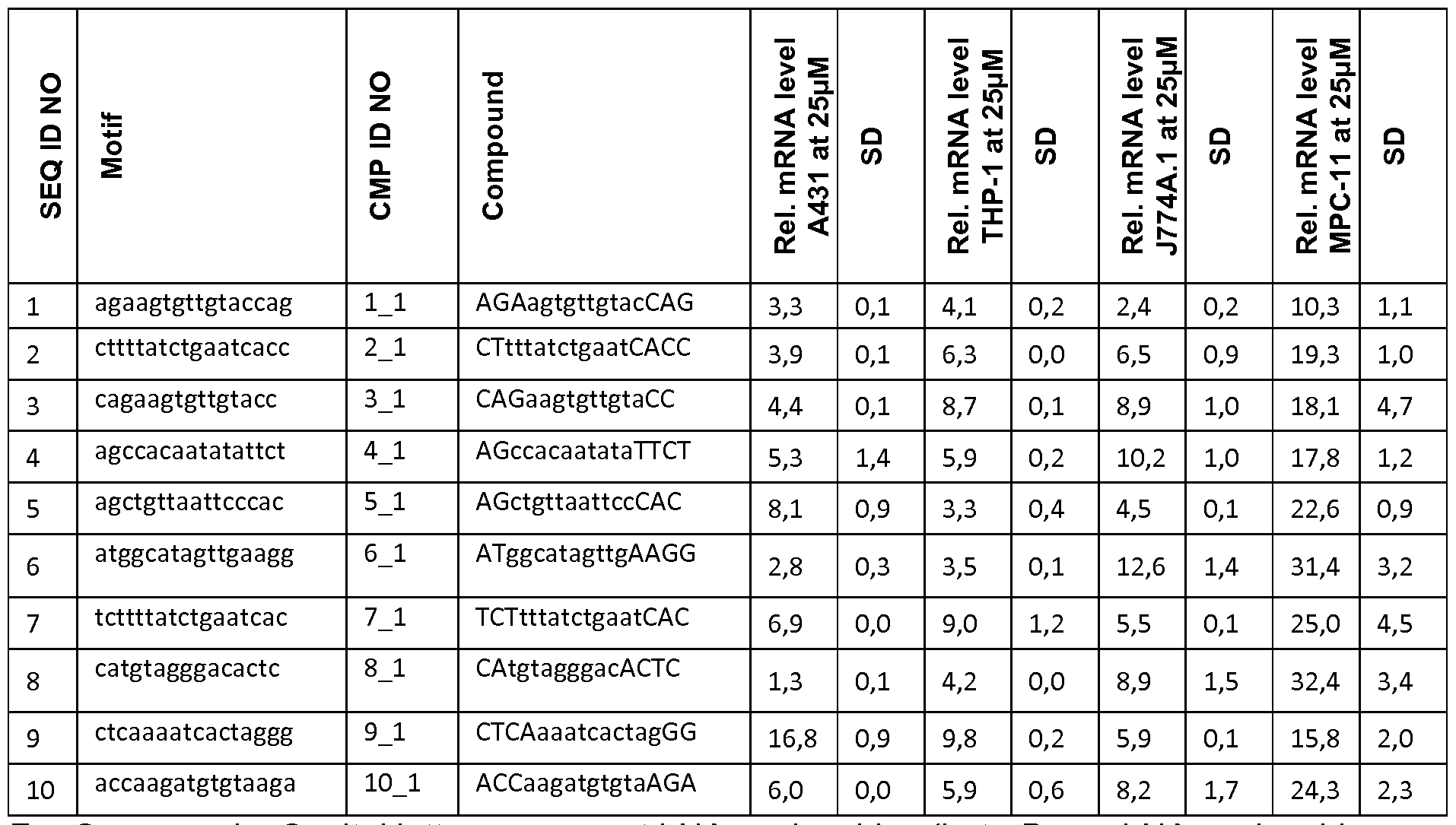
For Compounds: Capital letters represent LNA nucleosides (beta-D-oxy LNA nucleosides were used), all LNA cytosines are 5-methyl cytosine, lower case letters represent DNA nucleosides. All internucleoside linkages are phosphorothioate internucleoside linkages. Example 2: Testing in vitro potency and efficacy of selected oligonucleotides targeting human MBTPS1 mRNA in human THP-1 and A431 at different concentrations for a dose response curve.
Human A431 and THP-1 cell line was described in Example 1. The assay was performed as described in Example 1. Concentration of oligonucleotides: from 50 mM, 1 :1 dilutions in 8 steps. 3 days after addition of oligonucleotides, the cells were harvested. RNA extraction and duplex One Step RT-qPCR were performed as described in Example 1. n=2 biological replicates. IC50 determinations were performed in GraphPad Prism6. The relative MBTPS1 mRNA level at treatment with 50 mM oligonucleotide is shown in the table as percent of control (PBS).


The IC50 values for selected oligonucleotides targeting human MBTPS1 mRNA in vitro in the human cell lines THP-1 and A431 are shown in Figure 5. The concentration response curves in human cell lines A431 and THP-1 are provided as Figures 6 and 7, respectively.
Claims
1. An antisense oligonucleotide, 10-30 nucleotides in length, wherein said antisense oligonucleotide comprises a contiguous nucleotide sequence 10 - 30 nucleotides in length, wherein the contiguous nucleotide sequence is at least 90% complementary, such as fully complementary to SEQ ID NO 15, wherein the antisense
oligonucleotide is capable of inhibiting the expression of human MBTPS1 in a cell which is expressing human MBTPSJ, or a pharmaceutically acceptable salt thereof.
2. The antisense oligonucleotide according to claim 1 , wherein the contiguous
nucleotide sequence is at least 90% complementary, such as fully complementary to SEQ ID NO 11 or SEQ ID NO 12 or SEQ ID NO 17.
3. The antisense oligonucleotide according to claim 1 , wherein the contiguous
nucleotide sequence is fully complementary to SEQ ID NO 13.
4. The antisense oligonucleotide according to claim 1 , wherein the contiguous
nucleotide sequence is fully complementary to SEQ ID NO 14.
5. An antisense oligonucleotide according to any one of claims 1 - 4, wherein the
contiguous nucleotide sequence is fully complementary to a region of SEQ ID NO 15, selected from the group consisting of 33 - 47; 49 - 1 19; 121 - 161 ; 163 - 185; 187 - 203; 251 - 265; 267 - 294; 306 - 348; 350 - 367; 401 - 415; 417 - 445; 477 - 508; 510 - 524; 531 - 559; 561 - 588; 616 - 635; 637 - 678; 683 - 697; 699 - 724; 760 - 774;
810 - 828; 830 - 847; 866 - 885; 912 - 955; 948 - 963; 958 - 980; 982 - 997; 1013 - 1094; 1 107 - 1157; 1 185 - 1213; 1215 - 1244; 1246 - 1261 ; 1274 - 1347; 1349 - 1380; 1393 - 1418; 1492 - 1527; 1529 - 1548; 1563 - 1586; 1588 - 1613; 1615 -
1631 ; 1633 - 1677; 1683 - 1700; 1718 - 1744; 1746 - 1764; 1756 - 1770; 1761 -
1776; 1800 - 1852; 1842 - 1875; 1877 - 1895; 1902 - 1920; 1928 - 1949; 1951 -
1966; 1987 - 2013; 2041 - 2057; 2072 - 2091 ; 2092 - 2122; 2123 - 2152; 2143 -
2198; 2218 - 2251 ; 2253 - 2293; 2306 - 2349; 2367 - 2390; 2393 - 241 1 ; 2483 - 2529; 2531 - 2549; 2559 - 2585; 2614 - 2630; 2666 - 2703; 2705 - 2723; 2725 -
2744; 2741 - 2762; 2762 - 2776; 2769 - 2785; 2796 - 2849; 2851 - 2872; 2863 -
2879; 2880 - 2895; 2884 - 2901 ; 2900 - 2930; 2924 - 2953; 2954 - 2972; 2974 -
3015; 3057 - 3076; 3078 - 3099; 3115 - 3188; 3228 - 3259; 3261 - 3289; 3306 - 3342; 3344 - 3362; 3382 - 3397; 3518 - 3538; 3581 - 3620; 3634 - 3650; 3652 -
3673; 3677 - 3732; 3753 - 3769; 3780 - 3815; 3839 - 3886; 3888 - 3942; 3950 -
3976; 3977 - 3995; 3985 - 4001 ; 4003 - 4027; 4034 - 4051 ; 4040 - 4062; 4064 -
4086; 4076 - 4149; 4158 - 4175; 4165 - 4185; 4272 - 4289; 4278 - 4301 ; 4307 -
4322 4342 - 4357 4385-4401 4395.4414; 4432 - 4465; 4455 - 4471; 4474 -
4496 4517-4531 4549 - 4575 4580 4594; 4602 - 4633; 4635 - 4671; 4724 -
4756 4758 - 4824 4813-4840 4848 4884; 4883 - 4898; 4887 - 4917; 4910 -
4943 4945 - 4967 4980 - 5000 4989 5009; 5005 - 5029; 5058 - 5147; 5149 -
5187 5191 -5222 5237 - 5271 5294 5320; 5332 - 5350; 5345 - 5366; 5355 -
5386 5381 - 5409 5401 - 5470 5487 5502; 5508 - 5530; 5531 - 5573; 5570 -
5596 5602 - 5649 5652 - 5671 5690 5714; 5725 - 5748; 5750 - 5765; 5767 -
5805 5827 - 5848 5864 - 5878 5892 5916; 5923 - 5937; 5957 - 5978; 5980 -
5999 6027 - 6058 6073 - 6093 6137 6153; 6173 - 6205; 6251 - 6265; 6282 -
6300 6318-6334 6339 - 6354 6402 6426; 6436 - 6451 ; 6460 - 6482; 6526 -
6540 6578 - 6608 6612-6645 6654 6697; 6699 - 6721 ; 6758 - 6773; 6849 -
6876 6878 - 6907 6909 - 6928 6951 6988; 7019 - 7046; 7048 - 7064; 7066 -
7092 7105-7133 7135-7173 7188 7267; 7281 - 7361; 7415 - 7435; 7450 -
7468 7466 - 7480 7509 - 7530 7542 7578; 7631 - 7645; 7662 - 7704; 7707 -
7727 7781 -7813 7825 - 7841 7867 7890; 7907 - 7963; 7965 - 8011; 8038 -
8058 8068 - 8093 8103-8123 8133 8165; 8163 - 8189; 8229 - 8254; 8257 -
8288 8302 - 8323 8321 - 8345 8349 8396; 8398 - 8423; 8452 - 8492; 8509 -
8544 8556 - 8572 8581 - 8604 8615 8636; 8638 - 8654; 8656 - 8671; 8674 -
8709 8711 -8734 8737 - 8767 8771 8792; 8794 - 8856; 8858 - 8874; 8893 -
8910 8909 - 8937 8939 - 8962 8964 8983; 8975 - 8994; 8985 - 9002; 9021 -
9040 9091 -9111 9112-9133 9164 9200; 9200 - 9217; 9232 - 9283; 9289 -
9318 9320 - 9362 9364-9411 9417 9449; 9458 - 9485; 9483 - 9515; 9517 -
9562 9587 - 9607 9696 - 9726 9747 9775; 9777 - 9793; 9795 - 9820; 9822 -
9839 9848 - 9864 9866-9910 9954 9990; 9992 - 10014; 10010 - 10030; 10053
10067; 10069- 10113; 10136 - 10184; 10210 - 10237; 10264 - 10280; 10334 - 10349; 10359 - 10385; 10379 - 10433; 10445 - 10463; 10499 - 10525; 10563 - 10578; 10591 - 10611; 10608 - 10623; 10618 - 10654; 10666 - 10686; 10675 - 10703; 10750 - 10775; 10801 - 10816; 10819 - 10863; 10901 - 10930; 10942 - 10965; 10967 - 10996; 10998 - 11019; 11040- 11082; 11085 - 11116; 11129 - 11150; 11152- 11179; 11190 - 11223; 11264- 11286; 11340- 11367; 11369- 11383; 11388- 11423; 11425- 11444; 11466- 11484; 11513- 11543; 11543- 11558; 11597- 11632; 11645 - 11669; 11684- 11709; 11730- 11773; 11776- 11790; 11784- 11798; 11793 - 11817; 11821 - 11846; 11850- 11868; 11858- 11879; 11868- 11905; 11914 - 11959; 11951 - 11972; 12001 - 12033; 12035- 12059; 12074 - 12088; 12092 - 12121; 12116-12133; 12159- 12179; 12181 -
12232 12237 12310 12358 12376 12378 12448 12450 12518 12529
12552 12556 12577 12582 12598 12591 12605 1261 1 12633 12635
12650 12652 12668 12683 12697 12703 12743 12745 12778 12780
12833 12843 12865 12877 12894 12907 12946 12948 12976 13010
13035 13063 13090 13094 13123 13161 13182 13188 13207 13249
13299 13314 13338 13378 13455 13458 13503 13509 13536 13538
13580 13576 13603 13599 13638 13632 13652 13658 13676 13692
13706 13716 13733 13775 13799 13801 13842 13891 13908 13914
13930 13932 13981 13994 1401 1 14040 14081 14092 14132 14146
14184 14188 14210 14215 14287 14289 14305 14307 14321 14351
14378 14398 14417 14419 14454 14464 14491 14505 14534 14545
14559 14580 14628 14630 14644 14655 14670 14672 14690 14718
14764 14766 14818 14820 14863 14877 14899 14901 14944 14946
14990 14998 15018 15060 15088 15091 15117 15119 15155 15157
15304 15315 15332 15338 15367 15395 15437 15428 15459 15452
15467 15462 15476 15498 15514 15503 15543 15557 15575 15586
15630 15633 15660 15673 15692 15695 15738 15729 15743 15754
15791 15794 15812 15814 15834 15825 15849 15847 15871 15887
15933 15925 15940 15942 16024 16019 16033 16045 16061 16091
16127 16129 16162 16164 16178 16174 16201 16198 16248 16268
16285 16277 16309 16307 16321 16312 16326 16318 16335 16347
16362 16357 16408 16408 16422 16416 16431 16423 16501 16494
16518 16520 16536 16537 16565 16572 16592 16595 16662 16663
16696 16690 16721 16742 1681 1 16823 16840 16842 16863 16903
16922 16935 16974 17003 17023 17090 17108 17112 17140 17142
17158 17161 17175 17195 17210 17199 17228 17227 17245 17246
17329 17324 17339 17341 17355 17354 17392 17382 17406 17422
17449 17453 17474 17480 17506 17537 17560 17566 17768 17779
17822 17833 17849 17869 17883 17923 17946 17951 18012 18045
18066 18085 18141 18143 18158 18170 18190 18192 18213 18222
18242 18278 18298 18293 18309 18308 18350 18370 18395 18397
18435 18425 18450 18441 18475 18482 18524 18523 18563 18588
18615 18655 18677 18683 18699 18720 18752 18754 18783 18806
18844 18848 18863 18874 18903 18926 18962 18981 19022 19036
1911 1 19118 19134 19140 19182 19193 19216 19238 19252 19291
19364 19377 19395 19405 19430 19448 19474 19491 19507 19509
19552 19616 19641 19663 19680 19673 19706 19723 19738 19788
19833 19839 19857 19911 19953 19964 20003 20005 20024 20053
20075 20102 20118 20120 20139 20148 20189 20196 20214 20255
20270 20291 20335 20337 20356 20369 20388 20406 20430 20434
20457 20459 20536 20576 20630 20641 20661 20677 20692 20714
20743 20751 20784 20836 20858 20869 20900 20906 20925 20929
20958 20962 20987 20999 21016 21027 21042 21060 21079 21099
21 132 21 134 21 150 21 179 21279 21281 21332 21335 21371 21373
21389 21402 21421 21423 21442 21473 21491 21508 21534 21544
21587 21594 21613 21615 21640 21685 21725 21727 21747 21757
21790 21825 21847 21879 21896 21921 21936 21953 21974 22006
22048 22050 22065 22067 22092 22094 22146 22191 22215 22217
22285 22300 22335 22348 22367 22396 22414 22416 22482 22498
22523 22661 22690 22701 22722 22754 22796 22798 22867 22870
22884 22886 22901 22922 22941 22965 22980 22983 23008 23023
23037 23058 23092 23094 23207 23210 23231 23238 23298 23321
23345 23366 23382 23395 23412 23426 23460 23503 23525 23531
23552 23554 23569 23582 23605 23607 23622 23624 23685 23687
23736 23738 23789 23791 23841 23857 23884 23892 23916 23946
23960 23962 24010 24032 24047 24077 24106 24108 24133 24135
24159 24161 24175 24177 24241 24245 24273 24276 24298 24300
24315 24317 24332 24334 24356 24370 24400 24403 24421 24457
24471 24506 24522 24519 24538 24540 24560 24564 24586 24612
24626 24635 24706 24708 24725 24769 24790 24792 24806 24844
24882 24884 24916 24928 24943 24978 25007 25021 25043 25045
25102 25116 25144 25146 25162 25164 25195 25198 25260 25262
25313 25327 25358 25373 25397 25396 25432 25434 25456 25461
25489 25481 25496 25486 25501 25490 25507 25501 25516 25509
25537 25554 25575 25576 25604 25607 25692 25705 25730 25743
25775 25777 25804 25815 25834 25850 25876 25890 25909 25933
25955 25957 25987 25989 26058 26060 26091 26093 261 11 26146
26182 26193 26216 26218 26244 26246 26264 26261 26275 26273
26298 26300 26318 26324 26339 26335 26364 26363 26395 26405
26437 26439 26457 26459 26473 26484 26500 26517 26545 26547
26562 26569 26592 26615 26645 26661 26692 26694 26711 26713
26735 26738 26757 26780 26807 26825 26842 26854 26870 26894
26910 26912 26930 26990 27027 27051 27065 27096 27123 27129
27165 27176 27193 27214 27240 27237 27251 27242 27257 27315
27332 27405 27433 27437 27476 27503 27522 27559 27573 27587
27643 27644 27683 27692 27717 27721 27735 27758 27775 27855
27902 27916 27932 27943 27958 27995 28015 28017 28032 28061
28076 28078 28096 28098 28114 28119 28143 28170 28190 28192
28209 28287 28304 28329 28355 28361 28377 28379 28399 28419
28436 28452 28502 28521 28552 28554 28568 28570 28603 28602
28637 28640 28662 28676 28697 28714 28763 28771 28785 28788
28863 28865 28903 28917 28940 28948 28979 29007 29023 29026
29045 29057 29081 29104 29118 29120 29138 29140 29167 29179
2921 1 29272 29309 29339 29359 29361 29404 29400 29417 29414
29435 29435 29553 29558 29572 29574 29591 29602 29618 29628
29665 29680 29703 29705 29722 29742 29757 29759 29773 29821
29838 29840 29864 29865 29913 29937 29955 29957 29990 30002
30055 30057 30075 30077 30118 30188 30210 30231 30259 30261
30306 30367 30386 30388 30416 30418 30437 30506 30533 30556
30575 30614 30645 30662 30691 30693 30717 30725 30749 30814
30829 30873 30902 30904 30918 30920 30936 30938 30959 30961
30987 30989 31009 31011 31088 31090 31 113 31 121 31 142 31 158
31 179 31 181 31215 31217 31250 31270 31313 31370 31395 31387
31401 3141 1 31427 31428 31454 31447 31466 31456 31471 31477
31493 31483 31502 31497 31519 31521 31536 31538 31583 31585
31609 31619 31648 31650 31664 31677 3171 1 31750 31796 31798
31840 31842 31873 31875 31903 31917 31939 31947 31997 32019
32064 32068 32083 32086 32102 32118 32141 32197 32227 32234
32252 32258 32275 32288 32326 32376 32391 32393 32414 32415
32436 32439 32455 32456 32483 32486 32509 32532 32554 32556
32575 32588 32604 32607 32646 32654 32669 32661 32685 32687
32704 32703 32735 32726 32741 32743 32779 32791 32821 3281 1
32827 32823 32858 32860 32885 32886 32918 32920 32944 32946
32989 33042 33067 33084 33106 33108 33141 33155 33201 33203
33230 33232 33260 33270 33313 33317 33372 33372 33400 33406
33425 33427 33442 33431 33448 33475 33500 33502 33525 33527
33542 33557 33585 33589 33612 33614 33665 33677 33695 33736
33765 33767 33783 33785 33807 33821 33870 33872 33918 33988
34002 34016 34064 34066 34104 34161 34203 34225 34247 34281
34303 34305 34324 34352 34366 34368 34417 34419 34447 34450
34467 34469 34484 34486 34505 34523 34540 34542 34571 34584
34605 34627 34659 34783 34801 34891 34910 34912 34936 34958
34973 34982 35028 35030 35052 35069 35168 35187 35213 35215
35230 35252 35286 35319 35339 35364 35402 35400 35415 35433
35485 35494 35517 35531 35551 35600 35614 35638 35659 35658
35682 35684 35717 35742 35756 35759 35773 35781 35797 35861
35880 35916 35933 35935 35958 35972 35991 35993 36030 36060
36091 36113 36149 36163 36190 36196 36245 36248 36262 36274
36308 36318 36340 36381 36422 36433 36451 36453 36484 36513
36559 36561 36578 36592 3661 1 36628 36642 36669 36693 36708
36735 36756 36773 36775 36795 36810 36858 36868 36887 36889
36916 36959 36983 36986 37012 37040 37059 37065 37085 37087
37108 37112 37130 37132 37164 37176 37195 37197 37217 37231
37277 37310 37327 37381 37405 37422 37456 37456 37483 37487
37519 37536 37555 37557 37578 37600 37618 37620 37644 37654
37671 37685 37707 37715 37748 37750 37770 37851 37868 37908
37924 37962 37986 37998 38013 38015 38031 38036 38063 38072
3811 1 38124 38153 38155 38177 38204 38222 38261 38293 38295
38353 38368 38384 38378 38407 38400 38423 38440 38457 38450
38473 38490 38507 38500 38523 38540 38557 38550 38573 38590
38607 38600 38624 38645 38670 38686 38703 38712 38733 38736
38750 38742 38768 38796 38827 38861 38882 38912 38927 38929
38948 38976 39022 39024 39040 39066 39083 39085 39105 39123
39150 39145 39177 39193 39229 39253 39267 39269 39294 39296
39317 39319 39338 39349 39406 39419 39445 39485 39547 39570
39587 39623 39646 39635 39649 39655 39674 39686 39723 39727
39742 39737 39753 39777 39795 39830 39859 39861 39882 39885
39901 39904 39936 39955 39975 39981 40014 40061 40091 40104
40132 40134 40148 40147 40238 40264 40286 40294 40310 40324
40355 40388 40412 40441 40461 40477 40495 40522 40554 40556
40594 40635 40660 40676 40698 40702 40749 40751 40767 40826
40867 40874 40899 40901 40924 40926 40954 40961 40990 41014
41030 41032 41053 41044 41061 41 118 41 149 41 164 41 179 41 182
41 197 41 199 41232 41247 41299 41313 41336 41338 41352 41398
41412 41416 41563 41572 41589 41591 41605 41612 41630 41632
41651 41653 41669 41671 41697 41714 41732 41734 41767 41772
41795 41806 41823 41831 41885 41887 41904 41917 41955 41962
41978 41980 42023 42025 42047 42049 42066 42075 42092 42098
42119 42121 42379 42400 42452 42454 42522 42532 42557 42559
42631 42633 42647 42655 42673 42675 42690 42701 42721 42725
42740 42776 42797 42810 42890 42888 42910 42912 42935 42946
42969 42961 42976 42966 42981 42970 42996 42998 43013 43014
43036 43042 43057 43069 43084 43075 43107 43130 43150 43151
43176 43191 43208 43231 43264 43305 43326 43331 43375 43392
4341 1 43431 43459 43485 43517 43515 43539 43541 43567 43564
43607 43629 43647 43637 43658 43655 43679 43670 43687 43684
43700 43702 43719 43755 43779 43779 43816 43818 43843 43845
43865 43879 43900 43902 43917 43939 44015 44046 44074 44119
44135 44157 44186 44208 44259 44250 44292 44290 44304 44301
44327 44352 44385 44399 44427 44439 44462 44466 44486 44531
44548 44550 44565 44575 44596 44598 44658 44686 44713 44775
44805 44853 44873 44897 44934 44961 44987 44999 45024 45086
45109 4511 1 45133 45135 45152 45154 45199 45271 45301 45327
45343 45345 45362 45376 45451 45469 45507 45512 45535 45548
45569 45571 45596 45598 45628 45643 45661 45686 45703 45717
45732 45734 45758 45758 45806 45836 45857 45887 45903 45920
45940 45965 46009 46035 46084 46114 46177 46179 46320 46328
46359 46361 46405 46407 46434 46436 46453 46455 46475 46477
46492 46525 46559 46561 46577 46584 46601 46603 46655 46657
46681 46717 46732 46734 46748 46750 46771 46842 46856 46858
46915 46941 46987 46989 47050 47067 4711 1 47122 47157 47191
47236 47245 47259 47256 47282 47300 47315 47356 47371 47373
47396 47433 47458 47494 47542 47545 47582 47584 47607 47617
47666 47669 47693 47708 47726 47730 47745 47750 47770 47782
47799 47825 47877 47903 47922 47937 47981 48008 48037 48039
48059 48061 48079 48110 48125 48127 48145 48185 48212 48213
48248 48285 48310 48317 48355 48403 48417 48419 48521 48523
48545 48547 48577 48580 48612 48633 48666 48690 48711 48713
48730 48736 48765 48767 48782 48784 48804 48802 48823 48826
48840 48860 48877 48879 48900 48902 48916 48918 48936 48967
49001 49027 49047 49049 49063 49095 49120 49125 49159 49173
49201 49203 49246 49311 49339 49356 49381 49409 49431 49424
49449 49454 49500 49502 49528 49551 49586 49588 49607 49638
49655 49658 49672 49674 49694 49705 49719 49732 49749 49751
49773 49775 49799 49795 49810 49813 49831 49833 49868 49906
49946 49948 49972 50016 50049 50060 50091 50093 50107 50130
50165 50174 50196 50198 50222 50224 50246 50257 50314 50316
50392 50403 50430 50436 50466 50509 50523 50525 50546 50560
50574 50587 50602 50602 50640 50642 50662 50671 50686 50696
5071 1 50763 50789 50811 50830 50832 50850 50873 50888 50920
50950 50952 50966 50968 50982 50984 51037 51031 51093 51 110
51 127 51 129 51 152 51 154 51224 51226 51247 51277 51306 51309
51333 51333 51348 51346 51375 51377 51408 51419 51446 51476
51502 51530 51547 51549 51565 51554 51588 51590 51631 51643
51695 51686 51703 51697 51715 51722 51757 51766 51786 51788
51816 51830 51864 51877 51894 51912 51947 51956 51977 51979
52033 52035 52057 52059 52107 52164 52190 52192 52222 52224
52243 52263 52297 52299 52315 52325 52352 52366 52382 52401
52418 52433 52490 52492 52538 52540 52570 52581 52598 52604
52627 52630 52666 52668 52688 52728 52791 52793 52895 52904
52930 52932 52948 52968 52994 52996 53010 53018 53036 53037
53072 53074 53094 53097 53132 53139 53158 53147 53169 53199
53231 53243 53268 53270 53321 53323 53341 53343 53383 53410
53433 53442 53543 53545 53605 53636 53676 53676 53734 53736
53782 53784 53809 53830 53847 53903 53939 53956 53973 53977
54000 54025 54052 54069 54084 54126 54144 54154 54171 54191
54230 54232 54254 54312 54330 54383 54486 54490 54507 54516
54530 54519 54547 54568 54585 54597 54636 54642 54660 54650
54673 54663 54679 54676 54693 54682 54697 54687 54726 54725
54760 54802 54830 54845 54882 54914 54928 54986 55000 55007
55024 55030 55061 55063 55122 55139 55161 55165 55203 55240
55290 55318 55364 55366 55382 55389 55413 55415 55475 55502
55529 55534 55552 55583 55600 55633 55652 55654 55674 55693
55727 55746 55771 55773 55794 55810 55843 55845 55866 55862
55912 55901 55919 55940 55994 55988 56004 55996 56012 56033
56049 56043 56061 56051 56065 56072 56148 56150 56240 56242
56260 56262 56283 56285 56332 56391 56420 56434 56452 56506
56520 56536 56552 56558 56580 56585 56648 56655 56671 56686
56714 56719 56765 56784 56800 56802 56818 56822 56850 56894
56921 56923 56963 56973 5701 1 57055 57081 57089 57129 57148
57164 57191 57206 57208 57222 57231 57245 57261 57330 57375
57393 57414 57431 57433 57449 57451 57465 57467 57524 57526
57545 57562 57637 57641 57681 57702 57720 57736 57751 57753
57789 57791 57856 57858 57876 57865 57879 57916 57946 57948
57970 57972 57990 57996 58014 58016 58044 58046 58072 58147
58186 58188 58210 58298 58316 58333 58358 58360 58395 58406
58433 58435 58452 58465 58488 58488 58507 58537 58553 58555
58569 58631 58646 58671 58689 58691 58746 58784 58825 58827
58854 58856 58896 58899 58952 58968 59010 59012 59062 59075
59089 59091 59117 59154 59182 59184 59201 59206 59243 59255
59280 59280 59294 59318 59334 59347 59407 59438 59455 59457
59486 59493 59522 59524 59540 59542 59567 59572 59614 59616
59637 59639 59653 59690 59708 59726 59755 59782 59799 59801
59827 59830 59846 59886 59901 59935 59952 59975 60021 60033
60060 60068 60091 60094 60109 6011 1 60134 60187 60201 60210
60224 60237 60251 60272 60312 60323 60342 60357 60395 60442
60462 60499 60513 60536 60583 60594 60608 60618 60633 60651
60666 60703 60718 60718 60744 60766 60804 60806 60840 60842
60882 60884 60905 60925 60955 60961 60975 60996 61010 61012
61063 61091 61 135 61 157 61 172 61 174 61226 61243 61270 61272
61297 61299 61315 61319 61334 61335 61366 61376 61399 61433
61456 61463 61483 61498 61538 61555 61605 61645 61664 61690
61708 61721 61744 61748 61765 61767 61781 61852 61919 61930
61971 61981 61998 62070 62086 62098 62132 62134 62191 62214
62242 62259 62313 62315 62430 62445 62521 62523 62537 62540
62554; 62556 - 62603; 62605 - 62620; 62622 - 62641 ; 62652 - 62668; 62682 - 62702; 62701 - 62732; 62732 - 62761 ; 62763 - 62814; 62816 - 62891 ; 62893 - 62916; 62918 - 62973; 62978 - 63000; and 63016 - 63133.
6. The antisense oligonucleotide according to any one of claims 1 - 5, wherein the antisense oligonucleotide is a gapmer oligonucleotide comprising a contiguous nucleotide sequence of formula 5’-F-G-F’-3’, where region F and F’ independently comprise 1 - 8 sugar modified nucleosides, and G is a region between 5 and 16 nucleosides which are capable of recruiting RNaseH.
7. The antisense oligonucleotide according to claim 6, wherein the sugar modified
nucleosides of region F and F’ are independently selected from the group consisting of 2’-0-alkyl-RNA, 2’-0-methyl-RNA, 2’-alkoxy-RNA, 2’-0-methoxyethyl-RNA, 2’- amino-DNA, 2’-fluoro-DNA, arabino nucleic acid (ANA), 2’-fluoro-ANA and LNA nucleosides.
8. The antisense oligonucleotide according to claim 6 or 7, wherein region G comprises 5 - 16 contiguous DNA nucleosides.
9. The antisense oligonucleotide according to any one of claims 1 - 8, wherein the antisense oligonucleotide is a LNA gapmer oligonucleotide.
10. The antisense oligonucleotide according to any one of claims 6 - 9, wherein the LNA nucleosides are beta-D-oxy LNA nucleosides.
11. The antisense oligonucleotide according to any one of claims 1 - 10, wherein the internucleoside linkages between the contiguous nucleotide sequence are phosphorothioate internucleoside linkages.
12. The antisense oligonucleotide according to any one of claims 1 - 1 1 , wherein the oligonucleotide comprises a contiguous nucleotide sequence selected from the group consisting of: SEQ ID NO 1 , SEQ ID NO 2, SEQ ID NO 3, and SEQ ID NO 7; or selected from the group consisting of SEQ ID NO 4, 5, 6, 8, 9 & 10.
13. The antisense oligonucleotide according to any one of claims 1 - 12, wherein the oligonucleotide comprises or consists of a contiguous nucleotide sequence, selected from the group consisting of: AGAagtgttgtacCAG (SEQ ID NO 1 ) ;
CTtttatctgaatCACC (SEQ ID NO 2); CAGaagtgttgtaCC (SEQ ID NO 3);
AGccacaatataTTCT (SEQ ID NO 4); AGctgttaattccCAC (SEQ ID NO 5);
ATggcatagttgAAGG (SEQ ID NO 6); TCTtttatctgaatCAC (SEQ ID NO 7);
CAtgtagggacACTC (SEQ ID NO 8); CTCAaaatcactagGG (SEQ ID NO 9); and ACCaagatgtgtaAGA (SEQ ID NO 10);
such as selected from the group consisting of AGAagtgttgtacCAG (SEQ ID NO 1 ); CTtttatctgaatCACC (SEQ ID NO 2); CAGaagtgttgtaCC (SEQ ID NO 3); and
T CTtttatctgaatCAC (SEQ ID NO 7)
wherein a capital letter represents a LNA nucleoside, a lower case letter represents a DNA nucleoside.
14. The antisense oligonucleotide according to any one of claims 1 - 13, wherein the oligonucleotide comprises or consists of a contiguous nucleotide sequence selected from the group consisting of:
AGAagtgttgtacCAG (SEQ ID NO 1 ) ; CTtttatctgaatCACC (SEQ ID NO 2);
CAGaagtgttgtaCC (SEQ ID NO 3); AGccacaatataTTCT (SEQ ID NO 4);
AGctgttaattccCAC (SEQ ID NO 5); ATggcatagttgAAGG (SEQ ID NO 6);
TCTtttatctgaatCAC (SEQ ID NO 7); CAtgtagggacACTC (SEQ ID NO 8);
CTCAaaatcactagGG (SEQ ID NO 9); and ACCaagatgtgtaAGA (SEQ ID NO 10); such as selected from the group consisting of AGAagtgttgtacCAG (SEQ ID NO 1 ); CTtttatctgaatCACC (SEQ ID NO 2); CAGaagtgttgtaCC (SEQ ID NO 3); and
TCTtttatctgaatCAC (SEQ ID NO 7)
wherein a capital letter represents a beta-D-oxy LNA nucleoside, a lower case letter represents a DNA nucleoside, wherein each LNA cytosine is 5-methyl cytosine, and wherein the internucleoside linkages between the nucleosides are phosphorothioate internucleoside linkages.
15. A conjugate comprising the oligonucleotide according to any one of claims 1 - 14, and at least one conjugate moiety covalently attached to said oligonucleotide.
16. The conjugate according to claim 15, wherein the conjugate moiety is a trilavent GalNAc conjugate moiety, such as a the conjugate moiety of formula

oligonucleotide.
17. The conjugate according to claim 15 or 16, wherein the compound is selected from the group consisting of
5 -GN2-C6oC0aoAsGsAsasgstsgststsgstsasCs mCsAsG, or
5'-GN2-C6oCoaomCsTstststsastsCstsgsasastsmCsAs mCsmC
5'-GN2-C6oCoao mCsAsGsasasgstsgststsgstsas mCs mC
5'-GN2-C6oCoao TsmCsTstststsastsCstsgsasastsmCsAsmC
wherein a capital letter represents a beta-D-oxy LNA nucleoside, a lower case letter represents a DNA nucleoside, wherein each LNA cytosine is 5-methyl cytosine, and mc is 5-methyl cytosine DNA, and wherein subscript s represents a phosphorothioate internucleoside linkage, and a subscript o represents a phosphodiester
internucleoside linkage, and GN2-C6 is a 5’ conjugate of formula:
 wherein the wavy line represents the covalent bond to the phosphodiester linkage at the 5’ end of the oligonucleotide.
18. A pharmaceutical composition comprising the oligonucleotide of claim 1-14 or the conjugate of any one of claim 15-17 and a pharmaceutically acceptable diluent, solvent, carrier, salt and/or adjuvant.
19. An in vivo or in vitro method for modulating MBTPS1 expression in a target cell which is expressing MBTPS1, said method comprising administering an oligonucleotide of any one of claims 1-14, the conjugate according to any one of claims 15-17, or the pharmaceutical composition of claim 18 in an effective amount to said cell.
20. A method for treating or preventing a disease comprising administering a
therapeutically or prophylactically effective amount of an oligonucleotide of any one of claims 1 - 14 or the conjugate according to any one of claims 15-17 or the pharmaceutical composition of claim 18 to a subject suffering from or susceptible to the disease.
21. The method of claim 21 , wherein the disease is selected from the group consisting of cardiovascular disease (CVD), hepatitis C, cancer such as skin cancer and arenavirus infection.
22. The oligonucleotide of any one of claims 1 - 14 or the conjugate according to any one of claims 15-17 or the pharmaceutical composition of claim 18 for use in medicine.
23. The oligonucleotide of any one of claims 1 - 14 or the conjugate according to any one of claims 15-17 or the pharmaceutical composition of claim 18 for use in the treatment or prevention of a disease selected from the group consisting of cardiovascular disease (CVD), hepatitis C, cancer such as skin cancer and arenavirus infection.
24. Use of the oligonucleotide of claim 1 - 14 or the conjugate according to any one of claims 15 to 17 or the pharmaceutical composition of claim 18, for the preparation of a medicament for treatment or prevention of a disease selected from the group consisting of cardiovascular disease (CVD), hepatitis C, cancer such as skin cancer and arenavirus infection.
Applications Claiming Priority (2)
| Application Number | Priority Date | Filing Date | Title |
|---|---|---|---|
| EP18181939.2 | 2018-07-05 | ||
| EP18181939 | 2018-07-05 |
Publications (1)
| Publication Number | Publication Date |
|---|---|
| WO2020007826A1 true WO2020007826A1 (en) | 2020-01-09 |
Family
ID=62904272
Family Applications (1)
| Application Number | Title | Priority Date | Filing Date |
|---|---|---|---|
| PCT/EP2019/067674 Ceased WO2020007826A1 (en) | 2018-07-05 | 2019-07-02 | Antisense oligonucleotides targeting mbtps1 |
Country Status (1)
| Country | Link |
|---|---|
| WO (1) | WO2020007826A1 (en) |
Citations (31)
| Publication number | Priority date | Publication date | Assignee | Title |
|---|---|---|---|---|
| WO1998039352A1 (en) | 1997-03-07 | 1998-09-11 | Takeshi Imanishi | Novel bicyclonucleoside and oligonucleotide analogues |
| WO1999014226A2 (en) | 1997-09-12 | 1999-03-25 | Exiqon A/S | Bi- and tri-cyclic nucleoside, nucleotide and oligonucleotide analogues |
| US5994517A (en) | 1995-11-22 | 1999-11-30 | Paul O. P. Ts'o | Ligands to enhance cellular uptake of biomolecules |
| WO2000047599A1 (en) | 1999-02-12 | 2000-08-17 | Sankyo Company, Limited | Novel nucleosides and oligonucleotide analogues |
| WO2000066604A2 (en) | 1999-05-04 | 2000-11-09 | Exiqon A/S | L-ribo-lna analogues |
| WO2001023613A1 (en) | 1999-09-30 | 2001-04-05 | Isis Pharmaceuticals, Inc. | Human rnase h and oligonucleotide compositions thereof |
| WO2004046160A2 (en) | 2002-11-18 | 2004-06-03 | Santaris Pharma A/S | Amino-lna, thio-lna and alpha-l-oxy-ln |
| WO2007031091A2 (en) | 2005-09-15 | 2007-03-22 | Santaris Pharma A/S | Rna antagonist compounds for the modulation of p21 ras expression |
| WO2007090071A2 (en) | 2006-01-27 | 2007-08-09 | Isis Pharmaceuticals, Inc. | 6-modified bicyclic nucleic acid analogs |
| WO2007134181A2 (en) | 2006-05-11 | 2007-11-22 | Isis Pharmaceuticals, Inc. | 5'-modified bicyclic nucleic acid analogs |
| WO2008049085A1 (en) | 2006-10-18 | 2008-04-24 | Isis Pharmaceuticals, Inc. | Antisense compounds |
| WO2008150729A2 (en) | 2007-05-30 | 2008-12-11 | Isis Pharmaceuticals, Inc. | N-substituted-aminomethylene bridged bicyclic nucleic acid analogs |
| WO2008154401A2 (en) | 2007-06-08 | 2008-12-18 | Isis Pharmaceuticals, Inc. | Carbocyclic bicyclic nucleic acid analogs |
| WO2009006478A2 (en) | 2007-07-05 | 2009-01-08 | Isis Pharmaceuticals, Inc. | 6-disubstituted bicyclic nucleic acid analogs |
| WO2009067647A1 (en) | 2007-11-21 | 2009-05-28 | Isis Pharmaceuticals, Inc. | Carbocyclic alpha-l-bicyclic nucleic acid analogs |
| WO2009126933A2 (en) | 2008-04-11 | 2009-10-15 | Alnylam Pharmaceuticals, Inc. | Site-specific delivery of nucleic acids by combining targeting ligands with endosomolytic components |
| WO2010036698A1 (en) | 2008-09-24 | 2010-04-01 | Isis Pharmaceuticals, Inc. | Substituted alpha-l-bicyclic nucleosides |
| WO2010077578A1 (en) | 2008-12-09 | 2010-07-08 | Isis Pharmaceuticals, Inc. | Bis-modified bicyclic nucleic acid analogs |
| WO2011017521A2 (en) | 2009-08-06 | 2011-02-10 | Isis Pharmaceuticals, Inc. | Bicyclic cyclohexose nucleic acid analogs |
| WO2011084455A2 (en) | 2009-12-16 | 2011-07-14 | Opko Curna, Llc. | Treatment of membrane bound transcription factor peptidase, site 1 (mbtps1) related diseases by inhibition of natural antisense transcript to mbtps1 |
| WO2011156202A1 (en) | 2010-06-08 | 2011-12-15 | Isis Pharmaceuticals, Inc. | Substituted 2 '-amino and 2 '-thio-bicyclic nucleosides and oligomeric compounds prepared therefrom |
| WO2012083046A2 (en) | 2010-12-17 | 2012-06-21 | Arrowhead Research Corporation | Galactose cluster-pharmacokinetic modulator targeting moiety for sirna |
| WO2012089352A1 (en) | 2010-12-29 | 2012-07-05 | F. Hoffmann-La Roche Ag | Small molecule conjugates for intracellular delivery of nucleic acids |
| WO2012109395A1 (en) | 2011-02-08 | 2012-08-16 | Isis Pharmaceuticals, Inc. | Oligomeric compounds comprising bicyclic nucleotides and uses thereof |
| WO2013022984A1 (en) | 2011-08-11 | 2013-02-14 | Isis Pharmaceuticals, Inc. | Selective antisense compounds and uses thereof |
| WO2013154798A1 (en) | 2012-04-09 | 2013-10-17 | Isis Pharmaceuticals, Inc. | Tricyclic nucleic acid analogs |
| WO2014076195A1 (en) | 2012-11-15 | 2014-05-22 | Santaris Pharma A/S | Oligonucleotide conjugates |
| WO2014118267A1 (en) | 2013-01-30 | 2014-08-07 | Santaris Pharma A/S | Lna oligonucleotide carbohydrate conjugates |
| WO2014179620A1 (en) | 2013-05-01 | 2014-11-06 | Isis Pharmaceuticals, Inc. | Conjugated antisense compounds and their use |
| WO2014179445A1 (en) | 2013-05-01 | 2014-11-06 | Regulus Therapeutics Inc. | Compounds and methods for enhanced cellular uptake |
| WO2015113922A1 (en) | 2014-01-30 | 2015-08-06 | Roche Innovation Center Copenhagen A/S | Poly oligomer compound with biocleavable conjugates |
-
2019
- 2019-07-02 WO PCT/EP2019/067674 patent/WO2020007826A1/en not_active Ceased
Patent Citations (32)
| Publication number | Priority date | Publication date | Assignee | Title |
|---|---|---|---|---|
| US5994517A (en) | 1995-11-22 | 1999-11-30 | Paul O. P. Ts'o | Ligands to enhance cellular uptake of biomolecules |
| WO1998039352A1 (en) | 1997-03-07 | 1998-09-11 | Takeshi Imanishi | Novel bicyclonucleoside and oligonucleotide analogues |
| WO1999014226A2 (en) | 1997-09-12 | 1999-03-25 | Exiqon A/S | Bi- and tri-cyclic nucleoside, nucleotide and oligonucleotide analogues |
| WO2000047599A1 (en) | 1999-02-12 | 2000-08-17 | Sankyo Company, Limited | Novel nucleosides and oligonucleotide analogues |
| WO2000066604A2 (en) | 1999-05-04 | 2000-11-09 | Exiqon A/S | L-ribo-lna analogues |
| WO2001023613A1 (en) | 1999-09-30 | 2001-04-05 | Isis Pharmaceuticals, Inc. | Human rnase h and oligonucleotide compositions thereof |
| WO2004046160A2 (en) | 2002-11-18 | 2004-06-03 | Santaris Pharma A/S | Amino-lna, thio-lna and alpha-l-oxy-ln |
| WO2007031091A2 (en) | 2005-09-15 | 2007-03-22 | Santaris Pharma A/S | Rna antagonist compounds for the modulation of p21 ras expression |
| WO2007090071A2 (en) | 2006-01-27 | 2007-08-09 | Isis Pharmaceuticals, Inc. | 6-modified bicyclic nucleic acid analogs |
| WO2007134181A2 (en) | 2006-05-11 | 2007-11-22 | Isis Pharmaceuticals, Inc. | 5'-modified bicyclic nucleic acid analogs |
| WO2008049085A1 (en) | 2006-10-18 | 2008-04-24 | Isis Pharmaceuticals, Inc. | Antisense compounds |
| WO2008150729A2 (en) | 2007-05-30 | 2008-12-11 | Isis Pharmaceuticals, Inc. | N-substituted-aminomethylene bridged bicyclic nucleic acid analogs |
| WO2008154401A2 (en) | 2007-06-08 | 2008-12-18 | Isis Pharmaceuticals, Inc. | Carbocyclic bicyclic nucleic acid analogs |
| WO2009006478A2 (en) | 2007-07-05 | 2009-01-08 | Isis Pharmaceuticals, Inc. | 6-disubstituted bicyclic nucleic acid analogs |
| WO2009067647A1 (en) | 2007-11-21 | 2009-05-28 | Isis Pharmaceuticals, Inc. | Carbocyclic alpha-l-bicyclic nucleic acid analogs |
| WO2009126933A2 (en) | 2008-04-11 | 2009-10-15 | Alnylam Pharmaceuticals, Inc. | Site-specific delivery of nucleic acids by combining targeting ligands with endosomolytic components |
| WO2010036698A1 (en) | 2008-09-24 | 2010-04-01 | Isis Pharmaceuticals, Inc. | Substituted alpha-l-bicyclic nucleosides |
| WO2010077578A1 (en) | 2008-12-09 | 2010-07-08 | Isis Pharmaceuticals, Inc. | Bis-modified bicyclic nucleic acid analogs |
| WO2011017521A2 (en) | 2009-08-06 | 2011-02-10 | Isis Pharmaceuticals, Inc. | Bicyclic cyclohexose nucleic acid analogs |
| WO2011084455A2 (en) | 2009-12-16 | 2011-07-14 | Opko Curna, Llc. | Treatment of membrane bound transcription factor peptidase, site 1 (mbtps1) related diseases by inhibition of natural antisense transcript to mbtps1 |
| WO2011156202A1 (en) | 2010-06-08 | 2011-12-15 | Isis Pharmaceuticals, Inc. | Substituted 2 '-amino and 2 '-thio-bicyclic nucleosides and oligomeric compounds prepared therefrom |
| WO2012083046A2 (en) | 2010-12-17 | 2012-06-21 | Arrowhead Research Corporation | Galactose cluster-pharmacokinetic modulator targeting moiety for sirna |
| WO2012089352A1 (en) | 2010-12-29 | 2012-07-05 | F. Hoffmann-La Roche Ag | Small molecule conjugates for intracellular delivery of nucleic acids |
| WO2012109395A1 (en) | 2011-02-08 | 2012-08-16 | Isis Pharmaceuticals, Inc. | Oligomeric compounds comprising bicyclic nucleotides and uses thereof |
| WO2013022984A1 (en) | 2011-08-11 | 2013-02-14 | Isis Pharmaceuticals, Inc. | Selective antisense compounds and uses thereof |
| EP2742135A1 (en) | 2011-08-11 | 2014-06-18 | Isis Pharmaceuticals, Inc. | Linkage modified gapped oligomeric compounds and uses thereof |
| WO2013154798A1 (en) | 2012-04-09 | 2013-10-17 | Isis Pharmaceuticals, Inc. | Tricyclic nucleic acid analogs |
| WO2014076195A1 (en) | 2012-11-15 | 2014-05-22 | Santaris Pharma A/S | Oligonucleotide conjugates |
| WO2014118267A1 (en) | 2013-01-30 | 2014-08-07 | Santaris Pharma A/S | Lna oligonucleotide carbohydrate conjugates |
| WO2014179620A1 (en) | 2013-05-01 | 2014-11-06 | Isis Pharmaceuticals, Inc. | Conjugated antisense compounds and their use |
| WO2014179445A1 (en) | 2013-05-01 | 2014-11-06 | Regulus Therapeutics Inc. | Compounds and methods for enhanced cellular uptake |
| WO2015113922A1 (en) | 2014-01-30 | 2015-08-06 | Roche Innovation Center Copenhagen A/S | Poly oligomer compound with biocleavable conjugates |
Non-Patent Citations (33)
| Title |
|---|
| "Remington's Pharmaceutical Sciences", 1985, MACK PUBLISHING COMPANY |
| ANSEL: "Pharmaceutical Dosage Forms and Drug Delivery Systems", 1995, pages: 196,1456 - 1457 |
| BASTIN, ORGANIC PROCESS RESEARCH & DEVELOPMENT, vol. 4, 2000, pages 427 - 435 |
| BERGSTROM, CURRENT PROTOCOLS IN NUCLEIC ACID CHEMISTRY, vol. 1.4.1, no. 37, 2009 |
| BROWN ET AL., PNAS, vol. 96, no. 20, 1999, pages 11041 - 8 |
| CARUTHERS ET AL., METHODS IN ENZYMOLOGY, vol. 154, pages 287 - 313 |
| DELEAVEYDAMHA, CHEMISTRY AND BIOLOGY, vol. 19, 2012, pages 937 |
| DENG XIAOLING ET AL: "Regulation of SREBP-2 intracellular trafficking improves impaired autophagic flux and alleviates endoplasmic reticulum stress in NAFLD", BIOCHIMICA ET BIOPHYSICA ACTA (BBA) - MOLECULAR AND CELL BIOLOGY OF LIPIDS, ELSEVIER, AMSTERDAM, NL, vol. 1862, no. 3, 21 December 2016 (2016-12-21), pages 337 - 350, XP029892093, ISSN: 1388-1981, DOI: 10.1016/J.BBALIP.2016.12.007 * |
| FLUITER ET AL., MOL. BIOSYST., vol. 10, 2009, pages 1039 |
| FREIERALTMANN, NUCL. ACID RES., vol. 25, 1997, pages 4429 - 4443 |
| HANGELAND ET AL., BIOCONJUG CHEM, vol. 6, no. 6, November 1995 (1995-11-01), pages 695 - 701 |
| HANSEN ET AL., CHEM. COMM., 1965, pages 36 - 38 |
| HIRAO ET AL., ACCOUNTS OF CHEMICAL RESEARCH, vol. 45, 2012, pages 2055 |
| HOLDGATE ET AL., DRUG DISCOV TODAY, 2005 |
| LANGER, SCIENCE, vol. 249, 1990, pages 1527 - 1533 |
| MANGOS ET AL., J. AM. CHEM. SOC., vol. 125, 2003, pages 654 - 661 |
| MCTIGUE ET AL., BIOCHEMISTRY, vol. 43, 2004, pages 5388 - 5405 |
| MERGNYLACROIX, OLIGONUCLEOTIDES, vol. 13, 2003, pages 515 - 537 |
| MIN GUAN ET AL: "Nelfinavir inhibits regulated intramembrane proteolysis of sterol regulatory element binding protein-1 and activating transcription factor 6 in castration-resistant prostate cancer : Nefinavir inhibits RIP of SREBP-1 and ATF6", FEBS JOURNAL, vol. 279, no. 13, 21 May 2012 (2012-05-21), GB, pages 2399 - 2411, XP055624783, ISSN: 1742-464X, DOI: 10.1111/j.1742-4658.2012.08619.x * |
| MITSUOKA ET AL., NUCLEIC ACIDS RESEARCH, vol. 37, no. 4, 2009, pages 1225 - 1238 |
| MORITA ET AL., BIOORGANIC & MED.CHEM. LETT., vol. 12, pages 73 - 76 |
| OLMSTEAD ET AL., PLOS PATHOG, vol. 8, 2012, pages e1002468 |
| ROJEK ET AL., J. VIROL., vol. 82, no. 12, 2008, pages 6045 - 6051 |
| RUKOV ET AL., NUCL. ACIDS RES., vol. 43, 2015, pages 8476 - 8487 |
| SANTALUCIA, PROC NATL ACAD SCI USA., vol. 95, 1998, pages 1460 - 1465 |
| SEIDAH ET AL., NAT REV DRUG DISCOV, vol. 11, no. 5, 2012, pages 367 - 83 |
| SETH ET AL., J. ORG. CHEM., vol. 75, no. 5, 2010, pages 1569 - 81 |
| SUGIMOTO ET AL., BIOCHEMISTRY, vol. 34, 1995, pages 11211 - 11216 |
| UHLMANN, CURR. OPINION IN DRUG DEVELOPMENT, vol. 3, no. 2, 2000, pages 293 - 213 |
| URATA S ET AL., J VIROL, vol. 85, no. 2, January 2011 (2011-01-01), pages 795 - 803 |
| VESTER ET AL., BIOORG. MED. CHEM. LETT., vol. 18, 2008, pages 2296 - 2300 |
| WANSETH, J. MEDICAL CHEMISTRY, vol. 59, 2016, pages 9645 - 9667 |
| WEISS ET AL., JOURNAL OF INVESTIGATIVE DERMATOLOGY, vol. 134, no. 1, 2014, pages 168 - 175 |
Similar Documents
| Publication | Publication Date | Title |
|---|---|---|
| US11542501B2 (en) | Antisense oligonucleotides targeting ATXN3 | |
| EP3810776A1 (en) | Oligonucleotides for modulating scn9a expression | |
| EP3790971A1 (en) | Oligonucleotides for modulating myh7 expression | |
| WO2019233922A1 (en) | Oligonucleotides for modulating atxn2 expression | |
| WO2019141723A1 (en) | Antisense oligonucleotides targeting srebp1 | |
| EP3947677A1 (en) | Oligonucleotides for modulating atxn2 expression | |
| WO2020038973A1 (en) | Antisense oligonucleotides targeting sptlc1 | |
| WO2020136125A2 (en) | Antisense oligonucleotides targeting card9 | |
| WO2018130585A1 (en) | Antisense oligonucleotides for modulating relb expression | |
| US20240336920A1 (en) | Threose nucleic acid antisense oligonucleotides and methods thereof | |
| WO2020038976A1 (en) | Antisense oligonucleotides targeting usp8 | |
| WO2020007702A1 (en) | Antisense oligonucleotides targeting bcl2l11 | |
| WO2020011869A2 (en) | Antisense oligonucleotides targeting tlr2 | |
| WO2020007826A1 (en) | Antisense oligonucleotides targeting mbtps1 | |
| WO2020011653A1 (en) | Antisense oligonucleotides targeting kynu | |
| WO2020011743A1 (en) | Antisense oligonucleotides targeting mafb | |
| WO2020011744A2 (en) | Antisense oligonucleotides targeting cers5 | |
| WO2020038971A1 (en) | Antisense oligonucleotides targeting vcan | |
| WO2020007772A1 (en) | Antisense oligonucleotides targeting gbp-1 | |
| WO2020011745A2 (en) | Antisense oligonucleotides targeting cers6 | |
| US20190367920A1 (en) | Antisense oligonucleotides for modulating nfkb1 expression | |
| WO2020007889A1 (en) | Antisense oligonucleotides targeting stat1 | |
| US20210261961A1 (en) | Antisense oligonucleotides targeting tia1 | |
| WO2020007700A1 (en) | Antisense oligonucleotides targeting spi1 | |
| EP3568477A1 (en) | Antisense oligonucleotides for modulating rela expression |
Legal Events
| Date | Code | Title | Description |
|---|---|---|---|
| 121 | Ep: the epo has been informed by wipo that ep was designated in this application |
Ref document number: 19734405 Country of ref document: EP Kind code of ref document: A1 |
|
| DPE1 | Request for preliminary examination filed after expiration of 19th month from priority date (pct application filed from 20040101) | ||
| NENP | Non-entry into the national phase |
Ref country code: DE |
|
| 122 | Ep: pct application non-entry in european phase |
Ref document number: 19734405 Country of ref document: EP Kind code of ref document: A1 |