JP2022512877A - Antisense oligonucleotide targeting TIA1 - Google Patents
Antisense oligonucleotide targeting TIA1 Download PDFInfo
- Publication number
- JP2022512877A JP2022512877A JP2021523678A JP2021523678A JP2022512877A JP 2022512877 A JP2022512877 A JP 2022512877A JP 2021523678 A JP2021523678 A JP 2021523678A JP 2021523678 A JP2021523678 A JP 2021523678A JP 2022512877 A JP2022512877 A JP 2022512877A
- Authority
- JP
- Japan
- Prior art keywords
- seq
- nucleosides
- region
- tia1
- oligonucleotide
- Prior art date
- Legal status (The legal status is an assumption and is not a legal conclusion. Google has not performed a legal analysis and makes no representation as to the accuracy of the status listed.)
- Pending
Links
Classifications
-
- C—CHEMISTRY; METALLURGY
- C07—ORGANIC CHEMISTRY
- C07K—PEPTIDES
- C07K14/00—Peptides having more than 20 amino acids; Gastrins; Somatostatins; Melanotropins; Derivatives thereof
- C07K14/435—Peptides having more than 20 amino acids; Gastrins; Somatostatins; Melanotropins; Derivatives thereof from animals; from humans
- C07K14/46—Peptides having more than 20 amino acids; Gastrins; Somatostatins; Melanotropins; Derivatives thereof from animals; from humans from vertebrates
- C07K14/47—Peptides having more than 20 amino acids; Gastrins; Somatostatins; Melanotropins; Derivatives thereof from animals; from humans from vertebrates from mammals
- C07K14/4701—Peptides having more than 20 amino acids; Gastrins; Somatostatins; Melanotropins; Derivatives thereof from animals; from humans from vertebrates from mammals not used
- C07K14/4747—Apoptosis related proteins
-
- A—HUMAN NECESSITIES
- A61—MEDICAL OR VETERINARY SCIENCE; HYGIENE
- A61P—SPECIFIC THERAPEUTIC ACTIVITY OF CHEMICAL COMPOUNDS OR MEDICINAL PREPARATIONS
- A61P21/00—Drugs for disorders of the muscular or neuromuscular system
-
- A—HUMAN NECESSITIES
- A61—MEDICAL OR VETERINARY SCIENCE; HYGIENE
- A61P—SPECIFIC THERAPEUTIC ACTIVITY OF CHEMICAL COMPOUNDS OR MEDICINAL PREPARATIONS
- A61P25/00—Drugs for disorders of the nervous system
- A61P25/28—Drugs for disorders of the nervous system for treating neurodegenerative disorders of the central nervous system, e.g. nootropic agents, cognition enhancers, drugs for treating Alzheimer's disease or other forms of dementia
-
- C—CHEMISTRY; METALLURGY
- C07—ORGANIC CHEMISTRY
- C07K—PEPTIDES
- C07K14/00—Peptides having more than 20 amino acids; Gastrins; Somatostatins; Melanotropins; Derivatives thereof
- C07K14/435—Peptides having more than 20 amino acids; Gastrins; Somatostatins; Melanotropins; Derivatives thereof from animals; from humans
- C07K14/46—Peptides having more than 20 amino acids; Gastrins; Somatostatins; Melanotropins; Derivatives thereof from animals; from humans from vertebrates
- C07K14/47—Peptides having more than 20 amino acids; Gastrins; Somatostatins; Melanotropins; Derivatives thereof from animals; from humans from vertebrates from mammals
-
- C—CHEMISTRY; METALLURGY
- C12—BIOCHEMISTRY; BEER; SPIRITS; WINE; VINEGAR; MICROBIOLOGY; ENZYMOLOGY; MUTATION OR GENETIC ENGINEERING
- C12N—MICROORGANISMS OR ENZYMES; COMPOSITIONS THEREOF; PROPAGATING, PRESERVING, OR MAINTAINING MICROORGANISMS; MUTATION OR GENETIC ENGINEERING; CULTURE MEDIA
- C12N15/00—Mutation or genetic engineering; DNA or RNA concerning genetic engineering, vectors, e.g. plasmids, or their isolation, preparation or purification; Use of hosts therefor
- C12N15/09—Recombinant DNA-technology
- C12N15/11—DNA or RNA fragments; Modified forms thereof; Non-coding nucleic acids having a biological activity
- C12N15/113—Non-coding nucleic acids modulating the expression of genes, e.g. antisense oligonucleotides; Antisense DNA or RNA; Triplex- forming oligonucleotides; Catalytic nucleic acids, e.g. ribozymes; Nucleic acids used in co-suppression or gene silencing
-
- C—CHEMISTRY; METALLURGY
- C12—BIOCHEMISTRY; BEER; SPIRITS; WINE; VINEGAR; MICROBIOLOGY; ENZYMOLOGY; MUTATION OR GENETIC ENGINEERING
- C12N—MICROORGANISMS OR ENZYMES; COMPOSITIONS THEREOF; PROPAGATING, PRESERVING, OR MAINTAINING MICROORGANISMS; MUTATION OR GENETIC ENGINEERING; CULTURE MEDIA
- C12N2310/00—Structure or type of the nucleic acid
- C12N2310/10—Type of nucleic acid
- C12N2310/11—Antisense
-
- C—CHEMISTRY; METALLURGY
- C12—BIOCHEMISTRY; BEER; SPIRITS; WINE; VINEGAR; MICROBIOLOGY; ENZYMOLOGY; MUTATION OR GENETIC ENGINEERING
- C12N—MICROORGANISMS OR ENZYMES; COMPOSITIONS THEREOF; PROPAGATING, PRESERVING, OR MAINTAINING MICROORGANISMS; MUTATION OR GENETIC ENGINEERING; CULTURE MEDIA
- C12N2310/00—Structure or type of the nucleic acid
- C12N2310/30—Chemical structure
- C12N2310/31—Chemical structure of the backbone
-
- C—CHEMISTRY; METALLURGY
- C12—BIOCHEMISTRY; BEER; SPIRITS; WINE; VINEGAR; MICROBIOLOGY; ENZYMOLOGY; MUTATION OR GENETIC ENGINEERING
- C12N—MICROORGANISMS OR ENZYMES; COMPOSITIONS THEREOF; PROPAGATING, PRESERVING, OR MAINTAINING MICROORGANISMS; MUTATION OR GENETIC ENGINEERING; CULTURE MEDIA
- C12N2310/00—Structure or type of the nucleic acid
- C12N2310/30—Chemical structure
- C12N2310/31—Chemical structure of the backbone
- C12N2310/315—Phosphorothioates
-
- C—CHEMISTRY; METALLURGY
- C12—BIOCHEMISTRY; BEER; SPIRITS; WINE; VINEGAR; MICROBIOLOGY; ENZYMOLOGY; MUTATION OR GENETIC ENGINEERING
- C12N—MICROORGANISMS OR ENZYMES; COMPOSITIONS THEREOF; PROPAGATING, PRESERVING, OR MAINTAINING MICROORGANISMS; MUTATION OR GENETIC ENGINEERING; CULTURE MEDIA
- C12N2310/00—Structure or type of the nucleic acid
- C12N2310/30—Chemical structure
- C12N2310/32—Chemical structure of the sugar
-
- C—CHEMISTRY; METALLURGY
- C12—BIOCHEMISTRY; BEER; SPIRITS; WINE; VINEGAR; MICROBIOLOGY; ENZYMOLOGY; MUTATION OR GENETIC ENGINEERING
- C12N—MICROORGANISMS OR ENZYMES; COMPOSITIONS THEREOF; PROPAGATING, PRESERVING, OR MAINTAINING MICROORGANISMS; MUTATION OR GENETIC ENGINEERING; CULTURE MEDIA
- C12N2310/00—Structure or type of the nucleic acid
- C12N2310/30—Chemical structure
- C12N2310/32—Chemical structure of the sugar
- C12N2310/323—Chemical structure of the sugar modified ring structure
- C12N2310/3231—Chemical structure of the sugar modified ring structure having an additional ring, e.g. LNA, ENA
-
- C—CHEMISTRY; METALLURGY
- C12—BIOCHEMISTRY; BEER; SPIRITS; WINE; VINEGAR; MICROBIOLOGY; ENZYMOLOGY; MUTATION OR GENETIC ENGINEERING
- C12N—MICROORGANISMS OR ENZYMES; COMPOSITIONS THEREOF; PROPAGATING, PRESERVING, OR MAINTAINING MICROORGANISMS; MUTATION OR GENETIC ENGINEERING; CULTURE MEDIA
- C12N2310/00—Structure or type of the nucleic acid
- C12N2310/30—Chemical structure
- C12N2310/33—Chemical structure of the base
-
- C—CHEMISTRY; METALLURGY
- C12—BIOCHEMISTRY; BEER; SPIRITS; WINE; VINEGAR; MICROBIOLOGY; ENZYMOLOGY; MUTATION OR GENETIC ENGINEERING
- C12N—MICROORGANISMS OR ENZYMES; COMPOSITIONS THEREOF; PROPAGATING, PRESERVING, OR MAINTAINING MICROORGANISMS; MUTATION OR GENETIC ENGINEERING; CULTURE MEDIA
- C12N2310/00—Structure or type of the nucleic acid
- C12N2310/30—Chemical structure
- C12N2310/33—Chemical structure of the base
- C12N2310/334—Modified C
- C12N2310/3341—5-Methylcytosine
-
- C—CHEMISTRY; METALLURGY
- C12—BIOCHEMISTRY; BEER; SPIRITS; WINE; VINEGAR; MICROBIOLOGY; ENZYMOLOGY; MUTATION OR GENETIC ENGINEERING
- C12N—MICROORGANISMS OR ENZYMES; COMPOSITIONS THEREOF; PROPAGATING, PRESERVING, OR MAINTAINING MICROORGANISMS; MUTATION OR GENETIC ENGINEERING; CULTURE MEDIA
- C12N2310/00—Structure or type of the nucleic acid
- C12N2310/30—Chemical structure
- C12N2310/34—Spatial arrangement of the modifications
- C12N2310/341—Gapmers, i.e. of the type ===---===
-
- C—CHEMISTRY; METALLURGY
- C12—BIOCHEMISTRY; BEER; SPIRITS; WINE; VINEGAR; MICROBIOLOGY; ENZYMOLOGY; MUTATION OR GENETIC ENGINEERING
- C12N—MICROORGANISMS OR ENZYMES; COMPOSITIONS THEREOF; PROPAGATING, PRESERVING, OR MAINTAINING MICROORGANISMS; MUTATION OR GENETIC ENGINEERING; CULTURE MEDIA
- C12N2310/00—Structure or type of the nucleic acid
- C12N2310/30—Chemical structure
- C12N2310/34—Spatial arrangement of the modifications
- C12N2310/346—Spatial arrangement of the modifications having a combination of backbone and sugar modifications
-
- C—CHEMISTRY; METALLURGY
- C12—BIOCHEMISTRY; BEER; SPIRITS; WINE; VINEGAR; MICROBIOLOGY; ENZYMOLOGY; MUTATION OR GENETIC ENGINEERING
- C12N—MICROORGANISMS OR ENZYMES; COMPOSITIONS THEREOF; PROPAGATING, PRESERVING, OR MAINTAINING MICROORGANISMS; MUTATION OR GENETIC ENGINEERING; CULTURE MEDIA
- C12N2310/00—Structure or type of the nucleic acid
- C12N2310/30—Chemical structure
- C12N2310/35—Nature of the modification
- C12N2310/351—Conjugate
Landscapes
- Health & Medical Sciences (AREA)
- Life Sciences & Earth Sciences (AREA)
- Chemical & Material Sciences (AREA)
- Engineering & Computer Science (AREA)
- Genetics & Genomics (AREA)
- Organic Chemistry (AREA)
- Biomedical Technology (AREA)
- Bioinformatics & Cheminformatics (AREA)
- Molecular Biology (AREA)
- Zoology (AREA)
- General Health & Medical Sciences (AREA)
- General Engineering & Computer Science (AREA)
- Wood Science & Technology (AREA)
- Biotechnology (AREA)
- Biochemistry (AREA)
- Biophysics (AREA)
- Medicinal Chemistry (AREA)
- Neurology (AREA)
- Physics & Mathematics (AREA)
- Plant Pathology (AREA)
- Microbiology (AREA)
- Animal Behavior & Ethology (AREA)
- Gastroenterology & Hepatology (AREA)
- General Chemical & Material Sciences (AREA)
- Proteomics, Peptides & Aminoacids (AREA)
- Nuclear Medicine, Radiotherapy & Molecular Imaging (AREA)
- Pharmacology & Pharmacy (AREA)
- Chemical Kinetics & Catalysis (AREA)
- Public Health (AREA)
- Veterinary Medicine (AREA)
- Toxicology (AREA)
- Neurosurgery (AREA)
- Psychiatry (AREA)
- Hospice & Palliative Care (AREA)
- Orthopedic Medicine & Surgery (AREA)
- Physical Education & Sports Medicine (AREA)
- Medicines That Contain Protein Lipid Enzymes And Other Medicines (AREA)
- Pharmaceuticals Containing Other Organic And Inorganic Compounds (AREA)
Abstract
本発明は、哺乳動物T細胞制限細胞内抗原-1(TIA1)をコードする核酸に相補的なアンチセンスオリゴヌクレオチド(オリゴマー)、特にTIA1 pre-mRNA配列を標的として、TIA1の発現を阻害することができるアンチセンスオリゴヌクレオチドに関する。TIA1発現の阻害は、筋萎縮性側索硬化症(ALS)または前頭側頭型認知症などの神経変性疾患を含むさまざまな医学的障害に有益である。The present invention targets antisense oligonucleotides (oligomers) complementary to nucleic acids encoding mammalian T-cell restricted intracellular antigen-1 (TIA1), particularly the TIA1 pre-mRNA sequence, to inhibit expression of TIA1. With respect to antisense oligonucleotides that can. Inhibition of TIA1 expression is beneficial for a variety of medical disorders, including neurodegenerative diseases such as amyotrophic lateral sclerosis (ALS) or frontotemporal dementia.
Description
本発明は、哺乳動物T細胞制限細胞内抗原-1(TIA1)をコードする核酸に相補的なアンチセンスオリゴヌクレオチド(オリゴマー)、特にTIA1 pre-mRNA配列を標的として、TIA1の発現を阻害することができるアンチセンスオリゴヌクレオチドに関する。TIA1発現の阻害は、筋萎縮性側索硬化症(ALS)、前頭側頭型認知症、およびタウオパチーなどの神経変性疾患を含むさまざまな医学的障害に有益である。 The present invention targets the expression of antisense oligonucleotides (oligomers) complementary to nucleic acids encoding mammalian T-cell restricted intracellular antigen-1 (TIA1), particularly the TIA1 pre-mRNA sequence, to inhibit expression of TIA1. With respect to antisense oligonucleotides that can. Inhibition of TIA1 expression is beneficial for a variety of medical disorders, including amyotrophic lateral sclerosis (ALS), frontotemporal dementia, and neurodegenerative diseases such as tauopathy.
多くの神経変性疾患の特徴の1つは、脳および中枢神経系におけるタンパク質封入体の蓄積である。これらの封入体は、タンパク質やその他の細胞成分の不溶性凝集体であり、細胞に損傷を与え、機能障害を引き起こす。タウ、α-シヌクレイン、ハンチンチン、およびP-アミロイドなどのタンパク質は全て脳内に封入体を形成することがわかっており、アルツハイマー病、およびハンチントン病などの多くの神経変性疾患の発症に関連している。神経変性疾患は、RNAおよび凝集RNA結合タンパク質を含有するストレス顆粒にも関連している。 One of the hallmarks of many neurodegenerative diseases is the accumulation of protein inclusion bodies in the brain and central nervous system. These inclusion bodies are insoluble aggregates of proteins and other cellular components that damage cells and cause dysfunction. Proteins such as tau, α-synuclein, huntingtin, and P-amyloid are all known to form inclusion bodies in the brain and are associated with the development of many neurodegenerative diseases such as Alzheimer's disease and Huntington's disease. ing. Neurodegenerative diseases are also associated with stress granules containing RNA and aggregated RNA-binding proteins.
T細胞制限細胞内抗原-1(TIA-1)は、RNA結合タンパク質であり、コア核形成ストレス顆粒タンパク質である。ストレス顆粒の形成では、核形成に続いて二次RNA結合タンパク質が動員され、ストレス誘発性の翻訳抑制の重要な要素である成熟したストレス顆粒が形成される。TIA1は、神経変性障害のある対象の脳組織の神経病理学と共局在する(例えば、Maziuk et al.,Acta Neuropathologica Communications 2018 6:71を参照されたい)。Appicco et al.,Nat Neurosci.2018 Jan;21(1):72-80は、RNA結合タンパク質TIA1の減少により、in vivoでのタウ媒介神経変性から保護されることを報告している。 T cell-restricted intracellular antigen-1 (TIA-1) is an RNA-binding protein and a core nucleation stress granule protein. In the formation of stress granules, nucleation is followed by recruitment of secondary RNA-binding proteins to form mature stress granules, which are important components of stress-induced translational repression. TIA1 co-localizes with the neuropathology of brain tissue in subjects with neurodegenerative disorders (see, eg, Maziuk et al., Acta Neuropathological Communications 2018 6:71). Appicco et al. , Nat Neurosci. 2018 Jan; 21 (1): 72-80 reports that reduction of RNA-binding protein TIA1 protects against tau-mediated neurodegeneration in vivo.
筋萎縮性側索硬化症(ALS)は複雑な神経変性疾患であり、まれな遺伝的変異の不均衡に大きな寄与を遺伝的特徴としている。大規模並列シーケンスの進歩に後押しされ、大規模な患者-コントロールコホートに適用されることで、ALSの遺伝的構造を構成するこれらのまれな変異体の体系的な同定が実行可能になった(Nguyen et al.,Trends in Genetics June 2018,Vol.34,No.6)。 Amyotrophic lateral sclerosis (ALS) is a complex neurodegenerative disease that is genetically characterized by a significant contribution to the imbalance of rare genetic variation. Driven by advances in large-scale parallel sequencing and applied to large patient-control cohorts, systematic identification of these rare variants that make up the genetic structure of ALS has become feasible (). Nguyen et al., Trends in Genetics June 2018, Vol. 34, No. 6).
Mackenzie et al.,Neuron 95,808-816,August 16,2017は、TIA1の低複雑性ドメインに影響を与える変異が、筋萎縮性側索硬化症(ALS)および前頭側頭型認知症(FTD)ALSおよびALS-FTDを引き起こすこと、ALS関連TIA1変異が、神経病理学的TDP-43シグネチャーを共有すること、TIA1変異が相分離を促進し、ストレス顆粒のダイナミクスを損なうこと、また、ダイナミクスの低いストレス顆粒に動員されたTDP-43は、不動で不溶性になり、疾患に起因することを報告している。Hirsch-Reinshagen et al.Acta Neuropathologica Communications(2017)5:96は、Tia1変異を伴うALS/FTDの臨床的および広範なTDP-43神経病理学的特徴を開示している。 Mackenzie et al. , Neuron 95, 808-816, August 16, 2017, mutations affecting the low complexity domain of TIA1 include amyotrophic lateral sclerosis (ALS) and frontotemporal dementia (FTD) ALS and ALS. -Causes FTD, ALS-related TIA1 mutations share the neuropathological TDP-43 signature, TIA1 mutations promote phase separation and impair the dynamics of stress granules, and stress granules with low dynamics. The mobilized TDP-43 has been reported to be immobile, insoluble and due to the disease. Hirsch-Reinshagen et al. Acta Neuropathological Communications (2017) 5:96 discloses the clinical and widespread TDP-43 neuropathological features of ALS / FTD with Tia1 mutations.
国際公開第2017/066657号パンフレットは、TIA1の核酸ベースの阻害剤について言及している WO 2017/06657 refers to nucleic acid-based inhibitors of TIA1.
発明の目的
本発明は、in vitroまたはin vivoでのアンチセンス阻害のための、TIA1転写産物の特に効果的な領域(TIA1)を同定し、TIA1 premRNAまたは成熟mRNAの、これらの領域を標的とする、LNAギャップマーオリゴヌクレオチドを含む、アンチセンスオリゴヌクレオチドを提供する。本発明は、神経障害、特にストレス顆粒形成に関連する神経障害を含む一連の医学的障害の処置に有用な、ヒトTIA1を阻害するオリゴヌクレオチドを同定する。
Objectives of the Invention The present invention identifies particularly effective regions of TIA1 transcripts (TIA1) for in vitro or in vivo antisense inhibition and targets these regions of TIA1 premRNA or mature mRNAs. Provides antisense oligonucleotides, including LNA pre-mRNA oligonucleotides. The present invention identifies oligonucleotides that inhibit human TIA1 and are useful in the treatment of a series of medical disorders, including neuropathy, particularly neuropathy associated with stress granule formation.
本発明は、ヒトTIA1標的核酸を標的とする、10~30ヌクレオチド長のアンチセンスオリゴヌクレオチドを提供する。本発明は、ヒトTIA1 pre-mRNA内の一連の新規標的部位を提供し、さらに、そのような新規標的部位に相補的である少なくとも10以上の連続ヌクレオチドを含むアンチセンスオリゴヌクレオチドを提供する。本発明のアンチセンスオリゴヌクレオチドは有利に、ヒトTIA1を発現する細胞内でヒトTIA1の発現を阻害することができる。 The present invention provides antisense oligonucleotides 10-30 nucleotides in length that target human TIA1 target nucleic acids. The present invention provides a set of novel target sites within human TIA1 pre-mRNA and further provides antisense oligonucleotides comprising at least 10 contiguous nucleotides that are complementary to such novel target sites. The antisense oligonucleotide of the present invention can advantageously inhibit the expression of human TIA1 in cells expressing human TIA1.
本発明は、ヒトTIA1標的核酸を標的とする10~30ヌクレオチド長のアンチセンスオリゴヌクレオチドであって、ヒトTIA1を発現する細胞内でヒトTIA1の発現を阻害することができるアンチセンスオリゴヌクレオチドを提供する。 The present invention provides an antisense oligonucleotide having a length of 10 to 30 nucleotides targeting a human TIA1 target nucleic acid and capable of inhibiting the expression of human TIA1 in cells expressing human TIA1. do.
本発明は、ヒトTIA1標的核酸を標的とする10~30ヌクレオチド長のアンチセンスオリゴヌクレオチドであって、10~30ヌクレオチド長の連続ヌクレオチド配列を含み、該連続ヌクレオチド配列が、配列番号4~53からなる群から選択される配列に少なくとも90%相補的、例えば、完全に相補的であるアンチセンスオリゴヌクレオチドを提供する。 The present invention is an antisense oligonucleotide having a length of 10 to 30 nucleotides targeting a human TIA1 target nucleic acid, comprising a continuous nucleotide sequence having a length of 10 to 30 nucleotides, wherein the continuous nucleotide sequence is derived from SEQ ID NOs: 4-53. Provided are antisense oligonucleotides that are at least 90% complementary, eg, completely complementary, to a sequence selected from the group.
本発明は、ヒトTIA1標的核酸を標的とする10~30ヌクレオチド長のアンチセンスオリゴヌクレオチドであって、10~30ヌクレオチド長の連続ヌクレオチド配列を含み、該連続ヌクレオチド配列が、リストA:8-23;33-52;54-96;103-139;148-162;164-195;212-358;360-393;403-423;456-478;491-507;509-538;571-606;604-627;637-658;660-685;687-712;714-729;744-765;792-843;845-873;875-916;931-950;955-971;973-991;1003-1029;1045-1081;1083-1101;1105-1150;1153-1288;1297-1318;1331-1368;1370-1389;1391-1465;1482-1521;1523-1557;1557-1579;1591-1605;1613-1669;1678-1698;1743-1787;1789-1816;1822-1855;1860-1892;1901-1918;1908-1929;1919-1961;1964-1987;1978-2002;2004-2018;2020-2049;2038-2052;2048-2068;2070-2086;2088-2115;2117-2134;2136-2166;2167-2207;2209-2224;2228-2260;2268-2337;2341-2362;2372-2387;2389-2403;2413-2468;2463-2480;2503-2537;2532-2547;2541-2558;2550-2573;2579-2624;2614-2634;2626-2644;2645-2671;2669-2695;2700-2718;2712-2747;2755-2780;2825-2876;2878-2904;2906-2935;2940-2961;2963-3006;3008-3035;3042-3056;3067-3086;3090-3106;3117-3135;3137-3213;3220-3272;3280-3305;3342-3440;3430-3448;3442-3461;3468-3514;3516-3544;3583-3635;3651-3678;3709-3730;3732-3756;3755-3783;3791-3805;3800-3833;3840-3859;3871-3889;3878-3898;3903-3932;3934-3952;3949-3963;3958-3987;4002-4044;4046-4060;4052-4088;4104-4130;4134-4248;4251-4270;4302-4324;4348-4383;4385-4455;4457-4529;4531-4551;4553-4625;4656-4694;4700-4717;4738-4771;4775-4790;4792-4837;4839-4901;4908-4959;4961-5004;5040-5085;5087-5147;5149-5170;5172-5203;5211-5225;5215-5230;5227-5256;5270-5284;5285-5311;5320-5335;5325-5341;5340-5356;5364-5388;5384-5437;5439-5484;5482-5515;5537-5560;5562-5610;5622-5670;5672-5692;5714-5779;5793-5812;5814-5888;5895-5931;5933-5959;5961-5975;6002-6016;6026-6064;6135-6171;6177-6195;6208-6232;6272-6299;6315-6341;6355-6401;6408-6428;6430-6452;6461-6483;6503-6571;6573-6635;6639-6659;6661-6685;6690-6708;6729-6747;6739-6757;6792-6892;6894-6913;6915-6960;6950-6967;6976-6994;7002-7031;7033-7047;7056-7095;7115-7151;7153-7174;7203-7220;7230-7244;7264-7293;7284-7318;7319-7348;7359-7402;7405-7442;7452-7474;7466-7487;7508-7524;7529-7544;7561-7611;7635-7655;7657-7681;7675-7701;7713-7732;7748-7774;7766-7783;7787-7829;7841-7863;7866-7890;7899-7920;7922-7936;7954-8016;8022-8058;8073-8088;8097-8119;8140-8155;8145-8189;8191-8208;8220-8241;8243-8290;8292-8308;8331-8401;8403-8423;8425-8441;8454-8494;8496-8525;8527-8549;8552-8574;8576-8604;8663-8720;8728-8771;8774-8825;8856-8922;8924-8942;8945-8982;9007-9041;9058-9077;9099-9149;9156-9171;9173-9187;9189-9207;9224-9243;9241-9277;9270-9289;9279-9299;9302-9323;9328-9366;9357-9401;9396-9412;9403-9419;9413-9427;9421-9443;9432-9473;9477-9529;9586-9601;9603-9618;9621-9635;9625-9648;9638-9653;9644-9658;9650-9693;9699-9741;9757-9786;9791-9820;9846-9870;9862-9881;9897-9924;9964-9983;9985-10052;10054-10090;10092-10171;10172-10190;10182-10199;10189-10207;10201-10241;10231-10253;10265-10303;10293-10314;10331-10351;10372-10403;10432-10459;10486-10500;10499-10513;10506-10520;10510-10526;10528-10550;10547-10564;10588-10614;10616-10639;10633-10655;10683-10728;10726-10777;10782-10796;10814-10844;10854-10869;10860-10887;10883-10898;10906-10925;10930-10951;10942-10978;10981-10996;11027-11068;11070-11135;11140-11163;11193-11208;11210-11245;11264-11305;11297-11311;11324-11377;11386-11415;11404-11440;11432-11447;11449-11463;11477-11492;11493-11530;11590-11613;11615-11632;11634-11674;11694-11710;11743-11757;11746-11789;11793-11810;11800-11840;11858-11914;11908-11925;11921-11936;11938-11952;11987-12002;12024-12047;12092-12143;12145-12164;12167-12191;12193-12214;12223-12272;12266-12294;12312-12353;12355-12375;12386-12400;12416-12431;12439-12461;12472-12624;12642-12662;12673-12692;12685-12701;12694-12729;12748-12772;12788-12803;12823-12839;12841-12856;12864-12897;12899-12915;12926-12954;12956-12983;12985-13023;13025-13054;13130-13147;13158-13181;13190-13215;13237-13279;13304-13320;13311-13331;13322-13341;13343-13377;13384-13404;13406-13424;13418-13444;13456-13493;13493-13507;13524-13549;13551-13586;13588-13602;13620-13651;13659-13710;13723-13760;13764-13778;13781-13808;13806-13821;13810-13864;13865-13879;13886-13901;13894-13910;13903-13927;13955-13982;13998-14013;14016-14037;14040-14060;14878-14900;14898-14945;14941-14958;14960-14980;14982-15002;14997-15014;15003-15026;15028-15043;15058-15076;15068-15089;15090-15106;15128-15164;15408-15423;15422-15437;15439-15458;15468-15483;15474-15491;15495-15516;15526-15560;15562-15616;15618-15632;15634-15655;15675-15692;15704-15730;15732-15777;15783-15800;15814-15837;15829-15856;15845-15860;15862-15876;15881-15905;15921-15939;15941-15988;15990-16004;15995-16022;16011-16027;16019-16035;16045-16060;16078-16092;16086-16127;16127-16165;16197-16301;16293-16309;16301-16331;16324-16344;16347-16390;16404-16418;16411-16459;16474-16497;16499-16514;16530-16557;16548-16597;16599-16645;16661-16676;16678-16692;16702-16729;16741-16759;16774-16798;16810-16865;16867-16937;16944-16966;16988-17021;17023-17041;17043-17067;17088-17124;17126-17168;17171-17212;17201-17219;17208-17223;17225-17315;17307-17325;17355-17371;17365-17380;17381-17404;17416-17433;17429-17444;17435-17472;17506-17525;17528-17544;17559-17585;17588-17633;17624-17638;17641-17663;17678-17742;17732-17862;178
64-17942;17980-17996;17992-18012;18004-18018;18019-18047;18038-18053;18057-18083;18074-18125;18118-18135;18140-18163;18165-18179;18180-18197;18194-18221;18214-18241;18272-18329;18331-18350;18353-18369;18379-18403;18396-18422;18432-18457;18464-18490;18502-18537;18526-18560;18564-18588;18592-18606;18603-18622;18648-18673;18675-18696;18712-18727;18717-18731;18741-18796;18798-18818;18845-18861;18860-18892;18881-18896;18886-18904;18909-18952;18949-18963;18966-18980;18999-19013;19003-19021;19023-19038;19040-19056;19058-19093;19123-19139;19153-19179;19189-19206;19208-19269;19284-19298;19300-19337;19332-19371;19373-19421;19438-19664;19666-19696;19698-19726;19752-19767;19776-19805;19817-19862;19860-19880;19887-19949;19953-19989;19991-20118;20120-20439;20441-20548;20550-20575;20579-20642;20644-20687;20689-20738;20740-20869;20871-20998;21029-21080;21082-21170;21196-21218;21234-21252;21274-21322;21324-21351;21379-21443;21464-21497;21499-21574;21600-21617;21638-21665;21669-21691;21693-21751;21811-21847;21849-21870;21872-21893;21895-21930;21935-21974;21976-21995;21997-22017;22019-22036;22044-22102;22107-22143;22154-22180;22179-22199;22202-22222;22224-22238;22240-22286;22288-22304;22313-22340;22342-22367;22382-22409;22421-22445;22461-22497;22500-22529;22531-22583;22597-22648;22653-22675;22681-22716;22718-22768;22770-22787;22790-22821;22835-22856;22858-22878;22880-22923;22934-22948;22950-23417;23419-23446;23460-23547;23562-23622;23624-23783;23785-23821;23823-23940;23942-23957;23959-23973;23975-23991;23993-24116;24134-24158;24223-24238;24239-24254;24254-24278;24278-24295;24298-24316;24318-24412;24418-24447;24451-24476;24475-24496;24492-24527;24558-24585;24581-24597;24593-24618;24607-24622;24633-24658;24660-24681;24675-24700;24702-24731;24734-24748;24743-24757;24759-24779;24794-24837;24868-24899;24894-24909;24934-24967;24957-24991;25012-25090;25092-25116;25118-25143;25154-25170;25181-25204;25213-25233;25253-25276;25278-25318;25309-25324;25326-25345;25344-25363;25394-25415;25439-25496;25498-25514;25571-25591;25608-25640;25660-25678;25680-25703;25705-25738;25738-25759;25759-25781;25794-25816;25818-25842;25833-25875;25889-25921;25911-25926;25930-25958;25953-25970;25964-25979;25990-26023;26027-26066;26070-26087;26089-26103;26122-26144;26146-26161;26187-26241;26243-26262;26276-26300;26302-26332;26332-26356;26358-26391;26388-26451;26453-26480;26516-26536;26538-26583;26586-26601;26590-26628;26617-26652;26659-26673;26674-26700;26709-26724;26726-26752;26778-26812;26814-26841;26839-26862;26852-26872;26877-26898;26900-26923;26925-26996;26996-27020;27053-27096;27095-27110;27123-27162;27167-27181;27175-27190;27200-27253;27244-27258;27255-27269;27260-27274;27276-27297;27312-27335;27337-27356;27357-27378;27380-27399;27425-27442;27435-27456;27449-27465;27455-27481;27481-27505;27523-27560;27553-27568;27571-27591;27592-27622;27624-27641;27645-27660;27694-27720;27725-27772;27785-27811;27813-27828;27848-27881;27885-27905;27907-27922;27933-28001;28003-28043;28059-28082;28098-28145;28148-28216;28219-28235;28267-28288;28284-28318;28321-28343;28351-28378;28387-28407;28402-28431;28433-28454;28443-28470;28471-28485;28481-28495;28494-28509;28511-28527;28564-28589;28591-28613;28615-28642;28644-28662;28679-28706;28719-28735;28754-28773;28775-28801;28803-28841;28838-28852;28867-28884;28889-28905;28900-28925;28953-28984;29039-29072;29074-29114;29126-29153;29155-29172;29190-29234;29236-29265;29270-29302;29330-29372;29394-29478;29489-29523;29525-29543;29558-29623;29625-29654;29670-29724;29724-29744;29750-29773;29811-29861;29893-29911;29938-29958;29949-29976;29978-30005;30020-30036;30030-30052;30052-30075;30070-30097;30138-30160;30149-30164;30168-30189;30223-30292;30306-30335;30337-30357;30363-30383;30395-30409;30412-30442;30454-30471;30488-30523;30524-30556;30565-30609;30611-30645;30650-30732;30730-30746;30748-30792;30804-30822;30834-30854;30864-30885;30887-30933;30944-30964;30957-30972;30969-30994;30985-31005;31017-31061;31073-31097;31104-31121;31123-31143;31137-31177;31174-31206;31210-31239;31240-31255;31247-31269;31262-31277;31270-31292;31288-31340;31342-31360;31358-31398;31388-31403;31401-31417;31446-31465;31478-31492;31555-31578;31580-31606;31608-31654;31659-31825;31827-31862;31864-31898;31900-31939;31941-31971;31973-32019;32021-32041;32043-32096;32116-32275;32277-32342;32354-32375;32377-32444;32446-32476;32479-32529;32566-32595;32619-32636;32630-32705;32707-32739;32764-32787;32779-32850;32845-32887;32889-32926;32932-32955;32957-32987;33009-33051;33071-33103;33108-33345;33347-33483;33500-33542;33544-33579;33581-33644;33646-33686;33679-33707;33709-33790;33792-33818;33820-33856;33858-33889;33891-33910;33912-33954;33956-33980;34002-34030;34033-34086;34088-34107;34109-34126;34131-34186;34188-34207;34209-34324;34329-34360;34364-34397;34399-34413;34416-34435;34448-34490;34492-34517;34519-34536;34538-34576;34578-34592;34607-34630;34640-34670;34672-34686;34688-34703;34729-34745;34740-34773;34773-34790;34792-34809;34804-34821;34824-34861;34872-34891;34882-34902;34893-34945;34950-34971;34973-34991;34985-35003;35006-35021;35038-35061;35062-35076;35077-35123;35141-35166;35167-35185;
35205-35230;35233-35257;35259-35282;35296-35318;35327-35360;35369-35408;35423-35452;35454-35479;35543-35597;35614-35649;35643-35657;35699-35735;35743-35898;35900-35943;35945-36269;36271-36285;36287-36344;36347-36370;36374-36417;36411-36458;36460-36486;36489-36656;36658-36678;36693-36895;36918-37046;37061-37096;37098-37133;37135-37199;37201-37233;37242-37272;37279-37309;37311-37337;37339-37353;37355-37415;37419-37438;37440-37458;37477-37497;37504-37523;37541-37559;37561-37596;37598-37627;37632-37676;37712-37746;37749-37769;37770-37849;37851-37903;37905-37956;37958-37972;37974-38002;38004-38082;38099-38148;38150-38174;38177-38221;38221-38255;38257-38300;38308-38380;38396-38457;38495-38509;および38540-38554からなる群から選択される配列番号1の領域(標的配列領域-配列番号1内のそれらのヌクレオチド位置範囲によって特定される)に少なくとも90%相補的、例えば完全に相補的であるアンチセンスオリゴヌクレオチドを提供する。
The present invention is an antisense oligonucleotide of 10-30 nucleotide length that targets a human TIA1 target nucleic acid and comprises a contiguous nucleotide sequence of 10-30 nucleotide length, wherein the contiguous nucleotide sequence is List A: 8-23. 33-52; 54-96; 103-139; 148-162; 164-195; 212-358; 360-393; 403-423; 456-478; 491-507; 509-538; 571-606; 604 -627; 637-658; 660-685; 687-712; 714-729; 744-765; 792-843; 845-873; 875-916; 931-950; 955-971; 973-991; 1003-1029 1045-1081; 1083-1101; 1105-1150; 1153-1288; 1297-1318; 1331-1368; 1370-1389; 1391-1465; 1482-1521; 1523-1557; 1557-1579; 1591-1605; 1613 -1669; 1678-1698; 1743-1787; 1789-1816; 1822-1855; 1860-1892; 1901-1918; 1908-1929; 1919-1961; 1964-1987; 1978-2002; 2004-2018; 2020-2049 2038-2052; 2048-2068; 2070-2086; 2088-2115; 2117-2134; 2136-2166; 2167-2207; 2209-2224; 2228-2260; 2268-2337; 2341-2362; 2372-2387; 2389 -2403; 2413-2468; 2463-2480; 2503-2537; 2532-2547; 2541-2558; 2550-2573; 2579-2624; 2614-2634; 2626-2644; 2645-2671; 2669-2695; 2700-2718; 2712-2747; 2755-2780; 2825-2876; 2878-2904; 2906-2935; 2940-2961; 2963-3006; 3008-3035; 3042-3056; 3067-3086; 3090-3106; 3117-3135; 3137 -3213; 3220-3272; 3280-3305; 3342-3440; 3430-3448; 3442-3461; 3468-3514; 3516-354 4; 3583-3635; 3651-3678; 3709-3730; 3732-3756; 3755-3783; 3791-3805; 3800-3833; 3840-3859; 3781-3888; 3878-3988; 3903-3392; 3934-3952; 3949-3963; 3598-3987; 4002-4044; 4046-4060; 4052-4088; 4104-4130; 4134-4248; 4251-4270; 4302-4324; 4348-4383; 4385-4455; 4457-4259; 4531- 4551; 4553-4625; 4656-4694; 4700-4717; 4738-4771; 4775-4790; 4792-4738; 4839-4901; 4908-4959; 4961-5004; 5040-5085; 5087-5147; 5149-5170; 5172-5203; 5211-5225; 5215-5230; 5227-5256; 5270-5284; 5285-5511; 5320-5335; 5325-5341; 5340-5356; 5364-5388; 5384-5437; 5439-5484; 5482- 5515; 5537-5560; 5562-5610; 5622-5670; 5672-5692; 5714-5779; 5793-5812; 5814-5888; 5895-5931; 5933-5959; 5961-5975; 6002-6016; 6026-6064; 6135-6171; 6177-6195; 6208-6232; 6272-6299; 6315-6341; 6355-6401; 6408-6428; 6430-6452; 6461-6483; 6503-6571; 6573-6635; 6639-6569; 6661- 6685; 6690-6708; 6729-6747; 6739-6757; 6792-6892; 6894-6913; 6915-6960; 6950-6966; 6996-6994; 7002-7031; 7033-7847; 7056-7195; 7115-7151; 7153-7174; 7203-7220; 7230-7244; 7264-7293; 7284-7318; 7319-7348; 7359-7402; 7405-7442; 7452-7474; 7466-7487; 7508-7524; 7529-7544; 7561- 761 1; 7635-7655; 7657-7681; 7675-7701; 7713-7732; 7748-7774; 7766-7783; 7787-7829; 7841-7863; 7866-7890; 7899-7920; 7922-7936; 7954-8016; 8022-8058; 8073-8088; 8097-8119; 8140-8155; 8145-8189; 8191-8208; 8220-8241; 8243-8290; 8292-8308; 8331-8401; 8403-8423; 8425-8441; 8454- 8494; 8494-8525; 8527-8549; 8552-8574; 8576-8604; 8663-8720; 8728-8717; 8774-8825; 8856-8922; 8924-8942; 8945-8892; 9007-9041; 9058-9777; 9099-9149; 9156-9171; 9173-9187; 9189-9207; 9224-9243; 9241-9277; 9270-9289; 9279-9299; 9302-9323; 9328-9366; 9357-9401; 9396-9421; 9403- 9419; 9413-9427; 9421-9443; 9432-9473; 9477-9729; 9586-9601; 9603-9618; 9621-9635; 9625-9648; 9638-9563; 9644-9658; 9650-9693; 9699-9471; 9757-9786; 9791-9820; 9846-9870; 9862-9881; 9897-9924; 9964-9983; 9985-10052; 10054-10090; 10029-10171; 10172-10190; 10182-10199; 10189-10207; 10201- 10241; 10231-10253; 10265-10303; 10293-10314; 10331-10351; 10372-10403; 10432-10459; 10486-10500; 10499-10513; 10506-10520; 10510-10526; 10528-10550; 10547-10564; 10588-10614; 10616-10369; 10633-10655; 10683-10728; 10726-10777; 10782-10996; 10814-10844; 10854-1 0869; 10860-10878; 10883-1098; 10906-10925; 10930-10951; 10942-10978; 10981-1996; 11027-11608; 11070-11135; 1114-11163; 11193-11208; 11210-11245; 11264-11305; 11297-11311; 11324-11377; 11386-11415; 1144-1440; 11432-11447; 11449-11463; 11477-11492; 11493-11530; 11590-11613; 11615-11632; 11634-11674; 11694-11710; 11743- 11757; 11746-11789; 11793-11810; 11800-11840; 11858-11914; 11908-11925; 11921-11936; 11938-11952; 11987-12002; 12024-12847; 12092-12143; 12145-12164; 12167-12191; 12193-12214; 12223-12272; 12266-12294; 12321-12353; 12355-12375; 12386-12400; 12416-12431; 12439-12461; 12472-12624; 12642-12662; 12673-12692; 12685-12701; 12994- 12729; 12748-12772; 12788-12803; 12823-12389; 12841-12856; 12864-12897; 12899-12915; 12926-12954; 12965-12983; 12985-13223; 13025-1354; 13130-13147; 13158-13181; 13190-13215; 13237-13279; 13304-13320; 13311-13331; 13322-13341; 13343-13377; 13384-13404; 13406-13424; 13418-13444; 13456-13494; 13491-13507; 13524-13549; 13551- 13586; 13588-13602; 13620-13651; 13695-13710; 13723-13760; 13763-13778; 13781-13808; 13806-13821; 13810-13864; 13865-13879; 13886-13901; 13894-13910; 13903-13927; 13955-13982; 13998-1401; 14016-14038; 14040-14060; 14878-14900; 14898-14945; 14941-14958; 14960-14980; 14982 -15002; 14997-15014; 15003-1526; 15028-15043; 15058-15076; 15068-15089; 15090-15106; 15128-15164; 15408-15423; 15422-15437; 15439-15458; 15468-15483; 15474-154911 15495-15516; 15526-15560; 15562-15616; 15618-15632; 15634-15655; 15675-15692; 15704-15730; 15732-15777; 15783-1578; 15814-15876; 15829-15856; 15845-15860; 15862 -15876; 15881-15905; 15921-15939; 15941-15988; 15990-16004; 15995-16022; 16011-16827; 16019-16835; 16045-16060; 16078-16092; 16086-16127; 16127-16165; 16197-16301 16293-16309; 16301-16331; 16324-16344; 16347-16390; 16404-16418; 16411-16459; 16474-16497; 16499-16514; 16530-16557; 16548-16579; 16569-16645; 16661-16676; 16678 -16692; 16702-16729; 16741-1679; 16774-16798; 16810-16865; 16867-16937; 16944-16966; 16988-17021; 17023-17041; 17043-17067; 17088-17124; 17126-17168; 17171-17212 17201-17219; 17208-17223; 17225-17315; 17307-17325; 17355-17371; 17365-17380; 17381-17404; 17416-17433; 174 29-17444; 17435-17472; 17506-17525; 17528-17544; 17559-17585; 17588-17633; 17624-17638; 17641-17663; 17678-17742; 17732-17862; 178
64-17942; 17980-17996; 17992-18012; 1804-1801; 18019-18407; 18038-18053; 18057-18083; 18074-18125; 18118-18135; 18140-18163; 18165-18179; 18180-18197; 18194- 18221; 18214-18241; 18272-18329; 18331-18350; 18353-18369; 18379-18403; 18396-18422; 18432-18457; 18464-18490; 18502-18537; 18526-18560; 18564-18588; 18592-18606; 18603-18622; 18648-18673; 18675-18696; 18712-18727; 18717-18731; 18741-187896; 18798-18818; 18845-18861; 18860-18892; 18881-188896; 18886-18904; 189091-8952; 18949- 18963; 18966-18980; 1899-19913; 19003-1921; 19023-19038; 19040-19056; 19058-19093; 19123-19139; 19153-19179; 19189-19206; 19208-19269; 19284-1298; 19300-19337; 19332-19371; 19373-19421; 19438-19664; 19666-19696; 19698-19726; 19752-1976; 19776-19805; 19817-19862; 19860-19880; 19887-19949; 19953-19982; 19991-2118; 201620- 20439; 20441-20548; 20550-20575; 20579-20642; 20644-20487; 20689-20738; 20740-20869; 20871-20998; 21029-21080; 21082-21170; 21196-21218; 21234-21252; 21274-21322; 21324-21351; 21379-21443; 21464-21497; 21499-21574; 21600-21617; 21638-21665; 21669-21691; 21693-21751; 21811-2 1847; 21849-21870; 21872-21893; 21895-21930; 21935-21974; 21976-21995; 21997-2217; 22019-2236; 22044-22102; 22107-22143; 22154-22180; 22179-22199; 22202-22222; 22224-22238; 22240-22286; 22288-22304; 22313-22340; 22342-22367; 22382-22409; 22421-22445; 22461-22497; 22500-22229; 22531-22583; 22957-22648; 22652-22675; 22681- 22716; 22718-22768; 22770-22787; 22790-22821; 22835-22856; 22858-22878; 22880-22923; 22934-22948; 22950-23417; 23419-23446; 23460-23542; 23562-23622; 23624-23782; 23785-23821; 23823-23940; 23942-23957; 23959-23973; 23975-23991; 23993-24116; 24134-24158; 24223-24238; 24239-24254; 24254-24278; 24278-24295; 24298-24316; 24318- 24421; 24418-24447; 24451-24476; 24475-24496; 24492-24527; 24558-24585; 24581-24597; 24593-24618; 24607-24622; 24633-24658; 24660-24681; 24675-24700; 24702-24731; 24734-24748; 24743-24757; 24759-24779; 24794-24837; 24868-24899; 24894-24909; 24934-24967; 24957-24991; 25012-20090; 25092-25116; 25118-25143; 25154-25170; 25181- 25204; 25213-25233; 25253-25276; 25278-25318; 25309-25324; 25326-25345; 25344-25363; 25394-25415; 25439-25496 25498-25514; 25571-25591; 25608-25640; 25660-25678; 25680-25703; 25705-25738; 25738-25759; 25759-25781; 25794-255816; 25818-25842; 25833-25875; 25889-25921; 25911; -25926; 25930-25958; 25935-25970; 25964-25979; 25990-26023; 26027-26066; 26070-26087; 26089-26103; 26122-26144; 26146-26161; 26187-26241; 26243-26262; 26276-26300 26302-26332; 26332-26356; 26358-26391; 26388-26551; 26453-26480; 26516-26536; 26538-26583; 26586-26601; 26590-26628; 26617-26652; 26695-26673; 26674-26700; 26709 -26724; 26726-26752; 26778-26812; 26814-26841; 26839-26862; 26852-26872; 26877-26898; 26900-26923; 26925-26996; 26996-27020; 27053-27110; 27123-27162 27167-27181; 27175-27190; 27200-2753; 27244-27258; 27255-27269; 27260-27274; 27276-27297; 27312-27335; 27337-27356; 27357-27378; 27380-27399; 27425-27442; 27435 -27456; 27449-27465; 27455-27481; 27481-27505; 27523-27560; 27553-27568; 27571-27591; 27592-27622; 27624-27741; 27645-27660; 27694-2772; 27725-27772; 27785-27811 27813-27828; 27848-27881; 27885-27905; 27907-27922; 27933-28801; 28003-28043; 28059-28882; 28098-288145; 281 48-28216; 28219-28235; 28267-28828; 28284-28318; 28321-28343; 28351-28378; 28387-28407; 28402-28431; 28433-28454; 28443-288470; 28471-28485; 28481-288495; 28494- 28509; 28511-28527; 28564-28889; 28591-28613; 28615-28642; 28644-28662; 28679-28706; 28719-288735; 28754-28773; 28775-28801; 28803-28841; 28838-28852; 28876-28884; 28889-28905; 28900-28925; 28953-28984; 29039-29072; 29074-29114; 29126-29153; 29155-29172; 29190-29234; 29236-29265; 29270-29302; 29330-29372; 29394-29478; 29489- 29523; 29525-29543; 29558-29623; 29625-29654; 29670-29724; 29724-29744; 29750-29773; 29811-29861; 29893-29911; 29938-29958; 29949-29976; 29978-30005; 30020-30036; 30030-30052; 30052-30075; 30070-3097; 30138-30160; 30149-30164; 30168-30189; 30223-30292; 30306-30335; 30337-30357; 30363-30383; 30395-30409; 30421-30442; 30454- 30471; 30488-30523; 30524-30556; 30565-30609; 30611-30645; 30650-30732; 30730-30746; 30748-30792; 30804-30822; 30834-30854; 30864-30886; 30987-30933; 30944-30964; 30957-30972; 30969-30994; 30985-31005; 31017-31061; 31073-31097; 31104-31121; 31123-31143; 31137-31177; 31174-3 1206; 31210-31239; 31240-31255; 31247-31269; 31262-31277; 31270-31292; 31288-31340; 31342-31360; 31358-31398; 31388-31403; 31401-31417; 31446-31465; 31478-31492; 31555-31578; 31580-31606; 31608-31654; 31569-31825; 31827-31862; 31864-31898; 31900-31939; 31941-31971; 31973-3219; 32021-32041; 32043-32096; 32116-32277; 32277- 32342; 32354-3275; 32377-3244; 32446-32276; 32479-32529; 32566-32595; 32619-32636; 32630-322705; 32707-322739; 32746-32787; 32779-32850; 32845-32887; 32889-32226; 32932-32955; 32957-32287; 33309-33051; 33071-33310; 33108-3334; 33347-33483; 33500-33542; 33544-3579; 33581-3364; 33646-333686; 33679-3377; 33709-333790; 33792- 33818; 33820-33856; 33858-33889; 33891-33310; 33912-33954; 33956-333980; 34002-34030; 34033-34086; 34088-34107; 34109-34126; 34131-34186; 34188-34207; 34329-34360; 34364-34397; 34399-34413; 34416-34435; 34448-34490; 34492-34517; 34589-34536; 34538-34576; 34578-34592; 34607-34630; 34640-34670; 34672-34686; 34688- 34703; 34729-34745; 34740-34773; 34773-34790; 34792-34809; 34804-34821; 34824-34861; 34872-34891; 34882-34902 34893-34945; 34950-34971; 34973-34991; 34985-3503; 35006-3521; 35038-35061; 35062-3507; 35077-35123; 35141-35166; 35167-35185;
35205-35230; 35233-35257; 35259-35582; 35296-355318; 35327-355360; 35369-35408; 35423-355452; 35454-35479; 35543-35597; 35614-35549; 35643-35657; 35699-35735; 35743- 35898; 35900-35943; 35945-36269; 36271-36285; 36287-36344; 36347-36370; 36374-366417; 36411-36458; 36460-36486; 36489-36656; 36658-36678; 36693-36695; 36918-37046; 37061-37096; 37098-37133; 37135-37199; 37201-37233; 37242-37772; 37279-37309; 3731-13737; 37339-37353; 37355-37415; 37419-37438; 37440-37458; 37477-37497; 37504- 37523; 37541-37559; 37561-37596; 37598-37627; 37632-37676; 37712-37746; 37749-37769; 37770-37849; 37851-37793; 37905-37956; 37958-37972; 37974-38002; 38004-38082; The region of SEQ ID NO: 1 selected from the group consisting of 38099-38148; 38150-38174; 38177-38221; 38221-38255; 38257-38300; 38308-38380; 38396-38457; 38495-38509; and 38540-38554. Sequence Regions-specified by their nucleotide position range within SEQ ID NO: 1) provide at least 90% complementary, eg, fully complementary, antisense oligonucleotides.
本発明は、ヒトTIA1標的核酸を標的とする10~30ヌクレオチド長のアンチセンスオリゴヌクレオチドであって、10~30ヌクレオチド長の連続ヌクレオチド配列を含み、該連続ヌクレオチド配列が、リストB:26-44;49-63;183-202;222-266;275-297;332-353;376-390;2019-2035;2721-2746;3802-3827;4069-4085;6139-6167;6372-6388;6739-6755;9403-9418;9854-9872;10374-10400;10633-10648;10743-10759;11040-11056;11392-11406;11502-11518;12483-12503;12506-12524;12535-12595;12607-12624;12613-12627;12687-12701;12753-12768;12881-12895;13088-13120;13604-13629;14881-14897;15136-15152;15429-15443;15782-15796;16086-16121;16364-16380;16418-16432;16425-16439;16433-16453;16702-16718;17341-17360;17490-17504;17605-17621;17852-17868;17888-17915;17992-18009;18402-18420;18703-18717;19155-19171;19333-19347;19349-19386;19467-19490;19492-19507;19510-19628;19635-19662;19811-19834;19887-19910;20126-20142;20155-20182;20184-20201;20203-20346;20366-20386;20400-20414;20747-20767;20801-20816;20835-20851;20904-20923;21048-21064;22992-23008;23014-23030;23056-23072;23093-23108;23123-23138;23188-23215;23217-23368;23502-23525;23666-23691;23745-23767;23840-23865;23896-23911;24026-24040;24042-24058;24066-24113;24713-24727;24901-24915;25989-26005;26508-26525;26514-26536;26527-26541;26842-26856;28243-28260;28487-28507;28901-28925;31247-31266;31688-31752;31754-31782;31852-31885;31904-31924;31951-31966;32179-32195;32361-32393;32395-32426;33144-33159;33173-33196;33198-33229;33261-33277;33282-33300;33840-33854;33993-34007;34002-34029;34135-34150;34170-34186;34194-34231;35167-35181;35298-35319;35880-35896;35908-35923;35925-35943;35962-35976;36011-36034;36043-36077;36073-36093;36095-36116;36136-36156;36158-36193;36195-36209;36229-36251;36287-36304;36306-36325;36472-36486;36508-36525;36563-36577;36579-36605;36608-36627;36637-36652;36658-36680;36861-36889;36956-36978;37010-37050;37099-37127;37173-37187;37417-37434;37715-37746;37751-37779;37798-37813;37815-37836;37853-37869;37880-37894;38279-38296;38352-38373;38422-38436;38467-38500;および38720-38735からなる群から選択される配列番号1の領域(配列番号1内のそれらのヌクレオチド位置範囲によって特定される)に少なくとも90%相補的、例えば完全に相補的であるアンチセンスオリゴヌクレオチドを提供する。 The present invention is an antisense oligonucleotide of 10-30 nucleotide length that targets a human TIA1 target nucleic acid and comprises a contiguous nucleotide sequence of 10-30 nucleotide length, wherein the contiguous nucleotide sequence is List B: 26-44. 49-63; 183-202; 222-266; 275-297; 332-353; 376-390; 2019-2035; 2721-2746; 3802-3827; 4069-4085; 6139-6167; 6372-6388; 6739 -6755; 9403-9418; 9854-9872; 10374-10400; 10633-10648; 10743-10759; 11040-1156; 11392-11406; 11502-11518; 12483-12503; 12506-12524; 12357-12624; 12607-12624; 12613-12627; 12687-12701; 12753-12768; 12881-12895; 13088-13120; 13604-13629; 14881-14897; 15136-15152; 15429-15443; 15782-15796; 16086-16121; 16364-16380; 16418; -16432; 16425-16439; 16433-16453; 16702-16718; 17341-17360; 17490-17504; 17605-17621; 17852-17868; 17888-17915; 17992-18809; 18402-18420; 18703-18717; 19155-19171. 1933-19347; 19349-19386; 19467-19490; 1949-21507; 19510-19628; 19635-19662; 1981-19834; 19887-19910; 20126-20122; 20155-20182; 20184-20201; 2203-20346; 20366; -20386; 20400-20414; 20747-20767; 20801-20816; 20835-20851; 20904-20923; 21048-21664; 22992-23008; 23014-23030; 23056-2307; 23093-23108; 23123-23138; 23188-23215; 23217-23368; 23502-23525; 23666-23691; 237 45-23767; 23840-23865; 23896-23911; 24026-24040; 24042-24858; 24066-24113; 24713-24727; 24901-24915; 25989-26005; 26508-26525; 26514-26536; 26527-26541; 26842- 26856; 28243-28260; 28487-28507; 28901-28925; 31247-31266; 31688-31752; 31754-31782; 31852-31885; 31904-31924; 31951-1966; 32179-32195; 32361-32393; 32395-32426; 33144-33159; 33173-33196; 33198-332229; 33261-33277; 33282-33300; 33840-33854; 33993-34007; 34002-34029; 34135-34150; 34170-34186; 34194-34211; 35167-35181; 35298- 35319; 35880-35896; 35908-35923; 35925-35943; 35962-35976; 36011-36034; 36043-36077; 36073-36093; 36095-36116; 36136-36156; 36158-36193; 36195-36209; 36229-36551; 36287-36304; 36306-36325; 36472-36686; 36508-36525; 36563-36577; 36579-36605; 36608-36627; 36637-36652; 36658-36680; 36861-36889; 36956-37678; 37010-37050; 37099- 37127; 37173-37187; 37417-37434; 37715-37746; 37751-37779; 37798-37813; 37815-37836; 37853-37869; 37880-37894; 38279-38296; 38352-38373; 38422-38436; 38467-38500; And at least 90% complementary, eg, fully complementary, to the region of SEQ ID NO: 1 selected from the group consisting of 38720-38735 (specified by their nucleotide position range within SEQ ID NO: 1). Provide Ochido.
本発明は、10~30ヌクレオチド長のLNAアンチセンスオリゴヌクレオチドであって、10~30ヌクレオチド長の連続ヌクレオチド配列を含み、該連続ヌクレオチド配列が、配列番号4~53からなる群から選択される配列に少なくとも90%相補的、例えば完全に相補的であり、ヒトTIA1を発現する細胞内でヒトTIA1の発現を阻害することができるLNAアンチセンスオリゴヌクレオチドを提供する。 The present invention is an LNA antisense oligonucleotide having a length of 10 to 30 nucleotides, comprising a continuous nucleotide sequence having a length of 10 to 30 nucleotides, wherein the continuous nucleotide sequence is selected from the group consisting of SEQ ID NOs: 4 to 53. To provide an LNA antisense oligonucleotide that is at least 90% complementary, eg, completely complementary, and capable of inhibiting human TIA1 expression in cells expressing human TIA1.
本発明は、10~30ヌクレオチド長のギャップマーアンチセンスオリゴヌクレオチドであって、10~30ヌクレオチド長の連続ヌクレオチド配列を含み、該連続ヌクレオチド配列が、配列番号4~53からなる群から選択される配列番号に少なくとも90%相補的、例えば完全に相補的であり、ヒトTIA1を発現する細胞内でヒトTIA1の発現を阻害することができるギャップマーアンチセンスオリゴヌクレオチドを提供する。 The present invention is a gapmer antisense oligonucleotide of 10 to 30 nucleotides in length, comprising a contiguous nucleotide sequence of 10 to 30 nucleotides in length, wherein the contiguous nucleotide sequence is selected from the group consisting of SEQ ID NOs: 4 to 53. Provided are Gapmer antisense oligonucleotides that are at least 90% complementary to SEQ ID NO:, eg, completely complementary, and capable of inhibiting human TIA1 expression in cells expressing human TIA1.
本発明は、10~30ヌクレオチド長のLNAギャップマーアンチセンスオリゴヌクレオチドであって、10~30ヌクレオチド長の連続ヌクレオチド配列を含み、該連続ヌクレオチド配列が、配列番号4~53からなる群から選択される配列番号に少なくとも90%相補的、例えば完全に相補的であり、ヒトTIA1を発現する細胞内でヒトTIA1の発現を阻害することができるLNAギャップマーアンチセンスオリゴヌクレオチドを提供する。 The present invention is an LNA gapmer antisense oligonucleotide having a length of 10 to 30 nucleotides, comprising a continuous nucleotide sequence having a length of 10 to 30 nucleotides, the continuous nucleotide sequence being selected from the group consisting of SEQ ID NOs: 4 to 53. Provided are LNA gapmer antisense oligonucleotides that are at least 90% complementary, eg, completely complementary, to a sequence number and capable of inhibiting human TIA1 expression in cells expressing human TIA1.
本発明は、10~30ヌクレオチド長のアンチセンスオリゴヌクレオチドであって、10~30ヌクレオチド長の連続ヌクレオチド配列を含み、該連続ヌクレオチド配列が、配列番号11で示される配列、または配列番号12で示される配列に少なくとも90%相補的、例えば完全に相補的であり、ヒトTIA1を発現する細胞内でヒトTIA1の発現を阻害することができるアンチセンスオリゴヌクレオチドを提供する。 The present invention is an antisense oligonucleotide of 10 to 30 nucleotides in length, comprising a contiguous nucleotide sequence of 10 to 30 nucleotides in length, wherein the contiguous nucleotide sequence is represented by the sequence set forth in SEQ ID NO: 11 or SEQ ID NO: 12. Provided is an antisense oligonucleotide that is at least 90% complementary to, for example, completely complementary to a sequence, and is capable of inhibiting expression of human TIA1 in cells expressing human TIA1.
本発明は、10~30ヌクレオチド長のLNAアンチセンスオリゴヌクレオチドであって、10~30ヌクレオチド長の連続ヌクレオチド配列を含み、該連続ヌクレオチド配列が、配列番号11で示される配列、または配列番号12で示される配列に少なくとも90%相補的、例えば完全に相補的であり、ヒトTIA1を発現する細胞内でヒトTIA1の発現を阻害することができるLNAアンチセンスオリゴヌクレオチドを提供する。 The present invention is an LNA antisense oligonucleotide having a length of 10 to 30 nucleotides, which comprises a continuous nucleotide sequence having a length of 10 to 30 nucleotides, wherein the continuous nucleotide sequence is represented by SEQ ID NO: 11 or SEQ ID NO: 12. Provided are LNA antisense oligonucleotides that are at least 90% complementary to the sequence shown, eg, completely complementary, and capable of inhibiting human TIA1 expression in cells expressing human TIA1.
本発明は、10~30ヌクレオチド長のギャップマーアンチセンスオリゴヌクレオチドであって、10~30ヌクレオチド長の連続ヌクレオチド配列を含み、該連続ヌクレオチド配列が、配列番号11で示される配列、または配列番号12で示される配列に少なくとも90%相補的、例えば完全に相補的であり、ヒトTIA1を発現する細胞内でヒトTIA1の発現を阻害することができるギャップマーアンチセンスオリゴヌクレオチドを提供する。 The present invention is a gapmer antisense oligonucleotide having a length of 10 to 30 nucleotides, which comprises a continuous nucleotide sequence having a length of 10 to 30 nucleotides, wherein the continuous nucleotide sequence is the sequence represented by SEQ ID NO: 11 or SEQ ID NO: 12. Provided are Gapmer antisense oligonucleotides that are at least 90% complementary to the sequence represented by, eg, completely complementary, and capable of inhibiting human TIA1 expression in cells expressing human TIA1.
本発明は、10~30ヌクレオチド長のLNAギャップマーアンチセンスオリゴヌクレオチドであって、10~30ヌクレオチド長の連続ヌクレオチド配列を含み、該連続ヌクレオチド配列が、配列番号11で示される配列、または配列番号12で示される配列に少なくとも90%相補的、例えば完全に相補的であり、ヒトTIA1を発現する細胞内でヒトTIA1の発現を阻害することができるLNAギャップマーアンチセンスオリゴヌクレオチドを提供する。 The present invention is an LNA gapmer antisense oligonucleotide having a length of 10 to 30 nucleotides, which comprises a continuous nucleotide sequence having a length of 10 to 30 nucleotides, wherein the continuous nucleotide sequence is the sequence represented by SEQ ID NO: 11 or the SEQ ID NO: Provided is an LNA gapmer antisense oligonucleotide that is at least 90% complementary to the sequence represented by 12, eg, completely complementary, and capable of inhibiting human TIA1 expression in cells expressing human TIA1.
本発明は、10~30ヌクレオチド長のアンチセンスオリゴヌクレオチドであって、10~30ヌクレオチド長の連続ヌクレオチド配列を含み、該連続ヌクレオチド配列が、配列番号11に少なくとも90%相補的、例えば完全に相補的であり、ヒトTIA1転写産物を発現する細胞内でヒトTIA1転写産物の発現を阻害することができるアンチセンスオリゴヌクレオチドを提供する。 The present invention is an antisense oligonucleotide of 10-30 nucleotides in length, comprising a contiguous nucleotide sequence of 10-30 nucleotides in length, wherein the contiguous nucleotide sequence is at least 90% complementary to SEQ ID NO: 11, eg, completely complementary. Provided are antisense oligonucleotides that are targeted and capable of inhibiting the expression of human TIA1 transcripts in cells expressing human TIA1 transcripts.
本発明は、10~30ヌクレオチド長のアンチセンスオリゴヌクレオチドであって、10~30ヌクレオチド長の連続ヌクレオチド配列を含み、該連続ヌクレオチド配列が、配列番号12に少なくとも90%相補的、例えば完全に相補的であり、ヒトTIA1転写産物を発現する細胞内でヒトTIA1転写産物の発現を阻害することができるアンチセンスオリゴヌクレオチドを提供する。 The present invention is an antisense oligonucleotide of 10-30 nucleotides in length, comprising a contiguous nucleotide sequence of 10-30 nucleotides in length, wherein the contiguous nucleotide sequence is at least 90% complementary to SEQ ID NO: 12, eg, completely complementary. Provided are antisense oligonucleotides that are targeted and capable of inhibiting the expression of human TIA1 transcripts in cells expressing human TIA1 transcripts.
本明細書において言及される、または特許請求される本発明のオリゴヌクレオチドは、薬学的に許容され得る塩の形態であり得る。 The oligonucleotides of the invention referred to or claimed herein can be in the form of pharmaceutically acceptable salts.
本発明は、本発明に従ったオリゴヌクレオチドを含むコンジュゲート、および、前記オリゴヌクレオチドに共有結合した少なくとも1つのコンジュゲート部分を提供する。 The present invention provides a conjugate comprising an oligonucleotide according to the present invention and at least one conjugate moiety covalently attached to the oligonucleotide.
本発明は、本発明のオリゴヌクレオチドまたはコンジュゲートと、薬学的に許容され得る希釈剤、溶媒、担体、塩、および/またはアジュバントとを含む医薬組成物を提供する。 The present invention provides pharmaceutical compositions comprising the oligonucleotides or conjugates of the invention and pharmaceutically acceptable diluents, solvents, carriers, salts, and / or adjuvants.
本発明は、TIA1を発現する標的細胞内でTIA1の発現を調節するためのin vivoまたはin vitro方法であって、本発明のオリゴヌクレオチドまたはコンジュゲートまたは医薬組成物を、有効量で上記細胞に投与することを含む方法を提供する。 The present invention is an in vivo or in vitro method for regulating the expression of TIA1 in a target cell expressing TIA1, and the oligonucleotide or conjugate or pharmaceutical composition of the present invention is applied to the above cells in an effective amount. Provided are methods involving administration.
本発明は、治療的または予防的有効量の、本発明のオリゴヌクレオチド、コンジュゲートまたは医薬組成物を、疾患を患う、またはそれに罹り易い対象に投与することを含む、疾患を処置または予防するための方法を提供する。 The present invention is intended to treat or prevent a disease, comprising administering a therapeutically or prophylactically effective amount of the oligonucleotide, conjugate or pharmaceutical composition of the invention to a subject suffering from or susceptible to the disease. Provides the method of.
いくつかの実施形態において、疾患は、神経変性疾患などの神経変性疾患である。 In some embodiments, the disease is a neurodegenerative disease, such as a neurodegenerative disease.
いくつかの実施形態において、疾患は、筋萎縮性側索硬化症(ALS)、前頭側頭型認知症(FTD)、原発性タウオパチーなどのタウオパチー、パーキンソニズムを伴う前頭側頭型認知症(FTDP-17)、前頭側頭葉変性性認知症(FTLD-TDP)、ハンチントン病、クロイツフェルト-ヤコブ病、および脊髄筋萎縮症、運動ニューロン疾患、タウオパチー、アルツハイマー病、およびウェランダー遠位型ミオパチーからなる群から選択される。 In some embodiments, the disease is frontotemporal dementia with amyotrophic lateral sclerosis (ALS), frontotemporal dementia (FTD), tauopathy such as primary tauopathy, and frontotemporal dementia with parkinsonism (FTDP). -17), from frontotemporal degenerative dementia (FTLD-TDP), Huntington's disease, Kreuzfeld-Jakob's disease, and spinal muscle atrophy, motor neuron disease, tauopathy, Alzheimer's disease, and Welander distal myopathy. It is selected from the group of.
いくつかの実施形態において、疾患は、筋萎縮性側索硬化症である。
いくつかの実施形態において、疾患は、原発性タウオパチーなどのタウオパチーである、
In some embodiments, the disease is amyotrophic lateral sclerosis.
In some embodiments, the disease is tauopathy, such as primary tauopathy.
いくつかの実施形態において、疾患は前頭側頭型認知症(FTD)である。本発明は、医薬品に使用するための、本発明のオリゴヌクレオチド、コンジュゲートまたは医薬組成物を提供する。 In some embodiments, the disease is frontotemporal dementia (FTD). The present invention provides the oligonucleotides, conjugates or pharmaceutical compositions of the present invention for use in pharmaceutical products.
本発明は、神経変性疾患の処置または予防に使用するための、本発明のオリゴヌクレオチド、コンジュゲートまたは医薬組成物を提供する。 The present invention provides oligonucleotides, conjugates or pharmaceutical compositions of the invention for use in the treatment or prevention of neurodegenerative diseases.
本発明は、神経変性疾患の処置または予防のための医薬の調製のための、本発明のオリゴヌクレオチド、コンジュゲートまたは医薬組成物の使用を提供する。 The present invention provides the use of the oligonucleotides, conjugates or pharmaceutical compositions of the present invention for the preparation of pharmaceuticals for the treatment or prevention of neurodegenerative diseases.
定義
オリゴヌクレオチド
本明細書で使用される用語「オリゴヌクレオチド」は、当業者に一般的に理解されているように、2つ以上の共有結合したヌクレオシドを含む分子として定義される。このような共有結合ヌクレオシドは、核酸分子またはオリゴマーとも称され得る。オリゴヌクレオチドは、通常研究室内で、固相化学合成と、その後の精製によって作製される。オリゴヌクレオチドの配列に言及する場合、共有結合したヌクレオチドまたはヌクレオシドの、核酸塩基部分の配列もしくは順序、またはその修飾に対して言及される。本発明のオリゴヌクレオチドは、人工であり、化学的に合成され、典型的には精製または単離される。本発明のオリゴヌクレオチドは、1つ以上の修飾されたヌクレオシドまたはヌクレオチドを含んでよい。
Definition Oligonucleotides As used herein, the term "oligonucleotide" is defined as a molecule containing two or more covalently linked nucleosides, as is generally understood by those of skill in the art. Such covalent nucleosides may also be referred to as nucleic acid molecules or oligomers. Oligonucleotides are usually made in the laboratory by solid phase chemical synthesis followed by purification. When referring to the sequence of an oligonucleotide, reference is made to the sequence or order of the nucleobase portion of the covalently bound nucleotide or nucleoside, or modification thereof. The oligonucleotides of the invention are artificial, chemically synthesized, and typically purified or isolated. The oligonucleotides of the invention may comprise one or more modified nucleosides or nucleotides.
アンチセンスオリゴヌクレオチド
本明細書で使用される用語「アンチセンスオリゴヌクレオチド」は、標的核酸、特に標的核酸上の連続配列にハイブリダイズすることによって標的遺伝子の発現を調節することができるオリゴヌクレオチドとして定義される。アンチセンスオリゴヌクレオチドは本質的に二本鎖ではなく、したがってsiRNAまたはshRNAではない。好ましくは、本発明のアンチセンスオリゴヌクレオチドは一本鎖である。本発明の一本鎖オリゴヌクレオチドは、オリゴヌクレオチドの全長にわたって内部(intra)または相互(inter)の自己相補性の程度が50%未満である限り、ヘアピンまたは分子間二重鎖構造(同じオリゴヌクレオチドの2分子間の二重鎖)を形成できることが理解されよう。
Antisense Oligonucleotides As used herein, the term "antisense oligonucleotide" is defined as an oligonucleotide that can regulate the expression of a target gene by hybridizing to a target nucleic acid, particularly a contiguous sequence on the target nucleic acid. Will be done. Antisense oligonucleotides are not double-stranded in nature and are therefore not siRNA or shRNA. Preferably, the antisense oligonucleotide of the present invention is single strand. The single-stranded oligonucleotides of the present invention have a hairpin or intermolecular double-stranded structure (same oligonucleotide) as long as the degree of self-complementation between intra and intermolecular is less than 50% over the entire length of the oligonucleotide. It will be understood that a double chain between two molecules can be formed.
連続ヌクレオチド配列
用語「連続ヌクレオチド配列」は、標的核酸に相補的なオリゴヌクレオチドの領域を指す。この用語は、本明細書で用語「連続核酸塩基配列」および用語「オリゴヌクレオチドモチーフ配列」と互換的に使用される。いくつかの実施形態において、オリゴヌクレオチドの全てのヌクレオチドは、連続ヌクレオチド配列を構成する。いくつかの実施形態において、オリゴヌクレオチドは、連続ヌクレオチド配列、例えばF-G-F’ギャップマー領域を含み、場合によりさらなるヌクレオチド、例えば、官能基を連続ヌクレオチド配列に結合するのに使用され得るヌクレオチドリンカー領域を含んでもよい。ヌクレオチドリンカー領域は、標的核酸に相補的であっても相補的でなくてもよい。有利には、連続ヌクレオチド配列は、標的核酸に100%相補的である。
Consecutive Nucleotide Sequence The term "consecutive nucleotide sequence" refers to a region of an oligonucleotide that is complementary to a target nucleic acid. This term is used interchangeably herein with the terms "continuous nucleobase sequence" and the term "oligonucleotide motif sequence". In some embodiments, all nucleotides of an oligonucleotide constitute a contiguous nucleotide sequence. In some embodiments, the oligonucleotide comprises a contiguous nucleotide sequence, eg, the FGF'gammer region, and optionally additional nucleotides, eg, nucleotides that can be used to bind a functional group to the contiguous nucleotide sequence. It may contain a linker region. The nucleotide linker region may or may not be complementary to the target nucleic acid. Advantageously, the contiguous nucleotide sequence is 100% complementary to the target nucleic acid.
ヌクレオチド
ヌクレオチドは、オリゴヌクレオチドおよびポリヌクレオチドの構成要素であり、本発明の目的のために、天然に存在するヌクレオチドおよび非天然のヌクレオチドの両方を含む。天然では、DNAヌクレオチドおよびRNAヌクレオチドなどのヌクレオチドは、リボース糖部分、核酸塩基部分、および1つ以上のリン酸基(ヌクレオシドには存在しない)を含む。ヌクレオシドおよびヌクレオチドはまた、「単位」または「モノマー」と互換的に称されてもよい。
Nucleotides Nucleotides are components of oligonucleotides and polynucleotides and include both naturally occurring and non-natural nucleotides for the purposes of the present invention. In nature, nucleotides such as DNA and RNA nucleotides contain a ribose sugar moiety, a nucleobase moiety, and one or more phosphate groups (not present in nucleosides). Nucleosides and nucleotides may also be referred to interchangeably as "units" or "monomers."
修飾ヌクレオシド
本明細書で使用される用語「修飾ヌクレオシド」または「ヌクレオシド修飾」は、等価のDNAヌクレオシドまたはRNAヌクレオシドと比較して、糖部分または(核酸)塩基部分の1つ以上の修飾の導入によって修飾されたヌクレオシドを指す。好ましい実施形態において、修飾ヌクレオシドは、修飾された糖部分を含む。用語修飾ヌクレオシドはまた、用語「ヌクレオシド類似体」または修飾「単位」または修飾「モノマー」と互換的に使用されてもよい。非修飾DNAまたはRNA糖部分を有するヌクレオシドは、本明細書でDNAヌクレオシドまたはRNAヌクレオシドと称される。DNAヌクレオシドまたはRNAヌクレオシドの塩基領域に修飾を有するヌクレオシドは、Watson Crick塩基対形成が可能であれば、依然として一般にDNAまたはRNAと称される。
Modified Nucleoside As used herein, the term "modified nucleoside" or "nucleoside modification" is used by introducing one or more modifications of the sugar moiety or (nucleic acid) base moiety as compared to the equivalent DNA nucleoside or RNA nucleoside. Refers to a modified nucleoside. In a preferred embodiment, the modified nucleoside comprises a modified sugar moiety. The term modified nucleoside may also be used interchangeably with the term "nucleoside analog" or modified "unit" or modified "monomer". A nucleoside having an unmodified DNA or RNA sugar moiety is referred to herein as a DNA nucleoside or RNA nucleoside. DNA nucleosides or RNA nucleosides with modifications to the base region of the nucleoside are still commonly referred to as DNA or RNA if Watson Crick base pairing is possible.
修飾ヌクレオシド間結合
用語「修飾ヌクレオシド間結合」は、2つのヌクレオシドを互いに共有結合する、ホスホジエステル(PO)結合以外の結合として当業者に一般的に理解されるように定義される。したがって、本発明のオリゴヌクレオチドは、修飾ヌクレオシド間結合を含み得る。いくつかの実施形態において、修飾ヌクレオシド間結合は、ホスホジエステル結合と比較して、オリゴヌクレオチドのヌクレアーゼ耐性を増大させる。天然に存在するオリゴヌクレオチドの場合、ヌクレオシド間結合は、隣接するヌクレオシド間でホスホジエステル結合を形成するリン酸基を含む。修飾ヌクレオシド間結合は、in vivo使用のためのオリゴヌクレオチドの安定化に特に有用であり、本発明のオリゴヌクレオチドのDNAまたはRNAヌクレオシドの領域、例えばギャップマーオリゴヌクレオチドのギャップ領域内、ならびに領域FおよびF’などの修飾ヌクレオシドの領域におけるヌクレアーゼ切断から保護する役割を果たし得る。
Modified Nucleoside Bonding The term "modified nucleoside bond" is defined as commonly understood by those skilled in the art as a bond other than a phosphodiester (PO) bond that covalently binds two nucleosides to each other. Therefore, the oligonucleotides of the present invention may contain modified nucleoside linkages. In some embodiments, the modified nucleoside binding increases the nuclease resistance of the oligonucleotide as compared to the phosphodiester bond. In the case of naturally occurring oligonucleotides, the internucleoside bond comprises a phosphate group that forms a phosphodiester bond between adjacent nucleosides. Modified nucleoside linkages are particularly useful for stabilizing oligonucleotides for in vivo use and are regions of the DNA or RNA nucleosides of the oligonucleotides of the invention, eg, within the gap regions of gapmer oligonucleotides, as well as regions F and It may serve to protect against nuclease cleavage in the region of modified nucleosides such as F'.
一実施形態において、オリゴヌクレオチドは、天然のホスホジエステル由来の修飾された1つ以上のヌクレオシド間結合、例えばヌクレアーゼ攻撃に対してより耐性となるような1つ以上の修飾ヌクレオシド間結合を含む。ヌクレアーゼ耐性は、オリゴヌクレオチドを血清中でインキュベートすることにより、またはヌクレアーゼ耐性アッセイ(例えばヘビ毒ホスホジエステラーゼ(SVPD))を用いることにより決定することができ、これらは両方とも当技術分野で周知である。オリゴヌクレオチドのヌクレアーゼ耐性を増強することができるヌクレオシド間結合は、ヌクレアーゼ耐性ヌクレオシド間結合と呼ばれる。いくつかの実施形態において、オリゴヌクレオチド、またはその連続ヌクレオチド配列の少なくとも50%のヌクレオシド間結合が修飾され、例えばオリゴヌクレオチド、またはその連続ヌクレオチド配列の少なくとも60%、例えば少なくとも70%、例えば少なくとも80、または例えば少なくとも90%のヌクレオシド間結合が、ヌクレアーゼ耐性ヌクレオシド間結合である。いくつかの実施形態において、オリゴヌクレオチド、またはその連続ヌクレオチド配列のヌクレオシド間結合は全て、ヌクレアーゼ耐性ヌクレオシド間結合である。いくつかの実施形態において、本発明のオリゴヌクレオチドを非ヌクレオチド官能基に結合する、例えばコンジュゲートに結合するヌクレオシドは、ホスホジエステルであり得ることが認識されるであろう。 In one embodiment, the oligonucleotide comprises one or more modified nucleoside linkages derived from a natural phosphodiester, such as one or more modified nucleoside linkages that are more resistant to nuclease attack. Nuclease resistance can be determined by incubating oligonucleotides in serum or by using a nuclease resistance assay (eg, snake venom phosphodiesterase (SVPD)), both of which are well known in the art. Nucleoside linkages that can enhance the nuclease resistance of oligonucleotides are called nuclease-resistant nucleoside linkages. In some embodiments, at least 50% of the nucleoside linkages of the oligonucleotide, or contiguous nucleotide sequence thereof, are modified, eg, at least 60%, eg, at least 70%, eg, at least 80, of the oligonucleotide, or contiguous nucleotide sequence thereof. Or, for example, at least 90% of nucleoside linkages are nuclease-resistant nucleoside linkages. In some embodiments, all nucleoside linkages of oligonucleotides, or contiguous nucleotide sequences thereof, are nuclease-resistant nucleoside linkages. In some embodiments, it will be appreciated that the nucleoside that binds the oligonucleotide of the invention to a non-nucleotide functional group, eg, a conjugate, can be a phosphodiester.
好ましい修飾ヌクレオシド間結合は、ホスホロチオエートである。 The preferred modified nucleoside binding is phosphorothioate.
ホスホロチオエートヌクレオシド間結合は、ヌクレアーゼ耐性、有益な薬物動態および製造の容易さのために特に有用である。いくつかの実施形態において、オリゴヌクレオチド、またはその連続ヌクレオチド配列の少なくとも50%のヌクレオシド間結合がホスホロチオエートであり、例えばオリゴヌクレオチド、またはその連続ヌクレオチド配列の少なくとも60%、例えば少なくとも70%、例えば少なくとも80%、または例えば少なくとも90%のヌクレオシド間結合がホスホロチオエートである。いくつかの実施形態において、オリゴヌクレオチド、またはその連続ヌクレオチド配列のヌクレオシド間結合は全て、ホスホロチオエートである。 Phosphorothioate nucleoside linkages are particularly useful for nuclease resistance, beneficial pharmacokinetics and ease of manufacture. In some embodiments, at least 50% of the nucleoside linkages of the oligonucleotide, or contiguous nucleotide sequence thereof, are phosphorothioates, eg, at least 60%, eg, at least 70%, eg, at least 80% of the oligonucleotide, or contiguous nucleotide sequence thereof. %, Or, for example, at least 90% of nucleoside linkages are phosphorothioates. In some embodiments, the internucleoside linkages of oligonucleotides, or contiguous nucleotide sequences thereof, are all phosphorothioates.
ホスホロチオエート結合などのヌクレアーゼ耐性結合は、標的核酸と二重鎖を形成するときにヌクレアーゼを動員することができるオリゴヌクレオチド領域、例えばギャップマーの領域Gにおいて特に有用である。しかしながら、ホスホロチオエート結合は、非ヌクレアーゼ動員領域および/または親和性増強領域、例えばギャップマーの領域FおよびF’においても有用であり得る。ギャップマーオリゴヌクレオチドは、いくつかの実施形態において、領域FもしくはF’、または領域FおよびF’の両方に1つ以上のホスホジエステル結合を含んでもよく、領域Gのヌクレオシド間結合は、完全にホスホロチオエートであってもよい。 Nuclease-resistant binding, such as phosphorothioate binding, is particularly useful in oligonucleotide regions where nucleases can be recruited when forming double chains with the target nucleic acid, such as Gapmer's region G. However, phosphorothioate binding can also be useful in non-nuclease mobilization regions and / or affinity enhancing regions, such as gapmer regions F and F'. Gapmer oligonucleotides may, in some embodiments, contain one or more phosphodiester bonds in regions F or F', or both regions F and F', and the internucleoside bonds in region G are complete. It may be a phosphorothioate.
有利には、オリゴヌクレオチドの連続ヌクレオチド配列の全ヌクレオシド間結合は、ホスホロチオエート結合である。 Advantageously, the link between all nucleosides of the continuous nucleotide sequence of the oligonucleotide is a phosphorothioate bond.
欧州特許第2742135号明細書に開示されているように、アンチセンスオリゴヌクレオチドは、他のヌクレオシド間結合(ホスホジエステルおよびホスホロチオエート以外)、例えば、欧州特許第2742135号明細書によれば別のDNAホスホロチオエートのギャップ領域内で耐性であり得る、アルキルホスホネート/メチルホスホネートヌクレオシド間結合などを含んでもよいことが認識されよう。 As disclosed in European Patent No. 2742135, the antisense oligonucleotide is an internucleoside bond (other than phosphodiester and phosphorothioate), eg, another DNA phosphorothioate according to European Patent No. 2742135. It will be appreciated that it may contain an alkylphosphonate / methylphosphonate nucleoside bond, etc., which may be resistant within the gap region of the.
核酸塩基
核酸塩基という用語は、ヌクレオシドおよびヌクレオチドに存在するプリン(例えばアデニンおよびグアニン)およびピリミジン(例えばウラシル、チミンおよびシトシン)部分を含み、これらは核酸ハイブリダイゼーションにおいて水素結合を形成する。本発明の文脈において、核酸塩基という用語は、天然に存在する核酸塩基とは異なり得るが、核酸ハイブリダイゼーションの際に機能的である修飾核酸塩基も包含する。この文脈において、「核酸塩基」は、天然に存在する核酸塩基、例えばアデニン、グアニン、シトシン、チミジン、ウラシル、キサンチンおよびヒポキサンチンと、非天然の変異体との両方を指す。このような変異体は、例えばHirao et al(2012)Accounts of Chemical Research vol 45 page 2055およびBergstrom(2009)Current Protocols in Nucleic Acid Chemistry Suppl.37 1.4.1に記載されている。
Nucleic Acid Base The term nucleic acid base includes nucleosides and purine (eg, adenine and guanine) and pyrimidine (eg, uracil, thymine and cytosine) moieties present in nucleotides, which form hydrogen bonds in nucleic acid hybridization. In the context of the present invention, the term nucleobase may differ from naturally occurring nucleobases but also includes modified nucleobases that are functional in nucleic acid hybridization. In this context, "nucleobase" refers to both naturally occurring nucleobases such as adenine, guanine, cytosine, thymidine, uracil, xanthine and hypoxanthine, and unnatural variants. Such variants are described, for example, in Hirao et al (2012) Accounts of Chemical Research vol 45 page 2055 and Bergstrom (2009) Current Protocols in Nucleic Acid Chemistry. 37 14.1.
いくつかの実施形態において、核酸塩基部分は、プリンまたはピリミジンを、修飾されたプリンまたはピリミジン、例えば置換プリンまたは置換ピリミジン、例えばイソシトシン、シュードイソシトシン、5-メチルシトシン、5-チアゾロ-シトシン、5-プロピニル-シトシン、5-プロピニル-ウラシル、5-ブロモウラシル5-チアゾロ-ウラシル、2-チオ-ウラシル、2’チオ-チミン、イノシン、ジアミノプリン、6-アミノプリン、2-アミノプリン、2,6-ジアミノプリン、および2-クロロ-6-アミノプリンから選択される核酸塩基に変えることにより修飾される。 In some embodiments, the nucleobase moiety is a purine or pyrimidine, modified purine or pyrimidine, eg, substituted purine or substituted pyrimidine, eg, isocytosine, pseudoisositosine, 5-methylcytosine, 5-thiazolo-cytosine, 5 -Propinyl-cytosine, 5-propynyl-uracil, 5-bromouracil 5-thiazolo-uracil, 2-thio-uracil, 2'thio-thyrimidine, inosin, diaminopurine, 6-aminopurine, 2-aminopurine, 2, It is modified by changing to a nucleobase selected from 6-diaminopurine and 2-chloro-6-aminopurine.
核酸塩基部分は、各々の対応する核酸塩基の文字コード、例えばA、T、G、CまたはUにより示すことができ、各文字は、等価の機能の修飾核酸塩基を場合により含むことができる。例えば、例示的オリゴヌクレオチドにおいて、核酸塩基部分は、A、T、G、Cおよび5-メチルシトシンから選択される。場合により、LNAギャップマーについて、5-メチルシトシンLNAヌクレオシドが使用され得る。 The nucleobase moiety can be indicated by the letter code of each corresponding nucleobase, eg, A, T, G, C or U, where each letter can optionally include a modified nucleobase of equivalent function. For example, in an exemplary oligonucleotide, the nucleobase moiety is selected from A, T, G, C and 5-methylcytosine. Optionally, for LNA gapmers, 5-methylcytosine LNA nucleosides may be used.
修飾オリゴヌクレオチド
修飾オリゴヌクレオチドという用語は、1つ以上の糖修飾ヌクレオシドおよび/または修飾ヌクレオシド間結合を含むオリゴヌクレオチドを表す。キメラオリゴヌクレオチドという用語は、修飾ヌクレオシドを有するオリゴヌクレオチドを表すために文献で使用されている用語である。
Modified Oligonucleotide The term modified oligonucleotide refers to an oligonucleotide that contains one or more sugar-modified nucleosides and / or modifications between modified nucleosides. The term chimeric oligonucleotide is a term used in the literature to describe an oligonucleotide having a modified nucleoside.
相補性
用語「相補性」は、ヌクレオシド/ヌクレオチドのWatson-Crick塩基対形成の能力を表す。Watson-Crick塩基対は、グアニン(G)-シトシン(C)およびアデニン(A)-チミン(T)/ウラシル(U)である。オリゴヌクレオチドは修飾核酸塩基を有するヌクレオシドを含んでもよく、例えば5-メチルシトシンは度々シトシンの代わりに使用され、したがって相補性という用語は、非修飾核酸塩基と修飾核酸塩基との間のWatson Crick塩基対形成を包含することが理解されよう(例えばHirao et al(2012)Accounts of Chemical Research vol 45 page 2055およびBergstrom(2009)Current Protocols in Nucleic Acid Chemistry Suppl.37 1.4.1を参照されたい)。
Complementarity The term "complementarity" refers to the ability of nucleosides / nucleotides to form Watson-Crick base pairs. The Watson-Crick base pairs are guanine (G) -cytosine (C) and adenine (A) -thymine (T) / uracil (U). Oligonucleotides may include nucleosides with modified nucleobases, eg 5-methylcytosine is often used in place of cytosine, so the term complementarity refers to the Watson Crick base between unmodified nucleobases and modified nucleobases. It will be understood to include pairing (see, eg, Hirao et al (2012) Acccounts of Chemical Research vol 45 page 2055 and Bergstrom (2009) Current Protocols in Nucleic Acid Cytosine 37) Cytosine 1. ..
本明細書で使用される用語「相補性%」は、個別の核酸分子(例えば、標的核酸または標的配列)の所与の位置のヌクレオチドの連続配列に所与の位置において相補的な(すなわち、Watson Crick塩基対を形成する)、核酸分子内の連続ヌクレオチド配列(例えばオリゴヌクレオチド)のヌクレオチドの数を%で表したものを指す。百分率は、2つの配列間で対を形成する(標的配列5’-3’とオリゴヌクレオチド配列3’-5’を整列させたとき)、整列した塩基の数を計数し、その数をオリゴヌクレオチドのヌクレオチドの総数で除し、100を乗じることにより計算される。このような比較において、整列(塩基対を形成)しない核酸塩基/ヌクレオチドは、ミスマッチと称される。好ましくは、挿入および欠失は、連続ヌクレオチド配列の相補性%の計算において許容されない。 As used herein, the term "% complementarity" is complementary (ie, at a given position) to a contiguous sequence of nucleotides at a given position in an individual nucleic acid molecule (eg, target nucleic acid or target sequence). Watson Click base pair), which is the number of nucleotides in a continuous nucleotide sequence (eg, oligonucleotide) in a nucleic acid molecule expressed in%. Percentage counts the number of aligned bases that form a pair between the two sequences (when the target sequence 5'-3'and the oligonucleotide sequence 3'-5' are aligned), and that number is the oligonucleotide. Calculated by dividing by the total number of nucleotides in and multiplying by 100. In such comparisons, nucleobases / nucleotides that are not aligned (form a base pair) are referred to as mismatches. Preferably, insertions and deletions are not allowed in the calculation of% complementarity of contiguous nucleotide sequences.
「完全に相補的な」という用語は、100%の相補性を指す。 The term "fully complementary" refers to 100% complementarity.
同一性
本明細書で使用される用語「同一性」は、連続ヌクレオチド配列にわたって参照配列(例えば、配列モチーフ)と同一である、核酸分子(例えば、オリゴヌクレオチド)内の連続ヌクレオチド配列のヌクレオチドの割合(パーセントで表される)を指す。したがって、同一性の百分率は、2つの配列(例えば、本発明の化合物の連続ヌクレオチド配列および参照配列)の間で同一の(一致する)整列された塩基の数を計数し、その数を整列された領域内のヌクレオチドの総数で除し、100を乗ずることにより計算される。したがって、同一性の百分率=(一致数×100)/整列領域(例えば、連続ヌクレオチド配列)の長さ。挿入および欠失は、連続ヌクレオチド配列の同一性の百分率の計算において許容されない。同一性の決定において、核酸塩基の化学的修飾は、核酸塩基がWatson Crick塩基対を形成する機能的能力が保持される限り、無視されることが理解されよう(例えば、5-メチルシトシンは、同一性%の計算の目的のために、シトシンと同一であると見なされる)。
Identity As used herein, the term "identity" refers to the proportion of nucleotides in a contiguous nucleotide sequence within a nucleic acid molecule (eg, an oligonucleotide) that is identical to a reference sequence (eg, a sequence motif) across the contiguous nucleotide sequence. Refers to (expressed as a percentage). Therefore, the percentage of identity counts the number of identical (matching) aligned bases between two sequences (eg, the contiguous nucleotide sequence and the reference sequence of the compounds of the invention) and the numbers are aligned. It is calculated by dividing by the total number of nucleotides in the region and multiplying by 100. Therefore, the percentage of identity = (number of matches x 100) / length of alignment region (eg, contiguous nucleotide sequence). Insertions and deletions are not allowed in the calculation of the identity percentage of consecutive nucleotide sequences. In determining identity, it will be appreciated that nucleobase chemical modifications are ignored as long as the nucleobase retains its functional ability to form Watson Click base pairs (eg, 5-methylcytosine). It is considered identical to cytosine for the purpose of calculating% identity).
ハイブリダイゼーション
本明細書で使用される用語「ハイブリダイズしている」または「ハイブリダイズする」は、2つの核酸鎖(例えば、オリゴヌクレオチドおよび標的核酸)が対向する鎖上の塩基対との間で水素結合を形成することにより二重鎖を形成することとして理解するべきである。2つの核酸鎖の間の結合の親和性は、ハイブリダイゼーションの強度である。これは、多くの場合、オリゴヌクレオチドの半分が標的核酸と二重鎖を形成する温度として定義される融解温度(Tm)によって表される。生理学的条件では、Tmは親和性に厳密に比例しない(Mergny and Lacroix,2003,Oligonucleotides 13:515-537)。標準状態ギブス自由エネルギーΔG°は、結合親和性をより正確に表し、ΔG°=-RTln(Kd)によって反応の解離定数(Kd)に関連付けられ、ここでRは気体定数であり、Tは絶対温度である。したがって、オリゴヌクレオチドと標的核酸との反応のΔG°が非常に低ければ、オリゴヌクレオチドと標的核酸との間のハイブリダイゼーションが強いことを示している。ΔG°は、水中濃度が1M、pHが7、および温度が37℃の反応に関連したエネルギーである。標的核酸に対するオリゴヌクレオチドのハイブリダイゼーションは、自発的反応であり、自発的反応の場合、ΔG°はゼロ未満である。ΔG°は、Hansen et al.,1965,Chem Comm.36-38およびHoldgate et al.,2005,Drug Discov Todayに記載されているように、例えば等温滴定熱量測定(ITC)法により、実験的に測定することができる。ΔG°測定のために、市販の装置が入手可能であることは当業者には公知であると思われる。ΔG°は、SantaLucia,1998,Proc Natl Acad Sci USA.に記載の最近接モデル(nearest neighbor model)を用いて、95:1460-1465Sugimoto et al.,1995,Biochemistry 34:11211-11216およびMcTigue et al.,2004,Biochemistry 43:5388-5405に記載の適切に誘導された熱力学パラメータを使用することにより数値的に概算することもできる。その意図した核酸標的をハイブリダイゼーションによって調節する可能性を得るために、本発明のオリゴヌクレオチドは、10~30ヌクレオチド長のオリゴヌクレオチドについて-10kcal未満の概算ΔG°値で標的核酸にハイブリダイズする。いくつかの実施形態において、ハイブリダイゼーションの程度または強度は、標準状態ギブス自由エネルギーΔG°により測定される。オリゴヌクレオチドは、8~30ヌクレオチド長のオリゴヌクレオチドについて-10kcalの範囲未満、例えば-15kcal未満、例えば-20kcal未満、および例えば-25kcal未満の概算ΔG°値で標的核酸にハイブリダイズすることができる。いくつかの実施形態において、オリゴヌクレオチドは、-10~-60kcal、例えば-12~-40、例えば-15~-30kcal、または-16~-27kcal、例えば-18~-25kcalの概算ΔG°値で標的核酸にハイブリダイズする。
Hybridization As used herein, the term "hybridizing" or "hybridizing" means that two nucleic acid strands (eg, oligonucleotides and target nucleic acids) are paired with base pairs on opposite strands. It should be understood as forming a double chain by forming a hydrogen bond. The affinity of the bond between the two nucleic acid chains is the strength of hybridization. This is often represented by the melting temperature ( Tm ), which is defined as the temperature at which half of the oligonucleotide forms a double chain with the target nucleic acid. Under physiological conditions, Tm is not exactly proportional to affinity (Mergny and Lacroix, 2003, Oligonucleotides 13: 515-537). The standard state Gibbs free energy ΔG ° more accurately represents the binding affinity and is associated with the dissociation constant (K d ) of the reaction by ΔG ° = −RTln (K d ), where R is the gas constant and T. Is the absolute temperature. Therefore, if the ΔG ° of the reaction between the oligonucleotide and the target nucleic acid is very low, it indicates that the hybridization between the oligonucleotide and the target nucleic acid is strong. ΔG ° is the energy associated with the reaction at a concentration of 1 M in water, a pH of 7, and a temperature of 37 ° C. Hybridization of oligonucleotides to the target nucleic acid is a spontaneous reaction, where ΔG ° is less than zero. ΔG ° is defined by Hansen et al. , 1965, Chem Comm. 36-38 and Holdgate et al. , 2005, Drug Discov Today, can be measured experimentally, for example, by the isothermal titration calorimetry (ITC) method. It will be known to those of skill in the art that commercially available equipment is available for ΔG ° measurements. ΔG ° is defined by Santa Lucia, 1998, Proc Natl Acad Sci USA. 95: 1460-1465 Sugimoto et al. Using the nearest neighbor model described in. , 1995, Biochemistry 34: 11211-11216 and McTigue et al. , 2004, Biochemistry 43: 5388-5405, can also be estimated numerically by using the appropriately derived thermodynamic parameters. To obtain the possibility of modulating the intended nucleic acid target by hybridization, the oligonucleotides of the present invention hybridize to the target nucleic acid with an approximate ΔG ° value of less than -10 kcal for oligonucleotides 10-30 nucleotides in length. In some embodiments, the degree or intensity of hybridization is measured by the standard state Gibbs free energy ΔG °. Oligonucleotides can hybridize to the target nucleic acid with an approximate ΔG ° value of less than -10 kcal, such as less than -15 kcal, such as less than -20 kcal, and for example less than -25 kcal for oligonucleotides 8-30 nucleotides in length. In some embodiments, the oligonucleotide is at an approximate ΔG ° value of -10 to -60 kcal, such as -12 to -40, such as -15 to -30 kcal, or -16 to -27 kcal, such as -18 to -25 kcal. Hybridizes to the target nucleic acid.
標的核酸
本発明によれば、標的核酸は、哺乳動物TIA1をコードする核酸であり、例えば遺伝子、TIA1 RNA、mRNA、pre-mRNA、成熟mRNA、またはcDNA配列であり得る。したがって、標的は、TIA1標的核酸と称することができる。
Targeted Nucleic Acid According to the invention, the target nucleic acid is a nucleic acid encoding mammalian TIA1, which can be, for example, a gene, TIA1 RNA, mRNA, pre-mRNA, mature mRNA, or cDNA sequence. Therefore, the target can be referred to as a TIA1 target nucleic acid.
適切には、標的核酸は、TIA1タンパク質、特に、本明細書で配列番号1として提供されるpre-mRNAまたはmRNA配列をコードするヒトTIA1遺伝子などの哺乳動物TIA1をコードする。 Suitably, the target nucleic acid encodes a TIA1 protein, in particular a mammalian TIA1 such as the human TIA1 gene encoding the pre-mRNA or mRNA sequence provided herein as SEQ ID NO: 1.
いくつかの実施形態において、標的は、本明細書に配列番号2として示されるカニクイザルTIA1 pre-mRNA、または本明細書に配列番号3として示されるマウスTIA1 pre-mRNAであり得る。本発明者らによって同定された標的部位は、配列番号1、ならびに配列番号2または配列番号3の両方に存在し得ることが認識されよう。 In some embodiments, the target can be the cynomolgus monkey TIA1 pre-mRNA, which is set forth herein as SEQ ID NO: 2, or the mouse TIA1 pre-mRNA, which is set forth herein as SEQ ID NO: 3. It will be appreciated that the target sites identified by us can be present in SEQ ID NO: 1, and both SEQ ID NO: 2 or SEQ ID NO: 3.
4~53。 4-53.
いくつかの実施形態において、標的核酸は、配列番号1、2もしくは3、またはその天然に存在する変異体(例えば、哺乳動物TIA1タンパク質をコードするTIA1配列)からなる群から選択される。 In some embodiments, the target nucleic acid is selected from the group consisting of SEQ ID NO: 1, 2 or 3 or naturally occurring variants thereof (eg, the TIA1 sequence encoding the mammalian TIA1 protein).
本発明のオリゴヌクレオチドを研究または診断に使用する場合、標的核酸は、cDNA、またはDNAもしくはRNAに由来する合成核酸であり得る。 When the oligonucleotides of the invention are used for research or diagnosis, the target nucleic acid can be a cDNA, or a synthetic nucleic acid derived from DNA or RNA.
in vivoまたはin vitro用途に関して、本発明のオリゴヌクレオチドは、典型的には、TIA1標的核酸を発現する細胞内で、TIA1標的核酸の発現を阻害することが可能である。 For in vivo or in vitro applications, the oligonucleotides of the invention are typically capable of inhibiting the expression of the TIA1 target nucleic acid in cells expressing the TIA1 target nucleic acid.
いくつかの実施形態において、標的細胞、またはヒトTIA1を発現する細胞は、in vitro細胞株または細胞培養物である-適切な細胞株のリストについては、実施例を参照されたい。いくつかの実施形態において、ヒトTIA1を発現する細胞は、U2OS細胞またはiPSC由来の運動ニューロン細胞である。 In some embodiments, the target cell, or cell expressing human TIA1, is an in vitro cell line or cell culture-see Examples for a list of suitable cell lines. In some embodiments, the cell expressing human TIA1 is a U2OS cell or an iPSC-derived motor neuron cell.
いくつかの実施形態において、標的細胞は、上位または下位運動ニューロンなどの運動ニューロンである(例えば、ALSの処置のための化合物の標的細胞であり得る)。いくつかの実施形態において、標的細胞は皮質ニューロンである(例えば、FTDまたは原発性タウオパチーなどのタウオパチーの処置のための化合物の標的細胞であり得る)。 In some embodiments, the target cell is a motor neuron, such as an upper or lower motor neuron (eg, it can be a target cell of a compound for the treatment of ALS). In some embodiments, the target cell is a cortical neuron (eg, it can be the target cell of a compound for the treatment of tauopathy, such as FTD or primary tauopathy).
本発明のオリゴヌクレオチドの核酸塩基の連続配列は、典型的には、オリゴヌクレオチドの長さにわたって測定して、場合により1つまたは2つのミスマッチを除いて、また場合により、オリゴヌクレオチドをコンジュゲートなどの任意選択の官能基に結合し得るヌクレオチドベースのリンカー領域、または他の非相補的末端ヌクレオチド(例えば、領域D’またはD’’)を除いて、TIA1標的核酸に相補的である。標的核酸は、メッセンジャーRNA、例えば、ヒトTIA1などの哺乳動物TIA1タンパク質をコードする成熟mRNAもしくはpre-mRNA、例えば、配列番号1の配列として開示したものなどのヒトTIA1 pre-mRNA配列であり、標的RNA配列はチミジン塩基(T)の代わりにウラシル(U)塩基を有することは理解されるものと思われる。 The nucleobase contiguous sequences of the oligonucleotides of the invention are typically measured over the length of the oligonucleotide to eliminate one or two mismatches, and optionally conjugate the oligonucleotide, etc. It is complementary to the TIA1 target nucleic acid, except for nucleotide-based linker regions that can bind to any of the functional groups of the above, or other non-complementary terminal nucleotides (eg, region D'or D''). The target nucleic acid is a messenger RNA, eg, a mature mRNA or pre-mRNA encoding a mammalian TIA1 protein such as human TIA1, eg, a human TIA1 pre-mRNA sequence such as that disclosed as the sequence of SEQ ID NO: 1, which is a target. It will be appreciated that the RNA sequence has a uracil (U) base instead of a thymidine base (T).


いくつかの実施形態において、本発明のオリゴヌクレオチドは配列番号1を標的とする:いくつかの実施形態において、本発明のオリゴヌクレオチドは、配列番号1に相補的であり、ヒトTIA1 pre-mRNAを発現する細胞内で、ヒトTIA1 pre-mRNAの発現を阻害することができる。 In some embodiments, the oligonucleotides of the invention target SEQ ID NO: 1. In some embodiments, the oligonucleotides of the invention are complementary to SEQ ID NO: 1 and provide human TIA1 pre-mRNA. In the expressing cells, the expression of human TIA1 pre-mRNA can be inhibited.
いくつかの実施形態において、本発明のオリゴヌクレオチドは配列番号2を標的とする。いくつかの実施形態において、本発明のオリゴヌクレオチドは、配列番号2に相補的であり、カニクイザルTIA1 pre-mRNAを発現する細胞内で、カニクイザルTIA1 pre-mRNAの発現を阻害することができる。 In some embodiments, the oligonucleotides of the invention target SEQ ID NO: 2. In some embodiments, the oligonucleotides of the invention are complementary to SEQ ID NO: 2 and can inhibit the expression of cynomolgus monkey TIA1 pre-mRNA in cells expressing cynomolgus monkey TIA1 pre-mRNA.
いくつかの実施形態において、本発明のオリゴヌクレオチドは配列番号3を標的とする。いくつかの実施形態において、本発明のオリゴヌクレオチドは、配列番号3に相補的であり、マウスTIA1 pre-mRNAを発現する細胞内で、マウスTIA1 pre-mRNAの発現を阻害することができる。 In some embodiments, the oligonucleotides of the invention target SEQ ID NO: 3. In some embodiments, the oligonucleotides of the invention are complementary to SEQ ID NO: 3 and can inhibit the expression of mouse TIA1 pre-mRNA in cells expressing mouse TIA1 pre-mRNA.
標的配列
本明細書で使用される用語「標的配列」は、標的核酸に存在する、本発明のオリゴヌクレオチドに相補的な核酸塩基配列を含むヌクレオチドの配列を指す。いくつかの実施形態において、標的配列は、標的核酸上の、本発明のオリゴヌクレオチドの連続ヌクレオチド配列に相補的な領域からなる。
Target Sequence As used herein, the term "target sequence" refers to a sequence of nucleotides present in a target nucleic acid that contains a nucleic acid base sequence complementary to the oligonucleotide of the invention. In some embodiments, the target sequence consists of a region on the target nucleic acid that is complementary to the continuous nucleotide sequence of the oligonucleotide of the invention.
本発明のオリゴヌクレオチドにより標的とされ得る、ヒトTIA1 pre-mRNA(参照として配列番号1を使用する)の領域により定義される、様々な標的配列が、本明細書にて提供される。 Various target sequences are provided herein as defined by a region of human TIA1 pre-mRNA (using SEQ ID NO: 1 as a reference) that can be targeted by the oligonucleotides of the invention.
いくつかの実施形態において、標的配列は、単一オリゴヌクレオチドの相補的配列よりも長く、例えば本発明のいくつかのオリゴヌクレオチドにより標的とされ得る標的核酸の好ましい領域を表し得る。 In some embodiments, the target sequence is longer than the complementary sequence of a single oligonucleotide and may represent, for example, a preferred region of the target nucleic acid that may be targeted by some of the oligonucleotides of the invention.
本発明のオリゴヌクレオチドは、本明細書で記載される標的配列などの、標的核酸のサブ配列といった、標的核酸に相補的な、または標的核酸とハイブリダイズする連続ヌクレオチド配列を含む。 Oligonucleotides of the invention include contiguous nucleotide sequences that are complementary to or hybridize to the target nucleic acid, such as subsequences of the target nucleic acid, such as the target sequences described herein.
オリゴヌクレオチドは、標的核酸分子に存在する標的配列に相補的な連続ヌクレオチド配列を含む。連続ヌクレオチド配列(したがって、標的配列)は、少なくとも10連続ヌクレオチド、例えば、9,10,11,12,13,14,15,16,17,18,19,20,21,22,23,24,25,26,27,28,29、または30連続ヌクレオチド、例えば12~25、例えば14~18連続ヌクレオチドを含む。 Oligonucleotides include contiguous nucleotide sequences that are complementary to the target sequence present in the target nucleic acid molecule. Consecutive nucleotide sequences (and thus target sequences) are at least 10 contiguous nucleotides, eg, 9,10,11,12,13,14,15,16,17,18,19,20,21,22,23,24, Includes 25,26,27,28,29, or 30 contiguous nucleotides, such as 12-25, such as 14-18 contiguous nucleotides.
標的配列領域
本発明者らは、本発明のオリゴヌクレオチドによって標的とされ得るTIA1標的核酸の特に有効な配列を同定した-これらは、標的部位または標的配列領域と称される。したがって、本発明のアンチセンスオリゴヌクレオチドは、少なくとも10連続ヌクレオチド、例えば少なくとも12連続ヌクレオチドを含み、標的部位領域に相補的な、例えば完全に相補的な連続ヌクレオチド配列を含み得る。
Target Sequence Regions We have identified particularly effective sequences of TIA1 target nucleic acids that can be targeted by the oligonucleotides of the invention-these are referred to as target sites or target sequence regions. Thus, antisense oligonucleotides of the invention may comprise at least 10 contiguous nucleotides, eg, at least 12 contiguous nucleotides, and contiguous sequence of nucleotides complementary to, eg, fully complementary, to the target site region.
いくつかの実施形態において、標的部位領域は、配列番号4である。 In some embodiments, the target site region is SEQ ID NO: 4.
いくつかの実施形態において、標的部位領域は、配列番号5である。 In some embodiments, the target site region is SEQ ID NO: 5.
いくつかの実施形態において、標的部位領域は、配列番号6である。 In some embodiments, the target site region is SEQ ID NO: 6.
いくつかの実施形態において、標的部位領域は、配列番号7である。 In some embodiments, the target site region is SEQ ID NO: 7.
いくつかの実施形態において、標的部位領域は、配列番号8である。 In some embodiments, the target site region is SEQ ID NO: 8.
いくつかの実施形態において、標的部位領域は、配列番号9である。 In some embodiments, the target site region is SEQ ID NO: 9.
いくつかの実施形態において、標的部位領域は、配列番号10である。 In some embodiments, the target site region is SEQ ID NO: 10.
いくつかの実施形態において、標的部位領域は、配列番号11である。 In some embodiments, the target site region is SEQ ID NO: 11.
いくつかの実施形態において、標的部位領域は、配列番号12である。 In some embodiments, the target site region is SEQ ID NO: 12.
いくつかの実施形態において、標的部位領域は、配列番号13である。 In some embodiments, the target site region is SEQ ID NO: 13.
いくつかの実施形態において、標的部位領域は、配列番号14である。 In some embodiments, the target site region is SEQ ID NO: 14.
いくつかの実施形態において、標的部位領域は、配列番号15である。 In some embodiments, the target site region is SEQ ID NO: 15.
いくつかの実施形態において、標的部位領域は、配列番号16である。 In some embodiments, the target site region is SEQ ID NO: 16.
いくつかの実施形態において、標的部位領域は、配列番号17である。 In some embodiments, the target site region is SEQ ID NO: 17.
いくつかの実施形態において、標的部位領域は、配列番号18である。 In some embodiments, the target site region is SEQ ID NO: 18.
いくつかの実施形態において、標的部位領域は、配列番号19である。 In some embodiments, the target site region is SEQ ID NO: 19.
いくつかの実施形態において、標的部位領域は、配列番号20である。 In some embodiments, the target site region is SEQ ID NO: 20.
いくつかの実施形態において、標的部位領域は、配列番号21である。 In some embodiments, the target site region is SEQ ID NO: 21.
いくつかの実施形態において、標的部位領域は、配列番号22である。 In some embodiments, the target site region is SEQ ID NO: 22.
いくつかの実施形態において、標的部位領域は、配列番号23である。 In some embodiments, the target site region is SEQ ID NO: 23.
いくつかの実施形態において、標的部位領域は、配列番号24である。 In some embodiments, the target site region is SEQ ID NO: 24.
いくつかの実施形態において、標的部位領域は、配列番号25である。 In some embodiments, the target site region is SEQ ID NO: 25.
いくつかの実施形態において、標的部位領域は、配列番号26である。 In some embodiments, the target site region is SEQ ID NO: 26.
いくつかの実施形態において、標的部位領域は、配列番号27である。 In some embodiments, the target site region is SEQ ID NO: 27.
いくつかの実施形態において、標的部位領域は、配列番号28である。 In some embodiments, the target site region is SEQ ID NO: 28.
いくつかの実施形態において、標的部位領域は、配列番号29である。 In some embodiments, the target site region is SEQ ID NO: 29.
いくつかの実施形態において、標的部位領域は、配列番号30である。 In some embodiments, the target site region is SEQ ID NO: 30.
いくつかの実施形態において、標的部位領域は、配列番号31である。 In some embodiments, the target site region is SEQ ID NO: 31.
いくつかの実施形態において、標的部位領域は、配列番号32である。 In some embodiments, the target site region is SEQ ID NO: 32.
いくつかの実施形態において、標的部位領域は、配列番号33である。 In some embodiments, the target site region is SEQ ID NO: 33.
いくつかの実施形態において、標的部位領域は、配列番号34である。 In some embodiments, the target site region is SEQ ID NO: 34.
いくつかの実施形態において、標的部位領域は、配列番号35である。 In some embodiments, the target site region is SEQ ID NO: 35.
いくつかの実施形態において、標的部位領域は、配列番号36である。 In some embodiments, the target site region is SEQ ID NO: 36.
いくつかの実施形態において、標的部位領域は、配列番号37である。 In some embodiments, the target site region is SEQ ID NO: 37.
いくつかの実施形態において、標的部位領域は、配列番号38である。 In some embodiments, the target site region is SEQ ID NO: 38.
いくつかの実施形態において、標的部位領域は、配列番号39である。 In some embodiments, the target site region is SEQ ID NO: 39.
いくつかの実施形態において、標的部位領域は、配列番号40である。 In some embodiments, the target site region is SEQ ID NO: 40.
いくつかの実施形態において、標的部位領域は、配列番号41である。 In some embodiments, the target site region is SEQ ID NO: 41.
いくつかの実施形態において、標的部位領域は、配列番号42である。 In some embodiments, the target site region is SEQ ID NO: 42.
いくつかの実施形態において、標的部位領域は、配列番号43である。 In some embodiments, the target site region is SEQ ID NO: 43.
いくつかの実施形態において、標的部位領域は、配列番号44である。 In some embodiments, the target site region is SEQ ID NO: 44.
いくつかの実施形態において、標的部位領域は、配列番号45である。 In some embodiments, the target site region is SEQ ID NO: 45.
いくつかの実施形態において、標的部位領域は、配列番号46である。 In some embodiments, the target site region is SEQ ID NO: 46.
いくつかの実施形態において、標的部位領域は、配列番号47である。 In some embodiments, the target site region is SEQ ID NO: 47.
いくつかの実施形態において、標的部位領域は、配列番号48である。 In some embodiments, the target site region is SEQ ID NO: 48.
いくつかの実施形態において、標的部位領域は、配列番号49である。 In some embodiments, the target site region is SEQ ID NO: 49.
いくつかの実施形態において、標的部位領域は、配列番号50である。 In some embodiments, the target site region is SEQ ID NO: 50.
いくつかの実施形態において、標的部位領域は、配列番号51である。 In some embodiments, the target site region is SEQ ID NO: 51.
いくつかの実施形態において、標的部位領域は、配列番号52である。 In some embodiments, the target site region is SEQ ID NO: 52.
いくつかの実施形態において、標的部位領域は、配列番号53である。 In some embodiments, the target site region is SEQ ID NO: 53.
一態様において、本発明は、10~30ヌクレオチド長のアンチセンスオリゴヌクレオチドであって、10~30ヌクレオチド長の連続ヌクレオチド配列を含み、該連続ヌクレオチド配列が、配列番号1のエクソン領域に少なくとも90%相補的、例えば、完全に相補的であるアンチセンスオリゴヌクレオチドを提供する。本発明は、10~30ヌクレオチド長のアンチセンスオリゴヌクレオチドであって、10~30ヌクレオチド長の連続ヌクレオチド配列を含み、該連続ヌクレオチド配列が、81-256;12486-12582;17807-17905;19343-19397;19570-19602;20839-20926;24032-24107;31667-31775;32162-32257;32369-32453;33167-33290;34170-34312;35816-38457からなる群から選択される配列番号1の領域に少なくとも90%相補的、例えば、完全に相補的であるアンチセンスオリゴヌクレオチドを提供する。 In one embodiment, the invention is an antisense oligonucleotide of 10-30 nucleotides in length, comprising a contiguous nucleotide sequence of 10-30 nucleotides in length, wherein the contiguous nucleotide sequence is at least 90% in the exon region of SEQ ID NO: 1. Provided are complementary, eg, completely complementary, antisense oligonucleotides. The present invention is an antisense oligonucleotide having a length of 10 to 30 nucleotides, which comprises a continuous nucleotide sequence having a length of 10 to 30 nucleotides, wherein the continuous nucleotide sequence is 81-256; 12486-12582; 17807-17905; 19343-. In the region of SEQ ID NO: 1 selected from the group consisting of 19397; 19570-19602; 20839-20926; 24032-24107; 31667-31775; 32162-32257; 32369-32453; 33167-3329; 34170-34312; 35816-38457. Provided are antisense oligonucleotides that are at least 90% complementary, eg, completely complementary.
さらなる態様において、本発明は、10~30ヌクレオチド長のアンチセンスオリゴヌクレオチドであって、10~30ヌクレオチド長の連続ヌクレオチド配列を含み、該連続ヌクレオチド配列が、配列番号1のイントロン領域に少なくとも90%相補的、例えば、完全に相補的であるアンチセンスオリゴヌクレオチドを提供し:本発明は、10~30ヌクレオチド長のアンチセンスオリゴヌクレオチドであって、10~30ヌクレオチド長の連続ヌクレオチド配列を含み、該連続ヌクレオチド配列が、256-12486;12582-17807;17905-19343;19397-19570;19602-20839;20926-24032;24107-31667;31775-32162;32257-32369;32453-33167;33290-34170;and 34312-35816からなる群から選択される配列番号1の領域に少なくとも90%相補的、例えば、完全に相補的であるアンチセンスオリゴヌクレオチドを提供する。 In a further embodiment, the invention is an antisense oligonucleotide of 10-30 nucleotides in length, comprising a contiguous nucleotide sequence of 10-30 nucleotides in length, wherein the contiguous nucleotide sequence is at least 90% in the intron region of SEQ ID NO: 1. Provided are complementary, eg, fully complementary, antisense oligonucleotides: the invention comprises an antisense oligonucleotide of 10-30 nucleotides in length, comprising a contiguous nucleotide sequence of 10-30 nucleotides in length. Consecutive nucleotide sequences are 256-12486; 12582-17807; 17905-19343; 19397-19570; 19602-20839; 20926-24032; 24107-31667; 31775-32162; 32257-3236; 32455-33167; 33290-3170; and Provided are antisense oligonucleotides that are at least 90% complementary, eg, completely complementary, to the region of SEQ ID NO: 1 selected from the group consisting of 34312-35816.
標的細胞
本明細書で使用される用語「標的細胞」は、標的核酸を発現する細胞を指す。いくつかの実施形態において、標的細胞は、in vivoまたはin vitroであり得る。いくつかの実施形態において、標的細胞は、哺乳動物細胞、例えばげっ歯類細胞、例えばマウス細胞もしくはラット細胞、または霊長類細胞、例えばサル細胞もしくはヒト細胞である。いくつかの実施形態において、標的細胞は、脳細胞などの神経細胞である。いくつかの実施形態において、標的細胞は、上位運動ニューロンまたは下位運動ニューロンなどの運動ニューロンである。いくつかの実施形態において、標的細胞は、皮質ニューロンである。TIA1の発現を阻害する能力についてのin vitro評価のために、標的細胞は、in vitro初代細胞またはin vitro細胞培養物であり得ることが理解されよう。治療などのin vivo使用の場合、標的細胞は適切にin vivoである。
Target Cell As used herein, the term "target cell" refers to a cell that expresses a target nucleic acid. In some embodiments, the target cell can be in vivo or in vitro. In some embodiments, the target cell is a mammalian cell, such as a rodent cell, such as a mouse or rat cell, or a primate cell, such as a monkey or human cell. In some embodiments, the target cell is a nerve cell, such as a brain cell. In some embodiments, the target cell is a motor neuron, such as an upper motor neuron or a lower motor neuron. In some embodiments, the target cell is a cortical neuron. For in vitro assessment of the ability to inhibit TIA1 expression, it will be appreciated that the target cells can be in vitro primary cells or in vitro cell cultures. For in vivo use such as therapy, the target cells are appropriately in vivo.
好ましい実施形態において、標的細胞は、TIA1 pre-mRNAなどのTIA1 mRNA、例えば配列番号1、または(エクソン標的化合物のための)TIA1成熟mRNAを発現する。TIA1 mRNAのポリAテールは、典型的には、アンチセンスオリゴヌクレオチド標的化では無視される。 In a preferred embodiment, the target cell expresses TIA1 mRNA such as TIA1 pre-mRNA, eg, SEQ ID NO: 1, or TIA1 mature mRNA (for exon target compound). The poly A tail of TIA1 mRNA is typically ignored in antisense oligonucleotide targeting.
天然に存在する変異体
用語「天然に存在する変異体」は、標的核酸と同じ遺伝子座に由来するが、例えば、同じアミノ酸をコードする多数のコドンを生じる遺伝コードの縮重によって、またはpre-mRNAの選択的スプライシング、もしくは単一ヌクレオチド多型(SNP)などの多型の存在のために異なり得る、TIA1遺伝子または転写産物の変異体、および対立遺伝子変異体を指す。オリゴヌクレオチドに対する十分な相補的配列の存在に基づいて、本発明のオリゴヌクレオチドは、したがって、標的核酸およびその天然に存在する変異体を標的とし得る。
Naturally occurring mutants The term "naturally occurring mutants" is derived from the same locus as the target nucleic acid, but for example, by degeneration of the genetic code resulting in multiple codons encoding the same amino acid, or pre-. Refers to TIA1 gene or transcript variants, and allelic variants that may differ due to selective splicing of mRNA or the presence of polymorphisms such as single nucleotide polymorphisms (SNPs). Based on the presence of a sufficiently complementary sequence to the oligonucleotide, the oligonucleotides of the invention can therefore target the target nucleic acid and its naturally occurring variants.
ホモサピエンスTIA1遺伝子は、第2染色体:70,209,444~70,248,660リバース鎖(GRCh38:CM000664.2)に位置する。 The Homo sapiens TIA1 gene is located on chromosome 2: 70,209,444-70,248,660 reverse strand (GRCh38: CM000664.2).
いくつかの実施形態において、天然に存在する変異体は、哺乳動物TIA1標的核酸、例えば配列番号1からなる群から選択される標的核酸に対して少なくとも95%、例えば少なくとも98%または少なくとも99%の相同性を有する。いくつかの実施形態において、天然に存在する変異体は、配列番号1のヒトTIA1標的核酸に対して少なくとも99%の相同性を有する。 In some embodiments, the naturally occurring variant is at least 95%, eg, at least 98% or at least 99%, of a mammalian TIA1 target nucleic acid, eg, a target nucleic acid selected from the group consisting of SEQ ID NO: 1. Has homology. In some embodiments, the naturally occurring variant has at least 99% homology to the human TIA1 target nucleic acid of SEQ ID NO: 1.
発現の調節
本明細書で使用される用語「発現の調節」とは、オリゴヌクレオチドの投与前のTIA1またはTIA1 mRNAの量と比較したときに、TIA1タンパク質またはTIA1 mRNAの量を変化させる、オリゴヌクレオチドの能力に関する全体的な用語と理解されるべきである。または、発現の調節は、対照実験を参照することによって決定され得る。対照は、例えば、生理食塩水組成物(オリゴヌクレオチド非含有)で処理された個体もしくは標的細胞、または非標的化オリゴヌクレオチド(モック)で処理された個体もしくは標的細胞であると一般的に理解されている。
Regulation of expression As used herein, the term "regulation of expression" is an oligonucleotide that alters the amount of TIA1 protein or TIA1 mRNA when compared to the amount of TIA1 or TIA1 mRNA prior to administration of the oligonucleotide. Should be understood as an overall term for the ability of. Alternatively, regulation of expression can be determined by reference to control experiments. The control is generally understood to be, for example, an individual or target cell treated with a saline composition (no oligonucleotide), or an individual or target cell treated with a non-targeted oligonucleotide (mock). ing.
調節の1つの好ましいタイプは、例えばTIA1 mRNAの分解により、TIA1の発現を阻害、ダウンレギュレート、低減、抑制、除去、停止、遮断、防止、減少、低下、回避または終了するオリゴヌクレオチドの能力である。 One preferred type of regulation is the ability of oligonucleotides to inhibit, down-regulate, reduce, suppress, eliminate, stop, block, prevent, reduce, reduce, avoid or terminate TIA1 expression, for example by degradation of TIA1 mRNA. be.
高親和性修飾ヌクレオシド
高親和性修飾ヌクレオシドは、オリゴヌクレオチドに組み込まれると、例えば融解温度(Tm)によって測定して、その相補的標的に対するオリゴヌクレオチドの親和性を向上させる修飾ヌクレオチドである。本発明の高親和性修飾ヌクレオシドは、好ましくは、修飾ヌクレオシドあたり+0.5~+12℃、より好ましくは+1.5~+10℃、最も好ましくは+3~+8℃の融解温度の上昇をもたらす。多数の高親和性修飾ヌクレオシドが当技術分野において公知であり、例えば、多くの2’置換ヌクレオシドおよびロックド核酸(LNA)が含まれる(例えば、Freier&Altmann;Nucl.Acid Res.,1997,25,4429-4443およびUhlmann;Curr.Opinion in Drug Development,2000,3(2),293-213を参照されたい)。
High-Affinity Modified Nucleoside A high-affinity modified nucleoside is a modified nucleotide that, when incorporated into an oligonucleotide, enhances the affinity of the oligonucleotide for its complementary target, as measured, for example, by melting temperature ( Tm ). The high affinity modified nucleosides of the present invention preferably result in an increase in melting temperature of + 0.5 to + 12 ° C., more preferably + 1.5 to + 10 ° C., most preferably + 3 to + 8 ° C. per modified nucleoside. Numerous high affinity modified nucleosides are known in the art and include, for example, many 2'substituted nucleosides and locked nucleic acids (LNAs) (eg, Freeer &Altmann; Nucl. Acid Res., 1997, 25, 4429- See 4443 and Uhlmann; Curr. Opinion in Drug Development, 2000, 3 (2), 293-213).
糖修飾
本発明のオリゴマーは、修飾された糖部分、すなわち、DNAおよびRNAに見られるリボース糖部分と比較した場合に糖部分の修飾を有する1つ以上のヌクレオシドを含み得る。
Sugar Modifications The oligomers of the invention may comprise a modified sugar moiety, i.e., one or more nucleosides having a modification of the sugar moiety when compared to the ribose sugar moiety found in DNA and RNA.
リボース糖部分の修飾を有する多数のヌクレオシドが、親和性および/またはヌクレアーゼ耐性などのオリゴヌクレオチドの特定の特性を改善することを主な目的として作製されている。 Numerous nucleosides with modifications of the ribose sugar moiety have been made primarily to improve certain properties of oligonucleotides such as affinity and / or nuclease resistance.
そのような修飾には、例えばヘキソース環(HNA)または二環式環(典型的には、リボース環(LNA)のC2とC4炭素の間にバイラジカル架橋を有する)、または典型的にはC2とC3炭素の間の結合を欠く非結合リボース環(例えば、UNA)で置き換えることにより、リボース環構造が修飾されているものが含まれる。他の糖修飾ヌクレオシドには、例えばビシクロヘキソース核酸(国際公開第2011/017521号パンフレット)または三環式核酸(国際公開第2013/154798号パンフレット)が含まれる。修飾ヌクレオシドには、例えば、ペプチド核酸(PNA)、またはモルホリノ核酸の場合には、糖部分が非糖部分と置き換えられたヌクレオシドも含まれる。 Such modifications include, for example, a hexose ring (HNA) or a bicyclic ring (typically having a biradical bridge between the C2 and C4 carbons of the ribose ring (LNA)), or typically C2. Includes those in which the ribose ring structure is modified by replacement with an unbonded ribose ring (eg, UNA) that lacks the bond between the and C3 carbons. Other sugar-modified nucleosides include, for example, bicyclohexose nucleic acid (Pamphlet International Publication No. 2011/017521) or tricyclic nucleic acid (Pamphlet International Publication No. 2013/154798). Modified nucleosides also include, for example, peptide nucleic acids (PNAs), or in the case of morpholinonucleic acids, nucleosides in which the sugar moiety has been replaced with a non-sugar moiety.
糖修飾には、リボース環上の置換基を水素以外の基、またはDNAヌクレオシドおよびRNAヌクレオシド内に天然に存在する2’-OH基に変化させることを介して行われる修飾も含まれる。置換基は、例えば2’、3’、4’または5’位で導入され得る。 Sugar modifications also include modifications made by changing the substituents on the ribose ring to groups other than hydrogen, or to naturally occurring 2'-OH groups within DNA nucleosides and RNA nucleosides. Substituents can be introduced, for example, at the 2', 3', 4'or 5'positions.
2’糖修飾ヌクレオシド
2’糖修飾ヌクレオシドは、2’位にHもしくは-OH以外の置換基を有するヌクレオシド(2’置換ヌクレオシド)、またはリボース環の2’炭素と第2の炭素との間に架橋を形成できる2’結合バイラジカルを含むヌクレオシド、例えばLNA(2’-4’バイラジカル架橋)ヌクレオシドである。
2'sugar-modified nucleoside 2'sugar-modified nucleoside is a nucleoside having a substituent other than H or -OH at the 2'position (2'substituted nucleoside), or between the 2'carbon and the second carbon of the ribose ring. A nucleoside containing a 2'linked biradical capable of forming a cross-linking, such as an LNA (2'-4'bi-radical cross-linking) nucleoside.
実際、2’置換ヌクレオシドの開発には多くの注目が集まっており、多くの2’置換ヌクレオシドが、オリゴヌクレオチドに組み込まれた際に有益な特性を有することが見出されている。例えば、2’修飾ヌクレオシドは、結合親和性の向上、および/またはヌクレアーゼ耐性の増大をオリゴヌクレオチドに提供することができる。2’置換修飾ヌクレオシドの例は、2’-O-アルキル-RNA、2’-O-メチル-RNA、2’-アルコキシ-RNA、2’-O-メトキシエチル-RNA(MOE)、2’-アミノ-DNA、2’-フルオロ-RNAおよび2’-F-ANAヌクレオシドである。さらなる例については、例えばFreier&Altmann;Nucl.Acid Res.,1997,25,4429-4443およびUhlmann;Curr.Opinion in Drug Development,2000,3(2),293-213、およびDeleavey and Damha,Chemistry and Biology 2012,19,937を参照されたい。以下に、いくつかの2’置換修飾ヌクレオシドを例示する。

本発明に関連して、2’置換は、LNAのような2’架橋分子を含まない。 In the context of the present invention, the 2'substitution does not include 2'cross-linking molecules such as LNA.
ロックド核酸(LNA)
「LNAヌクレオシド」は、前記ヌクレオシドのリボース糖環のC2’とC4’とを結合するバイラジカル(「2’-4’架橋」とも称される)を含む2’修飾ヌクレオシドであり、これはリボース環のコンホメーションを制限または固定する。これらのヌクレオシドは、文献にて架橋核酸または二環式核酸(BNA)とも称されている。リボースのコンホメーションの固定は、LNAが相補的RNAまたはDNA分子のオリゴヌクレオチドに組み込まれる場合、ハイブリダイゼーションの親和性の向上(二重鎖安定化)に関連している。これは通常、オリゴヌクレオチド/相補的二本鎖の融解温度を測定することにより決定され得る。
Locked Nucleic Acid (LNA)
"LNA nucleoside" is a 2'modified nucleoside containing a biradical (also referred to as "2'-4'crosslink") that binds C2'and C4' of the ribose sugar ring of the nucleoside. Limit or fix the conformation of the ring. These nucleosides are also referred to in the literature as crosslinked nucleic acids or bicyclic nucleic acids (BNAs). Ribose conformational fixation is associated with improved hybridization affinity (double chain stabilization) when LNAs are integrated into the oligonucleotides of complementary RNAs or DNA molecules. This can usually be determined by measuring the melting temperature of the oligonucleotide / complementary double strand.
非限定的な例示的LNAヌクレオシドは、WO 99/014226,WO 00/66604,WO 98/039352,WO 2004/046160,WO 00/047599,WO 2007/134181,WO 2010/077578,WO 2010/036698,WO 2007/090071,WO 2009/006478,WO 2011/156202,WO 2008/154401,WO 2009/067647,国際公開第WO2008/150729号パンフレット、Morita et al.,Bioorganic&Med.Chem.Lett.12,73-76,Seth et al.J.Org.Chem.2010,Vol 75(5)pp.1569-81、およびMitsuoka et al.,Nucleic Acids Research 2009,37(4),1225-1238、およびWan and Seth,J.Medical Chemistry 2016,59,9645-9667に開示されている。 Non-limiting exemplary LNA nucleosides are WO 99/014226, WO 00/66604, WO 98/039352, WO 2004/046160, WO 00/047599, WO 2007/1341811, WO 2010/076758, WO 2010/0366698, WO 2007/090071, WO 2009/006478, WO 2011/156202, WO 2008/154401, WO 2009/066474, International Publication No. WO 2008/150729, Morita et al. , Bioorganic & Med. Chem. Let. 12, 73-76, Seth et al. J. Org. Chem. 2010, Vol 75 (5) pp. 1569-81, and Mitsuoka et al. , Nucleic Acids Research 2009, 37 (4), 1225-1238, and Wand Seth, J. Mol. It is disclosed in Medical Chemistry 2016, 59, 9645-9667.
さらなる非限定的な例示的LNAヌクレオシドを、スキーム1に開示する。 Further non-limiting exemplary LNA nucleosides are disclosed in Scheme 1.
スキーム1:
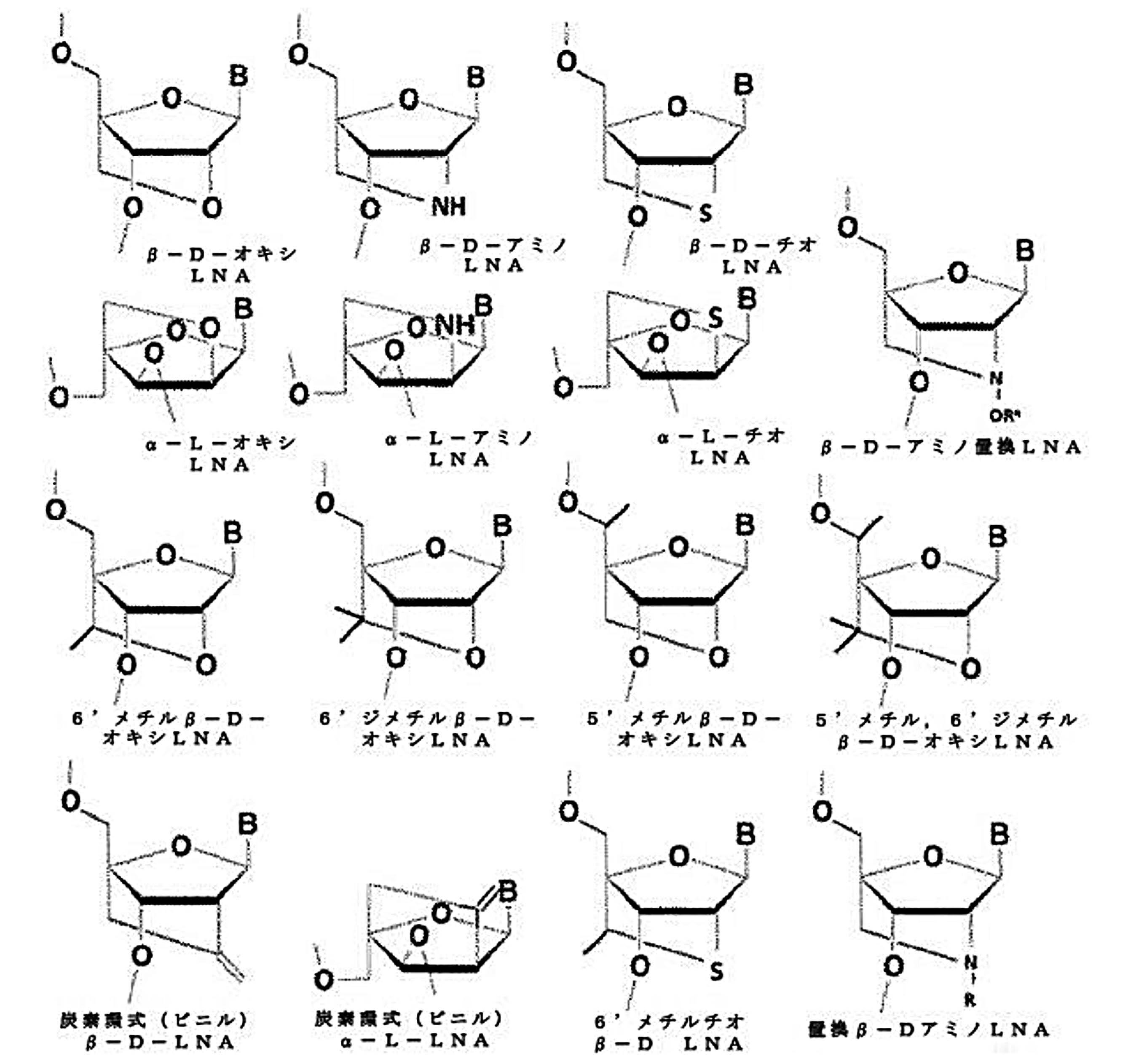
特定のLNAヌクレオシドは、β-D-オキシ-LNA、6’-メチル-β-D-オキシLNA、例えば(S)-6’-メチル-β-D-オキシ-LNA(ScET)およびENAである。 Specific LNA nucleosides are β-D-oxy-LNA, 6'-methyl-β-D-oxy LNA, for example (S) -6'-methyl-β-D-oxy-LNA (ScET) and ENA. ..
特定の有利なLNAは、β-D-オキシ-LNAである。 A particular advantageous LNA is β-D-oxy-LNA.
RNase Hの活性および動員
アンチセンスオリゴヌクレオチドのRNase H活性は、相補的RNA分子と二重鎖を形成するときにRNase Hを動員する、その能力を指す。国際公開第01/23613号パンフレットは、RNase H活性を決定するin vitro方法を提供しており、これはRNase Hを動員する能力の決定に使用することができる。典型的には、オリゴヌクレオチドが、相補的標的核酸配列が提供された場合に、被験修飾オリゴヌクレオチドと同じ塩基配列を有するが、オリゴヌクレオチドの全モノマー間にホスホロチオエート結合を有するDNAモノマーのみを含むオリゴヌクレオチドを使用し、国際公開第01/23613号パンフレット(参照により本明細書に組み込まれる)の実施例91~95により提供される方法論を使用して決定された初期速度(pmol/l/分で測定)の少なくとも5%、例えば少なくとも10%または20%超の初期速度を有する場合に、このオリゴヌクレオチドはRNase Hを動員することができると見なされる。RHase H活性の測定に使用するために、組換えヒトRNase H1が、Lubio Science GmbH,Lucerne,Switzerlandから入手可能である。
RNase H activity and recruitment The RNase H activity of an antisense oligonucleotide refers to its ability to recruit RNase H when forming a duplex with a complementary RNA molecule. WO 01/23613 provides an in vitro method for determining RNase H activity, which can be used to determine the ability to mobilize RNase H. Typically, an oligonucleotide has the same base sequence as the test-modified oligonucleotide when a complementary target nucleic acid sequence is provided, but contains only a DNA monomer having a phosphorothioate bond between all the monomers of the oligonucleotide. Initial rates (pmol / l / min) determined using the methodologies provided by Examples 91-95 of WO 01/23613 (incorporated herein by reference) using nucleotides. This oligonucleotide is considered capable of mobilizing RNase H if it has an initial rate of at least 5% (measured), eg, at least 10% or greater than 20%. Recombinant human RNase H1 is available from Lubio Science GmbH, Lucerne, Switzerland for use in the measurement of RHase H activity.
ギャップマー
本発明のアンチセンスオリゴヌクレオチド、またはその連続ヌクレオチド配列は、ギャップマーであってもよい。アンチセンスギャップマーは、通常、RNase H媒介性分解を介して標的核酸を阻害するために使用される。ギャップマーオリゴヌクレオチドは、少なくとも3つの別個の構造領域、5’-フランク、ギャップおよび3’-フランク、F-G-F’を5’→3’方向で含む。「ギャップ」領域(G)は、オリゴヌクレオチドがRNase Hを動員することを可能にする連続DNAヌクレオチドのストレッチを含む。ギャップ領域には、1つ以上の糖修飾ヌクレオシド、有利には高親和性糖修飾ヌクレオシドを含む5’隣接領域(F)と、1つ以上の糖修飾ヌクレオシド、有利には高親和性糖修飾ヌクレオシドを含む3’隣接領域(F’)が隣接する。領域FおよびF’の1つ以上の糖修飾ヌクレオシドは、標的核酸に対するオリゴヌクレオチドの親和性を向上させる(すなわち、これは親和性向上糖修飾ヌクレオシドである)。いくつかの実施形態において、領域FおよびF’の1つ以上の糖修飾ヌクレオシドは、例えばLNAおよび2’-MOEから独立して選択される、高親和性2’糖修飾などの2’糖修飾ヌクレオシドである。
Gapmer The antisense oligonucleotide of the present invention, or a continuous nucleotide sequence thereof, may be a gapmer. Antisense gapmers are commonly used to inhibit target nucleic acids via RNase H-mediated degradation. Gapmer oligonucleotides contain at least three distinct structural regions, 5'-Frank, Gap and 3'-Frank, F-GF'in the 5'→ 3'direction. The "gap" region (G) comprises a stretch of contiguous DNA nucleotides that allows the oligonucleotide to recruit RNase H. The gap region includes a 5'adjacent region (F) containing one or more sugar-modified nucleosides, preferably a high-affinity sugar-modified nucleoside, and one or more sugar-modified nucleosides, preferably a high-affinity sugar-modified nucleoside. 3'Adjacent regions (F') including 3'adjacent regions (F') are adjacent. One or more sugar-modified nucleosides in regions F and F'improve the affinity of the oligonucleotide for the target nucleic acid (ie, this is an affinity-enhancing sugar-modified nucleoside). In some embodiments, one or more sugar-modified nucleosides in regions F and F'are selected independently of, for example, LNA and 2'-MOE, 2'sugar modifications such as high affinity 2'saccharide modifications. Nucleoside.
ギャップマー設計において、ギャップ領域の最も5’および3’のヌクレオシドはDNAヌクレオシドであり、各々、5’(F)または3’(F’)領域の糖修飾ヌクレオシドに隣接して配置されている。フランクはさらに、ギャップ領域から最も遠い端、すなわち5’フランクの5’末端および3’フランクの3’末端に少なくとも1つの糖修飾ヌクレオシドを有することによって定義されてもよい。 In the Gapmer design, the most 5'and 3'nucleosides in the gap region are DNA nucleosides, located adjacent to the sugar-modified nucleosides in the 5'(F) or 3'(F') regions, respectively. Frank may be further defined by having at least one sugar-modified nucleoside at the farthest end from the gap region, i.e., the 5'end of the 5'frank and the 3'end of the 3'frank.
領域F-G-F’は、連続ヌクレオチド配列を形成する。本発明のアンチセンスオリゴヌクレオチド、またはその連続ヌクレオチド配列は、式F-G-F’のギャップマー領域を含み得る。 Regions FGF'form a continuous nucleotide sequence. The antisense oligonucleotide of the present invention, or a continuous nucleotide sequence thereof, may contain a gapmer region of the formula FGF'.
ギャップマー設計F-G-F’の全長は、例えば12~32ヌクレオシド、例えば13~24、例えば14~22ヌクレオシド、例えば14~17、例えば16~18ヌクレオシドであり得る。 The overall length of the Gapmer design FGF'can be, for example, 12 to 32 nucleosides, such as 13 to 24, such as 14 to 22 nucleosides, such as 14 to 17, for example 16 to 18 nucleosides.
例として、本発明のギャップマーオリゴヌクレオチドは、以下の式により表すことができる:
F1-8-G5-16-F’1-8、例えば
F1-8-G7-16-F’2-8
但し、ギャップマー領域の全長は、少なくとも12、例えば少なくとも14ヌクレオチド長であることを条件とする。
As an example, the gapmer oligonucleotide of the present invention can be expressed by the following formula:
F 1-8 -G 5-16 - F'1-8, for example F 1-8 - G 7-16 -F' 2-8
However, the total length of the gapmer region is required to be at least 12, for example, at least 14 nucleotides in length.
領域F、GおよびF’は、さらに以下に定義され、F-G-F’式に組み込むことができる。 The regions F, G and F'are further defined below and can be incorporated into the FGF'formula.
ギャップマー-領域G
ギャップマーの領域G(ギャップ領域)は、オリゴヌクレオチドがRNaseH、例えばヒトRNase H1を動員することを可能にするヌクレオシド、典型的にはDNAヌクレオシドの領域である。RNaseHは、DNAとRNAの間の二重鎖を認識し、RNA分子を酵素的に切断する細胞酵素である。好適には、ギャップマーは、少なくとも5または6連続DNAヌクレオシド、例えば5~16連続DNAヌクレオシド、例えば6~15連続DNAヌクレオシド、例えば7~14連続DNAヌクレオシド、例えば8~12連続DNAヌクレオチド、例えば8~12連続DNAヌクレオチド長のギャップ領域(G)を有し得る。ギャップ領域Gは、いくつかの実施形態において、6,7,8,9,10,11,12,13,14,15または16の連続DNAヌクレオシドから成り得る。ギャップ領域内の1つ以上のシトシン(C)DNAは、いくつかの場合、メチル化(例えば、DNA cにDNA gが続く場合)されてもよく、そのような残基は、5-メチル-シトシン(meC)と注釈が付けられる。いくつかの実施形態において、ギャップ領域Gは、6,7,8,9,10,11,12,13,14,15または16の連続ホスホロチオエート結合DNAヌクレオシドからなり得る。いくつかの実施形態において、ギャップ内の全ヌクレオシド間結合が、ホスホロチオエート結合である。
Gapmer-Region G
The Gapmer region G (gap region) is the region of the nucleoside, typically the DNA nucleoside, that allows the oligonucleotide to recruit RNase H, eg, human RNase H1. RNase H is a cellular enzyme that recognizes the double strand between DNA and RNA and enzymatically cleaves RNA molecules. Preferably, the gapmer is at least 5 or 6 contiguous DNA nucleosides, eg 5-16 contiguous DNA nucleosides, eg 6-15 contiguous DNA nucleosides, eg 7-14 contiguous DNA nucleosides, eg 8-12 contiguous DNA nucleotides, eg 8 It may have a gap region (G) of ~ 12 consecutive DNA nucleotide lengths. The gap region G may consist of 6,7,8,9,10,11,12,13,14,15 or 16 contiguous DNA nucleosides in some embodiments. One or more cytosine (C) DNAs in the gap region may be methylated (eg, DNA c followed by DNA g) in some cases, such residues being 5-methyl-. Annotated as cytosine ( me C). In some embodiments, the gap region G can consist of 6,7,8,9,10,11,12,13,14,15 or 16 consecutive phosphorothioate-binding DNA nucleosides. In some embodiments, the binding between all nucleosides within the gap is a phosphorothioate binding.
従来のギャップマーはDNAギャップ領域を有するが、ギャップ領域内で使用される場合にRNaseH動員を可能にする修飾ヌクレオシドの例が多数存在する。ギャップ領域内に含まれる場合にRNaseHの動員が可能であるとして報告されている修飾ヌクレオシドには、例えば、α-L-LNA、C4’-アルキル化DNA(PCT/EP2009/050349およびVester et al.,Bioorg.Med.Chem.Lett.18(2008)2296-2300に記載のもの、両方とも参照により本明細書に組み込まれる)、ANAおよび2’F-ANAのようなアラビノース由来ヌクレオシド(Mangos et al.2003 J.AM.CHEM.SOC.125,654-661)、UNA(アンロックド核酸)(参照により本明細書に組み込まれるFluiter et al.,Mol.Biosyst.,2009,10,1039に記載のもの)が含まれる。UNAは、典型的には、リボースのC2とC3の間の結合が除去され、アンロックド「糖」残基を形成するアンロックド核酸である。このようなギャップマーに使用されている修飾ヌクレオシドは、ギャップ領域内に導入された場合に2’エンド(endo)(DNA様)構造を採択する(すなわち、RNaseH動員を可能にする修飾)ヌクレオシドであり得る。いくつかの実施形態において、本明細書に記載されるDNAギャップ領域(G)は、場合により、ギャップ領域内に導入された際に2’エンド(endo)(DNA様)構造を採択する1~3個の糖修飾ヌクレオシドを含んでもよい。 Although conventional gapmers have a DNA gap region, there are numerous examples of modified nucleosides that allow RNase H recruitment when used within the gap region. Modified nucleosides reported to be capable of RNaseH recruitment when contained within the gap region include, for example, α-L-LNA, C4'-alkylated DNA (PCT / EP2009 / 050349 and Vester et al. , Bioorg. Med. Chem. Lett. 18 (2008) 2296-2300, both incorporated herein by reference), arabinose-derived nucleosides such as ANA and 2'F-ANA. 2003 J.AM.CHEM.SOC.125,654-661), UNA (Unlocked Nucleic Acids) (Flitter et al., Mol. Biosys., 2009, 10, 1039, incorporated herein by reference. ) Is included. UNA is typically an unlocked nucleic acid in which the bond between ribose C2 and C3 is removed to form an unlocked "sugar" residue. The modified nucleosides used in such gapmers are nucleosides that adopt a 2'endo (DNA-like) structure when introduced into the gap region (ie, a modification that allows RNase H recruitment). possible. In some embodiments, the DNA gap region (G) described herein adopts a 2'endo (DNA-like) structure when introduced into the gap region 1- It may contain three sugar-modified nucleosides.
領域G-「ギャップブレーカー」
または、いくつかのRNaseH活性を保持しながら、ギャップマーのギャップ領域に3’エンドコンホメーションを付与する修飾ヌクレオシドの挿入についての多くの報告が存在する。1つ以上の3’エンド修飾ヌクレオシドを含むギャップ領域を有するこのようなギャップマーは、「ギャップブレーカー」または「ギャップ破壊」ギャップマーと称される。例えば、国際公開第2013/022984号パンフレットを参照されたい。ギャップブレーカーオリゴヌクレオチドは、RNaseH動員を可能にするために、ギャップ領域内にDNAヌクレオシドの十分な領域を保持する。RNaseHを動員するためのギャップブレーカーオリゴヌクレオチド設計の能力は、典型的には、配列特異的、または化合物特異的でさえある(Rukov et al.2015 Nucl.Acids Res.Vol.43 pp.8476-8487を参照されたい)。当該文献は、いくつかの場合、標的RNAのより特異的な切断を提供するRNaseHを動員する「ギャップブレーカー」オリゴヌクレオチドを開示している。ギャップブレーカーオリゴヌクレオチドのギャップ領域内で使用される修飾ヌクレオシドは、例えば、3’エンドコンホメーションを付与する修飾ヌクレオシド、例えば2’-O-メチル(OMe)もしくは2’-O-MOE(MOE)ヌクレオシド、またはβ-D LNAヌクレオシド(ヌクレオシドのリボース糖環のC2’とC4’との間の架橋が、βコンホメーションである)、例えばβ-D-オキシLNAまたはScETヌクレオシドであり得る。
Area G- "Gap Breaker"
Alternatively, there are many reports of insertion of modified nucleosides that confer a 3'end conformation to the gap region of the gapmer while retaining some RNase H activity. Such gapmers with a gap region containing one or more 3'end-modified nucleosides are referred to as "gap breakers" or "gap-breaking" gapmers. See, for example, Pamphlet International Publication No. 2013/022984. The gap breaker oligonucleotide retains a sufficient region of the DNA nucleoside within the gap region to allow RNase H recruitment. The ability of gap breaker oligonucleotide designs to mobilize RNase H is typically sequence-specific, or even compound-specific (Rukov et al. 2015 Nucl. Acids Res. Vol. 43 pp. 8476-8487). Please refer to). The literature discloses "gap breaker" oligonucleotides that, in some cases, mobilize RNase H to provide more specific cleavage of the target RNA. The modified nucleoside used within the gap region of the gap breaker oligonucleotide is, for example, a modified nucleoside that imparts a 3'end conformation, such as 2'-O-methyl (OMe) or 2'-O-MOE (MOE). It can be a nucleoside, or a β-D LNA nucleoside (the cross-linking between the C2'and C4' of the ribose sugar ring of the nucleoside is the β conformation), such as the β-D-oxy LNA or ScET nucleoside.
上述した領域Gを含むギャップマーと同様に、ギャップブレーカーまたはギャップ破壊ギャップマーのギャップ領域は、ギャップの5’末端に(領域Fの3’ヌクレオシドに隣接して)DNAヌクレオシドを有し、ギャップの3’末端に(領域F’の5’ヌクレオシドに隣接して)DNAヌクレオシドを有する。破壊ギャップを含むギャップマーは、典型的には、ギャップ領域の5’末端または3’末端のいずれかに少なくとも3または4連続DNAヌクレオシドの領域を保持する。 Similar to the gapmer containing region G described above, the gap region of the gap breaker or gap breaking gapmer has a DNA nucleoside (adjacent to the 3'nucleoside of region F) at the 5'end of the gap and is of the gap. It has a DNA nucleoside (adjacent to the 5'nucleoside in region F') at the 3'end. Gapmers containing disruption gaps typically retain at least 3 or 4 contiguous regions of DNA nucleosides at either the 5'end or the 3'end of the gap region.
ギャップブレーカーオリゴヌクレオチドの例示的な設計は、
F1-8-[D3-4-E1-D3-4]-F’1-8
F1-8-[D1-4-E1-D3-4]-F’1-8
F1-8-[D3-4-E1-D1-4]-F’1-8
を含み、領域Gは、[Dn-Er-Dm]内であり、Dは、DNAヌクレオシドの連続配列であり、Eは、修飾ヌクレオシド(ギャップブレーカーまたはギャップ破壊ヌクレオシド)であり、FおよびF’は、本明細書に定義した隣接領域であるが、ただし、ギャップマー領域F-G-F’の全長は、少なくとも12、例えば14ヌクレオチド長であることを条件とする。
An exemplary design of a gap breaker oligonucleotide
F 1-8- [D 3-4 -E 1 - D 3-4 ] -F'1-8
F 1-8- [D 1-4 -E 1 -D 3-4 ] -F'1-8
F 1-8- [D 3-4 - E 1-4 ] -F'1-8
Contains, region G is within [ Dn - Er - Dm ], D is a continuous sequence of DNA nucleosides, E is a modified nucleoside (gap breaker or gap breaking nucleoside), F and F'is an adjacent region as defined herein, provided that the total length of the gapmer region FGF'is at least 12, for example 14 nucleotides in length.
いくつかの実施形態において、ギャップ破壊ギャップマーの領域Gは、少なくとも6個のDNAヌクレオシド、例えば6,7,8,9,10,11,12,13,14,15または16個のDNAヌクレオシドを含む。上述したように、DNAヌクレオシドは連続であってもよく、場合により1つ以上の修飾ヌクレオシドが散在してもよいが、ただし、ギャップ領域Gは、RNaseH動員を媒介できることを条件とする。 In some embodiments, the region G of the gap disruption gapmer contains at least 6 DNA nucleosides, such as 6,7,8,9,10,11,12,13,14,15 or 16 DNA nucleosides. include. As mentioned above, the DNA nucleosides may be continuous and optionally one or more modified nucleosides, provided that the gap region G is capable of mediating RNase H recruitment.
ギャップマー-隣接領域、FおよびF’
領域Fは、領域Gの5’DNAヌクレオシドのすぐ隣に配置されている。領域Fの最も3’のヌクレオシドは、糖修飾ヌクレオシド、例えば高親和性糖修飾ヌクレオシド、例えば2’置換ヌクレオシド、例えばMOEヌクレオシド、またはLNAヌクレオシドである。
Gapmer-adjacent areas, F and F'
Region F is located immediately next to the 5'DNA nucleoside in region G. The most 3'nucleoside in region F is a sugar modified nucleoside, such as a high affinity sugar modified nucleoside, such as a 2'substituted nucleoside, such as a MOE nucleoside, or an LNA nucleoside.
領域F’は、領域Gの3’DNAヌクレオシドのすぐ隣に配置されている。領域Fの最も5’のヌクレオシドは、糖修飾ヌクレオシド、例えば高親和性糖修飾ヌクレオシド、例えば2’置換ヌクレオシド、例えばMOEヌクレオシド、またはLNAヌクレオシドである。 The region F'is located immediately next to the 3'DNA nucleoside in region G. The most 5'nucleoside in region F is a sugar modified nucleoside, such as a high affinity sugar modified nucleoside, such as a 2'substituted nucleoside, such as a MOE nucleoside, or an LNA nucleoside.
領域Fは、1~8連続ヌクレオチド長、例えば2~6、例えば3~4連続ヌクレオチド長である。有利な方法では、領域Fの最も5’のヌクレオシドは、糖修飾ヌクレオシドである。いくつかの実施形態において、領域Fの2つの最も5’のヌクレオシドは、糖修飾ヌクレオシドである。いくつかの実施形態において、領域Fの最も5’のヌクレオシドは、LNAヌクレオシドである。いくつかの実施形態において、領域Fの2つの最も5’のヌクレオシドは、LNAヌクレオシドである。いくつかの実施形態において、領域Fの2つの最も5’のヌクレオシドは、2’置換ヌクレオシドヌクレオシド、例えば2つの3’MOEヌクレオシドである。いくつかの実施形態において、領域Fの最も5’のヌクレオシドは、2’置換ヌクレオシド、例えばMOEヌクレオシドである。 Region F has 1 to 8 consecutive nucleotide lengths, such as 2 to 6, for example 3 to 4 consecutive nucleotide lengths. In an advantageous manner, the most 5'nucleoside in region F is a sugar-modified nucleoside. In some embodiments, the two most 5'nucleosides of region F are sugar-modified nucleosides. In some embodiments, the most 5'nucleoside in region F is the LNA nucleoside. In some embodiments, the two most 5'nucleosides in region F are LNA nucleosides. In some embodiments, the two most 5'nucleosides of region F are 2'substituted nucleosides, eg two 3'MOE nucleosides. In some embodiments, the most 5'nucleoside in region F is a 2'substituted nucleoside, such as a MOE nucleoside.
領域F’は、2~8連続ヌクレオチド長、例えば3~6、例えば4~5連続ヌクレオチド長である。有利な方法では、領域F’の最も3’の実施形態は、糖修飾ヌクレオシドである。いくつかの実施形態において、領域F’の2つの最も3’のヌクレオシドは、糖修飾ヌクレオシドである。いくつかの実施形態において、領域F’の2つの最も3’のヌクレオシドは、LNAヌクレオシドである。いくつかの実施形態において、領域F’の最も3’のヌクレオシドは、LNAヌクレオシドである。いくつかの実施形態において、領域F’の2つの最も3’のヌクレオシドは、2’置換ヌクレオシドヌクレオシド、例えば2つの3’MOEヌクレオシドである。いくつかの実施形態において、領域F’の最も3’のヌクレオシドは、2’置換ヌクレオシド、例えばMOEヌクレオシドである。 Region F'has a 2-8 contiguous nucleotide length, eg 3-6, eg 4-5 contiguous nucleotide lengths. In an advantageous manner, the most 3'embodiment of region F'is a sugar-modified nucleoside. In some embodiments, the two most 3'nucleosides of region F'are sugar-modified nucleosides. In some embodiments, the two most 3'nucleosides of region F'are LNA nucleosides. In some embodiments, the most 3'nucleoside in region F'is the LNA nucleoside. In some embodiments, the two most 3'nucleosides of the region F'are 2'substituted nucleosides, eg two 3'MOE nucleosides. In some embodiments, the most 3'nucleoside in region F'is a 2'substituted nucleoside, such as a MOE nucleoside.
領域Fまたは領域F’の長さが1である場合、それは有利な方法ではLNAヌクレオシドであることに留意するべきである。 It should be noted that if the length of region F or region F'is 1, it is an LNA nucleoside in an advantageous way.
いくつかの実施形態において、領域Fおよび領域F’は、独立して、糖修飾ヌクレオシドの連続配列からなるか、またはそれを含む。いくつかの実施形態において、領域Fの糖修飾ヌクレオシドは、独立して、2’-O-アルキル-RNA単位、2’-O-メチル-RNA、2’-アミノ-DNA単位、2’-フルオロ-DNA単位、2’-アルコキシ-RNA、MOE単位、LNA単位、アラビノ核酸(ANA)単位および2’-フルオロ-ANA単位から選択されてもよい。 In some embodiments, the region F and the region F'independently consist of or include a continuous sequence of sugar-modified nucleosides. In some embodiments, the sugar-modified nucleosides of region F are independently 2'-O-alkyl-RNA units, 2'-O-methyl-RNA, 2'-amino-DNA units, 2'-fluoro. It may be selected from -DNA units, 2'-alkoxy-RNA, MOE units, LNA units, arabinonucleic acid (ANA) units and 2'-fluoro-ANA units.
いくつかの実施形態において、領域Fおよび領域F’は、独立して、LNAおよび2’置換修飾ヌクレオシドの両方を含む(混合ウイング設計)。 In some embodiments, the region F and the region F'independently contain both an LNA and a 2'substitution modified nucleoside (mixed wing design).
いくつかの実施形態において、領域Fおよび領域F’は、1タイプのみの糖修飾ヌクレオシド、例えばMOEのみ、またはβ-D-オキシLNAのみ、またはScETのみからなる。このような設計は、均一フランクまたは均一ギャップマー設計とも称される。 In some embodiments, the region F and region F'consist of only one type of sugar-modified nucleoside, such as MOE only, or β-D-oxyLNA only, or ScET only. Such a design is also referred to as a uniform flank or uniform gapmer design.
いくつかの実施形態において、領域FもしくはF’、またはFおよびF’の全ヌクレオシドは、例えばβ-D-オキシLNA、ENAまたはScETヌクレオシドから独立して選択される、LNAヌクレオシドである。いくつかの実施形態において、領域Fは、1~5、例えば2~4、例えば3~4、例えば1、2、3、4または5連続LNAヌクレオシドからなる。いくつかの実施形態において、領域FおよびF’の全ヌクレオシドは、β-D-オキシLNAヌクレオシドである。 In some embodiments, the total nucleosides of regions F or F', or F and F', are LNA nucleosides, which are independently selected from, for example, β-D-oxy LNA, ENA or ScET nucleosides. In some embodiments, the region F consists of 1-5, eg 2-4, eg 3-4, eg 1, 2, 3, 4 or 5 consecutive LNA nucleosides. In some embodiments, the total nucleosides of regions F and F'are β-D-oxy-LNA nucleosides.
いくつかの実施形態において、領域FもしくはF’、またはFおよびF’の全ヌクレシドは、2’置換ヌクレオシド、例えばOMeまたはMOEヌクレオシドである。いくつかの実施形態において、領域Fは、1、2、3、4、5、6、7または8連続OMeまたはMOEヌクレオシドからなる。いくつかの実施形態において、隣接領域の1つのみが、2’置換ヌクレオシド、例えばOMeまたはMOEからなり得る。いくつかの実施形態において、2’置換ヌクレオシド、例えばOMeまたはMOEヌクレオシドからなるのは5’(F)隣接領域であり、一方、3’(F’)隣接領域は、少なくとも1つのLNAヌクレオシド、例えばβ-D-オキシLNAヌクレオシドまたはcETヌクレオシドを含む。いくつかの実施形態において、2’置換ヌクレオシド、例えばOMeまたはMOEヌクレオシドからなるのは3’(F’)隣接領域であり、一方、5’(F)隣接領域は、少なくとも1つのLNAヌクレオシド、例えばβ-D-オキシLNAヌクレオシドまたはcETヌクレオシドを含む。 In some embodiments, the total nucleosides of regions F or F', or F and F', are 2'substituted nucleosides, such as OMe or MOE nucleosides. In some embodiments, the region F consists of 1, 2, 3, 4, 5, 6, 7 or 8 consecutive OMEs or MOE nucleosides. In some embodiments, only one of the adjacent regions can consist of a 2'substituted nucleoside, such as OMe or MOE. In some embodiments, the 2'substituted nucleosides, such as OMe or MOE nucleosides, consist of 5'(F) flanking regions, while the 3'(F') flanking regions are at least one LNA nucleoside, eg, Includes β-D-oxy-LNA nucleoside or cET nucleoside. In some embodiments, the 2'substituted nucleosides, such as OMe or MOE nucleosides, consist of 3'(F') flanking regions, while the 5'(F) flanking regions are at least one LNA nucleoside, eg, Includes β-D-oxy-LNA nucleoside or cET nucleoside.
いくつかの実施形態において、領域FおよびF’の全修飾ヌクレオシドが、LNAヌクレオシド、例えばβ-D-オキシLNA、ENAまたはScETヌクレオシドから独立して選択されるLNAヌクレオシドであり、領域FもしくはF’、またはFおよびF’は、場合によりDNAヌクレオシドを含んでもよい(交互フランク、より詳細にはこれらの定義を参照されたい)。いくつかの実施形態において、領域FおよびF’の全修飾ヌクレオシドはβ-D-オキシLNAヌクレオシドであり、領域FもしくはF’、またはFおよびF’は、場合によりDNAヌクレオシドを含んでもよい(交互フランク、より詳細にはこれらの定義を参照されたい)。 In some embodiments, the fully modified nucleosides of regions F and F'are LNA nucleosides independently selected from LNA nucleosides such as β-D-oxyLNA, ENA or ScET nucleosides and are regions F or F'. , Or F and F'may optionally contain DNA nucleosides (alternate flanks, see these definitions for more details). In some embodiments, the fully modified nucleosides of regions F and F'are β-D-oxyLNA nucleosides, and regions F or F', or F and F', may optionally contain DNA nucleosides (alternate). Frank, see these definitions for more details).
いくつかの実施形態において、領域FおよびF’の最も5’および最も3’のヌクレオシドは、LNAヌクレオシド、例えばβ-D-オキシLNAヌクレオシドまたはScETヌクレオシドである。 In some embodiments, the most 5'and most 3'nucleosides of regions F and F'are LNA nucleosides, such as β-D-oxyLNA nucleosides or ScET nucleosides.
いくつかの実施形態において、領域Fと領域Gとの間のヌクレオシド間結合は、ホスホロチオエートヌクレオシド間結合である。いくつかの実施形態において、領域F’と領域Gとの間のヌクレオシド間結合は、ホスホロチオエートヌクレオシド間結合である。いくつかの実施形態において、領域FまたはF’、FおよびF’のヌクレオシドの間のヌクレオシド間結合は、ホスホロチオエートヌクレオシド間結合である。 In some embodiments, the internucleoside bond between region F and region G is a phosphorothioate nucleoside interlink. In some embodiments, the internucleoside bond between the region F'and the region G is a phosphorothioate internucleoside bond. In some embodiments, the internucleoside bond between the regions F or F', F and F'nucleosides is a phosphorothioate nucleoside interlink.
LNAギャップマー
LNAギャップマーは、領域FおよびF’のいずれか一方または両方が、LNAヌクレオシドを含むか、またはそれからなるギャップマーである。β-D-オキシギャップマーは、領域FおよびF’のいずれか一方または両方が、β-D-オキシLNAヌクレオシドを含むか、またはそれからなるギャップマーである。
LNA Gapmer An LNA gapmer is a gapmer in which either or both of regions F and F'contain or consist of LNA nucleosides. A β-D-oxygapmer is a gapmer in which either or both of regions F and F'contain or consist of β-D-oxyLNA nucleosides.
いくつかの実施形態において、LNAギャップマーは、式:[LNA]1-5-[領域G]-[LNA]1-5のものであり、ここで、領域Gはギャップマー領域Gの定義に規定した通りである。 In some embodiments, the LNA gapmer is of the formula: [LNA] 1-5- [Region G]-[LNA] 1-5 , where region G is defined as the gapmer region G. As specified.
MOEギャップマー
MOEギャップマーは、領域FおよびF’がMOEヌクレオシドからなるギャップマーである。いくつかの実施形態において、MOEギャップマーは、設計[MOE]1-8-[領域G]-[MOE]1-8、例えば[MOE]2-7-[領域G]5-16-[MOE]2-7、例えば[MOE]3-6-[領域G]-[MOE]3-6のものであり、領域Gはギャップマーの定義に規定した通りである。5-10-5設計(MOE-DNA-MOE)を有するMOEギャップマーは、当技術分野で広く使用されている。
MOE Gapmer A MOE gapmer is a gapmer in which regions F and F'consist of MOE nucleosides. In some embodiments, the MOE gapmer is designed [MOE] 1-8- [Region G]-[MOE] 1-8, eg [MOE] 2-7- [Region G] 5-16- [ MOE ] . ] 2-7 , for example [MOE] 3-6- [Region G]-[MOE] 3-6 , where region G is as defined in the definition of gapmer. MOE gapmers with a 5-10-5 design (MOE-DNA-MOE) are widely used in the art.
混合ウイングギャップマー
混合ウイングギャップマーは、領域FおよびF’の一方または両方が、2’置換ヌクレオシド、例えば2’-O-アルキル-RNA単位、2’-O-メチル-RNA、2’-アミノ-DNA単位、2’-フルオロ-DNA単位、2’-アルコキシ-RNA、MOE単位、アラビノ核酸(ANA)単位および2’-フルオロ-ANA単位からなる群から独立して選択される2’置換ヌクレオシド、例えばMOEヌクレオシドを含むLNAギャップマーである。領域FおよびF’の少なくとも一方、または領域FおよびF’の両方が少なくとも1つのLNAヌクレオシドを含むいくつかの実施形態において、領域FおよびF’の残りのヌクレオシドは、MOEおよびLNAからなる群から独立して選択される。領域FおよびF’の少なくとも一方、または領域FおよびF’の両方が少なくとも2つのLNAヌクレオシドを含むいくつかの実施形態において、領域FおよびF’の残りのヌクレオシドは、MOEおよびLNAからなる群から独立して選択される。いくつかの混合ウイング実施形態において、領域FおよびF’の一方または両方が、1つ以上のDNAヌクレオシドをさらに含んでもよい。
Mixed Wing Gap Mar A mixed wing gap mar is a mixed wing gapmer in which one or both of the regions F and F'are 2'substituted nucleosides, such as 2'-O-alkyl-RNA units, 2'-O-methyl-RNA, 2'-amino. A 2'substituted nucleoside independently selected from the group consisting of -DNA units, 2'-fluoro-DNA units, 2'-alkoxy-RNA, MOE units, arabinonucleic acid (ANA) units and 2'-fluoro-ANA units. , For example, an LNA gapmer containing a MOE nucleoside. In some embodiments where at least one of regions F and F', or both regions F and F'contains at least one LNA nucleoside, the remaining nucleosides of regions F and F'come from the group consisting of MOE and LNA. Selected independently. In some embodiments where at least one of regions F and F', or both regions F and F'contains at least two LNA nucleosides, the remaining nucleosides of regions F and F'come from the group consisting of MOE and LNA. Selected independently. In some mixed wing embodiments, one or both of regions F and F'may further comprise one or more DNA nucleosides.
混合ウイングギャップマー設計は、国際公開第2008/049085号パンフレットおよび国際公開第2012/109395号パンフレット(これらの両方は参照により本明細書に組み込まれる)に開示されている。 The mixed wing gapmer design is disclosed in WO 2008/049085 and WO 2012/109395, both of which are incorporated herein by reference.
交互フランクギャップマー
交互フランクを有するオリゴヌクレオチドは、フランクの少なくとも一方(FまたはF’)が、LNAヌクレオシドに加えてDNAを含むLNAギャップマーオリゴヌクレオチドである。いくつかの実施形態において、領域FもしくはF’の少なくとも一方、または領域FおよびF’の両方は、LNAヌクレオシドおよびDNAヌクレオシドの両方を含む。このような実施形態において、隣接領域FもしくはF’、またはFおよびF’の両方は、少なくとも3つのヌクレオシドを含み、Fおよび/またはF’領域の最も5’および3’のヌクレオシドが、LNAヌクレオシドである。
Alternate Frank Gapmer Oligonucleotides with alternating flanks are LNA gapmer oligonucleotides in which at least one of the flanks (F or F') contains DNA in addition to the LNA nucleoside. In some embodiments, at least one of regions F or F', or both regions F and F', comprises both LNA nucleosides and DNA nucleosides. In such embodiments, the flanking regions F or F', or both F and F', contain at least three nucleosides, with the most 5'and 3'nucleosides in the F and / or F'region being LNA nucleosides. Is.
いくつかの実施形態において、領域FもしくはF’の少なくとも一方、または領域FおよびF’の両方は、LNAヌクレオシドおよびDNAヌクレオシドの両方を含む。そのような実施形態において、隣接領域FもしくはF’、またはFおよびF’の両方は、少なくとも3つのヌクレオシドを含み、FまたはF’領域の最も5’および3’のヌクレオシドはLNAヌクレオシドであり、領域FまたはF’(または領域FまたはF’の両方)の最も5’および3’のLNAヌクレオシド間に位置する少なくとも1つのDNAヌクレオシドが存在する。 In some embodiments, at least one of regions F or F', or both regions F and F', comprises both LNA nucleosides and DNA nucleosides. In such embodiments, the flanking regions F or F', or both F and F', contain at least 3 nucleosides, and the most 5'and 3'nucleosides in the F or F'region are LNA nucleosides. There is at least one DNA nucleoside located between the most 5'and 3'LNA nucleosides in the region F or F'(or both regions F or F').
オリゴヌクレオチド内の領域D’またはD’’
本発明のオリゴヌクレオチドは、いくつかの実施形態において、標的核酸に相補的なオリゴヌクレオチドの連続ヌクレオチド配列、例えばギャップマーF-G-F’、ならびにさらに5’および/または3’ヌクレオシドを含むか、またはそれからなり得る。さらなる5’および/または3’ヌクレオシドは、標的核酸に完全に相補的であってもよく、または完全に相補的でなくてもよい。このようなさらなる5’および/または3’ヌクレオシドは、本明細書において領域D’およびD’’と称され得る。
Region D'or D'' within the oligonucleotide
Whether the oligonucleotides of the invention contain, in some embodiments, a contiguous nucleotide sequence of oligonucleotides complementary to the target nucleic acid, such as Gapmer FGF', and further 5'and / or 3'nucleosides. , Or can consist of it. The additional 5'and / or 3'nucleosides may or may not be completely complementary to the target nucleic acid. Such additional 5'and / or 3'nucleosides may be referred to herein as regions D'and D'.
領域D’またはD’’の付加は、連続ヌクレオチド配列、例えばギャップマーをコンジュゲート部分または別の官能基に連結することを目的として用いられ得る。連続ヌクレオチド配列をコンジュゲート部分に連結するのに使用される場合、生体切断性リンカーとしての役割を果たし得る。または、それはエキソヌクレオアーゼ(exonucleoase)保護を提供するために、または合成もしくは製造を容易にするために使用され得る。 The addition of the region D'or D'can be used to link a contiguous nucleotide sequence, such as a gapmer, to a conjugated moiety or another functional group. When used to ligate contiguous nucleotide sequences to conjugate moieties, it can serve as a biocleavable linker. Alternatively, it may be used to provide exonucleose protection or to facilitate synthesis or production.
領域D’およびD’’は、各々、領域Fの5’末端または領域F’の3’末端に結合して、以下の式D’-F-G-F’、F-G-F’-D’’または
D’-F-G-F’-D’’の設計を生成することができる。この場合、F-G-F’はオリゴヌクレオチドのギャップマー部分であり、領域D’またはD’’は、オリゴヌクレオチドの別個の部分を構成する。
The regions D'and D'are bound to the 5'end of region F or the 3'end of region F', respectively, and have the following equations D'-GF', F-GF'-, respectively. A design of D'' or D'-GF'-D "can be generated. In this case, FGF'is the gapmer portion of the oligonucleotide and the region D'or D'' constitutes a separate portion of the oligonucleotide.
領域D’またはD’’は、独立して、1、2、3、4または5個の追加のヌクレオチドを含むか、またはそれからなり、標的核酸に相補的であっても、または相補的でなくてもよい。FまたはF’領域に隣接するヌクレオチドは、糖修飾ヌクレオチドではなく、例えばDNAまたはRNAまたはこれらの塩基修飾バージョンである。D’およびD’’領域は、ヌクレアーゼ感受性の生体切断性リンカーとしての役割を果たし得る(リンカーの定義を参照されたい)。いくつかの実施形態において、追加の5’および/または3’末端ヌクレオチドは、ホスホジエステル結合で連結されており、DNAまたはRNAである。領域D’またはD’’としての使用に好適なヌクレオチドベースの生体切断性リンカーは、国際公開第2014/076195号パンフレットに開示されており、これには例としてホスホジエステル結合DNAジヌクレオチドが含まれる。ポリオリゴヌクレオチド構築物における生体切断性リンカーの使用は、国際公開第2015/113922号パンフレットに開示されており、それらは複数のアンチセンス構築物(例えば、ギャップマー領域)を単一のオリゴヌクレオチド内で結合するのに使用されている。 Regions D'or D'independently contain, or consist of 1, 2, 3, 4 or 5 additional nucleotides, which may or may not be complementary to the target nucleic acid. You may. Nucleotides flanking the F or F'region are not sugar-modified nucleotides, but are, for example, DNA or RNA or base-modified versions thereof. The D'and D'regions can serve as nuclease-sensitive biocleavable linkers (see Linker Definition). In some embodiments, the additional 5'and / or 3'terminal nucleotides are linked with phosphodiester bonds and are DNA or RNA. Nucleotide-based biocleavable linkers suitable for use as regions D'or D'' are disclosed in WO 2014/076195, which includes, by way of example, phosphodiester-bound DNA dinucleotides. .. The use of biocleavable linkers in polyoligonucleotide constructs is disclosed in WO 2015/113922, which bind multiple antisense constructs (eg, gapmer regions) within a single oligonucleotide. Used to do.
一実施形態において、本発明のオリゴヌクレオチドは、ギャップマーを構成する連続ヌクレオチド配列に加えて、領域D’および/またはD’’を含む。 In one embodiment, the oligonucleotides of the invention include regions D'and / or D "in addition to the contiguous nucleotide sequences that make up the gapmer.
いくつかの実施形態において、本発明のオリゴヌクレオチドは、以下の式により表すことができる:
F-G-F’;特にF1-8-G5-16-F’2-8
D’-F-G-F’、特にD’1-3-F1-8-G5-16-F’2-8
F-G-F’-D’’、特にF1-8-G5-16-F’2-8-D’’1-3
D’-F-G-F’-D’’、特にD’1-3-F1-8-G5-16-F’2-8-D’’1-3
In some embodiments, the oligonucleotides of the invention can be represented by the following equation:
F-GF'; especially F 1-8 -G 5-16 -F' 2-8
D'-F-GF', especially D' 1-3 -F 1-8 -G 5-16 -F' 2-8
FG-F'-D ", especially F 1-8 -G 5-16 -F' 2-8 -D" 1-3
D'-F-GF'-D', especially D' 1-3 -F 1-8 -G 5-16 -F' 2-8 -D " 1-3
いくつかの実施形態において、領域D’と領域Fとの間に位置するヌクレオシド間結合は、ホスホジエステル結合である。いくつかの実施形態において、領域F’と領域D’’との間に位置するヌクレオシド間結合は、ホスホジエステル結合である。 In some embodiments, the nucleoside bond located between the region D'and the region F is a phosphodiester bond. In some embodiments, the nucleoside bond located between the regions F'and D'is a phosphodiester bond.
コンジュゲート
本明細書で使用されるコンジュゲートという用語は、非ヌクレオチド部分(コンジュゲート部分または領域Cまたは第3の領域)に共有結合したオリゴヌクレオチドを指す。
Conjugate As used herein, the term conjugate refers to an oligonucleotide covalently attached to a non-nucleotide moiety (conjugated moiety or region C or third region).
1つ以上の非ヌクレオチド部分に対する本発明のオリゴヌクレオチドのコンジュゲーションは、例えば、オリゴヌクレオチドの活性、細胞分布、細胞取り込み、または安定性に影響を及ぼすことにより、オリゴヌクレオチドの薬理学的性質を改善することができる。いくつかの実施形態において、コンジュゲート部分は、オリゴヌクレオチドの細胞分布、バイオアベイラビリティ、代謝、排泄、浸透性、および/または細胞取り込みを改善することにより、オリゴヌクレオチドの薬物動態特性を調節または向上させる。特に、コンジュゲートは、オリゴヌクレオチドを特定の器官、組織または細胞型に標的化し、それにより、その器官、組織または細胞型におけるオリゴヌクレオチドの有効性を向上させることができる。同時に、コンジュゲートは、非標的細胞型、組織または器官におけるオリゴヌクレオチドの活性(例えば、オフターゲット活性または非標的細胞型、組織もしくは器官における活性)を低下させる役割を果たし得る。 Conjugation of oligonucleotides of the invention to one or more non-nucleotide moieties improves the pharmacological properties of oligonucleotides, for example by affecting the activity, cell distribution, cell uptake, or stability of the oligonucleotide. can do. In some embodiments, the conjugate moiety regulates or enhances the pharmacokinetic properties of the oligonucleotide by improving cell distribution, bioavailability, metabolism, excretion, permeability, and / or cell uptake of the oligonucleotide. .. In particular, conjugates can target an oligonucleotide to a particular organ, tissue or cell type, thereby improving the effectiveness of the oligonucleotide in that organ, tissue or cell type. At the same time, the conjugate may play a role in reducing the activity of the oligonucleotide in a non-target cell type, tissue or organ (eg, off-target activity or activity in a non-target cell type, tissue or organ).
一実施形態において、非ヌクレオチド部分(コンジュゲート部分)は、炭水化物、細胞表面受容体リガンド、原薬、ホルモン、親油性物質、ポリマー、タンパク質、ペプチド、毒素(例えば、細菌毒素)、ビタミン、ウイルスタンパク質(例えば、キャプシド)またはそれらの組み合わせからなる群から選択される。 In one embodiment, the non-nucleotide moiety (conjugated moiety) is a carbohydrate, cell surface receptor ligand, drug substance, hormone, oleophilic substance, polymer, protein, peptide, toxin (eg, bacterial toxin), vitamin, viral protein. It is selected from the group consisting of (eg, capsid) or combinations thereof.
リンカー
結合またはリンカーは、1つ以上の共有結合を介して、ある目的の化学基またはセグメントを別の目的の化学基またはセグメントに連結する、2つの原子間の接続である。コンジュゲート部分は、直接、または結合部分(例えば、リンカーまたはテザー)を介してオリゴヌクレオチドに結合させることができる。リンカーは、第3の領域、例えばコンジュゲート部分(領域C)を、第1の領域、例えばオリゴヌクレオチドまたは連続ヌクレオチド配列またはギャップマー領域F-G-F’(領域A)に共有結合する役割を果たす。
A linker bond or linker is a connection between two atoms that connects a chemical group or segment of interest to another chemical group or segment of interest via one or more covalent bonds. The conjugate moiety can be attached to the oligonucleotide either directly or via a binding moiety (eg, linker or tether). The linker is responsible for covalently linking a third region, eg, a conjugate moiety (region C), to the first region, eg, an oligonucleotide or contiguous nucleotide sequence or gapmer region FGF'(region A). Fulfill.
本発明のいくつかの実施形態において、本発明のコンジュゲートまたはオリゴヌクレオチドコンジュゲートは、場合により、標的核酸に相補的なオリゴヌクレオチドまたは連続ヌクレオチド配列(領域Aまたは第1の領域)と、コンジュゲート部分(領域Cまたは第3の領域)との間に位置するリンカー領域(第2の領域または領域Bおよび/または領域Y)を含み得る。 In some embodiments of the invention, the conjugate or oligonucleotide conjugate of the invention is optionally conjugated with an oligonucleotide or contiguous nucleotide sequence (region A or first region) complementary to the target nucleic acid. It may include a linker region (second region or region B and / or region Y) located between the portion (region C or third region).
領域Bは、哺乳動物の体内で通常遭遇する条件下、または遭遇するものに類似した条件下で切断可能である生理学的に不安定な結合を含むか、またはそれからなる生体切断性リンカーを指す。生理学的に不安定なリンカーが化学的変換(例えば、切断)を受ける条件には、pH、温度、酸化もしくは還元条件または薬剤などの化学条件、および哺乳動物細胞で見られる塩濃度、または遭遇する塩濃度に類似した塩濃度が含まれる。哺乳動物の細胞内条件には、タンパク質分解酵素または加水分解酵素またはヌクレアーゼなどの哺乳動物細胞に通常存在する酵素活性の存在も含まれる。一実施形態において、生体切断性リンカーは、S1ヌクレアーゼ切断の影響を受けやすい。DNAホスホジエステルを含む生体切断性リンカーは、国際公開第2014/076195号パンフレット(参照により本明細書に組み込まれる)にさらに詳細に記載されている。本明細書の領域D’またはD’’も参照されたい。 Region B refers to a biocleavable linker comprising or consisting of a physiologically unstable bond that is cleavable under conditions normally encountered or similar to those encountered in the body of a mammal. Conditions under which a physiologically unstable linker undergoes chemical conversion (eg, cleavage) are encountered with chemical conditions such as pH, temperature, oxidation or reduction conditions or agents, and salt concentrations found in mammalian cells. Includes salt concentrations similar to salt concentrations. Intracellular conditions in mammals also include the presence of enzymatic activity normally present in mammalian cells, such as proteolytic enzymes or hydrolases or nucleases. In one embodiment, the biocleavable linker is susceptible to S1 nuclease cleavage. Biocleavable linkers containing DNA phosphodiesters are described in more detail in WO 2014/076195 (incorporated herein by reference). See also area D'or D'' herein.
領域Yは、必ずしも生体切断性ではないが、主にコンジュゲート部分(領域Cまたは第3の領域)をオリゴヌクレオチド(領域Aまたは第1の領域)に共有結合する役割を果たすリンカーを指す。領域Yリンカーは、エチレングリコール、アミノ酸単位またはアミノアルキル基などの反復単位の鎖構造またはオリゴマーを含み得る。本発明のオリゴヌクレオチドコンジュゲートは、以下の領域構成要素A-C、A-B-C、A-B-Y-C、A-Y-B-CまたはA-Y-Cから構築することができる。いくつかの実施形態において、リンカー(領域Y)は、例えば、C6からC12のアミノアルキル基を含む、C2-C36アミノアルキル基などのアミノアルキルである。好ましい実施形態において、リンカー(領域Y)は、C6アミノアルキル基である。 Region Y refers to a linker that is not necessarily biocleavable but primarily serves to covalently bind a conjugate moiety (region C or third region) to an oligonucleotide (region A or first region). The region Y linker may contain chain structures or oligomers of repeating units such as ethylene glycol, amino acid units or aminoalkyl groups. The oligonucleotide conjugate of the present invention can be constructed from the following region components AC, ABC, ABYC, AYBC or AYC. can. In some embodiments, the linker (region Y) is an aminoalkyl, such as a C2-C36 aminoalkyl group, comprising an aminoalkyl group from C6 to C12, for example. In a preferred embodiment, the linker (region Y) is a C6 aminoalkyl group.
処置
本明細書で使用される用語「処置」は、既存の疾患(例えば、本明細書で言及される疾患または障害)の処置、または疾患の予防(prevention)、すなわち予防(prophylaxis)の両方を指す。したがって、本明細書で言及される処置は、いくつかの実施形態において、予防的であり得ることが認識されよう。
Treatment The term "treatment" as used herein refers to both the treatment of an existing disease (eg, the disease or disorder referred to herein) or the prevention of the disease, ie prophylaxis. Point to. Therefore, it will be appreciated that the procedures referred to herein can be prophylactic in some embodiments.
本発明は、TIA1発現を標的とする、アンチセンスオリゴヌクレオチドなどのオリゴヌクレオチドに関する。 The present invention relates to oligonucleotides such as antisense oligonucleotides that target TIA1 expression.
TIA1を標的とする本発明のオリゴヌクレオチドは、TIA1標的核酸を発現する細胞内でTIA1標的核酸にハイブリダイズし、その発現を阻害することができる。 The oligonucleotide of the present invention that targets TIA1 can hybridize to the TIA1 target nucleic acid in cells expressing the TIA1 target nucleic acid and inhibit its expression.
TIA1標的核酸は、哺乳動物のTIA1 mRNAもしくはpremRNA、例えばヒトTIA1 mRNAもしくはpremRNA、例えば、ホモサピエンスT細胞制限細胞内抗原-1(TIA1)に由来するpremRNAまたはmRNA、第2染色体のRefSeqGene:70,209,444~70,248,660リバース鎖(GRCh38:CM000664.2)であり得る-Ensembl ENSG00000116001(配列番号1)も参照されたい。 TIA1 target nucleic acids are mammalian TIA1 mRNA or pre-mRNA, such as human TIA1 mRNA or pre-mRNA, such as pre-mRNA or mRNA derived from Homo sapiens T cell-restricted intracellular antigen-1 (TIA1), RefSeqGene on chromosome 2, 70, See also 209,444-70,248,660 reverse chain (GRCh38: CM000664.2) -Ensembl ENSG000000116001 (SEQ ID NO: 1).
本発明のオリゴヌクレオチドは、TIA1 mRNAなどの標的核酸を発現する細胞内でTIA1 mRNAなどのTIA1標的核酸の発現を阻害することができる。 The oligonucleotide of the present invention can inhibit the expression of a TIA1 target nucleic acid such as TIA1 mRNA in a cell expressing a target nucleic acid such as TIA1 mRNA.
いくつかの実施形態において、本発明のオリゴヌクレオチドは、標的核酸を発現する細胞内でTIA1標的核酸の発現を阻害し、細胞におけるTIA1標的核酸(例えばmRNA)の発現レベルと比較して、TIA1標的核酸(例えばmRNA)のレベルを、少なくとも50%、少なくとも60%、少なくとも70%、少なくとも80%、または少なくとも90%の阻害で低減することができる。実施例1は、本発明のオリゴヌクレオチドの、標的核酸の発現を阻害する能力を評価するための好適なアッセイを提供する。好適には、化合物の、標的核酸の発現を阻害する能力の評価は、例えば、実施例1に記載のように、ジムノティック(gymnotic)in vitroアッセイなど、in vitroで実施される。 In some embodiments, the oligonucleotides of the invention inhibit the expression of the TIA1 target nucleic acid in cells expressing the target nucleic acid and compare the expression level of the TIA1 target nucleic acid (eg, mRNA) in the cell to the TIA1 target. Levels of nucleic acids (eg, mRNA) can be reduced with inhibition of at least 50%, at least 60%, at least 70%, at least 80%, or at least 90%. Example 1 provides a suitable assay for assessing the ability of the oligonucleotides of the invention to inhibit expression of a target nucleic acid. Preferably, the assessment of the compound's ability to inhibit the expression of the target nucleic acid is performed in vitro, for example, as described in Example 1, such as a gymnotic in vitro assay.
本発明の一態様は、10~30ヌクレオチド長の連続ヌクレオチド配列を含み、配列番号1、および/または配列番号4~53からなる群から選択される配列に少なくとも90%相補的、例えば、完全に相補的であるLNAアンチセンスオリゴヌクレオチドギャップマーに関する。 One aspect of the invention comprises a contiguous nucleotide sequence 10-30 nucleotides in length and is at least 90% complementary, eg, completely complementary, to a sequence selected from the group consisting of SEQ ID NOs: 1 and / or SEQ ID NOs: 4-53. With respect to the complementary LNA antisense oligonucleotide gapmer.
いくつかの実施形態において、オリゴヌクレオチドは、10~30ヌクレオチドの連続配列を含み、標的核酸または標的配列の領域と少なくとも90%相補的、例えば少なくとも91%、例えば少なくとも92%、例えば少なくとも93%、例えば少なくとも94%、例えば少なくとも95%、例えば少なくとも96%、例えば少なくとも97%、例えば少なくとも98%、または100%相補的である。 In some embodiments, the oligonucleotide comprises a contiguous sequence of 10-30 nucleotides and is at least 90% complementary to the target nucleic acid or region of the target sequence, eg at least 91%, eg at least 92%, eg at least 93%. For example, it is at least 94%, eg at least 95%, eg at least 96%, eg at least 97%, eg at least 98%, or 100% complementary.
いくつかの実施形態において、本発明のオリゴヌクレオチドは、12~24、例えば、13,14,15,16,17,18,19,20,21,22,または23連続ヌクレオチド長の連続ヌクレオチド配列を含み、該連続ヌクレオチド配列は、配列番号1に完全に相補的である。 In some embodiments, the oligonucleotides of the invention have 12-24, eg, 13,14,15,16,17,18,19,20,21,22 or 23 contiguous nucleotide sequences of contiguous nucleotide sequences. Containing, the contiguous nucleotide sequence is completely complementary to SEQ ID NO: 1.
いくつかの実施形態において、本発明のアンチセンスオリゴヌクレオチド、またはその連続ヌクレオチド配列は、LNAギャップマー、混合ウイングギャップマー、または交互フランクギャップマーなどのギャップマーである。 In some embodiments, the antisense oligonucleotides of the invention, or contiguous nucleotide sequences thereof, are gapmers such as LNA gapmers, mixed wing gapmers, or alternating flank gapmers.
いくつかの実施形態において、本発明に従ったアンチセンスオリゴヌクレオチドは、少なくとも10連続ヌクレオチド、例えば、少なくとも12連続ヌクレオチド、例えば、少なくとも13連続ヌクレオチド、例えば、少なくとも14連続ヌクレオチド、例えば、少なくとも15連続ヌクレオチドの連続ヌクレオチド配列を含み、配列番号1に完全に相補的である。 In some embodiments, the antisense oligonucleotide according to the invention is at least 10 contiguous nucleotides, eg, at least 12 contiguous nucleotides, eg, at least 13 contiguous nucleotides, eg, at least 14 contiguous nucleotides, eg, at least 15 contiguous nucleotides. Contains a contiguous nucleotide sequence of, and is completely complementary to SEQ ID NO: 1.
いくつかの実施形態において、本発明に従ったアンチセンスオリゴヌクレオチドの連続ヌクレオチド配列は、20ヌクレオチド長未満である。いくつかの実施形態において、本発明に従ったアンチセンスオリゴヌクレオチドの連続ヌクレオチド配列は、12~24ヌクレオチド長である。いくつかの実施形態において、本発明に従ったアンチセンスオリゴヌクレオチドの連続ヌクレオチド配列は、12~22ヌクレオチド長である。いくつかの実施形態において、本発明に従ったアンチセンスオリゴヌクレオチドの連続ヌクレオチド配列は、12~20ヌクレオチド長である。いくつかの実施形態において、本発明に従ったアンチセンスオリゴヌクレオチドの連続ヌクレオチド配列は、12~18ヌクレオチド長である。いくつかの実施形態において、本発明に従ったアンチセンスオリゴヌクレオチドの連続ヌクレオチド配列は、12~16ヌクレオチド長である。 In some embodiments, the contiguous nucleotide sequence of the antisense oligonucleotide according to the invention is less than 20 nucleotides in length. In some embodiments, the contiguous nucleotide sequence of the antisense oligonucleotide according to the invention is 12-24 nucleotides in length. In some embodiments, the contiguous nucleotide sequence of the antisense oligonucleotide according to the invention is 12-22 nucleotides in length. In some embodiments, the contiguous nucleotide sequence of the antisense oligonucleotide according to the invention is 12-20 nucleotides in length. In some embodiments, the contiguous nucleotide sequence of the antisense oligonucleotide according to the invention is 12-18 nucleotides in length. In some embodiments, the contiguous nucleotide sequence of the antisense oligonucleotide according to the invention is 12-16 nucleotides in length.
有利には、いくつかの実施形態において、連続ヌクレオチド配列のヌクレオシドの間のヌクレオシド間結合は全て、ホスホロチオエートヌクレオシド間結合である。 Advantageously, in some embodiments, all nucleoside linkages between nucleosides of contiguous nucleotide sequences are phosphorothioate nucleoside linkages.
いくつかの実施形態において、連続ヌクレオチド配列は、配列番号1に完全に相補的である。 In some embodiments, the contiguous nucleotide sequence is completely complementary to SEQ ID NO: 1.
いくつかの実施形態において、連続ヌクレオチド配列は、配列番号4~53からなる群から選択される配列に完全に相補的である。 In some embodiments, the contiguous nucleotide sequence is completely complementary to the sequence selected from the group consisting of SEQ ID NOs: 4-53.
いくつかの実施形態において、アンチセンスオリゴヌクレオチドは、式5’-F-G-F-3’の連続ヌクレオチド配列を含むギャップマーオリゴヌクレオチドであり、領域FおよびF’は独立して、1~8個の糖修飾ヌクレオシドを含み、Gは、RNaseHを動員することができる5~16個のヌクレオシドの領域である。 In some embodiments, the antisense oligonucleotide is a gapmer oligonucleotide comprising a contiguous nucleotide sequence of formula 5'-F-GF-3', with regions F and F'independently 1 to 1. Containing 8 sugar-modified nucleosides, G is the region of 5-16 nucleosides capable of mobilizing RNaseH.
いくつかの実施形態において、領域FおよびF’の糖修飾ヌクレオシドは、2’-O-アルキル-RNA、2’-O-メチル-RNA、2’-アルコキシ-RNA、2’-O-メトキシエチル-RNA、2’-アミノ-DNA、2’-フルオロ-DNA、アラビノ核酸(ANA)、2’-フルオロ-ANA、およびLNAヌクレオシドからなる群から独立して選択される。 In some embodiments, the sugar-modified nucleosides of regions F and F'are 2'-O-alkyl-RNA, 2'-O-methyl-RNA, 2'-alkoxy-RNA, and 2'-O-methoxyethyl. -RNA is independently selected from the group consisting of 2'-amino-DNA, 2'-fluoro-DNA, arabinonucleic acid (ANA), 2'-fluoro-ANA, and LNA nucleosides.
いくつかの実施形態において、領域Gは5~16連続DNAヌクレオシドを含む。 In some embodiments, region G comprises 5-16 contiguous DNA nucleosides.
いくつかの実施形態において、アンチセンスオリゴヌクレオチドは、LNAギャップマーオリゴヌクレオチドなどのギャップマーオリゴヌクレオチドである。 In some embodiments, the antisense oligonucleotide is a gapmer oligonucleotide, such as an LNA gapmer oligonucleotide.
いくつかの実施形態において、LNAヌクレオシドはβ-D-オキシLNAヌクレオシドである。 In some embodiments, the LNA nucleoside is a β-D-oxy-LNA nucleoside.
いくつかの実施形態において、連続ヌクレオチド配列間のヌクレオシド間結合はホスホロチオエートヌクレオシド間結合である。 In some embodiments, the nucleoside linkage between contiguous nucleotide sequences is a phosphorothioate nucleoside linkage.


本発明は、12~24ヌクレオシド長、例えば14~18長のアンチセンスオリゴヌクレオチドなどの、本発明に従ったアンチセンスオリゴヌクレオチドであって、配列番号54~103からなる群から選択される配列内に存在する、少なくとも12、例えば少なくとも14、例えば少なくとも15の連続ヌクレオチドを含む連続ヌクレオチド配列を含むアンチセンスヌクレオチドを提供する。 The present invention is an antisense oligonucleotide according to the invention, such as an antisense oligonucleotide of 12-24 nucleoside length, eg 14-18 length, within a sequence selected from the group consisting of SEQ ID NOs: 54-103. Provided are antisense nucleotides comprising a contiguous nucleotide sequence comprising at least 12, eg, at least 14, for example, at least 15 contiguous nucleotides present in.
本発明は、配列番号54~103から選択される連続ヌクレオチド配列を含むか、またはそれからなる本発明に従ったLNAギャップマーを提供する。 The present invention provides an LNA gapmer according to the present invention comprising or consisting of a contiguous nucleotide sequence selected from SEQ ID NOs: 54-103.
本発明は、以下からなる群から選択されるアンチセンスオリゴヌクレオチドを提供する:
CCttctcatataaaaCACA;CTTtactacactccCT;CCACtaattcttaaaattTC;CCaacaattacttcTCAA;CTGatttacaacctcATC;TATttttctccaaaattCC;CTCAttcatccaacaaatAA;CACtaaaacatcctaaaaCC;TTCCattctttactctttAA;ACActatattctacctaATC;CCtttcccattaaaaaATTT;ACCTtccatttaacattAC;ATCtaccattcaacaaaCAC;TGTaacttaatcttCCT;CAtcctaaccttattatTAT;CCctaacattcctatTTA;CCttcaatctaatcTTTA;ACcttgaatactccTCA;TTCActacctcccaaAT;ATCtcacacacaataatCAC;CTCAcacacaataatcaCT;ATAtattcctttacataCAA;TATAttcctttacatacaAC;ATattcctttacatacaACT;TATTcctttacatacaacTT;ATtcctttacatacaaCTTT;GCCaacatttatccAC;CCAacatttatccACT;CTaaaactccataccTCA;CCcagacattacacCA;CCagacattacaccaTTC;AGAcattacaccatTCA;AAacagtaatcccTTCA;ACAgtaatcccttcaCT;CAGtaatcccttcacTT;AGtaatcccttcacttTA;TAatcccttcactttaTAT;TATTaacacaaacacattCA;ACAcaaacacattcaatCAT;CACAaacacattcaatcaTA;ACAaacacattcaatcaTAT;CAaacacattcaatcaTATC;TGAcaaatcctaaTCT;TTAccttacccattaTC;TAccttacccattatcTT;TACccttacatccATA;AAAtacccttacatccaTAA;ACccttacatccaTAAT;CCTtacatccataatcAT;およびCTTAcatccataatcatTT;ここで、大文字はLNAヌクレオシドであり、小文字はDNAヌクレオシドである。いくつかの実施形態において、連続ヌクレオシド配列内のヌクレオシド間結合は全て、ホスホロチオエートヌクレオシド間結合である。任意選択で、LNAシトシンは5-メチルシトシンであってよい。任意選択で、DNAシトシンは5-メチルシトシンであってよい。
The present invention provides antisense oligonucleotides selected from the group consisting of:
CCttctcatataaaaCACA; CTTtactacactccCT; CCACtaattcttaaaattTC; CCaacaattacttcTCAA; CTGatttacaacctcATC; TATttttctccaaaattCC; CTCAttcatccaacaaatAA; CACtaaaacatcctaaaaCC; TTCCattctttactctttAA; ACActatattctacctaATC; CCtttcccattaaaaaATTT; ACCTtccatttaacattAC; ATCtaccattcaacaaaCAC; TGTaacttaatcttCCT; CAtcctaaccttattatTAT; CCctaacattcctatTTA; CCttcaatctaatcTTTA; ACcttgaatactccTCA; TTCActacctcccaaAT; ATCtcacacacaataatCAC; CTCAcacacaataatcaCT; ATAtattcctttacataCAA; TATAttcctttacatacaAC; ATattcctttacatacaACT; TATTcctttacatacaacTT; ATtcctttacatacaaCTTT; GCCaacatttatccAC; CCAacatttatccACT; CTaaaactccataccTCA; CCcagacattacacCA; CCagacattacaccaTTC; AGAcattacaccatTCA; AAacagtaatcccTTCA; ACAgtaatcccttcaCT; CAGtaatcccttcacTT; AGtaatcccttcacttTA; TAatcccttcactttaTAT; TATTaacacaaacacattCA; ACAcaaacacattcaatCAT; CACAaacacattcaatcaTA; ACAaacacattcaatcaTAT; CAaacacattcaatcaTATC; TGAcaaatcctaaTCT; TTAccttacccattaTC; TAccttacccattatcTT; TACccttacatccATA; AAAtacccttacatccaTAA; ACccttacatccaTAAT; CCTtacatccataatcAT; and CTTAcatccataatcatTT Here, the capital letter is LNA nucleoside, which is small. The letters are DNA nucleosides. In some embodiments, all nucleoside linkages within a continuous nucleoside sequence are phosphorothioate nucleoside linkages. Optionally, the LNA cytosine may be 5-methylcytosine. Optionally, the DNA cytosine may be 5-methylcytosine.
本発明は、CCttctcatataaaaCACA;CTTtactacactccCT;CCACtaattcttaaaattTC;CCaacaattacttcTCAA;CTGatttacaacctcATC;TATttttctccaaaattCC;CTCAttcatccaacaaatAA;CACtaaaacatcctaaaaCC;TTCCattctttactctttAA;ACActatattctacctaATC;CCtttcccattaaaaaATTT;ACCTtccatttaacattAC;ATCtaccattcaacaaaCAC;TGTaacttaatcttCCT;CAtcctaaccttattatTAT;CCctaacattcctatTTA;CCttcaatctaatcTTTA;ACcttgaatactccTCA;TTCActacctcccaaAT;ATCtcacacacaataatCAC;CTCAcacacaataatcaCT;ATAtattcctttacataCAA;TATAttcctttacatacaAC;ATattcctttacatacaACT;TATTcctttacatacaacTT;ATtcctttacatacaaCTTT;GCCaacatttatccAC;CCAacatttatccACT;CTaaaactccataccTCA;CCcagacattacacCA;CCagacattacaccaTTC;AGAcattacaccatTCA;AAacagtaatcccTTCA;ACAgtaatcccttcaCT;CAGtaatcccttcacTT;AGtaatcccttcacttTA;TAatcccttcactttaTAT;TATTaacacaaacacattCA;ACAcaaacacattcaatCAT;CACAaacacattcaatcaTA;ACAaacacattcaatcaTAT;CAaacacattcaatcaTATC;TGAcaaatcctaaTCT;TTAccttacccattaTC;TAccttacccattatcTT;TACccttacatccATA;AAAtacccttacatccaTAA;ACccttacatccaTAAT;CCTtacatccataatcAT;およびCTTAcatccataatcatTTからなる群から選択されるアンチセンスオリゴヌクレオチドを提供する。ここで、大文字はβ-D-オキシ-LNAヌクレオシドであり、小文字はDNAヌクレオシドであり、オリゴヌクレオチド内の全てのヌクレオシド間結合はホスホロチオエートヌクレオシド間結合であり、全てのLNAシトシンは5-メチルシトシンである。 The present invention, CCttctcatataaaaCACA; CTTtactacactccCT; CCACtaattcttaaaattTC; CCaacaattacttcTCAA; CTGatttacaacctcATC; TATttttctccaaaattCC; CTCAttcatccaacaaatAA; CACtaaaacatcctaaaaCC; TTCCattctttactctttAA; ACActatattctacctaATC; CCtttcccattaaaaaATTT; ACCTtccatttaacattAC; ATCtaccattcaacaaaCAC; TGTaacttaatcttCCT; CAtcctaaccttattatTAT; CCctaacattcctatTTA; CCttcaatctaatcTTTA; ACcttgaatactccTCA; TTCActacctcccaaAT; ATCtcacacacaataatCAC; CTCAcacacaataatcaCT; ATAtattcctttacataCAA; TATAttcctttacatacaAC; ATattcctttacatacaACT; TATTcctttacatacaacTT; ATtcctttacatacaaCTTT; GCCaacatttatccAC; CCAacatttatccACT; CTaaaactccataccTCA; CCcagacattacacCA; CCagacattacaccaTTC; AGAcattacaccatTCA; AAacagtaatcccTTCA; ACAgtaatcccttcaCT; CAGtaatcccttcacTT; AGtaatcccttcacttTA; TAatcccttcactttaTAT; TATTaacacaaacacattCA; ACAcaaacacattcaatCAT; CACAaacacattcaatcaTA; ACAaacacattcaatcaTAT; CAaacacattcaatcaTATC; TGAcaaatcctaaTCT; TTAccttacccattaTC; TAccttacccattatcTT; TACccttacatccATA; AAAtacccttacatccaTAA; ACccttacatccaTAAT; Antisense selected from the group consisting of CCTtaccatatatcat; and CTTaccatatatcatTT. Provide oligonucleotides. Here, the upper letter is β-D-oxy-LNA nucleoside, the lower letter is DNA nucleoside, all the nucleoside linkages in the oligonucleotide are phosphorothioate nucleoside linkages, and all LNA cytosines are 5-methylcytosine. be.
さらに有利な標的部位領域
本発明は、12~24ヌクレオシド長、例えば12~18長のアンチセンスオリゴヌクレオチドなどの、本発明に従ったアンチセンスオリゴヌクレオチドであって、リストAの標的配列領域からなる群から選択される標的部位領域に完全に相補的な、少なくとも14、例えば少なくとも15の連続ヌクレオチドを含む連続ヌクレオチド配列を含むアンチセンスヌクレオチドを提供する。
Further Advantageous Target Site Regions The present invention is an antisense oligonucleotide according to the present invention, such as an antisense oligonucleotide having a length of 12 to 24 nucleosides, for example, an antisense oligonucleotide having a length of 12 to 18 and comprises the target sequence region of List A. Provided are antisense nucleotides comprising a contiguous nucleotide sequence containing at least 14, for example at least 15 contiguous nucleotides, which is perfectly complementary to the target site region selected from the group.
本発明は、12~24ヌクレオシド長、例えば12~18長のアンチセンスオリゴヌクレオチドなどの、本発明に従ったアンチセンスオリゴヌクレオチドであって、リストBの標的配列領域からなる群から選択される標的部位領域に完全に相補的な、少なくとも14、例えば少なくとも15の連続ヌクレオチドを含む連続ヌクレオチド配列を含むアンチセンスヌクレオチドを提供する。 The present invention is an antisense oligonucleotide according to the invention, such as an antisense oligonucleotide of 12-24 nucleoside length, eg 12-18 length, the target selected from the group consisting of the target sequence region of List B. Provided are antisense nucleotides comprising a contiguous nucleotide sequence containing at least 14, for example at least 15 contiguous nucleotides that are perfectly complementary to the site region.
リストAまたはリストBの標的配列領域を標的とする本発明に従ったアンチセンスオリゴヌクレオチドは、LNAギャップマーオリゴヌクレオチドなどのギャップマーオリゴヌクレオチドであり得る。 The antisense oligonucleotide according to the present invention that targets the target sequence region of List A or List B can be a gapmer oligonucleotide such as an LNA gapmer oligonucleotide.
製造方法
さらなる態様において、本発明は、本発明のオリゴヌクレオチドを製造する方法であって、ヌクレオチド単位を反応させ、それによってオリゴヌクレオチド内に含まれる共有結合された連続ヌクレオチド単位を形成することを含む方法を提供する。好ましくは、この方法は、ホスホロアミダイト化学を使用する(例えば、Caruthers et al,1987,Methods in Enzymology vol.154,pages 287-313を参照されたい)。さらなる実施形態において、この方法は、連続ヌクレオチド配列をコンジュゲーティング部分(リガンド)と反応させて、コンジュゲート部分をオリゴヌクレオチドに共有結合させることをさらに含む。さらなる態様において、本発明の組成物を製造する方法であって、本発明のオリゴヌクレオチドまたはコンジュゲートされたオリゴヌクレオチドを、薬学的に許容され得る希釈剤、溶媒、担体、塩および/またはアジュバントと混合することを含む方法が提供される。
Production Method In a further aspect, the invention is a method of producing an oligonucleotide of the invention comprising reacting nucleotide units to form covalently linked contiguous nucleotide units contained within the oligonucleotide. Provide a method. Preferably, this method uses phosphoramidite chemistry (see, eg, Curusers et al, 1987, Methods in 1987ology vol. 154, pages 287-313). In a further embodiment, the method further comprises reacting a contiguous nucleotide sequence with a conjugating moiety (ligand) to covalently attach the conjugated moiety to an oligonucleotide. In a further embodiment, in the method of making the compositions of the invention, the oligonucleotides or conjugated oligonucleotides of the invention are combined with pharmaceutically acceptable diluents, solvents, carriers, salts and / or adjuvants. Methods are provided that include mixing.
医薬組成物
さらなる態様において、本発明は、前述のオリゴヌクレオチドおよび/またはオリゴヌクレオチドコンジュゲートまたはその塩のいずれかと、薬学的に許容され得る希釈剤、担体、塩および/またはアジュバントとを含む医薬組成物を提供する。薬学的に許容され得る希釈剤には、リン酸緩衝生理食塩水(PBS)が含まれ、薬学的に許容され得る塩には、限定するものではないが、ナトリウム塩およびカリウム塩が含まれる。いくつかの実施形態において、薬学的に許容され得る希釈剤は、無菌リン酸緩衝生理食塩水である。いくつかの実施形態において、オリゴヌクレオチドは、薬学的に許容され得る希釈剤中50~300μM溶液の濃度で使用される。
Pharmaceutical Compositions In a further aspect, the invention comprises a pharmaceutical composition comprising any of the above-mentioned oligonucleotides and / or oligonucleotide conjugates or salts thereof and pharmaceutically acceptable diluents, carriers, salts and / or adjuvants. Provide things. Phosphate buffered saline (PBS) is included as pharmaceutically acceptable diluents, and pharmaceutically acceptable salts include, but are not limited to, sodium and potassium salts. In some embodiments, a pharmaceutically acceptable diluent is sterile phosphate buffered saline. In some embodiments, oligonucleotides are used at concentrations of 50-300 μM solution in a pharmaceutically acceptable diluent.
本発明に従った化合物は、それらの薬学的に許容され得る塩の形態で存在してよい。「薬学的に許容され得る塩」という用語は、本発明の化合物の生物学的有効性および特性を保持し、適切な非毒性の有機もしくは無機酸または有機もしくは無機塩基から形成される従来の酸付加塩または塩基付加塩を指す。酸付加塩には、例えば、塩酸、臭化水素酸、ヨウ化水素酸、硫酸、スルファミン酸、リン酸および硝酸などの無機酸に由来するもの、ならびにp-トルエンスルホン酸、サリチル酸、メタンスルホン酸、シュウ酸、コハク酸、クエン酸、リンゴ酸、乳酸、フマル酸などの有機酸に由来するものが含まれる。塩基付加塩には、アンモニウム、カリウム、ナトリウム、および第四級アンモニウム水酸化物、例えばテトラメチルアンモニウム水酸化物に由来するものが含まれる。医薬化合物の塩への化学修飾は、化合物の物理的および化学的安定性、吸湿性、流動性、および溶解性を向上させるための、薬理学者に周知の技術である。これは例えば、Bastin,Organic Process Research&Development 2000,4,427-435、またはAnsel,In:Pharmaceutical Dosage Forms and Drug Delivery Systems,6th ed.(1995),pp.196 and 1456-1457に記載されている。例えば、本明細書で提供される化合物の薬学的に許容され得る塩は、ナトリウム塩であり得る。 Compounds according to the present invention may exist in the form of their pharmaceutically acceptable salts. The term "pharmaceutically acceptable salt" retains the biological efficacy and properties of the compounds of the invention and is a suitable non-toxic organic or inorganic acid or conventional acid formed from an organic or inorganic base. Refers to an addition salt or a base addition salt. Acid addition salts include, for example, those derived from inorganic acids such as hydrochloric acid, hydrobromic acid, hydroiodic acid, sulfuric acid, sulfamic acid, phosphoric acid and nitric acid, as well as p-toluenesulfonic acid, salicylic acid and methanesulfonic acid. , Succinic acid, succinic acid, citric acid, malic acid, lactic acid, fumaric acid and other organic acids are included. Base addition salts include those derived from ammonium, potassium, sodium, and quaternary ammonium hydroxides, such as tetramethylammonium hydroxide. Chemical modification of a pharmaceutical compound to a salt is a technique well known to pharmacologists for improving the physical and chemical stability, hygroscopicity, fluidity, and solubility of a compound. This is, for example, Basic, Organic Process Research & Development 2000, 4,427-435, or Ansel, In: Physical Dose Forms and Drug Delivery Systems, 6th ed. (1995), pp. 196 and 1456-1457. For example, the pharmaceutically acceptable salt of the compounds provided herein can be sodium salts.
本発明での使用に適した製剤は、Remington’s Pharmaceutical Sciences,Mack Publishing Company,Philadelphia,Pa.,17th ed.,1985に見られる。薬物送達の方法の簡単な総説については、例えば、Langer(Science 249:1527-1533,1990)を参照されたい。国際公開第2007/031091号パンフレットは、薬学的に許容され得る希釈剤、担体およびアジュバントの適切で好ましいさらなる例を提供している(参照により本明細書に組み込まれる)。適切な用量、製剤、投与経路、組成物、剤形、他の治療剤との組み合わせ、プロドラッグ製剤もまた、国際公開第2007/031091号パンフレットに提供されている。 Suitable formulations for use in the present invention are Remington's Pharmaceutical Sciences, Mack Publishing Company, Philadelphia, Pa. , 17th ed. , 1985. See, for example, Ranger (Science 249: 1527-1533, 1990) for a brief review of methods of drug delivery. WO 2007/031091 provides suitable and preferred additional examples of pharmaceutically acceptable diluents, carriers and adjuvants (incorporated herein by reference). Appropriate doses, formulations, routes of administration, compositions, dosage forms, combinations with other therapeutic agents, and prodrug formulations are also provided in WO 2007/031091.
本発明のオリゴヌクレオチドまたはオリゴヌクレオチドコンジュゲートは、医薬組成物または製剤の調製のために、薬学的に許容され得る活性または不活性物質と混合することができる。医薬組成物の調製のための組成物および方法は、限定するものではないが、投与経路、疾患の程度、または投与される用量を含む多くの基準に依存する。 The oligonucleotides or oligonucleotide conjugates of the invention can be mixed with pharmaceutically acceptable active or inactive substances for the preparation of pharmaceutical compositions or formulations. Compositions and methods for the preparation of pharmaceutical compositions depend on many criteria, including, but not limited to, the route of administration, the extent of the disease, or the dose administered.
これらの組成物は、従来の滅菌技術によって滅菌されても、または滅菌フィルタにかけられてもよい。得られた水溶液は、そのまま使用するために包装するか、または凍結乾燥することができ、凍結乾燥された調製物は、投与前に滅菌水性担体と組み合わされる。調製物のpHは、典型的には3~11、より好ましくは5~9、または6~8、最も好ましくは7~8、例えば7~7.5であると思われる。得られた固体形態の組成物は、錠剤またはカプセルの密封パッケージなどのように、各々が上記の薬剤または薬剤群の固定量を含む複数の単回用量単位で包装することができる。固体形態の組成物はまた、局所適用可能なクリームまたは軟膏用に設計された絞り出し可能なチューブなどの柔軟な量の容器に包装することもできる。 These compositions may be sterilized by conventional sterilization techniques or filtered. The resulting aqueous solution can be packaged for ready use or lyophilized, and the lyophilized preparation is combined with a sterile aqueous carrier prior to administration. The pH of the preparation will typically be 3-11, more preferably 5-9, or 6-8, most preferably 7-8, eg 7-7.5. The resulting solid composition can be packaged in multiple single dose units, each containing a fixed amount of the above agent or group of agents, such as a sealed package of tablets or capsules. The composition in solid form can also be packaged in a flexible amount of container, such as a squeezable tube designed for topically applicable creams or ointments.
いくつかの実施形態において、本発明のオリゴヌクレオチドまたはオリゴヌクレオチドコンジュゲートはプロドラッグである。特にオリゴヌクレオチドコンジュゲートに関して、プロドラッグが作用部位、例えば標的細胞に送達されると、コンジュゲート部分はオリゴヌクレオチドから切断される。 In some embodiments, the oligonucleotides or oligonucleotide conjugates of the invention are prodrugs. Especially with respect to oligonucleotide conjugates, when the prodrug is delivered to the site of action, eg, target cells, the conjugate moiety is cleaved from the oligonucleotide.
用途
本発明のオリゴヌクレオチドは、例えば、診断、治療および予防のための研究試薬として利用することができる。
Applications The oligonucleotides of the present invention can be used, for example, as research reagents for diagnosis, treatment and prevention.
研究では、そのようなオリゴヌクレオチドを使用して、細胞(例えば、in vitro細胞培養物)および実験動物におけるTIA1タンパク質の合成を特異的に調節し、それによって標的の機能分析または治療的介入の標的としてのその有用性の評価を促進することができる。典型的には、標的調節は、タンパク質を生成するmRNAを分解または阻害し、それによりタンパク質形成を防止することによって、またはタンパク質を生成する遺伝子もしくはmRNAのモジュレーターを分解もしくは阻害することによって達成される。 In the study, such oligonucleotides were used to specifically regulate the synthesis of TIA1 protein in cells (eg, in vitro cell cultures) and laboratory animals, thereby targeting functional analysis or therapeutic intervention of the target. It can facilitate the evaluation of its usefulness as. Target regulation is typically achieved by degrading or inhibiting the mRNA that produces the protein, thereby preventing protein formation, or by degrading or inhibiting the modulator of the gene or mRNA that produces the protein. ..
本発明のオリゴヌクレオチドを研究または診断に使用する場合、標的核酸は、cDNA、またはDNAもしくはRNAに由来する合成核酸であり得る。 When the oligonucleotides of the invention are used for research or diagnosis, the target nucleic acid can be a cDNA, or a synthetic nucleic acid derived from DNA or RNA.
本発明は、TIA1を発現する標的細胞内でTIA1発現を調節するためのin vivoまたはin vitro方法であって、本発明のオリゴヌクレオチドを前記細胞に有効量で投与することを含む方法を提供する。 The present invention provides an in vivo or in vitro method for regulating TIA1 expression in a target cell expressing TIA1, which comprises administering the oligonucleotide of the present invention to the cell in an effective amount. ..
いくつかの実施形態において、標的細胞は、哺乳動物細胞、特にヒト細胞である。標的細胞は、in vitro 細胞培養物または哺乳動物の組織の一部を形成するin vivo細胞であってよい。 In some embodiments, the target cell is a mammalian cell, particularly a human cell. The target cell may be an in vitro cell culture or an in vivo cell that forms part of a mammalian tissue.
診断では、オリゴヌクレオチドを使用して、ノーザンブロッティング、in-situハイブリダイゼーションまたは同様の技術により、細胞および組織におけるTIA1発現を検出および定量することができる。 In diagnosis, oligonucleotides can be used to detect and quantify TIA1 expression in cells and tissues by Northern blotting, in-situ hybridization or similar techniques.
治療に関しては、疾患または障害を有することが疑われる動物またはヒトを、TIA1の発現を調節することにより処置することができる For treatment, animals or humans suspected of having the disease or disorder can be treated by regulating the expression of TIA1.
本発明は、疾患を処置または予防するための方法であって、治療的または予防的有効量の本発明のオリゴヌクレオチド、オリゴヌクレオチドコンジュゲート、または医薬組成物を、疾患を患う、またはそれに罹り易い対象に投与することを含む方法を提供する。 The present invention is a method for treating or preventing a disease, wherein a therapeutically or prophylactically effective amount of the oligonucleotide, oligonucleotide conjugate, or pharmaceutical composition of the present invention suffers from or is susceptible to the disease. Provided are methods that include administration to a subject.
本発明はまた、医薬として使用するための、本明細書で定義されるオリゴヌクレオチド、組成物またはコンジュゲートに関する。 The invention also relates to oligonucleotides, compositions or conjugates as defined herein for use as pharmaceuticals.
本発明に従ったオリゴヌクレオチド、オリゴヌクレオチドコンジュゲートまたは医薬組成物は、典型的には有効量で投与される。 Oligonucleotides, oligonucleotide conjugates or pharmaceutical compositions according to the invention are typically administered in effective amounts.
本発明はまた、本明細書で言及される障害の処置のための医薬の製造のため、または本明細書で言及される障害の処置方法のための、上記本発明のオリゴヌクレオチドまたはオリゴヌクレオチドコンジュゲートの使用を提供する。 The invention also comprises the oligonucleotide or oligonucleotide conjugate of the invention described above for the manufacture of a pharmaceutical for the treatment of a disorder referred to herein, or for a method of treating a disorder referred to herein. Provides the use of gates.
いくつかの実施形態において、疾患または障害は、神経変性疾患などの神経変性疾患である。 In some embodiments, the disease or disorder is a neurodegenerative disease, such as a neurodegenerative disease.
いくつかの実施形態において、疾患は、筋萎縮性側索硬化症(ALS)、前頭側頭型認知症(FTD)、原発性タウオパチーなどのタウオパチー、パーキンソニズムを伴う前頭側頭型認知症(FTDP-17)、前頭側頭葉変性性認知症(FTLD-TDP)、ハンチントン病、クロイツフェルト-ヤコブ病、および脊髄筋萎縮症、運動ニューロン疾患、アルツハイマー病、およびウェランダー遠位型ミオパチーからなる群から選択される。 In some embodiments, the disease is frontotemporal dementia (FTDP) with amyotrophic lateral sclerosis (ALS), frontotemporal dementia (FTD), tauopathy such as primary tauopathy, and parkinsonism. -17), frontotemporal degenerative dementia (FTLD-TDP), Huntington's disease, Kreuzfeld-Jakob's disease, and spinal muscle atrophy, motor neuron disease, Alzheimer's disease, and Welander distal myopathy. Is selected from.
いくつかの実施形態において、疾患は、筋萎縮性側索硬化症である。 In some embodiments, the disease is amyotrophic lateral sclerosis.
いくつかの実施形態において、疾患は前頭側頭型認知症(FTD)である。 In some embodiments, the disease is frontotemporal dementia (FTD).
本発明は、医薬品に使用するための、本発明のオリゴヌクレオチド、コンジュゲートまたは医薬組成物を提供する。 The present invention provides the oligonucleotides, conjugates or pharmaceutical compositions of the present invention for use in pharmaceutical products.
本明細書で言及される疾患または障害は、TIA1の発現に関連している。いくつかの実施形態において、疾患または障害は、TIA1遺伝子内の変異と関連し得る。したがって、いくつかの実施形態において、標的核酸は、TIA1配列の変異形態である。 The diseases or disorders referred to herein are associated with the expression of TIA1. In some embodiments, the disease or disorder may be associated with a mutation within the TIA1 gene. Therefore, in some embodiments, the target nucleic acid is a variant of the TIA1 sequence.
本発明の方法は、好ましくは、TIA1の異常なレベルおよび/または活性によって引き起こされる疾患の処置または予防のために使用される。 The methods of the invention are preferably used for the treatment or prevention of diseases caused by abnormal levels and / or activity of TIA1.
本発明はさらに、TIA1の異常なレベルおよび/または活性を処置するための医薬を製造するための、本明細書で定義されるオリゴヌクレオチド、オリゴヌクレオチドコンジュゲートまたは医薬組成物の使用に関する。 The invention further relates to the use of oligonucleotides, oligonucleotide conjugates or pharmaceutical compositions as defined herein to make a pharmaceutical for treating anomalous levels and / or activity of TIA1.
投与
本発明のオリゴヌクレオチドまたは医薬組成物は、局所または腸内または非経口(静脈内、皮下、筋肉内、脳内、脳室内、または髄腔内など)で投与され得る。
Administration The oligonucleotides or pharmaceutical compositions of the invention can be administered topically, intestinally or parenterally (eg, intravenous, subcutaneous, intramuscular, intracerebral, intraventricular, or intrathecal).
好ましい実施形態において、本発明のオリゴヌクレオチドまたは医薬組成物は、静脈内、動脈内、皮下、腹腔内または筋肉内注射もしくは注入、髄腔内または頭蓋内、例えば脳内または脳室内、硝子体内投与を含む非経口経路によって投与される。 In a preferred embodiment, the oligonucleotides or pharmaceutical compositions of the invention are administered intravenously, intraarterally, subcutaneously, intraperitoneally or intramuscularly or intramuscularly or intrathecally or intracranialally, eg, intracerebro or intraventricularly, intravitreally. Administered by parenteral route, including.
別の実施形態において、活性オリゴヌクレオチドまたはオリゴヌクレオチドコンジュゲートは、髄腔内投与される。別の実施形態において、活性オリゴヌクレオチドまたはオリゴヌクレオチドコンジュゲートは、脳室内投与される。別の実施形態において、活性オリゴヌクレオチドまたはオリゴヌクレオチドコンジュゲートは、脳内投与される。 In another embodiment, the active oligonucleotide or oligonucleotide conjugate is administered intrathecally. In another embodiment, the active oligonucleotide or oligonucleotide conjugate is administered intraventricularly. In another embodiment, the active oligonucleotide or oligonucleotide conjugate is administered intracerebrally.
いくつかの実施形態において、本発明のオリゴヌクレオチド、オリゴヌクレオチドコンジュゲートまたは医薬組成物は、0.1~15mg/kg、例えば0.2~10mg/kg、例えば0.25~5mg/kgの用量で投与される。投与は、週に1回、2週に1回、3週に1回、または月に1回であり得る。 In some embodiments, the oligonucleotides, oligonucleotide conjugates or pharmaceutical compositions of the invention are in doses of 0.1-15 mg / kg, eg 0.2-10 mg / kg, eg 0.25-5 mg / kg. Is administered at. Administration can be once a week, once every two weeks , once every three weeks, or once a month.
併用療法
いくつかの実施形態において、本発明のオリゴヌクレオチド、オリゴヌクレオチドコンジュゲートまたは医薬組成物は、別の治療剤との併用処置で使用される。治療剤は、例えば、上記の疾患または障害の標準的な治療であり得る。
Combination Therapy In some embodiments, the oligonucleotides, oligonucleotide conjugates or pharmaceutical compositions of the invention are used in combination treatment with another therapeutic agent. Therapeutic agents can be, for example, standard treatments for the diseases or disorders described above.
化合物および配列-本発明の例示的な配列モチーフおよび化合物を列挙した表Aを参照されたい。 Compounds and Sequences-See Table A, which lists exemplary sequence motifs and compounds of the invention.
細胞株 Cell line
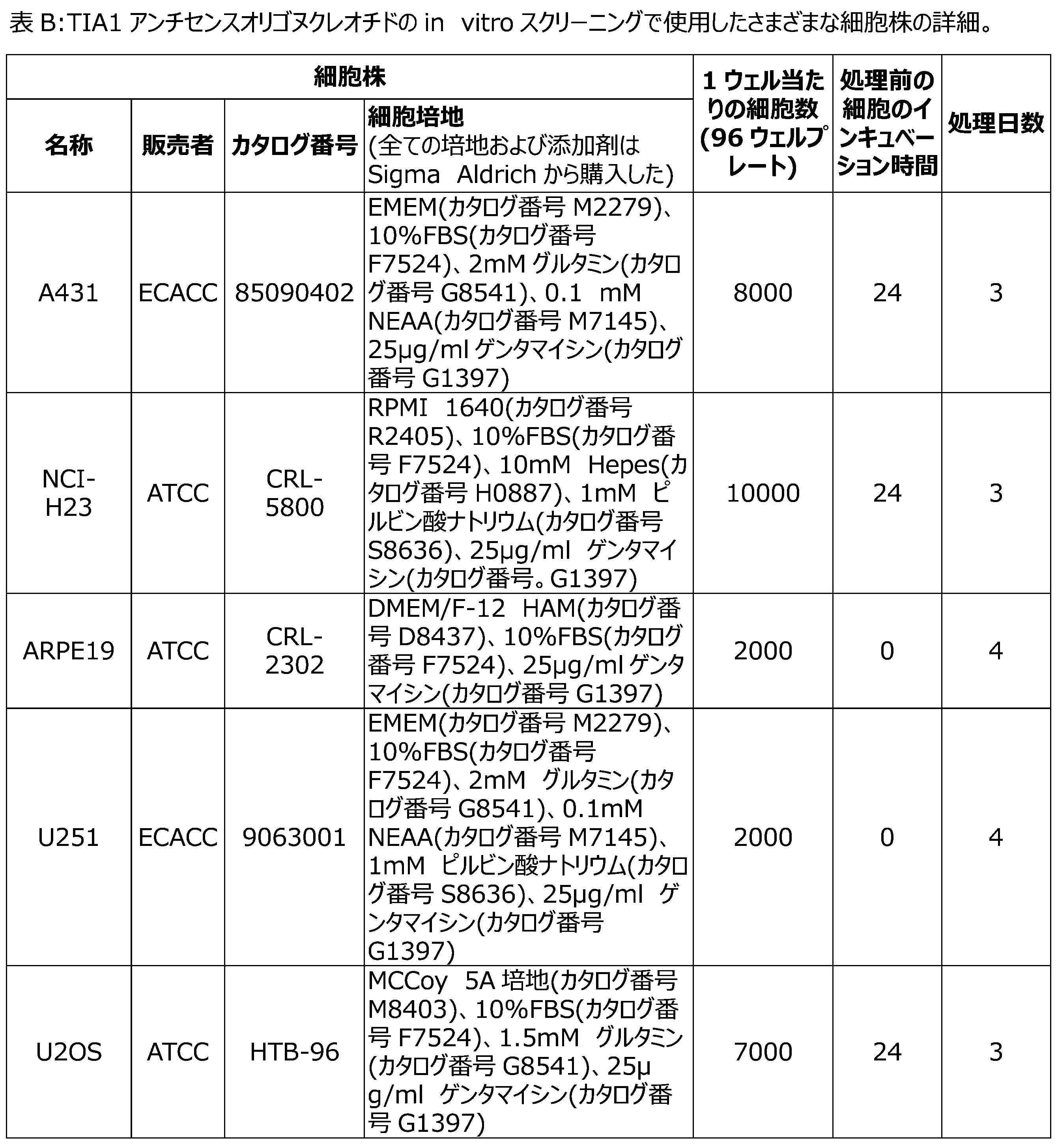
化合物は、iPSC由来の運動ニューロンでも評価することができる。 Compounds can also be evaluated in iPSC-derived motor neurons.
実施例1:表Aに記載されている化合物のLNAオリゴヌクレオチドの、25および5μMでのU2OS細胞株におけるin vitro有効性試験。 Example 1: In vitro efficacy test of LNA oligonucleotides of the compounds listed in Table A in U2OS cell lines at 25 and 5 μM.
オリゴヌクレオチドのスクリーニングを、表Xに列挙されている50のLNAオリゴヌクレオチドを使用して、ヒト細胞株U2OSにおいて行った。U2OS細胞株はATCC(カタログ番号:HTB-96)から購入し、サプライヤーの推奨に従って、37℃、5%CO2の加湿インキュベーターで維持した。スクリーニングアッセイのために、細胞を、供給元により推奨される培地内で96マルチウェルプレートに播種した(MCCoy 5A 培地[カタログ番号M8403]、10% FBS [カタログ番号F7524]、1.5mM グルタミン[カタログ番号G8541]、25μg/ml ゲンタマイシン[カタログ番号G1397])。細胞/ウェルの数を、96ウェルフォーマットで7000細胞/ウェルに最適化した Oligonucleotide screening was performed on the human cell line U2OS using the 50 LNA oligonucleotides listed in Table X. U2OS cell lines were purchased from ATCC (catalog number: HTB-96) and maintained in a humidified incubator at 37 ° C. and 5% CO 2 according to supplier recommendations. For the screening assay, cells were seeded in 96 multiwell plates in the medium recommended by the supplier (MCCoy 5A medium [catalog number M8403], 10% FBS [catalog number F7524], 1.5 mM glutamine [catalog]. No. G8541], 25 μg / ml gentamicin [catalog number G1397]). Optimized cell / well number to 7000 cells / well in 96-well format
細胞を24時間インキュベートし、その後、5または25μMの濃度で(PBSに溶解させた)オリゴヌクレオチドを添加した。オリゴヌクレオチドを添加した3日後に、細胞を回収した。 The cells were incubated for 24 hours, after which oligonucleotides (dissolved in PBS) were added at a concentration of 5 or 25 μM. Cells were harvested 3 days after the oligonucleotide was added.
RNAを、製造業者の指示に従い、Qiagen RNeasy 96キット(74182)を使用して抽出した。cDNA合成およびqPCRを、qScript XLTワンステップRT-qPCR ToughMix Low ROX、95134-100(Quanta Biosciences)を使用して実施した。標的転写産物のレベルを、VIC標識したGAPDH対照と共に、複数の反応において、Thermo Fisher Scientific製のFAM標識TaqManアッセイを使用して定量化した。目的のTIA1(Hs00234977_m1(FAM-MGB))、およびハウスキーピング遺伝子GAPDH(4326317E VIC-MGBプローブ)の標的転写産物に対する、TaqManプライマーアッセイ。技術的デュプレックスセットアップを使用した(n=2、生物学的独立反復実験)。 RNA was extracted using the Qiagen RNeasy 96 kit (74182) according to the manufacturer's instructions. cDNA synthesis and qPCR were performed using qScript XLT one-step RT-qPCR ToughMix Low ROX, 95134-100 (Quanta Biosciences). Levels of target transcripts were quantified in multiple reactions with VIC-labeled GAPDH controls using the FAM-labeled TaqMan assay from Thermo Fisher Scientific. TaqMan primer assay for target transcripts of the TIA1 of interest (Hs00234977_m1 (FAM-MGB)) and the housekeeping gene GAPDH (4326317E VIC-MGB probe). A technical duplex setup was used (n = 2, biologically independent repeat experiment).
相対的なTIA1 mRNA発現レベルを表Xに、対照(PBS処理細胞)の%として示す。即ち、値が小さいほど、阻害は大きい。 Relative TIA1 mRNA expression levels are shown in Table X as% of controls (PBS treated cells). That is, the smaller the value, the greater the inhibition.


本発明の例示的な配列モチーフおよび化合物を表Aに列挙する: The exemplary sequence motifs and compounds of the invention are listed in Table A:


化合物の列では、大文字はβ-D-オキシLNAヌクレオシドであり、LNA Cは全て5-メチルCであり、小文字はDNAヌクレオシドであり、場合により小文字cの前の上付き文字mは5-メチルシトシンDNAヌクレオシドを表し、全ヌクレオシド間結合は、ホスホロチオエートヌクレオシド間結合である。 In the compound column, the upper case is β-D-oxy LNA nucleoside, the LNA C is all 5-methyl C, the lower case is DNA nucleoside, and in some cases the superscript m in front of the lower case c is 5-methyl. Representing cytosine DNA nucleosides, the total nucleoside linkage is a phosphorothioate nucleoside linkage.
Claims (24)
Applications Claiming Priority (3)
| Application Number | Priority Date | Filing Date | Title |
|---|---|---|---|
| EP18203935 | 2018-11-01 | ||
| EP18203935.4 | 2018-11-01 | ||
| PCT/EP2019/079583 WO2020089260A1 (en) | 2018-11-01 | 2019-10-30 | Antisense oligonucleotides targeting tia1 |
Publications (1)
| Publication Number | Publication Date |
|---|---|
| JP2022512877A true JP2022512877A (en) | 2022-02-07 |
Family
ID=64109759
Family Applications (1)
| Application Number | Title | Priority Date | Filing Date |
|---|---|---|---|
| JP2021523678A Pending JP2022512877A (en) | 2018-11-01 | 2019-10-30 | Antisense oligonucleotide targeting TIA1 |
Country Status (5)
| Country | Link |
|---|---|
| US (1) | US20210261961A1 (en) |
| EP (1) | EP3873920A1 (en) |
| JP (1) | JP2022512877A (en) |
| CN (1) | CN112969709A (en) |
| WO (1) | WO2020089260A1 (en) |
Family Cites Families (24)
| Publication number | Priority date | Publication date | Assignee | Title |
|---|---|---|---|---|
| JP3756313B2 (en) | 1997-03-07 | 2006-03-15 | 武 今西 | Novel bicyclonucleosides and oligonucleotide analogues |
| NZ503765A (en) | 1997-09-12 | 2002-04-26 | Exiqon As | Bi-cyclic and tri-cyclic nucleotide analogues |
| EP1152009B2 (en) | 1999-02-12 | 2017-09-06 | Daiichi Sankyo Company, Limited | Novel nucleosides and oligonucleotide analogues |
| JP2002543214A (en) | 1999-05-04 | 2002-12-17 | エクシコン エ/エス | L-ribo-LNA analog |
| US6617442B1 (en) | 1999-09-30 | 2003-09-09 | Isis Pharmaceuticals, Inc. | Human Rnase H1 and oligonucleotide compositions thereof |
| AU2003281969B2 (en) | 2002-11-18 | 2011-01-27 | Roche Innovation Center Copenhagen A/S | Amino-LNA, thio-LNA and alpha-L-oxy-LN |
| WO2007031091A2 (en) | 2005-09-15 | 2007-03-22 | Santaris Pharma A/S | Rna antagonist compounds for the modulation of p21 ras expression |
| CN102908630B (en) | 2006-01-27 | 2014-11-19 | Isis制药公司 | 6-modified bicyclic nucleic acid analogs |
| US7547684B2 (en) | 2006-05-11 | 2009-06-16 | Isis Pharmaceuticals, Inc. | 5′-modified bicyclic nucleic acid analogs |
| US7666854B2 (en) | 2006-05-11 | 2010-02-23 | Isis Pharmaceuticals, Inc. | Bis-modified bicyclic nucleic acid analogs |
| DK2410054T4 (en) | 2006-10-18 | 2020-02-10 | Ionis Pharmaceuticals Inc | Antisense Compounds |
| WO2008150729A2 (en) | 2007-05-30 | 2008-12-11 | Isis Pharmaceuticals, Inc. | N-substituted-aminomethylene bridged bicyclic nucleic acid analogs |
| ES2386492T3 (en) | 2007-06-08 | 2012-08-21 | Isis Pharmaceuticals, Inc. | Carbocyclic bicyclic nucleic acid analogs |
| ATE538127T1 (en) | 2007-07-05 | 2012-01-15 | Isis Pharmaceuticals Inc | 6-DISUBSTITUTED BICYCLIC NUCLEIC ACID ANALOGUES |
| US8546556B2 (en) | 2007-11-21 | 2013-10-01 | Isis Pharmaceuticals, Inc | Carbocyclic alpha-L-bicyclic nucleic acid analogs |
| WO2010036698A1 (en) | 2008-09-24 | 2010-04-01 | Isis Pharmaceuticals, Inc. | Substituted alpha-l-bicyclic nucleosides |
| EP2462153B1 (en) | 2009-08-06 | 2015-07-29 | Isis Pharmaceuticals, Inc. | Bicyclic cyclohexose nucleic acid analogs |
| WO2011156202A1 (en) | 2010-06-08 | 2011-12-15 | Isis Pharmaceuticals, Inc. | Substituted 2 '-amino and 2 '-thio-bicyclic nucleosides and oligomeric compounds prepared therefrom |
| WO2012109395A1 (en) | 2011-02-08 | 2012-08-16 | Isis Pharmaceuticals, Inc. | Oligomeric compounds comprising bicyclic nucleotides and uses thereof |
| EP3556859B1 (en) | 2011-08-11 | 2021-04-07 | Ionis Pharmaceuticals, Inc. | Selective antisense compounds and uses thereof |
| EP2850092B1 (en) | 2012-04-09 | 2017-03-01 | Ionis Pharmaceuticals, Inc. | Tricyclic nucleic acid analogs |
| CN117126846A (en) | 2012-11-15 | 2023-11-28 | 罗氏创新中心哥本哈根有限公司 | Oligonucleotide conjugates |
| WO2015113922A1 (en) | 2014-01-30 | 2015-08-06 | Roche Innovation Center Copenhagen A/S | Poly oligomer compound with biocleavable conjugates |
| EP3362564B1 (en) | 2015-10-14 | 2020-07-01 | Aquinnah Pharmaceuticals, Inc. | Nucleic acid based tia-1 inhibitors |
-
2019
- 2019-10-30 JP JP2021523678A patent/JP2022512877A/en active Pending
- 2019-10-30 EP EP19791283.5A patent/EP3873920A1/en not_active Withdrawn
- 2019-10-30 CN CN201980071729.9A patent/CN112969709A/en active Pending
- 2019-10-30 WO PCT/EP2019/079583 patent/WO2020089260A1/en not_active Ceased
-
2021
- 2021-04-30 US US17/245,443 patent/US20210261961A1/en not_active Abandoned
Also Published As
| Publication number | Publication date |
|---|---|
| CN112969709A (en) | 2021-06-15 |
| EP3873920A1 (en) | 2021-09-08 |
| WO2020089260A1 (en) | 2020-05-07 |
| US20210261961A1 (en) | 2021-08-26 |
Similar Documents
| Publication | Publication Date | Title |
|---|---|---|
| AU2019291050A1 (en) | Oligonucleotides for modulating SCN9A expression | |
| WO2019215175A1 (en) | Oligonucleotides for modulating myh7 expression | |
| CN112912500A (en) | Oligonucleotides for modulating ATXN2 expression | |
| JP2022514648A (en) | Antisense oligonucleotides targeting CARD9 | |
| WO2020038973A1 (en) | Antisense oligonucleotides targeting sptlc1 | |
| EP4453206A1 (en) | Threose nucleic acid antisense oligonucleotides and methods thereof | |
| CN118318042A (en) | Oligonucleotides for regulating apolipoprotein E4 expression | |
| WO2022129320A1 (en) | Antisense oligonucleotides for targeting progranulin | |
| JP2022512877A (en) | Antisense oligonucleotide targeting TIA1 | |
| WO2020038976A1 (en) | Antisense oligonucleotides targeting usp8 | |
| WO2020011869A2 (en) | Antisense oligonucleotides targeting tlr2 | |
| HK40054683A (en) | Antisense oligonucleotides targeting tiai | |
| EP4332221A1 (en) | Threose nucleic acid antisense oligonucleotides and methods thereof | |
| HK40059035A (en) | Antisense oligonucleotides targeting card9 | |
| KR20250011958A (en) | Improved oligonucleotides targeting RNA binding protein sites | |
| WO2020007772A1 (en) | Antisense oligonucleotides targeting gbp-1 | |
| JP2024524874A (en) | Oligonucleotide Progranulin Agonists | |
| WO2020007889A1 (en) | Antisense oligonucleotides targeting stat1 | |
| CN119365600A (en) | Antisense oligonucleotides targeting progranulin | |
| WO2020038971A1 (en) | Antisense oligonucleotides targeting vcan | |
| HK40111629A (en) | Threose nucleic acid antisense oligonucleotides and methods thereof | |
| WO2020011653A1 (en) | Antisense oligonucleotides targeting kynu | |
| HK40117040A (en) | Antisense oligonucleotides for targeting progranulin | |
| HK40116036A (en) | Improved oligonucleotides targeting rna binding protein sites | |
| JP2023516142A (en) | Oligonucleotides for modulating CD73 exon 7 splicing |