WO2019023207A1 - INHIBITORS OF RORƳ - Google Patents
INHIBITORS OF RORƳ Download PDFInfo
- Publication number
- WO2019023207A1 WO2019023207A1 PCT/US2018/043451 US2018043451W WO2019023207A1 WO 2019023207 A1 WO2019023207 A1 WO 2019023207A1 US 2018043451 W US2018043451 W US 2018043451W WO 2019023207 A1 WO2019023207 A1 WO 2019023207A1
- Authority
- WO
- WIPO (PCT)
- Prior art keywords
- bis
- mixture
- water
- hydrogen bromide
- compound
- Prior art date
- Legal status (The legal status is an assumption and is not a legal conclusion. Google has not performed a legal analysis and makes no representation as to the accuracy of the status listed.)
- Ceased
Links
- XUYMIRYNRKXKOR-HMHJJOSWSA-N CCS(c1ccc(CNC(c2cc(CN(C[C@H](CC3)CC[C@@H]3C(F)(F)F)[C@H]3C(C)C)c3nc2)=O)nc1)(=O)=O Chemical compound CCS(c1ccc(CNC(c2cc(CN(C[C@H](CC3)CC[C@@H]3C(F)(F)F)[C@H]3C(C)C)c3nc2)=O)nc1)(=O)=O XUYMIRYNRKXKOR-HMHJJOSWSA-N 0.000 description 1
- AUPMLJPAKZDUJK-KRWDZBQOSA-N CCS(c1ccc(CNC(c2cnc([C@H](C(C)C)NC3)c3c2)=O)nc1)(=O)=O Chemical compound CCS(c1ccc(CNC(c2cnc([C@H](C(C)C)NC3)c3c2)=O)nc1)(=O)=O AUPMLJPAKZDUJK-KRWDZBQOSA-N 0.000 description 1
Classifications
-
- C—CHEMISTRY; METALLURGY
- C07—ORGANIC CHEMISTRY
- C07D—HETEROCYCLIC COMPOUNDS
- C07D471/00—Heterocyclic compounds containing nitrogen atoms as the only ring hetero atoms in the condensed system, at least one ring being a six-membered ring with one nitrogen atom, not provided for by groups C07D451/00 - C07D463/00
- C07D471/02—Heterocyclic compounds containing nitrogen atoms as the only ring hetero atoms in the condensed system, at least one ring being a six-membered ring with one nitrogen atom, not provided for by groups C07D451/00 - C07D463/00 in which the condensed system contains two hetero rings
- C07D471/04—Ortho-condensed systems
-
- A—HUMAN NECESSITIES
- A61—MEDICAL OR VETERINARY SCIENCE; HYGIENE
- A61K—PREPARATIONS FOR MEDICAL, DENTAL OR TOILETRY PURPOSES
- A61K31/00—Medicinal preparations containing organic active ingredients
- A61K31/33—Heterocyclic compounds
- A61K31/395—Heterocyclic compounds having nitrogen as a ring hetero atom, e.g. guanethidine or rifamycins
- A61K31/435—Heterocyclic compounds having nitrogen as a ring hetero atom, e.g. guanethidine or rifamycins having six-membered rings with one nitrogen as the only ring hetero atom
- A61K31/4353—Heterocyclic compounds having nitrogen as a ring hetero atom, e.g. guanethidine or rifamycins having six-membered rings with one nitrogen as the only ring hetero atom ortho- or peri-condensed with heterocyclic ring systems
- A61K31/437—Heterocyclic compounds having nitrogen as a ring hetero atom, e.g. guanethidine or rifamycins having six-membered rings with one nitrogen as the only ring hetero atom ortho- or peri-condensed with heterocyclic ring systems the heterocyclic ring system containing a five-membered ring having nitrogen as a ring hetero atom, e.g. indolizine, beta-carboline
-
- A—HUMAN NECESSITIES
- A61—MEDICAL OR VETERINARY SCIENCE; HYGIENE
- A61P—SPECIFIC THERAPEUTIC ACTIVITY OF CHEMICAL COMPOUNDS OR MEDICINAL PREPARATIONS
- A61P29/00—Non-central analgesic, antipyretic or antiinflammatory agents, e.g. antirheumatic agents; Non-steroidal antiinflammatory drugs [NSAID]
-
- C—CHEMISTRY; METALLURGY
- C07—ORGANIC CHEMISTRY
- C07B—GENERAL METHODS OF ORGANIC CHEMISTRY; APPARATUS THEREFOR
- C07B2200/00—Indexing scheme relating to specific properties of organic compounds
- C07B2200/13—Crystalline forms, e.g. polymorphs
Definitions
- RORs Retinoic acid receptor-related orphan receptors
- RORs are a subfamily of transcription factors in the steroid hormone nuclear receptor superfamily (Jetten & Joo (2006) Adv. Dev. Biol. 2006, 16, 313-355).
- the ROR family consists of ROR alpha (RORa), ROR beta (RORP) and ROR gamma (RORy), each encoded by a separate gene (in human: RORA, RORB and RORC, respectively; in mouse: rora, rorb and rorc, respectively).
- RORs contain four principal domains shared by the majority of nuclear receptors: an N-terminal domain, a highly conserved DNA-binding domain (DBD) consisting of two zinc finger motifs, a hinge domain, and a ligand binding domain (LBD).
- RORy has two isoforms: RORyl and RORy2 (also known as RORyt).
- RORyl is expressed in a variety of tissues including thymus, muscle, kidney and liver, while RORyt is exclusively expressed in the cells of the immune system.
- RORyt has a critical role in thymopoiesis and the development of several secondary lymphoid tissues, and is a key regulator of Thl7 cell differentiation (Jetten, 2009, Nucl.
- Thl7 cells are a subset of T helper cells which preferentially produce the proinflammatory cytokines IL-17A, IL-17F, IL-21 and IL-22.
- Thl7 cells and their effector molecules such as IL-17, IL-21, IL-22, GM-CSF and CCL20, are associated with the pathogenesis of several autoimmune and inflammatory diseases, such as rheumatoid arthritis, systemic lupus erythematosus, multiple sclerosis, psoriasis, inflammatory bowel disease, allergy and asthma (Maddur et al, 2012, Am. J. Pathol., 181:8-18).
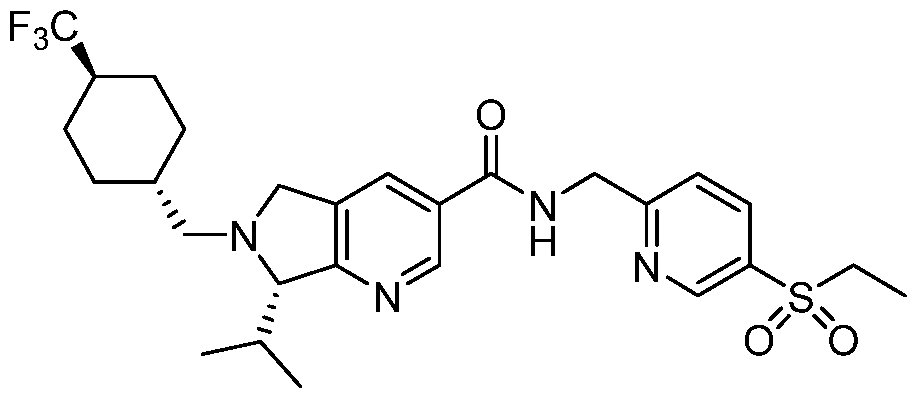
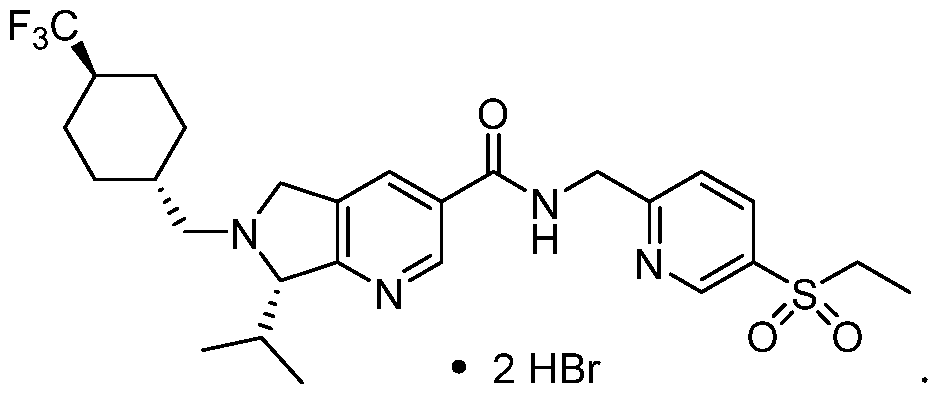
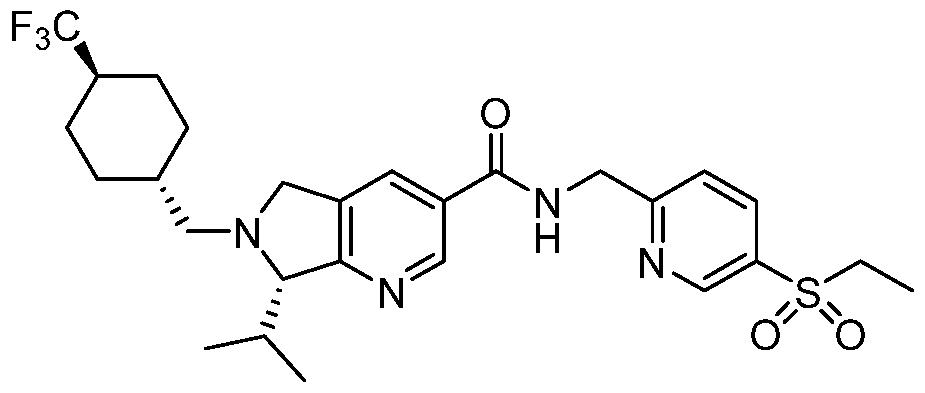
- Compound 1 is an inhibitor of RORy and has therapeutic properties against a number of RORy mediated diseases.
- Compound 1 is exemplified in U.S. Patent No.
- a two-step method for the preparation of a bis-hydrogen bromide salt form of Compound 1 was identified. This process involved the formation and isolation of a mono- hydrogen bromide salt of Compound 1 by treatment with hydrobromic acid followed by a second independent treatment step with hydrobromic acid to form a bis-hydrogen bromide salt of Compound 1.
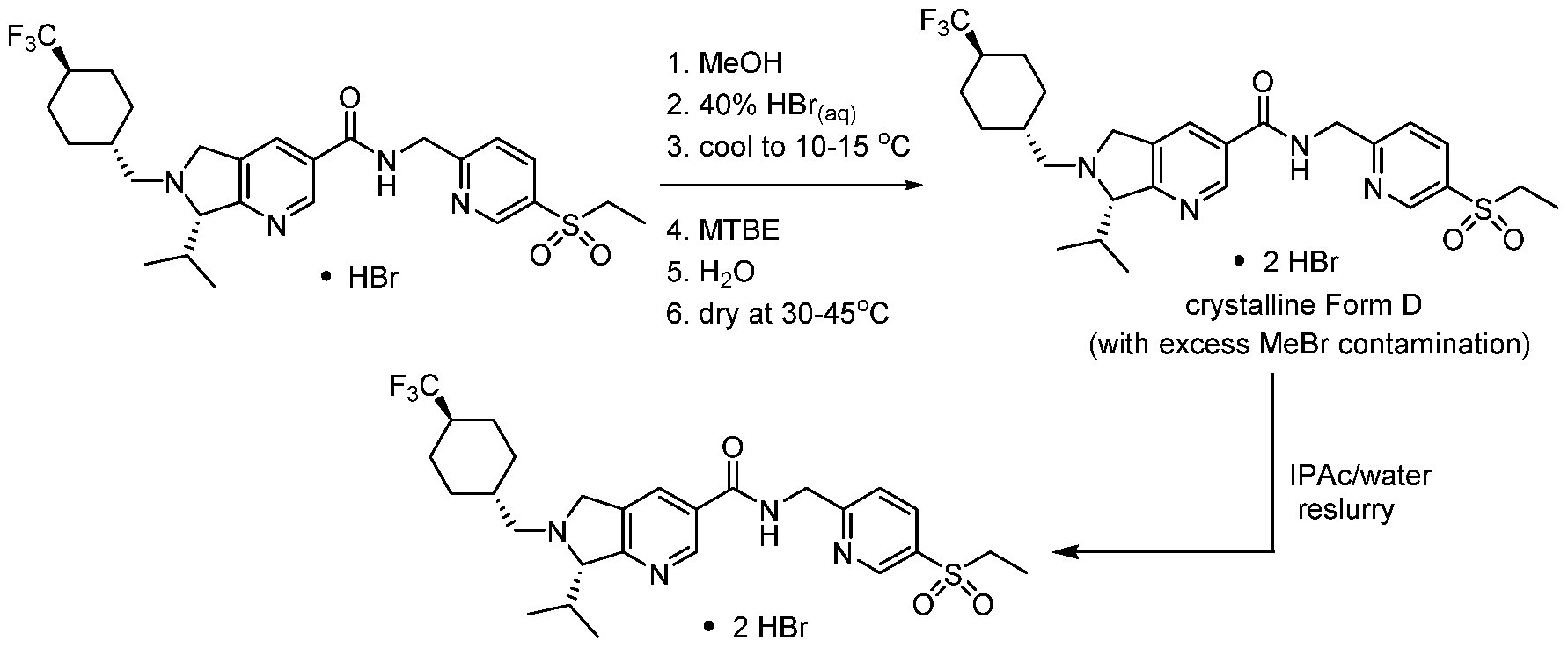
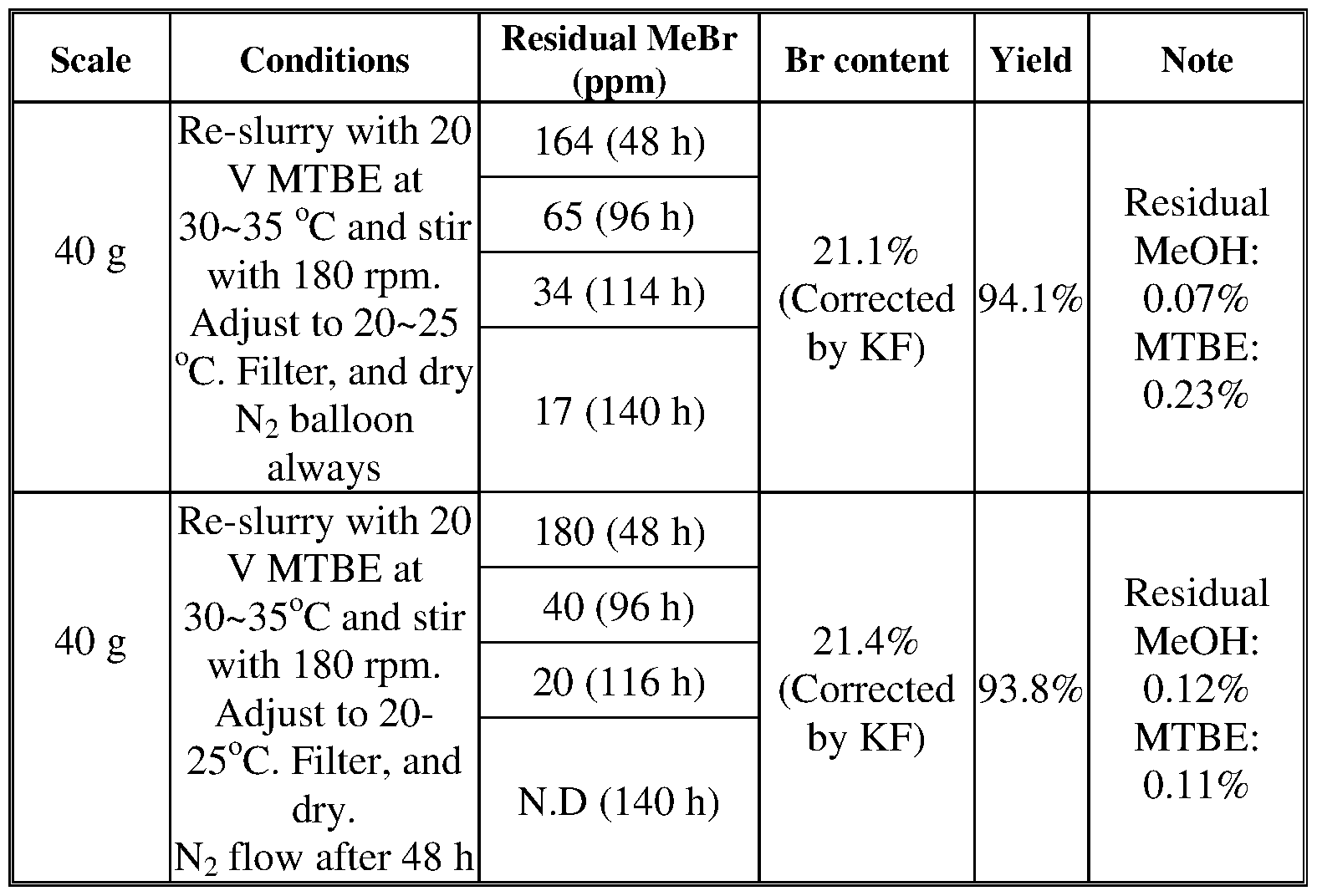
- This method required the use of HBr and MeOH during the final steps of the synthesis. This transformation led to contamination of the product from production of MeBr.
- This problem has been solved herein by slurrying the product in a mixture of isopropyl acetate and water.
- neutralizing the reductive amination reaction mixture, thereby resulting in precipitation provided Compound 1 as a free base in high purity and good yield, particularly on a larger scale.
- reactions were effective at >3 kg scale with 98% yield and in >99 area% purity. See e.g., the Exemplification section.
- treatment with a sufficient amount of hydrobromic acid afforded the desired bis-hydrogen bromide salt without the need to use MeOH. While no detectable contamination from MeBr was observed, this process led to the formation of a mixture of crystalline forms: Form E, Form F, and Form G.
- FIG 1. depicts an X-ray powder diffraction pattern (XRPD) for Form D of Compound 1.
- FIG 2. depicts a Differential Scanning Calorimetry (DSC) spectrum for Form D of Compound 1.
- FIG 3. depicts a thermal gravimetric analysis (TGA) pattern for Form D of Compound 1.
- FIG 4. depicts a Dynamic Vapor Sorption (DVS) isotherm plot for Form D of Compound 1.
- FIG 5. depicts an X-ray powder diffraction pattern (XRPD) for Form E of Compound 1.
- FIG 6. depicts a Differential Scanning Calorimetry (DSC) spectrum for Form E of Compound 1.
- FIG 7. depicts a thermal gravimetric analysis (TGA) pattern for Form E of Compound 1.
- FIG 8. depicts an 1H-NMR spectrum for Compound 1 made by conditions described herein.
- a composition comprising methyl bromide and a bis-hydrogen bromide salt of Compound 1 (e.g., crystalline Form D of the bis-hydrogen bromide salt of Compound 1) comprising i) slurrying the composition in a mixture of isopropyl acetate/water or a mixture of heptane/water; and ii) separating the bis-hydrogen bromide salt of the compound from the mixture of isopropyl acetate/water or the mixture of heptane/water.
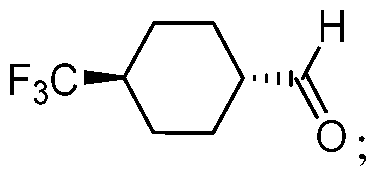
- methods for preparing a free base form of Compound 1 comprising i) reductively aminating an aldehyde compound represented by the following structural formula:
- the reductive amination is carried out in the presence of ethanol, and in the presence of an imine reducing agent; ii) quenching the reductive amination mixture with acid; iii) neutralizing the resulting solution with base, thereby precipitating the free base form of the compound; and iv) isolating the precipitated free-based form of the compound from the solution.
- the bis-hydrogen bromide salt can then be prepared directly (i.e., without first isolating the mono-hydrogen bromide salt) by adding sufficient
- crystalline Form D bis-hydrogen bromide salt comprising i) slurrying a composition comprising one or more of crystalline Forms E, F, and G in a mixture of isopropyl acetate/water; and ii) separating the crystalline form D bis-hydrogen bromide salt from the mixture of isopropyl acetate/water.
- the bis-hydrogen bromide salts formed from the processes described herein have a purity of >95% such as, e.g., >96%, >97%, >98%, >99%, or 99.5% or greater.
- Form D refers to the crystalline polymorph Form D of Compound 1.
- Form D refers to the crystalline polymorph Form D of Compound 1.
- Form D refers to the crystalline polymorph Form D of Compound 1.
- Form E refers to the crystalline polymorph Form E of Compound 1.
- Form E refers to the crystalline polymorph Form E of Compound 1
- crystalline Form E of Compound 1 is used interchangeably.
- amorphous means a solid that is present in a non-crystalline state or form.
- Amorphous solids are disordered arrangements of molecules and therefore possess no distinguishable crystal lattice or unit cell and consequently have no definable long range ordering.
- Solid state ordering of solids may be determined by standard techniques known in the art, e.g., by X-ray powder diffraction (XRPD) or differential scanning calorimetry (DSC).
- XRPD X-ray powder diffraction
- DSC differential scanning calorimetry
- Amorphous solids can also be differentiated from crystalline solids e.g., by birefringence using polarized light microscopy.
- Purity is expressed in terms of percentage and can be calculated by dividing the mass of the mono- and bis-hydrogen bromide salt forms of Compound 1 by the total mass of the sample, and then multiplying this number by 100. This calculation does not account for solvated forms. Thus, 90% pure or has a purity of 90% means that the designated mono- or bis-hydrogen bromide salt form of Compound 1, or designated polymorphic form makes up 90% by weight of the sample.
- the purity of the salt and crystalline forms described herein are >90%, >95%, >97%, and >99% pure (e.g., >99.1%, 99.2%, 99.3%, 99.4%, 99.5%, 99.6%, 99.7%, 99.8%, and 99.9%) by weight. In one aspect, the purity of the salt and crystalline forms described herein are >90%, >95%, >97%, and >99% pure (e.g., >99.1%, 99.2%, 99.3%, 99.4%, 99.5%, 99.6%, 99.7%, 99.8%, and 99.9%) by weight and free from other salt or polymorphic forms.
- the 2-theta values of the X-ray powder diffraction patterns for the crystalline forms described herein may vary slightly from one instrument to another and also depending on variations in sample preparation and batch to batch variation. Therefore, the XRPD patterns / assignments recited herein are not to be construed as absolute and can vary + 0.2 degrees.
- crystalline Form D of Compound 1 as made by the processes described herein is characterized by at least three, at least four, or at least five x-ray powder diffraction peaks at 2 ⁇ angles selected from 14.24°, 15.24°, 15.90°, 18.54°, 18.82°, and 22.46°.
- crystalline Form D of Compound 1 is characterized by x-ray powder diffraction peaks at 2 ⁇ angles 14.24°, 15.24°, 15.90°, 18.54°, 18.82°, and 22.46°.
- crystalline Form D of Compound 1 is characterized by at least three, at least four, at least five, at least six, at least seven, at least eight, at least nine, at least ten, at least eleven, at least twelve, at least thirteen, at least fourteen, at least fifteen, at least sixteen, at least seventeen, at least eighteen, at least nineteen, at least twenty, at least twenty-one, at least twenty-two, at least twenty-three, at least twenty-four, at least twenty-five, at least twenty- six, at least twenty-seven, at least twenty-eight, at least twenty-nine, at least thirty, at least thirty-one, at least thirty-two, at least thirty-three, at least thirty-four, at least thirty-five, or at least thirty-six, x-ray powder dif
- crystalline Form D of compound 1 is characterized by x-ray powder diffraction peaks at 7.58°, 9.02°, 14.56°, 14.24°, 15.24°, 15.90°, 17.16°, 18.54°, 18.82°,20.14°, and 22.46°.
- crystalline Form D of compound 1 is characterized by x-ray powder diffraction peaks at 7.58°, 9.02°, 14.56°, 14.24°, 15.24°, 15.90°, 17.16°, 18.54°, 18.82°,20.14°, 22.46°, 20.70°, 21.02°, 21.70°, 24.36°, and 24.58°.
- crystalline Form D of compound 1 is characterized by x-ray powder diffraction peaks at 7.58°, 9.02°, 14.56°, 14.24°, 15.24°, 15.90°, 17.16°, 18.54°, 18.82°,20.14°, 22.46°, 20.70°, 21.02°, 21.70°, 24.36°, 24.58°, 25.66°, 25.82°, 26.51°, 26.82°, 29.68°, and 33.70°.
- crystalline Form D of Compound 1 is characterized by x-ray powder diffraction peaks in Table 1.
- crystalline Form D of Compound 1 has an XRPD pattern that is substantially the same XRPD pattern shown in FIG 1.
- crystalline Form D of Compound 1 has a DSC pattern that is substantially the same DSC pattern shown in FIG 2. In another aspect, crystalline Form D of Compound 1 has a TGA pattern that is substantially the same TGA pattern shown in FIG 3.
- the crystalline Form D of Compound 1 is a bis-hydrogen bromide salt having one or more of the XRPD peaks defined above.
- Form D of Compound 1 is a hydrate (e.g., a dihydrate) having one or more of the XRPD peaks defined above.
- Form D of Compound 1 is a bis- hydrogen bromide salt that is a dihydrate and has one or more of the XRPD peaks defined above. Table 1 - Form D
- crystalline Form E formed by the one-step process described herein is characterized by at least three, at least four, or at least five x-ray powder diffraction peaks at 2 ⁇ angles selected from 4.1°, 8.3°, 12.70°, 16.64°, 16.98°, and 21.32°.
- crystalline Form E of Compound 1 is characterized by x-ray powder diffraction peaks at 2 ⁇ angles 4.1°, 8.3°, 12.70°, 16.64°, 16.98°, and 21.32°.
- crystalline Form E of Compound 1 is characterized by at least three, at least four, at least five, at least six, at least seven, at least eight, at least nine, at least ten, at least eleven, at least twelve, at least thirteen, at least fourteen, at least fifteen, at least sixteen, at least seventeen, at least eighteen, at least nineteen, at least twenty, at least twenty-one, at least twenty-two, at least twenty- three, at least twenty-four, at least twenty-five, at least twenty-six, at least twenty-seven, at least twenty-eight, at least twenty-nine, at least thirty, at least thirty-one, at least thirty-two, at least thirty-three, at least thirty-four, at least thirty-five, or at least thirty- six x-ray powder diffraction peaks at 2 ⁇ angles selected from Table 2.
- crystalline Form E of Compound 1 is characterized by x-ray powder diffraction peaks in Table 2.
- crystalline Form E of Compound 1 has an XRPD pattern that is substantially the same XRPD pattern shown in FIG 5.
- crystalline Form E of Compound 1 has a DSC pattern that is substantially the same DSC pattern shown in FIG 6.
- crystalline Form E of Compound 1 has a TGA pattern that is substantially the same TGA pattern shown in FIG 7.
- the crystalline Form E of Compound 1 is a bis- hydrogen bromide salt having one or more of the XRPD peaks defined above.
- a two-step process was initially developed to form the bis-hydrogen bromide salt of Compound 1. See e.g., Scheme 5 in the Exemplification section, a portion of which is depicted here as Scheme 1.
- This process comprised first forming and isolating a mono- hydrogen bromide salt of Compound 1 followed by conversion of the mono-hydrogen bromide salt to the bis-hydrogen bromide salt of Compound 1.
- a method of removing methyl bromide from a composition comprising methyl bromide and a bis-hydrogen bromide salt of Compound 1 (e.g., crystalline Form D of the bis-hydrogen bromide salt of Compound 1) comprising i) slurrying the composition in a mixture of isopropyl acetate/water or a mixture of
- removing methyl bromide from a composition comprising methyl bromide and a bis-hydrogen bromide salt of Compound 1 comprises slurrying the
- the mixture comprises isopropyl acetate comprising 0.5% to 2.0% v/v of water, 0.7% to 1.7% v/v of water, 0.8% to 1.5% v/v of water, 0.9% to 1.3% v/v of water, 0.9% to 1.1% v/v of water, 0.5%, 0.6%, 0.7%, 0.8%, 0.9%, 1.0%, 1.1%, 1.2%, 1.3%, 1.4%, or 1.5%.
- the methyl bromide present in the composition prior to slurrying the composition, is greater than 45 ppm, greater than 50 ppm, greater than 55 ppm, or greater than 60 ppm.
- the amount of methyl bromide present in the composition may be from 50 ppm to 1000 ppm.
- the amounts of methyl bromide present in the composition prior to slurrying refers to the amount present in a dried composition, e.g., prior to slurrying the composition is dried (e.g., at approximately 15 to 50 °C such as 20 to 25 °C ) under approximately -0.096 MPa vacuum for 20 hours or more.
- the methyl bromide present in the composition is greater than 45 ppm, greater than 50 ppm, greater than 55 ppm, greater than 60 ppm, or from 50 ppm to 1000 ppm; and the mixture comprises isopropyl acetate comprising 0.5% to 2.0% v/v of water, 0.7% to 1.7% v/v of water, 0.8% to 1.5% v/v of water, 0.9% to 1.3% v/v of water, 0.9% to 1.1% v/v of water, 0.5%, 0.6%, 0.7%, 0.8%, 0.9%, 1.0%, 1.1%, 1.2%, 1.3%, 1.4%, or 1.5% .
- separating the crystalline form D bis-hydrogen bromide salt from the mixture results in a crystalline form D bis-hydrogen bromide salt having less than 45 ppm of methyl bromide present.
- separating the crystalline form D bis-hydrogen bromide salt from the mixture results in a crystalline form D bis-hydrogen bromide salt having is less than 40 ppm, less than 30 ppm, less than 20 ppm, less than 10 ppm, less than 5 ppm, or less than 1 ppm of methyl bromide present.
- separating the crystalline form D bis-hydrogen bromide salt from the mixture results in a crystalline form D bis-hydrogen bromide salt having an amount of methyl bromide present that is below the level of detection.
- separating the crystalline form D bis-hydrogen bromide salt from the mixture results in a crystalline form D bis-hydrogen bromide salt having less than 45 ppm, less than 40 ppm, less than 30 ppm, less than 20 ppm, less than 10 ppm, less than 5 ppm, or less than 1 ppm of methyl bromide present, or an amount of methyl bromide that is below the level of detection; and wherein prior to slurrying the composition, the methyl bromide present in the composition is greater than 45 ppm, greater than 50 ppm, greater than 55 ppm, greater than 60 ppm, or from 50 ppm to 1000 ppm.
- separating the crystalline form D bis-hydrogen bromide salt from the mixture results in a crystalline form D bis-hydrogen bromide salt having less than 45 ppm, less than 40 ppm, less than 30 ppm, less than 20 ppm, less than 10 ppm, less than 5 ppm, or less than 1 ppm of methyl bromide present, or an amount of methyl bromide that is below the level of detection; wherein prior to slurrying the composition, the methyl bromide present in the composition is greater than 45 ppm, greater than 50 ppm, greater than 55 ppm, greater than 60 ppm, or from 50 ppm to 1000 ppm; and wherein the mixture comprises isopropyl acetate comprising 0.5% to 2.0% v/v of water, 0.7% to 1.7% v/v of water, 0.8% to 1.5% v/v of water, 0.9% to 1.3% v/v of water, 0.9% to 1.1% v/v of water, 0.5%, 0.
- the reductive amination is carried out in the presence of ethanol, and in the presence of an imine reducing agent; ii) quenching the reductive amination mixture with acid; iii) neutralizing the resulting solution with base, thereby precipitating the free base form of the compound; and iv) isolating the precipitated free-based form of the compound from the solution.
- a solution of the aldehyde compound in isopropyl acetate is added to a slurry of the imine reducing agent in a solution of the trialkyl amine and the amine compound in ethanol.
- the acid used for quenching is hydrochloric acid.
- the base used is an aqueous base such as a solution of aqueous sodium hydroxide.
- the solution is neutralized in step iii) to pH 5 to 7.
- the amine compound is formed in situ from treating an acid salt form (e.g., a hydrochloric acid salt such as a di-hydrochloric acid salt) of the amine with a tertiary amine base
- tertiary amines for performing reductive aminations include, but are not limited to, trialkylamines such as diisopropylethylamine (DIPEA or iPr 2 NEt) and trimethylamine (TEA). See e.g., March's Advanced Organic Chemistry, fifth edition, John Wiley & Sons 2001. In one instance, the amine used is DIPEA.
- DIPEA diisopropylethylamine
- TEA trimethylamine
- reducing agents for performing reductive aminations include, but are not limited to, sodium triacetoxyborohydride (NaBH(OAc) 3 ), sodium borohydride (NaBH 4 ), palladium on carbon with H 2 , and platinum on carbon with H 2 . See e.g., March's Advanced Organic Chemistry, fifth edition, John Wiley & Sons 2001.
- the reducing agent is NaBH(OAc) 3 .
- the bis-hydrogen bromide salt can then be prepared directly (i.e., without first isolating the mono-hydrogen bromide salt) by adding sufficient
- formation of the bis-hydrogen bromide salt from the free-based further comprises the addition of a mixture of isopropanol, MTBE, and acetic acid.
- formation of the bis- hydrogen bromide salt from the free -based further comprises the addition of a mixture of acetic acid and MEK.
- the amount and concentration of hydrobromic acid that is sufficient to form the bis-hydrogen bromide salt can vary, but is typically from 2 to 5 equivalents of, for example, 35% to 55% hydrobromic acid, 37% to 53% hydrobromic acid, or 40% to 48% hydrobromic acid. In one aspect, 40% or 48% hydrobromic acid is used. In one aspect, 2 to 4 equivalents, 2 to 3 equivalents, 2 to 2.5 equivalents or 2.1 equivalents of 40% or 48% hydrobromic acid is used.
- a method of converting crystalline Forms E, F and G of the bis-hydrogen bromide salt of Compound 1 to crystalline Form D bis- hydrogen bromide salt comprising i) slurrying a composition comprising one or more of crystalline forms E, F and G in a mixture of isopropyl acetate/water containing between 0.25%-2.5% v/v; and ii) separating (e.g., via filtration) the crystalline form D of the bis- hydrogen bromide salt of the compound from the mixture of isopropyl acetate/water.
- the mixture comprises isopropyl acetate comprising 0.5% to 2.0% v/v of water, 0.7% to 1.7% v/v of water, 0.8% to 1.5% v/v of water, 0.9% to 1.3% v/v of water, 0.9% to 1.1% v/v of water, 0.5%, 0.6%, 0.7%, 0.8%, 0.9%, 1.0%, 1.1%, 1.2%, 1.3%, 1.4%, or 1.5%.
- the amount of Form E, F, and G present in the composition is greater than 90% by weight, such as greater than 91%, greater than 92%, greater than 93%, greater than 94%, greater than 95%, greater than 96%, greater than 97%, or greater than 98%, greater than 99%.
- thermogram was performed using a TA Instruments 2920 differential scanning calorimeter. Temperature calibration was performed using NIST-traceable indium metal. The sample was placed into an aluminum Tzero crimped pan (T0C) and the weight was accurately recorded. A weighed aluminum pan configured as the sample pan was placed on the reference side of the cell. The data acquisition parameters and pan configuration for each thermogram are displayed in the image in the figure.
- the method code on the thermogram is an abbreviation for the start and end temperature as well as the heating rate; e.g. ,(-30)-250- 10 means "from -30 °C to 250 °C, at 10 °C/min".
- thermogravimetric analyzer Temperature calibration was performed using nickel and AlumelTM. Each sample was placed in a platinum pan. The sample was hermetically sealed, the lid pierced, then inserted into the TG furnace. The furnace was heated under nitrogen. The data acquisition parameters for each thermogram are displayed in the in the figure.
- the method code on the thermogram is an abbreviation for the start and end temperature as well as the heating rate; e.g. , 00-350- 10 means "from ambient °C to 350 °C, at 10 °C/min".
- Diffraction patterns were collected using a scanning position-sensitive detector (X'Celerator) located 240 mm from the specimen and Data Collector software v. 2.2b.
- the data acquisition parameters for each pattern are displayed above the image in the Data section of this report including the divergence slit (DS) before the mirror.
- the mono-HBr salt is then converted to the bis-HBr salt by dissolving the mono salt in methanol, adding 1.1 equiv of 40% aqueous HBr, then seeding, followed by additions of MTBE and water.
- the bis-HBr salt is isolated by filtration and drying at 30-45°C in vacuum.
- the final product is isolated as the bis-hydrogen bromide salt Form D with contamination from MeBr
- a typical reaction can proceed as follows. To the 30-gal reactor was added 2 (5.12 kg, 9.2 mol, 1.0 equiv). In a carboy was charged ethanol (27.3 L, 7 vol relative to sodium triacetoxyborohydride (STAB)) and DIPEA (3.57 kg, 27.6 mol, 3 equiv relative to 2). The solution of DIPEA/EtOH was added to the reactor with the 2 with no stirring. A cloud of amine hydrochloride formed in the reactor making it difficult to see the slurry, so the batch was allowed to sit without stirring until this cloud dissipated. After 35 min, the cloud dissipated and the mixture was gently stirred. In an hour, the solids had dissolved. The batch was stirred gently overnight at 10 °C and then the 2 was drained from the reactor into a carboy.
- STAB sodium triacetoxyborohydride
- the reaction was quenched by the addition of 1 N HCI (31.2 L, 8 vol relative to STAB) over 33 min. The temperature rose to 11 °C during this addition. The solids dissolved during this quench and the solution was stirred 1 h. The quenched reaction was transferred to a 100-gal. Pfaudler, glass-lined reactor with the jacket set to 10 °C. To the 100-gal reactor was charged 1 N NaOH solution (31.2 L, 8 vol relative to STAB). After this addition, the pH rose from approximately 5 to approximately 6 and solids precipitated. The free base slurry was allowed to stir overnight at approximately 10 °C for convenience. The batch was then transferred to a pressure filter equipped with a tight weave cloth.
- the initial filtration was performed with occasional stirring and the batch de-liquored in about 4 h.
- the reactor and filter cake were washed with DI water (2 x 16 L) and 1: 1 ethanol/DI water (16 L). The washes took approximately 30 min each.
- the wet cake was conditioned for 2 h under 8 psig of nitrogen and then was dried at a jacket temperature 35 °C. The drying was monitored by KF analysis.
- the wet cake contained 21% water and the dried cake before off-loading was 5.4% water.
- the yield was 4.97 kg (98%).
- the HPLC analysis of the product was 99.7 area%.
- the NMR weight assay was 90.8 wt % (FIG. 8) and the final KF analysis was 4.7% water.
- Residue-on-ignition (ROI) analysis of the free base indicated it had 0.2% residual inorganic material.
- the material can then be converted to the bis-hydrogen bromide salt by e.g., contacting the free base (0.8026 g) with acetic acid (2 vol, 1.6052 ml) and stirring the mixture at 250 RPM, heated 30 °C. A 48% HBr solution is then added (0.3438 ml, 2.1 equiv) drop wise over 9 min.
- MEK (4.816 ml, 6 vol) is then added over 50 minutes and the reaction is seeded with bis-hydrogen bromide salt Form D.
- MEK (8.000 ml, 10 vol) is added at 2 ml slowly added every 5 min.
Landscapes
- Chemical & Material Sciences (AREA)
- Organic Chemistry (AREA)
- Health & Medical Sciences (AREA)
- Life Sciences & Earth Sciences (AREA)
- Veterinary Medicine (AREA)
- Public Health (AREA)
- General Health & Medical Sciences (AREA)
- Medicinal Chemistry (AREA)
- Animal Behavior & Ethology (AREA)
- Pharmacology & Pharmacy (AREA)
- Chemical Kinetics & Catalysis (AREA)
- Nuclear Medicine, Radiotherapy & Molecular Imaging (AREA)
- General Chemical & Material Sciences (AREA)
- Rheumatology (AREA)
- Pain & Pain Management (AREA)
- Epidemiology (AREA)
- Pharmaceuticals Containing Other Organic And Inorganic Compounds (AREA)
- Nitrogen Condensed Heterocyclic Rings (AREA)
- Preparation Of Compounds By Using Micro-Organisms (AREA)
- Organic Low-Molecular-Weight Compounds And Preparation Thereof (AREA)
- Plural Heterocyclic Compounds (AREA)
- Nitrogen And Oxygen Or Sulfur-Condensed Heterocyclic Ring Systems (AREA)
- Low-Molecular Organic Synthesis Reactions Using Catalysts (AREA)
Abstract
Description









Claims




Priority Applications (19)
| Application Number | Priority Date | Filing Date | Title |
|---|---|---|---|
| EP18752385.7A EP3658555A1 (en) | 2017-07-24 | 2018-07-24 | Inhibitors of ror |
| IL298639A IL298639A (en) | 2017-07-24 | 2018-07-24 | Inhibitors of rorϒ |
| KR1020207005265A KR20200053481A (en) | 2017-07-24 | 2018-07-24 | Inhibitors of RORγ |
| CN202211175786.1A CN115650976A (en) | 2017-07-24 | 2018-07-24 | Inhibitors of ROR gamma |
| CN201880049819.3A CN111225914B (en) | 2017-07-24 | 2018-07-24 | Inhibitors of ROR gamma |
| CN202211176735.0A CN115716826A (en) | 2017-07-24 | 2018-07-24 | Inhibitors of RORγ |
| JP2020503969A JP2020528904A (en) | 2017-07-24 | 2018-07-24 | RORγ inhibitor |
| US16/633,335 US10913739B2 (en) | 2017-07-24 | 2018-07-24 | Inhibitors of RORγ |
| CA3070611A CA3070611A1 (en) | 2017-07-24 | 2018-07-24 | Inhibitors of ror.gamma. |
| RU2020107919A RU2020107919A (en) | 2017-07-24 | 2018-07-24 | ROR INHIBITORS |
| BR112020001246-7A BR112020001246A2 (en) | 2017-07-24 | 2018-07-24 | rory inhibitors |
| UAA202001243A UA126583C2 (en) | 2017-07-24 | 2018-07-24 | INHIBITORS OF ROR<font face="Symbol">g</font> |
| AU2018307919A AU2018307919B2 (en) | 2017-07-24 | 2018-07-24 | Inhibitors of RORϒ |
| MX2020000887A MX2020000887A (en) | 2017-07-24 | 2018-07-24 | Inhibitors of rorï. |
| SG11202000621VA SG11202000621VA (en) | 2017-07-24 | 2018-07-24 | Inhibitors of ror? |
| PH12020500129A PH12020500129A1 (en) | 2017-07-24 | 2020-01-17 | Inhibitors of rory |
| IL272191A IL272191B2 (en) | 2017-07-24 | 2020-01-22 | Inhibitors of ror gamma |
| CONC2020/0001807A CO2020001807A2 (en) | 2017-07-24 | 2020-02-19 | Rorγ inhibitors |
| US17/144,245 US20210230158A1 (en) | 2017-07-24 | 2021-01-08 | INHIBITORS OF RORgamma |
Applications Claiming Priority (2)
| Application Number | Priority Date | Filing Date | Title |
|---|---|---|---|
| US201762536114P | 2017-07-24 | 2017-07-24 | |
| US62/536,114 | 2017-07-24 |
Related Child Applications (2)
| Application Number | Title | Priority Date | Filing Date |
|---|---|---|---|
| US16/633,335 A-371-Of-International US10913739B2 (en) | 2017-07-24 | 2018-07-24 | Inhibitors of RORγ |
| US17/144,245 Division US20210230158A1 (en) | 2017-07-24 | 2021-01-08 | INHIBITORS OF RORgamma |
Publications (1)
| Publication Number | Publication Date |
|---|---|
| WO2019023207A1 true WO2019023207A1 (en) | 2019-01-31 |
Family
ID=63143419
Family Applications (1)
| Application Number | Title | Priority Date | Filing Date |
|---|---|---|---|
| PCT/US2018/043451 Ceased WO2019023207A1 (en) | 2017-07-24 | 2018-07-24 | INHIBITORS OF RORƳ |
Country Status (19)
| Country | Link |
|---|---|
| US (2) | US10913739B2 (en) |
| EP (1) | EP3658555A1 (en) |
| JP (1) | JP2020528904A (en) |
| KR (1) | KR20200053481A (en) |
| CN (3) | CN115650976A (en) |
| AR (1) | AR112461A1 (en) |
| AU (1) | AU2018307919B2 (en) |
| BR (1) | BR112020001246A2 (en) |
| CA (1) | CA3070611A1 (en) |
| CL (2) | CL2020000190A1 (en) |
| CO (1) | CO2020001807A2 (en) |
| IL (2) | IL298639A (en) |
| MA (1) | MA49685A (en) |
| MX (2) | MX2020000887A (en) |
| PH (1) | PH12020500129A1 (en) |
| RU (1) | RU2020107919A (en) |
| SG (1) | SG11202000621VA (en) |
| UA (1) | UA126583C2 (en) |
| WO (1) | WO2019023207A1 (en) |
Families Citing this family (4)
| Publication number | Priority date | Publication date | Assignee | Title |
|---|---|---|---|---|
| JP6466461B2 (en) | 2014-02-03 | 2019-02-06 | ヴァイティー ファーマシューティカルズ,インコーポレイテッド | Dihydropyrrolopyridine inhibitors of ROR gamma |
| JP6914257B2 (en) | 2015-11-20 | 2021-08-04 | ヴァイティー ファーマシューティカルズ,エルエルシー | ROR-gamma modulator |
| WO2019018975A1 (en) | 2017-07-24 | 2019-01-31 | Vitae Pharmaceuticals, Inc. | Inhibitors of ror gamma |
| WO2019023207A1 (en) | 2017-07-24 | 2019-01-31 | Vitae Pharmaceuticals, Inc. | INHIBITORS OF RORƳ |
Citations (1)
| Publication number | Priority date | Publication date | Assignee | Title |
|---|---|---|---|---|
| WO2015116904A1 (en) * | 2014-02-03 | 2015-08-06 | Vitae Pharmaceuticals, Inc. | Dihydropyrrolopyridine inhibitors of ror-gamma |
Family Cites Families (257)
| Publication number | Priority date | Publication date | Assignee | Title |
|---|---|---|---|---|
| DE3751524T2 (en) | 1986-07-28 | 1996-06-13 | American Cyanamid Co | 5 (and / or 6) substituted 2- (2-imidazolin-2-yl) nicotinic acids, esters and salts, usable as herbicidal agents and intermediates for the preparation of these nicotinic acids, esters and salts. |
| FR2624698A1 (en) | 1987-12-18 | 1989-06-23 | Bernard Lyon I Universite Clau | HETEROCYCLIC DERIVATIVES OF N-CARBAMOYL-, N-THIOCARBAMOYL- OR N-AMIDINO-AMINOMALONYL OR AMINOSUCCINYL AMIDES USEFUL AS SULFURING AGENTS |
| JPH04503672A (en) | 1989-02-27 | 1992-07-02 | イー・アイ・デュポン・ドゥ・ヌムール・アンド・カンパニー | Novel naphthalene sulfonamides as radiosensitizers |
| US5776963A (en) | 1989-05-19 | 1998-07-07 | Hoechst Marion Roussel, Inc. | 3-(heteroaryl)-1- (2,3-dihydro-1h-isoindol-2-yl)alkyl!pyrrolidines and 3-(heteroaryl)-1- (2,3-dihydro-1h-indol-1-yl)alkyl!pyrrolidines and related compounds and their therapeutic untility |
| GB8927872D0 (en) | 1989-12-08 | 1990-02-14 | Beecham Group Plc | Pharmaceuticals |
| JP2807577B2 (en) | 1990-06-15 | 1998-10-08 | エーザイ株式会社 | Cyclic amide derivative |
| EP0520573A1 (en) | 1991-06-27 | 1992-12-30 | Glaxo Inc. | Cyclic imide derivatives |
| DE4121214A1 (en) | 1991-06-27 | 1993-01-14 | Bayer Ag | 7-AZAISOINDOLINYL CHINOLONE AND NAPHTHYRIDONE CARBONIC ACID DERIVATIVES |
| US5389631A (en) | 1991-10-29 | 1995-02-14 | Merck & Co., Inc. | Fibrinogen receptor antagonists |
| US5416099A (en) | 1991-10-29 | 1995-05-16 | Merck & Co., Inc. | Fibrinogen receptor antagonists |
| US5272158A (en) | 1991-10-29 | 1993-12-21 | Merck & Co., Inc. | Fibrinogen receptor antagonists |
| US5238950A (en) | 1991-12-17 | 1993-08-24 | Schering Corporation | Inhibitors of platelet-derived growth factor |
| US5364869A (en) | 1992-03-09 | 1994-11-15 | Abbott Laboratories | Heterocycle-substituted benzyaminopyridine angiotensin II receptor antagonists |
| US5326760A (en) | 1992-06-29 | 1994-07-05 | Glaxo, Inc. | Aminobutanoic acid compounds having metalloprotease inhibiting properties |
| JPH06236056A (en) | 1993-02-10 | 1994-08-23 | Fuji Xerox Co Ltd | Electrophotographic sensitive body |
| JP3760474B2 (en) | 1993-04-22 | 2006-03-29 | ダイキン工業株式会社 | Method and apparatus for generating electric energy, and compound having NF bond used therefor |
| CA2134192A1 (en) | 1993-11-12 | 1995-05-13 | Michael L. Denney | 5, 6-bicyclic glycoprotein iib/iiia antagonists |
| DE4343922A1 (en) | 1993-12-22 | 1995-06-29 | Basf Ag | Pyridine-2,3-dicarboximides, process for their preparation and their use in combating undesirable plant growth |
| KR970007419B1 (en) | 1993-12-30 | 1997-05-08 | 한솔제지 주식회사 | Subliming type dye for thermal transfer printing |
| FR2725946A1 (en) | 1994-10-24 | 1996-04-26 | Lohr Ind | Vehicle chock, for use on transporters with perforated carrying surfaces, |
| US5719144A (en) | 1995-02-22 | 1998-02-17 | Merck & Co., Inc. | Fibrinogen receptor antagonists |
| US5770590A (en) | 1995-03-24 | 1998-06-23 | Takeda Chemical Industries, Ltd. | Cyclic compounds, their prudiction and use |
| NO309272B1 (en) | 1995-03-24 | 2001-01-08 | Takeda Chemical Industries Ltd | Cyclic compounds, preparations containing the compounds and intermediates for the preparation of the compounds |
| WO1997024334A1 (en) | 1995-12-28 | 1997-07-10 | Fujisawa Pharmaceutical Co., Ltd. | Benzimidazole derivatives |
| DE19608791A1 (en) | 1996-03-07 | 1997-09-11 | Hoechst Ag | Process for the preparation of fluorinated aromatics and fluorinated nitrogen-containing heteroaromatics |
| DE19702282C2 (en) | 1997-01-23 | 1998-11-19 | Hoechst Ag | Catalyst for Halex reactions |
| AU6290998A (en) | 1997-03-07 | 1998-09-29 | Novo Nordisk A/S | 4,5,6,7-tetrahydro-thieno{3,2-c}pyridine derivatives, their preparation and use |
| US6177443B1 (en) | 1997-03-07 | 2001-01-23 | Novo Nordisk A/S | 4,5,6,7-tetrahydro-thieno[3, 2-C]pyridine derivatives, their preparation and use |
| KR19980074060A (en) | 1997-03-21 | 1998-11-05 | 김윤배 | Novel substituted 3,4-dialkoxyphenyl derivatives |
| JPH1143489A (en) | 1997-05-30 | 1999-02-16 | Takeda Chem Ind Ltd | Heterocyclic compound, its production and agent |
| BR9908895A (en) | 1998-03-19 | 2000-12-05 | Takeda Chemical Industries Ltd | Pharmaceutical composition, compound, prodrug, compositions to antagonize a receptor, use of a compound, and, processes to produce a compound, to antagonize a receptor, to prevent or treat urination disorders in mammals and asthma disorders, rheumatoid arthritis, osteoarthritis, pain, cough, irritable bowel syndrome or vomiting in mammals |
| US20020132817A1 (en) | 1998-03-19 | 2002-09-19 | Hideaki Natsugari | Heterocyclic compounds, their production and use |
| FR2778662B1 (en) | 1998-05-12 | 2000-06-16 | Adir | NOVEL SUBSTITUTED CYCLIC COMPOUNDS, PROCESS FOR THEIR PREPARATION AND PHARMACEUTICAL COMPOSITIONS CONTAINING THEM |
| JP2000007661A (en) | 1998-06-23 | 2000-01-11 | Nippon Nohyaku Co Ltd | Heterocyclic dicarboxylic diamide derivatives, intermediates thereof and herbicides |
| KR20010079546A (en) | 1998-07-28 | 2001-08-22 | 무라타 도시카즈 | Fused-heterocycle dicarboxylic diamide derivatives or salts thereof, herbicides and usage thereof |
| US6348032B1 (en) | 1998-11-23 | 2002-02-19 | Cell Pathways, Inc. | Method of inhibiting neoplastic cells with benzimidazole derivatives |
| WO2000032192A1 (en) | 1998-11-27 | 2000-06-08 | Takeda Chemical Industries, Ltd. | Drugs |
| US6417207B1 (en) | 1999-05-12 | 2002-07-09 | Nitromed, Inc. | Nitrosated and nitrosylated potassium channel activators, compositions and methods of use |
| DE50010931D1 (en) | 1999-06-23 | 2005-09-15 | Aventis Pharma Gmbh | SUBSTITUTED BENZIMIDAZOLE |
| SK822002A3 (en) | 1999-07-21 | 2002-09-10 | Astrazeneca Ab | New compounds |
| DK1206436T3 (en) | 1999-08-02 | 2005-02-14 | Hoffmann La Roche | Retinoids for the treatment of emphysema |
| WO2001034608A1 (en) | 1999-11-09 | 2001-05-17 | Abbott Laboratories | Hydromorphinone and hydrocodeinone compositions and methods for their synthesis |
| SK13752001A3 (en) | 1999-12-27 | 2002-07-02 | Japan Tobacco, Inc. | Fused-ring compounds and use thereof as drugs |
| US6770666B2 (en) | 1999-12-27 | 2004-08-03 | Japan Tobacco Inc. | Fused-ring compounds and use thereof as drugs |
| US6350755B1 (en) | 2000-01-12 | 2002-02-26 | Merck & Co., Inc. | Inhibitors of prenyl-protein transferase |
| JP2003531894A (en) | 2000-04-25 | 2003-10-28 | サムスン エレクトロニクス カンパニー リミテッド | Biphenylbutyric acid derivatives as matrix metalloprotease inhibitors |
| EP1280757B1 (en) | 2000-05-02 | 2005-08-17 | F. Hoffmann-La Roche Ag | New gamma selective retinoids |
| JP2003532728A (en) | 2000-05-05 | 2003-11-05 | コー セラピューティックス, インコーポレイテッド | Heterobicyclic sulfonamides and their use as platelet ADP receptor inhibitors |
| CA2354606C (en) | 2000-08-03 | 2005-12-06 | Pfizer Products Inc. | Azabicycloalkane derivatives and therapeutic uses thereof |
| EP1318995B1 (en) | 2000-09-19 | 2006-03-08 | Centre National De La Recherche Scientifique (Cnrs) | Pyridinone and pyridinethione derivatives having hiv inhibiting properties |
| US6884782B2 (en) | 2000-11-08 | 2005-04-26 | Amgen Inc. | STAT modulators |
| US6677365B2 (en) | 2001-04-03 | 2004-01-13 | Telik, Inc. | Antagonists of MCP-1 function and methods of use thereof |
| WO2002081447A1 (en) | 2001-04-06 | 2002-10-17 | Daewoong Pharmaceutical Co., Ltd. | 3-cyclopentyloxy-4-methoxyphenyl-isothiazolinone derivatives and the use thereof |
| DE60216747T2 (en) | 2001-04-09 | 2007-10-04 | Novartis Vaccines and Diagnostics, Inc., Emeryville | GUANIDINE COMPOUNDS AS MELANOCORTIN-4-RECEPTOR (MC4-R) AGONISTS |
| WO2002085855A1 (en) | 2001-04-19 | 2002-10-31 | Eisai Co., Ltd. | 2-iminopyrrolidine derivatives |
| DE60221392T2 (en) | 2001-05-24 | 2008-04-17 | Eli Lilly And Co., Indianapolis | NEW PYROL DERIVATIVES AS PHARMACEUTICAL AGENTS |
| JPWO2003008421A1 (en) | 2001-07-16 | 2004-11-11 | 塩野義製薬株式会社 | Method for producing amidine derivative |
| JP2003171380A (en) | 2001-09-28 | 2003-06-20 | Takeda Chem Ind Ltd | Method for producing tricyclic compound |
| WO2003029254A1 (en) | 2001-09-28 | 2003-04-10 | Takeda Chemical Industries, Ltd. | Process for preparation of tricyclic compounds |
| ATE551340T1 (en) | 2001-10-02 | 2012-04-15 | Pharmacia & Upjohn Co Llc | AZABICYCLIC SUBSTITUTED ANNATED HETEROARYL COMPOUNDS FOR THE TREATMENT OF DISEASES |
| DE10156719A1 (en) | 2001-11-19 | 2003-05-28 | Bayer Ag | New N-(aza-bicycloalkyl)-benzo-heterocyclic carboxamides, useful as Alpha-7-nicotinic acetylcholine receptor ligands for e.g. improving attention, concentration, learning and/or memory performance |
| TWI263640B (en) | 2001-12-19 | 2006-10-11 | Bristol Myers Squibb Co | Fused heterocyclic succinimide compounds and analogs thereof, modulators of nuclear hormone receptor function |
| CN100383124C (en) | 2002-02-04 | 2008-04-23 | 霍夫曼-拉罗奇有限公司 | Quinoline derivatives as NPY antagonists |
| DE10207037A1 (en) | 2002-02-20 | 2003-08-28 | Bayer Cropscience Gmbh | New 2-amino-4-(bicyclic substituted amino)-1,3,5-triazine derivatives, useful as pre- or post-emergence, total or selective herbicides or as plant growth regulators |
| US7189851B2 (en) | 2002-03-06 | 2007-03-13 | Smithkline Beecham Corporation | Condensed heterocyclic compounds as calcitonin agonists |
| WO2003104216A1 (en) | 2002-06-10 | 2003-12-18 | Acadia Pharmaceuticals Inc. | Urotensin ii receptor modulators |
| WO2004014365A1 (en) | 2002-08-13 | 2004-02-19 | Warner-Lambert Company Llc | Phthalimide derivatives as matrix metalloproteinase inhibitors |
| AU2003268156A1 (en) | 2002-09-17 | 2004-04-08 | Eli Lilly And Company | Novel pyrazolopyridine derivatves as pharmaceutical agents |
| AU2003290598A1 (en) | 2002-11-05 | 2004-06-03 | Isis Pharmaceuticals, Inc. | Modified oligonucleotides for use in rna interference |
| JP2004203791A (en) | 2002-12-25 | 2004-07-22 | Dai Ichi Seiyaku Co Ltd | Aromatic compound |
| CN1212674C (en) | 2003-01-08 | 2005-07-27 | 东南大学 | Transverse buffer P-type MOS transistors |
| TW200503994A (en) | 2003-01-24 | 2005-02-01 | Novartis Ag | Organic compounds |
| GB0308025D0 (en) | 2003-04-07 | 2003-05-14 | Glaxo Group Ltd | Compounds |
| AR044402A1 (en) | 2003-05-19 | 2005-09-14 | Irm Llc | HETEROCICLICAL COMPOUNDS AND ITS USE AS IMMUNODEPRESSORS. PHARMACEUTICAL COMPOSITIONS THAT CONTAIN THEM. |
| ES2558761T3 (en) | 2003-05-19 | 2016-02-08 | Novartis Ag | Immunosuppressive compounds and compositions |
| MY150088A (en) | 2003-05-19 | 2013-11-29 | Irm Llc | Immunosuppressant compounds and compositions |
| US7462629B2 (en) | 2003-05-19 | 2008-12-09 | Irm Llc | Immunosuppressant compounds and compositions |
| WO2004108133A2 (en) | 2003-06-05 | 2004-12-16 | Vertex Pharmaceuticals Incorporated | Modulators of vr1 receptor |
| CN1566099A (en) | 2003-06-13 | 2005-01-19 | 中国科学院上海药物研究所 | Isoquinoline-1,3,4-trione compounds, preparation method and uses thereof |
| EP1660454A1 (en) | 2003-07-07 | 2006-05-31 | Vernalis (R&D) Limited | Azacyclic compounds as inhibitors of sensory neurone specific channels |
| FR2857966A1 (en) | 2003-07-24 | 2005-01-28 | Aventis Pharma Sa | New piperazine and tetrahydropyridine derivatives are tubulin polymerization inhibitors used for treating cancer and disaggregating cell masses derived from vascular tissue |
| MXPA06001320A (en) | 2003-08-01 | 2006-05-04 | Pfizer Prod Inc | 6-menbered heteroaryl compounds for the treatment of neurodegenerative disorders. |
| JP2007504243A (en) | 2003-09-03 | 2007-03-01 | ニューロジェン・コーポレーション | 5-Aryl-pyrazolo [4,3-d] pyrimidines, pyridines, pyrazines and related compounds |
| JP2007504271A (en) | 2003-09-05 | 2007-03-01 | ニューロジェン・コーポレーション | Heteroaryl-fused pyridines, pyrazines and pyrimidines which are CRF1 receptor ligands |
| WO2005025504A2 (en) | 2003-09-12 | 2005-03-24 | Kemia, Inc. | Modulators of calcitonin and amylin activity |
| WO2005039564A1 (en) | 2003-10-02 | 2005-05-06 | Vertex Pharmaceuticals Incorporated | Phthalimide compounds useful as protein kinase inhibitors |
| US7732616B2 (en) | 2003-11-19 | 2010-06-08 | Array Biopharma Inc. | Dihydropyridine and dihydropyridazine derivatives as inhibitors of MEK and methods of use thereof |
| EP2251327B1 (en) | 2003-11-19 | 2014-02-12 | Array Biopharma, Inc. | Heterocyclic inhibitors of mek |
| US20050203151A1 (en) | 2003-12-19 | 2005-09-15 | Kalypsys, Inc. | Novel compounds, compositions and uses thereof for treatment of metabolic disorders and related conditions |
| JP2007516275A (en) | 2003-12-23 | 2007-06-21 | ファイザー・プロダクツ・インク | Therapeutic combinations for cognitive enhancement and psychotic disorders |
| EP1732566A4 (en) | 2004-04-05 | 2010-01-13 | Takeda Pharmaceutical | 6-AZAINDOLE COMPOUND |
| WO2005100334A1 (en) | 2004-04-14 | 2005-10-27 | Pfizer Products Inc. | Dipeptidyl peptidase-iv inhibitors |
| GB0412467D0 (en) | 2004-06-04 | 2004-07-07 | Astrazeneca Ab | Chemical compounds |
| ES2349358T3 (en) | 2004-09-22 | 2010-12-30 | Janssen Pharmaceutica Nv | INTERACTION INHIBITORS BETWEEN MDM2 AND P53. |
| US20060128710A1 (en) | 2004-12-09 | 2006-06-15 | Chih-Hung Lee | Antagonists to the vanilloid receptor subtype 1 (VR1) and uses thereof |
| WO2006065842A2 (en) | 2004-12-13 | 2006-06-22 | Synta Pharmaceuticals Corp. | 5,6,7,8-tetrahydroquinolines and related compounds and uses thereof |
| CA2593578C (en) | 2005-01-07 | 2013-11-05 | Emory University | Cxcr4 antagonists for the treatment of medical disorders |
| PT1848694E (en) | 2005-02-07 | 2010-02-02 | Hoffmann La Roche | Heterocyclic substituted phenyl methanones as inhibitors of the glycine transporter 1 |
| GB0504556D0 (en) | 2005-03-04 | 2005-04-13 | Pfizer Ltd | Novel pharmaceuticals |
| WO2006109075A2 (en) | 2005-04-13 | 2006-10-19 | Astex Therapeutics Limited | Hydroxybenzamide derivatives and their use as inhibitors of hsp90 |
| WO2007050124A1 (en) | 2005-05-19 | 2007-05-03 | Xenon Pharmaceuticals Inc. | Fused piperidine derivatives and their uses as therapeutic agents |
| WO2007007054A1 (en) | 2005-07-08 | 2007-01-18 | Cancer Research Technology Limited | Phthalamides, succinimides and related compounds and their use as pharmaceuticals |
| EP1940819A1 (en) | 2005-08-16 | 2008-07-09 | Memory Pharmaceuticals Corporation | Phosphodiesterase 10 inhibitors |
| ES2363795T3 (en) | 2005-09-29 | 2011-08-16 | Glaxo Group Limited | PIRAZOLO COMPOUNDS [3,4-B] PIRIDINE, AND ITS USE AS PDE4 INHIBITORS. |
| WO2007055418A1 (en) | 2005-11-10 | 2007-05-18 | Banyu Pharmaceutical Co., Ltd. | Aza-substituted spiro derivative |
| AR059037A1 (en) | 2006-01-17 | 2008-03-12 | Schering Corp | COMPOUNDS FOR THE TREATMENT OF INFLAMMATORY DISORDERS |
| WO2007084815A2 (en) | 2006-01-19 | 2007-07-26 | Janssen Pharmaceutica, N.V. | Substituted thienopyrimidine kinase inhibitors |
| WO2007087231A2 (en) | 2006-01-25 | 2007-08-02 | Merck & Co., Inc. | Aminocyclohexanes as dipeptidyl peptidase-iv inhibitors for the treatment or prevention of diabetes |
| AU2007218053B2 (en) | 2006-02-15 | 2010-05-27 | Merck Sharp & Dohme Corp. | Aminotetrahydropyrans as dipeptidyl peptidase-IV inhibitors for the treatment or prevention of diabetes |
| AU2007220039A1 (en) | 2006-02-27 | 2007-09-07 | The Board Of Trustees Of The Leland Stanford Junior University | Inhibitors of the unfolded protein response and methods for their use |
| US7977351B2 (en) | 2006-03-22 | 2011-07-12 | Allergan, Inc. | Heteroaryl dihydroindolones as kinase inhibitors |
| WO2007107545A1 (en) | 2006-03-22 | 2007-09-27 | Janssen Pharmaceutica N.V. | Cyclic-alkylaminederivatives as inhibitors of the interaction between mdm2 and p53 |
| EP2023919A4 (en) | 2006-05-08 | 2010-12-22 | Molecular Neuroimaging Llc | Compounds and amyloid probes thereof for therapeutic and imaging uses |
| AU2007251614B2 (en) | 2006-05-16 | 2013-01-17 | Boehringer Ingelheim International Gmbh | Substituted prolinamides, production thereof and their use as drugs |
| CN1869036A (en) | 2006-06-30 | 2006-11-29 | 中国药科大学 | 7-substituted-3-chloro pyrrolo [3,4-b] pyridine compound |
| DE102006032824A1 (en) | 2006-07-14 | 2008-01-17 | Bayer Healthcare Ag | Substituted indazoles |
| CA2657287A1 (en) | 2006-07-17 | 2008-01-24 | Merck & Co., Inc. | 1-hydroxy naphthyridine compounds as anti-hiv agents |
| US9102622B2 (en) | 2006-07-28 | 2015-08-11 | University Of Connecticut | Fatty acid amide hydrolase inhibitors |
| US8389739B1 (en) | 2006-10-05 | 2013-03-05 | Orphagen Pharmaceuticals | Modulators of retinoid-related orphan receptor gamma |
| WO2008044045A1 (en) | 2006-10-12 | 2008-04-17 | Astex Therapeutics Limited | Pharmaceutical combinations |
| JP5410285B2 (en) | 2006-10-12 | 2014-02-05 | アステックス、セラピューティックス、リミテッド | Pharmaceutical compounds |
| EP2073803B1 (en) | 2006-10-12 | 2018-09-19 | Astex Therapeutics Limited | Pharmaceutical combinations |
| EP2073804B1 (en) | 2006-10-12 | 2017-09-13 | Astex Therapeutics Limited | Hydroxy-substituted benzoic acid amide compounds for use in the treatment of pain |
| WO2008044029A1 (en) | 2006-10-12 | 2008-04-17 | Astex Therapeutics Limited | Pharmaceutical combinations |
| AR063311A1 (en) | 2006-10-18 | 2009-01-21 | Novartis Ag | ORGANIC COMPOUNDS |
| MX2009006171A (en) | 2006-12-11 | 2009-06-19 | Novartis Ag | Method of treatment. |
| WO2008083070A1 (en) | 2006-12-29 | 2008-07-10 | Neurogen Corporation | Crf1 receptor ligands comprising fused bicyclic heteroaryl moieties |
| EA200900969A1 (en) | 2007-01-08 | 2010-02-26 | Феномикс Корпорейшн | MACROCYCLIC INHIBITORS OF HEPATITIS C PROTEASE |
| WO2009004496A2 (en) | 2007-04-13 | 2009-01-08 | University Of Manitoba | Bisanthrapyrazoles as anti-cancer agents |
| US20110189167A1 (en) | 2007-04-20 | 2011-08-04 | Flynn Daniel L | Methods and Compositions for the Treatment of Myeloproliferative Diseases and other Proliferative Diseases |
| US20100129933A1 (en) | 2007-04-26 | 2010-05-27 | Forschungszentrum Karlsruhe Gmbh | Method for detecting the binding between mdm2 and the proteasome |
| AR066379A1 (en) | 2007-05-02 | 2009-08-12 | Boehringer Ingelheim Int | CARBOXILIC ACID AMIDAS ITS PREPARATION AND ITS USE AS MEDICATIONS |
| WO2008135524A2 (en) | 2007-05-02 | 2008-11-13 | Boehringer Ingelheim International Gmbh | Substituted anthranilamides and analogues, manufacturing and use thereof as medicaments |
| CN101688020B (en) | 2007-05-10 | 2014-01-01 | 康斯达国际公司 | Oxygen scavenging molecules, articles comprising said oxygen scavenging molecules and methods of use thereof |
| TW200902499A (en) | 2007-05-15 | 2009-01-16 | Astrazeneca Ab | New compounds |
| GB0710844D0 (en) | 2007-06-06 | 2007-07-18 | Lectus Therapeutics Ltd | Potassium ion channel modulators & uses thereof |
| DE102007034620A1 (en) | 2007-07-25 | 2009-01-29 | Boehringer Ingelheim Pharma Gmbh & Co. Kg | New B1 antagonists |
| WO2009026248A2 (en) | 2007-08-17 | 2009-02-26 | The Government Of The United States, As Represented By The Secretary Of Health And Human Services, National Institutes Of Health, Office Of Technology Transfer | Hydrazide, amide, phthalimide and phthalhydrazide analogs as inhibitors of retroviral integrase |
| CN101801935B (en) | 2007-09-17 | 2014-12-03 | 艾伯维巴哈马有限公司 | Uracil or thymine derivatives for the treatment of hepatitis C |
| US20090076275A1 (en) | 2007-09-19 | 2009-03-19 | David Robert Bolin | Diacylglycerol acyltransferase inhibitors |
| EP2217068A4 (en) | 2007-10-11 | 2011-09-14 | Glaxosmithkline Llc | NOVEL sEH INHIBITORS AND THEIR USE |
| EP2203412A4 (en) | 2007-10-16 | 2012-01-11 | Univ Northeastern | INHIBITORS OF MONOACYLGLYCEROL LIPASE FOR MODULATING CANNABINOID ACTIVITY |
| WO2009050228A2 (en) | 2007-10-18 | 2009-04-23 | Novartis Ag | Csf-1r inhibitors for treatment of cancer and bone diseases |
| MX2010004669A (en) | 2007-11-29 | 2010-05-27 | Hoffmann La Roche | Preparation of dihydropyrrol derivatives as intermediates. |
| WO2009073788A1 (en) | 2007-12-07 | 2009-06-11 | Firestone Leigh H | Compositions and methods for treating menopausal females |
| EP2078711A1 (en) | 2007-12-28 | 2009-07-15 | AZIENDE CHIMICHE RIUNITE ANGELINI FRANCESCO A.C.R.A.F. S.p.A. | (Aza)indole derivative substituted in position 5, pharmaceutical composition comprising it, intermediate compounds and preparation process therefor |
| GB0800035D0 (en) | 2008-01-02 | 2008-02-13 | Glaxo Group Ltd | Compounds |
| FR2926554B1 (en) | 2008-01-22 | 2010-03-12 | Sanofi Aventis | AZABICYCLIC CARBOXAMIDE DERIVATIVES, THEIR PREPARATION AND THERAPEUTIC USE THEREOF |
| CN101225070B (en) | 2008-01-31 | 2010-04-14 | 上海交通大学 | Anti-tumor medicine |
| JP2011511018A (en) | 2008-02-05 | 2011-04-07 | サノフィ−アベンティス | SF5 derivatives as PAR1 inhibitors, their preparation and use as drugs |
| WO2009112445A1 (en) | 2008-03-10 | 2009-09-17 | Novartis Ag | Method of increasing cellular phosphatidyl choline by dgat1 inhibition |
| GB0804701D0 (en) | 2008-03-13 | 2008-04-16 | Amura Therapeutics Ltd | Compounds |
| GB0804702D0 (en) | 2008-03-13 | 2008-04-16 | Amura Therapeutics Ltd | Compounds |
| WO2009124755A1 (en) | 2008-04-08 | 2009-10-15 | European Molecular Biology Laboratory (Embl) | Compounds with novel medical uses and method of identifying such compounds |
| US7863291B2 (en) | 2008-04-23 | 2011-01-04 | Bristol-Myers Squibb Company | Quinuclidine compounds as alpha-7 nicotinic acetylcholine receptor ligands |
| US8309577B2 (en) | 2008-04-23 | 2012-11-13 | Bristol-Myers Squibb Company | Quinuclidine compounds as α-7 nicotinic acetylcholine receptor ligands |
| GB0809776D0 (en) | 2008-05-29 | 2008-07-09 | Amura Therapeutics Ltd | Compounds |
| EP2307364B1 (en) | 2008-07-01 | 2013-06-19 | Genentech, Inc. | Isoindolone derivatives as mek kinase inhibitors and methods of use |
| ES2612731T3 (en) | 2008-08-19 | 2017-05-18 | Janssen Pharmaceutica Nv | Menthol cold receptor antagonists |
| EP2327704A4 (en) | 2008-08-29 | 2012-05-09 | Shionogi & Co | Ring-fused azole derivative having pi3k-inhibiting activity |
| CA2741400A1 (en) | 2008-09-16 | 2010-03-25 | Merck & Co., Inc. | Sulfonamide derivative metabotropic glutamate r4 ligands |
| US20100125087A1 (en) | 2008-11-14 | 2010-05-20 | Astrazeneca Ab | New compounds 575 |
| US20100125081A1 (en) | 2008-11-14 | 2010-05-20 | Astrazeneca Ab | New compounds 574 |
| CN101455661B (en) | 2008-11-19 | 2012-10-10 | 中国科学院上海有机化学研究所 | Use of 3-substituted phthalide and the analogue |
| RU2586212C2 (en) | 2008-12-08 | 2016-06-10 | Мандифарма Интернэшнл Корпорейшн Лимитед | Protein tyrosine kinase receptor inhibitor compositions |
| WO2010086311A1 (en) | 2009-01-28 | 2010-08-05 | Bayer Cropscience Ag | Fungicide n-cycloalkyl-n-bicyclicmethylene-carboxamide derivatives |
| WO2011078143A1 (en) | 2009-12-22 | 2011-06-30 | 塩野義製薬株式会社 | Pyrimidine derivatives and pharmaceutical composition containing same |
| CA2785791A1 (en) | 2010-01-19 | 2011-07-28 | Research Triangle Institute | Kappa opioid receptor binding ligands |
| RU2012136451A (en) | 2010-01-28 | 2014-03-10 | Президент Энд Феллоуз Оф Гарвард Колледж | COMPOSITIONS AND METHODS FOR IMPROVING PROTEASOMIC ACTIVITY |
| EP2368886A1 (en) | 2010-03-01 | 2011-09-28 | Phenex Pharmaceuticals AG | Novel compounds for modulation of orphan nuclear receptor RAR-related orphan receptor-gamma (ROR gamma, NR1F3) activity and for the treatment of chronic inflammatory and autoimmune desease |
| CN102241621A (en) | 2010-05-11 | 2011-11-16 | 江苏恒瑞医药股份有限公司 | 5,5-disubstituted-2-iminopyrrolidine derivatives, preparation method thereof, and medical applications thereof |
| WO2011146358A1 (en) | 2010-05-21 | 2011-11-24 | Merck Sharp & Dohme Corp. | Substituted seven-membered heterocyclic compounds as dipeptidyl peptidase-iv inhibitors for the treatment of diabetes |
| JP5746334B2 (en) | 2010-06-16 | 2015-07-08 | シマベイ セラピューティクス, インコーポレーテッド | GPR120 receptor agonist and use thereof |
| US8299117B2 (en) | 2010-06-16 | 2012-10-30 | Metabolex Inc. | GPR120 receptor agonists and uses thereof |
| WO2012028100A1 (en) | 2010-09-01 | 2012-03-08 | Glaxo Group Limited | Novel compounds |
| WO2012027965A1 (en) | 2010-09-01 | 2012-03-08 | Glaxo Group Limited | Novel compounds |
| AR082885A1 (en) | 2010-09-03 | 2013-01-16 | Genentech Inc | COMPOUNDS AND COMPOSITIONS FOR THE INHIBITION OF NAMPT |
| JP5998142B2 (en) | 2010-09-27 | 2016-09-28 | アボット ゲーエムベーハー ウント カンパニー カーゲー | Heterocyclic compounds and their use as glycogen synthase kinase-3 inhibitors |
| JP2013253019A (en) | 2010-09-28 | 2013-12-19 | Kowa Co | New piperidine derivative and pharmaceutical containing the same |
| EP2638014B1 (en) | 2010-11-08 | 2017-01-04 | Lycera Corporation | N-sulfonylated tetrahydroquinolines and related bicyclic compounds for inhibition of ror-gamma activity and the treatment of diseases |
| AR083817A1 (en) | 2010-11-10 | 2013-03-27 | Gruenenthal Gmbh | CARBOXAMIDE AND UREA HETEROAROMATIC SUBSTITUTES SUBSTITUTED AS LEGANDS OF THE VANILLOID RECEIVER |
| WO2012100734A1 (en) | 2011-01-24 | 2012-08-02 | Glaxo Group Limited | Compounds useful as retinoid-related orphan receptor gamma modulators |
| WO2012100732A1 (en) | 2011-01-24 | 2012-08-02 | Glaxo Group Limited | Retinoid-related orphan receptor gamma modulators, composition containing them and uses thereof |
| EP2487159A1 (en) | 2011-02-11 | 2012-08-15 | MSD Oss B.V. | RorgammaT inhibitors |
| CN102180780A (en) | 2011-03-07 | 2011-09-14 | 中国科学技术大学 | Indenone derivative and applications thereof as developing agent and aggregation inhibitor of amyloid protein deposit and neurofibrillary tangle |
| US9090568B2 (en) | 2011-03-14 | 2015-07-28 | Impact Therapeutics, Inc. | Quinazolinediones and their use |
| JP5934778B2 (en) | 2011-03-25 | 2016-06-15 | アッヴィ・インコーポレイテッド | TRPV1 antagonist |
| JP5996628B2 (en) | 2011-04-04 | 2016-09-21 | メルク パテント ゲーエムベーハー | Metal complex |
| EP2511263A1 (en) | 2011-04-14 | 2012-10-17 | Phenex Pharmaceuticals AG | Pyrrolo sulfonamide compounds for modulation of orphan nuclear receptor RAR-related orphan receptor-gamma (RORgamma, NR1F3) activity and for the treatment of chronic inflammatory and autoimmune diseases |
| US8604069B2 (en) | 2011-04-28 | 2013-12-10 | Japan Tobacco Inc. | Amide compound and medicinal use thereof |
| US9938269B2 (en) | 2011-06-30 | 2018-04-10 | Abbvie Inc. | Inhibitor compounds of phosphodiesterase type 10A |
| WO2013019626A1 (en) | 2011-07-29 | 2013-02-07 | Tempero Pharmaceuticals, Inc. | Compounds and methods |
| WO2013019682A1 (en) | 2011-07-29 | 2013-02-07 | Tempero Pharmaceuticals, Inc. | Compounds and methods |
| US20140256740A1 (en) | 2011-07-29 | 2014-09-11 | Tempero Pharmaceuticals, Inc. | Compounds and methods |
| US9156837B2 (en) | 2011-07-29 | 2015-10-13 | Takeda Pharmaceutical Company Limited | Heterocyclic compound |
| US20140155419A1 (en) | 2011-07-29 | 2014-06-05 | Erkan Baloglu | Compounds and methods |
| WO2013029338A1 (en) | 2011-09-01 | 2013-03-07 | Glaxo Group Limited | Novel compounds |
| WO2013042782A1 (en) | 2011-09-22 | 2013-03-28 | 武田薬品工業株式会社 | Condensed heterocyclic compound |
| GB201116641D0 (en) | 2011-09-27 | 2011-11-09 | Glaxo Group Ltd | Novel compounds |
| WO2013064231A1 (en) | 2011-10-31 | 2013-05-10 | Phenex Pharmaceuticals Ag | SEVEN-MEMBERED SULFONAMIDES AS MODULATORS OF RAR-RELATED ORPHAN RECEPTOR-GAMMA (RORγ, NR1F3) |
| WO2013067036A1 (en) | 2011-10-31 | 2013-05-10 | Rutgers, The State University Of New Jersey | Direct inhibitors of keap1-nrf2 interaction as antioxidant inflammation modulators |
| WO2013078240A1 (en) | 2011-11-22 | 2013-05-30 | Ripka Amy S | N-biphenylmethylbenzimidazole modulators of pparg |
| US20140249196A1 (en) | 2011-11-22 | 2014-09-04 | Theodore Mark Kamenecka | N-benzylbenzimidazole modulators of pparg |
| CA2856946C (en) | 2011-12-02 | 2016-08-02 | Phenex Pharmaceuticals Ag | Pyrrolo carboxamides as modulators of orphan nuclear receptor rar-related orphan receptor-gamma (rory, nr1f3) activity and for the treatment of chronic inflammatory and autoimmunediseases |
| US8741892B2 (en) | 2011-12-05 | 2014-06-03 | Boehringer Ingelheim International Gmbh | Compounds |
| US8642774B2 (en) | 2011-12-08 | 2014-02-04 | Boehringer Ingelheim International Gmbh | Compounds |
| US8796467B2 (en) | 2011-12-13 | 2014-08-05 | Boehringer Ingelheim International Gmbh | Compounds |
| WO2013092460A1 (en) | 2011-12-20 | 2013-06-27 | Syngenta Participations Ag | Cyclic bisoxime microbicides |
| EP3424904B1 (en) | 2011-12-21 | 2020-12-02 | Allergan, Inc. | Compounds acting at multiple prostaglandin receptors giving a general anti-inflammatory response |
| US20130190356A1 (en) | 2011-12-22 | 2013-07-25 | Genentech, Inc. | Benzyl sulfonamide derivatives as rorc modulators |
| US9216988B2 (en) | 2011-12-22 | 2015-12-22 | Genentech, Inc. | Benzyl sulfonamide derivatives as RORc modulators |
| WO2013100027A1 (en) | 2011-12-28 | 2013-07-04 | 武田薬品工業株式会社 | Heterocyclic compound |
| EP2844247A4 (en) | 2012-04-20 | 2015-11-25 | Anderson Gaweco | Ror modulators and their uses |
| GB201207406D0 (en) | 2012-04-27 | 2012-06-13 | Glaxo Group Ltd | Novel compounds |
| SG11201406274VA (en) | 2012-04-27 | 2014-11-27 | Glaxo Group Ltd | Novel compounds |
| EP2844259A4 (en) | 2012-04-30 | 2015-11-11 | Anderson Gaweco | Ror modulators and their uses |
| JP6242868B2 (en) | 2012-05-08 | 2017-12-06 | リセラ・コーポレイションLycera Corporation | Tetrahydro [1,8] naphthyridinesulfonamide and related compounds for use as agonists of RORγ and for the treatment of diseases |
| AU2013259904A1 (en) | 2012-05-08 | 2014-10-02 | Lycera Corporation | Bicyclic sulfone compounds for inhibition of RORy activity and the treatment of disease |
| RU2014149136A (en) | 2012-05-08 | 2016-07-10 | Мерк Шарп И Доум Корп. | TETRAHYDRONAFTHYRIDINE AND RELATED Bicyclic Compounds for Inhibition of Rorγ Activity and Treatment of a Disease |
| CN107007597A (en) | 2012-05-31 | 2017-08-04 | 菲尼克斯药品股份公司 | It is used as the thiazole of orphan nuclear receptor ROR γ instrumentalities through formamide or sulfonamide substitutions and the pharmaceutical applications of related derivatives |
| TW201414704A (en) | 2012-07-02 | 2014-04-16 | Biogen Idec Inc | Biaryl-containing compounds as inverse agonists of ROR-gamma receptors |
| EP2871770B1 (en) * | 2012-07-03 | 2019-11-20 | Mitsubishi Electric Corporation | Control device for vehicle ac generator |
| TW201408652A (en) | 2012-07-11 | 2014-03-01 | Hoffmann La Roche | Aryl sultam derivatives as RORc modulators |
| WO2014026328A1 (en) | 2012-08-15 | 2014-02-20 | Merck Sharp & Dohme Corp. | 3-cyclohexenyl substituted indole and indazole compounds as rorgammat inhibitors and uses thereof |
| WO2014026327A1 (en) | 2012-08-15 | 2014-02-20 | Merck Sharp & Dohme Corp. | 4-heteroaryl substituted benzoic acid compounds as rorgammat inhibitors and uses thereof |
| WO2014028669A1 (en) | 2012-08-15 | 2014-02-20 | Biogen Idec Ma Inc. | Novel compounds for modulation of ror-gamma activity |
| WO2014026329A1 (en) | 2012-08-15 | 2014-02-20 | Merck Sharp & Dohme Corp. | N-alkylated indole and indazole compounds as rorgammat inhibitors and uses thereof |
| WO2014026330A1 (en) | 2012-08-15 | 2014-02-20 | Merck Sharp & Dohme Corp. | 3-AMINOCYCLOALKYL COMPOUNDS AS RORgammaT INHIBITORS AND USES THEREOF |
| PT2897939T (en) | 2012-09-21 | 2017-05-04 | Sanofi Sa | Benzoimidazole-carboxylic acid amide derivatives for treating metabolic or cardiovascular diseases |
| US10035790B2 (en) | 2012-10-19 | 2018-07-31 | Exelixis, Inc. | RORγ modulators |
| UY35174A (en) | 2012-12-06 | 2014-06-30 | Glaxo Group Ltd | NEW MODULATORS OF THE GAMMA HERERFAN RECEIVER RELATED TO RETINOIDS |
| WO2013171729A2 (en) | 2013-01-08 | 2013-11-21 | Glenmark Pharmaceuticals S.A. | Aryl and heteroaryl amide compounds as rorgamat modulator |
| ES2730013T3 (en) | 2013-01-10 | 2019-11-07 | Venatorx Pharmaceuticals Inc | Betalactamase inhibitors |
| EP2991994B1 (en) | 2013-05-01 | 2018-08-15 | Vitae Pharmaceuticals, Inc. | Thiazolopyrrolidine inhibitors of ror-gamma |
| TWI652014B (en) | 2013-09-13 | 2019-03-01 | 美商艾佛艾姆希公司 | Heterocyclic substituted bicycloazole insecticide |
| WO2015083130A1 (en) | 2013-12-06 | 2015-06-11 | Aurigene Discovery Technologies Limited | Fused pyridine and pyrimidine derivatives as ror gamma modulators |
| JP6494631B2 (en) | 2013-12-24 | 2019-04-03 | プレジデント アンド フェローズ オブ ハーバード カレッジ | Colchistatin analogues and their synthesis and use |
| JP2015124178A (en) | 2013-12-26 | 2015-07-06 | 東レ株式会社 | Cyclic amine derivative and medicinal use thereof |
| WO2015101928A1 (en) | 2013-12-31 | 2015-07-09 | Aurigene Discovery Technologies Limited | Fused thiophene and thiazole derivatives as ror gamma modulators |
| JP6483157B2 (en) | 2014-02-03 | 2019-03-13 | ビーエーエスエフ ソシエタス・ヨーロピアBasf Se | Cyclopentene compounds and cyclopentadiene compounds for invertebrate pest control |
| MX2016012540A (en) | 2014-03-26 | 2017-01-09 | Basf Se | Substituted [1,2,4]triazole and imidazole compounds as fungicides. |
| JO3512B1 (en) | 2014-03-26 | 2020-07-05 | Astex Therapeutics Ltd | Quinoxaline derivatives useful as fgfr kinase modulators |
| EA032357B1 (en) | 2014-03-26 | 2019-05-31 | Ф. Хоффманн-Ля Рош Аг | Condensed [1,4]diazepine compounds as autotaxin (atx) and lysophosphatidic acid (lpa) production inhibitors |
| CA2937616A1 (en) | 2014-03-26 | 2015-10-01 | F. Hoffmann-La Roche Ag | Bicyclic compounds as autotaxin (atx) and lysophosphatidic acid (lpa) production inhibitors |
| CN106232582A (en) | 2014-04-16 | 2016-12-14 | 格兰马克药品股份有限公司 | Aryl and heteroaryl ether compound as ROR gamma modulators |
| CN105254590B (en) * | 2014-05-09 | 2019-09-03 | 江苏豪森药业集团有限公司 | Vortioxetine hydrobromate crystal form and its preparation method and application |
| EP3207043B3 (en) | 2014-10-14 | 2019-10-02 | Vitae Pharmaceuticals, LLC | Dihydropyrrolopyridine inhibitors of ror-gamma |
| JP2018502900A (en) | 2014-10-22 | 2018-02-01 | ザ ボード オブ リージェンツ オブ ザ ユニバーシティー オブ テキサス システム | Small molecule inhibitors targeting discoidin domain receptor 1 and uses thereof |
| US9663515B2 (en) | 2014-11-05 | 2017-05-30 | Vitae Pharmaceuticals, Inc. | Dihydropyrrolopyridine inhibitors of ROR-gamma |
| CN105837518A (en) * | 2015-01-14 | 2016-08-10 | 苏州晶云药物科技有限公司 | Epidermal growth factor receptor inhibitor hydrobromide novel crystal form and preparation method thereof |
| WO2016144351A1 (en) | 2015-03-11 | 2016-09-15 | E. I. Du Pont De Nemours And Company | Heterocycle-substituted bicyclic azole pesticides |
| EP3331876B1 (en) | 2015-08-05 | 2020-10-07 | Vitae Pharmaceuticals, LLC | Modulators of ror-gamma |
| JP6914257B2 (en) | 2015-11-20 | 2021-08-04 | ヴァイティー ファーマシューティカルズ,エルエルシー | ROR-gamma modulator |
| TW202220968A (en) | 2016-01-29 | 2022-06-01 | 美商維它藥物有限責任公司 | Modulators of ror-gamma |
| US9481674B1 (en) | 2016-06-10 | 2016-11-01 | Vitae Pharmaceuticals, Inc. | Dihydropyrrolopyridine inhibitors of ROR-gamma |
| WO2019018975A1 (en) * | 2017-07-24 | 2019-01-31 | Vitae Pharmaceuticals, Inc. | Inhibitors of ror gamma |
| WO2019023207A1 (en) | 2017-07-24 | 2019-01-31 | Vitae Pharmaceuticals, Inc. | INHIBITORS OF RORƳ |
-
2018
- 2018-07-24 WO PCT/US2018/043451 patent/WO2019023207A1/en not_active Ceased
- 2018-07-24 JP JP2020503969A patent/JP2020528904A/en not_active Ceased
- 2018-07-24 MX MX2020000887A patent/MX2020000887A/en unknown
- 2018-07-24 EP EP18752385.7A patent/EP3658555A1/en not_active Withdrawn
- 2018-07-24 MA MA049685A patent/MA49685A/en unknown
- 2018-07-24 BR BR112020001246-7A patent/BR112020001246A2/en not_active IP Right Cessation
- 2018-07-24 CN CN202211175786.1A patent/CN115650976A/en active Pending
- 2018-07-24 SG SG11202000621VA patent/SG11202000621VA/en unknown
- 2018-07-24 CN CN201880049819.3A patent/CN111225914B/en not_active Expired - Fee Related
- 2018-07-24 RU RU2020107919A patent/RU2020107919A/en unknown
- 2018-07-24 CN CN202211176735.0A patent/CN115716826A/en active Pending
- 2018-07-24 US US16/633,335 patent/US10913739B2/en active Active
- 2018-07-24 CA CA3070611A patent/CA3070611A1/en active Pending
- 2018-07-24 UA UAA202001243A patent/UA126583C2/en unknown
- 2018-07-24 AR ARP180102065 patent/AR112461A1/en not_active Application Discontinuation
- 2018-07-24 AU AU2018307919A patent/AU2018307919B2/en not_active Expired - Fee Related
- 2018-07-24 KR KR1020207005265A patent/KR20200053481A/en not_active Withdrawn
- 2018-07-24 IL IL298639A patent/IL298639A/en unknown
-
2020
- 2020-01-17 PH PH12020500129A patent/PH12020500129A1/en unknown
- 2020-01-22 IL IL272191A patent/IL272191B2/en unknown
- 2020-01-22 CL CL2020000190A patent/CL2020000190A1/en unknown
- 2020-01-23 MX MX2022009281A patent/MX2022009281A/en unknown
- 2020-02-19 CO CONC2020/0001807A patent/CO2020001807A2/en unknown
-
2021
- 2021-01-08 US US17/144,245 patent/US20210230158A1/en not_active Abandoned
- 2021-04-13 CL CL2021000904A patent/CL2021000904A1/en unknown
Patent Citations (2)
| Publication number | Priority date | Publication date | Assignee | Title |
|---|---|---|---|---|
| WO2015116904A1 (en) * | 2014-02-03 | 2015-08-06 | Vitae Pharmaceuticals, Inc. | Dihydropyrrolopyridine inhibitors of ror-gamma |
| US9266886B2 (en) | 2014-02-03 | 2016-02-23 | Vitae Pharmaceuticals, Inc. | Dihydropyrrolopyridine inhibitors of ROR-gamma |
Non-Patent Citations (13)
| Title |
|---|
| "March's Advanced Organic Chemistry", 2001, JOHN WILEY & SONS |
| AGAK ET AL., J. INVEST. DERMATOL., vol. 134, no. 2, 2014, pages 366 - 73 |
| CARMI ET AL., J. IMMUNOL., vol. 186, 2011, pages 3462 - 3471 |
| CHEN ET AL., HISTOPATHOLOGY, vol. 63, 2013, pages 225 - 233 |
| HIRATA ET AL., ENDOCRINOL, vol. 151, 2010, pages 5468 - 5476 |
| HIRATA ET AL., FERTIL STERIL., vol. 96, no. l, July 2011 (2011-07-01), pages 113 - 7 |
| JETTEN, NUCL. RECEPT. SIGNAL., vol. 7, 2009, pages e003 |
| JETTEN; JOO, ADV. DEV. BIOL., vol. 16, 2006, pages 313 - 355 |
| MADDUR ET AL., AM. J. PATHOL., vol. 181, 2012, pages 8 - 18 |
| MEISSBURGER ET AL., EMBO MOL. MED., vol. 3, 2011, pages 637 - 651 |
| SU ET AL., IMMUNOL. RES., vol. 58, 2014, pages 118 - 124 |
| THIBOUTOT ET AL., J. INVEST. DERMATOL., vol. 134, no. 2, 2014, pages 307 - 10 |
| TOSOLINI ET AL., CANCER RES., vol. 71, 2011, pages 1263 - 1271 |
Also Published As
| Publication number | Publication date |
|---|---|
| IL298639A (en) | 2023-01-01 |
| US20200148677A1 (en) | 2020-05-14 |
| MX2022009281A (en) | 2022-08-16 |
| AR112461A1 (en) | 2019-10-30 |
| IL272191A (en) | 2020-03-31 |
| UA126583C2 (en) | 2022-11-02 |
| EP3658555A1 (en) | 2020-06-03 |
| IL272191B2 (en) | 2023-05-01 |
| IL272191B1 (en) | 2023-01-01 |
| MX2020000887A (en) | 2020-07-22 |
| PH12020500129A1 (en) | 2021-02-08 |
| KR20200053481A (en) | 2020-05-18 |
| CN115716826A (en) | 2023-02-28 |
| CO2020001807A2 (en) | 2020-05-29 |
| JP2020528904A (en) | 2020-10-01 |
| CN111225914A (en) | 2020-06-02 |
| BR112020001246A2 (en) | 2020-07-21 |
| CL2020000190A1 (en) | 2020-07-10 |
| CL2021000904A1 (en) | 2021-10-08 |
| US20210230158A1 (en) | 2021-07-29 |
| SG11202000621VA (en) | 2020-02-27 |
| RU2020107919A (en) | 2021-08-25 |
| US10913739B2 (en) | 2021-02-09 |
| AU2018307919A1 (en) | 2020-02-27 |
| MA49685A (en) | 2021-04-14 |
| AU2018307919B2 (en) | 2022-12-01 |
| CA3070611A1 (en) | 2019-01-31 |
| CN115650976A (en) | 2023-01-31 |
| RU2020107919A3 (en) | 2022-02-25 |
| CN111225914B (en) | 2022-10-11 |
Similar Documents
| Publication | Publication Date | Title |
|---|---|---|
| US20210230158A1 (en) | INHIBITORS OF RORgamma | |
| AU2007298855B2 (en) | Process for preparing N-alkyl naltrexone halides | |
| US20220112190A1 (en) | Inhibitors of ror gamma | |
| EA037014B1 (en) | Process for synthesizing 2-hydroxy-6-((2-(1-isopropyl-1h-pyrazol-5-yl)pyridin-3-yl)methoxy)benzaldehyde | |
| WO2014093583A2 (en) | Synthetic methods for preparing 3-(imidazo[1,2-b]pyridazin-3-ylethynyl)-4-methyl-n-{4-[(4-methylpiperazin-1-yl)methyl]-3-(trifluoromethyl)phenyl}benzamide mono hydrochloride, other salt forms of this compound and intermediates thereof | |
| CZ2007455A3 (en) | Method of isolation and purification of montelukast | |
| WO2016200930A1 (en) | Methods of making protein deacetylase inhibitors | |
| WO2022241188A1 (en) | Enantioselective synthesis of aminotropane compound | |
| KR20220131963A (en) | Method for producing purine derivatives exhibiting CDK inhibitory activity | |
| CN110804051B (en) | Preparation method of granisetron intermediate | |
| JPH05339236A (en) | Method for producing 2,3-diaminopyridines | |
| Deshmukh et al. | First Direct Isolation of Stable α-Form Crystals of Mirabegron, a Selective β 3-Adrenoceptor Agonist. | |
| WO2008095964A1 (en) | Crystalline form of moxifloxacin base | |
| WO2017046131A1 (en) | Processes for preparing solid state forms of dolutegravir sodium |
Legal Events
| Date | Code | Title | Description |
|---|---|---|---|
| 121 | Ep: the epo has been informed by wipo that ep was designated in this application |
Ref document number: 18752385 Country of ref document: EP Kind code of ref document: A1 |
|
| ENP | Entry into the national phase |
Ref document number: 3070611 Country of ref document: CA |
|
| WWE | Wipo information: entry into national phase |
Ref document number: 122022019215 Country of ref document: BR |
|
| ENP | Entry into the national phase |
Ref document number: 2020503969 Country of ref document: JP Kind code of ref document: A |
|
| NENP | Non-entry into the national phase |
Ref country code: DE |
|
| REG | Reference to national code |
Ref country code: BR Ref legal event code: B01A Ref document number: 112020001246 Country of ref document: BR |
|
| WWE | Wipo information: entry into national phase |
Ref document number: NC2020/0001807 Country of ref document: CO |
|
| ENP | Entry into the national phase |
Ref document number: 2018307919 Country of ref document: AU Date of ref document: 20180724 Kind code of ref document: A |
|
| ENP | Entry into the national phase |
Ref document number: 2018752385 Country of ref document: EP Effective date: 20200224 |
|
| WWP | Wipo information: published in national office |
Ref document number: NC2020/0001807 Country of ref document: CO |
|
| ENP | Entry into the national phase |
Ref document number: 112020001246 Country of ref document: BR Kind code of ref document: A2 Effective date: 20200121 |
|
| WWR | Wipo information: refused in national office |
Ref document number: 520411117 Country of ref document: SA |
|
| WWW | Wipo information: withdrawn in national office |
Ref document number: 298639 Country of ref document: IL |