EP2251327B1 - Heterocyclic inhibitors of mek - Google Patents
Heterocyclic inhibitors of mek Download PDFInfo
- Publication number
- EP2251327B1 EP2251327B1 EP10008429.2A EP10008429A EP2251327B1 EP 2251327 B1 EP2251327 B1 EP 2251327B1 EP 10008429 A EP10008429 A EP 10008429A EP 2251327 B1 EP2251327 B1 EP 2251327B1
- Authority
- EP
- European Patent Office
- Prior art keywords
- heteroaryl
- aryl
- alkyl
- heterocyclyl
- arylalkyl
- Prior art date
- Legal status (The legal status is an assumption and is not a legal conclusion. Google has not performed a legal analysis and makes no representation as to the accuracy of the status listed.)
- Expired - Lifetime
Links
- 125000000623 heterocyclic group Chemical group 0.000 title claims description 388
- 239000003112 inhibitor Substances 0.000 title description 2
- 150000001875 compounds Chemical class 0.000 claims abstract description 204
- 238000000034 method Methods 0.000 claims abstract description 48
- 150000003839 salts Chemical class 0.000 claims abstract description 37
- 238000011282 treatment Methods 0.000 claims abstract description 33
- 241000124008 Mammalia Species 0.000 claims abstract description 14
- 230000003463 hyperproliferative effect Effects 0.000 claims abstract description 14
- 230000004968 inflammatory condition Effects 0.000 claims abstract description 7
- 125000001072 heteroaryl group Chemical group 0.000 claims description 479
- 125000003118 aryl group Chemical group 0.000 claims description 424
- 125000003710 aryl alkyl group Chemical group 0.000 claims description 308
- 125000004415 heterocyclylalkyl group Chemical group 0.000 claims description 272
- 125000004446 heteroarylalkyl group Chemical group 0.000 claims description 271
- 125000002023 trifluoromethyl group Chemical group FC(F)(F)* 0.000 claims description 246
- -1 resolved enantiomers Chemical class 0.000 claims description 226
- 229910052736 halogen Inorganic materials 0.000 claims description 214
- 150000002367 halogens Chemical group 0.000 claims description 214
- 125000000753 cycloalkyl group Chemical group 0.000 claims description 202
- 125000004093 cyano group Chemical group *C#N 0.000 claims description 178
- 125000000852 azido group Chemical group *N=[N+]=[N-] 0.000 claims description 134
- 125000000449 nitro group Chemical group [O-][N+](*)=O 0.000 claims description 134
- 125000000217 alkyl group Chemical group 0.000 claims description 132
- 125000000876 trifluoromethoxy group Chemical group FC(F)(F)O* 0.000 claims description 129
- 125000004786 difluoromethoxy group Chemical group [H]C(F)(F)O* 0.000 claims description 125
- 125000000008 (C1-C10) alkyl group Chemical group 0.000 claims description 117
- 229910052739 hydrogen Inorganic materials 0.000 claims description 105
- 239000001257 hydrogen Substances 0.000 claims description 102
- 125000001028 difluoromethyl group Chemical group [H]C(F)(F)* 0.000 claims description 98
- 125000003342 alkenyl group Chemical group 0.000 claims description 95
- 125000006374 C2-C10 alkenyl group Chemical group 0.000 claims description 91
- 125000000592 heterocycloalkyl group Chemical group 0.000 claims description 87
- 150000002431 hydrogen Chemical group 0.000 claims description 80
- 125000005865 C2-C10alkynyl group Chemical group 0.000 claims description 75
- 125000002887 hydroxy group Chemical group [H]O* 0.000 claims description 73
- 229910020008 S(O) Inorganic materials 0.000 claims description 72
- 125000000304 alkynyl group Chemical group 0.000 claims description 69
- 125000004178 (C1-C4) alkyl group Chemical group 0.000 claims description 56
- 125000006656 (C2-C4) alkenyl group Chemical group 0.000 claims description 54
- 125000006650 (C2-C4) alkynyl group Chemical group 0.000 claims description 54
- 125000004216 fluoromethyl group Chemical group [H]C([H])(F)* 0.000 claims description 52
- 125000001316 cycloalkyl alkyl group Chemical group 0.000 claims description 51
- 150000001408 amides Chemical class 0.000 claims description 50
- 125000004169 (C1-C6) alkyl group Chemical group 0.000 claims description 48
- 125000002837 carbocyclic group Chemical group 0.000 claims description 47
- 125000004429 atom Chemical group 0.000 claims description 43
- 125000005913 (C3-C6) cycloalkyl group Chemical group 0.000 claims description 41
- KDLHZDBZIXYQEI-UHFFFAOYSA-N Palladium Chemical compound [Pd] KDLHZDBZIXYQEI-UHFFFAOYSA-N 0.000 claims description 40
- 239000002585 base Substances 0.000 claims description 40
- 239000000203 mixture Substances 0.000 claims description 36
- 150000001412 amines Chemical class 0.000 claims description 22
- 238000005859 coupling reaction Methods 0.000 claims description 22
- 125000002496 methyl group Chemical group [H]C([H])([H])* 0.000 claims description 22
- RIOQSEWOXXDEQQ-UHFFFAOYSA-N triphenylphosphine Chemical compound C1=CC=CC=C1P(C=1C=CC=CC=1)C1=CC=CC=C1 RIOQSEWOXXDEQQ-UHFFFAOYSA-N 0.000 claims description 22
- ZMANZCXQSJIPKH-UHFFFAOYSA-N Triethylamine Chemical compound CCN(CC)CC ZMANZCXQSJIPKH-UHFFFAOYSA-N 0.000 claims description 21
- UFHFLCQGNIYNRP-UHFFFAOYSA-N Hydrogen Chemical compound [H][H] UFHFLCQGNIYNRP-UHFFFAOYSA-N 0.000 claims description 20
- VZGDMQKNWNREIO-UHFFFAOYSA-N tetrachloromethane Chemical compound ClC(Cl)(Cl)Cl VZGDMQKNWNREIO-UHFFFAOYSA-N 0.000 claims description 20
- AVXURJPOCDRRFD-UHFFFAOYSA-N Hydroxylamine Chemical compound ON AVXURJPOCDRRFD-UHFFFAOYSA-N 0.000 claims description 19
- 125000001495 ethyl group Chemical group [H]C([H])([H])C([H])([H])* 0.000 claims description 19
- 125000000539 amino acid group Chemical group 0.000 claims description 18
- 229910019142 PO4 Inorganic materials 0.000 claims description 16
- 230000008878 coupling Effects 0.000 claims description 15
- 238000010168 coupling process Methods 0.000 claims description 15
- 239000010452 phosphate Substances 0.000 claims description 15
- 229910052801 chlorine Inorganic materials 0.000 claims description 14
- 125000004785 fluoromethoxy group Chemical group [H]C([H])(F)O* 0.000 claims description 14
- 229910052763 palladium Inorganic materials 0.000 claims description 14
- NBIIXXVUZAFLBC-UHFFFAOYSA-K phosphate Chemical compound [O-]P([O-])([O-])=O NBIIXXVUZAFLBC-UHFFFAOYSA-K 0.000 claims description 14
- 102000004232 Mitogen-Activated Protein Kinase Kinases Human genes 0.000 claims description 13
- 108090000744 Mitogen-Activated Protein Kinase Kinases Proteins 0.000 claims description 13
- HBAQYPYDRFILMT-UHFFFAOYSA-N 8-[3-(1-cyclopropylpyrazol-4-yl)-1H-pyrazolo[4,3-d]pyrimidin-5-yl]-3-methyl-3,8-diazabicyclo[3.2.1]octan-2-one Chemical class C1(CC1)N1N=CC(=C1)C1=NNC2=C1N=C(N=C2)N1C2C(N(CC1CC2)C)=O HBAQYPYDRFILMT-UHFFFAOYSA-N 0.000 claims description 12
- XYFCBTPGUUZFHI-UHFFFAOYSA-N Phosphine Chemical compound P XYFCBTPGUUZFHI-UHFFFAOYSA-N 0.000 claims description 12
- 229910052731 fluorine Inorganic materials 0.000 claims description 12
- 239000003054 catalyst Substances 0.000 claims description 11
- OAKJQQAXSVQMHS-UHFFFAOYSA-N Hydrazine Chemical compound NN OAKJQQAXSVQMHS-UHFFFAOYSA-N 0.000 claims description 10
- 150000001448 anilines Chemical class 0.000 claims description 9
- 239000003814 drug Substances 0.000 claims description 9
- 125000001301 ethoxy group Chemical group [H]C([H])([H])C([H])([H])O* 0.000 claims description 8
- 239000003446 ligand Substances 0.000 claims description 8
- 229910052794 bromium Inorganic materials 0.000 claims description 7
- 230000007062 hydrolysis Effects 0.000 claims description 7
- 238000006460 hydrolysis reaction Methods 0.000 claims description 7
- BGFHMYJZJZLMHW-UHFFFAOYSA-N 4-[2-[[2-(1-benzothiophen-3-yl)-9-propan-2-ylpurin-6-yl]amino]ethyl]phenol Chemical group N1=C(C=2C3=CC=CC=C3SC=2)N=C2N(C(C)C)C=NC2=C1NCCC1=CC=C(O)C=C1 BGFHMYJZJZLMHW-UHFFFAOYSA-N 0.000 claims description 6
- JRNVZBWKYDBUCA-UHFFFAOYSA-N N-chlorosuccinimide Chemical compound ClN1C(=O)CCC1=O JRNVZBWKYDBUCA-UHFFFAOYSA-N 0.000 claims description 6
- 239000003153 chemical reaction reagent Substances 0.000 claims description 6
- 229910000073 phosphorus hydride Inorganic materials 0.000 claims description 6
- YGYAWVDWMABLBF-UHFFFAOYSA-N Phosgene Chemical compound ClC(Cl)=O YGYAWVDWMABLBF-UHFFFAOYSA-N 0.000 claims description 4
- 239000003795 chemical substances by application Substances 0.000 claims description 4
- 230000002140 halogenating effect Effects 0.000 claims description 4
- 125000004435 hydrogen atom Chemical group [H]* 0.000 claims description 4
- XZMCDFZZKTWFGF-UHFFFAOYSA-N Cyanamide Chemical compound NC#N XZMCDFZZKTWFGF-UHFFFAOYSA-N 0.000 claims description 3
- ATDGTVJJHBUTRL-UHFFFAOYSA-N cyanogen bromide Chemical compound BrC#N ATDGTVJJHBUTRL-UHFFFAOYSA-N 0.000 claims description 3
- 230000000694 effects Effects 0.000 claims description 3
- JMIAPORGEDIDLT-UHFFFAOYSA-N ethyl ethanimidate Chemical compound CCOC(C)=N JMIAPORGEDIDLT-UHFFFAOYSA-N 0.000 claims description 3
- ZFXBLPQHLAXWOA-UHFFFAOYSA-N 1-benzyl-4-(4-bromo-2-fluoroanilino)-5-chloro-n-(2-hydroxyethoxy)-6-oxopyridine-3-carboxamide Chemical compound O=C1C(Cl)=C(NC=2C(=CC(Br)=CC=2)F)C(C(=O)NOCCO)=CN1CC1=CC=CC=C1 ZFXBLPQHLAXWOA-UHFFFAOYSA-N 0.000 claims description 2
- GESYOIMNOCSPHL-UHFFFAOYSA-N 2-(2-fluoro-4-iodoanilino)-n-methoxy-1-methyl-6-oxopyridine-3-carboxamide Chemical compound C1=CC(=O)N(C)C(NC=2C(=CC(I)=CC=2)F)=C1C(=O)NOC GESYOIMNOCSPHL-UHFFFAOYSA-N 0.000 claims description 2
- GGTGURVRZLLVEB-UHFFFAOYSA-N 2-(2-fluoro-4-methylanilino)-n-(2-hydroxyethoxy)-1-methyl-6-oxopyridine-3-carboxamide Chemical compound FC1=CC(C)=CC=C1NC1=C(C(=O)NOCCO)C=CC(=O)N1C GGTGURVRZLLVEB-UHFFFAOYSA-N 0.000 claims description 2
- FDXXPGVUUMVTHN-UHFFFAOYSA-N 2-(4-bromo-2-fluoroanilino)-1-ethyl-n-(2-hydroxyethoxy)-6-oxopyridine-3-carboxamide Chemical compound C1=CC(=O)N(CC)C(NC=2C(=CC(Br)=CC=2)F)=C1C(=O)NOCCO FDXXPGVUUMVTHN-UHFFFAOYSA-N 0.000 claims description 2
- WFMGYZPZHPBZOS-UHFFFAOYSA-N 2-(4-bromo-2-fluoroanilino)-5-fluoro-n-(2-hydroxyethoxy)-1-methyl-6-oxopyridine-3-carboxamide Chemical compound C1=C(F)C(=O)N(C)C(NC=2C(=CC(Br)=CC=2)F)=C1C(=O)NOCCO WFMGYZPZHPBZOS-UHFFFAOYSA-N 0.000 claims description 2
- OZZVLOZIMNKALQ-UHFFFAOYSA-N 2-(4-bromo-2-fluoroanilino)-n-(2-hydroxyethoxy)-1-methyl-6-oxopyridine-3-carboxamide Chemical compound C1=CC(=O)N(C)C(NC=2C(=CC(Br)=CC=2)F)=C1C(=O)NOCCO OZZVLOZIMNKALQ-UHFFFAOYSA-N 0.000 claims description 2
- MLRXZLSTMKQNNP-UHFFFAOYSA-N 2-(4-bromo-2-fluoroanilino)-n-(cyclopropylmethoxy)-1-methyl-6-oxopyridine-3-carboxamide Chemical compound C1CC1CONC(=O)C=1C=CC(=O)N(C)C=1NC1=CC=C(Br)C=C1F MLRXZLSTMKQNNP-UHFFFAOYSA-N 0.000 claims description 2
- XTRCRDNRVUEOTF-UHFFFAOYSA-N 4-(2,4-dichloroanilino)-n-(2-hydroxyethoxy)-1,5-dimethyl-6-oxopyridine-3-carboxamide Chemical compound OCCONC(=O)C1=CN(C)C(=O)C(C)=C1NC1=CC=C(Cl)C=C1Cl XTRCRDNRVUEOTF-UHFFFAOYSA-N 0.000 claims description 2
- BZQOVRYKMSZLJW-UHFFFAOYSA-N 4-(2-fluoro-4-iodoanilino)-n-(2-hydroxyethoxy)-1,5-dimethyl-6-oxopyridine-3-carboxamide Chemical compound OCCONC(=O)C1=CN(C)C(=O)C(C)=C1NC1=CC=C(I)C=C1F BZQOVRYKMSZLJW-UHFFFAOYSA-N 0.000 claims description 2
- HNISMMSVZPNCNS-UHFFFAOYSA-N 4-(2-fluoro-4-iodoanilino)-n-methoxy-1,5-dimethyl-6-oxopyridine-3-carboxamide Chemical compound CONC(=O)C1=CN(C)C(=O)C(C)=C1NC1=CC=C(I)C=C1F HNISMMSVZPNCNS-UHFFFAOYSA-N 0.000 claims description 2
- KIHQBGKIPHUFNB-UHFFFAOYSA-N 4-(4-bromo-2-chloroanilino)-n-(1-hydroxy-2-methylpropan-2-yl)oxy-1,5-dimethyl-6-oxopyridine-3-carboxamide Chemical compound OCC(C)(C)ONC(=O)C1=CN(C)C(=O)C(C)=C1NC1=CC=C(Br)C=C1Cl KIHQBGKIPHUFNB-UHFFFAOYSA-N 0.000 claims description 2
- UZWJYMMUTYASNG-UHFFFAOYSA-N 4-(4-bromo-2-chloroanilino)-n-(2-hydroxyethoxy)-1,5-dimethyl-6-oxopyridine-3-carboxamide Chemical compound OCCONC(=O)C1=CN(C)C(=O)C(C)=C1NC1=CC=C(Br)C=C1Cl UZWJYMMUTYASNG-UHFFFAOYSA-N 0.000 claims description 2
- NYYZLJCJRMMYJA-UHFFFAOYSA-N 4-(4-bromo-2-fluoroanilino)-5-chloro-n-(cyclopropylmethoxy)-1-methyl-6-oxopyridine-3-carboxamide Chemical compound C=1C=C(Br)C=C(F)C=1NC1=C(Cl)C(=O)N(C)C=C1C(=O)NOCC1CC1 NYYZLJCJRMMYJA-UHFFFAOYSA-N 0.000 claims description 2
- LNCZLEZOTUBASE-UHFFFAOYSA-N 4-(4-bromo-2-fluoroanilino)-5-fluoro-1-methyl-6-oxopyridine-3-carboxamide Chemical compound O=C1N(C)C=C(C(N)=O)C(NC=2C(=CC(Br)=CC=2)F)=C1F LNCZLEZOTUBASE-UHFFFAOYSA-N 0.000 claims description 2
- AROVPXKNYNWWMA-UHFFFAOYSA-N 4-(4-bromo-2-fluoroanilino)-5-fluoro-n-methoxy-1-methyl-6-oxopyridine-3-carboxamide Chemical compound CONC(=O)C1=CN(C)C(=O)C(F)=C1NC1=CC=C(Br)C=C1F AROVPXKNYNWWMA-UHFFFAOYSA-N 0.000 claims description 2
- AHPRWUZHBAXQIT-UHFFFAOYSA-N 4-(4-bromo-2-fluoroanilino)-n-(1-hydroxy-2-methylpropan-2-yl)oxy-1,5-dimethyl-6-oxopyridine-3-carboxamide Chemical compound OCC(C)(C)ONC(=O)C1=CN(C)C(=O)C(C)=C1NC1=CC=C(Br)C=C1F AHPRWUZHBAXQIT-UHFFFAOYSA-N 0.000 claims description 2
- XHELVEVNEWRBRH-UHFFFAOYSA-N 4-(4-bromo-2-fluoroanilino)-n-(2-hydroxyethoxy)-1,5-dimethyl-6-oxopyridine-3-carboxamide Chemical compound OCCONC(=O)C1=CN(C)C(=O)C(C)=C1NC1=CC=C(Br)C=C1F XHELVEVNEWRBRH-UHFFFAOYSA-N 0.000 claims description 2
- XPFFIWYSFUPUBT-UHFFFAOYSA-N 4-(4-bromo-2-fluoroanilino)-n-(2-hydroxyethoxy)-6-oxo-1-phenylpyridazine-3-carboxamide Chemical compound O=C1C=C(NC=2C(=CC(Br)=CC=2)F)C(C(=O)NOCCO)=NN1C1=CC=CC=C1 XPFFIWYSFUPUBT-UHFFFAOYSA-N 0.000 claims description 2
- IIOAZJGVCGRFFO-UHFFFAOYSA-N 4-(4-bromo-2-fluoroanilino)-n-(cyclopropylmethoxy)-5-fluoro-1-methyl-6-oxopyridine-3-carboxamide Chemical compound C=1C=C(Br)C=C(F)C=1NC1=C(F)C(=O)N(C)C=C1C(=O)NOCC1CC1 IIOAZJGVCGRFFO-UHFFFAOYSA-N 0.000 claims description 2
- VAEPRESQSYPYKR-UHFFFAOYSA-N 4-(4-bromo-2-fluoroanilino)-n-(cyclopropylmethoxy)-6-oxo-1-phenylpyridazine-3-carboxamide Chemical compound FC1=CC(Br)=CC=C1NC1=CC(=O)N(C=2C=CC=CC=2)N=C1C(=O)NOCC1CC1 VAEPRESQSYPYKR-UHFFFAOYSA-N 0.000 claims description 2
- IKVITEMYFVVJFY-UHFFFAOYSA-N 4-(4-bromo-2-fluoroanilino)-n-ethoxy-1,5-dimethyl-6-oxopyridine-3-carboxamide Chemical compound CCONC(=O)C1=CN(C)C(=O)C(C)=C1NC1=CC=C(Br)C=C1F IKVITEMYFVVJFY-UHFFFAOYSA-N 0.000 claims description 2
- GSLVKBRGRSHUAU-UHFFFAOYSA-N 4-(4-bromo-2-fluoroanilino)-n-ethoxy-5-fluoro-1-methyl-6-oxopyridine-3-carboxamide Chemical compound CCONC(=O)C1=CN(C)C(=O)C(F)=C1NC1=CC=C(Br)C=C1F GSLVKBRGRSHUAU-UHFFFAOYSA-N 0.000 claims description 2
- NDMPUOHFVCTQNI-UHFFFAOYSA-N 4-(4-bromo-2-fluoroanilino)-n-hydroxy-1,5-dimethyl-6-oxopyridine-3-carboxamide Chemical compound ONC(=O)C1=CN(C)C(=O)C(C)=C1NC1=CC=C(Br)C=C1F NDMPUOHFVCTQNI-UHFFFAOYSA-N 0.000 claims description 2
- FFWCBXXLTJLUOY-UHFFFAOYSA-N 4-(4-bromo-2-fluoroanilino)-n-methoxy-1,5-dimethyl-6-oxopyridine-3-carboxamide Chemical compound CONC(=O)C1=CN(C)C(=O)C(C)=C1NC1=CC=C(Br)C=C1F FFWCBXXLTJLUOY-UHFFFAOYSA-N 0.000 claims description 2
- CPDOOXWVTWSBTR-UHFFFAOYSA-N 4-(4-bromo-2-methylanilino)-n-(2-hydroxyethoxy)-1,5-dimethyl-6-oxopyridine-3-carboxamide Chemical compound CC1=CC(Br)=CC=C1NC1=C(C)C(=O)N(C)C=C1C(=O)NOCCO CPDOOXWVTWSBTR-UHFFFAOYSA-N 0.000 claims description 2
- NYOFJVWMWXJYTK-UHFFFAOYSA-N 5-(5-amino-1,3,4-oxadiazol-2-yl)-4-(4-bromo-2-fluoroanilino)-1,3-dimethylpyridin-2-one Chemical compound N=1N=C(N)OC=1C1=CN(C)C(=O)C(C)=C1NC1=CC=C(Br)C=C1F NYOFJVWMWXJYTK-UHFFFAOYSA-N 0.000 claims description 2
- AISRWACLMPRCRA-UHFFFAOYSA-N 5-(5-amino-1,3,4-oxadiazol-2-yl)-4-(4-bromo-2-fluoroanilino)-3-fluoro-1-methylpyridin-2-one Chemical compound C=1C=C(Br)C=C(F)C=1NC1=C(F)C(=O)N(C)C=C1C1=NN=C(N)O1 AISRWACLMPRCRA-UHFFFAOYSA-N 0.000 claims description 2
- LJARICKLFJTTFC-UHFFFAOYSA-N 5-fluoro-4-(2-fluoro-4-iodoanilino)-n-methoxy-1-methyl-6-oxopyridine-3-carboxamide Chemical compound CONC(=O)C1=CN(C)C(=O)C(F)=C1NC1=CC=C(I)C=C1F LJARICKLFJTTFC-UHFFFAOYSA-N 0.000 claims description 2
- 125000001664 diethylamino group Chemical group [H]C([H])([H])C([H])([H])N(*)C([H])([H])C([H])([H])[H] 0.000 claims description 2
- 239000003937 drug carrier Substances 0.000 claims description 2
- 230000002401 inhibitory effect Effects 0.000 claims description 2
- VPYSCMCRHACXRN-LLVKDONJSA-N n-[(2r)-2,3-dihydroxypropoxy]-4-(2-fluoro-4-iodoanilino)-1,5-dimethyl-6-oxopyridine-3-carboxamide Chemical compound OC[C@@H](O)CONC(=O)C1=CN(C)C(=O)C(C)=C1NC1=CC=C(I)C=C1F VPYSCMCRHACXRN-LLVKDONJSA-N 0.000 claims description 2
- ADAJNRFDLZSXOE-UHFFFAOYSA-N n-ethoxy-4-(2-fluoro-4-iodoanilino)-1,5-dimethyl-6-oxopyridine-3-carboxamide Chemical compound CCONC(=O)C1=CN(C)C(=O)C(C)=C1NC1=CC=C(I)C=C1F ADAJNRFDLZSXOE-UHFFFAOYSA-N 0.000 claims description 2
- KGOVBQMAIVSNOB-UHFFFAOYSA-N n-ethoxy-5-fluoro-4-(2-fluoro-4-iodoanilino)-1-methyl-6-oxopyridine-3-carboxamide Chemical compound CCONC(=O)C1=CN(C)C(=O)C(F)=C1NC1=CC=C(I)C=C1F KGOVBQMAIVSNOB-UHFFFAOYSA-N 0.000 claims description 2
- AKHVORXLUIKOKU-UHFFFAOYSA-N n-ethoxy-5-fluoro-4-(2-fluoro-4-methylsulfanylanilino)-1-methyl-6-oxopyridine-3-carboxamide Chemical compound CCONC(=O)C1=CN(C)C(=O)C(F)=C1NC1=CC=C(SC)C=C1F AKHVORXLUIKOKU-UHFFFAOYSA-N 0.000 claims description 2
- GMPKIPWJBDOURN-UHFFFAOYSA-N Methoxyamine Chemical compound CON GMPKIPWJBDOURN-UHFFFAOYSA-N 0.000 claims 1
- 229940002612 prodrug Drugs 0.000 abstract description 29
- 239000000651 prodrug Substances 0.000 abstract description 29
- 208000037265 diseases, disorders, signs and symptoms Diseases 0.000 abstract description 17
- 201000010099 disease Diseases 0.000 abstract description 10
- 206010028980 Neoplasm Diseases 0.000 abstract description 8
- 239000008194 pharmaceutical composition Substances 0.000 abstract description 5
- 239000002829 mitogen activated protein kinase inhibitor Substances 0.000 abstract description 4
- 201000011510 cancer Diseases 0.000 abstract description 3
- 206010061218 Inflammation Diseases 0.000 abstract description 2
- 230000004054 inflammatory process Effects 0.000 abstract description 2
- WYURNTSHIVDZCO-UHFFFAOYSA-N Tetrahydrofuran Chemical compound C1CCOC1 WYURNTSHIVDZCO-UHFFFAOYSA-N 0.000 description 112
- OKKJLVBELUTLKV-UHFFFAOYSA-N Methanol Chemical compound OC OKKJLVBELUTLKV-UHFFFAOYSA-N 0.000 description 93
- ZMXDDKWLCZADIW-UHFFFAOYSA-N N,N-Dimethylformamide Chemical compound CN(C)C=O ZMXDDKWLCZADIW-UHFFFAOYSA-N 0.000 description 78
- 238000006243 chemical reaction Methods 0.000 description 64
- LVWZTYCIRDMTEY-UHFFFAOYSA-N metamizole Chemical compound O=C1C(N(CS(O)(=O)=O)C)=C(C)N(C)N1C1=CC=CC=C1 LVWZTYCIRDMTEY-UHFFFAOYSA-N 0.000 description 64
- 230000015572 biosynthetic process Effects 0.000 description 63
- 238000003786 synthesis reaction Methods 0.000 description 63
- YLQBMQCUIZJEEH-UHFFFAOYSA-N tetrahydrofuran Natural products C=1C=COC=1 YLQBMQCUIZJEEH-UHFFFAOYSA-N 0.000 description 56
- 239000003960 organic solvent Substances 0.000 description 54
- QTBSBXVTEAMEQO-UHFFFAOYSA-N Acetic acid Chemical compound CC(O)=O QTBSBXVTEAMEQO-UHFFFAOYSA-N 0.000 description 45
- YMWUJEATGCHHMB-UHFFFAOYSA-N Dichloromethane Chemical compound ClCCl YMWUJEATGCHHMB-UHFFFAOYSA-N 0.000 description 45
- 150000001299 aldehydes Chemical class 0.000 description 34
- 150000001732 carboxylic acid derivatives Chemical class 0.000 description 34
- CSCPPACGZOOCGX-UHFFFAOYSA-N Acetone Chemical compound CC(C)=O CSCPPACGZOOCGX-UHFFFAOYSA-N 0.000 description 33
- ZCSHNCUQKCANBX-UHFFFAOYSA-N lithium diisopropylamide Chemical compound [Li+].CC(C)[N-]C(C)C ZCSHNCUQKCANBX-UHFFFAOYSA-N 0.000 description 32
- PAYRUJLWNCNPSJ-UHFFFAOYSA-N Aniline Chemical compound NC1=CC=CC=C1 PAYRUJLWNCNPSJ-UHFFFAOYSA-N 0.000 description 25
- LFQSCWFLJHTTHZ-UHFFFAOYSA-N Ethanol Chemical compound CCO LFQSCWFLJHTTHZ-UHFFFAOYSA-N 0.000 description 24
- HEMHJVSKTPXQMS-UHFFFAOYSA-M Sodium hydroxide Chemical compound [OH-].[Na+] HEMHJVSKTPXQMS-UHFFFAOYSA-M 0.000 description 24
- 150000001350 alkyl halides Chemical class 0.000 description 24
- 150000004702 methyl esters Chemical class 0.000 description 21
- 230000029936 alkylation Effects 0.000 description 20
- 238000005804 alkylation reaction Methods 0.000 description 20
- BWHMMNNQKKPAPP-UHFFFAOYSA-L potassium carbonate Chemical compound [K+].[K+].[O-]C([O-])=O BWHMMNNQKKPAPP-UHFFFAOYSA-L 0.000 description 20
- 230000001404 mediated effect Effects 0.000 description 19
- 125000006239 protecting group Chemical group 0.000 description 19
- KQLHRXQKORXSTC-UHFFFAOYSA-N 3-amino-1h-pyrazin-2-one Chemical compound NC1=NC=CNC1=O KQLHRXQKORXSTC-UHFFFAOYSA-N 0.000 description 18
- XHXFXVLFKHQFAL-UHFFFAOYSA-N phosphoryl trichloride Chemical compound ClP(Cl)(Cl)=O XHXFXVLFKHQFAL-UHFFFAOYSA-N 0.000 description 18
- YNESATAKKCNGOF-UHFFFAOYSA-N lithium bis(trimethylsilyl)amide Chemical compound [Li+].C[Si](C)(C)[N-][Si](C)(C)C YNESATAKKCNGOF-UHFFFAOYSA-N 0.000 description 17
- CPELXLSAUQHCOX-UHFFFAOYSA-N Hydrogen bromide Chemical compound Br CPELXLSAUQHCOX-UHFFFAOYSA-N 0.000 description 16
- 238000006880 cross-coupling reaction Methods 0.000 description 16
- CPELXLSAUQHCOX-UHFFFAOYSA-M Bromide Chemical compound [Br-] CPELXLSAUQHCOX-UHFFFAOYSA-M 0.000 description 15
- WEVYAHXRMPXWCK-UHFFFAOYSA-N Acetonitrile Chemical compound CC#N WEVYAHXRMPXWCK-UHFFFAOYSA-N 0.000 description 14
- WQDUMFSSJAZKTM-UHFFFAOYSA-N Sodium methoxide Chemical compound [Na+].[O-]C WQDUMFSSJAZKTM-UHFFFAOYSA-N 0.000 description 14
- 229960000583 acetic acid Drugs 0.000 description 13
- 239000000460 chlorine Substances 0.000 description 13
- 150000002576 ketones Chemical class 0.000 description 13
- WMFOQBRAJBCJND-UHFFFAOYSA-M Lithium hydroxide Chemical compound [Li+].[OH-] WMFOQBRAJBCJND-UHFFFAOYSA-M 0.000 description 12
- PCLIMKBDDGJMGD-UHFFFAOYSA-N N-bromosuccinimide Chemical compound BrN1C(=O)CCC1=O PCLIMKBDDGJMGD-UHFFFAOYSA-N 0.000 description 12
- 235000021317 phosphate Nutrition 0.000 description 12
- 238000007363 ring formation reaction Methods 0.000 description 12
- 230000004913 activation Effects 0.000 description 11
- ZVTQYRVARPYRRE-UHFFFAOYSA-N oxadiazol-4-one Chemical compound O=C1CON=N1 ZVTQYRVARPYRRE-UHFFFAOYSA-N 0.000 description 11
- 238000002360 preparation method Methods 0.000 description 11
- AJPKQSSFYHPYMH-UHFFFAOYSA-N 2,6-dichloropyridine-3-carboxylic acid Chemical compound OC(=O)C1=CC=C(Cl)N=C1Cl AJPKQSSFYHPYMH-UHFFFAOYSA-N 0.000 description 10
- RTZKZFJDLAIYFH-UHFFFAOYSA-N Diethyl ether Chemical compound CCOCC RTZKZFJDLAIYFH-UHFFFAOYSA-N 0.000 description 10
- PVNIIMVLHYAWGP-UHFFFAOYSA-N Niacin Chemical compound OC(=O)C1=CC=CN=C1 PVNIIMVLHYAWGP-UHFFFAOYSA-N 0.000 description 10
- QAOWNCQODCNURD-UHFFFAOYSA-N Sulfuric acid Chemical compound OS(O)(=O)=O QAOWNCQODCNURD-UHFFFAOYSA-N 0.000 description 10
- 239000002253 acid Substances 0.000 description 10
- PFKFTWBEEFSNDU-UHFFFAOYSA-N carbonyldiimidazole Chemical compound C1=CN=CN1C(=O)N1C=CN=C1 PFKFTWBEEFSNDU-UHFFFAOYSA-N 0.000 description 10
- 230000026030 halogenation Effects 0.000 description 10
- 238000005658 halogenation reaction Methods 0.000 description 10
- CTSLXHKWHWQRSH-UHFFFAOYSA-N oxalyl chloride Chemical compound ClC(=O)C(Cl)=O CTSLXHKWHWQRSH-UHFFFAOYSA-N 0.000 description 10
- 230000037361 pathway Effects 0.000 description 10
- 229910000027 potassium carbonate Inorganic materials 0.000 description 10
- QQVYCDQUGKDBHI-UHFFFAOYSA-N pyrido[3,2-c]pyridazine-3,4-dione Chemical compound C1=CN=C2C(=O)C(=O)N=NC2=C1 QQVYCDQUGKDBHI-UHFFFAOYSA-N 0.000 description 10
- 150000003254 radicals Chemical class 0.000 description 10
- 125000001424 substituent group Chemical group 0.000 description 10
- FYSNRJHAOHDILO-UHFFFAOYSA-N thionyl chloride Chemical compound ClS(Cl)=O FYSNRJHAOHDILO-UHFFFAOYSA-N 0.000 description 10
- IWTFOFMTUOBLHG-UHFFFAOYSA-N 2-methoxypyridine Chemical compound COC1=CC=CC=N1 IWTFOFMTUOBLHG-UHFFFAOYSA-N 0.000 description 9
- FPQQSJJWHUJYPU-UHFFFAOYSA-N 3-(dimethylamino)propyliminomethylidene-ethylazanium;chloride Chemical compound Cl.CCN=C=NCCCN(C)C FPQQSJJWHUJYPU-UHFFFAOYSA-N 0.000 description 9
- VEXZGXHMUGYJMC-UHFFFAOYSA-N Hydrochloric acid Chemical compound Cl VEXZGXHMUGYJMC-UHFFFAOYSA-N 0.000 description 9
- 102000043136 MAP kinase family Human genes 0.000 description 9
- 108091054455 MAP kinase family Proteins 0.000 description 9
- 229910019213 POCl3 Inorganic materials 0.000 description 9
- 238000005660 chlorination reaction Methods 0.000 description 9
- WHLAXDUXKMECTM-UHFFFAOYSA-N oxadiazol-4-amine Chemical compound NC1=CON=N1 WHLAXDUXKMECTM-UHFFFAOYSA-N 0.000 description 9
- WRIKHQLVHPKCJU-UHFFFAOYSA-N sodium bis(trimethylsilyl)amide Chemical compound C[Si](C)(C)N([Na])[Si](C)(C)C WRIKHQLVHPKCJU-UHFFFAOYSA-N 0.000 description 9
- 239000007858 starting material Substances 0.000 description 9
- 125000004890 (C1-C6) alkylamino group Chemical group 0.000 description 8
- BKWQKVJYXODDAC-UHFFFAOYSA-N 1,2-dihydropyridazine Chemical compound N1NC=CC=C1 BKWQKVJYXODDAC-UHFFFAOYSA-N 0.000 description 8
- LMDZBCPBFSXMTL-UHFFFAOYSA-N 1-Ethyl-3-(3-dimethylaminopropyl)carbodiimide Substances CCN=C=NCCCN(C)C LMDZBCPBFSXMTL-UHFFFAOYSA-N 0.000 description 8
- AAILEWXSEQLMNI-UHFFFAOYSA-N 1h-pyridazin-6-one Chemical class OC1=CC=CN=N1 AAILEWXSEQLMNI-UHFFFAOYSA-N 0.000 description 8
- GDTBXPJZTBHREO-UHFFFAOYSA-N bromine Chemical group BrBr GDTBXPJZTBHREO-UHFFFAOYSA-N 0.000 description 8
- IUBQJLUDMLPAGT-UHFFFAOYSA-N potassium bis(trimethylsilyl)amide Chemical compound C[Si](C)(C)N([K])[Si](C)(C)C IUBQJLUDMLPAGT-UHFFFAOYSA-N 0.000 description 8
- 238000007127 saponification reaction Methods 0.000 description 8
- 239000000243 solution Substances 0.000 description 8
- 239000012453 solvate Substances 0.000 description 8
- RYHBNJHYFVUHQT-UHFFFAOYSA-N 1,4-Dioxane Chemical compound C1COCCO1 RYHBNJHYFVUHQT-UHFFFAOYSA-N 0.000 description 7
- GSNUFIFRDBKVIE-UHFFFAOYSA-N DMF Natural products CC1=CC=C(C)O1 GSNUFIFRDBKVIE-UHFFFAOYSA-N 0.000 description 7
- KYQCOXFCLRTKLS-UHFFFAOYSA-N Pyrazine Natural products C1=CN=CC=N1 KYQCOXFCLRTKLS-UHFFFAOYSA-N 0.000 description 7
- 125000004432 carbon atom Chemical group C* 0.000 description 7
- 238000004440 column chromatography Methods 0.000 description 7
- 230000017858 demethylation Effects 0.000 description 7
- 238000010520 demethylation reaction Methods 0.000 description 7
- 208000035475 disorder Diseases 0.000 description 7
- 230000032050 esterification Effects 0.000 description 7
- 238000005886 esterification reaction Methods 0.000 description 7
- IXCSERBJSXMMFS-UHFFFAOYSA-N hydrogen chloride Substances Cl.Cl IXCSERBJSXMMFS-UHFFFAOYSA-N 0.000 description 7
- 229910000041 hydrogen chloride Inorganic materials 0.000 description 7
- NPZTUJOABDZTLV-UHFFFAOYSA-N hydroxybenzotriazole Substances O=C1C=CC=C2NNN=C12 NPZTUJOABDZTLV-UHFFFAOYSA-N 0.000 description 7
- 150000002923 oximes Chemical class 0.000 description 7
- 239000002904 solvent Substances 0.000 description 7
- XLYOFNOQVPJJNP-UHFFFAOYSA-N water Substances O XLYOFNOQVPJJNP-UHFFFAOYSA-N 0.000 description 7
- RFFLAFLAYFXFSW-UHFFFAOYSA-N 1,2-dichlorobenzene Chemical compound ClC1=CC=CC=C1Cl RFFLAFLAYFXFSW-UHFFFAOYSA-N 0.000 description 6
- OTOJGQWOSFQJAH-UHFFFAOYSA-N 4-hydroxy-1h-pyridazin-6-one Chemical compound OC1=CC(=O)C=NN1 OTOJGQWOSFQJAH-UHFFFAOYSA-N 0.000 description 6
- WFDIJRYMOXRFFG-UHFFFAOYSA-N Acetic anhydride Chemical compound CC(=O)OC(C)=O WFDIJRYMOXRFFG-UHFFFAOYSA-N 0.000 description 6
- PCNDJXKNXGMECE-UHFFFAOYSA-N Phenazine Natural products C1=CC=CC2=NC3=CC=CC=C3N=C21 PCNDJXKNXGMECE-UHFFFAOYSA-N 0.000 description 6
- FJDQFPXHSGXQBY-UHFFFAOYSA-L caesium carbonate Chemical compound [Cs+].[Cs+].[O-]C([O-])=O FJDQFPXHSGXQBY-UHFFFAOYSA-L 0.000 description 6
- ZSANYRMTSBBUCA-UHFFFAOYSA-N diethyl 3-oxopentanedioate Chemical compound CCOC(=O)CC(=O)CC(=O)OCC ZSANYRMTSBBUCA-UHFFFAOYSA-N 0.000 description 6
- 238000003682 fluorination reaction Methods 0.000 description 6
- 230000000670 limiting effect Effects 0.000 description 6
- 239000002207 metabolite Substances 0.000 description 6
- 230000035772 mutation Effects 0.000 description 6
- YJVFFLUZDVXJQI-UHFFFAOYSA-L palladium(ii) acetate Chemical compound [Pd+2].CC([O-])=O.CC([O-])=O YJVFFLUZDVXJQI-UHFFFAOYSA-L 0.000 description 6
- 125000002924 primary amino group Chemical group [H]N([H])* 0.000 description 6
- 239000011541 reaction mixture Substances 0.000 description 6
- 229920006395 saturated elastomer Polymers 0.000 description 6
- 238000010561 standard procedure Methods 0.000 description 6
- JOXIMZWYDAKGHI-UHFFFAOYSA-N toluene-4-sulfonic acid Chemical compound CC1=CC=C(S(O)(=O)=O)C=C1 JOXIMZWYDAKGHI-UHFFFAOYSA-N 0.000 description 6
- DTQVDTLACAAQTR-UHFFFAOYSA-N trifluoroacetic acid Substances OC(=O)C(F)(F)F DTQVDTLACAAQTR-UHFFFAOYSA-N 0.000 description 6
- CYPYTURSJDMMMP-WVCUSYJESA-N (1e,4e)-1,5-diphenylpenta-1,4-dien-3-one;palladium Chemical compound [Pd].[Pd].C=1C=CC=CC=1\C=C\C(=O)\C=C\C1=CC=CC=C1.C=1C=CC=CC=1\C=C\C(=O)\C=C\C1=CC=CC=C1.C=1C=CC=CC=1\C=C\C(=O)\C=C\C1=CC=CC=C1 CYPYTURSJDMMMP-WVCUSYJESA-N 0.000 description 5
- KZPYGQFFRCFCPP-UHFFFAOYSA-N 1,1'-bis(diphenylphosphino)ferrocene Chemical compound [Fe+2].C1=CC=C[C-]1P(C=1C=CC=CC=1)C1=CC=CC=C1.C1=CC=C[C-]1P(C=1C=CC=CC=1)C1=CC=CC=C1 KZPYGQFFRCFCPP-UHFFFAOYSA-N 0.000 description 5
- 102100024193 Mitogen-activated protein kinase 1 Human genes 0.000 description 5
- 229910002666 PdCl2 Inorganic materials 0.000 description 5
- 150000001345 alkine derivatives Chemical class 0.000 description 5
- 229940024606 amino acid Drugs 0.000 description 5
- 235000001014 amino acid Nutrition 0.000 description 5
- 125000002490 anilino group Chemical group [H]N(*)C1=C([H])C([H])=C([H])C([H])=C1[H] 0.000 description 5
- 230000031709 bromination Effects 0.000 description 5
- 238000005893 bromination reaction Methods 0.000 description 5
- 210000004027 cell Anatomy 0.000 description 5
- 150000002429 hydrazines Chemical class 0.000 description 5
- 238000010348 incorporation Methods 0.000 description 5
- PKKHFXIPQXUWGN-UHFFFAOYSA-N methyl 4-hydroxy-6-oxo-1-phenylpyridazine-3-carboxylate Chemical compound O=C1C=C(O)C(C(=O)OC)=NN1C1=CC=CC=C1 PKKHFXIPQXUWGN-UHFFFAOYSA-N 0.000 description 5
- 235000001968 nicotinic acid Nutrition 0.000 description 5
- 239000011664 nicotinic acid Substances 0.000 description 5
- 229960003512 nicotinic acid Drugs 0.000 description 5
- 229910052760 oxygen Inorganic materials 0.000 description 5
- PIBWKRNGBLPSSY-UHFFFAOYSA-L palladium(II) chloride Chemical compound Cl[Pd]Cl PIBWKRNGBLPSSY-UHFFFAOYSA-L 0.000 description 5
- NFHFRUOZVGFOOS-UHFFFAOYSA-N palladium;triphenylphosphane Chemical compound [Pd].C1=CC=CC=C1P(C=1C=CC=CC=1)C1=CC=CC=C1.C1=CC=CC=C1P(C=1C=CC=CC=1)C1=CC=CC=C1.C1=CC=CC=C1P(C=1C=CC=CC=1)C1=CC=CC=C1.C1=CC=CC=C1P(C=1C=CC=CC=1)C1=CC=CC=C1 NFHFRUOZVGFOOS-UHFFFAOYSA-N 0.000 description 5
- UHZYTMXLRWXGPK-UHFFFAOYSA-N phosphorus pentachloride Chemical compound ClP(Cl)(Cl)(Cl)Cl UHZYTMXLRWXGPK-UHFFFAOYSA-N 0.000 description 5
- 230000009467 reduction Effects 0.000 description 5
- 238000006722 reduction reaction Methods 0.000 description 5
- 230000009466 transformation Effects 0.000 description 5
- 125000006273 (C1-C3) alkyl group Chemical group 0.000 description 4
- HUTNOYOBQPAKIA-UHFFFAOYSA-N 1h-pyrazin-2-one Chemical compound OC1=CN=CC=N1 HUTNOYOBQPAKIA-UHFFFAOYSA-N 0.000 description 4
- VVCMGAUPZIKYTH-VGHSCWAPSA-N 2-acetyloxybenzoic acid;[(2s,3r)-4-(dimethylamino)-3-methyl-1,2-diphenylbutan-2-yl] propanoate;1,3,7-trimethylpurine-2,6-dione Chemical compound CC(=O)OC1=CC=CC=C1C(O)=O.CN1C(=O)N(C)C(=O)C2=C1N=CN2C.C([C@](OC(=O)CC)([C@H](C)CN(C)C)C=1C=CC=CC=1)C1=CC=CC=C1 VVCMGAUPZIKYTH-VGHSCWAPSA-N 0.000 description 4
- 239000004215 Carbon black (E152) Substances 0.000 description 4
- 108010007457 Extracellular Signal-Regulated MAP Kinases Proteins 0.000 description 4
- 108040008097 MAP kinase activity proteins Proteins 0.000 description 4
- 102000019149 MAP kinase activity proteins Human genes 0.000 description 4
- 229910020667 PBr3 Inorganic materials 0.000 description 4
- NBIIXXVUZAFLBC-UHFFFAOYSA-N Phosphoric acid Chemical class OP(O)(O)=O NBIIXXVUZAFLBC-UHFFFAOYSA-N 0.000 description 4
- JUJWROOIHBZHMG-UHFFFAOYSA-N Pyridine Chemical compound C1=CC=NC=C1 JUJWROOIHBZHMG-UHFFFAOYSA-N 0.000 description 4
- VYPSYNLAJGMNEJ-UHFFFAOYSA-N Silicium dioxide Chemical compound O=[Si]=O VYPSYNLAJGMNEJ-UHFFFAOYSA-N 0.000 description 4
- WGLPBDUCMAPZCE-UHFFFAOYSA-N Trioxochromium Chemical compound O=[Cr](=O)=O WGLPBDUCMAPZCE-UHFFFAOYSA-N 0.000 description 4
- 230000002378 acidificating effect Effects 0.000 description 4
- 150000001347 alkyl bromides Chemical class 0.000 description 4
- 125000000266 alpha-aminoacyl group Chemical group 0.000 description 4
- VSCWAEJMTAWNJL-UHFFFAOYSA-K aluminium trichloride Chemical compound Cl[Al](Cl)Cl VSCWAEJMTAWNJL-UHFFFAOYSA-K 0.000 description 4
- 150000001413 amino acids Chemical class 0.000 description 4
- 125000001797 benzyl group Chemical group [H]C1=C([H])C([H])=C(C([H])=C1[H])C([H])([H])* 0.000 description 4
- UCMIRNVEIXFBKS-UHFFFAOYSA-N beta-alanine Chemical compound NCCC(O)=O UCMIRNVEIXFBKS-UHFFFAOYSA-N 0.000 description 4
- 230000010261 cell growth Effects 0.000 description 4
- 239000003638 chemical reducing agent Substances 0.000 description 4
- IJOOHPMOJXWVHK-UHFFFAOYSA-N chlorotrimethylsilane Chemical compound C[Si](C)(C)Cl IJOOHPMOJXWVHK-UHFFFAOYSA-N 0.000 description 4
- NNBZCPXTIHJBJL-UHFFFAOYSA-N decalin Chemical compound C1CCCC2CCCCC21 NNBZCPXTIHJBJL-UHFFFAOYSA-N 0.000 description 4
- POCFBDFTJMJWLG-UHFFFAOYSA-N dihydrosinapic acid methyl ester Natural products COC(=O)CCC1=CC(OC)=C(O)C(OC)=C1 POCFBDFTJMJWLG-UHFFFAOYSA-N 0.000 description 4
- 150000002084 enol ethers Chemical class 0.000 description 4
- 150000002148 esters Chemical class 0.000 description 4
- BTCSSZJGUNDROE-UHFFFAOYSA-N gamma-aminobutyric acid Chemical compound NCCCC(O)=O BTCSSZJGUNDROE-UHFFFAOYSA-N 0.000 description 4
- 125000005842 heteroatom Chemical group 0.000 description 4
- 229930195733 hydrocarbon Natural products 0.000 description 4
- SIAPCJWMELPYOE-UHFFFAOYSA-N lithium hydride Chemical compound [LiH] SIAPCJWMELPYOE-UHFFFAOYSA-N 0.000 description 4
- 229910000103 lithium hydride Inorganic materials 0.000 description 4
- NUJOXMJBOLGQSY-UHFFFAOYSA-N manganese dioxide Chemical compound O=[Mn]=O NUJOXMJBOLGQSY-UHFFFAOYSA-N 0.000 description 4
- HJAQLIVSMXUHPV-UHFFFAOYSA-N n-hydroxy-2-(1,1,2,2,3,3,4,4,4-nonafluorobutylsulfonylamino)acetamide Chemical compound ONC(=O)CNS(=O)(=O)C(F)(F)C(F)(F)C(F)(F)C(F)(F)F HJAQLIVSMXUHPV-UHFFFAOYSA-N 0.000 description 4
- 150000002825 nitriles Chemical class 0.000 description 4
- 230000003647 oxidation Effects 0.000 description 4
- 238000007254 oxidation reaction Methods 0.000 description 4
- IPNPIHIZVLFAFP-UHFFFAOYSA-N phosphorus tribromide Chemical compound BrP(Br)Br IPNPIHIZVLFAFP-UHFFFAOYSA-N 0.000 description 4
- 238000010992 reflux Methods 0.000 description 4
- 125000006413 ring segment Chemical group 0.000 description 4
- 229940124530 sulfonamide Drugs 0.000 description 4
- 229910052717 sulfur Inorganic materials 0.000 description 4
- WJKHJLXJJJATHN-UHFFFAOYSA-N triflic anhydride Chemical compound FC(F)(F)S(=O)(=O)OS(=O)(=O)C(F)(F)F WJKHJLXJJJATHN-UHFFFAOYSA-N 0.000 description 4
- QAEDZJGFFMLHHQ-UHFFFAOYSA-N trifluoroacetic anhydride Chemical compound FC(F)(F)C(=O)OC(=O)C(F)(F)F QAEDZJGFFMLHHQ-UHFFFAOYSA-N 0.000 description 4
- 238000010792 warming Methods 0.000 description 4
- 125000006552 (C3-C8) cycloalkyl group Chemical group 0.000 description 3
- NDADGNJBYZIATE-UHFFFAOYSA-N 3-amino-5-chloro-6-methylpyrazine-2-carbonitrile Chemical compound CC1=NC(C#N)=C(N)N=C1Cl NDADGNJBYZIATE-UHFFFAOYSA-N 0.000 description 3
- UYTWCEYZEQBILY-UHFFFAOYSA-N 4,6-dichloro-5-fluoropyridine-3-carboxylic acid Chemical compound OC(=O)C1=CN=C(Cl)C(F)=C1Cl UYTWCEYZEQBILY-UHFFFAOYSA-N 0.000 description 3
- WKBOTKDWSSQWDR-UHFFFAOYSA-N Bromine atom Chemical group [Br] WKBOTKDWSSQWDR-UHFFFAOYSA-N 0.000 description 3
- XTHFKEDIFFGKHM-UHFFFAOYSA-N Dimethoxyethane Chemical compound COCCOC XTHFKEDIFFGKHM-UHFFFAOYSA-N 0.000 description 3
- 241000282414 Homo sapiens Species 0.000 description 3
- AHLPHDHHMVZTML-BYPYZUCNSA-N L-Ornithine Chemical compound NCCC[C@H](N)C(O)=O AHLPHDHHMVZTML-BYPYZUCNSA-N 0.000 description 3
- 229940124647 MEK inhibitor Drugs 0.000 description 3
- 241001465754 Metazoa Species 0.000 description 3
- AHLPHDHHMVZTML-UHFFFAOYSA-N Orn-delta-NH2 Natural products NCCCC(N)C(O)=O AHLPHDHHMVZTML-UHFFFAOYSA-N 0.000 description 3
- UTJLXEIPEHZYQJ-UHFFFAOYSA-N Ornithine Natural products OC(=O)C(C)CCCN UTJLXEIPEHZYQJ-UHFFFAOYSA-N 0.000 description 3
- MUBZPKHOEPUJKR-UHFFFAOYSA-N Oxalic acid Chemical compound OC(=O)C(O)=O MUBZPKHOEPUJKR-UHFFFAOYSA-N 0.000 description 3
- KWYUFKZDYYNOTN-UHFFFAOYSA-M Potassium hydroxide Chemical compound [OH-].[K+] KWYUFKZDYYNOTN-UHFFFAOYSA-M 0.000 description 3
- OFOBLEOULBTSOW-UHFFFAOYSA-N Propanedioic acid Natural products OC(=O)CC(O)=O OFOBLEOULBTSOW-UHFFFAOYSA-N 0.000 description 3
- 102000001253 Protein Kinase Human genes 0.000 description 3
- YXFVVABEGXRONW-UHFFFAOYSA-N Toluene Chemical compound CC1=CC=CC=C1 YXFVVABEGXRONW-UHFFFAOYSA-N 0.000 description 3
- 125000003545 alkoxy group Chemical group 0.000 description 3
- 150000001351 alkyl iodides Chemical class 0.000 description 3
- 230000008901 benefit Effects 0.000 description 3
- WPYMKLBDIGXBTP-UHFFFAOYSA-N benzoic acid Chemical compound OC(=O)C1=CC=CC=C1 WPYMKLBDIGXBTP-UHFFFAOYSA-N 0.000 description 3
- 229910000024 caesium carbonate Inorganic materials 0.000 description 3
- 230000004663 cell proliferation Effects 0.000 description 3
- KRKNYBCHXYNGOX-UHFFFAOYSA-N citric acid Chemical compound OC(=O)CC(O)(C(O)=O)CC(O)=O KRKNYBCHXYNGOX-UHFFFAOYSA-N 0.000 description 3
- 238000006114 decarboxylation reaction Methods 0.000 description 3
- 238000010511 deprotection reaction Methods 0.000 description 3
- DOJUBBFISARHOZ-UHFFFAOYSA-N ethyl 2-amino-6-oxo-1h-pyrazine-3-carboxylate Chemical compound CCOC(=O)C=1N=CC(=O)NC=1N DOJUBBFISARHOZ-UHFFFAOYSA-N 0.000 description 3
- JLSPSNFNHPQSBU-UHFFFAOYSA-N ethyl 3-amino-6-(benzyliminomethyl)-1-oxidopyrazin-1-ium-2-carboxylate Chemical compound CCOC(=O)C1=C(N)N=CC(C=NCC=2C=CC=CC=2)=[N+]1[O-] JLSPSNFNHPQSBU-UHFFFAOYSA-N 0.000 description 3
- ZTGPMEGFZQGXEG-UHFFFAOYSA-N ethyl 3-amino-6-methyl-1-oxidopyrazin-1-ium-2-carboxylate Chemical compound CCOC(=O)C1=C(N)N=CC(C)=[N+]1[O-] ZTGPMEGFZQGXEG-UHFFFAOYSA-N 0.000 description 3
- 239000003102 growth factor Substances 0.000 description 3
- RAXXELZNTBOGNW-UHFFFAOYSA-N imidazole Natural products C1=CNC=N1 RAXXELZNTBOGNW-UHFFFAOYSA-N 0.000 description 3
- 150000007529 inorganic bases Chemical class 0.000 description 3
- 229910052740 iodine Inorganic materials 0.000 description 3
- 150000007522 mineralic acids Chemical class 0.000 description 3
- 150000007524 organic acids Chemical class 0.000 description 3
- 229960003104 ornithine Drugs 0.000 description 3
- 230000026731 phosphorylation Effects 0.000 description 3
- 238000006366 phosphorylation reaction Methods 0.000 description 3
- 239000000047 product Substances 0.000 description 3
- 108060006633 protein kinase Proteins 0.000 description 3
- UMJSCPRVCHMLSP-UHFFFAOYSA-N pyridine Natural products COC1=CC=CN=C1 UMJSCPRVCHMLSP-UHFFFAOYSA-N 0.000 description 3
- 230000002829 reductive effect Effects 0.000 description 3
- YGSDEFSMJLZEOE-UHFFFAOYSA-N salicylic acid Chemical class OC(=O)C1=CC=CC=C1O YGSDEFSMJLZEOE-UHFFFAOYSA-N 0.000 description 3
- 150000003335 secondary amines Chemical class 0.000 description 3
- 150000003456 sulfonamides Chemical class 0.000 description 3
- GCRNGPNGNJSZCC-UHFFFAOYSA-N tert-butyl 3-amino-3a,4,6,6a-tetrahydro-1h-pyrrolo[3,4-c]pyrazole-5-carboxylate Chemical compound N1N=C(N)C2CN(C(=O)OC(C)(C)C)CC21 GCRNGPNGNJSZCC-UHFFFAOYSA-N 0.000 description 3
- 150000003852 triazoles Chemical class 0.000 description 3
- OGNSCSPNOLGXSM-UHFFFAOYSA-N (+/-)-DABA Natural products NCCC(N)C(O)=O OGNSCSPNOLGXSM-UHFFFAOYSA-N 0.000 description 2
- 125000004191 (C1-C6) alkoxy group Chemical group 0.000 description 2
- 125000004737 (C1-C6) haloalkoxy group Chemical group 0.000 description 2
- 125000000171 (C1-C6) haloalkyl group Chemical group 0.000 description 2
- 125000004209 (C1-C8) alkyl group Chemical group 0.000 description 2
- UKAUYVFTDYCKQA-UHFFFAOYSA-N -2-Amino-4-hydroxybutanoic acid Natural products OC(=O)C(N)CCO UKAUYVFTDYCKQA-UHFFFAOYSA-N 0.000 description 2
- DIOHEXPTUTVCNX-UHFFFAOYSA-N 1,1,1-trifluoro-n-phenyl-n-(trifluoromethylsulfonyl)methanesulfonamide Chemical compound FC(F)(F)S(=O)(=O)N(S(=O)(=O)C(F)(F)F)C1=CC=CC=C1 DIOHEXPTUTVCNX-UHFFFAOYSA-N 0.000 description 2
- QXOGPTXQGKQSJT-UHFFFAOYSA-N 1-amino-4-[4-(3,4-dimethylphenyl)sulfanylanilino]-9,10-dioxoanthracene-2-sulfonic acid Chemical compound Cc1ccc(Sc2ccc(Nc3cc(c(N)c4C(=O)c5ccccc5C(=O)c34)S(O)(=O)=O)cc2)cc1C QXOGPTXQGKQSJT-UHFFFAOYSA-N 0.000 description 2
- IEEHKTFVUIVORU-UHFFFAOYSA-N 2-methylpropanedioyl dichloride Chemical compound ClC(=O)C(C)C(Cl)=O IEEHKTFVUIVORU-UHFFFAOYSA-N 0.000 description 2
- 125000003903 2-propenyl group Chemical group [H]C([*])([H])C([H])=C([H])[H] 0.000 description 2
- BRMWTNUJHUMWMS-UHFFFAOYSA-N 3-Methylhistidine Natural products CN1C=NC(CC(N)C(O)=O)=C1 BRMWTNUJHUMWMS-UHFFFAOYSA-N 0.000 description 2
- NHMLZGFOEYLZEN-UHFFFAOYSA-N 4-chloro-1h-pyridazin-6-one Chemical compound ClC=1C=NNC(=O)C=1 NHMLZGFOEYLZEN-UHFFFAOYSA-N 0.000 description 2
- YYROPELSRYBVMQ-UHFFFAOYSA-N 4-toluenesulfonyl chloride Chemical compound CC1=CC=C(S(Cl)(=O)=O)C=C1 YYROPELSRYBVMQ-UHFFFAOYSA-N 0.000 description 2
- ZHGNHOOVYPHPNJ-UHFFFAOYSA-N Amigdalin Chemical compound FC(F)(F)C(=O)OCC1OC(OCC2OC(OC(C#N)C3=CC=CC=C3)C(OC(=O)C(F)(F)F)C(OC(=O)C(F)(F)F)C2OC(=O)C(F)(F)F)C(OC(=O)C(F)(F)F)C(OC(=O)C(F)(F)F)C1OC(=O)C(F)(F)F ZHGNHOOVYPHPNJ-UHFFFAOYSA-N 0.000 description 2
- QGZKDVFQNNGYKY-UHFFFAOYSA-N Ammonia Chemical compound N QGZKDVFQNNGYKY-UHFFFAOYSA-N 0.000 description 2
- 125000000882 C2-C6 alkenyl group Chemical group 0.000 description 2
- 125000003601 C2-C6 alkynyl group Chemical group 0.000 description 2
- HEDRZPFGACZZDS-UHFFFAOYSA-N Chloroform Chemical compound ClC(Cl)Cl HEDRZPFGACZZDS-UHFFFAOYSA-N 0.000 description 2
- VMQMZMRVKUZKQL-UHFFFAOYSA-N Cu+ Chemical compound [Cu+] VMQMZMRVKUZKQL-UHFFFAOYSA-N 0.000 description 2
- 102100031480 Dual specificity mitogen-activated protein kinase kinase 1 Human genes 0.000 description 2
- 101710146526 Dual specificity mitogen-activated protein kinase kinase 1 Proteins 0.000 description 2
- VZCYOOQTPOCHFL-OWOJBTEDSA-N Fumaric acid Chemical compound OC(=O)\C=C\C(O)=O VZCYOOQTPOCHFL-OWOJBTEDSA-N 0.000 description 2
- IAJILQKETJEXLJ-UHFFFAOYSA-N Galacturonsaeure Natural products O=CC(O)C(O)C(O)C(O)C(O)=O IAJILQKETJEXLJ-UHFFFAOYSA-N 0.000 description 2
- DHMQDGOQFOQNFH-UHFFFAOYSA-N Glycine Chemical compound NCC(O)=O DHMQDGOQFOQNFH-UHFFFAOYSA-N 0.000 description 2
- AEMRFAOFKBGASW-UHFFFAOYSA-N Glycolic acid Chemical compound OCC(O)=O AEMRFAOFKBGASW-UHFFFAOYSA-N 0.000 description 2
- 239000007818 Grignard reagent Substances 0.000 description 2
- 102000009465 Growth Factor Receptors Human genes 0.000 description 2
- 108010009202 Growth Factor Receptors Proteins 0.000 description 2
- MHAJPDPJQMAIIY-UHFFFAOYSA-N Hydrogen peroxide Chemical compound OO MHAJPDPJQMAIIY-UHFFFAOYSA-N 0.000 description 2
- LCWXJXMHJVIJFK-UHFFFAOYSA-N Hydroxylysine Natural products NCC(O)CC(N)CC(O)=O LCWXJXMHJVIJFK-UHFFFAOYSA-N 0.000 description 2
- PMMYEEVYMWASQN-DMTCNVIQSA-N Hydroxyproline Chemical compound O[C@H]1CN[C@H](C(O)=O)C1 PMMYEEVYMWASQN-DMTCNVIQSA-N 0.000 description 2
- KFZMGEQAYNKOFK-UHFFFAOYSA-N Isopropanol Chemical compound CC(C)O KFZMGEQAYNKOFK-UHFFFAOYSA-N 0.000 description 2
- SNDPXSYFESPGGJ-BYPYZUCNSA-N L-2-aminopentanoic acid Chemical compound CCC[C@H](N)C(O)=O SNDPXSYFESPGGJ-BYPYZUCNSA-N 0.000 description 2
- FFFHZYDWPBMWHY-VKHMYHEASA-N L-homocysteine Chemical compound OC(=O)[C@@H](N)CCS FFFHZYDWPBMWHY-VKHMYHEASA-N 0.000 description 2
- UKAUYVFTDYCKQA-VKHMYHEASA-N L-homoserine Chemical compound OC(=O)[C@@H](N)CCO UKAUYVFTDYCKQA-VKHMYHEASA-N 0.000 description 2
- UCUNFLYVYCGDHP-BYPYZUCNSA-N L-methionine sulfone Chemical compound CS(=O)(=O)CC[C@H](N)C(O)=O UCUNFLYVYCGDHP-BYPYZUCNSA-N 0.000 description 2
- SNDPXSYFESPGGJ-UHFFFAOYSA-N L-norVal-OH Natural products CCCC(N)C(O)=O SNDPXSYFESPGGJ-UHFFFAOYSA-N 0.000 description 2
- CSNNHWWHGAXBCP-UHFFFAOYSA-L Magnesium sulfate Chemical compound [Mg+2].[O-][S+2]([O-])([O-])[O-] CSNNHWWHGAXBCP-UHFFFAOYSA-L 0.000 description 2
- JDHILDINMRGULE-LURJTMIESA-N N(pros)-methyl-L-histidine Chemical compound CN1C=NC=C1C[C@H](N)C(O)=O JDHILDINMRGULE-LURJTMIESA-N 0.000 description 2
- 150000001204 N-oxides Chemical class 0.000 description 2
- 102000007399 Nuclear hormone receptor Human genes 0.000 description 2
- 108020005497 Nuclear hormone receptor Proteins 0.000 description 2
- 229910019020 PtO2 Inorganic materials 0.000 description 2
- KAESVJOAVNADME-UHFFFAOYSA-N Pyrrole Chemical compound C=1C=CNC=1 KAESVJOAVNADME-UHFFFAOYSA-N 0.000 description 2
- LCTONWCANYUPML-UHFFFAOYSA-N Pyruvic acid Chemical compound CC(=O)C(O)=O LCTONWCANYUPML-UHFFFAOYSA-N 0.000 description 2
- LOUPRKONTZGTKE-WZBLMQSHSA-N Quinine Chemical compound C([C@H]([C@H](C1)C=C)C2)C[N@@]1[C@@H]2[C@H](O)C1=CC=NC2=CC=C(OC)C=C21 LOUPRKONTZGTKE-WZBLMQSHSA-N 0.000 description 2
- UIIMBOGNXHQVGW-UHFFFAOYSA-M Sodium bicarbonate Chemical compound [Na+].OC([O-])=O UIIMBOGNXHQVGW-UHFFFAOYSA-M 0.000 description 2
- NINIDFKCEFEMDL-UHFFFAOYSA-N Sulfur Chemical group [S] NINIDFKCEFEMDL-UHFFFAOYSA-N 0.000 description 2
- FZWLAAWBMGSTSO-UHFFFAOYSA-N Thiazole Chemical compound C1=CSC=N1 FZWLAAWBMGSTSO-UHFFFAOYSA-N 0.000 description 2
- 238000007239 Wittig reaction Methods 0.000 description 2
- 150000007513 acids Chemical class 0.000 description 2
- 125000002252 acyl group Chemical group 0.000 description 2
- 125000004423 acyloxy group Chemical group 0.000 description 2
- YKIOKAURTKXMSB-UHFFFAOYSA-N adams's catalyst Chemical compound O=[Pt]=O YKIOKAURTKXMSB-UHFFFAOYSA-N 0.000 description 2
- 239000000654 additive Substances 0.000 description 2
- 238000012382 advanced drug delivery Methods 0.000 description 2
- 230000001476 alcoholic effect Effects 0.000 description 2
- 229910052784 alkaline earth metal Inorganic materials 0.000 description 2
- 150000001336 alkenes Chemical class 0.000 description 2
- 125000005907 alkyl ester group Chemical group 0.000 description 2
- 125000003277 amino group Chemical group 0.000 description 2
- 125000006620 amino-(C1-C6) alkyl group Chemical group 0.000 description 2
- 239000012298 atmosphere Substances 0.000 description 2
- QVGXLLKOCUKJST-UHFFFAOYSA-N atomic oxygen Chemical group [O] QVGXLLKOCUKJST-UHFFFAOYSA-N 0.000 description 2
- 229940000635 beta-alanine Drugs 0.000 description 2
- 125000000484 butyl group Chemical group [H]C([*])([H])C([H])([H])C([H])([H])C([H])([H])[H] 0.000 description 2
- 150000001723 carbon free-radicals Chemical class 0.000 description 2
- 125000003178 carboxy group Chemical group [H]OC(*)=O 0.000 description 2
- 230000024245 cell differentiation Effects 0.000 description 2
- 210000001072 colon Anatomy 0.000 description 2
- 238000001816 cooling Methods 0.000 description 2
- 239000007819 coupling partner Substances 0.000 description 2
- 125000004122 cyclic group Chemical group 0.000 description 2
- YSMODUONRAFBET-UHFFFAOYSA-N delta-DL-hydroxylysine Natural products NCC(O)CCC(N)C(O)=O YSMODUONRAFBET-UHFFFAOYSA-N 0.000 description 2
- 238000013461 design Methods 0.000 description 2
- YNHIGQDRGKUECZ-UHFFFAOYSA-N dichloropalladium;triphenylphosphanium Chemical compound Cl[Pd]Cl.C1=CC=CC=C1[PH+](C=1C=CC=CC=1)C1=CC=CC=C1.C1=CC=CC=C1[PH+](C=1C=CC=CC=1)C1=CC=CC=C1 YNHIGQDRGKUECZ-UHFFFAOYSA-N 0.000 description 2
- 125000004852 dihydrofuranyl group Chemical group O1C(CC=C1)* 0.000 description 2
- 125000005043 dihydropyranyl group Chemical group O1C(CCC=C1)* 0.000 description 2
- ZUOUZKKEUPVFJK-UHFFFAOYSA-N diphenyl Chemical compound C1=CC=CC=C1C1=CC=CC=C1 ZUOUZKKEUPVFJK-UHFFFAOYSA-N 0.000 description 2
- PMMYEEVYMWASQN-UHFFFAOYSA-N dl-hydroxyproline Natural products OC1C[NH2+]C(C([O-])=O)C1 PMMYEEVYMWASQN-UHFFFAOYSA-N 0.000 description 2
- YSMODUONRAFBET-UHNVWZDZSA-N erythro-5-hydroxy-L-lysine Chemical compound NC[C@H](O)CC[C@H](N)C(O)=O YSMODUONRAFBET-UHNVWZDZSA-N 0.000 description 2
- 125000000524 functional group Chemical group 0.000 description 2
- 229960003692 gamma aminobutyric acid Drugs 0.000 description 2
- 150000004795 grignard reagents Chemical class 0.000 description 2
- 238000010438 heat treatment Methods 0.000 description 2
- 125000004404 heteroalkyl group Chemical group 0.000 description 2
- 150000002391 heterocyclic compounds Chemical class 0.000 description 2
- BHEPBYXIRTUNPN-UHFFFAOYSA-N hydridophosphorus(.) (triplet) Chemical compound [PH] BHEPBYXIRTUNPN-UHFFFAOYSA-N 0.000 description 2
- QJHBJHUKURJDLG-UHFFFAOYSA-N hydroxy-L-lysine Natural products NCCCCC(NO)C(O)=O QJHBJHUKURJDLG-UHFFFAOYSA-N 0.000 description 2
- 229960002591 hydroxyproline Drugs 0.000 description 2
- 230000005764 inhibitory process Effects 0.000 description 2
- 150000003951 lactams Chemical class 0.000 description 2
- XGISSQPLCGFZQW-UHFFFAOYSA-N methyl 2-amino-5-chloro-6-oxo-1h-pyrazine-3-carboxylate Chemical compound COC(=O)C=1N=C(Cl)C(=O)NC=1N XGISSQPLCGFZQW-UHFFFAOYSA-N 0.000 description 2
- 239000012046 mixed solvent Substances 0.000 description 2
- IJGRMHOSHXDMSA-UHFFFAOYSA-N nitrogen Substances N#N IJGRMHOSHXDMSA-UHFFFAOYSA-N 0.000 description 2
- 229910052757 nitrogen Inorganic materials 0.000 description 2
- QJGQUHMNIGDVPM-UHFFFAOYSA-N nitrogen group Chemical group [N] QJGQUHMNIGDVPM-UHFFFAOYSA-N 0.000 description 2
- 210000004940 nucleus Anatomy 0.000 description 2
- 150000007530 organic bases Chemical class 0.000 description 2
- 239000001301 oxygen Chemical group 0.000 description 2
- 125000003367 polycyclic group Chemical group 0.000 description 2
- 239000012286 potassium permanganate Substances 0.000 description 2
- 230000002265 prevention Effects 0.000 description 2
- 150000003141 primary amines Chemical class 0.000 description 2
- 230000002062 proliferating effect Effects 0.000 description 2
- 150000004892 pyridazines Chemical class 0.000 description 2
- 108010077182 raf Kinases Proteins 0.000 description 2
- 102000009929 raf Kinases Human genes 0.000 description 2
- 230000008707 rearrangement Effects 0.000 description 2
- 238000012552 review Methods 0.000 description 2
- 150000003333 secondary alcohols Chemical class 0.000 description 2
- 239000000377 silicon dioxide Substances 0.000 description 2
- 150000003384 small molecules Chemical class 0.000 description 2
- 239000012279 sodium borohydride Substances 0.000 description 2
- 229910000033 sodium borohydride Inorganic materials 0.000 description 2
- KIEOKOFEPABQKJ-UHFFFAOYSA-N sodium dichromate Chemical compound [Na+].[Na+].[O-][Cr](=O)(=O)O[Cr]([O-])(=O)=O KIEOKOFEPABQKJ-UHFFFAOYSA-N 0.000 description 2
- 125000003003 spiro group Chemical group 0.000 description 2
- 238000003756 stirring Methods 0.000 description 2
- 239000000758 substrate Substances 0.000 description 2
- 150000003871 sulfonates Chemical class 0.000 description 2
- 239000011593 sulfur Chemical group 0.000 description 2
- 150000003467 sulfuric acid derivatives Chemical class 0.000 description 2
- YBRBMKDOPFTVDT-UHFFFAOYSA-N tert-butylamine Chemical compound CC(C)(C)N YBRBMKDOPFTVDT-UHFFFAOYSA-N 0.000 description 2
- 230000001225 therapeutic effect Effects 0.000 description 2
- 125000001113 thiadiazolyl group Chemical group 0.000 description 2
- VZCYOOQTPOCHFL-UHFFFAOYSA-N trans-butenedioic acid Natural products OC(=O)C=CC(O)=O VZCYOOQTPOCHFL-UHFFFAOYSA-N 0.000 description 2
- 125000001425 triazolyl group Chemical group 0.000 description 2
- PXXNTAGJWPJAGM-UHFFFAOYSA-N vertaline Natural products C1C2C=3C=C(OC)C(OC)=CC=3OC(C=C3)=CC=C3CCC(=O)OC1CC1N2CCCC1 PXXNTAGJWPJAGM-UHFFFAOYSA-N 0.000 description 2
- 239000008096 xylene Substances 0.000 description 2
- SYSFTTYJTWPOOR-UHFFFAOYSA-N (2-diphenylphosphanyl-1-naphthalen-1-yl-3h-naphthalen-2-yl)-diphenylphosphane Chemical group C1C=C2C=CC=CC2=C(C=2C3=CC=CC=C3C=CC=2)C1(P(C=1C=CC=CC=1)C=1C=CC=CC=1)P(C=1C=CC=CC=1)C1=CC=CC=C1 SYSFTTYJTWPOOR-UHFFFAOYSA-N 0.000 description 1
- QBYIENPQHBMVBV-HFEGYEGKSA-N (2R)-2-hydroxy-2-phenylacetic acid Chemical compound O[C@@H](C(O)=O)c1ccccc1.O[C@@H](C(O)=O)c1ccccc1 QBYIENPQHBMVBV-HFEGYEGKSA-N 0.000 description 1
- YJLIKUSWRSEPSM-WGQQHEPDSA-N (2r,3r,4s,5r)-2-[6-amino-8-[(4-phenylphenyl)methylamino]purin-9-yl]-5-(hydroxymethyl)oxolane-3,4-diol Chemical compound C=1C=C(C=2C=CC=CC=2)C=CC=1CNC1=NC=2C(N)=NC=NC=2N1[C@@H]1O[C@H](CO)[C@@H](O)[C@H]1O YJLIKUSWRSEPSM-WGQQHEPDSA-N 0.000 description 1
- VIJSPAIQWVPKQZ-BLECARSGSA-N (2s)-2-[[(2s)-2-[[(2s)-2-[[(2s)-2-[[(2s)-2-[[(2s)-2-acetamido-5-(diaminomethylideneamino)pentanoyl]amino]-4-methylpentanoyl]amino]-4,4-dimethylpentanoyl]amino]-4-methylpentanoyl]amino]propanoyl]amino]-5-(diaminomethylideneamino)pentanoic acid Chemical compound NC(=N)NCCC[C@@H](C(O)=O)NC(=O)[C@H](C)NC(=O)[C@H](CC(C)C)NC(=O)[C@H](CC(C)(C)C)NC(=O)[C@H](CC(C)C)NC(=O)[C@H](CCCNC(N)=N)NC(C)=O VIJSPAIQWVPKQZ-BLECARSGSA-N 0.000 description 1
- HUWSZNZAROKDRZ-RRLWZMAJSA-N (3r,4r)-3-azaniumyl-5-[[(2s,3r)-1-[(2s)-2,3-dicarboxypyrrolidin-1-yl]-3-methyl-1-oxopentan-2-yl]amino]-5-oxo-4-sulfanylpentane-1-sulfonate Chemical compound OS(=O)(=O)CC[C@@H](N)[C@@H](S)C(=O)N[C@@H]([C@H](C)CC)C(=O)N1CCC(C(O)=O)[C@H]1C(O)=O HUWSZNZAROKDRZ-RRLWZMAJSA-N 0.000 description 1
- 125000005862 (C1-C6)alkanoyl group Chemical group 0.000 description 1
- 125000005859 (C1-C6)alkanoyloxymethyl group Chemical group 0.000 description 1
- 125000006272 (C3-C7) cycloalkyl group Chemical group 0.000 description 1
- WBYWAXJHAXSJNI-VOTSOKGWSA-M .beta-Phenylacrylic acid Natural products [O-]C(=O)\C=C\C1=CC=CC=C1 WBYWAXJHAXSJNI-VOTSOKGWSA-M 0.000 description 1
- 125000005988 1,1-dioxo-thiomorpholinyl group Chemical group 0.000 description 1
- JPRPJUMQRZTTED-UHFFFAOYSA-N 1,3-dioxolanyl Chemical group [CH]1OCCO1 JPRPJUMQRZTTED-UHFFFAOYSA-N 0.000 description 1
- 125000005860 1-((C1-C6)alkanoyloxy)ethyl group Chemical group 0.000 description 1
- ONBQEOIKXPHGMB-VBSBHUPXSA-N 1-[2-[(2s,3r,4s,5r)-3,4-dihydroxy-5-(hydroxymethyl)oxolan-2-yl]oxy-4,6-dihydroxyphenyl]-3-(4-hydroxyphenyl)propan-1-one Chemical compound O[C@@H]1[C@H](O)[C@@H](CO)O[C@H]1OC1=CC(O)=CC(O)=C1C(=O)CCC1=CC=C(O)C=C1 ONBQEOIKXPHGMB-VBSBHUPXSA-N 0.000 description 1
- 125000004214 1-pyrrolidinyl group Chemical group [H]C1([H])N(*)C([H])([H])C([H])([H])C1([H])[H] 0.000 description 1
- 125000001462 1-pyrrolyl group Chemical group [*]N1C([H])=C([H])C([H])=C1[H] 0.000 description 1
- HZAXFHJVJLSVMW-UHFFFAOYSA-N 2-Aminoethan-1-ol Chemical compound NCCO HZAXFHJVJLSVMW-UHFFFAOYSA-N 0.000 description 1
- GRWKNBPOGBTZMN-UHFFFAOYSA-N 2-benzyl-3-phenylpropane-1,2-diamine Chemical compound C=1C=CC=CC=1CC(N)(CN)CC1=CC=CC=C1 GRWKNBPOGBTZMN-UHFFFAOYSA-N 0.000 description 1
- IKCLCGXPQILATA-UHFFFAOYSA-N 2-chlorobenzoic acid Chemical class OC(=O)C1=CC=CC=C1Cl IKCLCGXPQILATA-UHFFFAOYSA-N 0.000 description 1
- 125000001698 2H-pyranyl group Chemical group O1C(C=CC=C1)* 0.000 description 1
- BMYNFMYTOJXKLE-UHFFFAOYSA-N 3-azaniumyl-2-hydroxypropanoate Chemical compound NCC(O)C(O)=O BMYNFMYTOJXKLE-UHFFFAOYSA-N 0.000 description 1
- 125000005917 3-methylpentyl group Chemical group 0.000 description 1
- 125000004364 3-pyrrolinyl group Chemical group [H]C1=C([H])C([H])([H])N(*)C1([H])[H] 0.000 description 1
- 125000001397 3-pyrrolyl group Chemical group [H]N1C([H])=C([*])C([H])=C1[H] 0.000 description 1
- SJZRECIVHVDYJC-UHFFFAOYSA-N 4-hydroxybutyric acid Chemical class OCCCC(O)=O SJZRECIVHVDYJC-UHFFFAOYSA-N 0.000 description 1
- 125000001826 4H-pyranyl group Chemical group O1C(=CCC=C1)* 0.000 description 1
- VJGPXLNLOMCBFH-UHFFFAOYSA-N 5-fluoro-4-(2-fluoro-4-methylsulfanylanilino)-n-methoxy-1-methyl-6-oxopyridine-3-carboxamide Chemical compound CONC(=O)C1=CN(C)C(=O)C(F)=C1NC1=CC=C(SC)C=C1F VJGPXLNLOMCBFH-UHFFFAOYSA-N 0.000 description 1
- ZCYVEMRRCGMTRW-UHFFFAOYSA-N 7553-56-2 Chemical group [I] ZCYVEMRRCGMTRW-UHFFFAOYSA-N 0.000 description 1
- 208000031261 Acute myeloid leukaemia Diseases 0.000 description 1
- KLSJWNVTNUYHDU-UHFFFAOYSA-N Amitrole Chemical compound NC1=NC=NN1 KLSJWNVTNUYHDU-UHFFFAOYSA-N 0.000 description 1
- QGZKDVFQNNGYKY-UHFFFAOYSA-O Ammonium Chemical compound [NH4+] QGZKDVFQNNGYKY-UHFFFAOYSA-O 0.000 description 1
- 239000004475 Arginine Substances 0.000 description 1
- 239000005711 Benzoic acid Substances 0.000 description 1
- LSNNMFCWUKXFEE-UHFFFAOYSA-M Bisulfite Chemical compound OS([O-])=O LSNNMFCWUKXFEE-UHFFFAOYSA-M 0.000 description 1
- OYPRJOBELJOOCE-UHFFFAOYSA-N Calcium Chemical compound [Ca] OYPRJOBELJOOCE-UHFFFAOYSA-N 0.000 description 1
- KXDHJXZQYSOELW-UHFFFAOYSA-M Carbamate Chemical compound NC([O-])=O KXDHJXZQYSOELW-UHFFFAOYSA-M 0.000 description 1
- BVKZGUZCCUSVTD-UHFFFAOYSA-L Carbonate Chemical compound [O-]C([O-])=O BVKZGUZCCUSVTD-UHFFFAOYSA-L 0.000 description 1
- VEXZGXHMUGYJMC-UHFFFAOYSA-M Chloride anion Chemical compound [Cl-] VEXZGXHMUGYJMC-UHFFFAOYSA-M 0.000 description 1
- ZAMOUSCENKQFHK-UHFFFAOYSA-N Chlorine atom Chemical group [Cl] ZAMOUSCENKQFHK-UHFFFAOYSA-N 0.000 description 1
- 235000001258 Cinchona calisaya Nutrition 0.000 description 1
- WBYWAXJHAXSJNI-SREVYHEPSA-N Cinnamic acid Chemical compound OC(=O)\C=C/C1=CC=CC=C1 WBYWAXJHAXSJNI-SREVYHEPSA-N 0.000 description 1
- 229940126639 Compound 33 Drugs 0.000 description 1
- 229910021589 Copper(I) bromide Inorganic materials 0.000 description 1
- AEMOLEFTQBMNLQ-YMDCURPLSA-N D-galactopyranuronic acid Chemical compound OC1O[C@H](C(O)=O)[C@H](O)[C@H](O)[C@H]1O AEMOLEFTQBMNLQ-YMDCURPLSA-N 0.000 description 1
- AEMOLEFTQBMNLQ-AQKNRBDQSA-N D-glucopyranuronic acid Chemical compound OC1O[C@H](C(O)=O)[C@@H](O)[C@H](O)[C@H]1O AEMOLEFTQBMNLQ-AQKNRBDQSA-N 0.000 description 1
- 230000033616 DNA repair Effects 0.000 description 1
- FEWJPZIEWOKRBE-JCYAYHJZSA-N Dextrotartaric acid Chemical compound OC(=O)[C@H](O)[C@@H](O)C(O)=O FEWJPZIEWOKRBE-JCYAYHJZSA-N 0.000 description 1
- BWLUMTFWVZZZND-UHFFFAOYSA-N Dibenzylamine Chemical compound C=1C=CC=CC=1CNCC1=CC=CC=C1 BWLUMTFWVZZZND-UHFFFAOYSA-N 0.000 description 1
- 101000876610 Dictyostelium discoideum Extracellular signal-regulated kinase 2 Proteins 0.000 description 1
- 102100023266 Dual specificity mitogen-activated protein kinase kinase 2 Human genes 0.000 description 1
- 101710146529 Dual specificity mitogen-activated protein kinase kinase 2 Proteins 0.000 description 1
- XXRCUYVCPSWGCC-UHFFFAOYSA-N Ethyl pyruvate Chemical compound CCOC(=O)C(C)=O XXRCUYVCPSWGCC-UHFFFAOYSA-N 0.000 description 1
- WHUUTDBJXJRKMK-UHFFFAOYSA-N Glutamic acid Natural products OC(=O)C(N)CCC(O)=O WHUUTDBJXJRKMK-UHFFFAOYSA-N 0.000 description 1
- 239000004471 Glycine Substances 0.000 description 1
- 241000282412 Homo Species 0.000 description 1
- 101001052493 Homo sapiens Mitogen-activated protein kinase 1 Proteins 0.000 description 1
- 208000004454 Hyperalgesia Diseases 0.000 description 1
- DGAQECJNVWCQMB-PUAWFVPOSA-M Ilexoside XXIX Chemical compound C[C@@H]1CC[C@@]2(CC[C@@]3(C(=CC[C@H]4[C@]3(CC[C@@H]5[C@@]4(CC[C@@H](C5(C)C)OS(=O)(=O)[O-])C)C)[C@@H]2[C@]1(C)O)C)C(=O)O[C@H]6[C@@H]([C@H]([C@@H]([C@H](O6)CO)O)O)O.[Na+] DGAQECJNVWCQMB-PUAWFVPOSA-M 0.000 description 1
- 229910021578 Iron(III) chloride Inorganic materials 0.000 description 1
- ZGUNAGUHMKGQNY-ZETCQYMHSA-N L-alpha-phenylglycine zwitterion Chemical compound OC(=O)[C@@H](N)C1=CC=CC=C1 ZGUNAGUHMKGQNY-ZETCQYMHSA-N 0.000 description 1
- 150000008575 L-amino acids Chemical class 0.000 description 1
- ODKSFYDXXFIFQN-BYPYZUCNSA-P L-argininium(2+) Chemical compound NC(=[NH2+])NCCC[C@H]([NH3+])C(O)=O ODKSFYDXXFIFQN-BYPYZUCNSA-P 0.000 description 1
- CKLJMWTZIZZHCS-REOHCLBHSA-N L-aspartic acid Chemical compound OC(=O)[C@@H](N)CC(O)=O CKLJMWTZIZZHCS-REOHCLBHSA-N 0.000 description 1
- WHUUTDBJXJRKMK-VKHMYHEASA-N L-glutamic acid Chemical compound OC(=O)[C@@H](N)CCC(O)=O WHUUTDBJXJRKMK-VKHMYHEASA-N 0.000 description 1
- HNDVDQJCIGZPNO-YFKPBYRVSA-N L-histidine Chemical compound OC(=O)[C@@H](N)CC1=CN=CN1 HNDVDQJCIGZPNO-YFKPBYRVSA-N 0.000 description 1
- KDXKERNSBIXSRK-YFKPBYRVSA-N L-lysine Chemical compound NCCCC[C@H](N)C(O)=O KDXKERNSBIXSRK-YFKPBYRVSA-N 0.000 description 1
- 238000005684 Liebig rearrangement reaction Methods 0.000 description 1
- WHXSMMKQMYFTQS-UHFFFAOYSA-N Lithium Chemical compound [Li] WHXSMMKQMYFTQS-UHFFFAOYSA-N 0.000 description 1
- KDXKERNSBIXSRK-UHFFFAOYSA-N Lysine Natural products NCCCCC(N)C(O)=O KDXKERNSBIXSRK-UHFFFAOYSA-N 0.000 description 1
- 239000004472 Lysine Substances 0.000 description 1
- WKSXRWSOSLGSTN-UHFFFAOYSA-N Methoxypyrazine Chemical compound COC1=CN=CC=N1 WKSXRWSOSLGSTN-UHFFFAOYSA-N 0.000 description 1
- 208000033776 Myeloid Acute Leukemia Diseases 0.000 description 1
- QOVYHDHLFPKQQG-NDEPHWFRSA-N N[C@@H](CCC(=O)N1CCC(CC1)NC1=C2C=CC=CC2=NC(NCC2=CN(CCCNCCCNC3CCCCC3)N=N2)=N1)C(O)=O Chemical compound N[C@@H](CCC(=O)N1CCC(CC1)NC1=C2C=CC=CC2=NC(NCC2=CN(CCCNCCCNC3CCCCC3)N=N2)=N1)C(O)=O QOVYHDHLFPKQQG-NDEPHWFRSA-N 0.000 description 1
- 229910019093 NaOCl Inorganic materials 0.000 description 1
- GRYLNZFGIOXLOG-UHFFFAOYSA-N Nitric acid Chemical compound O[N+]([O-])=O GRYLNZFGIOXLOG-UHFFFAOYSA-N 0.000 description 1
- IOVCWXUNBOPUCH-UHFFFAOYSA-N Nitrous acid Chemical compound ON=O IOVCWXUNBOPUCH-UHFFFAOYSA-N 0.000 description 1
- 108010047956 Nucleosomes Proteins 0.000 description 1
- 125000005861 N—(C1-C6)alkoxycarbonylaminomethyl group Chemical group 0.000 description 1
- CTQNGGLPUBDAKN-UHFFFAOYSA-N O-Xylene Chemical compound CC1=CC=CC=C1C CTQNGGLPUBDAKN-UHFFFAOYSA-N 0.000 description 1
- ILUJQPXNXACGAN-UHFFFAOYSA-N O-methylsalicylic acid Chemical class COC1=CC=CC=C1C(O)=O ILUJQPXNXACGAN-UHFFFAOYSA-N 0.000 description 1
- 108700020796 Oncogene Proteins 0.000 description 1
- 206010061902 Pancreatic neoplasm Diseases 0.000 description 1
- IGVPBCZDHMIOJH-UHFFFAOYSA-N Phenyl butyrate Chemical class CCCC(=O)OC1=CC=CC=C1 IGVPBCZDHMIOJH-UHFFFAOYSA-N 0.000 description 1
- ZLMJMSJWJFRBEC-UHFFFAOYSA-N Potassium Chemical compound [K] ZLMJMSJWJFRBEC-UHFFFAOYSA-N 0.000 description 1
- 102100033237 Pro-epidermal growth factor Human genes 0.000 description 1
- XBDQKXXYIPTUBI-UHFFFAOYSA-N Propionic acid Chemical class CCC(O)=O XBDQKXXYIPTUBI-UHFFFAOYSA-N 0.000 description 1
- IWYDHOAUDWTVEP-UHFFFAOYSA-N R-2-phenyl-2-hydroxyacetic acid Natural products OC(=O)C(O)C1=CC=CC=C1 IWYDHOAUDWTVEP-UHFFFAOYSA-N 0.000 description 1
- 229910019891 RuCl3 Inorganic materials 0.000 description 1
- 229910018162 SeO2 Inorganic materials 0.000 description 1
- PNUZDKCDAWUEGK-CYZMBNFOSA-N Sitafloxacin Chemical compound C([C@H]1N)N(C=2C(=C3C(C(C(C(O)=O)=CN3[C@H]3[C@H](C3)F)=O)=CC=2F)Cl)CC11CC1 PNUZDKCDAWUEGK-CYZMBNFOSA-N 0.000 description 1
- KDYFGRWQOYBRFD-UHFFFAOYSA-N Succinic acid Natural products OC(=O)CCC(O)=O KDYFGRWQOYBRFD-UHFFFAOYSA-N 0.000 description 1
- LSNNMFCWUKXFEE-UHFFFAOYSA-N Sulfurous acid Chemical class OS(O)=O LSNNMFCWUKXFEE-UHFFFAOYSA-N 0.000 description 1
- FEWJPZIEWOKRBE-UHFFFAOYSA-N Tartaric acid Natural products [H+].[H+].[O-]C(=O)C(O)C(O)C([O-])=O FEWJPZIEWOKRBE-UHFFFAOYSA-N 0.000 description 1
- SPXSEZMVRJLHQG-XMMPIXPASA-N [(2R)-1-[[4-[(3-phenylmethoxyphenoxy)methyl]phenyl]methyl]pyrrolidin-2-yl]methanol Chemical compound C(C1=CC=CC=C1)OC=1C=C(OCC2=CC=C(CN3[C@H](CCC3)CO)C=C2)C=CC=1 SPXSEZMVRJLHQG-XMMPIXPASA-N 0.000 description 1
- 230000002159 abnormal effect Effects 0.000 description 1
- 150000001242 acetic acid derivatives Chemical class 0.000 description 1
- 125000002777 acetyl group Chemical group [H]C([H])([H])C(*)=O 0.000 description 1
- 150000001252 acrylic acid derivatives Chemical class 0.000 description 1
- 238000009468 active modified atmosphere packaging Methods 0.000 description 1
- 230000010933 acylation Effects 0.000 description 1
- 238000005917 acylation reaction Methods 0.000 description 1
- 125000003158 alcohol group Chemical group 0.000 description 1
- 239000003513 alkali Substances 0.000 description 1
- 150000001342 alkaline earth metals Chemical class 0.000 description 1
- 125000005206 alkoxycarbonyloxymethyl group Chemical group 0.000 description 1
- 125000000278 alkyl amino alkyl group Chemical group 0.000 description 1
- 206010053552 allodynia Diseases 0.000 description 1
- 229940061720 alpha hydroxy acid Drugs 0.000 description 1
- 150000001280 alpha hydroxy acids Chemical class 0.000 description 1
- HSFWRNGVRCDJHI-UHFFFAOYSA-N alpha-acetylene Natural products C#C HSFWRNGVRCDJHI-UHFFFAOYSA-N 0.000 description 1
- 229910000147 aluminium phosphate Inorganic materials 0.000 description 1
- 125000003368 amide group Chemical group 0.000 description 1
- 229910021529 ammonia Inorganic materials 0.000 description 1
- 239000011260 aqueous acid Substances 0.000 description 1
- 239000007864 aqueous solution Substances 0.000 description 1
- ODKSFYDXXFIFQN-UHFFFAOYSA-N arginine Natural products OC(=O)C(N)CCCNC(N)=N ODKSFYDXXFIFQN-UHFFFAOYSA-N 0.000 description 1
- 125000005251 aryl acyl group Chemical group 0.000 description 1
- 235000003704 aspartic acid Nutrition 0.000 description 1
- 125000002393 azetidinyl group Chemical group 0.000 description 1
- 229910052788 barium Inorganic materials 0.000 description 1
- DSAJWYNOEDNPEQ-UHFFFAOYSA-N barium atom Chemical compound [Ba] DSAJWYNOEDNPEQ-UHFFFAOYSA-N 0.000 description 1
- 230000009286 beneficial effect Effects 0.000 description 1
- 125000003785 benzimidazolyl group Chemical group N1=C(NC2=C1C=CC=C2)* 0.000 description 1
- 125000000499 benzofuranyl group Chemical group O1C(=CC2=C1C=CC=C2)* 0.000 description 1
- 125000004601 benzofurazanyl group Chemical group N1=C2C(=NO1)C(=CC=C2)* 0.000 description 1
- 235000010233 benzoic acid Nutrition 0.000 description 1
- 150000001558 benzoic acid derivatives Chemical class 0.000 description 1
- 125000001164 benzothiazolyl group Chemical group S1C(=NC2=C1C=CC=C2)* 0.000 description 1
- 125000004196 benzothienyl group Chemical group S1C(=CC2=C1C=CC=C2)* 0.000 description 1
- 125000004541 benzoxazolyl group Chemical group O1C(=NC2=C1C=CC=C2)* 0.000 description 1
- WGQKYBSKWIADBV-UHFFFAOYSA-O benzylaminium Chemical compound [NH3+]CC1=CC=CC=C1 WGQKYBSKWIADBV-UHFFFAOYSA-O 0.000 description 1
- 125000000051 benzyloxy group Chemical group [H]C1=C([H])C([H])=C(C([H])=C1[H])C([H])([H])O* 0.000 description 1
- OQFSQFPPLPISGP-UHFFFAOYSA-N beta-carboxyaspartic acid Natural products OC(=O)C(N)C(C(O)=O)C(O)=O OQFSQFPPLPISGP-UHFFFAOYSA-N 0.000 description 1
- 125000002619 bicyclic group Chemical group 0.000 description 1
- 230000002051 biphasic effect Effects 0.000 description 1
- 239000004305 biphenyl Substances 0.000 description 1
- 235000010290 biphenyl Nutrition 0.000 description 1
- ZBCBWPMODOFKDW-UHFFFAOYSA-O bis(2-hydroxyethyl)azanium Chemical compound OCC[NH2+]CCO ZBCBWPMODOFKDW-UHFFFAOYSA-O 0.000 description 1
- QAOWNCQODCNURD-UHFFFAOYSA-M bisulphate group Chemical group S([O-])(O)(=O)=O QAOWNCQODCNURD-UHFFFAOYSA-M 0.000 description 1
- 150000001649 bromium compounds Chemical class 0.000 description 1
- 244000309464 bull Species 0.000 description 1
- KDYFGRWQOYBRFD-NUQCWPJISA-N butanedioic acid Chemical compound O[14C](=O)CC[14C](O)=O KDYFGRWQOYBRFD-NUQCWPJISA-N 0.000 description 1
- 125000000480 butynyl group Chemical group [*]C#CC([H])([H])C([H])([H])[H] 0.000 description 1
- 239000011575 calcium Substances 0.000 description 1
- 229910052791 calcium Inorganic materials 0.000 description 1
- JJNHBFYGCSOONU-UHFFFAOYSA-M carbanide;cyclopenta-1,3-diene;dimethylaluminum;titanium(4+);chloride Chemical compound [CH3-].[Ti+3]Cl.C[Al]C.C=1C=C[CH-]C=1.C=1C=C[CH-]C=1 JJNHBFYGCSOONU-UHFFFAOYSA-M 0.000 description 1
- 125000004452 carbocyclyl group Chemical group 0.000 description 1
- 150000001720 carbohydrates Chemical class 0.000 description 1
- 235000014633 carbohydrates Nutrition 0.000 description 1
- 125000002843 carboxylic acid group Chemical group 0.000 description 1
- 238000009903 catalytic hydrogenation reaction Methods 0.000 description 1
- 230000003915 cell function Effects 0.000 description 1
- 230000005754 cellular signaling Effects 0.000 description 1
- 150000001805 chlorine compounds Chemical class 0.000 description 1
- 238000004587 chromatography analysis Methods 0.000 description 1
- LOUPRKONTZGTKE-UHFFFAOYSA-N cinchonine Natural products C1C(C(C2)C=C)CCN2C1C(O)C1=CC=NC2=CC=C(OC)C=C21 LOUPRKONTZGTKE-UHFFFAOYSA-N 0.000 description 1
- 235000013985 cinnamic acid Nutrition 0.000 description 1
- 229930016911 cinnamic acid Natural products 0.000 description 1
- 125000000259 cinnolinyl group Chemical group N1=NC(=CC2=CC=CC=C12)* 0.000 description 1
- 150000001860 citric acid derivatives Chemical class 0.000 description 1
- 238000003776 cleavage reaction Methods 0.000 description 1
- 229940126142 compound 16 Drugs 0.000 description 1
- 229940127271 compound 49 Drugs 0.000 description 1
- 238000010924 continuous production Methods 0.000 description 1
- 208000035250 cutaneous malignant susceptibility to 1 melanoma Diseases 0.000 description 1
- 125000006448 cycloalkyl cycloalkyl group Chemical group 0.000 description 1
- 125000001995 cyclobutyl group Chemical group [H]C1([H])C([H])([H])C([H])(*)C1([H])[H] 0.000 description 1
- 125000000582 cycloheptyl group Chemical group [H]C1([H])C([H])([H])C([H])([H])C([H])([H])C([H])(*)C([H])([H])C1([H])[H] 0.000 description 1
- 125000000113 cyclohexyl group Chemical group [H]C1([H])C([H])([H])C([H])([H])C([H])(*)C([H])([H])C1([H])[H] 0.000 description 1
- 125000001511 cyclopentyl group Chemical group [H]C1([H])C([H])([H])C([H])([H])C([H])(*)C1([H])[H] 0.000 description 1
- 125000001559 cyclopropyl group Chemical group [H]C1([H])C([H])([H])C1([H])* 0.000 description 1
- 125000004186 cyclopropylmethyl group Chemical group [H]C([H])(*)C1([H])C([H])([H])C1([H])[H] 0.000 description 1
- 230000009849 deactivation Effects 0.000 description 1
- 125000005534 decanoate group Chemical class 0.000 description 1
- 230000007547 defect Effects 0.000 description 1
- 238000001212 derivatisation Methods 0.000 description 1
- 230000018109 developmental process Effects 0.000 description 1
- 125000002576 diazepinyl group Chemical group N1N=C(C=CC=C1)* 0.000 description 1
- 238000006193 diazotization reaction Methods 0.000 description 1
- HPNMFZURTQLUMO-UHFFFAOYSA-N diethylamine Chemical compound CCNCC HPNMFZURTQLUMO-UHFFFAOYSA-N 0.000 description 1
- 230000004069 differentiation Effects 0.000 description 1
- 125000005057 dihydrothienyl group Chemical group S1C(CC=C1)* 0.000 description 1
- UAOMVDZJSHZZME-UHFFFAOYSA-N diisopropylamine Chemical compound CC(C)NC(C)C UAOMVDZJSHZZME-UHFFFAOYSA-N 0.000 description 1
- PSHRANCNVXNITH-UHFFFAOYSA-N dimethylamino acetate Chemical compound CN(C)OC(C)=O PSHRANCNVXNITH-UHFFFAOYSA-N 0.000 description 1
- 125000000532 dioxanyl group Chemical group 0.000 description 1
- 235000011180 diphosphates Nutrition 0.000 description 1
- 125000005883 dithianyl group Chemical group 0.000 description 1
- 125000005411 dithiolanyl group Chemical group S1SC(CC1)* 0.000 description 1
- 230000007783 downstream signaling Effects 0.000 description 1
- 229940079593 drug Drugs 0.000 description 1
- 238000009510 drug design Methods 0.000 description 1
- 238000009509 drug development Methods 0.000 description 1
- CCIVGXIOQKPBKL-UHFFFAOYSA-M ethanesulfonate Chemical compound CCS([O-])(=O)=O CCIVGXIOQKPBKL-UHFFFAOYSA-M 0.000 description 1
- 229940117360 ethyl pyruvate Drugs 0.000 description 1
- 125000002534 ethynyl group Chemical group [H]C#C* 0.000 description 1
- 239000011737 fluorine Substances 0.000 description 1
- 125000001153 fluoro group Chemical group F* 0.000 description 1
- 150000004675 formic acid derivatives Chemical class 0.000 description 1
- 238000001640 fractional crystallisation Methods 0.000 description 1
- 239000012458 free base Substances 0.000 description 1
- VZCYOOQTPOCHFL-OWOJBTEDSA-L fumarate(2-) Chemical class [O-]C(=O)\C=C\C([O-])=O VZCYOOQTPOCHFL-OWOJBTEDSA-L 0.000 description 1
- 239000001530 fumaric acid Substances 0.000 description 1
- 229960002598 fumaric acid Drugs 0.000 description 1
- 125000003838 furazanyl group Chemical group 0.000 description 1
- 125000004612 furopyridinyl group Chemical group O1C(=CC2=C1C=CC=N2)* 0.000 description 1
- 125000002541 furyl group Chemical group 0.000 description 1
- 229940097043 glucuronic acid Drugs 0.000 description 1
- 229960002989 glutamic acid Drugs 0.000 description 1
- 239000004220 glutamic acid Substances 0.000 description 1
- 235000013922 glutamic acid Nutrition 0.000 description 1
- 229960004275 glycolic acid Drugs 0.000 description 1
- 125000003147 glycosyl group Chemical group 0.000 description 1
- 230000012010 growth Effects 0.000 description 1
- 229940093915 gynecological organic acid Drugs 0.000 description 1
- 125000001188 haloalkyl group Chemical group 0.000 description 1
- 150000002373 hemiacetals Chemical group 0.000 description 1
- MNWFXJYAOYHMED-UHFFFAOYSA-N heptanoic acid Chemical class CCCCCCC(O)=O MNWFXJYAOYHMED-UHFFFAOYSA-N 0.000 description 1
- 125000003187 heptyl group Chemical group [H]C([*])([H])C([H])([H])C([H])([H])C([H])([H])C([H])([H])C([H])([H])C([H])([H])[H] 0.000 description 1
- KKLGDUSGQMHBPB-UHFFFAOYSA-N hex-2-ynedioic acid Chemical class OC(=O)CCC#CC(O)=O KKLGDUSGQMHBPB-UHFFFAOYSA-N 0.000 description 1
- 125000004051 hexyl group Chemical group [H]C([H])([H])C([H])([H])C([H])([H])C([H])([H])C([H])([H])C([H])([H])* 0.000 description 1
- HNDVDQJCIGZPNO-UHFFFAOYSA-N histidine Natural products OC(=O)C(N)CC1=CN=CN1 HNDVDQJCIGZPNO-UHFFFAOYSA-N 0.000 description 1
- BRWIZMBXBAOCCF-UHFFFAOYSA-N hydrazinecarbothioamide Chemical compound NNC(N)=S BRWIZMBXBAOCCF-UHFFFAOYSA-N 0.000 description 1
- 150000007857 hydrazones Chemical class 0.000 description 1
- 230000003301 hydrolyzing effect Effects 0.000 description 1
- 125000004356 hydroxy functional group Chemical group O* 0.000 description 1
- CBOIHMRHGLHBPB-UHFFFAOYSA-N hydroxymethyl Chemical group O[CH2] CBOIHMRHGLHBPB-UHFFFAOYSA-N 0.000 description 1
- 125000002962 imidazol-1-yl group Chemical group [*]N1C([H])=NC([H])=C1[H] 0.000 description 1
- 125000002632 imidazolidinyl group Chemical group 0.000 description 1
- 125000002883 imidazolyl group Chemical group 0.000 description 1
- 238000001727 in vivo Methods 0.000 description 1
- 238000011065 in-situ storage Methods 0.000 description 1
- 125000003453 indazolyl group Chemical group N1N=C(C2=C1C=CC=C2)* 0.000 description 1
- 125000003387 indolinyl group Chemical group N1(CCC2=CC=CC=C12)* 0.000 description 1
- 125000003406 indolizinyl group Chemical group C=1(C=CN2C=CC=CC12)* 0.000 description 1
- 125000001041 indolyl group Chemical group 0.000 description 1
- 229910052500 inorganic mineral Inorganic materials 0.000 description 1
- 150000004694 iodide salts Chemical class 0.000 description 1
- 230000026045 iodination Effects 0.000 description 1
- 238000006192 iodination reaction Methods 0.000 description 1
- 239000011630 iodine Chemical group 0.000 description 1
- RBTARNINKXHZNM-UHFFFAOYSA-K iron trichloride Chemical compound Cl[Fe](Cl)Cl RBTARNINKXHZNM-UHFFFAOYSA-K 0.000 description 1
- 125000000959 isobutyl group Chemical group [H]C([H])([H])C([H])(C([H])([H])[H])C([H])([H])* 0.000 description 1
- KQNPFQTWMSNSAP-UHFFFAOYSA-N isobutyric acid Chemical class CC(C)C(O)=O KQNPFQTWMSNSAP-UHFFFAOYSA-N 0.000 description 1
- 125000000904 isoindolyl group Chemical group C=1(NC=C2C=CC=CC12)* 0.000 description 1
- 125000001972 isopentyl group Chemical group [H]C([H])([H])C([H])(C([H])([H])[H])C([H])([H])C([H])([H])* 0.000 description 1
- 125000001449 isopropyl group Chemical group [H]C([H])([H])C([H])(*)C([H])([H])[H] 0.000 description 1
- 125000002183 isoquinolinyl group Chemical group C1(=NC=CC2=CC=CC=C12)* 0.000 description 1
- 125000001786 isothiazolyl group Chemical group 0.000 description 1
- 125000000842 isoxazolyl group Chemical group 0.000 description 1
- 150000002560 ketene acetals Chemical class 0.000 description 1
- 210000003734 kidney Anatomy 0.000 description 1
- 150000003893 lactate salts Chemical class 0.000 description 1
- 229910052744 lithium Inorganic materials 0.000 description 1
- 210000004072 lung Anatomy 0.000 description 1
- 229910052943 magnesium sulfate Inorganic materials 0.000 description 1
- VZCYOOQTPOCHFL-UPHRSURJSA-N maleic acid Chemical compound OC(=O)\C=C/C(O)=O VZCYOOQTPOCHFL-UPHRSURJSA-N 0.000 description 1
- 239000011976 maleic acid Substances 0.000 description 1
- 229940098895 maleic acid Drugs 0.000 description 1
- 150000002688 maleic acid derivatives Chemical class 0.000 description 1
- 150000002690 malonic acid derivatives Chemical class 0.000 description 1
- 229960002510 mandelic acid Drugs 0.000 description 1
- 238000004519 manufacturing process Methods 0.000 description 1
- 201000001441 melanoma Diseases 0.000 description 1
- 229910000372 mercury(II) sulfate Inorganic materials 0.000 description 1
- 108020004999 messenger RNA Proteins 0.000 description 1
- 230000004060 metabolic process Effects 0.000 description 1
- 125000005341 metaphosphate group Chemical group 0.000 description 1
- AFVFQIVMOAPDHO-UHFFFAOYSA-M methanesulfonate group Chemical class CS(=O)(=O)[O-] AFVFQIVMOAPDHO-UHFFFAOYSA-M 0.000 description 1
- QARBMVPHQWIHKH-UHFFFAOYSA-N methanesulfonyl chloride Chemical compound CS(Cl)(=O)=O QARBMVPHQWIHKH-UHFFFAOYSA-N 0.000 description 1
- XWCBOADSTIUALW-UHFFFAOYSA-N methyl 4-hydroxy-6-oxo-1h-pyridazine-5-carboxylate Chemical compound COC(=O)C1=C(O)C=NNC1=O XWCBOADSTIUALW-UHFFFAOYSA-N 0.000 description 1
- QPJVMBTYPHYUOC-UHFFFAOYSA-N methyl benzoate Chemical class COC(=O)C1=CC=CC=C1 QPJVMBTYPHYUOC-UHFFFAOYSA-N 0.000 description 1
- WBYWAXJHAXSJNI-UHFFFAOYSA-N methyl p-hydroxycinnamate Natural products OC(=O)C=CC1=CC=CC=C1 WBYWAXJHAXSJNI-UHFFFAOYSA-N 0.000 description 1
- 239000011707 mineral Substances 0.000 description 1
- 235000010755 mineral Nutrition 0.000 description 1
- 125000002950 monocyclic group Chemical group 0.000 description 1
- SXKLNBJCHYEPDL-UHFFFAOYSA-N n,n-difluorosulfamoyl fluoride Chemical compound FN(F)S(F)(=O)=O SXKLNBJCHYEPDL-UHFFFAOYSA-N 0.000 description 1
- HSZCJVZRHXPCIA-UHFFFAOYSA-N n-benzyl-n-ethylaniline Chemical compound C=1C=CC=CC=1N(CC)CC1=CC=CC=C1 HSZCJVZRHXPCIA-UHFFFAOYSA-N 0.000 description 1
- 125000004123 n-propyl group Chemical group [H]C([H])([H])C([H])([H])C([H])([H])* 0.000 description 1
- PSZYNBSKGUBXEH-UHFFFAOYSA-N naphthalene-1-sulfonic acid Chemical class C1=CC=C2C(S(=O)(=O)O)=CC=CC2=C1 PSZYNBSKGUBXEH-UHFFFAOYSA-N 0.000 description 1
- KVBGVZZKJNLNJU-UHFFFAOYSA-N naphthalene-2-sulfonic acid Chemical class C1=CC=CC2=CC(S(=O)(=O)O)=CC=C21 KVBGVZZKJNLNJU-UHFFFAOYSA-N 0.000 description 1
- 125000001624 naphthyl group Chemical group 0.000 description 1
- 125000004593 naphthyridinyl group Chemical group N1=C(C=CC2=CC=CN=C12)* 0.000 description 1
- IOMMMLWIABWRKL-WUTDNEBXSA-N nazartinib Chemical compound C1N(C(=O)/C=C/CN(C)C)CCCC[C@H]1N1C2=C(Cl)C=CC=C2N=C1NC(=O)C1=CC=NC(C)=C1 IOMMMLWIABWRKL-WUTDNEBXSA-N 0.000 description 1
- 125000001971 neopentyl group Chemical group [H]C([*])([H])C(C([H])([H])[H])(C([H])([H])[H])C([H])([H])[H] 0.000 description 1
- 229910017604 nitric acid Inorganic materials 0.000 description 1
- 230000025308 nuclear transport Effects 0.000 description 1
- 210000001623 nucleosome Anatomy 0.000 description 1
- 238000011580 nude mouse model Methods 0.000 description 1
- XYEOALKITRFCJJ-UHFFFAOYSA-N o-benzylhydroxylamine Chemical compound NOCC1=CC=CC=C1 XYEOALKITRFCJJ-UHFFFAOYSA-N 0.000 description 1
- WWZKQHOCKIZLMA-UHFFFAOYSA-M octanoate Chemical class CCCCCCCC([O-])=O WWZKQHOCKIZLMA-UHFFFAOYSA-M 0.000 description 1
- 125000002347 octyl group Chemical group [H]C([*])([H])C([H])([H])C([H])([H])C([H])([H])C([H])([H])C([H])([H])C([H])([H])C([H])([H])[H] 0.000 description 1
- 231100000590 oncogenic Toxicity 0.000 description 1
- 230000002246 oncogenic effect Effects 0.000 description 1
- 238000005580 one pot reaction Methods 0.000 description 1
- 235000005985 organic acids Nutrition 0.000 description 1
- 210000001672 ovary Anatomy 0.000 description 1
- 230000002018 overexpression Effects 0.000 description 1
- 125000001715 oxadiazolyl group Chemical group 0.000 description 1
- 150000003891 oxalate salts Chemical class 0.000 description 1
- 229940116315 oxalic acid Drugs 0.000 description 1
- 235000006408 oxalic acid Nutrition 0.000 description 1
- 125000002971 oxazolyl group Chemical group 0.000 description 1
- 125000003551 oxepanyl group Chemical group 0.000 description 1
- 125000003566 oxetanyl group Chemical group 0.000 description 1
- 239000007800 oxidant agent Substances 0.000 description 1
- 230000001590 oxidative effect Effects 0.000 description 1
- 150000002940 palladium Chemical class 0.000 description 1
- 210000000496 pancreas Anatomy 0.000 description 1
- FJKROLUGYXJWQN-UHFFFAOYSA-N papa-hydroxy-benzoic acid Natural products OC(=O)C1=CC=C(O)C=C1 FJKROLUGYXJWQN-UHFFFAOYSA-N 0.000 description 1
- 125000001147 pentyl group Chemical group C(CCCC)* 0.000 description 1
- 239000012071 phase Substances 0.000 description 1
- 125000001997 phenyl group Chemical group [H]C1=C([H])C([H])=C(*)C([H])=C1[H] 0.000 description 1
- DYUMLJSJISTVPV-UHFFFAOYSA-N phenyl propanoate Chemical class CCC(=O)OC1=CC=CC=C1 DYUMLJSJISTVPV-UHFFFAOYSA-N 0.000 description 1
- 125000000286 phenylethyl group Chemical group [H]C1=C([H])C([H])=C(C([H])=C1[H])C([H])([H])C([H])([H])* 0.000 description 1
- 125000005541 phosphonamide group Chemical group 0.000 description 1
- 125000001476 phosphono group Chemical group [H]OP(*)(=O)O[H] 0.000 description 1
- 150000003013 phosphoric acid derivatives Chemical class 0.000 description 1
- 125000005498 phthalate group Chemical class 0.000 description 1
- 125000004592 phthalazinyl group Chemical group C1(=NN=CC2=CC=CC=C12)* 0.000 description 1
- 230000004962 physiological condition Effects 0.000 description 1
- 125000004193 piperazinyl group Chemical group 0.000 description 1
- 229910052697 platinum Inorganic materials 0.000 description 1
- 229920001184 polypeptide Chemical group 0.000 description 1
- 239000011591 potassium Substances 0.000 description 1
- 229910052700 potassium Inorganic materials 0.000 description 1
- KMUONIBRACKNSN-UHFFFAOYSA-N potassium dichromate Chemical compound [K+].[K+].[O-][Cr](=O)(=O)O[Cr]([O-])(=O)=O KMUONIBRACKNSN-UHFFFAOYSA-N 0.000 description 1
- LPNYRYFBWFDTMA-UHFFFAOYSA-N potassium tert-butoxide Chemical compound [K+].CC(C)(C)[O-] LPNYRYFBWFDTMA-UHFFFAOYSA-N 0.000 description 1
- MFDFERRIHVXMIY-UHFFFAOYSA-N procaine Chemical compound CCN(CC)CCOC(=O)C1=CC=C(N)C=C1 MFDFERRIHVXMIY-UHFFFAOYSA-N 0.000 description 1
- 229960004919 procaine Drugs 0.000 description 1
- 230000008569 process Effects 0.000 description 1
- 108090000765 processed proteins & peptides Chemical group 0.000 description 1
- 102000004196 processed proteins & peptides Human genes 0.000 description 1
- 238000012545 processing Methods 0.000 description 1
- 230000035755 proliferation Effects 0.000 description 1
- KCXFHTAICRTXLI-UHFFFAOYSA-N propane-1-sulfonic acid Chemical class CCCS(O)(=O)=O KCXFHTAICRTXLI-UHFFFAOYSA-N 0.000 description 1
- 125000004368 propenyl group Chemical group C(=CC)* 0.000 description 1
- UORVCLMRJXCDCP-UHFFFAOYSA-N propynoic acid Chemical class OC(=O)C#C UORVCLMRJXCDCP-UHFFFAOYSA-N 0.000 description 1
- 125000002568 propynyl group Chemical group [*]C#CC([H])([H])[H] 0.000 description 1
- 125000001042 pteridinyl group Chemical group N1=C(N=CC2=NC=CN=C12)* 0.000 description 1
- 125000000561 purinyl group Chemical group N1=C(N=C2N=CNC2=C1)* 0.000 description 1
- 125000003373 pyrazinyl group Chemical group 0.000 description 1
- 125000002755 pyrazolinyl group Chemical group 0.000 description 1
- 125000003226 pyrazolyl group Chemical group 0.000 description 1
- 125000002098 pyridazinyl group Chemical group 0.000 description 1
- 125000004076 pyridyl group Chemical group 0.000 description 1
- 125000000714 pyrimidinyl group Chemical group 0.000 description 1
- 125000000719 pyrrolidinyl group Chemical group 0.000 description 1
- 125000000168 pyrrolyl group Chemical group 0.000 description 1
- 229940107700 pyruvic acid Drugs 0.000 description 1
- 125000002294 quinazolinyl group Chemical group N1=C(N=CC2=CC=CC=C12)* 0.000 description 1
- 229960000948 quinine Drugs 0.000 description 1
- 125000002943 quinolinyl group Chemical group N1=C(C=CC2=CC=CC=C12)* 0.000 description 1
- 125000001567 quinoxalinyl group Chemical group N1=C(C=NC2=CC=CC=C12)* 0.000 description 1
- 102000005962 receptors Human genes 0.000 description 1
- 108020003175 receptors Proteins 0.000 description 1
- 238000006268 reductive amination reaction Methods 0.000 description 1
- YBCAZPLXEGKKFM-UHFFFAOYSA-K ruthenium(iii) chloride Chemical compound [Cl-].[Cl-].[Cl-].[Ru+3] YBCAZPLXEGKKFM-UHFFFAOYSA-K 0.000 description 1
- 229960004889 salicylic acid Drugs 0.000 description 1
- 230000007017 scission Effects 0.000 description 1
- CXMXRPHRNRROMY-UHFFFAOYSA-N sebacic acid Chemical class OC(=O)CCCCCCCCC(O)=O CXMXRPHRNRROMY-UHFFFAOYSA-N 0.000 description 1
- 125000002914 sec-butyl group Chemical group [H]C([H])([H])C([H])([H])C([H])(*)C([H])([H])[H] 0.000 description 1
- JPJALAQPGMAKDF-UHFFFAOYSA-N selenium dioxide Chemical compound O=[Se]=O JPJALAQPGMAKDF-UHFFFAOYSA-N 0.000 description 1
- 238000000926 separation method Methods 0.000 description 1
- 125000003607 serino group Chemical group [H]N([H])[C@]([H])(C(=O)[*])C(O[H])([H])[H] 0.000 description 1
- 102000034285 signal transducing proteins Human genes 0.000 description 1
- 108091006024 signal transducing proteins Proteins 0.000 description 1
- 230000019491 signal transduction Effects 0.000 description 1
- 239000011734 sodium Substances 0.000 description 1
- 229910052708 sodium Inorganic materials 0.000 description 1
- 229910000030 sodium bicarbonate Inorganic materials 0.000 description 1
- SUKJFIGYRHOWBL-UHFFFAOYSA-N sodium hypochlorite Chemical compound [Na+].Cl[O-] SUKJFIGYRHOWBL-UHFFFAOYSA-N 0.000 description 1
- 238000003797 solvolysis reaction Methods 0.000 description 1
- 230000003068 static effect Effects 0.000 description 1
- TYFQFVWCELRYAO-UHFFFAOYSA-N suberic acid Chemical class OC(=O)CCCCCCC(O)=O TYFQFVWCELRYAO-UHFFFAOYSA-N 0.000 description 1
- 239000000126 substance Substances 0.000 description 1
- 150000003890 succinate salts Chemical class 0.000 description 1
- LSNNMFCWUKXFEE-UHFFFAOYSA-L sulfite Chemical class [O-]S([O-])=O LSNNMFCWUKXFEE-UHFFFAOYSA-L 0.000 description 1
- 239000011975 tartaric acid Substances 0.000 description 1
- 235000002906 tartaric acid Nutrition 0.000 description 1
- 150000003892 tartrate salts Chemical class 0.000 description 1
- 125000000999 tert-butyl group Chemical group [H]C([H])([H])C(*)(C([H])([H])[H])C([H])([H])[H] 0.000 description 1
- DKACXUFSLUYRFU-UHFFFAOYSA-N tert-butyl n-aminocarbamate Chemical compound CC(C)(C)OC(=O)NN DKACXUFSLUYRFU-UHFFFAOYSA-N 0.000 description 1
- 125000001973 tert-pentyl group Chemical group [H]C([H])([H])C([H])([H])C(*)(C([H])([H])[H])C([H])([H])[H] 0.000 description 1
- 238000012360 testing method Methods 0.000 description 1
- DPKBAXPHAYBPRL-UHFFFAOYSA-M tetrabutylazanium;iodide Chemical compound [I-].CCCC[N+](CCCC)(CCCC)CCCC DPKBAXPHAYBPRL-UHFFFAOYSA-M 0.000 description 1
- 125000003718 tetrahydrofuranyl group Chemical group 0.000 description 1
- 125000001412 tetrahydropyranyl group Chemical group 0.000 description 1
- 125000006173 tetrahydropyranylmethyl group Chemical group 0.000 description 1
- 125000005958 tetrahydrothienyl group Chemical group 0.000 description 1
- 125000004632 tetrahydrothiopyranyl group Chemical group S1C(CCCC1)* 0.000 description 1
- 125000003831 tetrazolyl group Chemical group 0.000 description 1
- 229940124597 therapeutic agent Drugs 0.000 description 1
- 125000005308 thiazepinyl group Chemical group S1N=C(C=CC=C1)* 0.000 description 1
- 125000000335 thiazolyl group Chemical group 0.000 description 1
- 125000001544 thienyl group Chemical group 0.000 description 1
- 125000001583 thiepanyl group Chemical group 0.000 description 1
- 125000002053 thietanyl group Chemical group 0.000 description 1
- 238000012546 transfer Methods 0.000 description 1
- 238000013519 translation Methods 0.000 description 1
- 230000005945 translocation Effects 0.000 description 1
- 125000004306 triazinyl group Chemical group 0.000 description 1
- GKASDNZWUGIAMG-UHFFFAOYSA-N triethyl orthoformate Chemical compound CCOC(OCC)OCC GKASDNZWUGIAMG-UHFFFAOYSA-N 0.000 description 1
- 229940086542 triethylamine Drugs 0.000 description 1
- 230000005740 tumor formation Effects 0.000 description 1
- 230000004614 tumor growth Effects 0.000 description 1
- 125000002987 valine group Chemical group [H]N([H])C([H])(C(*)=O)C([H])(C([H])([H])[H])C([H])([H])[H] 0.000 description 1
- 125000000391 vinyl group Chemical group [H]C([*])=C([H])[H] 0.000 description 1
- 150000003738 xylenes Chemical class 0.000 description 1
- GDJZZWYLFXAGFH-UHFFFAOYSA-M xylenesulfonate group Chemical group C1(C(C=CC=C1)C)(C)S(=O)(=O)[O-] GDJZZWYLFXAGFH-UHFFFAOYSA-M 0.000 description 1
- 125000005863 α-amino(C1-C4)alkanoyl group Chemical group 0.000 description 1
Images




Classifications
-
- C—CHEMISTRY; METALLURGY
- C07—ORGANIC CHEMISTRY
- C07D—HETEROCYCLIC COMPOUNDS
- C07D213/00—Heterocyclic compounds containing six-membered rings, not condensed with other rings, with one nitrogen atom as the only ring hetero atom and three or more double bonds between ring members or between ring members and non-ring members
- C07D213/02—Heterocyclic compounds containing six-membered rings, not condensed with other rings, with one nitrogen atom as the only ring hetero atom and three or more double bonds between ring members or between ring members and non-ring members having three double bonds between ring members or between ring members and non-ring members
- C07D213/04—Heterocyclic compounds containing six-membered rings, not condensed with other rings, with one nitrogen atom as the only ring hetero atom and three or more double bonds between ring members or between ring members and non-ring members having three double bonds between ring members or between ring members and non-ring members having no bond between the ring nitrogen atom and a non-ring member or having only hydrogen or carbon atoms directly attached to the ring nitrogen atom
- C07D213/60—Heterocyclic compounds containing six-membered rings, not condensed with other rings, with one nitrogen atom as the only ring hetero atom and three or more double bonds between ring members or between ring members and non-ring members having three double bonds between ring members or between ring members and non-ring members having no bond between the ring nitrogen atom and a non-ring member or having only hydrogen or carbon atoms directly attached to the ring nitrogen atom with hetero atoms or with carbon atoms having three bonds to hetero atoms with at the most one bond to halogen, e.g. ester or nitrile radicals, directly attached to ring carbon atoms
- C07D213/78—Carbon atoms having three bonds to hetero atoms, with at the most one bond to halogen, e.g. ester or nitrile radicals
-
- C—CHEMISTRY; METALLURGY
- C07—ORGANIC CHEMISTRY
- C07D—HETEROCYCLIC COMPOUNDS
- C07D209/00—Heterocyclic compounds containing five-membered rings, condensed with other rings, with one nitrogen atom as the only ring hetero atom
- C07D209/02—Heterocyclic compounds containing five-membered rings, condensed with other rings, with one nitrogen atom as the only ring hetero atom condensed with one carbocyclic ring
- C07D209/44—Iso-indoles; Hydrogenated iso-indoles
- C07D209/46—Iso-indoles; Hydrogenated iso-indoles with an oxygen atom in position 1
-
- A—HUMAN NECESSITIES
- A61—MEDICAL OR VETERINARY SCIENCE; HYGIENE
- A61K—PREPARATIONS FOR MEDICAL, DENTAL OR TOILETRY PURPOSES
- A61K31/00—Medicinal preparations containing organic active ingredients
- A61K31/33—Heterocyclic compounds
- A61K31/395—Heterocyclic compounds having nitrogen as a ring hetero atom, e.g. guanethidine or rifamycins
- A61K31/435—Heterocyclic compounds having nitrogen as a ring hetero atom, e.g. guanethidine or rifamycins having six-membered rings with one nitrogen as the only ring hetero atom
- A61K31/44—Non condensed pyridines; Hydrogenated derivatives thereof
-
- A—HUMAN NECESSITIES
- A61—MEDICAL OR VETERINARY SCIENCE; HYGIENE
- A61P—SPECIFIC THERAPEUTIC ACTIVITY OF CHEMICAL COMPOUNDS OR MEDICINAL PREPARATIONS
- A61P1/00—Drugs for disorders of the alimentary tract or the digestive system
-
- A—HUMAN NECESSITIES
- A61—MEDICAL OR VETERINARY SCIENCE; HYGIENE
- A61P—SPECIFIC THERAPEUTIC ACTIVITY OF CHEMICAL COMPOUNDS OR MEDICINAL PREPARATIONS
- A61P1/00—Drugs for disorders of the alimentary tract or the digestive system
- A61P1/04—Drugs for disorders of the alimentary tract or the digestive system for ulcers, gastritis or reflux esophagitis, e.g. antacids, inhibitors of acid secretion, mucosal protectants
-
- A—HUMAN NECESSITIES
- A61—MEDICAL OR VETERINARY SCIENCE; HYGIENE
- A61P—SPECIFIC THERAPEUTIC ACTIVITY OF CHEMICAL COMPOUNDS OR MEDICINAL PREPARATIONS
- A61P1/00—Drugs for disorders of the alimentary tract or the digestive system
- A61P1/18—Drugs for disorders of the alimentary tract or the digestive system for pancreatic disorders, e.g. pancreatic enzymes
-
- A—HUMAN NECESSITIES
- A61—MEDICAL OR VETERINARY SCIENCE; HYGIENE
- A61P—SPECIFIC THERAPEUTIC ACTIVITY OF CHEMICAL COMPOUNDS OR MEDICINAL PREPARATIONS
- A61P11/00—Drugs for disorders of the respiratory system
-
- A—HUMAN NECESSITIES
- A61—MEDICAL OR VETERINARY SCIENCE; HYGIENE
- A61P—SPECIFIC THERAPEUTIC ACTIVITY OF CHEMICAL COMPOUNDS OR MEDICINAL PREPARATIONS
- A61P11/00—Drugs for disorders of the respiratory system
- A61P11/02—Nasal agents, e.g. decongestants
-
- A—HUMAN NECESSITIES
- A61—MEDICAL OR VETERINARY SCIENCE; HYGIENE
- A61P—SPECIFIC THERAPEUTIC ACTIVITY OF CHEMICAL COMPOUNDS OR MEDICINAL PREPARATIONS
- A61P11/00—Drugs for disorders of the respiratory system
- A61P11/06—Antiasthmatics
-
- A—HUMAN NECESSITIES
- A61—MEDICAL OR VETERINARY SCIENCE; HYGIENE
- A61P—SPECIFIC THERAPEUTIC ACTIVITY OF CHEMICAL COMPOUNDS OR MEDICINAL PREPARATIONS
- A61P13/00—Drugs for disorders of the urinary system
- A61P13/08—Drugs for disorders of the urinary system of the prostate
-
- A—HUMAN NECESSITIES
- A61—MEDICAL OR VETERINARY SCIENCE; HYGIENE
- A61P—SPECIFIC THERAPEUTIC ACTIVITY OF CHEMICAL COMPOUNDS OR MEDICINAL PREPARATIONS
- A61P13/00—Drugs for disorders of the urinary system
- A61P13/12—Drugs for disorders of the urinary system of the kidneys
-
- A—HUMAN NECESSITIES
- A61—MEDICAL OR VETERINARY SCIENCE; HYGIENE
- A61P—SPECIFIC THERAPEUTIC ACTIVITY OF CHEMICAL COMPOUNDS OR MEDICINAL PREPARATIONS
- A61P17/00—Drugs for dermatological disorders
-
- A—HUMAN NECESSITIES
- A61—MEDICAL OR VETERINARY SCIENCE; HYGIENE
- A61P—SPECIFIC THERAPEUTIC ACTIVITY OF CHEMICAL COMPOUNDS OR MEDICINAL PREPARATIONS
- A61P17/00—Drugs for dermatological disorders
- A61P17/02—Drugs for dermatological disorders for treating wounds, ulcers, burns, scars, keloids, or the like
-
- A—HUMAN NECESSITIES
- A61—MEDICAL OR VETERINARY SCIENCE; HYGIENE
- A61P—SPECIFIC THERAPEUTIC ACTIVITY OF CHEMICAL COMPOUNDS OR MEDICINAL PREPARATIONS
- A61P17/00—Drugs for dermatological disorders
- A61P17/06—Antipsoriatics
-
- A—HUMAN NECESSITIES
- A61—MEDICAL OR VETERINARY SCIENCE; HYGIENE
- A61P—SPECIFIC THERAPEUTIC ACTIVITY OF CHEMICAL COMPOUNDS OR MEDICINAL PREPARATIONS
- A61P19/00—Drugs for skeletal disorders
-
- A—HUMAN NECESSITIES
- A61—MEDICAL OR VETERINARY SCIENCE; HYGIENE
- A61P—SPECIFIC THERAPEUTIC ACTIVITY OF CHEMICAL COMPOUNDS OR MEDICINAL PREPARATIONS
- A61P19/00—Drugs for skeletal disorders
- A61P19/02—Drugs for skeletal disorders for joint disorders, e.g. arthritis, arthrosis
-
- A—HUMAN NECESSITIES
- A61—MEDICAL OR VETERINARY SCIENCE; HYGIENE
- A61P—SPECIFIC THERAPEUTIC ACTIVITY OF CHEMICAL COMPOUNDS OR MEDICINAL PREPARATIONS
- A61P19/00—Drugs for skeletal disorders
- A61P19/08—Drugs for skeletal disorders for bone diseases, e.g. rachitism, Paget's disease
-
- A—HUMAN NECESSITIES
- A61—MEDICAL OR VETERINARY SCIENCE; HYGIENE
- A61P—SPECIFIC THERAPEUTIC ACTIVITY OF CHEMICAL COMPOUNDS OR MEDICINAL PREPARATIONS
- A61P25/00—Drugs for disorders of the nervous system
-
- A—HUMAN NECESSITIES
- A61—MEDICAL OR VETERINARY SCIENCE; HYGIENE
- A61P—SPECIFIC THERAPEUTIC ACTIVITY OF CHEMICAL COMPOUNDS OR MEDICINAL PREPARATIONS
- A61P25/00—Drugs for disorders of the nervous system
- A61P25/04—Centrally acting analgesics, e.g. opioids
-
- A—HUMAN NECESSITIES
- A61—MEDICAL OR VETERINARY SCIENCE; HYGIENE
- A61P—SPECIFIC THERAPEUTIC ACTIVITY OF CHEMICAL COMPOUNDS OR MEDICINAL PREPARATIONS
- A61P25/00—Drugs for disorders of the nervous system
- A61P25/06—Antimigraine agents
-
- A—HUMAN NECESSITIES
- A61—MEDICAL OR VETERINARY SCIENCE; HYGIENE
- A61P—SPECIFIC THERAPEUTIC ACTIVITY OF CHEMICAL COMPOUNDS OR MEDICINAL PREPARATIONS
- A61P27/00—Drugs for disorders of the senses
- A61P27/02—Ophthalmic agents
-
- A—HUMAN NECESSITIES
- A61—MEDICAL OR VETERINARY SCIENCE; HYGIENE
- A61P—SPECIFIC THERAPEUTIC ACTIVITY OF CHEMICAL COMPOUNDS OR MEDICINAL PREPARATIONS
- A61P29/00—Non-central analgesic, antipyretic or antiinflammatory agents, e.g. antirheumatic agents; Non-steroidal antiinflammatory drugs [NSAID]
-
- A—HUMAN NECESSITIES
- A61—MEDICAL OR VETERINARY SCIENCE; HYGIENE
- A61P—SPECIFIC THERAPEUTIC ACTIVITY OF CHEMICAL COMPOUNDS OR MEDICINAL PREPARATIONS
- A61P3/00—Drugs for disorders of the metabolism
- A61P3/08—Drugs for disorders of the metabolism for glucose homeostasis
- A61P3/10—Drugs for disorders of the metabolism for glucose homeostasis for hyperglycaemia, e.g. antidiabetics
-
- A—HUMAN NECESSITIES
- A61—MEDICAL OR VETERINARY SCIENCE; HYGIENE
- A61P—SPECIFIC THERAPEUTIC ACTIVITY OF CHEMICAL COMPOUNDS OR MEDICINAL PREPARATIONS
- A61P31/00—Antiinfectives, i.e. antibiotics, antiseptics, chemotherapeutics
-
- A—HUMAN NECESSITIES
- A61—MEDICAL OR VETERINARY SCIENCE; HYGIENE
- A61P—SPECIFIC THERAPEUTIC ACTIVITY OF CHEMICAL COMPOUNDS OR MEDICINAL PREPARATIONS
- A61P31/00—Antiinfectives, i.e. antibiotics, antiseptics, chemotherapeutics
- A61P31/12—Antivirals
-
- A—HUMAN NECESSITIES
- A61—MEDICAL OR VETERINARY SCIENCE; HYGIENE
- A61P—SPECIFIC THERAPEUTIC ACTIVITY OF CHEMICAL COMPOUNDS OR MEDICINAL PREPARATIONS
- A61P35/00—Antineoplastic agents
-
- A—HUMAN NECESSITIES
- A61—MEDICAL OR VETERINARY SCIENCE; HYGIENE
- A61P—SPECIFIC THERAPEUTIC ACTIVITY OF CHEMICAL COMPOUNDS OR MEDICINAL PREPARATIONS
- A61P35/00—Antineoplastic agents
- A61P35/02—Antineoplastic agents specific for leukemia
-
- A—HUMAN NECESSITIES
- A61—MEDICAL OR VETERINARY SCIENCE; HYGIENE
- A61P—SPECIFIC THERAPEUTIC ACTIVITY OF CHEMICAL COMPOUNDS OR MEDICINAL PREPARATIONS
- A61P37/00—Drugs for immunological or allergic disorders
-
- A—HUMAN NECESSITIES
- A61—MEDICAL OR VETERINARY SCIENCE; HYGIENE
- A61P—SPECIFIC THERAPEUTIC ACTIVITY OF CHEMICAL COMPOUNDS OR MEDICINAL PREPARATIONS
- A61P37/00—Drugs for immunological or allergic disorders
- A61P37/02—Immunomodulators
-
- A—HUMAN NECESSITIES
- A61—MEDICAL OR VETERINARY SCIENCE; HYGIENE
- A61P—SPECIFIC THERAPEUTIC ACTIVITY OF CHEMICAL COMPOUNDS OR MEDICINAL PREPARATIONS
- A61P37/00—Drugs for immunological or allergic disorders
- A61P37/02—Immunomodulators
- A61P37/06—Immunosuppressants, e.g. drugs for graft rejection
-
- A—HUMAN NECESSITIES
- A61—MEDICAL OR VETERINARY SCIENCE; HYGIENE
- A61P—SPECIFIC THERAPEUTIC ACTIVITY OF CHEMICAL COMPOUNDS OR MEDICINAL PREPARATIONS
- A61P37/00—Drugs for immunological or allergic disorders
- A61P37/08—Antiallergic agents
-
- A—HUMAN NECESSITIES
- A61—MEDICAL OR VETERINARY SCIENCE; HYGIENE
- A61P—SPECIFIC THERAPEUTIC ACTIVITY OF CHEMICAL COMPOUNDS OR MEDICINAL PREPARATIONS
- A61P43/00—Drugs for specific purposes, not provided for in groups A61P1/00-A61P41/00
-
- A—HUMAN NECESSITIES
- A61—MEDICAL OR VETERINARY SCIENCE; HYGIENE
- A61P—SPECIFIC THERAPEUTIC ACTIVITY OF CHEMICAL COMPOUNDS OR MEDICINAL PREPARATIONS
- A61P9/00—Drugs for disorders of the cardiovascular system
-
- A—HUMAN NECESSITIES
- A61—MEDICAL OR VETERINARY SCIENCE; HYGIENE
- A61P—SPECIFIC THERAPEUTIC ACTIVITY OF CHEMICAL COMPOUNDS OR MEDICINAL PREPARATIONS
- A61P9/00—Drugs for disorders of the cardiovascular system
- A61P9/04—Inotropic agents, i.e. stimulants of cardiac contraction; Drugs for heart failure
-
- A—HUMAN NECESSITIES
- A61—MEDICAL OR VETERINARY SCIENCE; HYGIENE
- A61P—SPECIFIC THERAPEUTIC ACTIVITY OF CHEMICAL COMPOUNDS OR MEDICINAL PREPARATIONS
- A61P9/00—Drugs for disorders of the cardiovascular system
- A61P9/10—Drugs for disorders of the cardiovascular system for treating ischaemic or atherosclerotic diseases, e.g. antianginal drugs, coronary vasodilators, drugs for myocardial infarction, retinopathy, cerebrovascula insufficiency, renal arteriosclerosis
-
- A—HUMAN NECESSITIES
- A61—MEDICAL OR VETERINARY SCIENCE; HYGIENE
- A61P—SPECIFIC THERAPEUTIC ACTIVITY OF CHEMICAL COMPOUNDS OR MEDICINAL PREPARATIONS
- A61P9/00—Drugs for disorders of the cardiovascular system
- A61P9/14—Vasoprotectives; Antihaemorrhoidals; Drugs for varicose therapy; Capillary stabilisers
-
- C—CHEMISTRY; METALLURGY
- C07—ORGANIC CHEMISTRY
- C07D—HETEROCYCLIC COMPOUNDS
- C07D213/00—Heterocyclic compounds containing six-membered rings, not condensed with other rings, with one nitrogen atom as the only ring hetero atom and three or more double bonds between ring members or between ring members and non-ring members
- C07D213/02—Heterocyclic compounds containing six-membered rings, not condensed with other rings, with one nitrogen atom as the only ring hetero atom and three or more double bonds between ring members or between ring members and non-ring members having three double bonds between ring members or between ring members and non-ring members
- C07D213/04—Heterocyclic compounds containing six-membered rings, not condensed with other rings, with one nitrogen atom as the only ring hetero atom and three or more double bonds between ring members or between ring members and non-ring members having three double bonds between ring members or between ring members and non-ring members having no bond between the ring nitrogen atom and a non-ring member or having only hydrogen or carbon atoms directly attached to the ring nitrogen atom
- C07D213/60—Heterocyclic compounds containing six-membered rings, not condensed with other rings, with one nitrogen atom as the only ring hetero atom and three or more double bonds between ring members or between ring members and non-ring members having three double bonds between ring members or between ring members and non-ring members having no bond between the ring nitrogen atom and a non-ring member or having only hydrogen or carbon atoms directly attached to the ring nitrogen atom with hetero atoms or with carbon atoms having three bonds to hetero atoms with at the most one bond to halogen, e.g. ester or nitrile radicals, directly attached to ring carbon atoms
- C07D213/78—Carbon atoms having three bonds to hetero atoms, with at the most one bond to halogen, e.g. ester or nitrile radicals
- C07D213/79—Acids; Esters
-
- C—CHEMISTRY; METALLURGY
- C07—ORGANIC CHEMISTRY
- C07D—HETEROCYCLIC COMPOUNDS
- C07D213/00—Heterocyclic compounds containing six-membered rings, not condensed with other rings, with one nitrogen atom as the only ring hetero atom and three or more double bonds between ring members or between ring members and non-ring members
- C07D213/02—Heterocyclic compounds containing six-membered rings, not condensed with other rings, with one nitrogen atom as the only ring hetero atom and three or more double bonds between ring members or between ring members and non-ring members having three double bonds between ring members or between ring members and non-ring members
- C07D213/04—Heterocyclic compounds containing six-membered rings, not condensed with other rings, with one nitrogen atom as the only ring hetero atom and three or more double bonds between ring members or between ring members and non-ring members having three double bonds between ring members or between ring members and non-ring members having no bond between the ring nitrogen atom and a non-ring member or having only hydrogen or carbon atoms directly attached to the ring nitrogen atom
- C07D213/60—Heterocyclic compounds containing six-membered rings, not condensed with other rings, with one nitrogen atom as the only ring hetero atom and three or more double bonds between ring members or between ring members and non-ring members having three double bonds between ring members or between ring members and non-ring members having no bond between the ring nitrogen atom and a non-ring member or having only hydrogen or carbon atoms directly attached to the ring nitrogen atom with hetero atoms or with carbon atoms having three bonds to hetero atoms with at the most one bond to halogen, e.g. ester or nitrile radicals, directly attached to ring carbon atoms
- C07D213/78—Carbon atoms having three bonds to hetero atoms, with at the most one bond to halogen, e.g. ester or nitrile radicals
- C07D213/79—Acids; Esters
- C07D213/80—Acids; Esters in position 3
-
- C—CHEMISTRY; METALLURGY
- C07—ORGANIC CHEMISTRY
- C07D—HETEROCYCLIC COMPOUNDS
- C07D213/00—Heterocyclic compounds containing six-membered rings, not condensed with other rings, with one nitrogen atom as the only ring hetero atom and three or more double bonds between ring members or between ring members and non-ring members
- C07D213/02—Heterocyclic compounds containing six-membered rings, not condensed with other rings, with one nitrogen atom as the only ring hetero atom and three or more double bonds between ring members or between ring members and non-ring members having three double bonds between ring members or between ring members and non-ring members
- C07D213/04—Heterocyclic compounds containing six-membered rings, not condensed with other rings, with one nitrogen atom as the only ring hetero atom and three or more double bonds between ring members or between ring members and non-ring members having three double bonds between ring members or between ring members and non-ring members having no bond between the ring nitrogen atom and a non-ring member or having only hydrogen or carbon atoms directly attached to the ring nitrogen atom
- C07D213/60—Heterocyclic compounds containing six-membered rings, not condensed with other rings, with one nitrogen atom as the only ring hetero atom and three or more double bonds between ring members or between ring members and non-ring members having three double bonds between ring members or between ring members and non-ring members having no bond between the ring nitrogen atom and a non-ring member or having only hydrogen or carbon atoms directly attached to the ring nitrogen atom with hetero atoms or with carbon atoms having three bonds to hetero atoms with at the most one bond to halogen, e.g. ester or nitrile radicals, directly attached to ring carbon atoms
- C07D213/78—Carbon atoms having three bonds to hetero atoms, with at the most one bond to halogen, e.g. ester or nitrile radicals
- C07D213/81—Amides; Imides
- C07D213/82—Amides; Imides in position 3
-
- C—CHEMISTRY; METALLURGY
- C07—ORGANIC CHEMISTRY
- C07D—HETEROCYCLIC COMPOUNDS
- C07D215/00—Heterocyclic compounds containing quinoline or hydrogenated quinoline ring systems
- C07D215/02—Heterocyclic compounds containing quinoline or hydrogenated quinoline ring systems having no bond between the ring nitrogen atom and a non-ring member or having only hydrogen atoms or carbon atoms directly attached to the ring nitrogen atom
- C07D215/16—Heterocyclic compounds containing quinoline or hydrogenated quinoline ring systems having no bond between the ring nitrogen atom and a non-ring member or having only hydrogen atoms or carbon atoms directly attached to the ring nitrogen atom with hetero atoms or with carbon atoms having three bonds to hetero atoms with at the most one bond to halogen, e.g. ester or nitrile radicals, directly attached to ring carbon atoms
- C07D215/48—Carbon atoms having three bonds to hetero atoms with at the most one bond to halogen
-
- C—CHEMISTRY; METALLURGY
- C07—ORGANIC CHEMISTRY
- C07D—HETEROCYCLIC COMPOUNDS
- C07D231/00—Heterocyclic compounds containing 1,2-diazole or hydrogenated 1,2-diazole rings
- C07D231/54—Heterocyclic compounds containing 1,2-diazole or hydrogenated 1,2-diazole rings condensed with carbocyclic rings or ring systems
- C07D231/56—Benzopyrazoles; Hydrogenated benzopyrazoles
-
- C—CHEMISTRY; METALLURGY
- C07—ORGANIC CHEMISTRY
- C07D—HETEROCYCLIC COMPOUNDS
- C07D237/00—Heterocyclic compounds containing 1,2-diazine or hydrogenated 1,2-diazine rings
- C07D237/02—Heterocyclic compounds containing 1,2-diazine or hydrogenated 1,2-diazine rings not condensed with other rings
- C07D237/06—Heterocyclic compounds containing 1,2-diazine or hydrogenated 1,2-diazine rings not condensed with other rings having three double bonds between ring members or between ring members and non-ring members
- C07D237/10—Heterocyclic compounds containing 1,2-diazine or hydrogenated 1,2-diazine rings not condensed with other rings having three double bonds between ring members or between ring members and non-ring members with hetero atoms or with carbon atoms having three bonds to hetero atoms with at the most one bond to halogen, e.g. ester or nitrile radicals, directly attached to ring carbon atoms
- C07D237/24—Carbon atoms having three bonds to hetero atoms with at the most one bond to halogen
-
- C—CHEMISTRY; METALLURGY
- C07—ORGANIC CHEMISTRY
- C07D—HETEROCYCLIC COMPOUNDS
- C07D237/00—Heterocyclic compounds containing 1,2-diazine or hydrogenated 1,2-diazine rings
- C07D237/26—Heterocyclic compounds containing 1,2-diazine or hydrogenated 1,2-diazine rings condensed with carbocyclic rings or ring systems
- C07D237/28—Cinnolines
-
- C—CHEMISTRY; METALLURGY
- C07—ORGANIC CHEMISTRY
- C07D—HETEROCYCLIC COMPOUNDS
- C07D237/00—Heterocyclic compounds containing 1,2-diazine or hydrogenated 1,2-diazine rings
- C07D237/26—Heterocyclic compounds containing 1,2-diazine or hydrogenated 1,2-diazine rings condensed with carbocyclic rings or ring systems
- C07D237/30—Phthalazines
- C07D237/32—Phthalazines with oxygen atoms directly attached to carbon atoms of the nitrogen-containing ring
-
- C—CHEMISTRY; METALLURGY
- C07—ORGANIC CHEMISTRY
- C07D—HETEROCYCLIC COMPOUNDS
- C07D239/00—Heterocyclic compounds containing 1,3-diazine or hydrogenated 1,3-diazine rings
- C07D239/70—Heterocyclic compounds containing 1,3-diazine or hydrogenated 1,3-diazine rings condensed with carbocyclic rings or ring systems
- C07D239/72—Quinazolines; Hydrogenated quinazolines
- C07D239/74—Quinazolines; Hydrogenated quinazolines with only hydrogen atoms, hydrocarbon or substituted hydrocarbon radicals, attached to ring carbon atoms of the hetero ring
-
- C—CHEMISTRY; METALLURGY
- C07—ORGANIC CHEMISTRY
- C07D—HETEROCYCLIC COMPOUNDS
- C07D401/00—Heterocyclic compounds containing two or more hetero rings, having nitrogen atoms as the only ring hetero atoms, at least one ring being a six-membered ring with only one nitrogen atom
- C07D401/02—Heterocyclic compounds containing two or more hetero rings, having nitrogen atoms as the only ring hetero atoms, at least one ring being a six-membered ring with only one nitrogen atom containing two hetero rings
- C07D401/04—Heterocyclic compounds containing two or more hetero rings, having nitrogen atoms as the only ring hetero atoms, at least one ring being a six-membered ring with only one nitrogen atom containing two hetero rings directly linked by a ring-member-to-ring-member bond
-
- C—CHEMISTRY; METALLURGY
- C07—ORGANIC CHEMISTRY
- C07D—HETEROCYCLIC COMPOUNDS
- C07D401/00—Heterocyclic compounds containing two or more hetero rings, having nitrogen atoms as the only ring hetero atoms, at least one ring being a six-membered ring with only one nitrogen atom
- C07D401/02—Heterocyclic compounds containing two or more hetero rings, having nitrogen atoms as the only ring hetero atoms, at least one ring being a six-membered ring with only one nitrogen atom containing two hetero rings
- C07D401/06—Heterocyclic compounds containing two or more hetero rings, having nitrogen atoms as the only ring hetero atoms, at least one ring being a six-membered ring with only one nitrogen atom containing two hetero rings linked by a carbon chain containing only aliphatic carbon atoms
-
- C—CHEMISTRY; METALLURGY
- C07—ORGANIC CHEMISTRY
- C07D—HETEROCYCLIC COMPOUNDS
- C07D413/00—Heterocyclic compounds containing two or more hetero rings, at least one ring having nitrogen and oxygen atoms as the only ring hetero atoms
- C07D413/02—Heterocyclic compounds containing two or more hetero rings, at least one ring having nitrogen and oxygen atoms as the only ring hetero atoms containing two hetero rings
- C07D413/04—Heterocyclic compounds containing two or more hetero rings, at least one ring having nitrogen and oxygen atoms as the only ring hetero atoms containing two hetero rings directly linked by a ring-member-to-ring-member bond
-
- C—CHEMISTRY; METALLURGY
- C07—ORGANIC CHEMISTRY
- C07D—HETEROCYCLIC COMPOUNDS
- C07D413/00—Heterocyclic compounds containing two or more hetero rings, at least one ring having nitrogen and oxygen atoms as the only ring hetero atoms
- C07D413/14—Heterocyclic compounds containing two or more hetero rings, at least one ring having nitrogen and oxygen atoms as the only ring hetero atoms containing three or more hetero rings
-
- C—CHEMISTRY; METALLURGY
- C07—ORGANIC CHEMISTRY
- C07D—HETEROCYCLIC COMPOUNDS
- C07D417/00—Heterocyclic compounds containing two or more hetero rings, at least one ring having nitrogen and sulfur atoms as the only ring hetero atoms, not provided for by group C07D415/00
- C07D417/02—Heterocyclic compounds containing two or more hetero rings, at least one ring having nitrogen and sulfur atoms as the only ring hetero atoms, not provided for by group C07D415/00 containing two hetero rings
- C07D417/04—Heterocyclic compounds containing two or more hetero rings, at least one ring having nitrogen and sulfur atoms as the only ring hetero atoms, not provided for by group C07D415/00 containing two hetero rings directly linked by a ring-member-to-ring-member bond
-
- C—CHEMISTRY; METALLURGY
- C07—ORGANIC CHEMISTRY
- C07D—HETEROCYCLIC COMPOUNDS
- C07D471/00—Heterocyclic compounds containing nitrogen atoms as the only ring hetero atoms in the condensed system, at least one ring being a six-membered ring with one nitrogen atom, not provided for by groups C07D451/00 - C07D463/00
- C07D471/02—Heterocyclic compounds containing nitrogen atoms as the only ring hetero atoms in the condensed system, at least one ring being a six-membered ring with one nitrogen atom, not provided for by groups C07D451/00 - C07D463/00 in which the condensed system contains two hetero rings
- C07D471/04—Ortho-condensed systems
Definitions
- This invention relates to a series of novel heterocyclic compounds that are useful in the treatment of hyperproliferative diseases, such as cancer and inflammation, in mammals.
- This invention also discloses a method of using such compounds in the treatment of hyperproliferative diseases in mammals, especially humans, and to pharmaceutical compositions containing such compounds.
- MAP kinase pathway a pathway that MAP kinase pathway.
- Ras/Raf kinase pathway Active GTP-bound Ras results in the activation and indirect phosphorylation of Raf kinase.
- Raf then phosphorylates MEK1 and 2 on two serine residues (S218 and S222 for MEK1 and S222and S226 for MEK2) ( Ahn et al., Methods in Enzymology, 2001, 332, 417-431 ).
- Activated MEK then phosphorylates its only known substrates, the MAP kinases, ERK1 and 2.
- ERK phosphorylation by MEK occurs on Y204 and T202 for ERK1 and Y185 and T183 for ERK2 ( Ahn et al., Methods in Enzymology, 2001, 332, 417-431 ).
- ERK Phosphorylated ERK dimerizes and then translocates to the nucleus where it accumulates ( Khokhlatchev et al., Cell, 1998, 93, 605-615 ). In the nucleus, ERK is involved in several important cellular functions, including but not limited to nuclear transport, signal transduction, DNA repair, nucleosome assembly and translocation, and mRNA processing and translation ( Ahn et al., Molecular Cell, 2000, 6, 1343-1354 ). Overall, treatment of cells with growth factors leads to the activation of ERK1 and 2 which results in proliferation and, in some cases, differentiation ( Lewis et al., Adv. Cancer Res., 1998, 74, 49-139 ).
- bRaf mutations have been identified in more than 60% of malignant melanoma ( Davies, H. et al., Nature, 2002, 417, 949-954 ). These mutations in bRaf result in a constitutively active MAP kinase cascade. Studies of primary tumor samples and cell lines have also shown constitutive or overactivation of the MAP kinase pathway in cancers of pancreas, colon, lung, ovary and kidney ( Hoshino, R. et al., Oncogene, 1999, 18, 813-822 ). Hence, there is a strong correlation between cancers and an overactive MAP kinase pathway resulting from genetic mutations.
- MEK is a key player in this pathway as it is downstream of Ras and Raf. Additionally, it is an attractive therapeutic target because the only known substrates for MEK phosphorylation are the MAP kinases, ERK1 and 2. Inhibition of MEK has been shown to have potential therapeutic benefit in several studies.
- small molecule MEK inhibitors have been shown to inhibit human tumor growth in nude mouse xenografts, ( Sebolt-Leopold et al., Nature-Medicine, 1999, 5 (7), 810-816 ; Trachet et al., AACR April 6-10, 2002, Poster #5426 ; Tecle, H., IBC 2nd International Conference of Protein Kinases, September 9-10, 2002 ), block static allodynia in animals ( WO 01/05390 published January 25, 2001 ) and inhibit growth of acute myeloid leukemia cells ( Milella et al., J. Clin. Invest., 2001, 108 (6), 851-859 ).
- This invention provides for novel heterocyclic compounds, and pharmaceutically acceptable salts and prodrugs thereof that are useful in the treatment of hyperproliferative diseases. Specifically, the present invention discloses to compounds of Formulas I-V that act as MEK inhibitors.
- X is N or CR 10 ;
- Y is NR 3 , O, S, S(O), S(O) 2 , C(O) or CH 2 ;
- R 1 , R 2 , R 8 , and R 9 are independently hydrogen, hydroxy, halogen, cyano, nitro, trifluoromethyl, difluoromethyl, fluoromethyl, fluoromethoxy, difluoromethoxy, trifluoromethoxy, azido, -SR 11 , -OR 3 , -C(O)R 3 , -C(O)OR 3 , -NR 4 C(O)OR 6 , -OC(O)R 3 , - NR 4 SO 2 R 6 , -SO 2 NR 3 R 4 , -NR 4 C(O)R 3 , -C(O)NR 3 R 4 , -NR 5 C(O)NR 3 R 4 , -NR 5 C(NCN)NR 3 R 4 , - NR 3 R 4 , C 1 -C 10 alkyl, C 2 -C 10 alkenyl, C 2 -C 10 alkynyl, C 3 -C 10 cyclo
- R 7 is hydrogen, trifluoromethyl, C 1 -C 10 alkyl, C 2 -C 10 alkenyl, C 2 -C 10 alkynyl, C 3 -C 10 cycloalkyl, C 3 -C 10 cycloalkylalkyl, aryl, arylalkyl, heteroaryl, heteroarylalkyl, heterocyclyl, or heterocyclylalkyl, wherein any of said alkyl, alkenyl, alkynyl, cycloalkyl, aryl, arylalkyl, heteroaryl, heteroarylalkyl, heterocyclyl and heterocyclylalkyl portions are optionally substituted with one or more groups independently selected from oxo (with the proviso that it is not substituted on an aryl or heteroaryl), halogen, cyano, nitro, trifluoromethyl, difluoromethyl, fluoromethyl, difluoromethoxy, trifluoromethoxy, azid
- R 3 is hydrogen, trifluoromethyl, C 1 -C 10 alkyl, C 2 -C 10 alkenyl, C 2 -C 10 alkynyl, C 3 -C 10 cycloalkyl, C 3 -C 10 cycloalkylalkyl, aryl, arylalkyl, heteroaryl, heteroarylalkyl, heterocyclyl, heterocyclylalkyl, phosphate or an amino acid residue, wherein any of said alkyl, alkenyl, alkynyl, cycloalkyl, aryl, arylalkyl, heteroaryl, heteroarylalkyl, heterocyclyl and heterocyclylalkyl portions are optionally substituted with one or more groups independently selected from oxo (with the proviso that it is not substituted on an aryl or heteroaryl), halogen, cyano, nitro, trifluoromethyl, difluoromethoxy, trifluoromethoxy, azido,
- R 3 and R 4 together with the atom to which they are attached form a 4 to 10 membered carbocyclic, heteroaryl or heterocyclic ring, wherein any of said carbocyclic, heteroaryl or heterocyclic rings are optionally substituted with one or more groups independently selected from halogen, cyano, nitro, trifluoromethyl, difluoromethoxy, trifluoromethoxy, azido, - NR 11 SO 2 R 14 , -SO 2 NR 11 R 12 , -C(O)R 11 , C(O)OR 11 , -OC(O)R 11 , -NR 11 C(O)OR 14 , -NR 11 C(O)R 12 , -C(O)NR 11 R 12 , -SR 11 , -S(O)R 14 , -SO 2 R 14 , -NR 11 R 12 , -NR 11 C(O)NR 12 R 13 , -NR 11 C(NCN)NR 12 R 13 , -
- R 4 and R 5 independently are hydrogen or C 1 -C 6 alkyl, or
- R 4 and R 5 together with the atom to which they are attached form a 4 to 10 membered carbocyclic, heteroaryl or heterocyclic ring, wherein said alkyl or any of said carbocyclic, heteroaryl and heterocyclic rings are optionally substituted with one or more groups independently selected from halogen, cyano, nitro, trifluoromethyl, difluoromethoxy, trifluoromethoxy, azido, -NR 11 SO 2 R 14 , -SO 2 NR 11 R 12 , -C(O)R 11 , C(O)OR 11 , -OC(O)R 11 , -NR 11 C(O)OR 14 , -NR 11 C(O)R 12 , -C(O)NR 11 R 12 , -SR 11 , -S(O)R 14 , -SO 2 R 14 , -NR 11 R 12 , -NR 11 C(O)NR 12 R 13 , -NR 11 C(NCN)NR 12 R 13
- R 6 is trifluoromethyl, C 1 -C 10 alkyl, C 3 -C 10 cycloalkyl, aryl, arylalkyl, heteroaryl, heteroarylalkyl, heterocyclyl or heterocyclylalkyl, wherein any of said alkyl, cycloalkyl, aryl, arylalkyl, heteroaryl, heteroarylalkyl, heterocyclyl and heterocyclylalkyl portions are optionally substituted with one or more groups independently selected from oxo (with the proviso that it is not substituted on an aryl or heteroaryl), halogen, cyano, nitro, trifluoromethyl, difluoromethoxy, trifluoromethoxy, azido, -NR 11 SO 2 R 14 , -SO 2 NR 11 R 12 , -C(O)R 11 , C(O)OR 11 , -OC(O)R 11 , - NR 11 C(O)OR 14 ,
- R 10 is hydrogen, hydroxy, halogen, cyano, nitro, trifluoromethyl, difluoromethoxy, trifluoromethoxy, azido, -SR11, -OR 3 , -C(O)R 3 , -C(O)OR 3 , -NR 4 C(O)OR 6 , -OC(O)R 3 , -NR 4 SO 2 R 6 , -SO 2 NR 3 R 4 , -NR 4 C(O)R 3 , -C(O)NR 3 R 4 , -NR 5 C(O)NR 3 R 4 , -NR 5 C(NCN)NR 3 R 4 , -NR 3 R 4 , C 1 -C 10 alkyl, C 2 -C 10 alkenyl, C 2 -C 10 alkynyl, C 3 -C 10 cycloalkyl, C 3 -C 10 cycloalkylalkyl, -S(O)
- each R 10 is independently hydrogen, cyano, nitro, trifluoromethyl, difluoromethoxy, trifluoromethoxy, azido, -C(O)R 3 , -C(O)OR 3 , -SO 2 NR 3 R 4 , -C(O)NR 3 R 4 , C 1 -C 10 alkyl, C 2 -C 10 alkenyl, C 2 -C 10 alkynyl, C 3 -C 10 cycloalkyl, C 3 -C 10 cycloalkylalkyl, -S(O) j (C 1 -C 6 alkyl), -S(O) j (CR 4 R 5 ) m -aryl, aryl, arylalkyl, heteroaryl, heteroarylalkyl, heterocyclyl or heterocyclylalkyl, wherein any of said alkyl, alkenyl, alkynyl, cycloalkyl
- R 11 , R 12 and R 13 independently are hydrogen, lower alkyl, lower alkenyl, aryl and arylalkyl, and R 14 is lower alkyl, lower alkenyl, aryl and arylalkyl;
- R 11 , R 12 , R 13 or R 14 together with the atom to which they are attached form a 4 to 10 membered carbocyclic, heteroaryl or heterocyclic ring, wherein any of said alkyl, alkenyl, aryl, arylalkyl carbocyclic rings, heteroaryl rings or heterocyclic rings are optionally substituted with one or more groups independently selected from halogen, cyano, nitro, trifluoromethyl, difluoromethoxy, trifluoromethoxy, azido, aryl, heteroaryl, arylalkyl, heteroarylalkyl, heterocyclyl, and heterocyclylalkyl;
- W is heteroaryl, heterocyclyl, -C(O)OR 3 , -C(O)NR 3 R 4 , -C(O)NR 4 OR 3 , -C(O)R 4 OR 3 , -C(O)NR 4 SO 2 R 3 , -C(O)(C 3 -C 10 cycloalkyl), -C(O)(C 1 -C 10 alkyl), -C(O)(aryl), -C(O)(heteroaryl), -C(O)(heterocyclyl) or CR 3 OR 3 wherein any of said heteroaryl, heterocyclyl, -C(O)OR 3 , -C(O)NR 3 R 4 , -C(O)NR 4 OR 3 , -C(O)R 4 OR 3 , -C(O)NR 4 SO 2 R 3 , -C(O)(C 3 -C 10 cycloalkyl), -C(O)(C 1
- n 0, 1, 2, 3, 4 or 5;
- j 0, 1 or 2.
- compositions that inhibit MEK comprising one or more compounds of Formulas I-V.
- the invention also discloses pharmaceutically acceptable prodrugs, pharmaceutically active metabolites, and pharmaceutically acceptable salts of compounds of Formula I-V. Methods of making the compounds of Formula I-V are also described.
- the present invention discloses a method of using the compounds of this invention as a medicament to treat diseases or medical conditions mediated by MEK.
- this invention discloses a method for treatment of a hyperproliferative disorder or an inflammatory condition in a mammal comprising administrating to said mammal one or more compounds of Formulas I-V or a pharmaceutically acceptable salt or prodrug thereof in an amount effective to treat said hyperproliferative disorder.
- the present invention discloses treating or preventing an MEK-mediated condition, comprising administering to a human or animal in need thereof a pharmaceutical composition comprising a compound of Formula I-V or a pharmaceutically-acceptable salt or in vivo cleavable prodrug thereof in an amount effective to treat or prevent said MEK-mediated condition.
- inventive compounds may further be used advantageously in combination with other known therapeutic agents.
- the invention also discloses pharmaceutical compositions that inhibit MEK, comprising an effective amount of a compound selected from compounds of Formulas I-V or pharmaceutically acceptable prodrugs, pharmaceutically active metabolites, or pharmaceutically acceptable salts thereof.
- An additional disclosure of the invention is the use of a compound of Formula I, Formula II , Formula III, Formula IV or Formula V in the preparation of a medicament for the treatment or prevention of a disease or medical condition mediated by MEK in a warm-blooded animal, preferably a mammal, more preferably a human, suffering from such disorder. More particularly, the invention includes the use of a compound of the invention in the preparation of a medicament for the treatment or prevention of a hyperproliferative disorder or an inflammatory condition in a mammal.
- the compounds of the Formulas I-V and the pharmaceutically acceptable salts and prodrugs thereof of this invention are useful in the treatment of hyperproliferative diseases.
- one aspect the present invention discloses compounds of Formula I-V that act as MEK inhibitors.
- one aspect of the invention relates to compounds having the general Formula I : and pharmaceutically accepted salts, prodrugs and solvates thereof, where:
- W is selected from
- Figures 1-3 , 6, 7 and 10-14 show non-limiting examples of the synthesis of compounds of this invention having the general Formula I.
- this invention further discloses compounds of the general Formula II: and pharmaceutically accepted salts, prodrugs and solvates thereof, where:
- Figure 5 shows non-limiting examples of the synthesis of compounds of this invention having the general Formula II.
- this invention discloses compounds of the general Formula III: and pharmaceutically accepted salts, prodrugs and solvates thereof, where:
- Figures 8 and 9 show non-limiting examples of the synthesis of compounds of this invention having the general Formula III .
- this invention discloses compounds of the general Formula IV : and pharmaceutically accepted salts, prodrugs and solvates thereof, where:
- Figure 5 shows non-limiting examples of the synthesis of compounds having the general Formula IV .
- this invention discloses compounds of the general Formula V : and pharmaceutically accepted salts, prodrugs and solvates thereof, where:
- Figures 15-34 show non-limiting examples of the synthesis of compounds having the general Formula V .
- C 1 -C 10 alkyl refers to a saturated linear or branched-chain monovalent hydrocarbon radical having one to ten carbon atoms, wherein the alkyl radical may be optionally substituted independently with one or more substituents described below.
- alkyl groups include, but are not limited to, methyl, ethyl, n-propyl, isopropyl, butyl, isobutyl, sec-butyl, tert-butyl, pentyl, isopentyl, neopentyl, tert-pentyl, hexyl, 2-hexyl, 3-hexyl, 3-methylpentyl, heptyl, octyl, and the like.
- C 2 -C 10 alkenyl refers to linear or branched-chain monovalent hydrocarbon radical having two to 10 carbon atoms and at least one double bond, and include, but is not limited to, ethenyl, propenyl, 1-but-3-enyl, 1-pent-3-enyl, 1-hex-5-enyl and the like, wherein the alkenyl radical may be optionally substituted independently with one or more substituents described herein, and includes radicals having "cis” and “trans” orientations, or alternatively, "E” and “Z” orientations.
- C 2 -C 10 alkynyl refers to a linear or branched monovalent hydrocarbon radical of two to twelve carbon atoms containing at least one triple bond. Examples include, but are not limited to, ethynyl, propynyl, butynyl, pentyn-2-yl and the like, wherein the alkynyl radical may be optionally substituted independently with one or more substituents described herein.
- cycloalkyl refers to saturated or partially unsaturated cyclic hydrocarbon radical having from three to ten carbon atoms.
- cycloalkyl includes monocyclic and polycyclic (e.g., bicyclic and tricyclic) cycloalkyl structures, wherein the polycyclic structures optionally include a saturated or partially unsaturated cycloalkyl fused to a saturated or partially unsaturated cycloalkyl or heterocycloalkyl ring or an aryl or heteroaryl ring.
- cycloalkyl groups include, but are not limited to, cyclopropyl, cyclobutyl, cyclopentyl, cyclohexyl, cycloheptyl, and the like.
- the cycloalkyl may be optionally substituted independently in one or more substitutable positions with various groups.
- such cycloalkyl groups may be optionally substituted with, for example, C 1 -C 6 alkyl, C 1 -C 6 alkoxy, halogen, hydroxy, cyano, nitro, amino, mono(C 1 -C 6 )alkylamino, di(C 1 -C 6 )alkylamino, C 2 -C 6 alkenyl, C 2 -C 6 alkynyl, C 1 -C 6 haloalkyl, C 1 -C 6 haloalkoxy, amino(C 1 -C 6 )alkyl, mono(C 1 -C 6 )alkylamino(C 1 -C 6 )alkyl or di(C 1 -C 6 )alkylamino(C 1 -C 6 )alkyl.
- heteroalkyl refers to saturated linear or branched-chain monovalent hydrocarbon radical of one to twelve carbon atoms, wherein at least one of the carbon atoms is replaced with a heteroatom selected from N, O, or S, and wherein the radical may be a carbon radical or heteroatom radical (i.e., the heteroatom may appear in the middle or at the end of the radical).
- the heteroalkyl radical may be optionally substituted independently with one or more substituents described herein.
- heteroalkyl encompasses alkoxy and heteroalkoxy radicals.
- heterocycloalkyl refers to a saturated or partially unsaturated carbocyclic radical of 3 to 8 ring atoms in which at least one ring atom is a heteroatom selected from nitrogen, oxygen and sulfur, the remaining ring atoms being C, where one or more ring atoms may be optionally substituted independently with one or more substituent described below.
- the radical may be a carbon radical or heteroatom radical.
- the term further includes fused ring systems which include a heterocycle fused to one or more aromatic groups.
- Heterocycloalkyl also includes radicals where heterocycle radicals are fused with one or more carbocyclic and/or heterocyclic rings.
- heterocycloalkyl rings include, but are not limited to, pyrrolidinyl, tetrahydrofuranyl, dihydrofuranyl, tetrahydrothienyl, tetrahydropyranyl, dihydropyranyl, tetrahydrothiopyranyl, piperidino, morpholino, thiomorpholino, thioxanyl, piperazinyl, homopiperazinyl, azetidinyl, oxetanyl, thietanyl, homopiperidinyl, oxepanyl, thiepanyl, oxazepinyl, diazepinyl, thiazepinyl, 1,2,3,6-tetrahydropyridinyl, 2-pyrrolinyl, 3-pyrrolinyl, indolinyl, 2H-pyranyl, 4H-pyranyl, dioxanyl, 1,3-dioxolany
- Spiro moieties are also included within the scope of this definition.
- the foregoing groups, as derived from the groups listed above, may be C-attached or N-attached where such is possible.
- a group derived from pyrrole may be pyrrol-1-yl (N-attached) or pyrrol-3-yl (C-attached).
- a group derived from imidazole may be imidazol-1-yl (N-attached) or imidazol-3-yl (C-attached).
- heterocycle groups herein are unsubstituted or, as specified, substituted in one or more substitutable positions with various groups.
- such heterocycle groups may be optionally substituted with, for example, C 1 -C 6 alkyl, C 1 -C 6 alkoxy, halogen, hydroxy, cyano, nitro, amino, mono(C 1 -C 6 )alkylamino, di(C 1 -C 6 )alkylamino, C 2 -C 6 alkenyl, C 2 -C 6 alkynyl, C 1 -C 6 haloalkyl, C 1 -C 6 haloalkoxy, amino(C 1 -C 6 )alkyl, mono(C 1 -C 6 )alkylamino(C 1 -C 6 )alkyl or di(C 1 -C 6 )alkylamino(C 1 -C 6 )alkyl.
- aryl refers to a monovalent aromatic carbocyclic radical having a single ring (e.g., phenyl), multiple rings (e.g., biphenyl), or multiple condensed rings in which at least one is aromatic, (e.g., 1,2,3,4-tetrahydronaphthyl, naphthyl), which is optionally mono-, di-, or trisubstituted with, e.g., halogen, lower alkyl, lower alkoxy, trifluoromethyl, aryl, heteroaryl, and hydroxy.
- heteroaryl refers to a monovalent aromatic radical of 5-, 6-, or 7-membered rings which includes fused ring systems (at least one of which is aromatic) of 5-10 atoms containing at least one and up to four heteroatoms selected from nitrogen, oxygen, or sulfur.
- heteroaryl groups are pyridinyl, imidazolyl, pyrimidinyl, pyrazolyl, triazolyl, pyrazinyl, tetrazolyl, furyl, thienyl, isoxazolyl, thiazolyl, oxazolyl, isothiazolyl, pyrrolyl, quinolinyl, isoquinolinyl, indolyl, benzimidazolyl, benzofuranyl, cinnolinyl, indazolyl, indolizinyl, phthalazinyl, pyridazinyl, triazinyl, isoindolyl, pteridinyl, purinyl, oxadiazolyl, triazolyl, thiadiazolyl, thiadiazolyl, furazanyl, benzofurazanyl, benzothiophenyl, benzothiazolyl, benzoxazolyl,
- Heteroaryl groups are optionally mono-, di-, or trisubstituted with, e.g., halogen, lower alkyl, lower alkoxy, haloalkyl, aryl, heteroaryl, and hydroxy.
- halogen represents fluorine, bromine, chlorine, and iodine.
- arylalkyl means an alkyl moiety (as defined above) substituted with one or more aryl moiety (also as defined above). More preferred arylalkyl radicals are aryl-C 1-3 -alkyls. Examples include benzyl, phenylethyl, and the like.
- heteroarylalkyl means an alkyl moiety (as defined above) substituted with a heteroaryl moiety (also as defined above). More preferred heteroarylalkyl radicals are 5-or 6-membered heteroaryl-C 1-3 -alkyls. Examples include, oxazolylmethyl, pyridylethyl and the like.
- heterocyclylalkyl means an alkyl moiety (as defined above) substituted with a heterocyclyl moiety (also defined above). More preferred heterocyclylalkyl radicals are 5-or 6-membered heterocyclyl-C 1-3 -alkyls. Examples include tetrahydropyranylmethyl.
- cycloalkylalkyl means an alkyl moiety (as defined above) substituted with a cycloalkyl moiety (also defined above). More preferred heterocyclyl radicals are 5- or 6-membered cycloalkyl-C 1-3 -alkyls. Examples include cyclopropylmethyl.
- Me means methyl
- Et means ethyl
- Bu means butyl
- Ac means acetyl
- amino acid residue includes, but is not limited to, the 20 naturally occurring amino acids commonly designated by three letter symbols, and also includes 4-hydroxyproline, hydroxylysine, demosine, isodemosine, 3-methylhistidine, norvaline, beta-alanine, gamma-aminobutyric acid, cirtulline, homocysteine, homoserine, ornithine and methionine sulfone.
- substituents suitable for purposes of this invention include, but are not limited to, oxo (with the proviso that it is not on an aryl or heteroaryl), halogen, cyano, nitro, trifluoromethyl, difluoromethoxy, trifluoromethoxy, azido, -NR 4 SO 2 R 6 , -SO 2 NR 3 R 4 , -C(O)R 3 , -C(O)OR 3 , -OC(O)R 3 , -NR 4 C(O)OR 6 , -NR 4 C(O)R 3 , -C(O)NR 3 R 4 , -NR 3 R 4 , -NR 5 C(O)NR 3 R 4 , -NR 5 C(NCN)NR 3 R 4 , -OR 3 , aryl, heteroaryl, arylalky
- radical arylalkyl is attached to the structure in question by the alkyl group.
- R 4 and R 5 may vary with each iteration of m above 1.
- R 4 and R 5 may vary with each iteration of m above 1.
- m is 2
- the term (CR 4 R 5 ) m may equal -CH 2 CH 2 - or -CH(CH 3 )C(CH 2 CH 3 )(CH 2 CH 2 CH 3 )- or any number of similar moieties falling within the scope of the definitions of R 4 and R 5 .
- the compounds of this invention may possess one or more asymmetric centers; such compounds can therefore be produced as individual (R)- or (S)-stereoisomers or as mixtures thereof.
- the description or naming of a particular compound in the specification and claims is intended to include both individual enantiomers, diastereomers mixtures, racemic or otherwise, thereof.
- this invention also includes all such isomers, including diastereomeric mixtures and resolved enantiomers of the Formulas I-V .
- Diastereomeric mixtures can be separated into their individual diastereomers on the basis of their physical chemical differences by methods known to those skilled in the art, for example, by chromatography or fractional crystallization.
- Enantiomers can be separated by converting the enantiomer mixture into a diastereomeric mixture by reaction with an appropriate optically active compound (e.g., alcohol), separating the diastereomers and converting (e.g., hydrolyzing) the individual diastereomers to the corresponding pure enantiomers.
- an appropriate optically active compound e.g., alcohol
- This invention also encompasses pharmaceutical compositions containing a compound of Formula I-V and methods of treating proliferative disorders, or abnormal cell growth, by administering compounds of the present invention.
- Compounds of the present invention having free amino, amido, hydroxy or carboxylic groups can be converted into pharmaceutically acceptable prodrugs.
- a "pharmaceutically acceptable prodrug” is a compound that may be converted under physiological conditions or by solvolysis to the specified compound or to a pharmaceutically acceptable salt of such compound.
- Prodrugs include compounds wherein an amino acid residue, or a polypeptide chain of two or more (e.g., two, three or four) amino acid residues is covalently joined through an amide or ester bond to a free amino, hydroxy or carboxylic acid group of compounds of the present invention.
- the amino acid residues include but are not limited to the 20 naturally occurring amino acids commonly designated by three letter symbols and also includes 4-hydroxyproline, hydroxylysine, demosine, isodemosine, 3-methylhistidine, norvaline, beta-alanine, gamma-aminobutyric acid, cirtulline, homocysteine, homoserine, ornithine and methionine sulfone.
- One preferred prodrug of this invention is a compound of Formula I-V covalently joined to a valine residue.
- prodrugs can be derivatized as amides or alkyl esters.
- compounds of this invention comprising free hydroxy groups may be derivatized as prodrugs by converting the hydroxy group to a phosphate ester, hemisuccinates dimethylaminoacetate, or phosphoryloxymethyloxycarbonyl, as outlined in Advanced Drug Delivery Reviews, 1996, 19, 115 .
- Carbamate prodrugs of hydroxy and amino groups are also included, as are carbonate prodrugs, sulfonate esters and sulfate esters of hydroxy groups.
- More specific examples include replacement of the hydrogen atom of the alcohol group with a group such as (C 1 -C 6 )alkanoyloxymethyl, 1-((C 1 -C 6 )alkanoyloxy)ethyl, 1-methyl-1-((C 1 -C 6 )alkanoyloxy)ethyl, (C 1 -C 6 )alkoxycarbonyloxymethyl, N-(C 1 -C 6 )alkoxycarbonylaminomethyl, succinoyl, (C 1 -C 6 )alkanoyl, ⁇ -amino(C 1 -C 4 )alkanoyl, arylacyl and ⁇ -aminoacyl, or ⁇ -aminoacyl- ⁇ -aminoacyl, where each ⁇ -aminoacyl group is independently selected from the naturally occurring L-amino acids, P(O)(OH) 2 , -P(O)(O(C 1 -C 6 )alkyl
- Free amines can also be derivatized as amides, sulfonamides or phosphonamides.
- a prodrug can be formed by the replacement of a hydrogen atom in the amine group with a group such as R-carbonyl, RO-carbonyl, NRR'-carbonyl where R and R' are each independently (C 1 -C 10 )alkyl, (C 3 -C 7 )cycloalkyl, benzyl, or R-carbonyl is a natural ⁇ -aminoacyl or natural .alpha.-aminoacyl-natural ⁇ -aminoacyl, -C(OH)C(O)OY wherein Y is H, (C 1 -C 6 )alkyl or benzyl, -C(OY 0 )Y 1 wherein Y 0 is (C 1 -C 4 ) alkyl and Y 1 is (C 1 -C 6 )alkyl, carboxy(C 1
- prodrug moieties may incorporate groups including but not limited to ether, amine and carboxylic acid functionalities.
- the invention also includes solvates, pharmaceutically active metabolites, and pharmaceutically acceptable salts of compounds of Formulas I-V.
- solvate refers to an aggregate of a molecule with one or more solvent molecules.
- a "pharmaceutically active metabolite” is a pharmacologically active product produced through metabolism in the body of a specified compound or salt thereof. Metabolites of a compound may be identified using routine techniques known in the art and their activities determined using tests such as those described herein.
- Prodrugs and active metabolites of a compound may be identified using routine techniques known in the art.
- Various forms of prodrugs are known in the art.
- prodrug derivatives see, for example, a) Design of Prodrugs, edited by H. Bundgaard, (Elsevier, 1985 ) and Methods in Enzymology, Vol. 42, p. 309-396, edited by K. Widder, et al. (Academic Press, 1985 ); b) A Textbook of Drug Design and Development, edited by Krogsgaard-Larsen and H. Bundgaard, Chapter 5 "Design and Application of Prodrugs," by H. Bundgaard p. 113-191 (1991 ); c) H.
- a "pharmaceutically acceptable salt” as used herein, unless otherwise indicated, includes salts that retain the biological effectiveness of the free acids and bases of the specified compound and that are not biologically or otherwise undesirable.
- a compound of the invention may possess a sufficiently acidic, a sufficiently basic, or both functional groups, and accordingly react with any of a number of inorganic or organic bases, and inorganic and organic acids, to form a pharmaceutically acceptable sale.
- Examples of pharmaceutically acceptable salts include those salts prepared by reaction of the compounds of the present invention with a mineral or organic acid or an inorganic base, such salts including sulfates, pyrosulfates, bisulfates, sulfites, bisulfites, phosphates, monohydrogenphosphates, dihydrogenphosphates, metaphosphates, pyrophosphates, chlorides, bromides, iodides, acetates, propionates, decanoates, caprylates, acrylates, formates, isobutyrates, caproates, heptanoates, propiolates, oxalates, malonates, succinates, suberates, sebacates, fumarates, maleates, butyn-1,4-dioates, hexyne-1,6-dioates, benzoates, chlorobenzoates, methylbenzoates, dinitromenzoates, hydroxybenzoates, methoxybenzoates,
- the desired pharmaceutically acceptable salt may be prepared by any suitable method available in the art, for example, treatment of the free base with an acidic compound, particularly an inorganic acid, such as hydrochloric acid, hydrobromic acid, sulfuric acid, nitric acid, phosphoric acid and the like, or with an organic acid, such as acetic acid, maleic acid, succinic acid, mandelic acid, fumaric acid, malonic acid, pyruvic acid, oxalic acid, glycolic acid, salicylic acid, a pyranosidyl acid, such as glucuronic acid or galacturonic acid, an alphahydroxy acid, such as citric acid or tartaric acid, an amino acid, such as aspartic acid or glutamic acid, an aromatic acid, such as benzoic acid or cinnamic acid, a sulfonic acid, such as p-toluenesulfonic acid or ethanesulfonic acid, or the like.
- an acidic compound particularly an in
- the desired pharmaceutically acceptable salt may be prepared by any suitable method, for example, treatment of the free acid with an inorganic or organic base.
- Preferred inorganic salts are those formed with alkali and alkaline earth metals such as lithium, sodium, potassium, barium and calcium.
- Preferred organic base salts include, for example, ammonium, dibenzylammonium, benzylammonium, 2-hydroxyethylammonium, bis(2-hydroxyethyl)ammonium, phenylethylbenzylamine, dibenzylethylenediamine, and the like salts.
- salts of acidic moieties may include, for example, those salts formed with procaine, quinine and N-methylglusoamine, plus salts formed with basic amino acids such as glycine, ornithine, histidine, phenylglycine, lysine and arginine.
- inventive compounds may be prepared using the reaction routes and synthesis schemes as described below, employing the techniques available in the art using starting materials that are readily available or can be synthesized using methods known in the art.
- FIG. 1 illustrates synthesis of compounds of Formula I .
- Pyridone ester 2 can be prepared in a two step one-pot procedure. Treatment of 3-oxo-pentanedioic acid diethyl ester 1 with triethyl orthoformate and acetic acid at elevated temperatures (120 to 150 °C) gives the intermediate enol ether. Cyclization of the enol ether intermediate can then be accomplished by cooling the concentrated reaction residue and treating with the appropriate amine at low temperature (about 0 °C). Halogenation of the pyridone ester 2 can be accomplished with POCl 3 , thionyl chloride, oxalyl chloride, PCl 5 , PBr 3 , or Ph 3 P and Br 2 .
- this transformation is achieved with POCl 3 neat or in the presence of an amine like triethylamine at room temperature. If R 9 is Cl or F, it can be incorporated at this stage.
- Chlorination of pyridone ester 3 can be accomplished with NCS in a suitable organic solvent such as DMF, MeCN or mixed solvent systems at room temperature. Preferably the reaction is carried out in DMF. Fluorination is achieved by treating pyridone ester 3 with [1-(chloromethyl)-4-fluoro-1,4-diazoniabicyclo[2.2.2]octane-bis(tetrafluoroborate) in the presence of base in a suitable organic solvent at the appropriate temperature. Most preferable is the use of LiOH as base and MeCN as solvent at approximately 85 °C.
- pyridone acid 4 can be prepared by basic hydrolysis under standard conditions using either LiOH or NaOH in standard mixed aqueous/organic solvent systems. Incorporation of the aniline moiety is accomplished by S N Ar reaction. This can be done in a suitable organic solvent such as THF using an amide base such as LDA, LiHMDS, NaHMDS or KHMDS at appropriate temperatures (-78 °C to room temperature). Preferably, the aniline is added to LDA or LiHMDS in THF at low temperature (-20 to -80 °C). The pyridone 4 is then added and the reaction mixture is warmed to room temperature to generate carboxylic acid 5 .
- Amides 6 and hydroxamates 7 can be prepared using standard coupling procedures, including but not limited to EDCI, HOBt, or PyBOP and the appropriate amine or hydroxylamine in suitable organic solvents such as DMF, THF or methylene chloride.
- suitable organic solvents such as DMF, THF or methylene chloride.
- the amine or hydroxylamine used in the coupling reaction contains a standard protecting group. In those cases, the protecting group can be removed by standard conditions known in the art.
- Figure 2 outlines the synthesis of compounds of Formula I wherein the R 9 group is incorporated into the starting 3-oxopentanedioic acid diethyl ester 8 .
- This route is particularly useful for analogs where R 9 is alkyl.
- the preparation of analog 10 is outlined in Figure 2 and can be carried out as described above for Figure 1 with the addition that activation of pyridone 9 can be accomplished by conversion to a triflate ester. This can be done by treating pyridone 9 with triflic anhydride or N-phenyltrifluoromethanesulfonimide and amine base in THF or methylene chloride.
- pyridone 10 can be converted to amide 6 or hydroxmate 7 as described in Figure 1 .
- pyridone 10 can be converted to hydroxamate 7 in the route outlined in Figure 2 in which the aniline moiety is incorporated utilizing palladium mediated cross coupling chemistry.
- the palladium mediated cross coupling chemistry can be accomplished by treatment of a mixture of the appropriate aniline and pyridone 10 with a Pd catalyst such as Pd(OAc) 2 , PdCl 2 (dppf), Pd(Ph 3 P) 4 , Pd 2 dba 3 , a phosphine ligand and base in a suitable organic solvent such as THF, DMF, PhMe, DME or MeCN at elevated temperature.
- Pd(OAc) 2 , rac-2,2-bis(diphenylphosphino)-1,1'-binaphthyl and Cs 2 CO 3 are used in PhMe at 70 to 100 °C.
- Hydroxamate 7 can be prepared by treating pyridone ester 11 with the appropriate hydroxylamine and amide base such as LDA, LiHMDS or NaHMDS in a suitable organic solvent such as THF at low temperature.
- a LiHMDS solution is added to a solution of pyridone ester 11 and hydroxylamine in THF at 0 °C.
- the reaction mixture is then warmed to room temperature to yield the desired hydroxamate 7 .
- the hydroxylamine used in the coupling reaction contains a standard protecting group. In those cases, the protecting group can be removed by standard conditions known in the art.
- the nicotinic acid 12 is then added and the reaction mixture warmed to room temperature to generate the corresponding carboxylic acid.
- the methyl ester 13 can then be prepared by standard conditions including but not limited to TMSCl in MeOH or TMSCHN 2 in suitable organic solvents such as PhMe/MeOH.
- Pyridone 14 can be made in a two-step sequence. In the first step, methyl ester 13 is treated with sodium methoxide in a suitable organic solvent such as MeOH or THF or MeOH/THF mixtures at temperatures ranging from 0 °C to 40 °C. Preferably, sodium methoxide is added to a solution of methyl ester 13 in MeOH/THF at 0 °C.
- Demethylation can then be accomplished by standard conditions including but not limited to aqueous HCl at elevated temperature, pTsOH in acetic acid at elevated temperature and aqueous HBr in MeOH at elevated temperature.
- demethylation to give pyridone 14 is achieved by treatment of the methoxy pyridine with HBr in acetic acid at elevated temperature (80 to 120 °C).
- alkylation of pyridone 14 to give substituted pyridone 15 can be achieved by standard basic alkylation conditions incorporating alkyl halides.
- These conditions include but are not limited to K 2 CO 3 in acetone or DMF, NaH in THF or, NaOMe in MeOH/PhMe or, phase transfer conditions using for example NaOH and Bu 4 NI.
- the alkylation is accomplished by treatment of pyridone 14 with LiH at 0 °C in DMF followed by addition of alkyl bromide and warming to room temperature.
- Carboxylic acid 15 can then be prepared using standard saponification conditions such as LiOH or NaOH in standard mixed aqueous/organic solvent systems. Pyridone 15 can be converted to amide 6 or hydroxmate 7 as described in Figure 1 .
- Figure 4 describes the initial steps in the preparation of analogs of compounds of the Formula I .
- Treatment of 3-oxopentanedioic acid diethyl ester 8 with a ketene acetal and acetic acid at elevated temperatures (120 to 150 °C) gives the intermediate enol ether.
- Cyclization of the enol ether intermediate can then be accomplished by cooling the concentrated reaction residue and treating with the appropriate amine at low temperature (about 0 °C) to give pyridone 16 .
- R 9 is Cl or F is desired, then a chlorination or fluorination step as described in Figure 1 can be incorporated at this time.
- pyridone 16 can be converted to amide 6 or hydroxamate 7 through the S N Ar chemistry as described in Figure 1 or through palladium mediated cross-coupling chemistry as described in Figure 2 .
- Pyridone 18 can also be converted to pyridazinones 20 and 21 by treatment with substituted or unsubstituted hydrazines or t-butyl carbazate in a suitable organic solvent such as DMF, THF, MeOH or EtOH.
- Pyridazinones 20 and 21 can then be substituted further by standard basic alkylation conditions with alkyl halides. These conditions include but are not limited to K 2 CO 3 in acetone or DMF at room or elevated temperature, NaH in THF or DMF at ambient or elevated temperature, and NaOMe in MeOH/PhMe at elevated temperature.
- Pyridazinone 21 can be then be deprotected under standard conditions including, but not limited to, TFA in methylene chloride or HCl in a suitable organic solvent such as dioxane.
- Figure 6 depicts the preparation of compounds of the Formula I where X is N.
- 4-hydroxy-6-oxo-1-phenyl-1,6-dihydropyridazine-3-carboxylic acid methyl ester 24 Schober et al J. Heterocyclc. Chem. 1989, 26, 169-176 ) can be converted to dihydropyridazine 25 in one of two procedures.
- the first method involves halogenation followed by S N Ar reaction and in situ saponification.
- Halogenation of the pyridazine ester 24 can be accomplished with POCl 3 , thionyl chloride, oxalyl chloride, PCl 5 , PBr 3 , or Ph 3 P and Br 2 .
- this transformation is achieved with POCl 3 neat at elevated temperature (about 85 °C). If R 9 is Cl or F is desired, then chlorination or fluorination as described in Figure 1 can be incorporated at this time.
- aniline addition and saponification can be carried out in the same pot.
- the S N Ar reaction can be done in a suitable organic solvent such as 1,2-dichlorobenzene, xylenes, or toluene in the presence of a base such as Cs 2 CO 3 or K 2 CO 3 at elevated temperature (80 to 200 °C).
- the S N Ar reaction is accomplished by treating the halogenated pyridazine with aniline and Cs 2 CO 3 in 1,2-dichlorobenzene and heating to 180 °C for 24 hours. Saponification to generate dihydropyridazine 25 is accomplished by the addition of water to the crude reaction mixture stirring at room temperature.
- the second method involves halogenation or activation of pyridazine ester 24 followed by palladium mediated cross-coupling. Halogenation is accomplished as described above. Activation can be done by treating pyridazine ester 24 with triflic anhydride or N-phenyltrifluoromethanesulfonimide and amine base in THF or methylene chloride.
- halogenation if R 9 is Cl or F is desired, then a chlorination or fluorination step as described in Figure 1 can be incorporated at this time.
- the palladium mediated cross-coupling reaction can be achieved by standard methods including but not limited to treating the halogenated or activated pyridazine with aniline, Pd catalyst such as Pd(OAc) 2 , PdCl 2 (dppf), Pd(Ph 3 P) 4 , Pd 2 dba 3 , a phosphine ligand and base in a suitable organic solvent such as THF, DMF, PhMe, DME or MeCN at elevated temperature.
- Pd catalyst such as Pd(OAc) 2 , PdCl 2 (dppf), Pd(Ph 3 P) 4 , Pd 2 dba 3 , a phosphine ligand and base in a suitable organic solvent such as THF, DMF, PhMe, DME or MeCN at elevated temperature.
- Saponification to generated dihydropyridazine 25 can be achieved as described above by the addition of water to the crude reaction mixture stirring at room temperature or by basic hydrolysis under standard conditions using either LiOH or NaOH in standard mixed aqueous/organic solvent systems.
- Dihydropyridazine 25 can be converted to amide 26 or hydroxmate 27 by the standard methods described in Figure 1 or Figure 2 .
- hydrazine 28 can be converted to hydrazono-propionic acid ethyl ester 29 by a two-step procedure.
- first step hydrazine 28 is condensed with ethyl pyruvate under standard dehydrating conditions such as in the presence of MgSO 4 in a suitable organic solvent such as chloroform or methylene chloride at temperatures ranging from 0 °C to ambient temperature.
- second step acylation is achieved by treatment with base at low temperature in a suitable organic solvent such as THF, DMF, dioxane or MeCN followed by the addition of methyl malonyl chloride.
- the hydrazone is treated with LiH in THF at 0 °C followed by the addition of methyl malonyl chloride and warming to room temperature.
- 5-Hydroxy-2H-pyridazin-3-one 31 is prepared from hydrazono-propionic acid ethyl ester 29 by cyclization under strongly basic conditions followed by saponification and decarboxylation.
- the cyclization can be accomplished by treatment of hydrazono-propionic acid ethyl ester 29 with a strong base such as DBU, LDA or NaH in a suitable organic solvent such as THF or MeCN at room temperature.
- a strong base such as DBU, LDA or NaH
- a suitable organic solvent such as THF or MeCN
- Decarboxylation to form 5-hydroxy-2H-pyridazin-3-one 31 can be achieved by heating 5-hydroxy-3-oxo-2,3-dihydropyridazine-4-carboxylic acid methyl ester 30 in a suitable organic solvent such as dioxane or decalin or dioxane/decalin mixture to high temperatures in the presence of concentrated HCl.
- 5-Chloro-2H-pyridazin-3-one 32 can be prepared from 5-hydroxy-2H-pyridazin-3-one 31 by treatment with POCl 3 , thionyl chloride, oxalyl chloride or PCl 5 . Preferably this transformation is achieved with POCl 3 neat at elevated temperature (-85 °C).
- Carboxylic acid 33 can be prepared by oxidation under standard conditions including but not limited to KMnO 4 in water, SeO 2 in organic solvent like dioxane, xylene, or pyridine, NaOCl/RuCl 3 , CrO 3 in aqueous H 2 SO 4 , K 2 Cr 2 O 7 , and Na 2 Cr 2 O 7 in water. Preferably this transformation is achieved with K 2 Cr 2 O 7 -H 2 SO 4 .
- Carboxylic acid 33 can be converted to amide 26 or hydroxmate 27 by the standard methods such as those described in Figures 1 , 2 and 6 .
- Figure 8 illustrates the preparation of compounds of Formula III .
- Pyridone 11 can be converted to bromide 34 by standard conditions including but not limited to NBS or bromine with or without a variety of additives such as AcOH, H 2 O 2 , silica, AlCl 3 and t-BuNH 2 , in a suitable solvent such as CCl 4 or water.
- Synthesis of ketone 35 can be accomplished in a two-step procedure. In the first step, palladium mediated alkyne cross coupling reaction is used to generate the corresponding alkyne intermediate.
- This palladium mediated cross-coupling reaction can be achieved by standard methods including but not limited to treating bromide 34 with desired alkyne, Pd catalyst such as Pd(OAc) 2 and Ph 3 P, PdCl 2 (dppf), Pd(Ph 3 P) 2 Cl 2 , Pd(Ph 3 P) 4 , Pd 2 dba 3 and Ph 3 P, CuI, and amine base such as Et 3 N, Et 2 NH, or iPr 2 NH, in a suitable organic solvent such as THF, DMF, PhMe, DME or MeCN at elevated temperature.
- Pd catalyst such as Pd(OAc) 2 and Ph 3 P, PdCl 2 (dppf), Pd(Ph 3 P) 2 Cl 2 , Pd(Ph 3 P) 4 , Pd 2 dba 3 and Ph 3 P, CuI
- amine base such as Et 3 N, Et 2 NH, or iPr 2 NH
- a suitable organic solvent such as T
- the bromide 34 and alkyne are treated with Pd(Ph3P) 2 Cl 2 , CuI and amine base in THF or DMF at 50 to 100 °C.
- the intermediate alkyne is hydrolysized to the ketone 35 by standard methods including but not limited to H 2 SO 4 , TFA, trifluorosulfonamide, FeCl 3 or HgSO 4 /H 2 SO 4 .
- Cyclization to form pyrido-pyridazine-dione 36 can be accomplished by treating ketone 35 with substituted or unsubstituted hydrazine in a suitable organic solvent such as EtOH, iPrOH, DMF, DME or mixtures thereof at temperatures ranging from ambient to about 100 °C.
- a suitable organic solvent such as EtOH, iPrOH, DMF, DME or mixtures thereof at temperatures ranging from ambient to about 100 °C.
- Bromide 37 can be synthesized from pyridone 9 by chlorination followed by aromatic bromination.
- the chlorination can be accomplished with POCl 3 , thionyl chloride, oxalyl chloride, PCl 5 , PBr 3 , or Ph 3 P and Br 2 .
- this transformation is achieved with POCl 3 neat at elevated temperature (about 85 °C). If R 9 is Cl or F, then a chlorination or fluorination step as described in Figure 1 can be incorporated at this time.
- Aromatic bromination can be achieved by standard conditions including but not limited to NBS or bromine with or without a variety of additives such as AcOH, H 2 O 2 , silica, AlCl 3 and t-BuNH 2 , in a suitable solvent such as CCl 4 or water.
- Ketone 38 and pyrido-pyridazine-dione 39 can be prepared as described in Figure 8 .
- Pyridopyridazine-dione 40 can be made from pyridopyridazine-dione 39 by palladium mediated cross coupling chemistry.
- the palladium mediated cross-coupling reaction can be achieved by standard methods including but not limited to treating pyridopyridazine-dione 39 with the appropriate aniline, Pd catalyst such as Pd(OAc) 2 , PdCl 2 (dppf), Pd(Ph 3 P) 4 , Pd 2 dba 3 , a phosphine ligand and base in a suitable organic solvent such as THF, DMF, PhMe, DME or MeCN at elevated temperature.
- Pd catalyst such as Pd(OAc) 2 , PdCl 2 (dppf), Pd(Ph 3 P) 4 , Pd 2 dba 3 , a phosphine ligand and base in a suitable organic solvent such as THF, DMF, PhMe, DME or MeCN at elevated temperature.
- Figures 10-12 illustrate the preparation of compounds of Formula I of the present invention where W is heterocyclic or heteroaromatic.
- Hydrazide 42 can be prepared from carboxylic acid 41 by standard coupling procedures including but not limited to EDCI, HOBt, or PyBOP and hydrazine in suitable organic solvents such as DMF, THF or dichloromethane.
- Amino oxadiazole 43 is prepared from hydrazide 42 by treatment with BrCN and a base such as NaHCO 3 , in a suitable biphasic solvent system such as dioxane and water at room temperature.
- Oxadiazolone 44 can be prepared from hydrazide 42 using either CDI, phosgene or a phosgene equivalent in a suitable organic solvent such as DMF, PhMe, methylene chloride or mixtures thereof.
- a suitable organic solvent such as DMF, PhMe, methylene chloride or mixtures thereof.
- cyclization to form oxadiazolone 44 is accomplished by treating hydrazide 42 with CDI in DMF at room temperature.
- Amino triazole 45 can be prepared by treatment of the hydrazide 42 with cyanamide, followed by cyclization using PPh 3 , TEA, and CCl 4 in dichloromethane.
- triazole 46 can be prepared by treatment of the hydrazide 42 with ethyl acetimidate, followed by cyclization using PPh 3 , TEA, and CCl 4 in dichloromethane.
- Substituted amino oxadiazole 47 can be prepared in a two-step procedure from oxadiazolone 44 as outlined in Figure 11 .
- Oxadiazolone 44 is treated with a primary or secondary amine at elevated temperature in alcoholic solvents such as MeOH, EtOH or iPrOH.
- a primary or secondary amine is stirred with oxadiazolone 44 in EtOH at approximately 90 °C.
- the ring-opened intermediate is then cyclized by treatment with PPh 3 , TEA, and CCl 4 in dichloromethane to give substituted amino oxadiazole 47 .
- the primary or secondary amine used in the addition step contains a functionality that requires protection with a standard protecting group. In these cases, the protecting group can be removed under standard conditions to yield the desired substituted amino oxadiazole 47 .
- the thiazole 48 can be prepared from the carboxylic acid 41 with thiosemicarbazide using standard EDCI coupling conditions followed by cyclization of the intermediate obtained employing PPh 3 , TEA, and CCl 4 in dichloromethane as outlined in Figure 12 .
- FIG. 13 illustrates the preparation of compounds of Formula I .
- Acyl sulfonamide 49 can be prepared from carboxylic acid 41 using standard coupling procedures including but not limited to CDI or EDCI, HOBt, or PyBOP and the appropriate sulfonamide in suitable organic solvents such as DMF, THF or dichloromethane in the presence of base.
- carboxylic acid 41 is treated with CDI in DMF at room temperature followed, a few hours later, by the addition of the appropriate sulfonamide and DBU.
- FIG 14 illustrates the synthesis of compounds of Formula I where W is a ketone.
- Ketone 51 can be prepared either by treating methyl ester 50 with Tebbe's reagent followed by aqueous acid or in a four-step oxidative reduction protocol which utilizes alkyllithium or Grignard reagent addition to the corresponding aldehyde.
- the four-step protocol can be accomplished as follows.
- the methyl ester 50 is reduced with NaBH 4 in EtOH at room temperature followed by oxidation with MnO 2 in THF: acetone at 50 °C to give the corresponding aldehyde.
- the secondary alcohol is then prepared by addition of either a Grignard reagent or an alkyllithium to the aldehyde at -78 °C.
- the ketone 51 is then prepared by MnO 2 oxidation of the corresponding secondary alcohol in THF:acetone at 50 °C.
- Alkylation of 53 can be achieved by standard basic alkylation conditions incorporating alkyl halides, with two equivalents of the appropriate alkyl halide and base to give a mixture of the N-alkyl pyridone ester and the regioisomeric O-alkyl pyridine ester, which are easily separated by column chromatography.
- These conditions include but are not limited to K 2 CO 3 in acetone or DMF at room or elevated temperature or NaH in THF at ambient or elevated temperature and then addition of the alkyl halide.
- this alkylation is achieved with LiH in DMF at 0 °C, followed by addition of alkyl bromide or alkyl iodide and warming to room temperature.
- Incorporation of the properly substituted aniline moiety is accomplished by S N AR reaction. This can be done in a suitable organic solvent such as THF using an amide base such as LDA, LiHMDS, NaHMDS, or KHMDS at appropriate temperatures (-78 °C to room temperature.
- a suitable organic solvent such as THF using an amide base such as LDA, LiHMDS, NaHMDS, or KHMDS at appropriate temperatures (-78 °C to room temperature.
- the aniline is added to LDA or LiHMDS in THF at low temperature (-20 to -80 °C).
- the pyridone is then added and the mixture is stirred at low temperature to generate ester 54 .
- Carboxylic acid 55 can then be prepared using standard saponification conditions such as LiOH or NaOH in standard mixed aqueous/organic solvent systems.
- Hydroxamate 56 and amide 57 can be prepared using standard coupling procedures, including but not limited to EDCI, HOBt, or PyBOP and the appropriate amine or hydroxylamine in suitable organic solvents such as DMF, THF, or methylene chloride.
- suitable organic solvents such as DMF, THF, or methylene chloride.
- the coupling is accomplished with HOBt and EDCI in DMF.
- the amine or hydroxylamine used in the coupling reaction contains a standard protecting group. In those cases, the protecting group can be removed by standard conditions known in the art.
- FIG 16 an alternative synthesis of compounds of Formula V where X is CH and R 9 is H or F is depicted, in which 2,6-dichloronicotinic acid or 2,6-dichloro-5-fluoronicotinic acid is used as the starting material.
- This route is particularly useful for analogs where R 7 is not Me or Et.
- Nicotinic acid 52 can be converted to the N-alkyl pyridone methyl ester 54 following a five step procedure, where 2,6-dichloronicotinic acid 52 is first converted to the methoxy pyridine acid, which is esterified to give the methyl ester and then deprotected to yield the monochloro ester 58 .
- the conversion to the methoxy pyridine acid is preferably carried out by adding potassium t-butoxide to a solution of the acid 52 in MeOH and this mixture is then heated to reflux for several days.
- Esterification to give the methyl ester can be carried out under standard conditions, including but not limited to Fisher esterification (MeOH, H 2 SO 4 ), TMSCl in MeOH or TMSCHN 2 in suitable organic solvents such as PhMe/MeOH.
- Demethylation of the methoxy pyridine can then be accomplished by standard conditions including but not limited to HCl at elevated temperature, pTsOH in acetic acid at elevated temperature and aqueous HBr in MeOH at elevated temperature.
- Preferable demethylation to give pyridone 58 is achieved by treatment of the methoxy pyridine with aqueous HBr in acetic acid at elevated temperature (80 to 120 °C).
- Alkylation of 58 can be achieved by standard basic alkylation conditions incorporating alkyl halides, with one equivalent of the appropriate alkyl halide and base to give a mixture of the N-alkyl pyridone ester and the regioisomeric O-alkyl pyridine ester, which are easily separated by column chromatography. These conditions include but are not limited to K 2 CO 3 in acetone or DMF at room or elevated temperature or NaH in THF at ambient or elevated temperature and then addition of the alkyl halide.
- this alkylation is achieved with LiH in DMF at 0 °C, followed by addition of alkyl bromide or alkyl iodide and warming to room temperature.
- Incorporation of the properly substituted aniline moiety is accomplished by S N AR reaction. This can be done in a suitable organic solvent such as THF using an amide base such as LDA, LiHMDS, NaHMDS, or KHMDS at appropriate temperatures (-78 °C to room temperature.
- the aniline is added to LDA or LiHMDS in THF at low temperature (-20 to -80 °C). The pyridone is then added and the mixture is stirred at low temperature to generate ester 54 .
- Hydroxamate 56 can be prepared directly from methyl ester 54 in a suitable organic solvent such as THF using the appropriate hydroxylamine and amide base such as LDA, LiHMDS, NaHMDS, or KHMDS at appropriate temperatures (-78 °C to room temperature).
- a solution of LiHMDS is added to a solution of the methyl ester 54 and the hydroxylamine in THF at 0 °C.
- the reaction mixture is then warmed to room temperature to yield the desired hydroxamate 56 .
- the hydroxylamine used in the coupling reaction contains a standard protecting group. In those cases, the protecting group can be removed by standard conditions known in the art.
- FIG 17 another alternative synthesis of compounds of Formula V where X is CH and R 9 is H or F and R 7 is H is depicted, in which 2,6-dichloronicotinic acid or 2,6-dichloro-5-fluoronicotinic acid is used as the starting material.
- Formation of 59 can be accomplished by incorporation of the properly substituted aniline moiety into nicotinic acid 52 by S N AR reaction. This can be done in a suitable organic solvent such as THF using an amide base such as LDA, LiHMDS, NaHMDS, or KHMDS at appropriate temperatures (-78 °C to room temperature.
- the aniline is added to LDA or LiHMDS in THF at low temperature (-20 to -80 °C).
- Nicotinic acid 52 is then added and the mixture is stirred at low temperature to generate the coupled product.
- Esterification to give the methyl ester can be carried out under standard conditions, including but not limited to Fisher esterification (MeOH, H 2 SO 4 ), TMSCl in MeOH or TMSCHN 2 in suitable organic solvents such as PhMe/MeOH.
- Pyridone 54 can be made in a two step sequence. In the first step, methyl ester 59 is treated with sodium methoxide in a suitable organic solvent such as MeOH or THF or MeOH/THF mixtures at temperatures ranging from 0 °C to reflux. Preferably, sodium methoxide is added to a solution of methyl ester 59 in MeOH at room temperature.
- This mixture is then refluxed for 4 days to generate the desired methoxy pyridine.
- Demethylation of the methoxy pyridine can then be accomplished by standard conditions including but not limited to HCl at elevated temperature, pTsOH in acetic acid at elevated temperature and aqueous HBr in MeOH at elevated temperature.
- Preferable demethylation to give pyridone 54 is achieved by treatment of the methoxy pyridine with aqueous HBr in acetic acid at elevated temperature (80 to 120 °C).
- Carboxylic acid 55 , as well as hydroxamate 56 and amide 57 can then be prepared as described for Figure 15 .
- R 9 is aryl, heteroaryl, alkyl, cycloalkyl, alkenyl, alkynyl, amino and anilino
- Pd mediated cross-coupling conditions When R 9 is alkenyl or alkynyl, these can be further reduced using the appropriate reducing agent to provide alkyl substituents at R 9 .
- this chemistry can be accomplished using a wide variety of Pd catalysts and ligands, with or without added base, in a suitable organic solvent such as DMF, PhMe, DME, THF, CH 3 CN at elevated temperature.
- the coupling partner will depend on the nature of R 9 .
- FIG 21 the synthesis of pyrazinone ester 61 , which is utilized as starting material in Figures 19 and 20 , is depicted.
- the aniline moiety is incorporated into aminopyrazinone 65 utilizing palladium mediated cross-coupling chemistry.
- the palladium mediated cross coupling chemistry can be accomplished by treatment of a mixture of aniline and aminopyrazinone 65 with a Pd catalyst such as Pd(OAc) 2 , PdCl 2 (dppf), Pd(Ph 3 P) 4 , Pd 2 dba 3 , a phosphine ligand and base in a suitable organic solvent such as THF, DMF, PhMe, DME or MeCN at elevated temperature.
- a Pd catalyst such as Pd(OAc) 2 , PdCl 2 (dppf), Pd(Ph 3 P) 4 , Pd 2 dba 3 , a phosphine ligand and base in a suitable organic solvent such
- halogenation of 66 can be accomplished with either NIS or NBS in a suitable organic solvent such as DMF, MeCN or mixed solvent systems at room temperature to provide 61 .
- FIG 22 an alternative synthesis of pyrazinone ester 61 , which is utilized as starting material in Figures 19 and 20 , is depicted.
- Diazotization of 61 with nitrous acid in the presence of sulfuric acid yields the dizaonium salt, which can be further reacted with HBr and CuBr to yield bromide 67 .
- Formation of 61 can then be accomplished by incorporation of the properly substituted aniline moiety into bromide 67 by S N AR reaction. This can be done in a suitable organic solvent such as THF using an amide base such as LDA, LiHMDS, NaHMDS, or KHMDS at appropriate temperatures (-78 °C to room temperature.
- the aniline is added to LDA or LiHMDS in THF at low temperature (-20 to -80 °C).
- Bromide 67 is then added and the mixture is stirred at low temperature to generate the coupled product 61 .
- Figures 23-27 several syntheses of aminopyrazinone 65 , which is used as the starting material in Figures 21 and 22 , are depicted, depending on the identity of R 9 .
- Figure 23 depicts the synthesis of the aminopyrazinone core where R 9 is H.
- 3-Amino-5-oxo-4,5-dihydropyrazine-2-carboxylic acid ethyl ester 68 can be synthesized as described in the literature ( Journal of Organic Chemistry 1975, 40, 2341-2346 ).
- Alkylation of 68 can be achieved by standard basic alkylation conditions incorporating alkyl halides, with one equivalent of the appropriate alkyl halide and base to give a mixture of the N-alkyl pyrazinone 65 (R 9 is H) and the regioisomeric O-alkyl pyrazine, which can be separated by column chromatography.
- These conditions include but are not limited to K 2 CO 3 in acetone or DMF at room or elevated temperature or NaH in THF at ambient or elevated temperature and then addition of the alkyl halide.
- Figure 24 depicts the synthesis of the aminopyrazinone core where R 9 is Me.
- 3-Amino-6-methylpyrazine-2-carboxylic acid ethyl ester N-oxide 69 can be synthesized as described in the literature ( J. Heterocyclic Chemistry 1987, 24, 1621-1628 ). Rearrangement of N-oxide 69 can be achieved with either acetic anhydride and acetic acid or trifluoroacetic anhydride and trifluoroacetic acid, which is then followed by deprotection with MeOH or EtOH to provide 70 .
- Alkylation of 70 can be achieved by standard basic alkylation conditions incorporating alkyl halides, with one equivalent of the appropriate alkyl halide and base to give a mixture of the N-alkyl pyrazinone 65 (R 9 is Me) and the regioisomeric O-alkyl pyrazine, which can be separated by column chromatography.
- These conditions include but are not limited to K 2 CO 3 in acetone or DMF at room or elevated temperature or NaH in THF at ambient or elevated temperature and then addition of the alkyl halide.
- 3-Amino-5-chloro-6-methylpyrazine-2-carbonitrile 71 can be synthesized as described in the literature ( J. Heterocyclic Chemistry 1987, 24, 1621-1628 ).
- Pyrazinone 72 can be made in a two step sequence. In the first step, pyrazine 71 is treated with sodium methoxide in a suitable organic solvent such as MeOH or THF or MeOH/THF mixtures at temperatures ranging from 0 °C to reflux.
- Demethylation of the methoxy pyrazine to provide 72 can then be accomplished by standard conditions including but not limited to pTsOH in acetic acid at elevated temperature or aqueous HBr in MeOH at elevated temperature.
- Alkylation of 72 can be achieved by standard basic alkylation conditions incorporating alkyl halides, with one equivalent of the appropriate alkyl halide and base to give a mixture of the N-alkyl pyrazinone 73 and the regioisomeric O-alkyl pyrazine, which can be separated by column chromatography.
- These conditions include but are not limited to K 2 CO 3 in acetone or DMF at room or elevated temperature or NaH in THF at ambient or elevated temperature and then addition of the alkyl halide.
- Fisher esterification MeOH, H 2 SO 4
- TMSCl MeOH
- TMSCHN 2 suitable organic solvents
- a protected oxime analog, 3-amino-6-(benzyliminomethyl)-pyrazine-2-carboxylic acid ethyl ester N-oxide 74 can be synthesized as described in the literature ( Justus Liebigs Annalen der Chemie 1969, 726, 100-102 ), with the use of O-benzyl-hydroxylamine in place of hydroxylamine. Protection of the oxime functionality with a standard protecting group includes, but is not limited to O-benzyl.
- N-oxide 74 This is followed by rearrangement of N-oxide 74 with either acetic anhydride and acetic acid or trifluoroacetic anhydride and trifluoroacetic acid.
- Removal of the N-acyl functionality of 75 can be achieved with MeOH or EtOH to provide 76 .
- Alkylation of 76 can be achieved by standard basic alkylation conditions incorporating alkyl halides, with one equivalent of the appropriate alkyl halide and base to give a mixture of the N-alkyl pyrazinone 77 and the regioisomeric O-alkyl pyrazine, which can be separated by column chromatography.
- Figure 27 depicts the synthesis of the aminopyrazinone core where R 9 is Cl.
- 3-Amino-6-chloro-5-oxo-4,5-dihydropyrazine-2-carboxylic acid methyl ester 78 can be synthesized as described in the literature ( J. Medicinal Chemistry 1967, 10, 66-75 ).
- These conditions include but are not limited to K 2 CO 3 in acetone or DMF at room or elevated temperature or NaH in THF at ambient or elevated temperature and then addition of the alkyl halide.
- Figures 29-32 depict the synthesis of compounds of Formula V , where X is N.
- Figure 29 depicts the conversion of aldehyde 61 to amine 80 .
- This can be accomplished by reductive amination, which involves the reaction of the aldehyde with the desired amine and AcOH, followed by reduction with a suitable reducing agent, including but not limited to Me 4 NBH(OAc) 3 , in a suitable organic solvent such as CH 3 CN at ambient temperature.
- Carboxylic acid 62 as well as hydroxamate 63 and amide 64 , where R 9 is equal to CH 2 NR 3 R 4 , can then be prepared from 80 as described in Figures 19 and 20 .
- Alcohol 81 can be converted to ether 82 by reaction with a suitable base and the desired alkyl halide, including but not limited to addition of NaH to alcohol 81 and the then addition of an alkyl bromide or alkyl iodide.
- Alcohol 81 can also be converted to ether 82 by halogenation or activation followed by addition of a desired alcohol.
- Carboxylic acid 62 as well as hydroxamate 63 and amide 64, where R 9 is CH 2 OH or CH 2 OR, can then be prepared from 81 or 82 as described in Figures 19 and 20 .
- Conversion of acid 83 to amide 84 can be accomplished using standard coupling procedures, including but not limited to EDCI, HOBt, or PyBOP and the appropriate amine in suitable organic solvents such as DMF, THF, or methylene chloride.
- the amine used in the coupling reaction contains a standard protecting group.
- Carboxylic acid 62 as well as hydroxamate 63 and amide 64 , where R9 is equal to C(O)NR 3 R 4 , can then be prepared from 84 as described in Figures 19 and 20 .
- the Wittig reaction involves the addition of a desired phosphorous ylide, R 2 C-P(C 6 H 5 ) 3 , to the aldehyde in a suitable organic solvent such as THF.
- a suitable organic solvent such as THF.
- Reduction of the alkene to provide 85 can be accomplished under a hydrogen atmosphere with a suitable catalyst, such as PtO 2 or Pd/C.
- a suitable catalyst such as PtO 2 or Pd/C.
- Carboxylic acid 62 , as well as hydroxamate 63 and amide 64, where R9 is equal to CH 2 CR 2 can then be prepared from 85 as described in Figures 19 and 20 .
- Conversion of 86 to the oxadiazolone 88 can be accomplished by reaction with phosgene, CDI, or a phosgene equivalent. Conversion of 86 to the amino triazole 89 can be accomplished in a two step procedure, first by reaction with NH 3 CN and aqueous HCl, followed by cyclization with triphenylphosphine, triethylamine and carbon tetrachloride.
- Conversion of 86 to the methyl trizole 90 can be accomplished in a two step procedure, first by reaction with an appropriate coupling agent, such as cyanamide or ethyl acetimidate, followed by cyclization with triphenylphosphine, triethylamine and carbon tetrachloride in dichloromethane. Finally, conversion of carboxylic acid 55 or 62 to the aminothiazole 91 can be accomplished with thiosemicarbazide using standard coupling conditions, such as EDCI, followed by cyclization with triphenylphosphine, triethylamine and carbon tetrachloride in dichloromethane.
- an appropriate coupling agent such as cyanamide or ethyl acetimidate
- triphenylphosphine, triethylamine and carbon tetrachloride in dichloromethane.
- Ring opening of oxadiazolone 88 with a desired amine can be accomplished in EtOH under refluxing conditions to yield 92 , which can be recyclized to 93 with triphenylphosphine, triethylamine and carbon tetrachloride in dichloromethane.
- the amine used in the ring-opening reaction can contain a standard protecting group. In those cases, the protecting group can be removed by standard conditions known in the art.
- the invention also relates to a pharmaceutical composition for the treatment of a hyperproliferative disorder in a mammal which comprises a therapeutically effective amount of a compound of the present invention, or a pharmaceutically acceptable salt, prodrug or hydrate thereof, and a pharmaceutically acceptable carrier.
- said pharmaceutical composition is for the treatment of cancer such as brain, lung, squamous cell, bladder, gastic, pancreatic, breast, head, neck, renal, kidney, ovarian, prostate, colorectal, esophageal, testicular, gynecological or thyroid cancer.
- said pharmaceutical composition is for the treatment of a non-cancerous hyperproliferative disorder such as benign hyperplasia of the skin (e.g., psoriasis), restenosis, or prostate (e.g., benign prostatic hypertrophy (BPH)).
- a non-cancerous hyperproliferative disorder such as benign hyperplasia of the skin (e.g., psoriasis), restenosis, or prostate (e.g., benign prostatic hypertrophy (BPH)).
- the invention also relates to a pharmaceutical composition for the treatment of pancreatitis or kidney disease (including proliferative glomerulonephritis and diabetes-induced renal disease) or the treatment of pain in a mammal which comprises a therapeutically effective amount of a compound of the present invention, or a pharmaceutically acceptable salt, prodrug or hydrate thereof, and a pharmaceutically acceptable carrier.
- the invention also relates to a pharmaceutical composition for the prevention of blastocyte implantation in a mammal which comprises a therapeutically effective amount of a compound of the present invention, or a pharmaceutically acceptable salt, prodrug or hydrate thereof, and a pharmaceutically acceptable carrier.
- the invention also relates to a pharmaceutical composition for treating a disease related to vasculogenesis or angiogenesis in a mammal which comprises a therapeutically effective amount of a compound of the present invention, or a pharmaceutically acceptable salt, prodrug or hydrate thereof, and a pharmaceutically acceptable carrier.
- said pharmaceutical composition is for treating a disease selected from the group consisting of tumor angiogenesis, chronic inflammatory disease or other inflammatory condition such as rheumatoid arthritis, atherosclerosis, inflammatory bowel disease, skin diseases such as psoriasis, eczema, and scleroderma, diabetes, diabetic retinopathy, retinopathy of prematurity, age-related macular degeneration, hemangioma, glioma, melanoma, Kaposi's sarcoma and ovarian, breast, lung, pancreatic, prostate, colon and epidermoid cancer.
- a disease selected from the group consisting of tumor angiogenesis, chronic inflammatory disease or other inflammatory condition such as rheumatoid arthritis, atherosclerosis, inflammatory bowel disease, skin diseases such as psoriasis, eczema, and scleroderma
- diabetes diabetic retinopathy, retinopathy of prematurity, age
- the invention also discloses a method of treating a hyperproliferative disorder in a mammal that comprises administering to said mammal a therapeutically effective amount of a compound of the present invention, or a pharmaceutically acceptable salt, prodrug or hydrate thereof.
- said method relates to the treatment of cancer such as brain, lung, squamous cell, bladder, gastic, pancreatic, breast, head, neck, renal, kidney, ovarian, prostate, colorectal, esophageal, testicular, gynecological or thyroid cancer.
- said method relates to the treatment of a non-cancerous hyperproliferative disorder such as benign hyperplasia of the skin (e.g., psoriasis), restenosis, or prostate (e.g., benign prostatic hypertrophy (BPH)).
- a non-cancerous hyperproliferative disorder such as benign hyperplasia of the skin (e.g., psoriasis), restenosis, or prostate (e.g., benign prostatic hypertrophy (BPH)).
- the invention also discloses a method for the treatment of a hyperproliferative disorder in a mammal that comprises administering to said mammal a therapeutically effective amount of a compound of the present invention, or a pharmaceutically acceptable salt, prodrug or hydrate thereof, in combination with an anti-tumor agent selected from the group consisting of mitotic inhibitors, alkylating agents, anti-metabolites, intercalating antibiotics, growth factor inhibitors, cell cycle inhibitors, enzyme inhibitors, topoisomerase inhibitors, biological response modifiers, anti-hormones, angiogenesis inhibitors, and anti-androgens.
- an anti-tumor agent selected from the group consisting of mitotic inhibitors, alkylating agents, anti-metabolites, intercalating antibiotics, growth factor inhibitors, cell cycle inhibitors, enzyme inhibitors, topoisomerase inhibitors, biological response modifiers, anti-hormones, angiogenesis inhibitors, and anti-androgens.
- the invention also discloses a method of treating pancreatitis or kidney disease in a mammal that comprises administering to said mammal a therapeutically effective amount of a compound of the present invention, or a pharmaceutically acceptable salt, prodrug or hydrate thereof.
- the invention also discloses a method of preventing blastocyte implantation in a mammal that comprises administering to said mammal a therapeutically effective amount of a compound of the present invention, or a pharmaceutically acceptable salt, prodrug or hydrate thereof.
- the invention also discloses a method of treating diseases related to vasculogenesis or angiogenesis in a mammal that comprises administering to said mammal a therapeutically effective amount of a compound of the present invention, or a pharmaceutically acceptable salt, prodrug or hydrate thereof.
- said method is for treating a disease selected from the group consisting of tumor angiogenesis, chronic inflammatory disease such as rheumatoid arthritis, atherosclerosis, inflammatory bowel disease, skin diseases such as psoriasis, eczema, and scleroderma, diabetes, diabetic retinopathy, retinopathy of prematurity, age-related macular degeneration, hemangioma, glioma, melanoma, Kaposi's sarcoma and ovarian, breast, lung, pancreatic, prostate, colon and epidermoid cancer.
- a disease selected from the group consisting of tumor angiogenesis, chronic inflammatory disease such as rheumatoid arthritis, atherosclerosis, inflammatory bowel disease, skin diseases such as psoriasis, eczema, and scleroderma
- diabetes diabetic retinopathy, retinopathy of prematurity, age-related macular degeneration, hemangio
- the invention also discloses a pharmaceutical composition for treating a disease or condition related to inflammatory disease, autoimmune disease, destructive bone disorders, proliferative disorders, infectious disease, viral disease, fibrotic disease or neurodegenerative disease in a mammal which comprises a therapeutically effective amount of a compound of the present invention, or a pharmaceutically acceptable salt, prodrug or hydrate thereof, and a pharmaceutically acceptable carrier.
- diseases and/or conditions include but is not limited to rheumatoid arthritis, atherosclerosis, inflammatory bowel disease, skin diseases such as psoriasis, eczema, and scleroderma, diabetes and diabetic complications, diabetic retinopathy, retinopathy of prematurity, age-related macular degeneration, hemangioma, chronic obstructive pulmonary disease, idiopathic pulmonary fibrosis, allergic responses including asthma allergic rhinitis and atopic dermatitis, renal disease and renal failure, polycystic kidney disease, acute coronary syndrome, congestive heart failure, osteoarthritis, neurofibromatosis, organ transplant rejection, cachexia and pain.
- a compound of Formula I , Formula II , Formula III , Formula IV or Formula V for use as a medicament in the treatment of the diseases and conditions described above in a warm-blooded animal, preferably a mammal, more preferably a human, suffering from such disorder. Also provided is the use of a compound of Formula I , Formula II , Formula III , Formula IV or Formula V in the preparation of a medicament for the treatment of the diseases and conditions described above in a warm-blooded animal, preferably a mammal, more preferably a human, suffering from such disorder.
- Patients that can be treated with compounds of the present invention, or pharmaceutically acceptable salts, prodrugs and hydrates of said compounds, according to the methods of this invention include, for example, patients that have been diagnosed as having psoriasis, restenosis, atherosclerosis, BPH, lung cancer, bone cancer, CMML, pancreatic cancer, skin cancer, cancer of the head and neck, cutaneous or intraocular melanoma, uterine cancer, ovarian cancer, rectal cancer, cancer of the anal region, stomach cancer, colon cancer, breast cancer, testicular, gynecologic tumors (e.g., uterine sarcomas, carcinoma of the fallopian tubes, carcinoma of the endometrium, carcinoma of the cervix, carcinoma of the vagina or carcinoma of the vulva), Hodgkin's disease, cancer of the esophagus, cancer of the small intestine, cancer of the endocrine system (e.g., cancer of the thyroid, parathyroid or adrenal glands
- This invention also relates to a pharmaceutical composition for inhibiting abnormal cell growth in a mammal which comprises an amount of a compound of the present invention, or a pharmaceutically acceptable salt or solvate or prodrug thereof, in combination with an amount of a chemotherapeutic, wherein the amounts of the compound, salt, solvate, or prodrug, and of the chemotherapeutic are together effective in inhibiting abnormal cell growth.
- chemotherapeutics are presently known in the art.
- the chemotherapeutic is selected from the group consisting of mitotic inhibitors, alkylating agents, anti-metabolites, intercalating antibiotics, growth factor inhibitors, cell cycle inhibitors, enzymes, topoisomerase inhibitors, biological response modifiers, anti-hormones, angiogenesis inhibitors, and anti-androgens.
- This invention further discloses a method for inhibiting abnormal cell growth in a mammal or treating a hyperproliferative disorder which method comprises administering to the mammal an amount of a compound of the present invention, or a pharmaceutically acceptable salt or solvate or prodrug thereof, in combination with radiation therapy, wherein the amounts of the compound, salt, solvate, or prodrug, is in combination with the radiation therapy effective in inhibiting abnormal cell growth or treating the hyperproliferative disorder in the mammal.
- Techniques for administering radiation therapy are known in the art, and these techniques can be used in the combination therapy described herein.
- the administration of the compound of the invention in this combination therapy can be determined as described herein.
- this invention further discloses a method for sensitizing abnormal cells in a mammal to treatment with radiation which comprises administering to the mammal an amount of a compound of the present invention or pharmaceutically acceptable salt or solvate or prodrug thereof, which amount is effective is sensitizing abnormal cells to treatment with radiation.
- the amount of the compound, salt, or solvate in this method can be determined according to the means for ascertaining effective amounts of such compounds described herein.
- the invention also discloses a method of and to a pharmaceutical composition of inhibiting abnormal cell growth in a mammal which comprises an amount of a compound of the present invention, or a pharmaceutically acceptable salt or solvate thereof, a prodrug thereof, or an isotopically-labeled derivative thereof, and an amount of one or more substances selected from anti-angiogenesis agents, signal transduction inhibitors, and antiproliferative agents.
- Anti-angiogenesis agents such as MMP-2 (matrix-metalloprotienase 2) inhibitors, MMP-9 (matrix-metalloprotienase 9) inhibitors, and COX-II (cyclooxygenase II) inhibitors, can be used in conjunction with a compound of the present invention and pharmaceutical compositions described herein.
- MMP-2 matrix-metalloprotienase 2
- MMP-9 matrix-metalloprotienase 9
- COX-II cyclooxygenase II
- Examples of useful COX-II inhibitors include CELEBREX TM (alecoxib), valdecoxib, and rofecoxib.
- MMP-2 and MMP-9 inhibitors are those that have little or no activity inhibiting MMP-1. More preferred, are those that selectively inhibit MMP-2 and/or MMP-9 relative to the other matrix-metalloproteinases (i.e., MMP-1, MMP-3, MMP-4, MMP-5, MMP-6, MMP-7, MMP-8, MMP-10, MMP-11, MMP-12, and MMP-13).
- abnormal cell growth and “hyperproliferative disorder” are used interchangeably in this application.
- abnormal cell growth refers to cell growth that is independent of normal regulatory mechanisms (e.g., loss of contact inhibition). This includes, for example, the abnormal growth of: (1) tumor cells (tumors) that proliferate by expressing a mutated tyrosine kinase or over-expression of a receptor tyrosine kinase; (2) benign and malignant cells of other proliferative diseases in which aberrant tyrosine kinase activation occurs; (3) any tumors that proliferate by receptor tyrosine kinases; (4) any tumors that proliferate by aberrant serine/threonine kinase activation; and (5) benign and malignant cells of other proliferative diseases in which aberrant serine/theroine kinase activation occurs.
- treating means reversing, alleviating, inhibiting the progress of, or preventing the disorder or condition to which such term applies, or one or more symptoms of such disorder or condition.
- treatment refers to the act of treating as “treating” is defined immediately above.
- Treating is intended to mean at least the mitigation of a disease condition in a mammal, such as a human, that is affected, at least in part, by the activity of MEK, and includes, but is not limited to, preventing the disease condition from occurring in a mammal, particularly when the mammal is found to be predisposed to having the disease condition but has not yet been diagnosed as having it; modulating and/or inhibiting the disease condition; and/or alleviating the disease condition.
- a compound of the Formula I-V or a pharmaceutically acceptable salt or prodrug thereof for the therapeutic treatment (including prophylactic treatment) of mammals including humans, it is normally formulated in accordance with standard pharmaceutical practice as a pharmaceutical composition.
- a pharmaceutical composition that comprises a compound of the Formula I-V , or a pharmaceutically acceptable salt or prodrug thereof, as defined hereinbefore in association with a pharmaceutically acceptable diluent or carrier.
- a therapeutically or prophylactically effective amount of a compound of Formula I-V or a pharmaceutically acceptable salt, solvate, metabolite or prodrug thereof is preferably intimately admixed with a pharmaceutically acceptable carrier according to conventional pharmaceutical compounding techniques to produce a dose.
- a carrier may take a wide variety of forms depending on the form of preparation desired for administration, e.g., oral or parenteral.
- suitable carriers include any and all solvents, dispersion media, adjuvants, coatings, antibacterial and antifungal agents, isotonic and absorption delaying agents, sweeteners, stabilizers (to promote long term storage), emulsifiers, binding agents, thickening agents, salts, preservatives, solvents, dispersion media, coatings, antibacterial and antifungal agents, isotonic and absorption delaying agents, flavoring agents, and miscellaneous materials such as buffers and absorbents that may be needed in order to prepare a particular therapeutic composition.
- suitable carriers include any and all solvents, dispersion media, adjuvants, coatings, antibacterial and antifungal agents, isotonic and absorption delaying agents, sweeteners, stabilizers (to promote long term storage), emulsifiers, binding agents, thickening agents, salts, preservatives, solvents, dispersion media, coatings, antibacterial and antifungal agents, isotonic and absorption delaying agents, flavoring agents,
- compositions of the invention may be in a form suitable for oral use (for example as tablets, lozenges, hard or soft capsules, aqueous or oily suspensions, emulsions, dispersible powders or granules, syrups or elixirs), for topical use (for example as creams, ointments, gels, or aqueous or oily solutions or suspensions), for administration by inhalation (for example as a finely divided powder or a liquid aerosol), for administration by insufflation (for example as a finely divided powder) or for parenteral administration (for example as a sterile aqueous or oily solution for intravenous, subcutaneous, or intramuscular dosing or as a suppository for rectal dosing).
- compositions intended for oral use may contain, for example, one or more coloring, sweetening, flavoring and/or preservative agents.
- Suitable pharmaceutically-acceptable excipients for a tablet formulation include, for example, inert diluents such as lactose, sodium carbonate, calcium phosphate or calcium carbonate, granulating and disintegrating agents such as corn starch or algenic acid; binding agents such as starch; lubricating agents such as magnesium stearate, stearic acid or talc; preservative agents such as ethyl or propyl p-hydroxybenzoate, and anti-oxidants, such as ascorbic acid. Tablet formulations may be uncoated or coated either to modify their disintegration and the subsequent absorption of the active ingredient within the gastrointestinal tract, or to improve their stability and/or appearance, in either case, using conventional coating agents and procedures well known in the art.
- inert diluents such as lactose, sodium carbonate, calcium phosphate or calcium carbonate
- granulating and disintegrating agents such as corn starch or algenic acid
- binding agents such as starch
- Compositions for oral use may be in the form of hard gelatin capsules in which the active ingredient is mixed with an inert solid diluent, for example, calcium carbonate, calcium phosphate or kaolin, or as soft gelatin capsules in which the active ingredient is mixed with water or an oil such as peanut oil, liquid paraffin, or olive oil.
- an inert solid diluent for example, calcium carbonate, calcium phosphate or kaolin
- water or an oil such as peanut oil, liquid paraffin, or olive oil.
- Aqueous suspensions generally contain the active ingredient in finely powdered form together with one or more suspending agents, such as sodium carboxymethylcellulose. methylcellulose, hydroxypropylmethylcellulose, sodium alginate, polyvinyl-pyrrolidone, gum tragacanth and gum acacia; dispersing or wetting agents such as lecithin or condensation products of an alkylene oxide with fatty acids (for example polyoxethylene stearate), or condensation products of ethylene oxide with long chain aliphatic alcohols, for example heptadecaethyleneoxycetanol, or condensation products of ethylene oxide with partial esters derived from fatty acids and a hexitol such as polyoxyethylene sorbitol monooleate, or condensation products of ethylene oxide with partial esters derived from fatty acids and hexitol anhydrides, for example polyethylene sorbitan monooleate.
- suspending agents such as sodium carboxymethylcellulose. methylcellulose, hydroxypropylmethylcellulose, sodium al
- the aqueous suspensions may also contain one or more preservatives (such as ethyl or propyl p-hydroxybenzoate, anti-oxidants (such as ascorbic acid), coloring agents, flavoring agents, and/or sweetening agents (such as sucrose, saccharine or aspartame).
- preservatives such as ethyl or propyl p-hydroxybenzoate, anti-oxidants (such as ascorbic acid), coloring agents, flavoring agents, and/or sweetening agents (such as sucrose, saccharine or aspartame).
- Oily suspensions may be formulated by suspending the active ingredient in a vegetable oil (such as arachis oil, olive oil, sesame oil or coconut oil) or in a mineral oil (such as liquid paraffin).
- the oily suspensions may also contain a thickening agent such as beeswax, hard paraffin or cetyl alcohol. Sweetening agents such as those set out above, and flavoring agents may be added to provide a palatable oral preparation. These compositions may be preserved by the addition of an anti-oxidant such as ascorbic acid.
- Dispersible powders and granules suitable for preparation of an aqueous suspension by the addition of water generally contain the active ingredient together with a dispersing or wetting agent, suspending agent and one or more preservatives. Suitable dispersing or wetting agents and suspending agents are exemplified by those already mentioned above. Additional excipients such as sweetening, flavoring and coloring agents, may also be present.
- the pharmaceutical compositions of the invention may also be in the form of oil-in-water emulsions.
- the oily phase may be a vegetable oil, such as olive oil or arachis oil, or a mineral oil, such as for example liquid paraffin or a mixture of any of these.
- Suitable emulsifying agents may be, for example, naturally-occurring gums such as gum acacia or gum tragacanth, naturally-occurring phosphatides such as soya bean, lecithin, an esters or partial esters derived from fatty acids and hexitol anhydrides (for example sorbitan monooleate) and condensation products of the said partial esters with ethylene oxide such as polyoxyethylene sorbitan monooleate.
- the emulsions may also contain sweetening, flavoring and preservative agents.
- Syrups and elixirs may be formulated with sweetening agents such as glycerol, propylene glycol, sorbitol, aspartame or sucrose, and may also contain a demulcent, preservative, flavouring and/or coloring agent.
- sweetening agents such as glycerol, propylene glycol, sorbitol, aspartame or sucrose, and may also contain a demulcent, preservative, flavouring and/or coloring agent.
- compositions may also be in the form of a sterile injectable aqueous or oily suspension, which may be formulated according to known procedures using one or more of the appropriate dispersing or wetting agents and suspending agents, which have been mentioned above.
- a sterile injectable preparation may also be a sterile injectable solution or suspension in a non-toxic parenterally-acceptable diluent or solvent, for example a solution in 1,3-butanediol.
- Suppository formulations may be prepared by mixing the active ingredient with a suitable non-irritating excipient which is solid at ordinary temperatures but liquid at the rectal temperature and will therefore melt in the rectum to release the drug.
- suitable excipients include, for example, cocoa butter and polyethylene glycols.
- Topical formulations such as creams, ointments, gels and aqueous or oily solutions or suspensions, may generally be obtained by formulating an active ingredient with a conventional, topically acceptable, vehicle or diluent using conventional procedures well known in the art.
- compositions for administration by insufflation may be in the form of a finely divided powder containing particles of average diameter of, for example, 30 ⁇ m or much less, the powder itself comprising either active ingredient alone or diluted with one or more physiologically acceptable carriers such as lactose.
- the powder for insufflation is then conveniently retained in a capsule containing, for example, 1 to 50 mg of active ingredient for use with a turbo-inhaler device, such as is used for insufflation of the known agent sodium cromoglycate.
- Compositions for administration by inhalation may be in the form of a conventional pressurized aerosol arranged to dispense the active ingredient either as an aerosol containing finely divided solid or liquid droplets.
- Conventional aerosol propellants such as volatile fluorinated hydrocarbons or hydrocarbons may be used and the aerosol device is conveniently arranged to dispense a metered quantity of active ingredient.
- an effective dosage is in the range of about 0.001 to about 100 mg per kg body weight per day, preferably about 1 to about 35 mg/kg/day, in single or divided doses. For a 70 kg human, this would amount to about 0.05 to 7 g/day, preferably about 0.05 to about 2.5 g/day.
- dosage levels below the lower limit of the aforesaid range may be more than adequate, while in other cases still larger doses may be employed without causing any harmful side effect, provided that such larger doses are first divided into several small doses for administration throughout the day.
- routes of administration and dosage regimes see Chapter 25.3 in Volume 5 of Comprehensive Medicinal Chemistry (Corwin Hansch; Chairman of Editorial Board), Pergamon Press 1990 .
- the size of the dose for therapeutic or prophylactic purposes of a compound of Formula I-V will naturally vary according to the nature and severity of the conditions, the age and sex of the animal or patient and the route of administration, according to well known principles of medicine.
- the compounds of this invention may be used alone in combination with other drugs and therapies used in the treatment of disease states which would benefit from the inhibition of MEK.
- Such treatment may involve, in addition to the compounds of the invention, conventional surgery or radiotherapy or chemotherapy.
- Such chemotherapy may include one or more of the following categories of anti-tumor agents:
- Such conjoint treatment may be achieved by way of the simultaneous, sequential or separate dosing of the individual components of treatment.
- Such combination products employ the compounds of this invention within the dose range described hereinbefore and the other pharmaceutically active agent within its approved dose range.
- a pharmaceutical product comprising a compound of Formula I-V as defined hereinbefore and an additional anti-tumor agent as defined hereinbefore for the conjoint treatment of cancer.
- the compounds of Formula I-V are primarily of value as therapeutic agents for use in warm-blooded animals (including man), they are also useful whenever it is required to inhibit the effects of MEK. Thus, they are useful as pharmacological standards for use in the development of new biological tests and in the search for new pharmacological agents.
- the activity of the compounds of the present invention may be determined by the following procedure. N-terminal 6 His-tagged, constitutively active MEK-1 (2-393) is expressed in E. coli and protein is purified by conventional methods ( Ahn et al., Science 1994, 265, 966-970 ). The activity of MEK1 is assessed by measuring the incorporation of ⁇ - 33 P-phosphate from ⁇ - 33 P-ATP onto N-terminal His tagged ERK2, which is expressed in E. coli and is purified by conventional methods, in the presence of MEK-1. The assay is carried out in 96-well polypropylene plate.
- the incubation mixture (100 ⁇ L) comprises of 25 mM Hepes, pH 7.4, 10 mM MgCl 2 , 5 mM ⁇ -glycerolphosphate, 100 ⁇ M Na-orthovanadate, 5 mM DTT, 5 nM MEK1, and 1 ⁇ M ERK2.
- Inhibitors are suspended in DMSO, and all reactions, including controls are performed at a final concentration of 1% DMSO. Reactions are initiated by the addition of 10 ⁇ M ATP (with 0.5 ⁇ Ci ⁇ - 33 P-ATP/well) and incubated at ambient temperature for 45 minutes. Equal volume of 25% TCA is added to stop the reaction and precipitate the proteins.
- Precipitated proteins are trapped onto glass fiber B filterplates, and excess labeled ATP washed off using a Tomtec MACH III harvestor. Plates are allowed to air-dry prior to adding 30 ⁇ L/well of Packard Microscint 20, and plates are counted using a Packard TopCount. In this assay, compounds of the invention exhibited an IC 50 of less than 50 micromolar.
- Representative compounds of the present invention include, but are not limited to the compounds of the examples and their pharmaceutically acceptable acid or base addition salts or prodrugs thereof.
- the examples presented below are intended to illustrate particular embodiments of the invention, and are not intended to limit the scope of the specification or the claims in any way.
- reaction flasks were typically fitted with rubber septa for the introduction of substrates and reagents via syringe. Glassware was oven dried and/or heat dried.
- 1 H-NMR spectra were recorded on a Varian instrument operating at 400 MHz. 1 H-NMR spectra were obtained as CDCl 3 solutions (reported in ppm), using chloroform as the reference standard (7.25 ppm). Other NMR solvents were used as needed. When peak multiplicities are reported, the following abbreviations are used: s (singlet), d (doublet), t (triplet), m (multiplet), br (broadened), dd (doublet of doublets), dt (doublet of triplets). Coupling constants, when given, are reported in Hertz (Hz).
- Step A Preparation of 4-hydroxy-1-methvl-6-oxo-1,6-dihydropyridine-3-carboxylic acid ethyl ester : Triethyl orthoformate (45.82 mL, 275.5 mmol) and acetic anhydride (52.08 mL, 550.9 mmol) were added to diethyl acetone dicarboxylate (50 mL, 275.5 mmol) and heated to 135 °C. After 1 hour, the reaction mixture was cooled to room temperature and concentrated. The resulting residue was cooled to 0 °C and methylamine (40% in water) was added with stirring. After the addition of water (200 mL) the reaction mixture was stirred at room temperature for 16 hours.
- reaction mixture was diluted with EtOAc (300 mL), and the resulting layers separated.
- the aqueous phase was neutralized with 10% HCl solution to produce the desired product as a white precipitate, which was filtered and washed with water.
- the filtrate was extracted with EtOAc, and the combined organic extracts dried (MgSO 4 ), and concentrated to give a white solid.
- This second crop of product was rinsed with Et 2 O and combined with the first crop to yield 29 g (54%) desired product after drying.
- Step B Preparation of 4-chloro-1-methyl-6-oxo-1,6-dihydropyridine-3-carboxylic acid ethyl ester: Triethyl amine (7.07 mL, 50.7 mmol) was added to a suspension of 4-hydroxy-1-methyl-6-oxo-1,6-dihydropyridine-3-carboxylic acid ethyl ester (10.0 g, 50.7 mmol) and POCl 3 (27.85 mL, 304.3 mmol). After stirring 16 hours, the reaction mixture was concentrated under reduced pressure. The resulting residue was poured onto ice, carefully neutralized with saturated K 2 CO 3 solution, and diluted with EtOAc. The layers were separated and the aqueous phase further extracted with EtOAc. The combined organic extracts were dried (MgSO 4 ) and concentrated under reduced pressure to yield 7.3 g (67%) clean desired product.
- Step C Preparation of 4-chloro-1-methyl-6-oxo-1,6-dihydropyridine-3-carboxylic acid : To a solution of 4-chloro-1-methyl-6-oxo-1,6-dihydropyridine-3-carboxylic acid ethyl ester (0.925 g, 4.29 mmol) in a 4:1 mixture of THF:MeOH (20 mL) was added a 1 M solution of LiOH (8.6 mL). After stirring for 30 minutes, the reaction mixture was acidified to pH 1 with 10% HCl and extracted with EtOAc. The combined organic extracts were washed with brine, dried (MgSO 4 ) and concentrated under reduced pressure to give 0.732 g (91%) clean desired product.
- Step D Preparation of 4-(4-bromo-2-fluorophenylamino)-1-methyl-6-oxo-1,6-dihydropyridine-3-carboxylic acid: To a solution of i-Pr 2 NH (0.39 mL, 2.80 mmol) in THF, (4 mL) at 0 °C was added n-BuLi (1.1 mL, 2.80 mmol, 2.5 M solution in hexanes). After stirring 15 minutes, the mixture was cooled to -78 °C. 4-Bromo-2-fluorophenylamine (0.38 g, 2.0 mmol) was added.
- Example 2 Any of the hydroxylamines used in the foregoing examples can be coupled as described in Example 2. In some instances, a final deprotection step may be required. These deprotections can be accomplished by standard literature methods. Example 3 is one such example in which a final deprotection step is required.
- Step A Preparation of 4-(4-bromo-2-fluorophenylamino)-1-methyl-6-oxo-1,6-dihydropyridine-3-carboxylic acid (2-vinyloxyethoxy)-amide: A mixture of 4-(4-bromo-2-fluorophenylamino)-1-methyl-6-oxo-1,6-dihydropyridine-3-carboxylic acid (0.120 g, 0.352 mmol), EDCI (0.10 g, 0.53 mmol), and HOBt (0.071 g, 0.53 mmol) in DMF (5 mL) was stirred for 3 hours.
- Step B Preparation of 4-(4-bromo-2-fluorophenylamino)-1-methyl-6-oxo-1,6-dihydropyridine-3-carboxylic acid (2-hydroxyethoxy)-amide: 1 N HCl solution (0.36 mL) was added to a stirred solution of 4-(4-bromo-2-fluorophenylamino)-1-methyl-6-oxo-1,6-dihydropyridine-3-carboxylic acid (2-vinyloxyethoxy)-amide (0.077 g, 0.181 mmol) in a 1:1 mixture of EtOH:THF (6 mL). After 1 hour, the pH of the reaction mixture was adjusted to 5 to 7 with 2 N NaOH solution.
- Step A Preparation of 4-(4-bromo-2-fluorophenylamino)-6-chloro-5-fluoro-nicotinic acid: nBuLi (14.7 mL, 36.7 mmol, 2.5 M solution in hexanes) was added to a stirred solution of diisopropylamine (5.15 mL, 36.7 mmol) in THF (20 mL) at 0 °C. After 20 minutes, the reaction mixture was cooled to -78 °C and a solution of 4-bromo-2-fluorophenylamine (4.65 g, 24.5 mmol) in THF (10 mL) was added.
- Step B Preparation of 4-(4-bromo-2-fluorophenylamino)-6-chloro-5-fluoronicotinic acid methyl ester: A hexanes solution of TMSCH 2 N 2 (9.46 mL, 18,9 mmol) was added to 4-(4-bromo-2-fluorophenylamino)-6-chloro-5-fluoro-nicotinic acid (4.59g, 12.62 mmol) in a solution of 3:1 THF:MeOH (48 mL) at 0 °C. The reaction mixture was warmed to room temperature and stirred for 1 hour. After quenching with AcOH, the reaction mixture was diluted with ethyl acetate and water. The layers were separated and the organic layer was washed with water, saturated NaHCO 3 solution and brine. The organic layer was dried (MgSO 4 ) and concentrated to give 4.40 g (92%) clean desired product.
- Step C Preparation of 4-(4-bromo-2-fluorophenylamino)-5-fluoro-6-methoxynicotinic acid methyl ester: Sodium methoxide (2.20 g, 40.8 mmol) was slowly added to a stirred solution of 4-(4-bromo-2-fluorophenylamino)-6-chloro-5-fluoro-nicotinic acid methyl ester in 4:1 MeOH:THF (20 mL) at 0 °C. The reaction mixture was warmed to room temperature, stirred for 17 hours and then warmed to 40 °C and stirred for 5 hours. After cooling to room temperature, the reaction mixture was quenched with water and extracted with ethyl acetate. The combined organic extracts were dried (MgS04) and concentrated under reduced pressure. The desired product, contaminated with some starting material, was carried forward without purification.
- Step D Preparation of 4-(4-bromo-2-fluorophenylamino)-5-fluoro-6-oxo-1,6-dihydropyridine-3-carboxylic acid methyl ester: Hydrobromic acid (5.82 mL, 51.5 mmol) was added to a mixture of 4-(4-bromo-2-fluorophenylamino)-5-fluoro-6-methoxy-nicotinic acid methyl ester (0.64 g, 1.72 mmol) and acetic acid (5.9 mL, 103 mmol). The reaction mixture was stirred at 90 °C for 20 minutes and then cooled to room temperature. After water was added to the mixture, a white precipitate formed. The white solid was collected by filtered and washed with water and diethyl ether to yield 0.60 g (97%) clean desired product.
- Step E Preparation of 4-(4-bromo-2-fluorophenylamino)-5-fluoro-6-oxo-1-pyridin-3-ylmethyl-1,6-dihydropyridine-3-carboxylic acid: Lithium hydride (14 mg, 1.64 mmol) was added to a stirred solution of 4-(4-bromo-2-fluorophenylamino)-5-fluoro-6-oxo-1,6-dihydropyridine-3-carboxylic acid methyl ester (0.190 g, 0.529 mmol) in DMF (5 mL) at 0 °C.
- the methyl ester was dissolved in 4:1 THF:MeOH (5 mL) and 1 M LiOH solution (1.1 mL) was added. After 1 hour, the reaction mixture was acidified to pH 1 with 10% aqueous HCl solution and extracted with ethyl acetate. The combined organic extracts were washed with brine, dried (MgSO4) and concentrated under reduced pressure. Trituration with diethyl ether gave 0.160 g (69% two step yield) clean desired product.
- 4-(4-Bromo-2-fluorophenylamino)-5-fluoro-1-(2-hydroxyethyl)-6-oxo-1,6-dihydropyridine-3-carboxylic acid cyclopropylmethoxy-amide was prepared by deprotecting 4-(4-bromo-2-fluorophenylamino)-1-[2-(tert-butyl-dimethylsilanyloxy)-ethyl]-5-fluoro-6-oxo-1,6-dihydropyridine-3-carboxylic acid cyclopropylmethoxy-amide under standard conditions.
- Step A 4-(4-Bromo-2-fluorophenylamino)-5-fluoro-1-methylsulfanylmethyl-6-oxo-1,6-dihydropyridine-3-carboxylic acid methyl ester was prepared as previously described using chloromethylsulfanylmethane as the electrophile.
- Step B 4-(4-Bromo-2-fluorophenylamino)-5-fluoro-1-methanesulfonylmethyl-6-oxo-1,6-dihydropyridine-3-carboxylic acid methyl ester was prepared from 4-(4-bromo-2-fluorophenylamino)-5-fluoro-1-methylsulfanylmethyl-6-oxo-1,6-dihydropyridine-3-carboxylic acid methyl ester as follows.
- Step C 4-(4-Bromo-2-fluorophenylamino)-5-fluoro-1-methanesulfonylmethyl-6-oxo-1,6-dihydropyridine-3-carboxylic acid cyclopropylmethoxy-amide was prepared from 4-(4-bromo-2-fluorophenylamino)-5-fluoro-1-methanesulfonylmethyl-6-oxo-1,6-dihydropyridine-3-carboxylic acid methyl ester as previously described.
- Step A Preparation of 4-(4-bromo-2-fluorophenylamino)-5-fluoro-1-methyl-6-oxo-1,6-dihydropyridine-3-carboxylic acid hydrazide: A mixture of 4-(4-bromo-2-fluorophenylamino)-5-fluoro-1-methyl-6-oxo-1,6-dihydropyridine-3-carboxylic acid (70 mg, 0.195 mmol), EDCI (112 mg, 0.585 mmol), and HOBt (79 mg, 0.585 mmol) in DMF (3 mL) was stirred for 30 minutes.
- Step B Preparation of 5-(5-amino-[1,3,4]oxadiazol-2-yl)-4-(4-bromo-2-fluorophenylamino)-3-fluoro-1-methyl-1H-pyridin-2-one: Cyanogen bromide (36 mg, 0.31 mmol) was added to a suspension of 4-(4-bromo-2-fluorophenylamino)-5-fluoro-1-methyl-6-oxo-1,6-dihydropyridine-3-carboxylic acid hydrazide (63 mg, 0.169 mmol) in dioxane (2 mL) followed by an aqueous NaHCO 3 (2 mL of a 0.09 M solution) solution.
- 1,1'-Carbonyldiimidazole (275 mg, 1.70 mmol) was added to a stirred solution of 4-(4-bromo-2-fluorophenylamino)-1,5-dimethyl-6-oxo-1,6-dihydropyridine-3-carboxylic acid hydrazide (728 mg, 1.62 mmol (82% pure material)) in DMF (2 mL). After 1 hour, the reaction mixture was diluted with ethyl acetate and washed with brine. Some of the product precipitated and was collected by filtration. The filtrate was diluted with 1 N HCl and the layers separated. The aqueous layer was extracted with ethyl acetate.
- the intermediate (56 mg, 0.12 mmol) was suspended in 2:1 methylene chloride:MeCN (4.5 mL) and PPh 3 (98 mg, 0.37 mmol), Et 3 N (0.14 mL, 1.0 mmol) and CCl 4 (0.036 mL, 0.37 mmol) were added.
- the resulting mixture was heated to 55 °C with stirring for 30 minutes. After cooling to room temperature, the reaction mixture was diluted with ethyl acetate and washed with brine. The aqueous layer was extracted with ethyl acetate. The organic layers were combined, washed with brine, dried (MgSO 4 ) and concentrated under reduced pressure.
- Step A Preparation of 3- ⁇ 5-[4-(4-bromo-2-fluorophenylamino)-1,5-dimethyl-6-oxo-1,6-dihydro-pyridin-3-yl]-tetrazol-1-yl ⁇ -propionitrile: PPh 3 (83 mg, 0.32 mmol) was added to a stirred suspension of 4-(4-bromo-2-fluorophenylamino)-1,5-dimethyl-6-oxo-1,6-dihydropyridine-3-carboxylic acid (2-cyano-ethyl)-amide (51 mg, 0.12 mmol) in MeCN (1.5 mL).
- Step B Preparation of 4-(4-bromo-2-fluorophenylamino)-1,3-dimethyl-5-(1H-tetrazol-5-yl)-1H-pyridin-2-one : DBU (0.030 mL, 0.21 mmol) was added to a solution of 3- ⁇ 5-[4-(4-bromo-2-fluorophenylamino)-1,5-dimethyl-6-oxo-1,6-dihydro-pyridin-3-yl]-tetrazol-1-yl ⁇ -propionitrile (30 mg, 0.069 mmol) in methylene chloride (1.5 mL).
- Step A Preparation of 4-(4-bromo-2-fluorophenylamino)-5-fluoro-1-methyl-6-oxo-1,6-dihydropyridine-3-carboxylic acid N'-(1-imino-ethyl)-hydrazide: Ethyl acetimidate HCl salt (40 mg, 0.32 mmol) and Et 3 N (0.049 mL, 0.35 mmol) were added to a stirred suspension of 4-(4-bromo-2-fluorophenylamino)-5-fluoro-1-methyl-6-oxo-1,6-dihydropyridine-3-carboxylic acid hydrazide (0.10 g, 0.27 mmol) in 2:1 THF:DMF (3 mL) at 0 °C.
- Step B Preparation of 4-(4-bromo-2-fluorophenylamino)-3-fluoro-1-methyl-5-(5-methyl-4H-[1,2,4]triazol-3-yl)-1H-pyridin-2-one : PPh 3 (0.12 g, 0.45 mmol), Et 3 N (0.17 mL, 1.21 mmol), and CCl 4 (0.044 mL, 0.45 mmol) were added to a stirred suspension of 4-4-bromo-2-fluorophenylamino)-5-fluoro-1-methyl-6-oxo-1,6-dihydropyridine-3-carboxylic acid N'-(1-imino-ethyl)-hydrazide (0.073 g, 0.18 mmol) in methylene chloride (2 mL).
- N -[4-(4-Bromo-2-fluorophenylamino)-1,5-dimethyl-6-oxo-1,6-dihydropyridine-3-carbonyl]-C-phenyl-methanesulfonamide was prepared from 4-(4-bromo-2-fluorophenylamino)-1,5-dimethyl-6-oxo-1,6-dihydropyridine-3-carboxylic acid as follows.
- N -[4-(4-Bromo-2-fluorophenylamino)-1,5-dimethyl-6-oxo-1,6-dihydropyridine-3-carbonyl]-methanesulfonamide was prepared from 4-(4-bromo-2-fluorophenylamino)-1,5-dimethyl-6-oxo-1,6-dihydropyridine-3-carboxylic acid as follows.
- Step A Preparation of 4-hydroxy-1,2,5-trimethyl-6-oxo-1,6-dihydropyridine-3-carboxylic acid ethyl ester: A mixture of 2-methyl-3-oxo-pentanedioic acid diethyl ester (10.0 g, 46.3 mmol), 1,1-diethoxy-ethene (12.8 mL, 92.5 mmol) and sodium methoxide (0.026 mg, 0.481 mmol) was heated to 85 °C for nine hours. The reaction mixture was cooled to room temperature and concentrated. To the resulting residue was added methylamine (1.91 mL, 55.5 mmol, 40% H 2 O).
- Step B Preparation of 4-Chloro-1,2,5-trimethyl-6-oxo-1,6-dihydropyridine-3-carboxylic acid ethyl ester: Phosphorous oxychloride (20.0 mL, 216 mmol) was added to 4-hydroxy-1,2,5-trimethyl-6-oxo-1,6-dihydropyridine-3-carboxylic acid ethyl ester and heated to 80 °C. After two hours, the reaction mixture was concentrated under reduced pressure. The resulting residue was poured onto ice and, carefully neutralized with saturated NaHCO 3 , and diluted with EtOAc. After stirring for 16 hours, the organic layer was separated and the aqueous layer was reextracted with EtOAc repeatedly. The pH of the aqueous layer was adjusted to pH 11 with saturated K 2 CO 3 and extracted with EtOAc (2x). The combined organic extracts were dried (MgSO 4 ) and concentrated under reduced pressure to give 3.42 g (89%) clean desired product.
- Step C Preparation of 4-(2-fluoro-4-methylphenylamino)-1,2,5-trimethyl-6-oxo-1,6-dihydropyridine-3-carboxylic acid ethyl ester: 2-Fluoro-4-methylphenylamine (0.259 g, 2.07 mmol), palladium (II) acetate (0.046 g, 0.205 mmol), rac-2,2-bis(diphenylphosphino)-1,1'-binaphthyl (0.192 g, 0.308 mmol), and cesium carbonate (1.00 g, 3.08 mmol) were added to a solution of 4-chloro-1,2,5-trimethyl-6-oxo-1,6-dihydropyridine-3-carboxylic acid ethyl ester (0.50 g, 2.05 mmol) in toluene (7 mL) in a sealed vial.
- Step D Preparation of 4-(2-fluoro-4-methylphenylamino)-1,2,5-trimethyl-6-oxo-1,6-dihydropyridine-3-carboxylic acid cyclopropylmethoxy-amide-: O -cyclopropylmethyl-hydroxylamine (0.046 g, 0.527 mmol) was added to a solution of 4-(2-fluoro-4-methylphenylamino)-1,2,5-trimethyl-6-oxo-1,6-dihydropyridine-3-carboxylic acid ethyl ester (0.070 g, 0.211 mmol) in THF (2 mL).
- Step A Preparation of 2-bromomethyl-4-(2-fluoro-4-methylphenylamino)-1,5-dimethyl-6-oxo-1,6-dihydropyridine-3-carboxylic acid ethyl ester: To a solution of 4-(2-fluoro-4-methylphenylamino)-1,2,5-trimethyl-6-oxo-1,6-dihydropyridine-3-carboxylic acid ethyl ester (0.150 g, 0.451 mmol) in DMF (5 mL) was added N-bromosuccinimide (0.084 g, 0.474 mmol).
- Step B Preparation of 4-(2-fluoro-4-methylphenylamino)-1,3-dimethyl-6,7-dihydro-1 H -pyrrolo[3,4-b]pyridine-2,5-dione: To a solution of 2-bromomethyl-4-(2-fluoro-4-methylphenylamino)-1,5-dimethyl-6-oxo-1,6-dihydropyridine-3-carboxylic acid ethyl ester (0.016 g, 0.040 mmol) in MeOH (0.50 mL) was added ammonia (0.006 mL, 0.040 mmol, 7 M solution in MeOH).
- Step A Preparation of 3-oxo-2-(phenyl-hydrazono)-pentanedioic acid dimethyl ester: 3-oxo-2-(phenyl-hydrazono)-pentanedioic acid dimethyl ester was prepared from 3-oxo-pentanedioic acid dimethyl ester (7.02 mL, 45.9 mmol) according to the procedure of Schober et al. (J. Heterocylic Chem. 1989, 26, 169 ) to give 8.81 g (72%) of the desired product.
- Step B Preparation of 4-hydroxy-6-oxo-1-phenyl-1,6-dihydropyridazine-3-carboxylic acid methyl ester: A mixture of 3-oxo-2-(phenyl-hydrazono)-pentanedioic acid dimethyl ester (4.38 g, 15.7 mmol) in 1,2-dichlorobenzene (15 mL) was refluxed. After 20 hours, the reaction mixture was concentrated under reduced pressure to give 3.83 g (99%) of the desired product.
- Step C Preparation of 4-chloro-6-oxo-1-phenyl-1,6-dihydropyridazine-3-carboxylic acid methyl ester: A mixture of 4-hydroxy-6-oxo-1-phenyl-1,6-dihydropyridazine-3-carboxylic acid methyl ester (3.83 g, 15.6 mmol) and phosphorous oxychloride (50 mL) was heated to 85 °C. After 20 hours, the reaction mixture was concentrated under reduced pressure. The resulting residue was quenched with water. The precipitate was filtered and dissolved in EtOAc, dried (MgSO 4 ) and concentrated under reduced pressure to yield 3.44 g (84%) of desired product.
- Step D Preparation of 4-(4-bromo-2-fluorophenylamino)-6-oxo-1-phenyl-1,6-dihydropyridazine-3-carboxylic acid: To a mixture of 4-chloro-6-oxo-1-phenyl-1,6-dihydropyridazine-3-carboxylic acid methyl ester (0.250 g, 0.944 mmol) in 1,2-dichlorobenzene (3.8 mL) was added 4-bromo-2-fluoro aniline (0.561 g, 3.78 mmol), and cesium carbonate (0.615 mg, 1.89 mmol). The reaction mixture was heated to reflux.
- Step E Preparation of 4-(4-Bromo-2-fluorophenylamino)-6-oxo-1-phenyl-1,6-dihydropyridazine-3-carboxylic acid cyclopropylmethoxy-amide .
- 4-(4-Bromo-2-fluorophenylamino)-6-oxo-1-phenyl-1,6-dihydropyridazine-3-carboxylic acid cyclopropylmethoxy-amide was prepared from 4-(4-bromo-2-fluorophenylamino)-6-oxo-1-phenyl-1,6-dihydropyridazine-3-carboxylic acid as described in Example 2.
- Step A Preparation of 2-chloro-6-oxo-1,6-dihydropyridine-3-carboxylic acid: 2-Chloro-6-oxo-1,6-dihydropyridine-3-carboxylic acid was prepared from dichloronicotinic acid (3.00 g, 15.6 mmol, Aldrich) according to the procedure described in US3682932 (1972 ) to yield 1.31 g (48%) of the desired product.
- Step B Preparation of 2-chloro-1-methyl-6-oxo-1,6-dihydropyridine-3-carboxylic acid methyl ester: To a solution of 2-chloro-6-oxo-1,6-dihydropyridine-3-carboxylic acid (0.644 g, 3.71 mmol) in DMF (20 mL) was added lithium hydride (95%, 0.078 g, 9.28 mmol) and the reaction mixture was stirred for 40 minutes under N 2 . Methyl iodide (0.508 mL, 1.16 g, 8.16 mmol) was then added and the reaction mixture was stirred for an additional 45 minutes. The reaction mixture was quenched with 2 M HCl until the pH was 6-7.
- Step C Preparation of 2-(4-bromo-2-fluorophenylamino)-1-methyl-6-oxo-1,6-dihydropyridine-3-carboxylic acid methyl ester: To a solution of 4-bromo-2-fluorophenylamine (0.192 g, 1.01 mmol) in THF (5 mL) at -78 °C under N 2 was added lithium bis(trimethylsilyl)amide (1.50 mL, 1.50 mmol, 1 M solution in hexanes) dropwise. The reaction mixture was stirred for one hour at -78 °C.
- Step D Preparation of 2-(4-bromo-2-fluorophenylamino)-1-methyl-6-oxo-1,6-dihydropyridine-3-carboxylic acid: To a solution of 2-(4-bromo-2-fluorophenylamino)-1-methyl-6-oxo-1,6-dihydropyridine-3-carboxylic acid methyl ester in MeOH (1.5 mL) was added 1 M NaOH (800 uL, 0.902 mmol). The reaction mixture was stirred at 60 °C for 4 hours and then at room temperature for 16 hours. The reaction mixture was diluted with H 2 O, acidified with 2 M HCl until the pH was 1-2, and then diluted with EtOAc.
- Step A Preparation of 2-(2-fluoro-4-methylphenylamino)-1-methyl-6-oxo-1,6-dihydropyridine-3-carboxylic acid (2-vinyloxyethoxy)-amide: To a solution of 2-(2-fluoro-4-methylphenylamino)-1-methyl-6-oxo-1,6-dihydropyridine-3-carboxylic acid methyl ester (0.050 g, 0.17 mmol) in THF (1.5 mL) under N 2 was added O-(2-vinyloxy-ethyl)-hydroxylamine (0.044 g, 0.43 mmol).
- Step B Preparation of 2-(2-fluoro-4-methylphenylamino)-1-methyl-6-oxo-1,6-dihydropyridine-3-carboxylic acid (2-hydroxyethoxy)-amide : To a solution of 2-(2-fluoro-4-methylphenylamino)-1-methyl-6-oxo-1,6-dihydropyridine-3-carboxylic acid (2-vinyloxyethoxy)-amide (0.048 g, 0.13 mmol) in ethanol (5 mL) was added aqueous 2 M HCl (0.332 mL, 0.664 mmol). The reaction mixture was stirred for 16 hours at room temperature. The pH of the reaction mixture was adjusted with 1 M NaOH until 7.
- reaction mixture was diluted with EtOAc and H 2 O.
- the organic layer was separated and washed with saturated NaCl, dried (Na 2 SO 4 ), and concentrated under reduced pressure to yield 0.044 g (100%) pure desired product as a pale yellow foamy solid.
- Example 154 Any of the hydroxylamines used in the foregoing examples can be coupled as described in Example 154 or Example 155. In some instances, a final deprotection step may be required. These deprotections can be accomplished by standard literature methods. Example 155 is one such example in which a final deprotection step is required.
- Step A Preparation of 2-(4-bromo-2-fluorophenylamino)-1-methyl-6-oxo-1,6-dihydropyridine-3-carboxylic acid (2-vinyloxyethoxy)-amide: 2-(4-Bromo-2-fluorophenylamino)-1-methyl-6-oxo-1,6-dihydropyridine-3-carboxylic acid (0.020 g, 0.059 mmol) was coupled as described previously in Example 154 using O-(2-vinyloxy-ethyl)-hydroxylamine to yield 0.015 g (60%) pure desired product as a yellow solid.
- Step B Preparation of 2-(4-Bromo-2-fluorophenylamino)-1-methyl-6-oxo-1,6-dihydropyridine-3-carboxylic acid (2-hydroxyethoxy)-amide : 2-(4-Bromo-2-fluorophenylamino)-1-methyl-6-oxo-1,6-dihydropyridine-3-carboxylic acid (2-vinyloxyethoxy)-amide (0.015 g, 0.035mmol) was deprotected as described previously in Step B of Example 155 to yield 0.010 g (70%) pure desired product as a dark yellow solid.
- Step A Preparation of 5-bromo-2-(4-bromo-2-fluorophenylamino)-1-methyl-6-oxo-1,6-dihydropyridine-3-carboxylic acid methyl ester: To a solution of 2-(4-bromo-2-fluorophenylamino)-1-methyl-6-oxo-1,6-dihydropyridine-3-carboxylic acid methyl ester (0.390 g, 1.34 mmol) in DMF (10 mL) was added N-bromosuccinimide (0.263, 1.48 mmol). The reaction mixture was stirred at room temperature for 25 minutes and then quenched with saturated sodium bisulfite.
- reaction mixture was diluted with H 2 O and partitioned between EtOAc/diethyl ether and saturated NaCl. The layers were separated and the aqueous layer was reextracted with EtOAc (1x). The combined organic layers were dried (Na 2 SO 4 ) and concentrated under reduced pressure. Purification by flash column chromatography (methylene chloride/EtOAc, 15:1) gave 0.424 g (85%) pure desired product as a lavender foamy solid.
- Step B Preparation of 5-bromo-2-(4-bromo-2-fluorophenylamino)-1-methyl-6-oxo-1,6-dihydropyridine-3-carboxylic acid: To a suspension of 5-bromo-2-(4-bromo-2-fluorophenylamino)-1-methyl-6-oxo-1,6-dihydropyridine-3-carboxylic acid methyl ester (0.030 g, 0.069 mmol) in methanol (1 mL) was added 1 M NaOH (0.346 mL, 0.346 mmol). The reaction mixture was heated to 60 °C for 12 hours.
- Step A Preparation of 2-(4-bromo-2-fluorophenylamino)-6-chloro-nicotinic acid: To a solution of 4-bromo-2-fluorophenylamine (10.4 g, 54.7 mmol) in THF (25 mL) at -78 °C under N 2 was added lithium bis(trimethylsilyl)amide (83.3 mL, 83.3 mmol, 1 M solution in hexanes) dropwise over 15 minutes. The reaction mixture was stirred for one hour at -78 °C.
- 2,6-Dichloro-nicotinic acid (5.00 g, 26.0 mmol) was then added dropwise as a solution in THF (15 mL) and the reaction mixture was allowed to warm from -78 °C to room temperature and stir for 16 hours.
- the reaction mixture was quenched by the addition of H 2 O and the pH was adjusted to 0-2 with 6 N HCl and then diluted with EtOAc.
- the organic layer was separated and washed with H 2 O, saturated NaCl, dried (Na 2 SO 4 ), and concentrated under reduced pressure.
- the crude product was triturated several times with ethyl acetate and the resulting solid was collected, washed with dichloromethane and dried under vacuum to yield 7.50 g (83%) pure desired product as a dark pink solid.
- Step B Preparation of 2-(4-bromo-2-fluorophenylamino)-6-chloro-nicotinic acid methyl ester : To a suspension of 2-(4-bromo-2-fluorophenylamino)-6-chloro-nicotinic acid (5.00 g, 14.5 mmol) in methanol/benzene (1:1, 100mL) under N 2 was added (trimethylsilyl)diazomethane (2.0 M solution in hexanes) dropwise until the bubbling caused by gas evolution ceased. Solids precipitated out of solution. The reaction was allowed to stir for 1 hour.
- Step C Preparation of 2-(4-bromo-2-fluorophenylamino)-6-methoxy-nicotinic acid methyl ester : To a mixture of 2-(4-bromo-2-fluorophenylamino)-6-chloro-nicotinic acid methyl ester (2.00 g, 5.56 mmol) and sodium methoxide (0.791 g, 13.9 mmol) was added MeOH (50 mL) to give a slurry that was stirred at 60-65 °C for 16 hours under N 2 . Additional sodium methoxide (0.791 g, 13.9 mmol) was added and the reaction mixture was allowed to stir another 3 days at 60-65 °C.
- Step D Preparation of 2-(4-bromo-2-fluorophenylamino)-6-oxo-1,6-dihydropyridine-3-carboxylic acid methyl ester : To 2-(4-bromo-2-fluorophenylamino)-6-methoxy-nicotinic acid methyl ester (1.00 g, 2.82 mmol) in a sealed flask was added glacial acetic acid (10 mL) and HBr (10 mL, 48 wt% in H 2 O). The reaction mixture was stirred at 90-95 °C for 2 hours and then cooled to room temperature.
- the reaction mixture was diluted with EtOAc and washed with H 2 O, saturated NaHCO 3 , saturated NaCl, dried (Na 2 SO 4 ) and concentrated under reduced pressure.
- the crude product was triturated twice with dichloromethane/methanol and the resulting solid was collected and dried under vacuum to yield 0.756 g (79%) pure desired product as a white solid.
- Step E Preparation of 2-(4-bromo-2-fluorophenylamino)-6-oxo-1,6-dihydropyridine-3-carboxylic acid: To a suspension of 2-(4-bromo-2-fluorophenylamino)-6-oxo-1,6-dihydropyridine-3-carboxylic acid methyl ester (0.050 g, 0.147 mmol) in methanol (1.5 mL) was added 1 M NaOH (1.47 mL, 1.47 mmol). The reaction mixture was stirred at 75-80 °C for 2 days. The reaction mixture was diluted with H 2 O and the pH was adjusted with 1 M HCl until 1-2.
- reaction mixture was diluted with EtOAc and washed with saturated NaCl, dried (Na 2 SO 4 ), and concentrated under reduced pressure.
- the crude product was triturated with diethyl ether/dichloromethane and the resulting solid was collected and dried under vacuum to yield 0.033 g (69%) pure desired product as a yellow solid.
- Step A Preparation of 2-bromo-4-chloro-1,5-dimethyl-6-oxo-1,6-dihydropyridine-3-carboxylic acid ethyl ester: To a solution of 4-chloro-1,5-dimethyl-6-oxo-1,6-dihydropyridine-3-carboxylic acid ethyl ester (1.00 equivalent) in DMF is added NBS (1.20 equivalents) at room temperature. After stirring for 16 hours at room temperature, the reaction mixture is diluted with EtOAc and washed with water. The organic layer is dried over MgSO 4 , filtered, and concentrated in vacuo to give the crude material that is purified by trituration or flash column chromatography to afford the desired product as necessary.
- Step B Preparation of 4-chloro-1,5-dimethyl-6-oxo-2-trimethylsilanylethynyl-1,6-dihydropyridine-3-carboxylic acid ethyl ester: To a mixture of 2-bromo-4-chloro-1,5-dimethyl-6-oxo-1,6-dihydropyridine-3-carboxylic acid ethyl ester (1.00 equivalent), trimethylsilylacetylene (1.20 equivalents) and iPr 2 NH (2.00 equivalents) in THF is added CuI (0.10 equivalents) followed by Pd(PPh 3 ) 2 Cl 2 (0.10 equivalents).
- Step C Preparation of 2-acetyl-4-chloro-1,5-dimethyl-6-oxo-1,6-dihydropyridine-3-carboxylic acid ethyl ester: A mixture of 4-chloro-1,5-dimethyl-6-oxo-2-trimethylsilanylethynyl-1,6-dihydropyridine-3-carboxylic acid ethyl ester (1.00 equivalent), HgSO 4 (1.00 equivalent) and H 2 SO 4 (2.00 equivalents) in -6:1 acetone:water is refluxed for 3 hours. The reaction mixture is cooled to room temperature and concentrated under reduced pressure. The residue is diluted with a mixture of THF and ethyl acetate and washed with water and brine. The organic layer is dried (MgSO 4 ) and concentrated under reduced pressure. The desired product is obtained by flash column chromatography as necessary.
- Step D Preparation of 2-acetyl-4-chloro-1,5-dimethyl-6-oxo-1,6-dihydropyridine-3-carboxylic acid: To a solution of 2-acetyl-4-chloro-1,5-dimethyl-6-oxo-1,6-dihydropyridine-3-carboxylic acid ethyl ester (1.00 equivalent) in THF:water (4:1) is added 1 M aqueous LiOH solution (2.05 equivalents). After 30 minutes, the reaction mixture is acidified to pH ⁇ 1 with 1 N HCl solution and extracted with ethyl acetate. The combined organic extracts are dried (MgSO 4 ) and concentrated under reduced pressure to give the desired product which is used directly without further purification.
- Step E Preparation of 4-chloro-1,3,8-trimethyl-1H,6H-pyrido[2,3-d]pyridazine-2,5-dione: To a solution of 2-acetyl-4-chloro-1,5-dimethyl-6-oxo-1,6-dihydropyridine-3-carboxylic acid (1 equivalent) and hydrazine monohydrate (3.30 equivalents) in THF is added 1 N HCl (0.80 equivalents). After 16 hours, the reaction mixture is diluted with ethyl acetate, washed with water and brine, dried (MgSO 4 ) and concentrated under reduced pressure. The desired product purified by trituration or flash column chromatography to afford the desired product as necessary.
- Step F Preparation of 4-(2-fluoro-4-methylphenylamino)-1,3,8-trimethyl-1H,6H-pyrido[2,3-d]pyridazine-2,5-dione: 2-Fluoro-4-methylphenylamine (1.10 equivalents), palladium (II) acetate (0.10 equivalents), rac-2,2-bis(diphenylphosphino)-1,1'-binaphthyl (0.15 equivalents), and cesium carbonate (1.50 equivalents) are added to a solution of 4-chloro-1,3,8-trimethyl-1H,6H-pyrido[2,3-d]pyridazine-2,5-dione (1.00 equivalent) in toluene in a sealed vial.
Landscapes
- Chemical & Material Sciences (AREA)
- Organic Chemistry (AREA)
- Health & Medical Sciences (AREA)
- Life Sciences & Earth Sciences (AREA)
- Veterinary Medicine (AREA)
- Public Health (AREA)
- General Health & Medical Sciences (AREA)
- Medicinal Chemistry (AREA)
- Animal Behavior & Ethology (AREA)
- Pharmacology & Pharmacy (AREA)
- Nuclear Medicine, Radiotherapy & Molecular Imaging (AREA)
- General Chemical & Material Sciences (AREA)
- Chemical Kinetics & Catalysis (AREA)
- Engineering & Computer Science (AREA)
- Bioinformatics & Cheminformatics (AREA)
- Immunology (AREA)
- Cardiology (AREA)
- Pulmonology (AREA)
- Heart & Thoracic Surgery (AREA)
- Physical Education & Sports Medicine (AREA)
- Urology & Nephrology (AREA)
- Dermatology (AREA)
- Oncology (AREA)
- Rheumatology (AREA)
- Pain & Pain Management (AREA)
- Diabetes (AREA)
- Neurosurgery (AREA)
- Neurology (AREA)
- Biomedical Technology (AREA)
- Orthopedic Medicine & Surgery (AREA)
- Hematology (AREA)
- Vascular Medicine (AREA)
- Communicable Diseases (AREA)
- Otolaryngology (AREA)
- Emergency Medicine (AREA)
- Transplantation (AREA)
- Ophthalmology & Optometry (AREA)
- Endocrinology (AREA)
- Obesity (AREA)
- Hospice & Palliative Care (AREA)
Abstract
Description
- This invention relates to a series of novel heterocyclic compounds that are useful in the treatment of hyperproliferative diseases, such as cancer and inflammation, in mammals. This invention also discloses a method of using such compounds in the treatment of hyperproliferative diseases in mammals, especially humans, and to pharmaceutical compositions containing such compounds.
- Cell signaling through growth factor receptors and protein kinases is an important regulator of cell growth, proliferation and differentiation. In normal cell growth, growth factors, through receptor activation (i.e. PDGF or EGF and others), activate MAP kinase pathways. One of the most important and most well understood MAP kinase pathways involved in normal and uncontrolled cell growth is the Ras/Raf kinase pathway. Active GTP-bound Ras results in the activation and indirect phosphorylation of Raf kinase. Raf then phosphorylates MEK1 and 2 on two serine residues (S218 and S222 for MEK1 and S222and S226 for MEK2) (Ahn et al., Methods in Enzymology, 2001, 332, 417-431). Activated MEK then phosphorylates its only known substrates, the MAP kinases, ERK1 and 2. ERK phosphorylation by MEK occurs on Y204 and T202 for ERK1 and Y185 and T183 for ERK2 (Ahn et al., Methods in Enzymology, 2001, 332, 417-431). Phosphorylated ERK dimerizes and then translocates to the nucleus where it accumulates (Khokhlatchev et al., Cell, 1998, 93, 605-615). In the nucleus, ERK is involved in several important cellular functions, including but not limited to nuclear transport, signal transduction, DNA repair, nucleosome assembly and translocation, and mRNA processing and translation (Ahn et al., Molecular Cell, 2000, 6, 1343-1354). Overall, treatment of cells with growth factors leads to the activation of ERK1 and 2 which results in proliferation and, in some cases, differentiation (Lewis et al., Adv. Cancer Res., 1998, 74, 49-139).
- In proliferative diseases, genetic mutations and/or overexpression of the growth factor receptors, downstream signaling proteins, or protein kinases involved in the ERK kinase pathway lead to uncontrolled cell proliferation and, eventually, tumor formation. For example, some cancers contain mutations which result in the continuous activation of this pathway due to continuous production of growth factors. Other mutations can lead to defects in the deactivation of the activated GTP-bound Ras complex, again resulting in activation of the MAP kinase pathway. Mutated, oncogenic forms of Ras are found in 50% of colon and >90% pancreatic cancers as well as many others types of cancers (Kohl et al., Science, 1993, 260, 1834-1837). Recently, bRaf mutations have been identified in more than 60% of malignant melanoma (Davies, H. et al., Nature, 2002, 417, 949-954). These mutations in bRaf result in a constitutively active MAP kinase cascade. Studies of primary tumor samples and cell lines have also shown constitutive or overactivation of the MAP kinase pathway in cancers of pancreas, colon, lung, ovary and kidney (Hoshino, R. et al., Oncogene, 1999, 18, 813-822). Hence, there is a strong correlation between cancers and an overactive MAP kinase pathway resulting from genetic mutations.
- As constitutive or overactivation of MAP kinase cascade plays a pivotal role in cell proliferation and differentiation, inhibition of this pathway is believed to be beneficial in hyperproliferative diseases. MEK is a key player in this pathway as it is downstream of Ras and Raf. Additionally, it is an attractive therapeutic target because the only known substrates for MEK phosphorylation are the MAP kinases, ERK1 and 2. Inhibition of MEK has been shown to have potential therapeutic benefit in several studies. For example, small molecule MEK inhibitors have been shown to inhibit human tumor growth in nude mouse xenografts, (Sebolt-Leopold et al., Nature-Medicine, 1999, 5 (7), 810-816; Trachet et al., AACR April 6-10, 2002, Poster #5426; Tecle, H., IBC 2nd International Conference of Protein Kinases, September 9-10, 2002), block static allodynia in animals (
WO 01/05390 published January 25, 2001 - Small molecule inhibitors of MEK have been disclosed, including in
U.S. Patent Publication Nos. 2003/0232869 ,2004/0116710 , and2003/0216460 , andU.S. Patent Application Serial Nos. 10/654,580 and10/929,295 U.S. Patent No. 5,525,625 ;WO 98/43960 WO 99/01421 WO 99/01426 WO 00/41505 WO 00/42002 WO 00/42003 WO 00/41994 WO 00/42022 WO 00/42029 WO 00/68201 WO 01/68619 WO 02/06213 WO 03/077914 WO 03/077855 - This invention provides for novel heterocyclic compounds, and pharmaceutically acceptable salts and prodrugs thereof that are useful in the treatment of hyperproliferative diseases. Specifically, the present invention discloses to compounds of Formulas I-V that act as MEK inhibitors.
- Accordingly, the present invention discloses compounds of the Formulas I-V:

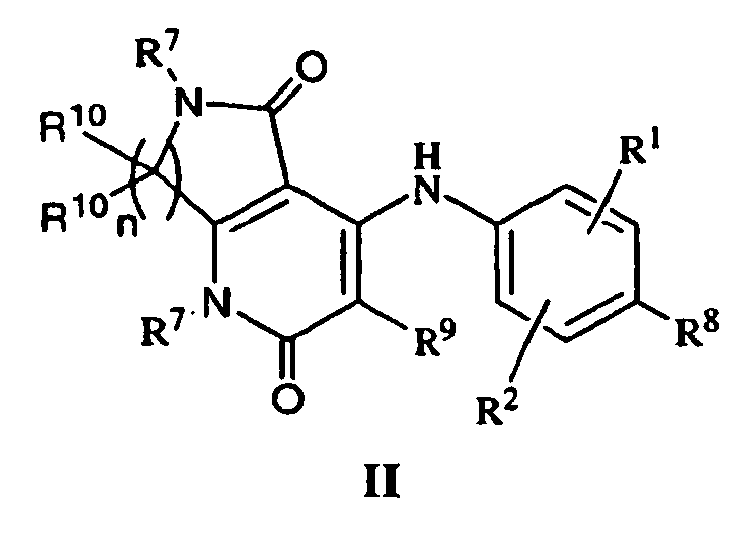


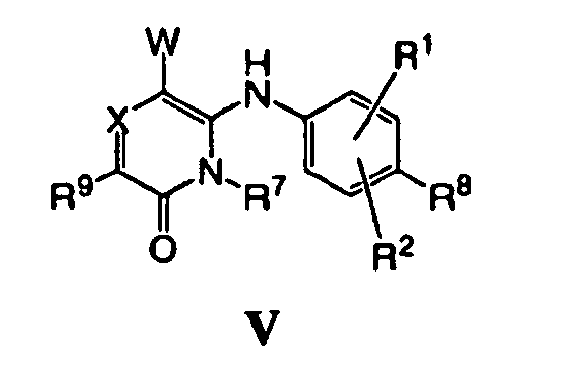
- and pharmaceutically accepted salts, prodrugs and solvates thereof, wherein:
- X is N or CR10;
- Y is NR3, O, S, S(O), S(O)2, C(O) or CH2;
- R1, R2, R8, and R9 are independently hydrogen, hydroxy, halogen, cyano, nitro, trifluoromethyl, difluoromethyl, fluoromethyl, fluoromethoxy, difluoromethoxy, trifluoromethoxy, azido, -SR11, -OR3, -C(O)R3, -C(O)OR3, -NR4C(O)OR6, -OC(O)R3, - NR4SO2R6, -SO2NR3R4, -NR4C(O)R3, -C(O)NR3R4, -NR5C(O)NR3R4, -NR5C(NCN)NR3R4, - NR3R4, C1-C10 alkyl, C2-C10 alkenyl, C2-C10 alkynyl, C3-C10 cycloalkyl, C3-C10 cycloalkylalkyl, - S(O)j(C1-C6 alkyl), -S(0)jCR4R5)m-aryl, aryl, arylalkyl, heteroaryl, heteroarylalkyl, heterocyclyl, heterocyclylalkyl, -0(CR4R5)m-aryl, -NR4(CR4R5)m-aryl, -O(CR4R5)m heteroaryl, -NR4(CR4R5)m-heteroaryl, -O(CR4R5)m-heterocyclyl or -NR4(CR4R5)m-heterocyclyl, wherein any of said alkyl, alkenyl, alkynyl, cycloalkyl, aryl, arylalkyl, heteroaryl, heteroarylalkyl, heterocyclyl and heterocyclylalkyl portions are optionally substituted with one or more groups independently selected from oxo (with the proviso that it is not substituted on an aryl or heteroaryl), halogen, cyano, nitro, trifluoromethyl, difluoromethoxy, trifluoromethoxy, azido, -NR4SO2R6, -SO2NR3R4, -C(O)R3, -C(O)OR3, -OC(O)R3, -NR4C(O)OR6, -NR4C(O)R3, -C(O)NR3R4, -NR3R4, -NRSC(O)NR3R4, -NR5C(NCN)NR3R4, -OR3, aryl, heteroaryl, arylalkyl, heteroarylalkyl, heterocyclyl, and heterocyclylalkyl, and wherein said aryl, heteroaryl, arylalkyl, heteroarylalkyl, heterocyclyl or heterocyclylalkyl rings may be further substituted with one or more groups selected from halogen, hydroxyl, cyano, nitro, azido, fluoromethyl, difluoromethyl, trifluoromethyl, C1-C4 alkyl, C2-C4 alkenyl, C2-C4 alkynyl, C3-C6 cycloalkyl, C3-C6 heterocycloalkyl, NR3R4 and OR3;
- R7 is hydrogen, trifluoromethyl, C1-C10 alkyl, C2-C10 alkenyl, C2-C10 alkynyl, C3-C10 cycloalkyl, C3-C10 cycloalkylalkyl, aryl, arylalkyl, heteroaryl, heteroarylalkyl, heterocyclyl, or heterocyclylalkyl, wherein any of said alkyl, alkenyl, alkynyl, cycloalkyl, aryl, arylalkyl, heteroaryl, heteroarylalkyl, heterocyclyl and heterocyclylalkyl portions are optionally substituted with one or more groups independently selected from oxo (with the proviso that it is not substituted on an aryl or heteroaryl), halogen, cyano, nitro, trifluoromethyl, difluoromethyl, fluoromethyl, difluoromethoxy, trifluoromethoxy, azido, -NR11SO2R14, -SO2NR11R12, -C(O)R11, C(O)OR11, -OC(O)R11, -NR11C(O)OR14, -NR11C(O)R12, -C(O)NR11R12, -SR11, -S(O)R14, -SO2R14, -NR11R12, -NR11C(O)NR12R13, -NR11C(NCN)NR12R13, -OR11, C1-C10 alkyl, C2-C10 alkenyl, C2-C10 alkynyl, C3-C10 cycloalkyl, aryl, heteroaryl, arylalkyl, heteroarylalkyl, heterocyclyl, and heterocyclylalkyl, and wherein said aryl, heteroaryl, arylalkyl, heteroarylalkyl, heterocyclyl or heterocyclylalkyl rings may be further substituted with one or more groups selected from halogen, hydroxyl, cyano, nitro, azido, fluoromethyl, difluoromethyl, trifluoromethyl, C1-C4 alkyl, C2-C4 alkenyl, C2-C4 alkynyl, C3-C6 cycloalkyl, C3-C6 heterocycloalkyl, NR3R4 and OR3;
- R3 is hydrogen, trifluoromethyl, C1-C10 alkyl, C2-C10 alkenyl, C2-C10 alkynyl, C3-C10 cycloalkyl, C3-C10 cycloalkylalkyl, aryl, arylalkyl, heteroaryl, heteroarylalkyl, heterocyclyl, heterocyclylalkyl, phosphate or an amino acid residue, wherein any of said alkyl, alkenyl, alkynyl, cycloalkyl, aryl, arylalkyl, heteroaryl, heteroarylalkyl, heterocyclyl and heterocyclylalkyl portions are optionally substituted with one or more groups independently selected from oxo (with the proviso that it is not substituted on an aryl or heteroaryl), halogen, cyano, nitro, trifluoromethyl, difluoromethoxy, trifluoromethoxy, azido, -NR11SO2R14, -SO2NR11R12, -C(O)R11, C(O)OR11, -OC(O)R11, -NR11C(O)OR14, -NR11C(O)R12, -C(O)NR11R12, -SR11, -S(O)R14, -SO2R14, -NR11R12, -NR11C(O)NR12R13, -NR11C(NCN)NR12R13, -OR11, aryl, heteroaryl, arylalkyl, heteroarylalkyl, heterocyclyl, and heterocyclylalkyl,
- or R3 and R4 together with the atom to which they are attached form a 4 to 10 membered carbocyclic, heteroaryl or heterocyclic ring, wherein any of said carbocyclic, heteroaryl or heterocyclic rings are optionally substituted with one or more groups independently selected from halogen, cyano, nitro, trifluoromethyl, difluoromethoxy, trifluoromethoxy, azido, - NR11SO2R14, -SO2NR11R12, -C(O)R11, C(O)OR11, -OC(O)R11, -NR11C(O)OR14, -NR11C(O)R12, -C(O)NR11R12, -SR11, -S(O)R14, -SO2R14, -NR11R12, -NR11C(O)NR12R13, -NR11C(NCN)NR12R13, -OR11, aryl, heteroaryl, arylalkyl, heteroarylalkyl, heterocyclyl, and heterocyclylalkyl;
- R4 and R5 independently are hydrogen or C1-C6 alkyl, or
- R4 and R5 together with the atom to which they are attached form a 4 to 10 membered carbocyclic, heteroaryl or heterocyclic ring, wherein said alkyl or any of said carbocyclic, heteroaryl and heterocyclic rings are optionally substituted with one or more groups independently selected from halogen, cyano, nitro, trifluoromethyl, difluoromethoxy, trifluoromethoxy, azido, -NR11SO2R14, -SO2NR11R12, -C(O)R11, C(O)OR11, -OC(O)R11, -NR11C(O)OR14, -NR11C(O)R12, -C(O)NR11R12, -SR11, -S(O)R14, -SO2R14, -NR11R12, -NR11C(O)NR12R13, -NR11C(NCN)NR12R13, -OR11, aryl, heteroaryl, arylalkyl, heteroarylalkyl, heterocyclyl, and heterocyclylalkyl;
- R6 is trifluoromethyl, C1-C10 alkyl, C3-C10 cycloalkyl, aryl, arylalkyl, heteroaryl, heteroarylalkyl, heterocyclyl or heterocyclylalkyl, wherein any of said alkyl, cycloalkyl, aryl, arylalkyl, heteroaryl, heteroarylalkyl, heterocyclyl and heterocyclylalkyl portions are optionally substituted with one or more groups independently selected from oxo (with the proviso that it is not substituted on an aryl or heteroaryl), halogen, cyano, nitro, trifluoromethyl, difluoromethoxy, trifluoromethoxy, azido, -NR11SO2R14, -SO2NR11R12, -C(O)R11, C(O)OR11, -OC(O)R11, - NR11C(O)OR14, -NR11C(O)R12, -C(O)NR11R12, -SR11, -S(O)R14, -SO2R14, -NR11R12, -NR11C(O)NR12R13, -NR11C(NCN)NR12R13, -OR11, aryl, heteroaryl, arylalkyl, heteroarylalkyl, heterocyclyl, and heterocyclylalkyl;
- wherein in Formulae I and V, R10 is hydrogen, hydroxy, halogen, cyano, nitro, trifluoromethyl, difluoromethoxy, trifluoromethoxy, azido, -SR11, -OR3, -C(O)R3, -C(O)OR3, -NR4C(O)OR6, -OC(O)R3, -NR4SO2R6, -SO2NR3R4, -NR4C(O)R3, -C(O)NR3R4, -NR5C(O)NR3R4, -NR5C(NCN)NR3R4, -NR3R4, C1-C10 alkyl, C2-C10 alkenyl, C2-C10 alkynyl, C3-C10 cycloalkyl, C3-C10 cycloalkylalkyl, -S(O)j(C1-C6 alkyl), -S(O)j(CR4R5)m-aryl, aryl, arylalkyl, heteroaryl, heteroarylalkyl, heterocyclyl, heterocyclylalkyl, -O(CR4R5)m-aryl, - NR4(CR4R5)m-aryl, -O(CR4R5)m-heteroaryl, NR4(CR4R5)m-heteroaryl, -O(CR4R5)m-heterocyclyl or -NR4(CR4R5)m-heterocyclyl, wherein any of said alkyl, alkenyl, alkynyl, cycloalkyl, aryl, arylalkyl, heteroaryl, heteroarylalkyl, heterocyclyl and heterocyclylalkyl portions are optionally substituted with one or more groups independently selected from oxo (with the proviso that it is not substituted on an aryl or heteroaryl), halogen, cyano, nitro, trifluoromethyl, difluoromethoxy, trifluoromethoxy, azido, -NR4SO2R6, -SO2NR3R4, -C(O)R3, -C(O)OR3, -OC(O)R3, -NR4C(O)OR6, -NR4C(O)R3, -C(O)NR3R4, -NR3R4, -NRSC(O)NR3R4, -NR5C(NCN)NR3R4, - OR3, aryl, heteroaryl, arylalkyl, heteroarylalkyl, heterocyclyl, and heterocyclylalkyl, and wherein said aryl, heteroaryl, arylalkyl, heteroarylalkyl, heterocyclyl or heterocyclylalkyl rings may be further substituted with one or more groups selected from halogen, hydroxyl, cyano, nitro, azido, fluoromethyl, difluoromethyl, trifluoromethyl, C1-C4 alkyl, C2-C4 alkenyl, C2-C4 alkynyl, C3-C6 cycloalkyl, C3-C6 heterocycloalkyl, NR3R4 and OR3;
- and wherein in Formulae II and IV, each R10 is independently hydrogen, cyano, nitro, trifluoromethyl, difluoromethoxy, trifluoromethoxy, azido, -C(O)R3, -C(O)OR3, -SO2NR3R4, -C(O)NR3R4, C1-C10 alkyl, C2-C10 alkenyl, C2-C10 alkynyl, C3-C10 cycloalkyl, C3-C10 cycloalkylalkyl, -S(O)j(C1-C6 alkyl), -S(O)j(CR4R5)m-aryl, aryl, arylalkyl, heteroaryl, heteroarylalkyl, heterocyclyl or heterocyclylalkyl, wherein any of said alkyl, alkenyl, alkynyl, cycloalkyl, aryl, arylalkyl, heteroaryl, heteroarylalkyl, heterocyclyl and heterocyclylalkyl portions are optionally substituted with one or more groups independently selected from oxo (with the proviso that it is not substituted on an aryl or heteroaryl), halogen, cyano, nitro, trifluoromethyl, difluoromethoxy, trifluoromethoxy, azido, -NR4SO2R6, -SO2NR3R4, -C(O)R3, -C(O)OR3, -OC(O)R3, -NR4C(O)OR6, -NR4C(O)R3, -C(O)NR3R4, -NR3R4, -NR5C(O)NR3R4, -NR5C(NCN)NR3R4, -OR3, aryl, heteroaryl, arylalkyl, heteroarylalkyl, heterocyclyl, and heterocyclylalkyl, and wherein said aryl, heteroaryl, arylalkyl, heteroarylalkyl, heterocyclyl or heterocyclylalkyl rings may be further substituted with one or more groups selected from halogen, hydroxyl, cyano, nitro, azido, fluoromethyl, difluoromethyl, trifluoromethyl, C1-C4 alkyl, C2-C4 alkenyl, C2-C4 alkynyl, C3-C6 cycloalkyl, C3-C6 heterocycloalkyl, NR3R4 and OR3;
- R11, R12 and R13 independently are hydrogen, lower alkyl, lower alkenyl, aryl and arylalkyl, and R14 is lower alkyl, lower alkenyl, aryl and arylalkyl;
- or any two of R11, R12, R13 or R14 together with the atom to which they are attached form a 4 to 10 membered carbocyclic, heteroaryl or heterocyclic ring, wherein any of said alkyl, alkenyl, aryl, arylalkyl carbocyclic rings, heteroaryl rings or heterocyclic rings are optionally substituted with one or more groups independently selected from halogen, cyano, nitro, trifluoromethyl, difluoromethoxy, trifluoromethoxy, azido, aryl, heteroaryl, arylalkyl, heteroarylalkyl, heterocyclyl, and heterocyclylalkyl;
- W is heteroaryl, heterocyclyl, -C(O)OR3, -C(O)NR3R4, -C(O)NR4OR3, -C(O)R4OR3, -C(O)NR4SO2R3, -C(O)(C3-C10 cycloalkyl), -C(O)(C1-C10 alkyl), -C(O)(aryl), -C(O)(heteroaryl), -C(O)(heterocyclyl) or CR3OR3 wherein any of said heteroaryl, heterocyclyl, -C(O)OR3, -C(O)NR3R4, -C(O)NR4OR3, -C(O)R4OR3, -C(O)NR4SO2R3, -C(O)(C3-C10 cycloalkyl), -C(O)(C1-C10 alkyl), -C(O)(aryl), -C(O)(heteroaryl), -C(O)(heterocyclyl) and CR3OR3 are optionally substituted with one or more groups independently selected from halogen, cyano, nitro, azido, -NR3R4, -OR3, C1-C10 alkyl, C2-C10 alkenyl, C2-C10 alkynyl, cycloalkyl and heterocycloalkyl, wherein any of said C1-C10 alkyl, C2-C10 alkenyl, C2-C10 alkynyl, cycloalkyl and heterocycloalkyl are optionally substituted with 1 or more groups independently selected from -NR3R4 and -OR3;
- m is 0, 1, 2, 3, 4 or 5; and
- j is 0, 1 or 2.
- In a further aspect, the present invention discloses compositions that inhibit MEK comprising one or more compounds of Formulas I-V.
- The invention also discloses pharmaceutically acceptable prodrugs, pharmaceutically active metabolites, and pharmaceutically acceptable salts of compounds of Formula I-V. Methods of making the compounds of Formula I-V are also described.
- In a further aspect the present invention discloses a method of using the compounds of this invention as a medicament to treat diseases or medical conditions mediated by MEK. For example, this invention discloses a method for treatment of a hyperproliferative disorder or an inflammatory condition in a mammal comprising administrating to said mammal one or more compounds of Formulas I-V or a pharmaceutically acceptable salt or prodrug thereof in an amount effective to treat said hyperproliferative disorder.
- In a further aspect the present invention discloses treating or preventing an MEK-mediated condition, comprising administering to a human or animal in need thereof a pharmaceutical composition comprising a compound of Formula I-V or a pharmaceutically-acceptable salt or in vivo cleavable prodrug thereof in an amount effective to treat or prevent said MEK-mediated condition.
- The inventive compounds may further be used advantageously in combination with other known therapeutic agents.
- The invention also discloses pharmaceutical compositions that inhibit MEK, comprising an effective amount of a compound selected from compounds of Formulas I-V or pharmaceutically acceptable prodrugs, pharmaceutically active metabolites, or pharmaceutically acceptable salts thereof.
- An additional disclosure of the invention is the use of a compound of Formula I, Formula II, Formula III, Formula IV or Formula V in the preparation of a medicament for the treatment or prevention of a disease or medical condition mediated by MEK in a warm-blooded animal, preferably a mammal, more preferably a human, suffering from such disorder. More particularly, the invention includes the use of a compound of the invention in the preparation of a medicament for the treatment or prevention of a hyperproliferative disorder or an inflammatory condition in a mammal.
- Additional advantages and novel features of this invention shall be set forth in part in the description that follows, and in part will become apparent to those skilled in the art upon examination of the following specification or may be learned by the practice of the invention. The advantages of the invention may be realized and attained by means of the instrumentalities, combinations, compositions, and methods particularly pointed out in the appended claims.
- The present invention discloses in embodiments:
- 1. A compound including resolved enantiomers, diastereomers, and pharmaceutically acceptable salts thereof, said compound having the Formula:
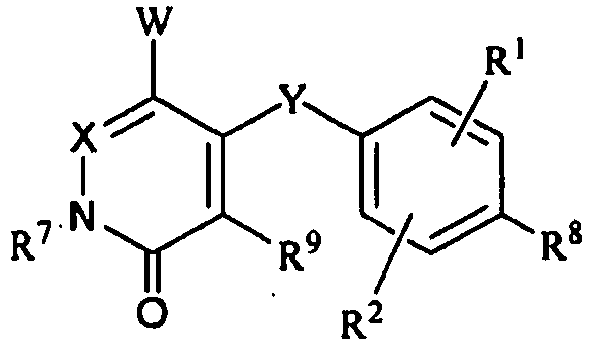
- X CR10;
- Y is NH;
- R10 is hydrogen, halogen, methyl, fluoromethyl, difluoromethyl, trifluoromethyl or ethyl;
- R1, R2, R8, and R9 are independently hydrogen, hydroxy, halogen, cyano, nitro, trifluoromethyl, difluoromethyl, fluoromethyl, fluoromethoxy, difluoromethoxy, trifluoromethoxy, azido, -SR11, -OR3, -C(O)R3, -C(O)OR3, -NR4C(O)OR8, -OC(O)R3, -NR4SO2R8, -SO2NR3R4, - NR4C(O)R3, -C(O)NR3R4, -NR5C(O)NR3R4, -NR5C(NCN)NR3R4, -NR3R4, C1-C10 alkyl, C2-C10 alkenyl, C2-C10 alkynyl, C3-C10 cycloalkyl, C3-C10 cycloalkylalkyl, -S(O)j(C1-C6 alkyl), - S(O)jMCR4R5)m-aryl, aryl, arylalkyl, heteroaryl, heteroarylalkyl, heterocyclyl, heterocyclylalkyl, - O(CR4R5)m-aryl, -NR4(CR4R5)m-aryl, -O(CR4R5)m-heteroaryl, -NR4(CR4R5)m-heteroaryl, -O(CR4R5)m-heterocyclyl or -NR4(CR4R5)m-heterocyclyl, wherein any of said alkyl, alkenyl, alkynyl, cycloalkyl, aryl, arylalkyl, heteroaryl, heteroarylalkyl, heterocyclyl and heterocyclylalkyl portions are optionally substituted with one or more groups independently selected from oxo (with the proviso that it is not substituted on an aryl or heteroaryl), halogen, cyano, nitro, trifluoromethyl, difluoromethoxy, trifluoromethoxy, azido, -NR4SO2R8, -SO2NR3R4, -C(O)R3, -C(O)OR3, -OC(O)R3, -NR4C(O)OR6, -NR4C(O)R3, -C(O)NR3R4, -NR3R4, -NR5C(O)NR3R4 -NR5C(NCN)NR3R4, -OR3, aryl, heteroaryl, arylalkyl, heteroarylalkyl, heterocyclyl, and heterocyclylalkyl, and wherein said aryl, heteroaryl, arylalkyl, heteroarylalkyl, heterocyclyl or heterocyclylalkyl rings may be further substituted with one or more groups selected from halogen, hydroxyl, cyano, nitro, azido, fluoromethyl, difluoromethyl, trifluoromethyl, C1-C4 alkyl, C2-C4 alkenyl, C2-C4 alkynyl, C3-C6 cycloalkyl, C3-C6 heterocycloalkyl, NR3R4 and OR3;
- R7 is hydrogen, trifluoromethyl, C1-C10 alkyl, C2-C10 alkenyl, C2-C10 alkynyl, C3-C10 cycloalkyl, C3-C10 cycloalkylalkyl, aryl, arylalkyl, heteroaryl, heteroarylalkyl, heterocyclyl, or heterocyclylalkyl, wherein any of said alkyl, alkenyl, alkynyl, cycloalkyl, aryl, arylalkyl, heteroaryl, heteroarylalkyl, heterocyclyl and heterocyclylalkyl portions are optionally substituted with one or more groups independently selected from oxo (with the proviso that it is not substituted on an aryl or heteroaryl), halogen, cyano, nitro, trifluoromethyl, difluoromethyl, fluoromethyl, difluoromethoxy, trifluoromethoxy, azido, -NR11SO2R14, -SO2NR11R12, -C(O)R11, C(O)OR11, -OC(O)R11, -NR11C(O)OR14, -NR11C(O)R12, -C(O)NR11R12, -SR11, -S(O)R14, -SO2R14, -NR11R12, -NR11C(O)NR12R13, -NR11C(NCN)NR12R13, -OR11, C1-C10 alkyl, C2-C10 alkenyl, C2-C10 alkynyl, C3-C10 cycloalkyl, aryl, heteroaryl, arylalkyl, heteroarylalkyl, heterocyclyl, and heterocyclylalkyl, and wherein said aryl, heteroaryl, arylalkyl, heteroarylalkyl, heterocyclyl or heterocyclylalkyl rings may be further substituted with one or more groups selected from halogen, hydroxyl, cyano, nitro, azido, fluoromethyl, difluoromethyl, trifluoromethyl, C1-C4 alkyl, C2-C4 alkenyl, C2-C4 alkynyl, C3-C8 cycloalkyl, C3-C8 heterocycloalkyl, NR3R4 and OR3;
- R3 is hydrogen, trifluoromethyl, C1-C10 alkyl, C2-C10 alkenyl, C2-C10 alkynyl, C3-C10 cycloalkyl, C3-C10 cycloalkylalkyl, aryl, arylalkyl, heteroaryl, heteroarylalkyl, heterocyclyl, heterocyclylalkyl, phosphate or an amino acid residue, wherein any of said alkyl, alkenyl, alkynyl, cycloalkyl, aryl, arylalkyl, heteroaryl, heteroarylalkyl, heterocyclyl and heterocyclylalkyl portions are optionally substituted with one or more groups independently selected from oxo (with the proviso that it is not substituted on an aryl or heteroaryl), halogen, cyano, nitro, trifluoromethyl, difluoromethoxy, trifluoromethoxy, azido, -NR11SO2R14, -SO2NR11R12, -C(O)R11, C(O)OR11, -OC(O)R11, -NR11C(O)OR14, -NR11C(O)R12, -C(O)NR11R12, -SR11, -S(O)R11, -SO2R14, -NR11R12, -NR11C(O)NR12R13, -NR11C(NCN)NR12R13, -OR11, aryl, heteroaryl, arylalkyl, heteroarylalkyl, heterocyclyl, and heterocyclylalkyl,
- or R3 and R4 together with the atom to which they are attached form a 4 to 10 membered heteroaryl or heterocyclic ring, wherein any of said heteroaryl or heterocyclic rings are optionally substituted with one or more groups independently selected from halogen, cyano, nitro, trifluoromethyl, difluoromethoxy, trifluoromethoxy, azido, -NR11SO2R14, -SO2NR11R12, -C(O)R11, C(O)OR11, -OC(O)R11, -NR11C(O)OR14, -NR11C(O)R12, -C(O)NR11R12, -SR11, -S(O)R14, -SO2R14, - NR11R12, -NR11C(O)NR12R13, -NR11C(NCN)NR12R13, -OR11, aryl, heteroaryl, arylalkyl, heteroarylalkyl, heterocyclyl, and heterocyclylalkyl;
- R4 and R5 independently are hydrogen or C1-C6 alkyl, or
- R4 and R5 together with the atom to which they are attached form a 4 to 10 membered carbocyclic, heteroaryl or heterocyclic ring, wherein said alkyl or any of said carbocyclic, heteroaryl and heterocyclic rings are optionally substituted with one or more groups independently selected from halogen, cyano, nitro, trifluoromethyl, difluoromethoxy, trifluoromethoxy, azido, -NR11SO2R14, -SO2NR11R12, -C(O)R11, C(O)OR11, -OC(O)R11, - NR11C(O)OR14, -NR11O(O)R12, -O(O)NR11R12, -SR11, -S(O)R14, -SO2R14, -NR11R12, -NR11C(O)NR12R13, -NR11C(NON)NR12R13, -OR11, aryl, heteroaryl, arylalkyl, heteroarylalkyl, heterocyclyl, and heterocyclylalkyl;
- R8 is trifluoromethyl, C1-C10 alkyl, C3-C10 cycloalkyl, aryl, arylalkyl, heteroaryl, heteroarylalkyl, heterocyclyl or heterocyclylalkyl, wherein any of said alkyl, cycloalkyl, aryl, arylalkyl, heteroaryl, heteroarylalkyl, heterocyclyl and heterocyclylalkyl portions are optionally substituted with one or more groups independently selected from oxo (with the proviso that it is not substituted on an aryl or heteroaryl), halogen, cyano, nitro, trifluoromethyl, difluoromethoxy, trifluoromethoxy, azido, -NR11O2R14, -SO2NR11R12, -C(O)R11, C(O)OR11, -OC(O)R11, - NR11C(O)OR14, -NR11C(O)R12, -C(O)NR11R12, -SR11, -S(O)R14, -SO2R14, -NR11R12, -NR11C(O)NR12R13, -NR11C(NCN)NR12R13, -OR11, aryl, heteroaryl, arylalkyl, heteroarylalkyl, heterocyclyl, and heterocyclylalkyl;
- R11, R12 and R13 independently are hydrogen, C1-C10 alkyl, C2-C10 alkenyl, aryl and arylalkyl, and R14 is C1-C10 alkyl, C2-C10 alkenyl, aryl and arylalkyl;
- or any two of R11, R12, R13 or R14 together with the atom to which they are attached form a 4 to 10 membered heteroaryl or heterocyclic ring, wherein any of said alkyl, alkenyl, aryl, arylalkyl rings, heteroaryl rings or heterocyclic rings are optionally substituted with one or more groups independently selected from halogen, cyano, nitro, trifluoromethyl, difluoromethoxy, trifluoromethoxy, azido, aryl, heteroaryl, arylalkyl, heteroarylalkyl, heterocyclyl, and heterocyclylalkyl;
- W is heteroaryl, heterocyclyl, -C(O)OR3, -C(O)NR3R4, -C(O)NR4OR3, - -C(O)NR4SO2R3, -C(O)(C3-C10 cycloalkyl), -C(O)(C1-C10 alkyl), -C(O)(aryl), -C(O)(heteroaryl), -C(O)(heterocyclyl) or CR3OR3, wherein any of said heteroaryl, heterocyclyl, -C(O)OR3, -C(O)NR3R4, -C(O)NR4OR3, -C(O)R4OR3, -C(O)NR4SO2R3, -C(O)(C3-C10 cycloalkyl), -C(O)(C1-C10 alkyl), -C(O)(aryl), - C(O)(heteroaryl), -C(O)(heterocyclyl) and CR3OR3 are optionally substituted with one or more groups independently selected from halogen, cyano, nitro, azido, -NR3R4, -OR3, C1-C10 alkyl, C2-C10 alkenyl, C2-C10 alkynyl, cycloalkyl and heterocycloalkyl, wherein any of said C1-C10 alkyl, C2-C10 alkenyl, C2-C10 alkynyl, cycloalkyl and heterocycloalkyl are optionally substituted with 1 or more groups independently selected from -NR3R4 and -OR3;
- m is 0, 1, 2, 3, 4 or 5; and
- j is 0, 1 or 2.
- 2. A compound including resolved enantiomers, diastereomers, and pharmaceutically acceptable salts thereof, said compound having the formula:

- R1, R2, R8 and R9 are independently hydrogen, halogen, cyano, nitro, trifluoromethyl, difluoromethoxy, difluoromethyl, fluoromethyl, fluoromethoxy, trifluoromethoxy, azido, -SR11, -OR3, -C(O)R3, -C(O)OR3, -NR4C(O)OR6, -OC(O)R3, -NR4SO2R6, -SO2NR3R4, -NR4C(O)R3, -C(O)NR3R4, -NR5C(O)NR3R4, -NR5C(NCN)NR3R4, -NR3R4, C1-C10 alkyl, C2-C10 alkenyl, C2-C10 alkynyl, C3-C10 cycloalkyl, C3-C10 cycloalkylalkyl, -S(O)j(C1-C6 alkyl), -S(O)j(CR4R5)m-aryl, aryl, arylalkyl, heteroaryl, heteroarylalkyl, heterocyclyl, heterocyclylalkyl, -O(OR4R5)m-aryl, -NR4(CR4R5)m-aryl, -O(CR4R5)m-heteroaryl, -NR4(CR4R5)m-heteroaryl, -O(CR4R5)m-heterocyclyl or -NR4(CR4R5)m-heterocyclyl, wherein any of said alkyl, alkenyl, alkynyl, cycloalkyl, aryl, arylalkyl, heteroaryl, heteroarylalkyl, heterocyclyl and heterocyclylalkyl portions are optionally substituted with one or more groups independently selected from oxo (with the proviso that it is not substituted on an aryl or heteroaryl), halogen, cyano, nitro, trifluoromethyl, difluoromethoxy, trifluoromethoxy, azido, -NR4SO2R6, -SO2NR3R4, -C(O)R3, -C(O)OR3, -OC(O)R3, -NR4C(O)OR6, - NR4C(O)R3, -C(O)NR3R4, -NR3R4, -NR5C(O)NR3R4, -NR5C(NCN)NR3R4, -OR3, aryl, heteroaryl, arylalkyl, heteroarylalkyl, heterocyclyl, and heterocyclylalkyl, and wherein said aryl, heteroaryl, arylalkyl, heteroarylalkyl, heterocyclyl or heterocyclylalkyl rings may be further substituted with one or more groups selected from halogen, hydroxyl, cyano, nitro, azido, fluoromethyl, difluoromethyl, trifluoromethyl, C1-C4 alkyl, C2-C4 alkenyl, C2-C4 alkynyl, C3-C6 cycloalkyl, C3-C6 heterocycloalkyl, NR3R4 and OR3;
- R7 is hydrogen, trifluoromethyl, C1-C10 alkyl, C2-C10 alkenyl, C2-C10 alkynyl, C3-C10 cycloalkyl, C3-C10 cycloalkylalkyl, aryl, arylalkyl, heteroaryl, heteroarylalkyl, heterocyclyl, or heterocyclylalkyl, wherein any of said alkyl, alkenyl, alkynyl, cycloalkyl, aryl, arylalkyl, heteroaryl, heteroarylalkyl, heterocyclyl and heterocyclylalkyl portions are optionally substituted with one or more groups independently selected from oxo (with the proviso that it is not substituted on an aryl or heteroaryl), halogen, cyano, nitro, trifluoromethyl, difluoromethyl, fluoromethyl, difluoromethoxy, trifluoromethoxy, azido, -NR11SO2R14, -SO2NR11R12, -C(O)R11, C(O)OR11, -OC(O)R11, -NR11C(O)OR14, -NR11C(O)R12, -C(O)NR11R12, -SR11, -S(O)R14, -SO2R14, -NR11R12, -NR11C(O)NR12R13, -NR11C(NON)NR12R13, -OR11, C1-C10 alkyl, C2-C10 alkenyl, C2-C10 alkynyl, C3-C10 cycloalkyl, aryl, heteroaryl, arylalkyl, heteroarylalkyl, heterocyclyl, and heterocyclylalkyl, and wherein said aryl, heteroaryl, arylalkyl, heteroarylalkyl, heterocyclyl or heterocyclylalkyl rings may be further substituted with one or more groups selected from halogen, hydroxyl, cyano, nitro, azido, fluoromethyl, difluoromethyl, trifluoromethyl, C1-C4 alkyl, C2-C4 alkenyl, C2-C4 alkynyl, C3-C6 cycloalkyl, C3-C6 heterocycloalkyl, NR3R4 and OR3;
- each R10 is independently hydrogen, cyano, nitro, trifluoromethyl, difluoromethoxy, trifluoromethoxy, azido, -C(O)R3, -C(O)OR3, -SO2NR3R4, -C(O)NR3R4, C1-C10 alkyl, C2-C10 alkenyl, C2-C10 alkynyl, C3-C10 cycloalkyl, C3-C10 cycloalkylalkyl, -S(O)j(C1-C6 alkyl), - S(O)j(CR4R5)m-aryl, aryl, arylalkyl, heteroaryl, heteroarylalkyl, heterocyclyl or heterocyclylalkyl, wherein any of said alkyl, alkenyl, alkynyl, cycloalkyl, aryl, arylalkyl, heteroaryl, heteroarylalkyl, heterocyclyl and heterocyclylalkyl portions are optionally substituted with one or more groups independently selected from oxo (with the proviso that it is not substituted on an aryl or heteroaryl), halogen, cyano, nitro, trifluoromethyl, difluoromethoxy, trifluoromethoxy, azido, - NR4SO2R6, -SO2NR3R4, -C(O)R3, -C(O)OR3, -OC(O)R3, -NR4C(O)OR6, -NR4C(O)R3, -C(O)NR3R4, -NR3R4, -NR5C(O)NR3R4, -NR5C(NCN)NR3R4, -OR3, aryl, heteroaryl, arylalkyl, heteroarylalkyl, heterocyclyl, and heterocyclylalkyl, and wherein said aryl, heteroaryl, arylalkyl, heteroarylalkyl, heterocyclyl or heterocyclylalkyl rings may be further substituted with one or more groups selected from halogen, hydroxyl, cyano, nitro, azido, fluoromethyl, difluoromethyl, trifluoromethyl, C1-C4 alkyl, C2-C4 alkenyl, C2-C4 alkynyl, C3-C6 cycloalkyl, C3-C6 heterocycloalkyl, NR3R4 and OR3;
- R3 is hydrogen, trifluoromethyl, C1-C10 alkyl, C2-C10 alkenyl, C2-C10 alkynyl, C3-C10 cycloalkyl, C3-C10 cycloalkylalkyl, aryl, arylalkyl, heteroaryl, heteroarylalkyl, heterocyclyl, heterocyclylalkyl, phosphate or an amino acid residue, wherein any of said alkyl, alkenyl, alkynyl, cycloalkyl, aryl, arylalkyl, heteroaryl, heteroarylalkyl, heterocyclyl and heterocyclylalkyl portions are optionally substituted with one or more groups independently selected from oxo (with the proviso that it is not substituted on an aryl or heteroaryl), halogen, cyano, nitro, trifluoromethyl, difluoromethoxy, trifluoromethoxy, azido, -NR11SO2R14, -SO2NR11R12, -C(O)R11, C(O)OR11, -OC(O)R11, -NR11C(O)OR14, -NR11C(O)R12, -C(O)NR11R12, -SR11, -S(O)R14, -SO2R14, -NR11R12, -NR11C(O)NR12R13, -NR11C(NCN)NR12R13, -OR11, aryl, heteroaryl, arylalkyl, heteroarylalkyl, heterocyclyl, and heterocyclylalkyl,
- or R3 and R4 together with the atom to which they are attached form a 4 to 10 membered heteroaryl or heterocyclic ring, wherein any of said , heteroaryl or heterocyclic rings are optionally substituted with one or more groups independently selected from halogen, cyano, nitro, trifluoromethyl, difluoromethoxy, trifluoromethoxy, azido, -NR11SO2R14, -SO2NR11R12, -C(O)R11, C(O)OR11, -OC(O)R11, -NR11C(O)OR14, -NR11C(O)R12, -C(O)NR11R12, -SR11, -S(O)R14, -SO2R14, -NR11R12, -NR11C(O)NR12R13, -NR11C(NCN)NR12R13, -OR11, aryl, heteroaryl, arylalkyl, heteroarylalkyl, heterocyclyl, and heterocyclylalkyl;
- R4 and R5 independently are hydrogen or C1-C6 alkyl, or
- R4 and R5 together with the atom to which they are attached form a 4 to 10 membered carbocyclic, heteroaryl or heterocyclic ring, wherein said alkyl or any of said carbocyclic, heteroaryl and heterocyclic rings are optionally substituted with one or more groups independently selected from halogen, cyano, nitro, trifluoromethyl, difluoromethoxy, trifluoromethoxy, azido, -NR11SO2R14, -SO2NR11R12, -C(O)R11, C(O)OR11, -OC(O)R11, - NR11C(O)OR14, -NR11C(O)R12, -O(O)NR11R12, -SR11, -S(O)R14, -SO2R14, -NR11R12, -NR11C(O)NR12R13, -NR11C(NCN)NR12R13, -OR11, aryl, heteroaryl, arylalkyl, heteroarylalkyl, heterocyclyl, and heterocyclylalkyl;
- R6 is trifluoromethyl, C1-C10 alkyl, C3-C10 cycloalkyl, aryl, arylalkyl, heteroaryl, heteroarylalkyl, heterocyclyl or heterocyclylalkyl, wherein any of said alkyl, cycloalkyl, aryl, arylalkyl, heteroaryl, heteroarylalkyl, heterocyclyl and heterocyclylalkyl portions are optionally substituted with one or more groups independently selected from oxo (with the proviso that it is not substituted on an aryl or heteroaryl), halogen, cyano, nitro, trifluoromethyl, difluoromethoxy, trifluoromethoxy, azido, -NR11SO2R14, -SO2NR11R12, -C(O)R11, C(O)OR11, -OC(O)R11, - NR11C(O)OR14, -NR11C(O)R12, -C(O)NR11R12, -SR11, -S(O)R14, -SO2R14, -NR11R12, -NR11C(O)NR12R13, -NR11C(NCN)NR12R13, -OR11, aryl, heteroaryl, arylalkyl, heteroarylalkyl, heterocyclyl, and heterocyclylalkyl;
- R11, R12 and R13 independently are hydrogen, C1-C10 alkyl, C2-C10 alkenyl, aryl and arylalkyl, and R14 is C1-C10 alkyl, C2-C10 alkenyl, aryl and arylalkyl;
- or any two of R11, R12, R13 or R14 together with the atom to which they are attached form a 4 to 10 membered heteroaryl or heterocyclic ring, wherein any of said alkyl, alkenyl, aryl, arylalkyl rings, heteroaryl rings or heterocyclic rings are optionally substituted with one or more groups independently selected from halogen, cyano, nitro, trifluoromethyl, difluoromethoxy, trifluoromethoxy, azido, aryl, heteroaryl, arylalkyl, heteroarylalkyl, heterocyclyl, and heterocyclylalkyl;
- m is 0, 1, 2, 3, 4 or 5;
- n is 1 or 2; and
- j is 0, 1 or 2.
- 3. A compound including resolved enantiomers, diastereomers, and pharmaceutically acceptable salts thereof, said compound having the formula:

- R1, R2, R8 and each R9 are independently hydrogen, halogen, cyano, nitro, trifluoromethyl, difluoromethyl, fluoromethyl, fluoromethoxy, difluoromethoxy, trifluoromethoxy, azido, -SR11, -OR3, -C(O)R3, -O(O)OR3, -NR4C(O)OR6, -OO(O)R3, -NR4SO2R8, -SO2NR3R4, - NR4C(O)R3, -C(O)NR3R4, -NR5C(O)NR3R4, -NR5C(NCN)NR3R4, -NR3R4, C1-C10 alkyl, C2-C10 alkenyl, C2-C10 alkynyl, C3-C10 cycloalkyl, C3-C10 cycloalkylalkyl, -S(O)j(C1-C6 alkyl), - S(O)j(CR4R5)m-aryl, aryl, arylalkyl, heteroaryl, heteroarylalkyl, heterocyclyl, heterocyclylalkyl, - O(CR4R5)m-aryl, -NR4(CR4R5)m-aryl, -O(CR4R5)m-heteroaryl, -NR4(OR4R5)m-heteroaryl, -O(CR4R5)m-heterocyclyl or -NR4(CR4R5)m-heterocyclyl, wherein any of said alkyl, alkenyl, alkynyl, cycloalkyl, aryl, arylalkyl, heteroaryl, heteroarylalkyl, heterocyclyl and heterocyclylalkyl portions are optionally substituted with one or more groups independently selected from oxo (with the proviso that it is not substituted on an aryl or heteroaryl), halogen, cyano, nitro, trifluoromethyl, difluoromethoxy, trifluoromethoxy, azido, -NR4SO2R8, -SO2NR3R4, -C(O)R3, -C(O)OR3, -OC(O)R3, -NR4C(O)OR6, -NR4C(O)R3, -C(O)NR3R4, -NR3R4, -NR5C(O)NR3R4, -NR5C(NCN)NR3R4, -OR3, aryl, heteroaryl, arylalkyl, heteroarylalkyl, heterocyclyl, and heterocyclylalkyl, and wherein said aryl, heteroaryl, arylalkyl, heteroarylalkyl, heterocyclyl or heterocyclylalkyl rings may be further substituted with one or more groups selected from halogen, hydroxyl, cyano, nitro, azido, fluoromethyl, difluoromethyl, trifluoromethyl, C1-C4 alkyl, C2-C4 alkenyl, C2-C4 alkynyl, C3-C6 cycloalkyl, C3-C6 heterocycloalkyl, NR3R4 and OR3;
- R7 is hydrogen, trifluoromethyl, C1-C10 alkyl, C2-C10 alkenyl, C2-C10 alkynyl, C3-C10 cycloalkyl, C3-C10 cycloalkylalkyl, aryl, arylalkyl, heteroaryl, heteroarylalkyl, heterocyclyl, or heterocyclylalkyl, wherein any of said alkyl, alkenyl, alkynyl, cycloalkyl, aryl, arylalkyl, heteroaryl, heteroarylalkyl, heterocyclyl and heterocyclylalkyl portions are optionally substituted with one or more groups independently selected from oxo (with the proviso that it is not substituted on an aryl or heteroaryl), halogen, cyano, nitro, trifluoromethyl, difluoromethyl, fluoromethyl, difluoromethoxy, trifluoromethoxy, azido, -NR11SO2R14, -SO2NR11R12, -C(O)R11, C(O)OR11, -OC(O)R11, -NR11C(O)OR14, -NR11C(O)R12, -O(O)NR11R12, -SR11, -S(O)R14, -SO2R14, -NR11R12, -NR11C(O)NR12R13, -NR11C(NCN)NR12R13, -OR11, C1-C10 alkyl, C2-C10 alkenyl, C2-C10 alkynyl, C3-C10 cycloalkyl, aryl, heteroaryl, arylalkyl, heteroarylalkyl, heterocyclyl, and heterocyclylalkyl, and wherein said aryl, heteroaryl, arylalkyl, heteroarylalkyl, heterocyclyl or heterocyclylalkyl rings may be further substituted with one or more groups selected from halogen, hydroxyl, cyano, nitro, azido, fluoromethyl, difluoromethyl, trifluoromethyl, C1-C4 alkyl, C2-C4 alkenyl, C2-C4 alkynyl, C3-C8 cycloalkyl, C3-C6 heterocycloalkyl, NR3R4 and OR3;
- R3 is hydrogen, trifluoromethyl, C1-C10 alkyl, C2-C10 alkenyl, C2-C10 alkynyl, C3-C10 cycloalkyl, C3-C10 cycloalkylalkyl, aryl, arylalkyl, heteroaryl, heteroarylalkyl, heterocyclyl, heterocyclylalkyl, phosphate or an amino acid residue, wherein any of said alkyl, alkenyl, alkynyl, cycloalkyl, aryl, arylalkyl, heteroaryl, heteroarylalkyl, heterocyclyl and heterocyclylalkyl portions are optionally substituted with one or more groups independently selected from oxo (with the proviso that it is not substituted on an aryl or heteroaryl), halogen, cyano, nitro, trifluoromethyl, difluoromethoxy, trifluoromethoxy, azido, -NR11SO2R14, -SO2NR11R12, -C(O)R11, C(O)OR11, -OC(O)R11, -NR11C(O)OR14, -NR11C(O)R12, -C(O)NR11R12, -SR11, -S(O)R14, -SO2R14, -NR11R12, -NR11C(O)NR12R13, -NR11C(NCN)NR12R13, -OR11, aryl, heteroaryl, arylalkyl, heteroarylalkyl, heterocyclyl, and heterocyclylalkyl,
- or R3 and R4 together with the atom to which they are attached form a 4 to 10 membered heteroaryl or heterocyclic ring, wherein any of said heteroaryl or heterocyclic rings are optionally substituted with one or more groups independently selected from halogen, cyano, nitro, trifluoromethyl, difluoromethoxy, trifluoromethoxy, azido, -NR11SO2R14 -SO2NR11R12, -C(O)R11, C(O)OR11, -OC(O)R11, -NR11C(O)OR14, -NR11C(O)R12, -C(O)NR11R12, -SR11, -S(O)R14, -SO2R14, - NR11R12, -NR11C(O)NR12R13, -NR11C(NCN)NR12R13, -OR11, aryl, heteroaryl, arylalkyl, heteroarylalkyl, heterocyclyl, and heterocyclylalkyl;
- R4 and R5 independently are hydrogen or C1-C6 alkyl, or
- R4 and R5 together with the atom to which they are attached form a 4 to 10 membered carbocyclic, heteroaryl or heterocyclic ring, wherein said alkyl or any of said carbocyclic, heteroaryl and heterocyclic rings are optionally substituted with one or more groups independently selected from halogen, cyano, nitro, trifluoromethyl, difluoromethoxy, trifluoromethoxy, azido, -NR11SO2R14, -SO2NR11R12, -C(O)R11, C(O)OR11, -OC(O)R11, - NR11O(O)OR14, -NR11C(O)R12, -C(O)NR11R12, -SR11, -S(O)R14, -SO2R14, -NR11R12, -NR11C(O)NR12R13, -NR11C(NCN)NR12R13, -OR11, aryl, heteroaryl, arylalkyl, heteroarylalkyl, heterocyclyl, and heterocyclylalkyl;
- R6 is trifluoromethyl, C1-C10 alkyl, C3-C10 cycloalkyl, aryl, arylalkyl, heteroaryl, heteroarylalkyl, heterocyclyl or heterocyclylalkyl, wherein any of said alkyl, cycloalkyl, aryl, arylalkyl, heteroaryl, heteroarylalkyl, heterocyclyl and heterocyclylalkyl portions are optionally substituted with one or more groups independently selected from oxo (with the proviso that it is not substituted on an aryl or heteroaryl), halogen, cyano, nitro, trifluoromethyl, difluoromethoxy, trifluoromethoxy, azido, -NR11SO2R14, -SO2NR11R12, -C(O)R11, C(O)OR11, -OC(O)R11, - NR11C(O)OR14, -NR11C(O)R12, -C(O)NR11R12, -SR11, -S(O)R14, -SO2R14, -NR11R12, -NR11C(O)NR12R13, -NR11C(NCN)NR12R13, -OR11, aryl, heteroaryl, arylalkyl, heteroarylalkyl, heterocyclyl, and heterocyclylalkyl;
- R11, R12 and R13 independently are hydrogen, C1-C10 alkyl, C2-C10 alkenyl, aryl and arylalkyl, and R14 is C1-C10 alkyl, C2-C10 alkenyl, aryl and arylalkyl;
- or any two of R11, R12, R13 or R14 together with the atom to which they are attached form a 4 to 10 membered heteroaryl or heterocyclic ring, wherein any of said alkyl, alkenyl, aryl, arylalkyl rings, heteroaryl rings or heterocyclic rings are optionally substituted with one or more groups independently selected from halogen, cyano, nitro, trifluoromethyl, difluoromethoxy, trifluoromethoxy, azido, aryl, heteroaryl, arylalkyl, heteroarylalkyl, heterocyclyl, and heterocyclylalkyl;
- m is 0, 1, 2, 3, 4 or 5; and
- j is 0, 1 or 2.
- 4. A compound including resolved enantiomers, diastereomers, and pharmaceutically acceptable salts thereof, said compound having the formula:

- R1, R2, R8 and R9 are independently hydrogen, halogen, cyano, nitro, trifluoromethyl, difluoromethoxy, difluoromethyl, fluoromethyl, fluoromethoxy, trifluoromethoxy, azido, -SR11, -OR3, -C(O)R3, -C(O)OR3, -NR4C(O)OR6, -OC(O)R3, -NR4SO2R6, -SO2NR3R4, -NR4C(O)R3, -C(O)NR3R4, -NR5C(O)NR3R4, -NR5C(NCN)NR3R4, -NR3R4, C1-C10 alkyl, C2-C10 alkenyl, C2-C10 alkynyl, C3-C10 cycloalkyl, C3-C10 cycloalkylalkyl, -S(O)j(C1-C6 alkyl), -S(O)j(OR4R5)m-aryl, aryl, arylalkyl, heteroaryl, heteroarylalkyl, heterocyclyl, heterocyclylalkyl, -O(OR4R5)m-aryl, -NR4(CR4R5)m-aryl, -O(CR4R5)m-heteroaryl, -NR4(CR4R5)m-heteroaryl, -O(CR4R5)m-heterocyclyl or -NR4(CR4R5)m-heterocyclyl, wherein any of said alkyl, alkenyl, alkynyl, cycloalkyl, aryl, arylalkyl, heteroaryl, heteroarylalkyl, heterocyclyl and heterocyclylalkyl portions are optionally substituted with one or more groups independently selected from oxo (with the proviso that it is not substituted on an aryl or heteroaryl), halogen, cyano, nitro, trifluoromethyl, difluoromethoxy, trifluoromethoxy, azido, -NR4SO2R6, -SO2NR3R4, -C(O)R3, -C(O)OR3, -OO(O)R3, -NR4O(O)OR6, - NR4C(O)R3, -C(O)NR3R4, -NR3R4, -NR5C(O)NR3R4, -NR5C(NCN)NR3R4, -OR3, aryl, heteroaryl, arylalkyl, heteroarylalkyl, heterocyclyl, and heterocyclylalkyl, and wherein said aryl, heteroaryl, arylalkyl, heteroarylalkyl, heterocyclyl or heterocyclylalkyl rings may be further substituted with one or more groups selected from halogen, hydroxyl, cyano, nitro, azido, fluoromethyl, difluoromethyl, trifluoromethyl, C1-C4 alkyl, C2-C4 alkenyl, C2-C4 alkynyl, C3-C6 cycloalkyl, C3-C8 heterocycloalkyl, NR3R4 and OR3;
- each R7 is hydrogen, trifluoromethyl, C1-C10 alkyl, C2-C10 alkenyl, C2-C10 alkynyl, C3-C10 cycloalkyl, C3-C10 cycloalkylalkyl, aryl, arylalkyl, heteroaryl, heteroarylalkyl, heterocyclyl, or heterocyclylalkyl, wherein any of said alkyl, alkenyl, alkynyl, cycloalkyl, aryl, arylalkyl, heteroaryl, heteroarylalkyl, heterocyclyl and heterocyclylalkyl portions are optionally substituted with one or more groups independently selected from oxo (with the proviso that it is not substituted on an aryl or heteroaryl), halogen, cyano, nitro, trifluoromethyl, difluoromethyl, fluoromethyl, difluoromethoxy, trifluoromethoxy, azido, -NR11SO2R14 -SO2NR11R12, -C(O)R11, C(O)OR11, -OC(O)R11, -NR11C(O)OR14, -NR11C(O)R12, -C(O)NR11R12, -SR11, -S(O)R14, -SO2R14, -NR11R12, -NR11C(O)NR12R13, -NR11C(NCN)NR12R13, -OR11, C1-C10 alkyl, C2-C10 alkenyl, C2-C10 alkynyl, C3-C10 cycloalkyl, aryl, heteroaryl, arylalkyl, heteroarylalkyl, heterocyclyl, and heterocyclylalkyl, and wherein said aryl, heteroaryl, arylalkyl, heteroarylalkyl, heterocyclyl or heterocyclylalkyl rings may be further substituted with one or more groups selected from halogen, hydroxyl, cyano, nitro, azido, fluoromethyl, difluoromethyl, trifluoromethyl, C1-C4 alkyl, C2-C4 alkenyl, C2-C4 alkynyl, C3-C8 cycloalkyl, C3-C6 heterocycloalkyl, NR3R4 and OR3;
- each R10 is independently hydrogen, cyano, nitro, trifluoromethyl, difluoromethoxy, trifluoromethoxy, azido, -C(O)R3, -C(O)OR3, -SO2NR3R4, -C(O)NR3R4, C1-C10 alkyl, C2-C10 alkenyl, C2-C10 alkynyl, C3-C10 cycloalkyl, C3-C10 cycloalkylalkyl, -S(O)j(C1-C8 alkyl), - S(O)j(CR4R5)m-aryl, aryl, arylalkyl, heteroaryl, heteroarylalkyl, heterocyclyl or heterocyclylalkyl, wherein any of said alkyl, alkenyl, alkynyl, cycloalkyl, aryl, arylalkyl, heteroaryl, heteroarylalkyl, heterocyclyl and heterocyclylalkyl portions are optionally substituted with one or more groups independently selected from oxo (with the proviso that it is not substituted on an aryl or heteroaryl), halogen, cyano, nitro, trifluoromethyl, difluoromethoxy, trifluoromethoxy, azido, - NR4SO2R6, -SO2NR3R4, -C(O)R3, -C(O)OR3, -OC(O)R3, -NR4C(O)OR6, -NR4C(O)R3, -C(O)NR3R4, -NR3R4, -NR5C(O)NR3R4, -NR5O(NCN)NR3R4, -OR3, aryl, heteroaryl, arylalkyl, heteroarylalkyl, heterocyclyl, and heterocyclylalkyl, and wherein said aryl, heteroaryl, arylalkyl, heteroarylalkyl, heterocyclyl or heterocyclylalkyl rings may be further substituted with one or more groups selected from halogen, hydroxyl, cyano, nitro, azido, fluoromethyl, difluoromethyl, trifluoromethyl, C1-C4 alkyl, C2-C4 alkenyl, C2-C4 alkynyl, C3-C6 cycloalkyl, C3-C6 heterocycloalkyl, NR3R4 and OR3;
- R3 is hydrogen, trifluoromethyl, C1-C10 alkyl, C2-C10 alkenyl, C2-C10 alkynyl, C3-C10 cycloalkyl, C3-C10 cycloalkylalkyl, aryl, arylalkyl, heteroaryl, heteroarylalkyl, heterocyclyl, heterocyclylalkyl, phosphate or an amino acid residue, wherein any of said alkyl, alkenyl, alkynyl, cycloalkyl, aryl, arylalkyl, heteroaryl, heteroarylalkyl, heterocyclyl and heterocyclylalkyl portions are optionally substituted with one or more groups independently selected from oxo (with the proviso that it is not substituted on an aryl or heteroaryl), halogen, cyano, nitro, trifluoromethyl, difluoromethoxy, trifluoromethoxy, azido, -NR11SO2R14, -SO2NR11R12, -C(O)R11, C(O)OR11, -OC(O)R11, -NR11C(O)OR14, -NR11C(O)R12, -C(O)NR11R12, -SR11, -S(O)R14, -SO2R14, -NR11R12, -NR11C(O)NR12R13, -NR11C(NCN)NR12R13, -OR11, aryl, heteroaryl, arylalkyl, heteroarylalkyl, heterocyclyl, and heterocyclylalkyl,
- or R3 and R4 together with the atom to which they are attached form a 4 to 10 membered heteroaryl or heterocyclic ring, wherein any of said heteroaryl or heterocyclic rings are optionally substituted with one or more groups independently selected from halogen, cyano, nitro, trifluoromethyl, difluoromethoxy, trifluoromethoxy, azido, -NR11SO2R14, -SO2NR11R12, -C(O)R11, C(O)OR11, -OC(O)R11, -NR11C(O)OR14, -NR11C(O)R12, -C(O)NR11R12, -SR11, -S(O)R14, -SO2R14, - NR11R12, -NR11C(O)NR12R13, -NR11C(NCN)NR12R13, -OR11, aryl, heteroaryl, arylalkyl, heteroarylalkyl, heterocyclyl, and heterocyclylalkyl;
- R4 and R5 independently are hydrogen or C1-C6 alkyl, or
- R4 and R5 together with the atom to which they are attached form a 4 to 10 membered carbocyclic, heteroaryl or heterocyclic ring, wherein said alkyl or any of said carbocyclic, heteroaryl and heterocyclic rings are optionally substituted with one or more groups independently selected from halogen, cyano, nitro, trifluoromethyl, difluoromethoxy, trifluoromethoxy, azido, -NR11SO2R14, -SO2NR11R12, -C(O)R11, C(O)OR11, -OC(O)R11, - NR11C(O)OR14, -NR11C(O)R12, -C(O)NR11R12, -SR11, -S(O)R14, -SO2R14, -NR11R12, -NR11C(O)NR12R13, -NR11C(NCN)NR12R13, -OR11, aryl, heteroaryl, arylalkyl, heteroarylalkyl, heterocyclyl, and heterocyclylalkyl;
- R6 is trifluoromethyl, C1-C10 alkyl, C3-C10 cycloalkyl, aryl, arylalkyl, heteroaryl, heteroarylalkyl, heterocyclyl or heterocyclylalkyl, wherein any of said alkyl, cycloalkyl, aryl, arylalkyl, heteroaryl, heteroarylalkyl, heterocyclyl and heterocyclylalkyl portions are optionally substituted with one or more groups independently selected from oxo (with the proviso that it is not substituted on an aryl or heteroaryl), halogen, cyano, nitro, trifluoromethyl, difluoromethoxy, trifluoromethoxy, azido, -NR11SO2R14, -SO2NR11R12, -C(O)R11, C(O)OR11, -OC(O)R11, - NR11C(O)OR14, -NR11C(O)R12, -C(O)NR11R12, -SR11, -S(O)R14, -SO2R14, -NR11R12, -NR11C(O)NR12R13, -NR11C(NCN)NR12R13, -OR11, aryl, heteroaryl, arylalkyl, heteroarylalkyl, heterocyclyl, and heterocyclylalkyl;
- R11, R12 and R13 independently are hydrogen, C1-C10 alkyl, C2-C10 alkenyl, aryl and arylalkyl, and R14 is C1-C10 alkyl, C2-C10 alkenyl, aryl and arylalkyl;
- or any two of R11, R12, R13 or R14 together with the atom to which they are attached form a 4 to 10 membered heteroaryl or heterocyclic ring, wherein any of said alkyl, alkenyl, aryl, arylalkyl rings, heteroaryl rings or heterocyclic rings are optionally substituted with one or more groups independently selected from halogen, cyano, nitro, trifluoromethyl, difluoromethoxy, trifluoromethoxy, azido, aryl, heteroaryl, arylalkyl, heteroarylalkyl, heterocyclyl, and heterocyclylalkyl;
- m is 0, 1, 2, 3, 4 or 5; and
- j is 0, 1 or 2.
- 5. The compound of
embodiment 1, where R8 is hydrogen, halogen, methyl, fluoromethyl, difluoromethyl, trifluoromethyl or ethyl. - 6. The compound of
embodiment 5, where W is selected from heteroaryl, C(O)OR3, C(O)NR3R4, C(O)NR4OR3 and C(O)NR4S(O)2R3, wherein any of said heteroaryl, C(O)OR3, C(O)NR3R4, C(O)NR4OR3 or C(O)NR4S(O)2R3 are optionally substituted with one or more groups selected from halogen, hydroxyl, cyano, nitro, azido, fluoromethyl, difluoromethyl, trifluoromethyl, methoxy, fluoromethoxy, difluoromethoxy, trifluoromethoxy, amino, aminomethyl, dimethylamino, aminoethyl, diethylamino, ethoxy, C1-C4 alkyl, C2-C4 alkenyl, C2-C4 alkynyl, C3-C6 cycloalkyl and C3-C6 heterocycloalkyl, wherein any of said C1-C4 alkyl, C2-C4 alkenyl, C2-C4 alkynyl, cycloalkyl or heterocycloalkyl can be further optionally substituted with one or more groups selected from NR3R4 and OR3; or
where W is selected from C(O)OR3, C(O)NHR3, and C(O)NHOR3, wherein any of said C(O)OR3, C(O)NHR3, and C(O)NHOR3 are optionally substituted with one or more groups selected from halogen, hydroxyl, cyano, nitro, azido, fluoromethyl, difluoromethyl, trifluoromethyl, methoxy, fluoromethoxy, difluoromethoxy, trifluoromethoxy, amino, aminomethyl, dimethylamino, aminoethyl, diethylamino, ethoxy, C1-C4 alkyl, C2-C4 alkenyl, C2-C4 alkynyl, C3-C6 cycloalkyl and C3-C6 heterocycloalkyl, wherein any of said C1-C4 alkyl, C2-C4 alkenyl, C2-C4 alkynyl, cycloalkyl or heterocycloalkyl can be further optionally substituted with one or more groups selected from NR3R4 and OR3; and
R3 is selected from hydrogen, C1-C4 alkyl, C2-C4 alkenyl, C2-C4 alkynyl, C3-C6 cycloalkyl and C3-C8 heterocycloalkyl, wherein any of said C1-C4 alkyl, C2-C4 alkenyl, C2-C4 alkynyl, cycloalkyl or heterocycloalkyl are optionally substituted with one or more groups selected from NR11R12 and OR11. - 7. The compound of
embodiment 1, where
R9 is hydrogen, halogen, methyl, fluoromethyl, difluoromethyl, trifluoromethyl or ethyl; and
W is selected from
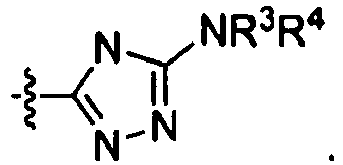
- 8. The compound of any one of
claims 1 or 5-7, where R7 is C1-C4 alkyl, C2-C4 alkenyl or C2-C4 alkynyl, wherein said C1-C4 alkyl, C2-C4 alkenyl and C2-C4 alkynyl may be optionally substituted with one or more groups selected from halogen, hydroxyl, cyano, nitro, azido, fluoromethyl, difluoromethyl, trifluoromethyl, methoxy, fluoromethoxy difluoromethoxy, amino, aminomethyl, dimethylamino, aminoethyl, diethylamino, ethoxy, C3-C10 cycloalkyl, heterocycloalkyl, aryl or heteroaryl, wherein said cycloalkyl, heterocycloalkyl, aryl or heteroaryl rings may be optionally substituted with one or more groups selected from halogen, hydroxyl, cyano, nitro, azido, fluoromethyl, difluoromethyl, trifluoromethyl, C1-C4 alkyl, C2-C4 alkenyl, C2-C4 alkynyl, C3-C6 cycloalkyl, C3-C6 heterocycloalkyl, NR3R4 and OR3. - 9. The compound of any one of
embodiment 1 or 5-7, where R8 is halogen, hydroxyl, cyano, nitro, azido, methyl, fluoromethyl, difluoromethyl, trifluoromethyl, methoxy, fluoromethoxy, difluoromethoxy, trifluoromethoxy, amino, aminomethyl, dimethylamino, aminoethyl, diethylamino, ethyl, ethoxy or SR11. - 10. The compound of
embodiment 9, where R1 and R2 are independently hydrogen, halogen, methyl, fluoromethyl, difluoromethyl, trifluoromethyl or ethyl. - 11. The compound of any one of
embodiments 1 or 5-10, where R1 is halogen or methyl, R2 is hydrogen and R8 is halogen, methyl, fluoromethyl, difluoromethyl, trifluoromethyl or SR11. - 12. The compound of
embodiment 1, where R1 is halogen, R8 is halogen, R9 is C1-C10 alkyl or halogen, and R2 is H. - 13. A composition comprising a compound of any one of
embodiments 1 to 12 and a pharmaceutically acceptable carrier. - 14. One or more compounds of any one of
embodiments 1 to 12 for use in inhibiting MEK activity in a mammal, in the treatment of a hyperproliferative disorder in a mammal, or an inflammatory condition in a mammal. - 15. A compound according to any one of
embodiments 1 to 12 for use as a medicament; preferably for use as a medicament for the treatment of a hyperproliferative disorder or an inflammatory condition. - 16. A method for preparing a compound of
formula 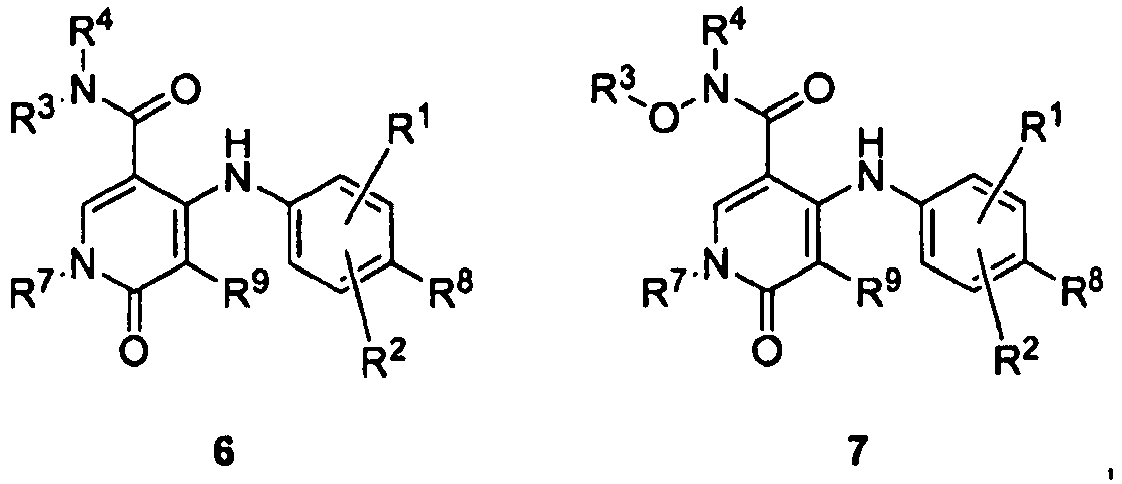
- R1 and R2 are independently hydrogen, halogen, methyl, fluoromethyl, difluoromethyl, trifluoromethyl or ethyl;
- R9 is F or Cl;
- R4 hydrogen or C1-C6 alkyl;
- R3 and R7 are independently alkyl, alkenyl, alkynyl, cycloalkyl, heterocycloalkyl, aryl or heteroaryl, wherein said alkyl, alkenyl, alkynyl, cycloalkyl, heterocycloalkyl, aryl or heteroaryl may be optionally substituted with one or more groups selected from halogen, hydroxyl, cyano, nitro, amino, azido, fluoromethyl, difluoromethyl, trifluoromethyl, methoxy, fluoromethoxy, difluoromethoxy, amino, aminomethyl, dimethylamino, aminoethyl, diethylamino, ethoxy, cycloalkyl, heterocycloalkyl, aryl or heteroaryl; and
- R8 is halogen, hydroxyl, cyano, nitro, azido, methyl, fluoromethyl, difluoromethyl, trifluoromethyl, methoxy, fluoromethoxy, difluoromethoxy, trifluoromethoxy, amino, aminomethyl, dimethylamino, aminoethyl, diethylamino, SR1, ethyl or ethoxy, said method comprising:
- (a) reacting a compound of
formula 2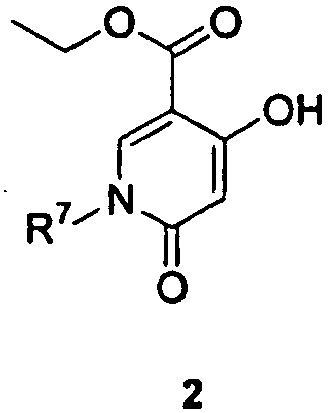
formula 3
- (b) reacting a compound of
formula 3 with N-chlorosuccinimide or 1-(chloromethyl)-4-fluoro-1,4-diazoniabicyclo[2.2.2]octane-bis(tetrafluoroborate) followed by basic hydrolysis to provide a compound of formula 4
- (c) reacting a compound of formula 4 with an aniline derivative to provide a compound of
formula 5
- (d) reacting a compound of
formula 5 with an amine in the presence of a coupling reagent to provide a compound offormula 6, or reacting a compound offormula 5 with a hydroxylamine in the presence of a coupling reagent to provide a compound offormula 7.
- (a) reacting a compound of
- 17. A method for preparing a compound of
formula 7
- R1, R2 and R9 are independently hydrogen, halogen, methyl, fluoromethyl, difluoromethyl, trifluoromethyl, or ethyl;
- R4 hydrogen or C1-C8 alkyl;
- R3 and R7 are independently alkyl, alkenyl, alkynyl, cycloalkyl, heterocycloalkyl, aryl or heteroaryl, wherein said alkyl, alkenyl, alkynyl, cycloalkyl, heterocycloalkyl, aryl or heteroaryl may be optionally substituted with one or more groups selected from halogen, hydroxyl, cyano, nitro, amino, azido, fluoromethyl, difluoromethyl, trifluoromethyl, methoxy, fluoromethoxy, difluoromethoxy, amino, aminomethyl, dimethylamino, aminoethyl, diethylamino, ethoxy, cycloalkyl, heterocycloalkyl, aryl or heteroaryl; and
- R8 is halogen, hydroxyl, cyano, nitro, azido, methyl, fluoromethyl, difluoromethyl, trifluoromethyl, methoxy, fluoromethoxy, difluoromethoxy, trifluoromethoxy, amino, aminomethyl, dimethylamino, aminoethyl, diethylamino, ethyl, ethoxy or SR1, said method comprising:
- (a) reacting a compound of
formula 9
formula 10
- (b) reacting a compound of
formula 10 with an aniline derivative in the presence of a palladium catalyst, a phosphine ligand and a base to provide a compound offormula 11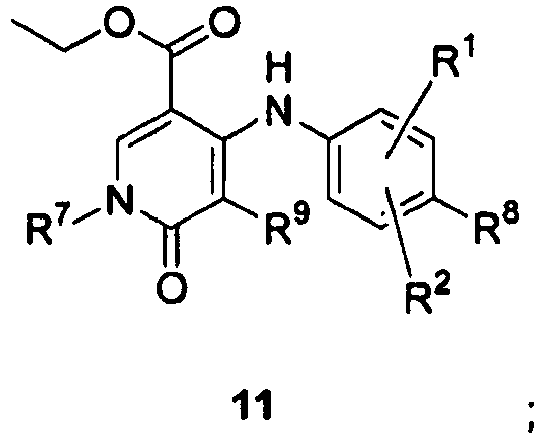
- (c) reacting a compound of
formula 11 with a hydroxylamine in the presence of an amide base to provide a compound offormula 7.
- (a) reacting a compound of
- 18. A method for preparing a compound of
formula 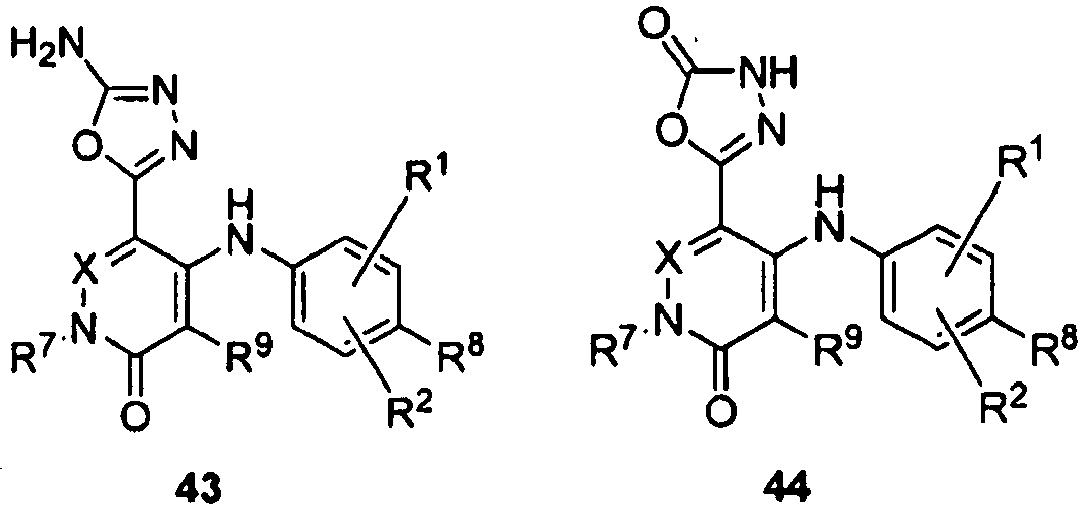

- X is CH or N;
- R1, R2 and R9 are independently hydrogen, halogen, methyl, fluoromethyl, difluoromethyl, trifluoromethyl or ethyl;
- R7 is alkyl, alkenyl, alkynyl, cycloalkyl, heterocycloalkyl, aryl or heteroaryl, wherein said alkyl, alkenyl, alkynyl, cycloalkyl, heterocycloalkyl, aryl or heteroaryl may be optionally substituted with one or more groups selected from halogen, hydroxyl, cyano, nitro, amino, azido, fluoromethyl, difluoromethyl, trifluoromethyl, methoxy, fluoromethoxy, difluoromethoxy, amino, aminomethyl, dimethylamino, aminoethyl, diethylamino, ethoxy, cycloalkyl, heterocycloalkyl, aryl or heteroaryl; and
- R8 is halogen, hydroxyl, cyano, nitro, azido, methyl, fluoromethyl, difluoromethyl, trifluoromethyl, methoxy, fluoromethoxy, difluoromethoxy, trifluoromethoxy, amino, aminomethyl, dimethylamino, aminoethyl, diethylamino, ethyl, ethoxy or SR1, said method comprising:
- (a) reacting a compound of
formula 41
formula 42;
- (b) reacting a compound of
formula 42 with cyanogen bromide to provide a compound offormula 43; or
formula 42 with either CDI or phosgene to provide a compound offormula 44; or
reacting a compound offormula 42 with cyanamide followed by a mixture of PPh3, TEA and CCl4 to provide a compound offormula 45; or
reacting a compound offormula 42 with ethyl acetimidate followed by a mixture of PPh3, TEA and CCl4 to provide a compound offormula 46. - (a) reacting a compound of
- 19. A compound selected from:
- 4-(4-Bromo-2-fluoro-phenylamino)-5-chloro-1-methyl-6-oxo-1,6-dihydro-pyridine-3-carboxylic acid cyclopropylmethoxy-amide,
- 4-(4-Bromo-2-fluoro-phenylamino)-5-fluoro-1-methyl-6-oxo-1,6-dihydro-pyridine-3-carboxylic acid cyclopropylmethoxy-amide,
- 4-(4-Bromo-2-fluoro-phenylamino)-5-fluoro-1-methyl-6-oxo-1,6-dihydro-pyridine-3-carboxylic acid amide,
- 1-Benzyl-4-(4-bromo-2-fluoro-phenylamino)-5-chloro-6-oxo-1,6-dihydro-pyridine-3-carboxylic acid (2-hydroxy-ethoxy)-amide,
- 4-(4-Bromo-2-fluoro-phenylamino)-1,5-dimethyl-6-oxo-1,6-dihydro-pyridine-3-carboxylic acid (2-hydroxy-ethoxy)-amide,
- 4-(4-Bromo-2-fluoro-phenylamino)-1,5-dimethyl-6-oxo-1,6-dihydro-pyridine-3-carboxylic acid (2-hydroxy-1,1-dimethyl-ethoxy)-amide,
- 4-(4-Bromo-2-chloro-phenylamino)-1,5-dimethyl-6-oxo-1,6-dihydro-pyridine-3-carboxylic acid (2-hydroxy-1,1-dimethyl-ethoxy)-amide,
- 4-(4-Bromo-2-chloro-phenylamino)-1,5-dimethyl-6-oxo-1,6-dihydro-pyridine-3-carboxylic acid (2-hydroxy-ethoxy)-amide,
- 4-(4-Bromo-2-methyl-phenylamino)-1,5-dimethyl-6-oxo-1,6-dihydro-pyridine-3-carboxylic acid (2-hydroxy-ethoxy)-amide,
- 4-(2,4-Dichloro-phenylamino)-1,5-dimethyl-6-oxo-1,6-dihydro-pyridine-3-carboxylic acid (2-hydroxy-ethoxy)-amide,
- 4-(4-Bromo-2-fluoro-phenylamino)-5-fluoro-1 -methyl-6-oxo-1,6-dihydro-pyridine-3-carboxylic acid ethoxy-amide,
- 4-(2-Fluoro-4-iodo-phenylamino)-1,5-dimethyl-6-oxo-1,6-dihydro-pyridine-3-carboxylic acid (2-hydroxy-ethoxy)-amide,
- 5-(5-Amino-[1,3,4]oxadiazol-2-yl)-4-(4-bromo-2-fluoro-phenylamino)-3-fluoro-1-methyl-1H-pyridin-2-one,
- (R)-4-(2-Fluoro-4-iodo-phenylamino)-1,5-dimethyl-6-oxo-1,6-dihydro-pyridine-3-carboxylic acid (2,3-dihydroxy-propoxy)-amide,
- 4-(4-Bromo-2-fluoro-phenylamino)-1,5-dimethyl-6-oxo-1,6-dihydro-pyridine-3-carboxylic acid hydroxyamide,
- 5-Fluoro-4-(2-fluoro-4-methylsulfanyl-phenylamino)-1-methyl-6-oxo-1,6-dihydro-pyridine-3-carboxylic acid ethoxy-amide,
- 4-(2-Fluoro-4-iodo-phenylamino)-1,5-dimethyl-6-oxo-1,6-dihydro-pyridine-3-carboxylic acid methoxy-amide,
- 4-(2-Fluoro-4-iodo-phenylamino)-1,5-dimethyl-6-oxo-1,6-dihydro-pyridine-3-carboxylic acid ethoxy-amide,
- 5-Fluoro-4-(2-fluoro-4-iodo-phenylamino)-1-methyl-6-oxo-1,6-dihydro-pyridine-3-carboxylic acid methoxy-amide,
- 5-Fluoro-4-(2-fluoro-4-iodo-phenylamino)-1-methyl-6-oxo-1,6-dihydro-pyridine-3-carboxylic acid ethoxy-amide,
- 5-Fluoro-4-(2-fluoro-4-methylsulfanyl-phenylamino)-1-methyl-6-oxo-1,6-dihydro-pyridine-3-carboxylic acid methoxy-amide,
- 4-(4-Bromo-2-fluoro-phenylamino)-1,5-dimethyl-6-oxo-1,6-dihydro-pyridine-3-carboxylic acid methoxy-amide,
- 4-(4-Bromo-2-fluoro-phenylamino)-1,5-dimethyl-6-oxo-1,6-dihydro-pyridine-3-carboxylic acid ethoxy-amide,
- 4-(4-Bromo-2-fluoro-phenylamino)-5-fluoro-1-methyl-6-oxo-1,6-dihydro-pyridine-3-carboxylic acid methoxy-amide,
- 5-(5-Amino-[1,3,4]oxadiazol-2-yl)-4-(4-bromo-2-fluoro-phenylamino)-1,3-dimethyl-1H-pyridin-2-one,
- 2-(4-Bromo-2-fluoro-phenylamino)-1-methyl-6-oxo-1,6-dihydro-pyridine-3-carboxylic acid cyclopropylmethoxy-amide,
- 2-(4-Bromo-2-fluoro-phenylamino)-1-methyl-6-oxo-1,6-dihydro-pyridine-3-carboxylic acid (2-hydroxy-ethoxy)-amide,
- 2-(4-Bromo-2-fluoro-phenylamino)-5-fluoro-1-methyl-6-oxo-1,6-dihydro-pyridine-3-carboxylic acid (2-hydroxy-ethoxy)-amide,
- 2-(4-Bromo-2-fluoro-phenylamino)-1-ethyl-6-oxo-1,6-dihydro-pyridine-3-carboxylic acid (2-hydroxy-ethoxy)-amide,
- 2-(2-Fluoro-4-methyl-phenylamino)-1-methyl-6-oxo-1,6-dihydro-pyridine-3-carboxylic acid (2-hydroxy-ethoxy)-amide,
- 2-(2-Fluoro-4-iodo-phenylamino)-1-methyl-6-oxo-1,6-dihydro-pyridine-3-carboxylic acid methoxy-amide;
- 4-(4-Bromo-2-fluorophenylamino)-6-oxo-1-phenyl-1,6-dihydropyridazine-3-carboxylic acid cyclopropylmethoxy-amide; and
- 4-(4-Bromo-2-fluorophenylamino)-6-oxo-1-phenyl-1,6-dihydropyridazine-3-carboxylic acid (2-hydroxyethoxy)-amide.
- The accompanying drawings, which are incorporated herein and form a part of the specification, illustrate non-limiting embodiments of the present invention, and together with the description, serve to explain the principles of the invention.
In the Figures: -
Figure 1 shows a reaction scheme for the synthesis of compounds 5-7. -
Figure 2 shows a reaction scheme for the synthesis ofcompounds -
Figure 3 shows a reaction scheme for the synthesis ofcompounds -
Figure 4 shows a reaction scheme for the synthesis ofcompound 16. -
Figure 5 shows a reaction scheme for the synthesis of compounds 18-23. -
Figure 6 shows a reaction scheme for the synthesis of compounds 25-27. -
Figure 7 shows a reaction scheme for the synthesis ofcompound 33. -
Figure 8 shows a reaction scheme for the synthesis of compounds 34-36. -
Figure 9 shows a reaction scheme for the synthesis ofcompound 40. -
Figure 10 shows a reaction scheme for the synthesis of compounds 42-46. -
Figure 11 shows a reaction scheme for the synthesis ofcompound 47. -
Figure 12 shows a reaction scheme for the synthesis ofcompound 48. -
Figure 13 shows a reaction scheme for the synthesis ofcompound 49. -
Figure 14 shows a reaction scheme for the synthesis ofcompound 51. -
Figure 15 shows a reaction scheme for the synthesis of compounds 54-57. -
Figure 16 shows a reaction scheme for the synthesis ofcompounds -
Figure 17 shows a reaction scheme for an alternate synthesis of compounds 54-57. -
Figure 18 shows a reaction scheme for the synthesis ofcompounds -
Figure 19 shows a reaction scheme for the synthesis of compounds 62-64. -
Figure 20 shows a reaction scheme for the synthesis ofcompound 63. -
Figure 21 shows a reaction scheme for the synthesis ofcompounds -
Figure 22 shows a reaction scheme for an alternate synthesis ofcompound 61. -
Figure 23 shows a reaction scheme for the synthesis ofcompound 65. -
Figure 24 shows a reaction scheme for the synthesis ofcompounds -
Figure 25 shows a reaction scheme for an alternate synthesis ofcompound 65. -
Figure 26 shows a reaction scheme for an alternate synthesis ofcompound 65. -
Figure 27 shows a reaction scheme for an alternate synthesis ofcompound 65. -
Figure 28 shows a reaction scheme for an alternate synthesis ofcompound 61. -
Figure 29 shows a reaction scheme for the synthesis ofcompound 80. -
Figure 30 shows a reaction scheme for the synthesis ofcompounds -
Figure 31 shows a reaction scheme for the synthesis ofcompounds -
Figure 32 shows a reaction scheme for the synthesis ofcompound 85. -
Figure 33 shows a reaction scheme for the synthesis of compounds 86-91. -
Figure 34 shows a reaction scheme for the synthesis ofcompounds - The compounds of the Formulas I-V and the pharmaceutically acceptable salts and prodrugs thereof of this invention are useful in the treatment of hyperproliferative diseases. Specifically, one aspect the present invention discloses compounds of Formula I-V that act as MEK inhibitors. In general, one aspect of the invention relates to compounds having the general Formula I:

- X is N or CR10;
- Y is NR3, O, S, S(O), S(O)2, C(O) or CH2;
- R1, R2, R8, R9 and R10 are independently hydrogen, hydroxy, halogen, cyano, nitro, trifluoromethyl, difluoromethyl, fluoromethyl, fluoromethoxy, difluoromethoxy, trifluoromethoxy, azido, -SR11, -OR3, -C(O)R3, -C(O)OR3, -NR4C(O)OR6, -OC(O)R3, - NR4SO2R6, -SO2NR3R4, -NR4C(O)R3, -C(O)NR3R4, -NR5C(O)NR3R4, -NR5C(NCN)NR3R4, - NR3R4, C(-C10 alkyl, C2-C10 alkenyl, C2-C10 alkynyl, C3-C10 cycloalkyl, C3-C10 cycloalkylalkyl, - S(O)j(C1-C6 alkyl), -S(O)j(CR4R5)m-aryl, aryl, arylalkyl, heteroaryl, heteroarylalkyl, heterocyclyl, heterocyclylalkyl, -O(CR4R5)m-aryl, -NR4(CR4R5)m-aryl, -O(CR4R3)m-heteroaryl, -NR4(CR4R5)m-heteroaryl, -O(CR4R5)m heterocyclyl or -NR4(CR4R5)m-heterocyclyl, wherein any of said alkyl, alkenyl, alkynyl, cycloalkyl, aryl, arylalkyl, heteroaryl, heteroarylalkyl, heterocyclyl and heterocyclylalkyl portions are optionally substituted with one or more groups independently selected from oxo (with the proviso that it is not substituted on an aryl or heteroaryl), halogen, cyano, nitro, trifluoromethyl, difluoromethoxy, trifluoromethoxy, azido, -NR4SO2R6, -SO2NR3R4, -C(O)R3, -C(O)OR3, -OC(O)R3, -NR4C(O)OR6, -NR4C(O)R3, -C(O)NR3R4, -NR3R4, -NR5C(O)NR3R4, -NR5C(NCN)NR3R4, -OR3, aryl, heteroaryl, arylalkyl, heteroarylalkyl, heterocyclyl, and heterocyclylalkyl, and wherein said aryl, heteroaryl, arylalkyl, heteroarylalkyl, heterocyclyl or heterocyclylalkyl rings may be further substituted with one or more groups selected from halogen, hydroxyl, cyano, nitro, azido, fluoromethyl, difluoromethyl, trifluoromethyl, C1-C4 alkyl, C2-C4 alkenyl, C2-C4 alkynyl, C3-C6 cycloalkyl, C3-C6 heterocycloalkyl, NR3R4 and OR3;
- R7 is hydrogen, trifluoromethyl, C1-C10 alkyl, C2-C10 alkenyl, C2-C10 alkynyl, C3-C10 cycloalkyl, C3-C10 cycloalkylalkyl, aryl, arylalkyl, heteroaryl, heteroarylalkyl, heterocyclyl, or heterocyclylalkyl, wherein any of said alkyl, alkenyl, alkynyl, cycloalkyl, aryl, arylalkyl, heteroaryl, heteroarylalkyl, heterocyclyl and heterocyclylalkyl portions are optionally substituted with one or more groups independently selected from oxo (with the proviso that it is not substituted on an aryl or heteroaryl), halogen, cyano, nitro, trifluoromethyl, difluoromethyl, fluoromethyl, difluoromethoxy, trifluoromethoxy, azido, -NR11SO2R14, -SO2NR11R12, -C(O)R11, C(O)OR11, -OC(O)R11, -NR11C(O)OR14, -NR11C(O)R12, -C(O)NR11R12, -SR11, -S(O)R14, -SO2R14, -NR11R12, -NR11C(O)NR12R13, -NR11C(NCN)NR12R13, -OR11, C1-C10 alkyl, C2-C10 alkenyl, C2-C10 alkynyl, C3-C10 cycloalkyl, aryl, heteroaryl, arylalkyl, heteroarylalkyl, heterocyclyl, and heterocyclylalkyl, and wherein said aryl, heteroaryl, arylalkyl, heteroarylalkyl, heterocyclyl or heterocyclylalkyl rings may be further substituted with one or more groups selected from halogen, hydroxyl, cyano, nitro, azido, fluoromethyl, difluoromethyl, trifluoromethyl, C1-C4 alkyl, C2-C4 alkenyl, C2-C4 alkynyl, C3-C6 cycloalkyl, C3-C6 heterocycloalkyl, NR3R4 and OR3;
- R3 is hydrogen, trifluoromethyl, C1-C10 alkyl, C2-C10 alkenyl, C2-C10 alkynyl, C3-C10 cycloalkyl, C3-C10 cycloalkylalkyl, aryl, arylalkyl, heteroaryl, heteroarylalkyl, heterocyclyl, heterocyclylalkyl, phosphate or an amino acid residue, wherein any of said alkyl, alkenyl, alkynyl, cycloalkyl, aryl, arylalkyl, heteroaryl, heteroarylalkyl, heterocyclyl and heterocyclylalkyl portions are optionally substituted with one or more groups independently selected from oxo (with the proviso that it is not substituted on an aryl or heteroaryl), halogen, cyano, nitro, trifluoromethyl, difluoromethoxy, trifluoromethoxy, azido, -NR11SO2R14, -SO2NR11R12, -C(O)R11, C(O)OR11, -OC(O)R11, -NR11C(O)OR14, -NR11C(O)R12, -C(O)NR11R12, -SR11, -S(O)R14, -SO2R14, -NR11R12, -NR11C(O)NR12R13, -NR11C(NCN)NR12R13, -OR11, aryl, heteroaryl, arylalkyl, heteroarylalkyl, heterocyclyl, and heterocyclylalkyl,
- or R3 and R4 together with the atom to which they are attached form a 4 to 10 membered carbocyclic, heteroaryl or heterocyclic ring, wherein any of said carbocyclic, heteroaryl or heterocyclic rings are optionally substituted with one or more groups independently selected from halogen, cyano, nitro, trifluoromethyl, difluoromethoxy, trifluoromethoxy, azido, - NR11SO2R14, -SO2NR11R12, -C(O)R11, C(O)OR11, -OC(O)R11, -NR11C(O)OR14, -NR11C(O)R12, -C(O)NR11R12, -R11, -S(O)R14, -SO2R14, -NR11R12, -NR11C(O)NR12R13, -NR11C(NCN)NR12R13, -OR11, aryl, heteroaryl, arylalkyl, heteroarylalkyl, heterocyclyl, and heterocyclylalkyl;
- R4 and R5 independently are hydrogen or C1-C6 alkyl, or
- R4 and R5 together with the atom to which they are attached form a 4 to 10 membered carbocyclic, heteroaryl or heterocyclic ring, wherein said alkyl or any of said carbocyclic, heteroaryl and heterocyclic rings are optionally substituted with one or more groups independently selected from halogen, cyano, nitro, trifluoromethyl, difluoromethoxy, trifluoromethoxy, azido, -NR11SO2R14, -SO2NR11R12, -C(O)R11, C(O)OR11, -OC(O)R11, -NR11C(O)OR14, -NR11C(O)R12, -C(O)NR11R12, -SR11, -S(O)R14, -SO2R14, -NR11R12, -NR11C(O)NR12R13, -NR11C(NCN)NR12R13, -OR11, aryl, heteroaryl, arylalkyl, heteroarylalkyl, heterocyclyl, and heterocyclylalkyl;
- R6 is trifluoromethyl, C1-C10 alkyl, C3-C10 cycloalkyl, aryl, arylalkyl, heteroaryl, heteroarylalkyl, heterocyclyl or heterocyclylalkyl, wherein any of said alkyl, cycloalkyl, aryl, arylalkyl, heteroaryl, heteroarylalkyl, heterocyclyl and heterocyclylalkyl portions are optionally substituted with one or more groups independently selected from oxo (with the proviso that it is not substituted on an aryl or heteroaryl), halogen, cyano, nitro, trifluoromethyl, difluoromethoxy, trifluoromethoxy, azido, -NR11SO2R14, -SO2NR11R12, -C(O)R11, C(O)OR11, -OC(O)R11, - NR11C(O)OR14, -NR11C(O)R12, -C(O)NR11R12, -SR11, -S(O)R14, -SO2R14, -NR11R12, -NR11C(O)NR12R13, -NR11C(NCN)NR12R13, -OR11, aryl, heteroaryl, arylalkyl, heteroarylalkyl, heterocyclyl, and heterocyclylalkyl;
- R11, R12 and R13 independently are hydrogen, lower alkyl, lower alkenyl, aryl and arylalkyl, and R14 is lower alkyl, lower alkenyl, aryl and arylalkyl;
- or any two of R11, R12, R13 or R14 together with the atom to which they are attached form a 4 to 10 membered carbocyclic, heteroaryl or heterocyclic ring, wherein any of said alkyl, alkenyl, aryl, arylalkyl carbocyclic rings, heteroaryl rings or heterocyclic rings are optionally substituted with one or more groups independently selected from halogen, cyano, nitro, trifluoromethyl, difluoromethoxy, trifluoromethoxy, azido, aryl, heteroaryl, arylalkyl, heteroarylalkyl, heterocyclyl, and heterocyclylalkyl;
- W is heteroaryl, heterocyclyl, -C(O)OR3, -C(O)NR3R4, -C(O)NR4OR3, -C(O)R4OR3, -C(O)NR4SO2R3, -C(O)(C3-C10 cycloalkyl), -C(O)(C1-C10 alkyl), -C(O)(aryl), -C(O)(heteroaryl), -C(O)(heterocyclyl) or CR3OR3 wherein any of said heteroaryl, heterocyclyl, -C(O)OR3, -C(O)NR3R4, -C(O)NR4OR3, -C(O)R4OR3, -C(O)NR4SO2R3, -C(O)(C3-C10 cycloalkyl), -C(O)(C1-C10 alkyl), -C(O)(aryl), -C(O)(heteroaryl), -C(O)(heterocyclyl) and CR3OR3 are optionally substituted with one or more groups independently selected from halogen, cyano, nitro, azido, -NR3R4, -OR3, C1-C10 alkyl, C2-C10 alkenyl, C2-C10 alkynyl, cycloalkyl and heterocycloalkyl, wherein any of said C1-C10 alkyl, C2-C10 alkenyl, C2-C10 alkynyl, cycloalkyl and heterocycloalkyl are optionally substituted with 1 or more groups independently selected from -NR3R4 and -OR3;
- m is 0, 1, 2, 3, 4 or 5; and
- j is 0, 1 or 2.
- In one embodiment, W is selected from


-
Figures 1-3 ,6, 7 and10-14 show non-limiting examples of the synthesis of compounds of this invention having the general Formula I. - In addition to compounds of the general Formula I, this invention further discloses compounds of the general Formula II:
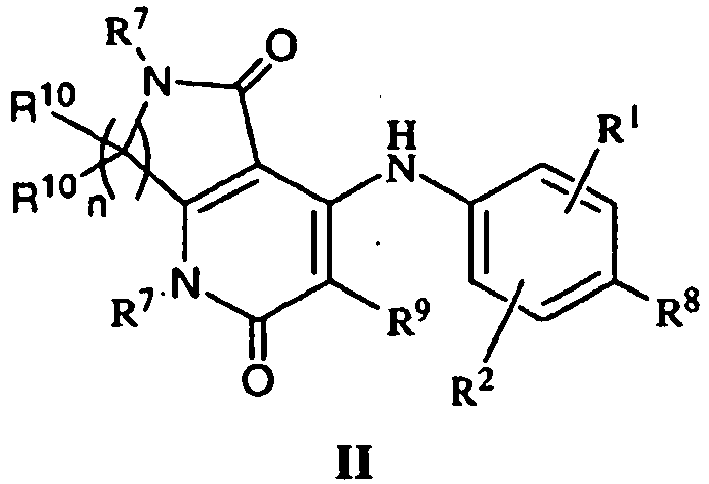
- where R1, R2, R8 and R9 are independently hydrogen, halogen, cyano, nitro, trifluoromethyl, difluoromethyl, fluoromethyl, fluoromethoxy, difluoromethoxy, trifluoromethoxy, azido, -SR11, -OR3, -C(O)R3, -C(O)OR3, -NR4C(O)OR6, -OC(O)R3, - NR4SO2R6, -SO2NR3R4, -NR4C(O)R3, -C(O)NR3R4, -NR5C(O)NR3R4, -NR5C(NCN)NR3R4, - NR3R4, C1-C10 alkyl, C2-C10 alkenyl, C2-C10 alkynyl, C3-C10 cycloalkyl, C3-C10 cycloalkylalkyl, - S(O)j(C1-C6 alkyl), -S(O)j(CR4R5)m-aryl, aryl, arylalkyl, heteroaryl, heteroarylalkyl, heterocyclyl, heterocyclylalkyl, -O(CR4R5)m-aryl, -NR4(CR4R5)m-aryl, -O(CR4R5)m-heteroaryl, -NR4(CR4R5)m-heteroaryl, -O(CR4R5)m-heterocyclyl or -NR4(CR4R5)m-heterocyclyl, wherein any of said alkyl, alkenyl, alkynyl, cycloalkyl, aryl, arylalkyl, heteroaryl, heteroarylalkyl, heterocyclyl and heterocyclylalkyl portions are optionally substituted with one or more groups independently selected from oxo (with the proviso that it is not substituted on an aryl or heteroaryl), halogen, cyano, nitro, trifluoromethyl, difluoromethoxy, trifluoromethoxy, azido, -NR4SO2R6, -SO2NR3R4, -C(O)R3, -C(O)OR3, -OC(O)R3, -NR4C(O)OR6, -NR4C(O)R3, -C(O)NR3R4, -NR3R4, -NR5C(O)NR3R4, -NR5C(NCN)NR3R4, -OR3, aryl, heteroaryl, arylalkyl, heteroarylalkyl, heterocyclyl, and heterocyclylalkyl, and wherein said aryl, heteroaryl, arylalkyl, heteroarylalkyl, heterocyclyl or heterocyclylalkyl rings may be further substituted with one or more groups selected from halogen, hydroxyl, cyano, nitro, azido, fluoromethyl, difluoromethyl, trifluoromethyl, C1-C4 alkyl, C2-C4 alkenyl, C2-C4 alkynyl, C3-C6 cycloalkyl, C3-C6 heterocycloalkyl, NR3R4 and OR3;
- R7 is hydrogen, trifluoromethyl, C1-C10 alkyl, C2-C10 alkenyl, C2-C10 alkynyl, C3-C10 cycloalkyl, C3-C10 cycloalkylalkyl, aryl, arylalkyl, heteroaryl, heteroarylalkyl, heterocyclyl, or heterocyclylalkyl, wherein any of said alkyl, alkenyl, alkynyl, cycloalkyl, aryl, arylalkyl, heteroaryl, heteroarylalkyl, heterocyclyl and heterocyclylalkyl portions are optionally substituted with one or more groups independently selected from oxo (with the proviso that it is not substituted on an aryl or heteroaryl), halogen, cyano, nitro, trifluoromethyl, difluoromethyl, fluoromethyl, difluoromethoxy, trifluoromethoxy, azido, -NR11SO2R14, -SO2NR11R12, -C(O)R11, C(O)OR11, -OC(O)R11, -NR11C(O)OR14, -NR11C(O)R12, -C(O)NR11R12, -SR11, -S(O)R14, -SO2R14, -NR11R12, -NR11C(O)NR12R13, -NR11C(NCN)NR12R13, -OR11, C1-C10 alkyl, C2-C10 alkenyl, C2-C10 alkynyl, C3-C10 cycloalkyl, aryl, heteroaryl, arylalkyl, heteroarylalkyl, heterocyclyl, and heterocyclylalkyl, and wherein said aryl, heteroaryl, arylalkyl, heteroarylalkyl, heterocyclyl or heterocyclylalkyl rings may be further substituted with one or more groups selected from halogen, hydroxyl, cyano, nitro, azido, fluoromethyl, difluoromethyl, trifluoromethyl, C1-C4 alkyl, C2-C4 alkenyl, C2-C4 alkynyl, C3-C6 cycloalkyl, C3-C6 heterocycloalkyl, NR3R4 and OR3;
- each R10 is independently hydrogen, cyano, nitro, trifluoromethyl, difluoromethoxy, trifluoromethoxy, azido, -C(O)R3, -C(O)OR3, -SO2NR3R4, -C(O)NR3R4, C1-C10 alkyl, C2-C10 alkenyl, C2-C10 alkynyl, C3-C10 cycloalkyl, C3-C10 cycloalkylalkyl, -S(O)j(C1-C6 alkyl), -S(O)j(CR4R5)m-aryl, aryl, arylalkyl, heteroaryl, heteroarylalkyl, heterocyclyl or heterocyclylalkyl, wherein any of said alkyl, alkenyl, alkynyl, cycloalkyl, aryl, arylalkyl, heteroaryl, heteroarylalkyl, heterocyclyl and heterocyclylalkyl portions are optionally substituted with one or more groups independently selected from oxo (with the proviso that it is not substituted on an aryl or heteroaryl), halogen, cyano, nitro, trifluoromethyl, difluoromethoxy, trifluoromethoxy, azido, -NR4SO2R6, -SO2NR3R4, -C(O)R3, -C(O)OR3, -OC(O)R3, -NR4C(O)OR6, -NR4C(O)R3, -C(O)NR3R4, -NR3R4, -NR5C(O)NR3R4, -NR5C(NCN)NR3R4, - OR3, aryl, heteroaryl, arylalkyl, heteroarylalkyl, heterocyclyl, and heterocyclylalkyl, and wherein said aryl, heteroaryl, arylalkyl, heteroarylalkyl, heterocyclyl or heterocyclylalkyl rings may be further substituted with one or more groups selected from halogen, hydroxyl, cyano, nitro, azido, fluoromethyl, difluoromethyl, trifluoromethyl, C1-C4 alkyl, C2-C4 alkenyl, C2-C4 alkynyl, C3-C6 cycloalkyl, C3-C6 heterocycloalkyl, NR3R4 and OR3;
- R3 is hydrogen, trifluoromethyl, C1-C10 alkyl, C2-C10 alkenyl, C2-C10 alkynyl, C3-C10 cycloalkyl, C3-C10 cycloalkylalkyl, aryl, arylalkyl, heteroaryl, heteroarylalkyl, heterocyclyl, heterocyclylalkyl, phosphate or an amino acid residue, wherein any of said alkyl, alkenyl, alkynyl, cycloalkyl, aryl, arylalkyl, heteroaryl, heteroarylalkyl, heterocyclyl and heterocyclylalkyl portions are optionally substituted with one or more groups independently selected from oxo (with the proviso that it is not substituted on an aryl or heteroaryl), halogen, cyano, nitro, trifluoromethyl, difluoromethoxy, trifluoromethoxy, azido, -NR11SO2R14, -SO2NR11R12, -C(O)R11, C(O)OR11, -OC(O)R11, -NR11C(O)OR14, -NR11C(O)R12, -C(O)NR11R12, -SR11, -S(O)R14, -SO2R14, -NR11R12, -NR11C(O)NR12R13, -NR11C(NCN)NR12R13, -OR11, aryl, heteroaryl, arylalkyl, heteroarylalkyl, heterocyclyl, and heterocyclylalkyl,
- or R3 and R4 together with the atom to which they are attached form a 4 to 10 membered carbocyclic, heteroaryl or heterocyclic ring, wherein any of said carbocyclic, heteroaryl or heterocyclic rings are optionally substituted with one or more groups independently selected from halogen, cyano, nitro, trifluoromethyl, difluoromethoxy, trifluoromethoxy, azido, - NR11SO2R14, -SO2NR11R12, -C(O)R11, C(O)OR11, -OC(O)R11, -NR11C(O)OR14, -NR11C(O)R12, -C(O)NR11R12, -SR11, -S(O)R14, -SO2R14, -NR11R12, -NR11C(O)NR12R13, -NR11C(NCN)NR12R13, -OR11, aryl, heteroaryl, arylalkyl, heteroarylalkyl, heterocyclyl, and heterocyclylalkyl;
- R4 and R5 independently are hydrogen or C1-C6 alkyl, or
- R4 and R5 together with the atom to which they are attached form a 4 to 10 membered carbocyclic, heteroaryl or heterocyclic ring, wherein said alkyl or any of said carbocyclic, heteroaryl and heterocyclic rings are optionally substituted with one or more groups independently selected from halogen, cyano, nitro, trifluoromethyl, difluoromethoxy, trifluoromethoxy, azido, -NR11SO2R14, -SO2NR11R12, -C(O)R11, C(O)OR11, -OC(O)R11, - NR11C(O)OR14, -NR11C(O)R12, -C(O)NR11R12, -SR11, -S(O)R14, -SO2R14, -NR11R12, -NR11C(O)NR12R13, -NR11C(NCN)NR12R13, -OR11, aryl, heteroaryl, arylalkyl, heteroarylalkyl, heterocyclyl, and heterocyclylalkyl;
- R6 is trifluoromethyl, C1-C10 alkyl, C3-C10 cycloalkyl, aryl, arylalkyl, heteroaryl, heteroarylalkyl, heterocyclyl or heterocyclylalkyl, wherein any of said alkyl, cycloalkyl, aryl, arylalkyl, heteroaryl, heteroarylalkyl, heterocyclyl and heterocyclylalkyl portions are optionally substituted with one or more groups independently selected from oxo (with the proviso that it is not substituted on an aryl or heteroaryl), halogen, cyano, nitro, trifluoromethyl, difluoromethoxy, trifluoromethoxy, azido, -NR11SO2R14, -SO2NR11R12, -C(O)R11, C(O)OR11, -OC(O)R11, - NR11C(O)OR14, -NR11C(O)R12, -C(O)NR11R12, -SR11, -S(O)R14, -SO2R14, -NR11R12, -NR11C(O)NR12R13, -NR11C(NCN)NR12R13, -OR11, aryl, heteroaryl, arylalkyl, heteroarylalkyl, heterocyclyl, and heterocyclylalkyl;
- R11, R12 and R13 independently are hydrogen, lower alkyl, lower alkenyl, aryl and arylalkyl, and R14 is lower alkyl, lower alkenyl, aryl and arylalkyl;
- or any two of R11, R12, R13 or R14 together with the atom to which they are attached form a 4 to 10 membered carbocyclic, heteroaryl or heterocyclic ring, wherein any of said alkyl, alkenyl, aryl, arylalkyl carbocyclic rings, heteroaryl rings or heterocyclic rings are optionally substituted with one or more groups independently selected from halogen, cyano, nitro, trifluoromethyl, difluoromethoxy, trifluoromethoxy, azido, aryl, heteroaryl, arylalkyl, heteroarylalkyl, heterocyclyl, and heterocyclylalkyl;
- m is 0, 1, 2, 3, 4 or 5;
- n is or 2; and
- j is 0, 1 or 2.
-
Figure 5 shows non-limiting examples of the synthesis of compounds of this invention having the general Formula II. - In another embodiment, this invention discloses compounds of the general Formula III:

- 1, R2, R8 and each R9 are independently hydrogen, halogen, cyano, nitro, trifluoromethyl, difluoromethyl, fluoromethyl, fluoromethoxy, difluoromethoxy, trifluoromethoxy, azido, -SR11, -OR3, -C(O)R3, -C(O)OR3, -NR4C(O)OR6, -OC(O)R3, - NR4SO2R6, -SO2NR3R4, -NR4C(O)R3, -C(O)NR3R4, -NR5C(O)NR3R4, -NR5C(NCN)NR3R4, - NR3R4, C1-C10 alkyl, C2-C10 alkenyl, C2-C10 alkynyl, C3-C10 cycloalkyl, C3-C10 cycloalkylalkyl, - S(O)j(C1-C6 alkyl), -S(O)j(CR4R5)m-aryl, aryl, arylalkyl, heteroaryl, heteroarylalkyl, heterocyclyl, heterocyclylalkyl, -O(CR4R5)m-aryl, -NR4(CR4R5)m-aryl, -O(CR4R5)m-heteroaryl, -NR4(CR4R5)m-heteroaryl, -O(CR4R5)m-heterocyclyl or -NR4(CR4R5)m-heterocyclyl, wherein any of said alkyl, alkenyl, alkynyl, cycloalkyl, aryl, arylalkyl, heteroaryl, heteroarylalkyl, heterocyclyl and heterocyclylalkyl portions are optionally substituted with one or more groups independently selected from oxo (with the proviso that it is not substituted on an aryl or heteroaryl), halogen, cyano, nitro, trifluoromethyl, difluoromethoxy, trifluoromethoxy, azido, -NR4SO2R6, -SO2NR3R4, -C(O)R3, -C(O)OR3, -OC(O)R3, -NR4C(O)OR6, -NR4C(O)R3, -C(O)NR3R4, -NR3R4, -NR5C(O)NR3R4, -NR5C(NCN)NR3R4, -OR3, aryl, heteroaryl, arylalkyl, heteroarylalkyl, heterocyclyl, and heterocyclylalkyl, and wherein said aryl, heteroaryl, arylalkyl, heteroarylalkyl, heterocyclyl or heterocyclylalkyl rings may be further substituted with one or more groups selected from halogen, hydroxyl, cyano, nitro, azido, fluoromethyl, difluoromethyl, trifluoromethyl, C1-C4 alkyl, C2-C4 alkenyl, C2-C4 alkynyl, C3-C6 cycloalkyl, C3-C6 heterocycloalkyl, NR3R4 and OR3;
- R7 is hydrogen, trifluoromethyl, C1-C10 alkyl, C2-C10 alkenyl, C2-C10 alkynyl, C3-C10 cycloalkyl, C3-C10 cycloalkylalkyl, aryl, arylalkyl, heteroaryl, heteroarylalkyl, heterocyclyl, or heterocyclylalkyl, wherein any of said alkyl, alkenyl, alkynyl, cycloalkyl, aryl, arylalkyl, heteroaryl, heteroarylalkyl, heterocyclyl and heterocyclylalkyl portions are optionally substituted with one or more groups independently selected from oxo (with the proviso that it is not substituted on an aryl or heteroaryl), halogen, cyano, nitro, trifluoromethyl, difluoromethyl, fluoromethyl, difluoromethoxy, trifluoromethoxy, azido, -NR11SO2R14, -SO2NR11R12, -C(O)R11, C(O)OR11, -OC(O)R11, -NR11C(O)OR14, -NR11C(O)R12, -C(O)NR11R12, -SR11, -S(O)R14, -SO2R14, -NR11R12, -NR11C(O)NR12R13, -NR11C(NCN)NR12R13, -OR11, C1-C10 alkyl, C2-C10 alkenyl, C2-C10 alkynyl, C3-C10 cycloalkyl, aryl, heteroaryl, arylalkyl, heteroarylalkyl, heterocyclyl, and heterocyclylalkyl, and wherein said aryl, heteroaryl, arylalkyl, heteroarylalkyl, heterocyclyl or heterocyclylalkyl rings may be further substituted with one or more groups selected from halogen, hydroxyl, cyano, nitro, azido, fluoromethyl, difluoromethyl, trifluoromethyl, C1-C4 alkyl, C2-C4 alkenyl, C2-C4 alkynyl, C3-C6 cycloalkyl, C3-C6 heterocycloalkyl, NR3R4 and OR3;
- R3 is hydrogen, trifluoromethyl, C1-C10 alkyl, C2-C10 alkenyl, C2-C10 alkynyl, C3-C10 cycloalkyl, C3-C10 cycloalkylalkyl, aryl, arylalkyl, heteroaryl, heteroarylalkyl, heterocyclyl, heterocyclylalkyl, phosphate or an amino acid residue, wherein any of said alkyl, alkenyl, alkynyl, cycloalkyl, aryl, arylalkyl, heteroaryl, heteroarylalkyl, heterocyclyl and heterocyclylalkyl portions are optionally substituted with one or more groups independently selected from oxo (with the proviso that it is not substituted on an aryl or heteroaryl), halogen, cyano, nitro, trifluoromethyl, difluoromethoxy, trifluoromethoxy, azido, -NR11SO2R14, -SO2NR11R12, -C(O)R11, C(O)OR11, -OC(O)R11, -NR11C(O)OR14, -NR11C(O)R12, -C(O)NR11R12, -SR11, -S(O)R14, -SO2R14, -NR11R12, -NR11C(O)NR12R13, -NR11C(NCN)NR12R13, -OR11, aryl, heteroaryl, arylalkyl, heteroarylalkyl, heterocyclyl, and heterocyclylalkyl,
- or R3 and R4 together with the atom to which they are attached form a 4 to 10 membered carbocyclic, heteroaryl or heterocyclic ring, wherein any of said carbocyclic, heteroaryl or heterocyclic rings are optionally substituted with one or more groups independently selected from halogen, cyano, nitro, trifluoromethyl, difluoromethoxy, trifluoromethoxy, azido, - NR11SO2R14, -SO2NR11R12, -C(O)R11, C(O)OR11, -OC(O)R11, -NR11C(O)OR14, -NR11C(O)R12, -C(O)NR11R12, -SR11, -S(O)R14, -SO2R14, -NR11R12, -NR11C(O)NR12R13, -NR11C(NCN)NR12R13, -OR11, aryl, heteroaryl, arylalkyl, heteroarylalkyl, heterocyclyl, and heterocyclylalkyl;
- R4 and R5 independently are hydrogen or C1-C6 alkyl, or
- R4 and R5 together with the atom to which they are attached form a 4 to 10 membered carbocyclic, heteroaryl or heterocyclic ring, wherein said alkyl or any of said carbocyclic, heteroaryl and heterocyclic rings are optionally substituted with one or more groups independently selected from halogen, cyano, nitro, trifluoromethyl, difluoromethoxy, trifluoromethoxy, azido, -NR11SO2R14, -SO2NR11R12, -C(O)R11, C(O)OR11, -OC(O)R11,-NR11C(O)OR14, -NR11C(O)R12, -C(O)NR11R12, -SR11, -S(O)R14, -SO2R14, -NR11R12, -NR11C(O)NR12R13, -NR11C(NCN)NR12R13, -OR11, aryl, heteroaryl, arylalkyl, heteroarylalkyl, heterocyclyl, and heterocyclylalkyl;
- R6 is trifluoromethyl, C1-C10 alkyl, C3-C10 cycloalkyl, aryl, arylalkyl, heteroaryl, heteroarylalkyl, heterocyclyl or heterocyclylalkyl, wherein any of said alkyl, cycloalkyl, aryl, arylalkyl, heteroaryl, heteroarylalkyl, heterocyclyl and heterocyclylalkyl portions are optionally substituted with one or more groups independently selected from oxo (with the proviso that it is not substituted on an aryl or heteroaryl), halogen, cyano, nitro, trifluoromethyl, difluoromethoxy, trifluoromethoxy, azido, -NR11SO2R14, -SO2NR11R12, -C(O)R11, C(O)OR11, -OC(O)R11,-NR11C(O)OR14, -NR11C(O)R12, -C(O)NR11R12, -SR11, -S(O)R14, -SO2R14, -NR11R12, -NR11C(O)NR12R13, -NR11C(NCN)NR12R13, -OR11, aryl, heteroaryl, arylalkyl, heteroarylalkyl, heterocyclyl, and heterocyclylalkyl;
- R11, R12 and R13 independently are hydrogen, lower alkyl, lower alkenyl, aryl and arylalkyl, and
- R14 is lower alkyl, lower alkenyl, aryl and arylalkyl;
- or any two of R11, R12, R13 or R14 together with the atom to which they are attached form a 4 to 10 membered carbocyclic, heteroaryl or heterocyclic ring, wherein any of said alkyl, alkenyl, aryl, arylalkyl carbocyclic rings, heteroaryl rings or heterocyclic rings are optionally substituted with one or more groups independently selected from halogen, cyano, nitro, trifluoromethyl, difluoromethoxy, trifluoromethoxy, azido, aryl, heteroaryl, arylalkyl, heteroarylalkyl, heterocyclyl, and heterocyclylalkyl;
- m is 0, 1, 2, 3, 4 or 5; and
- j is 0, 1 or 2.
-
Figures 8 and9 show non-limiting examples of the synthesis of compounds of this invention having the general Formula III. - In another embodiment, this invention discloses compounds of the general Formula IV:

- R1, R2, R8 and R9 are independently hydrogen, halogen, cyano, nitro, trifluoromethyl, difluoromethyl, fluoromethyl, fluoromethoxy, difluoromethoxy, trifluoromethoxy, azido, -SR11, -OR3, -C(O)R3, -C(O)OR3, -NR4C(O)OR6, -OC(O)R3,-NR4SO2R6, -SO2NR3R4, -NR4C(O)R3, -C(O)NR3R4, -NR5C(O)NR3R4, -NR5C(NCN)NR3R4,-NR3R4, C1-C10 alkyl, C2-C10 alkenyl, C2-C10 alkynyl, C3-C10 cycloalkyl, C3-C10 cycloalkylalkyl,-S(O)j(C1-C6 alkyl), -S(O)j(CR4R5)m-aryl, aryl, arylalkyl, heteroaryl, heteroarylalkyl, heterocyclyl, heterocyclylalkyl, -O(CR4R5)m-aryl, -NR4(CR4R5)m-aryl, -O(CR4R5)m-heteroaryl, -NR4(CR4R5)m-heteroaryl, -O(CR4R5)m-heterocyclyl or -NR4(CR4R5)m-heterocyclyl, wherein any of said alkyl, alkenyl, alkynyl, cycloalkyl, aryl, arylalkyl, heteroaryl, heteroarylalkyl, heterocyclyl and heterocyclylalkyl portions are optionally substituted with one or more groups independently selected from oxo (with the proviso that it is not substituted on an aryl or heteroaryl), halogen, cyano, nitro, trifluoromethyl, difluoromethoxy, trifluoromethoxy, azido, -NR4SO2R6, -SO2NR3R4, -C(O)R3, -C(O)OR3, -OC(O)R3, -NR4C(O)OR6, -NR4C(O)R3, -C(O)NR3R4, -NR3R4, -NR5C(O)NR3R4, -NR5C(NCN)NR3R4, -OR3, aryl, heteroaryl, arylalkyl, heteroarylalkyl, heterocyclyl, and heterocyclylalkyl, and wherein said aryl, heteroaryl, arylalkyl, heteroarylalkyl, heterocyclyl or heterocyclylalkyl rings may be further substituted with one or more groups selected from halogen, hydroxyl, cyano, nitro, azido, fluoromethyl, difluoromethyl, trifluoromethyl, C1-C4 alkyl, C2-C4 alkenyl, C2-C4 alkynyl, C3-C6 cycloalkyl, C3-C6 heterocycloalkyl, NR3R4 and OR3;
- each R7 is hydrogen, trifluoromethyl, C1-C10 alkyl, C2-C10 alkenyl, C2-C10 alkynyl, C3-C10 cycloalkyl, C3-C10 cycloalkylalkyl, aryl, arylalkyl, heteroaryl, heteroarylalkyl, heterocyclyl, or heterocyclylalkyl, wherein any of said alkyl, alkenyl, alkynyl, cycloalkyl, aryl, arylalkyl, heteroaryl, heteroarylalkyl, heterocyclyl and heterocyclylalkyl portions are optionally substituted with one or more groups independently selected from oxo (with the proviso that it is not substituted on an aryl or heteroaryl), halogen, cyano, nitro, trifluoromethyl, difluoromethyl, fluoromethyl, difluoromethoxy, trifluoromethoxy, azido, -NR11SO2R14, -SO2NR11R12, -C(O)R11, C(O)OR11, -OC(O)R11, -NR11C(O)OR14, -NR11C(O)R12, -C(O)NR11R12, -SR11, -S(O)R14, -SO2R14, -NR11R12, -NR11C(O)NR12R13, -NR11C(NCN)NR12R13, -OR11, C1-C10 alkyl, C2-C10 alkenyl, C2-C10 alkynyl, C3-C10 cycloalkyl, aryl, heteroaryl, arylalkyl, heteroarylalkyl, heterocyclyl, and heterocyclylalkyl, and wherein said aryl, heteroaryl, arylalkyl, heteroarylalkyl, heterocyclyl or heterocyclylalkyl rings may be further substituted with one or more groups selected from halogen, hydroxyl, cyano, nitro, azido, fluoromethyl, difluoromethyl, trifluoromethyl, C1-C4 alkyl, C2-C4 alkenyl, C2-C4 alkynyl, C3-C6 cycloalkyl, C3-C6 heterocycloalkyl, NR3R4 and OR3;
- each R10 is independently hydrogen, cyano, nitro, trifluoromethyl, difluoromethoxy, trifluoromethoxy, azido, -C(O)R3, -C(O)OR3, -SO2NR3R4, -C(O)NR3R4, C1-C10 alkyl, C2-C10 alkenyl, C2-C10 alkynyl, C3-C10 cycloalkyl, C3-C10 cycloalkylalkyl, -S(O)j(C1-C6 alkyl), -S(O)j(CR4R5)m-aryl, aryl, arylalkyl, heteroaryl, heteroarylalkyl, heterocyclyl or heterocyclylalkyl, wherein any of said alkyl, alkenyl, alkynyl, cycloalkyl, aryl, arylalkyl, heteroaryl, heteroarylalkyl, heterocyclyl and heterocyclylalkyl portions are optionally substituted with one or more groups independently selected from oxo (with the proviso that it is not substituted on an aryl or heteroaryl), halogen, cyano, nitro, trifluoromethyl, difluoromethoxy, trifluoromethoxy, azido, -NR4SO2R6, -SO2NR3R4, -C(O)R3, -C(O)OR3, -OC(O)R3, -NR4C(O)OR6, -NR4C(O)R3, -C(O)NR3R4, -NR3R4, -NR5C(O)NR3R4, -NR5C(NCN)NR3R4,-OR3, aryl, heteroaryl, arylalkyl, heteroarylalkyl, heterocyclyl, and heterocyclylalkyl, and wherein said aryl, heteroaryl, arylalkyl, heteroarylalkyl, heterocyclyl or heterocyclylalkyl rings may be further substituted with one or more groups selected from halogen, hydroxyl, cyano, nitro, azido, fluoromethyl, difluoromethyl, trifluoromethyl, C1-C4 alkyl, C2-C4 alkenyl, C2-C4 alkynyl, C3-C6 cycloalkyl, C3-C6 heterocycloalkyl, NR3R4 and OR3;
- R3 is hydrogen, trifluoromethyl, C1-C10 alkyl, C2-C10 alkenyl, C2-C10 alkynyl, C3-C10 cycloalkyl, C3-C10 cycloalkylalkyl, aryl, arylalkyl, heteroaryl, heteroarylalkyl, heterocyclyl, heterocyclylalkyl, phosphate or an amino acid residue, wherein any of said alkyl, alkenyl, alkynyl, cycloalkyl, aryl, arylalkyl, heteroaryl, heteroarylalkyl, heterocyclyl and heterocyclylalkyl portions are optionally substituted with one or more groups independently selected from oxo (with the proviso that it is not substituted on an aryl or heteroaryl), halogen, cyano, nitro, trifluoromethyl, difluoromethoxy, trifluoromethoxy, azido, -NR11SO2R14, -SO2NR11R12, -C(O)R11, C(O)OR11, -OC(O)R11, -NR11C(O)OR14, -NR11C(O)R12, -C(O)NR11R12, -SR11, -S(O)R14, -SO2R14, -NR11R12, -NR11C(O)NR12R13, -NR11C(NCN)NR12R13, -OR11, aryl, heteroaryl, arylalkyl, heteroarylalkyl, heterocyclyl, and heterocyclylalkyl,
- or R3 and R4 together with the atom to which they are attached form a 4 to 10 membered carbocyclic, heteroaryl or heterocyclic ring, wherein any of said carbocyclic, heteroaryl or heterocyclic rings are optionally substituted with one or more groups independently selected from halogen, cyano, nitro, trifluoromethyl, difluoromethoxy, trifluoromethoxy, azido, - NR11SO2R14, -SO2NR11R12, -C(O)R11, C(O)OR11, -OC(O)R11, -NR11C(O)OR14, -NR11C(O)R12, -C(O)NR11R12, -SR11, -S(O)R14, -SO2R14, -NR11R12, -NR11C(O)NR12R13, -NR11C(NCN)NR12R13, -OR11, aryl, heteroaryl, arylalkyl, heteroarylalkyl, heterocyclyl, and heterocyclylalkyl;
- R4 and R5 independently are hydrogen or C1-C6 alkyl, or
- R4 and R5 together with the atom to which they are attached form a 4 to 10 membered carbocyclic, heteroaryl or heterocyclic ring, wherein said alkyl or any of said carbocyclic, heteroaryl and heterocyclic rings are optionally substituted with one or more groups independently selected from halogen, cyano, nitro, trifluoromethyl, difluoromethoxy, trifluoromethoxy, azido, -NR11SO2R14, -SO2NR11R12, -C(O)R11, C(O)OR11, -OC(O)R11,-NR11C(O)OR14, -NR11C(O)R12, -C(O)NR11R12, -SR11, -S(O)R14, -SO2R14, -NR11R12, -NR11C(O)NR12R13, -NR11C(NCN)NR12R13, -OR11, aryl, heteroaryl, arylalkyl, heteroarylalkyl, heterocyclyl, and heterocyclylalkyl;
- R5 is trifluoromethyl, C1-C10 alkyl, C3-C10 cycloalkyl, aryl, arylalkyl, heteroaryl, heteroarylalkyl, heterocyclyl or heterocyclylalkyl, wherein any of said alkyl, cycloalkyl, aryl, arylalkyl, heteroaryl, heteroarylalkyl, heterocyclyl and heterocyclylalkyl portions are optionally substituted with one or more groups independently selected from oxo (with the proviso that it is not substituted on an aryl or heteroaryl), halogen, cyano, nitro, trifluoromethyl, difluoromethoxy, trifluoromethoxy, azido, -NR11SO2R14, -SO2NR11R12, -C(O)R11, C(O)OR11, -OC(O)R11,-NR11C(O)OR14, -NR11C(O)R12, -C(O)NR11R12, -SR11, -S(O)R14, -SO2R14, -NR11R12, -NR11C(O)NR12R13, -NR11C(NCN)NR12R13, -OR11, aryl, heteroaryl, arylalkyl, heteroarylalkyl, heterocyclyl, and heterocyclylalkyl;
- R11, R12 and R13 independently are hydrogen, lower alkyl, lower alkenyl, aryl and arylalkyl, and
- R14 is lower alkyl, lower alkenyl, aryl and arylalkyl;
- or any two of R11, R12, R13 or R14 together with the atom to which they are attached form a 4 to 10 membered carbocyclic, heteroaryl or heterocyclic ring, wherein any of said alkyl, alkenyl, aryl, arylalkyl carbocyclic rings, heteroaryl rings or heterocyclic rings are optionally substituted with one or more groups independently selected from halogen, cyano, nitro, trifluoromethyl, difluoromethoxy, trifluoromethoxy, azido, aryl, heteroaryl, arylalkyl, heteroarylalkyl, heterocyclyl, and heterocyclylalkyl;
- m is 0, 1, 2, 3, 4 or 5; and
- j is 0, 1 or 2.
-
Figure 5 shows non-limiting examples of the synthesis of compounds having the general Formula IV. - In another embodiment, this invention discloses compounds of the general Formula V:

- X is N or CR10;
- R1, R2, R8, R9 and R10 are independently hydrogen, halogen, cyano, nitro, trifluoromethyl, difluoromethyl, fluoromethyl, fluoromethoxy, difluoromethoxy, trifluoromethoxy, azido, -SR11, -OR3, -C(O)R3, -C(O)OR3, -NR4C(O)OR6, -OC(O)R3,-NR4SO2R6, -SO2NR3R4, -NR4C(O)R3, -C(O)NR3R4, -NR5C(O)NR3R4, -NR5C(NCN)NR3R4,-NR3R4, C1-C10 alkyl, C2-C10 alkenyl, C2-C10 alkynyl, C3-C10 cycloalkyl, C3-C10 cycloalkylalkyl,-S(O)j(C1-C6 alkyl), -S(O)j(CR4R5)m-aryl, aryl, arylalkyl, heteroaryl, heteroarylalkyl, heterocyclyl, heterocyclylalkyl, -O(CR4R5)m-aryl, -NR4(CR4R5)m-aryl, -O(CR4R5)m-heteroaryl, -NR4(CR4R5)m-heteroaryl, -O(CR4R5)m-heterocyclyl or -NR4(CR4R5)m-heterocyclyl, wherein any of said alkyl, alkenyl, alkynyl, cycloalkyl, aryl, arylalkyl, heteroaryl, heteroarylalkyl, heterocyclyl and heterocyclylalkyl portions are optionally substituted with one or more groups independently selected from oxo (with the proviso that it is not substituted on an aryl or heteroaryl), halogen, cyano, nitro, trifluoromethyl, difluoromethoxy, trifluoromethoxy, azido, -NR4SO2R6, -SO2NR3R4, -C(O)R3, -C(O)OR3, -OC(O)R3, -NR4C(O)OR6, -NR4C(O)R3, -C(O)NR3R4, -NR3R4, -NR5C(O)NR3R4, -NR5C(NCN)NR3R4, -OR3, aryl, heteroaryl, arylalkyl, heteroarylalkyl, heterocyclyl, and heterocyclylalkyl, and wherein said aryl, heteroaryl, arylalkyl, heteroarylalkyl, heterocyclyl or heterocyclylalkyl rings may be further substituted with one or more groups selected from halogen, hydroxyl, cyano, nitro, azido, fluoromethyl, difluoromethyl, trifluoromethyl, C1-C4 alkyl, C2-C4 alkenyl, C2-C4 alkynyl, C3-C6 cycloalkyl, C3-C6 heterocycloalkyl, NR3R4 and OR3;
- R7 is hydrogen, trifluoromethyl, C1-C10 alkyl, C2-C10 alkenyl, C2-C10 alkynyl, C3-C10 cycloalkyl, C3-C10 cycloalkylalkyl, aryl, arylalkyl, heteroaryl, heteroarylalkyl, heterocyclyl, or heterocyclylalkyl, wherein any of said alkyl, alkenyl, alkynyl, cycloalkyl, aryl, arylalkyl, heteroaryl, heteroarylalkyl, heterocyclyl and heterocyclylalkyl portions are optionally substituted with one or more groups independently selected from oxo (with the proviso that it is not substituted on an aryl or heteroaryl), halogen, cyano, nitro, trifluoromethyl, difluoromethyl, fluoromethyl, difluoromethoxy, trifluoromethoxy, azido, -NR11SO2R14, -SO2NR11R12, -C(O)R11, C(O)OR11, -OC(O)R11, -NR11C(O)OR14, -NR11C(O)R12, -C(O)NR11R12, -SR11, -S(O)R14, -SO2R14, -NR11R12, -NR11C(O)NR12R13, -NR11C(NCN)NR12R13, -OR11, C1-C10 alkyl, C2-C10 alkenyl, C2-C10 alkynyl, C3-C10 cycloalkyl, aryl, heteroaryl, arylalkyl, heteroarylalkyl, heterocyclyl, and heterocyclylalkyl, and wherein said aryl, heteroaryl, arylalkyl, heteroarylalkyl, heterocyclyl or heterocyclylalkyl rings may be further substituted with one or more groups selected from halogen, hydroxyl, cyano, nitro, azido, fluoromethyl, difluoromethyl, trifluoromethyl, C1-C4 alkyl, C2-C4 alkenyl, C2-C4 alkynyl, C3-C6 cycloalkyl, C3-C6 heterocycloalkyl, NR3R4 and OR3;
- R3 is hydrogen, trifluoromethyl, C1-C10 alkyl, C2-C10 alkenyl, C2-C10 alkynyl, C3-C10 cycloalkyl, C3-C10 cycloalkylalkyl, aryl, arylalkyl, heteroaryl, heteroarylalkyl, heterocyclyl, heterocyclylalkyl, phosphate or an amino acid residue, wherein any of said alkyl, alkenyl, alkynyl, cycloalkyl, aryl, arylalkyl, heteroaryl, heteroarylalkyl, heterocyclyl and heterocyclylalkyl portions are optionally substituted with one or more groups independently selected from oxo (with the proviso that it is not substituted on an aryl or heteroaryl), halogen, cyano, nitro, trifluoromethyl, difluoromethoxy, trifluoromethoxy, azido, -NR11SO2R14, -SO2NR11R12, -C(O)R11, C(O)OR11, -OC(O)R11, -NR11C(O)OR14, -NR11C(O)R12, -C(O)NR11R12, -SR11, -S(O)R14, -SO2R14, -NR11R12, -NR11C(O)NR12R13, -NR11C(NCN)NR12R13, -OR11, aryl, heteroaryl, arylalkyl, heteroarylalkyl, heterocyclyl, and heterocyclylalkyl,
- or R3 and R4 together with the atom to which they are attached form a 4 to 10 membered carbocyclic, heteroaryl or heterocyclic ring, wherein any of said carbocyclic, heteroaryl or heterocyclic rings are optionally substituted with one or more groups independently selected from halogen, cyano, nitro, trifluoromethyl, difluoromethoxy, trifluoromethoxy, azido, - NR11SO2R14, -SO2NR11R12, -C(O)R11, C(O)OR11, -OC(O)R11, -NR11C(O)OR14, -NR11C(O)R12, -C(O)NR11R12, -SR11, -S(O)R14, -SO2R14, -NR11R12, -NR11C(O)NR12R13, -NR11C(NCN)NR12R13, -OR11, aryl, heteroaryl, arylalkyl, heteroarylalkyl, heterocyclyl, and heterocyclylalkyl;
- R4 and R5 independently are hydrogen or C1-C6 alkyl, or
- R4 and R5 together with the atom to which they are attached form a 4 to 10 membered carbocyclic, heteroaryl or heterocyclic ring, wherein said alkyl or any of said carbocyclic, heteroaryl and heterocyclic rings are optionally substituted with one or more groups independently selected from halogen, cyano, nitro, trifluoromethyl, difluoromethoxy, trifluoromethoxy, azido, -NR11SO2R14, -SO2NR11R12, -C(O)R11, C(O)OR11, -OC(O)R11,-NR11C(O)OR14, -NR11C(O)R12, -C(O)NR11R12, -SR11, -S(O)R14, -SO2R14, -NR11R12, -NR11C(O)NR12R13, -NR11C(NCN)NR12R13, -OR11, aryl, heteroaryl, arylalkyl, heteroarylalkyl, heterocyclyl, and heterocyclylalkyl;
- R6 is trifluoromethyl, C1-C10 alkyl, C3-C10 cycloalkyl, aryl, arylalkyl, heteroaryl, heteroarylalkyl, heterocyclyl or heterocyclylalkyl, wherein any of said alkyl, cycloalkyl, aryl, arylalkyl, heteroaryl, heteroarylalkyl, heterocyclyl and heterocyclylalkyl portions are optionally substituted with one or more groups independently selected from oxo (with the proviso that it is not substituted on an aryl or heteroaryl), halogen, cyano, nitro, trifluoromethyl, difluoromethoxy, trifluoromethoxy, azido, -NR11SO2R14, -SO2NR11R12, -C(O)R11, C(O)OR11, -OC(O)R11,-NR11C(O)OR14, -NR11C(O)R12, -C(O)NR11R12, -SR11, -S(O)R14, -SO2R14, -NR11R12, -NR11C(O)NR12R13, -NR11C(NCN)NR12R13, -OR11, aryl, heteroaryl, arylalkyl, heteroarylalkyl, heterocyclyl, and heterocyclylalkyl;
- R11, R12 and R13 independently are hydrogen, lower alkyl, lower alkenyl, aryl and arylalkyl, and R14 is lower alkyl, lower alkenyl, aryl and arylalkyl;
- or any two of R11, R12, R13 or R14 together with the atom to which they are attached form a 4 to 10 membered carbocyclic, heteroaryl or heterocyclic ring, wherein any of said alkyl, alkenyl, aryl, arylalkyl carbocyclic rings, heteroaryl rings or heterocyclic rings are optionally substituted with one or more groups independently selected from halogen, cyano, nitro, trifluoromethyl, difluoromethoxy, trifluoromethoxy, azido, aryl, heteroaryl, arylalkyl, heteroarylalkyl, heterocyclyl, and heterocyclylalkyl;
- W is heteroaryl, heterocyclyl, -C(O)OR3, -C(O)NR3R4, -C(O)NR4OR3,-C(O)R4OR3, -C(O)NR4SO2R3, -C(O)(C3-C10 cycloalkyl), -C(O)(C1-C10 alkyl), -C(O)(aryl),-C(O)(heteroaryl), -C(O)(heterocyclyl) or CR3OR3, wherein any of said heteroaryl, heterocyclyl, -C(O)OR3, -C(O)NR3R4, -C(O)NR4OR3, -C(O)R4OR3, -C(O)NR4SO2R3, -C(O)(C3-C10 cycloalkyl), -C(O)(C1-C10 alkyl), -C(O)(aryl), -C(O)(heteroaryl), -C(O)(heterocyclyl) and CR3OR3 are optionally substituted with one or more groups independently selected from halogen, cyano, nitro, azido, -NR3R4, -OR3, C1-C10 alkyl, C2-C10alkenyl, C2-C10 alkynyl, cycloalkyl and heterocycloalkyl, wherein any of said C1-C10 alkyl, C2-C10 alkenyl, C2-C10 alkynyl, cycloalkyl and heterocycloalkyl are optionally substituted with 1 or more groups independently selected from -NR3R4 and -OR3;
- provided that when X is CH, W cannot be C(O)aryl or C(O)heteroaryl;
- further provided that when X is CH, W is C(O)OR3 and R9 is F, R7 cannot be H;
- m is 0, 1, 2, 3, 4 or 5; and
- j is 0, 1 or 2.
-
Figures 15-34 show non-limiting examples of the synthesis of compounds having the general Formula V. - The terms "C1-C10 alkyl", "alkyl" and "lower alkyl" as used herein refer to a saturated linear or branched-chain monovalent hydrocarbon radical having one to ten carbon atoms, wherein the alkyl radical may be optionally substituted independently with one or more substituents described below. Examples of alkyl groups include, but are not limited to, methyl, ethyl, n-propyl, isopropyl, butyl, isobutyl, sec-butyl, tert-butyl, pentyl, isopentyl, neopentyl, tert-pentyl, hexyl, 2-hexyl, 3-hexyl, 3-methylpentyl, heptyl, octyl, and the like.
- The terms "C2-C10 alkenyl", "lower alkenyl" and "alkenyl" refer to linear or branched-chain monovalent hydrocarbon radical having two to 10 carbon atoms and at least one double bond, and include, but is not limited to, ethenyl, propenyl, 1-but-3-enyl, 1-pent-3-enyl, 1-hex-5-enyl and the like, wherein the alkenyl radical may be optionally substituted independently with one or more substituents described herein, and includes radicals having "cis" and "trans" orientations, or alternatively, "E" and "Z" orientations.
- The terms "C2-C10 alkynyl," "lower alkynyl" and "alkynyl" refer to a linear or branched monovalent hydrocarbon radical of two to twelve carbon atoms containing at least one triple bond. Examples include, but are not limited to, ethynyl, propynyl, butynyl, pentyn-2-yl and the like, wherein the alkynyl radical may be optionally substituted independently with one or more substituents described herein.
- The term "allyl" refers to a radical having the formula RC=CHCHR, wherein R is alkyl, alkenyl, alkynyl, cycloalkyl, heterocycloalkyl, aryl, heteroaryl, or any substituent as defined herein, wherein the allyl may be optionally substituted independently with one or more substituents described herein.
- The terms "carbocycle," "carbocyclyl," "cycloalkyl" or "C3-C10 cycloalkyl" refer to saturated or partially unsaturated cyclic hydrocarbon radical having from three to ten carbon atoms. The term "cycloalkyl" includes monocyclic and polycyclic (e.g., bicyclic and tricyclic) cycloalkyl structures, wherein the polycyclic structures optionally include a saturated or partially unsaturated cycloalkyl fused to a saturated or partially unsaturated cycloalkyl or heterocycloalkyl ring or an aryl or heteroaryl ring. Examples of cycloalkyl groups include, but are not limited to, cyclopropyl, cyclobutyl, cyclopentyl, cyclohexyl, cycloheptyl, and the like. The cycloalkyl may be optionally substituted independently in one or more substitutable positions with various groups. For example, such cycloalkyl groups may be optionally substituted with, for example, C1-C6 alkyl, C1-C6 alkoxy, halogen, hydroxy, cyano, nitro, amino, mono(C1-C6)alkylamino, di(C1-C6)alkylamino, C2-C6alkenyl, C2-C6alkynyl, C1-C6 haloalkyl, C1-C6 haloalkoxy, amino(C1-C6)alkyl, mono(C1-C6)alkylamino(C1-C6)alkyl or di(C1-C6)alkylamino(C1-C6)alkyl.
- The term "heteroalkyl" refers to saturated linear or branched-chain monovalent hydrocarbon radical of one to twelve carbon atoms, wherein at least one of the carbon atoms is replaced with a heteroatom selected from N, O, or S, and wherein the radical may be a carbon radical or heteroatom radical (i.e., the heteroatom may appear in the middle or at the end of the radical). The heteroalkyl radical may be optionally substituted independently with one or more substituents described herein. The term "heteroalkyl" encompasses alkoxy and heteroalkoxy radicals.
- The terms "heterocycloalkyl," "heterocycle" or "hetercyclyl" refer to a saturated or partially unsaturated carbocyclic radical of 3 to 8 ring atoms in which at least one ring atom is a heteroatom selected from nitrogen, oxygen and sulfur, the remaining ring atoms being C, where one or more ring atoms may be optionally substituted independently with one or more substituent described below. The radical may be a carbon radical or heteroatom radical. The term further includes fused ring systems which include a heterocycle fused to one or more aromatic groups. "Heterocycloalkyl" also includes radicals where heterocycle radicals are fused with one or more carbocyclic and/or heterocyclic rings. Examples of heterocycloalkyl rings include, but are not limited to, pyrrolidinyl, tetrahydrofuranyl, dihydrofuranyl, tetrahydrothienyl, tetrahydropyranyl, dihydropyranyl, tetrahydrothiopyranyl, piperidino, morpholino, thiomorpholino, thioxanyl, piperazinyl, homopiperazinyl, azetidinyl, oxetanyl, thietanyl, homopiperidinyl, oxepanyl, thiepanyl, oxazepinyl, diazepinyl, thiazepinyl, 1,2,3,6-tetrahydropyridinyl, 2-pyrrolinyl, 3-pyrrolinyl, indolinyl, 2H-pyranyl, 4H-pyranyl, dioxanyl, 1,3-dioxolanyl, pyrazolinyl, dithianyl, dithiolanyl, dihydropyranyl, dihydrothienyl, dihydrofuranyl, pyrazolidinylimidazolinyl, imidazolidinyl, 3-azabicyco[3.1.0]hexanyl, 3-azabicyclo[4.1.0]heptanyl, azabicyclo[2.2.2]hexanyl, 3H-indolyl and quinolizinyl. Spiro moieties are also included within the scope of this definition. The foregoing groups, as derived from the groups listed above, may be C-attached or N-attached where such is possible. For instance, a group derived from pyrrole may be pyrrol-1-yl (N-attached) or pyrrol-3-yl (C-attached). Further, a group derived from imidazole may be imidazol-1-yl (N-attached) or imidazol-3-yl (C-attached). An example of a heterocyclic group wherein 2 ring carbon atoms are substituted with oxo (=O) moieties is 1,1-dioxo-thiomorpholinyl. The heterocycle groups herein are unsubstituted or, as specified, substituted in one or more substitutable positions with various groups. For example, such heterocycle groups may be optionally substituted with, for example, C1-C6 alkyl, C1-C6 alkoxy, halogen, hydroxy, cyano, nitro, amino, mono(C1-C6)alkylamino, di(C1-C6)alkylamino, C2-C6alkenyl, C2-C6alkynyl, C1-C6 haloalkyl, C1-C6 haloalkoxy, amino(C1-C6)alkyl, mono(C1-C6)alkylamino(C1-C6)alkyl or di(C1-C6)alkylamino(C1-C6)alkyl.
- The term "aryl" refers to a monovalent aromatic carbocyclic radical having a single ring (e.g., phenyl), multiple rings (e.g., biphenyl), or multiple condensed rings in which at least one is aromatic, (e.g., 1,2,3,4-tetrahydronaphthyl, naphthyl), which is optionally mono-, di-, or trisubstituted with, e.g., halogen, lower alkyl, lower alkoxy, trifluoromethyl, aryl, heteroaryl, and hydroxy.
- The term "heteroaryl" refers to a monovalent aromatic radical of 5-, 6-, or 7-membered rings which includes fused ring systems (at least one of which is aromatic) of 5-10 atoms containing at least one and up to four heteroatoms selected from nitrogen, oxygen, or sulfur. Examples of heteroaryl groups are pyridinyl, imidazolyl, pyrimidinyl, pyrazolyl, triazolyl, pyrazinyl, tetrazolyl, furyl, thienyl, isoxazolyl, thiazolyl, oxazolyl, isothiazolyl, pyrrolyl, quinolinyl, isoquinolinyl, indolyl, benzimidazolyl, benzofuranyl, cinnolinyl, indazolyl, indolizinyl, phthalazinyl, pyridazinyl, triazinyl, isoindolyl, pteridinyl, purinyl, oxadiazolyl, triazolyl, thiadiazolyl, thiadiazolyl, furazanyl, benzofurazanyl, benzothiophenyl, benzothiazolyl, benzoxazolyl, quinazolinyl, quinoxalinyl, naphthyridinyl, and furopyridinyl. Spiro moieties are also included within the scope of this definition. Heteroaryl groups are optionally mono-, di-, or trisubstituted with, e.g., halogen, lower alkyl, lower alkoxy, haloalkyl, aryl, heteroaryl, and hydroxy.
- The term "halogen" represents fluorine, bromine, chlorine, and iodine.
- The term "arylalkyl" means an alkyl moiety (as defined above) substituted with one or more aryl moiety (also as defined above). More preferred arylalkyl radicals are aryl-C1-3-alkyls. Examples include benzyl, phenylethyl, and the like.
- The term "heteroarylalkyl" means an alkyl moiety (as defined above) substituted with a heteroaryl moiety (also as defined above). More preferred heteroarylalkyl radicals are 5-or 6-membered heteroaryl-C1-3-alkyls. Examples include, oxazolylmethyl, pyridylethyl and the like.
- The term "heterocyclylalkyl" means an alkyl moiety (as defined above) substituted with a heterocyclyl moiety (also defined above). More preferred heterocyclylalkyl radicals are 5-or 6-membered heterocyclyl-C1-3-alkyls. Examples include tetrahydropyranylmethyl.
- The term "cycloalkylalkyl" means an alkyl moiety (as defined above) substituted with a cycloalkyl moiety (also defined above). More preferred heterocyclyl radicals are 5- or 6-membered cycloalkyl-C1-3-alkyls. Examples include cyclopropylmethyl.
- The term "Me" means methyl, "Et" means ethyl, "Bu" means butyl and "Ac" means acetyl.
- The term "amino acid residue" includes, but is not limited to, the 20 naturally occurring amino acids commonly designated by three letter symbols, and also includes 4-hydroxyproline, hydroxylysine, demosine, isodemosine, 3-methylhistidine, norvaline, beta-alanine, gamma-aminobutyric acid, cirtulline, homocysteine, homoserine, ornithine and methionine sulfone.
- In general, the various moieties or functional groups of the compounds of Formulas I-V may be optionally substituted by one or more substituents. Examples of substituents suitable for purposes of this invention include, but are not limited to, oxo (with the proviso that it is not on an aryl or heteroaryl), halogen, cyano, nitro, trifluoromethyl, difluoromethoxy, trifluoromethoxy, azido, -NR4SO2R6, -SO2NR3R4, -C(O)R3, -C(O)OR3, -OC(O)R3, -NR4C(O)OR6, -NR4C(O)R3, -C(O)NR3R4, -NR3R4, -NR5C(O)NR3R4, -NR5C(NCN)NR3R4, -OR3, aryl, heteroaryl, arylalkyl, heteroarylalkyl, heterocyclyl, and heterocyclylalkyl, where R3, R4 and R5 are as defined herein.
- It is to be understood that in instances where two or more radicals are used in succession to define a substituent attached to a structure, the first named radical is considered to be terminal and the last named radical is considered to be attached to the structure in question. Thus, for example, the radical arylalkyl is attached to the structure in question by the alkyl group.
- In the compounds of the present invention, where a term such as (CR4R5)m is used, R4 and R5 may vary with each iteration of m above 1. For instance, where m is 2, the term (CR4R5)m may equal -CH2CH2- or -CH(CH3)C(CH2CH3)(CH2CH2CH3)- or any number of similar moieties falling within the scope of the definitions of R4 and R5.
- The compounds of this invention may possess one or more asymmetric centers; such compounds can therefore be produced as individual (R)- or (S)-stereoisomers or as mixtures thereof. Unless indicated otherwise, the description or naming of a particular compound in the specification and claims is intended to include both individual enantiomers, diastereomers mixtures, racemic or otherwise, thereof. Accordingly, this invention also includes all such isomers, including diastereomeric mixtures and resolved enantiomers of the Formulas I-V. Diastereomeric mixtures can be separated into their individual diastereomers on the basis of their physical chemical differences by methods known to those skilled in the art, for example, by chromatography or fractional crystallization. Enantiomers can be separated by converting the enantiomer mixture into a diastereomeric mixture by reaction with an appropriate optically active compound (e.g., alcohol), separating the diastereomers and converting (e.g., hydrolyzing) the individual diastereomers to the corresponding pure enantiomers. The methods for the determination of stereochemistry and the separation of stereoisomers are well known in the art (see discussion in Chapter 4 of "Advanced Organic Chemistry", 4th edition, J. March, John Wiley and Sons, New York, 1992).
- This invention also encompasses pharmaceutical compositions containing a compound of Formula I-V and methods of treating proliferative disorders, or abnormal cell growth, by administering compounds of the present invention. Compounds of the present invention having free amino, amido, hydroxy or carboxylic groups can be converted into pharmaceutically acceptable prodrugs.
- A "pharmaceutically acceptable prodrug" is a compound that may be converted under physiological conditions or by solvolysis to the specified compound or to a pharmaceutically acceptable salt of such compound. Prodrugs include compounds wherein an amino acid residue, or a polypeptide chain of two or more (e.g., two, three or four) amino acid residues is covalently joined through an amide or ester bond to a free amino, hydroxy or carboxylic acid group of compounds of the present invention. The amino acid residues include but are not limited to the 20 naturally occurring amino acids commonly designated by three letter symbols and also includes 4-hydroxyproline, hydroxylysine, demosine, isodemosine, 3-methylhistidine, norvaline, beta-alanine, gamma-aminobutyric acid, cirtulline, homocysteine, homoserine, ornithine and methionine sulfone. One preferred prodrug of this invention is a compound of Formula I-V covalently joined to a valine residue.
- Additional types of prodrugs are also encompassed. For instance, free carboxyl groups can be derivatized as amides or alkyl esters. As another example, compounds of this invention comprising free hydroxy groups may be derivatized as prodrugs by converting the hydroxy group to a phosphate ester, hemisuccinates dimethylaminoacetate, or phosphoryloxymethyloxycarbonyl, as outlined in Advanced Drug Delivery Reviews, 1996, 19, 115. Carbamate prodrugs of hydroxy and amino groups are also included, as are carbonate prodrugs, sulfonate esters and sulfate esters of hydroxy groups. Derivatization of hydroxy groups as (acyloxy)methyl and (acyloxy)ethyl ethers wherein the acyl group may be an alkyl ester, optionally substituted with groups including but not limited to ether, amine and carboxylic acid functionalities, or where the acyl group is an amino acid ester as described above, are also encompassed. Prodrugs of this type are described in J. Med. Chem., 1996, 39, 10. More specific examples include replacement of the hydrogen atom of the alcohol group with a group such as (C1 -C6)alkanoyloxymethyl, 1-((C1 -C6)alkanoyloxy)ethyl, 1-methyl-1-((C1-C6)alkanoyloxy)ethyl, (C1-C6)alkoxycarbonyloxymethyl, N-(C1-C6)alkoxycarbonylaminomethyl, succinoyl, (C1-C6)alkanoyl, α-amino(C1 -C4)alkanoyl, arylacyl and α-aminoacyl, or α-aminoacyl-α-aminoacyl, where each α-aminoacyl group is independently selected from the naturally occurring L-amino acids, P(O)(OH)2, -P(O)(O(C1-C6)alkyl)2 or glycosyl (the radical resulting from the removal of a hydroxyl group of the hemiacetal form of a carbohydrate).
- Free amines can also be derivatized as amides, sulfonamides or phosphonamides. For example, a prodrug can be formed by the replacement of a hydrogen atom in the amine group with a group such as R-carbonyl, RO-carbonyl, NRR'-carbonyl where R and R' are each independently (C1 -C10)alkyl, (C3-C7)cycloalkyl, benzyl, or R-carbonyl is a natural α-aminoacyl or natural .alpha.-aminoacyl-natural α-aminoacyl, -C(OH)C(O)OY wherein Y is H, (C1 -C6)alkyl or benzyl, -C(OY0)Y1 wherein Y0 is (C1 -C4) alkyl and Y1 is (C1 -C6)alkyl, carboxy(C1 -C6)alkyl, amino(C1-C4)alkyl or mono-N- or di-N,N- (C1 -C6)alkylaminoalkyl, -C(Y2)Y3 wherein Y2 is H or methyl and Y3 is mono-N- or di-N,N-(C1 -C6)alkylamino, morpholino, piperidin-1-yl or pyrrolidin-1-yl.
- All of these prodrug moieties may incorporate groups including but not limited to ether, amine and carboxylic acid functionalities.
- In addition, the invention also includes solvates, pharmaceutically active metabolites, and pharmaceutically acceptable salts of compounds of Formulas I-V.
- The term "solvate" refers to an aggregate of a molecule with one or more solvent molecules.
- A "pharmaceutically active metabolite" is a pharmacologically active product produced through metabolism in the body of a specified compound or salt thereof. Metabolites of a compound may be identified using routine techniques known in the art and their activities determined using tests such as those described herein.
- Prodrugs and active metabolites of a compound may be identified using routine techniques known in the art. Various forms of prodrugs are known in the art. For examples of such prodrug derivatives, see, for example, a) Design of Prodrugs, edited by H. Bundgaard, (Elsevier, 1985) and Methods in Enzymology, Vol. 42, p. 309-396, edited by K. Widder, et al. (Academic Press, 1985); b) A Textbook of Drug Design and Development, edited by Krogsgaard-Larsen and H. Bundgaard, ); c) H. Bundgaard, Advanced Drug Delivery Reviews, 8, 1-38 (1992); d) H. Bundgaard, et al., Journal of Pharmaceutical Sciences, 77:285 (1988); and e) N. Kakeya, et al., Chem. Pharm. Bull., 32: 692 (1984).
- A "pharmaceutically acceptable salt" as used herein, unless otherwise indicated, includes salts that retain the biological effectiveness of the free acids and bases of the specified compound and that are not biologically or otherwise undesirable. A compound of the invention may possess a sufficiently acidic, a sufficiently basic, or both functional groups, and accordingly react with any of a number of inorganic or organic bases, and inorganic and organic acids, to form a pharmaceutically acceptable sale. Examples of pharmaceutically acceptable salts include those salts prepared by reaction of the compounds of the present invention with a mineral or organic acid or an inorganic base, such salts including sulfates, pyrosulfates, bisulfates, sulfites, bisulfites, phosphates, monohydrogenphosphates, dihydrogenphosphates, metaphosphates, pyrophosphates, chlorides, bromides, iodides, acetates, propionates, decanoates, caprylates, acrylates, formates, isobutyrates, caproates, heptanoates, propiolates, oxalates, malonates, succinates, suberates, sebacates, fumarates, maleates, butyn-1,4-dioates, hexyne-1,6-dioates, benzoates, chlorobenzoates, methylbenzoates, dinitromenzoates, hydroxybenzoates, methoxybenzoates, phthalates, sulfonates, xylenesulfonates, pheylacetates, phenylpropionates, phenylbutyrates, citrates, lactates, γ-hydroxybutyrates, glycollates, tartrates, methanesulfonates, propanesulfonates, naphthalene-1-sulfonates, naphthalene-2-sulfonates, and mandelates. Since a single compound of the present invention may include more than one acidic or basic moieties, the compounds of the present invention may include mono, di or tri-salts in a single compound.
- If the inventive compound is a base, the desired pharmaceutically acceptable salt may be prepared by any suitable method available in the art, for example, treatment of the free base with an acidic compound, particularly an inorganic acid, such as hydrochloric acid, hydrobromic acid, sulfuric acid, nitric acid, phosphoric acid and the like, or with an organic acid, such as acetic acid, maleic acid, succinic acid, mandelic acid, fumaric acid, malonic acid, pyruvic acid, oxalic acid, glycolic acid, salicylic acid, a pyranosidyl acid, such as glucuronic acid or galacturonic acid, an alphahydroxy acid, such as citric acid or tartaric acid, an amino acid, such as aspartic acid or glutamic acid, an aromatic acid, such as benzoic acid or cinnamic acid, a sulfonic acid, such as p-toluenesulfonic acid or ethanesulfonic acid, or the like.
- If the inventive compound is an acid, the desired pharmaceutically acceptable salt may be prepared by any suitable method, for example, treatment of the free acid with an inorganic or organic base. Preferred inorganic salts are those formed with alkali and alkaline earth metals such as lithium, sodium, potassium, barium and calcium. Preferred organic base salts include, for example, ammonium, dibenzylammonium, benzylammonium, 2-hydroxyethylammonium, bis(2-hydroxyethyl)ammonium, phenylethylbenzylamine, dibenzylethylenediamine, and the like salts. Other salts of acidic moieties may include, for example, those salts formed with procaine, quinine and N-methylglusoamine, plus salts formed with basic amino acids such as glycine, ornithine, histidine, phenylglycine, lysine and arginine.
- Processes for the manufacture of the compounds of Formula I, Formula II, Formula III, Formula IV and Formula V are provided as further features of the invention. The inventive compounds may be prepared using the reaction routes and synthesis schemes as described below, employing the techniques available in the art using starting materials that are readily available or can be synthesized using methods known in the art.
- Illustrations of the preparation of compounds of the present invention are shown in
Figures 1-34 . -
Figure 1 illustrates synthesis of compounds of FormulaI . Pyridone ester 2 can be prepared in a two step one-pot procedure. Treatment of 3-oxo-pentanedioicacid diethyl ester 1 with triethyl orthoformate and acetic acid at elevated temperatures (120 to 150 °C) gives the intermediate enol ether. Cyclization of the enol ether intermediate can then be accomplished by cooling the concentrated reaction residue and treating with the appropriate amine at low temperature (about 0 °C). Halogenation of thepyridone ester 2 can be accomplished with POCl3, thionyl chloride, oxalyl chloride, PCl5, PBr3, or Ph3P and Br2. Preferably this transformation is achieved with POCl3 neat or in the presence of an amine like triethylamine at room temperature. If R9 is Cl or F, it can be incorporated at this stage. Chlorination ofpyridone ester 3 can be accomplished with NCS in a suitable organic solvent such as DMF, MeCN or mixed solvent systems at room temperature. Preferably the reaction is carried out in DMF. Fluorination is achieved by treatingpyridone ester 3 with [1-(chloromethyl)-4-fluoro-1,4-diazoniabicyclo[2.2.2]octane-bis(tetrafluoroborate) in the presence of base in a suitable organic solvent at the appropriate temperature. Most preferable is the use of LiOH as base and MeCN as solvent at approximately 85 °C. - With continued reference to
Figure 1 , regardless of the identity of R9, pyridone acid 4 can be prepared by basic hydrolysis under standard conditions using either LiOH or NaOH in standard mixed aqueous/organic solvent systems. Incorporation of the aniline moiety is accomplished by SNAr reaction. This can be done in a suitable organic solvent such as THF using an amide base such as LDA, LiHMDS, NaHMDS or KHMDS at appropriate temperatures (-78 °C to room temperature). Preferably, the aniline is added to LDA or LiHMDS in THF at low temperature (-20 to -80 °C). The pyridone 4 is then added and the reaction mixture is warmed to room temperature to generatecarboxylic acid 5. Amides 6 andhydroxamates 7 can be prepared using standard coupling procedures, including but not limited to EDCI, HOBt, or PyBOP and the appropriate amine or hydroxylamine in suitable organic solvents such as DMF, THF or methylene chloride. In some instances, the amine or hydroxylamine used in the coupling reaction contains a standard protecting group. In those cases, the protecting group can be removed by standard conditions known in the art. -
Figure 2 outlines the synthesis of compounds of Formula I wherein the R9 group is incorporated into the starting 3-oxopentanedioicacid diethyl ester 8. This route is particularly useful for analogs where R9 is alkyl. The preparation ofanalog 10 is outlined inFigure 2 and can be carried out as described above forFigure 1 with the addition that activation ofpyridone 9 can be accomplished by conversion to a triflate ester. This can be done by treatingpyridone 9 with triflic anhydride or N-phenyltrifluoromethanesulfonimide and amine base in THF or methylene chloride. When Z is Cl or Br,pyridone 10 can be converted toamide 6 orhydroxmate 7 as described inFigure 1 . Alternatively,pyridone 10 can be converted tohydroxamate 7 in the route outlined inFigure 2 in which the aniline moiety is incorporated utilizing palladium mediated cross coupling chemistry. The palladium mediated cross coupling chemistry can be accomplished by treatment of a mixture of the appropriate aniline andpyridone 10 with a Pd catalyst such as Pd(OAc)2, PdCl2(dppf), Pd(Ph3P)4, Pd2dba3, a phosphine ligand and base in a suitable organic solvent such as THF, DMF, PhMe, DME or MeCN at elevated temperature. Most preferably, Pd(OAc)2, rac-2,2-bis(diphenylphosphino)-1,1'-binaphthyl and Cs2CO3 are used in PhMe at 70 to 100 °C. Hydroxamate 7 can be prepared by treatingpyridone ester 11 with the appropriate hydroxylamine and amide base such as LDA, LiHMDS or NaHMDS in a suitable organic solvent such as THF at low temperature. Preferably, a LiHMDS solution is added to a solution ofpyridone ester 11 and hydroxylamine in THF at 0 °C. The reaction mixture is then warmed to room temperature to yield the desiredhydroxamate 7. In some instances, the hydroxylamine used in the coupling reaction contains a standard protecting group. In those cases, the protecting group can be removed by standard conditions known in the art. - In
Figure 3 preparation of compounds of the Formula I is shown in which 4,6-dichloro-5-fluoronicotinic acid 12 (Sanchez et al J Heterocylc. Chem. 1993, 30 (4), 855-9) is used as the starting material.Ester 13 can be prepared in a two-step procedure. The first step is SNAr addition of the properly substituted aniline in a suitable organic solvent such as THF using an amide base such as LDA, LiHMDS, NaHMDS or KHMDS at appropriate temperatures (-78 °C to room temperature). Preferably, the aniline is added to LDA or LiHMDS in THF at low temperature (-20 to -80 °C). Thenicotinic acid 12 is then added and the reaction mixture warmed to room temperature to generate the corresponding carboxylic acid. Themethyl ester 13 can then be prepared by standard conditions including but not limited to TMSCl in MeOH or TMSCHN2 in suitable organic solvents such as PhMe/MeOH.Pyridone 14 can be made in a two-step sequence. In the first step,methyl ester 13 is treated with sodium methoxide in a suitable organic solvent such as MeOH or THF or MeOH/THF mixtures at temperatures ranging from 0 °C to 40 °C. Preferably, sodium methoxide is added to a solution ofmethyl ester 13 in MeOH/THF at 0 °C. This mixture is then warmed to room temperature and then to 40 °C to generate the desired methoxy pyridine. Demethylation can then be accomplished by standard conditions including but not limited to aqueous HCl at elevated temperature, pTsOH in acetic acid at elevated temperature and aqueous HBr in MeOH at elevated temperature. Preferably demethylation to givepyridone 14 is achieved by treatment of the methoxy pyridine with HBr in acetic acid at elevated temperature (80 to 120 °C). If desired, alkylation ofpyridone 14 to give substitutedpyridone 15 can be achieved by standard basic alkylation conditions incorporating alkyl halides. These conditions include but are not limited to K2CO3 in acetone or DMF, NaH in THF or, NaOMe in MeOH/PhMe or, phase transfer conditions using for example NaOH and Bu4NI. Preferably, the alkylation is accomplished by treatment ofpyridone 14 with LiH at 0 °C in DMF followed by addition of alkyl bromide and warming to room temperature.Carboxylic acid 15 can then be prepared using standard saponification conditions such as LiOH or NaOH in standard mixed aqueous/organic solvent systems.Pyridone 15 can be converted toamide 6 orhydroxmate 7 as described inFigure 1 . -
Figure 4 describes the initial steps in the preparation of analogs of compounds of the Formula I. Treatment of 3-oxopentanedioicacid diethyl ester 8 with a ketene acetal and acetic acid at elevated temperatures (120 to 150 °C) gives the intermediate enol ether. Cyclization of the enol ether intermediate can then be accomplished by cooling the concentrated reaction residue and treating with the appropriate amine at low temperature (about 0 °C) to givepyridone 16. If R9 is Cl or F is desired, then a chlorination or fluorination step as described inFigure 1 can be incorporated at this time. Furthermore,pyridone 16 can be converted toamide 6 orhydroxamate 7 through the SNAr chemistry as described inFigure 1 or through palladium mediated cross-coupling chemistry as described inFigure 2 . - In
Figure 5 syntheses of compounds of Formula II and IV are depicted. Bromination of pyridone 17 (prepared as described inFigures 2 and4 ) to givepyridone 18 can be accomplished using standard conditions such as NBS in a suitable organic solvent. Cyclization to formlactam 19 can be achieved by treatment with ammonia or a primary amine in a suitable organic solvent at temperatures ranging from ambient to slightly elevated. Preferably, this cyclization is accomplished in an alcoholic solvent such as MeOH or EtOH.Pyridone 18 can also be converted to pyridazinones 20 and 21 by treatment with substituted or unsubstituted hydrazines or t-butyl carbazate in a suitable organic solvent such as DMF, THF, MeOH or EtOH. Pyridazinones 20 and 21 can then be substituted further by standard basic alkylation conditions with alkyl halides. These conditions include but are not limited to K2CO3 in acetone or DMF at room or elevated temperature, NaH in THF or DMF at ambient or elevated temperature, and NaOMe in MeOH/PhMe at elevated temperature.Pyridazinone 21 can be then be deprotected under standard conditions including, but not limited to, TFA in methylene chloride or HCl in a suitable organic solvent such as dioxane. -
Figure 6 depicts the preparation of compounds of the Formula I where X is N. InFigure 6 , 4-hydroxy-6-oxo-1-phenyl-1,6-dihydropyridazine-3-carboxylic acid methyl ester 24 (Schober et al J. Heterocyclc. Chem. 1989, 26, 169-176) can be converted todihydropyridazine 25 in one of two procedures. The first method involves halogenation followed by SNAr reaction and in situ saponification. Halogenation of thepyridazine ester 24 can be accomplished with POCl3, thionyl chloride, oxalyl chloride, PCl5, PBr3, or Ph3P and Br2. Preferably this transformation is achieved with POCl3 neat at elevated temperature (about 85 °C). If R9 is Cl or F is desired, then chlorination or fluorination as described inFigure 1 can be incorporated at this time. In the second step, aniline addition and saponification can be carried out in the same pot. The SNAr reaction can be done in a suitable organic solvent such as 1,2-dichlorobenzene, xylenes, or toluene in the presence of a base such as Cs2CO3 or K2CO3 at elevated temperature (80 to 200 °C). Preferably the SNAr reaction is accomplished by treating the halogenated pyridazine with aniline and Cs2CO3 in 1,2-dichlorobenzene and heating to 180 °C for 24 hours. Saponification to generatedihydropyridazine 25 is accomplished by the addition of water to the crude reaction mixture stirring at room temperature. The second method involves halogenation or activation ofpyridazine ester 24 followed by palladium mediated cross-coupling. Halogenation is accomplished as described above. Activation can be done by treatingpyridazine ester 24 with triflic anhydride or N-phenyltrifluoromethanesulfonimide and amine base in THF or methylene chloride. In the case where halogenation is used, if R9 is Cl or F is desired, then a chlorination or fluorination step as described inFigure 1 can be incorporated at this time. The palladium mediated cross-coupling reaction can be achieved by standard methods including but not limited to treating the halogenated or activated pyridazine with aniline, Pd catalyst such as Pd(OAc)2, PdCl2(dppf), Pd(Ph3P)4, Pd2dba3, a phosphine ligand and base in a suitable organic solvent such as THF, DMF, PhMe, DME or MeCN at elevated temperature. Saponification to generateddihydropyridazine 25 can be achieved as described above by the addition of water to the crude reaction mixture stirring at room temperature or by basic hydrolysis under standard conditions using either LiOH or NaOH in standard mixed aqueous/organic solvent systems.Dihydropyridazine 25 can be converted toamide 26 orhydroxmate 27 by the standard methods described inFigure 1 orFigure 2 . - The preparation of compounds of the Formula I where X = N is depicted in
Figure 7 . Substitutedhydrazine 28 can be converted to hydrazono-propionicacid ethyl ester 29 by a two-step procedure. In the first step,hydrazine 28 is condensed with ethyl pyruvate under standard dehydrating conditions such as in the presence of MgSO4 in a suitable organic solvent such as chloroform or methylene chloride at temperatures ranging from 0 °C to ambient temperature. In the second step, acylation is achieved by treatment with base at low temperature in a suitable organic solvent such as THF, DMF, dioxane or MeCN followed by the addition of methyl malonyl chloride. Preferably, the hydrazone is treated with LiH in THF at 0 °C followed by the addition of methyl malonyl chloride and warming to room temperature. 5-Hydroxy-2H-pyridazin-3-one 31 is prepared from hydrazono-propionicacid ethyl ester 29 by cyclization under strongly basic conditions followed by saponification and decarboxylation. The cyclization can be accomplished by treatment of hydrazono-propionicacid ethyl ester 29 with a strong base such as DBU, LDA or NaH in a suitable organic solvent such as THF or MeCN at room temperature. Preferably, cyclization is achieved with DBU in MeCN at room temperature. Decarboxylation to form 5-hydroxy-2H-pyridazin-3-one 31 can be achieved by heating 5-hydroxy-3-oxo-2,3-dihydropyridazine-4-carboxylicacid methyl ester 30 in a suitable organic solvent such as dioxane or decalin or dioxane/decalin mixture to high temperatures in the presence of concentrated HCl. 5-Chloro-2H-pyridazin-3-one 32 can be prepared from 5-hydroxy-2H-pyridazin-3-one 31 by treatment with POCl3, thionyl chloride, oxalyl chloride or PCl5. Preferably this transformation is achieved with POCl3 neat at elevated temperature (-85 °C). If R9 is Cl or F is desired, then a chlorination or fluorination step as described inFigure 1 can be incorporated either after decarboxylation or after chlorination.Carboxylic acid 33 can be prepared by oxidation under standard conditions including but not limited to KMnO4 in water, SeO2 in organic solvent like dioxane, xylene, or pyridine, NaOCl/RuCl3, CrO3 in aqueous H2SO4, K2Cr2O7, and Na2Cr2O7 in water. Preferably this transformation is achieved with K2Cr2O7-H2SO4.Carboxylic acid 33 can be converted toamide 26 orhydroxmate 27 by the standard methods such as those described inFigures 1 ,2 and6 . -
Figure 8 illustrates the preparation of compounds of Formula III.Pyridone 11 can be converted tobromide 34 by standard conditions including but not limited to NBS or bromine with or without a variety of additives such as AcOH, H2O2, silica, AlCl3 and t-BuNH2, in a suitable solvent such as CCl4 or water. Synthesis ofketone 35 can be accomplished in a two-step procedure. In the first step, palladium mediated alkyne cross coupling reaction is used to generate the corresponding alkyne intermediate. This palladium mediated cross-coupling reaction can be achieved by standard methods including but not limited to treatingbromide 34 with desired alkyne, Pd catalyst such as Pd(OAc)2 and Ph3P, PdCl2(dppf), Pd(Ph3P)2Cl2, Pd(Ph3P)4, Pd2dba3 and Ph3P, CuI, and amine base such as Et3N, Et2NH, or iPr2NH, in a suitable organic solvent such as THF, DMF, PhMe, DME or MeCN at elevated temperature. More preferably, thebromide 34 and alkyne are treated with Pd(Ph3P)2Cl2, CuI and amine base in THF or DMF at 50 to 100 °C. In the second step, the intermediate alkyne is hydrolysized to theketone 35 by standard methods including but not limited to H2SO4, TFA, trifluorosulfonamide, FeCl3 or HgSO4/H2SO4. Cyclization to form pyrido-pyridazine-dione 36 can be accomplished by treatingketone 35 with substituted or unsubstituted hydrazine in a suitable organic solvent such as EtOH, iPrOH, DMF, DME or mixtures thereof at temperatures ranging from ambient to about 100 °C. - Compounds of Formula III can be prepared as outlined in
Figure 9 .Bromide 37 can be synthesized frompyridone 9 by chlorination followed by aromatic bromination. The chlorination can be accomplished with POCl3, thionyl chloride, oxalyl chloride, PCl5, PBr3, or Ph3P and Br2. Preferably this transformation is achieved with POCl3 neat at elevated temperature (about 85 °C). If R9 is Cl or F, then a chlorination or fluorination step as described inFigure 1 can be incorporated at this time. Aromatic bromination can be achieved by standard conditions including but not limited to NBS or bromine with or without a variety of additives such as AcOH, H2O2, silica, AlCl3 and t-BuNH2, in a suitable solvent such as CCl4 or water.Ketone 38 and pyrido-pyridazine-dione 39 can be prepared as described inFigure 8 . Pyridopyridazine-dione 40 can be made from pyridopyridazine-dione 39 by palladium mediated cross coupling chemistry. The palladium mediated cross-coupling reaction can be achieved by standard methods including but not limited to treating pyridopyridazine-dione 39 with the appropriate aniline, Pd catalyst such as Pd(OAc)2, PdCl2(dppf), Pd(Ph3P)4, Pd2dba3, a phosphine ligand and base in a suitable organic solvent such as THF, DMF, PhMe, DME or MeCN at elevated temperature. -
Figures 10-12 illustrate the preparation of compounds of Formula I of the present invention where W is heterocyclic or heteroaromatic.Hydrazide 42 can be prepared fromcarboxylic acid 41 by standard coupling procedures including but not limited to EDCI, HOBt, or PyBOP and hydrazine in suitable organic solvents such as DMF, THF or dichloromethane.Amino oxadiazole 43 is prepared fromhydrazide 42 by treatment with BrCN and a base such as NaHCO3, in a suitable biphasic solvent system such as dioxane and water at room temperature.Oxadiazolone 44 can be prepared fromhydrazide 42 using either CDI, phosgene or a phosgene equivalent in a suitable organic solvent such as DMF, PhMe, methylene chloride or mixtures thereof. Preferably, cyclization to formoxadiazolone 44 is accomplished by treatinghydrazide 42 with CDI in DMF at room temperature.Amino triazole 45 can be prepared by treatment of thehydrazide 42 with cyanamide, followed by cyclization using PPh3, TEA, and CCl4 in dichloromethane. Similarly,triazole 46 can be prepared by treatment of thehydrazide 42 with ethyl acetimidate, followed by cyclization using PPh3, TEA, and CCl4 in dichloromethane. Substitutedamino oxadiazole 47 can be prepared in a two-step procedure fromoxadiazolone 44 as outlined inFigure 11 .Oxadiazolone 44 is treated with a primary or secondary amine at elevated temperature in alcoholic solvents such as MeOH, EtOH or iPrOH. Preferably, a primary or secondary amine is stirred withoxadiazolone 44 in EtOH at approximately 90 °C. The ring-opened intermediate is then cyclized by treatment with PPh3, TEA, and CCl4 in dichloromethane to give substitutedamino oxadiazole 47. In some cases the primary or secondary amine used in the addition step contains a functionality that requires protection with a standard protecting group. In these cases, the protecting group can be removed under standard conditions to yield the desired substitutedamino oxadiazole 47. Thethiazole 48 can be prepared from thecarboxylic acid 41 with thiosemicarbazide using standard EDCI coupling conditions followed by cyclization of the intermediate obtained employing PPh3, TEA, and CCl4 in dichloromethane as outlined inFigure 12 . -
Figure 13 illustrates the preparation of compounds of FormulaI . Acyl sulfonamide 49 can be prepared fromcarboxylic acid 41 using standard coupling procedures including but not limited to CDI or EDCI, HOBt, or PyBOP and the appropriate sulfonamide in suitable organic solvents such as DMF, THF or dichloromethane in the presence of base. Preferably,carboxylic acid 41 is treated with CDI in DMF at room temperature followed, a few hours later, by the addition of the appropriate sulfonamide and DBU. -
Figure 14 illustrates the synthesis of compounds of Formula I where W is a ketone.Ketone 51 can be prepared either by treatingmethyl ester 50 with Tebbe's reagent followed by aqueous acid or in a four-step oxidative reduction protocol which utilizes alkyllithium or Grignard reagent addition to the corresponding aldehyde. The four-step protocol can be accomplished as follows. Themethyl ester 50 is reduced with NaBH4 in EtOH at room temperature followed by oxidation with MnO2 in THF: acetone at 50 °C to give the corresponding aldehyde. The secondary alcohol is then prepared by addition of either a Grignard reagent or an alkyllithium to the aldehyde at -78 °C. Theketone 51 is then prepared by MnO2 oxidation of the corresponding secondary alcohol in THF:acetone at 50 °C. - In
Figure 15 , synthesis of compounds of Formula V where X is CH and R9 is H or F is depicted, in which 2,6-dichloronicotinic acid or 2,6-dichloro-5-fluoronicotinic acid is used as the starting material. Thenicotinic acid 52 is converted to themonochloro acid 53 by refluxing in 2N aqueous NaOH following the procedure described inU.S. Patent No. 3,682,932 . Alkylation of 53 can be achieved by standard basic alkylation conditions incorporating alkyl halides, with two equivalents of the appropriate alkyl halide and base to give a mixture of the N-alkyl pyridone ester and the regioisomeric O-alkyl pyridine ester, which are easily separated by column chromatography. These conditions include but are not limited to K2CO3 in acetone or DMF at room or elevated temperature or NaH in THF at ambient or elevated temperature and then addition of the alkyl halide. Preferably this alkylation is achieved with LiH in DMF at 0 °C, followed by addition of alkyl bromide or alkyl iodide and warming to room temperature. Incorporation of the properly substituted aniline moiety is accomplished by SNAR reaction. This can be done in a suitable organic solvent such as THF using an amide base such as LDA, LiHMDS, NaHMDS, or KHMDS at appropriate temperatures (-78 °C to room temperature. Preferably the aniline is added to LDA or LiHMDS in THF at low temperature (-20 to -80 °C). The pyridone is then added and the mixture is stirred at low temperature to generateester 54.Carboxylic acid 55 can then be prepared using standard saponification conditions such as LiOH or NaOH in standard mixed aqueous/organic solvent systems. Hydroxamate 56 andamide 57 can be prepared using standard coupling procedures, including but not limited to EDCI, HOBt, or PyBOP and the appropriate amine or hydroxylamine in suitable organic solvents such as DMF, THF, or methylene chloride. Preferably, the coupling is accomplished with HOBt and EDCI in DMF. In some instances, the amine or hydroxylamine used in the coupling reaction contains a standard protecting group. In those cases, the protecting group can be removed by standard conditions known in the art. - In
Figure 16 , an alternative synthesis of compounds of Formula V where X is CH and R9 is H or F is depicted, in which 2,6-dichloronicotinic acid or 2,6-dichloro-5-fluoronicotinic acid is used as the starting material. This route is particularly useful for analogs where R7 is not Me or Et.Nicotinic acid 52 can be converted to the N-alkylpyridone methyl ester 54 following a five step procedure, where 2,6-dichloronicotinic acid 52 is first converted to the methoxy pyridine acid, which is esterified to give the methyl ester and then deprotected to yield themonochloro ester 58. The conversion to the methoxy pyridine acid is preferably carried out by adding potassium t-butoxide to a solution of the acid 52 in MeOH and this mixture is then heated to reflux for several days. Esterification to give the methyl ester can be carried out under standard conditions, including but not limited to Fisher esterification (MeOH, H2SO4), TMSCl in MeOH or TMSCHN2 in suitable organic solvents such as PhMe/MeOH. Demethylation of the methoxy pyridine can then be accomplished by standard conditions including but not limited to HCl at elevated temperature, pTsOH in acetic acid at elevated temperature and aqueous HBr in MeOH at elevated temperature. Preferable demethylation to givepyridone 58 is achieved by treatment of the methoxy pyridine with aqueous HBr in acetic acid at elevated temperature (80 to 120 °C). Alkylation of 58 can be achieved by standard basic alkylation conditions incorporating alkyl halides, with one equivalent of the appropriate alkyl halide and base to give a mixture of the N-alkyl pyridone ester and the regioisomeric O-alkyl pyridine ester, which are easily separated by column chromatography. These conditions include but are not limited to K2CO3 in acetone or DMF at room or elevated temperature or NaH in THF at ambient or elevated temperature and then addition of the alkyl halide. Preferably this alkylation is achieved with LiH in DMF at 0 °C, followed by addition of alkyl bromide or alkyl iodide and warming to room temperature. Incorporation of the properly substituted aniline moiety is accomplished by SNAR reaction. This can be done in a suitable organic solvent such as THF using an amide base such as LDA, LiHMDS, NaHMDS, or KHMDS at appropriate temperatures (-78 °C to room temperature. Preferably the aniline is added to LDA or LiHMDS in THF at low temperature (-20 to -80 °C). The pyridone is then added and the mixture is stirred at low temperature to generateester 54.Hydroxamate 56 can be prepared directly frommethyl ester 54 in a suitable organic solvent such as THF using the appropriate hydroxylamine and amide base such as LDA, LiHMDS, NaHMDS, or KHMDS at appropriate temperatures (-78 °C to room temperature). Preferably, a solution of LiHMDS is added to a solution of themethyl ester 54 and the hydroxylamine in THF at 0 °C. The reaction mixture is then warmed to room temperature to yield the desiredhydroxamate 56. In some instances, the hydroxylamine used in the coupling reaction contains a standard protecting group. In those cases, the protecting group can be removed by standard conditions known in the art. - In
Figure 17 , another alternative synthesis of compounds of Formula V where X is CH and R9 is H or F and R7 is H is depicted, in which 2,6-dichloronicotinic acid or 2,6-dichloro-5-fluoronicotinic acid is used as the starting material. Formation of 59 can be accomplished by incorporation of the properly substituted aniline moiety intonicotinic acid 52 by SNAR reaction. This can be done in a suitable organic solvent such as THF using an amide base such as LDA, LiHMDS, NaHMDS, or KHMDS at appropriate temperatures (-78 °C to room temperature. Preferably the aniline is added to LDA or LiHMDS in THF at low temperature (-20 to -80 °C).Nicotinic acid 52 is then added and the mixture is stirred at low temperature to generate the coupled product. Esterification to give the methyl ester can be carried out under standard conditions, including but not limited to Fisher esterification (MeOH, H2SO4), TMSCl in MeOH or TMSCHN2 in suitable organic solvents such as PhMe/MeOH.Pyridone 54 can be made in a two step sequence. In the first step,methyl ester 59 is treated with sodium methoxide in a suitable organic solvent such as MeOH or THF or MeOH/THF mixtures at temperatures ranging from 0 °C to reflux. Preferably, sodium methoxide is added to a solution ofmethyl ester 59 in MeOH at room temperature. This mixture is then refluxed for 4 days to generate the desired methoxy pyridine. Demethylation of the methoxy pyridine can then be accomplished by standard conditions including but not limited to HCl at elevated temperature, pTsOH in acetic acid at elevated temperature and aqueous HBr in MeOH at elevated temperature. Preferable demethylation to givepyridone 54 is achieved by treatment of the methoxy pyridine with aqueous HBr in acetic acid at elevated temperature (80 to 120 °C).Carboxylic acid 55, as well ashydroxamate 56 andamide 57 can then be prepared as described forFigure 15 . - In
Figure 18 , the synthesis of compounds of Formula V where X is CH and R8 is not H is depicted, in which 2,6-dichloronicotinic acid is used as the starting material. Bromination ofpyridone ester 54 can be accomplished with either Br2 and acetic acid or NBS in a suitable organic solvent such as DMF. Preferably NBS is added to a solution ofpyridone ester 54 in DMF to yield 60. Conversion of 60 tocarboxylic acid 55, as well ashydroxamate 56 and amide 57 (where R9 is Br) can be accomplished as described forFigures 15 and/or 16. Conversion ofbromide 60 to compounds of Formula V where R9 is aryl, heteroaryl, alkyl, cycloalkyl, alkenyl, alkynyl, amino and anilino can be achieved using Pd mediated cross-coupling conditions. When R9 is alkenyl or alkynyl, these can be further reduced using the appropriate reducing agent to provide alkyl substituents at R9. In general, this chemistry can be accomplished using a wide variety of Pd catalysts and ligands, with or without added base, in a suitable organic solvent such as DMF, PhMe, DME, THF, CH3CN at elevated temperature. The coupling partner will depend on the nature of R9. These Pd mediated cross-couplings are well documented in the literature and are known by anyone skilled in the art. Conversion of 54 tocarboxylic acid 55, as well ashydroxamate 56 andamide 57 can be accomplished as described forFigures 15 and/or 16. - In
Figure 19 , the synthesis of compounds of Formula V is depicted, where X isN. Pyrazinone ester 61, which can be synthesized as shown inFigure 21 or22 , can be converted tocarboxylic acid 62, using standard saponification conditions such as LiOH or NaOH in standard mixed aqueous/organic solvent systems. Hydroxamate 63 andamide 64 can be prepared using standard coupling procedures, including but not limited to EDCI, HOBt, or PyBOP and the appropriate amine or hydroxylamine in suitable organic solvents such as DMF, THF, or methylene chloride. In some instances, the amine or hydroxylamine used in the coupling reaction contains a standard protecting group. In those cases, the protecting group can be removed by standard conditions known in the art. - In
Figure 20 , the synthesis of compounds of Formula V is depicted, where X isN. Pyrazinone ester 61, which can be synthesized as shown inFigure 21 or22 , can be directly converted tohydroxamate 63 in a suitable organic solvent such as THF using the appropriate hydroxylamine and an amide base such as LDA, LiHMDS, NaHMDS, or KHMDS at appropriate temperatures (-78 °C to room temperature). In some instances, the hydroxylamine used in the coupling reaction contains a standard protecting group. In those cases, the protecting group can be removed by standard conditions known in the art. - In
Figure 21 , the synthesis ofpyrazinone ester 61, which is utilized as starting material inFigures 19 and20 , is depicted. The aniline moiety is incorporated intoaminopyrazinone 65 utilizing palladium mediated cross-coupling chemistry. The palladium mediated cross coupling chemistry can be accomplished by treatment of a mixture of aniline andaminopyrazinone 65 with a Pd catalyst such as Pd(OAc)2, PdCl2(dppf), Pd(Ph3P)4, Pd2dba3, a phosphine ligand and base in a suitable organic solvent such as THF, DMF, PhMe, DME or MeCN at elevated temperature. If R8 is Br or I, then a bromination or iodination step can be incorporated after the cross-coupling reaction. Thus, halogenation of 66 can be accomplished with either NIS or NBS in a suitable organic solvent such as DMF, MeCN or mixed solvent systems at room temperature to provide 61. - In
Figure 22 , an alternative synthesis ofpyrazinone ester 61, which is utilized as starting material inFigures 19 and20 , is depicted. Diazotization of 61 with nitrous acid in the presence of sulfuric acid yields the dizaonium salt, which can be further reacted with HBr and CuBr to yieldbromide 67. Formation of 61 can then be accomplished by incorporation of the properly substituted aniline moiety intobromide 67 by SNAR reaction. This can be done in a suitable organic solvent such as THF using an amide base such as LDA, LiHMDS, NaHMDS, or KHMDS at appropriate temperatures (-78 °C to room temperature. Preferably the aniline is added to LDA or LiHMDS in THF at low temperature (-20 to -80 °C).Bromide 67 is then added and the mixture is stirred at low temperature to generate the coupledproduct 61. - In
Figures 23-27 , several syntheses ofaminopyrazinone 65, which is used as the starting material inFigures 21 and22 , are depicted, depending on the identity of R9.Figure 23 depicts the synthesis of the aminopyrazinone core where R9 is H. 3-Amino-5-oxo-4,5-dihydropyrazine-2-carboxylicacid ethyl ester 68 can be synthesized as described in the literature (Journal of ). Alkylation of 68 can be achieved by standard basic alkylation conditions incorporating alkyl halides, with one equivalent of the appropriate alkyl halide and base to give a mixture of the N-alkyl pyrazinone 65 (R9 is H) and the regioisomeric O-alkyl pyrazine, which can be separated by column chromatography. These conditions include but are not limited to K2CO3 in acetone or DMF at room or elevated temperature or NaH in THF at ambient or elevated temperature and then addition of the alkyl halide. -
Figure 24 depicts the synthesis of the aminopyrazinone core where R9 is Me. 3-Amino-6-methylpyrazine-2-carboxylic acid ethyl ester N-oxide 69 can be synthesized as described in the literature (J. Heterocyclic Chemistry 1987, 24, 1621-1628oxide 69 can be achieved with either acetic anhydride and acetic acid or trifluoroacetic anhydride and trifluoroacetic acid, which is then followed by deprotection with MeOH or EtOH to provide 70. Alkylation of 70 can be achieved by standard basic alkylation conditions incorporating alkyl halides, with one equivalent of the appropriate alkyl halide and base to give a mixture of the N-alkyl pyrazinone 65 (R9 is Me) and the regioisomeric O-alkyl pyrazine, which can be separated by column chromatography. These conditions include but are not limited to K2CO3 in acetone or DMF at room or elevated temperature or NaH in THF at ambient or elevated temperature and then addition of the alkyl halide. -
Figure 25 also depicts the synthesis of the aminopyrazinone core where R9 = Me. 3-Amino-5-chloro-6-methylpyrazine-2-carbonitrile 71 can be synthesized as described in the literature (J. Heterocyclic Chemistry 1987, 24, 1621-1628Pyrazinone 72 can be made in a two step sequence. In the first step,pyrazine 71 is treated with sodium methoxide in a suitable organic solvent such as MeOH or THF or MeOH/THF mixtures at temperatures ranging from 0 °C to reflux. Demethylation of the methoxy pyrazine to provide 72 can then be accomplished by standard conditions including but not limited to pTsOH in acetic acid at elevated temperature or aqueous HBr in MeOH at elevated temperature. Alkylation of 72 can be achieved by standard basic alkylation conditions incorporating alkyl halides, with one equivalent of the appropriate alkyl halide and base to give a mixture of the N-alkyl pyrazinone 73 and the regioisomeric O-alkyl pyrazine, which can be separated by column chromatography. These conditions include but are not limited to K2CO3 in acetone or DMF at room or elevated temperature or NaH in THF at ambient or elevated temperature and then addition of the alkyl halide. Hydrolysis ofnitrile 73 is followed by esterification to give ester 65 (R9 = Me). Hydrolysis of the nitrile can be achieved with either an acidic or basic aqueous solution, including but not limited to aqueous HCl, KOH, or NaOH. Esterification to give the methyl ester 65 (R9 is Me) can be carried out under standard conditions, including but not limited to Fisher esterification (MeOH, H2SO4), TMSCl in MeOH or TMSCHN2 in suitable organic solvents such as PhMe/MeOH. -
Figure 26 depicts the synthesis of the aminopyrazinone core where R9 is C(=O)H. A protected oxime analog, 3-amino-6-(benzyliminomethyl)-pyrazine-2-carboxylic acid ethyl ester N-oxide 74 can be synthesized as described in the literature (Justus Liebigs Annalen der Chemie 1969, 726, 100-102), with the use of O-benzyl-hydroxylamine in place of hydroxylamine. Protection of the oxime functionality with a standard protecting group includes, but is not limited to O-benzyl. This is followed by rearrangement of N-oxide 74 with either acetic anhydride and acetic acid or trifluoroacetic anhydride and trifluoroacetic acid. Removal of the N-acyl functionality of 75 can be achieved with MeOH or EtOH to provide 76. Alkylation of 76 can be achieved by standard basic alkylation conditions incorporating alkyl halides, with one equivalent of the appropriate alkyl halide and base to give a mixture of the N-alkyl pyrazinone 77 and the regioisomeric O-alkyl pyrazine, which can be separated by column chromatography. These conditions include but are not limited to K2CO3 in acetone or DMF at room or elevated temperature or NaH in THF at ambient or elevated temperature and then addition of the alkyl halide. Deprotection ofoxime 77 is followed by its cleavage to the aldehyde 65 (R9 = C(O)H). Deprotection of the oxime depends on the nature of the protecting group chosen. If the protecting group chosen is benzyl, it can be removed under catalytic hydrogenation conditions with a suitable Pd or Pt catalyst, including but not limited to Pd-C or PtO2 under an atmosphere of hydrogen in a suitable organic solvent. Conversion of oxime to aldehyde 65 (R9 = C(O)H) can be achieved under hydrolysis conditions, including but not limited to aqueous HCl in an appropriate organic solvent such as dioxane. -
Figure 27 depicts the synthesis of the aminopyrazinone core where R9 is Cl. 3-Amino-6-chloro-5-oxo-4,5-dihydropyrazine-2-carboxylicacid methyl ester 78 can be synthesized as described in the literature (J. Medicinal Chemistry 1967, 10, 66-75 - In
Figure 28 , the synthesis of compounds of Formula V is depicted, where X is N. The conversion ofchloride 79 tocompounds 61 where R9 can be aryl, heteroaryl, alkyl, cycloalkyl, alkenyl, alkynyl, amino or anilino can be achieved using Pd mediated cross-coupling conditions. In general, this chemistry can be accomplished using a wide variety of Pd catalysts and ligands, with or without added base, in a suitable organic solvent such as DMF, PhMe, DME, THF, CH3CN at elevated temperature. The coupling partner will depend on the nature of R9. These Pd mediated cross couplings are well documented in the literature and are known by anyone skilled in the art. When R9 is alkenyl or alkynyl, these can be further reduced using the appropriate reducing agent to provide alkyl substituents at R9. -
Figures 29-32 depict the synthesis of compounds of Formula V, where X is N. In these syntheses, aldehyde 61 (R9 = C(O)H) is converted to various other functionalities.Figure 29 depicts the conversion ofaldehyde 61 toamine 80. This can be accomplished by reductive amination, which involves the reaction of the aldehyde with the desired amine and AcOH, followed by reduction with a suitable reducing agent, including but not limited to Me4NBH(OAc)3, in a suitable organic solvent such as CH3CN at ambient temperature.Carboxylic acid 62, as well ashydroxamate 63 andamide 64, where R9 is equal to CH2NR3R4, can then be prepared from 80 as described inFigures 19 and20 . -
Figure 30 depicts the conversion of aldehyde 61 (R9 = C(O)H) toalcohol 81 andether 82. Reduction of aldehyde 61 (R9 = C(O)H) with a suitable reducing agent, including but not limited to NaBH4, providesalcohol 81.Alcohol 81 can be converted toether 82 by reaction with a suitable base and the desired alkyl halide, including but not limited to addition of NaH toalcohol 81 and the then addition of an alkyl bromide or alkyl iodide.Alcohol 81 can also be converted toether 82 by halogenation or activation followed by addition of a desired alcohol. Halogenation can be accomplished with POCl3, thionyl chloride, oxalyl chloride, PCl5, PBr3, or Ph3P and Br2, and activation can be achieved by reaction of aldehyde 61 (R9 = C(O)H) with, including but not limited to, MsCl or TsCl. Both halogenation and activation steps are followed by addition of a desired alcohol to yield 82.Carboxylic acid 62, as well ashydroxamate 63 andamide 64, where R9 is CH2OH or CH2OR, can then be prepared from 81 or 82 as described inFigures 19 and20 . -
Figure 31 depicts the conversion of aldehyde 61 (R9 = C(O)H) toamide 84. Oxidation of aldehyde 61 (R9 = C(O)H) with a suitable oxidizing agent, including but not limited to KMnO4, CrO3 or Na2Cr2O7, can providecarboxylic acid 83. Conversion ofacid 83 toamide 84 can be accomplished using standard coupling procedures, including but not limited to EDCI, HOBt, or PyBOP and the appropriate amine in suitable organic solvents such as DMF, THF, or methylene chloride. In some instances, the amine used in the coupling reaction contains a standard protecting group. In those cases, the protecting group can be removed by standard conditions known in the art.Carboxylic acid 62, as well ashydroxamate 63 andamide 64, where R9 is equal to C(O)NR3R4, can then be prepared from 84 as described inFigures 19 and20 . -
Figure 32 depicts the conversion of aldehyde 61 (R9 = C(O)H) toalkyl 85. Reaction of aldehyde 61 (R9 = C(O)H) under standard Wittig reaction conditions, followed by reduction of the resulting alkene can providealkyl 85. The Wittig reaction involves the addition of a desired phosphorous ylide, R2C-P(C6H5)3, to the aldehyde in a suitable organic solvent such as THF. The conditions for formation of the desired phosphorous ylide are well documented in the literature and are known by anyone skilled in the art. Reduction of the alkene to provide 85 can be accomplished under a hydrogen atmosphere with a suitable catalyst, such as PtO2 or Pd/C. Carboxylic acid 62, as well ashydroxamate 63 andamide 64, where R9 is equal to CH2CR2, can then be prepared from 85 as described inFigures 19 and20 . - In
Figure 33 , the synthesis of compounds of Formula V is depicted where W is heterocyclic.Carboxylic acid hydrazide 86 using standard coupling procedures, including but not limited to EDCI, HOBt, or PyBOP and hydrazine in suitable organic solvents such as DMF, THF, or methylene chloride.Hydrazide 86 can then be converted to several desired heterocyclic analogs by cyclization with an appropriate reagent. Conversion of 86 toamino oxadiazole 87 can be accomplished using cyanogen bromide and a base such as NaHCO3, in a suitable biphasic solvent system such as dioxane and water at room temperature. Conversion of 86 to theoxadiazolone 88 can be accomplished by reaction with phosgene, CDI, or a phosgene equivalent. Conversion of 86 to theamino triazole 89 can be accomplished in a two step procedure, first by reaction with NH3CN and aqueous HCl, followed by cyclization with triphenylphosphine, triethylamine and carbon tetrachloride. Conversion of 86 to themethyl trizole 90 can be accomplished in a two step procedure, first by reaction with an appropriate coupling agent, such as cyanamide or ethyl acetimidate, followed by cyclization with triphenylphosphine, triethylamine and carbon tetrachloride in dichloromethane. Finally, conversion ofcarboxylic acid aminothiazole 91 can be accomplished with thiosemicarbazide using standard coupling conditions, such as EDCI, followed by cyclization with triphenylphosphine, triethylamine and carbon tetrachloride in dichloromethane. - In
Figure 34 , the synthesis of compounds of Formula V is depicted where W is heterocyclic. Ring opening ofoxadiazolone 88 with a desired amine can be accomplished in EtOH under refluxing conditions to yield 92, which can be recyclized to 93 with triphenylphosphine, triethylamine and carbon tetrachloride in dichloromethane. In some instances, the amine used in the ring-opening reaction can contain a standard protecting group. In those cases, the protecting group can be removed by standard conditions known in the art. - The invention also relates to a pharmaceutical composition for the treatment of a hyperproliferative disorder in a mammal which comprises a therapeutically effective amount of a compound of the present invention, or a pharmaceutically acceptable salt, prodrug or hydrate thereof, and a pharmaceutically acceptable carrier. In one embodiment, said pharmaceutical composition is for the treatment of cancer such as brain, lung, squamous cell, bladder, gastic, pancreatic, breast, head, neck, renal, kidney, ovarian, prostate, colorectal, esophageal, testicular, gynecological or thyroid cancer. In another embodiment, said pharmaceutical composition is for the treatment of a non-cancerous hyperproliferative disorder such as benign hyperplasia of the skin (e.g., psoriasis), restenosis, or prostate (e.g., benign prostatic hypertrophy (BPH)).
- The invention also relates to a pharmaceutical composition for the treatment of pancreatitis or kidney disease (including proliferative glomerulonephritis and diabetes-induced renal disease) or the treatment of pain in a mammal which comprises a therapeutically effective amount of a compound of the present invention, or a pharmaceutically acceptable salt, prodrug or hydrate thereof, and a pharmaceutically acceptable carrier.
- The invention also relates to a pharmaceutical composition for the prevention of blastocyte implantation in a mammal which comprises a therapeutically effective amount of a compound of the present invention, or a pharmaceutically acceptable salt, prodrug or hydrate thereof, and a pharmaceutically acceptable carrier.
- The invention also relates to a pharmaceutical composition for treating a disease related to vasculogenesis or angiogenesis in a mammal which comprises a therapeutically effective amount of a compound of the present invention, or a pharmaceutically acceptable salt, prodrug or hydrate thereof, and a pharmaceutically acceptable carrier. In one embodiment, said pharmaceutical composition is for treating a disease selected from the group consisting of tumor angiogenesis, chronic inflammatory disease or other inflammatory condition such as rheumatoid arthritis, atherosclerosis, inflammatory bowel disease, skin diseases such as psoriasis, eczema, and scleroderma, diabetes, diabetic retinopathy, retinopathy of prematurity, age-related macular degeneration, hemangioma, glioma, melanoma, Kaposi's sarcoma and ovarian, breast, lung, pancreatic, prostate, colon and epidermoid cancer.
- The invention also discloses a method of treating a hyperproliferative disorder in a mammal that comprises administering to said mammal a therapeutically effective amount of a compound of the present invention, or a pharmaceutically acceptable salt, prodrug or hydrate thereof. In one embodiment, said method relates to the treatment of cancer such as brain, lung, squamous cell, bladder, gastic, pancreatic, breast, head, neck, renal, kidney, ovarian, prostate, colorectal, esophageal, testicular, gynecological or thyroid cancer. In another embodiment, said method relates to the treatment of a non-cancerous hyperproliferative disorder such as benign hyperplasia of the skin (e.g., psoriasis), restenosis, or prostate (e.g., benign prostatic hypertrophy (BPH)).
- The invention also discloses a method for the treatment of a hyperproliferative disorder in a mammal that comprises administering to said mammal a therapeutically effective amount of a compound of the present invention, or a pharmaceutically acceptable salt, prodrug or hydrate thereof, in combination with an anti-tumor agent selected from the group consisting of mitotic inhibitors, alkylating agents, anti-metabolites, intercalating antibiotics, growth factor inhibitors, cell cycle inhibitors, enzyme inhibitors, topoisomerase inhibitors, biological response modifiers, anti-hormones, angiogenesis inhibitors, and anti-androgens.
- The invention also discloses a method of treating pancreatitis or kidney disease in a mammal that comprises administering to said mammal a therapeutically effective amount of a compound of the present invention, or a pharmaceutically acceptable salt, prodrug or hydrate thereof.
- The invention also discloses a method of preventing blastocyte implantation in a mammal that comprises administering to said mammal a therapeutically effective amount of a compound of the present invention, or a pharmaceutically acceptable salt, prodrug or hydrate thereof.
- The invention also discloses a method of treating diseases related to vasculogenesis or angiogenesis in a mammal that comprises administering to said mammal a therapeutically effective amount of a compound of the present invention, or a pharmaceutically acceptable salt, prodrug or hydrate thereof. In one embodiment, said method is for treating a disease selected from the group consisting of tumor angiogenesis, chronic inflammatory disease such as rheumatoid arthritis, atherosclerosis, inflammatory bowel disease, skin diseases such as psoriasis, eczema, and scleroderma, diabetes, diabetic retinopathy, retinopathy of prematurity, age-related macular degeneration, hemangioma, glioma, melanoma, Kaposi's sarcoma and ovarian, breast, lung, pancreatic, prostate, colon and epidermoid cancer.
- The invention also discloses a pharmaceutical composition for treating a disease or condition related to inflammatory disease, autoimmune disease, destructive bone disorders, proliferative disorders, infectious disease, viral disease, fibrotic disease or neurodegenerative disease in a mammal which comprises a therapeutically effective amount of a compound of the present invention, or a pharmaceutically acceptable salt, prodrug or hydrate thereof, and a pharmaceutically acceptable carrier. Examples of the above diseases and/or conditions include but is not limited to rheumatoid arthritis, atherosclerosis, inflammatory bowel disease, skin diseases such as psoriasis, eczema, and scleroderma, diabetes and diabetic complications, diabetic retinopathy, retinopathy of prematurity, age-related macular degeneration, hemangioma, chronic obstructive pulmonary disease, idiopathic pulmonary fibrosis, allergic responses including asthma allergic rhinitis and atopic dermatitis, renal disease and renal failure, polycystic kidney disease, acute coronary syndrome, congestive heart failure, osteoarthritis, neurofibromatosis, organ transplant rejection, cachexia and pain.
- Further disclosed is a compound of Formula I, Formula II, Formula III, Formula IV or Formula V for use as a medicament in the treatment of the diseases and conditions described above in a warm-blooded animal, preferably a mammal, more preferably a human, suffering from such disorder. Also provided is the use of a compound of Formula I, Formula II, Formula III, Formula IV or Formula V in the preparation of a medicament for the treatment of the diseases and conditions described above in a warm-blooded animal, preferably a mammal, more preferably a human, suffering from such disorder.
- Patients that can be treated with compounds of the present invention, or pharmaceutically acceptable salts, prodrugs and hydrates of said compounds, according to the methods of this invention include, for example, patients that have been diagnosed as having psoriasis, restenosis, atherosclerosis, BPH, lung cancer, bone cancer, CMML, pancreatic cancer, skin cancer, cancer of the head and neck, cutaneous or intraocular melanoma, uterine cancer, ovarian cancer, rectal cancer, cancer of the anal region, stomach cancer, colon cancer, breast cancer, testicular, gynecologic tumors (e.g., uterine sarcomas, carcinoma of the fallopian tubes, carcinoma of the endometrium, carcinoma of the cervix, carcinoma of the vagina or carcinoma of the vulva), Hodgkin's disease, cancer of the esophagus, cancer of the small intestine, cancer of the endocrine system (e.g., cancer of the thyroid, parathyroid or adrenal glands), sarcomas of soft tissues, cancer of the urethra, cancer of the penis, prostate cancer, chronic or acute leukemia, solid tumors of childhood, lymphocytic lymphomas, cancer of the bladder, cancer of the kidney or ureter (e.g., renal cell carcinoma, carcinoma of the renal pelvis), or neoplasms of the central nervous system (e.g., primary CNS lymphoma, spinal axis tumors, brain stem gliomas or pituitary adenomas).
- This invention also relates to a pharmaceutical composition for inhibiting abnormal cell growth in a mammal which comprises an amount of a compound of the present invention, or a pharmaceutically acceptable salt or solvate or prodrug thereof, in combination with an amount of a chemotherapeutic, wherein the amounts of the compound, salt, solvate, or prodrug, and of the chemotherapeutic are together effective in inhibiting abnormal cell growth. Many chemotherapeutics are presently known in the art. In one embodiment, the chemotherapeutic is selected from the group consisting of mitotic inhibitors, alkylating agents, anti-metabolites, intercalating antibiotics, growth factor inhibitors, cell cycle inhibitors, enzymes, topoisomerase inhibitors, biological response modifiers, anti-hormones, angiogenesis inhibitors, and anti-androgens.
- This invention further discloses a method for inhibiting abnormal cell growth in a mammal or treating a hyperproliferative disorder which method comprises administering to the mammal an amount of a compound of the present invention, or a pharmaceutically acceptable salt or solvate or prodrug thereof, in combination with radiation therapy, wherein the amounts of the compound, salt, solvate, or prodrug, is in combination with the radiation therapy effective in inhibiting abnormal cell growth or treating the hyperproliferative disorder in the mammal. Techniques for administering radiation therapy are known in the art, and these techniques can be used in the combination therapy described herein. The administration of the compound of the invention in this combination therapy can be determined as described herein.
- It is believed that the compounds of the present invention can render abnormal cells more sensitive to treatment with radiation for purposes of killing and/or inhibiting the growth of such cells. Accordingly, this invention further discloses a method for sensitizing abnormal cells in a mammal to treatment with radiation which comprises administering to the mammal an amount of a compound of the present invention or pharmaceutically acceptable salt or solvate or prodrug thereof, which amount is effective is sensitizing abnormal cells to treatment with radiation. The amount of the compound, salt, or solvate in this method can be determined according to the means for ascertaining effective amounts of such compounds described herein.
- The invention also discloses a method of and to a pharmaceutical composition of inhibiting abnormal cell growth in a mammal which comprises an amount of a compound of the present invention, or a pharmaceutically acceptable salt or solvate thereof, a prodrug thereof, or an isotopically-labeled derivative thereof, and an amount of one or more substances selected from anti-angiogenesis agents, signal transduction inhibitors, and antiproliferative agents.
- Anti-angiogenesis agents, such as MMP-2 (matrix-metalloprotienase 2) inhibitors, MMP-9 (matrix-metalloprotienase 9) inhibitors, and COX-II (cyclooxygenase II) inhibitors, can be used in conjunction with a compound of the present invention and pharmaceutical compositions described herein. Examples of useful COX-II inhibitors include CELEBREX™ (alecoxib), valdecoxib, and rofecoxib. Examples of useful matrix metalloprotienase inhibitors are described in
WO 96/33172 WO 96/27583 EP 818442 EP 1004578 ,WO 98/07697 WO 98/03516 WO 98/34918 WO 98/34915 WO 98/33768 WO 98/30566 EP 606,046 EP 931,788 WO 90/05719 WO 99/52910 WO 99/52889 WO 99/29667 WO 99/07675 EP 945864 U.S. Patent No. 5,863,949 ,U.S. Patent No. 5,861,510 , andEP 780,386 - The terms "abnormal cell growth" and "hyperproliferative disorder" are used interchangeably in this application.
- "Abnormal cell growth," as used herein, unless otherwise indicated, refers to cell growth that is independent of normal regulatory mechanisms (e.g., loss of contact inhibition). This includes, for example, the abnormal growth of: (1) tumor cells (tumors) that proliferate by expressing a mutated tyrosine kinase or over-expression of a receptor tyrosine kinase; (2) benign and malignant cells of other proliferative diseases in which aberrant tyrosine kinase activation occurs; (3) any tumors that proliferate by receptor tyrosine kinases; (4) any tumors that proliferate by aberrant serine/threonine kinase activation; and (5) benign and malignant cells of other proliferative diseases in which aberrant serine/theroine kinase activation occurs.
- The term "treating," as used herein, unless otherwise indicated, means reversing, alleviating, inhibiting the progress of, or preventing the disorder or condition to which such term applies, or one or more symptoms of such disorder or condition. The term "treatment," as used herein, unless otherwise indicated, refers to the act of treating as "treating" is defined immediately above.
- The amount of a given agent that will correspond to such an amount will vary depending upon factors such as the particular compound, disease condition and its severity, the identity (e. g., weight) of the mammal in need of treatment, but can nevertheless be routinely determined by one skilled in the art. "Treating" is intended to mean at least the mitigation of a disease condition in a mammal, such as a human, that is affected, at least in part, by the activity of MEK, and includes, but is not limited to, preventing the disease condition from occurring in a mammal, particularly when the mammal is found to be predisposed to having the disease condition but has not yet been diagnosed as having it; modulating and/or inhibiting the disease condition; and/or alleviating the disease condition.
- In order to use a compound of the Formula I-V or a pharmaceutically acceptable salt or prodrug thereof, for the therapeutic treatment (including prophylactic treatment) of mammals including humans, it is normally formulated in accordance with standard pharmaceutical practice as a pharmaceutical composition. According to this aspect of the invention there is provided a pharmaceutical composition that comprises a compound of the Formula I-V, or a pharmaceutically acceptable salt or prodrug thereof, as defined hereinbefore in association with a pharmaceutically acceptable diluent or carrier.
- To prepare the pharmaceutical compositions according to this invention, a therapeutically or prophylactically effective amount of a compound of Formula I-V or a pharmaceutically acceptable salt, solvate, metabolite or prodrug thereof (alone or together with an additional therapeutic agent) is preferably intimately admixed with a pharmaceutically acceptable carrier according to conventional pharmaceutical compounding techniques to produce a dose. A carrier may take a wide variety of forms depending on the form of preparation desired for administration, e.g., oral or parenteral. Examples of suitable carriers include any and all solvents, dispersion media, adjuvants, coatings, antibacterial and antifungal agents, isotonic and absorption delaying agents, sweeteners, stabilizers (to promote long term storage), emulsifiers, binding agents, thickening agents, salts, preservatives, solvents, dispersion media, coatings, antibacterial and antifungal agents, isotonic and absorption delaying agents, flavoring agents, and miscellaneous materials such as buffers and absorbents that may be needed in order to prepare a particular therapeutic composition. The use of such media and agents with pharmaceutically active substances is well known in the art. Except insofar as any conventional media or agent is incompatible with a compound of Formula I-V, its use in the therapeutic compositions and preparations is contemplated. Supplementary active ingredients can also be incorporated into the compositions and preparations as described herein.
- The compositions of the invention may be in a form suitable for oral use (for example as tablets, lozenges, hard or soft capsules, aqueous or oily suspensions, emulsions, dispersible powders or granules, syrups or elixirs), for topical use (for example as creams, ointments, gels, or aqueous or oily solutions or suspensions), for administration by inhalation (for example as a finely divided powder or a liquid aerosol), for administration by insufflation (for example as a finely divided powder) or for parenteral administration (for example as a sterile aqueous or oily solution for intravenous, subcutaneous, or intramuscular dosing or as a suppository for rectal dosing). For example, compositions intended for oral use may contain, for example, one or more coloring, sweetening, flavoring and/or preservative agents.
- Suitable pharmaceutically-acceptable excipients for a tablet formulation include, for example, inert diluents such as lactose, sodium carbonate, calcium phosphate or calcium carbonate, granulating and disintegrating agents such as corn starch or algenic acid; binding agents such as starch; lubricating agents such as magnesium stearate, stearic acid or talc; preservative agents such as ethyl or propyl p-hydroxybenzoate, and anti-oxidants, such as ascorbic acid. Tablet formulations may be uncoated or coated either to modify their disintegration and the subsequent absorption of the active ingredient within the gastrointestinal tract, or to improve their stability and/or appearance, in either case, using conventional coating agents and procedures well known in the art.
- Compositions for oral use may be in the form of hard gelatin capsules in which the active ingredient is mixed with an inert solid diluent, for example, calcium carbonate, calcium phosphate or kaolin, or as soft gelatin capsules in which the active ingredient is mixed with water or an oil such as peanut oil, liquid paraffin, or olive oil.
- Aqueous suspensions generally contain the active ingredient in finely powdered form together with one or more suspending agents, such as sodium carboxymethylcellulose. methylcellulose, hydroxypropylmethylcellulose, sodium alginate, polyvinyl-pyrrolidone, gum tragacanth and gum acacia; dispersing or wetting agents such as lecithin or condensation products of an alkylene oxide with fatty acids (for example polyoxethylene stearate), or condensation products of ethylene oxide with long chain aliphatic alcohols, for example heptadecaethyleneoxycetanol, or condensation products of ethylene oxide with partial esters derived from fatty acids and a hexitol such as polyoxyethylene sorbitol monooleate, or condensation products of ethylene oxide with partial esters derived from fatty acids and hexitol anhydrides, for example polyethylene sorbitan monooleate. The aqueous suspensions may also contain one or more preservatives (such as ethyl or propyl p-hydroxybenzoate, anti-oxidants (such as ascorbic acid), coloring agents, flavoring agents, and/or sweetening agents (such as sucrose, saccharine or aspartame).
- Oily suspensions may be formulated by suspending the active ingredient in a vegetable oil (such as arachis oil, olive oil, sesame oil or coconut oil) or in a mineral oil (such as liquid paraffin). The oily suspensions may also contain a thickening agent such as beeswax, hard paraffin or cetyl alcohol. Sweetening agents such as those set out above, and flavoring agents may be added to provide a palatable oral preparation. These compositions may be preserved by the addition of an anti-oxidant such as ascorbic acid.
- Dispersible powders and granules suitable for preparation of an aqueous suspension by the addition of water generally contain the active ingredient together with a dispersing or wetting agent, suspending agent and one or more preservatives. Suitable dispersing or wetting agents and suspending agents are exemplified by those already mentioned above. Additional excipients such as sweetening, flavoring and coloring agents, may also be present.
- The pharmaceutical compositions of the invention may also be in the form of oil-in-water emulsions. The oily phase may be a vegetable oil, such as olive oil or arachis oil, or a mineral oil, such as for example liquid paraffin or a mixture of any of these. Suitable emulsifying agents may be, for example, naturally-occurring gums such as gum acacia or gum tragacanth, naturally-occurring phosphatides such as soya bean, lecithin, an esters or partial esters derived from fatty acids and hexitol anhydrides (for example sorbitan monooleate) and condensation products of the said partial esters with ethylene oxide such as polyoxyethylene sorbitan monooleate. The emulsions may also contain sweetening, flavoring and preservative agents.
- Syrups and elixirs may be formulated with sweetening agents such as glycerol, propylene glycol, sorbitol, aspartame or sucrose, and may also contain a demulcent, preservative, flavouring and/or coloring agent.
- The pharmaceutical compositions may also be in the form of a sterile injectable aqueous or oily suspension, which may be formulated according to known procedures using one or more of the appropriate dispersing or wetting agents and suspending agents, which have been mentioned above. A sterile injectable preparation may also be a sterile injectable solution or suspension in a non-toxic parenterally-acceptable diluent or solvent, for example a solution in 1,3-butanediol.
- Suppository formulations may be prepared by mixing the active ingredient with a suitable non-irritating excipient which is solid at ordinary temperatures but liquid at the rectal temperature and will therefore melt in the rectum to release the drug. Suitable excipients include, for example, cocoa butter and polyethylene glycols.
- Topical formulations, such as creams, ointments, gels and aqueous or oily solutions or suspensions, may generally be obtained by formulating an active ingredient with a conventional, topically acceptable, vehicle or diluent using conventional procedures well known in the art.
- Compositions for administration by insufflation may be in the form of a finely divided powder containing particles of average diameter of, for example, 30 µm or much less, the powder itself comprising either active ingredient alone or diluted with one or more physiologically acceptable carriers such as lactose. The powder for insufflation is then conveniently retained in a capsule containing, for example, 1 to 50 mg of active ingredient for use with a turbo-inhaler device, such as is used for insufflation of the known agent sodium cromoglycate.
- Compositions for administration by inhalation may be in the form of a conventional pressurized aerosol arranged to dispense the active ingredient either as an aerosol containing finely divided solid or liquid droplets. Conventional aerosol propellants such as volatile fluorinated hydrocarbons or hydrocarbons may be used and the aerosol device is conveniently arranged to dispense a metered quantity of active ingredient.
- For further information on formulations, see Chapter 25.2 in .
- The amount of a compound of this invention that is combined with one or more excipients to produce a single dosage form will necessarily vary depending upon the subject treated, the severity of the disorder or condition, the rate of administration, the disposition of the compound and the discretion of the prescribing physician. However, an effective dosage is in the range of about 0.001 to about 100 mg per kg body weight per day, preferably about 1 to about 35 mg/kg/day, in single or divided doses. For a 70 kg human, this would amount to about 0.05 to 7 g/day, preferably about 0.05 to about 2.5 g/day. In some instances, dosage levels below the lower limit of the aforesaid range may be more than adequate, while in other cases still larger doses may be employed without causing any harmful side effect, provided that such larger doses are first divided into several small doses for administration throughout the day. For further information on routes of administration and dosage regimes, see Chapter 25.3 in .
- The size of the dose for therapeutic or prophylactic purposes of a compound of Formula I-V will naturally vary according to the nature and severity of the conditions, the age and sex of the animal or patient and the route of administration, according to well known principles of medicine.
- The compounds of this invention may be used alone in combination with other drugs and therapies used in the treatment of disease states which would benefit from the inhibition of MEK. Such treatment may involve, in addition to the compounds of the invention, conventional surgery or radiotherapy or chemotherapy. Such chemotherapy may include one or more of the following categories of anti-tumor agents:
- (i) antiproliferative/anti-neoplastic drugs and combinations thereof, as used in medical oncology, such as alkylating agents (for example, cis-platin, carboplatin, cyclophosphamide, nitorgen mustard, melphalan, chlorambucil, busulphan and nitorsoureas); anti-metabolites (for example, antifolates such as such as fluoropyrimidines like 5-fluorouracil and tegafur, raltitrexed, methotrexate, cytosine arabinside, hydroxyurea, or, one of the preferred anti-metabolites disclosed in European Patent Application No.
239362 - (ii) cytostatic agents such as antiestrogens (for example, tamoxifen, toremifene, raloxifene, droloxifene and iodoxyfene), estrogen receptor down regulators (for example, fulvestratrant) antiandrogens (for example, bicalutamide, flutamide, nilutamide, cyproxerone acetate and Casodex™ (4'-cyano-3-(4-fluorophenylsulphonyl)-2-hydroxy-2-methyl-3'-(trifluoromethyl)propionanilide)), LHRH antagonists or LHRH agonists (for example, goserelin, leuporelin and buserelin), progestogens (for example, megestrol acetate), aromatase inhibitors (for example, asanastrozole, letrozole, vorazole and exemestane) and inhibitors of 5α-reductase such as finasteride;
- (iii) agents which inhibit cancer cell invasion (for example, metalloproteinase inhibitors like marimastat and inhibitors of urokinase plasminogne activator receptor function);
- (iv) inhibitors of growth factor function like growth factor antibodies, growth factor receptor antibodies (for example, the anti-erbB2 antibody trastumuzab [Herceptin™] and the anti-erbB1 antibody cetuximab [C225]), farnesyl transferase inhibitors, tyrosine kinase inhibitors and serine-threonine kinase inhibitors (for example, inhibitors of the epidermal growth factor family tyrosine kinases such as N-(3-chloro-4-fluorophenyl)-7-methoxy-6-(3-morpholinopropoxy)quinazolin-4-amine (gefitinib, AZD1839), N-(3-ethynylphenyl)-6,7-bis(2-methoxyethoxy)quinazolin-4-amine (erlotinib, OSI-774) and 6-acrylamido-N-(3-chloro-4-fluorophenyl)-7-(3-morpholinopropoxy)quinazolin-4-amine (CI 1033)), inhibitors of the platelet-derived growth factor family and inhibitors of the hepatocyte growth factor family;
- (v) antiangiogenic agents such as those which inhibit the effects of vascular endothelial growth factor (for example, the anti-vascular endothelial cell growth factor antibody bevacizumab [Avastin™], compounds such as those disclosed in
PCT Publication Nos. WO 97/22596 WO 97/30035 WO 97/32856 WO 98/13354 - (vi) vascular damaging agents such as Combretastatin A4 and compounds disclosed in
PCT Publication Nos. WO 99/02166 WO 0/40529 WO 00/41669 WO 01/92224 WO 02/04434 WO 02/08213 - (vii) antisense therapies (for example, those which are directed to the targets listed above such as ISIS 2503, and anti-ras antisense);
- (viii) gene therapy approaches, including for example GVAX™, approaches to replace aberrant genes such as aberrant p53 or aberrant BRCA1 or BRCA2, GDEPT (gene-directed enzyme pro-drug therapy) approaches such as those using cytosine deaminase, thymidine kinase or a bacterial nitroreductase enzyme and approaches to increase patient tolerance to chemotherapy or radiotherapy such as multi-drug resistance gene therapy;
- (ix) interferon; and
- (x) immunotherapy approaches, including for example ex-vivo and in-vivo approaches to increase the immunogenicity of patient tumor cells, such as transfection with cytokines such as
interleukin 2, interleukin 4 or granulocyte-macrophage colony stimulating factor, approaches to decrease T-cell anergy, approaches to using transfected immune cells such as cytokine-transfected dendritic cells, approaches using cytokine-transfected tumor cell lines and approaches using anti-idiotypic antibodies. - Such conjoint treatment may be achieved by way of the simultaneous, sequential or separate dosing of the individual components of treatment. Such combination products employ the compounds of this invention within the dose range described hereinbefore and the other pharmaceutically active agent within its approved dose range.
- According to this aspect of the invention there is provided a pharmaceutical product comprising a compound of Formula I-V as defined hereinbefore and an additional anti-tumor agent as defined hereinbefore for the conjoint treatment of cancer.
- Although the compounds of Formula I-V are primarily of value as therapeutic agents for use in warm-blooded animals (including man), they are also useful whenever it is required to inhibit the effects of MEK. Thus, they are useful as pharmacological standards for use in the development of new biological tests and in the search for new pharmacological agents.
- The activity of the compounds of the present invention may be determined by the following procedure. N-
terminal 6 His-tagged, constitutively active MEK-1 (2-393) is expressed in E. coli and protein is purified by conventional methods (Ahn et al., Science 1994, 265, 966-970). The activity of MEK1 is assessed by measuring the incorporation of γ-33P-phosphate from γ-33P-ATP onto N-terminal His tagged ERK2, which is expressed in E. coli and is purified by conventional methods, in the presence of MEK-1. The assay is carried out in 96-well polypropylene plate. The incubation mixture (100 µL) comprises of 25 mM Hepes, pH 7.4, 10 mM MgCl2, 5 mM β-glycerolphosphate, 100 µM Na-orthovanadate, 5 mM DTT, 5 nM MEK1, and 1 µM ERK2. Inhibitors are suspended in DMSO, and all reactions, including controls are performed at a final concentration of 1% DMSO. Reactions are initiated by the addition of 10 µM ATP (with 0.5 µCi γ-33P-ATP/well) and incubated at ambient temperature for 45 minutes. Equal volume of 25% TCA is added to stop the reaction and precipitate the proteins. Precipitated proteins are trapped onto glass fiber B filterplates, and excess labeled ATP washed off using a Tomtec MACH III harvestor. Plates are allowed to air-dry prior to adding 30 µL/well ofPackard Microscint 20, and plates are counted using a Packard TopCount. In this assay, compounds of the invention exhibited an IC50 of less than 50 micromolar. - Representative compounds of the present invention, which are encompassed by the present invention include, but are not limited to the compounds of the examples and their pharmaceutically acceptable acid or base addition salts or prodrugs thereof. The examples presented below are intended to illustrate particular embodiments of the invention, and are not intended to limit the scope of the specification or the claims in any way.
- In order to illustrate the invention, the following examples are included.
- In the examples described below, unless otherwise indicated all temperatures are set forth in degrees Celsius. Reagents were purchased from commercial suppliers such as Aldrich Chemical Company, Lancaster, TCI or Maybridge, and were used without further purification unless otherwise indicated. Tetrahydrofuran (THF), N,N-dimethylformamide (DMF), dichloromethane, toluene, dioxane and 1,2-difluoroethane were purchased from Aldrich in Sure seal bottles and used as received.
- The reactions set forth below were done generally under a positive pressure of nitrogen or argon or with a drying tube (unless otherwise stated) in anhydrous solvents, and the reaction flasks were typically fitted with rubber septa for the introduction of substrates and reagents via syringe. Glassware was oven dried and/or heat dried.
- Column chromatography was done on a Biotage system (Manufacturer: Dyax Corporation) having a silica gel column or on a silica SepPak cartridge (Waters).
- 1H-NMR spectra were recorded on a Varian instrument operating at 400 MHz. 1H-NMR spectra were obtained as CDCl3 solutions (reported in ppm), using chloroform as the reference standard (7.25 ppm). Other NMR solvents were used as needed. When peak multiplicities are reported, the following abbreviations are used: s (singlet), d (doublet), t (triplet), m (multiplet), br (broadened), dd (doublet of doublets), dt (doublet of triplets). Coupling constants, when given, are reported in Hertz (Hz).
-

- Step A: Preparation of 4-hydroxy-1-methvl-6-oxo-1,6-dihydropyridine-3-carboxylic acid ethyl ester: Triethyl orthoformate (45.82 mL, 275.5 mmol) and acetic anhydride (52.08 mL, 550.9 mmol) were added to diethyl acetone dicarboxylate (50 mL, 275.5 mmol) and heated to 135 °C. After 1 hour, the reaction mixture was cooled to room temperature and concentrated. The resulting residue was cooled to 0 °C and methylamine (40% in water) was added with stirring. After the addition of water (200 mL) the reaction mixture was stirred at room temperature for 16 hours. The reaction mixture was diluted with EtOAc (300 mL), and the resulting layers separated. The aqueous phase was neutralized with 10% HCl solution to produce the desired product as a white precipitate, which was filtered and washed with water. The filtrate was extracted with EtOAc, and the combined organic extracts dried (MgSO4), and concentrated to give a white solid. This second crop of product was rinsed with Et2O and combined with the first crop to yield 29 g (54%) desired product after drying.
- Step B: Preparation of 4-chloro-1-methyl-6-oxo-1,6-dihydropyridine-3-carboxylic acid ethyl ester: Triethyl amine (7.07 mL, 50.7 mmol) was added to a suspension of 4-hydroxy-1-methyl-6-oxo-1,6-dihydropyridine-3-carboxylic acid ethyl ester (10.0 g, 50.7 mmol) and POCl3 (27.85 mL, 304.3 mmol). After stirring 16 hours, the reaction mixture was concentrated under reduced pressure. The resulting residue was poured onto ice, carefully neutralized with saturated K2CO3 solution, and diluted with EtOAc. The layers were separated and the aqueous phase further extracted with EtOAc. The combined organic extracts were dried (MgSO4) and concentrated under reduced pressure to yield 7.3 g (67%) clean desired product.
- Step C: Preparation of 4-chloro-1-methyl-6-oxo-1,6-dihydropyridine-3-carboxylic acid: To a solution of 4-chloro-1-methyl-6-oxo-1,6-dihydropyridine-3-carboxylic acid ethyl ester (0.925 g, 4.29 mmol) in a 4:1 mixture of THF:MeOH (20 mL) was added a 1 M solution of LiOH (8.6 mL). After stirring for 30 minutes, the reaction mixture was acidified to
pH 1 with 10% HCl and extracted with EtOAc. The combined organic extracts were washed with brine, dried (MgSO4) and concentrated under reduced pressure to give 0.732 g (91%) clean desired product. - Step D: Preparation of 4-(4-bromo-2-fluorophenylamino)-1-methyl-6-oxo-1,6-dihydropyridine-3-carboxylic acid: To a solution of i-Pr2NH (0.39 mL, 2.80 mmol) in THF, (4 mL) at 0 °C was added n-BuLi (1.1 mL, 2.80 mmol, 2.5 M solution in hexanes). After stirring 15 minutes, the mixture was cooled to -78 °C. 4-Bromo-2-fluorophenylamine (0.38 g, 2.0 mmol) was added. After vigorous stirring for 10 minutes, a mixture of the 4-chloro-1-methyl-6-oxo-1,6-dihydropyridine-3-carboxylic acid (0.15 g, 0.80 mmol) in THF (5 mL) was added. The dry-ice bath was removed after 30 minutes, and the reaction mixture was stirred for 17 hours at room temperature. The reaction mixture was treated with a 10% aqueous HCl solution (15 mL), extracted with EtOAc, dried (MgSO4), and concentrated. Trituration with methylene chloride gave 0.21 g (77%) desired product. MS APCI (-) m/z 339, 341 (M-, Br pattern) detected; 1H NMR (400 mHz, DMSO-d6) δ 9.61 (s, 1H), 8.53 (s, 1H), 7.69 (dd, 1H), 7.46 (m, 2H), 3.41 (s, 3H).
- In the foregoing examples a variety of anilines can be used in replace of 4-bromo-2-fluorophenylamine in Step D of Example 1.
-

- Preparation of 4-(4-bromo-2-fluorophenylamino)-1-methyl-6-oxo-1,6-dihydropyridine-3-carboxylic acid cyclopropylmethoxy-amide: A mixture of 4-(4-bromo-2-fluorophenylamino)-1-methyl-6-oxo-1,6-dihydropyridine-3-carboxylic acid (0.078 g, 0.229 mmol), EDCI (0.13 g, 0.69 mmol), and HOBt (0.093 g, 0.69 mmol) in DMF (5 mL) was stirred for 30 minutes. O-Cyclopropylmethyl-hydroxylamine (0.060 g, 0.69 mmol) was added followed by Et3N (0.096 mL, 0.69 mmol). After 1 hour, the reaction mixture was diluted with EtOAc and washed with saturated NH4Cl solution, saturated NaHCO3 solution and brine. The organic layer was dried (MgSO4) and concentrated to yield 83 mg (89%) clean desired product. MS APCI (+) m/z 410, 412 (M+, Br pattern) detected; 1H NMR (400 mHz, DMSO-d6) δ 11.57 (s, 1H), 9.42 (s, 1H), 8.10 (s, 1H), 7.67 (d, 1H), 7.43 (m, 2H), 3.70 (d, 2H), 3.35 (s, 3H), 1.11 (m, 1H), 0.54 (m, 2H), 0.27 (m, 2H).
- Any of the hydroxylamines used in the foregoing examples can be coupled as described in Example 2. In some instances, a final deprotection step may be required. These deprotections can be accomplished by standard literature methods. Example 3 is one such example in which a final deprotection step is required.
-

- Step A: Preparation of 4-(4-bromo-2-fluorophenylamino)-1-methyl-6-oxo-1,6-dihydropyridine-3-carboxylic acid (2-vinyloxyethoxy)-amide: A mixture of 4-(4-bromo-2-fluorophenylamino)-1-methyl-6-oxo-1,6-dihydropyridine-3-carboxylic acid (0.120 g, 0.352 mmol), EDCI (0.10 g, 0.53 mmol), and HOBt (0.071 g, 0.53 mmol) in DMF (5 mL) was stirred for 3 hours. O-(2-Vinyloxy-ethyl)-hydroxylamine (0.071 mL, 0.70 mmol) was added followed by Et3N (0.098 mL, 0.70 mmol). After 2 hours, the reaction mixture was diluted with EtOAc and washed with saturated NH4Cl solution, saturated NaHCO3 solution and brine. The organic layer was dried (MgS04) and concentrated under reduced pressure. Purification by flash column chromatography (3% MeOH in methylene chloride) gave 0.078 g (52%) clean desired product.
- Step B: Preparation of 4-(4-bromo-2-fluorophenylamino)-1-methyl-6-oxo-1,6-dihydropyridine-3-carboxylic acid (2-hydroxyethoxy)-amide: 1 N HCl solution (0.36 mL) was added to a stirred solution of 4-(4-bromo-2-fluorophenylamino)-1-methyl-6-oxo-1,6-dihydropyridine-3-carboxylic acid (2-vinyloxyethoxy)-amide (0.077 g, 0.181 mmol) in a 1:1 mixture of EtOH:THF (6 mL). After 1 hour, the pH of the reaction mixture was adjusted to 5 to 7 with 2 N NaOH solution. The reaction mixture was diluted with EtOAc, washed with water, dried (MgSO4) and concentrated. Trituration with diethyl ether yielded 55 mg (76%) clean desired product as a white solid. MS APCI (-) m/z 398, 400 (M-, Br pattern) detected; 1H NMR (400 mHz, DMSO-d6) δ 11.65 (s, 1H), 9.41 (s, 1H), 8.13 (s, 1H), 7.68 (d, 1H), 7.43 (m, 3H), 4.74 (t, 1H), 3.91 (t, 2H), 3.62 (m, 2H), 3.36 (s, 3H).
-

- Preparation of 4-(4-bromo-2-fluorophenylamino)-1-methyl-6-oxo-1,6-dihydropyridine-3-carboxylic acid amide: A mixture of 4-(4-bromo-2-fluorophenylamino)-1-methyl-6-oxo-1,6-dihydropyridine-3-carboxylic acid (0.069 g, 0.202 mmol), EDCI (0.12 g, 0.61 mmol), and HOBt (0.082 g, 0.61 mmol) in DMF (5 mL) was stirred for 30 minutes. NH4Cl (0.033 g, 0.61 mmol) was added followed by Et3N (0.085 mL, 0.61 mmol). After 1 hour, the reaction mixture was diluted with EtOAc and washed with saturated NH4Cl solution, saturated NaHO3 solution and brine. The organic layer was dried (MgSO4) and concentrated to yield 52 mg (76%) clean desired product as an off-white solid. MS APCI (+) m/z 340, 342 (M+, Br pattern) detected; 1H NMR (400 mHz, DMSO-d6) δ 10.39 (s, 1H), 8.34 (s, 1H), 7.67 (dd, 1H), 7.43 (m, 2H), 3.36 (s, 3H).
- The following compounds were prepared as described in Examples 1, 2 and 3 using benzyl amine in place of methylamine in Step A of Example 1 and no Et3N in Step B of Example 1.
-

- MS APCI (-) m/z 415, 417 (M-, Br pattern) detected; 1H NMR (400 mHz, DMSO-d6) δ 9.62 (s, 1H), 8.60 (s, 1H), 7.65 (dd, 1H), 7.48 (m, 2H), 7.32 (m, 5H), 5.49 (s, 1H), 5.12 (s, 2H).
-

- MS APCI (-) m/z 484, 486 (M-, Br pattern) detected; 1H NMR (400 mHz, CD3OD) δ 8.04 (s, 1H), 7.49 (d, 1H), 7.40 (m, 2H), 7.32 (m, 6H), 5.12 (s, 2H), 3.75 (d, 2H), 1.14 (m, 1H), 0.57 (m, 2H), 0.28 (m, 2H).
-
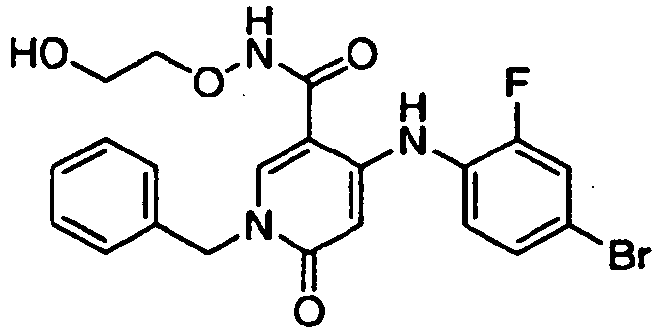
- MS APCI (-) m/z 474, 476 (M-, Br pattern) detected; 1H NMR (400 mHz, CD3OD) δ 8.10 (s, 1H), 7.49 (d, 1H), 7.40 (m, 2H), 7.33 (m, 6H), 5.12 (s, 2H), 4.03 (t, 2H), 3.77 (t, 2H).
- The following compounds were prepared as previously described with the addition of a chlorination step. An example of such a chlorination is described below.

- A mixture of 4-chloro-1-methyl-6-oxo-1,6-dihydropyridine-3-carboxylic acid ethyl ester (1.00 g, 4.64 mmol) and NCS (0.68 g, 5.10 mmol) in DMF (30 mL) was stirred for 1 hour. The reaction mixture was diluted with EtOAc and washed with 0.1 N HCl solution. The organic layer was dried (MgSO4) and concentrated under reduced pressure to give 1.10 g (95%) of 4,5-dichloro-1-methyl-6-oxo-1,6-dihydropyridine-3-carboxylic acid ethyl ester.
-

- MS APCI (+) m/z 444, 446 (M+, Cl, Br pattern) detected; 1H NMR (400 mHz, DMSO-d6) δ 11.52 (s, 1H), 8.78 (s, 1H), 7.98 (s, 1H), 7.52 (dd, 1H), 7.29 (dd, 1H), 6.93 (t, 1H), 3.47 (s, 3H), 3.40 (d, 2H), 1.01 (m, 1H), 0.50 (m, 2H), 0.20 (m, 2H).
-

- MS APCI (+) m/z 374, 376 (M+, Cl, Br pattern) detected; 1H NMR (400 mHz, DMSO-d6) δ 10.16 (s, 1H), 8.33 (s, 1H), 7.99 (br. s, 1H), 7.64 (br. s, 1H), 7.55 (dd, 1H), 7.30 (dd, 1H), 6.90 (m, 1H), 3.48 (s, 3H).
-

- MS APCI (+) m/z 434, 436 (M+, Cl, Br pattern) detected; 1H NMR (400 mHz, DMSO-d6) δ 11.60 (s, 1H), 8.82 (s, 1H), 8.03 (s, 1H), 7.52 (dd, 1H), 7.28 (d, 1H), 6.92 (t, 1H), 4.69 (t, 1H), 3.68 (m, 2H), 3.52 (m, 2H), 3.47 (s, 3H).
-

- MS APCI (+) m/z 375, 377 (M+, Cl, Br pattern) detected; 1H NMR (400 mHz, DMSO) δ 9.58 (s, 1H), 8.58 (s, 1H), 7.57 (dd, 1H), 7.33 (d, 1H), 7.0 (t, 1H), 3.53 (s, 3H).
-

- MS APCI (+) m/z 418, 420 (M+, Cl, Br pattern) detected; 1H NMR (400 mHz, CD3OD) δ 7.85 (s, 1H), 7.34 (dd, 1H), 7.26 (dd, 1H), 6.97 (t, 1H), 3.69 (q, 2H), 3.58 (s, 3H), 1.20 (t, 3H).
-

- MS APCI (-) m/z 449, 451 (M-, Cl, Br pattern) detected; 1H NMR (400 mHz, DMSO-d6) δ 9.66 (s, 1H), 8.67 (s, 1H), 7.56 (d, 1H), 7.34 (m, 6H), 7.03 (t, 1H), 5.23 (s, 2H).
-

- MS APCI (-) m/z 448, 450 (M-, Cl, Br pattern) detected; 1H NMR (400 mHz, DMSO-D6) δ 10.21 (s, 1H), 8.45 (s, 1H), 8.07 (br. s, 1H), 7.65 (br. s, 1H), 7.53 (dd, 1H), 7.33 (m, 6H), 6.94 (t, 1H), 5.12 (s, 2H).
-

- MS APCI (-) m/z 518, 520 (M-, Cl, Br pattern) detected; 1H NMR (400 mHz, DMSO-d6) δ 8076 (s, 1H), 8.08 (s, 1H), 7.51 (d, 1H), 7.35 (m, 6H), 6.96 (t, 1H), 5.11 (s, 2H), 3.36 (d, 2H), 0.99 (m, 1H), 0.49 (m, 2H), 0.19 (m, 2H).
-

- MS APCI (-) m/z 508, 510 (M-, Cl, Br pattern) detected; 1H NMR (400 mHz, DMSO-d6) δ 8.80 (s, 1H), 8.13 (s, 1H), 7.51 (dd, 1H), 7.35 (m, 6H), 7.27 (d, 1H), 6.95 (t, 1H), 5.12 (s, 2H), 4.67 (t, 1H), 3.65 (m, 2H), 3.51 (m, 2H).
- The following compounds were prepared as previously described with the addition of a fluorination step. An example of such a fluorination is described below.

- A mixture of 4-chloro-1-methyl-6-oxo-1,6-dihydropyridine-3-carboxylic acid ethyl ester (1.00 g, 4.64 mmol), LiOH (0.22 g, 9.30 mmol) and [1-(chloromethyl)-4-fluoro-1,4-diazoniabicyclo[2.2.2]octane-bis(tetrafluoroborate) (3.30 g, 9.30 mmol) in MeCN (50 mL) was stirred at 85 °C for 1 hour. The reaction was cooled to room temperature and concentrated under reduced pressure. The residue was dissolved in water and extracted with EtOAc. The combined organic extracts were dried (MgSO4) and concentrated under reduced pressure. Flash column chromatography (60:40 hexanes:EtOAc) removed starting material. The partially purified ethyl ester was then hydrolyzed by dissolving in 4:1 THF:MeOH (10 mL) followed by treatment with 1 M LiOH solution (2.8 mL). After 1 hour, the reaction mixture was acidified to
pH 1 with 10% HCl solution and extracted with EtOAc. The combined organic extracts were washed with brine, dried (MgSO4) and concentrated to yield 0.25 g (26% for two steps) 4-chloro-5-fluoro-1-methyl-6-oxo-1,6-dihydropyridine-3-carboxylic acid, which could be further purified by trituration with diethyl ether. -

- MS APCI (+) m/z 428, 430 (M+, Br pattern) detected; 1H NMR (400 mHz, CD3OD) δ 7.85 (s, 1H), 7.36 (dd, 1H), 7.28 (d, 1H), 7.01 (m, 1H), 3.69 (d, 2H), 3.57 (s, 3H), 0.89 (m, 1H), 0.58 (m, 2H), 0.30 (m, 2H).
-

- MS APCI (+) m/z 418, 420 (M+, Br pattern) detected; 1H NMR (400 mHz, CD3OD) δ 7.90 (s, 1H), 7.36 (dd, 1H), 7.28 (dd, 1H), 7.01 (m, 1H), 3.98 (m, 2H), 3.75 (m, 2H), 3.58 (s, 3H).
-
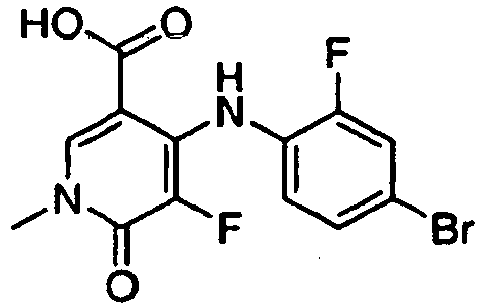
- MS APCI (-) m/z 357, 359 (M-1, Br pattern) detected; 1H NMR (400 mHz, CD. 3OD) δ 8.33 (s, 1H), 7.30 (d, 1H), 7.26 (d, 1H), 7.03 (td, 1H), 3.62 (s, 3H).
-
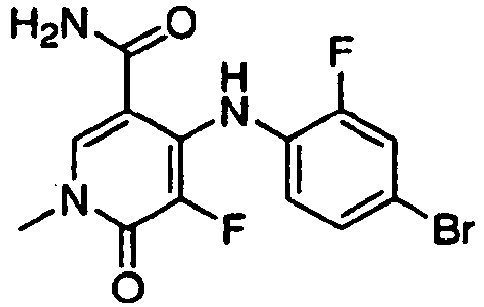
- MS (+) m/z 358, 360 (M+, Br pattern) detected; 1H NMR (400 mHz, CD3OD) δ 8.11 (s, 1H), 7.36 (dd, 1H), 7.28 (dd, 1H), 7.02 (m, 1H); 3.58 (s, 3H).
-

- MS APCI (+) m/z 402, 404 (M+, Br pattern) detected; 1H NMR (400 mHz, CD. 3OD) δ 7.87 (s, 1H), 7.35 (dd, 1H), 7.27 (d, 1H), 7.01 (td, 1H), 3.94 (q, 2H), 3.58 (s, 3H), 1.27 (t, 3H).
-

- MS APCI (+) m/z 388, 390 (M+, Br pattern) detected; 1H NMR (400 mHz, CD. 3OD) δ7.87 (s, 1H), 7.35 (dd, 1H), 7.27 (d, 1H), 7.01 (td, 1H), 3.75 (s, 3H), 3.58 (s, 3H).
-

- MS APCI (+) m/z 384, 386 (M+, Cl pattern) detected; 1H NMR (400 mHz, CD. 3OD) δ 7.56 (s, 1H), 6.93 (dd, 1H), 6.85 (d, 1H), 6.79 (td, 1H), 3.41 (d, 2H), 3.28 (s, 3H), 0.87 (m, 1H), 0.29 (q, 2H), 0.01 (q, 2H).
-
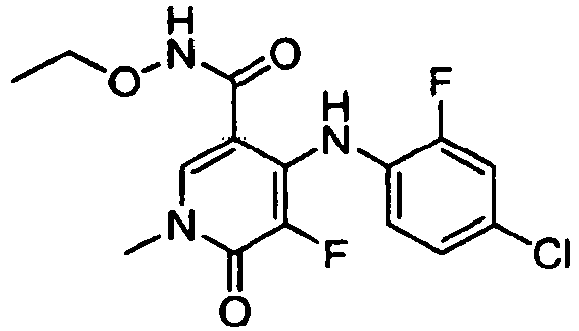
- MS APCI (+) m/z 358, 360 (M+, Cl pattern) detected; 1H NMR (400 mHz, CD. 3OD) δ 7.88 (s, 1H), 7.22 (d, 1H), 7.14 (d, 1H), 7.08 (td, 1H), 3.95 (q, 2H), 3.58 (s, 3H), 1.28 (t, 3H).
-

- MS APCI (+) m/z 314, 316 (M+, Cl pattern) detected; 1H NMR (400 mHz, DMSO) 8 9.96 (s, 1H), 8.23 (s, 1H), 7.99 (bs, 1H), 7.64 (bs, 1H), 7.45 (dd, 1H), 7.21 (d, 1H), 7.09 (td, 1H), 3.46 (s, 3H).
-

- MS APCI (+) m/z 364 (M+1) detected; 1H NMR (400 mHz, CD3OD) δ 7.82 (s, 1H), 7.0 (td, 1H), 6.94 (d, 1H), 6.93 (s, 1H), 3.69 (d, 2H), 3.56 (s, 3H), 2.32 (s, 3H), 1.16 (m, 1H), 0.58 (q, 2H). 0.30 (q, 2H).
-

- MS APCI (+) m/z 338 (M+1) detected; 1H NMR (400 mHz, CD3OD) δ 7.85 (s, 1H), 7.0 (td, 1H), 6.94 (d, 1H), 6.93 (s, 1H), 3.93 (q, 2H), 3.56 (s, 3H), 2.32 (s, 3H), 1.27 (t, 3H).
-
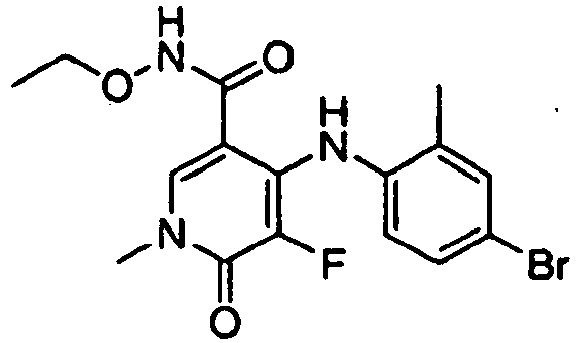
- MS APCI (+) m/z 398, 400 (M+, Br pattern) detected; 1H NMR (400 mHz, CD. 3OD) δ 7.84 (s, 1H), 7.35 (s, 1H), 7.25 (dd, 1H), 6.85 (dd, 1H), 3.92 (q, 2H), 3.57 (s, 3H), 2.30 (s, 3H), 1.28 (t, 3H).
-

- MS APCI (+) m/z 424, 426 (M+, Br pattern) detected; 1H NMR (400 mHz, CD. 3OD) δ 7.82 (s, 1H), 7.35 (s, 1H), 7.25 (dd, 1H), 6.85 (dd, 1H), 3.67 (d, 2H), 3.57 (s, 3H), 2.29 (s, 3H), 1.16 (m, 1H). 0.59 (q, 2H), 0.31 (q, 2H).
-

- MS APCI (+) m/z 430, 432 (M+, Br pattern) detected; 1H NMR (400 mHz, CD. 3OD) δ 7.94 (s, 1H), 7.36 (dd, 1H), 7.28 (d, 1H), 7.01 (td, 1H), 3.60 (s, 3H), 1.30 (s, 9H).
-

- MS APCI (+) m/z 412, 414 (M+, Br pattern) detected; 1H NMR (400 mHz, CD. 3OD) δ 7.97 (s, 1H), 7.32 (dd, 1H), 7.25 (d, 1H), 6.98 (td, 1H), 3.60 (s, 3H), 3.15 (d, 2H), 1.04 (m, 1H), 0.54 (q, 2H), 0.26 (q, 2H).
-
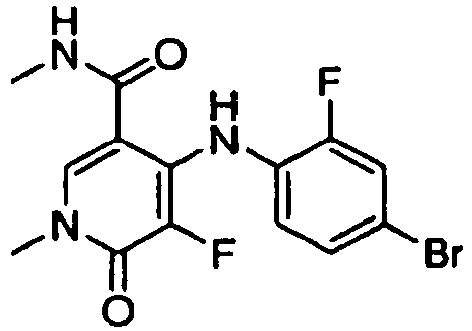
- MS APCI (+) m/z 372, 374 (M+, Br pattern) detected; 1H NMR (400 mHz, CD. 3OD) δ 7.93 (s, 1H), 7.35 (dd, 1H), 7.27 (d, 1H), 7.0 (td, 1H), 3.57 (s, 3H), 2.83 (s, 3H).
-

- Prepared as described previously using 2-fluoro-4-methylsulfanyl-phenylamine, which was prepared according to
WO 03/062191 - MS APCI (+) m/z 370 (M+1) detected; 1H NMR (400 mHz, CD3OD) δ 7.83 (s, 1H), 7.03 (m, 3H), 3.96 (q, 2H), 3.58 (s, 3H), 2.48 (s, 3H), 1.29 (t, 3H).
-

- MS APCI (+) m/z 370 (M+1) detected; 1H NMR (400 mHz, CD3OD) δ 7.83 (s, 1H), 7.03 (m, 3H), 3.96 (q, 2H), 3.58 (s, 3H), 2.48 (s, 3H), 1.29 (t, 3H).
-

- MS APCI (+) m/z 450 (M+1) detected; 1H NMR (400 mHz, CD3OD) δ 7.86 (s, 1H), 7.48 (dd, 1H), 7.44 (d, 1H), 6.84 (td, 1H), 3.95 (q, 2H), 3.58 (s, 3H), 1.28 (t, 3H).
-

- MS APCI (+) m/z 436 (M+1) detected; 1H NMR (400 mHz, CD3OD) δ 7.84 (s, 1H), 7.47 (dd, 1H), 7.44 (d, 1H), 6.83 (td, 1H), 3.77 (s, 3H), 3.59 (s, 3 H).
-

- 4-(4-Bromo-2-fluorophenylamino)-5-fluoro-1-methyl-6-oxo-1,6-dihydropyridine-3-carboxylic acid hydroxyamide was prepared from 4-(4-bromo-2-fluorophenylamino)-5-fluoro-1-methyl-6-oxo-1,6-dihydropyridine-3-carboxylic acid tert-butoxy-amide by TFA mediated deprotection. 4-(4-Bromo-2-fluorophenylamino)-5-fluoro-1-methyl-6-oxo-1,6-dihydropyridine-3-carboxylic acid tert-butoxy-amide (35 mg, 0.081 mmol) was treated with TFA (0.63 mL). After 4 days stirring, the reaction mixture was concentrated under reduced pressure. Purification by flash column chromatography (10% MeOH in methylene chloride) followed by saturated NaHCO3 solution wash of an ethyl acetate solution of the product gave clean desired product (10 mg, 33%); MS APCI (+) m/z 356, 358 (M-OH, Br pattern) detected; 1H NMR (400 mHz, CD. 3OD) δ 7.84 (s, 1H), 7.35 (dd, 1H), 7.28 (d, 1H), 7.01 (td, 1H), 3.57 (s, 3H).
-

- MS APCI (-) m/z 393, 395 (M-, Br pattern) detected; 1H NMR (400 MHz, DMSO-d6) δ 9.12 (s, 1H), 8.51 (s, 1H), 7.56 (d, 1H), 7.28 (d, 1H), 6.69 (t, 1H), 3.84 (d, 2H), 1.61 (s, 3H), 1.25 (m, 1H), 0.50 (q, 2H), 0.39 (q, 2H).
-

- MS APCI (-) m/z 392, 394 (M-, Br pattern) detected; 1H NMR (400 MHz, CD3OD) δ 8.14 (s, 1H), 7.33 (d, 1H), 7.21 (d, 1H), 6.63 (t, 1H), 3.87 (d, 2H), 1.76 (s, 3H), 1.35 (m, 1H), 0.60 (q, 2H), 0.46 (q, 2H).
-

- MS APCI (-) m/z 480, 482 (M-, Br pattern) detected; 1H NMR (400 MHz, DMSO-d6) δ 11.06 (s, 1H), 8.36 (s, 1H), 8.02 (s, 1H), 7.50 (d, 1H), 7.22 (d, 1H), 6.57 (t, 1H), 4.60 (t, 1H), 3.78 (d, 2H), 3.16 (m, 2H), 1.71 (s, 3H), 1.29 (m, 1H), 1.11 (s, 6H), 0.51 (q, 2H), 0.43 (q, 2H).
-

- MS APCI (-) m/z 466, 468 (M-, Br pattern) detected; 1H NMR (400 MHz, CD3OD) δ 7.93 (s, 1H), 7.34 (dd, 1H), 7.20 (d, 1H), 6.66 (t, 1H), 3.88 (m, 1H), 3.86 (d, 2H), 3.71 (dd, 1H), 3.59 (dd, 1H), 1.86 (s, 3H), 1.33 (m, 1H), 1.12 (d, 3H), 0.91 (q, 2H), 0.46 (q, 2H).
-

- MS APCI (-) m/z 373, 375 (M-, Cl, Br pattern) detected; 1H NMR (400 mHz, CD3OD) δ 8.43 (s, 1H), 7.62 (s, 1H), 7.42 (dd, 1H), 7.01 (m, 1H), 3.61 (s, 3H).
-

- MS APCI (+) m/z 444, 446 (M+, Cl, Br pattern) detected; 1H NMR (400 mHz, CD3OD) δ 7.89 (s, 1H), 7.60 (d, 1H), 7.39 (dd, 1H), 6.92 (dd, 1H), 3.73 (d, 2H), 3.59 (s, 3H), 1.17 (m, 1H), 0.58 (m, 2H), 0.30 (m, 2H).
-
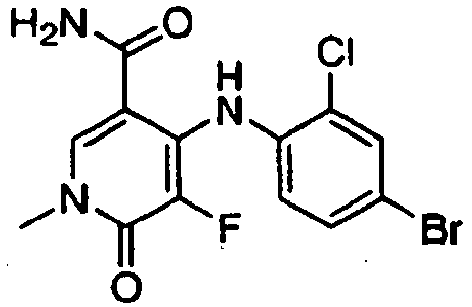
- MS APCI (+) m/z 374, 376 (M+, Cl, Br pattern) detected; 1H NMR (400 mHz, CD3OD) δ 8.13 (s, 1H), 7.59 (d, 1H), 7.39 (dd, 1H), 6.92 (dd, 1H), 3.60 (s, 3H).
-
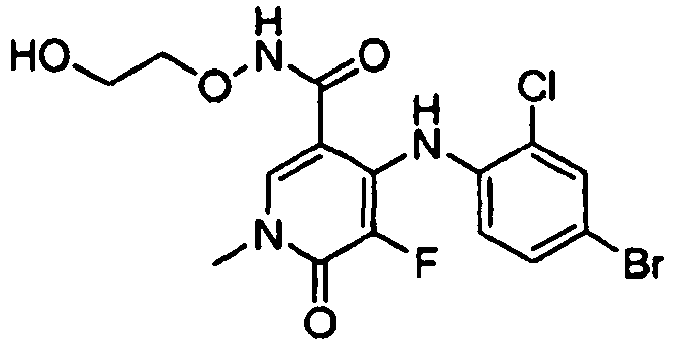
- MS APCI (+) m/z 434, 436 (M+, Cl, Br pattern) detected; 1H NMR (400 mHz, CD3OD) δ 7.94 (s, 1H), 7.60 (d, 1H), 7.40 (dd, 1H), 6.92 (dd, 1H), 4.01 (m, 2H), 3.76 (m, 2H), 3.59 (s, 3H).
-

- MS APCI (+) m/z 446, 448 (M+, Br pattern) detected; 1H NMR (400 mHz, CD. 3OD) δ 7.94 (s. 1H), 7.36 (d, 1H), 7.28 (d, 1H), 7.02 (td, 1H), 3.59 (s, 3H), 3.41 (s, 2H), 1.27 (s, 6H).
-

- MS APCI (+) m/z 432, 434 (M+, Br pattern) detected; 1H NMR (400 mHz, CD. 3OD) δ 7.89 (s, 1H), 7.36 (d, 1H), 7.28 (d, 1H), 7.02 (td, 1H), 3.99 (m, 1H), 3.83 (dd, 1H), 3.72 (dd, 1H), 3.58 (s, 3H), 1.16 (d, 3H).
- The following compounds were prepared as previously described by using the appropriate amine in place of methylamine in Step A of Example 1.
-

- MS APCI (+) m/z 385, 387 (M+, Br pattern) detected; 1H NMR (400 mHz, DMSO-D6) δ 9.29 (s, 1H), 8.08 (s, 1H), 7.58 (dd, 1H), 7.36 (d, 1H), 7.12 (m, 1H), 3.35 (m, 1H), 1.02 (m, 2H), 0.90 (m, 2H).
-

- MS APCI (+) m/z 454, 456 (M+, Br pattern) detected; 1H NMR (400 mHz, DMSO-D6) δ 11.78 (s, 1H), 9.07 (s, 1H), 7.70 (s, 1H), 7.55 (dd, 1H), 7.32 (dd, 1H), 7.03 (m, 1H), 3.66 (d, 2H), 3.35 (m, 1H), 1.07 (m, 1H), 0.98 (m, 4H), 0.53 (m, 2H), 0.25 (m, 2H).
-

- MS APCI (+) m/z 384, 386 (M+, Br pattern) detected; 1H NMR (400 mHz, DMSO-D6) δ 10.03 (s, 1H), 8.24 (br. s, 1H), 7.95 (s, 1H), 7.63 (br. s, 1H), 7.56 (dd, 1H), 7.33 (d, 1H), 7.00 (m, 1H), 3.35 (m, 1H), 0.99 (m, 4H).
-

- MS APCI (+) m/z 444, 446 (M+, Br pattern) detected; 1H NMR (400 mHz, DMSO-D6) δ 11.87 (s, 1H), 9.09 (s, 1H), 7.74 (s, 1H), 7.56 (dd, 1H), 7.32 (d, 1H), 7.02 (m, 1H), 3.89 (m, 2H), 3.59 (m, 2H), 3.38 (m, 1H), 0.99 (m, 4H).
-

- MS APCI (+) m/z 442, 444 (M+, Br pattern) detected; 1H NMR (400 mHz, CD. 3OD) δ 7.85 (s, 1H), 7.36 (dd, 1H), 7.28 (d, 1H), 7.02 (td, 1H), 4.05 (q, 2H), 3.70 (d, 2H), 1.36 (t, 3H), 1.17 (m, 1H), 0.58 (q, 2H), 0.31 (q, 2H).
-

- MS APCI (+) m/z 372, 374 (M+, Br pattern) detected; 1H NMR (400 mHz, CD. 3OD) δ 8.10 (s, 1H), 7.35 (dd, 1H), 7.28 (d, 1H), 7.02 (td, 1H), 4.05 (q, 2H), 1.37 (t, 3H).
-

- MS APCI (+) m/z 460, 462 (M+, Br pattern) detected; 1H NMR (400 mHz, DMSO) δ 11.20 (bs, 1H), 8.80 (bs, 1H), 8.01 (s, 1H), 7.55 (d, 1H), 7.32 (d, 1 H), 7.03 (td, 1H), 4.40 (q, 2H), 3.28 (s, 2H), 1.27 (t, 3H), 1.17 (s, 6H).
-

- MS APCI (+) m/z 446, 448 (M+, Br pattern) detected; 1H NMR (400 mHz, CD. 3OD) δ 7.88 (s, 1H), 7.36 (dd, 1H), 7.28 (d, 1H), 7.02 (td, 1H), 4.05 (m, 4H), 3.64 (m, 2H), 3.37 (s, 3H), 1.37 (t, 3H).
-

- MS APCI (+) m/z 402, 404 (M+, Br pattern) detected; 1H NMR (400 mHz, CD. 3OD) δ 7.87 (s, 1H), 7.36 (d, 1H), 7.29 (d, 1H), 7.02 (td, 1H), 4.02 (q, 2H), 3.75 (s, 3H), 1.36 (t, 3H).
-
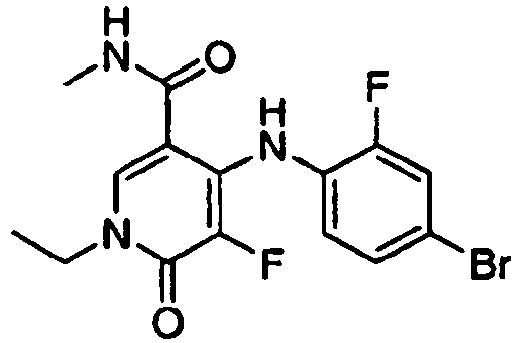
- MS APCI (+) m/z 386, 388 (M+, Br pattern) detected; 1H NMR (400 mHz, CD. 3OD) δ 7.93 (s, 1H), 7.35 (dd, 1H), 7.27 (d, 1H), 7.0 (td, 1H), 4.04 (q, 2H), 2.83 (s, 3H), 1.37 (t, 3H).
-

- MS APCI (-) m/z 371, 373 (M-, Br pattern) detected; 1H NMR (400 mHz, CD3OD) δ 8.41 (s, 1H), 7.38 (d, 1H), 7.30 (d, 1H), 7.10 (td, 1H), 4.08 (q, 2H), 1.36 (t, 3H).
-

- MS APCI (+) m/z 432, 434 (M+, Br pattern) detected; 1H NMR (400 mHz, CD. 3OD) δ 7.90 (s, 1H), 7.36 (dd, 1H), 7.28 (d, 1H), 7.02 (td, 1H), 4.05 (q, 2H), 3.99 (t, 2H), 3.75 (t, 2H), 1.37 (t, 3H).
-

- MS APCI (+) m/z 446, 448 (M+, Br pattern) detected; 1H NMR (400 mHz, CD. 3OD) δ 7.90 (s, 1H), 7.36 (dd, 1H), 7.28 (d, 1H), 7.02 (td, 1H), 4.05 (q, 2H), 3.99 (m, 1H), 3.83 (dd, 1H), 3.73 (dd, 1H), 1.36 (t, 3H), 1.16 (d, 3H).
-

- MS APCI (+) m/z 446, 448 (M+, Br pattern) detected; 1H NMR (400 mHz, CD. 3OD) δ 7.90 (s, 1H), 7.36 (d, 1H), 7.28 (d, 1H), 7.02 (td, 1H), 4.04 (q, 2H), 3.99 (m, 1H), 3.83 (dd, 1H), 3.72 (dd, 1H), 1.36 (t, 3H), 1.16 (d, 3H).
-

- MS APCI (+) m/z 460, 462 (M+, Br pattern) detected; 1H NMR (400 mHz, CD. 3OD) δ 7.90 (s, 1H), 7.36 (dd, 1H), 7.28 (d, 1H), 7.02 (td, 1H), 4.05 (q, 2H), 3.89 (d, 1H), 3.75 (m, 2H), 1.54 (m, 1H), 1.45 (m, 1H), 1.36 (t, 3H), 0.98 (t, 3H).
-

- Preparation of 4-hydroxy-1,5-dimethyl-6-oxo-1,6-dihydropyridine-3-carboxylic acid ethyl ester: Triethyl orthoformate (3.85 mL, 23.12 mmol) and acetic anhydride (4.37 mL, 46.25 mmol) were added to 2-methyl-3-oxo-pentanedioic acid diethyl ester (Caliskan et al Aust. J. Chem. 1999, 52 (11), 1013-1020) (5.0 g, 23.1 mmol) and the reaction mixture heated to 135 °C. After 1 hour, the reaction mixture was cooled to room temperature and concentrated under reduced pressure. The residue was cooled to 0 °C and methylamine (40% in water, 5.0 mL, 57.81 mmol) was added with stirring. Water (20 mL) was added and the reaction mixture stirred for 16 hours. The reaction mixture was extracted with ethyl acetate and the aqueous layer acidified to
pH 2 with 10% aqueous HCl. The acidified aqueous layer was extracted with ethyl acetate. The combined organic extracts were dried (MgSO4) and concentrated to give a solid. Trituration with diethyl ether yielded 4.88 g (55%) clean desired product. 4-Hydroxy-1,5-dimethyl-6-oxo-1,6-dihydropyridine-3-carboxylic acid ethyl ester was carried forward as described in Example 1, Steps B - D. MS APCI (-) m/z 353, 355 (M-, Br pattern) detected; 1H NMR (400 mHz, CD3OD) δ 8.49 (s, 1H), 7.36 (dd, 1H), 7.24 (dd, 1 H), 6.71 (m, 1H), 3.60 (s, 3H), 1.68 (s, 3H). - The following compounds were prepared as described in Examples 1 (Steps B - D), 2, 3 and 63.
-

- MS APCI (+) m/z 424, 426 (M+, Br pattern) detected; 1H NMR (400 mHz, CD3OD) δ 7.88 (s, 1H), 7.33 (dd, 1H), 7.20 (dd, 1H), 6.65 (m, 1H), 3.59 (d, 2H), 3.57 (s, 3H), 1.83 (s, 3H), 1.10 (m, 1H), 0.54 (m, 2H), 0.25 (m, 2H).
-

- MS APCI (+) m/z 354, 356 (M+, Br pattern) detected; 1H NMR (400 mHz, CD3OD) δ 8.14 (s, 1H), 7.33 (dd, 1H), 7.20 (d, 1H), 6.63 (m, 1H), 3.58 (s, 3H), 1.75 (s, 3H).
-

- MS APCI (+) m/z 414, 416 (M+, Br pattern) detected; 1H NMR (400 mHz, CD3OD) δ 7.93 (s, 1H), 7.33 (dd, 1H), 7.20 (d, 1H), 6.65 (m, 1H), 3.88 (m, 2H), 3.68 (m, 2H), 3.57 (s, 3H), 1.83 (s, 3H).
-

- MS APCI (+) m/z 442, 444 (M+, Br pattern) detected; 1H NMR (400 mHz, CD. 3OD) δ 7.98 (s, 1H), 7.33 (dd, 1H), 7.20 (d, 1H), 6.62 (t, 1H), 3.59 (s, 3H), 1.82 (s, 3H), 1.21 (s, 6H).
-

- MS APCI (-) m/z 456, 458 (M-, Cl, Br pattern) detected; 1H NMR (400 MHz, CD3OD) δ 8.01 (s, 1H), 7.57 (d, 1H), 7.32 (dd, 1H), 6.52 (d, 1H), 3.60 (s, 3H), 3.34 (s, 2H), 1.76 (s, 3H), 1.22 (s, 6H).
-

- MS APCI (-) m/z 428, 430 (M-, Cl, Br pattern) detected; 1H NMR (400 MHz, CD3OD) δ 7.98 (s, 1H), 7.57 (d, 1H), 7.32 (dd, 1H), 6.53 (d, 1H), 3.94 (t, 2H), 3.71 (t, 2H), 3.58 (s, 3H), 1.76 (s, 3H).
-

- MS APCI (-) m/z 349, 351 (M-, Br pattern) detected; 1H NMR (400 MHz, DMSO-d6) δ 9.04 (s, 1H), 8.50 (s, 1H), 7.41 (s, 1H), 7.26 (d, 1H), 6.51 (d, 1H), 3.49 (s, 3H), 2.26 (s, 3H), 1.50 (s, 3H).
-

- MS APCI (-) m/z 436, 438 (M-, Br pattern) detected; 1H NMR (400 MHz, CD3OD) δ 7.96 (s, 1H), 7.34 (s, 1H), 7.20 (d, 1H), 6.50 (d, 1H), 3.58 (s, 3H), 3.28 (s, 2H), 2.29 (s, 3H), 1.72 (s, 3H), 1.21 (s, 6H).
-

- MS APCI (-) m/z 418, 420 (M-, Br pattern) detected; 1H NMR (400 MHz, CD3OD) δ 7.86 (s, 1H), 7.34 (d, 1H), 7.20 (dd, 1H), 6.52 (d, 1H), 3.57 (d, 2H), 3.56 (s, 3H), 2.29 (s, 3H), 1.74 (s, 3H), 1.10 (m, 1H), 0.54 (q, 2H), 0.26 (q, 2H).
-

- MS APCI (-) m/z 408, 410 (M-, Br pattern) detected; 1H NMR (400 MHz, CD3OD) δ 7.91 (s, 1H), 7.34 (d, 1H), 7.20 (dd, 1H), 6.52 (d, 1H), 3.87 (t, 2H), 3.68 (t, 2H), 3.56 (s, 3H), 2.30 (s, 3H), 1.74 (s, 3H).
-

- MS APCI (-) m/z 368, 370 (M-, Cl, Br pattern) detected; 1H NMR (400 MHz, CD3OD) δ 8.16 (s, 1H), 7.57 (d, 1H), 7.32 (dd, 1H), 6.53 (d, 1H), 3.59 (s, 3H), 1.70 (s, 3H).
-

- MS APCI (-) m/z 325, 327 (M-, Cl pattern) detected; 1H NMR (400 MHz, DMSO-d6) δ 9.27 (s, 1H), 8.52 (s, 1H), 7.62 (d, 1H), 7.29 (dd, 1H), 6.66 (d, 1H), 3.51 (s, 3H), 1.56 (s, 3H).
-

- MS APCI (-) m/z 309, 311 (M-, Cl pattern) detected; 1H NMR (400 MHz, DMSO-d6) δ 9.14 (s, 1H), 8.50 (s, 1H), 7.45 (dd, 1H), 7.16 (d, 1H), 6.74 (t, 1H), 3.50 (s, 3H), 1.60 (s, 3H).
-

- MS APCI (-) m/z 384, 386 (M-, Cl pattern) detected; 1H NMR (400 MHz, CD3OD) δ 7.98 (s, 1H), 7.45 (d, 1H), 7.19 (dd, 1H), 6.60 (d, 1H), 3.94 (t, 2H), 3.71 (t, 2H), 3.58 (s, 3H), 1.76 (s, 3H).
-

- MS APCI (-) m/z 368, 370 (M-, Cl pattern) detected; 1H NMR (400 MHz, CD3OD) δ 7.93 (s, 1H), 7.20 (dd, 1H), 7.07 (d, 1H), 6.71 (t, 1H), 3.88 (t, 2H), 3.68 (t, 2H), 3.57 (s, 3H), 1.82 (s, 3H).
-

- MS APCI (-) m/z 382, 384 (M-, Br pattern) detected; 1H NMR (400 MHz, CD3OD) δ 7.90 (s, 1H), 7.33 (m, 1H), 7.20 (m, 1H), 6.66 (t, 1H), 3.65 (s, 3H), 3.57 (s, 3H), 1.83 (s, 3H).
-

- MS APCI (-) m/z 396, 398 (M-, Br pattern) detected; 1H NMR (400 MHz, CD3OD) δ 7.90 (s, 1H), 7.33 (dd, 1H), 7.20 (m, 1H), 6.65 (t, 1H), 3.83 (q, 2H), 3.57 (s, 3H), 1.83 (s, 3H), 1.22 (t, 3H).
-

- MS APCI (-) m/z 378, 380 (M-, Cl pattern) detected; 1H NMR (400 MHz, CD3OD) δ 7.88 (s, 1H), 7.20 (d, 1H), 7.07 (d, 1H), 6.72 (t, 1H), 3.58 (d, 2H), 3.57 (s, 3H), 1.83 (s, 3H), 1.10 (m, 1H), 0.54 (q, 2H), 0.26 (q, 2H).
-

- MS APCI (-) m/z 460 (M-1) detected; 1H NMR (400 MHz, CD3OD) δ 7.92 (s, 1H), 7.46 (d, 1H), 7.37 (d, 1H), 6.50 (t, 1H), 3.86 (t, 2H), 3.68 (t, 2H), 3.57 (s, 3H), 1.83 (s, 3H).
-

- MS APCI (-) m/z 490 (M-1) detected; 1H NMR (400 MHz, CD3OD) δ 7.93 (s, 1H), 7.47 (d, 1H), 7.37 (d, 1H), 6.50 (t, 1H), 3.90 (m, 1H), 3.80 (m, 2H), 3.57 (s, 3H), 3.56 (m, 2H), 1.82 (s, 3H).
-

- MS APCI (-) m/z 394, 396 (M-, Cl pattern) detected; 1H NMR (400 MHz, CD3OD) δ 7.93 (s, 1H), 7.45 (s, 1H), 7.18 (d, 1H), 6.60 (d, 1H), 3.65 (d, 2H), 3.58 (s, 3H), 1.75 (s, 3H), 1.12 (m, 1H), 0.53 (q, 2H), 0.25 (q, 2H).
-

- MS APCI (-) m/z 368, 370 (M-, Cl pattern) detected; 1H NMR (400 MHz, CD3OD) δ 7.93 (s, 1H), 7.42 (d, 1H), 7.17 (dd, 1H), 6.58 (d, 1H), 3.92 (q, 2H), 3.59 (s, 3H), 1.75 (s, 3H), 1.26 (t, 3H).
-

- MS APCI (-) m/z 405, 407 (M-, Br pattern) detected; 1H NMR (400 MHz, CD3OD) δ 8.00 (s, 1H), 7.33 (dd, 1H), 7.20 (dd, 1H), 6.65 (t, 1H), 3.59 (s, 3H), 3.47 (t, 2H), 2.65 (t, 2H), 1.80 (s, 3H).
-

- MS APCI (-) m/z 444 (M-1) detected; 1H NMR (400 MHz, CD3OD) δ 7.89 (s, 1H), 7.46 (dd, 1H), 7.37 (dd, 1H), 6.50 (t, 1H), 3.82 (q, 2H), 3.57 (s, 3H), 1.84 (s, 3H), 1.22 (t, 3H).
-

- MS APCI (-) m/z 430 (M-1) detected; 1H NMR (400 MHz, CD3OD) δ 7.89 (s, 1H), 7.47 (dd, 1H), 7.37 (dd, 1H), 6.50 (t, 1H), 3.64 (s, 3H), 3.57 (s, 3H), 1.83 (s, 3H).
-

- 4-(4-Bromo-2-fluorophenylamino)-1,5-dimethyl-6-oxo-1,6-dihydropyridine-3-carboxylic acid hydroxyamide was prepared from 4-(4-bromo-2-fluorophenylamino)-1,5-dimethyl-6-oxo-1,6-dihydropyridine-3-carboxylic acid tert-butoxy-amide by TFA deprotection as described in Example 37. MS APCI (+) m/z 370, 372 (M+, Br pattern) detected; 1H NMR (400 MHz, CD3OD) δ 7.88 (s, 1H), 7.32 (dd, 1H), 7.20 (dd, 1H), 6.61 (t, 1H), 3.56 (s, 3H), 1.77 (s, 3H).
-

- Step A: Preparation of 4-(4-bromo-2-fluorophenylamino)-6-chloro-5-fluoro-nicotinic acid: nBuLi (14.7 mL, 36.7 mmol, 2.5 M solution in hexanes) was added to a stirred solution of diisopropylamine (5.15 mL, 36.7 mmol) in THF (20 mL) at 0 °C. After 20 minutes, the reaction mixture was cooled to -78 °C and a solution of 4-bromo-2-fluorophenylamine (4.65 g, 24.5 mmol) in THF (10 mL) was added. After 20 minutes, a solution of 4,6-dichloro-5-fluoro-nicotinic acid (Sanchez et al J Heterocylc. Chem. 1993, 30 (4), 855-9) (2.57 g, 12.25 mmol) in THF (10 mL) was added. After 10 minutes, the reaction mixture was allowed to warm to room temperature and stirred for 1 hour. After quenching the reaction mixture with 10% HCl (20 mL), it was extracted with ethyl acetate. The combined organic extracts were dried (MgSO4) and concentrated under reduced pressure. Trituration with methylene chloride yielded 3.21 g (72%) of clean desired product.
- Step B: Preparation of 4-(4-bromo-2-fluorophenylamino)-6-chloro-5-fluoronicotinic acid methyl ester: A hexanes solution of TMSCH2N2 (9.46 mL, 18,9 mmol) was added to 4-(4-bromo-2-fluorophenylamino)-6-chloro-5-fluoro-nicotinic acid (4.59g, 12.62 mmol) in a solution of 3:1 THF:MeOH (48 mL) at 0 °C. The reaction mixture was warmed to room temperature and stirred for 1 hour. After quenching with AcOH, the reaction mixture was diluted with ethyl acetate and water. The layers were separated and the organic layer was washed with water, saturated NaHCO3 solution and brine. The organic layer was dried (MgSO4) and concentrated to give 4.40 g (92%) clean desired product.
- Step C: Preparation of 4-(4-bromo-2-fluorophenylamino)-5-fluoro-6-methoxynicotinic acid methyl ester: Sodium methoxide (2.20 g, 40.8 mmol) was slowly added to a stirred solution of 4-(4-bromo-2-fluorophenylamino)-6-chloro-5-fluoro-nicotinic acid methyl ester in 4:1 MeOH:THF (20 mL) at 0 °C. The reaction mixture was warmed to room temperature, stirred for 17 hours and then warmed to 40 °C and stirred for 5 hours. After cooling to room temperature, the reaction mixture was quenched with water and extracted with ethyl acetate. The combined organic extracts were dried (MgS04) and concentrated under reduced pressure. The desired product, contaminated with some starting material, was carried forward without purification.
- Step D: Preparation of 4-(4-bromo-2-fluorophenylamino)-5-fluoro-6-oxo-1,6-dihydropyridine-3-carboxylic acid methyl ester: Hydrobromic acid (5.82 mL, 51.5 mmol) was added to a mixture of 4-(4-bromo-2-fluorophenylamino)-5-fluoro-6-methoxy-nicotinic acid methyl ester (0.64 g, 1.72 mmol) and acetic acid (5.9 mL, 103 mmol). The reaction mixture was stirred at 90 °C for 20 minutes and then cooled to room temperature. After water was added to the mixture, a white precipitate formed. The white solid was collected by filtered and washed with water and diethyl ether to yield 0.60 g (97%) clean desired product.
- Step E: Preparation of 4-(4-bromo-2-fluorophenylamino)-5-fluoro-6-oxo-1-pyridin-3-ylmethyl-1,6-dihydropyridine-3-carboxylic acid: Lithium hydride (14 mg, 1.64 mmol) was added to a stirred solution of 4-(4-bromo-2-fluorophenylamino)-5-fluoro-6-oxo-1,6-dihydropyridine-3-carboxylic acid methyl ester (0.190 g, 0.529 mmol) in DMF (5 mL) at 0 °C. After stirring for 30 minutes, 3-bromomethyl-pyridine hydrobromide (0.14 g, 0.53 mmol) was added. The reaction mixture was warmed to room temperature and stirred for 16 hours. After quenching with ice water, the reaction mixture was extracted with ethyl acetate. The combined organic extracts were dried (MgSO4) and concentrated under reduced pressure. Purification by flash column chromatography (1% MeOH in methylene chloride) yielded 4-(4-bromo-2-fluorophenylamino)-5-fluoro-6-oxo-1-pyridin-3-ylmethyl-1,6-dihydropyridine-3-carboxylic acid methyl ester. The methyl ester was dissolved in 4:1 THF:MeOH (5 mL) and 1 M LiOH solution (1.1 mL) was added. After 1 hour, the reaction mixture was acidified to
pH 1 with 10% aqueous HCl solution and extracted with ethyl acetate. The combined organic extracts were washed with brine, dried (MgSO4) and concentrated under reduced pressure. Trituration with diethyl ether gave 0.160 g (69% two step yield) clean desired product. MS APCI (-) m/z 434, 436 (M-, Br pattern) detected; 1H NMR (400 mHz, DMSO-d6) δ 9.40 (bs, 1H), 8.65 (s, 1H), 8.61 (s, 1H), 8.51 (d, 1H), 7.74 (d, 1H), 7.58 (d, 1H), 7.39 (m, 1H), 7.34 (s, 1H), 7.16 (m, 1H), .525 (s, 1H). -

- Prepared as described in Example 2 from 4-(4-bromo-2-fluorophenylamino)-5-fluoro-6-oxo-1-pyridin-3-ylmethyl-1,6-dihydropyridine-3-carboxylic acid. MS APCI (+) m/z 505, 507 (M+, Br pattern) detected; 1H NMR (400 mHz, DMSO) 8 11.75 (bs, 1H), 8.97 (bs, 1H), 8.63 (s, 1H), 8.53 (d, 1H), 8.13 (s, 1H), 7.78 (d, 1H), 7.55 (dd, 1H), 7.40 (dd, 1H), 7.31 (d, 1H), 7.07 (td, 1H), 5.14 (s, 2H), 3.64 (d, 2H), 1.08 (m, 1H), 0.52 (d, 2H), 0.25 (d, 2H).
- The following compounds were prepared as described in Examples 1, 2, 3, 90 and 91 using the appropriate alkyl halide.
-

- MS APCI (+) m/z 493, 495 (M+, Br pattern) detected; 1H NMR (400 mHz, CD. 3OD) δ 8.62 (s, 1H), 8.51 (d, 1H), 8.03 (s, 1H), 7.88 (d, 1H), 7.44 (dd, 1H), 7.36 (dd, 1H), 7.27 (d, 1H), 7.02 (td, 1H), 5.24 (s, 2H), 3.82 (t, 2H), 1.68 (m, 2H), 0.97 (t, 3H).
-

- MS APCI (-) m/z 434,436 (M-, Br pattern) detected; 1H NMR (400 mHz, DMSO) δ 9.40 (s, 1H), 8.56 (s, 1H), 8.51 (d, 1H), 7.79 (t, 1H), 7.59 (d, 1H), 7.34 (m, 3H), 7.15 (m, 1H), 5.29 (s, 2H).
-

- MS APCI (-) m/z 397, 399 (M-, Br pattern) detected; 1H NMR (400 mHz, DMSO) δ 9.35 (bs, 1H), 8.46 (s, 1H), 7.59 (d, 1H), 7.36 (d, 1H), 7.13 (td, 1H), 3.85 (d, 2H), 1.23 (m, 1H), 0.50 (d, 2H), 0.39 (d, 2H).
-

- MS APCI (+) m/z 486, 488 (M+, Br pattern) detected; 1H NMR (400 mHz, DMSO) δ 8.02 (s, 1H), 7.56 (d, 1H), 7.32 (d, 1H), 7.04 (td, 1H), 3.79 (d, 2H), 3.28 (s, 2H), 1.28 (m, 1H), 1.17 (s. 6H), 0.52 (d, 2H), 0.43 (d, 2H).
-

- MS APCI (+) m/z 398, 400 (M+, Br pattern) detected; 1H NMR (400 mHz, DMSO) δ 10.04 (s, 1H), 8.22 (s, 1H), 8.05 (bs, 1H), 7.66 (bs, 1H), 7.56 (d, 1H), 7.33 (d, 1H), 7.04 (td, 1H), 3.75 (d, 2H), 1.27 (m, 1H), 0.51 (d, 2H), 0.43 (d, 2H).
-

- MS APCI (+) m/z 505, 507 (M+, Br pattern) detected; 1H NMR (400 mHz, DMSO) δ 11.71 (bs, 1H), 9.04 (bs, 1H), 8.52 (d, 1H), 8.07 (s, 1H), 7.80 (t, 1H), 7.56 (d, 1H), 7.31 (m, 3H), 7.07 (td, 1H), 5.21 (s, 2H), 3.63 (d, 2H), 1.07 (m, 1H), 0.51 (q, 2H), 0.24 (q, 2H).
-

- MS APCI (+) m/z 523, 525 (M+, Br pattern) detected; 1H NMR (400 mHz, DMSO) δ 11.23 (bs, 1H), 8.86 (bs, 1H), 8.53 (d, 1H), 8.18 (s, 1H), 7.80 (t, 1H), 7.56 (d, 1 H), 7.31 (m, 3H), 7.08 (td, 1H), 5.25 (s, 2H), 3.28 (s, 2H), 1.56 (s, 6H).
-

- MS APCI (+) m/z 433, 435 (M+, Br pattern) detected; 1H NMR (400 mHz, DMSO-D6) δ 9.35 (s, 1H), 8.54 (s, 1H), 7.59 (dd, 1H), 7.35 (m, 6H), 7.15 (m, 1H), 5.22 (s, 2H).
-

- MS APCI (-) m/z 432, 434 (M-, Br pattern) detected; 1H NMR (400 mHz, CD3OD) δ 7.18 (s, 1H), 7.36 (m, 6H), 7.27 (d, 1H), 7.02 (m, 1H), 5.20 (s, 2H).
-

- MS APCI (-) m/z 502, 504 (M-, Br pattern) detected; 1H NMR (400 mHz, CD3OD) δ 7.89 (s, 1H), 7.34 (m, 7H), 7.27 (d, 1H), 7.02 (m, 1H), 5.19 (s, 2H), 3.65 (d, 2H), 1.11 (m, 1H), 0.55 (m, 2H), 0.26 (m, 2H).
-

- MS APCI (-) m/z 492, 494 (M-, Br pattern) detected; 1H NMR (400 mHz, CD3OD) δ 7.96 (s, 1H), 7.36 (m, 7H), 7.27 (d, 1H), 7.04 (m, 1H), 5.19 (s, 2H), 3.96 (t, 2H), 3.73 (t, 2H).
-

- 1-Benzyl-4-(4-bromo-2-fluorophenylamino)-5-fluoro-6-oxo-1,6-dihydropyridine-3-carboxylic acid (2-amino-ethoxy)-amide was prepared by deprotecting 4(2-{[1-benzyl-4-(4-bromo-2-fluorophenylamino)-5-fluoro-6-oxo-1,6-dihydropyridine-3-carbonyl]-aminooxy} - ethyl)-carbamic acid tert-butyl ester under standard conditions; MS APCI (+) m/z 493, 495 (M+, Br pattern) detected; 1H NMR (400 mHz, CD3OD) δ 8.03 (s, 1H), 7.36 (m, 6H), 7.29 (d, 1H), 7.04 (td, 1H), 5.20 (s, 2H), 4.12 (t, 2H), 3.17 (t, 2H).
-

- MS APCI (-) m/z 439, 441 (M-, Br pattern) detected; 1H NMR (400 mHz, CD. 3OD) δ 8.21 (s, 1H), 7.32 (dd, 1H), 7.27 (d, 1H), 7.05 (td, 1H), 3.88 (d, 2H), 1.85 (m, 1H), 1.79 (m, 2H), 1.69 (m, 3H), 1.25 (m, 3H), 1.05 (q, 2H).
-

- MS APCI (+) m/z 528, 530 (M+, Br pattern) detected; 1H NMR (400 mHz, CD. 3OD) 87.85 (s, 1H), 7.36 (d, 1H), 7.28 (d, 1H), 7.02 (td, 1H), 3.86 (d, 2H), 3.42 (s, 2H), 1.88 (m, 1H), 1.76 (m, 2H), 1.67 (m, 3H), 1.29 (m, 3H), 1.26 (s, 6H), 1.06 (m, 2H), 0.90 (m, 2H).
-

- MS APCI (+) m/z 510, 512 (M+, Br pattern) detected; 1H NMR (400 mHz, CD. 3OD) δ 7.76 (s, 1H), 7.36 (d, 1H), 7.28 (d, 1H), 7.02 (td, 1H), 3.84 (d, 2H), 3.69 (d, 2H), 1.86 (m, 1H), 1.75 (m, 2H), 1.66 (m, 2H), 1.26 (m, 3H), 1.07 (m, 2H), 0.90 (m, 2H), 0.58 (d, 2H), 0.29 (d, 2H).
-

- MS APCI (-) m/z 401, 403 (M-, Br pattern) detected; 1H NMR (400 mHz, CD. 3OD) δ 8.32 (s, 1H), 7.38 (dd, 1H), 7.31 (d, 1H), 7.10 (td, 1H), 4.21 (t, 2H), 3.66 (t, 2H), 3.35 (s, 3H).
-

- MS APCI (+) m/z 472, 474 (M+, Br pattern) detected; 1H NMR (400 mHz, CD. 3OD) δ 7.79 (s, 1H), 7.36 (dd, 1H), 7.28 (dd, 1H), 7.03 (td, 1H), 4.18 (t, 2H), 3.68 (m, 4H), 3.35 (s, 3H), 1.15 (m, 1H), 0.59 (q, 2H), 0.30 (q, 2H).
-

- 4-(4-Bromo-2-fluorophenylamino)-5-fluoro-1-(2-hydroxyethyl)-6-oxo-1,6-dihydropyridine-3-carboxylic acid cyclopropylmethoxy-amide was prepared by deprotecting 4-(4-bromo-2-fluorophenylamino)-1-[2-(tert-butyl-dimethylsilanyloxy)-ethyl]-5-fluoro-6-oxo-1,6-dihydropyridine-3-carboxylic acid cyclopropylmethoxy-amide under standard conditions. MS APCI (+) m/z 458, 460 (M+, Br pattern) detected; 1H NMR (400 mHz, CD3OD) δ 7.82 (s, 1H), 7.35 (dd, 1H), 7.27 (d, 1H), 7.02 (m, 1H), 4.11 (t, 2H), 3.84 (t, 2H), 3.72 (m, 2H), 1.16 (m, 1H), 0.59 (m, 2H), 0.31 (m, 2H).
-

- MS APCI (-) m/z 411, 413 (M-, Br pattern) detected; 1H NMR (400 mHz, CD. 3OD) δ 8.37 (s, 1H), 7.34 (dd, 1H), 7.27 (d, 1H), 7.04 (td, 1H), 4.10 (t, 2H), 1.62 (q, 2H), 0.67 (m, 1H), 0.43 (q, 2H), 0.01 (q, 2H).
-

- MS ESI (+) m/z 458, 460 (M+, Br pattern) detected; 1H NMR (400 mHz, DMSO) δ 8.34 (s, 1H), 7.58 (d, 1H), 7.35 (d, 1H), 7.10 (td, 1H), 4.10 (t, 2H), 3.56 (m, 4H), 3.17 (m, 2H), 2.62 (m, 2H).
-

- 1H NMR (400 mHz, DMSO) δ 9.37 (s, 1H), 8.68 (bs, 1H), 8.60 (s, 1H), 7.60 (d, 1H), 7.56 (s, 1H), 7.37 (d, 1H), 7.14 (td, 1H), 5.20 (s, 2H), 3.77 (s, 3H).
-

- MS APCI (+) m/z 412, 414 (M+, Br pattern) detected; 1H NMR (400 mHz, CD. 3OD) δ 8.12 (s, 1H), 7.35 (dd, 1H), 7.28 (d, 1H), 7.02 (td, 1H), 4.10 (t, 2H), 1.76 (q, 2H), 0.72 (m, 1H), 0.47 (q, 2H), 0.05 (q, 2H).
-

- MS APCI (+) m/z 527, 529 (M+, Br pattern) detected; 1H NMR (400 mHz, CD. 3OD) δ 7.85 (s, 1H), 7.36 (d, 1H), 7.28 (d, 1H), 7.03 (td, 1H), 4.13 (t, 2H), 3.68 (m, 6H), 2.71 (t, 2H), 2.55 (m, 4H), 1.17 (m, 1H), 0.59 (q, 2H), 0.31 (q, 2H).
-

- MS APCI (+) m/z 508, 510 (M+, Br pattern) detected; 1H NMR (400 mHz, CD. 3OD) δ 7.98 (s, 1H), 7.62 (s, 1H), 7.34 (dd, 1H), 7.26 (dd, 1H), 7.16 (s, 1H), 7.0 (td, 1H), 5.04 (s, 2H), 3.72 (d, 2H), 3.70 (s, 3H), 1.18 (m, 1H), 0.59 (q, 2H), 0.31 (q, 2H).
-

- MS APCI (+) m/z 472, 474 (M+, Br pattern) detected; 1H NMR (400 mHz, CD. 3OD) δ 7.90 (s, 1H), 7.36 (d, 1H), 7.28 (d, 1H), 7.02 (td, 1H), 4.09 (t, 2H), 3.98 (t, 2H), 3.75 (t, 2H), 1.66 (q, 2H), 0.72 (m, 1H), 0.47 (q, 2H), 0.06 (q, 2H).
-

- MS APCI (+) m/z 494, 496 (M+, Br pattern) detected; 1H NMR (400 mHz, CD. 3OD) δ 7.99 (s, 1H), 7.70 (s, 1H), 7.35 (dd, 1H), 7.26 (d, 1H), 7.20 (s, 1H), 7.0 (td, 1H), 5.10 (s, 2H), 3.72 (d, 2H), 1.16 (m, 1H), 0.59 (q, 2H), 0.31 (q, 2H).
-

- MS APCI (+) m/z 495, 497 (M+, Br pattern) detected; 1H NMR (400 mHz, CD. 3OD) δ 8.52 (d, 1H), 8.08 (s, 1H), 7.84 (t, 1H), 7.44 (d, 1H), 7.36 (m, 2H), 7.27 (d, 1H), 7.04 (td, 1H), 5.27 (s, 2H), 4.0 (t, 2H), 3.75 (t, 2H).
-

- MS APCI (+) m/z 519, 521 (M+, Br pattern) detected; 1H NMR (400 mHz, CD. 3OD) δ 8.03 (s, 1H), 7.70 (t, 1H), 7.36 (d, 1H), 7.28 (d, 1H), 7.21 (d, 1H), 7.16 (d, 1H), 7.04 (td, 1H), 5.22 (s, 2H), 3.70 (d, 2H), 2.52 (s, 3H), 1.17 (m, 1H), 0.58 (q, 2H), 0.30 (q, 2H).
-

- MS APCI (+) m/z 479, 481 (M+, Br pattern) detected; 1H NMR (400 mHz, CD. 3OD) δ 8.05 (s, 1H), 7.69 (t, 1H), 7.36 (dd, 1H), 7.28 (d, 1H), 7.21 (d, 1H), 7.14 (d, 1H), 7.04 (td, 1H), 5.22 (s, 2H), 3.75 (s, 3H), 2.52 (s, 3H).
-

- 4-(4-Bromo-2-fluorophenylamino)-5-fluoro-6-oxo-1-pyridin-3-ylmethyl-1,6-dihydropyridine-3-carboxylic acid (3-aminopropoxy)-amide was prepared by deprotecting (3-({[4-(4-bromo-2-fluorophenylamino)-5-fluoro-6-oxo-1-pyridin-3-ylmethyl- 1,6-dihydropyridine-3-carbonyl]-aminooxy}-propyl)-carbamic acid tert-butyl ester under standard conditions. MS APCI (+) m/z 508, 510 (M+, Br pattern) detected; 1H NMR (400 mHz, DMSO) δ 9.01 (s, 1H), 8.92 (m, 2H), 8.61 (d, 1H), 8.29 (s, 1H), 8.12 (m, 1H), 7.81 (m, 2H), 7.57 (d, 1H), 7.35 (d, 1H), 7.22 (td, 1H), 5.34 (s, 2H), 3.97 (t, 2H), 3.01 (q, 2H), 1.91 (m, 2H).
-

- MS APCI (-) m/z 435, 437 (M-, Br pattern) detected; 1H NMR (400 mHz, DMSO) δ 9.42 (bs, 1H), 8.71 (s, 1H), 8.63 (s, 1H), 8.58 (s, 2H), 7.59 (dd, 1H), 7.36 (d, 1H), 7.15 (td, 1H), 5.39 (s, 2H).
-

- MS APCI (+) m/z 506, 508 (M+, Br pattern) detected; 1H NMR (400 mHz, CD. 3OD) δ 8.72 (s, 1H), 8.57 (s, 1H), 8.55 (s, 1H), 8.05 (s, 1H), 7.36 (dd, 1H), 7.28 (d, 1H), 7.04 (td, 1H), 5.33 (s, 2H), 3.70 (d, 2H), 1.56 (m, 1H), 0.59 (q, 2H), 0.30 (q, 2H).
-

- MS APCI (+) m/z 480, 482 (M+, Br pattern) detected; 1H NMR (400 mHz, CD. 3OD) δ 8.71 (s, 1H), 8.57 (s, 1H), 8.55 (s, 1H), 8.07 (s, 1H), 7.36 (dd, 1H), 7.28 (d, 1H), 7.04 (td, 1H), 5.33 (s, 2H), 3.95 (q, 2H), 1.28 (t, 3H).
-

- MS APCI (+) m/z 494, 496 (M+, Br pattern) detected; 1H NMR (400 mHz, CD. 3OD) 8 8.72 (s, 1H), 8.58 (s, 1H), 8.55 (s, 1H), 8.07 (s, 1H), 7.36 (dd, 1H), 7.28 (d, 1H), 7.04 (td, 1H), 5.34 (s, 2H), 3.84 (t, 2H), 1.69 (m, 2H), 0.98 (t, 3H).
-

- MS APCI (+) m/z 506, 508 (M+, Br pattern) detected; 1H NMR (400 mHz, CD 3OD) δ 9.14 (d, 1H), 8.10 (s, 1H), 7.80 (m, 1H), 7.74 (m, 1H), 7.36 (dd, 1H), 7.27 (d, 1H), 7.05 (td, 1H), 5.46 (s, 2H), 3.70 (d, 2H), 1.17 (m, 1H), 0.58 (q, 2H), 0.30 (q, 2H).
-
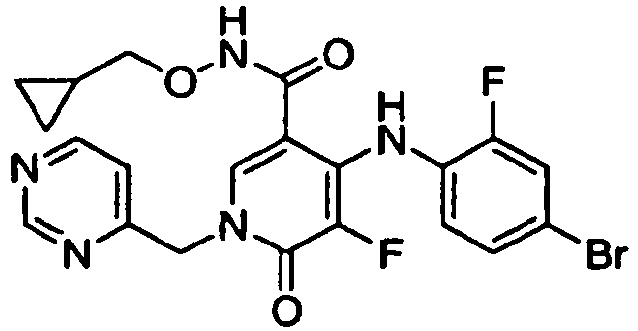
- MS APCI (+) m/z 506, 508 (M+, Br pattern) detected; 1H NMR (400 mHz, CD. 30D) δ 9.09 (s, 1H), 8.75 (d, 1H), 8.0 (s, 1H), 7.48 (d, 1H), 7.38 (d, 1H), 7.29 (d, 1H), 7.07 (td, 1H), 5.30 (s, 2H), 3.69 (d, 2H), 1.16 (m, 1H), 0.58 (q, 2H), 0.30 (q, 2H).
-

- Step A: 4-(4-Bromo-2-fluorophenylamino)-5-fluoro-1-methylsulfanylmethyl-6-oxo-1,6-dihydropyridine-3-carboxylic acid methyl ester was prepared as previously described using chloromethylsulfanylmethane as the electrophile.
- Step B: 4-(4-Bromo-2-fluorophenylamino)-5-fluoro-1-methanesulfonylmethyl-6-oxo-1,6-dihydropyridine-3-carboxylic acid methyl ester was prepared from 4-(4-bromo-2-fluorophenylamino)-5-fluoro-1-methylsulfanylmethyl-6-oxo-1,6-dihydropyridine-3-carboxylic acid methyl ester as follows. A solution of Oxone® (84 mg, 0.14 mmol) in water (2 mL) was added dropwise to a stirred solution of 4-(4-bromo-2-fluorophenylamino)-5-fluoro-1-methylsulfanylmethyl-6-oxo-1,6-dihydropyridine-3-carboxylic acid methyl ester (38 mg, 0.091 mmol) in MeOH (2 mL) at room temperature. After 4 days stirring, the reaction mixture was diluted with water (20 mL), extracted with ethyl acetate, dried (MgSO4) and concentrated under reduced pressure. Purification by flash column chromatography (0.5% MeOH in methylene chloride) gave clean desired product (25 mg, 61%).
- Step C: 4-(4-Bromo-2-fluorophenylamino)-5-fluoro-1-methanesulfonylmethyl-6-oxo-1,6-dihydropyridine-3-carboxylic acid cyclopropylmethoxy-amide was prepared from 4-(4-bromo-2-fluorophenylamino)-5-fluoro-1-methanesulfonylmethyl-6-oxo-1,6-dihydropyridine-3-carboxylic acid methyl ester as previously described. MS APCI (+) m/z 506, 508 (M+, Br pattern) detected; 1H NMR (400 mHz, CD3OD) δ 7.84 (s, 1H), 7.31 (dd, 1H), 7.27 (d, 1H), 7.04 (td, 1H), 5.37 (s, 2H), 3.78 (d, 2H), 3.06 (s, 3H), 1.21 (m, 1H), 0.63 (q, 2H), 0.33 (q, 2H).
- Example 129

- A stirred solution of 4-(4-bromo-2-fluorophenylamino)-5-fluoro-6-oxo-1,6-dihydropyridine-3-carboxylic acid methyl ester (0.10 g, 0.278 mmol) in 4:1 THF:MeOH (5 mL) was treated with 1 M LiOH solution (0.75 mL). After 8 hours, the reaction mixture was acidified to
pH 1 with 1 N HCl and extracted with ethyl acetate. The combined organic extracts were washed with brine, dried (MgSO4) and concentrated under reduced pressure to give 0.095 g (99%) of desired product as a white solid. MS APCI (-) m/z 343, 345 (M-, Br pattern) detected; 1H NMR (400 mHz, DMSO) δ 12.34 (bs, 1H), 9.39 (bs, 1H), 7.95 (s, 1H), 7.59 (d, 1H), 7.36 (d, 1H), 7.12 (td, 1H). -
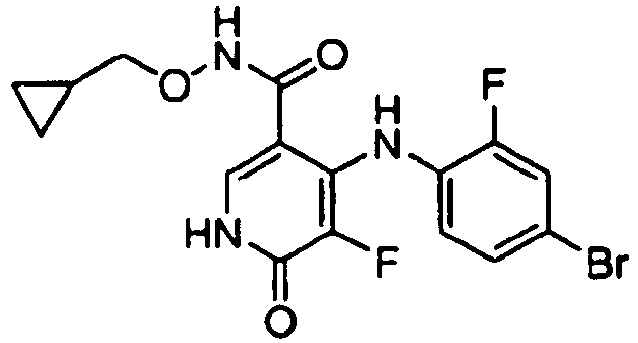
- Prepared as described in Example 2 from 4-(4-bromo-2-fluorophenylamino)-5-fluoro-6-oxo-1,6-dihydropyridine-3-carboxylic acid. MS APCI (+) m/z 414, 416 (M+, Br pattern) detected; 1H NMR (400 mHz, DMSO) δ 9.15 (bs, 1H), 7.59 (s, 1H), 7.55 (dd, 1H), 7.32 (d, 2H), 7.02 (td, 1H), 3.64 (d, 2H), 1.07 (m, 1 H), 0.50 (q, 2H), 0.24 (q, 2H).
-

- Step A: Preparation of 4-(4-bromo-2-fluorophenylamino)-5-fluoro-1-methyl-6-oxo-1,6-dihydropyridine-3-carboxylic acid hydrazide: A mixture of 4-(4-bromo-2-fluorophenylamino)-5-fluoro-1-methyl-6-oxo-1,6-dihydropyridine-3-carboxylic acid (70 mg, 0.195 mmol), EDCI (112 mg, 0.585 mmol), and HOBt (79 mg, 0.585 mmol) in DMF (3 mL) was stirred for 30 minutes. Hydrazine (19 mg, 0.585 mmol) was added followed by Et3N (0.082 mL, 0.585 mmol). After 3 hours, the reaction mixture was diluted with EtOAc and washed with saturated NH4Cl solution, saturated NaHCO3 solution and brine. The organic layer was dried (MgSO4) and concentrated to yield 64 mg (89%) desired product.
- Step B: Preparation of 5-(5-amino-[1,3,4]oxadiazol-2-yl)-4-(4-bromo-2-fluorophenylamino)-3-fluoro-1-methyl-1H-pyridin-2-one: Cyanogen bromide (36 mg, 0.31 mmol) was added to a suspension of 4-(4-bromo-2-fluorophenylamino)-5-fluoro-1-methyl-6-oxo-1,6-dihydropyridine-3-carboxylic acid hydrazide (63 mg, 0.169 mmol) in dioxane (2 mL) followed by an aqueous NaHCO3 (2 mL of a 0.09 M solution) solution. After 17 hours, additional cyanogen bromide (14 mg) was added. After 19 hours, the reaction mixture was diluted with water and extracted with ethyl acetate. The combined organic extracts were washed with brine, dried (MgSO4) and concentrated under reduced pressure. Crystallization (MeOH:THF) followed by trituration (Et2O:MeOH 5:1) gave clean desired product as a white solid (60 mg, 89%). MS APCI (+) m/z 398, 400 (M+, Br pattern) detected; 1H NMR (400 mHz, CD3OD) δ 8.06 (s, 1H), 7.37 (d, 1H), 7.31 (d, 1H), 7.10 (td, 1H), 3.64 (s, 3H).
- The following compounds were prepared similarly using the appropriate carboxylic acid.
-

- MS APCI (+) m/z 354, 356 (M+, Cl pattern) detected; 1H NMR (400 mHz, CD3OD) δ 8.06 (s, 1H), 7.23 (d, 1H), 7.16 (s, 2H), 3.64 (s, 3H).
-

- MS APCI (+) m/z 476, 478 (M+, Br pattern) detected; 1H NMR (400 mHz, CD 3OD) δ 8.75 (s, 1H), 8.58 (s, 1H), 8.55 (s, 1H), 8.26 (s, 1H), 7.35 (dd, 1H), 7.29 (d, 1H), 7.09 (td, 1H), 5.40 (s, 2H).
-

- MS APCI (-) m/z 392, 394 (M-, Br pattern) detected; 1H NMR (400 MHz, CD3OD) δ 8.14 (s, 1H), 7.36 (d, 1H), 7.23 (d, 1H), 6.72 (t, 1H), 3.63 (s, 3H), 1.78 (s, 3H).
-

- MS APCI (+) m/z 394, 396 (M+, Br pattern) detected; 1H NMR (400 mHz, CD. 3OD) δ 8.05 (s, 1H), 7.39 (s, 1H), 7.30 (d, 1H), 6.95 (dd, 1H), 3.62 (s, 3H), 2.31 (s, 3H).
-

- 1,1'-Carbonyldiimidazole (275 mg, 1.70 mmol) was added to a stirred solution of 4-(4-bromo-2-fluorophenylamino)-1,5-dimethyl-6-oxo-1,6-dihydropyridine-3-carboxylic acid hydrazide (728 mg, 1.62 mmol (82% pure material)) in DMF (2 mL). After 1 hour, the reaction mixture was diluted with ethyl acetate and washed with brine. Some of the product precipitated and was collected by filtration. The filtrate was diluted with 1 N HCl and the layers separated. The aqueous layer was extracted with ethyl acetate. The combined organic extracts were washed with brine, dried (MgS04) and concentrated under reduced pressure. The resulting residue was triturated with diethyl ether to give the desired product which was combined with the earlier obtained product. The combined yield of clean desired product was 482 mg (75%); MS APCI (-) m/z 393, 395 (M-, Br pattern) detected; 1H NMR (400 MHz, DMSO-d6) δ 8.22 (s, 1H), 7.88 (s, 1H), 7.50 (dd, 1H), 7.21 (d, 1H), 6.59 (t, 1H), 3.52 (s, 3H), 1.76 (s, 3H).
-

- Ethanolamine (0.037 mL, 0.61 mmol) was added to a suspension of 4-(4-bromo-2-fluorophenylamino)-1,3-dimethyl-5-(5-oxo-4,5-dihydro-[1,3,4]oxadiazol-2-yl)-1H-pyridin-2-one (81 mg, 0.20 mmol) in EtOH (2 mL). The reaction mixture was heated to 90 °C with stirring for 17 hours. After cooling to room temperature, the reaction mixture was concentrated under reduced pressure and purified by flash column chromatography (5% MeOH in methylene chloride increasing to 20% MeOH in 5% steps) to give the desired intermediate adduct (58 mg, 62%). The intermediate (56 mg, 0.12 mmol) was suspended in 2:1 methylene chloride:MeCN (4.5 mL) and PPh3 (98 mg, 0.37 mmol), Et3N (0.14 mL, 1.0 mmol) and CCl4 (0.036 mL, 0.37 mmol) were added. The resulting mixture was heated to 55 °C with stirring for 30 minutes. After cooling to room temperature, the reaction mixture was diluted with ethyl acetate and washed with brine. The aqueous layer was extracted with ethyl acetate. The organic layers were combined, washed with brine, dried (MgSO4) and concentrated under reduced pressure. Purification by flash column chromatography (ethyl acetate) gave clean desired product (24 mg, 45%); MS APCI (-) m/z 436, 438 (M-, Br pattern) detected; 1H NMR (400 MHz, CD3OD) δ 8.14 (s, 1H), 7.36 (dd, 1H), 7.22 (dd, 1H), 6.71 (t, 1H), 3.71 (t, 2H), 3.63 (s, 3H), 3.41 (t, 2H), 1.79 (s, 3H).
- The following compounds were prepared similarly using the appropriate amine. In some instances a final standard deprotection step was required.
-

- MS APCI (-) m/z 449, 451 (M-, Br pattern) detected; 1H NMR (400 MHz, CD3OD) δ 8.18 (s, 1H), 7.37 (dd, 1H), 7.23 (d, 1H), 6.71 (t, 1H), 3.66 (t, 2H), 3.64 (s, 3H), 3.29 (t, 2H), 2.75 (s, 3H), 1.80 (s, 3H).
-

- MS APCI (+) m/z 437, 439 (M+, Br pattern) detected; 1H NMR (400 MHz, CD3OD) δ 8.20 (s, 1H), 7.37 (dd, 1H), 7.23 (dd, 1H), 6.71 (t, 1H), 3.65 (s, 3H), 3.63 (t, 2H), 3.22 (t, 2H), 1.80 (s, 3H).
-

- MS APCI (+) m/z 442, 444 (M+, Br pattern) detected; 1H NMR (400 mHz, CD. 3OD) δ 8.06 (s, 1H), 7.35 (dd, 1H), 7.29 (d, 1H), 7.08 (td, 1H), 3.75 (t, 2H), 3.65 (s, 3H), 3.47 (t, 2H).
-

- MS APCI (+) m/z 441, 443 (M+, Br pattern) detected; 1H NMR (400 mHz, DMSO) δ 8.94 (s, 1H), 8.17 (s, 1H), 8.06 (t, 1H), 7.95 (bs, 3H), 7.59 (dd, 1H), 7.36 (d, 1H), 7.12 (td, 1H), 3.57 (s, 3H), 3.51 (q, 2H), 3.05 (q, 2H).
-

- Step A: Preparation of 3-{5-[4-(4-bromo-2-fluorophenylamino)-1,5-dimethyl-6-oxo-1,6-dihydro-pyridin-3-yl]-tetrazol-1-yl}-propionitrile: PPh3 (83 mg, 0.32 mmol) was added to a stirred suspension of 4-(4-bromo-2-fluorophenylamino)-1,5-dimethyl-6-oxo-1,6-dihydropyridine-3-carboxylic acid (2-cyano-ethyl)-amide (51 mg, 0.12 mmol) in MeCN (1.5 mL). DIAD (0.065 mL, 0.31 mmol) and TMSN3 (0.045 mL, 0.32) were added dropwise. After 22 hours, the reaction mixture was diluted with ethyl acetate and washed with water. The aqueous layer was extracted with ethyl acetate. The combined organic extracts were dried (MgSO4) and concentrated under reduced pressure. Purification by flash column chromatography gave clean desired product (33 mg, 61 %).
- Step B: Preparation of 4-(4-bromo-2-fluorophenylamino)-1,3-dimethyl-5-(1H-tetrazol-5-yl)-1H-pyridin-2-one: DBU (0.030 mL, 0.21 mmol) was added to a solution of 3-{5-[4-(4-bromo-2-fluorophenylamino)-1,5-dimethyl-6-oxo-1,6-dihydro-pyridin-3-yl]-tetrazol-1-yl}-propionitrile (30 mg, 0.069 mmol) in methylene chloride (1.5 mL). After 2 hours, the reaction mixture was diluted with ethyl acetate and washed with 1 N HCl. The aqueous layer was extracted with ethyl acetate. The combined organic extracts were washed with brine, dried (MgSO4) and concentrated under reduced pressure. Trituration with diethyl ether gave clean desired product (20 mg, 77%); MS APCI (-) m/z 377, 379 (M-, Br pattern) detected; 1H NMR (400 MHz, CD3OD) δ 8.20 (s, 1H), 7.29 (dd, 1H), 7.13 (dd, 1H), 6.63 (t, 1H), 3.65 (s, 3H), 1.91 (s, 3H).
-

- Step A: Preparation of 4-(4-bromo-2-fluorophenylamino)-5-fluoro-1-methyl-6-oxo-1,6-dihydropyridine-3-carboxylic acid N'-(1-imino-ethyl)-hydrazide: Ethyl acetimidate HCl salt (40 mg, 0.32 mmol) and Et3N (0.049 mL, 0.35 mmol) were added to a stirred suspension of 4-(4-bromo-2-fluorophenylamino)-5-fluoro-1-methyl-6-oxo-1,6-dihydropyridine-3-carboxylic acid hydrazide (0.10 g, 0.27 mmol) in 2:1 THF:DMF (3 mL) at 0 °C. After 1.5 hours at 0 °C and 17 hours at room temperature, the reaction mixture was poured onto water, neutralized with dilute aqueous HCl and extracted with ethyl acetate. The combined organic extracts were dried (MgSO4) and concentrated under reduced pressure. Trituration with methylene chloride gave the desired product.
- Step B: Preparation of 4-(4-bromo-2-fluorophenylamino)-3-fluoro-1-methyl-5-(5-methyl-4H-[1,2,4]triazol-3-yl)-1H-pyridin-2-one: PPh3 (0.12 g, 0.45 mmol), Et3N (0.17 mL, 1.21 mmol), and CCl4 (0.044 mL, 0.45 mmol) were added to a stirred suspension of 4-4-bromo-2-fluorophenylamino)-5-fluoro-1-methyl-6-oxo-1,6-dihydropyridine-3-carboxylic acid N'-(1-imino-ethyl)-hydrazide (0.073 g, 0.18 mmol) in methylene chloride (2 mL). The reaction mixture was stirred at 50 °C for 2 hours. After cooling to room temperature, the reaction mixture was diluted with ethyl acetate, washed with water, dried (MgSO4) and concentrated. Purification by flash column chromatography (4% MeOH in methylene chloride) gave clean desired product (30 mg, 50%); MS APCI (-) m/z 394, 396 (M-, Br pattern) detected; 1H NMR (400 mHz, CD3OD) δ 8.16 (s, 1H), 7.31 (dd, 1H), 7.25 (d, 1H), 7.01 (td, 1H), 3.67 (s, 3H), 2.51 (s, 3H).
-

- A mixture of 4-(4-bromo-2-fluorophenylamino)-5-fluoro-1-methyl-6-oxo-1,6-dihydropyridine-3-carboxylic acid (200 mg, 0.557 mmol), EDCI (214 mg, 1.11 mmol) and HOBt (151 mg, 1.11 mol) were stirred in DMF (10 mL) for 30 minutes. Thiosemicarbazide (51 mg, 0.562 mmol) and Et3N (0.116 mL, 1.5 mmol) were added. After 1 hour, the reaction mixture was diluted with saturated aqueous NH4Cl, and extracted with ethyl acetate. The combined organic extracts were dried (MgSO4) and concentrated under reduced pressure. Purification by flash column chromatography (5% to 10% MeOH in methylene chloride) gave 70 mg partially pure intermediate adduct. PPh3 (78 mg, 0.30 mmol), Et3N (0.10 mL, 0.74 mmol), and CCl4 (0.029 mL, 0.30 mmol) were added to a stirred suspension of intermediate adduct (40 mg, 0.093 mmol) in 1:1 methylene chloride:MeCN (4 mL). The reaction mixture was heated to 50 °C for 5 hours. After cooling to room temperature, the reaction mixture was diluted with ethyl acetate, washed with water, dried (MgSO4) and concentrated under reduced pressure. Purification by flash column chromatography (twice) (4% MeOH in methylene chloride) gave clean desired product (10 mg, 33%); MS APCI (+) m/z 414, 416 (M+, Br pattern) detected; 1H NMR (400 mHz, CD. 3OD) δ7.80 (s, 1H), 7.31 (dd, 1H), 7.25 (d, 1H), 7.02 (td, 1H), 3.64 (s, 3H).
-

- A mixture of 4-(4-bromo-2-fluorophenylamino)-5-fluoro-1-methyl-6-oxo-1,6-dihydropyridine-3-carboxylic acid hydrazide (100 mg, 0.268 mmol), 10% aqueous HCl (0.19 mL) and cyanamide (0.04 mL, 0.515 mmol) was heated to reflux for 3 days. The reaction mixture was concentrated under reduced pressure, diluted with water and washed with water. DMF (10 mL) was added to the aqueous layer and it was extracted with methylene chloride. The combined organic extracts were dried (MgSO4) and concentrated under reduced pressure to give the desired intermediate adduct (35 mg). PPh3 (76 mg, 0.29 mmol), Et3N (0.10 mL, 0.74 mmol), and CCl4 (0.028 mL, 0.29 mmol) were added to a stirred suspension of intermediate adduct (30 mg, 0.072 mmol) in methylene chloride (2 mL). The reaction mixture was heated to 50 °C for 5 hours. After cooling to room temperature, the reaction mixture was diluted with ethyl acetate, washed with water, dried (MgSO4) and concentrated under reduced pressure. Purification by flash column chromatography (4% MeOH in methylene chloride) followed by methylene chloride trituration gave clean desired product (1 mg, 4%); MS APCI (+) m/z 397, 399 (M+, Br pattern) detected.
-
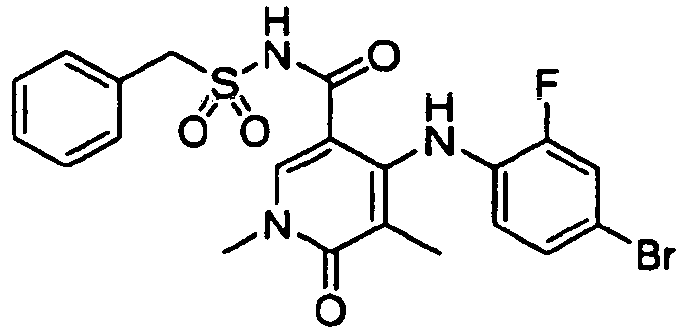
- N-[4-(4-Bromo-2-fluorophenylamino)-1,5-dimethyl-6-oxo-1,6-dihydropyridine-3-carbonyl]-C-phenyl-methanesulfonamide was prepared from 4-(4-bromo-2-fluorophenylamino)-1,5-dimethyl-6-oxo-1,6-dihydropyridine-3-carboxylic acid as follows. To a solution of 4-(4-bromo-2-fluorophenylamino)-1,5-dimethyl-6-oxo-1,6-dihydropyridine-3-carboxylic acid (0.040 mg, 0.113 mmol) in DMF (1.5 mL) was added 1,1'-carbonyldiimidazole (0.074 mg, 0.456 mmol). After stirring for two hours, α-toluenesulfonamide (0.079 mg, 0.461 mmol) was added, followed by DBU (0.070 mL, 0.459 mmol). After stirring for 16 hours at room temperature, the reaction mixture was diluted with EtOAc and 1N HCl solution. The organic layer was separated and washed with brine. The aqueous layer was extracted with EtOAc (2x) and washed with brine. The combined organic extracts were dried (MgSO4) and concentrated under reduced pressure. Purification by flash column chromatography (2% MeOH in methylene chloride) gave 0.039 g (68%) clean desired product; MS APCI (-) m/z 506, 508 (M-, Br pattern) detected; 1H NMR (400 MHz, CD3OD) δ 8.29 (s, 1H), 7.27 (m, 3H), 7.18 (d, 1H), 7.11 (m, 3H), 6.56 (t, 1H), 4.44 (s, 2H), 3.54 (s, 3H), 1.62 (s, 3H).
-

- N-[4-(4-Bromo-2-fluorophenylamino)-1,5-dimethyl-6-oxo-1,6-dihydropyridine-3-carbonyl]-methanesulfonamide was prepared from 4-(4-bromo-2-fluorophenylamino)-1,5-dimethyl-6-oxo-1,6-dihydropyridine-3-carboxylic acid as follows. To a solution of 4-(4-bromo-2-fluorophenylamino)-1,5-dimethyl-6-oxo-1,6-dihydropyridine-3-carboxylic acid (0.041 mg, 0.115 mmol) in DMF (1 mL) was added 1,1'-carbonyldiimidazole (0.039 mg, 0.241 mmol). After stirring for two hours, methanetoluenesulfonamide (0.023 mg, 0.242 mmol) was added, followed by DBU (0.035 mL, 0.230 mmol). After stirring 16 hours at room temperature, the reaction mixture was diluted with EtOAc and 1N HCl solution. The organic layer was separated and washed with brine. The aqueous layer was extracted with EtOAc (2x) and washed with brine. The combined organic extracts were dried (MgSO4) and concentrated under reduced pressure. Purification by flash column chromatography (15% MeOH in methylene chloride) gave 0.028 g (57%) clean desired product; MS APCI (-) m/z 430, 432 (M-, Br pattern) detected; 1H NMR (400 MHz, DMSO-d6) δ 11.13 (s, 1H), 8.25 (s, 1H), 7.49 (dd, 1H), 7.23 (d, 1H), 6.55 (t, 1H), 3.46 (s, 3H), 2.83 (s, 3H), 1.56 (s, 3H).
-

- Step A: Preparation of 4-hydroxy-1,2,5-trimethyl-6-oxo-1,6-dihydropyridine-3-carboxylic acid ethyl ester: A mixture of 2-methyl-3-oxo-pentanedioic acid diethyl ester (10.0 g, 46.3 mmol), 1,1-diethoxy-ethene (12.8 mL, 92.5 mmol) and sodium methoxide (0.026 mg, 0.481 mmol) was heated to 85 °C for nine hours. The reaction mixture was cooled to room temperature and concentrated. To the resulting residue was added methylamine (1.91 mL, 55.5 mmol, 40% H2O). After stirring at room temperature for 16 hours, the reaction mixture was diluted with diethyl ether and washed with water. The aqueous phase was acidified to
pH 1 with 10% HCl solution and extracted with EtOAc. The organic layer was dried (MgSO4) and concentrated. Trituration of the resulting residue with diethyl ether and flash column chromatography (3% MeOH in methylene chloride) gave 3.55 g (34%) desired product. - Step B: Preparation of 4-Chloro-1,2,5-trimethyl-6-oxo-1,6-dihydropyridine-3-carboxylic acid ethyl ester: Phosphorous oxychloride (20.0 mL, 216 mmol) was added to 4-hydroxy-1,2,5-trimethyl-6-oxo-1,6-dihydropyridine-3-carboxylic acid ethyl ester and heated to 80 °C. After two hours, the reaction mixture was concentrated under reduced pressure. The resulting residue was poured onto ice and, carefully neutralized with saturated NaHCO3, and diluted with EtOAc. After stirring for 16 hours, the organic layer was separated and the aqueous layer was reextracted with EtOAc repeatedly. The pH of the aqueous layer was adjusted to
pH 11 with saturated K2CO3 and extracted with EtOAc (2x). The combined organic extracts were dried (MgSO4) and concentrated under reduced pressure to give 3.42 g (89%) clean desired product. - Step C: Preparation of 4-(2-fluoro-4-methylphenylamino)-1,2,5-trimethyl-6-oxo-1,6-dihydropyridine-3-carboxylic acid ethyl ester: 2-Fluoro-4-methylphenylamine (0.259 g, 2.07 mmol), palladium (II) acetate (0.046 g, 0.205 mmol), rac-2,2-bis(diphenylphosphino)-1,1'-binaphthyl (0.192 g, 0.308 mmol), and cesium carbonate (1.00 g, 3.08 mmol) were added to a solution of 4-chloro-1,2,5-trimethyl-6-oxo-1,6-dihydropyridine-3-carboxylic acid ethyl ester (0.50 g, 2.05 mmol) in toluene (7 mL) in a sealed vial. After stirring 10 minutes, the mixture was heated to 80 °C. After 24 hours, the reaction mixture was cooled to room temperature and diluted with EtOAc. The resulting precipitate was filtered and washed with EtOAc. The filtrate was diluted with EtOAc and washed with water. The aqueous layer was reextracted with EtOAc. The combined organic layers were washed with brine, dried (Na2SO4) and concentrated. Purification by flash column chromatography (20:1 methylene chloride/MeOH) gave 0.048 g (71%) desired product.
- Step D: Preparation of 4-(2-fluoro-4-methylphenylamino)-1,2,5-trimethyl-6-oxo-1,6-dihydropyridine-3-carboxylic acid cyclopropylmethoxy-amide-: O-cyclopropylmethyl-hydroxylamine (0.046 g, 0.527 mmol) was added to a solution of 4-(2-fluoro-4-methylphenylamino)-1,2,5-trimethyl-6-oxo-1,6-dihydropyridine-3-carboxylic acid ethyl ester (0.070 g, 0.211 mmol) in THF (2 mL). The solution was cooled to 0 °C and lithium bis(trimethylsilyl)amide (1.05 mL, 1 M solution in hexanes) was added dropwise. The reaction mixture was warmed to room temperature. After stirring for 1 hour, the reaction was quenched by addition of a saturated aqueous solution of NaHCO3 and partitioned between EtOAc and brine. The aqueous layer was reextracted with EtOAc. The combined organic extracts were dried (Na2SO4) and concentrated. Purification by flash column chromatography (30:1 methylene chloride/MeOH) gave 0.032 g (40%) desired product as a yellow solid; MS ESI (+) m/z 374 (M+1) detected; 1H NMR (400 MHz, CD3OD) δ 6.91 (d,1H), 6.83 (d, 1H), 6.63 (t, 1H), 3.59 (s, 3H), 3.47 (d, 2H), 2.41 (s, 3H), 2.27 (s, 3H), 1.86 (s, 3H) 0.99 (m, 1H) 0.48 (m, 2H) 0.18 (m, 2H). 19F (376 MHz, CD3OD) -132.1 (s, 1F).
-

- 4-(2-Fluoro-4-methylphenylamino)-1,2,5-trimethyl-6-oxo-1,6-dihydropyridine-3-carboxylic acid (2-hydroxyethoxy)-amide was prepared as described in Example 148 using the appropriate hydroxylamine, followed by deprotection using standard literature methods. MS ESI (+) m/z 364 (M+1) detected; 1H NMR (400 MHz, CD3OD) δ 6.91 (d,1H), 6.83 (d, 1H), 6.63 (t, 1H), 3.80 (m, 2H), 3.63 (m, 2H), 3.60 (s, 3H), 2.42 (s, 3H), 2.27 (s, 3H) 1.85 (s, 3H). 19F (376 MHz, CD3OD) -127.8 (s, 1F).
-

- Step A: Preparation of 2-bromomethyl-4-(2-fluoro-4-methylphenylamino)-1,5-dimethyl-6-oxo-1,6-dihydropyridine-3-carboxylic acid ethyl ester: To a solution of 4-(2-fluoro-4-methylphenylamino)-1,2,5-trimethyl-6-oxo-1,6-dihydropyridine-3-carboxylic acid ethyl ester (0.150 g, 0.451 mmol) in DMF (5 mL) was added N-bromosuccinimide (0.084 g, 0.474 mmol). After stirring for 30 minutes, the reaction mixture was diluted with EtOAc, washed with water and brine, dried (Na2SO4) and concentrated under reduced pressure to yield a yellow residue. Purification by flash column chromatography (methylene chloride) gave 0.122 g (66%) of a yellow residue.
- Step B: Preparation of 4-(2-fluoro-4-methylphenylamino)-1,3-dimethyl-6,7-dihydro-1H-pyrrolo[3,4-b]pyridine-2,5-dione: To a solution of 2-bromomethyl-4-(2-fluoro-4-methylphenylamino)-1,5-dimethyl-6-oxo-1,6-dihydropyridine-3-carboxylic acid ethyl ester (0.016 g, 0.040 mmol) in MeOH (0.50 mL) was added ammonia (0.006 mL, 0.040 mmol, 7 M solution in MeOH). After stirring for 2 hours at room temperature, the reaction mixture was heated to 40 °C for 8 hours. The resulting white precipitate was filtered to yield clean desired product (0.005 g, 46 %). MS ESI (+) m/z 303 (M+1) detected; 1H NMR (400 MHz, DMSO) δ 8.16 (br s,1H), 8.04 (br s, 1H), 6.81-6.94 (m, 3H), 4.33 (s, 2H), 3.45 (s, 3H), 2.33 (s, 3H), 1.63 (s, 3H). 19F (376 MHz, DMSO) -127.1 (s, 1F).
-

- Step A: Preparation of 3-oxo-2-(phenyl-hydrazono)-pentanedioic acid dimethyl ester: 3-oxo-2-(phenyl-hydrazono)-pentanedioic acid dimethyl ester was prepared from 3-oxo-pentanedioic acid dimethyl ester (7.02 mL, 45.9 mmol) according to the procedure of Schober et al. (J. Heterocylic Chem. 1989, 26, 169) to give 8.81 g (72%) of the desired product.
- Step B: Preparation of 4-hydroxy-6-oxo-1-phenyl-1,6-dihydropyridazine-3-carboxylic acid methyl ester: A mixture of 3-oxo-2-(phenyl-hydrazono)-pentanedioic acid dimethyl ester (4.38 g, 15.7 mmol) in 1,2-dichlorobenzene (15 mL) was refluxed. After 20 hours, the reaction mixture was concentrated under reduced pressure to give 3.83 g (99%) of the desired product.
- Step C: Preparation of 4-chloro-6-oxo-1-phenyl-1,6-dihydropyridazine-3-carboxylic acid methyl ester: A mixture of 4-hydroxy-6-oxo-1-phenyl-1,6-dihydropyridazine-3-carboxylic acid methyl ester (3.83 g, 15.6 mmol) and phosphorous oxychloride (50 mL) was heated to 85 °C. After 20 hours, the reaction mixture was concentrated under reduced pressure. The resulting residue was quenched with water. The precipitate was filtered and dissolved in EtOAc, dried (MgSO4) and concentrated under reduced pressure to yield 3.44 g (84%) of desired product.
- Step D: Preparation of 4-(4-bromo-2-fluorophenylamino)-6-oxo-1-phenyl-1,6-dihydropyridazine-3-carboxylic acid: To a mixture of 4-chloro-6-oxo-1-phenyl-1,6-dihydropyridazine-3-carboxylic acid methyl ester (0.250 g, 0.944 mmol) in 1,2-dichlorobenzene (3.8 mL) was added 4-bromo-2-fluoro aniline (0.561 g, 3.78 mmol), and cesium carbonate (0.615 mg, 1.89 mmol). The reaction mixture was heated to reflux. After 1 hour, the reaction mixture was cooled to room temperature. Water was added and the mixture was diluted with EtOAc. The aqueous layer was separated, acidified with 10% HCl solution, and extracted with EtOAc. The combined organic layers were dried (MgS04), concentrated under reduced pressure, and triturated to give 0.153 g (43%) of the desired product.
- Step E. Preparation of 4-(4-Bromo-2-fluorophenylamino)-6-oxo-1-phenyl-1,6-dihydropyridazine-3-carboxylic acid cyclopropylmethoxy-amide. 4-(4-Bromo-2-fluorophenylamino)-6-oxo-1-phenyl-1,6-dihydropyridazine-3-carboxylic acid cyclopropylmethoxy-amide was prepared from 4-(4-bromo-2-fluorophenylamino)-6-oxo-1-phenyl-1,6-dihydropyridazine-3-carboxylic acid as described in Example 2. MS APCI (-) m/z 471, 473 (M-, Br pattern) detected; 1H NMR (400 MHz, CD3OD-CDCl3) δ 7.50 (m, 8H), 6.12 (s, 1H), 3.78 (d, 2H), 1.18 (m, 1H), 0.59 (q, 2H), 0.32 (q, 2H).
-
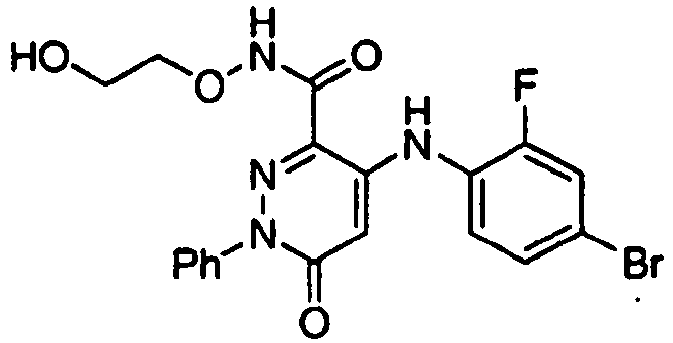
- Prepared from 4-(4-bromo-2-fluorophenylamino)-6-oxo-1-phenyl-1,6-dihydropyridazine-3-carboxylic acid as described in Example 3. MS APCI (-) m/z 461, 463 (M-, Br pattern) detected; 1H NMR (400 MHz, CD3OD) δ 7.51 (m, 8H), 6.09 (s, 1H), 4.04 (t, 2H), 3.77 (t, 2H).
-

- Step A. Preparation of 2-chloro-6-oxo-1,6-dihydropyridine-3-carboxylic acid: 2-Chloro-6-oxo-1,6-dihydropyridine-3-carboxylic acid was prepared from dichloronicotinic acid (3.00 g, 15.6 mmol, Aldrich) according to the procedure described in
US3682932 (1972 ) to yield 1.31 g (48%) of the desired product. - Step B. Preparation of 2-chloro-1-methyl-6-oxo-1,6-dihydropyridine-3-carboxylic acid methyl ester: To a solution of 2-chloro-6-oxo-1,6-dihydropyridine-3-carboxylic acid (0.644 g, 3.71 mmol) in DMF (20 mL) was added lithium hydride (95%, 0.078 g, 9.28 mmol) and the reaction mixture was stirred for 40 minutes under N2. Methyl iodide (0.508 mL, 1.16 g, 8.16 mmol) was then added and the reaction mixture was stirred for an additional 45 minutes. The reaction mixture was quenched with 2 M HCl until the pH was 6-7. The reaction mixture was diluted with EtOAc and saturated NaCl and the layers separated. The aqueous layer was back extracted with EtOAc (1x). The combined organic layers were dried (Na2SO4) and concentrated under reduced pressure to yield a crude yellow solid. HPLC analysis showed two products in a 4:1 ratio that were separated by flash column chromatography (methylene chloride/EtOAc, 15:1 to 10:1) to give 0.466 g (62%) pure desired product as a white crystalline solid. The minor product was also isolated as a pale yellow crystalline solid and identified as the regioisomer 2-chloro-6-methoxy-nicotinic acid methyl ester.
- Step C. Preparation of 2-(4-bromo-2-fluorophenylamino)-1-methyl-6-oxo-1,6-dihydropyridine-3-carboxylic acid methyl ester: To a solution of 4-bromo-2-fluorophenylamine (0.192 g, 1.01 mmol) in THF (5 mL) at -78 °C under N2 was added lithium bis(trimethylsilyl)amide (1.50 mL, 1.50 mmol, 1 M solution in hexanes) dropwise. The reaction mixture was stirred for one hour at -78 °C. 2-Chloro-1-methyl-6-oxo-1,6-dihydropyridine-3-carboxylic acid methyl ester (0.202 g, 1.00 mmol) was then added dropwise as a solution in THF (5 mL) and the reaction mixture was stirred for one hour at -78 °C. The reaction mixture was quenched by the addition of H2O and the pH was adjusted to
pH 7 with saturated NH4Cl and then diluted with EtOAc. The organic layer was separated and washed with saturated NaCl, dried (Na2SO4), and concentrated under reduced pressure. Purification by flash column chromatography (methylene chloride/EtOAc, 15:1) gave 0.232 g (65%) pure desired product as a white crystalline solid. - Step D. Preparation of 2-(4-bromo-2-fluorophenylamino)-1-methyl-6-oxo-1,6-dihydropyridine-3-carboxylic acid: To a solution of 2-(4-bromo-2-fluorophenylamino)-1-methyl-6-oxo-1,6-dihydropyridine-3-carboxylic acid methyl ester in MeOH (1.5 mL) was added 1 M NaOH (800 uL, 0.902 mmol). The reaction mixture was stirred at 60 °C for 4 hours and then at room temperature for 16 hours. The reaction mixture was diluted with H2O, acidified with 2 M HCl until the pH was 1-2, and then diluted with EtOAc. The organic layer was separated and washed with saturated NaCl, dried (Na2SO4), and concentrated under reduced pressure to yield 0.053 g (97%) desired product as a pale orange solid. MS ESI (+) m/z 341, 343 (M+, Br pattern) detected; 1H NMR (400 MHz, DMSO-d6) δ 13.08 (s, 1H), 10.0 (s, 1H), 7.87 (d, 1H), 7.65 (d, 1H), 7.35 (d, 1H), 6.95 (t, 1H), 6.16 (d, 1H), 3.19 (s, 3H).
- In the foregoing examples, a variety of anilines can be used in place of 4-bromo-2-fluorophenylamine in Step C of Example 153.
-

- A mixture of 2-(4-bromo-2-fluorophenylamino)-1-methyl-6-oxo-1,6-dihydropyridine-3-carboxylic acid (0.022 g, 0.064 mmol), EDCI (0.019 g, 0.097 mmol), and HOBt (0.019 g, 0.097 mmol) in DMA (1 mL) was stirred for 30 minutes at room temperature under N2. O-Cyclopropylmethyl-hydroxylamine (0.017 g, 0.19 mmol) was added followed by Et3N (0.022 mL, 0.016 g, 0.16 mmol). After the reaction mixture was stirred for 16 hours at room temperature, it was diluted with EtOAc and washed with saturated NH4Cl solution, saturated NaHCO3 solution and saturated NaCl. The organic layer was dried (Na2SO4) and concentrated under reduced pressure. Purification by flash column chromatography (methylene chloride/methanol, 20:1) gave 0.015 g (57%) pure desired product as a yellow solid. MS APCI (- ) m/z 410, 411 (M-, Br pattern) detected; 1H NMR (400 MHz, DMSO-d6) δ 11.4 (s, 1H), 9.81 (s, 1H), 7.58 (m, 2H), 7.28 (d, 1H), 6.82 (t, 1H). 6.17 (d, 1H), 3.46 (d, 2H), 3.22 (s, 3H), 0.99 (m, 1H), 0.48 (m, 2H), 0.18 (m, 2H).
-

- Step A. Preparation of 2-(2-fluoro-4-methylphenylamino)-1-methyl-6-oxo-1,6-dihydropyridine-3-carboxylic acid (2-vinyloxyethoxy)-amide: To a solution of 2-(2-fluoro-4-methylphenylamino)-1-methyl-6-oxo-1,6-dihydropyridine-3-carboxylic acid methyl ester (0.050 g, 0.17 mmol) in THF (1.5 mL) under N2 was added O-(2-vinyloxy-ethyl)-hydroxylamine (0.044 g, 0.43 mmol). The solution was cooled to 0 °C and lithium bis(trimethylsilyl)amide (0.86 mL, 0.86 mmol, 1 M solution in hexanes) was added dropwise. The reaction mixture was warmed to room temperature. After stirring for 40 minutes, the reaction mixture was quenched by the addition of NaHCO3 and partitioned between EtOAc and saturated NaCl. The layers were separated and the aqueous layer was reextracted with EtOAc. The combined organic extracts were dried (Na2SO4) and concentrated under reduced pressure. Purification by flash column chromatography (methylene chloride/methanol, 20:1) gave 0.048 g (77%) pure desired product as an off-white foamy solid.
- Step B. Preparation of 2-(2-fluoro-4-methylphenylamino)-1-methyl-6-oxo-1,6-dihydropyridine-3-carboxylic acid (2-hydroxyethoxy)-amide: To a solution of 2-(2-fluoro-4-methylphenylamino)-1-methyl-6-oxo-1,6-dihydropyridine-3-carboxylic acid (2-vinyloxyethoxy)-amide (0.048 g, 0.13 mmol) in ethanol (5 mL) was added aqueous 2 M HCl (0.332 mL, 0.664 mmol). The reaction mixture was stirred for 16 hours at room temperature. The pH of the reaction mixture was adjusted with 1 M NaOH until 7. The reaction mixture was diluted with EtOAc and H2O. The organic layer was separated and washed with saturated NaCl, dried (Na2SO4), and concentrated under reduced pressure to yield 0.044 g (100%) pure desired product as a pale yellow foamy solid. MS ESI (+) m/z 336 (M+1) detected; 1H NMR (400 MHz, CDCl3) δ 10.3 (s, 1H), 8.46 (s, 1H), 7.38 (d, 1H), 6.96-6.87 (m, 2H), 6.76 (t, 1H), 6.18 (d, 1H), 4.04 (m, 2H), 3.93 (br s, 1H), 3.75 (br s, 2H), 3.20 (s, 3H), 2.33 (s, 3H).
- Any of the hydroxylamines used in the foregoing examples can be coupled as described in Example 154 or Example 155. In some instances, a final deprotection step may be required. These deprotections can be accomplished by standard literature methods. Example 155 is one such example in which a final deprotection step is required.
-

- Step A. Preparation of 2-(4-bromo-2-fluorophenylamino)-1-methyl-6-oxo-1,6-dihydropyridine-3-carboxylic acid (2-vinyloxyethoxy)-amide: 2-(4-Bromo-2-fluorophenylamino)-1-methyl-6-oxo-1,6-dihydropyridine-3-carboxylic acid (0.020 g, 0.059 mmol) was coupled as described previously in Example 154 using O-(2-vinyloxy-ethyl)-hydroxylamine to yield 0.015 g (60%) pure desired product as a yellow solid.
- Step B. Preparation of 2-(4-Bromo-2-fluorophenylamino)-1-methyl-6-oxo-1,6-dihydropyridine-3-carboxylic acid (2-hydroxyethoxy)-amide: 2-(4-Bromo-2-fluorophenylamino)-1-methyl-6-oxo-1,6-dihydropyridine-3-carboxylic acid (2-vinyloxyethoxy)-amide (0.015 g, 0.035mmol) was deprotected as described previously in Step B of Example 155 to yield 0.010 g (70%) pure desired product as a dark yellow solid. MS ESI (+) m/z 400, 402 (M+, Br pattern) detected; 1H NMR (400 MHz, CDCl3) δ 10.3 (s, 1H), 9.11 (s, 1H), 7.47 (d, 1H), 7.32 (d, 1H), 7.23 (d, 1H), 6.70 (t, 1H), 6.22 (d, 1H), 4.04 (br s, 2H), 3.75 (br s, 2H) 3.24 (s, 3H).
-

- 2-(2-Fluoro-4-iodophenylamino)-1-methyl-6-oxo-1,6-dihydropyridine-3-carboxylic acid methyl ester was coupled as described previously in Example 155 using O-methyl-hydroxylamine. MS ESI (+) m/z 418 (M+1) detected.
-

- 2-Chloro-6-oxo-1,6-dihydropyridine-3-carboxylic acid was converted to 2-(4-bromo-2-fluorophenylamino)-1-ethyl-6-oxo-1,6-dihydropyridine-3-carboxylic acid methyl ester following the procedures described in Steps B-C of Example 153 using ethyl iodide in Step B of Example 153. 2-(4-Bromo-2-fluorophenylamino)-1-ethyl-6-oxo-1,6-dihydropyridine-3-carboxylic acid methyl ester was then coupled as described in Example 155 to yield the desired product as a tan solid. MS APCI (+) m/z 414, 416 (M+, Br pattern) detected; 1H NMR (400 MHz, CD3OD) δ 7.59 (d, 1H), 7.38 (d, 1H), 7.24 (d, 1H), 6.77 (t, 1H), 6.33 (d, 1H), 4.16 (q, 2H), 3.73 (m, 2H), 3.59 (m, 2H), 1.21 (t, 3H).
-

- 2,6-Dichloro-5-fluoro-nicotinic acid (Lancaster Synthesis) was converted to 2-(4-bromo-2-fluorophenylamino)-5-fluoro-1-methyl-6-oxo-1,6-dihydropyridine-3-carboxylic acid methyl ester following the procedures described in Steps A-C of Example 153. 2-(4-Bromo-2-fluorophenylamino)-5-fluoro-1-methyl-6-oxo-1,6-dihydropyridine-3-carboxylic acid methyl ester was then coupled as described in Example 155 to yield the desired product as a yellow solid. MS ESI (+) m/z 418, 420 (M+, Br pattern) detected; 1H NMR (400 MHz, CDCl3) δ 7.32 (dd, 1H), 7.29-7.19 (m, 2H), 6.61 (t, 1H), 4.06 (m, 2H), 3.76 (m, 2H), 3.33 (s, 3H), 3.32 (s, 3H).
-

- Step A. Preparation of 5-bromo-2-(4-bromo-2-fluorophenylamino)-1-methyl-6-oxo-1,6-dihydropyridine-3-carboxylic acid methyl ester: To a solution of 2-(4-bromo-2-fluorophenylamino)-1-methyl-6-oxo-1,6-dihydropyridine-3-carboxylic acid methyl ester (0.390 g, 1.34 mmol) in DMF (10 mL) was added N-bromosuccinimide (0.263, 1.48 mmol). The reaction mixture was stirred at room temperature for 25 minutes and then quenched with saturated sodium bisulfite. The reaction mixture was diluted with H2O and partitioned between EtOAc/diethyl ether and saturated NaCl. The layers were separated and the aqueous layer was reextracted with EtOAc (1x). The combined organic layers were dried (Na2SO4) and concentrated under reduced pressure. Purification by flash column chromatography (methylene chloride/EtOAc, 15:1) gave 0.424 g (85%) pure desired product as a lavender foamy solid.
- Step B. Preparation of 5-bromo-2-(4-bromo-2-fluorophenylamino)-1-methyl-6-oxo-1,6-dihydropyridine-3-carboxylic acid: To a suspension of 5-bromo-2-(4-bromo-2-fluorophenylamino)-1-methyl-6-oxo-1,6-dihydropyridine-3-carboxylic acid methyl ester (0.030 g, 0.069 mmol) in methanol (1 mL) was added 1 M NaOH (0.346 mL, 0.346 mmol). The reaction mixture was heated to 60 °C for 12 hours. The reaction mixture was diluted with H2O and the pH was adjusted with 1 M HCl until 1-2. Solids precipitated out of solution, which were collected, washed with H2O and dried under vacuum to yield 0.021 g (72%) pure desired product as a pale yellow solid. MS ESI (+) m/z 421, 423 (M+, Br pattern) detected; 1H NMR (400 MHz, DMSO-d6) δ 13.3 (br s, 1H), 9.93 (s, 1H), 8.21 (s, 1H), 7.66 (d, 1H), 7.34 (d, 1H), 7.05 (t, 1H), 3.18 (s, 3H).
-

- 5-Bromo-2-(4-bromo-2-fluorophenylamino)-1-methyl-6-oxo-1,6-dihydropyridine-3-carboxylic acid (0.018 g, 0.043 mmol) was converted to the desired product following the procedures described in Example 156 to yield 0.009 g (45%) pure desired product as a dark yellow solid. MS ESI (+) m/z 480, 482 (M+, Br pattern) detected; 1H NMR (400 MHz, CDCl3) δ 8.00 (s, 1H), 7.32 (m, 1 H), 7.24 (d, 1H), 6.69 (t, 1H), 3.99 (m, 2H), 3.73 (m, 2H), 3.32 (s, 3H).
-

- Step A. Preparation of 2-(4-bromo-2-fluorophenylamino)-6-chloro-nicotinic acid: To a solution of 4-bromo-2-fluorophenylamine (10.4 g, 54.7 mmol) in THF (25 mL) at -78 °C under N2 was added lithium bis(trimethylsilyl)amide (83.3 mL, 83.3 mmol, 1 M solution in hexanes) dropwise over 15 minutes. The reaction mixture was stirred for one hour at -78 °C. 2,6-Dichloro-nicotinic acid (5.00 g, 26.0 mmol) was then added dropwise as a solution in THF (15 mL) and the reaction mixture was allowed to warm from -78 °C to room temperature and stir for 16 hours. The reaction mixture was quenched by the addition of H2O and the pH was adjusted to 0-2 with 6 N HCl and then diluted with EtOAc. The organic layer was separated and washed with H2O, saturated NaCl, dried (Na2SO4), and concentrated under reduced pressure. The crude product was triturated several times with ethyl acetate and the resulting solid was collected, washed with dichloromethane and dried under vacuum to yield 7.50 g (83%) pure desired product as a dark pink solid.
- Step B. Preparation of 2-(4-bromo-2-fluorophenylamino)-6-chloro-nicotinic acid methyl ester: To a suspension of 2-(4-bromo-2-fluorophenylamino)-6-chloro-nicotinic acid (5.00 g, 14.5 mmol) in methanol/benzene (1:1, 100mL) under N2 was added (trimethylsilyl)diazomethane (2.0 M solution in hexanes) dropwise until the bubbling caused by gas evolution ceased. Solids precipitated out of solution. The reaction was allowed to stir for 1 hour. Excess (trimethylsilyl)diazomethane was quenched by the dropwise addition of glacial acetic acid. The precipitated solids were filtered and washed with methanol. The filtrate was concentrated to a smaller volume and additional solids precipitated out of solution that were filtered and washed with methanol. The solids were combined and dried under vacuum to yield 4.82 g (93%) of pure desired product as a dark pink solid.
- Step C. Preparation of 2-(4-bromo-2-fluorophenylamino)-6-methoxy-nicotinic acid methyl ester: To a mixture of 2-(4-bromo-2-fluorophenylamino)-6-chloro-nicotinic acid methyl ester (2.00 g, 5.56 mmol) and sodium methoxide (0.791 g, 13.9 mmol) was added MeOH (50 mL) to give a slurry that was stirred at 60-65 °C for 16 hours under N2. Additional sodium methoxide (0.791 g, 13.9 mmol) was added and the reaction mixture was allowed to stir another 3 days at 60-65 °C. The reaction mixture was cooled to room temperature and glacial acetic acid was added dropwise until the pH was 7. The resulting suspension was filtered and washed with H2O to yield a pink solid that was collected and dried under vacuum to yield 1.74 g (88%) pure desired product.
- Step D. Preparation of 2-(4-bromo-2-fluorophenylamino)-6-oxo-1,6-dihydropyridine-3-carboxylic acid methyl ester: To 2-(4-bromo-2-fluorophenylamino)-6-methoxy-nicotinic acid methyl ester (1.00 g, 2.82 mmol) in a sealed flask was added glacial acetic acid (10 mL) and HBr (10 mL, 48 wt% in H2O). The reaction mixture was stirred at 90-95 °C for 2 hours and then cooled to room temperature. The reaction mixture was diluted with EtOAc and washed with H2O, saturated NaHCO3, saturated NaCl, dried (Na2SO4) and concentrated under reduced pressure. The crude product was triturated twice with dichloromethane/methanol and the resulting solid was collected and dried under vacuum to yield 0.756 g (79%) pure desired product as a white solid.
- Step E. Preparation of 2-(4-bromo-2-fluorophenylamino)-6-oxo-1,6-dihydropyridine-3-carboxylic acid: To a suspension of 2-(4-bromo-2-fluorophenylamino)-6-oxo-1,6-dihydropyridine-3-carboxylic acid methyl ester (0.050 g, 0.147 mmol) in methanol (1.5 mL) was added 1 M NaOH (1.47 mL, 1.47 mmol). The reaction mixture was stirred at 75-80 °C for 2 days. The reaction mixture was diluted with H2O and the pH was adjusted with 1 M HCl until 1-2. The reaction mixture was diluted with EtOAc and washed with saturated NaCl, dried (Na2SO4), and concentrated under reduced pressure. The crude product was triturated with diethyl ether/dichloromethane and the resulting solid was collected and dried under vacuum to yield 0.033 g (69%) pure desired product as a yellow solid. MS ESI (+) m/z 327, 329 (M+, Br pattern) detected; 1H NMR (400 mHz, DMSO-d6) δ 13.1 (br s, 1H), 11.5 (s, 1H), 10.9 (s, 1H), 8.77 (br s, 1H), 8.10 (d, 1H), 7.59 (d, 1H), 7.35 (d, 1H) 6.16 (m, 1H).
-
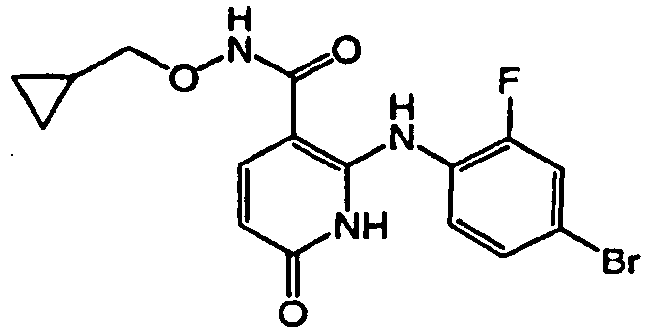
- 2-(4-Bromo-2-fluorophenylamino)-6-oxo-1,6-dihydropyridine-3-carboxylic acid (0.025 g, 0.076 mmol) was converted to the desired product following the procedure described in Example 154 to yield 0.023 g (76%) pure desired product as a pale yellow solid. MS ESI (+) m/z 396, 398 (M+, Br pattern) detected; 1H NMR (400 mHz, DMSO-d6) δ 11.6 (s, 1H), 11.3 (s, 1H), 11.2 (s, 1H), 9.74 (br s, 1H), 7.90 (d, 1H), 7.56 (d, 1H), 7.32 (d, 1H), 6.13 (d, 1H) 3.70 (d, 2H) 1.10 (m, 1H), 0.54 (m, 2H), 0.27 (m, 2H)
-

- To a solution of 2-bromomethyl-4-(2-fluoro-4-methylphenylamino)-1,5-dimethyl-6-oxo-1,6-dihydropyridine-3-carboxylic acid ethyl ester (1 equivalent) in MeOH is added hydrazine (1.10 equivalents). After stirring for 2 hours at room temperature, the reaction mixture is heated to 40 °C for 8 hours. The reaction mixture is diluted with EtOAc and washed with water. The organic layer is dried over MgSO4, filtered, and concentrated in vacuo to give the crude material that is purified by trituration or flash column chromatography to afford the desired product as necessary.
-

- Step A: Preparation of 2-bromo-4-chloro-1,5-dimethyl-6-oxo-1,6-dihydropyridine-3-carboxylic acid ethyl ester: To a solution of 4-chloro-1,5-dimethyl-6-oxo-1,6-dihydropyridine-3-carboxylic acid ethyl ester (1.00 equivalent) in DMF is added NBS (1.20 equivalents) at room temperature. After stirring for 16 hours at room temperature, the reaction mixture is diluted with EtOAc and washed with water. The organic layer is dried over MgSO4, filtered, and concentrated in vacuo to give the crude material that is purified by trituration or flash column chromatography to afford the desired product as necessary.
- Step B: Preparation of 4-chloro-1,5-dimethyl-6-oxo-2-trimethylsilanylethynyl-1,6-dihydropyridine-3-carboxylic acid ethyl ester: To a mixture of 2-bromo-4-chloro-1,5-dimethyl-6-oxo-1,6-dihydropyridine-3-carboxylic acid ethyl ester (1.00 equivalent), trimethylsilylacetylene (1.20 equivalents) and iPr2NH (2.00 equivalents) in THF is added CuI (0.10 equivalents) followed by Pd(PPh3)2Cl2 (0.10 equivalents). After stirring the reaction mixture at reflux for 16 hours, it is cooled to room temperature and diluted with ethyl acetate. The organic layer is washed with saturated NH4Cl solution and brine, dried (MgSO4) and concentrated under reduced pressure. The desired product is obtained by flash column chromatography as necessary.
- Step C: Preparation of 2-acetyl-4-chloro-1,5-dimethyl-6-oxo-1,6-dihydropyridine-3-carboxylic acid ethyl ester: A mixture of 4-chloro-1,5-dimethyl-6-oxo-2-trimethylsilanylethynyl-1,6-dihydropyridine-3-carboxylic acid ethyl ester (1.00 equivalent), HgSO4 (1.00 equivalent) and H2SO4 (2.00 equivalents) in -6:1 acetone:water is refluxed for 3 hours. The reaction mixture is cooled to room temperature and concentrated under reduced pressure. The residue is diluted with a mixture of THF and ethyl acetate and washed with water and brine. The organic layer is dried (MgSO4) and concentrated under reduced pressure. The desired product is obtained by flash column chromatography as necessary.
- Step D: Preparation of 2-acetyl-4-chloro-1,5-dimethyl-6-oxo-1,6-dihydropyridine-3-carboxylic acid: To a solution of 2-acetyl-4-chloro-1,5-dimethyl-6-oxo-1,6-dihydropyridine-3-carboxylic acid ethyl ester (1.00 equivalent) in THF:water (4:1) is added 1 M aqueous LiOH solution (2.05 equivalents). After 30 minutes, the reaction mixture is acidified to pH ~1 with 1 N HCl solution and extracted with ethyl acetate. The combined organic extracts are dried (MgSO4) and concentrated under reduced pressure to give the desired product which is used directly without further purification.
- Step E: Preparation of 4-chloro-1,3,8-trimethyl-1H,6H-pyrido[2,3-d]pyridazine-2,5-dione: To a solution of 2-acetyl-4-chloro-1,5-dimethyl-6-oxo-1,6-dihydropyridine-3-carboxylic acid (1 equivalent) and hydrazine monohydrate (3.30 equivalents) in THF is added 1 N HCl (0.80 equivalents). After 16 hours, the reaction mixture is diluted with ethyl acetate, washed with water and brine, dried (MgSO4) and concentrated under reduced pressure. The desired product purified by trituration or flash column chromatography to afford the desired product as necessary.
- Step F: Preparation of 4-(2-fluoro-4-methylphenylamino)-1,3,8-trimethyl-1H,6H-pyrido[2,3-d]pyridazine-2,5-dione: 2-Fluoro-4-methylphenylamine (1.10 equivalents), palladium (II) acetate (0.10 equivalents), rac-2,2-bis(diphenylphosphino)-1,1'-binaphthyl (0.15 equivalents), and cesium carbonate (1.50 equivalents) are added to a solution of 4-chloro-1,3,8-trimethyl-1H,6H-pyrido[2,3-d]pyridazine-2,5-dione (1.00 equivalent) in toluene in a sealed vial. After stirring 10 minutes, the mixture is heated to 80 °C. After 24 hours, the reaction mixture is cooled to room temperature and diluted with EtOAc. The resulting precipitate is filtered and washed with EtOAc. The filtrate is diluted with EtOAc and washed with water. The aqueous layer is reextracted with EtOAc. The combined organic layers are washed with brine, dried (Na2SO4) and concentrated. Purification by flash column chromatography gives the desired product.
Claims (19)
- A compound including resolved enantiomers, diastereomers, and pharmaceutically acceptable salts thereof, said compound having the Formula:
 X is CR10;YisNH;R10 is hydrogen, halogen, methyl, fluoromethyl, difluoromethyl, trifluoromethyl or ethyl;R1, R2, R8, and R9 are independently hydrogen, hydroxy, halogen, cyano, nitro, trifluoromethyl, difluoromethyl, fluoromethyl, fluoromethoxy, difluoromethoxy, trifluoromethoxy, azido, -SR11, -OR3, -C(O)R3, -C(O)OR3, -NR4C(O)OR6, -OC(O)R3, -NR4SO2R6, -SO2NR3R4, - NR4C(O)R3, -C(O)NR3R4, -NR5C(O)NR3R4, -NR5C(NCN)NR3R4, -NR3R4, C1-C10 alkyl, C2-C10 alkenyl, C2-C10 alkynyl, C3-C10 cycloalkyl, C3-C10 cycloalkylalkyl, -S(O)j(C1-C6 alkyl), - S(O)j(CR4R5)m-aryl, aryl, arylalkyl, heteroaryl, heteroarylalkyl, heterocyclyl, heterocyclylalkyl, - O(CR4R5)m-aryl, -NR4(OR4R5)m-aryl, -O(CR4R5)m-heteroaryl, -NR4(CR4R5)m-heteroaryl, -O(CR4R5)m-heterocyclyl or -NR4(CR4R5)m-heterocyclyl, wherein any of said alkyl, alkenyl, alkynyl, cycloalkyl, aryl, arylalkyl, heteroaryl, heteroarytalkyl, heterocyclyl and heterocyclylalkyl portions are optionally substituted with one or more groups independently selected from oxo (with the proviso that it is not substituted on an aryl or heteroaryl), halogen, cyano, nitro, trifluoromethyl, difluoromethoxy, trifluoromethoxy, azido, -NR4SO2R8, -SO2NR3R4, -C(O)R3, -C(O)OR3, -OC(O)R3, -NR4C(O)OR8, -NR4C(O)R3, -C(O)NR3R4, -NR3R4, -NR5C(O)NR3R4, -NR5C(NCN)NR3R4, -OR3, aryl, heteroaryl, arylalkyl, heteroarylalkyl, heterocyclyl, and heterocyclylalkyl, and wherein said aryl, heteroaryl, arylalkyl, heteroarylalkyl, heterocyclyl or heterocyclylalkyl rings may be further substituted with one or more groups selected from halogen, hydroxyl, cyano, nitro, azido, fluoromethyl, difluoromethyl, trifluoromethyl, C1-C4 alkyl, C2-C4 alkenyl, C2-C4 alkynyl, C3-C6 cycloalkyl, C3-C8 heterocycloalkyl, NR3R4 and OR3;R7 is hydrogen, trifluoromethyl, C1-C10 alkyl, C2-C10 alkenyl, C2-C10 alkynyl, C3-C10 cycloalkyl, C3-C10 cycloalkylalkyl, aryl, arylalkyl, heteroaryl, heteroarylalkyl, heterocyclyl, or heterocyclylalkyl, wherein any of said alkyl, alkenyl, alkynyl, cycloalkyl, aryl, arylalkyl, heteroaryl, heteroarylalkyl, heterocyclyl and heterocyclylalkyl portions are optionally substituted with one or more groups independently selected from oxo (with the proviso that it is not substituted on an aryl or heteroaryl), halogen, cyano, nitro, trifluoromethyl, difluoromethyl, fluoromethyl, difluoromethoxy, trifluoromethoxy, azido, -NR11SO2R14, -SO2NR11R12, -C(O)R11, C(O)OR11, -OC(O)R11, -NR11C(O)OR14, -NR11C(O)R12, -C(O)NR11R12, -SR11, -S(O)R14, -SO2R14, -NR11R12, -NR11C(O)NR12R13, -NR11C(NCN)NR12R13, -OR11, C1-C10 alkyl, C2-C10 alkenyl, C2-C10 alkynyl, C3-C10 cycloalkyl, aryl, heteroaryl, arylalkyl, heteroarylalkyl, heterocyclyl, and heterocyclylalkyl, and wherein said aryl, heteroaryl, arylalkyl, heteroarylalkyl, heterocyclyl or heterocyclylalkyl rings may be further substituted with one or more groups selected from halogen, hydroxyl, cyano, nitro, azido, fluoromethyl, difluoromethyl, trifluoromethyl, C1-C4 alkyl, C2-C4 alkenyl, C2-C4 alkynyl, C3-C6 cycloalkyl, C3-C6 heterocycloalkyl, NR3R4 and OR3;R3 is hydrogen, trifluoromethyl, C1-C10 alkyl, C2-C10 alkenyl, C2-C10 alkynyl, C3-C10 cycloalkyl, C3-C10 cycloalkylalkyl, aryl, arylalkyl, heteroaryl, heteroarylalkyl, heterocyclyl, heterocyclylalkyl, phosphate or an amino acid residue, wherein any of said alkyl, alkenyl, alkynyl, cycloalkyl, aryl, arylalkyl, heteroaryl, heteroarylalkyl, heterocyclyl and heterocyclylalkyl portions are optionally substituted with one or more groups independently selected from oxo (with the proviso that it is not substituted on an aryl or heteroaryl), halogen, cyano, nitro, trifluoromethyl, difluoromethoxy, trifluoromethoxy, azido, -NR11SO2R14, -SO2NR11R12, -C(O)R11, C(O)OR11, -OC(O)R11, -NR11C(O)OR14, -NR11C(O)R12, -C(O)NR11R12, -SR11, -S(O)R14, -SO2R14, -NR11R12, -NR11C(O)NR12R13, -NR11C(NCN)NR12R13, -OR11, aryl, heteroaryl, arylalkyl, heteroarylalkyl, heterocyclyl, and heterocyclylalkyl,or R3 and R4 together with the atom to which they are attached form a 4 to 10 membered heteroaryl or heterocyclic ring, wherein any of said heteroaryl or heterocyclic rings are optionally substituted with one or more groups independently selected from halogen, cyano, nitro, trifluoromethyl, difluoromethoxy, trifluoromethoxy, azido, -NR11SO2R14, -SO2NR11R12, -C(O)R11, C(O)OR11, -OC(O)R11, -NR11C(O)OR14, -NR11C(O)R12, -C(O)NR11R12, -SR11, -S(O)R14, -SO2R14,-NR11R12, -NR11C(O)NR12R13, -NR11C(NCN)NR12R13, -OR11, aryl, heteroaryl, arylalkyl, heteroarylalkyl, heterocyclyl, and heterocyclylalkyl;R4 and R5 independently are hydrogen or C1-C6 alkyl, orR4 and R5 together with the atom to which they are attached form a 4 to 10 membered carbocyclic, heteroaryl or heterocyclic ring, wherein said alkyl or any of said carbocyclic, heteroaryl and heterocyclic rings are optionally substituted with one or more groups independently selected from halogen, cyano, nitro, trifluoromethyl, difluoromethoxy, trifluoromethoxy, azido, -NR11SO2R14, -SO2NR11R12, -C(O)R11, C(O)OR11, -OC(O)R11, - NR11C(O)OR14, -NR11C(O)R12, -C(O)NR11R12, -SR11, -S(O)R14, -SO2R14, -NR11R12, -NR11C(O)NR12R13, -NR11C(NCN)NR12R13, -OR11, aryl, heteroaryl, arylalkyl, heteroarylalkyl, heterocyclyl, and heterocyclylalkyl;R6 is trifluoromethyl, C1-C10 alkyl, C3-C10 cycloalkyl, aryl, arylalkyl, heteroaryl, heteroarylalkyl, heterocyclyl or heterocyclylalkyl, wherein any of said alkyl, cycloalkyl, aryl, arylalkyl, heteroaryl, heteroarylalkyl, heterocyclyl and heterocyclylalkyl portions are optionally substituted with one or more groups independently selected from oxo (with the proviso that it is not substituted on an aryl or heteroaryl), halogen, cyano, nitro, trifluoromethyl, difluoromethoxy, trifluoromethoxy, azido, -NR11SO2R14, -SO2NR11R12, -C(O)R11, C(O)OR11, -OC(O)R11, - NR11C(O)OR14, -NR11C(O)R12, -C(O)NR11R12, -SR11, -S(O)R14, -SO2R14, -NR11R12, -NR11C(O)NR12R13, -NR11C(NCN)NR12R13, -OR11, aryl, heteroaryl, arylalkyl, heteroarylalkyl, heterocyclyl, and heterocyclylalkyl;R11, R12 and R13 independently are hydrogen, C1-C10 alkyl, C2-C10 alkenyl, aryl and arylalkyl, and R14 is C1-C10 alkyl, C2-C10 alkenyl, aryl and arylalkyl;or any two of R", R12, R13 or R14 together with the atom to which they are attached form a 4 to 10 membered heteroaryl or heterocyclic ring, wherein any of said alkyl, alkenyl, aryl, arylalkyl rings, heteroaryl rings or heterocyclic rings are optionally substituted with one or more groups independently selected from halogen, cyano, nitro, trifluoromethyl, difluoromethoxy, trifluoromethoxy, azido, aryl, heteroaryl, arylalkyl, heteroarylalkyl, heterocyclyl, and heterocyclylalkyl;W is heteroaryl, heterocyclyl, -C(O)OR3, -C(O)NR3R4, -C(O)NR4OR3, - -C(O)NR4SO2R3, -C(O)(C3-C10 cycloalkyl), -C(O)(C1-C10 alkyl), -C(O)(aryl), -C(O)(heteroaryl), -C(O)(heterocyclyl) or CR3OR3, wherein any of said heteroaryl, heterocyclyl, -C(O)OR3, -C(O)NR3R4, -C(O)NR4OR3, -C(O)R4OR3, -C(O)NR4SO2R3, -C(O)(C3-C10 cycloalkyl), -C(O)(C1-C10 alkyl), -C(O)(aryl),-C(O)(heteroaryl), -C(O)(heterocyclyl) and CR3OR3 are optionally substituted with one or more groups independently selected from halogen, cyano, nitro, azido, -NR3R4, -OR3, C1-C10 alkyl, C2-C10 alkenyl, C2-C10 alkynyl, cycloalkyl and heterocycloalkyl, wherein any of said C1-C10 alkyl, C2-C10 alkenyl, C2-C10 alkynyl, cycloalkyl and heterocycloalkyl are optionally substituted with 1 or more groups independently selected from -NR3R4 and -OR3;m is 0, 1, 2, 3, 4 or 5; andj is 0, 1 or 2.
 - A compound including resolved enantiomers, diastereomers, and pharmaceutically acceptable salts thereof, said compound having the formula:
 R1, R2, R3 and R9 are independently hydrogen, halogen, cyano, nitro, trifluoromethyl, difluoromethoxy, difluoromethyl, fluoromethyl, fluoromethoxy, trifluoromethoxy, azido, -SR11, -OR3, -C(O)R3, -C(O)OR3, -NR4C(O)OR6, -OC(O)R3, -NR4SO2R6, -SO2NR3R4, -NR4C(O)R3, -C(O)NR3R4, -NR5C(O)NR3R4, -NR5C(NON)NR3R4, -NR3R4, C1-C10 alkyl, C2-C10 alkenyl, C2-C10 alkynyl, C3-C10 cycloalkyl, C3-C10 cycloalkylalkyl, -S(O)j(C1-C6 alkyl), -S(O)j(CR4R5)m-aryl, aryl, arylalkyl, heteroaryl, heteroarylalkyl, heterocyclyl, heterocyclylalkyl, -O(CR4R5)m-aryl, -NR4(CR4R5)m-aryl, -O(CR4R5)m-heteroaryl, -NR4(CR4R5)m-heteroaryl, -O(OR4R5)m-heterocyclyl or -NR4(OR4R5)m-heterocyclyl, wherein any of said alkyl, alkenyl, alkynyl, cycloalkyl, aryl, arylalkyl, heteroaryl, heteroarylalkyl, heterocyclyl and heterocyclylalkyl portions are optionally substituted with one or more groups independently selected from oxo (with the proviso that it is not substituted on an aryl or heteroaryl), halogen, cyano, nitro, trifluoromethyl, difluoromethoxy, trifluoromethoxy, azido, -NR4SO2R6, -SO2NR3R4, -C(O)R3, -C(O)OR3, -OC(O)R3, -NR4C(O)OR6,-NR4C(O)R3, -C(O)NR3R4, -NR3R4, -NR5C(O)NR3R4, -NR5C(NCN)NR3R4, -OR3, aryl, heteroaryl, arylalkyl, heteroarylalkyl, heterocyclyl, and heterocyclylalkyl, and wherein said aryl, heteroaryl, arylalkyl, heteroarylalkyl, heterocyclyl or heterocyclylalkyl rings may be further substituted with one or more groups selected from halogen, hydroxyl, cyano, nitro, azido, fluoromethyl, difluoromethyl, trifluoromethyl, C1-C4 alkyl, C2-C4 alkenyl, C2-C4 alkynyl, C3-C6 cycloalkyl, C3-C6 heterocycloalkyl, NR3R4 and OR3;R7 is hydrogen, trifluoromethyl, C1-C10 alkyl, C2-C10 alkenyl, C2-C10 alkynyl, C3-C10 cycloalkyl, C3-C10 cycloalkylalkyl, aryl, arylalkyl, heteroaryl, heteroarylalkyl, heterocyclyl, or heterocyclylalkyl, wherein any of said alkyl, alkenyl, alkynyl, cycloalkyl, aryl, arylalkyl, heteroaryl, heteroarylalkyl, heterocyclyl and heterocyclylalkyl portions are optionally substituted with one or more groups independently selected from oxo (with the proviso that it is not substituted on an aryl or heteroaryl), halogen, cyano, nitro, trifluoromethyl, difluoromethyl, fluoromethyl, difluoromethoxy, trifluoromethoxy, azido, -NR11SO2R14, -SO2NR11R12, -C(O)R11, C(O)OR11, -OC(O)R", -NR11C(O)OR14, -NR11C(O)R12, -C(O)NR11R12, -SR11, -S(O)R14, -SO2R14, -NR11R12, -NR11C(O)NR12R13, -NR11C(NCN)NR12R13, -OR13, C1-C10 alkyl, C2-C10 alkenyl, C2-C10 alkynyl, C3-C10 cycloalkyl, aryl, heteroaryl, arylalkyl, heteroarylalkyl, heterocyclyl, and heterocyclylalkyl, and wherein said aryl, heteroaryl, arylalkyl, heteroarylalkyl, heterocyclyl or heterocyclylalkyl rings may be further substituted with one or more groups selected from halogen, hydroxyl, cyano, nitro, azido, fluoromethyl, difluoromethyl, trifluoromethyl, C1-C4 alkyl, C2-C4 alkenyl, C2-C4 alkynyl, C3-C6 cycloalkyl, C3-C6 heterocycloalkyl, NR3R4 and OR3;each R10 is independently hydrogen, cyano, nitro, trifluoromethyl, difluoromethoxy, trifluoromethoxy, azido, -C(O)R3, -C(O)OR3, -SO2NR3R4, -C(O)NR3R4, C1-C10 alkyl, C2-C10 alkenyl, C2-C10 alkynyl, C3-C10 cycloalkyl, C3-C10 cycloalkylalkyl, -S(O)j(C1-C6 alkyl), - S(O)j(CR4R5)m-aryl, aryl, arylalkyl, heteroaryl, heteroarylalkyl, heterocyclyl or heterocyclylalkyl, wherein any of said alkyl, alkenyl, alkynyl, cycloalkyl, aryl, arylalkyl, heteroaryl, heteroarylalkyl, heterocyclyl and heterocyclylalkyl portions are optionally substituted with one or more groups independently selected from oxo (with the proviso that it is not substituted on an aryl or heteroaryl), halogen, cyano, nitro, trifluoromethyl, difluoromethoxy, trifluoromethoxy, azido, - NR4SO2R6, -SO2NR3R4, -C(O)R3, -C(O)OR3, -OC(O)R3, -NR4C(O)OR6, -NR4C(O)R3, -C(O)NR3R4, -NR3R4, -NR5C(O)NR3R4, -NR5C(NCN)NR3R4, -OR3, aryl, heteroaryl, arylalkyl, heteroarylalkyl, heterocyclyl, and heterocyclylalkyl, and wherein said aryl, heteroaryl, arylalkyl, heteroarylalkyl, heterocyclyl or heterocyclylalkyl rings may be further substituted with one or more groups selected from halogen, hydroxyl, cyano, nitro, azido, fluoromethyl, difluoromethyl, trifluoromethyl, C1-C4 alkyl, C2-C4 alkenyl, C2-C4 alkynyl, C3-C6 cycloalkyl, C3-C6 heterocycloalkyl, NR3R4 and OR3;R3 is hydrogen, trifluoromethyl, C1-C10 alkyl, C2-C10 alkenyl, C2-C10 alkynyl, C3-C10 cycloalkyl, C3-C10 cycloalkylalkyl, aryl, arylalkyl, heteroaryl, heteroarylalkyl, heterocyclyl, heterocyclylalkyl, phosphate or an amino acid residue, wherein any of said alkyl, alkenyl, alkynyl, cycloalkyl, aryl, arylalkyl, heteroaryl, heteroarylalkyl, heterocyclyl and heterocyclylalkyl portions are optionally substituted with one or more groups independently selected from oxo (with the proviso that it is not substituted on an aryl or heteroaryl), halogen, cyano, nitro, trifluoromethyl, difluoromethoxy, trifluoromethoxy, azido, -NR11SO2R14, -SO2NR11R12, -C(O)R11, C(O)OR11, -OC(O)R11, -NR11C(O)OR14, -NR11C(O)R12, -C(O)NR11R12, -SR11, -S(O)R14, -SO2R14, -NR11R12, -NR11C(O)NR12R13, -NR11C(NCN)NR12R13, -OR11, aryl, heteroaryl, arylalkyl, heteroarylalkyl, heterocyclyl, and heterocyclylalkyl,or R3 and R4 together with the atom to which they are attached form a 4 to 10 membered heteroaryl or heterocyclic ring, wherein any of said , heteroaryl or heterocyclic rings are optionally substituted with one or more groups independently selected from halogen, cyano, nitro, trifluoromethyl, difluoromethoxy, trifluoromethoxy, azido, -NR11SO2R14, -SO2NR11R12, -C(O)R11, C(O)OR11, -OC(O)R11, -NR11C(O)OR14, -NR11C(O)R12, -C(O)NR11R12, -SR11, -S(O)R14, -SO2R14, -NR11R12, -NR11C(O)NR12R13, -NR11C(NCN)NR12R13, -OR11, aryl, heteroaryl, arylalkyl, heteroarylalkyl, heterocyclyl, and heterocyclylalkyl;R4 and R5 independently are hydrogen or C1-C6 alkyl, orR4 and R5 together with the atom to which they are attached form a 4 to 10 membered carbocyclic, heteroaryl or heterocyclic ring, wherein said alkyl or any of said carbocyclic, heteroaryl and heterocyclic rings are optionally substituted with one or more groups independently selected from halogen, cyano, nitro, trifluoromethyl, difluoromethoxy, trifluoromethoxy, azido, -NR11SO2R14, -SO2NR11R12, -C(O)R11, C(O)OR11, -OC(O)R11,-NR11C(O)OR14, -NR11C(O)R12, -C(O)NR11R12, -SR11, -S(O)R14, -SO2R14, -NR11R12, -NR11C(O)NR12R13, -NR11C(NCN)NR12R13, -OR11, aryl, heteroaryl, arylalkyl, heteroarylalkyl, heterocyclyl, and heterocyclylalkyl;R8 is trifluoromethyl, C1-C10 alkyl, C3-C10 cycloalkyl, aryl, arylalkyl, heteroaryl, heteroarylalkyl, heterocyclyl or heterocyclylalkyl, wherein any of said alkyl, cycloalkyl, aryl, arylalkyl, heteroaryl, heteroarylalkyl, heterocyclyl and heterocyclylalkyl portions are optionally substituted with one or more groups independently selected from oxo (with the proviso that it is not substituted on an aryl or heteroaryl), halogen, cyano, nitro, trifluoromethyl, difluoromethoxy, trifluoromethoxy, azido, -NR11SO2R14, -SO2NR11R12, -C(O)R11, C(O)OR11, -OC(O)R11, - NR11C(O)OR14, -NR11C(O)R12, -C(O)NR11R12, -SR11, -S(O)R14, -SO2R14, -NR11R12, -NR11C(O)NR12R13, -NR11C(NCN)NR12R13, -OR11, aryl, heteroaryl, arylalkyl, heteroarylalkyl, heterocyclyl, and heterocyclylalkyl;R11, R12 and R13 independently are hydrogen, C1-C10 alkyl, C2-C10 alkenyl, aryl and arylalkyl, and R14 is C1-C10 alkyl, C2-C10 alkenyl, aryl and arylalkyl;or any two of R11, R12, R13 or R14 together with the atom to which they are attached form a 4 to 10 membered heteroaryl or heterocyclic ring, wherein any of said alkyl, alkenyl, aryl, arylalkyl rings, heteroaryl rings or heterocyclic rings are optionally substituted with one or more groups independently selected from halogen, cyano, nitro, trifluoromethyl, difluoromethoxy, trifluoromethoxy, azido, aryl, heteroaryl, arylalkyl, heteroarylalkyl, heterocyclyl, and heterocyclylalkyl;m is 0, 1, 2, 3, 4 or 5;n is 1 or 2; andj is 0, 1 or 2.
 - A compound including resolved enantiomers, diastereomers, and pharmaceutically acceptable salts thereof, said compound having the formula:
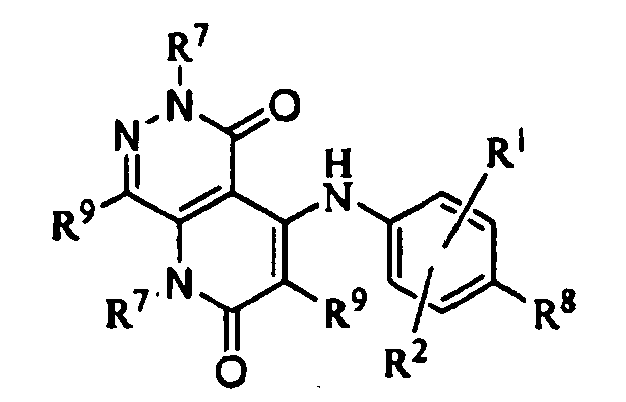 R1, R2, R8 and each R9 are independently hydrogen, halogen, cyano, nitro, trifluoromethyl, difluoromethyl, fluoromethyl, fluoromethoxy, difluoromethoxy, trifluoromethoxy, azido, -SR11, -OR3, -C(O)R3, -C(O)OR3, -NR4C(O)OR6, -OC(O)R3, -NR4SO2R6, -SO2NR3R4, - NR4C(O)R3, -C(O)NR3R4, -NR5C(O)NR3R4, -NR5C(NCN)NR3R4, -NR3R4, C1-C10 alkyl, C2-C10 alkenyl, C2-C10 alkynyl, C3-C10 cycloalkyl, C3-C10 cycloalkylalkyl, -S(O)j(C1-C6 alkyl), - S(O)j(CR4R5)m-aryl, aryl, arylalkyl, heteroaryl, heteroarylalkyl, heterocyclyl, heterocyclylalkyl, - O(CR4R5)m-aryl, -NR4(CR4R5)m-aryl, -O(CR4R5)m-heteroaryl, -NR4(CR4R5)m-heteroaryl, -O(CR4R6)m-heterocyclyl or -NR4(CR4R5)m-heterocyclyl, wherein any of said alkyl, alkenyl, alkynyl, cycloalkyl, aryl, arylalkyl, heteroaryl, heteroarylalkyl, heterocyclyl and heterocyclylalkyl portions are optionally substituted with one or more groups independently selected from oxo (with the proviso that it is not substituted on an aryl or heteroaryl), halogen, cyano, nitro, trifluoromethyl, difluoromethoxy, trifluoromethoxy, azido, -NR4SO2R6, -SO2NR3R4 , -C(O)R3, -C(O)OR3, -OC(O)R3, -NR4C(O)OR6, -NR4C(O)R3, -C(O)NR3R4, -NR3R4, -NR5C(O)NR3R4, -NR5C(NCN)NR3R4, -OR3, aryl, heteroaryl, arylalkyl, heteroarylalkyl, heterocyclyl, and heterocyclylalkyl, and wherein said aryl, heteroaryl, arylalkyl, heteroarylalkyl, heterocyclyl or heterocyclylalkyl rings may be further substituted with one or more groups selected from halogen, hydroxyl, cyano, nitro, azido, fluoromethyl, difluoromethyl, trifluoromethyl, C1-C4 alkyl, C2-C4 alkenyl, C2-C4 alkynyl, C3-C6 cycloalkyl, C3-C6 heterocycloalkyl, NR3R4 and OR3;R7 is hydrogen, trifluoromethyl, C1-C10 alkyl, C2-C10 alkenyl, C2-C10 alkynyl, C3-C10 cycloalkyl, C3-C10 cycloalkylalkyl, aryl, arylalkyl, heteroaryl, heteroarylalkyl, heterocyclyl, or heterocyclylalkyl, wherein any of said alkyl, alkenyl, alkynyl, cycloalkyl, aryl, arylalkyl, heteroaryl, heteroarylalkyl, heterocyclyl and heterocyclylalkyl portions are optionally substituted with one or more groups independently selected from oxo (with the proviso that it is not substituted on an aryl or heteroaryl), halogen, cyano, nitro, trifluoromethyl, difluoromethyl, fluoromethyl, difluoromethoxy, trifluoromethoxy, azido, -NR11SO2R14, -SO2NR11R12, -C(O)R11, C(O)OR11, -OC(O)R11, -NR11O(O)OR14, -NR11C(O)R12, -C(O)NR11R12, -SR11, -S(O)R14, -SO2R14, -NR11R12, -NR11C(O)NR12R13, -NR11C(NCN)NR12R13, -OR11, C1-C10 alkyl, C2-C10 alkenyl, C2-C10 alkynyl, C3-C10 cycloalkyl, aryl, heteroaryl, arylalkyl, heteroarylalkyl, heterocyclyl, and heterocyclylalkyl, and wherein said aryl, heteroaryl, arylalkyl, heteroarylalkyl, heterocyclyl or heterocyclylalkyl rings may be further substituted with one or more groups selected from halogen, hydroxyl, cyano, nitro, azido, fluoromethyl, difluoromethyl, trifluoromethyl, C1-C4 alkyl, C2-C4 alkenyl, C2-C4 alkynyl, C3-C6 cycloalkyl, C3-C6 heterocycloalkyl, NR3R4 and OR3;R3 is hydrogen, trifluoromethyl, C1-C10 alkyl, C2-C10 alkenyl, C2-C10 alkynyl, C3-C10 cycloalkyl, C3-C10 cycloalkylalkyl, aryl, arylalkyl, heteroaryl, heteroarylalkyl, heterocyclyl, heterocyclylalkyl, phosphate or an amino acid residue, wherein any of said alkyl, alkenyl, alkynyl, cycloalkyl, aryl, arylalkyl, heteroaryl, heteroarylalkyl, heterocyclyl and heterocyclylalkyl portions are optionally substituted with one or more groups independently selected from oxo (with the proviso that it is not substituted on an aryl or heteroaryl), halogen, cyano, nitro, trifluoromethyl, difluoromethoxy, trifluoromethoxy, azido, -NR11SO2R14, -SO2NR11R12, -C(O)R11, C(O)OR11, -OC(O)R11, -NR11C(O)OR14, -NR11C(O)R12, -C(O)NR11R12, -SR11, -S(O)R14, -SO2R14, -NR11R12, -NR11C(O)NR12R13, -NR11C(NCN)NR12R13, -OR11, aryl, heteroaryl, arylalkyl, heteroarylalkyl, heterocyclyl, and heterocyclylalkyl,or R3 and R4 together with the atom to which they are attached form a 4 to 10 membered heteroaryl or heterocyclic ring, wherein any of said heteroaryl or heterocyclic rings are optionally substituted with one or more groups independently selected from halogen, cyano, nitro, trifluoromethyl, difluoromethoxy, trifluoromethoxy, azido, -NR11SO2R14, -SO2NR11R12, -C(O)R11, C(O)OR11, -OC(O)R11, -NR11C(O)OR14, -NR11C(O)R12, -C(O)NR11R12, -SR11, -S(O)R14, -SO2R14,-NR11R12, -NR11C(O)NR12R13, -NR11C(NCN)NR12R13, -OR11, aryl, heteroaryl, arylalkyl, heteroarylalkyl, heterocyclyl, and heterocyclylalkyl;R4 and R5 independently are hydrogen or C1-C6 alkyl, orR4 and R5 together with the atom to which they are attached form a 4 to 10 membered carbocyclic, heteroaryl or heterocyclic ring, wherein said alkyl or any of said carbocyclic, heteroaryl and heterocyclic rings are optionally substituted with one or more groups independently selected from halogen, cyano, nitro, trifluoromethyl, difluoromethoxy, trifluoromethoxy, azido, -NR11SO2R14, -SO2NR11R12, -C(O)R11, C(O)OR11, -OC(O)R", - NR11C(O)OR14, -NR11C(O)R12, -C(O)NR11R12, -SR11, -S(O)R14, -SO2R14, -NR11R12, -NR11C(O)NR12R13, -NR11C(NCN)NR12R13, -OR11, aryl, heteroaryl, arylalkyl, heteroarylalkyl, heterocyclyl, and heterocyclylalkyl;R6 is trifluoromethyl, C1-C10 alkyl, C3-C10 cycloalkyl, aryl, arylalkyl, heteroaryl, heteroarylalkyl, heterocyclyl or heterocyclylalkyl, wherein any of said alkyl, cycloalkyl, aryl, arylalkyl, heteroaryl, heteroarylalkyl, heterocyclyl and heterocyclylalkyl portions are optionally substituted with one or more groups independently selected from oxo (with the proviso that it is not substituted on an aryl or heteroaryl), halogen, cyano, nitro, trifluoromethyl, difluoromethoxy, trifluoromethoxy, azido, -NR11SO2R14, -SO2NR11R12, -C(O)R11, C(O)OR11, -OC(O)R11, - NR11C(O)OR14, -NR11C(O)R12, -C(O)NR11R12, -SR11, -S(O)R14, -SO2R14, -NR11R12, -NR11C(O)NR12R13, -NR11C(NCN)NR12R13, -OR11, aryl, heteroaryl, arylalkyl, heteroarylalkyl, heterocyclyl, and heterocyclylalkyl;R11, R12 and R13 independently are hydrogen, C1-C10 alkyl, C2-C10 alkenyl, aryl and arylalkyl, and R14 is C1-C10 alkyl, C2-C10 alkenyl, aryl and arylalkyl;or any two of R11, R12, R13 or R14 together with the atom to which they are attached form a 4 to 10 membered heteroaryl or heterocyclic ring, wherein any of said alkyl, alkenyl, aryl, arylalkyl rings, heteroaryl rings or heterocyclic rings are optionally substituted with one or more groups independently selected from halogen, cyano, nitro, trifluoromethyl, difluoromethoxy, trifluoromethoxy, azido, aryl, heteroaryl, arylalkyl, heteroarylalkyl, heterocyclyl, and heterocyclylalkyl;m is 0, 1, 2, 3, 4 or 5; andj is 0, 1 or 2.
 - A compound including resolved enantiomers, diastereomers, and pharmaceutically acceptable salts thereof, said compound having the formula:
 R1, R2, R8 and R9 are independently hydrogen, halogen, cyano, nitro, trifluoromethyl, difluoromethoxy, difluoromethyl, fluoromethyl, fluoromethoxy, trifluoromethoxy, azido, -SR11, -OR3, -C(O)R3, -C(O)OR3, -NR4C(O)OR6, -OC(O)R3, -NR4SO2R8, -SO2NR3R4, -NR4C(O)R3. -C(O)NR3R4, -NR5C(O)NR3R4, -NR5C(NCN)NR3R4, -NR3R4, C1-C10 alkyl, C2-C10 alkenyl, C2-C10 alkynyl, C3-C10 cycloalkyl, C3-C10 cycloalkylalkyl, -S(O)j(C1-C6 alkyl), -S(O)j(CR4R5)m-aryl, aryl, arylalkyl, heteroaryl, heteroarylalkyl, heterocyclyl, heterocyclylalkyl, -O(CR4R5)m-aryl, -NR4(CR4R5)m-aryl, -O(CR4R5)m-heteroaryl, -NR4(CR4R5)m-heteroaryl, -O(CR4R5)m-heterocyclyl or -NR4(CR4R5)m-heterocyclyl, wherein any of said alkyl, alkenyl, alkynyl, cycloalkyl, aryl, arylalkyl, heteroaryl, heteroarylalkyl, heterocyclyl and heterocyclylalkyl portions are optionally substituted with one or more groups independently selected from oxo (with the proviso that it is not substituted on an aryl or heteroaryl), halogen, cyano, nitro, trifluoromethyl, difluoromethoxy, trifluoromethoxy, azido, -NR4SO2R6, -SO2NR3R4, -C(O)R3, -C(O)OR3, -OC(O)R3, -NR4C(O)OR6, - NR4C(O)R3, -C(O)NR3R4, -NR3R4, -NR5C(O)NR3R4, -NR5C(NCN)NR3R4, -OR3, aryl, heteroaryl, arylalkyl, heteroarylalkyl, heterocyclyl, and heterocyclylalkyl, and wherein said aryl, heteroaryl, arylalkyl, heteroarylalkyl, heterocyclyl or heterocyclylalkyl rings may be further substituted with one or more groups selected from halogen, hydroxyl, cyano, nitro, azido, fluoromethyl, difluoromethyl, trifluoromethyl, C1-C4 alkyl, C2-C4 alkenyl, C2-C4 alkynyl, C3-C6 cycloalkyl, C3-C6 heterocycloalkyl, NR3R4 and OR3;each R7 is hydrogen, trifluoromethyl, C1-C10 alkyl, C2-C10 alkenyl, C2-C10 alkynyl, C3-C10 cycloalkyl, C3-C10 cycloalkylalkyl, aryl, arylalkyl, heteroaryl, heteroarylalkyl, heterocyclyl, or heterocyclylalkyl, wherein any of said alkyl, alkenyl, alkynyl, cycloalkyl, aryl, arylalkyl, heteroaryl, heteroarylalkyl, heterocyclyl and heterocyclylalkyl portions are optionally substituted with one or more groups independently selected from oxo (with the proviso that it is not substituted on an aryl or heteroaryl), halogen, cyano, nitro, trifluoromethyl, difluoromethyl, fluoromethyl, difluoromethoxy, trifluoromethoxy, azido, -NR11SO2R14, -SO2NR11R12, -C(O)R11, C(O)OR11, -OC(O)R11, -NR11C(O)OR14, -NR11C(O)R12, -C(O)NR11R12, -SR", -S(O)R14, -SO2R14, -NR11R12, -NR11C(O)NR12R13, -NR11C(NCN)NR12R13, -OR11, C1-C10 alkyl, C2-C10 alkenyl, C2-C10 alkynyl, C3-C10 cycloalkyl, aryl, heteroaryl, arylalkyl, heteroarylalkyl, heterocyclyl, and heterocyclylalkyl, and wherein said aryl, heteroaryl, arylalkyl, heteroarylalkyl, heterocyclyl or heterocyclylalkyl rings may be further substituted with one or more groups selected from halogen, hydroxyl, cyano, nitro, azido, fluoromethyl, difluoromethyl, trifluoromethyl, C1-C4 alkyl, C2-C4 alkenyl, C2-C4 alkynyl, C3-C6 cycloalkyl, C3-C6 heterocycloalkyl, NR3R4 and OR3;each R10 is independently hydrogen, cyano, nitro, trifluoromethyl, difluoromethoxy, trifluoromethoxy, azido, -C(O)R3, -C(O)OR3, -SO2NR3R4, -C(O)NR3R4, C1-C10 alkyl, C2-C10 alkenyl, C2-C10 alkynyl, C3-C10 cycloalkyl, C3-C10 cycloalkylalkyl, -S(O)j(C1-C6 alkyl), - S(O)j(CR4R5)m-aryl, aryl, arylalkyl, heteroaryl, heteroarylalkyl, heterocyclyl or heterocyclylalkyl, wherein any of said alkyl, alkenyl, alkynyl, cycloalkyl, aryl, arylalkyl, heteroaryl, heteroarylalkyl, heterocyclyl and heterocyclylalkyl portions are optionally substituted with one or more groups independently selected from oxo (with the proviso that it is not substituted on an aryl or heteroaryl), halogen, cyano, nitro, trifluoromethyl, difluoromethoxy, trifluoromethoxy, azido, - NR4SO2R6, -SO2NR3R4, -C(O)R3, -C(O)OR3, -OC(O)R3, -NR4C(O)OR6, -NR4C(O)R3, -C(O)NR3R4, -NR3R4, -NR5C(O)NR3R4, -NR5C(NCN)NR3R4, -OR3, aryl, heteroaryl, arylalkyl, heteroarylalkyl, heterocyclyl, and heterocyclylalkyl, and wherein said aryl, heteroaryl, arylalkyl, heteroarylalkyl, heterocyclyl or heterocyclylalkyl rings may be further substituted with one or more groups selected from halogen, hydroxyl, cyano, nitro, azido, fluoromethyl, difluoromethyl, trifluoromethyl, C1-C4 alkyl, C2-C4 alkenyl, C2-C4 alkynyl, C3-C6 cycloalkyl, C3-C6 heterocycloalkyl, NR3R4 and OR3;R3 is hydrogen, trifluoromethyl, C1-C10 alkyl, C2-C10 alkenyl, C2-C10 alkynyl, C3-C10 cycloalkyl, C3-C10 cycloalkylalkyl, aryl, arylalkyl, heteroaryl, heteroarylalkyl, heterocyclyl, heterocyclylalkyl, phosphate or an amino acid residue, wherein any of said alkyl, alkenyl, alkynyl, cycloalkyl, aryl, arylalkyl, heteroaryl, heteroarylalkyl, heterocyclyl and heterocyclylalkyl portions are optionally substituted with one or more groups independently selected from oxo (with the proviso that it is not substituted on an aryl or heteroaryl), halogen, cyano, nitro, trifluoromethyl, difluoromethoxy, trifluoromethoxy, azido, -NR11SO2R14, -SO2NR11R12, -C(O)R11, C(O)OR11, -OC(O)R11, -NR11C(O)OR14, -NR11C(O)R12, -C(O)NR11R12, -SR11, -S(O)R14, -SO2R14, -NR11R12, -NR11C(O)NR12R13, -NR11C(NCN)NR12R13, -OR11, aryl, heteroaryl, arylalkyl, heteroarylalkyl, heterocyclyl, and heterocyclylalkyl,or R3 and R4 together with the atom to which they are attached form a 4 to 10 membered heteroaryl or heterocyclic ring, wherein any of said heteroaryl or heterocyclic rings are optionally substituted with one or more groups independently selected from halogen, cyano, nitro, trifluoromethyl, difluoromethoxy, trifluoromethoxy, azido, -NR11SO2R14, -SO2NR11R12, -C(O)R11, C(O)OR11, -OC(O)R11, -NR11C(O)OR14, -NR11C(O)R12, -C(O)NR11R12, -SR11, -S(O)R14, -SO2R14,-NR11R12, -NR11C(O)NR12R13, -NR11C(NCN)NR12R13, -OR11, aryl, heteroaryl, arylalkyl, heteroarylalkyl, heterocyclyl, and heterocyclylalkyl;R4 and R5 independently are hydrogen or C1-C6 alkyl, orR4 and R5 together with the atom to which they are attached form a 4 to 10 membered carbocyclic, heteroaryl or heterocyclic ring, wherein said alkyl or any of said carbocyclic, heteroaryl and heterocyclic rings are optionally substituted with one or more groups independently selected from halogen, cyano, nitro, trifluoromethyl, difluoromethoxy, trifluoromethoxy, azido, -NR11SO2R14, -SO2NR11R12, -C(O)R11, C(O)OR11, -OC(O)R11, - NR11C(O)OR14, -NR11C(O)R12, -C(O)NR11R12, -SR11, -S(O)R14, -SO2R14, -NR11R12, -NR11C(O)NR12R13, -NR11C(NCN)NR12R13, -OR11, aryl, heteroaryl, arylalkyl, heteroarylalkyl, heterocyclyl, and heterocyclylalkyl;R6 is trifluoromethyl, C1-C10 alkyl, C3-C10 cycloalkyl, aryl, arylalkyl, heteroaryl, heteroarylalkyl, heterocyclyl or heterocyclylalkyl, wherein any of said alkyl, cycloalkyl, aryl, arylalkyl, heteroaryl, heteroarylalkyl, heterocyclyl and heterocyclylalkyl portions are optionally substituted with one or more groups independently selected from oxo (with the proviso that it is not substituted on an aryl or heteroaryl), halogen, cyano, nitro, trifluoromethyl, difluoromethoxy, trifluoromethoxy, azido, -NR11SO2R14, -SO2NR11R12, -C(O)R11, C(O)OR11, -OC(O)R11, - NR11C(O)OR14, -NR11C(O)R12, -C(O)NR11R12, -SR11, -S(O)R14, -SO2R14, -NR11R12, -NR11C(O)NR12R13, -NR11C(NCN)NR12R13, -OR11, aryl, heteroaryl, arylalkyl, heteroarylalkyl, heterocyclyl, and heterocyclylalkyl;R11, R12 and R13 independently are hydrogen, C1-C10 alkyl, C2-C10 alkenyl, aryl and arylalkyl, and R14 is C1-C10 alkyl, C2-C10 alkenyl, aryl and arylalkyl;or any two of R11, R12, R13 or R14 together with the atom to which they are attached form a 4 to 10 membered heteroaryl or heterocyclic ring, wherein any of said alkyl, alkenyl, aryl, arylalkyl rings, heteroaryl rings or heterocyclic rings are optionally substituted with one or more groups independently selected from halogen, cyano, nitro, trifluoromethyl, difluoromethoxy, trifluoromethoxy, azido, aryl, heteroaryl, arylalkyl, heteroarylalkyl, heterocyclyl, and heterocyclylalkyl;m is 0, 1, 2, 3, 4 or 5; andj is 0, 1 or 2.
 - The compound of claim 1, where R9 is hydrogen, halogen, methyl, fluoromethyl, difluoromethyl, trifluoromethyl or ethyl.
- The compound of claim 5, where W is selected from heteroaryl, C(O)OR3, C(O)NR3R4, C(O)NR4OR3 and C(O)NR4S(O)2R3, wherein any of said heteroaryl, C(O)OR3, C(O)NR3R4, C(O)NR4OR3 or C(O)NR4S(O)2R3 are optionally substituted with one or more groups selected from halogen, hydroxyl, cyano, nitro, azido, fluoromethyl, difluoromethyl, trifluoromethyl, methoxy, fluoromethoxy, difluoromethoxy, trifluoromethoxy, amino, aminomethyl, dimethylamino, aminoethyl, diethylamino, ethoxy, C1-C4 alkyl, C2-C4 alkenyl, C2-C4 alkynyl, C3-C6 cycloalkyl and C3-C6 heterocycloalkyl, wherein any of said C1-C4 alkyl, C2-C4 alkenyl, C2-C4 alkynyl, cycloalkyl or heterocycloalkyl can be further optionally substituted with one or more groups selected from NR3R4 and OR3; or
where W is selected from C(O)OR3, C(O)NHR3, and C(O)NHOR3, wherein any of said C(O)OR3, C(O)NHR3, and C(O)NHOR3 are optionally substituted with one or more groups selected from halogen, hydroxyl, cyano, nitro, azido, fluoromethyl, difluoromethyl, trifluoromethyl, methoxy, fluoromethoxy, difluoromethoxy, trifluoromethoxy, amino, aminomethyl, dimethylamino, aminoethyl, diethylamino, ethoxy, C1-C4 alkyl, C2-C4 alkenyl, C2-C4 alkynyl, C3-C6 cycloalkyl and C3-C6 heterocycloalkyl, wherein any of said C1-C4 alkyl, C2-C4 alkenyl, C2-C4 alkynyl, cycloalkyl or heterocycloalkyl can be further optionally substituted with one or more groups selected from NR3R4 and OR3; and
R3 is selected from hydrogen, C1-C4 alkyl, C2-C4 alkenyl, C2-C4 alkynyl, C3-C6 cycloalkyl and C3-C6 heterocycloalkyl, wherein any of said C1-C4 alkyl, C2-C4 alkenyl, C2-C4 alkynyl, cycloalkyl or heterocycloalkyl are optionally substituted with one or more groups selected from NR11R12 and OR11. - The compound of claim 1, where
R9 is hydrogen, halogen, methyl, fluoromethyl, difluoromethyl, trifluoromethyl or ethyl; and
W is selected from

- The compound of any one of claims 1 or 5-7, where R7 is C1-C4 alkyl, C2-C4 alkenyl or C2-C4 alkynyl, wherein said C1-C4 alkyl, C2-C4 alkenyl and C2-C4 alkynyl may be optionally substituted with one or more groups selected from halogen, hydroxyl, cyano, nitro, azido, fluoromethyl, difluoromethyl, trifluoromethyl, methoxy, fluoromethoxy difluoromethoxy, amino, aminomethyl, dimethylamino, aminoethyl, diethylamino, ethoxy, C3-C10 cycloalkyl, heterocycloalkyl, aryl or heteroaryl, wherein said cycloalkyl, heterocycloalkyl, aryl or heteroaryl rings may be optionally substituted with one or more groups selected from halogen, hydroxyl, cyano, nitro, azido, fluoromethyl, difluoromethyl, trifluoromethyl, C1-C4 alkyl, C2-C4 alkenyl, C2-C4 alkynyl, C3-C6 cycloalkyl, C3-C6 heterocycloalkyl, NR3R4 and OR3.
- The compound of any one of claims 1 or 5-7, where R8 is halogen, hydroxyl, cyano, nitro, azido, methyl, fluoromethyl, difluoromethyl, trifluoromethyl, methoxy, fluoromethoxy, difluoromethoxy, trifluoromethoxy, amino, aminomethyl, dimethylamino, aminoethyl, diethylamino, ethyl, ethoxy or SR11.
- The compound of claim 9, where R1 and R2 are independently hydrogen, halogen, methyl, fluoromethyl, difluoromethyl, trifluoromethyl or ethyl.
- The compound of any one of claims 1 or 5-10, where R1 is halogen or methyl, R2 is hydrogen and R8 is halogen, methyl, fluoromethyl, difluoromethyl, trifluoromethyl or SR11.
- The compound of claim 1, where R1 is halogen, R8 is halogen, R9 is C1-C10 alkyl or halogen, and R2 is H.
- A composition comprising a compound of any one of claims 1 to 12 and a pharmaceutically acceptable carrier.
- One or more compounds of any one of claims 1 to 12 for use in inhibiting MEK activity in a mammal, in the treatment of a hyperproliferative disorder in a mammal, or an inflammatory condition in a mammal.
- A compound according to any one of claims 1 to 12 for use as a medicament; preferably for use as a medicament for the treatment of a hyperproliferative disorder or an inflammatory condition.
- A method for preparing a compound of formula 6 or 7
 R1 and R2 are independently hydrogen, halogen, methyl, fluoromethyl, difluoromethyl, trifluoromethyl or ethyl;R9 is F or Cl;R4 hydrogen or C1-C6 alkyl;R3 and R7 are independently alkyl, alkenyl, alkynyl, cycloalkyl, heterocycloalkyl, aryl or heteroaryl, wherein said alkyl, alkenyl, alkynyl, cycloalkyl, heterocycloalkyl, aryl or heteroaryl may be optionally substituted with one or more groups selected from halogen, hydroxyl, cyano, nitro, amino, azido, fluoromethyl, difluoromethyl, trifluoromethyl, methoxy, fluoromethoxy, difluoromethoxy, amino, aminomethyl, dimethylamino, aminoethyl, diethylamino, ethoxy, cycloalkyl, heterocycloalkyl, aryl or heteroaryl; andR8 is halogen, hydroxyl, cyano, nitro, azido, methyl, fluoromethyl, difluoromethyl, trifluoromethyl, methoxy, fluoromethoxy, difluoromethoxy, trifluoromethoxy, amino, aminomethyl, dimethylamino, aminoethyl, diethylamino, SR1, ethyl or ethoxy, said method comprising:(a) reacting a compound of formula 2with a halogenating agent to provide a compound of formula 3
 (b) reacting a compound of formula 3 with N-chlorosuccinimide or 1-(chloromethyl)-4-fluoro-1,4-diazoniabicyclo[2.2.2]octane-bis(tetrafluoroborate) followed by basic hydrolysis to provide a compound of formula 4
 (c) reacting a compound of formula 4 with an aniline derivative to provide a compound of formula 5
 (d) reacting a compound of formula 5 with an amine in the presence of a coupling reagent to provide a compound of formula 6, or reacting a compound of formula 5 with a hydroxylamine in the presence of a coupling reagent to provide a compound of formula 7.
 - A method for preparing a compound of formula 7
 R1, R2 and R9 are independently hydrogen, halogen, methyl, fluoromethyl, difluoromethyl, trifluoromethyl or ethyl;R4 hydrogen or C1-C6 alkyl;R3 and R7 are independently alkyl, alkenyl, alkynyl, cycloalkyl, heterocycloalkyl, aryl or heteroaryl, wherein said alkyl, alkenyl, alkynyl, cycloalkyl, heterocycloalkyl, aryl or heteroaryl may be optionally substituted with one or more groups selected from halogen, hydroxyl, cyano, nitro, amino, azido, fluoromethyl, difluoromethyl, trifluoromethyl, methoxy, fluoromethoxy, difluoromethoxy, amino, aminomethyl, dimethylamino, aminoethyl, diethylamino, ethoxy, cycloalkyl, heterocycloalkyl, aryl or heteroaryl; andR6 is halogen, hydroxyl, cyano, nitro, azido, methyl, fluoromethyl, difluoromethyl, trifluoromethyl, methoxy, fluoromethoxy, difluoromethoxy, trifluoromethoxy, amino, aminomethyl, dimethylamino, aminoethyl, diethylamino, ethyl, ethoxy or SR1, said method comprising:(a) reacting a compound of formula 9
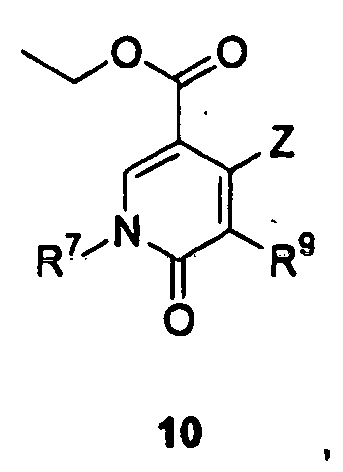 (b) reacting a compound of formula 10 with an aniline derivative in the presence of a palladium catalyst, a phosphine ligand and a base to provide a compound of formula 11
 (c) reacting a compound of formula 11 with a hydroxylamine in the presence of an amide base to provide a compound of formula 7.
 - A method for preparing a compound of formula 43, 44, 45 or 46

 X is CH or N;R1, R2 and R9 are independently hydrogen, halogen, methyl, fluoromethyl, difluoromethyl, trifluoromethyl or ethyl;R7 is alkyl, alkenyl, alkynyl, cycloalkyl, heterocycloalkyl, aryl or heteroaryl, wherein said alkyl, alkenyl, alkynyl, cycloalkyl, heterocycloalkyl, aryl or heteroaryl may be optionally substituted with one or more groups selected from halogen, hydroxyl, cyano, nitro, amino, azido, fluoromethyl, difluoromethyl, trifluoromethyl, methoxy, fluoromethoxy, difluoromethoxy, amino, aminomethyl, dimethylamino, aminoethyl, diethylamino, ethoxy, cycloalkyl, heterocycloalkyl, aryl or heteroaryl; andR8 is halogen, hydroxyl, cyano, nitro, azido, methyl, fluoromethyl, difluoromethyl, trifluoromethyl, methoxy, fluoromethoxy, difluoromethoxy, trifluoromethoxy, amino, aminomethyl, dimethylamino, aminoethyl, diethylamino, ethyl, ethoxy or SR1, said method comprising:(a) reacting a compound of formula 41
 (b) reacting a compound of formula 42 with cyanogen bromide to provide a compound of formula 43; or
reacting a compound of formula 42 with either CDI or phosgene to provide a compound of formula 44; or
reacting a compound of formula 42 with cyanamide followed by a mixture of PPh3, TEA and CCl4 to provide a compound of formula 45; or
reacting a compound of formula 42 with ethyl acetimidate followed by a mixture of PPh3, TEA and CCl4 to provide a compound of formula 46. - A compound selected from:4-(4-Bromo-2-fluoro-phenylamino)-5-chloro-1-methyl-6-oxo-1,6-dihydro-pyridine-3-carboxylic acid cyclopropylmethoxy-amide,4-(4-Bromo-2-fluoro-phenylamino)-5-fluoro-1-methyl-6-oxo-1,6-dihydro-pyridine-3-carboxylic acid cyclopropylmethoxy-amide,4-(4-Bromo-2-fluoro-phenylamino)-5-fluoro-1-methyl-6-oxo-1,6-dihydro-pyridine-3-carboxylic acid amide,1-Benzyl-4-(4-bromo-2-fluoro-phenylamino)-5-chloro-6-oxo-1,6-dihydro-pyridine-3-carboxylic acid (2-hydroxy-ethoxy)-amide,4-(4-Bromo-2-fluoro-phenylamino)-1,5-dimethyl-6-oxo-1,6-dihydro-pyridine-3-carboxylic acid (2-hydroxy-ethoxy)-amide,4-(4-Bromo-2-fluoro-phenylamino)-1,5-dimethyl-6-oxo-1,6-dihydro-pyridine-3-carboxylic acid (2-hydroxy-1,1-dimethyl-ethoxy)-amide,4-(4-Bromo-2-chloro-phenylamino)-1,5-dimethyl-6-oxo-1,6-dihydro-pyridine-3-carboxylic acid (2-hydroxy-1,1-dimethyl-ethoxy)-amide,4-(4-Bromo-2-chloro-phenylamino)-1,5-dimethyl-6-oxo-1,6-dihydro-pyridine-3-carboxylic acid (2-hydroxy-ethoxy)-amide,4-(4-Bromo-2-methyl-phenylamino)-1,5-dimethyl-6-oxo-1,6-dihydro-pyridine-3-carboxylic acid (2-hydroxy-ethoxy)-amide,4-(2,4-Dichloro-phenylamino)-1,5-dimethyl-6-oxo-1,6-dihydro-pyridine-3-carboxylic acid (2-hydroxy-ethoxy)-amide,4-(4-Bromo-2-fluoro-phenylamino)-5-fluoro-1-methyl-6-oxo-1,6-dihydro-pyridine-3-carboxylic acid ethoxy-amide,4-(2-Fluoro-4-iodo-phenylamino)-1,5-dimethyl-6-oxo-1,6-dihydro-pyridine-3-carboxylic acid (2-hydroxy-ethoxy)-amide,5-(5-Amino-[1,3,4]oxadiazol-2-yl)-4-(4-bromo-2-fluoro-phenylamino)-3-fluoro-1-methyl-1H-pyridin-2-one,(R)-4-(2-Fluoro-4-iodo-phenylamino)-1,5-dimethyl-6-oxo-1,6-dihydro-pyridine-3-carboxylic acid (2,3-dihydroxy-propoxy)-amide,4-(4-Bromo-2-fluoro-phenylamino)-1,5-dimethyl-6-oxo-1,6-dihydro-pyridine-3-carboxylic acid hydroxyamide,5-Fluoro-4-(2-fluoro-4-methylsulfanyl-phenylamino)-1-methyl-6-oxo-1,6-dihydro-pyridine-3-carboxylic acid ethoxy-amide,4-(2-Fluoro-4-iodo-phenylamino)-1,5-dimethyl-6-oxo-1,6-dihydro-pyridine-3-carboxylic acid methoxy-amide,4-(2-Fluoro-4-iodo-phenylamino)-1,5-dimethyl-6-oxo-1,6-dihydro-pyridine-3-carboxylic acid ethoxy-amide,5-Fluoro-4-(2-fluoro-4-iodo-phenylamino)-1-methyl-6-oxo-1,6-dihydro-pyridine-3-carboxylic acid methoxy-amide,5-Fluoro-4-(2-fluoro-4-iodo-phenylamino)-1-methyl-6-oxo-1,6-dihydro-pyridine-3-carboxylic acid ethoxy-amide,5-Fluoro-4-(2-fluoro-4-methylsulfanyl-phenylam ino)-1-methyl-6-oxo-1,6-dihydro-pyridine-3-carboxylic acid methoxy-amide,4-(4-Bromo-2-fluoro-phenylamino)-1,5-dimethyl-6-oxo-1,6-dihydro-pyridine-3-carboxylic acid methoxy-amide,4-(4-Bromo-2-fluoro-phenylamino)-1,5-dimethyl-6-oxo-1,6-dihydro-pyridine-3-carboxylic acid ethoxy-amide,4-(4-Bromo-2-fluoro-phenylamino)-5-fluoro-1-methyl-6-oxo-1,6-dihydro-pyridine-3-carboxylic acid methoxy-amide,5-(5-Amino-[1,3,4]oxadiazol-2-yl)-4-(4-bromo-2-fluoro-phenylamino)-1,3-dimethyl-1H-pyridin-2-one,2-(4-Bromo-2-fluoro-phenylamino)-1-methyl-6-oxo-1,6-dihydro-pyridine-3-carboxylic acid cyclopropylmethoxy-amide,2-(4-Bromo-2-fluoro-phenylamino)-1-methyl-6-oxo-1,6-dihydro-pyridine-3-carboxylic acid (2-hydroxy-ethoxy)-amide,2-(4-Bromo-2-fluoro-phenylamino)-5-fluoro-1-methyl-6-oxo-1,6-dihydro-pyridine-3-carboxylic acid (2-hydroxy-ethoxy)-amide,2-(4-Bromo-2-fluoro-phenylamino)-1-ethyl-6-oxo-1,6-dihydro-pyridine-3-carboxylic acid (2-hydroxy-ethoxy)-amide,2-(2-Fluoro-4-methyl-phenylamino)-1-methyl-6-oxo-1,6-dihydro-pyridine-3-carboxylic acid (2-hydroxy-ethoxy)-amide,2-(2-Fluoro-4-iodo-phenylamino)-1-methyl-6-oxo-1,6-dihydro-pyridine-3-carboxylic acid methoxy-amide;4-(4-Bromo-2-fluorophenylamino)-6-oxo-1-phenyl-1,6-dihydropyridazine-3-carboxylic acid cyclopropylmethoxy-amide; and4-(4-Bromo-2-fluorophenylamino)-6-oxo-1-phenyl-1,6-dihydropyridazine-3-carboxylic acid (2-hydroxyethoxy)-amide.
Priority Applications (1)
| Application Number | Priority Date | Filing Date | Title |
|---|---|---|---|
| PL10008429T PL2251327T3 (en) | 2003-11-19 | 2004-11-18 | Heterocyclic inhibitors of mek |
Applications Claiming Priority (2)
| Application Number | Priority Date | Filing Date | Title |
|---|---|---|---|
| US52327003P | 2003-11-19 | 2003-11-19 | |
| EP04811727A EP1682138B3 (en) | 2003-11-19 | 2004-11-18 | Heterocyclic inhibitors of mek |
Related Parent Applications (3)
| Application Number | Title | Priority Date | Filing Date |
|---|---|---|---|
| EP04811727A Division EP1682138B3 (en) | 2003-11-19 | 2004-11-18 | Heterocyclic inhibitors of mek |
| EP04811727A Division-Into EP1682138B3 (en) | 2003-11-19 | 2004-11-18 | Heterocyclic inhibitors of mek |
| EP04811727.9 Division | 2004-11-18 |
Publications (3)
| Publication Number | Publication Date |
|---|---|
| EP2251327A2 EP2251327A2 (en) | 2010-11-17 |
| EP2251327A3 EP2251327A3 (en) | 2011-08-31 |
| EP2251327B1 true EP2251327B1 (en) | 2014-02-12 |
Family
ID=34632766
Family Applications (5)
| Application Number | Title | Priority Date | Filing Date |
|---|---|---|---|
| EP10008429.2A Expired - Lifetime EP2251327B1 (en) | 2003-11-19 | 2004-11-18 | Heterocyclic inhibitors of mek |
| EP04811721A Withdrawn EP1689406A4 (en) | 2003-11-19 | 2004-11-18 | HETEROCYCLIC MEK INHIBITORS AND METHODS OF USE THEREOF |
| EP04811726A Expired - Lifetime EP1689387B1 (en) | 2003-11-19 | 2004-11-18 | Bicyclic inhibitors of mek and methods of synthesis thereof |
| EP04811728A Expired - Lifetime EP1689233B1 (en) | 2003-11-19 | 2004-11-18 | Bicyclic inhibitors of mek |
| EP04811727A Expired - Lifetime EP1682138B3 (en) | 2003-11-19 | 2004-11-18 | Heterocyclic inhibitors of mek |
Family Applications After (4)
| Application Number | Title | Priority Date | Filing Date |
|---|---|---|---|
| EP04811721A Withdrawn EP1689406A4 (en) | 2003-11-19 | 2004-11-18 | HETEROCYCLIC MEK INHIBITORS AND METHODS OF USE THEREOF |
| EP04811726A Expired - Lifetime EP1689387B1 (en) | 2003-11-19 | 2004-11-18 | Bicyclic inhibitors of mek and methods of synthesis thereof |
| EP04811728A Expired - Lifetime EP1689233B1 (en) | 2003-11-19 | 2004-11-18 | Bicyclic inhibitors of mek |
| EP04811727A Expired - Lifetime EP1682138B3 (en) | 2003-11-19 | 2004-11-18 | Heterocyclic inhibitors of mek |
Country Status (30)
| Country | Link |
|---|---|
| US (7) | US7598383B2 (en) |
| EP (5) | EP2251327B1 (en) |
| JP (8) | JP4768628B2 (en) |
| KR (3) | KR101264570B1 (en) |
| CN (2) | CN102633716A (en) |
| AT (2) | ATE495155T1 (en) |
| AU (6) | AU2004293017B2 (en) |
| BR (1) | BRPI0416692A (en) |
| CA (4) | CA2545660C (en) |
| CY (2) | CY1111155T1 (en) |
| DE (1) | DE602004031037D1 (en) |
| DK (2) | DK1682138T3 (en) |
| EG (1) | EG24928A (en) |
| ES (4) | ES2453367T3 (en) |
| HR (1) | HRP20110105T4 (en) |
| IL (3) | IL175716A (en) |
| MX (1) | MXPA06005657A (en) |
| NO (1) | NO20062692L (en) |
| NZ (1) | NZ547481A (en) |
| PH (1) | PH12012501386A1 (en) |
| PL (4) | PL1682138T6 (en) |
| PT (4) | PT2251327E (en) |
| RS (2) | RS51861B (en) |
| RU (1) | RU2351593C2 (en) |
| SG (1) | SG149033A1 (en) |
| SI (1) | SI1682138T1 (en) |
| TW (7) | TW201118071A (en) |
| UA (1) | UA84175C2 (en) |
| WO (4) | WO2005051906A2 (en) |
| ZA (2) | ZA200604580B (en) |
Families Citing this family (177)
| Publication number | Priority date | Publication date | Assignee | Title |
|---|---|---|---|---|
| US7488823B2 (en) * | 2003-11-10 | 2009-02-10 | Array Biopharma, Inc. | Cyanoguanidines and cyanoamidines as ErbB2 and EGFR inhibitors |
| EP2251327B1 (en) * | 2003-11-19 | 2014-02-12 | Array Biopharma, Inc. | Heterocyclic inhibitors of mek |
| US7517994B2 (en) * | 2003-11-19 | 2009-04-14 | Array Biopharma Inc. | Heterocyclic inhibitors of MEK and methods of use thereof |
| US7732616B2 (en) * | 2003-11-19 | 2010-06-08 | Array Biopharma Inc. | Dihydropyridine and dihydropyridazine derivatives as inhibitors of MEK and methods of use thereof |
| AU2005308956A1 (en) * | 2004-11-24 | 2006-06-01 | Merck Serono Sa | Novel 4-arylamino pyridone derivatives as MEK inhibitors for the treatment of hyperproliferative disorders |
| EP1880993A4 (en) * | 2005-04-19 | 2009-12-30 | Kyowa Hakko Kirin Co Ltd | Nitrogen-containing heterocyclic compound |
| PT1928454E (en) | 2005-05-10 | 2014-12-04 | Intermune Inc | Pyridone derivatives for modulating stress-activated protein kinase system |
| EP2361905B1 (en) * | 2005-05-18 | 2013-03-06 | Array Biopharma Inc. | Heterocyclic Inhibitors of MEK and methods of use thereof |
| AU2012261703B2 (en) * | 2005-10-07 | 2015-08-13 | Exelixis, Inc. | Azetidines as MEK inhibitors for the treatment of proliferative diseases |
| AU2013203939B2 (en) * | 2005-10-07 | 2015-08-13 | Exelixis, Inc. | Azetidines as MEK inhibitors for the treatment of proliferative diseases |
| SI1934174T1 (en) * | 2005-10-07 | 2011-08-31 | Exelixis Inc | Azetidines as mek inhibitors for the treatment of proliferative diseases |
| KR20080080206A (en) | 2005-12-20 | 2008-09-02 | 아스트라제네카 아베 | Substituted cinnoline derivatives as BAAA-receptor modulators and methods for their synthesis |
| US7465795B2 (en) | 2005-12-20 | 2008-12-16 | Astrazeneca Ab | Compounds and uses thereof |
| GB0601962D0 (en) | 2006-01-31 | 2006-03-15 | Ucb Sa | Therapeutic agents |
| JP2009528365A (en) * | 2006-02-28 | 2009-08-06 | アムゲン インコーポレイティッド | Cinnoline and quinazoline derivatives as phosphodiesterase 10 inhibitors |
| CA2649122C (en) * | 2006-04-18 | 2015-06-30 | Ardea Biosciences, Inc. | Pyridone sulfonamides and pyridone sulfamides as mek inhibitors |
| JP5525812B2 (en) | 2006-04-19 | 2014-06-18 | メルク セローノ ソシエテ アノニム | Novel heteroaryl-substituted arylaminopyridine derivatives as MEK inhibitors |
| WO2007123939A2 (en) * | 2006-04-19 | 2007-11-01 | Laboratoires Serono S.A. | Novel arylamino n-heteraryls as mek inhibitors |
| GB0616214D0 (en) * | 2006-08-15 | 2006-09-27 | Ucb Sa | Therapeutic Agents |
| EP2108642A1 (en) | 2006-10-17 | 2009-10-14 | Kyowa Hakko Kirin Co., Ltd. | Jak inhibitor |
| US8470859B2 (en) | 2006-10-23 | 2013-06-25 | Takeda Pharmaceutical Company Limited | Iminopyridine derivative and use thereof |
| US20100204471A1 (en) * | 2006-10-23 | 2010-08-12 | Takeda Pharmaceutical Company Limited | Mapk/erk kinase inhibitors |
| TR201900306T4 (en) * | 2006-12-14 | 2019-02-21 | Exelixis Inc | Methods of using Mek inhibitors. |
| JO2985B1 (en) | 2006-12-20 | 2016-09-05 | Takeda Pharmaceuticals Co | MAPK/ERK Kinase Inhibitors |
| ES2547303T3 (en) * | 2007-01-19 | 2015-10-05 | Ardea Biosciences, Inc. | MEK inhibitors |
| US8232274B2 (en) * | 2007-03-15 | 2012-07-31 | Albany Molecular Research, Inc. | Pyridazinone derivatives useful as glucan synthase inhibitors |
| US8063066B2 (en) | 2007-03-19 | 2011-11-22 | Takeda Pharmaceutical Company Limited | MAPK/ERK kinase inhibitors |
| BRPI0810123A2 (en) * | 2007-04-23 | 2014-10-29 | Novartis Ag | FTAAZINE AND ISOQUINOLINE DERIVATIVES WITH S1P RECEIVER MODULATING ACTIVITIES |
| AR066505A1 (en) * | 2007-05-11 | 2009-08-26 | Bayer Schering Pharma Ag | PHENYLAMINOBENCENE DERIVATIVES SUBSTITUTED FOR USEFULNESS FOR THE TREATMENT OF HYPERPROLIFERATIVE DISORDERS AND DISEASES ASSOCIATED WITH EXTRACELLULAR KINASE ACTIVITY MEDITATED BY MYTHOGENS |
| WO2008148034A1 (en) * | 2007-05-25 | 2008-12-04 | Takeda Pharmaceutical Company Limited | Mapk/erk kinase inhibitors |
| GB0714384D0 (en) | 2007-07-23 | 2007-09-05 | Ucb Pharma Sa | theraputic agents |
| WO2009064675A1 (en) * | 2007-11-12 | 2009-05-22 | Takeda Pharmaceutical Company Limited | Mapk/erk kinase inhibitors |
| CA2704125A1 (en) * | 2007-12-19 | 2009-07-09 | Genentech, Inc. | 8-anilinoimidazopyridines and their use as anti-cancer and/or anti-inflammatory agents |
| CL2008003810A1 (en) | 2007-12-19 | 2009-05-22 | Genentech Inc | Compounds derived from 5-anilino imidazole [1,5-a] pyridine or pyrazine, inhibitors of mek kinase activity; pharmaceutical compositions containing them; and its use to treat hyperproliferative disorders and an inflammatory disease. |
| BRPI0819505A2 (en) * | 2007-12-21 | 2017-04-04 | Genentech Inc | "compound, pharmaceutical composition, method for inhibiting abnormal cell growth and method for treating an inflammatory disease" |
| WO2009093008A1 (en) | 2008-01-21 | 2009-07-30 | Ucb Pharma S.A. | Thieno-pyridine derivatives as mek inhibitors |
| AU2009218459A1 (en) | 2008-02-28 | 2009-09-03 | Novartis Ag | Imidazo [1,2-B] pyridazine derivatives for the treatment of C-Met tyrosine kinase mediated disease |
| US20090246198A1 (en) * | 2008-03-31 | 2009-10-01 | Takeda Pharmaceutical Company Limited | Mapk/erk kinase inhibitors and methods of use thereof |
| US8481569B2 (en) | 2008-04-23 | 2013-07-09 | Takeda Pharmaceutical Company Limited | Iminopyridine derivatives and use thereof |
| EP2296653B1 (en) | 2008-06-03 | 2016-01-27 | Intermune, Inc. | Compounds and methods for treating inflammatory and fibrotic disorders |
| NZ590542A (en) * | 2008-06-19 | 2012-12-21 | Xcovery Holding Co Llc | Substituted pyridazine carboxamide compounds as kinase inhibitor compounds |
| GB0811304D0 (en) | 2008-06-19 | 2008-07-30 | Ucb Pharma Sa | Therapeutic agents |
| KR20110029161A (en) * | 2008-07-01 | 2011-03-22 | 제넨테크, 인크. | Bicyclic heterocycles as MEB kinase inhibitors |
| EP2307364B1 (en) * | 2008-07-01 | 2013-06-19 | Genentech, Inc. | Isoindolone derivatives as mek kinase inhibitors and methods of use |
| EP2334674B1 (en) * | 2008-08-29 | 2012-06-06 | Amgen, Inc | Pyridazino- pyridinone compounds for the treatment of protein kinase mediated diseases. |
| EP2334673A1 (en) * | 2008-08-29 | 2011-06-22 | Amgen Inc. | PYRIDO[3,2-d]PYRIDAZINE-2(1H)-ONE COMPOUNDS AS P38 MODULATORS AND METHODS OF USE THEREOF |
| US8497269B2 (en) | 2008-10-10 | 2013-07-30 | Amgen Inc. | Phthalazine compounds as p38 map kinase modulators and methods of use thereof |
| US20110237592A1 (en) * | 2008-11-10 | 2011-09-29 | Bayer Schering Pharma Aktiengesellschaft | Substituted amido phenoxybenzamides |
| JP5746630B2 (en) | 2008-11-10 | 2015-07-08 | バイエル・インテレクチュアル・プロパティ・ゲゼルシャフト・ミット・ベシュレンクテル・ハフツングBayer Intellectual Property GmbH | Substituted sulfonamidophenoxybenzamide |
| WO2010068738A1 (en) | 2008-12-10 | 2010-06-17 | Dana-Farber Cancer Institute, Inc. | Mek mutations conferring resistance to mek inhibitors |
| CN102448938A (en) * | 2009-03-27 | 2012-05-09 | 阿迪生物科学公司 | Dihydropyridinesulfonamides and Dihydropyridinesulfonamides as MEK Inhibitors |
| US10253020B2 (en) | 2009-06-12 | 2019-04-09 | Abivax | Compounds for preventing, inhibiting, or treating cancer, AIDS and/or premature aging |
| MX353776B (en) * | 2009-06-12 | 2018-01-29 | Abivax | Compounds useful for treating cancer. |
| GB0913345D0 (en) | 2009-07-31 | 2009-09-16 | Astrazeneca Ab | New combination 802 |
| US8389526B2 (en) | 2009-08-07 | 2013-03-05 | Novartis Ag | 3-heteroarylmethyl-imidazo[1,2-b]pyridazin-6-yl derivatives |
| US8962606B2 (en) | 2009-10-21 | 2015-02-24 | Bayer Intellectual Property Gmbh | Substituted benzosulphonamides |
| JP2013508320A (en) | 2009-10-21 | 2013-03-07 | バイエル・ファルマ・アクチェンゲゼルシャフト | Substituted halophenoxybenzamide derivatives |
| US20120269803A1 (en) | 2009-10-21 | 2012-10-25 | Bayer Intellectual Property Gmbh | Substituted benzosulphonamides |
| WO2011061527A1 (en) | 2009-11-17 | 2011-05-26 | Astrazeneca Ab | Combinations comprising a glucocorticoid receptor modulator for the treatment of respiratory diseases |
| US8440689B2 (en) * | 2009-12-23 | 2013-05-14 | Takeda Pharmaceutical Company Limited | Fused heteroaromatic pyrrolidinones |
| CA2789696C (en) | 2010-02-25 | 2017-11-07 | Dana-Farber Cancer Institute, Inc. | Braf mutations conferring resistance to braf inhibitors |
| CN103038364A (en) | 2010-03-09 | 2013-04-10 | 达纳-法伯癌症研究所公司 | Methods of diagnosing and treating cancer in patients having or developing resistance to a first cancer therapy |
| CN102971326A (en) | 2010-04-28 | 2013-03-13 | 百时美施贵宝公司 | Imidazopyridazinyl compounds and their uses for cancer |
| EP3045450B1 (en) | 2010-09-08 | 2018-02-07 | Sumitomo Chemical Co., Ltd. | Intermediate compounds in processes for producing pyridazinone compounds |
| CA2816188A1 (en) | 2010-10-29 | 2012-05-03 | Marion Hitchcock | Substituted phenoxypyridines |
| CN102020651B (en) | 2010-11-02 | 2012-07-18 | 北京赛林泰医药技术有限公司 | 6-aryl amino pyridone formamide MEK (methyl ethyl ketone) inhibitor |
| US9266880B2 (en) | 2010-11-12 | 2016-02-23 | Bristol-Myers Squibb Company | Substituted azaindazole compounds |
| KR101975688B1 (en) | 2010-12-22 | 2019-05-07 | 페이트 세러퓨틱스, 인코포레이티드 | Cell culture platform for single cell sorting and enhanced reprogramming of iPSCs |
| GB201021979D0 (en) | 2010-12-23 | 2011-02-02 | Astrazeneca Ab | New compound |
| GB201021992D0 (en) | 2010-12-23 | 2011-02-02 | Astrazeneca Ab | Compound |
| FI20115234A0 (en) | 2011-03-08 | 2011-03-08 | Biotie Therapies Corp | New pyridazinone and pyridone compounds |
| US9309250B2 (en) | 2011-06-22 | 2016-04-12 | Vertex Pharmaceuticals Incorporated | Substituted pyrrolo[2,3-b]pyrazines as ATR kinase inhibitors |
| ES2561298T3 (en) | 2011-07-12 | 2016-02-25 | F. Hoffmann-La Roche Ag | Aminomethylquinolone Compounds |
| JO3115B1 (en) | 2011-08-22 | 2017-09-20 | Takeda Pharmaceuticals Co | Pyridazinone Compounds and Their Use as DAAO Inhibitors |
| CN102358730A (en) * | 2011-08-24 | 2012-02-22 | 济南赛文医药技术有限公司 | Micromolecular methyl ethyl ketone (MEK) protein kinase inhibitor |
| EP2760870B1 (en) | 2011-09-27 | 2016-05-04 | Bristol-Myers Squibb Company | Substituted bicyclic heteroaryl compounds |
| WO2013109142A1 (en) | 2012-01-16 | 2013-07-25 | Stichting Het Nederlands Kanker Instituut | Combined pdk and mapk/erk pathway inhibition in neoplasia |
| CN103204822B (en) | 2012-01-17 | 2014-12-03 | 上海科州药物研发有限公司 | Benzoxazole compounds as protein kinase inhibitors, and preparation method and application thereof |
| EA029768B1 (en) | 2012-03-14 | 2018-05-31 | Люпин Лимитед | Heterocyclyl compounds |
| CN104321322A (en) * | 2012-03-30 | 2015-01-28 | 理森制药股份公司 | Novel 3,5-disubstituted-3H-imidazo[4,5-B]pyridines and 3,5-disubstituted-3H-[1,2,3]triazolo[ 4,5-B]pyridine compounds |
| WO2013169858A1 (en) | 2012-05-08 | 2013-11-14 | The Broad Institute, Inc. | Diagnostic and treatment methods in patients having or at risk of developing resistance to cancer therapy |
| KR20240146112A (en) | 2012-08-17 | 2024-10-07 | 에프. 호프만-라 로슈 아게 | Combination therapies for melanoma comprising administering cobimetinib and vemurafinib |
| CN102841094B (en) * | 2012-09-27 | 2015-01-07 | 山东阿如拉药物研究开发有限公司 | Method for determining ferrous powder content of Tibetan medicine decoction pieces in traditional Chinese medicine preparation |
| EP2900241B1 (en) * | 2012-09-28 | 2018-08-08 | Merck Sharp & Dohme Corp. | Novel compounds that are erk inhibitors |
| US9226922B2 (en) | 2012-09-28 | 2016-01-05 | Merck Sharp & Dohme Corp. | Compounds that are ERK inhibitors |
| AR092742A1 (en) | 2012-10-02 | 2015-04-29 | Intermune Inc | ANTIFIBROTIC PYRIDINONES |
| BR112015008113B1 (en) | 2012-10-12 | 2022-05-24 | Exelixis, Inc. | New process to prepare compounds for use in cancer treatment |
| TW201441193A (en) | 2012-12-06 | 2014-11-01 | Kyowa Hakko Kirin Co Ltd | Pyridone compound |
| HRP20180859T1 (en) | 2012-12-07 | 2018-07-13 | Vertex Pharmaceuticals Incorporated | 2-Amino-6-fluoro-N- (5-fluoro-4- (4- (4- (3-oxetanyl-yl) piperazine-1-carbonyl) piperidin-1-yl) pyridin-3-yl) pyrazolo [ 1,5ALFA] PIRIMIDINE-3-CARBOXAMIDE AS ATR KINASE INHIBITOR |
| EP2757161A1 (en) | 2013-01-17 | 2014-07-23 | Splicos | miRNA-124 as a biomarker of viral infection |
| EP2970288A1 (en) | 2013-03-15 | 2016-01-20 | Vertex Pharmaceuticals Incorporated | Compounds useful as inhibitors of atr kinase |
| EP2970286A1 (en) | 2013-03-15 | 2016-01-20 | Vertex Pharmaceuticals Inc. | Fused pyrazolopyrimidine derivatives useful as inhibitors of atr kinase |
| JP2016512239A (en) | 2013-03-15 | 2016-04-25 | バーテックス ファーマシューティカルズ インコーポレイテッドVertex Pharmaceuticals Incorporated | Compounds useful as inhibitors of ATR kinase |
| WO2014147573A2 (en) | 2013-03-21 | 2014-09-25 | Novartis Ag | Combination therapy |
| EP2986611B1 (en) * | 2013-04-18 | 2019-02-06 | Shanghai Fochon Pharmaceutical Co. Ltd | Certain protein kinase inhibitors |
| EP3016656B1 (en) | 2013-07-05 | 2021-09-08 | Abivax | Bicyclic compounds useful for treating diseases caused by retroviruses |
| WO2015041534A1 (en) | 2013-09-20 | 2015-03-26 | Stichting Het Nederlands Kanker Instituut | P90rsk in combination with raf/erk/mek |
| WO2015041533A1 (en) | 2013-09-20 | 2015-03-26 | Stichting Het Nederlands Kanker Instituut | Rock in combination with mapk-pathway |
| HRP20192183T1 (en) | 2013-12-06 | 2020-02-21 | Vertex Pharmaceuticals Inc. | COMPOUND 2-AMINO-6-FLUORO-N- [5-FLUORO-PYRIDIN-3-YL] PYRAZOLO [1,5-A] PYRIMIDINE-3-CARBOXAMIDE USEFUL AS AN ATR KINASE INHIBITOR, ITS PREPARATION, VARIOUS DIFFERENT MARKED DERIVATIVES |
| AU2015206603B9 (en) | 2014-01-14 | 2019-07-18 | Dana-Farber Cancer Institute, Inc. | Compositions and methods for identification, assessment, prevention, and treatment of melanoma using PD-L1 isoforms |
| JP6466461B2 (en) | 2014-02-03 | 2019-02-06 | ヴァイティー ファーマシューティカルズ,インコーポレイテッド | Dihydropyrrolopyridine inhibitors of ROR gamma |
| WO2015123453A1 (en) * | 2014-02-14 | 2015-08-20 | Portola Pharmaceuticals, Inc. | Pyridazine compounds as jak inhibitors |
| EP3110820B1 (en) | 2014-02-28 | 2022-04-06 | Nimbus Lakshmi, Inc. | Tyk2 inhibitors and uses thereof |
| WO2015134652A1 (en) | 2014-03-04 | 2015-09-11 | Bahram Valamehr | Improved reprogramming methods and cell culture platforms |
| WO2015153683A1 (en) | 2014-04-02 | 2015-10-08 | Intermune, Inc. | Anti-fibrotic pyridinones |
| WO2015156674A2 (en) | 2014-04-10 | 2015-10-15 | Stichting Het Nederlands Kanker Instituut | Method for treating cancer |
| WO2015178770A1 (en) | 2014-05-19 | 2015-11-26 | Stichting Het Nederlands Kanker Instituut | Compositions for cancer treatment |
| US10023879B2 (en) | 2014-06-04 | 2018-07-17 | Fate Therapeutics, Inc. | Minimal volume reprogramming of mononuclear cells |
| EP3152212B9 (en) | 2014-06-05 | 2020-05-27 | Vertex Pharmaceuticals Inc. | Radiolabelled derivatives of a 2-amino-6-fluoro-n-[5-fluoro-pyridin-3-yl]- pyrazolo[1,5-a]pyrimidin-3-carboxamide compound useful as atr kinase inhibitor, the preparation of said compound and different solid forms thereof |
| EP3157566B1 (en) | 2014-06-17 | 2019-05-01 | Vertex Pharmaceuticals Incorporated | Method for treating cancer using a combination of chk1 and atr inhibitors |
| WO2016009306A1 (en) | 2014-07-15 | 2016-01-21 | Lupin Limited | Heterocyclyl compounds as mek inhibitors |
| EP2974729A1 (en) | 2014-07-17 | 2016-01-20 | Abivax | Quinoline derivatives for use in the treatment of inflammatory diseases |
| WO2016035008A1 (en) | 2014-09-04 | 2016-03-10 | Lupin Limited | Pyridopyrimidine derivatives as mek inhibitors |
| US20170248603A1 (en) | 2014-10-06 | 2017-08-31 | Dana-Farber Cancer Institute, Inc. | Angiopoiten-2 biomarkers predictive of anti-immune checkpoint response |
| EP3207043B3 (en) | 2014-10-14 | 2019-10-02 | Vitae Pharmaceuticals, LLC | Dihydropyrrolopyridine inhibitors of ror-gamma |
| US9845308B2 (en) | 2014-11-05 | 2017-12-19 | Vitae Pharmaceuticals, Inc. | Isoindoline inhibitors of ROR-gamma |
| US9663515B2 (en) | 2014-11-05 | 2017-05-30 | Vitae Pharmaceuticals, Inc. | Dihydropyrrolopyridine inhibitors of ROR-gamma |
| WO2016112298A1 (en) * | 2015-01-09 | 2016-07-14 | Genentech, Inc. | Pyridazinone derivatives and their use in the treatment of cancer |
| JP6800859B2 (en) | 2015-01-26 | 2020-12-16 | フェイト セラピューティクス,インコーポレイテッド | Methods and Compositions for Inducing Hematopoietic Cell Differentiation |
| TWI744225B (en) | 2015-02-27 | 2021-11-01 | 美商林伯士拉克許米公司 | Tyk2 inhibitors and uses thereof |
| MA41866A (en) | 2015-03-31 | 2018-02-06 | Massachusetts Gen Hospital | SELF-ASSEMBLING MOLECULES FOR TARGETED DRUG DELIVERY |
| EP3331876B1 (en) | 2015-08-05 | 2020-10-07 | Vitae Pharmaceuticals, LLC | Modulators of ror-gamma |
| US20190008859A1 (en) | 2015-08-21 | 2019-01-10 | Acerta Pharma B.V. | Therapeutic Combinations of a MEK Inhibitor and a BTK Inhibitor |
| HK1258570A1 (en) | 2015-09-30 | 2019-11-15 | Vertex Pharmaceuticals Inc. | Method for treating cancer using a combination of dna damaging agents and atr inhibitors |
| JP7263005B2 (en) | 2015-10-16 | 2023-04-24 | フェイト セラピューティクス,インコーポレイテッド | A platform for the induction and maintenance of ground-state pluripotency |
| AU2016349504B2 (en) | 2015-11-04 | 2023-02-09 | Fate Therapeutics, Inc. | Genomic engineering of pluripotent cells |
| KR20250033315A (en) | 2015-11-04 | 2025-03-07 | 페이트 세러퓨틱스, 인코포레이티드 | Methods and compositions for inducing hematopoietic cell differentiation |
| JP6914257B2 (en) | 2015-11-20 | 2021-08-04 | ヴァイティー ファーマシューティカルズ,エルエルシー | ROR-gamma modulator |
| SG11201805186VA (en) | 2016-01-20 | 2018-07-30 | Fate Therapeutics Inc | Compositions and methods for immune cell modulation in adoptive immunotherapies |
| US11413309B2 (en) | 2016-01-20 | 2022-08-16 | Fate Therapeutics, Inc. | Compositions and methods for immune cell modulation in adoptive immunotherapies |
| TW202220968A (en) | 2016-01-29 | 2022-06-01 | 美商維它藥物有限責任公司 | Modulators of ror-gamma |
| KR20250007056A (en) | 2016-03-04 | 2025-01-13 | 다이호야쿠힌고교 가부시키가이샤 | Preparation and composition for treatment of malignant tumors |
| US11883404B2 (en) | 2016-03-04 | 2024-01-30 | Taiho Pharmaceuticals Co., Ltd. | Preparation and composition for treatment of malignant tumors |
| US9481674B1 (en) | 2016-06-10 | 2016-11-01 | Vitae Pharmaceuticals, Inc. | Dihydropyrrolopyridine inhibitors of ROR-gamma |
| US10280164B2 (en) | 2016-09-09 | 2019-05-07 | Incyte Corporation | Pyrazolopyridone compounds and uses thereof |
| ES2927104T3 (en) | 2016-09-09 | 2022-11-02 | Incyte Corp | Pyrazolopyridine derivatives as modulators of HPK1 and uses thereof for the treatment of cancer |
| US20180072718A1 (en) | 2016-09-09 | 2018-03-15 | Incyte Corporation | Pyrazolopyridine compounds and uses thereof |
| US20180072741A1 (en) | 2016-09-09 | 2018-03-15 | Incyte Corporation | Pyrazolopyrimidine compounds and uses thereof |
| WO2018106595A1 (en) | 2016-12-05 | 2018-06-14 | Fate Therapeutics, Inc. | Compositions and methods for immune cell modulation in adoptive immunotherapies |
| WO2018152220A1 (en) | 2017-02-15 | 2018-08-23 | Incyte Corporation | Pyrazolopyridine compounds and uses thereof |
| US10357493B2 (en) | 2017-03-10 | 2019-07-23 | Selenity Therapeutics (Bermuda), Ltd. | Metalloenzyme inhibitor compounds |
| MX2021011775A (en) | 2017-04-26 | 2023-01-10 | Basilea Pharm Int Ag | Processes for the preparation of furazanobenzimidazoles and crystalline forms thereof. |
| WO2019018975A1 (en) | 2017-07-24 | 2019-01-31 | Vitae Pharmaceuticals, Inc. | Inhibitors of ror gamma |
| WO2019023207A1 (en) | 2017-07-24 | 2019-01-31 | Vitae Pharmaceuticals, Inc. | INHIBITORS OF RORƳ |
| US10722495B2 (en) | 2017-09-08 | 2020-07-28 | Incyte Corporation | Cyanoindazole compounds and uses thereof |
| US20210171503A1 (en) * | 2017-12-29 | 2021-06-10 | Orfan Biotech Inc. | Glycolate oxidase inhibitors and use thereof |
| LT3755703T (en) | 2018-02-20 | 2022-10-10 | Incyte Corporation | N-(PHENYL)-2-(PHENYL)PYRIMIDINE-4-CARBOXAMIDE DERIVATIVES AND RELATED COMPOUNDS AS HPK1 INHIBITORS FOR THE TREATMENT OF CANCER |
| WO2019164847A1 (en) | 2018-02-20 | 2019-08-29 | Incyte Corporation | Indazole compounds and uses thereof |
| US10745388B2 (en) | 2018-02-20 | 2020-08-18 | Incyte Corporation | Indazole compounds and uses thereof |
| HUE067430T2 (en) | 2018-03-19 | 2024-10-28 | Taiho Pharmaceutical Co Ltd | Pharmaceutical composition including sodium alkyl sulfate |
| US11299473B2 (en) | 2018-04-13 | 2022-04-12 | Incyte Corporation | Benzimidazole and indole compounds and uses thereof |
| CN112399873B (en) | 2018-07-06 | 2024-10-25 | 坎特罗治疗有限公司 | Triazole glycolate oxidase inhibitor |
| US10899755B2 (en) | 2018-08-08 | 2021-01-26 | Incyte Corporation | Benzothiazole compounds and uses thereof |
| US11111247B2 (en) | 2018-09-25 | 2021-09-07 | Incyte Corporation | Pyrazolopyrimidine compounds and uses thereof |
| WO2020106305A1 (en) | 2018-11-20 | 2020-05-28 | Nflection Therapeutics, Inc. | Thienyl-aniline compounds for treatment of dermal disorders |
| CA3120337A1 (en) | 2018-11-20 | 2020-05-28 | Nflection Therapeutics, Inc. | Naphthyridinone-aniline compounds for treatment of dermal disorders |
| EP3883552B1 (en) | 2018-11-20 | 2025-04-09 | NFlection Therapeutics, Inc. | Cyanoaryl-aniline compounds for treatment of dermal disorders |
| JP7651101B2 (en) * | 2018-11-20 | 2025-03-26 | エヌフレクション セラピューティクス インコーポレイテッド | Arylaniline and heteroarylaniline compounds for the treatment of bruises - Patent Application 20070233633 |
| EP3669873A1 (en) | 2018-12-20 | 2020-06-24 | Abivax | Quinoline derivatives for use ine the traeatment of inflammation diseases |
| JP2022526713A (en) | 2019-03-21 | 2022-05-26 | オンクセオ | Dbait molecule in combination with a kinase inhibitor for the treatment of cancer |
| TWI817018B (en) | 2019-06-28 | 2023-10-01 | 美商艾瑞生藥股份有限公司 | Compounds for the treatment of braf-associated diseases and disorders |
| JP2022543106A (en) | 2019-07-30 | 2022-10-07 | エイコニゾ セラピューティクス,インコーポレーテッド | HDAC6 inhibitors and their uses |
| AU2020326703A1 (en) | 2019-08-06 | 2022-02-17 | Incyte Corporation | Solid forms of an HPK1 inhibitor |
| JP2023500906A (en) | 2019-11-08 | 2023-01-11 | インサーム(インスティテュ ナシオナル ドゥ ラ サンテ エ ドゥ ラ ルシェルシェ メディカル) | Methods of treating cancers with acquired resistance to kinase inhibitors |
| WO2021148581A1 (en) | 2020-01-22 | 2021-07-29 | Onxeo | Novel dbait molecule and its use |
| AR121078A1 (en) * | 2020-01-22 | 2022-04-13 | Chugai Pharmaceutical Co Ltd | ARILAMIDE DERIVATIVES WITH ANTI-TUMOR ACTIVITY |
| JP7805285B2 (en) | 2020-04-10 | 2026-01-23 | 大鵬薬品工業株式会社 | Cancer treatment method using 3,5-disubstituted benzenealkynyl compound and MEK inhibitor |
| KR102904179B1 (en) | 2020-06-09 | 2025-12-26 | 어레이 바이오파마 인크. | 4-oxo-3,4-dihydroquinazolinone compounds for the treatment of BRAF-associated diseases and disorders |
| JPWO2022018875A1 (en) * | 2020-07-22 | 2022-01-27 | ||
| PE20231094A1 (en) * | 2020-07-22 | 2023-07-18 | Chugai Pharmaceutical Co Ltd | COMPOSITION CONTAINING AN ARYLAMIDE DERIVATIVE |
| TWI825637B (en) | 2021-03-31 | 2023-12-11 | 美商輝瑞股份有限公司 | 3,4-dihydro-2,7-naphthyridine-1,6(2h,7h)-diones as mek inhibitors |
| US12280055B2 (en) | 2021-05-27 | 2025-04-22 | Mirati Therapeutics, Inc. | Combination therapies |
| AU2022306297A1 (en) | 2021-07-09 | 2024-02-08 | Plexium, Inc. | Aryl compounds and pharmaceutical compositions that modulate ikzf2 |
| MX2024006058A (en) | 2021-11-23 | 2024-07-10 | Nflection Therapeutics Inc | FORMULATIONS OF PYRROLOPYRIDINE-ANILINE COMPOUNDS. |
| TW202404581A (en) | 2022-05-25 | 2024-02-01 | 美商醫肯納腫瘤學公司 | Mek inhibitors and uses thereof |
| WO2025073765A1 (en) | 2023-10-03 | 2025-04-10 | Institut National de la Santé et de la Recherche Médicale | Methods of prognosis and treatment of patients suffering from melanoma |
| WO2025165746A1 (en) * | 2024-01-30 | 2025-08-07 | Ennovathera, Inc. | Certain chemical entities, compositions, and methods |
Family Cites Families (100)
| Publication number | Priority date | Publication date | Assignee | Title |
|---|---|---|---|---|
| US3682932A (en) | 1970-11-23 | 1972-08-08 | Hoffmann La Roche | 2-chloro-6-hydroxynicotinic acid |
| US3855675A (en) * | 1971-05-25 | 1974-12-24 | Squibb & Sons Inc | 1-(2-furanylmethyl)-1h-pyrazolo(3,4-b)pyridine-5-methanones |
| DE2150772A1 (en) | 1971-10-12 | 1973-04-19 | Cassella Farbwerke Mainkur Ag | METHOD FOR PREPARING 6-HYDROXY-2-PYRIDONE-3-CARBONIC ACID AMIDE COMPOUNDS |
| DE2307169A1 (en) * | 1973-02-14 | 1974-09-26 | Bayer Ag | AZO DYES |
| GB1449364A (en) * | 1974-03-20 | 1976-09-15 | Lepetit Spa | Pyrrolo 3-4-b- pyridines and method for their preparation |
| JPS55167221A (en) * | 1979-06-13 | 1980-12-26 | Shigeyuki Yasuda | Anticancer drug |
| US4851535A (en) | 1985-01-23 | 1989-07-25 | Toyama Chemical Co., Ltd. | Nicotinic acid derivatives |
| AT392789B (en) | 1985-01-23 | 1991-06-10 | Toyama Chemical Co Ltd | METHOD FOR PRODUCING 1-SUBSTITUTED ARYL-1,4-DIHYDRO-4-OXONAPHTHYRIDINE DERIVATIVES |
| GB8607683D0 (en) | 1986-03-27 | 1986-04-30 | Ici Plc | Anti-tumor agents |
| GB8827305D0 (en) | 1988-11-23 | 1988-12-29 | British Bio Technology | Compounds |
| FR2664687B1 (en) * | 1990-07-12 | 1992-09-25 | Giat Ind Sa | SECURITY DEVICE FOR AN AUTOMATIC WEAPON. |
| GB9120773D0 (en) * | 1991-10-01 | 1991-11-13 | Ici Plc | Modified olefin polymers |
| FR2687676B1 (en) * | 1992-02-24 | 1994-07-08 | Union Pharma Scient Appl | NOVEL ANGIOTENSIN II RECEPTOR ANTAGONIST POLYAZAINDENES DERIVATIVES; THEIR PREPARATION METHODS, PHARMACEUTICAL COMPOSITIONS CONTAINING THEM. |
| EP0600831A1 (en) * | 1992-11-27 | 1994-06-08 | Ciba-Geigy Ag | Phtalazinon derivatives |
| US5455258A (en) | 1993-01-06 | 1995-10-03 | Ciba-Geigy Corporation | Arylsulfonamido-substituted hydroxamic acids |
| WO1995003286A1 (en) | 1993-07-23 | 1995-02-02 | The Green Cross Corporation | Triazole derivative and pharmaceutical use thereof |
| ES2167377T3 (en) * | 1993-10-01 | 2002-05-16 | Novartis Ag | DERIVATIVES OF PIRIDINA PHARMACOLOGICALLY ACTIVE AND PROCEDURES FOR THE PREPARATION OF THE SAME. |
| US5525625A (en) * | 1995-01-24 | 1996-06-11 | Warner-Lambert Company | 2-(2-Amino-3-methoxyphenyl)-4-oxo-4H-[1]benzopyran for treating proliferative disorders |
| US5863949A (en) | 1995-03-08 | 1999-01-26 | Pfizer Inc | Arylsulfonylamino hydroxamic acid derivatives |
| US5861510A (en) | 1995-04-20 | 1999-01-19 | Pfizer Inc | Arylsulfonyl hydroxamic acid derivatives as MMP and TNF inhibitors |
| GB9624482D0 (en) | 1995-12-18 | 1997-01-15 | Zeneca Phaema S A | Chemical compounds |
| DE69624081T2 (en) | 1995-12-20 | 2003-06-12 | Agouron Pharmaceuticals, Inc. | Matrix metalloprotease inhibitors |
| AU719434B2 (en) | 1996-02-13 | 2000-05-11 | Astrazeneca Ab | Quinazoline derivatives as VEGF inhibitors |
| ES2169355T3 (en) | 1996-03-05 | 2002-07-01 | Astrazeneca Ab | DERIVATIVES OF 4-ANILINOQUINAZOLINA. |
| EP0818442A3 (en) | 1996-07-12 | 1998-12-30 | Pfizer Inc. | Cyclic sulphone derivatives as inhibitors of metalloproteinases and of the production of tumour necrosis factor |
| EA199900036A1 (en) | 1996-07-18 | 1999-06-24 | Пфайзер Инк | METALLIC PROTEASIS INHIBITORS OF MATRIX ON THE BASIS OF PHOSPHINATES, PHARMACEUTICAL COMPOSITION, METHOD OF TREATMENT |
| PL331895A1 (en) | 1996-08-23 | 1999-08-16 | Pfizer | Arylosulphonylamino derivatives of hydroxamic acid |
| GB9718972D0 (en) | 1996-09-25 | 1997-11-12 | Zeneca Ltd | Chemical compounds |
| DK0950059T3 (en) | 1997-01-06 | 2004-11-01 | Pfizer | Cyclic sulfone derivatives |
| ATE248812T1 (en) | 1997-02-03 | 2003-09-15 | Pfizer Prod Inc | ARYLSULFONYLHYDROXAMIC ACID DERIVATIVES |
| JP2000507975A (en) | 1997-02-07 | 2000-06-27 | ファイザー・インク | N-hydroxy-β-sulfonylpropionamide derivatives and their use as matrix metalloproteinase inhibitors |
| PL334997A1 (en) | 1997-02-11 | 2000-03-27 | Pfizer | Derivatives or arylosulphonyl-hydroxamic acid |
| UA73073C2 (en) | 1997-04-03 | 2005-06-15 | Уайт Холдінгз Корпорейшн | Substituted 3-cyan chinolines |
| AU7132998A (en) * | 1997-04-24 | 1998-11-13 | Ortho-Mcneil Corporation, Inc. | Substituted pyrrolopyridines useful in the treatment of inflammatory diseases |
| IL132840A (en) | 1997-07-01 | 2004-12-15 | Warner Lambert Co | 4-bromo or 4-iodo phenylamino benzhydroxamic acid derivatives and pharmaceutical compositions comprising them for use as mek inhibitors |
| US6821963B2 (en) * | 1997-07-01 | 2004-11-23 | Warner-Lambert Company | 4-Bromo or 4-iodo phenylamino benzhydroxamic acid derivatives and their use as MEK inhibitors |
| US6506798B1 (en) * | 1997-07-01 | 2003-01-14 | Warner-Lambert Company | 4-Arylamino, 4-aryloxy, and 4-arylthio diarylamines and derivatives thereof as selective MEK inhibitors |
| AU756586C (en) | 1997-07-01 | 2004-01-29 | Warner-Lambert Company | 2-(4-bromo or 4-iodo phenylamino) benzoic acid derivatives and their use as MEK inhibitors |
| US6310060B1 (en) * | 1998-06-24 | 2001-10-30 | Warner-Lambert Company | 2-(4-bromo or 4-iodo phenylamino) benzoic acid derivatives and their use as MEK inhibitors |
| GB9714249D0 (en) | 1997-07-08 | 1997-09-10 | Angiogene Pharm Ltd | Vascular damaging agents |
| BR9811868A (en) | 1997-08-08 | 2000-08-15 | Pfizer Prod Inc | Hydroxyl aryloxyarylsulfonylamino derivatives |
| GB9725782D0 (en) | 1997-12-05 | 1998-02-04 | Pfizer Ltd | Therapeutic agents |
| GB9801690D0 (en) | 1998-01-27 | 1998-03-25 | Pfizer Ltd | Therapeutic agents |
| JP4462654B2 (en) | 1998-03-26 | 2010-05-12 | ソニー株式会社 | Video material selection device and video material selection method |
| JPH11296499A (en) * | 1998-04-07 | 1999-10-29 | Fujitsu Ltd | Simulation apparatus and method using moment method and program recording medium |
| PA8469501A1 (en) | 1998-04-10 | 2000-09-29 | Pfizer Prod Inc | HYDROXAMIDES OF THE ACID (4-ARILSULFONILAMINO) -TETRAHIDROPIRAN-4-CARBOXILICO |
| PA8469401A1 (en) | 1998-04-10 | 2000-05-24 | Pfizer Prod Inc | BICYCLE DERIVATIVES OF HYDROXAMIC ACID |
| AU769260B2 (en) | 1998-10-07 | 2004-01-22 | Georgetown University | Monomeric and dimeric heterocycles, and therapeutic uses thereof |
| ES2213985T3 (en) | 1998-11-05 | 2004-09-01 | Pfizer Products Inc. | 5-OXO-PIRROLIDIN-2-CARBOXYLIC ACID HYDROXYAMIDE DERIVATIVES. |
| GB9900334D0 (en) | 1999-01-07 | 1999-02-24 | Angiogene Pharm Ltd | Tricylic vascular damaging agents |
| AU2483000A (en) | 1999-01-07 | 2000-07-24 | Warner-Lambert Company | Treatment of asthma with mek inhibitors |
| JP2002534381A (en) | 1999-01-07 | 2002-10-15 | ワーナー−ランバート・カンパニー | Antiviral method using MEK inhibitor |
| WO2000042003A1 (en) | 1999-01-13 | 2000-07-20 | Warner-Lambert Company | Benzenesulfonamide derivatives and their use as mek inhibitors |
| JP2001055376A (en) * | 1999-01-13 | 2001-02-27 | Warner Lambert Co | Diaryl amine |
| ES2251851T3 (en) | 1999-01-13 | 2006-05-01 | Warner-Lambert Company Llc | SULFOHYDROXAMIC AND SULFOHYDROXAMATE ACIDS AND ITS USE WITH MEK INHIBITORS. |
| CA2348236A1 (en) | 1999-01-13 | 2000-07-20 | Stephen Douglas Barrett | 4-arylamino, 4-aryloxy, and 4-arylthio diarylamines and derivatives thereof as selective mek inhibitors |
| KR20020002370A (en) * | 1999-01-13 | 2002-01-09 | 로즈 암스트롱, 크리스틴 에이. 트러트웨인 | Benzoheterocycles and Their Use as MEK Inhibitors |
| BR9916857A (en) | 1999-01-13 | 2001-12-04 | Warner Lambert Co | 4 heteroaryl diarylamines |
| EP1144394B1 (en) | 1999-01-13 | 2005-08-24 | Warner-Lambert Company LLC | 1-heterocycle substituted diarylamines |
| GB9900752D0 (en) | 1999-01-15 | 1999-03-03 | Angiogene Pharm Ltd | Benzimidazole vascular damaging agents |
| GB9910577D0 (en) | 1999-05-08 | 1999-07-07 | Zeneca Ltd | Chemical compounds |
| NZ515567A (en) | 1999-07-16 | 2004-03-26 | Warner Lambert Co | Method for treating chronic pain using MEK inhibitors |
| EP1202724B1 (en) | 1999-07-16 | 2003-10-01 | Warner-Lambert Company | Method for treating chronic pain using mek inhibitors |
| US7030119B1 (en) | 1999-07-16 | 2006-04-18 | Warner-Lambert Company | Method for treating chronic pain using MEK inhibitors |
| CA2377092A1 (en) | 1999-07-16 | 2001-01-25 | Warner-Lambert Company | Method for treating chronic pain using mek inhibitors |
| IL147617A0 (en) | 1999-07-16 | 2002-08-14 | Warner Lambert Co | Method for treating chronic pain using mek inhibitors |
| AU2001247372A1 (en) | 2000-03-15 | 2001-09-24 | Warner Lambert Company | 5-amide substituted diarylamines as mex inhibitors |
| US7001905B2 (en) * | 2000-03-15 | 2006-02-21 | Warner-Lambert Company | Substituted diarylamines as MEK inhibitors |
| WO2001072749A1 (en) * | 2000-03-27 | 2001-10-04 | Takeda Chemical Industries, Ltd. | Condensed pyrazole derivatives, process for producing the same and use thereof |
| EP1289952A1 (en) | 2000-05-31 | 2003-03-12 | AstraZeneca AB | Indole derivatives with vascular damaging activity |
| MXPA02012903A (en) | 2000-07-07 | 2004-07-30 | Angiogene Pharm Ltd | Colchinol derivatives as angiogenesis inhibitors. |
| CA2411160A1 (en) | 2000-07-07 | 2002-01-17 | Angiogene Pharmaceuticals Limited | Colchinol derivatives as vascular damaging agents |
| HU230251B1 (en) | 2000-07-19 | 2015-11-30 | Warner-Lambert Co. | Ester derivatives of 4-iodo phenylamino benzhydroxamic acids and pharmaceutical compositions containing them |
| RU2167659C1 (en) * | 2000-08-02 | 2001-05-27 | Закрытое акционерное общество "Центр современной медицины "Медикор" | Method of correction of immune system of living body |
| AU2001277044A1 (en) | 2000-08-25 | 2002-03-13 | Warner-Lambert Company Llc | Process for making N-aryl-anthranilic acids and their derivatives |
| JP2004514718A (en) | 2000-11-02 | 2004-05-20 | アストラゼネカ アクチボラグ | Substituted quinolines as anticancer agents |
| US6642215B2 (en) | 2001-05-24 | 2003-11-04 | Leo Pharma A/S | Method of modulating NF-kB activity |
| US20040039208A1 (en) * | 2001-07-20 | 2004-02-26 | Chen Michael Huai Gu | Process for making n-aryl-anthranilic acids and their derivatives |
| US20030073692A1 (en) * | 2001-08-07 | 2003-04-17 | Pharmacia & Upjohn S.P.A. | Amino-phthalazinone derivatives active as kinase inhibitors, process for their preparation and pharmaceutical compositions containing them |
| IL160045A0 (en) * | 2001-08-10 | 2004-06-20 | Ucb Sa | Oxopyrrolidine compounds, preparation of said compounds and their use in the manufacturing of levetiracetam and analogues |
| EP1578722A4 (en) * | 2001-10-12 | 2006-09-06 | Irm Llc | KINASE INHIBITOR SKELETERS AND METHODS OF PREPARING THE SAME |
| GB0129099D0 (en) * | 2001-12-05 | 2002-01-23 | Astrazeneca Ab | Chemical compounds |
| US20030187026A1 (en) * | 2001-12-13 | 2003-10-02 | Qun Li | Kinase inhibitors |
| CA2473545A1 (en) | 2002-01-23 | 2003-07-31 | Warner-Lambert Company Llc | N-(4-substituted phenyl)-anthranilic acid hydroxamate esters |
| CN100383124C (en) | 2002-02-04 | 2008-04-23 | 霍夫曼-拉罗奇有限公司 | Quinoline derivatives as NPY antagonists |
| JP4164031B2 (en) * | 2002-02-14 | 2008-10-08 | ファルマシア コーポレーション | Substituted pyridinones as modulators of P38 MAP kinase |
| US7235537B2 (en) * | 2002-03-13 | 2007-06-26 | Array Biopharma, Inc. | N3 alkylated benzimidazole derivatives as MEK inhibitors |
| UA76837C2 (en) * | 2002-03-13 | 2006-09-15 | Еррей Байофарма Інк. | N3 alkylated derivatives of benzimidazole as mek inhibitors |
| SI2275102T1 (en) * | 2002-03-13 | 2015-12-31 | Array Biopharma, Inc. | N3 alkylated benzimidazole derivatives as MEK inhibitors |
| AU2003223953A1 (en) * | 2002-03-14 | 2003-09-22 | Bayer Healthcare Ag | Monocyclic aroylpyridinones as antiinflammatory agents |
| ATE447404T1 (en) * | 2002-03-29 | 2009-11-15 | Novartis Vaccines & Diagnostic | SUBSTITUTED BENZAZOLES AND THEIR USE AS RAF-KINASE INHIBITORS |
| AU2003250844A1 (en) | 2002-06-24 | 2004-01-06 | Fagerdala Deutschland Gmbh | Method for producing parts from high-grade lignocellulose fiber-filled thermoplastics |
| WO2005000818A1 (en) * | 2003-06-27 | 2005-01-06 | Warner-Lambert Company Llc | 5-substituted-4-`(substituted phenyl)!amino!-2-pyridone deviatives for use as mek inhibitors |
| TW200510425A (en) * | 2003-08-13 | 2005-03-16 | Japan Tobacco Inc | Nitrogen-containing fused ring compound and use thereof as HIV integrase inhibitor |
| US7144907B2 (en) | 2003-09-03 | 2006-12-05 | Array Biopharma Inc. | Heterocyclic inhibitors of MEK and methods of use thereof |
| EP2251327B1 (en) | 2003-11-19 | 2014-02-12 | Array Biopharma, Inc. | Heterocyclic inhibitors of mek |
| US7732616B2 (en) * | 2003-11-19 | 2010-06-08 | Array Biopharma Inc. | Dihydropyridine and dihydropyridazine derivatives as inhibitors of MEK and methods of use thereof |
| US7517994B2 (en) | 2003-11-19 | 2009-04-14 | Array Biopharma Inc. | Heterocyclic inhibitors of MEK and methods of use thereof |
| ES2251866B1 (en) * | 2004-06-18 | 2007-06-16 | Laboratorios Almirall S.A. | NEW DERIVATIVES OF PIRIDAZIN-3 (2H) -ONA. |
| EP2361905B1 (en) | 2005-05-18 | 2013-03-06 | Array Biopharma Inc. | Heterocyclic Inhibitors of MEK and methods of use thereof |
-
2004
- 2004-11-18 EP EP10008429.2A patent/EP2251327B1/en not_active Expired - Lifetime
- 2004-11-18 SG SG200809325-4A patent/SG149033A1/en unknown
- 2004-11-18 RU RU2006120948/04A patent/RU2351593C2/en not_active IP Right Cessation
- 2004-11-18 US US10/992,612 patent/US7598383B2/en active Active
- 2004-11-18 ES ES10008429.2T patent/ES2453367T3/en not_active Expired - Lifetime
- 2004-11-18 CN CN2012100805779A patent/CN102633716A/en active Pending
- 2004-11-18 KR KR1020127009360A patent/KR101264570B1/en not_active Expired - Fee Related
- 2004-11-18 UA UAA200606021A patent/UA84175C2/en unknown
- 2004-11-18 HR HRP20110105TT patent/HRP20110105T4/en unknown
- 2004-11-18 DK DK04811727.9T patent/DK1682138T3/en active
- 2004-11-18 CN CNA2004800406607A patent/CN1905873A/en active Pending
- 2004-11-18 PT PT100084292T patent/PT2251327E/en unknown
- 2004-11-18 PH PH1/2012/501386A patent/PH12012501386A1/en unknown
- 2004-11-18 CA CA2545660A patent/CA2545660C/en not_active Expired - Fee Related
- 2004-11-18 RS RS20110131A patent/RS51861B/en unknown
- 2004-11-18 ZA ZA200604580A patent/ZA200604580B/en unknown
- 2004-11-18 BR BRPI0416692-2A patent/BRPI0416692A/en not_active IP Right Cessation
- 2004-11-18 PL PL04811727T patent/PL1682138T6/en unknown
- 2004-11-18 KR KR1020067012019A patent/KR101099849B1/en not_active Expired - Fee Related
- 2004-11-18 PL PL04811726T patent/PL1689387T3/en unknown
- 2004-11-18 US US10/992,470 patent/US7485643B2/en not_active Expired - Fee Related
- 2004-11-18 RS RS20110131A patent/RS51861B2/en unknown
- 2004-11-18 AT AT04811727T patent/ATE495155T1/en active
- 2004-11-18 AU AU2004293017A patent/AU2004293017B2/en not_active Ceased
- 2004-11-18 JP JP2006541582A patent/JP4768628B2/en not_active Expired - Fee Related
- 2004-11-18 DK DK04811728.7T patent/DK1689233T3/en active
- 2004-11-18 CA CA002546486A patent/CA2546486A1/en not_active Abandoned
- 2004-11-18 PT PT04811727T patent/PT1682138E/en unknown
- 2004-11-18 ES ES04811728T patent/ES2389628T3/en not_active Expired - Lifetime
- 2004-11-18 EP EP04811721A patent/EP1689406A4/en not_active Withdrawn
- 2004-11-18 ES ES04811727T patent/ES2355797T7/en active Active
- 2004-11-18 CA CA002546353A patent/CA2546353A1/en not_active Abandoned
- 2004-11-18 DE DE602004031037T patent/DE602004031037D1/en not_active Expired - Lifetime
- 2004-11-18 AU AU2004293436A patent/AU2004293436B2/en not_active Ceased
- 2004-11-18 AU AU2004293018A patent/AU2004293018B2/en not_active Ceased
- 2004-11-18 WO PCT/US2004/039053 patent/WO2005051906A2/en not_active Ceased
- 2004-11-18 WO PCT/US2004/039061 patent/WO2005051302A2/en not_active Ceased
- 2004-11-18 PT PT04811728T patent/PT1689233E/en unknown
- 2004-11-18 EP EP04811726A patent/EP1689387B1/en not_active Expired - Lifetime
- 2004-11-18 AU AU2004293019A patent/AU2004293019B2/en not_active Ceased
- 2004-11-18 WO PCT/US2004/039060 patent/WO2005051301A2/en not_active Ceased
- 2004-11-18 AT AT04811726T patent/ATE524443T1/en active
- 2004-11-18 EP EP04811728A patent/EP1689233B1/en not_active Expired - Lifetime
- 2004-11-18 SI SI200431627T patent/SI1682138T1/en unknown
- 2004-11-18 PL PL04811728T patent/PL1689233T3/en unknown
- 2004-11-18 CA CA2545659A patent/CA2545659C/en not_active Expired - Fee Related
- 2004-11-18 MX MXPA06005657A patent/MXPA06005657A/en active IP Right Grant
- 2004-11-18 PT PT04811726T patent/PT1689387E/en unknown
- 2004-11-18 PL PL10008429T patent/PL2251327T3/en unknown
- 2004-11-18 KR KR1020117021608A patent/KR101190912B1/en not_active Expired - Fee Related
- 2004-11-18 WO PCT/US2004/039059 patent/WO2005051300A2/en not_active Ceased
- 2004-11-18 JP JP2006541581A patent/JP4869075B2/en not_active Expired - Fee Related
- 2004-11-18 JP JP2006541579A patent/JP4842137B2/en not_active Expired - Fee Related
- 2004-11-18 NZ NZ547481A patent/NZ547481A/en not_active IP Right Cessation
- 2004-11-18 JP JP2006541580A patent/JP5046649B2/en not_active Expired - Fee Related
- 2004-11-18 EP EP04811727A patent/EP1682138B3/en not_active Expired - Lifetime
- 2004-11-18 US US10/992,479 patent/US7576072B2/en not_active Expired - Fee Related
- 2004-11-18 US US10/992,605 patent/US7772234B2/en not_active Expired - Fee Related
- 2004-11-18 ES ES04811726T patent/ES2369835T3/en not_active Expired - Lifetime
- 2004-11-19 TW TW100103289A patent/TW201118071A/en unknown
- 2004-11-19 TW TW093135612A patent/TW200526594A/en unknown
- 2004-11-19 TW TW093135614A patent/TW200529852A/en unknown
- 2004-11-19 TW TW093135622A patent/TWI404703B/en not_active IP Right Cessation
- 2004-11-19 TW TW101112591A patent/TW201242950A/en unknown
- 2004-11-19 TW TW101112592A patent/TW201238951A/en unknown
- 2004-11-19 TW TW093135618A patent/TW200526658A/en unknown
-
2006
- 2006-05-17 IL IL175716A patent/IL175716A/en not_active IP Right Cessation
- 2006-05-18 EG EGNA2006000472 patent/EG24928A/en active
- 2006-06-12 NO NO20062692A patent/NO20062692L/en unknown
-
2008
- 2008-09-04 ZA ZA2008/07628A patent/ZA200807628B/en unknown
-
2009
- 2009-01-20 US US12/356,441 patent/US8431574B2/en not_active Expired - Fee Related
- 2009-01-20 US US12/356,428 patent/US8211921B2/en not_active Expired - Fee Related
- 2009-01-20 US US12/356,415 patent/US8268852B2/en not_active Expired - Fee Related
-
2010
- 2010-05-18 AU AU2010201987A patent/AU2010201987A1/en not_active Abandoned
-
2011
- 2011-01-24 AU AU2011200276A patent/AU2011200276A1/en not_active Abandoned
- 2011-01-31 CY CY20111100098T patent/CY1111155T1/en unknown
- 2011-02-10 JP JP2011026680A patent/JP2011121984A/en active Pending
- 2011-03-28 JP JP2011070629A patent/JP2011173890A/en active Pending
- 2011-03-28 JP JP2011070628A patent/JP2011153151A/en active Pending
- 2011-11-17 IL IL216454A patent/IL216454A0/en unknown
- 2011-11-17 IL IL216455A patent/IL216455A0/en unknown
-
2012
- 2012-02-14 JP JP2012029242A patent/JP2012092151A/en active Pending
- 2012-07-25 CY CY20121100662T patent/CY1112941T1/en unknown
Also Published As
Similar Documents
| Publication | Publication Date | Title |
|---|---|---|
| EP2251327B1 (en) | Heterocyclic inhibitors of mek | |
| US7517994B2 (en) | Heterocyclic inhibitors of MEK and methods of use thereof | |
| US7732616B2 (en) | Dihydropyridine and dihydropyridazine derivatives as inhibitors of MEK and methods of use thereof | |
| HK1150607B (en) | Heterocyclic inhibitors of mek | |
| HK1092684B (en) | Heterocyclic inhibitors of mek | |
| HK1089628B (en) | Bicyclic inhibitors of mek |
Legal Events
| Date | Code | Title | Description |
|---|---|---|---|
| PUAI | Public reference made under article 153(3) epc to a published international application that has entered the european phase |
Free format text: ORIGINAL CODE: 0009012 |
|
| AC | Divisional application: reference to earlier application |
Ref document number: 1682138 Country of ref document: EP Kind code of ref document: P |
|
| AK | Designated contracting states |
Kind code of ref document: A2 Designated state(s): AT BE BG CH CY CZ DE DK EE ES FI FR GB GR HU IE IS IT LI LU MC NL PL PT RO SE SI SK TR |
|
| AX | Request for extension of the european patent |
Extension state: AL HR LT LV MK YU |
|
| REG | Reference to a national code |
Ref country code: DE Ref legal event code: R079 Ref document number: 602004044400 Country of ref document: DE Free format text: PREVIOUS MAIN CLASS: C07D0209460000 Ipc: C07D0213800000 |
|
| PUAL | Search report despatched |
Free format text: ORIGINAL CODE: 0009013 |
|
| AK | Designated contracting states |
Kind code of ref document: A3 Designated state(s): AT BE BG CH CY CZ DE DK EE ES FI FR GB GR HU IE IS IT LI LU MC NL PL PT RO SE SI SK TR |
|
| AX | Request for extension of the european patent |
Extension state: AL HR LT LV MK YU |
|
| RIC1 | Information provided on ipc code assigned before grant |
Ipc: C07D 471/04 20060101ALI20110728BHEP Ipc: C07D 413/04 20060101ALI20110728BHEP Ipc: C07D 401/06 20060101ALI20110728BHEP Ipc: A61K 31/501 20060101ALI20110728BHEP Ipc: C07D 237/24 20060101ALI20110728BHEP Ipc: C07D 417/04 20060101ALI20110728BHEP Ipc: A61K 31/4353 20060101ALI20110728BHEP Ipc: A61P 35/00 20060101ALI20110728BHEP Ipc: A61K 31/5025 20060101ALI20110728BHEP Ipc: C07D 413/14 20060101ALI20110728BHEP Ipc: A61K 31/44 20060101ALI20110728BHEP Ipc: C07D 213/80 20060101AFI20110728BHEP Ipc: C07D 401/04 20060101ALI20110728BHEP |
|
| REG | Reference to a national code |
Ref country code: HK Ref legal event code: DE Ref document number: 1150607 Country of ref document: HK |
|
| 17P | Request for examination filed |
Effective date: 20120214 |
|
| 17Q | First examination report despatched |
Effective date: 20120803 |
|
| GRAP | Despatch of communication of intention to grant a patent |
Free format text: ORIGINAL CODE: EPIDOSNIGR1 |
|
| INTG | Intention to grant announced |
Effective date: 20130404 |
|
| GRAP | Despatch of communication of intention to grant a patent |
Free format text: ORIGINAL CODE: EPIDOSNIGR1 |
|
| INTG | Intention to grant announced |
Effective date: 20130808 |
|
| GRAS | Grant fee paid |
Free format text: ORIGINAL CODE: EPIDOSNIGR3 |
|
| GRAA | (expected) grant |
Free format text: ORIGINAL CODE: 0009210 |
|
| AC | Divisional application: reference to earlier application |
Ref document number: 1682138 Country of ref document: EP Kind code of ref document: P |
|
| AK | Designated contracting states |
Kind code of ref document: B1 Designated state(s): AT BE BG CH CY CZ DE DK EE ES FI FR GB GR HU IE IS IT LI LU MC NL PL PT RO SE SI SK TR |
|
| AX | Request for extension of the european patent |
Extension state: AL HR LT LV MK |
|
| REG | Reference to a national code |
Ref country code: GB Ref legal event code: FG4D |
|
| REG | Reference to a national code |
Ref country code: CH Ref legal event code: EP |
|
| REG | Reference to a national code |
Ref country code: AT Ref legal event code: REF Ref document number: 652098 Country of ref document: AT Kind code of ref document: T Effective date: 20140215 |
|
| REG | Reference to a national code |
Ref country code: NL Ref legal event code: T3 |
|
| REG | Reference to a national code |
Ref country code: CH Ref legal event code: NV Representative=s name: KIRKER AND CIE S.A., CH |
|
| REG | Reference to a national code |
Ref country code: PT Ref legal event code: SC4A Free format text: AVAILABILITY OF NATIONAL TRANSLATION Effective date: 20140224 |
|
| REG | Reference to a national code |
Ref country code: IE Ref legal event code: FG4D |
|
| REG | Reference to a national code |
Ref country code: DE Ref legal event code: R096 Ref document number: 602004044400 Country of ref document: DE Effective date: 20140327 |
|
| REG | Reference to a national code |
Ref country code: ES Ref legal event code: FG2A Ref document number: 2453367 Country of ref document: ES Kind code of ref document: T3 Effective date: 20140407 |
|
| REG | Reference to a national code |
Ref country code: HK Ref legal event code: GR Ref document number: 1150607 Country of ref document: HK |
|
| REG | Reference to a national code |
Ref country code: GR Ref legal event code: EP Ref document number: 20140400607 Country of ref document: GR Effective date: 20140416 |
|
| REG | Reference to a national code |
Ref country code: LT Ref legal event code: MG9D |
|
| PG25 | Lapsed in a contracting state [announced via postgrant information from national office to epo] |
Ref country code: IS Free format text: LAPSE BECAUSE OF FAILURE TO SUBMIT A TRANSLATION OF THE DESCRIPTION OR TO PAY THE FEE WITHIN THE PRESCRIBED TIME-LIMIT Effective date: 20140612 |
|
| REG | Reference to a national code |
Ref country code: PL Ref legal event code: T3 |
|
| PG25 | Lapsed in a contracting state [announced via postgrant information from national office to epo] |
Ref country code: CY Free format text: LAPSE BECAUSE OF FAILURE TO SUBMIT A TRANSLATION OF THE DESCRIPTION OR TO PAY THE FEE WITHIN THE PRESCRIBED TIME-LIMIT Effective date: 20140212 Ref country code: FI Free format text: LAPSE BECAUSE OF FAILURE TO SUBMIT A TRANSLATION OF THE DESCRIPTION OR TO PAY THE FEE WITHIN THE PRESCRIBED TIME-LIMIT Effective date: 20140212 Ref country code: SE Free format text: LAPSE BECAUSE OF FAILURE TO SUBMIT A TRANSLATION OF THE DESCRIPTION OR TO PAY THE FEE WITHIN THE PRESCRIBED TIME-LIMIT Effective date: 20140212 |
|
| PG25 | Lapsed in a contracting state [announced via postgrant information from national office to epo] |
Ref country code: DK Free format text: LAPSE BECAUSE OF FAILURE TO SUBMIT A TRANSLATION OF THE DESCRIPTION OR TO PAY THE FEE WITHIN THE PRESCRIBED TIME-LIMIT Effective date: 20140212 Ref country code: EE Free format text: LAPSE BECAUSE OF FAILURE TO SUBMIT A TRANSLATION OF THE DESCRIPTION OR TO PAY THE FEE WITHIN THE PRESCRIBED TIME-LIMIT Effective date: 20140212 Ref country code: CZ Free format text: LAPSE BECAUSE OF FAILURE TO SUBMIT A TRANSLATION OF THE DESCRIPTION OR TO PAY THE FEE WITHIN THE PRESCRIBED TIME-LIMIT Effective date: 20140212 Ref country code: RO Free format text: LAPSE BECAUSE OF FAILURE TO SUBMIT A TRANSLATION OF THE DESCRIPTION OR TO PAY THE FEE WITHIN THE PRESCRIBED TIME-LIMIT Effective date: 20140212 |
|
| REG | Reference to a national code |
Ref country code: DE Ref legal event code: R097 Ref document number: 602004044400 Country of ref document: DE |
|
| PG25 | Lapsed in a contracting state [announced via postgrant information from national office to epo] |
Ref country code: SK Free format text: LAPSE BECAUSE OF FAILURE TO SUBMIT A TRANSLATION OF THE DESCRIPTION OR TO PAY THE FEE WITHIN THE PRESCRIBED TIME-LIMIT Effective date: 20140212 |
|
| PLBE | No opposition filed within time limit |
Free format text: ORIGINAL CODE: 0009261 |
|
| STAA | Information on the status of an ep patent application or granted ep patent |
Free format text: STATUS: NO OPPOSITION FILED WITHIN TIME LIMIT |
|
| 26N | No opposition filed |
Effective date: 20141113 |
|
| PGFP | Annual fee paid to national office [announced via postgrant information from national office to epo] |
Ref country code: DE Payment date: 20141128 Year of fee payment: 11 Ref country code: TR Payment date: 20141103 Year of fee payment: 11 Ref country code: CH Payment date: 20141127 Year of fee payment: 11 Ref country code: ES Payment date: 20141126 Year of fee payment: 11 Ref country code: GR Payment date: 20141126 Year of fee payment: 11 Ref country code: GB Payment date: 20141127 Year of fee payment: 11 |
|
| REG | Reference to a national code |
Ref country code: DE Ref legal event code: R097 Ref document number: 602004044400 Country of ref document: DE Effective date: 20141113 |
|
| PGFP | Annual fee paid to national office [announced via postgrant information from national office to epo] |
Ref country code: PL Payment date: 20141031 Year of fee payment: 11 Ref country code: NL Payment date: 20141126 Year of fee payment: 11 Ref country code: AT Payment date: 20141103 Year of fee payment: 11 Ref country code: PT Payment date: 20141103 Year of fee payment: 11 |
|
| PGFP | Annual fee paid to national office [announced via postgrant information from national office to epo] |
Ref country code: IT Payment date: 20141124 Year of fee payment: 11 |
|
| PGFP | Annual fee paid to national office [announced via postgrant information from national office to epo] |
Ref country code: BE Payment date: 20141128 Year of fee payment: 11 |
|
| PG25 | Lapsed in a contracting state [announced via postgrant information from national office to epo] |
Ref country code: SI Free format text: LAPSE BECAUSE OF FAILURE TO SUBMIT A TRANSLATION OF THE DESCRIPTION OR TO PAY THE FEE WITHIN THE PRESCRIBED TIME-LIMIT Effective date: 20140212 |
|
| PG25 | Lapsed in a contracting state [announced via postgrant information from national office to epo] |
Ref country code: LU Free format text: LAPSE BECAUSE OF FAILURE TO SUBMIT A TRANSLATION OF THE DESCRIPTION OR TO PAY THE FEE WITHIN THE PRESCRIBED TIME-LIMIT Effective date: 20141118 Ref country code: MC Free format text: LAPSE BECAUSE OF FAILURE TO SUBMIT A TRANSLATION OF THE DESCRIPTION OR TO PAY THE FEE WITHIN THE PRESCRIBED TIME-LIMIT Effective date: 20140212 |
|
| REG | Reference to a national code |
Ref country code: IE Ref legal event code: MM4A |
|
| REG | Reference to a national code |
Ref country code: FR Ref legal event code: ST Effective date: 20150731 |
|
| PG25 | Lapsed in a contracting state [announced via postgrant information from national office to epo] |
Ref country code: IE Free format text: LAPSE BECAUSE OF NON-PAYMENT OF DUE FEES Effective date: 20141118 |
|
| PG25 | Lapsed in a contracting state [announced via postgrant information from national office to epo] |
Ref country code: FR Free format text: LAPSE BECAUSE OF NON-PAYMENT OF DUE FEES Effective date: 20141201 |
|
| REG | Reference to a national code |
Ref country code: PT Ref legal event code: MM4A Free format text: LAPSE DUE TO NON-PAYMENT OF FEES Effective date: 20160518 |
|
| PG25 | Lapsed in a contracting state [announced via postgrant information from national office to epo] |
Ref country code: BG Free format text: LAPSE BECAUSE OF FAILURE TO SUBMIT A TRANSLATION OF THE DESCRIPTION OR TO PAY THE FEE WITHIN THE PRESCRIBED TIME-LIMIT Effective date: 20140212 |
|
| REG | Reference to a national code |
Ref country code: DE Ref legal event code: R119 Ref document number: 602004044400 Country of ref document: DE |
|
| REG | Reference to a national code |
Ref country code: CH Ref legal event code: PL |
|
| REG | Reference to a national code |
Ref country code: AT Ref legal event code: MM01 Ref document number: 652098 Country of ref document: AT Kind code of ref document: T Effective date: 20151118 |
|
| GBPC | Gb: european patent ceased through non-payment of renewal fee |
Effective date: 20151118 |
|
| PG25 | Lapsed in a contracting state [announced via postgrant information from national office to epo] |
Ref country code: GR Free format text: LAPSE BECAUSE OF NON-PAYMENT OF DUE FEES Effective date: 20160602 Ref country code: HU Free format text: LAPSE BECAUSE OF FAILURE TO SUBMIT A TRANSLATION OF THE DESCRIPTION OR TO PAY THE FEE WITHIN THE PRESCRIBED TIME-LIMIT; INVALID AB INITIO Effective date: 20041118 Ref country code: IT Free format text: LAPSE BECAUSE OF NON-PAYMENT OF DUE FEES Effective date: 20151118 Ref country code: LI Free format text: LAPSE BECAUSE OF NON-PAYMENT OF DUE FEES Effective date: 20151130 Ref country code: CH Free format text: LAPSE BECAUSE OF NON-PAYMENT OF DUE FEES Effective date: 20151130 |
|
| REG | Reference to a national code |
Ref country code: NL Ref legal event code: MM Effective date: 20151201 |
|
| PG25 | Lapsed in a contracting state [announced via postgrant information from national office to epo] |
Ref country code: AT Free format text: LAPSE BECAUSE OF NON-PAYMENT OF DUE FEES Effective date: 20151118 Ref country code: PT Free format text: LAPSE BECAUSE OF NON-PAYMENT OF DUE FEES Effective date: 20160518 |
|
| PG25 | Lapsed in a contracting state [announced via postgrant information from national office to epo] |
Ref country code: NL Free format text: LAPSE BECAUSE OF NON-PAYMENT OF DUE FEES Effective date: 20151201 |
|
| REG | Reference to a national code |
Ref country code: GR Ref legal event code: ML Ref document number: 20140400607 Country of ref document: GR Effective date: 20160602 |
|
| PG25 | Lapsed in a contracting state [announced via postgrant information from national office to epo] |
Ref country code: GB Free format text: LAPSE BECAUSE OF NON-PAYMENT OF DUE FEES Effective date: 20151118 Ref country code: DE Free format text: LAPSE BECAUSE OF NON-PAYMENT OF DUE FEES Effective date: 20160601 |
|
| REG | Reference to a national code |
Ref country code: ES Ref legal event code: FD2A Effective date: 20170102 |
|
| PG25 | Lapsed in a contracting state [announced via postgrant information from national office to epo] |
Ref country code: ES Free format text: LAPSE BECAUSE OF NON-PAYMENT OF DUE FEES Effective date: 20151119 |
|
| PG25 | Lapsed in a contracting state [announced via postgrant information from national office to epo] |
Ref country code: PL Free format text: LAPSE BECAUSE OF NON-PAYMENT OF DUE FEES Effective date: 20151118 |
|
| PG25 | Lapsed in a contracting state [announced via postgrant information from national office to epo] |
Ref country code: BE Free format text: LAPSE BECAUSE OF NON-PAYMENT OF DUE FEES Effective date: 20151130 |
|
| PG25 | Lapsed in a contracting state [announced via postgrant information from national office to epo] |
Ref country code: TR Free format text: LAPSE BECAUSE OF NON-PAYMENT OF DUE FEES Effective date: 20151118 |