[go: up one dir, main page]

CN101455661B - Use of 3-substituted phthalide and the analogue - Google Patents

Use of 3-substituted phthalide and the analogue Download PDF

Info

Publication number
CN101455661B
CN101455661B CN200810202967A CN200810202967A CN101455661B CN 101455661 B CN101455661 B CN 101455661B CN 200810202967 A CN200810202967 A CN 200810202967A CN 200810202967 A CN200810202967 A CN 200810202967A CN 101455661 B CN101455661 B CN 101455661B
Authority
CN
China
Prior art keywords
nmr
cdcl
formula
ome
rac
Prior art date
Legal status (The legal status is an assumption and is not a legal conclusion. Google has not performed a legal analysis and makes no representation as to the accuracy of the status listed.)
Expired - Fee Related
Application number
CN200810202967A
Other languages
Chinese (zh)
Other versions
CN101455661A (en
Inventor
林国强
张波
陈雯雯
孙兴文
李榕
徐明华
Current Assignee (The listed assignees may be inaccurate. Google has not performed a legal analysis and makes no representation or warranty as to the accuracy of the list.)
Shanghai Institute of Organic Chemistry of CAS
Original Assignee
Shanghai Institute of Organic Chemistry of CAS
Priority date (The priority date is an assumption and is not a legal conclusion. Google has not performed a legal analysis and makes no representation as to the accuracy of the date listed.)
Filing date
Publication date
Application filed by Shanghai Institute of Organic Chemistry of CAS filed Critical Shanghai Institute of Organic Chemistry of CAS
Priority to CN200810202967A priority Critical patent/CN101455661B/en
Publication of CN101455661A publication Critical patent/CN101455661A/en
Application granted granted Critical
Publication of CN101455661B publication Critical patent/CN101455661B/en
Expired - Fee Related legal-status Critical Current
Anticipated expiration legal-status Critical

Links

Images

Landscapes

  • Pharmaceuticals Containing Other Organic And Inorganic Compounds (AREA)

Abstract

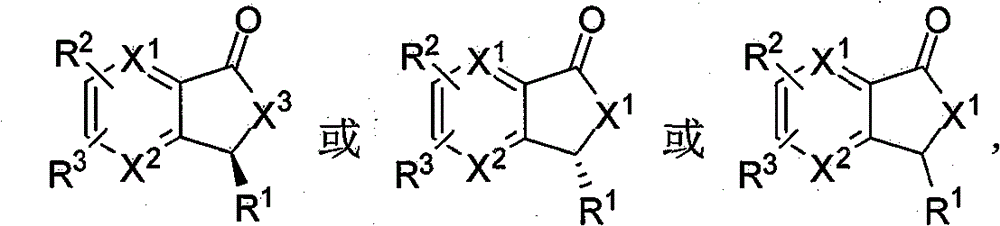
本发明涉及一种3-取代苯酞及其类似物用于制备治疗阿尔茨海默症以及其他神经性疾病的药物的用途,其结构式如下:式(1)、式(2)、式(3)通过目前集基因技术和生物技术为一体的高效生物模型进行了筛选,发现大部分的化合物都具有一定的缺陷个体恢复学习能力的作用,其中的几个特定化合物表现出了比较好的活性,能够使缺陷个体的学习能力恢复85%以上,并且在多轮实验中均能表现出稳定的治疗作用。The present invention relates to the use of a 3-substituted phthalide and its analogs for the preparation of medicines for treating Alzheimer's disease and other neurological diseases, and its structural formula is as follows: or or Formula (1), formula (2) and formula (3) have been screened through the current efficient biological model integrating gene technology and biotechnology, and found that most of the compounds have a certain effect on the restoration of learning ability of defective individuals, of which Several specific compounds have shown relatively good activity, which can restore more than 85% of the learning ability of deficient individuals, and can show stable therapeutic effects in multiple rounds of experiments.

Description

3-取代苯酞及其类似物的用途Uses of 3-substituted phthalides and their analogs

技术领域 technical field

本发明涉及一系列3-取代苯酞类化合物及其类似物的用途,尤其是作为制备预防和治疗阿尔茨海默症以及其他神经性疾病的药物的用途。  The invention relates to the use of a series of 3-substituted phthalide compounds and their analogues, especially the use as a medicine for the prevention and treatment of Alzheimer's disease and other neurological diseases. the

背景技术 Background technique

老年痴呆症,又称阿尔茨海默症(Alzheimer’s disease,AD)是发生在老年期及老年前期的一种原发性退行性脑病,指的是一种持续性高级神经功能活动障碍,即在没有意识障碍的状态下,记忆、思维、分析判断、视空间辨认、情绪等方面的障碍。其特征性病理变化为大脑皮层萎缩,并伴有β-淀粉样蛋白(β-amyloid,β-AP)沉积,神经原纤维缠结(neurofibrillary tangles,NFT),大量记忆性神经元数目减少,以及老年斑(senileplaque,SP)的形成。目前尚无特效治疗或逆转疾病进展的治疗药物。  Alzheimer's disease, also known as Alzheimer's disease (Alzheimer's disease, AD) is a kind of primary degenerative brain disease that occurs in old age and early old age, and refers to a kind of persistent high-level neurological dysfunction, that is, in the Obstacles in memory, thinking, analysis and judgment, visuospatial recognition, emotions, etc. without disturbance of consciousness. Its characteristic pathological changes are cerebral cortex atrophy, accompanied by β-amyloid (β-AP) deposition, neurofibrillary tangles (neurofibrillary tangles, NFT), a large number of memory neurons decreased, and The formation of senile plaques (senileplaque, SP). There are currently no therapeutic drugs that can specifically treat or reverse disease progression. the

随着社会的发展,人口老龄化速度正在加快。目前,全世界60岁以上人口有5.9亿人,到2020年可能突破10亿人大关。我国60岁以上人口1998年已达1.2亿人,并以年均3.2%的速度递增,大大高于人口增长速度。老年人口的不断增多,使得老年性痴呆症的发病率相对上升。目前,欧洲、日本和美国80岁以上的老年人中有20%以上的人患有此病。全世界65岁以上老年人中有5000多万人患有不同种类的痴呆症。我国近几年该病的发病率也在不断增加。据北京老年病医疗研究中心对北京地区60岁以上老人的调查发现,老年痴呆症的患病率达到75%,其中女性病人的患病率明显高于男性,高龄、低教育水平、居住在农村是老年性痴呆症的高发因素。  With the development of society, the speed of population aging is accelerating. At present, there are 590 million people over the age of 60 in the world, and it may exceed the 1 billion mark by 2020. The population over the age of 60 in my country reached 120 million in 1998, increasing at an average annual rate of 3.2%, much higher than the population growth rate. The increasing number of elderly people makes the incidence of Alzheimer's disease relatively increase. At present, more than 20% of the elderly over 80 years old in Europe, Japan and the United States suffer from this disease. Worldwide, more than 50 million people over the age of 65 suffer from various forms of dementia. In recent years, the incidence of the disease in our country is also increasing. According to a survey conducted by the Beijing Geriatrics Medical Research Center on the elderly over 60 years old in Beijing, the prevalence rate of Alzheimer's disease has reached 75%, and the prevalence rate of female patients is significantly higher than that of male patients. is a high risk factor for Alzheimer's disease. the

因此,抗老年痴呆药物的研究和开发引起了世界各国医药界的高度重视,尤其是近年来随着对老年神经生理、生化、药理等方面研究的不断深入,导致相关药物的开发研究不断取得进展,治疗老年性痴呆症药物的市场销售额也一直在稳步增长。成千上万的老年性痴呆症患者正迫切需要安全、有效、价廉的药物, 其市场潜力不可估量,前景看好。  Therefore, the research and development of anti-senile dementia drugs has attracted great attention from the medical circles all over the world, especially in recent years, with the continuous deepening of research on senile neurophysiology, biochemistry, and pharmacology, the research and development of related drugs has continuously made progress. , The market sales of drugs for the treatment of Alzheimer's disease have also been growing steadily. Thousands of senile dementia patients are in urgent need of safe, effective and cheap drugs, and their market potential is immeasurable and the prospects are promising. the

发明内容 Contents of the invention

本发明的目的是提供3-取代苯酞及其类似物的用途,特别是作为制备治疗阿尔茨海默症以及其他神经性疾病的潜在药物的用途。  The purpose of the present invention is to provide the use of 3-substituted phthalide and its analogues, especially as the preparation of potential drugs for treating Alzheimer's disease and other neurological diseases. the

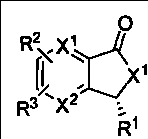
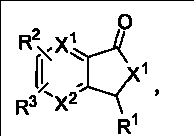
本发明所涉及的3-取代苯酞及其类似物具有如下的结构通式:  The 3-substituted phthalides and their analogs involved in the present invention have the following general structural formula:

Figure G2008102029672D0002180238QIETU
Figure G2008102029672D0002180252QIETU
or
Figure G2008102029672D0002180238QIETU
or
Figure G2008102029672D0002180252QIETU

        式(1)           式(2)            式(3)  Formula (1) Formula (2) Formula (3)

其中,式(3)表示为消旋体(racemate),即式(1)和式(2)的等比例混合物;  Wherein, formula (3) is expressed as a racemate (racemate), i.e. an equal proportion mixture of formula (1) and formula (2);

X1或和X2为CH或N;X3可以是O或NH;  X 1 or and X 2 are CH or N; X 3 can be O or NH;

R1可以是氢、卤素或C1~20的烃基;  R 1 can be hydrogen, halogen or C 1-20 hydrocarbon group;

所述的C1~20的烃基推荐R4或CH2R8,其中R8为H或R4,R4代表C1~8的烷基或烯基、C1~8的卤代烷基或烯基、苯基、萘基、蒽基、噻吩基、喹啉基、苯氧基、卤代苯氧基、苯硫基、卤代苯硫基、烯丙基,2-呋喃基、3-吡咯基、3-吲哚基、3-香豆素基、R5或/和R6或/和R7取代的苯基、R5或/和R6或/和R7取代的2-呋喃基、R5或/和R6或/和R7取代的3-吡咯基、R5或/和R6或/和R7取代的3-吲哚基、R5或/和R6或/和R7取代的3-香豆素基,或者R5或/和R6或/和R7取代的苯氧基;R5、R7为H或R6;R6为卤素、C1~4的烷基、C1~4的烷氧基、C1~4的烷硫基或C1~4的卤代烷基;  The C 1-20 hydrocarbon group recommends R 4 or CH 2 R 8 , wherein R 8 is H or R 4 , and R 4 represents C 1-8 alkyl or alkenyl, C 1-8 haloalkyl or alkenyl Base, phenyl, naphthyl, anthracenyl, thienyl, quinolinyl, phenoxy, halophenoxy, phenylthio, halophenylthio, allyl, 2-furyl, 3-pyrrole Base, 3-indolyl, 3-coumarinyl, R 5 or/and R 6 or/and R 7 substituted phenyl, R 5 or/and R 6 or/and R 7 substituted 2-furyl , R 5 or/and R 6 or/and R 7 substituted 3-pyrrolyl, R 5 or/and R 6 or/and R 7 substituted 3-indolyl, R 5 or/and R 6 or/and 3-coumarinyl substituted by R 7 , or phenoxy substituted by R 5 or/and R 6 or/and R 7 ; R 5 and R 7 are H or R 6 ; R 6 is halogen, C 1~4 C 1-4 alkyl group, C 1-4 alkoxy group, C 1-4 alkylthio group or C 1-4 haloalkyl group;

R2或和R3为氢、卤素、硝基、C1~4的烷基、C1~4的烷氧基、胺基、羧基、亚砜基、砜基、酰胺基或硫酰胺基,或者R2和R3为苯并基或-CH=CH-CH=CH-;  R 2 or and R 3 are hydrogen, halogen, nitro, C 1-4 alkyl, C 1-4 alkoxy, amine, carboxyl, sulfoxide, sulfone, amido or sulfamide, or R 2 and R 3 are benzo or -CH=CH-CH=CH-;

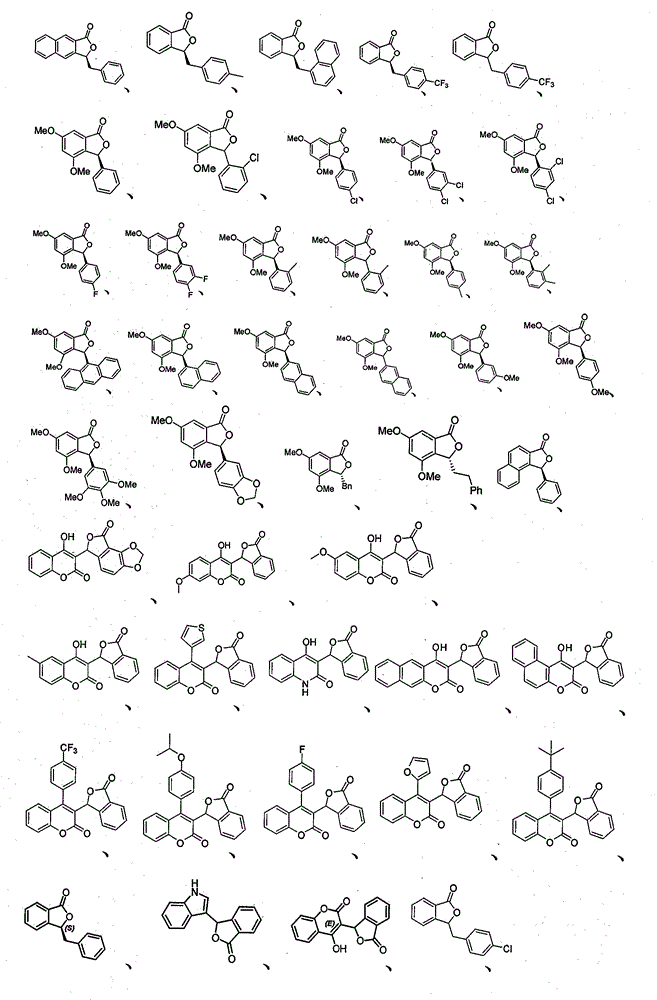
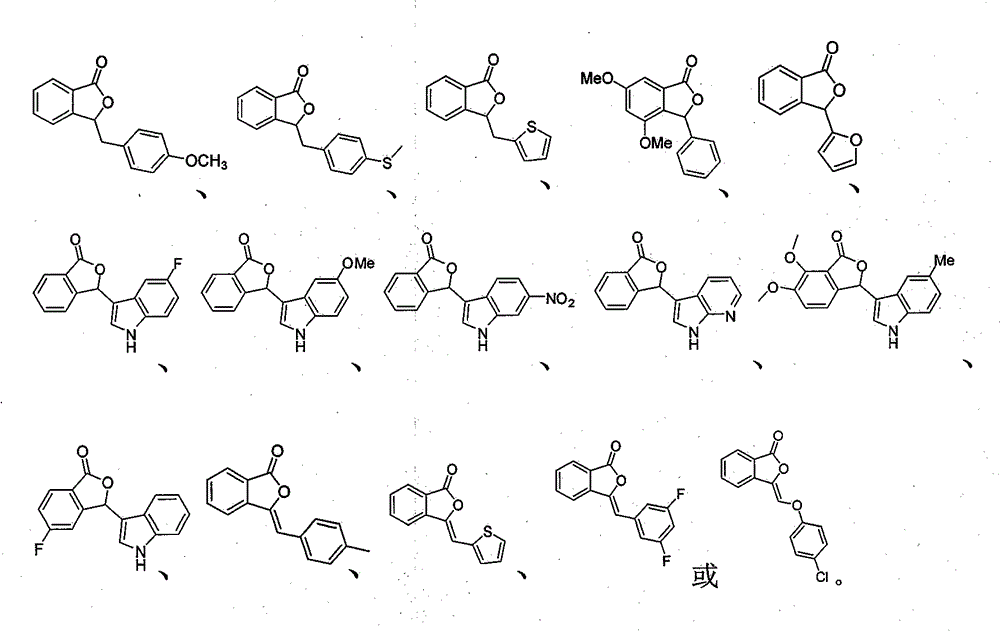
本发明所涉及的3-取代苯酞及其类似物的典型结构式如下:  The typical structural formulas of 3-substituted phthalides and their analogs involved in the present invention are as follows:

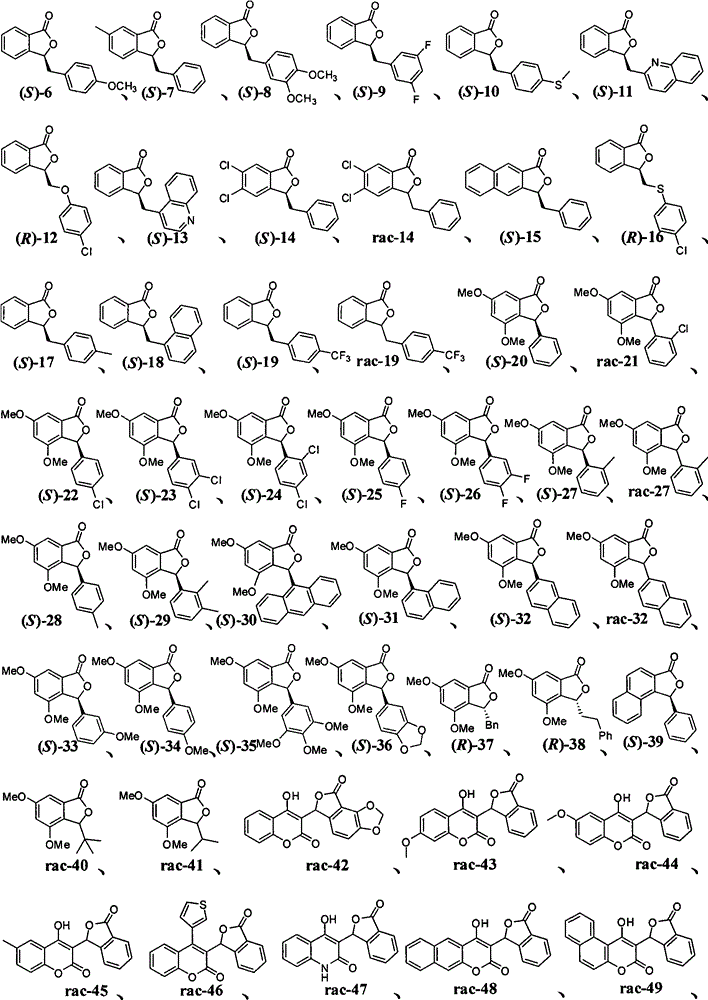
Figure G2008102029672D00024

Figure G2008102029672D00031

Figure G2008102029672D00041

Figure G2008102029672D00042
Figure G2008102029672D00043
Figure G2008102029672D00042
or
Figure G2008102029672D00043

本发明所涉及的3-取代苯酞及其类似物等通过果蝇(Drosophila)模型测定其生物活性用于治疗阿尔茨海默症(K lijima,H P Liu,A S Chiang,S A Hearn,MKonsolaki,Y Zhong,PNAS,2004,101,6623-6628;X Ge,F Hannan,Z L Xie,C H Feng,T Tully,H M Zhou,Z P Xie,Y Zhong,PNAS,2004,101,10172-10176)。在该模型中,正常的果蝇是具有一定的学习记忆能力的,而通过基因技术培养出的携带阿尔茨海默致病基因的果蝇个体,具有记忆缺陷。通过对突变缺陷果蝇用不同的化合物进行一段时间的给药,考察其记忆学习能力的恢复情况来筛选得到不同化合物的活性。  The 3-substituted phthalides and their analogs involved in the present invention are used to treat Alzheimer's disease (K lijima, H P Liu, A S Chiang, S A Hearn, M Konsolaki, Y Zhong, PNAS, 2004, 101, 6623-6628; X Ge, F Hannan, Z L Xie, CH Feng, T Tully, H M Zhou, Z P Xie, Y Zhong, PNAS, 2004, 101, 10172 -10176). In this model, normal fruit flies have a certain learning and memory ability, while the fruit flies carrying Alzheimer's disease-causing genes cultivated through genetic technology have memory defects. The activity of different compounds is screened by administering different compounds to mutant-defective Drosophila for a period of time and investigating the recovery of their memory and learning ability. the

本发明通过目前集基因技术和生物技术为一体的高效生物模型,经清华大学生命科学院的钟毅教授对一系列的3-取代苯酞及其类似物进行了筛选,发现大部 分的化合物都具有一定的缺陷个体恢复学习能力的作用,其中的几个特定化合物表现出了比较好的活性,能够使缺陷个体的学习能力恢复90%以上,并且在多轮实验中均能表现出稳定的治疗作用。基于此,我们认为3-取代苯酞及其类似物对于预防和治疗阿尔茨海默症以及其他神经性疾病具有一定的生物活性,其具有开发成为预防和治疗阿尔茨海默症以及其他神经性疾病的潜在药物分子的价值。  In the present invention, a series of 3-substituted phthalides and their analogs have been screened by Professor Zhong Yi from the School of Life Sciences of Tsinghua University through the current high-efficiency biological model integrating gene technology and biotechnology, and it is found that most of the compounds are It has the effect of restoring the learning ability of defective individuals, and several specific compounds in it have shown relatively good activity, which can restore more than 90% of the learning ability of defective individuals, and can show stable treatment in multiple rounds of experiments effect. Based on this, we believe that 3-substituted phthalides and their analogues have certain biological activities for the prevention and treatment of Alzheimer's disease and other neurological diseases, and they have the potential to be developed into the prevention and treatment of Alzheimer's disease and other neurological diseases. The value of potentially druggable molecules for disease. the

具体实施方法  Specific implementation method

通过下述实施例将有助于理解本发明,但并不限制本发明的内容。  The following examples will help to understand the present invention, but do not limit the content of the present invention. the

实施例1  3-取代苯酞类化合物的制备:  Example 1 Preparation of 3-substituted phthalides:

本发明说涉及的新型3-取代苯酞类化合物可以按照一下的两个方法进行制备,其中方法一用于制备手性的新型3-取代苯酞类化合物,而方法二用于制备消旋的新型3-取代苯酞类化合物。  The novel 3-substituted phthalide compounds involved in the present invention can be prepared according to the following two methods, wherein method one is used to prepare chiral novel 3-substituted phthalide compounds, and method two is used to prepare racemic Novel 3-substituted phthalides. the

方法一:在室温至80℃,底物浓度为0.5~1.25mol/L,在2~5当量还原剂甲酸盐、手性二胺配体与(对甲基异丙基)苯基二氯化钌二聚体的配合物催化剂催化下,底物摩尔数和催化剂摩尔数为100~500:1,反应4~24小时,通过柱层析纯化即以一定的产率和一定的光学纯度得到产物;反应通式如下:  Method 1: From room temperature to 80°C, with a substrate concentration of 0.5-1.25 mol/L, in 2-5 equivalents of reducing agent formate, chiral diamine ligand and (p-methylisopropyl)phenyl dichloride Under the catalysis of the complex catalyst of ruthenium dimer, the number of moles of the substrate and the number of moles of the catalyst are 100-500:1, react for 4-24 hours, and purify by column chromatography with a certain yield and a certain optical purity to obtain product; the general reaction formula is as follows:

Figure G2008102029672D00051
Figure G2008102029672D00052
Figure G2008102029672D00051
or
Figure G2008102029672D00052

其中,产物的主要构型决定于手性配体的构型,配体上取代基团的不同会影响产物的光学纯度;推荐的手性配体结构如下:R1、R2、R3、R5、R6、R7、X1和X2定义如前。  Among them, the main configuration of the product is determined by the configuration of the chiral ligand, and the difference in the substituent groups on the ligand will affect the optical purity of the product; the recommended chiral ligand structure is as follows: R 1 , R 2 , R 3 , R 5 , R 6 , R 7 , X 1 and X 2 are as defined above.
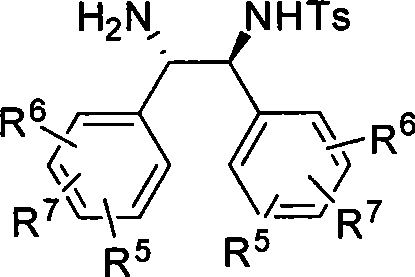
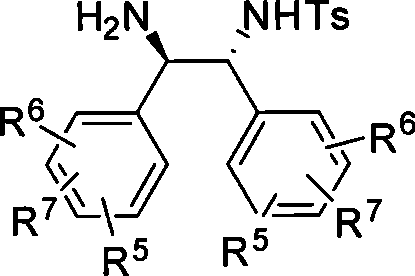
Figure G2008102029672D00053
Figure G2008102029672D00054
Figure G2008102029672D00053
or
Figure G2008102029672D00054

方法二:在室温下,底物溶解于甲醇中,在2~5当量还原剂如硼氢化钠或钯碳氢气条件下,反应0.5小时,通过柱层析纯化即以一定的产率消旋产物;反应 通式如下:  Method 2: Dissolve the substrate in methanol at room temperature, react for 0.5 hour under 2 to 5 equivalents of reducing agent such as sodium borohydride or palladium carbon hydrogen, and purify by column chromatography to racemize the product in a certain yield ; The reaction formula is as follows:

其中,R1、R2、R3、X1和X2定义如前。  Wherein, R 1 , R 2 , R 3 , X 1 and X 2 are as defined above.

实施例中新化合物数据如下表(表1):  New compound data are as follows table (table 1) in the embodiment:

表1  Table 1

   编号                                                                化合物数据 (S)-1 [α]D 24:-53.6(c 1.13,CHCl3)for 98.5%ee.1H NMR(300MHz,CDCl3):δ 1.61-1.76(m,2H),1.78-1.90(m,3H),2.07-2.13(m,1H),3.54(t,J=6.5Hz,2H),5.50(dd,J=3.9,7.5Hz,1H),7.45(d,J=7.5Hz,1H),7.54(t,J=7.4 Hz,IH),7.69(t,J=7.2Hz,1H),7.94(d,J=7.5Hz,IH).EI-MS(m/z,%):224(M+,2.77),133(100.00),105(61.36),77(40.43),51(27.16). (S)-2 [α]D 24:-74.9(c 0.78,CHCl3)for 99.3%ee.1H NMR(300MHz,CDCl3):δ3.21(d,J=6.0Hz,2H),5.67(t,J=6.0Hz,1H),7.13(d,J=7.2Hz,2H),7.23-7.28(m,3H),7.51(t,J=7.5Hz,1H),7.64(t,J=7.5Hz,IH),7.84(d,J=7.5Hz,1H).EI-MS(m/z,%):258(M+,8.94),133(100.00),125(12.16),105(14.53),77(14.50). (S)-3 1H NMR(300MHz,CDCl3):δ 2.43(s,3H),3.09-3.38(m,2H),5.65(t,J=6.3Hz,1H),7.02(d,J=8.1Hz,1H),7.20-7.31(m,5H),7.40(d,J=8.1Hz,IH),7.64(s,1H).HPLC:Chiracel OJ-H Column(250mm);detected at 214nm;n-hexane/i-propanol=95/5;flow=0.7mL/min;Retention time:38.4min(S),51.3min(R). (S)-4 [α]D 24:-56.0(c 0.82,CHCl3)for 98.5%ee.1H NMR(300MHz,CDCl3):δ 3.47(d,J=6.0Hz,2H),5.70(t,J=5.9Hz,IH),6.86(d,J=3.3Hz,1H),6.90-6.93(m,1H),7.15-7.17(m,1H),7.23-7.26(m,1H),7.51(t,J=7.4Hz, 1H),7.63(dt,J=1.1,7.5Hz,1H),7.86(d,J=7.8Hz,1H).EI-MS(m/z,%):230(M+,2.13),229(M+-1,12.63),175(7.84),131(100.00),103(30.56),91(57.86),57(36.36),41(24.31). (R)-4 [a]D 24:-54.2(c 0.79,CHCl3)for 95%ee. (R)-5 [α]D 24:-172.8(c 0.46,CH2Cl2)for 99.3%ee.1H NMR(400MHz,CDCl3):δ 3.43(dd,J=8.2,15.0Hz,1H),3.95(dd,J=3.2,14.8Hz,1H),6.17(dd,J=3.0,7.8Hz,IH),7.35(d,J=8.4Hz,1H),7.44-7.50(m,2H),7.66(t,J= 7.4Hz,IH),7.77(d,J=7.6Hz,1H),7.95(d,J=8.4Hz,1H),8.08(d,J=8.4Hz,1H),8.14(d,J=7.6Hz,1H),8.88(d,J=4.0Hz,1H).ESI-MS(M++H):277.2. rac-5 1H NMR(400MHz,CDCl3):δ 3.43(dd,J=8.2,15.0Hz,IH),3.95(dd,J=3.2,14.8Hz,1H),6.17(dd,J=3.0,7.8Hz,1H),7.35(d,J=8.4Hz,1H),7.44-7.50(m,2H),7.66(t,J=7.4Hz,1H),7.77(d,J=7.6Hz,IH),7.95(d,J=8.4Hz,IH),8.08(d,J=8.4Hz,1H),8.14(d,J=7.6Hz,1H),8.88(d,J=4.0Hz,1H). (S)-6 [a]D 24:-44.7(c 0.65,CHCl3)for 99.3%ee.1H NMR(300MHz,CDCl3):δ 3.10(dd,J=6.3,14.1Hz,1H),3.24(dd,J=6.3,14.4Hz,1H),3.79(s,3H),5.65(t,J=6.6Hz,1H),6.80-6.83(m,2H),7.10-7.13(m,2H),7.18(d,J= 8.1Hz,1H),7.49(t,J=7.5Hz,1H),7.60(dt,J=0.8,7.5Hz,1H),7.84(d,J=7.5Hz,1H).EI-MS(m/z,%):254(M+,2.79),133(4.05),121(100.00),77(10.15),51(4.18). (S)-7 1H NMR(300MHz,CDCl3):δ 2.44(s,3H),3.13-3.26(m,2H),5.63(t,J=6.6Hz,1H),6.99(s,1H),7.20-7.31(m,6H),7.73(d,J=7.8Hz,IH).HPLC:Chiracel OJ-H Column(250mm);detected at 214nm;n-hexane/i-propanol=95/5;flow=0.7mL/min;Retention time:47.7min(S),72.9min(R). (S)-8 [α]D 24:-49.5(c 0.92,CHCl3)for 99.2%ee.1H NMR(300MHz,CDCl3):δ 3.12(dd,J=6.0,14.1Hz,1H),3.25 (dd,J=6.3,14.1Hz,IH),3.81(s,3H),3.85(s,3H),5.69(t,J=6.0Hz,1H),6.68-6.79(m,3H),7.20(d,J=7.5 serial number Compound Data (S)-1 [α] D 24 : -53.6 (c 1.13, CHCl 3 ) for 98.5%ee. 1 H NMR (300 MHz, CDCl 3 ): δ 1.61-1.76 (m, 2H), 1.78-1.90 (m, 3H), 2.07 -2.13(m, 1H), 3.54(t, J=6.5Hz, 2H), 5.50(dd, J=3.9, 7.5Hz, 1H), 7.45(d, J=7.5Hz, 1H), 7.54(t, J=7.4 Hz, IH), 7.69 (t, J=7.2Hz, 1H), 7.94 (d, J=7.5Hz, IH). EI-MS (m/z, %): 224 (M + , 2.77) , 133 (100.00), 105 (61.36), 77 (40.43), 51 (27.16). (S)-2 [α] D 24 : -74.9 (c 0.78, CHCl 3 ) for 99.3%ee. 1 H NMR (300 MHz, CDCl 3 ): δ3.21 (d, J=6.0Hz, 2H), 5.67 (t, J= 6.0Hz, 1H), 7.13(d, J=7.2Hz, 2H), 7.23-7.28(m, 3H), 7.51(t, J=7.5Hz, 1H), 7.64(t, J=7.5Hz, IH) , 7.84 (d, J=7.5Hz, 1H). EI-MS (m/z, %): 258 (M + , 8.94), 133 (100.00), 125 (12.16), 105 (14.53), 77 (14.50 ). (S)-3 1 H NMR (300MHz, CDCl 3 ): δ 2.43(s, 3H), 3.09-3.38(m, 2H), 5.65(t, J=6.3Hz, 1H), 7.02(d, J=8.1Hz, 1H) , 7.20-7.31 (m, 5H), 7.40 (d, J=8.1Hz, IH), 7.64 (s, 1H).HPLC: Chiracel OJ-H Column (250mm); detected at 214nm; n-hexane/i- propanol=95/5; flow=0.7mL/min; Retention time: 38.4min(S), 51.3min(R). (S)-4 [α] D 24 : -56.0 (c 0.82, CHCl 3 ) for 98.5%ee. 1 H NMR (300 MHz, CDCl 3 ): δ 3.47 (d, J=6.0Hz, 2H), 5.70 (t, J=5.9 Hz, IH), 6.86(d, J=3.3Hz, 1H), 6.90-6.93(m, 1H), 7.15-7.17(m, 1H), 7.23-7.26(m, 1H), 7.51(t, J= 7.4Hz, 1H), 7.63 (dt, J = 1.1, 7.5Hz, 1H), 7.86 (d, J = 7.8Hz, 1H). EI-MS (m/z, %): 230 (M + , 2.13) , 229(M + -1, 12.63), 175(7.84), 131(100.00), 103(30.56), 91(57.86), 57(36.36), 41(24.31). (R)-4 [a] D 24 : -54.2 (c 0.79, CHCl 3 ) for 95% ee. (R)-5 [α] D 24 : -172.8 (c 0.46, CH 2 Cl 2 ) for 99.3%ee. 1 H NMR (400 MHz, CDCl 3 ): δ 3.43 (dd, J=8.2, 15.0 Hz, 1H), 3.95 (dd , J=3.2, 14.8Hz, 1H), 6.17(dd, J=3.0, 7.8Hz, IH), 7.35(d, J=8.4Hz, 1H), 7.44-7.50(m, 2H), 7.66(t, J=7.4Hz, IH), 7.77(d, J=7.6Hz, 1H), 7.95(d, J=8.4Hz, 1H), 8.08(d, J=8.4Hz, 1H), 8.14(d, J= 7.6Hz, 1H), 8.88 (d, J = 4.0Hz, 1H). ESI-MS (M + +H): 277.2. rac-5 1 H NMR (400MHz, CDCl 3 ): δ 3.43 (dd, J=8.2, 15.0Hz, IH), 3.95 (dd, J=3.2, 14.8Hz, 1H), 6.17 (dd, J=3.0, 7.8Hz, 1H), 7.35(d, J=8.4Hz, 1H), 7.44-7.50(m, 2H), 7.66(t, J=7.4Hz, 1H), 7.77(d, J=7.6Hz, IH), 7.95( d, J=8.4Hz, IH), 8.08(d, J=8.4Hz, 1H), 8.14(d, J=7.6Hz, 1H), 8.88(d, J=4.0Hz, 1H). (S)-6 [a] D 24 : -44.7 (c 0.65, CHCl 3 ) for 99.3%ee. 1 H NMR (300 MHz, CDCl 3 ): δ 3.10 (dd, J=6.3, 14.1 Hz, 1H), 3.24 (dd, J =6.3, 14.4Hz, 1H), 3.79(s, 3H), 5.65(t, J=6.6Hz, 1H), 6.80-6.83(m, 2H), 7.10-7.13(m, 2H), 7.18(d, J=8.1Hz, 1H), 7.49(t, J=7.5Hz, 1H), 7.60(dt, J=0.8, 7.5Hz, 1H), 7.84(d, J=7.5Hz, 1H).EI-MS( m/z, %): 254 (M + , 2.79), 133 (4.05), 121 (100.00), 77 (10.15), 51 (4.18). (S)-7 1 H NMR (300MHz, CDCl 3 ): δ 2.44(s, 3H), 3.13-3.26(m, 2H), 5.63(t, J=6.6Hz, 1H), 6.99(s, 1H), 7.20-7.31( m, 6H), 7.73 (d, J=7.8Hz, IH).HPLC: Chiracel OJ-H Column (250mm); detected at 214nm; n-hexane/i-propanol=95/5; flow=0.7mL/min ;Retention time: 47.7min(S), 72.9min(R). (S)-8 [α] D 24 : -49.5 (c 0.92, CHCl 3 ) for 99.2%ee. 1 H NMR (300 MHz, CDCl 3 ): δ 3.12 (dd, J=6.0, 14.1 Hz, 1H), 3.25 (dd, J =6.3, 14.1Hz, 1H), 3.81(s, 3H), 3.85(s, 3H), 5.69(t, J=6.0Hz, 1H), 6.68-6.79(m, 3H), 7.20(d, J= 7.5

[0035]      Hz,1H),7.49(t,J=7.5Hz,1H),7.60(t,J=7.5Hz,1H),7.83(d,J=7.2Hz,1H).EI-MS(m/z,%):284(M+,6.57),151(100.00),133(5.73),107(6.91),77(7.59),51(4.33). (S)-9 [a]D 24:-84.4(c 0.71,CHCl3)for 99.1%ee.1H NMR(300MHz,CDCl3):δ 3.15(dd,J=6.6,14.1Hz,1H),3.26(dd,J=5.1,14.4Hz,1H),5.68(t,J=6.2Hz,1H),6.67-6.78(m,3H),7.33(d,J=7.8Hz,1H),7.54(t,J=7.5Hz, 1H),7.68(t,J=7.5Hz,1H),7.88(d,J=7.5Hz,1H).EI-MS(m/z,%):260(M+,1.74),133(100.00),105(14.38),77(14.52),51(6.53). (S)-10 [α]D 24:-51.9(c 1.05,CHCl3)for 99.2%ee.1H NMR(300MHz,CDCl3):δ 2.46(s,3H),3.14(dd,J=6.5,14.0Hz,1H),3.23(dd,J=6.5,14.0Hz,1H),5.66(t,J=6.3Hz,1H),7.11-7.23(m,5H),7.49(t,J=7.7Hz,1H),7.61(t,J =7.4Hz,1H),7.84(d,J=7.5Hz,1H).EI-MS(m/z,%):270(M+,7.44),137(100.00),122(10.81),105(5.27),91(6.06),77(10.75). (S)-11 [α]D 24:26.2(c 0.80,CHCl3)for 34.8%ee.1H NMR(400MHz,CDCl3):δ 3.46(dd,J=8.0,14.4Hz,1H),3.53(dd,J=5.6,14.4Hz,1H),6.16(t,J=6.6Hz,1H),7.35(d,J=8.0Hz,2H),7.46-7.53(m,2H),7.58(t,J=7.4Hz,1H), 7.67-7.71(m,1H),7.79(d,J=8.0Hz,1H),7.87(d,J=7.6Hz,1H),8.03(d,J=8.4Hz,1H),8.10(d,J=8.4Hz,1H).ESI-MS(M++Na):298.0,(M++H):276.0. (R)-12 [α]D 24:+14.6(c 0.71,CHCl3)for 98.0%ee.1H NMR(300MHz,CDCl3):δ 4.26(dd,J=5.1,9.9Hz,1H),4.34(dd,J=5.6,10.1Hz,1H),5.78(t,J=5.3Hz,1H),6.81-6.84(m,2H),7.22-7.25(m,2H),7.60-7.63(m,2H), 7.69-7.75(m,1H),7.96(d,J=7.2Hz,1H).EI-MS(m/z,%):274(M+,39.68),147(30.46),133(100.00),119(26.22),91(25.01),77(18.08). (S)-13 [α]D 24:-69.2(c 0.76,CHCl3)for 92.8%ee.1H NMR(300MHz,CDCl3):δ 3.66(d,J=6.9Hz,2H),5.89(t,J=6.8Hz,1H),7.23(d,J=7.8Hz,1H),7.36(d,J=4.5Hz,1H),7.55(t,J=7.48Hz,1H),7.61-7.65(m,2H),7.76(t,J= 7.5Hz,1H),7.91(d,J=7.2Hz,1H),8.08(d,J=8.7Hz,1H),8.17(d,J=8.4Hz,1H),8.88(d,J=4.2Hz,1H).ESI-MS(M++H):276.2. (S)-14 [α]D 24:-73.6(c 0.61,CHCl3)for 98.3%ee.1H NMR(300MHz,CDCl3):δ 3.12(dd,J=6.6,14.1Hz,1H),3.31(dd,J=6.3,14.1Hz,1H),5.65(t,J=6.3Hz,1H),7.18-7.21(m,3H),7.29-7.36(m,3H),7.91(s,1H).EI-MS(m/z,%):292(M+,8.38),201(47.11),145(8.92),109(9.44),91(100.00),65(15.14). rac-14 1H NMR(300MHz,CDCl3):δ 3.12(dd,J=6.6,14.1Hz,1H),3.31(dd,J=6.3,14.1Hz,1H),5.65(t,J=6.3Hz, 1H),7.18-7.21(m,3H),7.29-7.36(m,3H),7.91(s,1H). (S)-15 [α]D 24:-121.8(c 0.75,CHCl3)for 97.7 %ee.1H NMR(300MHz,CDCl3):δ 3.24(dd,J=6.0,14.1Hz,1H),3.37(dd,J=6.5,14.0Hz,1H),5.86(t,J=6.6Hz,1H),7.26-7.33(m,5H),7.57-7.67(m,3H),7.87(d,J=8.1Hz,1H),8.01(d,J=7.8Hz,1H),8.43(s,1H).EI-MS(m/z,%):274(M+,8.66),183(100.00),155(11.97),127(22.32). (R)-16 [α]D 24:+14.7(c 0.93,CHCl3)for 97.8 %ee.1H NMR(300MHz,CDCl3):δ 3.37(dd,J=6.0,14.1Hz,1H),3.50(dd,J=5.0,14.0Hz,1H),5.60(t,J=5.4Hz,1H),7.21-7.30(m,4H),7.52-7.65(m,3H),7.90(d,J=7.2Hz,1H)EI-MS(m/z,%):290(M+,35.86),157(100.00),133(75.89),105(15.56),77(21.64),51(9.59). (S)-17 [α]D 24:-45.0(c 0.68,CHCl3)for 99.0 %ee.1H NMR(300MHz,CDCl3):δ 2.32(s,3H),3.10(dd,J=6.4,14.3Hz,1H),3.25(dd,J=6.6,14.1Hz,1H),5.66(t,J=6.5Hz,1H),7.09(s,4H),7.16(d,J=8.4Hz,1H),7.48(t,J=7.5 Hz,1H),7.59(t,J=7.6Hz,1H),7.84(d,J=7.8Hz,1H).EI-MS(m/z,%):238(M+,9.09),133(36.56),105(100.00),77(21.10),51(8.51). (S)-18 [α]D 24:-28.1(c 0.78,CHCl3)for 99.2 %ee.1H NMR(300MHz,CDCl3):δ 3.46(dd,J=7.2,14.4Hz,1H),3.75(dd,J=7.2,14.4Hz,1H),5.82(t,J=6.8Hz,1H),6.96(d,J=7.2Hz,1H),7.34(d,J=6.6Hz,1H),7.43(t,J= 7.7Hz,1H),7.48-7.62(m,4H),7.81(d,J=8.4Hz,1H),7.88(d,J=6.9Hz,2H),8.07(d,J=8.4Hz,1H).EI-MS(m/z,%):274(M+,13.80),141(100.00),133(20.29),115(12..22),105(5.33),77(6.38). (S)-19 [α]D 24:-79.2(c 0.89,CHCl3)for 98.5 %ee.1H NMR(300MHz,CDCl3):δ 3.24(dd,J=6.9,13.8Hz,1H),3.35(dd,J=5.4,14.1Hz,1H),5.72(t,J=6.2Hz,1H),7.30-7.36(m,3H),7.50-7.55(m,3H),7.64-7.69(m,1H),7.85(d,J=7.8Hz,1H).EI-MS(m/z,%):292(M+,0.76),273(1.13),133(100.00),105(13.61),77(16.01),51(8.34). [0035] Hz, 1H), 7.49(t, J=7.5Hz, 1H), 7.60(t, J=7.5Hz, 1H), 7.83(d, J=7.2Hz, 1H).EI-MS (m/z, % ): 284 (M + , 6.57), 151 (100.00), 133 (5.73), 107 (6.91), 77 (7.59), 51 (4.33). (S)-9 [a] D 24 : -84.4 (c 0.71, CHCl 3 ) for 99.1%ee. 1 H NMR (300 MHz, CDCl 3 ): δ 3.15 (dd, J=6.6, 14.1 Hz, 1H), 3.26 (dd, J =5.1, 14.4Hz, 1H), 5.68(t, J=6.2Hz, 1H), 6.67-6.78(m, 3H), 7.33(d, J=7.8Hz, 1H), 7.54(t, J=7.5Hz , 1H), 7.68(t, J=7.5Hz, 1H), 7.88(d, J=7.5Hz, 1H).EI-MS (m/z,%): 260(M + , 1.74), 133(100.00 ), 105(14.38), 77(14.52), 51(6.53). (S)-10 [α] D 24 : -51.9 (c 1.05, CHCl 3 ) for 99.2%ee. 1 H NMR (300 MHz, CDCl 3 ): δ 2.46 (s, 3H), 3.14 (dd, J=6.5, 14.0 Hz, 1H ), 3.23(dd, J=6.5, 14.0Hz, 1H), 5.66(t, J=6.3Hz, 1H), 7.11-7.23(m, 5H), 7.49(t, J=7.7Hz, 1H), 7.61 (t, J = 7.4Hz, 1H), 7.84 (d, J = 7.5Hz, 1H). EI-MS (m/z, %): 270 (M + , 7.44), 137 (100.00), 122 (10.81 ), 105(5.27), 91(6.06), 77(10.75). (S)-11 [α] D 24 : 26.2 (c 0.80, CHCl 3 ) for 34.8%ee. 1 H NMR (400 MHz, CDCl 3 ): δ 3.46 (dd, J=8.0, 14.4Hz, 1H), 3.53 (dd, J= 5.6, 14.4Hz, 1H), 6.16(t, J=6.6Hz, 1H), 7.35(d, J=8.0Hz, 2H), 7.46-7.53(m, 2H), 7.58(t, J=7.4Hz, 1H), 7.67-7.71(m, 1H), 7.79(d, J=8.0Hz, 1H), 7.87(d, J=7.6Hz, 1H), 8.03(d, J=8.4Hz, 1H), 8.10( d, J=8.4Hz, 1H). ESI-MS (M + +Na): 298.0, (M + +H): 276.0. (R)-12 [α] D 24 : +14.6 (c 0.71, CHCl 3 ) for 98.0%ee. 1 H NMR (300 MHz, CDCl 3 ): δ 4.26 (dd, J=5.1, 9.9 Hz, 1H), 4.34 (dd, J =5.6, 10.1Hz, 1H), 5.78(t, J=5.3Hz, 1H), 6.81-6.84(m, 2H), 7.22-7.25(m, 2H), 7.60-7.63(m, 2H), 7.69- 7.75 (m, 1H), 7.96 (d, J=7.2Hz, 1H). EI-MS (m/z, %): 274 (M + , 39.68), 147 (30.46), 133 (100.00), 119 ( 26.22), 91(25.01), 77(18.08). (S)-13 [α] D 24 : -69.2 (c 0.76, CHCl 3 ) for 92.8%ee. 1 H NMR (300 MHz, CDCl 3 ): δ 3.66 (d, J=6.9Hz, 2H), 5.89 (t, J=6.8 Hz, 1H), 7.23(d, J=7.8Hz, 1H), 7.36(d, J=4.5Hz, 1H), 7.55(t, J=7.48Hz, 1H), 7.61-7.65(m, 2H), 7.76(t, J=7.5Hz, 1H), 7.91(d, J=7.2Hz, 1H), 8.08(d, J=8.7Hz, 1H), 8.17(d, J=8.4Hz, 1H), 8.88( d, J=4.2Hz, 1H).ESI-MS (M + +H): 276.2. (S)-14 [α] D 24 : -73.6 (c 0.61, CHCl 3 ) for 98.3%ee. 1 H NMR (300 MHz, CDCl 3 ): δ 3.12 (dd, J=6.6, 14.1 Hz, 1H), 3.31 (dd, J =6.3, 14.1Hz, 1H), 5.65(t, J=6.3Hz, 1H), 7.18-7.21(m, 3H), 7.29-7.36(m, 3H), 7.91(s, 1H).EI-MS( m/z, %): 292 (M + , 8.38), 201 (47.11), 145 (8.92), 109 (9.44), 91 (100.00), 65 (15.14). rac-14 1 H NMR (300MHz, CDCl 3 ): δ 3.12(dd, J=6.6, 14.1Hz, 1H), 3.31(dd, J=6.3, 14.1Hz, 1H), 5.65(t, J=6.3Hz, 1H) , 7.18-7.21(m, 3H), 7.29-7.36(m, 3H), 7.91(s, 1H). (S)-15 [α] D 24 : -121.8 (c 0.75, CHCl 3 ) for 97.7 %ee. 1 H NMR (300 MHz, CDCl 3 ): δ 3.24 (dd, J=6.0, 14.1 Hz, 1H), 3.37 (dd, J =6.5, 14.0Hz, 1H), 5.86(t, J=6.6Hz, 1H), 7.26-7.33(m, 5H), 7.57-7.67(m, 3H), 7.87(d, J=8.1Hz, 1H) , 8.01 (d, J=7.8Hz, 1H), 8.43 (s, 1H). EI-MS (m/z, %): 274 (M + , 8.66), 183 (100.00), 155 (11.97), 127 (22.32). (R)-16 [α] D 24 : +14.7 (c 0.93, CHCl 3 ) for 97.8 %ee. 1 H NMR (300 MHz, CDCl 3 ): δ 3.37 (dd, J=6.0, 14.1 Hz, 1H), 3.50 (dd, J =5.0, 14.0Hz, 1H), 5.60(t, J=5.4Hz, 1H), 7.21-7.30(m, 4H), 7.52-7.65(m, 3H), 7.90(d, J=7.2Hz, 1H) EI-MS (m/z, %): 290 (M + , 35.86), 157 (100.00), 133 (75.89), 105 (15.56), 77 (21.64), 51 (9.59). (S)-17 [α] D 24 : -45.0 (c 0.68, CHCl 3 ) for 99.0 %ee. 1 H NMR (300 MHz, CDCl 3 ): δ 2.32 (s, 3H), 3.10 (dd, J=6.4, 14.3 Hz, 1H ), 3.25(dd, J=6.6, 14.1Hz, 1H), 5.66(t, J=6.5Hz, 1H), 7.09(s, 4H), 7.16(d, J=8.4Hz, 1H), 7.48(t , J=7.5 Hz, 1H), 7.59 (t, J=7.6Hz, 1H), 7.84 (d, J=7.8Hz, 1H).EI-MS (m/z, %): 238 (M + , 9.09 ), 133(36.56), 105(100.00), 77(21.10), 51(8.51). (S)-18 [α] D 24 : -28.1 (c 0.78, CHCl 3 ) for 99.2 %ee. 1 H NMR (300 MHz, CDCl 3 ): δ 3.46 (dd, J=7.2, 14.4 Hz, 1H), 3.75 (dd, J =7.2, 14.4Hz, 1H), 5.82(t, J=6.8Hz, 1H), 6.96(d, J=7.2Hz, 1H), 7.34(d, J=6.6Hz, 1H), 7.43(t, J = 7.7Hz, 1H), 7.48-7.62(m, 4H), 7.81(d, J=8.4Hz, 1H), 7.88(d, J=6.9Hz, 2H), 8.07(d, J=8.4Hz, 1H ). EI-MS (m/z, %): 274 (M + , 13.80), 141 (100.00), 133 (20.29), 115 (12..22), 105 (5.33), 77 (6.38). (S)-19 [α] D 24 : -79.2 (c 0.89, CHCl 3 ) for 98.5 %ee. 1 H NMR (300 MHz, CDCl 3 ): δ 3.24 (dd, J=6.9, 13.8 Hz, 1H), 3.35 (dd, J =5.4, 14.1Hz, 1H), 5.72(t, J=6.2Hz, 1H), 7.30-7.36(m, 3H), 7.50-7.55(m, 3H), 7.64-7.69(m, 1H), 7.85( d, J=7.8Hz, 1H). EI-MS (m/z, %): 292 (M + , 0.76), 273 (1.13), 133 (100.00), 105 (13.61), 77 (16.01), 51 (8.34).

[0036]    rac-19 1H NMR(300MHz,CDCl3):δ 3.24(dd,J=6.9,13.8Hz,1H),3.35(dd,J=5.4,14.1Hz,1H),5.72(t,J=6.2Hz, 1H),7.30-7.36(m,3H),7.50-7.55(m,3H),7.64-7.69(m,1H),7.85(d,J=7.8Hz,1H). (S)-20 [α]D 20+24.59(c 1.14,CHCl3)(for 69 %ee)1H NMR(300MHz,CDCl3)δ(ppm)7.37-7.23(m,5H,Ph),6.98(d,J=1.8Hz,1H,Ph),6.65(d,J=1.8Hz,1H,Ph),6.34(s,1H,CH),3.87(s,3H,OMe),3.70(s,3H,OMe);ESI-MS(m/z,%):271.2(M++H),293.1(M++Na); rac-21 1H NMR(300MHz,CDCl3)δ(ppm)7.42(d,J=7.8Hz,1H,Ph),7.27(t,J=8.1Hz,1H,Ph),7.14(t,J=7.5Hz,1H,Ph),6.98(d,J=1.8Hz,1H,Ph),6.86(dd,J1=7.8Hz,J2=1.5Hz1H,Ph),6.80(s,1H,CH),6.66(d,J=1.8Hz,1H,Ph),3.87(s,3H,OMe),3.69(s,3H,OMe); (S)-22 [α]D 20+22.66(c 1.65CHCl3)(for 73 %ee)1H NMR(300MHz,CDCl3)δ(ppm)7.30(d,J=8.7Hz,2H,Ph),7.19(d,J=8.4Hz,2H,Ph),6.96(d,J=2.1Hz,1H,Ph),6.65(d,J=1.5Hz,1H,Ph),6.30(s,1H,CH),3.87(s,3H,OMe),3.71(s,3H,OMe);ESI-MS(m/z,%):305(M++H),327(M++Na); (S)-23 [α]D 20+9.14(c 2.73,CHCl3)(for 80% ee)1H NMR(300MHz,CDCl3)δ(ppm)7.40(d,J=8.7Hz,1H,Ph),7.34(d,J=1.8Hz,1H,Ph),7.12(dd,J1=8.1Hz,J2=2.1Hz,1H,Ph),6.96(d,J=1.8Hz,1H,Ph),6.66(d,J=1.5Hz,1H,Ph),6.26(s,1H,Ph),3.87(s,3H,OMe),3.73(s,3H,OMe);ESI-MS(m/z,%):339(M++H),361(M++Na); (S)-24 [α]D 20+32.67(c 0.84,CHCl3)(for 78%ee)1H NMR(300MHz,CDCl3)δ(ppm)7.43(s,1H,Ph),7.12(d,J=8.1Hz,1H,Ph),6.96(s,1H,Ph),6.79(d,J=8.4Hz,1H,Ph),6.71(s,1H,Ph),6.67(s,1H,Ph),3.86(s,3H,OMe),3.70(s,3H,OMe);ESI-MS(m/z,%):339(M++H),361(M++Na); (S)-25 [α]D 20+23.82(c 1.9,CHCl3)(for 74% ee)1H NMR(300MHz,CDCl3)δ(ppm)7.28-7.21(m,2H,Ph),7.04-6.97(m,3H,Ph),6.66(d,J=2.1Hz,1H,Ph),6.31(s,1H,CH),3.87(s,3H,OMe),3.71(s,3H,OMe);ESI-MS(m/z,%):289(M++H),311(M++Na); (S)-26 [α]D 20+18.72(c 2.05,CHCl3)(for 80%ee)1H NMR(300MHz,CDCl3)δ(ppm)7.15-7.00(m,3H,Ph),6.93(d,J=2.1Hz,1H,Ph),6.65(d,J=1.8Hz,1H,Ph),6.25(s,1H,CH),3.84(s,3H,OMe),3.71(s,3H,OMe);ESI-MS(m/z,%):307(M++H),329(M++Na); (S)-27 [α]D 20+64.96(c 1.05CHCl3)(for 76%ee)1H NMR(300MHz,CDCl3)δ(ppm)7.23-7.22(m,2H,Ph),7.11-7.05(m,1H,Ph),7.00(d,J=1.8Hz,1H,Ph),6.79(d,J=7.2Hz,1H,Ph),6.60(s,1H,CH)3.89(s,3H,OMe),3.70(s,3H,OMe),2.54(s,3H,Me);ESI-MS(m/z,%):285(M++H),307(M++Na); rac-27 1H NMR(300MHz,CDCl3)δ(ppm)7.23-7.22(m,2H,Ph),7.11-7.05(m,1H,Ph),7.00(d,J=1.8Hz,1H,Ph), 6.79(d,J=7.2Hz,1H,Ph),6.60(s,1H,CH)3.89(s,3H,OMe),3.70(s,3H,OMe),2.54(s,3H,Me) (S)-28 [α]D 20+26.22(c 1.01CHCl3)(for 67%ee)1H NMR(300MHz,CDCl3)δ(ppm)7.13(s,4H,Ph),6.97(s,1H,Ph),6.65(s,1H,Ph),6.31(s,1H,CH),3.87(s,3H,OMe),3.70(s,3H,OMe);ESI-MS(m/z,%):285(M++H),307(M++Na); (S)-29 [α]D 20+114.20(c 0.7CHCl3)(for 76%ee)1H NMR(300MHz,CDCl3)δ(ppm)7.14(d,J=7.2Hz,1H,Ph),6.99-6.94(m,2H,Ph),6.70(d,J=1.5Hz,1H,Ph),6.68(s,1H,Ph),6.62(d,J=7.5Hz,1H,CH),3.88(s,3H,OMe),3.71(s,3H,OMe),2.46(s,3H,Me),2.34(s,3H,Me);ESI-MS(m/z,%):299(M++H),321(M++Na); (S)-30 [α]D 20-88.59(c 0.72CHCl3)(for 86%ee)1H NMR(300MHz,CDCl3)δ(ppm)8.51-848(m,2H,Ph),8.03(d,J=8.4Hz,1H,Ph),7.94(d,J=8.1Hz,1H,Ph),7.83(s,1H,Ph),7.58(t,J=7.2Hz,1H,Ph),7.49(t,J=7.8Hz,1H, Ph),7.38-7.30(m,2H,Ph),7.19-7.14(m,2H,Ph),7.57(d,J=1.5Hz,1H,CH),3.91(s,3H,OMe),3.28(s,3H,OMe);ESI-MS(m/z,%):371(M++H),393(M++Na); (S)-31 [α]D 20+248.07(c 0.95 CHCl3)(for 78%ee)1H NMR(300MHz,CDCl3)δ(ppm)8.33(d,J=8.4Hz,1H,Ph),7.88(t,J=9.6Hz,2H,Ph),7.64-7.52(m,2H,Ph),7.34(t,J=7.2Hz,1H,Ph),7.15(s,1H,Ph),7.05(d,J=1.8Hz,1H, Ph),7.02(s,1H,Ph),6.75(d,J=1.8Hz,1H,CH),3.91(s,3H,OMe),3.68(s,3H,OMe);ESI-MS(m/z,%):321(M++H),343(M++Na); (S)-32 [α]D 20-11.63(c 0.80 CHCl3)(for 75%ee)1H NMR(300MHz,CDCl3)δ(ppm)7.83-7.77(m,5H,Ph),7.50-7.47 (m,2H,Ph),7.27-7.24(m,1H,Ph),7.02(d,J=1.5Hz,1H,Ph),6.65(d,J=1.8Hz,1H,Ph),6.50(s,1H,CH), [0036] rac-19 1 H NMR (300MHz, CDCl 3 ): δ 3.24(dd, J=6.9, 13.8Hz, 1H), 3.35(dd, J=5.4, 14.1Hz, 1H), 5.72(t, J=6.2Hz, 1H) , 7.30-7.36(m, 3H), 7.50-7.55(m, 3H), 7.64-7.69(m, 1H), 7.85(d, J=7.8Hz, 1H). (S)-20 [α] D 20 +24.59 (c 1.14, CHCl 3 ) (for 69 %ee) 1 H NMR (300 MHz, CDCl 3 ) δ (ppm) 7.37-7.23 (m, 5H, Ph), 6.98 (d, J= ESI - MS (m/z, %): 271.2 (M + +H), 293.1 (M + +Na); rac-21 1 H NMR (300MHz, CDCl 3 ) δ(ppm) 7.42(d, J=7.8Hz, 1H, Ph), 7.27(t, J=8.1Hz, 1H, Ph), 7.14(t, J=7.5Hz, 1H, Ph), 6.98(d, J=1.8Hz, 1H, Ph), 6.86(dd, J1 =7.8Hz, J2 =1.5Hz1H, Ph), 6.80(s, 1H, CH), 6.66(d , J=1.8Hz, 1H, Ph), 3.87(s, 3H, OMe), 3.69(s, 3H, OMe); (S)-22 [α] D 20 +22.66(c 1.65CHCl 3 )(for 73%ee) 1 H NMR (300MHz, CDCl 3 )δ(ppm) 7.30(d, J=8.7Hz, 2H, Ph), 7.19(d, J=8.4Hz, 2H, Ph), 6.96(d, J=2.1Hz, 1H, Ph), 6.65(d, J=1.5Hz, 1H, Ph), 6.30(s, 1H, CH), 3.87(s , 3H, OMe), 3.71 (s, 3H, OMe); ESI-MS (m/z, %): 305 (M + +H), 327 (M + +Na); (S)-23 [α] D 20 +9.14(c 2.73, CHCl 3 )(for 80% ee) 1 H NMR (300MHz, CDCl 3 )δ(ppm) 7.40(d, J=8.7Hz, 1H, Ph), 7.34(d , J=1.8Hz, 1H, Ph), 7.12(dd, J 1 =8.1Hz, J 2 =2.1Hz, 1H, Ph), 6.96(d, J=1.8Hz, 1H, Ph), 6.66(d, J=1.5Hz, 1H, Ph), 6.26 (s, 1H, Ph), 3.87 (s, 3H, OMe), 3.73 (s, 3H, OMe); ESI-MS (m/z, %): 339 ( M ++ H), 361(M ++ Na); (S)-24 [α] D 20 +32.67(c 0.84, CHCl 3 )(for 78%ee) 1 H NMR (300MHz, CDCl 3 )δ(ppm) 7.43(s, 1H, Ph), 7.12(d, J=8.1Hz , 1H, Ph), 6.96(s, 1H, Ph), 6.79(d, J=8.4Hz, 1H, Ph), 6.71(s, 1H, Ph), 6.67(s, 1H, Ph), 3.86(s , 3H, OMe), 3.70 (s, 3H, OMe); ESI-MS (m/z, %): 339 (M + +H), 361 (M + +Na); (S)-25 [α] D 20 +23.82(c 1.9, CHCl 3 )(for 74% ee) 1 H NMR (300MHz, CDCl3) δ(ppm) 7.28-7.21(m, 2H, Ph), 7.04-6.97(m, 3H , Ph), 6.66 (d, J=2.1Hz, 1H, Ph), 6.31 (s, 1H, CH), 3.87 (s, 3H, OMe), 3.71 (s, 3H, OMe); ESI-MS (m /z, %): 289 (M + +H), 311 (M + +Na); (S)-26 [α] D 20 +18.72(c 2.05, CHCl 3 )(for 80%ee) 1 H NMR (300MHz, CDCl 3 )δ(ppm) 7.15-7.00(m, 3H, Ph), 6.93(d, J= 2.1Hz, 1H, Ph), 6.65(d, J=1.8Hz, 1H, Ph), 6.25(s, 1H, CH), 3.84(s, 3H, OMe), 3.71(s, 3H, OMe); - MS (m/z, %): 307 (M + +H), 329 (M + +Na); (S)-27 [α] D 20 +64.96(c 1.05CHCl 3 )(for 76%ee) 1 H NMR (300MHz, CDCl 3 )δ(ppm) 7.23-7.22(m, 2H, Ph), 7.11-7.05(m, 1H , Ph), 7.00 (d, J=1.8Hz, 1H, Ph), 6.79 (d, J=7.2Hz, 1H, Ph), 6.60 (s, 1H, CH), 3.89 (s, 3H, OMe), 3.70 (s, 3H, OMe), 2.54 (s, 3H, Me); ESI-MS (m/z, %): 285 (M + +H), 307 (M + +Na); rac-27 1 H NMR (300MHz, CDCl 3 ) δ (ppm) 7.23-7.22 (m, 2H, Ph), 7.11-7.05 (m, 1H, Ph), 7.00 (d, J=1.8Hz, 1H, Ph), 6.79 (d, J=7.2Hz, 1H, Ph), 6.60(s, 1H, CH) 3.89(s, 3H, OMe), 3.70(s, 3H, OMe), 2.54(s, 3H, Me) (S)-28 [α] D 20 +26.22(c 1.01CHCl 3 )(for 67%ee) 1 H NMR (300MHz, CDCl 3 )δ(ppm) 7.13(s, 4H, Ph), 6.97(s, 1H, Ph), 6.65 (s, 1H, Ph), 6.31 (s, 1H, CH), 3.87 (s, 3H, OMe), 3.70 (s, 3H, OMe); ESI-MS (m/z, %): 285 (M + +H), 307(M + +Na); (S)-29 [α] D 20 +114.20(c 0.7CHCl 3 )(for 76%ee) 1 H NMR (300MHz, CDCl 3 )δ(ppm) 7.14(d, J=7.2Hz, 1H, Ph), 6.99-6.94( m, 2H, Ph), 6.70(d, J=1.5Hz, 1H, Ph), 6.68(s, 1H, Ph), 6.62(d, J=7.5Hz, 1H, CH), 3.88(s, 3H, OMe), 3.71 (s, 3H, OMe), 2.46 (s, 3H, Me), 2.34 (s, 3H, Me); ESI-MS (m/z, %): 299 (M + +H), 321 (M + +Na); (S)-30 [α] D 20 -88.59(c 0.72CHCl 3 )(for 86%ee) 1 H NMR (300MHz, CDCl 3 )δ(ppm) 8.51-848(m, 2H, Ph), 8.03(d, J=8.4 Hz, 1H, Ph), 7.94(d, J=8.1Hz, 1H, Ph), 7.83(s, 1H, Ph), 7.58(t, J=7.2Hz, 1H, Ph), 7.49(t, J= 7.8Hz, 1H, Ph), 7.38-7.30(m, 2H, Ph), 7.19-7.14(m, 2H, Ph), 7.57(d, J=1.5Hz, 1H, CH), 3.91(s, 3H, OMe), 3.28 (s, 3H, OMe); ESI-MS (m/z, %): 371 (M + +H), 393 (M + +Na); (S)-31 [α] D 20 +248.07(c 0.95 CHCl 3 )(for 78%ee) 1 H NMR (300MHz, CDCl 3 )δ(ppm) 8.33(d, J=8.4Hz, 1H, Ph), 7.88(t, J=9.6Hz, 2H, Ph), 7.64-7.52(m, 2H, Ph), 7.34(t, J=7.2Hz, 1H, Ph), 7.15(s, 1H, Ph), 7.05(d, J= 1.8Hz, 1H, Ph), 7.02(s, 1H, Ph), 6.75(d, J=1.8Hz, 1H, CH), 3.91(s, 3H, OMe), 3.68(s, 3H, OMe); - MS (m/z, %): 321 (M + +H), 343 (M + +Na); (S)-32 [α] D 20 -11.63(c 0.80 CHCl 3 )(for 75%ee) 1 H NMR (300MHz, CDCl 3 )δ(ppm) 7.83-7.77(m, 5H, Ph), 7.50-7.47 (m, 2H , Ph), 7.27-7.24 (m, 1H, Ph), 7.02 (d, J=1.5Hz, 1H, Ph), 6.65 (d, J=1.8Hz, 1H, Ph), 6.50 (s, 1H, CH ),

[0037]      3.88(s,3H,OMe),3.64(s,3H,OMe);ESI-MS(m/z,%):321(M++H),343(M++Na); rac-32 1H NMR(300MHz,CDCl3)δ(ppm)7.83-7.77(m,5H,Ph),7.50-7.47(m,2H,Ph),7.27-7.24(m,1H,Ph),7.02(d, J=1.5Hz,1H,Ph),6.65(d,J=1.8Hz,1H,Ph),6.50(s,1H,CH),3.88(s,3H,OMe),3.64(s,3H,OMe) (S)-33 [α]D 20+15.37(c 2.5 CHCl3)(for 76%ee)1H NMR(300MHz,CDCl3)δ(ppm)7.29-7.22(m,1H,Ph),6.97(d,J=2.1Hz,1H,Ph),6.89-6.84(m,2H,Ph),6.79(s,1H,Ph),6.65(d,J=1.5Hz,1H,Ph),6.31(s,1H,CH),3.87(s,3H,OMe),3.77(s,3H,OMe),3.71(s,3H,OMe);ESI-MS(m/z,%):301.2(M++H),323.2(M++Na); (S)-34 [α]D 20+35.41(c 0.25 CHCl3)(for 67%ee)1H NMR(300MHz,CDCl3)δ(ppm)7.15(d,J=9Hz,2H,Ph),6.97(d,J=1.2Hz,1H,Ph),6.85(d,J=8.4Hz,2H,Ph),6.97(d,J=1.5Hz,1H,Ph),6.30(s,1H,CH),3.87(s,3H,OMe),3.79(s,3H,OMe),3.70(s,3H,OMe);ESI-MS(m/z,%):301(M++H),323(M++Na); (S)-35 [α]D 20+25.02(c 0.63 CHCl3)(for 82%ee)1H NMR(300MHz,CDCl3)δ(ppm)6.98(s,1H,Ph),6.68(s,1H,Ph),6.49(s,2H,Ph),6.29(s,1H,CH),3.89(s,3H,OMe),3.84(s,3H,OMe),3.81(s,3H,OMe),3.76(s,3H,OMe);ESI-MS(m/z,%):361(M++H),383(M++Na); (S)-36 [α]D 20+49.70(c 0.73 CHCl3)(for 74%ee)1H NMR(300MHz,CDCl3)δ(ppm)6.94(s,1H,Ph),6.76(dd,J1=12.6Hz,J1=8.1Hz,2H,Ph),6.65(s,1H,Ph),6.59(s,1H,Ph),6.23(s,1H,CH),3.85(s,3H,OMe),3.71(s,3H,OMe);ESI-MS(m/z,%):315(M++H),337(M++Na); (R)-37 [α]D 20+75.05(c 2.75 CHCl3)(for 60%ee)1H NMR(300MHz,CDCl3)δppm7.19-7.13(m,5H,Ph),6.77(d,J=1.8Hz,1H,Ph),6.66(d,J=1.8Hz,1H,Ph),5.65(dd,J1=6.6Hz,J2=3.3Hz,1H,CH),3.92(s,3H,OMe),3.79 (s,3H,OMe),3.53(dd,J1=14.1Hz,J2=3.6Hz,1H,CH),3.06(dd,J1=14.1Hz,J2=6.3Hz,1H,CH);ESI-MS(m/z,%):285.0(M++H),307.0(M++Na); (R)-38 [α]D 20+20.92(c 0.55 CHCl3)(for 43%ee)1H NMR(300MHz,CDCl3)δ(ppm)7.30-7.17(m,5H,Ph),6.91(s,1H,Ph),6.63(d,J=1.2Hz,1H,Ph),5.45(dd,J1=8.1Hz,J2=2.7Hz,1H,CH),3.85(s,3H,OMe),3.82(s,3H,OMe),2.76(m,2H,CH2),2.6(m,2H,CH2);ESI-MS(m/z,%):298.1(M++H),321.1(M++Na); (S)-39 [α]D 20+76.48(c 0.35 CHCl3)(for 71%ee)1H NMR(300MHz,CDCl3)δ(ppm)8.03-7.92(m,3H,Ph),7.65-7.42 (m,3H,Ph),7.39-7.25(m,5H,Ph),6.69(s,1H,CH);ESI-MS(m/z,%):261(M++H),283(M++Na); rac-40 1H NMR(300MHz,CDCl3)δ(ppm)6.89(d,J=2.1Hz,1H,Ph),6.66(d,J=2.1Hz,1H,Ph),5.38(d,J=2.1Hz, 1H,CH),3.85(s,6H,OCH3),0.70(s,9H,CH3); rac-41 1H NMR(300MHz,CDCl3)δ(ppm)6.89(d,J=2.1Hz,1H,Ph),6.66(d,J=2.1Hz,1H,Ph),5.38(d,J=2.1Hz, 1H,CH),3.85(s,6H,OCH3),2.53(m,1H,CH),1.20(d,J=6.9Hz,3H,CH3),0.55(d,J=6.9Hz,3H,CH3); rac-42 1H NMR(500MHz,Acetore-D6):δ.8.03(d,J=7.5Hz,1H),7.36(t,J1=7.7Hz,J2=7.7Hz,1H),7.08(s,1H), 6.92-7.06(m,2H),6.92(d,J=7.8Hz,1H),6.64(d,J=7.8Hz,1H),6.11(s,2H); rac-43 1H NMR(500MHz,Acetone-D6):δ.7.95(d,J=8.3Hz,1H),7.68(d,J=7.5Hz,1H),7.47(t,J1=7.3Hz,J2=7.1Hz,1H), 7.37(t,J1=7.4Hz,J2=7.4Hz,1H),7.20(d,J=7.3Hz,1H),7.14(s,1H),6.60(d,J=8.6Hz,1H),6.51(s,1H); rac-44 1H NMR(400MHz,Acetone-D6):δ.7.75(d,J=7.3Hz,1H),7.57(m,1H),7.42-7.45(m,2H),7.29(d,J=7.3Hz,1H), 7.06-7.10(m,2H),6.96(s,1H),3.72(s,3H). rac-45 1H NMR(400MHz,Acetone-D6):δ.7.75(t,J1=7.4Hz,J2=11.0Hz,2H),7.59(t,J1=7.8Hz,J2=7.3Hz,1H),7.47(t, J1=7.4Hz,J2=7.8Hz,1H),7.22-7.25(m,2H),7.03(t,J1=7.8Hz,J2=8.2Hz,2H),2.29(s,3H); rac-46 1H NMR(400MHz,CDCl3):δ.7.74(d,J=7.3Hz,1H),7.45-7.53(m,3H),7.39-7.41(m,2H),7.23-7.25(m,2H), 7.05-7.18(m,3H),6.37(s,1H); rac-47 1H NMR(400MHz,Acetone-D6):δ.8.11(d,J=8.3Hz,1H),7.86(d,J=8.3Hz,1H),7.67-7.73(m,2H),7.53-7.59(m, 2H),7.44(t,J1=7.3Hz,J2=8.3Hz,1H),7.36(d,J=8.2Hz,1H),6.95(s,1H). rac-48 1H NMR(500MHz,Acetone-D6):δ.8.37(d,J=8.0Hz,1H),8.20(d,J=8.7Hz,1H),7.95(d,J=7.9Hz,1H),7.76(d,J=7.6Hz,1H),7.71(d,J=8.7Hz,1H),7.60-7.66(m,2H),7.51-7.53(m,1H),7.45(t,J1=7.5Hz,J2=7.4Hz,1H),7·40(d,J=7.5Hz,1H),7.17(s,1H); [0037] 3.88 (s, 3H, OMe), 3.64 (s, 3H, OMe); ESI-MS (m/z, %): 321 (M + +H), 343 (M + +Na); rac-32 1 H NMR (300MHz, CDCl 3 ) δ (ppm) 7.83-7.77 (m, 5H, Ph), 7.50-7.47 (m, 2H, Ph), 7.27-7.24 (m, 1H, Ph), 7.02 (d, J=1.5Hz, 1H, Ph), 6.65(d, J=1.8Hz, 1H, Ph), 6.50(s, 1H, CH), 3.88(s, 3H, OMe), 3.64(s, 3H, OMe) (S)-33 [α] D 20 +15.37(c 2.5 CHCl 3 )(for 76%ee) 1 H NMR (300MHz, CDCl 3 )δ(ppm) 7.29-7.22(m, 1H, Ph), 6.97(d, J=2.1 Hz, 1H, Ph), 6.89-6.84 (m, 2H, Ph), 6.79 (s, 1H, Ph), 6.65 (d, J=1.5Hz, 1H, Ph), 6.31 (s, 1H, CH), 3.87 (s, 3H, OMe), 3.77 (s, 3H, OMe), 3.71 (s, 3H, OMe); ESI-MS (m/z, %): 301.2 (M + +H), 323.2 (M + +Na); (S)-34 [α] D 20 +35.41(c 0.25 CHCl 3 )(for 67%ee) 1 H NMR (300MHz, CDCl 3 )δ(ppm) 7.15(d, J=9Hz, 2H, Ph), 6.97(d, J =1.2Hz, 1H, Ph), 6.85(d, J=8.4Hz, 2H, Ph), 6.97(d, J=1.5Hz, 1H, Ph), 6.30(s, 1H, CH), 3.87(s, 3H, OMe), 3.79 (s, 3H, OMe), 3.70 (s, 3H, OMe); ESI-MS (m/z, %): 301 (M + +H), 323 (M + +Na); (S)-35 [α] D 20 +25.02(c 0.63 CHCl 3 )(for 82%ee) 1 H NMR (300MHz, CDCl 3 )δ(ppm) 6.98(s, 1H, Ph), 6.68(s, 1H, Ph), 6.49(s, 2H, Ph), 6.29(s, 1H, CH), 3.89(s, 3H, OMe), 3.84(s, 3H, OMe), 3.81(s, 3H, OMe), 3.76(s, 3H , OMe); ESI-MS (m/z, %): 361 (M + +H), 383 (M + +Na); (S)-36 [α] D 20 +49.70(c 0.73 CHCl 3 )(for 74%ee) 1 H NMR (300MHz, CDCl 3 ) δ(ppm) 6.94(s, 1H, Ph), 6.76(dd, J 1 = 12.6Hz , J 1 =8.1Hz, 2H, Ph), 6.65(s, 1H, Ph), 6.59(s, 1H, Ph), 6.23(s, 1H, CH), 3.85(s, 3H, OMe), 3.71( s, 3H, OMe); ESI-MS (m/z, %): 315 (M + +H), 337 (M + +Na); (R)-37 [α] D 20 +75.05(c 2.75 CHCl 3 )(for 60%ee) 1 H NMR (300MHz, CDCl 3 ) δppm 7.19-7.13(m, 5H, Ph), 6.77(d, J=1.8Hz, 1H, Ph), 6.66 (d, J = 1.8Hz, 1H, Ph), 5.65 (dd, J 1 = 6.6Hz, J 2 = 3.3Hz, 1H, CH), 3.92 (s, 3H, OMe), 3.79 (s, 3H, OMe), 3.53 (dd, J1 = 14.1Hz, J2 = 3.6Hz, 1H, CH), 3.06 (dd, J1 = 14.1Hz, J2 = 6.3Hz, 1H, CH); ESI-MS (m/z, %): 285.0 (M + +H), 307.0 (M + +Na); (R)-38 [α] D 20 +20.92(c 0.55 CHCl 3 )(for 43%ee) 1 H NMR (300MHz, CDCl 3 ) δ(ppm) 7.30-7.17(m, 5H, Ph), 6.91(s, 1H, Ph ), 6.63(d, J=1.2Hz, 1H, Ph), 5.45(dd, J1 =8.1Hz, J2 =2.7Hz, 1H, CH), 3.85(s, 3H, OMe), 3.82(s, 3H, OMe), 2.76 (m, 2H, CH 2 ), 2.6 (m, 2H, CH 2 ); ESI-MS (m/z, %): 298.1 (M + +H), 321.1 (M + +Na ); (S)-39 [α] D 20 +76.48(c 0.35 CHCl 3 )(for 71%ee) 1 H NMR (300MHz, CDCl 3 )δ(ppm) 8.03-7.92(m, 3H, Ph), 7.65-7.42 (m, 3H , Ph), 7.39-7.25 (m, 5H, Ph), 6.69 (s, 1H, CH); ESI-MS (m/z, %): 261 (M + +H), 283 (M + +Na) ; rac-40 1 H NMR (300MHz, CDCl 3 ) δ (ppm) 6.89 (d, J=2.1Hz, 1H, Ph), 6.66 (d, J=2.1Hz, 1H, Ph), 5.38 (d, J=2.1Hz, 1H, CH), 3.85 (s, 6H, OCH 3 ), 0.70 (s, 9H, CH 3 ); rac-41 1 H NMR (300MHz, CDCl 3 ) δ (ppm) 6.89 (d, J=2.1Hz, 1H, Ph), 6.66 (d, J=2.1Hz, 1H, Ph), 5.38 (d, J=2.1Hz, 1H, CH), 3.85 (s, 6H, OCH 3 ), 2.53 (m, 1H, CH), 1.20 (d, J=6.9Hz, 3H, CH 3 ), 0.55 (d, J=6.9Hz, 3H, CH3 ); rac-42 1 H NMR (500MHz, Acetore-D 6 ): δ.8.03(d, J=7.5Hz, 1H), 7.36(t, J 1 =7.7Hz, J 2 =7.7Hz, 1H), 7.08(s, 1H ), 6.92-7.06(m, 2H), 6.92(d, J=7.8Hz, 1H), 6.64(d, J=7.8Hz, 1H), 6.11(s, 2H); rac-43 1 H NMR (500MHz, Acetone-D 6 ): δ.7.95(d, J=8.3Hz, 1H), 7.68(d, J=7.5Hz, 1H), 7.47(t, J 1 =7.3Hz, J 2 =7.1Hz, 1H), 7.37(t, J 1 =7.4Hz, J 2 =7.4Hz, 1H), 7.20(d, J=7.3Hz, 1H), 7.14(s, 1H), 6.60(d, J =8.6Hz, 1H), 6.51(s, 1H); rac-44 1 H NMR (400MHz, Acetone-D 6 ): δ.7.75(d, J=7.3Hz, 1H), 7.57(m, 1H), 7.42-7.45(m, 2H), 7.29(d, J=7.3Hz , 1H), 7.06-7.10(m, 2H), 6.96(s, 1H), 3.72(s, 3H). rac-45 1 H NMR (400MHz, Acetone-D 6 ): δ.7.75(t, J 1 =7.4Hz, J 2 =11.0Hz, 2H), 7.59(t, J 1 =7.8Hz, J 2 =7.3Hz, 1H ), 7.47(t, J1 =7.4Hz, J2 =7.8Hz, 1H), 7.22-7.25(m, 2H), 7.03(t, J1 =7.8Hz, J2 =8.2Hz, 2H), 2.29 (s, 3H); rac-46 1 H NMR (400MHz, CDCl 3 ): δ.7.74(d, J=7.3Hz, 1H), 7.45-7.53(m, 3H), 7.39-7.41(m, 2H), 7.23-7.25(m, 2H) , 7.05-7.18(m, 3H), 6.37(s, 1H); rac-47 1 H NMR (400MHz, Acetone-D 6 ): δ.8.11 (d, J=8.3Hz, 1H), 7.86 (d, J=8.3Hz, 1H), 7.67-7.73 (m, 2H), 7.53-7.59 (m, 2H), 7.44(t, J 1 =7.3Hz, J 2 =8.3Hz, 1H), 7.36(d, J=8.2Hz, 1H), 6.95(s, 1H). rac-48 1 H NMR (500MHz, Acetone-D 6 ) : δ.8.37(d, J=8.0Hz, 1H), 8.20(d, J=8.7Hz, 1H), 7.95(d, J=7.9Hz, 1H), 7.76(d, J=7.6Hz, 1H), 7.71(d, J=8.7Hz, 1H), 7.60-7.66(m, 2H), 7.51-7.53(m, 1H), 7.45(t, J1 =7.5 Hz, J 2 =7.4Hz, 1H), 7.40(d, J=7.5Hz, 1H), 7.17(s, 1H);

[0038]    rac-49 1H NMR(500MHz,Acetone-D6):δ.10.17(d,J=8.6Hz,1H),7.81(d,J=8.9Hz,1H),7.75(d,J=8.0Hz,1H),7.67(d, J=7.4Hz,1H),7.41(t,J1=7.5Hz,J2=7.6Hz,1H),7.20-7.33(m,4H),7.13(d,J=8.9Hz,1H),7.08(d,J=7.2Hz,1H); rac-50 1H NMR(400MHz,CDCl3):δ.7.82(d,J=8.3Hz,1H),7.71(d,J=7.3,1H),7.53-7.61(m,4H),7.47(t,J1=7.3,J2=7.4, 1H),7.34-7.37(m,2H),7.21(t,J1=8.3Hz,J2=7.3Hz,1H),7.10(d,J=7.3Hz,1H),6.91(d,J=8.2Hz,1H),6.38(s,1H); rac-51 1H NMR(400MHz,CDCl3):δ.7.83(d,J=7.3Hz,IH),7.53-7.61(m,2H),7.49(t,J1=7.4Hz,J2=7.8Hz,1H),7.27-7.35(m,3H),7.13-7.22(m,2H),7.03-7.05(m,2H),6.91(d,J=7.8Hz,1H),6.41(s,IH),4.61-4.63(m,1H),1.38-1.41(m,6H); rac-52 1H NMR(400MHz,CDCl3):δ.7.79(d,J=7.3Hz,1H),7.55-7.63(m,2H),7.50(t,J1=8.2Hz,J2=7.4Hz,1H),7.39-7.42(m,1H),7.36(d,J=8.3Hz,2H),7.24-7.28(m,1H),7.22(t,J1=7.4Hz,J2=7.3Hz,1H),7.00-7.07(m,3H),6.40(s,1H); rac-53 δ.7.95(d,J=7.3Hz,1H),7.69(d,J=1.8Hz,1H),7.66(t,J1=7.3Hz,J2=7.4Hz,1H),7.56-7.60(m,2H),7.49-7.54(m, 2H),7.27-7.36(m,1H),6.84(d,J=3.6Hz,1H),6.66-6.67(m,1H),6.48(s,1H); rac-54 1H NMR(400MHz,CDCl3):δ.7.78(d,J=7.3Hz,1H),7.52-7.61(m,3H),7.41-7.47(m,2H),7.32-7.35(m,3H), 7.21(t,J1=8.2Hz,J2=7.4Hz,1H),7.11(d,J=7.3Hz,2H),6.37(s,1H),1.37(s,9H); [0038] rac-49 1 H NMR (500MHz, Acetone-D 6 ): δ.10.17 (d, J=8.6Hz, 1H), 7.81 (d, J=8.9Hz, 1H), 7.75 (d, J=8.0Hz, 1H), 7.67(d, J=7.4Hz, 1H), 7.41(t, J1 =7.5Hz, J2 =7.6Hz, 1H), 7.20-7.33(m, 4H), 7.13(d, J=8.9Hz, 1H ), 7.08(d, J=7.2Hz, 1H); rac-50 1 H NMR (400MHz, CDCl 3 ): δ.7.82(d, J=8.3Hz, 1H), 7.71(d, J=7.3, 1H), 7.53-7.61(m, 4H), 7.47(t, J 1 = 7.3, J2 = 7.4, 1H), 7.34-7.37 (m, 2H), 7.21 (t, J1 = 8.3Hz, J2 = 7.3Hz, 1H), 7.10 (d, J = 7.3Hz, 1H) , 6.91(d, J=8.2Hz, 1H), 6.38(s, 1H); rac-51 1 H NMR (400MHz, CDCl 3 ): δ.7.83(d, J=7.3Hz, IH), 7.53-7.61(m, 2H), 7.49(t, J 1 =7.4Hz, J 2 =7.8Hz, 1H ), 7.27-7.35(m, 3H), 7.13-7.22(m, 2H), 7.03-7.05(m, 2H), 6.91(d, J=7.8Hz, 1H), 6.41(s, IH), 4.61- 4.63(m, 1H), 1.38-1.41(m, 6H); rac-52 1 H NMR (400MHz, CDCl 3 ): δ.7.79(d, J=7.3Hz, 1H), 7.55-7.63(m, 2H), 7.50(t, J 1 =8.2Hz, J 2 =7.4Hz, 1H ), 7.39-7.42(m, 1H), 7.36(d, J=8.3Hz, 2H), 7.24-7.28(m, 1H), 7.22(t, J1 =7.4Hz, J2 =7.3Hz, 1H) , 7.00-7.07(m, 3H), 6.40(s, 1H); rac-53 δ.7.95(d, J=7.3Hz, 1H), 7.69(d, J=1.8Hz, 1H), 7.66(t, J 1 =7.3Hz, J 2 =7.4Hz, 1H), 7.56-7.60(m , 2H), 7.49-7.54(m, 2H), 7.27-7.36(m, 1H), 6.84(d, J=3.6Hz, 1H), 6.66-6.67(m, 1H), 6.48(s, 1H); rac-54 1 H NMR (400MHz, CDCl 3 ): δ.7.78(d, J=7.3Hz, 1H), 7.52-7.61(m, 3H), 7.41-7.47(m, 2H), 7.32-7.35(m, 3H) , 7.21(t, J1 =8.2Hz, J2 =7.4Hz, 1H), 7.11(d, J=7.3Hz, 2H), 6.37(s, 1H), 1.37(s, 9H);

实施例2  生物测试  Example 2 Biological Test

1.嗅觉短期记忆缺陷测试的果蝇训练及学习指数测定操作:  1. Drosophila training and learning index measurement operation of olfactory short-term memory deficit test:

约100只果蝇置于自动训练仪接受训练,训练时先后通入两种气体1.5‰辛醇和1‰甲基环己醇,一种伴随电击CS+而另一种不伴随电击CS-,1个周期训练结束后立即检测其记忆。检测时将果蝇置于相对而吹的两种气味中央,任其自由选择120秒,根据选择每种气味的果蝇数目计算出学习指数。  About 100 fruit flies were placed in an automatic training device for training. During the training, two gases 1.5‰ octanol and 1‰ methylcyclohexanol were introduced successively, one with electric shock CS+ and the other without electric shock CS-, 1 Their memory was tested immediately after the period training ended. During the detection, the fruit flies were placed in the center of two opposite smells, and allowed to choose freely for 120 seconds, and the learning index was calculated according to the number of fruit flies that chose each smell. the

2.嗅觉长期记忆缺陷测试的果蝇训练及学习指数测定操作:  2. Drosophila training and learning index measurement operation of olfactory long-term memory deficit test:

约100只果蝇置于自动训练仪接受训练,训练时先后通入两种气体1.5‰辛醇和1‰甲基环己醇,一种伴随电击CS+而另一种不伴随电击CS-,10个周期训练结束后暗置24小时,检测其记忆。检测时将果蝇置于相对而吹的两种气味中央,任其自由选择120秒,根据选择每种气味的果蝇数目计算出学习指数。记忆指数低于野生型果蝇50%的突变体被保留下来,接受嗅觉敏感度和电击反应性实验。  About 100 fruit flies were trained in an automatic training device. During the training, two gases 1.5‰ octanol and 1‰ methylcyclohexanol were introduced successively, one with electric shock CS+ and the other without electric shock CS-, 10 Keep dark for 24 hours after the cycle training, and test their memory. During the detection, the fruit flies were placed in the center of two opposite smells, and allowed to choose freely for 120 seconds, and the learning index was calculated according to the number of fruit flies that chose each smell. Mutants with a memory index lower than 50% of wild-type flies were retained for olfactory sensitivity and electric shock responsiveness experiments. the

指数PI计算模式:(总-选错/总×100%);  Index PI calculation mode: (total - wrong choice/total × 100%);

果蝇嗅敏度测定:将果蝇置于相对而吹的新鲜空气和气味中央,任其自由选择,根据选择结果计算出嗅觉敏感度指数。  Determination of the olfactory sensitivity of fruit flies: place the fruit flies in the center of fresh air and smells blown oppositely, let them choose freely, and calculate the olfactory sensitivity index according to the selection results. the

电击反应性实验测定:T形迷宫的两臂分别连接管壁铺有导电铜网的塑料管,只在一侧给以电击,任果蝇自由选择2分钟,然后根据选择结果计算出电击反应性指数。  Experimental determination of electric shock reactivity: the two arms of the T-shaped maze are respectively connected to a plastic tube with a conductive copper mesh on the pipe wall, and only one side is given electric shocks. The fruit flies are allowed to choose freely for 2 minutes, and then the electric shock reactivity is calculated according to the selection results. index. the

突变体确认:嗅觉敏感度和电击反应性正常,且记忆指数低于野生型果蝇 50%的突变体确认为有记忆缺陷的突变体。  Mutant confirmation: Mutants with normal olfactory sensitivity and electric shock responsiveness, and a memory index lower than 50% of wild-type Drosophila were confirmed as mutants with memory deficits. the

3.嗅觉长期记忆增强测试的果蝇训练及学习指数测定:  3. Drosophila training and learning index measurement of olfactory long-term memory enhancement test:

约125只果蝇置于自动训练仪接受训练,训练时先后通入两种气体1.5‰辛醇和1‰甲基环己醇,一种伴随电击CS+而另一种不伴随电击CS-,5个周期训练结束后暗置24小时检测其记忆,检测时将果蝇置于相对而吹的两种气味中央,任其自由选择120秒,根据选择每种气味的果蝇数目计算出学习指数。记忆指数高于野生型果蝇50%的突变体确认为有记忆缺陷的突变体。  About 125 fruit flies were trained in an automatic training device. During the training, two gases 1.5‰ octanol and 1‰ methylcyclohexanol were introduced successively, one with electric shock CS+ and the other without electric shock CS-, 5 After the cycle training was over, the memory was tested in the dark for 24 hours. During the test, the fruit flies were placed in the center of the two opposite smells, and allowed to choose freely for 120 seconds. The learning index was calculated according to the number of fruit flies that chose each smell. Mutants with a memory index higher than 50% of wild-type flies were identified as mutants with memory deficits. the

4.实验参照:  4. Experimental reference:

2N是系统的对照,用的是出生3天的健康果蝇,不喂任何化学物质,用来检测系统是否稳定,一般应该在70以上;阴性对照是患有老年痴呆症而仅仅给予DMSO的9天果蝇;阳性对照是仅喂DMSO的9天健康果蝇。  2N is the control of the system. It uses 3-day-old healthy fruit flies and does not feed any chemical substances to test whether the system is stable. Generally, it should be above 70; the negative control is 9 days old with Alzheimer’s disease and only given DMSO. days of Drosophila; positive controls were 9-day-old healthy Drosophila fed DMSO alone. the

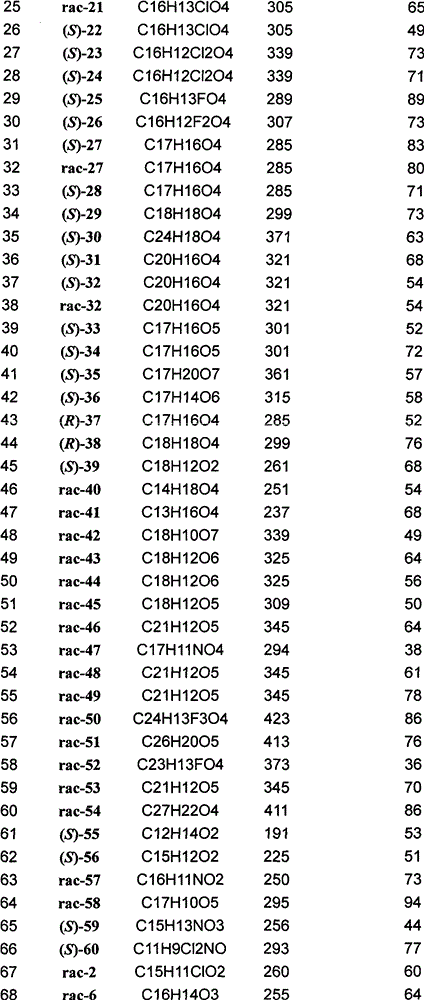
具体的筛选得到的结果如下:(表2,图1、2、3、4、5、6)  The specific screening results are as follows: (Table 2, Figures 1, 2, 3, 4, 5, 6)

表2  Table 2

Figure G2008102029672D00111

Figure G2008102029672D00121

69    rac-10    C16H14O2S     271        66  69 rac-10 C16H14O2S 271 66

70    rac-4     C13H10O2S     231        69  70 rac-4 C13H10O2S 231 69

71    rac-20    C16H14O4      271        89  71 rac-20 C16H14O4 271 89

72    rac-61    C12H8O3       201        62  72 rac-61 C12H8O3 201 62

73    rac-62    C16H10FNO2    268        38  73 rac-62 C16H10FNO2 268 38

74    rac-63    C17H13NO3     280        60  74 rac-63 C17H13NO3 280 60

75    rac-64    C16H10N2O4    295        90  75 rac-64 C16H10N2O4 295 90

76    rac-65    C15H10N2O2    251        71  76 rac-65 C15H10N2O2 251 71

77    rac-66    C19H17NO4     324        88  77 rac-66 C19H17NO4 324 88

78    rac-67    C16H10FNO2    268        57  78 rac-67 C16H10FNO2 268 57

79    rac-68    C16H12O2      237        72  79 rac-68 C16H12O2 237 72

80    rac-69    C13H8O2S      229        49  80 rac-69 C13H8O2S 229 49

81    rac-70    C15H8F2O2     259        68  81 rac-70 C15H8F2O2 259 68

82    rac-71    C12H12O2      189        49  82 rac-71 C12H12O2 189 49

83    rac-72    C15H9ClO3     274        54  83 rac-72 C15H9ClO3 274 54

图1是表2中第1~7项的化合物生测数据及系统、阳性和阴性对照;  Figure 1 is the compound bioassay data and system, positive and negative controls of items 1 to 7 in Table 2;

图2是表2中第8~20项的化合物生测数据及系统、阳性和阴性对照;  Figure 2 is the compound bioassay data and system, positive and negative controls of items 8 to 20 in Table 2;

图3是表2中第21~32项的化合物生测数据及系统、阳性和阴性对照;  Figure 3 is the compound bioassay data and system, positive and negative controls of items 21 to 32 in Table 2;

图4是表2中第33~50项的化合物生测数据及系统、阳性和阴性对照;  Figure 4 is the compound bioassay data and system, positive and negative controls of items 33 to 50 in Table 2;

图5是表2中第51~70项的化合物生测数据及系统、阳性和阴性对照;  Figure 5 is the compound bioassay data and system, positive and negative controls of items 51 to 70 in Table 2;

图6是表2中第71~83项生测数据及系统、阳性和阴性对照,以及部分随机选择的表2中的若干项化合物的重复实验结果。  Fig. 6 is the bioassay data of the 71st to 83rd items in Table 2, the system, positive and negative controls, and the repeated experiment results of some randomly selected compounds in Table 2. the

Claims (2)
1.一种3-取代苯酞用于制备治疗阿尔茨海默症的药物的用途,其结构式如下: 1. A 3-substituted phthalide is used to prepare the purposes of the medicine for the treatment of Alzheimer's disease, and its structural formula is as follows:
Figure FSB00000700772600011
式(1)    式(2)    式(3) Formula (1) Formula (2) Formula (3) 其中,式(3)表示为消旋体; Wherein, formula (3) is represented as racemate; X1、X2为CH或N; X 1 and X 2 are CH or N; X3是O或NH; X3 is O or NH; R1是C1~20的烃基; R 1 is a C 1-20 hydrocarbon group; R2、R3为氢、卤素、硝基、C1~4的烷基、C1~4的烷氧基、胺基、羧基、亚砜基、砜基、酰胺基或硫酰胺基、或者R2和R3为-CH=CH-CH=CH-或苯并基;所述的C1~20的烃基为R4或CH2R8,其中R8为R4,R4代表苯基、萘基、蒽基、噻吩基、喹啉基、苯氧基、卤代苯氧基、苯硫基、卤代苯硫基、2-呋喃基、3-吡咯基、3-吲哚基、3-香豆素基、R5、R6和R7取代的苯基、2-呋喃基、3-吡咯基、3-吲哚基、3-香豆素基、或者R5、R6或R7取代的苯氧基;R5、R7为H或R6;R6为卤素、C1~4的烷基、C1~4的烷氧基、C1~4的烷硫基或C1~4的卤代烷基。 R 2 and R 3 are hydrogen, halogen, nitro, C 1-4 alkyl, C 1-4 alkoxy, amine, carboxyl, sulfoxide, sulfone, amido or sulfamide, or R 2 and R 3 are -CH=CH-CH=CH- or benzo; the C 1-20 hydrocarbon group is R 4 or CH 2 R 8 , wherein R 8 is R 4 , and R 4 represents phenyl , naphthyl, anthracenyl, thienyl, quinolinyl, phenoxy, halophenoxy, phenylthio, halophenylthio, 2-furyl, 3-pyrrolyl, 3-indolyl, 3-coumarinyl, R 5 , R 6 and R 7 substituted phenyl, 2-furyl, 3-pyrrolyl, 3-indolyl, 3-coumarinyl, or R 5 , R 6 or Phenoxy substituted by R 7 ; R 5 and R 7 are H or R 6 ; R 6 is halogen, C 1-4 alkyl, C 1-4 alkoxy, C 1-4 alkylthio or C 1-4 haloalkyl.
2.一种3-取代苯酞用于制备治疗阿尔茨海默症的药物的用途,其特征是所述的3-取代苯酞具有如下的结构式: 2. A 3-substituted phthalide is used to prepare the purposes of the medicine for treating Alzheimer's disease, it is characterized in that described 3-substituted phthalide has following structural formula:
Figure FSB00000700772600012
Figure DEST_PATH_FSB00000744523600011
Figure FSB00000700772600031
CN200810202967A 2008-11-19 2008-11-19 Use of 3-substituted phthalide and the analogue Expired - Fee Related CN101455661B (en)

Priority Applications (1)

Application Number Priority Date Filing Date Title
CN200810202967A CN101455661B (en) 2008-11-19 2008-11-19 Use of 3-substituted phthalide and the analogue

Applications Claiming Priority (1)

Application Number Priority Date Filing Date Title
CN200810202967A CN101455661B (en) 2008-11-19 2008-11-19 Use of 3-substituted phthalide and the analogue

Publications (2)

Publication Number Publication Date
CN101455661A CN101455661A (en) 2009-06-17
CN101455661B true CN101455661B (en) 2012-10-10

Family

ID=40766959

Family Applications (1)

Application Number Title Priority Date Filing Date
CN200810202967A Expired - Fee Related CN101455661B (en) 2008-11-19 2008-11-19 Use of 3-substituted phthalide and the analogue

Country Status (1)

Country Link
CN (1) CN101455661B (en)

Families Citing this family (21)

* Cited by examiner, † Cited by third party
Publication number Priority date Publication date Assignee Title
CN102267977B (en) * 2011-05-06 2014-09-10 中国药科大学 Thio and seleno homologue of 3-substituted benzo [c] furanone, preparation method and medical application thereof
JP6466461B2 (en) 2014-02-03 2019-02-06 ヴァイティー ファーマシューティカルズ,インコーポレイテッド Dihydropyrrolopyridine inhibitors of ROR gamma
US10351527B2 (en) 2014-04-09 2019-07-16 The University Of British Columbia Binding function 3 (BF3) site compounds as therapeutics and methods for their use
TWI511727B (en) * 2014-07-02 2015-12-11 Everfront Biotech Inc Use of phthalide
NZ728386A (en) * 2014-07-04 2018-02-23 Everfront Biotech Inc Use of phthalide compound
CN105311014A (en) * 2014-07-28 2016-02-10 李德财 Use of butenylphthalide and method for preparing it as pharmaceutical composition
WO2016015203A1 (en) * 2014-07-28 2016-02-04 国立中兴大学 Use of butenylphthalide, usage method thereof and method for preparing same into pharmaceutical composition
EP3207043B3 (en) 2014-10-14 2019-10-02 Vitae Pharmaceuticals, LLC Dihydropyrrolopyridine inhibitors of ror-gamma
US9663515B2 (en) 2014-11-05 2017-05-30 Vitae Pharmaceuticals, Inc. Dihydropyrrolopyridine inhibitors of ROR-gamma
US9845308B2 (en) 2014-11-05 2017-12-19 Vitae Pharmaceuticals, Inc. Isoindoline inhibitors of ROR-gamma
EP3331876B1 (en) 2015-08-05 2020-10-07 Vitae Pharmaceuticals, LLC Modulators of ror-gamma
JP6914257B2 (en) 2015-11-20 2021-08-04 ヴァイティー ファーマシューティカルズ,エルエルシー ROR-gamma modulator
TW202220968A (en) 2016-01-29 2022-06-01 美商維它藥物有限責任公司 Modulators of ror-gamma
US9481674B1 (en) 2016-06-10 2016-11-01 Vitae Pharmaceuticals, Inc. Dihydropyrrolopyridine inhibitors of ROR-gamma
JP6644017B2 (en) * 2017-03-30 2020-02-12 長弘生物科技股▲ふん▼有限公司 Uses of butylidenephthalide, methods of using the same, and methods of producing pharmaceutical compositions using the same
CN108727352B (en) * 2017-04-14 2021-04-23 四川大学 A class of piperidinyl carbamoyl phthalide compounds, preparation method and use thereof
WO2019018975A1 (en) 2017-07-24 2019-01-31 Vitae Pharmaceuticals, Inc. Inhibitors of ror gamma
WO2019023207A1 (en) 2017-07-24 2019-01-31 Vitae Pharmaceuticals, Inc. INHIBITORS OF RORƳ
CN108299227B (en) * 2018-04-16 2021-02-23 中国科学院兰州化学物理研究所 A kind of anti-Alzheimer's disease amide compound and amide compound component in Lycium barbarum
CN112812085B (en) * 2021-01-11 2023-11-10 河南中医药大学 A pair of compounds A and B extracted from Cornus officinale and their preparation methods and applications
CN114805263B (en) * 2021-01-18 2023-05-05 四川大学 3- (hydroxybenzyl) phthalide compound, preparation method and application thereof

Citations (1)

* Cited by examiner, † Cited by third party
Publication number Priority date Publication date Assignee Title
CN1565441A (en) * 2003-06-20 2005-01-19 中国医学科学院药物研究所 Use of levobutylphthalide in prevention and cure of dementia

Patent Citations (1)

* Cited by examiner, † Cited by third party
Publication number Priority date Publication date Assignee Title
CN1565441A (en) * 2003-06-20 2005-01-19 中国医学科学院药物研究所 Use of levobutylphthalide in prevention and cure of dementia

Also Published As

Publication number Publication date
CN101455661A (en) 2009-06-17

Similar Documents

Publication Publication Date Title
CN101455661B (en) Use of 3-substituted phthalide and the analogue
TW538021B (en) Novel amidino compound and their use in therapy
JP6043935B2 (en) Piperazinotriazole compounds, process for producing the same and pharmaceutical use
CN101402623A (en) 3-substituted benzene phthalein compounds with biological activity
CN1312810A (en) Substituted 1,8-naphthyridin-4(1H)-ones as phosphodiesterase 4 inhibitors
TWI529171B (en) 1,7-naphthyridine derivatives
FR2873368A1 (en) GUANIDINE DERIVATIVES AND THEIR USES IN THERAPEUTICS
JP2019530709A (en) Process for producing (1R, 3R)-and (1S, 3S) -2,2-dihalo-3- (substituted phenyl) cyclopropanecarboxylic acid
CN103936667A (en) Novel 3, 5-bis(aryl-methyne)-1-methylpiperidine-4-ketone compound as well as synthetic method and application thereof in preparation of anti-cancer medicines
CN104003853B (en) A kind of chalcone derivative and application thereof
CA2394027C (en) New derivatives of octahydro-2h-pyrido[1,2-a] pyrazine, their preparation process and pharmaceutical compositions that contain them
CN101585799B (en) Method for preparing unsymmetrical bis(indolyl)methane compound
JP2020520936A5 (en)
JP5032461B2 (en) Method for purifying thioctic acid in water
CN119798255A (en) 1-Thienyl-β-carboline IDO1 and TDO dual inhibitors and their medical uses
CN102471289A (en) Preparation of 4- ((1R,3S) -6-chloro-3-phenyl-indan-1-yl) -1,2, 2-trimethyl-piperazine and 1- ((1R,3S) -6-chloro-3-phenyl-indan-1-yl) -3, 3-dimethyl-piperazine
JP4892821B2 (en) Epalrestat manufacturing method
CN107098866A (en) The method for splitting of medicine Lesinurad axial chirality enantiomers
CN1337956A (en) New Morpholinobenzamide salts
CN113493424A (en) R/S-mandelic acid thioether derivatives containing 1,3, 4-oxadiazole structure and application thereof
CN102526052B (en) Application of a 2-glycosylquinoline compound in the preparation of anti-acetylcholinesterase drugs
CN110194745B (en) Fluorenone compounds, their preparation method and use
CN102796023A (en) Hydrogenated amide ferulate compounds, and synthesis method and application thereof
CN115960101B (en) 7-Oxo-4,5,6,7-tetrahydropyrazolopyridine amide compounds and preparation methods and applications thereof
CN116874465B (en) Pyrimidine compound and application thereof

Legal Events

Date Code Title Description
C06 Publication
PB01 Publication
C10 Entry into substantive examination
SE01 Entry into force of request for substantive examination
C14 Grant of patent or utility model
GR01 Patent grant
CF01 Termination of patent right due to non-payment of annual fee

Granted publication date: 20121010

Termination date: 20201119