US20070219196A1 - Amide substituted imidazopyridines, imidazoquinolines, and imidazonaphthyridines - Google Patents
Amide substituted imidazopyridines, imidazoquinolines, and imidazonaphthyridines Download PDFInfo
- Publication number
- US20070219196A1 US20070219196A1 US10/599,159 US59915905A US2007219196A1 US 20070219196 A1 US20070219196 A1 US 20070219196A1 US 59915905 A US59915905 A US 59915905A US 2007219196 A1 US2007219196 A1 US 2007219196A1
- Authority
- US
- United States
- Prior art keywords
- group
- alkyl
- alkylene
- compound
- salt
- Prior art date
- Legal status (The legal status is an assumption and is not a legal conclusion. Google has not performed a legal analysis and makes no representation as to the accuracy of the status listed.)
- Granted
Links
- 0 *c1nc2c(N)nc(C)c(C)c2n1[1*] Chemical compound *c1nc2c(N)nc(C)c(C)c2n1[1*] 0.000 description 68
- WUOZZMMDWGYARE-UHFFFAOYSA-N CCC1(C)CCC1 Chemical compound CCC1(C)CCC1 WUOZZMMDWGYARE-UHFFFAOYSA-N 0.000 description 10
- WPPPLZLECVVVBM-UHFFFAOYSA-N C.C.C.CCCOC.CCCONC Chemical compound C.C.C.CCCOC.CCCONC WPPPLZLECVVVBM-UHFFFAOYSA-N 0.000 description 9
- QJSATBGMJUWERO-UHFFFAOYSA-N C.C.CCCONC Chemical compound C.C.CCCONC QJSATBGMJUWERO-UHFFFAOYSA-N 0.000 description 9
- SHSYQPYMDQMRDY-UHFFFAOYSA-N C.C.CN Chemical compound C.C.CN SHSYQPYMDQMRDY-UHFFFAOYSA-N 0.000 description 5
- BUVZMPURFKUHCY-UHFFFAOYSA-N C.CCCOC.CCCON Chemical compound C.CCCOC.CCCON BUVZMPURFKUHCY-UHFFFAOYSA-N 0.000 description 5
- UCDYSVQAHJRIFB-UHFFFAOYSA-N C.C.CCCOC.CCCONC Chemical compound C.C.CCCOC.CCCONC UCDYSVQAHJRIFB-UHFFFAOYSA-N 0.000 description 4
- PCPQFXDNKPHYDS-UHFFFAOYSA-N C.CCCON Chemical compound C.CCCON PCPQFXDNKPHYDS-UHFFFAOYSA-N 0.000 description 4
- DUKVJJLBNSJGSV-UHFFFAOYSA-N C.C.CCCOC.CCCON Chemical compound C.C.CCCOC.CCCON DUKVJJLBNSJGSV-UHFFFAOYSA-N 0.000 description 2
- KNQFDMQXXZERQG-UHFFFAOYSA-N CC(C)(CN1C=NC2=C1C1=CC=CC=C1N=C2N)C(N)=O Chemical compound CC(C)(CN1C=NC2=C1C1=CC=CC=C1N=C2N)C(N)=O KNQFDMQXXZERQG-UHFFFAOYSA-N 0.000 description 2
- JSACNLUNKMJSPU-UHFFFAOYSA-N CCCC1=NC2=C(C3=C(CCCC3)N=C2N)N1CCCCCC(=O)N1CCOCC1 Chemical compound CCCC1=NC2=C(C3=C(CCCC3)N=C2N)N1CCCCCC(=O)N1CCOCC1 JSACNLUNKMJSPU-UHFFFAOYSA-N 0.000 description 2
- OYTPSNZXNCDFGF-UHFFFAOYSA-N CCCC1=NC2=C(N)N=C3C=CC=CC3=C2N1CC(C)(C)C(N)=O Chemical compound CCCC1=NC2=C(N)N=C3C=CC=CC3=C2N1CC(C)(C)C(N)=O OYTPSNZXNCDFGF-UHFFFAOYSA-N 0.000 description 2
- KUKFMGHYIBBBNT-UHFFFAOYSA-N CCCOC.CCCON Chemical compound CCCOC.CCCON KUKFMGHYIBBBNT-UHFFFAOYSA-N 0.000 description 2
- PRAARDGLAWZXML-UHFFFAOYSA-N CCCON Chemical compound CCCON PRAARDGLAWZXML-UHFFFAOYSA-N 0.000 description 2
- SBHYFCLUFQIICL-UHFFFAOYSA-N CCOCC1=NC2=C(C3=CC=CC=C3N=C2N)N1CC1(C(N)=O)CC1 Chemical compound CCOCC1=NC2=C(C3=CC=CC=C3N=C2N)N1CC1(C(N)=O)CC1 SBHYFCLUFQIICL-UHFFFAOYSA-N 0.000 description 2
- DIXQNRLCPCIZDD-UHFFFAOYSA-N CCOCC1=NC2=C(C3=CC=CC=C3N=C2N)N1CCC(N)=O Chemical compound CCOCC1=NC2=C(C3=CC=CC=C3N=C2N)N1CCC(N)=O DIXQNRLCPCIZDD-UHFFFAOYSA-N 0.000 description 2
- WWPZCNXDOSJVIK-UHFFFAOYSA-N C.C.CNC Chemical compound C.C.CNC WWPZCNXDOSJVIK-UHFFFAOYSA-N 0.000 description 1
- CFIDRQDSMCLQHT-UHFFFAOYSA-N C.CCC(=O)N1CCCCC1.CCC(=O)N1CCS(=O)(=O)CC1 Chemical compound C.CCC(=O)N1CCCCC1.CCC(=O)N1CCS(=O)(=O)CC1 CFIDRQDSMCLQHT-UHFFFAOYSA-N 0.000 description 1
- NZHIIDNOLFOHSG-UHFFFAOYSA-N C1=CCCN=C1 Chemical compound C1=CCCN=C1 NZHIIDNOLFOHSG-UHFFFAOYSA-N 0.000 description 1
- NQRYJNQNLNOLGT-UHFFFAOYSA-N C1CCNCC1 Chemical compound C1CCNCC1 NQRYJNQNLNOLGT-UHFFFAOYSA-N 0.000 description 1
- NPUVXDCAWOOKDL-UHFFFAOYSA-N CC(C)(CN1C(CO)=NC2=C1C1=CC=CC=C1N=C2N)C(N)=O Chemical compound CC(C)(CN1C(CO)=NC2=C1C1=CC=CC=C1N=C2N)C(N)=O NPUVXDCAWOOKDL-UHFFFAOYSA-N 0.000 description 1
- UGBMGPKJWREPGH-UHFFFAOYSA-N CC1=NC2=C(C3=C(C=CC=C3)N=C2N)N1CCC(N)=O Chemical compound CC1=NC2=C(C3=C(C=CC=C3)N=C2N)N1CCC(N)=O UGBMGPKJWREPGH-UHFFFAOYSA-N 0.000 description 1
- GJROAPVSFYDNLD-UHFFFAOYSA-N CC1=NC2=C(C3=C(C=CC=C3)N=C2N)N1CCCCC(=O)N1CCOCC1 Chemical compound CC1=NC2=C(C3=C(C=CC=C3)N=C2N)N1CCCCC(=O)N1CCOCC1 GJROAPVSFYDNLD-UHFFFAOYSA-N 0.000 description 1
- XVPNKULMNHJLLK-UHFFFAOYSA-N CC1=NC2=C(C3=CC=CC=C3N=C2N)N1CC(C)(C)C(N)=O Chemical compound CC1=NC2=C(C3=CC=CC=C3N=C2N)N1CC(C)(C)C(N)=O XVPNKULMNHJLLK-UHFFFAOYSA-N 0.000 description 1
- PFFZBCQFJYJQOM-UHFFFAOYSA-N CC1=NC2=C(C3=CC=CC=C3N=C2N)N1CCC(=O)N1CCOCC1 Chemical compound CC1=NC2=C(C3=CC=CC=C3N=C2N)N1CCC(=O)N1CCOCC1 PFFZBCQFJYJQOM-UHFFFAOYSA-N 0.000 description 1
- XVYRVBDJAZVCAT-UHFFFAOYSA-N CCC1=NC2=C(C(C)=C(C)N=C2N)N1CCCC(=O)N1CCOCC1 Chemical compound CCC1=NC2=C(C(C)=C(C)N=C2N)N1CCCC(=O)N1CCOCC1 XVYRVBDJAZVCAT-UHFFFAOYSA-N 0.000 description 1
- GMAMLRZUHQEPDA-UHFFFAOYSA-N CCC1=NC2=C(C(C)=C(C)N=C2N)N1CCCC(N)=O Chemical compound CCC1=NC2=C(C(C)=C(C)N=C2N)N1CCCC(N)=O GMAMLRZUHQEPDA-UHFFFAOYSA-N 0.000 description 1
- GDDUIWCOSHLCNI-UHFFFAOYSA-N CCC1=NC2=C(C3=CC=CC=C3N=C2N)N1CC(C)(C)C(N)=O Chemical compound CCC1=NC2=C(C3=CC=CC=C3N=C2N)N1CC(C)(C)C(N)=O GDDUIWCOSHLCNI-UHFFFAOYSA-N 0.000 description 1
- VNSORPSBDQDXOP-UHFFFAOYSA-N CCC1=NC2=C(C3=CC=CC=C3N=C2N)N1CC1(C(N)=O)CCC1 Chemical compound CCC1=NC2=C(C3=CC=CC=C3N=C2N)N1CC1(C(N)=O)CCC1 VNSORPSBDQDXOP-UHFFFAOYSA-N 0.000 description 1
- YSOBXFXQSOGIOM-UHFFFAOYSA-N CCC1=NC2=C(N)N=C3C=CC=NC3=C2N1CCCCCC(=O)N1CCOCC1 Chemical compound CCC1=NC2=C(N)N=C3C=CC=NC3=C2N1CCCCCC(=O)N1CCOCC1 YSOBXFXQSOGIOM-UHFFFAOYSA-N 0.000 description 1
- MSWDKWRKLXLQQK-UHFFFAOYSA-N CCC1=NC2=C(N)N=C3C=CC=NC3=C2N1CCCCCC(N)=O Chemical compound CCC1=NC2=C(N)N=C3C=CC=NC3=C2N1CCCCCC(N)=O MSWDKWRKLXLQQK-UHFFFAOYSA-N 0.000 description 1
- FSJFMGGBFCKJBD-UHFFFAOYSA-N CCCC1=NC2=C(C(C)=C(C)N=C2N)N1CCCC(=O)N1CCOCC1 Chemical compound CCCC1=NC2=C(C(C)=C(C)N=C2N)N1CCCC(=O)N1CCOCC1 FSJFMGGBFCKJBD-UHFFFAOYSA-N 0.000 description 1
- MEDSKHDVCTZFIX-UHFFFAOYSA-N CCCC1=NC2=C(C(C)=C(C)N=C2N)N1CCCC(N)=O Chemical compound CCCC1=NC2=C(C(C)=C(C)N=C2N)N1CCCC(N)=O MEDSKHDVCTZFIX-UHFFFAOYSA-N 0.000 description 1
- RWFRGLAZJPQRFA-UHFFFAOYSA-N CCCC1=NC2=C(C3=C(CCCC3)N=C2N)N1CCCCC(=O)N1CCOCC1 Chemical compound CCCC1=NC2=C(C3=C(CCCC3)N=C2N)N1CCCCC(=O)N1CCOCC1 RWFRGLAZJPQRFA-UHFFFAOYSA-N 0.000 description 1
- ABJPXXWONJJPJZ-UHFFFAOYSA-N CCCC1=NC2=C(C3=CC=CC=C3N=C2N)N1CCC(=O)N(C)C Chemical compound CCCC1=NC2=C(C3=CC=CC=C3N=C2N)N1CCC(=O)N(C)C ABJPXXWONJJPJZ-UHFFFAOYSA-N 0.000 description 1
- RMHYOKMVWRMOPL-UHFFFAOYSA-N CCCC1=NC2=C(C3=CC=CC=C3N=C2N)N1CCC(=O)N1CCOCC1 Chemical compound CCCC1=NC2=C(C3=CC=CC=C3N=C2N)N1CCC(=O)N1CCOCC1 RMHYOKMVWRMOPL-UHFFFAOYSA-N 0.000 description 1
- RKCSUJABELUDPO-UHFFFAOYSA-N CCCC1=NC2=C(C3=CC=CC=C3N=C2N)N1CCC(=O)NC Chemical compound CCCC1=NC2=C(C3=CC=CC=C3N=C2N)N1CCC(=O)NC RKCSUJABELUDPO-UHFFFAOYSA-N 0.000 description 1
- UJNUNKVOTRYGMO-UHFFFAOYSA-N CCCC1=NC2=C(C3=CC=CC=C3N=C2N)N1CCC(N)=O Chemical compound CCCC1=NC2=C(C3=CC=CC=C3N=C2N)N1CCC(N)=O UJNUNKVOTRYGMO-UHFFFAOYSA-N 0.000 description 1
- QSRPTDWOOCNBGI-UHFFFAOYSA-N CCCC1=NC2=C(C3=CC=CC=C3N=C2N)N1CCCCC(=O)N1CCOCC1 Chemical compound CCCC1=NC2=C(C3=CC=CC=C3N=C2N)N1CCCCC(=O)N1CCOCC1 QSRPTDWOOCNBGI-UHFFFAOYSA-N 0.000 description 1
- YPIGQUDUFKXSIE-UHFFFAOYSA-N CCCC1=NC2=C(C3=CC=CC=C3N=C2N)N1CCCCC(N)=O Chemical compound CCCC1=NC2=C(C3=CC=CC=C3N=C2N)N1CCCCC(N)=O YPIGQUDUFKXSIE-UHFFFAOYSA-N 0.000 description 1
- FSGJGHHAIPGCNU-UHFFFAOYSA-N CCCC1=NC2=C(C3=CC=CC=C3N=C2N)N1CCCCCC(=O)N1CCOCC1 Chemical compound CCCC1=NC2=C(C3=CC=CC=C3N=C2N)N1CCCCCC(=O)N1CCOCC1 FSGJGHHAIPGCNU-UHFFFAOYSA-N 0.000 description 1
- VASXIPUCGYKADZ-UHFFFAOYSA-N CCCC1=NC2=C(C3=CC=CC=C3N=C2N)N1CCCCCC(=O)NC Chemical compound CCCC1=NC2=C(C3=CC=CC=C3N=C2N)N1CCCCCC(=O)NC VASXIPUCGYKADZ-UHFFFAOYSA-N 0.000 description 1
- PCGSRERWWYKAAL-UHFFFAOYSA-N CCCC1=NC2=C(C3=CC=CC=C3N=C2N)N1CCCCCC(N)=O Chemical compound CCCC1=NC2=C(C3=CC=CC=C3N=C2N)N1CCCCCC(N)=O PCGSRERWWYKAAL-UHFFFAOYSA-N 0.000 description 1
- SDBOPVFLGGJTAF-UHFFFAOYSA-N CCCC1=NC2=C(C3=CC=CC=C3N=C2N)N1CCCCCCCCCCCC(=O)NC Chemical compound CCCC1=NC2=C(C3=CC=CC=C3N=C2N)N1CCCCCCCCCCCC(=O)NC SDBOPVFLGGJTAF-UHFFFAOYSA-N 0.000 description 1
- GAWTZIFCTKNPGY-UHFFFAOYSA-N CCCC1=NC2=C(C3=NC=CC=C3N=C2N)N1CCCC(=O)N1CCOCC1 Chemical compound CCCC1=NC2=C(C3=NC=CC=C3N=C2N)N1CCCC(=O)N1CCOCC1 GAWTZIFCTKNPGY-UHFFFAOYSA-N 0.000 description 1
- IPFLZRYFNOZFDZ-UHFFFAOYSA-N CCCC1=NC2=C(N)N=C3C=CC=CC3=C2N1CC(C)(C)C(=O)N1CCOCC1 Chemical compound CCCC1=NC2=C(N)N=C3C=CC=CC3=C2N1CC(C)(C)C(=O)N1CCOCC1 IPFLZRYFNOZFDZ-UHFFFAOYSA-N 0.000 description 1
- GCVFMQKAECVNRX-UHFFFAOYSA-N CCCC1=NC2=C(N)N=C3C=CC=CC3=C2N1CC(N)=O Chemical compound CCCC1=NC2=C(N)N=C3C=CC=CC3=C2N1CC(N)=O GCVFMQKAECVNRX-UHFFFAOYSA-N 0.000 description 1
- KTBRABYHUHRBJB-UHFFFAOYSA-N CCCC1=NC2=C(N)N=C3C=CC=CC3=C2N1CC1(C(N)=O)CCC1 Chemical compound CCCC1=NC2=C(N)N=C3C=CC=CC3=C2N1CC1(C(N)=O)CCC1 KTBRABYHUHRBJB-UHFFFAOYSA-N 0.000 description 1
- NNUPHKGRUDMATM-UHFFFAOYSA-N CCCC1=NC2=C(N)N=C3C=CC=CC3=C2N1CCCC(=O)N1CCOCC1 Chemical compound CCCC1=NC2=C(N)N=C3C=CC=CC3=C2N1CCCC(=O)N1CCOCC1 NNUPHKGRUDMATM-UHFFFAOYSA-N 0.000 description 1
- DWFKZHIJBPTQRW-UHFFFAOYSA-N CCCC1=NC2=C(N)N=C3C=CC=CC3=C2N1CCCC(=O)NC Chemical compound CCCC1=NC2=C(N)N=C3C=CC=CC3=C2N1CCCC(=O)NC DWFKZHIJBPTQRW-UHFFFAOYSA-N 0.000 description 1
- XJMBKJRHFDOLPL-UHFFFAOYSA-N CCCC1=NC2=C(N)N=C3C=CC=CC3=C2N1CCCC(N)=O Chemical compound CCCC1=NC2=C(N)N=C3C=CC=CC3=C2N1CCCC(N)=O XJMBKJRHFDOLPL-UHFFFAOYSA-N 0.000 description 1
- RTJKXIQCWZHCSL-UHFFFAOYSA-N CCCC1=NC2=C(N)N=C3C=CC=NC3=C2N1CCCCCC(=O)N1CCOCC1 Chemical compound CCCC1=NC2=C(N)N=C3C=CC=NC3=C2N1CCCCCC(=O)N1CCOCC1 RTJKXIQCWZHCSL-UHFFFAOYSA-N 0.000 description 1
- PUFGOWQANVCTIS-UHFFFAOYSA-N CCCC1=NC2=C(N)N=C3C=CC=NC3=C2N1CCCCCC(N)=O Chemical compound CCCC1=NC2=C(N)N=C3C=CC=NC3=C2N1CCCCCC(N)=O PUFGOWQANVCTIS-UHFFFAOYSA-N 0.000 description 1
- VWNFNDXDQHIFIX-UHFFFAOYSA-N CCCC1=NC2=C(N)N=C3CCCCC3=C2N1CCCC(=O)N1CCOCC1 Chemical compound CCCC1=NC2=C(N)N=C3CCCCC3=C2N1CCCC(=O)N1CCOCC1 VWNFNDXDQHIFIX-UHFFFAOYSA-N 0.000 description 1
- FKYDYNLNNFZZAE-UHFFFAOYSA-N CCCCC1=NC2=C(C3=C(C=CC=C3)N=C2N)N1CCCCC(=O)N1CCOCC1 Chemical compound CCCCC1=NC2=C(C3=C(C=CC=C3)N=C2N)N1CCCCC(=O)N1CCOCC1 FKYDYNLNNFZZAE-UHFFFAOYSA-N 0.000 description 1
- BMPXOIYDTOZPQJ-UHFFFAOYSA-N CCCCC1=NC2=C(C3=C(C=CC=C3)N=C2N)N1CCCCC(N)=O Chemical compound CCCCC1=NC2=C(C3=C(C=CC=C3)N=C2N)N1CCCCC(N)=O BMPXOIYDTOZPQJ-UHFFFAOYSA-N 0.000 description 1
- TTYQCAJIFCUDOV-UHFFFAOYSA-N CCCCC1=NC2=C(C3=CC=CC=C3N=C2N)N1CC(C)(C)C(N)=O Chemical compound CCCCC1=NC2=C(C3=CC=CC=C3N=C2N)N1CC(C)(C)C(N)=O TTYQCAJIFCUDOV-UHFFFAOYSA-N 0.000 description 1
- PISHKCLTBXWRJD-UHFFFAOYSA-N CCCNC(=O)CCCCCN1C(CCC)=NC2=C1C1=CC=CC=C1N=C2N Chemical compound CCCNC(=O)CCCCCN1C(CCC)=NC2=C1C1=CC=CC=C1N=C2N PISHKCLTBXWRJD-UHFFFAOYSA-N 0.000 description 1
- VXHQEUKMQXFXLU-UHFFFAOYSA-N CCCNC(=O)CCCCCN1C(COCC)=NC2=C1C1=CC=CC=C1N=C2N Chemical compound CCCNC(=O)CCCCCN1C(COCC)=NC2=C1C1=CC=CC=C1N=C2N VXHQEUKMQXFXLU-UHFFFAOYSA-N 0.000 description 1
- CJEBJXKXXVFALE-UHFFFAOYSA-N CCCNC(=O)CCCCCN1C=NC2=C1C1=CC=CC=C1N=C2N Chemical compound CCCNC(=O)CCCCCN1C=NC2=C1C1=CC=CC=C1N=C2N CJEBJXKXXVFALE-UHFFFAOYSA-N 0.000 description 1
- ZEYUDSVQSPXYJT-UHFFFAOYSA-N CCCNC(=O)CCCN1C(CCC)=NC2=C(N)N=C3C=CC=CC3=C21 Chemical compound CCCNC(=O)CCCN1C(CCC)=NC2=C(N)N=C3C=CC=CC3=C21 ZEYUDSVQSPXYJT-UHFFFAOYSA-N 0.000 description 1
- IOXRWXJXNUJQHF-UHFFFAOYSA-N CCCNC(=O)CCN1C(C)=NC2=C1C1=C(C=CC=C1)N=C2N Chemical compound CCCNC(=O)CCN1C(C)=NC2=C1C1=C(C=CC=C1)N=C2N IOXRWXJXNUJQHF-UHFFFAOYSA-N 0.000 description 1
- XSKBNMBDFZJPFK-UHFFFAOYSA-N CCCNC(=O)CCN1C(CCC)=NC2=C1C1=CC=CC=C1N=C2N Chemical compound CCCNC(=O)CCN1C(CCC)=NC2=C1C1=CC=CC=C1N=C2N XSKBNMBDFZJPFK-UHFFFAOYSA-N 0.000 description 1
- IMEQEPJJQAFZRT-UHFFFAOYSA-N CCCNC(=O)CCN1C=NC2=C1C1=CC=CC=C1N=C2N Chemical compound CCCNC(=O)CCN1C=NC2=C1C1=CC=CC=C1N=C2N IMEQEPJJQAFZRT-UHFFFAOYSA-N 0.000 description 1
- GPEFDMPXVMDHKY-UHFFFAOYSA-N CCOC(=O)C1(CN)CCC1 Chemical compound CCOC(=O)C1(CN)CCC1 GPEFDMPXVMDHKY-UHFFFAOYSA-N 0.000 description 1
- RTOVQUULFGYWNM-UHFFFAOYSA-N CCOCC1=NC2=C(C(C)=C(C)N=C2N)N1CCCC(=O)N1CCOCC1 Chemical compound CCOCC1=NC2=C(C(C)=C(C)N=C2N)N1CCCC(=O)N1CCOCC1 RTOVQUULFGYWNM-UHFFFAOYSA-N 0.000 description 1
- PXUIYWWYCAYBRG-UHFFFAOYSA-N CCOCC1=NC2=C(C(C)=C(C)N=C2N)N1CCCC(N)=O Chemical compound CCOCC1=NC2=C(C(C)=C(C)N=C2N)N1CCCC(N)=O PXUIYWWYCAYBRG-UHFFFAOYSA-N 0.000 description 1
- PXSWKDAMZOHLJC-UHFFFAOYSA-N CCOCC1=NC2=C(C3=C(C=CC=C3)N=C2N)N1CC1(C(N)=O)CCCCC1 Chemical compound CCOCC1=NC2=C(C3=C(C=CC=C3)N=C2N)N1CC1(C(N)=O)CCCCC1 PXSWKDAMZOHLJC-UHFFFAOYSA-N 0.000 description 1
- RYEMBADIRQJVPH-UHFFFAOYSA-N CCOCC1=NC2=C(C3=C(C=CC=C3)N=C2N)N1CCCCC(=O)N1CCOCC1 Chemical compound CCOCC1=NC2=C(C3=C(C=CC=C3)N=C2N)N1CCCCC(=O)N1CCOCC1 RYEMBADIRQJVPH-UHFFFAOYSA-N 0.000 description 1
- RTAYVTVKHIDCAW-UHFFFAOYSA-N CCOCC1=NC2=C(C3=C(C=CC=C3)N=C2N)N1CCCCC(N)=O Chemical compound CCOCC1=NC2=C(C3=C(C=CC=C3)N=C2N)N1CCCCC(N)=O RTAYVTVKHIDCAW-UHFFFAOYSA-N 0.000 description 1
- CTIMQGCZVPPIMC-UHFFFAOYSA-N CCOCC1=NC2=C(C3=CC=CC=C3N=C2N)N1CC(C)(C)C(N)=O Chemical compound CCOCC1=NC2=C(C3=CC=CC=C3N=C2N)N1CC(C)(C)C(N)=O CTIMQGCZVPPIMC-UHFFFAOYSA-N 0.000 description 1
- AVBHPJVZYQZEOB-UHFFFAOYSA-N CCOCC1=NC2=C(C3=CC=CC=C3N=C2N)N1CCC(=O)N1CCOCC1 Chemical compound CCOCC1=NC2=C(C3=CC=CC=C3N=C2N)N1CCC(=O)N1CCOCC1 AVBHPJVZYQZEOB-UHFFFAOYSA-N 0.000 description 1
- IHUPPPGGCJEEFK-UHFFFAOYSA-N CCOCC1=NC2=C(C3=CC=CC=C3N=C2N)N1CCCCCC(=O)N1CCOCC1 Chemical compound CCOCC1=NC2=C(C3=CC=CC=C3N=C2N)N1CCCCCC(=O)N1CCOCC1 IHUPPPGGCJEEFK-UHFFFAOYSA-N 0.000 description 1
- GXCWSDUKZULTJR-UHFFFAOYSA-N CCOCC1=NC2=C(C3=NC=CC=C3N=C2N)N1CCCC(=O)N1CCOCC1 Chemical compound CCOCC1=NC2=C(C3=NC=CC=C3N=C2N)N1CCCC(=O)N1CCOCC1 GXCWSDUKZULTJR-UHFFFAOYSA-N 0.000 description 1
- DRSOUIZZPUILEQ-UHFFFAOYSA-N CCOCC1=NC2=C(N)N=C3C=CC=CC3=C2N1CCCC(=O)N1CCOCC1 Chemical compound CCOCC1=NC2=C(N)N=C3C=CC=CC3=C2N1CCCC(=O)N1CCOCC1 DRSOUIZZPUILEQ-UHFFFAOYSA-N 0.000 description 1
- HRRZXWDJPSNBES-UHFFFAOYSA-N CCOCC1=NC2=C(N)N=C3C=CC=CC3=C2N1CCCC(N)=O Chemical compound CCOCC1=NC2=C(N)N=C3C=CC=CC3=C2N1CCCC(N)=O HRRZXWDJPSNBES-UHFFFAOYSA-N 0.000 description 1
- LGURBIXTAPBTHU-UHFFFAOYSA-N CCOCC1=NC2=C(N)N=C3C=CC=NC3=C2N1CCCC(N)=O Chemical compound CCOCC1=NC2=C(N)N=C3C=CC=NC3=C2N1CCCC(N)=O LGURBIXTAPBTHU-UHFFFAOYSA-N 0.000 description 1
- OAPYTOAOPCWFFN-UHFFFAOYSA-N CCOCC1=NC2=C(N)N=C3C=CC=NC3=C2N1CCCCCC(=O)N1CCOCC1 Chemical compound CCOCC1=NC2=C(N)N=C3C=CC=NC3=C2N1CCCCCC(=O)N1CCOCC1 OAPYTOAOPCWFFN-UHFFFAOYSA-N 0.000 description 1
- GFRNRIYPYGOWAW-UHFFFAOYSA-N CCOCC1=NC2=C(N)N=C3C=CC=NC3=C2N1CCCCCC(N)=O Chemical compound CCOCC1=NC2=C(N)N=C3C=CC=NC3=C2N1CCCCCC(N)=O GFRNRIYPYGOWAW-UHFFFAOYSA-N 0.000 description 1
- ROSDSFDQCJNGOL-UHFFFAOYSA-N CNC Chemical compound CNC ROSDSFDQCJNGOL-UHFFFAOYSA-N 0.000 description 1
- YIIWOGKKRXOCLQ-UHFFFAOYSA-N CNC(=O)CCN1C=NC2=C1C1=CC=CC=C1N=C2N Chemical compound CNC(=O)CCN1C=NC2=C1C1=CC=CC=C1N=C2N YIIWOGKKRXOCLQ-UHFFFAOYSA-N 0.000 description 1
- GOKOFXWCFWRWPT-UHFFFAOYSA-N COCCC1=NC2=C(C3=C(C=CC=C3)N=C2N)N1CCCCC(=O)N1CCOCC1 Chemical compound COCCC1=NC2=C(C3=C(C=CC=C3)N=C2N)N1CCCCC(=O)N1CCOCC1 GOKOFXWCFWRWPT-UHFFFAOYSA-N 0.000 description 1
- MEGAWQKJHBODKV-UHFFFAOYSA-N COCCC1=NC2=C(C3=CC=CC=C3N=C2N)N1CCC(=O)N1CCOCC1 Chemical compound COCCC1=NC2=C(C3=CC=CC=C3N=C2N)N1CCC(=O)N1CCOCC1 MEGAWQKJHBODKV-UHFFFAOYSA-N 0.000 description 1
- GWCKBNQYZQNSTN-UHFFFAOYSA-N COCCC1=NC2=C(C3=CC=CC=C3N=C2N)N1CCCCCC(=O)N1CCOCC1 Chemical compound COCCC1=NC2=C(C3=CC=CC=C3N=C2N)N1CCCCCC(=O)N1CCOCC1 GWCKBNQYZQNSTN-UHFFFAOYSA-N 0.000 description 1
- XPNPGKFCJIDREA-UHFFFAOYSA-N NC1=NC2=CC=CC=C2C2=C1N=CN2CCCCCC(=O)N1CCOCC1 Chemical compound NC1=NC2=CC=CC=C2C2=C1N=CN2CCCCCC(=O)N1CCOCC1 XPNPGKFCJIDREA-UHFFFAOYSA-N 0.000 description 1
Classifications
-
- C—CHEMISTRY; METALLURGY
- C07—ORGANIC CHEMISTRY
- C07D—HETEROCYCLIC COMPOUNDS
- C07D471/00—Heterocyclic compounds containing nitrogen atoms as the only ring hetero atoms in the condensed system, at least one ring being a six-membered ring with one nitrogen atom, not provided for by groups C07D451/00 - C07D463/00
- C07D471/02—Heterocyclic compounds containing nitrogen atoms as the only ring hetero atoms in the condensed system, at least one ring being a six-membered ring with one nitrogen atom, not provided for by groups C07D451/00 - C07D463/00 in which the condensed system contains two hetero rings
- C07D471/04—Ortho-condensed systems
-
- A—HUMAN NECESSITIES
- A61—MEDICAL OR VETERINARY SCIENCE; HYGIENE
- A61P—SPECIFIC THERAPEUTIC ACTIVITY OF CHEMICAL COMPOUNDS OR MEDICINAL PREPARATIONS
- A61P37/00—Drugs for immunological or allergic disorders
- A61P37/02—Immunomodulators
-
- C—CHEMISTRY; METALLURGY
- C07—ORGANIC CHEMISTRY
- C07D—HETEROCYCLIC COMPOUNDS
- C07D413/00—Heterocyclic compounds containing two or more hetero rings, at least one ring having nitrogen and oxygen atoms as the only ring hetero atoms
- C07D413/14—Heterocyclic compounds containing two or more hetero rings, at least one ring having nitrogen and oxygen atoms as the only ring hetero atoms containing three or more hetero rings
-
- C—CHEMISTRY; METALLURGY
- C07—ORGANIC CHEMISTRY
- C07D—HETEROCYCLIC COMPOUNDS
- C07D471/00—Heterocyclic compounds containing nitrogen atoms as the only ring hetero atoms in the condensed system, at least one ring being a six-membered ring with one nitrogen atom, not provided for by groups C07D451/00 - C07D463/00
- C07D471/02—Heterocyclic compounds containing nitrogen atoms as the only ring hetero atoms in the condensed system, at least one ring being a six-membered ring with one nitrogen atom, not provided for by groups C07D451/00 - C07D463/00 in which the condensed system contains two hetero rings
-
- C—CHEMISTRY; METALLURGY
- C07—ORGANIC CHEMISTRY
- C07D—HETEROCYCLIC COMPOUNDS
- C07D471/00—Heterocyclic compounds containing nitrogen atoms as the only ring hetero atoms in the condensed system, at least one ring being a six-membered ring with one nitrogen atom, not provided for by groups C07D451/00 - C07D463/00
- C07D471/12—Heterocyclic compounds containing nitrogen atoms as the only ring hetero atoms in the condensed system, at least one ring being a six-membered ring with one nitrogen atom, not provided for by groups C07D451/00 - C07D463/00 in which the condensed system contains three hetero rings
-
- C—CHEMISTRY; METALLURGY
- C07—ORGANIC CHEMISTRY
- C07D—HETEROCYCLIC COMPOUNDS
- C07D471/00—Heterocyclic compounds containing nitrogen atoms as the only ring hetero atoms in the condensed system, at least one ring being a six-membered ring with one nitrogen atom, not provided for by groups C07D451/00 - C07D463/00
- C07D471/12—Heterocyclic compounds containing nitrogen atoms as the only ring hetero atoms in the condensed system, at least one ring being a six-membered ring with one nitrogen atom, not provided for by groups C07D451/00 - C07D463/00 in which the condensed system contains three hetero rings
- C07D471/14—Ortho-condensed systems
Definitions
- the present invention provides compounds of the Formula I: and more specifically the following compounds of the Formulas II, III, IV, V, VI, VII, VIII, IX, X, XI, XII, and XIII: wherein R 1 , R 1-1 , R 1-2 , R′′, R 2 , R A , R B , R A1 , R B1 , R a , R b , R c , n, and m are as defined below; and pharmaceutically acceptable salts thereof.
- the compounds of Formulas I, II, III, IV, V, VI, VII, VIII, IX, X, XI, XII, and XIII are useful, for example, as immune response modifiers (IRMs) due to their ability to modulate cytokine biosynthesis (e.g., induce the biosynthesis or production of one or more cytokines) and otherwise modulate the immune response when administered to animals.
- IRMs immune response modifiers
- Compounds can be tested, for example, using the test procedures described in the Examples Section.
- Compounds can be tested for induction of cytokine biosynthesis by incubating human PBMC in a culture with the compound(s) at a concentration range of 30 to 0.014 ⁇ M and analyzing for interferon (a) or tumor necrosis factor (a) in the culture supernatant.
- the ability to modulate cytokine biosynthesis for example, induce the biosynthesis of one or more cytokines, makes the compounds useful in the treatment of a variety of conditions such as viral diseases and neoplastic diseases, that are responsive to such changes in the immune response.
- the present invention provides pharmaceutical compositions containing the immune response modifier compounds, and methods of inducing cytokine biosynthesis in animal cells, treating a viral disease in an animal, and/or treating a neoplastic disease in an animal by administering to the animal one or more compounds of the Formulas I, II, III, IV, V, VI, VII, VIII, IX, X, XI, XII, and XIII, and/or pharmaceutically acceptable salts thereof.
- the invention provides methods of synthesizing the compounds of Formulas I, II, III, IV, V, VI, VII, VIII, IX, X, XI, XII, and XIII and intermediates useful in the synthesis of these compounds.
- the present invention provides compounds of the Formula I: and more specifically the following compounds of the Formulas II, III, IV, V, VI, VII, VIII, IX, X, XI, XII, and XIII: wherein R 1 , R 1-1 , R 1-2 , R′′, R 2 , R A , R B , R A1 , R B1 , R a , R b , R c , n, and m are as defined below; and pharmaceutically acceptable salts thereof.
- the present invention provides imidazopyridine, imidazoquinoline and imidazonaphthyridine compounds of the following Formula I: wherein:
- R 1 is selected from the group consisting of:
- X′ is selected from the group consisting of —CH(R 9 )—, —CH(R 9 )-alkylene-, and —CH(R 9 )-alkenylene-;
- X′′ is selected from the group consisting of —CH(R 9 )—, —CH(R 9 )-alkylene-, and —CH(R 9 )-alkenylene-; wherein the alkylene and alkenylene are optionally interrupted with one or more —O— groups;
- R 1 ′ and R 1 ′′ are independently selected from the group consisting of:
- A′ is selected from the group consisting of —O—, —C(O)—, —CH 2 —, —S(O) 0-2 —, and —N(Q-R 4 )—;
- a and b are independently integers from 1 to 6 with the proviso that a+b is ⁇ 7;
- R A and R B are independently selected from the group consisting of:
- R A and R B taken together form either a fused aryl ring that is unsubstituted or substituted by one or more R. groups, or a fused 5 to 7 membered saturated ring that is unsubstituted or substituted by one or more & groups;
- R A and R B taken together form a fused heteroaryl or 5 to 7 membered saturated ring containing one heteroatom selected from the group consisting of N and S, wherein the heteroaryl ring is unsubstituted or substituted by one or more R b groups, and the 5 to 7 membered saturated ring is unsubstituted or substituted by one or more R c groups;
- R a is selected from the group consisting of halogen, alkyl, haloalkyl, alkoxy, and —N(R 9 ) 2 ;
- R b is selected from the group consisting of halogen, hydroxy, alkyl, haloalkyl, alkoxy, and —N(R 9 ) 2 ;
- R c is selected from the group consisting of halogen, hydroxy, alkyl, alkenyl, haloalkyl, alkoxy, alkylthio, and —N(R 9 ) 2 ;
- Q is selected from the group consisting of a bond, —C(R 6 )—, —C(R 6 )—C(R 6 )—, —S(O) 2 —, —C(R 6 )—N(R 8 )—W—, —S(O) 2 —N(R 8 )—, —C(R 6 )—O—, and —C(R 6 )—N(OR 9 )—;
- W is selected from the group consisting of a bond, —C(O)—, and —S(O) 2 —;
- R 4 is selected from the group consisting of hydrogen, alkyl, alkenyl, alkynyl, aryl, arylalkylenyl, aryloxyalkylenyl, alkylarylenyl, heteroaryl, heteroarylalkylenyl, heteroaryloxyalkylenyl, alkylheteroarylenyl, and heterocyclyl wherein the alkyl, alkenyl, allkynyl, aryl, arylalkylenyl, aryloxyalkylenyl, alkylarylenyl, heteroaryl, hoteroarylalkylenyl, heteroaryloxyalkylenyl, alkylbeteroarylenyl, and heterocyclyl groups are unsubstituted or substituted by one or more substituents independently selected from the group consisting of alkyl, alkoxy, hydroxyalkyl, halo alkyl, halo alkoxy, halogen
- R 8 is selected from the group consisting of hydrogen, alkyl, alkoxyalkylenyl, and arylalkylenyl;
- R 9 is selected from the group consisting of hydrogen and alkyl
- R′′ is hydrogen or a non-interfering substituent
- R A and R B form a fused heteroaryl or 5 to 7 membered saturated ring containing one heteroatom selected from the group consisting of N and S, wherein the heteroaryl ring is unsubstituted or substituted by one or more R b groups, and the 5 to 7 membered saturated ring is unsubstituted or substituted by one or more R c groups, then R 1 can also be —X′′—C(O)—N(R 1 ′)(R 1 ′′);
- compounds or salts of Formula I induce the biosynthesis of one or more cytokines.
- the present invention also provides jinidazopyridine, imidazoquinoline, and imidazonaphthyridine compounds of the following Formula II: wherein:
- R 1 is selected from the group consisting of:
- X′ is selected from the group consisting of —CH(R 9 )—, —CH(R 9 )-alkylene-, and —CH(R 9 )-alkenylene-;
- X′′ is selected from the group consisting of —CH(R 9 )—, —CH(R 9 )-alkylene-, and —CH(R 9 )-alkenylene-; wherein the alkylene and alkenylene are optionally interrupted with one or more —O— groups;
- R 1 ′ and R 1 ′′ are independently selected from the group consisting of:
- A′ is selected from the group consisting of —O—, —C(O)—, —CH 2 —, —S(O) 0-2 —, and —N(Q-R 4 )—;
- a and b are independently integers from 1 to 6 with the proviso that a+b is ⁇ 7;
- R A and R B are independently selected from the group consisting of:
- R A and R B taken together form either a fused aryl ring that is unsubstituted or substituted by one or more R a groups, or a fused 5 to 7 membered saturated ring that is unsubstituted or substituted by one or more R c groups;
- R A and R B taken together form a fused heteroaryl or 5 to 7 membered saturated ring containing one heteroatom selected from the group consisting of N and S, wherein the heteroaryl ring is unsubstituted or substituted by one or more R b groups, and the 5 to 7 membered saturated ring is unsubstituted or substituted by one or more R c groups;
- R a is selected from the group consisting of halogen, alkyl, haloalkyl, alkoxy, and —N(R 9 ) 2 ;
- R b is selected from the group consisting of halogen, lydroxy, alkyl, haloalkyl, alkoxy, and —N(R 9 ) 2 ;
- R c is selected from the group consisting of halogen, hydroxy, alkyl, alkenyl, haloalkyl, alkoxy, alkylthio, and —N(R 9 ) 2 ;
- R 2 is selected from the group consisting of:
- X is selected from the group consisting of alkylene, alkenylene, alkynylene, arylene, heteroarylene, and heterocyclylene wherein the alkylene, alkenylene, and alkynylene groups are optionally interrupted or terminated by arylene, heteroarylene or heterocyclylene and optionally interrupted by one or more —O— groups;
- Y is selected from the group consisting of:
- R 4 is selected from the group consisting of hydrogen, alkyl, alkenyl, alkynyl, aryl, arylalkylenyl, aryloxyalkylenyl, alkylarylenyl, heteroaryl, heteroarylalkylenyl, heteroaryloxyalkylenyl, alkylheteroarylenyl, and heterocyclyl wherein the alkyl, alkenyl, alkynyl, aryl, arylalkylenyl, aryloxyalkylenyl, alkylarylenyl, heteroaryl, heteroarylalkylenyl, heteroaryloxyalkylenyl, alkylheteroarylenyl, and heterocyclyl groups are unsubstituted or substituted by one or more substituents independently selected from the group consisting of alkyl, alkoxy, hydroxyalkyl, haloalkyl, haloalkoxy, halogen,
- R 5 is selected from the group consisting of:
- R 6 is selected from the group consisting of ⁇ O and ⁇ S;
- R 7 is C 2-7 alkylene
- R 8 is selected from the group consisting of hydrogen, alkyl, alkoxyalkylenyl, and arylalkylenyl;
- R 9 is selected from the group consisting of hydrogen and alkyl
- R 10 is C 3-8 alkylene
- A is selected from the group consisting of —O—, —C(O)—, —S(O) 0-2 —, —CH 2 —, and —N(R 4 )—;
- Q is selected from the group consisting of a bond, —C(R 6 )—, —C(R 6 )—C(R 6 )—, —S(O) 2 —, —C(R 6 )—N(R 9 )—W—, —S(O) 2 —N(R 8 )—, —C(R 6 )—O—, and —C(R 6 )—N(OR 9 )—;
- V is selected from the group consisting of —C(R 6 )—, —O—C(R 6 )—, —N(R 9 )—C(R 6 )—, and —S(O) 2 —;
- W is selected from the group consisting of a bond, —C(O)—, and —S(O) 2 —;
- R 1 can also be —X′′—C(O)—N((R 1 ′)(R 1 ′′);
- the present invention also provides imidazopyridine compounds of the following Formula III: wherein:
- R 1-1 is selected from the group consisting of:
- X′ is selected from the group consisting of —CH(R 9 )—, —CH(R 9 )-alkylene-, and —CH(R 9 )-alkenylene-;
- X′′ is selected from the group consisting of —CH(R 9 )—, —CH(R 9 )-alkylene-, and —CH(R 9 )-alkenylene-; wherein the alkylene and alkenylene are optionally interrupted with one or more —O— groups;
- R 1 ′ and R 1 ′′ are independently selected form the group consisting of:
- A′ is selected from the group consisting of —O—, —C(O)—, —CH 2 —, —S(O) 0-2 —, and —N(Q-R 4 )—;
- a and b are independently integers from 1 to>6 with the proviso that a+b is ⁇ 7;
- R A1 and R B1 are independently selected from the group consisting of:
- R 2 is selected from the group consisting of:
- X is selected from the group consisting of alkylene, alkenylene, alkynylene, arylene, heteroarylene, and heterocyclylene wherein the alkylene, alkenylene, and alkynylene groups are optionally interrupted or terminated by arylene, heteroarylene or heterocyclylene and optionally interrupted by one or more —O— groups;
- Y is selected from the group consisting of:
- R 4 is selected from the group consisting of hydrogen, alkyl, alkenyl, alkynyl, aryl, arylalkylenyl, aryloxyalkylenyl, alkylarylenyl, heteroaryl, heteroarylalkylenyl, heteroaryloxyalkylenyl, alkylheteroarylenyl, and heterocyclyl wherein the alkyl, alkenyl, alkynyl, aryl, arylalkylenyl, aryloxyalkylenyl, alkylarylenyl, heteroaryl, heteroarylalkylenyl, heteroaryloxyalkylenyl, alkylheteroarylenyl, and heterocyclyl groups are unsubstituted or substituted by one or more substituents independently selected from the group consisting of alkyl, alkoxy, hydroxyalkyl, haloalkyl, haloalkoxy, halogen,
- R 5 is selected from the group consisting of:
- R 6 is selected from the group consisting of ⁇ O and ⁇ S;
- R 7 is C 2-7 alkylene
- R 8 is selected from the group consisting of hydrogen, alkyl, alkoxyalkylenyl, and arylalkylenyl;
- R 9 is selected from the group consisting of hydrogen and alkyl
- R 10 is C 3-8 alkylene
- A is selected from the group consisting of —O—, —C(O)—, —S(O) 0-2 —, —CH 2 —, and —N(R 4 )-;
- Q is selected from the group consisting of a bond, —C(R 6 )—, —C(R 6 )—C(R 6 )—, —S(O) 2 —, —C(R 6 )—N(R 8 )—W—, —S(O) 2 —N(R 8 )—, —C(R 6 )—O—, and —C(R 6 )—N(OR 9 )—;
- V is selected from the group consisting of —C(R 6 )—, —O—C(R 6 )—, —N(D 8 )—C(R 6 )—, and —S(O) 2 —;
- W is selected from the group consisting of a bond, —C(O)—, and —S(O) 2 —; or a pharmaceutically acceptable salt thereof.
- the present invention also provides imidazoquinoline compounds of the following Formula IV: wherein:
- R 1-1 is selected from the group consisting of:
- X′ is selected from the group consisting of —CH(R 9 )—, —CH(R 9 )-alkylene-, and —CH(R 9 )-alkenylene-;
- X′′ is selected from the group consisting of —CH(R 9 )—, —CH(R 9 )-alkylene-, and —CH(R 9 )-alkenylene-; wherein the alkylene and alkenylene are optionally interrupted with one or more —O— groups;
- R 1 ′ and R 1 ′′ are independently selected from the group consisting of:
- A′ is selected from the group consisting of —O—, —C(O)—, —CH 2 —, —S(O) 0-2 —, and —N(Q-R 4 )—;
- a and b are independently integers from 1 to 6 with the proviso that a+b is ⁇ 7;
- R a is selected from the group consisting of halogen, alkyl, haloalkyl, alkoxy, and —N(R 9 ) 2 ;
- n is an integer from 0 to 4.
- R 2 is selected from the group consisting of:
- X is selected from the group consisting of alkylene, alkenylene, alkynylene, arylene, heteroarylene, and heterocyclylene wherein the alkylene, alkenylene, and alkynylene groups are optionally interrupted or terminated by arylene, heteroarylene or heterocyclylene and optionally interrupted by one or more —O— groups;
- Y is selected from the group consisting of:
- R 4 is selected from the group consisting of hydrogen, alkyl, alkenyl, alkynyl, aryl, arylalkylenyl, aryloxyalkylenyl, alkylarylenyl, heteroaryl, heteroarylalkylenyl, heteroaryloxyalkylenyl, alkylheteroarylenyl, and heterocyclyl wherein the alkyl, alkenyl, alkynyl, aryl, arylalkylenyl, aryloxyalkylenyl, alkylarylenyl, heteroaryl, heteroarylalkylenyl, heteroaryloxyalkylenyl, alkylheteroarylenyl, and heterocyclyl groups are unsubstituted or substituted by one or more substituents independently selected from the group consisting of alkyl, alkoxy, hydroxyalkyl, halo alkyl, halo alkoxy, halogen,
- R 5 is selected from the group consisting of:
- R 6 is selected from the group consisting of ⁇ O and ⁇ S;
- R 7 is C 2-7 alkylene
- R 8 is selected from the group consisting of hydrogen, alkyl, alkoxyalkylenyl, and arylalkylenyl;
- R 9 is selected from the group consisting of hydrogen and alkyl
- R 10 is C 3-8 alkylene
- A is selected from the group consisting of —O—, —C(O)—, —S(O) 0-2 —, —CH 2 —, and —N(R 4 )—;
- Q is selected from the group consisting of a bond, —C(R 6 )—, —C(R 6 )—C(R 6 )—, —S(O) 2 —, —C(R 6 )—N(R 9 )—W—, —S(O) 2 —N(R 8 )—, —C(R 6 )—O—, and —C(R 6 )—N(OR 9 )—;
- V is selected from the group consisting of —C(R 6 )—, —O—C(R 6 )—, —N(R 8 )—C(R 6 )—, and —S(O) 2 —;
- W is selected from the group consisting of a bond, —C(O)—, and —S(O) 2 —;
- the present invention also provides 6,7,8,9-tetrahydroimidazoquinoline compounds of the following Formula V: wherein:
- R 1-1 is selected from the group consisting of:
- X′ is selected from the group consisting of —CH(R 9 )—, —CH(R 9 )-alkylene-, and —CH(R 9 )-alkenylene-;
- X′′ is selected from the group consisting of —CH(R 9 )—, —CH(R 9 )-alkylene-, and —CH(R 9 )-alkenylene-; wherein the alkylene and alkenylene are optionally interrupted with one or more —O— groups;
- R 1 ′ and R 1 ′′ are independently selected from the group consisting of:
- A′ is selected from the group consisting of —O—, —C(O)—, —CH 2 —, —S(O) 0-2 —, and —N(Q-R 4 )—;
- a and b are independently integers from 1 to 6 with the proviso that a+b is ⁇ 7;
- R c is selected from the group consisting of halogen, hydroxy, alkyl, alkenyl, haloalkyl, alkoxy, alkylthio, and —N(R 9 ) 2 ;
- n is an integer from 0 to 4.
- R 2 is selected from the group consisting of:
- X is selected from the group consisting of alkylene, alkenylene, alkynylene, arylene, heteroarylene, and heterocyclylene wherein the alkylene, alkenylene, and alkynylene groups are optionally interrupted or terminated by arylene, heteroarylene or heterocyclylene and optionally interrupted by one or more —O— groups;
- Y is selected from the group consisting of:
- R 4 is selected from the group consisting of hydrogen, alkyl, alkenyl, alkynyl, aryl, arylalkylenyl, aryloxyalkylenyl, alkylarylenyl, heteroaryl, heteroarylalkylenyl, heteroaryloxyalkylenyl, alkylheteroarylenyl, and heterocyclyl wherein the alkyl, alkenyl, alkynyl, aryl, arylalkylenyl, aryloxyalkylenyl, alkylarylenyl, heteroaryl, heteroarylalkylenyl, heteroaryloxyalkylenyl, alkylheteroarylenyl, and heterocyclyl groups are unsubstituted or substituted by one or more substituents independently selected from the group consisting of alkyl, alkoxy, hydroxyalkyl, haloalkyl, haloalkoxy, halogen,
- R 5 is selected from the group consisting of:
- R 6 is selected from the group consisting of ⁇ O and ⁇ S;
- R 7 is C 2-7 alkylene
- R 8 is selected from the group consisting of hydrogen, alkyl, alkoxyalkylenyl, and arylalkylenyl;
- R 9 is selected from the group consisting of hydrogen and alkyl
- R 10 is C 3-8 alkylene
- A is selected from the group consisting of —O—, —C(O)—, —S(O) 0-2 —, —CH 2 —, and —N(R 4 )—;
- Q is selected from the group consisting of a bond, —C(R 6 )—, —C(R 6 )—C(R 6 )—, —S(O) 2 —, —C(R 6 )—N(R 8 )—W—, —S(O) 2 —N(R 8 )—, —C(R 6 )—O—, and —C(R 6 )—N(OR 9 )—;
- V is selected from the group consisting of —C(R 6 )—, —O—C(R 6 )—, —N(R 8 )—C(R 6 )—, and —S(O) 2 —;
- W is selected from the group consisting of a bond, —C(O)—, and —S(O) 2 —;
- the present invention also provides imidazonaphthyridine compounds selected from the group consisting of the following Formulas VI, VII, VIII, and IX: wherein:
- R 1-2 is selected from the group consisting of:
- X′′ is selected from the group consisting of —CH(R 9 )—, —CH(R 9 )-alkylene-, and —CH(R 9 )-alkenylene-; wherein the alkylene and alkenylene are optionally interrupted with one or more —O— groups;
- R 1 ′ and R 1 ′′ are independently selected from the group consisting of:
- A′ is selected from the group consisting of —O—, —C(O)—, —CH 2 —, —S(O) 0-2 —, and —N(Q-R 4 )—;
- a and b are independently integers from 1 to 6 with the proviso that a+b is ⁇ 7;
- R b is selected from the group consisting of halogen, hydroxy, alkyl, haloalkyl, alkoxy, and —N(R 9 ) 2 ;
- n is an integer from 0 to 3;
- R 2 is selected from the group consisting of:
- X is selected from -the group consisting of alkylene, alkenylene, alkynylene, arylene, heteroarylene, and heterocyclylene wherein the alkylene, alkenylene, and alkynylene groups are optionally interrupted or terminated by arylene, heteroarylene or heterocyclylene and optionally interrupted by one or more —O— groups;
- Y is selected from the group consisting of:
- R 4 is selected from the group consisting of hydrogen, alkyl, alkenyl, alkynyl, aryl, arylalkylenyl, aryloxyalkylenyl, alkylarylenyl, heteroaryl, heteroarylalkylenyl, heteroaryloxyalkylenyl, alkylheteroarylenyl, and heterocyclyl wherein the alkyl, alkenyl, alkynyl, aryl, arylalkylenyl, aryloxyalkylenyl, alkylarylenyl, heteroaryl, heteroarylalkylenyl, heteroaryloxyalkylenyl, alkylheteroarylenyl, and heterocyclyl groups are unsubstituted or substituted by one or more substituents independently selected from the group consisting of alkyl, alkoxy, hydroxyalkyl, haloalkyl, haloalkoxy, halogen,
- R 5 is selected from the group consisting of:
- R 6 is selected from the group consisting of ⁇ O and ⁇ S;
- R 7 is C 2-7 alkylene
- R 8 is selected from the group consisting of hydrogen, alkyl, alkoxyalkylenyl, and arylalkylenyl;
- R 9 is selected from the group consisting of hydrogen and alkyl
- R 10 is C 3-8 alkylene
- A is selected from the group consisting of —O—, —C(O)—, —S(O) 0-2 —, —CH 2 —, and —N(R 4 )—;
- Q is selected from the group consisting of a bond, —C(R 6 )—, —C(R 6 )—C(R 6 )—, —S(O) 2 —, —C(R 6 )—N(R 9 )—W—, —S(O) 2 —N(R 9 )—, —C(R 6 )—O—, and —C(R 6 )—N(OR 9 )—;
- V is selected from the group consisting of —C(R 6 )—, —O—C(R 6 )—, —N(R 9 )—C(R 6 )—, and —S(O) 2 —;
- W is selected from the group consisting of a bond, —C(O)—, and —S(O) 2 —;
- the present invention also provides 6,7,8,9-tetrahydroimidazonaphthyridine compounds selected from the group consisting of the following Formulas X, XI, XII, and XIII: wherein:
- R 1-2 is selected from the group consisting of:
- X′′ is selected from the group consisting of —CH(R 9 )—, —CH(R 9 )-alkylene-, and —CH(R 9 )-alkenylene-; wherein the alkylene and alkenylene are optionally interrupted with one or more —O— groups,
- R 1 ′ and R 1 ′′ are independently selected from the group consisting of:
- A′ is selected from the group consisting of —O—, —C(O)—, —CH 2 —, —S(O) 0-2 —, and —N(Q-R 4 )—;
- a and b are independently integers from 1 to 6 with the proviso that a+b is ⁇ 7;
- R c is selected from the group consisting of halogen, hydroxy, alkyl, alkenyl, haloalkyl, alkoxy, alkylthio, and —N(R 9 ) 2 ;
- n is an integer from 0 to 3;
- R 2 is selected from the group consisting of:
- X is selected from the group consisting of alkylene, alkenylene, alkynylene, arylene, heteroarylene, and heterocyclylene wherein the alkylene, alkenylene, and alkynylene groups are optionally interrupted or terminated by arylene, heteroarylene or heterocyclylene and optionally interrupted by one or more —O— groups;
- Y is selected from the group consisting of:
- R 4 is selected from the group consisting of hydrogen, alkyl, alkenyl, alkynyl, aryl, arylalkylenyl, aryloxyalkylenyl, alkylarylenyl, heteroaryl, heteroarylalkylenyl, heteroaryloxyalkylenyl, alkylheteroarylenyl, and Heterocyclyl wherein the alkyl, alkenyl, alkynyl, aryl, arylalkylenyl, aryloxyalkylenyl, alkylarylenyl, heteroaryl, heteroarylalkylenyl, heteroaryloxyalkylenyl, alkylheteroarylenyl, and heterocyclyl groups are unsubstituted or substituted by one or more substituents independently selected from the group consisting of alkyl, alkoxy, hydroxyalkyl, haloalkyl, haloalkoxy, halogen
- R 5 is selected from the group consisting of:
- R 6 is selected from the group consisting of ⁇ O and ⁇ S;
- R 7 is C 2-7 alkylene
- R 8 is selected from the group consisting of hydrogen, alkyl, alkoxyalkylenyl, and arylalkylenyl;
- R 9 is selected from the group consisting of hydrogen and alkyl
- R 10 is C 3-8 alkylene
- A is selected from the group consisting of —O—, —C(O)—, —S(O) 0-2 —, —CH 2 —, and —N(R 4 )—;
- Q is selected from the group consisting of a bond, —C(R 6 )—, —C(R 6 )—C(R 6 )—, —S(O) 2 —, —C(R 6 )—N(R 9 )—W—, —S(O) 2 —N(R 9 )—, —C(R 6 )—O—, and —C(R 6 )—N(OR 9 )—;
- V is selected from the group consisting of —C(R 6 )—, —O—C(R 6 )—, —N(R 8 )—C(R 6 )—, and —S(O) 2 —;
- W is selected from the group consisting of a bond, —C(O)—, and —S(O) 2 —;
- the present invention also provides compounds that are useful as intermediates in the synthesis of compounds of Formulas I-XIII. These intermediate compounds include those having the structural Formulas XIV, XV, and XVI described below.
- R 1-1 is selected from the group consisting of:
- X′ is selected from the group consisting of —CH(R 9 )—, —CH(R 9 )-alkylene-, and —CH(R 9 )-alkenylene-;
- X′′ is selected from the group consisting of —CH(R 9 )—, 'CH(R 9 )-alkylene-, and —CH(R 9 )-alkenylene-; wherein the alkylene and alkenylene are optionally interrupted with one or more —O— groups;
- R 1 ′ and R 1 ′′ are independently selected from the group consisting of:
- A′ is selected from the group consisting of —O—, —C(O)—, —CH 2 —, —S(O) 0-2 —, and —N(Q-R 4 )—;
- a and b are independently integers from 1 to 6 with the proviso that a+b is ⁇ 7;
- R a is selected from the group consisting of halogen, alkyl, haloalkyl, alkoxy, and —N(R 9 ) 2 ;
- n is an integer from 0 to 4.
- R 2 is selected from the group consisting of:
- X is selected from the group consisting of alkylene, alkenylene, alkynylene, arylene, heteroarylene, and heterocyclylene wherein the alkylene, alkenylene, and alkynylene groups are optionally interrupted or terminated by arylene, heteroarylene or heterocyclylene and optionally interrupted by one or more —O— groups;
- Y is selected from the group consisting of:
- R 4 is selected from the group consisting of hydrogen, alkyl, alkenyl, alkynyl, aryl, arylalkylenyl, aryloxyalkylenyl, alkylarylenyl, heteroaryl, heteroarylalkylenyl, heteroaryloxyalkylenyl, alkylheteroarylenyl, and heterocyclyl wherein the alkyl, alkenyl, alkynyl, aryl, arylalkylenyl, aryloxyalkylenyl, alkylarylenyl, heteroaryl, heteroarylalkylenyl, heteroaryloxyalkylenyl, alkylheteroarylenyl, and heterocyclyl groups are unsubstituted or substituted by one or more substituents independently selected from the group consisting of alkyl, alkoxy, hydroxyalkyl, haloalkyl, haloalkoxy, halogen,
- R 5 is selected from the group consisting of:
- R 6 is selected from the group consisting of ⁇ O and ⁇ S;
- R 7 is C 2-7 alkylene
- R 8 is selected from the group consisting of hydrogen, alkyl, alkoxyalkylenyl, and arylalkylenyl;
- R 9 is selected from the group consisting of hydrogen and alkyl
- R 10 is C 3-8 alkylene
- A is selected from the group consisting of —O—, —C(O)—, —S(O) 0-2 —, —CH 2 —, and —N(R 4 )—;
- Q is selected from the group consisting of a bond, —C(R 6 )—, —C(R 6 )—C(R 6 )—, —S(O) 2 —, —C(R 6 )—N(R 9 )—W—, —S(O) 2 —N(R 8 )—, —C(R 4 )—O—, and —C(R 6 )—N(OR 9 )—;
- V is selected from the group consisting of —C(R 6 )—, —O—C(R 6 )—, —N(R 8 )—C(R 6 )—, and —S(O) 2 —;
- W is selected from the group consisting of a bond, —C(O)—, and —S(O) 2 —;
- R 1-2 is selected from the group consisting of:
- X′′ is selected from the group consisting of —CH(R 9 )—, —CH(R 9 )-alkylene-, and —CH(R 9 )-alkenylene-; wherein the alkylene and alkenylene are optionally interrupted with one or more —O— groups;
- R 1 ′ and R 1 ′′ are independently selected from the group consisting of:
- A′ is selected from the group consisting of —O—, —C(O)—, —CH 2 —, —S(O) 0-2 —, and —N(Q-R 4 )—;
- a and b are independently integers from 1 to 6 with the proviso that a+b is ⁇ 7;
- R b is selected from the group consisting of halogen, hydroxy, alkyl, haloalkyl, alkoxy, and —N(R 9 ) 2 ;
- n is an integer from 0 to 3;
- R 2 is selected from the group consisting of:
- X is selected from the group consisting of alkylene, alkenylene, alkynylene, arylene, heteroarylene, and heterocyclylene wherein the alkylene, alkenylene, and alkynylene groups are optionally interrupted or terminated by arylene, heteroarylene or heterocyclylene and optionally interrupted by one or more —O— groups;
- Y is selected from the group consisting of:
- R 4 is selected from the group consisting of hydrogen, alkyl, alkenyl, alkynyl, aryl, arylalkylenyl, aryloxyalkylenyl, alkylarylenyl, heteroaryl, heteroarylalkylenyl, heteroaryloxyalkylenyl, alkylheteroarylenyl, and heterocyclyl wherein the alkyl, alkenyl, alkynyl, aryl, arylalkylenyl, aryloxyalkylenyl, alkylarylenyl, heteroaryl, heteroarylalkylenyl, heteroaryloxyalkylenyl, alkylheteroarylenyl, and heterocyclyl groups are unsubstituted or substituted by one or more substituents independently selected from the group consisting of alkyl, alkoxy, hydroxyalkyl, haloalkyl, haloalkoxy, halogen,
- R 5 is selected from the group consisting of:
- R 6 is selected from the group consisting of ⁇ O and ⁇ S;
- R 7 is C 2-7 alkylene
- R 8 is selected from the group consisting of hydrogen, alkyl, alkoxyalkylenyl, and arylalkylenyl;
- R 9 is selected from the group consisting of hydrogen and alkyl
- R 10 is C 3-8 alkylene
- A is selected from the group consisting of —O—, —C(O)—, —S(O) 0-2 —, —CH 2 —, and —N(R 4 )—;
- Q is selected from the group consisting of a bond, —C(R 6 )—, —C(R 6 )—C(R 6 )—, —S(O) 2 —, —C(R 6 )—N(R 8 )—W—, —S(O) 2 —N(R 8 )—, —C(R 6 )—O—, and —C(R 6 )—N(OR 9 )—;
- V is selected from the group consisting of —C(R 6 )—, —O—C(R 6 )—, —N(R 8 )—C(R 6 )—, and —S(O) 2 —;
- W is selected from the group consisting of a bond, —C(O)—, and —S(O) 2 —;
- R 1-1 is selected from the group consisting of:
- X′ is selected from the group consisting of —CH(R 9 )—, —CH(R 9 )-alkylene-, and —CH(R 9 )-alkenylene-;
- X′′ is selected from the group consisting of —CH(R 9 )—, —CH(R 9 )-alkylene-, and 'CH(R 9 )-alkenylene-; wherein the alkylene and alkenylene are optionally interrupted with one or more —O— groups;
- R 1 ′ and R 1 ′′ are independently selected from the group consisting of:
- A′ is selected from the group consisting of —O—, —C(O)—, —CH 2 —, —S(O) 0-2 —, and —N(Q-R 4 )—;
- a and b are independently integers from 1 to 6 with the proviso that a+b is ⁇ 7;
- R A1 and R B1 are independently selected from the group consisting of:
- R 2 is selected from the group consisting of:
- X is selected from the group consisting of alkylene, alkenylene, alkynylene, arylene, heteroarylene, and heterocyclylene wherein the alkylene, alkenylene, and alkynylene groups are optionally interrupted or terminated by arylene, heteroarylene or heterocyclylene and optionally interrupted by one or more —O— groups;
- Y is selected from the group consisting of:
- R 4 is selected from the group consisting of hydrogen, alkyl, alkenyl, alkynyl, aryl, arylalkylenyl, aryloxyalkylenyl, alkylarylenyl, heteroaryl, heteroarylalkylenyl, heteroaryloxyalkylenyl, alkylheteroarylenyl, and heterocyclyl wherein the alkyl, alkenyl, alkynyl, aryl, arylalkylenyl, aryloxyalkylenyl, alkylarylenyl, heteroaryl, heteroarylalkylenyl, heteroaryloxyalkylenyl, alkylheteroarylenyl, and heterocyclyl groups are unsubstituted or substituted by one or more substituents independently selected from the group consisting of alkyl, alkoxy, hydroxyalkyl, haloalkyl, haloalkoxy, halogen,
- R 5 is selected from the group consisting of:
- R 6 is selected from the group consisting of ⁇ O and ⁇ S;
- R 7 is C 2-7 alkylene
- R 8 is selected from the group consisting of hydrogen, alkyl, alkoxyalkylenyl, and arylalkylenyl;
- R 9 is selected from the group consisting of hydrogen and alkyl
- R 10 is C 3-8 alkylene
- A is selected from the group consisting of —O—, —C(O)—, —S(O) 0-2 —, —CH 2 —, and —N(R 4 )—;
- Q is selected from the group consisting of a bond, —C(R 6 )—, —C(R 6 )—C(R 6 )—, —S(O) 2 —, —C(R 6 )—N(R 8 )—W—, —S(O) 2 —N(R 8 )—, —C(R 6 )—O—, and —C(R 6 )—N(OR 9 )—;
- V is selected from the group consisting of —C(R 6 )—, —O—C(R 6 )—, —N(R 8 )—C(R 6 )—, and —S(O) 2 —;
- W is selected from the group consisting of a bond, —C(O)—, and —S(O) 2 —;
- alkyl As used herein, the terms “alkyl,” “alkenyl,” “alkynyl” and the prefix “alk-” are inclusive of both straight chain and branched chain groups and of cyclic groups, i.e., cycloalkyl and cycloalkenyl. Unless otherwise specified, these groups contain from 1 to 20 carbon atoms, with alkenyl groups containing from 2 to 20 carbon atoms, and alkynyl groups containing from 2 to 20 carbon atoms. In some embodiments, these groups have a total of up to 10 carbon atoms, up to 8 carbon atoms, up to 6 carbon atoms, or up to 4 carbon atoms.
- Cyclic groups can be monocyclic or polycyclic and preferably have from 3 to 10 ring carbon atoms.
- Exemplary cyclic groups include cyclopropyl, cyclopropylmethyl, cyclopentyl, cyclohexyl, adamantyl, and substituted and unsubtstituted bornyl, norbornyl, and norbornenyl.
- alkylene alkenylene
- alkynylene are the divalent forms of the “alkyl,” “alkenyl,” and “alkynyl” groups defined above.
- the terms “alkylenyl,” “alkenylenyl,” and “alkynylenyl” are used when “alkylene,” “alkenylene,” and “alkynylene,” respectively, are substituted.
- an arylalkylenyl group comprises an “alkylene” moiety to which an aryl group is attached.
- haloalkyl is inclusive of alkyl groups that are substituted by one or more halogen atoms, including perfluorinated groups. This is also true of other groups that include the prefix “halo-.” Examples of suitable haloalkyl groups are chloromethyl, trifluoromethyl, and the like.
- aryl as used herein includes carbocyclic aromatic rings or ring systems. Examples of aryl groups include phenyl, naphthyl, biphenyl, fluorenyl and indenyl.
- heteroatom refers to the atoms O, S, or N.
- heteroaryl includes aromatic rings or ring systems that contain at least one ring heteroatom (e.g., O, S, N). In some embodiments, the term “heteroaryl” includes a ring or ring system that contains 2-12 carbon atoms, 1-3 rings, 1-4 heteroatoms, amd O, S, and N as the heteroatoms.
- Suitable heteroaryl groups include furyl, thienyl, pyridyl, quinolinyl, isoquinolinyl, indolyl, isoindolyl, triazolyl, pyrrolyl, tetrazolyl, imidazolyl, pyrazolyl, oxazolyl, thiazolyl, benzofuranyl, benzothiophenyl, carbazolyl, benzoxazolyl, pyrimidinyl, benzimidazolyl, quinoxalinyl, benzothiazolyl, naphthyridinyl, isoxazolyl, isothiazolyl, purinyl, quinazolinyl, pyrazinyl, 1-oxidopyridyl, pyridazinyl, triazinyl, tetrazinyl, oxadiazolyl, thiadiazolyl, and so on.
- heterocyclyl includes non-aromatic rings or ring systems that contain at least one ring heteroatom (e g., O, S, N) and includes all of the fully saturated and partially unsaturated derivatives of the above mentioned heteroaryl groups.
- heterocyclyl includes a ring or ring system that contains 2-12 carbon atoms, 1-3 rings, 1-4 heteroatoms, and O, S, and N as the heteroatoms.
- heterocyclyl groups include pyrrolidinyl, tetrahydrofuranyl, morpholinyl, thiomorpholinyl, 1,1-dioxothiomorpholinyl, piperidinyl, piperazinyl, thiazolidinyl, imidazolidinyl, isothiazolidinyl, tetrahydropyranyl, quinuclidinyl, homopiperidinyl (azepanyl), 1,4-oxazepanyl, homopiperazinyl (diazepanyl), 1,3-dioxolanyl, aziridinyl, azetidinyl, dihydroisoquinolin-(1H)-yl, octahydroisoquinolin-(1H)-yl, dihydroquiaolin-(2H)-yl, octahydroquinolin-(2H)-yl, dihydro-1H-imi
- heterocyclyl includes bicylic and tricyclic heterocyclic ring systems. Such ring systems include fused and/or bridged rings and spiro rings. Fused rings can include, in addition to a saturated or partially saturated ring, an aromatic ring, for example, a benzene ring. Spiro rings include two rings joined by one Spiro atom and three rings joined by two Spiro atoms.
- arylene is the divalent forms of the “aryl,” and “heterocyclyl” groups defined above.
- arylenyl is the divalent forms of the “aryl,” “heteroaryl,” and “heterocyclyl” groups defined above.
- an alkylarylenyl group comprises an arylene moiety to which an alkyl group is attached.
- non-interfering means that the ability of the compound or salt, which includes a non-interfering substituent, to modulate (e.g., induce) the biosynthesis of one or more cytokines is not destroyed by the non-interfering substitutent.
- Illustrative non-interfering R′′ groups include those described above for R 2 in Formulas II-XIV.
- each group is independently selected, whether explicitly stated or not.
- each R 9 group is independently selected for the formula —N(R 9 ) 2 .
- each R 4 group is independently selected when an A and an A′ group are both present and both contain an R 4 group.
- more than one Q group is present (i.e., R 1 and R 2 each contains a Q group) and each Q group contains one or more R 6 groups, then each Q group is independently selected, and each R 6 group is independently selected.
- the invention is inclusive of the compounds described herein in any of their pharmaceutically acceptable forms, including isomers (e.g., diastereomers and enantiomers), salts, solvates, polymorphs, and the like.
- isomers e.g., diastereomers and enantiomers
- salts e.g., sodium bicarbonate
- solvates e.g., sodium bicarbonate
- polymorphs e.g., sodium bicarbonate
- the term “compound” includes any or all of such forms, whether explicitly stated or not (although at times, “salts” are explicitly stated).
- each one of the following variables e.g., R 1 , R 1-1 , R 1-2 , R′′, R 2 , R A , R B , R A1 , R B1 , R a , R b , R c , n, m, and so on
- each one of the following variables e.g., R 1 , R 1-1 , R 1-2 , R′′, R 2 , R A , R B , R A1 , R B1 , R a , R b , R c , n, m, and so on
- each of the resulting combinations of variables is an embodiment of the present invention.
- R A and R B are independently selected from the group consisting of: hydrogen, halogen, alkyl, alkenyl, alkoxy, alkylthio, and —N(R 9 ) 2 ; or R A and R B taken together form either a fused aryl ring that is unsubstituted or substituted by one or more R a groups, or a fused 5 to 7 membered saturated ring that is unsubstituted or substituted by one or more R c groups; or R A and R B taken together form a fused heteroaryl or 5 to 7 membered saturated ring containing one heteroatom selected from the group consisting of N and S, wherein the heteroaryl ring is unsubstituted or substituted by one or more R b groups, and the 5 to 7 membered saturated ring is unsubstituted or substituted by one or more R c groups.
- fused aryl ring includes fused carbocyclic aromatic rings or ring systems.
- fused aryl rings include benzo, naphtho, fluoreno, and indeno.
- the fused aryl ring is benzo.
- fused heteroaryl ring includes the fused forms of 5 or 6 membered aromatic rings that contain one heteroatom selected from S and N.
- the fused heteroaryl ring is pyrido or thieno.
- the fused heteroaryl ring is pyrido.
- the pyrido ring is wherein the highlighted bond indicates the position where the ring is fused.
- fused 5 to 7 membered saturated ring includes rings which are fully saturated except for the bond where the ring is fused.
- the ring is a cyclohexene ring.
- one heteroatom (N or S) is present, the ring is tetrahydropyrido or dihydrothieno.
- the ring is tetrahydropyrido.
- the ring is wherein the highlighted bond indicates the position where the ring is fused.
- R A1 and R B1 are independently selected from the group consisting of: hydrogen, halogen, alkyl, alkenyl, alkoxy, alkylthio, and —N(R 9 ) 2 .
- R a is selected from the group consisting of: halogen, alkyl, haloalkyl, alkoxy, and —N(R 9 ) 2 .
- R b is selected from the group consisting of: halogen, hydroxy, alkyl, haloalkyl, alkoxy, and —N(R 9 ) 2 .
- R c is selected from the group consisting of: halogen, hydroxy, alkyl, alkenyl, haloalkyl, alkoxy, alkylthio, and —N(R 9 ) 2 .
- R 1 is selected from the group consisting of:
- R 1 is
- R 1 is —X′—C(O)—N(R 1 ′)(R 1 ′′).
- R A and Re form a fused heteroaryl or 5 to 7 membered saturated ring containing one heteroatom selected from the group consisting of N and S, wherein the heteroaryl ring is unsubstituted or substituted by one or more R b groups, and the 5 to 7 membered saturated ring is unsubstituted or substituted by one or more R c groups, then R 1 can also be —X′′—C(O)—N(R 1 ′)(R 1 ′′).
- R 1 ′ and R 1 ′′ are independently selected from the group consisting of: hydrogen, alkyl, alkenyl, aryl, arylalkylenyl, heteroaryl, heteroarylalkylenyl, heterocyclyl, heterocyclylalkylenyl, and alkyl, alkenyl, aryl, arylalkylenyl, heteroaryl, heteroarylalkylenyl, heterocyclyl, or heterocyclylalkylenyl, substituted by one or more substituents selected from the group consisting of: hydroxy, alkyl, haloalkyl, hydroxyalkyl, alkoxy, haloalkoxy, halogen, cyano, nitro, amino, alkylamino, dialkylamino, arylsulfonyl, and alkylsulfonyl.
- R 1 is hydrogen or C 1-3 alkyl.
- R 1 ′′ is hydrogen.
- R 1 ′ and R 1 ′′ are hydrogen.
- R 1 ′ and R 1 ′′ are methyl.
- R 1-1 is selected from the group consisting of:
- R 1-1 is
- R 1-1 is —X′—C(O)—N(R 1 ′)(R 1 ′′).
- R 1-2 is selected from the group consisting of:
- R 1-2 is
- R 1-2 is —X′′—C(O)—N(R 1 ′)(R 1 ′′).
- R′′ is hydrogen or a non-interfering substituent.
- R′′ is R 2 .
- R 2 is selected from the group consisting of: —R 4 , —X—R 4 , —X—Y—R 4 , and —X—R 5 .
- R 2 is hydrogen, alkoxyalkylenyl, hydroxyalkylenyl, —R 4 , —X—R 4 , or —X—Y—R 4 .
- R 2 is hydrogen, alkoxyalkylenyl, —R 4 , —X—R 4 , or —X—Y-R 4 .
- R 2 is hydrogen, C 1-4 alkyl, hydroxyC 1-4 alkylenyl, or C 1-4 alkyl-O—C 1-4 alkylenyl.
- R 2 is hydrogen, C 1-4 alkyl, or C 1-4 alkyl-O—C 1-4 alkylenyl.
- R 2 is hydrogen, methyl, ethyl, propyl, butyl, 2-methoxyethyl, ethoxymethyl, hydroxymethyl, or 2-hydroxyethyl.
- R 2 is hydrogen, methyl, ethyl, propyl, butyl, 2-methoxyethyl, or ethoxymethyl.
- R 2 is methyl, ethyl, propyl, butyl, 2-methoxyethyl, or ethoxymethyl.
- R 2 is methyl, ethyl, propyl, butyl, 2-methoxyethyl, or ethoxymethyl.
- R 4 is selected from the group consisting of hydrogen, alkyl, alkenyl, alkynyl, aryl, arylalkylenyl, aryloxyalkylenyl, alkylarylenyl, heteroaryl, heteroarylalkylenyl, heteroaryloxyalkylenyl, alkylheteroarylenyl, and heterocyclyl wherein the alkyl, alkenyl, alkynyl, aryl, arylalkylenyl, aryloxyalkylenyl, alkylarylenyl, heteroaryl, heteroarylalkylenyl, heteroaryloxyalkylenyl, alkylheteroarylenyl, and heterocyclyl groups are unsubstituted or substituted by one or more substituents independently selected from the group consisting of alkyl, alkoxy, hydroxyalkyl, haloalkyl, haloalkoxy,
- R 5 is selected from the group consisting of:
- R 6 is selected from the group consisting of ⁇ O and ⁇ S.
- R 6 is ⁇ O.
- R 7 is C 2-7 alkylene.
- R 8 is selected from the group consisting of hydrogen, alkyl, alkoxyalkylenyl, and arylalkylenyl.
- R 9 is selected from the group consisting of hydrogen and alkyl.
- R 10 is C 3-8 alkylene.
- A is selected from the group consisting of —O—, —C(O)—, —S(O) 0-2 —, —CH 2 —, and —N(R 4 )—.
- A′ is selected from the group consisting of —O—, —C(O)—, —CH 2 —, —S(O) 0-2 —, and —N(Q-R 4 )—.
- A′ is —SO 2 —, —O—, or —N(Q-R 4 )—.
- A′ is —O— or —N(Q-R 4 )—.
- A′ is —O—.
- A′ is —CH 2 —.
- Q is selected from the group consisting of a bond, —C(R 6 )—, —C(R 6 )—C(R 6 )—, —S(O) 2 —, —C(R 6 )—N(R 8 )—W—, —S(O) 2 —N(R 9 )—, —C(R 6 )—O—, —C(R 6 )—N(OR 9 )—.
- Q is —C(O)—.
- V is selected from the group consisting of —C(R 6 )—, —O—C(R 6 )—, —N(R 8 )—C(R 6 )—, and —S(O) 2 —.
- W is selected from the group consisting of a bond, —C(O)—, and —S(O) 2 —.
- X is selected from the group consisting of alkylene, alkenylene, alkynylene, arylene, heteroarylene, and heterocyclylene wherein the alkylene, alkenylene, and alkynylene groups are optionally interrupted or terminated by arylene, heteroarylene or heterocyclylene and optionally interrupted by one or more —O— groups.
- X is C 1-2 alkylene.
- X′ is selected from the group consisting of —CH(R 9 )—, —CH(R 9 )-alkylene-, and —CH(R 9 )-alkenylene-.
- X′ is —CH 2 —C 0-10 alkylene-.
- X′ is —CH 2 —C 0-4 alkylene-.
- X′ is —(CH 2 ) 1-5 —, —CH 2 C(CH 3 ) 2 —, or —CH 2 C(CH 3 ) 2 CH 2 —.
- X′ is —CH 2 —, —CH 2 CH 2 —, —CH 2 CH 2 CH 2 —, —CH 2 C(CH 3 ) 2 —, —CH 2 C(CH 3 ) 2 CH 2 —, or
- X′ is —CH 2 —, —CH 2 CH 2 —, —CH 2 C(CH 3 ) 2 —, or
- X′ is —CH 2 CH 2 — or —CH 2 C(CH 3 ) 2 —.
- X′′ is selected from the group consisting of —CH(R 9 )—, —CH(R 9 )-alkylene-, and —CH(R 9 )-alkenylene-; wherein the alkylene and alkenylene are optionally interrupted with one or more —O— groups.
- X′′ is —CH 2 —C 0-10 alkylene- or —CH 2 —C 1-4 alkylene-O—C 1-4 alkylene-.
- X′′ is —CH 2 —C 0-4 alkylene- or —CH 2 —C 1-4 alkylene-O—C 1-4 alkylene-.
- X′′ is —(CH 2 ) 1-5 —, —CH 2 C(CH 3 ) 2 —, —CH 2 C(CH 3 ) 2 CH 2 —, or —(CH 2 ) 3 —O—CH 2 —.
- X′′ is —CH 2 —, —CH 2 CH 2 —, —CH 2 CH 2 CH 2 —, —CH 2 C(CH 3 ) 2 —, —CH 2 C(CH 3 ) 2 CH 2 —, or
- X′′ is —CH 2 —, —CH 2 CH 2 —, —CH 2 C(CH 3 ) 2 —, or
- X′′ is —CH 2 CH 2 — or —CH 2 C(CH 3 ) 2 —.
- X′ or X′′ is —CH 2 —, —CH 2 CH 2 —, —CH 2 CH 2 CH 2 —, —CH 2 C(CH 3 ) 2 —, —CH 2 C(CH 3 ) 2 CH 2 —, or
- X′ or X′′ is —CH 2 —, —CH 2 CH 2 —, —CH 2 C(CH 3 ) 2 —, or
- X′ or X′′ is —CH 2 CH 2 — or —CH 2 C(CH 3 ) 2 —.
- Y is selected from the group consisting of: —S(O) 0-2 —, —S(O) 2 —N(R 8 )—, —C(R 6 )—, —C(R 6 )—O—, —O—C(R 6 )—O—C(O)—O—, —N(R 8 )-Q-, —C(R 6 )—N(R 8 )—, —O—C(R 6 )—N(R 8 )—, —C(R 6 )—N(OR 9 )—,
- Y is —S(O) 0-2 —, —S(O) 2 —N(R 8 )—, —C(R 6 )—, —C(R 6 )—O—, —O—C(R 6 )—, —O—C(O)—O—, —N(R 8 )-Q-, —C(R 6 )—N(R 9 )—, —O—C(R 6 )—N(R 8 )—, or —C(R 6 )—N(OR 9 )—.
- a and b are independently integers from 1 to 6 with the proviso that a+b is ⁇ 7.
- a and b are independently integers from 1 to 3.
- a and b are independently integers from 2 to 3.
- a and b are each 2.
- n is an integer from 0 to 3.
- m is 0.
- n is an integer from 0 to 4. For certain embodiments, n is 0.
- the fused aryl ring, fused heteroaryl ring, fused 5 to 7 membered saturated ring, or fused 5 to 7 membered saturated ring containing one N or S atom is unsubstituted.
- R A1 and R B1 are methyl.
- R 1 is A′ is —O— or —N(Q-R 4 )—, and a and b are independently integers from 2 to 3; or A′ is —CH 2 —, and a and b are independently integers from 1 to 3.
- R 1 is A′ is —SO 2 —, —O—, or —N(Q-R 4 )—, and a and b are independently integers from 2 to 3; or A′ is —CH 2 —, and a and b are independently integers from 1 to 3.
- R 1-1 is
- R 1-1 is A′ is —O—, and a and b are each 2.
- R 1-2 is A′ is —O—, and a and b are each 2.
- R 1 ′ is hydrogen or C 1-3 alkyl
- R 1 ′′ is hydrogen
- R 1 ′ is hydrogen or C 1-3 alkyl
- R 1 ′ and R 1 ′′ are hydrogen. In some embodiments, particularly embodiments of Formula II, R 1 ′′ is hydrogen.
- particularly embodiments of Formulas II through XIII, and more particularly embodiments of Formulas II through IX, R 1 ′ and R 1 ′′ are methyl.
- R 2 is hydrogen, alkoxyalkylenyl, —R 4 , —X—R 4 , or —X—Y—R 4 ;
- X is C 1-2 alkylene;
- Y is —S(O) 0-2 —, —S(O) 2 —N(R 9 )—, —C(R 6 )—, —C(R 6 )—O—, —O—C(R 6 )—, —O—C(O)—O—, —N(R 8 )-Q-, —C(R 6 )—N(R 8 )—, —O—C(R 6 )—N(R 8 )—, or —C(R 6 )—N(OR 9 )—; and R 4 is alkyl.
- R 2 is hydrogen, C 1-4 alkyl, or C 1-4 alkyl-O—C 1-4 alkylenyl. In some embodiments, particularly embodiments of Formulas II through XIII, and more particularly embodiments of Formulas II through IX, R 2 is hydrogen, methyl, ethyl, propyl, butyl, 2-methoxyethyl, or ethoxymethyl.
- R 2 is hydrogen, alkoxyalkylenyl, hydroxyalkylenyl, —R 4 , —X—R 4 , or —X—Y—R 4 ;
- X is C 1-2 alkylene;
- Y is —S(O) 0-2 —, —S(O) 2 —N(R 9 )—, —C(R 6 )—, —C(R 6 )—O—, —O—C(R 6 )—, —O—C(O)—O—, —N(R 8 )-Q-, —C(R 6 )—N(R 8 )—, —O—C(R 6 )—N(R 8 )—, or —C(R 6 )—N(OR 9 )—; and R 4 is alkyl.
- R 2 is hydrogen, C 1-4 alkyl, hydroxyC 1-4 alkylenyl, or C 1-4 alkyl-O-C 1-4 alkylenyl. In some embodiments, particularly embodiments of Formulas II through XIII, and more particularly embodiments of Formulas II through IX, R 2 is hydrogen, methyl, ethyl, propyl, butyl, 2-methoxyethyl, ethoxymethyl, hydroxymethyl, or 2-hydroxyethyl.
- A′ is —O— or —N(Q-R 4 )—, and a and b are independently integers from 2 to 3; or A′ is —CH 2 —, and a and b are independently integers from 1 to 3.
- A′ is —SO 2 —, —O—, or —N(Q-R 4 )—, and a and b are independently integers from 2 to 3; or A′ is —CH 2 —, and a and b are independently integers from 1 to 3.
- A′ is —O—
- a and b are each 2.
- X′ is —CH 2 -C 0-10 alkylene- or X′′ is —CH 2 -C 0-10 alkylene- or —CH 2 —C 1-4 alkylene-O—C 1-4 alkylene-.
- X′ is —CH 2 —C 0-4 alkylene- or X′′ is —CH 2 —C 0-4 alkylene- or —CH 2 —C 1-4 alkylene-O—C 1-4 alkylene-.
- X′ is —(CH 2 ) 1-5 —, —CH 2 C(CH 3 ) 2 —, or —CH 2 C(CH 3 ) 2 CH 2 —; or X′′ is —(CH 2 ) 1-5 —, —CH 2 C(CH 3 ) 2 —, —CH 2 C(CH 3 ) 2 CH 2 —, or —(CH 2 ) 3 —O—CH 2 —.
- X′ or X′′ is —CH 2 CH 2 — or —CH 2 C(CH 3 ) 2 —.
- X′′ is —CH 2 —C 0-10 alkylene- or —CH 2 -C 1-4 alkylene-O—C 1-4 alkylene-.
- X′′ is —CH 2 —C 04 alkylene- or —CH 2 —C 1-4 alkylene-O—C 1-4 alkylene-.
- X′′ is —(CH 2 ) 1-5 —, —CH 2 C(CH 3 ) 2 —, —CH 2 C(CH 3 ) 2 CH 2 —, or —(CH 2 ) 3 —O—CH 2 —.
- X′′ is —CH 2 CH 2 — or —CH 2 C(CH 3 ) 2 —.
- X′ or X′′ is —CH 2 —, —CH 2 CH 2 —, —CH 2 CH 2 CH 2 —, —CH 2 C(CH 3 ) 2 —, —CH 2 C(CH 3 ) 2 CH 2 —, or
- X′ or X′′ is —CH 2 —, —CH 2 CH 2 —, —CH 2 C(CH 3 ) 2 —, or
- X′′ is —CH 2 —, —CH 2 CH 2 —, —CH 2 CH 2 CH 2 —, —CH 2 C(CH 3 ) 2 —, —CH 2 C(CH 3 ) 2 CH 2 —, or
- n 0.
- imidazonaphthyridine compounds are of the following Formula VI: or a pharmaceutically acceptable salt thereof.
- R 1 is —CH 2 CH 2 C(O)NH 2 or —CH 2 C(CH 3 ) 2 —C(O)NH 2 .
- R 1-1 is —CH 2 CH 2 C(O)NH 2 or —CH 2 C(CH 3 ) 2 —C(O)NH 2 .
- R 1-2 is —CH 2 CH 2 C(O)NH 2 or —CH 2 C(CH 3 ) 2 —C(O)NH 2 .
- R 1 is —CH 2 CH 2 C(O)NH 2 or —CH 2 C(CH 3 ) 2 —C(O)NH 2
- R 2 is selected from the group consisting of hydrogen, methyl, ethyl, propyl, butyl, ethoxymethyl, 2-methoxyethyl, hydroxymethyl, and 2-hydroxyethyl.
- R 1-1 is —CH 2 CH 2 C(O)NH 2 or —CH 2 C(CH 3 ) 2 —C(O)NH 2
- R 2 is selected from the group consisting of hydrogen, methyl, ethyl, propyl, butyl, ethoxymethyl, 2-methoxyethyl, hydroxymethyl, and 2-hydroxyethyl.
- R 1-2 is —CH 2 CH 2 C(O)NH 2 or —CH 2 C(CH 3 ) 2 —C(O)NH 2
- R 2 is selected from the group consisting of hydrogen, methyl, ethyl, propyl, butyl, ethoxymethyl, 2-methoxyethyl, hydroxymethyl, and 2-hydroxyethyl.
- This reaction is conveniently carried out by adding a compound of the Formula H 2 N—X a —C(O)—0-alkyl—HCl to a solution of a 4-chloro-3-nitroquinoline of Formula XX in the presence of a base such as triethylamine, potassium carbonate, or a combination thereof.
- a base such as triethylamine, potassium carbonate, or a combination thereof.
- the reaction is carried out in a suitable solvent, such as dichloromethane or chloroform.
- Compounds of the Formula H 2 N—X a —C(O)—O-alkyl—HCl can be commercially obtained or readily synthesized using conventional methods.
- amino ester wherein—alkyl is ethyl and X a is butylene or dodecylene
- X a is butylene or dodecylene
- Many compounds of Formula XX are known or can be prepared using known synthetic methods, see for example, U.S. Pat. Nos. 4,689,338; 5,175,296; 5,367,076; and 5,389,640; and the documents cited therein.
- the resultant compound of Formula XXI can be reduced in step (2) of Reaction Scheme I using a variety of methods to provide a quinoline-3,4-diamine of Formula XXII.
- the reaction can be carried out by hydrogenation using a heterogeneous hydrogenation catalyst such as platinum on carbon.
- the hydrogenation is conveniently carried out in a Parr apparatus in a suitable solvent such as toluene or ethanol.
- the reaction can be carried out at ambient temperature, and the product can be isolated using conventional methods.
- step (2) can be carried out using a one- or two-phase sodium dithionite reduction
- the reaction is conveniently carried out using the conditions described by Park, K. K.; Oh, C. H.; and Joung, W. K.; Tetrahedron Lett., 34, pp. 7445-7446 (1993) by adding sodium dithionite to a compound of Formula XXI in a mixture of dichloromethane and water at ambient temperature in the presence of potassium carbonate and ethyl viologen dibromide, ethyl viologen diiodide, or 1,1′-di-n-octyl-4,4′-bipyridinium dibromide.
- the product can be isolated using conventional methods.
- a quinoline-3,4-diamine of Formula XXII is treated with a carboxylic acid or equivalent thereof to provide a 1H-imidazo[4,5-c]quinoline of Formula XXIII.
- Suitable carboxylic acid equivalents include orthoesters of Formula R 2a C(O-alkyl) 3 , 1,1-dialkoxyalkyl alkanoates of Formula R 2a C(O-alkyl) 2 (O—C(O)-alkyl), and acid chlorides of Formula R 2a C(O)Cl. The selection of the carboxylic acid equivalent is determined by the desired substituent at R 2a .
- triethyl orthoformate will provide a compound where R 2a is hydrogen
- trimethyl orthovalerate will provide a compound where R 2a is a butyl group.
- the reaction is conveniently carried out by adding the carboxylic acid equivalent to a quinoline-3,4-diamine of Formula XXII in a suitable solvent such as toluene.
- a suitable solvent such as toluene.
- catalytic pyridine hydrochloride or pyridinium p-toluenesulfonate can be added.
- the reaction is carried out at a temperature high enough to drive off alcohol or water formed during the reaction.
- a Dean-Stark trap can be used to collect the volatiles.
- step (3) can be carried out in two steps when an acid chloride of Formula R 2a C(O)Cl is used as the carboxylic acid equivalent.
- the first step is conveniently carried out by adding the acid chloride to a solution of a quinoline-3,4-diamine of Formula XXII in a suitable solvent such as dichloromethane to afford an amide.
- a tertiary amine such as triethylamine, pyridine, or 4-dimethylaminopyridine can be added.
- the reaction can be carried out at ambient temperature.
- the amide product can be isolated and optionally purified using conventional techniques before it is heated and cyclized to provide a 1H-imidazo[4,5-c]quinoline of Formula XXIII.
- the cyclization reaction is conveniently carried out in a solvent such as ethanol or methanol in the presence of a base such as triethylamine and may be carried out at an elevated temperature, such as the reflux temperature of the solvent.
- a solvent such as ethanol or methanol
- a base such as triethylamine
- the 1H-imidazo[4,5-c]quinoline of Formula XXIII can be isolated using conventional methods.
- step (4) or steps (4a) and (4b) of Reaction Scheme I the ester group of a 1H-imidazo[4,5-c]quinoline Formula XXIII is converted to an amide to provide a 1H-imidazo[4,5-c]quinoline of Formula XIVa.
- the transformation can be carried out by base-promoted hydrolysis of the ester in step (4a) to form a carboxylic acid of Formula XXIV.
- step (4b) a carboxylic acid of Formula XXIV is converted to an acid chloride using conventional methods and then treated with an amine to provide an amide-substituted 1H-imidazo[4,5-c]quinoline of Formula XIVa.
- the base-promoted hydrolysis in step (4a) is conveniently carried out by adding sodium hydroxide to an ester-substituted 1H-imidazo[4,5-c]quinoline Formula XXIII in a suitable solvent such as ethanol.
- the reaction can be carried out at ambient temperature, and the product can be isolated using conventional methods.
- the conversion of the resulting carboxylic acid to an acid chloride is conveniently carried out by slowly adding oxalyl chloride to a solution of the carboxylic acid in a suitable solvent such as dichloromethane.
- the reaction can be carried out at a sub-ambient temperature, such as 0° C., or at ambient temperature.
- the resulting acid chloride can then be treated with an amine of Formula HN(R 1 ′)(R 1 ′′) or in a suitable solvent such as dichloromethane. Numerous amines of these formulas are commercially available; others can be prepared by known synthetic methods.
- the reaction can be run at ambient temperature, and the product of Formula XIVa or pharmaceutically acceptable salt thereof can be isolated using conventional methods.
- step (4) can be used to convert an ester-substituted 1H-imidazo[4,5-c]quinoline of Formula XXIII to an amide of Formula XIVa in one step by treating the compound Formula XXIII with an amine of Formula HN(R 1 ′)(R 1 ′′) or or a hydrochloride salt thereof in the presence of trimethylaluminum.
- the reaction is conveniently carried out by adding a solution of an ester-substituted 1H-imidazo[4,5-c]quinoline of Formula XXIII in a suitable solvent such as dichloromethane to a pre-reacted mixture of trimethylaluminum and an amine of Formula HN(R 1 ′)(R 1 ′′) or or a hydrochloride salt thereof in a suitable solvent such as dichloromethane.
- a suitable solvent such as dichloromethane
- the reaction can then be heated at an elevated temperature, for example, the reflux temperature of the solvent.
- the product can be isolated using conventional methods.
- Step (4) of Reaction Scheme I can also be carried out by heating an ester-substituted 1H-imidazo[4,5-c]quinoline Formula XXIII in the presence of an amine of Formula HN(R 1 ′)(R 1 ′′) or at an elevated temperature such as 90-120° C.
- the reaction is conveniently carried out in a high-pressure vessel and can be run neat or in a suitable solvent such as tetrahydrofuran (THF).
- An ester of Formula XXIII can be heated in the presence of ammonium acetate at an elevated temperature such as 110 to 140° C. to provide a compound of Formula XIVA, where R 1-1a is —X′—C(O)—NH 2 .
- the product can be isolated by conventional methods.
- step (5) of Reaction Scheme I an amide-substituted 1H-imidazo[4,5-c]quinoline of Formula XIVa is oxidized to provide a 1H-imidazo[4,5-c]quinoline-5N-oxide of Formula XXV using a conventional oxidizing agent capable of forming N-oxides.
- the reaction is conveniently carried out by adding 3-chloroperoxybenzoic acid to a solution of a compound of Formula XIVa in a solvent such as dichloromethane or chloroform.
- the reaction can be carried out at ambient temperature, and the product can be isolated using conventional methods.
- step (6) of Reaction Scheme I a 1H-imidazo[4,5-c]quinoline-5N-oxide of Formula XXV is aminated to provide an amide-substituted 1H-imidazo[4,5-c]quinolin-4-amine of Formula IVa, a subgenus of Formulas I, II, and IV.
- Step (6) can be carried out by the activation of an N-oxide of Formula XXV by conversion to an ester and then reacting the ester with an aminating agent.
- Suitable activating agents include alkyl- or arylsulfonyl chlorides such as benzenesulfonyl chloride, methanesulfonyl chloride, or p-toluenesulfonyl chloride.
- Suitable aminating agents include ammonia, in the form of ammonium hydroxide, for example, and ammonium salts such as ammonium carbonate, ammonium bicarbonate, and ammonium phosphate.
- the reaction is conveniently carried out by adding ammonium hydroxide to a solution of the N-oxide of Formula XXV in a suitable solvent such as dichloromethane or chloroform and then adding p-toluenesulfonyl chloride.
- the reaction can be carried out at ambient temperature.
- the product or pharmaceutically acceptable salt thereof can be isolated using conventional methods.
- Steps (5) and (6) of Reaction Scheme I may be carried out as a one-pot procedure by adding 3-chloroperoxybenzoic acid to a solution of a compound of Formula XIVa in a solvent such as dichloromethane or chloroform and then adding ammonium hydroxide and p-toluenesulfonyl chloride without isolating the N-oxide compound of Formula XXV.
- a solvent such as dichloromethane or chloroform
- ammonium hydroxide and p-toluenesulfonyl chloride without isolating the N-oxide compound of Formula XXV.
- the product of Formula IVa or pharmaceutically acceptable salt thereof can be isolated by conventional methods.
- Step (1) of Reaction Scheme II an ester-substituted 1H-imidazo[4,5-c]quinoline Formula XXIII is oxidized to an N-oxide of Formula XXVI, which is then aminated in step (2) to provide an ester-substituted 1H-imidazo[4,5-c]quinolin-4-amine Formula XXVII.
- Steps (1) and (2) of Reaction Scheme II can be carried out as described for steps (5) and (6) of Reaction Scheme I.
- an ester-substituted 1H-imidazo[4,5-c]quinolin-4-amine Formula XXVII is heated in the presence of an amine of Formula HN(R 1 ′)(R 1 ′′) or at an elevated temperature such as 90-120° C. to provide an amide-substituted 1H-imidazo[4,5-c]quinolin-4-amine Formula IVb, a subgenus of Formulas I, II, and IV.
- the reaction is conveniently carried out in a high-pressure vessel and can be run neat or in a suitable solvent such as THF.
- An ester of Formula XXVII can be heated in the presence of ammonium acetate at an elevated temperature such as 110 to 140° C. to provide a compound of Formula IVb, where R 1-1 is —X a —C(O)—NH 2 .
- the product or pharmaceutically acceptable salt thereof can be isolated by conventional methods.
- R d is alkyl, alkoxy, or —N(R 9 ) 2 and R 2b and R 1-1b are subsets of R 2 and R 1-1 as defined above that do not include those substituents that one skilled in the art would recognize as being susceptible to reduction under the acidic hydrogenation conditions of the reaction.
- susceptible groups include, for example, alkenyl, alkynyl, and aryl groups and groups bearing nitro substituents.
- an 1H-imidazo[4,5-c]quinoline of Formula IVc can be reduced to a 6,7,8,9-tetrahydro-1H-imidazo[4,5-c]quinolin-4-amine of Formula Vb, a subgenus of Formulas I, II, and V.
- the reaction is conveniently carried out under hetereogeneous hydrogenation conditions by adding platinum (IV) oxide to a solution of the compound of Formula IVc in trifluoroacetic acid aid placing the reaction under hydrogen pressure.
- the reaction can be carried out on a Parr apparatus at ambient temperature.
- the product or pharmaceutically acceptable salt thereof can be isolated by conventional methods.
- Reaction Scheme IV wherein R b , X′′, R 2a and m are as defined above and R 1-2a is a subset of R 1-2 as defined above that does not include those substituents that one skilled in the art would recognize as being susceptible to oxidation in step (5). These substituents include —S— and heteroaryl groups.
- Reaction Scheme IV begins with a 4-chloro-3-nitro[1,5]naphthyridine of Formula XXVIII.
- Compounds of Formula XXVIII and their preparation are known; see, for example, U.S. Pat. No. 6,194,425 (Gerster) and U.S. Pat. No. 6,518,280 (Gerster).
- Steps (1) through (6) of Reaction Scheme IV can be carried out as described for the corresponding steps (1) through (6) of Reaction Scheme I to provide am amide-substituted 1H-imidazo[4,5-c][1,5]naphthyridin-4-amine of Formula VIa, a subgenus of Formulas I, II, and VI.
- the product or pharmaceutically acceptable salt thereof can be isolated by conventional methods.
- compounds of the invention are prepared according to Reaction Scheme V, where R 1-1 , R 2 , R A1 , R B1 , and X a are as defined above and Ph is phenyl.
- step (1) of Reaction Scheme V a 2,4-dichloro-3-nitropyridine of Formula XXXIV is reacted with an amino ester of the Formula H 2 N—X a —C(O)—O-alkyl or a hydrochloride salt thereof to form a 2-chloro-3-nitropyridine of Formula XXXV.
- the reaction is conveniently carried out by combining an amino ester of Formula H 2 N—X a —C(O)—O-alkyl—HCl and a 2,4-dichloro-3-nitropyridine of Formula XXXIV in the presence of a base such as triethylamine in an inert solvent such as N,N-dimethylformamide (DMF).
- a base such as triethylamine
- an inert solvent such as N,N-dimethylformamide (DMF).
- DMF N,N-dimethylformamide
- Many 2,4-dichloro-3-nitropyridines of the Formula XXXIV are known and can be readily prepared using known synthetic methods. (See, for example, Dellaria et al, U.S. Pat. No. 6,525,064 and the references cited therein.)
- step (2) of Reaction Scheme V a 2-chloro-3-nitropyridine of Formula XXXV is reacted with an alkali metal azide to provide an 8-nitrotetrazolo[1,5-a]pyridin-7-amine of Formula XXXVI.
- the reaction can be carried out by combining the compound of Formula XXXV with an alkali metal azide, for example, sodium azide, in a suitable solvent such as acetonitrile/water, preferably 90/10 acetonitrile/water, in the presence of cerium III chloride, preferably cerium III chloride heptahydrate.
- the reaction can be carried out with heating, for example, at the reflux temperature.
- reaction can be carried out by combining the compound of Formula XXXV with an alkali metal azide, for example, sodium azide, in a suitable solvent such as DMF and heating, for example to about 50-60° C., optionally in the presence of ammonium chloride.
- alkali metal azide for example, sodium azide
- suitable solvent such as DMF
- heating for example to about 50-60° C., optionally in the presence of ammonium chloride.
- the product can be isolated from the reaction mixture using conventional methods.
- step (3) of Reaction Scheme V an 8-nitrotetrazolo[1,5-a]pyridin-7-amine of Formula XXXVI is reduced to provide a tetrazolo[1,5-a]pyridine-7,8-diamine of Formula XXXVII.
- the reduction can be carried out by hydrogenation using a conventional heterogeneous hydrogenation catalyst, for example, platinum on carbon or palladium on carbon.
- the reaction can conveniently be carried out on a Parr apparatus in a suitable solvent such as acetonitrile or ethyl acetate.
- the product can be isolated from the reaction mixture using conventional methods.
- the reduction can be carried out using the one- to two-phase sodium dithionite reduction described in step (2) of Reaction Scheme I.
- step (4) of Reaction Scheme V a tetrazolo[1,5-a]pyridine-7,8-diamine of Formula XXXVII is reacted with a carboxylic acid or equivalent thereof to provide a 7H-imidazo[4,5-c]tetrazolo[1,5-a]pyridine of Formula XXXVIII.
- the reaction can be carried out as described in step (3) of Reaction Scheme I, and the product can be isolated from the reaction mixture using conventional methods.
- step (5) or steps (5a) and (5b) of Reaction Scheme V the ester group of a 7H-imidazo[4,5-c]tetrazolo[1,5-a]pyridine of Formula XXXVIII is converted to an amide to provide an amide-substituted 7H-imidazo[4,5-c]tetrazolo[1,5-a]pyridine of Formula XVI.
- the reaction can be carried out as described in step (4) or steps (4a) and (4b) of Reaction Scheme I, and the product can be isolated by conventional methods.
- step (6) of Reaction Scheme V the tetrazolo ring is reductively removed from a 7H-imidazo[4,5-c]tetrazolo[1,5-a]pyridine of Formula XVI to provide an amide-substituted 1H-imidazo[4,5-c]pyridin-4-amine of Formula III or a pharmaceutically acceptable salt thereof.
- the reaction can be carried out by reacting the 7H-imidazo[4,6-c]tetrazolo[1,5-a]pyridine of Formula XVI with hydrogen in the presence of a catalyst and an acid.
- the hydrogenation can be conveniently run at ambient temperature on a Parr apparatus with a suitable catalyst, such as platinum IV oxide, and a suitable acid, such as trifluoroacetic acid.
- the product or pharmaceutically acceptable salt thereof can be isolated from the reaction mixture using conventional methods.
- the tetrazolo ring can be removed from a 7H-imidazo[4,5-c]tetrazolo[1,5-a]pyridine of Formula XVI as shown in step (6a) by reaction with triphenylphosphine to form an N-triphenylphosphinyl intermediate of Formula XL.
- the reaction with triphenylphosphine can be run in a suitable solvent such as toluene or 1,2-dichlorobenzene under an atmosphere of nitrogen with heating, for example at the reflux temperature.
- step (6b) of Reaction Scheme V an N-triphenylphosphinyl intermediate of Formula XL is hydrolyzed to provide an amide-substituted 1H-imidazo[4,5-c]pyridin-4-amine of Formula III.
- the hydrolysis can be carried out by general methods well known to those skilled in the art, for example, by heating in a lower alkanol in the presence of an acid.
- the product can be isolated from the reaction mixture using conventional methods as the compound of Formula III or as a pharmaceutically acceptable salt thereof.
- naphthyridines of the invention are prepared from tetrazolo compounds of Formulas XLI and XLIV according to Reaction Scheme VI and Reaction Scheme VII, wherein R 1-2 , R 2 , R b , m, and X′′ are as defined above and -OTf is a trifluoromethanesulfonate group.
- Compounds of Formula XLI and XLIV and synthetic routes to these compounds are known; see, for example, U.S. Pat. No. 6,194,425 (Gerster) and U.S. Pat. No. 6,518,280 (Gerster).
- step (1) of Reaction Scheme VI or VII a tetrazolonaphthyridine of Formula XLI or XLIV is reacted with an amino ester of the Formula H 2 N—X′′—C(O)—O-alkyl or a hydrochloride salt thereof to form a compound of Formula XLII or XLV.
- the reaction can be carried out as described in step (1) of Reaction Scheme I.
- An ester-substituted tetrazolonaphthyridine of Formula XLII or XLV is converted in steps (2) through (4) of Reaction Scheme VI or VII to a compound of Formula XLIII or XLVI according to the methods of steps (2), (3), and (4) or (4a) and (4b) of Reaction Scheme I.
- the tetrazolo group of a compound of Formula XLIII or XLVI can then be removed to provide a 1H-imidazo[4,5-c]naphthyridin-4-amine of Formula IX or VIII, which are subgenera of Formulas I and II.
- the removal of the tetrazolo group can be carried out as described in step (6) or steps (6a) and (6b) of Reaction Scheme V or by methods described in U.S. Pat. No. 6,194,425 (Gerster) and U.S. Pat. No. 6,518,280 (Gerster).
- the product or pharmaceutically acceptable salt thereof can be isolated by conventional methods.
- Step (1) of Reaction Scheme VIII a 4-chloro-3-nitroquinoline of Formula XX is reduced to provide a 3-amino-4-chloroquinoline of Formula XLVII.
- the reduction can be carried out using one of the methods described in step (2) of Reaction Scheme I, and the product of Formula XLVII or a salt thereof can be isolated by conventional methods.
- Some compounds of Formula XLVII are known. For example, 3-amino-4-chloroquinoline, 3-amino-4,5-dichloroquinoline, and 3-amino-4,7-dichloroquinoline have been prepared by Surrey et al.,
- Compounds of Formula XLVII can also be prepared from 3-nitroquinolin-4-ols by the reduction described above followed by chlorination using conventional methods.
- step (2) of Reaction Scheme VIII a 3-amino-4-chloroquinoline of Formula XLVII is reacted with an acid halide of Formula R 2a C(O)Cl or R 2a C(O)Br to provide an N-(4-chloroquinolin-3-yl) amide of Formula XLVIII.
- the acid halide is conveniently added to a solution of a compound of Formula XLVII in a suitable solvent such as anhydrous dichloromethane in the presence of a base such as triethylamine.
- the reaction can be run at a reduced temperature, for example, 0° C., or at ambient temperature.
- R 2a is hydrogen
- the compound of Formula XLVII can be reacted with a formulating agent such as, for example, diethoxymethyl acetate.
- the product can be isolated by conventional methods.
- step (3) of Reaction Scheme VIII an N-(4-chloroquinolin-3-yl) amide of Formula XLVIII is reacted with an amino ester of the Formula H 2 N—X a —C(O)—O-alkyl or a hydrochloride salt thereof to displace the chloro group, and the resulting intermediate is cyclized to form a 1H-imidazo[4,5-c]quinoline of Formula XXIII.
- the chloride displacement is conveniently carried out by combining a compound of Formula XLVIII with an amino ester of Formula H 2 N—X a —C(O)—O-alkyl.
- the reaction may be carried out neat at an elevated temperature such as the temperature required to melt the mixture.
- the reaction may also be carried out in an alcoholic solvent at the reflux temperature of the solvent.
- the product can be isolated and optionally purified using conventional techniques before it is heated and cyclized to provide a compound of Formula XXIII.
- the cyclization reaction is conveniently carried out in a solvent such as toluene, optionally in the presence of a catalyst such as pyridine hydrochloride or pyridinium p-toluenesulfonate.
- the cyclization may be carried out at an elevated temperature, such as the reflux temperature of the solvent.
- the 1H-imidazo[4,5-c]quinoline of Formula XXIII can be isolated using conventional methods.
- Glycine ethyl ester hydrochloride can be employed as the amino ester in this step to provide a compound wherein X a is —CH 2 —.
- step (4) of Reaction Scheme VIII an ester-substituted 1H-imidazo[4,5-c]quinoline of Formula XXIII is oxidized to an N-oxide of Formula XXVI, which is then aminated in step (5) to provide an ester-substituted 1H-imidazo[4,5-c]quinolin-4-amine Formula XXVII.
- Steps (4) and (5) of Reaction Scheme VIII can be carried out as described for steps (5) and (6) of Reaction Scheme I.
- step (6) of Reaction Scheme VIII an ester-substituted 1H-imidazo[4,5-c]quinolin-4-amine Formula XXVII is heated in the presence of an amine or ammonium acetate according to one of the methods described in step (3) of Reaction Scheme II to provide a compound of Formula IVb.
- the product or a pharmaceutically acceptable salt thereof can be isolated using conventional methods.
- R 2b , R d , and m are as defined above, and R 1-2b is a subset of R 1-2 as defined above that does not include those substituents that one skilled in the art would recognize as being susceptible to reduction under the acidic hydrogenation conditions of the reaction.
- These susceptible groups include, for example, alkenyl, alkynyl, and aryl groups and groups bearing nitro substituents.
- Reaction Scheme IX a 1H-imidazo[4,5-c][1,5]naphthyridin-4-amine of Formula VIb is reduced to a 6,7,8,9-tetrahydro-1H-imidazo[4,5-c][1,5]naphthyridin-4-amine of Formula Xb, a subgenus of Formulas I, II, and X.
- the reaction is conveniently carried out using the conditions described in Reaction Scheme III, and the product or pharmaceutically acceptable salt thereof can be isolated by conventional methods.
- the reaction can be carried out at ambient temperature or at an elevated temperature, and the product can be isolated by conventional methods.
- Numerous dibromides of formula Br-alkylene-Br can be obtained commercially, including, for example, 1,2-dibromoethane, 1,3-dibromopropane, 1,4-dibromobutane, and 1,5-dibromopentane.
- the resulting 1-cyanocycloalkanecarboxylate is then reduced to a 1-aminomethylcycloalkanecarboxylate using heterogeneous hydrogenation conditions.
- the reduction is conveniently carried out in the presence of acid, for example concentrated hydrochloric acid, with catalytic platinum (IV) oxide in a suitable solvent such as ethanol.
- the hydrogenation is conveniently carried out in a Parr apparatus, and the product can be isolated by conventional methods.
- 1,2-dibromoethane, 1,3-dibromopropane, 1,4-dibromobutane, or 1,5-dibromopentane is used in the first step of this method, an amino ester of formula is obtained.
- Synthetic transformations can be made at the R 2 position in many of the compounds shown in Reaction Schemes I through IX, if, for example, the carboxylic acid or equivalent thereof used in step (3) of Reaction Scheme I, IV, VI, or VII, step (4) of Reaction Scheme V, or step (2) of Reaction Scheme VIII contains a protected hydroxy or amino group.
- Some acid chlorides of this type are commercially available; others can be prepared by known synthetic methods.
- a protected hydroxy or amino group thus installed at the R 2 position can then be deprotected by a variety of methods well known to one of skill in the art.
- hydroxyalkylenyl group is conveniently introduced at the R 2 position by the demethylation of a methoxyalkylenyl group, which can be installed by using a methoxy-substituted carboxylic acid equivalent, for example, methoxyacetyl chloride and 2-methoxypropionyl chloride, in step (3) of Reaction Scheme I.
- the demethylation can be carried out by treating a compound wherein R 2 is a methoxyalkylenyl group with boron tribromide in a suitable solvent such as dichloromethane at a sub-ambient temperature such as 0° C.
- the resulting hydroxy group may then be oxidized to an aldehyde or carboxylic acid or converted to a leaving group such as, for example, a chloro group using thionyl chloride or a trifluoromethanesulfonate group using trifluoromethanesulfonic anhydride.
- the resulting leaving group can then be displaced by a variety of nucleophiles.
- Sodium azide can be used as the nucleophile to install an azide group, which can then be reduced to an amino group using heterogeneous hydrogenation conditions.
- An amino group at the R 2 position can be converted to an amide, sulfonamide, sulfamide, or urea using conventional methods.
- a leaving group at R 2 such as a chloro or trifluoromethanesulfonate group, can also be displaced with a secondary amine, a substituted phenol, or a mercaptan in the presence of a base such as potassium carbonate.
- a base such as potassium carbonate.
- R 1-1 or R 1-2 group in compounds prepared in Reaction Schemes I through IX.
- the cyclic amine group added in step (4) or (4b) in Reaction Scheme I or IV may be thiomorpholine, which can be oxidized to a 1,1-dioxothiomorpholine group in step (5) of Reaction Scheme I or IV using an excess of the oxidizing agent.
- Step (6) of Reaction Scheme I or IV may then be carried out to provide a compound of Formula IVa or VIa, wherein R 1-1 or R 1-2 is
- step (6) of Reaction Scheme I or IV, step (2) of Reaction Scheme II, or step (5) of Reaction Scheme VIII cain be carried out by an alternative to the method described in step (6) of Reaction Scheme I.
- the reaction can be carried out by treating a 5N-oxide of Formula XXV, XXVI, or XXXIII with trichloroacetyl isocyanate followed by hydrolysis of the resulting intermediate to provide a compound of Formula IVa, XXVII, or VIa, respectively.
- the reaction is conveniently carried out in two steps by (i) adding trichloroacetyl isocyallate to a solution of a 5N-oxide in a solvent such as dichloromethane and stirring at ambient temperature to provide an isolable amide intermediate.
- a solution of the intermediate in methanol is treated with a base such as sodium methoxide or ammonium hydroxide at ambient temperature.
- the product or pharmaceutically acceptable salt thereof can be isolated using conventional methods.
- Compounds of the invention can also be prepared using variations of the synthetic routes shown in Reaction Schemes I through IX that would be apparent to one of skill in the art.
- the synthetic route shown in Reaction Scheme VIII for the preparation of 1H-imidazo[4,5-c]quinolines can be used to prepare 1H-imidazo[4,5-c][1,5]naphthyridines by starting with a 4-chloro-3-nitro[1,5 ]naphthyridine of Formula XXVIII in lieu of the 4-chloro-3-nitroquinoline of Formula XX.
- Compounds of the invention can also be prepared using the synthetic routes described in the EXAMPLES below.
- compositions of the invention contain a therapeutically effective amount of a compound or salt of the invention as described above in combination with a pharmaceutically acceptable carrier.
- a therapeutically effective amount and “-effective amount” mean an amount of the compound or salt sufficient to induce a therapeutic or prophylactic effect, such as, for example, cytokine induction, immunomodulation, antitumor activity, and/or antiviral activity.
- compositions of the invention will contain sufficient active ingredient to provide a dose of about 100 nanograms per kilogram (ng/kg) to about 50 milligrams per kilogram (mg/kg), preferably about 10 micrograms per kilogram ( ⁇ g/kg) to about 5 mg/kg, of the compound or salt to the subject.
- dosage forms may be used, such as tablets, lozenges, capsules, parenteral formulations, syrups, creams, ointments, gels, aerosol formulations, transdermal patches, transmucosal patches and the like.
- the compounds or salts of the invention can be administered as the single therapeutic agent in the treatment regimen, or the compounds or salts of the invention may be administered in combination with one another or with other active agents, including, for example, additional immune response modifiers, antivirals, antibiotics, antibodies, proteins, peptides, oligonucleotides, etc.
- Cytokines whose production may be induced by the administration of compounds or salts of the invention generally include interferon- ⁇ (IFN- ⁇ ) and/or tumor necrosis factor- ⁇ (TNF- ⁇ ) as well as certain interleukins (IL).
- Cytokines whose biosynthesis may be induced by compounds or salts of the invention include IFN- ⁇ , TNF- ⁇ , IL-1, IL-6, IL-10 and IL-12, and a variety of other cytokines.
- these and other cytokines can inhibit virus production and tumor cell growth, making the compounds or salts useful in the treatment of viral diseases and neoplastic diseases. Accordingly, one aspect of the invention provides a method of inducing cytokine biosynthesis in an animal.
- the method includes administering an effective amount of a compound or salt or composition of the invention to the animal.
- the animal to which the compound or salt or composition is administered for induction of cytokine biosynthesis may have a disease as described infra, for example a viral disease or a neoplastic disease, and administration of the compound or salt may provide therapeutic treatment.
- the compound or salt may be administered to the animal prior to the animal acquiring the disease so that administration of the compound or salt may provide a prophylactic treatment.
- compounds or salts of the invention can affect other aspects of the innate immune response. For example, natural killer cell activity may be stimulated, an effect that may be due to cytokine induction.
- the compounds or salts may also activate macrophages, which in turn stimulate secretion of nitric oxide and the production of additional cytokines. Further, the compounds or salts may cause proliferation and differentiation of B-lymphocytes.
- T helper type 1 T1 cytokine IFN- ⁇
- T helper type 2 T H2 cytokines IL-4, IL-5 and IL-13
- the compound or salt or composition may be administered alone or in combination with one or more active components as in, for example, a vaccine adjuvant.
- the compound or salt and other component or components may be administered separately; together but independently such as in a solution; or together and associated with one another such as (a) covalently linked or (b) non-covalently associated, e.g., in a colloidal suspension.
- Conditions for which compounds or salts identified herein may be used as treatments include, but are not limited to:
- viral diseases such as, for example, diseases resulting from infection by an adenovirus, a herpesvirus (e.g., HSV-I, HSV-II, CMV, or VZV), a poxvirus (e.g., an orthopoxvirus such as variola or vaccinia, or molluscum contagio sum), a picornavirus (e.g., rhinovirus or enterovirus), an orthomyxovirus (e.g., influenzavirus), a paramyxovirus (e.g., parainfluenzavirus, mumps virus, measles virus, and respiratory syncytial virus (RSV)), a coronavirus (e.g., SARS), a papovavirus (e.g., papillornaviruses, such as those that cause genital warts, common warts, or plantar warts), a hepadnavirus (e.g., hepatitis B virus),
- bacterial diseases such as, for example, diseases resulting from infection by bacteria of, for example, the genus Escherichia, Enterobacter, Salmonella, Staphylococcus, Shigella, Listeria, Aerobacter, Helicobacter, Klebsiella, Proteus, Pseudomonas, Streptococcus, Chlamydia, Mycoplasma, Pneumococcus, Neisseria, Clostridium, Bacillus, Corynebacterium, Mycobacterium, Campylobacter, Vibrio, Serratia, Providencia, Chromobacterium, Brucella, Yersinia, Haemophilus , or Bordetella;
- infectious diseases such as chlamydia, fungal diseases including but not limited to candidiasis, aspergillosis, histoplasmosis, cryptococcal meningitis, or parasitic diseases including but not limited to malaria, pneumocystis carnii pneumonia, leishmaniasis, cryptosporidiosis, toxoplasmosis, and trypanosome infection;
- neoplastic diseases such as intraepithelial neoplasias, cervical dysplasia, actinic keratosis, basal cell carcinoma, squamous cell carcinoma, renal cell carcinoma, Kaposi's sarcoma, melanoma, leukemias including but not limited to myelogeous leukemia, chronic lymphocytic leukemia, multiple myeloma, non-Hodgkin's lymphoma, cutaneous T-cell lymphoma, B-cell lymphoma, and hairy cell leukemia, and other cancers;
- neoplastic diseases such as intraepithelial neoplasias, cervical dysplasia, actinic keratosis, basal cell carcinoma, squamous cell carcinoma, renal cell carcinoma, Kaposi's sarcoma, melanoma
- leukemias including but not limited to myelogeous leukemia, chronic lymphocytic leukemia, multiple
- atopic diseases such as atopic dermatitis or eczema, eosinophilia, asthma, allergy, allergic rhinitis, and Ommen's syndrome;
- diseases associated with wound repair such as, for example, inhibition of keloid formation and other types of scarring (e.g., enhancing wound healing, including chronic wounds).
- compounds or salts of the present invention may be useful as a vaccine adjuvant for use in conjunction with any material that raises either humoral and/or cell mediated immune response, such as, for example, live viral, bacterial, or parasitic immunogens; inactivated viral, tumor-derived, protozoal, organism-derived, fungal, or bacterial immunogens, toxoids; toxins; self-antigens; polysaccharides; proteins; glycoproteins; peptides; cellular vaccines; DNA vaccines; autologous vaccines; recombinant proteins; and the like, for use in connection with, for example, BCG, cholera, plague, typhoid, hepatitis A, hepatitis B, hepatitis C, influenza A, influenza B, parainfluenza, polio, rabies, measles, mumps, rubella, yellow fever, tetanus, diphtheria, hemophilus influenza b, tuberculosis, meningo
- Compounds or salts of the present invention may be particularly helpful in individuals having compromised immune function.
- compounds or salts may be used for treating the opportunistic infections and tumors that occur after suppression of cell mediated immunity in, for example, transplant patients, cancer patients and HIV patients.
- one or more of the above diseases or types of diseases for example, a viral disease or a neoplastic disease may be treated in an animal in need thereof (having the disease) by administering a therapeutically effective amount of a compound or salt of the invention to the animal.
- An amount of a compound or salt effective to induce cytokine biosynthesis is an amount sufficient to cause one or more cell types, such as monocytes, macrophages, dendritic cells and B-cells to produce an amount of one or more cytokines such as, for example, IFN- ⁇ , TNF- ⁇ , IL-l, IL-6, IL-10 and IL-12 that is increased (induced) over a background level of such cytokines.
- the precise amount will vary according to factors known in the art but is expected to be a dose of about 100 ng/kg to about 50 mg/kg, preferably about 10 ⁇ g/kg to about 5 mg/kg.
- the invention also provides a method of treating a viral infection in an animal and a method of treating a neoplastic disease in an animal comprising administering an effective amount of a compound or salt or composition of the invention to the animal.
- An amount effective to treat or inhibit a viral infection is an amount that will cause a reduction in one or more of the manifestations of viral infection, such as viral lesions, viral load, rate of virus production, and mortality as compared to untreated control animals.
- the precise amount that is effective for such treatment will vary according to factors known in the art but is expected to be a dose of about 100 ng/kg to about 50 mg/kg, preferably about 10 ⁇ g/kg to about 5 mg/kg.
- An amount of a compound or salt effective to treat a neoplastic condition is an amount that will cause a reduction in tumor size or in the number of tumor foci. Again, the precise amount will vary according to factors known in the art but is expected to be a dose of about 100 ng/kg to about 50 mg/kg, preferably about 10 ⁇ g/kg to about 5 mg/kg.
- the precipitate was isolated by filtration and washed with diethyl ether (300 mL) to provide 126.6 g of ethyl 4-aminobutyrate hydrochloride as a white solid.
- Triethylamine (50.0 mL, 358 mmol) and potassium carbonate (40 g, 290 mmol) were added to a solution of 4-chloro-3-nitroquinoline (49.6 g, 238 mmol) in tetrahydrofuran (THF) (100 mL) and chloroform (250 mL).
- Ethyl 4-aminobutyrate hydrochloride (43.8 g, 262 mmol) was added in portions over a period of five minutes during which time an ice bath was used to cool the reaction. The reaction was stirred with cooling for 30 minutes, allowed to warm to ambient temperature, and stirred overnight.
- An analysis by thin layer chromatography (TLC) indicated the presence of 4-chloro-3-nitroquinoline.
- Trimethyl orthobutyrate (10.4 g, 70.2 mmol) and pyridinium p-toluenesulfonate (0.25 g, 1.0 mmol) were added to a solution of the material from Part C in toluene (350 mL), and the reaction was heated at reflux under a Dean-Stark trap for three hours while the distillate was periodically removed. The toluene was removed under reduced pressure, and the residue was stirred with 70:30 hexanes:ethyl acetate (75 mL). Additional hexane (50 mL) was added to form a precipitate.
- Trimethylaluminum available as a 2 M solution in toluene, 15.5 mL, 31.0 mmol
- Trimethylaluminum available as a 2 M solution in toluene, 15.5 mL, 31.0 mmol
- morpholine 2 7 mL, 31 mmol
- dichloromethane 75 mL
- ethyl 4-(2-propyl-1H-imidazo[4,5-c]quinolin-1-yl)butanoate 5.0 g, 15 mmol
- dichloromethane 15 mmol
- the reaction was then heated at reflux for three days.
- An analysis by high-performance liquid chromatography (HPLC) indicated the presence of starting material, and additional morpholine (0.2 mL) was adder.
- N-Propyl-4-(2-propyl-1H-imidazo[4,5-c]quinolin-1-yl)butanamide (5.6 g, 15 mmol) was treated with mCPBA (8.5 g, 38 mmol), concentrated ammonium hydroxide (100 mL), and p-toluenesulfonyl chloride (4.9 g, 26 mmol) according to the method described in Part F of Example 1.
- the crude product was dissolved in hot toluene (25 mL) and dichloromethane. A precipitate slowly formed, was isolated by filtration, and was washed with toluene (15 mL).
- the solid was recrystallized twice from 4:1 methanol:water (25 mL), and the crystals were heated at reflux in chloroform in the presence of charcoal (1 g). The mixture was filtered through a layer of CELITE filter agent, and the filtrate was concentrated under reduced pressure. The residue was recrystallized twice from methanol:water and twice from toluene (15 mL) and dried overnight in a vacuum even to provide 0.74 g of 4-(4-amino-2-propyl-1H-imidazo[4,5-c]quinolin-1-yl)-N-propylbutanamide as a grey solid, mp 161-163° C.
- Chloroform was added to the material from Part A to provide a volume of 750 mL.
- Water 600 mL
- potassium carbonate 80 g, 0.6 mol
- 1,1′-di-n-octyl-4,4′-bipyridinium dibromide (0.50 g, 0.92 mmol) were added.
- Sodium hydrosulfite available as 85% pure material, 120 g, 0.68 mol
- the filtrate was concentrated under reduced pressure to provide an oil that crystallized upon standing.
- the solid was dissolved in hot methanol (125 mL), and water (50 mL) was added. After one hour, the mixture was cooled in an ice bath to form a precipitate. The precipitate was isolated by filtration and dissolved in dichloromethane. A layer of water was present and was removed. The remaining solution was dried over potassium carbonate, filtered, and concentrated under reduced pressure to provide 53.2 g of ethyl 4-(2-propyl-1H-imidazo[4,5-c]quinolin-1-yl)butanoate.
- the crude solid was purified by column chromatography on silica gel (eluting with 90:10 dichloromethane:methanol) and combined with material from another run.
- the solid was recrystallized from 5:1 toluene:methanol (18 mL), dried overnight in a vacuum oven, recrystallized from ethanol:water, and dried overnight in a vacuum oven to provide 4-(4-amino-2-propyl-1H-imidazo[4,5-c]quinolin-1-yl)butanamide as a tan solid, mp 249-251° C.
- the material from Part B was hydrogenated according to the method described in Part C of Example 1 to provide 15.0 g of ethyl 6-[(3-aminoquinolin-4-yl)amino]hexanoate.
- Trimethyl orthobutyrate (15.0 g, 49.8 mmol) and pyridinium p-toluenesulfonate (0.20 g, 0.80 mmol) were added to a solution ethyl 6-[(3-aminoquinolin-4-yl)amino]hexanoate (15.0 g, 49.8 mmol) in toluene (400 mL), and the reaction was heated at reflux under a Dean-Stark trap for 4.5 hours while the distillate was periodically removed.
- reaction was allowed to cool to ambient temperature, washed sequentially with saturated aqueous sodium bicarbonate and brine, dried over magnesium sulfate, filtered, and concentrated under reduced pressure to provide ethyl 6-(2-propyl-1H-imidazo[4,5-c]quinolin-1-yl)hexanoate, which was used without purification.
- 6-(2-Propyl-1H-imidazo[4,5-c]quinolin-1-yl)hexanoic acid (3.0 g, 9.2 mmol, prepared in Parts A through E of Example 6) was treated with oxalyl chloride (1.45 mL, 16.6 mmol) and n-propylamine (2.27 mL, 27.6 mmol) according to the method described in Part F of Example 6 to provide 3.4 g of N-propyl-6-(2-propyl-1H-imidazo[4,5-c]quinolin-1-yl)hexanamide.
- the acid chloride solution was cooled to 0° C. before the addition of n-propylamine.
- 6-(2-Propyl-1H-imidazo[4,5-c]quinolin-1-yl)hexanamide (1.7 g, 5.2 mmol) was treated with mCPBA (3.61 g, 15.7 mmol) followed by ammonium hydroxide (40 mL) and p-toluenesulfonyl chloride (1.49 g, 7.84 mmol) according to the method described in Part D of Example 8.
- the crude product was purified as described in Part D of Example 8 to provide 0.137 g of 6-(4-amino-2-propyl-1H-imidazo[4,5-c]quinolin-1-yl)hexanamide as tan needles, mp 210-211° C.
- Triethyl orthoformate (12.74 mL, 76.64 mmol) and pyridinium p-toluenesulfonate (0.200 g) were sequentially added to a solution of ethyl 6-[(3-aminoquinolin-4-yl)amino]hexanoate (16.5 g, 54.7 mmol, prepared as described in Part A of Example 8) in toluene (200 mL), and the reaction was heated at reflux under a Dean-Stark trap for four hours, allowed to cool to ambient temperature, and concentrated under reduced pressure.
- 6-(1H-Imidazo[4,5-c]quinolin-1-yl)-N-propylbexanamide (7.0 g, 26 mmol) was treated with mCPBA (8.68 g, 37.7 mmol) followed by ammonium hydroxide (40 mL) and p-toluenesulfonyl chloride (8.01 g, 42.1 mmol) according to the method described in Part D of Example 8.
- 6-(1H-Imidazo[4,5-c]quinolin-1-yl)hexanoic acid (2.5 g, 8.8 mmol) was treated with oxalyl chloride (1.39 mL, 15.9 mmol) and morpholine (2.31 mL, 26.5 mmol) according to a modification of the method described in Part F of Example 6.
- the reaction with oxalyl chloride was carried out at ambient temperature, and the reaction with morpholine was complete after one hour. Following the work-up procedure, 3.1 g of 1-(6-morpholin-4-yl-6-oxohexyl)-1H-imidazo[4,5-c]quinoline were obtained.
- Methoxypropionyl chloride (4.85 g, 39.8 mmol) was added dropwise over a period of ten minutes to a solution of ethyl 6-(3-aminoquinolin-4-ylamino)hexanoate (10.0 g, 33.2 mmol, prepared as described in Part A of Example 8) in dichloromethane (200 mL). The reaction was stirred for one hour at ambient temperature and then concentrated under reduced pressure. Triethylamine (18.49 g, 132.7 mmol) and ethanol (200 mL) were added, and the resulting solution was heated at reflux for three hours. The solvent was removed under reduced pressure.
- 6-[2-(2-Methoxyethyl)-1H-imidazo[4,5-c]quinolin-1-yl]hexanoic acid (4.1 g, 12 mmol) was treated with oxalyl chloride (1.89 mL, 21.6 mmol) and morpholine (3.15 mL, 36.0 mmol) according to a modification of the method described in Part F of Example 6.
- the reaction with oxalyl chloride was carried out at ambient temperature, and the reaction with morpholine was complete after two hours. Following the work-up procedure, 4.55 g of 2-(2-methoxyethyl)-1-(6-morpholin-4-yl-6-oxohexyl)-1H-imidazo[4,5-c]quinoline were obtained.
- Ethyl 6-(3-nitroquinolin-4-ylamino)hexanoate (27.1 g, 81.8 mmol, prepared as described in Parts A and B of Example 6) was treated with sodium hydrosulfite (49.8 g, 286 mmol), potassium carbonate (44.6 g, 323 mmol), and ethyl viologen dibromide (0.306 g, 0.818 mmol) according to a modification of the method described in Part A of Example 8. After the reaction was stirred overnight, additional sodium hydrosulfite (5.1>g, 29 mmol) was added, and the reaction was stirred for one additional hour. The organic layer was separated, washed three times with water, and concentrated under reduced pressure to provide 24 g of ethyl 6-(3-aminoquinolin-4-ylamino)hexanoate.
- the crude product was purified by column chromatography on silica gel (eluting with 93:7 dichloromethane:methanol) to provide 7.73 g of ethyl 6-(2-ethoxymethyl-1H-imidazo[4,5-c]quinolin-1-yl)hexanoate.
- Ethyl N-(3-nitroquinolin-4-yl)- ⁇ -alaninate (28.2 g, 97.5 mmol) was treated with sodium hydrosulfite (50.9 g, 292 mmol), potassium carbonate (53.2 g, 385 mmol), and ethyl viologen dibromide (0.364 g, 0.973 mmol) according to a modification of the method described in Part A of Example 8. After the reaction was stirred overnight, additional sodium hydrosulfite (5.0 g,,29 mmol) was added, and the reaction was stirred for two additional hours. Additional sodium hydrosulfite (2.0 g, 5.3 mmol) was added, and the reaction was stirred for one additional hour.
- Ethyl N-(3-aminoquinolin-4-yl)- ⁇ -alaninate (10.0 g, 38.6 mmol) was treated according to a modification of the method described in Part B of Example 8. After the addition of trimethyl orthobutyrate (7.71 mL, 48.2 mmol) and pyridinium p-toluenesulfonate (0.200 g, 0.796 mmol), the reaction was heated at reflux for one hour and subjected to the work-up procedure to provide 12.3 g of ethyl 3-(2-propyl-1H-imidazo[4,5-c]quinolin-1-yl)propanoate, which was used without purification.
- Ethyl N-(3-nitroquinolin-4-yl)- ⁇ -alaninate (41.6 g, 144 mmol, prepared as described in Part A of Example 15) was treated with sodium hydrosulfite (87.62 g, 503.3 mmol), potassium carbonate (78.5 g, 568 mmol), and ethyl viologen dibromide (0.54 g, 1.4 mmol) according to a modification of the method described in Part A of Example 8. After the reaction was stirred overnight, additional sodium hydrosulfite (5.0 g, 29 mmol) was added, and the reaction was stirred for one additional hour.
- Ethyl N-(3-aminoquinolin-4-yl)- ⁇ -alaninate (33.3 g, 128 mmol) was treated according to a modification of the method described in Part B of Example 8. After the addition of trimethyl orthobutyrate (25.6 mL, 161 mmol) and pyridinium p-toluenesulfonate (0.200 g, 0.796 mmol), the reaction was heated at reflux for two hours and subjected to the work-up procedure to provide 37.1 g of ethyl 3-(2-propyl-1H-imidazo[4,5-c]quinolin-1-yl)propanoate, which was used without purification.
- N-Methyl-3-(2-propyl-1H-imidazo[4,5-c]quinolin-1-yl)propanamide (4.7 g, 13 mmol) was treated with mCPBA (6.58 g, 38.2 mmol) followed by ammonium hydroxide (40 mL) and p-toluenesulfonyl chloride (3.27 g, 17.2 mmol) according to the method described in Part D of Example 8.
- Ethyl N-(3-nitroquinolin-4-yl)- ⁇ -alaninate (62.0 g, 214 mmol, prepared as described in Part A of Example 15) was treated with sodium hydrosulfite (130.6 g, 750.1 mmol), potassium carbonate (117 g, 847 mmol), and ethyl viologen dibromide (0.802 g, 2.14 mmol) according to a modification of the method described in Part A of Example 8. After the reaction was stirred overnight, additional water (100 mL), dichloromethane, and sodium hydrosulfite (20.0 g, 115 mmol) were added, and the reaction was stirred for three additional hours.
- Ethyl N-(3-aminoquinolin-4-yl)- ⁇ -alaninate (11.0 g, 42.4 mmol) was treated according to a modification of the method described in Part B of Example 8. After the addition of trimethyl orthobutyrate (7.8 mL, 49 mmol) and pyridinium p-toluenesulfonate (0.200 g, 0.796 mmol), the reaction was heated at reflux for one hour and subjected to the work-up procedure to provide 10.6 g of ethyl 3-(2-propyl-1H-imidazo[4,5-c]quinolin-1-yl)propanoate, which was used without purification.
- Example 12 The method described in Part A of Example 12 was used to treat ethyl N-(3-aminoquinolin-4-yl)-,-alaninate (9.82 g, 37.9 mmol, prepared in Part A of Example 18) with methoxypropionyl chloride (5.54 g, 45.4 mmol).
- the reaction with triethylamine (21.1 mL, 151 mmol) was heated at reflux for six hours and then subjected to the work-up procedure to provide 10.3 g of ethyl 3-[2-(2-methoxyethyl)-1H-imidazo[4,5-c]quinolin-1-yl]propanoate.
- Example 10 The method described in Part A of Example 10 was used to treat ethyl N-(3-aminoquinolin-4-yl)- ⁇ -alaninate (10.0 g, 38.6 mmol, prepared in Part A of Example 18) with triethyl orthoformate (8.98 mL, 54.0 mmol). The reaction was complete in three hours. The reaction mixture was filtered to remove a precipitate and then subjected to the work-up procedure to provide 9.7 g of ethyl 3-(1H-imidazo[4,5-c]quinolin-1-yl)propanoate.
- the reaction mixture was filtered to remove a precipitate, and the organic layer was separated and washed with saturated aqueous sodium bicarbonate, dried over magnesium sulfate, filtered, and concentrated under reduced pressure.
- the crude product was recrystallized from methanol to provide 0.535 g of 3-(4-amino-1H-imidazo[4,5-c]quinolin-1-yl)-N-methylpropallamide as off-white needles, mp>260° C.
- Ethyl N-(3-nitroquinolin-4-yl)- ⁇ -alaninate (50.0 g, 173 mmol) was hydrogenated in the presence of 5% platinum on carbon (1.0 g) according to the method described in Part C of Example 1. The reaction was allowed to proceed overnight under hydrogen pressure (40 psi, 2.8 ⁇ 105 Pa) and then subjected to the work-up procedure to provide 42.3 g of ethyl N-(3-aminoquinolin-4-yl)- ⁇ -alaninate.
- Ethyl N-(3-aminoquinolin-4-yl)-13-alaninate (15.0 g, 57.8 mmol) was treated with trimethyl orthoacetate (10.3 mL, 81.0 mmol) and pyridinium p-toluenesulfonate (0.200 g) according to the method described in Part A of Example 10 to provide 14.0 g of ethyl 3-(2-methyl-1H-imidazo[4,5-c]quinolin-1-yl)propanoate as a brown solid.
- the crude product was purified by column chromatography on silica gel (eluting with 90:10 dichloromethane:methanol) and then triturated with ethyl acetate and isolated by filtration to provide 0.843 g of 2-(ethoxymethyl)-1-(3-morpholin-4-yl-3-oxopropyl)-1H-imidazo[4,5-c]quinolin-4-amine as off-white needles, mp 187-189° C.
- N-Methyl-12-(2-propyl-1H-imidazo[4,5-c]quinolin-1-yl)dodecanamide (3.8 g, 9.0 mmol) was treated with mCPBA (4.65 g, 26.9 mmol) followed by ammonium hydroxide (40 mL) and p-toluenesulfonyl chloride (2.31 g, 12.1 mmol) according to the method described in Part D of Example 8.
- Part D A mixture of ethyl 2,2-dimethyl-3-[(3-nitroquinolin-4-yl)amino]propanoate (59 g), sodium hydrosulfite (109 g, 532 mmol), potassium carbonate (103 g, 744 mmol), and ethyl viologen dibromide (0.50 g, 1.3 mmol), dichloromethane (350 mL), and water (350 mL) was stirred overnight at ambient temperature. The aqueous layer was separated and extracted with dichloromethane (100 mL).
- the crude product was purified by column chromatography on silica gel (eluting with 93:7 dichloromethane:methanol containing 3 mL concentrated ammonium hydroxide per liter of eluent) to provide 2.1 g of ethyl 2,2-dimethyl-3-(2-propyl-1H-imidazo[4,5-c]quinolin-1-yl)propanoate as an orange oil.
- Aqueous sodium hydroxide (1 mL of 50%) was added to a mixture of ethyl 2,2-dimethyl-3-(2-propyl-1H-imidazo[4,5-c]quinolin-1-yl)propanoate (2.1 g, 6.2 mmol), ethanol (50 mL), and water (5 mL). The reaction was stirred for one hour at ambient temperature and concentrated under reduced pressure. The residue was extracted with dichloromethane (2 ⁇ 50 mL); the combined extracts were diluted with dichloromethane (100 mL). The resulting solution was treated with water (10 mL) and adjusted to pH 6 with the addition of concentrated hydrochloric acid ( ⁇ 1 mL).
- the aqueous layer was separated and extracted with dichloromethane (25 mL). The combined organic fractions were dried over sodium sulfate, filtered, and concentrated under reduced pressure to provide 0.45 g of 2,2-dimethyl-3-(2-propyl-1H-imidazo[4,5-c]quinolin-1-yl)propionic acid hydrochloride as a yellow oil.
- the acidic aqueous layer was concentrated under reduced pressure and dried for one hour under vacuum at 55° C. to provide 1.5 g of 2,2-dimethyl-3-(2-propyl-1H-imidazo[4,5-c]quinolin-1-yl)propanoic acid hydrochloride as a yellow solid.
- the crude product was purified by column chromatography on silica gel (eluting with 90:10 dichloromethane:methanol), recrystallized from toluene:methanol, dried overnight in a vacuum oven at 80° C., recrystallized from acetonitrile:water, and dried overnight in a vacuum oven at 80° C. to provide 0.553 g of 3-(4-amino-2-propyl-1H-imidazo[4,5-c]quinolin-1-yl)-2,2-dimethylpropanamide as a yellow solid, mp 219-221° C.
- Ethyl 3-[(3-aminoquinolin-4-yl)amino]-2,2-dimethylpropanoate (7.1 g, 25 mmol) was prepared according to the methods described in Parts A through D of Example 26 and treated according to a modification of the method described in Part B of Example 8.
- trimethyl orthobutyrate (4.0 g, 27 mmol)
- pyridinium p-toluenesulfonate (0.10 g, 0.40 mmol)
- the reaction was heated at reflux for ten minutes. After the addition, the reaction was heated at reflux for four hours and allowed to stand at ambient temperature overnight.
- Aqueous sodium hydroxide (1.5 mL of 50%, 19 mmol) was added to a mixture of ethyl 3-[2-(ethoxymethyl)-1H-imidazo[4,5-c]quinolin-1-yl]-2,2-dimethylpropanoate (5.0 g, 14 mmol), ethanol (50 mL), and water (5 mL). The reaction was stirred for two hours at ambient temperature; an analysis by TLC indicated that starting material was present. Additional aqueous sodium hydroxide (0.5 mL of 50%) was added, and the reaction was heated at reflux for two hours and concentrated under reduced pressure.
- the material from Part C was treated with mCPBA (5.4 g, 24 mmol) followed by ammonium hydroxide (75 mL)and p-toluenesulfonyl chloride (4.1 g, 22 mmol) according to a modification of the method described in Part F of Example 1.
- the reaction was cooled to 0° C. before the addition of mCPBA. After the addition, the reaction was allowed to warm to ambient temperature and stirred for 2.25 hours. Additional mCPBA (1.5 g, 6.1 mmol) was added, and the reaction was stirred overnight. The reaction was not washed prior to the addition of ammonium hydroxide. The amination reaction was stirred for two hours.
- Aqueous sodium hydroxide (10 mL of 25%) was added to the solution, and the mixture was stirred for 15 minutes and then diluted with dichloromethane (100 mL). The mixture was filtered through a layer of CELITE filter aid, and the filtrate was concentrated under reduced pressure. The residue was dissolved in dichloromethane, washed with 5% aqueous sodium hydroxide (2 ⁇ 25 mL), dried over potassium carbonate, filtered, and concentrated under reduced pressure. The resulting solid was recrystallized from water:acetonitrile; the crystals were triturated with 25% aqueous sodium hydroxide for one hour, diluted with water, isolated by filtration, and recrystallized from water:ethanol.
- a second batch of 1-(6-morpholin-4-yl-6-oxohexyl)-2-propyl-1H-imidazo[4,5-c]quinolin-4-amine was prepared according to the methods described in Example 6 with the following modifications.
- Part C a solution of ethyl 6-(3-nitroquinolin-4-ylamino)hexanoate (122.94 g, 371.6 mmol) in dichloromethane (800 mL) was added to a solution of sodium hydrosulfite (226.44 g, 1.30 mol), potassium carbonate (202.86 g, 1.47 mol), and ethyl viologen diiodide (1.737 g, 3.71 mmol) in water (800 mL), and the reaction was stirred overnight at ambient temperature.
- the crude product was purified by column chromatography on silica gel (eluting with dichloromethane:methanol in a gradient from 90:10 to 80:20).
- the resulting solid was triturated with 10% aqueous sodium hydroxide, isolated by filtration, washed with water, and dried overnight in a vacuum oven at 60° C. to provide 0.145 g of 3-(4-amino-2-methyl-1H-imidazo[4,5-c]quinolin-1-yl)propanamide as a off-white powder, mp 237-239° C.
- Ethyl N-(3-nitroquinolin-4-yl)- ⁇ -alaninate (62.0 g, 214 mmol, prepared as described in Part A of Example 22) was treated with sodium hydrosulfite (130.59 g, 750.04 mmol), potassium carbonate (117 g, 847 mmol), and ethyl viologen dibromide (0.802 g, 2.14 mmol) according to a modification of the method described in Part A of Example 8. After the reaction was stirred overnight, additional water (100 mL), dichloromethane (100 mL) and sodium hydrosulfite (20.0 g, 11.5 mmol) were added, and the reaction was stirred for three additional hours.
- Ethyl N-(3-aminoquinolin-4-yl)- ⁇ -alaninate (9.0 g, 35 mmol) was treated with triethyl orthoacetate (8.91 mL, 48.6 mmol) and pyridinium p-toluenesulfonate (0.200 g) according to the method described in Part A of Example 10 to provide 6.10 g of ethyl 3-(2-methyl-1H-imidazo[4,5-c]quinolin-1-yl)propanoate.
- the reaction was complete in two hours, and a precipitate was removed by filtration from the organic layer during the work-up procedure.
- the solid was then purified by column chromatography on silica gel (eluting with 90:10 dichloromethane:methanol). The product was then triturated sequentially with 10% aqueous sodium hydroxide and acetone (2 ⁇ ). The solid was then purified again by column chromatography on silica gel (eluting with dichloromethane:methanol in a gradient from 95:5 to 90:10).
- the resulting solid was recrystallized from water:acetonitrile (5:L ), dried overnight in a vacuum oven at 70° C., triturated with 25% aqueous ammonimmm hydroxide, diluted with water, isolated by filtration, recrystallized from ethanol:water, and dried overnight in a vacuum oven at 70° C. to provide 0.4704 g of 4-[4-amino-2-(ethoxymethyl)-1H-imidazo[4,5-c]quinolin-1-yl]butanamide as tan crystals, mp 233-235° C.
- Example 10 The method described in Part A of Example 10 was used to treat ethyl 5-(3-aminoquinolin-4-ylamino)pentanoate (26.3 g, 91.5 mmol) with trimethyl orthobutyrate (18.3 mL, 114 mmol) and pyridinium p-toluenesulfonate (0.5 g). The reaction was complete in three hours to provide 28 g of ethyl 5-(2-propyl-1H-imidazo[4,5-c]quinolin-1-yl)pentanoate as a brown oil.
- Ethyl 5-(2-propyl-1H-imidazo[4,5-c]quinolin-1-yl)peentanoate (5.4 g, 15.9 mmol), prepared as described in Parts A through C of Example 34) and ammonium acetate (11.0 g, 143 mmol) were sealed in a high-pressure vessel and heated for two days at 130° C. and then allowed to cool to ambient temperature. Ammonium hydroxide was added to adjust the mixture to a neutral pH.
- Ethyl 5-(3-aminoquinolin-4-ylamino)pentanoate (23.0 g, 88.6 mmol, prepared in Parts A and B of Example 34) was treated according to the method described in Part A of Example 12.
- the addition of methoxypropionyl chloride (12.97 g, 106.3 mmol) was carried out at 0° C., and the reaction was stirred at ambient temperature for two hours.
- the reaction with triethylamine (49.4 g, 354 mmol) was heated at reflux for four hours. After the work-up procedure, 28.6 g of ethyl 5-[2-(2-methoxyethyl)-1H-imidazo[4,5-c]quinolin-1-yl]pentanoate were obtained as a brown oil.
- Aqueous sodium hydroxide (2.4 mL of 6 M) was added to a solution of ethyl 4-(2-propyl-1H-imidazo[4,5-c][1,5]naphthyridin-1-yl]butanoate (2.37 g, 7.26 mmol) in ethanol (25 mL); the reaction was stirred at ambient temperature for two hours and concentrated under reduced pressure. The residue was dissolved in water (15 mL) and adjusted to pH 4 with the addition of 2 M hydrochloric acid.
- the aqueous layer was extracted with dichloromethane (2 ⁇ 25 mL), and the combined organic fractions were dried over magnesium sulfate, filtered, and concentrated under reduced pressure.
- the resulting brown solid was triturated twice with acetonitrile and then purified by column chromatography using a HORIZON HPFC system (an automated, modular high-performance flash purification product available from Biotage, Inc.; Charlottesville, Va., USA) using a FLASH 40+M cartridge (also available from Biotage, Inc.).
- the polar component of the eluent was chloroform:methanol:ammonium hydroxide 80:18:2 (CMA).
- the purification was carried out eluting with chloroform:CMA in a gradient from 100:0 to 75:25.
- the resulting solid was dried under high vacuum at 80° C. to provide 0.583 g of 1-(4-morpholin-4-yl-4-oxobutyl)-2-propyl-1H-imidazo[4,5-c][1,5]naphthyridin-4-amine as an off-white powder, mp 196-197° C.
- pyridine hydrochloride (1.34 g, 11.6 mmol) and trimethyl orthobutyrate (5.42 mL, 34.1 mmol) were sequentially added with stirring to a solution of ethyl 4-[(8-amino-5,6-dimethyltetraazolo[1,5-a]pyridin-7-yl)amino]butanoate (9.1 g, 31 mmol) in toluene (310 mL) under a nitrogen atmosphere. The reaction was heated at reflux for 1.5 hours, allowed to cool to ambient temperature overnight, and concentrated under reduced pressure. The residue was partitioned between chloroform (300 mL) and saturated aqueous sodium bicarbonate (75 mL).
- aqueous layer was extracted with chloroform (2 ⁇ 1 00 mL), and the combined organic fractions were washed with saturated aqueous sodium bicarbonate (2 ⁇ 75 mL), dried over magnesium sulfate, filtered, and concentrated under reduced pressure.
- the resulting solid was triturated with ethyl acetate and isolated by filtration to provide 6.0 g of ethyl 4-(5,6-dimethyl-8-propyl-7H-imidazo[4,5-c]tetraazolo[1,5-a]pyridin-7-yl)butanoate as a white solid.
- aqueous sodium hydroxide 2.0 equivalents of 2 M or 6 M was added dropwise to a suspension of the material from Part D in ethanol (0.2 M) under a nitrogen atmosphere. The reaction was stirred for one hour and concentrated under reduced pressure. The residue was dissolved in a small amount of water (5-8 mL), and the resulting solution was adjusted to pH 4 with the addition of 2 M hydrochloric acid. A precipitate formed and was isolated by filtration, washed with water, and optionally mixed with toluene, which was removed under reduced pressure. The resulting solid was dried under vacuum for two to several hours, optionally at 60-70° C.
- aqueous sodium hydroxide 39 mL of 2 M was added dropwise to a suspension of the material from Part D in ethanol (154 mL), and the reaction was heated at 60° C. under nitrogen for two hours. The reaction was allowed to cool to ambient temperature, adjusted to pH 7 with the addition of 1 N hydrochloric acid, and allowed to stand overnight. The solvent was removed under reduced pressure. Toluene (50 mL) and methanol (10 mL) were twice added and removed under reduced pressure. The residue was dried under high vacuum, mixed with methanol (200 mL), and filtered to remove sodium chloride. The filter cake was washed with methanol, and the filtrate was concentrated under reduced pressure to provide a solid.
- oxalyl chloride (3.0 equivalents) was added dropwise over a period of five minutes to a suspension of the butanoic acid from Part E in dichloromethane (0.1 M) and four drops of DMF. The reaction was stirred for one hour, and additional oxalyl chloride (0.5 mL) was added in Examples 40, 41, 44, and 45. The solvent was removed under reduced pressure.
- Example 41 a suspension of the acid chloride from Part F in dichloromethane (0.1 M) was cooled to 0° C. under a nitrogen atmosphere. Morpholine (6.0 equivalents) was added dropwise over a period of five minutes, and the reaction was stirred overnight at ambient temperature. The solvent was removed under reduced pressure.
- the residue was triturated with ethyl acetate (30 mL) and methanol (5 mL), and the resulting solid was isolated by filtration, washed with ethyl acetate, and partitioned between chloroform (100 mL) and saturated aqueous sodium bicarbonate (40 mL).
- Example 43 the residue was triturated with ethyl acetate:water, and the resulting solid was isolated by filtration, washed with ethyl acetate and water, and dried in a vacuum oven for one hour at 70° C.
- Example 45 the residue was subjected to the aqueous work-up procedure described for Example 41. The resulting solid was triturated with ethyl acetate, isolated by filtration, washed with ethyl acetate, and dried under high vacuum to provide a white solid.
- a pressure vessel was charged with the material from Part G, platinum (IV) oxide (20 wt. %), and trifluoroacetic acid (0.1 M), and the mixture was placed under hydrogen pressure (50 psi, 3.4 ⁇ 105 Pa) and shaken over three days.
- the reaction mixture was filtered, optionally through a pad of CELITE filter agent (Example 40), and the filter cake was washed with methanol.
- the filtrate was concentrated under reduced pressure, and the residue was mixed with 1 N hydrochloxic acid (5-10 mL), stirred for between 1.5 and three hours, cooled to 0 IC, and optionally diluted with chloroform (20-30 mL).
- the resulting mixture was made basic with the addition of 6 N sodium hydroxide (Examples 40, 42, and 43), 6 N aqueous potassium carbonate (Examples 44 and 45), or saturated aqueous sodium bicarbonate (Example 41).
- 6 N sodium hydroxide Examples 40, 42, and 43
- 6 N aqueous potassium carbonate Examples 44 and 45
- saturated aqueous sodium bicarbonate Example 41.
- a precipitate formed was isolated by filtration, dissolved in methanol, and concentrated under reduced pressure.
- Examples 41 and 43-45 the aqueous layer was separated and extracted with chloroform (3 ⁇ 5 0 mL). The combined organic fractions were washed with saturated aqueous sodium bicarbonate, dried over sodium sulfate, filtered, and concentrated under reduced pressure. The purification and characterization is given below for each product.
- the product was triturated with ethyl acetate, isolated by filtration, triturated with methanol, isolated by filtration, washed with methanol and acetonitrile, and dried overnight under high vacuum at 80 IC to provide 4-(4-amino-6,7-dimethyl-2-propyl-1H-imidazo[4,5-c]pyridin-1-yl)butanamide as a white powder, mp 226.0-228.0° C.
- the product was purified by chromatography using a HORIZON HPFC system (eluting with chloroform:CMA in a gradient from 95:5 to 60:40) followed by recrystallization from ethyl acetate.
- the crystals were dried under high vacuum to provide 6,7-dimethyl-1-(4-morpholin-4-yl-4-oxobutyl)-2-propyl-1H-imidazo[4,5-c]pyridin-4-amine as a white powder, mp 164.0-165.0° C.
- the product was triturated with acetonitrile, isolated by filtration, triturated with 1 N sodium hydroxide, isolated by filtration, washed with water, triturated with ethyl acetate, and dried under high vacuum with stirring at 100° C. for three hours to provide 4-(4-amino-2-ethyl-6,7-dimethyl-1H-imidazo [4,5-c]pyridin-1-yl)butanamide as a white powder, mp 228.0-230.0° C.
- the product was triturated with ethyl acetate, dried under high vacuum, recrystallized twice from acetonitrile, isolated by filtration, washed with acetonitrile, and dried under high vacuum with stirring at 100° C. for three hours to provide 2-ethyl-6,7-dimethyl-1-(4-morpholin-4-yl-4-oxobutyl)-1H-imidazo[4,5-c]pyridin-4-amine as a white powder, mp 209.0-210.0° C.
- the product was triturated with ethyl acetate, isolated by filtration, washed with ethyl acetate, sonicated with 1 N sodium hydroxide for one minute, isolated by filtration, washed with Water, and dried under high vacuum overnight to provide 4-[4-amino-2-(ethoxymethyl)-6,7-dimethyl-1H-imidazo[4,5-c]pyridin-1-yl]butanamide as a white powder, mp 199.0-200.0° C.
- the product was triturated with ethyl acetate, isolated by filtration, washed with ethyl acetate, sonicated with 1 N sodium hydroxide (5 mL) for 30 seconds, and diluted with water (20 mL) and chloroform (50 mL). The aqueous layer was separated and extracted with chloroform (3 ⁇ 20 mL). The combined organic fractions were washed with 1 N sodium hydroxide (10 mL), dried over sodium sulfate, filtered, and concentrated under reduced pressure. The residue was triturated with ethyl acetate, isolated by filtration, and dried under high vacuum for two hours at 70° C.
- Example 36 The methods described in Parts A through D of Example 36 were used to treat ethyl 5-(3-aminoquinolin-4-ylamino)pentanoate, prepared in Parts A and B of Example 34. Ethoxyacetyl chloride was used instead of methoxypropionyl chloride in Pan t A.
- Ethyl 5-(3-aminoquinolin-4-ylamino)pentanoate prepared in Parts A and B of Example 34, was treated as described in Part A of Example 36.
- Ethoxyacetyl chloride was used instead of methoxypropionyl chloride.
- Ethyl 5-(2-ethoxymethyl-1H-imidazo[4,5-c]quinolin-1-yl)pentanoate (6.0 g, 17 mmol) and ammonium acetate (15 g) were sealed in a high-pressure vessel and heated for four days at 110° C. and then allowed to cool to ambient temperature. Aqueous sodium hydroxide (10%) was added, and the mixture was then extracted with dichloromethane (3 ⁇ ).
Landscapes
- Chemical & Material Sciences (AREA)
- Organic Chemistry (AREA)
- Health & Medical Sciences (AREA)
- Immunology (AREA)
- Engineering & Computer Science (AREA)
- Bioinformatics & Cheminformatics (AREA)
- Chemical Kinetics & Catalysis (AREA)
- General Chemical & Material Sciences (AREA)
- Medicinal Chemistry (AREA)
- Nuclear Medicine, Radiotherapy & Molecular Imaging (AREA)
- Pharmacology & Pharmacy (AREA)
- Life Sciences & Earth Sciences (AREA)
- Animal Behavior & Ethology (AREA)
- General Health & Medical Sciences (AREA)
- Public Health (AREA)
- Veterinary Medicine (AREA)
- Pharmaceuticals Containing Other Organic And Inorganic Compounds (AREA)
- Nitrogen Condensed Heterocyclic Rings (AREA)
Abstract
Description
- The present invention claims priority to U.S. Provisional Application Ser. No. 60/555753, filed Mar. 24, 2004, and U.S. Provisional Application Ser. No. 60/578769, filed Jun. 10, 2004, both of which are incorporated herein by reference.
- In the 1950's the 1H-imidazo[4,5-c]quinoline ring system was developed, and 1-(6-methoxy-8-quinolinyl)-2-methyl-1H-imidazo [4,5-c]quinoline was synthesized for possible use as an antimalarial agent. Subsequently, syntheses of various substituted 1H-imidazo[4,5-c]quinolines were reported. For example, 1-[2-(4-piperidyl)ethyl]-1H-imidazo[4,5-c]quinoline was synthesized as a possible anticonvulsant and cardiovascular agent. Also, several 2-oxoimidazo[4,5-c]quinolines have been reported.
- Certain 1H-imidazo[4,5-c]quinolin-4-amines and 1- and 2-substituted derivatives thereof were later found to be useful as antiviral agents, bronchodilators and immunomodulators. Subsequently, certain substituted 1H-imidazo[4,5-c]pyridin-4-amine,quinolin-4-amine, tetrahydroquinolin-4-amine, naphthyridin-4-amine, and tetrahydronaphthyridin-4-amine compounds as well as certain analogous thiazolo and oxazolo compounds were synthesized and found to be useful as immune response modifiers, rendering them useful in the treatment of a variety of disorders.
- There continues to be interest in and a need for compounds that have the ability to modulate the immune response, by induction of cytokine biosynthesis or other mechanisms.
- It has now been found that certain amide substituted imidazopyridine, imidazoquiniline, and imidazonaphthyridine compounds modulate cytokine biosynthesis. In one aspect, the present invention provides compounds of the Formula I:

and more specifically the following compounds of the Formulas II, III, IV, V, VI, VII, VIII, IX, X, XI, XII, and XIII:
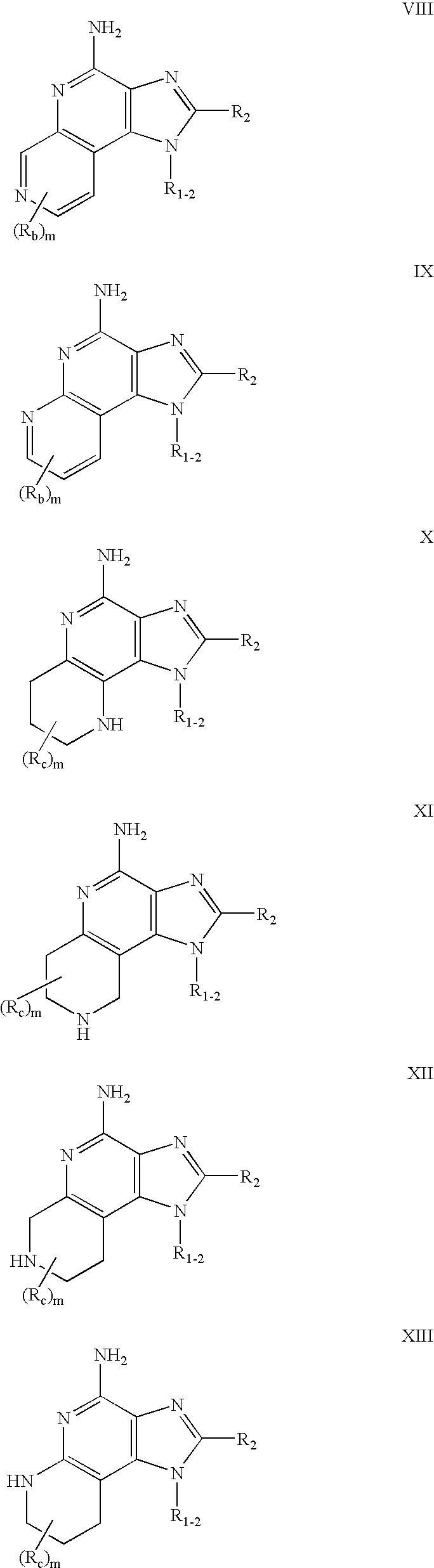
wherein R1, R1-1, R1-2, R″, R2, RA, RB, RA1, RB1, Ra, Rb, Rc, n, and m are as defined below; and pharmaceutically acceptable salts thereof. - The compounds of Formulas I, II, III, IV, V, VI, VII, VIII, IX, X, XI, XII, and XIII are useful, for example, as immune response modifiers (IRMs) due to their ability to modulate cytokine biosynthesis (e.g., induce the biosynthesis or production of one or more cytokines) and otherwise modulate the immune response when administered to animals. Compounds can be tested, for example, using the test procedures described in the Examples Section. Compounds can be tested for induction of cytokine biosynthesis by incubating human PBMC in a culture with the compound(s) at a concentration range of 30 to 0.014 μM and analyzing for interferon (a) or tumor necrosis factor (a) in the culture supernatant. The ability to modulate cytokine biosynthesis, for example, induce the biosynthesis of one or more cytokines, makes the compounds useful in the treatment of a variety of conditions such as viral diseases and neoplastic diseases, that are responsive to such changes in the immune response.
- In another aspect, the present invention provides pharmaceutical compositions containing the immune response modifier compounds, and methods of inducing cytokine biosynthesis in animal cells, treating a viral disease in an animal, and/or treating a neoplastic disease in an animal by administering to the animal one or more compounds of the Formulas I, II, III, IV, V, VI, VII, VIII, IX, X, XI, XII, and XIII, and/or pharmaceutically acceptable salts thereof.
- In another aspect, the invention provides methods of synthesizing the compounds of Formulas I, II, III, IV, V, VI, VII, VIII, IX, X, XI, XII, and XIII and intermediates useful in the synthesis of these compounds.
- As used herein, “a,” “an,” “the,” “at least one,” and “one or more” are used interchangeably.
- The terms “comprising” and variations thereof do not have a limiting meaning where these terms appear in the description and claims.
- The above summary of the present invention is not intended to describe each disclosed embodiment or every implementation of the present invention. The description that follows more particularly exemplifies illustrative embodiments. Guidance is also provided herein through lists of examples, which can be used in various combinations. In each instance, the recited list serves only as a representative group and should not be interpreted as an exclusive or exhaustive list.
- In one aspect, the present invention provides compounds of the Formula I:

and more specifically the following compounds of the Formulas II, III, IV, V, VI, VII, VIII, IX, X, XI, XII, and XIII:

wherein R1, R1-1, R1-2, R″, R2, RA, RB, RA1, RB1, Ra, Rb, Rc, n, and m are as defined below; and pharmaceutically acceptable salts thereof. - In one aspect, the present invention provides imidazopyridine, imidazoquinoline and imidazonaphthyridine compounds of the following Formula I:

wherein: - R1 is selected from the group consisting of:
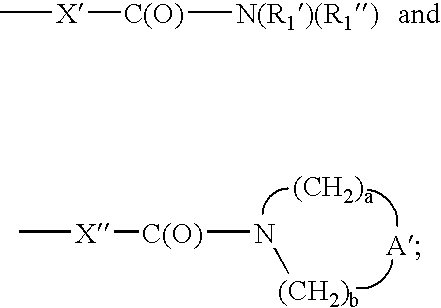
- X′ is selected from the group consisting of —CH(R9)—, —CH(R9)-alkylene-, and —CH(R9)-alkenylene-;
- X″ is selected from the group consisting of —CH(R9)—, —CH(R9)-alkylene-, and —CH(R9)-alkenylene-; wherein the alkylene and alkenylene are optionally interrupted with one or more —O— groups;
- R1′ and R1″ are independently selected from the group consisting of:
-
- hydrogen,
- alkyl,
- alkenyl,
- aryl,
- arylalkylenyl,
- heteroaryl,
- heteroarylalkylenyl,
- heterocyclyl,
- heterocyclylalkylenyl, and
- alkyl, alkenyl, aryl, arylalkylenyl, heteroaryl, heteroarylalkylenyl, heterocyclyl, or heterocyclylalkylenyl, substituted by one or more substituents selected from the group consisting of:
- hydroxy,
- alkyl,
- haloalkyl,
- hydroxyalkyl,
- alkoxy,
- haloalkoxy,
- halogen,
- cyano,
- nitro,
- amino,
- alkylamino,
- dialkylamino,
- arylsulfonyl, and
- alkylsulfonyl;
- A′ is selected from the group consisting of —O—, —C(O)—, —CH2—, —S(O)0-2—, and —N(Q-R4)—;
- a and b are independently integers from 1 to 6 with the proviso that a+b is ≦7;
- RA and RB are independently selected from the group consisting of:
-
- hydrogen,
- halogen,
- alkyl,
- alkenyl,
- alkoxy,
- alkylthio, and
- —N(R9)2;
- or RA and RB taken together form either a fused aryl ring that is unsubstituted or substituted by one or more R. groups, or a fused 5 to 7 membered saturated ring that is unsubstituted or substituted by one or more & groups;
- or RA and RB taken together form a fused heteroaryl or 5 to 7 membered saturated ring containing one heteroatom selected from the group consisting of N and S, wherein the heteroaryl ring is unsubstituted or substituted by one or more Rb groups, and the 5 to 7 membered saturated ring is unsubstituted or substituted by one or more Rc groups;
- Ra is selected from the group consisting of halogen, alkyl, haloalkyl, alkoxy, and —N(R9)2;
- Rb is selected from the group consisting of halogen, hydroxy, alkyl, haloalkyl, alkoxy, and —N(R9)2;
- Rc is selected from the group consisting of halogen, hydroxy, alkyl, alkenyl, haloalkyl, alkoxy, alkylthio, and —N(R9)2;
- Q is selected from the group consisting of a bond, —C(R6)—, —C(R6)—C(R6)—, —S(O)2—, —C(R6)—N(R8)—W—, —S(O)2—N(R8)—, —C(R6)—O—, and —C(R6)—N(OR9)—;
- W is selected from the group consisting of a bond, —C(O)—, and —S(O)2—;
- R4 is selected from the group consisting of hydrogen, alkyl, alkenyl, alkynyl, aryl, arylalkylenyl, aryloxyalkylenyl, alkylarylenyl, heteroaryl, heteroarylalkylenyl, heteroaryloxyalkylenyl, alkylheteroarylenyl, and heterocyclyl wherein the alkyl, alkenyl, allkynyl, aryl, arylalkylenyl, aryloxyalkylenyl, alkylarylenyl, heteroaryl, hoteroarylalkylenyl, heteroaryloxyalkylenyl, alkylbeteroarylenyl, and heterocyclyl groups are unsubstituted or substituted by one or more substituents independently selected from the group consisting of alkyl, alkoxy, hydroxyalkyl, halo alkyl, halo alkoxy, halogen, nitro, hydroxy, mercapto, cyano, aryl, aryloxy, arylalkyleneoxy, heteroaryl, heteroaryloxy, hoteroarylalkyleneoxy, heterocyclyl, amino, alkylamino, dialkylamino, (dialkylamino)alkyleneoxy, and in the case of alkyl, alkenyl, alkynyl, and heterocyclyl, oxo;
- R6 is selected from the group consisting of =50 and ═S;
- R8 is selected from the group consisting of hydrogen, alkyl, alkoxyalkylenyl, and arylalkylenyl;
- R9 is selected from the group consisting of hydrogen and alkyl; and
- R″ is hydrogen or a non-interfering substituent;
- with the proviso that when RA and RB form a fused heteroaryl or 5 to 7 membered saturated ring containing one heteroatom selected from the group consisting of N and S, wherein the heteroaryl ring is unsubstituted or substituted by one or more Rb groups, and the 5 to 7 membered saturated ring is unsubstituted or substituted by one or more Rc groups, then R1 can also be —X″—C(O)—N(R1′)(R1″);
- or a pharmaceutically acceptable salt thereof.
- In some embodiments, compounds or salts of Formula I induce the biosynthesis of one or more cytokines.
- The present invention also provides jinidazopyridine, imidazoquinoline, and imidazonaphthyridine compounds of the following Formula II:
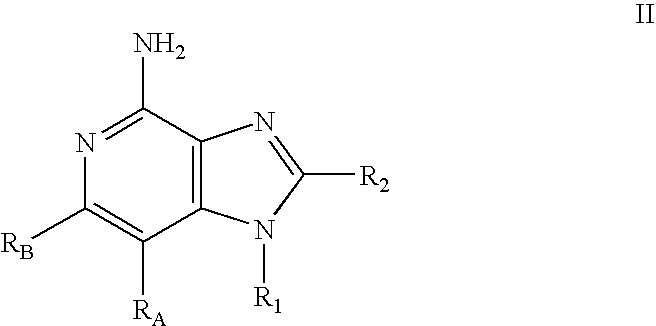
wherein: - R1 is selected from the group consisting of:

- X′ is selected from the group consisting of —CH(R9)—, —CH(R9)-alkylene-, and —CH(R9)-alkenylene-;
- X″ is selected from the group consisting of —CH(R9)—, —CH(R9)-alkylene-, and —CH(R9)-alkenylene-; wherein the alkylene and alkenylene are optionally interrupted with one or more —O— groups;
- R1′ and R1″ are independently selected from the group consisting of:
-
- hydrogen,
- alkyl,
- alkenyl,
- aryl,
- arylalkylenyl,
- heteroaryl,
- heteroarylalkylenyl,
- heterocyclyl,
- heterocyclylalkylenyl, and
- alkyl, alkenyl, aryl, arylalkylenyl, heteroaryl, heteroarylalkylenyl, heterocyclyl, or heterocyclylalkylenyl, substituted by one or more substituents selected from the group consisting of:
- hydroxy,
- alkyl,
- haloalkyl,
- hydroxyalkyl,
- alkoxy,
- haloalkoxy,
- halogen,
- cyano,
- nitro,
- amino,
- alkylamino,
- dialkylamino,
- arylsulfonyl, and
- alkylsulfonyl;
- A′ is selected from the group consisting of —O—, —C(O)—, —CH2—, —S(O)0-2—, and —N(Q-R4)—;
- a and b are independently integers from 1 to 6 with the proviso that a+b is ≦7;
- RA and RB are independently selected from the group consisting of:
-
- hydrogen,
- halogen,
- alkyl,
- alkenyl,
- alkoxy,
- alkyldilo, and
- —N(R9)2;
- or RA and RB taken together form either a fused aryl ring that is unsubstituted or substituted by one or more Ra groups, or a fused 5 to 7 membered saturated ring that is unsubstituted or substituted by one or more Rc groups;
- or RA and RB taken together form a fused heteroaryl or 5 to 7 membered saturated ring containing one heteroatom selected from the group consisting of N and S, wherein the heteroaryl ring is unsubstituted or substituted by one or more Rb groups, and the 5 to 7 membered saturated ring is unsubstituted or substituted by one or more Rc groups;
- Ra is selected from the group consisting of halogen, alkyl, haloalkyl, alkoxy, and —N(R9)2;
- Rb is selected from the group consisting of halogen, lydroxy, alkyl, haloalkyl, alkoxy, and —N(R9)2;
- Rc is selected from the group consisting of halogen, hydroxy, alkyl, alkenyl, haloalkyl, alkoxy, alkylthio, and —N(R9)2;
- R2 is selected from the group consisting of:
-
- —R4,
- —X—R4,
- —X—Y—R4, and
- —X—R5;
- X is selected from the group consisting of alkylene, alkenylene, alkynylene, arylene, heteroarylene, and heterocyclylene wherein the alkylene, alkenylene, and alkynylene groups are optionally interrupted or terminated by arylene, heteroarylene or heterocyclylene and optionally interrupted by one or more —O— groups;
- Y is selected from the group consisting of:
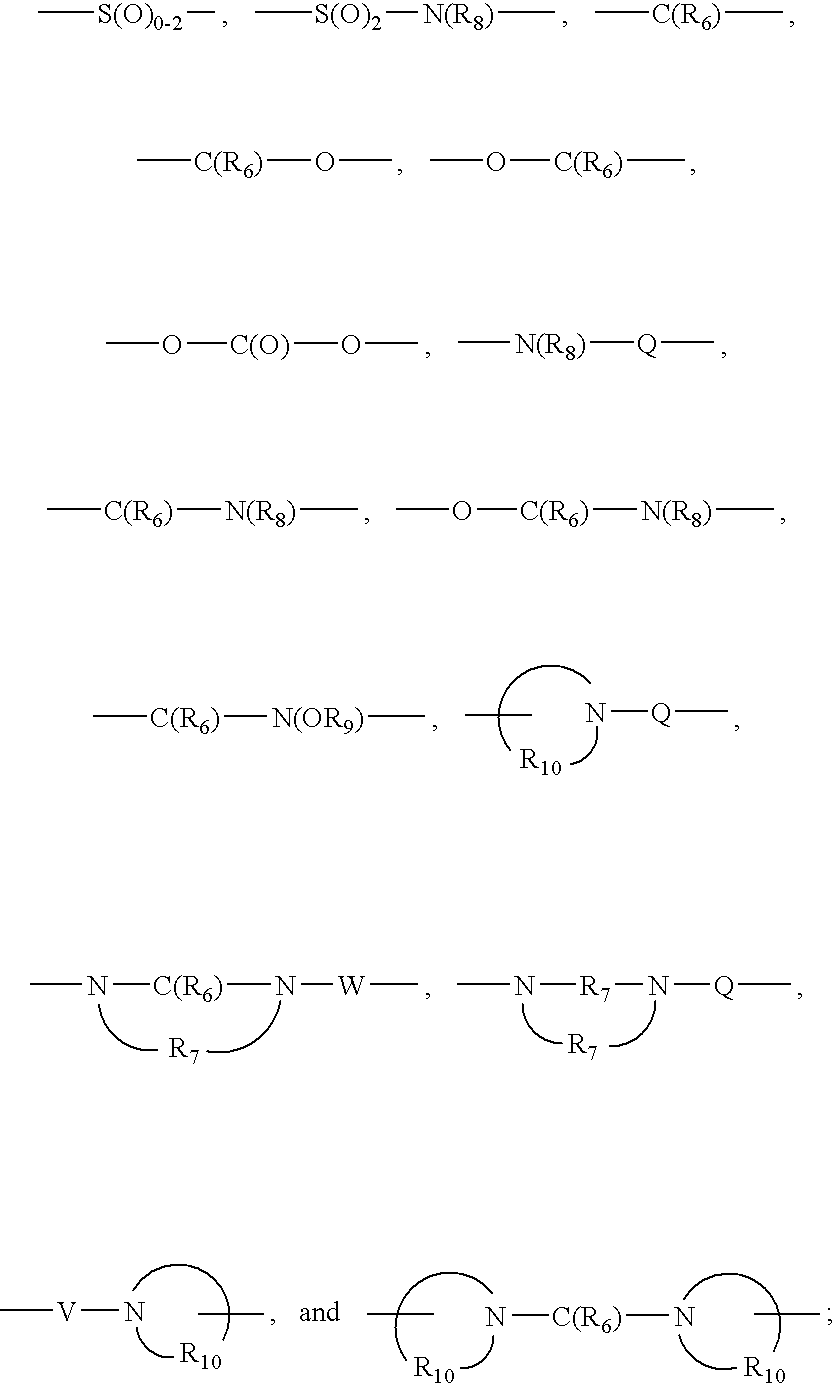
- R4 is selected from the group consisting of hydrogen, alkyl, alkenyl, alkynyl, aryl, arylalkylenyl, aryloxyalkylenyl, alkylarylenyl, heteroaryl, heteroarylalkylenyl, heteroaryloxyalkylenyl, alkylheteroarylenyl, and heterocyclyl wherein the alkyl, alkenyl, alkynyl, aryl, arylalkylenyl, aryloxyalkylenyl, alkylarylenyl, heteroaryl, heteroarylalkylenyl, heteroaryloxyalkylenyl, alkylheteroarylenyl, and heterocyclyl groups are unsubstituted or substituted by one or more substituents independently selected from the group consisting of alkyl, alkoxy, hydroxyalkyl, haloalkyl, haloalkoxy, halogen, nitro, hydroxy, mercapto, cyano, aryl, aryloxy, arylalkyleneoxy, heteroaryl, beteroaryloxy, heteroarylalkyleneoxy, heterocyclyl, amino, alkylamino, dialkylamino, (dialkylamino)alkyleneoxy, and in the case of alkyl, alkenyl, alkynyl, and heterocyclyl, oxo;
- R5 is selected from the group consisting of:

- R6 is selected from the group consisting of ═O and ═S;
- R7 is C2-7 alkylene;
- R8 is selected from the group consisting of hydrogen, alkyl, alkoxyalkylenyl, and arylalkylenyl;
- R9 is selected from the group consisting of hydrogen and alkyl;
- R10 is C3-8 alkylene;
- A is selected from the group consisting of —O—, —C(O)—, —S(O)0-2—, —CH2—, and —N(R4)—;
- Q is selected from the group consisting of a bond, —C(R6)—, —C(R6)—C(R6)—, —S(O)2—, —C(R6)—N(R9)—W—, —S(O)2—N(R8)—, —C(R6)—O—, and —C(R6)—N(OR9)—;
- V is selected from the group consisting of —C(R6)—, —O—C(R6)—, —N(R9)—C(R6)—, and —S(O)2—; and
- W is selected from the group consisting of a bond, —C(O)—, and —S(O)2—;
- with the proviso that when RA aone RB form a fused heteroaryl or 5 to 7 membered saturated ring containing one heteroatom selected from the group consisting of N and S, wherein the heteroaryl ring is unsubstituted or substituted by one or more Rb groups, and the 5 to 7 membered saturated ring is unsubstituted or substituted by one or more Rc groups, then R1 can also be —X″—C(O)—N((R1′)(R1″);
- or a pharmaceutically acceptable salt thereof.
- The present invention also provides imidazopyridine compounds of the following Formula III:

wherein: - R1-1 is selected from the group consisting of:

- X′ is selected from the group consisting of —CH(R9)—, —CH(R9)-alkylene-, and —CH(R9)-alkenylene-;
- X″ is selected from the group consisting of —CH(R9)—, —CH(R9)-alkylene-, and —CH(R9)-alkenylene-; wherein the alkylene and alkenylene are optionally interrupted with one or more —O— groups;
- R1′ and R1″ are independently selected form the group consisting of:
-
- hydrogen,
- alkyl,
- alkenyl,
- aryl,
- arylalkylenyl,
- heteroaryl,
- heteroarylalkylenyl,
- heterocyclyl,
- heterocyclylalkylenyl, and
- alkyl, alkenyl, aryl, arylalkylenyl, heteroaryl, heteroarylalkylenyl, heterocyclyl, or heterocyclylalkylenyl, substituted by one or more substituents selected from the group consisting of:
- hydroxy,
- alkyl,
- haloalkyl,
- hydroxyalkyl,
- alkoxy,
- haloalkoxy,
- halogen,
- cyano,
- nitro,
- amino,
- alkylamino,
- dialkylamino,
- arylsulfonyl, and
- alkylsulfonyl;
- A′ is selected from the group consisting of —O—, —C(O)—, —CH2—, —S(O)0-2—, and —N(Q-R4)—;
- a and b are independently integers from 1 to>6 with the proviso that a+b is ≦7;
- RA1 and RB1 are independently selected from the group consisting of:
-
- hydrogen,
- halogen,
- alkyl,
- alkenyl,
- alkoxy,
- alkylthio, and
- —N(R9)2;
- R2 is selected from the group consisting of:
-
- —R4,
- —X—R4,
- —X—Y—R4, and
- —X—R5;
- X is selected from the group consisting of alkylene, alkenylene, alkynylene, arylene, heteroarylene, and heterocyclylene wherein the alkylene, alkenylene, and alkynylene groups are optionally interrupted or terminated by arylene, heteroarylene or heterocyclylene and optionally interrupted by one or more —O— groups;
- Y is selected from the group consisting of:

- R4 is selected from the group consisting of hydrogen, alkyl, alkenyl, alkynyl, aryl, arylalkylenyl, aryloxyalkylenyl, alkylarylenyl, heteroaryl, heteroarylalkylenyl, heteroaryloxyalkylenyl, alkylheteroarylenyl, and heterocyclyl wherein the alkyl, alkenyl, alkynyl, aryl, arylalkylenyl, aryloxyalkylenyl, alkylarylenyl, heteroaryl, heteroarylalkylenyl, heteroaryloxyalkylenyl, alkylheteroarylenyl, and heterocyclyl groups are unsubstituted or substituted by one or more substituents independently selected from the group consisting of alkyl, alkoxy, hydroxyalkyl, haloalkyl, haloalkoxy, halogen, nitro, hydroxy, mercapto, cyano, aryl, aryloxy, arylalkyleneoxy, heteroaryl, heteroaryloxy, heteroarylalkyleneoxy, heterocyclyl, amino, alkylamino, dialkylamino, (dialkylamino)alkyleneoxy, and in the case of alkyl, alkenyl, alkynyl, and heterocyclyl, oxo;
- R5 is selected from the group consisting of:

- R6 is selected from the group consisting of ═O and ═S;
- R7 is C2-7 alkylene;
- R8 is selected from the group consisting of hydrogen, alkyl, alkoxyalkylenyl, and arylalkylenyl;
- R9 is selected from the group consisting of hydrogen and alkyl;
- R10 is C3-8 alkylene;
- A is selected from the group consisting of —O—, —C(O)—, —S(O)0-2—, —CH2—, and —N(R4)-;
- Q is selected from the group consisting of a bond, —C(R6)—, —C(R6)—C(R6)—, —S(O)2—, —C(R6)—N(R8)—W—, —S(O)2—N(R8)—, —C(R6)—O—, and —C(R6)—N(OR9)—;
- V is selected from the group consisting of —C(R6)—, —O—C(R6)—, —N(D8)—C(R6)—, and —S(O)2—; and
- W is selected from the group consisting of a bond, —C(O)—, and —S(O)2—; or a pharmaceutically acceptable salt thereof.
- The present invention also provides imidazoquinoline compounds of the following Formula IV:
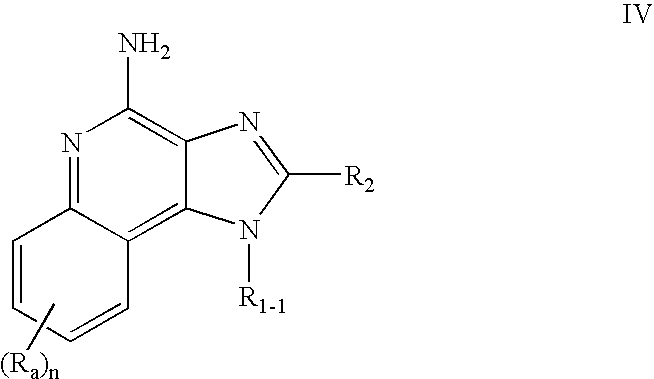
wherein: - R1-1 is selected from the group consisting of:

- X′ is selected from the group consisting of —CH(R9)—, —CH(R9)-alkylene-, and —CH(R9)-alkenylene-;
- X″ is selected from the group consisting of —CH(R9)—, —CH(R9)-alkylene-, and —CH(R9)-alkenylene-; wherein the alkylene and alkenylene are optionally interrupted with one or more —O— groups;
- R1′ and R1″ are independently selected from the group consisting of:
-
- hydrogen,
- alkyl,
- alkenyl,
- aryl,
- arylalkylenyl,
- heteroaryl,
- heteroarylalkylenyl,
- heterocyclyl,
- heterocyclylalkylenyl, and
- alkyl, alkenyl, aryl, arylalkylenyl, heteroaryl, heteroarylalkylenyl, heterocyclyl, or heterocyclylalkylenyl, substituted by one or more substituents selected from the group consisting of:
- hydroxy,
- alkyl,
- haloalkyl,
- hydroxyalkyl,
- alkoxy,
- haloalkoxy,
- halogen,
- cyano,
- nitro,
- amino,
- alkylamino,
- dialkylamino,
- arylsulfonyl, and
- alkylsulfonyl;
- A′ is selected from the group consisting of —O—, —C(O)—, —CH2—, —S(O)0-2—, and —N(Q-R4)—;
- a and b are independently integers from 1 to 6 with the proviso that a+b is ≦7;
- Ra is selected from the group consisting of halogen, alkyl, haloalkyl, alkoxy, and —N(R9)2;
- n is an integer from 0 to 4;
- R2 is selected from the group consisting of:
-
- —R4,
- —X—R4,
- —X—Y—R4, and
- —X—R5;
- X is selected from the group consisting of alkylene, alkenylene, alkynylene, arylene, heteroarylene, and heterocyclylene wherein the alkylene, alkenylene, and alkynylene groups are optionally interrupted or terminated by arylene, heteroarylene or heterocyclylene and optionally interrupted by one or more —O— groups;
- Y is selected from the group consisting of:

- R4 is selected from the group consisting of hydrogen, alkyl, alkenyl, alkynyl, aryl, arylalkylenyl, aryloxyalkylenyl, alkylarylenyl, heteroaryl, heteroarylalkylenyl, heteroaryloxyalkylenyl, alkylheteroarylenyl, and heterocyclyl wherein the alkyl, alkenyl, alkynyl, aryl, arylalkylenyl, aryloxyalkylenyl, alkylarylenyl, heteroaryl, heteroarylalkylenyl, heteroaryloxyalkylenyl, alkylheteroarylenyl, and heterocyclyl groups are unsubstituted or substituted by one or more substituents independently selected from the group consisting of alkyl, alkoxy, hydroxyalkyl, halo alkyl, halo alkoxy, halogen, nitro, hydroxy, mercapto, cyano, aryl, aryloxy, arylalkyleneoxy, heteroaryl, heteroaryloxy, heteroarylalkyleneoxy, heterocyclyl, amino, alkylamino, dialkylamino, (dialkylamino)alkyleneoxy, and in the case of alkyl, alkenyl, alkynyl, and heterocyclyl, oxo;
- R5 is selected from the group consisting of:

- R6 is selected from the group consisting of ═O and ═S;
- R7 is C2-7 alkylene;
- R8 is selected from the group consisting of hydrogen, alkyl, alkoxyalkylenyl, and arylalkylenyl;
- R9 is selected from the group consisting of hydrogen and alkyl;
- R10 is C3-8 alkylene;
- A is selected from the group consisting of —O—, —C(O)—, —S(O)0-2—, —CH2—, and —N(R4)—;
- Q is selected from the group consisting of a bond, —C(R6)—, —C(R6)—C(R6)—, —S(O)2—, —C(R6)—N(R9)—W—, —S(O)2—N(R8)—, —C(R6)—O—, and —C(R6)—N(OR9)—;
- V is selected from the group consisting of —C(R6)—, —O—C(R6)—, —N(R8)—C(R6)—, and —S(O)2—; and
- W is selected from the group consisting of a bond, —C(O)—, and —S(O)2—;
- or a pharmaceutically acceptable salt thereof.
- The present invention also provides 6,7,8,9-tetrahydroimidazoquinoline compounds of the following Formula V:

wherein: - R1-1 is selected from the group consisting of:

- X′ is selected from the group consisting of —CH(R9)—, —CH(R9)-alkylene-, and —CH(R9)-alkenylene-;
- X″ is selected from the group consisting of —CH(R9)—, —CH(R9)-alkylene-, and —CH(R9)-alkenylene-; wherein the alkylene and alkenylene are optionally interrupted with one or more —O— groups;
- R1′ and R1″ are independently selected from the group consisting of:
-
- hydrogen,
- alkyl,
- alkenyl,
- aryl,
- arylalkylenyl,
- heteroaryl,
- heteroarylalkylenyl,
- heterocyclyl,
- heterocyclylalkylenyl, and
- alkyl, alkenyl, aryl, arylalkylenyl, heteroaryl, heteroarylalkylenyl, heterocyclyl, or heterocyclylalkylenyl, substituted by one or more substituents selected from the group consisting of:
- hydroxy,
- alkyl,
- haloalkyl,
- hydroxyalkyl,
- alkoxy,
- haloalkoxy,
- halogen,
- cyano,
- nitro,
- amino,
- alkylamino,
- dialkylamino,
- arylsulfonyl, and
- alkylsulfonyl;
- A′ is selected from the group consisting of —O—, —C(O)—, —CH2—, —S(O)0-2—, and —N(Q-R4)—;
- a and b are independently integers from 1 to 6 with the proviso that a+b is ≦7;
- Rc is selected from the group consisting of halogen, hydroxy, alkyl, alkenyl, haloalkyl, alkoxy, alkylthio, and —N(R9)2;
- n is an integer from 0 to 4;
- R2 is selected from the group consisting of:
-
- —R4,
- —X—R4,
- —X—Y—R4, and
- —X—R5;
- X is selected from the group consisting of alkylene, alkenylene, alkynylene, arylene, heteroarylene, and heterocyclylene wherein the alkylene, alkenylene, and alkynylene groups are optionally interrupted or terminated by arylene, heteroarylene or heterocyclylene and optionally interrupted by one or more —O— groups;
- Y is selected from the group consisting of:
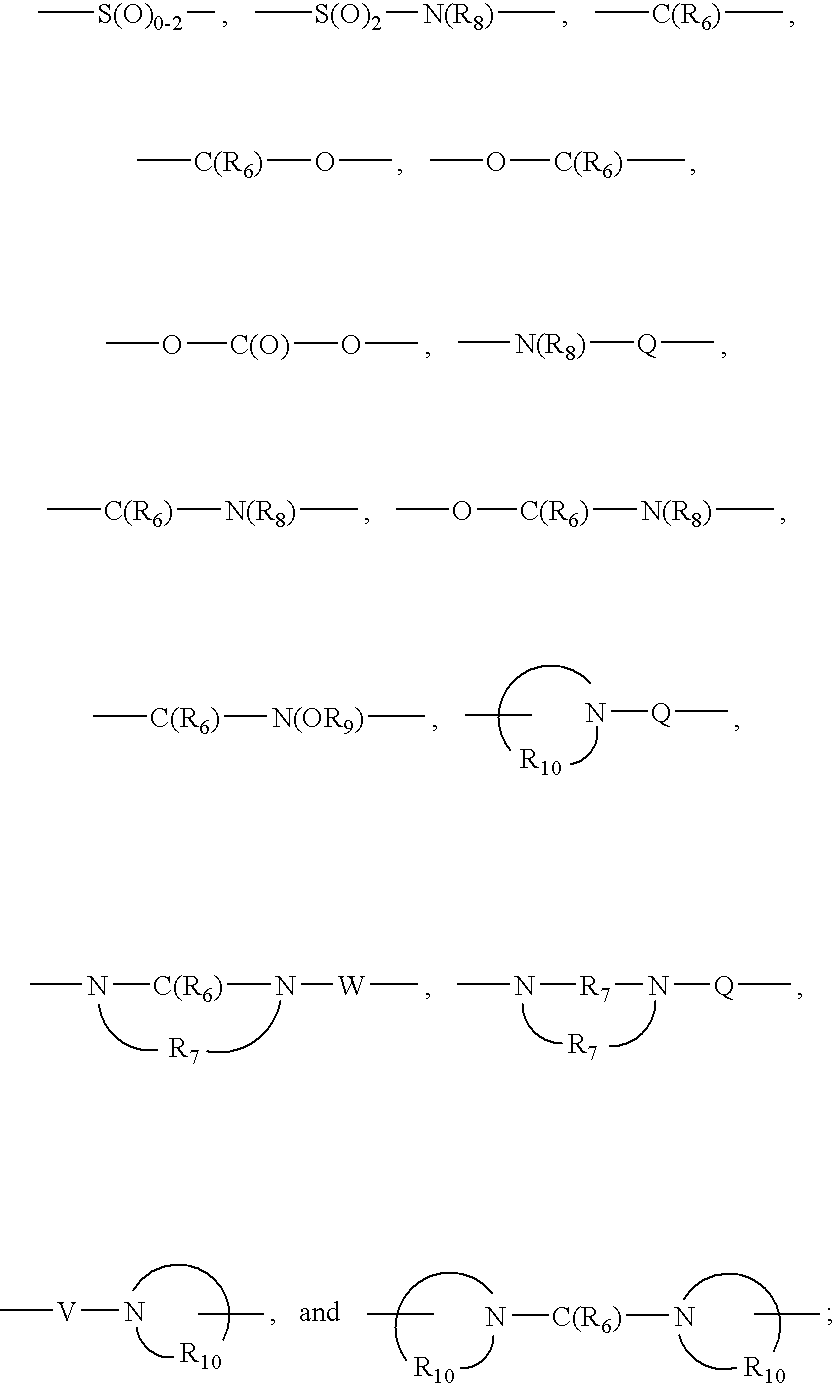
- R4 is selected from the group consisting of hydrogen, alkyl, alkenyl, alkynyl, aryl, arylalkylenyl, aryloxyalkylenyl, alkylarylenyl, heteroaryl, heteroarylalkylenyl, heteroaryloxyalkylenyl, alkylheteroarylenyl, and heterocyclyl wherein the alkyl, alkenyl, alkynyl, aryl, arylalkylenyl, aryloxyalkylenyl, alkylarylenyl, heteroaryl, heteroarylalkylenyl, heteroaryloxyalkylenyl, alkylheteroarylenyl, and heterocyclyl groups are unsubstituted or substituted by one or more substituents independently selected from the group consisting of alkyl, alkoxy, hydroxyalkyl, haloalkyl, haloalkoxy, halogen, nitro, hydroxy, mercapto, cyano, aryl, aryloxy, arylalkyleneoxy, heteroaryl, heteroaryloxy, heteroarylalkyleneoxy, heterocyclyl, amino, alkylamino, dialkylamino, (dialkylamino)alkyleneoxy, and in the case of alkyl, alkenyl, alkynyl, and heterocyclyl, oxo;
- R5 is selected from the group consisting of:

- R6 is selected from the group consisting of ═O and ═S;
- R7 is C2-7 alkylene;
- R8 is selected from the group consisting of hydrogen, alkyl, alkoxyalkylenyl, and arylalkylenyl;
- R9 is selected from the group consisting of hydrogen and alkyl;
- R10 is C3-8 alkylene;
- A is selected from the group consisting of —O—, —C(O)—, —S(O)0-2—, —CH2—, and —N(R4)—;
- Q is selected from the group consisting of a bond, —C(R6)—, —C(R6)—C(R6)—, —S(O)2—, —C(R6)—N(R8)—W—, —S(O)2—N(R8)—, —C(R6)—O—, and —C(R6)—N(OR9)—;
- V is selected from the group consisting of —C(R6)—, —O—C(R6)—, —N(R8)—C(R6)—, and —S(O)2—; and
- W is selected from the group consisting of a bond, —C(O)—, and —S(O)2—;
- or a pharmaceutically acceptable salt thereof.
- The present invention also provides imidazonaphthyridine compounds selected from the group consisting of the following Formulas VI, VII, VIII, and IX:

wherein: - R1-2 is selected from the group consisting of:

- X″ is selected from the group consisting of —CH(R9)—, —CH(R9)-alkylene-, and —CH(R9)-alkenylene-; wherein the alkylene and alkenylene are optionally interrupted with one or more —O— groups;
- R1′ and R1″ are independently selected from the group consisting of:
-
- hydrogen,
- alkyl,
- alkenyl,
- aryl,
- arylalkylenyl,
- heteroaryl,
- heteroarylalkylenyl,
- heterocyclyl,
- heterocyclylalkylenyl, and
- alkyl, alkenyl, aryl, arylalkylenyl, heteroaryl, heteroarylalkylenyl, heterocyclyl, or heterocyclylalkylenyl, substituted by one or more substituents selected from the group consisting of:
- hydroxy,
- alkyl,
- haloalkyl,
- hydroxyalkyl,
- alkoxy,
- haloalkoxy,
- halogen,
- cyano,
- nitro,
- amino,
- alkylamino,
- dialkylamino,
- arylsulfonyl, and
- alkylsulfonyl;
- A′ is selected from the group consisting of —O—, —C(O)—, —CH2—, —S(O)0-2—, and —N(Q-R4)—;
- a and b are independently integers from 1 to 6 with the proviso that a+b is ≦7;
- Rb is selected from the group consisting of halogen, hydroxy, alkyl, haloalkyl, alkoxy, and —N(R9)2;
- m is an integer from 0 to 3;
- R2 is selected from the group consisting of:
-
- —R4,
- —X—R4,
- —X—Y—R4, and
- —X—R5;
- X is selected from -the group consisting of alkylene, alkenylene, alkynylene, arylene, heteroarylene, and heterocyclylene wherein the alkylene, alkenylene, and alkynylene groups are optionally interrupted or terminated by arylene, heteroarylene or heterocyclylene and optionally interrupted by one or more —O— groups;
- Y is selected from the group consisting of:
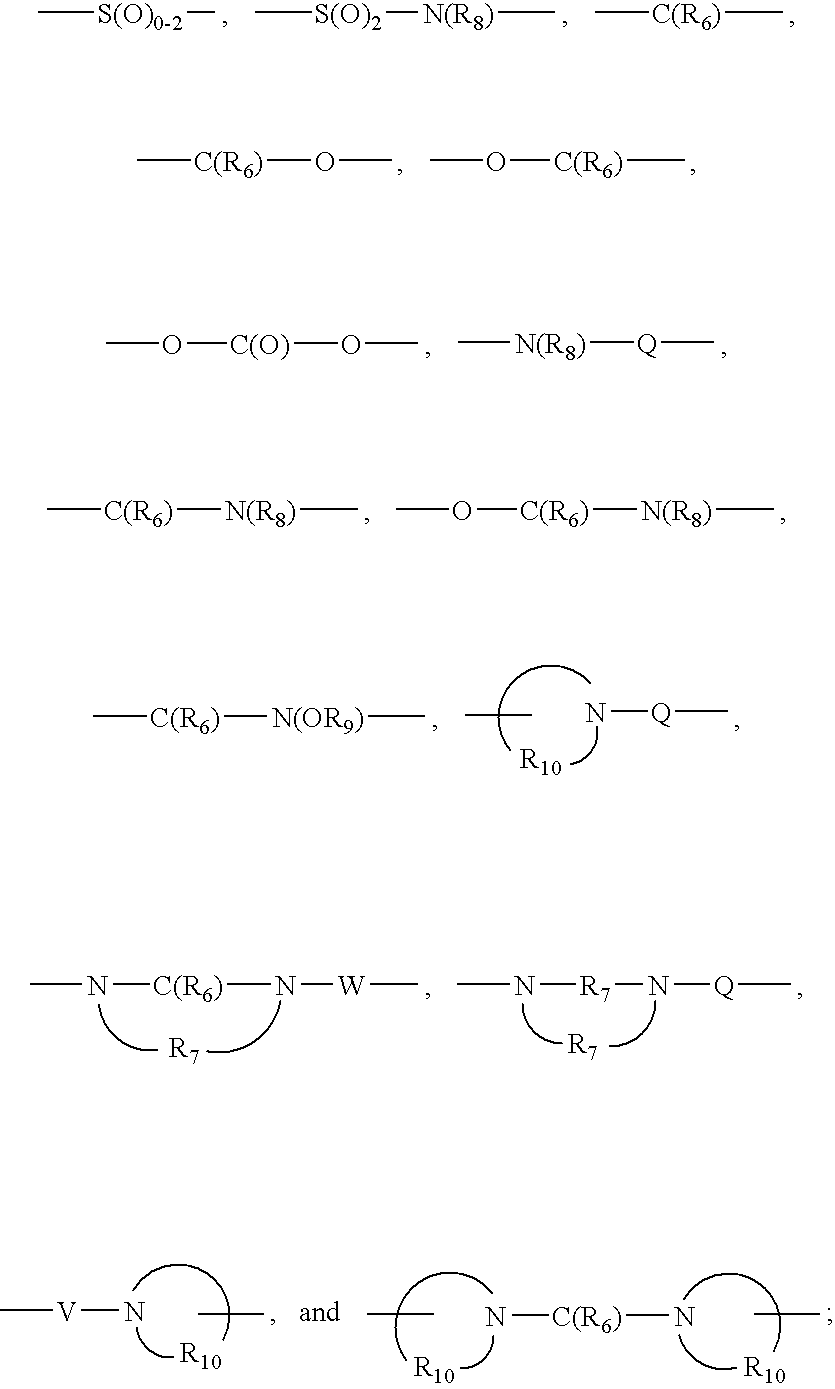
- R4 is selected from the group consisting of hydrogen, alkyl, alkenyl, alkynyl, aryl, arylalkylenyl, aryloxyalkylenyl, alkylarylenyl, heteroaryl, heteroarylalkylenyl, heteroaryloxyalkylenyl, alkylheteroarylenyl, and heterocyclyl wherein the alkyl, alkenyl, alkynyl, aryl, arylalkylenyl, aryloxyalkylenyl, alkylarylenyl, heteroaryl, heteroarylalkylenyl, heteroaryloxyalkylenyl, alkylheteroarylenyl, and heterocyclyl groups are unsubstituted or substituted by one or more substituents independently selected from the group consisting of alkyl, alkoxy, hydroxyalkyl, haloalkyl, haloalkoxy, halogen, nitro, hydroxy, mercapto, cyano, aryl, aryloxy, arylalkyleneoxy, heteroaryl, heteroaryloxy, heteroarylalkyleneoxy, heterocyclyl, amino, alkylamino, dialkylamino, (dialkylamino)alkyleneoxy, and in the case of alkyl, alkenyl, alkynyl, and heterocyclyl, oxo;
- R5 is selected from the group consisting of:

- R6 is selected from the group consisting of ═O and ═S;
- R7 is C2-7 alkylene;
- R8 is selected from the group consisting of hydrogen, alkyl, alkoxyalkylenyl, and arylalkylenyl;
- R9 is selected from the group consisting of hydrogen and alkyl;
- R10 is C3-8 alkylene;
- A is selected from the group consisting of —O—, —C(O)—, —S(O)0-2—, —CH2—, and —N(R4)—;
- Q is selected from the group consisting of a bond, —C(R6)—, —C(R6)—C(R6)—, —S(O)2—, —C(R6)—N(R9)—W—, —S(O)2—N(R9)—, —C(R6)—O—, and —C(R6)—N(OR9)—;
- V is selected from the group consisting of —C(R6)—, —O—C(R6)—, —N(R9)—C(R6)—, and —S(O)2—; and
- W is selected from the group consisting of a bond, —C(O)—, and —S(O)2—;
- or a pharmaceutically acceptable salt thereof.
- The present invention also provides 6,7,8,9-tetrahydroimidazonaphthyridine compounds selected from the group consisting of the following Formulas X, XI, XII, and XIII:
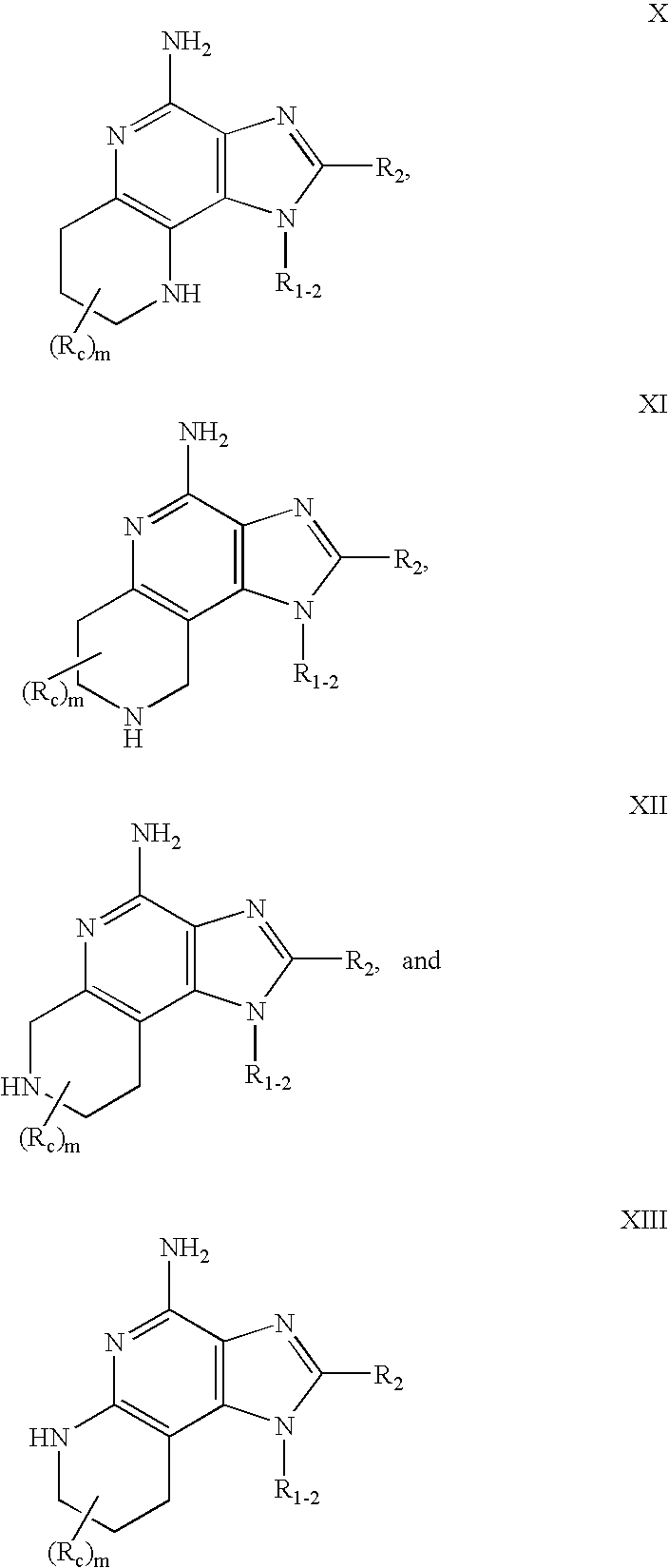
wherein: - R1-2 is selected from the group consisting of:
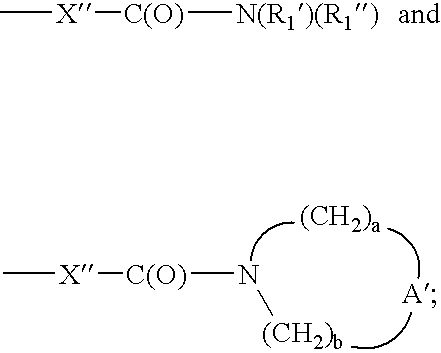
- X″ is selected from the group consisting of —CH(R9)—, —CH(R9)-alkylene-, and —CH(R9)-alkenylene-; wherein the alkylene and alkenylene are optionally interrupted with one or more —O— groups,
- R1′ and R1″ are independently selected from the group consisting of:
-
- hydrogen,
- alkyl,
- alkenyl,
- aryl,
- arylalkylenyl,
- heteroaryl,
- heteroarylalkylenyl,
- heterocyclyl,
- heterocyclylalkylenyl, and
- alkyl, alkenyl, aryl, arylalkylenyl, heteroaryl, heteroarylalkylenyl, heterocyclyl, or heterocyclylalkylenyl, substituted by one or more substituents selected from the group consisting of:
- hydroxy,
- alkyl,
- haloalkyl,
- hydroxyalkyl,
- alkoxy,
- haloalkoxy,
- halogen,
- cyano,
- nitro,
- amino,
- alkylamino,
- dialkylamino,
- arylsulfonyl, and
- alkylsulfonyl;
- A′ is selected from the group consisting of —O—, —C(O)—, —CH2—, —S(O)0-2—, and —N(Q-R4)—;
- a and b are independently integers from 1 to 6 with the proviso that a+b is ≦7;
- Rc is selected from the group consisting of halogen, hydroxy, alkyl, alkenyl, haloalkyl, alkoxy, alkylthio, and —N(R9)2;
- m is an integer from 0 to 3;
- R2 is selected from the group consisting of:
-
- —R4,
- —X—R4,
- —X—Y—R4, and
- —X—R5;
- X is selected from the group consisting of alkylene, alkenylene, alkynylene, arylene, heteroarylene, and heterocyclylene wherein the alkylene, alkenylene, and alkynylene groups are optionally interrupted or terminated by arylene, heteroarylene or heterocyclylene and optionally interrupted by one or more —O— groups;
- Y is selected from the group consisting of:
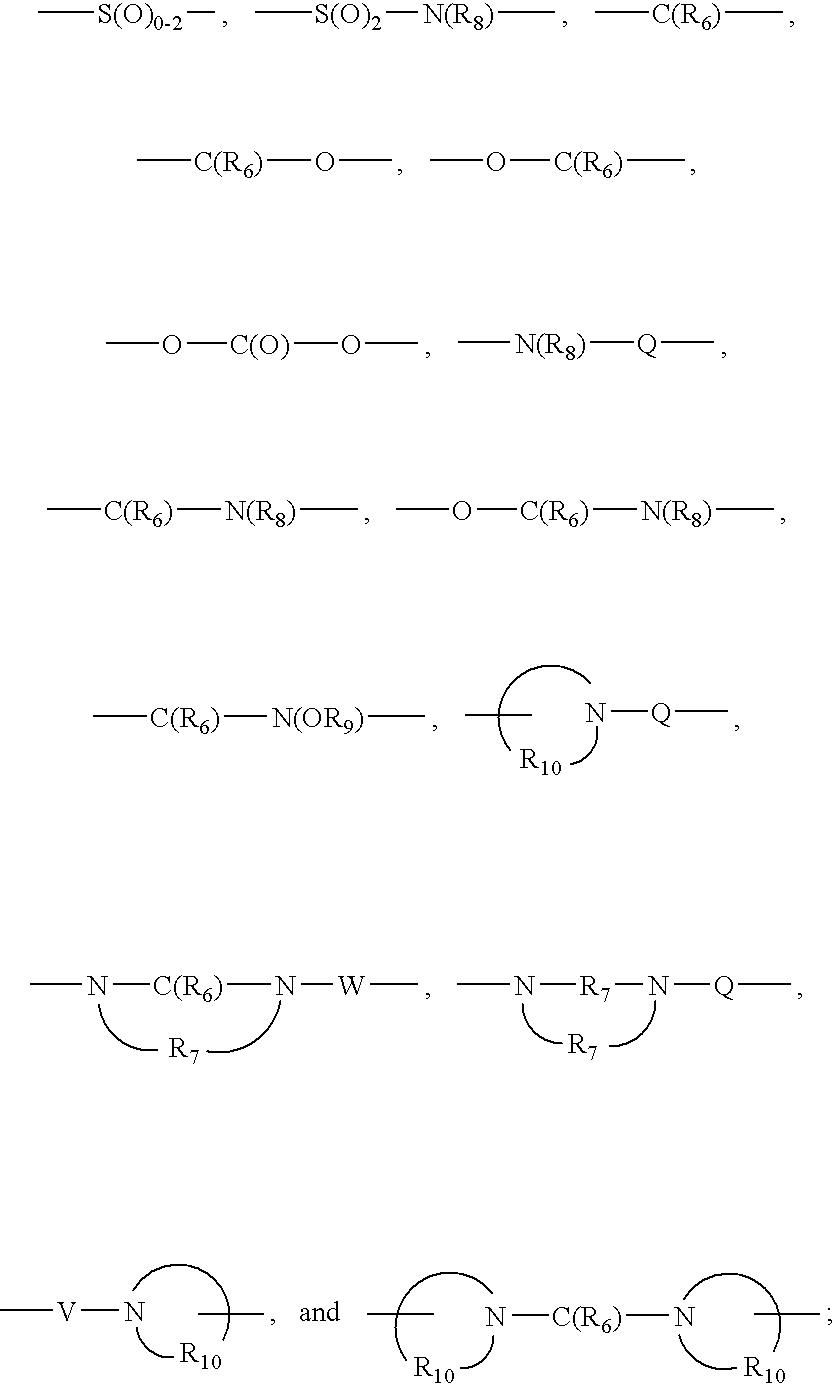
- R4 is selected from the group consisting of hydrogen, alkyl, alkenyl, alkynyl, aryl, arylalkylenyl, aryloxyalkylenyl, alkylarylenyl, heteroaryl, heteroarylalkylenyl, heteroaryloxyalkylenyl, alkylheteroarylenyl, and Heterocyclyl wherein the alkyl, alkenyl, alkynyl, aryl, arylalkylenyl, aryloxyalkylenyl, alkylarylenyl, heteroaryl, heteroarylalkylenyl, heteroaryloxyalkylenyl, alkylheteroarylenyl, and heterocyclyl groups are unsubstituted or substituted by one or more substituents independently selected from the group consisting of alkyl, alkoxy, hydroxyalkyl, haloalkyl, haloalkoxy, halogen, nitro, hydroxy, mercapto, cyano, aryl, aryloxy, arylalkyleneoxy, heteroaryl, heteroaryloxy, heteroarylalkyleneoxy, heterocyclyl, amino, alkylamino, dialkylamino, (dialkylamino)alkyleneoxy, and in the case of alkyl, alkenyl, alkynyl, and heterocyclyl, oxo;
- R5 is selected from the group consisting of:

- R6 is selected from the group consisting of ═O and ═S;
- R7 is C2-7 alkylene;
- R8 is selected from the group consisting of hydrogen, alkyl, alkoxyalkylenyl, and arylalkylenyl;
- R9 is selected from the group consisting of hydrogen and alkyl;
- R10 is C3-8 alkylene;
- A is selected from the group consisting of —O—, —C(O)—, —S(O)0-2—, —CH2—, and —N(R4)—;
- Q is selected from the group consisting of a bond, —C(R6)—, —C(R6)—C(R6)—, —S(O)2—, —C(R6)—N(R9)—W—, —S(O)2—N(R9)—, —C(R6)—O—, and —C(R6)—N(OR9)—;
- V is selected from the group consisting of —C(R6)—, —O—C(R6)—, —N(R8)—C(R6)—, and —S(O)2—; and
- W is selected from the group consisting of a bond, —C(O)—, and —S(O)2—;
- or a pharmaceutically acceptable salt thereof.
- The present invention also provides compounds that are useful as intermediates in the synthesis of compounds of Formulas I-XIII. These intermediate compounds include those having the structural Formulas XIV, XV, and XVI described below.
- The present invention provides intermediate compounds of -the following Formula XIV:

wherein: - R1-1 is selected from the group consisting of:

- X′ is selected from the group consisting of —CH(R9)—, —CH(R9)-alkylene-, and —CH(R9)-alkenylene-;
- X″ is selected from the group consisting of —CH(R9)—, 'CH(R9)-alkylene-, and —CH(R9)-alkenylene-; wherein the alkylene and alkenylene are optionally interrupted with one or more —O— groups;
- R1′ and R1″ are independently selected from the group consisting of:
-
- hydrogen,
- alkyl,
- alkenyl,
- aryl,
- arylalkylenyl,
- heteroaryl,
- heteroarylalkylenyl,
- heterocyclyl,
- heterocyclylalkylenyl, and
- alkyl, alkenyl, aryl, arylalkylenyl, heteroaryl, heteroarylalkylenyl, heterocyclyl, or heterocyclylalkylenyl, substituted by one or more substituents selected from the group consisting of:
- hydroxy,
- alkyl,
- haloalkyl,
- hydroxyalkyl,
- alkoxy,
- haloalkoxy,
- halogen,
- cyano,
- nitro,
- amino,
- alkylamino,
- dialkylamino,
- arylsulfonyl, and
- alkylsulfonyl;
- A′ is selected from the group consisting of —O—, —C(O)—, —CH2—, —S(O)0-2—, and —N(Q-R4)—;
- a and b are independently integers from 1 to 6 with the proviso that a+b is ≦7;
- Ra is selected from the group consisting of halogen, alkyl, haloalkyl, alkoxy, and —N(R9)2;
- n is an integer from 0 to 4;
- R2 is selected from the group consisting of:
-
- —R4,
- —X—R4,
- —X—Y—R4, and
- —X—R5;
- X is selected from the group consisting of alkylene, alkenylene, alkynylene, arylene, heteroarylene, and heterocyclylene wherein the alkylene, alkenylene, and alkynylene groups are optionally interrupted or terminated by arylene, heteroarylene or heterocyclylene and optionally interrupted by one or more —O— groups;
- Y is selected from the group consisting of:
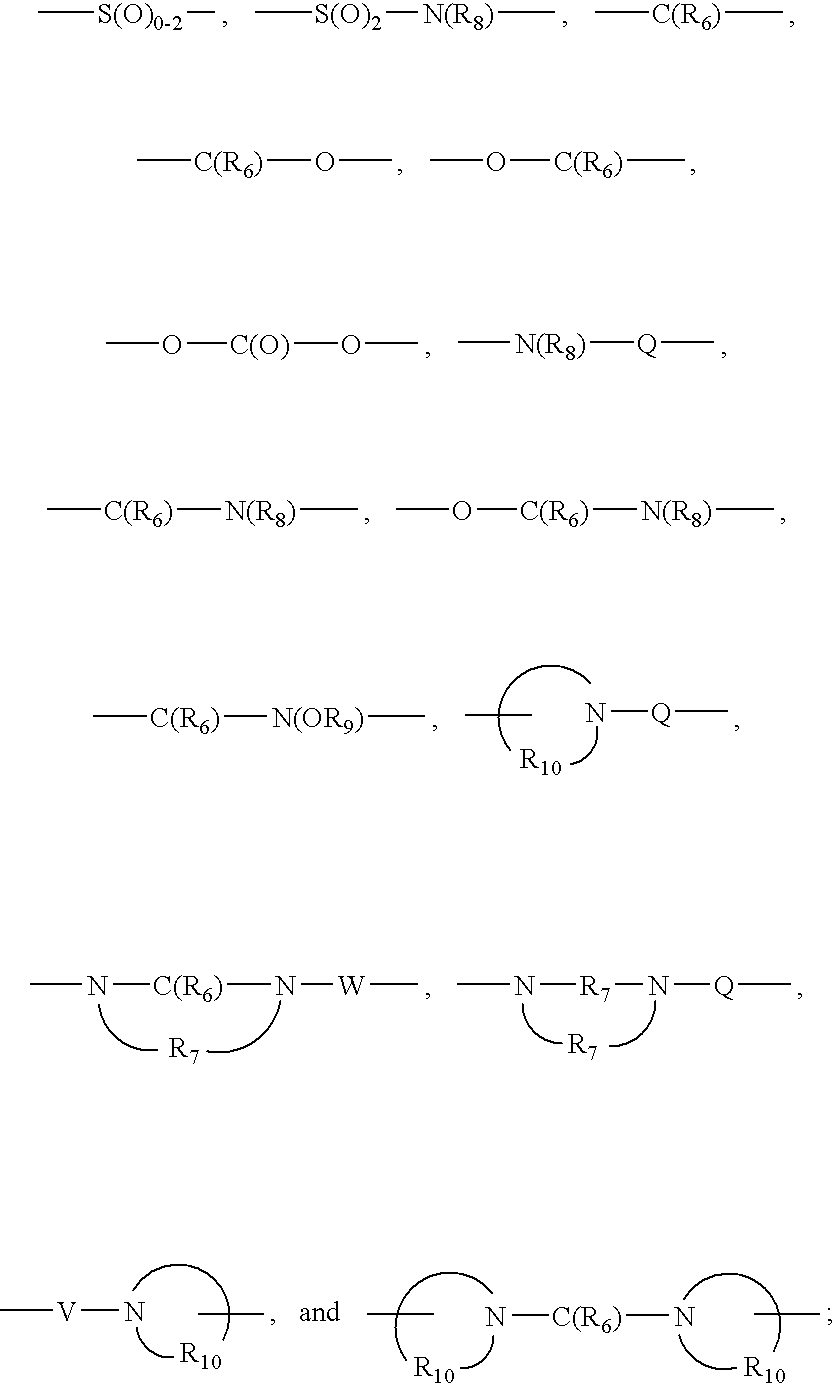
- R4 is selected from the group consisting of hydrogen, alkyl, alkenyl, alkynyl, aryl, arylalkylenyl, aryloxyalkylenyl, alkylarylenyl, heteroaryl, heteroarylalkylenyl, heteroaryloxyalkylenyl, alkylheteroarylenyl, and heterocyclyl wherein the alkyl, alkenyl, alkynyl, aryl, arylalkylenyl, aryloxyalkylenyl, alkylarylenyl, heteroaryl, heteroarylalkylenyl, heteroaryloxyalkylenyl, alkylheteroarylenyl, and heterocyclyl groups are unsubstituted or substituted by one or more substituents independently selected from the group consisting of alkyl, alkoxy, hydroxyalkyl, haloalkyl, haloalkoxy, halogen, nitro, hydroxy, mercapto, cyano, aryl, aryloxy, arylalkyleneoxy, heteroaryl, heteroaryloxy, heteroarylalkyleneoxy, heterocyclyl, amino, alkylamino, dialkylamino, (dialkylamino)alkyleneoxy, and in the case of alkyl, alkenyl, alkynyl, and heterocyclyl, oxo;
- R5 is selected from the group consisting of:
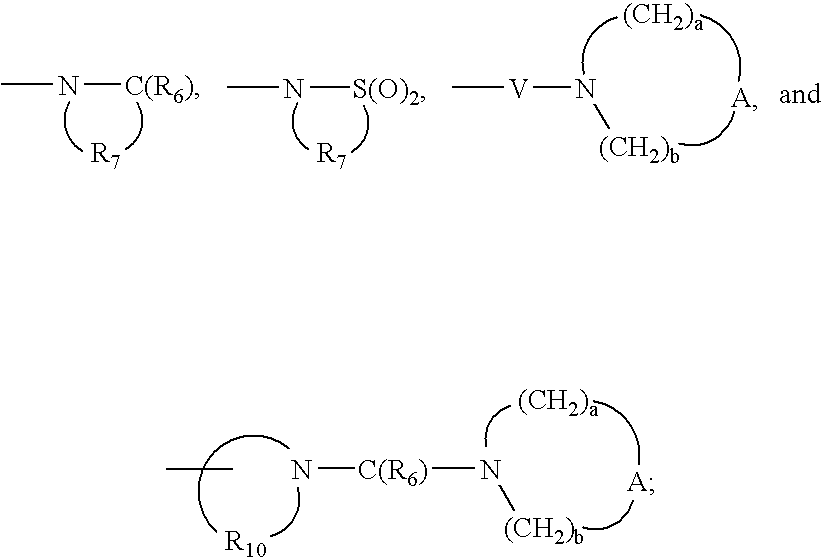
- R6 is selected from the group consisting of ═O and ═S;
- R7 is C2-7 alkylene;
- R8 is selected from the group consisting of hydrogen, alkyl, alkoxyalkylenyl, and arylalkylenyl;
- R9 is selected from the group consisting of hydrogen and alkyl;
- R10 is C3-8 alkylene;
- A is selected from the group consisting of —O—, —C(O)—, —S(O)0-2—, —CH2—, and —N(R4)—;
- Q is selected from the group consisting of a bond, —C(R6)—, —C(R6)—C(R6)—, —S(O)2—, —C(R6)—N(R9)—W—, —S(O)2—N(R8)—, —C(R4)—O—, and —C(R6)—N(OR9)—;
- V is selected from the group consisting of —C(R6)—, —O—C(R6)—, —N(R8)—C(R6)—, and —S(O)2—; and
- W is selected from the group consisting of a bond, —C(O)—, and —S(O)2—;
- or a pharmaceutically acceptable salt thereof.
- The present invention provides intermediate compounds of the following Formula XV:

wherein: - R1-2 is selected from the group consisting of:

- X″ is selected from the group consisting of —CH(R9)—, —CH(R9)-alkylene-, and —CH(R9)-alkenylene-; wherein the alkylene and alkenylene are optionally interrupted with one or more —O— groups;
- R1′ and R1″ are independently selected from the group consisting of:
-
- hydrogen,
- alkyl,
- alkenyl,
- aryl,
- arylalkylenyl,
- heteroaryl,
- heteroarylalkylenyl,
- heterocyclyl,
- heterocyclylalkylenyl, and
- alkyl, alkenyl, aryl, arylalkylenyl, heteroaryl, heteroarylalkylenyl, heterocyclyl, or heterocyclylalkylenyl, substituted by one or more substituents selected from the group consisting of:
- hydroxy,
- alkyl,
- haloalkyl,
- hydroxyalkyl,
- alkoxy,
- haloalkoxy,
- halogen,
- cyano,
- nitro,
- amino,
- alkylamino,
- dialkylamino,
- arylsulfonyl, and
- alkylsulfonyl;
- A′ is selected from the group consisting of —O—, —C(O)—, —CH2—, —S(O)0-2—, and —N(Q-R4)—;
- a and b are independently integers from 1 to 6 with the proviso that a+b is ≦7;
- Rb is selected from the group consisting of halogen, hydroxy, alkyl, haloalkyl, alkoxy, and —N(R9)2;
- m is an integer from 0 to 3;
- R2 is selected from the group consisting of:
-
- —R4,
- —X—R4,
- —X—Y—R4, and
- —X—R5;
- X is selected from the group consisting of alkylene, alkenylene, alkynylene, arylene, heteroarylene, and heterocyclylene wherein the alkylene, alkenylene, and alkynylene groups are optionally interrupted or terminated by arylene, heteroarylene or heterocyclylene and optionally interrupted by one or more —O— groups;
- Y is selected from the group consisting of:
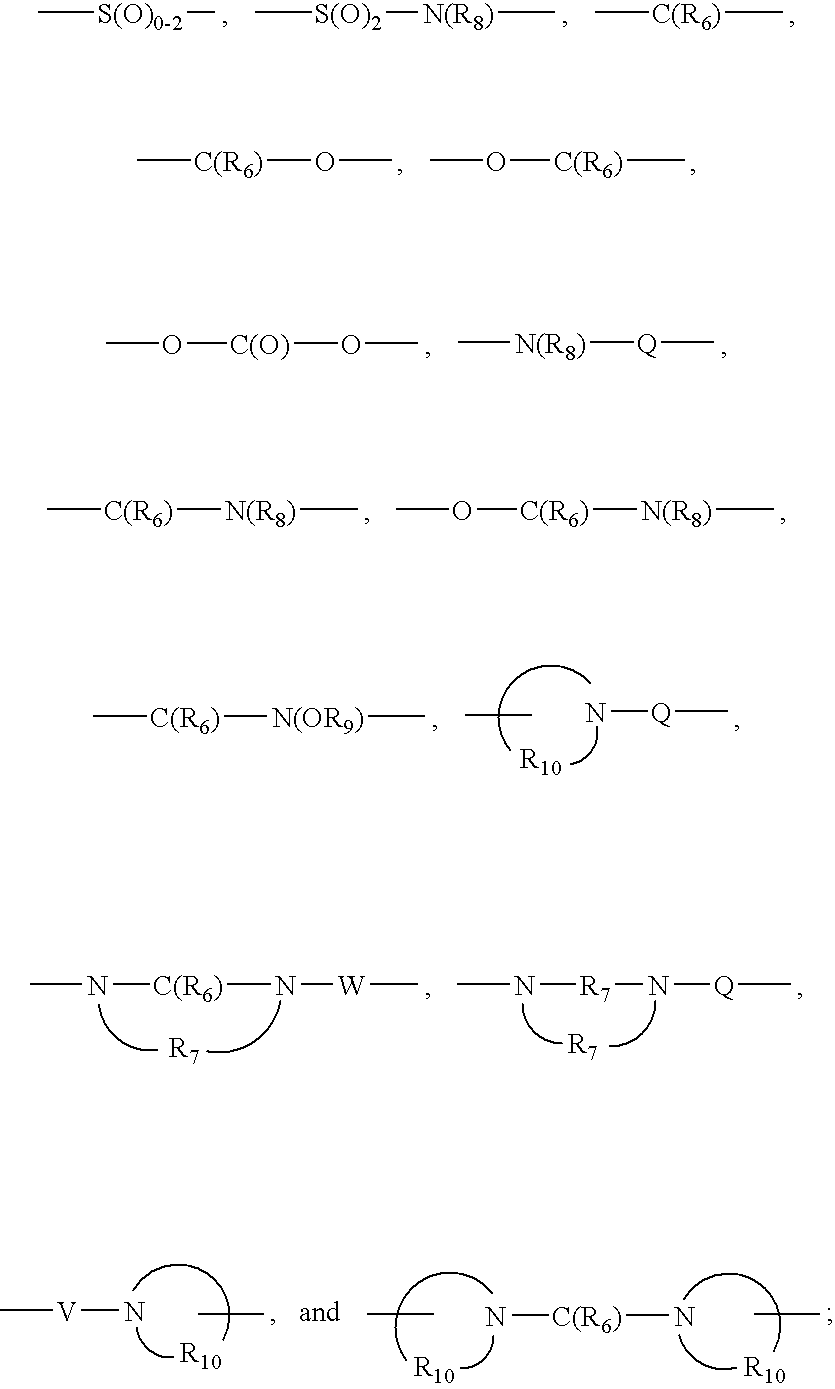
- R4 is selected from the group consisting of hydrogen, alkyl, alkenyl, alkynyl, aryl, arylalkylenyl, aryloxyalkylenyl, alkylarylenyl, heteroaryl, heteroarylalkylenyl, heteroaryloxyalkylenyl, alkylheteroarylenyl, and heterocyclyl wherein the alkyl, alkenyl, alkynyl, aryl, arylalkylenyl, aryloxyalkylenyl, alkylarylenyl, heteroaryl, heteroarylalkylenyl, heteroaryloxyalkylenyl, alkylheteroarylenyl, and heterocyclyl groups are unsubstituted or substituted by one or more substituents independently selected from the group consisting of alkyl, alkoxy, hydroxyalkyl, haloalkyl, haloalkoxy, halogen, nitro, hydroxy, mercapto, cyano, aryl, aryloxy, arylalkylencoxy, heteroaryl, heteroaryloxy, heteroarylalkyleneoxy, heterocyclyl, amino, alkylamino, dialkylamino, (dialkylamino)alkyleneoxy, and in the case of alkyl, alkenyl, alkynyl, and heterocyclyl, oxo;
- R5 is selected from the group consisting of:

- R6 is selected from the group consisting of ═O and ═S;
- R7 is C2-7 alkylene;
- R8 is selected from the group consisting of hydrogen, alkyl, alkoxyalkylenyl, and arylalkylenyl;
- R9 is selected from the group consisting of hydrogen and alkyl;
- R10 is C3-8 alkylene;
- A is selected from the group consisting of —O—, —C(O)—, —S(O)0-2—, —CH2—, and —N(R4)—;
- Q is selected from the group consisting of a bond, —C(R6)—, —C(R6)—C(R6)—, —S(O)2—, —C(R6)—N(R8)—W—, —S(O)2—N(R8)—, —C(R6)—O—, and —C(R6)—N(OR9)—;
- V is selected from the group consisting of —C(R6)—, —O—C(R6)—, —N(R8)—C(R6)—, and —S(O)2—; and
- W is selected from the group consisting of a bond, —C(O)—, and —S(O)2—;
- or a pharmaceutically acceptable salt thereof.
- The present invention provides intermediate compounds of the following Formula XVI:

wherein: - R1-1 is selected from the group consisting of:

- X′ is selected from the group consisting of —CH(R9)—, —CH(R9)-alkylene-, and —CH(R9)-alkenylene-;
- X″ is selected from the group consisting of —CH(R9)—, —CH(R9)-alkylene-, and 'CH(R9)-alkenylene-; wherein the alkylene and alkenylene are optionally interrupted with one or more —O— groups;
- R1′ and R1″ are independently selected from the group consisting of:
-
- hydrogen,
- alkyl,
- alkenyl,
- aryl,
- arylalkylenyl,
- heteroaryl,
- heteroarylalkylenyl,
- heterocyclyl,
- heterocyclylalkylenyl, and
- alkyl, alkenyl, aryl, arylalkylenyl, heteroaryl, heteroarylalkylenyl, heterocyclyl, or heterocyclylalkylenyl, substituted by one or more substituents selected from the group consisting of:
- hydroxy,
- alkyl,
- haloalkyl,
- hydroxyalkyl,
- alkoxy,
- haloalkoxy,
- halogen,
- cyano,
- nitro,
- amino,
- alkylamino,
- dialkylamino,
- arylsulfonyl, and
- alkylsulfonyl;
- A′ is selected from the group consisting of —O—, —C(O)—, —CH2—, —S(O)0-2—, and —N(Q-R4)—;
- a and b are independently integers from 1 to 6 with the proviso that a+b is ≦7;
- RA1 and RB1 are independently selected from the group consisting of:
-
- hydrogen,
- halogen,
- alkyl,
- alkenyl,
- alkoxy,
- alkylthio, and
- —N(R9)2;
- R2 is selected from the group consisting of:
-
- —R4,
- —X—R4,
- —X—Y—R4, and
- —X—R5;
- X is selected from the group consisting of alkylene, alkenylene, alkynylene, arylene, heteroarylene, and heterocyclylene wherein the alkylene, alkenylene, and alkynylene groups are optionally interrupted or terminated by arylene, heteroarylene or heterocyclylene and optionally interrupted by one or more —O— groups;
- Y is selected from the group consisting of:
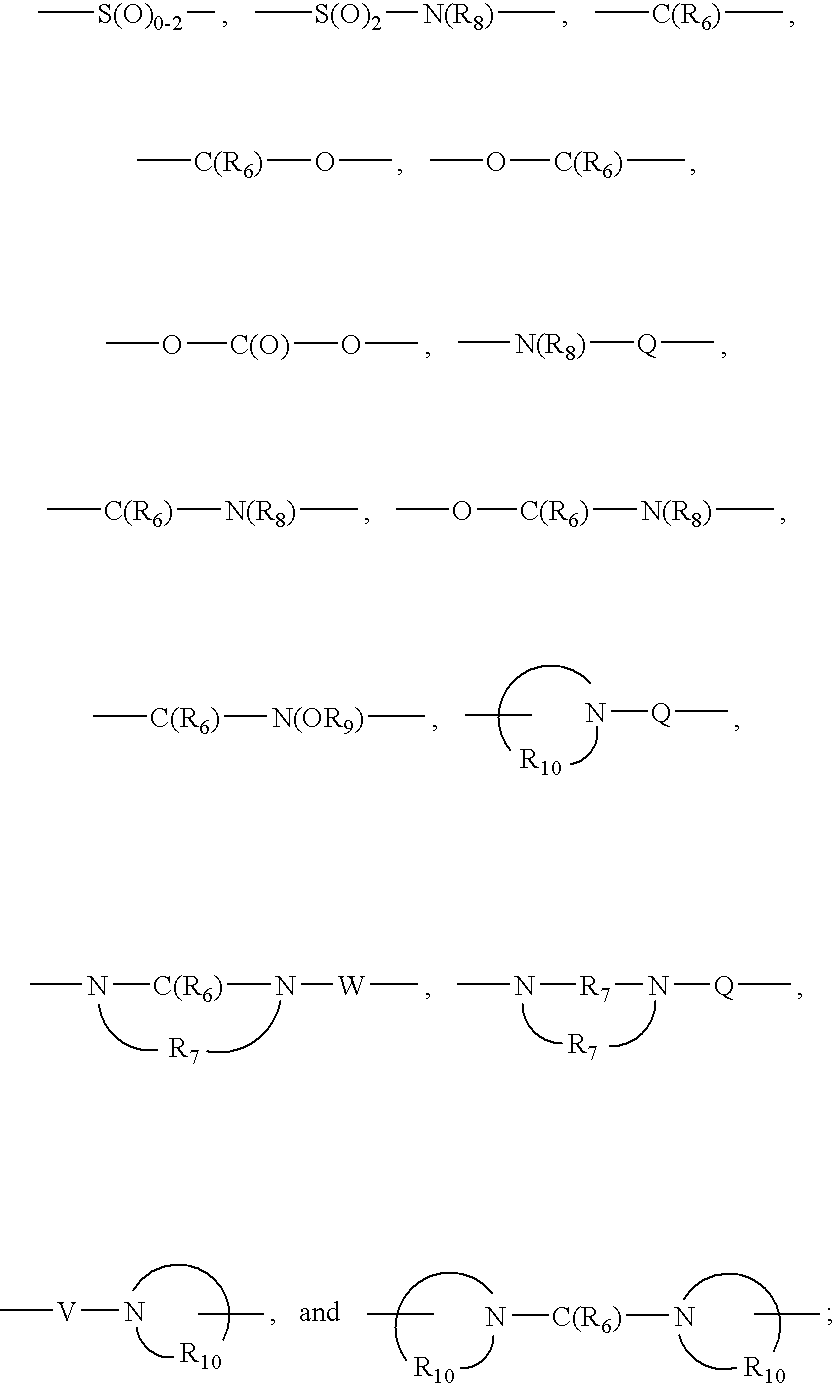
- R4 is selected from the group consisting of hydrogen, alkyl, alkenyl, alkynyl, aryl, arylalkylenyl, aryloxyalkylenyl, alkylarylenyl, heteroaryl, heteroarylalkylenyl, heteroaryloxyalkylenyl, alkylheteroarylenyl, and heterocyclyl wherein the alkyl, alkenyl, alkynyl, aryl, arylalkylenyl, aryloxyalkylenyl, alkylarylenyl, heteroaryl, heteroarylalkylenyl, heteroaryloxyalkylenyl, alkylheteroarylenyl, and heterocyclyl groups are unsubstituted or substituted by one or more substituents independently selected from the group consisting of alkyl, alkoxy, hydroxyalkyl, haloalkyl, haloalkoxy, halogen, nitro, hydroxy, mercapto, cyano, aryl, aryloxy, arylalkyleneoxy, heteroaryl, heteroaryloxy, heteroarylalkyleneoxy, heterocyclyl, amino, alkylamino, dialkylamino, (dialkylamino)alkyleneoxy, and in the case of alkyl, alkenyl, alkynyl, and heterocyclyl, oxo;
- R5 is selected from the group consisting of:

- R6 is selected from the group consisting of ═O and ═S;
- R7 is C2-7 alkylene;
- R8 is selected from the group consisting of hydrogen, alkyl, alkoxyalkylenyl, and arylalkylenyl;
- R9 is selected from the group consisting of hydrogen and alkyl;
- R10 is C3-8 alkylene;
- A is selected from the group consisting of —O—, —C(O)—, —S(O)0-2—, —CH2—, and —N(R4)—;
- Q is selected from the group consisting of a bond, —C(R6)—, —C(R6)—C(R6)—, —S(O)2—, —C(R6)—N(R8)—W—, —S(O)2—N(R8)—, —C(R6)—O—, and —C(R6)—N(OR9)—;
- V is selected from the group consisting of —C(R6)—, —O—C(R6)—, —N(R8)—C(R6)—, and —S(O)2—; and
- W is selected from the group consisting of a bond, —C(O)—, and —S(O)2—;
- or a pharmaceutically acceptable salt thereof.
- As used herein, the terms “alkyl,” “alkenyl,” “alkynyl” and the prefix “alk-” are inclusive of both straight chain and branched chain groups and of cyclic groups, i.e., cycloalkyl and cycloalkenyl. Unless otherwise specified, these groups contain from 1 to 20 carbon atoms, with alkenyl groups containing from 2 to 20 carbon atoms, and alkynyl groups containing from 2 to 20 carbon atoms. In some embodiments, these groups have a total of up to 10 carbon atoms, up to 8 carbon atoms, up to 6 carbon atoms, or up to 4 carbon atoms. Cyclic groups can be monocyclic or polycyclic and preferably have from 3 to 10 ring carbon atoms. Exemplary cyclic groups include cyclopropyl, cyclopropylmethyl, cyclopentyl, cyclohexyl, adamantyl, and substituted and unsubtstituted bornyl, norbornyl, and norbornenyl.
- Unless otherwise specified, “alkylene,” “alkenylene,” and “alkynylene” are the divalent forms of the “alkyl,” “alkenyl,” and “alkynyl” groups defined above. The terms “alkylenyl,” “alkenylenyl,” and “alkynylenyl” are used when “alkylene,” “alkenylene,” and “alkynylene,” respectively, are substituted. For example, an arylalkylenyl group comprises an “alkylene” moiety to which an aryl group is attached.
- The term “haloalkyl ” is inclusive of alkyl groups that are substituted by one or more halogen atoms, including perfluorinated groups. This is also true of other groups that include the prefix “halo-.” Examples of suitable haloalkyl groups are chloromethyl, trifluoromethyl, and the like.
- The term “aryl” as used herein includes carbocyclic aromatic rings or ring systems. Examples of aryl groups include phenyl, naphthyl, biphenyl, fluorenyl and indenyl The term “heteroatom” refers to the atoms O, S, or N.
- The term “heteroaryl” includes aromatic rings or ring systems that contain at least one ring heteroatom (e.g., O, S, N). In some embodiments, the term “heteroaryl” includes a ring or ring system that contains 2-12 carbon atoms, 1-3 rings, 1-4 heteroatoms, amd O, S, and N as the heteroatoms. Suitable heteroaryl groups include furyl, thienyl, pyridyl, quinolinyl, isoquinolinyl, indolyl, isoindolyl, triazolyl, pyrrolyl, tetrazolyl, imidazolyl, pyrazolyl, oxazolyl, thiazolyl, benzofuranyl, benzothiophenyl, carbazolyl, benzoxazolyl, pyrimidinyl, benzimidazolyl, quinoxalinyl, benzothiazolyl, naphthyridinyl, isoxazolyl, isothiazolyl, purinyl, quinazolinyl, pyrazinyl, 1-oxidopyridyl, pyridazinyl, triazinyl, tetrazinyl, oxadiazolyl, thiadiazolyl, and so on.
- The term “heterocyclyl” includes non-aromatic rings or ring systems that contain at least one ring heteroatom (e g., O, S, N) and includes all of the fully saturated and partially unsaturated derivatives of the above mentioned heteroaryl groups. In some embodiments, the term “heterocyclyl” includes a ring or ring system that contains 2-12 carbon atoms, 1-3 rings, 1-4 heteroatoms, and O, S, and N as the heteroatoms. Exemplary heterocyclyl groups include pyrrolidinyl, tetrahydrofuranyl, morpholinyl, thiomorpholinyl, 1,1-dioxothiomorpholinyl, piperidinyl, piperazinyl, thiazolidinyl, imidazolidinyl, isothiazolidinyl, tetrahydropyranyl, quinuclidinyl, homopiperidinyl (azepanyl), 1,4-oxazepanyl, homopiperazinyl (diazepanyl), 1,3-dioxolanyl, aziridinyl, azetidinyl, dihydroisoquinolin-(1H)-yl, octahydroisoquinolin-(1H)-yl, dihydroquiaolin-(2H)-yl, octahydroquinolin-(2H)-yl, dihydro-1H-imidazolyl, 3-azabicyclo[3.2.2]non-3-yl, and the like.
- The term “heterocyclyl” includes bicylic and tricyclic heterocyclic ring systems. Such ring systems include fused and/or bridged rings and spiro rings. Fused rings can include, in addition to a saturated or partially saturated ring, an aromatic ring, for example, a benzene ring. Spiro rings include two rings joined by one Spiro atom and three rings joined by two Spiro atoms.
- The terms “arylene,” “heteroarylene,” and “heterocyclylene” are the divalent forms of the “aryl,” and “heterocyclyl” groups defined above. Likewise, “arylenyl,” “heteroarylenyl,” and “heterocyclylenyl” are the divalent forms of the “aryl,” “heteroaryl,” and “heterocyclyl” groups defined above. For example, an alkylarylenyl group comprises an arylene moiety to which an alkyl group is attached.
- Herein, “non-interfering” means that the ability of the compound or salt, which includes a non-interfering substituent, to modulate (e.g., induce) the biosynthesis of one or more cytokines is not destroyed by the non-interfering substitutent. Illustrative non-interfering R″ groups include those described above for R2 in Formulas II-XIV.
- When a group (or substituent or variable) is present more than once in any Formula described herein, each group (or substituent or variable) is independently selected, whether explicitly stated or not. For example, for the formula —N(R9)2 each R9 group is independently selected. In another example, when an A and an A′ group are both present and both contain an R4 group, each R4 group is independently selected. In a further example, when more than one Q group is present (i.e., R1 and R2 each contains a Q group) and each Q group contains one or more R6 groups, then each Q group is independently selected, and each R6 group is independently selected.
- The invention is inclusive of the compounds described herein in any of their pharmaceutically acceptable forms, including isomers (e.g., diastereomers and enantiomers), salts, solvates, polymorphs, and the like. In particular, if a compound is optically active, the invention specifically includes each of the compound's enantiomers as well as racemic mixtures of the enantiomers. It should be understood that the term “compound” includes any or all of such forms, whether explicitly stated or not (although at times, “salts” are explicitly stated).
- For any of the compounds presented herein, each one of the following variables (e.g., R1, R1-1, R1-2, R″, R2, RA, RB, RA1, RB1, Ra, Rb, Rc, n, m, and so on) in any of its embodiments can be combined with any one or more of the other variables in any of their embodiments and associated with any one of the formulas described herein, as would be understood by one of skill in the art. Each of the resulting combinations of variables is an embodiment of the present invention.
- For certain embodiments, RA and RB are independently selected from the group consisting of: hydrogen, halogen, alkyl, alkenyl, alkoxy, alkylthio, and —N(R9)2; or RA and RB taken together form either a fused aryl ring that is unsubstituted or substituted by one or more Ra groups, or a fused 5 to 7 membered saturated ring that is unsubstituted or substituted by one or more Rc groups; or RA and RB taken together form a fused heteroaryl or 5 to 7 membered saturated ring containing one heteroatom selected from the group consisting of N and S, wherein the heteroaryl ring is unsubstituted or substituted by one or more Rb groups, and the 5 to 7 membered saturated ring is unsubstituted or substituted by one or more Rc groups.
- The term “fused aryl ring” includes fused carbocyclic aromatic rings or ring systems. Examples of fused aryl rings include benzo, naphtho, fluoreno, and indeno. In certain embodiments, the fused aryl ring is benzo.
- The term “fused heteroaryl ring” includes the fused forms of 5 or 6 membered aromatic rings that contain one heteroatom selected from S and N. In certain embodiments, the fused heteroaryl ring is pyrido or thieno. In certain embodiments, the fused heteroaryl ring is pyrido. In certain of these embodiments, the pyrido ring is

- The term “fused 5 to 7 membered saturated ring” includes rings which are fully saturated except for the bond where the ring is fused. In certain embodiments, the ring is a cyclohexene ring. In certain embodiments wherein one heteroatom (N or S) is present, the ring is tetrahydropyrido or dihydrothieno. In certain embodiments, the ring is tetrahydropyrido. In certain of these embodiments, the ring is

wherein the highlighted bond indicates the position where the ring is fused. - For certain embodiments, RA1 and RB1 are independently selected from the group consisting of: hydrogen, halogen, alkyl, alkenyl, alkoxy, alkylthio, and —N(R9)2.
- For certain embodiments, Ra is selected from the group consisting of: halogen, alkyl, haloalkyl, alkoxy, and —N(R9)2.
- For certain embodiments, Rb is selected from the group consisting of: halogen, hydroxy, alkyl, haloalkyl, alkoxy, and —N(R9)2.
- For certain embodiments, Rc is selected from the group consisting of: halogen, hydroxy, alkyl, alkenyl, haloalkyl, alkoxy, alkylthio, and —N(R9)2.
- For certain embodiments, R1 is selected from the group consisting of:
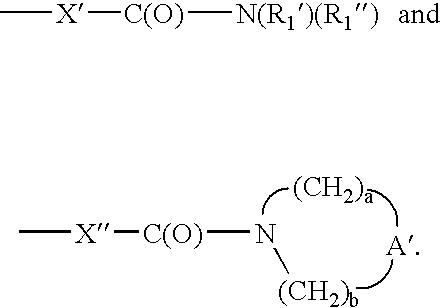
- For certain embodiments, R1 is

- For certain embodiments R1 is —X′—C(O)—N(R1′)(R1″).
- For certain embodiments, when RA and Re form a fused heteroaryl or 5 to 7 membered saturated ring containing one heteroatom selected from the group consisting of N and S, wherein the heteroaryl ring is unsubstituted or substituted by one or more Rb groups, and the 5 to 7 membered saturated ring is unsubstituted or substituted by one or more Rc groups, then R1 can also be —X″—C(O)—N(R1′)(R1″).
- For certain embodiments, R1′ and R1″ are independently selected from the group consisting of: hydrogen, alkyl, alkenyl, aryl, arylalkylenyl, heteroaryl, heteroarylalkylenyl, heterocyclyl, heterocyclylalkylenyl, and alkyl, alkenyl, aryl, arylalkylenyl, heteroaryl, heteroarylalkylenyl, heterocyclyl, or heterocyclylalkylenyl, substituted by one or more substituents selected from the group consisting of: hydroxy, alkyl, haloalkyl, hydroxyalkyl, alkoxy, haloalkoxy, halogen, cyano, nitro, amino, alkylamino, dialkylamino, arylsulfonyl, and alkylsulfonyl.
- For certain embodiments, R1 is hydrogen or C1-3 alkyl. For certain embodiments, R1″ is hydrogen. For certain embodiments, R1′ and R1″ are hydrogen. For certain embodiments, R1′ and R1″ are methyl.
- For certain embodiments, R1-1 is selected from the group consisting of:

- For certain embodiments, R1-1 is

- For certain embodiments, R1-1 is —X′—C(O)—N(R1′)(R1″).
- For certain embodiments, R1-2 is selected from the group consisting of:

- For certain embodiments, R1-2 is

- For certain embodiments, R1-2 is —X″—C(O)—N(R1′)(R1″).
- For certain embodiments, R″ is hydrogen or a non-interfering substituent. For certain embodiments, R″ is R2.
- For certain embodiments, R2 is selected from the group consisting of: —R4, —X—R4, —X—Y—R4, and —X—R5. For certain embodiments, R2 is hydrogen, alkoxyalkylenyl, hydroxyalkylenyl, —R4, —X—R4, or —X—Y—R4. For certain embodiments, R2 is hydrogen, alkoxyalkylenyl, —R4, —X—R4, or —X—Y-R4. For certain embodiments, R2 is hydrogen, C1-4 alkyl, hydroxyC1-4 alkylenyl, or C1-4 alkyl-O—C1-4 alkylenyl. For certain embodiments, R2 is hydrogen, C1-4 alkyl, or C1-4 alkyl-O—C1-4 alkylenyl. For certain embodiments, R2 is hydrogen, methyl, ethyl, propyl, butyl, 2-methoxyethyl, ethoxymethyl, hydroxymethyl, or 2-hydroxyethyl. For certain embodiments, R2 is hydrogen, methyl, ethyl, propyl, butyl, 2-methoxyethyl, or ethoxymethyl. For certain embodiments, R2 is methyl, ethyl, propyl, butyl, 2-methoxyethyl, or ethoxymethyl.
- For certain embodiments, R4 is selected from the group consisting of hydrogen, alkyl, alkenyl, alkynyl, aryl, arylalkylenyl, aryloxyalkylenyl, alkylarylenyl, heteroaryl, heteroarylalkylenyl, heteroaryloxyalkylenyl, alkylheteroarylenyl, and heterocyclyl wherein the alkyl, alkenyl, alkynyl, aryl, arylalkylenyl, aryloxyalkylenyl, alkylarylenyl, heteroaryl, heteroarylalkylenyl, heteroaryloxyalkylenyl, alkylheteroarylenyl, and heterocyclyl groups are unsubstituted or substituted by one or more substituents independently selected from the group consisting of alkyl, alkoxy, hydroxyalkyl, haloalkyl, haloalkoxy, halogen, nitro, hydroxy, mercapto, cyano, aryl, aryloxy, arylalkyleneoxy, heteroaryl, heteroaryloxy, heteroarylalkyleneoxy, heterocyclyl, amino, alkylamino, dialkylamino, (dialkylamino)alkyleneoxy, and in the case of alkyl, alkenyl, alkynyl, and heterocyclyl, oxo. In certain embodiments, R4 is alkyl. In certain embodiments, R4 is methyl.
- For certain embodiments, R5 is selected from the group consisting of:

- For certain embodiments, R6 is selected from the group consisting of ═O and ═S. For certain embodiments, R6 is ═O.
- For certain embodiments, R7 is C2-7 alkylene.
- For certain embodiments, R8 is selected from the group consisting of hydrogen, alkyl, alkoxyalkylenyl, and arylalkylenyl.
- For certain embodiments, R9 is selected from the group consisting of hydrogen and alkyl.
- For certain embodiments, R10 is C3-8 alkylene.
- For certain embodiments, A is selected from the group consisting of —O—, —C(O)—, —S(O)0-2—, —CH2—, and —N(R4)—.
- For certain embodiments, A′ is selected from the group consisting of —O—, —C(O)—, —CH2—, —S(O)0-2—, and —N(Q-R4)—. For certain embodiments, A′ is —SO2—, —O—, or —N(Q-R4)—. For certain embodiments, A′ is —O— or —N(Q-R4)—. For certain embodiments, A′ is —O—. In certain embodiments, A′ is —CH2—.
- For certain embodiments, Q is selected from the group consisting of a bond, —C(R6)—, —C(R6)—C(R6)—, —S(O)2—, —C(R6)—N(R8)—W—, —S(O)2—N(R9)—, —C(R6)—O—, —C(R6)—N(OR9)—. For certain embodiments, Q is —C(O)—.
- For certain embodiments, V is selected from the group consisting of —C(R6)—, —O—C(R6)—, —N(R8)—C(R6)—, and —S(O)2—.
- For certain embodiments, W is selected from the group consisting of a bond, —C(O)—, and —S(O)2—.
- For certain embodiments, X is selected from the group consisting of alkylene, alkenylene, alkynylene, arylene, heteroarylene, and heterocyclylene wherein the alkylene, alkenylene, and alkynylene groups are optionally interrupted or terminated by arylene, heteroarylene or heterocyclylene and optionally interrupted by one or more —O— groups. For certain embodiments, X is C1-2 alkylene.
- For certain embodiments, X′ is selected from the group consisting of —CH(R9)—, —CH(R9)-alkylene-, and —CH(R9)-alkenylene-. For certain embodiments, X′ is —CH2—C0-10 alkylene-. For certain embodiments, X′ is —CH2—C0-4 alkylene-. For certain embodiments, X′ is —(CH2)1-5—, —CH2C(CH3)2—, or —CH2C(CH3)2CH2—. For certain embodiments, X′ is —CH2—, —CH2CH2—, —CH2CH2CH2—, —CH2C(CH3)2—, —CH2C(CH3)2CH2—, or

- For certain embodiments, X′ is —CH2—, —CH2CH2—, —CH2C(CH3)2—, or

- For certain embodiments, X′ is —CH2CH2— or —CH2C(CH3)2—.
- For certain embodiments, X″ is selected from the group consisting of —CH(R9)—, —CH(R9)-alkylene-, and —CH(R9)-alkenylene-; wherein the alkylene and alkenylene are optionally interrupted with one or more —O— groups. For certain embodiments, X″ is —CH2—C0-10 alkylene- or —CH2—C1-4 alkylene-O—C1-4 alkylene-. For certain embodiments, X″ is —CH2—C0-4 alkylene- or —CH2—C1-4 alkylene-O—C1-4 alkylene-. For certain embodiments, X″ is —(CH2)1-5—, —CH2C(CH3)2—, —CH2C(CH3)2CH2—, or —(CH2)3—O—CH2—. For certain embodiments, X″ is —CH2—, —CH2CH2—, —CH2CH2CH2—, —CH2C(CH3)2—, —CH2C(CH3)2CH2—, or

- For certain embodiments, X″ is —CH2—, —CH2CH2—, —CH2C(CH3)2—, or

- For certain embodiments, X″ is —CH2CH2— or —CH2C(CH3)2—.
- For certain embodiments, X′ or X″ is —CH2—, —CH2CH2—, —CH2CH2CH2—, —CH2C(CH3)2—, —CH2C(CH3)2CH2—, or

- For certain embodiments, X′ or X″ is —CH2—, —CH2CH2—, —CH2C(CH3)2—, or
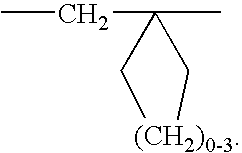
- For certain embodiments, X′ or X″ is —CH2CH2— or —CH2C(CH3)2—.
- For certain embodiments, Y is selected from the group consisting of: —S(O)0-2—, —S(O)2—N(R8)—, —C(R6)—, —C(R6)—O—, —O—C(R6)—O—C(O)—O—, —N(R8)-Q-, —C(R6)—N(R8)—, —O—C(R6)—N(R8)—, —C(R6)—N(OR9)—,
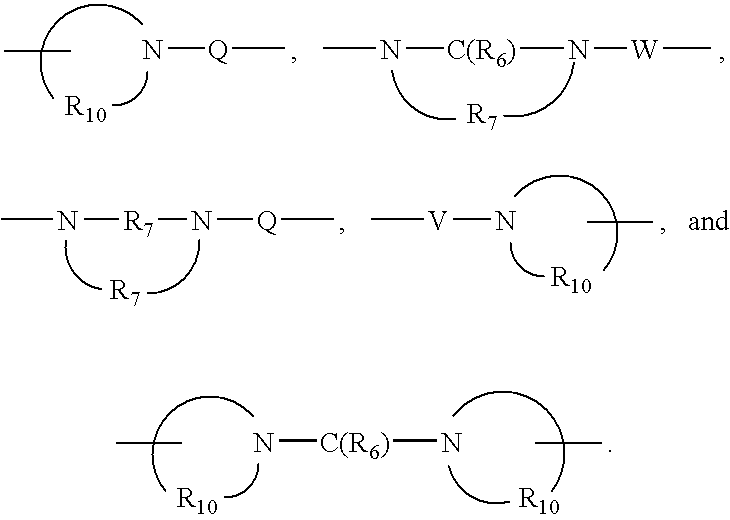
- For certain embodiments, Y is —S(O)0-2—, —S(O)2—N(R8)—, —C(R6)—, —C(R6)—O—, —O—C(R6)—, —O—C(O)—O—, —N(R8)-Q-, —C(R6)—N(R9)—, —O—C(R6)—N(R8)—, or —C(R6)—N(OR9)—.
- For certain embodiments, a and b are independently integers from 1 to 6 with the proviso that a+b is ≦7. For certain embodiments, a and b are independently integers from 1 to 3. For certain embodiments, a and b are independently integers from 2 to 3. For certain embodiments, a and b are each 2.
- For certain embodiments, m is an integer from 0 to 3. For certain embodiments, m is 0.
- For certain embodiments, n is an integer from 0 to 4. For certain embodiments, n is 0.
- In some embodiments, particularly embodiments of Formulas I and II, and more particularly embodiments of Formula II, the fused aryl ring, fused heteroaryl ring, fused 5 to 7 membered saturated ring, or fused 5 to 7 membered saturated ring containing one N or S atom is unsubstituted.
- In some embodiments, particularly embodiments of Formula III, RA1 and RB1 are methyl.
- In some embodiments, particularly embodiments of Formula II, R1 is

A′ is —O— or —N(Q-R4)—, and a and b are independently integers from 2 to 3; or A′ is —CH2—, and a and b are independently integers from 1 to 3. - In some embodiments, particularly embodiments of Formula II, R1 is

A′ is —SO2—, —O—, or —N(Q-R4)—, and a and b are independently integers from 2 to 3; or A′ is —CH2—, and a and b are independently integers from 1 to 3. - In some embodiments, particularly embodiments of Formulas III, IV, and V, R1-1 is

- In some embodiments, particularly embodiments of Formulas III, IV, and V, R1-1; is

A′ is —O—, and a and b are each 2. - In some embodiments, particularly embodiments of Formulas VI through XIII, and more particularly embodiments of Formulas VI through IX, R1-2 is

- In some embodiments, particularly embodiments of Formulas VI through XIII, and more particularly embodiments of Formulas VI through IX, R1-2 is

A′ is —O—, and a and b are each 2. - In some embodiments, particularly embodiments of Formulas III through XIII, and more particularly embodiments of Formulas III through IX, R1′ is hydrogen or C1-3 alkyl, and R1″ is hydrogen. In some embodiments, particularly embodiments of Formula II, R1′ is hydrogen or C1-3 alkyl.
- In some embodiments, particularly embodiments of Formulas III through XIII, and more particularly embodiments of Formulas III through IX, R1′ and R1″ are hydrogen. In some embodiments, particularly embodiments of Formula II, R1″ is hydrogen.
- In some embodiments, particularly embodiments of Formulas II through XIII, and more particularly embodiments of Formulas II through IX, R1′ and R1″ are methyl.
- In some embodiments, particularly embodiments of Formulas II through XIII, and more particularly embodiments of Formulas II through IX, R2 is hydrogen, alkoxyalkylenyl, —R4, —X—R4, or —X—Y—R4; X is C1-2 alkylene; Y is —S(O)0-2—, —S(O)2—N(R9)—, —C(R6)—, —C(R6)—O—, —O—C(R6)—, —O—C(O)—O—, —N(R8)-Q-, —C(R6)—N(R8)—, —O—C(R6)—N(R8)—, or —C(R6)—N(OR9)—; and R4 is alkyl. In some embodiments, particularly embodiments of Fonnulas II through XIII, and more particularly embodiments of Formulas II through IX, R2 is hydrogen, C1-4 alkyl, or C1-4 alkyl-O—C1-4 alkylenyl. In some embodiments, particularly embodiments of Formulas II through XIII, and more particularly embodiments of Formulas II through IX, R2 is hydrogen, methyl, ethyl, propyl, butyl, 2-methoxyethyl, or ethoxymethyl.
- In some embodiments, particularly embodiments of Formulas II through XIII, and more particularly embodiments of Formulas II through IX, R2 is hydrogen, alkoxyalkylenyl, hydroxyalkylenyl, —R4, —X—R4, or —X—Y—R4; X is C1-2 alkylene; Y is —S(O)0-2—, —S(O)2—N(R9)—, —C(R6)—, —C(R6)—O—, —O—C(R6)—, —O—C(O)—O—, —N(R8)-Q-, —C(R6)—N(R8)—, —O—C(R6)—N(R8)—, or —C(R6)—N(OR9)—; and R4 is alkyl. In some embodiments, particularly embodiments of Formulas II through XIII, and more particularly embodiments of Formulas II through IX, R2 is hydrogen, C1-4 alkyl, hydroxyC1-4 alkylenyl, or C1-4 alkyl-O-C1-4 alkylenyl. In some embodiments, particularly embodiments of Formulas II through XIII, and more particularly embodiments of Formulas II through IX, R2 is hydrogen, methyl, ethyl, propyl, butyl, 2-methoxyethyl, ethoxymethyl, hydroxymethyl, or 2-hydroxyethyl.
- In some embodiments, particularly embodiments of Formula II, A′ is —O— or —N(Q-R4)—, and a and b are independently integers from 2 to 3; or A′ is —CH2—, and a and b are independently integers from 1 to 3.
- In some embodiments, particularly embodiments of Formulas I through XIII, more particularly embodiments of Formulas I through IX, and more particularly embodiments of Formulas II through IX, A′ is —SO2—, —O—, or —N(Q-R4)—, and a and b are independently integers from 2 to 3; or A′ is —CH2—, and a and b are independently integers from 1 to 3.
- In some embodiments, particularly embodiments of Formulas III through XIII, and more particularly embodiments of Formulas III through IX, A′ is —O—, and a and b are each 2.
- In some embodiments, particularly embodiments of Formula I, X′ is —CH2-C0-10 alkylene- or X″ is —CH2-C0-10 alkylene- or —CH2—C1-4 alkylene-O—C1-4 alkylene-. In some embodiments, particularly embodiments of Formulas II through V, X′ is —CH2—C0-4 alkylene- or X″ is —CH2—C0-4 alkylene- or —CH2—C1-4 alkylene-O—C1-4 alkylene-.
- In some embodiments, particularly embodiments of Formulas II through V, and more particularly embodiments of Formulas III through V, X′ is —(CH2)1-5—, —CH2C(CH3)2—, or —CH2C(CH3)2CH2—; or X″ is —(CH2)1-5—, —CH2C(CH3)2—, —CH2C(CH3)2CH2—, or —(CH2)3—O—CH2—.
- In some embodiments, particularly embodiments of Formulas II through V, X′ or X″ is —CH2CH2— or —CH2C(CH3)2—.
- In some embodiments, X″ is —CH2—C0-10 alkylene- or —CH2-C1-4 alkylene-O—C1-4 alkylene-. In some embodiments, particularly embodiments of Formulas VI through XIII, and more particularly embodiments of Formulas VI through IX, X″ is —CH2—C04 alkylene- or —CH2—C1-4 alkylene-O—C1-4 alkylene-. In some embodiments, particularly embodiments of Formulas VI through XIII, and more particularly embodiments of Formulas VI through IX, X″ is —(CH2)1-5—, —CH2C(CH3)2—, —CH2C(CH3)2CH2—, or —(CH2)3—O—CH2—. In some embodiments, particularly embodiments of Formulas VI through XIII, and more particularly embodiments of Formulas VI through IX, X″ is —CH2CH2— or —CH2C(CH3)2—.
- In some embodiments, particularly embodiments of Formulas I through V, more particularly embodiments of Formulas III through V, X′ or X″ is —CH2—, —CH2CH2—, —CH2CH2CH2—, —CH2C(CH3)2—, —CH2C(CH3)2CH2—, or

- In some embodiments, particularly embodiments of Formulas I through V, more particularly embodiments of Formulas III through V, X′ or X″ is —CH2—, —CH2CH2—, —CH2C(CH3)2—, or
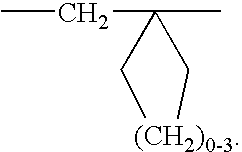
- In some embodiments, particularly embodiments of Formulas VI through XIII, more particularly embodiments of Formulas VI through IX, X″ is —CH2—, —CH2CH2—, —CH2CH2CH2—, —CH2C(CH3)2—, —CH2C(CH3)2CH2—, or

- In some embodiments, particularly embodiments of Formulas VI through XIII, more particularly embodiments of Formulas VI through IX, X″ is —CH2—, —CH2CH2—, —CH2C(CH3)2—, or
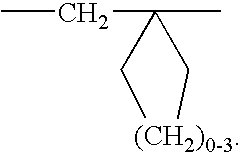
- In some embodiments, particularly embodiments of Formulas VI through XIII, and more particularly embodiments of Formulas VI through IX, m is 0.
- In some embodiments, particularly embodiments of Formulas IV and V, n is 0.
- In some embodiments the imidazonaphthyridine compounds are of the following Formula VI:

or a pharmaceutically acceptable salt thereof. - In some embodiments, particularly embodiments of Formula II, R1 is —CH2CH2C(O)NH2 or —CH2C(CH3)2—C(O)NH2.
- In some embodiments, particularly embodiments of Formulas III through V, R1-1 is —CH2CH2C(O)NH2 or —CH2C(CH3)2—C(O)NH2.
- In some embodiments, particularly embodiments of Formulas VI through XIII, more particularly embodiments of Formulas VI through IX, R1-2 is —CH2CH2C(O)NH2 or —CH2C(CH3)2—C(O)NH2.
- In some embodiments, particularly embodiments of Formula II, R1 is —CH2CH2C(O)NH2 or —CH2C(CH3)2—C(O)NH2, and R2 is selected from the group consisting of hydrogen, methyl, ethyl, propyl, butyl, ethoxymethyl, 2-methoxyethyl, hydroxymethyl, and 2-hydroxyethyl.
- In some embodiments, particularly embodiments of Formulas III through V, R1-1 is —CH2CH2C(O)NH2 or —CH2C(CH3)2—C(O)NH2, and R2 is selected from the group consisting of hydrogen, methyl, ethyl, propyl, butyl, ethoxymethyl, 2-methoxyethyl, hydroxymethyl, and 2-hydroxyethyl.
- In some embodiments, particularly embodiments of Formulas VI through XIII, more particularly embodiments of Formulas VI through IX, R1-2 is —CH2CH2C(O)NH2 or —CH2C(CH3)2—C(O)NH2, and R2 is selected from the group consisting of hydrogen, methyl, ethyl, propyl, butyl, ethoxymethyl, 2-methoxyethyl, hydroxymethyl, and 2-hydroxyethyl.
- Preparation of the Compounds
- Compounds of Formula IVa can be prepared according to Reaction Scheme I, wherein Ra and n are as defined above, Xa is either X′ or X″, and R1-1a and R2a are subsets of R1-1 and R2 as defined above that do not include those substituents that one skilled in the art would recognize as being susceptible to oxidation in step (5). These substituents include —S— and heteroaryl groups. In step (1) of Reaction Scheme I, a 4-chloro-3-nitroquinoline of Formula XX is reacted with an amino ester of the Formula H2N—Xa—C(O)—O-alkyl or a hydrochloride salt thereof to form a compound of Formula XXI. This reaction is conveniently carried out by adding a compound of the Formula H2N—Xa—C(O)—0-alkyl—HCl to a solution of a 4-chloro-3-nitroquinoline of Formula XX in the presence of a base such as triethylamine, potassium carbonate, or a combination thereof. The reaction is carried out in a suitable solvent, such as dichloromethane or chloroform. Compounds of the Formula H2N—Xa—C(O)—O-alkyl—HCl can be commercially obtained or readily synthesized using conventional methods. For example, the amino ester wherein—alkyl is ethyl and Xa is butylene or dodecylene can be synthesized according to the procedure of C. Temple et al., J. Med. Chem., 31, pp. 697-700 (1988). Many compounds of Formula XX are known or can be prepared using known synthetic methods, see for example, U.S. Pat. Nos. 4,689,338; 5,175,296; 5,367,076; and 5,389,640; and the documents cited therein.
- The resultant compound of Formula XXI can be reduced in step (2) of Reaction Scheme I using a variety of methods to provide a quinoline-3,4-diamine of Formula XXII. The reaction can be carried out by hydrogenation using a heterogeneous hydrogenation catalyst such as platinum on carbon. The hydrogenation is conveniently carried out in a Parr apparatus in a suitable solvent such as toluene or ethanol. The reaction can be carried out at ambient temperature, and the product can be isolated using conventional methods.
- Alternatively step (2) can be carried out using a one- or two-phase sodium dithionite reduction The reaction is conveniently carried out using the conditions described by Park, K. K.; Oh, C. H.; and Joung, W. K.; Tetrahedron Lett., 34, pp. 7445-7446 (1993) by adding sodium dithionite to a compound of Formula XXI in a mixture of dichloromethane and water at ambient temperature in the presence of potassium carbonate and ethyl viologen dibromide, ethyl viologen diiodide, or 1,1′-di-n-octyl-4,4′-bipyridinium dibromide. The product can be isolated using conventional methods.
- In step (3) of Reaction Scheme I, a quinoline-3,4-diamine of Formula XXII is treated with a carboxylic acid or equivalent thereof to provide a 1H-imidazo[4,5-c]quinoline of Formula XXIII. Suitable carboxylic acid equivalents include orthoesters of Formula R2aC(O-alkyl)3, 1,1-dialkoxyalkyl alkanoates of Formula R2aC(O-alkyl)2(O—C(O)-alkyl), and acid chlorides of Formula R2aC(O)Cl. The selection of the carboxylic acid equivalent is determined by the desired substituent at R2a. For example, triethyl orthoformate will provide a compound where R2a is hydrogen, and trimethyl orthovalerate will provide a compound where R2a is a butyl group. The reaction is conveniently carried out by adding the carboxylic acid equivalent to a quinoline-3,4-diamine of Formula XXII in a suitable solvent such as toluene. Optionally, catalytic pyridine hydrochloride or pyridinium p-toluenesulfonate can be added. The reaction is carried out at a temperature high enough to drive off alcohol or water formed during the reaction. Conveniently, a Dean-Stark trap can be used to collect the volatiles.
- Alternatively, step (3) can be carried out in two steps when an acid chloride of Formula R2aC(O)Cl is used as the carboxylic acid equivalent. The first step is conveniently carried out by adding the acid chloride to a solution of a quinoline-3,4-diamine of Formula XXII in a suitable solvent such as dichloromethane to afford an amide. Optionally, a tertiary amine such as triethylamine, pyridine, or 4-dimethylaminopyridine can be added. The reaction can be carried out at ambient temperature. The amide product can be isolated and optionally purified using conventional techniques before it is heated and cyclized to provide a 1H-imidazo[4,5-c]quinoline of Formula XXIII. The cyclization reaction is conveniently carried out in a solvent such as ethanol or methanol in the presence of a base such as triethylamine and may be carried out at an elevated temperature, such as the reflux temperature of the solvent. The 1H-imidazo[4,5-c]quinoline of Formula XXIII can be isolated using conventional methods.
- In step (4) or steps (4a) and (4b) of Reaction Scheme I, the ester group of a 1H-imidazo[4,5-c]quinoline Formula XXIII is converted to an amide to provide a 1H-imidazo[4,5-c]quinoline of Formula XIVa. The transformation can be carried out by base-promoted hydrolysis of the ester in step (4a) to form a carboxylic acid of Formula XXIV.
- In step (4b), a carboxylic acid of Formula XXIV is converted to an acid chloride using conventional methods and then treated with an amine to provide an amide-substituted 1H-imidazo[4,5-c]quinoline of Formula XIVa. The base-promoted hydrolysis in step (4a) is conveniently carried out by adding sodium hydroxide to an ester-substituted 1H-imidazo[4,5-c]quinoline Formula XXIII in a suitable solvent such as ethanol. The reaction can be carried out at ambient temperature, and the product can be isolated using conventional methods. The conversion of the resulting carboxylic acid to an acid chloride is conveniently carried out by slowly adding oxalyl chloride to a solution of the carboxylic acid in a suitable solvent such as dichloromethane. The reaction can be carried out at a sub-ambient temperature, such as 0° C., or at ambient temperature. The resulting acid chloride can then be treated with an amine of Formula HN(R1′)(R1″) or

in a suitable solvent such as dichloromethane. Numerous amines of these formulas are commercially available; others can be prepared by known synthetic methods. The reaction can be run at ambient temperature, and the product of Formula XIVa or pharmaceutically acceptable salt thereof can be isolated using conventional methods. - Alternatively, step (4) can be used to convert an ester-substituted 1H-imidazo[4,5-c]quinoline of Formula XXIII to an amide of Formula XIVa in one step by treating the compound Formula XXIII with an amine of Formula HN(R1′)(R1″) or
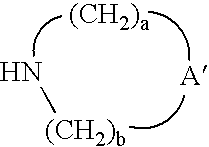
or a hydrochloride salt thereof in the presence of trimethylaluminum. The reaction is conveniently carried out by adding a solution of an ester-substituted 1H-imidazo[4,5-c]quinoline of Formula XXIII in a suitable solvent such as dichloromethane to a pre-reacted mixture of trimethylaluminum and an amine of Formula HN(R1′)(R1″) or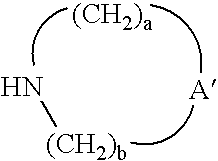
or a hydrochloride salt thereof in a suitable solvent such as dichloromethane. The reaction can then be heated at an elevated temperature, for example, the reflux temperature of the solvent. The product can be isolated using conventional methods. - Step (4) of Reaction Scheme I can also be carried out by heating an ester-substituted 1H-imidazo[4,5-c]quinoline Formula XXIII in the presence of an amine of Formula HN(R1′)(R1″) or

at an elevated temperature such as 90-120° C. The reaction is conveniently carried out in a high-pressure vessel and can be run neat or in a suitable solvent such as tetrahydrofuran (THF). An ester of Formula XXIII can be heated in the presence of ammonium acetate at an elevated temperature such as 110 to 140° C. to provide a compound of Formula XIVA, where R1-1a is —X′—C(O)—NH2. The product can be isolated by conventional methods. - In step (5) of Reaction Scheme I, an amide-substituted 1H-imidazo[4,5-c]quinoline of Formula XIVa is oxidized to provide a 1H-imidazo[4,5-c]quinoline-5N-oxide of Formula XXV using a conventional oxidizing agent capable of forming N-oxides. The reaction is conveniently carried out by adding 3-chloroperoxybenzoic acid to a solution of a compound of Formula XIVa in a solvent such as dichloromethane or chloroform. The reaction can be carried out at ambient temperature, and the product can be isolated using conventional methods.
- In step (6) of Reaction Scheme I, a 1H-imidazo[4,5-c]quinoline-5N-oxide of Formula XXV is aminated to provide an amide-substituted 1H-imidazo[4,5-c]quinolin-4-amine of Formula IVa, a subgenus of Formulas I, II, and IV. Step (6) can be carried out by the activation of an N-oxide of Formula XXV by conversion to an ester and then reacting the ester with an aminating agent. Suitable activating agents include alkyl- or arylsulfonyl chlorides such as benzenesulfonyl chloride, methanesulfonyl chloride, or p-toluenesulfonyl chloride. Suitable aminating agents include ammonia, in the form of ammonium hydroxide, for example, and ammonium salts such as ammonium carbonate, ammonium bicarbonate, and ammonium phosphate. The reaction is conveniently carried out by adding ammonium hydroxide to a solution of the N-oxide of Formula XXV in a suitable solvent such as dichloromethane or chloroform and then adding p-toluenesulfonyl chloride. The reaction can be carried out at ambient temperature. The product or pharmaceutically acceptable salt thereof can be isolated using conventional methods.
- Steps (5) and (6) of Reaction Scheme I may be carried out as a one-pot procedure by adding 3-chloroperoxybenzoic acid to a solution of a compound of Formula XIVa in a solvent such as dichloromethane or chloroform and then adding ammonium hydroxide and p-toluenesulfonyl chloride without isolating the N-oxide compound of Formula XXV. The product of Formula IVa or pharmaceutically acceptable salt thereof can be isolated by conventional methods.

- Compounds of the invention can also be prepared according to Reaction Scheme II, wherein Ra, R2a, R1-1, Xa, and n are as defined above. In step (1) of Reaction Scheme II, an ester-substituted 1H-imidazo[4,5-c]quinoline Formula XXIII is oxidized to an N-oxide of Formula XXVI, which is then aminated in step (2) to provide an ester-substituted 1H-imidazo[4,5-c]quinolin-4-amine Formula XXVII. Steps (1) and (2) of Reaction Scheme II can be carried out as described for steps (5) and (6) of Reaction Scheme I.
- In step (3) of Reaction Scheme II, an ester-substituted 1H-imidazo[4,5-c]quinolin-4-amine Formula XXVII is heated in the presence of an amine of Formula HN(R1′)(R1″) or

at an elevated temperature such as 90-120° C. to provide an amide-substituted 1H-imidazo[4,5-c]quinolin-4-amine Formula IVb, a subgenus of Formulas I, II, and IV. The reaction is conveniently carried out in a high-pressure vessel and can be run neat or in a suitable solvent such as THF. An ester of Formula XXVII can be heated in the presence of ammonium acetate at an elevated temperature such as 110 to 140° C. to provide a compound of Formula IVb, where R1-1 is —Xa—C(O)—NH2. The product or pharmaceutically acceptable salt thereof can be isolated by conventional methods.
- Compounds of the invention can also be prepared according to Reaction Scheme III, wherein n is as defined above, Rd is alkyl, alkoxy, or —N(R9)2 and R2b and R1-1b are subsets of R2 and R1-1 as defined above that do not include those substituents that one skilled in the art would recognize as being susceptible to reduction under the acidic hydrogenation conditions of the reaction. These susceptible groups include, for example, alkenyl, alkynyl, and aryl groups and groups bearing nitro substituents.
- As shown in Reaction Scheme III, an 1H-imidazo[4,5-c]quinoline of Formula IVc can be reduced to a 6,7,8,9-tetrahydro-1H-imidazo[4,5-c]quinolin-4-amine of Formula Vb, a subgenus of Formulas I, II, and V. The reaction is conveniently carried out under hetereogeneous hydrogenation conditions by adding platinum (IV) oxide to a solution of the compound of Formula IVc in trifluoroacetic acid aid placing the reaction under hydrogen pressure. The reaction can be carried out on a Parr apparatus at ambient temperature. The product or pharmaceutically acceptable salt thereof can be isolated by conventional methods.
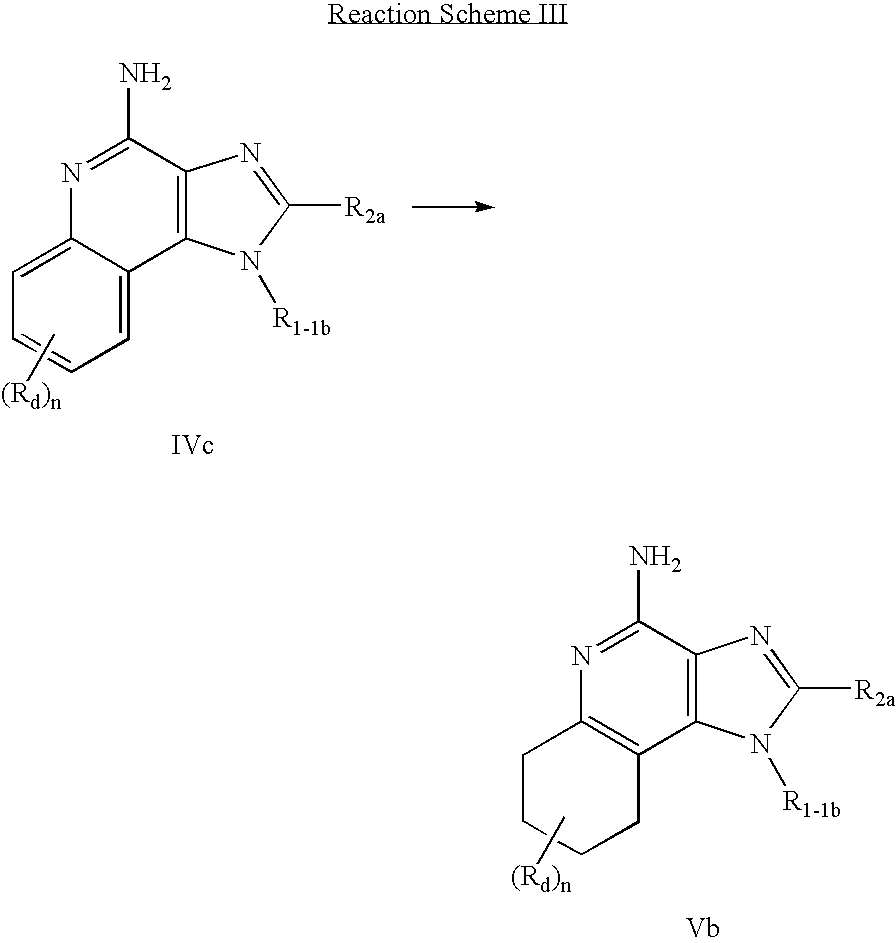
- Compounds of the invention can be prepared according to Reaction Scheme IV, wherein Rb, X″, R2a and m are as defined above and R1-2a is a subset of R1-2 as defined above that does not include those substituents that one skilled in the art would recognize as being susceptible to oxidation in step (5). These substituents include —S— and heteroaryl groups. Reaction Scheme IV begins with a 4-chloro-3-nitro[1,5]naphthyridine of Formula XXVIII. Compounds of Formula XXVIII and their preparation are known; see, for example, U.S. Pat. No. 6,194,425 (Gerster) and U.S. Pat. No. 6,518,280 (Gerster). Steps (1) through (6) of Reaction Scheme IV can be carried out as described for the corresponding steps (1) through (6) of Reaction Scheme I to provide am amide-substituted 1H-imidazo[4,5-c][1,5]naphthyridin-4-amine of Formula VIa, a subgenus of Formulas I, II, and VI. The product or pharmaceutically acceptable salt thereof can be isolated by conventional methods.
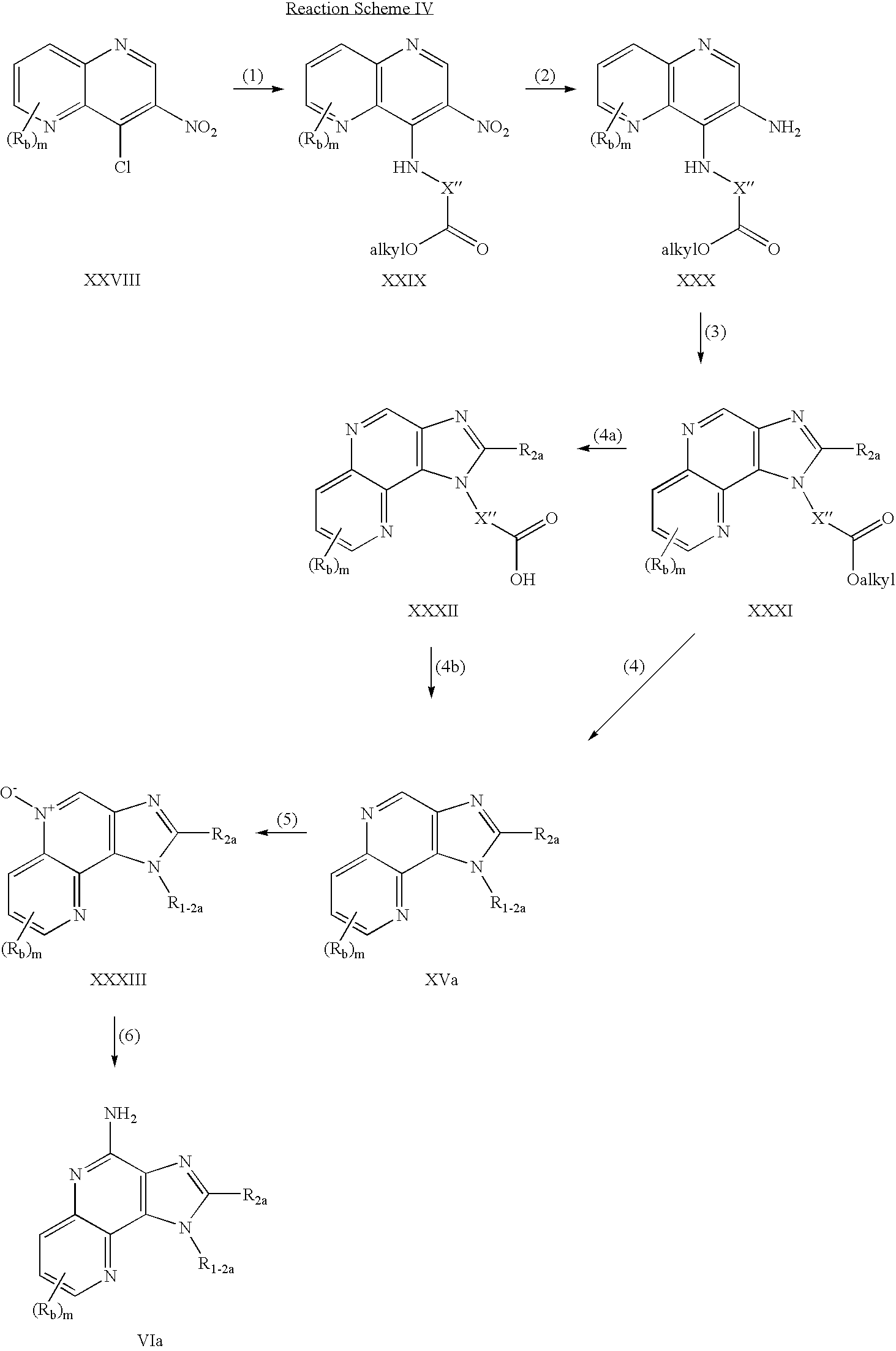
- For some embodiments, compounds of the invention are prepared according to Reaction Scheme V, where R1-1, R2, RA1, RB1, and Xa are as defined above and Ph is phenyl. In step (1) of Reaction Scheme V, a 2,4-dichloro-3-nitropyridine of Formula XXXIV is reacted with an amino ester of the Formula H2N—Xa—C(O)—O-alkyl or a hydrochloride salt thereof to form a 2-chloro-3-nitropyridine of Formula XXXV. The reaction is conveniently carried out by combining an amino ester of Formula H2N—Xa—C(O)—O-alkyl—HCl and a 2,4-dichloro-3-nitropyridine of Formula XXXIV in the presence of a base such as triethylamine in an inert solvent such as N,N-dimethylformamide (DMF). The reaction can be carried out at ambient temperature, and the product can be isolated from the reaction mixture using conventional methods. Many 2,4-dichloro-3-nitropyridines of the Formula XXXIV are known and can be readily prepared using known synthetic methods. (See, for example, Dellaria et al, U.S. Pat. No. 6,525,064 and the references cited therein.)
- In step (2) of Reaction Scheme V a 2-chloro-3-nitropyridine of Formula XXXV is reacted with an alkali metal azide to provide an 8-nitrotetrazolo[1,5-a]pyridin-7-amine of Formula XXXVI. The reaction can be carried out by combining the compound of Formula XXXV with an alkali metal azide, for example, sodium azide, in a suitable solvent such as acetonitrile/water, preferably 90/10 acetonitrile/water, in the presence of cerium III chloride, preferably cerium III chloride heptahydrate. Optionally, the reaction can be carried out with heating, for example, at the reflux temperature. Alternatively, the reaction can be carried out by combining the compound of Formula XXXV with an alkali metal azide, for example, sodium azide, in a suitable solvent such as DMF and heating, for example to about 50-60° C., optionally in the presence of ammonium chloride. The product can be isolated from the reaction mixture using conventional methods.
- In step (3) of Reaction Scheme V, an 8-nitrotetrazolo[1,5-a]pyridin-7-amine of Formula XXXVI is reduced to provide a tetrazolo[1,5-a]pyridine-7,8-diamine of Formula XXXVII. The reduction can be carried out by hydrogenation using a conventional heterogeneous hydrogenation catalyst, for example, platinum on carbon or palladium on carbon. The reaction can conveniently be carried out on a Parr apparatus in a suitable solvent such as acetonitrile or ethyl acetate. The product can be isolated from the reaction mixture using conventional methods. Alternatively, the reduction can be carried out using the one- to two-phase sodium dithionite reduction described in step (2) of Reaction Scheme I.
- In step (4) of Reaction Scheme V, a tetrazolo[1,5-a]pyridine-7,8-diamine of Formula XXXVII is reacted with a carboxylic acid or equivalent thereof to provide a 7H-imidazo[4,5-c]tetrazolo[1,5-a]pyridine of Formula XXXVIII. The reaction can be carried out as described in step (3) of Reaction Scheme I, and the product can be isolated from the reaction mixture using conventional methods.
- In step (5) or steps (5a) and (5b) of Reaction Scheme V, the ester group of a 7H-imidazo[4,5-c]tetrazolo[1,5-a]pyridine of Formula XXXVIII is converted to an amide to provide an amide-substituted 7H-imidazo[4,5-c]tetrazolo[1,5-a]pyridine of Formula XVI. The reaction can be carried out as described in step (4) or steps (4a) and (4b) of Reaction Scheme I, and the product can be isolated by conventional methods.
- In step (6) of Reaction Scheme V, the tetrazolo ring is reductively removed from a 7H-imidazo[4,5-c]tetrazolo[1,5-a]pyridine of Formula XVI to provide an amide-substituted 1H-imidazo[4,5-c]pyridin-4-amine of Formula III or a pharmaceutically acceptable salt thereof. The reaction can be carried out by reacting the 7H-imidazo[4,6-c]tetrazolo[1,5-a]pyridine of Formula XVI with hydrogen in the presence of a catalyst and an acid. The hydrogenation can be conveniently run at ambient temperature on a Parr apparatus with a suitable catalyst, such as platinum IV oxide, and a suitable acid, such as trifluoroacetic acid. The product or pharmaceutically acceptable salt thereof can be isolated from the reaction mixture using conventional methods.
- Alternatively, the tetrazolo ring can be removed from a 7H-imidazo[4,5-c]tetrazolo[1,5-a]pyridine of Formula XVI as shown in step (6a) by reaction with triphenylphosphine to form an N-triphenylphosphinyl intermediate of Formula XL. The reaction with triphenylphosphine can be run in a suitable solvent such as toluene or 1,2-dichlorobenzene under an atmosphere of nitrogen with heating, for example at the reflux temperature. In step (6b) of Reaction Scheme V an N-triphenylphosphinyl intermediate of Formula XL is hydrolyzed to provide an amide-substituted 1H-imidazo[4,5-c]pyridin-4-amine of Formula III. The hydrolysis can be carried out by general methods well known to those skilled in the art, for example, by heating in a lower alkanol in the presence of an acid. The product can be isolated from the reaction mixture using conventional methods as the compound of Formula III or as a pharmaceutically acceptable salt thereof.
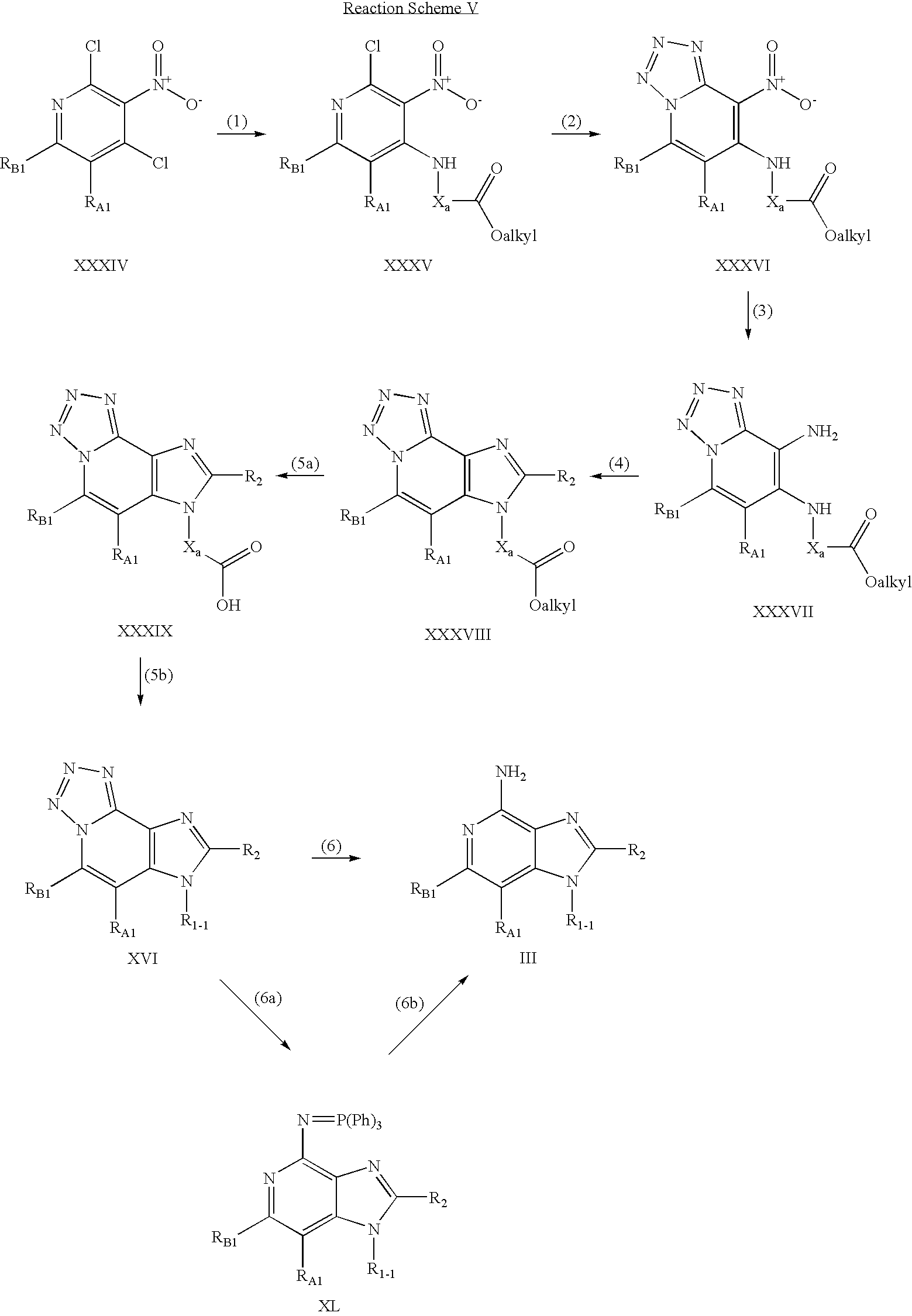
- For some embodiments, naphthyridines of the invention are prepared from tetrazolo compounds of Formulas XLI and XLIV according to Reaction Scheme VI and Reaction Scheme VII, wherein R1-2, R2, Rb, m, and X″ are as defined above and -OTf is a trifluoromethanesulfonate group. Compounds of Formula XLI and XLIV and synthetic routes to these compounds are known; see, for example, U.S. Pat. No. 6,194,425 (Gerster) and U.S. Pat. No. 6,518,280 (Gerster).
- In step (1) of Reaction Scheme VI or VII, a tetrazolonaphthyridine of Formula XLI or XLIV is reacted with an amino ester of the Formula H2N—X″—C(O)—O-alkyl or a hydrochloride salt thereof to form a compound of Formula XLII or XLV. The reaction can be carried out as described in step (1) of Reaction Scheme I. An ester-substituted tetrazolonaphthyridine of Formula XLII or XLV is converted in steps (2) through (4) of Reaction Scheme VI or VII to a compound of Formula XLIII or XLVI according to the methods of steps (2), (3), and (4) or (4a) and (4b) of Reaction Scheme I. The tetrazolo group of a compound of Formula XLIII or XLVI can then be removed to provide a 1H-imidazo[4,5-c]naphthyridin-4-amine of Formula IX or VIII, which are subgenera of Formulas I and II. The removal of the tetrazolo group can be carried out as described in step (6) or steps (6a) and (6b) of Reaction Scheme V or by methods described in U.S. Pat. No. 6,194,425 (Gerster) and U.S. Pat. No. 6,518,280 (Gerster). The product or pharmaceutically acceptable salt thereof can be isolated by conventional methods.
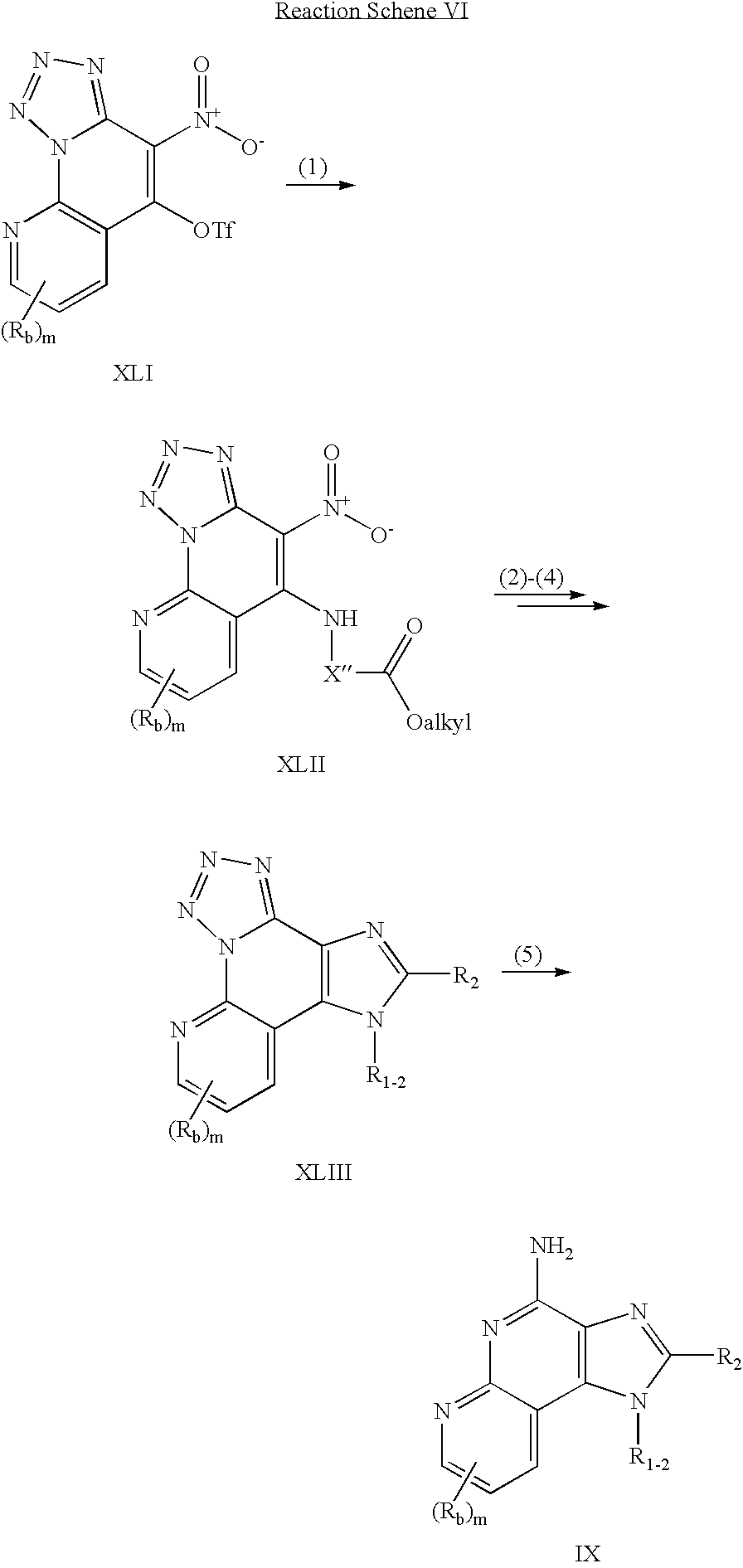

- Compounds of the invention can be prepared according to Reaction Scheme VIII wherein Rn, R1-1, R21, and n are as defined above. In step (1) of Reaction Scheme VIII, a 4-chloro-3-nitroquinoline of Formula XX is reduced to provide a 3-amino-4-chloroquinoline of Formula XLVII. The reduction can be carried out using one of the methods described in step (2) of Reaction Scheme I, and the product of Formula XLVII or a salt thereof can be isolated by conventional methods. Some compounds of Formula XLVII are known. For example, 3-amino-4-chloroquinoline, 3-amino-4,5-dichloroquinoline, and 3-amino-4,7-dichloroquinoline have been prepared by Surrey et al.,
- Journal of the American Chemical Society, 73, pp. 2413-2416 (1951). Compounds of Formula XLVII can also be prepared from 3-nitroquinolin-4-ols by the reduction described above followed by chlorination using conventional methods.
- In step (2) of Reaction Scheme VIII, a 3-amino-4-chloroquinoline of Formula XLVII is reacted with an acid halide of Formula R2aC(O)Cl or R2aC(O)Br to provide an N-(4-chloroquinolin-3-yl) amide of Formula XLVIII. The acid halide is conveniently added to a solution of a compound of Formula XLVII in a suitable solvent such as anhydrous dichloromethane in the presence of a base such as triethylamine. The reaction can be run at a reduced temperature, for example, 0° C., or at ambient temperature. For compounds wherein R2a is hydrogen, the compound of Formula XLVII can be reacted with a formulating agent such as, for example, diethoxymethyl acetate. The product can be isolated by conventional methods.
- In step (3) of Reaction Scheme VIII, an N-(4-chloroquinolin-3-yl) amide of Formula XLVIII is reacted with an amino ester of the Formula H2N—Xa—C(O)—O-alkyl or a hydrochloride salt thereof to displace the chloro group, and the resulting intermediate is cyclized to form a 1H-imidazo[4,5-c]quinoline of Formula XXIII. The chloride displacement is conveniently carried out by combining a compound of Formula XLVIII with an amino ester of Formula H2N—Xa—C(O)—O-alkyl. The reaction may be carried out neat at an elevated temperature such as the temperature required to melt the mixture. The reaction may also be carried out in an alcoholic solvent at the reflux temperature of the solvent. The product can be isolated and optionally purified using conventional techniques before it is heated and cyclized to provide a compound of Formula XXIII. The cyclization reaction is conveniently carried out in a solvent such as toluene, optionally in the presence of a catalyst such as pyridine hydrochloride or pyridinium p-toluenesulfonate. The cyclization may be carried out at an elevated temperature, such as the reflux temperature of the solvent. The 1H-imidazo[4,5-c]quinoline of Formula XXIII can be isolated using conventional methods. Glycine ethyl ester hydrochloride can be employed as the amino ester in this step to provide a compound wherein Xa is —CH2—.
- In step (4) of Reaction Scheme VIII, an ester-substituted 1H-imidazo[4,5-c]quinoline of Formula XXIII is oxidized to an N-oxide of Formula XXVI, which is then aminated in step (5) to provide an ester-substituted 1H-imidazo[4,5-c]quinolin-4-amine Formula XXVII. Steps (4) and (5) of Reaction Scheme VIII can be carried out as described for steps (5) and (6) of Reaction Scheme I.
- In step (6) of Reaction Scheme VIII, an ester-substituted 1H-imidazo[4,5-c]quinolin-4-amine Formula XXVII is heated in the presence of an amine or ammonium acetate according to one of the methods described in step (3) of Reaction Scheme II to provide a compound of Formula IVb. The product or a pharmaceutically acceptable salt thereof can be isolated using conventional methods.

- Compounds of the invention can also be prepared according to Reaction Scheme IX, wherein R2b, Rd, and m are as defined above, and R1-2b is a subset of R1-2 as defined above that does not include those substituents that one skilled in the art would recognize as being susceptible to reduction under the acidic hydrogenation conditions of the reaction. These susceptible groups include, for example, alkenyl, alkynyl, and aryl groups and groups bearing nitro substituents.
- In Reaction Scheme IX, a 1H-imidazo[4,5-c][1,5]naphthyridin-4-amine of Formula VIb is reduced to a 6,7,8,9-tetrahydro-1H-imidazo[4,5-c][1,5]naphthyridin-4-amine of Formula Xb, a subgenus of Formulas I, II, and X. The reaction is conveniently carried out using the conditions described in Reaction Scheme III, and the product or pharmaceutically acceptable salt thereof can be isolated by conventional methods.
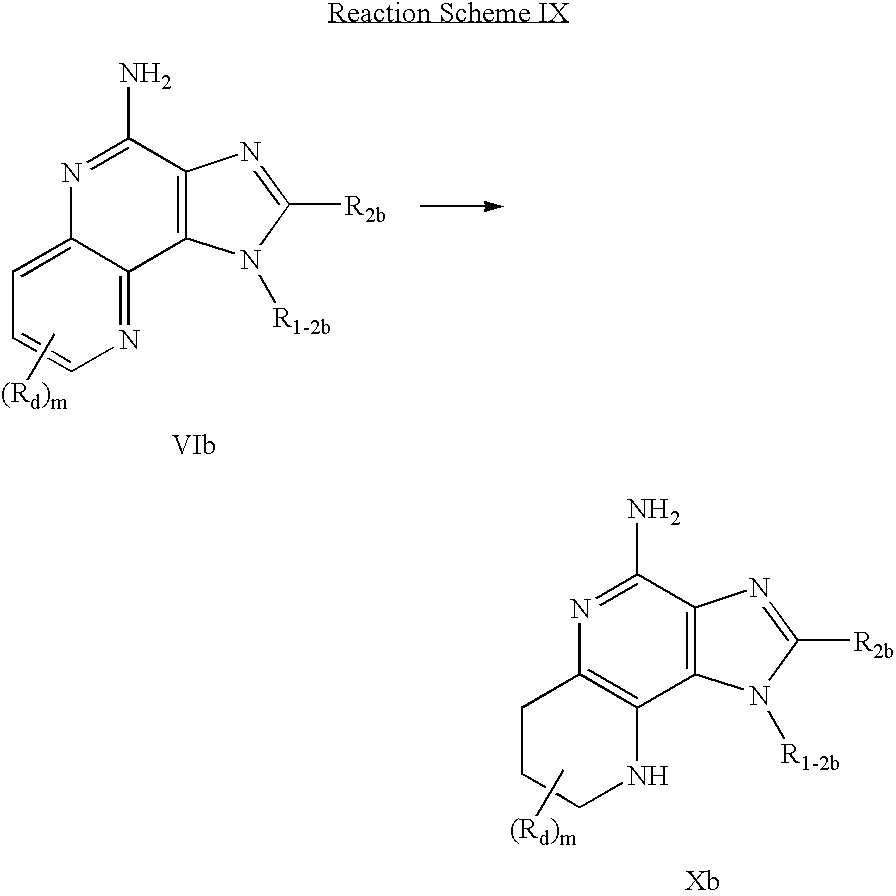
- Compounds of the Formula H2N—Xa—C(O)—O-alkyl or H2N—X″—C(O)—O-alkyl in which Xa or X″ contains a cyclic alkyl group can be used in step (1) of Reaction Scheme I, IV, V, VI, or VII or in step (3) of Reaction Scheme VIII to prepare some compounds of the invention. These amino esters can be readily prepared in two steps from ethylcyanoacetate. In the first step, ethylcyanoacetate is combined with an alkyl dihalide, for example a dibromide of formula Br-alkylene-Br, in the presence of a base such as potassium carbonate in a suitable solvent such as acetone or DMF. The reaction can be carried out at ambient temperature or at an elevated temperature, and the product can be isolated by conventional methods. Numerous dibromides of formula Br-alkylene-Br can be obtained commercially, including, for example, 1,2-dibromoethane, 1,3-dibromopropane, 1,4-dibromobutane, and 1,5-dibromopentane. The resulting 1-cyanocycloalkanecarboxylate is then reduced to a 1-aminomethylcycloalkanecarboxylate using heterogeneous hydrogenation conditions. The reduction is conveniently carried out in the presence of acid, for example concentrated hydrochloric acid, with catalytic platinum (IV) oxide in a suitable solvent such as ethanol. The hydrogenation is conveniently carried out in a Parr apparatus, and the product can be isolated by conventional methods. When 1,2-dibromoethane, 1,3-dibromopropane, 1,4-dibromobutane, or 1,5-dibromopentane is used in the first step of this method, an amino ester of formula

is obtained. - Synthetic transformations can be made at the R2 position in many of the compounds shown in Reaction Schemes I through IX, if, for example, the carboxylic acid or equivalent thereof used in step (3) of Reaction Scheme I, IV, VI, or VII, step (4) of Reaction Scheme V, or step (2) of Reaction Scheme VIII contains a protected hydroxy or amino group. Some acid chlorides of this type are commercially available; others can be prepared by known synthetic methods. A protected hydroxy or amino group thus installed at the R2 position can then be deprotected by a variety of methods well known to one of skill in the art. For example, hydroxyalkylenyl group is conveniently introduced at the R2 position by the demethylation of a methoxyalkylenyl group, which can be installed by using a methoxy-substituted carboxylic acid equivalent, for example, methoxyacetyl chloride and 2-methoxypropionyl chloride, in step (3) of Reaction Scheme I. The demethylation can be carried out by treating a compound wherein R2 is a methoxyalkylenyl group with boron tribromide in a suitable solvent such as dichloromethane at a sub-ambient temperature such as 0° C. The resulting hydroxy group may then be oxidized to an aldehyde or carboxylic acid or converted to a leaving group such as, for example, a chloro group using thionyl chloride or a trifluoromethanesulfonate group using trifluoromethanesulfonic anhydride. The resulting leaving group can then be displaced by a variety of nucleophiles. Sodium azide can be used as the nucleophile to install an azide group, which can then be reduced to an amino group using heterogeneous hydrogenation conditions. An amino group at the R2 position can be converted to an amide, sulfonamide, sulfamide, or urea using conventional methods. A leaving group at R2, such as a chloro or trifluoromethanesulfonate group, can also be displaced with a secondary amine, a substituted phenol, or a mercaptan in the presence of a base such as potassium carbonate. For examples of these and other methods used to install a variety of groups at the R2 position, see U.S. Pat. No. 5,389,640 (Gerster et al.).
- Some further synthetic elaborations can also be carried out at the R1-1 or R1-2group in compounds prepared in Reaction Schemes I through IX. For example, the cyclic amine group added in step (4) or (4b) in Reaction Scheme I or IV may be thiomorpholine, which can be oxidized to a 1,1-dioxothiomorpholine group in step (5) of Reaction Scheme I or IV using an excess of the oxidizing agent. Step (6) of Reaction Scheme I or IV may then be carried out to provide a compound of Formula IVa or VIa, wherein R1-1 or R1-2 is

- The amination reaction shown in step (6) of Reaction Scheme I or IV, step (2) of Reaction Scheme II, or step (5) of Reaction Scheme VIII cain be carried out by an alternative to the method described in step (6) of Reaction Scheme I. The reaction can be carried out by treating a 5N-oxide of Formula XXV, XXVI, or XXXIII with trichloroacetyl isocyanate followed by hydrolysis of the resulting intermediate to provide a compound of Formula IVa, XXVII, or VIa, respectively. The reaction is conveniently carried out in two steps by (i) adding trichloroacetyl isocyallate to a solution of a 5N-oxide in a solvent such as dichloromethane and stirring at ambient temperature to provide an isolable amide intermediate. In step (ii), a solution of the intermediate in methanol is treated with a base such as sodium methoxide or ammonium hydroxide at ambient temperature. The product or pharmaceutically acceptable salt thereof can be isolated using conventional methods.
- Compounds of the invention can also be prepared using variations of the synthetic routes shown in Reaction Schemes I through IX that would be apparent to one of skill in the art. For example, the synthetic route shown in Reaction Scheme VIII for the preparation of 1H-imidazo[4,5-c]quinolines can be used to prepare 1H-imidazo[4,5-c][1,5]naphthyridines by starting with a 4-chloro-3-nitro[1,5 ]naphthyridine of Formula XXVIII in lieu of the 4-chloro-3-nitroquinoline of Formula XX. Compounds of the invention can also be prepared using the synthetic routes described in the EXAMPLES below.
- Pharmaceutical Compositions and Biological Activity
- Pharmaceutical compositions of the invention contain a therapeutically effective amount of a compound or salt of the invention as described above in combination with a pharmaceutically acceptable carrier.
- The terms “a therapeutically effective amount” and “-effective amount” mean an amount of the compound or salt sufficient to induce a therapeutic or prophylactic effect, such as, for example, cytokine induction, immunomodulation, antitumor activity, and/or antiviral activity. Although the exact amount of active compound or salt used in a pharmaceutical composition of the invention will vary according to factors known to those of skill in the art such as, for example, the physical and chemical nature of the compound or salt, the nature of the carrier, and the intended dosing regimen, it is anticipated that the compositions of the invention will contain sufficient active ingredient to provide a dose of about 100 nanograms per kilogram (ng/kg) to about 50 milligrams per kilogram (mg/kg), preferably about 10 micrograms per kilogram (μg/kg) to about 5 mg/kg, of the compound or salt to the subject. A variety of dosage forms may be used, such as tablets, lozenges, capsules, parenteral formulations, syrups, creams, ointments, gels, aerosol formulations, transdermal patches, transmucosal patches and the like.
- The compounds or salts of the invention can be administered as the single therapeutic agent in the treatment regimen, or the compounds or salts of the invention may be administered in combination with one another or with other active agents, including, for example, additional immune response modifiers, antivirals, antibiotics, antibodies, proteins, peptides, oligonucleotides, etc.
- Compounds or salts of the invention have been shown to induce the production of certain cytokines in experiments performed according to the test set forth below. These results indicate that the compounds or salts are useful as immune response modifiers that can modulate the immune response in a number of different ways, rendering them useful in the treatment of a variety of disorders.
- Cytokines whose production may be induced by the administration of compounds or salts of the invention generally include interferon-α (IFN-α) and/or tumor necrosis factor-α (TNF-α) as well as certain interleukins (IL). Cytokines whose biosynthesis may be induced by compounds or salts of the invention include IFN-α, TNF-α, IL-1, IL-6, IL-10 and IL-12, and a variety of other cytokines. Among other effects, these and other cytokines can inhibit virus production and tumor cell growth, making the compounds or salts useful in the treatment of viral diseases and neoplastic diseases. Accordingly, one aspect of the invention provides a method of inducing cytokine biosynthesis in an animal. Generally, the method includes administering an effective amount of a compound or salt or composition of the invention to the animal. The animal to which the compound or salt or composition is administered for induction of cytokine biosynthesis may have a disease as described infra, for example a viral disease or a neoplastic disease, and administration of the compound or salt may provide therapeutic treatment. Alternatively, the compound or salt may be administered to the animal prior to the animal acquiring the disease so that administration of the compound or salt may provide a prophylactic treatment.
- In addition to the ability to induce the production of cytokines, compounds or salts of the invention can affect other aspects of the innate immune response. For example, natural killer cell activity may be stimulated, an effect that may be due to cytokine induction. The compounds or salts may also activate macrophages, which in turn stimulate secretion of nitric oxide and the production of additional cytokines. Further, the compounds or salts may cause proliferation and differentiation of B-lymphocytes.
- Compounds or salts of the invention can also have an effect on the acquired immune response. For example, the production of the T helper type 1 (T1) cytokine IFN-γ may be induced indirectly and the production of the T helper type 2 (TH2) cytokines IL-4, IL-5 and IL-13 may be inhibited upon administration of the compounds or salts.
- Whether for prophylaxis or therapeutic treatment of a disease, and whether for effecting innate or acquired immunity, the compound or salt or composition may be administered alone or in combination with one or more active components as in, for example, a vaccine adjuvant. When administered with other components, the compound or salt and other component or components may be administered separately; together but independently such as in a solution; or together and associated with one another such as (a) covalently linked or (b) non-covalently associated, e.g., in a colloidal suspension.
- Conditions for which compounds or salts identified herein may be used as treatments include, but are not limited to:
- (a) viral diseases such as, for example, diseases resulting from infection by an adenovirus, a herpesvirus (e.g., HSV-I, HSV-II, CMV, or VZV), a poxvirus (e.g., an orthopoxvirus such as variola or vaccinia, or molluscum contagio sum), a picornavirus (e.g., rhinovirus or enterovirus), an orthomyxovirus (e.g., influenzavirus), a paramyxovirus (e.g., parainfluenzavirus, mumps virus, measles virus, and respiratory syncytial virus (RSV)), a coronavirus (e.g., SARS), a papovavirus (e.g., papillornaviruses, such as those that cause genital warts, common warts, or plantar warts), a hepadnavirus (e.g., hepatitis B virus), a flavivirus (e.g., hepatitis C virus or Dengue virus), or a retrovirus (e.g., a lentivirus such as HIV);
- (b) bacterial diseases such as, for example, diseases resulting from infection by bacteria of, for example, the genus Escherichia, Enterobacter, Salmonella, Staphylococcus, Shigella, Listeria, Aerobacter, Helicobacter, Klebsiella, Proteus, Pseudomonas, Streptococcus, Chlamydia, Mycoplasma, Pneumococcus, Neisseria, Clostridium, Bacillus, Corynebacterium, Mycobacterium, Campylobacter, Vibrio, Serratia, Providencia, Chromobacterium, Brucella, Yersinia, Haemophilus, or Bordetella;
- (c) other infectious diseases, such chlamydia, fungal diseases including but not limited to candidiasis, aspergillosis, histoplasmosis, cryptococcal meningitis, or parasitic diseases including but not limited to malaria, pneumocystis carnii pneumonia, leishmaniasis, cryptosporidiosis, toxoplasmosis, and trypanosome infection;
- (d) neoplastic diseases, such as intraepithelial neoplasias, cervical dysplasia, actinic keratosis, basal cell carcinoma, squamous cell carcinoma, renal cell carcinoma, Kaposi's sarcoma, melanoma, leukemias including but not limited to myelogeous leukemia, chronic lymphocytic leukemia, multiple myeloma, non-Hodgkin's lymphoma, cutaneous T-cell lymphoma, B-cell lymphoma, and hairy cell leukemia, and other cancers;
- (e) TH2-mediated, atopic diseases, such as atopic dermatitis or eczema, eosinophilia, asthma, allergy, allergic rhinitis, and Ommen's syndrome;
- (f) certain autoimmune diseases such as systemic lupus erythematosus, essential thrombocythaemia, multiple sclerosis, discoid lupus, alopecia areata; and
- (g) diseases associated with wound repair such as, for example, inhibition of keloid formation and other types of scarring (e.g., enhancing wound healing, including chronic wounds).
- Additionally, compounds or salts of the present invention may be useful as a vaccine adjuvant for use in conjunction with any material that raises either humoral and/or cell mediated immune response, such as, for example, live viral, bacterial, or parasitic immunogens; inactivated viral, tumor-derived, protozoal, organism-derived, fungal, or bacterial immunogens, toxoids; toxins; self-antigens; polysaccharides; proteins; glycoproteins; peptides; cellular vaccines; DNA vaccines; autologous vaccines; recombinant proteins; and the like, for use in connection with, for example, BCG, cholera, plague, typhoid, hepatitis A, hepatitis B, hepatitis C, influenza A, influenza B, parainfluenza, polio, rabies, measles, mumps, rubella, yellow fever, tetanus, diphtheria, hemophilus influenza b, tuberculosis, meningococcal and pneumococcal vaccines, adenovirus, HIV, chicken pox, cytcomegalovirus, dengue, feline leukemia, fowl plague, HSV-1 and HSV-2, hog cholera, Japanese encephalitis, respiratory syncytial virus, rotavirus, papilloma virus, yellow fever, and Alzheimer's Disease.
- Compounds or salts of the present invention may be particularly helpful in individuals having compromised immune function. For example, compounds or salts may be used for treating the opportunistic infections and tumors that occur after suppression of cell mediated immunity in, for example, transplant patients, cancer patients and HIV patients.
- Thus, one or more of the above diseases or types of diseases, for example, a viral disease or a neoplastic disease may be treated in an animal in need thereof (having the disease) by administering a therapeutically effective amount of a compound or salt of the invention to the animal.
- An amount of a compound or salt effective to induce cytokine biosynthesis is an amount sufficient to cause one or more cell types, such as monocytes, macrophages, dendritic cells and B-cells to produce an amount of one or more cytokines such as, for example, IFN-α, TNF-α, IL-l, IL-6, IL-10 and IL-12 that is increased (induced) over a background level of such cytokines. The precise amount will vary according to factors known in the art but is expected to be a dose of about 100 ng/kg to about 50 mg/kg, preferably about 10 μg/kg to about 5 mg/kg. The invention also provides a method of treating a viral infection in an animal and a method of treating a neoplastic disease in an animal comprising administering an effective amount of a compound or salt or composition of the invention to the animal. An amount effective to treat or inhibit a viral infection is an amount that will cause a reduction in one or more of the manifestations of viral infection, such as viral lesions, viral load, rate of virus production, and mortality as compared to untreated control animals. The precise amount that is effective for such treatment will vary according to factors known in the art but is expected to be a dose of about 100 ng/kg to about 50 mg/kg, preferably about 10 μg/kg to about 5 mg/kg. An amount of a compound or salt effective to treat a neoplastic condition is an amount that will cause a reduction in tumor size or in the number of tumor foci. Again, the precise amount will vary according to factors known in the art but is expected to be a dose of about 100 ng/kg to about 50 mg/kg, preferably about 10 μg/kg to about 5 mg/kg.
- In addition to the formulations and uses described specifically herein, other formulations, uses, and administration devices suitable for compounds of the present invention are described in, for example, International Publication Nos. WO 03/077944 and WO 02/036592, U.S. Pat. No. 6,245,776, and U.S. Publication Nos. 2003/0139364, 2003/185835, 2004/0258698, 2004/0265351, 2004/076633, and 2005/0009858.
- Objects and advantages of this invention are further illustrated by the following examples, but the particular materials and amounts thereof recited in these examples, as well as other conditions and details, should not be construed to unduly limit this invention.
-

Part A - Ethanol (500 mL) was cooled to 0° C., and thionyl chloride (85 mL, 1.2 mol) was added dropwise with stirring. The reaction was stirred for one hour at 0° C., and solid 4-aminobutyric acid (100 g, 0.97 mol) was then added. After ten minutes of stirring, the reaction was allowed to warm to ambient temperature and stirred for two hours. The reaction was then allowed to stand at ambient temperature overnight. The ethanol was removed under reduced pressure, and the solid residue was dissolved in ethyl acetate. After one hour, the solution was cooled to 0° C., and a precipitate formed. The precipitate was isolated by filtration and washed with diethyl ether (300 mL) to provide 126.6 g of ethyl 4-aminobutyrate hydrochloride as a white solid. A precipitate formed in the filtrate and was isolated by filtration to provide 19.1 g of ethyl 4-aininobutyrate hydrochloride as a white solid.
- Part B
- Triethylamine (50.0 mL, 358 mmol) and potassium carbonate (40 g, 290 mmol) were added to a solution of 4-chloro-3-nitroquinoline (49.6 g, 238 mmol) in tetrahydrofuran (THF) (100 mL) and chloroform (250 mL). Ethyl 4-aminobutyrate hydrochloride (43.8 g, 262 mmol) was added in portions over a period of five minutes during which time an ice bath was used to cool the reaction. The reaction was stirred with cooling for 30 minutes, allowed to warm to ambient temperature, and stirred overnight. An analysis by thin layer chromatography (TLC) indicated the presence of 4-chloro-3-nitroquinoline. Additional ethyl 4-aminobutyrate hydrochloride (8.0 g, 48 mmol) was added, and the reaction was stirred at ambient temperature for one hour and then heated at reflux for two hours. Additional triethylamine (20 mL) was added, and the reaction was heated at reflux for one hour, cooled to ambient temperature, washed with water (3×100 mL), dried over potassium carbonate, filtered, and concentrated under reduced pressure to provide 63.8 g of ethyl 4-(3-nitroquinolin-4-ylanino)b-tyrate as a yellow solid.
- Part C
- A mixture of ethyl 4-(3-nitroquinolin-4-ylamino)butyrate (20.0 g, 65.9 mmol), 10% palladium on carbon (0.50 g), and ethanol (250 ml) was added to a Parr vessel, and the reaction was placed under hydrogen pressure (43 psi, 3.0×10⁵ Pa) for 3.5 hours. The pressure decreased to 31 psi (2.1×10⁵ Pa) during the reaction. The reaction mixture was filtered through a layer of CELITE filter agent, and the filtrate was concentrated under reduced pressure.
- Part D
- Trimethyl orthobutyrate (10.4 g, 70.2 mmol) and pyridinium p-toluenesulfonate (0.25 g, 1.0 mmol) were added to a solution of the material from Part C in toluene (350 mL), and the reaction was heated at reflux under a Dean-Stark trap for three hours while the distillate was periodically removed. The toluene was removed under reduced pressure, and the residue was stirred with 70:30 hexanes:ethyl acetate (75 mL). Additional hexane (50 mL) was added to form a precipitate. The supernatant liquid was decanted away to afford 6.75 g of a brown solid, which was mixed with 2.08 g of material from another run. The crude product was then purified by column chromatography on silica gel (eluting with 95:5 dichloromethane:methanol) to provide 14.2 g of ethyl 4-(2-propyl-1H-imidazo[4,5-c]quinolin-1-yl)butanoate as an oil that crystallized upon standing.
- Part E
- Trimethylaluminum (available as a 2 M solution in toluene, 15.5 mL, 31.0 mmol) was added dropwise with stirring to a solution of morpholine (2 7 mL, 31 mmol) in dichloromethane (75 mL) at ambient temperature. After 20 minutes, a solution of ethyl 4-(2-propyl-1H-imidazo[4,5-c]quinolin-1-yl)butanoate (5.0 g, 15 mmol) in dichloromethane (15 mL) was added dropwise. The reaction was then heated at reflux for three days. An analysis by high-performance liquid chromatography (HPLC) indicated the presence of starting material, and additional morpholine (0.2 mL) was adder. The reaction was heated at reflux for three hours and then allowed to stand at room temperature over three days. Hydrochloric acid (4 mL of 10%) was slowly added followed by saturated aqueous sodium bicarbonate (8 mL). The organic layer was decanted away from solids formed during the reaction. The solids were extracted with dichloromethane (2×50 mL), and the combined organic fractions were washed with 5% aqueous sodium hydroxide (35 mL) and saturated aqueous sodium bicarbonate (35 mL), dried over potassium carbonate, filtered, and concentrated under reduced pressure to provide a light yellow solid.
- Part F
- 3-Chloroperoxybenzoic acid (mCPBA) (available as 77% pure material, 8.5 g, 38 mmol) was added in portions over a period of two minutes to a solution of the material from Part E in dichloromethane (100 mL), and the reaction was stirred for 45 minutes at ambient temperature and then washed with 5% aqueous sodium hydroxide (2×35 mL) and water (25 mL). Concentrated ammonium hydroxide (100 m]L of 29%) and p-toluenesulfonyl chloride (4.9 g, 26 mmol) were then sequentially added with vigorous stirring, and the reaction was stirred for 30 minutes. The aqueous layer was separated and extracted with dichloromethane (4×50 mL). The combined organic fractions were washed with 5% aqueous sodium hydroxide solution (2×50 mnI), dried over potassium carbonate, filtered, and concentrated under reduced pressure. The residue was recrystallized twice from acetonitrile (15 mL) and methanol (4 mL) to provide 0.96 g of a light orange solid. A portion was dried overnight in a vacuum oven to provide 1-(4-morpholin-4-yl-4-oxobutyl)-2-propyl-1H-imidazo[4,5-c]quinolin-4-amine as a light yellow needles, mp 200-202° C.
- Anal. Calcd for C21H27N5O2: C, 66.12; H, 7.13; N, 18.36. Found: C, 65.86; H, 7.39; N, 18.21.
-

Part A - A solution of n-propylamine (3.0 mL, 36 mmol) in dichloromethane (75 mL) was cooled to 0° C.; trimethylaluminum (available as a 2 M solution in toluene, 18 mL, 36 mmol) was added dropwise with stirring over a period of three minutes. The reaction was stirred for one hour at 0° C. and 30 minutes at ambient temperature. A solution of ethyl 4-(2-propyl-1H-imidazo[4,5-c]quinolin-1-yl)butanoate (5.80 g, 17.8 mmol, prepared as described in Parts A-D of Example 1) in dichloromethane (30 mL) was added, and the reaction was then heated at reflux for three days. The work-up procedure describe ed in Part E of Example 1 was followed to provide N-propyl-4-(2-propyl-1H-imidazo[4,5-c]quinolin-1-yl)butanamide as a brown oil.
- Part B
- N-Propyl-4-(2-propyl-1H-imidazo[4,5-c]quinolin-1-yl)butanamide (5.6 g, 15 mmol) was treated with mCPBA (8.5 g, 38 mmol), concentrated ammonium hydroxide (100 mL), and p-toluenesulfonyl chloride (4.9 g, 26 mmol) according to the method described in Part F of Example 1. The crude product was dissolved in hot toluene (25 mL) and dichloromethane. A precipitate slowly formed, was isolated by filtration, and was washed with toluene (15 mL). The solid was recrystallized twice from 4:1 methanol:water (25 mL), and the crystals were heated at reflux in chloroform in the presence of charcoal (1 g). The mixture was filtered through a layer of CELITE filter agent, and the filtrate was concentrated under reduced pressure. The residue was recrystallized twice from methanol:water and twice from toluene (15 mL) and dried overnight in a vacuum even to provide 0.74 g of 4-(4-amino-2-propyl-1H-imidazo[4,5-c]quinolin-1-yl)-N-propylbutanamide as a grey solid, mp 161-163° C.
- Anal. Calcd for C20H27N5O: C, 67.96; H, 7.70; N, 19.81. Found: C, 67.64; H, 7.92; N, 19.83.
-

Part A - A suspension of 4-chloro-3-nitroquinoline (75.0 g, 0.360 mol) in chloroform (400 mL) was cooled to 0° C.; triethylamine (75 mL, 0.54 mol) was added. Ethyl 4-aminobutyrate hydrochloride (66.0 g, 0.390 mol), prepared as described in Part A of Example 1, was added in portions over a period of five minutes. The reaction was stirred at 0° C. for 1 hour, allowed to warm to ambient temperature, and stirred overnight An analysis by thin layer chromatography (TLC) indicated the presence of 4-chloro-3-nitroquinoline. Additional triethylamine (15 mL) was added, and the reaction was stirred for one hour. Additional ethyl 4-aminobutyrate hydrochloride (10.0 g) was added, and the reaction was heated at reflux for five hours. Additional triethylamine (22 mL) was added, and the reaction was stirred overnight at ambient temperature and heated at reflux for one hour. An analysis by TLC indicated the reaction was complete. The reaction was cooled to ambient temperature and washed with water (5×400 mL), and the resulting solution was used in Part B.
- Part B
- Chloroform was added to the material from Part A to provide a volume of 750 mL. Water (600 mL), potassium carbonate (80 g, 0.6 mol), and 1,1′-di-n-octyl-4,4′-bipyridinium dibromide (0.50 g, 0.92 mmol) were added. Sodium hydrosulfite (available as 85% pure material, 120 g, 0.68 mol) was then added in portions over a period of one hour, and the reaction was stirred at ambient temperature for three days. The reaction was not complete as evidenced by an HPLC analysis. Additional sodium hydrosulfite (20 g), potassium carbonate (20 g), and 1,1′-di-n-octyl-4,4′-bipyridinium dibromide (0.25 g) were added, and the reaction was stirred for three hours. Additional sodium hydrosulfite (20 g), potassium carbonate (20 g), and water (200 mL) were added, and the reaction was stirred overnight. Additional sodium hydrosulfite (5 g) and potassium carbonate (5 g) were added, and the reaction was stirred for three hours. Additional sodium hydrosulfite (5 g) was added, and the reaction was stirred for two hours. An analysis by TLC indicated the reaction was complete. The organic layer was separated and washed with water (5×200 mL), dried over potassium carbonate, and concentrated under reduced pressure to provide 97.4 g of ethyl 4-[(3-aminoquinolin-4-yl)amino]butanoate as a dark oil.
- Part C
- A solution of ethyl 4-[(3-aminoquinolin-4-yl)amino]butanoate (72.0 g, 263 mmol) in toluene (700 mL) was heated at reflux for 10 minutes and then cooled slightly. Trimethyl orthobutyrate (42 g, 280 mmol) and pyridinium p-toluenesulfonate (1.0 g, 4.0 mmol) were added, and the reaction was heated at reflux under a Dean-Stark trap for two hours while the distillate was periodically removed. The reaction was then stirred overnight at ambient temperature. Charcoal (5 g) was added, and the resulting mixture was heated at reflux for three hours and then filtered through a layer of CELITE filter agent. The filtrate was concentrated under reduced pressure to provide an oil that crystallized upon standing. The solid was dissolved in hot methanol (125 mL), and water (50 mL) was added. After one hour, the mixture was cooled in an ice bath to form a precipitate. The precipitate was isolated by filtration and dissolved in dichloromethane. A layer of water was present and was removed. The remaining solution was dried over potassium carbonate, filtered, and concentrated under reduced pressure to provide 53.2 g of ethyl 4-(2-propyl-1H-imidazo[4,5-c]quinolin-1-yl)butanoate.
- Part D
- A mixture of ethyl 4-(2-propyl-1H-imidazo[4,5-c]quinolin-1-yl)butanoate (2.0 g, 6.1 mmol), THF (10 mL), and methylamine (available as a 40% solution in water, 4 mL, 52 mmol) was sealed in a high-pressure vessel and heated at 70° C. overnight. An analysis by TLC indicated the presence of starting material, and the reaction was sealed and heated at 80° C. for nine hours. The solvent was removed under reduced pressure, and the residue was dissolved in dichloromethane (100 mL). The resulting solution was washed with 5% aqueous sodium hydroxide (2×25 mL), dried over potassium carbonate, filtered, and concentrated under reduced pressure to provide 1.83 g of N-methyl-4-(2-propyl-1H-imidazo[4,5-c]quinolin-1-yl)butanamide.
- Part E
- mCPBA (3.3 g, 15 mmol) was added to a solution of N-methyl-4-(2-propyl-1H-imidazo[4,5-c]quinolin-1-yl)butanamide (1.83 g, 5.90 mmol) in chloroform (75 mL), and the reaction was stirred for 1.5 hours at ambient temperature. Concentrated ammonium hydroxide (75 mL of 29%) and p-toluenesulfonyl chloride (1.7 g, 8.9 mmol) were then sequentially added with stirring, and the reaction was stirred for 45 minutes. The aqueous layer was separated and extracted with chloroform (1×50 mL). The combined organic fractions were washed with 5% aqueous sodium hydroxide solution (2×50 mL), dried over potassium carbonate, filtered, and concentrated under reduced pressure. The residue was recrystallized from a mixture of toluene (20 mL) and methanol (4 mL) and then recrystallized three times from 5:1 methanol:water (18 mL) and dried overnight in a vacuum oven at 80° C. During the recrystallization, the product was mixed with material from another run to provide 0.720 g of 4-(4-amino-2-propyl-1H-imidazo[4,5-c]quinolin-1-yl)-N-methylbutanamide as a tan solid, hp 177-179° C.
- Anal. Calcd for C18H23N5O.0.19 H2O: C, 65.75; H, 7.17; N, 21.30. Found: C, 65.91; H, 7.35; N, 21.32.
-

Part A - A solution of ethyl 4-[(3-aminoquinolin-4-yl)amino]butanoate (49.7 g, 182 mmol, prepared as described in Parts A and B of Example 3) in toluene (500 mL) was heated at reflux for 10 minutes and then cooled slightly. Trimethyl orthobutyrate (29.0 g, 197 mmol) and pyridinium p-toluenesulfonate (0.70 g, 2.8 mmol) were added, and the reaction was heated at reflux under a Dean-Stark trap for 1.5 hours while the distillate was periodically removed. The reaction was allowed to stand overnight at ambient temperature. The toluene was removed under reduced pressure; chloroform (500 mL) and charcoal (4 g) were sequentially added. The resulting mixture was heated at reflux for one hour and then filtered through a layer of CELITE filter agent. The filtrate was washed with saturated aqueous sodium bicarbonate (100 mL), dried over potassium sulfate, filtered, and concentrated under reduced pressure to provide 49.4 g of ethyl 4-(2-propyl-1H-imidazo[4,5-c]quinolin-1-yl)butanoate as a dark oil.
- Part B
- Concentrated ammonium hydroxide (8.0 mL of 29%) was added to a solution of ethyl 4-(2-propyl-1H-imidazo[4,5-c]quinolin-1-yl)butanoate (5.1 g, 16 mmol) in 2-methyltetrahydrofuran (10 mL), and the mixture was heated overnight in a sealed high-pressure vessel at 80° C. An analysis by liquid chromatography/mass spectrometry (LC/MS) indicated the reaction was incomplete. The solvents were evaporated under a stream of nitrogen, and ammonium acetate (10 g) was added. The vessel was sealed and heated overnight at 135° C. The reaction was allowed to cool to ambient temperature, and water (50 mL) was added. The mixture was filtered, and the filtrate was washed with saturated aqueous sodium bicarbonate (25 mL), dried over potassium carbonate, filtered, and concentrated under reduced pressure to provide 2.95 g of 4-(2-propyl-1H-imidazo[4,5-c]quinolin-1-yl)butanamide as a light brown solid.
- Part C
- 4-(2-Propyl-1H-imidazo[4,5-c]quinolin-1-yl)butanamide (2.90 g, 9.78 mmol) was treated with mCPBA (5.5 g, 25 mmol), concentrated ammonium hydroxide (100 mL of 29%), and p-toluenesulfonyl chloride (2.80 g, 14.7 mmol) according to the method described in Part E of Example 3. After the reaction solution was dried with potassium carbonate, it was decanted, and charcoal (2 g) was added. The mixture was heated at reflux for two hours, filtered through a layer of CELITE filter agent, and concentrated under reduced pressure. The crude solid was purified by column chromatography on silica gel (eluting with 90:10 dichloromethane:methanol) and combined with material from another run. The solid was recrystallized from 5:1 toluene:methanol (18 mL), dried overnight in a vacuum oven, recrystallized from ethanol:water, and dried overnight in a vacuum oven to provide 4-(4-amino-2-propyl-1H-imidazo[4,5-c]quinolin-1-yl)butanamide as a tan solid, mp 249-251° C.
- Anal. Calcd for C17H21N5O: C, 65.57; H, 6.80; N, 22.49. Found: C, 65.24; H, 6.79; N, 22.16.
-
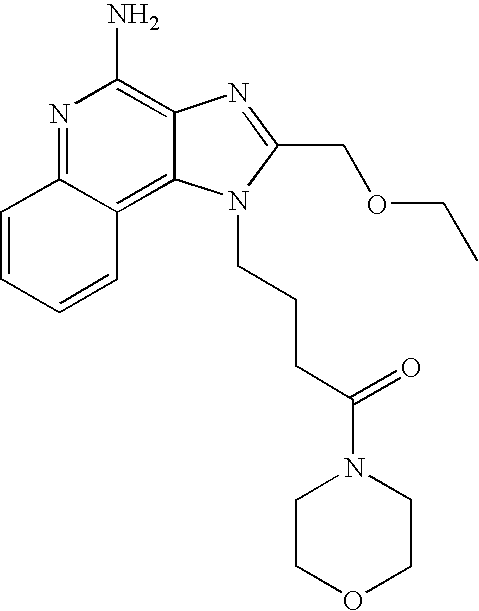
Part A - A suspension of 4-chloro-3-nitroquinoline (40.0 g, 0.192 mol) in chloroform (250 mL) was cooled to 0° C.; triethylamine (75 mL, 0.54 mol) was added. Ethyl 4-aminobutyrate hydrochloride (35.0 g, 0.210 mol), prepared as described in Part A of Example 1, was added in portions over a period of two minutes. The reaction was stirred at 0° C. for 15 minutes, allowed to warm to ambient temperature, and stirred overnight. The reaction was heated at reflux for 15 minutes, and then chloroform (200 mL) was added. The resulting solution was washed with water (5×150 mL) and then used in Part B.
- Part B
- Water (400 mL), potassium carbonate (105 g, 0.760 mol), ethyl viologen dibromide (0.50 g, 1.3 mmol), and sodium hydrosulfite (115 g, 0.660 mol) were sequentially added to the solution from Part A. The reaction was stirred at ambient temperature for three days. The organic layer was separated and washed with water (3×200 mL), dried over potassium carbonate, and concentrated under reduced pressure to provide 48.4 g of ethyl 4-[(3-aminoquinolin-4-yl)amino]butanoate as an orange oil.
- Part C
- A solution of ethoxyacetyl chloride (6.61 g, 54.0 mmol) in dichloromethane (10 mL) was added dropwise to a solution of ethyl 4-[(3-aminoquinolin-4-yl)amino]butanoate (11.8 g, 43.2 mmol) in dichloromethane (150 mL). The reaction was stirred for 30 minutes and then concentrated under reduced pressure. Triethylamine (16.7 g, 165 mmol) and ethanol (150 mL) were added, and the resulting solution was heated at reflux for four hours. The solvent was removed under reduced pressure. Dichloromethane (75 mL) was added, and the resulting solution was washed sequentially with water (3×75 mL) and saturated aqueous sodium bicarbonate (75 mL), dried over potassium carbonate, filtered, and concentrated under reduced pressure to provide 12.5 g of ethyl 4-[2-(ethoxymethyl)-1H-imidazo[4,5-c]quinolin-1-yl]butanoate as a dark oil.
- Part D
- Ethyl 4-[2-(ethoxymethyl)-1H-imidazo[4,5-c]quinolin-1-yl]butanoate (6.25 g, 18.3 mmol) and morpholine (16.0 g, 184 mmol) were sealed and heated in a high-pressure vessel at 130° C. overnight. An analysis by TLC indicated the reaction was incomplete. Pyridinium p-toluenesulfonate (100 mg) was added, and the reaction was heated for three days at 105° C. and for one day at 125° C. The solution was allowed to cool and then poured into water (100 mL). The resulting solution was extracted with dichloromethane (3×75 mL), and the combined extracts were dried over potassium carbonate, filtered, and concentrated under reduced pressure. The residue was mixed with ethyl acetate (50 mL) and hexane (200 mL) and sonicated. The solvent was decanted away to afford 6.9 g of 2-(ethoxymethyl)-1-(4-morpholin-4-yl-4-oxobutyl)-1H-imidazo[4,5-c]quinoline as an oil.
- Part E
- 2-(Ethoxymethyl)-1-(4-morpholin-4-yl-4-oxobutyl)-1H-imidazo[4,5-c]quinoline (6.9 g, 18 mmol) was treated with mCPBA (7.9 g, 35 mmol), concentrated ammonium hydroxide (50 mL of 29%), and p-toluenesulfonyl chloride (6.0 g, 32 mmol) according to a modification of the method described in Part E of Example 3. The mCPBA addition was carried out at 0° C., and the reaction was carried out in dichloromethane (150 mL). The crude product was triturated with 2:1 ethyl acetate:hexane (15 mL), and the resulting solid was isolated by filtration, washed with 30:70 ethyl acetate:hexane, recrystallized twice from methanol:water, and dried overnight in a vacuum oven at 70° C. to provide 2-(ethoxymethyl)-1-(4-morpholin-4-yl-4-oxobutyl)-1H-imidazo[4,5-c]quinolin-4-amine as yellow crystals, mp 201-203° C.
- Anal. Calcd for C21H27N5O3: C, 63.46; H, 6.85; N, 17.62. Pound: C, 63.24; H, 6.84; N, 17.54.
-

Part A - Anhydrous ethanol (400 mL) was cooled to −78° C., and thionyl chloride (63.34 mL, 868.4 mmol) was added. The reaction was stirred for one hour at −78° C., and solid 6-aminocaproic acid (100.0 g, 723.7 mmol) was then added. The reaction was allowed to warm to ambient temperature slowly, stirred overnight, and then concentrated under reduced pressure. The residue was recrystallized from ethyl acetate:diethyl ether to provide 137 g of ethyl 6-aminocaproate hydrochloride as a white solid.
- Part B
- Potassium carbonate (6.62 g, 47.9 mmol) and triethylamine (16.7 mL, 0.120 mol) were sequentially added with stirring to a solution of 4-chloro-3-nitroquinoline (10.0 g, 47.9 mmol) in chloroform (200 mL). After 15 minutes, ethyl 6-aminocaproate hydrochloride (1 1.23 g, 57.52 mmol) was slowly added, and the reaction was stirred for two hours; washed sequentially with water (200 mL), saturated aqueous sodium bicarbonate, and brine; dried over magnesium sulfate; filtered; concentrated under reduced pressure; and used in Part C without purification.
- Part C
- The material from Part B was hydrogenated according to the method described in Part C of Example 1 to provide 15.0 g of ethyl 6-[(3-aminoquinolin-4-yl)amino]hexanoate.
- Part D
- Trimethyl orthobutyrate (15.0 g, 49.8 mmol) and pyridinium p-toluenesulfonate (0.20 g, 0.80 mmol) were added to a solution ethyl 6-[(3-aminoquinolin-4-yl)amino]hexanoate (15.0 g, 49.8 mmol) in toluene (400 mL), and the reaction was heated at reflux under a Dean-Stark trap for 4.5 hours while the distillate was periodically removed. The reaction was allowed to cool to ambient temperature, washed sequentially with saturated aqueous sodium bicarbonate and brine, dried over magnesium sulfate, filtered, and concentrated under reduced pressure to provide ethyl 6-(2-propyl-1H-imidazo[4,5-c]quinolin-1-yl)hexanoate, which was used without purification.
- Part E
- A solution of sodium hydroxide (4.35 g, 109 mmol) in water (50 mL) was added to a solution of the material from Part D in ethanol (100 mL), and the reaction was stirred at ambient temperature for three hours. Additional sodium hydroxide (2.2 g, 55 mmol) was added, and the reaction was stirred for an additional hour and then concentrated under reduced pressure. The residue was diluted with water (100 mL) and adjusted to pH 5 with the addition of 10% hydrochloric acid. The mixture was extracted three times with chloroform, and the combined extracts were dried over magnesium sulfate, filtered, and concentrated under reduced pressure to provide 12.4 g of 6-(2-propyl-1H-imidazo[4,5-c]quinolin-1-yl)hexanoic acid.
- Part F
- A solution of 6-(2-propyl-1H-imidazo[4,5-c]quinolin-1-yl)hexanoic acid (3.0 g, 9.2 mmol) in anhydrous dichloromethane (50 mL) was cooled to 0° C. Oxalyl chloride (1.44 mL, 16.6 mmol) was added dropwise over a period of 15 minutes. The resulting solution was allowed to warm to ambient temperature and stirred for one hour and then concentrated under reduced pressure. The residue was dissolved in dichloromethane (50 mL), and morpholine (2.41 mL, 27.6 mmol) was added. The reaction was stirred overnight, washed sequentially with saturated aqueous sodium bicarbonate and brine, dried over magnesium sulfate, filtered, and concentrated under reduced pressure to provide 3.6 g of 1-(6-morpholin-4-yl-6-oxohexyl)-2-propyl-1H-imidazo[4,5-c]quinoline.
- Part G
- Under a nitrogen atmosphere, a solution of 1-(6-morpholin-4-yl-6-oxohexyl)-2-propyl-1H-imidazo[4,5-c]quinoline (3.6 g, 9.1 mmol) in chloroform (100 mL) was treated with mCPBA (6.29 g, 36.5 mmol). The reaction was stirred for two hours, washed sequentially with saturated aqueous sodium bicarbonate (3×) and brine, dried over magnesium sulfate, and filtered. Concentrated ammonium hydroxide (40 mL) and p-toluenesulfonyl chloride (2.60 g, 13.7 mmol) were added sequentially to the filtrate. The reaction was stirred vigorously for two hours, and then the organic layer was separated and washed sequentially with saturated aqueous sodium bicarbonate and brine, dried over magnesium sulfate, filtered, and concentrated under reduced pressure. The crude product was purified by column chromatography on silica gel (eluting with 95:5 dichloromethane:methanol) followed by recrystallization from ethyl acetate:hexane to provide 0.84 g of 1-(6-morpholin-4-yl-6-oxohexyl)-2-propyl-1H-imidazo[4,5-c]quinolin-4-amine as brown needles, mp 149-151° C.
- Anal. Calcd for C23H31N5O2: C, 67.46; H, 7.63; N, 17.12. Found: C, 67.28; H, 7.56; N, 16.75.
-
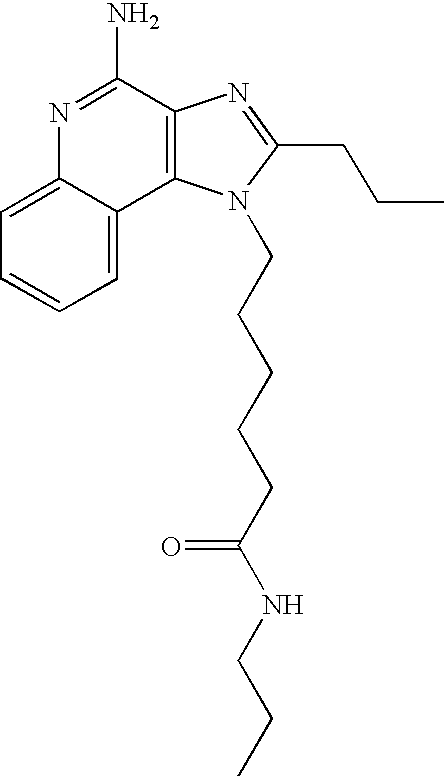
Part A - 6-(2-Propyl-1H-imidazo[4,5-c]quinolin-1-yl)hexanoic acid (3.0 g, 9.2 mmol, prepared in Parts A through E of Example 6) was treated with oxalyl chloride (1.45 mL, 16.6 mmol) and n-propylamine (2.27 mL, 27.6 mmol) according to the method described in Part F of Example 6 to provide 3.4 g of N-propyl-6-(2-propyl-1H-imidazo[4,5-c]quinolin-1-yl)hexanamide. The acid chloride solution was cooled to 0° C. before the addition of n-propylamine.
- Part B
- mCPBA (6.4 g, 37.1 mmol) was added to a solution of the material from Part A in chloroform (75 mL). The reaction was stirred for two hours, washed sequentially with saturated aqueous sodium bicarbonate (2 x) and brine, dried over magnesium sulfate, and filtered. Concentrated ammonium hydroxide (40 mL) was added to the filtrate. The mixture was stirred for ten minutes before the addition of p-toluenesulfonyl chloride (2.65 g, 13.9 mmol). The reaction was stirred vigorously for two hours, and then the organic layer was separated and washed sequentially with 1 0% sodium hydroxide (2×) and brine, dried over magnesium sulfate, filtered, and concentrated under reduced pressure. The crude product was purified by column chromatography on silica gel (eluting with dichloromethane:methanol in a gradient from 97:3 to 95:5) followed by recrystallization from methanol:water to provide 0.45 g of 6-(4-amino-2-propyl-1H-imidazo[4,5-c]quinolin-1-yl)-N-propylhexanamide as brown needles, mp 139-141° C.
- Anal. Calcd for C22H31N5O.0.44 H2O: C, 67.85; H, 8.25; N, 17.98. Found: C, 67.80; H, 8.22; N, 17.82.
-
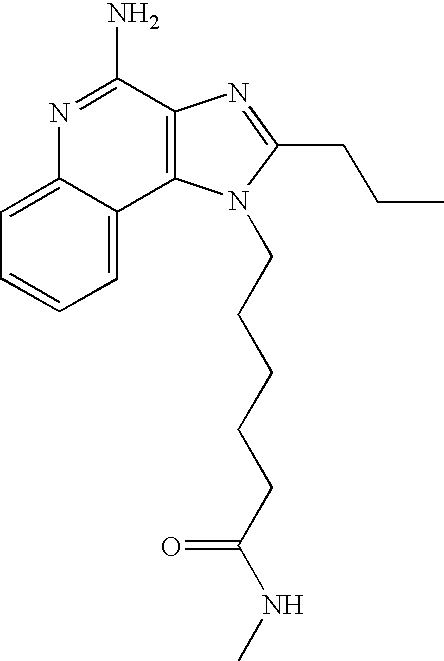
Part A - A solution of sodium hydrosulfite (73.55 g, 422.4 mmol) and potassium carbonate (65.9 g, 476 mmol) in water (200 mL) was stirred for 15 minutes. A mixture of ethyl 6-(3-nitroquinolin-4-ylamino)hexanoate (40.0 g, 121 mmol, prepared as described in Parts A and B of Example 6), 1,1 ′-di-n-octyl-4,4′-bipyridinium dibromide (0.65 g, 1.2 mmol), dichloromethane (200 mL), and water (40 mL) was added over a period of five minutes, and the reaction was stirred overnight at ambient temperature. Water (100 mL) was added; the organic layer was separated and washed with water (3×150 mL), dried over potassium carbonate, filtered, and concentrated under reduced pressure to provide 25.15 g of ethyl 6-[(3-aminoquinolin-4-yl)amino]hexanoate. The product was mixed with material from another run.
- Part B
- A solution of ethyl 6-[(3-aminoquinolin-4-yl)amino]hexanoate (44.0 g, 146 mmol) in toluene (500 mL) was heated at reflux under a Dean-Stark trap for 1.5 hours and then allowed to cool to ambient temperature. Trimethyl orthobutyrate (29.2 mL, 182.5 mmol) and pyridinium p-toluenesulfonate (0.300 g, 1.20 mmol) were sequentially added, and the reaction was heated at reflux for three hours, allowed to cool to ambient temperature, and concentrated under reduced pressure. The residue was dissolved in dichloromethane, and the resulting solution was washed sequentially with saturated aqueous sodium bicarbonate and brine, dried over magnesium sulfate, filtered, and concentrated under reduced pressure. The crude product was purified by column chromatography on silica gel (eluting with 97:3 dichloromethane:methanol) to provide 38 g of ethyl 6-(2-propyl-1H-imidazo[4,5-c]quinolin-1-yl)hexanoate.
- Part C
- The method described in Part D of Example 3 was used to treat ethyl 6-(2-propyl-1H-imidazo[4,5-c]quinolin-1-yl)hexanoate (5.0 g, 14 mmol) with methylamine (8 mL of a 40% solution). The reaction was complete after being stirred overnight at 70° C. Following the work-up procedure, 3.42 g of N-methyl-6-(2-propyl-1H-imidazo[4,5-c]quinolin-1-yl)hexanamide were obtained.
- Part D
- mCPBA (5.0 g, 29.03 mmol) was added to a solution of N-methyl-6-(2-propyl-1H-imidazo[4,5-c]quinolin-1-yl)hexanamide (3.42 g, 9.67 mmol) in chloroform (100 mL). The reaction was stirred for two hours at ambient temperature and then washed with 10% aqueous sodium hydroxide. Ammonium hydroxide (40 mL) and p-toluenesulfonyl chloride (2.39 g, 12.6 mmol) were sequentially added, and the reaction was stirred vigorously for two hours. The organic layer was separated and washed sequentially with 10% sodium hydroxide, saturated aqueous sodium bicarbonate, and brine; dried over magnesium sulfate; filtered; and concentrated under reduced pressure. The crude product was purified by column chromatography on silica gel (eluting with 95:5 dichloromethane:methanol) followed by recrystallization from methanol:water to provide 1.055 g of 6-(4-amino-2-propyl-1H-imidazo[4,5-c]quinolin-1-yl)-N-methylhexanamide as beige needles, mp 158-159° C.
- Anal. Calcd for C20H27N5O: C, 67.96; H, 7.70; N, 19.81. Found: C, 67.65; H., 7.45; N, 19.74.
-
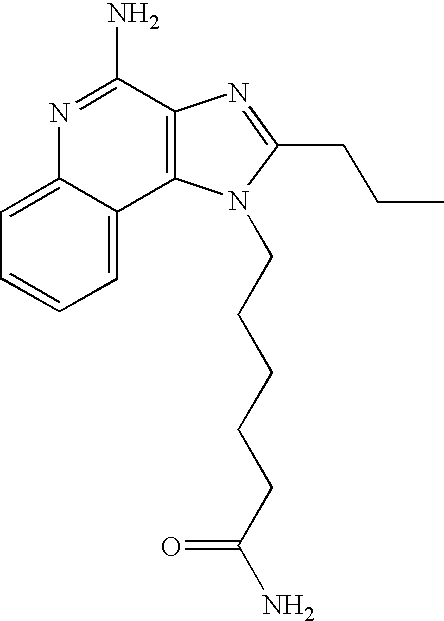
Part A - A solution ethyl 6-[(3-aminoquinolin-4-yl)amino]hexanoate (25.15 g, 83.4 mmol, prepared in Part A of Example 8) in toluene (400 mL) was treated with trimethyl orthobutyrate (15.4 mL, 96.2 mmol) and pyridinium p-toluenesulfonate (0.20 g, 0.80 mmol) according to, a modification of the method described in Part D of Example 6. The reaction was not complete after five hours and was allowed to cool to ambient temperature overnight. Additional pyridinium p-toluenesulfonate (0.20 g, 0.80 mmol) and trimethyl orthobutyrate (2.0 mL, 12 mmol) were added. The reaction was heated at reflux for two hours and then subjected to the work-up procedure to provide 25.0 g of ethyl 6-(2-propyl-1H-imidazo[4,5-c]quinolin-1-yl)hexanoate.
- Part B
- Ammonium acetate (20 g) and ethyl 6-(2-propyl-1H-imidazo[4,5-c]quinolin-1-yl)hexanoate (4.11 g, 11.6 mmol) were heated overnight at 140° C. in a sealed vessel. The reaction was allowed to cool to ambient temperature, and saturated aqueous sodium bicarbonate was added. The mixture was extracted with chloroform (3×), and the extracts were combined and concentrated under reduced pressure. The crude product was purified by column chromatography on silica gel (eluting with 95:5 dichloromethane:methanol) to provide 1.7 g of 6-(2-propyl-1H-imidazo[4,5-c]quinolin-1-yl)hexanamide.
- Part C
- 6-(2-Propyl-1H-imidazo[4,5-c]quinolin-1-yl)hexanamide (1.7 g, 5.2 mmol) was treated with mCPBA (3.61 g, 15.7 mmol) followed by ammonium hydroxide (40 mL) and p-toluenesulfonyl chloride (1.49 g, 7.84 mmol) according to the method described in Part D of Example 8. The crude product was purified as described in Part D of Example 8 to provide 0.137 g of 6-(4-amino-2-propyl-1H-imidazo[4,5-c]quinolin-1-yl)hexanamide as tan needles, mp 210-211° C.
- Anal. Calcd for C19H25N5O: C, 67.23; H, 7.42; N, 20.63. Found: C, 66.95; H, 7.76; N, 20.43.
-

Part A - Triethyl orthoformate (12.74 mL, 76.64 mmol) and pyridinium p-toluenesulfonate (0.200 g) were sequentially added to a solution of ethyl 6-[(3-aminoquinolin-4-yl)amino]hexanoate (16.5 g, 54.7 mmol, prepared as described in Part A of Example 8) in toluene (200 mL), and the reaction was heated at reflux under a Dean-Stark trap for four hours, allowed to cool to ambient temperature, and concentrated under reduced pressure. The residue was dissolved in dichloromethane, and the resulting solution was washed sequentially with saturated aqueous sodium bicarbonate and brine, dried over magnesium sulfate, filtered, and concentrated under reduced pressure to provide 16.4 g of ethyl 6-(1H-imidazo[4,5-c] quinolin-1-yl)hexanoate.
- Part B
- A solution of ethyl 6-(1H-imidazo[4,5-c] quinolin-1-yl)hexanoate (7.0 g, 22.5 mmol) and n-propylamine (11.1 mL, 135 mmol) in THF (10 mL) was heated at 100° C. for ten days in a sealed high-pressure vessel. Additional n-propylamine (20 mL) was added after three days and again after seven days. After ten days, the reaction was concentrated under reduced pressure to provide 7.0 g of 6-(1H-imidazo[4,5-c]quinolin-1-yl)-N-propylhexanamide.
- Part C
- 6-(1H-Imidazo[4,5-c]quinolin-1-yl)-N-propylbexanamide (7.0 g, 26 mmol) was treated with mCPBA (8.68 g, 37.7 mmol) followed by ammonium hydroxide (40 mL) and p-toluenesulfonyl chloride (8.01 g, 42.1 mmol) according to the method described in Part D of Example 8. The crude product was triturated with ethyl acetate and recrystallized twice from methanol:water to provide 2.00 g of 6-(4-amino-1H-imidazo[4,5-c]quinolin-1-yl)-N-propylhexanamide as brown needles, mp 128-130° C.
- Anal. Calcd for C19H25N5O.0.20 H2O: C, 66.52; H, 7 46; N, 20.42. Found: C, 66.12; H, 7.38; N, 20.10.
-

Part A - A solution of sodium hydroxide (1.66 g, 41.7 mmol) in water (15 mL) was added to a solution of ethyl 6-(1H-imidazo[4,5-c]quinolin-1-yl)hexanoate (10.0 g, 32.1 mmol, prepared in Part A of Example 10) in ethanol (75 mL), and the reaction was stirred at ambient temperature for two hours and then concentrated under reduced pressure. The residue was diluted with water and adjusted to pH 5 with the addition of 10% hydrochloric acid. The mixture was extracted with dichloromethane, and the combined extracts were dried over magnesium sulfate, filtered, and concentrated under reduced pressure to provide 2.5 g of 6-(1H-imidazo[4,5-c]quinolin-1-yl)hexanoic acid.
- Part B
- 6-(1H-Imidazo[4,5-c]quinolin-1-yl)hexanoic acid (2.5 g, 8.8 mmol) was treated with oxalyl chloride (1.39 mL, 15.9 mmol) and morpholine (2.31 mL, 26.5 mmol) according to a modification of the method described in Part F of Example 6. The reaction with oxalyl chloride was carried out at ambient temperature, and the reaction with morpholine was complete after one hour. Following the work-up procedure, 3.1 g of 1-(6-morpholin-4-yl-6-oxohexyl)-1H-imidazo[4,5-c]quinoline were obtained.
- Part C
- 1-(6-Morpholin-4-yl-6-oxohexyl)-1H-imidazo[4,5-c]quinoline (3.09 g, 8.79 mmol) was treated with mCPBA (3.54 g, 15.4 mmol) followed by ammonium hydroxide (50 mL) and p-toluenesulfonyl chloride (3.26 g, 17.4 mmol) according to the method described in Part D of Example 8. The crude product was purified as described in Part C of Example 10 to provide 0.422 g of 1-(6-morpholin-4-yl-6-oxohexyl)-1H-imidazo[4,5-c]quinolin-4-amine as brown needles, mp 166-168° C.
- Anal. Calcd for C20H25N5O2: C, 65.37; H, 6.86; N, 19.06. Found: C, 65.09; H, 6.75; N, 18.87.
-

Part A - Methoxypropionyl chloride (4.85 g, 39.8 mmol) was added dropwise over a period of ten minutes to a solution of ethyl 6-(3-aminoquinolin-4-ylamino)hexanoate (10.0 g, 33.2 mmol, prepared as described in Part A of Example 8) in dichloromethane (200 mL). The reaction was stirred for one hour at ambient temperature and then concentrated under reduced pressure. Triethylamine (18.49 g, 132.7 mmol) and ethanol (200 mL) were added, and the resulting solution was heated at reflux for three hours. The solvent was removed under reduced pressure. Dichloromethane (75 mL) was added, and the resulting solution was washed with saturated aqueous sodium bicarbonate, dried over magnesium sulfate, filtered, and concentrated under reduced pressure to provide 12.05 g of ethyl 6-[2-(2-methoxyethyl)-1H-imidazo[4,5-c]quinolin-1-yl]hexanoate as a dark oil.
- Part B
- Ethyl 6-[2-(2-methoxyethyl)-1H-imidazo[4,5-c]quinolin-1-yl]hexanoate (12.05 g, 32.61 mmol) was treated with sodium hydroxide (1.70 g, 42.4 mmol) according to a modification of the method described in Part A of Example 11. The reaction was stirred overnight at ambient temperature to provide 8.35 g of 6-[2-(2-methoxyethyl)-1H-imidazo[4,5-c]quinolin-1-yl]hexanoic acid after the aqueous work-up procedure.
- Part C
- 6-[2-(2-Methoxyethyl)-1H-imidazo[4,5-c]quinolin-1-yl]hexanoic acid (4.1 g, 12 mmol) was treated with oxalyl chloride (1.89 mL, 21.6 mmol) and morpholine (3.15 mL, 36.0 mmol) according to a modification of the method described in Part F of Example 6. The reaction with oxalyl chloride was carried out at ambient temperature, and the reaction with morpholine was complete after two hours. Following the work-up procedure, 4.55 g of 2-(2-methoxyethyl)-1-(6-morpholin-4-yl-6-oxohexyl)-1H-imidazo[4,5-c]quinoline were obtained.
- Part D
- 2-(2-Methoxyethyl)-1-(6-morpholin-4-yl-6-oxohexyl)-1H-imidazo[4,5-c]quinoline (4.55 g, 11.1 mmol) was treated with mCPBA (4.97 g, 21.6 mmol) followed by ammonium hydroxide (40 mL) and p-toluenesulfonyl chloride (3.69 g, 19.4 mmol) according to the method described in Part D of Example 8. The crude product was recrystallized twice from ethyl acetate to provide 1.17 g of 2-(2-methoxyethyl)-1-(6-morpholin-4-yl-6-oxohexyl)-1H-imidazo[4,5-c]quinolin-4-amine as brown needles, mp 131-132° C.
- Anal. Calcd for C23H31N5O30.14 H2O: C, 64.54; H, 7.37; N, 16.36. Found: C:, 64.14; H, 7.43; N, 16.40.
-

Part A - Ethyl 6-(3-nitroquinolin-4-ylamino)hexanoate (27.1 g, 81.8 mmol, prepared as described in Parts A and B of Example 6) was treated with sodium hydrosulfite (49.8 g, 286 mmol), potassium carbonate (44.6 g, 323 mmol), and ethyl viologen dibromide (0.306 g, 0.818 mmol) according to a modification of the method described in Part A of Example 8. After the reaction was stirred overnight, additional sodium hydrosulfite (5.1>g, 29 mmol) was added, and the reaction was stirred for one additional hour. The organic layer was separated, washed three times with water, and concentrated under reduced pressure to provide 24 g of ethyl 6-(3-aminoquinolin-4-ylamino)hexanoate.
- Part B
- A solution of ethyl 6-(3-aminoquinolin-4-ylamino)hexanoate (9.25 g, 30.7 mmol) in chloroform (100 mL) was cooled to 0° C.; triethylamine (5.13 mL, 36.8 mmol) was added. Ethoxyacetyl chloride (4.51 g, 36.8 mmol) was then added dropwise over a period of five minutes. The reaction was allowed to warm to ambient temperature, heated at reflux overnight, and concentrated under reduced pressure. The crude product was purified by column chromatography on silica gel (eluting with 93:7 dichloromethane:methanol) to provide 7.73 g of ethyl 6-(2-ethoxymethyl-1H-imidazo[4,5-c]quinolin-1-yl)hexanoate.
- Part C
- A solution of ethyl 6-(2-ethoxymethyl-1H-imidazo[4,5-c]quinolin-1-yl)hexanoate (4.0 g, 11 mmol) in morpholine (7 mL) was heated at reflux for three days, allowed to cool to ambient temperature, and concentrated under reduced pressure. The residue was dissolved in dichloromethane; the resulting solution was washed sequentially with saturated aqueous sodium bicarbonate and brine, dried over magnesium sulfate, and concentrated under reduced pressure to provide 4.4 g of 2-(ethoxymethyl)-1-(6-morpholin-4-yl-6-oxohexyl)-1H-imidazo [4,5-c] quinoline.
- Part D
- 2-(Ethoxymethyl)-1-(6-morpholin-4-yl-6-oxohexyl)-1H-imidazo[4,5-c]quinoline (4.4 g, 11 mmol) was treated with mCPBA (5.54 g, 32.1 mmol) followed by ammonium hydroxide (40 mL) and p-toluenesulfonyl chloride (2.74 g, 14.4 mmol) according to the method described in Part D of Example 8. The crude product was purified as described in Part D of Example 8 and then dried for two days at 60° C. to provide 1.061 g of 2-(ethoxymethyl)-1-(6-morpholin-4-yl-6-oxohexyl)-1H-imidazo[4,5-c]quinolin-4-amine as a beige powder, mp 160-162° C.
- Anal. Calcd for C23H31N5O3.0.47 H2O: C, 63.65; H, 7.42; N, 16.14. Found: C, 63.64; H, 7.42; N, 16.05.
-

Part A - A solution of ethyl 6-(2-ethoxymethyl-1H-imidazo[4,5-c]quinolin-1-yl)hexanoate (3.73 g, 10.1 mmol, prepared in Parts A and B of Example 13), n-propylamine (5 mL), and THF (5 mL) was heated at 80° C. for three days in a high-pressure vessel, allowed to cool to ambient temperature, and concentrated under reduced pressure. The work-up procedure described in Part C of Example 13 was followed to provide 4.1 g of 6-[2-(ethoxymethyl)-1H-imidazo[4,5-c]quinolin-1-yl]-N-propylhexanamide.
- Part B
- 6-[2-(Ethoxymethyl)-1H-imidazo[4,5-c]quinolin-1-yl]-N-propylhexanamide (4.1 g, 11 mmol) was treated with mCPBA (5.74 g, 33.3 mmol) followed by ammonium hydroxide (50 mL) and p-toluenesulfonyl chloride (2.85 g, 14.9 mmol) according to the method described in Part D of Example 8. The crude product was purified by column chromatography on silica gel (eluting with 97:3 dichloromethane:methanol) followed by recrystallization from methanol:water to provide 0.548 g of 6-[4-amino-2-(ethoxymethyl)-1H-imidazo[4,5-c]quinolin-1-yl]-N-propylhexanamide as beige needles, mp 161-162° C.
- Anal. Calcd for C22H31N5O2: C, 66.47; H, 7.86; N, 17.62. Found: C, 66.27; H, 7.94; N, 17.38.
-

Part A - Potassium carbonate (19.87 g, 143.8 mmol) and triethylamine (50.1 mL, 359 mmol) were sequentially added with stirring to a solution of 4-chloro-3-nitroquinoline (30.0 g, 144 mmol) in chloroform (200 mL). After 15 minutes, β-alanine ethyl ester hydrochloride (26.5 g, 173 mmol) was slowly added, and the reaction was stirred overnight at ambient temperature. Water (100 mL) was added, and the mixture was stirred for 15 minutes. The organic layer was separated, washed sequentially with saturated aqueous sodium bicarbonate and brine, dried over magnesium sulfate, filtered, and concentrated under reduced pressure to provide 27.4 g of ethyl N-(3-nitroquinolin-4-yl)-β-alaninate as a yellow solid, which was used without purification.
- Part B
- Ethyl N-(3-nitroquinolin-4-yl)-β-alaninate (28.2 g, 97.5 mmol) was treated with sodium hydrosulfite (50.9 g, 292 mmol), potassium carbonate (53.2 g, 385 mmol), and ethyl viologen dibromide (0.364 g, 0.973 mmol) according to a modification of the method described in Part A of Example 8. After the reaction was stirred overnight, additional sodium hydrosulfite (5.0 g,,29 mmol) was added, and the reaction was stirred for two additional hours. Additional sodium hydrosulfite (2.0 g, 5.3 mmol) was added, and the reaction was stirred for one additional hour. An analysis by TLC indicated the reaction was complete. The organic layer was separated, washed three times with water, and concentrated under reduced pressure to provide 20.7 g of ethyl N-(3-aminoquinolin-4-yl)-β-alaninate.
- Part C
- Ethyl N-(3-aminoquinolin-4-yl)-β-alaninate (10.0 g, 38.6 mmol) was treated according to a modification of the method described in Part B of Example 8. After the addition of trimethyl orthobutyrate (7.71 mL, 48.2 mmol) and pyridinium p-toluenesulfonate (0.200 g, 0.796 mmol), the reaction was heated at reflux for one hour and subjected to the work-up procedure to provide 12.3 g of ethyl 3-(2-propyl-1H-imidazo[4,5-c]quinolin-1-yl)propanoate, which was used without purification.
- Part D
- A solution of ethyl 3-(2-propyl-1H-imidazo[4,5-c]quinolin-1-yl)propanoate (3.45 g, 11.1 mmol), n-propylamine (9.1 mL, 110 mmol), and THF (5 mL) was heated at 80° C. for two days in a high-pressure vessel, allowed to cool to ambient temperature, and concentrated under reduced pressure to provide 3.5 g of 3-(2-propyl-1H-imidazo[4,5-c]quinolin-1-yl)-N-propylpropanamide.
- Part E
- 3-(2-Propyl-1H-imidazo[4,5-c]quinolin-1-yl)-N-propylpropanamide (3.5 g, 11 mmol) was treated with mCPBA (5.85 g, 32.4 mmol) followed by ammonium hydroxide (40 mL) and p-toluenesulfonyl chloride (2.76 g, 14.6 mmol) according to a modification of the method described in Part D of Example 8. When the reaction was complete, the organic layer was separated, washed with 10% aqueous sodium bicarbonate, and concentrated under reduced pressure. The crude product was purified as described in Part D of Example 8 to provide 1.026 g of 3-(4-amino-2-propyl-1H-imidazo[4,5-c]quinolin-1-yl)-N-propylpropanamide as beige needles, mp 157-158° C.
- Anal. Calcd for C19H25N5O.0.97 H2O: C, 63.94; H, 7.61; N, 19.62. Found: C, 63.95; H, 7.69; N, 19.55.
-

Part A - Ethyl N-(3-nitroquinolin-4-yl)-β-alaninate (41.6 g, 144 mmol, prepared as described in Part A of Example 15) was treated with sodium hydrosulfite (87.62 g, 503.3 mmol), potassium carbonate (78.5 g, 568 mmol), and ethyl viologen dibromide (0.54 g, 1.4 mmol) according to a modification of the method described in Part A of Example 8. After the reaction was stirred overnight, additional sodium hydrosulfite (5.0 g, 29 mmol) was added, and the reaction was stirred for one additional hour. The organic layer was separated, washed with water (5×200 mL), dried over magnesium sulfate, filtered, and concentrated under reduced pressure to provide 33.3 g of ethyl N-(3-aminoquinolin-4-yl)-β-alaninate.
- Part B
- Ethyl N-(3-aminoquinolin-4-yl)-β-alaninate (33.3 g, 128 mmol) was treated according to a modification of the method described in Part B of Example 8. After the addition of trimethyl orthobutyrate (25.6 mL, 161 mmol) and pyridinium p-toluenesulfonate (0.200 g, 0.796 mmol), the reaction was heated at reflux for two hours and subjected to the work-up procedure to provide 37.1 g of ethyl 3-(2-propyl-1H-imidazo[4,5-c]quinolin-1-yl)propanoate, which was used without purification.
- Part C
- A solution of ethyl 3-(2-propyl-1H-imidazo[4,5-c]quinolin-1-yl)propanoate (4.0 g, 15 mmol) in morpholine (20 mL, 0.2 mol) was heated at reflux for two days, allowed to cool to ambient temperature, and concentrated under reduced pressure to provide 5.2 g of 1-(3-morpholin-4-yl-3-oxopropyl)-2-propyl-1H-imidazo[4,5-c]quinoline.
- Part D
- 1-(3-Morpholin-4-yl-3-oxopropyl)-2-propyl-1H-imidazo[4,5-c]quinoline (5.2 g, 15 mmol) was treated with mCPBA (7.64 g, 44.3 mmol) followed by ammonium hydroxide (40 mL) and p-toluenesulfonyl chloride (3.79 g, 19.9 mmol) according to the method described in Part D of Example 8. The crude product was purified by column chromatography on silica gel (eluting with 95:5 dichloromethane:methanol) followed by recrystallization from methanol:dichloromethane to provide 0.358 g of 1-(3-morpholin-4-yl-3-oxopropyl)-2-propyl-1H-imidazo[4,5-c]quinolin-4-amine as yellow needles, mp 172-173° C.
- Anal. Calcd for C20H25N5O2.0.2 CH3OH.0.2 H2O: C, 64.27; H, 6.99; N, 18.55. Found: C, 64.20; H, 6.92; N, 18.67.
-

Part A - A mixture of ethyl 3-(2-propyl-1H-imidazo[4,5-c]quinolin-1-yl)propanoate (4.24 g, 16.5 mmol, prepared in Parts A and B of Example 16), THF (15 mL), and methylamine (available as a 40% solution in water, 8 mL) was scaled in a high-pressure vessel, heated at 80° C. overnight, and concentrated under reduced pressure to provide 4.7 g of N-methyl-3-(2-propyl-1H-imidazo[4,5-c]quinolin-1-yl)propanamide.
- Part B
- N-Methyl-3-(2-propyl-1H-imidazo[4,5-c]quinolin-1-yl)propanamide (4.7 g, 13 mmol) was treated with mCPBA (6.58 g, 38.2 mmol) followed by ammonium hydroxide (40 mL) and p-toluenesulfonyl chloride (3.27 g, 17.2 mmol) according to the method described in Part D of Example 8. The crude product was purified as described in Part D of Example 8 to provide 0.674 g of 3-(4-amino-2-propyl-1H-imidazo[4,5-c]quinolin-1-yl)-N-methylpropanamide as a tan powder, mp 177-178° C.
- Anal. Calcd for C17H21N5O.0.22 H2O: C, 64.75; H, 6.85; N, 22.21. Found: C, 65.01; H, 6.97; N, 22.20.
-

Part A - Ethyl N-(3-nitroquinolin-4-yl)-β-alaninate (62.0 g, 214 mmol, prepared as described in Part A of Example 15) was treated with sodium hydrosulfite (130.6 g, 750.1 mmol), potassium carbonate (117 g, 847 mmol), and ethyl viologen dibromide (0.802 g, 2.14 mmol) according to a modification of the method described in Part A of Example 8. After the reaction was stirred overnight, additional water (100 mL), dichloromethane, and sodium hydrosulfite (20.0 g, 115 mmol) were added, and the reaction was stirred for three additional hours. The organic layer was separated; washed with water (6×), saturated aqueous sodium bicarbonate, and brine; dried over magnesium sulfate; filtered; and concentrated under reduced pressure to provide 40.2 g of ethyl N-(3-aminoquinolin-4-yl)-β-alaninate.
- Part B
- Ethyl N-(3-aminoquinolin-4-yl)-β-alaninate (11.0 g, 42.4 mmol) was treated according to a modification of the method described in Part B of Example 8. After the addition of trimethyl orthobutyrate (7.8 mL, 49 mmol) and pyridinium p-toluenesulfonate (0.200 g, 0.796 mmol), the reaction was heated at reflux for one hour and subjected to the work-up procedure to provide 10.6 g of ethyl 3-(2-propyl-1H-imidazo[4,5-c]quinolin-1-yl)propanoate, which was used without purification.
- Part C
- Ethyl 3-(2-propyl-1H-imidazo[4,5-c]quinolin-1-yl)propanoate (5.0 g, 16 mmol) was treated with ammonium acetate (25.0 g) according to the method described in Part B of Example 9 to provide 3.9 g of 3-(2-propyl-1H-imidazo[4,5-c]quinolin-1-yl)propanamide, which was used without purification.
- Part D
- 3-(2-Propyl-1H -imidazo[4,5-c]quinolin-1-yl)propanamide (3.9 g, 14 mmol) was treated with mCPBA (6.19 g, 26.9 mmol) followed by ammonium hydroxide (50 mL) and p-toluenesulfonyl chloride (4.6 g, 24 mmol) according to the method described in Part D of Example 8. The crude product was dissolved in methanol, and hydrogen chloride (1.25 mL of a 1 M solution in diethyl ether) was added. The resulting solid was isolated by filtration and dried overnight under high vacuum to provide 0.477 g of 3-(4-amino-2-propyl-1H-imidazo[4,5-c]quinolin-1-yl)propanamide hydrochloride as tan needles, mp 242-243° C.
- Anal. Calcd for C16H19N5O.1.0 HCl.0.04 H2O: C, 54.82; H, 6.29; N, 19.98. Found: C, 54.81; H, 6.66; N, 19.81.
-

Part A - The method described in Part A of Example 12 was used to treat ethyl N-(3-aminoquinolin-4-yl)-,-alaninate (9.82 g, 37.9 mmol, prepared in Part A of Example 18) with methoxypropionyl chloride (5.54 g, 45.4 mmol). The reaction with triethylamine (21.1 mL, 151 mmol) was heated at reflux for six hours and then subjected to the work-up procedure to provide 10.3 g of ethyl 3-[2-(2-methoxyethyl)-1H-imidazo[4,5-c]quinolin-1-yl]propanoate.
- Part B
- A solution of ethyl 3-[2-(2-methoxyethyl)-1H-imidazo[4,5-c]quinolin-1-yl]propanoate (4.0 g, 15 mmol), morpholine (13.49 mL, 154.3 mmol), and 2-methyltetrahydrofuran (10 mL) was heated for three days in a high-pressure vessel at 120° C., allowed to cool to ambient temperature, and concentrated under reduced pressure to provide 5.6 g of 2-(2-methoxyethyl)-1-(3-morpholin-4-yl-3-oxopropyl)-1H-imidazo[4,5-c]quinoline.
- Part C
- 2-(2-Methoxyethyl)-1-(3-morpholin-4-yl-3-oxopropyl)-1H-imidazo[4,5-c]quinoline (4.7 g, 13 mmol) was treated with mCPBA (5.73 g, 24.9 mmol) followed by ammonium hydroxide (40 mL) and p-toluenesulfonyl chloride (4.23 g, 22.2 mmol) according to the method described in Part D of Example 8. The crude product was recrystallized twice from ethyl acetate to provide 0.233 g of 2-(2-methoxyethyl)-1-(3-morpholin-4-yl-3-oxopropyl)-1H-imidazo[4,5-c]quinolin-4-amine as beige needles, mp 125-126° C.
- Anal. Calcd for C20H25N5O3.0.29 H2O: C, 61.81; H, 6.63; N, 18.02. Found: C, 61.57; H, 6.45; N, 17.76.
-
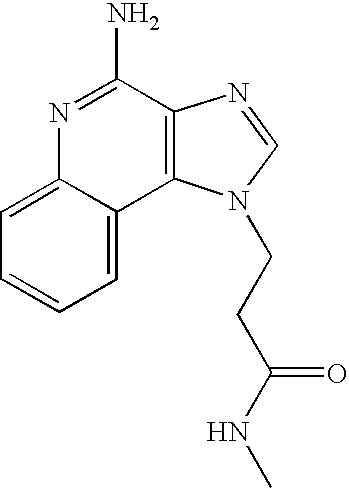
Part A - The method described in Part A of Example 10 was used to treat ethyl N-(3-aminoquinolin-4-yl)-β-alaninate (10.0 g, 38.6 mmol, prepared in Part A of Example 18) with triethyl orthoformate (8.98 mL, 54.0 mmol). The reaction was complete in three hours. The reaction mixture was filtered to remove a precipitate and then subjected to the work-up procedure to provide 9.7 g of ethyl 3-(1H-imidazo[4,5-c]quinolin-1-yl)propanoate.
- Part B
- A mixture of ethyl 3-(1H-imidazo[4,5-c]quinolin-1-yl)propanoate (4.70 g, 17.5 mmol), THF (5 mL), and methylamine (available as a 40% solution in water, 10 mL) was sealed in a high-pressure vessel, stirred at 100° C. overnight, and concentrated under reduced pressure to provide 4.4 g of 3-(1H-imidazo[4,5-c]quinolin-1-yl)-N-methylpropanamide.
- Part C
- mCPBA (8.95 g, 38.9 mmol) was added to a solution of 3-(1H-imidazo[4,5-c]quinolin-1-yl)-N-methylpropanamide (4.4 g, 15.6 mmol) in chloroform (100 mL); the reaction was stirred for one hour at ambient temperature. Ammonium hydroxide (40 mL) was added, and the mixture was stirred vigorously for 15 minutes. p-Toluenesulfonyl chloride (5.94 g, 31.2 mmol) was added over a period of ten minutes, and the reaction was stirred for two hours. The reaction mixture was filtered to remove a precipitate, and the organic layer was separated and washed with saturated aqueous sodium bicarbonate, dried over magnesium sulfate, filtered, and concentrated under reduced pressure. The crude product was recrystallized from methanol to provide 0.535 g of 3-(4-amino-1H-imidazo[4,5-c]quinolin-1-yl)-N-methylpropallamide as off-white needles, mp>260° C.
- Anal. Calcd for C14H15N5O.0.13 H2O: C, 61.90; H, 5.66; N, 25.78. Found: C, 61.51; H, 5.39; N, 25.41.
-
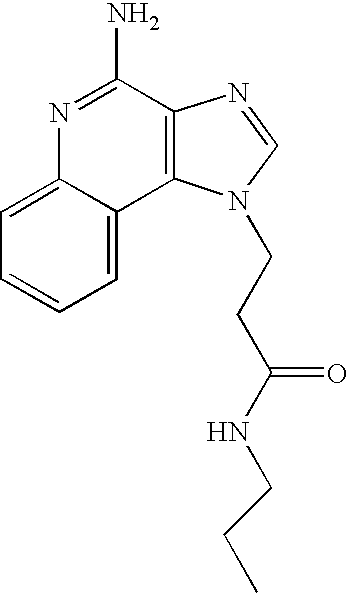
Part A - Ethyl 3-(1H-imidazo[4,5-c]quinolin-1-yl)propanoate (3.75 g, 13.9 mmol, prepared as described in Part A of Example 20) was treated with n-propylamine (11.4 mL, 139 mmol) according to the method described in Part B of Example 20 to provide 3.9 g of 3-(1H-imidazo[4,5-c]quinolin-1-yl)-N-propylpropanamide.
- Part B
- mCPBA (5.6 g, 24 mmol) was added to a solution of 3-(1H-imidazo[4,5-c]quinolin-1-yl)-N-propylpropanamide (3.9 g, 14 mmol) in chloroform (100 mL). The reaction was stirred for two hours and washed with saturated aqueous sodium bicarbonate. Concentrated ammonium hydroxide (40 mL) was added. The mixture was stirred vigorously for five minutes before the addition of p-toluenesulfonyl chloride (5.13 g, 26.9 mmol). The reaction was stirred vigorously for two hours, and then the organic layer was separated and washed sequentially with saturated aqueous sodium bicarbonate (2×) and brine, dried over magnesium sulfate, filtered, and concentrated under reduced pressure. The crude product was recrystallized three times from ethyl acetate to provide 0.496 g of 3-(4-amino-1H-imidazo[4,5-c]quinolin-1-yl)-N-propylpropanamide as a brown powder, mp 212-214° C.
- Anal. Calcd for C16H19N5O.0.04 H2O: C, 64.47; H, 6.45; N, 23.49. Found: C, 64.09; H, 6.64; N, 23.52.
-

Part A - 4-Chloro-3-nitroquinoline (76.1 g, 365 mmol) was treated with β-alanine ethyl ester hydrochloride (50.0 g, 326 mmol) in the presence of triethylamine (94.5 mL, 678 mmol) and potassium carbonate (37.45 g, 271.2 mmol) according to a modification of the method described in Part A of Example 15. Before the addition of β-alanine ethyl ester hydrochloride, the reaction was cooled to 0° C. After this addition, the reaction was stirred for four hours at ambient temperature and subjected to the work-up procedure to provide 105 g of ethyl N-(3-nitroquinolin-4-yl)-β-alaninate.
- Part B
- Ethyl N-(3-nitroquinolin-4-yl)-β-alaninate (50.0 g, 173 mmol) was hydrogenated in the presence of 5% platinum on carbon (1.0 g) according to the method described in Part C of Example 1. The reaction was allowed to proceed overnight under hydrogen pressure (40 psi, 2.8×10⁵ Pa) and then subjected to the work-up procedure to provide 42.3 g of ethyl N-(3-aminoquinolin-4-yl)-β-alaninate.
- Part C
- Ethyl N-(3-aminoquinolin-4-yl)-13-alaninate (15.0 g, 57.8 mmol) was treated with trimethyl orthoacetate (10.3 mL, 81.0 mmol) and pyridinium p-toluenesulfonate (0.200 g) according to the method described in Part A of Example 10 to provide 14.0 g of ethyl 3-(2-methyl-1H-imidazo[4,5-c]quinolin-1-yl)propanoate as a brown solid.
- Part D
- A solution of ethyl 3-(2-methyl-1H-imidazo[4,5-c]quinolin-1-yl)propanoate (4.0 g, 15 mmol) and morpholine (10 mL, 100 mmol) was heated for three days in a high-pressure vessel at 100° C., allowed to cool to ambient temperature, and concentrated under reduced pressure. The residue was dissolved in dichloromethane, and the resulting solution was washed with saturated aqueous sodium bicarbonate, dried over magnesium sulfate, filtered, and concentrated under reduced pressure to provide 4.8 g of 2-methyl-1-(3-morpholin-4-yl-3-oxopropyl)-1H-imidazo[4,5-c]quinoline.
- Part E
- 2-Methyl-1-(3-morpholin-4-yl-3-oxopropyl)-1H-imidazo[4,5-c]quinoline (4.8 g, 15 mmol) was treated with mCPBA (5.95 g, 25.9 mmol) followed by ammonium hydroxide (50 mL) and p-toluenesulfonyl chloride (5.49 g, 28.8 mmol) according to a modification of the method described in Part D of Example 8. The reaction was not washed with 10% aqueous sodium hydroxide prior to the addition of ammonium hydroxide. After the amination reaction was stirred for two hours, water was added. Following the work-up procedure, the chromatographic purification was carried out eluting with 90:10 dichloromethane:methanol. The resulting product was triturated with ethyl acetate and isolated by filtration to provide 2-methyl-1-(3-morpholin-4-yl-3-oxopropyl)-1H-imidazo[4,5-c]quinolin-4-amine as brown needles, mp 166-169° C.
- Anal. Calcd for C18H21N5O2.0.50 H2O: C, 62.05; H, 6.36; N, 20.10. Found: C, 61.67; H, 6.63; N, 19.93.
-

Part A - Ethyl N-(3-aminoquinolin-4-yl)-β-alaninate (20.0 g, 77.3 mmol, prepared in Parts A and B of Example 22) was treated with ethoxyacetyl chloride (11.29 g, 92.5 mmol) according to a modification the method described in Part A of Example 12. The reaction in dichloromethane (300 mL) was stirred for 1.5 hours, and after the addition of triethylamine (43.08 mL, 309.1 mmol) and ethanol (300 mL), the reaction was heated at reflux for four hours and then subjected to the work-up procedure to provide 25.0 g of ethyl 3-(2-ethoxymethyl-1H-imidazo [4,5-c]quinolin-1-yl)propanoate.
- Part B
- A solution of ethyl 3-(2-ethoxymethyl-1H-imidazo[4,5-c]quinolin-1-yl)propanoate (5.0 g, 15 mmol) and morpholine (10 mL, 100 mmol) was heated overnight in a high-pressure vessel at 90° C. An analysis by HPLC indicated the reaction was incomplete. The reaction was then heated overnight in a high-pressure vessel at 110° C., allowed to cool to ambient temperature, and concentrated under reduced pressure to provide 5.1 g of 2-(ethoxymethyl)-1-(3-morpholin-4-yl-3-oxopropyl)-1H-imidazo[4,5-c]quinoline.
- Part C
- 2-(Ethoxymethyl)-1-(3-morpholin-4-yl-3-oxopropyl)-1H-imidazo[4,5-c]quinoline (5.1 g, 14 mmol) was treated with mCPBA (5.57 g, 24.2 mmol) followed by ammonium hydroxide (40 mL) and p-toluenesulfonyl chloride (5.14 g, 26.9 mmol) according to a modification of the method described in Part D of Example 8. The reaction was not washed with 10% aqueous sodium hydroxide prior to the addition of ammonium hydroxide. The crude product was purified by column chromatography on silica gel (eluting with 90:10 dichloromethane:methanol) and then triturated with ethyl acetate and isolated by filtration to provide 0.843 g of 2-(ethoxymethyl)-1-(3-morpholin-4-yl-3-oxopropyl)-1H-imidazo[4,5-c]quinolin-4-amine as off-white needles, mp 187-189° C.
- Anal. Calcd for C20H25N5O3: C, 62.65; H, 6.57; N, 18.26. Found: C, 62.28; H, 6.83; N, 18.19.
-

Part A - Ammonium acetate (7 g) and ethyl 3-(2-ethoxymethyl-1H-imidazo[4,5-c]quinolin-1-yl)propanoate (5.0 g, 15 mmol, prepared in Part A of Example 23) were stirred overnight at 125° C. in a sealed vessel. The reaction was allowed to cool to ambient temperature, and water (20 mL) was added. A precipitate formed and was isolated by filtration, washed with saturated aqueous sodium bicarbonate, and dried to provide 2.4 g of 3-[2-(ethoxymethyl)-1H-imidazo[4,5-c]quinolin-1-yl]propanamide as a tan powder.
- Part B
- 3-[2-(Ethoxymethyl)-1H-imidazo[4,5-c]quinolin-1-yl]propanamide (2.4 g, 8.1 mmol) was treated with mCPBA (3.24 g, 14.1 mmol) followed by ammonium hydroxide (40 mL) and p-toluenesulfonyl chloride (2.99 g, 15.7 mmol) according to a modification of the method described in Part D of Example 8. The reaction was not washed with 10% aqueous sodium hydroxide prior to the addition of ammonium hydroxide. After the amination reaction was stirred for two hours, 10% aqueous sodium hydroxide (25 mL) and saturated aqueous sodium bicarbonate (25 mL) were sequentially added with stirring. A precipitate formed and was isolated by filtration. The solid was triturated twice with 25% aqueous sodium hydroxide, isolated by filtration, washed with water, and dried in a vacuum oven for three days to provide 0.685 g of 3-[4-amino-2-(ethoxymethyl)-1H-imidazo[4,5-c]quinolin-1-yl]propanamide as tan needles, mp≧250° C.
- Anal. Calcd for C16H19N5O2: C, 61.33; H, 6.11; N, 22.35. Found: C, 61.03; H, 6.11; N, 22.24.
-
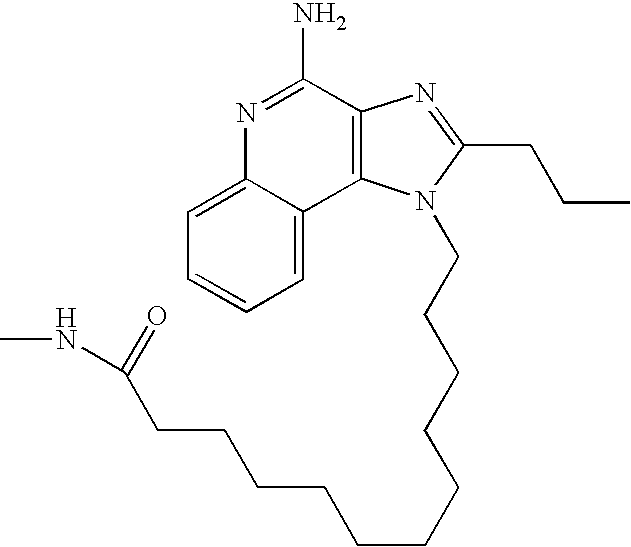
Part A - Ethanol (150 mL) was cooled to 0° C., and thionyl chloride (16.57 mL, 139.3 mmol) was added over a period of ten minutes. The reaction was stirred for ten minutes at 0° C., and 12-aminododecanoic acid (25.0 g, 116 mol) was then added. The reaction was allowed to warm to ambient temperature, stirred at a slightly elevated temperature for one hour, and stirred at ambient temperature for two hours. The Ethanol was removed under reduced pressure, and the solid residue was recrystallized from ethyl acetate. The crystals were isolated by filtration, washed with diethyl ether, and dried under vacuum to provide 37.4 g of ethyl 12-aminododecanoate hydrochloride as a white solid.
- Part B
- 4-Chloro-3-nitroquinoline (15.52 g, 74.40 mmol) was treated with ethyl 12-aminododecanoate hydrochloride (25.0 g, 89.3 mmol) in the presence of potassium carbonate (10.28 g, 74.38 mmol) and triethylamine (25.9 mL, 186 mmol) according to a modification of the method described in Part A of Example 15. After the reaction was stirred for six hours, an analysis by TLC indicated the presence of starting material, and additional ethyl 12-aminododecanate hydrochloride (1.0 g, 3.6 mmol) was added. The reaction was stirred overnight and subjected to the work-up procedure to provide 31.0 g of ethyl 12-(3-nitroquinolin-4-ylamino)dodecanoate.
- Part C
- Water (25 mL) and ethyl viologen dibromide (0.279 g, 0.746 mmol) were added to a solution of the material from Part B. Sodium hydrosulfite (45.4 g, 261 mmol) and a solution of potassium carbonate (40.7 g, 295 mmol) in water (200 mL) were added, and the reaction was stirred overnight. An analysis by TLC indicated that the reaction was incomplete. Additional sodium hydrosulfite (5.0 g, 29 mmol) was added, and the reaction was stirred for 0.5 additional hour. The organic layer was separated, washed three times with water, dried over magnesium sulfate, filtered, and concentrated under reduced pressure to provide ethyl 12-(3-aminoquinolin-4-ylamino)dodecanoate.
- Part D
- Ethyl 12-(3-aminoquinolin-4-ylamino)dodecanoate (20.0 g, 51.8 mmol) was treated according to a modification of the method described in Part B of Example 8. Prior to the addition of trimethyl orthobutyrate (9.53 mL, 59.6 1nm(>1) and pyridinium p-toluenesulfonate (0.500 g, 1.99 mmol), the reaction was heated at reflux for ten minutes. After the reaction was heated at reflux, it was allowed to cool to ambient temperature, washed sequentially with saturated aqueous sodium bicarbonate and brine, dried over magnesium sulfate, and concentrated under reduced pressure to provide 22.3 g of ethyl 12-(2-propyl-1H-imidazo[4,5-c]quinolin-1-yl)dodecanoate, which was used without purification.
- Part E
- A mixture of ethyl 12-(2-propyl-1H-imidazo[4,5-c]quinolin-1-yl)dodecanoate (4.0 g, 9.1 mmol), THF (5 mL), and methylamine (available as a 40% solution in water, 8 mL) was sealed in a high-pressure vessel and heated at 80° C. overnight. The solvent was removed under reduced pressure, and the residue was dissolved in dichloromethane. The resulting solution was washed sequentially with saturated aqueous sodium bicarbonate and brine, dried over magnesium sulfate, filtered, and concentrated under reduced pressure to provide 3.8 g of N-methyl-12-(2-propyl-1H-imidazo[4,5-c]quinolin-1-yl)dodecananide.
- Part F
- N-Methyl-12-(2-propyl-1H-imidazo[4,5-c]quinolin-1-yl)dodecanamide (3.8 g, 9.0 mmol) was treated with mCPBA (4.65 g, 26.9 mmol) followed by ammonium hydroxide (40 mL) and p-toluenesulfonyl chloride (2.31 g, 12.1 mmol) according to the method described in Part D of Example 8. The crude product was purified as described in Part D of Example 8 to provide 1.036 g of 12-(4-amino-2-propyl-1H-imidazo[4,5-c]quinolin-1-yl)-N-methyldodecanamide as a brown crystalline solid, mp 135-137° C.
- Anal. Calcd for C26H39N5O: C, 71.36; H, 8.98; N, 16.0. Found: C, 71. 12; H, 9.18; N, 15.90.
-

Part A - Concentrated ammonium hydroxide (150 mL of 29%) was cooled to 0° C. in a high-pressure vessel; bromopivalic acid (30.0 g, 359 mmol) was added with stirring over a period of ten minutes. The reaction was stirred for 30 minutes, sealed, heated at 55° C. for three days, and allowed to cool to ambient temperature. The solution was concentrated under reduced pressure, and the residue was dissolved in ethanol (150 L). The resulting solution was concentrated under reduced pressure; the residue was dissolved in toluene, which was removed under reduced pressure to provide a white solid.
- Part B
- The material from Part A was suspended in ethanol (300 mL) and cooled to 0° C. Thionyl chloride (45.0 mL, 617 mmol) was added dropwise. The reaction was allowed to warm to ambient temperature, stirred overnight, heated at reflux for one hour, and allowed to cool to ambient temperature. The volatiles were removed under reduced pressure, and the residue was mixed with ethyl acetate. The resulting mixture was filtered, and the filtrate was concentrated under reduced pressure to provide ethyl 3-amino-2,2-dimethylpropanoate as a yellow oil, which was used without purification.
- Part C
- A suspension of 4-chloro-3-nitroquinoline (35.0 g, 168 mmol) and triethylamine (84 mL, 0.60 mol) in dichloromethane (400 mL) was cooled to 0° C.; a solution of ethyl 3-amino-2,2-dimethylpropanoate (40.0 g, 0.220 mol) in dichloromethane (50 mL) was added dropwise. The reaction was stirred at 0° C. for 30 minutes and then at ambient temperature for four hours. The reaction was incomplete as determined by a TLC analysis, and additional ethyl 3-amino-2,2-dimethylpropionate (10.0 g, 55.0 mmol) was added. The reaction was stirred overnight; another analysis by TLC indicated the reaction was incomplete. Additional ethyl 3-amino-2,2-dimethylpropionate (5.0 g, 28 mmol) was added, and the reaction was heated at reflux for three hours. Potassium carbonate (10 g) was added, and the reaction was heated at reflux for two hours and stirred overnight at ambient temperature. Saturated aqueous sodium bicarbonate (50 mL) was added, and the reaction was stirred for three days. The organic layer was separated, washed with water (3×100 mL), dried over potassium carbonate, filtered, and concentrated under reduced pressure to provide ethyl 2,2-dimethyl-3-[(3-nitroquinolin-4-yl)amino]propanoate as an orange oil, which was mixed with material from another run and used without purification.
- Part D A mixture of ethyl 2,2-dimethyl-3-[(3-nitroquinolin-4-yl)amino]propanoate (59 g), sodium hydrosulfite (109 g, 532 mmol), potassium carbonate (103 g, 744 mmol), and ethyl viologen dibromide (0.50 g, 1.3 mmol), dichloromethane (350 mL), and water (350 mL) was stirred overnight at ambient temperature. The aqueous layer was separated and extracted with dichloromethane (100 mL). The combined organic fractions were washes with water (4×75 mL), dried over potassium carbonate, filtered, and concentrated under reduced pressure to provide 46.1 g of ethyl 3-[(3-aminoquinolin-4-yl)amino]-2,2-dimethylpropanoate as a dark oil.
- Part E
- Ethyl 3-[(3-aminoquinolin-4-yl)amino]-2,2-dimethylpropanoate (8.2 g, 29 mmol) was treated according to a modification of the method described in Part B of Example 8. Prior to the addition of trimethyl orthobutyrate (5.3 g, 36 mmol) and pyridinium p-toluenesulfonate (0.10 g, 0.40 mmol), the reaction was heated at reflux for ten minutes. During the work-up procedure, the solution was dried over potassium carbonate. The crude product was purified by column chromatography on silica gel (eluting with 93:7 dichloromethane:methanol containing 3 mL concentrated ammonium hydroxide per liter of eluent) to provide 2.1 g of ethyl 2,2-dimethyl-3-(2-propyl-1H-imidazo[4,5-c]quinolin-1-yl)propanoate as an orange oil.
- Part F
- Aqueous sodium hydroxide (1 mL of 50%) was added to a mixture of ethyl 2,2-dimethyl-3-(2-propyl-1H-imidazo[4,5-c]quinolin-1-yl)propanoate (2.1 g, 6.2 mmol), ethanol (50 mL), and water (5 mL). The reaction was stirred for one hour at ambient temperature and concentrated under reduced pressure. The residue was extracted with dichloromethane (2×50 mL); the combined extracts were diluted with dichloromethane (100 mL). The resulting solution was treated with water (10 mL) and adjusted to pH 6 with the addition of concentrated hydrochloric acid (<1 mL). The aqueous layer was separated and extracted with dichloromethane (25 mL). The combined organic fractions were dried over sodium sulfate, filtered, and concentrated under reduced pressure to provide 0.45 g of 2,2-dimethyl-3-(2-propyl-1H-imidazo[4,5-c]quinolin-1-yl)propionic acid hydrochloride as a yellow oil. The acidic aqueous layer was concentrated under reduced pressure and dried for one hour under vacuum at 55° C. to provide 1.5 g of 2,2-dimethyl-3-(2-propyl-1H-imidazo[4,5-c]quinolin-1-yl)propanoic acid hydrochloride as a yellow solid.
- Part G
- A suspension of the oil and the solid from Part F in dichloromethane (100 mL) was cooled to 0° C., and a solution of oxalyl chloride (1.1 mL, 11 mmol) in dichloromethane (4 mL) was added. After the addition, the reaction was stirred for 30 minutes at ambient temperature and concentrated under reduced pressure. A second treatment with oxalyl chloride was carried out as described above. The residue was suspended in dichloromethane (75 mL) and cooled to 0° C. A solution of ammonia (10 mL of 2 M in isopropanol) was then added over a period of two minutes. The reaction was stirred for 30 minutes and then concentrated under reduced pressure. The residue was mixed with dichloromethane (100 mL) and saturated aqueous sodium bicarbonate (25 mL). The aqueous layer was separated and extracted with dichloromethane (50 mL). The combined organic fractions were dried over potassium carbonate, filtered, and concentrated under reduced pressure to provide 1.0 g of 2,2-dimethyl-3-(2-propyl-1H-imidazo[4,5-c]quinolin-1-yl)propanamide as a yellow solid, which was combined with material from another run.
- Part H
- 2,2-Dimethyl-3-(2-propyl-1H-imidazo[4,5-c]quinolin-1-yl)propanamide was treated with mCPBA (3.24 g, 14.4 mmol) followed by ammonium hydroxide (75 mL)and p-toluenesulfonyl chloride (2.5 g, 13 mmol) according to a modification of the method described in Part F of Example 1. The reaction was cooled to 0° C. before the addition of mCPBA. After the addition, the reaction was stirred for 15 minutes at 0° C. and 1.75 hours at ambient temperature. The reaction was not washed prior to the addition of ammonium hydroxide. The amination reaction was stirred for one hour. The crude product was purified by column chromatography on silica gel (eluting with 90:10 dichloromethane:methanol), recrystallized from toluene:methanol, dried overnight in a vacuum oven at 80° C., recrystallized from acetonitrile:water, and dried overnight in a vacuum oven at 80° C. to provide 0.553 g of 3-(4-amino-2-propyl-1H-imidazo[4,5-c]quinolin-1-yl)-2,2-dimethylpropanamide as a yellow solid, mp 219-221° C.
- Anal. Calcd for C18H23N5O: C, 66.44; H, 7.12; N, 21.52. Found: C, 66.14; H, 7.04; N, 21.41.
-
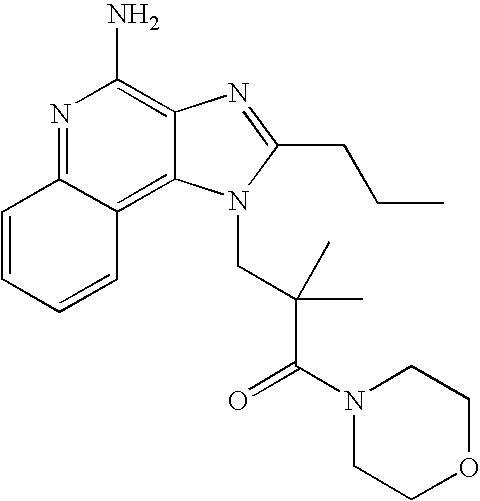
Part A - Ethyl 3-[(3-aminoquinolin-4-yl)amino]-2,2-dimethylpropanoate (7.1 g, 25 mmol) was prepared according to the methods described in Parts A through D of Example 26 and treated according to a modification of the method described in Part B of Example 8. Prior to the addition of trimethyl orthobutyrate (4.0 g, 27 mmol) and pyridinium p-toluenesulfonate (0.10 g, 0.40 mmol), the reaction was heated at reflux for ten minutes. After the addition, the reaction was heated at reflux for four hours and allowed to stand at ambient temperature overnight. An analysis by TLC indicated the reaction was incomplete, and it was heated at reflux for an additional eight hours and allowed to stand for three days at ambient temperature. Additional pyridinium p-toluenesulfonate (0.10 g, 0.40 mmol) was added, and the reaction was heated at reflux for eleven hours and then allowed to cool to ambient temperature. Ethyl acetate (100 mL) was added, and the resulting solution was washed with saturated aqueous sodium bicarbonate (3×50 mL), dried over potassium carbonate, filtered, and concentrated under reduced pressure to 8 g of ethyl 2,2-dimethyl-3-(2-propyl-1H-imidazo[4,5-c]quinolin-1-yl)propanoate as a dark oil, which was used without purification.
- Part B
- A solution of ethyl 2,2-dimethyl-3-(2-propyl-1H-imidazo[4,5-c]quinolin-1-yl)propanoate (5.1 g, 15 mmol) and morpholine (5 mL, 60 mmol) was heated at reflux overnight. An analysis by LC/MS indicated the reaction was incomplete. The solution was then heated overnight in a high-pressure vessel at 165° C. Again, an analysis by LC/MS indicated the reaction was incomplete. The volatiles were removed under reduced pressure, and the residue was dissolved in ethanol (30 mL). Aqueous sodium hydroxide (1.35 mL of 50%, 20.0 mmol) was added, and the reaction was stirred for 1.5 hours. The solution was adjusted to pH 7 with the addition of concentrated hydrochloric acid (-1 mL) and then concentrated under reduced pressure. The residue was dissolved in dichloromethane (75 mL); a solution of oxalyl chloride (2.5 mL, 28 mmol) in dichloromethane (5 mL) was added dropwise over a period of two minutes. The reaction was stirred for 30 minutes, and additional oxalyl chloride (0.5 mL, 6 mmol) was added. The reaction was stirred for 30 minutes and diluted with dichloromethane (75 mL). A solution of morpholine (4.0 mL, 41 mmol) in dichloromethane (10 mL) was then added dropwise, and the reaction was stirred for two hours. The reaction was diluted with dichloromethane (45 mL), washed with saturated aqueous sodium bicarbonate (3×50 mL), dried over potassium carbonate, filtered, and concentrated under reduced pressure. The resulting dark oil was purified by column chromatography on silica gel (eluting with 93:7 dichloromethane:methanol) to provide 5.8 g of 1-(2,2-dimethyl-3-morpholin-4-yl-3-oxopropyl)-2-propyl-1H-imidazo[4,5-c]quinoline as a semi-solid.
- Part C
- mCPBA (8.7 g, 39 mmol) was added to a solution of the material from Part B in chloroform (150 mL). The reaction was stirred for 1.75 hours at ambient temperature and then washed with 5% aqueous sodium hydroxide (2×50 mL). Ammonium hydroxide (150 mL) and p-toluenesulfonyl chloride (4.4 g, 23 mmol) were sequentially added, and the reaction was stirred vigorously for two hours. The aqueous layer was separated and extracted with dichloromethane (50 mL). The combined organic fractions were washed with 5% sodium hydroxide (2×50 mL), dried over potassium carbonate, decanted, and concentrated under reduced pressure. The crude product was recrystallized several times from methanol:water to provide 1.84 g of 1-(2,2-dimethyl-3-morpholin-4-yl-3-oxopropyl)-2-propyl-1H-imidazo[4,5-c]quinolin-4-amine as a yellow solid, mp 212-214° C.
- Anal. Calcd for C22H29N5O2.0.15 H2O: C, 66.35; H, 7.42; N, 17.59. Found: C, 66.15; H, 7.25; N, 17.82.
-

Part A - A modification of the method described in Part C of Example 5 was used to treat ethyl 3-[(3-aminoquinolin-4-yl)amino]-2,2-dimethylpropanoate (15.5 g, 60.2 mmol, prepared in Parts A through D of Example 26) with ethoxyacetyl chloride (8.7 g, 71 mmol) followed by triethylamine (24.4 mL, 175 mmol). The reaction with ethoxyacetyl chloride was stirred overnight, and the reaction with triethylamine was heated at reflux in ethanol (125 mL) for four days. Following the work-up procedure, the crude product was purified by column chromatography on silica gel (eluting with dichloromethane:methanol in a gradient from 100:0 to 95:5) to provide 7.9 g of ethyl 3-[2-(ethoxymethyl)-1H-imidazo[4,5-c]quinolin-1-yl]-2,2-dimethylpropanoate as an oil.
- Part B
- Aqueous sodium hydroxide (1.5 mL of 50%, 19 mmol) was added to a mixture of ethyl 3-[2-(ethoxymethyl)-1H-imidazo[4,5-c]quinolin-1-yl]-2,2-dimethylpropanoate (5.0 g, 14 mmol), ethanol (50 mL), and water (5 mL). The reaction was stirred for two hours at ambient temperature; an analysis by TLC indicated that starting material was present. Additional aqueous sodium hydroxide (0.5 mL of 50%) was added, and the reaction was heated at reflux for two hours and concentrated under reduced pressure. Ethanol (100 mL) was added to the residue and then removed under reduced pressure to provide 3-[2-(ethoxymethyl)-1H-imidazo[4,5-c]quinolin-1-yl]-2,2-dimethylpropanoic acid, which was dried overnight under vacuum.
- Part C
- A modification of the method described in Part G of Example 26 was used to treat the material from Part B with oxalyl chloride (2×2.6 mL, 59.6 mmol) followed by ammonia (5 mL of a 7 M solution in methanol). The reactions were carried out at ambient temperature, and the reaction with ammonia was stirred for two hours. Aqueous sodium hydroxide (5 mL of 50%) and water (45 mL) were added, and the mixture was stirred. The organic layer was separated, although not completely, and stirred with aqueous sodium hydroxide (10 mL of 25%). The organic fraction was separated and concentrated under reduced pressure to provide 3-[2-(ethoxymethyl)-1H-imidazo[4,5-c]quinolin-1-yl]-2,2-dimethylpropanamide as a light-brown solid.
- Part D
- The material from Part C was treated with mCPBA (5.4 g, 24 mmol) followed by ammonium hydroxide (75 mL)and p-toluenesulfonyl chloride (4.1 g, 22 mmol) according to a modification of the method described in Part F of Example 1. The reaction was cooled to 0° C. before the addition of mCPBA. After the addition, the reaction was allowed to warm to ambient temperature and stirred for 2.25 hours. Additional mCPBA (1.5 g, 6.1 mmol) was added, and the reaction was stirred overnight. The reaction was not washed prior to the addition of ammonium hydroxide. The amination reaction was stirred for two hours. The extraction was carried out with dichloromethane (10×50 mL). The crude product was purified by column chromatography on silica gel (eluting with dichloromethane:methanol in a gradient from 95:5 to 80:20), recrystallized from ethanol:water, and dried overnight in a vacuum oven at 70° C. to provide 0.417 g of 3-[4-amino-2-(ethoxymethyl)-1H-imidazo[4,5-c]quinolin-1-yl]-2,2-dimethylpropanamide as tan crystals, mp 241-243° C.
- Anal. Calcd for C18H23N5O2: C, 63.32; H, 6.79; N, 20.51. Found: C, 63.21; H, 7.08; N 20.62.
-
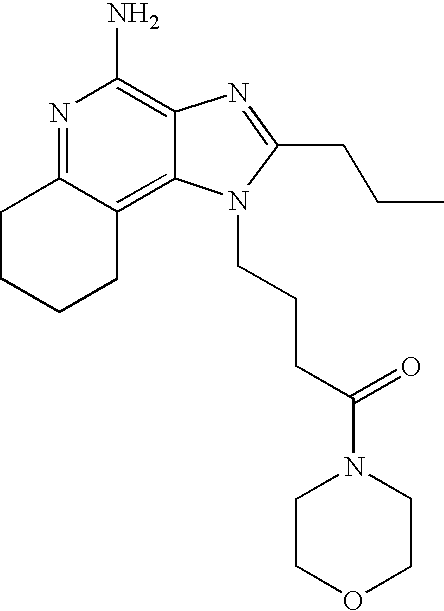
- A mixture of 1-(4-morpholin-4-yl-4-oxobutyl)-2-propyl-1H-imidazo[4,5-c]quinolin-4-amine (0.62 g, 1.6 mmol, prepared as described in Example 1), platinum (IV) oxide (0.25 g, 1.1 mmol), and trifluoroacetic acid (25 mL) was placed in a Parr vessel and shaken under hydrogen pressure (50 psi, 3.5×10⁵ Pa) for two hours. An analysis by LC/MS indicated the reaction was incomplete. Additional platinum (IV) oxide (0.5 g) was added, and the reaction was continued overnight. The trifluoroacetic acid was removed under reduced pressure, and the residue was dissolved in methanol (35 mL). Aqueous sodium hydroxide (10 mL of 25%) was added to the solution, and the mixture was stirred for 15 minutes and then diluted with dichloromethane (100 mL). The mixture was filtered through a layer of CELITE filter aid, and the filtrate was concentrated under reduced pressure. The residue was dissolved in dichloromethane, washed with 5% aqueous sodium hydroxide (2×25 mL), dried over potassium carbonate, filtered, and concentrated under reduced pressure. The resulting solid was recrystallized from water:acetonitrile; the crystals were triturated with 25% aqueous sodium hydroxide for one hour, diluted with water, isolated by filtration, and recrystallized from water:ethanol. The resulting crystals were dried overnight in a vacuum oven at 70° C. to provide 0.5706 g of l-(4-morpholin-4-yl-4-oxobutyl)-2-propyl-6,7,8,9-tetrahydro-1H-imidazo[4,5-c]quinolin-4-amine as white crystals, mp 181-183° C.
- Anal. Calcd for C21H31N5O2: C, 65.43; H, 8.11; N, 18.17. Found: C, 65.36; H, 8.40; N, 18.11.
-

- A second batch of 1-(6-morpholin-4-yl-6-oxohexyl)-2-propyl-1H-imidazo[4,5-c]quinolin-4-amine was prepared according to the methods described in Example 6 with the following modifications. In Part C, a solution of ethyl 6-(3-nitroquinolin-4-ylamino)hexanoate (122.94 g, 371.6 mmol) in dichloromethane (800 mL) was added to a solution of sodium hydrosulfite (226.44 g, 1.30 mol), potassium carbonate (202.86 g, 1.47 mol), and ethyl viologen diiodide (1.737 g, 3.71 mmol) in water (800 mL), and the reaction was stirred overnight at ambient temperature. The organic layer was separated, washed with water (4×), dried over magnesium sulfate, filtered, and concentrated under reduced pressure to provide 106.7 g of ethyl 6-(3-aminoquinolin-4-ylamino)hexanoate. The crude product from Part G was recrystallized from methanol, triturated with hot ethyl acetate twice, triturated with hexanes, and isolated by filtration to provide 20.9 g of 1-(6-morpholin-4-yl-6-oxohexyl)-2-propyl-1H-imidazo[4,5-c]quinolin-4-amine as a light tan powder, mp 156-158° C.
- A mixture of 1-(6-morpholin-4-yl-6-oxohexyl)-2-propyl-1H-imidazo[4,5-c]quinolin-4-amine (2.0 g, 4.9 mmol), platinum (IV) oxide (1.5 g, 6.6 mmol), and trifluoroacetic acid (50 mL) was placed in a Parr vessel and shaken under -hydrogen pressure (50 psi, 3.5×10⁵ Pa) for 24 hours. The trifluoroacetic acid was removed under reduced pressure, and the residue was sonicated with 10% aqueous sodiurn hydroxide. The resulting solid was mixed with material from another run and recrystallized from water. The crystals were isolated by filtration and dried overnight at 80° C. to provide 0.978 g of 1-(6-morpholin-4-yl-6-oxohexyl)-2-propyl-6,7,8,9-tetrahydro-1H-imidazo[4,5-c]quinolin-4-amine as a white crystalline powder, mp 162-163° C.
- Anal. Calcd for C23H35N5O2: C, 66.80; H, 8.53; N, 16.93. Found: C, 66.54; H, 8.85; N, 16.87
-

Part A - Ammonium acetate (4.0 g) and ethyl 3-(2-methyl-1H-imidazo[4,5-c]quinolin-1-yl)propanoate (4.5 g, 17 mmol, prepared as described in Parts A through C of Example 22) were heated for three days at 130° C. in a sealed vessel. The reaction was allowed to cool to ambient temperature, and water was added. The mixture was concentrated under reduced pressure, and the residue was purified by column chromatography on silica gel (eluting with dichloromethane:methanol in a gradient from 90: 10 to 85:15) to provide 2.20 g of 3-(2-methyl-1H-imidazo[4,5-c]quinolin-1-yl)propanamide as a tan solid.
- Part B
- mCPBA (3.48 g, 15.1 mmol) was added to a solution of 3-(2-methyl-1H-imidazo[4,5-c]quinolin-1-yl)propanamide (2.20 g, 8.65 mmol) in chloroform (100 mL). The reaction was stirred for two hours at ambient temperature and cooled to 0° C. Ammonium hydroxide (40 mL) was added followed by p-toluenesulfonyl chloride (3.21 g, 16.9 mmol), which was added over a period of five minutes. The reaction was stirred for two hours at ambient temperature and then concentrated under reduced pressure. The crude product was purified by column chromatography on silica gel (eluting with dichloromethane:methanol in a gradient from 90:10 to 80:20). The resulting solid was triturated with 10% aqueous sodium hydroxide, isolated by filtration, washed with water, and dried overnight in a vacuum oven at 60° C. to provide 0.145 g of 3-(4-amino-2-methyl-1H-imidazo[4,5-c]quinolin-1-yl)propanamide as a off-white powder, mp 237-239° C.
- Anal. Calcd for C14H15N5O: C, 57.78; H, 6.03; N, 24.06. Found: C, 57.38; H, 5.82; N, 24.29.
-
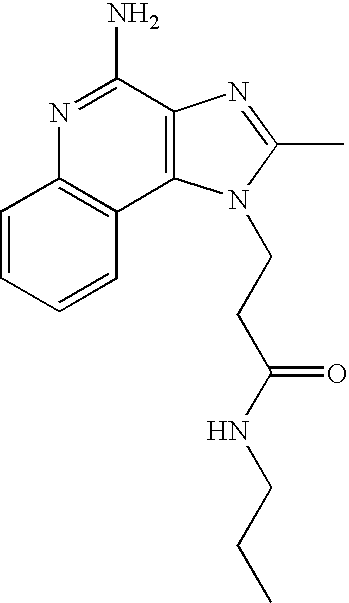
Part A - Ethyl N-(3-nitroquinolin-4-yl)-β-alaninate (62.0 g, 214 mmol, prepared as described in Part A of Example 22) was treated with sodium hydrosulfite (130.59 g, 750.04 mmol), potassium carbonate (117 g, 847 mmol), and ethyl viologen dibromide (0.802 g, 2.14 mmol) according to a modification of the method described in Part A of Example 8. After the reaction was stirred overnight, additional water (100 mL), dichloromethane (100 mL) and sodium hydrosulfite (20.0 g, 11.5 mmol) were added, and the reaction was stirred for three additional hours. The organic layer was separated; washed sequentially with water, saturated aqueous sodium bicarbonate, and brine; dried over magnesium sulfate; filtered; and concentrated under reduced pressure to provide 40.2 g of ethyl N-(3-aminoquinolin-4-yl)-β-alaninate.
- Part B
- Ethyl N-(3-aminoquinolin-4-yl)-β-alaninate (9.0 g, 35 mmol) was treated with triethyl orthoacetate (8.91 mL, 48.6 mmol) and pyridinium p-toluenesulfonate (0.200 g) according to the method described in Part A of Example 10 to provide 6.10 g of ethyl 3-(2-methyl-1H-imidazo[4,5-c]quinolin-1-yl)propanoate. The reaction was complete in two hours, and a precipitate was removed by filtration from the organic layer during the work-up procedure.
- Part C
- Propylamine (20 mL) and ethyl 3-(2-methyl-1H-imidazo[4,5-c]quinolin-1-yl)propanoate (5.77 g, 20.4 mmol) were heated overnight at 100° C. in a sealed vessel. The reaction was allowed to cool to ambient temperature and concentrated under reduced pressure to provide 6.0 g of 3-(2-methyl-1H-imidazo[4,5-c]quinolin-1-yl)-N-propylpropanamide.
- Part D
- 3-(2-Methyl-1H-imidazo[4,5-c]quinolin-1-yl)-N-propylpropanamide (610 g, 20.2 mmol) was treated with mCPBA (8.15 g, 35.4 mmol) followed by ammonium hydroxide (40 mL) and p-toluenesulfonyl chloride (7.52 g, 39.5 mmol) according to a modification of the method described in Part D of Example 8. The reaction was not washed with 10% aqueous sodium hydroxide prior to the addition of ammonium hydroxide. The crude product was twice triturated with ethyl acetate and isolated by filtration. The solid was then purified by column chromatography on silica gel (eluting with 90:10 dichloromethane:methanol). The product was then triturated sequentially with 10% aqueous sodium hydroxide and acetone (2×). The solid was then purified again by column chromatography on silica gel (eluting with dichloromethane:methanol in a gradient from 95:5 to 90:10). The resulting solid was triturated with 1 0% aqueous sodium hydroxide, isolated by filtration, washed with water, and dried overnight to provide 0-477 g of 3-(4-amino-2-methyl-1H-imidazo[4,5-c]quinolin-1-yl)-N-propylpropanamide as an off-white powder, mp 188-189° C.
- Anal. Calcd for C17H21N5O: C, 65.57; H., 6.80; N, 22.49. Found: C, 65.24; H, 6.67; N, 22.44.
-

Part A - Ethyl 4-[2-(ethoxymethyl)-1H-imidazo[4,5-c]quinolin-1-yl]butanoate (15.9 g, 46.6 mmol, prepared as described in Parts A through C of Example 5) and ammonium acetate (35.0 g, 455 mmol) were sealed and heated in a high-pressure vessel at 130° C. for two days. An analysis by LC/NS indicated the presence of starting material, and additional ammonium acetate (15 g, 190 mmol) was added. The reaction was heated to 130° C. for several hours, allowed to cool to ambient temperature, stirred for three days, and poured into water (200 mL). Solid sodium bicarbonate was added until the solution was basic. The solution was extracted with dichloromethane (3×100 mL, 5×75 mL, and then in a continuous extractor for about 20 hours). The extracts were dried over potassium carbonate, filtered, and concentrated under reduced pressure to provide 10.3 g of 4-[2-(ethoxymethyl)-1H-imidazo[4,5-c]quinolin-1-yl]butanamide as a light yellow solid.
- Part B
- 4-[2-(Ethoxymethyl)-1H-imidazo[4,5-c]quinolin-1-yl]butanamide (4.3 g, 14 mmol) was treated with mCPBA (6.1 g, 27 mmol), concentrated ammonium hydroxide (50 mL of 29%), and p-toluenesulfonyl chloride (4.6 g, 24 mmol) according to a modification of the method described in Part E of Example 3. The mCPBA addition was carried out at 0° C., and the reaction was carried out in dichloromethane (150 mL). At the end of the reaction the layers were separated, and saturated aqueous sodium bicarbonate (100 mL) and 5% aqueous sodium hydroxide (10 mL) were added to the organic layer. The aqueous layer was extracted with dichloromethane (1.3 L), and the combined extracts were dried over potassium carbonate, filtered, and concentrated under reduced pressure. The crude product was purified by column chromatography on silica gel (eluting with 90:10 dichloromethane:methanol containing 4 mL/L of ammonium hydroxide) followed by recrystallization five times from ethanol containing a small amount of water. The resulting solid was recrystallized from water:acetonitrile (5:L ), dried overnight in a vacuum oven at 70° C., triturated with 25% aqueous ammonimmm hydroxide, diluted with water, isolated by filtration, recrystallized from ethanol:water, and dried overnight in a vacuum oven at 70° C. to provide 0.4704 g of 4-[4-amino-2-(ethoxymethyl)-1H-imidazo[4,5-c]quinolin-1-yl]butanamide as tan crystals, mp 233-235° C.
- Anal. Calcd for C17H21N5O2.0.07 H2O: C, 62.12; H, 6.48; N, 21.31. Found: C, 61.77; H, 6.83; N, 21.22.
-

Part A - Potassium carbonate (66.23 g, 479.3 mmol), triethylamine (167 mL, 1.20 mol), and ethyl 5-aminovalerate hydrochloride (104.4 g, 575.2 mmol) were added to a solution of 4-chloro-3-nitroquinoline (100.0 g, 479.3 mmol) in chloroform (1000 mL) according to the method described in Part B of Example 6. The reaction was run for four hours and provided 151 g of ethyl 5-(3-nitroquinolin-4-ylamino)pentanoate.
- Part B
- A solution of ethyl 5-(3-nitroquinolin-4-ylamino)pentanoate (151 g, 476 mmol) in dichloromethane (1 L) was added to a solution of sodium hydrosulfite (248.5 g, 1.427 mol), potassium carbonate (259.3 g, 1.876 mol), and ethyl viologen dibromide (1.78 g, 4.75 mmol) in water (1 L), and the reaction was stirred overnight at ambient temperature. An analysis by TLC indicated the presence of starting material; additional sodium hydrosulfite (5.0 g, 29 mmol) was added to the reaction, which was stirred for one additional hour. The organic layer was separated, washed with water (3×), dried over magnesium sulfate, filtered, and concentrated under reduced pressure to provide 131.51 g of ethyl 5-(3-aminoquinolin-4-ylamino)pentanoate.
- Part C
- The method described in Part A of Example 10 was used to treat ethyl 5-(3-aminoquinolin-4-ylamino)pentanoate (26.3 g, 91.5 mmol) with trimethyl orthobutyrate (18.3 mL, 114 mmol) and pyridinium p-toluenesulfonate (0.5 g). The reaction was complete in three hours to provide 28 g of ethyl 5-(2-propyl-1H-imidazo[4,5-c]quinolin-1-yl)pentanoate as a brown oil.
- Part D
- A solution of sodium hydroxide (2.23 g, 55.9 mmol) in water (100 mL) was added to a solution of ethyl 5-(2-propyl-1H-imidazo[4,5-c]quinolin-1-yl)pentanoate (14.6 g, 43.0 mmol) in ethanol (100 mL), and the reaction was stirred at ambient temperature overnight, concentrated to remove ethanol, and washed with dichloromethane. The resulting solution was adjusted to pH 5 with the addition of 10% hydrochloric acid. The mixture was extracted twice with chloroform, and the combined extracts were dried over magnesium sulfate, filtered, and concentrated under reduced pressure to provide 11.5 g of 5-(2-propyl-1H-imidazo [4,5-c]quinolin-1-yl)pentanoic acid.
- Part E
- A modification of the method described in Part F of Example 6 was used to treat 5-(2-propyl-1H-imidazo[4,5-c]quinolin-1-yl)pentanoic acid (5.14 g, 16.5 mmol) with oxalyl chloride (2.59 mL, 29.7 mmol) and morpholine (4.33 mL, 49.5 mmol). The oxalyl chloride addition was carried out at ambient temperature, and the reaction with morpholine was complete in three hours. Following the work-up procedure, 6 2 g of 1-(5-morpholin-4-yl-5-oxopentyl)-2-propyl-1H-imidazo[4,5-c]quinoline were obtained.
- Part F
- mCPBA (6.56 g, 28.5 mmol) was added to a solution of 1-(5-morpholin-4-yl-5-oxopentyl)-2-propyl-1H-imidazo[4,5-c]quinoline (6.2 g, 16 mmol) in chloroform (100 mL); the reaction was stirred for three hours at ambient temperature. Ammonium hydroxide (50 mL) was added. p-Toluenesulfonyl chloride (6.056 g, 31.76 mmol) was added over a period of five minutes, and the reaction was stirred for one hour. The work-up procedure and chromatographic purification was carried out as described in Part D of Example 8. The resulting oil was triturated with acetone, isolated -by filtration, and dried to provide 1-(5-morpholin-4-yl-5-oxopentyl)-2-propyl-1H-imidazo [4,5-c]quinolin-4-amine as a tan powder, mp 178-179° C.
- Anal. Calcd for C22H29N5O2: C, 66.81; H, 7.391; N, 17.71. Found: C, 66.50; H, 7.38; N, 17.41.
-

Part A - Ethyl 5-(2-propyl-1H-imidazo[4,5-c]quinolin-1-yl)peentanoate (5.4 g, 15.9 mmol), prepared as described in Parts A through C of Example 34) and ammonium acetate (11.0 g, 143 mmol) were sealed in a high-pressure vessel and heated for two days at 130° C. and then allowed to cool to ambient temperature. Ammonium hydroxide was added to adjust the mixture to a neutral pH. The mixture was then extracted with dichloromethane, and the combined extracts were washed with saturated aqueous sodium bicarbonate, dried over magnesium sulfate, filtered, and concentrated under reduced pressure to provide 2.8 g of 5-(2-propyl-1H-imidazo[4,5-c]quinolin-1-yl)pentanamide, which was combined with material from another run.
- Part B
- 5-(2-Propyl-1H-imidazo[4,5-c]quinolin-1-yl)pentanamide (4.4 g, 14 mmol) was treated with mCPBA (4.28 g, 24.8 mmol), ammonium hydroxide (40 mL), and p-toluenesulfonyl chloride (5.24 g, 27.4 mmol) according to a modification of the method described in Part F of Example 34. At the completion of the amination reaction, a precipitate was present and was isolated by filtration. The precipitate was triturated and sonicated with acetone, isolated by filtration, and dried in a vacuum oven at 80° C. to provide 1.28 g of 5-(4-amino-2-propyl-1H-imidazo[4,5-c]quinolin-1-yl)pentanamide as a tan powder, mp 202-203° C.
- Anal. Calcd for C18H23N5O.0.09 H2O: C, 66.09; H, 7.15; N, 21.41. Found: C, 65.69; H, 7.46; N, 21.22.
-

Part A - Ethyl 5-(3-aminoquinolin-4-ylamino)pentanoate (23.0 g, 88.6 mmol, prepared in Parts A and B of Example 34) was treated according to the method described in Part A of Example 12. The addition of methoxypropionyl chloride (12.97 g, 106.3 mmol) was carried out at 0° C., and the reaction was stirred at ambient temperature for two hours. The reaction with triethylamine (49.4 g, 354 mmol) was heated at reflux for four hours. After the work-up procedure, 28.6 g of ethyl 5-[2-(2-methoxyethyl)-1H-imidazo[4,5-c]quinolin-1-yl]pentanoate were obtained as a brown oil.
- Part B
- Ethyl 5-[2-(2-methoxyethyl)-1H-imidazo[4,5-c]quinolin-1-yl]pentanoate (15.1 g, 42.4 mmol) was treated with sodium hydroxide (2.20 g, 55.2 mmol) according to the method described in Part A of Example 11. The reaction was stirred overnight at ambient temperature to provide 10.2 g of 5-[2-(2-methoxyethyl)-1H-imidazo[4,5-c]quinolin-1-yl]pentanoic acid after the aqueous work-up procedure.
- Part C
- 5-[2-(2-Methoxyethyl)-1H-imidazo[4,5-c]quinolin-1-yl]pentanoic acid (5.5 g, 17 mmol) was treated according to a modification of the method described in Part F of Example 6. The reaction with oxalyl chloride (2.63 mL, 30.2 mmol) was carried out at ambient temperature and was complete in 30 minutes. The reaction with morpholine (4.40 mL, 50.4 mmol) was complete after 30 minutes. Following the work-up procedure, 6.5 g of 2-(2-methoxyethyl)-1-(5-morpholin-4-yl-5-oxopentyl)-1H-imidazo[4,5-c]quinoline were obtained.
- Part D
- mCPBA (6.60 g, 28.7 mmol) was added to a solution of 2-(2-methoxyethyl)-1-(5-morpholin-4-yl-5-oxopentyl)-1H-imidazo[4,5-c]quinoline (6.5 g, 17 mmol) in chloroform (100 mL); the reaction was stirred for two hours at ambient temperature. The reaction was cooled to 0° C., and ammonium hydroxide (50 mL) was added. A solution of benzenesulfonyl chloride (4.11 mL, 33.0 mmol) in chloroform (20 mL) was added over a period of 20 minutes, and the reaction was allowed to warm to ambient temperature and stirred for two hours. The work-up procedure and chromatographic purification was carried out as described in Part D of Example 8. The resulting product was triturated with 10% aqueous sodium hydroxide, isolated by filtration, washed with water, and dried overnight in a vacuum oven to provide 2-(2-methoxyethyl)-1-(5-morpholin-4-yl-5-oxopentyl)-1H-imidazo[4,5-c]quinolin-4-amine as an off-white powder, mp 128-129° C.
- Anal. Calcd for C22H29N5O3.0.17 H2O: C, 63.74; H, 7.13; N, 16.89. Found: C, 63.3 3; H, 7.34; N, 16.73.
-

Part A - A suspension of 4-chloro-3-nitro[1,5]naphthyridine (10.0 g, 47.7 mmol) and ethyl 4-aminobutyrate hydrochloride (9.6 g, 57 mmol) in dichloromethane (200 mL) was cooled to 5° C. Triethylamine (16.6 mL, 119 mmol) was added, and the reaction was allowed to warm to ambient temperature and stirred for two hours. The mixture was diluted with dichloromethane (200 mL) and washed with saturated aqueous sodium bicarbonate (2×150 mL). The combined aqueous fractions were extracted with dichloromethane (100 mL), and the combined organic fractions were dried over magnesium sulfate, filtered, and concentrated under reduced pressure to provide 14.5 g of ethyl 4-(3-nitro[1,5]naphthyridin-4-ylamino)butanoate as a yellow solid.
- Part B
- A mixture of ethyl 4-(3-nitro[1,5]naphthyridin-4-ylamino)butanoate (5.0 g, 16 mmol), 5% platinum on carbon (0.50 g), and ethyl acetate (80 mL) was added to a Parr vessel, and the reaction was placed under hydrogen pressure (30 psi, 2.1×10⁵ Pa) for 2.5 hours. The reaction mixture was filtered through a layer of CELITE filter agent, and the filter cake was washed with ethyl acetate (50 mL). The filtrate was concentrated under reduced pressure to provide ethyl 4-(3-amino[1,5]naphthyridin-4-ylamino)butanoate as a yellow oil.
- Part C
- A solution of ethyl 4-(3-amino[1,5]naphthyridin-4-ylamino)butanoate (2.0 g, 7.3 mmol) in dichloromethane (35 mL) was cooled to 0° C. Butyryl chloride (0.68 mL, 8.0 mmol) was added dropwise over a period of ten minutes, and the reaction was allowed to warm to ambient temperature, stirred for 90 minutes, and concentrated under reduced pressure. Triethylamine (3.0 mL, 22 mmol) and ethanol (35 mL) were added, and the resulting solution was heated at reflux for two days. Pyridine hydrochloride (0.1 equivalents) was added, and the reaction was heated at reflux overnight. The solvent was removed under reduced pressure, and the residue was partitioned between dichloromethane (70 mL) and saturated aqueous sodium bicarbonate (50 mL). The aqueous layer was separated and extracted with dichloromethane (2×25 mL), and the combined organic fractions were dried over magnesium sulfate, filtered, and concentrated under reduced pressure to provide 2.43 g of ethyl 4-(2-propyl-1H-imidazo[4,5-c][1,5]naphthyridin-1-yl]butanoate as a brown oil.
- Part D
- Aqueous sodium hydroxide (2.4 mL of 6 M) was added to a solution of ethyl 4-(2-propyl-1H-imidazo[4,5-c][1,5]naphthyridin-1-yl]butanoate (2.37 g, 7.26 mmol) in ethanol (25 mL); the reaction was stirred at ambient temperature for two hours and concentrated under reduced pressure. The residue was dissolved in water (15 mL) and adjusted to pH 4 with the addition of 2 M hydrochloric acid. A precipitate formed, was isolated by filtration, and was mixed with toluene, which was removed under reduced pressure to provide 1.78 g of 4-(2-propyl-1H-imidazo[4,5-c][1,5]naphthyridin-1-yl]butanoic acid as a tan powder.
- Part E
- 4-(2-Propyl-1H-imidazo[4,5-c][1,5]naphthyridin-1-yl]butanoic acid (prepared in a separate run, 5.34 mmol) was treated according to a modification of Part F of Example 6. One drop of N,N-dimethylformamide (DMF) was added to the reaction mixture. The addition of oxalyl chloride (1.4 mL, 16 mmol) was carried out at ambient temperature, and the reaction was stirred for two hours. Additional oxalyl chloride (0.5 mL) was added, and the reaction was stirred for an additional hour. The reaction with morpholine (1.17 mL, 13.3 mmol) was stirred for one hour. Following the work-up procedure 1.80 g of 1-(4-morpholin-4-yl-4-oxobutyl)-2-propyl-1H-imidazo[4,5-c][1,5]naphthyridine were obtained as a yellow solid.
- Part F
- mCPBA (1.18 g, 6.86 mmol) was added to a solution of 1-(4-morpholin-4-yl-4-oxobutyl)-2-propyl-1H-imidazo[4,5-c][1,5]naphthyridine (1.80 g, 4.90 mmol) in chloroform (25 mL); the reaction was stirred for two hours at ambient temperature. Ammonium hydroxide (10 mL) was added followed by p-toluenesulfonyl chloride (1.03 g, 5.39 mmol). The reaction was stirred for one hour and partitioned between saturated aqueous sodium bicarbonate (75 mL) and dichloromethane (70 mL). The aqueous layer was extracted with dichloromethane (2×25 mL), and the combined organic fractions were dried over magnesium sulfate, filtered, and concentrated under reduced pressure. The resulting brown solid was triturated twice with acetonitrile and then purified by column chromatography using a HORIZON HPFC system (an automated, modular high-performance flash purification product available from Biotage, Inc.; Charlottesville, Va., USA) using a FLASH 40+M cartridge (also available from Biotage, Inc.). The polar component of the eluent was chloroform:methanol:ammonium hydroxide 80:18:2 (CMA). The purification was carried out eluting with chloroform:CMA in a gradient from 100:0 to 75:25. The resulting solid was dried under high vacuum at 80° C. to provide 0.583 g of 1-(4-morpholin-4-yl-4-oxobutyl)-2-propyl-1H-imidazo[4,5-c][1,5]naphthyridin-4-amine as an off-white powder, mp 196-197° C.
- Anal. Calcd for C20H26N6O2: C, 62.81; H, 6.85; N, 21.97. Found: C, 62.60; H, 7.06; N, 22.00.
-
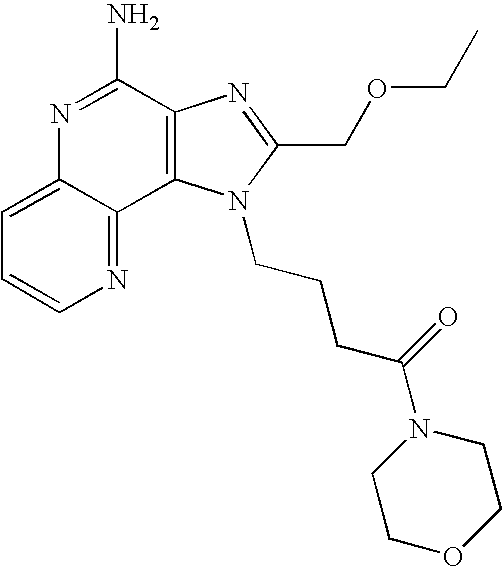
Part A - Ethyl 4-(3-amino[1,5]naphthyridin-4-ylamino)butanoate (2.5 g, 9.1 mmol, prepared in Parts A and B of Example 37) was treated with ethoxyacetyl chloride (1.02 mL, 10.0 mmol) and cyclized according to a modification of the method described in Part C of Example 37. The reaction with triethylamine (3.8 mL, 27 mmol) was heated at reflux overnight and was complete. Following the work-up procedure, 3.11 g of ethyl 4-(2-ethoxymethyl-1H-imidazo[4,5-c][1,5]naphthyridin-1-yl]butanoate were obtained as a brown oil.
- Part B
- The methods of Parts D and E of Example 37 were used to treat ethyl 4-(2-ethoxymethyl-1H-imidazo[4,5-c][1,5]naphthyridin-1-yl]butanoate (1.0 g, 2.9 mmol) with aqueous sodium hydroxide (2.9 mL of 2 M), oxalyl chloride (0.42 mL, 4.8 mmol), and morpholine (0.35 mL, 4.0 mmol). The reaction with oxalyl chloride was complete within two hours, and no additional reagent was added. Following the work-up procedure 0.64 g of 2-(ethoxymethyl)-1-(4-morpholin-4-yl-4-oxobutyl)-1H-imidazo[4,5-c][1,5]naphthyridine was obtained as a yellow solid, which was combined with material from another run.
- Part C
- The method described in Part F of Example 37 was used to treat 2-(ethoxymethyl)-1-(4-morpholin-4-yl-4-oxobutyl)-1H-imidazo[4,5-c][1,5]naphthyridine (1.42 g, 3.70 mmol) with mCPBA (0.958 g, 5.55 mmol), ammonium hydroxide (4 mL), and p-toluenesulfonyl chloride (0.776 g, 4.07 mmol). Following the chromatographic purification, the resulting solid was dried for 48 hours under high vacuum at 120° C. to provide 0.614 g of 2-(ethoxymethyl)-1-(4-morpholin-4-yl-4-oxobutyl)-1H-imidazo[4,5-c][1,5]naphthyridin-4-amine as a tan powder, mp 156-157° C.
- Anal. Calcd for C20H26N6O3.0.3H2O: C, 59.48; H, 6.64; N, 20.81. Found: C, 59.55; H, 6.63; N, 20.70.
-
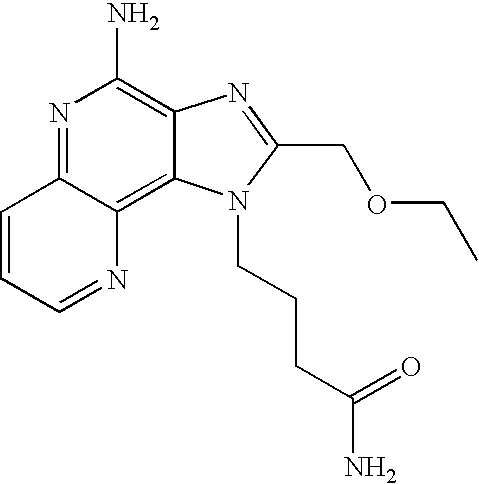
Part A - A solution of ammonia in dioxane (33 mL of 0.5 M) was added to a solution of 4-[2-(ethoxymethyl)-1H-imidazo[4,5-c][1,5]naphthyridin-1-yl]butanoyl chloride (4.64 mmol, prepared as described in Parts A and B of Example 38) in dichloromethane (20 mL), and the reaction was stirred overnight at ambient temperature. An analysis by HPLC indicated the reaction was incomplete; ammonia gas was bubbled through the solution for 10 minutes. The reaction was then stirred for one hour and concentrated under reduced pressure. The residue was triturated with water and isolated by filtration to provide 1.02 g of 4-[2-(ethoxymethyl)-1H-imidazo[4,5-c][1,5]naphthyridin-1-yl]butanamide. The filtrate was extracted with dichloromethane (3×20 mL), and the combined extracts were dried over magnesium sulfate, filtered, and concentrated under reduced pressure to provide an additional 0.39 g of product. The combined solids were mixed with material from another run.
- Part B
- MCPBA (1.80 g, 7.28 mmol) was added to a solution of 4-[2-(ethoxymethyl)-1H-imidazo[4,5-c][1,5]naphthyridin-1-yl]butanamide (1.63 g, 5.20 mmol) in chloroform (50 mL); the reaction was stirred for three hours at ambient temperature. An analysis by LC/MS indicated the reaction was incomplete; therefore, additional mCPBA (1.2 equivalents) was added. The reaction was stirred for two hours and then diluted with saturated aqueous sodium bicarbonate (75 mL) and chloroform (75 mL). The aqueous layer was extracted with dichloromethane (2×30 mL) and chloroform (12×20 mL), and the combined organic fractions were dried over magnesium sulfate, filtered, and concentrated under reduced pressure to provide 2.34 g of 4-[2-(ethoxymethyl)-5-oxido-1H-imidazo[4,5-c][ 1,5]naphthyridin-1-yl]butanamide as an orange solid.
- Part C
- A solution of the material from Part B in methanol (25 mL) was cooled to 0° C.; ammonium hydroxide (1.8 mL, 26 mmol) was added. Benzenesulfonyl chloride (1.3 mL, 10.4 mmol) was added dropwise, and the reaction was stirred for one hour at 0° C. and concentrated under reduced pressure. The residue was triturated with methanol, isolated by filtration, and dissolved in aqueous sodium hydroxide (20 mL of 2 M). The solution was sonicated to form a precipitate, which was isolated by filtration, washed with cold water, and dried overnight in a vacuum oven at 80° C. to provide 0.432 g of 4-[4-amino-2-(ethoxymethyl)-1H-imidazo[4,5-c][1,5]naphthyridin-1-yl]butanamide as a pale yellow powder, mp 231-232° C.
- Anal. Calcd for C16H20N6O2.0.3H2O: C, 57.58; H, 6.22; N, 25.18. Found: C, 57.76; H, 6.39; N, 25.12.
- Part A
- Under a nitrogen atmosphere, triethylamine (47 mL, 340 mmol) was added to a solution of 2,4-dichloro-5,6-dimethyl-3-nitropyridine (30.0 g, 136 mmol) and ethyl 4-aminobutyrate hydrochloride (32 g, 190 mmol) in DMF (500 mL), and the reaction was stirred overnight. The solvent was removed under reduced pressure, and the residue was partitioned between chloroform (500 mL), water (25 mL), and brine (25 mL). The organic layer was separated and washed with water:brine (1:1, 3×50 mL), dried over magnesium sulfate, filtered, and concentrated under reduced pressure. The resulting orange solid was recrystallized from ethyl acetate:hexanes and dried under high vacuum to provide 21.5 g of ethyl 4-[(2-chloro-5,6-dimethyl-3-nitropyridin-4-yl)amino]butanoate.
- Part B
- Under a nitrogen atmosphere, a mixture of ethyl 4-[(2-chloro-5,6-dimethyl-3-nitropyridin-4-yl)amino]butanoate (21.5 g, 68 mmol), sodium azide (8.90 g, 136 mmol), cerium(III) chloride heptahydrate (12.7 g, 34 mmol), and 9:1 acetonitrile:water (250 mL) was heated overnight at reflux. The hot reaction mixture was filtered, and the filter cake was washed with acetonitrile. The filtrate was concentrated under reduced pressure, and the residue was triturated with ethyl acetate:hexanes and isolated by filtration to provide 21.5 g of ethyl 4-[(5,6-dimethyl-8-nitrotetraazolo[1,5-a]pyridin-7-yl)amino]butanoate.
- Part C
- A mixture of ethyl 4-[(5,6-dimethyl-8-nitrotetraazolo[1,5-a]pyridin-7-yl)amino]butanoate (10.0 g, 31.0 mmol), 10% palladium on carbon (1.0 g), and acetonitrile (310 mL) was added to a pressure vessel, and the reaction was placed under hydrogen pressure (30 psi, 2.1×10⁵ Pa) overnight. The reaction mixture was filtered through a layer of CELITE filter agent, and the filter cake was washed with methanol (50 mL). The filtrate was concentrated under reduced pressure to provide ethyl 4-[(8-amino-5,6-dimethyltetraazolo[1,5-a]pyridin-7-yl)amino]butanoate as a solid. This reaction was repeated a second time.
- Part D
- For Examples 40 and 41, pyridine hydrochloride (1.34 g, 11.6 mmol) and trimethyl orthobutyrate (5.42 mL, 34.1 mmol) were sequentially added with stirring to a solution of ethyl 4-[(8-amino-5,6-dimethyltetraazolo[1,5-a]pyridin-7-yl)amino]butanoate (9.1 g, 31 mmol) in toluene (310 mL) under a nitrogen atmosphere. The reaction was heated at reflux for 1.5 hours, allowed to cool to ambient temperature overnight, and concentrated under reduced pressure. The residue was partitioned between chloroform (300 mL) and saturated aqueous sodium bicarbonate (75 mL). The aqueous layer was extracted with chloroform (2×1 00 mL), and the combined organic fractions were washed with saturated aqueous sodium bicarbonate (2×75 mL), dried over magnesium sulfate, filtered, and concentrated under reduced pressure. The resulting solid was triturated with ethyl acetate and isolated by filtration to provide 6.0 g of ethyl 4-(5,6-dimethyl-8-propyl-7H-imidazo[4,5-c]tetraazolo[1,5-a]pyridin-7-yl)butanoate as a white solid.
- For Examples 42 and 43, pyridine hydrochloride (668 mg, 5.78 mmol) and triethyl orthopropionate (3.4 mL, 17 mmol) were added to a solution of ethyl 4-[(8-amino-5,6-dimethyltetraazolo[1,5-a]pyridin-7-yl)amino]butanoate (4.5 g, 15 mmol) in toluene (100 mL). The reaction and work-up procedure were as described for Examples 40 and 41. The crude product was recrystallized from ethyl acetate:hexane, isolated by filtration, washed with ethyl acetate:hexane, and dried under high vacuum to provide 4.7 g of ethyl 4-(8-ethyl-5,6-dimethyl-7H-imidazo[4,5-c]tetraazolo[1,5-a]pyridin-7-yl)butanoate as off-white crystals.
- For Examples 44 and 45, a solution of ethyl 4-[(8-amino-5,6-dimethyltetraazolo[1,5-a]pyridin-7-yl)amino]butanoate (4.5 g, 15 mmol) in dichloromethane (150 mL) was cooled to 0° C. under a nitrogen atmosphere. Ethoxyacetyl chloride (2.46 g, 18.5 mmol) was added dropwise, and the reaction was allowed to warm to ambient temperature and stirred for four hours. Additional ethoxyacetyl chloride (0.5 g) was added, and the reaction was stirred for three days. Additional ethoxyacetyl chloride (1.0 g) was again added, and the reaction was stirred for two hours and concentrated under reduced pressure.
- Part E
- For Examples 40-43, aqueous sodium hydroxide (2.0 equivalents of 2 M or 6 M) was added dropwise to a suspension of the material from Part D in ethanol (0.2 M) under a nitrogen atmosphere. The reaction was stirred for one hour and concentrated under reduced pressure. The residue was dissolved in a small amount of water (5-8 mL), and the resulting solution was adjusted to pH 4 with the addition of 2 M hydrochloric acid. A precipitate formed and was isolated by filtration, washed with water, and optionally mixed with toluene, which was removed under reduced pressure. The resulting solid was dried under vacuum for two to several hours, optionally at 60-70° C.
- For Examples 44 and 45, aqueous sodium hydroxide (39 mL of 2 M) was added dropwise to a suspension of the material from Part D in ethanol (154 mL), and the reaction was heated at 60° C. under nitrogen for two hours. The reaction was allowed to cool to ambient temperature, adjusted to pH 7 with the addition of 1 N hydrochloric acid, and allowed to stand overnight. The solvent was removed under reduced pressure. Toluene (50 mL) and methanol (10 mL) were twice added and removed under reduced pressure. The residue was dried under high vacuum, mixed with methanol (200 mL), and filtered to remove sodium chloride. The filter cake was washed with methanol, and the filtrate was concentrated under reduced pressure to provide a solid.
- Part F
- Under a nitrogen atmosphere, oxalyl chloride (3.0 equivalents) was added dropwise over a period of five minutes to a suspension of the butanoic acid from Part E in dichloromethane (0.1 M) and four drops of DMF. The reaction was stirred for one hour, and additional oxalyl chloride (0.5 mL) was added in Examples 40, 41, 44, and 45. The solvent was removed under reduced pressure.
- Part G
- For Examples 40, 42, and 44, a suspension of the acid chloride from Part F in dichloromethane (0.1 M) was cooled to 0° C. under a nitrogen atmosphere. Ammonia (1.5 equivalents of a 0.5 M solution in dioxane) was added dropwise over a period of five minutes. The reaction was stirred for ten minutes, and then ammonia gas was bubbled through the solution for ten minutes. The reaction was stirred overnight at ambient temperature and concentrated under reduced pressure. The residue was triturated with water (Example 40 and 44) or water:ethyl acetate (Example 42), isolated by filtration, washed with water or water:ethyl acetate, and dried under vacuum for two to three hours optionally at 70° C. to provide the amide product as a solid.
- For Examples 41, 43, and 45, a suspension of the acid chloride from Part F in dichloromethane (0.1 M) was cooled to 0° C. under a nitrogen atmosphere. Morpholine (6.0 equivalents) was added dropwise over a period of five minutes, and the reaction was stirred overnight at ambient temperature. The solvent was removed under reduced pressure. For Example 41, the residue was triturated with ethyl acetate (30 mL) and methanol (5 mL), and the resulting solid was isolated by filtration, washed with ethyl acetate, and partitioned between chloroform (100 mL) and saturated aqueous sodium bicarbonate (40 mL). The aqueous layer was separated and extracted with chloroform (2×50 mL), and the combined organic fractions were washed with saturated aqueous sodium bicarbonate (2×30 mL), dried over magnesium sulfate, filtered, and concentrated under reduced pressure to provide a white solid. For Example 43, the residue was triturated with ethyl acetate:water, and the resulting solid was isolated by filtration, washed with ethyl acetate and water, and dried in a vacuum oven for one hour at 70° C. For Example 45, the residue was subjected to the aqueous work-up procedure described for Example 41. The resulting solid was triturated with ethyl acetate, isolated by filtration, washed with ethyl acetate, and dried under high vacuum to provide a white solid.
- Part H
- A pressure vessel was charged with the material from Part G, platinum (IV) oxide (20 wt. %), and trifluoroacetic acid (0.1 M), and the mixture was placed under hydrogen pressure (50 psi, 3.4×10⁵ Pa) and shaken over three days. The reaction mixture was filtered, optionally through a pad of CELITE filter agent (Example 40), and the filter cake was washed with methanol. The filtrate was concentrated under reduced pressure, and the residue was mixed with 1 N hydrochloxic acid (5-10 mL), stirred for between 1.5 and three hours, cooled to 0 IC, and optionally diluted with chloroform (20-30 mL). The resulting mixture was made basic with the addition of 6 N sodium hydroxide (Examples 40, 42, and 43), 6 N aqueous potassium carbonate (Examples 44 and 45), or saturated aqueous sodium bicarbonate (Example 41). For Examples 40 and 42, a precipitate formed, was isolated by filtration, dissolved in methanol, and concentrated under reduced pressure. For Examples 41 and 43-45, the aqueous layer was separated and extracted with chloroform (3×5 0 mL). The combined organic fractions were washed with saturated aqueous sodium bicarbonate, dried over sodium sulfate, filtered, and concentrated under reduced pressure. The purification and characterization is given below for each product.
-

- The product was triturated with ethyl acetate, isolated by filtration, triturated with methanol, isolated by filtration, washed with methanol and acetonitrile, and dried overnight under high vacuum at 80 IC to provide 4-(4-amino-6,7-dimethyl-2-propyl-1H-imidazo[4,5-c]pyridin-1-yl)butanamide as a white powder, mp 226.0-228.0° C.
- Anal. Calcd for C15H23N5O: C, 62.26; H, 8.01; N, 24.20; Found: C, 61.99; H, 8.07; N, 24.36.
-

- The product was purified by chromatography using a HORIZON HPFC system (eluting with chloroform:CMA in a gradient from 95:5 to 60:40) followed by recrystallization from ethyl acetate. The crystals were dried under high vacuum to provide 6,7-dimethyl-1-(4-morpholin-4-yl-4-oxobutyl)-2-propyl-1H-imidazo[4,5-c]pyridin-4-amine as a white powder, mp 164.0-165.0° C.
- Anal. Calcd for C19H29N5O2: C, 63.48; H, 8.13; N, 19.48. Found: C, 63.30; H, 8.33; N, 19.49.
-

- The product was triturated with acetonitrile, isolated by filtration, triturated with 1 N sodium hydroxide, isolated by filtration, washed with water, triturated with ethyl acetate, and dried under high vacuum with stirring at 100° C. for three hours to provide 4-(4-amino-2-ethyl-6,7-dimethyl-1H-imidazo [4,5-c]pyridin-1-yl)butanamide as a white powder, mp 228.0-230.0° C.
- Anal. Calcd for C14H21N5O.O.09H2O: C, 60.71; H, 7.71; N, 25.29. Found: C, 60.45; H, 8.07; N. 25.56.
-
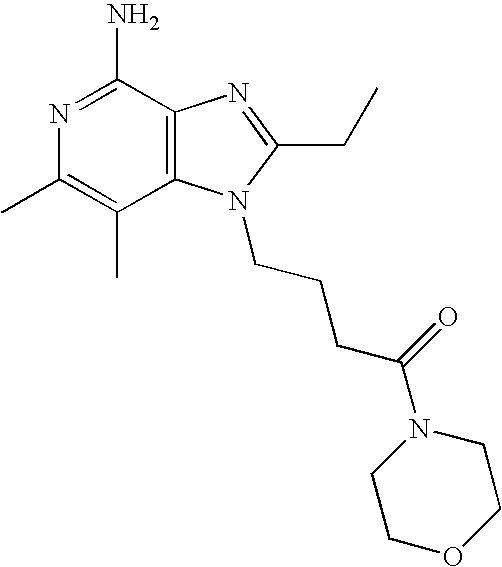
- The product was triturated with ethyl acetate, dried under high vacuum, recrystallized twice from acetonitrile, isolated by filtration, washed with acetonitrile, and dried under high vacuum with stirring at 100° C. for three hours to provide 2-ethyl-6,7-dimethyl-1-(4-morpholin-4-yl-4-oxobutyl)-1H-imidazo[4,5-c]pyridin-4-amine as a white powder, mp 209.0-210.0° C.
- Anal. Calcd for C18H27N5O2: C, 62.59; H, 7.88; N, 20.27. Found: C, 62.49; H, 8.09; N, 20.34.
-
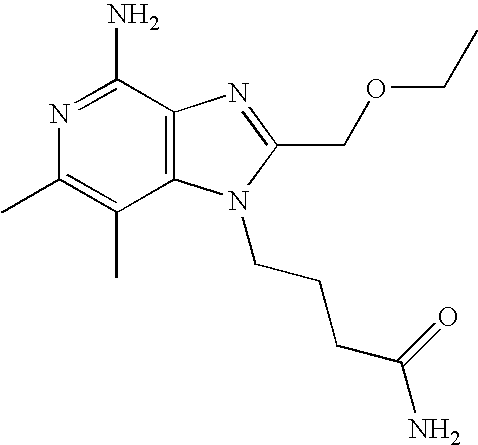
- The product was triturated with ethyl acetate, isolated by filtration, washed with ethyl acetate, sonicated with 1 N sodium hydroxide for one minute, isolated by filtration, washed with Water, and dried under high vacuum overnight to provide 4-[4-amino-2-(ethoxymethyl)-6,7-dimethyl-1H-imidazo[4,5-c]pyridin-1-yl]butanamide as a white powder, mp 199.0-200.0° C.
- Anal. Calcd for C15H23N5O2: C, 59.00; H, 7.59; N, 22.93. Found: C, 58.72; H, 7.53; N, 22.76.
-
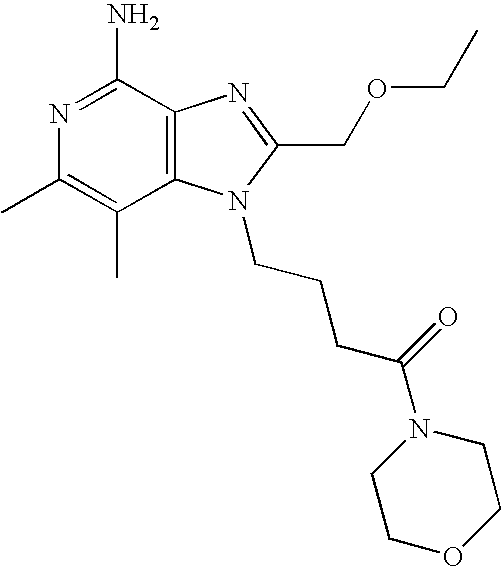
- The product was triturated with ethyl acetate, isolated by filtration, washed with ethyl acetate, sonicated with 1 N sodium hydroxide (5 mL) for 30 seconds, and diluted with water (20 mL) and chloroform (50 mL). The aqueous layer was separated and extracted with chloroform (3×20 mL). The combined organic fractions were washed with 1 N sodium hydroxide (10 mL), dried over sodium sulfate, filtered, and concentrated under reduced pressure. The residue was triturated with ethyl acetate, isolated by filtration, and dried under high vacuum for two hours at 70° C. to provide 2-(ethoxymethyl)-6,7-dimethyl-1-(4-morpholin-4-yl-4-oxobutyl)-1H-imidazo[4,5-c]pyridin-4-amine as a white powder, mp 156.0-158.0° C.
- Anal. Calcd for C19H29N5O3: C, 60.78; H, 7.785; N, 18.65. Found: C, 60.44; H, 8.07; N, 18.32.
-

- The methods described in Parts C, D, E, and F of Example 34 were used to treat ethyl 5-(3-aminoquinolin-4-ylamino)pentanoate, prepared in Parts A and B of Example 34. Trimethyl orthovalerate was used instead of trimethyl orthobutyrate in Part C. Following chromatographic purification of the product from Part F (eluting with 95:5 dichloromethane:methanol), 2-butyl-1-(5-morpholin-4-yl-5-oxopentyl)-1H-imidazo[4,5-c]quinolin-4-amine was obtained as an off-white powder, mp 141-143° C.
- Anal. Calcd for C23H31N5O2: C, 67.46; H, 7.63; N, 17.10. Found: C, 67.37; H, 7.66; N, 16.90.
-

Part A - The methods described in Parts C, D, and E of Example 34 were used to convert 5 ethyl 5-(3-aminoquinolin-4-ylamino)pentanoate, prepared in Parts A and B of Example 34, to 2-methyl-1-(5-morpholin-4-yl-5-oxopentyl)-1H-imidazo [4,5-c]quinoline. Trimethyl orthoacetate was used instead of trimethyl orthobutyrate in Part C, and the reaction was heated for four hours. In Part E, the treatment with oxalyl chloride (1.8 equivalents) was carried out three times for 15 minutes each time. DMF (5 mL) was added to the reaction before the first addition.
- Part B
- 2-Methyl-1-(5-morpholin-4-yl-5-oxopentyl)-1H-imidazo[4,5-c]quinoline (8.4 g, 24 mmol) was treated with mCPBA (7.19 g, 41.7 mmol), ammonium hydroxide (40 mL), and benzenesulfonyl chloride (5.93 mL, 46.5 mmol) according to the method described in Part D of Example 36. The crude product was purified by column chromatography on silica gel (eluting with 90:10 dichloromethane:methanol). The resulting product was triturated with 10% aqueous sodium hydroxide, isolated by filtration, washed with water, and dried overnight in a vacuum oven to provide 0.487 g of 2-methyl-1-(5-morpholin-4-y1-5-oxopentyl)-1H-imidazo[4,5-c]quinolin-4-amine as an off-white powder, mp 218-219° C.
- Anal. Calcd for C20H25N5O2: C, 65.37; H, 6.86; N, 19.06. Found: C, 65.20; H, 7.03; N, 18.98.
-
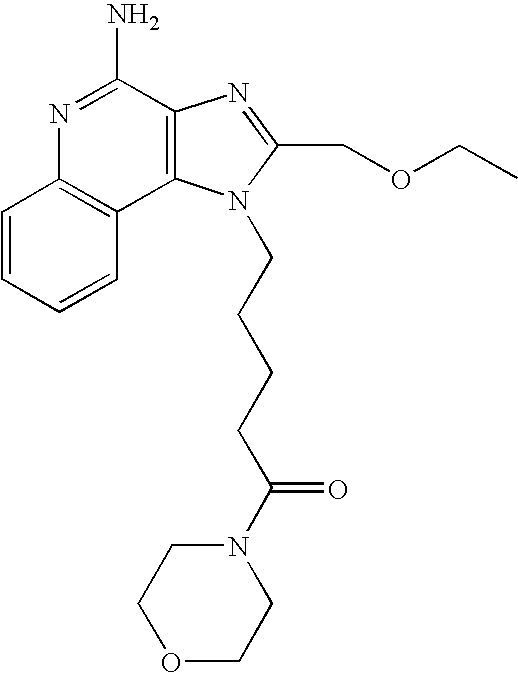
- The methods described in Parts A through D of Example 36 were used to treat ethyl 5-(3-aminoquinolin-4-ylamino)pentanoate, prepared in Parts A and B of Example 34. Ethoxyacetyl chloride was used instead of methoxypropionyl chloride in Pan t A. Following chromatographic purification of the product from Part D (eluting with 95:5 dichloromethane:methanol), the product was triturated with 10% sodium hydrox ide, isolated by filtration, washed with water, and dried overnight in a vacuum oven to provide 2-(ethoxymethyl)-1-(5-morpholin-4-yl-5-oxopentyl)-1H-imidazo[4,5-c]quinolin-4-amine as a tan solid, mp 128-129° C.
- Anal. Calcd for C22H29N5O3.0.54H2O: C, 62.72; H, 7.20; N, 16.62. Found: C, 62.72; H, 7.16; N, 16.60.
-

Part A - Ethyl 5-(3-aminoquinolin-4-ylamino)pentanoate, prepared in Parts A and B of Example 34, was treated as described in Part A of Example 36. Ethoxyacetyl chloride was used instead of methoxypropionyl chloride. Ethyl 5-(2-ethoxymethyl-1H-imidazo[4,5-c]quinolin-1-yl)pentanoate (6.0 g, 17 mmol) and ammonium acetate (15 g) were sealed in a high-pressure vessel and heated for four days at 110° C. and then allowed to cool to ambient temperature. Aqueous sodium hydroxide (10%) was added, and the mixture was then extracted with dichloromethane (3×). The product crystallized from the dichloromethane and was collected in two crops to provide 2.64 g of 5-[2-(ethoxymethyl)-1H-imidazo[4,5-c]quinolin-1-yl]pentanamide as an off-white solid, mp 157-158° C.
- Anal. Calcd for C18H22N4O2: C, 66.24; H, 6.79; N, 17.17. Found: C, 65.99; H, 6.67; N, 17.08.
- Part B
- 5-[2-(Ethoxymethyl)-1H-imidazo[4,5-c]quinolin-1-yl]pentanamide (2.25 g, 6.89 mmol) was treated with mCPBA (2.77 g, 12.0 mmol), ammonium hydroxide (40 mL), and benzenesulfonyl chloride (1.71 mL, 13.4 mmol) according to the method described in Part D of Example 36. The crude product was purified by column chromatography on silica gel (eluting with dichloromethane:methanol in a gradient from 90:10 to 85:15). The resulting product was triturated with 10% aqueous sodium hydroxide, isolated by filtration, washed with water, and dried overnight in a vacuum oven to provide 0.752 g of 5-[4-amino-2-(ethoxymethyl)-1H-imidazo[4,5-c]quinolin-1-yl]pentanamide as a tan solid, mp 198-200° C.
- Anal. Calcd for C18H23N5O2.0.21 H2O: C, 62.64; H, 6.84; N, 20.29. Found: C, 62.26; H, 6.80; N, 19.96.
-

- A mixture of 1-(5-morpholin-4-yl-5-oxopentyl)-2-propyl-1H-imidazo[4,5-c]quinolin-4-amine (1.66 g, 4.19 mmol, prepared in Example 34), platinum (IV) oxide (1.5 g, 6.6 mmol), and trifluoroacetic acid (25 mL) was placed in a Parr vessel and shaken under hydrogen pressure (40 psi, 2.8×10⁵ Pa) overnight. The reaction mixture was filtered through a layer of CELITE filter agent, and the filter cake was washed with ethanol. The filtrate was concentrated under reduced pressure, and the residue was purified by flash column chromatography on silica gel (eluting with 95:5 dichloromethane:methanol). The resulting solid was triturated three times with 10% aqueous sodium hydroxide, isolated by filtration, and washed with water to provide 0.468 g of 1-(5-morpholin-4-yl-5-oxopentyl)-2-propyl-6,7,8,9-tetrahydro-1H-imidazo[4,5-c]quinolin-4-amine as a white solid, mp 158-160° C.
- Anal. Calcd for C22H33N5O2.0.05 H2O: C, 65.99; H, 8.33; N, 17.49. Found: C, 65.59; H, 8.60; N, 17.76.
-
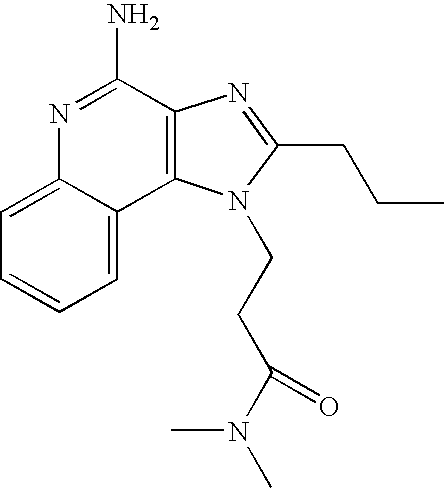
Part A - Dimethylamine (15 mL of a 40% aqueous solution) was added to a solution of ethyl 3-(2-propyl-1H-imidazo[4,5-c]quinolin-1-yl)propanoate (4.02 g, 12.9 mmol, prepared in Part B of Example 18) in THF (7 mL), and the reaction mixture was heated at 110° C. overnight in a pressure vessel. The reaction was allowed to cool to ambient temperature and concentrated under reduced pressure to provide 4.1 g of N,N-dimethyl-3-(2-propyl-1H-imidazo[4,5-c]quinolin-1-yl)propanamide as a dark brown solid.
- Part B
- N,N-Dimethyl-3-(2-propyl-1H-imidazo[4,5-c]quinolin-1-yl)propanamide (2.40 g, 7.73 mmol) was treated with mCPBA (3.11 g, 13.5 mmol), ammonium hydroxide (40 mL), and benzenesulfonyl chloride (1.92 mL, 15.1 mmol) according to the method described in Part D of Example 36. The crude product was purified by column chromatography on silica gel (eluting with 93:7 dichloromethane:methanol) to provide 0.097 g of 3-(4-amino-2-propyl-1H-imidazo[4,5-c]quinolin-1-yl)-N,N-dimethylpropanamide as a tan powder, mp 207-209° C.
- Anal. Calcd for C18H23N5O.0.19 H2O: C, 65.75; H, 7.07; N. 21.3. Found: C, 65.71; H, 7.38; N, 20.9.
-

Part A - Ethyl 5-(2-butyl-1H-imidazo[4,5-c]quinolin-1-yl)pentanoate (10.0 g, 28.2 mmol, prepared in Example 46) and ammonium acetate (10 g) were sealed in a high-pressure vessel, heated for two days at 130° C., and then allowed to cool to ambient temperature. Saturated aqueous sodium bicarbonate was added, and the mixture was then extracted with dichloromethane. The combined organic fractions were washed sequentially with saturated aqueous sodium bicarbonate and brine, dried over magnesium sulfate, filtered, and concentrated under reduced pressure to provide 8.6 g of 5-(2-butyl-1H-imidazo[4,5-c]quinolin-1-yl)pentanamide.
- Part B
- 5-(2-Butyl-1H-imidazo[4,5-c]quinolin-1-yl)pentanaamide (8.6 g, 26.5 mmol) was treated with mCPBA (10.7 g, 46.4 mmol), ammonium hydroxide (40 mL), and benzenesulfonyl chloride (6.59 mL, 51.6 mmol) according to the method described in Part D of Example 36. The crude product was purified by column chromatography on silica gel (eluting with dichloromethane:methanol in a gradient from 90:10 to 80:20). The resulting product was sonicated three times with 10% aqueous sodium hydroxide and once with 30% aqueous sodium hydroxide, isolated by filtration, washed with water, and dried overnight in a vacuum oven to provide 0.367 g of 5-(4-amino-2-butyl-1H-imidazo[4,5-c]quinolin-1-yl)pentanamide as a tan solid, mp 219-221° C.
- Anal. Calcd for C19H25N5O.0.21 H2O: C, 66.50; H, 7.46; N, 20.41. Found: C, 66.34; H, 7.81; N, 20.01.
-

Part A - A suspension of 4-chloro-3-nitro[1,5]naphthyridine (9.0 g, 42.9 mmol) in chloroform (180 mL) was cooled to approximately 0° C. Ethyl 6-aminohexanoate hydrochloride (12.6 g, 64.4 mmol) and triethylamine (16.6 mL, 119 mmol) were sequentially added with stirring, and the reaction was stirred for 15 minutes. The mixture was diluted with chloroform (180 mL), washed with 1% aqueous sodium carbonate (3×125 mL), dried over sodium sulfate, filtered, and concentrated under reduced pressure to provide ethyl 6-(3-nitro[1,5]naphthyridin-4-ylamino)hexanoate as a yellow oil.
- Part B
- The method described in Part B of Example 37 was used to hydrogenate the material from Part A to provide 6-(3-amino[1,5]naphthyridin-4-ylamino) ethyl hexanoate, which was dissolved in chloroform (650 mL) and divided into three portions (300 mL, 175 mL, and 175 mL).
- Part C
- Butyryl chloride (3.61 mL, 34.7 mmol) was added in four portions over the course of 105 minutes to a 175 mL portion from Part B. After a total reaction time of two hours, the solvent was removed under reduced pressure. The residue was triturated with acetone (2 mL/g) while cooling to approximately 0° C., and the resulting solid was isolated by filtration, air-dried, and suspended in ethanol (33 mL). A mixture of 50 % (w/w) aqueous sodium hydroxide (2.78 g, 34.7 mmol) and 11.4 mL water was added with stirring, and the resulting mixture was stirred at ambient temperature for ten minutes, heated at 85° C. for one hour, and allowed to cool to ambient temperature. The solvents were removed under reduced pressure, and the residue was partitioned between chloroform (90 mL) and deionized water (15 mL) and stirred for ten minutes. The aqueous phase was adjusted to pH 5 with the addition of 1 N hydrochloric acid, and then the organic phase was separated, dried over sodium sulfate, and concentrated under reduced pressure to provide 3.8 g of 6-(2-propyl-1H-imidazo [4,5-c][1,5]naphthyridin-1-yl]hexanoic acid.
- Part D
- A solution of oxalyl chloride (2.04 mL, 23.4 mmol) in dichloromethane (15 mL) was added dropwise to a suspension of 6-(2-propyl-1H-imidazo[4,5-c][1,5]naphthyridin-1-yl]hexanoic acid (2.56 g, 7.8 mmol) in dichloromethane (38 mL) containing one drop of DMF. The reaction mixture was stirred at ambient temperature for 1.75 hours, and then additional oxalyl chloride (0.35 mL, 4.1 mmol) was added. The reaction was stirred for an additional 45 minutes and then concentrated under reduced pressure to provide 6-(2-propyl-1H-imidazo[4,5-c][1,5]naphthyridin-1-yl]hexanoyl chloride.
- Part E
- Morpholine (1.72 mL, 19.6 mmol) was added to a solution of the material from Part D in dichloromethane (20 mL/g), and the reaction was stirred for 30 minutes at ambient temperature and then diluted with dichloromethane (20 mL/g) and saturated aqueous sodium bicarbonate (20 mL/g). The organic fraction was separated and concentrated under reduced pressure to provide 1-(6-morpholin-4-yl-6-oxohexyl)-2-propyl-1H-imidazo[4,5-c][1,5]naphthyridine.
- Part F
- mCPBA (70-77% purity, 4.52 g) was added to a solution of the material from Part E in chloroform (40 mL), and the reaction was stirred for 3.25 hours before the addition of more mCPBA (2.26 g). The stirring was continued for an additional 45 minutes, and then the reaction was diluted with chloroform (30 mL/g), washed twice with 1% aqueous sodium carbonate, and concentrated under reduced pressure. The residue was dissolved in dichloromethane (25 mL), and ammonium hydroxide (13 mL of 28%) and p-toluenesulfonyl chloride (1.93 g, 10.1 mmol) were sequentially added. The reaction mixture was stirred for 15 minutes, and additional dichloromethane (75 mL) was added. The organic layer was separated, dried over sodium sulfate, and concentrated under reduced pressure. The crude product (5.06 g) was purified by column chromatography on silica gel (eluting with 2.5% methanol in chloroform) followed by recrystallization from acetonitrile/water. The crystals were dried in a vacuum oven for three days at 90° C. and for four hours at 112° C. to provide 1.25 g of 1-(6-morpholin-4-yl-6-oxohexyl)-2-propyl-1H-imidazo[4,5-c][1,5]naphthyridin-4-amine as a light yellow solid, mp 148-150° C.
- Anal. calcd for C22H30N6O2: C, 64.37; H, 7.37; N, 20.47. Found: C, 64.19; H, 7.58; N, 20.70.
-
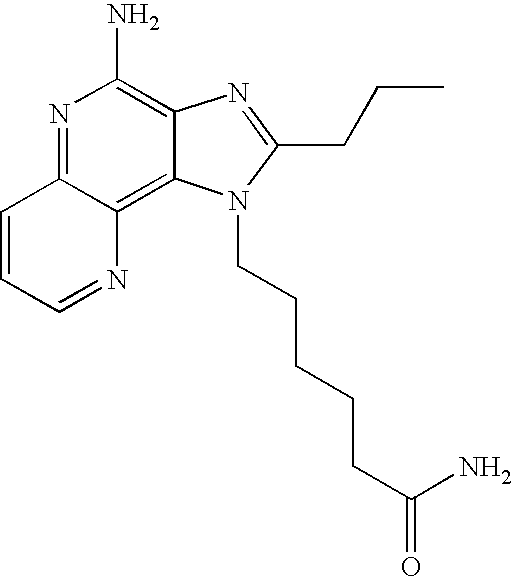
Part A - A solution of 6-(2-propyl-1H-imidazo[4,5-c][1,5]naphthyridin-1-yl]hexanoyl chloride, prepared according to the methods described in Parts A through D of Example 53, (4.8 mmol) in dichloromethane (20 mL/g) was cooled to approximately 0° C., and anhydrous ammonia was bubbled through the solution for ten minutes. The reaction was warmed to ambient temperature and stirred for an additional 30 minutes. Chloroform (20 mL/g) and water (15 mL/g) were added to the reaction. The aqueous layer was separated and extracted with dichloromethane (20 mL). The combined organic fractions were concentrated under reduced pressure. The crude product was recrystallized from acetonitrile (19 mL/g) to provide 1.20 g of 6-(2-propyl-1H-imidazo[4,5-c][1,5]naphthyridin-1-yl)hexanamide.
- Part B
- A modification of the method described in Part F of Example 53 was used to treat 6-(2-propyl-1H-imidazo[4,5-c][1,5]naphthyridin-1-yl)hexanamide (1.20 g, 3.7 mmol) with mCPBA (2.47 g of 70-77% purity) followed by ammonium hydroxide (4 mL), and p-toluenesulfonyl chloride (0.70 g). After the amination reaction was stirred for one hour, a precipitate was present and was isolated by filtration and washed with chloroform and water. The precipitate was ground up and dried for three days at 70° C. and then overnight at 95° C. to provide 0.46 g of 6-(4-amino-2-propyl-1H-imidazo[4,5-c][1,5]naphthyridin-1-yl)hexanamide as a white solid, mp 216.5-217.5° C.
- Anal. calcd for C18H24N6O: C, 63.51; H, 7.11; N, 24.69. Found: C, 63.29; H, 7.10; N, 24.68.
-

Part A - Propionyl chloride (5.17 mL, 59.5 mmol) was added in three portions (19.8 mmol each) 45 to 60 minutes apart to the 300 mL portion from Part B of Example 53. After a total reaction time of three hours, the solvent was removed under reduced pressure. The residue was purified, isolated, and treated with a mixture of 50 % (w/w) aqueous sodium hydroxide (4.76 g, 59.6 mmol) and 18.8 mL water according to the methods described in Part C of Example 53. The methods of Part C of Example 53 were then used to isolate 3.56 g of 6-(2-ethyl-1H-imidazo[4,5-c][1,5]naphthyridin-1-yl]hexanoic acid.
- Part D
- The method described in Part D of Example 53 was used to treat 6-(2-ethyl-1H-imidazo[4,5-c][1,5]naphthyridin-1-yl]hexanoic acid (3.46 g, 11.1 mmol) with oxalyl chloride (3.87 mL, 44.0 mmol) to obtain 6-[2-(ethoxymethyl)-1H-imidazo[4,5-c][1,5]naphthyridin-1-yl]hexanoyl chloride, which was dissolved in dichloromethane (20 mL/g) and divided into two equal portions.
- Part E
- Morpholine (1.21 mL, 13.8 mmol) was added to one portion from Part D, and the reaction was stirred for 15 minutes at ambient temperature and then diluted with dichloromethane (20 mL/g) and saturated aqueous sodium bicarbonate (20 mL/g). The organic fraction was separated, dried over sodium sulfate, filtered, and concentrated under reduced pressure to provide 2-ethyl-1-(6-morpholin-4-yl-6-oxohexyl)-1H-imidazo[4,5-c][1,5]naphthyridine.
- Part F
- The method described in Part F of Example 53 was used to treat the material from Part E with mCPBA (4.92 g of 70-77% purity) followed by amnionium hydroxide (9 mL) and p-toluenesulfonyl chloride (1.40 g, 7.34 mmol). The crude product (3.22 g) was purified by column chromatography on silica gel (eluting with 2. 5% methanol in chloroform) followed by recrystallization from acetonitrile. The crystals were dried in a vacuum oven for three days at 90° C. and for four hours at 112° C. to provide 0.79 g of 2-ethyl-1-(6-morpholin-4-yl-6-oxohexyl)-1H-imidazo[4,5-c][1,5]naphthyridin-4-amine as a light yellow solid, mp 163-165° C.
- Anal. calcd for C21H28N6O2: C, 63.61; H, 7.12; N, 21.20. Found: C, 63.52; H, 7.29; N, 21.47.
-
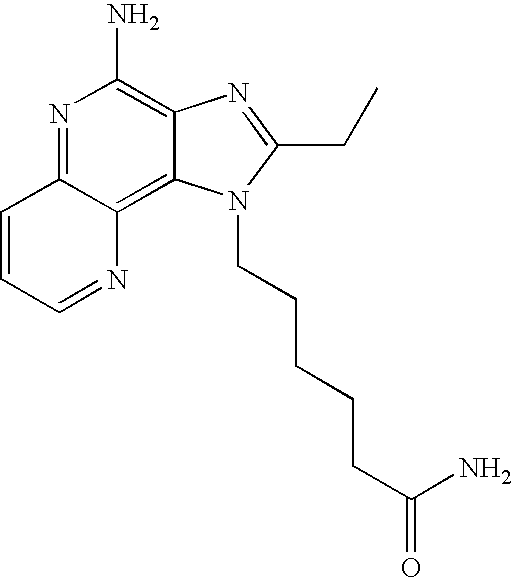
Part A - The second portion of the solution from Part D of Example 55 was cooled to approximately 0° C., and anhydrous ammonia was bubbled through the solution for ten minutes. The reaction was warmed to ambient temperature and stirred for an additional 30 minutes. Chloroform (30 mL/g) and water (15 mL/g) were added to the reaction, and the mixture was stirred for 30 minutes. The organic fraction was separated, dried over sodium sulfate, filtered, and concentrated under reduced pressure. The crude product was recrystallized from acetonitrile (10 mL/g) to provide 1.18 g of 6-(2-ethyl-1H-imidazo[4,5-c][1,5]naphthyridin-1-yl)hexanamide.
- Part B
- A modification of the method described in Part F of Example 53 was used to treat 6-(2-ethyl-1H-imidazo[4,5-c][1,5]naphthyridin-1-yl)hexanamide (1.18 g, 3.8 mmol) with mCPBA (2.54 g of 70-77% purity) followed by ammonium hydroxide (4 mL), and p-toluenesulfonyl chloride (0.72 g). After the amination reaction was stirred for 15 minutes, a precipitate was present and was isolated by filtration. The precipitate was purified by chromatography using a HORIZON HFPC system (silica cartridge, eluting with 0-55% CMA in chloroform) and dried for three days at 90° C. to provide 0.34 g of 6-(4-amino-2-ethyl-1H-imidazo[4,5-c][1,5]naphthyridin-1-yl)hexanamide as a light yellow solid, mp 220-221° C.
- Anal. calcd for C17H24N6O2.0.1 H2O: C, 62.21; H, 6.82; N, 25.61. Found: C, 61.69; H, 6.89; N, 25.54.
-

Part A - Ethoxyacetyl chloride (1.55 g, 12.2 mmol) was added to a 175 mL portion of the solution from Part B of Example 53. After a total reaction time of one hour, the solvent was removed under reduced pressure. The residue was triturated with ethyl acetate (2 mL/g) while cooling to approximately 0° C., and the resulting solid was isolated by filtration, air-dried, and treated with a mixture of 50 % (w/w) aqueous sodium hydroxide (2.78 g, 34.7 mmol) and 11.8 mL water according to the method described in Part C of Example 53. A solid was present during the work-up between the organic and acidic aqueous phases. The solid was isolated by filtration, triturated with methanol, isolated by filtration, dried under reduced pressure, and combined with the material isolated from the organic phase to provide 3.25 g of 6-[2-(ethoxymethyl)-1H-imidazo[4,5-c][1,5]naphthyridin-1-yl]hexanoic acid.
- Part B
- The method described in Part D of Example 53 was used to treat 6-[2-(ethoxymethyl)-1H-imidazo[4,5-c][1,5]naphthyridin-1-yl]hexanoic acid (3.23 g, 9.4 mmol) with oxalyl chloride (3.29 mL, 37.7 mmol) to obtain 6-[2-(ethoxymethyl)-1H-imidazo[4,5-c][1,5]naphthyridin-1-yl]hexanoyl chloride. The reaction was complete in two hours.
- Part C
- The method described in Part E of Example 53 was used to treat the material from Part B with morpholine (2.06 mL, 23.6 mmol) to provide 2-(ethoxymethyl)-1-(6-morpholin-4-yl-6-oxohexyl)-1H-imidazo[4,5-c][1,5]naphthyridine.
- Part D
- The method described in Part F of Example 53 was used to treat the material from Part C with mCPBA (8.15 g of 70-77% purity) followed by ammonium hydroxide (15 mL) and p-toluenesulfonyl chloride (2.32 g). The crude product (5.91 g) was purified by column chromatography on silica gel (eluting with 2% methanol in chloroform) followed by recrystallization from acetonitrile/water. The crystals were dried in a vacuum over for three days at 90° C. and for four hours at 112° C. to provide 0.63 g of 2-(ethoxymethyl)-1-(6-morpholin-4-yl-6-oxohexyl)-1H-imidazo[4,5-c][1,5]naphthyridin-4-amine as a light yellow solid, mp 168-170° C.
- Anal. calcd for C22H30N6O3: C, 61.95; H, 7.09; N, 19.70. Found: C, 61.80; H, 7.13; N, 19.96.
-

Part A - A solution of 6-[2-(ethoxymethyl)-1H-imidazo[4,5-c][1,5]naphthyridin-1-yl]hexanoyl chloride, prepared according to the methods described in Parts A and B of Example 57, (5.8 mmol) in dichloromethane (20 mL/g) was cooled to approximately 0° C., and anhydrous ammonia was bubbled through the solution for ten minutes. The reaction was warmed to ambient temperature and stirred for an additional 30 minutes. Chloroform (20 mL/g) and water (1 5 mL/g) were added to the reaction. A solid was present and was isolated by filtration to provide 0.96 g of 6-[2-(ethoxymethyl)-1H-imidazo[4,5-c][1,5]naphthyridin-1-yl]hexanamide. The filtrate was concentrated under reduced pressure, and the residue was partitioned between chloroform (75 mL) and 1% aqueous sodium carbonate (20 ml). The organic fraction was concentrated under reduced pressure, and the residue was triturated with acetonitrile and isolated by filtration to provide an additional 0.74 g of product. The two solids were combined and used in the next step.
- Part B
- A modification of the methods described in Part F of Example 53 was used to treat 6-[2-(ethoxymethyl)-1H-imidazo[4,5-c][1,5]naphthyridin-1-yl)hexanamide (1.70 g, 5.0 mmol) with mCPBA (3.34 g of 70-77% purity) followed by ammonium hydroxide (5.5 mL), and p-toluenesulfonyl chloride (0.95 g). After the amination reaction was stirred for one hour, a precipitate was present and was isolated by filtration and washed with chloroform and water. The precipitate was triturated with 2-propanol (7.5 mL/g at 97° C.), and the mixture was filtered hot. The isolated solid was dried overnight under vacuum and then in a vacuum oven for six days at 65° C. The product was then sonicated in 1 M aqueous sodium hydroxide for 15 minutes, isolated by filtration, washed with deionized water, and dried in a vacuum oven for three days at 90° C. to provide 0.32 g of 6-[4-amino-2-(ethoxymethyl)-1H-imidazo[4,5-c][1,5]naphthyridin-1-yl]hexanamide as a yellow solid, mp 215-217° C.
- Anal. calcd for C18H24N6O2.0.37 H2O: C, 59.54; H, 6.87; N, 23.15. Found: C, 59.66; H, 7.00; N, 23.44.
-
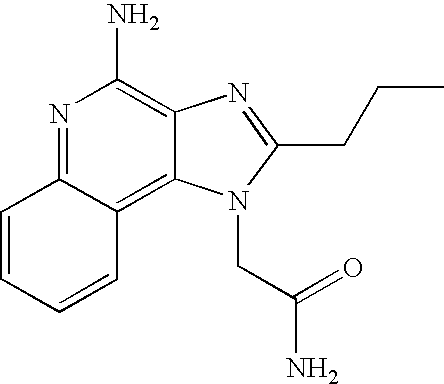
Part A - Triethylamine (22.3 mL, 0.160 mmol) was added with stirring to a solution of 3-amino-4-chloroquinoline, see Surrey et al., Journal of the American Chemical Society, 73, pp. 2413-2416 (1951), (13.2 g, 74.0 mmol) in anhydrous dichloromethane (100 mL). A solution of butyryl chloride (13 mL, 125 mmol) in dichloromethane (50 mL) was then added dropwise, and the reaction mixture was stirred at ambient temperature overnight. Methanol (25 mL) was added, and the reaction mixture was stirred for one hour at ambient temperature. Saturated aqueous sodium bicarbonate (50 mL) was added, and the resulting mixture was stirred at ambient temperature for 30 minutes and then allowed to stand. The aqueous layer was separated and extracted with dichloromethane (75 mL), and the combined organic fractions were then washed with saturated aqueous sodium bicarbonate (2×50 mL), dried over potassium carbonate, filtered, and concentrated under reduced pressure. The crude product (22.8 g) was recrystallized from a mixture of toluene (45 mL) and hexane (15 mL) to provide 9.2 of N-(4-chloroquinolin-3-yl)butanamide as brown needles.
- Part B
- A neat mixture of N-(4-chloroquinolin-3-yl)butanamide (5.0 g, 20 mmol) and glycine ethyl ester hydrochloride (10.0 g, 72 mmol) was heated gently with a heat gun until the solids melted. The reaction was followed by LC/MS, and heat was applied briefly twice more until no starting material remained. Dichloromethane (100 mL) and saturated aqueous sodium bicarbonate (50 mL) were added, and the resulting mixture was stirred until all solids were dissolved. The aqueous layer was separated and extracted with dichloromethane (2×50 mL), and the combined organic fractions were washed sequentially with saturated aqueous sodium bicarbonate (50 mL) and water, dried over potassium carbonate, filtered, and concentrated under reduced pressure. The residue was (3.6 g) was dissolved in hot toluene (150 mL), and pyridinium tosylate (100 mg) was added. The reaction was heated at reflux under a Dean-Stark trap for one hour, allowed to stand at ambient temperature for three days, heated at reflux for two hours, cooled to ambient temperature, and diluted with dichloromethane (150 mL). The resulting solution was washed with saturated aqueous sodium bicarbonate (2×35 mL), dried over potassium carbonate, filtered, and concentrated under reduced pressure to provide 3.2 g of ethyl (2-propyl-1H-imidazo[4,5-c]quinolin-1-yl)acetate as a light brown solid.
- Part C
- mCPBA (4.70 g of 75%, 27.3 mmol) was added over a period of five minutes to a solution of ethyl (2-propyl-1H-imidazo[4,5-c]quinolin-L -yl)acetate (3.2 g, 11 mmol) in dichloromethane (100 mL), which had been cooled to approximately 0° C. The reaction mixture was stirred cold for ten minutes and then for one hour at room temperature at which time analysis by LC/MS indicated that the reaction was not complete. The reaction mixture was stirred for one hour and was still incomplete; additional mCPBA (1.0 g) was added. The reaction was stirred for an additional 30 minutes, and then the aqueous layer was separated and extracted with dichloromethane (2×35 mL). The combined organics were washed twice with a mixture of saturated aqueous sodium bicarbonate (33 mL) and 25% aqueous sodium hydroxide (2 mL) and then coolecL to 0° C. With vigorous stirring, ammonium hydroxide (50 mL) was added, and a solution of benzenesulfonyl chloride (2.4 mL, 19 mmol) in dichloromethane (15 mL) was then added dropwise. The reaction mixture was stirred for 15 minutes, warmed to ambient temperature, and then stirred for two hours. The aqueous layer was separated and extracted with dichloromethane (2×35 mL). The combined organics were washed twice with a mixture of saturated aqueous sodium bicarbonate (33 mL) and 25% aqueous sodium hydroxide (2 mL), dried over potassium carbonate, filtered, and concentrated under reduced pressure. The residue was purified by column chromatography (silica gel, eluting with 5% methanol in dichloromethane containing 3 mL of ammonium hydroxide per liter of eluent) followed by recrystallization three times from ethanol/water. The crystals were dried in a vacuum oven overnight at 70° C. to provide ethyl (4-amino-2-propyl-1H-imidazo[4,5-c]quinolin-1-yl)acetate as tan needles, mp 170-172° C. Anal. calcd for C17H20N4O2.0.27 H2O.0.14 C2H5OH: C, 64.17; H, 6.61; N, 17.33. Found: C, 63.93; H, 6.60; N, 17.10.
- Part D
- Ethyl (4-amino-2-propyl-1H-imidazo[4,5-c]quinolin-1-yl)acetate (0.80 g), a solution of ammonia in methanol (35 mL of 7 N), and ammonium chloride (0.50 g) were heated in a sealed pressure vessel at 150° C. for 20 hours. The volatiles were removed under reduced pressure, and the solid residue was triturated with saturated aqueous sodium bicarbonate for one hour, isolated by filtration, and washed with water. The solid was recrystallized from methanol/water, and the crystals were washed sequentially with 25% aqueous sodium hydroxide (2×25 mL) and water (2×25 mL) and dried overnight in a vacuum oven at 70° C. to provide 0.120 g of 2-(4-amino-2-propyl-1H-imidazo[4,5-c]quinolin-1-yl)acetamide as light tan crystals, mp >300° C.
- MS (APCI) m/z 284 (M+H+);
- Anal. calcd for C15H17N5O: C, 63.59; H, 6.05; N, 24.72. Found: C, 63.29; H, 5.88; N, 25.07.
-

Part A - Ethyl 3-[(3-aminoquinolin-4-yl)amino]-2,2-dimethylpropanoate (see Example 26 Parts A through D, 3.6 g, 12 mmol) was treated according to a modification of the method described in Part B of Example 8 using triethyl orthopropionate in lieu of trimethyl orthobutyrate. Prior to the addition of triethyl orthopropionate (4.0 mL, 20 mmol) and pyridinium p-toluenesulfonate (0.030 g), the reaction was heated at reflux for 15 minutes. After the reaction was heated at reflux for three hours, it was concentrated under reduced pressure and found to be incomplete by 1H NMR. The oil was dissolved in toluene (100 mL), and concentrated sulfuric acid (one drop) was added. The reaction was heated at reflux for two hours and allowed to cool. Triethylamine (5 mL) was added, and the reaction was heated at reflux for two hours, allowed to cool to ambient temperature, washed with saturated aqueous sodium bicarbonate (2×35 mL), dried over potassium carbonate, filtered, and concentrated to provide 3.6 g of ethyl 3-(2-ethyl-1H-imidazo[4,5-c]quinolin-1-yl)-2,2-dimethylpropanoate as an oil.
- Part B
- mCPBA (4.8 g of 75%, 22 mmol) was added over a period of several minutes to a solution of ethyl 3-(2-ethyl-1H-imidazo[4,5-c]quinolin-1-yl)-2,2-dimethylpropanoate (3.6 g, 11 mmol) in dichloromethane (100 mL), which had been cooled to approximately 0° C. The reaction mixture was stirred cold for ten minutes and then for three hours at ambient temperature. The reaction mixture was then washed twice with a mixture of saturated aqueous sodium bicarbonate (34 mL) and 25% aqueous sodium hydroxide (1 mL), dried over potassium carbonate, filtered, and then cooled to 0° C. Trichloroacetyl isocyanate (1.7 mL, 14 mmol) was added, and the reaction was stirred cold for 15 minutes, warmed to ambient temperature, and stirred for one hour. The solvent was removed under reduced pressure, and the residue was dissolved in methanol (50 mL). Sodium methoxide (6.5 mL of a 25% solution in methanol, 30 mmol) was added to the resulting solution, and the reaction was stirred at ambient temperature overnight and cooled to approximately 0° C. for 30 minutes. A precipitate formed and was isolated by filtration to provide 1.2 g of methyl 3-(4-amino-2-ethyl-1H-imidazo [4,5-c] quinolin-1-yl)-2,2-dimethylpropanoate.
- Part C
- A solution of potassium hydroxide (16 mL of a 0.5 M solution in methanol) was added to methyl 3-(4-amino-2-ethyl-1H-imidazo[4,5-c]quinolin-1-yl)-2,2-dimethylpropanoate (1.2 g, 3.7 mmol), and the resulting solution was heated at reflux for five days and allowed to cool to ambient temperature. Hydrogen chloride (8.5 mL of a 1 N solution in diethyl ether) was added, and the reaction was stirred for 30 minutes. The solvents were removed under reduced pressure, and the residue was dissolved in dichloromethane (50 mL). A solution of oxalyl chloride (0.70 mL, 8.0 mmol) in dichloromethane (5 mL) was added, and the solution was stirred overnight at ambient temperature and then concentrated under reduced pressure. The residue was dissolved in dichloromethane (50 mL), and ammonia (10 mL of a 0.5 M solution in 1,4-dioxane) was added. The reaction was stirred for 15 minutes, and then additional ammonia (10 mL of a 7 N solution in methanol) was added. The reaction was stirred for two hours and concentrated under reduced pressure. The residue was stirred with dichloromethane for five minutes, isolated by filtration, and recrystallized from methanol/water. The resulting needles were dried overnight in a vacuum oven at 80° C. to provide 3-(4-amino-2-ethyl-1H-imidazo[4,5-c]quinolin-1-yl)-2,2-dimethylpropanamide as light yellow needles, mp 279-281° C.
- MS (APCI) m/z 312 (M+H+);
- Anal. calcd for C17H21N5O: C, 64.35; H. 6.88; N, 22.07. Found: C, 64.14; H, 7.22; N, 22.46.
-
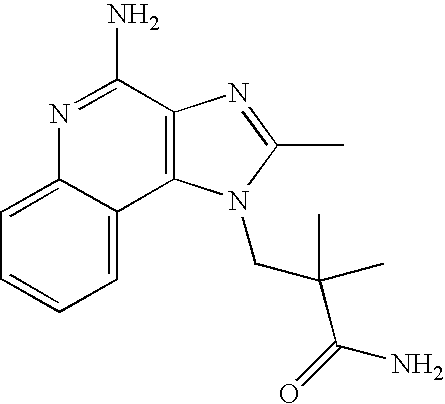
Part A - Ethyl 3-[(3-aminoquinolin-4-yl)amino]-2,2-dimethylpropanoate (see Example 26 Parts A through D, 6.3 g, 2 mmol) was treated according to a modification of the method described in Part B of Example 8 using trimethyl orthoacetate in lieu of trimethyl orthobutyrate. Prior to the addition of trimethyl orthoacetate (3.8 mL, 30 mmol) and pyridinium p-toluenesulfonate (0.050 g), the reaction was heated at reflux for 15 minutes. During the work-up procedure, the solution was washed with saturated aqueous sodium bicarbonate (2×35 mL) and dried over potassium carbonate. The product, ethyl 2,2-dimethyl-3-(2-methyl-1H-imidazo[4,5-c]quinolin-1-yl)propanoate (7.3 g), was used without purification.
- Part B
- The methods described in Part B of Example 60 were used to treat ethyl 2,2-dimethyl-3-(2-methyl-1H-imidazo[4,5-c]quinolin-1-yl)propanoate (7.2 g, 22 mmol) with mCPBA (9.6 g of 77% pure material), followed by trichloroacetyl isocyanate (3.1 mL, 26 mmol), followed by sodium methoxide (20 mL of 25% in methanol). After the collection of the precipitate, the filtrate was concentrated under reduced pressure, and the residue was mixed with methanol (50 mL). The resulting solid was isolated by filtration, and the isolated solids were combined to provide 2.3 g of methyl 3-(4-amino-2-methyl-1H-imidazo[4,5-c]quinolin-1-yl)-2,2-dimethylpropanoate.
- Part C
- A solution of potassium hydroxide (20 mL of a 0.5 M solution in methanol) was added to a mixture of methyl 3-(4-amino-2-methyl-1H-imidazo[4,5-c]quinolin-1-yl)-2,2-dimethylpropanoate (1.7 g, 5.4 mmol) and methanol (50 mL), and the resulting solution was heated at reflux for one day, allowed to cool, stirred for three days and ambient temperature, heated at reflux for one day, and allowed to cool. Hydrogen chloride (11 mL of a 1 N solution in diethyl ether) was added, and the reaction was stirred for 15 minutes. The solvents were removed under reduced pressure, and the residue was dissolved in dichloromethane (50 mL) and three drops of DMF. A solution of oxalyl chloride (0.96 mL, 11 mmol) in dichloromethane (10 mL) was added rapidly, and the solution was stirred for three days at ambient temperature and then concentrated under reduced pressure. The residue was dissolved in dichloromethane (50 mL), and ammonia (15 mL of a 0.5 M solution in 1,4-dioxane) was added. The reaction was stirred for 30 minutes, and then additional ammonia (10 mL of a 7 N solution in methanol) was added. The reaction was stirred overnight at ambient temperature and concentrated under reduced pressure. The solid residue was stirred with saturated aqueous sodium bicarbonate (50 mL) for 15 minutes, isolated by filtration, washed with saturated aqueous sodium bicarbonate (50 mL), and recrystallized from methanol/water containing a few mL of 0.5 M potassium hydroxide in methanol. The resulting crystals were mixed with material from a separate run, and the combined solids were dried overnight in a vacuum oven at 80° C., washed with water (3×15 mL), and recrystallized from a mixture of methanol (20 mL), water (7 mL), and 0.5 N potassium hydroxide in methanol (3 mL). The crystals were dried overnight in a vacuum oven at 80° C. to provide 3-(4-amino-2-methyl-1H-imidazo[4,5-c]quinolin-1-yl)-2,2-dimethylpropanamide as light yellow crystals, mp 284-287° C.
- MS (APCI) m/z 298 (M+H+);
- Anal. calcd for C16H19N5O: C, 64.63; H, 6.44; N, 23.55. Found: C, 64.37; H, 6.37; N, 23.54.
-

Part A - Ethyl 3-(3-aminoquinolin-4-ylamino)-2,2-dimethylpropanoate (see Example 26 Parts A through D, 5.3 g, 18 mmol) was treated according to a modification of the method described in Part B of Example 8 using trimethyl orthoformate in lieu of trimethyl orthobutyrate. Prior to the addition of trimethyl orthoformate (3.0 mL, 27 mmol) and pyridinium p-toluenesulfonate (0.050 g), the reaction was heated at reflux for 15 minutes. The reaction was heated at reflux overnight, allowed to cool to ambient temperature, washed with saturated aqueous sodium bicarbonate (2×35 mL), and extracted with water (45 mL) containing 10% hydrochloric acid (5 mL). The acidic extract was made basic with the addition of potassium carbonate and then extracted with dichloromethane (3×50 mL). The combined organic extracts were dried over potassium carbonate, filtered, and concentrated under reduced pressure to provide 4.3 g of ethyl 3-(1H-imidazo[4,5-c]quinolin-1-yl)-2,2-dimethylpropanoate as an oil.
- Part B
- A modification of the methods described in Part B of Example 60 was used to treat ethyl 3-(1H-imidazo[4,5-c]quinolin-1-yl)-2,2-dimethylpropanoate (4.3 g, 14 mmol) with mCPBA (6.3 g of 77% pure material), followed by trichloroacetyl isocyanate (2.0 mL, 17 mmol). The reaction with the isocyanate was stirred for two hours before the addition of additional trichloroacetyl isocyanate (1.0 mL) and stirring for an additional two hours. After the reaction with sodium methoxide (1 1 mL of 25% in methanol), the solvent was removed under reduced pressure. The residue was mixed with methanol (25 mL), and the mixture was cooled to 0° C. and filtered to isolate 1.61 g of methyl 3-(4-amino-1H-imidazo[4,5-c]quinolin-1-yl)-2,2-dimethylpropanoate as a solid. The filtrate was concentrated under reduced pressure, and the residue was mixed with saturated aqueous sodium bicarbonate (100 mL). A precipitate formed, was isolated by filtration, and was mixed with concentrated hydrochloric acid to adjust to pH 7. The precipitate was again isolated by filtration and dissolved in dichloromethane. The resulting solution was dried over potassium carbonate, filtered, and concentrated under reduced pressure to provide an additional 1.51 g of methyl 3-(4-amino-1H-imidazo[4,5-c]quinolin-1-yl)-2,2-dimethylpropanoate as an oil.
- Part C
- A modification of the methods described in Part C of Example 61 was used to treat methyl 3-(4-amino-1H-imidazo[4,5-c]quinolin-1-yl)-2,2-dimethylpropanoate (1.61 g, 5.4 mmol) with potassium hydroxide (22 mL of 0.5 M); the reaction was heated at reflux overnight. The reaction with oxalyl chloride (0.96 mL) in dichloromethane (55 mL total) was stirred for one hour before more oxalyl chloride (1.0 mL) and DMF (three drops) were added, and then the reaction was stirred overnight. The precipitate isolated after the reaction with ammonia and treatment with sodium bicarbonate was combined with material from another run and recrystallized from methanol/water. The resulting solid was isolated by filtration and heated gently in a mixture of methanol (35 mL), water (10 mL), and concentrated hydrochloric acid (0.83 mL). The mixture was filtered to remove a small amount of insoluble material, and a precipitate formed in the filtrate. The precipitate was isolated by filtration, recrystallized twice from methanol/water, dried overnight in a vacuum oven at 70° C., and recrystallized four times from ethyl acetate/methanol/water with a filtration through a 20 micron filter prior to the last two crystallizations. The resulting crystals were dried overnight in a vacuum oven at 70° C. to provide 3-(4-amino-1H-imidazo[4,5-c]quinolin-1-yl)-2,2-dimethylpropanamide as white crystals, mp 287-289° C.
- MS (APCI) m/z 284 (M+H+);
- Anal. calcd for C15H17N5O1.0 HCl.1.0 H2O: C, 53.33; H, 5.97; N, 20.73. Found: C, 53.25; H, 5.85; N, 20.60.
-

Part A - Ethyl 3-(3-aminoquinolin-4-ylamino)-2,2-dimethylpropanoate (see Example 26 Parts A through D, 9.0 g, 31.3 mmol) was treated according to a modification of the method described in Part B of Example 8 using trimethyl orthovalerate in lieu of trimethyl orthobutyrate. Prior to the addition of trimethyl orthovalerate (6.1 mL, 35 mmol) and pyridinium p-toluenesulfonate (0.050 g), the reaction was heated at reflux for 15 minutes and then cooled slightly. The reaction was heated at reflux for five hours, allowed to cool to ambient temperature, stirred overnight, and concentrated under reduced pressure to provide 11.2 g of ethyl 3-(2-butyl-1H-imidazo[4,5-c]quinolin-1-yl)-2,2-dimethylpropanoate.
- Part B
- A modification of the methods described in Part B of Example 60 was used to treat ethyl 3-(2-butyl-1H-imidazo[4,5-c]quinolin-1-yl)-2,2-dimethylpropanoate (11.0 g, 31 mmol) with mCPBA (13.6 g of 77% pure material), followed by trichloroacetyl isocyanate (4.4 mL, 37 mmol). The reaction with the isocyanate was stirred for 1.5 hours before the addition of additional trichloroacetyl isocyanate (4.4 mL) and stirring for three days. Additional trichloroacetyl isocyanate (0.5 mL) was added, and the reaction was stirred for four hours. After the addition of methanol (50 mL), the solution was stirred overnight, and then the solvent was removed under reduced pressure. The residue was dissolved in dichloromethane (150 mL), and the solution was washed with saturated aqueous sodium bicarbonate (2×35 mL), dried over potassium carbonate, filtered, and concentrated under reduced pressure. The crude product was purified by column chromatography on silica gel (eluting with 5% methanol in dichloromethane containing 2 mL aimmonium hydroxide per liter of eluent) to provide 11.4 g of methyl 3-(4-amino-2-butyl-1H-imidazo[4,5-c]quinolin-1-yl)-2,2-dimethylpropanoate as a semi-solid.
- Part C
- A modification of the methods described in Part C of Example 60 was used to treat methyl 3-(4-amino-2-butyl-1H-imidazo[4,5-c]quinolin-1-yl)-2,2-dimethylpropanoate (7.6 g, 21 mmol) with potassium hydroxide (44 mL of 0.5 M); additional potassium hydroxide (22 mL) was added after refluxing for four hours. After the reaction was heated at reflux for five days, additional potassium hydroxide (11 mL) was added, and the reaction was heated for four more hours. After the reaction with oxalyl chloride (3.7 mL, 42 mmol) was stirred overnight, additional oxalyl chloride (1.0 mL) was added, and then the reaction was stirred for two hours. After the addition of ammonia in methanol (35 mL), the reaction was stirred for one hour and then concentrated. The residue was stirred with saturated aqueous sodium bicarbonate for 30 minutes, isolated by filtration, and recrystallized three times from methanol/water. During the first recrystallization, a solution in methanol was filtered through a 20 micron filter prior to the addition of water. The resulting crystals were dried overnight in a vacuum oven at 70° C. to provide 1.60 g of 3-(4-amino-2-butyl-1H-imidazo[4,5-c]quinolin-1-yl)-2,2-dimethylpropanamide as light tan crystals, mp 231-233° C.
- MS (APCI) m/z 340 (M+H+);
- Anal. calcd for C19H25N5O: C, 67.23; H, 7.42; N, 20.63. Found: C, 66.85; H, 7.56; N, 20.67.
-

Part A - Ethylcyanoacetate (15.0 mL, 141 mmol) was added to a mixture of potassium carbonate (48.7 g, 353 mmol) and acetone (200 mL), and 1,2-dibromoethane (13.4 mL, 155 mmol) was added dropwise to the resulting mixture over a period of eight minutes. The reaction was heated at reflux overnight. An analysis by TLC indicated the presence of ethylcyanoacetate, and additional 1,2-dibromoethane (1.8 mL, 0.15 equivalent) was added. The reaction mixture was heated at reflux for an additional four hours and filtered through a layer of CELITE filter agent. The filter cake was washed with acetone (200 mL), and the combined filtrates were concentrated under reduced pressure to provide ethyl 1-cyanocyclopropanecarboxylate as an orange oil containing about 10 mole % 1,2-dibromoethane.
- Part B
- Platinum (IV) oxide (0.98 g) and concentrated hydrochloric acid (25 mL) were added to a solution of the material from Part A in ethanol (225 mL), and the mixture was placed under hydrogen pressure (40 psi, 2.8×10⁵ Pa) on a Parr apparatus and shaken for 20 hours and then filtered through a layer of CELITE filter agent. The filter cake was washed with methanol (200 mL), and the combined filtrates were concentrated under reduced pressure. The residue was three times dissolved in methanol and concentrated and then twice dissolved in toluene and concentrated to afford ethyl 1-(aminomethyl)cyclopropanecarboxylate hydrochloride as a thick, pale yellow oil.
- Part C
- A suspension of 4-chloro-3-nitroquinoline (24.5 g, 118 mmol) and triethylamine (41 mL, 294 mmol) in dichloromethane (450 mL) was cooled to 5° C., and a solution of the material from Part B in dichloromethane (200 mL) was added over a period of 15 minutes. The reaction was stirred at 5° C. for one hour, allowed to warm to ambient temperature, stirred overnight, and washed with saturated aqueous sodium bicarbonate (250 mL). The aqueous layer was extracted with dichloromethane (2×50 mL), and the combined organic fractions were dried over magnesium sulfate, filtered, and concentrated under reduced pressure. The resulting orange oil was recrystallized from acetonitrile to provide 21.47 g of ethyl 1-{[(3-nitroquinolin-4-yl)amino]methyl}cyclopropanecarboxylate as a bright yellow solid.
- Part D
- A suspension of 5% platinum on carbon (0.80 g) and ethyl l-{[(3-nitroquinolin-4-yl)amino]methyl}cyclopropanecarboxylate (8.0 g, 25 mmol) in ethyl acetate was placed under hydrogen pressure (30 psi, 2.1×10⁵ Pa) on a Parr apparatus for three hours and filtered through a layer of CELITE filter agent. The filter cake was washed with ethyl acetate (50 mL), and the combined filtrates were concentrated under reduced pressure to provide ethyl 1-{[(3-aminoquinolin-4-yl)amino]methyl}cyclopropanecarboxylate as a yellow solid.
- Part E
- A solution of the material from Part D in dichloromethane (100 mL) was cooled to 0° C., and ethoxyacetyl chloride (2.9 mL, 28 mmol) was added dropwise over a period of five minutes. The reaction was allowed to slowly warm to ambient temperature, stirred overnight, and concentrated under reduced pressure to provide ethyl 1-[({3-[(ethoxyacetyl)amino]quinolin-4-yl}amino)methyl]cyclopropanecarboxylate hydrochloride.
- Part F
- Triethylamine (10.6 mL, 76.2 mmol) was added to a solution from Part E in ethanol (100 mL), and the reaction was heated at 60° C. overnight. The solvent was removed under reduced pressure, and the residue was dissolved in dichloromethane (100 mL). The resulting solution was washed with saturated aqueous sodium bicarbonate (75 mL). The aqueous fraction was extracted with dichloromethane (2×35 mL), and the combined organic fractions were dried over magnesium sulfate, filtered, and concentrated under reduced pressure to provide ethyl 1-{[2-(ethoxymethyl)-1H-imidazo[4,5-c]quinolin-1-yl]methyl}cyclopropanecarboxylate as a brown semi-solid.
- Part G
- Aqueous sodium hydroxide (8.5 mL of 6 M) was added to a solution of the material from Part F in ethanol (80 mL); the reaction was stirred at ambient temperature for three hours and concentrated under reduced pressure. The residue was mixed with water (60 mL) and adjusted to pH 5 with the addition of 2 M hydrochloric acid. No precipitate formed, and the mixture was adjusted to pH 12 and washed with diethyl ether (3×20 mL). The solution was adjusted to pH 4, and a precipitate formed and was isolated by filtration and dried to provide 4.36 g of 1-{[2-(ethoxymethyl)-1H-imidazo[4,5-c]quinolin-1-yl]methyl}cyclopropanecarboxylic acid. The filtrate was adjusted to pH 7 and extracted with chloroform (3×20 mL), and the combined extracts were dried over magnesium sulfate, filtered, and concentrated under reduced pressure to provide an orange solid. The solid was triturated with acetonitrile and isolated by filtration to provide an additional 1.76 g of 1-{[2-(ethoxymethyl)-1H-imidazo[4,5-c]quinolin-1-yl]methyl}cyclopropanecarboxylic acid.
- Part H
- Oxalyl chloride (1.6 mL, 18 mmol) was added dropwise over a period of 5 minutes to a suspension of 1-{[2-(ethoxymethyl)-1H-imidazo[4,5-C]quinolin-1-yl]methyl}cyclopropanecarboxylic acid (2.0 g, 6.2 mmol) in dichloromethane (50 mL) containing one drop of DMF. The reaction mixture was stirred for two hours and then concentrated under reduced pressure to provide 1-{[2-(ethoxymethyl)-1H-imidazo[4,5-c]quinolin-1-yl]methyl}cyclopropanecarbonyl chloride.
- Part I
- A solution of the material from Part H in dichloromethane (35 mL) was cooled to 0° C., and a solution of ammonia in 1,4-dioxane (18.5 mL of 0.5 M) was added. The reaction was stirred for ten minutes, and then ammonia gas was bubbled through the solution for ten minutes. The reaction was then sealed, allowed to warm to ambient temperature slowly, and stirred overnight. The solvent was removed under reduced pressure, and the residue was triturated with 1 M-aqueous sodium hydroxide and isolated by filtration to provide 1.70 g of 1-{[2-(ethoxymethyl)-1H-imidazo[4,5-c]quinolin-1-yl]methyl}cyclopropanecarboxamide as an off-white solid.
- Part J
- mCPBA (1.68 g, 6.81 mmol) was added to a suspension of 1-{[2-(ethoxymethyl)-1H-imidazo[4,5-c]quinolin-1-yl]methyl}cyclopropanecarboxamide (1.70 g, 5.24 mmol) in chloroform (25 mL); the reaction was stirred for two hours at ambient temperature and then cooled to 0° C. Ammonium hydroxide (5 mL) and p-toluenesulfonyl chloride (1.10 g, 5.76 mmol) were added. The reaction was stirred for one hour at 5° C. and then filtered to isolate a precipitate. The precipitate was triturated with 2 M aqueous sodium hydroxide, isolated by filtration, triturated with hot acetonitrile, isolated by filtration, and recrystallized from ethanol. The crystals were dried overnight at 85° C. in a vacuum oven to provide 0.78 g of 1-{[4-amino-2-(ethoxymethyl)-1H-imidazo[4,5-c]quinolin-1-yl]methyl}cyclopropanecarboxamide as tan needles, mp 230.5-232.5° C.
- MS (ESI) m/z 340 (M+H)+;
- Anal. calcd for C18H21N5O2: C, 63.70; H, 6.24; N, 20.63. Found: C, 63.65; H, 6.31; N, 20.57.
-

Part A - The method described in Part A of Example 64 was used to treat ethylcyanoacetate (45 mL, 420 mmol) with 1,3-dibromopropane (51 mL, 510 mmol) and potassium carbonate (146 g, 1.06 mol) to provide ethyl 1-cyanocyclobutanecarboxylate as an orange oil containing about 15 mole % 1,2-dibromopropane.
- Part B
- The method described in Part B of Example 64 was used to hydrogenate (30 psi, 2.1×10⁵ Pa) the material from Part A for 28 hours in the presence of platinum (IV) oxide (2.0 g) and concentrated hydrochloric acid (70 mL) to provide ethyl 1-(aminomethyl)cyclobutanecarboxylate hydrochloride as a thick, pale yellow oil.
- Part C
- A modification of the method described in Part C of Example 64 was used to treat the material from Part B with 4-chloro-3-nitroquinoline (73.6 g, 353 mmol) and triethylamine (147 mL, 1.06 mol). The crude product was divided into three portions, and each portion was purified by chromatography on 175 g of silica gel (eluting with 25-40% ethyl acetate in hexane). The resulting yellow-orange solid was triturated with acetonitrile and isolated by filtration to provide 27.56 g of ethyl 1-{[(3-nitroquinolin-4-yl)amino]ylmethyl}cyclobutanecarboxylate as a bright yellow solid.
- Part D
- The method described in Part D of Example 64 was used to hydrogenate (35 psi, 2.4×10⁵ Pa) ethyl 1-{[(3-nitroquinolin-4-yl)amino]methyl}cyclobutanecarboxylate (10.0 g, 30.4 mmol) in the presence of 5% platinum on carbon (1.0 g) to provide ethyl 1-{[(3-aminoquinolin-4-yl)amino]methyl}cyclobutanecarboxylate as a yellow solid.
- Part E
- Trimethyl orthobutyrate (5.0 mL, 32 mmol) and pyridine hydrochloride (0.14 g, 1.2 mmol) were added to a suspension of the material from Part D in toluene (100 mL), and the reaction was heated at reflux for two hours, allowed to cool to ambient temperature, and concentrated under reduced pressure. The crude product was triturated with acetonitrile and isolated by filtration to provide 7.55 g of ethyl 1-[(2-propyl-1H-imidazo[4,5-c]quinolin-1-yl)methyl]cyclobutanecarboxylate as a white solid
- Part F
- Aqueous sodium hydroxide (7 mL of 6 M) was added to a solution of ethyl 1-[(2-propyl-1H-imidazo[4,5-c]quinolin-1-yl)methyl]cyclobutanecarboxylate (7.55 g, 21.5 mmol) in ethanol (60 mL); the reaction was stirred at ambient temperature for one hour and concentrated under reduced pressure. The residue was dissolved in water (40 mL) and adjusted to pH 7 with the addition of 2 M hydrochloric acid. A precipitate formed, was isolated by filtration, and dried in a vacuum oven at 70° C. for two hours to provide 6.76 g of 1-[(2-propyl-1H-imidazo[4,5-c]quinolin-1-yl)methyl]cyclobutanecarboxylic acid as a tan solid.
- Part G
- The methods described in Parts H and I of Example 64 were used to treat 1-[2-propyl-1H-imidazo[4,5-c]quinolin-1-yl)methyl]cyclobutanecarboxylic acid (1.75 g, 5.41 mmol) with oxalyl chloride (1.4 mL, 16 mmol) followed by ammonia and to isolate the final product, 1-[(2-propyl-1H-imidazo [4,5-c]quinolin-1-yl)methyl]cyclobutanecarboxamide as an off-white solid (1.81 g).
- Part H
- The method described in Part J of Example 64 was used to treat the material from Part G with mCPBA (1.73 g, 7.03 mmol) followed by ammonium hydroxide (6 mL) and p-toluenesulfonyl chloride (1. 13 g, 5.95 mmol). At the completion of the reaction, the mixture was filtered to remove a solid impurity. The filtrate was diluted with chloroform (20 mL) and washed with saturated aqueous sodium bicarbonate (40 mL). The aqueous fraction was extracted with chloroform (2×15 mL), and the combined organic fractions were dried over magnesium sulfate, filtered, and concentrated under reduced pressure. The residue was triturated with acetonitrile and isolated by filtration. The resulting solid was dissolved in 10% methanol in chloroform and treated with activated charcoal. After filtration, the solution was purified by chromatography on a HORIZON HPFC system (40+M cartridge, eluting with 0 to 55% CMA in chloroform), and the resulting white solid was triturated with acetonitrile, isolated by filtration, and dried in a vacuum oven at 85° C. to provide 0.859 g of 1-[(4-amino-2-propyl-1H-imidazo[4,5-c]quinolin-1-yl)methyl]cyclobutanecarboxamide as a white powder, mp 234-237° C.
- MS (ESI) m/z 338 (M+H)+;
- Anal. calcd for C19H23N5O: C, 67.63; H, 6.87; N, 20.76. Found: C, 67.43; H, 7.12; N, 21.00.
-

Part A - The method described in Part E of Example 65 was used to treat ethyl 1-{[(3-aminoquinolin-4-yl)amino]methyl}cyclobutanecarboxylate (6 mmol) with triethyl orthopropionate (1.6 mL, 7.9 mmol) and pyridine hydrochloride (35 mg) and isolate the final product, ethyl 1-[(2-ethyl-1H-imidazo[4,5-c]quinolin-1-yl)methyl]cyclobutanecarboxylate (1.86 g, 5.51 mmol), as a white solid, which was treated with sodium hydroxide (1.8 mL of 6 M) according to the method of Part F of Example 65. The product, 1-[(2-ethyl-1H-imidazo[4,5-c]quinolin-1-yl)methyl]cyclobutanecarboxylic acid, was isolated as a tan solid (1.49 g) according to the methods of Part F of Example 65.
- Part B
- A modification of the method described in Parts H of Example 64 was used to treat 1-[2-ethyl-1H-imidazo[4,5-c]quinolin-1-yl)methyl]cyclobutanecarboxylic acid (1.49 g, 4.61 mmol) with oxalyl chloride (1.2 mL, 14 mmol) in dichloromethane (30 mL). After the reaction was stirred for 1.5 hours, additional oxalyl chloride (0.6 mL) was added. The product was carried on as a mixture of the carboxylic acid and the acid chloride, which was treated according to the method of Part I of Example 64 to provide 0.66 g of 1-[(2-ethyl-1H-imidazo[4,5-c]quinolin-1-yl)methyl]cyclobutanecarboxamide as an off-white solid.
- Part C
- The method described in Part J of Example 64 was used to treat the material from Part B with mCPBA (0.69 g, 2.8 mmol) followed by ammonium hydroxide (3 mL) and p-toluenesulfonyl chloride (0.45 g, 2.35 mmol). At the completion of the reaction, the precipitated product was isolated by filtration, triturated with 1 M aqueous sodium hydroxide, and isolated by filtration. The resulting tan solid was purified by chromatography on a HORIZON HPFC system (40+M cartridge, eluting with 0 to 65% CMA in chloroform), and the resulting white solid was triturated with hot acetonitrile, isolated by filtration, and dried in a vacuum oven at 85° C. Go provide 0.218 g of 1-[(4-amino-2-ethyl-1H-imidazo[4,5-c]quinolin-1-yl)methyl}cyclobutanecarboxamide as a white powder, mp 227-230° C.
- MS (ESI) m/z 324 (M+H)+;
- Anal. calcd for C18H21N5O: C, 66.85; H, 6.55; N, 21.66. Found: C, 66.92; H, 6.72; N, 21.83.
-

Part A - Potassium carbonate (30.4 g, 0.220 mol) and 1,5-dibromopentane (13.6 mL, 0.100 mol) were sequentially added to a solution of ethylcyanoacetate (10.6 mL, 0.100 mol) in DMF (100 mL), and the reaction was stirred overnight at ambient temperature. The reaction mixture was partitioned between water and ethyl acetate, and the organic fraction was separated, washed with water, dried over magnesium sulfate, filtered, and concentrated under reduced pressure to provide ethyl 1-cyanocyclohexanecarboxylate.
- Part B
- Platinum (IV) oxide (1.72 g) was added to a solution of ethyl 1-cyanocyclohexanecarboxylate (17.15 g, 94.6 mmol) in concentrated hydrochloric acid (20 mL) and ethanol (200 mL), and the mixture was placed under hydrogen pressure on a Parr apparatus and shaken for 20 hours. The solvent was removed under reduced pressure, and the residue was diluted with water. The resulting mixture was adjusted to pH 7 with the addition of solid sodium carbonate and then extracted several times with dichloromethane. The combined extracts were dried over magnesium sulfate, filtered, and concentrated under reduced pressure to provide 5.67 g of ethyl 1-(aminomethyl)cyclohexanecarboxylate as a colorless oil. A portion of the water was removed from the aqueous layer, and dichloromethane was added. The mixture was stirred overnight at ambient temperature, and the organic fraction was separated, dried over magnesium sulfate, filtered, and concentrated under reduced pressure to provide 11.69 g of ethyl 1-(aminomethyl)cyclohexanecarboxylate hydrochloride as a white solid.
- Part C
- A solution of 4-chloro-3-nitroquinoline (10.96 g, 52.5 mmol) in dichloromethane (200 mL) was cooled to approximately 0° C., and triethylamine (22.0 mL, 158 mmol) and a solution of ethyl 1-(aminomethyl)cyclohexanecarboxylate hydrochloride (11.65 g, 52.5 mmol) in dichloromethane (30 mL) were sequentially added. The reaction was stirred for four hours, and the solvent was removed under reduced pressure. The residue was stirred in deionized water (50 mL) for one hour, and the mixture was extracted several times with dichloromethane. The combined extracts were dried over magnesium sulfate, filtered, and concentrated under reduced pressure. The resulting orange oil was purified by chromatography on silica gel (eluting with 3-5% methanol in dichloromethane) to provide 11.72 g of ethyl 1-{[(3-nitroquinolin-4-yl)amino]methyl}cyclohexanecarboxylate as art orange oil that solidified upon standing.
- Part D
- A suspension of 5% platinum on carbon (1.2 g) and ethyl 1-{[(3-nitroquinolin-4-yl)amino]methyl}cyclohexanecarboxylate (11.7 g, 32.7 mmol) in acetonitrile (100 mL) was placed under hydrogen pressure (3 atm, 2.1×10⁵ Pa) on a Parr apparatus for five hours and filtered through a layer of CELITE filter agent. The filtrate was concentrated under reduced pressure to provide 9.60 g of ethyl 1-{[(3-aminoquinolin-4-yl)amino]methyl}cyclohexanecarboxylate as an orange oil that solidified upon standing.
- Part E
- A solution of ethoxyacetyl chloride (3.95 g, 32.3 mmol) in acetonitrile (10 mL) was added to a solution of ethyl 1-{[(3-aminoquinolin-4-yl)amino]methyl}cyclohexanecarboxylate (9.60 g, 29.3 mmol) in acetonitrile (200 mL), and the resulting mixture was stirred for five hours at ambient temperature. A precipitate was present and was isolated by filtration, washed with cold acetonitrile, and dried overnight under vacuum to provide 10.18 g of ethyl 1-[({3-[(ethoxyacetyl)amino]quinolin-4-yl}amino)methyl]cyclohexanecarboxylate hydrochloride.
- Part F
- Sodium hydroxide (2.71 g, 67.7 mmol) was added to a solution of ethyl 1-[({3-[(ethoxyacetyl)amino]quinolin-4-yl}amino)methyl]cyclohexanecarboxylate hydrochloride (10.15 g, 22.6 mmol) in 9:1 ethanol/water (30 mL), and the solution was heated at reflux for several hours. The ethanol was removed under reduced pressure, and the resulting solution was diluted with water and adjusted to pH 4 to 5 with the addition of 3 M hydrochloric acid. The mixture was then extracted several times with dichloromethane The aqueous fraction was adjusted to pH 7 and extracted several more times with dichloromethane. The combined extracts were dried over magnesium sulfate, filtered, and concentrated under reduced pressure to provide 5.73 g of 1-{[2-(ethoxymethyl)-1H-imidazo[4,5-c]quinolin-1-yl]methyl}cyclohexanecarboxylic acid.
- Part G
- Excess oxalyl chloride was added to a suspension of 1-{[2-(ethoxymethyl)-1H-imidazo[4,5-c]quinolin-1-yl]methyl}cyclohexanecarboxylic acid (1.30 g, 3.54 mmol) in chloroform, and the reaction mixture was heated at 60° C. overnight under an argon atmosphere. The volatiles were removed under reduced pressure, and chloroform was added to the residue. An excess of ammonia (0.5 M in 1,4-dioxane) was added, and the reaction mixture was stirred for two hours. The volatiles were removed under reduced pressure, and the residue was purified by column chromatography on silica gel to provide 1.30 g of 1-{[2-(ethoxymethyl)-1H-imidazo[4,5-c]quinolin-1-yl]methyl}cyclohexanecarboxamide.
- Part H
- mCPBA (953 mg of 77% pure material, 4.25 mmol) was added to a solution of 1-{[2-(ethoxymethyl)-1H-imidazo[4,5-c]quinolin-1-yl]methyl}cyclohexanecarboxamide (1.30 g, 3.54 mmol) in chloroform (15 mL); the reaction was stirred for one hour at ambient temperature. Ammonium hydroxide (15 mL) and p-toluenesulfonyl chloride (742 mg, 3.89 mmol) were added, and the mixture was stirred vigorously for two hours. The aqueous fraction was separated and extracted several times with chloroform. The combined organic fractions were dried over magnesium sulfate, filtered, and concentrated under reduced pressure. The residue was purified by flash column chromatography on silica gel (eluting with 2-7% methanol in dichloromethane) followed by recrystallization from acetonitrile to provide 1-{[4-amino-2-(ethoxymethyl)-1H-imidazo[4,5-c]quinolin-1-yl]methyl}cyclohexanecarboxamide as a tan crystalline solid, mp 221-223° C.
- MS (APCI) m/z 382 (M+H+);
- Anal. calcd for C20H25N5O3 (with 0.25 eq. NH4): C, 65.35; H, 7.31; N, 19.05. Found: C, 64.87; H, 6.85; N, 18.95.
-

- Boron tribromide (15 mL of a 1 N solution in dichloromethane) was added to a solution of 3-[4-amino-2-(ethoxymethyl)-1H-imidazo[4,5-c]quinolin-1-yl)-2,2-dimethylpropanamide (1.1 g, 3.2 mmol, Example 28) in 1,2-dichloroethane (35 mL). The reaction was heated at reflux for 35 minutes, cooled to approximately 0° C., and adjusted to pH 8 with the addition of a solution of potassium hydroxide (90 mL of a 0.5 N solution in methanol). The volatiles were removed under reduced pressure, and the residue was mixed with methanol (50 mL) and isolated by filtration. The filtrate was concentrated under reduced pressure, and the residue was stirred overnight with saturated aqueous sodium bicarbonate (35 mL). The resulting solid was isolated by filtration, combined with material from another run, and purified by column chromatography on silica gel (eluting with 20% methanol in dichloromethane containing 1% ammonium hydroxide) and dried in a vacuum oven for three hours at 60° C. to provide 3-[4-amino -2-(hydroxymethyl)-1H-imidazo[4,5-c]quinolin-1-yl)-2,2-dimethylpropanamide as white crystals, mp 201-203° C.
- MS (APCI) m/z 314 (M+H+);
- Anal. calcd for C16H19N5O.0.47 H2O.0.24 CH3OH: C, 59.22; H, 6.33; N, 21.26. Found: C, 59.37; H, 6.35; N, 21.26.
- Exemplary Compounds
- Certain exemplary compounds, including some of those described above in the Examples, have the following Formulas (IIIa, IVd, Vc, or VIb) and the following R1′, R1″, Xa, and R2 substituents, wherein each line of the table is matched with Formula IIIa, IVd, Vc, or VIb to represent a specific embodiment of the invention.

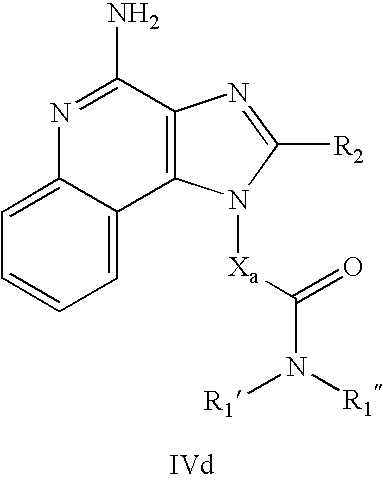


R1′ R1″ Xa R2 hydrogen hydrogen —(CH2)— methyl hydrogen hydrogen —(CH2)— ethyl hydrogen hydrogen —(CH2)— n-propyl hydrogen hydrogen —(CH2)— n-butyl hydrogen hydrogen —(CH2)— ethoxymethyl hydrogen hydrogen —(CH2)— 2-methoxyethyl hydrogen hydrogen —(CH2)2— methyl hydrogen hydrogen —(CH2)2— ethyl hydrogen hydrogen —(CH2)2— n-propyl hydrogen hydrogen —(CH2)2— n-butyl hydrogen hydrogen —(CH2)2— ethoxymethyl hydrogen hydrogen —(CH2)2— 2-methoxyethyl hydrogen hydrogen —(CH2)3— methyl hydrogen hydrogen —(CH2)3— ethyl hydrogen hydrogen —(CH2)3— n-propyl hydrogen hydrogen —(CH2)3— n-butyl hydrogen hydrogen —(CH2)3— ethoxymethyl hydrogen hydrogen —(CH2)3— 2-methoxyethyl hydrogen hydrogen —CH2C(CH3)2— methyl hydrogen hydrogen —CH2C(CH3)2— ethyl hydrogen hydrogen —CH2C(CH3)2— n-propyl hydrogen hydrogen —CH2C(CH3)2— n-butyl hydrogen hydrogen —CH2C(CH3)2— ethoxymethyl hydrogen hydrogen —CH2C(CH3)2— 2-methoxyethyl hydrogen hydrogen —CH2C(CH3)2CH2— methyl hydrogen hydrogen —CH2C(CH3)2CH2— ethyl hydrogen hydrogen —CH2C(CH3)2CH2— n-propyl hydrogen hydrogen —CH2C(CH3)2CH2— n-butyl hydrogen hydrogen —CH2C(CH3)2CH2— ethoxymethyl hydrogen hydrogen —CH2C(CH3)2CH2— 2-methoxyethyl hydrogen methyl —(CH2)— methyl hydrogen methyl —(CH2)— ethyl hydrogen methyl —(CH2)— n-propyl hydrogen methyl —(CH2)— n-butyl hydrogen methyl —(CH2)— ethoxymethyl hydrogen methyl —(CH2)— 2-methoxyethyl hydrogen methyl —(CH2)2— methyl hydrogen methyl —(CH2)2— ethyl hydrogen methyl —(CH2)2— n-propyl hydrogen methyl —(CH2)2— n-butyl hydrogen methyl —(CH2)2— ethoxymethyl hydrogen methyl —(CH2)2— 2-methoxyethyl hydrogen methyl —(CH2)3— methyl hydrogen methyl —(CH2)3— ethyl hydrogen methyl —(CH2)3— n-propyl hydrogen methyl —(CH2)3— n-butyl hydrogen methyl —(CH2)3— ethoxymethyl hydrogen methyl —(CH2)3— 2-methoxyethyl hydrogen methyl —CH2C(CH3)2— methyl hydrogen methyl —CH2C(CH3)2— ethyl hydrogen methyl —CH2C(CH3)2— n-propyl hydrogen methyl —CH2C(CH3)2— n-butyl hydrogen methyl —CH2C(CH3)2— ethoxymethyl hydrogen methyl —CH2C(CH3)2— 2-methoxyethyl hydrogen methyl —CH2C(CH3)2CH2— methyl hydrogen methyl —CH2C(CH3)2CH2— ethyl hydrogen methyl —CH2C(CH3)2CH2— n-propyl hydrogen methyl —CH2C(CH3)2CH2— n-butyl hydrogen methyl —CH2C(CH3)2CH2— ethoxymethyl hydrogen methyl —CH2C(CH3)2CH2— 2-methoxyethyl methyl methyl —(CH2)— methyl methyl methyl —(CH2)— ethyl methyl methyl —(CH2)— n-propyl methyl methyl —(CH2)— n-butyl methyl methyl —(CH2)— ethoxymethyl methyl methyl —(CH2)— 2-methoxyethyl methyl methyl —(CH2)2— methyl methyl methyl —(CH2)2— ethyl methyl methyl —(CH2)2— n-propyl methyl methyl —(CH2)2— n-butyl methyl methyl —(CH2)2— ethoxymethyl methyl methyl —(CH2)2— 2-methoxyethyl methyl methyl —(CH2)3— methyl methyl methyl —(CH2)3— ethyl methyl methyl —(CH2)3— n-propyl methyl methyl —(CH2)3— n-butyl methyl methyl —(CH2)3— ethoxymethyl methyl methyl —(CH2)3— 2-methoxyethyl methyl methyl —CH2C(CH3)2— methyl methyl methyl —CH2C(CH3)2— ethyl methyl methyl —CH2C(CH3)2— n-propyl methyl methyl —CH2C(CH3)2— n-butyl methyl methyl —CH2C(CH3)2— ethoxymethyl methyl methyl —CH2C(CH3)2— 2-methoxyethyl methyl methyl —CH2C(CH3)2CH2— methyl methyl methyl —CH2C(CH3)2CH2— ethyl methyl methyl —CH2C(CH3)2CH2— n-propyl methyl methyl —CH2C(CH3)2CH2— n-butyl methyl methyl —CH2C(CH3)2CH2— ethoxymethyl methyl methyl —CH2C(CH3)2CH2— 2-methoxyethyl ethyl hydrogen —(CH2)— methyl ethyl hydrogen —(CH2)— ethyl ethyl hydrogen —(CH2)— n-propyl ethyl hydrogen —(CH2)— n-butyl ethyl hydrogen —(CH2)— ethoxymethyl ethyl hydrogen —(CH2)— 2-methoxyethyl ethyl hydrogen —(CH2)2— methyl ethyl hydrogen —(CH2)2— ethyl ethyl hydrogen —(CH2)2— n-propyl ethyl hydrogen —(CH2)2— n-butyl ethyl hydrogen —(CH2)2— ethoxymethyl ethyl hydrogen —(CH2)2— 2-methoxyethyl ethyl hydrogen —(CH2)3— methyl ethyl hydrogen —(CH2)3— ethyl ethyl hydrogen —(CH2)3— n-propyl ethyl hydrogen —(CH2)3— n-butyl ethyl hydrogen —(CH2)3— ethoxymethyl ethyl hydrogen —(CH2)3— 2-methoxyethyl ethyl hydrogen —CH2C(CH3)2— methyl ethyl hydrogen —CH2C(CH3)2— ethyl ethyl hydrogen —CH2C(CH3)2— n-propyl ethyl hydrogen —CH2C(CH3)2— n-butyl ethyl hydrogen —CH2C(CH3)2— ethoxymethyl ethyl hydrogen —CH2C(CH3)2— 2-methoxyethyl ethyl hydrogen —CH2C(CH3)2CH2— methyl ethyl hydrogen —CH2C(CH3)2CH2— ethyl ethyl hydrogen —CH2C(CH3)2CH2— n-propyl ethyl hydrogen —CH2C(CH3)2CH2— n-butyl ethyl hydrogen —CH2C(CH3)2CH2— ethoxymethyl ethyl hydrogen —CH2C(CH3)2CH2— 2-methoxyethyl ethyl methyl —(CH2)— methyl ethyl methyl —(CH2)— ethyl ethyl methyl —(CH2)— n-propyl ethyl methyl —(CH2)— n-butyl ethyl methyl —(CH2)— ethoxymethyl ethyl methyl —(CH2)— 2-methoxyethyl ethyl methyl —(CH2)2— methyl ethyl methyl —(CH2)2— ethyl ethyl methyl —(CH2)2— n-propyl ethyl methyl —(CH2)2— n-butyl ethyl methyl —(CH2)2— ethoxymethyl ethyl methyl —(CH2)2— 2-methoxyethyl ethyl methyl —(CH2)3— methyl ethyl methyl —(CH2)3— ethyl ethyl methyl —(CH2)3— n-propyl ethyl methyl —(CH2)3— n-butyl ethyl methyl —(CH2)3— ethoxymethyl ethyl methyl —(CH2)3— 2-methoxyethyl ethyl methyl —CH2C(CH3)2— methyl ethyl methyl —CH2C(CH3)2— ethyl ethyl methyl —CH2C(CH3)2— n-propyl ethyl methyl —CH2C(CH3)2— n-butyl ethyl methyl —CH2C(CH3)2— ethoxymethyl ethyl methyl —CH2C(CH3)2— 2-methoxyethyl ethyl methyl —CH2C(CH3)2CH2— methyl ethyl methyl —CH2C(CH3)2CH2— ethyl ethyl methyl —CH2C(CH3)2CH2— n-propyl ethyl methyl —CH2C(CH3)2CH2— n-butyl ethyl methyl —CH2C(CH3)2CH2— ethoxymethyl ethyl methyl —CH2C(CH3)2CH2— 2-methoxyethyl n-propyl hydrogen —(CH2)— methyl n-propyl hydrogen —(CH2)— ethyl n-propyl hydrogen —(CH2)— n-propyl n-propyl hydrogen —(CH2)— n-butyl n-propyl hydrogen —(CH2)— ethoxymethyl n-propyl hydrogen —(CH2)— 2-methoxyethyl n-propyl hydrogen —(CH2)2— methyl n-propyl hydrogen —(CH2)2— ethyl n-propyl hydrogen —(CH2)2— n-propyl n-propyl hydrogen —(CH2)2— n-butyl n-propyl hydrogen —(CH2)2— ethoxymethyl n-propyl hydrogen —(CH2)2— 2-methoxyethyl n-propyl hydrogen —(CH2)3— methyl n-propyl hydrogen —(CH2)3— ethyl n-propyl hydrogen —(CH2)3— n-propyl n-propyl hydrogen —(CH2)3— n-butyl n-propyl hydrogen —(CH2)3— ethoxymethyl n-propyl hydrogen —(CH2)3— 2-methoxyethyl n-propyl hydrogen —CH2C(CH3)2— methyl n-propyl hydrogen —CH2C(CH3)2— ethyl n-propyl hydrogen —CH2C(CH3)2— n-propyl n-propyl hydrogen —CH2C(CH3)2— n-butyl n-propyl hydrogen —CH2C(CH3)2— ethoxymethyl n-propyl hydrogen —CH2C(CH3)2— 2-methoxyethyl n-propyl hydrogen —CH2C(CH3)2CH2— methyl n-propyl hydrogen —CH2C(CH3)2CH2— ethyl n-propyl hydrogen —CH2C(CH3)2CH2— n-propyl n-propyl hydrogen —CH2C(CH3)2CH2— n-butyl n-propyl hydrogen —CH2C(CH3)2CH2— ethoxymethyl n-propyl hydrogen —CH2C(CH3)2CH2— 2-methoxyethyl n-propyl methyl —(CH2)— methyl n-propyl methyl —(CH2)— ethyl n-propyl methyl —(CH2)— n-propyl n-propyl methyl —(CH2)— n-butyl n-propyl methyl —(CH2)— ethoxymethyl n-propyl methyl —(CH2)— 2-methoxyethyl n-propyl methyl —(CH2)2— methyl n-propyl methyl —(CH2)2— ethyl n-propyl methyl —(CH2)2— n-propyl n-propyl methyl —(CH2)2— n-butyl n-propyl methyl —(CH2)2— ethoxymethyl n-propyl methyl —(CH2)2— 2-methoxyethyl n-propyl methyl —(CH2)3— methyl n-propyl methyl —(CH2)3— ethyl n-propyl methyl —(CH2)3— n-propyl n-propyl methyl —(CH2)3— n-butyl n-propyl methyl —(CH2)3— ethoxymethyl n-propyl methyl —(CH2)3— 2-methoxyethyl n-propyl methyl —CH2C(CH3)2— methyl n-propyl methyl —CH2C(CH3)2— ethyl n-propyl methyl —CH2C(CH3)2— n-propyl n-propyl methyl —CH2C(CH3)2— n-butyl n-propyl methyl —CH2C(CH3)2— ethoxymethyl n-propyl methyl —CH2C(CH3)2— 2-methoxyethyl n-propyl methyl —CH2C(CH3)2CH2— methyl n-propyl methyl —CH2C(CH3)2CH2— ethyl n-propyl methyl —CH2C(CH3)2CH2— n-propyl n-propyl methyl —CH2C(CH3)2CH2— n-butyl n-propyl methyl —CH2C(CH3)2CH2— ethoxymethyl n-propyl methyl —CH2C(CH3)2CH2— 2-methoxyethyl n-butyl hydrogen —(CH2)— methyl n-butyl hydrogen —(CH2)— ethyl n-butyl hydrogen —(CH2)— n-propyl n-butyl hydrogen —(CH2)— n-butyl n-butyl hydrogen —(CH2)— ethoxymethyl n-butyl hydrogen —(CH2)— 2-methoxyethyl n-butyl hydrogen —(CH2)2— methyl n-butyl hydrogen —(CH2)2— ethyl n-butyl hydrogen —(CH2)2— n-propyl n-butyl hydrogen —(CH2)2— n-butyl n-butyl hydrogen —(CH2)2— ethoxymethyl n-butyl hydrogen —(CH2)2— 2-methoxyethyl n-butyl hydrogen —(CH2)3— methyl n-butyl hydrogen —(CH2)3— ethyl n-butyl hydrogen —(CH2)3— n-propyl n-butyl hydrogen —(CH2)3— n-butyl n-butyl hydrogen —(CH2)3— ethoxymethyl n-butyl hydrogen —(CH2)3— 2-methoxyethyl n-butyl hydrogen —CH2C(CH3)2— methyl n-butyl hydrogen —CH2C(CH3)2— ethyl n-butyl hydrogen —CH2C(CH3)2— n-propyl n-butyl hydrogen —CH2C(CH3)2— n-butyl n-butyl hydrogen —CH2C(CH3)2— ethoxymethyl n-butyl hydrogen —CH2C(CH3)2— 2-methoxyethyl n-butyl hydrogen —CH2C(CH3)2CH2— methyl n-butyl hydrogen —CH2C(CH3)2CH2— ethyl n-butyl hydrogen —CH2C(CH3)2CH2— n-propyl n-butyl hydrogen —CH2C(CH3)2CH2— n-butyl n-butyl hydrogen —CH2C(CH3)2CH2— ethoxymethyl n-butyl hydrogen —CH2C(CH3)2CH2— 2-methoxyethyl n-butyl methyl —(CH2)— methyl n-butyl methyl —(CH2)— ethyl n-butyl methyl —(CH2)— n-propyl n-butyl methyl —(CH2)— n-butyl n-butyl methyl —(CH2)— ethoxymethyl n-butyl methyl —(CH2)— 2-methoxyethyl n-butyl methyl —(CH2)2— methyl n-butyl methyl —(CH2)2— ethyl n-butyl methyl —(CH2)2— n-propyl n-butyl methyl —(CH2)2— n-butyl n-butyl methyl —(CH2)2— ethoxymethyl n-butyl methyl —(CH2)2— 2-methoxyethyl n-butyl methyl —(CH2)3— methyl n-butyl methyl —(CH2)3— ethyl n-butyl methyl —(CH2)3— n-propyl n-butyl methyl —(CH2)3— n-butyl n-butyl methyl —(CH2)3— ethoxymethyl n-butyl methyl —(CH2)3— 2-methoxyethyl n-butyl methyl —CH2C(CH3)2— methyl n-butyl methyl —CH2C(CH3)2— ethyl n-butyl methyl —CH2C(CH3)2— n-propyl n-butyl methyl —CH2C(CH3)2— n-butyl n-butyl methyl —CH2C(CH3)2— ethoxymethyl n-butyl methyl —CH2C(CH3)2— 2-methoxyethyl n-butyl methyl —CH2C(CH3)2CH2— methyl n-butyl methyl —CH2C(CH3)2CH2— ethyl n-butyl methyl —CH2C(CH3)2CH2— n-propyl n-butyl methyl —CH2C(CH3)2CH2— n-butyl n-butyl methyl —CH2C(CH3)2CH2— ethoxymethyl n-butyl methyl —CH2C(CH3)2CH2— 2-methoxyethyl phenyl hydrogen —(CH2)— methyl phenyl hydrogen —(CH2)— ethyl phenyl hydrogen —(CH2)— n-propyl phenyl hydrogen —(CH2)— n-butyl phenyl hydrogen —(CH2)— ethoxymethyl phenyl hydrogen —(CH2)— 2-methoxyethyl phenyl hydrogen —(CH2)2— methyl phenyl hydrogen —(CH2)2— ethyl phenyl hydrogen —(CH2)2— n-propyl phenyl hydrogen —(CH2)2— n-butyl phenyl hydrogen —(CH2)2— ethoxymethyl phenyl hydrogen —(CH2)2— 2-methoxyethyl phenyl hydrogen —(CH2)3— methyl phenyl hydrogen —(CH2)3— ethyl phenyl hydrogen —(CH2)3— n-propyl phenyl hydrogen —(CH2)3— n-butyl phenyl hydrogen —(CH2)3— ethoxymethyl phenyl hydrogen —(CH2)3— 2-methoxyethyl phenyl hydrogen —CH2C(CH3)2— methyl phenyl hydrogen —CH2C(CH3)2— ethyl phenyl hydrogen —CH2C(CH3)2— n-propyl phenyl hydrogen —CH2C(CH3)2— n-butyl phenyl hydrogen —CH2C(CH3)2— ethoxymethyl phenyl hydrogen —CH2C(CH3)2— 2-methoxyethyl phenyl hydrogen —CH2C(CH3)2CH2— methyl phenyl hydrogen —CH2C(CH3)2CH2— ethyl phenyl hydrogen —CH2C(CH3)2CH2— n-propyl phenyl hydrogen —CH2C(CH3)2CH2— n-butyl phenyl hydrogen —CH2C(CH3)2CH2— ethoxymethyl phenyl hydrogen —CH2C(CH3)2CH2— 2-methoxyethyl phenyl methyl —(CH2)— methyl phenyl methyl —(CH2)— ethyl phenyl methyl —(CH2)— n-propyl phenyl methyl —(CH2)— n-butyl phenyl methyl —(CH2)— ethoxymethyl phenyl methyl —(CH2)— 2-methoxyethyl phenyl methyl —(CH2)2— methyl phenyl methyl —(CH2)2— ethyl phenyl methyl —(CH2)2— n-propyl phenyl methyl —(CH2)2— n-butyl phenyl methyl —(CH2)2— ethoxymethyl phenyl methyl —(CH2)2— 2-methoxyethyl phenyl methyl —(CH2)3— methyl phenyl methyl —(CH2)3— ethyl phenyl methyl —(CH2)3— n-propyl phenyl methyl —(CH2)3— n-butyl phenyl methyl —(CH2)3— ethoxymethyl phenyl methyl —(CH2)3— 2-methoxyethyl phenyl methyl —CH2C(CH3)2— methyl phenyl methyl —CH2C(CH3)2— ethyl phenyl methyl —CH2C(CH3)2— n-propyl phenyl methyl —CH2C(CH3)2— n-butyl phenyl methyl —CH2C(CH3)2— ethoxymethyl phenyl methyl —CH2C(CH3)2— 2-methoxyethyl phenyl methyl —CH2C(CH3)2CH2— methyl phenyl methyl —CH2C(CH3)2CH2— ethyl phenyl methyl —CH2C(CH3)2CH2— n-propyl phenyl methyl —CH2C(CH3)2CH2— n-butyl phenyl methyl —CH2C(CH3)2CH2— ethoxymethyl phenyl methyl —CH2C(CH3)2CH2— 2-methoxyethyl - Certain exemplary compounds, including some of those described above in the Examples, have the following Formulas (IIIb, IVe, Vd, or VIc) and the following

- X″, and R2 substituents, wherein each line of the table is matched with Formula IIIb, IVe, Vd, or VIc to represent a specific embodiment of the invention.
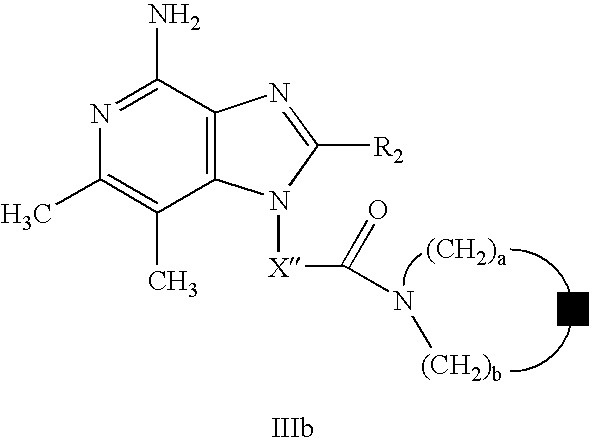


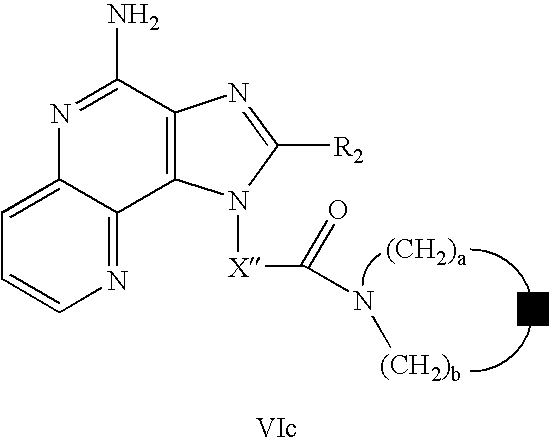

X″ R2 pyrrolidin-1-yl —(CH2)— methyl pyrrolidin-1-yl —(CH2)— ethyl pyrrolidin-1-yl —(CH2)— n-propyl pyrrolidin-1-yl —(CH2)— n-butyl pyrrolidin-1-yl —(CH2)— ethoxymethyl pyrrolidin-1-yl —(CH2)— 2-methoxyethyl pyrrolidin-1-yl —(CH2)2— methyl pyrrolidin-1-yl —(CH2)2— ethyl pyrrolidin-1-yl —(CH2)2— n-propyl pyrrolidin-1-yl —(CH2)2— n-butyl pyrrolidin-1-yl —(CH2)2— ethoxymethyl pyrrolidin-1-yl —(CH2)2— 2-methoxyethyl pyrrolidin-1-yl —(CH2)3— methyl pyrrolidin-1-yl —(CH2)3— ethyl pyrrolidin-1-yl —(CH2)3— n-propyl pyrrolidin-1-yl —(CH2)3— n-butyl pyrrolidin-1-yl —(CH2)3— ethoxymethyl pyrrolidin-1-yl —(CH2)3— 2-methoxyethyl pyrrolidin-1-yl —CH2C(CH3)2— methyl pyrrolidin-1-yl —CH2C(CH3)2— ethyl pyrrolidin-1-yl —CH2C(CH3)2— n-propyl pyrrolidin-1-yl —CH2C(CH3)2— n-butyl pyrrolidin-1-yl —CH2C(CH3)2— ethoxymethyl pyrrolidin-1-yl —CH2C(CH3)2— 2-methoxyethyl pyrrolidin-1-yl —CH2C(CH3)2CH2— methyl pyrrolidin-1-yl —CH2C(CH3)2CH2— ethyl pyrrolidin-1-yl —CH2C(CH3)2CH2— n-propyl pyrrolidin-1-yl —CH2C(CH3)2CH2— n-butyl pyrrolidin-1-yl —CH2C(CH3)2CH2— ethoxymethyl pyrrolidin-1-yl —CH2C(CH3)2CH2— 2-methoxyethyl piperidin-1-yl —(CH2)— methyl piperidin-1-yl —(CH2)— ethyl piperidin-1-yl —(CH2)— n-propyl piperidin-1-yl —(CH2)— n-butyl piperidin-1-yl —(CH2)— ethoxymethyl piperidin-1-yl —(CH2)— 2-methoxyethyl piperidin-1-yl —(CH2)2— methyl piperidin-1-yl —(CH2)2— ethyl piperidin-1-yl —(CH2)2— n-propyl piperidin-1-yl —(CH2)2— n-butyl piperidin-1-yl —(CH2)2— ethoxymethyl piperidin-1-yl —(CH2)2— 2-methoxyethyl piperidin-1-yl —(CH2)3— methyl piperidin-1-yl —(CH2)3— ethyl piperidin-1-yl —(CH2)3— n-propyl piperidin-1-yl —(CH2)3— n-butyl piperidin-1-yl —(CH2)3— ethoxymethyl piperidin-1-yl —(CH2)3— 2-methoxyethyl piperidin-1-yl —CH2C(CH3)2— methyl piperidin-1-yl —CH2C(CH3)2— ethyl piperidin-1-yl —CH2C(CH3)2— n-propyl piperidin-1-yl —CH2C(CH3)2— n-butyl piperidin-1-yl —CH2C(CH3)2— ethoxymethyl piperidin-1-yl —CH2C(CH3)2— 2-methoxyethyl piperidin-1-yl —CH2C(CH3)2CH2— methyl piperidin-1-yl —CH2C(CH3)2CH2— ethyl piperidin-1-yl —CH2C(CH3)2CH2— n-propyl piperidin-1-yl —CH2C(CH3)2CH2— n-butyl piperidin-1-yl —CH2C(CH3)2CH2— ethoxymethyl piperidin-1-yl —CH2C(CH3)2CH2— 2-methoxyethyl 4-acetylpiperazin-1-yl —(CH2)— methyl 4-acetylpiperazin-1-yl —(CH2)— ethyl 4-acetylpiperazin-1-yl —(CH2)— n-propyl 4-acetylpiperazin-1-yl —(CH2)— n-butyl 4-acetylpiperazin-1-yl —(CH2)— ethoxymethyl 4-acetylpiperazin-1-yl —(CH2)— 2-methoxyethyl 4-acetylpiperazin-1-yl —(CH2)2— methyl 4-acetylpiperazin-1-yl —(CH2)2— ethyl 4-acetylpiperazin-1-yl —(CH2)2— n-propyl 4-acetylpiperazin-1-yl —(CH2)2— n-butyl 4-acetylpiperazin-1-yl —(CH2)2— ethoxymethyl 4-acetylpiperazin-1-yl —(CH2)2— 2-methoxyethyl 4-acetylpiperazin-1-yl —(CH2)3— methyl 4-acetylpiperazin-1-yl —(CH2)3— ethyl 4-acetylpiperazin-1-yl —(CH2)3— n-propyl 4-acetylpiperazin-1-yl —(CH2)3— n-butyl 4-acetylpiperazin-1-yl —(CH2)3— ethoxymethyl 4-acetylpiperazin-1-yl —(CH2)3— 2-methoxyethyl 4-acetylpiperazin-1-yl —CH2C(CH3)2— methyl 4-acetylpiperazin-1-yl —CH2C(CH3)2— ethyl 4-acetylpiperazin-1-yl —CH2C(CH3)2— n-propyl 4-acetylpiperazin-1-yl —CH2C(CH3)2— n-butyl 4-acetylpiperazin-1-yl —CH2C(CH3)2— ethoxymethyl 4-acetylpiperazin-1-yl —CH2C(CH3)2— 2-methoxyethyl 4-acetylpiperazin-1-yl —CH2C(CH3)2CH2— methyl 4-acetylpiperazin-1-yl —CH2C(CH3)2CH2— ethyl 4-acetylpiperazin-1-yl —CH2C(CH3)2CH2— n-propyl 4-acetylpiperazin-1-yl —CH2C(CH3)2CH2— n-butyl 4-acetylpiperazin-1-yl —CH2C(CH3)2CH2— ethoxymethyl 4-acetylpiperazin-1-yl —CH2C(CH3)2CH2— 2-methoxyethyl morpholin-4-yl —(CH2)— methyl morpholin-4-yl —(CH2)— ethyl morpholin-4-yl —(CH2)— n-propyl morpholin-4-yl —(CH2)— n-butyl morpholin-4-yl —(CH2)— ethoxymethyl morpholin-4-yl —(CH2)— 2-methoxyethyl morpholin-4-yl —(CH2)2— methyl morpholin-4-yl —(CH2)2— ethyl morpholin-4-yl —(CH2)2— n-propyl morpholin-4-yl —(CH2)2— n-butyl morpholin-4-yl —(CH2)2— ethoxymethyl morpholin-4-yl —(CH2)2— 2-methoxyethyl morpholin-4-yl —(CH2)3— methyl morpholin-4-yl —(CH2)3— ethyl morpholin-4-yl —(CH2)3— n-propyl morpholin-4-yl —(CH2)3— n-butyl morpholin-4-yl —(CH2)3— ethoxymethyl morpholin-4-yl —(CH2)3— 2-methoxyethyl morpholin-4-yl —CH2C(CH3)2— methyl morpholin-4-yl —CH2C(CH3)2— ethyl morpholin-4-yl —CH2C(CH3)2— n-propyl morpholin-4-yl —CH2C(CH3)2— n-butyl morpholin-4-yl —CH2C(CH3)2— ethoxymethyl morpholin-4-yl —CH2C(CH3)2— 2-methoxyethyl morpholin-4-yl —CH2C(CH3)2CH2— methyl morpholin-4-yl —CH2C(CH3)2CH2— ethyl morpholin-4-yl —CH2C(CH3)2CH2— n-propyl morpholin-4-yl —CH2C(CH3)2CH2— n-butyl morpholin-4-yl —CH2C(CH3)2CH2— ethoxymethyl morpholin-4-yl —CH2C(CH3)2CH2— 2-methoxyethyl 1,1-dioxothiomorpholin-4-yl —(CH2)— methyl 1,1-dioxothiomorpholin-4-yl —(CH2)— ethyl 1,1-dioxothiomorpholin-4-yl —(CH2)— n-propyl 1,1-dioxothiomorpholin-4-yl —(CH2)— n-butyl 1,1-dioxothiomorpholin-4-yl —(CH2)— ethoxymethyl 1,1-dioxothiomorpholin-4-yl —(CH2)— 2-methoxyethyl 1,1-dioxothiomorpholin-4-yl —(CH2)2— methyl 1,1-dioxothiomorpholin-4-yl —(CH2)2— ethyl 1,1-dioxothiomorpholin-4-yl —(CH2)2— n-propyl 1,1-dioxothiomorpholin-4-yl —(CH2)2— n-butyl 1,1-dioxothiomorpholin-4-yl —(CH2)2— ethoxymethyl 1,1-dioxothiomorpholin-4-yl —(CH2)2— 2-methoxyethyl 1,1-dioxothiomorpholin-4-yl —(CH2)3— methyl 1,1-dioxothiomorpholin-4-yl —(CH2)3— ethyl 1,1-dioxothiomorpholin-4-yl —(CH2)3— n-propyl 1,1-dioxothiomorpholin-4-yl —(CH2)3— n-butyl 1,1-dioxothiomorpholin-4-yl —(CH2)3— ethoxymethyl 1,1-dioxothiomorpholin-4-yl —(CH2)3— 2-methoxyethyl 1,1-dioxothiomorpholin-4-yl —CH2C(CH3)2— methyl 1,1-dioxothiomorpholin-4-yl —CH2C(CH3)2— ethyl 1,1-dioxothiomorpholin-4-yl —CH2C(CH3)2— n-propyl 1,1-dioxothiomorpholin-4-yl —CH2C(CH3)2— n-butyl 1,1-dioxothiomorpholin-4-yl —CH2C(CH3)2— ethoxymethyl 1,1-dioxothiomorpholin-4-yl —CH2C(CH3)2— 2-methoxyethyl 1,1-dioxothiomorpholin-4-yl —CH2C(CH3)2CH2— methyl 1,1-dioxothiomorpholin-4-yl —CH2C(CH3)2CH2— ethyl 1,1-dioxothiomorpholin-4-yl —CH2C(CH3)2CH2— n-propyl 1,1-dioxothiomorpholin-4-yl —CH2C(CH3)2CH2— n-butyl 1,1-dioxothiomorpholin-4-yl —CH2C(CH3)2CH2— ethoxymethyl 1,1-dioxothiomorpholin-4-yl —CH2C(CH3)2CH2— 2-methoxyethyl - An in vitro human blood cell system is used to assess cytokine induction. Activity is based on the measurement of interferon (α) and tumor necrosis factor (α) (IFN-α and TNF-α, respectively) secreted into culture media as described by Testerman et. al. in “Cytokine Induction by the Immunomodulators Imiquimod and S-27609”, Journal of Leukocyte Biology, 58, 365-372 (September, 1995).
- Blood Cell Preparation for Culture
- Whole blood from healthy human donors is collected by venipuncture into vacutainer tubes or syringes containing EDTA. Peripheral blood mononuclear cells (PBMC) are separated from whole blood by density gradient centrifugation using HISTOPAQUE-1077 (Sigma, St. Louis, Mo.) or Ficoll-Paque Plus (Amersham Biosciences Piscataway, N.J.). Blood is diluted 1:1 with Dulbecco's Phosphate Buffered Saline (DPBS) or Hank's Balanced Salts Solution (HBSS). Alternately, whole blood is placed in Accuspin (Sigma) or LeucoSep (Greiner Bio-One, Inc., Longwood, Fla.) centrifuge frit tubes containing density gradient medium. The PBMC layer is collected and washed twice with DPBS or HBSS and re-suspended at 4×10⁶ cells/mL in RPMI complete. The PBMC suspension is added to 96 well flat bottom sterile tissue culture plates containing an equal volume of RPMI complete media containing test compound.
- Compound Preparation
- The compounds are solubilized in dimethyl sulfoxide (DMSO). The DMSO concentration should not exceed a final concentration of 1% for addition to the culture wells. The compounds are generally tested at concentrations ranging from 30-0.014 μM. Controls include cell samples with media only, cell samples with DMSO only (no compound), and cell samples with reference compound.
- Incubation
- The solution of test compound is added at 60 μM to the first well containing RPMI complete and serial 3 fold dilutions are made in the wells. The PBMC suspension is then added to the wells in an equal volume, bringing the test compound concentrations to the desired range (usually 30-0.014 μM). The final concentration of PBMC suspension is 2×10⁶ cells/mL. The plates are covered with sterile plastic lids, mixed gently and then incubated for 18 to 24 hours at 37° C. in a 5% carbon dioxide atmosphere.
- Separation
- Following incubation the plates are centrifuged for 10 minutes at 1000 rpm (approximately 200×g) at 4° C. The cell-free culture supernatant is removed and transferred to sterile polypropylene tubes. Samples are maintained at −30 to −70° C. until analysis. The samples are analyzed for IFN-α by ELISA and for TNF-α by IGEN/BioVeris Assay.
- Interferon (α) and Tumor Necrosis Factor (α) Analysis
- IFN-α concentration is determined with a human multi-subtype calorimetric sandwich ELISA (Catalog Number 41105) from PBL Biomedical Laboratories, Piscataway, N.J. Results are expressed in pg/mL.
- The TNF-α concentration is determined by ORIGEN M-Series Immunoassay and read on an IGEN M-8 analyzer from BioVeris Corporation, formerly known as IGEN International, Gaithersburg, Md. The inmmunoassay uses a human TNF-α capture and detection antibody pair (Catalog Numbers AHC3419 and AHC3712) from Biosource International, Camarillo, Calif. Results are expressed in pg/mL.
- Assay Data and Analysis
- In total, the data output of the assay consists of concentration values of TNF-α and IFN-α (y-axis) as a function of compound concentration (x-axis).
- Analysis of the data has two steps. First, the greater of the mean DMSO (DMSO control wells) or the experimental background (usually 20 pg/mL for IFN-α and 40 pg/mL for TNF-α) is subtracted from each reading. If any negative values result from background subtraction, the reading is reported as “*”, and is noted as not reliably detectable. In subsequent calculations and statistics, “*”, is treated as a zero. Second, all background subtracted values are multiplied by a single adjustment ratio to decrease experiment to experiment variability. The adjustment ratio is the area of the reference compound in the new experiment divided by the expected area of the reference compound based on the past 61 experiments (unadjusted readings). This results in the scaling of the reading (y-axis) for the new data without changing the shape of the dose-response curve. The reference compound used is 2-[4-amino-2-ethoxymethyl-6,7,8,9-tetrahydro-α,α-dimethyl-1H-imidazo[4,5-c]quinolin-1-yl]ethanol hydrate (U.S. Pat. No. 5,352,784; Example 91) and the expected area is the sum of the median dose values from the past 61 experiments.
- The minimum effective concentration is calculated based on the background-subtracted, reference-adjusted results for a given experiment and compound. The minimum effective concentration (molar) is the lowest of the tested compound concentrations that induces a response over a fixed cytokine concentration for the tested cytokine (usually 20 pg/mL for IFN-α and 40 pg/mL for TNF-α). The maximal response (pg/mL) is the maximal response attained in the dose response curve.
- The complete disclosures of the patents, patent documents, and publications cited herein are incorporated by reference in their entirety as if each were individually incorporated. Various modifications and alterations to this invention will become apparent to those skilled in the art without departing from the scope and spirit of this invention. It should be understood that this invention is not intended to be unduly limited by the illustrative embodiments and examples set forth herein and that such examples and embodiments are presented by way of example only with the scope of the invention intended to be limited only by the claims set forth herein as follows.
Claims (92)
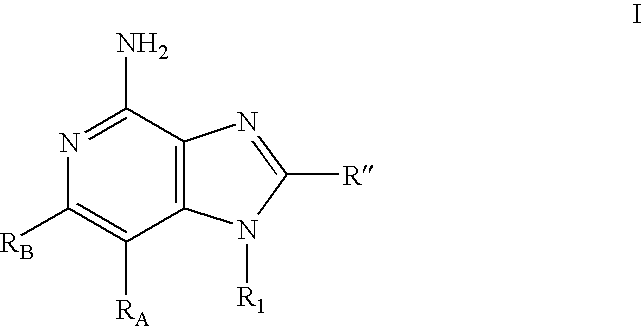

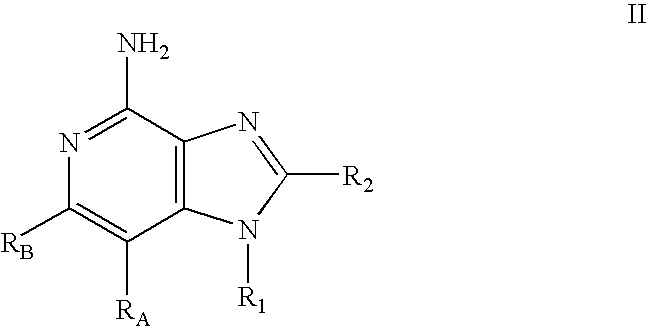


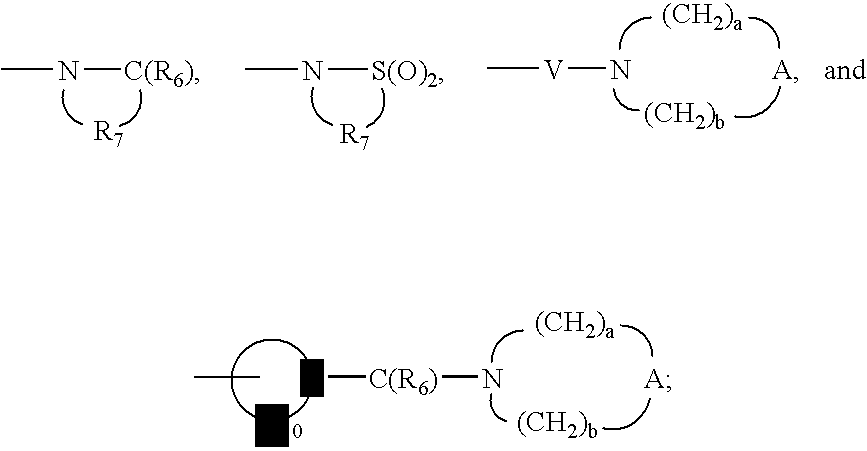

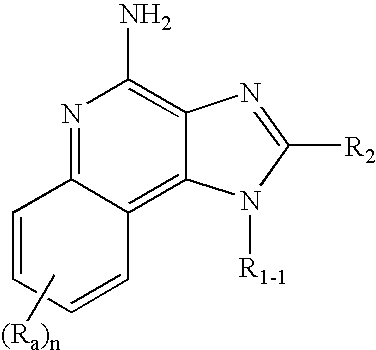


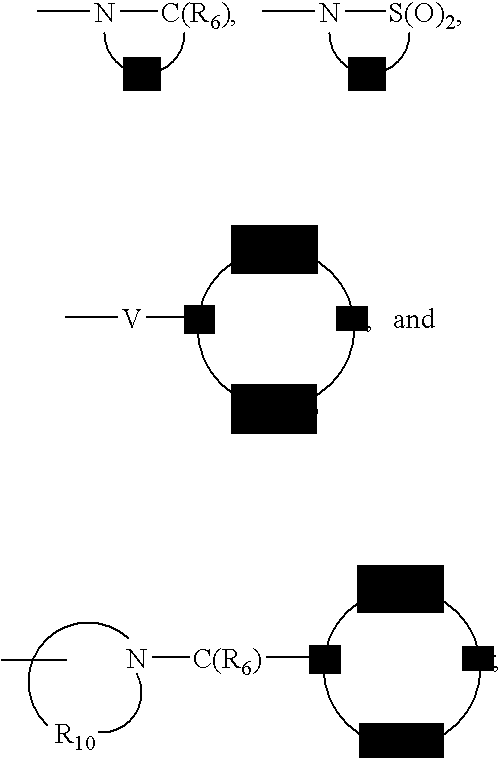


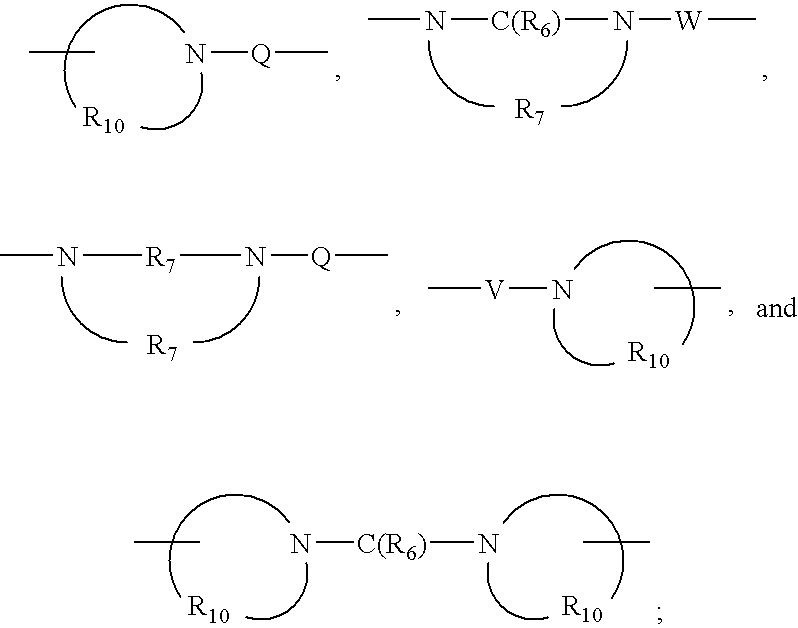

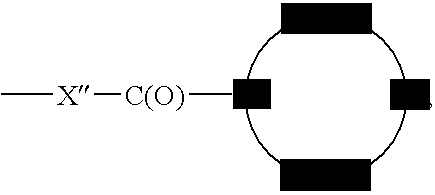
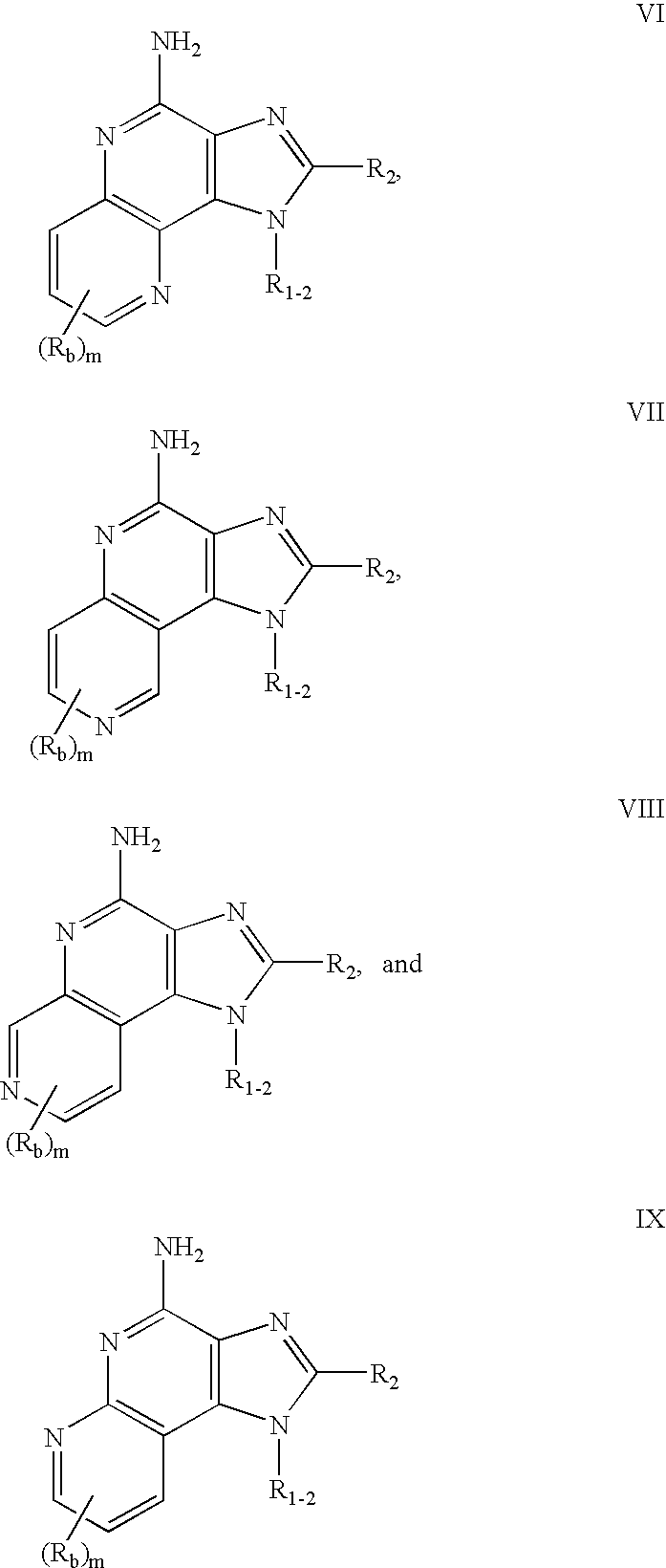

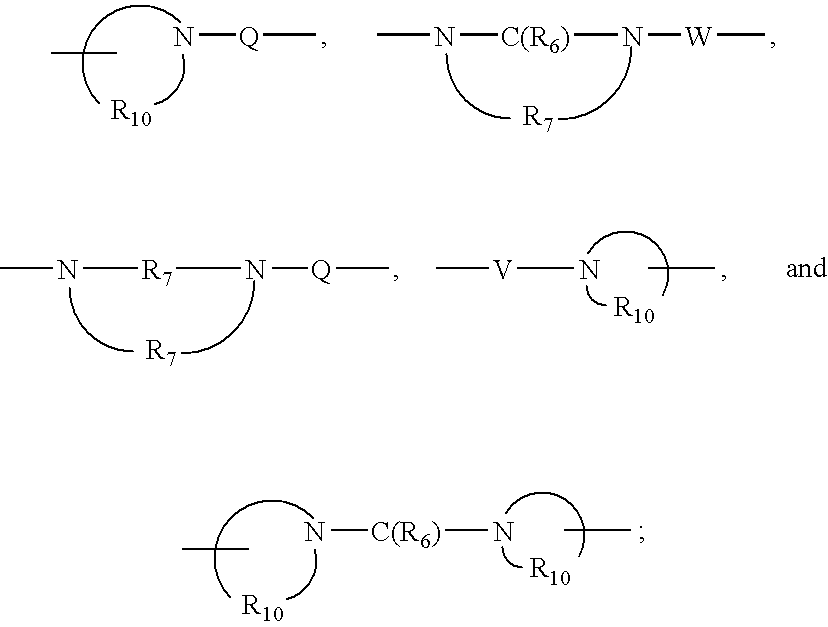


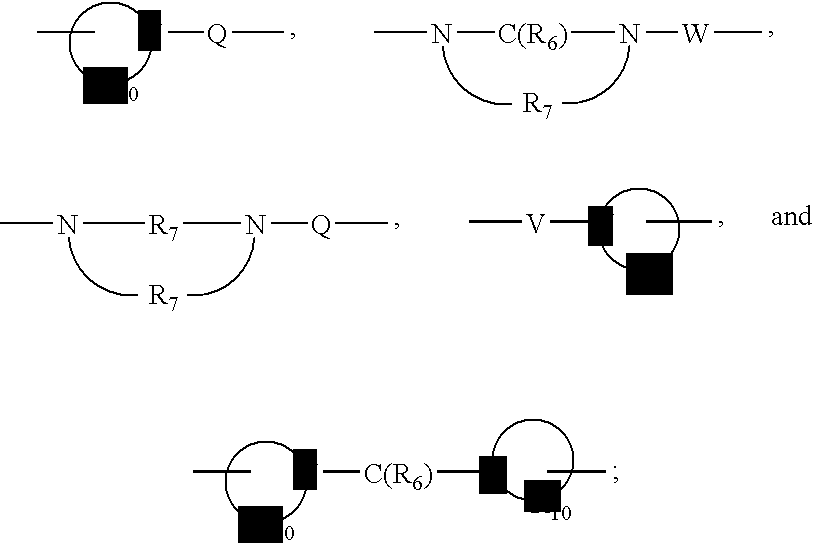


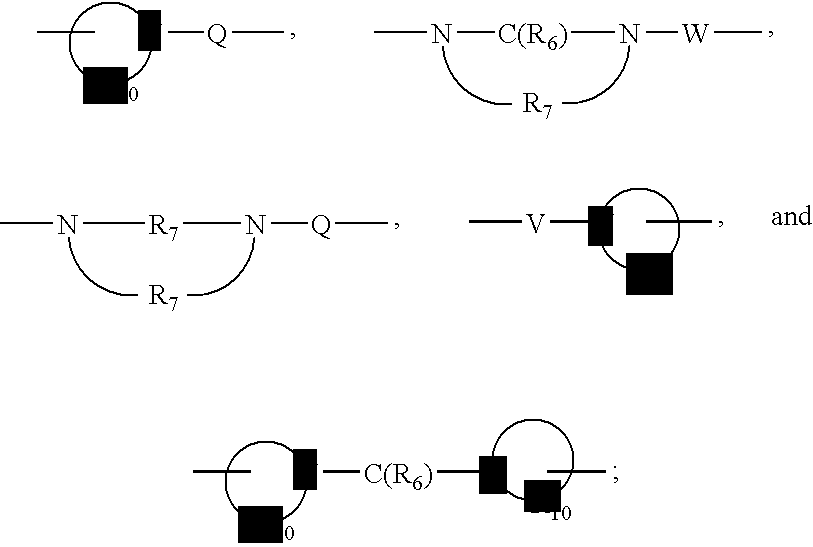

Priority Applications (1)
| Application Number | Priority Date | Filing Date | Title |
|---|---|---|---|
| US10/599,159 US8697873B2 (en) | 2004-03-24 | 2005-03-24 | Amide substituted imidazopyridines, imidazoquinolines, and imidazonaphthyridines |
Applications Claiming Priority (4)
| Application Number | Priority Date | Filing Date | Title |
|---|---|---|---|
| US55575304P | 2004-03-24 | 2004-03-24 | |
| US57876904P | 2004-06-10 | 2004-06-10 | |
| PCT/US2005/009880 WO2005094531A2 (en) | 2004-03-24 | 2005-03-24 | Amide substituted imidazopyridines, imidazoquinolines, and imidazonaphthyridines |
| US10/599,159 US8697873B2 (en) | 2004-03-24 | 2005-03-24 | Amide substituted imidazopyridines, imidazoquinolines, and imidazonaphthyridines |
Publications (2)
| Publication Number | Publication Date |
|---|---|
| US20070219196A1 true US20070219196A1 (en) | 2007-09-20 |
| US8697873B2 US8697873B2 (en) | 2014-04-15 |
Family
ID=35064419
Family Applications (1)
| Application Number | Title | Priority Date | Filing Date |
|---|---|---|---|
| US10/599,159 Active 2030-06-16 US8697873B2 (en) | 2004-03-24 | 2005-03-24 | Amide substituted imidazopyridines, imidazoquinolines, and imidazonaphthyridines |
Country Status (7)
| Country | Link |
|---|---|
| US (1) | US8697873B2 (en) |
| EP (1) | EP1730143A2 (en) |
| AR (1) | AR049331A1 (en) |
| AU (1) | AU2005228150A1 (en) |
| CA (1) | CA2559863A1 (en) |
| TW (1) | TW200612932A (en) |
| WO (1) | WO2005094531A2 (en) |
Cited By (41)
| Publication number | Priority date | Publication date | Assignee | Title |
|---|---|---|---|---|
| US20080176861A1 (en) * | 2007-01-23 | 2008-07-24 | Kalypsys, Inc. | Sulfonyl-substituted bicyclic compounds as ppar modulators for the treatment of non-alcoholic steatohepatitis |
| US20090240055A1 (en) * | 2005-09-23 | 2009-09-24 | Krepski Larry R | Method for 1H-Imidazo[4,5-C] Pyridines and Analogs Thereof |
| US7879849B2 (en) | 2003-10-03 | 2011-02-01 | 3M Innovative Properties Company | Pyrazolopyridines and analogs thereof |
| US7897767B2 (en) | 2003-11-14 | 2011-03-01 | 3M Innovative Properties Company | Oxime substituted imidazoquinolines |
| US7897609B2 (en) | 2004-06-18 | 2011-03-01 | 3M Innovative Properties Company | Aryl substituted imidazonaphthyridines |
| US7897597B2 (en) | 2003-08-27 | 2011-03-01 | 3M Innovative Properties Company | Aryloxy and arylalkyleneoxy substituted imidazoquinolines |
| US7906506B2 (en) | 2006-07-12 | 2011-03-15 | 3M Innovative Properties Company | Substituted chiral fused [1,2] imidazo [4,5-c] ring compounds and methods |
| US7915281B2 (en) | 2004-06-18 | 2011-03-29 | 3M Innovative Properties Company | Isoxazole, dihydroisoxazole, and oxadiazole substituted imidazo ring compounds and method |
| US7923429B2 (en) | 2003-09-05 | 2011-04-12 | 3M Innovative Properties Company | Treatment for CD5+ B cell lymphoma |
| US7943610B2 (en) | 2005-04-01 | 2011-05-17 | 3M Innovative Properties Company | Pyrazolopyridine-1,4-diamines and analogs thereof |
| US7943609B2 (en) | 2004-12-30 | 2011-05-17 | 3M Innovative Proprerties Company | Chiral fused [1,2]imidazo[4,5-C] ring compounds |
| US7943636B2 (en) | 2005-04-01 | 2011-05-17 | 3M Innovative Properties Company | 1-substituted pyrazolo (3,4-C) ring compounds as modulators of cytokine biosynthesis for the treatment of viral infections and neoplastic diseases |
| US7968563B2 (en) | 2005-02-11 | 2011-06-28 | 3M Innovative Properties Company | Oxime and hydroxylamine substituted imidazo[4,5-c] ring compounds and methods |
| US8017779B2 (en) | 2004-06-15 | 2011-09-13 | 3M Innovative Properties Company | Nitrogen containing heterocyclyl substituted imidazoquinolines and imidazonaphthyridines |
| US8026366B2 (en) | 2004-06-18 | 2011-09-27 | 3M Innovative Properties Company | Aryloxy and arylalkyleneoxy substituted thiazoloquinolines and thiazolonaphthyridines |
| US8034938B2 (en) | 2004-12-30 | 2011-10-11 | 3M Innovative Properties Company | Substituted chiral fused [1,2]imidazo[4,5-c] ring compounds |
| US8088790B2 (en) | 2005-11-04 | 2012-01-03 | 3M Innovative Properties Company | Hydroxy and alkoxy substituted 1H-imidazoquinolines and methods |
| US8158794B2 (en) | 2005-02-23 | 2012-04-17 | 3M Innovative Properties Company | Hydroxyalkyl substituted imidazoquinoline compounds and methods |
| US8178539B2 (en) | 2006-09-06 | 2012-05-15 | 3M Innovative Properties Company | Substituted 3,4,6,7-tetrahydro-5H-1,2a,4a,8-tetraazacyclopenta[cd]phenalenes and methods |
| US8178677B2 (en) | 2005-02-23 | 2012-05-15 | 3M Innovative Properties Company | Hydroxyalkyl substituted imidazoquinolines |
| US8188111B2 (en) | 2005-09-09 | 2012-05-29 | 3M Innovative Properties Company | Amide and carbamate derivatives of alkyl substituted N-[4-(4-amino-1H-imidazo[4,5-c]quinolin-1-yl)butyI]methanesulfonamides and methods |
| US8329721B2 (en) | 2006-03-15 | 2012-12-11 | 3M Innovative Properties Company | Hydroxy and alkoxy substituted 1H-imidazonaphthyridines and methods |
| US8343993B2 (en) | 2005-02-23 | 2013-01-01 | 3M Innovative Properties Company | Hydroxyalkyl substituted imidazonaphthyridines |
| US8378102B2 (en) | 2005-02-09 | 2013-02-19 | 3M Innovative Properties Company | Oxime and hydroxylamine substituted thiazolo[4,5-c] ring compounds and methods |
| US8476292B2 (en) | 2005-09-09 | 2013-07-02 | 3M Innovative Properties Company | Amide and carbamate derivatives of N-{2-[4-amino-2-(ethoxymethyl)-1H-imidazo[4,5-c] quinolin-1-Yl]-1,1-dimethylethyl}methanesulfonamide and methods |
| US8541438B2 (en) | 2004-06-18 | 2013-09-24 | 3M Innovative Properties Company | Substituted imidazoquinolines, imidazopyridines, and imidazonaphthyridines |
| US8598192B2 (en) | 2003-11-14 | 2013-12-03 | 3M Innovative Properties Company | Hydroxylamine substituted imidazoquinolines |
| US8658666B2 (en) | 2005-02-11 | 2014-02-25 | 3M Innovative Properties Company | Substituted imidazoquinolines and imidazonaphthyridines |
| US8673932B2 (en) | 2003-08-12 | 2014-03-18 | 3M Innovative Properties Company | Oxime substituted imidazo-containing compounds |
| US8691837B2 (en) | 2003-11-25 | 2014-04-08 | 3M Innovative Properties Company | Substituted imidazo ring systems and methods |
| US8735421B2 (en) | 2003-12-30 | 2014-05-27 | 3M Innovative Properties Company | Imidazoquinolinyl sulfonamides |
| US8802853B2 (en) | 2003-12-29 | 2014-08-12 | 3M Innovative Properties Company | Arylalkenyl and arylalkynyl substituted imidazoquinolines |
| US8846710B2 (en) | 2005-02-23 | 2014-09-30 | 3M Innovative Properties Company | Method of preferentially inducing the biosynthesis of interferon |
| US8871782B2 (en) | 2003-10-03 | 2014-10-28 | 3M Innovative Properties Company | Alkoxy substituted imidazoquinolines |
| US9145410B2 (en) | 2003-10-03 | 2015-09-29 | 3M Innovative Properties Company | Pyrazolopyridines and analogs thereof |
| US9242980B2 (en) | 2010-08-17 | 2016-01-26 | 3M Innovative Properties Company | Lipidated immune response modifier compound compositions, formulations, and methods |
| US9248127B2 (en) | 2005-02-04 | 2016-02-02 | 3M Innovative Properties Company | Aqueous gel formulations containing immune response modifiers |
| US9546184B2 (en) | 2005-02-09 | 2017-01-17 | 3M Innovative Properties Company | Alkyloxy substituted thiazoloquinolines and thiazolonaphthyridines |
| US9801947B2 (en) | 2003-04-10 | 2017-10-31 | 3M Innovative Properties Company | Methods and compositions for enhancing immune response |
| US10472420B2 (en) | 2006-02-22 | 2019-11-12 | 3M Innovative Properties Company | Immune response modifier conjugates |
| CN111511740A (en) * | 2017-12-20 | 2020-08-07 | 3M创新有限公司 | Amide substituted imidazo [4,5-C ] quinoline compounds with branched linking groups for use as immune response modifiers |
Families Citing this family (40)
| Publication number | Priority date | Publication date | Assignee | Title |
|---|---|---|---|---|
| CA2488801A1 (en) | 2002-06-07 | 2003-12-18 | 3M Innovative Properties Company | Ether substituted imidazopyridines |
| JP2007501251A (en) | 2003-08-05 | 2007-01-25 | スリーエム イノベイティブ プロパティズ カンパニー | Infection prevention using immune response modifier compounds |
| PL1789042T3 (en) | 2004-09-02 | 2012-09-28 | 3M Innovative Properties Co | 1-alkoxy 1h-imidazo ring systems and methods |
| US20080149123A1 (en) | 2006-12-22 | 2008-06-26 | Mckay William D | Particulate material dispensing hairbrush with combination bristles |
| US10793515B2 (en) | 2008-03-19 | 2020-10-06 | Aurimmed Pharma, Inc. | Compounds advantageous in the treatment of central nervous system diseases and disorders |
| EP2268140B1 (en) * | 2008-03-19 | 2020-11-11 | Aurimmed Pharma, Inc. | Novel compounds advantageous in the treatment of central nervous system diseases and disorders |
| US20210130285A1 (en) | 2008-03-19 | 2021-05-06 | Aurimmed Pharma, Inc. | Novel compounds advantageous in the treatment of central nervous system diseases and disorders |
| US9212155B2 (en) | 2008-03-19 | 2015-12-15 | Aurimmed Pharma, Inc. | Compounds advantageous in the treatment of central nervous system diseases and disorders |
| WO2012167088A1 (en) | 2011-06-03 | 2012-12-06 | 3M Innovative Properties Company | Heterobifunctional linkers with polyethylene glycol segments and immune response modifier conjugates made therefrom |
| CN103582640B (en) | 2011-06-03 | 2015-11-25 | 3M创新有限公司 | Diazanyl 1H-imidazoquinoline-4-amine and the conjugate be made up of it |
| SMT202000597T1 (en) | 2013-01-07 | 2021-01-05 | Univ Pennsylvania | Compositions and methods for treating cutaneous t cell lymphoma |
| US9227969B2 (en) | 2013-08-14 | 2016-01-05 | Novartis Ag | Compounds and compositions as inhibitors of MEK |
| US10654809B2 (en) | 2016-06-10 | 2020-05-19 | University Of Tennessee Research Foundation | Selective androgen receptor degrader (SARD) ligands and methods of use thereof |
| US10806720B2 (en) | 2015-04-21 | 2020-10-20 | University Of Tennessee Research Foundation | Selective androgen receptor degrader (SARD) ligands and methods of use thereof |
| US10865184B2 (en) | 2015-04-21 | 2020-12-15 | University Of Tennessee Research Foundation | Selective androgen receptor degrader (SARD) ligands and methods of use thereof |
| US10093613B2 (en) | 2015-04-21 | 2018-10-09 | Gtx, Inc. | Selective androgen receptor degrader (SARD) ligands and methods of use thereof |
| BR112017022860A2 (en) * | 2015-04-21 | 2018-07-17 | Gtx Inc | selective androgen receptor (sard) decomposed ligands and methods of using them |
| US10441570B2 (en) | 2015-04-21 | 2019-10-15 | University Of Tennessee Research Foundation | Selective androgen receptor degrader (SARD) Ligands and methods of use thereof |
| CA2996213C (en) | 2015-08-31 | 2023-10-03 | 3M Innovative Properties Company | Guanidine substituted imidazo[4,5-c] ring compounds |
| CN113402518B (en) | 2015-08-31 | 2023-08-22 | 3M创新有限公司 | Imidazo [4,5-c ] ring compounds containing substituted guanidine groups |
| US10526309B2 (en) | 2015-10-02 | 2020-01-07 | The University Of North Carolina At Chapel Hill | Pan-TAM inhibitors and Mer/Axl dual inhibitors |
| AU2017292934B9 (en) | 2016-07-07 | 2024-08-29 | Bolt Biotherapeutics, Inc. | Antibody adjuvant conjugates |
| CN109641920A (en) | 2016-08-26 | 2019-04-16 | 3M创新有限公司 | Condensed [1,2] imidazo [4,5-c] cycle compound replaced by guanidino group |
| TWI674261B (en) | 2017-02-17 | 2019-10-11 | 美商英能腫瘤免疫股份有限公司 | Nlrp3 modulators |
| EP3589631B1 (en) | 2017-03-01 | 2021-07-21 | 3M Innovative Properties Company | Imidazo[4,5-c]ring compounds containing guanidine substituted benzamide groups |
| KR20200128116A (en) | 2018-02-28 | 2020-11-11 | 화이자 인코포레이티드 | IL-15 variants and uses thereof |
| JP7251893B2 (en) | 2018-02-28 | 2023-04-04 | スリーエム イノベイティブ プロパティズ カンパニー | Substituted imidazo[4,5-c]quinoline compounds with N-1 branching group |
| BR112020022897A2 (en) | 2018-05-23 | 2021-02-23 | Pfizer Inc. | specific antibodies to cd3 and their uses |
| JP7057843B2 (en) | 2018-05-23 | 2022-04-20 | ファイザー・インク | GUCY2c-specific antibodies and their use |
| US11884662B2 (en) | 2018-05-24 | 2024-01-30 | 3M Innovative Properties Company | N-1 branched cycloalkyl substituted imidazo[4,5-c]quinoline compounds, compositions, and methods |
| US12202815B2 (en) | 2018-09-05 | 2025-01-21 | University Of Tennessee Research Foundation | Selective androgen receptor degrader (SARD) ligands and methods of use thereof |
| EP3887369B1 (en) | 2018-11-26 | 2024-05-08 | Solventum Intellectual Properties Company | N-1 branched alkyl ether substituted imidazo[4,5-c]quinoline compounds, compositions, and methods |
| WO2020128893A1 (en) | 2018-12-21 | 2020-06-25 | Pfizer Inc. | Combination treatments of cancer comprising a tlr agonist |
| AU2020241686A1 (en) | 2019-03-15 | 2021-11-04 | Bolt Biotherapeutics, Inc. | Immunoconjugates targeting HER2 |
| EP3980415A1 (en) | 2019-06-06 | 2022-04-13 | 3M Innovative Properties Company | N-1 branched alkyl substituted imidazo[4,5-c]quinoline compounds, compositions, and methods |
| WO2020250089A1 (en) | 2019-06-12 | 2020-12-17 | 3M Innovative Properties Company | Phenethyl substituted imidazo[4,5-c]quinoline compounds with an n-1 branched group |
| MX2022006578A (en) | 2019-12-17 | 2022-07-04 | Pfizer | Antibodies specific for cd47, pd-l1, and uses thereof. |
| WO2022011043A2 (en) * | 2020-07-08 | 2022-01-13 | Purdue Research Foundation | Compounds, compositions, and methods for the treatment of fibrotic diseases and cancer |
| WO2022013775A1 (en) | 2020-07-17 | 2022-01-20 | Pfizer Inc. | Therapeutic antibodies and their uses |
| WO2025104289A1 (en) | 2023-11-17 | 2025-05-22 | Medincell S.A. | Antineoplastic combinations |
Citations (85)
| Publication number | Priority date | Publication date | Assignee | Title |
|---|---|---|---|---|
| US3314941A (en) * | 1964-06-23 | 1967-04-18 | American Cyanamid Co | Novel substituted pyridodiazepins |
| US4006237A (en) * | 1973-10-11 | 1977-02-01 | Beecham Group Limited | Tetrahydrocarbostyril derivatives for the prophylaxis of asthma, hayfever and rhinitis |
| US4381344A (en) * | 1980-04-25 | 1983-04-26 | Burroughs Wellcome Co. | Process for producing deoxyribosides using bacterial phosphorylase |
| US4563525A (en) * | 1983-05-31 | 1986-01-07 | Ici Americas Inc. | Process for preparing pyrazolopyridine compounds |
| US4800206A (en) * | 1986-06-27 | 1989-01-24 | Hoffmann-La Roche Inc. | Pyridine-ethanolamine derivatives |
| US4904669A (en) * | 1985-11-12 | 1990-02-27 | Egis Gyogyszergyar | Thiazolo/4,5-c/quinolines as major tranquilizers |
| US4988815A (en) * | 1989-10-26 | 1991-01-29 | Riker Laboratories, Inc. | 3-Amino or 3-nitro quinoline compounds which are intermediates in preparing 1H-imidazo[4,5-c]quinolines |
| US5187288A (en) * | 1991-05-22 | 1993-02-16 | Molecular Probes, Inc. | Ethenyl-substituted dipyrrometheneboron difluoride dyes and their synthesis |
| US5378848A (en) * | 1992-02-12 | 1995-01-03 | Shionogi & Co., Ltd. | Condensed imidazopyridine derivatives |
| US5389640A (en) * | 1991-03-01 | 1995-02-14 | Minnesota Mining And Manufacturing Company | 1-substituted, 2-substituted 1H-imidazo[4,5-c]quinolin-4-amines |
| US5395937A (en) * | 1993-01-29 | 1995-03-07 | Minnesota Mining And Manufacturing Company | Process for preparing quinoline amines |
| US5482936A (en) * | 1995-01-12 | 1996-01-09 | Minnesota Mining And Manufacturing Company | Imidazo[4,5-C]quinoline amines |
| US5494916A (en) * | 1993-07-15 | 1996-02-27 | Minnesota Mining And Manufacturing Company | Imidazo[4,5-C]pyridin-4-amines |
| US5500228A (en) * | 1987-05-26 | 1996-03-19 | American Cyanamid Company | Phase separation-microencapsulated pharmaceuticals compositions useful for alleviating dental disease |
| US5612377A (en) * | 1994-08-04 | 1997-03-18 | Minnesota Mining And Manufacturing Company | Method of inhibiting leukotriene biosynthesis |
| US5714608A (en) * | 1991-09-04 | 1998-02-03 | Minnesota Mining And Manufacturing Company | 1-substituted 1H-imidazo- 4,5-c!quinolin-4-amines |
| US5731193A (en) * | 1993-12-15 | 1998-03-24 | Kabushiki Kaisha Hayashibara Seibutsu Kagaku Kenkyujo | Recombinant DNA and transformant containing the same |
| US5736553A (en) * | 1988-12-15 | 1998-04-07 | Riker Laboratories, Inc. | Topical formulations and transdermal delivery systems containing 1-isobutyl-1H-imidazo 4,5-C!quinolin-4-amine |
| US5741908A (en) * | 1996-06-21 | 1998-04-21 | Minnesota Mining And Manufacturing Company | Process for reparing imidazoquinolinamines |
| US5861268A (en) * | 1996-05-23 | 1999-01-19 | Biomide Investment Limited Partnership | Method for induction of tumor cell apoptosis with chemical inhibitors targeted to 12-lipoxygenase |
| US5886006A (en) * | 1993-07-15 | 1999-03-23 | Minnesota Mining And Manufacturing Company | Fused cycloalkylimidazopyridines |
| US6028076A (en) * | 1996-07-03 | 2000-02-22 | Japan Energy Corporation | Purine derivative |
| US6039969A (en) * | 1996-10-25 | 2000-03-21 | 3M Innovative Properties Company | Immune response modifier compounds for treatment of TH2 mediated and related diseases |
| US6194425B1 (en) * | 1997-12-11 | 2001-02-27 | 3M Innovative Properties Company | Imidazonaphthyridines |
| US6194388B1 (en) * | 1994-07-15 | 2001-02-27 | The University Of Iowa Research Foundation | Immunomodulatory oligonucleotides |
| US6207646B1 (en) * | 1994-07-15 | 2001-03-27 | University Of Iowa Research Foundation | Immunostimulatory nucleic acid molecules |
| US6339068B1 (en) * | 1997-05-20 | 2002-01-15 | University Of Iowa Research Foundation | Vectors and methods for immunization or therapeutic protocols |
| US20020016332A1 (en) * | 2000-03-30 | 2002-02-07 | Slade Herbert B. | Method for the treatment of dermal lesions caused by envenomation |
| US6365166B2 (en) * | 1996-12-03 | 2002-04-02 | 3M Innovative Properties Company | Gel formulations for topical drug delivery |
| US6376501B1 (en) * | 1997-12-22 | 2002-04-23 | Japan Energy Corporation | Type 2 helper T cell-selective immune response suppressors |
| US6376669B1 (en) * | 1999-11-05 | 2002-04-23 | 3M Innovative Properties Company | Dye labeled imidazoquinoline compounds |
| US6511485B2 (en) * | 2000-06-15 | 2003-01-28 | Ferton Holding S.A. | Device for removal of calculi |
| US20030022302A1 (en) * | 2000-01-25 | 2003-01-30 | Lewis Alan Peter | Toll-like receptor |
| US6518265B1 (en) * | 1998-08-12 | 2003-02-11 | Hokuriku Seiyaku Co., Ltd. | 1H-imidazopyridine derivatives |
| US6518280B2 (en) * | 1998-12-11 | 2003-02-11 | 3M Innovative Properties Company | Imidazonaphthyridines |
| US6518239B1 (en) * | 1999-10-29 | 2003-02-11 | Inhale Therapeutic Systems, Inc. | Dry powder compositions having improved dispersivity |
| US6525064B1 (en) * | 2000-12-08 | 2003-02-25 | 3M Innovative Properties Company | Sulfonamido substituted imidazopyridines |
| US6525028B1 (en) * | 2002-02-04 | 2003-02-25 | Corixa Corporation | Immunoeffector compounds |
| US20030044429A1 (en) * | 2001-04-20 | 2003-03-06 | Alan Aderem | Toll-like receptor 5 ligands and methods of use |
| US6541485B1 (en) * | 1999-06-10 | 2003-04-01 | 3M Innovative Properties Company | Urea substituted imidazoquinolines |
| US6545016B1 (en) * | 2000-12-08 | 2003-04-08 | 3M Innovative Properties Company | Amide substituted imidazopyridines |
| US6545017B1 (en) * | 2000-12-08 | 2003-04-08 | 3M Innovative Properties Company | Urea substituted imidazopyridines |
| US6677348B2 (en) * | 2000-12-08 | 2004-01-13 | 3M Innovative Properties Company | Aryl ether substituted imidazoquinolines |
| US6677349B1 (en) * | 2001-12-21 | 2004-01-13 | 3M Innovative Properties Company | Sulfonamide and sulfamide substituted imidazoquinolines |
| US6677334B2 (en) * | 1998-07-28 | 2004-01-13 | 3M Innovative Properties Company | Oxazolo, thiazolo and selenazolo [4,5-c]-quinolin-4-amines and analogs thereof |
| US6677347B2 (en) * | 2000-12-08 | 2004-01-13 | 3M Innovative Properties Company | Sulfonamido ether substituted imidazoquinolines |
| US20040010007A1 (en) * | 2002-06-07 | 2004-01-15 | Dellaria Joseph F. | Ether substituted imidazopyridines |
| US20040014779A1 (en) * | 2001-11-16 | 2004-01-22 | 3M Innovative Properties Company | Methods and compositions related to IRM compounds and toll-like recptor pathways |
| US6683088B2 (en) * | 2000-12-08 | 2004-01-27 | 3M Innovative Properties Company | Sulfonamido ether substituted imidazoquinolines |
| US20040023870A1 (en) * | 2000-01-21 | 2004-02-05 | Douglas Dedera | Methods of therapy and diagnosis using targeting of cells that express toll-like receptor proteins |
| US6706728B2 (en) * | 1999-01-08 | 2004-03-16 | 3M Innovative Properties Company | Systems and methods for treating a mucosal surface |
| US20040067975A1 (en) * | 2000-12-08 | 2004-04-08 | 3M Innovative Properties Company | Amido ether substituted imidazoquinolines |
| US20040072858A1 (en) * | 2000-12-08 | 2004-04-15 | 3M Innovative Properties Company | Heterocyclic ether substituted imidazoquinolines |
| US20040076633A1 (en) * | 2000-09-20 | 2004-04-22 | Thomsen Lindy Loise | Use of immidazoquinolinamines as adjuvants in dna vaccination |
| US6841678B2 (en) * | 2002-07-26 | 2005-01-11 | Biogal Gyogyszergyar Rt. | Preparation of 1H-imidazo [4,5-C] quinolin-4-amines via novel 1H-imidazo [4,5-c] quinolin-4-cyano and 1H-imidazo [4,5-c] quinolin-4-carboxamide intermediates |
| US20050009858A1 (en) * | 2001-11-17 | 2005-01-13 | Martinez-Colon Maria I | Imiquimod therapies |
| US6852861B2 (en) * | 2002-07-23 | 2005-02-08 | Biogal Gyogyszergyar Rt. | Preparation of 1H-imidazo [4,5-C] quinolin-4-amines via 1H-imidazo [4,5-C] quinolin-4-phthalimide intermediates |
| US20050032829A1 (en) * | 2003-06-06 | 2005-02-10 | 3M Innovative Properties Company | Process for imidazo[4,5-c]pyridin-4-amines |
| US6855217B2 (en) * | 2000-12-07 | 2005-02-15 | Aoyama Seisakusho Co., Ltd. | Method of baking treatment of steel product parts |
| US6855350B2 (en) * | 2001-03-21 | 2005-02-15 | Microbio Co., Ltd. | Methods for inhibiting cancer growth, reducing infection and promoting general health with a fermented soy extract |
| US20050048072A1 (en) * | 2003-08-25 | 2005-03-03 | 3M Innovative Properties Company | Immunostimulatory combinations and treatments |
| US20050054665A1 (en) * | 2003-09-05 | 2005-03-10 | 3M Innovative Properties Company | Treatment for CD5+ B cell lymphoma |
| US20050054590A1 (en) * | 2003-09-05 | 2005-03-10 | Averett Devron R. | Administration of TLR7 ligands and prodrugs thereof for treatment of infection by hepatitis C virus |
| US20050054640A1 (en) * | 2003-03-07 | 2005-03-10 | Griesgraber George W. | 1-Amino 1H-imidazoquinolines |
| US20050059072A1 (en) * | 2003-09-17 | 2005-03-17 | 3M Innovative Properties Company | Selective modulation of TLR gene expression |
| US20050070460A1 (en) * | 2003-08-05 | 2005-03-31 | 3M Innovative Properties Company | Infection prophylaxis using immune response modifier compounds |
| US20060009482A1 (en) * | 2000-12-08 | 2006-01-12 | 3M Innovative Properties Company | Screening method for identifying compounds that selectively induce interferon alpha |
| US7179253B2 (en) * | 2003-03-13 | 2007-02-20 | 3M Innovative Properties Company | Method of tattoo removal |
| US20070060754A1 (en) * | 2003-10-03 | 2007-03-15 | Lindstrom Kyle J | Alkoxy substituted imidazoquinolines |
| US20070066639A1 (en) * | 2003-08-12 | 2007-03-22 | Kshirsagar Tushar A | Oxime substituted imidazoquinolines |
| US20070072893A1 (en) * | 2003-11-25 | 2007-03-29 | Krepski Larry R | Substituted imidazo ring systems and methods |
| US20080015184A1 (en) * | 2004-06-14 | 2008-01-17 | 3M Innovative Properties Company | Urea Substituted Imidazopyridines, Imidazoquinolines, and Imidazonaphthyridines |
| US20080070907A1 (en) * | 2006-07-12 | 2008-03-20 | Coley Pharmaceutical Group, Inc. | Substituted chiral fused [1,2] imidazo [4,5-C] ring compounds and methods |
| US20090005371A1 (en) * | 2005-02-11 | 2009-01-01 | Rice Michael J | Substituted Fused [1,2]Imidazo[4,5-C] Ring Compounds and Methods |
| US20090018122A1 (en) * | 2003-08-27 | 2009-01-15 | Lindstrom Kyle J | Aryloxy and Arylalkyleneoxy Substituted Imidazoquinolines |
| US20090023722A1 (en) * | 1999-06-10 | 2009-01-22 | Coleman Patrick L | Amide substituted imidazoquinolines |
| US20090030030A1 (en) * | 2003-12-29 | 2009-01-29 | Bonk Jason D | Arylalkenyl and arylalkynyl substituted imidazoquinolines |
| US20090030031A1 (en) * | 2005-02-23 | 2009-01-29 | Coley Pharmaceutical Group, Inc. | Method of Preferentially Inducing the Biosynthesis of Interferon |
| US20090029988A1 (en) * | 2005-02-23 | 2009-01-29 | Coley Pharmaceutical Grop, Inc. | Hydroxyalkyl Substituted Imidazoquinolines |
| US20090042925A1 (en) * | 2003-11-14 | 2009-02-12 | Coley Pharmaceutical Group, Inc. | Oxime substituted imidazoquinolines |
| US20090062272A1 (en) * | 2003-12-30 | 2009-03-05 | Bonk Jason D | Imidazoquinolinyl sulfonamides |
| US20090062328A1 (en) * | 2005-02-11 | 2009-03-05 | Coley Pharmaceutical Group, Inc. | Oxime and Hydroxylamine Substituted Imidazo[4,5-c] Ring Compounds and Methods |
| US20090069299A1 (en) * | 2005-04-01 | 2009-03-12 | Coley Pharmaceutical Group, Inc. | Pyrazolo[3,4-c]Quinolines, Pyrazolo[3,4-c]Naphthyridines, Analogs Thereof, and Methods |
| US20090069314A1 (en) * | 2005-02-23 | 2009-03-12 | Coley Pharmaceutical Group, Inc. | Hydroxyalkyl Substituted Imidazoquinoline Compounds and Methods |
| US20090075980A1 (en) * | 2003-10-03 | 2009-03-19 | Coley Pharmaceutical Group, Inc. | Pyrazolopyridines and Analogs Thereof |
Family Cites Families (211)
| Publication number | Priority date | Publication date | Assignee | Title |
|---|---|---|---|---|
| DE1645976A1 (en) | 1966-06-18 | 1971-01-21 | Ajinomoto Kk | Process for the preparation of adenosine and 2 ', 3'-O-isopropylidene adenosine |
| ZA704419B (en) | 1969-07-21 | 1971-04-28 | Ici Australia Ltd | Injectable aqueous solutions of tetramisole |
| US3692907A (en) | 1970-10-27 | 1972-09-19 | Richardson Merrell Inc | Treating viral infections with bis-basic ethers and thioethers of fluorenone and fluorene and pharmaceutical compositons of the same |
| US3917624A (en) | 1972-09-27 | 1975-11-04 | Pfizer | Process for producing 2-amino-nicotinonitrile intermediates |
| US3891660A (en) | 1974-02-07 | 1975-06-24 | Squibb & Sons Inc | Derivatives of 1H-imidazo{8 4,5-c{9 pyridine-7-carboxylic acids and esters |
| US3899508A (en) | 1974-04-12 | 1975-08-12 | Lilly Co Eli | 5-(2-Aminophenyl)pyrazole-3-carboxylic acids and esters thereof |
| DE2423389A1 (en) | 1974-05-14 | 1975-12-04 | Hoechst Ag | PSYCHOTROPIC MEDICINAL PRODUCTS AND THE METHOD OF MANUFACTURING THEREOF |
| DE3204126A1 (en) | 1982-02-06 | 1983-08-11 | Bayer Ag, 5090 Leverkusen | PYRAZOLOXAZINE, -THIAZINE, -CHINOLINE, METHOD FOR THE PRODUCTION THEREOF AND THEIR USE AS A MEDICINAL PRODUCT |
| US4758574A (en) | 1982-05-03 | 1988-07-19 | Eli Lilly And Company | 2-phenylimidazio (4,5-c) pyridines |
| ZA848968B (en) | 1983-11-18 | 1986-06-25 | Riker Laboratories Inc | 1h-imidazo(4,5-c)quinolines and 1h-imidazo(4,5-c)quinolin-4-amines |
| CA1271477A (en) | 1983-11-18 | 1990-07-10 | John F. Gerster | 1h-imidazo[4,5-c]quinolin-4-amines |
| IL73534A (en) | 1983-11-18 | 1990-12-23 | Riker Laboratories Inc | 1h-imidazo(4,5-c)quinoline-4-amines,their preparation and pharmaceutical compositions containing certain such compounds |
| JPS61112075A (en) | 1984-11-05 | 1986-05-30 | Shionogi & Co Ltd | Thienylpyrazoloquinoline derivative |
| US4668686A (en) | 1985-04-25 | 1987-05-26 | Bristol-Myers Company | Imidazoquinoline antithrombrogenic cardiotonic agents |
| US4593821A (en) | 1985-04-25 | 1986-06-10 | Laros Equipment Company, Inc. | Belt separator for blow molding parts |
| US4698346A (en) | 1985-05-08 | 1987-10-06 | Usv Pharmaceutical Corporation | Thiazolo[5,4-h]quinoline compounds useful as anti-allergy agents |
| US4826830A (en) | 1985-07-31 | 1989-05-02 | Jui Han | Topical application of glyciphosphoramide |
| CA1306260C (en) | 1985-10-18 | 1992-08-11 | Shionogi & Co., Ltd. | Condensed imidazopyridine derivatives |
| US4837378A (en) | 1986-01-15 | 1989-06-06 | Curatek Pharmaceuticals, Inc. | Topical metronidazole formulations and therapeutic uses thereof |
| US4775674A (en) | 1986-05-23 | 1988-10-04 | Bristol-Myers Company | Imidazoquinolinylether derivatives useful as phosphodiesterase and blood aggregation inhibitors |
| US4880779A (en) | 1987-07-31 | 1989-11-14 | Research Corporation Technologies, Inc. | Method of prevention or treatment of AIDS by inhibition of human immunodeficiency virus |
| US4774339A (en) | 1987-08-10 | 1988-09-27 | Molecular Probes, Inc. | Chemically reactive dipyrrometheneboron difluoride dyes |
| US5536743A (en) | 1988-01-15 | 1996-07-16 | Curatek Pharmaceuticals Limited Partnership | Intravaginal treatment of vaginal infections with buffered metronidazole compositions |
| US5225183A (en) | 1988-12-06 | 1993-07-06 | Riker Laboratories, Inc. | Medicinal aerosol formulations |
| US5238944A (en) | 1988-12-15 | 1993-08-24 | Riker Laboratories, Inc. | Topical formulations and transdermal delivery systems containing 1-isobutyl-1H-imidazo[4,5-c]quinolin-4-amine |
| US5756747A (en) | 1989-02-27 | 1998-05-26 | Riker Laboratories, Inc. | 1H-imidazo 4,5-c!quinolin-4-amines |
| EP0385630B1 (en) | 1989-02-27 | 1996-11-27 | Riker Laboratories, Inc. | 1H-imidazo(4,5-c)Quinolin-4-amines as antivirals |
| US5457183A (en) | 1989-03-06 | 1995-10-10 | Board Of Regents, The University Of Texas System | Hydroxylated texaphyrins |
| US4929624A (en) | 1989-03-23 | 1990-05-29 | Minnesota Mining And Manufacturing Company | Olefinic 1H-imidazo(4,5-c)quinolin-4-amines |
| US5037986A (en) | 1989-03-23 | 1991-08-06 | Minnesota Mining And Manufacturing Company | Olefinic 1H-imidazo[4,5-c]quinolin-4-amines |
| NZ232740A (en) | 1989-04-20 | 1992-06-25 | Riker Laboratories Inc | Solution for parenteral administration comprising a 1h-imidazo(4,5-c) quinolin-4-amine derivative, an acid and a tonicity adjuster |
| US5750134A (en) | 1989-11-03 | 1998-05-12 | Riker Laboratories, Inc. | Bioadhesive composition and patch |
| EP0507863A4 (en) | 1989-12-28 | 1993-07-07 | Virginia Commonwealth University | Sigma receptor ligands and the use thereof |
| US5274113A (en) | 1991-11-01 | 1993-12-28 | Molecular Probes, Inc. | Long wavelength chemically reactive dipyrrometheneboron difluoride dyes and conjugates |
| AU649673B2 (en) | 1990-04-30 | 1994-06-02 | Isis Pharmaceuticals, Inc. | Oligonucleotide modulation of arachidonic acid metabolism |
| EP0461040A1 (en) | 1990-06-08 | 1991-12-11 | Roussel Uclaf | Imidazol derivatives, their process for production, intermediates, their application as medicaments and the pharmaceutical compositions containing them |
| ATE121088T1 (en) | 1990-10-05 | 1995-04-15 | Minnesota Mining & Mfg | METHOD FOR PRODUCING IMIDAZO(4,5- C>QUINOLINE-4-AMINES. |
| MX9203481A (en) | 1990-10-18 | 1992-07-01 | Minnesota Mining & Mfg | FORMULATIONS. |
| US5248782A (en) | 1990-12-18 | 1993-09-28 | Molecular Probes, Inc. | Long wavelength heteroaryl-substituted dipyrrometheneboron difluoride dyes |
| US5175296A (en) | 1991-03-01 | 1992-12-29 | Minnesota Mining And Manufacturing Company | Imidazo[4,5-c]quinolin-4-amines and processes for their preparation |
| US5342784A (en) | 1991-04-12 | 1994-08-30 | Mitsubishi Paper Mills Limited | Electrophotographic lithographic printing plate |
| JPH04327587A (en) | 1991-04-26 | 1992-11-17 | Asahi Chem Ind Co Ltd | 6'-c-alkyl-3-deazaneplanocin a derivative, its production and use |
| TW300219B (en) | 1991-09-14 | 1997-03-11 | Hoechst Ag | |
| PH31245A (en) | 1991-10-30 | 1998-06-18 | Janssen Pharmaceutica Nv | 1,3-Dihydro-2H-imidazoÄ4,5-BÜ-quinolin-2-one derivatives. |
| US5266575A (en) | 1991-11-06 | 1993-11-30 | Minnesota Mining And Manufacturing Company | 2-ethyl 1H-imidazo[4,5-ciquinolin-4-amines |
| IL105325A (en) | 1992-04-16 | 1996-11-14 | Minnesota Mining & Mfg | Immunogen/vaccine adjuvant composition |
| ES2105262T3 (en) | 1992-05-18 | 1997-10-16 | Minnesota Mining & Mfg | PHARMACY SUPPLY DEVICE THROUGH THE MUCOSAS. |
| US5352680A (en) | 1992-07-15 | 1994-10-04 | Regents Of The University Of Minnesota | Delta opioid receptor antagonists to block opioid agonist tolerance and dependence |
| US6608201B2 (en) | 1992-08-28 | 2003-08-19 | 3M Innovative Properties Company | Process for preparing 1-substituted, 2-substituted 1H-imidazo[4,5-c]quinolin-4-amines |
| AU679511B2 (en) | 1993-03-17 | 1997-07-03 | Minnesota Mining And Manufacturing Company | Aerosol formulation containing an ester-, amide-, or mercaptoester-derived dispersing aid |
| DE4309969A1 (en) | 1993-03-26 | 1994-09-29 | Bayer Ag | Substituted hetero-fused imidazoles |
| DE69314318T2 (en) | 1993-04-27 | 1998-04-09 | Agfa Gevaert Nv | Method for inserting a water-soluble compound into a hydrophilic layer |
| US5352784A (en) | 1993-07-15 | 1994-10-04 | Minnesota Mining And Manufacturing Company | Fused cycloalkylimidazopyridines |
| CA2131680C (en) | 1993-09-17 | 2006-11-07 | Gerhard Stucky | Process for preparing imidazopyridine derivatives |
| US5837809A (en) | 1995-08-11 | 1998-11-17 | Oregon Health Sciences University | Mammalian opioid receptor ligand and uses |
| TW574214B (en) | 1994-06-08 | 2004-02-01 | Pfizer | Corticotropin releasing factor antagonists |
| US6239116B1 (en) | 1994-07-15 | 2001-05-29 | University Of Iowa Research Foundation | Immunostimulatory nucleic acid molecules |
| US5644063A (en) | 1994-09-08 | 1997-07-01 | Minnesota Mining And Manufacturing Company | Imidazo[4,5-c]pyridin-4-amine intermediates |
| GB9420168D0 (en) | 1994-10-06 | 1994-11-23 | Boots Co Plc | Therapeutic agents |
| US5571819A (en) | 1994-11-22 | 1996-11-05 | Sabb; Annmarie L. | Imidazopyridines as muscarinic agents |
| US6071949A (en) | 1995-03-14 | 2000-06-06 | The United States Of America As Represented By The Department Of Health And Human Services | Use of lipoxygenase inhibitors as anti-cancer therapeutic and intervention agents |
| US5585612A (en) | 1995-03-20 | 1996-12-17 | Harp Enterprises, Inc. | Method and apparatus for voting |
| FR2732605B1 (en) | 1995-04-07 | 1997-05-16 | Pasteur Merieux Serums Vacc | COMPOSITION FOR INDUCING MUCOSAL IMMUNE RESPONSE |
| US5766789A (en) | 1995-09-29 | 1998-06-16 | Energetics Systems Corporation | Electrical energy devices |
| EP0778277B1 (en) | 1995-12-08 | 2003-06-25 | Pfizer Inc. | Substituted heterocyclic derivatives as CRF antagonists |
| US5939047A (en) | 1996-04-16 | 1999-08-17 | Jernberg; Gary R. | Local delivery of chemotherapeutic agents for treatment of periodontal disease |
| US5693811A (en) | 1996-06-21 | 1997-12-02 | Minnesota Mining And Manufacturing Company | Process for preparing tetrahdroimidazoquinolinamines |
| US6387938B1 (en) | 1996-07-05 | 2002-05-14 | Mochida Pharmaceutical Co., Ltd. | Benzimidazole derivatives |
| EP0894797A4 (en) | 1997-01-09 | 2001-08-16 | Terumo Corp | Novel amide derivatives and intermediates for the synthesis thereof |
| US6406705B1 (en) | 1997-03-10 | 2002-06-18 | University Of Iowa Research Foundation | Use of nucleic acids containing unmethylated CpG dinucleotide as an adjuvant |
| US6426334B1 (en) | 1997-04-30 | 2002-07-30 | Hybridon, Inc. | Oligonucleotide mediated specific cytokine induction and reduction of tumor growth in a mammal |
| US6113918A (en) | 1997-05-08 | 2000-09-05 | Ribi Immunochem Research, Inc. | Aminoalkyl glucosamine phosphate compounds and their use as adjuvants and immunoeffectors |
| US6303347B1 (en) | 1997-05-08 | 2001-10-16 | Corixa Corporation | Aminoalkyl glucosaminide phosphate compounds and their use as adjuvants and immunoeffectors |
| US6123957A (en) | 1997-07-16 | 2000-09-26 | Jernberg; Gary R. | Delivery of agents and method for regeneration of periodontal tissues |
| KR100528112B1 (en) | 1997-08-20 | 2006-03-17 | 소니 가부시끼 가이샤 | Apparatus and method for manufacturing disc-shaped recording medium |
| US6309623B1 (en) | 1997-09-29 | 2001-10-30 | Inhale Therapeutic Systems, Inc. | Stabilized preparations for use in metered dose inhalers |
| US6329381B1 (en) | 1997-11-28 | 2001-12-11 | Sumitomo Pharmaceuticals Company, Limited | Heterocyclic compounds |
| US6121323A (en) | 1997-12-03 | 2000-09-19 | 3M Innovative Properties Company | Bishydroxyureas |
| US6114058A (en) | 1998-05-26 | 2000-09-05 | Siemens Westinghouse Power Corporation | Iron aluminide alloy container for solid oxide fuel cells |
| US5962636A (en) | 1998-08-12 | 1999-10-05 | Amgen Canada Inc. | Peptides capable of modulating inflammatory heart disease |
| EP1495758A3 (en) | 1999-01-08 | 2005-04-13 | 3M Innovative Properties Company | Formulations and methods for treatment of mucosal associated conditions with an immune response modifier |
| HU229441B1 (en) | 1999-01-08 | 2013-12-30 | 3M Innovative Properties Co | Formulations and methods for treating mucosal associated conditions with an immune response modifier |
| US6486168B1 (en) | 1999-01-08 | 2002-11-26 | 3M Innovative Properties Company | Formulations and methods for treatment of mucosal associated conditions with an immune response modifier |
| US6558951B1 (en) | 1999-02-11 | 2003-05-06 | 3M Innovative Properties Company | Maturation of dendritic cells with immune response modifying compounds |
| US6294271B1 (en) | 1999-02-12 | 2001-09-25 | Shin-Etsu Chemical Co., Ltd. | Flip-chip type semiconductor device sealing material and flip-chip type semiconductor device |
| JP2000247884A (en) | 1999-03-01 | 2000-09-12 | Sumitomo Pharmaceut Co Ltd | Arachidonic acid-induced skin disease treatment |
| WO2000061765A2 (en) | 1999-04-12 | 2000-10-19 | Lexicon Genetics Incorporated | Lipoxygenase proteins and polynucleotides encoding the same |
| US6573273B1 (en) | 1999-06-10 | 2003-06-03 | 3M Innovative Properties Company | Urea substituted imidazoquinolines |
| US6331539B1 (en) | 1999-06-10 | 2001-12-18 | 3M Innovative Properties Company | Sulfonamide and sulfamide substituted imidazoquinolines |
| US6451810B1 (en) | 1999-06-10 | 2002-09-17 | 3M Innovative Properties Company | Amide substituted imidazoquinolines |
| US6315985B1 (en) | 1999-06-18 | 2001-11-13 | 3M Innovative Properties Company | C-17/21 OH 20-ketosteroid solution aerosol products with enhanced chemical stability |
| JP5268214B2 (en) | 1999-08-13 | 2013-08-21 | イデラ ファーマシューティカルズ インコーポレイテッド | Modulation of oligonucleotide CpG-mediated immune stimulation by positional modification of nucleosides |
| US6432989B1 (en) | 1999-08-27 | 2002-08-13 | Pfizer Inc | Use of CRF antagonists to treat circadian rhythm disorders |
| IL139197A0 (en) | 1999-10-29 | 2001-11-25 | Pfizer Prod Inc | Use of corticotropin releasing factor antagonists and related compositions |
| US6916925B1 (en) | 1999-11-05 | 2005-07-12 | 3M Innovative Properties Co. | Dye labeled imidazoquinoline compounds |
| US6313156B1 (en) | 1999-12-23 | 2001-11-06 | Icos Corporation | Thiazole compounds as cyclic-AMP-specific phosphodiesterase inhibitors |
| SK11202002A3 (en) | 2000-02-09 | 2003-03-04 | Hokuriku Seiyaku Co., Ltd. | 1H-imidazopyridine derivatives |
| JP2003528068A (en) | 2000-03-17 | 2003-09-24 | コリクサ コーポレイション | New amphiphilic aldehydes and their use as adjuvants and immune effectors |
| US20010046968A1 (en) | 2000-03-23 | 2001-11-29 | Zagon Ian S. | Opioid growth factor modulates angiogenesis |
| PL357672A1 (en) | 2000-03-30 | 2004-07-26 | Shionogi & Co, Ltd. | Novel process for producing fused imidazopyridine derivative and novel crystal form |
| DE10020465A1 (en) | 2000-04-26 | 2001-11-08 | Osram Opto Semiconductors Gmbh | Radiation-emitting semiconductor component with luminescence conversion element |
| AU2001264753A1 (en) | 2000-05-19 | 2001-12-03 | Millennium Pharmaceuticals, Inc. | 46638, a putative family member of human lipoxygenase |
| US6387383B1 (en) | 2000-08-03 | 2002-05-14 | Dow Pharmaceutical Sciences | Topical low-viscosity gel composition |
| US6900016B1 (en) | 2000-09-08 | 2005-05-31 | Applera Corporation | Polymorphisms in known genes associated with inflammatory autoimmune disease, methods of detection and uses thereof |
| US6943240B2 (en) | 2000-09-15 | 2005-09-13 | Coley Pharmaceuticals Gmbh | Nucleic acids for high throughput screening of CpG-based immuno-agonist/antagonist |
| US20020055517A1 (en) | 2000-09-15 | 2002-05-09 | 3M Innovative Properties Company | Methods for delaying recurrence of herpes virus symptoms |
| US6660747B2 (en) | 2000-12-08 | 2003-12-09 | 3M Innovative Properties Company | Amido ether substituted imidazoquinolines |
| US6667312B2 (en) | 2000-12-08 | 2003-12-23 | 3M Innovative Properties Company | Thioether substituted imidazoquinolines |
| US6664264B2 (en) | 2000-12-08 | 2003-12-16 | 3M Innovative Properties Company | Thioether substituted imidazoquinolines |
| US6660735B2 (en) | 2000-12-08 | 2003-12-09 | 3M Innovative Properties Company | Urea substituted imidazoquinoline ethers |
| UA74593C2 (en) | 2000-12-08 | 2006-01-16 | 3M Innovative Properties Co | Substituted imidazopyridines |
| US20020107262A1 (en) | 2000-12-08 | 2002-08-08 | 3M Innovative Properties Company | Substituted imidazopyridines |
| CA2444130C (en) | 2001-04-17 | 2010-12-21 | Sumitomo Pharmaceuticals Company, Limited | Adenine derivatives |
| US20020193729A1 (en) | 2001-04-20 | 2002-12-19 | Cormier Michel J.N. | Microprojection array immunization patch and method |
| US6627639B2 (en) | 2001-04-26 | 2003-09-30 | Wyeth | Uses for indoletetrahydropyridine derivatives of 2,3-dihydro-7H-[1,4]dioxino-[2,3-e]indole |
| US7226928B2 (en) | 2001-06-15 | 2007-06-05 | 3M Innovative Properties Company | Methods for the treatment of periodontal disease |
| US6756399B2 (en) | 2001-06-29 | 2004-06-29 | The United States Of America As Represented By The Department Of Health And Human Services | Use of lipoxygenase inhibitors and PPAR ligands as anti-cancer therapeutic and intervention agents |
| JPWO2003008421A1 (en) | 2001-07-16 | 2004-11-11 | 塩野義製薬株式会社 | Method for producing amidine derivative |
| JP2005501550A (en) | 2001-08-30 | 2005-01-20 | スリーエム イノベイティブ プロパティズ カンパニー | Maturation of plasmacytoid dendritic cells using immune response modifier molecules |
| ES2367422T3 (en) | 2001-10-09 | 2011-11-03 | Amgen Inc. | IMIDAZOL DERIVATIVES AS ANTI-INFLAMMATORY AGENTS. |
| EP1478371A4 (en) | 2001-10-12 | 2007-11-07 | Univ Iowa Res Found | METHODS AND PRODUCTS FOR ENHANCING IMMUNE RESPONSES USING IMIDAZOQUINOLINE COMPOUND |
| MXPA04004966A (en) | 2001-11-27 | 2006-03-21 | Anadys Pharmaceuticals Inc | 3-beta-D-RIBOFURANOSYLTHIAZOLO[4,5-d. |
| NZ532769A (en) | 2001-11-29 | 2005-12-23 | 3M Innovative Properties Co | Pharmaceutical formulations comprising an immune response modifier |
| US6775514B2 (en) * | 2002-01-11 | 2004-08-10 | Xerox Corporation | Substrate size monitoring system for use in copier/printers |
| US20050281813A1 (en) | 2002-02-14 | 2005-12-22 | Nuvelo, Inc. | Methods of therapy and diagnosis using targeting of cells that express toll-like receptor proteins |
| EP1478327B1 (en) | 2002-02-22 | 2015-04-29 | Meda AB | Method of reducing and treating uvb-induced immunosuppression |
| US20030185835A1 (en) | 2002-03-19 | 2003-10-02 | Braun Ralph P. | Adjuvant for vaccines |
| ES2734652T3 (en) | 2002-04-04 | 2019-12-11 | Zoetis Belgium S A | Immunostimulatory oligonucleotides containing G and U |
| KR100621234B1 (en) | 2002-04-30 | 2006-09-13 | 유니젠 파아마슈티컬스,인크. | Formulation of a Mixture of Free-B-Ring Flavonoids and Flavans as a Therapeutic Agent |
| GB0211649D0 (en) | 2002-05-21 | 2002-07-03 | Novartis Ag | Organic compounds |
| WO2003101949A2 (en) | 2002-05-29 | 2003-12-11 | 3M Innovative Properties Company | Process for imidazo[4,5-c]pyridin-4-amines |
| ES2355819T3 (en) | 2002-08-15 | 2011-03-31 | 3M Innovative Properties Company | IMMUNOSTIMULATING COMPOSITIONS AND METHODS TO STIMULATE AN IMMUNE ANSWER. |
| AU2003299082A1 (en) | 2002-09-26 | 2004-04-19 | 3M Innovative Properties Company | 1h-imidazo dimers |
| WO2004041285A1 (en) | 2002-10-31 | 2004-05-21 | Amgen Inc. | Antiinflammation agents |
| WO2004043913A2 (en) | 2002-11-08 | 2004-05-27 | Trimeris, Inc. | Hetero-substituted benzimidazole compounds and antiviral uses thereof |
| AU2003287324A1 (en) | 2002-12-11 | 2004-06-30 | 3M Innovative Properties Company | Gene expression systems and recombinant cell lines |
| AU2003287316A1 (en) | 2002-12-11 | 2004-06-30 | 3M Innovative Properties Company | Assays relating to toll-like receptor activity |
| NZ540826A (en) | 2002-12-20 | 2008-07-31 | 3M Innovative Properties Co | Aryl / hetaryl substituted imidazoquinolines |
| WO2004060319A2 (en) | 2002-12-30 | 2004-07-22 | 3M Innovative Properties Company | Immunostimulatory combinations |
| EP1592302A4 (en) | 2003-02-13 | 2007-04-25 | 3M Innovative Properties Co | Methods and compositions related to irm compounds and toll-like receptor 8 |
| US7485432B2 (en) | 2003-02-27 | 2009-02-03 | 3M Innovative Properties Company | Selective modulation of TLR-mediated biological activity |
| JP2006519866A (en) | 2003-03-04 | 2006-08-31 | スリーエム イノベイティブ プロパティズ カンパニー | Prophylactic treatment of UV-induced epidermal neoplasia |
| MXPA05009488A (en) | 2003-03-07 | 2005-12-14 | 3M Innovative Properties Co | 1-amino 1h-imidazoquinolines. |
| US7699057B2 (en) | 2003-03-13 | 2010-04-20 | 3M Innovative Properties Company | Methods for treating skin lesions |
| ATE556711T1 (en) | 2003-03-13 | 2012-05-15 | 3M Innovative Properties Co | METHOD FOR IMPROVING SKIN QUALITY |
| JP2006523452A (en) | 2003-03-25 | 2006-10-19 | スリーエム イノベイティブ プロパティズ カンパニー | Selective activation of cellular activity mediated through a common Toll-like receptor |
| US20040192585A1 (en) | 2003-03-25 | 2004-09-30 | 3M Innovative Properties Company | Treatment for basal cell carcinoma |
| EP1608369B1 (en) | 2003-03-28 | 2013-06-26 | Novartis Vaccines and Diagnostics, Inc. | Use of organic compounds for immunopotentiation |
| US20040265351A1 (en) | 2003-04-10 | 2004-12-30 | Miller Richard L. | Methods and compositions for enhancing immune response |
| AU2004244962A1 (en) | 2003-04-10 | 2004-12-16 | 3M Innovative Properties Company | Delivery of immune response modifier compounds using metal-containing particulate support materials |
| US20040214851A1 (en) | 2003-04-28 | 2004-10-28 | 3M Innovative Properties Company | Compositions and methods for induction of opioid receptors |
| US6943255B2 (en) | 2003-06-06 | 2005-09-13 | 3M Innovative Properties Company | Process for imidazo[4,5-c]pyridin-4-amines |
| US7410975B2 (en) | 2003-06-20 | 2008-08-12 | Coley Pharmaceutical Group, Inc. | Small molecule toll-like receptor (TLR) antagonists |
| MY157827A (en) | 2003-06-27 | 2016-07-29 | 3M Innovative Properties Co | Sulfonamide substituted imidazoquinolines |
| GB0321615D0 (en) | 2003-09-15 | 2003-10-15 | Glaxo Group Ltd | Improvements in vaccination |
| CA2536530A1 (en) | 2003-10-01 | 2005-04-14 | Taro Pharmaceuticals U.S.A., Inc. | Method of preparing 4-amino-1h-imidazo(4,5-c)quinolines and acid addition salts thereof |
| US7544697B2 (en) | 2003-10-03 | 2009-06-09 | Coley Pharmaceutical Group, Inc. | Pyrazolopyridines and analogs thereof |
| WO2005041891A2 (en) | 2003-10-31 | 2005-05-12 | 3M Innovative Properties Company | Neutrophil activation by immune response modifier compounds |
| US20050239733A1 (en) | 2003-10-31 | 2005-10-27 | Coley Pharmaceutical Gmbh | Sequence requirements for inhibitory oligonucleotides |
| ITMI20032121A1 (en) | 2003-11-04 | 2005-05-05 | Dinamite Dipharma Spa In Forma Abbr Eviata Dipharm | PROCEDURE FOR THE PREPARATION OF IMIQUIMOD AND ITS INTERMEDIATES |
| JP2007511535A (en) | 2003-11-14 | 2007-05-10 | スリーエム イノベイティブ プロパティズ カンパニー | Hydroxylamine substituted imidazo ring compounds |
| CU23404A1 (en) | 2003-11-19 | 2009-08-04 | Ct Ingenieria Genetica Biotech | NEISSERIA MENINGITIDIS CAPSULAR POLYSACARIDS AS MUCOSOPT IMMUNOPOTENTIZERS AND RESULTING FORMULATIONS |
| CA2547085A1 (en) * | 2003-11-25 | 2005-06-09 | 3M Innovative Properties Company | Hydroxylamine and oxime substituted imidazoquinolines, imidazopyridines, and imidazonaphthyridines |
| WO2005055932A2 (en) | 2003-12-02 | 2005-06-23 | 3M Innovative Properties Company | Therapeutic combinations and methods including irm compounds |
| US20050226878A1 (en) | 2003-12-02 | 2005-10-13 | 3M Innovative Properties Company | Therapeutic combinations and methods including IRM compounds |
| AU2004315771A1 (en) | 2003-12-04 | 2005-08-25 | 3M Innovative Properties Company | Sulfone substituted imidazo ring ethers |
| JP2007530450A (en) | 2003-12-29 | 2007-11-01 | スリーエム イノベイティブ プロパティズ カンパニー | Piperazine, [1,4] diazepan, [1,4] diazocan, and [1,5] diazocan condensed imidazo ring compounds |
| US20050158325A1 (en) | 2003-12-30 | 2005-07-21 | 3M Innovative Properties Company | Immunomodulatory combinations |
| US20050239735A1 (en) | 2003-12-30 | 2005-10-27 | 3M Innovative Properties Company | Enhancement of immune responses |
| US20070166384A1 (en) | 2004-04-09 | 2007-07-19 | Zarraga Isidro Angelo E | Methods , composition and preparations for delivery of immune response modifiers |
| US20050267145A1 (en) | 2004-05-28 | 2005-12-01 | Merrill Bryon A | Treatment for lung cancer |
| WO2005123080A2 (en) | 2004-06-15 | 2005-12-29 | 3M Innovative Properties Company | Nitrogen-containing heterocyclyl substituted imidazoquinolines and imidazonaphthyridines |
| US7897609B2 (en) | 2004-06-18 | 2011-03-01 | 3M Innovative Properties Company | Aryl substituted imidazonaphthyridines |
| WO2006009832A1 (en) | 2004-06-18 | 2006-01-26 | 3M Innovative Properties Company | Substituted imidazo ring systems and methods |
| WO2006009826A1 (en) | 2004-06-18 | 2006-01-26 | 3M Innovative Properties Company | Aryloxy and arylalkyleneoxy substituted thiazoloquinolines and thiazolonaphthyridines |
| US20070259907A1 (en) | 2004-06-18 | 2007-11-08 | Prince Ryan B | Aryl and arylalkylenyl substituted thiazoloquinolines and thiazolonaphthyridines |
| WO2006065280A2 (en) | 2004-06-18 | 2006-06-22 | 3M Innovative Properties Company | Isoxazole, dihydroisoxazole, and oxadiazole substituted imidazo ring compounds and methods |
| WO2006026760A2 (en) | 2004-09-02 | 2006-03-09 | 3M Innovative Properties Company | 1-amino imidazo-containing compounds and methods |
| US20110070575A1 (en) | 2004-12-08 | 2011-03-24 | Coley Pharmaceutical Group, Inc. | Immunomodulatory Compositions, Combinations and Methods |
| JP2008523084A (en) | 2004-12-08 | 2008-07-03 | スリーエム イノベイティブ プロパティズ カンパニー | Immunostimulating combination and method |
| US7943609B2 (en) | 2004-12-30 | 2011-05-17 | 3M Innovative Proprerties Company | Chiral fused [1,2]imidazo[4,5-C] ring compounds |
| AU2005323024A1 (en) | 2004-12-30 | 2006-07-13 | 3M Innovative Properties Company | Multi-route administration of immune response modifier compounds |
| JP5313502B2 (en) | 2004-12-30 | 2013-10-09 | スリーエム イノベイティブ プロパティズ カンパニー | Substituted chiral condensed [1,2] imidazo [4,5-c] cyclic compounds |
| AU2006210392A1 (en) | 2005-02-04 | 2006-08-10 | Coley Pharmaceutical Group, Inc. | Aqueous gel formulations containing immune response modifiers |
| JP2008530252A (en) | 2005-02-09 | 2008-08-07 | コーリー ファーマシューティカル グループ,インコーポレイテッド | Thiazolo [4,5-c] ring compounds and methods substituted with oximes and hydroxylamines |
| JP5122980B2 (en) | 2005-02-09 | 2013-01-16 | スリーエム イノベイティブ プロパティズ カンパニー | Alkyloxy-substituted thiazoloquinolines and alkyloxy-substituted thiazolonaphthylidenes |
| WO2006091394A2 (en) | 2005-02-11 | 2006-08-31 | Coley Pharmaceutical Group, Inc. | Substituted imidazoquinolines and imidazonaphthyridines |
| AU2006216799A1 (en) | 2005-02-23 | 2006-08-31 | Coley Pharmaceutical Group, Inc. | Hydroxyalkyl substituted imidazonaphthyridines |
| CA2602590A1 (en) | 2005-04-01 | 2006-10-12 | Coley Pharmaceutical Group, Inc. | 1-substituted pyrazolo (3,4-c) ring compounds as modulators of cytokine biosynthesis for the treatment of viral infections and neoplastic diseases |
| CA2602683A1 (en) | 2005-04-01 | 2006-10-12 | Coley Pharmaceutical Group, Inc. | Pyrazolopyridine-1,4-diamines and analogs thereof |
| GB0510390D0 (en) | 2005-05-20 | 2005-06-29 | Novartis Ag | Organic compounds |
| CN101253173A (en) | 2005-09-02 | 2008-08-27 | 辉瑞有限公司 | Hydroxy-substituted 1H-imidazopyridines and methods |
| EP1922317A4 (en) | 2005-09-09 | 2009-04-15 | Coley Pharm Group Inc | Amide and carbamate derivatives of n-{2-ý4-amino-2- (ethoxymethyl)-1h-imidazoý4,5-c¨quinolin-1-yl¨-1,1-dimethylethyl}methanesulfonamide and methods |
| ZA200803029B (en) | 2005-09-09 | 2009-02-25 | Coley Pharm Group Inc | Amide and carbamate derivatives of alkyl substituted /V-[4-(4-amino-1H-imidazo[4,5-c] quinolin-1-yl)butyl] methane-sulfonamides and methods |
| US20090240055A1 (en) | 2005-09-23 | 2009-09-24 | Krepski Larry R | Method for 1H-Imidazo[4,5-C] Pyridines and Analogs Thereof |
| US8088790B2 (en) | 2005-11-04 | 2012-01-03 | 3M Innovative Properties Company | Hydroxy and alkoxy substituted 1H-imidazoquinolines and methods |
| WO2007062043A1 (en) | 2005-11-23 | 2007-05-31 | Coley Pharmaceutical Group Inc. | Method of activating murine toll-like receptor 8 |
| CN101330916A (en) | 2005-12-16 | 2008-12-24 | 科勒制药集团公司 | Substituted imidazoquinolines, imidazonaphthyridines and imidazopyridines, compositions and methods thereof |
| WO2007079086A1 (en) | 2005-12-28 | 2007-07-12 | Coley Pharmaceutical Group, Inc. | Pyrazoloalkyl substituted imidazo ring compounds and methods |
| US20090246174A1 (en) | 2005-12-28 | 2009-10-01 | Rook Alain H | Treatment for cutaneous t cell lymphoma |
| WO2007079146A1 (en) | 2005-12-28 | 2007-07-12 | Coley Pharmaceutical Group, Inc | Treatment for non-hodgkin's lymphoma |
| WO2007079171A2 (en) | 2005-12-28 | 2007-07-12 | Coley Pharmaceutical Group, Inc. | Treatment for hodgkin's lymphoma |
| WO2007079169A2 (en) | 2005-12-28 | 2007-07-12 | Coley Pharmaceutical Group, Inc. | Treatment for acute myeloid leukemia |
| WO2007079202A2 (en) | 2005-12-28 | 2007-07-12 | Coley Pharmaceutical Group, Inc. | Treatment for acute lymhoblastic leukemia |
| US20090306388A1 (en) | 2006-02-10 | 2009-12-10 | Pfizer Inc. | Method for substituted ih-imidazo[4,5-c] pyridines |
| US8329721B2 (en) | 2006-03-15 | 2012-12-11 | 3M Innovative Properties Company | Hydroxy and alkoxy substituted 1H-imidazonaphthyridines and methods |
| US8088788B2 (en) | 2006-03-15 | 2012-01-03 | 3M Innovative Properties Company | Substituted fused[1,2] imidazo[4,5-c] ring compounds and methods |
| WO2007143526A2 (en) | 2006-06-05 | 2007-12-13 | Coley Pharmaceutical Group, Inc. | Substituted tetrahydroimidazonaphthyridines and methods |
| WO2008030511A2 (en) | 2006-09-06 | 2008-03-13 | Coley Pharmaceuticial Group, Inc. | Substituted 3,4,6,7-tetrahydro-5h, 1,2a,4a,8-tetraazacyclopenta[cd]phenalenes |
| WO2008036312A1 (en) | 2006-09-19 | 2008-03-27 | Coley Pharmaceutical Group, Inc. | Fungicidal methods using immune response modifier compounds |
| WO2008045543A1 (en) | 2006-10-13 | 2008-04-17 | Coley Pharmaceutical Group, Inc. | Substituted 4h-imidazo [4, 5, 1-ij] [1, 6] naphthyridine-9-amines and their pharmaceutical use |
-
2005
- 2005-03-24 CA CA002559863A patent/CA2559863A1/en not_active Abandoned
- 2005-03-24 WO PCT/US2005/009880 patent/WO2005094531A2/en not_active Ceased
- 2005-03-24 EP EP05731309A patent/EP1730143A2/en not_active Withdrawn
- 2005-03-24 US US10/599,159 patent/US8697873B2/en active Active
- 2005-03-24 TW TW094109183A patent/TW200612932A/en unknown
- 2005-03-24 AU AU2005228150A patent/AU2005228150A1/en not_active Abandoned
- 2005-03-28 AR ARP050101195A patent/AR049331A1/en unknown
Patent Citations (99)
| Publication number | Priority date | Publication date | Assignee | Title |
|---|---|---|---|---|
| US3314941A (en) * | 1964-06-23 | 1967-04-18 | American Cyanamid Co | Novel substituted pyridodiazepins |
| US4006237A (en) * | 1973-10-11 | 1977-02-01 | Beecham Group Limited | Tetrahydrocarbostyril derivatives for the prophylaxis of asthma, hayfever and rhinitis |
| US4381344A (en) * | 1980-04-25 | 1983-04-26 | Burroughs Wellcome Co. | Process for producing deoxyribosides using bacterial phosphorylase |
| US4563525A (en) * | 1983-05-31 | 1986-01-07 | Ici Americas Inc. | Process for preparing pyrazolopyridine compounds |
| US4904669A (en) * | 1985-11-12 | 1990-02-27 | Egis Gyogyszergyar | Thiazolo/4,5-c/quinolines as major tranquilizers |
| US4988714A (en) * | 1986-06-27 | 1991-01-29 | Hoffmann-La Roche Inc. | Pyridine-ethanolamine derivatives |
| US4800206A (en) * | 1986-06-27 | 1989-01-24 | Hoffmann-La Roche Inc. | Pyridine-ethanolamine derivatives |
| US5500228A (en) * | 1987-05-26 | 1996-03-19 | American Cyanamid Company | Phase separation-microencapsulated pharmaceuticals compositions useful for alleviating dental disease |
| US5736553A (en) * | 1988-12-15 | 1998-04-07 | Riker Laboratories, Inc. | Topical formulations and transdermal delivery systems containing 1-isobutyl-1H-imidazo 4,5-C!quinolin-4-amine |
| US4988815A (en) * | 1989-10-26 | 1991-01-29 | Riker Laboratories, Inc. | 3-Amino or 3-nitro quinoline compounds which are intermediates in preparing 1H-imidazo[4,5-c]quinolines |
| US5602256A (en) * | 1989-10-26 | 1997-02-11 | Riker Laboratories, Inc. | Process for 1H-imidazo[4,5-C]quinolines |
| US5389640A (en) * | 1991-03-01 | 1995-02-14 | Minnesota Mining And Manufacturing Company | 1-substituted, 2-substituted 1H-imidazo[4,5-c]quinolin-4-amines |
| US6348462B1 (en) * | 1991-03-01 | 2002-02-19 | 3M Innovative Properties Company | 1-substituted, 2-substituted 1H-imidazo[4,5-c]quinolin-4-amines |
| US5605899A (en) * | 1991-03-01 | 1997-02-25 | Minnesota Mining And Manufacturing Company | 1-substituted, 2-substituted 1H-imidazo[4,5-c]quinolin-4-amines |
| US5741909A (en) * | 1991-03-01 | 1998-04-21 | Minnesota Mining And Manufacturing Company | 1-substituted, 2-substituted 1H-imidazo 4,5-C!quinolin-4-amines |
| US5187288A (en) * | 1991-05-22 | 1993-02-16 | Molecular Probes, Inc. | Ethenyl-substituted dipyrrometheneboron difluoride dyes and their synthesis |
| US5714608A (en) * | 1991-09-04 | 1998-02-03 | Minnesota Mining And Manufacturing Company | 1-substituted 1H-imidazo- 4,5-c!quinolin-4-amines |
| US5378848A (en) * | 1992-02-12 | 1995-01-03 | Shionogi & Co., Ltd. | Condensed imidazopyridine derivatives |
| US5395937A (en) * | 1993-01-29 | 1995-03-07 | Minnesota Mining And Manufacturing Company | Process for preparing quinoline amines |
| US5494916A (en) * | 1993-07-15 | 1996-02-27 | Minnesota Mining And Manufacturing Company | Imidazo[4,5-C]pyridin-4-amines |
| US5886006A (en) * | 1993-07-15 | 1999-03-23 | Minnesota Mining And Manufacturing Company | Fused cycloalkylimidazopyridines |
| US5731193A (en) * | 1993-12-15 | 1998-03-24 | Kabushiki Kaisha Hayashibara Seibutsu Kagaku Kenkyujo | Recombinant DNA and transformant containing the same |
| US6207646B1 (en) * | 1994-07-15 | 2001-03-27 | University Of Iowa Research Foundation | Immunostimulatory nucleic acid molecules |
| US6194388B1 (en) * | 1994-07-15 | 2001-02-27 | The University Of Iowa Research Foundation | Immunomodulatory oligonucleotides |
| US5612377A (en) * | 1994-08-04 | 1997-03-18 | Minnesota Mining And Manufacturing Company | Method of inhibiting leukotriene biosynthesis |
| US5482936A (en) * | 1995-01-12 | 1996-01-09 | Minnesota Mining And Manufacturing Company | Imidazo[4,5-C]quinoline amines |
| US5861268A (en) * | 1996-05-23 | 1999-01-19 | Biomide Investment Limited Partnership | Method for induction of tumor cell apoptosis with chemical inhibitors targeted to 12-lipoxygenase |
| US5741908A (en) * | 1996-06-21 | 1998-04-21 | Minnesota Mining And Manufacturing Company | Process for reparing imidazoquinolinamines |
| US6028076A (en) * | 1996-07-03 | 2000-02-22 | Japan Energy Corporation | Purine derivative |
| US6039969A (en) * | 1996-10-25 | 2000-03-21 | 3M Innovative Properties Company | Immune response modifier compounds for treatment of TH2 mediated and related diseases |
| US6696076B2 (en) * | 1996-10-25 | 2004-02-24 | 3M Innovative Properties Company | Immune response modifier compounds for treatment of TH2 mediated and related diseases |
| US6200592B1 (en) * | 1996-10-25 | 2001-03-13 | 3M Innovative Properties Company | Immine response modifier compounds for treatment of TH2 mediated and related diseases |
| US6365166B2 (en) * | 1996-12-03 | 2002-04-02 | 3M Innovative Properties Company | Gel formulations for topical drug delivery |
| US6339068B1 (en) * | 1997-05-20 | 2002-01-15 | University Of Iowa Research Foundation | Vectors and methods for immunization or therapeutic protocols |
| US6514985B1 (en) * | 1997-12-11 | 2003-02-04 | 3M Innovative Properties Company | Imidazonaphthyridines |
| US6194425B1 (en) * | 1997-12-11 | 2001-02-27 | 3M Innovative Properties Company | Imidazonaphthyridines |
| US6376501B1 (en) * | 1997-12-22 | 2002-04-23 | Japan Energy Corporation | Type 2 helper T cell-selective immune response suppressors |
| US6677334B2 (en) * | 1998-07-28 | 2004-01-13 | 3M Innovative Properties Company | Oxazolo, thiazolo and selenazolo [4,5-c]-quinolin-4-amines and analogs thereof |
| US6703402B2 (en) * | 1998-07-28 | 2004-03-09 | 3M Innovative Properties Company | Oxazolo, thiazolo and selenazolo [4,5-c]-quinolin-4-amines and analogs thereof |
| US6518265B1 (en) * | 1998-08-12 | 2003-02-11 | Hokuriku Seiyaku Co., Ltd. | 1H-imidazopyridine derivatives |
| US6518280B2 (en) * | 1998-12-11 | 2003-02-11 | 3M Innovative Properties Company | Imidazonaphthyridines |
| US6706728B2 (en) * | 1999-01-08 | 2004-03-16 | 3M Innovative Properties Company | Systems and methods for treating a mucosal surface |
| US20090023722A1 (en) * | 1999-06-10 | 2009-01-22 | Coleman Patrick L | Amide substituted imidazoquinolines |
| US6541485B1 (en) * | 1999-06-10 | 2003-04-01 | 3M Innovative Properties Company | Urea substituted imidazoquinolines |
| US6518239B1 (en) * | 1999-10-29 | 2003-02-11 | Inhale Therapeutic Systems, Inc. | Dry powder compositions having improved dispersivity |
| US6376669B1 (en) * | 1999-11-05 | 2002-04-23 | 3M Innovative Properties Company | Dye labeled imidazoquinoline compounds |
| US20040023870A1 (en) * | 2000-01-21 | 2004-02-05 | Douglas Dedera | Methods of therapy and diagnosis using targeting of cells that express toll-like receptor proteins |
| US20030022302A1 (en) * | 2000-01-25 | 2003-01-30 | Lewis Alan Peter | Toll-like receptor |
| US20020016332A1 (en) * | 2000-03-30 | 2002-02-07 | Slade Herbert B. | Method for the treatment of dermal lesions caused by envenomation |
| US6511485B2 (en) * | 2000-06-15 | 2003-01-28 | Ferton Holding S.A. | Device for removal of calculi |
| US20040076633A1 (en) * | 2000-09-20 | 2004-04-22 | Thomsen Lindy Loise | Use of immidazoquinolinamines as adjuvants in dna vaccination |
| US6855217B2 (en) * | 2000-12-07 | 2005-02-15 | Aoyama Seisakusho Co., Ltd. | Method of baking treatment of steel product parts |
| US6545017B1 (en) * | 2000-12-08 | 2003-04-08 | 3M Innovative Properties Company | Urea substituted imidazopyridines |
| US6677348B2 (en) * | 2000-12-08 | 2004-01-13 | 3M Innovative Properties Company | Aryl ether substituted imidazoquinolines |
| US6525064B1 (en) * | 2000-12-08 | 2003-02-25 | 3M Innovative Properties Company | Sulfonamido substituted imidazopyridines |
| US6683088B2 (en) * | 2000-12-08 | 2004-01-27 | 3M Innovative Properties Company | Sulfonamido ether substituted imidazoquinolines |
| US6677347B2 (en) * | 2000-12-08 | 2004-01-13 | 3M Innovative Properties Company | Sulfonamido ether substituted imidazoquinolines |
| US6696465B2 (en) * | 2000-12-08 | 2004-02-24 | 3M Innovative Properties Company | Sulfonamido substituted imidazopyridines |
| US20060009482A1 (en) * | 2000-12-08 | 2006-01-12 | 3M Innovative Properties Company | Screening method for identifying compounds that selectively induce interferon alpha |
| US6989389B2 (en) * | 2000-12-08 | 2006-01-24 | 3M Innovative Properties Co. | Aryl ether substituted imidazoquinolines |
| US6545016B1 (en) * | 2000-12-08 | 2003-04-08 | 3M Innovative Properties Company | Amide substituted imidazopyridines |
| US20040067975A1 (en) * | 2000-12-08 | 2004-04-08 | 3M Innovative Properties Company | Amido ether substituted imidazoquinolines |
| US20040072858A1 (en) * | 2000-12-08 | 2004-04-15 | 3M Innovative Properties Company | Heterocyclic ether substituted imidazoquinolines |
| US6855350B2 (en) * | 2001-03-21 | 2005-02-15 | Microbio Co., Ltd. | Methods for inhibiting cancer growth, reducing infection and promoting general health with a fermented soy extract |
| US20030044429A1 (en) * | 2001-04-20 | 2003-03-06 | Alan Aderem | Toll-like receptor 5 ligands and methods of use |
| US20040014779A1 (en) * | 2001-11-16 | 2004-01-22 | 3M Innovative Properties Company | Methods and compositions related to IRM compounds and toll-like recptor pathways |
| US20050009858A1 (en) * | 2001-11-17 | 2005-01-13 | Martinez-Colon Maria I | Imiquimod therapies |
| US6677349B1 (en) * | 2001-12-21 | 2004-01-13 | 3M Innovative Properties Company | Sulfonamide and sulfamide substituted imidazoquinolines |
| US6525028B1 (en) * | 2002-02-04 | 2003-02-25 | Corixa Corporation | Immunoeffector compounds |
| US20040010007A1 (en) * | 2002-06-07 | 2004-01-15 | Dellaria Joseph F. | Ether substituted imidazopyridines |
| US6852861B2 (en) * | 2002-07-23 | 2005-02-08 | Biogal Gyogyszergyar Rt. | Preparation of 1H-imidazo [4,5-C] quinolin-4-amines via 1H-imidazo [4,5-C] quinolin-4-phthalimide intermediates |
| US6841678B2 (en) * | 2002-07-26 | 2005-01-11 | Biogal Gyogyszergyar Rt. | Preparation of 1H-imidazo [4,5-C] quinolin-4-amines via novel 1H-imidazo [4,5-c] quinolin-4-cyano and 1H-imidazo [4,5-c] quinolin-4-carboxamide intermediates |
| US7163947B2 (en) * | 2003-03-07 | 2007-01-16 | 3M Innovative Properties Company | 1-Amino 1H-imidazoquinolines |
| US20050054640A1 (en) * | 2003-03-07 | 2005-03-10 | Griesgraber George W. | 1-Amino 1H-imidazoquinolines |
| US7179253B2 (en) * | 2003-03-13 | 2007-02-20 | 3M Innovative Properties Company | Method of tattoo removal |
| US20050032829A1 (en) * | 2003-06-06 | 2005-02-10 | 3M Innovative Properties Company | Process for imidazo[4,5-c]pyridin-4-amines |
| US20050070460A1 (en) * | 2003-08-05 | 2005-03-31 | 3M Innovative Properties Company | Infection prophylaxis using immune response modifier compounds |
| US20070066639A1 (en) * | 2003-08-12 | 2007-03-22 | Kshirsagar Tushar A | Oxime substituted imidazoquinolines |
| US7648997B2 (en) * | 2003-08-12 | 2010-01-19 | Coley Pharmaceutical Group, Inc. | Hydroxylamine substituted imidazoquinolines |
| US20050048072A1 (en) * | 2003-08-25 | 2005-03-03 | 3M Innovative Properties Company | Immunostimulatory combinations and treatments |
| US20090018122A1 (en) * | 2003-08-27 | 2009-01-15 | Lindstrom Kyle J | Aryloxy and Arylalkyleneoxy Substituted Imidazoquinolines |
| US20090017076A1 (en) * | 2003-09-05 | 2009-01-15 | Coley Pharmaceutical Group, Inc. | Treatment for cd5+ b cell lymphoma |
| US20050054590A1 (en) * | 2003-09-05 | 2005-03-10 | Averett Devron R. | Administration of TLR7 ligands and prodrugs thereof for treatment of infection by hepatitis C virus |
| US20050054665A1 (en) * | 2003-09-05 | 2005-03-10 | 3M Innovative Properties Company | Treatment for CD5+ B cell lymphoma |
| US20050059072A1 (en) * | 2003-09-17 | 2005-03-17 | 3M Innovative Properties Company | Selective modulation of TLR gene expression |
| US20070060754A1 (en) * | 2003-10-03 | 2007-03-15 | Lindstrom Kyle J | Alkoxy substituted imidazoquinolines |
| US20090075980A1 (en) * | 2003-10-03 | 2009-03-19 | Coley Pharmaceutical Group, Inc. | Pyrazolopyridines and Analogs Thereof |
| US20090042925A1 (en) * | 2003-11-14 | 2009-02-12 | Coley Pharmaceutical Group, Inc. | Oxime substituted imidazoquinolines |
| US20070072893A1 (en) * | 2003-11-25 | 2007-03-29 | Krepski Larry R | Substituted imidazo ring systems and methods |
| US20090030030A1 (en) * | 2003-12-29 | 2009-01-29 | Bonk Jason D | Arylalkenyl and arylalkynyl substituted imidazoquinolines |
| US20090062272A1 (en) * | 2003-12-30 | 2009-03-05 | Bonk Jason D | Imidazoquinolinyl sulfonamides |
| US20080015184A1 (en) * | 2004-06-14 | 2008-01-17 | 3M Innovative Properties Company | Urea Substituted Imidazopyridines, Imidazoquinolines, and Imidazonaphthyridines |
| US20090005371A1 (en) * | 2005-02-11 | 2009-01-01 | Rice Michael J | Substituted Fused [1,2]Imidazo[4,5-C] Ring Compounds and Methods |
| US20090062328A1 (en) * | 2005-02-11 | 2009-03-05 | Coley Pharmaceutical Group, Inc. | Oxime and Hydroxylamine Substituted Imidazo[4,5-c] Ring Compounds and Methods |
| US20090030031A1 (en) * | 2005-02-23 | 2009-01-29 | Coley Pharmaceutical Group, Inc. | Method of Preferentially Inducing the Biosynthesis of Interferon |
| US20090029988A1 (en) * | 2005-02-23 | 2009-01-29 | Coley Pharmaceutical Grop, Inc. | Hydroxyalkyl Substituted Imidazoquinolines |
| US20090069314A1 (en) * | 2005-02-23 | 2009-03-12 | Coley Pharmaceutical Group, Inc. | Hydroxyalkyl Substituted Imidazoquinoline Compounds and Methods |
| US20090069299A1 (en) * | 2005-04-01 | 2009-03-12 | Coley Pharmaceutical Group, Inc. | Pyrazolo[3,4-c]Quinolines, Pyrazolo[3,4-c]Naphthyridines, Analogs Thereof, and Methods |
| US20080070907A1 (en) * | 2006-07-12 | 2008-03-20 | Coley Pharmaceutical Group, Inc. | Substituted chiral fused [1,2] imidazo [4,5-C] ring compounds and methods |
Cited By (61)
| Publication number | Priority date | Publication date | Assignee | Title |
|---|---|---|---|---|
| US9801947B2 (en) | 2003-04-10 | 2017-10-31 | 3M Innovative Properties Company | Methods and compositions for enhancing immune response |
| US8673932B2 (en) | 2003-08-12 | 2014-03-18 | 3M Innovative Properties Company | Oxime substituted imidazo-containing compounds |
| US8263594B2 (en) | 2003-08-27 | 2012-09-11 | 3M Innovative Properties Company | Aryloxy and arylalkyleneoxy substituted imidazoquinolines |
| US7897597B2 (en) | 2003-08-27 | 2011-03-01 | 3M Innovative Properties Company | Aryloxy and arylalkyleneoxy substituted imidazoquinolines |
| US7923429B2 (en) | 2003-09-05 | 2011-04-12 | 3M Innovative Properties Company | Treatment for CD5+ B cell lymphoma |
| US8871782B2 (en) | 2003-10-03 | 2014-10-28 | 3M Innovative Properties Company | Alkoxy substituted imidazoquinolines |
| US9365567B2 (en) | 2003-10-03 | 2016-06-14 | 3M Innovative Properties Company | Alkoxy substituted imidazoquinolines |
| US7879849B2 (en) | 2003-10-03 | 2011-02-01 | 3M Innovative Properties Company | Pyrazolopyridines and analogs thereof |
| US9145410B2 (en) | 2003-10-03 | 2015-09-29 | 3M Innovative Properties Company | Pyrazolopyridines and analogs thereof |
| US9856254B2 (en) | 2003-10-03 | 2018-01-02 | 3M Innovative Properties Company | Alkoxy substituted imidazoquinolines |
| US7897767B2 (en) | 2003-11-14 | 2011-03-01 | 3M Innovative Properties Company | Oxime substituted imidazoquinolines |
| US8598192B2 (en) | 2003-11-14 | 2013-12-03 | 3M Innovative Properties Company | Hydroxylamine substituted imidazoquinolines |
| US9765071B2 (en) | 2003-11-25 | 2017-09-19 | 3M Innovative Properties Company | Substituted imidazo ring systems and methods |
| US9328110B2 (en) | 2003-11-25 | 2016-05-03 | 3M Innovative Properties Company | Substituted imidazo ring systems and methods |
| US8691837B2 (en) | 2003-11-25 | 2014-04-08 | 3M Innovative Properties Company | Substituted imidazo ring systems and methods |
| US8802853B2 (en) | 2003-12-29 | 2014-08-12 | 3M Innovative Properties Company | Arylalkenyl and arylalkynyl substituted imidazoquinolines |
| US8735421B2 (en) | 2003-12-30 | 2014-05-27 | 3M Innovative Properties Company | Imidazoquinolinyl sulfonamides |
| US8017779B2 (en) | 2004-06-15 | 2011-09-13 | 3M Innovative Properties Company | Nitrogen containing heterocyclyl substituted imidazoquinolines and imidazonaphthyridines |
| US9550773B2 (en) | 2004-06-18 | 2017-01-24 | 3M Innovative Properties Company | Substituted imidazoquinolines, imidazopyridines, and imidazonaphthyridines |
| US9006264B2 (en) | 2004-06-18 | 2015-04-14 | 3M Innovative Properties Company | Substituted imidazoquinolines, imidazopyridines, and imidazonaphthyridines |
| US9938275B2 (en) | 2004-06-18 | 2018-04-10 | 3M Innovative Properties Company | Substituted imidazoquinolines, imidazopyridines, and imidazonaphthyridines |
| US7897609B2 (en) | 2004-06-18 | 2011-03-01 | 3M Innovative Properties Company | Aryl substituted imidazonaphthyridines |
| US7915281B2 (en) | 2004-06-18 | 2011-03-29 | 3M Innovative Properties Company | Isoxazole, dihydroisoxazole, and oxadiazole substituted imidazo ring compounds and method |
| US8026366B2 (en) | 2004-06-18 | 2011-09-27 | 3M Innovative Properties Company | Aryloxy and arylalkyleneoxy substituted thiazoloquinolines and thiazolonaphthyridines |
| US8541438B2 (en) | 2004-06-18 | 2013-09-24 | 3M Innovative Properties Company | Substituted imidazoquinolines, imidazopyridines, and imidazonaphthyridines |
| US8034938B2 (en) | 2004-12-30 | 2011-10-11 | 3M Innovative Properties Company | Substituted chiral fused [1,2]imidazo[4,5-c] ring compounds |
| US7943609B2 (en) | 2004-12-30 | 2011-05-17 | 3M Innovative Proprerties Company | Chiral fused [1,2]imidazo[4,5-C] ring compounds |
| US8207162B2 (en) | 2004-12-30 | 2012-06-26 | 3M Innovative Properties Company | Chiral fused [1,2]imidazo[4,5-c] ring compounds |
| US8546383B2 (en) | 2004-12-30 | 2013-10-01 | 3M Innovative Properties Company | Chiral fused [1,2]imidazo[4,5-c] ring compounds |
| US8350034B2 (en) | 2004-12-30 | 2013-01-08 | 3M Innovative Properties Company | Substituted chiral fused [1,2]imidazo[4,5-C] ring compounds |
| US9248127B2 (en) | 2005-02-04 | 2016-02-02 | 3M Innovative Properties Company | Aqueous gel formulations containing immune response modifiers |
| US10071156B2 (en) | 2005-02-04 | 2018-09-11 | 3M Innovative Properties Company | Aqueous gel formulations containing immune response modifiers |
| US8378102B2 (en) | 2005-02-09 | 2013-02-19 | 3M Innovative Properties Company | Oxime and hydroxylamine substituted thiazolo[4,5-c] ring compounds and methods |
| US9546184B2 (en) | 2005-02-09 | 2017-01-17 | 3M Innovative Properties Company | Alkyloxy substituted thiazoloquinolines and thiazolonaphthyridines |
| US8658666B2 (en) | 2005-02-11 | 2014-02-25 | 3M Innovative Properties Company | Substituted imidazoquinolines and imidazonaphthyridines |
| US7968563B2 (en) | 2005-02-11 | 2011-06-28 | 3M Innovative Properties Company | Oxime and hydroxylamine substituted imidazo[4,5-c] ring compounds and methods |
| US8158794B2 (en) | 2005-02-23 | 2012-04-17 | 3M Innovative Properties Company | Hydroxyalkyl substituted imidazoquinoline compounds and methods |
| US8846710B2 (en) | 2005-02-23 | 2014-09-30 | 3M Innovative Properties Company | Method of preferentially inducing the biosynthesis of interferon |
| US8343993B2 (en) | 2005-02-23 | 2013-01-01 | 3M Innovative Properties Company | Hydroxyalkyl substituted imidazonaphthyridines |
| US8178677B2 (en) | 2005-02-23 | 2012-05-15 | 3M Innovative Properties Company | Hydroxyalkyl substituted imidazoquinolines |
| US7943610B2 (en) | 2005-04-01 | 2011-05-17 | 3M Innovative Properties Company | Pyrazolopyridine-1,4-diamines and analogs thereof |
| US7943636B2 (en) | 2005-04-01 | 2011-05-17 | 3M Innovative Properties Company | 1-substituted pyrazolo (3,4-C) ring compounds as modulators of cytokine biosynthesis for the treatment of viral infections and neoplastic diseases |
| US8188111B2 (en) | 2005-09-09 | 2012-05-29 | 3M Innovative Properties Company | Amide and carbamate derivatives of alkyl substituted N-[4-(4-amino-1H-imidazo[4,5-c]quinolin-1-yl)butyI]methanesulfonamides and methods |
| US8476292B2 (en) | 2005-09-09 | 2013-07-02 | 3M Innovative Properties Company | Amide and carbamate derivatives of N-{2-[4-amino-2-(ethoxymethyl)-1H-imidazo[4,5-c] quinolin-1-Yl]-1,1-dimethylethyl}methanesulfonamide and methods |
| US20090240055A1 (en) * | 2005-09-23 | 2009-09-24 | Krepski Larry R | Method for 1H-Imidazo[4,5-C] Pyridines and Analogs Thereof |
| US8088790B2 (en) | 2005-11-04 | 2012-01-03 | 3M Innovative Properties Company | Hydroxy and alkoxy substituted 1H-imidazoquinolines and methods |
| US8377957B2 (en) | 2005-11-04 | 2013-02-19 | 3M Innovative Properties Company | Hydroxy and alkoxy substituted 1H-imidazoquinolines and methods |
| US10472420B2 (en) | 2006-02-22 | 2019-11-12 | 3M Innovative Properties Company | Immune response modifier conjugates |
| US8329721B2 (en) | 2006-03-15 | 2012-12-11 | 3M Innovative Properties Company | Hydroxy and alkoxy substituted 1H-imidazonaphthyridines and methods |
| US7906506B2 (en) | 2006-07-12 | 2011-03-15 | 3M Innovative Properties Company | Substituted chiral fused [1,2] imidazo [4,5-c] ring compounds and methods |
| US8178539B2 (en) | 2006-09-06 | 2012-05-15 | 3M Innovative Properties Company | Substituted 3,4,6,7-tetrahydro-5H-1,2a,4a,8-tetraazacyclopenta[cd]phenalenes and methods |
| US20080176861A1 (en) * | 2007-01-23 | 2008-07-24 | Kalypsys, Inc. | Sulfonyl-substituted bicyclic compounds as ppar modulators for the treatment of non-alcoholic steatohepatitis |
| US10052380B2 (en) | 2010-08-17 | 2018-08-21 | 3M Innovative Properties Company | Lipidated immune response modifier compound compositions, formulations, and methods |
| US9795669B2 (en) | 2010-08-17 | 2017-10-24 | 3M Innovative Properties Company | Lipidated immune response modifier compound compositions, formulations, and methods |
| US10383938B2 (en) | 2010-08-17 | 2019-08-20 | 3M Innovative Properties Company | Lipidated immune response modifier compound compositions, formulations, and methods |
| US9242980B2 (en) | 2010-08-17 | 2016-01-26 | 3M Innovative Properties Company | Lipidated immune response modifier compound compositions, formulations, and methods |
| US10821176B2 (en) | 2010-08-17 | 2020-11-03 | 3M Innovative Properties Company | Lipidated immune response modifier compound compositions, formulations, and methods |
| US11524071B2 (en) | 2010-08-17 | 2022-12-13 | 3M Innovative Properties Company | Lipidated immune response modifier compound compositions, formulations, and methods |
| US12201688B2 (en) | 2010-08-17 | 2025-01-21 | Solventum Intellectual Properties Company | Lipidated immune response modifier compound compositions, formulations, and methods |
| CN111511740A (en) * | 2017-12-20 | 2020-08-07 | 3M创新有限公司 | Amide substituted imidazo [4,5-C ] quinoline compounds with branched linking groups for use as immune response modifiers |
| US11306083B2 (en) | 2017-12-20 | 2022-04-19 | 3M Innovative Properties Company | Amide substituted imidazo[4,5-C]quinoline compounds with a branched chain linking group for use as an immune response modifier |
Also Published As
| Publication number | Publication date |
|---|---|
| AR049331A1 (en) | 2006-07-19 |
| WO2005094531A3 (en) | 2006-03-09 |
| WO2005094531A2 (en) | 2005-10-13 |
| TW200612932A (en) | 2006-05-01 |
| EP1730143A2 (en) | 2006-12-13 |
| US8697873B2 (en) | 2014-04-15 |
| CA2559863A1 (en) | 2005-10-13 |
| AU2005228150A1 (en) | 2005-10-13 |
Similar Documents
| Publication | Publication Date | Title |
|---|---|---|
| US8697873B2 (en) | Amide substituted imidazopyridines, imidazoquinolines, and imidazonaphthyridines | |
| US7939526B2 (en) | Sulfone substituted imidazo ring ethers | |
| US8802853B2 (en) | Arylalkenyl and arylalkynyl substituted imidazoquinolines | |
| US7648997B2 (en) | Hydroxylamine substituted imidazoquinolines | |
| US7915281B2 (en) | Isoxazole, dihydroisoxazole, and oxadiazole substituted imidazo ring compounds and method | |
| US8735421B2 (en) | Imidazoquinolinyl sulfonamides | |
| US7897767B2 (en) | Oxime substituted imidazoquinolines | |
| US8343993B2 (en) | Hydroxyalkyl substituted imidazonaphthyridines | |
| US8598192B2 (en) | Hydroxylamine substituted imidazoquinolines | |
| US7897609B2 (en) | Aryl substituted imidazonaphthyridines | |
| US7163947B2 (en) | 1-Amino 1H-imidazoquinolines | |
| US8143270B2 (en) | 2-amino 1H-in-imidazo ring systems and methods | |
| US8691837B2 (en) | Substituted imidazo ring systems and methods | |
| US20080015184A1 (en) | Urea Substituted Imidazopyridines, Imidazoquinolines, and Imidazonaphthyridines | |
| US20100152230A1 (en) | Hydroxy substituted 1h-imidazopyridines and methods | |
| WO2005123080A2 (en) | Nitrogen-containing heterocyclyl substituted imidazoquinolines and imidazonaphthyridines | |
| EP1850849A2 (en) | Method of preferentially inducing the biosynthesis of interferon | |
| US9550773B2 (en) | Substituted imidazoquinolines, imidazopyridines, and imidazonaphthyridines | |
| JP2007530579A (en) | Amide-substituted imidazopyridines, imidazoquinolines, and imidazonaphthyridines |
Legal Events
| Date | Code | Title | Description |
|---|---|---|---|
| AS | Assignment |
Owner name: 3M INNOVATIVE PROPERTIES COMPANY, MINNESOTA Free format text: ASSIGNMENT OF ASSIGNORS INTEREST;ASSIGNORS:KREPSKI, LARRY R.;DELLARIA, JOSEPH F. JR.,;DUFFY, DANIEL E.;AND OTHERS;REEL/FRAME:018295/0187 Effective date: 20060921 |
|
| AS | Assignment |
Owner name: COLEY PHARMACEUTICAL GROUP, INC., MASSACHUSETTS Free format text: ASSIGNMENT OF ASSIGNORS INTEREST;ASSIGNOR:3M COMPANY; 3M INNOVATIVE PROPERTIES COMPANY;REEL/FRAME:019945/0698 Effective date: 20070723 |
|
| AS | Assignment |
Owner name: 3M INNOVATIVE PROPERTIES COMPANY, MINNESOTA Free format text: ASSIGNMENT OF ASSIGNORS INTEREST;ASSIGNOR:COLEY PHARMACEUTICAL GROUP, INC.;REEL/FRAME:025839/0772 Effective date: 20110131 |
|
| STCF | Information on status: patent grant |
Free format text: PATENTED CASE |
|
| CC | Certificate of correction | ||
| MAFP | Maintenance fee payment |
Free format text: PAYMENT OF MAINTENANCE FEE, 4TH YEAR, LARGE ENTITY (ORIGINAL EVENT CODE: M1551) Year of fee payment: 4 |
|
| MAFP | Maintenance fee payment |
Free format text: PAYMENT OF MAINTENANCE FEE, 8TH YEAR, LARGE ENTITY (ORIGINAL EVENT CODE: M1552); ENTITY STATUS OF PATENT OWNER: LARGE ENTITY Year of fee payment: 8 |
|
| AS | Assignment |
Owner name: SOLVENTUM INTELLECTUAL PROPERTIES COMPANY, MINNESOTA Free format text: ASSIGNMENT OF ASSIGNORS INTEREST;ASSIGNOR:3M INNOVATIVE PROPERTIES COMPANY;REEL/FRAME:066433/0049 Effective date: 20240201 Owner name: SOLVENTUM INTELLECTUAL PROPERTIES COMPANY, MINNESOTA Free format text: ASSIGNMENT OF ASSIGNOR'S INTEREST;ASSIGNOR:3M INNOVATIVE PROPERTIES COMPANY;REEL/FRAME:066433/0049 Effective date: 20240201 |
|
| FEPP | Fee payment procedure |
Free format text: MAINTENANCE FEE REMINDER MAILED (ORIGINAL EVENT CODE: REM.); ENTITY STATUS OF PATENT OWNER: LARGE ENTITY |