CN101253173A - Hydroxy-substituted 1H-imidazopyridines and methods - Google Patents
Hydroxy-substituted 1H-imidazopyridines and methods Download PDFInfo
- Publication number
- CN101253173A CN101253173A CNA2006800319190A CN200680031919A CN101253173A CN 101253173 A CN101253173 A CN 101253173A CN A2006800319190 A CNA2006800319190 A CN A2006800319190A CN 200680031919 A CN200680031919 A CN 200680031919A CN 101253173 A CN101253173 A CN 101253173A
- Authority
- CN
- China
- Prior art keywords
- group
- alkyl
- heteroaryl
- alkylidene group
- aryl
- Prior art date
- Legal status (The legal status is an assumption and is not a legal conclusion. Google has not performed a legal analysis and makes no representation as to the accuracy of the status listed.)
- Pending
Links
Classifications
-
- C—CHEMISTRY; METALLURGY
- C07—ORGANIC CHEMISTRY
- C07D—HETEROCYCLIC COMPOUNDS
- C07D471/00—Heterocyclic compounds containing nitrogen atoms as the only ring hetero atoms in the condensed system, at least one ring being a six-membered ring with one nitrogen atom, not provided for by groups C07D451/00 - C07D463/00
- C07D471/02—Heterocyclic compounds containing nitrogen atoms as the only ring hetero atoms in the condensed system, at least one ring being a six-membered ring with one nitrogen atom, not provided for by groups C07D451/00 - C07D463/00 in which the condensed system contains two hetero rings
- C07D471/04—Ortho-condensed systems
-
- A—HUMAN NECESSITIES
- A61—MEDICAL OR VETERINARY SCIENCE; HYGIENE
- A61K—PREPARATIONS FOR MEDICAL, DENTAL OR TOILETRY PURPOSES
- A61K31/00—Medicinal preparations containing organic active ingredients
- A61K31/33—Heterocyclic compounds
- A61K31/395—Heterocyclic compounds having nitrogen as a ring hetero atom, e.g. guanethidine or rifamycins
- A61K31/435—Heterocyclic compounds having nitrogen as a ring hetero atom, e.g. guanethidine or rifamycins having six-membered rings with one nitrogen as the only ring hetero atom
- A61K31/4353—Heterocyclic compounds having nitrogen as a ring hetero atom, e.g. guanethidine or rifamycins having six-membered rings with one nitrogen as the only ring hetero atom ortho- or peri-condensed with heterocyclic ring systems
- A61K31/437—Heterocyclic compounds having nitrogen as a ring hetero atom, e.g. guanethidine or rifamycins having six-membered rings with one nitrogen as the only ring hetero atom ortho- or peri-condensed with heterocyclic ring systems the heterocyclic ring system containing a five-membered ring having nitrogen as a ring hetero atom, e.g. indolizine, beta-carboline
-
- A—HUMAN NECESSITIES
- A61—MEDICAL OR VETERINARY SCIENCE; HYGIENE
- A61P—SPECIFIC THERAPEUTIC ACTIVITY OF CHEMICAL COMPOUNDS OR MEDICINAL PREPARATIONS
- A61P31/00—Antiinfectives, i.e. antibiotics, antiseptics, chemotherapeutics
- A61P31/12—Antivirals
-
- A—HUMAN NECESSITIES
- A61—MEDICAL OR VETERINARY SCIENCE; HYGIENE
- A61P—SPECIFIC THERAPEUTIC ACTIVITY OF CHEMICAL COMPOUNDS OR MEDICINAL PREPARATIONS
- A61P35/00—Antineoplastic agents
-
- A—HUMAN NECESSITIES
- A61—MEDICAL OR VETERINARY SCIENCE; HYGIENE
- A61P—SPECIFIC THERAPEUTIC ACTIVITY OF CHEMICAL COMPOUNDS OR MEDICINAL PREPARATIONS
- A61P37/00—Drugs for immunological or allergic disorders
- A61P37/02—Immunomodulators
-
- A—HUMAN NECESSITIES
- A61—MEDICAL OR VETERINARY SCIENCE; HYGIENE
- A61P—SPECIFIC THERAPEUTIC ACTIVITY OF CHEMICAL COMPOUNDS OR MEDICINAL PREPARATIONS
- A61P43/00—Drugs for specific purposes, not provided for in groups A61P1/00-A61P41/00
Landscapes
- Chemical & Material Sciences (AREA)
- Health & Medical Sciences (AREA)
- Organic Chemistry (AREA)
- Life Sciences & Earth Sciences (AREA)
- General Health & Medical Sciences (AREA)
- Veterinary Medicine (AREA)
- Public Health (AREA)
- Medicinal Chemistry (AREA)
- Pharmacology & Pharmacy (AREA)
- Animal Behavior & Ethology (AREA)
- Nuclear Medicine, Radiotherapy & Molecular Imaging (AREA)
- General Chemical & Material Sciences (AREA)
- Chemical Kinetics & Catalysis (AREA)
- Engineering & Computer Science (AREA)
- Bioinformatics & Cheminformatics (AREA)
- Immunology (AREA)
- Virology (AREA)
- Communicable Diseases (AREA)
- Oncology (AREA)
- Epidemiology (AREA)
- Pharmaceuticals Containing Other Organic And Inorganic Compounds (AREA)
- Nitrogen Condensed Heterocyclic Rings (AREA)
Abstract
本发明公开了在2-位置具有羟基取代基的羟基取代的1H-咪唑并[4,5-c]吡啶-4-胺、含有这些化合物的药物组合物、制造这些化合物的方法、中间体、和使用这些化合物作为免疫调节剂以诱导动物的细胞因子生物合成和治疗疾病(包括病毒性和肿瘤性疾病)的方法。This invention discloses hydroxylated 1H-imidazo[4,5-c]pyridine-4-amine having a hydroxyl substituent at the 2-position, pharmaceutical compositions containing these compounds, methods for manufacturing these compounds, intermediates, and methods for using these compounds as immunomodulators to induce cytokine biosynthesis in animals and to treat diseases (including viral and neoplastic diseases).
Description
相关申请的交叉引用Cross References to Related Applications
本发明要求于2005年9月2日提交的美国临时申请第60/713,704号的优先权,其引入本文作为参考。This application claims priority to US Provisional Application No. 60/713,704, filed September 2, 2005, which is incorporated herein by reference.
背景技术Background technique
某些化合物据发现可用作免疫应答调节剂(IRM),这使它们可用于治疗各种功能障碍。但是,仍然关注和需要能够通过诱导细胞因子生物合成或通过其它方式调节免疫应答的化合物。Certain compounds have been found to act as immune response modifiers (IRMs), which makes them useful in the treatment of various disorders. However, there remains interest and need for compounds capable of modulating immune responses by inducing cytokine biosynthesis or by other means.
发明内容Contents of the invention
现在已经发现,某些2-羟基-1H-咪唑并[4,5-c]吡啶-4-胺能调节细胞因子的生物合成。在一方面,本发明提供下式I、II和III的化合物:It has now been found that certain 2-hydroxy-1H-imidazo[4,5-c]pyridin-4-amines regulate cytokine biosynthesis. In one aspect, the invention provides compounds of the following formulas I, II and III:
其中R1、RA、RB、G1和G2如下定义;和其药学上可接受的盐类。wherein R 1 , R A , R B , G 1 and G 2 are as defined below; and pharmaceutically acceptable salts thereof.
由于当给予动物时其调节细胞因子生物合成(例如,诱导一种或多种细胞因子的生物合成或产生)和以其它方式调节免疫应答的能力,式I、II和III的化合物或盐可用作IRM。在一些实施方案中,式I的化合物或盐因其选择性诱导干扰素(α)(IFN-α)的能力(因此提供的益处优于也诱导促炎细胞因子(例如,TNF-α)或以更高水平诱导促炎细胞因子的化合物)而尤其可用作免疫应答调节剂。调节细胞因子生物合成的能力使该化合物可用于治疗各种病症如病毒性疾病和肿瘤性疾病,这些疾病对免疫应答中的这类变化会发生反应。Due to their ability to modulate cytokine biosynthesis (e.g., induce the biosynthesis or production of one or more cytokines) and otherwise modulate the immune response when administered to an animal, the compounds or salts of Formulas I, II and III are useful Do IRM. In some embodiments, the compound or salt of Formula I is due to its ability to selectively induce interferon (α) (IFN-α) (thus providing benefits over also inducing pro-inflammatory cytokines (e.g., TNF-α) or Compounds that induce pro-inflammatory cytokines at higher levels) are particularly useful as immune response modifiers. The ability to modulate cytokine biosynthesis makes the compounds useful in the treatment of various conditions, such as viral and neoplastic diseases, that respond to such changes in the immune response.
在另一方面,本发明还提供含有式I、II和/或III的化合物的药物组合物,以及通过给予动物以式I、II和/或III的一种或多种化合物和/或其药学上可接受的盐来诱导动物细胞内的细胞因子生物合成、选择性诱导动物细胞内的IFN-α、治疗动物体内病毒性疾病和/或治疗动物体内肿瘤性疾病的方法。In another aspect, the present invention also provides a pharmaceutical composition containing a compound of formula I, II and/or III, and by administering to an animal one or more compounds of formula I, II and/or III and/or its pharmaceutical composition Methods for inducing cytokine biosynthesis in animal cells, selectively inducing IFN-α in animal cells, treating viral diseases in animals and/or treating neoplastic diseases in animals using acceptable salts.
在另一方面,本发明提供了合成式I、II和III的化合物和用于这些化合物合成中的中间化合物的方法。In another aspect, the present invention provides methods of synthesizing compounds of formulas I, II and III and intermediate compounds useful in the synthesis of these compounds.
本文所用的“一个”、“该”、“至少一个”和“一个或多个”(“a”、“an”、“the”、“at least one”和“one or more”)可互换使用。As used herein, "a", "the", "at least one" and "one or more" ("a", "an", "the", "at least one" and "one or more") are interchangeable use.
术语“包括”及其变型在这些术语出现在说明书及权利要求书中时不具有限制性含义。The terms "comprising" and variations thereof do not have a limiting meaning where these terms appear in the description and claims.
本发明的上述概述不是要描述本发明的每一公开的实施方案或每种实施方式。下列的描述更具体举出示例性实施方案。在本文中还通过以各种组合的使用的实施例列表来提供指导。在每种情况下,所列举的列表仅作为代表组并且不应该被解释为穷尽性列表。The above summary of the present invention is not intended to describe each disclosed embodiment or every implementation of the present invention. The following description more particularly sets forth exemplary embodiments. Guidance is also provided herein through a list of examples of use in various combinations. In each case, the enumerated list serves only as a representative group and should not be construed as an exhaustive list.
具体实施方式Detailed ways
本发明提供了下式I、II和III的化合物:The present invention provides compounds of the following formulas I, II and III:
其中R1、RA、RB、G1和G2如下定义;及其药学上可接受的盐类。Wherein R 1 , R A , R B , G 1 and G 2 are as defined below; and pharmaceutically acceptable salts thereof.
在一个实施方案中,本发明提供了下式I的化合物:In one embodiment, the invention provides compounds of formula I below:
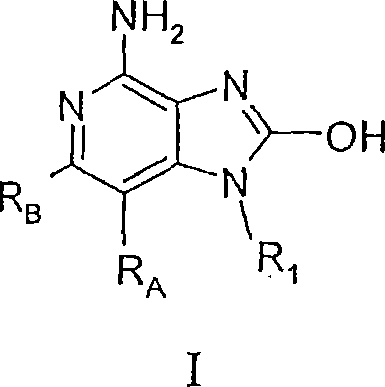
其中:in:
RA和RB各自独立地选自: RA and RB are each independently selected from:
氢、hydrogen,
卤素、halogen,
烯基、Alkenyl,
氨基、Amino,
-R11、-R 11 ,
-O-R11、-OR 11 ,
-S-R11、和-SR 11 , and
-N(R9a)(R11);-N(R 9a )(R 11 );
R11选自烷基、烷氧基亚烷基、羟基亚烷基、芳基、芳基亚烷基、杂芳基、杂芳基亚烷基、杂环基和杂环基亚烷基,每个基团是未取代的或被一个或多个独立地选自以下基团的取代基取代:烷基;烷氧基;羟基;羟烷基;芳基;芳氧基;芳基亚烷氧基;杂芳基;杂芳氧基;杂芳基亚烷氧基;卤素;卤代烷基;卤代烷氧基;巯基;硝基;氰基;杂环基;氨基;烷基氨基;二烷基氨基;并且,在烷基、杂环基、和杂环基亚烷基的情况下,该取代基为氧; R is selected from the group consisting of alkyl, alkoxyalkylene, hydroxyalkylene, aryl, arylalkylene, heteroaryl, heteroarylalkylene, heterocyclyl and heterocyclylalkylene, Each group is unsubstituted or substituted with one or more substituents independently selected from the group consisting of: alkyl; alkoxy; hydroxyl; hydroxyalkyl; aryl; aryloxy; arylalkylene Oxy; Heteroaryl; Heteroaryloxy; Heteroarylalkyleneoxy; Halogen; Haloalkyl; Haloalkoxy; Mercapto; Nitro; Cyano; Heterocyclyl; Amino; Alkylamino; Dialkyl Amino; and, in the case of alkyl, heterocyclyl, and heterocyclylalkylene, the substituent is oxygen;
R9a选自氢和C1-4烷基;R 9a is selected from hydrogen and C 1-4 alkyl;
R1选自: R1 is selected from:
-R4、-R 4 ,
-X-R4、-XR 4 ,
-X-Y-R4、-XYR 4 ,
-X-Y-X-Y-R4、-XYXYR 4 ,
-X-R5、-XR 5 ,
-N(R1’)-Q-R4、-N(R1')-QR 4 ,
-N(R1’)-X1-Y1-R4、和-N(R1')-X 1 -Y 1 -R 4 , and
-N(R1’)-X1-R5a;-N(R1')-X 1 -R 5a ;
X选自亚烷基、亚烯基、亚炔基、亚芳基、亚杂芳基和亚杂环基,其中所述亚烷基、亚烯基和亚炔基可任选被亚芳基、亚杂芳基或亚杂环基插入或封端,并任选被一个或多个-O-基团插入;X is selected from the group consisting of alkylene, alkenylene, alkynylene, arylene, heteroarylene and heterocyclylene, wherein the alkylene, alkenylene and alkynylene can optionally be replaced by arylene , heteroarylene or heterocyclylene inserted or terminated, and optionally inserted by one or more -O- groups;
X1是C2-20亚烷基;X 1 is C 2-20 alkylene;
Y选自:Y is selected from:
-O-、-O-,
-S(O)0-2-、-S(O) 0-2- ,
-S(O)2-N(R8)-、-S(O) 2 -N(R 8 )-,
-C(R6)-、-C(R 6 )-,
-C(R6)-O-、-C(R 6 )-O-,
-O-C(R6)-、-OC(R 6 )-,
-O-C(O)-O-、-O-C(O)-O-,
-N(R8)-Q-、-N(R 8 )-Q-,
-C(R6)-N(R8)-、-C(R 6 )-N(R 8 )-,
-O-C(R6)-N(R8)-、-OC(R 6 )-N(R 8 )-,
-C(R6)-N(OR9)-、-C(R 6 )-N(OR 9 )-,
-O-N(R8)-Q-、-ON(R 8 )-Q-,
-O-N=C(R4)-、-ON=C(R 4 )-,
-C(=N-O-R8)-、-C(=NOR 8 )-,
-CH(-N(-O-R8)-Q-R4)-、-CH(-N(-OR 8 )-QR 4 )-,

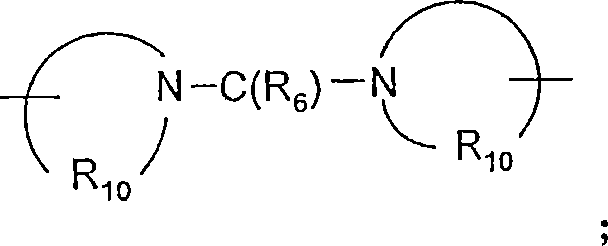
Y1选自-O-、-S(O)0-2-、-S(O)2-N(R8)-、-N(R8)-Q-、-C(R6)-N(R8)-、-O-C(R6)-N(R8)-、和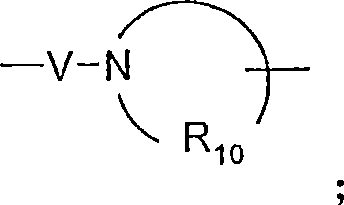
R1’选自氢、C1-20烷基、羟基-C2-20亚烷基和烷氧基-C2-20亚烷基;R 1 'is selected from hydrogen, C 1-20 alkyl, hydroxy-C 2-20 alkylene and alkoxy-C 2-20 alkylene;
R4选自氢、烷基、烯基、炔基、芳基、芳基亚烷基、芳氧基亚烷基、烷基亚芳基、杂芳基、杂芳基亚烷基、杂芳氧基亚烷基、烷基亚杂芳基和杂环基,其中所述烷基、烯基、炔基、芳基、芳基亚烷基、芳氧基亚烷基、烷基亚芳基、杂芳基、杂芳基亚烷基、杂芳氧基亚烷基、烷基亚杂芳基和杂环基可以是未取代的或被一个或多个独立地选自以下基团的取代基取代:烷基;烷氧基;羟烷基;卤代烷基;卤代烷氧基;卤素;硝基;羟基;巯基;氰基;芳基;芳氧基;芳基亚烷氧基;杂芳基;杂芳氧基;杂芳基亚烷氧基;杂环基;氨基;烷基氨基;二烷基氨基;(二烷基氨基)亚烷氧基;并且,在烷基、烯基、炔基和杂环基的情况下,该取代基为氧; R is selected from hydrogen, alkyl, alkenyl, alkynyl, aryl, arylalkylene, aryloxyalkylene, alkylarylene, heteroaryl, heteroarylalkylene, heteroaryl Oxyalkylene, alkylheteroarylene and heterocyclyl, wherein the alkyl, alkenyl, alkynyl, aryl, arylalkylene, aryloxyalkylene, alkylarylene , heteroaryl, heteroarylalkylene, heteroaryloxyalkylene, alkylheteroarylene, and heterocyclyl may be unsubstituted or substituted with one or more independently selected from the following groups Substitution: Alkyl; Alkoxy; Hydroxyalkyl; Haloalkyl; Haloalkoxy; Halogen; Nitro; Hydroxy; Mercapto; Cyano; Aryl; Aryloxy; Arylalkyleneoxy; Heteroaryl ; heteroaryloxy; heteroarylalkyleneoxy; heterocyclyl; amino; alkylamino; dialkylamino; (dialkylamino)alkyleneoxy; In the case of a radical and a heterocyclic group, the substituent is oxygen;
R5选自: R5 is selected from:


R5a选自:R 5a is selected from:


R6选自=O和=S;R is selected from =O and =S;
R7是C2-7亚烷基;R 7 is C 2-7 alkylene;
R8选自氢、C1-10烷基、C2-10烯基、羟基-C1-10亚烷基、C1-10烷氧基-C1-10亚烷基、芳基-C1-10亚烷基和杂芳基-C1-10亚烷基;R 8 is selected from hydrogen, C 1-10 alkyl, C 2-10 alkenyl, hydroxy-C 1-10 alkylene, C 1-10 alkoxy-C 1-10 alkylene, aryl-C 1-10 alkylene and heteroaryl-C 1-10 alkylene;
R9选自氢和烷基; R9 is selected from hydrogen and alkyl;
R10是C3-8烯基;R 10 is C 3-8 alkenyl;
A选自-CH2-、-O-、-C(O)-、-S(O)0-2-和-N(-Q-R4)-;A is selected from -CH 2 -, -O-, -C(O)-, -S(O) 0-2 - and -N(-QR 4 )-;
A’选自-O-、-S(O)0-2-、-N(-Q-R4)-和-CH2-;A' is selected from -O-, -S(O) 0-2 -, -N(-QR 4 )- and -CH 2 -;
Q选自键、-C(R6)-、-C(R6)-C(R6)-、-S(O)2-、-C(R6)-N(R8)-W-、-S(O)2-N(R8)-、-C(R6)-O-、-C(R6)S-和-C(R6)-N(OR9)-;Q is selected from a bond, -C(R 6 )-, -C(R 6 )-C(R 6 )-, -S(O) 2 -, -C(R 6 )-N(R 8 )-W- , -S(O) 2 -N(R 8 )-, -C(R 6 )-O-, -C(R 6 )S- and -C(R 6 )-N(OR 9 )-;
V选自-C(R6)-、-O-C(R6)-、-N(R8)-C(R6)-和-S(O)2-;V is selected from -C(R 6 )-, -OC(R 6 )-, -N(R 8 )-C(R 6 )- and -S(O) 2 -;
W选自键、-C(O)-和-S(O)2-;且W is selected from a bond, -C(O)- and -S(O) 2 -; and
a和b独立地为1至6的整数,条件是a+b≤7;a and b are independently integers from 1 to 6, provided that a+b≤7;
或其药学上可接受的盐。or a pharmaceutically acceptable salt thereof.
在一个实施方案中,本发明提供了下式II的化合物:In one embodiment, the invention provides compounds of formula II below:

其中:in:
G1选自:G 1 is selected from:
-C(O)-R’、-C(O)-R',
α-氨酰基,α-aminoacyl,
α-氨酰基-α-氨酰基、α-aminoacyl-α-aminoacyl,
-C(O)-O-R’、-C(O)-O-R',
-C(O)-N(R”)R’、-C(O)-N(R")R',
-C(=NY’)-R’、-C(=NY')-R',
-CH(OH)-C(O)-OY’、-CH(OH)-C(O)-OY',
-CH(OC1-4烷基)Y0、-CH(OC 1-4 alkyl)Y 0 ,
-CH2Y2、和-CH 2 Y 2 , and
-CH(CH3)Y2;-CH( CH3 ) Y2 ;
R’和R”独立地选自C1-10烷基、C3-7环烷基、苯基和苄基,每个基团可以是未取代的或被一个或多个独立地选自以下基团的取代基取代:卤素、羟基、硝基、氰基、羧基、C1-6烷基、C1-4烷氧基、芳基、杂芳基、芳基-C1-4亚烷基、杂芳基-C1-4亚烷基、卤代-C1-4亚烷基、卤代-C1-4烷氧基、-O-C(O)-CH3、-C(O)-O-CH3、-C(O)-NH2、-O-CH2-C(O)-NH2、-NH2和-S(O)2-NH2,条件是R”也可以是氢;R' and R" are independently selected from C 1-10 alkyl, C 3-7 cycloalkyl, phenyl and benzyl, each group may be unsubstituted or be independently selected from one or more of the following Substituent substitution of the group: halogen, hydroxyl, nitro, cyano, carboxyl, C 1-6 alkyl, C 1-4 alkoxy, aryl, heteroaryl, aryl-C 1-4 alkylene radical, heteroaryl-C 1-4 alkylene, halo-C 1-4 alkylene, halo-C 1-4 alkoxy, -OC(O)-CH 3 , -C(O) -O-CH 3 , -C(O)-NH 2 , -O-CH 2 -C(O)-NH 2 , -NH 2 , and -S(O) 2 -NH 2 , with the proviso that R" can also be hydrogen;
α-氨酰基是衍生自选自外消旋的、D-和L-氨基酸的氨基酸的α-氨酰基;The α-aminoacyl group is an α-aminoacyl group derived from an amino acid selected from racemic, D- and L-amino acids;
Y’选自氢、C1-6烷基和苄基;Y' is selected from hydrogen, C 1-6 alkyl and benzyl;
Y0选自C1-6烷基、羧基-C1-6亚烷基、氨基-C1-4亚烷基、单-N-C1-6烷基氨基-C1-4亚烷基和二-N,N-C1-6烷基氨基-C1-4亚烷基;Y O is selected from C 1-6 alkyl, carboxy-C 1-6 alkylene, amino-C 1-4 alkylene, mono-NC 1-6 alkylamino-C 1-4 alkylene and di -N, NC 1-6 alkylamino-C 1-4 alkylene;
Y2选自单-N-C1-6烷基氨基、二-N,N-C1-6烷基氨基、吗啉-4-基、哌啶-1-基、吡咯烷-1-基和4-C1-4烷基哌嗪-1-基; Y2 is selected from mono-NC 1-6 alkylamino, di-N, NC 1-6 alkylamino, morpholin-4-yl, piperidin-1-yl, pyrrolidin-1-yl and 4-C 1-4 Alkylpiperazin-1-yl;
RA和RB各自独立地选自: RA and RB are each independently selected from:
氢、hydrogen,
卤素、halogen,
烯基、Alkenyl,
氨基、Amino,
-R11、-R 11 ,
-O-R11、-OR 11 ,
-S-R11、以及-SR 11 , and
-N(R9a)(R11);-N(R 9a )(R 11 );
R11选自烷基、烷氧基亚烷基、羟基亚烷基、芳基、芳基亚烷基、杂芳基、杂芳基亚烷基、杂环基和杂环基亚烷基,每个基团是未取代的或被一个或多个独立地选自以下基团的取代基取代:烷基;烷氧基;羟基;羟烷基;芳基;芳氧基;芳基亚烷氧基;杂芳基;杂芳氧基;杂芳基亚烷氧基;卤素;卤代烷基;卤代烷氧基;巯基;硝基;氰基;杂环基;氨基;烷基氨基;二烷基氨基;并且,在烷基、杂环基和杂环基亚烷基的情况下,该取代基为氧; R is selected from the group consisting of alkyl, alkoxyalkylene, hydroxyalkylene, aryl, arylalkylene, heteroaryl, heteroarylalkylene, heterocyclyl and heterocyclylalkylene, Each group is unsubstituted or substituted with one or more substituents independently selected from the group consisting of: alkyl; alkoxy; hydroxyl; hydroxyalkyl; aryl; aryloxy; arylalkylene Oxy; Heteroaryl; Heteroaryloxy; Heteroarylalkyleneoxy; Halogen; Haloalkyl; Haloalkoxy; Mercapto; Nitro; Cyano; Heterocyclyl; Amino; Alkylamino; Dialkyl Amino; and, in the case of alkyl, heterocyclyl and heterocyclylalkylene, the substituent is oxygen;
R9a选自氢和C1-4烷基;R 9a is selected from hydrogen and C 1-4 alkyl;
R1选自: R1 is selected from:
-R4、-R 4 ,
-X-R4、-XR 4 ,
-X-Y-R4、-XYR 4 ,
-X-Y-X-Y-R4、-XYXYR 4 ,
-X-R5、-XR 5 ,
-N(R1’)-Q-R4、-N(R 1 ')-QR 4 、
-N(R1’)-X1-Y1-R4、和-N(R 1 ')-X 1 -Y 1 -R 4 , and
-N(R1’)-X1-R5a;-N(R 1 ')-X 1 -R 5a ;
X选自亚烷基、亚烯基、亚炔基、亚芳基、亚杂芳基和亚杂环基,其中所述亚烷基、亚烯基和亚炔基可以任选被亚芳基、亚杂芳基或亚杂环基插入或封端,并任选被一个或多个-O-基团插入;X is selected from the group consisting of alkylene, alkenylene, alkynylene, arylene, heteroarylene and heterocyclylene, wherein the alkylene, alkenylene and alkynylene can optionally be replaced by arylene , heteroarylene or heterocyclylene inserted or terminated, and optionally inserted by one or more -O- groups;
X1是C2-20亚烷基;X 1 is C 2-20 alkylene;
Y选自:Y is selected from:
-O-、-O-,
-S(O)0-2-、-S(O) 0-2- ,
-S(O)2-N(R8)-、-S(O) 2 -N(R 8 )-,
-C(R6)-、-C(R 6 )-,
-C(R6)-O-、-C(R 6 )-O-,
-O-C(R6)-、-OC(R 6 )-,
-O-C(O)-O-、-O-C(O)-O-,
-N(R8)-Q-、-N(R 8 )-Q-,
-C(R6)-N(R8)-、-C(R 6 )-N(R 8 )-,
-O-C(R6)-N(R8)-、-OC(R 6 )-N(R 8 )-,
-C(R6)-N(OR9)-、-C(R 6 )-N(OR 9 )-,
-O-N(R8)-Q-、-ON(R 8 )-Q-,
-O-N=C(R4)-、-ON=C(R 4 )-,
-C(=N-O-R8)-、-C(=NOR 8 )-,
-CH(-N(-O-R8)-Q-R4)-、-CH(-N(-OR 8 )-QR 4 )-,
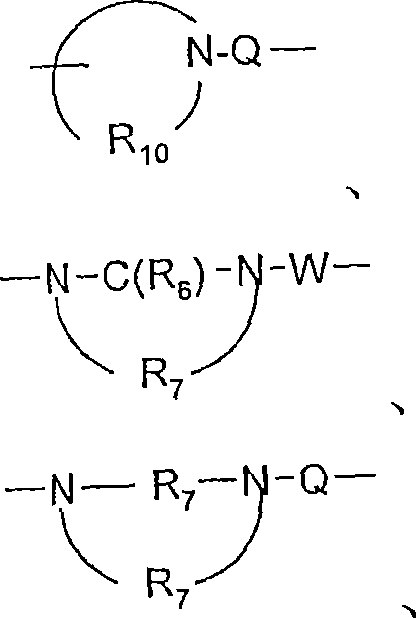


Y1选自-O-、-S(O)0-2-、-S(O)2-N(R8)-、-N(R8)-Q-、-C(R6)-N(R8)-、-O-C(R6)-N(R8)-和
R1’选自氢、C1-20烷基、羟基-C2-20亚烷基和烷氧基-C2-20亚烷基;R 1 'is selected from hydrogen, C 1-20 alkyl, hydroxy-C 2-20 alkylene and alkoxy-C 2-20 alkylene;
R4选自氢、烷基、烯基、炔基、芳基、芳基亚烷基、芳氧基亚烷基、烷基亚芳基、杂芳基、杂芳基亚烷基、杂芳氧基亚烷基、烷基亚杂芳基和杂环基,其中所述烷基、烯基、炔基、芳基、芳基亚烷基、芳氧基亚烷基、烷基亚芳基、杂芳基、杂芳基亚烷基、杂芳氧基亚烷基、烷基亚杂芳基和杂环基可以是未取代的或被一个或多个独立地选自以下基团的取代基取代:烷基;烷氧基;羟烷基;卤代烷基;卤代烷氧基;卤素;硝基;羟基;巯基;氰基;芳基;芳氧基;芳基亚烷氧基;杂芳基;杂芳氧基;杂芳基亚烷氧基;杂环基;氨基;烷基氨基;二烷基氨基;(二烷基氨基)亚烷氧基;并且,在烷基、烯基、炔基和杂环基的情况下,该取代基为氧; R is selected from hydrogen, alkyl, alkenyl, alkynyl, aryl, arylalkylene, aryloxyalkylene, alkylarylene, heteroaryl, heteroarylalkylene, heteroaryl Oxyalkylene, alkylheteroarylene and heterocyclyl, wherein the alkyl, alkenyl, alkynyl, aryl, arylalkylene, aryloxyalkylene, alkylarylene , heteroaryl, heteroarylalkylene, heteroaryloxyalkylene, alkylheteroarylene, and heterocyclyl may be unsubstituted or substituted with one or more independently selected from the following groups Substitution: Alkyl; Alkoxy; Hydroxyalkyl; Haloalkyl; Haloalkoxy; Halogen; Nitro; Hydroxy; Mercapto; Cyano; Aryl; Aryloxy; Arylalkyleneoxy; Heteroaryl ; heteroaryloxy; heteroarylalkyleneoxy; heterocyclyl; amino; alkylamino; dialkylamino; (dialkylamino)alkyleneoxy; In the case of a radical and a heterocyclic group, the substituent is oxygen;
R5选自: R5 is selected from:


R5a选自:R 5a is selected from:


R6选自=O和=S;R is selected from =O and =S;
R7是C2-7亚烷基;R 7 is C 2-7 alkylene;
R8选自氢、C1-10烷基、C2-10烯基、羟基-C1-10亚烷基、C1-10烷氧基-C1-10亚烷基、芳基-C1-10亚烷基和杂芳基-C1-10亚烷基;R 8 is selected from hydrogen, C 1-10 alkyl, C 2-10 alkenyl, hydroxy-C 1-10 alkylene, C 1-10 alkoxy-C 1-10 alkylene, aryl-C 1-10 alkylene and heteroaryl-C 1-10 alkylene;
R9选自氢和烷基; R9 is selected from hydrogen and alkyl;
R10是C3-8亚烷基;R 10 is C 3-8 alkylene;
A选自-CH2-、-O-、-C(O)-、-S(O)0-2-和-N(-Q-R4)-;A is selected from -CH 2 -, -O-, -C(O)-, -S(O) 0-2 - and -N(-QR 4 )-;
A’选自-O-、-S(O)0-2-、-N(-Q-R4)-和-CH2-;A' is selected from -O-, -S(O) 0-2 -, -N(-QR 4 )- and -CH 2 -;
Q选自键、-C(R6)-、-C(R6)-C(R6)-、-S(O)2-、-C(R6)-N(R8)-W-、-S(O)2-N(R8)-、-C(R6)-O-、-C(R6)-S-和-C(R6)-N(OR9)-;Q is selected from a bond, -C(R 6 )-, -C(R 6 )-C(R 6 )-, -S(O) 2 -, -C(R 6 )-N(R 8 )-W- , -S(O) 2 -N(R 8 )-, -C(R 6 )-O-, -C(R 6 )-S- and -C(R 6 )-N(OR 9 )-;
V选自-C(R6)-、-O-C(R6)-、-N(R8)-C(R6)-和-S(O)2-;V is selected from -C(R 6 )-, -OC(R 6 )-, -N(R 8 )-C(R 6 )- and -S(O) 2 -;
W选自键、-C(O)-和-S(O)2-;且W is selected from a bond, -C(O)- and -S(O) 2 -; and
a和b独立地为1至6的整数,条件是a+b≤7;a and b are independently integers from 1 to 6, provided that a+b≤7;
或其药学上可接受的盐。or a pharmaceutically acceptable salt thereof.
在另一个实施方案中,本发明提供了下式III的化合物:In another embodiment, the present invention provides compounds of formula III below:

其中:in:
G2选自: G2 is selected from:
-X2-C(O)-R’、-X 2 -C(O)-R',
α-氨酰基、α-aminoacyl,
α-氨酰基-α-氨酰基、α-aminoacyl-α-aminoacyl,
-X2-C(O)-O-R’、-X 2 -C(O)-O-R',
-C(O)-N(R”)R’、和-C(O)-N(R")R', and
-S(O)2-R’;-S(O) 2 -R';
X2选自键;-CH2-O-;-CH(CH3)-O-; -C(CH3)2-O-;以及在-X2-C(O)-O-R’的情况下,选自-CH2-NH-;X 2 is selected from a bond; -CH 2 -O-; -CH(CH 3 )-O-; -C(CH 3 ) 2 -O-; and at -X 2 -C(O)-O-R' In case, selected from -CH 2 -NH-;
R’和R”独立地选自C1-10烷基、C3-7环烷基、苯基和苄基,每个基团可以是未取代的或被一个或多个独立地选自以下基团的取代基取代:卤素、羟基、硝基、氰基、羧基、C1-6烷基、C1-4烷氧基、芳基、杂芳基、芳基-C1-4亚烷基、杂芳基-C1-4亚烷基、卤代-C1-4亚烷基、卤代-C1-4烷氧基、-O-C(O)-CH3、-C(O)-O-CH3、-C(O)-N-H2、-O-CH2-C(O)-NH2、-NH2和-S(O)2-NH2,条件是R”也可以是氢;R' and R" are independently selected from C 1-10 alkyl, C 3-7 cycloalkyl, phenyl and benzyl, each group may be unsubstituted or be independently selected from one or more of the following Substituent substitution of the group: halogen, hydroxyl, nitro, cyano, carboxyl, C 1-6 alkyl, C 1-4 alkoxy, aryl, heteroaryl, aryl-C 1-4 alkylene radical, heteroaryl-C 1-4 alkylene, halo-C 1-4 alkylene, halo-C 1-4 alkoxy, -OC(O)-CH 3 , -C(O) -O-CH 3 , -C(O)-NH 2 , -O-CH 2 -C(O)-NH 2 , -NH 2 , and -S(O) 2 -NH 2 , with the proviso that R" can also be hydrogen;
α-氨酰基是衍生自选自外消旋的、D-和L-氨基酸的氨基酸的α-氨酰基;The α-aminoacyl group is an α-aminoacyl group derived from an amino acid selected from racemic, D- and L-amino acids;
RA和RB各自独立地选自: RA and RB are each independently selected from:
氢、hydrogen,
卤素、halogen,
烯基、Alkenyl,
氨基、Amino,
-R11、-R 11 ,
-O-R11、-OR 11 ,
-S-R11、以及-SR 11 , and
-N(R9a)(R11);-N(R 9a )(R 11 );
R11选自烷基、烷氧基亚烷基、羟基亚烷基、芳基、芳基亚烷基、杂芳基、杂芳基亚烷基、杂环基和杂环基亚烷基,每个基团是未取代的或被一个或多个独立地选自以下基团的取代基取代:烷基;烷氧基;羟基;羟烷基;芳基;芳氧基;芳基亚烷氧基;杂芳基;杂芳氧基;杂芳基亚烷氧基;卤素;卤代烷基;卤代烷氧基;巯基;硝基;氰基;杂环基;氨基;烷基氨基;二烷基氨基;并且,在烷基、杂环基和杂环基亚烷基的情况下,该取代基为氧; R is selected from the group consisting of alkyl, alkoxyalkylene, hydroxyalkylene, aryl, arylalkylene, heteroaryl, heteroarylalkylene, heterocyclyl and heterocyclylalkylene, Each group is unsubstituted or substituted with one or more substituents independently selected from the group consisting of: alkyl; alkoxy; hydroxyl; hydroxyalkyl; aryl; aryloxy; arylalkylene Oxy; Heteroaryl; Heteroaryloxy; Heteroarylalkyleneoxy; Halogen; Haloalkyl; Haloalkoxy; Mercapto; Nitro; Cyano; Heterocyclyl; Amino; Alkylamino; Dialkyl Amino; and, in the case of alkyl, heterocyclyl and heterocyclylalkylene, the substituent is oxygen;
R9a选自氢和C1-4烷基;R 9a is selected from hydrogen and C 1-4 alkyl;
R1选自: R1 is selected from:
-R4、-R 4 ,
-X-R4、-XR 4 ,
-X-Y-R4、-XYR 4 ,
-X-Y-X-Y-R4、-XYXYR 4 ,
-X-R5、-XR 5 ,
-N(R1’)-Q-R4、-N(R 1 ')-QR 4 、
-N(R1’)-X1-Y1-R4、和-N(R 1 ')-X 1 -Y 1 -R 4 , and
-N(R1’)-X1-R5a;-N(R 1 ')-X 1 -R 5a ;
X选自亚烷基、亚烯基、亚炔基、亚芳基、亚杂芳基和亚杂环基,其中所述亚烷基、亚烯基和亚炔基可以任选被亚芳基、亚杂芳基或亚杂环基插入或封端,并任选被一个或多个-O-基团插入;X is selected from the group consisting of alkylene, alkenylene, alkynylene, arylene, heteroarylene and heterocyclylene, wherein the alkylene, alkenylene and alkynylene can optionally be replaced by arylene , heteroarylene or heterocyclylene inserted or terminated, and optionally inserted by one or more -O- groups;
X1是C2-20亚烷基;X 1 is C 2-20 alkylene;
Y选自:Y is selected from:
-O-、-O-,
-S(O)0-2-、-S(O) 0-2- ,
-S(O)2-N(R8)-、-S(O) 2 -N(R 8 )-,
-C(R6)-、-C(R 6 )-,
-C(R6)-O-、-C(R 6 )-O-,
-O-C(R6)-、-OC(R 6 )-,
-O-C(O)-O-、-O-C(O)-O-,
-N(R8)-Q-、-N(R 8 )-Q-,
-C(R6)-N(R8)-、-C(R 6 )-N(R 8 )-,
-O-C(R6)-N(R8)-、-OC(R 6 )-N(R 8 )-,
-C(R6)-N(OR9)-、-C(R 6 )-N(OR 9 )-,
-O-N(R8)-Q-、-ON(R 8 )-Q-,
-O-N=C(R4)-、-ON=C(R 4 )-,
-C(=N-O-R8)-、-C(=NOR 8 )-,
-CH(-N(-O-R8)-Q-R4)-、-CH(-N(-OR 8 )-QR 4 )-,

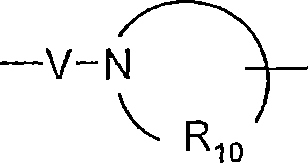
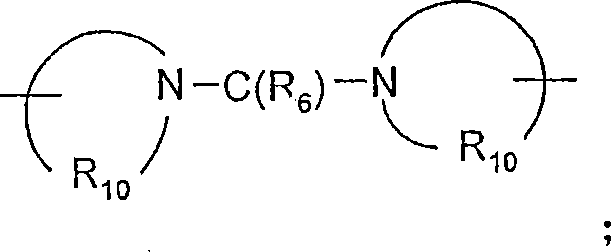
Y1选自-O-、-S(O)0-2-、-S(O)2-N(R8)-、-N(R8)-Q-、-C(R6)-N(R8)-、-O-C(R6)-N(R8)-和
R1’选自氢、C1-20烷基、羟基-C2-20亚烷基和烷氧基-C2-20亚烷基;R 1 'is selected from hydrogen, C 1-20 alkyl, hydroxy-C 2-20 alkylene and alkoxy-C 2-20 alkylene;
R4选自氢、烷基、烯基、炔基、芳基、芳基亚烷基、芳氧基亚烷基、烷基亚芳基、杂芳基、杂芳基亚烷基、杂芳氧基亚烷基、烷基亚杂芳基和杂环基,其中所述烷基、烯基、炔基、芳基、芳基亚烷基、芳氧基亚烷基、烷基亚芳基、杂芳基、杂芳基亚烷基、杂芳氧基亚烷基、烷基亚杂芳基和杂环基可以是未取代的或被一个或多个独立地选自以下基团的取代基取代:烷基;烷氧基;羟烷基;卤代烷基;卤代烷氧基;卤素;硝基;羟基;巯基;氰基;芳基;芳氧基;芳基亚烷氧基;杂芳基;杂芳氧基;杂芳基亚烷氧基;杂环基;氨基;烷基氨基;二烷基氨基;(二烷基氨基)亚烷氧基;并且,在烷基、烯基、炔基和杂环基的情况下,该取代基为氧; R is selected from hydrogen, alkyl, alkenyl, alkynyl, aryl, arylalkylene, aryloxyalkylene, alkylarylene, heteroaryl, heteroarylalkylene, heteroaryl Oxyalkylene, alkylheteroarylene and heterocyclyl, wherein the alkyl, alkenyl, alkynyl, aryl, arylalkylene, aryloxyalkylene, alkylarylene , heteroaryl, heteroarylalkylene, heteroaryloxyalkylene, alkylheteroarylene, and heterocyclyl may be unsubstituted or substituted with one or more independently selected from the following groups Substitution: Alkyl; Alkoxy; Hydroxyalkyl; Haloalkyl; Haloalkoxy; Halogen; Nitro; Hydroxy; Mercapto; Cyano; Aryl; Aryloxy; Arylalkyleneoxy; Heteroaryl ; heteroaryloxy; heteroarylalkyleneoxy; heterocyclyl; amino; alkylamino; dialkylamino; (dialkylamino)alkyleneoxy; In the case of a radical and a heterocyclic group, the substituent is oxygen;
R5选自: R5 is selected from:


R5a选自:R 5a is selected from:

R6选自=O和=S;R is selected from =O and =S;
R7是C2-7亚烷基;R 7 is C 2-7 alkylene;
R8选自氢、C1-10烷基、C2-10烯基、羟基-C1-10亚烷基、C1-10烷氧基-C1-10亚烷基、芳基-C1-10亚烷基和杂芳基-C1-10亚烷基;R 8 is selected from hydrogen, C 1-10 alkyl, C 2-10 alkenyl, hydroxy-C 1-10 alkylene, C 1-10 alkoxy-C 1-10 alkylene, aryl-C 1-10 alkylene and heteroaryl-C 1-10 alkylene;
R9选自氢和烷基; R9 is selected from hydrogen and alkyl;
R10是C3-8亚烷基;R 10 is C 3-8 alkylene;
A选自-CH2-、-O-、-C(O)-、-S(O)0-2-和-N(-Q-R4)-;A is selected from -CH 2 -, -O-, -C(O)-, -S(O) 0-2 - and -N(-QR 4 )-;
A’选自-O-、-S(O)0-2-、-N(-Q-R4)-和-CH2-;A' is selected from -O-, -S(O) 0-2 -, -N(-QR 4 )- and -CH 2 -;
Q选自键、-C(R6)-、-C(R6)-C(R6)-、-S(O)2-、-C(R6)-N(R8)-W-、-S(O)2-N(R8)-、-C(R6)-O-、-C(R6)S-和-C(R6)-N(OR9)-;Q is selected from a bond, -C(R 6 )-, -C(R 6 )-C(R 6 )-, -S(O) 2 -, -C(R 6 )-N(R 8 )-W- , -S(O) 2 -N(R 8 )-, -C(R 6 )-O-, -C(R 6 )S- and -C(R 6 )-N(OR 9 )-;
V选自-C(R6)-、-O-C(R6)-、-N(R8)-C(R6)-和-S(O)2-;V is selected from -C(R 6 )-, -OC(R 6 )-, -N(R 8 )-C(R 6 )- and -S(O) 2 -;
W选自键、-C(O)-和-S(O)2-;和W is selected from a bond, -C(O)- and -S(O) 2- ; and
a和b独立地为1至6的整数,条件是a+b≤7;a and b are independently integers from 1 to 6, provided that a+b≤7;
或其药学上可接受的盐。or a pharmaceutically acceptable salt thereof.
在一些实施方案中,式III的化合物是前药。In some embodiments, the compound of Formula III is a prodrug.
对于本文所列的任何化合物,如本领域技术人员理解的那样,其任何实施方案中下列变量中的每一个(例如R1、RA、G1、G2、R4、R11、X、X1、Y、Y1、A、Q等)可以于其他任何实施方案中其他变量的任何一个或更多个相组合并与本文所述的任何一个化学式相关联。得到的每一变量组合都是本发明的实施方案。For any compound listed herein, each of the following variables (e.g., R 1 , R A , G 1 , G 2 , R 4 , R 11 , X, X 1 , Y, Y 1 , A, Q, etc.) may be combined with any one or more of the other variables in any other embodiment and associated with any one of the formulas described herein. Each resulting combination of variables is an embodiment of the invention.
对于某些实施方案,例如,式II的实施方案,G1选自-C(O)-R’、α-氨酰基、α-氨酰基-α-氨酰基、-C(O)-O-R’、-C(O)-N(R”)R’、-C(=NY’)-R’、-CH(OH)-C(O)-OY’、-CH(OC1-4烷基)Y0、-CH2Y2和-CH(CH3)Y2。对于这些实施方案中的某些,R’和R”独立地选自C1-10烷基、C3-7环烷基、苯基和苄基,每个基团可以是未取代的或被一个或多个独立地选自以下基团的取代基取代:卤素、羟基、硝基、氰基、羧基、C1-6烷基、C1-4烷氧基、芳基、杂芳基、芳基-C1-4亚烷基、杂芳基-C1-4亚烷基、卤代-C1-4亚烷基、卤代-C 1-4烷氧基、-O-C(O)-CH3、-C(O)-O-CH3、-C(O)-NH2、-O-CH2-C(O)-NH2、-NH2和-S(O)2-NH2,条件是R”也可以是氢;For certain embodiments, for example, the embodiment of Formula II, G is selected from -C(O)-R', α-aminoacyl, α-aminoacyl-α-aminoacyl, -C(O)-O- R', -C(O)-N(R")R', -C(=NY')-R', -CH(OH)-C(O)-OY', -CH(OC 1-4 alkane base) Y 0 , -CH 2 Y 2 and -CH(CH 3 )Y 2 . For certain of these embodiments, R' and R" are independently selected from C 1-10 alkyl, C 3-7 ring Alkyl, phenyl, and benzyl, each of which may be unsubstituted or substituted with one or more substituents independently selected from the group consisting of halogen, hydroxy, nitro, cyano, carboxy, C1 -6 alkyl, C 1-4 alkoxy, aryl, heteroaryl, aryl-C 1-4 alkylene, heteroaryl-C 1-4 alkylene, halo-C 1-4 Alkylene, Halo-C 1-4 alkoxy, -OC(O)-CH 3 , -C(O)-O-CH 3 , -C(O)-NH 2 , -O-CH 2 - C(O)-NH 2 , -NH 2 and -S(O) 2 -NH 2 , with the proviso that R" can also be hydrogen;
α-氨酰基是衍生自选自外消旋的、D-和L-氨基酸的氨基酸的α-氨酰基;The α-aminoacyl group is an α-aminoacyl group derived from an amino acid selected from racemic, D- and L-amino acids;
Y’选自氢、C1-6烷基和苄基;Y' is selected from hydrogen, C 1-6 alkyl and benzyl;
Y0选自C1-6烷基、羧基-C1-6亚烷基、氨基-C1-4亚烷基、单-N-C1-6烷基氨基-C1-4亚烷基和二-N,N-C 1-6烷基氨基-C1-4亚烷基;以及Y O is selected from C 1-6 alkyl, carboxy-C 1-6 alkylene, amino-C 1-4 alkylene, mono-NC 1-6 alkylamino-C 1-4 alkylene and di -N, NC 1-6 alkylamino-C 1-4 alkylene; and
Y2选自单-N-C1-6烷基氨基、二-N,N-C1-6烷基氨基、吗啉-4-基、哌啶-1-基、吡咯烷-1-基和4-C1-4烷基哌嗪-1-基。 Y2 is selected from mono-NC 1-6 alkylamino, di-N, NC 1-6 alkylamino, morpholin-4-yl, piperidin-1-yl, pyrrolidin-1-yl and 4-C 1-4 Alkylpiperazin-1-yl.
对于某些实施方案,包括式II的任一上述实施方案,G1选自-C(O)-R’、α-氨酰基和-C(O)-O-R’。For certain embodiments, including any of the foregoing embodiments of Formula II, G is selected from -C(O)-R', α-aminoacyl, and -C(O)-O-R'.
对于某些实施方案,包括式II的任一上述实施方案,G1选自-C(O)-R’、α-氨基-C2-11酰基和-C(O)-O-R’。α-氨基-C2-11酰基包括含有总共至少2个碳原子和总共最多11个碳原子的α-氨基酸,并也可以包括一个或多个选自O、S和N的杂原子。For certain embodiments, including any of the foregoing embodiments of Formula II, G is selected from -C(O)-R', α-amino- C2-11 acyl, and -C(O)-O-R'. α-Amino-C 2-11 acyl includes α-amino acids containing a total of at least 2 carbon atoms and a total of at most 11 carbon atoms, and may also include one or more heteroatoms selected from O, S and N.
对于某些实施方案,例如,式III的实施方案,G2选自-X2-C(O)-R’、α-氨酰基、α-氨酰基-α-氨酰基、-X2-C(O)-O-R’、-C(O)-N(R”)R’和-S(O)2-R’。对于这些实施方案中的某些,X2选自键;-CH2-O-;-CH(CH3)-O-;-C(CH3)2-O-;以及,在-X2-C(O)-O-R’的情况下为-CH2-NH-;For certain embodiments, eg, embodiments of formula III, G 2 is selected from the group consisting of -X 2 -C(O)-R', α-aminoacyl, α-aminoacyl-α-aminoacyl, -X 2 -C (O)-O-R', -C(O)-N(R")R', and -S(O) 2 -R'. For certain of these embodiments, X2 is selected from a bond; -CH 2 -O-; -CH(CH 3 )-O-; -C(CH 3 ) 2 -O-; and, in the case of -X 2 -C(O)-O-R' -CH 2 - NH-;
R’和R”独立地选自C1-10烷基、C3-7环烷基、苯基和苄基,每个基团可以是未取代的或被一个或多个独立地选自以下基团的取代基取代:卤素、羟基、硝基、氰基、羧基、C1-6烷基、C1-4烷氧基、芳基、杂芳基、芳基-C1-4亚烷基、杂芳基-C1-4亚烷基、卤代-C1-4亚烷基、卤代-C1-4烷氧基、-O-C(O)-CH3、-C(O)-O-CH3、-C(O)-NH2、-O-CH2-C(O)-NH2、-NH2和-S(O)2-NH2,条件是R”也可以是氢;并且R' and R" are independently selected from C 1-10 alkyl, C 3-7 cycloalkyl, phenyl and benzyl, each group may be unsubstituted or be independently selected from one or more of the following Substituent substitution of the group: halogen, hydroxyl, nitro, cyano, carboxyl, C 1-6 alkyl, C 1-4 alkoxy, aryl, heteroaryl, aryl-C 1-4 alkylene radical, heteroaryl-C 1-4 alkylene, halo-C 1-4 alkylene, halo-C 1-4 alkoxy, -OC(O)-CH 3 , -C(O) -O-CH 3 , -C(O)-NH 2 , -O-CH 2 -C(O)-NH 2 , -NH 2 , and -S(O) 2 -NH 2 , with the proviso that R" can also be hydrogen; and
α-氨酰基是衍生自选自外消旋的、D-和L-氨基酸的氨基酸的α-氨酰基。An α-aminoacyl group is an α-aminoacyl group derived from an amino acid selected from racemic, D- and L-amino acids.
对于某些实施方案,包括含有α-氨酰基的任一上述实施方案,α-氨酰基是衍生自选自外消旋的、D-和L-氨基酸的天然氨基酸的α-氨酰基。For certain embodiments, including any of the foregoing embodiments comprising an α-aminoacyl group, the α-aminoacyl group is an α-aminoacyl group derived from a natural amino acid selected from racemic, D- and L-amino acids.
对于某些实施方案,包括含有α-氨酰基的任一上述实施方案,α-氨酰基是衍生自在蛋白质中发现的氨基酸的α-氨酰基,其中该氨基酸选自外消旋的、D-和L-氨基酸。For certain embodiments, including any of the above embodiments comprising an α-aminoacyl group, the α-aminoacyl group is an α-aminoacyl group derived from an amino acid found in a protein, wherein the amino acid is selected from the group consisting of racemic, D- and L-amino acids.
对于某些实施方案,包括式III的任一上述实施方案,G2选自α-氨基-C2-5烷酰基、C2-6烷酰基、C1-6烷氧基羰基和C1-6烷基氨甲酰基。For certain embodiments, including any of the foregoing embodiments of Formula III, G is selected from the group consisting of α-amino-C 2-5 alkanoyl, C 2-6 alkanoyl, C 1-6 alkoxycarbonyl and C 1- 6 Alkylcarbamoyl.
对于某些实施方案,式II的2-羟基取代基的氢原子被G2替代,其中G2如上述含G2的任一实施方案中所定义。For certain embodiments, the hydrogen atom of the 2-hydroxyl substituent of formula II is replaced by G 2 , wherein G 2 is as defined in any of the above embodiments containing G 2 .
对于某些实施方案,包括式I、II或III的任一上述实施方案,RA和RB各自独立地选自:氢、卤素、烯基、氨基、-R11、-O-R11、-S-R11和-N(R9a)(R11)。For certain embodiments, including any of the foregoing embodiments of Formula I, II, or III, each of R A and R B is independently selected from the group consisting of: hydrogen, halo, alkenyl, amino, -R 11 , -OR 11 , -SR 11 and -N(R 9a )(R 11 ).
对于某些实施方案,当RA与RB或RA或RB为-R11时,R11选自烷基、烷氧基亚烷基、羟基亚烷基、芳基亚烷基、杂芳基亚烷基和杂环基亚烷基,每个基团是未取代的或被一个或多个独立地选自以下基团的取代基取代:烷基;烷氧基;羟基;羟烷基;芳基;芳氧基;芳基亚烷氧基;杂芳基;杂芳氧基;杂芳基亚烷氧基;卤素;卤代烷基;卤代烷氧基;巯基;硝基;氰基;杂环基;氨基;烷基氨基;二烷基氨基;以及,在烷基、杂环基和杂环基亚烷基的情况下,该取代基为氧。For certain embodiments, when RA and RB or RA or RB is -R 11 , R 11 is selected from the group consisting of alkyl, alkoxyalkylene, hydroxyalkylene, arylalkylene, hetero Arylalkylene and heterocyclylalkylene, each of which is unsubstituted or substituted with one or more substituents independently selected from the group consisting of: alkyl; alkoxy; hydroxy; hydroxyalkane radical; aryl; aryloxy; arylalkyleneoxy; heteroaryl; heteroaryloxy; heteroarylalkyleneoxy; halogen; haloalkyl; haloalkoxy; mercapto; nitro; cyano; Heterocyclyl; amino; alkylamino; dialkylamino; and, in the case of alkyl, heterocyclyl and heterocyclylalkylene, the substituent is oxygen.
对于某些实施方案,包括式I、II或III的任一上述实施方案,RA和RB独立地选自氢、-R11-O-R11和-NHR11,其中R11是烷基、烷氧基亚烷基、或羟基亚烷基。对于这些实施方案的某些,RA和RB独立地选自氢、C1-5烷基、-O-C1-4烷基、C1-4烷基-O-C1-4亚烷基和-NH-C1-4烷基。对于这些实施方案的某些,RA和RB独立地选自氢、C1-5烷基、-O-C1-4烷基和-NH-C1-4烷基。对于这些实施方案的某些,RA选自氢和C1-5烷基,且RB选自C1-5烷基、-O-C1-4烷基和-NH-C1-4烷基。对于这些实施方案的某些,除非RA和RB不能是烷基,否则RA和RB独立地为氢或烷基。对于这些实施方案的某些,RA是氢或甲基。对于这些实施方案的某些,RA是氢。对于这些实施方案的某些,RB是C1-5烷基。对于这些实施方案的某些,除非RA为氢,否则RA和RB各自为甲基。For certain embodiments, including any of the foregoing embodiments of Formula I, II, or III, R A and R B are independently selected from hydrogen, -R 11 -OR 11 , and -NHR 11 , wherein R 11 is alkyl, alkane Oxyalkylene, or hydroxyalkylene. For certain of these embodiments, RA and RB are independently selected from hydrogen, C 1-5 alkyl, -OC 1-4 alkyl, C 1-4 alkyl-OC 1-4 alkylene, and - NH-C 1-4 alkyl. For certain of these embodiments, RA and RB are independently selected from hydrogen, C 1-5 alkyl, -OC 1-4 alkyl, and -NH-C 1-4 alkyl. For certain of these embodiments, RA is selected from hydrogen and C 1-5 alkyl, and R is selected from C 1-5 alkyl, -OC 1-4 alkyl, and -NH-C 1-4 alkyl . For certain of these embodiments, unless RA and RB cannot be alkyl, RA and RB are independently hydrogen or alkyl. For certain of these embodiments, RA is hydrogen or methyl. For certain of these embodiments, RA is hydrogen. For certain of these embodiments, R B is C 1-5 alkyl. For certain of these embodiments, unless RA is hydrogen, RA and RB are each methyl.
对于某些实施方案,包括式I、II或III的任一上述实施方案,R1选自-R4、-X-R4、-X-Y-R4、-X-Y-X-Y-R4和-X-R5。For certain embodiments, including any of the foregoing embodiments of Formula I, II, or III, R 1 is selected from —R 4 , —XR 4 , —XYR 4 , —XYXYR 4 , and —XR 5 .
对于某些实施方案,包括式I、II或III的任一上述实施方案,R1是-R4或-X-R4。For certain embodiments, including any of the foregoing embodiments of Formula I, II, or III, R 1 is —R 4 or —XR 4 .
对于某些实施方案,包括式I、II或III的任一上述实施方案,R1选自芳基-C1-4亚烷基和杂芳基-C1-4亚烷基,其中芳基或杂芳基是未取代的或被一个或多个独立地选自以下基团的取代基取代:烷基、烷氧基、羟烷基、卤代烷基、卤代烷氧基、卤素、硝基、羟基、巯基、氰基、芳基、芳氧基、芳基亚烷氧基、杂芳基、杂芳氧基、杂芳基亚烷氧基、杂环基、氨基、烷基氨基、二烷基氨基和(二烷基氨基)亚烷氧基。对于这些实施方案的某些、R1是苄基,其是未取代的或被一个或多个独立地选自以下基团的取代基所取代:烷基、烷氧基、卤代烷基、卤代烷氧基和卤素。对于这些实施方案的某些,R1是苄基或4-氟苄基。For certain embodiments, including any of the foregoing embodiments of Formula I, II, or III, R is selected from aryl-C 1-4 alkylene and heteroaryl-C 1-4 alkylene, wherein aryl or heteroaryl is unsubstituted or substituted with one or more substituents independently selected from the group consisting of alkyl, alkoxy, hydroxyalkyl, haloalkyl, haloalkoxy, halo, nitro, hydroxy , mercapto, cyano, aryl, aryloxy, arylalkyleneoxy, heteroaryl, heteroaryloxy, heteroarylalkyleneoxy, heterocyclyl, amino, alkylamino, dialkyl Amino and (dialkylamino)alkyleneoxy. For certain of these embodiments, R is benzyl , which is unsubstituted or substituted with one or more substituents independently selected from the group consisting of alkyl, alkoxy, haloalkyl, haloalkoxy base and halogen. For certain of these embodiments, R 1 is benzyl or 4-fluorobenzyl.
对于这些实施方案的某些,包括其中R1是或包括-X-R4的I、II或III的任一上述实施方案,-X-是For certain of these embodiments, including any of the foregoing embodiments of I, II, or III wherein R 1 is or includes -XR 4 , -X- is

对于某些实施方案,包括式I、II或III的任一上述实施方案,在不排除的情况下,R1是四氢-2H-吡喃-4-基甲基。For certain embodiments, including any of the foregoing embodiments of Formula I, II or III, without exclusion, R 1 is tetrahydro-2H-pyran-4-ylmethyl.
对于某些实施方案,包括式I、II或III的任一上述实施方案,在不排除的情况下,R1是吡啶-3-基甲基、异噁唑-5-基甲基、异噁唑-3-基甲基、[3-甲基异噁唑-5-基]甲基、[5-(4-氟苯基)异噁唑-3-基]甲基或[3-(4-氟苯基)异噁唑-5-基]甲基。对于这些实施方案的某些,R1是吡啶-3-基甲基、异噁唑-5-基甲基、异噁唑-3-基甲基、[5-(4-氟苯基)异噁唑-3-基]甲基或[3-(4-氟苯基)异噁唑-5-基]甲基。For certain embodiments, including any of the foregoing embodiments of formula I, II or III, without exclusion, R is pyridin-3-ylmethyl, isoxazol-5-ylmethyl, isoxazol-5-ylmethyl, isoxazol-5-ylmethyl, Azol-3-ylmethyl, [3-methylisoxazol-5-yl]methyl, [5-(4-fluorophenyl)isoxazol-3-yl]methyl or [3-(4 -fluorophenyl)isoxazol-5-yl]methyl. For certain of these embodiments, R is pyridin-3-ylmethyl, isoxazol-5-ylmethyl, isoxazol-3-ylmethyl, [5-(4-fluorophenyl)iso Oxazol-3-yl]methyl or [3-(4-fluorophenyl)isoxazol-5-yl]methyl.
对于某些实施方案,包括式I、II或III的任一上述实施方案,除R1是-R4或-X-R4以外,R1是-X-Y-R4。对于这些实施方案的某些,R1是-C2-5亚烷基-S(O)2-C1-3烷基。可选的是,对于这些实施方案的某些,R1是
对于某些实施方案,包括式I、II或III的任一上述实施方案,在不排除的情况下,R1选自-N(R1’)-Q-R4、-N(R1’)-X1-Y1-R4和-N(R1’)-X1-R5a。For certain embodiments, including any of the foregoing embodiments of formula I, II or III, without exclusion, R 1 is selected from -N(R1')-QR 4 , -N( R1 ')-X 1 -Y 1 -R 4 and -N(R 1 ′)-X 1 -R 5a .
对于某些实施方案,包括式I、II或III的任一上述实施方案,在不排除的情况下,R1是-N(R1’)-Q-R4。对于这些实施方案的某些,R1’是氢,Q是键,且R4是芳基、杂芳基、芳基-C1-3亚烷基或杂芳基-C1-3亚烷基。For certain embodiments, including any of the foregoing embodiments of Formula I, II or III, without exclusion, R 1 is -N(R 1 ′)-QR 4 . For certain of these embodiments, R 1 ' is hydrogen, Q is a bond, and R 4 is aryl, heteroaryl, aryl-C 1-3 alkylene, or heteroaryl-C 1-3 alkylene base.
对于某些实施方案,R1’选自氢、C1-20烷基、羟基-C2-20亚烷基和烷氧基-C2-20亚烷基。For certain embodiments, R 1 ' is selected from hydrogen, C 1-20 alkyl, hydroxy-C 2-20 alkylene, and alkoxy-C 2-20 alkylene.
对于某些实施方案,R1’是氢或甲基。For certain embodiments, R 1 ' is hydrogen or methyl.
对于某些实施方案,R1’是氢。For certain embodiments, R 1 ' is hydrogen.
对于某些实施方案,R4选自氢、烷基、烯基、炔基、芳基、芳基亚烷基、芳氧基亚烷基、烷基亚芳基、杂芳基、杂芳基亚烷基、杂芳氧基亚烷基、烷基亚杂芳基和杂环基,其中烷基、烯基、炔基、芳基、芳基亚烷基、芳氧基亚烷基、烷基亚芳基、杂芳基、杂芳基亚烷基、杂芳氧基亚烷基、烷基亚杂芳基和杂环基可以是未取代的或被一个或多个独立地选自以下基团的取代基取代:烷基;烷氧基;羟烷基;卤代烷基;卤代烷氧基;卤素;硝基;羟基;巯基;氰基;芳基;芳氧基;芳基亚烷氧基;杂芳基;杂芳氧基;杂芳基亚烷氧基;杂环基;氨基;烷基氨基;二烷基氨基;(二烷基氨基)亚烷氧基;并且,在烷基、烯基、炔基和杂环基的情况下,该取代基为氧。For certain embodiments, R is selected from hydrogen, alkyl, alkenyl, alkynyl, aryl, arylalkylene, aryloxyalkylene, alkylarylene, heteroaryl, heteroaryl Alkylene, heteroaryloxyalkylene, alkylheteroarylene and heterocyclyl, wherein alkyl, alkenyl, alkynyl, aryl, arylalkylene, aryloxyalkylene, alkane Arylene, heteroaryl, heteroarylalkylene, heteroaryloxyalkylene, alkylheteroarylene, and heterocyclyl groups may be unsubstituted or be independently selected from one or more of the following Substituents for Groups Substitution: Alkyl; Alkoxy; Hydroxyalkyl; Haloalkyl; Haloalkoxy; Halogen; Nitro; Hydroxy; Mercapto; Cyano; Aryl; ; heteroaryl; heteroaryloxy; heteroarylalkyleneoxy; heterocyclyl; amino; alkylamino; dialkylamino; (dialkylamino)alkyleneoxy; In the case of alkenyl, alkynyl and heterocyclic groups, the substituent is oxygen.
对于某些实施方案,R4选自芳基-C1-4亚烷基和杂芳基-C1-4亚烷基,其中芳基或杂芳基是未取代的或被一个或多个独立地选自以下基团的取代基取代:烷基、烷氧基、羟烷基、卤代烷基、卤代烷氧基、卤素、硝基、羟基、巯基、氰基、芳基、芳氧基、芳基亚烷氧基、杂芳基、杂芳氧基、杂芳基亚烷氧基、杂环基、氨基、烷基氨基、二烷基氨基和(二烷基氨基)亚烷氧基。For certain embodiments, R is selected from aryl-C 1-4 alkylene and heteroaryl - C 1-4 alkylene, wherein aryl or heteroaryl is unsubstituted or replaced by one or more Substituents independently selected from the group consisting of alkyl, alkoxy, hydroxyalkyl, haloalkyl, haloalkoxy, halogen, nitro, hydroxyl, mercapto, cyano, aryl, aryloxy, aryl alkyleneoxy, heteroaryl, heteroaryloxy, heteroarylalkyleneoxy, heterocyclyl, amino, alkylamino, dialkylamino, and (dialkylamino)alkyleneoxy.
对于某些实施方案,R4是苄基,其是未取代的或被一个或多个独立地选自烷基、烷氧基、卤代烷基、卤代烷氧基和卤素的取代基取代。For certain embodiments, R is benzyl , which is unsubstituted or substituted with one or more substituents independently selected from alkyl, alkoxy, haloalkyl, haloalkoxy, and halo.
对于某些实施方案,R4是苄基。For certain embodiments, R 4 is benzyl.
对于某些实施方案,R4是四氢-2H-吡喃-4-基甲基。For certain embodiments, R 4 is tetrahydro-2H-pyran-4-ylmethyl.
对于某些实施方案,R4是芳基、杂芳基、芳基-C1-3亚烷基、或杂芳基-C1-3亚烷基。For certain embodiments, R 4 is aryl, heteroaryl, aryl-C 1-3 alkylene, or heteroaryl-C 1-3 alkylene.
对于某些实施方案,R4是异噁唑-3-基、异噁唑-5-基、或噻唑-2-基,每个基团是未取代的或被甲基或4-氟苯基取代。For certain embodiments, R is isoxazol-3-yl, isoxazol-5-yl, or thiazol-2-yl, each of which is unsubstituted or replaced by methyl or 4-fluorophenyl replace.
对于某些实施方案,R4是苯基。For certain embodiments, R4 is phenyl.
对于某些实施方案,R4是C1-6烷基。For certain embodiments, R 4 is C 1-6 alkyl.
对于某些实施方案,R4是C1-3烷基。For certain embodiments, R 4 is C 1-3 alkyl.
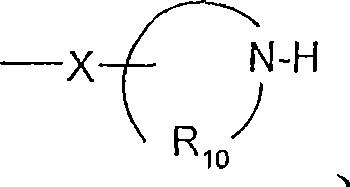
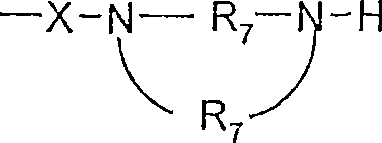
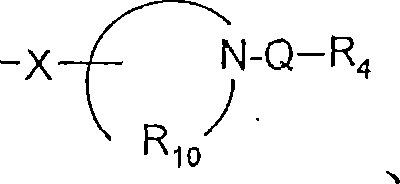
对于某些实施方案,R5a选自:For certain embodiments, R is selected from:


对于某些实施方案,R5a是

对于某些实施方案,R5a是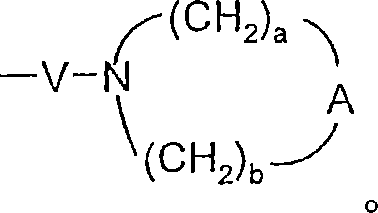
对于某些实施方案,R5选自:For certain embodiments, R is selected from:
和
对于某些实施方案,R5是For certain embodiments, R is


对于某些实施方案,R6选自=O和=S。For certain embodiments, R6 is selected from =O and =S.
对于某些实施方案,R6是=O。For certain embodiments, R 6 is =0.
对于某些实施方案,R7是C2-7亚烷基。For certain embodiments, R 7 is C 2-7 alkylene.
对于某些实施方案,R7是C2-4亚烷基。For certain embodiments, R 7 is C 2-4 alkylene.
对于某些实施方案,R7是亚乙基。For certain embodiments, R 7 is ethylene.
对于某些实施方案,R8选自氢、C1-10烷基、C2-10烯基、羟基-C1-10亚烷基、C1-10烷氧基-C1-10亚烷基、芳基-C1-10亚烷基和杂芳基-C1-10亚烷基。For certain embodiments, R is selected from hydrogen, C 1-10 alkyl, C 2-10 alkenyl, hydroxy-C 1-10 alkylene, C 1-10 alkoxy-C 1-10 alkylene radical, aryl-C 1-10 alkylene and heteroaryl-C 1-10 alkylene.
对于某些实施方案,R8是氢或C1-4烷基。For certain embodiments, R 8 is hydrogen or C 1-4 alkyl.
对于某些实施方案,R8是氢。For certain embodiments, R is hydrogen.
对于某些实施方案,R9a选自氢和C1-4烷基。For certain embodiments, R 9a is selected from hydrogen and C 1-4 alkyl.
对于某些实施方案,R9a是氢。For certain embodiments, R 9a is hydrogen.
对于某些实施方案,R9选自氢和烷基。For certain embodiments, R9 is selected from hydrogen and alkyl.
对于某些实施方案,R10是C3-8亚烷基。For certain embodiments, R 10 is C 3-8 alkylene.
对于某些实施方案,R10是亚戊基。For certain embodiments, R 10 is pentylene.
对于某些实施方案,R11选自烷基、烷氧基亚烷基、羟基亚烷基、芳基、芳基亚烷基、杂芳基、杂芳基亚烷基、杂环基和杂环基亚烷基,每个基团是未取代的或被一个或多个独立地选自以下基团的取代基取代:烷基;烷氧基;羟基;羟烷基;芳基;芳氧基;芳基亚烷氧基;杂芳基;杂芳氧基;杂芳基亚烷氧基;卤素;卤代烷基;卤代烷氧基;巯基;硝基;氰基;杂环基;氨基;烷基氨基;二烷基氨基;并且,在烷基、杂环基和杂环基亚烷基的情况下,该取代基为氧。For certain embodiments, R is selected from the group consisting of alkyl, alkoxyalkylene, hydroxyalkylene, aryl, arylalkylene, heteroaryl, heteroarylalkylene, heterocyclyl, and hetero Cycloalkylene, each group is unsubstituted or substituted with one or more substituents independently selected from the group consisting of: alkyl; alkoxy; hydroxy; hydroxyalkyl; aryl; aryloxy Aryl; Arylalkyleneoxy; Heteroaryl; Heteroaryloxy; Heteroarylalkyleneoxy; Halogen; Haloalkyl; Haloalkoxy; Mercapto; Nitro; Cyano; Heterocyclyl; Amino; Alkane dialkylamino; and, in the case of alkyl, heterocyclyl and heterocyclylalkylene, the substituent is oxygen.
对于某些实施方案,R11选自烷基、烷氧基亚烷基、羟基亚烷基、芳基亚烷基、杂芳基亚烷基和杂环基亚烷基,每个基团是未取代的或被一个或多个独立地选自以下基团的取代基取代:烷基;烷氧基;羟基;羟烷基;芳基;芳氧基;芳基亚烷氧基;杂芳基;杂芳氧基;杂芳基亚烷氧基;卤素;卤代烷基;卤代烷氧基;巯基;硝基;氰基;杂环基;氨基;烷基氨基;二烷基氨基;并且,在烷基和杂环基亚烷基的情况下,该取代基为氧。For certain embodiments, R is selected from the group consisting of alkyl, alkoxyalkylene, hydroxyalkylene, arylalkylene, heteroarylalkylene, and heterocyclylalkylene, each of which is Unsubstituted or substituted with one or more substituents independently selected from the group consisting of: alkyl; alkoxy; hydroxy; hydroxyalkyl; aryl; aryloxy; arylalkyleneoxy; heteroaryl radical; heteroaryloxy; heteroarylalkyleneoxy; halogen; haloalkyl; haloalkoxy; mercapto; nitro; cyano; heterocyclyl; amino; alkylamino; dialkylamino; and, in In the case of alkyl and heterocyclylalkylene, the substituent is oxygen.
对于某些实施方案,R11是烷基、烷氧基亚烷基或羟基亚烷基。For certain embodiments, R 11 is alkyl, alkoxyalkylene, or hydroxyalkylene.
对于某些实施方案,R11是戊基。For certain embodiments, R 11 is pentyl.
对于某些实施方案,A选自-CH2-、-O-、-C(O)-、-S(O)0-2-和-N(-Q-R4)-。对于某些实施方案,A是-O-。For certain embodiments, A is selected from -CH 2 -, -O-, -C(O)-, -S(O) 0-2 -, and -N(-QR 4 )-. For certain embodiments, A is -O-.
对于某些实施方案,A’选自-O-、-S(O)0-2-、-N(-Q-R4-和-CH2-。For certain embodiments, A' is selected from -O-, -S(O) 0-2 -, -N(-QR 4 -, and -CH 2 -.
对于某些实施方案,Q选自键、-C(R6)-、-C(R6)-C(R6)-、-S(O)2-、-C(R6)-N(R8)-W-、-S(O)2-N(R8)-、-C(R6)-O-、-C(R6)-S-和-C(R6)-N(OR9)-。对于某些实施方案,Q是-C(R6)-N(R8)-、-C(R6)-或-S(O)2-。对于某些实施方案,Q是-C(O)-N(H)-、-C(O)-或-S(O)2-。对于某些实施方案,Q是-C(R6)-N(R8)-。对于某些实施方案,Q是-C(O)-NH-。对于某些实施方案,Q是-S(O)2-。对于某些实施方案,Q是-C(R6)-。对于某些实施方案,Q是-C(O)-。对于某些实施方案,Q是键。For certain embodiments, Q is selected from a bond, -C(R 6 )-, -C(R 6 )-C(R 6 )-, -S(O) 2 -, -C(R 6 )-N( R 8 )-W-, -S(O) 2 -N(R 8 )-, -C(R 6 )-O-, -C(R 6 )-S- and -C(R 6 )-N( OR 9 )-. For certain embodiments, Q is -C( R6 )-N( R8 )-, -C( R6 )-, or -S(O) 2- . For certain embodiments, Q is -C(O)-N(H)-, -C(O)-, or -S(O) 2- . For certain embodiments, Q is -C( R6 )-N( R8 )-. For certain embodiments, Q is -C(O)-NH-. For certain embodiments, Q is -S(O) 2- . For certain embodiments, Q is -C( R6 )-. For certain embodiments, Q is -C(O)-. For certain embodiments, Q is a bond.
对于某些实施方案,V选自-C(R6)-、-O-C(R6)-、-N(R8)-C(R6)-和-S(O)2-。对于某些实施方案,V是-N(R8)-C(O)-。For certain embodiments, V is selected from -C(R 6 )-, -OC(R 6 )-, -N(R 8 )-C(R 6 )-, and -S(O) 2 -. For certain embodiments, V is -N( R8 )-C(O)-.
对于某些实施方案,W选自键、-C(O)-和-S(O)2-。对于某些实施方案,W是键。For certain embodiments, W is selected from a bond, -C(O)-, and -S(O) 2- . For certain embodiments, W is a bond.
对于某些实施方案,X选自亚烷基、亚烯基、亚炔基、亚芳基、亚杂芳基和亚杂环基,其中亚烷基、亚烯基和亚炔基可以任选被亚芳基、亚杂芳基或亚杂环基插入或封端,并任选被一个或多个-O-插入。For certain embodiments, X is selected from the group consisting of alkylene, alkenylene, alkynylene, arylene, heteroarylene and heterocyclylene, wherein the alkylene, alkenylene and alkynylene can optionally Interrupted or terminated by an arylene, heteroarylene or heterocyclylene, and optionally inserted by one or more -O-.
对于某些实施方案,X是C(1-4)亚烷基。For certain embodiments, X is C( 1-4 )alkylene.
对于某些实施方案,-X-是For some embodiments, -X- is
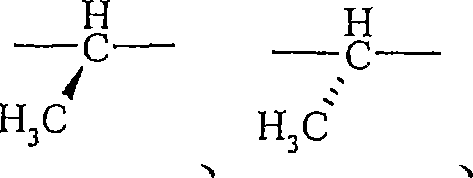
对于某些实施方案,X是亚甲基。For certain embodiments, X is methylene.
对于某些实施方案,X是-C1-4亚烷基-O-C1-4亚烷基-。For certain embodiments, X is -C 1-4 alkylene-OC 1-4 alkylene-.
对于这些实施方案的某些、X是-(CH2)2-O-(CH2)3-。For certain of these embodiments, X is -( CH2 ) 2 -O-( CH2 ) 3- .
对于某些实施方案,X1是C2-20亚烷基。对于某些实施方案,X1是C2-4亚烷基。For certain embodiments, X 1 is C 2-20 alkylene. For certain embodiments, X 1 is C 2-4 alkylene.
对于某些实施方案,Y选自-O-、-S(O)0-2-、-S(O)2-N(R8)-、-C(R6)-、-C(R6)-O-、-O-C(R6)-、-O-C(O)-O-、-N(R8)-Q-、-C(R6)-N(R8)-、-O-C(R6)-N(R8)-、-C(R6)-N(OR9)-、-O-N(R8)-Q-、-O-N=C(R4)-、-C(=N-O-R8)-、-CH(-N(-O-R8)-Q-R4)-、
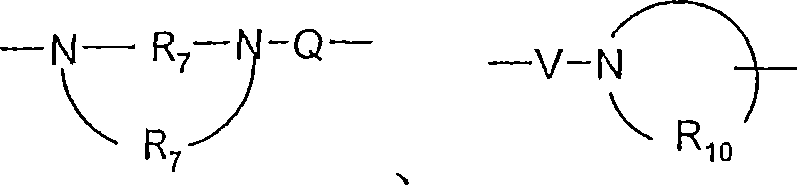
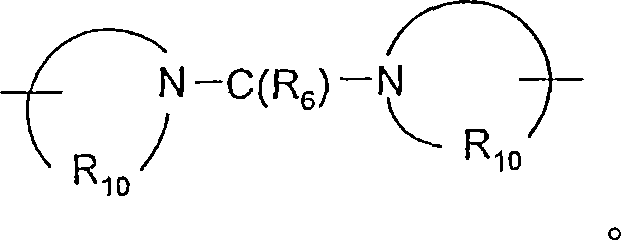
对于某些实施方案,Y是-N(R8)-C(O)-、-N(R8)-S(O)2-、-N(R8)-C(R6)-N(R8)-、-N(R8)-C(R6)-N(R8)-C(O)-、-N(R8)-C(R6)-O-、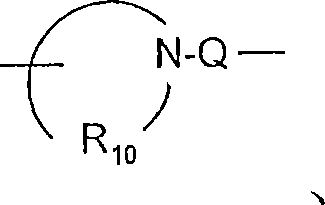

对于某些实施方案,Y是-S(O)2-。For certain embodiments, Y is -S(O) 2- .
对于某些实施方案,Y是-NH-Q-。For certain embodiments, Y is -NH-Q-.
对于某些实施方案,Y是
对于某些实施方案,Y是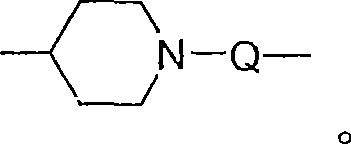
对于某些实施方案,Y1选自-O-、-S(O)0-2-、-S(O)2-N(R8)-、-N(R8)-Q-、-C(R6)-N(R8)-、-O-C(R6)-N(R8)-和
对于某些实施方案,a和b独立地为1至6的整数,条件是a+b≤7。对于某些实施方案,a和b各自为2。For certain embodiments, a and b are independently integers from 1 to 6, with the proviso that a+b≦7. For certain embodiments, a and b are each 2.
对于某些实施方案,本发明提供了包括治疗有效量的式I、II和III的任一上述实施方案的化合物或盐和药学上可接受的载体的药物组合物。For certain embodiments, the invention provides a pharmaceutical composition comprising a therapeutically effective amount of a compound or salt of any one of the above embodiments of Formulas I, II and III and a pharmaceutically acceptable carrier.
对于某些实施方案,本发明提供可诱导动物体内的细胞因子生物合成的方法,该方法包括给予动物以有效量的式I、II和III的任一上述实施方案的化合物或盐,或包括有效量的式I、II和III的任一上述实施方案的化合物或盐的药物组合物。对于这些实施方案的某些,该细胞因子选自IFN-α、TNF-α、IL-6和IL-10。对于这些实施方案的某些,该细胞因子是IFN-α或IFN-α和TNF-α。对于这些实施方案的某些,该细胞因子是IFN-α。For certain embodiments, the present invention provides a method for inducing cytokine biosynthesis in an animal, the method comprising administering to the animal an effective amount of a compound or salt of any of the above embodiments of formulas I, II and III, or comprising effectively A pharmaceutical composition of an amount of a compound or salt of any one of the above embodiments of formulas I, II and III. For certain of these embodiments, the cytokine is selected from IFN-α, TNF-α, IL-6, and IL-10. For certain of these embodiments, the cytokine is IFN-α or IFN-α and TNF-α. For certain of these embodiments, the cytokine is IFN-α.
对于某些实施方案,本发明提供了选择性诱导动物体内IFN-α生物合成的方法,该方法包括给予动物以有效量的式I、II和III的任一上述实施方案的化合物或盐,或包括有效量的式I、II和III的任一上述实施方案的化合物或盐的药物组合物。For certain embodiments, the present invention provides a method for selectively inducing IFN-α biosynthesis in an animal, the method comprising administering to the animal an effective amount of a compound or salt of any one of the above embodiments of formulas I, II and III, or A pharmaceutical composition comprising an effective amount of a compound or salt of any one of the above embodiments of Formulas I, II and III.
对于某些实施方案,本发明提供了治疗动物体内病毒性疾病的方法,该方法包括给予动物以治疗有效量的式I、II和III的任一上述实施方案的化合物或盐,或包括治疗有效量的式I、II和III的任一上述实施方案的化合物或盐的药物组合物。For certain embodiments, the present invention provides a method for treating viral diseases in animals, the method comprising administering to the animal a therapeutically effective amount of a compound or salt of any of the above embodiments of formulas I, II and III, or comprising a therapeutically effective A pharmaceutical composition of an amount of a compound or salt of any one of the above embodiments of formulas I, II and III.
对于某些实施方案,本发明提供了治疗动物体内病毒性疾病的方法,该方法包括给予动物以治疗有效量的式I、II和III的任一上述实施方案的化合物或盐,或包括治疗有效量的式I、II和III的任一上述实施方案的化合物或盐的药物组合物;并选择性诱导动物体内的IFN-α生物合成。For certain embodiments, the present invention provides a method for treating viral diseases in animals, the method comprising administering to the animal a therapeutically effective amount of a compound or salt of any of the above embodiments of formulas I, II and III, or comprising a therapeutically effective A pharmaceutical composition of a compound or salt of any one of the above embodiments of formulas I, II and III; and selectively inducing IFN-α biosynthesis in animals.
对于某些实施方案,本发明提供了治疗动物体内肿瘤性疾病的方法,该方法包括给予动物以治疗有效量的式I、II和III的任一上述实施方案的化合物或盐,或包括治疗有效量的式I、II和III的任一上述实施方案的化合物或盐的药物组合物。For certain embodiments, the present invention provides a method for treating neoplastic diseases in animals, the method comprising administering to the animal a therapeutically effective amount of a compound or salt of any of the above embodiments of formulas I, II and III, or comprising a therapeutically effective A pharmaceutical composition of an amount of a compound or salt of any one of the above embodiments of formulas I, II and III.
对于某些实施方案,本发明提供了治疗动物体内肿瘤性疾病的方法,该方法包括给予动物以治疗有效量的式I、II和III的任一上述实施方案的化合物或盐,或包括治疗有效量的式I、II和III的任一上述实施方案的化合物或盐的药物组合物;并选择性诱导动物体内的IFN-α生物合成。For certain embodiments, the present invention provides a method for treating neoplastic diseases in animals, the method comprising administering to the animal a therapeutically effective amount of a compound or salt of any of the above embodiments of formulas I, II and III, or comprising a therapeutically effective A pharmaceutical composition of a compound or salt of any one of the above embodiments of formulas I, II and III; and selectively inducing IFN-α biosynthesis in animals.
本文所用的术语“烷基”、“烯基”、“炔基”及前缀“alk-”包括直链和支链基团,并包括环状基团,例如环烷基和环烯基。除非另行说明,这些基团含有1至20个碳原子,烯基含有2至20个碳原子,炔基含有2至20个碳原子。在一些实施方案中,这些基团总共具有最多10个碳原子、最多8个碳原子、最多6个碳原子或最多4个碳原子。环状基团可以是单环或多环的,并优选具有3至10个环碳原子。示例性环状基团包括环丙基、环丙基甲基、环丁基、环丁基甲基、环戊基、环戊基甲基、环己基、环己基甲基、金刚烷基,以及取代的和未取代的冰片基、降冰片基和降冰片烯基。As used herein, the terms "alkyl", "alkenyl", "alkynyl" and the prefix "alk-" include straight and branched chain groups, and include cyclic groups such as cycloalkyl and cycloalkenyl. Unless otherwise specified, these groups contain 1 to 20 carbon atoms, alkenyl groups contain 2 to 20 carbon atoms, and alkynyl groups contain 2 to 20 carbon atoms. In some embodiments, these groups have a total of up to 10 carbon atoms, up to 8 carbon atoms, up to 6 carbon atoms, or up to 4 carbon atoms. Cyclic groups may be monocyclic or polycyclic, and preferably have 3 to 10 ring carbon atoms. Exemplary cyclic groups include cyclopropyl, cyclopropylmethyl, cyclobutyl, cyclobutylmethyl, cyclopentyl, cyclopentylmethyl, cyclohexyl, cyclohexylmethyl, adamantyl, and substituted and unsubstituted bornyl, norbornyl and norbornenyl.
除非另行指明,“亚烷基”、“-亚烷基-”、“亚烯基”、“-亚烯基-”、“亚炔基”和“-亚炔基-”是上文定义的“烷基”、“烯基”和“炔基”的二价形式。当“亚烷”、“亚链烯”和“亚炔”分别被取代时,使用术语“亚烷基”、“亚烯基”和“亚炔基”。例如,芳基亚烷基包括其上连接有芳基的“亚烷基”部分。Unless otherwise specified, "alkylene", "-alkylene-", "alkenylene", "-alkenylene-", "alkynylene" and "-alkynylene-" are as defined above Divalent forms of "alkyl", "alkenyl" and "alkynyl". The terms "alkylene", "alkenylene" and "alkynylene" are used when "alkylene", "alkenylene" and "alkynylene", respectively, are substituted. For example, arylalkylene includes an "alkylene" moiety to which is attached an aryl group.
术语“卤代烷基”包括被一个或多个卤素原子取代的烷基,包括全氟化基团。这也适用于包括前缀“卤代-”的其它基团。适宜的卤代烷基的实例是氯甲基、三氟甲基和类似基团。The term "haloalkyl" includes alkyl groups substituted with one or more halogen atoms, including perfluorinated groups. This also applies to other groups including the prefix "halo-". Examples of suitable haloalkyl groups are chloromethyl, trifluoromethyl and similar groups.
本文所用的术语“芳基”包括碳环型芳环或环体系。芳基的实例包括苯基、萘基、联苯基、芴基和茚基。As used herein, the term "aryl" includes carbocyclic aromatic rings or ring systems. Examples of aryl groups include phenyl, naphthyl, biphenyl, fluorenyl and indenyl.
除非另行指明,术语“杂原子”是指原子O、S或N。The term "heteroatom" refers to the atoms O, S or N unless otherwise indicated.
术语“杂芳基”包括含有至少一个环杂原子(例如,O、S、N)的芳环或环体系。在一些实施方案中,术语“杂芳基”包括含有2至12个碳原子、1至3个环、1至4个杂原子以及作为杂原子的O、S和/或N的环或环体系。适宜的杂芳基包括呋喃基、噻吩基、吡啶基、喹啉基、异喹啉基、吲哚基、异吲哚基、三唑基、吡咯基、四唑基、咪唑基、吡唑基、噁唑基、噻唑基、苯并呋喃基、苯并噻吩基、咔唑基、苯并噁唑基、嘧啶基、苯并咪唑基、喹喔啉基、苯并噻唑基、萘啶基(naphthyridinyl)、异噁唑基、异噻唑基、嘌呤基、喹唑啉基、吡嗪基、1-环氧吡啶基、哒嗪基、三嗪基、四嗪基、噁二唑基、噻二唑基等等。The term "heteroaryl" includes aromatic rings or ring systems that contain at least one ring heteroatom (eg, O, S, N). In some embodiments, the term "heteroaryl" includes rings or ring systems containing 2 to 12 carbon atoms, 1 to 3 rings, 1 to 4 heteroatoms, and O, S, and/or N as heteroatoms . Suitable heteroaryl groups include furyl, thienyl, pyridyl, quinolinyl, isoquinolyl, indolyl, isoindolyl, triazolyl, pyrrolyl, tetrazolyl, imidazolyl, pyrazolyl , oxazolyl, thiazolyl, benzofuryl, benzothienyl, carbazolyl, benzoxazolyl, pyrimidinyl, benzimidazolyl, quinoxalinyl, benzothiazolyl, naphthyridyl ( naphthyridinyl), isoxazolyl, isothiazolyl, purinyl, quinazolinyl, pyrazinyl, 1-epoxypyridinyl, pyridazinyl, triazinyl, tetrazinyl, oxadiazolyl, thiadi Azolyl and so on.
术语“杂环基”包括含有至少一个环杂原子(例如,O、S、N)的非芳族环或环体系,并包括上述杂芳基的所有完全饱和与部分饱和的衍生物。在一些实施方案中,术语“杂环基”包括含有2至12个碳原子、1至3个环、1至4个杂原子和作为杂原子的O、S和N的环或环体系。示例性杂环基包括吡咯烷基、四氢呋喃基、吗啉基、硫代吗啉基、1,1-二氧硫代吗啉基、哌啶基、哌嗪基、噻唑烷基、咪唑烷基、异噻唑烷基、四氢吡喃基、奎宁环基、高哌啶基(homopiperidinyl)(氮杂环庚烷基)、1,4-去甲羟基安定(oxazepanyl)、高哌嗪基(homopiperazinyl)(二氮杂环庚烷基)、1,3-二氧戊环基、氮丙啶基、吖丁啶基、二氢异喹啉异喹啉-(1H)-基、八氢异喹啉-(1H)-基、二氢喹啉-(2H)-基、八氢喹啉-(2H)-基、二氢-1H-咪唑基、3-氮杂二环[3.2.2]壬-3-基和类似基团。The term "heterocyclyl" includes non-aromatic rings or ring systems containing at least one ring heteroatom (eg, O, S, N), and includes all fully saturated and partially saturated derivatives of the aforementioned heteroaryl groups. In some embodiments, the term "heterocyclyl" includes rings or ring systems containing 2 to 12 carbon atoms, 1 to 3 rings, 1 to 4 heteroatoms, and O, S, and N as heteroatoms. Exemplary heterocyclyl groups include pyrrolidinyl, tetrahydrofuranyl, morpholinyl, thiomorpholinyl, 1,1-dioxothiomorpholinyl, piperidinyl, piperazinyl, thiazolidinyl, imidazolidinyl , isothiazolidinyl, tetrahydropyranyl, quinuclidinyl, homopiperidinyl (homopiperidinyl) (azepanyl), 1,4-norxazepanyl (oxazepanyl), homopiperazinyl ( homopiperazinyl) (diazepanyl), 1,3-dioxolanyl, aziridinyl, azetidinyl, dihydroisoquinoline isoquinolin-(1H)-yl, octahydroisoquinoline -(1H)-yl, dihydroquinolin-(2H)-yl, octahydroquinolin-(2H)-yl, dihydro-1H-imidazolyl, 3-azabicyclo[3.2.2]nonyl- 3-yl and similar groups.
术语“杂环基”包括二环和三环杂环环体系。此类环体系包括稠合的和/或桥连的环和螺环。除饱和的或部分饱和的环之外,稠环还可以包括芳环,例如苯环。螺环包括通过一个螺原子连接的两个环,以及通过两个螺原子连接的三个环。The term "heterocyclyl" includes bicyclic and tricyclic heterocyclic ring systems. Such ring systems include fused and/or bridged rings and spirocycles. In addition to saturated or partially saturated rings, fused rings can also include aromatic rings, such as benzene rings. Spirocycles include two rings connected by one spiro atom, and three rings connected by two spiro atoms.
当“杂环基”含有氮原子时,杂环基的连接点可以是氮原子。When the "heterocyclic group" contains a nitrogen atom, the point of attachment of the heterocyclic group may be the nitrogen atom.
术语“亚芳基”、“亚杂芳基”和“亚杂环基”是上文定义的“芳基”、“杂芳基”和“杂环基”的二价形式。当“亚芳基(arylene)”、“亚杂芳基(heteroarylene)”和“亚杂环基(heterocyclylene)”分别被取代时,使用术语“亚芳基(arylenyl)”、“亚杂芳基(heteroarylenyl)”和“亚杂环基(heterocyclylenyl)”。例如,烷基亚芳基包括其上连接有烷基的亚芳基部分。The terms "arylene", "heteroarylene" and "heterocyclylene" are divalent forms of "aryl", "heteroaryl" and "heterocyclyl" defined above. The terms "arylenyl", "heteroarylene" and "heterocyclylene" are used when "arylene", "heteroarylene" and "heterocyclylene" are respectively substituted (heteroarylenyl)" and "heterocyclic (heterocyclyllenyl)". For example, alkylarylene includes an arylene moiety having an alkyl group attached thereto.
当基团(或取代基或变量)在本文所述的任何式中存在一个以上时,每个基团(或取代基或变量)独立地选择,无论是否明确说明。例如,对于式各个R7基团独立选择。在另一实例中,当存在一个以上Y基团时,各个Y基团独立选择。在另一实例中,当存在一个以上的-N(R8)-C(R6)-N(R8)-基团(例如,存在一个以上的Y基团,并均含有-N(R8)-C(R6)-N(R8)-基团)时,各个R8基团独立选择,且各个R6基团独立选择。When more than one group (or substituent or variable) is present in any formula described herein, each group (or substituent or variable) is independently selected, whether explicitly stated or not. For example, for the formula Each R7 group is independently selected. In another example, when more than one Y group is present, each Y group is independently selected. In another example, when there is more than one -N(R 8 )-C(R 6 )-N(R 8 )- group (for example, there is more than one Y group, and both contain -N(R 8 )-C(R 6 )-N(R 8 )-group), each R 8 group is independently selected, and each R 6 group is independently selected.
本发明包括本文所述的化合物(包括中间体)的任何药学可接受形式,包括异构体(例如非对映异构体和对映异构体)、盐、溶剂合物、多晶型物、前药和类似物。特别地,如果化合物是旋光性的,本发明具体包括该化合物的每一对映异构体,以及该对映异构体的外消旋与scalemic混合物。应当理解的是,术语“化合物”包括任何或所有此类形式,无论是否明确指明(尽管有时,明确指明“盐”)。The present invention includes any pharmaceutically acceptable form of the compounds described herein (including intermediates), including isomers (eg, diastereomers and enantiomers), salts, solvates, polymorphs , prodrugs and analogs. In particular, if a compound is optically active, the invention specifically includes each enantiomer of that compound, as well as racemic and scalemic mixtures of such enantiomers. It should be understood that the term "compound" includes any and all such forms, whether or not specifically indicated (although sometimes, "salts" are explicitly indicated).
术语“前药”是指如下化合物——其可以体内转化以产生改变免疫应答的化合物,包括上述盐、溶剂合物、多晶型物、或异构体形式的任一种。前药本身可以是调节免疫应答的化合物,包括上述盐、溶剂合物、多晶型物或异构体形式的任一种。这种转化可以通过各种机制进行,例如通过化学的(例如在血液中的溶剂分解或水解)或酶的生物转化进行。T.Higuchi和W.Stella,“Pro-drugs as Novel DeliverySystems”,A.C.S.Symposium Series的14卷,和在Edward B.Roche主编的Bioreversible Carriers in Drug Design,American PharmaceuticalAssociation and Pergamon Press,1987中提供了使用前药的论述。The term "prodrug" refers to a compound that can be transformed in vivo to produce a compound that alters an immune response, including any of the salts, solvates, polymorphs, or isomeric forms described above. The prodrug itself may be a compound that modulates an immune response, including any of the salts, solvates, polymorphs or isomeric forms described above. This transformation can take place by various mechanisms, for example by chemical (eg solvolysis or hydrolysis in blood) or enzymatic biotransformation. T. Higuchi and W. Stella, "Pro-drugs as Novel Delivery Systems", vol. 14 of the A.C.S. Symposium Series, and Bioreversible Carriers in Drug Design, edited by Edward B. Roche, American Pharmaceutical Association and Pergamon Press, 1987. Discussion of medicine.
化合物的制备Compound preparation
本发明的化合物可以通过包括类似于化学领域公知的那些的方法的合成途径合成,特别是依据本文所包含的描述。起始原料通常可获自商业来源,例如Aldrich Chemicals(Milwaukee,Wisconsin,USA)或容易使用本领域技术人员公知的方法制备(例如通过一般由Louis F.Fieser和Mary Fieser,Reagents for Organic Synthesis,v.1-19,Wiley,NewYork,(1967-1999 ed.);Alan R.Katritsky,Otto Meth-Cohn,Charles W.Rees,Comprehensive Organic Functional Group Transformations,v 1-6,Pergamon Press,Oxford,England,(1995);Barry M.Trost和Ian Fleming,Comprehensive Organic Synthesis,v.1-8,Pergamon Press,Oxford,England,(1991);或Beilsteins Handbuch der organischen Chemie,4,Aufl.Ed.Springer-Verlag,Berlin,Germany,包括附录(也可经由Beilstein onlinedatabase获得))中描述的方法制备)。The compounds of the present invention may be synthesized by synthetic routes including methods analogous to those well known in the chemical arts, particularly in accordance with the description contained herein. Starting materials are generally available from commercial sources, such as Aldrich Chemicals (Milwaukee, Wisconsin, USA) or are readily prepared using methods well known to those skilled in the art (e.g., by methods generally described by Louis F. Fieser and Mary Fieser, Reagents for Organic Synthesis, v. .1-19, Wiley, NewYork, (1967-1999 ed.); Alan R. Katritsky, Otto Meth-Cohn, Charles W. Rees, Comprehensive Organic Functional Group Transformations, v 1-6, Pergamon Press, Oxford, England, (1995); Barry M. Trost and Ian Fleming, Comprehensive Organic Synthesis, v.1-8, Pergamon Press, Oxford, England, (1991); or Beilsteins Handbuch der organischen Chemie, 4, Aufl. Ed. Springer-Verlag, Berlin, Germany, including preparations described in the Appendix (also available via the Beilstein online database)).
为了示例性目的,下面所绘的反应示意图提供了用于合成本发明的化合物以及关键中间体的潜在途径。对于各个反应步骤的更详细描述,参见下面的实施例部分。本领域技术人员会认识到,可以使用其它合成途径合成本发明的化合物。尽管在下述反应示意图中描绘了特定的起始原料和试剂,但可以很容易地替换成其它起始原料和试剂得到各种衍生物和/或反应条件。此外,通过下述方法制成的许多化合物可以依据本公开书使用本领域技术人员公知的传统方法而进一步改进。For illustrative purposes, the reaction schemes drawn below provide potential routes for the synthesis of compounds of the invention as well as key intermediates. For a more detailed description of the individual reaction steps see the Examples section below. Those skilled in the art will recognize that other synthetic routes can be used to synthesize the compounds of the invention. Although specific starting materials and reagents are depicted in the following reaction schemes, other starting materials and reagents can be readily substituted to obtain various derivatives and/or reaction conditions. In addition, many of the compounds prepared by the methods described below can be further modified from this disclosure using conventional methods well known to those skilled in the art.
在本发明的化合物的制备中,有时必须保护特定的官能团同时使中间体上的其它官能团反应。对这类保护的需求随特定官能团的性质和反应步骤的条件而变。合适的氨基保护基包括乙酰基、三氟乙酰基、叔丁氧基羰基(Boc)、苄氧基羰基、和9-芴基甲氧基羰基(Fmoc)。合适的羟基保护基包括乙酰基和甲硅烷基,例如叔丁基二甲基甲硅烷基。对于保护基及其用途的一般描述,参见T.W.Greene和P.G.M.Wuts,Protective Groups in Organic Synthesis,John Wiley & Sons,New York,USA,1991。In the preparation of compounds of the present invention, it is sometimes necessary to protect specific functional groups while reacting other functional groups on intermediates. The need for such protection will vary with the nature of the particular functional group and the conditions of the reaction step. Suitable amino protecting groups include acetyl, trifluoroacetyl, t-butoxycarbonyl (Boc), benzyloxycarbonyl, and 9-fluorenylmethoxycarbonyl (Fmoc). Suitable hydroxy protecting groups include acetyl and silyl groups such as tert-butyldimethylsilyl. For a general description of protecting groups and their uses, see T.W. Greene and P.G.M. Wuts, Protective Groups in Organic Synthesis, John Wiley & Sons, New York, USA, 1991.
可以使用传统的分离和提纯方法和技术分离本发明的化合物或其药学上可接受的盐以及与其有关的各种中间体。这类技术可包括,例如,所有类型的色谱法(高效液相色谱法(HPLC)、使用通用吸收剂如硅胶的柱色谱法、和薄层色谱法、重结晶、和微分(即液-液)萃取技术。The compounds of the present invention, or pharmaceutically acceptable salts thereof, and various intermediates related thereto can be isolated using conventional isolation and purification methods and techniques. Such techniques may include, for example, all types of chromatography (high performance liquid chromatography (HPLC), column chromatography using common absorbents such as silica gel, and thin layer chromatography, recrystallization, and differential (i.e., liquid-liquid ) extraction technique.
本发明的化合物可以根据反应示意图I制备,其中RA、RB、G1、G2和R1定义如上,且Bn是苄基、对甲氧基苄基、对甲基苄基或2-呋喃基甲基。在反应示意图I的步骤(1)中,使式V的2,4-二氯-3-硝基吡啶与式R1-NH2的胺反应。该反应方便地通过在碱,例如三乙胺存在下将胺添加到式V的化合物的溶液中来进行。该反应在合适的溶剂,例如二氯甲烷、氯仿或N,N-二甲基甲酰胺(DMF)中进行并可以在室温、低于室温,例如0℃,或高温,例如溶剂回流温度下进行。许多式V的2,4-二氯-3-硝基吡啶是已知的并可以通过已知方法制备;参见,例如美国专利第6,525,064号(Deliaria等人)。例如,它们可以通过用氯化剂,例如氧氯化磷(III)将4-羟基-3-硝基-2(1H)-吡啶酮氯化来容易地制备。许多4-羟基-3-硝基-2(1H)-吡啶酮是已知的或可以通过已知方法制备;参见,例如,美国专利No.5,446,153(Lindstrom等人)和其中引用的参考文献。其它式V的2,4-二氯-3-硝基吡啶可以根据反应示意图II中所述的方法制备。The compounds of the present invention can be prepared according to Reaction Scheme I, wherein RA , R B , G 1 , G 2 and R 1 are as defined above, and Bn is benzyl, p-methoxybenzyl, p-methylbenzyl or 2- furylmethyl. In step (1) of Reaction Scheme I, a 2,4-dichloro-3-nitropyridine of formula V is reacted with an amine of formula R 1 -NH 2 . The reaction is conveniently carried out by adding the amine to a solution of the compound of formula V in the presence of a base such as triethylamine. The reaction is carried out in a suitable solvent such as dichloromethane, chloroform or N,N-dimethylformamide (DMF) and can be carried out at room temperature, below room temperature, such as 0°C, or at elevated temperature, such as the reflux temperature of the solvent . Many 2,4-dichloro-3-nitropyridines of formula V are known and can be prepared by known methods; see, eg, US Patent No. 6,525,064 (Deliaria et al.). For example, they can be readily prepared by chlorinating 4-hydroxy-3-nitro-2(1H)-pyridone with a chlorinating agent such as phosphorus(III) oxychloride. Many 4-hydroxy-3-nitro-2(1H)-pyridones are known or can be prepared by known methods; see, eg, US Patent No. 5,446,153 (Lindstrom et al.) and references cited therein. Other 2,4-dichloro-3-nitropyridines of formula V can be prepared according to the method described in Reaction Scheme II.
许多式R1-NH2的胺可从商业渠道购得;另一些可以通过已知方法制备。例如,可从商业渠道购得各种取代和未取代的烷基和芳基亚烷基胺、异构的(氨基甲基)吡啶、和烷基、芳基或芳基亚烷基肼或肼盐。在某些优选实施方案中,R1是(5-取代-异噁唑-3-基)甲基。(5-取代异噁唑-3-基)甲基胺可以通过下列四步法制备。在(i)部分中,将式(PG)2-X-CH=O的被保护氨基-醛(其中PG是氮保护基,X如上定义)使用传统方法转化成式(PG)2-X-CH=N-OH的醛肟。例如,醛可以与羟胺盐酸盐在碱例如三乙胺存在下在合适的溶剂例如二氯甲烷中混合。该反应可以在室温下运行。被保护氨基-醛可以使用传统方法制备。例如,邻苯二甲酰亚氨基乙醛二乙基乙缩醛是市售化合物,其可以用酸处理得到式(PG)2-X-CH=O的醛。在(ii)部分中,通过在合适的溶剂,例如DMF中用N-氯琥珀酰亚胺处理,将式(PG)2-X-CH=N-OH的醛肟转化成式(PG)2-X-C(Cl)=N-OH的α-氯醛肟。该反应可以最初在室温以下,例如在0℃,然后在40℃至50℃的较高温度下加热。式(PG)2-X-C(Cl)=N-OH的α-醛肟可以任选先分离,然后在(iii)部分中通过在室温下在合适的溶剂,例如二氯甲烷中在炔烃的存在下用碱,例如三乙胺处理来转化成被保护(5-取代-异噁唑-3-基)甲基胺以产生氧化腈。氧化腈和炔烃经过[3+2]环加成反应得到被保护(5-取代-异噁唑-3-基)甲基胺,其随后在(iv)部分中使用传统方法脱保护。当使用邻苯二甲酰亚胺保护基时,可以通过将邻苯二甲酰亚胺保护的(5-取代-异噁唑-3-基)甲基胺与肼或水合肼在合适的溶剂例如乙醇或溶剂混合物例如乙醇/THF中混合来进行脱保护。脱保护可以在室温下或在较高的温度,例如溶剂回流温度下进行。Many amines of formula R1 - NH2 are commercially available; others can be prepared by known methods. For example, various substituted and unsubstituted alkyl and arylalkyleneamines, isomeric (aminomethyl)pyridines, and alkyl, aryl, or arylalkylene hydrazines or hydrazines are commercially available Salt. In certain preferred embodiments, R 1 is (5-substituted-isoxazol-3-yl)methyl. (5-Substituted isoxazol-3-yl)methylamines can be prepared by the following four-step method. In part (i), a protected amino-aldehyde of formula (PG) 2 -X-CH=O (where PG is a nitrogen protecting group and X is as defined above) is converted to formula (PG) 2 -X- using conventional methods Aldoximes of CH=N-OH. For example, an aldehyde can be mixed with hydroxylamine hydrochloride in a suitable solvent such as dichloromethane in the presence of a base such as triethylamine. The reaction can be run at room temperature. Protected amino-aldehydes can be prepared using conventional methods. For example, phthalimidoacetaldehyde diethyl acetal is a commercially available compound which can be treated with an acid to give an aldehyde of formula (PG) 2 -X-CH=O. In part (ii), the aldoxime of formula (PG) 2 -X-CH=N-OH is converted to formula (PG) 2 by treatment with N-chlorosuccinimide in a suitable solvent such as DMF α-Chloraldoxime with -XC(Cl)=N-OH. The reaction may be heated initially below room temperature, for example at 0°C, and then at a higher temperature of 40°C to 50°C. The α-aldoxime of the formula (PG) 2 -XC(Cl)=N-OH can optionally be isolated first and then in part (iii) by reaction at room temperature in a suitable solvent such as dichloromethane in the presence of an alkyne Conversion to the protected (5-substituted-isoxazol-3-yl)methylamine by treatment with a base such as triethylamine yields the nitrile oxide. [3+2] cycloaddition of nitrile oxides and alkynes affords protected (5-substituted-isoxazol-3-yl)methylamines, which are subsequently deprotected in section (iv) using conventional methods. When using a phthalimide protecting group, it can be obtained by combining phthalimide-protected (5-substituted-isoxazol-3-yl)methylamine with hydrazine or hydrazine hydrate in a suitable solvent For example, ethanol or solvent mixtures such as ethanol/THF are mixed for deprotection. Deprotection can be carried out at room temperature or at elevated temperature, such as the reflux temperature of the solvent.
一些式H2N-R1的胺可以根据下列方法制造。对于一些实施方案,R1是1-羟基环烷基甲基、(4-羟基四氢-2H-吡喃-4-基)甲基、或衍生自[1-(叔丁氧基羰基)-4-羟基哌啶-4-基]甲基的基团。相应的式H2N-R1的胺可以通过将环酮例如环戊酮、环丁酮、四氢-4H-吡喃-4-酮,和4-氧代-1-哌啶甲酸叔丁酯与过量硝基甲烷在合适的溶剂例如乙醇或甲醇中,在催化量的碱例如乙醇钠或氢氧化钠存在下混合并使用传统多相氢化条件将所得硝基甲基取代化合物还原来进行制备。氢化通常在催化剂例如碳载氢氧化钯、碳载钯或阮内镍存在下在合适的溶剂例如乙醇中进行。与硝基甲烷的反应和还原都可以在室温下进行。可以从商业来源获得多种环酮;另一些可以使用已知合成方法合成。Some amines of formula H 2 NR 1 can be made according to the following methods. For some embodiments, R is 1 -hydroxycycloalkylmethyl, (4-hydroxytetrahydro-2H-pyran-4-yl)methyl, or derived from [1-(tert-butoxycarbonyl)- 4-hydroxypiperidin-4-yl]methyl group. The corresponding amines of formula H NR 1 can be obtained by combining cyclic ketones such as cyclopentanone, cyclobutanone, tetrahydro-4H-pyran-4-one, and tert-butyl 4-oxo-1-piperidinecarboxylate with Excess nitromethane is prepared by mixing in a suitable solvent such as ethanol or methanol in the presence of a catalytic amount of a base such as sodium ethoxide or sodium hydroxide and reducing the resulting nitromethyl substituted compound using conventional heterogeneous hydrogenation conditions. Hydrogenation is typically carried out in a suitable solvent such as ethanol in the presence of a catalyst such as palladium hydroxide on carbon, palladium on carbon or Raney nickel. Both the reaction and reduction with nitromethane can be carried out at room temperature. A variety of cyclic ketones are available from commercial sources; others can be synthesized using known synthetic methods.
在反应示意图I的步骤(2)中,式VI的吡啶中的氯基被式HN(Bn)2的胺置换得到式VII的吡啶。该置换通过将式HN(Bn)2的胺与式VI的化合物在合适的溶剂例如甲苯或二甲苯中在碱例如三乙胺存在下混合,并在较高温度例如溶剂回流温度下加热来方便地进行。In the step (2) of the reaction scheme I, the chlorine group in the pyridine of the formula VI is replaced by the amine of the formula HN(Bn) to obtain the pyridine of the formula VII. This displacement is facilitated by mixing an amine of formula HN(Bn) with a compound of formula VI in a suitable solvent such as toluene or xylene in the presence of a base such as triethylamine and heating at an elevated temperature such as the reflux temperature of the solvent proceed.
在反应示意图I的步骤(3)中,将式VII的化合物还原得到式VIII的吡啶-2,3,4-三胺。使用由硼氢化钠和氯化镍(II)原位制成的硼化镍进行还原反应。还原反应方便地通过将式VII的吡啶在合适的溶剂或溶剂混合物例如二氯甲烷/甲醇中的溶液添加到过量硼氢化钠和催化或化学计算量的氯化镍(II)在甲醇中的混合物中来进行。反应可以在室温下进行。In step (3) of Reaction Scheme I, the compound of formula VII is reduced to obtain pyridine-2,3,4-triamine of formula VIII. The reduction was performed using nickel boride prepared in situ from sodium borohydride and nickel(II) chloride. The reduction is conveniently achieved by adding a solution of pyridine of formula VII in a suitable solvent or solvent mixture such as dichloromethane/methanol to a mixture of excess sodium borohydride and a catalytic or stoichiometric amount of nickel(II) chloride in methanol to proceed. The reaction can be performed at room temperature.
在反应示意图I的步骤(4)中,将式VIII的吡啶-2,3,4-三胺环化得到式lX的1H-咪唑并[4,5-c]吡啶-2-醇。环化反应可以通过在合适的溶剂例如四氢呋喃(THF)、叔丁基甲基醚、二氯甲烷或DMF中加热式VIII的吡啶-2,3,4-三胺与羰基二咪唑来方便地进行。反应可以在室温下进行或优选在较高的温度例如溶剂回流温度下进行。In step (4) of Reaction Scheme I, pyridine-2,3,4-triamine of formula VIII is cyclized to obtain 1H-imidazo[4,5-c]pyridin-2-ol of formula IX. The cyclization reaction can be conveniently carried out by heating the pyridine-2,3,4-triamine of formula VIII with carbonyldiimidazole in a suitable solvent such as tetrahydrofuran (THF), tert-butyl methyl ether, dichloromethane or DMF. The reaction can be carried out at room temperature or preferably at elevated temperature such as the reflux temperature of the solvent.
在反应示意图I的步骤(5)中,从式IX的1H-咪唑并[4,5-c]吡啶-2-醇的4-胺中除去保护基得到式I的1H-咪唑并[4,5-c]吡啶-2-醇。对于某些实施方案,脱保护可以在Parr装置上在氢解条件下使用合适的多相催化剂例如碳载钯,在溶剂例如乙醇中方便地进行。或者,当Bn是对甲氧基苄基时,步骤(5)可通过将三氟乙酸和式IX的化合物混合,并在室温下搅拌或在较高的温度,例如50℃至70℃下加热来进行。In step (5) of Reaction Scheme 1, the protecting group is removed from the 4-amine of 1H-imidazo[4,5-c]pyridin-2-alcohol of formula IX to obtain 1H-imidazo[4 of formula I, 5-c]pyridin-2-ol. For certain embodiments, deprotection can be conveniently performed on a Parr apparatus under hydrogenolysis conditions using a suitable heterogeneous catalyst such as palladium on carbon in a solvent such as ethanol. Alternatively, when Bn is p-methoxybenzyl, step (5) can be achieved by mixing trifluoroacetic acid and the compound of formula IX, and stirring at room temperature or heating at a higher temperature, such as 50°C to 70°C to proceed.
某些式R1-NH2的胺提供了式VI的化合物,其含有可以在随后的步骤中被转化的官能团或被保护官能团得到具有各种不同的R1基团的式I的化合物。例如,式Boc-N(R8)-X-NH2的被保护胺、或

步骤(1)中所用的胺可以是肼基甲酸叔丁酯,且所得的2-(2-氯-3-硝基吡啶-4-基)肼甲酸叔丁酯可以经受步骤(2)至(4)的条件。式IX的化合物(其中R1是Boc-保护的氨基)可以脱保护得到1-氨基化合物或其盐(例如盐酸盐)。脱保护可通过在回流下加热式IX的化合物在乙醇氢氯化物中的溶液来进行。所得的式IX的化合物(其中R1是氨基)可以用酮、醛或其相应的缩酮或缩醛在酸性条件下处理。例如,可以在式IX的化合物(其中R1是氨基)的盐酸盐在合适的溶剂例如异丙醇或乙腈中的溶液中,在酸例如对甲苯磺酸吡啶鎓或乙酸,或酸树脂,例如DOWEX W50-X1酸树脂存在下加入酮。该反应可以在较高的温度下进行。将所得亚胺还原得到式IX的化合物,其中R1是-N(R1’)-Q-R4,其中Q是键。还原可以在室温下用硼氢化钠在合适的溶剂,例如甲醇中进行。然后可进行步骤(5)中所示的脱保护来提供式I的化合物。也可以在随后的步骤中使用国际公开的WO2006/026760(Stoermer等人)中所述的方法处理式VI的2-(2-氯-3-硝基吡啶-4-基)肼甲酸叔丁酯来提供式I的其它化合物,其中R1是-N(R1’)-Q-R4、-N(R1’)-X1-Y1-R4或-N(R1’)-X1-R5b。The amine used in step (1) can be tert-butyl carbazate, and the resulting 2-(2-chloro-3-nitropyridin-4-yl) tert-butyl carbazate can be subjected to steps (2) to ( 4) Conditions. Compounds of formula IX, wherein R 1 is Boc-protected amino, can be deprotected to give 1-amino compounds or salts thereof (eg hydrochloride). Deprotection can be performed by heating a solution of the compound of formula IX in ethanol hydrochloride at reflux. The resulting compound of formula IX, wherein R1 is amino, can be treated with a ketone, aldehyde or its corresponding ketal or acetal under acidic conditions. For example, in a solution of the hydrochloride salt of a compound of formula IX wherein R is amino in a suitable solvent such as isopropanol or acetonitrile, in an acid such as pyridinium p-toluenesulfonate or acetic acid, or an acid resin, For example, add ketone in the presence of DOWEX W50-X1 acid resin. The reaction can be carried out at higher temperature. Reduction of the resulting imine affords compounds of formula IX, wherein R 1 is -N(R 1 ')-QR 4 , where Q is a bond. The reduction can be performed with sodium borohydride in a suitable solvent such as methanol at room temperature. Deprotection as shown in step (5) can then be performed to provide compounds of formula I. tert-butyl 2-(2-chloro-3-nitropyridin-4-yl)carbazinate of formula VI can also be treated in a subsequent step using the method described in International Publication WO2006/026760 (Stoermer et al.) To provide other compounds of formula I, wherein R 1 is -N(R 1 ')-QR 4 , -N(R 1 ')-X 1 -Y 1 -R 4 or -N(R 1 ')-X 1 -R 5b .
在某些优选实施方案中,R1是(3-取代的异噁唑-5-基)甲基。该基团可以通过使用炔丙基胺作为反应示意图I的步骤(1)中式R1-NH2的胺来制备,从而提供式VI的化合物,其中R1是-CH2-C≡CH。在反应示意图I的步骤(5)之前,在R1位置的炔基经过环加成反应,由α-氯醛肟形成氧化腈得到式I的异噁唑取代1H-咪唑并[4,5-c]吡啶-2-醇。α-氯醛肟可以通过在合适的溶剂例如DMF中用N-氯琥珀酰亚胺处理醛肟来制备。该反应可以最初在室温以下,在例如0℃下进行,然后在40℃至50℃的较高温度下加热。醛肟可从商业渠道购得或可以由醛通过本领域技术人员公知的方法制备。所得的α-氯醛肟可以任选先分离,然后在碱例如三乙胺存在下与式IX的化合物(其中R1是-CH2-C≡H)混合以原位产生氧化腈并实现环加成反应。与α-氯醛肟的反应可以在室温下在合适的溶剂例如二氯甲烷中进行。其它式NH2-X-CH=CH2或NH2-X-C≡C-H的胺也可以用于反应示意图I的步骤(1)中得到式I的化合物,其中R1是(3-取代的异噁唑-5-基)烷基或(3-取代-4,5-二氢异噁唑-5-基)烷基。In certain preferred embodiments, R 1 is (3-substituted isoxazol-5-yl)methyl. This group can be prepared by using propargylamine as the amine of formula R1 - NH2 in step (1) of Reaction Scheme I, to provide compounds of formula VI, wherein R1 is -CH2 -C≡CH. Before the step (5) of the reaction schematic diagram 1, the alkynyl group at the R1 position undergoes a cycloaddition reaction to form a nitrile oxide by α-chloraldoxime to obtain the isoxazole of the formula I to replace 1H-imidazo[4,5- c] pyridin-2-ol. α-Chloraldoxime can be prepared by treating the aldoxime with N-chlorosuccinimide in a suitable solvent such as DMF. The reaction can be carried out initially below room temperature, eg at 0°C, followed by heating at a higher temperature of 40°C to 50°C. Aldoximes are commercially available or can be prepared from aldehydes by methods well known to those skilled in the art. The resulting α-chloraldoxime can optionally be isolated first and then mixed with a compound of formula IX (where R 1 is -CH 2 -C≡H) in the presence of a base such as triethylamine to generate nitrile oxide in situ and achieve cycloaddition reaction. The reaction with α-chloraldoxime can be carried out at room temperature in a suitable solvent such as dichloromethane. Other amines of formula NH 2 -X-CH=CH 2 or NH 2 -XC≡CH can also be used in step (1) of Reaction Scheme I to obtain compounds of formula I, wherein R 1 is (3-substituted isoxa (oxazol-5-yl)alkyl or (3-substituted-4,5-dihydroisoxazol-5-yl)alkyl.
合成过程也可以在式I的化合物或式V至IX的中间体的RA或RB位置进行。例如,式V的化合物(其中RB是甲基)是已知的并可以根据反应示意图I的步骤(1)至(4)处理以制备式IX的被保护1H-咪唑并[4,5-c]吡啶-2-醇。然后RB位置上的甲基可以使用N-溴代琥珀酰亚胺根据Rama Rao,A.V.等人Tetrahedron Lett.,34,第2665页,(1993)或Clive,D.L.J.等人J.Am.Chem.Soc.,116,第11275页,(1994)的方法溴化。然后使用传统方法用各种伯胺或醇盐基团置换溴,随后进行步骤(5)得到式I的化合物,其中RB是被烷基氨基、烷氧基、芳氧基、芳基亚烷氧基、杂芳氧基或杂芳基亚烷氧基取代的甲基。The synthesis can also be carried out at the RA or RB position of a compound of formula I or an intermediate of formulas V to IX. For example, compounds of formula V (where R B is methyl) are known and can be processed according to steps (1) to (4) of Reaction Scheme I to prepare protected 1H-imidazo[4,5- c] pyridin-2-ol. The methyl group at the R B position can then be treated with N-bromosuccinimide according to Rama Rao, AV et al. Tetrahedron Lett., 34, p. 2665, (1993) or Clive, DLJ et al. J.Am.Chem. Bromination by the method of Soc., 116, p. 11275, (1994). Bromine is then replaced with various primary amine or alkoxide groups using conventional methods, followed by step (5) to obtain compounds of formula I, wherein R is replaced by alkylamino, alkoxy, aryloxy, arylalkylene Oxy, heteroaryloxy or heteroarylalkyleneoxy substituted methyl.
在另一实施例中,可使用Rousseau,R.J.,Robins,R.K.,J.Heterocycl.Chem.,2,196(1965)中所述的方法制备的式IX的化合物(其中RB是氯或溴)可以通过与各种胺的钯催化偶联(Wagaw,S.,Buchwald,S.L.,J Org.Chem.,61,7240,(1996))转化成相应的化合物,其中RB是烷基氨基。同样,可通过与所需醇的钯催化偶联(Palucki,M.,Wolfe,J.P.,Buchwald,S.L.,J.Am.Chem.Soc.,119,3395,(1997))制备相应的化合物,其中 RB是烷氧基。用醇盐阴离子置换6-氯基团也可得到相应的6-烷氧基衍生物(日本专利第04018073号(Tenma等人))。In another example, a compound of formula IX (where R B is chlorine or bromine) prepared by the method described in Rousseau, RJ, Robins, RK, J. Heterocycl. Chem., 2, 196 (1965) can be used Conversion to the corresponding compounds where RB is alkylamino can be achieved by palladium-catalyzed coupling with various amines (Wagaw, S., Buchwald, SL, J Org. Chem., 61, 7240, (1996)). Likewise, the corresponding compound can be prepared by palladium-catalyzed coupling (Palucki, M., Wolfe, JP, Buchwald, SL, J. Am. Chem. Soc., 119, 3395, (1997)) with the desired alcohol, wherein RB is alkoxy. The corresponding 6-alkoxy derivatives can also be obtained by replacing the 6-chloro group with an alkoxide anion (Japanese Patent No. 04018073 (Tenma et al.)).
可选的是,式IX的化合物(其中RB是氯且RA是氢)可根据反应示意图I,使用式VII的化合物(其中RB是氯且RA是氢)来制备。这类式VII的化合物可以通过使式
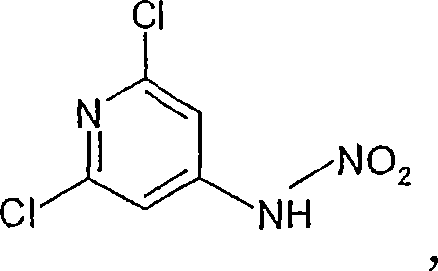
可选的是,式IX的化合物(其中RB是烷氧基)可根据反应示意图I,使用式VII的化合物(其中RB是氯且RA和R1均为氢)制备。式VIII的化合物(其中RB是氯)可以通过使用金属醇盐例如醇钠置换氯基来转化成相应的化合物(其中RB是烷氧基)。该反应可以通过在较低的温度,例如在冰浴温度下将在合适溶剂例如四氢呋喃中的式VII的4-氨基-6-氯-3-硝基吡啶(其中RB是氯且RA和R1均为氢)添加到金属醇盐溶液中,添加完成后在较高的温度,例如在85℃下加热来进行。在反应示意图I的步骤(3)中,所得式VII的4-氨基-6-烷氧基-3-硝基吡啶(其中RB是烷氧基且RA和R1均为氢)可以随后还原成式VIII的3,4-二氨基-6-烷氧基吡啶(其中RB是烷氧基且RA和R1均为氢)。还原反应方便地通过在合适的溶剂或溶剂混合物例如乙醇/乙腈中将亚硫酸氢钠水溶液添加到式VII的4-氨基-6-烷氧基-3-硝基吡啶中来进行。该反应可以在室温下进行。在反应示意图I的步骤(4)中,可以将式VIII的3,4-二氨基-6-烷氧基吡啶环化得到6-烷氧基-1,3-二氢咪唑并[4,5-c]吡啶-2-酮,其是式IX的酮基互变体,其中R1是氢。环化反应可以方便地通过在合适的溶剂例如四氢呋喃(THF)、叔丁基甲基醚、二氯甲烷或DMF中加热式VIII的3,4-二氨基-6-烷氧基吡啶以及1,1’-羰基二咪唑来进行。该反应可以在室温下或优选在较高的温度,例如溶剂回流温度下进行。可以通过与式X-R1(其中X是卤素,例如溴基,且R1不是氢)的化合物反应来取代式IX的酮基互变体的1-位。该反应可以通过在合适的溶剂例如DMF中,在较高的温度,例如在80℃下加热式IX的酮基互变体以及式X-R1的化合物来进行,以形成在1位被R1取代的式IX的化合物。Alternatively, compounds of formula IX wherein RB is alkoxy can be prepared according to Reaction Scheme I using compounds of formula VII wherein RB is chloro and RA and R1 are both hydrogen. Compounds of formula VIII wherein RB is chloro can be converted to corresponding compounds wherein RB is alkoxy by displacement of the chloro group with a metal alkoxide such as sodium alkoxide. This reaction can be achieved by dissolving 4-amino-6-chloro-3-nitropyridine of formula VII (wherein RB is chloro and RA and R 1 are hydrogen) added to the metal alkoxide solution, after the addition is completed, heated at a higher temperature, for example, at 85°C. In the step (3) of reaction schematic diagram 1, the 4-amino-6-alkoxy-3-nitropyridine (wherein R B is alkoxy group and RA and R of obtained formula VII) can be followed by Reduction to 3,4-diamino-6-alkoxypyridines of Formula VIII (wherein RB is alkoxy and RA and R1 are both hydrogen). The reduction is conveniently carried out by the addition of aqueous sodium bisulfite to the 4-amino-6-alkoxy-3-nitropyridine of formula VII in a suitable solvent or solvent mixture such as ethanol/acetonitrile. The reaction can be performed at room temperature. In step (4) of Reaction Scheme I, 3,4-diamino-6-alkoxypyridine of formula VIII can be cyclized to obtain 6-alkoxy-1,3-dihydroimidazo[4,5 -c] pyridin-2-one, which is a keto tautomer of formula IX, wherein R 1 is hydrogen. The cyclization reaction can be conveniently carried out by heating a 3,4-diamino-6-alkoxypyridine of formula VIII together with 1,1' in a suitable solvent such as tetrahydrofuran (THF), tert-butyl methyl ether, dichloromethane or DMF. -carbonyldiimidazole. The reaction can be carried out at room temperature or preferably at elevated temperature, such as the reflux temperature of the solvent. The 1-position of the keto tautomers of formula IX can be substituted by reaction with a compound of formula XR 1 wherein X is halogen, eg bromo, and R 1 is other than hydrogen. This reaction can be carried out by heating the keto tautomer of formula IX and the compound of formula XR 1 in a suitable solvent such as DMF at an elevated temperature, for example at 80° C., to form a compound substituted by R at position 1 A compound of formula IX.
同样,式IX的化合物(其中RB是烷基氨基)可以根据示意图I使用式VII的化合物(其中RB是氯且RA和R1均为氢)制备。式VII的化合物(其中RB是氯)可以通过使用过量,例-如5当量的烷基胺,例如正丁胺置换氯基来转化成相应的化合物(其中RB是烷基氨基)。该反应可以通过将在合适的溶剂例如三氟乙醇中的式VII的4-氨基-6-氯-3-硝基吡啶(其中RB是氯且RA和R1均为氢)添加到所需烷基胺的溶液中,然后在密封管中在较高的温度,例如130℃下加热一段时间,例如18至24小时来进行。随后可以如上所述进行反应示意图I的步骤(3)和(4)和氢以外的R1基团的安装得到式IX的1-取代的6-烷基氨基化合物。Likewise, compounds of formula IX wherein RB is alkylamino can be prepared according to Scheme I using compounds of formula VII wherein RB is chloro and RA and R 1 are both hydrogen. Compounds of formula VII wherein RB is chloro can be converted into corresponding compounds wherein RB is alkylamino by displacing the chloro group with an excess, such as 5 equivalents, of an alkylamine such as n-butylamine . The reaction can be achieved by adding 4-amino-6-chloro-3-nitropyridine of formula VII (wherein RB is chloro and RA and R are both hydrogen) in a suitable solvent such as trifluoroethanol to the A solution of an alkylamine is required, and then heated in a sealed tube at a relatively high temperature, such as 130° C., for a period of time, such as 18 to 24 hours. Steps (3) and (4) of Reaction Scheme I and installation of R groups other than hydrogen can then be carried out as described above to give 1-substituted 6-alkylamino compounds of formula IX.
在另一可选方案中,可以在溶剂例如DMF中使用碱例如碳酸铯通过O-烷基化法将相应的6-氧代-1(3)H-咪唑并[4,5-c]吡啶-4-基胺O-烷基化,从而获得式IX的化合物(其中RB是烷氧基)(Meurer,L.等人,Bioorg.Med.Chem.Lett.,75(3)645,(2005))。此外,O-烷基化可以在Mitsunobu条件下进行(Li,Q.等人,Bioorg.Med.Chem.Lett.,16(6),1679(2006))。In another alternative, the corresponding 6-oxo-1(3)H-imidazo[4,5-c]pyridine can be synthesized via O-alkylation using a base such as cesium carbonate in a solvent such as DMF -4-ylamine O-alkylation, thereby obtaining the compound of formula IX (wherein R B is alkoxy) (Meurer, L. et al., Bioorg.Med.Chem.Lett., 75 (3) 645, ( 2005)). Furthermore, O-alkylation can be performed under Mitsunobu conditions (Li, Q. et al., Bioorg. Med. Chem. Lett., 16(6), 1679 (2006)).
反应示意图I的步骤(6)可用于制备式II的化合物。式I的吡啶的氨基可以通过传统方法转化成官能团例如酰胺、氨基甲酸酯、脲、脒、或另一可水解基团。这类化合物可以通过将氨基中的氢原子置换为诸如-C(O)-R′、α-氨酰基、α-氨酰基-α-氨酰基、-C(O)-O-R′、-C(O)-N(R″)-R′、-C(=NY′)-R、-CH(OH)-C(O)-OY′、-CH(OC1-4烷基)Y0、-CH2Y1或-CH(CH3)Y1的基团来制造;其中R′和R″各自独立地为C1-10烷基、C3-7环烷基、苯基或苄基,它们各自可以是未取代或被一个或多个取代基取代,该取代基选自卤素、羟基、硝基、氰基、羧基、C1-6烷基、C1-4烷氧基、芳基、杂芳基、芳基C1-4亚烷基、杂芳基C1-4亚烷基、卤代C1-4亚烷基、卤代C1-4烷氧基、-O-C(O)-CH3、-C(O)-O-CH3、-C(O)-NH2、-O-CH2-C(O)-NH2、-NH2和-S(O)2-NH2;条件是R″也可以是氢;各个α-氨酰基独立地选自外消旋、D、或L-氨基酸;Y′是氢、C1-6烷基或苄基;Y0是C1-6烷基、羧基C1-6亚烷基、氨基C1-4亚烷基、单-N-C1-6烷基氨基C1-4亚烷基、或二-N,N-C1-6烷基氨基C1-4亚烷基;且Y1是单-N-C1-6烷基氨基、二-N,N-C1-6烷基氨基、吗啉-4-基、哌啶-1-基、吡咯烷-1-基、或4-C1-4烷基哌嗪-1-基。特别有用的式II的化合物是衍生自含1至10个碳原子的羧酸的酰胺、衍生自氨基酸的酰胺、和含1至10个碳原子的氨基甲酸酯。该反应可以例如通过将式I的化合物与氯甲酸酯或酰基氯例如氯甲酸乙酯或乙酰氯,在碱例如三乙胺存在下,在合适的溶剂例如二氯甲烷中在室温下混合来进行。Step (6) of Reaction Scheme I can be used to prepare compounds of formula II. The amino group of the pyridine of formula I can be converted into a functional group such as amide, carbamate, urea, amidine, or another hydrolyzable group by conventional methods. Such compounds can be replaced by hydrogen atoms such as -C (O) -R ', α-aminoacyl, α-aminoacyl-α-aminoacyl, -C (O)-OR ', -C ( O)-N(R")-R', -C(=NY')-R, -CH(OH)-C(O)-OY', -CH(OC 1-4 alkyl)Y 0 , - CH 2 Y 1 or -CH(CH 3 ) Y 1 ; where R' and R" are each independently C 1-10 alkyl, C 3-7 cycloalkyl, phenyl or benzyl, Each of them may be unsubstituted or substituted by one or more substituents selected from halogen, hydroxyl, nitro, cyano, carboxyl, C1-6 alkyl, C1-4 alkoxy, aryl , heteroaryl, aryl C 1-4 alkylene, heteroaryl C 1-4 alkylene, halogenated C 1-4 alkylene, halogenated C 1-4 alkoxy, -OC(O )-CH 3 , -C(O)-O-CH 3 , -C(O)-NH 2 , -O-CH 2 -C(O)-NH 2 , -NH 2 and -S(O) 2 - NH 2 ; proviso that R" can also be hydrogen; each α-aminoacyl group is independently selected from racemic, D, or L-amino acids; Y' is hydrogen, C 1-6 alkyl or benzyl; Y 0 is C 1-6 alkyl, carboxy C 1-6 alkylene, amino C 1-4 alkylene, mono-NC 1-6 alkylamino C 1-4 alkylene, or di-N,NC 1- 6 alkylamino C 1-4 alkylene; And Y 1 is mono-NC 1-6 alkylamino, two-N, NC 1-6 alkylamino, morpholin-4-yl, piperidine-1- Base, pyrrolidin-1-yl, or 4-C 1-4 alkylpiperazin-1-yl. Particularly useful compounds of formula II are amides derived from carboxylic acids containing 1 to 10 carbon atoms, derived from Amides of amino acids, and carbamates containing 1 to 10 carbon atoms. The reaction can be achieved, for example, by combining a compound of formula I with chloroformate or an acid chloride such as ethyl chloroformate or acetyl chloride in a base such as triethyl This is carried out in the presence of amines in a suitable solvent such as dichloromethane with mixing at room temperature.
反应示意图I的步骤(6a)可用于制备式III的化合物。式I的醇基团的氢原子可以使用传统方法被诸如C1-6烷酰基氧基甲基、1-(C1-6烷酰基氧基)乙基、1-甲基-1-(C1-6烷酰基氧基)乙基、C1-6烷氧基羰基氧基甲基、N-(C1-6烷氧基羰基)氨基甲基、琥珀酰基、C1-6烷酰基、α-氨基C1-4烷酰基、芳基酰基、-P(O)(OH)2、-P(O)(O-C1-6烷基)2、C1-6烷氧基羰基、C1-6烷基氨基甲酰基和α-氨酰基或α-氨酰基-α-氨酰基的基团替代,其中各个α-氨酰基独立地选自外消旋、D、或L-氨基酸。特别有用的式III的化合物是由含1至6个碳原子的羧酸制成的酯、未取代或取代的苯甲酸酯、或由天然氨基酸制成的酯。Step (6a) of Reaction Scheme I can be used to prepare compounds of formula III. The hydrogen atom of the alcohol group of formula I can be replaced by conventional methods such as C 1-6 alkanoyloxymethyl, 1-(C 1-6 alkanoyloxy) ethyl, 1-methyl-1-(C 1-6 alkanoyloxy) ethyl, C 1-6 alkoxycarbonyloxymethyl, N-(C 1-6 alkoxycarbonyl) aminomethyl, succinyl, C 1-6 alkanoyl, α-amino C 1-4 alkanoyl, aryl acyl, -P(O)(OH) 2 , -P(O)(OC 1-6 alkyl) 2, C 1-6 alkoxycarbonyl, C 1 -6 alkylcarbamoyl and α-aminoacyl or α-aminoacyl-α-aminoacyl group substitutions, wherein each α-aminoacyl is independently selected from racemic, D, or L-amino acids. Particularly useful compounds of formula III are esters of carboxylic acids containing 1 to 6 carbon atoms, unsubstituted or substituted benzoates, or esters of natural amino acids.
反应示意图IReaction Schematic I
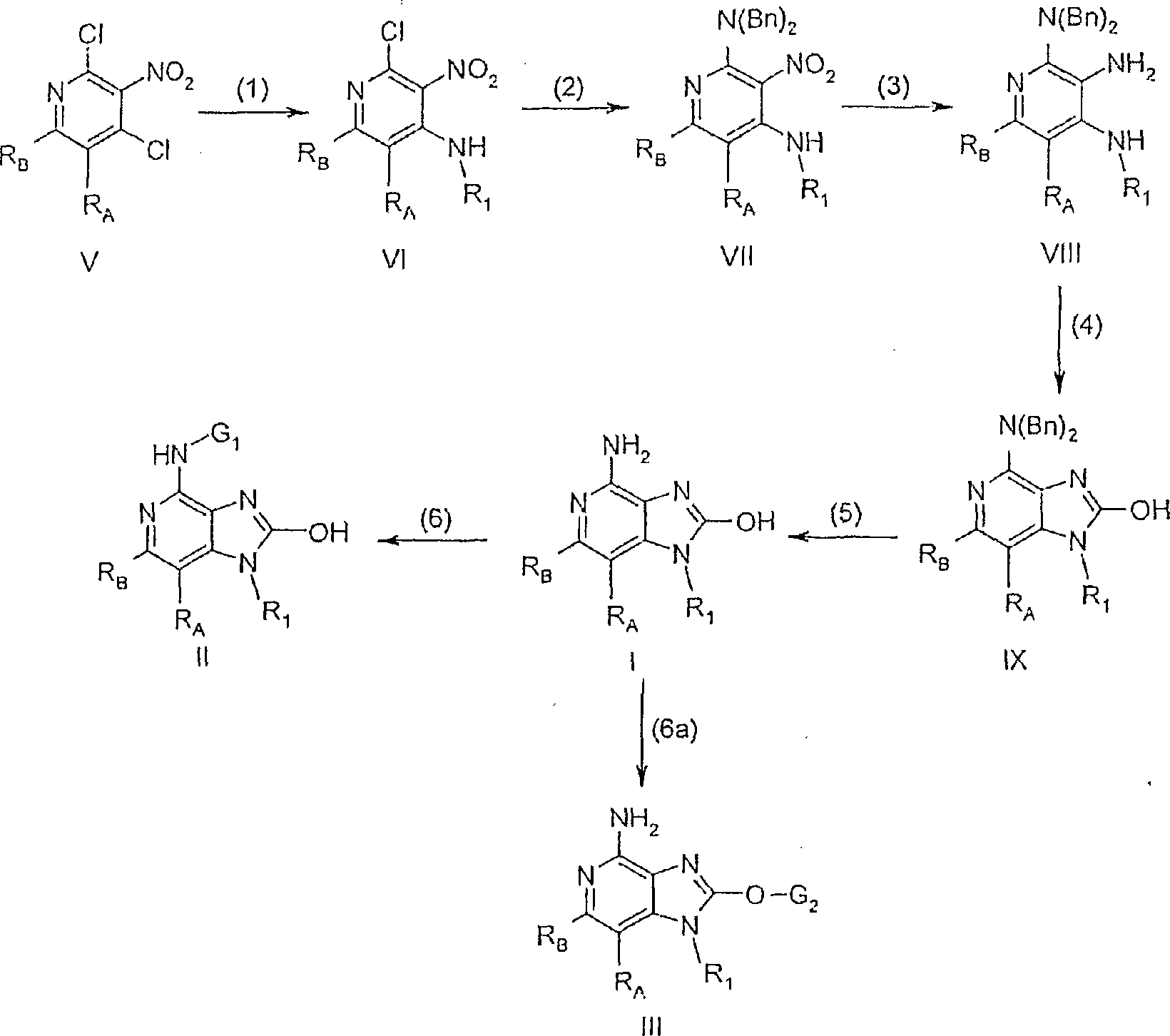
某些式V的化合物可以根据反应示意图II制备,其中R11和Boc如上定义,RBx是烯基、-R11、或羧基,且RBa是烯基、-R11或-NHR11。式X的4-羟基-2H-吡喃-2-酮(其中RBx是烯基或-R11)可由β,γ-二酮酯根据Lygo,B.,Tetrahedron,51,第12859-12868页,(1995)或Song,D.等人,Tetrahedron,59,第6899-6904页,(2003)的方法制备。式X的化合物(其中RBx是甲基)可从商业渠道购得并可以使用Poulton,G.A.,和Cyr,T.D.,Can.J.Chem.58,第2158页,(1980)的方法经过锂化取代反应得到式X的化合物(其中RBx是-R11)。式X的化合物(其中RBx是羧基)可以通过Stetter,H.和Schellhammer,C-W.,Chem.Ber.,90,第755页(1957)的方法制备。Certain compounds of formula V can be prepared according to Reaction Scheme II, wherein R 11 and Boc are as defined above, R Bx is alkenyl, -R 11 , or carboxy, and R Ba is alkenyl, -R 11 or -NHR 11 . 4-Hydroxy-2H-pyran-2-ones of formula X (where R Bx is alkenyl or -R 11 ) can be prepared from β, γ-diketone esters according to Lygo, B., Tetrahedron, 51, pp. 12859-12868 , (1995) or Song, D. et al., Tetrahedron, 59, pp. 6899-6904, (2003). Compounds of formula X (where RBx is methyl) are commercially available and can be lithiated using the method of Poulton, GA, and Cyr, TD, Can. J. Chem. 58, p. 2158, (1980). Substitution reactions give compounds of formula X (where R Bx is -R 11 ). Compounds of formula X wherein RBx is carboxy can be prepared by the method of Stetter, H. and Schellhammer, CW., Chem. Ber., 90, p. 755 (1957).
在反应示意图II的步骤(1)中,将式X的4-羟基-2H-吡喃-2-酮转化成式XI的吡啶-2,4-二醇。该反应通过在氢氧化铵水溶液中在80℃至130℃,优选在大约100℃至大约120℃下加热式X的化合物来进行。In step (1) of Reaction Scheme II, 4-hydroxy-2H-pyran-2-one of formula X is converted to pyridine-2,4-diol of formula XI. The reaction is carried out by heating a compound of formula X in aqueous ammonium hydroxide at a temperature of from 80°C to 130°C, preferably from about 100°C to about 120°C.
在反应示意图II的步骤(2)中,用叠氮磷酸二苯酯(diphenylphosphoryl azide)处理式XI的化合物(其中RBx为羧基)得到式XII的叠氮化物,其经过步骤(3)中的库尔提斯重排得到式XIII的氨基甲酸酯取代的吡啶-2,4-二醇。步骤(3)中的库尔提斯重排可以通过在较高的温度例如70℃至110℃下在合适的溶剂例如叔丁醇中加热来进行得到式XIII的氨基甲酸叔丁酯。In step (2) of Reaction Scheme II, the compound of formula XI (wherein R Bx is carboxyl) is treated with diphenylphosphoryl azide (diphenylphosphoryl azide) to obtain the azide of formula XII, which undergoes the azide in step (3) Curtis rearrangement affords carbamate-substituted pyridine-2,4-diols of formula XIII. The Curtis rearrangement in step (3) can be carried out by heating in a suitable solvent such as tert-butanol at elevated temperature eg 70°C to 110°C to give tert-butyl carbamate of formula XIII.
在反应示意图II的步骤(4)中,式XIII的氨基甲酸酯取代的吡啶-2,4-二醇使用传统方法脱保护。例如,可以通过在室温下用三氟乙酸处理来去除Boc基团得到式XIV的氨基取代的吡啶-2,4-二醇。In step (4) of Reaction Scheme II, carbamate-substituted pyridine-2,4-diols of formula XIII are deprotected using conventional methods. For example, the Boc group can be removed by treatment with trifluoroacetic acid at room temperature to give amino-substituted pyridine-2,4-diols of formula XIV.
在反应示意图II的步骤(5)中,式XIV的氨基取代的吡啶-2,4-二醇与醛或酮反应得到亚胺。许多醛和酮可从商业渠道购得;另一些可以使用已知的合成方法很容易地制备。该反应可通过将醛或酮与式XIV的化合物在合适的溶剂例如甲醇中混合来方便地进行。该反应可以在室温下或在较高的温度下进行。任选地,可以加入酸,例如吡啶盐酸盐。然后将亚胺还原得到氨基取代的式XV的吡啶-2,4-二醇。还原反应通过在合适的溶剂或溶剂混合物例如甲醇/乙酸中用过量的氰基硼氢化钠处理肟来方便地进行。任选地,可以加入盐酸。反应可以在室温下或在较高的温度下进行。In step (5) of Reaction Scheme II, an amino-substituted pyridine-2,4-diol of formula XIV is reacted with an aldehyde or a ketone to obtain an imine. Many aldehydes and ketones are commercially available; others can be readily prepared using known synthetic methods. The reaction is conveniently carried out by mixing the aldehyde or ketone with a compound of formula XIV in a suitable solvent such as methanol. The reaction can be carried out at room temperature or at elevated temperature. Optionally, an acid, such as pyridine hydrochloride, can be added. Reduction of the imine then affords the amino-substituted pyridine-2,4-diol of formula XV. The reduction is conveniently carried out by treating the oxime with an excess of sodium cyanoborohydride in a suitable solvent or solvent mixture such as methanol/acetic acid. Optionally, hydrochloric acid can be added. The reaction can be carried out at room temperature or at elevated temperature.
在反应示意图II的步骤(6)和(7)中,通过根据已知方法首先用硝酸然后用氧氯化磷(III)处理,将式XI或XV的化合物转化成式Va的2,4-二氯-3-硝基吡啶。参见,例如美国专利第5,446,153号(Lindstrom等人)和第6,525,064号(Dellaria等人)中的方法。In steps (6) and (7) of Reaction Scheme II, a compound of formula XI or XV is converted into a 2,4- Dichloro-3-nitropyridine. See, eg, the methods in US Patent Nos. 5,446,153 (Lindstrom et al.) and 6,525,064 (Dellaria et al.).
反应示意图IIReaction Schematic II

本发明的化合物也可以使用本领域技术人员显而易见的反应示意图I和II中所示的合成途径的变化形式来制备,包括下列实施例中所述的变化形式。Compounds of the invention can also be prepared using variations of the synthetic routes shown in Reaction Schemes I and II that will be apparent to those skilled in the art, including those described in the Examples below.
药物组合物和生物学活性Pharmaceutical composition and biological activity
本发明的药物组合物含有治疗有效量的如上所述本发明的化合物或盐以及药学上可接受的载体。The pharmaceutical composition of the present invention contains a therapeutically effective amount of the compound or salt of the present invention as described above and a pharmaceutically acceptable carrier.
术语“治疗有效量”和“有效量”是指化合物或盐的量足以诱发治疗或预防效应,例如细胞因子诱导、细胞因子抑制、免疫调节、抗癌活性、和/或抗病毒活性。本发明的药物组合物中所用的化合物或盐的确切量根据本领域技术人员已知的因素例如该化合物或盐的物理和化学性质、载体性质和预期用药方案而变化。The terms "therapeutically effective amount" and "effective amount" refer to an amount of a compound or salt sufficient to induce a therapeutic or prophylactic effect, such as cytokine induction, cytokine suppression, immunomodulation, anticancer activity, and/or antiviral activity. The exact amount of compound or salt used in the pharmaceutical composition of the invention will vary according to factors known to those skilled in the art, such as the physical and chemical properties of the compound or salt, the nature of the carrier and the intended dosage regimen.
在一些实施方案中,本发明的组合物含有充足的活性成分或前药以便为受试者提供大约100纳克/千克(ng/kg)至大约50毫克/千克(mg/kg),优选大约10微克/千克(μg/kg)至大约5毫克/千克的该化合物或盐。In some embodiments, the compositions of the invention contain sufficient active ingredient or prodrug to provide a subject with about 100 nanograms/kg (ng/kg) to about 50 milligrams/kg (mg/kg), preferably about 10 micrograms/kg ([mu]g/kg) to about 5 mg/kg of the compound or salt.
在另一些实施方案中,本发明的组合物含有充足的活性成分或前药以便提供例如大约0.01毫克/平方米至大约5.0毫克/平方米的根据Dubois法计算的剂量,其中受试者的体表面积(平方米)使用受试者的体重计算:m2=(体重kg0.425×高度cm0.725)×0.007184,尽管在一些实施方案中,这些方法可以通过施用超出该范围的剂量的化合物或盐或组合物来进行。在这些实施方案的一些中,该方法包括给予受试者以足量化合物得到大约0.1毫克/平方米至大约2.0毫克/平方米的剂量,例如大约0.4毫克/平方米至大约1.2毫克/平方米的剂量。In other embodiments, the compositions of the present invention contain sufficient active ingredient or prodrug to provide a dose calculated according to the Dubois method, for example, from about 0.01 mg/m to about 5.0 mg/m, wherein the subject's body Surface area (square meters) is calculated using the subject's body weight: m2 = (body weight kg 0.425 x height cm 0.725 ) x 0.007184, although in some embodiments these methods can be achieved by administering doses of the compound or salt outside this range or Composition to proceed. In some of these embodiments, the method comprises administering to the subject a sufficient amount of the compound to obtain a dose of about 0.1 mg/m to about 2.0 mg/m, for example about 0.4 mg/m to about 1.2 mg/m dosage.
可以使用各种剂型,例如片剂、锭剂、胶囊、胃肠外制剂、糖浆剂、乳膏剂、软膏剂、气溶胶制剂、透皮贴剂、透粘膜贴剂和类似剂型。这些剂型可以用传统的药学上可接受的载体和添加剂使用传统方法制备,这些方法通常包括使活性成分与载体结合在一起的步骤。Various dosage forms can be used, such as tablets, lozenges, capsules, parenteral formulations, syrups, creams, ointments, aerosol formulations, transdermal patches, transmucosal patches and the like. Such dosage forms may be prepared using conventional pharmaceutically acceptable carriers and additives using conventional methods which generally include the step of bringing into association the active ingredient with the carrier.
本发明的化合物或盐可在治疗方案中作为单一治疗剂给药,或本文所述的化合物或盐可相互组合或与其他活性剂组合给药,其他活性剂包括另外的免疫应答调节剂、抗病毒剂、抗生素、抗体、蛋白质、肽、寡核苷酸等。The compounds or salts of the invention may be administered in a treatment regimen as a single therapeutic agent, or the compounds or salts described herein may be administered in combination with each other or with other active agents, including additional immune response modifiers, anti-inflammatory agents, Viral agents, antibiotics, antibodies, proteins, peptides, oligonucleotides, etc.
本发明的化合物或盐已经在根据下列试验进行的实验中表明诱导了某些细胞因子的生成。这些结果表明,该化合物或盐可用于以许多不同方式调节免疫应答,从而使它们可用于治疗各种功能失调。The compounds or salts of the present invention have been shown to induce the production of certain cytokines in experiments according to the following assays. These results suggest that the compounds or salts can be used to modulate the immune response in many different ways, making them useful in the treatment of various disorders.
在一些实施方案中,式I的化合物或盐由于它们具有选择性诱导IFN-α的能力而尤其可用作免疫应答调节剂。本文所用的“选择性诱导IFN-α”是指,当根据本文所述的试验方法测试时,(该化合物或盐)诱导IFN-α的有效最小浓度小于诱导TNF-α的有效最小浓度。在一些实施方案中,诱导IFN-α的有效最小浓度比诱导TNF-α的有效最小浓度小至少3倍。在一些实施方案中,诱导IFN-α的有效最小浓度比诱导TNF-α的有效最小浓度小至少6倍。在另一些实施方案中,诱导IFN-α的有效最小浓度比诱导TNF-α的有效最小浓度小至少10倍。在其他的实施方案中,诱导IFN-α的有效最小浓度比诱导TNF-α的有效最小浓度小至少100倍。在一些实施方案中,当根据本文所述的试验方法测试时,用本发明的化合物诱导的TNF-α的量等于或低于试验方法中TNF-α的背景水平。本发明的化合物或盐因此可提供优于也能诱导促炎细胞因子(例如TNF-α)或以较高水平诱导促炎细胞因子的化合物的益处,例如较弱的炎症反应,尤其是当全身给药时。In some embodiments, compounds or salts of Formula I are particularly useful as immune response modifiers due to their ability to selectively induce IFN-[alpha]. As used herein, "selectively induces IFN-α" means that (the compound or salt) induces IFN-α at an effective minimum concentration that is less than the effective minimum concentration that induces TNF-α when tested according to the assay method described herein. In some embodiments, the effective minimum concentration to induce IFN-α is at least 3-fold less than the effective minimum concentration to induce TNF-α. In some embodiments, the effective minimum concentration to induce IFN-α is at least 6-fold less than the effective minimum concentration to induce TNF-α. In other embodiments, the effective minimum concentration to induce IFN-α is at least 10-fold less than the effective minimum concentration to induce TNF-α. In other embodiments, the effective minimum concentration to induce IFN-α is at least 100-fold less than the effective minimum concentration to induce TNF-α. In some embodiments, a compound of the invention induces an amount of TNF-α that is equal to or lower than the background level of TNF-α in the test method when tested according to the test method described herein. The compounds or salts of the present invention may therefore provide benefits over compounds that also induce pro-inflammatory cytokines (such as TNF-α) or induce pro-inflammatory cytokines at higher levels, such as a weaker inflammatory response, especially when the systemic when administering the drug.
通过给予本发明的化合物或盐可诱导其生成的细胞因子通常包括干扰素-α(IFN-α)和肿瘤坏死因子-α(TNF-α)以及某些白介素(IL)。可通过本发明的化合物或盐诱导其生物合成的细胞因子包括IFN-α、TNF-α、IL-I、IL-6、IL-10和IL-12和各种其它的细胞因子。在这些效应中,这些和其它的细胞因子可抑制病毒生成和肿瘤细胞生长,使得该化合物或盐用于治疗病毒性疾病和肿瘤性疾病。因此,本发明提供了诱导动物体内细胞因子生物合成的方法,该方法包括给予动物以有效量的本发明的化合物或盐或组合物。使用该化合物或盐或组合物以诱导细胞因子生物合成的动物可以具有如下文所述的疾病,例如病毒性疾病或肿瘤性疾病,且该化合物或盐的给药可提供治疗效应。可选的是,该化合物或盐可在动物患上该疾病之前给药以使该化合物或盐的给药可得到预防性治疗。Cytokines whose production can be induced by administration of the compounds or salts of the present invention generally include interferon-α (IFN-α) and tumor necrosis factor-α (TNF-α) as well as certain interleukins (IL). Cytokines whose biosynthesis can be induced by the compounds or salts of the present invention include IFN-α, TNF-α, IL-I, IL-6, IL-10 and IL-12 and various other cytokines. Among these effects, these and other cytokines can inhibit virus production and tumor cell growth, making the compound or salt useful in the treatment of viral and neoplastic diseases. Therefore, the present invention provides a method for inducing cytokine biosynthesis in an animal, the method comprising administering to the animal an effective amount of the compound or salt or composition of the present invention. Animals using the compound or salt or composition to induce cytokine biosynthesis may have a disease as described below, such as a viral disease or a neoplastic disease, and the administration of the compound or salt may provide a therapeutic effect. Optionally, the compound or salt can be administered before the animal develops the disease so that administration of the compound or salt can be a prophylactic treatment.
除了诱导细胞因子生成的能力外,本文所述的化合物或盐可影响先天免疫应答的其它方面。例如,可刺激自然杀伤细胞活性——一种可由于细胞因子诱导引起的效应。该化合物或盐还可激活巨噬细胞,其依次又刺激一氧化氮的分泌并产生其他的细胞因子。此外,该化合物或盐可引起B-淋巴细胞的增殖和分化。In addition to the ability to induce cytokine production, the compounds or salts described herein can affect other aspects of the innate immune response. For example, natural killer cell activity can be stimulated - an effect that can be due to cytokine induction. The compound or salt also activates macrophages, which in turn stimulate the secretion of nitric oxide and the production of other cytokines. In addition, the compound or salt can induce proliferation and differentiation of B-lymphocytes.
本发明的化合物或盐也可以作用于获得性免疫应答。例如,在该化合物或盐给药后,可间接诱导辅助T细胞1型(TH1)细胞因子IFN-γ的生成,并可抑制辅助T细胞2型(TH2)细胞因子IL-4、IL-5和IL-13的生成。The compounds or salts of the invention may also act on the adaptive immune response. For example, after administration of the compound or salt, it can indirectly induce the production of T helper cell type 1 ( TH 1) cytokine IFN-γ, and can inhibit the helper T cell type 2 ( TH 2) cytokine IL-4 , IL-5 and IL-13 production.
无论对于疾病的预防性或治疗性处理,且无论作用于先天还是获得性免疫,该化合物或盐或组合物可单独给药或与一种或多种活性组分,例如疫苗佐剂联合给药。当与其它组分一起给药时,该化合物或盐和其它组分可以分开给药;一起但独立地如在溶液中给药;或一起并彼此结合,如(a)共价连接或(b)非共价结合,例如在胶体悬浮液中。Whether for the prophylactic or therapeutic treatment of disease, and whether acting on innate or acquired immunity, the compound or salt or composition may be administered alone or in combination with one or more active ingredients, such as vaccine adjuvants . When administered with other components, the compound or salt and other components may be administered separately; together but independently, such as in a solution; or together and associated with each other, such as (a) covalently linked or (b) ) non-covalently bound, for example in a colloidal suspension.
本文所鉴定的化合物或盐用于治疗的病症包括,但不限于:Conditions for the treatment of compounds or salts identified herein include, but are not limited to:
(a)病毒性疾病,如,例如被以下病毒感染引起的疾病:腺病毒、疱疹病毒(例如HSV-I、HSV-II、CMV或VZV)、痘病毒(例如,正痘病毒属,如天花或牛痘,或传染性软疣)、微小核糖核酸病毒(例如鼻病毒或肠道病毒)、正粘病毒(例如,流行性感冒病毒)、副粘病毒(例如,副流感病毒、流行性腮腺炎病毒、麻疹病毒和呼吸道合胞病毒(RSV))、冠状病毒(例如,SARS)、乳多空病毒(例如,乳头状瘤病毒,如引起生殖器疣、单纯疣或足底疣的那些病毒)、肝DNA病毒属(例如,乙型肝炎病毒)、黄病毒属(例如,丙型肝炎病毒或登革热病毒)或逆转录病毒(例如,慢病毒,如HIV);(a) Viral diseases, such as, for example, diseases caused by infection with adenoviruses, herpesviruses (eg HSV-I, HSV-II, CMV or VZV), poxviruses (eg, orthopoxviruses, such as smallpox or vaccinia, or molluscum contagiosum), picornaviruses (e.g., rhinoviruses or enteroviruses), orthomyxoviruses (e.g., influenza virus), paramyxoviruses (e.g., parainfluenza, mumps viruses, measles virus, and respiratory syncytial virus (RSV)), coronaviruses (eg, SARS), papovaviruses (eg, papillomaviruses, such as those that cause genital, simple, or plantar warts), Hepadnaviruses (eg, hepatitis B virus), flaviviruses (eg, hepatitis C virus or dengue virus) or retroviruses (eg, lentiviruses such as HIV);
(b)细菌性疾病,如,例如被以下种类的细菌感染引起的疾病:例如埃希杆菌属、肠道细菌属、沙门氏菌属、葡萄球菌、志贺氏菌属、李斯特菌属、气杆菌属、幽门螺旋杆菌、克雷白杆菌属、变形菌、假单胞菌属、链球菌属、衣原体、支原体、肺炎球菌属、奈瑟氏菌属、梭状芽胞杆菌、芽孢杆菌属、棒状杆菌属、分支杆菌属、弯曲杆菌属、弧菌属、沙雷氏菌属、普罗威登斯菌属、色素杆菌属、布鲁氏杆菌属、耶尔森菌属、嗜血杆菌或博德特氏菌属;(b) Bacterial diseases, such as, for example, diseases caused by infection with bacteria of the following species: e.g. Escherichia, Enterobacter, Salmonella, Staphylococcus, Shigella, Listeria, Aerobacter Genus, Helicobacter pylori, Klebsiella, Proteus, Pseudomonas, Streptococcus, Chlamydia, Mycoplasma, Pneumococcus, Neisseria, Clostridium, Bacillus, Corynebacterium Genus, Mycobacterium, Campylobacter, Vibrio, Serratia, Providencia, Chromobacterium, Brucella, Yersinia, Haemophilus, or Bordetella Bacteria;
(c)其它感染性疾病,此类衣原体、真菌性疾病包括但不限于念珠菌病、曲霉病、组织胞浆菌病、隐球菌性脑膜炎,或寄生虫病,包括但不限于疟疾、卡氏肺囊虫肺炎、利什曼病、隐孢子虫病、弓形体病和锥形虫感染;(c) Other infectious diseases such as chlamydia, fungal diseases including but not limited to candidiasis, aspergillosis, histoplasmosis, cryptococcal meningitis, or parasitic diseases including but not limited to malaria, cardia Pneumocystis pneumonia, leishmaniasis, cryptosporidiosis, toxoplasmosis and trypanosome infection;
(d)肿瘤性疾病,如上皮内瘤样病变、子宫颈非典型增生、光化性角化病、基底细胞癌、鳞状细胞癌、肾细胞癌、卡波西肉瘤、黑色素瘤、白血病,包括但不限于急性骨髓性白血病、急性淋巴细胞性白血病、慢性髓细胞性白血病、慢性淋巴细胞性白血病、多发性骨髓瘤、何杰金氏淋巴瘤、非何杰金氏淋巴瘤、皮肤T淋巴细胞瘤、B-细胞淋巴瘤和毛细胞白血病和其它癌症;(d) Neoplastic diseases such as intraepithelial neoplasia, cervical dysplasia, actinic keratosis, basal cell carcinoma, squamous cell carcinoma, renal cell carcinoma, Kaposi's sarcoma, melanoma, leukemia, Including but not limited to acute myelogenous leukemia, acute lymphocytic leukemia, chronic myelogenous leukemia, chronic lymphocytic leukemia, multiple myeloma, Hodgkin's lymphoma, non-Hodgkin's lymphoma, cutaneous T lymphoma Cell tumors, B-cell lymphomas and hairy cell leukemia and other cancers;
(e)TH2介导的特应性疾病,如特应性皮炎或湿疹、嗜酸粒细胞增多、哮喘、变态反应、变应性鼻炎和Ommen’s综合征;(e) TH2 -mediated atopic diseases, such as atopic dermatitis or eczema, eosinophilia, asthma, allergy, allergic rhinitis, and Ommen's syndrome;
(f)某些自身免疫性疾病,如系统性红斑狼疮、原发性血小板增多症、多发性硬化、盘状红斑狼疮、斑秃;以及(f) certain autoimmune diseases such as systemic lupus erythematosus, essential thrombocythemia, multiple sclerosis, discoid lupus erythematosus, alopecia areata; and
(g)与伤口修复相关的疾病,如,例如抑制瘢痕疙瘩的生成和其它类型的瘢疤形成(例如,促进伤口愈合,包括慢性伤口)。(g) Diseases associated with wound repair, such as, for example, inhibition of keloid formation and other types of scarring (eg, promotion of wound healing, including chronic wounds).
另外,本发明的化合物或盐可以与引起体液和/或细胞介导的免疫应答的任何物质结合用作疫苗佐剂,例如,活病毒、细菌或寄生性免疫原;灭活病毒、肿瘤来源的、原生动物、生物体来源的、真菌或细菌免疫原;类毒素、毒素、自体抗原、多糖、蛋白质、糖蛋白、肽、细胞疫苗、DNA疫苗、自体疫苗、重组蛋白、和类似物,与例如BCG、霍乱、鼠疫、伤寒、甲型肝炎、乙型肝炎、丙型肝炎、流行性感冒A、流行性感冒B、副流行性感冒、脊髓灰质炎、狂犬病、麻疹、腮腺炎、风疹、黄热病、破伤风、白喉、流感嗜血杆菌b、结核、脑膜炎球菌和肺炎球菌疫苗、腺病毒、HIV、水痘、巨细胞病毒、登革热、猫白血病毒、家禽疫、HSV-1和HSV-2、猪霍乱、日本脑炎、呼吸道合胞病毒、轮状病毒、乳头瘤病毒、黄热病和阿尔兹海默氏病结合使用。In addition, the compounds or salts of the present invention may be used as vaccine adjuvants in combination with any substance that elicits a humoral and/or cell-mediated immune response, for example, live viruses, bacteria, or parasitic immunogens; inactivated viruses, tumor-derived , protozoan, organism-derived, fungal or bacterial immunogens; toxoids, toxins, autoantigens, polysaccharides, proteins, glycoproteins, peptides, cellular vaccines, DNA vaccines, autologous vaccines, recombinant proteins, and the like, with e.g. BCG, cholera, plague, typhoid, hepatitis A, hepatitis B, hepatitis C, influenza A, influenza B, parainfluenza, polio, rabies, measles, mumps, rubella, yellow fever Tetanus, diphtheria, Haemophilus influenzae b, tuberculosis, meningococcal and pneumococcal vaccines, adenovirus, HIV, chickenpox, cytomegalovirus, dengue fever, feline leukemia virus, poultry disease, HSV-1 and HSV-2 , hog cholera, Japanese encephalitis, respiratory syncytial virus, rotavirus, papillomavirus, yellow fever, and Alzheimer's disease.
本发明的化合物或盐特别可用于免疫功能低下的个体。例如,化合物或盐可用于治疗在例如移植患者、癌症患者和HIV患者中细胞介导免疫受抑制后出现的机会感染和肿瘤。The compounds or salts of the invention are particularly useful in immunocompromised individuals. For example, the compounds or salts are useful in the treatment of opportunistic infections and tumors following suppression of cell-mediated immunity in, eg, transplant patients, cancer patients and HIV patients.
因此,可以通过给予动物以有效量的式I、II、III的化合物或盐、本文所述的任何实施方案、或其组合来治疗需要此治疗的动物(患有该疾病)的一种或多种上述疾病或类型的疾病,例如病毒性疾病或肿瘤性疾病。Accordingly, an animal (with the disease) in need of such treatment (with the disease) can be treated by administering to the animal an effective amount of a compound or salt of Formula I, II, III, any of the embodiments described herein, or a combination thereof. one of the above diseases or types of diseases, such as viral diseases or neoplastic diseases.
也可以通过作为疫苗佐剂给予动物以有效量的式I、II、III的化合物或盐、本文所述的任何实施方案、或其组合来对动物接种免疫。在一个实施方案中,提供了将动物接种免疫的方法,该方法包括作为免疫佐剂给予动物以有效量的本文所述的化合物或盐。Animals can also be immunized by administering to the animal an effective amount of a compound or salt of Formula I, II, III, any of the embodiments described herein, or a combination thereof, as a vaccine adjuvant. In one embodiment, there is provided a method of immunizing an animal, the method comprising administering to the animal an effective amount of a compound or salt described herein as an immune adjuvant.
有效诱导细胞因子生物合成的化合物或盐的量是指该量足以导致一种或多种细胞类型,例如单核细胞、巨噬细胞、树突细胞和B-细胞产生超出(诱导)细胞因子本底水平的量的一种或多种细胞因子,例如IFN-α、TNF-α,、IL-1、IL-6、IL-10和IL-12。精确量将根据本领域已知的因素而变化,但预计为大约1 00纳克/千克至大约50毫克/千克,优选大约10微克/千克至大约5毫克/千克的剂量。在另一些实施方案中,该量预计为例如大约0.01毫克/平方米至大约5.0毫克/平方米(根据上述Dubois法计算)的剂量,尽管在一些实施方案中,细胞因子生物合成的诱导或抑制可以通过以超出该范围的剂量给予化合物或盐来进行。在这些实施方案的一些中,该方法包括给予受试者以足量化合物或盐得到大约0.1毫克/平方米至大约2.0毫克/平方米的剂量,例如大约0.4毫克/平方米至大约1.2毫克/平方米的剂量。An amount of a compound or salt effective to induce cytokine biosynthesis is an amount sufficient to cause one or more cell types, such as monocytes, macrophages, dendritic cells, and B-cells, to produce (induce) cytokines in excess of themselves. Low levels of one or more cytokines, such as IFN-α, TNF-α, IL-1, IL-6, IL-10, and IL-12. The exact amount will vary according to factors known in the art, but a dose of about 100 ng/kg to about 50 mg/kg, preferably about 10 microgram/kg to about 5 mg/kg is expected. In other embodiments, the amount is expected to be, for example, a dose of about 0.01 mg/m2 to about 5.0 mg/m2 (calculated according to the Dubois method above), although in some embodiments, induction or inhibition of cytokine biosynthesis This can be done by administering the compound or salt at dosages outside this range. In some of these embodiments, the method comprises administering to the subject sufficient compound or salt to obtain a dose of about 0.1 mg/m2 to about 2.0 mg/m2, for example about 0.4 mg/m2 to about 1.2 mg/m2 square meter dose.
本发明还提供了治疗动物的病毒感染的方法和治疗动物的肿瘤性疾病的方法,这些方法包括给予该动物以有效量的本发明的化合物或盐或组合物。有效治疗或抑制病毒感染的量是与未受治疗的对照动物相比导致病毒感染的一种或多种表现,例如病毒损害、病毒载量、病毒生长速率和死亡率降低的量。对有效用于这类治疗的精确量根据本领域已知的因素而变化,但预计为大约100纳克/千克至大约50毫克/千克,优选大约10微克/千克至大约5毫克/千克的剂量。有效治疗肿瘤病症的化合物或盐的量是导致肿瘤大小或瘤灶数量减小的量。精确量根据本领域已知的因素而变化,但预计为大约100纳克/千克至大约50毫克/千克,优选大约10微克/千克至大约5毫克/千克的剂量。在另一些实施方案中,该量预计为例如大约0.01毫克/平方米至大约5.0毫克/平方米(根据上述Dubois法计算)的剂量,尽管在一些实施方案中,这些方法的每一种都能通过以超出该范围的剂量给予化合物或盐来进行。在这些实施方案中的一些中,该方法包括给予受试者以足量化合物或盐得到大约0.1毫克/平方米至大约2.0毫克/平方米的剂量,例如大约0.4毫克/平方米至大约1.2毫克/平方米的剂量。The present invention also provides methods for treating virus infection in animals and methods for treating neoplastic diseases in animals, these methods comprising administering an effective amount of the compound or salt or composition of the present invention to the animal. An amount effective to treat or inhibit a viral infection is an amount that results in a reduction in one or more manifestations of a viral infection, such as viral damage, viral load, viral growth rate, and mortality, compared to untreated control animals. The precise amount effective for such treatment will vary according to factors known in the art, but is expected to be in the range of about 100 ng/kg to about 50 mg/kg, preferably about 10 microgram/kg to about 5 mg/kg. . The amount of compound or salt effective to treat a neoplastic condition is that amount which results in a decrease in tumor size or number of tumor foci. The exact amount will vary according to factors known in the art, but a dosage of about 100 ng/kg to about 50 mg/kg, preferably about 10 microgram/kg to about 5 mg/kg is expected. In other embodiments, the amount is expected to be, for example, a dose of about 0.01 mg/m2 to about 5.0 mg/m2 (calculated according to the Dubois method described above), although in some embodiments, each of these methods can This is done by administering the compound or salt at dosages outside this range. In some of these embodiments, the method comprises administering to the subject sufficient compound or salt to obtain a dose of about 0.1 mg/m to about 2.0 mg/m, for example about 0.4 mg/m to about 1.2 mg /m2 dose.
本发明的方法可以在任何合适的受试者上进行。合适的受试者包括但不限于,动物例如但不限于人、非人灵长类、啮齿类、犬类、猫类、马类、猪类、羊类、山羊类或牛类。The methods of the invention can be performed on any suitable subject. Suitable subjects include, but are not limited to, animals such as, but not limited to, humans, non-human primates, rodents, canines, felines, equines, porcines, ovines, caprines, or bovines.
除了本文具体描述的制剂和用途外,例如在国际公开的WO03/077944和WO 02/036592,美国专利第6,245,776号和美国公开的2003/0139364、2003/185835、2004/0258698、2004/0265351、2004/076633和2005/0009858中描述了适合本发明的化合物的其它制剂、用途和给药装置。In addition to the formulations and uses specifically described herein, for example in International Publications WO 03/077944 and WO 02/036592, U.S. Patent No. 6,245,776 and U.S. Publications 2003/0139364, 2003/185835, 2004/0258698, 2004/0265351, 2004 Other formulations, uses and delivery devices suitable for compounds of the invention are described in /076633 and 2005/0009858.
通过下列实施例进一步阐述本发明的目的和优点,但是这些实施例中列举的具体材料及其用量以及其它条件和细节不应该被视为过分地限制本发明。Objects and advantages of this invention are further illustrated by the following examples, but the particular materials and amounts thereof recited in these examples, as well as other conditions and details, should not be construed to unduly limit this invention.
实施例Example
在下列实施例中,使用HORIZON HPFC系统(获自Biotage,Inc,Charlottesville,Virginia,USA的自动高性能快速提纯产品)进行自动快速色谱法。对于这些提纯中的一些,使用FLASH 40+M硅胶柱或FLASH 25+M硅胶柱(均获自Biotage,Inc,Charlottesville,Virginia,USA)。在一些色谱分离中,使用溶剂混合物80/18/2v/v/v氯仿/甲醇/浓氢氧化铵(CMA)作为洗脱液中的极性组分。在这些分离中,将CMA与氯仿以指定比率混合。In the following examples, automated flash chromatography was performed using the HORIZON HPFC system (Automated High Performance Flash Purification Products from Biotage, Inc, Charlottesville, Virginia, USA). For some of these purifications, a FLASH 40+M silica gel column or a FLASH 25+M silica gel column (both from Biotage, Inc, Charlottesville, Virginia, USA) was used. In some chromatographic separations, a solvent mixture 80/18/2 v/v/v chloroform/methanol/concentrated ammonium hydroxide (CMA) was used as the polar component in the eluent. In these separations, CMA was mixed with chloroform at the indicated ratios.
N,N-双(4-甲氧基苄基)胺的制备Preparation of N, N-bis(4-methoxybenzyl)amine
A部分Part A
将4-甲氧基苄胺(40克,290毫摩尔)冷却至0℃,并逐滴加入对茴香醛(39.7克,292毫摩尔)。将反应物在环境温度下搅拌2小时,减压浓缩,在高真空下进一步干燥过夜,提供白色蜡质固体状的97克N-(4-甲氧基苄基)-N-[(4-甲氧基苯基)亚甲基]胺。4-Methoxybenzylamine (40 g, 290 mmol) was cooled to 0°C, and p-anisaldehyde (39.7 g, 292 mmol) was added dropwise. The reaction was stirred at ambient temperature for 2 hours, concentrated under reduced pressure, and further dried under high vacuum overnight to provide 97 g of N-(4-methoxybenzyl)-N-[(4- Methoxyphenyl)methylene]amine.
B部分Part B
将来自部分A的物质在乙醇(300毫升)中的溶液冷却至0℃并迅速搅拌。在数分钟内缓慢加入固体硼氢化钠(22.1克,584毫摩尔),并将反应物在环境温度下搅拌2小时。加入水(300毫升),并将所得混合物摇振,使其静置过夜。将混合物用二乙醚(3×100毫升)萃取,并将合并的萃取物用水(200毫升)洗涤,经硫酸镁干燥,通过CELITE过滤剂层过滤,减压浓缩,并在高真空下进一步干燥,提供白色固体状的N,N-双(4-甲氧基苄基)胺。A solution of the material from Part A in ethanol (300 mL) was cooled to 0°C and stirred rapidly. Solid sodium borohydride (22.1 g, 584 mmol) was added slowly over several minutes and the reaction was stirred at ambient temperature for 2 hours. Water (300 mL) was added and the resulting mixture was shaken and allowed to stand overnight. The mixture was extracted with diethyl ether (3 x 100 mL), and the combined extracts were washed with water (200 mL), dried over magnesium sulfate, filtered through a layer of CELITE filter, concentrated under reduced pressure, and further dried under high vacuum, N,N-bis(4-methoxybenzyl)amine was provided as a white solid.
实施例1Example 1
4-氨基-1-苄基-6-戊基-1H-咪唑并[4,5-c]吡啶-2-醇4-Amino-1-benzyl-6-pentyl-1H-imidazo[4,5-c]pyridin-2-ol
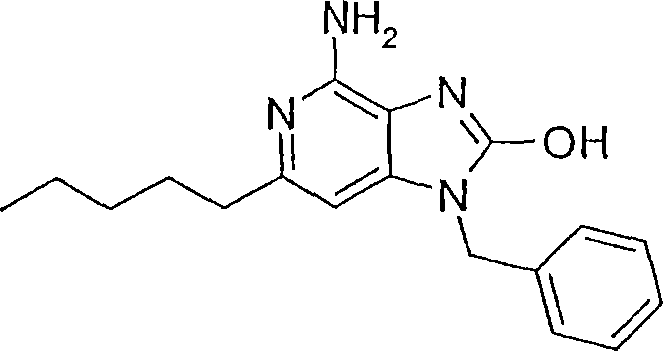
A部分Part A
将己酸(2.51毫升,0.0200摩尔)在二氯甲烷(5毫升)中的溶液冷却至0℃,并加入草酰氯(8.7毫升,0.10摩尔)。将该溶液升温至室温并在氮气氛下搅拌20小时。减压除去溶剂,将残留物溶解在己烷(50毫升)中。将溶液冷却至0℃,相继加入三乙胺(3.1毫升,22毫摩尔)和2-甲基氮丙啶(1.57毫升90%纯原料,20毫摩尔)。将所得混合物在氮气氛下搅拌1小时,用乙酸乙酯(50毫升)稀释,并经CELITE过滤剂层过滤。将滤液减压浓缩,并将残留物在硅胶上经快速色谱法(用在己烷中的11%乙酸乙酯洗脱)提纯得到1.91克黄色油状的1-己酰基-2-甲基氮丙啶。A solution of hexanoic acid (2.51 mL, 0.0200 mol) in dichloromethane (5 mL) was cooled to 0°C and oxalyl chloride (8.7 mL, 0.10 mol) was added. The solution was warmed to room temperature and stirred under nitrogen atmosphere for 20 hours. The solvent was removed under reduced pressure, and the residue was dissolved in hexane (50 mL). The solution was cooled to 0°C, and triethylamine (3.1 mL, 22 mmol) and 2-methylaziridine (1.57 mL 90% pure material, 20 mmol) were added successively. The resulting mixture was stirred under nitrogen atmosphere for 1 hour, diluted with ethyl acetate (50 mL), and filtered through a layer of CELITE filter agent. The filtrate was concentrated under reduced pressure and the residue was purified by flash chromatography on silica gel (eluting with 11% ethyl acetate in hexanes) to give 1.91 g of 1-hexanoyl-2-methylaziridine as a yellow oil Pyridine.
B部分Part B
将氢化钠(537毫克在矿物油中的60%分散液,13.4毫摩尔)用己烷洗涤三次,然后悬浮在四氢呋喃(THF)(30毫升)中。将乙酰乙酸叔丁酯(1.94克,12.2毫摩尔)在THF(10毫升)中的溶液逐滴添加到该悬浮液中,并将该混合物搅拌30分钟,然后冷却至0℃。加入正丁基锂(8.4毫升的1.6M在己烷中的溶液),将所得橙黄色溶液在0℃下搅拌20分钟。加入1-己酰基-2-甲基氮丙啶(1.90克,12.2毫摩尔)在THF(10毫升)中的溶液,并将该反应物在0℃下搅拌1.5小时。加入饱和氯化铵水溶液,并将混合物用乙酸乙酯(3×40毫升)萃取。将合并的萃取物经硫酸镁干燥,过滤,并减压浓缩。将粗制产物在硅胶上经快速色谱法(用在己烷中的5%乙酸乙酯洗脱)提纯得到1.95克无色油状的3,5-二氧代癸酸叔丁酯。Sodium hydride (537 mg of a 60% dispersion in mineral oil, 13.4 mmol) was washed three times with hexane, then suspended in tetrahydrofuran (THF) (30 mL). A solution of tert-butyl acetoacetate (1.94 g, 12.2 mmol) in THF (10 mL) was added dropwise to the suspension, and the mixture was stirred for 30 min, then cooled to 0°C. n-BuLi (8.4 mL of a 1.6M solution in hexanes) was added and the resulting orange-yellow solution was stirred at 0°C for 20 minutes. A solution of 1-hexanoyl-2-methylaziridine (1.90 g, 12.2 mmol) in THF (10 mL) was added and the reaction was stirred at 0°C for 1.5 hours. Saturated aqueous ammonium chloride was added, and the mixture was extracted with ethyl acetate (3 x 40 mL). The combined extracts were dried over magnesium sulfate, filtered, and concentrated under reduced pressure. The crude product was purified by flash chromatography on silica gel (eluting with 5% ethyl acetate in hexanes) to afford 1.95 g of tert-butyl 3,5-dioxodecanoate as a colorless oil.
C部分Part C
将三氟乙酸(16毫升)添加到3,5-二氧代癸酸叔丁酯(1.95克,7.61毫摩尔)在二氯甲烷(45毫升)中的溶液中,并将该溶液在室温下搅拌2小时。减压去除挥发物,并将残留物溶于乙酸酐(44毫升)。将该溶液在室温下搅拌过夜,并减压除去乙酸酐。将残留物溶于甲醇(30毫升),并加入碳酸钾(105毫克,0.76毫摩尔)。将该混合物在室温下搅拌3小时,通过高效液相色谱(HPLC)分析表明反应不完全。另外添加碳酸钾(100毫克),并将反应物在室温下搅拌1小时。减压除去挥发物,使残留物在饱和氯化铵水溶液与二氯甲烷之间分相。分离水层并用二氯甲烷(3×50毫升)萃取。将合并的有机馏分经硫酸镁干燥,过滤,并减压浓缩得到橙色油状的4-羟基-6-戊基-2H-吡喃-2-酮,其经静置固化。Trifluoroacetic acid (16 mL) was added to a solution of tert-butyl 3,5-dioxodecanoate (1.95 g, 7.61 mmol) in dichloromethane (45 mL), and the solution was heated at room temperature Stir for 2 hours. The volatiles were removed under reduced pressure, and the residue was dissolved in acetic anhydride (44 mL). The solution was stirred overnight at room temperature, and the acetic anhydride was removed under reduced pressure. The residue was dissolved in methanol (30 mL), and potassium carbonate (105 mg, 0.76 mmol) was added. The mixture was stirred at room temperature for 3 hours, and analysis by high performance liquid chromatography (HPLC) indicated that the reaction was incomplete. Additional potassium carbonate (100 mg) was added and the reaction was stirred at room temperature for 1 hour. The volatiles were removed under reduced pressure and the residue was partitioned between saturated aqueous ammonium chloride and dichloromethane. The aqueous layer was separated and extracted with dichloromethane (3 x 50 mL). The combined organic fractions were dried over magnesium sulfate, filtered, and concentrated under reduced pressure to give 4-hydroxy-6-pentyl-2H-pyran-2-one as an orange oil which solidified on standing.
D部分Part D
将4-羟基-6-戊基-2H-吡喃-2-酮(0.750克,4.12毫摩尔)在浓氢氧化铵水溶液(10毫升)中的悬浮液在100℃下加热6小时,使其冷却至室温。存在沉淀物并通过过滤分离,用甲醇研碎,并过滤分离得到0.700克褐色固体状的4-羟基-6-戊基吡啶-2(1H)-酮。A suspension of 4-hydroxy-6-pentyl-2H-pyran-2-one (0.750 g, 4.12 mmol) in concentrated aqueous ammonium hydroxide (10 mL) was heated at 100 °C for 6 hours to make it Cool to room temperature. A precipitate was present and isolated by filtration, triturated with methanol, and isolated by filtration to afford 0.700 g of 4-hydroxy-6-pentylpyridin-2(1H)-one as a tan solid.
E部分Part E
将发烟硝酸(20毫升)小心地添加到来自D部分的物质在水中的悬浮液(5毫升)中,并将该反应物在80℃下加热30分钟,使其冷却至室温,并倒入冰水中。减压除去一些水,并形成沉淀物。将该混合物冷却至大约0℃,通过过滤收集沉淀物,并在高真空下干燥得到0.620克浅黄色固体状的3-硝基-6-戊基吡啶-2,4-二醇。Fuming nitric acid (20 mL) was carefully added to a suspension of material from Part D in water (5 mL) and the reaction was heated at 80°C for 30 minutes, allowed to cool to room temperature, and poured into ice water. Some water was removed under reduced pressure and a precipitate formed. The mixture was cooled to about 0°C and the precipitate was collected by filtration and dried under high vacuum to yield 0.620 g of 3-nitro-6-pentylpyridine-2,4-diol as a pale yellow solid.
F部分Part F
将3-硝基-6-戊基吡啶-2,4-二醇(1.00克,4.42毫摩尔)在氯氧化磷(III)(15毫升)中的溶液在80℃下加热4小时。减压除去过量氯氧化磷(III),并加入饱和碳酸氢钠水溶液以调节残留物至pH 10。将该碱性混合物用乙酸乙酯萃取数次,并将合并的萃取物用盐水洗涤,经硫酸镁干燥,通过CELITE过滤剂层过滤,并减压浓缩。将粗制产物在硅胶上经快速色谱法(用在己烷中的25%乙酸乙酯洗脱)提纯得到0.780克褐色油状的2,4-二氯-3-硝基-6-戊基吡啶。A solution of 3-nitro-6-pentylpyridine-2,4-diol (1.00 g, 4.42 mmol) in phosphorus(III) oxychloride (15 mL) was heated at 80°C for 4 hours. Excess phosphorus(III) oxychloride was removed under reduced pressure, and saturated aqueous sodium bicarbonate solution was added to adjust the residue to pH 10. The basic mixture was extracted several times with ethyl acetate, and the combined extracts were washed with brine, dried over magnesium sulfate, filtered through a layer of CELITE filter agent, and concentrated under reduced pressure. The crude product was purified by flash chromatography on silica gel (eluting with 25% ethyl acetate in hexanes) to give 0.780 g of 2,4-dichloro-3-nitro-6-pentylpyridine as a brown oil .
G部分Part G
将三乙胺(1.77毫升,12.7毫摩尔)和苄胺(0.83毫升,7.6毫摩尔)添加到2,4-二氯-3-硝基-6-戊基吡啶(2.22克,8.44毫摩尔)在N,N-二甲基甲酰胺(DMF)(50毫升)中的溶液中,并将该溶液在室温下搅拌过夜。减压除去DMF,并将残留物在饱和碳酸氢钠水溶液与二氯甲烷之间分相。将水层分离并用二氯甲烷萃取,并将合并的有机馏分用盐水洗涤,经硫酸镁干燥,过滤并减压浓缩。将粗制产物在硅胶上经快速色谱法(用在己烷中的1%-3%乙酸乙酯洗脱)提纯得到1.39克N-苄基-2-氯-3-硝基-6-戊基吡啶-4-胺。Triethylamine (1.77 mL, 12.7 mmol) and benzylamine (0.83 mL, 7.6 mmol) were added to 2,4-dichloro-3-nitro-6-pentylpyridine (2.22 g, 8.44 mmol) in N,N-dimethylformamide (DMF) (50 mL), and the solution was stirred at room temperature overnight. DMF was removed under reduced pressure, and the residue was partitioned between saturated aqueous sodium bicarbonate and dichloromethane. The aqueous layer was separated and extracted with dichloromethane, and the combined organic fractions were washed with brine, dried over magnesium sulfate, filtered and concentrated under reduced pressure. The crude product was purified by flash chromatography on silica gel (eluting with 1%-3% ethyl acetate in hexanes) to give 1.39 g of N-benzyl-2-chloro-3-nitro-6-pentane Pyridin-4-amine.
H部分Part H
将三乙胺(1.44毫升,103毫摩尔)和N,N-双(4-甲氧基苄基)胺(2.65克,10.3毫摩尔)添加到N-苄基-2-氯-3-硝基-6-戊基吡啶-4-胺(2.30克,6.89毫摩尔)在甲苯(100毫升)中的溶液中,并将该黄色溶液在回流下在氮气氛下加热过夜。减压除去挥发物,并将残留物在乙酸乙酯与饱和碳酸氢钠水溶液之间分相。将水层分离并用乙酸乙酯萃取,并将合并的有机馏分用盐水洗涤,经硫酸镁干燥,过滤并减压浓缩得到N4-苄基-N2,N2-双(4-甲氧基苄基)-3-硝基-6-戊基吡啶-2,4-二胺,其不经提纯即使用。Triethylamine (1.44 mL, 103 mmol) and N,N-bis(4-methoxybenzyl)amine (2.65 g, 10.3 mmol) were added to N-benzyl-2-chloro-3-nitro 6-Pentylpyridin-4-amine (2.30 g, 6.89 mmol) in toluene (100 mL) and the yellow solution was heated at reflux under nitrogen overnight. The volatiles were removed under reduced pressure, and the residue was partitioned between ethyl acetate and saturated aqueous sodium bicarbonate. The aqueous layer was separated and extracted with ethyl acetate, and the combined organic fractions were washed with brine, dried over magnesium sulfate, filtered and concentrated under reduced pressure to afford N4 -benzyl- N2 , N2 -bis(4-methoxy Benzyl)-3-nitro-6-pentylpyridine-2,4-diamine, which was used without purification.
I部分Part I
将硼氢化钠(0.150克,3.97毫摩尔)添加到六水合氯化镍(II)(0.820克,3.45毫摩尔)在甲醇(60毫升)中的混合物中,并将该混合物搅拌15分钟。添加N4-苄基-N2,N2-双(4-甲氧基苄基)-3-硝基-6-戊基吡啶-2,4-二胺(3.82克,6.89毫摩尔)在甲醇(50毫升)和二氯甲烷(25毫升)中的溶液。在10分钟内逐份另外添加硼氢化钠(0.319克,8.43毫摩尔),并将该混合物在室温下搅拌1小时。通过HPLC分析表明存在起始原料,另外加入六水合氯化镍(II)(0.800克,3.37毫摩尔)和硼氢化钠(0.250克,6.61毫摩尔)。将该反应物在室温下搅拌2小时,然后通过CELITE过滤剂层过滤。将滤饼用二氯甲烷洗涤,并将滤液减压浓缩。将残留物在饱和碳酸氢钠水溶液与二氯甲烷之间分相,此后进行G部分中所述的后处理步骤。将粗制产物在硅胶上经快速色谱法(用在二氯甲烷中的2%-至4%甲醇洗脱)提纯得到3.45克粘稠深色油状的N4-苄基-N2,N2-双(4-甲氧基苄基)-6-戊基吡啶-2,3,4-三胺。Sodium borohydride (0.150 g, 3.97 mmol) was added to a mixture of nickel(II) chloride hexahydrate (0.820 g, 3.45 mmol) in methanol (60 mL), and the mixture was stirred for 15 minutes. Add N 4 -benzyl-N 2 , N 2 -bis(4-methoxybenzyl)-3-nitro-6-pentylpyridine-2,4-diamine (3.82 g, 6.89 mmol) in Solution in methanol (50 mL) and dichloromethane (25 mL). Additional sodium borohydride (0.319 g, 8.43 mmol) was added portionwise over 10 minutes, and the mixture was stirred at room temperature for 1 hour. Analysis by HPLC indicated the presence of starting material, and additional nickel(II) chloride hexahydrate (0.800 g, 3.37 mmol) and sodium borohydride (0.250 g, 6.61 mmol) were added. The reaction was stirred at room temperature for 2 hours, then filtered through a layer of CELITE filter agent. The filter cake was washed with dichloromethane, and the filtrate was concentrated under reduced pressure. The residue was partitioned between saturated aqueous sodium bicarbonate and dichloromethane, after which time the workup described in part G was performed. The crude product was purified by flash chromatography on silica gel (eluting with 2%- to 4% methanol in dichloromethane) to give 3.45 g of N4 -benzyl- N2 , N2 as a viscous dark oil - bis(4-methoxybenzyl)-6-pentylpyridine-2,3,4-triamine.
J部分Part J
将羰基二咪唑(1.60克,9.86毫摩尔)添加到N4-苄基-N2,N2-双(4-甲氧基苄基)-6-戊基吡啶-2,3,4-三胺(3.45克,6.58毫摩尔)在THF(50毫升)中的溶液中,并将深绿色溶液在回流下在氮气氛下加热2小时。减压除去挥发物,并将残留物在硅胶上经快速色谱法(用在二氯甲烷中的2%甲醇洗脱)提纯得到3.52克粘稠黄色油状的1-苄基-4-[双(4-甲氧基苄基)氨基]-6-戊基-1H-咪唑并[4,5-c]吡啶-2-醇,其经静置固化。Carbonyldiimidazole (1.60 g, 9.86 mmol) was added to N 4 -benzyl-N 2 , N 2 -bis(4-methoxybenzyl)-6-pentylpyridine-2,3,4-tris The amine (3.45 g, 6.58 mmol) was dissolved in THF (50 mL) and the dark green solution was heated at reflux under nitrogen for 2 h. The volatiles were removed under reduced pressure and the residue was purified by flash chromatography on silica gel (eluting with 2% methanol in dichloromethane) to give 3.52 g of 1-benzyl-4-[bis( 4-methoxybenzyl)amino]-6-pentyl-1H-imidazo[4,5-c]pyridin-2-ol which solidified on standing.
K部分Part K
将1-苄基-4-[双(4-甲氧基苄基)氨基]-6-戊基-1H-咪唑并[4,5-c]吡啶-2-醇(3.52克,6.39毫摩尔)在三氟乙酸(15毫升)中的溶液在室温下搅拌5小时,然后用水稀释。添加固体碳酸钠,将所得混合物调节至大约pH 9。将水层分离并用二氯甲烷和二氯甲烷/甲醇萃取数次。将合并的有机馏分经硫酸镁干燥,过滤并减压浓缩。将所得白色固体用乙腈/甲醇研碎并通过过滤分离得到1.08克白色结晶固体状的4-氨基-1-苄基-6-戊基-1H-咪唑并[4,5-c]吡啶-2-醇,mp 260-262℃。1HNMR(300MHz,d4-MeOH)δ7.57-7.51(m,5H),6.57(s,1H),5.26(s,2H),2.77(dd,J=7.4,7.8Hz,2H),1.82(m,2H),1.53-1.48(m,4H),1.10(t,J=7.0Hz,3H);MS(APCI)m/z,311(M+H+);1-Benzyl-4-[bis(4-methoxybenzyl)amino]-6-pentyl-1H-imidazo[4,5-c]pyridin-2-ol (3.52 g, 6.39 mmol ) in trifluoroacetic acid (15 mL) was stirred at room temperature for 5 hours, then diluted with water. Solid sodium carbonate was added and the resulting mixture was adjusted to approximately pH 9. The aqueous layer was separated and extracted several times with dichloromethane and dichloromethane/methanol. The combined organic fractions were dried over magnesium sulfate, filtered and concentrated under reduced pressure. The resulting white solid was triturated with acetonitrile/methanol and isolated by filtration to give 1.08 g of 4-amino-1-benzyl-6-pentyl-1H-imidazo[4,5-c]pyridine-2 as a white crystalline solid - Alcohols, mp 260-262°C. 1 HNMR (300MHz, d 4 -MeOH) δ7.57-7.51 (m, 5H), 6.57 (s, 1H), 5.26 (s, 2H), 2.77 (dd, J=7.4, 7.8Hz, 2H), 1.82 (m, 2H), 1.53-1.48 (m, 4H), 1.10 (t, J=7.0Hz, 3H); MS (APCI) m/z, 311 (M+H + );
C18H22N4O·0.67CF3CO2H的分析计算值:C,60.06;H,5.91;N,14.48。实测值:C,59.72;H,6.30;N,14.57。Anal . Calcd. for C18H22N4O - 0.67CF3CO2H : C, 60.06; H, 5.91 ; N , 14.48. Found: C, 59.72; H, 6.30; N, 14.57.
实施例2Example 2
4-氨基-6-戊基-1-(2-苯基乙基)-1H-咪唑并[4,5-c]吡啶-2-醇4-Amino-6-pentyl-1-(2-phenylethyl)-1H-imidazo[4,5-c]pyridin-2-ol
A部分Part A
将苯乙胺(0.86毫升,6.8毫摩尔)添加到2,4-二氯-3-硝基-6-戊基吡啶(2.0克,7.6毫摩尔)和三乙胺(1.6毫升,11毫摩尔)在DMF(38毫升)中的搅拌溶液中,并将该反应物在室温下搅拌3小时。添加水(200毫升),并将该混合物用乙酸乙酯(2×50毫升)萃取。并将合并的有机馏分用盐水(50毫升)洗涤,经硫酸钠干燥,过滤,并减压浓缩。将粗制产物在硅胶上经柱色谱法(用在己烷中的10%乙酸乙酯洗脱)提纯得到1.1克黄色油状的(2-氯-3-硝基-6-戊基吡啶-4-基)苯乙胺。Phenylethylamine (0.86 mL, 6.8 mmol) was added to 2,4-dichloro-3-nitro-6-pentylpyridine (2.0 g, 7.6 mmol) and triethylamine (1.6 mL, 11 mmol ) in DMF (38 mL) and the reaction was stirred at room temperature for 3 hours. Water (200 mL) was added, and the mixture was extracted with ethyl acetate (2 x 50 mL). And the combined organic fractions were washed with brine (50 mL), dried over sodium sulfate, filtered and concentrated under reduced pressure. The crude product was purified by column chromatography on silica gel (eluting with 10% ethyl acetate in hexanes) to give 1.1 g of (2-chloro-3-nitro-6-pentylpyridine-4 -yl) phenethylamine.
B部分Part B
将三乙胺(0.66毫升,4.7毫摩尔)和N,N-双(4-甲氧基苄基)胺(1.2克,4.7毫摩尔)添加到(2-氯-3-硝基-6-戊基吡啶-4-基)苯乙胺(1.1克,3.2毫摩尔)在甲苯(32毫升)中的溶液中,并将黄色溶液在回流下加热3小时,在室温下搅拌过夜,并在回流下加热2小时。然后进行实施例1的H部分中所述的后处理步骤得到油状的N2,N2-双(4-甲氧基苄基)-3-硝基-6-戊基-N4-(2-苯基乙基)吡啶-2,4-二胺。Triethylamine (0.66 mL, 4.7 mmol) and N,N-bis(4-methoxybenzyl)amine (1.2 g, 4.7 mmol) were added to (2-chloro-3-nitro-6- Amylpyridin-4-yl)phenethylamine (1.1 g, 3.2 mmol) was dissolved in toluene (32 mL), and the yellow solution was heated at reflux for 3 hours, stirred at room temperature overnight, and Lower the heat for 2 hours. The work-up procedure described in part H of Example 1 then gave N 2 , N 2 -bis(4-methoxybenzyl)-3-nitro-6-pentyl-N 4 -(2 -phenylethyl)pyridine-2,4-diamine.
C部分Part C
将硼氢化钠(0.070克,1.85毫摩尔)添加到六水合氯化镍(II)(0.38克,1.6毫摩尔)在甲醇(25毫升)中的混合物中,并将该混合物搅拌15分钟。添加来自B部分的物质在甲醇(25毫升)和二氯甲烷(11毫升)中的溶液。另外逐份添加硼氢化钠(0.150克,3.97毫摩尔),并将该混合物在室温下搅拌1小时。通过薄层色谱法(TLC)分析表明存在起始原料,另外加入硼氢化钠(0.10克,2.6毫摩尔)。将该反应物在室温下搅拌过夜。反应仍未完成,逐份添加硼氢化钠(0.10克和0.20克)直至起始原料被消耗。将反应混合物通过CELITE过滤剂层过滤。将滤饼用二氯甲烷洗涤直至滤液无色,然后将滤液减压浓缩。将粗制产物在硅胶上经快速色谱法(相继用在己烷中的30%乙酸乙酯和在己烷中的50%乙酸乙酯洗脱)提纯得到0.40克黄色油状的N2,N2-双(4-甲氧基苄基)-6-戊基-N4-(2-苯基乙基)吡啶-2,3,4-三胺。Sodium borohydride (0.070 g, 1.85 mmol) was added to a mixture of nickel(II) chloride hexahydrate (0.38 g, 1.6 mmol) in methanol (25 mL), and the mixture was stirred for 15 minutes. A solution of the material from Part B in methanol (25 mL) and dichloromethane (11 mL) was added. Additional sodium borohydride (0.150 g, 3.97 mmol) was added portionwise, and the mixture was stirred at room temperature for 1 hour. Analysis by thin layer chromatography (TLC) indicated the presence of starting material and additional sodium borohydride (0.10 g, 2.6 mmol) was added. The reaction was stirred overnight at room temperature. The reaction was still incomplete and sodium borohydride (0.10 g and 0.20 g) was added portionwise until the starting material was consumed. The reaction mixture was filtered through a bed of CELITE filter agent. The filter cake was washed with dichloromethane until the filtrate was colorless, then the filtrate was concentrated under reduced pressure. The crude product was purified by flash chromatography on silica gel (eluting sequentially with 30% ethyl acetate in hexanes and 50% ethyl acetate in hexanes) to afford 0.40 g of N2, N2 as a yellow oil - bis(4-methoxybenzyl)-6-pentyl- N4- (2-phenylethyl)pyridine-2,3,4-triamine.
D部分Part D
将羰基二咪唑(0.18克,1.1毫摩尔)添加到N2,N2-双(4-甲氧基苄基)-6-戊基-N4-(2-苯基乙基)吡啶-2,3,4-三胺(0.40克,0.74毫摩尔)在THF(4毫升)中的溶液中,并将该橙色溶液在回流下加热1小时,并使其冷却至室温。减压除去挥发物,并将残留物在硅胶上经快速色谱法(相继用在己烷中的30%乙酸乙酯和在己烷中的50%乙酸乙酯洗脱)提纯得到0.36克油状的4-[双(4-甲氧基苄基)氨基]-6-戊基-1-(2-苯基乙基)-1H-咪唑并[4,5-c]吡啶-2-醇,其经静置固化。Add carbonyldiimidazole (0.18 g, 1.1 mmol) to N 2 , N 2 -bis(4-methoxybenzyl)-6-pentyl-N 4 -(2-phenylethyl)pyridine-2 , 3,4-Triamine (0.40 g, 0.74 mmol) in THF (4 mL) and the orange solution was heated at reflux for 1 h and allowed to cool to room temperature. The volatiles were removed under reduced pressure and the residue was purified by flash chromatography on silica gel (eluting sequentially with 30% ethyl acetate in hexanes and 50% ethyl acetate in hexanes) to give 0.36 g of 4-[bis(4-methoxybenzyl)amino]-6-pentyl-1-(2-phenylethyl)-1H-imidazo[4,5-c]pyridin-2-ol, which Solidified by standing.
E部分Part E
将4-[双(4-甲氧基苄基)氨基]-6-戊基-1-(2-苯基乙基)-1H-咪唑并[4,5-c]吡啶-2-醇(0.36克,0.64毫摩尔)在三氟乙酸(1.6毫升)中的溶液在室温下搅拌5小时,然后用水(20毫升)稀释。添加氢氧化钠水溶液(50%w/w),将所得混合物调节至大约pH13,并搅拌1小时。有固体存在,并通过过滤收集,用水洗涤,从乙腈(20毫升)和乙醇(5毫升)中重结晶。将晶体用乙腈洗涤,并在真空下在65℃下干燥18小时得到0.10克白色结晶粉末状的4-氨基-6-戊基-1-(2-苯基乙基)-1H-咪唑并[4,5-c]吡啶-2-醇,mp 238-240℃。4-[bis(4-methoxybenzyl)amino]-6-pentyl-1-(2-phenylethyl)-1H-imidazo[4,5-c]pyridin-2-ol ( A solution of 0.36 g, 0.64 mmol) in trifluoroacetic acid (1.6 mL) was stirred at room temperature for 5 hours, then diluted with water (20 mL). Aqueous sodium hydroxide solution (50% w/w) was added and the resulting mixture was adjusted to approximately pH 13 and stirred for 1 hour. A solid was present and was collected by filtration, washed with water and recrystallized from acetonitrile (20 mL) and ethanol (5 mL). The crystals were washed with acetonitrile and dried under vacuum at 65 °C for 18 hours to obtain 0.10 g of 4-amino-6-pentyl-1-(2-phenylethyl)-1H-imidazo[ 4,5-c]pyridin-2-ol, mp 238-240°C.
1H NMR(300MHz,DMSO-d6)δ10.10(bs,1H),7.28-7.17(m,5H),6.24(s,1H),5.50(bs,2H),3.92(t,J=7.5Hz,2H)2.90(t,J=7.5Hz,2H),2.44(t,J=7.5Hz,2H),1.55(六重峰,J=7.5Hz,2H),1.31-1.21(m,4H),0.87(t,J=7.5Hz,3H); 1 H NMR (300MHz, DMSO-d 6 ) δ10.10(bs, 1H), 7.28-7.17(m, 5H), 6.24(s, 1H), 5.50(bs, 2H), 3.92(t, J=7.5 Hz, 2H) 2.90 (t, J = 7.5Hz, 2H), 2.44 (t, J = 7.5Hz, 2H), 1.55 (sextet, J = 7.5Hz, 2H), 1.31-1.21 (m, 4H) , 0.87(t, J=7.5Hz, 3H);
MS(APCI)m/z 325(M+H)+;MS(APCI) m/z 325(M+H) + ;
C19H24N4O的分析计算值:C,70.34;H,7.46:N,17.27。实测值:C,70.21;H,7.50;N,17.31。Anal. Calcd. for C19H24N4O : C , 70.34; H, 7.46: N, 17.27. Found: C, 70.21; H, 7.50; N, 17.31.
实施例3Example 3
4-氨基-1-(2-羟基-2-甲基丙基)-6-戊基-1H-咪唑并[4,5-c]吡啶-2-醇4-Amino-1-(2-hydroxy-2-methylpropyl)-6-pentyl-1H-imidazo[4,5-c]pyridin-2-ol

A部分Part A
将1-氨基-2-甲基丙-2-醇(0.64克,7.2毫摩尔)添加到2,4-二氯-3-硝基-6-戊基吡啶(2.1克,8.0毫摩尔)和三乙胺(1.7毫升,12毫摩尔)在DMF(40毫升)中的搅拌溶液中。将该反应物在室温下搅拌18小时并在水(200毫升)与乙酸乙酯(50毫升)之间分相。将有机层分离并用盐水(50毫升)洗涤,经硫酸钠干燥,过滤并减压浓缩。将粗制产物在硅胶上经柱色谱法(用在己烷中的30%乙酸乙酯洗脱)提纯得到1.1克亮黄色油状的1-[(2-氯-3-硝基-6-戊基吡啶-4-基)氨基]-2-甲基丙-2-醇。1-Amino-2-methylpropan-2-ol (0.64 g, 7.2 mmol) was added to 2,4-dichloro-3-nitro-6-pentylpyridine (2.1 g, 8.0 mmol) and In a stirred solution of triethylamine (1.7 mL, 12 mmol) in DMF (40 mL). The reaction was stirred at room temperature for 18 hours and partitioned between water (200 mL) and ethyl acetate (50 mL). The organic layer was separated and washed with brine (50 mL), dried over sodium sulfate, filtered and concentrated under reduced pressure. The crude product was purified by column chromatography on silica gel (eluting with 30% ethyl acetate in hexanes) to give 1.1 g of 1-[(2-chloro-3-nitro-6-pentane as a bright yellow oil ylpyridin-4-yl)amino]-2-methylpropan-2-ol.
B部分Part B
使1-[(2-氯-3-硝基-6-戊基吡啶-4-基)氨基]-2-甲基丙-2-醇(1.1克,3.5毫摩尔)、三乙胺(0.7毫升,5毫摩尔)和N,N-双(4-甲氧基苄基)胺(1.3克,5.2毫摩尔)根据实施例2的B部分的方法反应,改变在于,将该反应物在回流下在甲苯(35毫升)中加热6小时,然后在室温下搅拌过夜以便在后处理步骤后提供1-({2-[双(4-甲氧基苄基)氨基]-3-硝基-6-戊基吡啶-4-基}氨基)-2-甲基丙-2-醇。Make 1-[(2-chloro-3-nitro-6-pentylpyridin-4-yl)amino]-2-methylpropan-2-ol (1.1 g, 3.5 mmol), triethylamine (0.7 mL, 5 mmol) and N,N-bis(4-methoxybenzyl)amine (1.3 g, 5.2 mmol) were reacted according to the method of Part B of Example 2, except that the reactant was refluxed Heated in toluene (35 mL) for 6 hours, then stirred overnight at room temperature to provide 1-({2-[bis(4-methoxybenzyl)amino]-3-nitro- 6-pentylpyridin-4-yl}amino)-2-methylpropan-2-ol.
C部分Part C
将硼氢化钠(0.100克,2.64毫摩尔)添加到六水合氯化镍(II)(0.41克,1.7毫摩尔)在甲醇(30毫升)中的混合物中,并将该混合物搅拌15分钟。添加来自B部分的物质在甲醇(28毫升)和二氯甲烷(12毫升)中的溶液。另外逐份添加硼氢化钠(0.140克,3.70毫摩尔),并将该混合物在室温下搅拌1小时。通过TLC分析表明存在起始原料,另外逐份加入硼氢化钠(0.12克和0.12克)。将反应混合物简单搅拌,然后通过CELITE过滤剂层过滤。将滤饼用二氯甲烷洗涤直至滤液无色,然后将滤液减压浓缩。将粗制产物用二氯甲烷搅拌并再通过CELITE过滤剂过滤。将滤液减压浓缩得到绿色油状的1-({3-氨基-2-[双(4-甲氧基苄基)氨基]-6-戊基吡啶-4-基}氨基)-2-甲基丙-2-醇。Sodium borohydride (0.100 g, 2.64 mmol) was added to a mixture of nickel(II) chloride hexahydrate (0.41 g, 1.7 mmol) in methanol (30 mL), and the mixture was stirred for 15 minutes. A solution of the material from Part B in methanol (28 mL) and dichloromethane (12 mL) was added. Additional sodium borohydride (0.140 g, 3.70 mmol) was added portionwise, and the mixture was stirred at room temperature for 1 hour. Analysis by TLC indicated the presence of starting material and additional sodium borohydride (0.12 g and 0.12 g) was added in portions. The reaction mixture was briefly stirred then filtered through a bed of CELITE filter agent. The filter cake was washed with dichloromethane until the filtrate was colorless, then the filtrate was concentrated under reduced pressure. The crude product was stirred with dichloromethane and filtered again through a filter of CELITE. The filtrate was concentrated under reduced pressure to give green oily 1-({3-amino-2-[bis(4-methoxybenzyl)amino]-6-pentylpyridin-4-yl}amino)-2-methyl Propan-2-ol.
D部分Part D
根据实施例2的D部分中所述的方法将来自C部分的物质用羰基二咪唑(0.85克,5.2毫摩尔)处理,改变在于,相继用在己烷中的50%乙酸乙酯然后用乙酸乙酯洗脱来进行色谱提纯。获得无色油状的4-[双(4-甲氧基苄基)氨基]-1-(2-羟基-2-甲基丙基)-6-戊基-1H-咪唑并[4,5-c]吡啶-2-醇(1.4克)。The material from part C was treated with carbonyldiimidazole (0.85 g, 5.2 mmol) according to the procedure described in part D of Example 2, with the modification that 50% ethyl acetate in hexane followed by acetic acid was used. Ethyl ester was used for chromatographic purification. 4-[bis(4-methoxybenzyl)amino]-1-(2-hydroxy-2-methylpropyl)-6-pentyl-1H-imidazo[4,5- c] Pyridin-2-ol (1.4 g).
E部分Part E
将4-[双(4-甲氧基苄基)氨基]-1-(2-羟基-2-甲基丙基)-6-戊基-1H-咪唑并[4,5-c]吡啶-2-醇(1.4克,2.6毫摩尔)在三氟乙酸(7毫升)中的溶液在室温下搅拌3小时,然后用水(20毫升)稀释。添加氢氧化钠水溶液(50%w/w),将所得混合物调节至大约pH 13,并搅拌1小时。有固体存在,并通过过滤收集,用水洗涤得到0.8克白色固体。使滤液静置3天,形成更多固体。过滤分离第二固体并用水洗涤。第一固体在硅胶上经柱色谱法(用在二氯甲烷中的10%甲醇洗脱)提纯,然后与第二固体合并。合并的固体从乙腈中重结晶。将晶体用乙腈洗涤,并在真空下在65℃下干燥17小时得到0.35克白色片晶状的4-氨基-1-(2-羟基-2-甲基丙基)-6-戊基-1H-咪唑并[4,5-c]吡啶-2-醇,mp 240-243℃。4-[bis(4-methoxybenzyl)amino]-1-(2-hydroxy-2-methylpropyl)-6-pentyl-1H-imidazo[4,5-c]pyridine- A solution of 2-alcohol (1.4 g, 2.6 mmol) in trifluoroacetic acid (7 mL) was stirred at room temperature for 3 hours, then diluted with water (20 mL). Aqueous sodium hydroxide solution (50% w/w) was added and the resulting mixture was adjusted to approximately pH 13 and stirred for 1 hour. A solid was present and was collected by filtration and washed with water to give 0.8 g of a white solid. The filtrate was allowed to stand for 3 days and more solids formed. The second solid was isolated by filtration and washed with water. The first solid was purified by column chromatography on silica gel (eluting with 10% methanol in dichloromethane) and combined with the second solid. The combined solids were recrystallized from acetonitrile. The crystals were washed with acetonitrile and dried under vacuum at 65 °C for 17 hours to obtain 0.35 g of 4-amino-1-(2-hydroxy-2-methylpropyl)-6-pentyl-1H in the form of white platelets - imidazo[4,5-c]pyridin-2-ol, mp 240-243°C.
1H NMR(300MHz,OMSO-d6)δ10.16(bs,1H),6.48(s,1H),5.53(bs,2H),4.58(s,1H),3.59(bs,2H),2.47(t,J=7.5Hz,2H),1.59(六重峰,J=7.5Hz,2H),1.31-1.24(m,4H),1.11(bs,6H),0.85(t,J=7.5Hz,3H);MS(APCI)m/z 293(M+H)+; 1 H NMR (300 MHz, OMSO-d 6 ) δ10.16 (bs, 1H), 6.48 (s, 1H), 5.53 (bs, 2H), 4.58 (s, 1H), 3.59 (bs, 2H), 2.47 ( t, J = 7.5Hz, 2H), 1.59 (sextet, J = 7.5Hz, 2H), 1.31-1.24 (m, 4H), 1.11 (bs, 6H), 0.85 (t, J = 7.5Hz, 3H ); MS(APCI) m/z 293(M+H) + ;
C15H24N4O2的分析计算值:C,61.62;H,8.27;N,19.16。实测值:C,61.49;H,8.57;N,19.25。Anal . Calcd. for C15H24N4O2 : C, 61.62; H, 8.27 ; N, 19.16. Found: C, 61.49; H, 8.57; N, 19.25.
实施例4Example 4
4-氨基-6-戊基-1-(四氢-2H-吡喃-4-基甲基)-1H-咪唑并[4,5-c]吡啶-2-醇4-Amino-6-pentyl-1-(tetrahydro-2H-pyran-4-ylmethyl)-1H-imidazo[4,5-c]pyridin-2-ol

A部分Part A
将固体四氢-2H-吡喃-4-基甲胺盐酸盐(参见美国专利申请公开号2004/0147543(Hays等人)实施例477-480,0.78克,5.1毫摩尔)添加到2,4-二氯-3-硝基-6-戊基吡啶(1.5克,5.7毫摩尔)和三乙胺(2.0毫升,14毫摩尔)在DMF(29毫升)中的搅拌溶液中。将该反应物在室温下搅拌18小时。随后进行实施例3的A部分中所述的后处理和提纯步骤得到1.0克2-氯-3-硝基-6-戊基-N-(四氢-2H-吡喃-4-基甲基)吡啶-4-胺。Solid tetrahydro-2H-pyran-4-ylmethylamine hydrochloride (see US Patent Application Publication No. 2004/0147543 (Hays et al.) Example 477-480, 0.78 g, 5.1 mmol) was added to 2, A stirred solution of 4-dichloro-3-nitro-6-pentylpyridine (1.5 g, 5.7 mmol) and triethylamine (2.0 mL, 14 mmol) in DMF (29 mL). The reaction was stirred at room temperature for 18 hours. Subsequent work-up and purification steps as described in part A of Example 3 yielded 1.0 g of 2-chloro-3-nitro-6-pentyl-N-(tetrahydro-2H-pyran-4-ylmethyl ) pyridin-4-amine.
B部分Part B
使2-氯-3-硝基-6-戊基-N-(四氢-2H-吡喃-4-基甲基)吡啶-4-胺(1.0克,2.9毫摩尔)、三乙胺(0.61毫升,4.4毫摩尔)和N,N-双(4-甲氧基苄基)胺(1.1克,4.4毫摩尔)根据实施例2的B部分的方法反应,改变在于将该反应物在回流下在甲苯(29毫升)中加热14小时以便在后处理后提供黄色油状的N2,N2-双(4-甲氧基苄基)-3-硝基-6-戊基-N4-(四氢-2H-吡喃-4-基甲基)吡啶-2,4-二胺。2-Chloro-3-nitro-6-pentyl-N-(tetrahydro-2H-pyran-4-ylmethyl)pyridin-4-amine (1.0 g, 2.9 mmol), triethylamine ( 0.61 ml, 4.4 mmol) and N,N-bis(4-methoxybenzyl)amine (1.1 g, 4.4 mmol) were reacted according to the method of Part B of Example 2, except that the reactant was refluxed Heating in toluene (29 mL) for 14 hours afforded N2 , N2 -bis(4-methoxybenzyl)-3-nitro-6-pentyl- N4- (tetrahydro-2H-pyran-4-ylmethyl)pyridine-2,4-diamine.
C部分Part C
使用实施例3的C部分中所述的方法将来自B部分的物质还原成N2,N2-双(4-甲氧基苄基)-6-戊基-N4-(四氢-2H-吡喃-4-基甲基)吡啶-2,3,4-三胺,其作为深绿色油获得。The material from part B was reduced to N 2 , N 2 -bis(4-methoxybenzyl)-6-pentyl-N 4 -(tetrahydro-2H -pyran-4-ylmethyl)pyridine-2,3,4-triamine obtained as dark green oil.
D部分Part D
根据实施例2的D部分中所述的方法用羰基二咪唑(0.71克,4.4毫摩尔)处理来自C部分的物质,改变在于使用具有40+M硅胶柱的自动快速色谱系统进行色谱提纯,并用在己烷中的40%至80%乙酸乙酯洗脱。获得油状的4-[双(4-甲氧基苄基)氨基]-6-戊基-1-(四氢-2H-吡喃-4-基甲基)-1H-咪唑并[4,5-c]吡啶-2-醇(0.75克),其经静置固化。Material from part C was treated with carbonyldiimidazole (0.71 g, 4.4 mmol) according to the method described in part D of Example 2, with the modification that the chromatographic purification was performed using an automated flash chromatography system with a 40+M silica gel column and purified with Eluted with 40% to 80% ethyl acetate in hexanes. 4-[Bis(4-methoxybenzyl)amino]-6-pentyl-1-(tetrahydro-2H-pyran-4-ylmethyl)-1H-imidazo[4,5 -c] Pyridin-2-ol (0.75 g), which solidified on standing.
E部分Part E
将4-[双(4-甲氧基苄基)氨基]-6-戊基-1-(四氢-2H-吡喃-4-基甲基)-1H-咪唑并[4,5-c]吡啶-2-醇(0.75克,1.3毫摩尔)在三氟乙酸(3毫升)中的溶液在室温下搅拌18小时,然后用水(20毫升)稀释。添加氢氧化钠水溶液(50%w/w),将所得混合物调节至大约pH 13,并搅拌1小时。有固体存在,并通过过滤收集,用水洗涤得到0.5克白色固体。使滤液静置3天,形成更多固体。过滤分离第二固体。第一固体通过自动快速色谱法(25+M硅胶柱,用在二氯甲烷中的0%至15%甲醇洗脱)提纯,然后与第二固体合并。合并的固体(0.27克)从乙腈(50毫升)和乙醇(8毫升)中重结晶。将晶体用乙腈洗涤,并在真空下在65℃下干燥17小时得到0.24克白色片晶状的4-氨基-6-戊基-1-(四氢-2H-吡喃-4-基甲基)-1H-咪唑并[4,5-c]吡啶-2-醇,mp>250℃。4-[bis(4-methoxybenzyl)amino]-6-pentyl-1-(tetrahydro-2H-pyran-4-ylmethyl)-1H-imidazo[4,5-c A solution of ]pyridin-2-ol (0.75 g, 1.3 mmol) in trifluoroacetic acid (3 mL) was stirred at room temperature for 18 hours, then diluted with water (20 mL). Aqueous sodium hydroxide solution (50% w/w) was added and the resulting mixture was adjusted to approximately pH 13 and stirred for 1 hour. A solid was present and was collected by filtration and washed with water to give 0.5 g of a white solid. The filtrate was allowed to stand for 3 days and more solids formed. A second solid was isolated by filtration. The first solid was purified by automated flash chromatography (25+M silica gel column, eluting with 0% to 15% methanol in dichloromethane) and combined with the second solid. The combined solids (0.27 g) were recrystallized from acetonitrile (50 mL) and ethanol (8 mL). The crystals were washed with acetonitrile and dried under vacuum at 65 °C for 17 hours to obtain 0.24 g of 4-amino-6-pentyl-1-(tetrahydro-2H-pyran-4-ylmethyl )-1H-imidazo[4,5-c]pyridin-2-ol, mp>250°C.
1H NMR(300MHz,DMSO-d6)δ10.13(bs,1H),6.43(s,1H),5.54(bs,2H),3.83-3.79(m,2H),3.58(d,J=7.5Hz,2H),3.25-3.18(m,2H),2.50-2.46(m,2H),1.99-1.94(m,1H),1.60(六重峰,J=7.5Hz,2H),1.47-1.43(m,2H),1.32-1.22(m,6H),0.86(t,J=6.9Hz,3H);MS(APCI)m/z 3 19(M+H)+; 1 H NMR (300MHz, DMSO-d 6 ) δ10.13(bs, 1H), 6.43(s, 1H), 5.54(bs, 2H), 3.83-3.79(m, 2H), 3.58(d, J=7.5 Hz, 2H), 3.25-3.18 (m, 2H), 2.50-2.46 (m, 2H), 1.99-1.94 (m, 1H), 1.60 (sextet, J=7.5Hz, 2H), 1.47-1.43 ( m, 2H), 1.32-1.22 (m, 6H), 0.86 (t, J=6.9Hz, 3H); MS (APCI) m/z 3 19 (M+H) + ;
C17H26N4O2的分析计算值:C,64.13;H,8.23;N,17.60。实测值:C,64.08;H,8.11;N,17.64。Anal . Calcd . for C17H26N4O2 : C, 64.13; H, 8.23; N, 17.60. Found: C, 64.08; H, 8.11; N, 17.64.
实施例5Example 5
4-氨基-6-戊基-1-(吡啶-3-基甲基)-1H-咪唑并[4,5-c]吡啶-2-醇4-Amino-6-pentyl-1-(pyridin-3-ylmethyl)-1H-imidazo[4,5-c]pyridin-2-ol
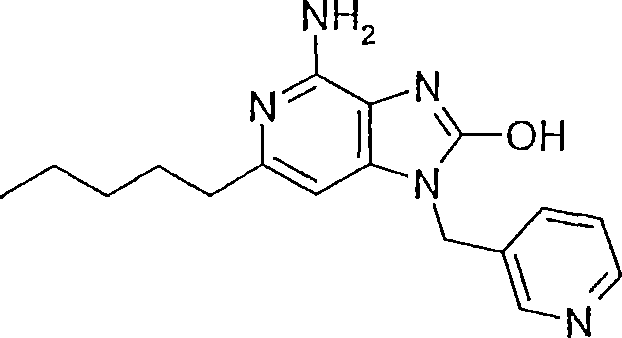
A部分Part A
将3-(氨基甲基)吡啶(0.52毫升,5.1毫摩尔)添加到2,4-二氯-3-硝基-6-戊基吡啶(1.5克,5.7毫摩尔)和三乙胺(2.0毫升,14毫摩尔)在DMF(29毫升)中的搅拌溶液中,随后进行实施例3的A部分中所述的方法,改变在于,将粗制产物通过自动快速色谱法(40+M硅胶柱,用在己烷中的0%至30%乙酸乙酯洗脱)提纯得到1.0克黄色油状的2-氯-3-硝基-6-戊基-N-(吡啶-3-基甲基)吡啶-4-胺。3-(Aminomethyl)pyridine (0.52 mL, 5.1 mmol) was added to 2,4-dichloro-3-nitro-6-pentylpyridine (1.5 g, 5.7 mmol) and triethylamine (2.0 mL, 14 mmol) in a stirred solution in DMF (29 mL), followed by the method described in part A of Example 3, with the change that the crude product was passed through automated flash chromatography (40+M silica gel column , eluting with 0% to 30% ethyl acetate in hexane) to give 1.0 g of 2-chloro-3-nitro-6-pentyl-N-(pyridin-3-ylmethyl) as a yellow oil Pyridin-4-amine.
B部分Part B
将三乙胺(0.63毫升,4.5毫摩尔)和N,N-双(4-甲氧基苄基)胺(1.2克,4.5毫摩尔)添加到(2-氯-3-硝基-6-戊基-N-(吡啶-3-基甲基)吡啶-4-胺(1.0克,3.0毫摩尔)在甲苯(30毫升)中的溶液中,并将黄色溶液在回流下加热14小时,使其冷却至室温,并减压浓缩得到N2,N2-双(4-甲氧基苄基)-3-硝基-6-戊基-N4-(吡啶-3-基甲基)吡啶-2,4-二胺。Triethylamine (0.63 mL, 4.5 mmol) and N,N-bis(4-methoxybenzyl)amine (1.2 g, 4.5 mmol) were added to (2-chloro-3-nitro-6- In a solution of pentyl-N-(pyridin-3-ylmethyl)pyridin-4-amine (1.0 g, 3.0 mmol) in toluene (30 mL), the yellow solution was heated at reflux for 14 hours to make It was cooled to room temperature and concentrated under reduced pressure to give N 2 ,N 2 -bis(4-methoxybenzyl)-3-nitro-6-pentyl-N 4 -(pyridin-3-ylmethyl)pyridine -2,4-diamine.
C部分Part C
将硼氢化钠(0.20克,5.4毫摩尔)添加到六水合氯化镍(II)(0.36克,1.5毫摩尔)在甲醇(20毫升)中的混合物中,并将该混合物搅拌15分钟。添加来自B部分的物质在甲醇(50毫升)和二氯甲烷(11毫升)中的溶液,并将该反应物搅拌30分钟。另外添加硼氢化钠(0.20克,5.4毫摩尔),通过TLC分析表明存在起始原料。另外加入硼氢化钠(0.10克),随后反应完成。将该反应混合物简单搅拌,然后通过CELITE过滤剂层过滤。将滤饼用二氯甲烷洗涤直至滤液无色,然后将滤液减压浓缩。将粗制产物用二氯甲烷搅拌并再通过CELITE过滤剂过滤。将滤液减压浓缩得到绿色油状的N2,N2-双(4-甲氧基苄基)-6-戊基-N4-(吡啶-3-基甲基)吡啶-2,3,4-三胺。Sodium borohydride (0.20 g, 5.4 mmol) was added to a mixture of nickel(II) chloride hexahydrate (0.36 g, 1.5 mmol) in methanol (20 mL), and the mixture was stirred for 15 minutes. A solution of the material from Part B in methanol (50 mL) and dichloromethane (11 mL) was added and the reaction was stirred for 30 minutes. Additional sodium borohydride (0.20 g, 5.4 mmol) was added and analysis by TLC indicated the presence of starting material. Additional sodium borohydride (0.10 g) was added and the reaction was complete. The reaction mixture was briefly stirred then filtered through a bed of CELITE filter agent. The filter cake was washed with dichloromethane until the filtrate was colorless, then the filtrate was concentrated under reduced pressure. The crude product was stirred with dichloromethane and filtered again through a filter of CELITE. The filtrate was concentrated under reduced pressure to obtain green oily N 2 , N 2 -bis(4-methoxybenzyl)-6-pentyl- N 4 -(pyridin-3-ylmethyl)pyridine-2,3,4 - Triamines.
D部分Part D
根据实施例2的D部分中所述的方法将来自C部分的物质用羰基二咪唑(0.73克,4.5毫摩尔)处理,改变在于,使用具有40+M硅胶柱并用在己烷中70%乙酸乙酯至100%乙酸乙酯的梯度洗脱的自动快速色谱系统进行色谱提纯。获得油状的4-[双(4-甲氧基苄基)氨基]-6-戊基-1-(吡啶-3-基甲基)-1H-咪唑并[4,5-c]吡啶-2-醇(1.3克),其经静置略微固化。The material from part C was treated with carbonyldiimidazole (0.73 g, 4.5 mmol) according to the method described in part D of Example 2, with the modification that a column with 40+M silica gel was used with 70% acetic acid in hexane Chromatographic purification was carried out by an automatic flash chromatography system with gradient elution from ethyl ester to 100% ethyl acetate. 4-[bis(4-methoxybenzyl)amino]-6-pentyl-1-(pyridin-3-ylmethyl)-1H-imidazo[4,5-c]pyridine-2 was obtained as an oil - Alcohol (1.3 g), which solidified slightly on standing.
E部分Part E
将4-[双(4-甲氧基苄基)氨基]-6-戊基-1-(吡啶-3-基甲基)-1H-咪唑并[4,5-c]吡啶-2-醇(1.3克,2.4毫摩尔)在三氟乙酸(6毫升)中的溶液在室温下搅拌2小时,然后用水(20毫升)稀释。添加氢氧化钠水溶液(50%w/w),将所得混合物调节至大约pH13,并搅拌2小时。有固体存在,并通过过滤收集,用水洗涤得到1克白色固体。通过自动快速色谱法(40+M硅胶柱,用在二氯甲烷中0%至20%甲醇洗脱)将固体提纯,然后从乙醇(10毫升)中重结晶。将晶体用乙醇洗涤并在真空下在65℃下干燥4小时得到白色结晶粉末状的4-氨基-6-戊基-1-(吡啶-3-基甲基)-1H-咪唑并[4,5-c]吡啶-2-醇,mp 243-245℃。4-[bis(4-methoxybenzyl)amino]-6-pentyl-1-(pyridin-3-ylmethyl)-1H-imidazo[4,5-c]pyridin-2-ol (1.3 g, 2.4 mmol) in trifluoroacetic acid (6 mL) was stirred at room temperature for 2 hours, then diluted with water (20 mL). Aqueous sodium hydroxide solution (50% w/w) was added and the resulting mixture was adjusted to approximately pH 13 and stirred for 2 hours. A solid was present and was collected by filtration and washed with water to give 1 g of a white solid. The solid was purified by automated flash chromatography (40+M silica gel column, eluting with 0% to 20% methanol in dichloromethane), then recrystallized from ethanol (10 mL). The crystals were washed with ethanol and dried under vacuum at 65 °C for 4 hours to give 4-amino-6-pentyl-1-(pyridin-3-ylmethyl)-1H-imidazo[4, 5-c]pyridin-2-ol, mp 243-245°C.
1H NMR(300MHz,DMSO-d6)δ10.28(bs,1H),8.57(d,J=2.5Hz,1H),8.48-8.47(m,1H),7.68-7.66(m,1H),7.37-7.34(m,1H),6.41(s,1H),5.59(bs,2H),4.96(bs,2H),2.45(t,J=7.5Hz,2H),1.56(六重峰,J=7.5Hz,2H),1.28-1.19(m,4H),0.83(t,J=6.9Hz,3H); 1 H NMR (300MHz, DMSO-d 6 ) δ10.28 (bs, 1H), 8.57 (d, J=2.5Hz, 1H), 8.48-8.47 (m, 1H), 7.68-7.66 (m, 1H), 7.37-7.34 (m, 1H), 6.41 (s, 1H), 5.59 (bs, 2H), 4.96 (bs, 2H), 2.45 (t, J=7.5Hz, 2H), 1.56 (sextet, J= 7.5Hz, 2H), 1.28-1.19(m, 4H), 0.83(t, J=6.9Hz, 3H);
MS(APCI)m/z 312(M+H)+;MS(APCI) m/z 312(M+H) + ;
C17H21N5O·0.25H2O的分析计算值:C,64.64;H,6.86;N,22.17。实测值:C,64.32;H,7.14;N,22.16。Anal . Calcd. for C17H21N5O - 0.25H2O : C, 64.64; H, 6.86; N, 22.17. Found: C, 64.32; H, 7.14; N, 22.16.
实施例6Example 6
4-氨基-1-苄基-6-甲基-1H-咪唑并[4,5-c]吡啶-2-醇4-Amino-1-benzyl-6-methyl-1H-imidazo[4,5-c]pyridin-2-ol
根据实施例1的G部分到K部分中所述的通用方法,使用2,4-二氯-6-甲基-3-硝基吡啶代替G部分中的2,4-二氯-3-硝基-6-戊基吡啶,制备4-氨基-1-苄基-6-甲基-1H-咪唑并[4,5-c]吡啶-2-醇。将粗制产物通过自动快速色谱法(40+M硅胶柱,用在二氯甲烷中0%至15%甲醇洗脱)提纯,然后从乙醇中重结晶得到结晶固体状的4-氨基-1-苄基-6-甲基-1H-咪唑并[4,5-c]吡啶-2-醇,mp>300℃。C14H14N4O的分析计算值:C,66.13;H,5.55;N,22.03。实测值:C,66.22;H,5.33;N,22.03。According to the general procedure described in Example 1, Parts G to K, using 2,4-dichloro-6-methyl-3-nitropyridine in place of 2,4-dichloro-3-nitropyridine in Part G Base-6-pentylpyridine, preparation of 4-amino-1-benzyl-6-methyl-1H-imidazo[4,5-c]pyridin-2-ol. The crude product was purified by automated flash chromatography (40+M silica gel column eluting with 0% to 15% methanol in dichloromethane) followed by recrystallization from ethanol to afford 4-amino-1- Benzyl-6-methyl-1H-imidazo[4,5-c]pyridin-2-ol, mp>300°C. Anal. Calcd . for C14H14N4O : C, 66.13; H, 5.55; N, 22.03. Found: C, 66.22; H, 5.33; N, 22.03.
实施例7Example 7
4-氨基-6-戊基-1-{2-[3-[(1,3-噻唑并-2-基)丙氧基]乙基}-1H-咪唑并[4,5-c]吡啶-2-醇4-Amino-6-pentyl-1-{2-[3-[(1,3-thiazolo-2-yl)propoxy]ethyl}-1H-imidazo[4,5-c]pyridine -2-ol
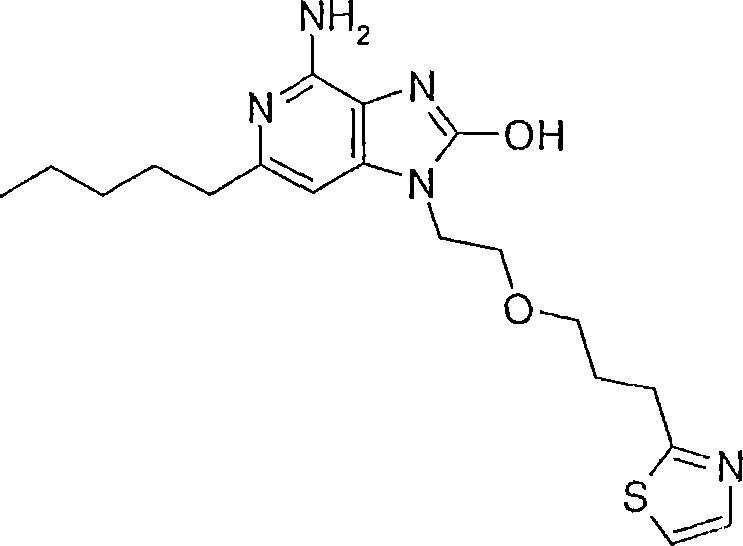
根据实施例2的A部分到E部分中所述的通用方法,使用2-[3-[(1,3-噻唑并-2-基)丙氧基]乙胺(参见美国专利第6,797,718号(Dellaria等人)实施例82)代替A部分中的苯乙胺,制备4-氨基-6-戊基-1-{2-[3-[(1,3-噻唑并-2-基)丙氧基]乙基]-1H-咪唑并[4,5-c]吡啶-2-醇。将粗制产物通过自动快速色谱法(40+M硅胶柱,用在二氯甲烷中0%至20%甲醇洗脱)提纯,然后从乙腈中重结晶得到结晶固体状的4-氨基-6-戊基-1-{2-[3-[(1,3-噻唑并-2-基)丙氧基]乙基]}-1H-咪唑并[4,5-c]吡啶-2-醇,mp 177.0-178.0℃。C19H27N5O2S的分析计算值:C,58.59;H,6.99;N,17.98。实测值:C,58.66;H,6.86;N,18.03。According to the general procedure described in Parts A to E of Example 2, using 2-[3-[(1,3-thiazolo-2-yl)propoxy]ethylamine (see U.S. Patent No. 6,797,718 ( Dellaria et al.) Example 82) Instead of phenethylamine in part A, 4-amino-6-pentyl-1-{2-[3-[(1,3-thiazolo-2-yl)propoxy Base] ethyl]-1H-imidazo[4,5-c]pyridin-2-ol. The crude product was purified by automated flash chromatography (40+M silica gel column, eluting with 0% to 20% methanol in dichloromethane), followed by recrystallization from acetonitrile to afford 4-amino-6- Amyl-1-{2-[3-[(1,3-thiazolo-2-yl)propoxy]ethyl]}-1H-imidazo[4,5-c]pyridin-2-ol, mp 177.0-178.0°C. Anal . Calcd. for C19H27N5O2S : C, 58.59; H, 6.99; N, 17.98. Found: C, 58.66; H, 6.86; N, 18.03.
实施例8Example 8
N-[3-(4-氨基-2-羟基-6-戊基-1H-咪唑并[4,5-c]吡啶-1-基)丙基]甲磺酰胺N-[3-(4-amino-2-hydroxy-6-pentyl-1H-imidazo[4,5-c]pyridin-1-yl)propyl]methanesulfonamide

A部分Part A
将3-氨基丙基氨基甲酸叔丁酯(2.4克,13.68毫摩尔)添加到2,4-二氯-3-硝基-6-戊基吡啶(4克,15.2毫摩尔)和三乙胺(3.8克,38.0毫摩尔)在DMF(76毫升)中的溶液中。将该反应混合物在环境温度下搅拌18小时,然后在乙酸乙酯(50毫升)和水(200毫升)之间分相。将有机层用盐水(50毫升)洗涤,经硫酸钠干燥,过滤,然后减压浓缩得到亮黄色油状粗制产物。将该物质是通过自动快速色谱法(40+M硅胶柱,用在己烷中10%至50%乙酸乙酯洗脱)提纯,得到3克黄色油状的3-[(2-氯-3-硝基-6-戊基吡啶-4-基)氨基]丙基氨基甲酸叔丁酯。Add tert-butyl 3-aminopropylcarbamate (2.4 g, 13.68 mmol) to 2,4-dichloro-3-nitro-6-pentylpyridine (4 g, 15.2 mmol) and triethylamine (3.8 g, 38.0 mmol) in DMF (76 mL). The reaction mixture was stirred at ambient temperature for 18 hours then partitioned between ethyl acetate (50 mL) and water (200 mL). The organic layer was washed with brine (50 mL), dried over sodium sulfate, filtered, and concentrated under reduced pressure to give the crude product as a bright yellow oil. The material was purified by automated flash chromatography (40+M silica gel column, eluting with 10% to 50% ethyl acetate in hexanes) to give 3 g of 3-[(2-chloro-3- tert-butyl nitro-6-pentylpyridin-4-yl)amino]propylcarbamate.
B部分Part B
将来自A部分的物质(3克,7.48毫摩尔)、N,N-双(4-甲氧基苄基)胺(2.9克,11.22毫摩尔)和三乙胺(1.1克,11.22毫摩尔)在甲苯(75毫升)中的溶液在回流下加热18小时,然后减压浓缩得到4.6克粗制的3-({2-[双(4-甲氧基苄基)氨基]-3-硝基-6-戊基吡啶-4-基}氨基)丙基氨基甲酸叔丁酯。Material from Part A (3 g, 7.48 mmol), N,N-bis(4-methoxybenzyl)amine (2.9 g, 11.22 mmol) and triethylamine (1.1 g, 11.22 mmol) A solution in toluene (75 mL) was heated at reflux for 18 hours, then concentrated under reduced pressure to give 4.6 g of crude 3-({2-[bis(4-methoxybenzyl)amino]-3-nitro -tert-butyl 6-pentylpyridin-4-yl}amino)propylcarbamate.
C部分Part C
将固体硼氢化钠(0.25克,6.6毫摩尔)一次性添加到六水合氯化镍(II)(0.9克,3.7毫摩尔)在甲醇(50毫升)中的溶液中,并将所得悬浮液搅拌15分钟。向该悬浮液中一次性加入来自B部分的物质(大约7.5毫摩尔)在二氯甲烷(27毫升)和甲醇(75毫升)的混合物中的溶液。加入硼氢化钠(0.26克,6.9毫摩尔)。在30分钟后,加入更多的硼氢化钠(0.2克,5毫摩尔)。加入小份的硼氢化钠直至通过薄层色谱法分析表明所有起始原料已经被消耗。将反应混合物通过CELITE过滤剂层过滤并将滤饼用二氯甲烷洗涤直至洗液清澈。将滤液减压浓缩得到大约4.4克绿色油状的3-({3-氨基-2-[双(4-甲氧基苄基)氨基]-6-戊基吡啶-4-基}氨基)丙基氨基甲酸叔丁酯。Solid sodium borohydride (0.25 g, 6.6 mmol) was added in one portion to a solution of nickel(II) chloride hexahydrate (0.9 g, 3.7 mmol) in methanol (50 mL) and the resulting suspension stirred 15 minutes. To this suspension was added a solution of the material from Part B (ca. 7.5 mmol) in a mixture of dichloromethane (27 mL) and methanol (75 mL) in one portion. Sodium borohydride (0.26 g, 6.9 mmol) was added. After 30 minutes, more sodium borohydride (0.2 g, 5 mmol) was added. Small portions of sodium borohydride were added until analysis by thin layer chromatography indicated that all starting material had been consumed. The reaction mixture was filtered through a layer of CELITE filter agent and the filter cake was washed with dichloromethane until the washings were clear. The filtrate was concentrated under reduced pressure to obtain about 4.4 g of 3-({3-amino-2-[bis(4-methoxybenzyl)amino]-6-pentylpyridin-4-yl}amino)propyl as a green oil tert-butyl carbamate.
D部分Part D
将来自C部分的物质(大约7.5毫摩尔)和羰基二咪唑(1.8克,11毫摩尔)在THF(37毫升)中的溶液在回流下加热1小时,冷却至环境温度,然后减压浓缩得到粗制产物。将该物质通过自动快速色谱法(40+M硅胶柱,用在己烷中70%至100%乙酸乙酯洗脱)提纯,得到3克固体状的3-{4-[双(4-甲氧基苄基)氨基]-2-羟基-6-戊基-1H-咪唑并[4,5-c]吡啶-1-基}丙基氨基甲酸叔丁酯。A solution of the material from Part C (ca. 7.5 mmol) and carbonyldiimidazole (1.8 g, 11 mmol) in THF (37 mL) was heated at reflux for 1 hour, cooled to ambient temperature, and concentrated under reduced pressure to give crude product. This material was purified by automated flash chromatography (40+M silica gel column, eluting with 70% to 100% ethyl acetate in hexanes) to afford 3 g of 3-{4-[bis(4-methanol) as a solid tert-butyl oxybenzyl)amino]-2-hydroxy-6-pentyl-1H-imidazo[4,5-c]pyridin-1-yl}propylcarbamate.
E部分Part E
将来自D部分的物质在三氟乙酸(12毫升)中的溶液在环境温度下搅拌2小时。加入水(20毫升)并形成白色沉淀物。用50%氢氧化钠将pH值调节至大约13,并将该悬浮液在环境温度下搅拌96小时。过滤除去固体并将滤饼用水漂洗。将滤液减压浓缩得到固体。将该物质用氯仿(100毫升)制浆1小时。过滤除去固体。将滤液减压浓缩得到棕色泡沫状粗制产物。将该泡沫通过自动快速色谱法(40+M硅胶柱,用在氯仿中30%至60%CMA洗脱)提纯,得到0.6克白色蜡质固体状的4-氨基-1-(3-氨基丙基)-6-戊基-1H-咪唑并[4,5-c]吡啶-2-醇。A solution of the material from Part D in trifluoroacetic acid (12 mL) was stirred at ambient temperature for 2 hours. Water (20 mL) was added and a white precipitate formed. The pH was adjusted to about 13 with 50% sodium hydroxide, and the suspension was stirred at ambient temperature for 96 hours. The solids were removed by filtration and the filter cake was rinsed with water. The filtrate was concentrated under reduced pressure to obtain a solid. This material was slurried with chloroform (100 mL) for 1 hour. The solids were removed by filtration. The filtrate was concentrated under reduced pressure to afford the crude product as a brown foam. The foam was purified by automated flash chromatography (40+M silica gel column, eluting with 30% to 60% CMA in chloroform) to afford 0.6 g of 4-amino-1-(3-aminopropane as a white waxy solid base)-6-pentyl-1H-imidazo[4,5-c]pyridin-2-ol.
F部分Part F
将甲烷磺酰氯(0.12克,1.08毫摩尔)添加到来自E部分的物质(0.25克,0.90毫摩尔)在三乙胺(0.31毫升)和二氯甲烷(5毫升)中的悬浮液中。将所得溶液在环境温度下搅拌1小时,然后在二氯甲烷(50毫升)和饱和氯化铵水溶液(50毫升)之间分相。将有机层经硫酸钠干燥,过滤,然后减压浓缩得到固体状粗制产物。将该物质通过自动快速色谱法(25+M柱,用在二氯甲烷中0%至10%甲醇洗脱)提纯,然后从乙腈(15毫升)和乙醇(2毫升)的混合物中重结晶得到0.2克结晶固体状的N-[3-(4-氨基-2-羟基-6-戊基-1H-咪唑并[4,5-c]吡啶-1-基)丙基]甲磺酰胺,mp 174.0-176.0℃。C15H25N503S的分析计算值:C,50.68;H,7.09;N,19.70。实测值:C,50.76;H,7.42;N,19.85。Methanesulfonyl chloride (0.12 g, 1.08 mmol) was added to a suspension of material from Part E (0.25 g, 0.90 mmol) in triethylamine (0.31 mL) and dichloromethane (5 mL). The resulting solution was stirred at ambient temperature for 1 hour, then the phases were partitioned between dichloromethane (50 mL) and saturated aqueous ammonium chloride (50 mL). The organic layer was dried over sodium sulfate, filtered, and concentrated under reduced pressure to give the crude product as a solid. This material was purified by automated flash chromatography (25+M column, eluting with 0% to 10% methanol in dichloromethane) followed by recrystallization from a mixture of acetonitrile (15 mL) and ethanol (2 mL) to give 0.2 g of N-[3-(4-amino-2-hydroxy-6-pentyl-1H-imidazo[4,5-c]pyridin-1-yl)propyl]methanesulfonamide as a crystalline solid, mp 174.0-176.0°C. Anal . Calcd. for C15H25N503S : C, 50.68; H, 7.09; N, 19.70 . Found: C, 50.76; H, 7.42; N, 19.85.
实施例9Example 9
N-[3-(4-氨基-2-羟基-6-戊基-1H-咪唑并[4,5-c]吡啶-1-基)丙基]-N’-环己基脲N-[3-(4-Amino-2-hydroxy-6-pentyl-1H-imidazo[4,5-c]pyridin-1-yl)propyl]-N’-cyclohexylurea
将异氰酸环己酯(0.1克,0.8毫摩尔)添加到4-氨基-1-(3-氨基丙基)-6-戊基-1H-咪唑并[4,5-c]吡啶-2-醇(0.2克,0.7毫摩尔)在二氯甲烷(4毫升)中的悬浮液中。将所得溶液在环境温度下搅拌2小时,然后减压浓缩得到粗制产物。将该物质通过自动快速色谱法(25+M柱,用在二氯甲烷中0%至10%甲醇洗脱)提纯,然后从乙腈(15毫升)和乙醇(8毫升)的混合物中重结晶得到0.2克结晶固体状的N-[3-(4-氨基-2-羟基-6-戊基-1H-咪唑并[4,5-c]吡啶-1-基)丙基]-N’-环己基脲,mp202.0-204.0℃。C21H34N6O2的分析计算值:C,62.66;H,8.51;N,20.88。Cyclohexyl isocyanate (0.1 g, 0.8 mmol) was added to 4-amino-1-(3-aminopropyl)-6-pentyl-1H-imidazo[4,5-c]pyridine-2 - a suspension of alcohol (0.2 g, 0.7 mmol) in dichloromethane (4 mL). The resulting solution was stirred at ambient temperature for 2 hours, then concentrated under reduced pressure to afford the crude product. This material was purified by automated flash chromatography (25+M column, eluting with 0% to 10% methanol in dichloromethane) followed by recrystallization from a mixture of acetonitrile (15 mL) and ethanol (8 mL) to give 0.2 g of N-[3-(4-amino-2-hydroxy-6-pentyl-1H-imidazo[4,5-c]pyridin-1-yl)propyl]-N'-ring as a crystalline solid Hexylurea, mp202.0-204.0°C. Anal. Calcd. for C21H34N6O2 : C, 62.66; H, 8.51 ; N , 20.88.
实测值:C,62.55;H,8.88;N,20.86。Found: C, 62.55; H, 8.88; N, 20.86.
实施例10Example 10
N-[3-(4-氨基-2-羟基-6-戊基-1H-咪唑并[4,5-c]吡啶-1-基)丙基]乙酰胺N-[3-(4-amino-2-hydroxy-6-pentyl-1H-imidazo[4,5-c]pyridin-1-yl)propyl]acetamide

将乙酰氯(0.05克,0.60毫摩尔)逐滴添加到4-氨基-1-(3-氨基丙基)-6-戊基-1H-咪唑并[4,5-c]吡啶-2-醇(0.15克,0.54毫摩尔)在三乙胺(0.19毫升,1.5毫摩尔)和二氯甲烷(3毫升)中的悬浮液中。将该反应混合物在环境温度下搅拌2小时,然后在二氯甲烷(50毫升)和饱和氯化铵水溶液(50毫升)之间分相。将有机层经硫酸钠干燥,过滤,然后减压浓缩得到油状粗制产物。将该物质通过自动快速色谱法(25+M柱,用在二氯甲烷中0%至15%甲醇洗脱)提纯,然后从乙腈(15毫升)和乙醇(3毫升)的混合物中重结晶得到0.1克结晶固体状的N-[3-(4-氨基-2-羟基-6-戊基-1H-咪唑并[4,5-c]吡啶-1-基)丙基]乙酰胺,mp 189.0-191.0℃。C16H25N5O2的分析计算值:C,60.17;H,7.89;N,21.93。实测值:C,59.96;H,7.95;N,21.98。Acetyl chloride (0.05 g, 0.60 mmol) was added dropwise to 4-amino-1-(3-aminopropyl)-6-pentyl-1H-imidazo[4,5-c]pyridin-2-ol (0.15 g, 0.54 mmol) in triethylamine (0.19 mL, 1.5 mmol) and dichloromethane (3 mL). The reaction mixture was stirred at ambient temperature for 2 hours, then the phases were partitioned between dichloromethane (50 mL) and saturated aqueous ammonium chloride (50 mL). The organic layer was dried over sodium sulfate, filtered, and concentrated under reduced pressure to give the crude product as an oil. This material was purified by automated flash chromatography (25+M column, eluting with 0% to 15% methanol in dichloromethane) followed by recrystallization from a mixture of acetonitrile (15 mL) and ethanol (3 mL) to give 0.1 g of N-[3-(4-amino-2-hydroxy-6-pentyl-1H-imidazo[4,5-c]pyridin-1-yl)propyl]acetamide as a crystalline solid, mp 189.0 -191.0°C. Anal . Calcd. for C16H25N5O2 : C, 60.17; H, 7.89 ; N, 21.93. Found: C, 59.96; H, 7.95; N, 21.98.
实施例11Example 11
4-氨基-6-戊基-1-(哌啶-4-基甲基)-1H-咪唑并[4,5-c]吡啶-2-醇4-Amino-6-pentyl-1-(piperidin-4-ylmethyl)-1H-imidazo[4,5-c]pyridin-2-ol

A部分Part A
将4-(氨基甲基)哌啶(10克,87.6毫摩尔)在氯仿(60毫升)中的溶液在冰水浴中冷却。在30分钟内逐滴添加二碳酸二叔丁酯(9.6克,43.8毫摩尔)在氯仿(37毫升)中的溶液。移除冰浴,并将反应混合物在环境温度下搅拌经过整个周末。将该反应用水(100毫升)淬火。将有机层经硫酸钠干燥,过滤,然后减压浓缩得到9克4-(氨基甲基)哌啶-1-甲酸叔丁酯。A solution of 4-(aminomethyl)piperidine (10 g, 87.6 mmol) in chloroform (60 mL) was cooled in an ice-water bath. A solution of di-tert-butyl dicarbonate (9.6 g, 43.8 mmol) in chloroform (37 mL) was added dropwise over 30 minutes. The ice bath was removed, and the reaction mixture was stirred at ambient temperature over the weekend. The reaction was quenched with water (100 mL). The organic layer was dried over sodium sulfate, filtered, and concentrated under reduced pressure to obtain 9 g of tert-butyl 4-(aminomethyl)piperidine-1-carboxylate.
B部分Part B
将4-(氨基甲基)哌啶-1-甲酸叔丁酯(2.2克,10.3毫摩尔)逐滴添加到2,4-二氯-3-硝基-6-戊基吡啶(3克,11.4毫摩尔)和三乙胺(1.7克,17.1毫摩尔)在DMF(57毫升)中的溶液中。将反应混合物在环境温度下搅拌18小时,然后用水(200毫升)淬火并用乙酸乙酯(2×50毫升)萃取。将有机物合并,用盐水(50毫升)洗涤,经硫酸钠干燥,过滤,然后减压浓缩得到油状粗制产物。将该物质通过自动快速色谱法(40+M柱,用在己烷中0%至10%乙酸乙酯洗脱)提纯得到2.9克4-{[(2-氯-3-硝基-6-戊基吡啶-4-基)氨基]甲基}哌啶-1-甲酸叔丁酯。tert-Butyl 4-(aminomethyl)piperidine-1-carboxylate (2.2 g, 10.3 mmol) was added dropwise to 2,4-dichloro-3-nitro-6-pentylpyridine (3 g, 11.4 mmol) and triethylamine (1.7 g, 17.1 mmol) in DMF (57 mL). The reaction mixture was stirred at ambient temperature for 18 hours, then quenched with water (200 mL) and extracted with ethyl acetate (2 x 50 mL). The organics were combined, washed with brine (50 mL), dried over sodium sulfate, filtered, and concentrated under reduced pressure to afford the crude product as an oil. Purification of this material by automated flash chromatography (40+M column, eluting with 0% to 10% ethyl acetate in hexanes) afforded 2.9 g of 4-{[(2-chloro-3-nitro-6- tert-butyl amylpyridin-4-yl)amino]methyl}piperidine-1-carboxylate.
C部分Part C
将来自B部分的物质(2.9克,6.58毫摩尔)、N,N-双(4-甲氧基苄基)胺(2.5克,9.87毫摩尔)和三乙胺(1克,9.87毫摩尔)在甲苯(66毫升)中的溶液在回流下加热22小时,然后减压浓缩得到大约4.4克4-[({2-[双(4-甲氧基苄基)氨基]-3-硝基-6-戊基吡啶-4-基}氨基)甲基]哌啶-1-甲酸叔丁酯。The material from Part B (2.9 g, 6.58 mmol), N,N-bis(4-methoxybenzyl)amine (2.5 g, 9.87 mmol) and triethylamine (1 g, 9.87 mmol) A solution in toluene (66 ml) was heated at reflux for 22 hours, then concentrated under reduced pressure to obtain approximately 4.4 g of 4-[({2-[bis(4-methoxybenzyl)amino]-3-nitro- tert-butyl 6-pentylpyridin-4-yl}amino)methyl]piperidine-1-carboxylate.
D部分Part D
将固体硼氢化钠(0.2克,5毫摩尔)一次性添加到六水合氯化镍(II)(0.78克,3.3毫摩尔)在甲醇(50毫升)中的溶液中,并将所得悬浮液搅拌15分钟。向该悬浮液中一次性加入来自C部分的物质(大约6.6毫摩尔)在二氯甲烷(24毫升)和甲醇(60毫升)的混合物中的溶液。加入硼氢化钠(0.25克,6.6毫摩尔)。在30分钟后,加入更多的硼氢化钠(0.2克,5毫摩尔)。加入小份硼氢化钠直至通过薄层色谱法分析表明所有起始原料已经被消耗。将反应混合物通过CELITE过滤剂层过滤并将滤饼用二氯甲烷洗涤直至洗液清澈。将滤液减压浓缩。将残留物用二氯甲烷研碎,然后通过CELITE过滤剂层过滤。将滤液减压浓缩得到大约4.2克绿色油状的4-[({3-氨基-2-[双(4-甲氧基苄基)氨基]-6-戊基吡啶-4-基}氨基)甲基]哌啶-1-甲酸叔丁酯。Solid sodium borohydride (0.2 g, 5 mmol) was added in one portion to a solution of nickel(II) chloride hexahydrate (0.78 g, 3.3 mmol) in methanol (50 mL) and the resulting suspension stirred 15 minutes. To this suspension was added a solution of the material from Part C (ca. 6.6 mmol) in a mixture of dichloromethane (24 mL) and methanol (60 mL) in one portion. Sodium borohydride (0.25 g, 6.6 mmol) was added. After 30 minutes, more sodium borohydride (0.2 g, 5 mmol) was added. Small portions of sodium borohydride were added until analysis by thin layer chromatography indicated that all starting material had been consumed. The reaction mixture was filtered through a layer of CELITE filter agent and the filter cake was washed with dichloromethane until the washings were clear. The filtrate was concentrated under reduced pressure. The residue was triturated with dichloromethane and filtered through a bed of CELITE filter agent. The filtrate was concentrated under reduced pressure to obtain about 4.2 g of green oily 4-[({3-amino-2-[bis(4-methoxybenzyl)amino]-6-pentylpyridin-4-yl}amino)methyl Base] tert-butyl piperidine-1-carboxylate.
E部分Part E
将来自D部分的物质(大约6.6毫摩尔)和羰基二咪唑(1.6克,9.9毫摩尔)在THF(33毫升)中的溶液在回流下加热1小时,冷却至环境温度,然后减压浓缩得到粗制产物。将该物质通过自动快速色谱法(40+M柱,用在己烷中60%至100%乙酸乙酯洗脱)提纯,得到4克固体状4-({4-[双(4-甲氧基苄基)氨基]-2-羟基-6-戊基-1H-咪唑并[4,5-c]吡啶-1-基}甲基)哌啶-1-甲酸叔丁酯。A solution of the material from Part D (ca. 6.6 mmol) and carbonyldiimidazole (1.6 g, 9.9 mmol) in THF (33 mL) was heated at reflux for 1 hour, cooled to ambient temperature, and concentrated under reduced pressure to give crude product. Purification of this material by automated flash chromatography (40+M column, eluting with 60% to 100% ethyl acetate in hexanes) afforded 4 g of 4-({4-[bis(4-methoxy benzyl)amino]-2-hydroxy-6-pentyl-1H-imidazo[4,5-c]pyridin-1-yl}methyl)piperidine-1-carboxylic acid tert-butyl ester.
F部分Part F
将来自E部分的物质在三氟乙酸(15毫升)中的溶液在环境温度下搅拌18小时。加入水(20毫升)并用50%氢氧化钠将pH值调节至大约14。用1M盐酸中和该混合物(pH 7)。将所得悬浮液搅拌1小时。过滤分离固体,用水洗涤,并干燥。将该物质通过自动快速色谱法(40+M柱,用在氯仿中50%至100%CMA洗脱)提纯,然后从乙醇(22毫升)中重结晶得到1.2克结晶固体状的4-氨基-6-戊基-1-(哌啶-4-基甲基)-1H-咪唑并[4,5-c]吡啶-2-醇,mp 246.0-249.0℃。C17H27N5O的分析计算值:C,64.32;H,8.57;N,22.06。实测值:C,64.10;H,8.62;N,21.87。A solution of the material from Part E in trifluoroacetic acid (15 mL) was stirred at ambient temperature for 18 hours. Water (20 mL) was added and the pH was adjusted to ca. 14 with 50% NaOH. The mixture was neutralized (pH 7) with 1M hydrochloric acid. The resulting suspension was stirred for 1 hour. The solid was isolated by filtration, washed with water, and dried. The material was purified by automated flash chromatography (40+M column, eluting with 50% to 100% CMA in chloroform) followed by recrystallization from ethanol (22 mL) to give 1.2 g of 4-amino- 6-Pentyl-1-(piperidin-4-ylmethyl)-1H-imidazo[4,5-c]pyridin-2-ol, mp 246.0-249.0°C. Anal. Calcd. for C17H27N5O : C, 64.32; H, 8.57; N , 22.06. Found: C, 64.10; H, 8.62; N, 21.87.
实施例12Example 12
4-氨基-1-{[1-(甲基磺酰基)哌啶-4-基]甲基}-6-戊基-1H-咪唑并[4,5-c]吡啶-2-醇4-Amino-1-{[1-(methylsulfonyl)piperidin-4-yl]methyl}-6-pentyl-1H-imidazo[4,5-c]pyridin-2-ol

将固体甲烷磺酸酐(0.31克,1.78毫摩尔)一次性添加到4-氨基-6-戊基-1-(哌啶-4-基甲基)-1H-咪唑并[4,5-c]吡啶-2-醇(0.47克,1.48毫摩尔)在二氯甲烷(6毫升)中的悬浮液中。将反应混合物在环境温度下搅拌2小时。加入更多的甲磺酸酐(0.05克)。将反应混合物再搅拌30分钟,然后用饱和碳酸钠水溶液(20毫升)淬火并使其搅拌过夜。过滤分离固体,用水洗涤,然后从乙醇中重结晶得到0.4克固体4-氨基-1-{[1-(甲基磺酰基)哌啶-4-基]甲基}-6-戊基-1H-咪唑并[4,5-c]吡啶-2-醇,mp 228.0-231.0℃。C18H29N5O3S的分析计算值:C,54.66;H,7.39;N,17.71。实测值:C,54.45;H,7.38;N,17.65。Solid methanesulfonic anhydride (0.31 g, 1.78 mmol) was added to 4-amino-6-pentyl-1-(piperidin-4-ylmethyl)-1H-imidazo[4,5-c] in one portion A suspension of pyridin-2-ol (0.47 g, 1.48 mmol) in dichloromethane (6 mL). The reaction mixture was stirred at ambient temperature for 2 hours. More methanesulfonic anhydride (0.05 g) was added. The reaction mixture was stirred for an additional 30 minutes, then quenched with saturated aqueous sodium carbonate (20 mL) and allowed to stir overnight. The solid was isolated by filtration, washed with water, and then recrystallized from ethanol to give 0.4 g of solid 4-amino-1-{[1-(methylsulfonyl)piperidin-4-yl]methyl}-6-pentyl-1H - Imidazo[4,5-c]pyridin-2-ol, mp 228.0-231.0°C. Anal . Calcd. for C18H29N5O3S : C, 54.66; H, 7.39; N, 17.71. Found: C, 54.45; H, 7.38; N, 17.65.
实施例13Example 13
1-[(1-乙酰基哌啶-4-基)甲基]-4-氨基-6-戊基-1H-咪唑并[4,5-c]吡啶-2-醇1-[(1-acetylpiperidin-4-yl)methyl]-4-amino-6-pentyl-1H-imidazo[4,5-c]pyridin-2-ol

将乙酰氯(0.15克,1.91毫摩尔)添加到4-氨基-6-戊基-1-(哌啶-4-基甲基)-1H-咪唑并[4,5-c]吡啶-2-醇(0.55克,1.73毫摩尔)和三乙胺(0.44克,4.33毫摩尔)在二氯甲烷(9毫升)中的悬浮液中。将该反应混合物在环境温度下搅拌2小时。将反应混合物直接加载到硅胶柱上,并通过自动快速色谱法(25+M柱,用在二氯甲烷中0%至15%甲醇洗脱)提纯得到白色固体产物。将该物质从乙腈中重结晶得到0.23克结晶固体状的1-[(1-乙酰基哌啶-4-基)甲基]-4-氨基-6-戊基-1H-咪唑并[4,5-c]吡啶-2-醇,mp 228.0-23 1.0℃。C19H29N5O2的分析计算值:C,63.48;H,8.13;N,19.48。实测值:C,63.22;H,8.21;N,19.33。Acetyl chloride (0.15 g, 1.91 mmol) was added to 4-amino-6-pentyl-1-(piperidin-4-ylmethyl)-1H-imidazo[4,5-c]pyridine-2- A suspension of alcohol (0.55 g, 1.73 mmol) and triethylamine (0.44 g, 4.33 mmol) in dichloromethane (9 mL). The reaction mixture was stirred at ambient temperature for 2 hours. The reaction mixture was loaded directly onto a silica gel column and purified by automated flash chromatography (25+M column, eluting with 0% to 15% methanol in dichloromethane) to give the product as a white solid. Recrystallization of this material from acetonitrile afforded 0.23 g of 1-[(1-acetylpiperidin-4-yl)methyl]-4-amino-6-pentyl-1H-imidazo[4, as a crystalline solid. 5-c]pyridin-2-ol, mp 228.0-23 1.0°C. Anal . Calcd. for C19H29N5O2 : C, 63.48; H, 8.13 ; N, 19.48. Found: C, 63.22; H, 8.21; N, 19.33.
实施例14Example 14
4-氨基-1-{[1-(乙基磺酰基)哌啶-4-基]甲基}-6-戊基-1H-咪唑并[4,5-c]吡啶-2-醇4-Amino-1-{[1-(ethylsulfonyl)piperidin-4-yl]methyl}-6-pentyl-1H-imidazo[4,5-c]pyridin-2-ol

将乙烷磺酰氯(0.15克,1.13毫摩尔)添加到4-氨基-6-戊基-1-(哌啶-4-基甲基)-1H-咪唑并[4,5-c]吡啶-2-醇(0.3克,0.94毫摩尔)和三乙胺(0.24克,2.36毫摩尔)在二氯甲烷(5毫升)中的悬浮液中。将该反应混合物在环境温度下搅拌2小时。将反应混合物用甲醇淬火,使所有固体进入溶液中。将该溶液直接加载到硅胶柱上,并通过自动快速色谱法(25+M柱,用在二氯甲烷中0%至10%甲醇洗脱)提纯得到0.13克白色固体产物。将该物质从乙醇(7毫升)中重结晶得到0.1克结晶固体状的4-氨基-1-{[1-(乙基磺酰基)哌啶-4-基]甲基}-6-戊基-1H-咪唑并[4,5-c]吡啶-2-醇,mp222.0-225.0℃。C19H31N5O3S的分析计算值:C,55.72;H,7.63;N,17.10。实测值:C,55.91;H,7.53;N,17.04。Add ethanesulfonyl chloride (0.15 g, 1.13 mmol) to 4-amino-6-pentyl-1-(piperidin-4-ylmethyl)-1H-imidazo[4,5-c]pyridine- A suspension of 2-alcohol (0.3 g, 0.94 mmol) and triethylamine (0.24 g, 2.36 mmol) in dichloromethane (5 mL). The reaction mixture was stirred at ambient temperature for 2 hours. The reaction mixture was quenched with methanol and all solids went into solution. The solution was loaded directly onto a silica gel column and purified by automated flash chromatography (25+M column, eluting with 0% to 10% methanol in dichloromethane) to give 0.13 g of the product as a white solid. Recrystallization of this material from ethanol (7 mL) afforded 0.1 g of 4-amino-1-{[1-(ethylsulfonyl)piperidin-4-yl]methyl}-6-pentyl as a crystalline solid -1H-imidazo[4,5-c]pyridin-2-ol, mp 222.0-225.0°C. Anal . Calcd. for C19H31N5O3S : C, 55.72; H, 7.63; N , 17.10. Found: C, 55.91; H, 7.53; N, 17.04.
实施例15Example 15
4-氨基-1-{[1-(环丙基羰基)哌啶-4-基]甲基}-6-戊基-1H-咪唑并[4,5-c]吡啶-2-醇4-Amino-1-{[1-(cyclopropylcarbonyl)piperidin-4-yl]methyl}-6-pentyl-1H-imidazo[4,5-c]pyridin-2-ol

将环丙烷甲酰氯(0.12克,1.13毫摩尔)逐滴添加到4-氨基-6-戊基-1-(哌啶-4-基甲基)-1H-咪唑并[4,5-c]吡啶-2-醇(0.3克,0.94毫摩尔)和三乙胺(0.24克,2.36毫摩尔)在二氯甲烷(5毫升)中的悬浮液中。将该反应混合物在环境温度下搅拌1小时。将该反应混合物用甲醇淬火,使所有固体进入溶液中。将该溶液直接加载到硅胶柱上,并通过自动快速色谱法(25+M柱,用在二氯甲烷中0%至10%甲醇洗脱)提纯得到0.13克白色固体产物。将该物质从乙醇(7毫升)中重结晶得到0.2克结晶固体状的4-氨基-1-{[1-(环丙基羰基)哌啶-4-基]甲基}-6-戊基-1H-咪唑并[4,5-c]吡啶-2-醇,mp 205.0-207.0℃。C21H31N5O2:C,65.43;H,8.11;N,18.17。实测值:C,65.30;H,8.03;N,18.22。Cyclopropanecarbonyl chloride (0.12 g, 1.13 mmol) was added dropwise to 4-amino-6-pentyl-1-(piperidin-4-ylmethyl)-1H-imidazo[4,5-c] A suspension of pyridin-2-ol (0.3 g, 0.94 mmol) and triethylamine (0.24 g, 2.36 mmol) in dichloromethane (5 mL). The reaction mixture was stirred at ambient temperature for 1 hour. The reaction mixture was quenched with methanol and all solids went into solution. The solution was loaded directly onto a silica gel column and purified by automated flash chromatography (25+M column, eluting with 0% to 10% methanol in dichloromethane) to give 0.13 g of the product as a white solid. Recrystallization of this material from ethanol (7 mL) afforded 0.2 g of 4-amino-1-{[1-(cyclopropylcarbonyl)piperidin-4-yl]methyl}-6-pentyl as a crystalline solid -1H-imidazo[4,5-c]pyridin-2-ol, mp 205.0-207.0°C. C21H31N5O2 : C, 65.43; H , 8.11 ; N , 18.17. Found: C, 65.30; H, 8.03; N, 18.22.
实施例16Example 16
4-氨基-1-[4-(甲基磺酰基)丁基]-6-戊基-1H-咪唑并[4,5-c]吡啶-2-醇4-Amino-1-[4-(methylsulfonyl)butyl]-6-pentyl-1H-imidazo[4,5-c]pyridin-2-ol
A部分Part A
将4-(甲基磺酰基)丁-1-胺(1.9克50%纯物质)添加到2,4-二氯-3-硝基-6-戊基吡啶(1.5克,5.70毫摩尔)和三乙胺(1.4克,14.2毫摩尔)在DMF(29毫升)中的溶液中。将该反应混合物在环境温度下搅拌18小时,然后在乙酸乙酯(50毫升)和水(200毫升)之间分相。将有机层用盐水(50毫升)洗涤,经硫酸钠干燥,过滤,然后减压浓缩得到亮黄色油状的粗制产物。将该物质通过自动快速色谱法(40+M柱,用在己烷中30%至80%乙酸乙酯洗脱)提纯,得到1.3克黄色油状的2-氯-N-[4-(甲基磺酰基)丁基]-3-硝基-6-戊基吡啶-4-胺。4-(Methylsulfonyl)butan-1-amine (1.9 g 50% pure material) was added to 2,4-dichloro-3-nitro-6-pentylpyridine (1.5 g, 5.70 mmol) and A solution of triethylamine (1.4 g, 14.2 mmol) in DMF (29 mL). The reaction mixture was stirred at ambient temperature for 18 hours then partitioned between ethyl acetate (50 mL) and water (200 mL). The organic layer was washed with brine (50 mL), dried over sodium sulfate, filtered, and concentrated under reduced pressure to give the crude product as a bright yellow oil. This material was purified by automated flash chromatography (40+M column, eluting with 30% to 80% ethyl acetate in hexanes) to afford 1.3 g of 2-chloro-N-[4-(methyl (sulfonyl)butyl]-3-nitro-6-pentylpyridin-4-amine.
B部分Part B
将来自A部分的物质(1.3克,3.44毫摩尔)、N,N-双(4-甲氧基苄基)胺(1.3克,5.16毫摩尔)和三乙胺(0.5克,5.16毫摩尔)在甲苯(34毫升)中的溶液在回流下加热22小时,然后减压浓缩得到大约2.1克N2,N2-双(4-甲氧基苄基)-N4-[4-(甲基磺酰基)丁基]-3-硝基-6-戊基吡啶-2,4-二胺。The material from Part A (1.3 g, 3.44 mmol), N,N-bis(4-methoxybenzyl)amine (1.3 g, 5.16 mmol) and triethylamine (0.5 g, 5.16 mmol) A solution in toluene (34 mL) was heated at reflux for 22 hours, then concentrated under reduced pressure to obtain approximately 2.1 g of N 2 , N 2 -bis(4-methoxybenzyl)-N 4 -[4-(methyl (sulfonyl)butyl]-3-nitro-6-pentylpyridine-2,4-diamine.
C部分Part C
将固体硼氢化钠(0.1克,2.6毫摩尔)一次性添加到六水合氯化镍(II)(0.41克,1.7毫摩尔)在甲醇(30毫升)中的溶液中,并将所得悬浮液搅拌15分钟。向该悬浮液中一次性加入来自B部分的物质(大约3.4毫摩尔)在二氯甲烷(12毫升)和甲醇(27毫升)的混合物中的溶液。加入硼氢化钠(0.13克,3.3毫摩尔)。在30分钟后,加入更多硼氢化钠(0.2克,5毫摩尔)。加入小份硼氢化钠直至通过薄层色谱法分析表明所有起始原料已经被消耗。将反应混合物通过CELITE过滤剂层过滤并将滤饼用二氯甲烷洗涤直至洗液清澈。将滤液减压浓缩。将残留物用二氯甲烷研碎然后通过CELITE过滤剂层过滤。将滤液减压浓缩得到大约2克绿色油状的N2,N2-双(4-甲氧基苄基)-N4-[4-(甲基磺酰基)丁基]-6-戊基吡啶-2,3,4-三胺。Solid sodium borohydride (0.1 g, 2.6 mmol) was added in one portion to a solution of nickel(II) chloride hexahydrate (0.41 g, 1.7 mmol) in methanol (30 mL) and the resulting suspension stirred 15 minutes. To this suspension was added a solution of the material from Part B (ca. 3.4 mmol) in a mixture of dichloromethane (12 mL) and methanol (27 mL) in one portion. Sodium borohydride (0.13 g, 3.3 mmol) was added. After 30 minutes, more sodium borohydride (0.2 g, 5 mmol) was added. Small portions of sodium borohydride were added until analysis by thin layer chromatography indicated that all starting material had been consumed. The reaction mixture was filtered through a layer of CELITE filter agent and the filter cake was washed with dichloromethane until the washings were clear. The filtrate was concentrated under reduced pressure. The residue was triturated with dichloromethane and filtered through a bed of CELITE filter agent. The filtrate was concentrated under reduced pressure to obtain about 2 g of green oily N 2 , N 2 -bis(4-methoxybenzyl)-N 4 -[4-(methylsulfonyl)butyl]-6-pentylpyridine - 2,3,4-Triamine.
D部分Part D
将来自C部分的物质(大约3.4毫摩尔)和羰基二咪唑(0.84克,5.2毫摩尔)在THF(17毫升)中的溶液在回流下加热1小时,冷却至环境温度,然后减压浓缩得到粗制产物。将该物质通过自动快速色谱法(40+M硅胶柱,用在二氯甲烷中0%至5%甲醇洗脱)提纯,得到油。将该油通过自动快速色谱法(40+M硅胶柱,用在己烷中70%至100%乙酸乙酯洗脱)提纯得到1.6克白色固体状的4-[双(4-甲氧基苄基)氨基]-1-[4-(甲基磺酰基)丁基]-6-戊基-1H-咪唑并[4,5-c]吡啶-2-醇。A solution of the material from Part C (ca. 3.4 mmol) and carbonyldiimidazole (0.84 g, 5.2 mmol) in THF (17 mL) was heated at reflux for 1 hour, cooled to ambient temperature, and concentrated under reduced pressure to give crude product. This material was purified by automated flash chromatography (40+M silica gel column, eluting with 0% to 5% methanol in dichloromethane) to give an oil. The oil was purified by automated flash chromatography (40+M silica gel column, eluting with 70% to 100% ethyl acetate in hexanes) to give 1.6 g of 4-[bis(4-methoxybenzyl) as a white solid base)amino]-1-[4-(methylsulfonyl)butyl]-6-pentyl-1H-imidazo[4,5-c]pyridin-2-ol.
E部分Part E
将来自D部分的物质在三氟乙酸(7毫升)中的溶液在环境温度下搅拌2小时。加入水(20毫升)并用50%氢氧化钠将pH值调节至大约12。将所得悬浮液搅拌1小时。过滤分离固体,并用水洗涤得到大约1克固体粗制产物。将该物质通过自动快速色谱法(40+M柱,用在二氯甲烷中0%至10%甲醇洗脱)提纯,然后从乙腈中重结晶得到0.56克结晶固体状的4-氨基-1-[4-(甲基磺酰基)丁基]-6-戊基-1H-咪唑并[4,5-c]吡啶-2-醇,mp 188.0-189.0℃。C16H26N4O35:C,54.21;H,7.39;N,15.81。实测值:C,54.08;H,7.51;N,15.77。A solution of the material from Part D in trifluoroacetic acid (7 mL) was stirred at ambient temperature for 2 hours. Water (20 mL) was added and the pH was adjusted to ca. 12 with 50% NaOH. The resulting suspension was stirred for 1 hour. The solid was isolated by filtration and washed with water to give approximately 1 g of crude product as a solid. The material was purified by automated flash chromatography (40+M column, eluting with 0% to 10% methanol in dichloromethane), followed by recrystallization from acetonitrile to afford 0.56 g of 4-amino-1- [4-(Methylsulfonyl)butyl]-6-pentyl-1H-imidazo[4,5-c]pyridin-2-ol, mp 188.0-189.0°C. C16H26N4O35 : C, 54.21; H, 7.39; N , 15.81 . Found: C, 54.08; H, 7.51; N, 15.77.
实施例17Example 17
4-氨基-1-[2-(甲基磺酰基)乙基]-6-戊基-1H-咪唑并[4,5-c]吡啶-2-醇4-Amino-1-[2-(methylsulfonyl)ethyl]-6-pentyl-1H-imidazo[4,5-c]pyridin-2-ol

根据实施例16的A部分到E部分中所述的方法,使用2-(甲基磺酰基)乙-1-胺代替A部分中的4-(甲基磺酰基)丁-1-胺,制备4-氨基-1-[2-(甲基磺酰基)乙基]-6-戊基-1H-咪唑并[4,5-c]吡啶-2-醇。将该粗制产物通过自动快速色谱法(40+M柱,用在二氯甲烷中0%至15%甲醇洗脱)提纯,然后从乙腈中重结晶得到0.65克结晶固体状的4-氨基-1-[2-(甲基磺酰基)乙基]-6-戊基-1H-咪唑并[4,5-c]吡啶-2-醇,mp223.0-225.0℃。C14H22N4O3S的分析计算值:C,51.51;H,6.79;N,17.16。实测值:C,51.80;H,6.95;N,17.20。According to the procedure described in Parts A to E of Example 16, using 2-(methylsulfonyl)ethan-1-amine in place of 4-(methylsulfonyl)butan-1-amine in Part A, prepared 4-amino-1-[2-(methylsulfonyl)ethyl]-6-pentyl-1H-imidazo[4,5-c]pyridin-2-ol. The crude product was purified by automated flash chromatography (40+M column, eluting with 0% to 15% methanol in dichloromethane), followed by recrystallization from acetonitrile to afford 0.65 g of 4-amino- 1-[2-(Methylsulfonyl)ethyl]-6-pentyl-1H-imidazo[4,5-c]pyridin-2-ol, mp 223.0-225.0°C. Anal . Calcd. for C14H22N4O3S : C, 51.51; H , 6.79; N, 17.16. Found: C, 51.80; H, 6.95; N, 17.20.
实施例18Example 18
4-氨基-6-(2-乙氧基乙基)-1-[4-(甲基磺酰基)丁基]-1H-咪唑并[4,5-c]吡啶-2-醇4-amino-6-(2-ethoxyethyl)-1-[4-(methylsulfonyl)butyl]-1H-imidazo[4,5-c]pyridin-2-ol

A部分Part A
向3-乙氧基丙酸(35.0克,296毫摩尔)和1-(甲基磺酰基)苯并三唑(58.3克,296毫摩尔)在THF(400毫升)中的溶液中加入三乙胺(57.7毫升,414毫摩尔)。将所得溶液在氮气氛下加热至回流过夜。第二天早晨,经旋转蒸发去除溶剂,并将残留物在CH2Cl2和1N HCl水溶液之间分相。将水相用CH2Cl2(2x)萃取。将合并的有机层用盐水洗涤并经MgSO4干燥,然后通过硅胶柱过滤,用1L 2%MeOH/CH2Cl2洗脱。通过旋转蒸发除去溶剂,产生大约65克清澈的浅黄色油状的1-(3-乙氧基丙酰基)-1H-1,2,3-苯并三唑,其经静置固化。通过1H NMR分析表明,产物纯度足以不经进一步提纯即继续使用。To a solution of 3-ethoxypropionic acid (35.0 g, 296 mmol) and 1-(methylsulfonyl)benzotriazole (58.3 g, 296 mmol) in THF (400 mL) was added triethyl Amine (57.7 mL, 414 mmol). The resulting solution was heated to reflux overnight under nitrogen atmosphere. The next morning, the solvent was removed by rotary evaporation and the residue was partitioned between CH2Cl2 and 1N aqueous HCl. The aqueous phase was extracted with CH2Cl2 ( 2x ). The combined organic layers were washed with brine and dried over MgSO4 , then filtered through a silica gel plug eluting with 1 L of 2% MeOH/ CH2Cl2 . The solvent was removed by rotary evaporation to yield about 65 g of 1-(3-ethoxypropionyl)-1H-1,2,3-benzotriazole as a clear pale yellow oil which solidified on standing. Analysis by 1 H NMR indicated that the product was sufficiently pure to be used without further purification.
B部分Part B
在1升圆底烧瓶中装入氢化钠(11.7克60%在油中的分散液,293毫摩尔)。将氢化钠用己烷(2x)洗涤;然后在烧瓶中加入THF(300毫升)。然后经由加料漏斗在氮气氛下逐滴加入乙酰乙酸乙酯(34.6克,266毫摩尔)在THF(100毫升)中的溶液。此时形成粘稠白色沉淀物。在搅拌1小时后,经由加料漏斗加入1-(3-乙氧基丙酰基)-1H-1,2,3-苯并三唑(58.3克,266毫摩尔)在THF(100毫升)中的溶液。该溶液变均匀,然后最终变成混浊的黄色混合物。使该混合物在室温下在氮气氛下搅拌过夜。第二天早晨,加入氯化铵(47.0克,878毫摩尔)和氢氧化铵(11.2毫升)在去离子水(50毫升)中的溶液,将所得溶液加热至回流2小时。然后通过旋转蒸发去除挥发性溶剂,并通过添加1N HCl水溶液将剩余的水层调节至pH 4-5。然后将水层用EtOAc(4×200毫升)萃取,并将合并的有机层用盐水洗涤,经MgSO4干燥,过滤,并浓缩成黄色油。将该物质在硅胶上经抽吸过滤色谱法提纯,用3/1己烷/EtOAc洗脱,产生40.2克(80%收率)黄色油状的5-乙氧基-3-氧代戊酸乙酯。通过1H NMR分析表明物质纯度足以继续使用。A 1 L round bottom flask was charged with sodium hydride (11.7 g of a 60% dispersion in oil, 293 mmol). The sodium hydride was washed with hexane (2x); then THF (300 mL) was added to the flask. A solution of ethyl acetoacetate (34.6 g, 266 mmol) in THF (100 mL) was then added dropwise via an addition funnel under nitrogen atmosphere. At this point a sticky white precipitate formed. After stirring for 1 hour, 1-(3-ethoxypropionyl)-1H-1,2,3-benzotriazole (58.3 g, 266 mmol) in THF (100 mL) was added via addition funnel. solution. The solution became homogeneous and then eventually turned into a cloudy yellow mixture. The mixture was stirred overnight at room temperature under nitrogen atmosphere. The next morning, a solution of ammonium chloride (47.0 g, 878 mmol) and ammonium hydroxide (11.2 mL) in deionized water (50 mL) was added and the resulting solution was heated to reflux for 2 hours. Volatile solvents were then removed by rotary evaporation, and the remaining aqueous layer was adjusted to pH 4-5 by addition of 1 N aqueous HCl. The aqueous layer was then extracted with EtOAc (4 x 200 mL), and the combined organic layers were washed with brine, dried over MgSO 4 , filtered, and concentrated to a yellow oil. This material was purified by suction filtration chromatography on silica gel eluting with 3/1 hexanes/EtOAc to yield 40.2 g (80% yield) of ethyl 5-ethoxy-3-oxopentanoate as a yellow oil ester. Analysis by 1 H NMR indicated the material was pure enough for further use.
C部分Part C
在5-乙氧基-3-氧代戊酸乙酯(40.2克,214毫摩尔)在甲醇(80毫升)中的溶液中加入乙酸铵(82.3克,1.07摩尔)。将所得溶液在室温下搅拌72小时。然后通过旋转蒸发去除甲醇,并在残留物中加入氯仿。通过烧结玻璃漏斗经过滤去除形成的白色沉淀物,将滤液用水(2x)和盐水(1x)洗涤,然后经MgSO4干燥,过滤,并浓缩产生41克黄色油状的3-氨基-5-乙氧基戊-2-酸乙酯。通过1H NMR分析该物质,表明其是纯净产物,不需进一步提纯即可继续使用。To a solution of ethyl 5-ethoxy-3-oxopentanoate (40.2 g, 214 mmol) in methanol (80 mL) was added ammonium acetate (82.3 g, 1.07 mol). The resulting solution was stirred at room temperature for 72 hours. Methanol was then removed by rotary evaporation and chloroform was added to the residue. The white precipitate formed was removed by filtration through a sintered glass funnel, the filtrate was washed with water (2x) and brine ( 1x ), then dried over MgSO, filtered, and concentrated to yield 41 g of 3-amino-5-ethoxy as a yellow oil Ethylpent-2-oate. Analysis of the material by1H NMR indicated that it was a pure product and was carried on without further purification.
D部分Part D
将3-氨基-5-乙氧基戊-2-酸乙酯(40.1克,214毫摩尔)和吡啶(20.3克,257毫摩尔)在THF(400毫升)中的溶液在冰浴中冷却,并经由加料漏斗在氮气氛下逐滴添加甲基丙二酰氯(32.2克,236毫摩尔)在THF(100毫升)中的溶液。添加完成后,将所得混合物升温至室温,并在氮气氛下搅拌过夜。第二天早晨,将该混合物用水稀释并用EtOAc(3×200毫升)萃取。将合并的有机层用盐水洗涤,经MgSO4干燥,过滤,并浓缩产生大约62克黄色油状的5-乙氧基-3-[(3-甲氧基-3-氧代丙酰基)氨基]戊-2-酸乙酯。通过1H NMR分析该物质表明有所需产物以及未识别的杂质。该物质不经进一步提纯即继续使用。A solution of ethyl 3-amino-5-ethoxypentan-2-oate (40.1 g, 214 mmol) and pyridine (20.3 g, 257 mmol) in THF (400 mL) was cooled in an ice bath, And a solution of methylmalonyl chloride (32.2 g, 236 mmol) in THF (100 mL) was added dropwise via addition funnel under nitrogen atmosphere. After the addition was complete, the resulting mixture was warmed to room temperature and stirred overnight under a nitrogen atmosphere. The next morning, the mixture was diluted with water and extracted with EtOAc (3 x 200 mL). The combined organic layers were washed with brine, dried over MgSO , filtered, and concentrated to yield approximately 62 g of 5-ethoxy-3-[(3-methoxy-3-oxopropionyl)amino] as a yellow oil Pent-2-oic acid ethyl ester. Analysis of the material by1H NMR showed the desired product as well as an unidentified impurity. This material was carried on without further purification.
E部分Part E
在1升圆底烧瓶中装入氢化钠(17.1克60%在油中的分散液,428毫摩尔)。将氢化钠用己烷(2x)洗涤;然后在烧瓶中加入THF(400毫升)。然后经由加料漏斗在氮气氛下逐滴加入5-乙氧基-3-[(3-甲氧基-3-氧代丙酰基)氨基]戊-2-酸乙酯(61.5克,214毫摩尔)在THF(150毫升)中的溶液。析氢明显,此后该混合物变成粘稠凝胶。另外加入THF(100毫升),并将反应混合物在氮气氛下加热至回流4小时。然后将反应物冷却至室温并通过小心地添加甲醇来淬灭。然后将混合物用水稀释,并通过添加1N HCl水溶液来将pH值调节至大约4。将该混合物用二氯甲烷(4×200毫升)萃取,并将合并的有机层用盐水洗涤,经MgSO4干燥,过滤,并浓缩产生黄色油。将该物质用1/1己烷/EtOAc研碎得到23.4克(43%收率)浅黄色固体状的2-(2-乙氧基乙基)-4-羟基-6-氧代-1,6-二氢吡啶-3-甲酸乙酯。通过1H NMR确定纯度。A 1 liter round bottom flask was charged with sodium hydride (17.1 g of a 60% dispersion in oil, 428 mmol). The sodium hydride was washed with hexane (2x); then THF (400 mL) was added to the flask. 5-Ethoxy-3-[(3-methoxy-3-oxopropanoyl)amino]pentane-2-oic acid ethyl ester (61.5 g, 214 mmol ) in THF (150 mL). Hydrogen evolution was evident, after which the mixture turned into a viscous gel. Additional THF (100 mL) was added and the reaction mixture was heated to reflux under nitrogen atmosphere for 4 hours. The reaction was then cooled to room temperature and quenched by careful addition of methanol. The mixture was then diluted with water and the pH was adjusted to about 4 by addition of 1N aqueous HCl. The mixture was extracted with dichloromethane (4 x 200 mL), and the combined organic layers were washed with brine, dried over MgSO 4 , filtered, and concentrated to give a yellow oil. This material was triturated with 1/1 hexanes/EtOAc to afford 23.4 g (43% yield) of 2-(2-ethoxyethyl)-4-hydroxy-6-oxo-1 as a pale yellow solid, 6-Dihydropyridine-3-carboxylic acid ethyl ester. Purity was determined by1H NMR.
F部分Part F
将来自E部分的物质(23.4克,91.7毫摩尔)溶解在70毫升3N HCl水溶液中,并将所得溶液加热至回流24小时。冷却至室温后,添加氢氧化铵来将溶液pH值调节至7。通过旋转蒸发去除水,并在残留物中加入甲醇。将混合物经CELITE过滤剂层过滤,并通过旋转蒸发去除溶剂。残留物吸附到硅胶上,并位于短硅胶柱上方。用CH2C12中的10-30%MeOH梯度作为洗脱液,从该柱冲洗出所需产物。这提供了2.70克(16%收率)浅黄色固体状的6-(2-乙氧基乙基)吡啶-2,4-二醇。通过1H NMR确定纯度。The material from Part E (23.4 g, 91.7 mmol) was dissolved in 70 mL of 3N aqueous HCl and the resulting solution was heated to reflux for 24 hours. After cooling to room temperature, ammonium hydroxide was added to adjust the pH of the solution to 7. Water was removed by rotary evaporation, and methanol was added to the residue. The mixture was filtered through a layer of CELITE filter agent and the solvent was removed by rotary evaporation. The residue adsorbs to silica gel and sits on top of a short silica gel column. The desired product was flushed from the column using a gradient of 10-30% MeOH in CH2Cl2 as eluent. This provided 2.70 g (16% yield) of 6-(2-ethoxyethyl)pyridine-2,4-diol as a pale yellow solid. Purity was determined by1H NMR.
G部分Part G
将来自F部分的物质(2.70克,14.7毫摩尔)溶解在乙酸(10毫升)中,并经由注射器加入硝酸(1.4毫升,22.1毫摩尔)。将所得深色溶液在85℃油浴中加热2小时,在此期间颜色变为浅黄绿色。在冷却至室温后,向该溶液中加入甲苯(15毫升),并经旋转蒸发去除溶剂。将残留物溶解在MeOH中,通过添加氢氧化铵,将pH值调节至7-8。在溶液中加入硅胶,并通过旋转蒸发去除溶剂。将含有吸附产物的硅胶加载到硅胶柱上,并将产物用从3/1至1/1 CH2Cl2/MeOH梯度的溶剂体系洗脱。这产生了1.93克(58%收率)黄色固体状的6-(2-乙氧基乙基)-3-硝基吡啶-2,4-二醇。通过LC-MS(229=M+H)和1H NMR确定纯度。The material from Part F (2.70 g, 14.7 mmol) was dissolved in acetic acid (10 mL) and nitric acid (1.4 mL, 22.1 mmol) was added via syringe. The resulting dark solution was heated in an 85°C oil bath for 2 hours, during which time the color changed to pale yellow-green. After cooling to room temperature, toluene (15 mL) was added to the solution, and the solvent was removed by rotary evaporation. The residue was dissolved in MeOH and the pH was adjusted to 7-8 by addition of ammonium hydroxide. Silica gel was added to the solution, and the solvent was removed by rotary evaporation. The silica gel containing the adsorbed product was loaded onto a silica gel column and the product was eluted with a solvent system gradient from 3/1 to 1/1 CH2Cl2 /MeOH. This gave 1.93 g (58% yield) of 6-(2-ethoxyethyl)-3-nitropyridine-2,4-diol as a yellow solid. Purity was confirmed by LC-MS (229 = M+H) and 1 H NMR.
H部分Part H
将6-(2-乙氧基乙基)-3-硝基吡啶-2,4-二醇(2.42克,10.6毫摩尔)溶解在POCl3(36.0毫升,386毫摩尔)中,并将所得黄色溶液在80℃油浴中加热。经过数小时,溶液缓慢变成深色。通过旋转蒸发去除大量的POCl3,并通过小心地添加水,将残留物淬灭。通过添加Na2CO3,将pH值调节至9,然后将混合物用CH2Cl2(3×50毫升)萃取。将合并的有机层用盐水洗涤,经MgSO4干燥,过滤并浓缩成深色油。经过在硅胶上快速色谱提纯(4/1己烷/EtOAc洗脱液),产生1.23克(44%收率)淡褐色油状的2,4-二氯-6-(2-乙氧基乙基)-3-硝基吡啶,其通过1HNMR分析表明其是相当纯净的。6-(2-Ethoxyethyl)-3-nitropyridine-2,4-diol (2.42 g, 10.6 mmol) was dissolved in POCl (36.0 mL, 386 mmol), and the resulting The yellow solution was heated in an 80°C oil bath. Over several hours, the solution slowly turned dark. The bulk of POCl3 was removed by rotary evaporation and the residue was quenched by careful addition of water. The pH was adjusted to 9 by adding Na2CO3 , and the mixture was extracted with CH2Cl2 (3 x 50 mL). The combined organic layers were washed with brine, dried over MgSO4 , filtered and concentrated to a dark oil. Purification by flash chromatography on silica gel (4/1 hexane/EtOAc eluent) yielded 1.23 g (44% yield) of 2,4-dichloro-6-(2-ethoxyethyl )-3-nitropyridine, which was fairly pure by 1 HNMR analysis.
I部分Part I
将来自H部分的物质(1.23克,4.64毫摩尔)溶解在CH2Cl2(100毫升)中,并加入4-(甲基磺酰基)丁-1-胺(1.54克,10.2毫摩尔)和三乙胺(1.62毫升,11.6毫摩尔)。将所得溶液在室温下在氮气氛下搅拌过夜。第二天早晨,将该溶液用饱和NaHCO3水溶液和盐水洗涤,然后经MgSO4干燥,过滤,并浓缩成黄色油。经过在硅胶上快速色谱提纯(梯度洗脱液为2-3%MeOH/CH2Cl2),产生1.13克(64%收率)粘稠黄色油状的2-氯-6-(2-乙氧基乙基)-N-[4-(甲基磺酰基)丁基]-3-硝基吡啶-4-胺,其通过1H NMR分析表明是纯净的。The material from part H (1.23 g, 4.64 mmol) was dissolved in CH2Cl2 (100 mL) and 4-( methylsulfonyl )butan-1-amine (1.54 g, 10.2 mmol) was added and Triethylamine (1.62 mL, 11.6 mmol). The resulting solution was stirred overnight at room temperature under nitrogen atmosphere. The next morning, the solution was washed with saturated aqueous NaHCO 3 and brine, then dried over MgSO 4 , filtered, and concentrated to a yellow oil. Purification by flash chromatography on silica gel (2-3% MeOH/ CH2Cl2 gradient eluent) yielded 1.13 g (64% yield) of 2-chloro-6-(2-ethoxy (ethyl)-N-[4-(methylsulfonyl)butyl]-3-nitropyridin-4-amine, which was pure by1H NMR analysis.
J部分Part J
将来自I部分的物质(1.13克,2.97毫摩尔)溶解在甲苯(60毫升)中,加入三乙胺(0.62毫升,4.5毫摩尔)和二对甲氧基苄基胺(1.15克,4.46毫摩尔)。将所得溶液在回流下在氮气氛下加热过夜。第二天早晨,通过旋转蒸发去除溶剂,并将残留物在CH2Cl2和饱和NaHCO3水溶液之间分相。将有机相经MgSO4干燥,过滤,并浓缩成橙色油。经在硅胶上快速色谱提纯(2%MeOH/CH2Cl2洗脱液),产生820毫克(46%收率)粘稠橙色油状的6-(2-乙氧基乙基)-N2,N2-双(4-甲氧基苄基)-N4-[4-(甲基磺酰基)丁基]-3-硝基吡啶-2,4-二胺,其通过1H NMR分析表明是纯净的。The material from Part I (1.13 g, 2.97 mmol) was dissolved in toluene (60 mL), triethylamine (0.62 mL, 4.5 mmol) and di-p-methoxybenzylamine (1.15 g, 4.46 Moore). The resulting solution was heated at reflux overnight under nitrogen atmosphere. The next morning, the solvent was removed by rotary evaporation and the residue was partitioned between CH2Cl2 and saturated aqueous NaHCO3 . The organic phase was dried over MgSO 4 , filtered, and concentrated to an orange oil. Purification by flash chromatography on silica gel (2% MeOH/ CH2Cl2 eluent) afforded 820 mg (46% yield ) of 6-(2-ethoxyethyl) -N2 as a viscous orange oil, N 2 -bis(4-methoxybenzyl)-N 4 -[4-(methylsulfonyl)butyl]-3-nitropyridine-2,4-diamine, which was shown by 1 H NMR analysis is pure.
K部分Part K
向来自J部分的物质(820毫克,1.37毫摩尔)在2∶1 CH2Cl2/MeOH混合物(50毫升)中的溶液中加入六水合氯化镍(II)(162毫克,0.68毫摩尔)和NaBH4(93毫克,2.5毫摩尔)。该溶液立即变成黑色,具有一定程度的发泡。在1小时后,将反应溶液经CELITE过滤剂过滤并用另外的CH2Cl2洗涤滤饼。然后将滤液用饱和NaHCO3水溶液和盐水洗涤,经MgSO4干燥,过滤并浓缩产生760毫克(97%收率)清澈无色油状的6-(2-乙氧基乙基)-N2,N2-双(4-甲氧基苄基)-N4-[4-(甲基磺酰基)丁基]吡啶-2,3,4-三胺,1H NMR分析表明其纯度足以不经进一步提纯即继续使用。To a solution of the material from Part J ( 820 mg, 1.37 mmol) in a 2:1 CH2Cl2 /MeOH mixture (50 mL) was added nickel(II) chloride hexahydrate (162 mg, 0.68 mmol) and NaBH 4 (93 mg, 2.5 mmol). The solution immediately turned black with some foaming. After 1 hour, the reaction solution was filtered through a CELITE filter and the filter cake was washed with additional CH2Cl2 . The filtrate was then washed with saturated aqueous NaHCO 3 and brine, dried over MgSO 4 , filtered and concentrated to yield 760 mg (97% yield) of 6-(2-ethoxyethyl)-N 2 ,N 2 -Bis(4-methoxybenzyl) -N4- [4-(methylsulfonyl)butyl]pyridine-2,3,4-triamine, 1 H NMR analysis showed that it was pure enough without further Purify and continue to use.
L部分Part L
向来自K部分的物质(760毫克,1.33毫摩尔)在THF(50毫升)中的溶液中加入N,N’-羰基二咪唑(324毫克,2.00毫摩尔)。将所得深绿色溶液在回流下在氮气氛下加热过夜。第二天早晨,通过旋转蒸发去除溶剂,并将残留物在硅胶上经快速色谱法提纯(2%MeOH/CH2Cl2洗脱液)得到720毫克(91%收率)粘稠黄色油状的4-[双(4-甲氧基苄基)氨基]-6-(2-乙氧基乙基)-1-[4-(甲基磺酰基)丁基]-1H-咪唑并[4,5-c]吡啶-2-醇,其经静置固化。1H NMR分析表明产物非常纯净。To a solution of the material from Part K (760 mg, 1.33 mmol) in THF (50 mL) was added N,N'-carbonyldiimidazole (324 mg, 2.00 mmol). The resulting dark green solution was heated at reflux overnight under an atmosphere of nitrogen. The next morning, the solvent was removed by rotary evaporation and the residue was purified by flash chromatography on silica gel (2% MeOH/ CH2Cl2 eluent) to give 720 mg (91% yield) of viscous yellow oil 4-[bis(4-methoxybenzyl)amino]-6-(2-ethoxyethyl)-1-[4-(methylsulfonyl)butyl]-1H-imidazo[4, 5-c] Pyridin-2-ol which solidifies on standing. 1 H NMR analysis showed the product to be very pure.
M部分Part M
将来自L部分的物质(720毫克,1.21毫摩尔)溶解在TFA(15毫升)中,并将所得深紫色溶液在室温下搅拌过夜。第二天早晨,经旋转蒸发去除TFA,并将残留物用去离子水稀释。然后通过添加Na2CO3将pH值调节至8-9,并将该溶液用CH2Cl2(2×50毫升)和3∶1CH2Cl2/MeOH混合物(60毫升)萃取。将合并的有机层用盐水洗涤,经MgSO4干燥,过滤并浓缩成褐色固体。在硅胶上经快速柱色谱法提纯(4-10%MeOH/CH2Cl2梯度洗脱液),产生250毫克(58%收率)白色固体状的4-氨基-6-(2-乙氧基乙基)-1-[4-(甲基磺酰基)丁基]-1H-咪唑并[4,5-c]吡啶-2-醇,mp 203-206℃。Material from part L (720 mg, 1.21 mmol) was dissolved in TFA (15 mL) and the resulting dark purple solution was stirred at room temperature overnight. The next morning, TFA was removed by rotary evaporation, and the residue was diluted with deionized water. The pH was then adjusted to 8-9 by addition of Na2CO3 , and the solution was extracted with CH2Cl2 (2 x 50 mL) and a 3: 1 CH2Cl2 /MeOH mixture (60 mL). The combined organic layers were washed with brine, dried over MgSO4 , filtered and concentrated to a brown solid. Purification by flash column chromatography on silica gel (4-10% MeOH/ CH2Cl2 gradient eluent) afforded 250 mg (58% yield) of 4-amino-6-(2-ethoxy ethyl)-1-[4-(methylsulfonyl)butyl]-1H-imidazo[4,5-c]pyridin-2-ol, mp 203-206°C.
1H NMR(300MHz,d6-DMSO)δ10.2(s,1H),6.50(s,1H),5.61(s,2H),3.73(m,2H),3.63(t,J=7.2Hz,2H),3.42(q,J=7.0Hz,2H),3.33(s,3H),3.16(m,2H),2.93(s,3H),2.74(t,J=7.2Hz,2H),1.71(m,4H),1.09(t,J=7.0Hz,3H)。 1 H NMR (300MHz, d 6 -DMSO) δ10.2(s, 1H), 6.50(s, 1H), 5.61(s, 2H), 3.73(m, 2H), 3.63(t, J=7.2Hz, 2H), 3.42(q, J=7.0Hz, 2H), 3.33(s, 3H), 3.16(m, 2H), 2.93(s, 3H), 2.74(t, J=7.2Hz, 2H), 1.71( m, 4H), 1.09 (t, J = 7.0 Hz, 3H).
MS m/z 357(M+H+);MS m/z 357 (M+H + );
C15H24N4O4S的分析计算值:C,50.54;H,6.79;N,15.72。实测值:C,50.47;H,6.68;N,15.57。Anal. Calcd . for C15H24N4O4S : C, 50.54; H, 6.79; N , 15.72. Found: C, 50.47; H, 6.68; N, 15.57.
实施例19Example 19
4-氨基-1-{[3-(4-氟苯基)异噁唑-5-基]甲基}-6,7-二甲基-1H-咪唑并[4,5-c]吡啶-2-醇4-Amino-1-{[3-(4-fluorophenyl)isoxazol-5-yl]methyl}-6,7-dimethyl-1H-imidazo[4,5-c]pyridine- 2-ol

A部分Part A
向2-氯-5,6-二甲基-3-硝基-N-丙-2-炔基吡啶-4-胺(10.0克,41.7毫摩尔)(见国际公开的WO2006/065280(Moser等人),实施例18)在甲苯(200毫升)中的溶液中,加入二-对甲氧基苄胺(16.1克,62.6毫摩尔)和三乙胺(8.7毫升,62.6毫摩尔)。将所得溶液加热回流58小时。在冷却后,通过旋转蒸发去除溶剂,并将残留物在CH2Cl2和饱和NaHCO3水溶液之间分相。将水相用CH2Cl2(3×100毫升)萃取,并将合并的有机层用盐水洗涤,经MgSO4干燥,过滤,并浓缩产生蜡状红色固体。在硅胶上经抽吸过滤色谱提纯(3/1己烷/EtOAc洗脱液)产生18.5克(96%收率)亮橙色固体状的N2,N2-双(4-甲氧基苄基)-5,6-二甲基-3-硝基-N4-丙-2-炔基吡啶-2,4-二胺,通过1H NMR分析表明其相当纯净。To 2-chloro-5,6-dimethyl-3-nitro-N-prop-2-ynylpyridin-4-amine (10.0 g, 41.7 mmol) (see International Publication WO2006/065280 (Moser et al. Human), Example 18) in toluene (200 mL) were added di-p-methoxybenzylamine (16.1 g, 62.6 mmol) and triethylamine (8.7 mL, 62.6 mmol). The resulting solution was heated to reflux for 58 hours. After cooling, the solvent was removed by rotary evaporation, and the residue was partitioned between CH2Cl2 and saturated aqueous NaHCO3 . The aqueous phase was extracted with CH2Cl2 (3 x 100 mL), and the combined organic layers were washed with brine, dried over MgSO4 , filtered, and concentrated to give a waxy red solid. Purification by suction filtration chromatography on silica gel (3/1 hexane/EtOAc eluent) yielded 18.5 g (96% yield) of N2 , N2 -bis(4-methoxybenzyl) as a bright orange solid )-5,6-Dimethyl-3-nitro- N4 -prop-2-ynylpyridine-2,4-diamine, which was fairly pure by1H NMR analysis.
B部分Part B
将N2,N2-双(4-甲氧基苄基)-5,6-二甲基-3-硝基-N4-丙-2-炔基吡啶-2,4-二胺(11.5克,25.0毫摩尔)溶解在1∶1的EtOH/CH3CN混合物(300毫升)中,并加入连二亚硫酸钠(21.7克,125毫摩尔)在去离子水(100毫升)中的溶液。立即形成沉淀物,将所得混合物在室温下搅拌45分钟。然后通过CELITE过滤剂垫过滤去除沉淀物,并用CH2Cl2洗涤滤饼。通过旋转蒸发去除挥发性溶剂,并将残留物在饱和NaHCO3水溶液和EtOAc之间分相。将水相用另外的EtOAc(3×100毫升)萃取,并将合并的有机层用盐水洗涤,经MgSO4干燥,过滤并浓缩以产生7.13克(66%收率)黄色固体状的N2,N2-双(4-甲氧基苄基)-5,6-二甲基-N4-丙-2-炔基吡啶-2,3,4-三胺。通过1H NMR分析表明产物纯度足以不经另外提纯即继续使用。N 2 , N 2 -bis(4-methoxybenzyl)-5,6-dimethyl-3-nitro-N 4 -prop -2-ynylpyridine-2,4-diamine (11.5 g, 25.0 mmol) was dissolved in a 1:1 EtOH/ CH3CN mixture (300 mL), and a solution of sodium dithionite (21.7 g, 125 mmol) in deionized water (100 mL) was added. A precipitate formed immediately and the resulting mixture was stirred at room temperature for 45 minutes. The precipitate was then removed by filtration through a pad of CELITE filter agent, and the filter cake was washed with CH2Cl2 . Volatile solvents were removed by rotary evaporation, and the residue was partitioned between saturated aqueous NaHCO 3 and EtOAc. The aqueous phase was extracted with additional EtOAc (3 x 100 mL), and the combined organic layers were washed with brine, dried over MgSO4 , filtered and concentrated to yield 7.13 g (66% yield) of N2 as a yellow solid, N 2 -bis(4-methoxybenzyl)-5,6-dimethyl-N 4 -prop-2-ynylpyridine-2,3,4-triamine. Analysis by1H NMR indicated the product was sufficiently pure to be used without further purification.
C步骤Step C
向来自B部分的物质(7.13克,16.6毫摩尔)在THF(100毫升)中的溶液中加入N,N’-羰基二咪唑(4.03克,24.8毫摩尔)。将所得溶液在回流下在氮气氛下加热24小时。在冷却后,通过旋转蒸发去除溶剂,并将残留物在CH2Cl2和1N HCl水溶液之间分相。随后将有机相用盐水洗涤,经MgSO4干燥,过滤并浓缩成橙色固体。在硅胶上经抽吸过滤色谱(1/1 EtOAc/CH2Cl2洗脱液)初步过滤,去除非极性杂质;随后从EtOAc中结晶,得到1.5克白色结晶固体状的4-[双(4-甲氧基苄基)氨基]-6,7-二甲基-1-丙-2-炔基-1H-咪唑并[4,5-c]吡啶-2-醇,以及另外5克需要进一步提纯的物质。To a solution of the material from Part B (7.13 g, 16.6 mmol) in THF (100 mL) was added N,N'-carbonyldiimidazole (4.03 g, 24.8 mmol). The resulting solution was heated at reflux for 24 hours under a nitrogen atmosphere. After cooling, the solvent was removed by rotary evaporation and the residue was partitioned between CH2Cl2 and 1N aqueous HCl. The organic phase was then washed with brine, dried over MgSO4 , filtered and concentrated to an orange solid. Initial filtration by suction filtration chromatography on silica gel (1/1 EtOAc/ CH2Cl2 eluent ) removed non-polar impurities; subsequent crystallization from EtOAc gave 1.5 g of 4-[bis( 4-methoxybenzyl)amino]-6,7-dimethyl-1-prop-2-ynyl-1H-imidazo[4,5-c]pyridin-2-ol, and an additional 5 g required further purified material.
D部分Part D
将4-氟苯甲醛肟(0.97克,7.0毫摩尔)(参见国际公开的WO2006/065280(Moser等人),实施例11)在DMF(14毫升)中的溶液在冰/水浴中冷却。一次性加入N-氯代琥珀酰亚胺(0.93克,7.0毫摩尔)。移除冰浴;将该溶液在环境温度下搅拌2小时,然后在乙酸乙酯(50毫升)和水(50毫升)之间分相。分离层并将水层用乙酸乙酯(2×50毫升)萃取。将合并的有机物用盐水(50毫升)洗涤,经硫酸钠干燥,过滤,然后减压浓缩得到大约1.2克浅黄色固体状的4-氟-N-羟基苯亚氨基甲酰氯(carboximidoyl chloride)。A solution of 4-fluorobenzaldoxime (0.97 g, 7.0 mmol) (see International Publication WO2006/065280 (Moser et al.), Example 11) in DMF (14 mL) was cooled in an ice/water bath. N-Chlorosuccinimide (0.93 g, 7.0 mmol) was added in one portion. The ice bath was removed; the solution was stirred at ambient temperature for 2 hours, then the phases were partitioned between ethyl acetate (50 mL) and water (50 mL). The layers were separated and the aqueous layer was extracted with ethyl acetate (2 x 50 mL). The combined organics were washed with brine (50 mL), dried over sodium sulfate, filtered, and concentrated under reduced pressure to give approximately 1.2 g of 4-fluoro-N-hydroxycarbimidoyl chloride as a pale yellow solid.
E部分Part E
将来自D部分的物质(大约7毫摩尔)在氯仿(23毫升)中的悬浮液在冰/水浴中冷却。加入固体4-[双(4-甲氧基苄基)氨基]-6,7-二甲基-1-丙-2-炔基-1H-咪唑并[4,5-c]吡啶-2-醇(1.3克,2.8毫摩尔),然后加入三乙胺(1.5毫升,10.5毫摩尔)。移除冰浴并将悬浮液在环境温度下搅拌18小时,至此获得溶液。将该反应物用饱和氯化铵水溶液(30毫升)淬灭。有机层经硫酸钠干燥,过滤,然后减压浓缩得到油。将该物质通过自动快速色谱法(40+M柱,用在己烷中20至60%乙酸乙酯洗脱)提纯得到0.84克4-[双(4-甲氧基苄基)氨基]-1-{[3-(4-氟苯基)异噁唑-5-基]甲基}-6,7-二甲基-1H-咪唑并[4,5-c]吡啶-2-醇。A suspension of the material from part D (ca. 7 mmol) in chloroform (23 mL) was cooled in an ice/water bath. Add solid 4-[bis(4-methoxybenzyl)amino]-6,7-dimethyl-1-prop-2-ynyl-1H-imidazo[4,5-c]pyridine-2- Alcohol (1.3 g, 2.8 mmol), followed by triethylamine (1.5 mL, 10.5 mmol). The ice bath was removed and the suspension was stirred at ambient temperature for 18 hours by which time a solution was obtained. The reaction was quenched with saturated aqueous ammonium chloride (30 mL). The organic layer was dried over sodium sulfate, filtered, and concentrated under reduced pressure to an oil. Purification of this material by automated flash chromatography (40+M column, eluting with 20 to 60% ethyl acetate in hexanes) afforded 0.84 g of 4-[bis(4-methoxybenzyl)amino]-1 -{[3-(4-Fluorophenyl)isoxazol-5-yl]methyl}-6,7-dimethyl-1H-imidazo[4,5-c]pyridin-2-ol.
F部分Part F
将来自E部分的物质在三氟乙酸(4毫升)中的溶液在环境温度下搅拌2小时。将该反应物用水(20毫升)淬灭,形成白色沉淀。添加50%氢氧化钠水溶液,将该悬浮液的pH值调节至大约13。将该混合物搅拌1小时。过滤分离固体,用水洗涤,然后通过自动快速色谱法(40+M柱,用在二氯甲烷中0至15%甲醇洗脱)提纯以得到固体。将该固体与乙醇(60毫升)合并并加热至回流。将该混合物冷却。过滤分离固体,用乙醇洗涤,然后在真空下在65℃下干燥得到0.3克结晶固体状的4-氨基-1-{[3-(4-氟苯基)异噁唑-5-基]甲基}-6,7-二甲基-1H-咪唑并[4,5-c]吡啶-2-醇,mp 250.0℃。C18H16FN5O2的分析计算值:C,61.18;H,4.56;N,19.82。实测值:C,60.99;H,4.62;N,19.55。A solution of the material from Part E in trifluoroacetic acid (4 mL) was stirred at ambient temperature for 2 hours. The reaction was quenched with water (20 mL), forming a white precipitate. The pH of the suspension was adjusted to about 13 by adding 50% aqueous sodium hydroxide solution. The mixture was stirred for 1 hour. The solid was isolated by filtration, washed with water, and purified by automated flash chromatography (40+M column, eluting with 0 to 15% methanol in dichloromethane) to give a solid. The solid was combined with ethanol (60 mL) and heated to reflux. The mixture was cooled. The solid was isolated by filtration, washed with ethanol, and dried under vacuum at 65 °C to give 0.3 g of 4-amino-1-{[3-(4-fluorophenyl)isoxazol-5-yl]methanol as a crystalline solid Dimethyl}-6,7-dimethyl-1H-imidazo[4,5-c]pyridin-2-ol, mp 250.0°C. Anal. Calcd. for C18H16FN5O2 : C, 61.18; H , 4.56 ; N, 19.82. Found: C, 60.99; H, 4.62; N, 19.55.
实施例20Example 20
4-氨基-6,7-二甲基-1-[(3-甲基异噁唑-5-基)甲基]-1H-咪唑并[4,5-c]吡啶-2-醇4-amino-6,7-dimethyl-1-[(3-methylisoxazol-5-yl)methyl]-1H-imidazo[4,5-c]pyridin-2-ol

A部分Part A
将乙醛肟(0.43克,7.4毫摩尔)和N-氯代琥珀酰亚胺(0.98克,7.4毫摩尔)在DMF(22毫升)中的溶液在50℃下加热2小时。将该反应混合物冷却至环境温度;然后将其用水(150毫升)淬灭并用乙酸乙酯(2×50毫升)萃取。将合并的有机物用盐水(50毫升)洗涤,经硫酸钠干燥,过滤,然后减压浓缩得到0.45克清澈油状的N-羟基亚氨基乙酰氯(ethanimidoyl chloride)。A solution of acetaldehyde oxime (0.43 g, 7.4 mmol) and N-chlorosuccinimide (0.98 g, 7.4 mmol) in DMF (22 mL) was heated at 50°C for 2 hours. The reaction mixture was cooled to ambient temperature; it was then quenched with water (150 mL) and extracted with ethyl acetate (2 x 50 mL). The combined organics were washed with brine (50 mL), dried over sodium sulfate, filtered, and concentrated under reduced pressure to afford 0.45 g of ethanimidoyl chloride as a clear oil.
B部分Part B
将来自A部分的物质(4.8毫摩尔)在二氯甲烷(25毫升)中的溶液在冰/水浴中冷却。加入固体4-[双(4-甲氧基苄基)氨基]-6,7-二甲基-1-丙-2-炔基-1H-咪唑并[4,5-c]吡啶-2-醇(1.8克,3.9毫摩尔),然后加入三乙胺(0.82毫升,5.9毫摩尔)。移除冰浴。将反应溶液在环境温度下搅拌68小时,然后减压浓缩得到油状粗制产物。将该物质通过自动快速色谱法(40+M柱,用在二氯甲烷中0%至5%甲醇洗脱)提纯得到0.58克白色固体状的4-[双(4-甲氧基苄基)氨基]-6,7-二甲基-1-[(3-甲基异噁唑-5-基)甲基]-1H-咪唑并[4,5-c]吡啶-2-醇。A solution of the material from Part A (4.8 mmol) in dichloromethane (25 mL) was cooled in an ice/water bath. Add solid 4-[bis(4-methoxybenzyl)amino]-6,7-dimethyl-1-prop-2-ynyl-1H-imidazo[4,5-c]pyridine-2- Alcohol (1.8 g, 3.9 mmol), followed by triethylamine (0.82 mL, 5.9 mmol). Remove from ice bath. The reaction solution was stirred at ambient temperature for 68 hours, then concentrated under reduced pressure to afford the crude product as an oil. Purification of this material by automated flash chromatography (40+M column, eluting with 0% to 5% methanol in dichloromethane) afforded 0.58 g of 4-[bis(4-methoxybenzyl) as a white solid amino]-6,7-dimethyl-1-[(3-methylisoxazol-5-yl)methyl]-1H-imidazo[4,5-c]pyridin-2-ol.
C部分Part C
将来自B部分的物质在三氟乙酸(3毫升)中的溶液在环境温度下搅拌18小时。将该反应物用水(20毫升)淬灭。用50%氢氧化钠水溶液将pH值调节至大约14,然后用1M盐酸水溶液中和该混合物(pH7)。将所得悬浮液搅拌1小时。过滤分离固体,用水洗涤,然后干燥。将该物质通过自动快速色谱法(25+M柱,用在氯仿中50至100%CMA洗脱)提纯,然后从甲醇中重结晶得到0.13克结晶固体状的4-氨基-6,7-二甲基-1-[(3-甲基异噁唑-5-基)甲基]-1H-咪唑并[4,5-c]吡啶-2-醇,mp>300℃。C13H15N5O2的分析值:C,57.13;H,5.53;N,25.63。实测值:C,57.15;H,5.75;N,25.81。A solution of the material from Part B in trifluoroacetic acid (3 mL) was stirred at ambient temperature for 18 hours. The reaction was quenched with water (20 mL). The pH was adjusted to about 14 with 50% aqueous sodium hydroxide solution, and the mixture was neutralized (pH 7) with 1M aqueous hydrochloric acid. The resulting suspension was stirred for 1 hour. The solid was isolated by filtration, washed with water and dried. The material was purified by automated flash chromatography (25+M column, eluting with 50 to 100% CMA in chloroform) followed by recrystallization from methanol to afford 0.13 g of 4-amino-6,7-di Methyl-1-[(3-methylisoxazol-5-yl)methyl]-1H-imidazo[4,5-c]pyridin-2-ol, mp>300°C. Anal. for C13H15N5O2 : C , 57.13; H, 5.53; N, 25.63 . Found: C, 57.15; H, 5.75; N, 25.81.
实施例21Example 21
4-氨基-6-戊基-1-[(1S)-1-苯基乙基]-1H-咪唑并[4,5-c]吡啶-2-醇4-Amino-6-pentyl-1-[(1S)-1-phenylethyl]-1H-imidazo[4,5-c]pyridin-2-ol

A部分Part A
将2,4-二氯-3-硝基-6-戊基吡啶(1.11克,4.22毫摩尔)溶解在10毫升N,N-二甲基甲酰胺中的溶液用三乙胺(1.17毫升,8.44毫摩尔)和(D)-(+)-苯乙胺(536毫升,4.22毫摩尔)处理。在环境温度下搅拌6小时后,将该反应混合物加热至40℃1小时,然后减压浓缩。将残留物溶解在50毫升乙酸乙酯中并相继用H2O(3x)和盐水洗涤。将有机部分经Na2SO4干燥,过滤并浓缩产生黄色油。柱色谱(SiO2,3-15%甲基叔丁基醚(MTBE)/己烷)产生黄色浆状的2-氯-3-硝基-6-戊基-N-[(1S)-1-苯基乙基]吡啶-4-胺(715毫克)。A solution of 2,4-dichloro-3-nitro-6-pentylpyridine (1.11 g, 4.22 mmol) dissolved in 10 mL of N,N-dimethylformamide was treated with triethylamine (1.17 mL, 8.44 mmol) and (D)-(+)-phenethylamine (536 mL, 4.22 mmol). After stirring at ambient temperature for 6 hours, the reaction mixture was heated to 40 °C for 1 hour, then concentrated under reduced pressure. The residue was dissolved in 50 mL ethyl acetate and washed sequentially with H2O (3x) and brine. The organic portion was dried over Na2SO4 , filtered and concentrated to give a yellow oil. Column chromatography ( SiO2 , 3-15% methyl tert-butyl ether (MTBE)/hexanes) yielded 2-chloro-3-nitro-6-pentyl-N-[(1S)-1 as a yellow syrup -Phenylethyl]pyridin-4-amine (715 mg).
B部分Part B
将2-氯-3-硝基-6-戊基-N-[(1S)-1-苯基乙基]吡啶-4-胺(715毫克,2.05毫摩尔)溶解在20毫升甲苯中的溶液用三乙胺(0.57毫升,4.1毫摩尔)和二-对甲氧基苄胺(581毫克,2.26毫摩尔)处理并将该混合物加热至回流过夜。将反应混合物减压浓缩并将残留物溶解在50毫升乙酸乙酯中并相继用H2O和盐水洗涤。将有机部分经Na2SO4干燥,过滤并浓缩产生棕色油。柱色谱(SiO2,3-15%MTBE/己烷)产生暗黄色浆状的N2,N2-双(4-甲氧基苄基)-3-硝基-6-戊基-N4-[(1S)-1-苯基乙基]吡啶-2,4-二胺(1.10克)。A solution of 2-chloro-3-nitro-6-pentyl-N-[(1S)-1-phenylethyl]pyridin-4-amine (715 mg, 2.05 mmol) dissolved in 20 mL of toluene Treat with triethylamine (0.57 mL, 4.1 mmol) and di-p-methoxybenzylamine (581 mg, 2.26 mmol) and heat the mixture to reflux overnight. The reaction mixture was concentrated under reduced pressure and the residue was dissolved in 50 mL ethyl acetate and washed sequentially with H2O and brine. The organic portion was dried over Na2SO4 , filtered and concentrated to give a brown oil. Column chromatography ( SiO2 , 3-15% MTBE/hexanes) yielded N2 , N2 -bis(4-methoxybenzyl)-3-nitro-6-pentyl- N4 as a dark yellow syrup - [(1S)-1-Phenylethyl]pyridine-2,4-diamine (1.10 g).
C部分Part C
将六水合氯化Ni(II)(230毫克)溶解在10毫升甲醇中的搅拌溶液用NaBH4(74毫克)处理。然后向该搅拌溶液中加入N2,N2-双(4-甲氧基苄基)-3-硝基-6-戊基-N4-[(1S)-1-苯基乙基]吡啶-2,4-二胺(1.10克,1.94毫摩尔)溶解在10毫升1∶1甲醇/CH2C l2混合物中的溶液。然后在30分钟内另外加入20毫克多份NaBH4(大约8),直至反应混合物从黄褐色变清亮。薄层色谱表明起始原料完全消耗。然后将反应混合物经CELITE过滤剂层过滤。将滤饼用更多CH2Cl2漂洗并将合并的滤液减压浓缩。然后将所得物质经短SiO2柱过滤,用5-10%甲醇/CHCl3洗脱以产生浅褐色固体状的N2,N2-双(4-甲氧基苄基)-6-戊基-N4-[(1S)-1-苯基乙基]吡啶-2,3,4-三胺(979毫克)。A stirred solution of Ni(II) chloride hexahydrate (230 mg) dissolved in 10 mL of methanol was treated with NaBH4 (74 mg). N 2 , N 2 -bis(4-methoxybenzyl)-3-nitro-6-pentyl-N 4 -[(1S)-1-phenylethyl]pyridine was then added to the stirred solution - A solution of 2,4-diamine (1.10 g, 1.94 mmol) dissolved in 10 mL of a 1:1 methanol/ CH2Cl2 mixture. Additional 20 mg portions of NaBH4 (ca. 8) were then added over 30 minutes until the reaction mixture turned from tan to clear. Thin layer chromatography indicated complete consumption of starting material. The reaction mixture was then filtered through a bed of CELITE filter agent. The filter cake was rinsed with more CH2Cl2 and the combined filtrates were concentrated under reduced pressure. The resulting material was then filtered through a short SiO2 cartridge eluting with 5-10% methanol/ CHCl3 to give N2 , N2 -bis(4-methoxybenzyl)-6-pentyl as a light brown solid -N 4 -[(1S)-1-phenylethyl]pyridine-2,3,4-triamine (979 mg).
D部分Part D
将N2,N2-双(4-甲氧基苄基)-6-戊基-N4-[(1S)-1-苯基乙基]吡啶-2,3,4-三胺(979毫克,1.82毫摩尔)溶解在10毫升THF中的溶液用羰基二咪唑(590毫克,3.64毫摩尔)处理,并将该混合物加热至回流。在90分钟后,将反应混合物用另一部分(200毫克)的羰基二咪唑处理,并继续加热1小时。将反应混合物冷却并用10毫升H2O处理。搅拌10分钟后,将反应混合物用30毫升乙酸乙酯稀释。分离各层并将有机部分相继用H2O和盐水洗涤。将有机部分经Na2SO4干燥,过滤,并浓缩产生紫色油。柱色谱(SiO2,0-5%甲醇/CH2Cl2)产生紫色浆状的4-[双(4-甲氧基苄基)氨基]-6-戊基-1-[(1S)-1-苯基乙基]-1H-咪唑并[4,5-c]吡啶-2-醇(977毫克)。N 2 , N 2 -bis(4-methoxybenzyl)-6-pentyl-N 4 -[(1S)-1-phenylethyl]pyridine-2,3,4-triamine (979 mg, 1.82 mmol) dissolved in 10 mL THF was treated with carbonyldiimidazole (590 mg, 3.64 mmol) and the mixture was heated to reflux. After 90 minutes, the reaction mixture was treated with another portion (200 mg) of carbonyldiimidazole and heating was continued for 1 hour. The reaction mixture was cooled and treated with 10 mL H2O . After stirring for 10 minutes, the reaction mixture was diluted with 30 mL of ethyl acetate. The layers were separated and the organic portion was washed sequentially with H2O and brine. The organic portion was dried over Na2SO4 , filtered , and concentrated to give a purple oil. Column chromatography ( SiO2 , 0-5% methanol/ CH2Cl2 ) yielded 4-[ bis (4-methoxybenzyl)amino]-6-pentyl-1-[(1S)- as a purple syrup 1-Phenylethyl]-1H-imidazo[4,5-c]pyridin-2-ol (977 mg).
E部分Part E
将4-[双(4-甲氧基苄基)氨基]-6-戊基-1-[(1S)-1-苯基乙基]-1H-咪唑并[4,5-c]吡啶-2-醇(977毫克,1.73毫摩尔)溶解在10毫升三氟乙酸(TFA)中的溶液搅拌过夜。然后将反应混合物减压浓缩并将所得残留物在稀NH4OH和CH2Cl2之间分相。分离各层并将水层用另外2份CH2Cl2萃取。将合并的有机部分经Na2SO4干燥,过滤并减压浓缩。柱色谱(SiO2,10-35%CMA/CHCl3)产生标题化合物,其通过从10毫升热乙腈中结晶而进一步提纯。过滤分离晶体并在高真空下干燥以产生粉红色晶体状的4-氨基-6-戊基-1-[(1S)-1-苯基乙基]-1H-咪唑并[4,5-c]吡啶-2-醇(340毫克):mp 146.7-147.7℃;1H NMR(500 MHz,CDCl3)δ10.90(br s,1H),7.22-7.39(m,5H),6.02(s,1H),5.74(q,J=7.2Hz,1H),4.92(s,2H),2.48(t,J=7.7Hz,2H),1.89(d,J=7.2Hz,1H),1.53(m,2H),1.17-1.29(m,4H),0.84(t,J=7.1Hz,3H);13C NMR(125MHz,CDCl3)δ154.9,154.0,142.7,139.4,136.0,128.7,127.7,126.4,108.4,96.5,51.0,38.4,31.5,29.8,22.5,17.8,14.0;MS m/z 325(M+H)+。C19H24N4O的分析计算值:C,70.34;H,7.46;N,17.27。实测值:C,70.30;H,7.51;N,17.22。4-[bis(4-methoxybenzyl)amino]-6-pentyl-1-[(1S)-1-phenylethyl]-1H-imidazo[4,5-c]pyridine- A solution of 2-alcohol (977 mg, 1.73 mmol) dissolved in 10 mL of trifluoroacetic acid (TFA) was stirred overnight. The reaction mixture was then concentrated under reduced pressure and the resulting residue was partitioned between dilute NH4OH and CH2Cl2 . The layers were separated and the aqueous layer was extracted with 2 more portions of CH2Cl2 . The combined organic portions were dried over Na2SO4 , filtered and concentrated under reduced pressure. Column chromatography ( SiO2 , 10-35% CMA/ CHCl3 ) yielded the title compound, which was further purified by crystallization from 10 mL of hot acetonitrile. The crystals were isolated by filtration and dried under high vacuum to yield 4-amino-6-pentyl-1-[(1S)-1-phenylethyl]-1H-imidazo[4,5-c as pink crystals ]pyridin-2-ol (340 mg): mp 146.7-147.7°C; 1 H NMR (500 MHz, CDCl 3 ) δ10.90 (br s, 1H), 7.22-7.39 (m, 5H), 6.02 (s, 1H), 5.74(q, J=7.2Hz, 1H), 4.92(s, 2H), 2.48(t, J=7.7Hz, 2H), 1.89(d, J=7.2Hz, 1H), 1.53(m, 2H), 1.17-1.29 (m, 4H), 0.84 (t, J=7.1Hz, 3H); 13 C NMR (125MHz, CDCl 3 ) δ154.9, 154.0, 142.7, 139.4, 136.0, 128.7, 127.7, 126.4 , 108.4, 96.5, 51.0, 38.4, 31.5, 29.8, 22.5, 17.8, 14.0; MS m/z 325 (M+H) + . Anal . Calcd. for C19H24N4O : C, 70.34; H, 7.46 ; N, 17.27. Found: C, 70.30; H, 7.51; N, 17.22.
旋光度[α]=-58.6(c=1.33毫克/毫升,CH2Cl2)。Optical rotation [α] = -58.6 (c = 1.33 mg/ml, CH 2 Cl 2 ).
实施例22Example 22
4-氨基-6-戊基-1-[(1R)-1-苯基乙基]-1H-咪唑并[4,5-c]吡啶-2-醇4-Amino-6-pentyl-1-[(1R)-1-phenylethyl]-1H-imidazo[4,5-c]pyridin-2-ol

根据实施例21的A部分到E部分中所述的方法使用(L)-(-)-苯乙胺代替A部分中的(D)-(+)-苯乙胺,制备4-氨基-6-戊基-1-[(1R)-1-苯基乙基]-1H-咪唑并[4,5-c]吡啶-2-醇。mp 147.1-148.0℃;C19H24N4O的分析计算值:C,70.34;H,7.46;N,17.27。实测值:C,70.41;H,7.51;N,17.40。旋光度[α]=+61.5(c=1.82毫克/毫升,CH2Cl2)。4-Amino-6 -Pentyl-1-[(1R)-1-phenylethyl]-1H-imidazo[4,5-c]pyridin-2-ol. mp 147.1-148.0° C ; Anal. Calcd. for C19H24N4O : C, 70.34; H, 7.46; N , 17.27. Found: C, 70.41; H, 7.51; N, 17.40. Optical rotation [α] = +61.5 (c = 1.82 mg/ml, CH 2 Cl 2 ).
实施例23Example 23
4-氨基-1-苄基-6-丁氧基-1H-咪唑并[4,5-c]吡啶-2-醇4-Amino-1-benzyl-6-butoxy-1H-imidazo[4,5-c]pyridin-2-ol

A部分Part A
将4-氨基-2,6-二氯吡啶(1.30克,7.98毫摩尔)小心地添加到6.5毫升浓硫酸中。将该混合物在冰浴中冷却,并经由吸液管逐滴加入2.6毫升发烟硝酸。将溶液升温至室温,搅拌1小时,然后倒在26克碎冰上,形成白色沉淀。将该混合物在-10℃下搅拌过夜。使用布氏漏斗过滤收集白色沉淀物,用冰冷的水洗涤,在真空下干燥得到1.66克2,6-二氯-4-硝氨基吡啶,其不经进一步提纯即继续使用。4-Amino-2,6-dichloropyridine (1.30 g, 7.98 mmol) was carefully added to 6.5 mL of concentrated sulfuric acid. The mixture was cooled in an ice bath and 2.6 mL of fuming nitric acid was added dropwise via a pipette. The solution was allowed to warm to room temperature, stirred for 1 hour, and then poured onto 26 g of crushed ice, forming a white precipitate. The mixture was stirred overnight at -10°C. The white precipitate was collected by filtration using a Buchner funnel, washed with ice-cold water, and dried under vacuum to yield 1.66 g of 2,6-dichloro-4-nitroaminopyridine, which was carried forward without further purification.
B部分Part B
将2,6-二氯-4-硝氨基吡啶(1.66克,7.98毫摩尔)添加到11毫升浓硫酸中,将所得溶液在蒸汽浴上加热30分钟。在冷却至室温后,将该溶液倒在28克碎冰上,产生褐色沉淀。将混合物在冰浴中冷却,并加入浓氢氧化铵直至达到pH 7。将所得浆料在-10℃下储存过夜。使用布氏漏斗过滤收集沉淀物,用冰冷的水洗涤,并在真空下干燥得到浅褐色固体状的4-氨基-2,6-二氯-3-硝基吡啶(1.30克,78%收率)。2,6-Dichloro-4-nitroaminopyridine (1.66 g, 7.98 mmol) was added to 11 mL of concentrated sulfuric acid, and the resulting solution was heated on a steam bath for 30 minutes. After cooling to room temperature, the solution was poured onto 28 g of crushed ice, resulting in a brown precipitate. The mixture was cooled in an ice bath, and concentrated ammonium hydroxide was added until pH 7 was reached. The resulting slurry was stored overnight at -10°C. The precipitate was collected by filtration using a Buchner funnel, washed with ice-cold water, and dried under vacuum to give 4-amino-2,6-dichloro-3-nitropyridine (1.30 g, 78% yield ).
C部分Part C
将来自B部分的4-氨基-2,6-二氯-3-硝基吡啶(1.08克,5.19毫摩尔)和三乙胺(1.09毫升,7.79毫摩尔)在二氯甲烷(20毫升)中的溶液在冰浴中冷却,并一次性加入双(4-甲氧基苄基)胺(1.34克,5.19毫摩尔)。将所得溶液升温至室温并在氮气氛下搅拌过夜。通过旋转蒸发去除溶剂,并将残留物经快速色谱(硅胶,二氯甲烷洗脱液)提纯得到粘稠的黄色油状的N2,N2-双(4-甲氧基苄基)-6-氯-3-硝基吡啶-2,4-二胺(1.82克,82%收率),其在真空下发泡。4-Amino-2,6-dichloro-3-nitropyridine (1.08 g, 5.19 mmol) and triethylamine (1.09 mL, 7.79 mmol) from Part B were dissolved in dichloromethane (20 mL) The solution was cooled in an ice bath, and bis(4-methoxybenzyl)amine (1.34 g, 5.19 mmol) was added in one portion. The resulting solution was warmed to room temperature and stirred overnight under nitrogen atmosphere. The solvent was removed by rotary evaporation and the residue was purified by flash chromatography (silica gel, dichloromethane eluent) to give N 2 , N 2 -bis(4-methoxybenzyl)-6- Chloro-3-nitropyridine-2,4-diamine (1.82 g, 82% yield), which foamed under vacuum.
D部分Part D
通过将金属钠(207毫克,9.00毫摩尔)添加到1-丁醇(7毫升)中,制备丁醇钠。在金属钠完全消耗后,将所得溶液在冰浴中冷却,并将来自C部分的N2,N2-双(4-甲氧基苄基)-6-氯-3-硝基吡啶-2,4-二胺在THF(10毫升)中的溶液经加料漏斗逐滴添加。将所得溶液在85℃油浴中加热5小时。冷却至室温后,添加稀HCl水溶液将反应混合物淬灭,并用二氯甲烷(3×50毫升)萃取。将合并的有机层用盐水洗涤,经MgSO4干燥,过滤并浓缩成红色油。经快速色谱(硅胶,二氯甲烷洗脱液)提纯,得到粘稠橙色油状的N2,N2-双(4-甲氧基苄基)-6-丁氧基-3-硝基吡啶-2,4-二胺(1.14克,81%收率),其在真空下发泡。Sodium butoxide was prepared by adding sodium metal (207 mg, 9.00 mmol) to 1-butanol (7 mL). After complete consumption of sodium metal, the resulting solution was cooled in an ice bath and N 2 , N 2 -bis(4-methoxybenzyl)-6-chloro-3-nitropyridine-2 from Part C , a solution of 4-diamine in THF (10 mL) was added dropwise via an addition funnel. The resulting solution was heated in an 85°C oil bath for 5 hours. After cooling to room temperature, the reaction mixture was quenched by the addition of dilute aqueous HCl and extracted with dichloromethane (3 x 50 mL). The combined organic layers were washed with brine, dried over MgSO4 , filtered and concentrated to a red oil. Purification by flash chromatography (silica gel, dichloromethane eluent) afforded N2 , N2 -bis(4-methoxybenzyl)-6-butoxy-3-nitropyridine- 2,4-Diamine (1.14 g, 81% yield), which foamed under vacuum.
E部分Part E
将来自D部分的N2,N2-双(4-甲氧基苄基)-6-丁氧基-3-硝基吡啶-2,4-二胺(1.10克,2.36毫摩尔)溶解在40毫升1∶1乙醇/乙腈混合物中,并经吸液管加入亚硫酸氢钠Na2S2O4(2.05克,11.8毫摩尔)在H2O(10毫升)中的溶液,产生白色沉淀。将该混合物在室温下搅拌2小时,在此期间橙黄色褪去。然后将该混合物经CELITE过滤剂垫过滤,并用二氯甲烷洗涤滤饼,将滤液减压浓缩。将残留物用乙酸乙酯(150毫升)稀释,用饱和碳酸氢钠水溶液(1×50毫升)和盐水(1×25毫升)洗涤,经硫酸镁干燥,过滤,并浓缩得到黄色油状的N2,N2-双(4-甲氧基苄基)-6-丁氧基-吡啶-2,3,4-二胺。该物质不需另外提纯即继续使用。Dissolve N2 , N2 -bis(4-methoxybenzyl)-6-butoxy-3-nitropyridine-2,4-diamine (1.10 g, 2.36 mmol) from Part D in 40 mL of a 1:1 ethanol/acetonitrile mixture and a solution of sodium bisulfite Na2S2O4 (2.05 g , 11.8 mmol) in H2O (10 mL) was added via pipette to produce a white precipitate . The mixture was stirred at room temperature for 2 hours, during which time the orange color faded. The mixture was then filtered through a pad of CELITE filter agent, and the filter cake was washed with dichloromethane, and the filtrate was concentrated under reduced pressure. The residue was diluted with ethyl acetate (150 mL), washed with saturated aqueous sodium bicarbonate (1 x 50 mL), brine (1 x 25 mL), dried over magnesium sulfate, filtered, and concentrated to afford N2 as a yellow oil. , N 2 -bis(4-methoxybenzyl)-6-butoxy-pyridine-2,3,4-diamine. This material was carried on without further purification.
F部分Part F
向来自E部分的N2,N2-双(4-甲氧基苄基)-6-丁氧基-吡啶-2,3,4-二胺(1.03克,2.35毫摩尔)在THF(25毫升)中的溶液中加入1,1’-羰基二咪唑(496毫克,3.06毫摩尔)。将所得溶液在氮气氛下加热至回流过夜。通过旋转蒸发去除溶剂,将残留物经快速色谱(硅胶,洗脱液梯度从2/1到1/2己烷/乙酸乙酯)提纯得到淡粉红色油状的6-丁氧基-4-[二(4-甲氧基苄基)氨基]-1,3-二氢咪唑并[4,5-c]吡啶-2-酮(630毫克,经2个步骤58%收率),其在真空下发泡。To N 2 , N 2 -bis(4-methoxybenzyl)-6-butoxy-pyridine-2,3,4-diamine (1.03 g, 2.35 mmol) in THF (25 mL) was added 1,1'-carbonyldiimidazole (496 mg, 3.06 mmol). The resulting solution was heated to reflux overnight under nitrogen atmosphere. The solvent was removed by rotary evaporation and the residue was purified by flash chromatography (silica gel, eluent gradient from 2/1 to 1/2 hexane/ethyl acetate) to give 6-butoxy-4-[ Bis(4-methoxybenzyl)amino]-1,3-dihydroimidazo[4,5-c]pyridin-2-one (630 mg, 58% yield over 2 steps), which was obtained in vacuo Lather down.
G部分Part G
将来自F部分的6-丁氧基-4-[二(4-甲氧基苄基)氨基]-1,3-二氢咪唑并[4,5-c]吡啶-2-酮(630毫克,1.36毫摩尔)溶解在DMF(8毫升)中,并加入固体碳酸钾(225毫克,1.63毫摩尔)。然后经吸液管加入苄基溴(257毫克,1.50毫摩尔)在DMF(2毫升)中的溶液,并将所得溶液在氮气氛下在油浴中在80℃下加热过夜。将反应混合物用乙酸乙酯(150毫升)稀释,用水(4×25毫升)和盐水(4×25毫升)洗涤,经硫酸镁干燥,过滤并浓缩产生油。通过快速色谱(硅胶,洗脱液梯度从2/1到1/2己烷/乙酸乙酯)提纯,产生褐色油状的1-苄基-6-丁氧基-4-[二(4-甲氧基苄基)氨基]-1H-咪唑并[4,5-c]吡啶-2-醇(80毫克,11%收率)。6-Butoxy-4-[bis(4-methoxybenzyl)amino]-1,3-dihydroimidazo[4,5-c]pyridin-2-one from Part F (630 mg , 1.36 mmol) was dissolved in DMF (8 mL), and solid potassium carbonate (225 mg, 1.63 mmol) was added. A solution of benzyl bromide (257 mg, 1.50 mmol) in DMF (2 mL) was then added via pipette and the resulting solution was heated in an oil bath at 80 °C overnight under a nitrogen atmosphere. The reaction mixture was diluted with ethyl acetate (150 mL), washed with water (4 x 25 mL) and brine (4 x 25 mL), dried over magnesium sulfate, filtered and concentrated to yield an oil. Purification by flash chromatography (silica gel, eluent gradient from 2/1 to 1/2 hexane/ethyl acetate) yielded 1-benzyl-6-butoxy-4-[bis(4-methanol) as a brown oil Oxybenzyl)amino]-1H-imidazo[4,5-c]pyridin-2-ol (80 mg, 11% yield).
H部分Part H
向来自G部分的1-苄基-6-丁氧基-4-[二(4-甲氧基苄基)氨基]-1H-咪唑并[4,5-c]吡啶-2-醇(80毫克,0.15毫摩尔)中加入TFA(5毫升),形成深紫色溶液,将其在室温下搅拌过夜。经旋转蒸发去除TFA,并将残留物用水(10毫升)稀释。加入固体碳酸钠以将pH值调节至大约8-9。将水层用二氯甲烷(3×25毫升)萃取。将合并的有机层经硫酸镁干燥,过滤,并浓缩产生褐色固体。将褐色固体通过快速色谱(硅胶,洗脱液为在二氯甲烷中的6%甲醇)提纯得到浅褐色固体状的4-氨基-1-苄基-6-丁氧基-1H-咪唑并[4,5-c]吡啶-2-醇(30毫克,66%收率),mp205-208℃。1H NMR(500MHz,CDCl3)δ9.41(s,1H),7.47-7.24(m,5H),5.99(s,1H),5.22(s,2H),4.08(t,J=7.1Hz,2H),3.98(s,2H),1.70(m,2H),1.44(m,2H),0.94(t,J=7.1Hz,3H)。MS m/z 313(M+H+)。To 1-benzyl-6-butoxy-4-[bis(4-methoxybenzyl)amino]-1H-imidazo[4,5-c]pyridin-2-ol from part G (80 mg, 0.15 mmol) was added to TFA (5 mL) to form a dark purple solution which was stirred overnight at room temperature. TFA was removed by rotary evaporation, and the residue was diluted with water (10 mL). Solid sodium carbonate was added to adjust the pH to about 8-9. The aqueous layer was extracted with dichloromethane (3 x 25 mL). The combined organic layers were dried over magnesium sulfate, filtered, and concentrated to yield a tan solid. The tan solid was purified by flash chromatography (silica gel, eluent: 6% methanol in dichloromethane) to give 4-amino-1-benzyl-6-butoxy-1H-imidazo[ 4,5-c]pyridin-2-ol (30 mg, 66% yield), mp 205-208°C. 1 H NMR (500MHz, CDCl 3 ) δ9.41(s, 1H), 7.47-7.24(m, 5H), 5.99(s, 1H), 5.22(s, 2H), 4.08(t, J=7.1Hz, 2H), 3.98 (s, 2H), 1.70 (m, 2H), 1.44 (m, 2H), 0.94 (t, J=7.1 Hz, 3H). MS m/z 313 (M+H + ).
示例性化合物Exemplary compound
某些示例性化合物,包括实施例中所述的那些中的一些,具有下式(Ia)和下表中所示的R1取代基,其中该表中的每行与式(Ia)匹配以构成本发明的具体实施方案。Certain exemplary compounds, including some of those described in the Examples, have formula (Ia) below and the R substituents shown in the table below, where each row in the table matches formula (Ia) to Constitute the specific embodiment of the present invention.

已经发现,当使用下述方法之一测试时,本发明的化合物通过在人细胞中诱导干扰素α、或干扰素α和肿瘤坏死因子α的生成来调节细胞因子的生物合成。Compounds of the invention have been found to modulate cytokine biosynthesis by inducing the production of interferon alpha, or interferon alpha and tumor necrosis factor alpha, in human cells when tested using one of the methods described below.
人细胞中的细胞因子诱导Cytokine induction in human cells
使用体外人血细胞系统评估细胞因子诱导。如Testerman等人在″Cytokine Induction by the Immunomodulators Imiquimod and S-27609″,Journal of Leukocyte Biology,58,365-372(1995年9月)中所述通过测量分泌到培养基中的干扰素(α)和肿瘤坏死因子(α)(分别是IFN-α和TNF-α)来计算活性。Cytokine induction was assessed using an in vitro human blood cell system. By measuring interferon (α) secreted into the culture medium as described by Testerman et al. and tumor necrosis factor (α) (IFN-α and TNF-α, respectively) to calculate activity.
用于培养的血细胞制备Blood Cell Preparation for Culture
通过静脉穿刺将来自健康人供体的全血收集到含EDTA的真空采集管或注射器中。使用HISTOPAQUE-1077(Sigma,St.Louis,MO)或Ficoll-Paque Plus(Amersham Biosciences Piscataway,NJ)通过密度梯度离心从全血中分离外周血单核细胞(PBMC)。将血用Dulbecco′s磷酸盐缓冲盐水(DPBS)或Hank′s平衡盐溶液(HBSS)1∶1稀释。可选的是,将全血装在含密度梯度介质的Accuspin(Sigma)或LeucoSep(Greiner Bio-One,Inc.,Longwood,FL)离心玻璃管中。收集PBMC层并用DPBS或HBSS洗涤两次,并以4×10⁶细胞/毫升重悬浮在RPMI完全培养基中。将PBMC悬浮液添加到含有等体积的含被测化合物的RPMI完全培养基的96孔平底无菌组织培养板中。Whole blood from healthy human donors was collected by venipuncture into EDTA-containing vacuum collection tubes or syringes. Peripheral blood mononuclear cells (PBMCs) were isolated from whole blood by density gradient centrifugation using HISTOPAQUE-1077 (Sigma, St. Louis, MO) or Ficoll-Paque Plus (Amersham Biosciences Piscataway, NJ). Blood was diluted 1:1 with Dulbecco's phosphate buffered saline (DPBS) or Hank's balanced salt solution (HBSS). Alternatively, whole blood was packed in Accuspin (Sigma) or LeucoSep (Greiner Bio-One, Inc., Longwood, FL) centrifuge glass tubes with density gradient medium. Collect the PBMC layer and wash twice with DPBS or HBSS and resuspend in RPMI complete medium at 4 × 10⁶ cells/ml. The PBMC suspension was added to a 96-well flat-bottomed sterile tissue culture plate containing an equal volume of RPMI complete medium containing the test compound.
化合物制备compound preparation
将化合物溶解在二甲亚砜(DMSO)中。添加到培养孔中的DMSO浓度不应该超过1%的终浓度。化合物通常以30-0.014μM的浓度测试。对照物包括仅含培养基的细胞样品、仅含DMSO的细胞样品(无化合物),和含对照化合物的细胞样品。Compounds were dissolved in dimethylsulfoxide (DMSO). The concentration of DMSO added to the culture wells should not exceed a final concentration of 1%. Compounds are typically tested at concentrations of 30-0.014 [mu]M. Controls included cell samples containing media only, DMSO only (no compound), and cell samples containing control compound.
孵育to incubate
将被测化合物的溶液以60μM添加到含RPMI完全培养基中的第一孔中并在各孔中进行连续3倍稀释。然后向孔中以等体积加入PBMC悬浮液,使被测化合物浓度达到所需范围(通常30-0.014μM)。PBMC悬浮液的终浓度为2×10⁶细胞/毫升。将板用无菌塑料盖覆盖,轻轻混合,然后在37℃下在5%二氧化碳气氛中孵育18至24小时。A solution of the test compound was added at 60 μM to the first well in complete medium containing RPMI and serial 3-fold dilutions were performed in each well. An equal volume of PBMC suspension is then added to the wells to bring the concentration of the test compound to the desired range (typically 30-0.014 [mu]M). The final concentration of the PBMC suspension was 2 x 10⁶ cells/ml. Cover the plate with a sterile plastic lid, mix gently, and then incubate for 18 to 24 hours at 37 °C in a 5% carbon dioxide atmosphere.
分离separate
在孵育后,将板在1000rpm下(大约200xg)在4℃下离心10分钟。去除无细胞培养上清液并转移到无菌聚丙烯管中。样品保持在-30至-70℃下直至分析。通过ELISA分析样品的IFN-α和通过IGEN/BioVeris Assay分析TNF-α。After incubation, the plate was centrifuged at 1000 rpm (approximately 200 xg) for 10 minutes at 4°C. Remove cell-free culture supernatant and transfer to sterile polypropylene tubes. Samples were kept at -30 to -70°C until analysis. Samples were analyzed for IFN-α by ELISA and TNF-α by IGEN/BioVeris Assay.
干扰素(α)和肿瘤坏死因子(α)分析Interferon (α) and tumor necrosis factor (α) analysis
用来自PBL Biomedical Laboratories,Piscataway,NJ的人多亚型比色法夹心ELISA(目录号41105)测定IFN-α浓度。结果以pg/mL表示。IFN-α concentrations were determined with a human multisubtype colorimetric sandwich ELISA from PBL Biomedical Laboratories, Piscataway, NJ (cat. no. 41105). Results are expressed in pg/mL.
通过ORIGEN M-系列免疫测定法测定TNF-α浓度并在来自BioVeris Corporation(以前称作IGEN International,Gaithersburg,MD)的IGEN M-8分析仪上读数。免疫测定法使用来自Biosource International,Camarillo,CA的人TNF-α捕获和检测抗体对(目录号AHC3419和AHC3712)。结果以pg/mL表示。TNF-α concentrations were determined by ORIGEN M-series immunoassays and read on an IGEN M-8 analyzer from BioVeris Corporation (formerly IGEN International, Gaithersburg, MD). The immunoassay used a human TNF-alpha capture and detection antibody pair from Biosource International, Camarillo, CA (Catalogue # AHC3419 and AHC3712). Results are expressed in pg/mL.
测定数据和分析Measurement data and analysis
总体而言,测定法的数据输出由作为化合物浓度(x-轴)的函数的TNF-α和IFN-α浓度值(y-轴)构成。Overall, the data output of the assay consisted of TNF-[alpha] and IFN-[alpha] concentration values (y-axis) as a function of compound concentration (x-axis).
数据分析有两个步骤。首先,从每个读数中扣减平均DMSO(DMSO对照孔)或实验本底(对于IFN-α通常为20pg/mL,对于TNF-α通常为40pg/mL)中较大者。如果由本底扣减产生任何负值,读数表示为“*”,并标作不能可靠检出。在随后的计算和统计中,“*”作为0对待。其次,将所有本底扣减值乘以单一调节比率以降低实验间变异性。调节比率是新的实验中参照化合物的面积除以基于过去61个实验的参照化合物预期面积(未调节读数)。这对于新数据产生读数(y-轴)的尺度变异(scaling)而不改变剂量反应曲线的形状。所用参照化合物是水合2-[4-氨基-2-乙氧基甲基-6,7,8,9-四氢-α,α-二甲基-1H-咪唑并[4,5-c]喹啉-1-基]乙醇(美国专利第5,352,784号;实施例91),预期面积是来自过去61个实验的平均剂量值的总和。Data analysis has two steps. First, the greater of mean DMSO (DMSO control wells) or experimental background (typically 20 pg/mL for IFN-α and typically 40 pg/mL for TNF-α) was subtracted from each reading. If any negative values resulted from background subtraction, the reading was indicated as "*" and marked as not reliably detectable. In subsequent calculations and statistics, "*" is treated as 0. Second, all background subtraction values were multiplied by a single adjustment ratio to reduce inter-experimental variability. The adjustment ratio is the area of the reference compound in the new experiment divided by the expected area of the reference compound based on the past 61 experiments (unadjusted readout). This produces scaling of the readings (y-axis) for new data without changing the shape of the dose response curve. The reference compound used was hydrated 2-[4-amino-2-ethoxymethyl-6,7,8,9-tetrahydro-α,α-dimethyl-1H-imidazo[4,5-c] Quinolin-1-yl]ethanol (US Patent No. 5,352,784; Example 91), the expected area is the sum of the mean dose values from the past 61 experiments.
对于给定实验和化合物,根据本底扣减的参照调节结果,计算最小有效浓度。最小有效浓度(微摩尔(μmolar)是对于被测细胞因子(对于IFN-α通常为20pg/mL,对于TNF-α通常为40pg/mL)在固定细胞因子浓度上诱导反应的被测化合物浓度最低值。最大反应是在剂量反应中产生的细胞因子最大量(pg/ml)。For a given experiment and compound, the minimum effective concentration is calculated from the background-subtracted reference adjustment results. The minimum effective concentration (micromolar) is the lowest concentration of the test compound that induces a response at a fixed cytokine concentration for the cytokine being tested (typically 20 pg/mL for IFN-α and 40 pg/mL for TNF-α) Values. The maximal response is the maximum amount of cytokine (pg/ml) produced in a dose response.
人细胞中的细胞因子诱导Cytokine induction in human cells
(高通量筛选)(High-throughput screening)
对于高通量筛选,如下修改上述人细胞中的细胞因子诱导试验方法。For high-throughput screening, the above-described cytokine induction assay protocol in human cells was modified as follows.
用于培养的血细胞制备Blood Cell Preparation for Culture
通过静脉穿刺将来自健康人供体的全血收集到含EDTA的真空采集管或注射器中。使用HISTOPAQUE-1077(Sigma,St.Louis,MO)或Ficoll-Paque Plus(Amersham Biosciences Piscataway,NJ)通过密度梯度离心从全血中分离外周血单核细胞(PBMC)。将全血装在含密度梯度介质的Accuspin(Sigma)或LeucoSep(Greiner Bio-One,Inc.,Longwood,FL)离心玻璃管中。收集PBMC层并用DPBS或HBSS洗涤两次,并以4×10⁶细胞/毫升重悬浮在RPMI完全培养基中(最终细胞密度的两倍)。将PBMC悬浮液添加到96孔平底无菌组织培养板中。Whole blood from healthy human donors was collected by venipuncture into EDTA-containing vacuum collection tubes or syringes. Peripheral blood mononuclear cells (PBMCs) were isolated from whole blood by density gradient centrifugation using HISTOPAQUE-1077 (Sigma, St. Louis, MO) or Ficoll-Paque Plus (Amersham Biosciences Piscataway, NJ). Whole blood was packed in Accuspin (Sigma) or LeucoSep (Greiner Bio-One, Inc., Longwood, FL) centrifuge glass tubes containing density gradient medium. The PBMC layer was collected and washed twice with DPBS or HBSS, and resuspended in RPMI complete medium at 4 x 10⁶ cells/ml (twice the final cell density). Add the PBMC suspension to a 96-well flat-bottom sterile tissue culture plate.
化合物制备compound preparation
将化合物溶解在二甲亚砜(DMSO)中。化合物通常以30-0.014μM的浓度测试。在每一板上,对照包括仅含培养基的细胞样品、仅含DMSO的细胞样品(无化合物),和含对照化合物水合2-[4-氨基-2-乙氧基甲基-6,7,8,9-四氢-α,α-二甲基-1H-咪唑并[4,5-c]喹啉-1-基]乙醇(美国专利第5,352,784号;实施例91)的细胞样品。将被测化合物的溶液以7.5mM添加到用药板的第一孔中,并对于随后的7个浓度,在DMSO中制成连续3倍稀释液。然后向被测化合物稀释液中加入RPM[完全培养基以达到比最终被测浓度范围高两倍(60-0.028μM)的最终化合物浓度。Compounds were dissolved in dimethylsulfoxide (DMSO). Compounds are typically tested at concentrations of 30-0.014 [mu]M. On each plate, controls included cell samples containing medium alone, DMSO alone (no compound), and hydrated 2-[4-amino-2-ethoxymethyl-6,7 , a cell sample of 8,9-tetrahydro-α,α-dimethyl-1H-imidazo[4,5-c]quinolin-1-yl]ethanol (US Patent No. 5,352,784; Example 91). Solutions of test compounds at 7.5 mM were added to the first well of the dosing plate and serial 3-fold dilutions were made in DMSO for the next 7 concentrations. RPM [complete medium] was then added to the test compound dilutions to achieve a final compound concentration two-fold higher (60-0.028 [mu]M) than the final concentration range tested.
孵育to incubate
然后将化合物溶液添加到含PBMC悬浮液的孔中,以使被测化合物浓度达到所需范围(通常30-0.014μM)并使DMSO浓度达到0.4%。PBMC悬浮液的最终浓度为2×10⁶细胞/毫升。将板用无菌塑料盖覆盖,轻轻混合,然后在37℃下在5%二氧化碳气氛中孵育18至24小时。Compound solutions were then added to the wells containing the PBMC suspension to bring the test compound concentration to the desired range (typically 30-0.014 [mu]M) and to bring the DMSO concentration to 0.4%. The final concentration of the PBMC suspension was 2 x 10 6 cells/ml. Cover the plate with a sterile plastic lid, mix gently, and then incubate for 18 to 24 hours at 37 °C in a 5% carbon dioxide atmosphere.
分离separate
在培养后,将板在1000rpm下(大约200g)在4℃下离心10分钟。经MesoScale Discovery,Inc.(MSD,Gaithersburg,MD)将4-plexHuman Panel MSD MULTI-SPOT 96-孔板用适当捕获抗体预涂。去除无细胞培养上清液并转移到MSD板中。典型地对新鲜样品进行检测,尽管它们可以保持在-30至-70℃下直至分析。After incubation, the plates were centrifuged at 1000 rpm (approximately 200 g) for 10 minutes at 4°C. 4-plex Human Panel MSD MULTI-SPOT 96-well plates were precoated with appropriate capture antibodies by MesoScale Discovery, Inc. (MSD, Gaithersburg, MD). Cell-free culture supernatant was removed and transferred to MSD plates. Fresh samples are typically assayed, although they can be kept at -30 to -70°C until analysis.
干扰素-α和肿瘤坏死因子-α分析Interferon-α and Tumor Necrosis Factor-α Analysis
每孔含有用于人TNF-α和人IFN-α的捕获抗体的MSDMULTI-SPOT板已经在特定点上被预涂。每一孔含有四个点:一个人TNF-α捕获抗体(MSD)点、一个人IFN-α捕获抗体(PBL BiomedicalLaboratories,Piscataway,NJ)点、和两个灭活牛血清白蛋白点。人TNF-α捕获和检测抗体对来自MesoScale Discovery。人IFN-α多亚型抗体(PBL Biomedical Laboratories)捕获除IFN-αF(IFNA21)外的所有IFN-α亚型。标准品由重组人TNF-α(R&D Systems,Minneapolis,MN)和IFN-α(PBL Biomedical Laboratories)组成。在分析时将样品和单独的标准品加入每一MSD板中。以2/1比率(重量∶重量)使用两种人IFN-α检测抗体(目录号21112 & 21100,PBL)以测定IFN-α浓度。用SULFO-TAG试剂(MSD)标记细胞因子特异性检测抗体。在孔中添加SULFO-TAG标记的检测抗体后,使用MSD’s SECTOR HTSREADER读取每一孔的电化发光水平。在用已知的细胞因子标准品计算时,结果以pg/mL表示。MSDMULTI-SPOT plates containing capture antibodies for human TNF-α and human IFN-α per well have been precoated at specific spots. Each well contained four spots: one human TNF-α capture antibody (MSD) spot, one human IFN-α capture antibody (PBL Biomedical Laboratories, Piscataway, NJ) spot, and two inactivated bovine serum albumin spots. Human TNF-α capture and detection antibody pair were from MesoScale Discovery. Human IFN-α multi-subtype antibody (PBL Biomedical Laboratories) captures all IFN-α subtypes except IFN-αF (IFNA21). Standards consisted of recombinant human TNF-α (R&D Systems, Minneapolis, MN) and IFN-α (PBL Biomedical Laboratories). Samples and individual standards were added to each MSD plate at the time of analysis. Two human IFN-α detection antibodies (cat. no. 21112 & 21100, PBL) were used at a 2/1 ratio (weight:weight) to determine IFN-α concentration. The cytokine-specific detection antibody was labeled with SULFO-TAG reagent (MSD). After adding SULFO-TAG-labeled detection antibody to the wells, use MSD’s SECTOR HTSREADER to read the electrochemiluminescence level of each well. Results are expressed in pg/mL when calculated using known cytokine standards.
测定数据和分析Measurement data and analysis
总体而言,测定的数据输出由作为化合物浓度(x-轴)的函数的TNF-α和IFN-α浓度值(y-轴)构成。Overall, the data output of the assay consisted of TNF-[alpha] and IFN-[alpha] concentration values (y-axis) as a function of compound concentration (x-axis).
在给定实验内进行逐板尺度变异(plate-wise scaling)以降低相同实验内相关的板-板变异性。首先,从每个读数中扣减平均DMSO(DMSO对照孔)或实验本底(对于IFN-α通常为20pg/mL,对于TNF-α通常为40pg/mL)中较大者。由本底扣减产生的负值被设定为0。在给定实验内,每个板具有充当对照物的参照化合物。使用该对照物计算该测定中所有板的曲线下平均预期面积。对每个板计算逐板比例因子(scaling factor)作为特定板上的参照化合物与用于整个实验的平均预期面积的比率。然后将来自每个板的数据乘以所有板的逐板比例因子。只报告来自具有0.5至2.0的比例因子(对于IFN-α、TNF-α两种细胞因子)的板的数据。重新测试来自比例因子超出上述间隔的板的数据直至它们具有在上述间隔内的比例因子。上述方法在不改变该曲线形状的情况下产生y-值的尺度变异。所用参照化合物是水合2-[4-氨基-2-乙氧基甲基-6,7,8,9-四氢-α,α-二甲基-1H-咪唑并[4,5-c]喹啉-1-基]乙醇(美国专利第5,352,784号;实施例91)。平均预期面积所有板的平均面积,其是给定实验的一部分。Plate-wise scaling is performed within a given experiment to reduce correlated plate-to-plate variability within the same experiment. First, the greater of mean DMSO (DMSO control wells) or experimental background (typically 20 pg/mL for IFN-α and typically 40 pg/mL for TNF-α) was subtracted from each reading. Negative values resulting from background subtraction were set to zero. Within a given experiment, each plate has a reference compound that serves as a control. The average expected area under the curve for all plates in the assay was calculated using this control. A plate-by-plate scaling factor was calculated for each plate as the ratio of the reference compound on a particular plate to the average expected area for the entire experiment. The data from each plate were then multiplied by the plate-by-plate scaling factor for all plates. Only data from plates with a scaling factor of 0.5 to 2.0 (for both IFN-α, TNF-α cytokines) are reported. Data from plates with scale factors outside the above intervals were retested until they had scale factors within the above intervals. The method described above produces scale variation in y-values without changing the shape of the curve. The reference compound used was hydrated 2-[4-amino-2-ethoxymethyl-6,7,8,9-tetrahydro-α,α-dimethyl-1H-imidazo[4,5-c] Quinolin-1-yl]ethanol (US Patent No. 5,352,784; Example 91). Average Expected Area The average area of all plates that are part of a given experiment.
也可以进行二次换算以降低实验内变异性(多个实验之间)。将所有本底扣减值乘以单一调节比率以降低实验间变异性。调节比率是新实验中参照化合物的面积除以基于预先实验的平均数的参照化合物预期面积(未调节读数)。这使新数据产生读数(y-轴)尺度变异而不改变剂量反应曲线的形状。所用参照化合物是水合2-[4-氨基-2-乙氧基甲基-6,7,8,9-四氢-α,α-二甲基-1H-咪唑并[4,5-c]喹啉-1-基]乙醇(美国专利第5,352,784号;实施例91),预期面积是来自预先实验的平均数的平均剂量值的总和。Quadratic scaling can also be performed to reduce intra-experimental variability (between multiple experiments). All background subtraction values were multiplied by a single adjustment ratio to reduce inter-experimental variability. The adjustment ratio is the area of the reference compound in the new experiment divided by the expected area of the reference compound based on the average of previous experiments (unadjusted readout). This allows new data to yield readout (y-axis) scale variation without changing the shape of the dose response curve. The reference compound used was hydrated 2-[4-amino-2-ethoxymethyl-6,7,8,9-tetrahydro-α,α-dimethyl-1H-imidazo[4,5-c] Quinolin-1-yl]ethanol (US Patent No. 5,352,784; Example 91), the expected area is the sum of the mean dose values from the mean of previous experiments.
对于给定实验和化合物,基于本底扣减的参照调节结果,计算最小有效浓度。最小有效浓度(μmolar)是对于被测细胞因子(对于IFN-α通常为20pg/mL,对于TNF-α通常为40pg/mL)在固定细胞因子浓度上诱导反应的被测化合物浓度最低值。最大反应是在剂量反应中产生的细胞因子最大量(pg/ml)。For a given experiment and compound, the minimum effective concentration is calculated based on the results of the background subtracted reference adjustment. The minimum effective concentration (μmolar) is the lowest concentration of the tested compound that induces a response at a fixed cytokine concentration for the tested cytokine (typically 20 pg/mL for IFN-α and 40 pg/mL for TNF-α). The maximal response is the maximum amount of cytokine (pg/ml) produced in a dose response.
本文所列的专利、专利文献和出版物的完整公开以其整体引入本文就像它们单独引入那样。在不背离本发明的范围和精神的情况下对本发明的各种修改和变动对本领域技术人员是显而易见的。应该理解的是,本发明不受本文所列的示例性实施方案和实施例的不适当限制,且这类实施例和实施方案仅作为实例列出,本发明的范围仅受如下所列的权利要求限制。The complete disclosures of the patents, patent documents, and publications listed herein are incorporated herein in their entirety as if individually. Various modifications and alterations to this invention will become apparent to those skilled in the art without departing from the scope and spirit of this invention. It should be understood that this invention is not to be unduly limited by the illustrative embodiments and examples set forth herein, and that such examples and embodiments are set forth by way of example only, the scope of the invention is limited only by the rights set forth below Ask for limits.
Claims (30)
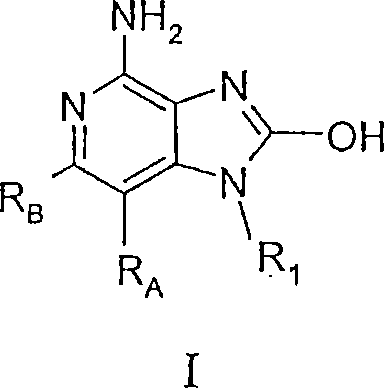
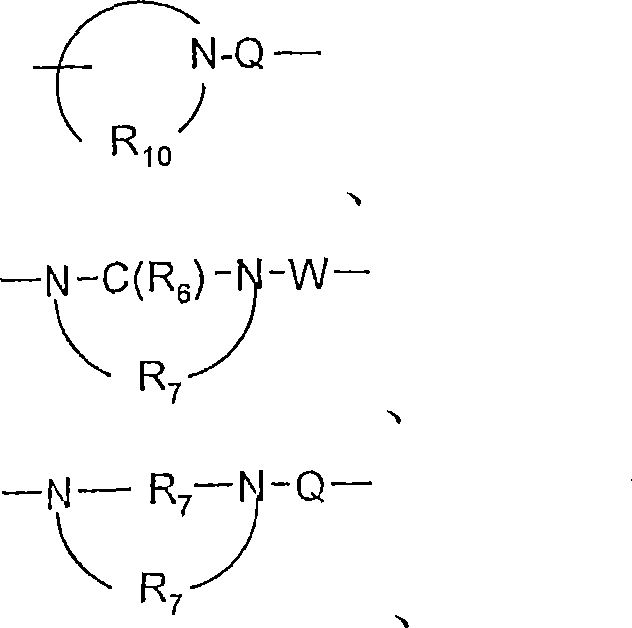

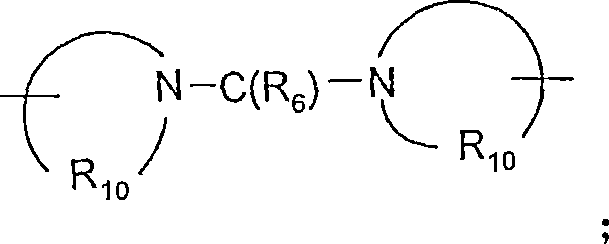


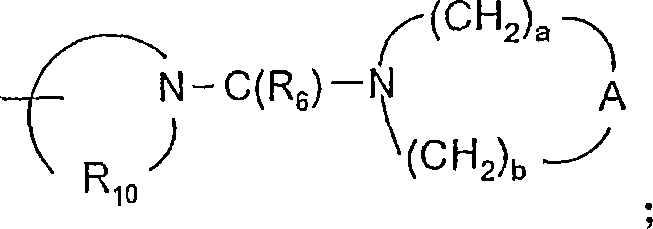
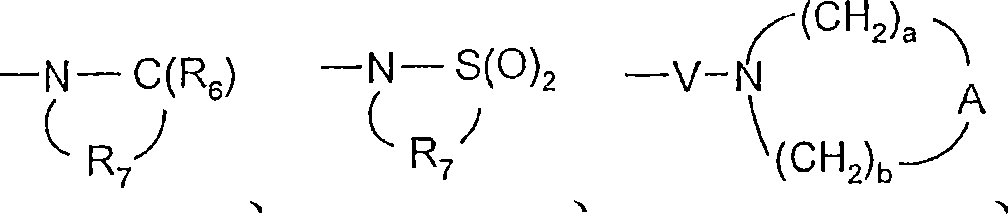
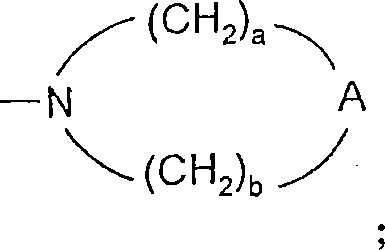
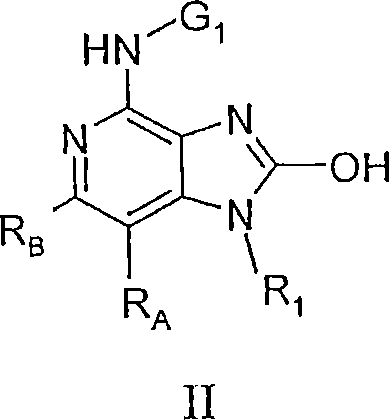


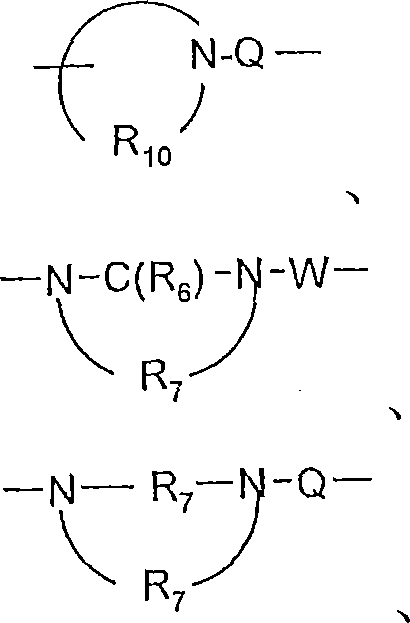
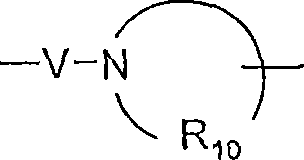



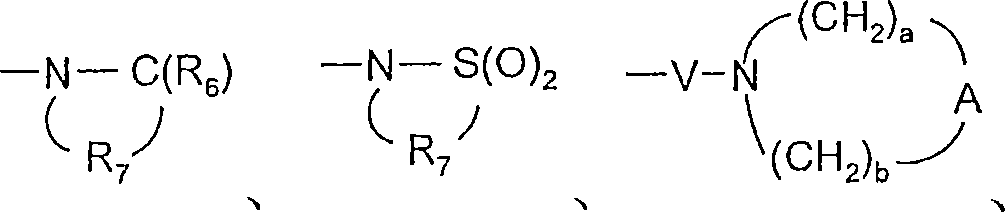


Applications Claiming Priority (2)
| Application Number | Priority Date | Filing Date | Title |
|---|---|---|---|
| US71370405P | 2005-09-02 | 2005-09-02 | |
| US60/713,704 | 2005-09-02 |
Publications (1)
| Publication Number | Publication Date |
|---|---|
| CN101253173A true CN101253173A (en) | 2008-08-27 |
Family
ID=37561219
Family Applications (1)
| Application Number | Title | Priority Date | Filing Date |
|---|---|---|---|
| CNA2006800319190A Pending CN101253173A (en) | 2005-09-02 | 2006-09-01 | Hydroxy-substituted 1H-imidazopyridines and methods |
Country Status (20)
| Country | Link |
|---|---|
| US (2) | US20100152230A1 (en) |
| EP (1) | EP1924581A1 (en) |
| JP (1) | JP4584335B2 (en) |
| KR (1) | KR20080031496A (en) |
| CN (1) | CN101253173A (en) |
| AU (1) | AU2006287157A1 (en) |
| BR (1) | BRPI0615250A2 (en) |
| CA (1) | CA2620933A1 (en) |
| CR (1) | CR9781A (en) |
| EA (1) | EA200800396A1 (en) |
| EC (1) | ECSP088225A (en) |
| IL (1) | IL189262A0 (en) |
| MA (1) | MA29759B1 (en) |
| MX (1) | MX2008002414A (en) |
| NO (1) | NO20081393L (en) |
| RS (1) | RS20080128A (en) |
| SV (1) | SV2009002832A (en) |
| TN (1) | TNSN08099A1 (en) |
| WO (1) | WO2007028129A1 (en) |
| ZA (1) | ZA200801645B (en) |
Cited By (2)
| Publication number | Priority date | Publication date | Assignee | Title |
|---|---|---|---|---|
| CN103450198A (en) * | 2012-05-29 | 2013-12-18 | 首都医科大学 | Imidazo pyrido imidazole-3-substituted benzyl acetates, and synthesis, antineoplastic activities and application thereof |
| CN117466808A (en) * | 2023-12-27 | 2024-01-30 | 烟台新药创制山东省实验室 | Preparation method of 6-alkyl-2, 4-dihydroxypyridine derivative |
Families Citing this family (72)
| Publication number | Priority date | Publication date | Assignee | Title |
|---|---|---|---|---|
| US20040265351A1 (en) | 2003-04-10 | 2004-12-30 | Miller Richard L. | Methods and compositions for enhancing immune response |
| AU2004266641A1 (en) | 2003-08-12 | 2005-03-03 | 3M Innovative Properties Company | Oxime substituted imidazo-containing compounds |
| NZ545412A (en) | 2003-08-27 | 2008-12-24 | Coley Pharm Group Inc | Aryloxy and arylalkyleneoxy substituted imidazoquinolines |
| US20050054665A1 (en) | 2003-09-05 | 2005-03-10 | 3M Innovative Properties Company | Treatment for CD5+ B cell lymphoma |
| US7544697B2 (en) | 2003-10-03 | 2009-06-09 | Coley Pharmaceutical Group, Inc. | Pyrazolopyridines and analogs thereof |
| WO2005032484A2 (en) | 2003-10-03 | 2005-04-14 | 3M Innovative Properties Company | Alkoxy substituted imidazoquinolines |
| MY146124A (en) | 2003-10-03 | 2012-06-29 | 3M Innovative Properties Co | Pyrazolopyridines and analogs thereof |
| JP2007511527A (en) | 2003-11-14 | 2007-05-10 | スリーエム イノベイティブ プロパティズ カンパニー | Oxime-substituted imidazo ring compounds |
| JP2007511535A (en) | 2003-11-14 | 2007-05-10 | スリーエム イノベイティブ プロパティズ カンパニー | Hydroxylamine substituted imidazo ring compounds |
| NZ547467A (en) | 2003-11-25 | 2010-06-25 | 3M Innovative Properties Co | Substituted imidazo ring system and methods |
| WO2005066170A1 (en) | 2003-12-29 | 2005-07-21 | 3M Innovative Properties Company | Arylalkenyl and arylalkynyl substituted imidazoquinolines |
| JP2007517044A (en) | 2003-12-30 | 2007-06-28 | スリーエム イノベイティブ プロパティズ カンパニー | Imidazoquinolinyl, imidazopyridinyl, and imidazonaphthyridinylsulfonamide |
| CA2559863A1 (en) | 2004-03-24 | 2005-10-13 | 3M Innovative Properties Company | Amide substituted imidazopyridines, imidazoquinolines, and imidazonaphthyridines |
| WO2005123080A2 (en) | 2004-06-15 | 2005-12-29 | 3M Innovative Properties Company | Nitrogen-containing heterocyclyl substituted imidazoquinolines and imidazonaphthyridines |
| WO2006009826A1 (en) | 2004-06-18 | 2006-01-26 | 3M Innovative Properties Company | Aryloxy and arylalkyleneoxy substituted thiazoloquinolines and thiazolonaphthyridines |
| WO2006065280A2 (en) | 2004-06-18 | 2006-06-22 | 3M Innovative Properties Company | Isoxazole, dihydroisoxazole, and oxadiazole substituted imidazo ring compounds and methods |
| US8541438B2 (en) | 2004-06-18 | 2013-09-24 | 3M Innovative Properties Company | Substituted imidazoquinolines, imidazopyridines, and imidazonaphthyridines |
| PL1789042T3 (en) | 2004-09-02 | 2012-09-28 | 3M Innovative Properties Co | 1-alkoxy 1h-imidazo ring systems and methods |
| US7943609B2 (en) | 2004-12-30 | 2011-05-17 | 3M Innovative Proprerties Company | Chiral fused [1,2]imidazo[4,5-C] ring compounds |
| JP5313502B2 (en) | 2004-12-30 | 2013-10-09 | スリーエム イノベイティブ プロパティズ カンパニー | Substituted chiral condensed [1,2] imidazo [4,5-c] cyclic compounds |
| AU2006210392A1 (en) | 2005-02-04 | 2006-08-10 | Coley Pharmaceutical Group, Inc. | Aqueous gel formulations containing immune response modifiers |
| JP2008530252A (en) | 2005-02-09 | 2008-08-07 | コーリー ファーマシューティカル グループ,インコーポレイテッド | Thiazolo [4,5-c] ring compounds and methods substituted with oximes and hydroxylamines |
| JP5122980B2 (en) | 2005-02-09 | 2013-01-16 | スリーエム イノベイティブ プロパティズ カンパニー | Alkyloxy-substituted thiazoloquinolines and alkyloxy-substituted thiazolonaphthylidenes |
| AU2006213746A1 (en) | 2005-02-11 | 2006-08-17 | Coley Pharmaceutical Group, Inc. | Oxime and hydroxylamine substituted imidazo(4,5-c) ring compounds and methods |
| WO2006091394A2 (en) | 2005-02-11 | 2006-08-31 | Coley Pharmaceutical Group, Inc. | Substituted imidazoquinolines and imidazonaphthyridines |
| AU2006216686A1 (en) | 2005-02-23 | 2006-08-31 | Coley Pharmaceutical Group, Inc. | Method of preferentially inducing the biosynthesis of interferon |
| US8158794B2 (en) | 2005-02-23 | 2012-04-17 | 3M Innovative Properties Company | Hydroxyalkyl substituted imidazoquinoline compounds and methods |
| WO2006098852A2 (en) | 2005-02-23 | 2006-09-21 | Coley Pharmaceutical Group, Inc. | Hydroxyalkyl substituted imidazoquinolines |
| CA2602683A1 (en) | 2005-04-01 | 2006-10-12 | Coley Pharmaceutical Group, Inc. | Pyrazolopyridine-1,4-diamines and analogs thereof |
| CA2602590A1 (en) | 2005-04-01 | 2006-10-12 | Coley Pharmaceutical Group, Inc. | 1-substituted pyrazolo (3,4-c) ring compounds as modulators of cytokine biosynthesis for the treatment of viral infections and neoplastic diseases |
| ZA200803029B (en) | 2005-09-09 | 2009-02-25 | Coley Pharm Group Inc | Amide and carbamate derivatives of alkyl substituted /V-[4-(4-amino-1H-imidazo[4,5-c] quinolin-1-yl)butyl] methane-sulfonamides and methods |
| EP1922317A4 (en) | 2005-09-09 | 2009-04-15 | Coley Pharm Group Inc | Amide and carbamate derivatives of n-{2-ý4-amino-2- (ethoxymethyl)-1h-imidazoý4,5-c¨quinolin-1-yl¨-1,1-dimethylethyl}methanesulfonamide and methods |
| US8088790B2 (en) | 2005-11-04 | 2012-01-03 | 3M Innovative Properties Company | Hydroxy and alkoxy substituted 1H-imidazoquinolines and methods |
| KR20080085232A (en) * | 2006-02-17 | 2008-09-23 | 화이자 리미티드 | 3-deazapurine derivatives as TLR7 modulators |
| WO2007100634A2 (en) | 2006-02-22 | 2007-09-07 | 3M Innovative Properties Company | Immune response modifier conjugates |
| US8329721B2 (en) | 2006-03-15 | 2012-12-11 | 3M Innovative Properties Company | Hydroxy and alkoxy substituted 1H-imidazonaphthyridines and methods |
| US7906506B2 (en) | 2006-07-12 | 2011-03-15 | 3M Innovative Properties Company | Substituted chiral fused [1,2] imidazo [4,5-c] ring compounds and methods |
| WO2008030511A2 (en) | 2006-09-06 | 2008-03-13 | Coley Pharmaceuticial Group, Inc. | Substituted 3,4,6,7-tetrahydro-5h, 1,2a,4a,8-tetraazacyclopenta[cd]phenalenes |
| US20080149123A1 (en) | 2006-12-22 | 2008-06-26 | Mckay William D | Particulate material dispensing hairbrush with combination bristles |
| US7977344B2 (en) | 2007-02-19 | 2011-07-12 | Glaxosmithkline Llc | Compounds |
| EP1997805A1 (en) * | 2007-06-01 | 2008-12-03 | Commissariat à l'Energie Atomique | Compounds with antiparasitic activity, applications thereof to the treatment of infectious diseases caused by apicomplexans |
| ATE501136T1 (en) * | 2007-08-03 | 2011-03-15 | Pfizer Ltd | IMIDAZOPYRIDINONE |
| US8563717B2 (en) | 2008-08-11 | 2013-10-22 | Glaxosmithkline Llc | Adenine derivatives |
| US8802684B2 (en) | 2008-08-11 | 2014-08-12 | Glaxosmithkline Llc | Adenine derivatives |
| WO2010018130A1 (en) | 2008-08-11 | 2010-02-18 | Smithkline Beecham Corporation | Purine derivatives for use in the treatment of allergic, inflammatory and infectious diseases |
| UA103195C2 (en) | 2008-08-11 | 2013-09-25 | Глаксосмитклайн Ллк | PURCHASE DERIVATIVES FOR THE APPLICATION IN THE TREATMENT OF ALLERGIES, INFLAMMATORY AND INFECTIOUS DISEASES |
| SG172060A1 (en) | 2008-12-09 | 2011-07-28 | Gilead Sciences Inc | Modulators of toll-like receptors |
| SG178899A1 (en) | 2009-08-28 | 2012-04-27 | Array Biopharma Inc | Raf inhibitor compounds and methods of use thereof |
| CN102666541B (en) | 2009-10-22 | 2015-11-25 | 吉里德科学公司 | Derivatives of purines or deazapurines for use in the treatment, especially of viral infections |
| WO2011098451A1 (en) | 2010-02-10 | 2011-08-18 | Glaxosmithkline Llc | Purine derivatives and their pharmaceutical uses |
| PT2606047T (en) | 2010-08-17 | 2017-04-07 | 3M Innovative Properties Co | Lipidated immune response modifier compound compositions, formulations, and methods |
| WO2012167088A1 (en) | 2011-06-03 | 2012-12-06 | 3M Innovative Properties Company | Heterobifunctional linkers with polyethylene glycol segments and immune response modifier conjugates made therefrom |
| CN103582640B (en) | 2011-06-03 | 2015-11-25 | 3M创新有限公司 | Diazanyl 1H-imidazoquinoline-4-amine and the conjugate be made up of it |
| BR112014001425A2 (en) | 2011-07-22 | 2017-11-21 | Glaxosmithkline Llc | pharmaceutical dosage form, pharmaceutical composition, and compound (i) or pharmaceutically acceptable salt thereof |
| MY175676A (en) | 2012-08-24 | 2020-07-06 | Glaxosmithkline Llc | Pyrazolopyrimidine compounds |
| AU2013348217B2 (en) | 2012-11-20 | 2016-10-06 | Glaxosmithkline Llc | Novel compounds |
| PL2922549T3 (en) | 2012-11-20 | 2017-11-30 | Glaxosmithkline Llc | Novel compounds |
| JP6216386B2 (en) | 2012-11-20 | 2017-10-18 | グラクソスミスクライン・リミテッド・ライアビリティ・カンパニーGlaxoSmithKline LLC | New compounds |
| UY36298A (en) | 2014-09-16 | 2016-04-29 | Gilead Science Inc | SOLID FORMS OF A TOLL TYPE RECEIVER MODULATOR |
| CA3086439A1 (en) | 2017-12-20 | 2019-06-27 | 3M Innovative Properties Company | Amide substitued imidazo[4,5-c]quinoline compounds with a branched chain linking group for use as an immune response modifier |
| WO2019209811A1 (en) | 2018-04-24 | 2019-10-31 | Bristol-Myers Squibb Company | Macrocyclic toll-like receptor 7 (tlr7) agonists |
| US11554120B2 (en) | 2018-08-03 | 2023-01-17 | Bristol-Myers Squibb Company | 1H-pyrazolo[4,3-d]pyrimidine compounds as toll-like receptor 7 (TLR7) agonists and methods and uses therefor |
| EP4097103A1 (en) | 2020-01-27 | 2022-12-07 | Bristol-Myers Squibb Company | 1h-pyrazolo[4,3-d]pyrimidine compounds as toll-like receptor 7 (tlr7) agonists |
| CN115210236A (en) | 2020-01-27 | 2022-10-18 | 百时美施贵宝公司 | 1H-pyrazolo [4,3-d ] pyrimidine compounds as Toll-like receptor 7 (TLR 7) agonists |
| KR20220132591A (en) | 2020-01-27 | 2022-09-30 | 브리스톨-마이어스 스큅 컴퍼니 | 1H-pyrazolo[4,3-d]pyrimidine compounds as toll-like receptor 7 (TLR7) agonists |
| EP4097101A1 (en) | 2020-01-27 | 2022-12-07 | Bristol-Myers Squibb Company | 1h-pyrazolo[4,3-d]pyrimidine compounds as toll-like receptor 7 (tlr7) agonists |
| US20230348468A1 (en) | 2020-01-27 | 2023-11-02 | Bristol-Myers Squibb Company | 1H-PYRAZOLO[4,3-d]PYRIMIDINE COMPOUNDS AS TOLL-LIKE RECEPTOR 7 (TLR7) AGONISTS |
| EP4097106A1 (en) | 2020-01-27 | 2022-12-07 | Bristol-Myers Squibb Company | 1h-pyrazolo[4,3-d]pyrimidine compounds as toll-like receptor 7 (tlr7) agonists |
| EP4097105A1 (en) | 2020-01-27 | 2022-12-07 | Bristol-Myers Squibb Company | 1h-pyrazolo[4,3-d]pyrimidine compounds as toll-like receptor 7 (tlr7) agonists |
| JP2023512208A (en) | 2020-01-27 | 2023-03-24 | ブリストル-マイヤーズ スクイブ カンパニー | 1H-pyrazolo[4,3-d]pyrimidine compounds as Toll-like receptor 7 (TLR7) agonists |
| KR20220132595A (en) | 2020-01-27 | 2022-09-30 | 브리스톨-마이어스 스큅 컴퍼니 | C3-substituted 1H-pyrazolo[4,3-d]pyrimidine compounds as toll-like receptor 7 (TLR7) agonists |
| GB202014404D0 (en) * | 2020-09-14 | 2020-10-28 | Cambridge Entpr Ltd | Method for labelling nucleic acid |
Family Cites Families (14)
| Publication number | Priority date | Publication date | Assignee | Title |
|---|---|---|---|---|
| ES2149276T3 (en) * | 1993-07-15 | 2000-11-01 | Minnesota Mining & Mfg | IMIDAZO (4,5-C) PIRIDIN-4-AMINAS. |
| CA2230808C (en) * | 1996-07-03 | 2006-08-15 | Japan Energy Corporation | A novel purine derivative |
| CA2444130C (en) * | 2001-04-17 | 2010-12-21 | Sumitomo Pharmaceuticals Company, Limited | Adenine derivatives |
| NZ529333A (en) * | 2001-04-27 | 2005-01-28 | Eisai Co Ltd | Pyrazolo[1,5-a]pyridines and medicines containing the same |
| CA2488801A1 (en) * | 2002-06-07 | 2003-12-18 | 3M Innovative Properties Company | Ether substituted imidazopyridines |
| SI1611131T1 (en) * | 2003-02-27 | 2011-03-31 | Palau Pharma Sa | Pyrazolopyridine derivates |
| US7517887B2 (en) * | 2003-04-09 | 2009-04-14 | General Atomics | Reversible inhibitors of S-adenosyl-L-homocysteine hydrolase and uses thereof |
| JP2005089334A (en) * | 2003-09-12 | 2005-04-07 | Sumitomo Pharmaceut Co Ltd | 8-hydroxyadenine compound |
| SI1675852T1 (en) * | 2003-09-22 | 2009-06-30 | Janssen Pharmaceutica Nv | 7-amino alkylidenyl-heterocyclic quinolones and naphthyridones |
| FR2860514A1 (en) * | 2003-10-03 | 2005-04-08 | Sanofi Synthelabo | ARYLALKYLCARBAMATE DERIVATIVES, THEIR PREPARATION AND THEIR THERAPEUTIC APPLICATION |
| JP2007511527A (en) * | 2003-11-14 | 2007-05-10 | スリーエム イノベイティブ プロパティズ カンパニー | Oxime-substituted imidazo ring compounds |
| NZ547467A (en) * | 2003-11-25 | 2010-06-25 | 3M Innovative Properties Co | Substituted imidazo ring system and methods |
| TW200616604A (en) * | 2004-08-26 | 2006-06-01 | Nicholas Piramal India Ltd | Nitric oxide releasing prodrugs containing bio-cleavable linker |
| KR20080085232A (en) * | 2006-02-17 | 2008-09-23 | 화이자 리미티드 | 3-deazapurine derivatives as TLR7 modulators |
-
2006
- 2006-09-01 CN CNA2006800319190A patent/CN101253173A/en active Pending
- 2006-09-01 WO PCT/US2006/034427 patent/WO2007028129A1/en not_active Ceased
- 2006-09-01 US US12/065,490 patent/US20100152230A1/en not_active Abandoned
- 2006-09-01 BR BRPI0615250-3A patent/BRPI0615250A2/en not_active IP Right Cessation
- 2006-09-01 KR KR1020087005146A patent/KR20080031496A/en not_active Ceased
- 2006-09-01 JP JP2008529359A patent/JP4584335B2/en not_active Expired - Fee Related
- 2006-09-01 RS RSP-2008/0128A patent/RS20080128A/en unknown
- 2006-09-01 CA CA002620933A patent/CA2620933A1/en not_active Abandoned
- 2006-09-01 EA EA200800396A patent/EA200800396A1/en unknown
- 2006-09-01 MX MX2008002414A patent/MX2008002414A/en unknown
- 2006-09-01 AU AU2006287157A patent/AU2006287157A1/en not_active Abandoned
- 2006-09-01 EP EP06802901A patent/EP1924581A1/en not_active Withdrawn
-
2008
- 2008-02-04 IL IL189262A patent/IL189262A0/en unknown
- 2008-02-19 ZA ZA200801645A patent/ZA200801645B/en unknown
- 2008-02-26 EC EC2008008225A patent/ECSP088225A/en unknown
- 2008-02-29 TN TNP2008000099A patent/TNSN08099A1/en unknown
- 2008-02-29 SV SV2008002832A patent/SV2009002832A/en not_active Application Discontinuation
- 2008-02-29 MA MA30694A patent/MA29759B1/en unknown
- 2008-02-29 CR CR9781A patent/CR9781A/en not_active Application Discontinuation
- 2008-03-17 NO NO20081393A patent/NO20081393L/en not_active Application Discontinuation
-
2011
- 2011-10-20 US US13/277,619 patent/US20120035209A1/en not_active Abandoned
Cited By (4)
| Publication number | Priority date | Publication date | Assignee | Title |
|---|---|---|---|---|
| CN103450198A (en) * | 2012-05-29 | 2013-12-18 | 首都医科大学 | Imidazo pyrido imidazole-3-substituted benzyl acetates, and synthesis, antineoplastic activities and application thereof |
| CN103450198B (en) * | 2012-05-29 | 2015-07-08 | 首都医科大学 | Imidazopyridoimidazole-3-substituted benzyl acetate, its synthesis, antitumor activity and application |
| CN117466808A (en) * | 2023-12-27 | 2024-01-30 | 烟台新药创制山东省实验室 | Preparation method of 6-alkyl-2, 4-dihydroxypyridine derivative |
| CN117466808B (en) * | 2023-12-27 | 2024-03-12 | 烟台新药创制山东省实验室 | Preparation method of 6-alkyl-2, 4-dihydroxypyridine derivative |
Also Published As
| Publication number | Publication date |
|---|---|
| WO2007028129A1 (en) | 2007-03-08 |
| IL189262A0 (en) | 2008-06-05 |
| JP4584335B2 (en) | 2010-11-17 |
| SV2009002832A (en) | 2009-02-19 |
| AU2006287157A1 (en) | 2007-03-08 |
| BRPI0615250A2 (en) | 2011-05-10 |
| US20120035209A1 (en) | 2012-02-09 |
| RS20080128A (en) | 2009-05-06 |
| KR20080031496A (en) | 2008-04-08 |
| EA200800396A1 (en) | 2008-08-29 |
| CR9781A (en) | 2008-03-26 |
| JP2009507036A (en) | 2009-02-19 |
| TNSN08099A1 (en) | 2009-07-14 |
| ECSP088225A (en) | 2008-03-26 |
| US20100152230A1 (en) | 2010-06-17 |
| NO20081393L (en) | 2008-05-28 |
| MA29759B1 (en) | 2008-09-01 |
| ZA200801645B (en) | 2010-08-25 |
| MX2008002414A (en) | 2008-03-27 |
| CA2620933A1 (en) | 2007-03-08 |
| EP1924581A1 (en) | 2008-05-28 |
Similar Documents
| Publication | Publication Date | Title |
|---|---|---|
| CN101253173A (en) | Hydroxy-substituted 1H-imidazopyridines and methods | |
| JP5247458B2 (en) | Hydroxy and alkoxy substituted 1H-imidazoquinolines and methods | |
| JP5128940B2 (en) | Substituted imidazoquinolines, imidazopyridines, and imidazonaphthyridines | |
| JP5543068B2 (en) | Chiral fused [1,2] imidazo [4,5-c] cyclic compound | |
| US7943610B2 (en) | Pyrazolopyridine-1,4-diamines and analogs thereof | |
| US7943636B2 (en) | 1-substituted pyrazolo (3,4-C) ring compounds as modulators of cytokine biosynthesis for the treatment of viral infections and neoplastic diseases | |
| US8802853B2 (en) | Arylalkenyl and arylalkynyl substituted imidazoquinolines | |
| US7915281B2 (en) | Isoxazole, dihydroisoxazole, and oxadiazole substituted imidazo ring compounds and method | |
| JP2008511683A (en) | 2-Amino 1H-imidazo ring structure and method | |
| US9938275B2 (en) | Substituted imidazoquinolines, imidazopyridines, and imidazonaphthyridines | |
| HK1117161A (en) | Hydroxy substituted 1h-imidazopyridines and methods |
Legal Events
| Date | Code | Title | Description |
|---|---|---|---|
| C06 | Publication | ||
| PB01 | Publication | ||
| C10 | Entry into substantive examination | ||
| SE01 | Entry into force of request for substantive examination | ||
| REG | Reference to a national code |
Ref country code: HK Ref legal event code: DE Ref document number: 1117161 Country of ref document: HK |
|
| C02 | Deemed withdrawal of patent application after publication (patent law 2001) | ||
| WD01 | Invention patent application deemed withdrawn after publication |
Open date: 20080827 |
|
| REG | Reference to a national code |
Ref country code: HK Ref legal event code: WD Ref document number: 1117161 Country of ref document: HK |