CN115210236A - 1H-pyrazolo [4,3-d ] pyrimidine compounds as Toll-like receptor 7 (TLR 7) agonists - Google Patents
1H-pyrazolo [4,3-d ] pyrimidine compounds as Toll-like receptor 7 (TLR 7) agonists Download PDFInfo
- Publication number
- CN115210236A CN115210236A CN202180018762.2A CN202180018762A CN115210236A CN 115210236 A CN115210236 A CN 115210236A CN 202180018762 A CN202180018762 A CN 202180018762A CN 115210236 A CN115210236 A CN 115210236A
- Authority
- CN
- China
- Prior art keywords
- alkyl
- alkanediyl
- compound
- mmol
- cancer
- Prior art date
- Legal status (The legal status is an assumption and is not a legal conclusion. Google has not performed a legal analysis and makes no representation as to the accuracy of the status listed.)
- Pending
Links
Classifications
-
- C—CHEMISTRY; METALLURGY
- C07—ORGANIC CHEMISTRY
- C07D—HETEROCYCLIC COMPOUNDS
- C07D487/00—Heterocyclic compounds containing nitrogen atoms as the only ring hetero atoms in the condensed system, not provided for by groups C07D451/00 - C07D477/00
- C07D487/02—Heterocyclic compounds containing nitrogen atoms as the only ring hetero atoms in the condensed system, not provided for by groups C07D451/00 - C07D477/00 in which the condensed system contains two hetero rings
- C07D487/04—Ortho-condensed systems
-
- A—HUMAN NECESSITIES
- A61—MEDICAL OR VETERINARY SCIENCE; HYGIENE
- A61K—PREPARATIONS FOR MEDICAL, DENTAL OR TOILETRY PURPOSES
- A61K31/00—Medicinal preparations containing organic active ingredients
- A61K31/33—Heterocyclic compounds
- A61K31/395—Heterocyclic compounds having nitrogen as a ring hetero atom, e.g. guanethidine or rifamycins
- A61K31/495—Heterocyclic compounds having nitrogen as a ring hetero atom, e.g. guanethidine or rifamycins having six-membered rings with two or more nitrogen atoms as the only ring heteroatoms, e.g. piperazine or tetrazines
- A61K31/505—Pyrimidines; Hydrogenated pyrimidines, e.g. trimethoprim
- A61K31/519—Pyrimidines; Hydrogenated pyrimidines, e.g. trimethoprim ortho- or peri-condensed with heterocyclic rings
-
- A—HUMAN NECESSITIES
- A61—MEDICAL OR VETERINARY SCIENCE; HYGIENE
- A61K—PREPARATIONS FOR MEDICAL, DENTAL OR TOILETRY PURPOSES
- A61K39/00—Medicinal preparations containing antigens or antibodies
- A61K39/395—Antibodies; Immunoglobulins; Immune serum, e.g. antilymphocytic serum
- A61K39/39533—Antibodies; Immunoglobulins; Immune serum, e.g. antilymphocytic serum against materials from animals
- A61K39/3955—Antibodies; Immunoglobulins; Immune serum, e.g. antilymphocytic serum against materials from animals against proteinaceous materials, e.g. enzymes, hormones, lymphokines
-
- A—HUMAN NECESSITIES
- A61—MEDICAL OR VETERINARY SCIENCE; HYGIENE
- A61K—PREPARATIONS FOR MEDICAL, DENTAL OR TOILETRY PURPOSES
- A61K45/00—Medicinal preparations containing active ingredients not provided for in groups A61K31/00 - A61K41/00
- A61K45/06—Mixtures of active ingredients without chemical characterisation, e.g. antiphlogistics and cardiaca
-
- A—HUMAN NECESSITIES
- A61—MEDICAL OR VETERINARY SCIENCE; HYGIENE
- A61P—SPECIFIC THERAPEUTIC ACTIVITY OF CHEMICAL COMPOUNDS OR MEDICINAL PREPARATIONS
- A61P35/00—Antineoplastic agents
-
- A—HUMAN NECESSITIES
- A61—MEDICAL OR VETERINARY SCIENCE; HYGIENE
- A61K—PREPARATIONS FOR MEDICAL, DENTAL OR TOILETRY PURPOSES
- A61K2300/00—Mixtures or combinations of active ingredients, wherein at least one active ingredient is fully defined in groups A61K31/00 - A61K41/00
Landscapes
- Health & Medical Sciences (AREA)
- Chemical & Material Sciences (AREA)
- Organic Chemistry (AREA)
- Medicinal Chemistry (AREA)
- Life Sciences & Earth Sciences (AREA)
- Public Health (AREA)
- Veterinary Medicine (AREA)
- Pharmacology & Pharmacy (AREA)
- Animal Behavior & Ethology (AREA)
- General Health & Medical Sciences (AREA)
- Epidemiology (AREA)
- Nuclear Medicine, Radiotherapy & Molecular Imaging (AREA)
- General Chemical & Material Sciences (AREA)
- Chemical Kinetics & Catalysis (AREA)
- Endocrinology (AREA)
- Engineering & Computer Science (AREA)
- Bioinformatics & Cheminformatics (AREA)
- Immunology (AREA)
- Microbiology (AREA)
- Mycology (AREA)
- Pharmaceuticals Containing Other Organic And Inorganic Compounds (AREA)
- Nitrogen Condensed Heterocyclic Rings (AREA)
- Medicines Containing Antibodies Or Antigens For Use As Internal Diagnostic Agents (AREA)
Abstract
根据式I的化合物可用作Toll样受体7(TLR7)的激动剂。此类化合物可以用于癌症治疗,尤其是与抗癌免疫治疗剂组合,或用作疫苗佐剂。
Description
相关申请的交叉引用CROSS-REFERENCE TO RELATED APPLICATIONS
本申请根据35 U.S.C.§119(e)要求2020年7月28日提交的美国临时申请序列号63/057,644和2020年1月27日提交的美国临时申请序列号62/966,085的权益;将其公开内容通过引用并入本文。This application claims the benefit of US Provisional Application Serial No. 63/057,644, filed July 28, 2020, and US Provisional Application Serial No. 62/966,085, filed January 27, 2020, under 35 U.S.C. § 119(e); The contents are incorporated herein by reference.
背景技术Background technique
本公开文本涉及Toll样受体7(“TLR7”)激动剂及其缀合物以及用于此类激动剂及其缀合物的制备和使用方法。The present disclosure relates to Toll-like receptor 7 ("TLR7") agonists and conjugates thereof and methods for making and using such agonists and conjugates thereof.
Toll样受体(“TLR”)是识别病原体相关分子模式(“PAMP”)的受体,所述病原体相关分子模式是在某些种类的病原体中保守的小分子基序。TLR可以位于细胞表面或细胞内。通过结合其同源PAMP而激活TLR传递了宿主内存在相关病原体(即感染)的信号并且刺激宿主的免疫系统以抵抗感染。人具有10种TLR,称为TLR1、TLR2、TLR3等。Toll-like receptors ("TLRs") are receptors that recognize pathogen-associated molecular patterns ("PAMPs"), which are small-molecule motifs conserved in certain classes of pathogens. TLRs can be located on the cell surface or intracellularly. Activation of TLRs by binding to their cognate PAMPs signals the presence of relevant pathogens in the host (ie, infection) and stimulates the host's immune system to fight infection. Humans have 10 TLRs, called TLR1, TLR2, TLR3, etc.
通过激动剂激活TLR-TLR7是被研究最多的-可以对疫苗和免疫治疗剂通过刺激总体免疫应答而在治疗除实际病原体感染以外的多种病症中的作用产生积极效果。因此,对TLR7激动剂在癌症免疫疗法中作为疫苗佐剂或作为增强剂的用途存在很大兴趣。参见例如,Vasilakos和Tomai 2013、Sato-Kaneko等人2017、Smits等人2008、和Ota等人2019。Activation of TLR-TLR7 by agonists is the most studied - and can have a positive effect on the role of vaccines and immunotherapeutics in treating a variety of conditions beyond actual pathogen infection by stimulating the overall immune response. Therefore, there is great interest in the use of TLR7 agonists as vaccine adjuvants or as enhancers in cancer immunotherapy. See, eg, Vasilakos and Tomai 2013, Sato-Kaneko et al 2017, Smits et al 2008, and Ota et al 2019.
TLR7(位于内体膜上的细胞内受体)识别与单链RNA病毒相关的PAMP。它的激活会诱导I型干扰素(诸如IFNα和IFNβ)的分泌(Lund等人2004)。TLR7具有两个结合位点,一个用于结合单链RNA配体(
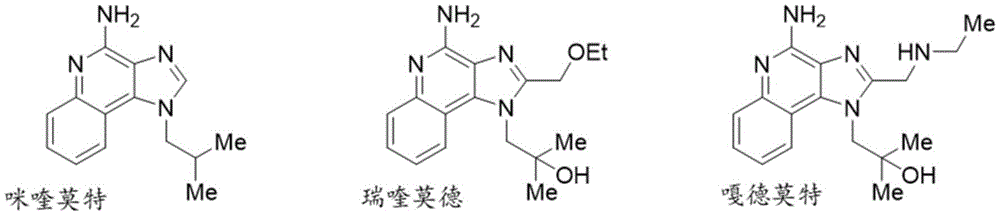
TLR7可以结合基于1H-咪唑并[4,5-c]喹啉骨架的鸟苷样合成激动剂(诸如咪喹莫特、瑞喹莫德和嘎德莫特)并且被其激活。关于小分子TLR7激动剂的综述,参见Cortez和Va2018。TLR7 can bind to and be activated by guanosine-like synthetic agonists based on the 1H-imidazo[4,5-c]quinoline backbone, such as imiquimod, requimod, and gardemod. For a review of small molecule TLR7 agonists, see Cortez and Va 2018.
基于喋啶酮分子骨架的合成TLR7激动剂也是已知的,如通过维沙莫德(vesatolimod)例示(Desai等人2015)。Synthetic TLR7 agonists based on the pteridone molecular backbone are also known, as exemplified by vesatolimod (Desai et al. 2015).

经常根据通式(A)公开基于嘌呤样骨架的其他合成TLR7激动剂:Other synthetic TLR7 agonists based on the purine-like backbone are often disclosed according to general formula (A):

其中R、R’和R”是结构变量,并且R”典型地含有未取代的或取代的芳族或杂芳族环。wherein R, R' and R" are structural variables, and R" typically contains an unsubstituted or substituted aromatic or heteroaromatic ring.
具有嘌呤样骨架的生物活性分子及其在治疗诸如纤维化、炎性障碍、癌症或病原性感染的病症中的用途的公开文本包括:Akinbobuyi等人2015和2016;Barberis等人2012;Carson等人2014;Ding等人2016、2017a、和2017b;Graupe等人2015;Hashimoto等人2009;He等人2019a和2019b;Holldack等人2012;Isobe等人2009a和2012;Poudel等人2019a和2019b;Pryde 2010;和Young等人2019。Publications on biologically active molecules with purine-like backbones and their use in the treatment of conditions such as fibrosis, inflammatory disorders, cancer or pathogenic infections include: Akinbobuyi et al. 2015 and 2016; Barberis et al. 2012; Carson et al. 2014; Ding et al. 2016, 2017a, and 2017b; Graupe et al. 2015; Hashimoto et al. 2009; He et al. 2019a and 2019b; Holldack et al. 2012; Isobe et al. 2009a and 2012; Poudel et al. ; and Young et al. 2019.
基团R”可以是吡啶基:Bonfanti等人2015a和2015b;Halcomb等人2015;Hirota等人2000;Isobe等人2002、2004、2006、2009a、2009b、2011、和2012;Kasibhatla等人2007;Koga-Yamakawa等人2013;Musmuca等人2009;Nakamura 2012;Ogita等人2007;和Yu等人2013。The group R" may be a pyridyl group: Bonfanti et al. 2015a and 2015b; Halcomb et al. 2015; Hirota et al. 2000; Isobe et al. 2002, 2004, 2006, 2009a, 2009b, 2011, and 2012; - Yamakawa et al 2013; Musmuca et al 2009; Nakamura 2012; Ogita et al 2007; and Yu et al 2013.
公开了其中式(A)的6,5-稠合环系统-与咪唑五元环稠合的嘧啶六元环-被修饰的相关分子。(a)Dellaria等人2007、Jones等人2010和2012、和Pilatte等人2017公开了其中嘧啶环被吡啶环替代的化合物。(b)Chen等人2011、Coe等人2017、Poudel等人2020a和2020b、和Zhang等人2018公开了其中咪唑环被吡唑环替代的化合物。(c)Cortez等人2017和2018;Li等人2018;和McGowan等人2016a、2016b、和2017公开了其中咪唑环被吡咯环替代的化合物。Related molecules are disclosed in which a 6,5-fused ring system of formula (A) - a pyrimidine six-membered ring fused to an imidazole five-membered ring - is modified. (a) Dellaria et al. 2007, Jones et al. 2010 and 2012, and Pilatte et al. 2017 disclose compounds in which the pyrimidine ring is replaced by a pyridine ring. (b) Chen et al. 2011, Coe et al. 2017, Poudel et al. 2020a and 2020b, and Zhang et al. 2018 disclose compounds in which the imidazole ring is replaced by a pyrazole ring. (c) Cortez et al. 2017 and 2018; Li et al. 2018; and McGowan et al. 2016a, 2016b, and 2017 disclose compounds in which the imidazole ring is replaced by a pyrrole ring.
Bonfanti等人2015b和2016以及Purandare等人2019公开了其中大环跨越嘌呤部分的两个环的TLR7调节剂:Bonfanti et al. 2015b and 2016 and Purandare et al. 2019 disclose TLR7 modulators in which the macrocycle spans two loops of the purine moiety:
TLR7激动剂可以与配偶体分子缀合,所述配偶体分子可以是例如磷脂、聚(乙二醇)(“PEG”)、抗体或另一种TLR(通常是TLR2)。示例性的公开文本包括:Carson等人2013、2015、和2016;Chan等人2009和2011;Cortez等人2017;Gadd等人2015;Lioux等人2016;Maj等人2015;Vernejoul等人2014;和Zurawski等人2012。频繁的缀合位点是在式(A)的R”基团处。A TLR7 agonist can be conjugated to a partner molecule, which can be, for example, a phospholipid, poly(ethylene glycol) ("PEG"), an antibody, or another TLR (usually TLR2). Exemplary publications include: Carson et al. 2013, 2015, and 2016; Chan et al. 2009 and 2011; Cortez et al. 2017; Gadd et al. 2015; Lioux et al. 2016; Maj et al. 2015; Vernejoul et al. 2014; and Zurawski et al. 2012. A frequent site of conjugation is at the R" group of formula (A).
Jensen等人2015公开了阳离子脂质媒介物用于递送TLR7激动剂的用途。Jensen et al. 2015 disclose the use of cationic lipid vehicles for the delivery of TLR7 agonists.
一些TLR7激动剂(包括瑞喹莫德)是双重TLR7/TLR8激动剂。参见例如,Beesu等人2017、Embrechts等人2018、Lioux等人2016和Vernejoul等人2014。Some TLR7 agonists, including requimod, are dual TLR7/TLR8 agonists. See, eg, Beesu et al. 2017, Embrechts et al. 2018, Lioux et al. 2016, and Vernejoul et al. 2014.
本说明书的结尾处列出了通过第一作者或发明人和年份对本文中引用的文献的完全引用。Full citations to documents cited herein by first author or inventor and year are listed at the end of the specification.
发明内容SUMMARY OF THE INVENTION
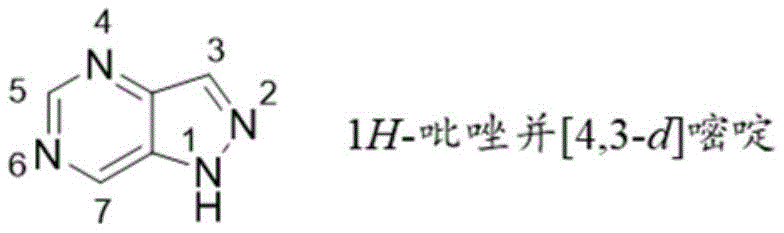
本说明书涉及具有1H-吡唑并[4,3d]嘧啶芳族系统的化合物,其具有作为TLR7激动剂的活性。The present specification relates to compounds with a lH-pyrazolo[4,3d]pyrimidine aromatic system, which have activity as TLR7 agonists.
在一方面,提供了一种具有根据式I的结构的化合物In one aspect, a compound having a structure according to Formula I is provided

其中in
W是H、卤基、C1-C3烷基、CN、(C1-C4烷二基)OH、

每个X独立地是N或CR2;each X is independently N or CR 2 ;
X1是O、CH2、NH、S或N(C1-C3烷基);X 1 is O, CH 2 , NH, S or N(C 1 -C 3 alkyl);
R1是(C1-C5烷基)、R 1 is (C 1 -C 5 alkyl),
(C2-C5烯基)、(C 2 -C 5 alkenyl),
(C1-C8烷二基)0-1(C3-C6环烷基)、(C 1 -C 8 alkanediyl) 0-1 (C 3 -C 6 cycloalkyl),
(C1-C8烷二基)0-1(C5-C10螺烷基)、(C 1 -C 8 alkanediyl) 0-1 (C 5 -C 10 spiroalkyl),
(C2-C8烷二基)OH、(C 2 -C 8 alkanediyl) OH,
(C2-C8烷二基)O(C1-C3烷基)、(C 2 -C 8 alkanediyl) O(C 1 -C 3 alkyl),
(C1-C4烷二基)0-1(5-6元杂芳基)、(C 1 -C 4 alkanediyl) 0-1 (5-6-membered heteroaryl),
(C1-C4烷二基)0-1苯基、(C 1 -C 4 alkanediyl) 0-1 phenyl,
(C1-C4烷二基)CF3、(C 1 -C 4 alkanediyl) CF 3 ,
(C2-C8烷二基)N[C(=O)](C1-C3烷基)、(C 2 -C 8 alkanediyl)N[C(=O)](C 1 -C 3 alkyl),
或or
(C2-C8烷二基)NRxRy;(C 2 -C 8 alkanediyl)NR x R y ;
每个R2独立地是H、O(C1-C3烷基)、S(C1-C3烷基)、SO2(C1-C3烷基)、C1-C3烷基、O(C3-C4环烷基)、S(C3-C4环烷基)、SO2(C3-C4环烷基)、C3-C4环烷基、Cl、F、CN、或[C(=O)]0-1NRxRy;Each R 2 is independently H, O(C 1 -C 3 alkyl), S(C 1 -C 3 alkyl), SO 2 (C 1 -C 3 alkyl), C 1 -C 3 alkyl , O(C 3 -C 4 cycloalkyl), S(C 3 -C 4 cycloalkyl), SO 2 (C 3 -C 4 cycloalkyl), C 3 -C 4 cycloalkyl, Cl, F , CN, or [C(=O)] 0-1 NR x R y ;
R3是H、卤基、OH、CN、R 3 is H, halo, OH, CN,
NH2、NH 2 ,
NH[C(=O)]0-1(C1-C5烷基)、NH[C(=O)] 0-1 (C 1 -C 5 alkyl),
N(C1-C5烷基)2、N(C 1 -C 5 alkyl) 2 ,
NH[C(=O)]0-1(C1-C4烷二基)0-1(C3-C8环烷基)、NH[C(=O)] 0-1 (C 1 -C 4 alkanediyl) 0-1 (C 3 -C 8 cycloalkyl),
NH[C(=O)]0-1(C1-C4烷二基)0-1(C4-C10双环烷基)、NH[C(=O)] 0-1 (C 1 -C 4 alkanediyl) 0-1 (C 4 -C 10 bicycloalkyl),
NH[C(=O)]0-1(C1-C4烷二基)0-1(C5-C10螺烷基)、NH[C(=O)] 0-1 (C 1 -C 4 alkanediyl) 0-1 (C 5 -C 10 spiroalkyl),
N(C3-C6环烷基)2、N(C 3 -C 6 cycloalkyl) 2 ,
O(C1-C4烷二基)0-1(C3-C8环烷基)、O(C 1 -C 4 alkanediyl) 0-1 (C 3 -C 8 cycloalkyl),
O(C1-C4烷二基)0-1(C4-C8双环烷基)、O(C 1 -C 4 alkanediyl) 0-1 (C 4 -C 8 bicycloalkyl),
O(C1-C4烷二基)0-1(C5-C10螺烷基)、O(C 1 -C 4 alkanediyl) 0-1 (C 5 -C 10 spiroalkyl),
O(C1-C4烷二基)0-1(C1-C6烷基)、O(C 1 -C 4 alkanediyl) 0-1 (C 1 -C 6 alkyl),
N[C1-C3烷基]C(=O)(C1-C6烷基)、N[C 1 -C 3 alkyl]C(=O)(C 1 -C 6 alkyl),
NH(SO2)(C1-C5烷基)、NH(SO 2 ) (C 1 -C 5 alkyl),
NH(SO2)(C1-C4烷二基)0-1(C3-C8环烷基)、NH(SO 2 )(C 1 -C 4 alkanediyl) 0-1 (C 3 -C 8 cycloalkyl),
NH(SO2)(C1-C4烷二基)0-1(C4-C10双环烷基)、NH(SO 2 )(C 1 -C 4 alkanediyl) 0-1 (C 4 -C 10 bicycloalkyl),
NH(SO2)(C1-C4烷二基)0-1(C5-C10螺烷基)、NH(SO 2 )(C 1 -C 4 alkanediyl) 0-1 (C 5 -C 10 spiroalkyl),
6元芳族或杂芳族部分、6-membered aromatic or heteroaromatic moieties,
5元杂芳族部分、或5-membered heteroaromatic moiety, or
具有以下结构的部分:A section with the following structure:

R4是NH2、R 4 is NH 2 ,
NH(C1-C5烷基)、NH (C 1 -C 5 alkyl),
N(C1-C5烷基)2、N(C 1 -C 5 alkyl) 2 ,
NH(C1-C4烷二基)0-1(C3-C8环烷基)、NH(C 1 -C 4 alkanediyl) 0-1 (C 3 -C 8 cycloalkyl),
NH(C1-C4烷二基)0-1(C4-C10双环烷基)、NH(C 1 -C 4 alkanediyl) 0-1 (C 4 -C 10 bicycloalkyl),
NH(C1-C4烷二基)0-1(C5-C10螺烷基)、NH(C 1 -C 4 alkanediyl) 0-1 (C 5 -C 10 spiroalkyl),
N(C3-C6环烷基)2、N(C 3 -C 6 cycloalkyl) 2 ,
或or
具有以下结构的部分:A section with the following structure:

R5是H、C1-C5烷基、C2-C5烯基、C3-C6环烷基、卤基、O(C1-C5烷基)、(C1-C4烷二基)OH、(C1-C4烷二基)O(C1-C3烷基)、苯基、NH(C1-C5烷基)、5或6元杂芳基、R 5 is H, C 1 -C 5 alkyl, C 2 -C 5 alkenyl, C 3 -C 6 cycloalkyl, halo, O(C 1 -C 5 alkyl), (C 1 -C 4 Alkanediyl) OH, (C 1 -C 4 alkanediyl) O(C 1 -C 3 alkyl), phenyl, NH(C 1 -C 5 alkyl), 5- or 6-membered heteroaryl,

R6是NH2、R 6 is NH 2 ,
(NH)0-1(C1-C5烷基)、(NH) 0-1 (C 1 -C 5 alkyl),
N(C1-C5烷基)2、N(C 1 -C 5 alkyl) 2 ,
(NH)0-1(C1-C4烷二基)0-1(C3-C8环烷基)、(NH) 0-1 (C 1 -C 4 alkanediyl) 0-1 (C 3 -C 8 cycloalkyl),
(NH)0-1(C1-C4烷二基)0-1(C4-C10双环烷基)、(NH) 0-1 (C 1 -C 4 alkanediyl) 0-1 (C 4 -C 10 bicycloalkyl),
(NH)0-1(C1-C4烷二基)0-1(C5-C10螺烷基)、(NH) 0-1 (C 1 -C 4 alkanediyl) 0-1 (C 5 -C 10 spiroalkyl),
N(C3-C6环烷基)2、N(C 3 -C 6 cycloalkyl) 2 ,
或or
具有以下结构的部分:A section with the following structure:

Rx和Ry独立地是H或C1-C3烷基或者Rx和Ry与它们所键合的氮组合以形成3至7元杂环; Rx and Ry are independently H or C1 - C3 alkyl or Rx and Ry are combined with the nitrogen to which they are bound to form a 3 to 7 membered heterocycle;
m是0或1;m is 0 or 1;
n是1、2或3;n is 1, 2 or 3;
并且and
p是0、1、2或3;p is 0, 1, 2, or 3;
其中在R1、R2、R3、R4、R5和R6中wherein in R 1 , R 2 , R 3 , R 4 , R 5 and R 6
烷基、环烷基、烷二基、双环烷基、螺烷基、环胺、6元芳族或杂芳族部分、5元杂芳族部分或式Alkyl, cycloalkyl, alkanediyl, bicycloalkyl, spiroalkyl, cyclic amine, 6-membered aromatic or heteroaromatic moiety, 5-membered heteroaromatic moiety or formula


的部分任选地被一个或多个选自以下的取代基取代:OH、卤基、CN、(C1-C3烷基)、O(C1-C3烷基)、C(=O)(C1-C3烷基)、SO2(C1-C3烷基)、NRxRy、The portion of is optionally substituted with one or more substituents selected from the group consisting of OH, halo, CN, (C 1 -C 3 alkyl), O(C 1 -C 3 alkyl), C(=O ) (C 1 -C 3 alkyl), SO 2 (C 1 -C 3 alkyl), NR x R y ,
(C1-C4烷二基)OH、(C1-C4烷二基)O(C1-C3烷基);(C 1 -C 4 alkanediyl) OH, (C 1 -C 4 alkanediyl) O(C 1 -C 3 alkyl);
并且and
烷基、烷二基、环烷基、双环烷基、螺烷基、或式Alkyl, alkanediyl, cycloalkyl, bicycloalkyl, spiroalkyl, or formula

的部分可以具有被以下替代的CH2基团:O、SO2、CF2、C(=O)、NH、can have CH2 groups replaced by: O, SO2, CF2 , C ( =O), NH,
N[C(=O)]0-1(C1-C3烷基)、N[C(=O)] 0-1 (C 1 -C 3 alkyl),
N[C(=O)]0-1(C1-C4烷二基)0-1CF3、N[C(=O)] 0-1 (C 1 -C 4 alkanediyl) 0-1 CF 3 ,
或or
N[C(=O)]0-1(C1-C4烷二基)0-1(C3-C5环烷基)。N[C(=O)] 0-1 (C 1 -C 4 alkanediyl) 0-1 (C 3 -C 5 cycloalkyl).
本文公开的化合物具有作为TLR7激动剂的活性,并且一些化合物可以与抗体缀合,用于靶向递送至预期作用的靶组织或器官。还可以将其聚乙二醇化,以调节其药物特性。The compounds disclosed herein have activity as TLR7 agonists, and some of the compounds can be conjugated to antibodies for targeted delivery to target tissues or organs of intended effect. It can also be pegylated to modulate its pharmaceutical properties.
本文公开的化合物或其缀合物或其聚乙二醇化衍生物可以用于通过向患有顺从通过激活免疫系统的治疗的病症的受试者施用治疗有效量的此类化合物或其缀合物或其聚乙二醇化衍生物(尤其是与疫苗或癌症免疫治疗剂组合)来治疗此类受试者。The compounds disclosed herein, or conjugates or pegylated derivatives thereof, can be used by administering a therapeutically effective amount of such compounds or conjugates to a subject having a disorder amenable to treatment by activating the immune system or pegylated derivatives thereof, especially in combination with vaccines or cancer immunotherapeutics, to treat such subjects.
具体实施方式Detailed ways
化合物compound
在式(I)的一个实施方案中,m是0。In one embodiment of formula (I), m is zero.
在一方面,在式(I)中,In one aspect, in formula (I),

在另一方面,在式(I)中,部分In another aspect, in formula (I), moiety


在另一方面,在式(I)中,部分In another aspect, in formula (I), moiety
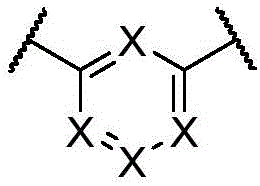

在另一方面,在式(I)中,部分In another aspect, in formula (I), moiety


在一方面,W是

在一方面,本公开文本的化合物是根据式(I’)的,其中R1、R5、X和W是如关于式(I)所定义的:In one aspect, the compounds of the present disclosure are according to formula (I'), wherein R 1 , R 5 , X and W are as defined for formula (I):
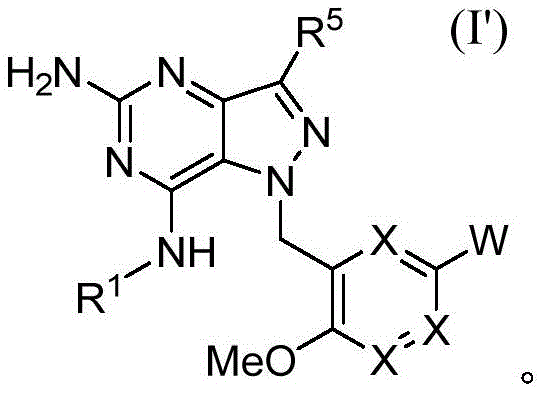
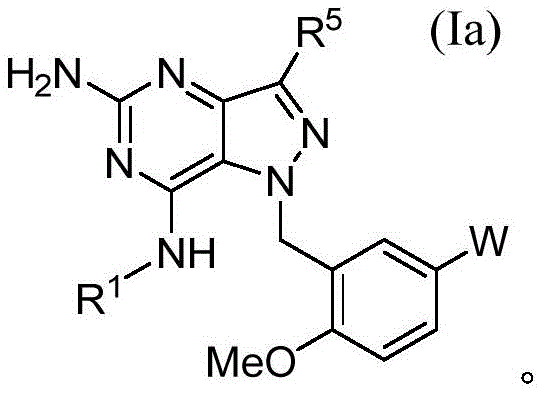
在一方面,本公开文本的化合物是根据式(Ia)的,其中R1、R5和W是如关于式(I)所定义的:In one aspect, the compounds of the present disclosure are according to formula (Ia), wherein R 1 , R 5 and W are as defined for formula (I):
在另一方面,本公开文本的化合物是根据式(Ib)的,其中R1、R5和R3是如关于式(I)所定义的:In another aspect, the compounds of the present disclosure are according to formula (Ib), wherein R 1 , R 5 and R 3 are as defined for formula (I):

R2的示例性实施方案包括H、OMe、OCHF2和OCF3,其中OMe是优选实施方案。Exemplary embodiments of R 2 include H, OMe, OCHF 2 and OCF 3 , with OMe being the preferred embodiment.
在根据式(Ib)的化合物的一个实施方案中,R3是In one embodiment of the compound according to formula (Ib) R3 is
NH(C1-C5烷基)、NH (C 1 -C 5 alkyl),
N(C1-C5烷基)2、N(C 1 -C 5 alkyl) 2 ,
NH(C1-C4烷二基)0-1(C3-C8环烷基)、NH(C 1 -C 4 alkanediyl) 0-1 (C 3 -C 8 cycloalkyl),
NH(C1-C4烷二基)0-1(C4-C10双环烷基)、NH(C 1 -C 4 alkanediyl) 0-1 (C 4 -C 10 bicycloalkyl),
NH(C1-C4烷二基)0-1(C5-C10螺烷基)、NH(C 1 -C 4 alkanediyl) 0-1 (C 5 -C 10 spiroalkyl),
N(C3-C6环烷基)2、N(C 3 -C 6 cycloalkyl) 2 ,
N[C1-C3烷基](C1-C6烷基)、N[C 1 -C 3 alkyl](C 1 -C 6 alkyl),
或or
具有以下结构的环胺部分:A cyclic amine moiety having the following structure:

在根据式(Ib)的化合物的另一个实施方案中,R3是In another embodiment of the compounds according to formula (Ib), R3 is
NH[C(=O)](C1-C5烷基)、NH[C(=O)](C 1 -C 5 alkyl),
NH[C(=O)](C1-C4烷二基)0-1(C3-C8环烷基)、NH[C(=O)](C 1 -C 4 alkanediyl) 0-1 (C 3 -C 8 cycloalkyl),
NH[C(=O)](C1-C4烷二基)0-1(C4-C10双环烷基)、NH[C(=O)](C 1 -C 4 alkanediyl) 0-1 (C 4 -C 10 bicycloalkyl),
或or
NH[C(=O)](C1-C4烷二基)0-1(C5-C10螺烷基)。NH[C(=O)](C 1 -C 4 alkanediyl) 0-1 (C 5 -C 10 spiroalkyl).
R5的示例性实施方案包括H、Me、OMe、CH2OH、环丙基、F、Cl和CF3,其中H是优选实施方案。Exemplary embodiments of R5 include H, Me, OMe, CH2OH , cyclopropyl, F, Cl , and CF3 , with H being a preferred embodiment.
在根据式(Ib)的化合物的另一个实施方案中,R3是In another embodiment of the compounds according to formula (Ib), R3 is
O(C1-C4烷二基)0-1(C3-C8环烷基)、O(C 1 -C 4 alkanediyl) 0-1 (C 3 -C 8 cycloalkyl),
O(C1-C4烷二基)0-1(C4-C8双环烷基)、O(C 1 -C 4 alkanediyl) 0-1 (C 4 -C 8 bicycloalkyl),
O(C1-C4烷二基)0-1(C5-C10螺烷基)、O(C 1 -C 4 alkanediyl) 0-1 (C 5 -C 10 spiroalkyl),
或or
O(C1-C4烷二基)0-1(C1-C6烷基)。O(C 1 -C 4 alkanediyl) 0-1 (C 1 -C 6 alkyl).
在另一方面,本公开文本的化合物是根据式(Ic)的,其中R3和R5是如关于式(I)所定义的:In another aspect, the compounds of the present disclosure are according to formula (Ic), wherein R3 and R5 are as defined for formula (I):

在另一方面,本公开文本的化合物是根据式(Id)的,其中R3和R5是如关于式(I)所定义的:In another aspect, the compounds of the present disclosure are according to formula (Id), wherein R3 and R5 are as defined for formula (I):

在另一方面,本公开文本的化合物是根据式(Ie)的,其中R1、R4和R5是如关于式(I)所定义的:In another aspect, the compounds of the present disclosure are according to formula (Ie), wherein R 1 , R 4 and R 5 are as defined for formula (I):

在另一方面,本公开文本提供了一种化合物,所述化合物具有根据式(If)的结构In another aspect, the present disclosure provides a compound having a structure according to formula (If)
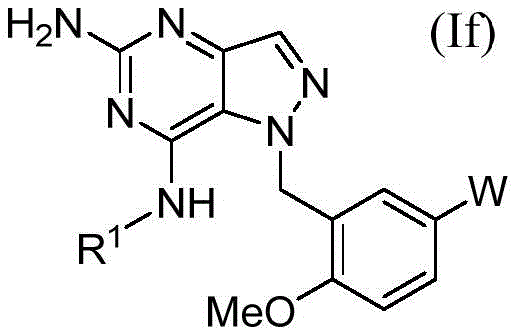
其中in
R1是 R1 is

并且and
W是W is

在另一方面,本公开文本提供了一种化合物,所述化合物具有根据式(Ig)的结构:In another aspect, the present disclosure provides a compound having a structure according to formula (Ig):

其中R1和R3是如关于式(I)所定义的。wherein R 1 and R 3 are as defined for formula (I).
在另一方面,本公开文本提供了一种化合物,所述化合物具有根据式(Ih)的结构:In another aspect, the present disclosure provides a compound having a structure according to formula (Ih):

其中一个X是N并且另两个是CH并且R1和R3是如关于式(I)所定义的。where one X is N and the other two are CH and R1 and R3 are as defined for formula (I).
基团R1的例子是An example of the group R 1 is

优选地,R1选自以下基团(“优选的R1基团”),由以下组成:Preferably, R 1 is selected from the following groups ("preferred R 1 groups"), consisting of:
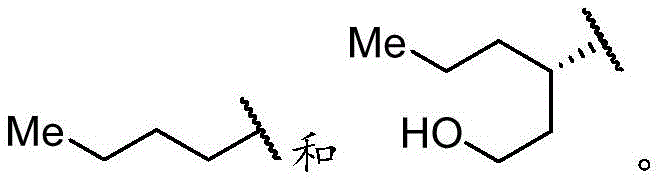
示例性基团R3包括Exemplary groups R include


在另一方面,on the other hand,
R3是H、卤基、OH、CN、R 3 is H, halo, OH, CN,
NH2、NH 2 ,
NH[C(=O)]0-1(C1-C5烷基)、NH[C(=O)] 0-1 (C 1 -C 5 alkyl),
N(C1-C5烷基)2、N(C 1 -C 5 alkyl) 2 ,
NH[C(=O)]0-1(C1-C4烷二基)0-1(C3-C8环烷基)、NH[C(=O)] 0-1 (C 1 -C 4 alkanediyl) 0-1 (C 3 -C 8 cycloalkyl),
NH[C(=O)]0-1(C1-C4烷二基)0-1(C4-C10双环烷基)、NH[C(=O)] 0-1 (C 1 -C 4 alkanediyl) 0-1 (C 4 -C 10 bicycloalkyl),
NH[C(=O)]0-1(C1-C4烷二基)0-1(C5-C10螺烷基)、NH[C(=O)] 0-1 (C 1 -C 4 alkanediyl) 0-1 (C 5 -C 10 spiroalkyl),
N(C3-C6环烷基)2、N(C 3 -C 6 cycloalkyl) 2 ,
N[C1-C3烷基]C(=O)(C1-C6烷基)、N[C 1 -C 3 alkyl]C(=O)(C 1 -C 6 alkyl),
6元芳族或杂芳族部分、6-membered aromatic or heteroaromatic moiety,
5元杂芳族部分、或5-membered heteroaromatic moiety, or
具有以下结构的部分:A section with the following structure:

优选的基团R3是Preferred groups R3 are

示例性基团R4包括:Exemplary groups R include:


优选的R4是Preferred R4 is

示例性基团R5是H、Exemplary group R 5 is H,

优选地,R5是H或Me。Preferably, R5 is H or Me.
通过举例而非限制的方式,式By way of example and not limitation, the formula

的部分包括part includes


通过举例而非限制的方式,螺烷基包括By way of example and not limitation, spiroalkyl groups include
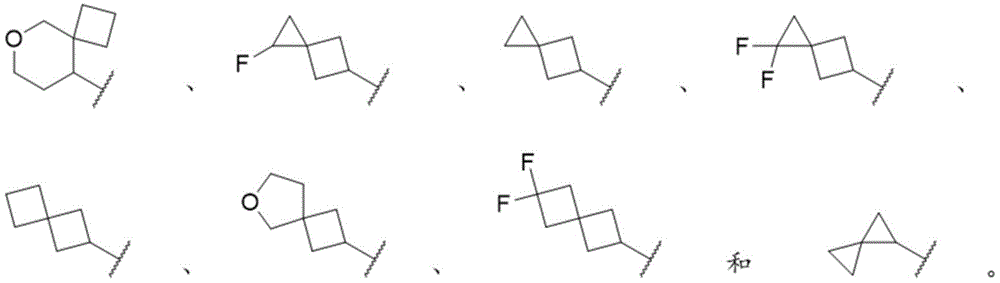
通过举例而非限制的方式,式By way of example and not limitation, the formula

的部分包括part includes


通过举例而非限制的方式,双环烷基包括By way of example and not limitation, bicycloalkyl includes

通过举例而非限制的方式,式By way of example and not limitation, the formula

的部分包括part includes

在一方面,W是,优选与式(I’)、(Ia)、(If)、或(Ig)组合,In one aspect, W is, preferably in combination with formula (I'), (Ia), (If), or (Ig),

尤其是especially

其中特定的示例性实施方案是of which specific exemplary embodiments are

在一方面,W是,优选与式(I’)、(Ia)、(If)、或(Ig)组合,In one aspect, W is, preferably in combination with formula (I'), (Ia), (If), or (Ig),

尤其是especially

其中特定的示例性实施方案是of which specific exemplary embodiments are

在一方面,W是,优选与式(I’)、(Ia)、(If)、或(Ig)组合,In one aspect, W is, preferably in combination with formula (I'), (Ia), (If), or (Ig),

其中特定的示例性实施方案是of which specific exemplary embodiments are
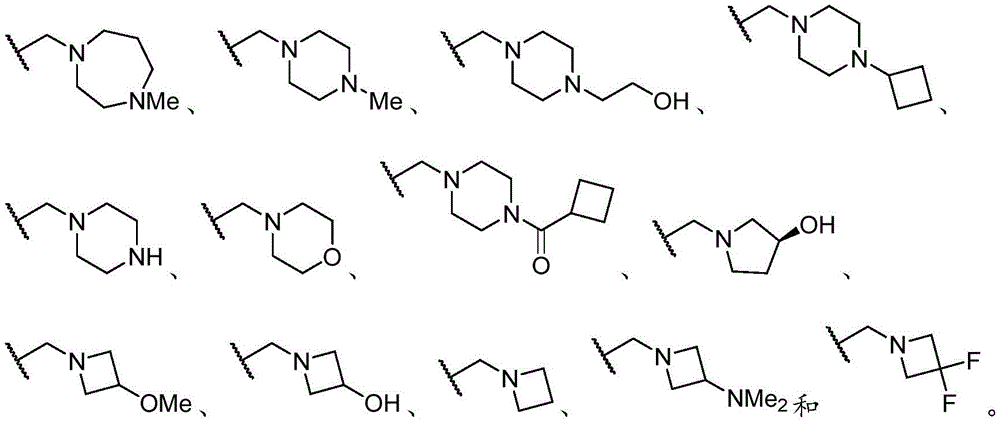
在一方面,W是,优选与式(I’)、(Ia)、(If)、或(Ig)组合,In one aspect, W is, preferably in combination with formula (I'), (Ia), (If), or (Ig),

其中特定的示例性实施方案是of which specific exemplary embodiments are


在一方面,W是,优选与式(I’)、(Ia)、(If)、或(Ig)组合,In one aspect, W is, preferably in combination with formula (I'), (Ia), (If), or (Ig),

尤其是especially

其中特定的示例性实施方案是of which specific exemplary embodiments are

在一方面,W是,优选与式(I’)、(Ia)、(If)、或(Ig)组合,In one aspect, W is, preferably in combination with formula (I'), (Ia), (If), or (Ig),

其中特定的示例性实施方案是of which specific exemplary embodiments are

在一方面,W是,优选与式(I’)、(Ia)、(If)、或(Ig)组合,In one aspect, W is, preferably in combination with formula (I'), (Ia), (If), or (Ig),

其中特定的示例性实施方案是of which specific exemplary embodiments are

在一方面,W是,优选与式(I’)、(Ia)、(If)、或(Ig)组合,In one aspect, W is, preferably in combination with formula (I'), (Ia), (If), or (Ig),

其中特定的示例性实施方案是of which specific exemplary embodiments are

在一方面,W是,优选与式(I’)、(Ia)、(If)、或(Ig)组合,In one aspect, W is, preferably in combination with formula (I'), (Ia), (If), or (Ig),

尤其是especially

其中特定的示例性实施方案是of which specific exemplary embodiments are

在一方面,W是,优选与式(I’)、(Ia)、(If)、或(Ig)组合,In one aspect, W is, preferably in combination with formula (I'), (Ia), (If), or (Ig),

尤其是especially

其中特定的示例性实施方案是of which specific exemplary embodiments are
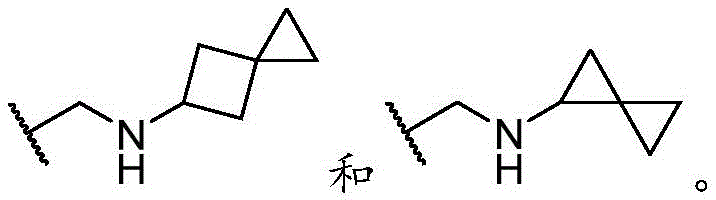
在一方面,W是,优选与式(I’)、(Ia)、(If)、或(Ig)组合,In one aspect, W is, preferably in combination with formula (I'), (Ia), (If), or (Ig),

尤其是especially

其中特定的示例性实施方案是of which specific exemplary embodiments are

在一方面,W是,优选与式(I’)、(Ia)、(If)、或(Ig)组合,In one aspect, W is, preferably in combination with formula (I'), (Ia), (If), or (Ig),

其中特定的示例性实施方案是of which specific exemplary embodiments are

在一方面,本公开文本的化合物是根据式(If)的In one aspect, the compounds of the present disclosure are according to formula (If)

其中in
R1是 R1 is

并且and
W是W is

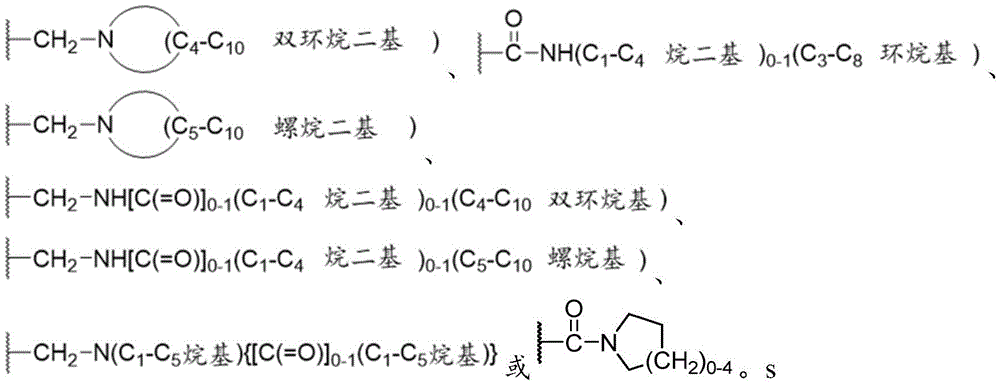
一些上述示例性烷基、环烷基、螺烷基、双环烷基等,式Some of the above exemplary alkyl, cycloalkyl, spiroalkyl, bicycloalkyl, etc., formulae

的基团和部分携带任选的取代基和/或任选地具有一个或多个由O、SO2等替代的CH2基团,如上文发明内容中所述。 The groups and moieties carry optional substituents and/or optionally have one or more CH2 groups replaced by O, SO2, etc., as described above in the Summary of the Invention.
本文公开的根据式(Ia)的化合物的特定例子示出于下表A1中。所述表还提供了按下文提供的程序确定的关于以下生物学活性的数据:人全血中的人TLR7激动作用报告物测定和/或CD69基因的诱导。最右边的列含有分析数据(质谱,LC/MS保留时间和NMR)。在一个实施方案中,本公开文本的化合物具有(a)小于1,000nM的人TLR7(hTLR7)报告物测定EC50值和(b)小于1,000nM的人全血(hWB)CD69诱导EC50值。(在多次进行测定的情况下,报告值为平均值。)Specific examples of compounds according to formula (Ia) disclosed herein are shown in Table A1 below. The table also provides data regarding the following biological activities as determined by the procedures provided below: human TLR7 agonism reporter assay and/or induction of the CD69 gene in human whole blood. The rightmost column contains analytical data (mass spectrometry, LC/MS retention time and NMR). In one embodiment, compounds of the present disclosure have (a) a human TLR7 (hTLR7) reporter assay EC50 value of less than 1,000 nM and (b) a human whole blood (hWB) CD69-induced EC50 value of less than 1,000 nM. (In the case of multiple measurements, the reported value is the average value.)


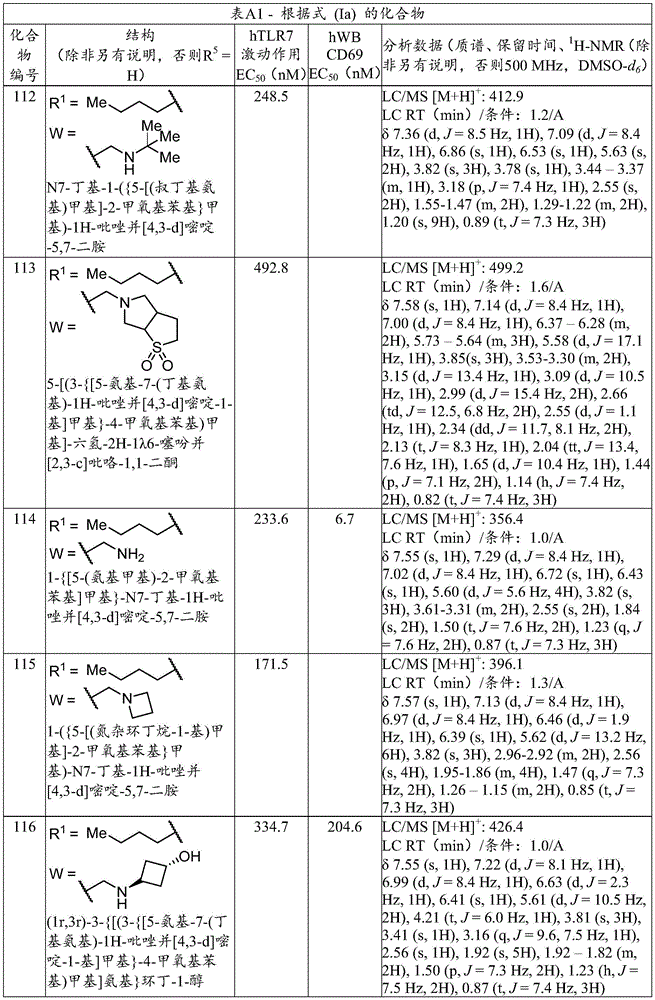


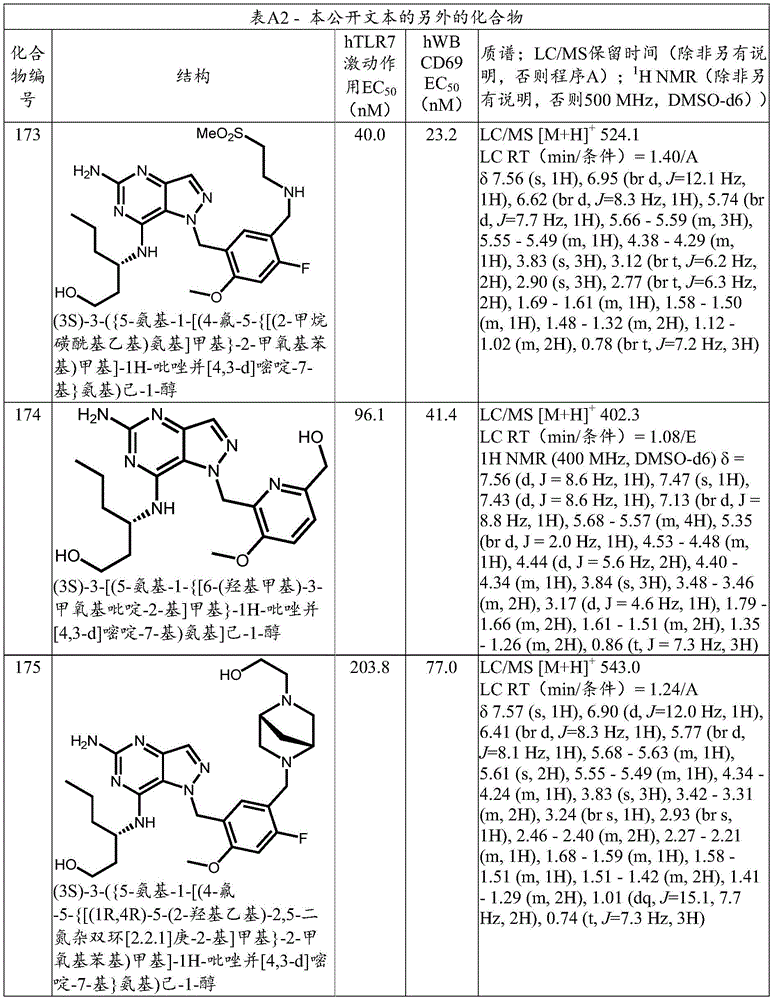
本公开文本的另外的化合物示于表A2中,连同其生物学特性和分析数据。Additional compounds of the present disclosure are shown in Table A2, along with their biological properties and analytical data.



药物组合物和施用Pharmaceutical composition and administration
在另一方面,提供了一种药物组合物,所述药物组合物包含与药学上可接受的载体或赋形剂一起配制的如本文公开的化合物或其缀合物。它可以任选地含有一种或多种另外的药物活性成分,诸如生物制剂或小分子药物。所述药物组合物可以在组合疗法中与另一种治疗剂(尤其是抗癌剂)一起施用。In another aspect, there is provided a pharmaceutical composition comprising a compound as disclosed herein, or a conjugate thereof, formulated together with a pharmaceutically acceptable carrier or excipient. It may optionally contain one or more additional pharmaceutically active ingredients, such as biologics or small molecule drugs. The pharmaceutical composition can be administered in combination therapy with another therapeutic agent, especially an anticancer agent.
所述药物组合物可以包含一种或多种赋形剂。可以使用的赋形剂包括载体、表面活性剂、增稠剂或乳化剂、固体粘合剂、分散或悬浮助剂、增溶剂、着色剂、调味剂、包衣、崩解剂、润滑剂、甜味剂、防腐剂、等渗剂、及其组合。Gennaro,编辑,Remington:The Scienceand Practice of Pharmacy,第20版(Lippincott Williams&Wilkins 2003)中教导了合适的赋形剂的选择和使用。The pharmaceutical composition may contain one or more excipients. Excipients that can be used include carriers, surfactants, thickening or emulsifying agents, solid binders, dispersing or suspending aids, solubilizers, coloring agents, flavoring agents, coatings, disintegrating agents, lubricants, Sweeteners, preservatives, isotonic agents, and combinations thereof. The selection and use of suitable excipients is taught in Gennaro, editor, Remington: The Science and Practice of Pharmacy, 20th Edition (Lippincott Williams & Wilkins 2003).
优选地,药物组合物适用于静脉内、肌内、皮下、肠胃外、脊髓或表皮施用(例如,通过注射或输注)。根据施用途径,可以将活性化合物包被在材料中以保护所述化合物免受可能使其失活的酸和其他天然条件的作用。短语“肠胃外施用”意指除了肠施用和外用施用之外的施用方式,通常通过注射进行,并且包括而不限于静脉内、肌内、动脉内、鞘内、囊内、眼眶内、心脏内、皮内、腹膜内、经气管、皮下、表皮下、关节内、囊下、蛛网膜下、脊柱内、硬膜外以及胸骨内注射和输注。可替代地,所述药物组合物可以经由非肠胃外途径施用,所述非肠胃外途径诸如外用、表皮或粘膜施用途径,例如鼻内、口服、阴道、直肠、舌下或外用。Preferably, the pharmaceutical composition is suitable for intravenous, intramuscular, subcutaneous, parenteral, spinal or epidermal administration (eg, by injection or infusion). Depending on the route of administration, the active compound can be encapsulated in materials to protect the compound from the action of acids and other natural conditions that may inactivate it. The phrase "parenteral administration" means modes of administration other than enteral and topical administration, usually by injection, and includes, without limitation, intravenous, intramuscular, intraarterial, intrathecal, intracapsular, intraorbital, intracardiac , intradermal, intraperitoneal, transtracheal, subcutaneous, subepidermal, intraarticular, subcapsular, subarachnoid, intraspinal, epidural, and intrasternal injection and infusion. Alternatively, the pharmaceutical composition may be administered via a non-parenteral route, such as a topical, epidermal or mucosal route of administration, eg, intranasal, oral, vaginal, rectal, sublingual or topical.
药物组合物可以呈无菌水性溶液或分散体的形式。它们也可以配制成微乳液、脂质体、或适合于实现高药物浓度的其他有序结构。所述组合物也可以以冻干物(用于在施用前在水中重构)的形式提供。Pharmaceutical compositions can be in the form of sterile aqueous solutions or dispersions. They can also be formulated as microemulsions, liposomes, or other ordered structures suitable for achieving high drug concentrations. The composition may also be provided as a lyophilisate for reconstitution in water prior to administration.
可以与载体材料组合以产生单一剂型的活性成分的量将根据正在被治疗的受试者和特定的施用方式而变化并且将总体上是产生治疗效果的组合物量。通常,按100%计,该量范围将为约0.01%至约99%的活性成分,优选约0.1%至约70%、最优选约1%至约30%的活性成分,所述活性成分与药学上可接受的载体相组合。The amount of active ingredient that can be combined with a carrier material to produce a single dosage form will vary depending on the subject being treated and the particular mode of administration and will generally be that amount of the composition that produces a therapeutic effect. Typically, on a 100% basis, this amount will range from about 0.01% to about 99% of the active ingredient, preferably from about 0.1% to about 70%, most preferably from about 1% to about 30% of the active ingredient combined with A pharmaceutically acceptable carrier is combined.
调整剂量方案以提供治疗反应。例如,可以施用单次推注,可以随时间施用几个分开的剂量,或者可以如根据情况的紧急程度所指示,按比例减少或增加剂量。以剂量单位形式配制肠胃外组合物是尤其有利的,以便于施用和剂量的均匀。“剂量单位形式”是指适合作为单位剂量用于待治疗的受试者的物理上离散的单位;每个单位含有与所需的药物载体联合的经计算产生所希望的治疗反应的预定量的活性化合物。Dosage regimens are adjusted to provide therapeutic response. For example, a single bolus may be administered, several divided doses may be administered over time, or the dose may be proportionally reduced or increased as indicated by the exigencies of the situation. It is especially advantageous to formulate parenteral compositions in dosage unit form for ease of administration and uniformity of dosage. "Dosage unit form" refers to physically discrete units suitable as unitary dosages for the subjects to be treated; each unit containing a predetermined quantity calculated to produce the desired therapeutic response in association with the required pharmaceutical carrier active compound.
剂量在从约0.0001至100mg/kg宿主体重并且更通常0.01至5mg/kg宿主体重的范围内。例如,剂量可以是0.3mg/kg体重、1mg/kg体重、3mg/kg体重、5mg/kg体重或10mg/kg体重或者在1-10mg/kg或可替代地0.1至5mg/kg的范围内。示例性的治疗方案是每周一次、每两周一次、每三周一次、每四周一次、每月一次、每3个月一次、或每3至6个月一次的施用。优选的剂量方案包括使用以下给药时间表中的一种经由静脉内施用1mg/kg体重或3mg/kg体重:(i)每四周,持续六个剂量,然后每三个月;(ii)每三周;(iii)一次3mg/kg体重,然后是每三周1mg/kg体重。在一些方法中,调整剂量以达到约1-1000μg/mL的血浆抗体浓度,并且在一些方法中达到约25-300μg/mL。Dosages range from about 0.0001 to 100 mg/kg host body weight and more typically 0.01 to 5 mg/kg host body weight. For example, the dose may be 0.3 mg/kg body weight, 1 mg/kg body weight, 3 mg/kg body weight, 5 mg/kg body weight or 10 mg/kg body weight or in the range of 1-10 mg/kg or alternatively 0.1 to 5 mg/kg. Exemplary treatment regimens are administrations once a week, once every two weeks, once every three weeks, once every four weeks, once a month, once every 3 months, or once every 3 to 6 months. Preferred dosage regimens include intravenous administration of 1 mg/kg body weight or 3 mg/kg body weight using one of the following dosing schedules: (i) every four weeks for six doses, then every three months; (ii) every Three weeks; (iii) 3 mg/kg body weight once, then 1 mg/kg body weight every three weeks. In some methods, the dose is adjusted to achieve a plasma antibody concentration of about 1-1000 μg/mL, and in some methods about 25-300 μg/mL.
本发明化合物的“治疗有效量”优选地导致疾病症状的严重程度的降低、无疾病症状时期的频率和持续时间的增加、或对由于疾病困扰而引起的损伤或残疾的预防。例如,对于荷瘤受试者的治疗,相对于未治疗的受试者,“治疗有效量”优选地抑制肿瘤生长至少约20%、更优选至少约40%、甚至更优选至少约60%、以及还更优选至少约80%。治疗有效量的治疗化合物可以减小肿瘤大小、或在其他方面改善受试者的症状,所述受试者典型地是人,但是可以是另一种哺乳动物。在组合治疗中施用两种或更多种治疗剂的情况下,“治疗有效量”是指组合作为整体的功效,而不是单独地每种药剂的功效。A "therapeutically effective amount" of a compound of the invention preferably results in a reduction in the severity of disease symptoms, an increase in the frequency and duration of disease symptom free periods, or prevention of impairment or disability due to disease distress. For example, for the treatment of tumor-bearing subjects, a "therapeutically effective amount" preferably inhibits tumor growth by at least about 20%, more preferably at least about 40%, even more preferably at least about 60%, relative to untreated subjects, And still more preferably at least about 80%. A therapeutically effective amount of a therapeutic compound can reduce tumor size, or otherwise ameliorate symptoms in a subject, which is typically a human, but can be another mammal. Where two or more therapeutic agents are administered in combination therapy, a "therapeutically effective amount" refers to the efficacy of the combination as a whole, rather than the efficacy of each agent individually.
药物组合物可以是控释或缓释配制品,包括植入物、透皮贴剂和微囊化递送系统。可以使用可生物降解的可生物相容的聚合物,诸如乙烯乙酸乙烯酯、聚酸酐、聚乙醇酸、胶原、聚原酸酯和聚乳酸。参见例如,Sustained and Controlled Release Drug DeliverySystems,J.R.Robinson,编辑,Marcel Dekker,Inc.,纽约,1978。Pharmaceutical compositions can be controlled or sustained release formulations, including implants, transdermal patches, and microencapsulated delivery systems. Biodegradable, biocompatible polymers can be used, such as ethylene vinyl acetate, polyanhydrides, polyglycolic acid, collagen, polyorthoesters, and polylactic acid. See, eg, Sustained and Controlled Release Drug Delivery Systems, J.R. Robinson, ed., Marcel Dekker, Inc., New York, 1978.
可以经由诸如(1)无针皮下注射装置;(2)微量输注泵;(3)透皮装置;(4)输注装置;和(5)渗透装置的医疗装置施用治疗组合物。The therapeutic compositions can be administered via medical devices such as (1) needleless hypodermic devices; (2) microinfusion pumps; (3) transdermal devices; (4) infusion devices; and (5) osmotic devices.
在某些实施方案中,可以配制所述药物组合物以确保在体内的适当分布。例如,为了确保本发明的治疗化合物穿过血脑屏障,可以将它们配制在脂质体中,所述脂质体可以另外地包含靶向部分以增强向特定细胞或器官的选择性转运。In certain embodiments, the pharmaceutical composition can be formulated to ensure proper distribution in the body. For example, to ensure that the therapeutic compounds of the invention cross the blood-brain barrier, they can be formulated in liposomes, which can additionally contain targeting moieties to enhance selective transport to specific cells or organs.
工业实用性和用途Industrial Applicability and Use
本文公开的TLR7激动剂化合物可以用于治疗可通过激活TLR7而改善的疾病或病症。The TLR7 agonist compounds disclosed herein can be used to treat diseases or conditions that can be ameliorated by activation of TLR7.
在一个实施方案中,将TLR7激动剂与抗癌免疫治疗剂-也称为免疫肿瘤学药剂-组合使用。抗癌免疫治疗剂通过刺激身体的免疫系统以攻击和破坏癌细胞,尤其是通过激活T细胞来工作。免疫系统具有许多检查点(调节)分子,以帮助维持其攻击正当的靶细胞与防止其攻击健康的正常细胞之间的平衡。一些分子是刺激剂(上调剂),这意味着它们的参与会促进T细胞激活并且增强免疫应答。其他分子是抑制剂(下调剂或制止剂),这意味着它们的参与会抑制T细胞激活并且减轻免疫应答。激动性免疫治疗剂与刺激性检查点分子的结合可以导致后者的激活和针对癌细胞的免疫应答增强。相反,拮抗性免疫治疗剂与抑制性检查点分子的结合可以防止免疫系统被后者下调并且帮助维持针对癌细胞的强烈应答。刺激性检查点分子的例子是B7-1、B7-2、CD28、4-1BB(CD137)、4-1BBL、ICOS、CD40、ICOS-L、OX40、OX40L、GITR、GITRL、CD70、CD27、CD40、DR3和CD28H。抑制性检查点分子的例子是CTLA-4、PD-1、PD-L1、PD-L2、LAG-3、TIM-3、半乳糖凝集素9、CEACAM-1、BTLA、CD69、半乳糖凝集素-1、CD113、GPR56、VISTA、2B4、CD48、GARP、PD1H、LAIR1、TIM-1、CD96和TIM-4。In one embodiment, a TLR7 agonist is used in combination with an anticancer immunotherapeutic agent, also known as an immuno-oncology agent. Anticancer immunotherapeutics work by stimulating the body's immune system to attack and destroy cancer cells, especially by activating T cells. The immune system has many checkpoint (regulatory) molecules to help maintain the balance between it attacks legitimate target cells and prevents it from attacking healthy normal cells. Some molecules are stimulators (up-regulators), meaning that their involvement promotes T cell activation and enhances the immune response. Other molecules are inhibitors (down-regulators or suppressors), which means that their participation suppresses T-cell activation and reduces the immune response. Binding of agonistic immunotherapeutics to stimulatory checkpoint molecules can lead to activation of the latter and enhanced immune responses against cancer cells. Conversely, the binding of antagonistic immunotherapeutics to inhibitory checkpoint molecules can prevent the immune system from being downregulated by the latter and help maintain a robust response against cancer cells. Examples of stimulatory checkpoint molecules are B7-1, B7-2, CD28, 4-1BB (CD137), 4-1BBL, ICOS, CD40, ICOS-L, OX40, OX40L, GITR, GITRL, CD70, CD27, CD40 , DR3 and CD28H. Examples of inhibitory checkpoint molecules are CTLA-4, PD-1, PD-L1, PD-L2, LAG-3, TIM-3, Galectin 9, CEACAM-1, BTLA, CD69, Galectin -1, CD113, GPR56, VISTA, 2B4, CD48, GARP, PD1H, LAIR1, TIM-1, CD96 and TIM-4.
无论抗癌免疫治疗剂的作用方式是哪种,均可以通过总体上调免疫系统(诸如通过激活TLR7)来提高其有效性。因此,在一个实施方案中,本说明书提供了一种治疗癌症的方法,所述方法包括向患有此类癌症的患者施用抗癌免疫治疗剂和如本文公开的TLR7激动剂的治疗有效组合。施用时间可以是同时、顺序或交替的。施用方式可以是全身的或局部的。所述TLR7激动剂可以经由缀合物以靶向的方式递送。Regardless of the mode of action of anticancer immunotherapeutics, their effectiveness can be enhanced by upregulating the immune system in general, such as by activating TLR7. Accordingly, in one embodiment, the present specification provides a method of treating cancer comprising administering to a patient suffering from such cancer a therapeutically effective combination of an anti-cancer immunotherapeutic agent and a TLR7 agonist as disclosed herein. Administration times can be simultaneous, sequential or alternating. The mode of administration can be systemic or local. The TLR7 agonist can be delivered in a targeted manner via the conjugate.
可以通过如上所述的组合治疗进行治疗的癌症包括急性髓性白血病、肾上腺皮质癌、卡波西肉瘤、淋巴瘤、肛门癌、阑尾癌、畸胎样/横纹肌样瘤、基底细胞癌、胆管癌、膀胱癌、骨癌、脑癌、乳腺癌、支气管肿瘤、类癌瘤、心脏肿瘤、子宫颈癌、脊索瘤、慢性淋巴细胞白血病、慢性骨髓增生性肿瘤、结肠癌、结直肠癌、颅咽管瘤、胆管癌、子宫内膜癌、室管膜瘤、食管癌、鼻腔神经胶质瘤、尤因肉瘤、眼癌、输卵管癌、胆囊癌、胃肠道类癌瘤、胃肠道间质瘤、生殖细胞瘤、毛细胞白血病、头颈癌、心脏癌、肝癌、下咽癌、胰腺癌、肾癌、喉癌、慢性髓性白血病、唇和口腔癌、肺癌、黑素瘤、默克尔细胞癌、间皮瘤、口癌、口腔癌、骨肉瘤、卵巢癌、阴茎癌、鼻咽癌、前列腺癌、直肠癌、唾液腺癌、皮肤癌、小肠癌、软组织肉瘤、睾丸癌、喉癌、甲状腺癌、尿道癌、子宫癌、阴道癌和外阴癌。Cancers that can be treated by combination therapy as described above include acute myeloid leukemia, adrenocortical carcinoma, Kaposi's sarcoma, lymphoma, anal cancer, appendix cancer, teratoid/rhabdoid tumor, basal cell carcinoma, cholangiocarcinoma , bladder cancer, bone cancer, brain cancer, breast cancer, bronchial tumors, carcinoid tumors, cardiac tumors, cervical cancer, chordoma, chronic lymphocytic leukemia, chronic myeloproliferative neoplasms, colon cancer, colorectal cancer, craniopharynx Angiomas, cholangiocarcinoma, endometrial cancer, ependymoma, esophageal cancer, nasal glioma, Ewing's sarcoma, eye cancer, fallopian tube cancer, gallbladder cancer, gastrointestinal carcinoid tumor, gastrointestinal stromal tumor, germ cell tumor, hairy cell leukemia, head and neck cancer, heart cancer, liver cancer, hypopharyngeal cancer, pancreatic cancer, kidney cancer, laryngeal cancer, chronic myeloid leukemia, lip and mouth cancer, lung cancer, melanoma, Merkel Cell cancer, mesothelioma, oral cancer, oral cancer, osteosarcoma, ovarian cancer, penile cancer, nasopharyngeal cancer, prostate cancer, rectal cancer, salivary gland cancer, skin cancer, small bowel cancer, soft tissue sarcoma, testicular cancer, throat cancer, Thyroid, urinary tract, uterine, vaginal and vulvar cancers.
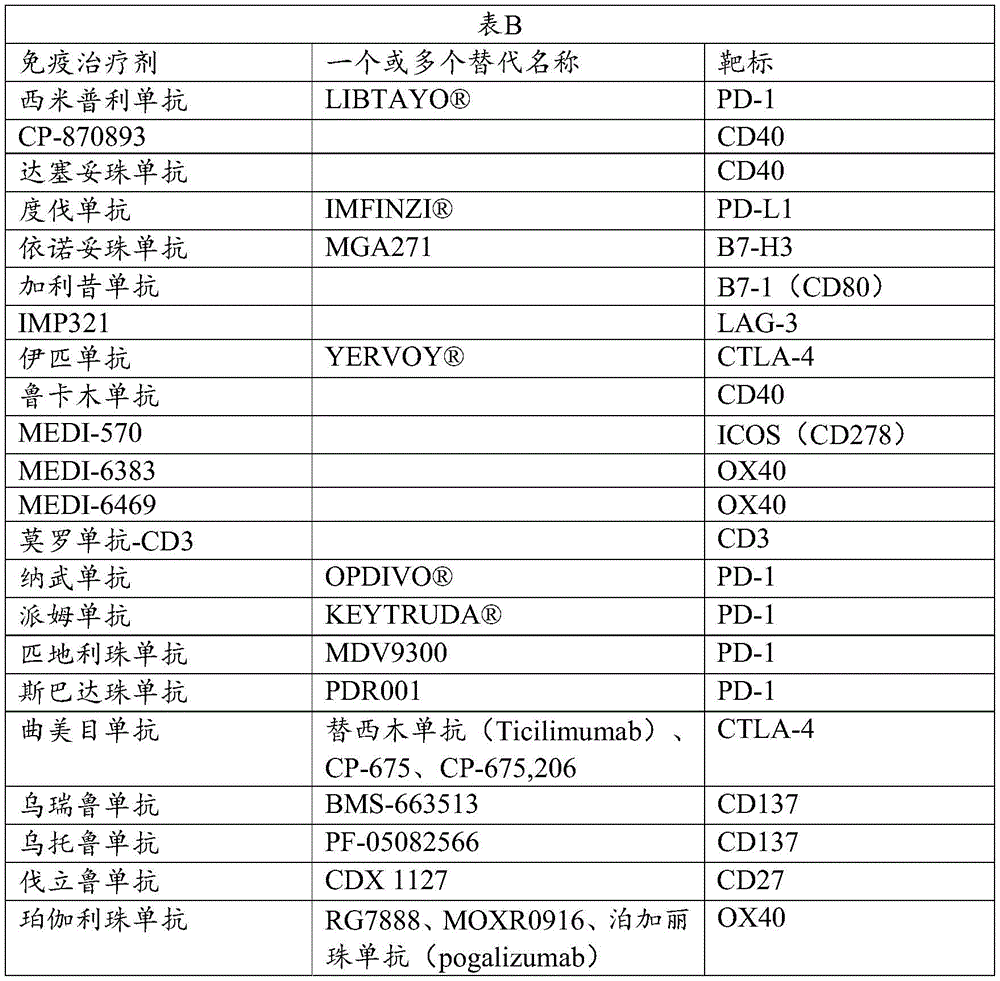
可以用于如本文公开的组合疗法的抗癌免疫治疗剂包括:AMG 557、AMP-224、阿替利珠单抗(atezolizumab)、阿维鲁单抗(avelumab)、BMS 936559、西米普利单抗(cemiplimab)、CP-870893、达西珠单抗(dacetuzumab)、度伐鲁单抗(durvalumab)、依诺妥珠单抗(enoblituzumab)、加利昔单抗(galiximab)、IMP321、伊匹单抗、鲁卡木单抗(lucatumumab)、MEDI-570、MEDI-6383、MEDI-6469、莫罗单抗(muromonab)-CD3、纳武单抗、派姆单抗、匹地利珠单抗(pidilizumab)、斯巴达珠单抗(spartalizumab)、曲美目单抗(tremelimumab)、乌瑞鲁单抗(urelumab)、乌托鲁单抗(utomilumab)、瓦立鲁单抗(varlilumab)、珀伽利珠单抗(vonlerolizumab)。下表B列出了它们的一个或多个替代名称(商标名称、曾用名、研究代码或同义词)和各自的靶检查点分子。Anti-cancer immunotherapeutics that can be used in combination therapy as disclosed herein include: AMG 557, AMP-224, atezolizumab, avelumab, BMS 936559, similapril cemiplimab, CP-870893, dacetuzumab, durvalumab, enoblituzumab, galiximab, IMP321, Pimumab, lucatumumab, MEDI-570, MEDI-6383, MEDI-6469, muromonab-CD3, nivolumab, pembrolizumab, pidilizumab (pidilizumab), spartalizumab, tremelimumab, urelumab, utomilumab, varlilumab, Pegallizumab (vonlerolizumab). Table B below lists one or more of their alternate names (trade name, former name, study code or synonym) and their respective target checkpoint molecules.

在用TLR7激动剂的组合治疗的一个实施方案中,所述抗癌免疫治疗剂是拮抗性抗CTLA-4、抗PD-1或抗PD-L1抗体。所述癌症可以是肺癌(包括非小细胞肺癌)、胰腺癌、肾癌、头颈癌、淋巴瘤(包括霍奇金淋巴瘤)、皮肤癌(包括黑素瘤和默克尔皮肤癌)、尿路上皮癌(包括膀胱癌)、胃癌、肝细胞癌、或结直肠癌。In one embodiment of combination therapy with a TLR7 agonist, the anti-cancer immunotherapeutic agent is an antagonistic anti-CTLA-4, anti-PD-1 or anti-PD-L1 antibody. The cancer may be lung cancer (including non-small cell lung cancer), pancreatic cancer, kidney cancer, head and neck cancer, lymphoma (including Hodgkin lymphoma), skin cancer (including melanoma and Merkel skin cancer), urinary Epithelial cancer (including bladder cancer), stomach cancer, hepatocellular carcinoma, or colorectal cancer.
在用TLR7激动剂的组合治疗的另一个实施方案中,所述抗癌免疫治疗剂是拮抗性抗CTLA-4抗体,优选伊匹单抗。In another embodiment of combination therapy with a TLR7 agonist, the anti-cancer immunotherapeutic agent is an antagonist anti-CTLA-4 antibody, preferably ipilimumab.
在用TLR7激动剂的组合治疗的另一个实施方案中,所述抗癌免疫治疗剂是拮抗性抗PD-1抗体,优选纳武单抗或派姆单抗。In another embodiment of combination therapy with a TLR7 agonist, the anticancer immunotherapeutic agent is an antagonist anti-PD-1 antibody, preferably nivolumab or pembrolizumab.
本文公开的TLR7激动剂还可用作疫苗佐剂。The TLR7 agonists disclosed herein can also be used as vaccine adjuvants.
通过参考以下实施例可以进一步理解本发明的实践,所述实施例是作为说明而非限制来提供的。A further understanding of the practice of the present invention may be obtained by reference to the following examples, which are provided by way of illustration and not limitation.
分析程序Analysis program
NMRNMR
使用以下条件获得质子核磁共振(NMR)波谱:在400Mz或500MHz Bruker仪器中使用DMSO-d6或CDCl3作为溶剂和内标得到NMR波谱。通过使用ADC Labs的ACD Spectrus2015-01版或MestReNova软件分析原始NMR数据。Proton nuclear magnetic resonance (NMR) spectra were obtained using the following conditions: NMR spectra were obtained in a 400 Mz or 500 MHz Bruker instrument using DMSO-d6 or CDCl 3 as solvent and internal standard. Raw NMR data were analyzed by using ADC Labs' ACD Spectrus version 2015-01 or MestReNova software.
从内部四甲基硅烷(TMS)或从通过氘代NMR溶剂的低场以百万分率(ppm)报告化学位移。明显的多重性报告为:单重态-s,双重态-d,三重态-t,四重态-q或多重态-m。展现出变宽的峰进一步表示为br。积分是近似的。应当注意,积分强度、峰形状、化学位移和耦合常数可以取决于溶剂、浓度、温度、pH和其他因素。此外,与NMR波谱中的水峰或溶剂峰重叠或交换的峰可能无法提供可靠的积分强度。在一些情况下,可以使用水峰抑制获得NMR波谱,这可能导致重叠的峰不可见或形状改变和/或整合。Chemical shifts are reported in parts per million (ppm) from internal tetramethylsilane (TMS) or from the downfield by deuterated NMR solvent. Apparent multiplicities are reported as: singlet-s, doublet-d, triplet-t, quadruplet-q or multiplet-m. Peaks exhibiting broadening are further denoted as br. Integrals are approximate. It should be noted that integrated intensities, peak shapes, chemical shifts and coupling constants may depend on solvent, concentration, temperature, pH and other factors. Additionally, peaks that overlap or exchange with water or solvent peaks in the NMR spectrum may not provide reliable integrated intensities. In some cases, NMR spectra can be obtained using water peak suppression, which may result in overlapping peaks being invisible or changing shape and/or integrating.
液相色谱法liquid chromatography
使用以下制备型和/或分析型(LC/MS)液相色谱法。The following preparative and/or analytical (LC/MS) liquid chromatography methods were used.
LC/MS条件A:柱:Waters XBridge C18,2.1mm x 50mm,1.7μm颗粒;流动相A:5:95乙腈:水(含10mM NH4OAc);流动相B:95:5乙腈:水(含10mM NH4OAc);温度:50℃;梯度:经3min 0%B至100%B,然后在100%B下保持0.50min;流速:1mL/min;检测:MS和UV(220nm)。LC/MS conditions A: Column: Waters XBridge C18, 2.1 mm x 50 mm, 1.7 μm particles; mobile phase A: 5:95 acetonitrile:water (with 10 mM NH4OAc ); mobile phase B: 95:5 acetonitrile:water ( with 10 mM NH4OAc ); temperature: 50°C; gradient: 0%B to 100%B over 3 min, then 100%B for 0.50 min; flow rate: 1 mL/min; detection: MS and UV (220 nm).
LC/MS条件B:柱:Waters XBridge C18,2.1mm x 50mm,1.7μm颗粒;流动相A:5:95乙腈:水(含0.1%TFA);流动相B:95:5乙腈:水(含0.1%TFA);温度:50℃;梯度:经3min 0%B至100%B,然后在100%B下保持0.50min;流速:1mL/min;检测:MS和UV(220nm)。LC/MS conditions B: Column: Waters XBridge C18, 2.1 mm x 50 mm, 1.7 μm particles; mobile phase A: 5:95 acetonitrile:water (with 0.1% TFA); mobile phase B: 95:5 acetonitrile:water (with 0.1% TFA); temperature: 50°C; gradient: 0% B to 100% B over 3 min, then 0.50 min at 100% B; flow rate: 1 mL/min; detection: MS and UV (220 nm).
LC/MS条件C:柱:Waters XBridge C18,2.1mm x 50mm,1.7μm颗粒;流动相A:含0.1%TFA的乙腈;流动相B:含0.1%TFA的水;温度:37℃;梯度:经3min 0%B至100%B,然后在100%B下保持0.50min;流速:1mL/min;检测:MS和UV(240nm)。LC/MS Conditions C: Column: Waters XBridge C18, 2.1 mm x 50 mm, 1.7 μm particles; Mobile Phase A: Acetonitrile with 0.1% TFA; Mobile Phase B: Water with 0.1% TFA; Temperature: 37°C; Gradient: 0% B to 100% B over 3 min, then hold at 100% B for 0.50 min; flow rate: 1 mL/min; detection: MS and UV (240 nm).
LC/MS条件D:柱:Waters XBridge C18,2.1mm x 50mm,1.7μm颗粒;流动相A:含0.1%甲酸的乙腈;流动相B:含0.1%甲酸的水;温度:37℃;梯度:经2.5min 0%B至100%B,然后在100%B下保持0.50min;流速:1mL/min;检测:MS和UV(240nm)。LC/MS conditions D: Column: Waters XBridge C18, 2.1 mm x 50 mm, 1.7 μm particles; mobile phase A: 0.1% formic acid in acetonitrile; mobile phase B: 0.1% formic acid in water; temperature: 37°C; gradient: 0%B to 100%B over 2.5min, then hold at 100%B for 0.50min; flow rate: 1 mL/min; detection: MS and UV (240nm).
LC/MS条件E:柱:Waters X-Bridge BEH C18 XP(50x2.1mm)2.5μm;流动相A:5:95乙腈:水(含10mM NH4OAc);流动相B:95:5乙腈:水(含10mM NH4OAc);温度:50℃;梯度:经3分钟0-100%B;流速:1.1ml/min)。LC/MS conditions E: Column: Waters X-Bridge BEH C18 XP (50x2.1 mm) 2.5 μm; mobile phase A: 5:95 acetonitrile:water (with 10 mM NH4OAc ); mobile phase B: 95:5 acetonitrile: Water (with 10 mM NH4OAc ); temperature: 50°C; gradient: 0-100% B over 3 minutes; flow rate: 1.1 ml/min).
合成-通用程序Synthesis - General Procedure
通常,本文所公开的程序产生了在吡唑并嘧啶环系统的1H或2H位置处烷基化的区域异构体(分别也称为N1和N2(暗示了烷基化的氮)区域异构体)的混合物。为简洁起见,出于便利没有显示N2区域异构体,但是应当理解,它们存在于最初的产物混合物中并且例如通过制备型HPLC在稍后的时间分离。In general, the procedures disclosed herein yield regioisomers alkylated at the 1H or 2H position of the pyrazolopyrimidine ring system (also referred to as N1 and N2, respectively, suggesting an alkylated nitrogen) regioisomers body) mixture. For brevity, the N2 regioisomers are not shown for convenience, but it is understood that they are present in the initial product mixture and separated at a later time, eg by preparative HPLC.

可以在合成的早期阶段分离区域异构体的混合物,并且与1H区域异构体一起进行剩余的合成步骤,或者可替代地,可以带着区域异构体的混合物进行合成并且根据需要在稍后的阶段进行分离。The mixture of regioisomers can be isolated at an early stage of the synthesis and the remaining synthetic steps carried out with the 1H regioisomer, or alternatively, the synthesis can be carried out with the mixture of regioisomers and carried out later if desired stage of separation.
本公开文本的化合物可以通过合成有机化学领域的技术人员熟知的多种方法来制备。这些方法包括以下所述的方法或其变体。优选的方法包括但不限于以下方案中下文所描述的那些。所述方案旨在是通用的,但是在一些情况下,出于便利描绘了特定基团(例如甲酯或甲氧基)。The compounds of the present disclosure can be prepared by a variety of methods well known to those skilled in the art of synthetic organic chemistry. These methods include the methods described below or variants thereof. Preferred methods include, but are not limited to, those described below in the following schemes. The schemes are intended to be general, but in some instances specific groups (eg, methyl ester or methoxy) are depicted for convenience.
方案1plan 1


在方案1和其出现的其他情况中,Ra可以是例如In Scheme 1 and other cases where it occurs, Ra can be, for example,

在方案1和其出现的其他情况中,RbNHRc是伯胺或仲胺。Ra、Rb和/或Rc可以具有被保护基团掩蔽的官能团,所述保护基团在合成方法期间在适当的时间被去除。In Scheme 1 and other instances where it occurs, RbNHRc is a primary or secondary amine. Ra , Rb , and/or Rc may have functional groups masked by protecting groups that are removed at appropriate times during the synthetic method.
可以通过如上文方案1中概述的合成顺序制备化合物8。吡唑并嘧啶1通过与NBS反应转化为溴化物2。用3-溴甲基-4-甲氧基苯甲酸甲酯烷基化后,获得化合物3。将化合物3在H2下氢化以得到化合物4。将化合物4用LiAlH4还原为醇5。将醇5用处理以提供胺6。胺6与SOCl2的反应得到氯化物7。在方案1的最后一步中,通过氯化物7与RbNHRc的烷基化制备化合物8。Compound 8 can be prepared by the synthetic sequence as outlined in Scheme 1 above. Pyrazolopyrimidine 1 is converted to bromide 2 by reaction with NBS. Compound 3 was obtained after alkylation with methyl 3-bromomethyl-4-methoxybenzoate. Compound 3 was hydrogenated under H to give compound 4. Compound 4 was reduced to alcohol 5 with LiAlH 4 . The alcohol 5 is treated with to provide the amine 6. Reaction of amine 6 with SOCl 2 affords chloride 7. In the final step of Scheme 1, compound 8 was prepared by alkylation of chloride 7 with RbNHRc .
方案2Scenario 2

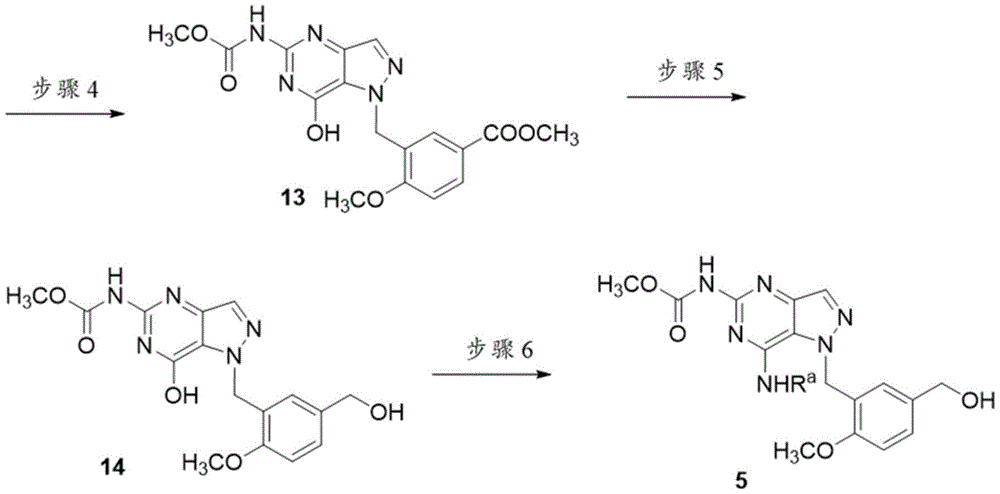
上文方案2示出了通过以下方式制备中间体5的替代方法:将4-氨基-1H-吡唑-5-甲酸甲酯(CAS登记号923283-54-9)与1,3-双(甲氧基羰基)-2-甲基-2-硫代假脲(CAS登记号34840-23-8)偶联以形成化合物10。通过将化合物10用NBS(N-溴琥珀酰亚胺)溴化获得化合物11。用3-溴甲基-4-甲氧基苯甲酸甲酯烷基化后,获得化合物12。将化合物12在H2下氢化以得到化合物13。将化合物13通过与LiAlH4反应还原为醇14。通过在BOP和DBU的存在下使化合物14与RaNH2反应合成中间体5。Scheme 2 above shows an alternative method for the preparation of intermediate 5 by combining methyl 4-amino-1H-pyrazole-5-carboxylate (CAS Registry No. 923283-54-9) with 1,3-bis( Methoxycarbonyl)-2-methyl-2-thiopseurea (CAS Registry No. 34840-23-8) was coupled to form compound 10. Compound 11 was obtained by bromination of compound 10 with NBS (N-bromosuccinimide). Compound 12 was obtained after alkylation with methyl 3-bromomethyl-4-methoxybenzoate. Compound 12 was hydrogenated under H2 to give compound 13. Compound 13 was reduced to alcohol 14 by reaction with LiAlH4. Intermediate 5 was synthesized by reacting compound 14 with RaNH2 in the presence of BOP and DBU.
方案3Scenario 3

上述方案3示出了用于通过以下方式制备中间体4的替代方法:4-硝基-1H-吡唑-5-甲酸甲酯15(CAS登记号1345513-95-2)与3-溴甲基-4-甲氧基苯甲酸甲酯的烷基化以形成化合物16。将化合物16在H2下氢化以得到化合物17。通过化合物17与1,3-双(甲氧基羰基)-2-甲基-2-硫代假脲的反应获得化合物18。通过在BOP和DBU的存在下使化合物18与RaNH2反应合成中间体4。Scheme 3 above shows an alternative method for the preparation of intermediate 4 by: methyl 4-nitro-1H-pyrazole-5-carboxylate 15 (CAS Reg. No. 1345513-95-2) with 3-bromomethyl Alkylation of methyl-4-methoxybenzoate to form compound 16. Compound 16 was hydrogenated under H2 to give compound 17. Compound 18 was obtained by the reaction of compound 17 with 1,3-bis(methoxycarbonyl)-2-methyl-2-thiopseudourea. Intermediate 4 was synthesized by reacting compound 18 with RaNH2 in the presence of BOP and DBU.
方案4Scenario 4

可以将化合物1用3-溴甲基-4-甲氧基苯甲酸甲酯直接烷基化以形成中间体4。然而,在这种方法中,N1异构体与N2异构体的比率通常不太有利。Compound 1 can be directly alkylated with methyl 3-bromomethyl-4-methoxybenzoate to form intermediate 4. However, in this approach, the ratio of N1 isomer to N2 isomer is usually less favorable.
方案5Scenario 5

上文方案5示出了用于制备中间体4的替代方法。将吡唑并嘧啶1用NIS(N-碘代琥珀酰亚胺)或NCS(N-氯代琥珀酰亚胺)转化为碘化物或氯化物19。用3-溴甲基-4-甲氧基苯甲酸甲酯烷基化后,获得化合物20。将化合物20在H2下氢化以得到化合物4。Scheme 5 above shows an alternative method for the preparation of intermediate 4. Pyrazolopyrimidine 1 was converted to iodide or chloride 19 using NIS (N-iodosuccinimide) or NCS (N-chlorosuccinimide). Compound 20 was obtained after alkylation with methyl 3-bromomethyl-4-methoxybenzoate. Compound 20 was hydrogenated under H2 to give compound 4.
方案6Option 6
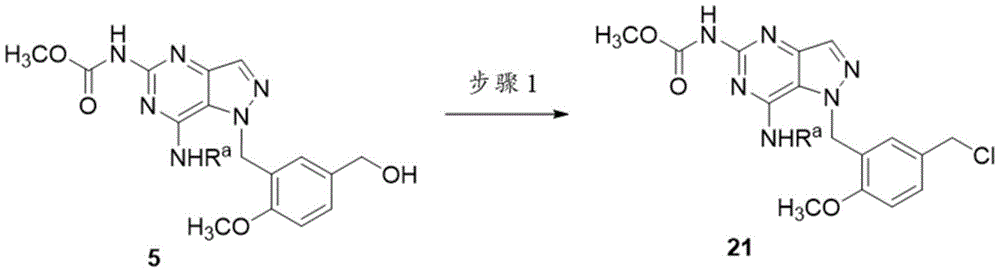

上文方案6示出了用于制备产物8的替代方法。化合物5与SOCl2的反应得到氯化物21。将氯化物7用RbNHRc处理以得到化合物22。通过将化合物22用NaOH脱保护获得产物8。Scheme 6 above shows an alternative method for preparing product 8. Reaction of compound 5 with SOCl 2 affords chloride 21. Chloride 7 was treated with RbNHRc to give compound 22. Product 8 was obtained by deprotection of compound 22 with NaOH.
方案7Option 7
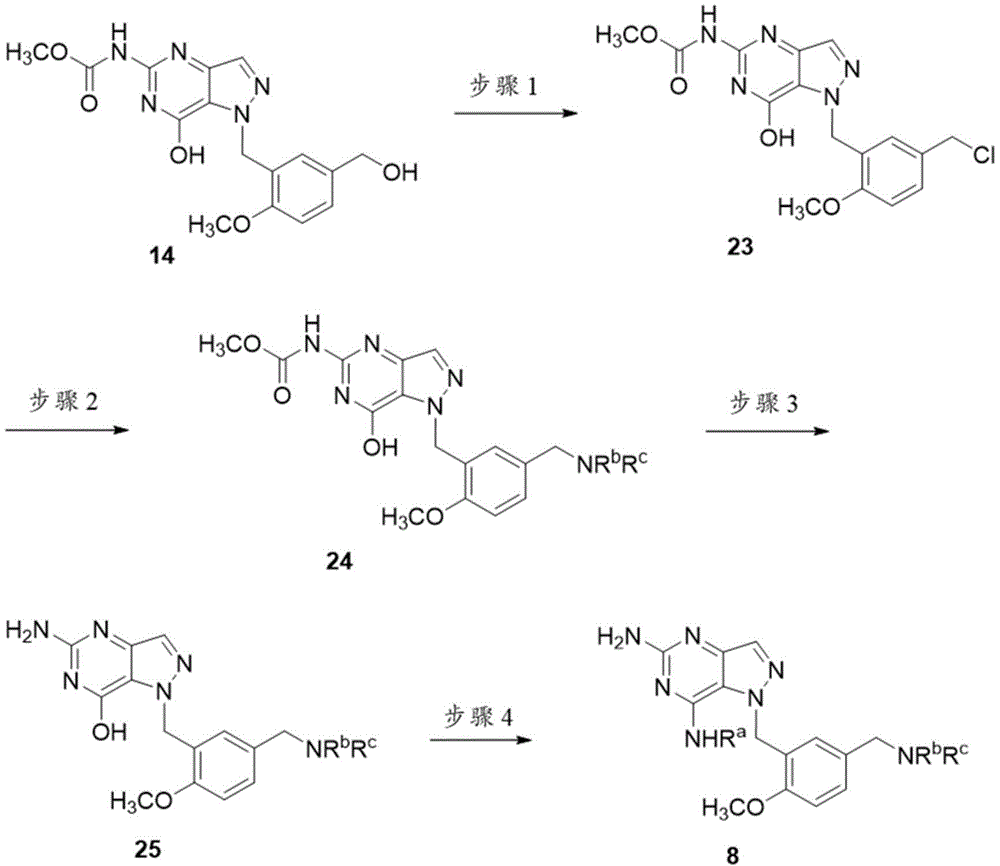
上文方案7示出了用于制备产物8的替代方法。化合物14与SOCl2的反应得到氯化物23。将氯化物7用RbNHRc处理以得到化合物24。通过将化合物24用NaOH脱保护获得化合物25。通过在BOP和DBU的存在下使化合物25与RaNH2反应合成产物8。Scheme 7 above shows an alternative method for preparing product 8. Reaction of compound 14 with SOCl 2 affords chloride 23. Chloride 7 was treated with RbNHRc to give compound 24. Compound 25 was obtained by deprotection of compound 24 with NaOH. Product 8 was synthesized by reacting compound 25 with RaNH2 in the presence of BOP and DBU.
方案8Scenario 8

可以通过如上文方案8所概述的偶联化合物8制备化合物26(在Rc是H并且酸RdCOOH的情况下)。Compound 26 can be prepared by coupling compound 8 as outlined in Scheme 8 above (where Rc is H and the acid RdCOOH ).
方案9Scenario 9
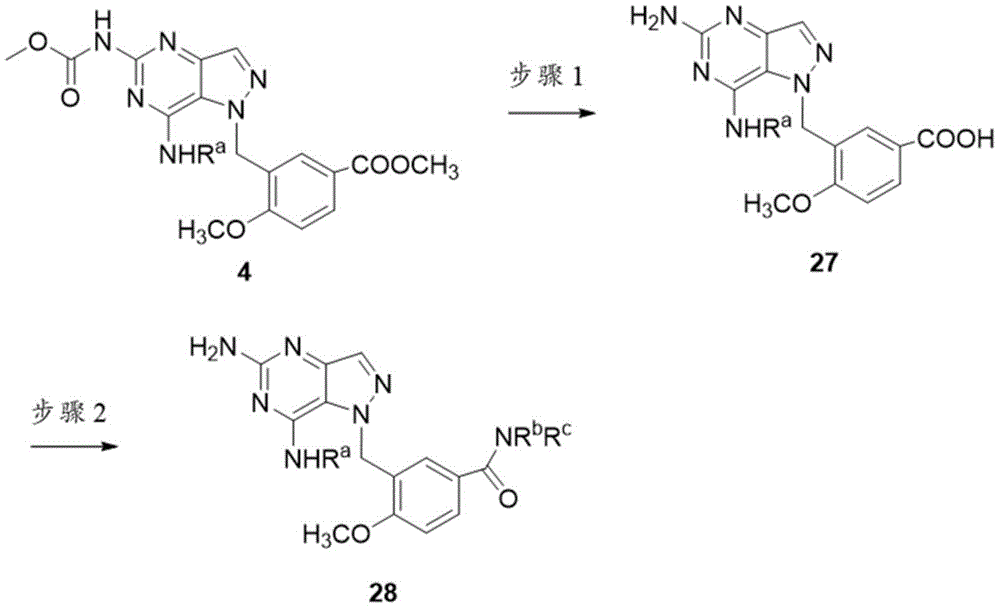
可以通过上文方案9中概述的合成顺序制备化合物28。将化合物4使用NaOH水解以形成酸27。将化合物27与RbNHRc偶联得到产物28。Compound 28 can be prepared by the synthetic sequence outlined in Scheme 9 above. Compound 4 was hydrolyzed using NaOH to form acid 27. Coupling of compound 27 with RbNHRc affords product 28.
方案10Scenario 10

可以通过如上文方案10中所概述的氯化物7与醇RgOH的反应获得化合物29。Compound 29 can be obtained by reaction of chloride 7 with alcohol RgOH as outlined in Scheme 10 above.
方案11Scenario 11

可以通过上文方案11中概述的合成顺序制备化合物32。通过化合物2的烷基化获得化合物30。化合物30的脱保护得到化合物31。通过用NaOH水解化合物31获得产物32。Compound 32 can be prepared by the synthetic sequence outlined in Scheme 11 above. Compound 30 is obtained by alkylation of compound 2. Deprotection of compound 30 affords compound 31. Product 32 was obtained by hydrolysis of compound 31 with NaOH.
方案12Scenario 12

可以通过上文方案12中概述的合成顺序制备化合物36。化合物2的烷基化后获得化合物33。将化合物33在H2下氢化以得到化合物34。化合物34通过与格氏试剂RiMgBr(其中Ri是例如低级烷基)反应转化为化合物35。通过使用NaOH将化合物35脱保护获得产物36。Compound 36 can be prepared by the synthetic sequence outlined in Scheme 12 above. Compound 33 is obtained after alkylation of compound 2. Compound 33 was hydrogenated under H2 to give compound 34. Compound 34 is converted to compound 35 by reaction with Grignard reagent R i MgBr (wherein R i is eg lower alkyl). Product 36 was obtained by deprotection of compound 35 using NaOH.
本领域技术人员能够通过参考上文通用程序,采用本领域已知的试剂、溶剂和条件,或通过修改以下特定实施例的程序(细节上作必要的修改)来制造本公开文本的化合物。One skilled in the art can make the compounds of the present disclosure by referring to the general procedures above, employing reagents, solvents and conditions known in the art, or by modifying the procedures of the specific examples below, mutatis mutandis.
合成-特定实施例Synthesis - Specific Examples
为了进一步说明上述内容,包括以下非限制性以下示例性合成方案。在权利要求范围内的这些实施例的变化在本领域技术人员的能力范围内,并且被认为落入本公开文本的范围内。读者应认识到,被提供本公开文本的技术人员和相关领域的技术人员将能够在没有穷举实施例的情况下制备和使用本文公开的化合物。To further illustrate the above, the following non-limiting exemplary synthetic schemes are included. Variations of these embodiments within the scope of the claims are within the capabilities of those skilled in the art and are considered to be within the scope of this disclosure. The reader should recognize that one skilled in the art provided this disclosure and those skilled in the relevant art will be able to make and use the compounds disclosed herein without the exhaustive examples.
编号为101和更大的化合物的分析数据可以在表A1或表A2中找到。Analytical data for compounds numbered 101 and greater can be found in Table A1 or Table A2.
实施例A-化合物105Example A - Compound 105

步骤1.向(7-(丁基氨基)-1H-吡唑并[4,3-d]嘧啶-5-基)氨基甲酸甲酯(4g,15.13mmol)在DMF(7mL)中的悬浮液中添加NBS(2.96g,16.65mmol)在乙腈(14mL)中的溶液。将反应混合物在室温下搅拌1小时。添加水(33mL)。通过过滤收集沉淀物。将固体用水(3x20mL)洗涤,并且空气干燥过夜,得到(3-溴-7-(丁基氨基)-1H-吡唑并[4,3-d]嘧啶-5-基)氨基甲酸甲酯。Step 1. To a suspension of methyl (7-(butylamino)-1H-pyrazolo[4,3-d]pyrimidin-5-yl)carbamate (4 g, 15.13 mmol) in DMF (7 mL) To this was added a solution of NBS (2.96 g, 16.65 mmol) in acetonitrile (14 mL). The reaction mixture was stirred at room temperature for 1 hour. Water (33 mL) was added. The precipitate was collected by filtration. The solid was washed with water (3 x 20 mL) and air dried overnight to give methyl (3-bromo-7-(butylamino)-lH-pyrazolo[4,3-d]pyrimidin-5-yl)carbamate.
LC-MS m/z 343.1[M+H]+。LC-MS m/z 343.1 [M+H] + .
1H NMR(400MHz,DMSO-d6)δ12.89(s,1H),9.79(s,1H),7.58(s,1H),3.62(s,3H),3.54(q,J=6.8Hz,2H),1.68–1.56(m,2H),1.47–1.33(m,2H),0.94(t,J=7.4Hz,3H)。 1 H NMR (400MHz, DMSO-d 6 ) δ 12.89(s, 1H), 9.79(s, 1H), 7.58(s, 1H), 3.62(s, 3H), 3.54(q, J=6.8Hz, 2H), 1.68–1.56 (m, 2H), 1.47–1.33 (m, 2H), 0.94 (t, J=7.4Hz, 3H).
步骤2.在室温下将Cs2CO3(5.73g,17.59mmol)添加到(3-溴-7-(丁基氨基)-1H-吡唑并[4,3-d]嘧啶-5-基)氨基甲酸甲酯(3.32g,9.67mmol)和3-(溴甲基)-4-甲氧基苯甲酸甲酯(2.279g,8.79mmol)在DMF(21.72ml)中的混合物中。将反应混合物在室温下搅拌2h,用EtOAc稀释,用水洗涤,干燥,过滤并且浓缩。将粗产物在硅胶柱上用在己烷中的0-20%EtOAc纯化以提供呈白色固体的3-((3-溴-7-(丁基氨基)-5-((甲氧基羰基)氨基)-1H-吡唑并[4,3-d]嘧啶-1-基)甲基)-4-甲氧基苯甲酸甲酯。Step 2. Cs2CO3 (5.73 g, 17.59 mmol) was added to (3-bromo-7-(butylamino)-1H-pyrazolo[4,3-d]pyrimidin-5-yl at room temperature ) in a mixture of methyl carbamate (3.32 g, 9.67 mmol) and methyl 3-(bromomethyl)-4-methoxybenzoate (2.279 g, 8.79 mmol) in DMF (21.72 ml). The reaction mixture was stirred at room temperature for 2 h, diluted with EtOAc, washed with water, dried, filtered and concentrated. The crude product was purified on a silica gel column with 0-20% EtOAc in hexanes to provide 3-((3-bromo-7-(butylamino)-5-((methoxycarbonyl) as a white solid Amino)-1H-pyrazolo[4,3-d]pyrimidin-1-yl)methyl)-4-methoxybenzoic acid methyl ester.
LC-MS m/z 521.1[M+H]+。LC-MS m/z 521.1 [M+H] + .
1H NMR(400MHz,DMSO-d6)δ9.87(s,1H),7.98–7.90(m,1H),7.50(d,J=2.2Hz,1H),7.40(t,J=5.6Hz,1H),7.16(d,J=8.7Hz,1H),5.75(s,2H),3.83(s,3H),3.78(s,3H),3.63(s,3H),3.55(q,J=6.6Hz,2H),1.65–1.53(m,2H),1.31-1.23(m,2H),0.87(t,J=7.4Hz,3H)。 1 H NMR(400MHz,DMSO-d6)δ9.87(s,1H),7.98-7.90(m,1H),7.50(d,J=2.2Hz,1H),7.40(t,J=5.6Hz,1H ), 7.16(d, J=8.7Hz, 1H), 5.75(s, 2H), 3.83(s, 3H), 3.78(s, 3H), 3.63(s, 3H), 3.55(q, J=6.6Hz , 2H), 1.65–1.53 (m, 2H), 1.31–1.23 (m, 2H), 0.87 (t, J=7.4Hz, 3H).
步骤3.在室温下将Pd/C(10wt%,30mg,0.403mmol)添加到3-((3-溴-7-(丁基氨基)-5-((甲氧基羰基)氨基)-1H-吡唑并[4,3-d]嘧啶-1-基)甲基)-4-甲氧基苯甲酸甲酯(0.21g,0.403mmol)在MeOH(5mL)中的溶液中。将反应混合物在H2下搅拌过夜。将催化剂滤除,并且将滤液浓缩以得到呈白色固体的3-((7-(丁基氨基)-5-((甲氧基羰基)氨基)-1H-吡唑并[4,3-d]嘧啶-1-基)甲基)-4-甲氧基苯甲酸甲酯。Step 3. Pd/C (10 wt%, 30 mg, 0.403 mmol) was added to 3-((3-bromo-7-(butylamino)-5-((methoxycarbonyl)amino)-1H at room temperature -Pyrazolo[4,3-d]pyrimidin-1-yl)methyl)-4-methoxybenzoic acid methyl ester (0.21 g, 0.403 mmol) in MeOH (5 mL). The reaction mixture was stirred under H2 overnight. The catalyst was filtered off and the filtrate was concentrated to give 3-((7-(butylamino)-5-((methoxycarbonyl)amino)-1H-pyrazolo[4,3-d as a white solid ]pyrimidin-1-yl)methyl)-4-methoxybenzoic acid methyl ester.
LC-MS m/z 443.2[M+H]+。LC-MS m/z 443.2 [M+H] + .
1H NMR(400MHz,氯仿-d)δ8.77(t,J=5.8Hz,1H),8.09(s,1H),7.96(dd,J=8.8,2.2Hz,1H),7.77(d,J=2.1Hz,1H),6.90(d,J=8.7Hz,1H),6.03(s,2H),3.93–3.75(m,11H),1.73–1.63(m,2H),1.31(h,J=7.6Hz,2H),0.89(t,J=7.4Hz,3H)。 1 H NMR (400MHz, chloroform-d) δ 8.77(t, J=5.8Hz, 1H), 8.09(s, 1H), 7.96(dd, J=8.8, 2.2Hz, 1H), 7.77(d, J =2.1Hz,1H),6.90(d,J=8.7Hz,1H),6.03(s,2H),3.93-3.75(m,11H),1.73-1.63(m,2H),1.31(h,J= 7.6Hz, 2H), 0.89 (t, J=7.4Hz, 3H).
步骤4.在0℃下将在THF中的LiAlH4(1M)(1.549mL,1.549mmol)添加到3-((7-羟基-5-((甲氧基羰基)氨基)-1H-吡唑并[4,3-d]嘧啶-1-基)甲基)-4-甲氧基苯甲酸甲酯(60mg,0.155mmol)在THF(8mL)中的混合物中。将反应混合物在室温下搅拌3h,通过缓慢添加甲醇淬灭并且与罗谢尔盐(Rochelle salt)(1M,3mL)一起搅拌1h。将水溶液用EtOAC萃取。将合并的有机层干燥,过滤并且浓缩。将粗产物在硅胶柱上用在DCM中的0-20%MeOH纯化以提供呈白色固体的(7-(丁基氨基)-1-(5-(羟基甲基)-2-甲氧基苄基)-1H-吡唑并[4,3-d]嘧啶-5-基)氨基甲酸甲酯。Step 4. LiAlH4 in THF (1 M) (1.549 mL, 1.549 mmol) was added to 3-((7-hydroxy-5-((methoxycarbonyl)amino)-1H-pyrazole at 0 °C In a mixture of methyl [4,3-d]pyrimidin-1-yl)methyl)-4-methoxybenzoate (60 mg, 0.155 mmol) in THF (8 mL). The reaction mixture was stirred at room temperature for 3 h, quenched by slow addition of methanol and stirred with Rochelle salt (1 M, 3 mL) for 1 h. The aqueous solution was extracted with EtOAc. The combined organic layers were dried, filtered and concentrated. The crude product was purified on a silica gel column with 0-20% MeOH in DCM to afford (7-(butylamino)-1-(5-(hydroxymethyl)-2-methoxybenzyl) as a white solid yl)-1H-pyrazolo[4,3-d]pyrimidin-5-yl)carbamate.
LC-MS m/z 443.2[M+H]+。LC-MS m/z 443.2 [M+H] + .
1H NMR(400MHz,氯仿-d)δ8.08(s,1H),7.78(s,1H),7.33–7.26(m,1H),6.96(d,J=2.1Hz,1H),6.89(d,J=8.5Hz,1H),5.70(t,J=5.4Hz,1H),5.57(s,2H),5.29(s,2H),4.47(s,2H),3.90(s,3H),3.73(s,3H),3.44(td,J=7.0,5.3Hz,3H),1.52–1.39(m,2H),1.29–1.15(m,2H),0.87(t,J=7.4Hz,3H)。 1 H NMR (400MHz, chloroform-d) δ8.08(s,1H), 7.78(s,1H), 7.33-7.26(m,1H), 6.96(d, J=2.1Hz,1H), 6.89(d , J=8.5Hz, 1H), 5.70(t, J=5.4Hz, 1H), 5.57(s, 2H), 5.29(s, 2H), 4.47(s, 2H), 3.90(s, 3H), 3.73 (s, 3H), 3.44 (td, J=7.0, 5.3 Hz, 3H), 1.52–1.39 (m, 2H), 1.29–1.15 (m, 2H), 0.87 (t, J=7.4 Hz, 3H).
步骤5.在室温下将NaOH(10M,5.02mL,50.2mmol)添加到(7-(丁基氨基)-1-(5-(羟基甲基)-2-甲氧基苄基)-1H-吡唑并[4,3-d]嘧啶-5-基)氨基甲酸甲酯(1.04g,2.509mmol)在二噁烷(25mL)中的混合物中。将反应混合物在54℃下加热过夜,用水稀释,并且用EtOAc萃取。将合并的有机层干燥,过滤并且浓缩。将粗产物在硅胶柱上用在DCM中的0-30%MeOH纯化以提供呈白色固体的化合物140。Step 5. NaOH (10 M, 5.02 mL, 50.2 mmol) was added to (7-(butylamino)-1-(5-(hydroxymethyl)-2-methoxybenzyl)-1H- Methyl pyrazolo[4,3-d]pyrimidin-5-yl)carbamate (1.04 g, 2.509 mmol) in dioxane (25 mL). The reaction mixture was heated at 54°C overnight, diluted with water, and extracted with EtOAc. The combined organic layers were dried, filtered and concentrated. The crude product was purified on a silica gel column with 0-30% MeOH in DCM to provide compound 140 as a white solid.
LC-MS m/z 357.2[M+H]+。LC-MS m/z 357.2 [M+H] + .
步骤6.在室温下将SOCl2(0.410ml,5.61mmol)添加到(3-((5-氨基-7-(丁基氨基)-1H-吡唑并[4,3-d]嘧啶-1-基)甲基)-4-甲氧基苯基)甲醇(0.1g,0.281mmol)在THF(4.60ml)中的溶液中。将反应混合物在室温下搅拌2h。蒸发溶剂以得到呈白色固体的N7-丁基-1-(5-(氯甲基)-2-甲氧基苄基)-1H-吡唑并[4,3-d]嘧啶-5,7-二胺。Step 6. SOCl2 (0.410 ml, 5.61 mmol) was added to (3-((5-amino-7-(butylamino)-1H-pyrazolo[4,3-d]pyrimidine-1) at room temperature -yl)methyl)-4-methoxyphenyl)methanol (0.1 g, 0.281 mmol) in THF (4.60 ml). The reaction mixture was stirred at room temperature for 2 h. The solvent was evaporated to give N7-butyl-1-(5-(chloromethyl)-2-methoxybenzyl)-1H-pyrazolo[4,3-d]pyrimidine- 5 as a white solid, 7-Diamine.
LC-MS m/z 375.2[M+H]+。LC-MS m/z 375.2 [M+H] + .
步骤7.将N7-丁基-1-(5-(氯甲基)-2-甲氧基苄基)-1H-吡唑并[4,3-d]嘧啶-5,7-二胺(10mg,0.027mmol)和3-甲氧基氮杂环丁烷(13.94mg,0.160mmol)在DMF(0.5mL)中的混合物在室温下搅拌过夜。将粗产物用以下条件经由制备型LC/MS纯化:柱:XBridge C18,200mm x 19mm,5-μm颗粒;流动相A:5:95乙腈:水(含0.1%TFA);流动相B:95:5乙腈:水(含0.1%TFA);梯度:在0%B下保持0分钟,经20分钟0-40%B,然后在100%B下保持0分钟;流速:20mL/min;柱温:25℃。通过MS和UV信号触发级分收集。将含有化合物105的级分合并并且经由离心蒸发干燥。Step 7. N7-butyl-1-(5-(chloromethyl)-2-methoxybenzyl)-1H-pyrazolo[4,3-d]pyrimidine-5,7-diamine (10 mg, 0.027 mmol) and 3-methoxyazetidine (13.94 mg, 0.160 mmol) in DMF (0.5 mL) was stirred at room temperature overnight. The crude product was purified via preparative LC/MS using the following conditions: Column: XBridge C18, 200 mm x 19 mm, 5-μm particles; mobile phase A: 5:95 acetonitrile:water (with 0.1% TFA); mobile phase B: 95 :5 acetonitrile:water (with 0.1% TFA); gradient: 0 min at 0% B, 0-40% B over 20 min, then 0 min at 100% B; flow rate: 20 mL/min; column temperature : 25°C. Fraction collection was triggered by MS and UV signals. Fractions containing compound 105 were combined and dried via centrifugal evaporation.
类似地制备以下化合物:化合物101、化合物102、化合物103、化合物104、化合物106、化合物107、化合物108、化合物109、化合物110、化合物111、化合物112、化合物113、化合物114、化合物115、化合物116、化合物117、化合物118、化合物119、化合物120、化合物121、化合物122、化合物123、化合物124、化合物125、化合物126、化合物127、化合物129、化合物130、化合物131、化合物132、化合物133、化合物134、化合物135、化合物137、化合物138、化合物142和化合物151。The following compounds were prepared similarly: Compound 101, Compound 102, Compound 103, Compound 104, Compound 106, Compound 107, Compound 108, Compound 109, Compound 110, Compound 111, Compound 112, Compound 113, Compound 114, Compound 115, Compound 116 , Compound 117, Compound 118, Compound 119, Compound 120, Compound 121, Compound 122, Compound 123, Compound 124, Compound 125, Compound 126, Compound 127, Compound 129, Compound 130, Compound 131, Compound 132, Compound 133, Compound 134, compound 135, compound 137, compound 138, compound 142 and compound 151.
实施例B-化合物128Example B - Compound 128

在室温下将DIEA(6.07μl,0.035mmol)添加到N7-丁基-1-(2-甲氧基-5-((甲基氨基)甲基)苄基)-1H-吡唑并[4,3-d]嘧啶-5,7-二胺(化合物132,9.9mg,0.027mmol)、3-(二甲基氨基)丙酸(3.45mg,0.029mmol)和HATU(12.22mg,0.032mmol)在DMF(1mL)中的混合物中。将反应混合物在室温下搅拌过夜。将粗材料用以下条件经由制备型LC/MS纯化:柱:XBridge C18,200mm x 19mm,5-μm颗粒;流动相A:5:95乙腈:水(含0.1%TFA);流动相B:95:5乙腈:水(含0.1%TFA);梯度:在0%B下保持0分钟,经20分钟0-40%B,然后在100%B下保持0分钟;流速:20mL/min;柱温:25℃。通过MS和UV信号触发级分收集。将含有化合物128的级分合并并且经由离心蒸发干燥。DIEA (6.07 μl, 0.035 mmol) was added to N7-butyl-1-(2-methoxy-5-((methylamino)methyl)benzyl)-1H-pyrazolo[4 at room temperature ,3-d]pyrimidine-5,7-diamine (compound 132, 9.9 mg, 0.027 mmol), 3-(dimethylamino)propionic acid (3.45 mg, 0.029 mmol) and HATU (12.22 mg, 0.032 mmol) In a mixture in DMF (1 mL). The reaction mixture was stirred at room temperature overnight. The crude material was purified via preparative LC/MS using the following conditions: Column: XBridge C18, 200mm x 19mm, 5-μm particles; Mobile Phase A: 5:95 Acetonitrile:Water (with 0.1% TFA); Mobile Phase B: 95 :5 acetonitrile:water (with 0.1% TFA); gradient: 0 min at 0% B, 0-40% B over 20 min, then 0 min at 100% B; flow rate: 20 mL/min; column temperature : 25°C. Fraction collection was triggered by MS and UV signals. Fractions containing compound 128 were combined and dried via centrifugal evaporation.
类似地制备以下化合物:化合物136、化合物146、化合物147和化合物148。The following compounds were prepared analogously: Compound 136, Compound 146, Compound 147, and Compound 148.
实施例C-化合物139Example C - Compound 139

在室温下将NaH(60%)(6.40mg,0.160mmol)添加到氧杂环丁烷-3-醇(11.86mg,0.160mmol)在DMF(0.5mL)中的溶液中。将混合物在室温下搅拌10min并且在室温下添加到N7-丁基-1-(5-(氯甲基)-2-甲氧基苄基)-1H-吡唑并[4,3-d]嘧啶-5,7-二胺(10mg,0.027mmol)在DMF(0.5mL)中的溶液中。将反应混合物在室温下搅拌2h。将粗产物用以下条件经由制备型LC/MS纯化:柱:XBridge C18,200mm x 19mm,5-μm颗粒;流动相A:5:95乙腈:水(含0.1%TFA);流动相B:95:5乙腈:水(含0.1%TFA);梯度:在0%B下保持0分钟,经20分钟0-40%B,然后在100%B下保持0分钟;流速:20mL/min;柱温:25℃。将含有化合物的级分(通过MS和UV信号触发收集)合并并且经由离心蒸发干燥。NaH (60%) (6.40 mg, 0.160 mmol) was added to a solution of oxetan-3-ol (11.86 mg, 0.160 mmol) in DMF (0.5 mL) at room temperature. The mixture was stirred at room temperature for 10 min and added to N7 -butyl-1-(5-(chloromethyl)-2-methoxybenzyl)-1H-pyrazolo[4,3-d at room temperature ]pyrimidine-5,7-diamine (10 mg, 0.027 mmol) in DMF (0.5 mL). The reaction mixture was stirred at room temperature for 2 h. The crude product was purified via preparative LC/MS using the following conditions: Column: XBridge C18, 200 mm x 19 mm, 5-μm particles; mobile phase A: 5:95 acetonitrile:water (with 0.1% TFA); mobile phase B: 95 :5 acetonitrile:water (with 0.1% TFA); gradient: 0 min at 0% B, 0-40% B over 20 min, then 0 min at 100% B; flow rate: 20 mL/min; column temperature : 25°C. Compound-containing fractions (collected by MS and UV signal triggering) were combined and dried via centrifugal evaporation.
类似地制备以下化合物:化合物141、化合物143和化合物144。The following compounds were prepared analogously: Compound 141, Compound 143, and Compound 144.
实施例D-化合物145Example D - Compound 145
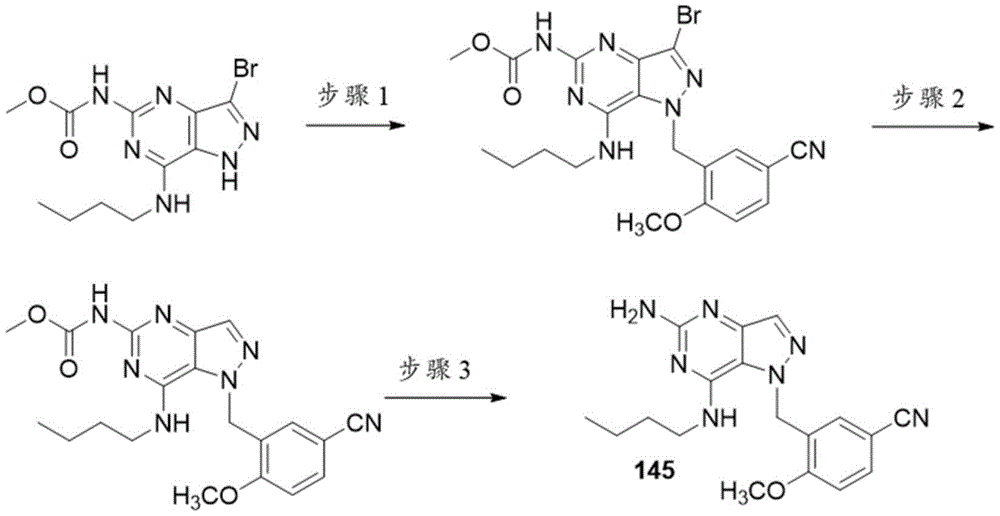
步骤1.在室温下将Cs2CO3(0.380g,1.166mmol)添加到(3-溴-7-(丁基氨基)-1H-吡唑并[4,3-d]嘧啶-5-基)氨基甲酸甲酯(0.2g,0.583mmol)和3-(溴甲基)-4-甲氧基苄腈(0.132g,0.583mmol)在DMF(2mL)中的混合物中。将反应混合物在室温下搅拌过周末。将反应混合物用EtOAc稀释,用水洗涤,干燥,过滤并且浓缩。将粗产物在硅胶柱上用在己烷中的0-70%EtOAc纯化以得到呈白色固体的(3-溴-7-(丁基氨基)-1-(4-氰基-2-甲氧基苄基)-1H-吡唑并[4,3-d]嘧啶-5-基)氨基甲酸甲酯。Step 1. Add Cs2CO3 (0.380 g, 1.166 mmol) to ( 3 -bromo-7-(butylamino)-1H-pyrazolo[4,3-d]pyrimidin-5-yl at room temperature ) in a mixture of methyl carbamate (0.2 g, 0.583 mmol) and 3-(bromomethyl)-4-methoxybenzonitrile (0.132 g, 0.583 mmol) in DMF (2 mL). The reaction mixture was stirred at room temperature over the weekend. The reaction mixture was diluted with EtOAc, washed with water, dried, filtered and concentrated. The crude product was purified on a silica gel column with 0-70% EtOAc in hexanes to give (3-bromo-7-(butylamino)-1-(4-cyano-2-methoxy) as a white solid (methylbenzyl)-1H-pyrazolo[4,3-d]pyrimidin-5-yl)carbamate.
LC-MS m/z 488.1[M+H]+。LC-MS m/z 488.1 [M+H] + .
步骤2.将(3-溴-7-(丁基氨基)-1-(5-氰基-2-甲氧基苄基)-1H-吡唑并[4,3-d]嘧啶-5-基)氨基甲酸甲酯(81mg,0.166mmol)和Pd/C 10wt%(20mg,0.166mmol)在甲醇(2mL)中的混合物在H2下搅拌过夜。将催化剂滤除后,将滤液浓缩以得到呈白色固体的(7-(丁基氨基)-1-(4-氰基-2-甲氧基苄基)-1H-吡唑并[4,3-d]嘧啶-5-基)氨基甲酸甲酯。Step 2. Convert (3-bromo-7-(butylamino)-1-(5-cyano-2-methoxybenzyl)-1H-pyrazolo[4,3-d]pyrimidine-5- A mixture of methyl)carbamate (81 mg, 0.166 mmol) and Pd/C 10 wt% (20 mg, 0.166 mmol) in methanol ( 2 mL) was stirred under H2 overnight. After the catalyst was filtered off, the filtrate was concentrated to give (7-(butylamino)-1-(4-cyano-2-methoxybenzyl)-1H-pyrazolo[4,3] as a white solid -d]Methylpyrimidin-5-yl)carbamate.
LC-MS m/z 410.2[M+H]+。LC-MS m/z 410.2 [M+H] + .
步骤3.将(7-(丁基氨基)-1-(5-氰基-2-甲氧基苄基)-1H-吡唑并[4,3-d]嘧啶-5-基)氨基甲酸甲酯(42.6mg,0.104mmol)和10N NaOH(0.208mL,2.081mmol)在二噁烷(1.5mL)中的混合物在54℃下搅拌过夜。将粗产物用以下条件经由制备型LC/MS纯化:柱:XBridgeC18,200mm x 19mm,5-μm颗粒;流动相A:5:95乙腈:水(含0.1%TFA);流动相B:95:5乙腈:水(含0.1%TFA);梯度:在0%B下保持0分钟,经20分钟0-40%B,然后在100%B下保持0分钟;流速:20mL/min;柱温:25℃。通过MS和UV信号触发级分收集。将含有化合物145的级分合并并且经由离心蒸发干燥。Step 3. (7-(butylamino)-1-(5-cyano-2-methoxybenzyl)-1H-pyrazolo[4,3-d]pyrimidin-5-yl)carbamic acid A mixture of methyl ester (42.6 mg, 0.104 mmol) and 10N NaOH (0.208 mL, 2.081 mmol) in dioxane (1.5 mL) was stirred at 54 °C overnight. The crude product was purified via preparative LC/MS using the following conditions: Column: XBridge C18, 200mm x 19mm, 5-μm particles; Mobile Phase A: 5:95 Acetonitrile:Water (with 0.1% TFA); Mobile Phase B: 95: 5 Acetonitrile: Water (with 0.1% TFA); Gradient: 0 min at 0% B, 0-40% B over 20 min, then 0 min at 100% B; flow rate: 20 mL/min; column temperature: 25°C. Fraction collection was triggered by MS and UV signals. Fractions containing compound 145 were combined and dried via centrifugal evaporation.
实施例E-化合物149Example E - Compound 149


步骤1.将3-(溴甲基)-4-甲氧基苯甲酸甲酯(3.6g,13.89mmol)、4-硝基-1H-吡唑-5-甲酸甲酯(2.377g,13.89mmol)和K2CO3(2.496g,18.06mmol)在DMF(30mL)中的混合物在室温下搅拌3h。将反应混合物用水稀释并且用EtOAc萃取。将合并的有机层干燥,过滤并且浓缩。将粗产物在硅胶柱上用在己烷中的0-50%EtOAc纯化以得到呈白色固体的1-(2-甲氧基-5-(甲氧基羰基)苄基)-4-硝基-1H-吡唑-5-甲酸甲酯。Step 1. Combine methyl 3-(bromomethyl)-4-methoxybenzoate (3.6 g, 13.89 mmol), methyl 4-nitro-1H-pyrazole-5-carboxylate (2.377 g, 13.89 mmol) ) and K2CO3 (2.496 g , 18.06 mmol) in DMF (30 mL) was stirred at room temperature for 3 h. The reaction mixture was diluted with water and extracted with EtOAc. The combined organic layers were dried, filtered and concentrated. The crude product was purified on a silica gel column with 0-50% EtOAc in hexanes to give 1-(2-methoxy-5-(methoxycarbonyl)benzyl)-4-nitro as a white solid -1H-Pyrazole-5-carboxylic acid methyl ester.
LC-MS m/z 350.1[M+H]+。LC-MS m/z 350.1 [M+H] + .
1H NMR(400MHz,DMSO-d6)δ8.38(s,1H),7.98(dd,J=8.6,2.2Hz,1H),7.89(d,J=2.2Hz,1H),7.15(d,J=8.7Hz,1H),5.52(s,2H),3.98(s,3H),3.82(d,J=5.1Hz,6H)。 1 H NMR(400MHz, DMSO-d6)δ8.38(s,1H),7.98(dd,J=8.6,2.2Hz,1H),7.89(d,J=2.2Hz,1H),7.15(d,J = 8.7 Hz, 1H), 5.52 (s, 2H), 3.98 (s, 3H), 3.82 (d, J = 5.1 Hz, 6H).
步骤2.在室温下向1-(2-甲氧基-5-(甲氧基羰基)苄基)-4-硝基-1H-吡唑-5-甲酸甲酯(1g,2.86mmol)和甲酸铵(0.903g,14.31mmol)在THF(9mL)和MeOH(9mL)中的混合物中添加Zn(0.599g,9.16mmol)。将反应混合物在室温下搅拌1h。将固体滤出。将滤液浓缩以产出呈白色固体的4-氨基-1-(2-甲氧基-5-(甲氧基羰基)苄基)-1H-吡唑-5-甲酸甲酯。Step 2. To methyl 1-(2-methoxy-5-(methoxycarbonyl)benzyl)-4-nitro-1H-pyrazole-5-carboxylate (1 g, 2.86 mmol) and To a mixture of ammonium formate (0.903 g, 14.31 mmol) in THF (9 mL) and MeOH (9 mL) was added Zn (0.599 g, 9.16 mmol). The reaction mixture was stirred at room temperature for 1 h. The solids were filtered off. The filtrate was concentrated to yield methyl 4-amino-1-(2-methoxy-5-(methoxycarbonyl)benzyl)-1H-pyrazole-5-carboxylate as a white solid.
LC-MS m/z 320.1[M+H]+。LC-MS m/z 320.1 [M+H] + .
步骤3.在室温下将1,3-双(甲氧基羰基)-2-甲基-2-硫代假脲(0.452g,2.192mmol)和4-氨基-1-(2-甲氧基-5-(甲氧基羰基)苄基)-1H-吡唑-5-甲酸甲酯(0.7g,2.192mmol)的混合物吸收在MeOH(18mL)中并且用乙酸(0.627mL,10.96mmol)处理。将反应混合物搅拌过夜。然后将在甲醇中的甲醇钠(4.37M)(5.02mL,21.92mmol)添加到反应混合物中,然后将其在室温下搅拌过夜。通过缓慢添加乙酸将pH调节至5。将沉淀物通过过滤收集,用水和乙腈洗涤并且干燥以提供呈白色固体的3-((7-羟基-5-((甲氧基羰基)氨基)-1H-吡唑并[4,3-d]嘧啶-1-基)甲基)-4-甲氧基苯甲酸甲酯。Step 3. Combine 1,3-bis(methoxycarbonyl)-2-methyl-2-thiopseudourea (0.452 g, 2.192 mmol) and 4-amino-1-(2-methoxyl) at room temperature A mixture of -5-(methoxycarbonyl)benzyl)-1H-pyrazole-5-carboxylic acid methyl ester (0.7 g, 2.192 mmol) was taken up in MeOH (18 mL) and treated with acetic acid (0.627 mL, 10.96 mmol) . The reaction mixture was stirred overnight. Sodium methoxide (4.37M) in methanol (5.02 mL, 21.92 mmol) was then added to the reaction mixture, which was then stirred at room temperature overnight. The pH was adjusted to 5 by slow addition of acetic acid. The precipitate was collected by filtration, washed with water and acetonitrile and dried to provide 3-((7-hydroxy-5-((methoxycarbonyl)amino)-1H-pyrazolo[4,3-d as a white solid ]pyrimidin-1-yl)methyl)-4-methoxybenzoic acid methyl ester.
LC-MS m/z 388.1[M+H]+。LC-MS m/z 388.1 [M+H] + .
步骤4.将螺[2.3]己-5-基甲胺(0.201g,1.808mmol)、3-((7-羟基-5-((甲氧基羰基)氨基)-1H-吡唑并[4,3-d]嘧啶-1-基)甲基)-4-甲氧基苯甲酸甲酯(0.35g,0.904mmol)在DMSO(5mL)中的溶液用DBU(0.545mL,3.61mmol)和BOP(0.799g,1.807mmol)处理。将反应混合物在40℃下加热1h。添加水以将反应淬灭。将水溶液用EtOAc萃取。将合并的有机层干燥,过滤并且浓缩。将粗产物在硅胶柱上用在DCM中的0-20%MeOH纯化以得到白色固体的4-甲氧基-3-((5-((甲氧基羰基)氨基)-7-((螺[2.3]己-5-基甲基)氨基)-1H-吡唑并[4,3-d]嘧啶-1-基)甲基)苯甲酸甲酯。Step 4. Spiro[2.3]hex-5-ylmethanamine (0.201 g, 1.808 mmol), 3-((7-hydroxy-5-((methoxycarbonyl)amino)-1H-pyrazolo[4 ,3-d]pyrimidin-1-yl)methyl)-4-methoxybenzoic acid methyl ester (0.35 g, 0.904 mmol) in DMSO (5 mL) was treated with DBU (0.545 mL, 3.61 mmol) and BOP (0.799 g, 1.807 mmol) to treat. The reaction mixture was heated at 40 °C for 1 h. Water was added to quench the reaction. The aqueous solution was extracted with EtOAc. The combined organic layers were dried, filtered and concentrated. The crude product was purified on a silica gel column with 0-20% MeOH in DCM to give 4-methoxy-3-(((5-((methoxycarbonyl)amino)-7-((spiro) as a white solid [2.3]Methyl hex-5-ylmethyl)amino)-1H-pyrazolo[4,3-d]pyrimidin-1-yl)methyl)benzoate.
LC-MS m/z 481.2[M+H]+。LC-MS m/z 481.2 [M+H] + .
1H NMR(400MHz,DMSO-d6)δ9.65(s,1H),7.96–7.87(m,2H),7.25(d,J=2.2Hz,1H),7.23–7.03(m,2H),5.76(s,2H),3.88(d,J=6.6Hz,3H),3.74(s,3H),3.69–3.52(m,5H),2.84–2.68(m,1H),2.08–1.90(m,2H),1.86–1.77(m,2H),0.34(s,4H)。 1 H NMR (400MHz, DMSO-d6)δ9.65(s,1H),7.96-7.87(m,2H),7.25(d,J=2.2Hz,1H),7.23-7.03(m,2H),5.76 (s, 2H), 3.88 (d, J=6.6Hz, 3H), 3.74 (s, 3H), 3.69–3.52 (m, 5H), 2.84–2.68 (m, 1H), 2.08–1.90 (m, 2H ), 1.86–1.77 (m, 2H), 0.34 (s, 4H).
步骤5.将4-甲氧基-3-((5-((甲氧基羰基)氨基)-7-((螺[2.3]己-5-基甲基)氨基)-1H-吡唑并[4,3-d]嘧啶-1-基)甲基)苯甲酸甲酯(0.122g,0.254mmol)在THF(3mL)中的溶液冷却至0℃并且用LiAlH4(0.127mL,0.254mmol)逐滴处理。20min后,将反应通过缓慢添加甲醇淬灭并且与罗谢尔盐(1M,3mL)一起搅拌1h。将水溶液用EtOAC萃取。将合并的有机层干燥,过滤并且浓缩。将粗产物在硅胶柱上用在DCM中的0-30%MeOH纯化以得到呈白色固体的(1-(5-(羟基甲基)-2-甲氧基苄基)-7-((螺[2.3]己-5-基甲基)氨基)-1H-吡唑并[4,3-d]嘧啶-5-基)氨基甲酸甲酯。Step 5. 4-Methoxy-3-((5-((methoxycarbonyl)amino)-7-((spiro[2.3]hex-5-ylmethyl)amino)-1H-pyrazolo A solution of methyl [4,3-d]pyrimidin-1-yl)methyl)benzoate (0.122 g, 0.254 mmol) in THF (3 mL) was cooled to 0 °C and washed with LiAlH4 ( 0.127 mL, 0.254 mmol) Process drop by drop. After 20 min, the reaction was quenched by slow addition of methanol and stirred with Rochelle's salt (1 M, 3 mL) for 1 h. The aqueous solution was extracted with EtOAc. The combined organic layers were dried, filtered and concentrated. The crude product was purified on a silica gel column with 0-30% MeOH in DCM to give (1-(5-(hydroxymethyl)-2-methoxybenzyl)-7-((spiro) as a white solid [2.3] Hex-5-ylmethyl)amino)-1H-pyrazolo[4,3-d]pyrimidin-5-yl)carbamate methyl ester.
LC-MS m/z 453.2[M+H]+。LC-MS m/z 453.2 [M+H] + .
步骤6.在室温下将NaOH(10N,0.350mL,3.50mmol)添加到(1-(5-(羟基甲基)-2-甲氧基苄基)-7-((螺[2.3]己-5-基甲基)氨基)-1H-吡唑并[4,3-d]嘧啶-5-基)氨基甲酸甲酯(79.1mg,0.175mmol)在二噁烷(2mL)和DMSO(1mL)中的混合物中。将反应混合物在54℃下加热过夜。将反应混合物用水稀释并且用EtOAc萃取。将合并的有机层干燥,过滤并且浓缩。将粗产物在硅胶柱上用在DCM中的0-30%MeOH纯化以得到呈白色固体的(3-((5-氨基-7-((螺[2.3]己-5-基甲基)氨基)-1H-吡唑并[4,3-d]嘧啶-1-基)甲基)-4-甲氧基苯基)甲醇。Step 6. NaOH (10N, 0.350 mL, 3.50 mmol) was added to (1-(5-(hydroxymethyl)-2-methoxybenzyl)-7-((spiro[2.3]hexyl-) at room temperature Methyl 5-ylmethyl)amino)-1H-pyrazolo[4,3-d]pyrimidin-5-yl)carbamate (79.1 mg, 0.175 mmol) in dioxane (2 mL) and DMSO (1 mL) in the mixture. The reaction mixture was heated at 54°C overnight. The reaction mixture was diluted with water and extracted with EtOAc. The combined organic layers were dried, filtered and concentrated. The crude product was purified on a silica gel column with 0-30% MeOH in DCM to give (3-((5-amino-7-((spiro[2.3]hex-5-ylmethyl)amino as a white solid )-1H-pyrazolo[4,3-d]pyrimidin-1-yl)methyl)-4-methoxyphenyl)methanol.
LC-MS m/z 395.2[M+H]+。LC-MS m/z 395.2 [M+H] + .
步骤7.在室温下将SOCl2(0.221mL,3.04mmol)添加到(3-((5-氨基-7-((螺[2.3]己-5-基甲基)氨基)-1H-吡唑并[4,3-d]嘧啶-1-基)甲基)-4-甲氧基苯基)甲醇(60mg,0.152mmol)在THF(1.5mL)中的溶液中。将反应混合物在室温下搅拌2h。将溶液蒸发掉以得到呈白色固体的1-(5-(氯甲基)-2-甲氧基苄基)-N7-(螺[2.3]己-5-基甲基)-1H-吡唑并[4,3-d]嘧啶-5,7-二胺。Step 7. SOCl2 (0.221 mL, 3.04 mmol) was added to (3-((5-amino-7-((spiro[2.3]hex-5-ylmethyl)amino)-1H-pyrazole at room temperature [4,3-d]pyrimidin-1-yl)methyl)-4-methoxyphenyl)methanol (60 mg, 0.152 mmol) in THF (1.5 mL). The reaction mixture was stirred at room temperature for 2 h. The solution was evaporated to give 1-(5-(chloromethyl)-2-methoxybenzyl)-N7-(spiro[2.3]hex-5-ylmethyl)-1H-pyrazole as a white solid And[4,3-d]pyrimidine-5,7-diamine.
LC-MS m/z 413.2[M+H]+。LC-MS m/z 413.2 [M+H] + .
步骤8.将1-(5-(氯甲基)-2-甲氧基苄基)-N7-(螺[2.3]己-5-基甲基)-1H-吡唑并[4,3-d]嘧啶-5,7-二胺(10mg,0.024mmol)和3-甲氧基氮杂环丁烷(2.110mg,0.024mmol)在DMF(0.5mL)中的混合物在室温下搅拌2h。将粗材料用以下条件经由制备型LC/MS纯化:柱:XBridge C18,200mm x 19mm,5-μm颗粒;流动相A:5:95乙腈:水(含0.1%TFA);流动相B:95:5乙腈:水(含0.1%TFA);梯度:在0%B下保持0分钟,经20分钟0-40%B,然后在100%B下保持0分钟;流速:20mL/min;柱温:25℃。通过MS和UV信号触发级分收集。将含有化合物149的级分合并并且经由离心蒸发干燥。Step 8. Transfer 1-(5-(chloromethyl)-2-methoxybenzyl)-N7-(spiro[2.3]hex-5-ylmethyl)-1H-pyrazolo[4,3- d] A mixture of pyrimidine-5,7-diamine (10 mg, 0.024 mmol) and 3-methoxyazetidine (2.110 mg, 0.024 mmol) in DMF (0.5 mL) was stirred at room temperature for 2 h. The crude material was purified via preparative LC/MS using the following conditions: Column: XBridge C18, 200mm x 19mm, 5-μm particles; Mobile Phase A: 5:95 Acetonitrile:Water (with 0.1% TFA); Mobile Phase B: 95 :5 acetonitrile:water (with 0.1% TFA); gradient: 0 min at 0% B, 0-40% B over 20 min, then 0 min at 100% B; flow rate: 20 mL/min; column temperature : 25°C. Fraction collection was triggered by MS and UV signals. Fractions containing compound 149 were combined and dried via centrifugal evaporation.
根据此实施例类似地制备化合物150。Compound 150 was prepared analogously according to this example.
实施例F-化合物152Example F - Compound 152


步骤1.在室温下将NaOH(10N,0.237mL,2.372mmol)添加到在DMSO(1mL)中的4-甲氧基-3-((5-((甲氧基羰基)氨基)-7-((螺[2.3]己-5-基甲基)氨基)-1H-吡唑并[4,3-d]嘧啶-1-基)甲基)苯甲酸甲酯(57mg,0.119mmol)中。将反应混合物在54℃下加热过夜并且通过添加6N HCl中和。蒸发溶剂以得到呈白色固体的3-((5-氨基-7-((螺[2.3]己-5-基甲基)氨基)-1H-吡唑并[4,3-d]嘧啶-1-基)甲基)-4-甲氧基苯甲酸。Step 1. NaOH (10 N, 0.237 mL, 2.372 mmol) was added to 4-methoxy-3-((5-((methoxycarbonyl)amino)-7- in DMSO (1 mL) at room temperature ((spiro[2.3]hex-5-ylmethyl)amino)-1H-pyrazolo[4,3-d]pyrimidin-1-yl)methyl)benzoate (57 mg, 0.119 mmol). The reaction mixture was heated at 54°C overnight and neutralized by addition of 6N HCl. The solvent was evaporated to give 3-((5-amino-7-((spiro[2.3]hex-5-ylmethyl)amino)-1H-pyrazolo[4,3-d]pyrimidine-1 as a white solid -yl)methyl)-4-methoxybenzoic acid.
LC-MS m/z 409.2[M+H]+。LC-MS m/z 409.2 [M+H] + .
步骤2.在室温下将DIEA(8.53μl,0.049mmol)添加到1-甲基哌啶-4-胺(16.77mg,0.147mmol)、3-((5-氨基-7-((螺[2.3]己-5-基甲基)氨基)-1H-吡唑并[4,3-d]嘧啶-1-基)甲基)-4-甲氧基苯甲酸(10mg,0.024mmol)和HATU(12.10mg,0.032mmol)在DMF(0.5mL)中的混合物中。将反应混合物在室温下搅拌2h。将粗材料用以下条件经由制备型LC/MS纯化:柱:XBridge C18,200mm x 19mm,5-μm颗粒;流动相A:5:95乙腈:水(含0.1%TFA);流动相B:95:5乙腈:水(含0.1%TFA);梯度:在0%B下保持0分钟,经20分钟0-40%B,然后在100%B下保持0分钟;流速:20mL/min;柱温:25℃。通过MS和UV信号触发级分收集。将含有化合物152的级分合并并且经由离心蒸发干燥。Step 2. DIEA (8.53 μl, 0.049 mmol) was added to 1-methylpiperidin-4-amine (16.77 mg, 0.147 mmol), 3-((5-amino-7-((spiro[2.3 ]hex-5-ylmethyl)amino)-1H-pyrazolo[4,3-d]pyrimidin-1-yl)methyl)-4-methoxybenzoic acid (10 mg, 0.024 mmol) and HATU ( 12.10 mg, 0.032 mmol) in DMF (0.5 mL). The reaction mixture was stirred at room temperature for 2 h. The crude material was purified via preparative LC/MS using the following conditions: Column: XBridge C18, 200mm x 19mm, 5-μm particles; Mobile Phase A: 5:95 Acetonitrile:Water (with 0.1% TFA); Mobile Phase B: 95 :5 acetonitrile:water (with 0.1% TFA); gradient: 0 min at 0% B, 0-40% B over 20 min, then 0 min at 100% B; flow rate: 20 mL/min; column temperature : 25°C. Fraction collection was triggered by MS and UV signals. Fractions containing compound 152 were combined and dried via centrifugal evaporation.
根据此实施例类似地制备化合物153。Compound 153 was prepared analogously according to this example.
实施例G-化合物154Example G - Compound 154

步骤1.将3-((3-溴-7-羟基-5-((甲氧基羰基)氨基)-1H-吡唑并[4,3-d]嘧啶-1-基)甲基)-4-甲氧基苯甲酸甲酯(0.5g,1.072mmol)在DMSO(5mL)中的混合物用(S)-1-((叔丁基二苯基甲硅烷基)氧基)己-3-胺(0.763g,2.145mmol)、2,3,4,6,7,8,9,10-八氢嘧啶并[1,2-a]氮杂卓(0.5mL,3.32mmol)处理,然后用((1H-苯并[d][1,2,3]三唑-1-基)氧基)三(二甲基氨基)鏻六氟磷酸盐(V)(0.949g,2.145mmol)处理。将反应混合物在70℃下加热2h,用EtOAc稀释,并且用水洗涤。将溶剂混合物经Na2SO4干燥并且将溶剂去除。将残余物用MeOH稀释并且过滤以去除起始材料。将溶剂去除并且将材料在硅胶(干加载)己烷-EtOAc 0-100%上纯化以得到(S)-3-((3-溴-7-((1-((叔丁基二苯基甲硅烷基)氧基)己-3-基)氨基)-5-((甲氧基羰基)氨基)-1H-吡唑并[4,3-d]嘧啶-1-基)甲基)-4-甲氧基苯甲酸甲酯(0.59g,0.734mmol,68.4%产率)。Step 1. Convert 3-((3-bromo-7-hydroxy-5-((methoxycarbonyl)amino)-1H-pyrazolo[4,3-d]pyrimidin-1-yl)methyl)- A mixture of methyl 4-methoxybenzoate (0.5 g, 1.072 mmol) in DMSO (5 mL) was treated with (S)-1-((tert-butyldiphenylsilyl)oxy)hexan-3- Amine (0.763 g, 2.145 mmol), 2,3,4,6,7,8,9,10-octahydropyrimido[1,2-a]azepine (0.5 mL, 3.32 mmol), then treated with Treatment with ((1H-benzo[d][1,2,3]triazol-1-yl)oxy)tris(dimethylamino)phosphonium hexafluorophosphate (V) (0.949 g, 2.145 mmol). The reaction mixture was heated at 70 °C for 2 h, diluted with EtOAc, and washed with water. The solvent mixture was dried over Na2SO4 and the solvent was removed. The residue was diluted with MeOH and filtered to remove starting material. The solvent was removed and the material was purified on silica gel (dry loading) hexane-EtOAc 0-100% to give (S)-3-((3-bromo-7-((1-((tert-butyldiphenyl Silyl)oxy)hex-3-yl)amino)-5-((methoxycarbonyl)amino)-1H-pyrazolo[4,3-d]pyrimidin-1-yl)methyl)- Methyl 4-methoxybenzoate (0.59 g, 0.734 mmol, 68.4% yield).
LC-MS m/z 803.3[M+H]+。LC-MS m/z 803.3 [M+H] + .
1H NMR(400MHz,DMSO-d6)δ9.84(s,1H),7.98-7.81(m,1H),7.66-7.31(m,10H),7.30-7.19(m,2H),7.14-7.06(m,1H),6.71-6.58(m,1H),5.87-5.59(m,2H),4.77-4.53(m,1H),3.80-3.75(m,3H),3.75-3.71(m,3H),3.67-3.61(m,2H),3.60-3.56(m,3H),1.95-1.77(m,2H),1.64-1.42(m,2H),1.29-1.10(m,2H),0.92(s,9H),0.78(br t,J=7.3Hz,3H) 1 H NMR (400MHz, DMSO-d 6 ) δ 9.84(s, 1H), 7.98-7.81(m, 1H), 7.66-7.31(m, 10H), 7.30-7.19(m, 2H), 7.14-7.06 (m,1H),6.71-6.58(m,1H),5.87-5.59(m,2H),4.77-4.53(m,1H),3.80-3.75(m,3H),3.75-3.71(m,3H) ,3.67-3.61(m,2H),3.60-3.56(m,3H),1.95-1.77(m,2H),1.64-1.42(m,2H),1.29-1.10(m,2H),0.92(s, 9H),0.78(br t,J=7.3Hz,3H)
步骤2.向帕尔瓶(Parr bottle)中添加(S)-3-((3-溴-7-((1-((叔丁基二苯基甲硅烷基)氧基)己-3-基)氨基)-5-((甲氧基羰基)氨基)-1H-吡唑并[4,3-d]嘧啶-1-基)甲基)-4-甲氧基苯甲酸甲酯(0.59g,0.734mmol)、甲醇(10mL)和Pd/C(20mg,0.188mmol)。允许氢化反应在50psi下在25℃下进行2h。将材料过滤并且将溶剂去除以得到(S)-3-((7-((1-((叔丁基二苯基甲硅烷基)氧基)己-3-基)氨基)-5-((甲氧基羰基)氨基)-1H-吡唑并[4,3-d]嘧啶-1-基)甲基)-4-甲氧基苯甲酸甲酯(466g,0.624mmol,85%产率)。Step 2. Add (S)-3-((3-bromo-7-((1-((tert-butyldiphenylsilyl)oxy)hexyl-3- to the Parr bottle (methyl)amino)-5-((methoxycarbonyl)amino)-1H-pyrazolo[4,3-d]pyrimidin-1-yl)methyl)-4-methoxybenzoate (0.59 g, 0.734 mmol), methanol (10 mL) and Pd/C (20 mg, 0.188 mmol). The hydrogenation reaction was allowed to proceed at 50 psi for 2 h at 25 °C. The material was filtered and the solvent was removed to give (S)-3-((7-((1-((tert-butyldiphenylsilyl)oxy)hex-3-yl)amino)-5-( (Methoxycarbonyl)amino)-1H-pyrazolo[4,3-d]pyrimidin-1-yl)methyl)-4-methoxybenzoic acid methyl ester (466 g, 0.624 mmol, 85% yield ).
LC-MS m/z 725.4[M+H]+。LC-MS m/z 725.4 [M+H]+.
1H NMR(400MHz,DMSO-d6)δ7.76-7.66(m,3H),7.62(s,5H),7.55-7.42(m,8H),7.42-7.33(m,2H),7.31-7.06(m,1H),5.93-5.68(m,1H),3.85-3.68(m,5H),1.98-1.80(m,2H),1.79-1.68(m,1H),1.62-1.39(m,3H),1.38-1.23(m,2H),1.01(s,9H),0.92(s,3H),0.87(t,J=7.3Hz,3H),0.83-0.77(m,1H) 1 H NMR(400MHz,DMSO-d6)δ7.76-7.66(m,3H),7.62(s,5H),7.55-7.42(m,8H),7.42-7.33(m,2H),7.31-7.06( m,1H),5.93-5.68(m,1H),3.85-3.68(m,5H),1.98-1.80(m,2H),1.79-1.68(m,1H),1.62-1.39(m,3H), 1.38-1.23(m, 2H), 1.01(s, 9H), 0.92(s, 3H), 0.87(t, J=7.3Hz, 3H), 0.83-0.77(m, 1H)
步骤3.将20mL闪烁小瓶用(S)-3-((7-((1-((叔丁基二苯基甲硅烷基)氧基)己-3-基)氨基)-5-((甲氧基羰基)氨基)-1H-吡唑并[4,3-d]嘧啶-1-基)甲基)-4-甲氧基苯甲酸甲酯(460mg,0.635mmol)、二噁烷(4mL)和三乙胺三氢氟酸盐(TREAT-HFTM,1.3mL,7.98mmol)装载。将反应混合物在50℃下搅拌2小时。添加NaOH(6mL,30.0mmol),然后在80℃下搅拌1h。冷却后,将反应混合物用5N HCl中和,并且在V10蒸发器上蒸发至干。快速色谱法(EZPrep.,50g柱,加载在DMSO/水中,在含有0.05%TFA的水中0至60%MeCN经14分钟)得到呈白色冻干固体的(S)-3-((5-氨基-7-((1-羟基己-3-基)氨基)-1H-吡唑并[4,3-d]嘧啶-1-基)甲基)-4-甲氧基苯甲酸(100mg,0.241mmol,38.0%产率)。Step 3. Prepare a 20 mL scintillation vial with (S)-3-((7-((1-((tert-butyldiphenylsilyl)oxy)hex-3-yl)amino)-5-(( Methoxycarbonyl)amino)-1H-pyrazolo[4,3-d]pyrimidin-1-yl)methyl)-4-methoxybenzoic acid methyl ester (460 mg, 0.635 mmol), dioxane ( 4 mL) and triethylamine trihydrofluoride (TREAT-HF ™ , 1.3 mL, 7.98 mmol). The reaction mixture was stirred at 50°C for 2 hours. NaOH (6 mL, 30.0 mmol) was added, then stirred at 80 °C for 1 h. After cooling, the reaction mixture was neutralized with 5N HCl and evaporated to dryness on a V10 evaporator. Flash chromatography (EZPrep., 50 g column, loaded in DMSO/water, 0 to 60% MeCN in water with 0.05% TFA over 14 minutes) gave (S)-3-((5-amino as a white lyophilized solid -7-((1-Hydroxyhex-3-yl)amino)-1H-pyrazolo[4,3-d]pyrimidin-1-yl)methyl)-4-methoxybenzoic acid (100 mg, 0.241 mmol, 38.0% yield).
LC-MS m/z 451.2[M+H]+。LC-MS m/z 451.2 [M+H]+.
1H NMR(400MHz,DMSO-d6)δ12.74-12.22(m,2H),7.81-7.62(m,3H),7.57(s,1H),7.47-7.35(m,1H),7.16-7.06(m,1H),6.96-6.84(m,1H),5.56(br d,J=14.7Hz,2H),4.53-4.17(m,2H),3.61(s,3H),1.51(br d,J=6.4Hz,2H),1.36-1.17(m,2H),1.01-0.80(m,2H),0.56(t,J=7.4Hz,3H)。1H NMR (400MHz, DMSO-d6) δ12.74-12.22(m, 2H), 7.81-7.62(m, 3H), 7.57(s, 1H), 7.47-7.35(m, 1H), 7.16-7.06(m ,1H),6.96-6.84(m,1H),5.56(br d,J=14.7Hz,2H),4.53-4.17(m,2H),3.61(s,3H),1.51(br d,J=6.4 Hz, 2H), 1.36-1.17 (m, 2H), 1.01-0.80 (m, 2H), 0.56 (t, J=7.4 Hz, 3H).
步骤4.向20mL闪烁小瓶中装载用(S)-3-((5-氨基-7-((1-羟基己-3-基)氨基)-1H-吡唑并[4,3-d]嘧啶-1-基)甲基)-4-甲氧基苯甲酸(30mg,0.072mmol)、HATU(33.0mg,0.087mmol)、(R)-1-甲基吡咯烷-3-胺(14.50mg,0.145mmol)和DMF(1.5mL)。添加DIPEA(0.038mL,0.217mmol),并且将反应在室温下搅拌1小时。将粗产物用以下条件经由制备型LC/MS纯化:柱:XBridge C18,200mm x 19mm,5-μm颗粒;流动相A:5:95乙腈:水(含0.1%TFA);流动相B:95:5乙腈:水(含0.1%TFA);梯度:在0%B下保持0分钟,经20分钟0-40%B,然后在30 100%B下保持0分钟;流速:20mL/min;柱温:25℃。通过MS和UV信号触发级分收集。将含有化合物154的级分合并并且经由离心蒸发干燥。Step 4. Load a 20 mL scintillation vial with (S)-3-((5-amino-7-((1-hydroxyhex-3-yl)amino)-1H-pyrazolo[4,3-d] Pyrimidine-1-yl)methyl)-4-methoxybenzoic acid (30 mg, 0.072 mmol), HATU (33.0 mg, 0.087 mmol), (R)-1-methylpyrrolidin-3-amine (14.50 mg) , 0.145 mmol) and DMF (1.5 mL). DIPEA (0.038 mL, 0.217 mmol) was added and the reaction was stirred at room temperature for 1 hour. The crude product was purified via preparative LC/MS using the following conditions: Column: XBridge C18, 200 mm x 19 mm, 5-μm particles; mobile phase A: 5:95 acetonitrile:water (with 0.1% TFA); mobile phase B: 95 : 5 acetonitrile: water (with 0.1% TFA); gradient: 0 min at 0% B, 0-40% B over 20 min, then 0 min at 30 100% B; flow rate: 20 mL/min; column Temperature: 25°C. Fraction collection was triggered by MS and UV signals. Fractions containing compound 154 were combined and dried via centrifugal evaporation.
实施例H-化合物157Example H - Compound 157

步骤1a.将3-((3-溴-7-羟基-5-((甲氧基羰基)氨基)-1H-吡唑并[4,3-d]嘧啶-1-基)甲基)-4-甲氧基苯甲酸甲酯(1.1g,2.359mmol)和Pd/C(0.500g,2.359mmol,在先前的专利中制备)在DMSO(30mL)和EtOH(10mL)的混合物在80℃下在H2下搅拌3天。将催化剂滤除,并且将滤液浓缩。将粗产物在硅胶柱上用在CH2Cl2中的0-10%MeOH纯化以提供呈白色固体的3-((5-氨基-7-羟基-1H-吡唑并[4,3-d]嘧啶-1-基)甲基)-4-甲氧基苯甲酸甲酯。LC-MSm/z 330.1[M+H]+。1H NMR(400MHz,DMSO-d6)δ10.99(s,1H),7.90(dd,J=8.6,2.2Hz,1H),7.61(s,1H),7.21–7.12(m,2H),6.10(s,2H),5.65(s,2H),3.91(s,3H),3.75(s,3H)。Step 1a. 3-((3-Bromo-7-hydroxy-5-((methoxycarbonyl)amino)-1H-pyrazolo[4,3-d]pyrimidin-1-yl)methyl)- A mixture of methyl 4-methoxybenzoate (1.1 g, 2.359 mmol) and Pd/C (0.500 g, 2.359 mmol, prepared in a previous patent) in DMSO (30 mL) and EtOH (10 mL) at 80 °C Stir under H2 for 3 days. The catalyst was filtered off, and the filtrate was concentrated. The crude product was purified on a silica gel column with 0-10% MeOH in CH2Cl2 to afford 3 -((5-amino-7-hydroxy-1H-pyrazolo[4,3-d as a white solid ]pyrimidin-1-yl)methyl)-4-methoxybenzoic acid methyl ester. LC-MS m/z 330.1 [M+H] + . 1 H NMR (400MHz, DMSO-d6)δ10.99(s,1H),7.90(dd,J=8.6,2.2Hz,1H),7.61(s,1H),7.21-7.12(m,2H),6.10 (s, 2H), 5.65 (s, 2H), 3.91 (s, 3H), 3.75 (s, 3H).
步骤1b.将3-((7-羟基-5-((甲氧基羰基)氨基)-1H-吡唑并[4,3-d]嘧啶-1-基)甲基)-4-甲氧基苯甲酸甲酯(0.1g,0.258mmol,通过BBRC制备)和K2CO3(0.107g,0.774mmol)在DMSO(2mL)中的混合物在80℃下搅拌90min。冷却后,通过添加水将反应混合物淬灭。将水溶液用EtOAc萃取。将合并的有机层干燥,过滤并且浓缩。将粗产物在硅胶柱上用在CH2Cl2中的0-10%MeOH纯化以提供呈白色固体的3-((5-氨基-7-羟基-1H-吡唑并[4,3-d]嘧啶-1-基)甲基)-4-甲氧基苯甲酸甲酯。Step 1b. 3-((7-Hydroxy-5-((methoxycarbonyl)amino)-1H-pyrazolo[4,3-d]pyrimidin-1-yl)methyl)-4-methoxy A mixture of methyl benzoate (0.1 g, 0.258 mmol, prepared by BBRC) and K2CO3 ( 0.107 g, 0.774 mmol) in DMSO ( 2 mL) was stirred at 80 °C for 90 min. After cooling, the reaction mixture was quenched by adding water. The aqueous solution was extracted with EtOAc. The combined organic layers were dried, filtered and concentrated. The crude product was purified on a silica gel column with 0-10% MeOH in CH2Cl2 to afford 3 -((5-amino-7-hydroxy-1H-pyrazolo[4,3-d as a white solid ]pyrimidin-1-yl)methyl)-4-methoxybenzoic acid methyl ester.
LC-MS m/z 330.1[M+H]+。LC-MS m/z 330.1 [M+H] + .
步骤2.将3-((5-氨基-7-羟基-1H-吡唑并[4,3-d]嘧啶-1-基)甲基)-4-甲氧基苯甲酸甲酯(0.274g,0.832mmol)在THF(20mL)中的溶液冷却至0℃,并且然后用LiAlH4(在THF中的2M)(0.416mL,0.832mmol)逐滴处理。1h后LCMS显示反应完成。通过缓慢添加甲醇将反应淬灭,并且然后与罗谢尔盐(1M,10mL)一起搅拌1h。将水溶液用EtOAC萃取。将合并的有机层干燥,过滤并且浓缩。将粗产物在硅胶柱上用在CH2Cl2中的0-10%MeOH纯化以提供呈白色固体的5-氨基-1-(5-(羟基甲基)-2-甲氧基苄基)-1H-吡唑并[4,3-d]嘧啶-7-醇。Step 2. Methyl 3-((5-amino-7-hydroxy-1H-pyrazolo[4,3-d]pyrimidin-1-yl)methyl)-4-methoxybenzoate (0.274g , 0.832 mmol) in THF (20 mL) was cooled to 0 °C and then treated dropwise with LiAlH4 ( 2M in THF) (0.416 mL, 0.832 mmol). After 1 h LCMS showed the reaction was complete. The reaction was quenched by the slow addition of methanol, and then stirred with Rochelle's salt (1 M, 10 mL) for 1 h. The aqueous solution was extracted with EtOAc. The combined organic layers were dried, filtered and concentrated. The crude product was purified on a silica gel column with 0-10% MeOH in CH2Cl2 to afford 5 -amino-1-(5-(hydroxymethyl)-2-methoxybenzyl) as a white solid -1H-pyrazolo[4,3-d]pyrimidin-7-ol.
LC-MS m/z 302.1[M+H]+。LC-MS m/z 302.1 [M+H] + .
1H NMR(400MHz,DMSO-d6)δ7.55(s,1H),7.17(dd,J=8.3,2.1Hz,1H),6.96(d,J=8.4Hz,1H),6.51(d,J=2.1Hz,1H),6.10(s,2H),5.62(s,2H),4.96(t,J=5.8Hz,1H),4.28(d,J=5.4Hz,2H),3.81(s,3H)。 1 H NMR(400MHz,DMSO-d6)δ7.55(s,1H),7.17(dd,J=8.3,2.1Hz,1H),6.96(d,J=8.4Hz,1H),6.51(d,J =2.1Hz, 1H), 6.10(s, 2H), 5.62(s, 2H), 4.96(t, J=5.8Hz, 1H), 4.28(d, J=5.4Hz, 2H), 3.81(s, 3H) ).
步骤3.将5-氨基-1-(5-(羟基甲基)-2-甲氧基苄基)-1H-吡唑并[4,3-d]嘧啶-7-醇(0.13g,0.431mmol)、(S)-1-((叔丁基二苯基甲硅烷基)氧基)己-3-胺(0.307g,0.863mmol)在DMSO(5mL)中的溶液用BOP(0.382g,0.863mmol)和DBU(0.260mL,1.726mmol)处理。将反应混合物在60℃下加热过夜。添加水以将反应淬灭。将水溶液用EtOAc萃取。将合并的有机层干燥,过滤并且浓缩。将粗产物在硅胶柱上用在CH2Cl2中的0-10%MeOH纯化以提供呈白色固体的(S)-(3-((5-氨基-7-((1-((叔丁基二苯基甲硅烷基)氧基)己-3-基)氨基)-1H-吡唑并[4,3-d]嘧啶-1-基)甲基)-4-甲氧基苯基)甲醇。Step 3. Add 5-amino-1-(5-(hydroxymethyl)-2-methoxybenzyl)-1H-pyrazolo[4,3-d]pyrimidin-7-ol (0.13 g, 0.431 mmol), a solution of (S)-1-((tert-butyldiphenylsilyl)oxy)hex-3-amine (0.307 g, 0.863 mmol) in DMSO (5 mL) was treated with BOP (0.382 g, 0.863 mmol) and DBU (0.260 mL, 1.726 mmol). The reaction mixture was heated at 60°C overnight. Water was added to quench the reaction. The aqueous solution was extracted with EtOAc. The combined organic layers were dried, filtered and concentrated. The crude product was purified on a silica gel column with 0-10% MeOH in CH2Cl2 to afford (S)-( 3 -((5-amino-7-((1-((tert-butyl as a white solid) (yldiphenylsilyl)oxy)hex-3-yl)amino)-1H-pyrazolo[4,3-d]pyrimidin-1-yl)methyl)-4-methoxyphenyl) methanol.
LC-MS m/z 639.3[M+H]+。LC-MS m/z 639.3 [M+H] + .
步骤4.将(S)-(3-((5-氨基-7-((1-((叔丁基二苯基甲硅烷基)氧基)己-3-基)氨基)-1H-吡唑并[4,3-d]嘧啶-1-基)甲基)-4-甲氧基苯基)甲醇(0.24g,0.376mmol)和SOCl2(0.545mL,7.51mmol)在THF(2mL)中的混合物在室温下搅拌30min。蒸发溶剂以得到呈白色固体的(S)-N7-(1-((叔丁基二苯基甲硅烷基)氧基)己-3-基)-1-(5-(氯甲基)-2-甲氧基苄基)-1H-吡唑并[4,3-d]嘧啶-5,7-二胺。LC-MS m/z 657.3[M+H]+。Step 4. Transfer (S)-(3-((5-amino-7-((1-((tert-butyldiphenylsilyl)oxy)hex-3-yl)amino)-1H-pyridine Azolo[4,3-d]pyrimidin-1-yl)methyl)-4-methoxyphenyl)methanol (0.24 g, 0.376 mmol) and SOCl2 (0.545 mL, 7.51 mmol) in THF (2 mL) The mixture was stirred at room temperature for 30 min. The solvent was evaporated to give (S)-N7-(1-((tert-butyldiphenylsilyl)oxy)hex-3-yl)-1-(5-(chloromethyl)- as a white solid 2-Methoxybenzyl)-1H-pyrazolo[4,3-d]pyrimidine-5,7-diamine. LC-MS m/z 657.3 [M+H] + .
步骤5.(S)-3-((5-氨基-1-(2-甲氧基-5-((4-甲基哌嗪-1-基)甲基)苄基)-1H-吡唑并[4,3-d]嘧啶-7-基)氨基)己-1-醇(化合物157)。将(S)-N7-(1-((叔丁基二苯基甲硅烷基)氧基)己-3-基)-1-(5-(氯甲基)-2-甲氧基苄基)-1H-吡唑并[4,3-d]嘧啶-5,7-二胺(15mg,0.023mmol)和1-甲基哌嗪(13.71mg,0.137mmol)在DMF(0.5mL)中的溶液在室温下搅拌2h。添加三乙胺三氢氟酸盐(0.022mL,0.137mmol)和DMSO(0.5mL)。将反应混合物在室温下搅拌过夜。将粗材料用以下条件经由制备型LC/MS纯化:柱:XBridge C18,200mm x 19mm,5-μm颗粒;流动相A:5:95乙腈:水(含NH4OAc);流动相B:95:5乙腈:水(含NH4OAc);梯度:在5%B下保持0分钟,经20分钟5%-45%B,然后在100%B下保持0分钟;流速:20mL/min;柱温:25℃。通过MS信号触发级分收集。将含有化合物157的级分合并并且经由离心蒸发干燥。Step 5. (S)-3-((5-Amino-1-(2-methoxy-5-((4-methylpiperazin-1-yl)methyl)benzyl)-1H-pyrazole and [4,3-d]pyrimidin-7-yl)amino)hexan-1-ol (compound 157). (S)-N7-(1-((tert-butyldiphenylsilyl)oxy)hex-3-yl)-1-(5-(chloromethyl)-2-methoxybenzyl )-1H-pyrazolo[4,3-d]pyrimidine-5,7-diamine (15 mg, 0.023 mmol) and 1-methylpiperazine (13.71 mg, 0.137 mmol) in DMF (0.5 mL) The solution was stirred at room temperature for 2 h. Triethylamine trihydrofluoride (0.022 mL, 0.137 mmol) and DMSO (0.5 mL) were added. The reaction mixture was stirred at room temperature overnight. The crude material was purified via preparative LC/MS using the following conditions: Column: XBridge C18, 200mm x 19mm, 5-μm particles; mobile phase A: 5:95 acetonitrile:water (with NH4OAc ); mobile phase B: 95 :5 acetonitrile:water (with NH4OAc ); gradient: 0 min at 5% B, 5%-45% B over 20 min, then 0 min at 100% B; flow rate: 20 mL/min; column Temperature: 25°C. Fraction collection is triggered by the MS signal. Fractions containing compound 157 were combined and dried via centrifugal evaporation.
根据此实施例类似地制备以下化合物:化合物155、化合物156和化合物158。The following compounds were prepared analogously according to this example: Compound 155, Compound 156, and Compound 158.
实施例I-化合物164Example 1 - Compound 164


步骤1.将3-((3-溴-7-羟基-5-((甲氧基羰基)氨基)-1H-吡唑并[4,3-d]嘧啶-1-基)甲基)-4-甲氧基苯甲酸甲酯(0.6g,1.287mmol,在先前的专利中制备)、Pd(dppf)2Cl2(0.094g,0.129mmol)、K2CO3(0.534g,3.86mmol)和三甲基硼氧六环(0.899mL,6.43mmol)的混合物在120℃下搅拌过夜。冷却后,通过添加水将反应淬灭。将水溶液用EtOAc萃取。将合并的有机层干燥,过滤并且浓缩。将粗产物在硅胶柱上用在CH2Cl2中的0-10%MeOH纯化以提供呈白色固体的3-((5-氨基-7-羟基-3-甲基-1H-吡唑并[4,3-d]嘧啶-1-基)甲基)-4-甲氧基苯甲酸甲酯。Step 1. Convert 3-((3-bromo-7-hydroxy-5-((methoxycarbonyl)amino)-1H-pyrazolo[4,3-d]pyrimidin-1-yl)methyl)- Methyl 4-methoxybenzoate (0.6 g, 1.287 mmol, prepared in a previous patent), Pd(dppf) 2 Cl 2 (0.094 g, 0.129 mmol), K 2 CO 3 (0.534 g, 3.86 mmol) A mixture of trimethylboroxane (0.899 mL, 6.43 mmol) was stirred at 120 °C overnight. After cooling, the reaction was quenched by adding water. The aqueous solution was extracted with EtOAc. The combined organic layers were dried, filtered and concentrated. The crude product was purified on a silica gel column with 0-10% MeOH in CH2Cl2 to afford 3 -((5-amino-7-hydroxy-3-methyl-1H-pyrazolo[ 4,3-d]pyrimidin-1-yl)methyl)-4-methoxybenzoic acid methyl ester.
LC-MS m/z 344.2[M+H]+。LC-MS m/z 344.2 [M+H] + .
1H NMR(500MHz,DMSO-d6)δ10.91(s,1H),7.87(dd,J=8.5,2.0Hz,1H),7.19–7.12(m,2H),6.08(s,2H),5.55(s,2H),3.88(s,3H),3.73(s,3H),2.21(s,3H)。 1 H NMR (500MHz, DMSO-d6) δ 10.91(s, 1H), 7.87(dd, J=8.5, 2.0Hz, 1H), 7.19-7.12(m, 2H), 6.08(s, 2H), 5.55 (s, 2H), 3.88 (s, 3H), 3.73 (s, 3H), 2.21 (s, 3H).
步骤2.将3-((5-氨基-7-羟基-3-甲基-1H-吡唑并[4,3-d]嘧啶-1-基)甲基)-4-甲氧基苯甲酸甲酯(0.12g,0.350mmol)在THF(20mL)中的溶液冷却至0℃并且然后用LiAlH4(在THF中的2M)(0.175mL,0.350mmol)逐滴处理。2h后LCMS显示反应完成。通过缓慢添加甲醇将反应淬灭,并且然后与罗谢尔盐(1M,10mL)一起搅拌1h。将水溶液用EtOAC萃取。将合并的有机层干燥,过滤并且浓缩。将粗产物在硅胶柱上用在CH2Cl2中的0-20%MeOH纯化以提供呈白色固体的5-氨基-1-(5-(羟基甲基)-2-甲氧基苄基)-3-甲基-1H-吡唑并[4,3-d]嘧啶-7-醇。Step 2. 3-((5-Amino-7-hydroxy-3-methyl-1H-pyrazolo[4,3-d]pyrimidin-1-yl)methyl)-4-methoxybenzoic acid A solution of methyl ester (0.12 g, 0.350 mmol) in THF (20 mL) was cooled to 0 °C and then treated dropwise with LiAlH4 ( 2M in THF) (0.175 mL, 0.350 mmol). After 2h LCMS showed the reaction was complete. The reaction was quenched by the slow addition of methanol, and then stirred with Rochelle's salt (1 M, 10 mL) for 1 h. The aqueous solution was extracted with EtOAc. The combined organic layers were dried, filtered and concentrated. The crude product was purified on a silica gel column with 0-20% MeOH in CH2Cl2 to afford 5 -amino-1-(5-(hydroxymethyl)-2-methoxybenzyl) as a white solid -3-Methyl-1H-pyrazolo[4,3-d]pyrimidin-7-ol.
LC-MS m/z 316.2[M+H]+。LC-MS m/z 316.2 [M+H] + .
1H NMR(400MHz,DMSO-d6)δ7.16(d,J=8.3Hz,1H),6.96(d,J=8.3Hz,1H),6.54(s,1H),6.09(s,2H),5.54(s,2H),4.96(t,J=5.7Hz,1H),4.28(d,J=5.5Hz,2H),3.80(s,3H),2.22(s,3H)。 1 H NMR(400MHz,DMSO-d6)δ7.16(d,J=8.3Hz,1H),6.96(d,J=8.3Hz,1H),6.54(s,1H),6.09(s,2H), 5.54(s, 2H), 4.96(t, J=5.7Hz, 1H), 4.28(d, J=5.5Hz, 2H), 3.80(s, 3H), 2.22(s, 3H).
步骤3.向5-氨基-1-(5-(羟基甲基)-2-甲氧基苄基)-3-甲基-1H-吡唑并[4,3-d]嘧啶-7-醇(74.8mg,0.237mmol)和BOP(210mg,0.474mmol)在DMSO(2mL)中的溶液中添加(S)-1-((叔丁基二苯基甲硅烷基)氧基)己-3-胺(506mg,1.423mmol)和DBU(0.143mL,0.949mmol)在DMSO(2mL)中的溶液。将反应混合物在60℃下加热6h。添加水以淬灭反应。将水溶液用EtOAc萃取。将合并的有机层干燥,过滤并且浓缩。将粗产物在硅胶柱上用在CH2Cl2中的0-20%MeOH纯化以提供呈浅黄色油状物的(S)-(3-((5-氨基-7-((1-((叔丁基二苯基甲硅烷基)氧基)己-3-基)氨基)-3-甲基-1H-吡唑并[4,3-d]嘧啶-1-基)甲基)-4-甲氧基苯基)甲醇。Step 3. To 5-amino-1-(5-(hydroxymethyl)-2-methoxybenzyl)-3-methyl-1H-pyrazolo[4,3-d]pyrimidin-7-ol (74.8 mg, 0.237 mmol) and BOP (210 mg, 0.474 mmol) in DMSO (2 mL) was added (S)-1-((tert-butyldiphenylsilyl)oxy)hexan-3- A solution of amine (506 mg, 1.423 mmol) and DBU (0.143 mL, 0.949 mmol) in DMSO (2 mL). The reaction mixture was heated at 60 °C for 6 h. Water was added to quench the reaction. The aqueous solution was extracted with EtOAc. The combined organic layers were dried, filtered and concentrated. The crude product was purified on a silica gel column with 0-20% MeOH in CH2Cl2 to afford (S)-( 3 -((5-amino-7-((1-(( as a pale yellow oil tert-Butyldiphenylsilyl)oxy)hex-3-yl)amino)-3-methyl-1H-pyrazolo[4,3-d]pyrimidin-1-yl)methyl)-4 -Methoxyphenyl)methanol.
LC-MS m/z 653.5[M+H]+。LC-MS m/z 653.5 [M+H] + .
步骤4.在室温下将SOCl2(0.333mL,4.59mmol)添加到(S)-(3-((5-氨基-7-((1-((叔丁基二苯基甲硅烷基)氧基)己-3-基)氨基)-3-甲基-1H-吡唑并[4,3-d]嘧啶-1-基)甲基)-4-甲氧基苯基)甲醇(0.15g,0.230mmol)在THF(2mL)中的溶液中。将反应混合物在室温下搅拌20min。蒸发溶剂以得到呈白色固体的(S)-N7-(1-((叔丁基二苯基甲硅烷基)氧基)己-3-基)-1-(5-(氯甲基)-2-甲氧基苄基)-3-甲基-1H-吡唑并[4,3-d]嘧啶-5,7-二胺。Step 4. SOCl2 (0.333 mL, 4.59 mmol) was added to (S)-(3-((5-amino-7-((1-((tert-butyldiphenylsilyl)oxy) at room temperature yl)hex-3-yl)amino)-3-methyl-1H-pyrazolo[4,3-d]pyrimidin-1-yl)methyl)-4-methoxyphenyl)methanol (0.15g , 0.230 mmol) in THF (2 mL). The reaction mixture was stirred at room temperature for 20 min. The solvent was evaporated to give (S)-N7-(1-((tert-butyldiphenylsilyl)oxy)hex-3-yl)-1-(5-(chloromethyl)- as a white solid 2-Methoxybenzyl)-3-methyl-1H-pyrazolo[4,3-d]pyrimidine-5,7-diamine.
LC-MS m/z 671.5[M+H]+。LC-MS m/z 671.5 [M+H] + .
步骤5.将1-甲基哌嗪(17.90mg,0.179mmol)添加到(S)-N7-(1-((叔丁基二苯基甲硅烷基)氧基)己-3-基)-1-(5-(氯甲基)-2-甲氧基苄基)-3-甲基-1H-吡唑并[4,3-d]嘧啶-5,7-二胺(20mg,0.030mmol)在DMF(0.5mL)中的溶液中。将反应混合物在室温下搅拌3h。添加在DMSO(0.5mL)中的三乙胺三氢氟酸盐(0.029mL,0.179mmol)。将反应混合物在室温下搅拌过夜。将粗材料用以下条件经由制备型LC/MS纯化:柱:XBridge C18,200mm x 19mm,5-μm颗粒;流动相A:5:95乙腈:水(含NH4OAc);流动相B:95:5乙腈:水(含NH4OAc);梯度:在10%B下保持0分钟,经20分钟10%-50%B,然后在100%B下保持0分钟;流速:20mL/min;柱温:25℃。通过MS信号触发级分收集。将含有所需产物的级分合并并且经由离心蒸发干燥以得到化合物164。Step 5. Add 1-methylpiperazine (17.90 mg, 0.179 mmol) to (S)-N7-(1-((tert-butyldiphenylsilyl)oxy)hex-3-yl)- 1-(5-(Chloromethyl)-2-methoxybenzyl)-3-methyl-1H-pyrazolo[4,3-d]pyrimidine-5,7-diamine (20 mg, 0.030 mmol ) in DMF (0.5 mL). The reaction mixture was stirred at room temperature for 3 h. Triethylamine trihydrofluoride (0.029 mL, 0.179 mmol) in DMSO (0.5 mL) was added. The reaction mixture was stirred at room temperature overnight. The crude material was purified via preparative LC/MS using the following conditions: Column: XBridge C18, 200mm x 19mm, 5-μm particles; mobile phase A: 5:95 acetonitrile:water (with NH4OAc ); mobile phase B: 95 :5 acetonitrile:water (with NH4OAc ); gradient: 0 min at 10% B, 10%-50% B over 20 min, then 0 min at 100% B; flow rate: 20 mL/min; column Temperature: 25°C. Fraction collection is triggered by the MS signal. Fractions containing the desired product were combined and dried via centrifugal evaporation to give compound 164.
根据此实施例类似地制备以下化合物:化合物159、化合物161和化合物162。The following compounds were similarly prepared according to this example: Compound 159, Compound 161 and Compound 162.
实施例J-化合物169Example J - Compound 169


步骤1.将5-溴-2-氟-4-甲氧基苯甲酸甲酯(2.239g,8.51mmol,根据US2015/0299104制备)和磷酸钾(5.42g,25.5mmol)在1,4-二噁烷(38.3ml)和H2O(4.26ml)中的室温混合物用N2鼓泡30min。添加甲基硼酸(0.764g,12.77mmol)和XPhos Pd G2(0.167g,0.213mmol)。将混合物用N2鼓泡2min并且在80℃下搅拌22h。将反应冷却至室温,用EtOAc(200mL)稀释,用H2O(200mL)和饱和NaCl水溶液(200mL)洗涤,经Na2SO4干燥,过滤并且在真空中浓缩。将粗材料通过快速色谱法(40g硅胶;线性梯度0-25%EtOAc-己烷)纯化。将混合级分浓缩并且通过快速色谱法(40g硅胶;线性梯度0-25%EtOAc-己烷)进一步纯化。将来自两个柱的产物合并以提供2-氟-4-甲氧基-5-甲基苯甲酸甲酯(1.563g,93%)。Step 1. Combine methyl 5-bromo-2-fluoro-4-methoxybenzoate (2.239 g, 8.51 mmol, prepared according to US2015/0299104) and potassium phosphate (5.42 g, 25.5 mmol) in 1,4-di A room temperature mixture of oxane (38.3 ml) and H2O (4.26 ml) was bubbled with N2 for 30 min. Methylboronic acid (0.764 g, 12.77 mmol) and XPhos Pd G2 (0.167 g, 0.213 mmol) were added. The mixture was bubbled with N 2 for 2 min and stirred at 80 °C for 22 h. The reaction was cooled to room temperature, diluted with EtOAc (200 mL), washed with H2O (200 mL) and saturated aqueous NaCl (200 mL), dried over Na2SO4 , filtered and concentrated in vacuo. The crude material was purified by flash chromatography (40 g silica gel; linear gradient 0-25% EtOAc-hexanes). The combined fractions were concentrated and further purified by flash chromatography (40 g silica gel; linear gradient 0-25% EtOAc-hexanes). The products from the two columns were combined to provide methyl 2-fluoro-4-methoxy-5-methylbenzoate (1.563 g, 93%).
LC-MS m/z 199[M+H]+。LC-MS m/z 199 [M+H] + .
1H NMR(400MHz,DMSO-d6)δ7.67(dd,J=8.6,0.7Hz,1H),6.95(d,J=13.2Hz,1H),3.87(s,3H),3.80(s,3H),2.13(s,3H)。 1 H NMR (400MHz, DMSO-d 6 ) δ 7.67(dd, J=8.6, 0.7Hz, 1H), 6.95(d, J=13.2Hz, 1H), 3.87(s, 3H), 3.80(s, 3H), 2.13(s, 3H).
步骤2.向2-氟-4-甲氧基-5-甲基苯甲酸甲酯(1.563g,7.89mmol)在CCl4(19.72ml)中的室温溶液中添加N-溴琥珀酰亚胺(1.474g,8.28mmol)和2,2'-偶氮双(2-甲基丙腈)(0.130g,0.789mmol)。将悬浮液在75℃下搅拌20h。将反应冷却至室温并且过滤。将固体用CCl4(2x 2mL)洗涤。将合并的滤液在真空中浓缩。将粗材料通过快速色谱法(40g硅胶;线性梯度0-25%EtOAc-己烷)纯化。将混合级分浓缩并且通过快速色谱法(40g硅胶;线性梯度0-15%EtOAc-己烷)进一步纯化。将来自两个柱的产物合并以提供5-(溴甲基)-2-氟-4-甲氧基苯甲酸甲酯(1.73g,79%)。Step 2. To a room temperature solution of methyl 2-fluoro-4-methoxy-5-methylbenzoate (1.563 g, 7.89 mmol) in CCl4 (19.72 ml) was added N-bromosuccinimide ( 1.474 g, 8.28 mmol) and 2,2'-azobis(2-methylpropionitrile) (0.130 g, 0.789 mmol). The suspension was stirred at 75 °C for 20 h. The reaction was cooled to room temperature and filtered. The solid was washed with CCl4 (2 x 2 mL). The combined filtrates were concentrated in vacuo. The crude material was purified by flash chromatography (40 g silica gel; linear gradient 0-25% EtOAc-hexanes). The combined fractions were concentrated and further purified by flash chromatography (40 g silica gel; linear gradient 0-15% EtOAc-hexanes). The products from the two columns were combined to provide methyl 5-(bromomethyl)-2-fluoro-4-methoxybenzoate (1.73 g, 79%).
LC-MS m/z 277/279[M+H]+。LC-MS m/z 277/279 [M+H] + .
1H NMR(400MHz,DMSO-d6)δ8.00(d,J=8.5Hz,1H),7.09(d,J=13.2Hz,1H),4.67(s,2H),3.95(s,3H),3.82(s,3H)。 1 H NMR(400MHz, DMSO-d 6 )δ8.00(d,J=8.5Hz,1H),7.09(d,J=13.2Hz,1H),4.67(s,2H),3.95(s,3H) , 3.82(s, 3H).
步骤3.向(3-溴-7-羟基-1H-吡唑并[4,3-d]嘧啶-5-基)氨基甲酸甲酯(1.60g,5.55mmol)(方案2,化合物11,上文)在DMF(27.8ml)中的室温溶液中添加Cs2CO3(5.43g,16.66mmol)。将反应在0℃下搅拌10min,然后添加5-(溴甲基)-2-氟-4-甲氧基苯甲酸甲酯(1.539g,5.55mmol)。将反应在0℃下搅拌30min,然后移除冷却浴并且将其在室温下搅拌1h。将反应添加到H2O(150mL)中,并且将固体通过真空过滤收集并且用H2O(3x 10mL)、MeOH(3x10mL)和Et2O(3x10mL)洗涤以提供呈灰白色固体的5-((3-溴-7-羟基-5-((甲氧基羰基)氨基)-1H-吡唑并[4,3-d]嘧啶-1-基)甲基)-2-氟-4-甲氧基苯甲酸甲酯(1.191g,44%)。Step 3. To methyl (3-bromo-7-hydroxy-1H-pyrazolo[4,3-d]pyrimidin-5-yl)carbamate (1.60 g, 5.55 mmol) (Scheme 2, compound 11, above Text) To a room temperature solution in DMF (27.8 ml) was added Cs2CO3 ( 5.43 g, 16.66 mmol). The reaction was stirred at 0 °C for 10 min, then methyl 5-(bromomethyl)-2-fluoro-4-methoxybenzoate (1.539 g, 5.55 mmol) was added. The reaction was stirred at 0 °C for 30 min, then the cooling bath was removed and it was stirred at room temperature for 1 h. The reaction was added to H 2 O (150 mL), and the solid was collected by vacuum filtration and washed with H 2 O (3×10 mL), MeOH (3×10 mL) and Et 2 O (3×10 mL) to provide 5-( as an off-white solid. (3-Bromo-7-hydroxy-5-((methoxycarbonyl)amino)-1H-pyrazolo[4,3-d]pyrimidin-1-yl)methyl)-2-fluoro-4-methyl Methyl oxybenzoate (1.191 g, 44%).
LC-MS m/z 484/486[M+H]+。LC-MS m/z 484/486 [M+H] + .
1H NMR(400MHz,DMSO-d6)δ11.82-11.58(m,1H),11.51-11.31(m,1H),7.59(d,J=8.3Hz,1H),7.07(d,J=13.1Hz,1H),5.68(s,2H),3.84(s,3H),3.79(s,3H),3.75(s,3H)。 1 H NMR (400MHz, DMSO-d 6 ) δ 11.82-11.58 (m, 1H), 11.51-11.31 (m, 1H), 7.59 (d, J=8.3Hz, 1H), 7.07 (d, J=13.1 Hz, 1H), 5.68(s, 2H), 3.84(s, 3H), 3.79(s, 3H), 3.75(s, 3H).
步骤4.向5-((3-溴-7-羟基-5-((甲氧基羰基)氨基)-1H-吡唑并[4,3-d]嘧啶-1-基)甲基)-2-氟-4-甲氧基苯甲酸甲酯(569mg,1.175mmol)在DMSO(7834μl)中的室温悬浮液中添加(S)-1-((叔丁基二苯基甲硅烷基)氧基)己-3-胺,HCl(691mg,1.763mmol)(US2020/0038403A1,图8,化合物71a)和(苯并三唑-1-基氧基)三(二甲基氨基)鏻六氟磷酸盐(780mg,1.763mmol),然后添加1,8-二氮杂双环[5.4.0]十一-7-烯(879μl,5.88mmol)。将反应在室温下搅拌4h。添加另外的(苯并三唑-1-基氧基)三(二甲基氨基)鏻六氟磷酸盐(52mg,0.12mmol),并且将反应在室温下搅拌19h。将反应添加到H2O(80mL)的搅拌烧瓶中,并且将不溶性材料通过真空过滤收集并且用H2O(2x5mL)洗涤,并且然后将其溶解于EtOAc(100mL)中。将所得溶液用饱和NaCl水溶液(100mL)洗涤,经Na2SO4干燥,过滤并且在真空中浓缩。将粗材料通过快速色谱法(80g硅胶;线性梯度0-40%EtOAc-CH2Cl2)纯化。将此材料通过快速色谱法(40g硅胶;线性梯度0-50%EtOAc-己烷)进一步纯化以提供呈棕色泡沫的(S)-5-((3-溴-7-((1-((叔丁基二苯基甲硅烷基)氧基)己-3-基)氨基)-5-((甲氧基羰基)氨基)-1H-吡唑并[4,3-d]嘧啶-1-基)甲基)-2-氟-4-甲氧基苯甲酸甲酯(455mg,47%)。Step 4. To 5-((3-bromo-7-hydroxy-5-((methoxycarbonyl)amino)-1H-pyrazolo[4,3-d]pyrimidin-1-yl)methyl)- To a room temperature suspension of methyl 2-fluoro-4-methoxybenzoate (569 mg, 1.175 mmol) in DMSO (7834 μl) was added (S)-1-((tert-butyldiphenylsilyl)oxy yl)hex-3-amine, HCl (691 mg, 1.763 mmol) (US2020/0038403A1, Figure 8, compound 71a) and (benzotriazol-1-yloxy)tris(dimethylamino)phosphonium hexafluorophosphate salt (780 mg, 1.763 mmol), then 1,8-diazabicyclo[5.4.0]undec-7-ene (879 μl, 5.88 mmol) was added. The reaction was stirred at room temperature for 4 h. Additional (benzotriazol-1-yloxy)tris(dimethylamino)phosphonium hexafluorophosphate (52 mg, 0.12 mmol) was added and the reaction was stirred at room temperature for 19 h. The reaction was added to a stirred flask of H2O (80 mL), and the insoluble material was collected by vacuum filtration and washed with H2O ( 2 x 5 mL), and then dissolved in EtOAc (100 mL). The resulting solution was washed with saturated aqueous NaCl (100 mL), dried over Na2SO4 , filtered and concentrated in vacuo. The crude material was purified by flash chromatography (80 g silica gel; linear gradient 0-40% EtOAc- CH2Cl2 ) . This material was further purified by flash chromatography (40 g silica gel; linear gradient 0-50% EtOAc-hexanes) to provide (S)-5-((3-bromo-7-((1-(( as a brown foam) tert-Butyldiphenylsilyl)oxy)hex-3-yl)amino)-5-((methoxycarbonyl)amino)-1H-pyrazolo[4,3-d]pyrimidine-1- (yl)methyl)-2-fluoro-4-methoxybenzoic acid methyl ester (455 mg, 47%).
LC-MS m/z 821/823[M+H]+。LC-MS m/z 821/823 [M+H] + .
1H NMR(400MHz,DMSO-d6)δ9.80(s,1H),7.55(dd,J=7.9,1.5Hz,2H),7.50-7.46(m,2H),7.46-7.32(m,5H),7.27-7.21(m,2H),7.03(d,J=13.1Hz,1H),6.68(br d,J=8.5Hz,1H),5.77-5.69(m,1H),5.67-5.59(m,1H),4.70-4.60(m,1H),3.74(s,6H),3.65(t,J=6.5Hz,2H),3.58(s,3H),1.91-1.83(m,2H),1.61-1.43(m,2H),1.27-1.13(m,2H),0.91(s,9H),0.80(t,J=7.4Hz,3H)。 1 H NMR (400MHz, DMSO-d 6 ) δ 9.80 (s, 1H), 7.55 (dd, J=7.9, 1.5Hz, 2H), 7.50-7.46 (m, 2H), 7.46-7.32 (m, 5H) ), 7.27-7.21(m, 2H), 7.03(d, J=13.1Hz, 1H), 6.68(br d, J=8.5Hz, 1H), 5.77-5.69(m, 1H), 5.67-5.59(m ,1H),4.70-4.60(m,1H),3.74(s,6H),3.65(t,J=6.5Hz,2H),3.58(s,3H),1.91-1.83(m,2H),1.61- 1.43 (m, 2H), 1.27-1.13 (m, 2H), 0.91 (s, 9H), 0.80 (t, J=7.4Hz, 3H).
步骤5.将(S)-5-((3-溴-7-((1-((叔丁基二苯基甲硅烷基)氧基)己-3-基)氨基)-5-((甲氧基羰基)氨基)-1H-吡唑并[4,3-d]嘧啶-1-基)甲基)-2-氟-4-甲氧基苯甲酸甲酯(0.455g,0.554mmol)在EtOH(22.15ml)中的室温溶液排空并且然后用N2(3x)回填,并且然后添加钯碳(10wt%(干基),湿支持物)(0.088g)。将混合物排空并且然后用H2回填,并且在H2(气球)的气氛下搅拌2h。将反应混合物用N2吹扫30min,然后将其在N2气氛下通过CELITETM过滤并且用EtOH(2x15mL)洗涤。将合并的滤液在真空中浓缩以提供呈白色泡沫的(S)-5-((7-((1-((叔丁基二苯基甲硅烷基)氧基)己-3-基)氨基)-5-((甲氧基羰基)氨基)-1H-吡唑并[4,3-d]嘧啶-1-基)甲基)-2-氟-4-甲氧基苯甲酸甲酯(423mg,定量)。Step 5. Convert (S)-5-((3-bromo-7-((1-((tert-butyldiphenylsilyl)oxy)hex-3-yl)amino)-5-(( Methoxycarbonyl)amino)-1H-pyrazolo[4,3-d]pyrimidin-1-yl)methyl)-2-fluoro-4-methoxybenzoic acid methyl ester (0.455 g, 0.554 mmol) A room temperature solution in EtOH (22.15 ml) was evacuated and then backfilled with N2 (3x) and then palladium on carbon (10 wt% (dry basis), wet support) (0.088 g) was added. The mixture was evacuated and then backfilled with H 2 and stirred under an atmosphere of H 2 (balloon) for 2 h. The reaction mixture was purged with N 2 for 30 min, then it was filtered through CELITE ™ under N 2 atmosphere and washed with EtOH (2×15 mL). The combined filtrates were concentrated in vacuo to provide (S)-5-((7-((1-((tert-butyldiphenylsilyl)oxy)hex-3-yl)amino as a white foam )-5-((methoxycarbonyl)amino)-1H-pyrazolo[4,3-d]pyrimidin-1-yl)methyl)-2-fluoro-4-methoxybenzoic acid methyl ester ( 423 mg, quantitative).
LC-MS m/z 743[M+H]+。LC-MS m/z 743 [M+H] + .
1H NMR(400MHz,DMSO-d6)δ8.03(s,1H),7.56-7.49(m,3H),7.50-7.46(m,2H),7.43-7.32(m,4H),7.29-7.24(m,2H),7.04(d,J=13.1Hz,1H),5.85-5.78(m,1H),5.73-5.66(m,1H),4.68-4.58(m,1H),3.76(s,3H),3.77(br s,3H),3.73(s,3H),3.70-3.62(m,2H),1.92(br dd,J=5.3,3.2Hz,2H),1.67-1.51(m,2H),1.29-1.14(m,2H),0.91(s,9H),0.82(t,J=7.3Hz,3H)。 1 H NMR (400MHz, DMSO-d 6 ) δ 8.03(s, 1H), 7.56-7.49(m, 3H), 7.50-7.46(m, 2H), 7.43-7.32(m, 4H), 7.29-7.24 (m, 2H), 7.04(d, J=13.1Hz, 1H), 5.85-5.78(m, 1H), 5.73-5.66(m, 1H), 4.68-4.58(m, 1H), 3.76(s, 3H) ),3.77(br s,3H),3.73(s,3H),3.70-3.62(m,2H),1.92(br dd,J=5.3,3.2Hz,2H),1.67-1.51(m,2H), 1.29-1.14 (m, 2H), 0.91 (s, 9H), 0.82 (t, J=7.3Hz, 3H).
步骤6.向(S)-5-((7-((1-((叔丁基二苯基甲硅烷基)氧基)己-3-基)氨基)-5-((甲氧基羰基)氨基)-1H-吡唑并[4,3-d]嘧啶-1-基)甲基)-2-氟-4-甲氧基苯甲酸甲酯(422mg,0.568mmol)在THF(5112μl)和MeOH(568μl)中的混合物中的0℃溶液中逐滴添加硼氢化锂(在THF中的2M溶液)(2840μl,5.68mmol)。将反应在室温下搅拌17h。添加另外的硼氢化锂(284μL,0.568mmol)并且将反应在室温下搅拌30min。添加另外的硼氢化锂(1.14mL,2.28mmol),并且将反应在室温下搅拌30min,并且然后在40℃下搅拌5h。将反应冷却至0℃并且通过缓慢添加MeOH(2mL)淬灭。将混合物在室温下搅拌15min,并且然后将其用H2O(50mL)稀释并且用EtOAc(2x50mL)萃取。将合并的有机层用饱和NaCl水溶液(50mL)洗涤,经Na2SO4干燥,过滤并且在真空中浓缩。将粗材料通过快速色谱法(40g硅胶;线性梯度0-100%EtOAc-CH2Cl2)纯化以提供呈白色泡沫的(S)-(7-((1-((叔丁基二苯基甲硅烷基)氧基)己-3-基)氨基)-1-(4-氟-5-(羟基甲基)-2-甲氧基苄基)-1H-吡唑并[4,3-d]嘧啶-5-基)氨基甲酸甲酯(197.6mg,49%)。Step 6. To (S)-5-((7-((1-((tert-butyldiphenylsilyl)oxy)hex-3-yl)amino)-5-((methoxycarbonyl )amino)-1H-pyrazolo[4,3-d]pyrimidin-1-yl)methyl)-2-fluoro-4-methoxybenzoic acid methyl ester (422 mg, 0.568 mmol) in THF (5112 μl) Lithium borohydride (2M in THF) (2840 μl, 5.68 mmol) was added dropwise to a 0°C solution in a mixture of and MeOH (568 μl). The reaction was stirred at room temperature for 17 h. Additional lithium borohydride (284 μL, 0.568 mmol) was added and the reaction was stirred at room temperature for 30 min. Additional lithium borohydride (1.14 mL, 2.28 mmol) was added, and the reaction was stirred at room temperature for 30 min, and then at 40 °C for 5 h. The reaction was cooled to 0 °C and quenched by the slow addition of MeOH (2 mL). The mixture was stirred at room temperature for 15 min, and then it was diluted with H2O (50 mL) and extracted with EtOAc (2 x 50 mL). The combined organic layers were washed with saturated aqueous NaCl (50 mL), dried over Na2SO4 , filtered and concentrated in vacuo. The crude material was purified by flash chromatography (40 g silica gel; linear gradient 0-100% EtOAc- CH2Cl2 ) to provide (S)-(7-((1-((tert-butyldiphenyl as a white foam) Silyl)oxy)hex-3-yl)amino)-1-(4-fluoro-5-(hydroxymethyl)-2-methoxybenzyl)-1H-pyrazolo[4,3- d] Methyl pyrimidin-5-yl)carbamate (197.6 mg, 49%).
LC-MS m/z 715[M+H]+。LC-MS m/z 715 [M+H] + .
1H NMR(400MHz,DMSO-d6)δ9.50(s,1H),7.88(s,1H),7.57-7.54(m,2H),7.50-7.46(m,2H),7.44-7.33(m,4H),7.27-7.22(m,2H),6.89(d,J=12.1Hz,1H),6.78(d,J=8.5Hz,1H),6.07(d,J=8.5Hz,1H),5.70-5.64(m,1H),5.61-5.55(m,1H),5.03(t,J=5.6Hz,1H),4.61-4.51(m,1H),4.32-4.22(m,2H),3.74(s,3H),3.65-3.59(m,2H),3.58(s,3H),1.89-1.72(m,2H),1.52-1.41(m,2H),1.21-1.05(m,2H),0.92(s,9H),0.78(t,J=7.3Hz,3H)。 1 H NMR (400MHz, DMSO-d 6 )δ9.50(s,1H),7.88(s,1H),7.57-7.54(m,2H),7.50-7.46(m,2H),7.44-7.33(m ,4H),7.27-7.22(m,2H),6.89(d,J=12.1Hz,1H),6.78(d,J=8.5Hz,1H),6.07(d,J=8.5Hz,1H),5.70 -5.64(m, 1H), 5.61-5.55(m, 1H), 5.03(t, J=5.6Hz, 1H), 4.61-4.51(m, 1H), 4.32-4.22(m, 2H), 3.74(s) ,3H),3.65-3.59(m,2H),3.58(s,3H),1.89-1.72(m,2H),1.52-1.41(m,2H),1.21-1.05(m,2H),0.92(s , 9H), 0.78 (t, J=7.3Hz, 3H).
步骤7.向亚硫酰氯(104μl,1.427mmol)在THF(2853μl)中的0℃溶液中逐滴添加在THF(2853μl)中的(S)-(7-((1-((叔丁基二苯基甲硅烷基)氧基)己-3-基)氨基)-1-(4-氟-5-(羟基甲基)-2-甲氧基苄基)-1H-吡唑并[4,3-d]嘧啶-5-基)氨基甲酸甲酯(204mg,0.285mmol)。将反应在室温下搅拌20min,并且然后将其在真空中浓缩。将粗材料与THF混合并且在真空中浓缩(2x)以提供粗(S)-(7-((1-((叔丁基二苯基甲硅烷基)氧基)己-3-基)氨基)-1-(5-(氯甲基)-4-氟-2-甲氧基苄基)-1H-吡唑并[4,3-d]嘧啶-5-基)氨基甲酸甲酯。此材料不经进一步纯化而使用。Step 7. To a 0°C solution of thionyl chloride (104 μl, 1.427 mmol) in THF (2853 μl) was added dropwise (S)-(7-((1-((tert-butyl) in THF (2853 μl) Diphenylsilyl)oxy)hex-3-yl)amino)-1-(4-fluoro-5-(hydroxymethyl)-2-methoxybenzyl)-1H-pyrazolo[4 ,3-d]pyrimidin-5-yl)carbamate (204 mg, 0.285 mmol). The reaction was stirred at room temperature for 20 min and then concentrated in vacuo. The crude material was mixed with THF and concentrated in vacuo (2x) to afford crude (S)-(7-((1-((tert-butyldiphenylsilyl)oxy)hex-3-yl)amino )-1-(5-(chloromethyl)-4-fluoro-2-methoxybenzyl)-1H-pyrazolo[4,3-d]pyrimidin-5-yl)carbamate methyl ester. This material was used without further purification.
LC-MS m/z 733[M+H]+。LC-MS m/z 733 [M+H] + .
步骤8.将(S)-(7-((1-((叔丁基二苯基甲硅烷基)氧基)己-3-基)氨基)-1-(5-(氯甲基)-4-氟-2-甲氧基苄基)-1H-吡唑并[4,3-d]嘧啶-5-基)氨基甲酸甲酯(0.042g,0.057mmol)在MeCN(1.140ml)中的室温溶液添加到甲胺(在THF中的2M溶液)(0.086ml,0.171mmol)中,并且然后添加N,N-二异丙基乙胺(0.060ml,0.342mmol)。将反应在60℃下搅拌2h,然后在70℃下搅拌1h。将反应冷却至室温并且浓缩。将残余物吸收在EtOAc(2mL)中并且用饱和NaHCO3水溶液(2mL)洗涤。将水层用EtOAc(2x2mL)萃取。将合并的有机层用饱和NaCl水溶液(2mL)洗涤,经Na2SO4干燥,过滤并且在真空中浓缩以提供粗(S)-(7-((1-((叔丁基二苯基甲硅烷基)-氧基)己-3-基)氨基)-1-(4-氟-2-甲氧基-5-((甲基氨基)甲基)苄基)-1H-吡唑并-[4,3-d]嘧啶-5-基)氨基甲酸甲酯。此材料不经进一步纯化而使用。Step 8. Transfer (S)-(7-((1-((tert-butyldiphenylsilyl)oxy)hex-3-yl)amino)-1-(5-(chloromethyl)- Methyl 4-fluoro-2-methoxybenzyl)-1H-pyrazolo[4,3-d]pyrimidin-5-yl)carbamate (0.042 g, 0.057 mmol) in MeCN (1.140 ml) The room temperature solution was added to methylamine (2M in THF) (0.086 ml, 0.171 mmol) and then N,N-diisopropylethylamine (0.060 ml, 0.342 mmol). The reaction was stirred at 60 °C for 2 h, then at 70 °C for 1 h. The reaction was cooled to room temperature and concentrated. The residue was taken up in EtOAc (2 mL) and washed with saturated aqueous NaHCO3 (2 mL). The aqueous layer was extracted with EtOAc (2x2 mL). The combined organic layers were washed with saturated aqueous NaCl (2 mL), dried over Na 2 SO 4 , filtered and concentrated in vacuo to afford crude (S)-(7-((l-((tert-butyldiphenylmethane. Silyl)-oxy)hex-3-yl)amino)-1-(4-fluoro-2-methoxy-5-((methylamino)methyl)benzyl)-1H-pyrazolo- Methyl [4,3-d]pyrimidin-5-yl)carbamate. This material was used without further purification.
LC-MS m/z 728[M+H]+。LC-MS m/z 728 [M+H] + .
步骤9.向来自步骤8的粗材料在1,4-二噁烷(570μl)中的室温溶液中添加在1,4-二噁烷(570μl)中的4N HCl。将反应在室温下搅拌5h,并且浓缩。将残余物与1,4-二噁烷(0.3mL)混合并且浓缩以提供粗(S)-(1-(4-氟-2-甲氧基-5-((甲基氨基)甲基)苄基)-7-((1-羟基己-3-基)氨基)-1H-吡唑并[4,3-d]嘧啶-5-基)氨基甲酸甲酯。此材料不经进一步纯化而使用。Step 9. To a room temperature solution of the crude material from Step 8 in 1,4-dioxane (570 μl) was added 4N HCl in 1,4-dioxane (570 μl). The reaction was stirred at room temperature for 5 h, and concentrated. The residue was mixed with 1,4-dioxane (0.3 mL) and concentrated to give crude (S)-(1-(4-fluoro-2-methoxy-5-((methylamino)methyl) Benzyl)-7-((1-hydroxyhex-3-yl)amino)-1H-pyrazolo[4,3-d]pyrimidin-5-yl)carbamate methyl ester. This material was used without further purification.
LC-MS m/z 490[M+H]+。LC-MS m/z 490 [M+H] + .
步骤10.向来自步骤9的粗材料在1,4-二噁烷(570μl)和MeOH(0.285mL)的混合物中的室温溶液中添加10M NaOH水溶液(57.0μl,0.570mmol)。将反应在70℃下搅拌3h。将反应冷却至室温并且通过添加乙酸(32.6μl,0.570mmol)中和。将混合物浓缩,并且然后将其溶解于H2O(0.3mL)和DMF(1.7mL)的混合物中,过滤(0.45μm尼龙注射筒式过滤器),并且用以下条件经由制备型LC/MS纯化:柱:XBridge C18,200mm x 19mm,5-μm颗粒;流动相A:5:95乙腈:水(含NH4OAc);流动相B:95:5乙腈:水(含NH4OAc);梯度:在4%B下保持0分钟,经20分钟4%-44%B,然后在100%B下保持0分钟;流速:20mL/min;柱温:25℃。通过MS和UV信号触发级分收集。将含有化合物169的级分合并并且经由离心蒸发干燥(10.4mg,41%)。Step 10. To a room temperature solution of the crude material from Step 9 in a mixture of 1,4-dioxane (570 μl) and MeOH (0.285 mL) was added 10 M aqueous NaOH (57.0 μl, 0.570 mmol). The reaction was stirred at 70 °C for 3 h. The reaction was cooled to room temperature and neutralized by addition of acetic acid (32.6 μl, 0.570 mmol). The mixture was concentrated and then dissolved in a mixture of H2O (0.3 mL) and DMF (1.7 mL), filtered (0.45 μm nylon syringe filter), and purified via preparative LC/MS with the following conditions : Column: XBridge C18, 200mm x 19mm, 5-μm particles; mobile phase A: 5:95 acetonitrile:water (with NH4OAc); mobile phase B: 95:5 acetonitrile:water (with NH4OAc); gradient: at 4% 0 min at B, 4%-44% B over 20 min, then 0 min at 100% B; flow rate: 20 mL/min; column temperature: 25°C. Fraction collection was triggered by MS and UV signals. Fractions containing compound 169 were combined and dried via centrifugal evaporation (10.4 mg, 41%).
类似地制备这些化合物:化合物165、化合物166、化合物167、化合物168、化合物171、化合物172、化合物173、化合物175和化合物176。(在一些情况下,对步骤8进行以下修改:如果起始胺是盐,则添加i-Pr2NEt的另外的等效物;反应的温度范围为从60℃至80℃)。These compounds: Compound 165, Compound 166, Compound 167, Compound 168, Compound 171, Compound 172, Compound 173, Compound 175, and Compound 176 were prepared analogously. (In some cases, the following modifications were made to Step 8: if the starting amine was a salt, an additional equivalent of i - Pr2NEt was added; the temperature of the reaction ranged from 60°C to 80°C).
实施例K-化合物170Example K - Compound 170


步骤1.将6-甲氧基-5-甲基烟酸甲酯(491mg,2.71mmol)、NBS(627mg,3.52mmol)和AIBN(111mg,0.677mmol)在四氯化碳(20mL)中的混合物加热至80℃持续16h。将反应混合物在减压下蒸发并且在硅胶柱上用在己烷中的0%至50%的乙酸乙酯的梯度纯化以提供5-(溴甲基)-6-甲氧基烟酸甲酯(493mg)。Step 1. Mixture of methyl 6-methoxy-5-methylnicotinate (491 mg, 2.71 mmol), NBS (627 mg, 3.52 mmol) and AIBN (111 mg, 0.677 mmol) in carbon tetrachloride (20 mL) The mixture was heated to 80 °C for 16 h. The reaction mixture was evaporated under reduced pressure and purified on a silica gel column with a gradient of 0% to 50% ethyl acetate in hexanes to afford methyl 5-(bromomethyl)-6-methoxynicotinate (493 mg).
1H NMR(400MHz,氯仿-d)δ8.84-8.74(m,1H),8.28-8.18(m,1H),4.54-4.46(m,2H),4.15-4.07(m,3H),3.98-3.89(m,3H) 1 H NMR (400MHz, chloroform-d) δ 8.84-8.74(m, 1H), 8.28-8.18(m, 1H), 4.54-4.46(m, 2H), 4.15-4.07(m, 3H), 3.98- 3.89(m,3H)
步骤2.向5-(溴甲基)-6-甲氧基烟酸甲酯(233mg,0.896mmol)和(3-溴-7-羟基-1H-吡唑并[4,3-d]嘧啶-5-基)氨基甲酸甲酯(215mg,0.747mmol)在DMF(5mL)中的混合物中添加Cs2CO3(730mg,2.240mmol)。16h后,将反应在乙酸乙酯(50mL)/LiCl(10%水溶液,50mL)之间分配。将有机层用Na2SO4干燥,过滤并且在减压下浓缩。将产物通过与甲醇一起研磨分离以提供5-((3-溴-7-羟基-5-((甲氧基羰基)氨基)-1H-吡唑并[4,3-d]嘧啶-1-基)甲基)-6-甲氧基烟酸甲酯(133mg)。将此产物不经进一步纯化使用。Step 2. To methyl 5-(bromomethyl)-6-methoxynicotinate (233 mg, 0.896 mmol) and (3-bromo-7-hydroxy-1H-pyrazolo[4,3-d]pyrimidine To a mixture of methyl-5-yl)carbamate (215 mg, 0.747 mmol) in DMF ( 5 mL) was added Cs2CO3 (730 mg, 2.240 mmol). After 16 h, the reaction was partitioned between ethyl acetate (50 mL)/LiCl (10% aqueous solution, 50 mL). The organic layer was dried over Na2SO4 , filtered and concentrated under reduced pressure. The product was isolated by trituration with methanol to provide 5-((3-bromo-7-hydroxy-5-((methoxycarbonyl)amino)-1H-pyrazolo[4,3-d]pyrimidine-1- yl)methyl)-6-methoxynicotinic acid methyl ester (133 mg). This product was used without further purification.
LC-MS m/z 469.1[M+H]+。LC-MS m/z 469.1 [M+H] + .
1H NMR(400MHz,DMSO-d6)δ11.69(br s,1H),11.45(br s,1H),8.72(d,J=2.2Hz,1H),7.85(d,J=2.2Hz,1H),5.73(s,2H),3.99-3.92(m,3H),3.83(s,3H),3.76(s,3H)。 1 H NMR (400MHz, DMSO-d 6 )δ11.69(br s,1H),11.45(br s,1H),8.72(d,J=2.2Hz,1H),7.85(d,J=2.2Hz, 1H), 5.73(s, 2H), 3.99-3.92(m, 3H), 3.83(s, 3H), 3.76(s, 3H).
步骤3.将5-((3-溴-7-羟基-5-((甲氧基羰基)氨基)-1H-吡唑并[4,3-d]嘧啶-1-基)甲基)-6-甲氧基烟酸甲酯(215mg,0.460mmol)、(S)-1-((叔丁基二苯基甲硅烷基)氧基)己-3-胺(245mg,0.690mmol)、BOP(305mg,0.690mmol)和DBU(0.312mL,2.071mmol)在DMSO(5mL)中的溶液在室温下搅拌16h。添加BOP(305mg,0.690mmol)和DBU(0.312mL,2.071mmol)。将反应混合物在室温下搅拌3h并且在DCM(50mL)与水(50mL)之间分配。将有机层用Na2SO4干燥,过滤并且在减压下浓缩。将粗产物在硅胶柱上用在己烷中的0%至100%乙酸乙酯的梯度纯化以提供(S)-5-((3-溴-7-((1-((叔丁基二苯基甲硅烷基)氧基)己-3-基)氨基)-5-((甲氧基羰基)氨基)-1H-吡唑并[4,3-d]嘧啶-1-基)甲基)-6-甲氧基烟酸甲酯(191mg)。Step 3. Add 5-((3-bromo-7-hydroxy-5-((methoxycarbonyl)amino)-1H-pyrazolo[4,3-d]pyrimidin-1-yl)methyl)- Methyl 6-methoxynicotinate (215 mg, 0.460 mmol), (S)-1-((tert-butyldiphenylsilyl)oxy)hexan-3-amine (245 mg, 0.690 mmol), BOP (305 mg, 0.690 mmol) and DBU (0.312 mL, 2.071 mmol) in DMSO (5 mL) was stirred at room temperature for 16 h. BOP (305 mg, 0.690 mmol) and DBU (0.312 mL, 2.071 mmol) were added. The reaction mixture was stirred at room temperature for 3 h and partitioned between DCM (50 mL) and water (50 mL). The organic layer was dried over Na2SO4 , filtered and concentrated under reduced pressure. The crude product was purified on a silica gel column with a gradient of 0% to 100% ethyl acetate in hexanes to provide (S)-5-((3-bromo-7-((1-((tert-butyldi Phenylsilyl)oxy)hex-3-yl)amino)-5-((methoxycarbonyl)amino)-1H-pyrazolo[4,3-d]pyrimidin-1-yl)methyl )-methyl 6-methoxynicotinate (191 mg).
LC-MS m/z 804.4[M+H]+。LC-MS m/z 804.4 [M+H] + .
步骤4.将(S)-5-((3-溴-7-((1-((叔丁基二苯基甲硅烷基)氧基)己-3-基)氨基)-5-((甲氧基羰基)氨基)-1H-吡唑并[4,3-d]嘧啶-1-基)甲基)-6-甲氧基烟酸甲酯(191mg,0.237mmol)和Pd-C(200mg,0.094mmol)在MeOH(10mL)中的悬浮液用N2吹扫3次(每两次之间排空),然后用H2吹扫三次(每两次之间排空)。将混合物在氢气下搅拌1h。将反应混合物通过CELITETM过滤并且在减压下蒸发以提供(S)-5-((7-((1-((叔丁基二苯基甲硅烷基)氧基)己-3-基)氨基)-5-((甲氧基羰基)氨基)-1H-吡唑并[4,3-d]嘧啶-1-基)甲基)-6-甲氧基烟酸甲酯(172mg),不经进一步纯化使用。Step 4. Convert (S)-5-((3-bromo-7-((1-((tert-butyldiphenylsilyl)oxy)hex-3-yl)amino)-5-(( Methoxycarbonyl)amino)-1H-pyrazolo[4,3-d]pyrimidin-1-yl)methyl)-6-methoxynicotinic acid methyl ester (191 mg, 0.237 mmol) and Pd-C ( A suspension of 200 mg, 0.094 mmol) in MeOH (10 mL) was purged 3 times with N 2 (evacuations in between), then three times with H 2 (evacuations in between). The mixture was stirred under hydrogen for 1 h. The reaction mixture was filtered through CELITE ™ and evaporated under reduced pressure to provide (S)-5-((7-((1-((tert-butyldiphenylsilyl)oxy)hex-3-yl) amino)-5-((methoxycarbonyl)amino)-1H-pyrazolo[4,3-d]pyrimidin-1-yl)methyl)-6-methoxynicotinic acid methyl ester (172 mg), Used without further purification.
LC-MS m/z 726.3[M+H]+。LC-MS m/z 726.3 [M+H] + .
步骤5.向(S)-5-((7-((1-((叔丁基二苯基甲硅烷基)氧基)己-3-基)氨基)-5-((甲氧基羰基)氨基)-1H-吡唑并[4,3-d]嘧啶-1-基)甲基)-6-甲氧基烟酸甲酯(172mg,0.237mmol)在THF(3mL)和甲醇(0.600mL)的混合物中的溶液中添加LiBH4(2M THF)(0.592mL,1.185mmol)。1h后,添加更多LiBH4(2M THF)(0.592mL,1.185mmol)。16h后,将反应在乙酸乙酯(50mL)与1%酒石酸K/Na水溶液(10mL)之间分配。将有机层用Na2SO4干燥,过滤并且在减压下浓缩。将粗产物在硅胶柱上用在己烷中的0%至100%乙酸乙酯的梯度纯化以提供(S)-(7-((1-((叔丁基二苯基甲硅烷基)氧基)己-3-基)氨基)-1-((5-(羟基甲基)-2-甲氧基吡啶-3-基)甲基)-1H-吡唑并[4,3-d]嘧啶-5-基)氨基甲酸甲酯(165mg)。Step 5. To (S)-5-((7-((1-((tert-butyldiphenylsilyl)oxy)hex-3-yl)amino)-5-((methoxycarbonyl )amino)-1H-pyrazolo[4,3-d]pyrimidin-1-yl)methyl)-6-methoxynicotinic acid methyl ester (172 mg, 0.237 mmol) in THF (3 mL) and methanol (0.600 mL) of the mixture was added LiBH4 (2M THF) (0.592 mL, 1.185 mmol). After 1 h, more LiBH4 (2M THF) (0.592 mL, 1.185 mmol) was added. After 16 h, the reaction was partitioned between ethyl acetate (50 mL) and 1% aqueous K/Na tartaric acid (10 mL). The organic layer was dried over Na2SO4 , filtered and concentrated under reduced pressure. The crude product was purified on a silica gel column with a gradient of 0% to 100% ethyl acetate in hexanes to provide (S)-(7-((1-((tert-butyldiphenylsilyl)oxy) yl)hex-3-yl)amino)-1-((5-(hydroxymethyl)-2-methoxypyridin-3-yl)methyl)-1H-pyrazolo[4,3-d] Methyl pyrimidin-5-yl)carbamate (165 mg).
LC-MS m/z 698.5[M+H]+。LC-MS m/z 698.5 [M+H] + .
步骤6.向(S)-(7-((1-((叔丁基二苯基甲硅烷基)氧基)己-3-基)氨基)-1-((5-(羟基甲基)-2-甲氧基吡啶-3-基)甲基)-1H-吡唑并[4,3-d]嘧啶-5-基)氨基甲酸甲酯(165mg,0.236mmol)在DCM(10mL)中的溶液中添加戴斯-马丁高碘化物(Dess-Martinperiodinane)(201mg,0.473mmol)。30min后,将反应在减压下蒸发并且在高真空下干燥。将粗产物在硅胶柱上用在己烷中的0%至100%EtOAc的梯度纯化以提供(S)-(7-((1-((叔丁基二苯基甲硅烷基)氧基)己-3-基)氨基)-1-((5-甲酰基-2-甲氧基吡啶-3-基)甲基)-1H-吡唑并[4,3-d]嘧啶-5-基)氨基甲酸甲酯(66mg)。Step 6. To (S)-(7-((1-((tert-butyldiphenylsilyl)oxy)hex-3-yl)amino)-1-((5-(hydroxymethyl) Methyl 2-methoxypyridin-3-yl)methyl)-1H-pyrazolo[4,3-d]pyrimidin-5-yl)carbamate (165 mg, 0.236 mmol) in DCM (10 mL) To the solution was added Dess-Martin periodinane (201 mg, 0.473 mmol). After 30 min, the reaction was evaporated under reduced pressure and dried under high vacuum. The crude product was purified on a silica gel column with a gradient of 0% to 100% EtOAc in hexanes to provide (S)-(7-((1-((tert-butyldiphenylsilyl)oxy) Hex-3-yl)amino)-1-((5-formyl-2-methoxypyridin-3-yl)methyl)-1H-pyrazolo[4,3-d]pyrimidin-5-yl ) methyl carbamate (66 mg).
LC-MS m/z 696.5[M+H]+。LC-MS m/z 696.5 [M+H] + .
步骤7.向(S)-(7-((1-((叔丁基二苯基甲硅烷基)氧基)己-3-基)氨基)-1-((5-甲酰基-2-甲氧基吡啶-3-基)甲基)-1H-吡唑并[4,3-d]嘧啶-5-基)氨基甲酸甲酯(33mg,0.047mmol)和N1,N1,N2-三甲基乙烷-1,2-二胺(24.23mg,0.237mmol)在DCM(3mL)中的溶液中添加三乙酰氧基硼氢化钠(70.4mg,0.332mmol)以得到溶液。2h后,添加2mL饱和碳酸钠。将所得混合物用20mL甲醇稀释。将有机层用Na2SO4干燥,过滤并且在减压下浓缩以提供(S)-(7-((1-((叔丁基二苯基甲硅烷基)氧基)己-3-基)氨基)-1-((5-(((2-(二甲基氨基)乙基)(甲基)氨基)甲基)-2-甲氧基吡啶-3-基)甲基)-1H-吡唑并[4,3-d]嘧啶-5-基)氨基甲酸甲酯(37mg)。将此产物不经进一步纯化使用。Step 7. To (S)-(7-((1-((tert-butyldiphenylsilyl)oxy)hex-3-yl)amino)-1-((5-formyl-2- Methoxypyridin-3-yl)methyl)-1H-pyrazolo[4,3-d]pyrimidin-5-yl)carbamate (33 mg, 0.047 mmol) and N1,N1,N2-trimethyl To a solution of ethylethane-1,2-diamine (24.23 mg, 0.237 mmol) in DCM (3 mL) was added sodium triacetoxyborohydride (70.4 mg, 0.332 mmol) to give a solution. After 2 h, 2 mL of saturated sodium carbonate was added. The resulting mixture was diluted with 20 mL of methanol. The organic layer was dried over Na 2 SO 4 , filtered and concentrated under reduced pressure to provide (S)-(7-((1-((tert-butyldiphenylsilyl)oxy)hex-3-yl )amino)-1-((5-(((2-(dimethylamino)ethyl)(methyl)amino)methyl)-2-methoxypyridin-3-yl)methyl)-1H -Methyl pyrazolo[4,3-d]pyrimidin-5-yl)carbamate (37 mg). This product was used without further purification.
LC-MS m/z 782.5[M+H]+。LC-MS m/z 782.5 [M+H] + .
步骤8.向(S)-(7-((1-((叔丁基二苯基甲硅烷基)氧基)己-3-基)氨基)-1-((5-(((2-(二甲基氨基)乙基)(甲基)氨基)甲基)-2-甲氧基吡啶-3-基)甲基)-1H-吡唑并[4,3-d]嘧啶-5-基)氨基甲酸甲酯(0.037g,0.047mmol)的溶液中添加HCl(4N二噁烷)(3ml,12.00mmol)。16h后在减压下蒸发溶剂并且将残余物在高真空下干燥以提供(S)-(1-((5-(((2-(二甲基氨基)乙基)(甲基)氨基)甲基)-2-甲氧基吡啶-3-基)甲基)-7-((1-羟基己-3-基)氨基)-1H-吡唑并[4,3-d]嘧啶-5-基)氨基甲酸甲酯盐酸盐(26mg),不经进一步纯化使用。Step 8. To (S)-(7-((1-((tert-butyldiphenylsilyl)oxy)hex-3-yl)amino)-1-((5-((((2- (dimethylamino)ethyl)(methyl)amino)methyl)-2-methoxypyridin-3-yl)methyl)-1H-pyrazolo[4,3-d]pyrimidine-5- To a solution of methyl)carbamate (0.037 g, 0.047 mmol) was added HCl (4N dioxane) (3 ml, 12.00 mmol). After 16 h the solvent was evaporated under reduced pressure and the residue was dried under high vacuum to give (S)-(1-((5-(((2-(dimethylamino)ethyl)(methyl)amino) Methyl)-2-methoxypyridin-3-yl)methyl)-7-((1-hydroxyhex-3-yl)amino)-1H-pyrazolo[4,3-d]pyrimidine-5 -yl)carbamate methyl ester hydrochloride (26 mg) was used without further purification.
LC-MS m/z 544.3[M+H]+。LC-MS m/z 544.3 [M+H] + .
步骤9.将(S)-(1-((5-(((2-(二甲基氨基)乙基)(甲基)氨基)甲基)-2-甲氧基吡啶-3-基)甲基)-7-((1-羟基己-3-基)氨基)-1H-吡唑并[4,3-d]嘧啶-5-基)氨基甲酸甲酯(25.6mg,0.047mmol)和NaOH(10N)(50μl,0.500mmol)在二噁烷(3mL)中的溶液加热至50℃。24h后,在减压下蒸发溶剂并且将残余物在高真空下干燥并且用2mL的DMF:HOAc(1:1)稀释。将粗材料用以下条件经由制备型LC/MS纯化:柱:XBridge C18,200mm x 19mm,5-μm颗粒;流动相A:5:95乙腈:水(含NH4OAc);流动相B:95:5乙腈:水(含NH4OAc);梯度:在7%B下保持0分钟,经20分钟7%-47%B,然后在100%B下保持0分钟;流速:20mL/min;柱温:25℃。通过MS和UV信号触发级分收集。将含有化合物170的级分合并并且经由离心蒸发干燥(11mg)。Step 9. Convert (S)-(1-((5-(((2-(dimethylamino)ethyl)(methyl)amino)methyl)-2-methoxypyridin-3-yl) methyl)-7-((1-hydroxyhex-3-yl)amino)-1H-pyrazolo[4,3-d]pyrimidin-5-yl)carbamate (25.6 mg, 0.047 mmol) and A solution of NaOH (10 N) (50 μl, 0.500 mmol) in dioxane (3 mL) was heated to 50 °C. After 24 h, the solvent was evaporated under reduced pressure and the residue was dried under high vacuum and diluted with 2 mL of DMF:HOAc (1:1). The crude material was purified via preparative LC/MS using the following conditions: Column: XBridge C18, 200mm x 19mm, 5-μm particles; mobile phase A: 5:95 acetonitrile:water (with NH4OAc ); mobile phase B: 95 :5 acetonitrile:water (with NH4OAc ); gradient: 0 min at 7% B, 7%-47% B over 20 min, then 0 min at 100% B; flow rate: 20 mL/min; column Temperature: 25°C. Fraction collection was triggered by MS and UV signals. Fractions containing compound 170 were combined and dried via centrifugal evaporation (11 mg).
实施例L-化合物160Example L - Compound 160

步骤1.向在DMF(3mL)中的(1-(5-(氯甲基)-2-甲氧基苄基)-7-羟基-1H-吡唑并[4,3-d]嘧啶-5-基)氨基甲酸甲酯(化合物23,130mg,0.344mmol)中添加3-甲氧基氮杂环丁烷(90mg,1.032mmol)和DIPEA(0.240mL,1.376mmol)。将反应在25C下搅拌过夜。经由V-10去除溶剂并且将材料在硅胶(干加载)0-20%DCM-MeOH上纯化以得到(7-羟基-1-(2-甲氧基-5-((3-甲氧基氮杂环丁烷-1-基)甲基)苄基)-1H-吡唑并[4,3-d]嘧啶-5-基)氨基甲酸甲酯(130mg,0.303mmol,88%产率)。Step 1. To (1-(5-(chloromethyl)-2-methoxybenzyl)-7-hydroxy-1H-pyrazolo[4,3-d]pyrimidine- in DMF (3 mL) To methyl 5-yl)carbamate (compound 23, 130 mg, 0.344 mmol) was added 3-methoxyazetidine (90 mg, 1.032 mmol) and DIPEA (0.240 mL, 1.376 mmol). The reaction was stirred at 25C overnight. The solvent was removed via V-10 and the material was purified on silica gel (dry loading) 0-20% DCM-MeOH to give (7-hydroxy-1-(2-methoxy-5-((3-methoxynitrogen Hetetan-1-yl)methyl)benzyl)-1H-pyrazolo[4,3-d]pyrimidin-5-yl)carbamate (130 mg, 0.303 mmol, 88% yield).
LC-MS m/z 429.4[M+H]+。LC-MS m/z 429.4 [M+H]+.
步骤2.向在DMSO(1.5mL)中的(7-羟基-1-(2-甲氧基-5-((3-甲氧基氮杂环丁烷-1-基)甲基)苄基)-1H-吡唑并[4,3-d]嘧啶-5-基)氨基甲酸甲酯(65mg,0.152mmol)中添加(S)-3-氨基-1-环丙基丙-1-醇(34.9mg,0.303mmol)、DBU(0.091mL,0.607mmol)和bop(134mg,0.303mmol)。将混合物在70C下搅拌1h。将混合物用5M NaOH(1mL,5.00mmol)处理并且在70度下加热1h。将粗产物用以下条件经由制备型LC/MS纯化:柱:XBridge C18,200mm x19mm,5-μm颗粒;流动相A:5:95乙腈:水(含0.1%TFA);流动相B:95:5乙腈:水(含0.1%TFA);梯度:在0%B下保持0分钟,经20分钟0-40%B,然后在30 100%B下保持0分钟;流速:20mL/min;柱温:25℃。通过MS和UV信号触发级分收集。将含有化合物160的级分合并并且经由离心蒸发干燥。Step 2. To (7-hydroxy-1-(2-methoxy-5-((3-methoxyazetidin-1-yl)methyl)benzyl in DMSO (1.5 mL) )-1H-pyrazolo[4,3-d]pyrimidin-5-yl)carbamate (65 mg, 0.152 mmol) was added (S)-3-amino-1-cyclopropylpropan-1-ol (34.9 mg, 0.303 mmol), DBU (0.091 mL, 0.607 mmol) and bop (134 mg, 0.303 mmol). The mixture was stirred at 70C for 1 h. The mixture was treated with 5M NaOH (1 mL, 5.00 mmol) and heated at 70 degrees for 1 h. The crude product was purified via preparative LC/MS using the following conditions: Column: XBridge C18, 200 mm x 19 mm, 5-μm particles; mobile phase A: 5:95 acetonitrile:water (with 0.1% TFA); mobile phase B: 95: 5 Acetonitrile: Water (with 0.1% TFA); Gradient: 0 min at 0% B, 0-40% B over 20 min, then 0 min at 30 100% B; flow rate: 20 mL/min; column temperature : 25°C. Fraction collection was triggered by MS and UV signals. Fractions containing compound 160 were combined and dried via centrifugal evaporation.
实施例M-化合物163Example M - Compound 163

步骤1.将3-((7-羟基-5-((甲氧基羰基)氨基)-1H-吡唑并[4,3-d]嘧啶-1-基)甲基)-4-甲氧基苯甲酸甲酯(0.53g,1.368mmol)在DMSO(8mL)中的混合物用(S)-1-((叔丁基二苯基甲硅烷基)氧基)戊-3-胺(1.402g,4.10mmol)、2,3,4,6,7,8,9,10-八氢嘧啶并[1,2-a]氮杂卓(0.619mL,4.10mmol)处理,然后用((1H-苯并[d][1,2,3]三唑-1-基)氧基)三(二甲基氨基)鏻六氟磷酸盐(V)(1.210g,2.74mmol)处理并且在室温下搅拌过夜。将反应用EtOAc稀释并且用水洗涤。经Na2SO4干燥溶剂混合物。去除溶剂并且将材料在40gCOMBIFLASH硅胶柱上纯化。将80%EtOAc/己烷级分浓缩以得到呈白色固体的(S)-3-((7-((1-((叔丁基二苯基甲硅烷基)氧基)戊-3-基)氨基)-5-((甲氧基羰基)氨基)-1H-吡唑并[4,3-d]嘧啶-1-基)甲基)-4-甲氧基苯甲酸甲酯(0.32g,0.450mmol,32.9%产率)。Step 1. Convert 3-((7-hydroxy-5-((methoxycarbonyl)amino)-1H-pyrazolo[4,3-d]pyrimidin-1-yl)methyl)-4-methoxy A mixture of methyl benzoate (0.53 g, 1.368 mmol) in DMSO (8 mL) was treated with (S)-1-((tert-butyldiphenylsilyl)oxy)pentan-3-amine (1.402 g) , 4.10 mmol), 2,3,4,6,7,8,9,10-octahydropyrimido[1,2-a]azepine (0.619 mL, 4.10 mmol), followed by ((1H- Benzo[d][1,2,3]triazol-1-yl)oxy)tris(dimethylamino)phosphonium hexafluorophosphate (V) (1.210 g, 2.74 mmol) was treated and stirred at room temperature overnight. The reaction was diluted with EtOAc and washed with water. The solvent mixture was dried over Na2SO4 . The solvent was removed and the material was purified on a 40 g COMBIFLASH silica column. The 80% EtOAc/hexane fractions were concentrated to give (S)-3-((7-((1-((tert-butyldiphenylsilyl)oxy)pentan-3-yl as a white solid )amino)-5-((methoxycarbonyl)amino)-1H-pyrazolo[4,3-d]pyrimidin-1-yl)methyl)-4-methoxybenzoic acid methyl ester (0.32g , 0.450 mmol, 32.9% yield).
LC/MS[M+H]=711.5。LC/MS [M+H]=711.5.
步骤2.向(S)-3-((7-((1-((叔丁基二苯基甲硅烷基)氧基)戊-3-基)氨基)-5-((甲氧基羰基)氨基)-1H-吡唑并[4,3-d]嘧啶-1-基)甲基)-4-甲氧基苯甲酸甲酯(590mg,0.830mmol)在THF(7469μl)和MeOH(830μl)中的溶液中逐滴添加硼氢化锂(在THF中的2M溶液)(4150μl,8.30mmol)(添加期间气体逸出)。将反应在室温下搅拌30min。将反应冷却至0℃并且通过添加H2O淬灭,导致固体沉淀。将混合物用H2O(50mL)稀释并且用EtOAc(2x50mL)萃取(摇动各层直到所有固体溶解)。将合并的有机层用饱和NaCl水溶液(50mL)洗涤,经Na2SO4干燥,过滤并且在真空中浓缩。将粗材料通过快速色谱法(加载为在CH2Cl2中的溶液;40g硅胶;线性梯度0-100%EtOAc-CH2Cl2,然后0-10%MeOH-CH2Cl2)纯化。将杂质洗脱在EtOAc梯度中并且将产物洗脱在MeOH梯度中。将产物级分浓缩以提供呈白色固体的产物。将其吸收在THF(2mL)中并且用亚硫酰氯(0.062mL,0.843mmol)处理。蒸发溶剂并且重新溶解于DMF(2mL)中。添加三乙胺三氢氟酸盐(0.343mL,2.109mmol)并且在室温下搅拌过夜,此时LCMS显示反应完成。在COMBIFLASH 24g柱上纯化。5%MeOH/DCM级分提供了呈浓稠油状物的(S)-(1-(5-(氯甲基)-2-甲氧基苄基)-7-((1-羟基戊-3-基)氨基)-1H-吡唑并[4,3-d]嘧啶-5-基)氨基甲酸甲酯(140mg,0.302mmol,36%产率)。15%MeOH/DCM级分提供了(S)-3-((5-氨基-1-(5-(氯甲基)-2-甲氧基苄基)-1H-吡唑并[4,3-d]嘧啶-7-基)氨基)戊-1-醇(40mg,0.099mmol,12%产率)。Step 2. To (S)-3-((7-((1-((tert-butyldiphenylsilyl)oxy)pent-3-yl)amino)-5-((methoxycarbonyl )amino)-1H-pyrazolo[4,3-d]pyrimidin-1-yl)methyl)-4-methoxybenzoic acid methyl ester (590 mg, 0.830 mmol) in THF (7469 μl) and MeOH (830 μl Lithium borohydride (2M in THF) (4150 μl, 8.30 mmol) was added dropwise to the solution in ) (gas evolution during addition). The reaction was stirred at room temperature for 30 min. The reaction was cooled to 0°C and quenched by addition of H2O , resulting in the precipitation of a solid. The mixture was diluted with H2O (50 mL) and extracted with EtOAc (2 x 50 mL) (layers were shaken until all solids dissolved). The combined organic layers were washed with saturated aqueous NaCl (50 mL), dried over Na2SO4 , filtered and concentrated in vacuo. The crude material was purified by flash chromatography (loaded as a solution in CH2Cl2 ; 40 g silica; linear gradient 0-100% EtOAc - CH2Cl2 , then 0-10% MeOH - CH2Cl2 ) . The impurities were eluted in a gradient of EtOAc and the product was eluted in a gradient of MeOH. The product fractions were concentrated to provide the product as a white solid. This was taken up in THF (2 mL) and treated with thionyl chloride (0.062 mL, 0.843 mmol). The solvent was evaporated and redissolved in DMF (2 mL). Triethylamine trihydrofluoride (0.343 mL, 2.109 mmol) was added and stirred at room temperature overnight, at which time LCMS showed the reaction was complete. Purified on COMBIFLASH 24g column. 5% MeOH/DCM fractions provided (S)-(1-(5-(chloromethyl)-2-methoxybenzyl)-7-((1-hydroxypentan-3 as a thick oil -yl)amino)-lH-pyrazolo[4,3-d]pyrimidin-5-yl)carbamate (140 mg, 0.302 mmol, 36% yield). 15% MeOH/DCM fractions provided (S)-3-((5-amino-1-(5-(chloromethyl)-2-methoxybenzyl)-1H-pyrazolo[4,3 -d]pyrimidin-7-yl)amino)pentan-1-ol (40 mg, 0.099 mmol, 12% yield).
LC/MS[M+H]=405.3。LC/MS [M+H]=405.3.
步骤3.向(S)-3-((5-氨基-1-(5-(氯甲基)-2-甲氧基苄基)-1H-吡唑并[4,3-d]嘧啶-7-基)氨基)戊-1-醇(0.099mmol,40mg)在DMSO(1mL)中的溶液中添加1-甲基哌嗪(0.494mmol,49.5mg)。将反应混合物在80℃下加热1h并且用以下条件经由制备型LC/MS纯化:柱:XBridge C18,200mm x 19mm,5-μm颗粒;流动相A:5:95乙腈:水(含0.05%TFA);流动相B:95:5乙腈:水(含0.05%TFA);梯度:在0%B下保持0分钟,经20分钟0-40%B,然后在100%B下保持0分钟;流速:20mL/min;柱温:25℃。通过MS和UV信号触发级分收集。将含有化合物163的级分合并并且经由离心蒸发干燥(白色固体,6.7mg,9%产率)。Step 3. To (S)-3-((5-amino-1-(5-(chloromethyl)-2-methoxybenzyl)-1H-pyrazolo[4,3-d]pyrimidine- To a solution of 7-yl)amino)pentan-1-ol (0.099 mmol, 40 mg) in DMSO (1 mL) was added 1-methylpiperazine (0.494 mmol, 49.5 mg). The reaction mixture was heated at 80 °C for 1 h and purified via preparative LC/MS with the following conditions: Column: XBridge C18, 200 mm x 19 mm, 5-μm particles; mobile phase A: 5:95 acetonitrile:water (with 0.05% TFA ); mobile phase B: 95:5 acetonitrile:water (with 0.05% TFA); gradient: 0 min at 0% B, 0-40% B over 20 min, then 0 min at 100% B; flow rate : 20 mL/min; column temperature: 25°C. Fraction collection was triggered by MS and UV signals. Fractions containing compound 163 were combined and dried via centrifugal evaporation (white solid, 6.7 mg, 9% yield).
实施例N-化合物178Example N - Compound 178


步骤1.将2-氯-5-甲基吡啶-4-醇(5.00g,34.8mmol)在DMF(50mL)中的搅拌溶液在0℃下冷却。添加NaH(1.39g,34.8mmol)。10min后,添加碘甲烷(2.61mL,41.8mmol)。将反应混合物在室温下搅拌16h并且在水与乙酸乙酯之间分配。将有机层用盐水洗涤,经无水Na2SO4干燥,过滤并且在真空下浓缩以得到呈浅黄色油状物的粗产物,将其使用CombiFlash(硅胶60-120目;在石油醚中的15%乙酸乙酯作为洗脱剂)纯化。将级分使用高真空在50℃下浓缩以得到呈黄色液体的2-氯-4-甲氧基-5-甲基吡啶(5.2g,32.7mmol,94%产率)。Step 1. A stirred solution of 2-chloro-5-methylpyridin-4-ol (5.00 g, 34.8 mmol) in DMF (50 mL) was cooled at 0 °C. NaH (1.39 g, 34.8 mmol) was added. After 10 min, iodomethane (2.61 mL, 41.8 mmol) was added. The reaction mixture was stirred at room temperature for 16 h and partitioned between water and ethyl acetate. The organic layer was washed with brine, dried over anhydrous Na 2 SO 4 , filtered and concentrated in vacuo to give the crude product as pale yellow oil which was used in CombiFlash (silica gel 60-120 mesh; 15 in petroleum ether % ethyl acetate as eluent). The fractions were concentrated using high vacuum at 50°C to give 2-chloro-4-methoxy-5-methylpyridine (5.2 g, 32.7 mmol, 94% yield) as a yellow liquid.
LC-MS[M+H]+158.2。LC-MS [M+H] + 158.2.
1H NMR(400MHz,DMSO-d6)δ=8.00(s,1H),7.33(s,1H),3.89(s,3H),2.17(s,3H)。 1 H NMR (400 MHz, DMSO-d 6 ) δ = 8.00 (s, 1H), 7.33 (s, 1H), 3.89 (s, 3H), 2.17 (s, 3H).
步骤2.向2-氯-4-甲氧基-5-甲基吡啶(5.750g,36.5mmol)在DMF(100mL)和甲醇(100mL)中的搅拌溶液中添加TEA(15.26mL,109mmol)。用氮气吹扫5min后,添加PdCl2(dppf)-CH2Cl2加合物(5.96g,7.30mmol)。在CO气(10kg压力)下将反应混合物在100℃下搅拌12h。将反应混合物通过CELITETM床过滤。将滤液用甲醇洗涤并且在真空下浓缩以得到呈浅黄色油状物的粗产物。将此使用Combi Flash(硅胶60-120目;在石油醚中的25%乙酸乙酯作为洗脱剂)纯化。将含有产物的级分在50℃下使用高真空浓缩以得到呈棕色固体的4-甲氧基-5-甲基吡啶甲酸甲酯(5.00g,27.6mmol,76%产率)。Step 2. To a stirred solution of 2-chloro-4-methoxy-5-methylpyridine (5.750 g, 36.5 mmol) in DMF (100 mL) and methanol (100 mL) was added TEA (15.26 mL, 109 mmol). After purging with nitrogen for 5 min, PdCl2 (dppf) -CH2Cl2 adduct (5.96 g , 7.30 mmol) was added. The reaction mixture was stirred at 100 °C for 12 h under CO gas (10 kg pressure). The reaction mixture was filtered through a CELITE ™ bed. The filtrate was washed with methanol and concentrated in vacuo to give the crude product as a pale yellow oil. This was purified using Combi Flash (silica gel 60-120 mesh; 25% ethyl acetate in petroleum ether as eluent). The product containing fractions were concentrated using high vacuum at 50°C to give methyl 4-methoxy-5-methylpicolinate (5.00 g, 27.6 mmol, 76% yield) as a brown solid.
LC-MS[M+H]+182.2。LC-MS [M+H] + 182.2.
1H NMR(400MHz,DMSO-d6)δ=8.36(s,1H),7.90(s,1H),3.99(s,3H),3.84(s,3H),2.22(s,3H)。 1 H NMR (400 MHz, DMSO-d 6 ) δ = 8.36(s,1H), 7.90(s,1H), 3.99(s,3H), 3.84(s,3H), 2.22(s,3H).
步骤3.向5-甲氧基-4-甲基吡啶甲酸甲酯(5.00g,27.6mmol)在四氯化碳(100mL)中的溶液中添加AIBN(0.906g,5.52mmol)和NBS(5.89g,33.1mmol)。将反应混合物在65℃下搅拌16h并且在真空下浓缩。将残余物溶解于乙酸乙酯中并且在水与乙酸乙酯之间分配。将有机层用盐水洗涤,经无水Na2SO4干燥,过滤并且在真空下浓缩以得到呈浅黄色油状物的粗产物,将其使用Combi Flash(硅胶60-120目;在石油醚中的25%乙酸乙酯作为洗脱剂)纯化。将含有产物的级分在50℃下使用高真空浓缩以得到呈浅黄色固体的4-(溴甲基)-5-甲氧基吡啶甲酸甲酯(5.1g,14.51mmol,52.6%产率)。Step 3. To a solution of methyl 5-methoxy-4-methylpicolinate (5.00 g, 27.6 mmol) in carbon tetrachloride (100 mL) was added AIBN (0.906 g, 5.52 mmol) and NBS (5.89 g, 33.1 mmol). The reaction mixture was stirred at 65 °C for 16 h and concentrated in vacuo. The residue was dissolved in ethyl acetate and partitioned between water and ethyl acetate. The organic layer was washed with brine, dried over anhydrous Na 2 SO 4 , filtered and concentrated in vacuo to give the crude product as a pale yellow oil, which was used in Combi Flash (silica gel 60-120 mesh; 25% ethyl acetate as eluent). The product containing fractions were concentrated using high vacuum at 50°C to give methyl 4-(bromomethyl)-5-methoxypicolinate as a pale yellow solid (5.1 g, 14.51 mmol, 52.6% yield) .
LC-MS[M+H]+:260.1。LC-MS [M+H] + : 260.1.
1H NMR(400MHz,DMSO-d6)δ=8.59(s,1H),8.13(s,1H),4.66(s,2H),4.03(s,3H),3.86(s,3H)。 1 H NMR (400 MHz, DMSO-d 6 ) δ = 8.59 (s, 1H), 8.13 (s, 1H), 4.66 (s, 2H), 4.03 (s, 3H), 3.86 (s, 3H).
步骤4.向(7-羟基-3-碘(1H-吡唑并[4,3-d]嘧啶-5-基)氨基甲酸甲酯(1.600g,4.78mmol)在DMF(20mL)中的搅拌溶液中添加Cs2CO3(3.11g,9.55mmol)和4-(溴甲基)-5-甲氧基吡啶甲酸甲酯(1.242g,4.78mmol)。将反应混合物在0℃下搅拌1h。将反应混合物在水与乙酸乙酯之间分配。将有机层用盐水洗涤,经无水Na2SO4干燥,过滤并且在真空下浓缩以得到呈浅黄色固体的粗产物,将其使用Combi Flash(硅胶60-120目;在氯仿中的10%乙酸乙酯作为洗脱剂)纯化。将含有产物的级分在50℃下使用高真空浓缩以得到呈灰白色固体的4-((7-羟基-3-碘(5-((甲氧基羰基)氨基)-1H-吡唑并[4,3-d]嘧啶-1-基)甲基)-5-甲氧基吡啶甲酸甲酯(1.100g,1.968mmol,41.2%产率)。Step 4. Stirring to methyl (7-hydroxy-3-iodo(1H-pyrazolo[4,3-d]pyrimidin-5-yl)carbamate (1.600 g, 4.78 mmol) in DMF (20 mL) To the solution was added Cs2CO3 ( 3.11 g, 9.55 mmol) and methyl 4-(bromomethyl)-5-methoxypicolinate (1.242 g, 4.78 mmol). The reaction mixture was stirred at 0 °C for 1 h. The reaction mixture was partitioned between water and ethyl acetate. The organic layer was washed with brine, dried over anhydrous Na 2 SO 4 , filtered and concentrated in vacuo to give the crude product as a pale yellow solid, which was used with Combi Flash (Silica gel 60-120 mesh; 10% ethyl acetate in chloroform as eluent). Product containing fractions were concentrated at 50°C using high vacuum to give 4-((7-hydroxyl as an off-white solid. -3-Iodo(5-((methoxycarbonyl)amino)-1H-pyrazolo[4,3-d]pyrimidin-1-yl)methyl)-5-methoxypicolinate (1.100 g, 1.968 mmol, 41.2% yield).
LC-MS m/z 515.2[M+H]+。LC-MS m/z 515.2 [M+H] + .
1H NMR(400MHz,DMSO-d6)δ=11.71(s,1H),11.40(s,1H)8.51(s,1H),7.43(s,1H),5.73(s,2H),4.04(s,3H),3.80(s,3H),3.73(s,3H)。 1 H NMR (400MHz, DMSO-d 6 )δ=11.71(s, 1H), 11.40(s, 1H) 8.51(s, 1H), 7.43(s, 1H), 5.73(s, 2H), 4.04(s , 3H), 3.80 (s, 3H), 3.73 (s, 3H).
步骤5.向4-((7-羟基-3-碘(5-((甲氧基羰基)氨基)-1H-吡唑并[4,3-d]嘧啶-1-基)甲基)-5-甲氧基吡啶甲酸甲酯(1.100g,2.139mmol)在DMSO(10mL)中的搅拌溶液中按顺序添加DBU(0.967mL,6.42mmol)、BOP(1.419g,3.21mmol)和(S)-1-((叔丁基二苯基甲硅烷基)氧基)己-3-胺(0.761g,2.139mmol)。将反应混合物在45℃下搅拌4h并且然后在水与乙酸乙酯之间分配。将有机层用盐水洗涤,经无水Na2SO4干燥,过滤并且在真空下浓缩以得到呈浅黄色油状物的粗产物,将其使用Combi Flash(硅胶60-120目;在氯仿中的25%乙酸乙酯作为洗脱剂)纯化。将级分在50℃下使用高真空浓缩以得到呈黄色固体的(S)-4-((7-((1-((叔丁基二苯基甲硅烷基)氧基)己-3-基)氨基)-3-碘(5-((甲氧基羰基)氨基)-1H-吡唑并[4,3-d]嘧啶-1-基)甲基)-5-甲氧基吡啶甲酸甲酯(1.10g,1.188mmol,55.5%产率)。Step 5. To 4-((7-hydroxy-3-iodo(5-((methoxycarbonyl)amino)-1H-pyrazolo[4,3-d]pyrimidin-1-yl)methyl)- To a stirred solution of methyl 5-methoxypicolinate (1.100 g, 2.139 mmol) in DMSO (10 mL) was added sequentially DBU (0.967 mL, 6.42 mmol), BOP (1.419 g, 3.21 mmol) and (S) -1-((tert-butyldiphenylsilyl)oxy)hexan-3-amine (0.761 g, 2.139 mmol). The reaction mixture was stirred at 45 °C for 4 h and then partitioned between water and ethyl acetate Partition. The organic layer was washed with brine, dried over anhydrous Na 2 SO 4 , filtered and concentrated in vacuo to give the crude product as a pale yellow oil, which was used in Combi Flash (silica gel 60-120 mesh; in chloroform Purified with 25% ethyl acetate as eluent. Fractions were concentrated at 50°C using high vacuum to give (S)-4-((7-((1-((tert-butyldicarbonate as a yellow solid). Phenylsilyl)oxy)hex-3-yl)amino)-3-iodo(5-((methoxycarbonyl)amino)-1H-pyrazolo[4,3-d]pyrimidine-1- (1.10 g, 1.188 mmol, 55.5% yield).
LC-MS m/z 852.8[M+H]+。LC-MS m/z 852.8 [M+H] + .
步骤6.向(S)-4-((7-((1-((叔丁基二苯基甲硅烷基)氧基)己-3-基)氨基)-3-碘(5-((甲氧基羰基)氨基)-1H-吡唑并[4,3-d]嘧啶-1-基)甲基)-5-甲氧基吡啶甲酸甲酯(1.30g,1.526mmol)在甲醇(15mL)中的搅拌溶液中添加10%钯碳(0.812g,0.763mmol)。将反应混合物在室温下在H2下搅拌14h。将混合物通过CELITETM床过滤。将滤液用甲醇和DCM(400mL)洗涤并且在真空50℃下浓缩以得到呈棕色固体的(S)-4-((7-((1-((叔丁基二苯基甲硅烷基)氧基)己-3-基)氨基)-5-((甲氧基羰基)氨基)-1H-吡唑并[4,3-d]嘧啶-1-基)甲基)-5-甲氧基吡啶甲酸甲酯(1.050g,1.418mmol,93%产率)。Step 6. To (S)-4-((7-((1-((tert-butyldiphenylsilyl)oxy)hex-3-yl)amino)-3-iodo(5-(( Methoxycarbonyl)amino)-1H-pyrazolo[4,3-d]pyrimidin-1-yl)methyl)-5-methoxypicolinate (1.30 g, 1.526 mmol) in methanol (15 mL) To the stirred solution in ) was added 10% palladium on carbon (0.812 g, 0.763 mmol). The reaction mixture was stirred at room temperature under H for 14 h. The mixture was filtered through a bed of CELITE ™ . The filtrate was washed with methanol and DCM (400 mL). and concentrated under vacuum at 50°C to give (S)-4-((7-((1-((tert-butyldiphenylsilyl)oxy)hex-3-yl)amino) as a brown solid -Methyl 5-((methoxycarbonyl)amino)-1H-pyrazolo[4,3-d]pyrimidin-1-yl)methyl)-5-methoxypicolinate (1.050 g, 1.418 mmol , 93% yield).
LC-MS m/z 726.3[M+H]+。LC-MS m/z 726.3 [M+H] + .
步骤7.向在0℃下的(S)-4-((7-((1-((叔丁基二苯基甲硅烷基)氧基)己-3-基)氨基)-5-((甲氧基羰基)氨基)-1H-吡唑并[4,3-d]嘧啶-1-基)甲基)-5-甲氧基吡啶甲酸甲酯(1.00g,1.378mmol)在THF(10mL):甲醇(3mL)中的搅拌溶液中添加LiBH4(10.33mL,20.66mmol)。将反应混合物在45℃下搅拌16h并且用氯化铵溶液淬灭并且用乙酸乙酯萃取。将有机层用盐水洗涤,经无水Na2SO4干燥,过滤并在真空下浓缩以得到呈灰白色固体的粗产物。将粗产物使用Combi Flash(硅胶60-120目;在氯仿中的5%甲醇作为洗脱剂)纯化。将级分在50℃下使用高真空浓缩以得到呈灰白色固体的(S)-(7-((1-((叔丁基二苯基甲硅烷基)氧基)己-3-基)氨基)-1-((2-(羟基甲基)-5-甲氧基吡啶-4-基)甲基)-1H-吡唑并[4,3-d]嘧啶-5-基)氨基甲酸甲酯(0.170g,0.173mmol,12.55%产率)。Step 7. To (S)-4-((7-((1-((tert-butyldiphenylsilyl)oxy)hex-3-yl)amino)-5-( at 0°C (Methoxycarbonyl)amino)-1H-pyrazolo[4,3-d]pyrimidin-1-yl)methyl)-5-methoxypicolinate (1.00 g, 1.378 mmol) in THF ( 10 mL): To a stirred solution in methanol (3 mL) was added LiBH4 (10.33 mL, 20.66 mmol). The reaction mixture was stirred at 45 °C for 16 h and quenched with ammonium chloride solution and extracted with ethyl acetate. The organic layer was washed with brine, dried over anhydrous Na2SO4 , filtered and concentrated in vacuo to give the crude product as an off-white solid. The crude product was purified using Combi Flash (silica gel 60-120 mesh; 5% methanol in chloroform as eluent). Fractions were concentrated using high vacuum at 50°C to give (S)-(7-((1-((tert-butyldiphenylsilyl)oxy)hex-3-yl)amino as an off-white solid )-1-((2-(hydroxymethyl)-5-methoxypyridin-4-yl)methyl)-1H-pyrazolo[4,3-d]pyrimidin-5-yl)carbamate Ester (0.170 g, 0.173 mmol, 12.55% yield).
LC-MS m/z 698.3[M+H]+。LC-MS m/z 698.3 [M+H] + .
步骤8.在0℃下向(S)-(7-((1-((叔丁基二苯基甲硅烷基)氧基)己-3-基)氨基)-1-((2-(羟基甲基)-5-甲氧基吡啶-4-基)甲基)-1H-吡唑并[4,3-d]嘧啶-5-基)氨基甲酸甲酯(0.200g,0.287mmol)在THF(3mL)中的搅拌溶液中添加亚硫酰氯(0.105mL,1.433mmol)。将反应混合物在0℃下搅拌1h。将反应混合物浓缩以得到呈黄色油状物的(S)-(7-((1-((叔丁基二苯基甲硅烷基)氧基)己-3-基)氨基)-1-((2-(氯甲基)-5-甲氧基吡啶-4-基)甲基)-1H-吡唑并[4,3-d]嘧啶-5-基)氨基甲酸甲酯(0.226g,0.271mmol,95%产率)。Step 8. To (S)-(7-(((1-((tert-butyldiphenylsilyl)oxy)hex-3-yl)amino)-1-((2-( Hydroxymethyl)-5-methoxypyridin-4-yl)methyl)-1H-pyrazolo[4,3-d]pyrimidin-5-yl)carbamate (0.200 g, 0.287 mmol) in To a stirred solution in THF (3 mL) was added thionyl chloride (0.105 mL, 1.433 mmol). The reaction mixture was stirred at 0 °C for 1 h. The reaction mixture was concentrated to give (S)-(7-((1-((tert-butyldiphenylsilyl)oxy)hex-3-yl)amino)-1-(( as a yellow oil Methyl 2-(chloromethyl)-5-methoxypyridin-4-yl)methyl)-1H-pyrazolo[4,3-d]pyrimidin-5-yl)carbamate (0.226 g, 0.271 mmol, 95% yield).
LC-MS m/z 718.2[M+H]+。LC-MS m/z 718.2 [M+H] + .
步骤9.向(S)-(7-((1-((叔丁基二苯基甲硅烷基)氧基)己-3-基)氨基)-1-((2-(氯甲基)-5-甲氧基吡啶-4-基)甲基)-1H-吡唑并[4,3-d]嘧啶-5-基)氨基甲酸甲酯(0.112g,0.156mmol)在DMF(2mL)中的搅拌溶液中添加甲胺HCl(0.021g,0.313mmol)和K2CO3(0.065g,0.469mmol)。将反应混合物在50℃下搅拌14h。将反应混合物在真空中浓缩。将残余物溶解于甲醇(2mL)中。添加在水(1mL)中的HCl(5.21μl,0.172mmol)。将反应混合物在室温下搅拌并且在真空中浓缩。将粗品吸收在1,4-二噁烷(1mL)中,向其中添加在水(1mL)中的NaOH(0.044g,1.100mmol)。将反应混合物在70℃下搅拌3h。将反应混合物在水与乙酸乙酯之间分配。将有机层用盐水溶液洗涤,经无水Na2SO4干燥,过滤并且在真空下浓缩以得到呈浅棕色油状物的粗产物。将粗产物通过制备型LC/MS(柱:Waters XBridge C18,150mm x19mm,5-μm颗粒;流动相A:5:95乙腈:水(含10-mM NH4OAc);流动相B:95:5乙腈:水(含10-mMNH4OAc);梯度:在10%B下保持0分钟,经25分钟10%-45%B,然后在100%B下保持5分钟;流速:15mL/min;柱温:25℃)纯化以得到化合物178(0.04g,2.4%产率)。Step 9. To (S)-(7-((1-((tert-butyldiphenylsilyl)oxy)hex-3-yl)amino)-1-((2-(chloromethyl) Methyl 5-methoxypyridin-4-yl)methyl)-1H-pyrazolo[4,3-d]pyrimidin-5-yl)carbamate (0.112 g, 0.156 mmol) in DMF (2 mL) To the stirred solution in Methylamine HCl (0.021 g, 0.313 mmol) and K2CO3 (0.065 g , 0.469 mmol) were added. The reaction mixture was stirred at 50 °C for 14 h. The reaction mixture was concentrated in vacuo. The residue was dissolved in methanol (2 mL). HCl (5.21 μl, 0.172 mmol) in water (1 mL) was added. The reaction mixture was stirred at room temperature and concentrated in vacuo. The crude product was taken up in 1,4-dioxane (1 mL), to which was added NaOH (0.044 g, 1.100 mmol) in water (1 mL). The reaction mixture was stirred at 70 °C for 3 h. The reaction mixture was partitioned between water and ethyl acetate. The organic layer was washed with brine solution, dried over anhydrous Na2SO4 , filtered and concentrated in vacuo to give the crude product as a light brown oil. The crude product was passed through preparative LC/MS (column: Waters XBridge C18, 150 mm x 19 mm, 5-μm particles; mobile phase A: 5:95 acetonitrile:water (with 10-mM NH4OAc ); mobile phase B: 95: 5 Acetonitrile: Water (with 10-mM NH4OAc ); Gradient: 0 min at 10% B, 10%-45% B over 25 min, then 5 min at 100% B; flow rate: 15 mL/min; Column temperature: 25°C) was purified to obtain compound 178 (0.04 g, 2.4% yield).
类似地制备化合物177。Compound 177 was prepared analogously.
实施例O-化合物174Example O - Compound 174

步骤1.向2-甲基吡啶-3-醇(10.0g,92mmol)在乙腈(150.0mL)中的搅拌溶液中经1h缓慢添加NBS(33.4g,188mmol)在乙腈(350.0mL)中的溶液。将反应混合物在85℃下搅拌2h。将反应混合物在减压下浓缩以得到粗产物,将其吸收在硅胶上并且通过ISCOCOMBIFLASHTM色谱法通过用在氯仿中的0-100%乙酸乙酯洗脱纯化以得到呈浅黄色固体的4,6-二溴-2-甲基吡啶-3-醇(11.0g,39.6mmol,43.2%产率)。Step 1. To a stirred solution of 2-methylpyridin-3-ol (10.0 g, 92 mmol) in acetonitrile (150.0 mL) was slowly added a solution of NBS (33.4 g, 188 mmol) in acetonitrile (350.0 mL) over 1 h . The reaction mixture was stirred at 85 °C for 2 h. The reaction mixture was concentrated under reduced pressure to give the crude product, which was absorbed on silica gel and purified by ISCOCOMBIFLASH ™ chromatography eluting with 0-100% ethyl acetate in chloroform to give 4, as a pale yellow solid. 6-Dibromo-2-methylpyridin-3-ol (11.0 g, 39.6 mmol, 43.2% yield).
LC-MS m/z 268.0[M+H]+。LC-MS m/z 268.0 [M+H] + .
1H NMR(300MHz,DMSO-d6)δ=9.98(s,1H),7.70(s,1H),2.41(s,3H)。 1 H NMR (300 MHz, DMSO-d 6 ) δ = 9.98 (s, 1H), 7.70 (s, 1H), 2.41 (s, 3H).
步骤2.在-78℃下向4,6-二溴-2-甲基吡啶-3-醇(10.0g,37.5mmol)在THF(150.0mL)中的搅拌溶液中添加n-BuLi(31.5mL,79mmol)。将反应混合物在相同温度下搅拌3h。在相同温度下向此混合物中添加H2O(30.0mL,1665mmol)然后添加1.5N HCl溶液(30.0mL)。将反应混合物在相同温度下搅拌10min,用饱和氯化铵溶液稀释并且用DCM萃取。将有机层用盐水洗涤并且经Na2SO4干燥,过滤并且在减压下浓缩以得到呈浅棕色固体的6-溴-2-甲基吡啶-3-醇(5.1g,25.5mmol,68.1%产率)。Step 2. To a stirred solution of 4,6-dibromo-2-methylpyridin-3-ol (10.0 g, 37.5 mmol) in THF (150.0 mL) was added n-BuLi (31.5 mL) at -78 °C , 79 mmol). The reaction mixture was stirred at the same temperature for 3 h. To this mixture was added H2O (30.0 mL, 1665 mmol) followed by 1.5N HCl solution (30.0 mL) at the same temperature. The reaction mixture was stirred at the same temperature for 10 min, diluted with saturated ammonium chloride solution and extracted with DCM. The organic layer was washed with brine and dried over Na 2 SO 4 , filtered and concentrated under reduced pressure to give 6-bromo-2-methylpyridin-3-ol (5.1 g, 25.5 mmol, 68.1%) as a light brown solid Yield).
LC-MS m/z 188.1[M]+。LC-MS m/z 188.1 [M] + .
1H NMR(300MHz,DMSO-d6)d=10.10(br s,1H),7.24(d,J=8.7Hz,1H),7.08(d,J=8.3Hz,1H),2.34-2.23(m,3H)。 1 H NMR (300MHz, DMSO-d 6 ) d=10.10 (br s, 1H), 7.24 (d, J=8.7Hz, 1H), 7.08 (d, J=8.3Hz, 1H), 2.34-2.23 (m , 3H).
步骤3.向6-溴-2-甲基吡啶-3-醇(4.0g,21.27mmol)在乙腈(40.0mL)中的搅拌溶液中添加Cs2CO3(20.79g,63.8mmol)。向此混合物中添加MeI(1.995mL,31.9mmol)。将反应混合物在50℃下搅拌16h。将反应混合物在EtOAc与水之间分配。将有机层用盐水溶液洗涤并且经Na2SO4干燥,过滤并且在减压下浓缩以得到粗化合物。将粗化合物用石油醚冲洗,将滤液在减压下浓缩以得到呈棕色固体的6-溴-3-甲氧基-2-甲基吡啶(4.0g,18.81mmol,88%产率)。Step 3. To a stirred solution of 6 -bromo-2-methylpyridin-3-ol (4.0 g, 21.27 mmol) in acetonitrile (40.0 mL) was added Cs2CO3 (20.79 g, 63.8 mmol). To this mixture was added MeI (1.995 mL, 31.9 mmol). The reaction mixture was stirred at 50 °C for 16 h. The reaction mixture was partitioned between EtOAc and water. The organic layer was washed with brine solution and dried over Na2SO4 , filtered and concentrated under reduced pressure to give crude compound. The crude compound was rinsed with petroleum ether, and the filtrate was concentrated under reduced pressure to give 6-bromo-3-methoxy-2-methylpyridine (4.0 g, 18.81 mmol, 88% yield) as a brown solid.
LC-MS m/z 202.0[M+H]+。LC-MS m/z 202.0 [M+H] + .
1H NMR(300MHz,氯仿-d)δ=7.23-7.14(m,1H),6.90(d,J=8.7Hz,1H),3.75(s,3H),2.37(s,3H)。 1 H NMR (300 MHz, chloroform-d) δ=7.23-7.14 (m, 1H), 6.90 (d, J=8.7 Hz, 1H), 3.75 (s, 3H), 2.37 (s, 3H).
步骤4.在氮气吹扫下,向6-溴-3-甲氧基-2-甲基吡啶(4.0g,19.80mmol)在DMF(40.0mL):MeOH(40.0mL)中的搅拌溶液中添加TEA(8.28mL,59.4mmol)、PdCl2(dppf)-CH2Cl2(3.23g,3.96mmol)。将反应混合物在高压釜中在CO气体(10巴压力)下在100℃下搅拌16h。将反应混合物在减压下浓缩以得到残余物。将残余物用DCM稀释并且然后通过CELITETM床过滤并且用过量的DCM洗涤。将滤液在减压下浓缩以得到粗化合物。将粗化合物通过ISCOCombiflash色谱法通过用在石油醚中的0-100%乙酸乙酯洗脱纯化以得到呈浅棕色固体的5-甲氧基-6-甲基吡啶甲酸甲酯(2.62g,14.32mmol,72.3%产率)。Step 4. To a stirred solution of 6-bromo-3-methoxy-2-methylpyridine (4.0 g, 19.80 mmol) in DMF (40.0 mL):MeOH (40.0 mL) was added under nitrogen purge TEA (8.28 mL, 59.4 mmol), PdCl2 (dppf) -CH2Cl2 ( 3.23 g, 3.96 mmol). The reaction mixture was stirred in an autoclave under CO gas (10 bar pressure) at 100 °C for 16 h. The reaction mixture was concentrated under reduced pressure to obtain a residue. The residue was diluted with DCM and then filtered through a bed of CELITE ™ and washed with excess DCM. The filtrate was concentrated under reduced pressure to obtain crude compound. The crude compound was purified by ISCO Combiflash chromatography eluting with 0-100% ethyl acetate in petroleum ether to give methyl 5-methoxy-6-methylpicolinate (2.62 g, 14.32 g) as a light brown solid mmol, 72.3% yield).
LC-MS m/z 182.0[M+H]+。LC-MS m/z 182.0 [M+H] + .
1H NMR(300MHz,DMSO-d6)δ=7.98-7.91(m,1H),7.49-7.40(m,1H),3.92-3.87(m,3H),3.86-3.80(m,3H),2.42-2.36(m,3H)。 1 H NMR (300MHz, DMSO-d 6 )δ=7.98-7.91(m,1H), 7.49-7.40(m,1H), 3.92-3.87(m,3H), 3.86-3.80(m,3H), 2.42 -2.36 (m, 3H).
步骤5.向5-甲氧基-6-甲基吡啶甲酸甲酯(2.5g,13.80mmol)在氯仿(25.0mL)中的搅拌溶液中添加NBS(2.95g,16.56mmol)和AIBN(0.453g,2.76mmol)。将反应混合物在65℃下搅拌16h。将反应混合物通过CELITETM床过滤并且用过量的DCM洗涤并且将滤液在减压下浓缩以得到粗化合物。将粗化合物通过ISCO Combiflash色谱法通过用在石油醚中的0-100%乙酸乙酯洗脱纯化以得到浅棕色固体,将其在水中搅拌15分钟,然后将固体过滤并且在真空下干燥以得到呈浅棕色固体的6-(溴甲基)-5-甲氧基吡啶甲酸甲酯(1.6g,5.84mmol,42.4%产率)。Step 5. To a stirred solution of methyl 5-methoxy-6-methylpicolinate (2.5 g, 13.80 mmol) in chloroform (25.0 mL) was added NBS (2.95 g, 16.56 mmol) and AIBN (0.453 g) , 2.76 mmol). The reaction mixture was stirred at 65 °C for 16 h. The reaction mixture was filtered through a bed of CELITE ™ and washed with excess DCM and the filtrate was concentrated under reduced pressure to give the crude compound. The crude compound was purified by ISCO Combiflash chromatography eluting with 0-100% ethyl acetate in petroleum ether to give a light brown solid, which was stirred in water for 15 minutes, then the solid was filtered and dried under vacuum to give Methyl 6-(bromomethyl)-5-methoxypicolinate (1.6 g, 5.84 mmol, 42.4% yield) as a light brown solid.
LC-MS m/z 262.0[M+H]+。LC-MS m/z 262.0 [M+H] + .
1H NMR(300MHz,DMSO-d6)δ=11.17-10.94(m,1H),8.08(d,J=8.7Hz,1H),7.66-7.57(m,1H),4.73-4.58(m,2H),3.99-3.97(m,3H),3.87-3.84(m,3H),2.57-2.56(m,1H),2.57(s,5H)。 1 H NMR (300MHz, DMSO-d 6 ) δ=11.17-10.94 (m, 1H), 8.08 (d, J=8.7Hz, 1H), 7.66-7.57 (m, 1H), 4.73-4.58 (m, 2H) ), 3.99-3.97(m, 3H), 3.87-3.84(m, 3H), 2.57-2.56(m, 1H), 2.57(s, 5H).
步骤6.向(7-羟基-3-碘(1H-吡唑并[4,3-d]嘧啶-5-基)氨基甲酸甲酯(2.0g,5.97mmol)在DMF(20.0mL)中的搅拌溶液中添加Cs2CO3(3.89g,11.94mmol)。在0℃下向此混合物中添加6-(溴甲基)-5-甲氧基吡啶甲酸甲酯(1.552g,5.97mmol)。将反应混合物在0℃下搅拌1h。将反应混合物在EtOAc与水之间分配。将有机层用盐水溶液洗涤并且经Na2SO4干燥,过滤并且在减压下浓缩以得到粗化合物。将粗化合物通过ISCO combiflash色谱法通过用在氯仿中的0-100%乙酸乙酯洗脱纯化以得到呈浅棕色固体的6-((7-羟基-3-碘(5-((甲氧基羰基)氨基)-1H-吡唑并[4,3-d]嘧啶-1-基)甲基)-5-甲氧基吡啶甲酸甲酯(1.08g,1.764mmol,29.6%产率)。Step 6. To methyl (7-hydroxy-3-iodo(1H-pyrazolo[4,3-d]pyrimidin-5-yl)carbamate (2.0 g, 5.97 mmol) in DMF (20.0 mL) To the stirred solution was added Cs2CO3 ( 3.89 g, 11.94 mmol). To this mixture was added methyl 6-(bromomethyl)-5-methoxypicolinate (1.552 g, 5.97 mmol) at 0°C. The reaction mixture was stirred at 0° C. for 1 h. The reaction mixture was partitioned between EtOAc and water. The organic layer was washed with brine solution and dried over Na 2 SO 4 , filtered and concentrated under reduced pressure to give the crude compound. The compound was purified by ISCO combiflash chromatography eluting with 0-100% ethyl acetate in chloroform to give 6-((7-hydroxy-3-iodo(5-((methoxycarbonyl) as a light brown solid. Amino)-lH-pyrazolo[4,3-d]pyrimidin-l-yl)methyl)-5-methoxypicolinate methyl ester (1.08 g, 1.764 mmol, 29.6% yield).
LC-MS m/z 515.0[M+H]+。LC-MS m/z 515.0 [M+H] + .
步骤7.向6-((7-羟基-3-碘(5-((甲氧基羰基)氨基)-1H-吡唑并[4,3-d]嘧啶-1-基)甲基)-5-甲氧基吡啶甲酸甲酯(0.32g,0.622mmol)在DMSO(3.0mL)中的搅拌溶液中添加DBU(0.281mL,1.867mmol)、BOP(0.413g,0.933mmol)和(S)-1-((叔丁基二苯基甲硅烷基)氧基)己-3-胺(0.266g,0.747mmol)。将反应混合物在45℃下搅拌3h。将反应混合物用水处理。将沉淀物收集并且在真空下干燥以得到粗化合物。将粗化合物通过ISCO combiflash色谱法通过用在石油醚中的0-100%乙酸乙酯洗脱纯化以得到呈浅棕色固体的(S)-6-((7-((1-((叔丁基二苯基甲硅烷基)氧基)己-3-基)氨基)-3-碘(5-((甲氧基羰基)氨基)-1H-吡唑并[4,3-d]嘧啶-1-基)甲基)-5-甲氧基吡啶甲酸甲酯(0.189g,0.220mmol,35.3%产率)。Step 7. To 6-((7-hydroxy-3-iodo(5-((methoxycarbonyl)amino)-1H-pyrazolo[4,3-d]pyrimidin-1-yl)methyl)- To a stirred solution of methyl 5-methoxypicolinate (0.32 g, 0.622 mmol) in DMSO (3.0 mL) was added DBU (0.281 mL, 1.867 mmol), BOP (0.413 g, 0.933 mmol) and (S)- 1-((tert-Butyldiphenylsilyl)oxy)hex-3-amine (0.266 g, 0.747 mmol). The reaction mixture was stirred at 45°C for 3 h. The reaction mixture was treated with water. The precipitate was collected and dried under vacuum to give the crude compound. The crude compound was purified by ISCO combiflash chromatography eluting with 0-100% ethyl acetate in petroleum ether to give (S)-6-(( as a light brown solid 7-((1-((tert-butyldiphenylsilyl)oxy)hex-3-yl)amino)-3-iodo(5-((methoxycarbonyl)amino)-1H-pyrazole [4,3-d]pyrimidin-1-yl)methyl)-5-methoxypicolinate methyl ester (0.189 g, 0.220 mmol, 35.3% yield).
LC-MS m/z 852.2[M+H]+。LC-MS m/z 852.2 [M+H] + .
步骤8.向(S)-6-((7-((1-((叔丁基二苯基甲硅烷基)氧基)己-3-基)氨基)-3-碘(5-((甲氧基羰基)氨基)-1H-吡唑并[4,3-d]嘧啶-1-基)甲基)-5-甲氧基吡啶甲酸甲酯(0.16g,0.188mmol)在MeOH(5.0mL)中的搅拌溶液中添加Pd-C(0.100g,0.094mmol)。将反应混合物在室温下在氢气(囊袋)下搅拌4h。将反应混合物通过CELITETM床过滤并且用过量的甲醇:DCM(1:1)洗涤并且将滤液在减压下浓缩以得到粗化合物。将粗化合物与乙醚和石油醚一起研磨,将固体在真空下干燥以得到呈浅棕色固体的(S)-6-((7-((1-((叔丁基二苯基甲硅烷基)氧基)己-3-基)氨基)-5-((甲氧基羰基)氨基)-1H-吡唑并[4,3-d]嘧啶-1-基)甲基)-5-甲氧基吡啶甲酸甲酯(0.118g,0.135mmol,71.8%产率)。Step 8. To (S)-6-((7-((1-((tert-butyldiphenylsilyl)oxy)hex-3-yl)amino)-3-iodo(5-(( Methoxycarbonyl)amino)-1H-pyrazolo[4,3-d]pyrimidin-1-yl)methyl)-5-methoxypicolinate (0.16 g, 0.188 mmol) in MeOH (5.0 To a stirred solution in mL) was added Pd-C (0.100 g, 0.094 mmol). The reaction mixture was stirred at room temperature under hydrogen (capsule) for 4 h. The reaction mixture was filtered through a CELITE ™ bed and washed with excess methanol:DCM (1:1) washed and the filtrate was concentrated under reduced pressure to give the crude compound. The crude compound was triturated with diethyl ether and petroleum ether, and the solid was dried under vacuum to give (S)-6-( as a light brown solid (7-((1-((tert-butyldiphenylsilyl)oxy)hex-3-yl)amino)-5-((methoxycarbonyl)amino)-1H-pyrazolo[4 ,3-d]pyrimidin-1-yl)methyl)-5-methoxypicolinate methyl ester (0.118 g, 0.135 mmol, 71.8% yield).
LC-MS m/z 726.3[M+H]+。LC-MS m/z 726.3 [M+H] + .
步骤9.向(S)-6-((7-((1-((叔丁基二苯基甲硅烷基)氧基)己-3-基)氨基)-5-((甲氧基羰基)氨基)-1H-吡唑并[4,3-d]嘧啶-1-基)甲基)-5-甲氧基吡啶甲酸甲酯(0.1g,0.138mmol)在THF(3.5mL):MeOH(1.5mL)中的搅拌溶液中添加LiBH4(在THF中的2M)(0.344mL,0.689mmol)。将反应混合物在45℃下搅拌16h。向此混合物中添加LiBH4(在THF中的2M)(0.689mL,1.378mmol)。将反应混合物在45℃下搅拌18h并且用饱和NH4Cl水溶液淬灭。将有机层分离,用盐水洗涤,并且经Na2SO4干燥,过滤并且在减压下浓缩以得到呈灰白色半固体的(S)-(7-((1-((叔丁基二苯基甲硅烷基)氧基)己-3-基)氨基)-1-((6-(羟基甲基)-3-甲氧基吡啶-2-基)甲基)-1H-吡唑并[4,3-d]嘧啶-5-基)氨基甲酸甲酯(0.11g,0.128mmol,93%产率)。Step 9. To (S)-6-((7-((1-((tert-butyldiphenylsilyl)oxy)hex-3-yl)amino)-5-((methoxycarbonyl )amino)-1H-pyrazolo[4,3-d]pyrimidin-1-yl)methyl)-5-methoxypicolinate (0.1 g, 0.138 mmol) in THF (3.5 mL):MeOH To a stirred solution in (1.5 mL) was added LiBH4 (2M in THF) (0.344 mL, 0.689 mmol). The reaction mixture was stirred at 45 °C for 16 h. To this mixture was added LiBH4 (2M in THF) (0.689 mL, 1.378 mmol). The reaction mixture was stirred at 45 °C for 18 h and quenched with saturated aqueous NH4Cl . The organic layer was separated, washed with brine, and dried over Na 2 SO 4 , filtered and concentrated under reduced pressure to give (S)-(7-((1-((tert-butyldiphenyl as an off-white semisolid. Silyl)oxy)hex-3-yl)amino)-1-((6-(hydroxymethyl)-3-methoxypyridin-2-yl)methyl)-1H-pyrazolo[4 ,3-d]pyrimidin-5-yl)carbamate (0.11 g, 0.128 mmol, 93% yield).
LC-MS m/z 698.3[M+H]+ LC-MS m/z 698.3[M+H] +
步骤10.在0℃下向(S)-(7-((1-((叔丁基二苯基甲硅烷基)氧基)己-3-基)氨基)-1-((6-(羟基甲基)-3-甲氧基吡啶-2-基)甲基)-1H-吡唑并[4,3-d]嘧啶-5-基)氨基甲酸甲酯(0.1g,0.143mmol)在MeOH(1.5mL)中的搅拌溶液中添加HCl水溶液(0.1mL,1.152mmol)。将反应混合物在室温下搅拌2h。将反应混合物在减压下完全浓缩并且与DCM共蒸馏以得到粗化合物。将粗化合物与乙醚和石油醚一起研磨,将固体在真空下干燥以得到呈浅绿色半固体的(S)-(7-((1-羟基己-3-基)氨基)-1-((6-(羟基甲基)-3-甲氧基吡啶-2-基)甲基)-1H-吡唑并[4,3-d]嘧啶-5-基)氨基甲酸甲酯,HCl(85mg,0.141mmol,98%产率)。Step 10. To (S)-(7-((1-((tert-butyldiphenylsilyl)oxy)hex-3-yl)amino)-1-((6-( Hydroxymethyl)-3-methoxypyridin-2-yl)methyl)-1H-pyrazolo[4,3-d]pyrimidin-5-yl)carbamate (0.1 g, 0.143 mmol) in To a stirred solution in MeOH (1.5 mL) was added aqueous HCl (0.1 mL, 1.152 mmol). The reaction mixture was stirred at room temperature for 2 h. The reaction mixture was fully concentrated under reduced pressure and co-distilled with DCM to give crude compound. The crude compound was triturated with diethyl ether and petroleum ether, and the solid was dried under vacuum to give (S)-(7-((1-hydroxyhex-3-yl)amino)-1-(( as a light green semisolid Methyl 6-(hydroxymethyl)-3-methoxypyridin-2-yl)methyl)-1H-pyrazolo[4,3-d]pyrimidin-5-yl)carbamate, HCl (85 mg, 0.141 mmol, 98% yield).
LC-MS m/z 460.2[M+H]+。LC-MS m/z 460.2 [M+H] + .
步骤11.向(S)-(7-((1-羟基己-3-基)氨基)-1-((6-(羟基甲基)-3-甲氧基吡啶-2-基)甲基)-1H-吡唑并[4,3-d]嘧啶-5-基)氨基甲酸甲酯,HCl(80mg,0.161mmol)在二噁烷(1.0mL):水(1.0mL)中的搅拌溶液中添加NaOH(32.3mg,0.807mmol)。将反应混合物在70℃下搅拌90分钟。将有机层分离并且在减压下浓缩以得到粗化合物。将粗产物通过反相制备型HPLC(柱:Waters XBridge C18,150mm x 19mm,5-μm颗粒;流动相A:5:95乙腈:水(含10-mM NH4OAc);流动相B:95:5乙腈:水(含10-mM NH4OAc);梯度:在7%B下保持0分钟,经20分钟7%-25%B,然后在100%B下保持5分钟;流速:15mL/min;柱温:25℃)纯化以得到化合物174(26.4mg,0.064mmol,40.0%产率)。Step 11. To (S)-(7-((1-hydroxyhex-3-yl)amino)-1-((6-(hydroxymethyl)-3-methoxypyridin-2-yl)methyl )-1H-pyrazolo[4,3-d]pyrimidin-5-yl)carbamate, a stirred solution of HCl (80 mg, 0.161 mmol) in dioxane (1.0 mL):water (1.0 mL) To this was added NaOH (32.3 mg, 0.807 mmol). The reaction mixture was stirred at 70°C for 90 minutes. The organic layer was separated and concentrated under reduced pressure to obtain crude compound. The crude product was passed through reverse phase preparative HPLC (column: Waters XBridge C18, 150 mm x 19 mm, 5-μm particles; mobile phase A: 5:95 acetonitrile:water (with 10-mM NH4OAc ); mobile phase B: 95 : 5 acetonitrile:water (with 10-mM NH4OAc ); gradient: 0 min at 7% B, 7%-25% B over 20 min, then 5 min at 100% B; flow rate: 15 mL/ min; column temperature: 25°C) was purified to give compound 174 (26.4 mg, 0.064 mmol, 40.0% yield).
实施例P-化合物179Example P - Compound 179

步骤1.在0℃下将在THF/己烷中的0.25M二异丁基叔丁氧基氢化铝锂溶液(50mL,12.50mmol)经5min添加到(S)-3-((7-((1-((叔丁基二苯基甲硅烷基)氧基)己-3-基)氨基)-5-((甲氧基羰基)氨基)-1H-吡唑并[4,3-d]嘧啶-1-基)甲基)-4-甲氧基苯甲酸甲酯(1.87g,2.58mmol)在THF(25.8mL)中的溶液中。将反应在25℃下搅拌过夜(3h,98%转化)。将溶液用冷水稀释并且用AcOEt萃取3次。最后,将有机层经Na2SO4干燥并且在真空下蒸发。将材料在硅胶(己烷-EtOAc 0-100%)上纯化以得到(S)-(7-((1-((叔丁基二苯基甲硅烷基)氧基)己-3-基)氨基)-1-(5-(羟基甲基)-2-甲氧基苄基)-1H-吡唑并[4,3-d]嘧啶-5-基)氨基甲酸甲酯(1.56g,2.238mmol,87%产率)。Step 1. A 0.25M solution of lithium diisobutyl tert-butoxyaluminum hydride (50 mL, 12.50 mmol) in THF/hexanes was added to (S)-3-((7-( over 5 min at 0 °C. (1-((tert-Butyldiphenylsilyl)oxy)hex-3-yl)amino)-5-((methoxycarbonyl)amino)-1H-pyrazolo[4,3-d ]pyrimidin-1-yl)methyl)-4-methoxybenzoic acid methyl ester (1.87 g, 2.58 mmol) in THF (25.8 mL). The reaction was stirred at 25°C overnight (3h, 98% conversion). The solution was diluted with cold water and extracted 3 times with AcOEt. Finally, the organic layer was dried over Na2SO4 and evaporated under vacuum. The material was purified on silica gel (hexane-EtOAc 0-100%) to give (S)-(7-((1-((tert-butyldiphenylsilyl)oxy)hex-3-yl) Amino)-methyl 1-(5-(hydroxymethyl)-2-methoxybenzyl)-1H-pyrazolo[4,3-d]pyrimidin-5-yl)carbamate (1.56 g, 2.238 g mmol, 87% yield).
LC-MS m/z 697.5[M+H]+。LC-MS m/z 697.5 [M+H]+.
步骤2.在25℃下将(S)-(7-((1-((叔丁基二苯基甲硅烷基)氧基)己-3-基)氨基)-1-(5-(羟基甲基)-2-甲氧基苄基)-1H-吡唑并[4,3-d]嘧啶-5-基)氨基甲酸甲酯(0.51g,0.732mmol)溶解于在25mL圆底烧瓶中的无水CH2Cl2(5mL)中以得到澄清溶液。将溶液冷却至0℃后,添加Et3N(0.306ml,2.195mmol)和Ms-Cl(0.114ml,1.464mmol)。15min后反应完成并且将反应用冰水和DCM淬灭。将有机层用盐水洗涤并且经Na2SO4干燥。将溶液浓缩以得到(S)-(7-((1-((叔丁基二苯基甲硅烷基)氧基)己-3-基)氨基)-1-(2-甲氧基-5-(甲氧基甲基)苄基)-1H-吡唑并[4,3-d]嘧啶-5-基)氨基甲酸甲酯(0.35g,67.3%产率)。将材料不经进一步纯化使用。Step 2. Transfer (S)-(7-((1-((tert-butyldiphenylsilyl)oxy)hex-3-yl)amino)-1-(5-(hydroxyl) at 25°C Methyl)-2-methoxybenzyl)-1H-pyrazolo[4,3-d]pyrimidin-5-yl)carbamate (0.51 g, 0.732 mmol) was dissolved in a 25 mL round bottom flask of anhydrous CH 2 Cl 2 (5 mL) to obtain a clear solution. After cooling the solution to 0 °C, Et3N (0.306 ml, 2.195 mmol) and Ms-Cl (0.114 ml, 1.464 mmol) were added. The reaction was complete after 15 min and the reaction was quenched with ice water and DCM. The organic layer was washed with brine and dried over Na2SO4 . The solution was concentrated to give (S)-(7-((1-((tert-butyldiphenylsilyl)oxy)hex-3-yl)amino)-1-(2-methoxy-5 -(Methoxymethyl)benzyl)-lH-pyrazolo[4,3-d]pyrimidin-5-yl)carbamate (0.35 g, 67.3% yield). The material was used without further purification.
步骤3.将(3S,4S)-4-氨基四氢-2H-吡喃-3-醇盐酸盐(70mg,0.456mmol)和DIPEA(0.073mL,0.418mmol)添加到在DMF(1mL)中的(S)-3-((7-((1-((叔丁基二苯基甲硅烷基)氧基)己-3-基)氨基)-5-((甲氧基羰基)氨基)-1H-吡唑并[4,3-d]嘧啶-1-基)甲基)-4-甲氧基苄基甲烷磺酸盐(108mg,0.139mmol)中。将反应在25℃下搅拌12h。LC/MS确认形成第一中间体(7-(((S)-1-((叔丁基二苯基甲硅烷基)氧基)己-3-基)氨基)-1-(5-((((3S,4S)-3-羟基四氢-2H-吡喃-4-基)氨基)甲基)-2-甲氧基苄基)-1H-吡唑并[4,3-d]嘧啶-5-基)氨基甲酸甲酯。将在1,4-二噁烷中的HCl(3mL,12.00mmol)添加到反应混合物中,然后在25℃下搅拌2h。将溶剂去除并且LC/MS确认形成第二中间体(7-(((S)-1-羟基己-3-基)氨基)-1-(5-((((3S,4S)-3-羟基四氢-2H-吡喃-4-基)氨基)甲基)-2-甲氧基苄基)-1H-吡唑并[4,3-d]嘧啶-5-基)氨基甲酸甲酯。将溶剂去除并且将残余物用在MeOH中的5M NaOH稀释,然后在80℃下搅拌1h。LC/MS确认所需材料并且将溶剂去除。Step 3. Add (3S,4S)-4-aminotetrahydro-2H-pyran-3-ol hydrochloride (70 mg, 0.456 mmol) and DIPEA (0.073 mL, 0.418 mmol) in DMF (1 mL) (S)-3-((7-((1-((tert-butyldiphenylsilyl)oxy)hex-3-yl)amino)-5-((methoxycarbonyl)amino) -1H-pyrazolo[4,3-d]pyrimidin-1-yl)methyl)-4-methoxybenzylmethanesulfonate (108 mg, 0.139 mmol). The reaction was stirred at 25 °C for 12 h. LC/MS confirmed formation of the first intermediate (7-(((S)-1-((tert-butyldiphenylsilyl)oxy)hex-3-yl)amino)-1-(5-( (((3S,4S)-3-Hydroxytetrahydro-2H-pyran-4-yl)amino)methyl)-2-methoxybenzyl)-1H-pyrazolo[4,3-d] pyrimidin-5-yl)carbamate methyl ester. HCl in 1,4-dioxane (3 mL, 12.00 mmol) was added to the reaction mixture, which was then stirred at 25 °C for 2 h. The solvent was removed and LC/MS confirmed formation of the second intermediate (7-(((S)-1-hydroxyhex-3-yl)amino)-1-(5-((((3S,4S)-3- Hydroxytetrahydro-2H-pyran-4-yl)amino)methyl)-2-methoxybenzyl)-1H-pyrazolo[4,3-d]pyrimidin-5-yl)carbamate methyl ester . The solvent was removed and the residue was diluted with 5M NaOH in MeOH, then stirred at 80°C for 1 h. LC/MS confirmed the desired material and the solvent was removed.
将粗材料用以下条件经由制备型LC/MS纯化:柱:XBridge C18,200mm x 19mm,5-μm颗粒;流动相A:5:95乙腈:水(含NH4OAc);流动相B:95:5乙腈:水(含NH4OAc);梯度:在3%B下保持0分钟,经30分钟3%-43%B,然后在100%B下保持0分钟;流速:20mL/min;柱温:25℃。通过MS信号触发级分收集。将含有所需产物的级分合并并且经由离心蒸发干燥。The crude material was purified via preparative LC/MS using the following conditions: Column: XBridge C18, 200mm x 19mm, 5-μm particles; mobile phase A: 5:95 acetonitrile:water (with NH4OAc ); mobile phase B: 95 :5 acetonitrile:water (with NH4OAc ); gradient: 0 min at 3% B, 3%-43% B over 30 min, then 0 min at 100% B; flow rate: 20 mL/min; column Temperature: 25°C. Fraction collection is triggered by the MS signal. Fractions containing the desired product were combined and dried via centrifugal evaporation.
将材料用以下条件经由制备型LC/MS进一步纯化:柱:XBridge C18,200mm x19mm,5-μm颗粒;流动相A:5:95乙腈:水(含0.05%TFA);流动相B:95:5乙腈:水(含0.05%TFA);梯度:在0%B下保持0分钟,经25分钟0-40%B,然后在100%B下保持0分钟;流速:20mL/min;柱温:25℃。通过MS信号触发级分收集。将含有所需产物的级分合并并且经由离心蒸发干燥。The material was further purified via preparative LC/MS using the following conditions: Column: XBridge C18, 200mm x 19mm, 5-μm particles; Mobile Phase A: 5:95 Acetonitrile:Water (with 0.05% TFA); Mobile Phase B: 95: 5 Acetonitrile: Water (with 0.05% TFA); Gradient: 0 min at 0% B, 0-40% B over 25 min, then 0 min at 100% B; flow rate: 20 mL/min; column temperature: 25°C. Fraction collection is triggered by the MS signal. Fractions containing the desired product were combined and dried via centrifugal evaporation.
将材料仍用以下条件经由制备型LC/MS进一步纯化:柱:XBridge C18,200mm x19mm,5-μm颗粒;流动相A:5:95乙腈:水(含NH4OAc);流动相B:95:5乙腈:水(含NH4OAc);梯度:在1%B下保持0分钟,经25分钟1%-41%B,然后在100%B下保持0分钟;流速:20mL/min;柱温:25℃。通过MS信号触发级分收集。将含有所需产物的级分合并,并且经由离心蒸发干燥以得到化合物179(15.9mg,0.031mmol,22.38%产率)。The material was further purified via preparative LC/MS still using the following conditions: Column: XBridge C18, 200mm x 19mm, 5-μm particles; mobile phase A: 5:95 acetonitrile:water (with NH4OAc ); mobile phase B: 95 :5 acetonitrile:water (with NH4OAc ); gradient: 0 min at 1% B, 1%-41% B over 25 min, then 0 min at 100% B; flow rate: 20 mL/min; column Temperature: 25°C. Fraction collection is triggered by the MS signal. Fractions containing the desired product were combined and dried via centrifugal evaporation to give compound 179 (15.9 mg, 0.031 mmol, 22.38% yield).
类似地制备以下化合物:化合物180、化合物181、化合物182、化合物183和化合物184。The following compounds were prepared analogously: Compound 180, Compound 181, Compound 182, Compound 183, and Compound 184.
实施例Q-起始材料和中间体Example Q - Starting Materials and Intermediates
下图示出了用于制造这样的化合物的方案,所述化合物可用作用于制备本文公开的TLR7激动剂的起始材料或中间体。这些方案可以适用于制造可用作起始材料或中间体的其他类似的化合物。所采用的试剂是本领域中熟知的,并且在许多情况下,它们在前述实施例中已经得到了证明。The following figure shows a scheme for making compounds that can be used as starting materials or intermediates for making the TLR7 agonists disclosed herein. These schemes can be adapted to make other similar compounds that can be used as starting materials or intermediates. The reagents employed are well known in the art, and in many cases they have been demonstrated in the preceding examples.
图解1Diagram 1

图解2Diagram 2

图解3Diagram 3


生物活性biological activity
本文公开作为TLR7激动剂的化合物的生物活性可以通过以下程序测定。The biological activity of compounds disclosed herein as TLR7 agonists can be determined by the following procedure.
人TLR7激动剂活性测定Human TLR7 agonist activity assay
此程序描述了一种用于测定在本说明书中公开的化合物的人TLR7(hTLR7)激动剂活性的方法。This procedure describes a method for assaying the human TLR7 (hTLR7) agonist activity of the compounds disclosed in this specification.
将具有人TLR7分泌型胚胎碱性磷酸酶(SEAP)报告转基因的工程化人胚肾蓝细胞(HEK-BlueTMTLR细胞;Invivogen)悬浮在非选择性培养基(补充有10%胎牛血清(Sigma)的DMEM高葡萄糖(Invitrogen))中。将HEK-BlueTMTLR7细胞添加到384孔组织培养板的每个孔中(15,000个细胞/孔),并且在37℃、5%CO2下孵育16-18h。将化合物(100nl)分配到含有HEK-BlueTMTLR细胞的孔中,并且将经处理的孔在37℃、5%CO2下孵育。在处理18h后,将十微升的新鲜制备的Quanti-BlueTM试剂(Invivogen)添加到每个孔中,孵育30min(37℃,5%CO2),并且使用Envision读板仪(OD=620nm)测量SEAP水平。计算半数最大有效浓度值(EC50;在测定基线与最大值之间引起反应的一半的化合物浓度)。Engineered human embryonic kidney blue cells (HEK-Blue ™ TLR cells; Invivogen) with a human TLR7-secreting embryonic alkaline phosphatase (SEAP) reporter transgene were suspended in non-selective medium supplemented with 10% fetal bovine serum ( Sigma) in DMEM high glucose (Invitrogen). HEK-Blue ™ TLR7 cells were added to each well of a 384-well tissue culture plate (15,000 cells/well) and incubated at 37°C, 5% CO2 for 16-18h. Compounds (100 nl) were dispensed into wells containing HEK-Blue ™ TLR cells and the treated wells were incubated at 37°C, 5% CO2 . After 18 h of treatment, ten microliters of freshly prepared Quanti-Blue ™ reagent (Invivogen) was added to each well, incubated for 30 min (37° C., 5% CO 2 ), and used an Envision plate reader (OD=620 nm) ) to measure SEAP levels. The half-maximal effective concentration value ( EC50 ; the concentration of the compound that elicits a half-response between the baseline and the maximum value of the assay) is calculated.
人血液中I型干扰素基因(MX-1)和CD69的诱导Induction of type I interferon gene (MX-1) and CD69 in human blood
I型干扰素(IFN)MX-1基因和B细胞激活标记物CD69的诱导是在TLR7通路激活后发生的下游事件。以下是人全血测定,其测量响应于TLR7激动剂的诱导。Induction of the type I interferon (IFN) MX-1 gene and the B cell activation marker CD69 are downstream events that occur after activation of the TLR7 pathway. The following are human whole blood assays that measure induction of TLR7 agonists.
从人类受试者中收获肝素化的人全血,并且将其用1mM的测试TLR7激动剂化合物处理。将血液用RPMI 1640培养基稀释,并且使用Echo预加样(predot)10nL/孔,从而得到1uM的最终浓度(在10uL血液中有10nL)。在摇床上混合30秒后,将板盖住并且置于37℃室中过夜=17h。制备固定/裂解缓冲液(在H20中5x->1x,在37℃下温热;目录号BD 558049),并且保持perm缓冲液(在冰上),以备后用。Heparinized human whole blood was harvested from human subjects and treated with 1 mM of the test TLR7 agonist compound. Blood was diluted with RPMI 1640 medium and predotted with Echo at 10 nL/well to give a final concentration of 1 uM (10 nL in 10 uL of blood). After mixing on a shaker for 30 seconds, the plate was capped and placed in a 37°C chamber overnight = 17h. Prepare fixation/lysis buffer (5x->1x in H2O , warmed at 37°C; cat. no. BD 558049) and keep perm buffer (on ice) for later use.
对于表面标记物(CD69)染色:制备表面Ab:0.045ul hCD14-FITC(ThermoFisher目录号MHCD1401)+0.6ul hCD19-ef450(ThermoFisher目录号48-0198-42)+1.5ul hCD69-PE(目录号BD555531)+0.855ul FACS缓冲液。添加3ul/孔,1000rpm旋转1min,并且在摇床上混合30秒,置于冰上30min。在用70uL预温热的1x固定/裂解缓冲液30分钟后停止刺激,并且使用Feliex伴侣重悬(15次,对每个板更换吸头)并且在37C下孵育10分钟。For surface marker (CD69) staining: Prepare surface Ab: 0.045ul hCD14-FITC (ThermoFisher cat no. MHCD1401) + 0.6ul hCD19-ef450 (ThermoFisher cat no. 48-0198-42) + 1.5ul hCD69-PE (cat no. BD555531 ) + 0.855ul FACS buffer. Add 3ul/well, spin at 1000 rpm for 1 min, and mix on a shaker for 30 sec and place on ice for 30 min. Stimulation was stopped after 30 minutes with 70 uL of pre-warmed 1x fixation/lysis buffer and resuspended with Feliex partner (15 times, changing tips per plate) and incubated at 37C for 10 minutes.
在2000rpm下离心5分钟,用HCS板清洗器抽出,在摇床上混合30秒,并且然后在dPBS中用70uL洗涤并且沉淀2次(2000rpm,持续5min),并且在FACS缓冲液中用50ul洗涤,沉淀1次(2000rpm,持续5min)。在摇床上混合30秒。对于细胞内标记物(MX-1)染色:添加50ulBD Perm缓冲液III,并且在摇床上混合30秒。在冰上孵育30分钟(在黑暗中)。用50uL FACS缓冲液洗涤2次(在perm后,在2300rpm下旋转5min),然后在摇床上混合30秒。重悬在20ul的FACS缓冲液中,所述FACS缓冲液含有MX1抗体()(4812)-Alexa 647:Novus Biologicals#NBP2-43704AF647)20ul FACS bf+0.8ul hIgG+0.04ul MX-1。1000rpm旋转1min,在摇床上混合30秒,并且将样品在黑暗中在室温下孵育45分钟,然后FACS缓冲液洗涤2x(在perm后,在2300rpm下旋转5min)。20ul(每孔总计35uL)的FACS缓冲液重悬,并且用箔纸覆盖,并且置于4℃下,以在第二天读数。在iQuePlus上读取板。将结果加载到工具集中,并且在curvemaster中生成IC50曲线。将y轴100%设置为1uM的瑞喹莫德。Centrifuge at 2000 rpm for 5 min, aspirate with HCS plate washer, mix on shaker for 30 sec, and then wash and pellet 2 times with 70 uL in dPBS (2000 rpm for 5 min) and 50 ul in FACS buffer, Precipitate once (2000 rpm for 5 min). Mix on a shaker for 30 seconds. For intracellular marker (MX-1) staining: add 50ul of BD Perm Buffer III and mix for 30 seconds on a shaker. Incubate on ice for 30 minutes (in the dark). Wash twice with 50 uL FACS buffer (after perm, spin at 2300 rpm for 5 min), then mix on a shaker for 30 seconds. Resuspend in 20ul of FACS buffer containing MX1 antibody ()(4812)-Alexa 647: Novus Biologicals #NBP2-43704AF647) 20ul FACS bf+0.8ul hIgG+0.04ul MX-1. Spin at 1000rpm 1 min, mixed on a shaker for 30 sec, and the samples were incubated in the dark at room temperature for 45 min, then washed 2x in FACS buffer (spin at 2300 rpm for 5 min after perm). 20ul (35uL total per well) of FACS buffer were resuspended and covered with foil and placed at 4°C for reading the next day. Read the plate on iQuePlus. The results were loaded into the toolset and IC50 curves were generated in curvemaster. Set the y-axis 100% to 1 uM requitimod.
小鼠血液中TNF-α和I型IFN反应基因的诱导Induction of TNF-α and Type I IFN Responsive Genes in Mouse Blood
TNF-α和I型IFN反应基因的诱导是在TLR7通路激活后发生的下游事件。以下是测量在全小鼠血液中响应于TLR7激动剂的其诱导的测定。The induction of TNF-α and type I IFN-responsive genes is a downstream event that occurs after activation of the TLR7 pathway. The following are assays that measure their induction in response to TLR7 agonists in whole mouse blood.
将肝素化的小鼠全血用含青霉素-链霉素的RPMI 1640培养基以5:4的比率稀释(50uL全血和40uL培养基)。将90uL体积的稀释血液转移到Falcon平底96孔组织培养板的孔中,并且将板在4℃下孵育1h。将在100%DMSO储备液中的测试化合物在相同培养基中稀释20倍用于浓度反应测定,并且然后将10uL稀释的测试化合物添加到孔中,使得最终DMSO浓度为0.5%。对照孔接受10uL含5%DMSO的培养基。然后将板在37℃的5%CO2培养箱中培养17h。孵育后,将100uL培养基添加到每个孔中。将板离心,并且取出130uL上清液用于通过ELISA(Invitrogen,目录号88-7324,Thermo-Fisher Scientific)测定TNFa的产生。将来自Invitrogen mRNA Catcher Plus试剂盒(目录号K1570-02)的70uL体积的含DTT的mRNA捕获裂解缓冲液(1x)添加到孔中剩余的70uL样品中,并且通过上下移液5次进行混合。然后将板在室温下摇动5-10min,然后向每个孔中添加2uL蛋白酶K(20mg/mL)。然后将板在室温下摇动15-20min。然后将板在-80℃下储存直到进一步处理。Heparinized mouse whole blood was diluted 5:4 in RPMI 1640 medium with penicillin-streptomycin (50 uL whole blood and 40 uL medium). A 90 uL volume of diluted blood was transferred to wells of a Falcon flat bottom 96-well tissue culture plate, and the plate was incubated at 4°C for 1 h. Test compounds in 100% DMSO stock solutions were diluted 20-fold in the same medium for concentration response assays, and then 10 uL of the diluted test compounds were added to the wells so that the final DMSO concentration was 0.5%. Control wells received 10 uL of medium containing 5% DMSO. The plates were then incubated in a 5% CO2 incubator at 37°C for 17h. After incubation, 100 uL of medium was added to each well. The plate was centrifuged and 130 uL of the supernatant was removed for assay of TNFa production by ELISA (Invitrogen, Cat. No. 88-7324, Thermo-Fisher Scientific). A volume of 70 uL of DTT-containing mRNA Capture Lysis Buffer (Ix) from the Invitrogen mRNA Catcher Plus Kit (Cat. No. K1570-02) was added to the remaining 70 uL sample in the well and mixed by pipetting up and down 5 times. The plate was then shaken at room temperature for 5-10 min before adding 2 uL proteinase K (20 mg/mL) to each well. The plate was then shaken for 15-20 min at room temperature. Plates were then stored at -80°C until further processing.
将冷冻样品解冻,并且根据制造商的说明书,使用Invitrogen mRNA CatcherPlus试剂盒(目录号K1570-02)提取mRNA。使用Invitrogen SuperScript IV VILO MasterMix(目录号11756500),使用来自RNA提取的一半产率的mRNA在20μL逆转录酶反应中合成cDNA。使用来自ThermoFisher(Applied Biosystems)的QuantStudio实时PCR系统进行
定义definition
“脂族”意指直链或支链的饱和或不饱和的非芳族烃部分,其具有指定数量的碳原子(例如,如在“C3脂族”、“C1-5脂族”、“C1-C5脂族”或“C1至C5脂族”中,后三个短语与具有从1至5个碳原子的脂族部分同义)或者在未明确指定碳原子数量的情况下从1至4个碳原子(在不饱和脂族部分的情况下2至4个碳)。类似的理解也适用于诸如C2-4烯烃、C4-C7脂环族等其他类型中的碳原子数。以类似的方式,诸如“(CH2)1-3”的术语应理解为对下标是1、2或3的简写,使得这样的术语代表CH2、CH2CH2和CH2CH2CH2。"Aliphatic" means a straight or branched chain saturated or unsaturated non-aromatic hydrocarbon moiety having the specified number of carbon atoms (eg, as in "C3 aliphatic", " C1-5 aliphatic" , "C 1 -C 5 aliphatic" or "C 1 to C 5 aliphatic", the latter three phrases are synonymous with aliphatic moieties having from 1 to 5 carbon atoms) or where the number of carbon atoms is not explicitly specified In the case of from 1 to 4 carbon atoms (in the case of unsaturated aliphatic moieties 2 to 4 carbons). Similar understandings apply to the number of carbon atoms in other types such as C2-4 alkenes, C4 - C7 alicyclics, and the like. In a similar fashion, terms such as "( CH2 ) 1-3 " should be understood as shorthand for subscripts 1 , 2 , or 3 , such that such terms represent CH2 , CH2CH2, and CH2CH2CH 2 .
“烷基”意指饱和的脂族部分,其中用于指定碳原子数量的相同惯例是可适用的。通过说明的方式,C1-C4烷基部分包括但不限于甲基、乙基、丙基、异丙基、异丁基、叔丁基、1-丁基、2-丁基等。“烷二基”(有时也称为“亚烷基”)意指烷基的二价对应物,诸如"Alkyl" means a saturated aliphatic moiety, wherein the same conventions for specifying the number of carbon atoms apply. By way of illustration, C1 - C4 alkyl moieties include, but are not limited to, methyl, ethyl, propyl, isopropyl, isobutyl, tert-butyl, 1-butyl, 2-butyl, and the like. "Alkanediyl" (also sometimes referred to as "alkylene") means the divalent counterpart of an alkyl group, such as

“烯基”意指具有至少一个碳-碳双键的脂族部分,其中用于指定碳原子数量的相同惯例是可适用的。通过说明的方式,C2-C4烯基部分包括但不限于乙烯基(ethenyl/vinyl)、2-丙烯基(烯丙基或丙-2-烯基)、顺式-1-丙烯基、反式-1-丙烯基、E-(或Z-)2-丁烯基、3-丁烯基、1,3-丁二烯基(丁-1,3-二烯基)等。"Alkenyl" means an aliphatic moiety having at least one carbon-carbon double bond, wherein the same conventions for specifying the number of carbon atoms apply. By way of illustration, C2 - C4 alkenyl moieties include, but are not limited to, ethenyl/vinyl, 2-propenyl (allyl or prop-2-enyl), cis-1-propenyl, trans-1-propenyl, E-(or Z-) 2-butenyl, 3-butenyl, 1,3-butadienyl (but-1,3-dienyl) and the like.
“炔基”意指具有至少一个碳-碳三键的脂族部分,其中用于指定碳原子数量的相同惯例是可适用的。通过说明的方式,C2-C4炔基包括乙炔基(ethynyl/acetylenyl)、炔丙基(丙-2-炔基)、1-丙炔基、丁-2-炔基等。"Alkynyl" means an aliphatic moiety having at least one carbon-carbon triple bond, wherein the same conventions for specifying the number of carbon atoms apply. By way of illustration, C2 - C4alkynyl groups include ethynyl/acetylenyl, propargyl (prop- 2 -ynyl), 1-propynyl, but-2-ynyl, and the like.
“脂环族”意指具有从1至3个环的饱和或不饱和的非芳族烃部分,每个环具有从3至8个(优选地从3至6个)碳原子。“环烷基”意指每个环是饱和的脂环族部分。“环烯基”意指至少一个环具有至少一个碳-碳双键的脂环族部分。“环炔基”意指至少一个环具有至少一个碳-碳三键的脂环族部分。通过说明的方式,脂环族部分包括但不限于环丙基、环丁基、环戊基、环戊烯基、环己基、环己烯基、环庚基、环辛基和金刚烷基。优选的脂环族部分是环烷基部分,尤其是环丙基、环丁基、环戊基和环己基。“环烷二基”(有时也称为“环亚烷基”)意指环烷基的二价对应物。类似地,“双环烷二基”(或“双环亚烷基”)和“螺烷二基”(或“螺亚烷基”)是指双环烷基和螺烷基(或“螺环烷基”)的二价对应物。通过说明方式,"Cycloaliphatic" means a saturated or unsaturated non-aromatic hydrocarbon moiety having from 1 to 3 rings, each ring having from 3 to 8 (preferably from 3 to 6) carbon atoms. "Cycloalkyl" means that each ring is a saturated alicyclic moiety. "Cycloalkenyl" means an alicyclic moiety in which at least one ring has at least one carbon-carbon double bond. "Cycloalkynyl" means an alicyclic moiety in which at least one ring has at least one carbon-carbon triple bond. By way of illustration, cycloaliphatic moieties include, but are not limited to, cyclopropyl, cyclobutyl, cyclopentyl, cyclopentenyl, cyclohexyl, cyclohexenyl, cycloheptyl, cyclooctyl, and adamantyl. Preferred cycloaliphatic moieties are cycloalkyl moieties, especially cyclopropyl, cyclobutyl, cyclopentyl and cyclohexyl. "Cycloalkanediyl" (also sometimes referred to as "cycloalkylene") means the divalent counterpart of a cycloalkyl group. Similarly, "bicycloalkanediyl" (or "bicycloalkylene") and "spiroalkanediyl" (or "spiroalkylene") refer to bicycloalkyl and spiroalkyl (or "spirocycloalkyl" ”)’s bivalent counterpart. By way of explanation,

部分的例子是Part of the example is
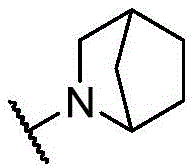
并且and

部分的例子是Part of the example is

“杂脂环族”意指这样的脂环族部分,其中在其至少一个环中,至多三个(优选地1至2个)碳已经被独立地选自N、O或S的杂原子替代,其中N和S任选地可以被氧化并且N任选地可以被季铵化。优选的脂环族部分由一个大小为5至6元的环组成。类似地,“杂环烷基”、“杂环烯基”和“杂环炔基”分别意指其至少一个环已经被如此修饰的环烷基、环烯基或环炔基部分。示例性杂脂环族部分包括氮杂环丙烷基、氮杂环丁烷基、1,3-二噁烷基、氧杂环丁烷基、四氢呋喃基、吡咯烷基、哌啶基、哌嗪基、四氢吡喃基、四氢噻喃基、四氢噻喃基砜、吗啉基、硫代吗啉基、硫代吗啉基亚砜、硫代吗啉基砜、1,3-二氧戊环基、四氢-1,1-二氧代噻吩基、1,4-二噁烷基、硫杂环丁烷基等。“杂环亚烷基”意指杂环烷基的二价对应物。"Heteroalicyclic" means a cycloaliphatic moiety wherein in at least one of its rings up to three (preferably 1 to 2) carbons have been replaced by heteroatoms independently selected from N, O or S , where N and S can optionally be oxidized and N can optionally be quaternized. Preferred cycloaliphatic moieties consist of a ring of 5 to 6 members in size. Similarly, "heterocycloalkyl," "heterocycloalkenyl," and "heterocycloalkynyl," respectively, mean a cycloalkyl, cycloalkenyl, or cycloalkynyl moiety, respectively, of which at least one ring has been so modified. Exemplary heteroalicyclic moieties include aziridine, azetidinyl, 1,3-dioxanyl, oxetanyl, tetrahydrofuranyl, pyrrolidinyl, piperidinyl, piperazine base, tetrahydropyranyl, tetrahydrothiopyranyl, tetrahydrothiopyranyl sulfone, morpholinyl, thiomorpholinyl, thiomorpholinyl sulfoxide, thiomorpholinyl sulfone, 1,3- Dioxolane, tetrahydro-1,1-dioxothienyl, 1,4-dioxanyl, thietanyl and the like. "Heterocycloalkylene" means the divalent counterpart of a heterocycloalkyl.
“烷氧基”、“芳氧基”、“烷硫基”和“芳硫基”分别意指-O(烷基)、-O(芳基)、-S(烷基)和-S(芳基)。例子分别是甲氧基、苯氧基、甲硫基和苯硫基。"Alkoxy", "aryloxy", "alkylthio" and "arylthio" mean -O(alkyl), -O(aryl), -S(alkyl) and -S(, respectively Aryl). Examples are methoxy, phenoxy, methylthio and phenylthio, respectively.
除非指示较窄的含义,否则“卤素”或“卤代”意指氟、氯、溴或碘。"Halogen" or "halo" means fluorine, chlorine, bromine or iodine unless a narrower meaning is indicated.
“芳基”意指具有单、双或三环环系统(优选地单环)的烃部分,其中每个环具有从3至7个碳原子,并且至少一个环是芳族的。环系统中的环可以彼此稠合(如在萘基中)或彼此键合(如在联苯基中),并且可以与非芳族环稠合或键合(如在茚满基或环己基苯基中)。通过进一步说明的方式,芳基部分包括但不限于苯基、萘基、四氢萘基、茚满基、联苯基、菲基、蒽基和苊基。“亚芳基”意指芳基的二价对应物,例如1,2-亚苯基、1,3-亚苯基或1,4-亚苯基。"Aryl" means a hydrocarbon moiety having a mono-, bi- or tricyclic ring system (preferably monocyclic), wherein each ring has from 3 to 7 carbon atoms, and at least one ring is aromatic. The rings in the ring system can be fused to each other (as in naphthyl) or bonded to each other (as in biphenyl), and can be fused or bonded to non-aromatic rings (as in indanyl or cyclohexyl) phenyl). By way of further illustration, aryl moieties include, but are not limited to, phenyl, naphthyl, tetrahydronaphthyl, indanyl, biphenyl, phenanthrenyl, anthracenyl, and acenaphthyl. "Arylene" means the divalent counterpart of an aryl group, such as 1,2-phenylene, 1,3-phenylene, or 1,4-phenylene.
“杂芳基”意指具有单、双或三环环系统(优选5至7元单环)的部分,其中每个环具有从3至7个碳原子,并且至少一个环是含有从1至4个独立地选自N、O或S的杂原子的芳族环,其中N和S任选地可以被氧化并且N任选地可以被季铵化。这样的至少一个含有杂原子的芳族环可以与其他类型的环稠合(如在苯并呋喃基或四氢异喹啉基中),或者与其他类型的环直接键合(如在苯基吡啶基或2-环戊基吡啶基中)。通过进一步说明的方式,杂芳基部分包括吡咯基、呋喃基、噻吩基(thiophenyl/thienyl)、咪唑基、吡唑基、噁唑基、异噁唑基、噻唑基、异噻唑基、三唑基、四唑基、吡啶基、N-氧代吡啶基、哒嗪基、嘧啶基、吡嗪基、喹啉基、异喹啉炔基(isoquinolynyl)、喹唑啉基、噌啉基、喹唑啉基(quinozalinyl)、萘啶基、苯并呋喃基、吲哚基、苯并噻吩基、噁二唑基、噻二唑基、吩噻唑基(phenothiazolyl)、苯并咪唑基、苯并三唑基、二苯并呋喃基、咔唑基、二苯并噻吩基、吖啶基等。“杂亚芳基”意指杂芳基的二价对应物。"Heteroaryl" means a moiety having a mono-, bi-, or tricyclic ring system (preferably a 5- to 7-membered monocyclic ring) wherein each ring has from 3 to 7 carbon atoms, and at least one ring is containing from 1 to 7 carbon atoms 4 aromatic rings of heteroatoms independently selected from N, O or S, wherein N and S optionally can be oxidized and N can optionally be quaternized. Such at least one heteroatom-containing aromatic ring may be fused to other types of rings (as in benzofuranyl or tetrahydroisoquinolinyl), or directly bonded to other types of rings (as in phenyl pyridyl or 2-cyclopentylpyridyl). By way of further illustration, heteroaryl moieties include pyrrolyl, furyl, thiophenyl/thienyl, imidazolyl, pyrazolyl, oxazolyl, isoxazolyl, thiazolyl, isothiazolyl, triazole base, tetrazolyl, pyridyl, N-oxopyridyl, pyridazinyl, pyrimidinyl, pyrazinyl, quinolinyl, isoquinolynyl, quinazolinyl, cinnolinyl, quinoline quinozalinyl, naphthyridinyl, benzofuranyl, indolyl, benzothienyl, oxadiazolyl, thiadiazolyl, phenothiazolyl, benzimidazolyl, benzotriyl azolyl, dibenzofuranyl, carbazolyl, dibenzothienyl, acridine and the like. "Heteroarylene" means the divalent counterpart of a heteroaryl group.
在指示部分可以被取代(诸如通过使用如在“未经取代或经取代的C1-C5烷基”或“任选经取代的杂芳基”中的短语“未经取代或经取代的”或“任选经取代的”)的情况下,这样的部分可以具有一个或多个独立选择的取代基,优选地数量为1至5、更优选地数量为1或2。考虑到取代基所附接的部分,本领域普通技术人员可以选择取代基和取代模式,以提供化学稳定的并且可以通过本领域已知的技术以及本文列出的方法合成的化合物。在部分被鉴定为“未经取代或经取代的”或“任选经取代的”的情况下,在一个优选实施方案中,这样的部分是未经取代的。Indicates that the moiety may be substituted (such as by using the phrase "unsubstituted or substituted C1-C5 alkyl" as in "unsubstituted or substituted C1 - C5 alkyl" or "optionally substituted heteroaryl"" or "optionally substituted"), such moieties may have one or more independently selected substituents, preferably 1 to 5 in number, more preferably 1 or 2 in number. Considering the moiety to which the substituents are attached, one of ordinary skill in the art can select substituents and substitution patterns to provide compounds that are chemically stable and that can be synthesized by techniques known in the art and the methods set forth herein. Where a moiety is identified as "unsubstituted or substituted" or "optionally substituted", in a preferred embodiment, such moiety is unsubstituted.
“芳基烷基”、“(杂脂环族)烷基”、“芳基烯基”、“芳基炔基”、“联芳基烷基”等意指被芳基、杂脂环族、联芳基等部分(视情况而定)取代的烷基、烯基或炔基部分(视情况而定),其中开放的(未满足的)化合价在烷基、烯基或炔基部分处,例如如在苄基、苯乙基、N-咪唑基乙基、N-吗啉代乙基等中。相反,“烷基芳基”、“烯基环烷基”等意指被烷基、烯基等部分(视情况而定)取代的芳基、环烷基等部分(视情况而定),例如如在甲基苯基(甲苯基)或烯丙基环己基中。“羟基烷基”、“卤代烷基”、“烷基芳基”、“氰基芳基”等意指被一个或多个鉴定的取代基(羟基、卤代等,视情况而定)取代的烷基、芳基等部分(视情况而定)。"Arylalkyl", "(heteroalicyclic)alkyl," "arylalkenyl", "arylalkynyl", "biarylalkyl" and the like mean a group consisting of aryl, heteroalicyclic , biaryl and other moieties (as the case may be) substituted alkyl, alkenyl or alkynyl moieties (as the case may be) where the open (unsatisfied) valence is at the alkyl, alkenyl or alkynyl moiety , for example as in benzyl, phenethyl, N-imidazolylethyl, N-morpholinoethyl and the like. In contrast, "alkylaryl", "alkenylcycloalkyl" and the like mean an aryl, cycloalkyl, etc. moiety (as the case may be) substituted with an alkyl, alkenyl, etc. moiety (as the case may be), For example as in methylphenyl (tolyl) or allylcyclohexyl. "Hydroxyalkyl," "haloalkyl," "alkylaryl," "cyanoaryl," and the like mean substituted with one or more of the identified substituents (hydroxy, halo, etc., as the case may be). Alkyl, aryl, etc. moieties (as the case may be).
例如,允许的取代基包括但不限于烷基(尤其是甲基或乙基)、烯基(尤其是烯丙基)、炔基、芳基、杂芳基、脂环族、杂脂环族、卤代(尤其是氟)、卤代烷基(尤其是三氟甲基)、羟基、羟基烷基(尤其是羟基乙基)、氰基、硝基、烷氧基、-O(羟基烷基)、-O(卤代烷基)(尤其是-OCF3)、-O(环烷基)、-O(杂环烷基)、-O(芳基)、烷硫基、芳硫基、=O、=NH、=N(烷基)、=NOH、=NO(烷基)、-C(=O)(烷基)、-C(=O)H、-CO2H、-C(=O)NHOH、-C(=O)O(烷基)、-C(=O)O(羟基烷基)、-C(=O)NH2、-C(=O)NH(烷基)、-C(=O)N(烷基)2、-OC(=O)(烷基)、-OC(=O)(羟基烷基)、-OC(=O)O(烷基)、-OC(=O)O(羟基烷基)、-OC(=O)NH2、-OC(=O)NH(烷基)、-OC(=O)N(烷基)2、叠氮基、-NH2、-NH(烷基)、-N(烷基)2、-NH(芳基)、-NH(羟基烷基)、-NHC(=O)(烷基)、-NHC(=O)H、-NHC(=O)NH2、-NHC(=O)NH(烷基)、-NHC(=O)N(烷基)2、-NHC(=NH)NH2、-OSO2(烷基)、-SH、-S(烷基)、-S(芳基)、-S(环烷基)、-S(=O)烷基、-SO2(烷基)、-SO2NH2、-SO2NH(烷基)、-SO2N(烷基)2等。For example, permissible substituents include, but are not limited to, alkyl (especially methyl or ethyl), alkenyl (especially allyl), alkynyl, aryl, heteroaryl, cycloaliphatic, heterocycloaliphatic , halo (especially fluorine), haloalkyl (especially trifluoromethyl), hydroxy, hydroxyalkyl (especially hydroxyethyl), cyano, nitro, alkoxy, -O (hydroxyalkyl) , -O(haloalkyl) (especially -OCF 3 ), -O(cycloalkyl), -O(heterocycloalkyl), -O(aryl), alkylthio, arylthio, =O, =NH, =N(alkyl), =NOH, =NO(alkyl), -C(=O)(alkyl), -C(=O)H, -CO 2 H, -C(=O) NHOH, -C(=O)O(alkyl), -C(=O)O(hydroxyalkyl), -C(=O)NH 2 , -C(=O)NH(alkyl), -C (=O)N(alkyl) 2 , -OC(=O)(alkyl), -OC(=O)(hydroxyalkyl), -OC(=O)O(alkyl), -OC(= O)O(hydroxyalkyl), -OC(=O) NH2 , -OC(=O)NH(alkyl), -OC(=O)N(alkyl) 2 , azido, -NH2 , -NH(alkyl), -N(alkyl) 2 , -NH(aryl), -NH(hydroxyalkyl), -NHC(=O)(alkyl), -NHC(=O)H, -NHC(=O)NH 2 , -NHC(=O)NH(alkyl), -NHC(=O)N(alkyl) 2 , -NHC(=NH)NH 2 , -OSO 2 (alkyl) , -SH, -S(alkyl), -S(aryl), -S(cycloalkyl), -S(=O)alkyl, -SO 2 (alkyl), -SO 2 NH 2 , - SO2NH(alkyl), -SO2N (alkyl )2 , etc.
在被取代的部分是脂族部分的情况下,优选的取代基是芳基、杂芳基、脂环族、杂脂环族、卤代、羟基、氰基、硝基、烷氧基、-O(羟基烷基)、-O(卤代烷基)、-O(环烷基)、-O(杂环烷基)、-O(芳基)、烷硫基、芳硫基、=O、=NH、=N(烷基)、=NOH、=NO(烷基)、-CO2H、-C(=O)NHOH、-C(=O)O(烷基)、-C(=O)O(羟基烷基)、-C(=O)NH2、-C(=O)NH(烷基)、-C(=O)N(烷基)2、-OC(=O)(烷基)、-OC(=O)(羟基烷基)、-OC(=O)O(烷基)、-OC(=O)O(羟基烷基)、-OC(=O)NH2、-OC(=O)NH(烷基)、-OC(=O)N(烷基)2、叠氮基、-NH2、-NH(烷基)、-N(烷基)2、-NH(芳基)、-NH(羟基烷基)、-NHC(=O)(烷基)、-NHC(=O)H、-NHC(=O)NH2、-NHC(=O)NH(烷基)、-NHC(=O)N(烷基)2、-NHC(=NH)NH2、-OSO2(烷基)、-SH、-S(烷基)、-S(芳基)、-S(=O)烷基、-S(环烷基)、-SO2(烷基)、-SO2NH2、-SO2NH(烷基)和-SO2N(烷基)2。更优选的取代基是卤代、羟基、氰基、硝基、烷氧基、-O(芳基)、=O、=NOH、=NO(烷基)、-OC(=O)(烷基)、-OC(=O)O(烷基)、-OC(=O)NH2、-OC(=O)NH(烷基)、-OC(=O)N(烷基)2、叠氮基、-NH2、-NH(烷基)、-N(烷基)2、-NH(芳基)、-NHC(=O)(烷基)、-NHC(=O)H、-NHC(=O)NH2、-NHC(=O)NH(烷基)、-NHC(=O)N(烷基)2和-NHC(=NH)NH2。尤其优选的是苯基、氰基、卤代、羟基、硝基、C1-C4烷氧基、O(C2-C4烷二基)OH和O(C2-C4烷二基)卤代。Where the substituted moiety is an aliphatic moiety, the preferred substituents are aryl, heteroaryl, cycloaliphatic, heterocycloaliphatic, halo, hydroxy, cyano, nitro, alkoxy, - O(hydroxyalkyl), -O(haloalkyl), -O(cycloalkyl), -O(heterocycloalkyl), -O(aryl), alkylthio, arylthio, =O, = NH, =N(alkyl), =NOH, =NO(alkyl), -CO 2 H, -C(=O)NHOH, -C(=O)O(alkyl), -C(=O) O(hydroxyalkyl), -C(=O)NH 2 , -C(=O)NH(alkyl), -C(=O)N(alkyl) 2 , -OC(=O)(alkyl ), -OC(=O)(hydroxyalkyl), -OC(=O)O(alkyl), -OC(=O)O(hydroxyalkyl), -OC(=O)NH 2 , -OC (=O)NH(alkyl), -OC(=O)N(alkyl) 2 , azido, -NH2 , -NH(alkyl), -N(alkyl) 2 , -NH(aryl) base), -NH(hydroxyalkyl), -NHC(=O)(alkyl), -NHC(=O)H, -NHC(=O)NH 2 , -NHC(=O)NH(alkyl) , -NHC(=O)N(alkyl) 2 , -NHC(=NH)NH 2 , -OSO 2 (alkyl), -SH, -S(alkyl), -S(aryl), -S (=O) alkyl, -S(cycloalkyl), -SO2 (alkyl), -SO2NH2 , -SO2NH (alkyl) and -SO2N (alkyl )2 . More preferred substituents are halo, hydroxy, cyano, nitro, alkoxy, -O(aryl), =O, =NOH, =NO(alkyl), -OC(=O)(alkyl) ), -OC(=O)O(alkyl), -OC(=O)NH 2 , -OC(=O)NH(alkyl), -OC(=O)N(alkyl) 2 , azide group, -NH 2 , -NH(alkyl), -N(alkyl) 2 , -NH(aryl), -NHC(=O)(alkyl), -NHC(=O)H, -NHC( =O) NH2 , -NHC(=O)NH(alkyl), -NHC(=O)N(alkyl) 2 and -NHC(=NH) NH2 . Especially preferred are phenyl, cyano, halo, hydroxy, nitro, C1 - C4alkoxy , O(C2 - C4alkanediyl )OH and O(C2 - C4alkanediyl ) halogenated.
在被取代的部分是脂环族、杂脂环族、芳基或杂芳基部分的情况下,优选的取代基是烷基、烯基、炔基、卤代、卤代烷基、羟基、羟基烷基、氰基、硝基、烷氧基、-O(羟基烷基)、-O(卤代烷基)、-O(芳基)、-O(环烷基)、-O(杂环烷基)、烷硫基、芳硫基、-C(=O)(烷基)、-C(=O)H、-CO2H、-C(=O)NHOH、-C(=O)O(烷基)、-C(=O)O(羟基烷基)、-C(=O)NH2、-C(=O)NH(烷基)、-C(=O)N(烷基)2、-OC(=O)(烷基)、-OC(=O)(羟基烷基)、-OC(=O)O(烷基)、-OC(=O)O(羟基烷基)、-OC(=O)NH2、-OC(=O)NH(烷基)、-OC(=O)N(烷基)2、叠氮基、-NH2、-NH(烷基)、-N(烷基)2、-NH(芳基)、-NH(羟基烷基)、-NHC(=O)(烷基)、-NHC(=O)H、-NHC(=O)NH2、-NHC(=O)NH(烷基)、-NHC(=O)N(烷基)2、-NHC(=NH)NH2、-OSO2(烷基)、-SH、-S(烷基)、-S(芳基)、-S(环烷基)、-S(=O)烷基、-SO2(烷基)、-SO2NH2、-SO2NH(烷基)和-SO2N(烷基)2。更优选的取代基是烷基、烯基、卤代、卤代烷基、羟基、羟基烷基、氰基、硝基、烷氧基、-O(羟基烷基)、-C(=O)(烷基)、-C(=O)H、-CO2H、-C(=O)NHOH、-C(=O)O(烷基)、-C(=O)O(羟基烷基)、-C(=O)NH2、-C(=O)NH(烷基)、-C(=O)N(烷基)2、-OC(=O)(烷基)、-OC(=O)(羟基烷基)、-OC(=O)O(烷基)、-OC(=O)O(羟基烷基)、-OC(=O)NH2、-OC(=O)NH(烷基)、-OC(=O)N(烷基)2、-NH2、-NH(烷基)、-N(烷基)2、-NH(芳基)、-NHC(=O)(烷基)、-NHC(=O)H、-NHC(=O)NH2、-NHC(=O)NH(烷基)、-NHC(=O)N(烷基)2和-NHC(=NH)NH2。尤其优选的是C1-C4烷基、氰基、硝基、卤代和C1-C4烷氧基。Where the substituted moiety is a cycloaliphatic, heterocycloaliphatic, aryl or heteroaryl moiety, the preferred substituents are alkyl, alkenyl, alkynyl, halo, haloalkyl, hydroxy, hydroxyalkane group, cyano group, nitro group, alkoxy group, -O(hydroxyalkyl), -O(haloalkyl), -O(aryl), -O(cycloalkyl), -O(heterocycloalkyl) , alkylthio, arylthio, -C(=O)(alkyl), -C(=O)H, -CO 2 H, -C(=O)NHOH, -C(=O)O(alkane base), -C(=O)O(hydroxyalkyl), -C(=O)NH 2 , -C(=O)NH(alkyl), -C(=O)N(alkyl) 2 , -OC(=O)(alkyl), -OC(=O)(hydroxyalkyl), -OC(=O)O(alkyl), -OC(=O)O(hydroxyalkyl), -OC (=O)NH 2 , -OC(=O)NH(alkyl), -OC(=O)N(alkyl) 2 , azido, -NH 2 , -NH(alkyl), -N( alkyl) 2 , -NH(aryl), -NH(hydroxyalkyl), -NHC(=O)(alkyl), -NHC(=O)H, -NHC(=O)NH 2 , -NHC (=O)NH(alkyl), -NHC(=O)N(alkyl) 2 , -NHC(=NH)NH 2 , -OSO 2 (alkyl), -SH, -S(alkyl), -S(aryl), -S(cycloalkyl), -S(=O)alkyl, -SO2 (alkyl), -SO2NH2 , -SO2NH ( alkyl) and -SO2 N(alkyl) 2 . More preferred substituents are alkyl, alkenyl, halo, haloalkyl, hydroxy, hydroxyalkyl, cyano, nitro, alkoxy, -O(hydroxyalkyl), -C(=O)(alk base), -C(=O)H, -CO 2 H, -C(=O)NHOH, -C(=O)O(alkyl), -C(=O)O(hydroxyalkyl), - C(=O)NH 2 , -C(=O)NH(alkyl), -C(=O)N(alkyl) 2 , -OC(=O)(alkyl), -OC(=O) (hydroxyalkyl), -OC(=O)O(alkyl), -OC(=O)O(hydroxyalkyl), -OC(=O)NH 2 , -OC(=O)NH(alkyl) ), -OC(=O)N(alkyl) 2 , -NH 2 , -NH(alkyl), -N(alkyl) 2 , -NH(aryl), -NHC(=O)(alkyl ), -NHC(=O)H, -NHC(=O) NH2 , -NHC(=O)NH(alkyl), -NHC(=O)N(alkyl) 2 and -NHC(=NH) NH2 . Especially preferred are C1 - C4alkyl, cyano, nitro, halo and C1 - C4alkoxy .
在陈述范围的情况下,如在“C1-C5烷基”或“5%至10%”中,这样的范围包括所述范围的端点,如在第一个实例中的C1和C5以及在第二个实例中的5%和10%。Where ranges are stated, as in " C1 - C5 alkyl" or "5% to 10%", such ranges include the endpoints of the range, as in the first example C1 and C 5 and 5% and 10% in the second example.
除非具体指示特定的立体异构体(例如,通过在结构式中的相关立体中心处的加粗或加虚线的键,通过在结构式中将双键描绘为具有E或Z构型,或通过使用立体化学指定的命名法或符号),否则作为纯化合物及其混合物的所有立体异构体都包括在本发明的范围内。除非另外指示,否则外消旋体、单独的对映体(不论是光学纯的还是部分拆分的)、非对映体、几何异构体及其组合和混合物都被本发明涵盖。Unless a specific stereoisomer is specifically indicated (eg, by a bold or dashed bond at the center of the relevant stereotype in the formula, by depicting a double bond in the formula as having the E or Z configuration, or by using a stereo chemically assigned nomenclature or symbols), otherwise all stereoisomers as pure compounds and mixtures thereof are included within the scope of the present invention. Unless otherwise indicated, racemates, individual enantiomers (whether optically pure or partially resolved), diastereomers, geometric isomers, and combinations and mixtures thereof are all encompassed by the present invention.
本领域技术人员应理解,化合物可以具有互变异构体形式(例如,酮和烯醇形式)、共振形式和两性离子形式,所述形式等效于在本文使用的结构式中描绘的那些,并且所述结构式涵盖此类互变异构体形式、共振形式或两性离子形式。It will be understood by those skilled in the art that compounds may have tautomeric forms (eg, keto and enol forms), resonance forms, and zwitterionic forms equivalent to those depicted in the structural formulae used herein, and The structural formula encompasses such tautomeric, resonance or zwitterionic forms.
“药学上可接受的酯”意指在体内(例如在人体中)水解产生母体化合物或其盐或者本身具有与母体化合物类似的活性的酯。合适的酯包括C1-C5烷基、C2-C5烯基或C2-C5炔基酯,尤其是甲基、乙基或正丙基酯。"Pharmaceutically acceptable ester" means an ester that is hydrolyzed in vivo (eg, in the human body) to yield the parent compound or a salt thereof, or which itself possesses activity similar to the parent compound. Suitable esters include C1 - C5 alkyl, C2 - C5 alkenyl or C2 - C5 alkynyl esters, especially methyl, ethyl or n-propyl esters.
“药学上可接受的盐”意指适用于药物配制品的化合物的盐。在化合物具有一个或多个碱性基团的情况下,所述盐可以是酸加成盐,诸如硫酸盐、氢溴酸盐、酒石酸盐、甲磺酸盐、马来酸盐、柠檬酸盐、磷酸盐、乙酸盐、双羟萘酸盐(恩波酸盐(embonate))、氢碘酸盐、硝酸盐、盐酸盐、乳酸盐、甲基硫酸盐、富马酸盐、苯甲酸盐、琥珀酸盐、甲磺酸盐、乳糖醛酸盐、辛二酸盐、甲苯磺酸盐等。在化合物具有一个或多个酸性基团的情况下,所述盐可以是诸如以下的盐:钙盐、钾盐、镁盐、葡甲胺盐、铵盐、锌盐、哌嗪盐、氨丁三醇盐、锂盐、胆碱盐、二乙胺盐、4-苯基环己胺盐、苯乍生盐、钠盐、四甲基铵盐等。多晶型结晶形式和溶剂化物也涵盖在本发明的范围内。"Pharmaceutically acceptable salt" means a salt of a compound suitable for use in pharmaceutical formulations. Where the compound has one or more basic groups, the salt may be an acid addition salt such as sulfate, hydrobromide, tartrate, mesylate, maleate, citrate , Phosphate, Acetate, Pamoate (Embonate), Hydroiodide, Nitrate, Hydrochloride, Lactate, Methyl Sulfate, Fumarate, Benzene Formate, succinate, mesylate, lacturonate, suberate, tosylate, etc. Where the compound has one or more acidic groups, the salt may be a salt such as calcium, potassium, magnesium, meglumine, ammonium, zinc, piperazine, butane Trialkoxides, lithium salts, choline salts, diethylamine salts, 4-phenylcyclohexylamine salts, benzoic salts, sodium salts, tetramethylammonium salts, and the like. Polymorphic crystalline forms and solvates are also encompassed within the scope of the present invention.
“受试者”是指动物,包括但不限于灵长类动物(例如,人)、猴、牛、猪、绵羊、山羊、马、狗、猫、兔、大鼠或小鼠。关于例如哺乳动物受试者(诸如人)的术语“受试者”和“患者”在本文中可互换地使用。"Subject" refers to an animal, including, but not limited to, primates (eg, humans), monkeys, cows, pigs, sheep, goats, horses, dogs, cats, rabbits, rats, or mice. The terms "subject" and "patient" are used interchangeably herein with respect to, eg, a mammalian subject such as a human.
在治疗疾病或障碍的上下文中,术语“治疗”(“treat”、“treating”和“treatment”)意在包括减轻或消除障碍、疾病或病症,或与障碍、疾病或病症相关的一种或多种症状;或减慢障碍、疾病或病症或其一种或多种症状的进展、扩散或恶化。“癌症的治疗”是指以下作用中的一种或多种:(1)在一定程度上抑制肿瘤生长,包括(i)减慢和(ii)完全阻止生长;(2)减少肿瘤细胞的数量;(3)维持肿瘤大小;(4)减小肿瘤大小;(5)抑制,包括(i)减少、(ii)减慢或(iii)完全防止肿瘤细胞浸润到外周器官中;(6)抑制,包括(i)减少、(ii)减慢或(iii)完全防止转移;(7)增强抗肿瘤免疫应答,这可以导致(i)维持肿瘤大小、(ii)减小肿瘤大小、(iii)减慢肿瘤生长、(iv)减少、减慢或防止侵袭和/或(8)在一定程度上缓解与障碍相关的一种或多种症状的严重程度或数量。In the context of treating a disease or disorder, the terms "treat" ("treat", "treating" and "treatment") are intended to include alleviation or elimination of the disorder, disease or condition, or one or more associated with the disorder, disease or condition. symptoms; or slow the progression, spread or worsening of a disorder, disease or condition or one or more symptoms thereof. "Treatment of cancer" refers to one or more of the following effects: (1) inhibiting tumor growth to some extent, including (i) slowing and (ii) completely arresting growth; (2) reducing the number of tumor cells (3) maintenance of tumor size; (4) reduction of tumor size; (5) inhibition, including (i) reduction, (ii) slowing down, or (iii) complete prevention of tumor cell infiltration into peripheral organs; (6) inhibition , including (i) reduction, (ii) slowing down, or (iii) complete prevention of metastasis; (7) enhancement of anti-tumor immune responses, which can lead to (i) maintenance of tumor size, (ii) reduction of tumor size, (iii) Slowing tumor growth, (iv) reducing, slowing or preventing invasion and/or (8) alleviating to some extent the severity or number of one or more symptoms associated with the disorder.
在本说明书的式中,横向于键的波浪线
在式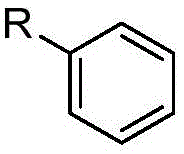


在本说明书的式中,在其两个碳之间横穿芳族环的键意指附接至所述键的基团可以位于所述芳族环的任何位置,所述任何位置是通过除去隐含地在那里(或明确地在那里,如果画出来的话)的氢而变得可用的。作为说明,式In the formulas of this specification, a bond across an aromatic ring between its two carbons means that the group attached to the bond may be located anywhere on the aromatic ring by removing the The hydrogen becomes available implicitly there (or explicitly there, if drawn). As an illustration, the formula


在其他说明中,Among other notes,


并且and


本公开文本包括在本文描述的化合物中出现的原子的所有同位素。同位素包括原子数相同但质量数不同的那些原子。通过一般举例而非限制的方式,氢的同位素包括氘和氚。碳的同位素包括13C和14C。本发明的同位素标记的化合物通常可以通过本领域技术人员已知的常规技术或通过与本文所述的那些类似的方法使用适当的同位素标记的试剂代替原本采用的未标记的试剂来制备。通过举例的方式,C1-C3烷基可以是未氘化的、部分氘化的或完全氘化的,并且“CH3”包括CH3、13CH3、14CH3、CH2T、CH2D、CHD2、CD3等。在一个实施方案中,化合物中的各种元素以其天然同位素丰度存在。This disclosure includes all isotopes of atoms occurring in the compounds described herein. Isotopes include those atoms with the same atomic number but different mass numbers. By way of general example and not limitation, isotopes of hydrogen include deuterium and tritium. Isotopes of carbon include13C and14C . Isotopically-labeled compounds of the present invention can generally be prepared by conventional techniques known to those skilled in the art or by methods analogous to those described herein, using an appropriate isotopically-labeled reagent in place of the unlabeled reagent otherwise employed. By way of example, a C1 - C3 alkyl group may be undeuterated , partially deuterated, or fully deuterated , and " CH3 " includes CH3 , 13CH3 , 14CH3 , CH2T , CH2D , CHD2 , CD3 , etc. In one embodiment, the various elements in the compound are present in their natural isotopic abundance.
本领域技术人员应理解,某些结构可以绘制呈一种互变异构体形式或另一种互变异构体形式,例如酮与烯醇,并且这两种形式是等效的。It will be understood by those skilled in the art that certain structures may be drawn in one tautomeric form or another, such as ketones and enols, and that the two forms are equivalent.
首字母缩略词和缩写Acronyms and Abbreviations
这是本说明书中使用的首字母缩略词和缩写及其含义的列表。This is a list of acronyms and abbreviations used in this specification and their meanings.


参考文献references
下文提供了在本说明书中较早以缩写方式通过第一作者(或发明人)和日期引用的以下参考文献的完整引用。将这些参考文献中的每一个出于所有目的通过引用并入本文。Full citations of the following references cited earlier in this specification by first author (or inventor) and date are provided below. Each of these references is incorporated herein by reference for all purposes.
Akinbobuyi et al.,Tetrahedron Lett.2015,56,458,“Facile syntheses offunctionalized toll-like receptor 7agonists”.Akinbobuyi et al., Tetrahedron Lett. 2015, 56, 458, “Facile syntheses of functionalized toll-like receptor 7agonists”.
Akinbobuyi et al.,Bioorg.Med.Chem.Lett.2016,26,4246,“Synthesis andimmunostimulatory activity of substituted TLR7 agonists.”Akinbobuyi et al., Bioorg.Med.Chem.Lett.2016, 26, 4246, "Synthesis and immunostimulatory activity of substituted TLR7 agonists."
Barberis et al.,US 2012/0003298 A1(2012).Barberis et al., US 2012/0003298 A1 (2012).
Beesu et al.,J.Med.Chem.2017,60,2084,“Identification of High-PotencyHuman TLR8 and Dual TLR7/TLR8 Agonists in Pyrimidine-2,4-diamines.”Beesu et al., J.Med.Chem.2017,60,2084, "Identification of High-PotencyHuman TLR8 and Dual TLR7/TLR8 Agonists in Pyrimidine-2,4-diamines."

Bonfanti et al.,US 2014/0323441 A1(2015)[2015a].Bonfanti et al., US 2014/0323441 A1(2015) [2015a].
Bonfanti et al.,US 2015/0299221 A1(2015)[2015b].Bonfanti et al., US 2015/0299221 A1(2015)[2015b].
Bonfanti et al.,US 2016/0304531 A1(2016).Bonfanti et al., US 2016/0304531 A1 (2016).
Carson et al.,US 2013/0202629 A1(2013).Carson et al., US 2013/0202629 A1 (2013).
Carson et al.,US 8,729,088 B2(2014).Carson et al., US 8,729,088 B2 (2014).
Carson et al.,US 9,050,376 B2(2015).Carson et al., US 9,050,376 B2 (2015).
Carson et al.,US 2016/0199499 A1(2016).Carson et al., US 2016/0199499 A1 (2016).
Chan et al.,Bioconjugate Chem.2009,20,1194,“Synthesis andImmunological Characterization of Toll-Like Receptor 7 Agonistic Conjugates.”Chan et al., Bioconjugate Chem. 2009, 20, 1194, "Synthesis and Immunological Characterization of Toll-Like Receptor 7 Agonistic Conjugates."
Chan et al.,Bioconjugate Chem.2011,22,445,“Synthesis andCharacterization of PEGylated Toll Like Receptor 7Ligands.”Chan et al., Bioconjugate Chem. 2011, 22, 445, "Synthesis and Characterization of PEGylated Toll Like Receptor 7Ligands."
Chen et al.,US 7,919,498 B2(2011).Chen et al., US 7,919,498 B2 (2011).
Coe et al.,US 9,662,336 B2(2017).Coe et al., US 9,662,336 B2 (2017).
Cortez and Va,Medicinal Chem.Rev.2018,53,481,“Recent Advances inSmall-Molecule TLR7 Agonists for Drug Discovery”.Cortez and Va, Medicinal Chem. Rev. 2018, 53, 481, "Recent Advances in Small-Molecule TLR7 Agonists for Drug Discovery".
Cortez et al.,US 2017/0121421 A1(2017).Cortez et al., US 2017/0121421 A1 (2017).
Cortez et al.,US 9,944,649 B2(2018).Cortez et al., US 9,944,649 B2 (2018).
Dellaria et al.,WO 2007/028129 A1(2007).Dellaria et al., WO 2007/028129 A1 (2007).
Desai et al.,US 9,127,006 B2(2015).Desai et al., US 9,127,006 B2 (2015).
Ding et al.,WO 2016/107536 A1(2016).Ding et al., WO 2016/107536 A1 (2016).
Ding et al.,US 2017/0273983 A1(2017)[2017a].Ding et al., US 2017/0273983 A1(2017) [2017a].
Ding et al.,WO 2017/076346 A1(2017)[2017b].Ding et al., WO 2017/076346 A1(2017) [2017b].
Gadd et al.,Bioconjugate Chem.2015,26,1743,“Targeted Activation ofToll-Like Receptors:Conjugation of a Toll-Like Receptor 7 Agonist to aMonoclonal Antibody Maintains Antigen Binding and Specificity.”Gadd et al., Bioconjugate Chem. 2015, 26, 1743, "Targeted Activation of Toll-Like Receptors: Conjugation of a Toll-Like Receptor 7 Agonist to a Monoclonal Antibody Maintains Antigen Binding and Specificity."
Graupe et al.,US 8,993,755 B2(2015).Graupe et al., US 8,993,755 B2 (2015).
Embrechts et al.,J.Med.Chem.2018,61,6236,“2,4-Diaminoquinazolines asDual Toll Like Receptor(TLR)7/8Modulators for the Treatment of Hepatitis BVirus.”Embrechts et al., J.Med.Chem.2018,61,6236, "2,4-Diaminoquinazolines as Dual Toll Like Receptor(TLR) 7/8Modulators for the Treatment of Hepatitis BVirus."
Halcomb et al.,US 9,161,934 B2(2015).Halcomb et al., US 9,161,934 B2 (2015).
Hashimoto et al.,US 2009/0118263 A1(2009).Hashimoto et al., US 2009/0118263 A1 (2009).
He et al.,US 10,487,084 B2(2019)[2019a].He et al., US 10,487,084 B2(2019) [2019a].
He et al.,US 10,508,115 B2(2019)[2019b].He et al., US 10,508,115 B2(2019) [2019b].
Hirota et al.,US 6,028,076(2000).Hirota et al., US 6,028,076 (2000).
Holldack et al.,US 2012/0083473 A1(2012).Holldack et al., US 2012/0083473 A1 (2012).
Isobe et al.,US 6,376,501 B1(2002).Isobe et al., US 6,376,501 B1 (2002).
Isobe et al.,JP 2004137157(2004).Isobe et al., JP 2004137157 (2004).
Isobe et al.,J.Med.Chem.2006,49(6),2088,“Synthesis and BiologicalEvaluation of Novel 9-Substituted-8-Hydroxyadenine Derivatives as PotentInterferon Inducers.”Isobe et al., J.Med.Chem.2006, 49(6), 2088, "Synthesis and Biological Evaluation of Novel 9-Substituted-8-Hydroxyadenine Derivatives as PotentInterferon Inducers."
Isobe et al.,US 7,521,454 B2(2009)[2009a].Isobe et al., US 7,521,454 B2 (2009) [2009a].
Isobe et al.,US 2009/0105212 A1(2009)[2009b].Isobe et al., US 2009/0105212 A1(2009) [2009b].
Isobe et al.,US 2011/0028715 A1(2011).Isobe et al., US 2011/0028715 A1 (2011).
Isobe et al.,US 8,148,371 B2(2012).Isobe et al., US 8,148,371 B2 (2012).
Jensen et al.,WO 2015/036044 A1(2015).Jensen et al., WO 2015/036044 A1 (2015).
Jones et al.,US 7,691,877 B2(2010).Jones et al., US 7,691,877 B2 (2010).
Jones et al.,US 2012/0302598 A1(2012).Jones et al., US 2012/0302598 A1 (2012).
Kasibhatla et al.,US 7,241,890 B2(2007).Kasibhatla et al., US 7,241,890 B2 (2007).
Koga-Yamakawa et al.,Int.J.Cancer 2013,132(3),580,“Intratracheal andoral administration of SM-276001:A selective TLR7 agonist,leads to antitumorefficacy in primary and metastatic models of cancer.”Koga-Yamakawa et al., Int.J. Cancer 2013, 132(3), 580, "Intratracheal andoral administration of SM-276001: A selective TLR7 agonist, leads to antitumorefficacy in primary and metastatic models of cancer."
Li et al.,US 9,902,730 B2(2018).Li et al., US 9,902,730 B2 (2018).
Lioux et al.,US 9,295,732 B2(2016).Lioux et al., US 9,295,732 B2 (2016).
Lund et al.,Proc.Nat’l Acad.Sci(USA)2004,101(15),5598,“Recognition ofsingle-stranded RNA viruses by Toll-like receptor 7.”Lund et al., Proc. Nat'l Acad. Sci(USA) 2004, 101(15), 5598, "Recognition of single-stranded RNA viruses by Toll-like receptor 7."
Maj et al.,US 9,173,935 B2(2015).Maj et al., US 9,173,935 B2 (2015).
McGowan et al.,US 2016/0168150 A1(2016)[2016a].McGowan et al., US 2016/0168150 A1(2016) [2016a].
McGowan et al.,US 9,499,549 B2(2016)[2016b].McGowan et al., US 9,499,549 B2(2016) [2016b].
McGowan et al.,J.Med.Chem.2017,60,6137,“Identification andOptimization of Pyrrolo[3,2-d]pyrimidine Toll-like Receptor 7(TLR7)SelectiveAgonists for the Treatment of Hepatitis B.”McGowan et al., J.Med.Chem.2017,60,6137,“Identification and Optimization of Pyrrolo[3,2-d]pyrimidine Toll-like Receptor 7(TLR7)SelectiveAgonists for the Treatment of Hepatitis B.”
Musmuca et al.,J.Chem.Information&Modeling 2009,49(7),1777,“Small-Molecule Interferon Inducers.Toward the Comprehension of the MolecularDeterminants through Ligand-Based Approaches.”Musmuca et al., J. Chem. Information & Modeling 2009, 49(7), 1777, "Small-Molecule Interferon Inducers. Toward the Comprehension of the Molecular Determinants through Ligand-Based Approaches."
Nakamura et al.,Bioorg.Med.Chem.Lett.2013,13,669,“Synthesis andevaluation of 8-oxoadenine derivatives as potent Toll-like receptor agonistswith high water solubility.”Nakamura et al., Bioorg.Med.Chem.Lett.2013,13,669,“Synthesis and evaluation of 8-oxoadenine derivatives as potent Toll-like receptor agonists with high water solubility.”
Ogita et al.,US 2007/0225303 A1(2007).Ogita et al., US 2007/0225303 A1 (2007).
Ota et al.,WO 2019/124500 A1(2019).Ota et al., WO 2019/124500 A1 (2019).
Pilatte et al.,WO 2017/216293 A1(2017).Pilatte et al., WO 2017/216293 A1 (2017).
Poudel et al.,US 10,472,361 B2(2019)[2019a].Poudel et al., US 10,472,361 B2(2019) [2019a].
Poudel et al.,US 10,494,370 B2(2019)[2019b].Poudel et al., US 10,494,370 B2(2019) [2019b].
Poudel et al.,US 2020/0038403 A1(2020)[2020a].Poudel et al., US 2020/0038403 A1(2020) [2020a].
Poudel et al.,US 2020/0039986 A1(2020)[2020b].Poudel et al., US 2020/0039986 A1(2020) [2020b].
Purandare et al.,WO 2019/209811 A1(2019).Purandare et al., WO 2019/209811 A1 (2019).
Pryde,US 7,642,350 B2(2010).Pryde, US 7,642,350 B2 (2010).
Sato-Kaneko et al.,JCI Insight 2017,2,e93397,“CombinationImmunotherapy with TLR Agonists and Checkpoint Inhibitors Suppresses Head andNeck Cancer”.Sato-Kaneko et al., JCI Insight 2017, 2, e93397, "CombinationImmunotherapy with TLR Agonists and Checkpoint Inhibitors Suppresses Head and Neck Cancer".
Smits et al.,The Oncologist 2008,13,859,“The Use of TLR7 and TLR8Ligands for the Enhancement of Cancer Immunotherapy”.Smits et al., The Oncologist 2008, 13, 859, “The Use of TLR7 and TLR8 Ligands for the Enhancement of Cancer Immunotherapy”.
Vasilakos and Tomai,Expert Rev.Vaccines 2013,12,809,“The Use of Toll-like Receptor 7/8 Agonists as Vaccine Adjuvants”.Vasilakos and Tomai, Expert Rev. Vaccines 2013, 12, 809, “The Use of Toll-like Receptor 7/8 Agonists as Vaccine Adjuvants”.
Vernejoul et al.,US 2014/0141033 A1(2014).Vernejoul et al., US 2014/0141033 A1 (2014).
Young et al.,US 10,457,681B2(2019).Young et al., US 10,457,681B2 (2019).
Yu et al.,PLoS One 2013,8(3),e56514,“Toll-Like Receptor 7Agonists:Chemical Feature Based Pharmacophore Identification and Molecular DockingStudies.”Yu et al., PLoS One 2013, 8(3), e56514, "Toll-Like Receptor 7 Agonists: Chemical Feature Based Pharmacophore Identification and Molecular DockingStudies."
Zhang et al.,Immunity 2016,45,737,“Structural Analysis Reveals thatToll-like Receptor 7Is a Dual Receptor for Guanosine and Single-StrandedRNA.”Zhang et al., Immunity 2016, 45, 737, “Structural Analysis Reveals that Toll-like Receptor 7Is a Dual Receptor for Guanosine and Single-StrandedRNA.”
Zhang et al.,WO 2018/095426 A1(2018)>Zhang et al., WO 2018/095426 A1(2018)>
Zurawski et al.,US 2012/0231023 A1(2012).Zurawski et al., US 2012/0231023 A1 (2012).
前述具体实施方式包括主要或专门涉及本发明的特定部分或方面的段落。应理解,这是为了清楚和方便,特定特征可能在不只是公开它的段落中是相关的,并且本文中的公开内容包括在不同段落中找到的信息的所有适当组合。类似地,尽管本文中的各种附图和描述涉及本发明的具体实施方案,但是应当理解,在特定附图或实施方案的背景下公开了具体特征的情况下,也可以在另一个附图或实施方案的背景下、与另一个特征组合、或总体上在本发明中在适当的程度上使用此类特征。The foregoing detailed description includes paragraphs that relate primarily or exclusively to particular parts or aspects of the invention. It is to be understood that for the sake of clarity and convenience, a particular feature may be relevant in more than the paragraph disclosing it, and that the disclosure herein includes all appropriate combinations of information found in different paragraphs. Similarly, although the various drawings and descriptions herein refer to specific embodiments of the invention, it is to be understood that where a particular feature is disclosed in the context of a particular drawing or embodiment, it may also be Such features are used to the appropriate extent in the context of either an embodiment, in combination with another feature, or generally in the present invention.
此外,虽然已经根据某些优选实施方案具体描述了本发明,但本发明不限于此类优选实施方案。而是,本发明的范围由所附权利要求限定。Furthermore, although the present invention has been specifically described in terms of certain preferred embodiments, the present invention is not limited to such preferred embodiments. Rather, the scope of the invention is defined by the appended claims.
Claims (17)


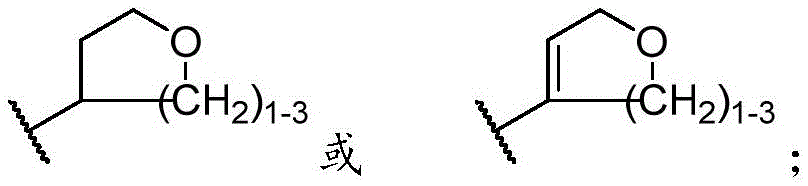


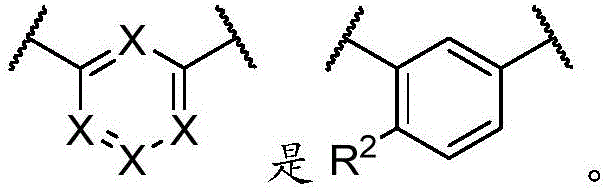


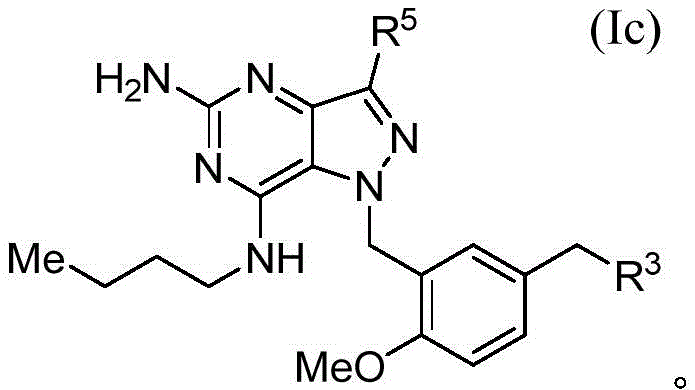


Applications Claiming Priority (5)
| Application Number | Priority Date | Filing Date | Title |
|---|---|---|---|
| US202062966085P | 2020-01-27 | 2020-01-27 | |
| US62/966,085 | 2020-01-27 | ||
| US202063057644P | 2020-07-28 | 2020-07-28 | |
| US63/057,644 | 2020-07-28 | ||
| PCT/US2021/014975 WO2021154661A1 (en) | 2020-01-27 | 2021-01-26 | 1H-PYRAZOLO[4,3-d]PYRIMIDINE COMPOUNDS AS TOLL-LIKE RECEPTOR 7 (TLR7) AGONISTS |
Publications (1)
| Publication Number | Publication Date |
|---|---|
| CN115210236A true CN115210236A (en) | 2022-10-18 |
Family
ID=74661496
Family Applications (1)
| Application Number | Title | Priority Date | Filing Date |
|---|---|---|---|
| CN202180018762.2A Pending CN115210236A (en) | 2020-01-27 | 2021-01-26 | 1H-pyrazolo [4,3-d ] pyrimidine compounds as Toll-like receptor 7 (TLR 7) agonists |
Country Status (6)
| Country | Link |
|---|---|
| US (1) | US20230118688A1 (en) |
| EP (1) | EP4097102A1 (en) |
| JP (1) | JP7712941B2 (en) |
| KR (1) | KR20220132589A (en) |
| CN (1) | CN115210236A (en) |
| WO (1) | WO2021154661A1 (en) |
Families Citing this family (2)
| Publication number | Priority date | Publication date | Assignee | Title |
|---|---|---|---|---|
| EP4097103A1 (en) * | 2020-01-27 | 2022-12-07 | Bristol-Myers Squibb Company | 1h-pyrazolo[4,3-d]pyrimidine compounds as toll-like receptor 7 (tlr7) agonists |
| EP4097105A1 (en) * | 2020-01-27 | 2022-12-07 | Bristol-Myers Squibb Company | 1h-pyrazolo[4,3-d]pyrimidine compounds as toll-like receptor 7 (tlr7) agonists |
Citations (4)
| Publication number | Priority date | Publication date | Assignee | Title |
|---|---|---|---|---|
| CN108884092A (en) * | 2016-11-28 | 2018-11-23 | 江苏恒瑞医药股份有限公司 | Pyrazolo-heteroaryl analog derivative, preparation method and its application in medicine |
| WO2019035968A1 (en) * | 2017-08-16 | 2019-02-21 | Bristol-Myers Squibb Company | 6-amino-7,9-dihydro-8h-purin-8-one derivatives as toll-like receptor 7 (tlr7) agonists as immunostimulants |
| WO2019035970A1 (en) * | 2017-08-16 | 2019-02-21 | Bristol-Myers Squibb Company | 6-amino-7,9-dihydro-8h-purin-8-one derivatives as immunostimulant toll-like receptor 7 (tlr7) agonists |
| WO2020028608A1 (en) * | 2018-08-03 | 2020-02-06 | Bristol-Myers Squibb Company | 1H-PYRAZOLO[4,3-d]PYRIMIDINE COMPOUNDS AS TOLL-LIKE RECEPTOR 7 (TLR7) AGONISTS AND METHODS AND USES THEREFOR |
Family Cites Families (54)
| Publication number | Priority date | Publication date | Assignee | Title |
|---|---|---|---|---|
| CA2230808C (en) | 1996-07-03 | 2006-08-15 | Japan Energy Corporation | A novel purine derivative |
| TW572758B (en) | 1997-12-22 | 2004-01-21 | Sumitomo Pharma | Type 2 helper T cell-selective immune response inhibitors comprising purine derivatives |
| CA2444130C (en) | 2001-04-17 | 2010-12-21 | Sumitomo Pharmaceuticals Company, Limited | Adenine derivatives |
| EP1440072A4 (en) | 2001-10-30 | 2005-02-02 | Conforma Therapeutic Corp | Purine analogs having hsp90-inhibiting activity |
| MXPA05003193A (en) | 2002-09-27 | 2005-06-08 | Sumitomo Pharma | Novel adenine compound and use thereof. |
| JP2004137157A (en) | 2002-10-16 | 2004-05-13 | Sumitomo Pharmaceut Co Ltd | Drugs containing novel adenine derivatives as active ingredients |
| US20070225303A1 (en) | 2004-03-26 | 2007-09-27 | Haruhisa Ogita | 8-Oxoadenine Compound |
| MX2007013780A (en) | 2005-05-04 | 2008-02-05 | Pfizer Ltd | 2-amido-6-amino-8-oxopurine derivatives as toll-like receptor modulators for the treatment of cancer and viral infections, such as hepatitis c. |
| CN101253173A (en) | 2005-09-02 | 2008-08-27 | 辉瑞有限公司 | Hydroxy-substituted 1H-imidazopyridines and methods |
| JPWO2007034917A1 (en) | 2005-09-22 | 2009-03-26 | 大日本住友製薬株式会社 | New adenine compounds |
| JPWO2007034817A1 (en) | 2005-09-22 | 2009-03-26 | 大日本住友製薬株式会社 | New adenine compounds |
| KR20080085232A (en) | 2006-02-17 | 2008-09-23 | 화이자 리미티드 | 3-deazapurine derivatives as TLR7 modulators |
| BRPI0708685B8 (en) | 2006-03-06 | 2021-05-25 | Japan Tobacco Inc | 4-oxoquinoline compound, its use and method of production |
| PT2510946E (en) | 2007-02-07 | 2015-11-23 | Univ California | Conjugates of synthetic tlr agonists and uses therefor |
| PE20081887A1 (en) | 2007-03-20 | 2009-01-16 | Dainippon Sumitomo Pharma Co | NEW ADENINE COMPOUND |
| AU2008231384B2 (en) | 2007-03-23 | 2011-09-15 | Amgen Inc. | Heterocyclic compounds and their use |
| TWI434849B (en) | 2007-06-29 | 2014-04-21 | Gilead Sciences Inc | Modulators of toll-like receptor 7 |
| ATE501136T1 (en) | 2007-08-03 | 2011-03-15 | Pfizer Ltd | IMIDAZOPYRIDINONE |
| SG172060A1 (en) | 2008-12-09 | 2011-07-28 | Gilead Sciences Inc | Modulators of toll-like receptors |
| EA019768B1 (en) | 2009-02-11 | 2014-06-30 | Дзе Регентс Оф Дзе Юниверсити Оф Калифорния | Compounds modulating activity of toll-like receptors |
| CN102666541B (en) | 2009-10-22 | 2015-11-25 | 吉里德科学公司 | Derivatives of purines or deazapurines for use in the treatment, especially of viral infections |
| JP2013525431A (en) | 2010-04-30 | 2013-06-20 | ザ リージェンツ オブ ザ ユニバーシティ オブ カリフォルニア | Use of phospholipid conjugates of synthetic TLR7 agonists |
| CA2797315C (en) | 2010-04-30 | 2018-09-11 | Telormedix Sa | Phospholipid drug analogs |
| EP2563401A1 (en) | 2010-04-30 | 2013-03-06 | Telormedix SA | Methods for inducing an immune response |
| US20120083473A1 (en) | 2010-09-21 | 2012-04-05 | Johanna Holldack | Treatment of conditions by toll-like receptor modulators |
| US20120231023A1 (en) | 2011-03-08 | 2012-09-13 | Baylor Research Institute | Novel Vaccine Adjuvants Based on Targeting Adjuvants to Antibodies Directly to Antigen-Presenting Cells |
| BR122019020718B1 (en) | 2011-11-09 | 2021-07-06 | Janssen Sciences Ireland Uc | PURINE DERIVATIVES FOR THE TREATMENT OF VIRAL INFECTIONS AND THE PHARMACEUTICAL COMPOSITION INCLUDING THEM |
| MX360718B (en) | 2012-07-13 | 2018-11-13 | Janssen Sciences Ireland Uc | Macrocyclic purines for the treatment of viral infections. |
| MY175676A (en) | 2012-08-24 | 2020-07-06 | Glaxosmithkline Llc | Pyrazolopyrimidine compounds |
| TR201807076T4 (en) | 2012-10-10 | 2018-06-21 | Janssen Sciences Ireland Uc | Pyrrolo [3,2-d] pyrimidine derivatives for the treatment of viral infections and other diseases. |
| EP2732825B1 (en) | 2012-11-19 | 2015-07-01 | Invivogen | Conjugates of a TLR7 and/or TLR8 agonist and a TLR2 agonist |
| US9295732B2 (en) | 2013-02-22 | 2016-03-29 | Invivogen | Conjugated TLR7 and/or TLR8 and TLR2 polycationic agonists |
| HRP20170654T1 (en) | 2013-03-29 | 2017-06-30 | Janssen Sciences Ireland Uc | Macrocyclic deaza-purinones for the treatment of viral infections |
| HRP20171720T1 (en) | 2013-06-27 | 2017-12-29 | Janssen Sciences Ireland Uc | Pyrrolo [3,2-d] pyrimidine derivatives for the treatment of viral infections and other diseases |
| US20160199499A1 (en) | 2013-08-16 | 2016-07-14 | The Regents Of The University Of California | Uses of phospholipid conjugates of synthetic tlr7 agonists |
| WO2015036044A1 (en) | 2013-09-13 | 2015-03-19 | Telormedix Sa | Cationic lipid vehicles for delivery of tlr7 agonists for specific targeting of human cd14+ monocytes in whole blood |
| ES2908150T3 (en) | 2014-05-01 | 2022-04-27 | Novartis Ag | Compounds and Compositions as Toll-like Receptor 7 Agonists |
| KR102139847B1 (en) * | 2014-05-01 | 2020-07-31 | 노파르티스 아게 | Compounds and compositions as toll-like receptor 7 agonists |
| AU2015303558B2 (en) | 2014-08-15 | 2018-07-12 | Chia Tai Tianqing Pharmaceutical Group Co., Ltd. | Pyrrolopyrimidine compounds used as TLR7 agonist |
| CN105732635A (en) | 2014-12-29 | 2016-07-06 | 南京明德新药研发股份有限公司 | Toll-like receptor 7 agonist |
| MA44334A (en) | 2015-10-29 | 2018-09-05 | Novartis Ag | ANTIBODY CONJUGATES INCLUDING A TOLL-TYPE RECEPTOR AGONIST |
| HUE052770T2 (en) | 2015-11-05 | 2021-05-28 | Chia Tai Tianqing Pharmaceutical Group Co Ltd | 7-(thiazol-5-yl) pyrrolopyrimidine compound as tlr7 agonist |
| BR112018076169A2 (en) | 2016-06-16 | 2019-03-26 | Janssen Pharmaceutica Nv | azabenzimidazole derivatives as pi3k beta inhibitors |
| US10508115B2 (en) | 2017-08-16 | 2019-12-17 | Bristol-Myers Squibb Company | Toll-like receptor 7 (TLR7) agonists having heteroatom-linked aromatic moieties, conjugates thereof, and methods and uses therefor |
| US10472361B2 (en) | 2017-08-16 | 2019-11-12 | Bristol-Myers Squibb Company | Toll-like receptor 7 (TLR7) agonists having a benzotriazole moiety, conjugates thereof, and methods and uses therefor |
| US10457681B2 (en) | 2017-08-16 | 2019-10-29 | Bristol_Myers Squibb Company | Toll-like receptor 7 (TLR7) agonists having a tricyclic moiety, conjugates thereof, and methods and uses therefor |
| RU2020124007A (en) | 2017-12-21 | 2022-01-21 | Сумитомо Дайниппон Фарма Ко., Лтд. | COMBINATION DRUG INCLUDING TLR7 AGONIST |
| WO2019209811A1 (en) | 2018-04-24 | 2019-10-31 | Bristol-Myers Squibb Company | Macrocyclic toll-like receptor 7 (tlr7) agonists |
| US20230348468A1 (en) * | 2020-01-27 | 2023-11-02 | Bristol-Myers Squibb Company | 1H-PYRAZOLO[4,3-d]PYRIMIDINE COMPOUNDS AS TOLL-LIKE RECEPTOR 7 (TLR7) AGONISTS |
| KR20220132591A (en) * | 2020-01-27 | 2022-09-30 | 브리스톨-마이어스 스큅 컴퍼니 | 1H-pyrazolo[4,3-d]pyrimidine compounds as toll-like receptor 7 (TLR7) agonists |
| EP4097106A1 (en) * | 2020-01-27 | 2022-12-07 | Bristol-Myers Squibb Company | 1h-pyrazolo[4,3-d]pyrimidine compounds as toll-like receptor 7 (tlr7) agonists |
| EP4097103A1 (en) * | 2020-01-27 | 2022-12-07 | Bristol-Myers Squibb Company | 1h-pyrazolo[4,3-d]pyrimidine compounds as toll-like receptor 7 (tlr7) agonists |
| EP4097105A1 (en) * | 2020-01-27 | 2022-12-07 | Bristol-Myers Squibb Company | 1h-pyrazolo[4,3-d]pyrimidine compounds as toll-like receptor 7 (tlr7) agonists |
| KR20220132595A (en) * | 2020-01-27 | 2022-09-30 | 브리스톨-마이어스 스큅 컴퍼니 | C3-substituted 1H-pyrazolo[4,3-d]pyrimidine compounds as toll-like receptor 7 (TLR7) agonists |
-
2021
- 2021-01-26 CN CN202180018762.2A patent/CN115210236A/en active Pending
- 2021-01-26 JP JP2022545789A patent/JP7712941B2/en active Active
- 2021-01-26 US US17/792,869 patent/US20230118688A1/en not_active Abandoned
- 2021-01-26 KR KR1020227029267A patent/KR20220132589A/en not_active Ceased
- 2021-01-26 WO PCT/US2021/014975 patent/WO2021154661A1/en not_active Ceased
- 2021-01-26 EP EP21706111.8A patent/EP4097102A1/en not_active Withdrawn
Patent Citations (4)
| Publication number | Priority date | Publication date | Assignee | Title |
|---|---|---|---|---|
| CN108884092A (en) * | 2016-11-28 | 2018-11-23 | 江苏恒瑞医药股份有限公司 | Pyrazolo-heteroaryl analog derivative, preparation method and its application in medicine |
| WO2019035968A1 (en) * | 2017-08-16 | 2019-02-21 | Bristol-Myers Squibb Company | 6-amino-7,9-dihydro-8h-purin-8-one derivatives as toll-like receptor 7 (tlr7) agonists as immunostimulants |
| WO2019035970A1 (en) * | 2017-08-16 | 2019-02-21 | Bristol-Myers Squibb Company | 6-amino-7,9-dihydro-8h-purin-8-one derivatives as immunostimulant toll-like receptor 7 (tlr7) agonists |
| WO2020028608A1 (en) * | 2018-08-03 | 2020-02-06 | Bristol-Myers Squibb Company | 1H-PYRAZOLO[4,3-d]PYRIMIDINE COMPOUNDS AS TOLL-LIKE RECEPTOR 7 (TLR7) AGONISTS AND METHODS AND USES THEREFOR |
Also Published As
| Publication number | Publication date |
|---|---|
| JP7712941B2 (en) | 2025-07-24 |
| WO2021154661A1 (en) | 2021-08-05 |
| JP2023512205A (en) | 2023-03-24 |
| KR20220132589A (en) | 2022-09-30 |
| US20230118688A1 (en) | 2023-04-20 |
| EP4097102A1 (en) | 2022-12-07 |
Similar Documents
| Publication | Publication Date | Title |
|---|---|---|
| KR20220132601A (en) | 1H-pyrazolo[4,3-d]pyrimidine compounds as toll-like receptor 7 (TLR7) agonists | |
| JP2023512206A (en) | 1H-pyrazolo[4,3-d]pyrimidine compounds as Toll-like receptor 7 (TLR7) agonists | |
| CN115643805B (en) | 1H-pyrazolo [4,3-d ] pyrimidine compounds as Toll-like receptor 7 (TLR 7) agonists | |
| JP7698653B2 (en) | 1H-Pyrazolo[4,3-d]pyrimidine compounds as toll-like receptor 7 (TLR7) agonists | |
| JP7684316B2 (en) | 1H-Pyrazolo[4,3-d]pyrimidine compounds as toll-like receptor 7 (TLR7) agonists | |
| CN115151546A (en) | C3-substituted 1H-pyrazolo[4,3-d]pyrimidine compounds as Toll-like receptor 7 (TLR7) agonists | |
| CN115210236A (en) | 1H-pyrazolo [4,3-d ] pyrimidine compounds as Toll-like receptor 7 (TLR 7) agonists | |
| CN115135655B (en) | 1H-pyrazolo [4,3-d ] pyrimidine compounds as Toll-like receptor 7 (TLR 7) agonists | |
| CN115279765B (en) | 1H-pyrazolo[4,3-d]pyrimidine compounds as Toll-like receptor 7 (TLR7) agonists |
Legal Events
| Date | Code | Title | Description |
|---|---|---|---|
| PB01 | Publication | ||
| PB01 | Publication | ||
| SE01 | Entry into force of request for substantive examination | ||
| SE01 | Entry into force of request for substantive examination | ||
| WD01 | Invention patent application deemed withdrawn after publication | ||
| WD01 | Invention patent application deemed withdrawn after publication |
Application publication date: 20221018 |