KR20080085232A - 3-deazapurine derivatives as TLR7 modulators - Google Patents
3-deazapurine derivatives as TLR7 modulators Download PDFInfo
- Publication number
- KR20080085232A KR20080085232A KR1020087020071A KR20087020071A KR20080085232A KR 20080085232 A KR20080085232 A KR 20080085232A KR 1020087020071 A KR1020087020071 A KR 1020087020071A KR 20087020071 A KR20087020071 A KR 20087020071A KR 20080085232 A KR20080085232 A KR 20080085232A
- Authority
- KR
- South Korea
- Prior art keywords
- alkyl
- alkylene
- compound
- formula
- cycloalkyl
- Prior art date
- Legal status (The legal status is an assumption and is not a legal conclusion. Google has not performed a legal analysis and makes no representation as to the accuracy of the status listed.)
- Ceased
Links
- 101000669402 Homo sapiens Toll-like receptor 7 Proteins 0.000 title description 3
- 102100039390 Toll-like receptor 7 Human genes 0.000 title description 3
- 238000000034 method Methods 0.000 claims abstract description 76
- 238000011282 treatment Methods 0.000 claims abstract description 31
- 230000009385 viral infection Effects 0.000 claims abstract description 4
- 150000001875 compounds Chemical class 0.000 claims description 442
- 238000004519 manufacturing process Methods 0.000 claims description 182
- 125000004169 (C1-C6) alkyl group Chemical group 0.000 claims description 120
- -1 tetrahydrofuranoxy Chemical group 0.000 claims description 108
- IJGRMHOSHXDMSA-UHFFFAOYSA-N nitrogen Substances N#N IJGRMHOSHXDMSA-UHFFFAOYSA-N 0.000 claims description 82
- 125000005843 halogen group Chemical group 0.000 claims description 65
- 150000003839 salts Chemical class 0.000 claims description 64
- 125000003118 aryl group Chemical group 0.000 claims description 48
- 125000000623 heterocyclic group Chemical group 0.000 claims description 47
- 125000006272 (C3-C7) cycloalkyl group Chemical group 0.000 claims description 46
- 229910052757 nitrogen Inorganic materials 0.000 claims description 46
- 239000012453 solvate Substances 0.000 claims description 45
- 125000004191 (C1-C6) alkoxy group Chemical group 0.000 claims description 40
- XEEYBQQBJWHFJM-UHFFFAOYSA-N Iron Chemical compound [Fe] XEEYBQQBJWHFJM-UHFFFAOYSA-N 0.000 claims description 39
- 229910052760 oxygen Inorganic materials 0.000 claims description 39
- 229910052717 sulfur Inorganic materials 0.000 claims description 36
- 125000004433 nitrogen atom Chemical group N* 0.000 claims description 29
- 125000002496 methyl group Chemical group [H]C([H])([H])* 0.000 claims description 27
- 239000001301 oxygen Substances 0.000 claims description 24
- 125000001997 phenyl group Chemical group [H]C1=C([H])C([H])=C(*)C([H])=C1[H] 0.000 claims description 24
- 239000003814 drug Substances 0.000 claims description 22
- 125000001559 cyclopropyl group Chemical group [H]C1([H])C([H])([H])C1([H])* 0.000 claims description 21
- MYMOFIZGZYHOMD-UHFFFAOYSA-N Dioxygen Chemical compound O=O MYMOFIZGZYHOMD-UHFFFAOYSA-N 0.000 claims description 20
- 125000004429 atom Chemical group 0.000 claims description 20
- 125000004434 sulfur atom Chemical group 0.000 claims description 20
- 125000000217 alkyl group Chemical group 0.000 claims description 18
- 125000002947 alkylene group Chemical group 0.000 claims description 18
- 201000010099 disease Diseases 0.000 claims description 16
- 208000037265 diseases, disorders, signs and symptoms Diseases 0.000 claims description 16
- 125000005842 heteroatom Chemical group 0.000 claims description 16
- 125000004178 (C1-C4) alkyl group Chemical group 0.000 claims description 14
- 108010060825 Toll-Like Receptor 7 Proteins 0.000 claims description 14
- 102000008236 Toll-Like Receptor 7 Human genes 0.000 claims description 14
- 125000006239 protecting group Chemical group 0.000 claims description 12
- QJGQUHMNIGDVPM-UHFFFAOYSA-N nitrogen group Chemical group [N] QJGQUHMNIGDVPM-UHFFFAOYSA-N 0.000 claims description 9
- 239000008194 pharmaceutical composition Substances 0.000 claims description 9
- 125000001495 ethyl group Chemical group [H]C([H])([H])C([H])([H])* 0.000 claims description 8
- 239000000546 pharmaceutical excipient Substances 0.000 claims description 8
- OQBWPSLLJDBFNI-UHFFFAOYSA-N 4-amino-1-benzyl-6-(trifluoromethyl)-3h-imidazo[4,5-c]pyridin-2-one Chemical compound O=C1NC=2C(N)=NC(C(F)(F)F)=CC=2N1CC1=CC=CC=C1 OQBWPSLLJDBFNI-UHFFFAOYSA-N 0.000 claims description 7
- ZCQWOFVYLHDMMC-UHFFFAOYSA-N Oxazole Chemical compound C1=COC=N1 ZCQWOFVYLHDMMC-UHFFFAOYSA-N 0.000 claims description 7
- 125000003545 alkoxy group Chemical group 0.000 claims description 7
- 125000002971 oxazolyl group Chemical group 0.000 claims description 7
- 239000000126 substance Substances 0.000 claims description 7
- 229940124597 therapeutic agent Drugs 0.000 claims description 7
- 241000124008 Mammalia Species 0.000 claims description 6
- YNAVUWVOSKDBBP-UHFFFAOYSA-N Morpholine Chemical group C1COCCN1 YNAVUWVOSKDBBP-UHFFFAOYSA-N 0.000 claims description 6
- 125000003349 3-pyridyl group Chemical group N1=C([H])C([*])=C([H])C([H])=C1[H] 0.000 claims description 5
- YWWWOUJIAZDIRH-UHFFFAOYSA-N 4-amino-1-benzyl-6-(1,3-oxazol-2-yl)-3h-imidazo[4,5-c]pyridin-2-one Chemical compound O=C1NC=2C(N)=NC(C=3OC=CN=3)=CC=2N1CC1=CC=CC=C1 YWWWOUJIAZDIRH-UHFFFAOYSA-N 0.000 claims description 5
- FZWLAAWBMGSTSO-UHFFFAOYSA-N Thiazole Chemical compound C1=CSC=N1 FZWLAAWBMGSTSO-UHFFFAOYSA-N 0.000 claims description 5
- 125000002915 carbonyl group Chemical group [*:2]C([*:1])=O 0.000 claims description 5
- 125000000753 cycloalkyl group Chemical group 0.000 claims description 5
- 125000002924 primary amino group Chemical group [H]N([H])* 0.000 claims description 5
- 239000003223 protective agent Substances 0.000 claims description 5
- 125000004076 pyridyl group Chemical group 0.000 claims description 5
- 125000000229 (C1-C4)alkoxy group Chemical group 0.000 claims description 4
- GOOQRUJALRQYES-UHFFFAOYSA-N 4-amino-1-benzyl-6-cyclopropyl-3h-imidazo[4,5-c]pyridin-2-one Chemical compound O=C1NC=2C(N)=NC(C3CC3)=CC=2N1CC1=CC=CC=C1 GOOQRUJALRQYES-UHFFFAOYSA-N 0.000 claims description 4
- GLUUGHFHXGJENI-UHFFFAOYSA-N Piperazine Chemical group C1CNCCN1 GLUUGHFHXGJENI-UHFFFAOYSA-N 0.000 claims description 4
- WTKZEGDFNFYCGP-UHFFFAOYSA-N Pyrazole Chemical compound C=1C=NNC=1 WTKZEGDFNFYCGP-UHFFFAOYSA-N 0.000 claims description 4
- 239000013543 active substance Substances 0.000 claims description 4
- QVGXLLKOCUKJST-UHFFFAOYSA-N atomic oxygen Chemical compound [O] QVGXLLKOCUKJST-UHFFFAOYSA-N 0.000 claims description 4
- MKRTXPORKIRPDG-UHFFFAOYSA-N diphenylphosphoryl azide Chemical compound C=1C=CC=CC=1P(=O)(N=[N+]=[N-])C1=CC=CC=C1 MKRTXPORKIRPDG-UHFFFAOYSA-N 0.000 claims description 4
- 125000001153 fluoro group Chemical group F* 0.000 claims description 4
- 108090000623 proteins and genes Proteins 0.000 claims description 4
- 230000033228 biological regulation Effects 0.000 claims description 3
- 230000003301 hydrolyzing effect Effects 0.000 claims description 3
- 125000002883 imidazolyl group Chemical group 0.000 claims description 3
- 125000001449 isopropyl group Chemical group [H]C([H])([H])C([H])(*)C([H])([H])[H] 0.000 claims description 3
- 125000004123 n-propyl group Chemical group [H]C([H])([H])C([H])([H])C([H])([H])* 0.000 claims description 3
- 102000004169 proteins and genes Human genes 0.000 claims description 3
- 125000003373 pyrazinyl group Chemical group 0.000 claims description 3
- 125000000714 pyrimidinyl group Chemical group 0.000 claims description 3
- 150000003852 triazoles Chemical class 0.000 claims description 3
- 241000711573 Coronaviridae Species 0.000 claims description 2
- 241000710831 Flavivirus Species 0.000 claims description 2
- 102000005741 Metalloproteases Human genes 0.000 claims description 2
- 108010006035 Metalloproteases Proteins 0.000 claims description 2
- 108060004795 Methyltransferase Proteins 0.000 claims description 2
- 101800001019 Non-structural protein 4B Proteins 0.000 claims description 2
- 101800001014 Non-structural protein 5A Proteins 0.000 claims description 2
- 241001631646 Papillomaviridae Species 0.000 claims description 2
- RWRDLPDLKQPQOW-UHFFFAOYSA-N Pyrrolidine Chemical group C1CCNC1 RWRDLPDLKQPQOW-UHFFFAOYSA-N 0.000 claims description 2
- 102000012479 Serine Proteases Human genes 0.000 claims description 2
- 108010022999 Serine Proteases Proteins 0.000 claims description 2
- 125000001425 triazolyl group Chemical group 0.000 claims description 2
- 241000701161 unidentified adenovirus Species 0.000 claims description 2
- 241001529453 unidentified herpesvirus Species 0.000 claims description 2
- 125000000325 methylidene group Chemical group [H]C([H])=* 0.000 claims 5
- 208000005176 Hepatitis C Diseases 0.000 claims 1
- 101800000440 Non-structural protein NS3A Proteins 0.000 claims 1
- 210000000078 claw Anatomy 0.000 claims 1
- 241001430294 unidentified retrovirus Species 0.000 claims 1
- 239000000203 mixture Substances 0.000 abstract description 240
- 238000002360 preparation method Methods 0.000 abstract description 49
- 239000000543 intermediate Substances 0.000 abstract description 30
- 239000003112 inhibitor Substances 0.000 abstract description 11
- 102000002689 Toll-like receptor Human genes 0.000 abstract description 9
- 108020000411 Toll-like receptor Proteins 0.000 abstract description 9
- 230000008569 process Effects 0.000 abstract description 6
- 206010028980 Neoplasm Diseases 0.000 abstract description 5
- 230000001225 therapeutic effect Effects 0.000 abstract description 4
- 208000036142 Viral infection Diseases 0.000 abstract description 3
- 201000011510 cancer Diseases 0.000 abstract description 2
- 208000015181 infectious disease Diseases 0.000 abstract description 2
- 239000003607 modifier Substances 0.000 abstract description 2
- 208000035473 Communicable disease Diseases 0.000 abstract 1
- 230000008484 agonism Effects 0.000 abstract 1
- 208000006454 hepatitis Diseases 0.000 abstract 1
- 231100000283 hepatitis Toxicity 0.000 abstract 1
- 230000028993 immune response Effects 0.000 abstract 1
- XEKOWRVHYACXOJ-UHFFFAOYSA-N Ethyl acetate Chemical compound CCOC(C)=O XEKOWRVHYACXOJ-UHFFFAOYSA-N 0.000 description 382
- OKKJLVBELUTLKV-UHFFFAOYSA-N Methanol Chemical compound OC OKKJLVBELUTLKV-UHFFFAOYSA-N 0.000 description 229
- 239000007787 solid Substances 0.000 description 204
- 239000000243 solution Substances 0.000 description 166
- XLYOFNOQVPJJNP-UHFFFAOYSA-N water Substances O XLYOFNOQVPJJNP-UHFFFAOYSA-N 0.000 description 161
- 235000019439 ethyl acetate Nutrition 0.000 description 158
- YMWUJEATGCHHMB-UHFFFAOYSA-N Dichloromethane Chemical compound ClCCl YMWUJEATGCHHMB-UHFFFAOYSA-N 0.000 description 140
- VYPSYNLAJGMNEJ-UHFFFAOYSA-N Silicium dioxide Chemical compound O=[Si]=O VYPSYNLAJGMNEJ-UHFFFAOYSA-N 0.000 description 132
- WYURNTSHIVDZCO-UHFFFAOYSA-N Tetrahydrofuran Chemical compound C1CCOC1 WYURNTSHIVDZCO-UHFFFAOYSA-N 0.000 description 128
- 239000011541 reaction mixture Substances 0.000 description 97
- WEVYAHXRMPXWCK-UHFFFAOYSA-N Acetonitrile Chemical compound CC#N WEVYAHXRMPXWCK-UHFFFAOYSA-N 0.000 description 83
- LFQSCWFLJHTTHZ-UHFFFAOYSA-N Ethanol Chemical compound CCO LFQSCWFLJHTTHZ-UHFFFAOYSA-N 0.000 description 81
- OFBQJSOFQDEBGM-UHFFFAOYSA-N Pentane Chemical compound CCCCC OFBQJSOFQDEBGM-UHFFFAOYSA-N 0.000 description 76
- 239000002904 solvent Substances 0.000 description 75
- 238000006243 chemical reaction Methods 0.000 description 69
- 239000012044 organic layer Substances 0.000 description 67
- QTBSBXVTEAMEQO-UHFFFAOYSA-N Acetic acid Chemical compound CC(O)=O QTBSBXVTEAMEQO-UHFFFAOYSA-N 0.000 description 64
- ZMANZCXQSJIPKH-UHFFFAOYSA-N Triethylamine Chemical compound CCN(CC)CC ZMANZCXQSJIPKH-UHFFFAOYSA-N 0.000 description 63
- 239000003921 oil Substances 0.000 description 61
- 235000019198 oils Nutrition 0.000 description 61
- 238000004440 column chromatography Methods 0.000 description 57
- RTZKZFJDLAIYFH-UHFFFAOYSA-N Diethyl ether Chemical compound CCOCC RTZKZFJDLAIYFH-UHFFFAOYSA-N 0.000 description 55
- 239000000047 product Substances 0.000 description 53
- 125000004494 ethyl ester group Chemical group 0.000 description 50
- 239000010410 layer Substances 0.000 description 45
- HPALAKNZSZLMCH-UHFFFAOYSA-M sodium;chloride;hydrate Chemical compound O.[Na+].[Cl-] HPALAKNZSZLMCH-UHFFFAOYSA-M 0.000 description 42
- VEXZGXHMUGYJMC-UHFFFAOYSA-N Hydrochloric acid Chemical compound Cl VEXZGXHMUGYJMC-UHFFFAOYSA-N 0.000 description 41
- QGZKDVFQNNGYKY-UHFFFAOYSA-N Ammonia Chemical compound N QGZKDVFQNNGYKY-UHFFFAOYSA-N 0.000 description 40
- 239000000377 silicon dioxide Substances 0.000 description 40
- 239000000741 silica gel Substances 0.000 description 39
- 229910002027 silica gel Inorganic materials 0.000 description 39
- QAOWNCQODCNURD-UHFFFAOYSA-N Sulfuric acid Chemical compound OS(O)(=O)=O QAOWNCQODCNURD-UHFFFAOYSA-N 0.000 description 37
- CSNNHWWHGAXBCP-UHFFFAOYSA-L Magnesium sulfate Chemical compound [Mg+2].[O-][S+2]([O-])([O-])[O-] CSNNHWWHGAXBCP-UHFFFAOYSA-L 0.000 description 35
- 239000012267 brine Substances 0.000 description 35
- BWHMMNNQKKPAPP-UHFFFAOYSA-L potassium carbonate Chemical compound [K+].[K+].[O-]C([O-])=O BWHMMNNQKKPAPP-UHFFFAOYSA-L 0.000 description 34
- HEMHJVSKTPXQMS-UHFFFAOYSA-M Sodium hydroxide Chemical compound [OH-].[Na+] HEMHJVSKTPXQMS-UHFFFAOYSA-M 0.000 description 33
- IMNFDUFMRHMDMM-UHFFFAOYSA-N N-Heptane Chemical compound CCCCCCC IMNFDUFMRHMDMM-UHFFFAOYSA-N 0.000 description 31
- CSCPPACGZOOCGX-UHFFFAOYSA-N Acetone Chemical compound CC(C)=O CSCPPACGZOOCGX-UHFFFAOYSA-N 0.000 description 30
- 238000007792 addition Methods 0.000 description 30
- 244000166102 Eucalyptus leucoxylon Species 0.000 description 28
- 235000004694 Eucalyptus leucoxylon Nutrition 0.000 description 28
- PFKFTWBEEFSNDU-UHFFFAOYSA-N carbonyldiimidazole Chemical compound C1=CN=CN1C(=O)N1C=CN=C1 PFKFTWBEEFSNDU-UHFFFAOYSA-N 0.000 description 28
- 238000001914 filtration Methods 0.000 description 28
- 238000009472 formulation Methods 0.000 description 26
- 239000000706 filtrate Substances 0.000 description 25
- 239000002244 precipitate Substances 0.000 description 25
- WGQKYBSKWIADBV-UHFFFAOYSA-N benzylamine Chemical compound NCC1=CC=CC=C1 WGQKYBSKWIADBV-UHFFFAOYSA-N 0.000 description 24
- 229920006395 saturated elastomer Polymers 0.000 description 24
- JUJWROOIHBZHMG-UHFFFAOYSA-N Pyridine Chemical compound C1=CC=NC=C1 JUJWROOIHBZHMG-UHFFFAOYSA-N 0.000 description 23
- 239000002253 acid Substances 0.000 description 23
- 239000002585 base Substances 0.000 description 23
- KDLHZDBZIXYQEI-UHFFFAOYSA-N Palladium Chemical compound [Pd] KDLHZDBZIXYQEI-UHFFFAOYSA-N 0.000 description 22
- YXFVVABEGXRONW-UHFFFAOYSA-N Toluene Chemical compound CC1=CC=CC=C1 YXFVVABEGXRONW-UHFFFAOYSA-N 0.000 description 21
- 239000000725 suspension Substances 0.000 description 21
- PXHVJJICTQNCMI-UHFFFAOYSA-N Nickel Chemical compound [Ni] PXHVJJICTQNCMI-UHFFFAOYSA-N 0.000 description 20
- IXCSERBJSXMMFS-UHFFFAOYSA-N hydrogen chloride Substances Cl.Cl IXCSERBJSXMMFS-UHFFFAOYSA-N 0.000 description 20
- 229910000041 hydrogen chloride Inorganic materials 0.000 description 20
- 229960000583 acetic acid Drugs 0.000 description 19
- 239000012071 phase Substances 0.000 description 19
- 229910021529 ammonia Inorganic materials 0.000 description 17
- 229910052943 magnesium sulfate Inorganic materials 0.000 description 17
- 235000019341 magnesium sulphate Nutrition 0.000 description 17
- 229910000027 potassium carbonate Inorganic materials 0.000 description 17
- 239000003153 chemical reaction reagent Substances 0.000 description 16
- 239000000284 extract Substances 0.000 description 16
- VLKZOEOYAKHREP-UHFFFAOYSA-N n-Hexane Chemical compound CCCCCC VLKZOEOYAKHREP-UHFFFAOYSA-N 0.000 description 16
- YLQBMQCUIZJEEH-UHFFFAOYSA-N tetrahydrofuran Natural products C=1C=COC=1 YLQBMQCUIZJEEH-UHFFFAOYSA-N 0.000 description 16
- 239000007868 Raney catalyst Substances 0.000 description 15
- 229910000564 Raney nickel Inorganic materials 0.000 description 15
- 239000003795 chemical substances by application Substances 0.000 description 15
- 238000013270 controlled release Methods 0.000 description 15
- FVAUCKIRQBBSSJ-UHFFFAOYSA-M sodium iodide Chemical compound [Na+].[I-] FVAUCKIRQBBSSJ-UHFFFAOYSA-M 0.000 description 15
- 239000003826 tablet Substances 0.000 description 15
- 150000001412 amines Chemical class 0.000 description 14
- 238000001816 cooling Methods 0.000 description 14
- 229910052739 hydrogen Inorganic materials 0.000 description 14
- 239000000463 material Substances 0.000 description 14
- 238000003756 stirring Methods 0.000 description 14
- 238000003786 synthesis reaction Methods 0.000 description 14
- UFHFLCQGNIYNRP-UHFFFAOYSA-N Hydrogen Chemical compound [H][H] UFHFLCQGNIYNRP-UHFFFAOYSA-N 0.000 description 13
- GRYLNZFGIOXLOG-UHFFFAOYSA-N Nitric acid Chemical compound O[N+]([O-])=O GRYLNZFGIOXLOG-UHFFFAOYSA-N 0.000 description 13
- 239000003480 eluent Substances 0.000 description 13
- 239000001257 hydrogen Substances 0.000 description 13
- 239000007788 liquid Substances 0.000 description 13
- 239000000843 powder Substances 0.000 description 13
- 238000010992 reflux Methods 0.000 description 13
- MZRVEZGGRBJDDB-UHFFFAOYSA-N N-Butyllithium Chemical compound [Li]CCCC MZRVEZGGRBJDDB-UHFFFAOYSA-N 0.000 description 12
- PMZURENOXWZQFD-UHFFFAOYSA-L Sodium Sulfate Chemical compound [Na+].[Na+].[O-]S([O-])(=O)=O PMZURENOXWZQFD-UHFFFAOYSA-L 0.000 description 12
- 239000013058 crude material Substances 0.000 description 12
- YNHIGQDRGKUECZ-UHFFFAOYSA-N dichloropalladium;triphenylphosphanium Chemical compound Cl[Pd]Cl.C1=CC=CC=C1[PH+](C=1C=CC=CC=1)C1=CC=CC=C1.C1=CC=CC=C1[PH+](C=1C=CC=CC=1)C1=CC=CC=C1 YNHIGQDRGKUECZ-UHFFFAOYSA-N 0.000 description 12
- BDAGIHXWWSANSR-UHFFFAOYSA-N methanoic acid Natural products OC=O BDAGIHXWWSANSR-UHFFFAOYSA-N 0.000 description 12
- 229940002612 prodrug Drugs 0.000 description 12
- 239000000651 prodrug Substances 0.000 description 12
- UMJSCPRVCHMLSP-UHFFFAOYSA-N pyridine Natural products COC1=CC=CN=C1 UMJSCPRVCHMLSP-UHFFFAOYSA-N 0.000 description 12
- RIOQSEWOXXDEQQ-UHFFFAOYSA-N triphenylphosphine Chemical compound C1=CC=CC=C1P(C=1C=CC=CC=1)C1=CC=CC=C1 RIOQSEWOXXDEQQ-UHFFFAOYSA-N 0.000 description 12
- ZMXDDKWLCZADIW-UHFFFAOYSA-N N,N-Dimethylformamide Chemical compound CN(C)C=O ZMXDDKWLCZADIW-UHFFFAOYSA-N 0.000 description 11
- 239000003054 catalyst Substances 0.000 description 11
- 239000002552 dosage form Substances 0.000 description 11
- 239000012299 nitrogen atmosphere Substances 0.000 description 11
- LPNYRYFBWFDTMA-UHFFFAOYSA-N potassium tert-butoxide Chemical compound [K+].CC(C)(C)[O-] LPNYRYFBWFDTMA-UHFFFAOYSA-N 0.000 description 11
- 238000000746 purification Methods 0.000 description 11
- 229910052938 sodium sulfate Inorganic materials 0.000 description 11
- 235000011152 sodium sulphate Nutrition 0.000 description 11
- NLXLAEXVIDQMFP-UHFFFAOYSA-N Ammonium chloride Substances [NH4+].[Cl-] NLXLAEXVIDQMFP-UHFFFAOYSA-N 0.000 description 10
- VHUUQVKOLVNVRT-UHFFFAOYSA-N Ammonium hydroxide Chemical compound [NH4+].[OH-] VHUUQVKOLVNVRT-UHFFFAOYSA-N 0.000 description 10
- KFZMGEQAYNKOFK-UHFFFAOYSA-N Isopropanol Chemical compound CC(C)O KFZMGEQAYNKOFK-UHFFFAOYSA-N 0.000 description 10
- DNIAPMSPPWPWGF-UHFFFAOYSA-N Propylene glycol Chemical compound CC(O)CO DNIAPMSPPWPWGF-UHFFFAOYSA-N 0.000 description 10
- WQDUMFSSJAZKTM-UHFFFAOYSA-N Sodium methoxide Chemical compound [Na+].[O-]C WQDUMFSSJAZKTM-UHFFFAOYSA-N 0.000 description 10
- 125000003277 amino group Chemical group 0.000 description 10
- 235000011114 ammonium hydroxide Nutrition 0.000 description 10
- 229940079593 drug Drugs 0.000 description 10
- 125000001570 methylene group Chemical group [H]C([H])([*:1])[*:2] 0.000 description 10
- 229910017604 nitric acid Inorganic materials 0.000 description 10
- 229910052763 palladium Inorganic materials 0.000 description 10
- JIAARYAFYJHUJI-UHFFFAOYSA-L zinc dichloride Chemical compound [Cl-].[Cl-].[Zn+2] JIAARYAFYJHUJI-UHFFFAOYSA-L 0.000 description 10
- KEAYESYHFKHZAL-UHFFFAOYSA-N Sodium Chemical compound [Na] KEAYESYHFKHZAL-UHFFFAOYSA-N 0.000 description 9
- HCHKCACWOHOZIP-UHFFFAOYSA-N Zinc Chemical compound [Zn] HCHKCACWOHOZIP-UHFFFAOYSA-N 0.000 description 9
- 239000000460 chlorine Substances 0.000 description 9
- 238000010438 heat treatment Methods 0.000 description 9
- 230000002829 reductive effect Effects 0.000 description 9
- 230000009466 transformation Effects 0.000 description 9
- WKBOTKDWSSQWDR-UHFFFAOYSA-N Bromine atom Chemical group [Br] WKBOTKDWSSQWDR-UHFFFAOYSA-N 0.000 description 8
- SMWDFEZZVXVKRB-UHFFFAOYSA-N Quinoline Chemical compound N1=CC=CC2=CC=CC=C21 SMWDFEZZVXVKRB-UHFFFAOYSA-N 0.000 description 8
- 230000015572 biosynthetic process Effects 0.000 description 8
- RIFGWPKJUGCATF-UHFFFAOYSA-N ethyl chloroformate Chemical compound CCOC(Cl)=O RIFGWPKJUGCATF-UHFFFAOYSA-N 0.000 description 8
- 239000010408 film Substances 0.000 description 8
- 238000004128 high performance liquid chromatography Methods 0.000 description 8
- RAXXELZNTBOGNW-UHFFFAOYSA-N imidazole Natural products C1=CNC=N1 RAXXELZNTBOGNW-UHFFFAOYSA-N 0.000 description 8
- 239000011777 magnesium Substances 0.000 description 8
- XHXFXVLFKHQFAL-UHFFFAOYSA-N phosphoryl trichloride Chemical compound ClP(Cl)(Cl)=O XHXFXVLFKHQFAL-UHFFFAOYSA-N 0.000 description 8
- 239000012312 sodium hydride Substances 0.000 description 8
- 229910000104 sodium hydride Inorganic materials 0.000 description 8
- IAZDPXIOMUYVGZ-UHFFFAOYSA-N DMSO Substances CS(C)=O IAZDPXIOMUYVGZ-UHFFFAOYSA-N 0.000 description 7
- BWLUMTFWVZZZND-UHFFFAOYSA-N Dibenzylamine Chemical compound C=1C=CC=CC=1CNCC1=CC=CC=C1 BWLUMTFWVZZZND-UHFFFAOYSA-N 0.000 description 7
- 238000004587 chromatography analysis Methods 0.000 description 7
- 235000010979 hydroxypropyl methyl cellulose Nutrition 0.000 description 7
- 229920003088 hydroxypropyl methyl cellulose Polymers 0.000 description 7
- 239000003999 initiator Substances 0.000 description 7
- 238000004895 liquid chromatography mass spectrometry Methods 0.000 description 7
- 150000002825 nitriles Chemical class 0.000 description 7
- 229920000642 polymer Polymers 0.000 description 7
- 239000011734 sodium Substances 0.000 description 7
- 238000000844 transformation Methods 0.000 description 7
- RYHBNJHYFVUHQT-UHFFFAOYSA-N 1,4-Dioxane Chemical compound C1COCCO1 RYHBNJHYFVUHQT-UHFFFAOYSA-N 0.000 description 6
- KIELQQMDXWZGKC-UHFFFAOYSA-N 2,6-dibromo-3-nitropyridin-4-amine Chemical compound NC1=CC(Br)=NC(Br)=C1[N+]([O-])=O KIELQQMDXWZGKC-UHFFFAOYSA-N 0.000 description 6
- OSWFIVFLDKOXQC-UHFFFAOYSA-N 4-(3-methoxyphenyl)aniline Chemical compound COC1=CC=CC(C=2C=CC(N)=CC=2)=C1 OSWFIVFLDKOXQC-UHFFFAOYSA-N 0.000 description 6
- VVJKKWFAADXIJK-UHFFFAOYSA-N Allylamine Chemical compound NCC=C VVJKKWFAADXIJK-UHFFFAOYSA-N 0.000 description 6
- QPLDLSVMHZLSFG-UHFFFAOYSA-N Copper oxide Chemical compound [Cu]=O QPLDLSVMHZLSFG-UHFFFAOYSA-N 0.000 description 6
- WMFOQBRAJBCJND-UHFFFAOYSA-M Lithium hydroxide Chemical compound [Li+].[OH-] WMFOQBRAJBCJND-UHFFFAOYSA-M 0.000 description 6
- PCLIMKBDDGJMGD-UHFFFAOYSA-N N-bromosuccinimide Chemical compound BrN1C(=O)CCC1=O PCLIMKBDDGJMGD-UHFFFAOYSA-N 0.000 description 6
- 239000000556 agonist Substances 0.000 description 6
- 125000001309 chloro group Chemical group Cl* 0.000 description 6
- 239000010779 crude oil Substances 0.000 description 6
- 238000001035 drying Methods 0.000 description 6
- 235000019253 formic acid Nutrition 0.000 description 6
- HQKMJHAJHXVSDF-UHFFFAOYSA-L magnesium stearate Chemical compound [Mg+2].CCCCCCCCCCCCCCCCCC([O-])=O.CCCCCCCCCCCCCCCCCC([O-])=O HQKMJHAJHXVSDF-UHFFFAOYSA-L 0.000 description 6
- 125000004043 oxo group Chemical group O=* 0.000 description 6
- YJVFFLUZDVXJQI-UHFFFAOYSA-L palladium(ii) acetate Chemical compound [Pd+2].CC([O-])=O.CC([O-])=O YJVFFLUZDVXJQI-UHFFFAOYSA-L 0.000 description 6
- JQWHASGSAFIOCM-UHFFFAOYSA-M sodium periodate Chemical compound [Na+].[O-]I(=O)(=O)=O JQWHASGSAFIOCM-UHFFFAOYSA-M 0.000 description 6
- 238000006467 substitution reaction Methods 0.000 description 6
- FYSNRJHAOHDILO-UHFFFAOYSA-N thionyl chloride Chemical compound ClS(Cl)=O FYSNRJHAOHDILO-UHFFFAOYSA-N 0.000 description 6
- LSNNMFCWUKXFEE-UHFFFAOYSA-M Bisulfite Chemical compound OS([O-])=O LSNNMFCWUKXFEE-UHFFFAOYSA-M 0.000 description 5
- 229920000858 Cyclodextrin Polymers 0.000 description 5
- PEDCQBHIVMGVHV-UHFFFAOYSA-N Glycerine Chemical compound OCC(O)CO PEDCQBHIVMGVHV-UHFFFAOYSA-N 0.000 description 5
- CPELXLSAUQHCOX-UHFFFAOYSA-N Hydrogen bromide Chemical compound Br CPELXLSAUQHCOX-UHFFFAOYSA-N 0.000 description 5
- 102000014150 Interferons Human genes 0.000 description 5
- 108010050904 Interferons Proteins 0.000 description 5
- FAPWRFPIFSIZLT-UHFFFAOYSA-M Sodium chloride Chemical compound [Na+].[Cl-] FAPWRFPIFSIZLT-UHFFFAOYSA-M 0.000 description 5
- 230000002378 acidificating effect Effects 0.000 description 5
- 239000005557 antagonist Substances 0.000 description 5
- 239000007864 aqueous solution Substances 0.000 description 5
- 239000012298 atmosphere Substances 0.000 description 5
- GDTBXPJZTBHREO-UHFFFAOYSA-N bromine Substances BrBr GDTBXPJZTBHREO-UHFFFAOYSA-N 0.000 description 5
- 229910052794 bromium Inorganic materials 0.000 description 5
- 229910052799 carbon Inorganic materials 0.000 description 5
- 238000005341 cation exchange Methods 0.000 description 5
- 230000008859 change Effects 0.000 description 5
- HPNMFZURTQLUMO-UHFFFAOYSA-N diethylamine Chemical compound CCNCC HPNMFZURTQLUMO-UHFFFAOYSA-N 0.000 description 5
- 150000002148 esters Chemical class 0.000 description 5
- UFSYMZWYMNKUHM-UHFFFAOYSA-N ethyl n-(2-amino-6-bromo-3-nitropyridin-4-yl)-n-benzylcarbamate Chemical compound C=1C(Br)=NC(N)=C([N+]([O-])=O)C=1N(C(=O)OCC)CC1=CC=CC=C1 UFSYMZWYMNKUHM-UHFFFAOYSA-N 0.000 description 5
- 239000007789 gas Substances 0.000 description 5
- 150000004677 hydrates Chemical class 0.000 description 5
- 239000012535 impurity Substances 0.000 description 5
- 229920001223 polyethylene glycol Polymers 0.000 description 5
- 235000009518 sodium iodide Nutrition 0.000 description 5
- 239000007921 spray Substances 0.000 description 5
- 125000001424 substituent group Chemical group 0.000 description 5
- 239000011701 zinc Substances 0.000 description 5
- 239000011592 zinc chloride Substances 0.000 description 5
- 235000005074 zinc chloride Nutrition 0.000 description 5
- VEXZGXHMUGYJMC-UHFFFAOYSA-M Chloride anion Chemical compound [Cl-] VEXZGXHMUGYJMC-UHFFFAOYSA-M 0.000 description 4
- 108010015742 Cytochrome P-450 Enzyme System Proteins 0.000 description 4
- 102000003849 Cytochrome P450 Human genes 0.000 description 4
- JOYRKODLDBILNP-UHFFFAOYSA-N Ethyl urethane Chemical compound CCOC(N)=O JOYRKODLDBILNP-UHFFFAOYSA-N 0.000 description 4
- 241000400611 Eucalyptus deanei Species 0.000 description 4
- GUBGYTABKSRVRQ-QKKXKWKRSA-N Lactose Natural products OC[C@H]1O[C@@H](O[C@H]2[C@H](O)[C@@H](O)C(O)O[C@@H]2CO)[C@H](O)[C@@H](O)[C@H]1O GUBGYTABKSRVRQ-QKKXKWKRSA-N 0.000 description 4
- JGFZNNIVVJXRND-UHFFFAOYSA-N N,N-Diisopropylethylamine (DIPEA) Chemical compound CCN(C(C)C)C(C)C JGFZNNIVVJXRND-UHFFFAOYSA-N 0.000 description 4
- JRNVZBWKYDBUCA-UHFFFAOYSA-N N-chlorosuccinimide Chemical compound ClN1C(=O)CCC1=O JRNVZBWKYDBUCA-UHFFFAOYSA-N 0.000 description 4
- 235000019502 Orange oil Nutrition 0.000 description 4
- KWYUFKZDYYNOTN-UHFFFAOYSA-M Potassium hydroxide Chemical compound [OH-].[K+] KWYUFKZDYYNOTN-UHFFFAOYSA-M 0.000 description 4
- UIIMBOGNXHQVGW-UHFFFAOYSA-M Sodium bicarbonate Chemical compound [Na+].OC([O-])=O UIIMBOGNXHQVGW-UHFFFAOYSA-M 0.000 description 4
- 229920002472 Starch Polymers 0.000 description 4
- XLOMVQKBTHCTTD-UHFFFAOYSA-N Zinc monoxide Chemical compound [Zn]=O XLOMVQKBTHCTTD-UHFFFAOYSA-N 0.000 description 4
- 150000001408 amides Chemical class 0.000 description 4
- 239000011230 binding agent Substances 0.000 description 4
- 150000001732 carboxylic acid derivatives Chemical group 0.000 description 4
- 238000007796 conventional method Methods 0.000 description 4
- 239000012043 crude product Substances 0.000 description 4
- 238000002425 crystallisation Methods 0.000 description 4
- 230000008025 crystallization Effects 0.000 description 4
- 239000007884 disintegrant Substances 0.000 description 4
- 239000006185 dispersion Substances 0.000 description 4
- 230000000694 effects Effects 0.000 description 4
- 150000002081 enamines Chemical class 0.000 description 4
- MGRZHIOWGWOETP-UHFFFAOYSA-N ethyl n-(2,6-dibromo-3-nitropyridin-4-yl)carbamate Chemical compound CCOC(=O)NC1=CC(Br)=NC(Br)=C1[N+]([O-])=O MGRZHIOWGWOETP-UHFFFAOYSA-N 0.000 description 4
- KIVGECLIWMKEPU-UHFFFAOYSA-N ethyl n-(2-amino-6-chloro-3-nitropyridin-4-yl)-n-benzylcarbamate Chemical compound C=1C(Cl)=NC(N)=C([N+]([O-])=O)C=1N(C(=O)OCC)CC1=CC=CC=C1 KIVGECLIWMKEPU-UHFFFAOYSA-N 0.000 description 4
- 239000006260 foam Substances 0.000 description 4
- 239000000499 gel Substances 0.000 description 4
- 239000001866 hydroxypropyl methyl cellulose Substances 0.000 description 4
- UFVKGYZPFZQRLF-UHFFFAOYSA-N hydroxypropyl methyl cellulose Chemical compound OC1C(O)C(OC)OC(CO)C1OC1C(O)C(O)C(OC2C(C(O)C(OC3C(C(O)C(O)C(CO)O3)O)C(CO)O2)O)C(CO)O1 UFVKGYZPFZQRLF-UHFFFAOYSA-N 0.000 description 4
- 239000005457 ice water Substances 0.000 description 4
- 238000002955 isolation Methods 0.000 description 4
- 239000008101 lactose Substances 0.000 description 4
- 239000000314 lubricant Substances 0.000 description 4
- 230000001404 mediated effect Effects 0.000 description 4
- HGKICWKCNWCHKK-UHFFFAOYSA-N methyl 1-benzyl-4-(benzylamino)-2-oxo-3h-imidazo[4,5-c]pyridine-6-carboxylate Chemical compound O=C1NC=2C(NCC=3C=CC=CC=3)=NC(C(=O)OC)=CC=2N1CC1=CC=CC=C1 HGKICWKCNWCHKK-UHFFFAOYSA-N 0.000 description 4
- CRMMMUSYLFXFKZ-UHFFFAOYSA-N n-benzyl-2-chloro-3-nitro-6-(trifluoromethyl)pyridin-4-amine Chemical compound [O-][N+](=O)C1=C(Cl)N=C(C(F)(F)F)C=C1NCC1=CC=CC=C1 CRMMMUSYLFXFKZ-UHFFFAOYSA-N 0.000 description 4
- 239000010502 orange oil Substances 0.000 description 4
- 239000012074 organic phase Substances 0.000 description 4
- 239000002243 precursor Substances 0.000 description 4
- 235000013772 propylene glycol Nutrition 0.000 description 4
- 102000005962 receptors Human genes 0.000 description 4
- 108020003175 receptors Proteins 0.000 description 4
- LPXPTNMVRIOKMN-UHFFFAOYSA-M sodium nitrite Chemical compound [Na+].[O-]N=O LPXPTNMVRIOKMN-UHFFFAOYSA-M 0.000 description 4
- 241000894007 species Species 0.000 description 4
- 235000019698 starch Nutrition 0.000 description 4
- 239000008107 starch Substances 0.000 description 4
- 229940032147 starch Drugs 0.000 description 4
- 239000004094 surface-active agent Substances 0.000 description 4
- 229910052723 transition metal Inorganic materials 0.000 description 4
- 150000003624 transition metals Chemical class 0.000 description 4
- 229910052725 zinc Inorganic materials 0.000 description 4
- BKHIXCNJVHVHAG-UHFFFAOYSA-N 1,3-oxazol-4-ylmethanol Chemical compound OCC1=COC=N1 BKHIXCNJVHVHAG-UHFFFAOYSA-N 0.000 description 3
- IWJZBMFUKKZWAF-UHFFFAOYSA-N 1,3-oxazole;zinc Chemical compound [Zn].C1=COC=N1 IWJZBMFUKKZWAF-UHFFFAOYSA-N 0.000 description 3
- KJVKGYRFRFXCQQ-UHFFFAOYSA-N 2,6-dichloro-3-nitropyridin-4-amine Chemical compound NC1=CC(Cl)=NC(Cl)=C1[N+]([O-])=O KJVKGYRFRFXCQQ-UHFFFAOYSA-N 0.000 description 3
- ASUDFOJKTJLAIK-UHFFFAOYSA-N 2-methoxyethanamine Chemical compound COCCN ASUDFOJKTJLAIK-UHFFFAOYSA-N 0.000 description 3
- JWUJQDFVADABEY-UHFFFAOYSA-N 2-methyltetrahydrofuran Chemical compound CC1CCCO1 JWUJQDFVADABEY-UHFFFAOYSA-N 0.000 description 3
- ZPSJGADGUYYRKE-UHFFFAOYSA-N 2H-pyran-2-one Chemical compound O=C1C=CC=CO1 ZPSJGADGUYYRKE-UHFFFAOYSA-N 0.000 description 3
- 125000004180 3-fluorophenyl group Chemical group [H]C1=C([H])C(*)=C([H])C(F)=C1[H] 0.000 description 3
- HAJABPSXWQKNIX-UHFFFAOYSA-N 4-(methoxymethyl)-1,3-oxazole Chemical compound COCC1=COC=N1 HAJABPSXWQKNIX-UHFFFAOYSA-N 0.000 description 3
- RNRDDIRUBACPKU-UHFFFAOYSA-N 4-hydroxy-3-nitro-6-(trifluoromethyl)-1h-pyridin-2-one Chemical compound OC1=CC(C(F)(F)F)=NC(O)=C1[N+]([O-])=O RNRDDIRUBACPKU-UHFFFAOYSA-N 0.000 description 3
- PUMREIFKTMLCAF-UHFFFAOYSA-N 4-methyl-1,3-oxazole Chemical compound CC1=COC=N1 PUMREIFKTMLCAF-UHFFFAOYSA-N 0.000 description 3
- IGGWEZLOKBXXHU-UHFFFAOYSA-N 4-n-benzyl-2-chloro-6-(trifluoromethyl)pyridine-3,4-diamine Chemical compound NC1=C(Cl)N=C(C(F)(F)F)C=C1NCC1=CC=CC=C1 IGGWEZLOKBXXHU-UHFFFAOYSA-N 0.000 description 3
- ZDEBRYJZUMDNFA-UHFFFAOYSA-N 5-(chloromethyl)-2-methylpyridine Chemical compound CC1=CC=C(CCl)C=N1 ZDEBRYJZUMDNFA-UHFFFAOYSA-N 0.000 description 3
- HBAQYPYDRFILMT-UHFFFAOYSA-N 8-[3-(1-cyclopropylpyrazol-4-yl)-1H-pyrazolo[4,3-d]pyrimidin-5-yl]-3-methyl-3,8-diazabicyclo[3.2.1]octan-2-one Chemical class C1(CC1)N1N=CC(=C1)C1=NNC2=C1N=C(N=C2)N1C2C(N(CC1CC2)C)=O HBAQYPYDRFILMT-UHFFFAOYSA-N 0.000 description 3
- CURLTUGMZLYLDI-UHFFFAOYSA-N Carbon dioxide Chemical compound O=C=O CURLTUGMZLYLDI-UHFFFAOYSA-N 0.000 description 3
- 241000701022 Cytomegalovirus Species 0.000 description 3
- 102000004190 Enzymes Human genes 0.000 description 3
- 108090000790 Enzymes Proteins 0.000 description 3
- 206010017533 Fungal infection Diseases 0.000 description 3
- BZLVMXJERCGZMT-UHFFFAOYSA-N Methyl tert-butyl ether Chemical compound COC(C)(C)C BZLVMXJERCGZMT-UHFFFAOYSA-N 0.000 description 3
- 229920000168 Microcrystalline cellulose Polymers 0.000 description 3
- 208000031888 Mycoses Diseases 0.000 description 3
- 238000005481 NMR spectroscopy Methods 0.000 description 3
- 239000002202 Polyethylene glycol Substances 0.000 description 3
- 150000001241 acetals Chemical class 0.000 description 3
- 229910052782 aluminium Inorganic materials 0.000 description 3
- XAGFODPZIPBFFR-UHFFFAOYSA-N aluminium Chemical compound [Al] XAGFODPZIPBFFR-UHFFFAOYSA-N 0.000 description 3
- 239000003963 antioxidant agent Substances 0.000 description 3
- 235000006708 antioxidants Nutrition 0.000 description 3
- 230000001580 bacterial effect Effects 0.000 description 3
- JFDZBHWFFUWGJE-UHFFFAOYSA-N benzonitrile Chemical compound N#CC1=CC=CC=C1 JFDZBHWFFUWGJE-UHFFFAOYSA-N 0.000 description 3
- 125000001797 benzyl group Chemical group [H]C1=C([H])C([H])=C(C([H])=C1[H])C([H])([H])* 0.000 description 3
- 239000002775 capsule Substances 0.000 description 3
- 125000004432 carbon atom Chemical group C* 0.000 description 3
- 235000011089 carbon dioxide Nutrition 0.000 description 3
- 238000005810 carbonylation reaction Methods 0.000 description 3
- 210000004027 cell Anatomy 0.000 description 3
- 210000000038 chest Anatomy 0.000 description 3
- 229910052801 chlorine Inorganic materials 0.000 description 3
- KRKNYBCHXYNGOX-UHFFFAOYSA-N citric acid Chemical compound OC(=O)CC(O)(C(O)=O)CC(O)=O KRKNYBCHXYNGOX-UHFFFAOYSA-N 0.000 description 3
- 239000013078 crystal Substances 0.000 description 3
- IGSKHXTUVXSOMB-UHFFFAOYSA-N cyclopropylmethanamine Chemical compound NCC1CC1 IGSKHXTUVXSOMB-UHFFFAOYSA-N 0.000 description 3
- IJGRMHOSHXDMSA-UHFFFAOYSA-O diazynium Chemical compound [NH+]#N IJGRMHOSHXDMSA-UHFFFAOYSA-O 0.000 description 3
- 239000003085 diluting agent Substances 0.000 description 3
- 239000012259 ether extract Substances 0.000 description 3
- 238000001704 evaporation Methods 0.000 description 3
- 230000008020 evaporation Effects 0.000 description 3
- 239000000796 flavoring agent Substances 0.000 description 3
- 239000012530 fluid Substances 0.000 description 3
- 238000004108 freeze drying Methods 0.000 description 3
- 125000000524 functional group Chemical group 0.000 description 3
- 239000012362 glacial acetic acid Substances 0.000 description 3
- 238000000227 grinding Methods 0.000 description 3
- 238000003306 harvesting Methods 0.000 description 3
- 125000004435 hydrogen atom Chemical group [H]* 0.000 description 3
- XMBWDFGMSWQBCA-UHFFFAOYSA-N hydrogen iodide Chemical compound I XMBWDFGMSWQBCA-UHFFFAOYSA-N 0.000 description 3
- 238000005984 hydrogenation reaction Methods 0.000 description 3
- 125000002887 hydroxy group Chemical group [H]O* 0.000 description 3
- 238000001727 in vivo Methods 0.000 description 3
- 239000004615 ingredient Substances 0.000 description 3
- 229940047124 interferons Drugs 0.000 description 3
- 230000009545 invasion Effects 0.000 description 3
- 239000002502 liposome Substances 0.000 description 3
- 239000004973 liquid crystal related substance Substances 0.000 description 3
- 239000012669 liquid formulation Substances 0.000 description 3
- 229910052749 magnesium Inorganic materials 0.000 description 3
- 235000019359 magnesium stearate Nutrition 0.000 description 3
- 230000004060 metabolic process Effects 0.000 description 3
- 229910021645 metal ion Inorganic materials 0.000 description 3
- 229920000609 methyl cellulose Polymers 0.000 description 3
- 235000010981 methylcellulose Nutrition 0.000 description 3
- 239000001923 methylcellulose Substances 0.000 description 3
- 235000019813 microcrystalline cellulose Nutrition 0.000 description 3
- 239000008108 microcrystalline cellulose Substances 0.000 description 3
- 229940016286 microcrystalline cellulose Drugs 0.000 description 3
- BAVYZALUXZFZLV-UHFFFAOYSA-N mono-methylamine Natural products NC BAVYZALUXZFZLV-UHFFFAOYSA-N 0.000 description 3
- 150000004682 monohydrates Chemical class 0.000 description 3
- SYSQUGFVNFXIIT-UHFFFAOYSA-N n-[4-(1,3-benzoxazol-2-yl)phenyl]-4-nitrobenzenesulfonamide Chemical class C1=CC([N+](=O)[O-])=CC=C1S(=O)(=O)NC1=CC=C(C=2OC3=CC=CC=C3N=2)C=C1 SYSQUGFVNFXIIT-UHFFFAOYSA-N 0.000 description 3
- DYUWTXWIYMHBQS-UHFFFAOYSA-N n-prop-2-enylprop-2-en-1-amine Chemical compound C=CCNCC=C DYUWTXWIYMHBQS-UHFFFAOYSA-N 0.000 description 3
- 230000007935 neutral effect Effects 0.000 description 3
- 229910052759 nickel Inorganic materials 0.000 description 3
- 125000002524 organometallic group Chemical group 0.000 description 3
- 239000002245 particle Substances 0.000 description 3
- RLOWWWKZYUNIDI-UHFFFAOYSA-N phosphinic chloride Chemical compound ClP=O RLOWWWKZYUNIDI-UHFFFAOYSA-N 0.000 description 3
- SXYFKXOFMCIXQW-UHFFFAOYSA-N propanedioyl dichloride Chemical compound ClC(=O)CC(Cl)=O SXYFKXOFMCIXQW-UHFFFAOYSA-N 0.000 description 3
- 229960004063 propylene glycol Drugs 0.000 description 3
- 238000012552 review Methods 0.000 description 3
- 125000000467 secondary amino group Chemical group [H]N([*:1])[*:2] 0.000 description 3
- 239000011780 sodium chloride Substances 0.000 description 3
- QDRKDTQENPPHOJ-UHFFFAOYSA-N sodium ethoxide Chemical compound [Na+].CC[O-] QDRKDTQENPPHOJ-UHFFFAOYSA-N 0.000 description 3
- 238000001694 spray drying Methods 0.000 description 3
- 238000003419 tautomerization reaction Methods 0.000 description 3
- 229920002554 vinyl polymer Polymers 0.000 description 3
- 238000005406 washing Methods 0.000 description 3
- UWENLIHHCOXLIS-UHFFFAOYSA-N 1-benzyl-4-(benzylamino)-n-[1-(hydroxyamino)ethylidene]-2-oxo-3h-imidazo[4,5-c]pyridine-6-carboxamide Chemical compound O=C1NC=2C(NCC=3C=CC=CC=3)=NC(C(=O)NC(C)=NO)=CC=2N1CC1=CC=CC=C1 UWENLIHHCOXLIS-UHFFFAOYSA-N 0.000 description 2
- CNWVRRLJFYHFTP-UHFFFAOYSA-N 1-benzyl-4-chloro-6-(trifluoromethyl)pyridin-2-one Chemical compound FC(F)(F)C1=CC(Cl)=CC(=O)N1CC1=CC=CC=C1 CNWVRRLJFYHFTP-UHFFFAOYSA-N 0.000 description 2
- SLMHHOVQRSSRCV-UHFFFAOYSA-N 2,3-dibromopyridine Chemical compound BrC1=CC=CN=C1Br SLMHHOVQRSSRCV-UHFFFAOYSA-N 0.000 description 2
- CEGLXJGCOGYSFS-UHFFFAOYSA-N 2,4-dichloro-5,6-dimethyl-3-nitropyridine Chemical compound CC1=NC(Cl)=C([N+]([O-])=O)C(Cl)=C1C CEGLXJGCOGYSFS-UHFFFAOYSA-N 0.000 description 2
- FEVQJCRFDXDZIV-UHFFFAOYSA-N 2,4-dichloro-6-cyclopropyl-3-nitropyridine Chemical compound N1=C(Cl)C([N+](=O)[O-])=C(Cl)C=C1C1CC1 FEVQJCRFDXDZIV-UHFFFAOYSA-N 0.000 description 2
- YOJAFCXACCYASM-UHFFFAOYSA-N 2,6-dibromo-1-oxidopyridin-1-ium Chemical compound [O-][N+]1=C(Br)C=CC=C1Br YOJAFCXACCYASM-UHFFFAOYSA-N 0.000 description 2
- QRXWPXAALPTEFY-UHFFFAOYSA-N 2,6-dibromo-4-chloro-3-nitropyridine Chemical compound [O-][N+](=O)C1=C(Cl)C=C(Br)N=C1Br QRXWPXAALPTEFY-UHFFFAOYSA-N 0.000 description 2
- NTFZVUOMTODHRO-UHFFFAOYSA-N 2,6-dibromopyridin-4-amine Chemical compound NC1=CC(Br)=NC(Br)=C1 NTFZVUOMTODHRO-UHFFFAOYSA-N 0.000 description 2
- SUBYSXRGWSURGY-UHFFFAOYSA-N 2-(imidazol-1-ylmethoxy)ethyl-trimethylsilane Chemical compound C[Si](C)(C)CCOCN1C=CN=C1 SUBYSXRGWSURGY-UHFFFAOYSA-N 0.000 description 2
- PRRQJWGYNXLEPL-UHFFFAOYSA-N 2-N,5,6-tribenzyl-3-nitropyridine-2,4-diamine Chemical compound C(C1=CC=CC=C1)NC1=NC(=C(C(=C1[N+](=O)[O-])N)CC1=CC=CC=C1)CC1=CC=CC=C1 PRRQJWGYNXLEPL-UHFFFAOYSA-N 0.000 description 2
- GPKQKHPKCFTUQS-UHFFFAOYSA-N 2-N,5,6-tribenzylpyridine-2,3,4-triamine Chemical compound C(C1=CC=CC=C1)NC1=NC(=C(C(=C1N)N)CC1=CC=CC=C1)CC1=CC=CC=C1 GPKQKHPKCFTUQS-UHFFFAOYSA-N 0.000 description 2
- WFDRPMOTCMWHSU-UHFFFAOYSA-N 2-chloro-3-nitro-6-(trifluoromethyl)pyridin-4-amine Chemical compound NC1=CC(C(F)(F)F)=NC(Cl)=C1[N+]([O-])=O WFDRPMOTCMWHSU-UHFFFAOYSA-N 0.000 description 2
- 125000004198 2-fluorophenyl group Chemical group [H]C1=C([H])C(F)=C(*)C([H])=C1[H] 0.000 description 2
- HLTDBMHJSBSAOM-UHFFFAOYSA-N 2-nitropyridine Chemical compound [O-][N+](=O)C1=CC=CC=N1 HLTDBMHJSBSAOM-UHFFFAOYSA-N 0.000 description 2
- CAAMSDWKXXPUJR-UHFFFAOYSA-N 3,5-dihydro-4H-imidazol-4-one Chemical compound O=C1CNC=N1 CAAMSDWKXXPUJR-UHFFFAOYSA-N 0.000 description 2
- QRARHMPCUXFAFB-UHFFFAOYSA-N 4,6-bis(benzylamino)-5-nitropyridine-2-carbaldehyde Chemical compound C1=C(C=O)N=C(NCC=2C=CC=CC=2)C([N+](=O)[O-])=C1NCC1=CC=CC=C1 QRARHMPCUXFAFB-UHFFFAOYSA-N 0.000 description 2
- JZLGTFBIBWZMSJ-UHFFFAOYSA-N 4-(benzylamino)-3-nitro-1h-pyridin-2-one Chemical compound OC1=NC=CC(NCC=2C=CC=CC=2)=C1[N+]([O-])=O JZLGTFBIBWZMSJ-UHFFFAOYSA-N 0.000 description 2
- NTFWVXUVSRJIIW-UHFFFAOYSA-N 4-(benzylamino)-3-nitro-6-(trifluoromethyl)-1h-pyridin-2-one Chemical compound OC1=NC(C(F)(F)F)=CC(NCC=2C=CC=CC=2)=C1[N+]([O-])=O NTFWVXUVSRJIIW-UHFFFAOYSA-N 0.000 description 2
- ILAYIAGXTHKHNT-UHFFFAOYSA-N 4-[4-(2,4,6-trimethyl-phenylamino)-pyrimidin-2-ylamino]-benzonitrile Chemical compound CC1=CC(C)=CC(C)=C1NC1=CC=NC(NC=2C=CC(=CC=2)C#N)=N1 ILAYIAGXTHKHNT-UHFFFAOYSA-N 0.000 description 2
- GWNOTCOIYUNTQP-FQLXRVMXSA-N 4-[4-[[(3r)-1-butyl-3-[(r)-cyclohexyl(hydroxy)methyl]-2,5-dioxo-1,4,9-triazaspiro[5.5]undecan-9-yl]methyl]phenoxy]benzoic acid Chemical compound N([C@@H](C(=O)N1CCCC)[C@H](O)C2CCCCC2)C(=O)C1(CC1)CCN1CC(C=C1)=CC=C1OC1=CC=C(C(O)=O)C=C1 GWNOTCOIYUNTQP-FQLXRVMXSA-N 0.000 description 2
- BUNSEQDKXBOWDA-UHFFFAOYSA-N 4-amino-1-benzyl-6-methyl-3h-imidazo[4,5-c]pyridin-2-one Chemical compound O=C1NC=2C(N)=NC(C)=CC=2N1CC1=CC=CC=C1 BUNSEQDKXBOWDA-UHFFFAOYSA-N 0.000 description 2
- KVCQTKNUUQOELD-UHFFFAOYSA-N 4-amino-n-[1-(3-chloro-2-fluoroanilino)-6-methylisoquinolin-5-yl]thieno[3,2-d]pyrimidine-7-carboxamide Chemical compound N=1C=CC2=C(NC(=O)C=3C4=NC=NC(N)=C4SC=3)C(C)=CC=C2C=1NC1=CC=CC(Cl)=C1F KVCQTKNUUQOELD-UHFFFAOYSA-N 0.000 description 2
- DMOGSJFOYJCUTB-UHFFFAOYSA-N 4-chloro-3-nitro-6-(trifluoromethyl)-1h-pyridin-2-one Chemical compound OC1=NC(C(F)(F)F)=CC(Cl)=C1[N+]([O-])=O DMOGSJFOYJCUTB-UHFFFAOYSA-N 0.000 description 2
- GQPBBURQQRLAKF-UHFFFAOYSA-N 4-ethyl-1,3-oxazole Chemical compound CCC1=COC=N1 GQPBBURQQRLAKF-UHFFFAOYSA-N 0.000 description 2
- BWAIQFNTWYCLSR-UHFFFAOYSA-N 4-ethyl-1,3-oxazole-5-carboxylic acid Chemical compound CCC=1N=COC=1C(O)=O BWAIQFNTWYCLSR-UHFFFAOYSA-N 0.000 description 2
- 125000001255 4-fluorophenyl group Chemical group [H]C1=C([H])C(*)=C([H])C([H])=C1F 0.000 description 2
- KRJZNYXEWHODFT-UHFFFAOYSA-N 4-hydroxy-3-(2-methylpropanoyl)-6-propan-2-ylpyran-2-one Chemical compound CC(C)C(=O)C1=C(O)C=C(C(C)C)OC1=O KRJZNYXEWHODFT-UHFFFAOYSA-N 0.000 description 2
- ZXLSKTZECNUVIS-UHFFFAOYSA-N 4-methyl-3-oxopentanoic acid Chemical compound CC(C)C(=O)CC(O)=O ZXLSKTZECNUVIS-UHFFFAOYSA-N 0.000 description 2
- VSCHTZMYZIGMJZ-UHFFFAOYSA-N 4-n-benzyl-2-chloro-6-cyclopropylpyridine-3,4-diamine Chemical compound NC1=C(Cl)N=C(C2CC2)C=C1NCC1=CC=CC=C1 VSCHTZMYZIGMJZ-UHFFFAOYSA-N 0.000 description 2
- QNUATAPIFCVSFE-UHFFFAOYSA-N 4-propan-2-yl-1,3-oxazole Chemical compound CC(C)C1=COC=N1 QNUATAPIFCVSFE-UHFFFAOYSA-N 0.000 description 2
- HEDJZTHUYQRPRW-UHFFFAOYSA-N 5-(bromomethyl)-2-methylpyridine;hydrobromide Chemical compound Br.CC1=CC=C(CBr)C=N1 HEDJZTHUYQRPRW-UHFFFAOYSA-N 0.000 description 2
- YEPOTVONGBQFTP-UHFFFAOYSA-N 5-ethyl-1,3-oxazole Chemical compound CCC1=CN=CO1 YEPOTVONGBQFTP-UHFFFAOYSA-N 0.000 description 2
- FGBZKVZPZYYCLH-UHFFFAOYSA-N 5-propan-2-yl-1,3-oxazole Chemical compound CC(C)C1=CN=CO1 FGBZKVZPZYYCLH-UHFFFAOYSA-N 0.000 description 2
- QUBIGHOVXYVMCY-UHFFFAOYSA-N 6-chloro-4-hydroxy-5-methyl-1h-pyridin-2-one Chemical compound CC1=C(Cl)NC(O)=CC1=O QUBIGHOVXYVMCY-UHFFFAOYSA-N 0.000 description 2
- ZHCGZKRKGPVKJS-UHFFFAOYSA-N 6-cyclopropyl-4-hydroxy-1h-pyridin-2-one Chemical compound OC1=CC(O)=NC(C2CC2)=C1 ZHCGZKRKGPVKJS-UHFFFAOYSA-N 0.000 description 2
- JXRWCVQGJLANEG-UHFFFAOYSA-N 6-cyclopropyl-4-hydroxy-3-nitro-1h-pyridin-2-one Chemical compound OC1=C([N+]([O-])=O)C(O)=CC(C2CC2)=N1 JXRWCVQGJLANEG-UHFFFAOYSA-N 0.000 description 2
- USFZMSVCRYTOJT-UHFFFAOYSA-N Ammonium acetate Chemical compound N.CC(O)=O USFZMSVCRYTOJT-UHFFFAOYSA-N 0.000 description 2
- 239000005695 Ammonium acetate Substances 0.000 description 2
- XKRFYHLGVUSROY-UHFFFAOYSA-N Argon Chemical compound [Ar] XKRFYHLGVUSROY-UHFFFAOYSA-N 0.000 description 2
- 241000894006 Bacteria Species 0.000 description 2
- 102100035875 C-C chemokine receptor type 5 Human genes 0.000 description 2
- 101710149870 C-C chemokine receptor type 5 Proteins 0.000 description 2
- OYPRJOBELJOOCE-UHFFFAOYSA-N Calcium Chemical compound [Ca] OYPRJOBELJOOCE-UHFFFAOYSA-N 0.000 description 2
- ZAMOUSCENKQFHK-UHFFFAOYSA-N Chlorine atom Chemical compound [Cl] ZAMOUSCENKQFHK-UHFFFAOYSA-N 0.000 description 2
- 108010081668 Cytochrome P-450 CYP3A Proteins 0.000 description 2
- 102100039205 Cytochrome P450 3A4 Human genes 0.000 description 2
- FBPFZTCFMRRESA-FSIIMWSLSA-N D-Glucitol Natural products OC[C@H](O)[C@H](O)[C@@H](O)[C@H](O)CO FBPFZTCFMRRESA-FSIIMWSLSA-N 0.000 description 2
- FBPFZTCFMRRESA-KVTDHHQDSA-N D-Mannitol Chemical compound OC[C@@H](O)[C@@H](O)[C@H](O)[C@H](O)CO FBPFZTCFMRRESA-KVTDHHQDSA-N 0.000 description 2
- FBPFZTCFMRRESA-JGWLITMVSA-N D-glucitol Chemical compound OC[C@H](O)[C@@H](O)[C@H](O)[C@H](O)CO FBPFZTCFMRRESA-JGWLITMVSA-N 0.000 description 2
- 206010012438 Dermatitis atopic Diseases 0.000 description 2
- ROSDSFDQCJNGOL-UHFFFAOYSA-N Dimethylamine Chemical compound CNC ROSDSFDQCJNGOL-UHFFFAOYSA-N 0.000 description 2
- AOJJSUZBOXZQNB-TZSSRYMLSA-N Doxorubicin Chemical compound O([C@H]1C[C@@](O)(CC=2C(O)=C3C(=O)C=4C=CC=C(C=4C(=O)C3=C(O)C=21)OC)C(=O)CO)[C@H]1C[C@H](N)[C@H](O)[C@H](C)O1 AOJJSUZBOXZQNB-TZSSRYMLSA-N 0.000 description 2
- 241000709661 Enterovirus Species 0.000 description 2
- QUSNBJAOOMFDIB-UHFFFAOYSA-N Ethylamine Chemical compound CCN QUSNBJAOOMFDIB-UHFFFAOYSA-N 0.000 description 2
- ZHNUHDYFZUAESO-UHFFFAOYSA-N Formamide Chemical compound NC=O ZHNUHDYFZUAESO-UHFFFAOYSA-N 0.000 description 2
- UGJMXCAKCUNAIE-UHFFFAOYSA-N Gabapentin Chemical compound OC(=O)CC1(CN)CCCCC1 UGJMXCAKCUNAIE-UHFFFAOYSA-N 0.000 description 2
- 108010010803 Gelatin Proteins 0.000 description 2
- WQZGKKKJIJFFOK-GASJEMHNSA-N Glucose Natural products OC[C@H]1OC(O)[C@H](O)[C@@H](O)[C@@H]1O WQZGKKKJIJFFOK-GASJEMHNSA-N 0.000 description 2
- DHMQDGOQFOQNFH-UHFFFAOYSA-N Glycine Chemical compound NCC(O)=O DHMQDGOQFOQNFH-UHFFFAOYSA-N 0.000 description 2
- 229940121710 HMGCoA reductase inhibitor Drugs 0.000 description 2
- 229920002153 Hydroxypropyl cellulose Polymers 0.000 description 2
- 208000007766 Kaposi sarcoma Diseases 0.000 description 2
- ROHFNLRQFUQHCH-YFKPBYRVSA-N L-leucine Chemical compound CC(C)C[C@H](N)C(O)=O ROHFNLRQFUQHCH-YFKPBYRVSA-N 0.000 description 2
- KDXKERNSBIXSRK-YFKPBYRVSA-N L-lysine Chemical compound NCCCC[C@H](N)C(O)=O KDXKERNSBIXSRK-YFKPBYRVSA-N 0.000 description 2
- FYYHWMGAXLPEAU-UHFFFAOYSA-N Magnesium Chemical compound [Mg] FYYHWMGAXLPEAU-UHFFFAOYSA-N 0.000 description 2
- OFOBLEOULBTSOW-UHFFFAOYSA-L Malonate Chemical compound [O-]C(=O)CC([O-])=O OFOBLEOULBTSOW-UHFFFAOYSA-L 0.000 description 2
- OFOBLEOULBTSOW-UHFFFAOYSA-N Malonic acid Chemical compound OC(=O)CC(O)=O OFOBLEOULBTSOW-UHFFFAOYSA-N 0.000 description 2
- 229930195725 Mannitol Natural products 0.000 description 2
- AFVFQIVMOAPDHO-UHFFFAOYSA-N Methanesulfonic acid Chemical compound CS(O)(=O)=O AFVFQIVMOAPDHO-UHFFFAOYSA-N 0.000 description 2
- 229920000881 Modified starch Polymers 0.000 description 2
- PVNIIMVLHYAWGP-UHFFFAOYSA-N Niacin Chemical compound OC(=O)C1=CC=CN=C1 PVNIIMVLHYAWGP-UHFFFAOYSA-N 0.000 description 2
- 229940122313 Nucleoside reverse transcriptase inhibitor Drugs 0.000 description 2
- ISWSIDIOOBJBQZ-UHFFFAOYSA-N Phenol Chemical compound OC1=CC=CC=C1 ISWSIDIOOBJBQZ-UHFFFAOYSA-N 0.000 description 2
- OAICVXFJPJFONN-UHFFFAOYSA-N Phosphorus Chemical compound [P] OAICVXFJPJFONN-UHFFFAOYSA-N 0.000 description 2
- NPYPAHLBTDXSSS-UHFFFAOYSA-N Potassium ion Chemical compound [K+] NPYPAHLBTDXSSS-UHFFFAOYSA-N 0.000 description 2
- 102000001708 Protein Isoforms Human genes 0.000 description 2
- 108010029485 Protein Isoforms Proteins 0.000 description 2
- VOLMSPGWNYJHQQ-UHFFFAOYSA-N Pyranone Natural products CC1=C(O)C(=O)C(O)CO1 VOLMSPGWNYJHQQ-UHFFFAOYSA-N 0.000 description 2
- 208000006265 Renal cell carcinoma Diseases 0.000 description 2
- 241000725643 Respiratory syncytial virus Species 0.000 description 2
- VMHLLURERBWHNL-UHFFFAOYSA-M Sodium acetate Chemical compound [Na+].CC([O-])=O VMHLLURERBWHNL-UHFFFAOYSA-M 0.000 description 2
- DBMJMQXJHONAFJ-UHFFFAOYSA-M Sodium laurylsulphate Chemical compound [Na+].CCCCCCCCCCCCOS([O-])(=O)=O DBMJMQXJHONAFJ-UHFFFAOYSA-M 0.000 description 2
- CZMRCDWAGMRECN-UGDNZRGBSA-N Sucrose Chemical compound O[C@H]1[C@H](O)[C@@H](CO)O[C@@]1(CO)O[C@@H]1[C@H](O)[C@@H](O)[C@H](O)[C@@H](CO)O1 CZMRCDWAGMRECN-UGDNZRGBSA-N 0.000 description 2
- 229930006000 Sucrose Natural products 0.000 description 2
- 238000002441 X-ray diffraction Methods 0.000 description 2
- TVXBFESIOXBWNM-UHFFFAOYSA-N Xylitol Natural products OCCC(O)C(O)C(O)CCO TVXBFESIOXBWNM-UHFFFAOYSA-N 0.000 description 2
- ZGDKVKUWTCGYOA-URGPHPNLSA-N [4-[4-[(z)-c-(4-bromophenyl)-n-ethoxycarbonimidoyl]piperidin-1-yl]-4-methylpiperidin-1-yl]-(2,4-dimethyl-1-oxidopyridin-1-ium-3-yl)methanone Chemical compound C=1C=C(Br)C=CC=1C(=N/OCC)\C(CC1)CCN1C(CC1)(C)CCN1C(=O)C1=C(C)C=C[N+]([O-])=C1C ZGDKVKUWTCGYOA-URGPHPNLSA-N 0.000 description 2
- DHKHKXVYLBGOIT-UHFFFAOYSA-N acetaldehyde Diethyl Acetal Natural products CCOC(C)OCC DHKHKXVYLBGOIT-UHFFFAOYSA-N 0.000 description 2
- DPXJVFZANSGRMM-UHFFFAOYSA-N acetic acid;2,3,4,5,6-pentahydroxyhexanal;sodium Chemical compound [Na].CC(O)=O.OCC(O)C(O)C(O)C(O)C=O DPXJVFZANSGRMM-UHFFFAOYSA-N 0.000 description 2
- 238000005903 acid hydrolysis reaction Methods 0.000 description 2
- 150000007513 acids Chemical class 0.000 description 2
- 230000009471 action Effects 0.000 description 2
- 230000004913 activation Effects 0.000 description 2
- 238000005917 acylation reaction Methods 0.000 description 2
- 150000001350 alkyl halides Chemical class 0.000 description 2
- 229940043376 ammonium acetate Drugs 0.000 description 2
- 235000019257 ammonium acetate Nutrition 0.000 description 2
- 239000008346 aqueous phase Substances 0.000 description 2
- 238000010936 aqueous wash Methods 0.000 description 2
- ODKSFYDXXFIFQN-UHFFFAOYSA-N arginine Natural products OC(=O)C(N)CCCNC(N)=N ODKSFYDXXFIFQN-UHFFFAOYSA-N 0.000 description 2
- 201000008937 atopic dermatitis Diseases 0.000 description 2
- 230000008901 benefit Effects 0.000 description 2
- AGEZXYOZHKGVCM-UHFFFAOYSA-N benzyl bromide Chemical compound BrCC1=CC=CC=C1 AGEZXYOZHKGVCM-UHFFFAOYSA-N 0.000 description 2
- WQZGKKKJIJFFOK-VFUOTHLCSA-N beta-D-glucose Chemical compound OC[C@H]1O[C@@H](O)[C@H](O)[C@@H](O)[C@@H]1O WQZGKKKJIJFFOK-VFUOTHLCSA-N 0.000 description 2
- ZADPBFCGQRWHPN-UHFFFAOYSA-N boronic acid Chemical compound OBO ZADPBFCGQRWHPN-UHFFFAOYSA-N 0.000 description 2
- 125000001246 bromo group Chemical group Br* 0.000 description 2
- XJHCXCQVJFPJIK-UHFFFAOYSA-M caesium fluoride Chemical compound [F-].[Cs+] XJHCXCQVJFPJIK-UHFFFAOYSA-M 0.000 description 2
- 239000011575 calcium Substances 0.000 description 2
- 229910052791 calcium Inorganic materials 0.000 description 2
- 150000001720 carbohydrates Chemical class 0.000 description 2
- 230000006315 carbonylation Effects 0.000 description 2
- 125000003178 carboxy group Chemical group [H]OC(*)=O 0.000 description 2
- 239000001768 carboxy methyl cellulose Substances 0.000 description 2
- 239000000969 carrier Substances 0.000 description 2
- 239000003638 chemical reducing agent Substances 0.000 description 2
- 150000001805 chlorine compounds Chemical class 0.000 description 2
- 239000003086 colorant Substances 0.000 description 2
- 239000012141 concentrate Substances 0.000 description 2
- 235000008504 concentrate Nutrition 0.000 description 2
- ARUVKPQLZAKDPS-UHFFFAOYSA-L copper(II) sulfate Chemical compound [Cu+2].[O-][S+2]([O-])([O-])[O-] ARUVKPQLZAKDPS-UHFFFAOYSA-L 0.000 description 2
- 229910000366 copper(II) sulfate Inorganic materials 0.000 description 2
- 238000005859 coupling reaction Methods 0.000 description 2
- BGTOWKSIORTVQH-UHFFFAOYSA-N cyclopentanone Chemical compound O=C1CCCC1 BGTOWKSIORTVQH-UHFFFAOYSA-N 0.000 description 2
- 238000010511 deprotection reaction Methods 0.000 description 2
- 239000012954 diazonium Substances 0.000 description 2
- IBDMRHDXAQZJAP-UHFFFAOYSA-N dichlorophosphorylbenzene Chemical compound ClP(Cl)(=O)C1=CC=CC=C1 IBDMRHDXAQZJAP-UHFFFAOYSA-N 0.000 description 2
- HCWOVPZEAFLXPL-UHFFFAOYSA-N diphenyl propanedioate Chemical compound C=1C=CC=CC=1OC(=O)CC(=O)OC1=CC=CC=C1 HCWOVPZEAFLXPL-UHFFFAOYSA-N 0.000 description 2
- 238000004090 dissolution Methods 0.000 description 2
- 238000000132 electrospray ionisation Methods 0.000 description 2
- 230000008030 elimination Effects 0.000 description 2
- 238000003379 elimination reaction Methods 0.000 description 2
- 238000010828 elution Methods 0.000 description 2
- 229960003586 elvitegravir Drugs 0.000 description 2
- JUZYLCPPVHEVSV-LJQANCHMSA-N elvitegravir Chemical compound COC1=CC=2N([C@H](CO)C(C)C)C=C(C(O)=O)C(=O)C=2C=C1CC1=CC=CC(Cl)=C1F JUZYLCPPVHEVSV-LJQANCHMSA-N 0.000 description 2
- 239000003995 emulsifying agent Substances 0.000 description 2
- PEASPLKKXBYDKL-FXEVSJAOSA-N enfuvirtide Chemical compound C([C@@H](C(=O)N[C@@H](CO)C(=O)N[C@@H](CC(C)C)C(=O)N[C@@H]([C@@H](C)CC)C(=O)N[C@@H](CCC(O)=O)C(=O)N[C@@H](CCC(O)=O)C(=O)N[C@@H](CO)C(=O)N[C@@H](CCC(N)=O)C(=O)N[C@@H](CC(N)=O)C(=O)N[C@@H](CCC(N)=O)C(=O)N[C@@H](CCC(N)=O)C(=O)N[C@@H](CCC(O)=O)C(=O)N[C@@H](CCCCN)C(=O)N[C@@H](CC(N)=O)C(=O)N[C@@H](CCC(O)=O)C(=O)N[C@@H](CCC(N)=O)C(=O)N[C@@H](CCC(O)=O)C(=O)N[C@@H](CC(C)C)C(=O)N[C@@H](CC(C)C)C(=O)N[C@@H](CCC(O)=O)C(=O)N[C@@H](CC(C)C)C(=O)N[C@@H](CC(O)=O)C(=O)N[C@@H](CCCCN)C(=O)N[C@@H](CC=1C2=CC=CC=C2NC=1)C(=O)N[C@@H](C)C(=O)N[C@@H](CO)C(=O)N[C@@H](CC(C)C)C(=O)N[C@@H](CC=1C2=CC=CC=C2NC=1)C(=O)N[C@@H](CC(N)=O)C(=O)N[C@@H](CC=1C2=CC=CC=C2NC=1)C(=O)N[C@@H](CC=1C=CC=CC=1)C(N)=O)NC(=O)[C@@H](NC(=O)[C@H](CC(C)C)NC(=O)[C@H](CO)NC(=O)[C@@H](NC(=O)[C@H](CC=1C=CC(O)=CC=1)NC(C)=O)[C@@H](C)O)[C@@H](C)CC)C1=CN=CN1 PEASPLKKXBYDKL-FXEVSJAOSA-N 0.000 description 2
- GEMFOQNVIPGLNR-UHFFFAOYSA-N ethyl 2-chloro-3-oxopentanoate Chemical compound CCOC(=O)C(Cl)C(=O)CC GEMFOQNVIPGLNR-UHFFFAOYSA-N 0.000 description 2
- UNLFVISJUBINTN-UHFFFAOYSA-N ethyl 4-ethyl-1,3-oxazole-5-carboxylate Chemical compound CCOC(=O)C=1OC=NC=1CC UNLFVISJUBINTN-UHFFFAOYSA-N 0.000 description 2
- NFLFXWQKMVHMAR-UHFFFAOYSA-N ethyl 4-hydroxy-2-oxo-6-(trifluoromethyl)-1h-pyridine-3-carboxylate Chemical compound CCOC(=O)C1=C(O)C=C(C(F)(F)F)N=C1O NFLFXWQKMVHMAR-UHFFFAOYSA-N 0.000 description 2
- OWXYPMFXNHHLKE-UHFFFAOYSA-N ethyl 6-cyclopropyl-4-hydroxy-2-oxo-1h-pyridine-3-carboxylate Chemical compound N1=C(O)C(C(=O)OCC)=C(O)C=C1C1CC1 OWXYPMFXNHHLKE-UHFFFAOYSA-N 0.000 description 2
- PQJJJMRNHATNKG-UHFFFAOYSA-N ethyl bromoacetate Chemical compound CCOC(=O)CBr PQJJJMRNHATNKG-UHFFFAOYSA-N 0.000 description 2
- ZZHPZBFLQPHPIU-UHFFFAOYSA-N ethyl n-(2-amino-6-bromo-3-nitropyridin-4-yl)-n-[(3-cyanophenyl)methyl]carbamate Chemical compound C=1C(Br)=NC(N)=C([N+]([O-])=O)C=1N(C(=O)OCC)CC1=CC=CC(C#N)=C1 ZZHPZBFLQPHPIU-UHFFFAOYSA-N 0.000 description 2
- MITDOYIDRUQMPY-UHFFFAOYSA-N ethyl n-(2-amino-6-bromo-3-nitropyridin-4-yl)-n-[(6-methylpyridin-3-yl)methyl]carbamate Chemical compound C=1C(Br)=NC(N)=C([N+]([O-])=O)C=1N(C(=O)OCC)CC1=CC=C(C)N=C1 MITDOYIDRUQMPY-UHFFFAOYSA-N 0.000 description 2
- CKYRAMREDLSSRT-UHFFFAOYSA-N ethyl n-[2-amino-3-nitro-6-(trifluoromethyl)pyridin-4-yl]-n-benzylcarbamate Chemical compound C=1C(C(F)(F)F)=NC(N)=C([N+]([O-])=O)C=1N(C(=O)OCC)CC1=CC=CC=C1 CKYRAMREDLSSRT-UHFFFAOYSA-N 0.000 description 2
- ISADZMBXESWVTD-UHFFFAOYSA-N ethyl n-benzyl-n-[2-chloro-3-nitro-6-(trifluoromethyl)pyridin-4-yl]carbamate Chemical compound C=1C(C(F)(F)F)=NC(Cl)=C([N+]([O-])=O)C=1N(C(=O)OCC)CC1=CC=CC=C1 ISADZMBXESWVTD-UHFFFAOYSA-N 0.000 description 2
- 238000000105 evaporative light scattering detection Methods 0.000 description 2
- 230000001747 exhibiting effect Effects 0.000 description 2
- 238000003818 flash chromatography Methods 0.000 description 2
- 235000019634 flavors Nutrition 0.000 description 2
- 238000001640 fractional crystallisation Methods 0.000 description 2
- 230000004927 fusion Effects 0.000 description 2
- 210000001035 gastrointestinal tract Anatomy 0.000 description 2
- 239000008273 gelatin Substances 0.000 description 2
- 229920000159 gelatin Polymers 0.000 description 2
- 235000019322 gelatine Nutrition 0.000 description 2
- 235000011852 gelatine desserts Nutrition 0.000 description 2
- 229960001031 glucose Drugs 0.000 description 2
- RWSXRVCMGQZWBV-WDSKDSINSA-N glutathione Chemical compound OC(=O)[C@@H](N)CCC(=O)N[C@@H](CS)C(=O)NCC(O)=O RWSXRVCMGQZWBV-WDSKDSINSA-N 0.000 description 2
- 235000011187 glycerol Nutrition 0.000 description 2
- 239000002471 hydroxymethylglutaryl coenzyme A reductase inhibitor Substances 0.000 description 2
- 235000010977 hydroxypropyl cellulose Nutrition 0.000 description 2
- 239000001863 hydroxypropyl cellulose Substances 0.000 description 2
- 239000007943 implant Substances 0.000 description 2
- 238000011065 in-situ storage Methods 0.000 description 2
- 230000003993 interaction Effects 0.000 description 2
- 229940079322 interferon Drugs 0.000 description 2
- 125000002346 iodo group Chemical group I* 0.000 description 2
- 229910052742 iron Inorganic materials 0.000 description 2
- OWFXIOWLTKNBAP-UHFFFAOYSA-N isoamyl nitrite Chemical compound CC(C)CCON=O OWFXIOWLTKNBAP-UHFFFAOYSA-N 0.000 description 2
- 238000006317 isomerization reaction Methods 0.000 description 2
- 150000002576 ketones Chemical class 0.000 description 2
- ZCSHNCUQKCANBX-UHFFFAOYSA-N lithium diisopropylamide Chemical compound [Li+].CC(C)[N-]C(C)C ZCSHNCUQKCANBX-UHFFFAOYSA-N 0.000 description 2
- 230000002535 lyotropic effect Effects 0.000 description 2
- 229940091250 magnesium supplement Drugs 0.000 description 2
- 239000000594 mannitol Substances 0.000 description 2
- 235000010355 mannitol Nutrition 0.000 description 2
- 229960001855 mannitol Drugs 0.000 description 2
- 230000035800 maturation Effects 0.000 description 2
- 238000002844 melting Methods 0.000 description 2
- 230000008018 melting Effects 0.000 description 2
- HEBKCHPVOIAQTA-UHFFFAOYSA-N meso ribitol Natural products OCC(O)C(O)C(O)CO HEBKCHPVOIAQTA-UHFFFAOYSA-N 0.000 description 2
- 230000002503 metabolic effect Effects 0.000 description 2
- 239000002207 metabolite Substances 0.000 description 2
- 239000003595 mist Substances 0.000 description 2
- 230000003232 mucoadhesive effect Effects 0.000 description 2
- HHRZETYTAUVOFU-UHFFFAOYSA-N n-(2,6-dibromopyridin-4-yl)nitramide Chemical compound [O-][N+](=O)NC1=CC(Br)=NC(Br)=C1 HHRZETYTAUVOFU-UHFFFAOYSA-N 0.000 description 2
- QFHVOEQUMGNHPU-UHFFFAOYSA-N n-(2,6-dichloropyridin-4-yl)nitramide Chemical compound [O-][N+](=O)NC1=CC(Cl)=NC(Cl)=C1 QFHVOEQUMGNHPU-UHFFFAOYSA-N 0.000 description 2
- AFHKPIKIUTUYKS-UHFFFAOYSA-N n-benzyl-2-chloro-3-nitropyridin-4-amine Chemical compound [O-][N+](=O)C1=C(Cl)N=CC=C1NCC1=CC=CC=C1 AFHKPIKIUTUYKS-UHFFFAOYSA-N 0.000 description 2
- SXZBSJSVKKEIBX-UHFFFAOYSA-N n-benzyl-2-chloro-5,6-dimethyl-3-nitropyridin-4-amine Chemical compound CC1=NC(Cl)=C([N+]([O-])=O)C(NCC=2C=CC=CC=2)=C1C SXZBSJSVKKEIBX-UHFFFAOYSA-N 0.000 description 2
- HLKZNMURYGPSRW-UHFFFAOYSA-N n-benzyl-2-chloro-6-cyclopropyl-3-nitropyridin-4-amine Chemical compound [O-][N+](=O)C1=C(Cl)N=C(C2CC2)C=C1NCC1=CC=CC=C1 HLKZNMURYGPSRW-UHFFFAOYSA-N 0.000 description 2
- HIKHSXIILCCBHX-UHFFFAOYSA-N n-benzyl-2-chloro-6-methyl-3-nitropyridin-4-amine Chemical compound ClC1=NC(C)=CC(NCC=2C=CC=CC=2)=C1[N+]([O-])=O HIKHSXIILCCBHX-UHFFFAOYSA-N 0.000 description 2
- INYNTAFIVXSPLB-UHFFFAOYSA-N n-tert-butylcyclopentanimine Chemical compound CC(C)(C)N=C1CCCC1 INYNTAFIVXSPLB-UHFFFAOYSA-N 0.000 description 2
- 239000006199 nebulizer Substances 0.000 description 2
- NQDJXKOVJZTUJA-UHFFFAOYSA-N nevirapine Chemical compound C12=NC=CC=C2C(=O)NC=2C(C)=CC=NC=2N1C1CC1 NQDJXKOVJZTUJA-UHFFFAOYSA-N 0.000 description 2
- 238000005121 nitriding Methods 0.000 description 2
- 231100000252 nontoxic Toxicity 0.000 description 2
- 230000003000 nontoxic effect Effects 0.000 description 2
- 230000000269 nucleophilic effect Effects 0.000 description 2
- 239000002674 ointment Substances 0.000 description 2
- 244000052769 pathogen Species 0.000 description 2
- 230000001717 pathogenic effect Effects 0.000 description 2
- 239000003208 petroleum Substances 0.000 description 2
- 230000000144 pharmacologic effect Effects 0.000 description 2
- 229910052698 phosphorus Inorganic materials 0.000 description 2
- 239000011574 phosphorus Substances 0.000 description 2
- BASFCYQUMIYNBI-UHFFFAOYSA-N platinum Chemical compound [Pt] BASFCYQUMIYNBI-UHFFFAOYSA-N 0.000 description 2
- 238000005498 polishing Methods 0.000 description 2
- 229920000036 polyvinylpyrrolidone Polymers 0.000 description 2
- 239000001267 polyvinylpyrrolidone Substances 0.000 description 2
- 235000013855 polyvinylpyrrolidone Nutrition 0.000 description 2
- 238000001556 precipitation Methods 0.000 description 2
- 238000002953 preparative HPLC Methods 0.000 description 2
- 239000003755 preservative agent Substances 0.000 description 2
- BDERNNFJNOPAEC-UHFFFAOYSA-N propan-1-ol Chemical compound CCCO BDERNNFJNOPAEC-UHFFFAOYSA-N 0.000 description 2
- 239000003380 propellant Substances 0.000 description 2
- 238000011321 prophylaxis Methods 0.000 description 2
- WGYKZJWCGVVSQN-UHFFFAOYSA-N propylamine Chemical compound CCCN WGYKZJWCGVVSQN-UHFFFAOYSA-N 0.000 description 2
- 235000018102 proteins Nutrition 0.000 description 2
- UBQKCCHYAOITMY-UHFFFAOYSA-N pyridin-2-ol Chemical compound OC1=CC=CC=N1 UBQKCCHYAOITMY-UHFFFAOYSA-N 0.000 description 2
- 239000003419 rna directed dna polymerase inhibitor Substances 0.000 description 2
- HFHDHCJBZVLPGP-UHFFFAOYSA-N schardinger α-dextrin Chemical compound O1C(C(C2O)O)C(CO)OC2OC(C(C2O)O)C(CO)OC2OC(C(C2O)O)C(CO)OC2OC(C(O)C2O)C(CO)OC2OC(C(C2O)O)C(CO)OC2OC2C(O)C(O)C1OC2CO HFHDHCJBZVLPGP-UHFFFAOYSA-N 0.000 description 2
- 201000010153 skin papilloma Diseases 0.000 description 2
- 239000002002 slurry Substances 0.000 description 2
- 229910052708 sodium Inorganic materials 0.000 description 2
- 229940083542 sodium Drugs 0.000 description 2
- 235000015424 sodium Nutrition 0.000 description 2
- 239000001632 sodium acetate Substances 0.000 description 2
- 235000017281 sodium acetate Nutrition 0.000 description 2
- 235000017557 sodium bicarbonate Nutrition 0.000 description 2
- 229910000030 sodium bicarbonate Inorganic materials 0.000 description 2
- 239000012279 sodium borohydride Substances 0.000 description 2
- 229910000033 sodium borohydride Inorganic materials 0.000 description 2
- 235000019333 sodium laurylsulphate Nutrition 0.000 description 2
- 235000010288 sodium nitrite Nutrition 0.000 description 2
- 239000007909 solid dosage form Substances 0.000 description 2
- 238000003797 solvolysis reaction Methods 0.000 description 2
- 239000000600 sorbitol Substances 0.000 description 2
- 229960002920 sorbitol Drugs 0.000 description 2
- 235000010356 sorbitol Nutrition 0.000 description 2
- 238000010922 spray-dried dispersion Methods 0.000 description 2
- 239000007858 starting material Substances 0.000 description 2
- 239000005720 sucrose Substances 0.000 description 2
- 229960004793 sucrose Drugs 0.000 description 2
- 239000000829 suppository Substances 0.000 description 2
- 239000007916 tablet composition Substances 0.000 description 2
- 239000006068 taste-masking agent Substances 0.000 description 2
- DYHSDKLCOJIUFX-UHFFFAOYSA-N tert-butoxycarbonyl anhydride Chemical compound CC(C)(C)OC(=O)OC(=O)OC(C)(C)C DYHSDKLCOJIUFX-UHFFFAOYSA-N 0.000 description 2
- YMBCJWGVCUEGHA-UHFFFAOYSA-M tetraethylammonium chloride Chemical compound [Cl-].CC[N+](CC)(CC)CC YMBCJWGVCUEGHA-UHFFFAOYSA-M 0.000 description 2
- 229910052718 tin Inorganic materials 0.000 description 2
- QAEDZJGFFMLHHQ-UHFFFAOYSA-N trifluoroacetic anhydride Chemical compound FC(F)(F)C(=O)OC(=O)C(F)(F)F QAEDZJGFFMLHHQ-UHFFFAOYSA-N 0.000 description 2
- WIOADUFWOUUQCV-UHFFFAOYSA-N triphenylphosphanium dichloride Chemical compound [Cl-].[Cl-].C1=CC=CC=C1[PH+](C=1C=CC=CC=1)C1=CC=CC=C1.C1=CC=CC=C1[PH+](C=1C=CC=CC=1)C1=CC=CC=C1 WIOADUFWOUUQCV-UHFFFAOYSA-N 0.000 description 2
- 229910052721 tungsten Inorganic materials 0.000 description 2
- 229960005486 vaccine Drugs 0.000 description 2
- 125000000391 vinyl group Chemical group [H]C([*])=C([H])[H] 0.000 description 2
- 239000003039 volatile agent Substances 0.000 description 2
- 235000012431 wafers Nutrition 0.000 description 2
- 239000000811 xylitol Substances 0.000 description 2
- HEBKCHPVOIAQTA-SCDXWVJYSA-N xylitol Chemical compound OC[C@H](O)[C@@H](O)[C@H](O)CO HEBKCHPVOIAQTA-SCDXWVJYSA-N 0.000 description 2
- 229960002675 xylitol Drugs 0.000 description 2
- 235000010447 xylitol Nutrition 0.000 description 2
- 239000011787 zinc oxide Substances 0.000 description 2
- HDTRYLNUVZCQOY-UHFFFAOYSA-N α-D-glucopyranosyl-α-D-glucopyranoside Natural products OC1C(O)C(O)C(CO)OC1OC1C(O)C(O)C(O)C(CO)O1 HDTRYLNUVZCQOY-UHFFFAOYSA-N 0.000 description 1
- NOOLISFMXDJSKH-KXUCPTDWSA-N (-)-Menthol Chemical compound CC(C)[C@@H]1CC[C@@H](C)C[C@H]1O NOOLISFMXDJSKH-KXUCPTDWSA-N 0.000 description 1
- VCGRFBXVSFAGGA-UHFFFAOYSA-N (1,1-dioxo-1,4-thiazinan-4-yl)-[6-[[3-(4-fluorophenyl)-5-methyl-1,2-oxazol-4-yl]methoxy]pyridin-3-yl]methanone Chemical compound CC=1ON=C(C=2C=CC(F)=CC=2)C=1COC(N=C1)=CC=C1C(=O)N1CCS(=O)(=O)CC1 VCGRFBXVSFAGGA-UHFFFAOYSA-N 0.000 description 1
- TXIOIJSYWOLKNU-FLQODOFBSA-N (1r,3as,5ar,5br,7ar,9s,11ar,11br,13ar,13br)-9-(3-carboxy-3-methylbutanoyl)oxy-5a,5b,8,8,11a-pentamethyl-1-prop-1-en-2-yl-1,2,3,4,5,6,7,7a,9,10,11,11b,12,13,13a,13b-hexadecahydrocyclopenta[a]chrysene-3a-carboxylic acid;(2r,3r,4r,5s)-6-(methylamino)hexane-1 Chemical compound CNC[C@H](O)[C@@H](O)[C@H](O)[C@H](O)CO.CNC[C@H](O)[C@@H](O)[C@H](O)[C@H](O)CO.C1C[C@H](OC(=O)CC(C)(C)C(O)=O)C(C)(C)[C@@H]2CC[C@@]3(C)[C@]4(C)CC[C@@]5(C(O)=O)CC[C@@H](C(=C)C)[C@@H]5[C@H]4CC[C@@H]3[C@]21C TXIOIJSYWOLKNU-FLQODOFBSA-N 0.000 description 1
- FTLYMKDSHNWQKD-UHFFFAOYSA-N (2,4,5-trichlorophenyl)boronic acid Chemical compound OB(O)C1=CC(Cl)=C(Cl)C=C1Cl FTLYMKDSHNWQKD-UHFFFAOYSA-N 0.000 description 1
- QCSLIRFWJPOENV-UHFFFAOYSA-N (2-fluorophenyl)boronic acid Chemical compound OB(O)C1=CC=CC=C1F QCSLIRFWJPOENV-UHFFFAOYSA-N 0.000 description 1
- XMAYWYJOQHXEEK-OZXSUGGESA-N (2R,4S)-ketoconazole Chemical compound C1CN(C(=O)C)CCN1C(C=C1)=CC=C1OC[C@@H]1O[C@@](CN2C=NC=C2)(C=2C(=CC(Cl)=CC=2)Cl)OC1 XMAYWYJOQHXEEK-OZXSUGGESA-N 0.000 description 1
- KIUKXJAPPMFGSW-DNGZLQJQSA-N (2S,3S,4S,5R,6R)-6-[(2S,3R,4R,5S,6R)-3-Acetamido-2-[(2S,3S,4R,5R,6R)-6-[(2R,3R,4R,5S,6R)-3-acetamido-2,5-dihydroxy-6-(hydroxymethyl)oxan-4-yl]oxy-2-carboxy-4,5-dihydroxyoxan-3-yl]oxy-5-hydroxy-6-(hydroxymethyl)oxan-4-yl]oxy-3,4,5-trihydroxyoxane-2-carboxylic acid Chemical compound CC(=O)N[C@H]1[C@H](O)O[C@H](CO)[C@@H](O)[C@@H]1O[C@H]1[C@H](O)[C@@H](O)[C@H](O[C@H]2[C@@H]([C@@H](O[C@H]3[C@@H]([C@@H](O)[C@H](O)[C@H](O3)C(O)=O)O)[C@H](O)[C@@H](CO)O2)NC(C)=O)[C@@H](C(O)=O)O1 KIUKXJAPPMFGSW-DNGZLQJQSA-N 0.000 description 1
- ZTENZJJCFACIAK-ADWVOTLJSA-N (2r)-2-[[(1r,3s,4s)-3-[[4-(5-benzyl-2-ethylpyrazol-3-yl)piperidin-1-yl]methyl]-4-(3-fluorophenyl)cyclopentyl]-methylamino]-3-methylbutanoic acid Chemical compound C1=C(C2CCN(C[C@@H]3[C@H](C[C@H](C3)N(C)[C@H](C(C)C)C(O)=O)C=3C=C(F)C=CC=3)CC2)N(CC)N=C1CC1=CC=CC=C1 ZTENZJJCFACIAK-ADWVOTLJSA-N 0.000 description 1
- LNAZSHAWQACDHT-XIYTZBAFSA-N (2r,3r,4s,5r,6s)-4,5-dimethoxy-2-(methoxymethyl)-3-[(2s,3r,4s,5r,6r)-3,4,5-trimethoxy-6-(methoxymethyl)oxan-2-yl]oxy-6-[(2r,3r,4s,5r,6r)-4,5,6-trimethoxy-2-(methoxymethyl)oxan-3-yl]oxyoxane Chemical compound CO[C@@H]1[C@@H](OC)[C@H](OC)[C@@H](COC)O[C@H]1O[C@H]1[C@H](OC)[C@@H](OC)[C@H](O[C@H]2[C@@H]([C@@H](OC)[C@H](OC)O[C@@H]2COC)OC)O[C@@H]1COC LNAZSHAWQACDHT-XIYTZBAFSA-N 0.000 description 1
- KNXQDJCZSVHEIW-UHFFFAOYSA-N (3-fluorophenyl)boronic acid Chemical compound OB(O)C1=CC=CC(F)=C1 KNXQDJCZSVHEIW-UHFFFAOYSA-N 0.000 description 1
- MAYZWDRUFKUGGP-VIFPVBQESA-N (3s)-1-[5-tert-butyl-3-[(1-methyltetrazol-5-yl)methyl]triazolo[4,5-d]pyrimidin-7-yl]pyrrolidin-3-ol Chemical compound CN1N=NN=C1CN1C2=NC(C(C)(C)C)=NC(N3C[C@@H](O)CC3)=C2N=N1 MAYZWDRUFKUGGP-VIFPVBQESA-N 0.000 description 1
- CNPVJJQCETWNEU-CYFREDJKSA-N (4,6-dimethyl-5-pyrimidinyl)-[4-[(3S)-4-[(1R)-2-methoxy-1-[4-(trifluoromethyl)phenyl]ethyl]-3-methyl-1-piperazinyl]-4-methyl-1-piperidinyl]methanone Chemical compound N([C@@H](COC)C=1C=CC(=CC=1)C(F)(F)F)([C@H](C1)C)CCN1C(CC1)(C)CCN1C(=O)C1=C(C)N=CN=C1C CNPVJJQCETWNEU-CYFREDJKSA-N 0.000 description 1
- JJWJSIAJLBEMEN-ZDUSSCGKSA-N (4s)-6-chloro-4-(2-cyclopropylethynyl)-4-(trifluoromethyl)-1,3-dihydroquinazolin-2-one Chemical compound C([C@]1(C2=CC(Cl)=CC=C2NC(=O)N1)C(F)(F)F)#CC1CC1 JJWJSIAJLBEMEN-ZDUSSCGKSA-N 0.000 description 1
- UXDWYQAXEGVSPS-GFUIURDCSA-N (4s)-6-chloro-4-[(e)-2-cyclopropylethenyl]-4-(trifluoromethyl)-1,3-dihydroquinazolin-2-one Chemical compound C(/[C@]1(C2=CC(Cl)=CC=C2NC(=O)N1)C(F)(F)F)=C\C1CC1 UXDWYQAXEGVSPS-GFUIURDCSA-N 0.000 description 1
- 125000006273 (C1-C3) alkyl group Chemical group 0.000 description 1
- WRIDQFICGBMAFQ-UHFFFAOYSA-N (E)-8-Octadecenoic acid Natural products CCCCCCCCCC=CCCCCCCC(O)=O WRIDQFICGBMAFQ-UHFFFAOYSA-N 0.000 description 1
- ZGYIXVSQHOKQRZ-COIATFDQSA-N (e)-n-[4-[3-chloro-4-(pyridin-2-ylmethoxy)anilino]-3-cyano-7-[(3s)-oxolan-3-yl]oxyquinolin-6-yl]-4-(dimethylamino)but-2-enamide Chemical compound N#CC1=CN=C2C=C(O[C@@H]3COCC3)C(NC(=O)/C=C/CN(C)C)=CC2=C1NC(C=C1Cl)=CC=C1OCC1=CC=CC=N1 ZGYIXVSQHOKQRZ-COIATFDQSA-N 0.000 description 1
- GWKIPRVERALPRD-ZDUSSCGKSA-N (s)-4-isopropoxycarbonyl-6-methoxy-3-methylthiomethyl-3,4-dihydroquinoxalin-2(1h)-thione Chemical compound N1C(=S)[C@H](CSC)N(C(=O)OC(C)C)C2=CC(OC)=CC=C21 GWKIPRVERALPRD-ZDUSSCGKSA-N 0.000 description 1
- MOWXJLUYGFNTAL-DEOSSOPVSA-N (s)-[2-chloro-4-fluoro-5-(7-morpholin-4-ylquinazolin-4-yl)phenyl]-(6-methoxypyridazin-3-yl)methanol Chemical compound N1=NC(OC)=CC=C1[C@@H](O)C1=CC(C=2C3=CC=C(C=C3N=CN=2)N2CCOCC2)=C(F)C=C1Cl MOWXJLUYGFNTAL-DEOSSOPVSA-N 0.000 description 1
- HFHDGHOGHWXXDT-ZSOIEALJSA-N (z)-1-[5-[(4-fluorophenyl)methyl]furan-2-yl]-3-hydroxy-3-(1h-1,2,4-triazol-5-yl)prop-2-en-1-one Chemical compound N=1C=NNC=1C(/O)=C/C(=O)C(O1)=CC=C1CC1=CC=C(F)C=C1 HFHDGHOGHWXXDT-ZSOIEALJSA-N 0.000 description 1
- YFMFNYKEUDLDTL-UHFFFAOYSA-N 1,1,1,2,3,3,3-heptafluoropropane Chemical compound FC(F)(F)C(F)C(F)(F)F YFMFNYKEUDLDTL-UHFFFAOYSA-N 0.000 description 1
- LVGUZGTVOIAKKC-UHFFFAOYSA-N 1,1,1,2-tetrafluoroethane Chemical compound FCC(F)(F)F LVGUZGTVOIAKKC-UHFFFAOYSA-N 0.000 description 1
- 125000001399 1,2,3-triazolyl group Chemical group N1N=NC(=C1)* 0.000 description 1
- 125000001376 1,2,4-triazolyl group Chemical group N1N=C(N=C1)* 0.000 description 1
- HTSGKJQDMSTCGS-UHFFFAOYSA-N 1,4-bis(4-chlorophenyl)-2-(4-methylphenyl)sulfonylbutane-1,4-dione Chemical compound C1=CC(C)=CC=C1S(=O)(=O)C(C(=O)C=1C=CC(Cl)=CC=1)CC(=O)C1=CC=C(Cl)C=C1 HTSGKJQDMSTCGS-UHFFFAOYSA-N 0.000 description 1
- WXNZNIQENJBHBC-UHFFFAOYSA-N 1,5-naphthyridine-3-carboxamide Chemical class C1=CC=NC2=CC(C(=O)N)=CN=C21 WXNZNIQENJBHBC-UHFFFAOYSA-N 0.000 description 1
- APWRZPQBPCAXFP-UHFFFAOYSA-N 1-(1-oxo-2H-isoquinolin-5-yl)-5-(trifluoromethyl)-N-[2-(trifluoromethyl)pyridin-4-yl]pyrazole-4-carboxamide Chemical compound O=C1NC=CC2=C(C=CC=C12)N1N=CC(=C1C(F)(F)F)C(=O)NC1=CC(=NC=C1)C(F)(F)F APWRZPQBPCAXFP-UHFFFAOYSA-N 0.000 description 1
- DBPMWRYLTBNCCE-UHFFFAOYSA-N 1-(4-benzoylpiperazin-1-yl)-2-(4,7-dimethoxy-1h-pyrrolo[2,3-c]pyridin-3-yl)ethane-1,2-dione Chemical compound C1=2C(OC)=CN=C(OC)C=2NC=C1C(=O)C(=O)N(CC1)CCN1C(=O)C1=CC=CC=C1 DBPMWRYLTBNCCE-UHFFFAOYSA-N 0.000 description 1
- NKPHEWJJTGPRSL-OCCSQVGLSA-N 1-(5-cyanopyridin-2-yl)-3-[(1s,2s)-2-(6-fluoro-2-hydroxy-3-propanoylphenyl)cyclopropyl]urea Chemical compound CCC(=O)C1=CC=C(F)C([C@H]2[C@H](C2)NC(=O)NC=2N=CC(=CC=2)C#N)=C1O NKPHEWJJTGPRSL-OCCSQVGLSA-N 0.000 description 1
- OKGPFTLYBPQBIX-CQSZACIVSA-N 1-[(2r)-4-benzoyl-2-methylpiperazin-1-yl]-2-(4-methoxy-1h-pyrrolo[2,3-b]pyridin-3-yl)ethane-1,2-dione Chemical compound C1=2C(OC)=CC=NC=2NC=C1C(=O)C(=O)N([C@@H](C1)C)CCN1C(=O)C1=CC=CC=C1 OKGPFTLYBPQBIX-CQSZACIVSA-N 0.000 description 1
- PIGYMBULXKLTCJ-UHSSARMYSA-N 1-[(2r,3r,4s,5r)-3,4-dihydroxy-5-(hydroxymethyl)oxolan-2-yl]-1,2,4-triazole-3-carboximidamide;hydrochloride Chemical compound Cl.N1=C(C(=N)N)N=CN1[C@H]1[C@H](O)[C@H](O)[C@@H](CO)O1 PIGYMBULXKLTCJ-UHSSARMYSA-N 0.000 description 1
- ABDDQTDRAHXHOC-QMMMGPOBSA-N 1-[(7s)-5,7-dihydro-4h-thieno[2,3-c]pyran-7-yl]-n-methylmethanamine Chemical compound CNC[C@@H]1OCCC2=C1SC=C2 ABDDQTDRAHXHOC-QMMMGPOBSA-N 0.000 description 1
- KQCACPNUWPQBMF-UHFFFAOYSA-N 1-benzyl-2-bromoimidazole Chemical compound BrC1=NC=CN1CC1=CC=CC=C1 KQCACPNUWPQBMF-UHFFFAOYSA-N 0.000 description 1
- MRKOCDLRDJYCKI-UHFFFAOYSA-N 1-benzyl-4-(benzylamino)-6-(2-methoxyethyl)-3h-imidazo[4,5-c]pyridin-2-one Chemical compound O=C1NC=2C(NCC=3C=CC=CC=3)=NC(CCOC)=CC=2N1CC1=CC=CC=C1 MRKOCDLRDJYCKI-UHFFFAOYSA-N 0.000 description 1
- WRJAORDUPPHVOE-UHFFFAOYSA-N 1-benzyl-4-(benzylamino)-6-(trifluoromethyl)-3h-imidazo[4,5-c]pyridin-2-one Chemical compound O=C1NC=2C(NCC=3C=CC=CC=3)=NC(C(F)(F)F)=CC=2N1CC1=CC=CC=C1 WRJAORDUPPHVOE-UHFFFAOYSA-N 0.000 description 1
- MSOSCIGUDMWJHU-UHFFFAOYSA-N 1-benzyl-4-(benzylamino)-n-(cyclopropylmethyl)-2-oxo-3h-imidazo[4,5-c]pyridine-6-carboxamide Chemical compound C=1C=2N(CC=3C=CC=CC=3)C(=O)NC=2C(NCC=2C=CC=CC=2)=NC=1C(=O)NCC1CC1 MSOSCIGUDMWJHU-UHFFFAOYSA-N 0.000 description 1
- MHUJGHBZMJHIAJ-UHFFFAOYSA-N 1-benzyl-4-(dibenzylamino)-3h-imidazo[4,5-c]pyridin-2-one Chemical compound O=C1NC2=C(N(CC=3C=CC=CC=3)CC=3C=CC=CC=3)N=CC=C2N1CC1=CC=CC=C1 MHUJGHBZMJHIAJ-UHFFFAOYSA-N 0.000 description 1
- OQSFQEHHESBXFH-UHFFFAOYSA-N 1-benzyl-4-(dibenzylamino)-6-methyl-3h-imidazo[4,5-c]pyridin-2-one Chemical compound O=C1NC=2C(N(CC=3C=CC=CC=3)CC=3C=CC=CC=3)=NC(C)=CC=2N1CC1=CC=CC=C1 OQSFQEHHESBXFH-UHFFFAOYSA-N 0.000 description 1
- VGLRKEJIVFMNLZ-UHFFFAOYSA-N 1-benzyl-7-bromo-4-(dibenzylamino)-3h-imidazo[4,5-c]pyridin-2-one Chemical compound C1=2NC(=O)N(CC=3C=CC=CC=3)C=2C(Br)=CN=C1N(CC=1C=CC=CC=1)CC1=CC=CC=C1 VGLRKEJIVFMNLZ-UHFFFAOYSA-N 0.000 description 1
- NNTPEAXKKUPBHQ-UHFFFAOYSA-N 1-bromo-3-methylbutan-2-one Chemical compound CC(C)C(=O)CBr NNTPEAXKKUPBHQ-UHFFFAOYSA-N 0.000 description 1
- MCTWTZJPVLRJOU-UHFFFAOYSA-N 1-methyl-1H-imidazole Chemical compound CN1C=CN=C1 MCTWTZJPVLRJOU-UHFFFAOYSA-N 0.000 description 1
- IXPNQXFRVYWDDI-UHFFFAOYSA-N 1-methyl-2,4-dioxo-1,3-diazinane-5-carboximidamide Chemical compound CN1CC(C(N)=N)C(=O)NC1=O IXPNQXFRVYWDDI-UHFFFAOYSA-N 0.000 description 1
- OWEGMIWEEQEYGQ-UHFFFAOYSA-N 100676-05-9 Natural products OC1C(O)C(O)C(CO)OC1OCC1C(O)C(O)C(O)C(OC2C(OC(O)C(O)C2O)CO)O1 OWEGMIWEEQEYGQ-UHFFFAOYSA-N 0.000 description 1
- 238000005160 1H NMR spectroscopy Methods 0.000 description 1
- QWENRTYMTSOGBR-UHFFFAOYSA-N 1H-1,2,3-Triazole Chemical compound C=1C=NNN=1 QWENRTYMTSOGBR-UHFFFAOYSA-N 0.000 description 1
- NRKYWOKHZRQRJR-UHFFFAOYSA-N 2,2,2-trifluoroacetamide Chemical compound NC(=O)C(F)(F)F NRKYWOKHZRQRJR-UHFFFAOYSA-N 0.000 description 1
- LTMRRSWNXVJMBA-UHFFFAOYSA-L 2,2-diethylpropanedioate Chemical compound CCC(CC)(C([O-])=O)C([O-])=O LTMRRSWNXVJMBA-UHFFFAOYSA-L 0.000 description 1
- MAKFMOSBBNKPMS-UHFFFAOYSA-N 2,3-dichloropyridine Chemical compound ClC1=CC=CN=C1Cl MAKFMOSBBNKPMS-UHFFFAOYSA-N 0.000 description 1
- MTGIKTMXZFIZLS-UHFFFAOYSA-N 2,4-dichloro-6-methyl-3-nitropyridine Chemical compound CC1=CC(Cl)=C([N+]([O-])=O)C(Cl)=N1 MTGIKTMXZFIZLS-UHFFFAOYSA-N 0.000 description 1
- PSOZJOZKEVZLKZ-UHFFFAOYSA-N 2,4-dimethyloxazole Chemical compound CC1=COC(C)=N1 PSOZJOZKEVZLKZ-UHFFFAOYSA-N 0.000 description 1
- MJEDSUKRJRIBKE-UHFFFAOYSA-N 2,6-dibromo-4-nitro-1-oxidopyridin-1-ium Chemical compound [O-][N+](=O)C1=CC(Br)=[N+]([O-])C(Br)=C1 MJEDSUKRJRIBKE-UHFFFAOYSA-N 0.000 description 1
- XIPATZUHJFQGQC-UHFFFAOYSA-N 2,6-dibromo-4-nitropyridine Chemical compound [O-][N+](=O)C1=CC(Br)=NC(Br)=C1 XIPATZUHJFQGQC-UHFFFAOYSA-N 0.000 description 1
- FEYDZHNIIMENOB-UHFFFAOYSA-N 2,6-dibromopyridine Chemical compound BrC1=CC=CC(Br)=N1 FEYDZHNIIMENOB-UHFFFAOYSA-N 0.000 description 1
- WAEZOSSWRXDWAX-UHFFFAOYSA-N 2,6-dichloropyridin-4-amine Chemical compound NC1=CC(Cl)=NC(Cl)=C1 WAEZOSSWRXDWAX-UHFFFAOYSA-N 0.000 description 1
- YVQFZSHMTCZYMI-UHFFFAOYSA-N 2-(1h-pyrazol-4-yl)ethanol Chemical compound OCCC=1C=NNC=1 YVQFZSHMTCZYMI-UHFFFAOYSA-N 0.000 description 1
- XRZLCJHJHHAUJL-UHFFFAOYSA-N 2-(4-amino-1-benzyl-2-bromoimidazo[4,5-c]pyridin-6-yl)ethanol Chemical compound BrC1=NC=2C(N)=NC(CCO)=CC=2N1CC1=CC=CC=C1 XRZLCJHJHHAUJL-UHFFFAOYSA-N 0.000 description 1
- VBRUONUESYTIDA-UHFFFAOYSA-N 2-(4-fluorophenyl)-6-(methanesulfonamido)-n-methyl-5-propan-2-yloxy-1-benzofuran-3-carboxamide Chemical compound O1C2=CC(NS(C)(=O)=O)=C(OC(C)C)C=C2C(C(=O)NC)=C1C1=CC=C(F)C=C1 VBRUONUESYTIDA-UHFFFAOYSA-N 0.000 description 1
- ATRQECRSCHYSNP-UHFFFAOYSA-N 2-(trifluoromethyl)pyridine Chemical compound FC(F)(F)C1=CC=CC=N1 ATRQECRSCHYSNP-UHFFFAOYSA-N 0.000 description 1
- HZAXFHJVJLSVMW-UHFFFAOYSA-N 2-Aminoethan-1-ol Chemical compound NCCO HZAXFHJVJLSVMW-UHFFFAOYSA-N 0.000 description 1
- XNWFRZJHXBZDAG-UHFFFAOYSA-N 2-METHOXYETHANOL Chemical compound COCCO XNWFRZJHXBZDAG-UHFFFAOYSA-N 0.000 description 1
- VHVPQPYKVGDNFY-DFMJLFEVSA-N 2-[(2r)-butan-2-yl]-4-[4-[4-[4-[[(2r,4s)-2-(2,4-dichlorophenyl)-2-(1,2,4-triazol-1-ylmethyl)-1,3-dioxolan-4-yl]methoxy]phenyl]piperazin-1-yl]phenyl]-1,2,4-triazol-3-one Chemical compound O=C1N([C@H](C)CC)N=CN1C1=CC=C(N2CCN(CC2)C=2C=CC(OC[C@@H]3O[C@](CN4N=CN=C4)(OC3)C=3C(=CC(Cl)=CC=3)Cl)=CC=2)C=C1 VHVPQPYKVGDNFY-DFMJLFEVSA-N 0.000 description 1
- ZBQHQGGDCFIFGD-UHFFFAOYSA-N 2-[4,6-bis(benzylamino)-5-nitropyridin-2-yl]acetaldehyde Chemical compound C1=C(CC=O)N=C(NCC=2C=CC=CC=2)C([N+](=O)[O-])=C1NCC1=CC=CC=C1 ZBQHQGGDCFIFGD-UHFFFAOYSA-N 0.000 description 1
- JKMBOMNFXZSVFM-UHFFFAOYSA-N 2-[4,6-bis(benzylamino)-5-nitropyridin-2-yl]ethanol Chemical compound [O-][N+](=O)C=1C(NCC=2C=CC=CC=2)=NC(CCO)=CC=1NCC1=CC=CC=C1 JKMBOMNFXZSVFM-UHFFFAOYSA-N 0.000 description 1
- ZNOVTXRBGFNYRX-UHFFFAOYSA-N 2-[[4-[(2-amino-5-methyl-4-oxo-1,6,7,8-tetrahydropteridin-6-yl)methylamino]benzoyl]amino]pentanedioic acid Chemical compound C1NC=2NC(N)=NC(=O)C=2N(C)C1CNC1=CC=C(C(=O)NC(CCC(O)=O)C(O)=O)C=C1 ZNOVTXRBGFNYRX-UHFFFAOYSA-N 0.000 description 1
- IQHSSYROJYPFDV-UHFFFAOYSA-N 2-bromo-1,3-dichloro-5-(trifluoromethyl)benzene Chemical group FC(F)(F)C1=CC(Cl)=C(Br)C(Cl)=C1 IQHSSYROJYPFDV-UHFFFAOYSA-N 0.000 description 1
- IMRWILPUOVGIMU-UHFFFAOYSA-N 2-bromopyridine Chemical compound BrC1=CC=CC=N1 IMRWILPUOVGIMU-UHFFFAOYSA-N 0.000 description 1
- ZNQVEEAIQZEUHB-UHFFFAOYSA-N 2-ethoxyethanol Chemical compound CCOCCO ZNQVEEAIQZEUHB-UHFFFAOYSA-N 0.000 description 1
- SATPTFGYDNJWRX-UHFFFAOYSA-N 2-ethyl-4-methyl-3-oxopentanoic acid Chemical compound CCC(C(O)=O)C(=O)C(C)C SATPTFGYDNJWRX-UHFFFAOYSA-N 0.000 description 1
- IPOVOSHRRIJKBR-UHFFFAOYSA-N 2-ethylpropanedioyl dichloride Chemical compound CCC(C(Cl)=O)C(Cl)=O IPOVOSHRRIJKBR-UHFFFAOYSA-N 0.000 description 1
- APOYTRAZFJURPB-UHFFFAOYSA-N 2-methoxy-n-(2-methoxyethyl)-n-(trifluoro-$l^{4}-sulfanyl)ethanamine Chemical compound COCCN(S(F)(F)F)CCOC APOYTRAZFJURPB-UHFFFAOYSA-N 0.000 description 1
- DGMOBVGABMBZSB-UHFFFAOYSA-N 2-methylpropanoyl chloride Chemical compound CC(C)C(Cl)=O DGMOBVGABMBZSB-UHFFFAOYSA-N 0.000 description 1
- CCGNCKLELGFCKO-UHFFFAOYSA-N 2-n,2-n-dibenzyl-4-n-[(6-methylpyridin-3-yl)methyl]-3-nitro-6-(1,3-oxazol-2-yl)pyridine-2,4-diamine Chemical compound C1=NC(C)=CC=C1CNC1=CC(C=2OC=CN=2)=NC(N(CC=2C=CC=CC=2)CC=2C=CC=CC=2)=C1[N+]([O-])=O CCGNCKLELGFCKO-UHFFFAOYSA-N 0.000 description 1
- HEJXASANWSYLRN-UHFFFAOYSA-N 2-n,2-n-dibenzyl-6-bromo-3-nitropyridine-2,4-diamine Chemical compound NC1=CC(Br)=NC(N(CC=2C=CC=CC=2)CC=2C=CC=CC=2)=C1[N+]([O-])=O HEJXASANWSYLRN-UHFFFAOYSA-N 0.000 description 1
- ZQNINTVAQDIPTM-UHFFFAOYSA-N 2-n,4-n-dibenzyl-3-nitro-6-(trifluoromethyl)pyridine-2,4-diamine Chemical compound C1=C(C(F)(F)F)N=C(NCC=2C=CC=CC=2)C([N+](=O)[O-])=C1NCC1=CC=CC=C1 ZQNINTVAQDIPTM-UHFFFAOYSA-N 0.000 description 1
- MAKQUFSGRSJVQO-UHFFFAOYSA-N 2-n,4-n-dibenzyl-6-(trifluoromethyl)pyridine-2,3,4-triamine Chemical compound C1=C(C(F)(F)F)N=C(NCC=2C=CC=CC=2)C(N)=C1NCC1=CC=CC=C1 MAKQUFSGRSJVQO-UHFFFAOYSA-N 0.000 description 1
- PLLZVVPGHMYLSC-UHFFFAOYSA-N 2-n,4-n-dibenzyl-6-bromo-3-nitropyridine-2,4-diamine Chemical compound C1=C(Br)N=C(NCC=2C=CC=CC=2)C([N+](=O)[O-])=C1NCC1=CC=CC=C1 PLLZVVPGHMYLSC-UHFFFAOYSA-N 0.000 description 1
- GZBKVUGZEAJYHH-UHFFFAOYSA-N 2-nitropyridin-3-amine Chemical compound NC1=CC=CN=C1[N+]([O-])=O GZBKVUGZEAJYHH-UHFFFAOYSA-N 0.000 description 1
- LQJBNNIYVWPHFW-UHFFFAOYSA-N 20:1omega9c fatty acid Natural products CCCCCCCCCCC=CCCCCCCCC(O)=O LQJBNNIYVWPHFW-UHFFFAOYSA-N 0.000 description 1
- HCDMJFOHIXMBOV-UHFFFAOYSA-N 3-(2,6-difluoro-3,5-dimethoxyphenyl)-1-ethyl-8-(morpholin-4-ylmethyl)-4,7-dihydropyrrolo[4,5]pyrido[1,2-d]pyrimidin-2-one Chemical compound C=1C2=C3N(CC)C(=O)N(C=4C(=C(OC)C=C(OC)C=4F)F)CC3=CN=C2NC=1CN1CCOCC1 HCDMJFOHIXMBOV-UHFFFAOYSA-N 0.000 description 1
- BYHQTRFJOGIQAO-GOSISDBHSA-N 3-(4-bromophenyl)-8-[(2R)-2-hydroxypropyl]-1-[(3-methoxyphenyl)methyl]-1,3,8-triazaspiro[4.5]decan-2-one Chemical compound C[C@H](CN1CCC2(CC1)CN(C(=O)N2CC3=CC(=CC=C3)OC)C4=CC=C(C=C4)Br)O BYHQTRFJOGIQAO-GOSISDBHSA-N 0.000 description 1
- SYBYTAAJFKOIEJ-UHFFFAOYSA-N 3-Methylbutan-2-one Chemical compound CC(C)C(C)=O SYBYTAAJFKOIEJ-UHFFFAOYSA-N 0.000 description 1
- WNEODWDFDXWOLU-QHCPKHFHSA-N 3-[3-(hydroxymethyl)-4-[1-methyl-5-[[5-[(2s)-2-methyl-4-(oxetan-3-yl)piperazin-1-yl]pyridin-2-yl]amino]-6-oxopyridin-3-yl]pyridin-2-yl]-7,7-dimethyl-1,2,6,8-tetrahydrocyclopenta[3,4]pyrrolo[3,5-b]pyrazin-4-one Chemical compound C([C@@H](N(CC1)C=2C=NC(NC=3C(N(C)C=C(C=3)C=3C(=C(N4C(C5=CC=6CC(C)(C)CC=6N5CC4)=O)N=CC=3)CO)=O)=CC=2)C)N1C1COC1 WNEODWDFDXWOLU-QHCPKHFHSA-N 0.000 description 1
- SRVXSISGYBMIHR-UHFFFAOYSA-N 3-[3-[3-(2-amino-2-oxoethyl)phenyl]-5-chlorophenyl]-3-(5-methyl-1,3-thiazol-2-yl)propanoic acid Chemical compound S1C(C)=CN=C1C(CC(O)=O)C1=CC(Cl)=CC(C=2C=C(CC(N)=O)C=CC=2)=C1 SRVXSISGYBMIHR-UHFFFAOYSA-N 0.000 description 1
- RSVWPAKFRGLUNX-UHFFFAOYSA-N 3-[4,6-bis(benzylamino)-5-nitropyridin-2-yl]propane-1,2-diol Chemical compound [O-][N+](=O)C=1C(NCC=2C=CC=CC=2)=NC(CC(O)CO)=CC=1NCC1=CC=CC=C1 RSVWPAKFRGLUNX-UHFFFAOYSA-N 0.000 description 1
- NHQDETIJWKXCTC-UHFFFAOYSA-N 3-chloroperbenzoic acid Chemical compound OOC(=O)C1=CC=CC(Cl)=C1 NHQDETIJWKXCTC-UHFFFAOYSA-N 0.000 description 1
- PRRBQHNMYJRHFW-UHFFFAOYSA-M 3-oxoheptanoate Chemical compound CCCCC(=O)CC([O-])=O PRRBQHNMYJRHFW-UHFFFAOYSA-M 0.000 description 1
- YVORRVFKHZLJGZ-UHFFFAOYSA-N 4,5-Dimethyloxazole Chemical compound CC=1N=COC=1C YVORRVFKHZLJGZ-UHFFFAOYSA-N 0.000 description 1
- GBKQNZAGMJLOPI-UHFFFAOYSA-N 4-(benzylamino)-1-[(6-methylpyridin-3-yl)methyl]-6-(trifluoromethyl)-3h-imidazo[4,5-c]pyridin-2-one Chemical compound C1=NC(C)=CC=C1CN1C(=O)NC2=C(NCC=3C=CC=CC=3)N=C(C(F)(F)F)C=C21 GBKQNZAGMJLOPI-UHFFFAOYSA-N 0.000 description 1
- VMWZQXBMDQDTIN-UHFFFAOYSA-N 4-(benzylamino)-6-(trifluoromethyl)-1,3-dihydroimidazo[4,5-c]pyridin-2-one Chemical compound N=1C(C(F)(F)F)=CC=2NC(=O)NC=2C=1NCC1=CC=CC=C1 VMWZQXBMDQDTIN-UHFFFAOYSA-N 0.000 description 1
- NDEKCXPPYOYMCC-UHFFFAOYSA-N 4-amino-1-[(6-methylpyridin-3-yl)methyl]-6-(1,3-oxazol-2-yl)-3h-imidazo[4,5-c]pyridin-2-one Chemical compound C1=NC(C)=CC=C1CN1C(=O)NC2=C(N)N=C(C=3OC=CN=3)C=C21 NDEKCXPPYOYMCC-UHFFFAOYSA-N 0.000 description 1
- ZETFXCZVOVTZST-UHFFFAOYSA-N 4-amino-1-[(6-methylpyridin-3-yl)methyl]-6-(trifluoromethyl)-3h-imidazo[4,5-c]pyridin-2-one Chemical compound C1=NC(C)=CC=C1CN1C(=O)NC2=C(N)N=C(C(F)(F)F)C=C21 ZETFXCZVOVTZST-UHFFFAOYSA-N 0.000 description 1
- QSBARZKOAZBOME-UHFFFAOYSA-N 4-amino-1-benzyl-3h-imidazo[4,5-c]pyridin-2-one Chemical compound O=C1NC=2C(N)=NC=CC=2N1CC1=CC=CC=C1 QSBARZKOAZBOME-UHFFFAOYSA-N 0.000 description 1
- OWXFRUMRGQXCBX-UHFFFAOYSA-N 4-amino-1-benzyl-6-(1-methylimidazol-2-yl)-3h-imidazo[4,5-c]pyridin-2-one Chemical compound CN1C=CN=C1C(N=C1N)=CC2=C1NC(=O)N2CC1=CC=CC=C1 OWXFRUMRGQXCBX-UHFFFAOYSA-N 0.000 description 1
- HEIQYAOVUKYNAP-UHFFFAOYSA-N 4-amino-1-benzyl-6-(1h-imidazol-2-yl)-3h-imidazo[4,5-c]pyridin-2-one Chemical compound O=C1NC=2C(N)=NC(C=3NC=CN=3)=CC=2N1CC1=CC=CC=C1 HEIQYAOVUKYNAP-UHFFFAOYSA-N 0.000 description 1
- IJEJANWEXFBIRN-UHFFFAOYSA-N 4-amino-1-benzyl-6-(2-fluorophenyl)-3h-imidazo[4,5-c]pyridin-2-one Chemical compound O=C1NC=2C(N)=NC(C=3C(=CC=CC=3)F)=CC=2N1CC1=CC=CC=C1 IJEJANWEXFBIRN-UHFFFAOYSA-N 0.000 description 1
- GQPPYBADTUNIHZ-UHFFFAOYSA-N 4-amino-1-benzyl-6-(2-methoxyethoxy)-3h-imidazo[4,5-c]pyridin-2-one Chemical compound O=C1NC=2C(N)=NC(OCCOC)=CC=2N1CC1=CC=CC=C1 GQPPYBADTUNIHZ-UHFFFAOYSA-N 0.000 description 1
- YJKIUHVBQZNRKV-UHFFFAOYSA-N 4-amino-1-benzyl-6-bromo-3h-imidazo[4,5-c]pyridin-2-one Chemical compound O=C1NC=2C(N)=NC(Br)=CC=2N1CC1=CC=CC=C1 YJKIUHVBQZNRKV-UHFFFAOYSA-N 0.000 description 1
- KYYIRSCBBHLKBO-UHFFFAOYSA-N 4-amino-1-benzyl-6-pyrazin-2-yl-3h-imidazo[4,5-c]pyridin-2-one Chemical compound O=C1NC=2C(N)=NC(C=3N=CC=NC=3)=CC=2N1CC1=CC=CC=C1 KYYIRSCBBHLKBO-UHFFFAOYSA-N 0.000 description 1
- RTJJNXMJLYRBAG-UHFFFAOYSA-N 4-amino-6-(4-ethyl-1,3-oxazol-2-yl)-1-[(6-methylpyridin-3-yl)methyl]-3h-imidazo[4,5-c]pyridin-2-one Chemical compound CCC1=COC(C=2N=C(N)C=3NC(=O)N(CC=4C=NC(C)=CC=4)C=3C=2)=N1 RTJJNXMJLYRBAG-UHFFFAOYSA-N 0.000 description 1
- GAMYYCRTACQSBR-UHFFFAOYSA-N 4-azabenzimidazole Chemical compound C1=CC=C2NC=NC2=N1 GAMYYCRTACQSBR-UHFFFAOYSA-N 0.000 description 1
- IJILBCSPZTZLAE-UHFFFAOYSA-N 4-bromo-2-chloro-6-(trifluoromethyl)pyridin-3-amine Chemical compound NC1=C(Cl)N=C(C(F)(F)F)C=C1Br IJILBCSPZTZLAE-UHFFFAOYSA-N 0.000 description 1
- UKIZCTHOMJXNIX-UHFFFAOYSA-N 4-chloro-3-nitro-1h-pyridin-2-one Chemical compound [O-][N+](=O)C1=C(Cl)C=CNC1=O UKIZCTHOMJXNIX-UHFFFAOYSA-N 0.000 description 1
- RYXJXPHWRBWEEB-UHFFFAOYSA-N 4-fluoro-1h-pyrazole Chemical compound FC=1C=NNC=1 RYXJXPHWRBWEEB-UHFFFAOYSA-N 0.000 description 1
- LBUNNMJLXWQQBY-UHFFFAOYSA-N 4-fluorophenylboronic acid Chemical compound OB(O)C1=CC=C(F)C=C1 LBUNNMJLXWQQBY-UHFFFAOYSA-N 0.000 description 1
- AIBSWEOXEMSHAN-UHFFFAOYSA-N 4-hydroxy-5,6-dimethyl-1h-pyridin-2-one Chemical compound CC1=NC(O)=CC(O)=C1C AIBSWEOXEMSHAN-UHFFFAOYSA-N 0.000 description 1
- ZGHUDFKJBIXWMP-UHFFFAOYSA-N 4-hydroxy-5,6-dimethyl-3-nitro-1h-pyridin-2-one Chemical compound CC1=NC(O)=C([N+]([O-])=O)C(O)=C1C ZGHUDFKJBIXWMP-UHFFFAOYSA-N 0.000 description 1
- FADNXPYGPCOODY-UHFFFAOYSA-N 4-hydroxy-5,6-dimethylpyran-2-one Chemical compound CC=1OC(=O)C=C(O)C=1C FADNXPYGPCOODY-UHFFFAOYSA-N 0.000 description 1
- HMNGHOZGHIWTLQ-UHFFFAOYSA-N 4-hydroxy-6-(trifluoromethyl)-1h-pyridin-2-one Chemical compound OC1=CC(O)=NC(C(F)(F)F)=C1 HMNGHOZGHIWTLQ-UHFFFAOYSA-N 0.000 description 1
- QJQGKFBKKILFFI-UHFFFAOYSA-N 4-hydroxy-6-propan-2-ylpyran-2-one Chemical compound CC(C)C1=CC(O)=CC(=O)O1 QJQGKFBKKILFFI-UHFFFAOYSA-N 0.000 description 1
- 125000000339 4-pyridyl group Chemical group N1=C([H])C([H])=C([*])C([H])=C1[H] 0.000 description 1
- KVDRFBPETGPOMO-CVEARBPZSA-N 5-[(2s)-1-[(2r)-4-benzoyl-2-methylpiperazin-1-yl]-1-oxopropan-2-yl]oxy-4-methoxy-n-methylpyridine-2-carboxamide Chemical compound C1=NC(C(=O)NC)=CC(OC)=C1O[C@@H](C)C(=O)N1[C@H](C)CN(C(=O)C=2C=CC=CC=2)CC1 KVDRFBPETGPOMO-CVEARBPZSA-N 0.000 description 1
- IRPVABHDSJVBNZ-RTHVDDQRSA-N 5-[1-(cyclopropylmethyl)-5-[(1R,5S)-3-(oxetan-3-yl)-3-azabicyclo[3.1.0]hexan-6-yl]pyrazol-3-yl]-3-(trifluoromethyl)pyridin-2-amine Chemical compound C1=C(C(F)(F)F)C(N)=NC=C1C1=NN(CC2CC2)C(C2[C@@H]3CN(C[C@@H]32)C2COC2)=C1 IRPVABHDSJVBNZ-RTHVDDQRSA-N 0.000 description 1
- FTQNSANPXOFKRD-UHFFFAOYSA-N 5-amino-1-benzyl-2-bromoimidazole-4-carbonitrile Chemical compound NC1=C(C#N)N=C(Br)N1CC1=CC=CC=C1 FTQNSANPXOFKRD-UHFFFAOYSA-N 0.000 description 1
- WTDWVLJJJOTABN-UHFFFAOYSA-N 5-cyclopropyl-2-(4-fluorophenyl)-6-[(2-hydroxyethyl)(methylsulfonyl)amino]-n-methyl-1-benzofuran-3-carboxamide Chemical compound C1=C2C(C(=O)NC)=C(C=3C=CC(F)=CC=3)OC2=CC(N(CCO)S(C)(=O)=O)=C1C1CC1 WTDWVLJJJOTABN-UHFFFAOYSA-N 0.000 description 1
- BEUMBMWUTPTRGO-UHFFFAOYSA-N 5-hydroxypyrimidine-4-carboxamide Chemical class NC(=O)C1=NC=NC=C1O BEUMBMWUTPTRGO-UHFFFAOYSA-N 0.000 description 1
- DLCHCAYDSKIFIN-UHFFFAOYSA-N 5-methyl-3-(trifluoromethyl)-1h-pyrazole Chemical compound CC1=CC(C(F)(F)F)=NN1 DLCHCAYDSKIFIN-UHFFFAOYSA-N 0.000 description 1
- ODHCTXKNWHHXJC-VKHMYHEASA-N 5-oxo-L-proline Chemical compound OC(=O)[C@@H]1CCC(=O)N1 ODHCTXKNWHHXJC-VKHMYHEASA-N 0.000 description 1
- ZVOZWIXEPNCJFY-UHFFFAOYSA-N 5-propan-2-yl-1,3-oxazole-4-carboxylic acid Chemical compound CC(C)C=1OC=NC=1C(O)=O ZVOZWIXEPNCJFY-UHFFFAOYSA-N 0.000 description 1
- KCBWAFJCKVKYHO-UHFFFAOYSA-N 6-(4-cyclopropyl-6-methoxypyrimidin-5-yl)-1-[[4-[1-propan-2-yl-4-(trifluoromethyl)imidazol-2-yl]phenyl]methyl]pyrazolo[3,4-d]pyrimidine Chemical compound C1(CC1)C1=NC=NC(=C1C1=NC=C2C(=N1)N(N=C2)CC1=CC=C(C=C1)C=1N(C=C(N=1)C(F)(F)F)C(C)C)OC KCBWAFJCKVKYHO-UHFFFAOYSA-N 0.000 description 1
- IBOZOWZSXZNIHI-UHFFFAOYSA-N 6-(trifluoromethyl)pyridin-3-amine Chemical compound NC1=CC=C(C(F)(F)F)N=C1 IBOZOWZSXZNIHI-UHFFFAOYSA-N 0.000 description 1
- JNYLMODTPLSLIF-UHFFFAOYSA-N 6-(trifluoromethyl)pyridine-3-carboxylic acid Chemical group OC(=O)C1=CC=C(C(F)(F)F)N=C1 JNYLMODTPLSLIF-UHFFFAOYSA-N 0.000 description 1
- ZWIROQNFPPQVBG-UHFFFAOYSA-N 6-chloro-4-hydroxy-5-methyl-3-nitro-1h-pyridin-2-one Chemical compound CC1=C(O)C([N+]([O-])=O)=C(O)N=C1Cl ZWIROQNFPPQVBG-UHFFFAOYSA-N 0.000 description 1
- STQGQHZAVUOBTE-UHFFFAOYSA-N 7-Cyan-hept-2t-en-4,6-diinsaeure Natural products C1=2C(O)=C3C(=O)C=4C(OC)=CC=CC=4C(=O)C3=C(O)C=2CC(O)(C(C)=O)CC1OC1CC(N)C(O)C(C)O1 STQGQHZAVUOBTE-UHFFFAOYSA-N 0.000 description 1
- CYJRNFFLTBEQSQ-UHFFFAOYSA-N 8-(3-methyl-1-benzothiophen-5-yl)-N-(4-methylsulfonylpyridin-3-yl)quinoxalin-6-amine Chemical compound CS(=O)(=O)C1=C(C=NC=C1)NC=1C=C2N=CC=NC2=C(C=1)C=1C=CC2=C(C(=CS2)C)C=1 CYJRNFFLTBEQSQ-UHFFFAOYSA-N 0.000 description 1
- QSBYPNXLFMSGKH-UHFFFAOYSA-N 9-Heptadecensaeure Natural products CCCCCCCC=CCCCCCCCC(O)=O QSBYPNXLFMSGKH-UHFFFAOYSA-N 0.000 description 1
- 208000030507 AIDS Diseases 0.000 description 1
- IKHGUXGNUITLKF-UHFFFAOYSA-N Acetaldehyde Natural products CC=O IKHGUXGNUITLKF-UHFFFAOYSA-N 0.000 description 1
- QTBSBXVTEAMEQO-UHFFFAOYSA-M Acetate Chemical compound CC([O-])=O QTBSBXVTEAMEQO-UHFFFAOYSA-M 0.000 description 1
- 229920001450 Alpha-Cyclodextrin Polymers 0.000 description 1
- 206010059313 Anogenital warts Diseases 0.000 description 1
- 239000004475 Arginine Substances 0.000 description 1
- 201000002909 Aspergillosis Diseases 0.000 description 1
- 208000036641 Aspergillus infections Diseases 0.000 description 1
- 208000012657 Atopic disease Diseases 0.000 description 1
- XUKUURHRXDUEBC-KAYWLYCHSA-N Atorvastatin Chemical compound C=1C=CC=CC=1C1=C(C=2C=CC(F)=CC=2)N(CC[C@@H](O)C[C@@H](O)CC(O)=O)C(C(C)C)=C1C(=O)NC1=CC=CC=C1 XUKUURHRXDUEBC-KAYWLYCHSA-N 0.000 description 1
- XUKUURHRXDUEBC-UHFFFAOYSA-N Atorvastatin Natural products C=1C=CC=CC=1C1=C(C=2C=CC(F)=CC=2)N(CCC(O)CC(O)CC(O)=O)C(C(C)C)=C1C(=O)NC1=CC=CC=C1 XUKUURHRXDUEBC-UHFFFAOYSA-N 0.000 description 1
- 208000023275 Autoimmune disease Diseases 0.000 description 1
- 208000010839 B-cell chronic lymphocytic leukemia Diseases 0.000 description 1
- 208000035143 Bacterial infection Diseases 0.000 description 1
- BVKZGUZCCUSVTD-UHFFFAOYSA-M Bicarbonate Chemical class OC([O-])=O BVKZGUZCCUSVTD-UHFFFAOYSA-M 0.000 description 1
- 239000004604 Blowing Agent Substances 0.000 description 1
- CPELXLSAUQHCOX-UHFFFAOYSA-M Bromide Chemical compound [Br-] CPELXLSAUQHCOX-UHFFFAOYSA-M 0.000 description 1
- 102100031172 C-C chemokine receptor type 1 Human genes 0.000 description 1
- 101710149814 C-C chemokine receptor type 1 Proteins 0.000 description 1
- 101710155857 C-C motif chemokine 2 Proteins 0.000 description 1
- 102100021943 C-C motif chemokine 2 Human genes 0.000 description 1
- YEQFCIKQGHMJKL-UHFFFAOYSA-N C1=2NC(=O)N(CC=3C=CC=CC=3)C=2C(C(=O)OC)=CN=C1N(CC=1C=CC=CC=1)CC1=CC=CC=C1 Chemical compound C1=2NC(=O)N(CC=3C=CC=CC=3)C=2C(C(=O)OC)=CN=C1N(CC=1C=CC=CC=1)CC1=CC=CC=C1 YEQFCIKQGHMJKL-UHFFFAOYSA-N 0.000 description 1
- GLIGHOVRXDSMRE-UHFFFAOYSA-N C=1N=C(N(CC=2C=CC=CC=2)CC=2C=CC=CC=2)C=2NC(=O)N(CC=3C=CC=CC=3)C=2C=1C(=O)NCC1CC1 Chemical compound C=1N=C(N(CC=2C=CC=CC=2)CC=2C=CC=CC=2)C=2NC(=O)N(CC=3C=CC=CC=3)C=2C=1C(=O)NCC1CC1 GLIGHOVRXDSMRE-UHFFFAOYSA-N 0.000 description 1
- UKCJPIGQERAXSE-UHFFFAOYSA-N CN1C=CN=C1C1=CN=C(N)C(N)=C1N Chemical compound CN1C=CN=C1C1=CN=C(N)C(N)=C1N UKCJPIGQERAXSE-UHFFFAOYSA-N 0.000 description 1
- LERNTVKEWCAPOY-VOGVJGKGSA-N C[N+]1(C)[C@H]2C[C@H](C[C@@H]1[C@H]1O[C@@H]21)OC(=O)C(O)(c1cccs1)c1cccs1 Chemical compound C[N+]1(C)[C@H]2C[C@H](C[C@@H]1[C@H]1O[C@@H]21)OC(=O)C(O)(c1cccs1)c1cccs1 LERNTVKEWCAPOY-VOGVJGKGSA-N 0.000 description 1
- 241000222122 Candida albicans Species 0.000 description 1
- 206010007134 Candida infections Diseases 0.000 description 1
- KXDHJXZQYSOELW-UHFFFAOYSA-M Carbamate Chemical compound NC([O-])=O KXDHJXZQYSOELW-UHFFFAOYSA-M 0.000 description 1
- CKDWPUIZGOQOOM-UHFFFAOYSA-N Carbamyl chloride Chemical class NC(Cl)=O CKDWPUIZGOQOOM-UHFFFAOYSA-N 0.000 description 1
- OKTJSMMVPCPJKN-UHFFFAOYSA-N Carbon Chemical compound [C] OKTJSMMVPCPJKN-UHFFFAOYSA-N 0.000 description 1
- UGFAIRIUMAVXCW-UHFFFAOYSA-N Carbon monoxide Chemical compound [O+]#[C-] UGFAIRIUMAVXCW-UHFFFAOYSA-N 0.000 description 1
- OKTJSMMVPCPJKN-NJFSPNSNSA-N Carbon-14 Chemical compound [14C] OKTJSMMVPCPJKN-NJFSPNSNSA-N 0.000 description 1
- 229920002134 Carboxymethyl cellulose Polymers 0.000 description 1
- 201000009030 Carcinoma Diseases 0.000 description 1
- PTHCMJGKKRQCBF-UHFFFAOYSA-N Cellulose, microcrystalline Chemical compound OC1C(O)C(OC)OC(CO)C1OC1C(O)C(O)C(OC)C(CO)O1 PTHCMJGKKRQCBF-UHFFFAOYSA-N 0.000 description 1
- 229920001661 Chitosan Polymers 0.000 description 1
- 208000007190 Chlamydia Infections Diseases 0.000 description 1
- 208000003322 Coinfection Diseases 0.000 description 1
- 102000008186 Collagen Human genes 0.000 description 1
- 108010035532 Collagen Proteins 0.000 description 1
- 208000000907 Condylomata Acuminata Diseases 0.000 description 1
- 239000005751 Copper oxide Substances 0.000 description 1
- 229920000742 Cotton Polymers 0.000 description 1
- 208000011231 Crohn disease Diseases 0.000 description 1
- 229920002785 Croscarmellose sodium Polymers 0.000 description 1
- 241001337994 Cryptococcus <scale insect> Species 0.000 description 1
- CMSMOCZEIVJLDB-UHFFFAOYSA-N Cyclophosphamide Chemical compound ClCCN(CCCl)P1(=O)NCCCO1 CMSMOCZEIVJLDB-UHFFFAOYSA-N 0.000 description 1
- LVZWSLJZHVFIQJ-UHFFFAOYSA-N Cyclopropane Chemical compound C1CC1 LVZWSLJZHVFIQJ-UHFFFAOYSA-N 0.000 description 1
- PMATZTZNYRCHOR-CGLBZJNRSA-N Cyclosporin A Chemical compound CC[C@@H]1NC(=O)[C@H]([C@H](O)[C@H](C)C\C=C\C)N(C)C(=O)[C@H](C(C)C)N(C)C(=O)[C@H](CC(C)C)N(C)C(=O)[C@H](CC(C)C)N(C)C(=O)[C@@H](C)NC(=O)[C@H](C)NC(=O)[C@H](CC(C)C)N(C)C(=O)[C@H](C(C)C)NC(=O)[C@H](CC(C)C)N(C)C(=O)CN(C)C1=O PMATZTZNYRCHOR-CGLBZJNRSA-N 0.000 description 1
- 229930105110 Cyclosporin A Natural products 0.000 description 1
- 108010036949 Cyclosporine Proteins 0.000 description 1
- 108010074922 Cytochrome P-450 CYP1A2 Proteins 0.000 description 1
- 108010026925 Cytochrome P-450 CYP2C19 Proteins 0.000 description 1
- 108010000543 Cytochrome P-450 CYP2C9 Proteins 0.000 description 1
- 108010001237 Cytochrome P-450 CYP2D6 Proteins 0.000 description 1
- 102100026533 Cytochrome P450 1A2 Human genes 0.000 description 1
- 102100029363 Cytochrome P450 2C19 Human genes 0.000 description 1
- 102100029358 Cytochrome P450 2C9 Human genes 0.000 description 1
- 102100021704 Cytochrome P450 2D6 Human genes 0.000 description 1
- 102000004127 Cytokines Human genes 0.000 description 1
- 108090000695 Cytokines Proteins 0.000 description 1
- RGHNJXZEOKUKBD-SQOUGZDYSA-M D-gluconate Chemical compound OC[C@@H](O)[C@@H](O)[C@H](O)[C@@H](O)C([O-])=O RGHNJXZEOKUKBD-SQOUGZDYSA-M 0.000 description 1
- AEMOLEFTQBMNLQ-AQKNRBDQSA-N D-glucopyranuronic acid Chemical compound OC1O[C@H](C(O)=O)[C@@H](O)[C@H](O)[C@H]1O AEMOLEFTQBMNLQ-AQKNRBDQSA-N 0.000 description 1
- JVTAAEKCZFNVCJ-UWTATZPHSA-N D-lactic acid Chemical compound C[C@@H](O)C(O)=O JVTAAEKCZFNVCJ-UWTATZPHSA-N 0.000 description 1
- 108020004414 DNA Proteins 0.000 description 1
- 241000725619 Dengue virus Species 0.000 description 1
- YZCKVEUIGOORGS-OUBTZVSYSA-N Deuterium Chemical compound [2H] YZCKVEUIGOORGS-OUBTZVSYSA-N 0.000 description 1
- 229920002307 Dextran Polymers 0.000 description 1
- FEWJPZIEWOKRBE-JCYAYHJZSA-N Dextrotartaric acid Chemical compound OC(=O)[C@H](O)[C@@H](O)C(O)=O FEWJPZIEWOKRBE-JCYAYHJZSA-N 0.000 description 1
- 241000255581 Drosophila <fruit fly, genus> Species 0.000 description 1
- 102100025027 E3 ubiquitin-protein ligase TRIM69 Human genes 0.000 description 1
- 239000004097 EU approved flavor enhancer Substances 0.000 description 1
- 241001115402 Ebolavirus Species 0.000 description 1
- 244000133098 Echinacea angustifolia Species 0.000 description 1
- XQSPYNMVSIKCOC-NTSWFWBYSA-N Emtricitabine Chemical compound C1=C(F)C(N)=NC(=O)N1[C@H]1O[C@@H](CO)SC1 XQSPYNMVSIKCOC-NTSWFWBYSA-N 0.000 description 1
- 241000792859 Enema Species 0.000 description 1
- 108010032976 Enfuvirtide Proteins 0.000 description 1
- 241000588914 Enterobacter Species 0.000 description 1
- 241000588722 Escherichia Species 0.000 description 1
- 241000711950 Filoviridae Species 0.000 description 1
- 108010040721 Flagellin Proteins 0.000 description 1
- PXGOKWXKJXAPGV-UHFFFAOYSA-N Fluorine Chemical compound FF PXGOKWXKJXAPGV-UHFFFAOYSA-N 0.000 description 1
- 229930091371 Fructose Natural products 0.000 description 1
- 239000005715 Fructose Substances 0.000 description 1
- RFSUNEUAIZKAJO-ARQDHWQXSA-N Fructose Chemical compound OC[C@H]1O[C@](O)(CO)[C@@H](O)[C@@H]1O RFSUNEUAIZKAJO-ARQDHWQXSA-N 0.000 description 1
- 229920002148 Gellan gum Polymers 0.000 description 1
- 102000016354 Glucuronosyltransferase Human genes 0.000 description 1
- 108010092364 Glucuronosyltransferase Proteins 0.000 description 1
- 108010024636 Glutathione Proteins 0.000 description 1
- 239000004471 Glycine Substances 0.000 description 1
- 229940099797 HIV integrase inhibitor Drugs 0.000 description 1
- 229940122440 HIV protease inhibitor Drugs 0.000 description 1
- 241000711549 Hepacivirus C Species 0.000 description 1
- 241000700721 Hepatitis B virus Species 0.000 description 1
- 201000002563 Histoplasmosis Diseases 0.000 description 1
- 241000282412 Homo Species 0.000 description 1
- 101000830203 Homo sapiens E3 ubiquitin-protein ligase TRIM69 Proteins 0.000 description 1
- 239000004354 Hydroxyethyl cellulose Substances 0.000 description 1
- 229920000663 Hydroxyethyl cellulose Polymers 0.000 description 1
- 206010048643 Hypereosinophilic syndrome Diseases 0.000 description 1
- 206010020751 Hypersensitivity Diseases 0.000 description 1
- DGAQECJNVWCQMB-PUAWFVPOSA-M Ilexoside XXIX Chemical compound C[C@@H]1CC[C@@]2(CC[C@@]3(C(=CC[C@H]4[C@]3(CC[C@@H]5[C@@]4(CC[C@@H](C5(C)C)OS(=O)(=O)[O-])C)C)[C@@H]2[C@]1(C)O)C)C(=O)O[C@H]6[C@@H]([C@H]([C@@H]([C@H](O6)CO)O)O)O.[Na+] DGAQECJNVWCQMB-PUAWFVPOSA-M 0.000 description 1
- 208000022559 Inflammatory bowel disease Diseases 0.000 description 1
- 102000019223 Interleukin-1 receptor Human genes 0.000 description 1
- 108050006617 Interleukin-1 receptor Proteins 0.000 description 1
- 102000015696 Interleukins Human genes 0.000 description 1
- 108010063738 Interleukins Proteins 0.000 description 1
- 229930194542 Keto Natural products 0.000 description 1
- 241000588748 Klebsiella Species 0.000 description 1
- ODKSFYDXXFIFQN-BYPYZUCNSA-P L-argininium(2+) Chemical compound NC(=[NH2+])NCCC[C@H]([NH3+])C(O)=O ODKSFYDXXFIFQN-BYPYZUCNSA-P 0.000 description 1
- JVTAAEKCZFNVCJ-UHFFFAOYSA-M Lactate Chemical compound CC(O)C([O-])=O JVTAAEKCZFNVCJ-UHFFFAOYSA-M 0.000 description 1
- 241000713666 Lentivirus Species 0.000 description 1
- MCPUZZJBAHRIPO-UHFFFAOYSA-N Lersivirine Chemical compound CCC1=NN(CCO)C(CC)=C1OC1=CC(C#N)=CC(C#N)=C1 MCPUZZJBAHRIPO-UHFFFAOYSA-N 0.000 description 1
- ROHFNLRQFUQHCH-UHFFFAOYSA-N Leucine Natural products CC(C)CC(N)C(O)=O ROHFNLRQFUQHCH-UHFFFAOYSA-N 0.000 description 1
- 102000004895 Lipoproteins Human genes 0.000 description 1
- 108090001030 Lipoproteins Proteins 0.000 description 1
- 208000031422 Lymphocytic Chronic B-Cell Leukemia Diseases 0.000 description 1
- 239000004472 Lysine Substances 0.000 description 1
- KDXKERNSBIXSRK-UHFFFAOYSA-N Lysine Natural products NCCCCC(N)C(O)=O KDXKERNSBIXSRK-UHFFFAOYSA-N 0.000 description 1
- GUBGYTABKSRVRQ-PICCSMPSSA-N Maltose Natural products O[C@@H]1[C@@H](O)[C@H](O)[C@@H](CO)O[C@@H]1O[C@@H]1[C@@H](CO)OC(O)[C@H](O)[C@H]1O GUBGYTABKSRVRQ-PICCSMPSSA-N 0.000 description 1
- 241001115401 Marburgvirus Species 0.000 description 1
- 241000712079 Measles morbillivirus Species 0.000 description 1
- 201000009906 Meningitis Diseases 0.000 description 1
- 239000012359 Methanesulfonyl chloride Substances 0.000 description 1
- 229920003091 Methocel™ Polymers 0.000 description 1
- 101710151805 Mitochondrial intermediate peptidase 1 Proteins 0.000 description 1
- UCHDWCPVSPXUMX-TZIWLTJVSA-N Montelukast Chemical compound CC(C)(O)C1=CC=CC=C1CC[C@H](C=1C=C(\C=C\C=2N=C3C=C(Cl)C=CC3=CC=2)C=CC=1)SCC1(CC(O)=O)CC1 UCHDWCPVSPXUMX-TZIWLTJVSA-N 0.000 description 1
- 208000034578 Multiple myelomas Diseases 0.000 description 1
- 241000711386 Mumps virus Species 0.000 description 1
- WHNWPMSKXPGLAX-UHFFFAOYSA-N N-Vinyl-2-pyrrolidone Chemical compound C=CN1CCCC1=O WHNWPMSKXPGLAX-UHFFFAOYSA-N 0.000 description 1
- AYCPARAPKDAOEN-LJQANCHMSA-N N-[(1S)-2-(dimethylamino)-1-phenylethyl]-6,6-dimethyl-3-[(2-methyl-4-thieno[3,2-d]pyrimidinyl)amino]-1,4-dihydropyrrolo[3,4-c]pyrazole-5-carboxamide Chemical compound C1([C@H](NC(=O)N2C(C=3NN=C(NC=4C=5SC=CC=5N=C(C)N=4)C=3C2)(C)C)CN(C)C)=CC=CC=C1 AYCPARAPKDAOEN-LJQANCHMSA-N 0.000 description 1
- LQZMLBORDGWNPD-UHFFFAOYSA-N N-iodosuccinimide Substances IN1C(=O)CCC1=O LQZMLBORDGWNPD-UHFFFAOYSA-N 0.000 description 1
- MBBZMMPHUWSWHV-BDVNFPICSA-N N-methylglucamine Chemical compound CNC[C@H](O)[C@@H](O)[C@H](O)[C@H](O)CO MBBZMMPHUWSWHV-BDVNFPICSA-N 0.000 description 1
- 150000001204 N-oxides Chemical class 0.000 description 1
- 229910002651 NO3 Inorganic materials 0.000 description 1
- 229910020284 Na2SO4.10H2O Inorganic materials 0.000 description 1
- 241001274216 Naso Species 0.000 description 1
- NHNBFGGVMKEFGY-UHFFFAOYSA-N Nitrate Chemical compound [O-][N+]([O-])=O NHNBFGGVMKEFGY-UHFFFAOYSA-N 0.000 description 1
- IOVCWXUNBOPUCH-UHFFFAOYSA-N Nitrous acid Chemical compound ON=O IOVCWXUNBOPUCH-UHFFFAOYSA-N 0.000 description 1
- 208000015914 Non-Hodgkin lymphomas Diseases 0.000 description 1
- IDRGFNPZDVBSSE-UHFFFAOYSA-N OCCN1CCN(CC1)c1ccc(Nc2ncc3cccc(-c4cccc(NC(=O)C=C)c4)c3n2)c(F)c1F Chemical compound OCCN1CCN(CC1)c1ccc(Nc2ncc3cccc(-c4cccc(NC(=O)C=C)c4)c3n2)c(F)c1F IDRGFNPZDVBSSE-UHFFFAOYSA-N 0.000 description 1
- 239000005642 Oleic acid Substances 0.000 description 1
- ZQPPMHVWECSIRJ-UHFFFAOYSA-N Oleic acid Natural products CCCCCCCCC=CCCCCCCCC(O)=O ZQPPMHVWECSIRJ-UHFFFAOYSA-N 0.000 description 1
- MUBZPKHOEPUJKR-UHFFFAOYSA-N Oxalic acid Chemical compound OC(=O)C(O)=O MUBZPKHOEPUJKR-UHFFFAOYSA-N 0.000 description 1
- 229910019142 PO4 Inorganic materials 0.000 description 1
- 229930012538 Paclitaxel Natural products 0.000 description 1
- YGYAWVDWMABLBF-UHFFFAOYSA-N Phosgene Chemical compound ClC(Cl)=O YGYAWVDWMABLBF-UHFFFAOYSA-N 0.000 description 1
- NBIIXXVUZAFLBC-UHFFFAOYSA-L Phosphate ion(2-) Chemical compound OP([O-])([O-])=O NBIIXXVUZAFLBC-UHFFFAOYSA-L 0.000 description 1
- 229940123932 Phosphodiesterase 4 inhibitor Drugs 0.000 description 1
- 241000709664 Picornaviridae Species 0.000 description 1
- 206010035226 Plasma cell myeloma Diseases 0.000 description 1
- 239000004372 Polyvinyl alcohol Substances 0.000 description 1
- ZLMJMSJWJFRBEC-UHFFFAOYSA-N Potassium Chemical compound [K] ZLMJMSJWJFRBEC-UHFFFAOYSA-N 0.000 description 1
- HCBIBCJNVBAKAB-UHFFFAOYSA-N Procaine hydrochloride Chemical compound Cl.CCN(CC)CCOC(=O)C1=CC=C(N)C=C1 HCBIBCJNVBAKAB-UHFFFAOYSA-N 0.000 description 1
- 241000588769 Proteus <enterobacteria> Species 0.000 description 1
- 208000010362 Protozoan Infections Diseases 0.000 description 1
- 241000589516 Pseudomonas Species 0.000 description 1
- 206010038910 Retinitis Diseases 0.000 description 1
- 206010039085 Rhinitis allergic Diseases 0.000 description 1
- NCDNCNXCDXHOMX-UHFFFAOYSA-N Ritonavir Natural products C=1C=CC=CC=1CC(NC(=O)OCC=1SC=NC=1)C(O)CC(CC=1C=CC=CC=1)NC(=O)C(C(C)C)NC(=O)N(C)CC1=CSC(C(C)C)=N1 NCDNCNXCDXHOMX-UHFFFAOYSA-N 0.000 description 1
- 241000220317 Rosa Species 0.000 description 1
- 108010068504 SCH6 Proteins 0.000 description 1
- 241000607142 Salmonella Species 0.000 description 1
- 206010039491 Sarcoma Diseases 0.000 description 1
- 239000002262 Schiff base Substances 0.000 description 1
- 150000004753 Schiff bases Chemical class 0.000 description 1
- BUGBHKTXTAQXES-UHFFFAOYSA-N Selenium Chemical compound [Se] BUGBHKTXTAQXES-UHFFFAOYSA-N 0.000 description 1
- GIIZNNXWQWCKIB-UHFFFAOYSA-N Serevent Chemical compound C1=C(O)C(CO)=CC(C(O)CNCCCCCCOCCCCC=2C=CC=CC=2)=C1 GIIZNNXWQWCKIB-UHFFFAOYSA-N 0.000 description 1
- 229910004298 SiO 2 Inorganic materials 0.000 description 1
- 229920002125 Sokalan® Polymers 0.000 description 1
- 239000004147 Sorbitan trioleate Substances 0.000 description 1
- PRXRUNOAOLTIEF-ADSICKODSA-N Sorbitan trioleate Chemical compound CCCCCCCC\C=C/CCCCCCCC(=O)OC[C@@H](OC(=O)CCCCCCC\C=C/CCCCCCCC)[C@H]1OC[C@H](O)[C@H]1OC(=O)CCCCCCC\C=C/CCCCCCCC PRXRUNOAOLTIEF-ADSICKODSA-N 0.000 description 1
- 241000191940 Staphylococcus Species 0.000 description 1
- 241000194017 Streptococcus Species 0.000 description 1
- NINIDFKCEFEMDL-UHFFFAOYSA-N Sulfur Chemical compound [S] NINIDFKCEFEMDL-UHFFFAOYSA-N 0.000 description 1
- 210000001744 T-lymphocyte Anatomy 0.000 description 1
- QJJXYPPXXYFBGM-LFZNUXCKSA-N Tacrolimus Chemical compound C1C[C@@H](O)[C@H](OC)C[C@@H]1\C=C(/C)[C@@H]1[C@H](C)[C@@H](O)CC(=O)[C@H](CC=C)/C=C(C)/C[C@H](C)C[C@H](OC)[C@H]([C@H](C[C@H]2C)OC)O[C@@]2(O)C(=O)C(=O)N2CCCC[C@H]2C(=O)O1 QJJXYPPXXYFBGM-LFZNUXCKSA-N 0.000 description 1
- 229920002253 Tannate Polymers 0.000 description 1
- FEWJPZIEWOKRBE-UHFFFAOYSA-N Tartaric acid Natural products [H+].[H+].[O-]C(=O)C(O)C(O)C([O-])=O FEWJPZIEWOKRBE-UHFFFAOYSA-N 0.000 description 1
- 239000004809 Teflon Substances 0.000 description 1
- 229920006362 Teflon® Polymers 0.000 description 1
- 241000255588 Tephritidae Species 0.000 description 1
- ATJFFYVFTNAWJD-UHFFFAOYSA-N Tin Chemical compound [Sn] ATJFFYVFTNAWJD-UHFFFAOYSA-N 0.000 description 1
- 102000008208 Toll-Like Receptor 8 Human genes 0.000 description 1
- 108010060752 Toll-Like Receptor 8 Proteins 0.000 description 1
- 102000008235 Toll-Like Receptor 9 Human genes 0.000 description 1
- 108010060818 Toll-Like Receptor 9 Proteins 0.000 description 1
- 102000008230 Toll-like receptor 3 Human genes 0.000 description 1
- 108010060885 Toll-like receptor 3 Proteins 0.000 description 1
- 108091023040 Transcription factor Proteins 0.000 description 1
- 102000040945 Transcription factor Human genes 0.000 description 1
- HDTRYLNUVZCQOY-WSWWMNSNSA-N Trehalose Natural products O[C@@H]1[C@@H](O)[C@@H](O)[C@@H](CO)O[C@@H]1O[C@@H]1[C@H](O)[C@@H](O)[C@@H](O)[C@@H](CO)O1 HDTRYLNUVZCQOY-WSWWMNSNSA-N 0.000 description 1
- DTQVDTLACAAQTR-UHFFFAOYSA-M Trifluoroacetate Chemical compound [O-]C(=O)C(F)(F)F DTQVDTLACAAQTR-UHFFFAOYSA-M 0.000 description 1
- YZCKVEUIGOORGS-NJFSPNSNSA-N Tritium Chemical compound [3H] YZCKVEUIGOORGS-NJFSPNSNSA-N 0.000 description 1
- 108060008683 Tumor Necrosis Factor Receptor Proteins 0.000 description 1
- 206010046865 Vaccinia virus infection Diseases 0.000 description 1
- 241000700647 Variola virus Species 0.000 description 1
- 241000251539 Vertebrata <Metazoa> Species 0.000 description 1
- 108020000999 Viral RNA Proteins 0.000 description 1
- 241000700605 Viruses Species 0.000 description 1
- 208000000260 Warts Diseases 0.000 description 1
- 206010052428 Wound Diseases 0.000 description 1
- 208000027418 Wounds and injury Diseases 0.000 description 1
- LXRZVMYMQHNYJB-UNXOBOICSA-N [(1R,2S,4R)-4-[[5-[4-[(1R)-7-chloro-1,2,3,4-tetrahydroisoquinolin-1-yl]-5-methylthiophene-2-carbonyl]pyrimidin-4-yl]amino]-2-hydroxycyclopentyl]methyl sulfamate Chemical compound CC1=C(C=C(S1)C(=O)C1=C(N[C@H]2C[C@H](O)[C@@H](COS(N)(=O)=O)C2)N=CN=C1)[C@@H]1NCCC2=C1C=C(Cl)C=C2 LXRZVMYMQHNYJB-UNXOBOICSA-N 0.000 description 1
- OJNXINGPKOXYSF-UHFFFAOYSA-N [4,6-bis(benzylamino)-5-nitropyridin-2-yl]methanol Chemical compound [O-][N+](=O)C=1C(NCC=2C=CC=CC=2)=NC(CO)=CC=1NCC1=CC=CC=C1 OJNXINGPKOXYSF-UHFFFAOYSA-N 0.000 description 1
- 239000002250 absorbent Substances 0.000 description 1
- 230000002745 absorbent Effects 0.000 description 1
- 150000001242 acetic acid derivatives Chemical class 0.000 description 1
- CSCPPACGZOOCGX-WFGJKAKNSA-N acetone d6 Chemical compound [2H]C([2H])([2H])C(=O)C([2H])([2H])[2H] CSCPPACGZOOCGX-WFGJKAKNSA-N 0.000 description 1
- 125000002777 acetyl group Chemical group [H]C([H])([H])C(*)=O 0.000 description 1
- 230000003213 activating effect Effects 0.000 description 1
- 125000002252 acyl group Chemical group 0.000 description 1
- 230000010933 acylation Effects 0.000 description 1
- 229960002964 adalimumab Drugs 0.000 description 1
- 239000000654 additive Substances 0.000 description 1
- 230000000996 additive effect Effects 0.000 description 1
- WNLRTRBMVRJNCN-UHFFFAOYSA-N adipic acid Chemical class OC(=O)CCCCC(O)=O WNLRTRBMVRJNCN-UHFFFAOYSA-N 0.000 description 1
- 239000002671 adjuvant Substances 0.000 description 1
- 239000000443 aerosol Substances 0.000 description 1
- 108010062065 albumin interferon Proteins 0.000 description 1
- 150000001298 alcohols Chemical class 0.000 description 1
- 150000001299 aldehydes Chemical class 0.000 description 1
- 125000003342 alkenyl group Chemical group 0.000 description 1
- 125000004450 alkenylene group Chemical group 0.000 description 1
- 150000001345 alkine derivatives Chemical group 0.000 description 1
- 150000003973 alkyl amines Chemical class 0.000 description 1
- 150000008052 alkyl sulfonates Chemical class 0.000 description 1
- 239000002168 alkylating agent Substances 0.000 description 1
- 229940100198 alkylating agent Drugs 0.000 description 1
- 230000029936 alkylation Effects 0.000 description 1
- 238000005804 alkylation reaction Methods 0.000 description 1
- OENHQHLEOONYIE-UKMVMLAPSA-N all-trans beta-carotene Natural products CC=1CCCC(C)(C)C=1/C=C/C(/C)=C/C=C/C(/C)=C/C=C/C=C(C)C=CC=C(C)C=CC1=C(C)CCCC1(C)C OENHQHLEOONYIE-UKMVMLAPSA-N 0.000 description 1
- 208000026935 allergic disease Diseases 0.000 description 1
- 201000010105 allergic rhinitis Diseases 0.000 description 1
- 230000007815 allergy Effects 0.000 description 1
- HDTRYLNUVZCQOY-LIZSDCNHSA-N alpha,alpha-trehalose Chemical compound O[C@@H]1[C@@H](O)[C@H](O)[C@@H](CO)O[C@@H]1O[C@@H]1[C@H](O)[C@@H](O)[C@H](O)[C@@H](CO)O1 HDTRYLNUVZCQOY-LIZSDCNHSA-N 0.000 description 1
- AZDRQVAHHNSJOQ-UHFFFAOYSA-N alumane Chemical class [AlH3] AZDRQVAHHNSJOQ-UHFFFAOYSA-N 0.000 description 1
- 125000003368 amide group Chemical group 0.000 description 1
- 125000004202 aminomethyl group Chemical group [H]N([H])C([H])([H])* 0.000 description 1
- 150000003927 aminopyridines Chemical class 0.000 description 1
- 235000019270 ammonium chloride Nutrition 0.000 description 1
- VZTDIZULWFCMLS-UHFFFAOYSA-N ammonium formate Chemical compound [NH4+].[O-]C=O VZTDIZULWFCMLS-UHFFFAOYSA-N 0.000 description 1
- 239000000908 ammonium hydroxide Substances 0.000 description 1
- 150000008064 anhydrides Chemical class 0.000 description 1
- 208000025009 anogenital human papillomavirus infection Diseases 0.000 description 1
- 201000004201 anogenital venereal wart Diseases 0.000 description 1
- 125000002178 anthracenyl group Chemical group C1(=CC=CC2=CC3=CC=CC=C3C=C12)* 0.000 description 1
- 239000003242 anti bacterial agent Substances 0.000 description 1
- 239000003429 antifungal agent Substances 0.000 description 1
- 229940121375 antifungal agent Drugs 0.000 description 1
- 239000000427 antigen Substances 0.000 description 1
- 108091007433 antigens Proteins 0.000 description 1
- 102000036639 antigens Human genes 0.000 description 1
- 239000003443 antiviral agent Substances 0.000 description 1
- 229960003121 arginine Drugs 0.000 description 1
- 229910052786 argon Inorganic materials 0.000 description 1
- 125000006615 aromatic heterocyclic group Chemical group 0.000 description 1
- CKLJMWTZIZZHCS-REOHCLBHSA-L aspartate group Chemical class N[C@@H](CC(=O)[O-])C(=O)[O-] CKLJMWTZIZZHCS-REOHCLBHSA-L 0.000 description 1
- 208000006673 asthma Diseases 0.000 description 1
- 238000000065 atmospheric pressure chemical ionisation Methods 0.000 description 1
- 208000010668 atopic eczema Diseases 0.000 description 1
- 229960005370 atorvastatin Drugs 0.000 description 1
- CBHOOMGKXCMKIR-UHFFFAOYSA-N azane;methanol Chemical compound N.OC CBHOOMGKXCMKIR-UHFFFAOYSA-N 0.000 description 1
- 125000002785 azepinyl group Chemical group 0.000 description 1
- MQTOSJVFKKJCRP-BICOPXKESA-N azithromycin Chemical compound O([C@@H]1[C@@H](C)C(=O)O[C@@H]([C@@]([C@H](O)[C@@H](C)N(C)C[C@H](C)C[C@@](C)(O)[C@H](O[C@H]2[C@@H]([C@H](C[C@@H](C)O2)N(C)C)O)[C@H]1C)(C)O)CC)[C@H]1C[C@@](C)(OC)[C@@H](O)[C@H](C)O1 MQTOSJVFKKJCRP-BICOPXKESA-N 0.000 description 1
- 229960004099 azithromycin Drugs 0.000 description 1
- 150000003851 azoles Chemical class 0.000 description 1
- 208000022362 bacterial infectious disease Diseases 0.000 description 1
- 230000004888 barrier function Effects 0.000 description 1
- 239000011324 bead Substances 0.000 description 1
- 230000009286 beneficial effect Effects 0.000 description 1
- 229960000686 benzalkonium chloride Drugs 0.000 description 1
- JUHORIMYRDESRB-UHFFFAOYSA-N benzathine Chemical compound C=1C=CC=CC=1CNCCNCC1=CC=CC=C1 JUHORIMYRDESRB-UHFFFAOYSA-N 0.000 description 1
- 125000003785 benzimidazolyl group Chemical group N1=C(NC2=C1C=CC=C2)* 0.000 description 1
- 125000000499 benzofuranyl group Chemical group O1C(=CC2=C1C=CC=C2)* 0.000 description 1
- 150000001558 benzoic acid derivatives Chemical class 0.000 description 1
- 125000004196 benzothienyl group Chemical group S1C(=CC2=C1C=CC=C2)* 0.000 description 1
- 125000003354 benzotriazolyl group Chemical group N1N=NC2=C1C=CC=C2* 0.000 description 1
- CADWTSSKOVRVJC-UHFFFAOYSA-N benzyl(dimethyl)azanium;chloride Chemical compound [Cl-].C[NH+](C)CC1=CC=CC=C1 CADWTSSKOVRVJC-UHFFFAOYSA-N 0.000 description 1
- 150000003939 benzylamines Chemical class 0.000 description 1
- XKXHCNPAFAXVRZ-UHFFFAOYSA-N benzylazanium;chloride Chemical compound [Cl-].[NH3+]CC1=CC=CC=C1 XKXHCNPAFAXVRZ-UHFFFAOYSA-N 0.000 description 1
- 125000001584 benzyloxycarbonyl group Chemical group C(=O)(OCC1=CC=CC=C1)* 0.000 description 1
- 229910001423 beryllium ion Inorganic materials 0.000 description 1
- 102000015005 beta-adrenergic receptor activity proteins Human genes 0.000 description 1
- 108040006818 beta-adrenergic receptor activity proteins Proteins 0.000 description 1
- 235000013734 beta-carotene Nutrition 0.000 description 1
- 239000011648 beta-carotene Substances 0.000 description 1
- TUPZEYHYWIEDIH-WAIFQNFQSA-N beta-carotene Natural products CC(=C/C=C/C=C(C)/C=C/C=C(C)/C=C/C1=C(C)CCCC1(C)C)C=CC=C(/C)C=CC2=CCCCC2(C)C TUPZEYHYWIEDIH-WAIFQNFQSA-N 0.000 description 1
- GUBGYTABKSRVRQ-QUYVBRFLSA-N beta-maltose Chemical compound OC[C@H]1O[C@H](O[C@H]2[C@H](O)[C@@H](O)[C@H](O)O[C@@H]2CO)[C@H](O)[C@@H](O)[C@@H]1O GUBGYTABKSRVRQ-QUYVBRFLSA-N 0.000 description 1
- 229960002747 betacarotene Drugs 0.000 description 1
- 125000002619 bicyclic group Chemical group 0.000 description 1
- 239000000227 bioadhesive Substances 0.000 description 1
- 239000004305 biphenyl Substances 0.000 description 1
- 235000010290 biphenyl Nutrition 0.000 description 1
- QAOWNCQODCNURD-UHFFFAOYSA-M bisulphate group Chemical group S([O-])(O)(=O)=O QAOWNCQODCNURD-UHFFFAOYSA-M 0.000 description 1
- 230000000903 blocking effect Effects 0.000 description 1
- 230000037396 body weight Effects 0.000 description 1
- 238000009835 boiling Methods 0.000 description 1
- 229910052796 boron Inorganic materials 0.000 description 1
- 150000001642 boronic acid derivatives Chemical class 0.000 description 1
- 229940045348 brown mixture Drugs 0.000 description 1
- 239000000872 buffer Substances 0.000 description 1
- 239000004067 bulking agent Substances 0.000 description 1
- HQABUPZFAYXKJW-UHFFFAOYSA-N butan-1-amine Chemical compound CCCCN HQABUPZFAYXKJW-UHFFFAOYSA-N 0.000 description 1
- HGXJOXHYPGNVNK-UHFFFAOYSA-N butane;ethenoxyethane;tin Chemical compound CCCC[Sn](CCCC)(CCCC)C(=C)OCC HGXJOXHYPGNVNK-UHFFFAOYSA-N 0.000 description 1
- OVBXTKIWZAHFAC-UHFFFAOYSA-N butane;pyrazine;tin Chemical compound CCCC[Sn](CCCC)(CCCC)C1=CN=CC=N1 OVBXTKIWZAHFAC-UHFFFAOYSA-N 0.000 description 1
- FJDQFPXHSGXQBY-UHFFFAOYSA-L caesium carbonate Chemical compound [Cs+].[Cs+].[O-]C([O-])=O FJDQFPXHSGXQBY-UHFFFAOYSA-L 0.000 description 1
- 229910000024 caesium carbonate Inorganic materials 0.000 description 1
- XAAHAAMILDNBPS-UHFFFAOYSA-L calcium hydrogenphosphate dihydrate Chemical compound O.O.[Ca+2].OP([O-])([O-])=O XAAHAAMILDNBPS-UHFFFAOYSA-L 0.000 description 1
- CJZGTCYPCWQAJB-UHFFFAOYSA-L calcium stearate Chemical compound [Ca+2].CCCCCCCCCCCCCCCCCC([O-])=O.CCCCCCCCCCCCCCCCCC([O-])=O CJZGTCYPCWQAJB-UHFFFAOYSA-L 0.000 description 1
- 239000008116 calcium stearate Substances 0.000 description 1
- 235000013539 calcium stearate Nutrition 0.000 description 1
- 201000003984 candidiasis Diseases 0.000 description 1
- 125000001589 carboacyl group Chemical group 0.000 description 1
- 229940077731 carbohydrate nutrients Drugs 0.000 description 1
- 235000014633 carbohydrates Nutrition 0.000 description 1
- 229910002091 carbon monoxide Inorganic materials 0.000 description 1
- 150000004649 carbonic acid derivatives Chemical class 0.000 description 1
- JYYOBHFYCIDXHH-UHFFFAOYSA-N carbonic acid;hydrate Chemical compound O.OC(O)=O JYYOBHFYCIDXHH-UHFFFAOYSA-N 0.000 description 1
- QNEFNFIKZWUAEQ-UHFFFAOYSA-N carbonic acid;potassium Chemical compound [K].OC(O)=O QNEFNFIKZWUAEQ-UHFFFAOYSA-N 0.000 description 1
- 235000010948 carboxy methyl cellulose Nutrition 0.000 description 1
- 239000008112 carboxymethyl-cellulose Substances 0.000 description 1
- 229940105329 carboxymethylcellulose Drugs 0.000 description 1
- 239000003518 caustics Substances 0.000 description 1
- 229960000590 celecoxib Drugs 0.000 description 1
- RZEKVGVHFLEQIL-UHFFFAOYSA-N celecoxib Chemical compound C1=CC(C)=CC=C1C1=CC(C(F)(F)F)=NN1C1=CC=C(S(N)(=O)=O)C=C1 RZEKVGVHFLEQIL-UHFFFAOYSA-N 0.000 description 1
- 230000036755 cellular response Effects 0.000 description 1
- 235000010980 cellulose Nutrition 0.000 description 1
- 229920002678 cellulose Polymers 0.000 description 1
- 239000001913 cellulose Substances 0.000 description 1
- 239000003610 charcoal Substances 0.000 description 1
- 229940112822 chewing gum Drugs 0.000 description 1
- 235000015218 chewing gum Nutrition 0.000 description 1
- FZFAMSAMCHXGEF-UHFFFAOYSA-N chloro formate Chemical compound ClOC=O FZFAMSAMCHXGEF-UHFFFAOYSA-N 0.000 description 1
- AOGYCOYQMAVAFD-UHFFFAOYSA-N chlorocarbonic acid Chemical class OC(Cl)=O AOGYCOYQMAVAFD-UHFFFAOYSA-N 0.000 description 1
- 125000004218 chloromethyl group Chemical group [H]C([H])(Cl)* 0.000 description 1
- OEYIOHPDSNJKLS-UHFFFAOYSA-N choline Chemical compound C[N+](C)(C)CCO OEYIOHPDSNJKLS-UHFFFAOYSA-N 0.000 description 1
- 229960001231 choline Drugs 0.000 description 1
- 238000011097 chromatography purification Methods 0.000 description 1
- 208000032852 chronic lymphocytic leukemia Diseases 0.000 description 1
- 229960001265 ciclosporin Drugs 0.000 description 1
- PJZPDFUUXKKDNB-KNINVFKUSA-N ciluprevir Chemical compound N([C@@H]1C(=O)N2[C@H](C(N[C@@]3(C[C@H]3\C=C/CCCCC1)C(O)=O)=O)C[C@H](C2)OC=1C2=CC=C(C=C2N=C(C=1)C=1N=C(NC(C)C)SC=1)OC)C(=O)OC1CCCC1 PJZPDFUUXKKDNB-KNINVFKUSA-N 0.000 description 1
- 150000001860 citric acid derivatives Chemical class 0.000 description 1
- AGOYDEPGAOXOCK-KCBOHYOISA-N clarithromycin Chemical compound O([C@@H]1[C@@H](C)C(=O)O[C@@H]([C@@]([C@H](O)[C@@H](C)C(=O)[C@H](C)C[C@](C)([C@H](O[C@H]2[C@@H]([C@H](C[C@@H](C)O2)N(C)C)O)[C@H]1C)OC)(C)O)CC)[C@H]1C[C@@](C)(OC)[C@@H](O)[C@H](C)O1 AGOYDEPGAOXOCK-KCBOHYOISA-N 0.000 description 1
- 229960002626 clarithromycin Drugs 0.000 description 1
- 238000003776 cleavage reaction Methods 0.000 description 1
- 238000011260 co-administration Methods 0.000 description 1
- 229940110456 cocoa butter Drugs 0.000 description 1
- 235000019868 cocoa butter Nutrition 0.000 description 1
- ACTIUHUUMQJHFO-UPTCCGCDSA-N coenzyme Q10 Chemical compound COC1=C(OC)C(=O)C(C\C=C(/C)CC\C=C(/C)CC\C=C(/C)CC\C=C(/C)CC\C=C(/C)CC\C=C(/C)CC\C=C(/C)CC\C=C(/C)CC\C=C(/C)CCC=C(C)C)=C(C)C1=O ACTIUHUUMQJHFO-UPTCCGCDSA-N 0.000 description 1
- 229920001436 collagen Polymers 0.000 description 1
- 239000012230 colorless oil Substances 0.000 description 1
- 238000002648 combination therapy Methods 0.000 description 1
- 238000010668 complexation reaction Methods 0.000 description 1
- 239000002131 composite material Substances 0.000 description 1
- 230000021615 conjugation Effects 0.000 description 1
- 239000000470 constituent Substances 0.000 description 1
- 239000002826 coolant Substances 0.000 description 1
- 229910000431 copper oxide Inorganic materials 0.000 description 1
- SFJMFSWCBVEHBA-UHFFFAOYSA-M copper(i)-thiophene-2-carboxylate Chemical compound [Cu+].[O-]C(=O)C1=CC=CS1 SFJMFSWCBVEHBA-UHFFFAOYSA-M 0.000 description 1
- 239000003246 corticosteroid Substances 0.000 description 1
- 239000006184 cosolvent Substances 0.000 description 1
- 230000008878 coupling Effects 0.000 description 1
- 238000010168 coupling process Methods 0.000 description 1
- 229940111134 coxibs Drugs 0.000 description 1
- 239000006071 cream Substances 0.000 description 1
- 229960001681 croscarmellose sodium Drugs 0.000 description 1
- 229960000913 crospovidone Drugs 0.000 description 1
- 238000006880 cross-coupling reaction Methods 0.000 description 1
- 235000010947 crosslinked sodium carboxy methyl cellulose Nutrition 0.000 description 1
- 239000012045 crude solution Substances 0.000 description 1
- 238000009109 curative therapy Methods 0.000 description 1
- HJMZMZRCABDKKV-UHFFFAOYSA-M cyanoformate Chemical compound [O-]C(=O)C#N HJMZMZRCABDKKV-UHFFFAOYSA-M 0.000 description 1
- 125000004122 cyclic group Chemical group 0.000 description 1
- 125000001995 cyclobutyl group Chemical group [H]C1([H])C([H])([H])C([H])(*)C1([H])[H] 0.000 description 1
- 229940097362 cyclodextrins Drugs 0.000 description 1
- 125000000582 cycloheptyl group Chemical group [H]C1([H])C([H])([H])C([H])([H])C([H])([H])C([H])(*)C([H])([H])C1([H])[H] 0.000 description 1
- ARUKYTASOALXFG-UHFFFAOYSA-N cycloheptylcycloheptane Chemical compound C1CCCCCC1C1CCCCCC1 ARUKYTASOALXFG-UHFFFAOYSA-N 0.000 description 1
- 125000000113 cyclohexyl group Chemical group [H]C1([H])C([H])([H])C([H])([H])C([H])(*)C([H])([H])C1([H])[H] 0.000 description 1
- 239000003255 cyclooxygenase 2 inhibitor Substances 0.000 description 1
- NXQGGXCHGDYOHB-UHFFFAOYSA-L cyclopenta-1,4-dien-1-yl(diphenyl)phosphane;dichloropalladium;iron(2+) Chemical compound [Fe+2].Cl[Pd]Cl.[CH-]1C=CC(P(C=2C=CC=CC=2)C=2C=CC=CC=2)=C1.[CH-]1C=CC(P(C=2C=CC=CC=2)C=2C=CC=CC=2)=C1 NXQGGXCHGDYOHB-UHFFFAOYSA-L 0.000 description 1
- 125000001511 cyclopentyl group Chemical group [H]C1([H])C([H])([H])C([H])([H])C([H])(*)C1([H])[H] 0.000 description 1
- 229960004397 cyclophosphamide Drugs 0.000 description 1
- AUQDITHEDVOTCU-UHFFFAOYSA-N cyclopropyl cyanide Chemical compound N#CC1CC1 AUQDITHEDVOTCU-UHFFFAOYSA-N 0.000 description 1
- 229930182912 cyclosporin Natural products 0.000 description 1
- 210000005220 cytoplasmic tail Anatomy 0.000 description 1
- 229950006497 dapivirine Drugs 0.000 description 1
- STQGQHZAVUOBTE-VGBVRHCVSA-N daunorubicin Chemical compound O([C@H]1C[C@@](O)(CC=2C(O)=C3C(=O)C=4C=CC=C(C=4C(=O)C3=C(O)C=21)OC)C(C)=O)[C@H]1C[C@H](N)[C@H](O)[C@H](C)O1 STQGQHZAVUOBTE-VGBVRHCVSA-N 0.000 description 1
- 229960000975 daunorubicin Drugs 0.000 description 1
- 238000007872 degassing Methods 0.000 description 1
- 230000018044 dehydration Effects 0.000 description 1
- 238000006297 dehydration reaction Methods 0.000 description 1
- 210000004443 dendritic cell Anatomy 0.000 description 1
- 239000007933 dermal patch Substances 0.000 description 1
- 238000013461 design Methods 0.000 description 1
- 238000001514 detection method Methods 0.000 description 1
- 229910052805 deuterium Inorganic materials 0.000 description 1
- 229960002086 dextran Drugs 0.000 description 1
- 239000008121 dextrose Substances 0.000 description 1
- 125000000950 dibromo group Chemical group Br* 0.000 description 1
- FJBFPHVGVWTDIP-UHFFFAOYSA-N dibromomethane Chemical compound BrCBr FJBFPHVGVWTDIP-UHFFFAOYSA-N 0.000 description 1
- 235000015872 dietary supplement Nutrition 0.000 description 1
- ZBCBWPMODOFKDW-UHFFFAOYSA-N diethanolamine Chemical compound OCCNCCO ZBCBWPMODOFKDW-UHFFFAOYSA-N 0.000 description 1
- ZSANYRMTSBBUCA-UHFFFAOYSA-N diethyl 3-oxopentanedioate Chemical compound CCOC(=O)CC(=O)CC(=O)OCC ZSANYRMTSBBUCA-UHFFFAOYSA-N 0.000 description 1
- NBIIXXVUZAFLBC-UHFFFAOYSA-M dihydrogenphosphate Chemical compound OP(O)([O-])=O NBIIXXVUZAFLBC-UHFFFAOYSA-M 0.000 description 1
- 125000005043 dihydropyranyl group Chemical group O1C(CCC=C1)* 0.000 description 1
- NZZFYRREKKOMAT-UHFFFAOYSA-N diiodomethane Chemical compound ICI NZZFYRREKKOMAT-UHFFFAOYSA-N 0.000 description 1
- NZZFYRREKKOMAT-OUBTZVSYSA-N diiodomethane Chemical group I[13CH2]I NZZFYRREKKOMAT-OUBTZVSYSA-N 0.000 description 1
- VDALIBWXVQVFGZ-UHFFFAOYSA-N dimethyl-[[4-[[3-(4-methylphenyl)-8,9-dihydro-7h-benzo[7]annulene-6-carbonyl]amino]phenyl]methyl]-(oxan-4-yl)azanium;chloride Chemical compound [Cl-].C1=CC(C)=CC=C1C1=CC=C(CCCC(=C2)C(=O)NC=3C=CC(C[N+](C)(C)C4CCOCC4)=CC=3)C2=C1 VDALIBWXVQVFGZ-UHFFFAOYSA-N 0.000 description 1
- 229950010286 diolamine Drugs 0.000 description 1
- 150000002009 diols Chemical class 0.000 description 1
- 125000000532 dioxanyl group Chemical group 0.000 description 1
- 125000005879 dioxolanyl group Chemical group 0.000 description 1
- JMVOCSLPMGHXPG-UHFFFAOYSA-N dipotassium;dioxido(dioxo)osmium Chemical compound [K+].[K+].[O-][Os]([O-])(=O)=O JMVOCSLPMGHXPG-UHFFFAOYSA-N 0.000 description 1
- SGFKGWBZTJDCEU-UHFFFAOYSA-L dipotassium;n,n-dimethylformamide;carbonate Chemical compound [K+].[K+].[O-]C([O-])=O.CN(C)C=O SGFKGWBZTJDCEU-UHFFFAOYSA-L 0.000 description 1
- 238000009826 distribution Methods 0.000 description 1
- 229940110377 dl- arginine Drugs 0.000 description 1
- CETRZFQIITUQQL-UHFFFAOYSA-N dmso dimethylsulfoxide Chemical compound CS(C)=O.CS(C)=O CETRZFQIITUQQL-UHFFFAOYSA-N 0.000 description 1
- 229960004679 doxorubicin Drugs 0.000 description 1
- 238000009510 drug design Methods 0.000 description 1
- 229940126534 drug product Drugs 0.000 description 1
- 229940112141 dry powder inhaler Drugs 0.000 description 1
- 239000000428 dust Substances 0.000 description 1
- 235000014134 echinacea Nutrition 0.000 description 1
- 238000004520 electroporation Methods 0.000 description 1
- 239000003974 emollient agent Substances 0.000 description 1
- 229960000366 emtricitabine Drugs 0.000 description 1
- 239000000839 emulsion Substances 0.000 description 1
- 239000002158 endotoxin Substances 0.000 description 1
- 239000007920 enema Substances 0.000 description 1
- 229940095399 enema Drugs 0.000 description 1
- 229960002062 enfuvirtide Drugs 0.000 description 1
- 238000005516 engineering process Methods 0.000 description 1
- NXVKRKUGIINGHD-ARJAWSKDSA-N ethyl (z)-3-amino-4,4,4-trifluorobut-2-enoate Chemical compound CCOC(=O)\C=C(/N)C(F)(F)F NXVKRKUGIINGHD-ARJAWSKDSA-N 0.000 description 1
- UBESIXFCSFYQNK-UHFFFAOYSA-N ethyl 1,3-oxazole-4-carboxylate Chemical compound CCOC(=O)C1=COC=N1 UBESIXFCSFYQNK-UHFFFAOYSA-N 0.000 description 1
- FPULFENIJDPZBX-UHFFFAOYSA-N ethyl 2-isocyanoacetate Chemical compound CCOC(=O)C[N+]#[C-] FPULFENIJDPZBX-UHFFFAOYSA-N 0.000 description 1
- MTMRBCZTOJMQNS-UHFFFAOYSA-N ethyl 3-[(3-ethoxy-3-oxopropanoyl)amino]-4,4,4-trifluorobut-2-enoate Chemical compound CCOC(=O)CC(=O)NC(C(F)(F)F)=CC(=O)OCC MTMRBCZTOJMQNS-UHFFFAOYSA-N 0.000 description 1
- SJAOFPHBAYOIAX-UHFFFAOYSA-N ethyl 3-amino-3-cyclopropylprop-2-enoate Chemical compound CCOC(=O)C=C(N)C1CC1 SJAOFPHBAYOIAX-UHFFFAOYSA-N 0.000 description 1
- MVPICKVDHDWCJQ-UHFFFAOYSA-N ethyl 3-pyrrolidin-1-ylpropanoate Chemical compound CCOC(=O)CCN1CCCC1 MVPICKVDHDWCJQ-UHFFFAOYSA-N 0.000 description 1
- QZEXFLHXHOIAAK-UHFFFAOYSA-N ethyl 4-hydroxy-6-oxo-2-(trifluoromethyl)-1h-pyridine-3-carboxylate Chemical compound CCOC(=O)C1=C(O)C=C(O)N=C1C(F)(F)F QZEXFLHXHOIAAK-UHFFFAOYSA-N 0.000 description 1
- GBYIDBVZBQLCLF-UHFFFAOYSA-N ethyl 5-ethyl-1,3-oxazole-4-carboxylate Chemical compound CCOC(=O)C=1N=COC=1CC GBYIDBVZBQLCLF-UHFFFAOYSA-N 0.000 description 1
- SVSINPGEEFZHLZ-UHFFFAOYSA-N ethyl 5-propan-2-yl-1,3-oxazole-4-carboxylate Chemical compound CCOC(=O)C=1N=COC=1C(C)C SVSINPGEEFZHLZ-UHFFFAOYSA-N 0.000 description 1
- CPGWYUDAERZMHM-UHFFFAOYSA-N ethyl n-(2,6-dibromo-3-nitropyridin-4-yl)-n-[(6-methylpyridin-3-yl)methyl]carbamate Chemical compound C=1C(Br)=NC(Br)=C([N+]([O-])=O)C=1N(C(=O)OCC)CC1=CC=C(C)N=C1 CPGWYUDAERZMHM-UHFFFAOYSA-N 0.000 description 1
- LWGVDCVEVOEFBR-UHFFFAOYSA-N ethyl n-(2,6-dibromo-3-nitropyridin-4-yl)-n-[[6-(trifluoromethyl)pyridin-3-yl]methyl]carbamate Chemical compound C=1C(Br)=NC(Br)=C([N+]([O-])=O)C=1N(C(=O)OCC)CC1=CC=C(C(F)(F)F)N=C1 LWGVDCVEVOEFBR-UHFFFAOYSA-N 0.000 description 1
- KFATWOQNHFAQHS-UHFFFAOYSA-N ethyl n-(2,6-dichloro-3-nitropyridin-4-yl)carbamate Chemical compound CCOC(=O)NC1=CC(Cl)=NC(Cl)=C1[N+]([O-])=O KFATWOQNHFAQHS-UHFFFAOYSA-N 0.000 description 1
- QBVLPENSLLBHGK-UHFFFAOYSA-N ethyl n-(2-amino-3-nitro-6-propoxypyridin-4-yl)-n-benzylcarbamate Chemical compound NC1=NC(OCCC)=CC(N(CC=2C=CC=CC=2)C(=O)OCC)=C1[N+]([O-])=O QBVLPENSLLBHGK-UHFFFAOYSA-N 0.000 description 1
- BTWOJJGSJOOKGO-UHFFFAOYSA-N ethyl n-(2-amino-3-nitro-6-pyrazol-1-ylpyridin-4-yl)-n-benzylcarbamate Chemical compound C=1C(N2N=CC=C2)=NC(N)=C([N+]([O-])=O)C=1N(C(=O)OCC)CC1=CC=CC=C1 BTWOJJGSJOOKGO-UHFFFAOYSA-N 0.000 description 1
- BJKJFVNCMMPFJA-UHFFFAOYSA-N ethyl n-(2-amino-6-ethoxy-3-nitropyridin-4-yl)-n-benzylcarbamate Chemical compound C=1C(OCC)=NC(N)=C([N+]([O-])=O)C=1N(C(=O)OCC)CC1=CC=CC=C1 BJKJFVNCMMPFJA-UHFFFAOYSA-N 0.000 description 1
- DPQMBOXFXFUXBG-UHFFFAOYSA-N ethyl n-(2-amino-6-methylsulfanyl-3-nitropyridin-4-yl)-n-benzylcarbamate Chemical compound C=1C(SC)=NC(N)=C([N+]([O-])=O)C=1N(C(=O)OCC)CC1=CC=CC=C1 DPQMBOXFXFUXBG-UHFFFAOYSA-N 0.000 description 1
- IVFPNSHMAYYVDT-UHFFFAOYSA-N ethyl n-[(3-cyanophenyl)methyl]-n-(2,6-dibromo-3-nitropyridin-4-yl)carbamate Chemical compound C=1C(Br)=NC(Br)=C([N+]([O-])=O)C=1N(C(=O)OCC)CC1=CC=CC(C#N)=C1 IVFPNSHMAYYVDT-UHFFFAOYSA-N 0.000 description 1
- CYMGBQHHDKDEAI-UHFFFAOYSA-N ethyl n-[2-(benzylamino)-3-nitro-6-(trifluoromethyl)pyridin-4-yl]carbamate Chemical compound CCOC(=O)NC1=CC(C(F)(F)F)=NC(NCC=2C=CC=CC=2)=C1[N+]([O-])=O CYMGBQHHDKDEAI-UHFFFAOYSA-N 0.000 description 1
- LEBOMZHLLLYYKS-UHFFFAOYSA-N ethyl n-[2-amino-3-nitro-6-(propylamino)pyridin-4-yl]-n-benzylcarbamate Chemical compound NC1=NC(NCCC)=CC(N(CC=2C=CC=CC=2)C(=O)OCC)=C1[N+]([O-])=O LEBOMZHLLLYYKS-UHFFFAOYSA-N 0.000 description 1
- FKPNCHRHFMAFFO-UHFFFAOYSA-N ethyl n-[2-amino-3-nitro-6-(trifluoromethyl)pyridin-4-yl]-n-[(6-methylpyridin-3-yl)methyl]carbamate Chemical compound C=1C(C(F)(F)F)=NC(N)=C([N+]([O-])=O)C=1N(C(=O)OCC)CC1=CC=C(C)N=C1 FKPNCHRHFMAFFO-UHFFFAOYSA-N 0.000 description 1
- AMGRWAQYYQQDGT-UHFFFAOYSA-N ethyl n-[2-amino-6-(2-fluorophenyl)-3-nitropyridin-4-yl]-n-benzylcarbamate Chemical compound C=1C(C=2C(=CC=CC=2)F)=NC(N)=C([N+]([O-])=O)C=1N(C(=O)OCC)CC1=CC=CC=C1 AMGRWAQYYQQDGT-UHFFFAOYSA-N 0.000 description 1
- XTYPCEYHJLRDSD-UHFFFAOYSA-N ethyl n-[2-amino-6-(2-methoxyethoxy)-3-nitropyridin-4-yl]-n-benzylcarbamate Chemical compound C=1C(OCCOC)=NC(N)=C([N+]([O-])=O)C=1N(C(=O)OCC)CC1=CC=CC=C1 XTYPCEYHJLRDSD-UHFFFAOYSA-N 0.000 description 1
- RHVKYTTWBITZPS-UHFFFAOYSA-N ethyl n-[2-amino-6-(2-methoxyethylamino)-3-nitropyridin-4-yl]-n-benzylcarbamate Chemical compound C=1C(NCCOC)=NC(N)=C([N+]([O-])=O)C=1N(C(=O)OCC)CC1=CC=CC=C1 RHVKYTTWBITZPS-UHFFFAOYSA-N 0.000 description 1
- NBVMGOBMPMWEFL-UHFFFAOYSA-N ethyl n-[2-amino-6-(4-ethyl-1,3-oxazol-2-yl)-3-nitropyridin-4-yl]-n-[(6-methylpyridin-3-yl)methyl]carbamate Chemical compound C=1C(C=2OC=C(CC)N=2)=NC(N)=C([N+]([O-])=O)C=1N(C(=O)OCC)CC1=CC=C(C)N=C1 NBVMGOBMPMWEFL-UHFFFAOYSA-N 0.000 description 1
- GGATZLNJHPAKJR-UHFFFAOYSA-N ethyl n-[2-amino-6-(butylamino)-3-nitropyridin-4-yl]-n-benzylcarbamate Chemical compound NC1=NC(NCCCC)=CC(N(CC=2C=CC=CC=2)C(=O)OCC)=C1[N+]([O-])=O GGATZLNJHPAKJR-UHFFFAOYSA-N 0.000 description 1
- GGOGUIWWVYJQDK-UHFFFAOYSA-N ethyl n-[2-amino-6-(ethylamino)-3-nitropyridin-4-yl]-n-benzylcarbamate Chemical compound NC1=NC(NCC)=CC(N(CC=2C=CC=CC=2)C(=O)OCC)=C1[N+]([O-])=O GGOGUIWWVYJQDK-UHFFFAOYSA-N 0.000 description 1
- SDXXKZBOLAFXDE-UHFFFAOYSA-N ethyl n-[2-chloro-3-nitro-6-(trifluoromethyl)pyridin-4-yl]-n-[(6-methylpyridin-3-yl)methyl]carbamate Chemical compound C=1C(C(F)(F)F)=NC(Cl)=C([N+]([O-])=O)C=1N(C(=O)OCC)CC1=CC=C(C)N=C1 SDXXKZBOLAFXDE-UHFFFAOYSA-N 0.000 description 1
- GUIRQHMBFGPGOY-UHFFFAOYSA-N ethyl n-[2-chloro-3-nitro-6-(trifluoromethyl)pyridin-4-yl]carbamate Chemical compound CCOC(=O)NC1=CC(C(F)(F)F)=NC(Cl)=C1[N+]([O-])=O GUIRQHMBFGPGOY-UHFFFAOYSA-N 0.000 description 1
- FPGWYOPMXKNELE-UHFFFAOYSA-N ethyl n-[3-amino-2-(benzylamino)-6-(trifluoromethyl)pyridin-4-yl]carbamate Chemical compound CCOC(=O)NC1=CC(C(F)(F)F)=NC(NCC=2C=CC=CC=2)=C1N FPGWYOPMXKNELE-UHFFFAOYSA-N 0.000 description 1
- WABHYOCGCUKZRR-UHFFFAOYSA-N ethyl n-benzyl-n-(2,6-dibromo-3-nitropyridin-4-yl)carbamate Chemical compound C=1C(Br)=NC(Br)=C([N+]([O-])=O)C=1N(C(=O)OCC)CC1=CC=CC=C1 WABHYOCGCUKZRR-UHFFFAOYSA-N 0.000 description 1
- HNBJKOJLBUSACR-UHFFFAOYSA-N ethyl n-benzyl-n-(2,6-dichloro-3-nitropyridin-4-yl)carbamate Chemical compound C=1C(Cl)=NC(Cl)=C([N+]([O-])=O)C=1N(C(=O)OCC)CC1=CC=CC=C1 HNBJKOJLBUSACR-UHFFFAOYSA-N 0.000 description 1
- CCCAOKQCZWCQKY-UHFFFAOYSA-N ethyl n-benzyl-n-[2,3-diamino-6-(trifluoromethyl)pyridin-4-yl]carbamate Chemical compound C=1C(C(F)(F)F)=NC(N)=C(N)C=1N(C(=O)OCC)CC1=CC=CC=C1 CCCAOKQCZWCQKY-UHFFFAOYSA-N 0.000 description 1
- PYGWGZALEOIKDF-UHFFFAOYSA-N etravirine Chemical compound CC1=CC(C#N)=CC(C)=C1OC1=NC(NC=2C=CC(=CC=2)C#N)=NC(N)=C1Br PYGWGZALEOIKDF-UHFFFAOYSA-N 0.000 description 1
- 229960002049 etravirine Drugs 0.000 description 1
- 238000000605 extraction Methods 0.000 description 1
- 230000002349 favourable effect Effects 0.000 description 1
- 239000000835 fiber Substances 0.000 description 1
- 239000000945 filler Substances 0.000 description 1
- 239000012065 filter cake Substances 0.000 description 1
- 239000013020 final formulation Substances 0.000 description 1
- 239000012467 final product Substances 0.000 description 1
- 239000011737 fluorine Substances 0.000 description 1
- 229910052731 fluorine Inorganic materials 0.000 description 1
- WMWTYOKRWGGJOA-CENSZEJFSA-N fluticasone propionate Chemical compound C1([C@@H](F)C2)=CC(=O)C=C[C@]1(C)[C@]1(F)[C@@H]2[C@@H]2C[C@@H](C)[C@@](C(=O)SCF)(OC(=O)CC)[C@@]2(C)C[C@@H]1O WMWTYOKRWGGJOA-CENSZEJFSA-N 0.000 description 1
- 229960000289 fluticasone propionate Drugs 0.000 description 1
- 238000005187 foaming Methods 0.000 description 1
- 239000011888 foil Substances 0.000 description 1
- 235000013355 food flavoring agent Nutrition 0.000 description 1
- 235000019264 food flavour enhancer Nutrition 0.000 description 1
- 235000003599 food sweetener Nutrition 0.000 description 1
- 150000004675 formic acid derivatives Chemical class 0.000 description 1
- 239000013505 freshwater Substances 0.000 description 1
- 229960002737 fructose Drugs 0.000 description 1
- VZCYOOQTPOCHFL-OWOJBTEDSA-L fumarate(2-) Chemical class [O-]C(=O)\C=C\C([O-])=O VZCYOOQTPOCHFL-OWOJBTEDSA-L 0.000 description 1
- 239000003517 fume Substances 0.000 description 1
- 230000006870 function Effects 0.000 description 1
- 230000002538 fungal effect Effects 0.000 description 1
- 125000002541 furyl group Chemical group 0.000 description 1
- 229960002870 gabapentin Drugs 0.000 description 1
- 235000010492 gellan gum Nutrition 0.000 description 1
- 239000000216 gellan gum Substances 0.000 description 1
- 230000008570 general process Effects 0.000 description 1
- 230000009477 glass transition Effects 0.000 description 1
- 229960001731 gluceptate Drugs 0.000 description 1
- KWMLJOLKUYYJFJ-VFUOTHLCSA-N glucoheptonic acid Chemical compound OC[C@@H](O)[C@@H](O)[C@H](O)[C@@H](O)[C@@H](O)C(O)=O KWMLJOLKUYYJFJ-VFUOTHLCSA-N 0.000 description 1
- 229940050410 gluconate Drugs 0.000 description 1
- 239000008103 glucose Substances 0.000 description 1
- 229940097042 glucuronate Drugs 0.000 description 1
- 229960003180 glutathione Drugs 0.000 description 1
- 150000004676 glycans Chemical class 0.000 description 1
- 229960002449 glycine Drugs 0.000 description 1
- 229910052736 halogen Inorganic materials 0.000 description 1
- 230000002140 halogenating effect Effects 0.000 description 1
- 230000026030 halogenation Effects 0.000 description 1
- 238000005658 halogenation reaction Methods 0.000 description 1
- 150000002367 halogens Chemical class 0.000 description 1
- 239000007902 hard capsule Substances 0.000 description 1
- 231100001261 hazardous Toxicity 0.000 description 1
- 230000035876 healing Effects 0.000 description 1
- 210000002443 helper t lymphocyte Anatomy 0.000 description 1
- 208000010710 hepatitis C virus infection Diseases 0.000 description 1
- 239000000833 heterodimer Substances 0.000 description 1
- 239000008241 heterogeneous mixture Substances 0.000 description 1
- IPCSVZSSVZVIGE-UHFFFAOYSA-M hexadecanoate Chemical compound CCCCCCCCCCCCCCCC([O-])=O IPCSVZSSVZVIGE-UHFFFAOYSA-M 0.000 description 1
- 125000004051 hexyl group Chemical group [H]C([H])([H])C([H])([H])C([H])([H])C([H])([H])C([H])([H])C([H])([H])* 0.000 description 1
- 238000004896 high resolution mass spectrometry Methods 0.000 description 1
- 239000003084 hiv integrase inhibitor Substances 0.000 description 1
- 239000004030 hiv protease inhibitor Substances 0.000 description 1
- 239000000710 homodimer Substances 0.000 description 1
- 238000000265 homogenisation Methods 0.000 description 1
- 229920002674 hyaluronan Polymers 0.000 description 1
- 229960003160 hyaluronic acid Drugs 0.000 description 1
- 229930195733 hydrocarbon Natural products 0.000 description 1
- 150000002430 hydrocarbons Chemical class 0.000 description 1
- 239000000416 hydrocolloid Substances 0.000 description 1
- 239000000017 hydrogel Substances 0.000 description 1
- 235000019447 hydroxyethyl cellulose Nutrition 0.000 description 1
- 125000004029 hydroxymethyl group Chemical group [H]OC([H])([H])* 0.000 description 1
- JGJLWPGRMCADHB-UHFFFAOYSA-N hypobromite Inorganic materials Br[O-] JGJLWPGRMCADHB-UHFFFAOYSA-N 0.000 description 1
- 125000002632 imidazolidinyl group Chemical group 0.000 description 1
- 125000002636 imidazolinyl group Chemical group 0.000 description 1
- 210000002865 immune cell Anatomy 0.000 description 1
- 210000000987 immune system Anatomy 0.000 description 1
- 230000003308 immunostimulating effect Effects 0.000 description 1
- 238000002513 implantation Methods 0.000 description 1
- 238000010348 incorporation Methods 0.000 description 1
- 125000003453 indazolyl group Chemical group N1N=C(C2=C1C=CC=C2)* 0.000 description 1
- 125000001041 indolyl group Chemical group 0.000 description 1
- 238000001802 infusion Methods 0.000 description 1
- 230000002401 inhibitory effect Effects 0.000 description 1
- 238000002347 injection Methods 0.000 description 1
- 239000007924 injection Substances 0.000 description 1
- 210000005007 innate immune system Anatomy 0.000 description 1
- 229910010272 inorganic material Inorganic materials 0.000 description 1
- 239000011147 inorganic material Substances 0.000 description 1
- 239000002198 insoluble material Substances 0.000 description 1
- 229940124524 integrase inhibitor Drugs 0.000 description 1
- 239000002850 integrase inhibitor Substances 0.000 description 1
- 230000010354 integration Effects 0.000 description 1
- 238000001361 intraarterial administration Methods 0.000 description 1
- 238000007917 intracranial administration Methods 0.000 description 1
- 238000007918 intramuscular administration Methods 0.000 description 1
- 238000007912 intraperitoneal administration Methods 0.000 description 1
- 238000001990 intravenous administration Methods 0.000 description 1
- 238000007914 intraventricular administration Methods 0.000 description 1
- 229910052740 iodine Inorganic materials 0.000 description 1
- PNDPGZBMCMUPRI-UHFFFAOYSA-N iodine Chemical compound II PNDPGZBMCMUPRI-UHFFFAOYSA-N 0.000 description 1
- 238000005342 ion exchange Methods 0.000 description 1
- 150000002500 ions Chemical class 0.000 description 1
- SUMDYPCJJOFFON-UHFFFAOYSA-N isethionic acid Chemical compound OCCS(O)(=O)=O SUMDYPCJJOFFON-UHFFFAOYSA-N 0.000 description 1
- 125000000959 isobutyl group Chemical group [H]C([H])([H])C([H])(C([H])([H])[H])C([H])([H])* 0.000 description 1
- 239000012948 isocyanate Substances 0.000 description 1
- 150000002513 isocyanates Chemical class 0.000 description 1
- FZWBNHMXJMCXLU-BLAUPYHCSA-N isomaltotriose Chemical compound O[C@@H]1[C@@H](O)[C@H](O)[C@@H](CO)O[C@@H]1OC[C@@H]1[C@@H](O)[C@H](O)[C@@H](O)[C@@H](OC[C@@H](O)[C@@H](O)[C@H](O)[C@@H](O)C=O)O1 FZWBNHMXJMCXLU-BLAUPYHCSA-N 0.000 description 1
- QXJSBBXBKPUZAA-UHFFFAOYSA-N isooleic acid Natural products CCCCCCCC=CCCCCCCCCC(O)=O QXJSBBXBKPUZAA-UHFFFAOYSA-N 0.000 description 1
- 125000002183 isoquinolinyl group Chemical group C1(=NC=CC2=CC=CC=C12)* 0.000 description 1
- 125000001786 isothiazolyl group Chemical group 0.000 description 1
- 125000000842 isoxazolyl group Chemical group 0.000 description 1
- 229960004130 itraconazole Drugs 0.000 description 1
- 150000004715 keto acids Chemical class 0.000 description 1
- 229960004125 ketoconazole Drugs 0.000 description 1
- 125000000468 ketone group Chemical group 0.000 description 1
- 230000002147 killing effect Effects 0.000 description 1
- 229960001627 lamivudine Drugs 0.000 description 1
- JTEGQNOMFQHVDC-NKWVEPMBSA-N lamivudine Chemical compound O=C1N=C(N)C=CN1[C@H]1O[C@@H](CO)SC1 JTEGQNOMFQHVDC-NKWVEPMBSA-N 0.000 description 1
- 208000032839 leukemia Diseases 0.000 description 1
- YEESKJGWJFYOOK-IJHYULJSSA-N leukotriene D4 Chemical compound CCCCC\C=C/C\C=C/C=C/C=C/[C@H]([C@@H](O)CCCC(O)=O)SC[C@H](N)C(=O)NCC(O)=O YEESKJGWJFYOOK-IJHYULJSSA-N 0.000 description 1
- 229960004873 levomenthol Drugs 0.000 description 1
- 239000003446 ligand Substances 0.000 description 1
- 230000000670 limiting effect Effects 0.000 description 1
- 229920006008 lipopolysaccharide Polymers 0.000 description 1
- 229910052744 lithium Inorganic materials 0.000 description 1
- 239000012280 lithium aluminium hydride Substances 0.000 description 1
- 239000006210 lotion Substances 0.000 description 1
- 239000007937 lozenge Substances 0.000 description 1
- 229960003646 lysine Drugs 0.000 description 1
- 239000003120 macrolide antibiotic agent Substances 0.000 description 1
- 229920002521 macromolecule Polymers 0.000 description 1
- 210000002540 macrophage Anatomy 0.000 description 1
- VZCYOOQTPOCHFL-UPHRSURJSA-N maleic acid Chemical compound OC(=O)\C=C/C(O)=O VZCYOOQTPOCHFL-UPHRSURJSA-N 0.000 description 1
- 229960002160 maltose Drugs 0.000 description 1
- 238000004949 mass spectrometry Methods 0.000 description 1
- 238000001819 mass spectrum Methods 0.000 description 1
- 239000011159 matrix material Substances 0.000 description 1
- 239000002609 medium Substances 0.000 description 1
- 229960003194 meglumine Drugs 0.000 description 1
- 201000001441 melanoma Diseases 0.000 description 1
- 230000037323 metabolic rate Effects 0.000 description 1
- 229910052751 metal Inorganic materials 0.000 description 1
- 239000002184 metal Substances 0.000 description 1
- QARBMVPHQWIHKH-UHFFFAOYSA-N methanesulfonyl chloride Chemical compound CS(Cl)(=O)=O QARBMVPHQWIHKH-UHFFFAOYSA-N 0.000 description 1
- VDVNXYOVHATNTM-UHFFFAOYSA-N methyl 4,6-bis(benzylamino)-5-nitropyridine-2-carboxylate Chemical compound [O-][N+](=O)C=1C(NCC=2C=CC=CC=2)=NC(C(=O)OC)=CC=1NCC1=CC=CC=C1 VDVNXYOVHATNTM-UHFFFAOYSA-N 0.000 description 1
- FNTSGWCZLVBXLS-UHFFFAOYSA-N methyl 4-amino-1-benzyl-2-oxo-3h-imidazo[4,5-c]pyridine-6-carboxylate Chemical compound O=C1NC=2C(N)=NC(C(=O)OC)=CC=2N1CC1=CC=CC=C1 FNTSGWCZLVBXLS-UHFFFAOYSA-N 0.000 description 1
- VUQUOGPMUUJORT-UHFFFAOYSA-N methyl 4-methylbenzenesulfonate Chemical compound COS(=O)(=O)C1=CC=C(C)C=C1 VUQUOGPMUUJORT-UHFFFAOYSA-N 0.000 description 1
- 150000004702 methyl esters Chemical class 0.000 description 1
- JZMJDSHXVKJFKW-UHFFFAOYSA-M methyl sulfate(1-) Chemical compound COS([O-])(=O)=O JZMJDSHXVKJFKW-UHFFFAOYSA-M 0.000 description 1
- 239000004530 micro-emulsion Substances 0.000 description 1
- 239000004005 microsphere Substances 0.000 description 1
- 239000002480 mineral oil Substances 0.000 description 1
- 150000007522 mineralic acids Chemical class 0.000 description 1
- 210000001616 monocyte Anatomy 0.000 description 1
- 229960005127 montelukast Drugs 0.000 description 1
- 125000002757 morpholinyl group Chemical group 0.000 description 1
- 239000012452 mother liquor Substances 0.000 description 1
- 210000004400 mucous membrane Anatomy 0.000 description 1
- 210000003205 muscle Anatomy 0.000 description 1
- 208000025113 myeloid leukemia Diseases 0.000 description 1
- AEXITZJSLGALNH-UHFFFAOYSA-N n'-hydroxyethanimidamide Chemical compound CC(N)=NO AEXITZJSLGALNH-UHFFFAOYSA-N 0.000 description 1
- FKSLYSSVKFYJKE-UHFFFAOYSA-N n,n-diethylethanamine;methanol Chemical compound OC.CCN(CC)CC FKSLYSSVKFYJKE-UHFFFAOYSA-N 0.000 description 1
- UQXRICXSRSWJMC-UHFFFAOYSA-N n,n-dimethyl-1-(1,3-oxazol-4-yl)methanamine Chemical compound CN(C)CC1=COC=N1 UQXRICXSRSWJMC-UHFFFAOYSA-N 0.000 description 1
- QETUKYDWZIRTEI-HLMSNRGBSA-N n-[(1s)-1-(3-fluorophenyl)-3-[(1r,5s)-3-[2-methyl-5-(2-methylpropanoyl)-6,7-dihydro-4h-imidazo[4,5-c]pyridin-1-yl]-8-azabicyclo[3.2.1]octan-8-yl]propyl]acetamide Chemical compound C1([C@@H](NC(C)=O)CCN2[C@@H]3CC[C@H]2CC(C3)N2C(C)=NC3=C2CCN(C3)C(=O)C(C)C)=CC=CC(F)=C1 QETUKYDWZIRTEI-HLMSNRGBSA-N 0.000 description 1
- 125000006606 n-butoxy group Chemical group 0.000 description 1
- 125000004108 n-butyl group Chemical group [H]C([H])([H])C([H])([H])C([H])([H])C([H])([H])* 0.000 description 1
- 239000002105 nanoparticle Substances 0.000 description 1
- 125000005487 naphthalate group Chemical group 0.000 description 1
- 125000001624 naphthyl group Chemical group 0.000 description 1
- 210000000822 natural killer cell Anatomy 0.000 description 1
- 238000006386 neutralization reaction Methods 0.000 description 1
- 229960000689 nevirapine Drugs 0.000 description 1
- 235000001968 nicotinic acid Nutrition 0.000 description 1
- 239000011664 nicotinic acid Substances 0.000 description 1
- 125000000449 nitro group Chemical group [O-][N+](*)=O 0.000 description 1
- 229910000069 nitrogen hydride Inorganic materials 0.000 description 1
- 229940042402 non-nucleoside reverse transcriptase inhibitor Drugs 0.000 description 1
- 239000012454 non-polar solvent Substances 0.000 description 1
- 239000012457 nonaqueous media Substances 0.000 description 1
- 239000002726 nonnucleoside reverse transcriptase inhibitor Substances 0.000 description 1
- 229940042404 nucleoside and nucleotide reverse transcriptase inhibitor Drugs 0.000 description 1
- QIQXTHQIDYTFRH-UHFFFAOYSA-N octadecanoic acid Chemical compound CCCCCCCCCCCCCCCCCC(O)=O QIQXTHQIDYTFRH-UHFFFAOYSA-N 0.000 description 1
- 229950004864 olamine Drugs 0.000 description 1
- ZQPPMHVWECSIRJ-KTKRTIGZSA-N oleic acid Chemical compound CCCCCCCC\C=C/CCCCCCCC(O)=O ZQPPMHVWECSIRJ-KTKRTIGZSA-N 0.000 description 1
- 230000003287 optical effect Effects 0.000 description 1
- 150000002894 organic compounds Chemical class 0.000 description 1
- PXQPEWDEAKTCGB-UHFFFAOYSA-N orotic acid Chemical compound OC(=O)C1=CC(=O)NC(=O)N1 PXQPEWDEAKTCGB-UHFFFAOYSA-N 0.000 description 1
- 239000012285 osmium tetroxide Substances 0.000 description 1
- 229910000489 osmium tetroxide Inorganic materials 0.000 description 1
- 230000003204 osmotic effect Effects 0.000 description 1
- 150000004866 oxadiazoles Chemical class 0.000 description 1
- 230000003647 oxidation Effects 0.000 description 1
- 238000007254 oxidation reaction Methods 0.000 description 1
- 125000004430 oxygen atom Chemical group O* 0.000 description 1
- 238000004806 packaging method and process Methods 0.000 description 1
- 229960001592 paclitaxel Drugs 0.000 description 1
- NXJCBFBQEVOTOW-UHFFFAOYSA-L palladium(2+);dihydroxide Chemical compound O[Pd]O NXJCBFBQEVOTOW-UHFFFAOYSA-L 0.000 description 1
- 238000002638 palliative care Methods 0.000 description 1
- 230000037361 pathway Effects 0.000 description 1
- 102000007863 pattern recognition receptors Human genes 0.000 description 1
- 108010089193 pattern recognition receptors Proteins 0.000 description 1
- 230000035515 penetration Effects 0.000 description 1
- 125000001147 pentyl group Chemical group C(CCCC)* 0.000 description 1
- PNJWIWWMYCMZRO-UHFFFAOYSA-N pent‐4‐en‐2‐one Natural products CC(=O)CC=C PNJWIWWMYCMZRO-UHFFFAOYSA-N 0.000 description 1
- 239000000825 pharmaceutical preparation Substances 0.000 description 1
- 125000001792 phenanthrenyl group Chemical group C1(=CC=CC=2C3=CC=CC=C3C=CC12)* 0.000 description 1
- 150000002989 phenols Chemical class 0.000 description 1
- ZUOUZKKEUPVFJK-UHFFFAOYSA-N phenylbenzene Natural products C1=CC=CC=C1C1=CC=CC=C1 ZUOUZKKEUPVFJK-UHFFFAOYSA-N 0.000 description 1
- UYWQUFXKFGHYNT-UHFFFAOYSA-N phenylmethyl ester of formic acid Natural products O=COCC1=CC=CC=C1 UYWQUFXKFGHYNT-UHFFFAOYSA-N 0.000 description 1
- NBIIXXVUZAFLBC-UHFFFAOYSA-K phosphate Chemical compound [O-]P([O-])([O-])=O NBIIXXVUZAFLBC-UHFFFAOYSA-K 0.000 description 1
- 239000010452 phosphate Substances 0.000 description 1
- WTJKGGKOPKCXLL-RRHRGVEJSA-N phosphatidylcholine Chemical compound CCCCCCCCCCCCCCCC(=O)OC[C@H](COP([O-])(=O)OCC[N+](C)(C)C)OC(=O)CCCCCCCC=CCCCCCCCC WTJKGGKOPKCXLL-RRHRGVEJSA-N 0.000 description 1
- 239000002587 phosphodiesterase IV inhibitor Substances 0.000 description 1
- 150000003904 phospholipids Chemical class 0.000 description 1
- SIOXPEMLGUPBBT-UHFFFAOYSA-N picolinic acid Chemical compound OC(=O)C1=CC=CC=N1 SIOXPEMLGUPBBT-UHFFFAOYSA-N 0.000 description 1
- 125000004193 piperazinyl group Chemical group 0.000 description 1
- 125000003386 piperidinyl group Chemical group 0.000 description 1
- 229940096701 plain lipid modifying drug hmg coa reductase inhibitors Drugs 0.000 description 1
- 239000004014 plasticizer Substances 0.000 description 1
- 229910052697 platinum Inorganic materials 0.000 description 1
- YIQPUIGJQJDJOS-UHFFFAOYSA-N plerixafor Chemical compound C=1C=C(CN2CCNCCCNCCNCCC2)C=CC=1CN1CCCNCCNCCCNCC1 YIQPUIGJQJDJOS-UHFFFAOYSA-N 0.000 description 1
- 229960002169 plerixafor Drugs 0.000 description 1
- 239000004584 polyacrylic acid Substances 0.000 description 1
- 235000010482 polyoxyethylene sorbitan monooleate Nutrition 0.000 description 1
- 239000000244 polyoxyethylene sorbitan monooleate Substances 0.000 description 1
- 229920001282 polysaccharide Polymers 0.000 description 1
- 239000005017 polysaccharide Substances 0.000 description 1
- 229920001296 polysiloxane Polymers 0.000 description 1
- 229940068968 polysorbate 80 Drugs 0.000 description 1
- 229920000053 polysorbate 80 Polymers 0.000 description 1
- 229920002451 polyvinyl alcohol Polymers 0.000 description 1
- 229920000523 polyvinylpolypyrrolidone Polymers 0.000 description 1
- 235000013809 polyvinylpolypyrrolidone Nutrition 0.000 description 1
- 239000011148 porous material Substances 0.000 description 1
- 229910052700 potassium Inorganic materials 0.000 description 1
- 239000011591 potassium Substances 0.000 description 1
- 229960003975 potassium Drugs 0.000 description 1
- TYJJADVDDVDEDZ-UHFFFAOYSA-M potassium hydrogencarbonate Chemical class [K+].OC([O-])=O TYJJADVDDVDEDZ-UHFFFAOYSA-M 0.000 description 1
- AYXYPKUFHZROOJ-ZETCQYMHSA-N pregabalin Chemical compound CC(C)C[C@H](CN)CC(O)=O AYXYPKUFHZROOJ-ZETCQYMHSA-N 0.000 description 1
- 229960001233 pregabalin Drugs 0.000 description 1
- 230000013823 prenylation Effects 0.000 description 1
- 238000002203 pretreatment Methods 0.000 description 1
- 150000003141 primary amines Chemical class 0.000 description 1
- 238000012545 processing Methods 0.000 description 1
- FVSKHRXBFJPNKK-UHFFFAOYSA-N propionitrile Chemical compound CCC#N FVSKHRXBFJPNKK-UHFFFAOYSA-N 0.000 description 1
- 125000002755 pyrazolinyl group Chemical group 0.000 description 1
- 125000003226 pyrazolyl group Chemical group 0.000 description 1
- 125000002098 pyridazinyl group Chemical group 0.000 description 1
- GGOZGYRTNQBSSA-UHFFFAOYSA-N pyridine-2,3-diol Chemical compound OC1=CC=CN=C1O GGOZGYRTNQBSSA-UHFFFAOYSA-N 0.000 description 1
- 150000003222 pyridines Chemical class 0.000 description 1
- VTGOHKSTWXHQJK-UHFFFAOYSA-N pyrimidin-2-ol Chemical class OC1=NC=CC=N1 VTGOHKSTWXHQJK-UHFFFAOYSA-N 0.000 description 1
- 229940043131 pyroglutamate Drugs 0.000 description 1
- 125000000719 pyrrolidinyl group Chemical group 0.000 description 1
- 125000001422 pyrrolinyl group Chemical group 0.000 description 1
- 125000000168 pyrrolyl group Chemical group 0.000 description 1
- 238000010791 quenching Methods 0.000 description 1
- 125000002943 quinolinyl group Chemical group N1=C(C=CC2=CC=CC=C12)* 0.000 description 1
- CZFFBEXEKNGXKS-UHFFFAOYSA-N raltegravir Chemical compound O1C(C)=NN=C1C(=O)NC(C)(C)C1=NC(C(=O)NCC=2C=CC(F)=CC=2)=C(O)C(=O)N1C CZFFBEXEKNGXKS-UHFFFAOYSA-N 0.000 description 1
- 229960004742 raltegravir Drugs 0.000 description 1
- 230000008707 rearrangement Effects 0.000 description 1
- 108010043277 recombinant soluble CD4 Proteins 0.000 description 1
- 238000001953 recrystallisation Methods 0.000 description 1
- 210000000664 rectum Anatomy 0.000 description 1
- 239000013557 residual solvent Substances 0.000 description 1
- 239000011347 resin Substances 0.000 description 1
- 229920005989 resin Polymers 0.000 description 1
- 230000000717 retained effect Effects 0.000 description 1
- 238000006798 ring closing metathesis reaction Methods 0.000 description 1
- 229960000311 ritonavir Drugs 0.000 description 1
- NCDNCNXCDXHOMX-XGKFQTDJSA-N ritonavir Chemical compound N([C@@H](C(C)C)C(=O)N[C@H](C[C@H](O)[C@H](CC=1C=CC=CC=1)NC(=O)OCC=1SC=NC=1)CC=1C=CC=CC=1)C(=O)N(C)CC1=CSC(C(C)C)=N1 NCDNCNXCDXHOMX-XGKFQTDJSA-N 0.000 description 1
- 229960000371 rofecoxib Drugs 0.000 description 1
- RZJQGNCSTQAWON-UHFFFAOYSA-N rofecoxib Chemical compound C1=CC(S(=O)(=O)C)=CC=C1C1=C(C=2C=CC=CC=2)C(=O)OC1 RZJQGNCSTQAWON-UHFFFAOYSA-N 0.000 description 1
- MNDBXUUTURYVHR-UHFFFAOYSA-N roflumilast Chemical compound FC(F)OC1=CC=C(C(=O)NC=2C(=CN=CC=2Cl)Cl)C=C1OCC1CC1 MNDBXUUTURYVHR-UHFFFAOYSA-N 0.000 description 1
- 229960002586 roflumilast Drugs 0.000 description 1
- CVHZOJJKTDOEJC-UHFFFAOYSA-N saccharin Chemical compound C1=CC=C2C(=O)NS(=O)(=O)C2=C1 CVHZOJJKTDOEJC-UHFFFAOYSA-N 0.000 description 1
- 229940081974 saccharin Drugs 0.000 description 1
- 235000019204 saccharin Nutrition 0.000 description 1
- 239000000901 saccharin and its Na,K and Ca salt Substances 0.000 description 1
- 229940085605 saccharin sodium Drugs 0.000 description 1
- 210000003296 saliva Anatomy 0.000 description 1
- 229960004017 salmeterol Drugs 0.000 description 1
- 238000007127 saponification reaction Methods 0.000 description 1
- 229960001852 saquinavir Drugs 0.000 description 1
- QWAXKHKRTORLEM-UGJKXSETSA-N saquinavir Chemical compound C([C@@H]([C@H](O)CN1C[C@H]2CCCC[C@H]2C[C@H]1C(=O)NC(C)(C)C)NC(=O)[C@H](CC(N)=O)NC(=O)C=1N=C2C=CC=CC2=CC=1)C1=CC=CC=C1 QWAXKHKRTORLEM-UGJKXSETSA-N 0.000 description 1
- 230000007017 scission Effects 0.000 description 1
- 150000003335 secondary amines Chemical group 0.000 description 1
- 230000028327 secretion Effects 0.000 description 1
- 229910052711 selenium Inorganic materials 0.000 description 1
- 239000011669 selenium Substances 0.000 description 1
- 229940091258 selenium supplement Drugs 0.000 description 1
- XIIOFHFUYBLOLW-UHFFFAOYSA-N selpercatinib Chemical compound OC(COC=1C=C(C=2N(C=1)N=CC=2C#N)C=1C=NC(=CC=1)N1CC2N(C(C1)C2)CC=1C=NC(=CC=1)OC)(C)C XIIOFHFUYBLOLW-UHFFFAOYSA-N 0.000 description 1
- 238000000926 separation method Methods 0.000 description 1
- 238000007086 side reaction Methods 0.000 description 1
- 235000012239 silicon dioxide Nutrition 0.000 description 1
- XGVXKJKTISMIOW-ZDUSSCGKSA-N simurosertib Chemical compound N1N=CC(C=2SC=3C(=O)NC(=NC=3C=2)[C@H]2N3CCC(CC3)C2)=C1C XGVXKJKTISMIOW-ZDUSSCGKSA-N 0.000 description 1
- 235000010413 sodium alginate Nutrition 0.000 description 1
- 239000000661 sodium alginate Substances 0.000 description 1
- 229940005550 sodium alginate Drugs 0.000 description 1
- 235000019812 sodium carboxymethyl cellulose Nutrition 0.000 description 1
- 229920001027 sodium carboxymethylcellulose Polymers 0.000 description 1
- RMBAVIFYHOYIFM-UHFFFAOYSA-M sodium methanethiolate Chemical compound [Na+].[S-]C RMBAVIFYHOYIFM-UHFFFAOYSA-M 0.000 description 1
- 239000008109 sodium starch glycolate Substances 0.000 description 1
- 229920003109 sodium starch glycolate Polymers 0.000 description 1
- 229940079832 sodium starch glycolate Drugs 0.000 description 1
- 229940045902 sodium stearyl fumarate Drugs 0.000 description 1
- RSIJVJUOQBWMIM-UHFFFAOYSA-L sodium sulfate decahydrate Chemical compound O.O.O.O.O.O.O.O.O.O.[Na+].[Na+].[O-]S([O-])(=O)=O RSIJVJUOQBWMIM-UHFFFAOYSA-L 0.000 description 1
- 239000012321 sodium triacetoxyborohydride Substances 0.000 description 1
- 239000007901 soft capsule Substances 0.000 description 1
- 239000008247 solid mixture Substances 0.000 description 1
- 239000007790 solid phase Substances 0.000 description 1
- 239000006104 solid solution Substances 0.000 description 1
- 239000008137 solubility enhancer Substances 0.000 description 1
- 238000000638 solvent extraction Methods 0.000 description 1
- 238000000527 sonication Methods 0.000 description 1
- 235000019337 sorbitan trioleate Nutrition 0.000 description 1
- 229960000391 sorbitan trioleate Drugs 0.000 description 1
- 230000003595 spectral effect Effects 0.000 description 1
- 238000005507 spraying Methods 0.000 description 1
- 206010041823 squamous cell carcinoma Diseases 0.000 description 1
- 239000003381 stabilizer Substances 0.000 description 1
- 229910001220 stainless steel Inorganic materials 0.000 description 1
- 239000010935 stainless steel Substances 0.000 description 1
- 238000010561 standard procedure Methods 0.000 description 1
- 125000005402 stannate group Chemical group 0.000 description 1
- 239000008223 sterile water Substances 0.000 description 1
- 210000001562 sternum Anatomy 0.000 description 1
- 239000000021 stimulant Substances 0.000 description 1
- 230000004936 stimulating effect Effects 0.000 description 1
- 238000007920 subcutaneous administration Methods 0.000 description 1
- 239000000758 substrate Substances 0.000 description 1
- KDYFGRWQOYBRFD-UHFFFAOYSA-L succinate(2-) Chemical compound [O-]C(=O)CCC([O-])=O KDYFGRWQOYBRFD-UHFFFAOYSA-L 0.000 description 1
- 235000000346 sugar Nutrition 0.000 description 1
- 150000008163 sugars Chemical class 0.000 description 1
- 239000011593 sulfur Substances 0.000 description 1
- 150000003467 sulfuric acid derivatives Chemical class 0.000 description 1
- YBBRCQOCSYXUOC-UHFFFAOYSA-N sulfuryl dichloride Chemical compound ClS(Cl)(=O)=O YBBRCQOCSYXUOC-UHFFFAOYSA-N 0.000 description 1
- 239000002511 suppository base Substances 0.000 description 1
- 239000000375 suspending agent Substances 0.000 description 1
- 230000009747 swallowing Effects 0.000 description 1
- 239000003765 sweetening agent Substances 0.000 description 1
- 208000024891 symptom Diseases 0.000 description 1
- 239000006188 syrup Substances 0.000 description 1
- 235000020357 syrup Nutrition 0.000 description 1
- 229960001967 tacrolimus Drugs 0.000 description 1
- QJJXYPPXXYFBGM-SHYZHZOCSA-N tacrolimus Natural products CO[C@H]1C[C@H](CC[C@@H]1O)C=C(C)[C@H]2OC(=O)[C@H]3CCCCN3C(=O)C(=O)[C@@]4(O)O[C@@H]([C@H](C[C@H]4C)OC)[C@@H](C[C@H](C)CC(=C[C@@H](CC=C)C(=O)C[C@H](O)[C@H]2C)C)OC QJJXYPPXXYFBGM-SHYZHZOCSA-N 0.000 description 1
- 239000000454 talc Substances 0.000 description 1
- 229910052623 talc Inorganic materials 0.000 description 1
- 229950006081 taribavirin Drugs 0.000 description 1
- 239000011975 tartaric acid Substances 0.000 description 1
- 235000002906 tartaric acid Nutrition 0.000 description 1
- 229940095064 tartrate Drugs 0.000 description 1
- RCINICONZNJXQF-MZXODVADSA-N taxol Chemical compound O([C@@H]1[C@@]2(C[C@@H](C(C)=C(C2(C)C)[C@H](C([C@]2(C)[C@@H](O)C[C@H]3OC[C@]3([C@H]21)OC(C)=O)=O)OC(=O)C)OC(=O)[C@H](O)[C@@H](NC(=O)C=1C=CC=CC=1)C=1C=CC=CC=1)O)C(=O)C1=CC=CC=C1 RCINICONZNJXQF-MZXODVADSA-N 0.000 description 1
- ALCLHIFXAYESIE-UHFFFAOYSA-N tert-butyl n-[2-[1-benzyl-4-(benzylamino)-2-oxo-3h-imidazo[4,5-c]pyridin-6-yl]ethyl]-n-(2-methoxyethyl)carbamate Chemical compound O=C1NC=2C(NCC=3C=CC=CC=3)=NC(CCN(CCOC)C(=O)OC(C)(C)C)=CC=2N1CC1=CC=CC=C1 ALCLHIFXAYESIE-UHFFFAOYSA-N 0.000 description 1
- YBRBMKDOPFTVDT-UHFFFAOYSA-N tert-butylamine Chemical compound CC(C)(C)N YBRBMKDOPFTVDT-UHFFFAOYSA-N 0.000 description 1
- 125000001302 tertiary amino group Chemical group 0.000 description 1
- DPKBAXPHAYBPRL-UHFFFAOYSA-M tetrabutylazanium;iodide Chemical compound [I-].CCCC[N+](CCCC)(CCCC)CCCC DPKBAXPHAYBPRL-UHFFFAOYSA-M 0.000 description 1
- 125000003718 tetrahydrofuranyl group Chemical group 0.000 description 1
- 125000001412 tetrahydropyranyl group Chemical group 0.000 description 1
- 125000003831 tetrazolyl group Chemical group 0.000 description 1
- 238000002560 therapeutic procedure Methods 0.000 description 1
- 125000004305 thiazinyl group Chemical group S1NC(=CC=C1)* 0.000 description 1
- 125000000335 thiazolyl group Chemical group 0.000 description 1
- 125000001544 thienyl group Chemical group 0.000 description 1
- 239000010409 thin film Substances 0.000 description 1
- 125000004568 thiomorpholinyl group Chemical group 0.000 description 1
- 230000009974 thixotropic effect Effects 0.000 description 1
- NZVYCXVTEHPMHE-ZSUJOUNUSA-N thymalfasin Chemical compound CC(=O)N[C@@H](CO)C(=O)N[C@@H](CC(O)=O)C(=O)N[C@@H](C)C(=O)N[C@@H](C)C(=O)N[C@@H](C(C)C)C(=O)N[C@@H](CC(O)=O)C(=O)N[C@@H]([C@@H](C)O)C(=O)N[C@@H](CO)C(=O)N[C@@H](CO)C(=O)N[C@@H](CCC(O)=O)C(=O)N[C@@H]([C@@H](C)CC)C(=O)N[C@@H]([C@@H](C)O)C(=O)N[C@@H]([C@@H](C)O)C(=O)N[C@@H](CCCCN)C(=O)N[C@@H](CC(O)=O)C(=O)N[C@@H](CC(C)C)C(=O)N[C@@H](CCCCN)C(=O)N[C@@H](CCC(O)=O)C(=O)N[C@@H](CCCCN)C(=O)N[C@@H](CCCCN)C(=O)N[C@@H](CCC(O)=O)C(=O)N[C@@H](C(C)C)C(=O)N[C@@H](C(C)C)C(=O)N[C@@H](CCC(O)=O)C(=O)N[C@@H](CCC(O)=O)C(=O)N[C@@H](C)C(=O)N[C@@H](CCC(O)=O)C(=O)N[C@@H](CC(N)=O)C(O)=O NZVYCXVTEHPMHE-ZSUJOUNUSA-N 0.000 description 1
- 229960000257 tiotropium bromide Drugs 0.000 description 1
- 210000001519 tissue Anatomy 0.000 description 1
- XJDNKRIXUMDJCW-UHFFFAOYSA-J titanium tetrachloride Chemical compound Cl[Ti](Cl)(Cl)Cl XJDNKRIXUMDJCW-UHFFFAOYSA-J 0.000 description 1
- JOXIMZWYDAKGHI-UHFFFAOYSA-N toluene-4-sulfonic acid Chemical compound CC1=CC=C(S(O)(=O)=O)C=C1 JOXIMZWYDAKGHI-UHFFFAOYSA-N 0.000 description 1
- 238000011200 topical administration Methods 0.000 description 1
- 239000006208 topical dosage form Substances 0.000 description 1
- 230000000699 topical effect Effects 0.000 description 1
- VZCYOOQTPOCHFL-UHFFFAOYSA-N trans-butenedioic acid Natural products OC(=O)C=CC(O)=O VZCYOOQTPOCHFL-UHFFFAOYSA-N 0.000 description 1
- 102000035160 transmembrane proteins Human genes 0.000 description 1
- 108091005703 transmembrane proteins Proteins 0.000 description 1
- 229940074410 trehalose Drugs 0.000 description 1
- 125000004306 triazinyl group Chemical group 0.000 description 1
- QIWRFOJWQSSRJZ-UHFFFAOYSA-N tributyl(ethenyl)stannane Chemical compound CCCC[Sn](CCCC)(CCCC)C=C QIWRFOJWQSSRJZ-UHFFFAOYSA-N 0.000 description 1
- YLGRTLMDMVAFNI-UHFFFAOYSA-N tributyl(prop-2-enyl)stannane Chemical compound CCCC[Sn](CCCC)(CCCC)CC=C YLGRTLMDMVAFNI-UHFFFAOYSA-N 0.000 description 1
- GMYAQHAKWKXYHG-UHFFFAOYSA-N tributylstannylformonitrile Chemical compound CCCC[Sn](CCCC)(CCCC)C#N GMYAQHAKWKXYHG-UHFFFAOYSA-N 0.000 description 1
- 125000002023 trifluoromethyl group Chemical group FC(F)(F)* 0.000 description 1
- YFNKIDBQEZZDLK-UHFFFAOYSA-N triglyme Chemical compound COCCOCCOCCOC YFNKIDBQEZZDLK-UHFFFAOYSA-N 0.000 description 1
- LENZDBCJOHFCAS-UHFFFAOYSA-N tris Chemical compound OCC(N)(CO)CO LENZDBCJOHFCAS-UHFFFAOYSA-N 0.000 description 1
- 229910052722 tritium Inorganic materials 0.000 description 1
- 238000001665 trituration Methods 0.000 description 1
- 229960000281 trometamol Drugs 0.000 description 1
- 229940046728 tumor necrosis factor alpha inhibitor Drugs 0.000 description 1
- 239000002452 tumor necrosis factor alpha inhibitor Substances 0.000 description 1
- 102000003298 tumor necrosis factor receptor Human genes 0.000 description 1
- 238000002604 ultrasonography Methods 0.000 description 1
- 241000712461 unidentified influenza virus Species 0.000 description 1
- AQLJVWUFPCUVLO-UHFFFAOYSA-N urea hydrogen peroxide Chemical compound OO.NC(N)=O AQLJVWUFPCUVLO-UHFFFAOYSA-N 0.000 description 1
- 210000003708 urethra Anatomy 0.000 description 1
- 208000007089 vaccinia Diseases 0.000 description 1
- 210000001215 vagina Anatomy 0.000 description 1
- 229960002004 valdecoxib Drugs 0.000 description 1
- LNPDTQAFDNKSHK-UHFFFAOYSA-N valdecoxib Chemical compound CC=1ON=C(C=2C=CC=CC=2)C=1C1=CC=C(S(N)(=O)=O)C=C1 LNPDTQAFDNKSHK-UHFFFAOYSA-N 0.000 description 1
- 239000003981 vehicle Substances 0.000 description 1
- 210000001835 viscera Anatomy 0.000 description 1
- 239000004034 viscosity adjusting agent Substances 0.000 description 1
- 239000011782 vitamin Substances 0.000 description 1
- 229940088594 vitamin Drugs 0.000 description 1
- 229930003231 vitamin Natural products 0.000 description 1
- 235000019155 vitamin A Nutrition 0.000 description 1
- 239000011719 vitamin A Substances 0.000 description 1
- 235000019195 vitamin supplement Nutrition 0.000 description 1
- 239000000080 wetting agent Substances 0.000 description 1
- 230000037303 wrinkles Effects 0.000 description 1
- 150000003751 zinc Chemical class 0.000 description 1
- XOOUIPVCVHRTMJ-UHFFFAOYSA-L zinc stearate Chemical compound [Zn+2].CCCCCCCCCCCCCCCCCC([O-])=O.CCCCCCCCCCCCCCCCCC([O-])=O XOOUIPVCVHRTMJ-UHFFFAOYSA-L 0.000 description 1
- NWONKYPBYAMBJT-UHFFFAOYSA-L zinc sulfate Chemical compound [Zn+2].[O-]S([O-])(=O)=O NWONKYPBYAMBJT-UHFFFAOYSA-L 0.000 description 1
- OENHQHLEOONYIE-JLTXGRSLSA-N β-Carotene Chemical compound CC=1CCCC(C)(C)C=1\C=C\C(\C)=C\C=C\C(\C)=C\C=C\C=C(/C)\C=C\C=C(/C)\C=C\C1=C(C)CCCC1(C)C OENHQHLEOONYIE-JLTXGRSLSA-N 0.000 description 1
Classifications
-
- C—CHEMISTRY; METALLURGY
- C07—ORGANIC CHEMISTRY
- C07D—HETEROCYCLIC COMPOUNDS
- C07D213/00—Heterocyclic compounds containing six-membered rings, not condensed with other rings, with one nitrogen atom as the only ring hetero atom and three or more double bonds between ring members or between ring members and non-ring members
- C07D213/02—Heterocyclic compounds containing six-membered rings, not condensed with other rings, with one nitrogen atom as the only ring hetero atom and three or more double bonds between ring members or between ring members and non-ring members having three double bonds between ring members or between ring members and non-ring members
- C07D213/04—Heterocyclic compounds containing six-membered rings, not condensed with other rings, with one nitrogen atom as the only ring hetero atom and three or more double bonds between ring members or between ring members and non-ring members having three double bonds between ring members or between ring members and non-ring members having no bond between the ring nitrogen atom and a non-ring member or having only hydrogen or carbon atoms directly attached to the ring nitrogen atom
- C07D213/60—Heterocyclic compounds containing six-membered rings, not condensed with other rings, with one nitrogen atom as the only ring hetero atom and three or more double bonds between ring members or between ring members and non-ring members having three double bonds between ring members or between ring members and non-ring members having no bond between the ring nitrogen atom and a non-ring member or having only hydrogen or carbon atoms directly attached to the ring nitrogen atom with hetero atoms or with carbon atoms having three bonds to hetero atoms with at the most one bond to halogen, e.g. ester or nitrile radicals, directly attached to ring carbon atoms
- C07D213/78—Carbon atoms having three bonds to hetero atoms, with at the most one bond to halogen, e.g. ester or nitrile radicals
- C07D213/79—Acids; Esters
- C07D213/80—Acids; Esters in position 3
-
- A—HUMAN NECESSITIES
- A61—MEDICAL OR VETERINARY SCIENCE; HYGIENE
- A61K—PREPARATIONS FOR MEDICAL, DENTAL OR TOILETRY PURPOSES
- A61K31/00—Medicinal preparations containing organic active ingredients
- A61K31/33—Heterocyclic compounds
- A61K31/395—Heterocyclic compounds having nitrogen as a ring hetero atom, e.g. guanethidine or rifamycins
- A61K31/435—Heterocyclic compounds having nitrogen as a ring hetero atom, e.g. guanethidine or rifamycins having six-membered rings with one nitrogen as the only ring hetero atom
-
- A—HUMAN NECESSITIES
- A61—MEDICAL OR VETERINARY SCIENCE; HYGIENE
- A61P—SPECIFIC THERAPEUTIC ACTIVITY OF CHEMICAL COMPOUNDS OR MEDICINAL PREPARATIONS
- A61P31/00—Antiinfectives, i.e. antibiotics, antiseptics, chemotherapeutics
- A61P31/12—Antivirals
-
- A—HUMAN NECESSITIES
- A61—MEDICAL OR VETERINARY SCIENCE; HYGIENE
- A61P—SPECIFIC THERAPEUTIC ACTIVITY OF CHEMICAL COMPOUNDS OR MEDICINAL PREPARATIONS
- A61P31/00—Antiinfectives, i.e. antibiotics, antiseptics, chemotherapeutics
- A61P31/12—Antivirals
- A61P31/14—Antivirals for RNA viruses
-
- A—HUMAN NECESSITIES
- A61—MEDICAL OR VETERINARY SCIENCE; HYGIENE
- A61P—SPECIFIC THERAPEUTIC ACTIVITY OF CHEMICAL COMPOUNDS OR MEDICINAL PREPARATIONS
- A61P31/00—Antiinfectives, i.e. antibiotics, antiseptics, chemotherapeutics
- A61P31/12—Antivirals
- A61P31/20—Antivirals for DNA viruses
-
- A—HUMAN NECESSITIES
- A61—MEDICAL OR VETERINARY SCIENCE; HYGIENE
- A61P—SPECIFIC THERAPEUTIC ACTIVITY OF CHEMICAL COMPOUNDS OR MEDICINAL PREPARATIONS
- A61P31/00—Antiinfectives, i.e. antibiotics, antiseptics, chemotherapeutics
- A61P31/12—Antivirals
- A61P31/20—Antivirals for DNA viruses
- A61P31/22—Antivirals for DNA viruses for herpes viruses
-
- A—HUMAN NECESSITIES
- A61—MEDICAL OR VETERINARY SCIENCE; HYGIENE
- A61P—SPECIFIC THERAPEUTIC ACTIVITY OF CHEMICAL COMPOUNDS OR MEDICINAL PREPARATIONS
- A61P35/00—Antineoplastic agents
-
- A—HUMAN NECESSITIES
- A61—MEDICAL OR VETERINARY SCIENCE; HYGIENE
- A61P—SPECIFIC THERAPEUTIC ACTIVITY OF CHEMICAL COMPOUNDS OR MEDICINAL PREPARATIONS
- A61P43/00—Drugs for specific purposes, not provided for in groups A61P1/00-A61P41/00
-
- C—CHEMISTRY; METALLURGY
- C07—ORGANIC CHEMISTRY
- C07D—HETEROCYCLIC COMPOUNDS
- C07D213/00—Heterocyclic compounds containing six-membered rings, not condensed with other rings, with one nitrogen atom as the only ring hetero atom and three or more double bonds between ring members or between ring members and non-ring members
- C07D213/02—Heterocyclic compounds containing six-membered rings, not condensed with other rings, with one nitrogen atom as the only ring hetero atom and three or more double bonds between ring members or between ring members and non-ring members having three double bonds between ring members or between ring members and non-ring members
- C07D213/04—Heterocyclic compounds containing six-membered rings, not condensed with other rings, with one nitrogen atom as the only ring hetero atom and three or more double bonds between ring members or between ring members and non-ring members having three double bonds between ring members or between ring members and non-ring members having no bond between the ring nitrogen atom and a non-ring member or having only hydrogen or carbon atoms directly attached to the ring nitrogen atom
- C07D213/60—Heterocyclic compounds containing six-membered rings, not condensed with other rings, with one nitrogen atom as the only ring hetero atom and three or more double bonds between ring members or between ring members and non-ring members having three double bonds between ring members or between ring members and non-ring members having no bond between the ring nitrogen atom and a non-ring member or having only hydrogen or carbon atoms directly attached to the ring nitrogen atom with hetero atoms or with carbon atoms having three bonds to hetero atoms with at the most one bond to halogen, e.g. ester or nitrile radicals, directly attached to ring carbon atoms
- C07D213/72—Nitrogen atoms
- C07D213/75—Amino or imino radicals, acylated by carboxylic or carbonic acids, or by sulfur or nitrogen analogues thereof, e.g. carbamates
-
- C—CHEMISTRY; METALLURGY
- C07—ORGANIC CHEMISTRY
- C07D—HETEROCYCLIC COMPOUNDS
- C07D471/00—Heterocyclic compounds containing nitrogen atoms as the only ring hetero atoms in the condensed system, at least one ring being a six-membered ring with one nitrogen atom, not provided for by groups C07D451/00 - C07D463/00
- C07D471/02—Heterocyclic compounds containing nitrogen atoms as the only ring hetero atoms in the condensed system, at least one ring being a six-membered ring with one nitrogen atom, not provided for by groups C07D451/00 - C07D463/00 in which the condensed system contains two hetero rings
- C07D471/04—Ortho-condensed systems
Landscapes
- Chemical & Material Sciences (AREA)
- Organic Chemistry (AREA)
- Health & Medical Sciences (AREA)
- Life Sciences & Earth Sciences (AREA)
- Virology (AREA)
- Veterinary Medicine (AREA)
- Pharmacology & Pharmacy (AREA)
- Medicinal Chemistry (AREA)
- Animal Behavior & Ethology (AREA)
- General Health & Medical Sciences (AREA)
- Public Health (AREA)
- Nuclear Medicine, Radiotherapy & Molecular Imaging (AREA)
- General Chemical & Material Sciences (AREA)
- Chemical Kinetics & Catalysis (AREA)
- Oncology (AREA)
- Communicable Diseases (AREA)
- Molecular Biology (AREA)
- Engineering & Computer Science (AREA)
- Biotechnology (AREA)
- Bioinformatics & Cheminformatics (AREA)
- Epidemiology (AREA)
- Pharmaceuticals Containing Other Organic And Inorganic Compounds (AREA)
- Acyclic And Carbocyclic Compounds In Medicinal Compositions (AREA)
- Nitrogen Condensed Heterocyclic Rings (AREA)
- Medicines That Contain Protein Lipid Enzymes And Other Medicines (AREA)
Abstract
Description
본 발명은 3-데아자퓨린 유도체에 관한 것이다. 본 발명은 또한 상기 3-데아자퓨린 유도체의 제조 방법, 이의 제조에 사용되는 중간체, 이를 함유하는 약학 조성물, 및 이의 용도에 관한 것이다.The present invention relates to 3-deazapurine derivatives. The invention also relates to a process for the preparation of said 3-deazapurine derivatives, intermediates used for the preparation thereof, pharmaceutical compositions containing the same, and uses thereof.
톨 유사 수용체(TLR)는 세포 외 류신 풍부 도메인, 및 톨/IL-1 수용체(TIR) 도메인이라 명명하는 보존된 부위를 함유하는 세포질 꼬리를 특징으로 하는 주요 막통과 단백질이다. 상기 수용체는 주로 선천적 면역계의 주요 부분으로서 작용하는 면역 세포(예를 들어 수지상 세포, T 림프구, 대식세포, 단핵세포 및 자연살해세포) 상에서 발현된다. 상기 수용체는 병원체-관련된 분자 패턴에 결합하는 일군의 패턴 인식 수용체이다(고찰을 위해 예를 들어 문헌[Ulevitch, R. J., Nature Reviews: Immunology, 4, 512-520, 2004] 및 [Akira, S., Takeda, K. and Kaisho, T., Annual Rev. Immunol., 21, 335-376, 2003]을 참조하시오). 상기 수용체의 명칭은 노랑초파리 유전자 톨(과실파리에서 발견되어 상기 파리를 진균 감염으로부터 보호하는데 중요한 역할을 하는 것으로 밝혀졌다)과의 서열 상동성으로부터 유래한다(문헌[Hoffman, J.A., Nature, 426, 33-38, 2003]). 포유동물 시스템으로부터 11 개의 TLR이 동정되었으며, 다른 비 포유동물 TLR은 다른 척추동물들에서 발견되었다. 모든 TLR은 세균 세포-표면 지질다당류, 지단백질, 세균 플라젤린, 세균 및 바이러스 모두로부터의 DNA 및 바이러스 RNA를 포함한 병원성 유기체 상에 존재하는 특정한 분자 결정인자, 또는 이들의 특정한 분자 결정인자 조합의 인식에서 동종이량체 또는 이종이량체로서 작용하는 것으로 보인다. TLR 활성화에 대한 세포 반응은 하나 이상의 전사 인자들의 활성화를 수반하여, 상기 병원성 침입의 살해 및 제거에 기여하는 사이토킨 및 보조 자극 분자, 예를 들어 인터페론, TNF-, 인터류킨, MIP-1 및 MCP-1의 생산 및 분비를 유도한다.Toll-like receptor (TLR) is a major transmembrane protein characterized by a cytoplasmic tail that contains an extracellular leucine rich domain and a conserved site called the Toll / IL-1 receptor (TIR) domain. The receptor is mainly expressed on immune cells (eg dendritic cells, T lymphocytes, macrophages, monocytes and natural killer cells) that act as a major part of the innate immune system. Such receptors are a group of pattern recognition receptors that bind to pathogen-associated molecular patterns (see for example Ulevitch, RJ, Nature Reviews: Immunology, 4, 512-520, 2004) and Akira, S., Takeda, K. and Kaisho, T., Annual Rev. Immunol., 21, 335-376, 2003). The name of the receptor derives from sequence homology with the Drosophila gene toll (found in fruit flies and found to play an important role in protecting the fly from fungal infections) (Hoffman, JA, Nature, 426, 33-38, 2003). Eleven TLRs were identified from the mammalian system and other non-mammalian TLRs were found in other vertebrates. All TLRs are recognized in the recognition of specific molecular determinants present on pathogenic organisms, including DNA and viral RNA from both bacterial cell-surface lipopolysaccharides, lipoproteins, bacterial flagellin, bacteria and viruses, or combinations of specific molecular determinants thereof. It appears to act as a homodimer or a heterodimer. Cellular response to TLR activation involves the activation of one or more transcription factors, such as cytokines and auxiliary stimulating molecules, such as interferon, TNF-, interleukin, MIP-1 and MCP-1, which contribute to the killing and elimination of said pathogenic invasion. Induces production and secretion.
따라서, TLR7 조절제, 특히 작용물질을 제공하는 것이 계속해서 필요하다. 바람직하게는, 상기와 같은 화합물은 하기의 성질들 중 하나 이상을 가져야 한다: 상기 화합물은 TLR7 수용체에 선택적으로 결합해야 하고, 위장관으로부터 잘 흡수되어야 하며, 대사 안정성이고 유리한 약동학 성질을 가져야 하며, 부작용을 거의 나타내지 않아야 하고 쉽게 제형화되어야 한다.Thus, there is a continuing need to provide TLR7 modulators, particularly agonists. Preferably, such compounds should have one or more of the following properties: The compounds must selectively bind to the TLR7 receptor, must be well absorbed from the gastrointestinal tract, have metabolic stability and have favorable pharmacokinetic properties, and have side effects. It should hardly be represented and formulated easily.
본 발명에 이르러, 상기 TLR7 수용체의 조절제, 특히 작용물질이며 상기 TLR7 수용체의 조절, 특히 작용과 관련된 다양한 치료 분야, 예를 들어 바이러스 감염(예를 들어 HCV 또는 HBV), 암 및 종양, 및 T2 헬퍼 세포(TH2) 매개된 질병의 치료에 유용성을 갖는 일련의 3-데아자퓨린 유도체가 밝혀졌다.In accordance with the present invention, various therapeutic fields, such as viral infections (eg HCV or HBV), cancers and tumors, and T2 helpers, which are modulators of the TLR7 receptor, in particular agonists and are involved in the regulation, in particular, of the action of the TLR7 receptor A series of 3-deazapurine derivatives have been found that have utility in the treatment of cell (TH2) mediated diseases.
본 발명의 첫 번째 태양에 따라, 하기 화학식 I의 화합물 또는 이의 약학적으로 허용가능한 염 또는 용매화물을 제공한다:According to a first aspect of the invention, there is provided a compound of formula (I) or a pharmaceutically acceptable salt or solvate thereof:

상기 식에서,Where
(a) Y는 직접 결합이고, R3은 아릴, (C1-C6)알킬 및 -(C1-C4)알킬렌-O-(C1-C4)알킬로부터 선택되거나; 또는(a) Y is a direct bond, R 3 is aryl, (C 1 -C 6) alkyl and - (C 1 -C 4) alkylene -O- (C 1 -C 4), or alkyl; or
(b) Y는 (C1-C4)알킬렌이고, R3은 아릴, (C3-C7)사이클로알킬 및 3 내지 10원 헤테로사이클릴로부터 선택되고;(b) Y is (C 1 -C 4 ) alkylene and R 3 is selected from aryl, (C 3 -C 7 ) cycloalkyl and 3 to 10 membered heterocyclyl;
Z는 산소이거나 존재하지 않고;Z is oxygen or absent;
R1은 H, 할로, OH, CN, (C1-C6)알킬, (C3-C7)사이클로알킬, (C1-C6)알콕시, -NHSO2R6, -NR6R7, -C(O)R6, -CO2R6, -C(O)NR6R7, -C(O)NR6SO2R8, 아릴 및 3 내지 10원 헤테로사이클릴로부터 선택되고;R 1 is H, halo, OH, CN, (C 1 -C 6 ) alkyl, (C 3 -C 7 ) cycloalkyl, (C 1 -C 6 ) alkoxy, -NHSO 2 R 6 , -NR 6 R 7 , -C (O) R 6 , -CO 2 R 6 , -C (O) NR 6 R 7 , -C (O) NR 6 SO 2 R 8 , aryl and 3 to 10 membered heterocyclyl;
R2는 H, 할로, OH, (C1-C6)알킬, (C3-C7)사이클로알킬, (C1-C6)알콕시, -NR6R7, -CO2R6, -C(O)NR6R7, -C(O)NR6SO2R8 및 3 내지 10원 헤테로사이클릴로부터 선택되거나; 또는R 2 is H, halo, OH, (C 1 -C 6 ) alkyl, (C 3 -C 7 ) cycloalkyl, (C 1 -C 6 ) alkoxy, -NR 6 R 7 , -CO 2 R 6 ,- C (O) NR 6 R 7 , -C (O) NR 6 SO 2 R 8 and 3 to 10 membered heterocyclyl; or
R1 및 R2는 결합하여 (C2-C5)알킬렌 결합을 형성할 수 있되, 상기 결합은 N, O 및 S로부터 각각 독립적으로 선택된 1 또는 2 개의 헤테로원자를 선택적으로 포함하고;R 1 and R 2 may be joined to form a (C 2 -C 5 ) alkylene bond, said bond optionally comprising one or two heteroatoms each independently selected from N, O and S;
R5는 존재하지 않고, R4는 H, (C3-C7)사이클로알킬, 아릴, -(CH2)아릴, -C(O)R9, -CO2R9, -(C1-C6)알킬렌-O-C(O)R9, -(C1-C6)알킬렌-O-CO2R9, -C(O)NR9R10, -(C1-C6)알킬렌-O-C(O)NR9R10 및 -(C1-C6)알킬렌-O-P(O)(OH)2로부터 선택되거나; 또는R 5 is absent and R 4 is H, (C 3 -C 7 ) cycloalkyl, aryl,-(CH 2 ) aryl, -C (O) R 9 , -CO 2 R 9 ,-(C 1- C 6 ) alkylene-OC (O) R 9 ,-(C 1 -C 6 ) alkylene-O-CO 2 R 9 , -C (O) NR 9 R 10 ,-(C 1 -C 6 ) alkyl Ren-OC (O) NR 9 R 10 and-(C 1 -C 6 ) alkylene-OP (O) (OH) 2 ; or
R4는 존재하지 않고, R5는 R9, -C(O)R9, -CO2R9, -(C1-C6)알킬렌-O-C(O)R9, -(C1-C6)알킬렌-O-CO2R9, -C(O)NR9R10, -(C1-C6)알킬렌-O-C(O)NR9R10 및 -(C1-C6)알킬렌-O-P(O)(OH)2로부터 선택되고;R 4 is absent, R 5 is R 9 , -C (O) R 9 , -CO 2 R 9 ,-(C 1 -C 6 ) alkylene-OC (O) R 9 ,-(C 1- C 6 ) alkylene-O-CO 2 R 9 , -C (O) NR 9 R 10 ,-(C 1 -C 6 ) alkylene-OC (O) NR 9 R 10 and-(C 1 -C 6 ) Alkylene-OP (O) (OH) 2 ;
R6 및 R7은 각각 독립적으로 H, (C1-C6)알킬, (C3-C7)사이클로알킬 및 -(C1-C6)알킬렌(C3-C7)사이클로알킬로부터 선택되거나; 또는 R6 및 R7은 이들이 결합된 질소와 함께 N, O 및 S로부터 선택된 추가의 1 또는 2 개의 헤테로원자를 선택적으로 함유하는 3 내지 6원의 포화된 헤테로사이클을 형성하고;R 6 and R 7 are each independently from H, (C 1 -C 6 ) alkyl, (C 3 -C 7 ) cycloalkyl and-(C 1 -C 6 ) alkylene (C 3 -C 7 ) cycloalkyl Selected; Or R 6 and R 7 together with the nitrogen to which they are attached form a 3 to 6 membered saturated heterocycle optionally containing an additional 1 or 2 heteroatoms selected from N, O and S;
R8은 (C1-C6)알킬, (C3-C7)사이클로알킬 및 페닐로부터 선택되고;R 8 is selected from (C 1 -C 6 ) alkyl, (C 3 -C 7 ) cycloalkyl and phenyl;
R9 및 R10은 각각 독립적으로 H, (C1-C6)알킬, (C3-C7)사이클로알킬, 아릴, -(CH2)아릴 및 3 내지 10원 헤테로사이클릴로부터 선택되거나; 또는R 9 and R 10 are each independently selected from H, (C 1 -C 6 ) alkyl, (C 3 -C 7 ) cycloalkyl, aryl,-(CH 2 ) aryl and 3 to 10 membered heterocyclyl; or
R9 및 R10은 이들이 결합된 질소와 함께 3 내지 10원의 헤테로사이클릴 기를 형성하고;R 9 and R 10 together with the nitrogen to which they are attached form a 3 to 10 membered heterocyclyl group;
R11 및 R12는 독립적으로 H 및 (C1-C6)알킬로부터 선택되거나; 또는 R11 및 R12가 이들이 결합된 질소와 함께 N, O 및 S로부터 선택된 추가의 1 또는 2 개의 헤테로원자를 선택적으로 함유하는 3 내지 6원의 포화된 헤테로사이클릴을 형성하고;R 11 and R 12 are independently selected from H and (C 1 -C 6 ) alkyl; Or R 11 and R 12 together with the nitrogen to which they are attached form a 3 to 6 membered saturated heterocyclyl optionally containing an additional 1 or 2 heteroatoms selected from N, O and S;
상기 알킬, 사이클로알킬, 알콕시, 아릴 및 헤테로사이클릴 기는 할로, OH, 옥소, CF3, CN, (C1-C6)알킬, (C3-C7)사이클로알킬, (C1-C6)알콕시, -(C1-C6)알킬렌-O-(C1-C6)알킬, -(C1-C6)알킬렌-OH, -NR11R12, -(C1-C6)알킬렌-NR11R12, 아릴 및 3 내지 10원 헤테로사이클릴로부터 독립적으로 선택된 하나 이상의 원자 또는 기에 의해 선택적으로 치환되되; 단The alkyl, cycloalkyl, alkoxy, aryl and heterocyclyl groups are halo, OH, oxo, CF 3 , CN, (C 1 -C 6 ) alkyl, (C 3 -C 7 ) cycloalkyl, (C 1 -C 6 ) Alkoxy,-(C 1 -C 6 ) alkylene-O- (C 1 -C 6 ) alkyl,-(C 1 -C 6 ) alkylene-OH, -NR 11 R 12 ,-(C 1 -C 6 ) optionally substituted by one or more atoms or groups independently selected from alkylene-NR 11 R 12 , aryl and 3 to 10 membered heterocyclyl; only
R1 및 R2가 H이고, Z 및 R5가 존재하지 않는 경우, When R 1 and R 2 are H and Z and R 5 are absent,
(a) R4는 Y-R3이 에틸인 경우 메틸이 아니고;(a) R 4 is not methyl when YR 3 is ethyl;
(b) R4는 Y-R3이 메틸인 경우 H 또는 메틸이 아니다.(b) R 4 is not H or methyl when YR 3 is methyl.
달리 나타내지 않는 한, 알킬 및 알콕시 기는 직쇄이거나 분지될 수 있으며, 탄소수 1 내지 6, 바람직하게는 1 내지 4를 갖는다. 알킬의 예로는 메틸, 에틸, n-프로필, 아이소프로필, n-부틸, 아이소부틸, 2급-부틸, 펜틸 및 헥실이 있다. 알콕시의 예로는 메톡시, 에톡시, 아이소프로폭시 및 n-부톡시가 있다.Unless indicated otherwise, alkyl and alkoxy groups may be straight or branched and have 1 to 6 carbon atoms, preferably 1 to 4 carbon atoms. Examples of alkyl are methyl, ethyl, n-propyl, isopropyl, n-butyl, isobutyl, secondary-butyl, pentyl and hexyl. Examples of alkoxy are methoxy, ethoxy, isopropoxy and n-butoxy.
사이클로알킬은 사이클로프로필, 사이클로부틸, 사이클로펜틸, 사이클로헥실, 사이클로헵틸 및 바이사이클로헵탄을 포함한다.Cycloalkyls include cyclopropyl, cyclobutyl, cyclopentyl, cyclohexyl, cycloheptyl and bicycloheptane.
할로는 플루오로, 클로로, 브로모 또는 요오도를 의미하고 바람직하게는 플루오로 또는 클로로이다.Halo means fluoro, chloro, bromo or iodo and is preferably fluoro or chloro.
아릴은 페닐, 나프틸, 안트라세닐 및 펜안트레닐을 포함하고 바람직하게는 페닐이다.Aryl includes phenyl, naphthyl, anthracenyl and phenanthrenyl and is preferably phenyl.
달리 나타내지 않는 한, 헤테로사이클은 포화되거나, 부분 포화되거나 방향족일 수 있으며, N, O 및 S로부터 독립적으로 선택된 하나 이상의 헤테로원자를 함유한다. 예를 들어, 상기 헤테로사이클은 5 내지 6원의 포화되거나, 부분 포화되거나 방향족인 헤테로사이클일 수 있다. 포화된 헤테로사이클릭 기의 예는 테트라하이드로퓨라닐, 피롤리디닐, 피롤리닐, 이미다졸리디닐, 이미다졸리닐, 다이옥솔라닐, 다이하이드로피라닐, 테트라하이드로피라닐, 피페리디닐, 피라졸리닐, 다이옥사닐, 모폴리닐, 다이티아닐, 티오모폴리닐, 피페라지닐, 아제피닐, 옥사제피닐 및 티아제피닐이다. 방향족 모노헤테로사이클릭 기의 예는 피롤릴, 퓨라닐, 티오 페닐, 피라졸릴, 이미다졸릴, 아이속사졸릴, 옥사졸릴, 아이소티아졸릴, 티아졸릴, 트라이아졸(예를 들어 1,2,3 트라이아졸릴 및 1,2,4-트라이아졸릴), 옥사다이아졸(예를 들어 1-옥사-2,3-다이아졸릴, 1-옥사-2,4-다이아졸릴, 1-옥사-2,5-다이아졸릴 및 1-옥사-3,4-다이아졸릴), 티아다이아졸(예를 들어 1-티아-2,3-다이아졸릴, 1-티아-2,4-다이아졸릴, 1-티아-2,5-다이아졸릴 및 1-티아-3,4-다이아졸릴), 테트라졸릴, 피리디닐, 피리다지닐, 피리미디닐, 피라지닐 및 트라이아지닐이다. 바이사이클릭 방향족 헤테로사이클릭 기의 예는 벤조퓨라닐, 벤조티오페닐, 인돌릴, 벤즈이미다졸릴, 인다졸릴, 벤조트라이아졸릴, 퀴놀리닐 및 아이소퀴놀리닐이다.Unless indicated otherwise, heterocycles may be saturated, partially saturated or aromatic and contain one or more heteroatoms independently selected from N, O and S. For example, the heterocycle may be a 5-6 membered saturated, partially saturated or aromatic heterocycle. Examples of saturated heterocyclic groups include tetrahydrofuranyl, pyrrolidinyl, pyrrolinyl, imidazolidinyl, imidazolinyl, dioxolanyl, dihydropyranyl, tetrahydropyranyl, piperidinyl, Pyrazolinyl, dioxanyl, morpholinyl, ditianyl, thiomorpholinyl, piperazinyl, azepinyl, oxazinyl and thiazinyl. Examples of aromatic monoheterocyclic groups include pyrrolyl, furanyl, thiophenyl, pyrazolyl, imidazolyl, isoxazolyl, oxazolyl, isothiazolyl, thiazolyl, triazole (e.g. 1,2,3 Triazolyl and 1,2,4-triazolyl), oxadiazoles (eg 1-oxa-2,3-diazolyl, 1-oxa-2,4-diazolyl, 1-oxa-2, 5-diazolyl and 1-oxa-3,4-diazolyl), thiadiazol (eg 1-thia-2,3-diazolyl, 1-thia-2,4-diazolyl, 1-thia- 2,5-diazolyl and 1-thia-3,4-diazolyl), tetrazolyl, pyridinyl, pyridazinyl, pyrimidinyl, pyrazinyl and triazinyl. Examples of bicyclic aromatic heterocyclic groups are benzofuranyl, benzothiophenyl, indolyl, benzimidazolyl, indazolyl, benzotriazolyl, quinolinyl and isoquinolinyl.
다수의 치환체들이 다수의 대안 기들로부터 선택될 수 있는 경우에, 상기 선택되는 기는 동일하거나 상이할 수 있다.Where multiple substituents can be selected from a number of alternative groups, the groups selected can be the same or different.
하나의 실시태양에서, Z는 N-옥사이드가 형성되도록 산소이다.In one embodiment, Z is oxygen such that N-oxides are formed.
본 발명의 추가의 실시태양에서, Z는 존재하지 않는다.In a further embodiment of the invention Z is absent.
본 발명의 더욱 추가의 실시태양에서, R1은 (a) H; (b) CN; (c) 할로; (d) 1 내지 3 개의 할로 원자에 의해 선택적으로 치환된 (C1-C6)알킬; (e) 테트라하이드로퓨라녹시; (f) N, O 및 S로부터 독립적으로 선택된 1 내지 3 개의 헤테로원자를 함유하는 3 내지 6원의 포화된 헤테로사이클릴에 의해 치환된 (C1-C6)알킬[이때, 상기 헤테로사이클릴은 CF3, (C1-C6)알킬, (C1-C6)알콕시 및 -(C1-C6)알킬렌-O-(C1-C6)알킬로부터 독립적으로 선택된 1 내지 3 개의 기에 의해 선택적으로 치환된다]; (g) -(C1-C4)알킬렌-O-(C1-C6)알킬; (h) -(C1-C4)알킬렌-N(H)-(C1-C4)알킬렌-O-(C1-C4)알킬; (i) OH 또는 사이클로프로필에 의해 선택적으로 치환된 (C1-C6)알콕시; (j) (C3-C7)사이클로알킬; (k) -(C1-C4)알킬렌(C3-C7)사이클로알킬; (l) -C(O)NR6R7; (m) -CO2R6; (n) -C(O)R6; (o) (i) 1 내지 4 개의 질소 원자, 또는 (ii) 1 또는 2 개의 질소 원자 및 1 개의 산소 또는 황 원자, 또는 (iii) 1 개의 산소 또는 황 원자를 포함하는 5원 방향족 헤테로사이클릴; 또는 1 내지 3 개의 질소 원자를 포함하는 6원 방향족 헤테로사이클릴[이때, 상기 5 및 6원 방향족 헤테로사이클릴은 할로, OH, CF3, (C1-C6)알킬, (C1-C6)알콕시, -(C1-C6)알킬렌-O-(C1-C6)알킬, -(C1-C6)알킬렌-OH, -NR11R12 및 -(C1-C6)알킬렌-NR11R12로부터 독립적으로 선택된 1 내지 3 개의 원자 또는 기에 의해 선택적으로 치환된다]; (p) 1 내지 3 개의 할로 원자에 의해 선택적으로 치환된 페닐; (q) -NR6R7; 및 (r) -NH-(C1-C4)알킬렌-O-(C1-C6)알킬로부터 선택되거나; 또는 (s) R1 및 R2는 결합하여 (C2-C5)알킬렌 결합을 형성할 수 있고; R6, R7, R11 및 R12는 본 발명의 첫 번째 태양에서 정의한 바와 같다.In still further embodiments of the invention, R 1 is (a) H; (b) CN; (c) halo; (d) (C 1 -C 6 ) alkyl optionally substituted by 1 to 3 halo atoms; (e) tetrahydrofuranoxy; (f) (C 1 -C 6 ) alkyl substituted with 3 to 6 membered saturated heterocyclyl containing 1 to 3 heteroatoms independently selected from N, O and S, wherein said heterocyclyl is CF 3, (C 1 -C 6 ) alkyl, (C 1 -C 6) alkoxy, and - (C 1 -C 6) alkylene -O- (C 1 -C 6) independently selected from alkyl of 1 to 3 Optionally substituted by two groups; (g) - (C 1 -C 4) alkylene -O- (C 1 -C 6) alkyl; (h)-(C 1 -C 4 ) alkylene-N (H)-(C 1 -C 4 ) alkylene-O- (C 1 -C 4 ) alkyl; (i) (C 1 -C 6 ) alkoxy optionally substituted with OH or cyclopropyl; (j) (C 3 -C 7 ) cycloalkyl; (k)-(C 1 -C 4 ) alkylene (C 3 -C 7 ) cycloalkyl; (l) -C (O) NR 6 R 7 ; (m) -CO 2 R 6 ; (n) -C (O) R 6 ; (o) a 5-membered aromatic heterocyclyl comprising (i) 1 to 4 nitrogen atoms, or (ii) 1 or 2 nitrogen atoms and 1 oxygen or sulfur atom, or (iii) 1 oxygen or sulfur atom ; Or a 6 membered aromatic heterocyclyl containing 1 to 3 nitrogen atoms, wherein the 5 and 6 membered aromatic heterocyclyl is halo, OH, CF 3 , (C 1 -C 6 ) alkyl, (C 1 -C 6 ) alkoxy,-(C 1 -C 6 ) alkylene-O- (C 1 -C 6 ) alkyl,-(C 1 -C 6 ) alkylene-OH, -NR 11 R 12 and-(C 1- C 6 ) alkylene-NR 11 R 12 optionally substituted with 1 to 3 atoms or groups independently selected from; (p) phenyl optionally substituted by one to three halo atoms; (q) -NR 6 R 7 ; And (r) -NH- (C 1 -C 4 ) alkylene-O- (C 1 -C 6 ) alkyl; Or (s) R 1 and R 2 can be joined to form a (C 2 -C 5 ) alkylene bond; R 6 , R 7 , R 11 and R 12 are as defined in the first aspect of the invention.
추가의 실시태양에서, R1은 (a) H; (b) CN; (c) 할로; (d) 1 내지 3 개의 할로 원자에 의해 선택적으로 치환된 (C1-C6)알킬; (e) 테트라하이드로퓨라녹시; (f) 1 또는 2 개의 메틸 기에 의해 선택적으로 치환된 모폴린, 피페라진 또는 피롤로딘에 의해 치환된 (C1-C6)알킬; (h) -(C1-C4)알킬렌-N(H)-(C1-C4)알킬렌-O-(C1-C4)알킬; (i) OH 또는 사이클로프로필에 의해 선택적으로 치환된 (C1-C6)알콕시; (j) (C3-C7)사이클로알킬; (k) -(C1-C4)알킬렌(C3-C7)사이클로알킬; (l) -C(O)NR6R7; (m) -CO2R6; (n) -C(O)R6; (o) (i) 1 내지 4 개의 질소 원자, 또는 (ii) 1 또는 2 개의 질소 원자 및 1 개의 산소 또는 황 원자, 또는 (iii) 1 개의 산소 또는 황 원자를 포함하는 5원 방향족 헤테로사이클릴; 또는 1 내지 3 개의 질소 원자를 포함하는 6원 방향족 헤테로사이클릴[이때, 상기 5 및 6원 방향족 헤테로사이클릴은 할로, OH, CF3, (C1-C6)알킬, (C1-C6)알콕시, -(C1-C6)알킬렌-O-(C1-C6)알킬, -(C1-C6)알킬렌-OH, -NR11R12 및 -(C1-C6)알킬렌-NR11R12로부터 독립적으로 선택된 1 내지 3 개의 원자 또는 기에 의해 선택적으로 치환된다]; (p) 1 내지 3 개의 할로 원자에 의해 선택적으로 치환된 페닐; (q) -NR6R7; 및 (r) -NH-(C1-C4)알킬렌-O-(C1-C6)알킬로부터 선택되고; R6, R7, R11 및 R12는 본 발명의 첫 번째 태양에서 정의한 바와 같다.In further embodiments, R 1 is (a) H; (b) CN; (c) halo; (d) (C 1 -C 6 ) alkyl optionally substituted by 1 to 3 halo atoms; (e) tetrahydrofuranoxy; (f) (C 1 -C 6 ) alkyl substituted by morpholine, piperazine or pyrrolodine optionally substituted by one or two methyl groups; (h)-(C 1 -C 4 ) alkylene-N (H)-(C 1 -C 4 ) alkylene-O- (C 1 -C 4 ) alkyl; (i) (C 1 -C 6 ) alkoxy optionally substituted with OH or cyclopropyl; (j) (C 3 -C 7 ) cycloalkyl; (k)-(C 1 -C 4 ) alkylene (C 3 -C 7 ) cycloalkyl; (l) -C (O) NR 6 R 7 ; (m) -CO 2 R 6 ; (n) -C (O) R 6 ; (o) a 5-membered aromatic heterocyclyl comprising (i) 1 to 4 nitrogen atoms, or (ii) 1 or 2 nitrogen atoms and 1 oxygen or sulfur atom, or (iii) 1 oxygen or sulfur atom ; Or a 6 membered aromatic heterocyclyl containing 1 to 3 nitrogen atoms, wherein the 5 and 6 membered aromatic heterocyclyl is halo, OH, CF 3 , (C 1 -C 6 ) alkyl, (C 1 -C 6 ) alkoxy,-(C 1 -C 6 ) alkylene-O- (C 1 -C 6 ) alkyl,-(C 1 -C 6 ) alkylene-OH, -NR 11 R 12 and-(C 1- C 6 ) alkylene-NR 11 R 12 optionally substituted with 1 to 3 atoms or groups independently selected from; (p) phenyl optionally substituted by one to three halo atoms; (q) -NR 6 R 7 ; And (r) -NH- (C 1 -C 4) alkylene -O- (C 1 -C 6) alkyl; R 6 , R 7 , R 11 and R 12 are as defined in the first aspect of the invention.
더욱 추가의 실시태양에서, R1은 1 내지 3 개의 할로 원자에 의해 선택적으로 치환된 (C1-C4)알킬; (C3-C7)사이클로알킬; 및 할로, OH, CF3, (C1-C6)알킬, (C1- C6)알콕시, -(C1-C6)알킬렌-O-(C1-C6)알킬 및 -NH(C1-C6)알킬로부터 독립적으로 선택된 1 내지 3 개의 원자 또는 기에 의해 선택적으로 치환된 5 내지 6원 방향족 헤테로사이클릴로부터 선택된다.In yet further embodiments, R 1 is (C 1 -C 4 ) alkyl optionally substituted by 1 to 3 halo atoms; (C 3 -C 7 ) cycloalkyl; And halo, OH, CF 3 , (C 1 -C 6 ) alkyl, (C 1 -C 6 ) alkoxy,-(C 1 -C 6 ) alkylene-O- (C 1 -C 6 ) alkyl and -NH It is selected from 5- to 6-membered aromatic heterocyclyl optionally substituted by 1 to 3 atoms or groups independently selected from (C 1 -C 6 ) alkyl.
더욱 추가의 실시태양에서, R1은 1 내지 3 개의 플루오로 원자에 의해 치환된 메틸 및 에틸; 사이클로프로필; -(C1-C2)알킬렌-O-(C1-C2)알킬; OH 또는 사이클로프로필에 의해 선택적으로 치환된 (C1-C4)알콕시; -COCH3; -CH2OCH3; 및 -CO2CH3으로부터 선택된다.In yet further embodiments, R 1 is methyl and ethyl substituted by one to three fluoro atoms; Cyclopropyl; - (C 1 -C 2) alkylene -O- (C 1 -C 2) alkyl; (C 1 -C 4 ) alkoxy optionally substituted with OH or cyclopropyl; -COCH 3 ; -CH 2 OCH 3 ; And -CO 2 CH 3 .
더욱 추가의 실시태양에서, R1은 사이클로프로필 또는 CF3이다.In yet further embodiments, R 1 is cyclopropyl or CF 3 .
더욱 추가의 실시태양에서, R1은 (i) 1 내지 4 개의 질소 원자, 또는 (ii) 1 또는 2 개의 질소 원자 및 1 개의 산소 또는 황 원자, 또는 (iii) 1 개의 산소 또는 황 원자를 포함하는 5원 방향족 헤테로사이클릴이되, 상기 5원 방향족 헤테로사이클릴은 할로, OH, CF3, (C1-C6)알킬, (C1-C6)알콕시, -(C1-C3)알킬렌-O-(C1-C4)알킬, -(C1-C4)알킬렌-OH, -NR11R12 및 -(C1-C3)알킬렌-NR11R12로부터 독립적으로 선택된 1 내지 3 개의 원자 또는 기에 의해 선택적으로 치환되고, R11 및 R12는 본 발명의 첫 번째 태양에서 청구의 범위에서 정의한 바와 같다.In yet further embodiments, R 1 comprises (i) 1 to 4 nitrogen atoms, or (ii) 1 or 2 nitrogen atoms and 1 oxygen or sulfur atom, or (iii) 1 oxygen or sulfur atom To a 5-membered aromatic heterocyclyl, wherein the 5-membered aromatic heterocyclyl is halo, OH, CF 3 , (C 1 -C 6 ) alkyl, (C 1 -C 6 ) alkoxy,-(C 1 -C 3 From) alkylene-O- (C 1 -C 4 ) alkyl,-(C 1 -C 4 ) alkylene-OH, —NR 11 R 12 and — (C 1 -C 3 ) alkylene-NR 11 R 12 Optionally substituted with 1 to 3 atoms or groups independently selected, and R 11 and R 12 are as defined in the claims in the first aspect of the invention.
더욱 추가의 실시태양에서, R1은 이미다졸릴, 옥사졸릴, 옥사다이아졸릴, 트 라이아졸릴, 피라졸 및 티아졸로부터 선택되고, 이들은 모두 할로, OH, CF3, (C1-C6)알킬, (C1-C6)알콕시, -(C1-C3)알킬렌-O-(C1-C4)알킬, -(C1-C4)알킬렌-OH 및 -(C1-C3)알킬렌-NR11R12로부터 독립적으로 선택된 1 내지 3 개의 원자 또는 기에 의해 선택적으로 치환되고, R11 및 R12는 본 발명의 첫 번째 태양에서 청구의 범위에서 정의한 바와 같다.In yet further embodiments, R 1 is selected from imidazolyl, oxazolyl, oxdiazolyl, triazolyl, pyrazole and thiazole, all of which are halo, OH, CF 3 , (C 1 -C 6 ) Alkyl, (C 1 -C 6 ) alkoxy,-(C 1 -C 3 ) alkylene-O- (C 1 -C 4 ) alkyl,-(C 1 -C 4 ) alkylene-OH and-(C 1 Is optionally substituted with 1 to 3 atoms or groups independently selected from -C 3 ) alkylene-NR 11 R 12 , wherein R 11 and R 12 are as defined in the claims in the first aspect of the invention.
더욱 추가의 실시태양에서, R1은 비 치환된 옥사졸릴, 트라이아졸, 피라졸 및 티아졸로부터 선택된다.In yet further embodiments, R 1 is selected from unsubstituted oxazolyl, triazole, pyrazole and thiazole.
더욱 추가의 실시태양에서, R1은 옥사졸릴이다.In yet further embodiments, R 1 is oxazolyl.
더욱 추가의 실시태양에서, R2는 (a) H; (b) 할로; (c) 1 내지 3 개의 할로 원자에 의해 선택적으로 치환된 (C1-C6)알킬; (d) 테트라하이드로퓨라녹시; (e) N, O 및 S로부터 독립적으로 선택된 1 내지 3 개의 헤테로원자를 함유하는 3 내지 6원의 포화된 헤테로사이클릴에 의해 치환된 (C1-C6)알킬[이때, 상기 헤테로사이클릴은 CF3, (C1-C6)알킬, (C1-C6)알콕시 및 -(C1-C6)알킬렌-O-(C1-C6)알킬로부터 독립적으로 선택된 1 내지 3 개의 기에 의해 선택적으로 치환된다]; (f) -(C1-C4)알킬렌-O-(C1-C6)알킬; (g) -(C1-C4)알킬렌-N(H)-(C1-C4)알킬렌-O-(C1-C4)알킬; (h) OH 또는 사이클 로프로필에 의해 선택적으로 치환된 (C1-C6)알콕시; (i) (C3-C7)사이클로알킬; (j) -(C1-C4)알킬렌(C3-C7)사이클로알킬; (k) -C(O)NR6R7; (l) -CO2R6; (m) -C(O)R6; (n) (i) 1 내지 4 개의 질소 원자, 또는 (ii) 1 또는 2 개의 질소 원자 및 1 개의 산소 또는 황 원자, 또는 (iii) 1 개의 산소 또는 황 원자를 포함하는 5원 방향족 헤테로사이클릴; 또는 1 내지 3 개의 질소 원자를 포함하는 6원 방향족 헤테로사이클릴[이때, 상기 5 및 6원 방향족 헤테로사이클릴은 할로, OH, CF3, (C1-C6)알킬, (C1-C6)알콕시, -(C1-C6)알킬렌-O-(C1-C6)알킬, -(C1-C6)알킬렌-OH, -NR11R12 및 -(C1-C6)알킬렌-NR11R12로부터 독립적으로 선택된 1 내지 3 개의 원자 또는 기에 의해 선택적으로 치환된다]; (o) 1 내지 3 개의 할로 원자에 의해 선택적으로 치환된 페닐; (p) -NR6R7; 및 (q) -NH-(C1-C4)알킬렌-O-(C1-C6)알킬로부터 선택되고; R6, R7, R11 및 R12는 본 발명의 첫 번째 태양에서 정의한 바와 같다.In yet further embodiments, R 2 is (a) H; (b) halo; (c) (C 1 -C 6 ) alkyl optionally substituted by one to three halo atoms; (d) tetrahydrofuranoxy; (e) (C 1 -C 6 ) alkyl substituted with 3 to 6 membered saturated heterocyclyl containing 1 to 3 heteroatoms independently selected from N, O and S, wherein said heterocyclyl is CF 3, (C 1 -C 6 ) alkyl, (C 1 -C 6) alkoxy, and - (C 1 -C 6) alkylene -O- (C 1 -C 6) independently selected from alkyl of 1 to 3 Optionally substituted by two groups; (f)-(C 1 -C 4 ) alkylene-O- (C 1 -C 6 ) alkyl; (g) - (C 1 -C 4) alkylene -N (H) - (C 1 -C 4) alkylene -O- (C 1 -C 4) alkyl; (h) (C 1 -C 6 ) alkoxy optionally substituted with OH or cyclopropyl; (i) (C 3 -C 7 ) cycloalkyl; (j)-(C 1 -C 4 ) alkylene (C 3 -C 7 ) cycloalkyl; (k) -C (0) NR 6 R 7 ; (l) -CO 2 R 6 ; (m) -C (0) R 6 ; (n) a 5-membered aromatic heterocyclyl comprising (i) 1 to 4 nitrogen atoms, or (ii) 1 or 2 nitrogen atoms and 1 oxygen or sulfur atom, or (iii) 1 oxygen or sulfur atom ; Or a 6 membered aromatic heterocyclyl containing 1 to 3 nitrogen atoms, wherein the 5 and 6 membered aromatic heterocyclyl is halo, OH, CF 3 , (C 1 -C 6 ) alkyl, (C 1 -C 6 ) alkoxy,-(C 1 -C 6 ) alkylene-O- (C 1 -C 6 ) alkyl,-(C 1 -C 6 ) alkylene-OH, -NR 11 R 12 and-(C 1- C 6 ) alkylene-NR 11 R 12 optionally substituted with 1 to 3 atoms or groups independently selected from; (o) phenyl optionally substituted by one to three halo atoms; (p) -NR 6 R 7 ; And (q) -NH- (C 1 -C 4) alkylene -O- (C 1 -C 6) alkyl; R 6 , R 7 , R 11 and R 12 are as defined in the first aspect of the invention.
더욱 추가의 실시태양에서, R2는 H 또는 메틸이다.In yet further embodiments, R 2 is H or methyl.
더욱 추가의 실시태양에서, R2는 H이다.In yet further embodiments, R 2 is H.
더욱 추가의 실시태양에서, Y는 메틸렌이고; R3은 아릴, 또는 N, O 및 S로부터 독립적으로 선택된 1 내지 3 개의 헤테로원자를 함유하는 5 내지 6원 헤테로사 이클릴이되, 상기 아릴 및 헤테로사이클릴은 할로, OH, 옥소, CF3, CN, (C1-C6)알킬, (C3-C7)사이클로알킬, (C1-C6)알콕시, -(C1-C6)알킬렌-O-(C1-C6)알킬, -NH(C1-C6)알킬, -N((C1-C6)알킬)2, 아릴 및 3 내지 10원 헤테로사이클릴로부터 독립적으로 선택된 1 내지 3 개의 원자 또는 기에 의해 선택적으로 치환된다.In yet further embodiments, Y is methylene; R 3 is aryl or a 5-6 membered heterocyclyl containing 1 to 3 heteroatoms independently selected from N, O and S, wherein the aryl and heterocyclyl are halo, OH, oxo, CF 3 , CN, (C 1 -C 6 ) alkyl, (C 3 -C 7 ) cycloalkyl, (C 1 -C 6 ) alkoxy,-(C 1 -C 6 ) alkylene-O- (C 1 -C 6 Optionally selected from 1 to 3 atoms or groups independently selected from alkyl, -NH (C 1 -C 6 ) alkyl, -N ((C 1 -C 6 ) alkyl) 2 , aryl and 3 to 10 membered heterocyclyl Is replaced by.
더욱 추가의 실시태양에서, Y는 메틸렌이고; R3은 아릴; (i) 1 내지 4 개의 질소 원자, 또는 (ii) 1 또는 2 개의 질소 원자 및 1 개의 산소 또는 황 원자, 또는 (iii) 1 개의 산소 또는 황 원자를 포함하는 5원 방향족 헤테로사이클릴; 및 1 내지 3 개의 질소 원자를 포함하는 6원 방향족 헤테로사이클릴로부터 선택되고; 상기 아릴 및 방향족 헤테로사이클은 할로, OH, 옥소, CF3, CN, (C1-C6)알킬, (C3-C7)사이클로알킬, (C1-C6)알콕시, -(C1-C6)알킬렌-O-(C1-C6)알킬, -(C1-C6)알킬렌-OH, -NR11R12, -(C1-C6)알킬렌-NR11R12, 아릴 및 3 내지 10원 헤테로사이클릴로부터 독립적으로 선택된 1 내지 3 개의 원자 또는 기에 의해 선택적으로 치환되고; R11 및 R12는 본 발명의 첫 번째 태양에서 정의한 바와 같다.In yet further embodiments, Y is methylene; R 3 is aryl; a 5-membered aromatic heterocyclyl comprising (i) 1 to 4 nitrogen atoms, or (ii) 1 or 2 nitrogen atoms and 1 oxygen or sulfur atom, or (iii) 1 oxygen or sulfur atom; And 6 membered aromatic heterocyclyl containing 1 to 3 nitrogen atoms; The aryl and aromatic heterocycles are halo, OH, oxo, CF 3 , CN, (C 1 -C 6 ) alkyl, (C 3 -C 7 ) cycloalkyl, (C 1 -C 6 ) alkoxy,-(C 1 -C 6 ) alkylene-O- (C 1 -C 6 ) alkyl,-(C 1 -C 6 ) alkylene-OH, -NR 11 R 12 ,-(C 1 -C 6 ) alkylene-NR 11 Optionally substituted by 1 to 3 atoms or groups independently selected from R 12 , aryl and 3 to 10 membered heterocyclyl; R 11 and R 12 are as defined in the first aspect of the invention.
더욱 추가의 실시태양에서, Y는 메틸렌이고; R3은 페닐, 피리딜, 피리미딜, 피리디지닐 및 피라지닐로부터 선택되고, 이들은 각각 할로, (C1-C4)알킬, (C1-C4)알콕시 및 CF3으로부터 독립적으로 선택된 1 내지 3 개의 원자 또는 기에 의해 선택적 으로 치환된다.In yet further embodiments, Y is methylene; R 3 is selected from phenyl, pyridyl, pyrimidyl, pyridinyl and pyrazinyl, each of which is independently selected from halo, (C 1 -C 4 ) alkyl, (C 1 -C 4 ) alkoxy and CF 3 Optionally substituted by from 3 atoms or groups.
더욱 추가의 실시태양에서, Y는 메틸렌이고; R3은 페닐, 피리딘-3-일 및 6-메틸-피리딘-3-일로부터 선택된다.In yet further embodiments, Y is methylene; R 3 is selected from phenyl, pyridin-3-yl and 6-methyl-pyridin-3-yl.
더욱 추가의 실시태양에서, Y는 메틸렌이고; R1은 1 내지 3 개의 할로 원자에 의해 치환된 (C1-C4)알킬; (C3-C7)사이클로알킬; 및 할로, OH, CF3, (C1-C6)알킬, (C1-C6)알콕시, -(C1-C6)알킬렌-O-(C1-C6)알킬 및 -NH(C1-C6)알킬로부터 독립적으로 선택된 1 내지 3 개의 기에 의해 선택적으로 치환된 5 내지 6원 방향족 헤테로사이클릴로부터 선택되고; R2는 H이고; R3은 페닐 또는 3-피리딜이고, 이들은 각각 할로, (C1-C4)알킬 및 CF3으로부터 독립적으로 선택된 1 내지 3 개의 원자 또는 기에 의해 선택적으로 치환되고; R4는 H이고; R5는 존재하지 않는다.In yet further embodiments, Y is methylene; R 1 is (C 1 -C 4 ) alkyl substituted by 1 to 3 halo atoms; (C 3 -C 7 ) cycloalkyl; And halo, OH, CF 3 , (C 1 -C 6 ) alkyl, (C 1 -C 6 ) alkoxy,-(C 1 -C 6 ) alkylene-O- (C 1 -C 6 ) alkyl and -NH Selected from 5-6 membered aromatic heterocyclyl optionally substituted by 1 to 3 groups independently selected from (C 1 -C 6 ) alkyl; R 2 is H; R 3 is phenyl or 3-pyridyl, each of which is optionally substituted by 1 to 3 atoms or groups independently selected from halo, (C 1 -C 4 ) alkyl and CF 3 ; R 4 is H; R 5 is absent.
더욱 추가의 실시태양에서, Y는 메틸렌이고; R1은 CF3, 사이클로프로필, 및 옥사졸로부터 선택되고; R2는 H이고; R3은 페닐, 피리딘-3-일 및 6-메틸-피리딘-3-일로부터 선택되고; R4는 H이고; R5는 존재하지 않는다.In yet further embodiments, Y is methylene; R 1 is selected from CF 3 , cyclopropyl, and oxazole; R 2 is H; R 3 is selected from phenyl, pyridin-3-yl and 6-methyl-pyridin-3-yl; R 4 is H; R 5 is absent.
더욱 추가의 실시태양에서, R5는 존재하지 않고; R4는 -(C1-C6)알킬렌-O-C(O)R9, -(C1-C6)알킬렌-O-CO2R9, -(C1-C6)알킬렌-O-C(O)NR9R10 및 -(C1-C6)알킬렌-O- P(O)(OH)2로부터 선택되고; Y, Z, R1, R2, R3, R9 및 R10은 본 발명의 첫 번째 태양에서 정의한 바와 같은 하기 화학식 Ia의 화합물을 제공한다:In yet further embodiments, R 5 is absent; R 4 is — (C 1 -C 6 ) alkylene-OC (O) R 9 ,-(C 1 -C 6 ) alkylene-O-CO 2 R 9 ,-(C 1 -C 6 ) alkylene- OC (O) NR 9 R 10 and-(C 1 -C 6 ) alkylene-O-P (O) (OH) 2 ; Y, Z, R 1 , R 2 , R 3 , R 9 and R 10 provide compounds of formula la as defined in the first aspect of the invention:

더욱 추가의 실시태양에서, R4는 H이고, R5는 존재하지 않는다.In yet further embodiments, R 4 is H and R 5 is absent.
더욱 추가의 실시태양에서, R4는 존재하지 않고; R5는 -(C1-C6)알킬렌-O-C(O)R9, -(C1-C6)알킬렌-O-CO2R9, -(C1-C6)알킬렌-O-C(O)NR9R10 및 -(C1-C6)알킬렌-O-P(O)(OH)2로부터 선택되고, Y, R1, R2, R3, R9 및 R10은 상기 정의한 바와 같은 하기 화학식 Ib의 화합물을 제공한다:In yet further embodiments, R 4 is absent; R 5 is — (C 1 -C 6 ) alkylene-OC (O) R 9 ,-(C 1 -C 6 ) alkylene-O-CO 2 R 9 ,-(C 1 -C 6 ) alkylene- OC (O) NR 9 R 10 and-(C 1 -C 6 ) alkylene-OP (O) (OH) 2 , Y, R 1 , R 2 , R 3 , R 9 and R 10 are Provided are the compounds of formula (Ib) as defined below:

본 발명의 실시예들은 본 발명의 더욱 추가의 실시태양을 형성한다.Embodiments of the present invention form a still further embodiment of the present invention.
본 발명의 바람직한 화합물은 실시예 1-4, 12, 15-18, 26, 27, 36-38, 40- 54, 60, 70, 76, 78, 82, 83, 86, 92-94, 96-98 및 100-102의 화합물, 및 이들의 토토머(tautomer), 및 상기 화합물 또는 토토머의 약학적으로 허용가능한 염 또는 용매화물이다.Preferred compounds of the invention are Examples 1-4, 12, 15-18, 26, 27, 36-38, 40-54, 60, 70, 76, 78, 82, 83, 86, 92-94, 96- 98 and 100-102 compounds, and tautomers thereof, and pharmaceutically acceptable salts or solvates of such compounds or tautomers.
더욱 추가의 바람직한 화합물들은 4-아미노-1-벤질-6-사이클로프로필-1,3-다이하이드로-이미다조[4,5-c]피리딘-2-온(실시예 1); 4-아미노-1-벤질-6-옥사졸-2-일-1,3-다이하이드로-이미다조[4,5-c]피리딘-2-온(실시예 12); 및 4-아미노-1-벤질-6-트라이플루오로메틸-1,3-다이하이드로-이미다조[4,5-c]피리딘-2-온(실시예 15)으로부터 선택된 화합물 및 이들의 토토머, 및 상기 화합물 또는 토토머의 약학적으로 허용가능한 염 또는 용매화물이다.Still further preferred compounds include 4-amino-1-benzyl-6-cyclopropyl-1,3-dihydro-imidazo [4,5-c] pyridin-2-one (Example 1); 4-amino-1-benzyl-6-oxazol-2-yl-1,3-dihydro-imidazo [4,5-c] pyridin-2-one (Example 12); And 4-amino-1-benzyl-6-trifluoromethyl-1,3-dihydro-imidazo [4,5-c] pyridin-2-one (Example 15) and tautomers thereof And pharmaceutically acceptable salts or solvates of said compounds or tautomers.
본 발명의 추가의 실시태양에서, 하기 화학식 Ic의 화합물 또는 그의 약학적으로 허용가능한 염 또는 용매화물을 제공한다:In a further embodiment of the invention, there is provided a compound of formula (Ic) or a pharmaceutically acceptable salt or solvate thereof:

상기 식에서,Where
Y는 메틸렌이고;Y is methylene;
R1 및 R2는 각각 독립적으로 H, 할로, OH, (C1-C6)알킬, (C3-C7)사이클로알킬, (C1-C6)알콕시, -NR6R7, -CO2R6, -C(O)NR6R7, -C(O)NR6SO2R8, 아릴 및 3 내지 10원 헤테로 사이클릴로부터 선택되거나; 또는R 1 and R 2 are each independently H, halo, OH, (C 1 -C 6 ) alkyl, (C 3 -C 7 ) cycloalkyl, (C 1 -C 6 ) alkoxy, -NR 6 R 7 ,- CO 2 R 6 , —C (O) NR 6 R 7 , —C (O) NR 6 SO 2 R 8 , aryl and 3 to 10 membered heterocyclyl; or
R1 및 R2는 결합하여 (C2-C5)알킬렌 결합을 형성할 수 있되, 상기 결합은 N, O 및 S로부터 각각 독립적으로 선택된 1 또는 2 개의 헤테로원자를 선택적으로 포함하고;R 1 and R 2 may be joined to form a (C 2 -C 5 ) alkylene bond, said bond optionally comprising one or two heteroatoms each independently selected from N, O and S;
R3은 (C1-C6)알킬, (C3-C7)사이클로알킬, 아릴 및 3 내지 10원 헤테로사이클릴로부터 선택되고;R 3 is selected from (C 1 -C 6 ) alkyl, (C 3 -C 7 ) cycloalkyl, aryl and 3 to 10 membered heterocyclyl;
R4는 R9, -C(O)R9, -CO2R9 및 -C(O)NR9R10으로부터 선택되고, R5는 존재하지 않거나; 또는R 4 is selected from R 9 , —C (O) R 9 , —CO 2 R 9 and —C (O) NR 9 R 10 , wherein R 5 is absent; or
R5는 R9, -C(O)R9, -CO2R9 및 -C(O)NR9R10으로부터 선택되고, R4는 존재하지 않고;R 5 is selected from R 9 , —C (O) R 9 , —CO 2 R 9 and —C (O) NR 9 R 10 , wherein R 4 is absent;
R6 및 R7은 각각 독립적으로 H 및 (C1-C6)알킬로부터 선택되고;R 6 and R 7 are each independently selected from H and (C 1 -C 6 ) alkyl;
R8은 (C1-C6)알킬, (C3-C7)사이클로알킬 및 페닐로부터 선택되고;R 8 is selected from (C 1 -C 6 ) alkyl, (C 3 -C 7 ) cycloalkyl and phenyl;
R9 및 R10은 각각 독립적으로 H, (C1-C6)알킬, (C3-C7)사이클로알킬, 아릴, -(CH2)아릴 및 3 내지 10원 헤테로사이클릴로부터 선택되거나; 또는R 9 and R 10 are each independently selected from H, (C 1 -C 6 ) alkyl, (C 3 -C 7 ) cycloalkyl, aryl,-(CH 2 ) aryl and 3 to 10 membered heterocyclyl; or
R9 및 R10은 이들이 결합된 질소와 함께 3 내지 10원의 헤테로사이클릴 기를 형성하고;R 9 and R 10 together with the nitrogen to which they are attached form a 3 to 10 membered heterocyclyl group;
상기 알킬, 사이클로알킬, 알콕시, 아릴 및 헤테로사이클릴 기는 할로, OH, 옥소, CF3, CN, (C1-C6)알킬, (C3-C7)사이클로알킬, (C1-C6)알콕시, (C1-C6)알콕시(C1-C6)알킬, NH(C1-C6)알킬, N((C1-C6)알킬)2, 아릴 및 3 내지 10원 헤테로사이클릴로부터 독립적으로 선택된 하나 이상의 기에 의해 선택적으로 치환되되; 단The alkyl, cycloalkyl, alkoxy, aryl and heterocyclyl groups are halo, OH, oxo, CF 3 , CN, (C 1 -C 6 ) alkyl, (C 3 -C 7 ) cycloalkyl, (C 1 -C 6 ) Alkoxy, (C 1 -C 6 ) alkoxy (C 1 -C 6 ) alkyl, NH (C 1 -C 6 ) alkyl, N ((C 1 -C 6 ) alkyl) 2 , aryl and 3 to 10 membered hetero Optionally substituted by one or more groups independently selected from cyclyl; only
R1 및 R2가 H이고, Z 및 R5가 존재하지 않는 경우, When R 1 and R 2 are H and Z and R 5 are absent,
(a) R4는 Y-R3이 에틸인 경우 메틸이 아니고;(a) R 4 is not methyl when YR 3 is ethyl;
(b) R4는 Y-R3이 메틸인 경우 H 또는 메틸이 아니다.(b) R 4 is not H or methyl when YR 3 is methyl.
본 발명의 더욱 추가의 실시태양은 R4가 R9, -C(O)R9, -CO2R9 및 -C(O)NR9R10으로부터 선택되고; R5는 존재하지 않고; Y, R1, R2, R3, R9 및 R10이 본 발명의 두 번째 태양에서 정의한 바와 같으며, 앞서 나타낸 바와 같은 하기 화학식 Ia의 화합물을 제공하는 화학식 Ic의 화합물을 포함한다.A still further embodiment of the present invention provides that R 4 is selected from R 9 , —C (O) R 9 , —CO 2 R 9 and —C (O) NR 9 R 10 ; R 5 is absent; Y, R 1 , R 2 , R 3 , R 9 and R 10 are as defined in the second aspect of the invention and include compounds of formula (Ic) which provide compounds of formula (Ia) as shown above.
본 발명의 더욱 추가의 실시태양은 Y가 메틸렌이고; R1 및 R2가 각각 독립적으로 H, (C1-C6)알킬, (C3-C7)사이클로알킬, -CO2H, -CO2(C1-C6)알킬 및 -C(O)NH(C1-C6)알킬렌(C3-C7)사이클로알킬로부터 선택되거나; 또는 R1 및 R2가 결합하여 (C2-C5)알킬렌 결합을 형성할 수 있고; R3이 할로, OH, CF3, CN, (C1-C6)알킬, (C3-C7)사이클로알킬, (C1-C6)알콕시, NH(C1-C6)알킬 및 N((C1-C6)알킬)2로부터 독립적으로 선택된 하나 이상의 기에 의해 선택적으로 치환되고; R5가 존재하지 않고; R4가 H인 화학식 Ic의 화합물을 포함한다.A still further embodiment of the invention is that Y is methylene; R 1 and R 2 are each independently H, (C 1 -C 6 ) alkyl, (C 3 -C 7 ) cycloalkyl, -CO 2 H, -CO 2 (C 1 -C 6 ) alkyl and -C ( O) NH (C 1 -C 6 ) alkylene (C 3 -C 7 ) cycloalkyl; Or R 1 and R 2 may combine to form a (C 2 -C 5 ) alkylene bond; R 3 is halo, OH, CF 3 , CN, (C 1 -C 6 ) alkyl, (C 3 -C 7 ) cycloalkyl, (C 1 -C 6 ) alkoxy, NH (C 1 -C 6 ) alkyl and N ((C 1 -C 6) alkyl) is optionally substituted by one or more groups independently selected from 2; R 5 is absent; Compounds of formula (Ic) wherein R 4 is H.
본 발명의 두 번째 태양의 더욱 추가의 실시태양은 Y가 메틸렌이고; R1 및 R2가 각각 독립적으로 H, (C1-C6)알킬, (C3-C7)사이클로알킬, -CO2H, -CO2(C1-C6)알킬 및 -C(O)NH(C1-C6)알킬렌(C3-C7)사이클로알킬로부터 선택되거나; 또는 R1 및 R2가 결합하여 (C2-C5)알킬렌 결합을 형성할 수 있고; R3이 할로 및 CF3으로부터 독립적으로 선택된 하나 이상의 기에 의해 선택적으로 치환되는 페닐이고; R5가 존재하지 않고; R4가 H인 화학식 Ic의 화합물을 포함한다.A still further embodiment of the second aspect of the invention is wherein Y is methylene; R 1 and R 2 are each independently H, (C 1 -C 6 ) alkyl, (C 3 -C 7 ) cycloalkyl, -CO 2 H, -CO 2 (C 1 -C 6 ) alkyl and -C ( O) NH (C 1 -C 6 ) alkylene (C 3 -C 7 ) cycloalkyl; Or R 1 and R 2 may combine to form a (C 2 -C 5 ) alkylene bond; R 3 is phenyl optionally substituted by one or more groups independently selected from halo and CF 3 ; R 5 is absent; Compounds of formula (Ic) wherein R 4 is H.
본 발명의 두 번째 태양의 더욱 추가의 실시태양은 R5가 R9, -C(O)R9, -CO2R9 및 -C(O)NR9R10으로부터 선택되고; R4는 존재하지 않고; Y, R1, R2 및 R3이 앞서 정의한 바와 같으며, 앞서 나타낸 바와 같은 하기 화학식 Ib의 화합물을 제공하는 화학식 Ic의 화합물을 포함한다.A still further embodiment of the second aspect of the invention is that R 5 is selected from R 9 , —C (O) R 9 , —CO 2 R 9 and —C (O) NR 9 R 10 ; R 4 is absent; Y, R 1 , R 2 and R 3 are as defined above and include compounds of formula (Ic) which provide compounds of formula (Ib) as indicated above.
본 발명의 두 번째 태양의 더욱 추가의 실시태양은 R1 및 R2가 각각 독립적으로 H, (C1-C6)알킬, (C3-C7)사이클로알킬, -CO2R6, -C(O)NR6R7 및 -C(O)NR6SO2R8로부 터 선택되거나; 또는 R1 및 R2가 결합하여 (C2-C5)알킬렌 결합을 형성할 수 있되, 상기 결합이 N, O 및 S로부터 각각 독립적으로 선택된 1 또는 2 개의 헤테로원자를 선택적으로 포함하는 화학식 Ic의 화합물을 포함한다.A still further embodiment of the second aspect of the invention is that R 1 and R 2 are each independently H, (C 1 -C 6 ) alkyl, (C 3 -C 7 ) cycloalkyl, -CO 2 R 6 ,- Or is selected from C (O) NR 6 R 7 and -C (O) NR 6 SO 2 R 8 ; Or R 1 and R 2 may combine to form a (C 2 -C 5 ) alkylene bond, wherein the bond optionally comprises one or two heteroatoms each independently selected from N, O and S It includes a compound of Ic.
본 발명의 두 번째 태양의 더욱 추가의 실시태양은 R1 및 R2가 각각 독립적으로 H, (C1-C6)알킬, (C3-C7)사이클로알킬, -CO2H, -CO2(C1-C6)알킬 및 -C(O)NH(C1-C6)알킬렌(C3-C7)사이클로알킬로부터 선택되거나; 또는 R1 및 R2가 결합하여 (C2-C5)알킬렌 결합을 형성할 수 있는 화학식 Ic의 화합물을 포함한다.A still further embodiment of the second aspect of the invention is that R 1 and R 2 are each independently H, (C 1 -C 6 ) alkyl, (C 3 -C 7 ) cycloalkyl, —CO 2 H, —CO 2 (C 1 -C 6 ) alkyl and -C (O) NH (C 1 -C 6 ) alkylene (C 3 -C 7 ) cycloalkyl; Or compounds of formula (Ic) in which R 1 and R 2 may combine to form a (C 2 -C 5 ) alkylene bond.
본 발명의 두 번째 태양의 더욱 추가의 실시태양은 R1 및 R2가 각각 독립적으로 H, (C1-C3)알킬, 사이클로프로필, -CO2H, -CO2CH3 및 -C(O)NH(CH2)사이클로프로필로부터 선택되거나; 또는 R1 및 R2가 결합하여 C5-알킬렌 결합을 형성할 수 있는 화학식 Ic의 화합물을 포함한다.A still further embodiment of the second aspect of the invention is that R 1 and R 2 are each independently H, (C 1 -C 3 ) alkyl, cyclopropyl, -CO 2 H, -CO 2 CH 3 and -C ( O) NH (CH 2 ) cyclopropyl; Or a compound of formula (Ic) in which R 1 and R 2 may combine to form a C 5 -alkylene bond.
본 발명의 두 번째 태양의 더욱 추가의 실시태양은 R1이 H, 메틸, n-프로필, 아이소프로필, 사이클로프로필, -CO2H, -CO2CH3 및 -C(O)NH(CH2)사이클로프로필로부터 선택되고; R2가 H 및 메틸로부터 선택되거나; 또는 R1 및 R2가 결합하여 C5-알킬렌 결합을 형성할 수 있는 화학식 Ic의 화합물을 포함한다.Still further embodiments of the second aspect of the invention are those wherein R 1 is H, methyl, n-propyl, isopropyl, cyclopropyl, -CO 2 H, -CO 2 CH 3 and -C (O) NH (CH 2 ) Cyclopropyl; R 2 is selected from H and methyl; Or a compound of formula (Ic) in which R 1 and R 2 may combine to form a C 5 -alkylene bond.
본 발명의 두 번째 태양의 더욱 추가의 실시태양은 R3이 할로, OH, 옥소, CF3, CN, (C1-C6)알킬, (C3-C7)사이클로알킬, (C1-C6)알콕시, (C1-C6)알콕시(C1-C6)알킬, NH(C1-C6)알킬, N((C1-C6)알킬)2, 아릴 및 3 내지 10원 헤테로사이클릴로부터 독립적으로 선택된 하나 이상의 기에 의해 선택적으로 치환된 아릴인 화학식 Ic의 화합물을 포함한다.Still further embodiments of the second aspect of the invention are compounds wherein R 3 is halo, OH, oxo, CF 3 , CN, (C 1 -C 6 ) alkyl, (C 3 -C 7 ) cycloalkyl, (C 1- C 6 ) alkoxy, (C 1 -C 6 ) alkoxy (C 1 -C 6 ) alkyl, NH (C 1 -C 6 ) alkyl, N ((C 1 -C 6 ) alkyl) 2 , aryl and 3 to 10 And aryl optionally substituted by one or more groups independently selected from circle heterocyclyl.
본 발명의 두 번째 태양의 더욱 추가의 실시태양은 R3이 할로, OH, CF3, CN, (C1-C6)알킬, (C3-C7)사이클로알킬, (C1-C6)알콕시, NH(C1-C6)알킬 및 N((C1-C6)알킬)2로부터 독립적으로 선택된 하나 이상의 기에 의해 선택적으로 치환된 페닐인 화학식 Ic의 화합물을 포함한다. 더욱 더 바람직하게는, R3은 할로 및 CF3으로부터 독립적으로 선택된 하나 이상의 기에 의해 선택적으로 치환된 페닐이다.Still further embodiments of the second aspect of the invention are compounds wherein R 3 is halo, OH, CF 3 , CN, (C 1 -C 6 ) alkyl, (C 3 -C 7 ) cycloalkyl, (C 1 -C 6 ) Alkoxy, NH (C 1 -C 6 ) alkyl and N ((C 1 -C 6 ) alkyl) 2 , phenyl optionally substituted with one or more groups independently selected from compounds of formula (Ic). Even more preferably, R 3 is phenyl optionally substituted by one or more groups independently selected from halo and CF 3 .
본 발명의 두 번째 태양의 더욱 추가의 실시태양은 R3이 2-플루오로페닐, 3-플루오로페닐, 4-플루오로페닐 및 3-트라이플루오로메틸페닐로부터 선택되는 화학식 Ic의 화합물을 포함한다.A still further embodiment of the second aspect of the present invention includes a compound of formula (Ic) wherein R 3 is selected from 2-fluorophenyl, 3-fluorophenyl, 4-fluorophenyl and 3-trifluoromethylphenyl. .
달리 나타내지 않는 한, 본 발명의 화합물에 대한 언급은 화학식 I, Ia, Ib 및 Ic의 화합물을 포함한다.Unless otherwise indicated, references to compounds of the present invention include compounds of Formulas (I), (Ia), (Ib) and (Ic).
본 발명이 화학식 I 화합물의 정의와 일치하는, 상술한 바와 같은 본 발명의 특정 실시태양들의 모든 조합을 포함함은 물론이다.It goes without saying that the invention includes all combinations of specific embodiments of the invention as described above, consistent with the definition of the compound of formula I.
본 발명의 세 번째 태양에서,In a third aspect of the invention,
(a) 하기 화학식 XVIII 또는 XVIIIa의 화합물을 카보닐 공여제와 반응시켜 하기 화학식 XIX 또는 XIXa의 상응하는 화합물을 형성시키고, 이어서 상기 화학식 XIX 또는 XIXa의 화합물을 후속적으로 탈보호시키는 단계: 또는(a) reacting a compound of formula XVIII or XVIIIa with a carbonyl donor to form the corresponding compound of formula XIX or XIXa, and subsequently deprotecting the compound of formula XIX or XIXa: or
(b) 하기 화학식 XXa의 화합물을 환원시켜 하기 화학식 XXb의 화합물을 형성시키고, 이어서 양성자산에 의한 처리에 의해 화학식 XXb의 화합물을 환화시키는 단계: 또는(b) reducing the compound of formula XXa to form a compound of formula XXb, and then cyclizing the compound of formula XXb by treatment with a proton;
(c) 하기 화학식 XIV의 화합물을 환원시켜 하기 화학식 XV의 화합물을 형성시키고, 이어서 카보닐 잔기의 존재 하에서 화학식 XV의 화합물을 환화시키는 간계: 또는(c) the trick to reduce the compound of formula XIV to form a compound of formula XV, and then cyclize the compound of formula XV in the presence of a carbonyl moiety:
(d) 다이페닐포스포닐 아지드의 존재 하에서 하기 화학식 LIV의 화합물을 화학식 XIXa의 상응하는 화합물로 환화시키고, 이어서 아미노 보호 기를 후속적으로 탈보호시키는 단계: 또는(d) cyclizing the compound of formula LIV to the corresponding compound of formula XIXa in the presence of diphenylphosphonyl azide, and subsequently deprotecting the amino protecting group: or
(e) 하기 화학식 LXIII의 화합물을 가수분해시키는 단계(e) hydrolyzing the compound of formula LXIII
를 포함하는, 하기 화학식 Id의 화합물의 제조 방법을 제공한다:It provides a process for the preparation of a compound of formula (Id) comprising:


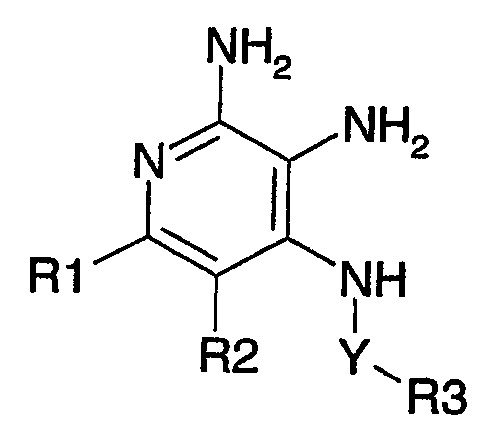


상기 식에서,Where
Y-R3은 제 14 항에서 정의한 바와 같고;YR 3 is as defined in claim 14;
R1은 제 2 항에서 정의한 바와 같고;R 1 is as defined in claim 2;
R2는 제 10 항에서 정의한 바와 같고;R 2 is as defined in claim 10;
PG1 및 PG2는 질소 보호제이고;PG 1 and PG 2 are nitrogen protecting agents;
R13은 (C1 -C6)알킬이다.R 13 is (C 1 - C 6) alkyl.
본 발명의 네 번째 태양에서 화학식 XVIII, XVIIIa, XIX, XIXa, XXa, XXb, XIV, XV, LIV 및 LXIII의 중간체를 제공하며, 이때, Y-R3은 제 14 항에서 정의한 바와 같고, R1은 제 2 항에서 정의한 바와 같고, R2는 제 10 항에서 정의한 바와 같고, PG1 및 PG2는 질소 보호제이고, R13은 (C1 -C6)알킬이다.In a fourth aspect of the invention there is provided an intermediate of the formulas XVIII, XVIIIa, XIX, XIXa, XXa, XXb, XIV, XV, LIV and LXIII, wherein YR 3 is as defined in claim 14 and R 1 is as defined in section 2, R 2 are as defined in claim 10, PG 1 and PG 2 is a nitrogen-protecting agent, R 13 is (C 1 - C 6) alkyl.
화학식 I 화합물의 약학적으로 허용가능한 염은 상기 화합물의 산 부가 및 염기염을 포함한다.Pharmaceutically acceptable salts of compounds of formula I include acid additions and base salts of such compounds.
적합한 산 부가염은 무독성 염을 형성하는 산으로부터 형성된다. 예로서 아세테이트, 아디페이트, 아스파테이트, 벤조에이트, 베실레이트, 바이카보네이트/카보네이트, 바이설페이트/설페이트, 보레이트, 캄실레이트, 시트레이트, 사이클라메이트, 에디실레이트, 에실레이트, 포메이트, 퓨마레이트, 글루셉테이트, 글루코네이트, 글루쿠로네이트, 헥사플루오로포스페이트, 하이벤제이트, 하이드로클로라이드/클로라이드, 하이드로브로마이드/브로마이드, 하이드로요오다이드/요오다이드, 이세티오네이트, 락테이트, 말레이트, 말리에이트, 말로네이트, 메실레이트, 메틸설페이트, 나프틸레이트, 2-나프실레이트, 니코티네이트, 나이트레이트, 오로테이트, 옥살레이트, 팔미테이트, 파모에이트, 포스페이트/수소 포스페이트/이수소 포스페이트, 피로글루타메이트, 사카레이트, 스테아레이트, 숙시네이트, 탄네이트, 타르트레이트, 토실레이트, 트라이플루오로아세테이트 및 자이노포에이트 염이 있다.Suitable acid addition salts are formed from acids which form non-toxic salts. Examples include acetates, adipates, aspartates, benzoates, besylates, bicarbonates / carbonates, bisulfates / sulfates, borates, camsylates, citrates, cyclomates, disicates, ecylates, formates, fumarates , Gluceptate, gluconate, glucuronate, hexafluorophosphate, hybenzate, hydrochloride / chloride, hydrobromide / bromide, hydroiodide / iodide, isethionate, lactate, horse Laterate, maleate, malonate, mesylate, methylsulfate, naphthylate, 2-naphsylate, nicotinate, nitrate, orotate, oxalate, palmitate, pamoate, phosphate / hydrogen phosphate / dihydrogen Phosphate, pyroglutamate, saccharide, stearate, succinate, tannate, tar Traces, tosylate, trifluoroacetate and zinopoate salts.
적합한 염기 염은 무독성 염을 형성하는 염기로부터 형성된다. 예로서 알루미늄, 아르기닌, 벤자틴, 칼슘, 콜린, 다이에틸아민, 다이올아민, 글리신, 리신, 마그네슘, 메글루민, 올라민, 칼륨, 나트륨, 트로메타민 및 아연 염이 있다.Suitable base salts are formed from bases which form non-toxic salts. Examples are aluminum, arginine, benzatin, calcium, choline, diethylamine, diolamine, glycine, lysine, magnesium, meglumine, olamine, potassium, sodium, tromethamine and zinc salts.
산 및 염기의 반염, 예를 들어 헤미설페이트 및 헤미칼슘 염이 또한 형성될 수 있다.Half salts of acids and bases, such as hemisulfate and hemicalcium salts, may also be formed.
적합한 염에 대한 고찰을 위해서, 문헌[Stahl and Wermuth, "Handbook of Pharmaceutical Salts: Properties, Selection, and Use", Weily-VCH, Weinheim, Germany, 2002]을 참조하시오.For a review of suitable salts, see Stahl and Wermuth, "Handbook of Pharmaceutical Salts: Properties, Selection, and Use", Weily-VCH, Weinheim, Germany, 2002.
화학식 I 화합물의 약학적으로 허용가능한 염을 하기 3 가지 방법 중 하나 이상에 의해 제조할 수 있다:Pharmaceutically acceptable salts of compounds of Formula I may be prepared by one or more of the following three methods:
(i) 화학식 I의 화합물을 목적하는 산 또는 염기와 반응시키는 방법;(i) reacting a compound of formula (I) with a desired acid or base;
(ii) 화학식 I 화합물의 적합한 전구체로부터 산- 또는 염기-불안정한 보호 기를 목적하는 산 또는 염기를 사용하여 제거하는 방법; 및(ii) removing acid- or base-labile protecting groups from a suitable precursor of the compound of formula I with the desired acid or base; And
(iii) 화학식 I 화합물의 하나의 염을 적합한 산 또는 염기와의 반응에 의해 또는 적합한 이온 교환 컬럼을 사용하여 또 다른 것으로 전환시키는 방법.(iii) converting one salt of a compound of formula I to another by reaction with a suitable acid or base or using a suitable ion exchange column.
상기 3 개의 반응들은 모두 전형적으로는 용액 중에서 수행된다. 생성되는 염을 석출시키고 여과에 의해 수거하거나, 또는 용매의 증발에 의해 회수할 수 있다. 상기 생성되는 염에서의 이온화도는 완전한 이온화에서부터 거의 비 이온화까지 다양할 수 있다.All three reactions are typically carried out in solution. The resulting salt may precipitate out and be collected by filtration or may be recovered by evaporation of the solvent. The degree of ionization in the resulting salt can vary from complete ionization to nearly non-ionization.
본 발명의 화합물은 비용매화 및 용매화된 형태 모두로 존재할 수 있다. 본 발명에 사용된 바와 같은 "용매화물"이란 용어는 본 발명의 화합물 및 하나 이상의 약학적으로 허용가능한 용매 분자, 예를 들어 에탄올을 포함하는 분자 복합체를 기술한다. "수화물"이란 용어는 상기 용매가 물인 경우 사용된다.The compounds of the present invention may exist in both unsolvated and solvated forms. The term "solvate" as used herein describes a molecular complex comprising a compound of the invention and one or more pharmaceutically acceptable solvent molecules, such as ethanol. The term "hydrate" is used when the solvent is water.
유기 수화물에 대해 현재 승인된 분류 시스템은 단리된 부위, 채널, 또는 금속 이온 배위된 수화물을 규정하는 것이다(본 발명에 참고로 인용된 문헌[K.R. Morris, Polymorphism in Pharmaceutical Solids, Ed. H.G. Brittain, Marcel Dekker, 1995]을 참조하시오). 단리된 부위 수화물은 물 분자들이 유기 분자들의 개입에 의해 서로 직접 접촉함으로써 단리되는 것이다. 채널 수화물에서, 물 분자 들은 이들이 다른 물 분자에 이웃하는 격자 채널 중에 놓인다. 금속 이온 배위된 수화물에서, 물 분자들은 금속 이온에 결합한다. 용매 또는 물이 단단히 결합하는 경우, 상기 복합체는 습도와 관계없이 잘 한정된 화학량론을 가질 것이다. 그러나, 상기 용매 또는 물이 약하게 결합하는 경우, 채널 용매화물 및 흡습성 화합물에서와 같이, 상기 물/용매 함량은 습도 및 건조 조건에 따라 변할 것이다. 상기와 같은 경우에, 비화학량론이 기준이 될 것이다.Currently approved classification systems for organic hydrates are those that define isolated sites, channels, or metal ion coordinated hydrates (KR Morris, Polymorphism in Pharmaceutical Solids, Ed.HG Brittain, Marcel, incorporated herein by reference). Dekker, 1995]. Isolated site hydrates are those in which water molecules are directly contacted with each other by the involvement of organic molecules. In channel hydrates, water molecules lie in lattice channels where they adjoin other water molecules. In metal ion coordinated hydrates, water molecules bind to metal ions. If the solvent or water is tightly bound, the complex will have a well defined stoichiometry regardless of humidity. However, when the solvent or water binds weakly, as in channel solvates and hygroscopic compounds, the water / solvent content will vary with humidity and drying conditions. In such cases, nonstoichiometry will be the reference.
본 발명의 화합물은 완전히 비결정성에서부터 완전히 결정성인 범위의 고체 상태의 연속체로 존재할 수 있다. "비결정성"이란 용어는 물질이 분자 수준에서 긴 범위 정렬이 결여된 상태를 지칭하며, 온도에 따라 고체 또는 액체의 물성을 나타낼 수 있다. 전형적으로는 상기와 같은 물질은 독특한 X-선 회절 패턴을 제공하지 않으며, 고체의 성질을 나타내는 동안 보다 공식적으로는 액체로서 개시된다. 가열 시, 상태 변화, 전형적으로는 2 차 정렬("유리 전이")의 변화를 특징으로 하는 고체에서 액체로의 성질 변화가 일어난다. "결정성"이란 용어는 상기 물질이 분자 수준에서 규칙적으로 정렬된 내부 구조를 갖는 고체 상을 지칭하며 한정된 피크를 갖는 독특한 X-선 회절 패턴을 제공한다. 상기와 같은 물질은 충분히 가열 시 또한 액체의 성질을 나타낼 것이나, 고체에서 액체로의 변화는 상 변화, 전형적으로는 1 차 정렬("융점")을 특징으로 한다.The compounds of the present invention may exist in solid state continuum in the range from completely amorphous to fully crystalline. The term "amorphous" refers to a state in which a substance lacks long range alignment at the molecular level and may represent the properties of a solid or a liquid depending on temperature. Typically such materials do not provide unique X-ray diffraction patterns and are more formally initiated as liquids while exhibiting the properties of solids. Upon heating, a change in properties from solid to liquid occurs, which is characterized by a change in state, typically a secondary alignment (“glass transition”). The term "crystalline" refers to a solid phase in which the material has an internal structure that is regularly aligned at the molecular level and provides a unique X-ray diffraction pattern with defined peaks. Such materials will also exhibit liquid properties upon sufficient heating, but the change from solid to liquid is characterized by a phase change, typically a primary alignment (“melting point”).
약물 및 하나 이상의 다른 성분이 화학량론 또는 비화학량론적 양으로 존재하는 다 성분 복합체(염 및 용매화물 이외의)가 또한 본 발명의 범위 내에 포함된다. 상기 유형의 복합체는 포접 화합물(약물-호스트 포함 복합체) 및 공-결정을 포함한다. 후자는 전형적으로는 비-공유 상호작용을 통해 함께 결합하지만, 또한 염과 중성 분자의 복합체일 수도 있는 중성 분자 구성성분의 결정성 복합체로서 정의된다. 공-결정은 용융 결정화, 용매로부터의 재결정화, 또는 성분들을 함께 물리적으로 연마하여 제조할 수 있다(본 발명에 참고로 인용된 문헌[O. Almarsson and M.J. Zaworotko, Chem Commun, 17, 1889-1896, 2004]을 참조하시오). 다 성분 복합체에 대한 일반적인 고찰을 위해서 본 발명에 참고로 인용된 문헌[Haleblian, J Pharm Sci, 64(8), 1269-1288]을 참조하시오.Multicomponent complexes (other than salts and solvates) in which the drug and one or more other components are present in stoichiometric or non stoichiometric amounts are also included within the scope of the present invention. Complexes of this type include clathrate compounds (drug-host containing complexes) and co-crystals. The latter are typically defined as crystalline complexes of neutral molecular constituents that bind together through non-covalent interactions but may also be complexes of salts and neutral molecules. Co-crystals can be prepared by melt crystallization, recrystallization from a solvent, or by physically polishing the components together (O. Almarsson and MJ Zaworotko, Chem Commun, 17, 1889-1896, incorporated herein by reference. , 2004). For a general review of multicomponent complexes, see Haleblian, J Pharm Sci, 64 (8), 1269-1288, incorporated herein by reference.
본 발명의 화합물은 또한 적합한 조건이 가해질 때 중간상태(중간상 또는 액정)로 존재할 수 있다. 상기 중간상태는 진정한 결정성 상태와 진정한 액체 상태(용융 또는 용액)의 중간이다. 온도 변화의 결과로서 발생하는 중간상을 "써모트로픽"으로서 기술하고 제 2 성분, 예를 들어 물 또는 또 다른 용매의 첨가로부터 생성되는 것을 "리오트로픽"으로서 기술한다. 리오트로픽 중간상을 형성하는 능력을 갖는 화합물을 "양쪽 친매성"으로서 기술하며 상기 화합물은 이온(예를 들어 -COO-Na+, -COO-K+ 또는 -SO3 -Na+) 또는 비 이온(예를 들어 -N-N+(CH3)3) 극성 헤드 기를 갖는 분자들로 이루어진다. 추가의 정보에 대해서, 본 발명에 참고로 인용된 문헌[N.H. Hartshorne and A. Stuart, Crystals and the Polarizing Microscope, 4th Edition, Edward Arnold, 1970]을 참조하시오.The compounds of the present invention may also exist in an intermediate state (medium phase or liquid crystal) when suitable conditions are applied. The intermediate state is halfway between the true crystalline state and the true liquid state (molten or solution). The intermediate phase resulting as a result of the temperature change is described as "thermotropic" and what is produced from the addition of a second component such as water or another solvent is described as "lyotropic". Compounds having the ability to form lyotropic mesophases are described as "bilaterally affinity" and the compounds may be ions (e.g., -COO - Na + , -COO - K + or -SO 3 - Na + ) or non ions ( For example -N - N + (CH 3 ) 3 ) molecules with polar head groups. For further information, see NH Hartshorne and A. Stuart, Crystals and the Polarizing Microscope, 4th Edition, Edward Arnold, 1970, incorporated herein by reference.
이후부터 화학식 I의 화합물에 대한 모든 언급은 그의 염, 용매화물, 다성분 복합체 및 액정, 및 그의 염의 용매화물, 다성분 복합체 및 액정을 포함한다.All references to compounds of formula (I) thereafter include salts, solvates, multicomponent complexes and liquid crystals thereof, and solvates, multicomponent complexes and liquid crystals thereof.
본 발명의 화합물은 이후에 정의하는 바와 같은 화학식 I 화합물의 모든 다형체 및 결정 성질, 전구약물 및 이성체(광학, 기하 및 토토머 이성체 포함) 및 화학식 I의 동위원소 표지된 화합물을 비롯하여, 상기 정의한 바와 같은 화학식 I의 화합물을 포함한다.Compounds of the invention are defined above, including all polymorphic and crystalline properties of the compounds of Formula I, prodrugs and isomers (including optical, geometric and tautomeric isomers) and isotopically labeled compounds of Formula I as defined below Compounds of formula (I) as shown.
나타낸 바와 같이, 화학식 I의 소위 "전구약물"은 또한 본 발명의 범위 내에 있다. 따라서 그 자체가 약물학적 활성을 거의 또는 전혀 갖지 않을 수도 있는 화학식 I 화합물의 몇몇 유도체들은, 체내 또는 신체상에 투여될 때, 예를 들어 가수분해 절단에 의해 목적하는 활성을 갖는 화학식 I의 화합물로 전환될 수 있다. 상기와 같은 유도체를 "전구약물"이라 칭한다. 전구약물의 용도에 대한 추가의 정보를 문헌[T. Higuchi and W. Stella, "Pro-drugs as Novel Delivery Systems", Vol. 14, ACS Symposium Series] 및 ["Bioreversible Carriers in Drug Design", Pergamon Press, 1987, ed. E.B. Roche, American Pharmaceutical Association]에서 찾을 수 있다.As shown, the so-called “prodrugs” of Formula I are also within the scope of the present invention. Thus some derivatives of the compounds of formula (I), which may themselves have little or no pharmacological activity, are converted into compounds of formula (I) having the desired activity, for example by hydrolytic cleavage, when administered in vivo or on the body. Can be. Such derivatives are referred to as "prodrugs". Further information on the use of prodrugs can be found in T. Higuchi and W. Stella, "Pro-drugs as Novel Delivery Systems", Vol. 14, ACS Symposium Series and "Bioreversible Carriers in Drug Design", Pergamon Press, 1987, ed. E.B. Roche, American Pharmaceutical Association.
본 발명에 따른 전구약물을 예를 들어 화학식 I의 화합물 중에 존재하는 적합한 작용기를, 예를 들어 문헌[H. Bundgaard, "Design of Prodrugs", Elsevier, 1985]에 개시된 바와 같은 "전구-잔기"로서 당해 분야의 숙련가들에게 공지된 몇몇 잔기로 치환시킴으로써 제조할 수 있다.Prodrugs according to the invention are for example suitable functional groups present in compounds of formula (I), for example in H. As "bulb-residues" as disclosed in Bundgaard, "Design of Prodrugs", Elsevier, 1985, they can be prepared by substitution with several residues known to those skilled in the art.
본 발명에 따른 몇몇 전구약물의 예는 (i) 화학식 I의 화합물이 카복실산 작용기를 함유하는 경우, 그의 에스터, 예를 들어 상기 화학식 I 화합물의 카복실산 작용기의 수소가 (C1-C6)알킬로 치환된 화합물; 및 (ii) 화학식 I의 화합물이 1차 또는 2차 아미노 작용기를 함유하는 경우, 그의 아미드, 예를 들어, 존재할 수 있는 경우, 상기 화학식 I 화합물의 아미노 작용기의 1 또는 2 개의 수소 모두가 (C1-C10)알카노일로 치환된 화합물을 포함한다.Examples of some prodrugs according to the invention include (i) when the compound of formula (I) contains a carboxylic acid functional group, an ester thereof, for example hydrogen of the carboxylic acid functional group of the compound of formula (I) is (C 1 -C 6 ) alkyl Substituted compounds; And (ii) where the compound of formula (I) contains primary or secondary amino functional groups, amides thereof, eg where present, may be present in which both one or two hydrogens of the amino groups of the compound of formula (I) are 1 -C 10 ) alkanoyl substituted compounds.
상기 예 및 다른 전구약물 유형의 예에 따른 치환 기의 추가의 예를 상기 언급한 참고문헌들에서 찾을 수 있다. 더욱이, 화학식 I의 몇몇 화합물들은 그 자체가 화학식 I의 다른 화합물의 전구약물로서 작용할 수 있다.Further examples of substituents according to the above examples and examples of other prodrug types can be found in the aforementioned references. Moreover, some compounds of formula (I) may themselves act as prodrugs of other compounds of formula (I).
구체적으로, R4가 H 이외의, 본 발명에서 정의한 바와 같고, R5가 존재하지 않는 화학식 I의 본 발명의 화합물(즉 화학식 Ia의 화합물)은 대사 작용 또는 가용매분해를 통해 R4가 H이고, R5가 존재하지 않는 화학식 I의 화합물로 전환될 수 있다. 또한, R4가 존재하지 않고, R5가 H 이외의, 본 발명에서 정의한 바와 같은 화학식 I의 본 발명의 화합물(즉 화학식 Ib의 화합물)은 대사 작용 또는 가용매분해를 통해 R4가 존재하지 않고, R5가 H인 화학식 I의 화합물로 전환될 수 있다.Specifically, R 4 is the same as defined in the present invention, other than H, the compounds of the invention of formula I R 5 is not present (i.e. compounds of formula Ia) is R 4 is H via metabolism or solvolysis And may be converted to a compound of formula I in which R 5 is absent. In addition, R 4 is absent and R 5 is other than H, in which the compound of the present invention as defined in the present invention (ie, the compound of Formula Ib) as defined herein does not have R 4 present through metabolism or solvolysis. And can be converted to a compound of formula I wherein R 5 is H.
또한 화학식 I 화합물의 대사산물, 즉 상기 약물의 투여 시 생체 내에서 형성되는 화합물은 본 발명의 범위 내에 있다. 본 발명에 따른 대사산물의 몇몇 예는 (i) 화학식 I의 화합물이 메틸 기를 함유하는 경우, 그의 하이드록시메틸 유도체(-CH3 -> -CH2OH); (ii) 화학식 I의 화합물이 알콕시 기를 함유하는 경우, 그의 하이드록시 유도체(-OR -> -OH); (iii) 화학식 I의 화합물이 3차 아미노 기를 함유하는 경우, 그의 2차 아미노 유도체(-NR1R2 -> -NHR1 또는 -NHR2); (iv) 화학식 I의 화합물이 2차 아미노 기를 함유하는 경우, 그의 1차 유도체(-NHR1 -> -NH2); (v) 화학식 I의 화합물이 페닐 잔기를 함유하는 경우, 그의 페놀 유도체(-Ph -> -PhOH); 및 (vi) 화학식 I의 화합물이 아미드 기를 함유하는 경우, 그의 카복실산 유도체(-CONH2 -> -COOH)를 포함한다.Also metabolites of the compounds of formula I, ie compounds formed in vivo upon administration of the drug, are within the scope of the present invention. Some examples of metabolites according to the invention include (i) hydroxymethyl derivatives (-CH 3- > -CH 2 OH) when the compound of formula (I) contains a methyl group; (ii) when the compound of formula (I) contains an alkoxy group, its hydroxy derivative (-OR->-OH); (iii) where the compound of formula I contains a tertiary amino group, a secondary amino derivative thereof (-NR 1 R 2- > -NHR 1 or -NHR 2 ); (iv) where the compound of formula I contains a secondary amino group, a primary derivative thereof (-NHR 1- > -NH 2 ); (v) where the compound of formula (I) contains a phenyl moiety, a phenol derivative thereof (-Ph->-PhOH); And (vi) where the compound of formula (I) contains an amide group, a carboxylic acid derivative thereof (-CONH 2- > -COOH).
하나 이상의 비대칭 탄소 원자를 함유하는 화학식 I의 화합물은 2 개 이상의 입체이성체로서 존재할 수 있다. 화학식 I의 화합물이 알케닐 또는 알케닐렌 기를 함유하는 경우, 기하 시스/트랜스(또는 Z/E) 이성체가 가능하다. 구조 이성체가 저 에너지 장벽을 통해 상호전환 가능한 경우, 토토머 이성체("토토머화")가 존재할 수 있다. 이는 예를 들어 케토 기를 함유하는 화학식 I 화합물에서 양성자 토토머화의 형태를 취하거나 또는 방향족 잔기를 함유하는 화합물에서 소위 원자가 토토머화의 형태를 취할 수 있다. 이는 단일 화합물이 하나를 초과하는 이성화 유형을 나타낼 수 있음에 따른다.Compounds of formula (I) containing one or more asymmetric carbon atoms may exist as two or more stereoisomers. If the compound of formula (I) contains an alkenyl or alkenylene group, geometric cis / trans (or Z / E) isomers are possible. If the structural isomers are interconvertible through a low energy barrier, tautomeric isomers (“tautomerization”) may be present. It may take the form of proton tautomerization in, for example, a compound of formula I containing a keto group or in the form of so-called valence tautomerization in a compound containing an aromatic moiety. This is because a single compound may exhibit more than one type of isomerization.
예를 들어 화학식 I 중의 점선의 설명에 대해, R4가 H인 화학식 Ia의 화합물은 R5가 H인 화학식 Ib의 화합물의 토토머이다:For example, for the description of the dashed line in Formula I, the compound of Formula Ia wherein R 4 is H is a tautomer of the compound of Formula Ib wherein R 5 is H:

화학식 I 화합물의 모든 입체이성체, 기하 이성체 및 토토머 형태들은 하나를 초과하는 이성화 유형을 나타내는 화합물 및 그의 하나 이상의 혼합물을 포함하여 본 발명의 범위 내에 포함된다. 대이온이 광학적으로 활성인 산 부가염, 예를 들어 d-락테이트 또는 l-리신, 또는 라세미, 예를 들어 dl-타르트레이트 또는 dl-아르기닌이 또한 포함된다.All stereoisomers, geometric isomers and tautomeric forms of the compounds of formula I are included within the scope of the present invention, including compounds exhibiting more than one type of isomerization and one or more mixtures thereof. Also included are acid addition salts in which the counterion is optically active, for example d-lactate or l-lysine, or racemic, for example dl-tartrate or dl-arginine.
시스/트랜스 이성체를 당해 분야의 숙련가들에게 널리 공지된 통상적인 기법, 예를 들어 크로마토그래피 및 분별 결정화에 의해 분리시킬 수 있다.Cis / trans isomers may be separated by conventional techniques well known to those skilled in the art, such as chromatography and fractional crystallization.
개별적인 에난티오머들의 제조/단리를 위한 통상적인 기법들은 예를 들어 키랄 고압 액체 크로마토그래피(HPLC)를 사용하는 적합한 광학적으로 순수한 전구체로부터의 키랄 합성 또는 라세메이트(또는 염 또는 유도체의 라세메이트)의 분리를 포함한다.Conventional techniques for the preparation / isolation of individual enantiomers include, for example, the synthesis of chiral synthesis or racemates (or racemates of salts or derivatives) from suitable optically pure precursors using chiral high pressure liquid chromatography (HPLC). Includes separation.
선택적으로, 상기 라세메이트(또는 라세미 전구체)를 적합한 광학 활성 화합물, 예를 들어 알콜과 반응시키거나, 또는 화학식 I의 화합물이 산성 또는 염기성 잔기를 함유하는 경우, 염기 또는 산, 예를 들어 1-페닐에틸아민 또는 타타르산과 반응시킬 수 있다. 생성되는 다이아스테레오머 혼합물을 크로마토그래피 및/또는 분별 결정화에 의해 분리시킬 수 있으며 상기 다이아스테레오머 중 1 또는 2 개 모두를 숙련가에게 널리 공지된 수단에 의해 상응하는 순수한 에난티오머로 전환시킬 수 있다.Optionally, the racemate (or racemic precursor) is reacted with a suitable optically active compound, for example an alcohol, or if the compound of formula I contains an acidic or basic moiety, a base or an acid, for example 1 React with -phenylethylamine or tartaric acid. The resulting diastereomer mixture can be separated by chromatography and / or fractional crystallization and either or both of the diastereomers can be converted to the corresponding pure enantiomers by means well known to the skilled person.
본 발명의 키랄 화합물(및 그의 키랄 전구체)을, 0 내지 50 부피%, 전형적으로는 2 내지 20%의 아이소프로판올, 및 0 내지 5 부피%의 알킬아민, 전형적으로는 0.1%의 다이에틸아민을 함유하는, 탄화수소, 전형적으로는 헵탄 또는 헥산으로 이루어진 이동상을 갖는 비대칭 수지상에서, 크로마토그래피, 전형적으로는 HPLC를 사용하여 에난티오머가 풍부하게 수득할 수 있다. 상기 용출물의 농축은 상기 풍부한 혼합물을 제공한다.The chiral compounds (and chiral precursors thereof) of the present invention are prepared from 0 to 50% by volume, typically 2 to 20% isopropanol, and 0 to 5% by volume of alkylamine, typically 0.1% of diethylamine. On asymmetric resin phases containing a mobile phase consisting of hydrocarbons, typically heptane or hexane, abundance of enantiomers can be obtained using chromatography, typically HPLC. Concentration of the eluate provides the rich mixture.
본 발명은 화학식 I 화합물의 라세메이트 및 라세미 혼합물(집성체)을 포함하여 상기 화합물의 모든 결정 형태들을 포함한다. 입체이성체성 집성체를 당해 분야의 숙련가들에게 공지된 통상적인 기법에 의해 분리시킬 수 있다. 예를 들어 문헌[E.L. Eliel and S.H. Wilen, "Stereochemistry of Organic Compounds", Wiley, New York, 1994]을 참조하시오.The present invention includes all crystalline forms of such compounds, including racemates and racemic mixtures (aggregates) of the compounds of formula (I). Stereoisomeric aggregates can be separated by conventional techniques known to those skilled in the art. See, eg, E.L. Eliel and S.H. Wilen, "Stereochemistry of Organic Compounds", Wiley, New York, 1994.
본 발명은 하나 이상의 원자가, 동일한 원자 번호를 갖지만 원자 질량 또는 질량 수가 자연에 우세한 원자 질량 또는 질량 수와 상이한 원자로 치환된 화학식 I의 모든 약학적으로 허용가능한 동위원소 표지된 화합물을 포함한다.The present invention includes all pharmaceutically acceptable isotopically labeled compounds of formula (I) in which one or more valences are substituted with atoms having the same atomic number but having a different atomic mass or mass number prevailing in nature.
본 발명의 화합물에 포함시키기에 적합한 동위원소의 예로는 수소의 동위원소, 예를 들어 2H 및 3H, 탄소, 예를 들어 11C, 13C 및 14C, 염소, 예를 들어 36Cl, 불소, 예를 들어 18F, 요오드, 예를 들어 123I 및 125I, 질소, 예를 들어 13N 및 15N, 산소, 예를 들어 15O, 17O 및 18O, 인, 예를 들어 32P, 및 황, 예를 들어 35S가 있다.Examples of isotopes suitable for inclusion in the compounds of the invention include isotopes of hydrogen such as 2 H and 3 H, carbons such as 11 C, 13 C and 14 C, chlorine such as 36 Cl, Fluorine, for example 18 F, iodine, for example 123 I and 125 I, nitrogen, for example 13 N and 15 N, oxygen, for example 15 O, 17 O and 18 O, phosphorus, for example 32 P, and sulfur, for example 35 S.
화학식 I의 몇몇 동위원소 표지된 화합물, 예를 들어 방사성 동위원소를 포함하는 것들이 약물 및/또는 기질 조직 분포 연구에 유용하다. 상기 방사성 동위원소 삼중수소, 즉 3H 및 탄소-14, 즉 14C가 특히 통합의 용이성 및 즉시 검출 수단에 비추어 볼 때 상기 목적에 유용하다.Several isotopically labeled compounds of Formula I, for example those containing radioisotopes, are useful for drug and / or matrix tissue distribution studies. The radioisotope tritium, i.e. 3 H and carbon-14, i.e. 14 C, are useful for this purpose, especially in view of the ease of integration and the means of immediate detection.
보다 무거운 동위원소, 예를 들어 중수소, 즉 2H에 의한 치환은 보다 큰 대사 안정성으로부터 생성되는 몇몇 치료 이점들, 예를 들어 생체 내 반감기의 증가 또는 투여량 요구의 감소를 제공할 수 있으며, 따라서 일부 상황에 바람직할 수 있다.Substitution with heavier isotopes, such as deuterium, ie 2 H, may provide some therapeutic benefits resulting from greater metabolic stability, such as an increase in half-life in vivo or a decrease in dosage requirements, thus It may be desirable in some situations.
양전자 방출 동위원소, 예를 들어 11C, 18F, 15O 및 13N에 의한 치환은 기질 수용체 점유를 조사하기 위한 양전자 방출 기록사진(PET) 연구에 유용할 수 있다.Substitution with positron emitting isotopes, such as 11 C, 18 F, 15 O and 13 N, may be useful for positron emission recording (PET) studies to investigate substrate receptor occupancy.
화학식 I의 동위원소 표지된 화합물을 일반적으로는 당해 분야의 숙련가들에게 공지된 통상적인 기법에 의해 또는 첨부된 실시예 및 제조에에 개시된 바와 유사한 방법들에 의해, 앞서 사용된 표지되지 않은 시약 대신에 적합한 동위원소 표지된 시약을 사용하여 제조할 수 있다.Isotope labeled compounds of Formula (I) are generally used in place of the unlabeled reagents previously used, by conventional techniques known to those skilled in the art, or by methods analogous to those disclosed in the appended Examples and Preparations. Isotope labeled reagents suitable for
본 발명에 따른 약학적으로 허용가능한 용매화물은 결정화 용매를 동위원소에 의해 치환시킬 수 있는 것, 예를 들어 D2O, d6-아세톤, d6-DMSO를 포함한다.Pharmaceutically acceptable solvates in accordance with the present invention is capable of substitution by the crystallization solvent to isotopes, such as D 2 O, d 6 - acetone, and a, d 6 -DMSO.
이후에 정의되는 바와 같은 중간체 화합물, 그의 모든 염, 용매화물 및 복합체, 및 화학식 I의 화합물에 대해 상기 정의한 바와 같은 상기 화합물의 염의 모든 용매화물 및 복합체가 또한 본 발명의 범위 내에 있다. 본 발명은 상기 언급한 종들의 모든 다형태 및 그의 결정 성질들을 포함한다.Intermediate compounds as defined hereinafter, all salts, solvates and complexes thereof, and all solvates and complexes of salts of such compounds as defined above for compounds of Formula I are also within the scope of the present invention. The present invention includes all polymorphs of the aforementioned species and their crystalline properties.
본 발명에 따른 화학식 I의 화합물을 제조할 때, 상기 목적에 최상의 특징들의 조합을 제공하는 중간체의 형태를 통상적으로 선택하는 것은 당해 분야의 숙련가에게 공개되어 있다. 상기와 같은 특징들은 상기 중간체 형태의 융점, 용해도, 가공적성 및 수율, 및 상기 생성물이 단리 시 정제될 수 있는 생성 용이성을 포함한다.In preparing the compounds of formula (I) according to the invention, it is known to those skilled in the art to conventionally select the form of the intermediate that provides the best combination of features for this purpose. Such features include the melting point, solubility, processability and yield of the intermediate form, and the ease of production that the product can be purified upon isolation.
약학적 용도를 목적으로 하는 본 발명의 화합물을 결정 또는 비결정성 생성물의 형태로 투여하거나, 또는 상기 화합물은 완전히 비결정성에서 완전히 결정성인 범위의 고체 상태의 연속체로 존재할 수 있다. 할 수 있다. 상기 화합물을 예를 들어 고체 플러그, 분말, 또는 필름으로서, 침전, 결정화, 동결 건조, 분무 건조, 또는 증발 건조와 같은 방법에 의해 수득할 수 있다. 극초단파 또는 무선 주파수 건조를 상기 목적에 사용할 수 있다.The compounds of the present invention for pharmaceutical use may be administered in the form of crystalline or amorphous products, or the compounds may be present in solid state continuum in the range from completely amorphous to fully crystalline. can do. The compound can be obtained, for example, as a solid plug, powder, or film by methods such as precipitation, crystallization, freeze drying, spray drying, or evaporation drying. Microwave or radio frequency drying may be used for this purpose.
상기 화합물을 단독으로 또는 본 발명의 하나 이상의 다른 화합물과 함께 또는 하나 이상의 다른 약물과 함께(또는 임의의 이들의 조합으로서) 투여할 수 있다. 일반적으로, 상기 화합물을 하나 이상의 약학적으로 허용가능한 부형제와 함께 제형으로서 투여할 것이다. 본 발명에 사용된 바와 같은 "부형제"란 용어는 본 발명의 화합물 이외의 임의의 성분을 기술한다. 부형제의 선택은 특정한 투여 방식, 용해도 및 안정성에 대한 상기 부형제의 효과, 및 투여 형태의 성질과 같은 인자에 크게 좌우될 것이다.Such compounds may be administered alone or in combination with one or more other compounds of the invention or in combination with one or more other drugs (or as any combination thereof). Generally, the compound will be administered as a dosage form with one or more pharmaceutically acceptable excipients. The term "excipient" as used in the present invention describes any ingredient other than the compounds of the present invention. The choice of excipient will depend largely on factors such as the particular mode of administration, the effect of the excipient on solubility and stability, and the nature of the dosage form.
본 발명 화합물의 전달에 적합한 약학 조성물 및 그의 제조 방법은 당해 분야의 숙련가들에게 쉽게 자명할 것이다. 상기와 같은 조성물 및 그의 제조 방법을 예를 들어 문헌[Remington's Pharmaceutical Sciences, 19th Edition(Mack Publishing Company, 1995)]에서 찾을 수 있다.Pharmaceutical compositions suitable for the delivery of the compounds of the present invention and methods for their preparation will be readily apparent to those skilled in the art. Such compositions and methods for their preparation can be found, for example, in Remington's Pharmaceutical Sciences, 19th Edition (Mack Publishing Company, 1995).
적합한 투여 방식은 경구, 비 경구, 국소, 흡입/비 내, 직장/질 내, 및 눈/귀 투여를 포함한다.Suitable modes of administration include oral, nasal, topical, inhalation / intranasal, rectal / vaginal, and eye / ear administration.
본 발명의 화합물을 경구로 투여할 수 있다. 경구 투여는 삼킴을 포함할 수 있으며, 따라서 상기 화합물은 위장관으로 들어가거나, 또는 상기 화합물이 입으로부터 혈류로 바로 들어가는 구강 또는 설하 투여를 사용할 수도 있다. 경구 투여에 적합한 제형에는 고체 제형, 예를 들어 정제, 미립자 함유 캡슐, 액체 또는 분말, 로젠지(액체 충전된 것 포함), 츄정, 멀티- 및 나노-미립자, 젤, 고체 용액, 리포솜, 필름, 오뷸, 스프레이, 액체 제형 및 구강/점막부착 패치가 있다.The compounds of the present invention can be administered orally. Oral administration may include swallowing, and thus the compound may enter the gastrointestinal tract or use oral or sublingual administration in which the compound enters the bloodstream directly from the mouth. Formulations suitable for oral administration include, but are not limited to, solid dosage forms such as tablets, particulate containing capsules, liquids or powders, lozenges (including liquid filled), chewables, multi- and nano-particulates, gels, solid solutions, liposomes, films, Orb, spray, liquid formulation and oral / mucoadhesive patches.
액체 제형은 좌약, 용액, 시럽 및 엘릭서를 포함한다. 상기와 같은 제형은 연질 또는 경질 캡슐에 충전제로서 사용될 수 있으며 전형적으로는 담체, 예를 들어 물, 에탄올, 폴리에틸렌 글리콜, 프로필렌 글리콜, 메틸셀룰로스, 또는 적합한 오일, 및 하나 이상의 유화제 및/또는 현탁제를 포함할 수 있다. 액체 제형을 또한 예를 들어 향낭으로부터 고체의 재조성에 의해 제조할 수도 있다.Liquid formulations include suppositories, solutions, syrups and elixirs. Such formulations may be used as fillers in soft or hard capsules and typically contain a carrier such as water, ethanol, polyethylene glycol, propylene glycol, methylcellulose, or a suitable oil, and one or more emulsifiers and / or suspending agents. It may include. Liquid formulations may also be prepared, for example, by reformulation of solids from sachets.
본 발명의 화합물을 또한 문헌[Liang and Chen, Expert Opinion in Therapeutic Patents, 11(6), 981-986]에 개시된 바와 같은 고속-용해, 고속-붕해 투여형으로 사용할 수 있다.The compounds of the present invention may also be used in fast-dissolving, fast-disintegrating dosage forms as disclosed in Liang and Chen, Expert Opinion in Therapeutic Patents, 11 (6), 981-986.
정제 투여형의 경우, 용량에 따라, 상기 약물은 상기 투여형의 1 내지 80 중량%, 보다 전형적으로는 5 내지 60 중량%를 구성할 수 있다. 상기 약물 이외에, 정제는 일반적으로 붕해제를 함유한다. 붕해제의 예로는 나트륨 전분 글리콜레이트, 나트륨 카복시메틸 셀룰로스, 칼슘 카복시메틸 셀룰로스, 크로스카멜로스 나트륨, 크로스포비돈, 폴리비닐피롤리돈, 메틸 셀룰로스, 미정질 셀룰로스, 저급 알킬 치환된 하이드록시프로필 셀룰로스, 전분, 예비젤라틴화된 전분 및 나트륨 알기네이트가 있다. 일반적으로, 상기 붕해제는 상기 투여형의 1 내지 25 중량%, 바람직하게는 5 내지 20 중량%를 차지할 것이다.For tablet dosage forms, depending on the dosage, the drug may comprise 1 to 80%, more typically 5 to 60% by weight of the dosage form. In addition to these drugs, tablets generally contain a disintegrant. Examples of disintegrants include sodium starch glycolate, sodium carboxymethyl cellulose, calcium carboxymethyl cellulose, croscarmellose sodium, crospovidone, polyvinylpyrrolidone, methyl cellulose, microcrystalline cellulose, lower alkyl substituted hydroxypropyl cellulose, Starch, pregelatinized starch and sodium alginate. In general, the disintegrant will comprise 1 to 25% by weight, preferably 5 to 20% by weight of the dosage form.
정제 제형에 응집 성질을 부여하기 위해서 일반적으로 결합제가 사용된다. 적합한 결합제로는 미정질 셀룰로스, 젤라틴, 당, 폴리에틸렌 글리콜, 천연 및 합성 검, 폴리비닐피롤리돈, 예비젤라틴화된 전분, 하이드록시프로필 셀룰로스 및 하이드록시프로필 메틸셀룰로스가 있다. 정제는 또한 희석제, 예를 들어 락토스(무수 모노하이드레이트, 분무 건조된 모노하이드레이트 등), 만니톨, 자일리톨, 덱스트로스, 슈크로스, 솔비톨, 미정질 셀룰로스, 전분 및 이염기성 칼슘 포스페이트 다이하이드레이트를 함유할 수 있다.Binders are generally used to impart cohesive properties to tablet formulations. Suitable binders include microcrystalline cellulose, gelatin, sugars, polyethylene glycols, natural and synthetic gums, polyvinylpyrrolidone, pregelatinized starch, hydroxypropyl cellulose and hydroxypropyl methylcellulose. Tablets may also contain diluents such as lactose (anhydrous monohydrate, spray dried monohydrate, etc.), mannitol, xylitol, dextrose, sucrose, sorbitol, microcrystalline cellulose, starch and dibasic calcium phosphate dihydrate. have.
정제는 또한 선택적으로 표면 활성제, 예를 들어 나트륨 라우릴 설페이트 및 폴리솔베이트 80, 및 활제, 예를 들어 이산화 규소 및 활석을 포함할 수 있다. 존재하는 경우, 표면 활성제는 상기 정제의 0.2 내지 5 중량%를 차지하고, 활제는 상기 정제의 0.2 내지 1 중량%를 차지할 수 있다.Tablets may also optionally include surface active agents such as sodium lauryl sulfate and polysorbate 80, and glidants such as silicon dioxide and talc. If present, the surface active agent may comprise 0.2-5% by weight of the tablet, and the lubricant may comprise 0.2-1% by weight of the tablet.
정제는 또한 일반적으로 윤활제, 예를 들어 마그네슘 스테아레이트, 칼슘 스 테아레이트, 아연 스테아레이트, 나트륨 스테아릴 퓨마레이트, 및 마그네슘 스테아레이트와 나트륨 라우릴 설페이트의 혼합물을 함유한다. 윤활제는 일반적으로 상기 정제의 0.25 내지 10 중량%, 바람직하게는 0.5 내지 3 중량%를 차지한다. 다른 가능한 성분으로 산화방지제, 착색제, 풍미제, 보존제 및 맛-가림제를 포함한다.Tablets also generally contain lubricants such as magnesium stearate, calcium stearate, zinc stearate, sodium stearyl fumarate, and mixtures of magnesium stearate with sodium lauryl sulfate. Lubricants generally comprise 0.25 to 10% by weight, preferably 0.5 to 3% by weight of the tablet. Other possible ingredients include antioxidants, colorants, flavors, preservatives and taste-masking agents.
예시적인 정제는 약 80% 이하의 약물, 약 10 내지 약 90 중량%의 결합제, 약 0 내지 약 85 중량%의 희석제, 약 2 내지 약 10 중량%의 붕해제, 및 약 0.25 내지 약 10 중량%의 윤활제를 함유한다. 정제 블렌드를 직접 또는 롤러에 의해 압착하여 정제를 제조할 수 있다. 선택적으로 정제 블렌드 또는 블렌드의 일부를 타정 전에 습윤-, 건조- 또는 용융-과립화, 용융 응결, 또는 압출시킬 수 있다. 최종 제형은 하나 이상의 층을 포함할 수 있으며 코팅되거나 또는 코팅되지 않을 수도 있고; 심지어 캡슐화될 수도 있다. 정제 제형은 문헌[H. Lieberman and L. Lachman, Pharmaceutical Dosage Forms: Tablets, Vol. 1, Marcel Dekker, New York, 1980]에 논의되어 있다.Exemplary tablets contain up to about 80% drug, about 10 to about 90 weight percent binder, about 0 to about 85 weight percent diluent, about 2 to about 10 weight percent disintegrant, and about 0.25 to about 10 weight percent Contains lubricants. Tablets can be made by compressing the tablet blend directly or by roller. Optionally, the tablet blend or a portion of the blend can be wet-, dry- or melt-granulated, melt condensed, or extruded before tableting. The final formulation may comprise one or more layers and may or may not be coated; It may even be encapsulated. Tablet formulations are described in H. Lieberman and L. Lachman, Pharmaceutical Dosage Forms: Tablets, Vol. 1, Marcel Dekker, New York, 1980.
인간 또는 수의학적 용도에 소모될 수 있는 경구 필름은 전형적으로는 빠르게 용해되거나 점막접착성일 수 있는 유연한 수용성 또는 수 팽창성 박막 투여형이며, 전형적으로 화학식 I의 화합물, 필름 형성 중합체, 결합제, 용매, 습윤제, 가소제, 안정제 또는 유화제, 점도 조절제 및 용매를 포함한다. 상기 제형의 일부 성분들은 하나보다 많은 기능을 수행할 수 있다.Oral films that can be consumed for human or veterinary use are typically flexible, water soluble or water swellable thin film dosage forms that can be rapidly dissolved or mucoadhesive, typically compounds of formula (I), film forming polymers, binders, solvents, wetting agents , Plasticizers, stabilizers or emulsifiers, viscosity modifiers and solvents. Some components of the formulation may perform more than one function.
화학식 I의 화합물은 수용성이거나 불용성일 수 있다. 수용성 화합물은 전형적으로는 상기 용질의 1 내지 80 중량%, 보다 전형적으로는 20 내지 50 중량%를 차지한다. 덜 용해성인 화합물은 상기 조성물의 보다 큰 비율, 전형적으로는 상기 용질의 88 중량% 이하를 차지할 수 있다. 선택적으로, 화학식 I의 화합물은 멀티미립자 비드의 형태일 수 있다.The compound of formula (I) may be water soluble or insoluble. Water-soluble compounds typically comprise 1 to 80%, more typically 20 to 50% by weight of the solute. Less soluble compounds may comprise a greater proportion of the composition, typically up to 88% by weight of the solute. Optionally, the compound of formula (I) may be in the form of multiparticulate beads.
상기 필름 형성 중합체를 천연 폴리사카라이드, 단백질 및 합성 하이드로콜로이드로부터 선택할 수 있으며 상기 중합체는 전형적으로는 0.01 내지 99 중량%, 보다 전형적으로는 30 내지 80 중량%의 범위로 존재한다.The film forming polymer can be selected from natural polysaccharides, proteins and synthetic hydrocolloids and the polymer is typically present in the range of 0.01 to 99% by weight, more typically 30 to 80% by weight.
다른 가능한 성분들로는 산화방지제, 착색제, 풍미제 및 풍미 향상제, 보존제, 타액분비 자극제, 냉각제, 공용매(오일 포함), 연화제, 벌크제, 소포제, 계면활성제 및 맛-가림제가 있다.Other possible ingredients include antioxidants, colorants, flavors and flavor enhancers, preservatives, saliva stimulants, coolants, cosolvents (including oils), emollients, bulking agents, defoamers, surfactants and taste-masking agents.
본 발명에 따른 필름을 전형적으로는 벗겨낼 수 있는 배면 지지체 또는 종이상에 코팅된 얇은 수성 필름의 증발 건조에 의해 제조한다. 이를 건조 오븐 또는 터널에서, 전형적으로는 복합 코터 건조기에서, 또는 동결 건조 또는 진공에 의해 수행할 수 있다.Films according to the invention are typically prepared by evaporative drying of a peelable backing support or thin aqueous film coated on paper. This can be done in a drying oven or tunnel, typically in a composite coater dryer, or by freeze drying or vacuum.
경구 투여용 고체 제형을 즉시 및/또는 조절 방출되도록 제형화할 수 있다. 조절 방출 제형은 지연-, 지속-, 규칙적-, 조절-, 표적화 및 프로그램화된 방출을 포함한다.Solid dosage forms for oral administration may be formulated to be immediate and / or controlled release. Controlled release formulations include delayed-, sustained-, regular-, controlled-, targeted and programmed release.
본 발명의 목적에 적합한 조절 방출 제형은 미국 특허 제 6,106,864 호에 개시되어 있다. 다른 적합한 방출 기법, 예를 들어 고 에너지 분산 및 삼투압 및 코팅된 입자에 대한 상세한 설명은 문헌[Verma et al., Pharmaceutical Technology On-line, 25(2), 1-14(2001)]에서 발견된다. 조절된 방출을 성취하기 위한 츄잉검 의 용도가 WO 00/35298에 개시되어 있다.Controlled release formulations suitable for the purposes of the present invention are disclosed in US Pat. No. 6,106,864. Details of other suitable release techniques such as high energy dispersion and osmotic pressure and coated particles are found in Verma et al., Pharmaceutical Technology On-line, 25 (2), 1-14 (2001). . The use of chewing gum to achieve controlled release is disclosed in WO 00/35298.
본 발명의 화합물을 또한 혈류, 근육, 또는 내부 기관에 직접 투여할 수도 있다. 비 경구 투여에 적합한 수단은 정맥 내, 동맥 내, 복강 내, 경막 내, 심실 내, 요도 내, 흉골 내, 두개 내, 근육 내 및 피하를 포함한다. 비 경구 투여에 적합한 장치는 바늘(미세바늘 포함) 주사기, 무 바늘 주사기 및 주입 기법을 포함한다. 비 경구 제형은 전형적으로는 부형제, 예를 들어 염, 탄수화물 및 완충제(바람직하게는 3 내지 9의 pH)를 함유할 수 있는 수용액이나, 일부 용도의 경우, 멸균 비 수성 용액 또는 건조된 형태로서, 적합한 비히클, 예를 들어 멸균의 발열원 비 함유 수와 함께 사용되도록 제형화하는 것이 보다 적합할 수 있다. 멸균 조건 하에서, 예를 들어 동결건조에 의해 비 경구 제형을 제조하는 것은 당해 분야의 숙련가에게 널리 공지된 표준 제약 기법을 사용하여 쉽게 수행될 수 있다.The compounds of the present invention can also be administered directly to the bloodstream, muscle, or internal organs. Suitable means for non-oral administration include intravenous, intraarterial, intraperitoneal, intradural, intraventricular, urethra, sternum, intracranial, intramuscular and subcutaneous. Devices suitable for non-oral administration include needle (including microneedle) syringes, needleless syringes, and infusion techniques. Non-oral formulations are typically aqueous solutions that may contain excipients such as salts, carbohydrates, and buffers (preferably at a pH of 3-9), but in some applications, as sterile non-aqueous solutions or in dried form, It may be more suitable to be formulated for use with a suitable vehicle, eg, sterile pyrogen-free water. Under sterile conditions, the preparation of non-oral formulations, for example by lyophilization, can be readily accomplished using standard pharmaceutical techniques well known to those skilled in the art.
비 경구 용액의 제조에 사용되는 화학식 I 화합물의 용해도를 적합한 제형화 기법의 사용, 예를 들어 용해도 향상제의 혼입에 의해 증가시킬 수 있다. 비 경구 투여용 제형을 즉시 및/또는 조절 방출되도록 제형화할 수 있다. 조절 방출 제형은 지연-, 지속-, 규칙적-, 조절-, 표적화 및 프로그램화된 방출을 포함한다. 따라서, 본 발명의 화합물을 활성 화합물의 조절 방출을 제공하는 이식 데포로서 투여하기 위해 고체, 반 고체 또는 요변성 액체로서 제형화할 수 있다. 상기와 같은 제형의 예는 약물-코팅된 스텐트 및 폴리(dl-락틱-코글리콜릭)산(PGLA) 미세구를 포함한다.The solubility of the compounds of formula I used in the preparation of non-oral solutions can be increased by the use of suitable formulation techniques, for example by the incorporation of solubility enhancers. Formulations for non-oral administration may be formulated to be immediate and / or controlled release. Controlled release formulations include delayed-, sustained-, regular-, controlled-, targeted and programmed release. Thus, the compounds of the invention can be formulated as solids, semisolids or thixotropic liquids for administration as implantation depots providing controlled release of the active compounds. Examples of such formulations include drug-coated stents and poly (dl-lactic-coglycolic) acid (PGLA) microspheres.
본 발명의 화합물을 또한 피부 또는 점막에 국소로, 즉 피부에 또는 경피로 투여할 수 있다. 상기 목적에 전형적인 제형으로는 젤, 하이드로젤, 로션, 용액, 크림, 연고, 분진 분말, 드레싱제, 폼, 필름, 피부 패치, 웨이퍼, 이식물, 스펀지, 섬유, 붕대 및 미세유화액이 있다. 리포솜을 또한 사용할 수 있다. 전형적인 담체는 알콜, 물, 광물성 오일, 액체 석유, 백색 석유, 글리세린, 폴리에틸렌 글리콜 및 프로필렌 글리콜을 포함한다. 침투 촉진제를 혼입시킬 수도 있다. 예를 들어 문헌[Finnin and Morgan, J Pharm Sci 88(10), 955-958(1999년 10월)]을 참조하시오. 국소 투여를 위한 다른 수단으로는 일렉트로포레이션, 이온영동, 음파영동, 초음파 치료 및 미세바늘 또는 무 바늘(예를 들어 Powderject(상표), Bioject(상표) 등) 주사가 있다. 국소 투여 제형을 즉시 및/또는 조절 방출되도록 제형화할 수 있다. 조절 방출 제형은 지연-, 지속-, 규칙적-, 조절-, 표적화 및 프로그램화된 방출을 포함한다.The compounds of the invention can also be administered topically to the skin or mucous membranes, ie to the skin or transdermally. Typical formulations for this purpose include gels, hydrogels, lotions, solutions, creams, ointments, dust powders, dressings, foams, films, skin patches, wafers, implants, sponges, fibers, bandages and microemulsions. Liposomes can also be used. Typical carriers include alcohols, water, mineral oils, liquid petroleum, white petroleum, glycerin, polyethylene glycols and propylene glycols. Penetration accelerators may also be incorporated. See, eg, Fininn and Morgan, J Pharm Sci 88 (10), 955-958 (October 1999). Other means for topical administration include electroporation, iontophoresis, sonication, ultrasound therapy, and injection of microneedle or needles (eg, Powderject®, Bioject®, etc.). Topical dosage forms can be formulated to be immediate and / or controlled release. Controlled release formulations include delayed-, sustained-, regular-, controlled-, targeted and programmed release.
본 발명의 화합물을 또한 비 내로, 또는 흡입에 의해, 전형적으로는 건조 분말 흡입기로부터 건조 분말(단독으로, 혼합물로서, 예를 들어 락토스와의 건조 블렌드로, 또는 혼합된 성분 입자, 예를 들어 인지질, 예를 들어 포스파티딜콜린과 혼합된 성분 입자로서)의 형태로 또는 가압 용기, 펌프, 스프레이, 분무기(바람직하게는 전기수력학을 사용하여 미세한 미스트를 생성시키는 분무기), 또는 네뷸라이저로서, 적합한 분사제, 예를 들어 1,1,1,2-테트라플루오로에탄 또는 1,1,1,2,3,3,3-헵타플루오로프로판을 사용하여 또는 상기 없이 투여할 수 있다. 비 내 용의 경우, 상기 분말은 생물접착제, 예를 들어 키토산 또는 사이클로덱스트린을 포함할 수 있다.The compounds of the present invention may also be administered in the rain or by inhalation, typically from a dry powder inhaler to dry powder (alone, as a mixture, for example as a dry blend with lactose, or mixed component particles such as phospholipids) Suitable propellants, for example in the form of component particles mixed with phosphatidylcholine or as pressurized vessels, pumps, sprays, nebulizers (preferably nebulizers which produce fine mist using electrohydraulics), or nebulizers For example, with or without 1,1,1,2-tetrafluoroethane or 1,1,1,2,3,3,3-heptafluoropropane. For nasal contents, the powder may comprise a bioadhesive, for example chitosan or cyclodextrin.
상기 가압된 용기, 펌프, 스프레이, 분무기 또는 네뷸라이저는 용매로서 예를 들어 에탄올, 수성 에탄올, 또는 적합한 또 다른 분산, 용해 또는 연장된 활성물질 방출제, 분사제 및 임의의 계면활성제, 예를 들어 솔비탄 트라이올리에이트, 올레산 또는 올리고락트산을 포함하는 본 발명 화합물의 용액 또는 현탁액을 함유한다.The pressurized vessel, pump, spray, nebulizer or nebulizer may be used as a solvent, for example ethanol, aqueous ethanol, or another suitable dispersion, dissolved or extended active substance release agent, propellant and any surfactant, for example It contains a solution or suspension of a compound of the invention comprising sorbitan trioleate, oleic acid or oligolactic acid.
상기 약물 생성물을 건조 분말 또는 현탁액 제형에 사용하기 전에 흡입에 의해 전달하기에 적합한 크기(전형적으로 5 마이크론 미만)로 미분화한다. 이를 임의의 적합한 분쇄 방법, 예를 들어 나선 제트 분쇄, 유동층 제트 분쇄, 나노입자를 형성하는 초임계 유체 가공, 고압 균질화, 또는 분무 건조에 의해 성취할 수 있다.The drug product is micronized to a size (typically less than 5 microns) suitable for delivery by inhalation prior to use in dry powder or suspension formulations. This may be accomplished by any suitable grinding method, such as spiral jet grinding, fluid bed jet grinding, supercritical fluid processing to form nanoparticles, high pressure homogenization, or spray drying.
흡입기 또는 취입기에 사용하기 위한 캡슐(예를 들어 젤라틴 또는 하이드록시프로필-메틸셀룰로스로부터 제조된 것), 발포제 및 카트리지를 본 발명의 화합물, 적합한 분말 베이스, 예를 들어 락토스 또는 전분 및 성능 개질제, 예를 들어 l-류신, 만니톨 또는 마그네슘 스테아레이트의 분말 믹스를 함유하도록 제형화할 수 있다. 상기 락토스는 무수이거나 또는 모노하이드레이트의 형태일 수 있으며, 후자가 바람직하다. 다른 적합한 부형제로는 덱스트란, 글루코스, 말토스, 솔비톨, 자일리톨, 프럭토스, 슈크로스 및 트레할로스가 있다.Capsules (for example, made from gelatin or hydroxypropyl-methylcellulose), blowing agents and cartridges for use in an inhaler or insufflator are compounds of the invention, suitable powder bases such as lactose or starch and performance modifiers, eg For example, it may be formulated to contain a powder mix of l-leucine, mannitol or magnesium stearate. The lactose may be anhydrous or in the form of a monohydrate, with the latter being preferred. Other suitable excipients are dextran, glucose, maltose, sorbitol, xylitol, fructose, sucrose and trehalose.
미세 미스트를 생성시키기기 위해 전기수력학을 사용하는 분무기에 사용하기에 적합한 용액 제형은 작동 당 1 ㎍ 내지 20 ㎎의 본 발명의 화합물을 함유할 수 있으며, 상기 작동 부피는 1 ㎕ 내지 100 ㎕로 다양할 수 있다. 전형적인 제형은 화학식 I의 화합물, 프로필렌 글리콜, 멸균 수, 에탄올 및 염화 나트륨을 포함할 수 있다. 프로필렌 글리콜 대신에 사용할 수 있는 또 다른 용매는 글리세롤 및 폴리에틸렌 글리콜을 포함한다.Solution formulations suitable for use in nebulizers using electrohydraulics to produce fine mist may contain from 1 μg to 20 mg of the compound of the invention per operation, the working volume being between 1 μl and 100 μl. It can vary. Typical formulations may include a compound of formula (I), propylene glycol, sterile water, ethanol and sodium chloride. Another solvent that can be used instead of propylene glycol includes glycerol and polyethylene glycol.
적합한 풍미제, 예를 들어 메탄올 및 레보멘톨, 또는 감미제, 예를 들어 사카린 또는 사카린 나트륨을 흡입/비 내 투여를 목적으로 하는 본 발명의 제형들에 가할 수 있다.Suitable flavoring agents such as methanol and levomenthol, or sweetening agents such as saccharin or saccharin sodium can be added to the formulations of the invention for the purpose of inhalation / intranasal administration.
흡입/비 내 투여용 제형을 예를 들어 PGLA를 사용하여 즉시 및/또는 조절 방출되도록 제형화할 수 있다. 조절 방출 제형은 지연-, 지속-, 규칙적-, 조절-, 표적화 및 프로그램화된 방출을 포함한다.Formulations for inhalation / intranasal administration can be formulated for immediate and / or controlled release using, for example, PGLA. Controlled release formulations include delayed-, sustained-, regular-, controlled-, targeted and programmed release.
건조 분말 흡입제 및 에어로졸의 경우에, 투여량 단위를 계량된 양을 전달하는 밸브를 사용하여 측정한다. 본 발명에 따른 단위를, 전형적으로는 1 ㎍ 내지 100 ㎎의 화학식 I의 화합물을 함유하는 계량된 용량 또는 "퍼프"를 투여하도록 조정한다. 전체 1일 용량은 전형적으로는 1 ㎍ 내지 200 ㎎의 범위일 것이며, 이를 단일 용량으로 또는 보다 대개는 하루 전체에 걸쳐 분할 용량으로 투여할 수 있다.In the case of dry powder inhalants and aerosols, dosage units are measured using valves that deliver a metered amount. The unit according to the invention is adjusted to administer a metered dose or "puff" which typically contains 1 μg to 100 mg of the compound of formula (I). The total daily dose will typically range from 1 μg to 200 mg, which can be administered in a single dose or more often in divided doses throughout the day.
본 발명의 화합물을 직장 또는 질에 의해, 예를 들어 좌약, 페서리 또는 관장제의 형태로 투여할 수 있다. 코코아 버터가 전통적인 좌약 베이스이나, 적합한 경우 다양한 대체물들을 사용할 수도 있다. 직장/질 투여용 제형을 즉시 및/또는 조절 방출되도록 제형화할 수 있다. 조절 방출 제형은 지연-, 지속-, 규칙적-, 조절-, 표적화 및 프로그램화된 방출을 포함한다.The compounds of the invention can be administered by the rectum or vagina, for example in the form of suppositories, pessaries or enema. Cocoa butter is a traditional suppository base, but various alternatives may be used as appropriate. Formulations for rectal / vaginal administration may be formulated to be immediate and / or controlled release. Controlled release formulations include delayed-, sustained-, regular-, controlled-, targeted and programmed release.
본 발명의 화합물을 또한 눈 또는 귀에, 전형적으로는 등장성, pH-조절된, 멸균 염수 중의 미분된 현탁액 또는 용액 방울의 형태로 직접 투여할 수 있다. 눈 및 귀 투여에 적합한 다른 제형으로는 연고, 붕해성(예를 들어 흡수성 젤 스펀지, 콜라젠) 및 비 붕해성(예를 들어 실리콘) 이식물, 웨이퍼, 렌즈 및 미립자 또는 소낭 시스템, 예를 들어 니오솜 또는 리포솜이 있다. 중합체, 예를 들어 가교결합된 폴리아크릴산, 폴리비닐알콜, 히아루론산, 셀룰로스 중합체, 예를 들어 하이드록시프로필메틸셀룰로스, 하이드록시에틸셀룰로스, 또는 메틸 셀룰로스, 또는 헤테로폴리사카라이드 중합체, 예를 들어 젤란 검을 보존제, 예를 들어 벤즈알코늄 클로라이드와 함께 혼입시킬 수 있다. 상기와 같은 제형을 또한 이온 영동에 의해 전달할 수도 있다. 눈/귀 투여용 제형을 즉시 및/또는 조절 방출되도록 제형화할 수 있다. 조절 방출 제형은 지연-, 지속-, 규칙적-, 조절-, 표적화 및 프로그램화된 방출을 포함한다.The compounds of the invention can also be administered directly to the eye or ear, typically in the form of finely divided suspensions or solution drops in isotonic, pH-controlled, sterile saline. Other formulations suitable for ocular and ear administration include ointments, disintegrating (e.g. absorbent gel sponges, collagen) and non-disintegrating (e.g. silicone) implants, wafers, lenses and particulate or vesicle systems, e.g. Cotton or liposomes. Polymers such as crosslinked polyacrylic acid, polyvinyl alcohol, hyaluronic acid, cellulose polymers such as hydroxypropylmethylcellulose, hydroxyethylcellulose, or methyl cellulose, or heteropolysaccharide polymers such as gellan gum For example, with benzalkonium chloride. Such formulations may also be delivered by iontophoresis. Formulations for eye / ear administration may be formulated to be immediate and / or controlled release. Controlled release formulations include delayed-, sustained-, regular-, controlled-, targeted and programmed release.
본 발명의 화합물을 상기 언급한 투여 방식들 중 임의의 방식에 사용하기 위해 용해도, 용해율, 맛-가림, 생물학적 이용효능 및/또는 안정성을 개선시키기 위해서 용해성 거대분자 존재, 예를 들어 사이클로덱스트린 및 그의 적합한 유도체 또는 폴리에틸렌 글리콜 함유 중합체와 배합할 수 있다. 예를 들어 약물-사이클로덱스트린 복합체는 일반적으로 대부분의 투여형 및 투여 경로에 유용한 것으로 밝혀졌다. 포함 및 불포함 복합체들을 모두 사용할 수 있다. 상기 약물과의 직접 착화에 대한 대안으로서, 사이클로덱스트린을 보조 첨가제로서, 즉 담체, 희석제 또는 용해제로서 사용할 수 있다. 이러한 목적에 가장 통상적으로 사용되는 것은 알파-, 베타- 및 감마-사이클로덱스트린이며, 이들의 예를 국제 특허 공개 WO 91/11172, WO 94/02518 및 WO 98/55148에서 찾을 수 있다.In order to improve the solubility, dissolution rate, taste-masking, bioavailability and / or stability of the compounds of the present invention for use in any of the aforementioned modes of administration, the presence of soluble macromolecules, such as cyclodextrins and their It can be combined with a suitable derivative or polyethylene glycol containing polymer. Drug-cyclodextrin complexes, for example, have been found to be generally useful for most dosage forms and administration routes. Both inclusion and inclusion complexes can be used. As an alternative to direct complexation with the drug, cyclodextrin may be used as an auxiliary additive, ie as a carrier, diluent or solubilizer. Most commonly used for this purpose are alpha-, beta- and gamma-cyclodextrins, examples of which can be found in International Patent Publications WO 91/11172, WO 94/02518 and WO 98/55148.
예를 들어 특정 질병 또는 상태를 치료하기 위해서 활성 화합물들의 조합을 투여하는 것이 바람직할 수 있으므로, 2 개 이상의 약학 조성물들(이들 중 하나 이상은 본 발명에 따른 화합물을 함유한다)을 편의상 상기 조성물들의 동시투여에 적합한 키트의 형태로 병용할 수 있음은 본 발명의 범위 내에 있다. 따라서 본 발명의 키트는 2 개 이상의 별도의 약학 조성물들(이들 중 하나 이상은 본 발명에 따른 화학식 I의 화합물을 함유한다) 및 상기 조성물들을 별도로 유지시키기 위한 수단, 예를 들어 용기, 분할된 병, 또는 분할된 호일 패킷을 포함한다. 상기와 같은 키트의 예는 정제, 캡슐 등의 패키징에 사용되는 친숙한 발포 팩이다. 본 발명의 키트는 상이한 투여형들, 예를 들어 경구 및 비 경구 형태를 투여하거나, 상기 별도의 조성물들을 상이한 투여 간격으로 투여하거나, 또는 상기 별도의 조성물들을 서로에 대해 적정하는데 특히 적합하다. 응낙을 지원하기 위해서, 상기 키트는 전형적으로는 투여 설명서를 포함하며 소위 메모리 지원이 제공될 수 있다.Since it may be desirable to administer a combination of active compounds, for example, to treat a particular disease or condition, two or more pharmaceutical compositions, one or more of which contain a compound according to the invention, may be conveniently It can be used in the form of a kit suitable for co-administration is within the scope of the present invention. The kit of the invention thus comprises at least two separate pharmaceutical compositions (at least one of which contains a compound of formula I according to the invention) and means for maintaining the compositions separately, for example containers, divided bottles Or a fragmented foil packet. Examples of such kits are familiar foam packs used for the packaging of tablets, capsules and the like. The kits of the invention are particularly suitable for administering different dosage forms, for example oral and non-oral forms, for administering the separate compositions at different dosage intervals, or for titrating the separate compositions against each other. To support acceptance, the kit typically includes instructions for administration and so-called memory support can be provided.
인간 환자에게 투여하기 위해서, 본 발명 화합물의 전체 1일 용량은 전형적으로는, 물론 투여 방식에 따라 1 ㎎ 내지 10 g, 예를 들어 10 ㎎ 내지 1 g, 예를 들어 25 내지 500 ㎎의 범위이다. 예를 들어 경구 투여는 50 내지 100 ㎎의 전체 1일 용량이 요구될 수 있다. 상기 전체 1일 용량을 단일 또는 분할 용량으로 투여할 수 있으며, 상기 용량은 의사의 재량으로 본 발명에 제공된 전형적인 범위 밖에 있을 수 있다. 이들 투여량은 체중 약 60 내지 70 ㎏의 평균적인 인간 환자를 기준으로 한다. 의사는 체중이 상기 범위 밖에 있는 환자, 예를 들어 유아 및 노령 환자에 대한 용량을 쉽게 결정할 수 있을 것이다.For administration to human patients, the total daily dose of a compound of the invention typically ranges from 1 mg to 10 g, for example 10 mg to 1 g, for example 25 to 500 mg, depending of course of administration. . For example, oral administration may require a full daily dose of 50-100 mg. The entire daily dose may be administered in a single or divided dose, which dose may be outside the typical range provided in the present invention at the discretion of the physician. These dosages are based on the average human patient of about 60-70 kg body weight. The doctor will readily be able to determine doses for patients whose weight is outside this range, such as infants and older patients.
용해 성질을 개선시키기 위해서, 4-아미노-1-벤질-6-트라이플루오로메틸-1,3-다이하이드로-이미다조[4,5-c]피리딘-2-온(이후부터 실시예 15) 및 하이드록시프로필 메틸 셀룰로스(HPMC E3 Prem LV, Methocel(등록상표), Dow Chemical Company, Midland, MI에서 시판중)의 고체 비결정성 분무 건조된 분산액(SDD)을 하기와 같이 제조하였다. 먼저, 물 2.97 g, 메탄올 16.83 g, 및 1M KOH(칼륨 양이온 9.8 ㎎ 함유) 250 ㎕를 함유하는 분무 용액을 제조하고, 여기에 4-아미노-1-벤질-6-트라이플루오로메틸-1,3-다이하이드로-이미다조[4,5-c]피리딘-2-온의 결정성 중성 형태 51.27 ㎎을 가하였다. 이어서, HPMC 140.4 ㎎을 상기 용액에 가하고 상기 용액을 5 분간 교반하고 2 분간 초음파 처리하였다. 상기 용액을 1.1 ㎖/분의 속도로 콜 파머(Cole Parmer) 74900 시리즈 속도 조절 주사기를 통해 11-㎝ 직경 스테인레스 강철 챔버로 이루어진 소규모 분무 건조 장치에 펌핑하였다. 상기 용액을 1 표준 ft3/분의 유량으로 가열된 질소 스트림을 사용하여 2-유체 노즐(Spraying Systems Co., Wheaton, Illinois, Model No. SU1A)을 통해 분무하였다. 가열된 기체가 85 ℃의 유입구 온도로 상기 챔버로 들어가고 22 ℃의 유출구 온도로 나온다. 생성되는 고체 비결정성 분산액을 와트만 #1 마이크로셀룰로스 필터 배지(11 ㎛ 기공 크기, 11 ㎝ 외부 직경) 상에 모으고, 진공 하에서 건조시키고 건조기에 보관하였다. 상기 분산액은 25.4 중량%의 4-아미노-1-벤질-6-트라이플루오로메틸-1,3-다이하이드로-이미다조[4,5-c]피리딘-2-온, 4.9 중량%의 칼륨 양이온, 및 69.7 중량%의 HPMC를 함유하였다. 수율은 약 60%이었다.4-amino-1-benzyl-6-trifluoromethyl-1,3-dihydro-imidazo [4,5-c] pyridin-2-one (hereafter Example 15) to improve dissolution properties And a solid amorphous spray dried dispersion (SDD) of hydroxypropyl methyl cellulose (commercially available from HPMC E3 Prem LV, Methocel®, Dow Chemical Company, Midland, MI) was prepared as follows. First, a spray solution containing 2.97 g of water, 16.83 g of methanol, and 250 μl of 1M KOH (containing 9.8 mg of potassium cation) was prepared, and 4-amino-1-benzyl-6-trifluoromethyl-1, 51.27 mg of the crystalline neutral form of 3-dihydro-imidazo [4,5-c] pyridin-2-one was added. Then 140.4 mg of HPMC was added to the solution and the solution was stirred for 5 minutes and sonicated for 2 minutes. The solution was pumped to a small spray drying apparatus consisting of an 11-cm diameter stainless steel chamber through a Cole Parmer 74900 series speed control syringe at a rate of 1.1 ml / min. The solution was sprayed through a two-fluid nozzle (Spraying Systems Co., Wheaton, Illinois, Model No. SU1A) using a stream of nitrogen heated at a flow rate of 1 standard ft 3 / min. The heated gas enters the chamber at an inlet temperature of 85 ° C. and exits at an outlet temperature of 22 ° C. The resulting solid amorphous dispersion was collected on Whatman # 1 microcellulose filter media (11 μm pore size, 11 cm outer diameter), dried under vacuum and stored in a dryer. The dispersion is 25.4 wt% 4-amino-1-benzyl-6-trifluoromethyl-1,3-dihydro-imidazo [4,5-c] pyridin-2-one, 4.9 wt% potassium cation And 69.7 weight% HPMC. The yield was about 60%.
의심을 피하기 위해서, 본 발명에서 "치료"에 대한 언급은 치유, 완화 및 예방학적 치료에 대한 언급을 포함한다.For the avoidance of doubt, reference to “treatment” in the present invention includes references to healing, alleviation and prophylactic treatment.
하기 반응식들은 화학식 I 화합물 및 그의 중간체의 일반적인 제조 방법을 예시한다.The following schemes illustrate the general process for preparing compounds of Formula I and their intermediates.
당해 분야의 숙련가들은 화학식 I의 화합물 또는 그의 중간체의 제조를 위해 반응식에 개시된 과정들 중 일부를 가능한 치환체들 중 일부에는 적용할 수 없음을 알 것이다.Those skilled in the art will appreciate that some of the procedures disclosed in the schemes for the preparation of compounds of formula (I) or intermediates thereof may not be applicable to some of the possible substituents.
당해 분야의 숙련가들은 상기 반응식에 개시된 변환들을 상기 개시된 바와 상이한 순서로 수행하거나, 또는 상기 변환들 중 하나 이상을 변경시켜 목적하는 화학식 I의 화합물을 제공하는 것이 필요하거나 바람직할 수 있음을 또한 알 것이다.Those skilled in the art will also appreciate that it may be necessary or desirable to perform the transformations disclosed in the above schemes in a different order than described above, or to alter one or more of the transformations to provide the desired compound of formula (I). .
당해 분야의 숙련가들은 상기 반응식에 예시한 바와 같이, 화학식 I 화합물 합성의 임의의 단계에서 상기 분자 중의 하나 이상의 민감성 기를 보호하여 바람직하지 못한 부 반응을 방지하는 것이 필요하거나 바람직할 수 있음을 알 것이다. 특히, 아미노 기를 보호하는 것이 필요하거나 바람직할 수 있다. 화학식 I 화합물의 제조에 사용되는 보호 기를 통상적인 방식으로 사용할 수 있다. 예를 들어 본 발명에 참고로 인용된 문헌[Theodora W Green and Peter G M Wuts, 'Protective Groups in Organic Synthesis', third edition, John Wiley and Sons, 1999], 특히 상기와 같은 기의 제거 방법을 또한 개시하는 7 장(pages 494-653)("Protection for the Amino Group")에 개시된 방법을 참조하시오.Those skilled in the art will appreciate that it may be necessary or desirable to protect one or more sensitive groups in the molecule at any stage of the synthesis of the compound of Formula I, as illustrated in the above scheme, to prevent undesirable side reactions. In particular, it may be necessary or desirable to protect the amino groups. Protective groups used in the preparation of compounds of formula (I) can be used in conventional manner. Also disclosed is, for example, Theodora W Green and Peter GM Wuts, 'Protective Groups in Organic Synthesis', third edition, John Wiley and Sons, 1999, in particular methods for removing such groups. See the method disclosed in Chapter 7 (pages 494-653) ("Protection for the Amino Group").
아미노 보호 기 boc, 벤질옥시카보닐, 벤질 및 아세틸이 화학식 I의 화합물 및 그의 중간체의 제조에 특별히 사용된다.Amino protecting groups boc, benzyloxycarbonyl, benzyl and acetyl are especially used for the preparation of compounds of formula (I) and their intermediates.
달리 나타내지 않는 한, 반응식에서 R1 내지 R7 및 Y는 본 발명에서 정의한 바와 같다. PG1 및 PG2는 질소 보호 기이다.Unless indicated otherwise, in the schemes R 1 to R 7 and Y are as defined in the present invention. PG 1 and PG 2 are nitrogen protecting groups.
화학식 I의 화합물을 반응식 1에 예시된 바와 같이 제조할 수 있으며, 이후의 제조예 1 내지 27은 반응식 1을 추가로 예시한다.Compounds of formula (I) can be prepared as illustrated in Scheme 1, and Preparations 1-27 below further illustrate Scheme 1.
화학식 XVII 내지 XIX에서 아미노 보호된 기 N(PG1)(PG2)는 일부의 경우 N(H)PG1일 수 있음을 알 것이다.It will be appreciated that the amino protected group N (PG1) (PG 2 ) in Formulas XVII to XIX may in some cases be N (H) PG 1 .

반응식 1은 화학식 I의 화합물을 입수하는 다양한 수단을 도시한다.Scheme 1 illustrates various means of obtaining a compound of formula (I).
a) 시판중인 나이트릴(II), 또는 화학 문헌에 개시된 표준 방법들 중 임의의 방법에 의해 제조된 나이트릴(II)을 Zn 공급원의 존재 하에서 할로 아세테이트(III), 예를 들어 에틸브로모아세테이트와 반응시킨다. 문헌[Tet. Letts, 1997, 38, 443-446]은 염기성 조건을 생성물의 단리에 적용하는 단서하에 화학식 I의 엔아민을 제공하는 상기 전환을 개시한다.a) commercially available nitrile (II), or nitrile (II) prepared by any of the standard methods disclosed in the chemical literature, may be prepared using halo acetate (III), for example ethylbromoacetate, in the presence of a Zn source. React with Tet. Letts, 1997, 38, 443-446 discloses this conversion to provide an enamine of formula (I) under the clue of applying basic conditions to the isolation of the product.
b) 산성 조건이 상기 단계 a)에 적용되는 경우, 케토에스터 V가 생성되고, 이어서 상기를 암모니아 공급원, 예를 들어 암모늄 아세테이트를 사용하여 별도의 단계에서 엔아민 IV로 재전환시킬 수 있다. 이렇게 하여, 다양한 화학식 V의 케토에스터들은 중간체 IV에서 상기 합성 경로를 차단할 수 있다.b) If acidic conditions are applied in step a) above, a ketoester V is produced, which can then be reconverted to enamine IV in a separate step using an ammonia source, for example ammonium acetate. In this way, various ketoesters of formula V can block the synthetic pathway in intermediate IV.
c) 이어서 상기 엔아민 IV을 나트륨 에톡사이드, 나트륨 하이드라이드 또는 칼륨 3급-부톡사이드와 같은 염기성 조건 하에서 다이알킬 말로네이트 VII와 반응시켜 VIII을 제공할 수 있다. 문헌[J. Org. Chem., 1981, 46(15), 3040-3048]은 상기 변환의 예를 개시한다.c) The enamine IV can then be reacted with dialkyl malonate VII under basic conditions such as sodium ethoxide, sodium hydride or potassium tert-butoxide to give VIII. J. Org. Chem., 1981, 46 (15), 3040-3048, disclose examples of such transformations.
d) 선택적으로, 상기 엔아민 IV을 적합한 염기, 예를 들어 칼륨 카보네이트 또는 트라이에틸아민의 존재 하에서 말로닐 다이클로라이드 VI와 반응시켜 아미드화된 형태 IX를 제공할 수 있다.d) Optionally, the enamine IV can be reacted with malonyl dichloride VI in the presence of a suitable base such as potassium carbonate or triethylamine to provide the amidated form IX.
e) 이어서 IX를 별도의 단계로 적합한 염기와 반응시켜 피리딘 VIII으로 고리 폐쇄시킬 수 있다. 적합한 염기는 나트륨 에톡사이드, 나트륨 하이드라이드 또는 칼륨 3급-부톡사이드를 포함한다.e) IX can then be reacted with a suitable base in a separate step to ring closure with pyridine VIII. Suitable bases include sodium ethoxide, sodium hydride or potassium tert-butoxide.
f) 이어서 VIII을 산성 또는 염기성 조건 하에서 비누화시켜 상응하는 산, 예를 들어 HCl, HBr, 황산, 나트륨 하이드록사이드 또는 리튬 하이드록사이드를 제공하고, 이는 열의 영향 하에서 자발적으로 데카복실화하여 피리딘 X을 제공한다. 상기 변환의 예는 WO 01101949에 개시되어 있다.f) VIII is then saponified under acidic or basic conditions to give the corresponding acid, such as HCl, HBr, sulfuric acid, sodium hydroxide or lithium hydroxide, which spontaneously decarboxylates under the influence of heat to give pyridine X To provide. Examples of such transformations are disclosed in WO 01101949.
g) X를 당해 분야의 숙련가에게 공지된 임의의 문헌 조건을 사용하여, 예를 들어 질산과 황산의 혼합물 또는 아세트산과 질산의 혼합물을 사용하여 질화하여 나이트로 피리딘 XI을 제공할 수 있다. 예를 들어 문헌[Bioorg. Med. Chem. Lett., 1996, 6(2), 173-178]은 상기와 같은 변환을 개시한다.g) X may be nitrided using any literature conditions known to those skilled in the art, for example using a mixture of nitric acid and sulfuric acid or a mixture of acetic acid and nitric acid to give nitropyridine XI. See, eg, Bioorg. Med. Chem. Lett., 1996, 6 (2), 173-178, disclose such a transformation.
h) XI를 다양한 조건을 사용하여 염소화시켜 하이드록시 기를 염소, 예를 들어 염화 티오닐 또는 옥시염화 인으로 전환시켜 XII를 제공할 수 있다. 당해 분야의 숙련가들은 2 개의 하이드록실 기를 별도로 염소화시키거나 또 다른 이탈 기, 예를 들어 또 다른 할로겐 원자, 또는 활성화된 에스터, 예를 들어 메탄 설포네이트 에스터 또는 트라이플루오로메틸 설포네이트 에스터로 전환시킬 수 있음을 알 것이다. 이들 모든 방법의 예가 하기 섹션에 포함된다.h) XI can be chlorinated using a variety of conditions to convert hydroxy groups to chlorine such as thionyl chloride or phosphorus oxychloride to provide XII. Those skilled in the art will be able to separate two hydroxyl groups separately or convert them to another leaving group, such as another halogen atom, or activated ester, such as methane sulfonate ester or trifluoromethyl sulfonate ester. You will know. Examples of all these methods are included in the sections below.
i) XII를 화학식 R3YNH2의 아민(4-클로로 기에서 우선적으로 반응한다)과 반응시켜 XIII을 제공한다. 상기 R3Y 기의 성질에 따라, 2 개의 염소 기 모두의 일부 치환 또는 2-클로로 기에서의 소량의 치환이 일어날 수 있으나, 이는 XIII을 우세하게 보호하는 능력을 감소시키지 않는다.i) XII is reacted with an amine of the formula R3YNH2, which preferentially reacts in a 4-chloro group to give XIII. Depending on the nature of the R3Y group, some substitution of both chlorine groups or small amounts of substitution in the 2-chloro group may occur, but this does not reduce the ability to predominantly protect XIII.
j) 이어서 XIII을 암모니아 또는 암모니아 등가물, 예를 들어 암모늄 아세테이트와 반응시켜 XIV를 제공한다.j) XIII is then reacted with ammonia or an ammonia equivalent, for example ammonium acetate, to give XIV.
k) 이어서 XIV를 문헌에 공지된 임의의 조건 하에서 환원시켜 나이트로 방향족 화합물을 예를 들어 HCl 중의 철 또는 주석을 사용하여 아민으로 환원시키고, 전이 금속 촉매, 예를 들어 팔라듐, 백금 또는 니켈, 또는 화학적 환원제, 예를 들어 리튬 알루미늄 하이드라이드의 존재 하에서 수소화시켜 XV를 제공할 수 있다.k) XIV is then reduced under any of the conditions known in the literature to reduce the nitro aromatic compounds to amines using, for example, iron or tin in HCl, transition metal catalysts such as palladium, platinum or nickel, or Hydrogenation in the presence of a chemical reducing agent such as lithium aluminum hydride can provide XV.
l) 이어서 XV를 C=O의 공급원, 예를 들어 1,1-카보닐다이이미다졸 또는 포스젠과 반응시켜 이미다졸론 XVI 및 I의 혼합물을 제공하고, 이로부터 조심스러운 크로마토그래피 정제에 의해 I를 수득할 수 있다.l) XV is then reacted with a source of C═O, for example 1,1-carbonyldiimidazole or phosgene, to provide a mixture of imidazolone XVI and I, from which I by careful chromatography purification Can be obtained.
m) 선택적으로, XIII을 보호된 형태의 암모니아와 반응시킬 수 있으며, 이때, 상기 수소 원자 중 2 개를 온화한 조건 하에서 나중에 제거할 수 있는 2 개의 기, 예를 들어 다이벤질아민 또는 다이알릴아민으로 치환시킨다. 예를 들어 상기 예에 대한 대안에 대해서 문헌[Theodora W Green and Peter G M Wuts, 'Protective Groups in Organic Synthesis', third edition, John Wiley and Sons, 1999, 특히 chapter 7, pages 494-653("Protection for the Amino Group")]에 개시된 기를 참조하시오.m) Optionally, XIII can be reacted with a protected form of ammonia, wherein two of said hydrogen atoms are removed with two groups, for example dibenzylamine or diallylamine, which can later be removed under mild conditions Replace. See, for example, Theodora W Green and Peter GM Wuts, 'Protective Groups in Organic Synthesis', third edition, John Wiley and Sons, 1999, especially chapter 7, pages 494-653 ("Protection for the Amino Group ")].
n)-o) 단계 k)-l)을 참조하시오.n) -o) See steps k) -l).
p) 이어서 XIX를 보호 기 PG1 및 PG2의 제거에 적합한 다양한 조건 하에서 탈보호시켜 I을 제공한다. 예를 들어 문헌[Theodora W Green and Peter G M Wuts, 'Protective Groups in Organic Synthesis', third edition, John Wiley and Sons, 1999, 특히 chapter 7, pages 494-653("Protection for the Amino Group")]에 개시된 기, 및 그의 제거 조건을 참조하시오.p) XIX is then deprotected under various conditions suitable for the removal of protecting groups PG1 and PG2 to provide I. See, for example, Theodora W Green and Peter GM Wuts, 'Protective Groups in Organic Synthesis', third edition, John Wiley and Sons, 1999, especially chapter 7, pages 494-653 ("Protection for the Amino Group"). See the disclosed group and its elimination conditions.
q) 선택적으로, XIII을 바람직하게는 강 염기, 예를 들어 수소화 나트륨, 칼륨 3급-부톡사이드 또는 리튬 다이아이소프로필아미드를 적합한 아실화제, 예를 들어 에틸클로로포메이트 또는 임의의 다른 알킬 또는 아릴 클로로포메이트, 시아노 포메이트 또는 무수물과 함께 사용하여 알킬 카바메이트, R13CO2X(이때, R13은 (C1 -C6)알킬이고, X는 할로이다)로서 보호시켜 XX를 형성시킬 수 있다.q) Optionally, XIII is preferably a strong base such as sodium hydride, potassium tert-butoxide or lithium diisopropylamide with a suitable acylating agent such as ethylchloroformate or any other alkyl or aryl. chloroformate, cyano formate or an alkyl use with anhydrous carbamate, R 13 CO 2 X - forming XX was protected as a (wherein, R 13 is (C 1 and C 6) alkyl, X is halo) You can.
r) 단계 j) 및 k)를 상기와 같이 XX에 적용시킬 수 있으며, 이어서 상기 시퀀스로부터의 생성물들을 양성자산, 예를 들어 아세트산 또는 폼산에 의한 간단한 처리에 의해 I로 위치선택적으로 환화시킬 수 있다.r) Steps j) and k) can be applied to XX as above, and the products from the sequence can then be regioselectively cyclized to I by simple treatment with a proton, for example acetic acid or formic acid. .
추가의 조작을 위해 할로겐 원자가 C2 위치에 존재하고 적합한 중간체(반응식 2에서 XXVII)를 형성하는 중간체 XVII의 또 다른 버전을 또한 하기 반응식 2에 따라 사용하여 화학식 I의 화합물을 제조할 수 있다.Another version of intermediate XVII, wherein the halogen atom is present at the C2 position and forms a suitable intermediate (XXVII in Scheme 2) for further manipulation, can also be used according to Scheme 2 to prepare a compound of formula (I).

따라서, 시판중인 다이할로피리딘(예를 들어 다이브로모, XXI)을 다수의 단계를 통해 취하여 일정 범위의 화학식 I의 동족체들을 제공할 수 있다.Thus, commercially available dihalopyridine (eg dibromo, XXI) can be taken through a number of steps to provide a range of homologues of formula (I).
a)-e) 시판중인 다이브로모피리딘 XXI을 변형된 문헌 과정(WO 2005026164에 개시됨)에 따라 조작하여 중간체 XXVI를 제공할 수 있다. XXI와 XXVI 사이의 단계들 중 다수는 열적으로 위험한 시약에 의존하거나 잠재적으로 열적으로 위험한 생성물을 생성시키며 따라서 주의하여 취급해야 한다.a) -e) Commercial dibromopyridine XXI can be engineered according to a modified literature process (disclosed in WO 2005026164) to provide intermediate XXVI. Many of the steps between XXI and XXVI rely on thermally hazardous reagents or produce potentially thermally dangerous products and therefore must be handled with care.
f) XXVI를 HCl 및 나트륨 나이트릴로부터 동일 반응계에서 생성되는 아미노 기, 예를 들어 아질산으로부터 다이아조늄 종을 생성시키는 것으로 공지된 다양한 조건(상기 조건은 상기 다이아조늄 종을 Cl 원자로 치환시킨다)을 사용하여 반응시킨다. 이어서 XXVI의 주요 중간체 XXVII로의 변환을 상기 조 클로라이드에의 과잉 아민, 예를 들어 벤질아민의 첨가에 의해 완성시킬 수 있다. 상기 단계는 C2 및 C4 할로겐 원자를 모두 아민 기로 치환시킨다. 임의의 1급 또는 2급 아민 기가 상기 변환에 적합하다.f) using XXVI using various conditions known to generate diazonium species from in situ amino groups, such as nitrous acid, from HCl and sodium nitrile (these conditions replace the diazonium species with Cl atoms) To react. The conversion of XXVI to main intermediate XXVII can then be completed by the addition of excess amine, for example benzylamine, to the crude chloride. This step replaces both C2 and C4 halogen atoms with amine groups. Any primary or secondary amine group is suitable for this conversion.
g)-i) 이어서 XXVII 중의 C2 할로겐 원자를 다양한 조건 하에서 반응시켜 상기 C2 할로겐 기를 다양한 작용기로 치환시켜 일정 범위의 치환된 생성물 I을 입수할 수 있다. 예를 들어 일정 범위의 유기금속 시약, 예를 들어 보론산, 징케이트, 마그네슘 시약, 큐프레이트, 스타네이트 등을 사용한 XXVII에의 헤테로사이클릭 커플링은 XXVIII을 제공하고, 비닐 유기금속 시약, 예를 들어 비닐 트라이부틸 스타난 및 팔라듐 촉매, 예를 들어 Pd(PPh3)4은 비닐 종 XXX을 제공하며, XXVII를 가압 하에 염기, 예를 들어 트라이에틸아민 및 팔라듐 촉매의 존재 하에서 CO 기체로 처리하는 카보닐화 반응은 화학식 XXIX의 아실 생성물을 제공한다. 이어서 화학식 XXVIII 및 XXIX의 화합물을 반응식 1의 단계 n, o 및 p에 따라 화학식 I의 화합물로 전환시킬 수 있다.g) -i) C2 halogen atoms in XXVII can then be reacted under various conditions to substitute the C2 halogen groups with various functional groups to obtain a range of substituted products I. For example, heterocyclic coupling to XXVII using a range of organometallic reagents, such as boronic acid, zincate, magnesium reagents, cuprates, stannates, etc., provides XXVIII, and vinyl organometallic reagents, for example For example vinyl tributyl stanan and a palladium catalyst, such as Pd (PPh 3 ) 4 , provide the vinyl species XXX and the treatment of XXVII with CO gas in the presence of a base such as triethylamine and palladium catalyst under pressure The carbonylation reaction provides the acyl product of formula XXIX. The compounds of formulas XXVIII and XXIX can then be converted to the compounds of formula I according to steps n, o and p of Scheme 1.
j)-l) 이어서 XXX를 산화에 의해 조작하여 알데하이드 XXXII를 제공하고 이어서 XXXII 또는 XXXI를 염기, 예를 들어 트라이에틸아민 또는 환원제, 예를 들어 나트륨 트라이아세톡시보로하이드라이드 각각의 존재 하에서 아민으로 처리하여 생성물 I을 제공할 수 있다(반응식 1의 단계 n, o 및 p에 따라).j) -l) then XXX is oxidized to give aldehyde XXXII and then XXXII or XXXI is amine in the presence of a base such as triethylamine or a reducing agent such as sodium triacetoxyborohydride respectively Can be treated to give product I (according to steps n, o and p of Scheme 1).
중간체 XIII의 또 다른 버전을 반응식 3에 따라 제조할 수 있으며 이어서 죽 통과하여 하기와 같이 화학식 I의 화합물을 제조할 수 있다.Another version of intermediate XIII can be prepared according to Scheme 3, which can then be passed through to prepare a compound of formula (I) as follows.

a)-e) 단계 a)-e)는 본질적으로 반응식 1에 대해 개시한 바와 유사하나, 단 모노할라이드 XXXIV를 XXXVI 중의 C6 및 C4 치환체의 위치화학적 완전성을 보장하도록 제조한다.a) -e) Steps a) -e) are essentially similar to those described for Scheme 1 except that monohalide XXXIV is prepared to ensure the geochemical integrity of the C6 and C4 substituents in XXXVI.
f) XXXVIII을 당해 분야의 숙련가들에게 공지된 다양한 조건, 예를 들어 비 극성 용매, 예를 들어 DCM 또는 MeCN 중의 브롬 수 하에서 브롬화하여 C3-브로마이드 XXXIX를 제공한다.f) XXXVIII is brominated under various conditions known to those skilled in the art, for example, bromine water in non-polar solvents such as DCM or MeCN to give C3-bromide XXXIX.
g) 이어서 XXXIX를 가압 하에 염기, 예를 들어 트라이에틸아민, 알콜, 예를 들어 메탄올 및 팔라듐 촉매, 예를 들어 Pd(PPh3)4의 존재 하에서 CO 기체를 사용하여 카보닐화하여 에스터 XXXX를 제공할 수 있다.g) XXXIX is then carbonylated with CO gas in the presence of a base such as triethylamine, alcohol such as methanol and a palladium catalyst such as Pd (PPh 3 ) 4 under pressure to give ester XXXX can do.
h)-i) 이어서 XXXX를 아민 NR6R7과 반응시켜 아미드 XXXXI를 제공하고, 이를 상기와 같이 탈보호시켜 생성물 I를 제공할 수 있다.h) -i) XXXX can then be reacted with amine NR 6 R 7 to give amide XXXXI, which is deprotected as above to give product I.
중간체 XI의 또 다른 합성을 하기 반응식 4에 나타낸다.Another synthesis of intermediate XI is shown in Scheme 4 below.

a) 나이트릴 작용기에 인접한 메틸렌 기를 갖는 임의의 나이트릴 XXXXII을 말로닐 다이클로라이드 XXXXIII와 반응시켜 피리딘 XXXXIV를 제공할 수 있다. 상기 변환은 문헌[Synthesis, 1984, 765-766]에 개시되어 있다.a) Any nitrile XXXXII having a methylene group adjacent to the nitrile functional group can be reacted with malonyl dichloride XXXXIII to give pyridine XXXXIV. Such transformations are disclosed in Synthesis, 1984, 765-766.
b) 이어서 피리딘 XXXXIV를 당해 분야의 숙련가들에게 공지된 임의의 문헌 조건을 사용하여, 예를 들어 질산과 황산의 혼합물 또는 아세트산과 질산의 혼합물을 사용하여 질화시켜 나이트로 피리딘 XXXXV를 제공할 수 있다.b) The pyridine XXXXIV can then be nitrided using any of the literature conditions known to those skilled in the art, for example using a mixture of nitric acid and sulfuric acid or a mixture of acetic acid and nitric acid to give nitropyridine XXXXV. .
c) 이어서 XXXXV 중의 염소 원자를, 반응성 유기금속 시약을 전이금속 촉매, 예를 들어 스타난, 징케이트 또는 보론산의 존재 하에서 팔라듐 촉매의 존재 하에 XXXXV로 처리하여 치환된 피리딘 XI를 제공할 수 있다. R1=H인 경우에, 적합한 촉 매, 예를 들어 팔라듐화된 목탄 또는 팔라듐 하이드록사이드 존재 하의 간단한 수소화가 유효하다.c) Chlorine atoms in XXXXV can then be treated with reactive organometallic reagents with XXXXV in the presence of a palladium catalyst in the presence of a transition metal catalyst such as stanan, jincate or boronic acid to provide substituted pyridine XI. . If R 1 = H, simple hydrogenation in the presence of a suitable catalyst, for example palladiumated charcoal or palladium hydroxide, is effective.
중간체 X의 추가의 또 다른 합성을 하기 반응식 5에 나타낸다.Yet another synthesis of intermediate X is shown in Scheme 5 below.

상기 방법에서, 말로닐 에스터, 바람직하게는 다이페닐 에스터 XXXXVI를 쉬프 염기 XXXXVII와 반응시키고 가열하여 화학식 X의 피리딘을 생성시킨다.In this process, malonyl ester, preferably diphenyl ester XXXXVI, is reacted with Schiff base XXXXVII and heated to produce pyridine of formula X.
화학식 X의 화합물을 입수하기 위한 추가의 또 다른 수단을 반응식 6에 나타낸다.Yet another means for obtaining a compound of Formula X is shown in Scheme 6.

a) 시판중이거나 화학식 V의 케토에스터의 비누화에 의해 직접 제조될 수 있는 화학식 XXXXVIII의 케토산을 C=O의 공급원, 예를 들어 1,1-카보닐다이이미다졸과 적합한 용매 중에서 승온에서 반응시켜 환화된 피라논 XXXXIX를 생성시킨다.a) Keto acids of formula XXXXVIII, which are either commercially available or can be prepared directly by saponification of the ketoesters of formula V, are reacted at elevated temperatures with a source of C═O, for example 1,1-carbonyldiimidazole, in a suitable solvent Produces cyclized pyranone XXXXIX.
b) XXXXIX를 강한 무기산, 예를 들어 황산 또는 염산으로 처리하여 C3-아실 치환체를 제거하고 피라논 L을 제공한다.b) Treating XXXXIX with a strong inorganic acid such as sulfuric acid or hydrochloric acid to remove the C3-acyl substituent and give pyranone L.
c) L을, 반응식 1에 개시된 동일한 중간체를 차단하기 위해서, 가열 하에 암모니아의 공급원, 예를 들어 농축된 수성 암모늄 하이드록사이드와 반응시켜 상기 피라논 고리를 피리딘 X로 전환시킬 수 있다. 선택적으로, 화학식 L의 여러 피라논을 상업적인 공급원으로부터 입수할 수 있으며, 이를 단계 c에 직접 적용할 수 있다. 화학식 L 화합물의 화학식 X 화합물로의 전환은 다수의 출처, 예를 들어 WO 9504730에 개시되어 있다.c) L can be converted to pyridine X by reacting L with a source of ammonia, for example concentrated aqueous ammonium hydroxide, under heating to block the same intermediate disclosed in Scheme 1. Optionally, several pyranones of formula L can be obtained from commercial sources, which can be applied directly to step c. The conversion of the compound of formula L to the compound of formula X is disclosed in a number of sources, for example WO 9504730.
화학식 XIX의 화합물을 입수하기 위한 또 다른 수단을 반응식 7에 나타낸다.Another means for obtaining a compound of formula XIX is shown in Scheme 7.

a) 시판중인 화학식 L의 다이클로로피리딘을 화학식 R3YNH2의 아민과 반응시 켜 4-클로로 기를 선택적으로 치환시켜 피리딘 LII를 제공할 수 있다.a) Commercially available dichloropyridine of formula L may be reacted with an amine of formula R3YNH2 to optionally substitute a 4-chloro group to give pyridine LII.
b) 이어서 LII를 암모니아 PG1NH2 또는 PG1PG2NH의 보호된 형태와 반응시켜 2-클로로 기를 치환시킬 수 있으며, 이때, 상기 수소 원자 중 2 개를 온화한 조건 하에서 나중에 제거할 수 있는 2 개의 기, 예를 들어 벤질아민, 알릴아민, 다이벤질아민 또는 다이알릴아민으로 치환시킨다. 예를 들어 상기 예에 대한 대안에 대해서 문헌[Theodora W Green and Peter G M Wuts, 'Protective Groups in Organic Synthesis', third edition, John Wiley and Sons, 1999, 특히 chapter 7, pages 494-653("Protection for the Amino Group")]에 개시된 기를 참조하시오. 단계 a로부터 과잉 아민 R3YNH2를 사용하는 경우, 상기 기는 2 및 4-클로로 기를 모두 치환시킬 수 있다.b) LII can then be reacted with a protected form of ammonia PG1NH2 or PG1PG2NH to replace the 2-chloro group, wherein two of the hydrogen atoms can be removed later under mild conditions, eg benzyl Substitute with amine, allylamine, dibenzylamine or diallylamine. See, for example, Theodora W Green and Peter GM Wuts, 'Protective Groups in Organic Synthesis', third edition, John Wiley and Sons, 1999, especially chapter 7, pages 494-653 ("Protection for the Amino Group ")]. When using excess amine R3YNH2 from step a, the group can substitute for both 2 and 4-chloro groups.
c) LIII의 에스터를 에스터, 예를 들어 수산화 나트륨 또는 수산화 리튬의 탈보호에 공지된 다양한 조건 하에서 가수분해시켜 산 LIV를 제공할 수 있다. 이들 시약에 대한 대안에 대해서, 예를 들어 문헌[Theodora W Green and Peter G M Wuts, 'Protective Groups in Organic Synthesis', third edition, John Wiley and Sons, 1999, 특히 chapter 5, pages 373-441("Protection for the Carboxyl Group")]에 개시된 조건을 참조하시오.c) The ester of LIII can be hydrolyzed under various conditions known for the deprotection of esters such as sodium hydroxide or lithium hydroxide to give acid LIV. For alternatives to these reagents, see, eg, Theodora W Green and Peter GM Wuts, 'Protective Groups in Organic Synthesis', third edition, John Wiley and Sons, 1999, especially chapter 5, pages 373-441 ("Protection"). for the Carboxyl Group ").
d) 이어서 LIV를, 산을 아실 아지드, 예를 들어 다이페닐포스포릴 아지드로 전환시키는 것으로 공지된 시약과 반응시킬 수 있다. 열의 영향 하에서, 상기 중간체 아실 아지드는 재배열을 겪으며, 이때, 아이소시아네이트가 생성되고 4-아미노 치환체에 의해 내부적으로 포착되어 이미다졸론 XIX를 제공하고, 이에 의해 반 응식 1에 개시된 동일한 중간체를 차단한다.d) LIV can then be reacted with a reagent known to convert the acid to an acyl azide, for example diphenylphosphoryl azide. Under the influence of heat, the intermediate acyl azide undergoes a rearrangement wherein isocyanates are formed and internally captured by the 4-amino substituent to give imidazolone XIX, thereby blocking the same intermediate disclosed in Scheme 1 do.
화학식 I의 화합물을 입수하기 위한 또 다른 수단을 반응식 8에 나타낸다.Another means for obtaining a compound of formula (I) is shown in Scheme 8.

a) 문헌[Org. BioMol. Chem., 2003, 1, 1354-1365]에 따라 제조된 LVI를, LVI 중의 아미노 기과 활성화 시약, 예를 들어 아이소아밀 나이트라이트 및 할로겐화제, 예를 들어 다이요오도 또는 다이브로모메탄과의 반응에 의해 할로겐화시켜 할로겐화된 물질 LVII를 제공할 수 있다.a) Org. BioMol. Chem., 2003, 1, 1354-1365, by reacting LVI with an amino group activating reagent such as isoamyl nitrite and a halogenating agent such as diiodo or dibromomethane in the LVI Halogenation can provide the halogenated material LVII.
b) 이어서 LVII는 다양한 전이 금속 매개된 커플링 반응을 겪을 수 있으며 이때, 요오도 기는 예를 들어 말단 알킨과 선택적으로 반응한다. 이미다졸 주형 상에서의 상기 변환의 예에 대해서 문헌[J. Med. Chem. 34(2), 1991, 778-786]을 참조하시오.b) LVII may then undergo various transition metal mediated coupling reactions, wherein the iodo group selectively reacts with, for example, terminal alkyne. For examples of such transformations on imidazole templates, see J. Med. Chem. 34 (2), 1991, 778-786.
c) 이어서 LVIII을 암모니아와 반응시켜 알키닐-나이트릴을 피리딘 고리로 환화시킬 수 있다. 이미다졸 주형 상에서의 상기 변환의 예에 대해서 예를 들어 문헌[Tetrahedron, 49(3), 1993, 557-570]을 참조하시오.c) The LVIII can then be reacted with ammonia to cyclize the alkynyl-nitrile to the pyridine ring. See, eg, Tetrahedron, 49 (3), 1993, 557-570 for examples of such transformations on imidazole templates.
d) 이어서 LIX 중의 브롬 원자를 강한 산성 조건, 예를 들어 염산 또는 황산 하에서 가수분해시키거나, 또는 OH의 친핵성 공급원, 예를 들어 수산화 나트륨 또는 나트륨 메톡사이드와 반응시킨 다음 보다 온화한 산성 가수분해를 수행하여 I을 제공할 수 있다.d) the bromine atom in LIX is then hydrolyzed under strong acidic conditions, for example hydrochloric acid or sulfuric acid, or reacted with a nucleophilic source of OH, for example sodium hydroxide or sodium methoxide, followed by milder acidic hydrolysis. Can be performed to provide I.
중간체 LVIII을 하기 반응식 9에 따라 사용하여 화학식 I의 화합물을 또한 제조할 수 있다.Intermediate LVIII can also be used according to Scheme 9 to prepare a compound of formula (I).

e) LVIII을 알콜, 예를 들어 메탄올, 에탄올, 프로판올 또는 임의의 다른 알콜과 온화한 가열 하에서 반응시켜 아세탈 LX를 형성시킬 수 있다.e) LVIII can be reacted with an alcohol such as methanol, ethanol, propanol or any other alcohol under mild heating to form acetal LX.
f) 이어서 아세탈 LX은 아세탈 또는 케탈을 케톤으로 가수분해시키는 것으로 공지된 임의의 조건, 예를 들어 수성 염산 하에서 가수분해시킬 수 있다. 이들 조건에 대한 대안에 대해서, 예를 들어 문헌[Theodora W Green and Peter G M Wuts, 'Protective Groups in Organic Synthesis', third edition, John Wiley and Sons, 1999, 특히 chapter 4, pages 297-347("Protection for the Carbonyl Group")]에 개시된 조건을 참조하시오.f) Acetal LX can then be hydrolyzed under any conditions known to hydrolyze acetals or ketals to ketones, for example aqueous hydrochloric acid. For alternatives to these conditions, see, eg, Theodora W Green and Peter GM Wuts, 'Protective Groups in Organic Synthesis', third edition, John Wiley and Sons, 1999, especially chapter 4, pages 297-347 ("Protection"). for the Carbonyl Group ").
g) 이어서 케톤 LXI를 적합한 염기, 예를 들어 수소화 나트륨, 칼륨 3급-부톡사이드 또는 칼륨 카보네이트 및 알킬화제, 예를 들어 알킬 할라이드, 알킬 설포네이트 또는 알킬 트라이플루오로메탄 설포네이트의 존재 하에서 알킬화시켜 LXII를 제공할 수 있다.g) Ketone LXI is then alkylated in the presence of a suitable base such as sodium hydride, potassium tert-butoxide or potassium carbonate and an alkylating agent such as alkyl halide, alkyl sulfonate or alkyl trifluoromethane sulfonate to LXII. Can be provided.
h) 이어서 LXII를 암모니아와 반응시켜 케토-나이트릴을 피리딘 고리로 환화시킬 수 있다.h) LXII can then be reacted with ammonia to cyclize the keto-nitrile to the pyridine ring.
i) 이어서 LXIII 중의 브롬 원자를 강한 산성 조건, 예를 들어 염산 또는 황산 하에서 가수분해시키거나, 또는 OH의 친핵성 공급원, 예를 들어 수산화 나트륨 또는 나트륨 메톡사이드와 반응시킨 다음 보다 온화한 산성 가수분해를 수행하여 I을 제공할 수 있다. 알콜분해 단계 e) 중에, 승온은 브롬 원자를 알콜로 치환되게 할 수 있으며, 이어서 이는 I 중에 옥소 기를 도입시키는 또 다른 수단을 도입할 것이다.i) The bromine atom in LXIII is then hydrolyzed under strong acidic conditions, such as hydrochloric acid or sulfuric acid, or reacted with a nucleophilic source of OH, such as sodium hydroxide or sodium methoxide, followed by milder acidic hydrolysis. Can be performed to provide I. During the alcoholylation step e), the elevated temperature may cause the bromine atom to be replaced with an alcohol, which will then introduce another means of introducing an oxo group in I.
반응식 8 및 9는 브로모(바람직함)를 사용하여 예시되지만, 다른 할로 원자들도 또한 사용될 수 있음을 알 것이다.Schemes 8 and 9 are illustrated using bromo (preferably), but it will be appreciated that other halo atoms may also be used.
중간체 XVII의 또 다른 합성을 하기 반응식 10에 나타낸다.Another synthesis of intermediate XVII is shown in Scheme 10 below.

a) LXIV를 당해 분야의 숙련가들에게 공지된 임의의 질화 조건 하에서 처리할 수 있다. 상기 유형의 변환은 중간체 N-나이트로 동족체를 통해 진행하는 것으로 공지되어 있다. 예를 들어, WO 2005026164에 개시된 유사한 화학을 참조하시오.a) LXIV can be treated under any nitriding conditions known to those skilled in the art. This type of transformation is known to proceed through homologues as intermediate N-knights. See, for example, similar chemistry disclosed in WO 2005026164.
b) LXV를 HBr로 처리하여 염소 원자를 브롬 LXVI로 전환시킨다.b) Treatment of LXV with HBr converts the chlorine atom to bromine LXVI.
c) 이어서 LXVI를, 아미노 기를 N-나이트로소 또는 다이아조늄 기(이어서 HCl로 처리된다)으로 전환시키는 당해 분야의 숙련가들에게 공지된 임의의 조건으로 처리하여 클로라이드 LXVII를 생성시킨다.c) LXVI is then treated with any conditions known to those skilled in the art to convert amino groups to N-nitroso or diazonium groups (which are then treated with HCl) to produce chloride LXVII.
d) LXVII를 아민 PG1NH, 예를 들어 벤질아민으로 처리하여 4-클로로 및 2-브로모 기를 모두 치환시켜 LXVIII을 제공한다.d) LXVII is treated with amine PG1NH, for example benzylamine, to replace both 4-chloro and 2-bromo groups to give LXVIII.
e) 이어서 나머지 6-브로모 기를 사용하여 촉매로서 Fe 또는 Ni를 사용하는 전이 금속 매개된 방법, 예를 들어 Pd-촉매화된 카보닐화, Sn, Zn 또는 B 시약을 통한 또는 Li 또는 Mg 시약을 사용한 유기 금속 교차 커플링 반응을 사용하여 다양한 치환체들을 도입시킬 수 있다. 나타낸 예에서, 카보닐화는 나타낸 특정 동족체 LXIX를 생성시킨다. 이어서 상기를 반응식 1의 단계 n, o 및 p에 따라 화학식 I의 화합물로 전환시킬 수 있다.e) then a transition metal mediated method using Fe or Ni as catalyst using the remaining 6-bromo groups, for example via Pd-catalyzed carbonylation, Sn, Zn or B reagents or Li or Mg reagents. The organometallic cross coupling reaction used can be used to introduce various substituents. In the example shown, carbonylation yields the specific homologue LXIX shown. This can then be converted to the compound of formula I according to steps n, o and p of Scheme 1.
화학식 XIX의 화합물을 입수하기 위한 또 다른 수단을 반응식 11에 나타낸다.Another means for obtaining a compound of formula XIX is shown in Scheme 11.

a) LXX를 할로겐 원자를 도입시킬 수 있는 다양한 조건, 예를 들어 NCS, NBS, NIS, 브롬 수 등의 조건 하에서 연속적으로 할로겐화시켜 다이할로피리딘 LXXI를 제공한다.a) LXX is continuously halogenated under various conditions in which halogen atoms can be introduced, such as NCS, NBS, NIS, bromine number and the like, to give dihalopyridine LXXI.
b) 이어서 LXXI를 화학식 R3YNH2의 아민으로 처리하여 2 개의 화합물 LXXII 및 LXXIII의 혼합물을 제공한다.b) LXXI is then treated with an amine of the formula R3YNH2 to provide a mixture of two compounds LXXII and LXXIII.
c)-e) 이어서 목적하는 화합물 LXXII를 환화시키고, 나머지 할로겐을 치환시키고, 이어서 최종 탈보호로 I를 제공할 수 있다.c) -e) The desired compound LXXII can then be cyclized, the remaining halogens can be substituted, and the final deprotection gives I.
화학식 X, XI 및 I의 화합물들의 추가의 제조 방법을 반응식 12에 나타낸다.Additional methods for preparing compounds of Formulas (X), (XI) and (I) are shown in Scheme 12.

a) 따라서, 화학식 LXXV의 시판중인 아미드를 강 염기의 존재 하에서 동일 반응계에 나이트릴을 형성시키는 조건 하에서, 출발 아미드의 탈수를 통해, 예를 들어 통상적인 탈수제, 예를 들어 POCl3, SOCl2, PPA 또는 트리플산 무수물을 사용하여 말로닐 다이에스터, 예를 들어 다이알킬-1,3-아세톤다이카복실레이트와 반응시킬 수 있다. 상기 조건은 다이하이드록시피리딘 X을 직접 형성시킨다.a) Thus, under the conditions under which commercially available amides of the formula LXXV form nitrile in situ in the presence of a strong base, via dehydration of the starting amides, for example conventional dehydrating agents such as POCl 3 , SOCl 2 , PPA or trif anhydride can be used to react with malonyl diesters such as dialkyl-1,3-acetonedicarboxylate. The conditions directly form dihydroxypyridine X.
b) X를 반응식 1에 개시된 방법에 따라 질화시켜 XI를 제공할 수 있다.b) X can be nitrided according to the method described in Scheme 1 to provide XI.
c) X를 반응식 1에 개시된 방법에 따라 비누화 및 데카복실화시킬 수 있다.c) X can be saponified and decarboxylated according to the method described in Scheme 1.
d) 및 e) 이어서 X 또는 XI를 반응식 1에 개시된 방법들 중 임의의 방법을 사용하여 화학식 I의 화합물로 전환시킬 수 있다.d) and e) X or XI can then be converted to the compound of formula (I) using any of the methods described in Scheme 1.
화학식 I의 전구약물 유도체의 제조 방법을 하기 반응식 13에 나타낸다.The preparation of prodrug derivatives of Formula I is shown in Scheme 13 below.

적합한 염기의 존재 하에서 적합한 이탈 기에 결합된 기 R4 또는 R5를 특징으로 하는 시약과 활성 모 화합물과의 반응은 I의 전구약물 유도체를 제공한다. 적합한 시약으로는 비 제한적으로 하기에 나타낸 알킬 할라이드, 산 클로라이드, 클로로포메이트 및 카바모일 클로라이드가 있다.Reaction of the active parent compound with a reagent characterized by a group R 4 or R 5 bound to a suitable leaving group in the presence of a suitable base provides a prodrug derivative of I. Suitable reagents include, but are not limited to, alkyl halides, acid chlorides, chloroformates and carbamoyl chlorides shown below.

적합한 염기로는 트라이에틸아민, 다이아이소프로필에틸아민, 칼륨 카보네이트, 세슘 카보네이트, 수소화 나트륨 및 n-부틸리튬이 있다. 일정 범위의 용매, 예를 들어 비 제한적으로 THF, 아세토나이트릴, 다이메틸폼아미드, 다이클로로메탄 및 다이에틸 에테르를 또한 사용하여 상기 변환을 수행할 수 있다. 용매 및 염기 모두의 특정한 선택은 알킬화/아실화 반응의 위치선택성, 즉 반응 기가 O 원자(R5) 또는 N 원자(R4)에 붙어있는지의 여부에 영향을 미칠 수 있다. 예를 들어, DCM 중의 트라이에틸아민의 존재 하에서 모 분자와 에틸 클로로포메이트와의 반응은 O 아실화를 우세하게 제공할 것이다.Suitable bases include triethylamine, diisopropylethylamine, potassium carbonate, cesium carbonate, sodium hydride and n-butyllithium. A range of solvents such as, but not limited to THF, acetonitrile, dimethylformamide, dichloromethane and diethyl ether can also be used to carry out this conversion. The particular choice of both solvent and base may affect the regioselectivity of the alkylation / acylation reaction, ie whether the reactor is attached to the O atom (R 5 ) or the N atom (R 4 ). For example, the reaction of the parent molecule with ethyl chloroformate in the presence of triethylamine in DCM will predominantly provide O acylation.
선행 방법들에 개시된 신규의 출발 물질의 제조 및 상기 반응들은 모두 통상 적이며 목적하는 생성물의 단리 과정뿐만 아니라 그의 성능 또는 제조에 적합한 시약 및 반응 조건은 선행 문헌 및 상기에 대한 실시예 및 제조를 참고로 당해 분야의 숙련가들에게 널리 공지될 것이다.The preparation of the novel starting materials and the reactions disclosed in the preceding methods are all conventional and the procedure for isolation of the desired product, as well as reagents and reaction conditions suitable for its performance or preparation, can be found in the literature and examples and preparations above. It will be well known to those skilled in the art.
본 발명의 화합물은 상기 화합물이 인간을 포함한 포유동물에서 약물학적 활성을 가지므로 유용하다. 보다 특히, 상기 화합물은 TLR7의 조절, 특히 작용이 관련된 질환의 치료에 유용하다.Compounds of the present invention are useful because the compounds have pharmacological activity in mammals, including humans. More particularly, the compounds are useful for the regulation of TLR7, especially for the treatment of diseases involving action.
추가의 태양에서, 본 발명은 또한 TLR7 수용체의 조절과 관련된 질환 또는 증상의 치료를 위한 화학식 I의 화합물 또는 그의 약학적으로 허용가능한 염 또는 용매화물을 제공한다.In a further aspect, the invention also provides a compound of formula (I) or a pharmaceutically acceptable salt or solvate thereof for the treatment of a disease or condition associated with the modulation of the TLR7 receptor.
따라서 본 발명은 TLR7 수용체의 조절이 공지되거나 또는 나타나 유리한 효과를 생성시킬 수 있는 질환 또는 증상의 치료를 위한 화학식 I의 화합물 또는 그의 약학적으로 허용가능한 염 또는 용매화물을 제공한다.The present invention therefore provides a compound of formula (I) or a pharmaceutically acceptable salt or solvate thereof for the treatment of a disease or condition in which modulation of the TLR7 receptor is known or shown to produce a beneficial effect.
더욱 추가의 태양에서, 본 발명의 화합물은 바이러스 감염, 예를 들어 아데노바이러스, 헤르페스바이러스(예를 들어 HSV-I, HSV-II, CMV 또는 VZV), 폭스바이러스(예를 들어 천연두 또는 우두와 같은 오쏘믹소바이러스, 또는 물사마귀), 피코르나바이러스(예를 들어 리노바이러스 또는 엔테로바이러스), 오쏘믹소바이러스(예를 들어 인플루엔자바이러스), 파라믹소바이러스(예를 들어 파라인플루엔자바이러스, 이하선염 바이러스, 홍역 바이러스, 또는 호흡기 세포융합 바이러스(RSV)), 코로나바이러스(예를 들어 SARS), 파포바바이러스(예를 들어 파필로마바이러스, 예를 들어 생식기 혹, 보통의 혹, 또는 발바닥 사마귀의 원인이 되는 것들), 헤파드나바 이러스(예를 들어 B형 간염 바이러스), 플라비바이러스(예를 들어 C형 간염 바이러스 또는 뎅기 바이러스), 레트로바이러스(예를 들어 렌티바이러스, 예를 들어 HIV) 또는 필로바이러스(예를 들어 에볼라 바이러스 또는 마버그 바이러스)에 의해 유발되는 감염의 치료에 유용하다.In a still further aspect, the compounds of the present invention may be used for viral infections such as adenoviruses, herpesviruses (eg HSV-I, HSV-II, CMV or VZV), poxviruses (eg smallpox or vaccinia) Orosomyxoviruses, or water warts), picornaviruses (eg rhinoviruses or enteroviruses), orosomyxoviruses (eg influenzaviruses), paramyxoviruses (eg parainfluenzaviruses, mumps virus, measles Viruses, or respiratory syncytial virus (RSV), coronaviruses (eg SARS), papovaviruses (eg papillomaviruses, eg genital warts, common humps, or those that cause plantar warts) ), Hepadnaviruses (for example, hepatitis B virus), flaviviruses (for example, hepatitis C virus or dengue virus), Let It is useful for the treatment of infections caused by roviruses (eg lentiviruses such as HIV) or filoviruses (eg Ebola virus or Marburg virus).
추가의 태양에서, 본 발명의 화합물은 C형 간염 바이러스 감염의 치료에 유용하다.In a further aspect, the compounds of the invention are useful for the treatment of hepatitis C virus infection.
더욱 추가의 태양에서, 본 발명의 화합물은 종양 또는 암, 예를 들어 비 제한적으로 암종, 육종 및 백혈병, 예를 들어 편평세포 암종, 신세포 암종, 카포시 육종, 흑색종, 신세포 암종, 골수성 백혈병, 만성 림프구성 백혈병, 다발성 골수종, 비 호지킨 림프종의 치료에 유용하다.In a still further aspect, the compounds of the present invention may be used in a tumor or cancer, such as but not limited to carcinomas, sarcomas and leukemias, such as squamous cell carcinoma, renal cell carcinoma, Kaposi's sarcoma, melanoma, renal cell carcinoma, myeloid leukemia It is useful for the treatment of chronic lymphocytic leukemia, multiple myeloma, and non-Hodgkin's lymphoma.
더욱 추가의 태양에서, 본 발명의 화합물은 세균, 진균 및 원생동물 감염, 예를 들어 비 제한적으로 에스케리키아, 엔테로박터, 살모넬라, 스타필로코커스, 클렙시엘라, 프로테우스, 슈도모나스, 스트렙토코커스, 클라미디아 속의 세균에 의해 유발된 감염; 또는 진균 감염, 예를 들어 칸디다증, 아스퍼질러스증, 히스토플라스마증, 크립토코커스 수막염의 치료에 유용하다.In still further embodiments, the compounds of the present invention may be used in bacterial, fungal and protozoan infections, including but not limited to Escherichia, Enterobacter, Salmonella, Staphylococcus, Klebsiella, Proteus, Pseudomonas, Streptococcus, Chlamydia Infection caused by bacteria in the genus; Or fungal infections such as candidiasis, Aspergillosis, histoplasmosis, Cryptococcus meningitis.
더욱 추가의 태양에서, 본 발명의 화합물은 T-헬퍼 세포(Th2) 매개된 질병(예를 들어 본 발명에 참고로 인용된 문헌[Dabbagh et al., Curr Opin Infect Dis 2003, 16:199-204]을 참조하시오), 예를 들어 비 제한적으로 아토피병, 예를 들어 아토피성 피부염 또는 습진, 호산 백혈구 증가증, 천식, 알러지, 알러지성 비염의 치료에 유용하다.In a still further aspect, the compounds of the present invention are T-helper cell (Th2) mediated diseases (see, eg, Dabbagh et al., Curr Opin Infect Dis 2003, 16: 199-204, incorporated herein by reference. For example, but not limited to atopic diseases such as atopic dermatitis or eczema, eosinophilic leukocytosis, asthma, allergy, allergic rhinitis.
더욱 추가의 태양에서, 본 발명의 화합물은 손상되거나 노화된 피부, 예를 들어 상처 및 주름의 치료에 유용하다.In a still further aspect, the compounds of the present invention are useful for the treatment of damaged or aged skin, such as wounds and wrinkles.
더욱 추가의 태양에서, 본 발명의 화합물은 자가면역 질병, 예를 들어 크론병 및 염증성 장 질병의 치료에 유용하다.In a still further aspect, the compounds of the present invention are useful for the treatment of autoimmune diseases such as Crohn's disease and inflammatory bowel disease.
화학식 I의 화합물 및 그의 약학적으로 허용가능한 염 또는 용매화물을 단독으로 또는 복합 요법의 일부로서 투여할 수 있다. 따라서 본 발명의 화합물 이외에 하나 이상의 추가적인 치료제를 함유하는 조성물 및 그의 동시 투여를 포함하는 실시태양은 본 발명의 범위 내에 포함된다.The compounds of formula (I) and their pharmaceutically acceptable salts or solvates may be administered alone or as part of a combination therapy. Thus embodiments comprising compositions containing one or more additional therapeutic agents in addition to the compounds of the present invention and simultaneous administration thereof are included within the scope of the present invention.
하나의 실시태양에서, 본 발명의 조합은 화학식 I의 화합물 또는 그의 약학적으로 허용가능한 염 또는 용매화물, 및 항-HCV 활성을 갖는 하나 이상의 추가적인 작용제, 즉 예를 들어 비 제한적으로 HCV NS3 단백질, HCV NS5A 단백질, HCV NS4B 단백질, HCV 폴리머라제, HCV 메탈로프로테아제, HCV 세린 프로테아제, HCV 헬리카제, p7 단백질과 같은 표적을 억제할 수 있는 작용제로 치료함을 포함한다. 상기와 같은 작용제의 예로는 비 제한적으로 인터페론, peg화된 인터페론(예를 들어 peg인터페론 알파-2a 및 peg인터페론 알파-2b), 오래 작용하는 인터페론(예를 들어 알부민-인터페론 알파), 라미뷰딘, 리바바린, 엠트리시타빈, 비라미딘, 셀고시비어, 발로피시타빈, HCV-086, HCV-796, EMZ702, BILN2061, IDN6566, NM283, SCH6 및 VX-950이 있다.In one embodiment, the combination of the present invention comprises a compound of formula (I) or a pharmaceutically acceptable salt or solvate thereof, and one or more additional agents having anti-HCV activity, eg, but not limited to HCV NS3 protein, Treatment with agents capable of inhibiting targets such as HCV NS5A protein, HCV NS4B protein, HCV polymerase, HCV metalloprotease, HCV serine protease, HCV helicase, p7 protein. Examples of such agents include, but are not limited to, interferons, pegylated interferons (eg peginterferon alpha-2a and peginterferon alpha-2b), long-acting interferons (eg albumin-interferon alpha), lamivudine, rivaba Lean, emtricitabine, viramidine, selgovirier, vallopicitabine, HCV-086, HCV-796, EMZ702, BILN2061, IDN6566, NM283, SCH6 and VX-950.
추가의 실시태양에서, 본 발명의 조합은 화학식 I의 화합물 또는 그의 약학적으로 허용가능한 염 또는 용매화물, 및 하나 이상의 TLR 작용물질, 예를 들어 TLR3, TLR7, TLR8 또는 TLR9 수용체의 작용물질에 의한 처리를 포함한다.In a further embodiment, the combination of the invention is prepared by a compound of formula (I) or a pharmaceutically acceptable salt or solvate thereof, and one or more TLR agonists, for example agonists of TLR3, TLR7, TLR8 or TLR9 receptors. Involves treatment.
추가의 실시태양에서, 본 발명의 조합은 화학식 I의 화합물 또는 그의 약학적으로 허용가능한 염 또는 용매화물, 및 HIV 프로테아제 억제제(Pl), 비-뉴클레오사이드 역 전사효소 억제제(NNRTI), 뉴클레오사이드/뉴클레오타이드 역 전사효소 억제제(NRTI), CCR5 길항물질, gp120과 CD4와의 상호작용을 억제하는 작용제, HIV의 표적 세포 내로의 침입을 억제하는 작용제(예를 들어 융합 억제제), 인테그라제 억제제, 프레닐화 억제제, RNaseH 억제제 및 성숙 억제제로부터 선택된 하나 이상의 추가적인 항바이러스제에 의한 HCV-HIV 공-감염의 치료를 포함한다.In a further embodiment, the combination of the invention comprises a compound of formula (I) or a pharmaceutically acceptable salt or solvate thereof, and an HIV protease inhibitor (Pl), a non-nucleoside reverse transcriptase inhibitor (NNRTI), a nucleo Side / nucleotide reverse transcriptase inhibitors (NRTIs), CCR5 antagonists, agents that inhibit the interaction of gp120 with CD4, agents that inhibit the invasion of HIV into target cells (e.g., fusion inhibitors), integrase inhibitors, pre Treatment of HCV-HIV co-infection with one or more additional antiviral agents selected from nilation inhibitors, RNaseH inhibitors, and maturation inhibitors.
NNRTI의 예로는 비 제한적으로 에파비렌즈, HBY-097, 네비라핀, TMC-120(다피비린), TMC-125, 에트라비린, 델라비르딘, DPC-083, DPC-961, 카프라비린, 릴피비린, 5-{[3,5-다이에틸-1-(2-하이드록시에틸)-1H-피라졸-4-일]옥시}아이소프탈로나이트릴 또는 그의 약학적으로 허용가능한 염, 용매화물 또는 유도체; GW-678248, GW-695634, MIV-150, 칼라놀리드, 및 트라이사이클릭 피리미디논 유도체(WO 03/062238에 개시되어 있음)가 있다.Examples of NNRTI include, but are not limited to, efarvirens, HBY-097, nevirapine, TMC-120 (dapivirine), TMC-125, ethavirine, delavirdin, DPC-083, DPC-961, capravirin, llpi Virine, 5-{[3,5-diethyl-1- (2-hydroxyethyl) -1H-pyrazol-4-yl] oxy} isophthalonitrile or a pharmaceutically acceptable salt, solvate thereof Or derivatives; GW-678248, GW-695634, MIV-150, carnolide, and tricyclic pyrimidinone derivatives (disclosed in WO 03/062238).
CCR5 길항물질의 예로는 비 제한적으로 TAK-779, SC-351125, 안크리비록(이전에는 SCH-C로서 공지됨), 비크리비록(이전에는 SCH-D로서 공지됨), 마라비록, PRO-140, 아플라비록(또한 GW-873140, Ono-4128, AK-602로서도 공지됨), AMD-887, CMPD-167, 메틸 1-엔도-{8-[(3S)-3-(아세틸아미노)-3-(3-플루오로페닐)프로필]-8-아자바이사이클로[3.2.1]옥트-3-일}-2-메틸-4,5,6,7-테트라하이드로-1H-이미다조[4,5-c]피리딘-5-카복실레이트 또는 그의 약학적으로 허용가능한 염, 용매화물 또는 유도체, 메틸 3-엔도-{8-[(3S)-3-(아세트아미도)-3-(3-플루오로페닐)프로필]-8-아자바이사이클로[3.2.1]옥트-3-일}-2-메틸-4,5,6,7-테트라하이드로-3H-이미다조[4,5-c]피리딘-5-카복실레이트 또는 그의 약학적으로 허용가능한 염, 용매화물 또는 유도체, 에틸 1-엔도-{8-[(3S)-3-(아세트아미노)-3-(3-플루오로페닐)프로필]-8-아자바이사이클로[3.2.1]옥트-3-일}-2-메틸-4,5,6,7-테트라하이드로-1H-이미다조[4,5-c]피리딘-5-카복실레이트 또는 그의 약학적으로 허용가능한 염, 용매화물 또는 유도체, N-{(1S)-3-[3-엔도-(5-아이소부티릴-2-메틸-4,5,6,7-테트라하이드로-1H-이미다조[4,5-c]피리딘-1-일)-8-아자바이사이클로[3.2.1]옥트-8-일]-1-(3-플루오로페닐)프로필}아세트아미드) 또는 그의 약학적으로 허용가능한 염, 용매화물 또는 유도체가 있다.Examples of CCR5 antagonists include, but are not limited to, TAK-779, SC-351125, Ancribilock (formerly known as SCH-C), Bicribilock (formerly known as SCH-D), Maravilock, PRO- 140, aflavobic (also known as GW-873140, Ono-4128, AK-602), AMD-887, CMPD-167, methyl 1-endo- {8-[(3S) -3- (acetylamino) -3- (3-fluorophenyl) propyl] -8-azabicyclo [3.2.1] oct-3-yl} -2-methyl-4,5,6,7-tetrahydro-1H-imidazo [ 4,5-c] pyridine-5-carboxylate or a pharmaceutically acceptable salt, solvate or derivative thereof, methyl 3-endo- {8-[(3S) -3- (acetamido) -3- ( 3-fluorophenyl) propyl] -8-azabicyclo [3.2.1] oct-3-yl} -2-methyl-4,5,6,7-tetrahydro-3H-imidazo [4,5- c] pyridine-5-carboxylate or a pharmaceutically acceptable salt, solvate or derivative thereof, ethyl 1-endo- {8-[(3S) -3- (acetamino) -3- (3-fluorophenyl ) Profile] -8-Azabaisa Iclo [3.2.1] oct-3-yl} -2-methyl-4,5,6,7-tetrahydro-1H-imidazo [4,5-c] pyridine-5-carboxylate or a pharmaceutical thereof Acceptable salts, solvates or derivatives, N-{(1S) -3- [3-endo- (5-isobutyryl-2-methyl-4,5,6,7-tetrahydro-1H-imidazo [4,5-c] pyridin-1-yl) -8-azabicyclo [3.2.1] oct-8-yl] -1- (3-fluorophenyl) propyl} acetamide) or pharmaceutically thereof Acceptable salts, solvates or derivatives.
침입 및 융합 억제제의 예로는 비 제한적으로 BMS-806, BMS-488043, 5-{(1S)-2-[(2R)-4-벤조일-2-메틸-피페라진-1-일]-1-메틸-2-옥소-에톡시}-4-메톡시-피리딘-2-카복실산 메틸아미드 및 4-{(1S)-2-[(2R)-4-벤조일-2-메틸-피페라진-1-일]-1-메틸-2-옥소-에톡시}-3-메톡시-N-메틸-벤즈아미드, 엔푸비르티드(T-20), 시푸비르티드 SP-01A, T1249, PRO 542, AMD-3100, 용해성 CD4, JP 2003171381에 개시된 화합물 및 JP 2003119137에 개시된 화합물이 있다.Examples of invasion and fusion inhibitors include, but are not limited to, BMS-806, BMS-488043, 5-{(1S) -2-[(2R) -4-benzoyl-2-methyl-piperazin-1-yl] -1- Methyl-2-oxo-ethoxy} -4-methoxy-pyridine-2-carboxylic acid methylamide and 4-{(1S) -2-[(2R) -4-benzoyl-2-methyl-piperazine-1- Il] -1-methyl-2-oxo-ethoxy} -3-methoxy-N-methyl-benzamide, enfuvirtide (T-20), cifuvirtide SP-01A, T1249, PRO 542, AMD- 3100, soluble CD4, compounds disclosed in JP 2003171381 and compounds disclosed in JP 2003119137.
HIV 인테그라제 억제제의 예로는 비 제한적으로 L000870810, GW-810781, WO 03/062204에 개시된 1,5-나프티리딘-3-카복스아미드 유도체, WO 03/047564에 개시된 화합물, WO 03/049690에 개시된 화합물, 및 WO 03/035076에 개시된 5-하이드록시피리미딘-4-카복스아미드 유도체, MK-0518(5-(1,1-다이옥소-1,2-티아지난-2-일)- N-(4-플루오로벤질)-8-하이드록시-1,6-나프티리딘-7-카복스아미드-WO 03016315에 개시됨), GS-9137(JTK-303)이 있다.Examples of HIV integrase inhibitors include, but are not limited to, L000870810, GW-810781, 1,5-naphthyridine-3-carboxamide derivatives disclosed in WO 03/062204, compounds disclosed in WO 03/047564, disclosed in WO 03/049690. Compounds, and 5-hydroxypyrimidine-4-carboxamide derivatives disclosed in WO 03/035076, MK-0518 (5- (1,1-dioxo-1,2-thiazinan-2-yl) -N -(4-fluorobenzyl) -8-hydroxy-1,6-naphthyridine-7-carboxamide-disclosed in WO 03016315), GS-9137 (JTK-303).
프레닐화 억제제의 예로는 비 제한적으로 HMG CoA 리덕타제 억제제, 예를 들어 스타틴류(예를 들어 아토바스타틴)가 있다.Examples of prenylation inhibitors include, but are not limited to, HMG CoA reductase inhibitors such as statins (eg atorvastatin).
성숙 억제제의 예로는 3-O-(3'3'-다이메틸숙시닐)베튤린산(달리 PA-457로서 공지됨) 및 알파HGA가 있다.Examples of maturation inhibitors are 3-O- (3'3'-dimethylsuccinyl) betalinic acid (alternatively known as PA-457) and alphaHGA.
더욱 추가의 실시태양에서, 본 발명의 조합은 화학식 I의 화합물 또는 그의 약학적으로 허용가능한 염, 용매화물 또는 다형체, 및 하나 이상의 추가적인 작용제, 예를 들어 비 제한적으로 항진균제, 예를 들어 플루콘아졸, 포스플루콘아졸, 이트라콘아졸 또는 보리콘아졸; 항균제, 예를 들어 아지쓰로마이신 또는 클라리쓰로마이신; AIDS 관련된 카포시 육종의 치료를 위한 인터페론, 다우노루비신, 독소루비신, 및 패클리탁셀; 및 거대세포바이러스(CMV) 망막염의 치료를 위한 시도포비어, 포미비르센, 포스카넷, 강시클로비어 및 발사이트에 의한 치료를 포함한다.In a still further embodiment, the combination of the present invention provides a compound of formula (I) or a pharmaceutically acceptable salt, solvate or polymorph thereof, and one or more additional agents, such as but not limited to antifungal agents such as flucon Azoles, phosphfluconazole, itraconazole or barleyconazole; Antibacterial agents such as azithromycin or clarithromycin; Interferon, daunorubicin, doxorubicin, and paclitaxel for the treatment of AIDS-associated Kaposi's sarcoma; And treatment with cytofovir, pomivirsen, foscanet, gangcyclovir and valsite for the treatment of cytomegalovirus (CMV) retinitis.
더욱 추가의 실시태양에서, 본 발명의 조합은 화학식 I의 화합물 또는 그의 약학적으로 허용가능한 염 또는 용매화물, 및 신체의 면역 체계를 향상시키는 하나 이상의 추가적인 치료제, 예를 들어 저 용량 사이클로포스파미드, 티모스티뮬린, 비타민 및 영양 보충제(예를 들어 항산화제, 예를 들어 비타민 A, C, E, 베타-카로틴, 아연, 셀레늄, 글루타치온, 코엔자임 Q-10 및 에키나세아), 및 백신, 예를 들어 면역자극 복합체(ISCOM)(항원과 항원보강제의 다량체성 5 제공을 겸하는 백신 제형을 포함한다)에 의한 치료를 포함한다.In yet further embodiments, the combination of the present invention provides a compound of Formula (I) or a pharmaceutically acceptable salt or solvate thereof, and one or more additional therapeutic agents that enhance the body's immune system, such as low dose cyclophosphamide. , Timothymulin, vitamins and nutritional supplements (e.g. antioxidants such as vitamins A, C, E, beta-carotene, zinc, selenium, glutathione, coenzyme Q-10 and echinacea), and vaccines, eg Such as immunostimulatory complexes (ISCOM) (including vaccine formulations that combine to provide multimeric 5 of antigen and adjuvant).
본 발명에 따라 사용하기 위한 추가의 조합은 화학식 I의 화합물 또는 그의 약학적으로 허용가능한 염 또는 용매화물과, CCR1 길항물질, 예를 들어 BX-471; 베타 아드레노셉터 작용물질, 예를 들어 살메테롤; 코르티코스테로이드 작용물질, 예를 들어 플루티카손 프로피오네이트; LTD4 길항물질, 예를 들어 몬테루카스트; 무스카린산 길항물질, 예를 들어 티오트로퓸 브로마이드; PDE4 억제제, 예를 들어 실로밀라스트 또는 로플루밀라스트; COX-2 억제제, 예를 들어 셀레콕시브, 발데콕시브 또는 로페콕시브; 알파-2-델타 리간드, 예를 들어 가바펜틴 또는 프레가발린; TNF 수용체 조절제, 예를 들어 TNF-알파 억제제(예를 들어 아달리뮤맵); 또는 면억억제제, 예를 들어 사이클로스포린 또는 마크롤리드, 예를 들어 타크로리뮤스와의 조합을 포함한다.Further combinations for use in accordance with the invention include compounds of formula (I) or pharmaceutically acceptable salts or solvates thereof, and CCR1 antagonists such as BX-471; Beta adrenoceptor agonists such as salmeterol; Corticosteroid agonists such as fluticasone propionate; LTD4 antagonists such as montelukast; Muscaric acid antagonists such as tiotropium bromide; PDE4 inhibitors such as silomylast or roflumilast; COX-2 inhibitors such as celecoxib, valdecoxib or rofecoxib; Alpha-2-delta ligands such as gabapentin or pregabalin; TNF receptor modulators such as TNF-alpha inhibitors (eg adalimumab); Or a combination with a surface inhibitor, for example cyclosporin or a macrolide, for example tacrolimus.
화학식 I의 화합물 또는 그의 약학적으로 허용가능한 염 또는 용매화물과, 본 발명 화합물의 대사율을 늦추어, 환자에서 노출을 증가시키는 하나 이상의 추가적인 치료제와의 조합이 또한 본 발명의 범위 내에 포함된다. 상기와 같은 방식으로 노출을 증가시키는 것은 부스팅으로서 공지되어 있다. 이는 본 발명 화합물의 효능을 증가시키거나 또는 부스팅되지 않은 용량과 동일한 효능을 성취하는데 필요한 용량을 감소시키는 이점을 갖는다. 본 발명 화합물의 대사는 P450(CYP450) 효소, 특히 CYP 3A4에 의해 수행된 산화 과정 및 UDP 글루쿠로노실 트랜스퍼라제 및 황화 효소에 의한 접합을 포함한다. 따라서, 본 발명의 화합물에 대한 환자의 노출을 증가시키는데 사용될 수 있는 작용제들 중에는 시토크롬 P450(CYP450) 효소의 하나 이상의 아이소폼의 억제제로서 작용할 수 있는 것들이 있다. 유리하게 억제 될 수 있는 CYP450의 아이소폼으로는 비 제한적으로 CYP1A2, CYP2D6, CYP2C9, CYP2C19 및 CYP3A4가 있다. CYP3A4를 억제하는데 사용될 수 있는 적합한 작용제로는 비 제한적으로 리토나비어, 사퀴나비어 또는 케토코나졸이 있다.Also included within the scope of the present invention is a combination of a compound of Formula (I) or a pharmaceutically acceptable salt or solvate thereof with one or more additional therapeutic agents that slow the metabolic rate of the compounds of the present invention, thereby increasing exposure in the patient. Increasing exposure in this manner is known as boosting. This has the advantage of increasing the efficacy of the compounds of the invention or reducing the dose necessary to achieve the same efficacy as the unboosted dose. Metabolism of the compounds of the present invention involves oxidation by the P450 (CYP450) enzyme, in particular CYP 3A4, and conjugation by UDP glucuronosyl transferase and sulfiding enzymes. Thus, among the agents that can be used to increase patient exposure to a compound of the present invention are those that can act as inhibitors of one or more isoforms of cytochrome P450 (CYP450) enzymes. Advantageously inhibited isoforms of CYP450 include, but are not limited to, CYP1A2, CYP2D6, CYP2C9, CYP2C19 and CYP3A4. Suitable agents that can be used to inhibit CYP3A4 include, but are not limited to, ritonavir, saquinavir or ketoconazole.
상술한 조합들에서, 화학식 I의 화합물 또는 그의 약학적으로 허용가능한 염 또는 용매화물 및 다른 치료제를 투여형에 관하여 별도로 또는 서로 함께; 투여 시기에 관하여 동시에 또는 연속적으로 투여할 수 있다. 따라서, 하나의 성분 작용제의 투여는 다른 성분 작용제의 투여 전, 투여와 동시에, 또는 투여에 이어서 있을 수 있다.In the combinations described above, the compound of formula (I) or a pharmaceutically acceptable salt or solvate thereof and other therapeutic agent may be used separately or in combination with the dosage form; It may be administered simultaneously or sequentially with respect to the timing of administration. Thus, administration of one component agent may be prior to, concurrent with, or following administration of the other component agent.
본 발명에서 치료에 대한 모든 언급은 치유, 완화 및 예방 치료를 포함함은 물론이다.Of course, all references to treatment in the present invention include curative, palliative and prophylactic treatments.
본 발명이 하기의 태양들을 포함함을 알 것이다:It will be appreciated that the present invention includes the following aspects:
(i) 화학식 I의 화합물 또는 그의 토토머 또는 상기 화합물 또는 토토머의 약학적으로 허용가능한 염 또는 용매화물;(i) a compound of formula (I) or a tautomer thereof or a pharmaceutically acceptable salt or solvate of said compound or tautomer;
(ii) 상기 정의한 바와 같은 화학식 I의 화합물 또는 그의 토토머 또는 상기 화합물 또는 토토머의 약학적으로 허용가능한 염 또는 용매화물을 하나 이상의 약학적으로 허용가능한 부형제와 함께 포함하는 약학 조성물;(ii) a pharmaceutical composition comprising a compound of formula (I) or a tautomer thereof as defined above, or a pharmaceutically acceptable salt or solvate of said compound or tautomer, with one or more pharmaceutically acceptable excipients;
(iii) 약제로서 사용하기 위한 화학식 I의 화합물 또는 그의 토토머 또는 상기 화합물 또는 토토머의 약학적으로 허용가능한 염 또는 용매화물;(iii) a compound of formula (I) or a tautomer thereof or a pharmaceutically acceptable salt or solvate of said compound or tautomer for use as a medicament;
(iv) TLR7 수용체의 조절과 관련된 질환 또는 증상의 치료를 위한 화학식 I의 화합물 또는 그의 토토머 또는 상기 화합물 또는 토토머의 약학적으로 허용가능한 염 또는 용매화물;(iv) a compound of formula (I) or a tautomer thereof or a pharmaceutically acceptable salt or solvate of the compound or tautomer for the treatment of a disease or condition associated with the modulation of the TLR7 receptor;
(v) TLR7 수용체의 조절과 관련된 질환 또는 증상의 치료를 위한 약제의 제조에서 화학식 I의 화합물 또는 그의 토토머 또는 상기 화합물 또는 토토머의 약학적으로 허용가능한 염 또는 용매화물의 용도;(v) the use of a compound of formula (I) or a tautomer thereof or a pharmaceutically acceptable salt or solvate of said compound or tautomer in the manufacture of a medicament for the treatment of a disease or condition associated with the modulation of a TLR7 receptor;
(vi) 하나 이상의 추가적인 치료제를 포함하는 약학 조성물;(vi) pharmaceutical compositions comprising one or more additional therapeutic agents;
(vii) TLR7 수용체의 조절과 관련된 질환의 치료에서 동시, 별도 또는 연속 사용을 위한 복합 제제로서 추가적인 치료 활성제와 함께 화학식 I의 화합물 또는 그의 토토머 또는 상기 화합물 또는 토토머의 약학적으로 허용가능한 염 또는 용매화물을 포함하는 약품(예를 들어 키트의 형태로);(vii) a compound of formula (I) or a tautomer or a pharmaceutically acceptable salt of said compound or tautomer with an additional therapeutically active agent as a complex preparation for simultaneous, separate or continuous use in the treatment of diseases associated with modulation of the TLR7 receptor Or drugs containing solvates (eg in the form of kits);
(viii) TLR7 수용체의 조절과 관련된 질환의 치료에서 동시, 별도 또는 연속 사용을 위한 추가적인 치료 활성제와 함께 사용하기 위한 약제의 제조에서 화학식 I의 화합물 또는 그의 토토머 또는 상기 화합물 또는 토토머의 약학적으로 허용가능한 염 또는 용매화물의 용도;(viii) a compound of formula (I) or a tautomer thereof or a pharmaceutical of the compound or tautomer in the manufacture of a medicament for use with additional therapeutically active agents for simultaneous, separate or continuous use in the treatment of diseases associated with the modulation of the TLR7 receptor. The use of acceptable salts or solvates;
(ix) 포유동물에게 치료 효과량의 화학식 I의 화합물 또는 그의 토토머 또는 상기 화합물 또는 토토머의 약학적으로 허용가능한 염 또는 용매화물을 투여함을 포함하는, 상기 포유동물에서의 TLR7 수용체의 조절과 관련된 질환 또는 증상의 치료 방법;(ix) modulating a TLR7 receptor in said mammal comprising administering to said mammal a therapeutically effective amount of a compound of formula (I) or a tautomer thereof or a pharmaceutically acceptable salt or solvate of said compound or tautomer Methods of treating diseases or symptoms associated with;
(x) 화학식 I의 화합물 또는 그의 토토머 또는 상기 화합물 또는 토토머의 약학적으로 허용가능한 염 또는 용매화물의 제조 방법;(x) a process for preparing a compound of formula (I) or a tautomer thereof or a pharmaceutically acceptable salt or solvate of said compound or tautomer;
(xi) 본 발명에 개시된 몇몇 신규의 중간체.(xi) some novel intermediates disclosed herein.
본 발명을 하기의 비 제한적인 실시예들에 의해 예시하며, 이때 하기의 약어 및 정의가 사용된다:The invention is illustrated by the following non-limiting examples, where the following abbreviations and definitions are used:
아르보셀(Arbocel)(등록상표) 여과제(J. Rettenmaier & Sohne, Germany로부터)Arbocel (R) Filtering Agent (from J. Rettenmaier & Sohne, Germany)
APCl+ 대기압 화학 이온화(양성 스캔)APCl + Atmospheric Pressure Chemical Ionization (positive scan)
Bn 벤질Bn benzyl
br 넓음br wide
d 이중선d doublet
dd 이중선의 이중선dd doublet of doublet
DMSO 다이메틸설폭사이드DMSO Dimethylsulfoxide
ELSD 증발 광산란 검출ELSD Evaporative Light Scattering Detection
ES+ 전기분무 이온화 양성 스캔ES + Electrospray Ionization Positive Scan
ESI 전기분무 이온화(양성 또는 음성 스캔)ESI electrospray ionization (positive or negative scan)
eq 당량eq equivalent
HRMS 고 분해능 질량 분광학HRMS high resolution mass spectroscopy
1H NMR 양성자 핵 자기 공명 분광학 1 H NMR proton nuclear magnetic resonance spectroscopy
LC-MS 액체 크로마토그래피-질량 분광측정LC-MS Liquid Chromatography-Mass Spectrometry
LRMS 저 분해능 질량 분광학LRMS low resolution mass spectroscopy
m 다중선m polyline
m/z 질량 스펙트럼 피크m / z mass spectral peak
리액티바이알(Reacti-Vial)(상표) 반응 바이알(미국 Fisher Scientific에서 시판중)Reacti-Vial ™ reaction vials (commercially available from Fisher Scientific, USA)
q 사중선q quartet
s 단일선s singlet
t 삼중선t triplet
δ 화학 이동δ chemical shift
* 결합 지점을 나타낸다* Indicates the point of attachment
실시예Example 1 One
4-아미노-1-벤질-6-4-amino-1-benzyl-6- 사이클로프로필Cyclopropyl -1,3--1,3- 다이하이드로Dihydro -- 이미다조[4,5-c]피리딘Imidazo [4,5-c] pyridine -2-온2-on

4-알릴아미노-1-벤질-6-사이클로프로필-1,3-다이하이드로-이미다조[4,5-c]피리딘-2-온(70 ㎎, 0.2 밀리몰)을 에탄올(2 ㎖)에 용해시키고 10% Pd-C(70 ㎎, w/w)를 가한 다음 BF3.OEt2(27 ㎕, 0.2 밀리몰)를 적가하였다. 상기 혼합물을 N2 하에서 밤새 가열 환류하였다. 상기 혼합물을 실온으로 냉각시키고 새로운 EtOH로 세 정하면서 아르보셀을 통해 여과하고 여액을 진공 하에서 농축시켜 조 물질(150 ㎎)을 제공하였다. 98:2 → 95:5 DCM:MeOH로 용출시키면서 실리카를 통해 컬럼 크로마토그래피를 수행하여 회색 고체로서 표제 화합물(17 ㎎)을 제공하였다.4-allylamino-1-benzyl-6-cyclopropyl-1,3-dihydro-imidazo [4,5-c] pyridin-2-one (70 mg, 0.2 mmol) was dissolved in ethanol (2 mL). 10% Pd-C (70 mg, w / w) was added followed by the dropwise addition of BF 3 .OEt 2 (27 μl, 0.2 mmol). The mixture was heated to reflux overnight under N 2 . The mixture was cooled to room temperature, filtered through arbocell, washed with fresh EtOH and the filtrate was concentrated in vacuo to give crude (150 mg). Column chromatography on silica eluting with 98: 2 → 95: 5 DCM: MeOH gave the title compound (17 mg) as a gray solid.

C16H16N4O에 대한 HRMS 계산치: 281.1397, 실측치: 281.1395.HRMS calcd for C 16 H 16 N 4 O: 281.1397. Found: 281.1395.
실시예Example 2 2
4-아미노-1-벤질-6-4-amino-1-benzyl-6- 메틸methyl -1,3--1,3- 다이하이드로Dihydro -- 이미다조[4,5-c]피리딘Imidazo [4,5-c] pyridine -2-온2-on

1-벤질-4-다이벤질아미노-6-메틸-1,3-다이하이드로-이미다조[4,5-c]피리딘-2-온(34 ㎎, 0.08 밀리몰)을 에탄올(5 ㎖)에 현탁시키고 실온, 60 psi에서 6 시간 동안 10% Pd(OH)2(7 ㎎) 상에서 수소화시켰다. 반응 혼합물을 아르보셀의 짧은 플러그를 통해 여과하고 이어서 여액을 진공 하에서 불투명한 검으로 증발시켰다. 상기 검을 메탄올에 용해시키고 실리카젤 상에 예비 흡수시키고, 이어서 EtOAc 중의 5% 메탄올로 용출시키면서 컬럼 크로마토그래피에 의해 정제시켰다. 적합한 분획들을 합하고 진공 하에서 증발시켜 백색 고체로서 표제 화합물 7 ㎎을 제공하였다.1-benzyl-4-dibenzylamino-6-methyl-1,3-dihydro-imidazo [4,5-c] pyridin-2-one (34 mg, 0.08 mmol) was suspended in ethanol (5 mL). And hydrogenated on 10% Pd (OH) 2 (7 mg) at room temperature, 60 psi for 6 hours. The reaction mixture was filtered through a short plug of arbocel and the filtrate was then evaporated under opaque gum under vacuum. The gum was dissolved in methanol and preabsorbed on silica gel and then purified by column chromatography eluting with 5% methanol in EtOAc. Suitable fractions were combined and evaporated in vacuo to give 7 mg of the title compound as a white solid.

실시예Example 3 3
1-벤질-4-아미노-6,7-1-benzyl-4-amino-6,7- 다이메틸Dimethyl -1,3--1,3- 다이하이드로Dihydro -- 이미다조[4,5-c]피리딘Imidazo [4,5-c] pyridine -2-온2-on

1-벤질-4-다이알릴아미노-6,7-다이메틸-1,3-다이하이드로-이미다조[4,5-c]피리딘-2-온(358 ㎎, 1 밀리몰)을 물(10 ㎖) 및 아세토나이트릴(25 ㎖)에 용해시키고 RhCl(PPh3)3(286 ㎎, 0.3 밀리몰)을 한 번에 가하고 이어서 상기 혼합물을 16 시간 동안 가열 환류시켰다. 상기 혼합물을 실온으로 냉각시키고, 이어서 진공 하에서 농축시키고, 잔사를 95:5 → 85:15 DCM:MeOH의 구배를 사용하여 실리카젤 상에서 컬럼 크로마토그래피에 의해 정제시켜 담갈색 고체로서 표제 화합물(77 ㎎, 29%)을 제공하였다.1-benzyl-4-diallylamino-6,7-dimethyl-1,3-dihydro-imidazo [4,5-c] pyridin-2-one (358 mg, 1 mmol) was diluted with water (10 mL). ) And acetonitrile (25 mL) and RhCl (PPh 3 ) 3 (286 mg, 0.3 mmol) was added in one portion and the mixture was then heated to reflux for 16 h. The mixture was cooled to rt, then concentrated in vacuo and the residue was purified by column chromatography on silica gel using a gradient of 95: 5 to 85:15 DCM: MeOH to give the title compound (77 mg, 29%).

실시예Example 4 4
4-아미노-1-벤질-2-옥소-2,3-4-amino-1-benzyl-2-oxo-2,3- 다이하이드로Dihydro -1H--1H- 이미다조[4,5-c]피리딘Imidazo [4,5-c] pyridine -6--6- 카복실산Carboxylic acid 메틸 에스터 Methyl ester

1-벤질-4-벤질아미노-2-옥소-2,3-다이하이드로-1H-이미다조[4,5-c]피리딘-6-카복실산 메틸 에스터(0.02 g)를 황산(2 ㎖)에 용해시키고 15 분간 신속히 교반하였다. 반응 혼합물을 0 ℃로 냉각시키고, 물을 가하여, 침전물이 생성되었으며, 이를 여과하고 진공 하에서 건조시켜 백색 고체로서 표제 화합물(10 ㎎)을 제공하였다.Dissolve 1-benzyl-4-benzylamino-2-oxo-2,3-dihydro-1H-imidazo [4,5-c] pyridine-6-carboxylic acid methyl ester (0.02 g) in sulfuric acid (2 mL) And stirred rapidly for 15 minutes. The reaction mixture was cooled to 0 ° C. and water was added to give a precipitate which was filtered and dried under vacuum to give the title compound (10 mg) as a white solid.

실시예Example 5 5
4-아미노-1-벤질-6-피라진-2-일-1,3-4-amino-1-benzyl-6-pyrazin-2-yl-1,3- 다이하이드로Dihydro -- 이미다조[4,5-c]피리딘Imidazo [4,5-c] pyridine -2-온2-on

N-2,N-4-다이벤질-6-피라진-2-일-피리딘-2,3,4-트라이아민(100 ㎎, 0.261 밀리몰)을 DMF(5 ㎖)에 용해시키고 CDI(95.3 ㎎/0.523 밀리몰)를 가하고, 60 ℃에서 5 시간 동안 가열하고 이어서 진공 하에서 농축시켰다. 이어서 반응 혼합물을 농 황산(3 ㎖)에 용해시키고 실온에서 30 분간 교반하였다. 이어서 얼음을 가하고 수(5 ㎖) 중 K2CO3(8 g) 상에 얼음을 부어 반응을 급냉시켰다. 이어서 EtOAc로 추출하고, 황산 나트륨 상에서 건조시키고 진공 하에서 농축시켰다. 상기 잔사를 컬럼 크로마토그래피에 의해 정제하였다. 보다 특히, EtOAc에 이어서 95:5 EtOAc:MeOH를 사용하여 2 개의 위치이성체를 분리시켜 옅은 오렌지색 고체로서 표제 화합물(15 ㎎)을 제공하였다.N-2, N-4-dibenzyl-6-pyrazin-2-yl-pyridine-2,3,4-triamine (100 mg, 0.261 mmol) was dissolved in DMF (5 mL) and CDI (95.3 mg / 0.523 mmol) was added, heated at 60 ° C. for 5 hours and then concentrated in vacuo. The reaction mixture was then dissolved in concentrated sulfuric acid (3 mL) and stirred at room temperature for 30 minutes. Ice was then added and ice was poured onto K 2 CO 3 (8 g) in water (5 mL) to quench the reaction. Then extracted with EtOAc, dried over sodium sulfate and concentrated in vacuo. The residue was purified by column chromatography. More particularly, the two regioisomers were separated using EtOAc followed by 95: 5 EtOAc: MeOH to give the title compound (15 mg) as a pale orange solid.

실시예Example 6 6
4-아미노-1-벤질-6-4-amino-1-benzyl-6- 모폴린Morpholine -4--4- 일메틸Methyl -1,3--1,3- 다이하이드로Dihydro -- 이미다조[4,5-c]피리딘Imidazo [4,5-c] pyridine -2-온2-on

N-2,N-4-다이벤질-6-모폴린-4-일-메틸-피리딘-2,3,4-트라이아민(240 ㎎, 0.59 밀리몰)을 다이클로로메탄 20 ㎖에 용해시키고, 이어서 1,1'-카보닐다이이미다졸(91 ㎎, 1.77 밀리몰)을 가하고 반응물을 실온에서 48 시간 동안 교반하였다. 물 20 ㎖을 가하고 유기층을 단리시키고, 황산 마그네슘 상에서 건조시키고 용매를 진공 하에서 제거하였다. 조 잔사를 다이클로로메탄 중의 4% 메탄올을 사용하여 실리카젤 상에서 컬럼 크로마토그래피에 의해 정제시켜 2 개 이성체의 혼합물 140 ㎎을 제공하였다. 상기 2 개 이성체의 혼합물 60 ㎎을 농 황산 2 ㎖에 용해시키고 실온에서 30 분간 교반하였다. 물(5 ㎖)을 조심스럽게 가한 다음 탄산 칼륨(pH 약 7까지 5.2 g)을 가하였다. 상기 혼합물을 에틸 아세테이트로 추출하고, 유기층을 단리하고, 황산 마그네슘 상에서 건조시키고 용매를 진공 하에서 제거하였다. 조 잔사를 다이클로로메탄 중의 1% 암모니아 및 10% 메탄올을 사용하여 실리카젤 상에서 컬럼 크로마토그래피에 의해 정제시켜 표제 화합물 10 ㎎ 및 다른 이성체 6 ㎎을 제공하였다.N-2, N-4-dibenzyl-6-morpholin-4-yl-methyl-pyridine-2,3,4-triamine (240 mg, 0.59 mmol) was dissolved in 20 ml of dichloromethane and then 1,1'-carbonyldiimidazole (91 mg, 1.77 mmol) was added and the reaction stirred for 48 hours at room temperature. 20 ml of water were added and the organic layer was isolated, dried over magnesium sulfate and the solvent removed under vacuum. The crude residue was purified by column chromatography on silica gel using 4% methanol in dichloromethane to give 140 mg of a mixture of two isomers. 60 mg of the mixture of the two isomers was dissolved in 2 ml of concentrated sulfuric acid and stirred at room temperature for 30 minutes. Water (5 mL) was added carefully followed by potassium carbonate (5.2 g up to pH 7). The mixture was extracted with ethyl acetate, the organic layer was isolated, dried over magnesium sulfate and the solvent removed under vacuum. The crude residue was purified by column chromatography on silica gel using 1% ammonia and 10% methanol in dichloromethane to give 10 mg of the title compound and 6 mg of the other isomer.

실시예Example 7 7
4-아미노-1-벤질-2-옥소-2,3-4-amino-1-benzyl-2-oxo-2,3- 다이하이드로Dihydro -1H--1H- 이미다조[4,5-c]피리딘Imidazo [4,5-c] pyridine -7--7- 카복실산Carboxylic acid 사이클로프로필메틸-아미드 Cyclopropylmethyl-amide

1-벤질-4-다이벤질아미노-2-옥소-2,3-다이하이드로-1H-이미다조[4,5-c]피리딘-7-카복실산 사이클로프로필메틸아미드(10 ㎎, 0.02 밀리몰)를 농 황산 1 ㎖에 용해시키고 상기 혼합물을 실온에서 30 분간 교반하였다. 일단 완료되면, 상기 혼합물을 물 5 ㎖에 희석하고 탄산 칼륨을 pH 약 12까지 조금씩 나누어 가하였다. 이어서 상기 혼합물을 에틸 아세테이트(2 x 50 ㎖)로 추출하였다. 유기층을 합하고, MgSO4 상에서 건조시키고, 용매를 진공 하에서 제거하였다. 잔사를 에틸 아세 테이트 중의 메탄올 20%를 사용하여 실리카젤 상에서 컬럼 크로마토그래피에 의해 정제시켜 표제 화합물 1 ㎎을 제공하였다.Concentrate 1-benzyl-4-dibenzylamino-2-oxo-2,3-dihydro-1H-imidazo [4,5-c] pyridine-7-carboxylic acid cyclopropylmethylamide (10 mg, 0.02 mmol) Dissolve in 1 ml of sulfuric acid and stir the mixture at room temperature for 30 minutes. Once complete, the mixture was diluted in 5 ml of water and potassium carbonate was added in portions up to pH 12. The mixture was then extracted with ethyl acetate (2 x 50 mL). The organic layers were combined, dried over MgSO 4 and the solvent removed under vacuum. The residue was purified by column chromatography on silica gel using 20% methanol in ethyl acetate to give 1 mg of the title compound.
LRMS(ES+) m/z 338[MH]+ LRMS (ES + ) m / z 338 [M−H] +
실시예Example 8 8
4-아미노-1-벤질-7-4-amino-1-benzyl-7- 브로모Bromo -6--6- 메틸methyl -1,3--1,3- 다이하이드로Dihydro -- 이미다조[4,5-c]피리딘Imidazo [4,5-c] pyridine -2-온2-on

4-아미노-1-벤질-6-메틸-1,3-다이하이드로-이미다조[4,5-c]피리딘-2-온(20 ㎎, 0.08 밀리몰)을 아세트산 5 ㎖에 현탁하고 이어서 나트륨 아세테이트(5 ㎎, 0.08 밀리몰)를 가한 다음 브롬(4 ㎕, 0.08 밀리몰)을 적가하였다. 상기 혼합물을 실온에서 30 분간 교반하였다. 상기 혼합물을 물(50 ㎖)에 희석하고 에틸 아세테이트(50 ㎖)로 추출하고, 유기층을 증발시키고, 황산 마그네슘 상에서 건조시키고, 용매를 진공 하에서 제거하였다. 잔사를 에틸 아세테이트 중의 메탄올 10%를 사용하여 실리카젤 상에서 컬럼 크로마토그래피에 의해 정제시켜 갈색 고체로서 표제 화합물 15 ㎎을 제공하였다.4-amino-1-benzyl-6-methyl-1,3-dihydro-imidazo [4,5-c] pyridin-2-one (20 mg, 0.08 mmol) was suspended in 5 ml of acetic acid followed by sodium acetate (5 mg, 0.08 mmol) was added followed by dropwise bromine (4 μL, 0.08 mmol). The mixture was stirred at rt for 30 min. The mixture was diluted in water (50 mL) and extracted with ethyl acetate (50 mL), the organic layer was evaporated, dried over magnesium sulfate and the solvent removed under vacuum. The residue was purified by column chromatography on silica gel using 10% methanol in ethyl acetate to give 15 mg of the title compound as a brown solid.

실시예Example 9 9
4-아미노-1-벤질-6-4-amino-1-benzyl-6- 메틸methyl -5--5- 옥시Oxy -1,3--1,3- 다이하이드로Dihydro -- 이미다조[4,5-c]피리딘Imidazo [4,5-c] pyridine -2-온2-on

4-아미노-1-벤질-6-메틸-1,3-다이하이드로-이미다조[4,5-c]피리딘-2-온(20 ㎎, 0.08 밀리몰)을 다이클로로메탄 10 ㎖에 용해시키고, 이어서 3-클로로퍼옥시벤조산(15 ㎎, 0.09 밀리몰)을 가하고 상기 혼합물을 실온에서 2 시간 동안 교반하였다. 상기 혼합물을 물로 세척하고, 황산 마그네슘 상에서 건조시키고, 용매를 진공 하에서 제거하여 표제 화합물 5 ㎎을 제공하였다.4-amino-1-benzyl-6-methyl-1,3-dihydro-imidazo [4,5-c] pyridin-2-one (20 mg, 0.08 mmol) was dissolved in 10 ml of dichloromethane, 3-chloroperoxybenzoic acid (15 mg, 0.09 mmol) was then added and the mixture was stirred at rt for 2 h. The mixture was washed with water, dried over magnesium sulfate and the solvent removed under vacuum to give 5 mg of the title compound.

실시예Example 10 10
4-아미노-1-벤질-6-(2-4-amino-1-benzyl-6- (2- 메톡시Methoxy -에틸)-1,3--Ethyl) -1,3- 다이하이드로Dihydro -- 이미다조[4,5-c]피리딘Imidazo [4,5-c] pyridine -2-온2-on

1-벤질-4-벤질아미노-6-(2-메톡시-에틸)-1,3-다이하이드로-이미다조[4,5-c]피리딘-2-온(32 ㎎, 0.082 밀리몰)을 농 황산(2 ㎖) 중에서 30 분간 교반하였다. 물(5 ㎖)을 가하고 상기 혼합물을 포화된 NaHCO3의 교반된 용액에 적가하여 염기성 pH를 성취하였다. 수성 층을 2 x EtOAc로 추출하고 합한 유기물을 건조시키고 농축시켜 황색 고체를 제공하였다. 이성체들의 혼합물을 DCM:MeOH 97:3으로, DCM:MeOH:NH3 95:5:0.5의 증가하는 구배로 용출시키면서 실리카상에서 컬럼 크로마토그래피에 의해 분리시켜 담황색 고체로서 표제 화합물(3.1 ㎎, 13%)을 제공하였다.Concentrate 1-benzyl-4-benzylamino-6- (2-methoxy-ethyl) -1,3-dihydro-imidazo [4,5-c] pyridin-2-one (32 mg, 0.082 mmol) It was stirred in sulfuric acid (2 mL) for 30 minutes. Water (5 mL) was added and the mixture was added dropwise to a stirred solution of saturated NaHCO 3 to achieve basic pH. The aqueous layer was extracted with 2 x EtOAc and the combined organics were dried and concentrated to give a yellow solid. The mixture of isomers was separated by column chromatography on silica eluting with an increasing gradient of DCM: MeOH 97: 3 and DCM: MeOH: NH 3 95: 5: 0.5 to give the title compound (3.1 mg, 13%) as a pale yellow solid. ).

실시예Example 11 11
4-아미노-1-벤질-6-[2-(2-4-amino-1-benzyl-6- [2- (2- 메톡시Methoxy -- 에틸아미노Ethylamino )-에틸]-1,3-) -Ethyl] -1,3- 다이하이드로Dihydro -- 이미다조[4,5-c]피리딘Imidazo [4,5-c] pyridine -2-온2-on

[2-(1-벤질-4-벤질아미노-2-옥소-2,3-다이하이드로-1H-이미다조[4,5-c]피리딘-6-일)에틸]-(2-메톡시-에틸)카밤산 3급-부틸 에스터(64 ㎎, 0.12 밀리몰)를 농 황산(2 ㎖) 중에서 30 분간 교반하였다. 물(5 ㎖)을 가하고 상기 혼합물을 포화된 NaHCO3의 교반된 용액에 적가하여 염기성 pH를 성취하였다. 수성 층을 2 x EtOAc로 추출하고 합한 유기물을 건조시키고 농축시켜 황색 고체를 제공하였다. 이성체들 의 혼합물을 DCM:MeOH 98:2로, DCM:MeOH:NH3 90:10:1의 증가하는 구배로 용출시키면서 실리카상에서 컬럼 크로마토그래피에 의해 분리시켜 황색 고체로서 표제 화합물(4.2 ㎎, 11%)을 제공하였다.[2- (1-benzyl-4-benzylamino-2-oxo-2,3-dihydro-1H-imidazo [4,5-c] pyridin-6-yl) ethyl]-(2-methoxy- Ethyl) carbamic acid tert-butyl ester (64 mg, 0.12 mmol) was stirred in concentrated sulfuric acid (2 mL) for 30 minutes. Water (5 mL) was added and the mixture was added dropwise to a stirred solution of saturated NaHCO 3 to achieve basic pH. The aqueous layer was extracted with 2 x EtOAc and the combined organics were dried and concentrated to give a yellow solid. The mixture of isomers was separated by column chromatography on silica eluting with an increasing gradient of DCM: MeOH 98: 2 and DCM: MeOH: NH 3 90: 10: 1 to give the title compound (4.2 mg, 11 as a yellow solid). %).

실시예Example 12 12
4-아미노-1-벤질-6-4-amino-1-benzyl-6- 옥사졸Oxazole -2-일-1,3-2-yl-1,3- 다이하이드로Dihydro -- 이미다조[4,5-c]피리딘Imidazo [4,5-c] pyridine -2-온2-on

CDI(821 ㎎, 5.06 밀리몰)를 THF(15 ㎖) 중의 N*2*,N*4*-다이벤질-6-옥사졸-2-일-피리딘-2,3,4-트라이아민(940 ㎎, 2.53 밀리몰)의 용액에 가하였다. 상기 용액을 질소 하에 60 ℃에서 18 시간 동안 가열하였다. 반응 혼합물을 냉각시키고, 이어서 진공 하에서 농축시켰다. 이어서 조 혼합물을 농 H2SO4(15 ㎖)에 용해시키고 실온에서 30 분간 방치하였다. 짙은 갈색 용액을 분쇄된 얼음 상에 적가하였다. pH를 K2CO3의 포화된 수용액의 첨가에 의해 약 9로 조절하고 이어서 혼합물을 여과하였다. 고체를 EtOAc(200 ㎖)로 세척하고 이어서 유기 및 수성 여액을 분별 깔때기로 옮겼다. 층들을 분리시키고 수성층을 EtOAc(200 ㎖)로 재 추출하였다. 유기물을 합하고, 건조시키고(MgSO4), 오렌지색 검질 고체로 증발시켰다. 조 물질을 EtOAc 및 톨루엔으로 연마하였다. 수득된 고체를 여과하고 EtOAc로 세척하여 회색 고체를 제공하였다. 상기 물질을 0.05% 폼산(수성) 및 MeCN 중의 0.05% 폼산으로 15 ㎖/분의 유속으로 용출시키면서 페노메넥스 제미니(Phenomenex Gemini) 5 ㎛ 컬럼(150 x 21.2 ㎜ 직경) 상에서 HPLC에 의해 정제시켰다. 상기 구배를 0.6 분간 5% 유기물로 일정용매 조성하고, 이어서 12 분에 걸쳐 5%에서 80% 유기물로 선형으로 증가시켰다.CDI (821 mg, 5.06 mmol) was added N * 2 * , N * 4 * -dibenzyl-6-oxazol-2-yl-pyridine-2,3,4-triamine (940 mg) in THF (15 mL). , 2.53 mmol). The solution was heated at 60 ° C. for 18 h under nitrogen. The reaction mixture was cooled down and then concentrated under vacuum. The crude mixture was then dissolved in concentrated H 2 SO 4 (15 mL) and left at room temperature for 30 minutes. A dark brown solution was added dropwise onto crushed ice. The pH was adjusted to about 9 by the addition of a saturated aqueous solution of K 2 CO 3 and the mixture was then filtered. The solid was washed with EtOAc (200 mL) and then the organic and aqueous filtrates were transferred to a separatory funnel. The layers were separated and the aqueous layer was reextracted with EtOAc (200 mL). The organics were combined, dried (MgSO 4 ) and evaporated to an orange gum solid. The crude material was triturated with EtOAc and toluene. The solid obtained was filtered and washed with EtOAc to give a gray solid. The material was purified by HPLC on a Phenomenex Gemini 5 μm column (150 × 21.2 mm diameter) eluting with 0.05% formic acid (aqueous) and 0.05% formic acid in MeCN at a flow rate of 15 ml / min. The gradient was solvent constant with 5% organics for 0.6 min, then linearly increased from 5% to 80% organics over 12 min.
상기 연마로부터의 여액을 증발시키고, 이어서 실리카 컬럼(12 g, Redisep) 상에서 아이스코 컴패니언(Isco Companion) 상에서 컬럼 처리하였다. 이어서 생성 물질을 EtOAc:MeOH로, 구배를 8 컬럼 부피에 대해 95:5에서 98:2로 선형으로 증가시키면서 용출시켰다. 목적하는 분획들을 합하고 오렌지색 검질 고체로 증발시켰다. 상기 물질을 상기와 같이 HPLC에 의해 정제시켰다. 상기 두 HPLC 컬럼으로부터 목적하는 분획들을 합하고 증발시켜 표제 화합물을 백색 고체(26 ㎖, 3%)로서 수득하였다.The filtrate from the polishing was evaporated and then column treated on an Isco Companion on a silica column (12 g, Redisep). The resulting material was then eluted with EtOAc: MeOH and the gradient was linearly increased from 95: 5 to 98: 2 for 8 column volumes. Desired fractions were combined and evaporated to an orange gum solid. The material was purified by HPLC as above. The desired fractions from the two HPLC columns were combined and evaporated to give the title compound as a white solid (26 mL, 3%).

실시예 12를 입수하기 위한 또 다른 수단을 하기에 개시한다.Another means for obtaining Example 12 is described below.
4-아미노-1-벤질-6-4-amino-1-benzyl-6- 옥사졸Oxazole -2-일-1,3-2-yl-1,3- 다이하이드로Dihydro -- 이미다조[4,5-c]피리딘Imidazo [4,5-c] pyridine -2-온2-on

헥산 중의 부틸 리튬 용액(1.6M, 183 ㎕, 0.29 밀리몰)을 N2 하에 -78 ℃에서 THF(1 ㎖) 중의 옥사졸(16 ㎕, 0.24 밀리몰) 용액에 적가하였다. 상기 용액을 -78 ℃에서 10 분간 교반하고 이어서 THF(1 ㎖) 중의 염화 아연(100 ㎎, 0.73 밀리몰) 용액을 적가하였다. 상기 용액을 -78 ℃에서 15 분간 교반하고 이어서 실온으로 가온하였다. 이어서 상기 용액을 주사기를 통해 4-아미노-1-벤질-6-브로모-1,3-다이하이드로-이미다조[4,5-c]피리딘-2-온(13 ㎎, 0.04 밀리몰) 및 팔라듐 비스(트라이페닐포스핀)다이클로라이드(12 ㎎, 0.02 밀리몰)를 함유하는 예비 밀봉된, 질소 퍼징된 극초단파 바이알(Biotage, 0.5-2.0 ㎖)에 가하였다. 상기 바이알을 110 ℃에서 15 분간 극초단파 조사 하에서 가열하였다. 반응 혼합물을 에틸 아세테이트(20 ㎖)와 포화된 NH4Cl(수성)(10 ㎖) 사이에 분배시켰다. 상기 혼합물을 에틸 아세테이트(20 ㎖)로 세척하면서 셀라이트를 통해 여과시켰다. 층들을 분리시키고, 유기물을 물(10 ㎖) 및 염수(10 ㎖)로 세척하고, MgSO4 상에서 건조시키고 진공 하에서 농축시켜 조 물질을 제공하였다. 샘플을 아세토나이트릴:물:DMSO(2:1:1)의 혼합물에 용해시키고 예비 HPLC(FractionLynx)에 의해 정제시켜 백색 고체로서 표제 화합물(2 ㎎)을 제공하였다.A butyl lithium solution (1.6M, 183 μl, 0.29 mmol) in hexane was added dropwise to a solution of oxazole (16 μL, 0.24 mmol) in THF (1 mL) at −78 ° C. under N 2 . The solution was stirred at −78 ° C. for 10 min and then a solution of zinc chloride (100 mg, 0.73 mmol) in THF (1 mL) was added dropwise. The solution was stirred at −78 ° C. for 15 minutes and then warmed to room temperature. The solution was then dispensed through a syringe with 4-amino-1-benzyl-6-bromo-1,3-dihydro-imidazo [4,5-c] pyridin-2-one (13 mg, 0.04 mmol) and palladium A pre-sealed, nitrogen purged microwave vial (Biotage, 0.5-2.0 mL) containing bis (triphenylphosphine) dichloride (12 mg, 0.02 mmol) was added. The vial was heated at 110 ° C. for 15 minutes under microwave irradiation. The reaction mixture was partitioned between ethyl acetate (20 mL) and saturated NH 4 Cl (aq) (10 mL). The mixture was filtered through celite washing with ethyl acetate (20 mL). The layers were separated and the organics washed with water (10 mL) and brine (10 mL), dried over MgSO 4 and concentrated in vacuo to give the crude material. The sample was dissolved in a mixture of acetonitrile: water: DMSO (2: 1: 1) and purified by preparative HPLC (FractionLynx) to give the title compound (2 mg) as a white solid.

실시예Example 13 13
4-아미노-1-벤질-6-(1-메틸-1H-이미다졸-2-일)-1,3-다이하이드로-이미다조[4,5-c]피리딘-2-온4-amino-1-benzyl-6- (1-methyl-1H-imidazol-2-yl) -1,3-dihydro-imidazo [4,5-c] pyridin-2-one

CDI(184 ㎎, 1.13 밀리몰)를 리액티바이알(ReactiVial)에서 DMF(3 ㎖) 중의 N*2*,N*4*-다이벤질-6-(1-메틸-1H-이미다졸-2-일)-피리딘-2,3,4-트라이아민(218 ㎎, 0.567 밀리몰) 용액에 가하였다. 상기 바이알을 질소로 플러싱시키고, 이어서 밀봉하고 60 ℃(블록 온도)에서 알루미늄 블록에서 가열하였다. 짙은 갈색 용액을 상기 온도에서 16 시간 동안 교반하였다. 상기 용액을 고 진공 하에서 농축시키고, 이어서 농 황산(5 ㎖)에 용해시켰다. 갈색 용액을 실온에서 30 분간 교반하고 이어서 분쇄된 얼음(약 20 ㎖)에 부었다. 탄산 칼륨의 포화 수용액을 pH 약 8까지 적가하였다. 상기 수용액을 중화 중에 침전된 상기 고체로부터 경사분리시키고, 이어서 EtOAc(2 x 50 ㎖)로 추출하였다. 합한 유기물을 건조시키고(MgSO4) 황색 고체(106 ㎎)로 증발시켰다.CDI (184 mg, 1.13 mmol) was added to N * 2 * , N * 4 * -dibenzyl-6- (1-methyl-1H-imidazol-2-yl in ReactiVial in DMF (3 mL). ) -Pyridine-2,3,4-triamine (218 mg, 0.567 mmol) solution. The vial was flushed with nitrogen, then sealed and heated in an aluminum block at 60 ° C. (block temperature). The dark brown solution was stirred at this temperature for 16 hours. The solution was concentrated under high vacuum and then dissolved in concentrated sulfuric acid (5 mL). The brown solution was stirred for 30 minutes at room temperature and then poured into crushed ice (about 20 mL). A saturated aqueous solution of potassium carbonate was added dropwise to pH about 8. The aqueous solution was decanted from the solid precipitated during neutralization and then extracted with EtOAc (2 × 50 mL). The combined organics were dried (MgSO 4 ) and evaporated to a yellow solid (106 mg).
샘플(58 ㎎)을 0.05% DEA(수성) 및 MeCN 중의 0.05% DEA로 18 ㎖/분의 유속 으로 용출시키면서 페노메넥스 제미니 5 ㎛ 컬럼(150 x 21.2 ㎜ 내경) 상에서 HPLC에 의해 정제시켰다. 상기 구배를 0.6 분간 5% 유기물로 일정용매 조성하고, 이어서 15 분에 걸쳐 5%에서 100% 유기물로 선형으로 증가시켰다.Samples (58 mg) were purified by HPLC on a Phenomenex Gemini 5 μm column (150 × 21.2 mm inner diameter) eluting with 0.05% DEA (aq) and 0.05% DEA in MeCN at a flow rate of 18 ml / min. The gradient was solvent constant with 5% organics for 0.6 min and then linearly increased from 5% to 100% organics over 15 min.
목적하는 분획들을 합하고 증발시켜 백색 고체로서 표제 화합물(10 ㎎, 6%)을 제공하였다.The desired fractions were combined and evaporated to give the title compound (10 mg, 6%) as a white solid.

실시예Example 14 14
4-아미노-1-벤질-6-(3-메틸-[1,2,4]옥사다이아졸-5-일)-1,3-다이하이드로-이미다조[4-amino-1-benzyl-6- (3-methyl- [1,2,4] oxadiazol-5-yl) -1,3-dihydro-imidazo [ 4,5-c]피리딘4,5-c] pyridine -2-온2-on

1-벤질-4-벤질아미노-2-옥소-2,3-다이하이드로-1H-이미다조[4,5-c]피리딘-6-카복실산(1-하이드록시이미노-에틸)-아미드를 톨루엔에 현탁하고 극초단파 바이알(Biotage, 0.5-2.0 ㎖)에서 밀봉하였다. 상기 바이알을 밀봉하고 150 ℃에서 15 분간 극초단파 조사(Biotage Initiator 8) 하에서 가열하였다. 샘플을 극초단파에서 150 ℃에서 추가로 30 분 동안 가열하고, 다시 150 ℃에서 추가로 30 분간 가열하였다. 상기 혼합물을 증발시키고, 이어서 EtOAc(10 ㎖)와 물(5 ㎖) 사이에 분배시켰다. 수성층을 EtOAc(2 x 10 ㎖)로 2 회 더 추출하고 이어서 합한 유기물을 건 조시키고(MgSO4) 증발시켰다. 상기 잔사를 아세토나이트릴(2 ㎖)에 현탁하고 상기 혼합물을 극초단파 바이알에서 밀봉하고 이어서 극초단파 조사 하에 170 ℃에서 30 분간 가열하고, 이어서 190 ℃에서 추가로 30 분간 가열하였다. 반응 혼합물을 진공 하에서 농축시키고, 이어서 농 H2SO4(2 ㎖)에 용해시켰다. 상기 용액을 30 분간 교반하고 이어서 분쇄된 얼음 상에 부었다. 포화된 수성 K2CO3 용액을 pH가 약 8일 때까지 적가하였다. 수성층을 상기 고체로부터 분별 깔때기에 경사분리시키고, 이어서 EtOAc(3 x 15 ㎖)로 추출하였다. 합한 유기물을 건조시키고(MgSO4) 증발시켰다. 이성체들의 혼합물을 루나(Luna) 10 마이크론 C18(2) 컬럼(150 x 21.2 ㎜ 내경) 상에서 HPLC에 의해 정제시켰다. 0.1% 폼산(수성) 및 MeCN 중의 0.1% 폼산으로 25 ㎖/분의 유속으로 용출시켰다. 상기 구배를 0.6 분간 5% 유기물로 일정용매 조성하고, 이어서 8.50 분에 걸쳐 5%에서 90% 유기물로 선형으로 증가시켰다. 목적하는 분획들을 합하고 증발시켜 백색 고체로서 표제 화합물(0.5 ㎎, 1%)을 제공하였다.1-benzyl-4-benzylamino-2-oxo-2,3-dihydro-1H-imidazo [4,5-c] pyridine-6-carboxylic acid (1-hydroxyimino-ethyl) -amide to toluene Suspended and sealed in microwave vials (Biotage, 0.5-2.0 mL). The vial was sealed and heated under microwave irradiation (Biotage Initiator 8) at 150 ° C. for 15 minutes. The sample was heated for an additional 30 minutes at 150 ° C. in microwave and again for another 30 minutes at 150 ° C. The mixture was evaporated and then partitioned between EtOAc (10 mL) and water (5 mL). The aqueous layer was extracted two more times with EtOAc (2 × 10 mL) and then the combined organics were dried (MgSO 4 ) and evaporated. The residue was suspended in acetonitrile (2 mL) and the mixture was sealed in microwave vials and then heated at 170 ° C. for 30 minutes under microwave irradiation and then at 190 ° C. for an additional 30 minutes. The reaction mixture was concentrated under vacuum and then dissolved in concentrated H 2 SO 4 (2 mL). The solution was stirred for 30 minutes and then poured onto crushed ice. Saturated aqueous K 2 CO 3 solution was added dropwise until the pH was about 8. The aqueous layer was decanted from the solid in a separatory funnel and then extracted with EtOAc (3 × 15 mL). The combined organics were dried (MgSO 4) and evaporated. The mixture of isomers was purified by HPLC on a Luna 10 micron C18 (2) column (150 × 21.2 mm inner diameter). Eluted with a flow rate of 25 ml / min with 0.1% formic acid (aq) and 0.1% formic acid in MeCN. The gradient was solvent constant with 5% organics for 0.6 min and then linearly increased from 5% to 90% organics over 8.50 min. The desired fractions were combined and evaporated to give the title compound (0.5 mg, 1%) as a white solid.
LCMS Rt = 2.46 m/z 323[MH]+ LCMS R t = 2.46 m / z 323 [MH] +
실시예Example 15 15
4-아미노-1-벤질-6-4-amino-1-benzyl-6- 트라이플루오로메틸Trifluoromethyl -1,3--1,3- 다이하이드로Dihydro -- 이미다조[4,5-c]피리딘Imidazo [4,5-c] pyridine -2-온2-on

1-벤질-4-벤질아미노-6-트라이플루오로메틸-1,3-다이하이드로-이미다조[4,5-c]피리딘-2-온(2.63 g, 6.60 밀리몰)을 농 H2SO4(50 ㎖)에 용해시키고 반응 혼합물을 실온에서 30 분간 교반하였다. 반응 혼합물을 0 ℃로 냉각시키고 얼음을 가하였다. K2CO3(150 g)을 물(700 ㎖)에 용해시키고 반응 혼합물을 적가하였다. 수성층을 EtOAc(6 x 500 ㎖)로 추출하였다. 합한 유기층들을 염수(200 ㎖)로 세척하고, MgSO4 상에서 건조시키고, 진공 하에서 농축시켜 백색 고체로서 표제 화합물(1.20 g)을 제공하였다.1-benzyl-4-benzylamino-6-trifluoromethyl-1,3-dihydro-imidazo [4,5-c] pyridin-2-one (2.63 g, 6.60 mmol) was concentrated in H 2 SO 4 (50 mL) and the reaction mixture was stirred at rt for 30 min. The reaction mixture was cooled to 0 ° C and ice was added. K 2 CO 3 (150 g) was dissolved in water (700 mL) and the reaction mixture was added dropwise. The aqueous layer was extracted with EtOAc (6 x 500 mL). The combined organic layers were washed with brine (200 mL), dried over MgSO 4 and concentrated in vacuo to give the title compound (1.20 g) as a white solid.

실시예 15의 또 다른 합성을 하기에 개시한다;Another synthesis of Example 15 is described below;
에틸-[2,3-다이아미노-6-(트라이플루오로메틸)-피리딘-4-일]-벤질카바메이트(35 g, 99 밀리몰)를 실온에서 빙초산(300 ㎖)에 용해시켰다. 여과하여 임의의 불용성 물질을 제거하고 이어서 등명한 황색 여액을 교반하면서 80 ℃로 가열하였다. 10 분 이내에 백색 침전물이 형성되기 시작하였다. 가열을 총 40 분간 계속하였다. 반응 혼합물을 주변 온도로 냉각시키고 침전물을 여과에 의해 수거하고, 아세트산으로 세척하고 진공 하에 50 ℃에서 3 시간 동안 건조시켜 백색 고체로서 표제 화합물(26.4 g, 86% 수율)을 제공하였다.Ethyl- [2,3-diamino-6- (trifluoromethyl) -pyridin-4-yl] -benzylcarbamate (35 g, 99 mmol) was dissolved in glacial acetic acid (300 mL) at room temperature. Filtration removes any insoluble material and then heated to 80 ° C. while stirring a clear yellow filtrate. Within 10 minutes a white precipitate began to form. Heating was continued for a total of 40 minutes. The reaction mixture was cooled to ambient temperature and the precipitate was collected by filtration, washed with acetic acid and dried under vacuum at 50 ° C. for 3 hours to give the title compound (26.4 g, 86% yield) as a white solid.
실시예Example 16 16
4-아미노-1-(6-메틸-피리딘-3-일메틸)-6-옥사졸-2-일-1,3-다이하이드로-이미다조[4,5-c]피리딘-2-온4-amino-1- (6-methyl-pyridin-3-ylmethyl) -6-oxazol-2-yl-1,3-dihydro-imidazo [4,5-c] pyridin-2-one

CDI(272 ㎎)를 THF(10 ㎖) 중의 N2,N2-다이벤질-N4-(6-메틸-피리딘-3-일메틸)-6-옥사졸-2-일-피리딘-2,3,4-트라이아민(400 ㎎) 용액에 가하였다. 상기 용액을 N2 하에 60 ℃에서 5 시간 동안 교반하였다. 추가로 3 당량의 CDI(408 ㎎)를 가하고 반응물을 16 시간 동안 가열 환류시켰다. 반응 혼합물을 냉각시키고, 이어서 진공 하에서 농축시켰다. 이어서 조 혼합물을 농축된 H2SO4(5 ㎖)에 용해시키고 RT에서 30 분간 방치하였다. 짙은 갈색 용액을 분쇄된 얼음 상에 적가하였다. pH를 포화된 K2CO3 용액의 첨가에 의해 약 8로 조절하고 이어서 상기 혼합물을 여과하였다. 수득된 고체를 EtOAc(50 ㎖)로 세척하고 이어서 유기 및 수성 여액을 분별 깔때기로 옮겼다. 층들을 분리시키고 수성층을 EtOAc(50 ㎖)로 재추출하였다. 유기층들을 합하고, 건조시키고(MgSO4) 증발시켜 검질 고체를 제공하였다. 이를 Et2O로 연마하고 고체를 여과에 의해 수거하고 Et2O로 세척하여 회색 고체로서 표제 화합 물(30 ㎎)을 제공하였다.CDI (272 mg) was added N2, N2-dibenzyl-N4- (6-methyl-pyridin-3-ylmethyl) -6-oxazol-2-yl-pyridine-2,3,4 in THF (10 mL). -Triamine (400 mg) solution was added. The solution was stirred at 60 ° C. for 5 h under N 2 . An additional 3 equivalents of CDI (408 mg) was added and the reaction heated to reflux for 16 hours. The reaction mixture was cooled down and then concentrated under vacuum. The crude mixture was then dissolved in concentrated H 2 SO 4 (5 mL) and left at RT for 30 minutes. A dark brown solution was added dropwise onto crushed ice. The pH was adjusted to about 8 by addition of saturated K 2 CO 3 solution and the mixture was then filtered. The solid obtained was washed with EtOAc (50 mL) and the organic and aqueous filtrates were then transferred to a separatory funnel. The layers were separated and the aqueous layer was reextracted with EtOAc (50 mL). The organic layers were combined, dried (MgSO 4 ) and evaporated to give a gum solid. It was triturated with Et 2 O and the solids were collected by filtration and washed with Et 2 O to give the title compound (30 mg) as a gray solid.

실시예Example 17 17
4-아미노-1-벤질-6-(2-메톡시-에톡시)-1,3-다이하이드로-이미다조[4,5-c]피리딘-2-온4-amino-1-benzyl-6- (2-methoxy-ethoxy) -1,3-dihydro-imidazo [4,5-c] pyridin-2-one

[2-아미노-6-(2-메톡시-에톡시)-3-나이트로-피리딘-4-일]-벤질-카밤산 에틸 에스터(118 ㎎)를 에탄올(5 ㎖)에 용해시키고 탄소상 10% Pd(15 ㎎)를 가하였다. 상기 반응물을 수소 분위기(50 psi) 하에 RT에서 1 시간 동안 교반하였다. 이어서 반응 혼합물을 셀라이트 패드를 통해 여과하고 증발시켰다. 조 물질을 빙초산(2 ㎖)에 용해시키고 극초단파 바이알(Biotage, 0.5-2.0 ㎖)로 옮겼다. 상기 바이알을 밀봉하고 극초단파 조사 하에 100 ℃에서 5 분간 가열하였다. 생성된 갈색 혼합물을 증발시키고, 이어서 고체를 실리카상에 부하하고 EtOAc:헵탄으로, 구배를 8 컬럼 부피(CV)에 대해 60:40에서 100% EtOAc로 선형으로 증가시키고, 이어서 8CV에 대해서 100% EtOAc로 일정용매 조성하여 용출시키면서 실리카 컬럼(4 g, Redisep)상에서 아이스코 컴패니언상에서 컬럼 처리하였다. 목적하는 분획들을 합하고 증발시켜 백색 고체로서 표제 화합물(50 ㎎)을 제공하였다.[2-Amino-6- (2-methoxy-ethoxy) -3-nitro-pyridin-4-yl] -benzyl-carbamic acid ethyl ester (118 mg) was dissolved in ethanol (5 mL) and the carbon phase 10% Pd (15 mg) was added. The reaction was stirred at RT under hydrogen atmosphere (50 psi) for 1 h. The reaction mixture was then filtered through a pad of celite and evaporated. The crude material was dissolved in glacial acetic acid (2 mL) and transferred to microwave vials (Biotage, 0.5-2.0 mL). The vial was sealed and heated at 100 ° C. for 5 minutes under microwave irradiation. The resulting brown mixture was evaporated, then the solid was loaded onto silica and increased linearly with EtOAc: heptanes, gradient from 60:40 to 100% EtOAc for 8 column volumes (CV), then 100% for 8CV. Columns were run on a silica column (4 g, Redisep), eluting with a constant solvent composition with EtOAc. Desired fractions were combined and evaporated to give the title compound (50 mg) as a white solid.

실시예Example 18 18
4-아미노-1-(6-4-amino-1- (6- 메틸methyl -피리딘-3-일메틸)-6-트라이플루오로메틸-1,3-다이하이드로-이미다조[-Pyridin-3-ylmethyl) -6-trifluoromethyl-1,3-dihydro-imidazo [ 4,5-c]피리딘4,5-c] pyridine -2-온2-on

(2-아미노-3-나이트로-6-트라이플루오로메틸-피리딘-4-일)-(6-메틸-피리딘-3-일메틸)-카밤산 에틸 에스터(27 ㎎, 0.07 밀리몰)를 빙초산(5 ㎖)에서 교반하고 상기 용액을 주변 온도, 40 psi H2에서 10% Pd/C(5.4 ㎎, 20 중량%)의 존재 하에 4 시간 동안 교반하였다. 상기 현탁액을 아르보셀 패드를 통해 여과하고, AcOH 2 x 3 ㎖로 세척하고, 여액을 진공 하에서 농축시켰다. 아세토나이트릴(5 ㎖)을 잔사에 가하고 상기 물질을 연마하고 생성 고체를 여과에 의해 제거하고 진공 하에서 건조시켜 백색 고체로서 표제 화합물 10.6 ㎎을 제공하였다.(2-Amino-3-nitro-6-trifluoromethyl-pyridin-4-yl)-(6-methyl-pyridin-3-ylmethyl) -carbamic acid ethyl ester (27 mg, 0.07 mmol) was glacial acetic acid (5 mL) and the solution was stirred for 4 h in the presence of 10% Pd / C (5.4 mg, 20 wt%) at 40 psi H 2 . The suspension was filtered through an arbocell pad, washed with 2 x 3 ml of AcOH and the filtrate was concentrated under vacuum. Acetonitrile (5 mL) was added to the residue and the material was triturated and the resulting solid was removed by filtration and dried under vacuum to give 10.6 mg of the title compound as a white solid.

실시예 18을 입수하기 위한 또 다른 수단을 하기에 개시한다.Another means for obtaining Example 18 is described below.
4-아미노-1-(6-메틸-피리딘-3-일메틸)-6-트라이플루오로메틸-1,3-다이하이드로-이 미다조(4-amino-1- (6-methyl-pyridin-3-ylmethyl) -6-trifluoromethyl-1,3-dihydro-imidazo ( 4,5-c)피리딘4,5-c) pyridine -2-온2-on

4-벤질아미노-1-(6-메틸-피리딘-3-일메틸)-6-트라이플루오로메틸-1,3-다이하이드로-이미다조(4,5-c)피리딘-2-온(30 ㎎, 0.07 밀리몰)을 농 황산 1 ㎖에 용해시키고 반응 혼합물을 실온에서 1 시간 동안 교반하였다. 상기 혼합물을 물(100 ㎖)에 붓고 탄산 칼륨을 pH가 대략 염기성일 때까지 조금씩 나누어 가하였다. 이어서 상기 생성물을 에틸 아세테이트(100 ㎖)로 추출하였다. 유기층을 분리시키고, 황산 마그네슘 상에서 건조시키고 용매를 진공 하에서 제거하여 백색 고체로서 표제 화합물 16 ㎎을 제공하였다.4-benzylamino-1- (6-methyl-pyridin-3-ylmethyl) -6-trifluoromethyl-1, 3-dihydro-imidazo (4,5-c) pyridin-2-one (30 Mg, 0.07 mmol) was dissolved in 1 ml of concentrated sulfuric acid and the reaction mixture was stirred at room temperature for 1 hour. The mixture was poured into water (100 mL) and potassium carbonate was added portionwise until the pH was approximately basic. The product was then extracted with ethyl acetate (100 mL). The organic layer was separated, dried over magnesium sulfate and the solvent removed in vacuo to give 16 mg of the title compound as a white solid.

실시예Example 19 19
4-아미노-6-(4-4-amino-6- (4- 메틸methyl -- 옥사졸Oxazole -2-일)-1-(6--2-yl) -1- (6- 메틸methyl -피리딘-3--Pyridine-3- 일메틸Methyl )-1,3-) -1,3- 다이하이드로Dihydro -이미다조[Imidazo 4,5-c]피리딘4,5-c] pyridine -2-온2-on

아세트산(3 ㎖) 중의 라니 니켈(5 ㎎) 및 [2-아미노-6-(4-메틸-옥사졸-2-일)-3-나이트로-피리딘-4-일]-(6-메틸-피리딘-3-일메틸)-카밤산 에틸 에스터(69 ㎎)의 혼합물을 수소 분위기(80 psi) 하에서 1 시간 동안 교반하였다. 아르보셀을 설폰산 양이온 교환 카트리지(Bakerbond, 1 g)의 상부에 가하고, 반응 혼합물을 상기 상부에 부하하고 여과하였다. 상기 촉매 및 아르보셀을 주걱으로 제거하고 이어서 상기 카트리지를 메탄올(5 ㎖)로 세척하여 불순물을 제거하였다. 생성물을 메탄올 암모니아(2M, 2 x 5 ㎖)로 용출시키면서 상기 카트리지로부터 방출시켰다. 조 용액을 증발시키고, 이어서 IPA(3 ㎖)를 가하여 고체를 침전시키고 이를 여과에 의해 수거하고 IPA로 세척하였다. 수득된 회색 고체를 고 진공 하에서 건조시켜 표제 화합물(16 ㎎)을 제공하였다.Raney Nickel (5 mg) and [2-Amino-6- (4-methyl-oxazol-2-yl) -3-nitro-pyridin-4-yl]-(6-methyl-) in acetic acid (3 mL) A mixture of pyridin-3-ylmethyl) -carbamic acid ethyl ester (69 mg) was stirred under hydrogen atmosphere (80 psi) for 1 hour. Arbocel was added to the top of a sulfonic acid cation exchange cartridge (Bakerbond, 1 g), and the reaction mixture was loaded on the top and filtered. The catalyst and arbocell were removed with a spatula and the cartridge was then washed with methanol (5 mL) to remove impurities. The product was released from the cartridge while eluting with methanol ammonia (2M, 2 × 5 mL). The crude solution was evaporated and then IPA (3 mL) was added to precipitate a solid which was collected by filtration and washed with IPA. The gray solid obtained was dried under high vacuum to give the title compound (16 mg).

실시예Example 20 20
4-아미노-6-(4-에틸-옥사졸-2-일)-1-(6-메틸-피리딘-3-일메틸)-1,3-다이하이드로-이미다조[4-amino-6- (4-ethyl-oxazol-2-yl) -1- (6-methyl-pyridin-3-ylmethyl) -1,3-dihydro-imidazo [ 4,5-c]피리딘4,5-c] pyridine -2-온2-on

[2-아미노-6-(4-에틸-옥사졸-2-일)-3-나이트로-피리딘-4-일]-(6-메틸-피리딘-3-일메틸)-카밤산 에틸 에스터(74 ㎎)를 아세트산(2 ㎖)에 용해시키고 아연 분 말(113 ㎎, Aldrich, 99%)을 상기 반응물에 가하였다. 상기 혼합물을 실온에서 질소 하에 16 시간 동안 교반하였다. 상기 반응 혼합물을 양이온 교환 카트리지(Bakerbond SCX, 설폰산 결합된 상, 1 g) 상에 직접 여과하였다. 상기 SCX 카트리지를 메탄올(2 x 4 ㎖)로 세척하여 불순물을 제거하고, 이어서 생성물을 메탄올 중의 암모니아(2M, 4 ㎖)로 분리시켰다. 목적하는 분획들을 합하고 회색 고체로 증발시키고 이를 아이소프로판올로 연마하고, 여과하고, 이어서 아이소프로판올로 세척하여 백색 고체로서 표제 화합물(32 ㎎)을 제공하였다.[2-Amino-6- (4-ethyl-oxazol-2-yl) -3-nitro-pyridin-4-yl]-(6-methyl-pyridin-3-ylmethyl) -carbamic acid ethyl ester ( 74 mg) was dissolved in acetic acid (2 mL) and zinc powder (113 mg, Aldrich, 99%) was added to the reaction. The mixture was stirred at rt under nitrogen for 16 h. The reaction mixture was filtered directly onto a cation exchange cartridge (Bakerbond SCX, sulfonic acid bound phase, 1 g). The SCX cartridge was washed with methanol (2 x 4 mL) to remove impurities and the product was then separated with ammonia in methanol (2M, 4 mL). The desired fractions were combined and evaporated to a gray solid which was triturated with isopropanol, filtered and then washed with isopropanol to give the title compound (32 mg) as a white solid.

실시예Example 21 21
4-아미노-1-벤질-6-(1H-이미다졸-2-일)-1,3-다이하이드로-이미다조[4,5-c]피리딘-2-온4-amino-1-benzyl-6- (1H-imidazol-2-yl) -1,3-dihydro-imidazo [4,5-c] pyridin-2-one

표제 화합물을 아세트산(3 ㎖) 중의 {2-아미노-3-나이트로-6-[1-(2-트라이메틸실라닐-에톡시메틸)-1H-이미다졸-2-일]-피리딘-4-일}-벤질-카밤산 에틸 에스터(174 ㎎) 및 라니 니켈(5 ㎎)을 사용하여 실시예 20의 방법에 따라 제조하였다. 이는 처음에 SEM 보호된 이미다졸 화합물을 제공하였다. 이어서 다이옥산 중의 염화 수소(4M, 1 ㎖)를 적가하고 상기 용액을 실온에서 24 시간 동안 교반하였다. 이어서 반응 혼합물을 극초단파 바이알(Biotage, 2-5 ㎖)로 옮기고 극초단파 조사 하에 110 ℃(Biotage, Initiator 8)에서 10 분간 가열하였다. 반응 혼합물을 증발시키고, 이어서 메탄올에 재용해시키고 상기 용액을 양이온 교환 카트리지(Bakerbond, 설폰산 결합된 상, 1 g) 상에 부하하였다. 상기 카트리지를 메탄올(2 x 5 ㎖)로 세척하여 불순물을 제거하고 이어서 생성물을 메탄올 중의 암모니아(2M, 5 ㎖)로 용출시킴으로써 방출시켰다. 목적하는 분획들을 합하고 갈색 고체로 증발시켰다. 이를 아이소프로판올로 연마하고 고체를 여과에 의해 수거하고 이어서 추가의 아이소프로판올로 세척하여 담갈색 고체로서 표제 화합물(28 ㎎)을 제공하였다.The title compound was dissolved in acetic acid (3 mL) {2-amino-3-nitro-6- [1- (2-trimethylsilanyl-ethoxymethyl) -1H-imidazol-2-yl] -pyridine-4 Prepared according to the method of Example 20 using -yl} -benzyl-carbamic acid ethyl ester (174 mg) and Raney nickel (5 mg). This initially provided an SEM protected imidazole compound. Hydrogen chloride (4M, 1 mL) in dioxane was then added dropwise and the solution stirred at room temperature for 24 hours. The reaction mixture was then transferred to microwave vials (Biotage, 2-5 mL) and heated at 110 ° C. (Biotage, Initiator 8) for 10 minutes under microwave irradiation. The reaction mixture was evaporated and then redissolved in methanol and the solution was loaded onto a cation exchange cartridge (Bakerbond, sulfonic acid combined phase, 1 g). The cartridge was washed with methanol (2 x 5 mL) to remove impurities and then released by eluting the product with ammonia (2M, 5 mL) in methanol. Desired fractions were combined and evaporated to a brown solid. It was triturated with isopropanol and the solid was collected by filtration and then washed with additional isopropanol to give the title compound (28 mg) as a light brown solid.

실시예Example 22 22
4-아미노-1-벤질-6-(2-플루오로-페닐)-1,3-다이하이드로-이미다조[4,5-c]피리딘-2-온4-amino-1-benzyl-6- (2-fluoro-phenyl) -1,3-dihydro-imidazo [4,5-c] pyridin-2-one

[2-아미노-6-(2-플루오로-페닐)-3-나이트로-피리딘-4-일]-벤질-카밤산 에틸 에스터(31 ㎎)를 아세트산(1 ㎖)에 용해시켰다. 아연 분말(Aldrich, 99%, 20 ㎎)을 가하고 상기 혼합물을 실온에서 질소 하에 2 시간 동안 교반하였다. 추가의 아 연 분말(30 ㎎)을 가하고 상기 혼합물을 추가로 1 시간 동안 교반하였다. 반응 혼합물을 메탄올(2 ㎖)로 희석하고 이어서 양이온 교환 카트리지(Bakerbond SCX, 설폰산 결합된 상, 1 g) 상에 직접 여과하였다. 상기 SCX 카트리지를 메탄올(2 x 5 ㎖)로 세척하여 불순물을 제거하고 이어서 생성물을 메탄올 중의 암모니아(2M, 5 ㎖)로 용출시킴으로써 방출시켰다. 목적하는 분획을 담갈색 고체로 증발시켰다. 이를 에틸 아세테이트로 연마하고 이어서 여과하고 추가의 에틸 아세테이트로 세척하여 옅은 자주색 고체로서 표제 화합물(8 ㎎)을 제공하였다.[2-Amino-6- (2-fluoro-phenyl) -3-nitro-pyridin-4-yl] -benzyl-carbamic acid ethyl ester (31 mg) was dissolved in acetic acid (1 mL). Zinc powder (Aldrich, 99%, 20 mg) was added and the mixture was stirred at room temperature under nitrogen for 2 hours. Additional zinc powder (30 mg) was added and the mixture was stirred for an additional hour. The reaction mixture was diluted with methanol (2 mL) and then filtered directly onto a cation exchange cartridge (Bakerbond SCX, sulfonic acid combined phase, 1 g). The SCX cartridge was washed with methanol (2 x 5 mL) to remove impurities and then released by eluting the product with ammonia (2M, 5 mL) in methanol. The desired fractions were evaporated to a light brown solid. It was triturated with ethyl acetate then filtered and washed with additional ethyl acetate to give the title compound (8 mg) as a pale purple solid.

하기의 실시예 23 내지 119를 유사한 화학을 사용하여 제조 섹션 내에 개시된 유사한 중간체들로부터 실시예 1 내지 22와 유사한 방식으로 제조할 수 있거나 제조하였다.Examples 23 to 119 below may be prepared or prepared in a similar manner to Examples 1 to 22 from similar intermediates disclosed in the preparation section using similar chemistry.
실시예 23 내지 28을 실시예 1의 방법에 따라, 실시예 54 내지 60, 65 내지 72 및 107 내지 110은 모두 실시예 15 및 18에 개시된 방법에 따라, 실시예 31 및 61은 실시예 3에 개시된 방법에 따라, 실시예 42 내지 49, 83 내지 95 및 101 내지 102는 모두 실시예 17에 개시된 방법에 따라, 실시예 73 내지 78, 96 내지 99, 103 내지 106 및 111 내지 112는 모두 실시예 19에 개시된 방법에 따라, 실시예 79 내지 81은 실시예 22에 개시된 방법에 따라, 실시예 34 내지 35 및 40은 실시예 6에 개시된 방법에 따라, 실시예 29 내지 30, 36 내지 39, 41 및 50 내지 53은 실시예 4에 개시된 방법에 따라, 실시예 32 내지 33은 실시예 5에 개시된 방법에 따라, 실 시예 14에 개시된 방법에 따라 제조하였다.Examples 23-28 according to the method of Example 1, Examples 54-60, 65-72 and 107-110 were all in accordance with the methods disclosed in Examples 15 and 18, and Examples 31 and 61 were used in Example 3 According to the disclosed method, Examples 42-49, 83-95 and 101-102 are all examples according to the method disclosed in Example 17, Examples 73-78, 96-99, 103-106 and 111-112 are all examples According to the method disclosed in Example 19, Examples 79 to 81 are according to the method disclosed in Example 22, Examples 34 to 35 and 40 are according to the method disclosed in Example 6, Examples 29 to 30, 36 to 39, 41 And 50 to 53 were prepared according to the method disclosed in Example 4, and Examples 32 to 33 were prepared according to the method disclosed in Example 14, according to the method disclosed in Example 5.
실시예 62 내지 64를 실시예 15 및 18에 개시된 방법에 따라, 실시예 82는 실시예 14에 개시된 방법에 따라, 실시예 100은 실시예 17에 개시된 방법에 따라 제조할 수 있다.Examples 62-64 can be prepared according to the methods disclosed in Examples 15 and 18, Example 82 can be prepared according to the method disclosed in Example 14, and Example 100 can be prepared according to the method disclosed in Example 17.
하기 실시예들의 표에서, 별표는 결합 점을 가리킨다.In the tables of the following examples, an asterisk indicates a point of attachment.


제조예Production Example 1 One
3-아미노-3-3-amino-3- 사이클로프로필Cyclopropyl -아크릴산 에틸 에스터Ethyl acrylate
사이클로프로판카보나이트릴(2.7 g, 40.5 밀리몰)을 무수 THF(100 ㎖)에 용 해시키고 먼저 아연(13.2 g, 202.3 밀리몰) 및 이어서 산화 아연(1.6 g, 20.2 밀리몰)을 가한 다음 에틸브로모아세테이트(6.7 g, 40.5 밀리몰)를 가하였다. 상기 혼합물을 N2 하에 35 kHz 초음파 욕에서 2 시간 동안 초음파처리하였다. 30 분 후에 녹색이 관찰되었다. 상기 혼합물을 셀라이트를 통해 여과하여 상기 아연 및 산화 아연을 제거하였다. 여액을 50% K2CO3(수성) 용액 20 ㎖에 가하였다. 상기 형성된 농후한 침전물을 여과하여 고체를 제거하고 수성층을 EtOAc 100 ㎖로 추출하였다. 상기 추출물을 염수 20 ㎖로 세척하고, MgSO4 상에서 건조시키고 진공 하에서 농축시켜 조 생성물(3.8 g)을 제공하였다. 조 물질을 90:10 펜탄:EtOAc로 용출시키면서 실리카젤 상에서 컬럼 크로마토그래피에 의해 정제시켜 황색 오일로서 표제 화합물(1.32 g)을 제공하였다.Cyclopropanecarbonitrile (2.7 g, 40.5 mmol) was dissolved in anhydrous THF (100 mL), first zinc (13.2 g, 202.3 mmol) and then zinc oxide (1.6 g, 20.2 mmol) were added followed by ethyl bromoacetate ( 6.7 g, 40.5 mmol) was added. The mixture was sonicated for 2 hours in a 35 kHz ultrasonic bath under N 2 . After 30 minutes green was observed. The mixture was filtered through celite to remove the zinc and zinc oxide. The filtrate was added to 20 mL of 50% K 2 CO 3 (aq.) Solution. The thick precipitate formed was filtered to remove solids and the aqueous layer was extracted with 100 mL EtOAc. The extract was washed with 20 mL brine, dried over MgSO 4 and concentrated in vacuo to give the crude product (3.8 g). The crude material was purified by column chromatography on silica gel eluting with 90:10 pentane: EtOAc to give the title compound (1.32 g) as a yellow oil.

제조예Production Example 2 2
6-6- 사이클로프로필Cyclopropyl -2,4--2,4- 다이하이드록시Dihydroxy -니코틴산 에틸 에스터Nicotinic acid ethyl ester
나트륨 금속(8.1 g, 119 밀리몰)을 작은 조각으로 절단하고 실온에서 질소 분위기 하에 교반된 에탄올(120 ㎖)에 나누어 가하였다. 이어서 상기 혼합물을 N2 하에 60 ℃에서 밤새 교반하여 상기 금속을 완전히 용해시켰다. 다이에틸 말로네이트(18.1 ㎖, 119 밀리몰)를 60 ℃에서 상기 나트륨 에톡사이드 용액에 가하고 상기 혼합물을 N2 하에 60 ℃에서 1 시간 동안 교반하였다. 에탄올(10 ㎖) 중의 3-아 미노-3-사이클로프로필-아크릴산 에틸 에스터(10.3 g, 40 밀리몰)의 용액을 60 ℃에서 적가하고 상기 혼합물을 N2 하에서 가열 환류하여 오렌지색 현탁액을 제공하였다. 상기 혼합물을 실온으로 냉각시키고 생성 고체를 여과에 의해 수거하였다. 상기 여액을 진공 하에서 농축시켜 보다 많은 고체를 제공하였다. 상기 합한 고체를 물(150 ㎖)에 용해시키고 상기 용액을 EtOAc(150 ㎖)로 세척하였다. 수성 층을 농 HCl로 pH 2로 산성화시켜 백색 고체를 침전시켰다. 상기 고체를 여과에 의해 수거하고, 냉수 및 이어서 Et2O로 세척하고, 이어서 진공 하에 40 ℃에서 밤새 건조시켜 미세한 백색 고체로서 표제 생성물(5.32 g)을 제공하였다. 상기 여액을 진공 하에서 그의 부피의 절반으로 농축시켜 보다 많은 생성물을 침전시켰다. 상기 두 번째 고체 수확물을 여과에 의해 수거하고, 물 및 Et2O로 세척하고 진공 하에 40 ℃에서 건조시켜 옅은 베이지색 고체로서 표제 화합물 0.35 g을 추가로 제공하였다.Sodium metal (8.1 g, 119 mmol) was cut into small pieces and added to the ethanol (120 mL) stirred at room temperature under nitrogen atmosphere. The mixture was then stirred overnight at 60 ° C. under N 2 to dissolve the metal completely. Diethyl malonate (18.1 mL, 119 mmol) was added to the sodium ethoxide solution at 60 ° C. and the mixture was stirred at 60 ° C. under N 2 for 1 hour. A solution of 3-amino-3-cyclopropyl-acrylic acid ethyl ester (10.3 g, 40 mmol) in ethanol (10 mL) was added dropwise at 60 ° C. and the mixture was heated to reflux under N 2 to give an orange suspension. The mixture was cooled to rt and the resulting solid was collected by filtration. The filtrate was concentrated in vacuo to give more solids. The combined solids were dissolved in water (150 mL) and the solution was washed with EtOAc (150 mL). The aqueous layer was acidified to pH 2 with concentrated HCl to precipitate a white solid. The solid was collected by filtration, washed with cold water and then with Et 2 O, then dried under vacuum at 40 ° C. overnight to give the title product (5.32 g) as a fine white solid. The filtrate was concentrated in vacuo to half of its volume to precipitate more product. The second solid harvest was collected by filtration, washed with water and Et 2 O and dried at 40 ° C. in vacuo to further provide 0.35 g of the title compound as a pale beige solid.

제조예Production Example 3 3
6-6- 사이클로프로필Cyclopropyl -2,4--2,4- 다이하이드록시Dihydroxy -피리딘Pyridine
6-사이클로프로필-2,4-다이하이드록시-니코틴산 에틸 에스터(5.3 g, 20.5 밀리몰)를 농 HCl(25 ㎖)에 용해시키고 혼합물을 밤새 환류시켰다. 상기 혼합물을 실온으로 냉각시키고, 이어서 농 암모니아로 중화시켰다. 생성 침전물을 여과에 의해 수거하고, 냉수 및 아세토나이트릴로 세척하고 진공 하에 40 ℃에서 2 일에 걸쳐 건조시켜 베이지색 분말로서 표제 화합물(3.39 g)을 제공하였다.6-cyclopropyl-2,4-dihydroxy-nicotinic acid ethyl ester (5.3 g, 20.5 mmol) was dissolved in concentrated HCl (25 mL) and the mixture was refluxed overnight. The mixture was cooled to room temperature and then neutralized with concentrated ammonia. The resulting precipitate was collected by filtration, washed with cold water and acetonitrile and dried over 2 days at 40 ° C. in vacuo to give the title compound (3.39 g) as a beige powder.

제조예Production Example 4 4
6-6- 사이클로프로필Cyclopropyl -2,4--2,4- 다이하이드록시Dihydroxy -3-나이트로-피리딘3-nitro-pyridine
6-사이클로프로필-2,4-다이하이드록시-피리딘(1 g, 6.6 밀리몰)을 실온에서 AcOH:EtOAc(4:1, 10 ㎖)에 현탁하였다. 상기 혼합물을 30 ℃로 가온하고 소 분취량의 발연 질산(0.05 ㎖, 1.2 밀리몰)을, 상기 온도를 30 내지 35 ℃에서 유지시키면서 적가하였다. 첨가 시 상기 혼합물은 등명한 용액으로 되었다. 상기 발연 질산(0.25 ㎖, 6.3 밀리몰)의 나머지를 적가하였다. 상기 등명한 용액을 실온으로 냉각시켰으며 이때 침전물이 형성되기 시작하였다. 상기 혼합물을 실온에서 밤새 교반하였다. 상기 고체를 여과에 의해 수거하고, 냉수 및 Et2O로 세척하고 실온에서 진공 하에 주말에 걸쳐 건조시켜 황색 분말로서 표제 화합물(1.21 g)을 제공하였다.6-cyclopropyl-2,4-dihydroxy-pyridine (1 g, 6.6 mmol) was suspended in AcOH: EtOAc (4: 1, 10 mL) at room temperature. The mixture was warmed to 30 ° C and a small aliquot of fuming nitric acid (0.05 mL, 1.2 mmol) was added dropwise while maintaining the temperature at 30 to 35 ° C. Upon addition the mixture became a clear solution. The remainder of the fuming nitric acid (0.25 mL, 6.3 mmol) was added dropwise. The clear solution was cooled to room temperature, at which time a precipitate began to form. The mixture was stirred at rt overnight. The solid was collected by filtration, washed with cold water and Et 2 O and dried over weekend in vacuo at room temperature to give the title compound (1.21 g) as a yellow powder.

제조예Production Example 5 5
6-6- 사이클로프로필Cyclopropyl -2,4--2,4- 다이클로로Dichloro -3-나이트로-피리딘3-nitro-pyridine
6-사이클로프로필-2,4-다이하이드록시-3-나이트로-피리딘(1.2 g, 6.1 밀리몰)을 POCl3(5 ㎖)에 현탁하였다. 상기 혼합물을 85 ℃에서 가성 연마제 하에서 밤 새 가열하였다. 과잉의 POCl3을 진공 하에서 제거하고, 반응 잔사를 EtOAc(50 ㎖)에 용해시키고 교반된 온수(50 ㎖)에 적가하고 얼음을 사용하여 상기 온도를 조절하였다. 층들을 분리시키고 수성층을 90:10 EtOAc:MeOH(100 ㎖)로 추출하였다. 유기 층을 염수(50 ㎖)로 세척하고, MgSO4 상에서 건조시키고 농축시켜 조 생성물(2 g)을 제공하였다. 90:10 펜탄:EtOAc로 용출시키면서 실리카젤을 통해 컬럼 크로마토그래피시켜 담황색 결정성 고체로서 표제 화합물(893 ㎎)을 제공하였다.6-cyclopropyl-2,4-dihydroxy-3-nitro-pyridine (1.2 g, 6.1 mmol) was suspended in POCl 3 (5 mL). The mixture was heated at 85 ° C. under caustic abrasive overnight. Excess POCl 3 was removed under vacuum, the reaction residue was dissolved in EtOAc (50 mL) and added dropwise to stirred hot water (50 mL) and the temperature was adjusted using ice. The layers were separated and the aqueous layer was extracted with 90:10 EtOAc: MeOH (100 mL). The organic layer was washed with brine (50 mL), dried over MgSO 4 and concentrated to give crude product (2 g). Column chromatography over silica gel eluting with 90:10 pentane: EtOAc provided the title compound (893 mg) as a pale yellow crystalline solid.

제조예Production Example 6 6
벤질-(2-Benzyl- (2- 클로로Chloro -6--6- 사이클로프로필Cyclopropyl -3-나이트로-피리딘-4-일)-아민3-nitro-pyridin-4-yl) -amine
6-사이클로프로필-2,4-다이클로로-3-나이트로-피리딘(160 ㎎, 0.8 밀리몰)을 THF(2 ㎖)에 용해시키고 트라이에틸아민(104 ㎕, 0.8 밀리몰) 및 벤질아민(81 ㎕, 0.8 밀리몰)을 가하였다. 상기 혼합물을 실온에서 질소 분위기 하에 48 시간 동안 교반하고 이때 황색 침전물이 형성되었다. 휘발성 물질을 진공 하에서 제거하고 잔사를 마개가 달린 플라스크에서 실온에서 10일간 보관하였다. 상기 잔사를 99:1 DCM:MeOH에 이어서 98:2 DCM:MeOH로 용출시키면서 실리카젤 상에서 컬럼 크로마토그래피에 의해 정제시켜 황색 결정성 고체로서 표제 화합물(185 ㎎)을 제공하였다.6-cyclopropyl-2,4-dichloro-3-nitro-pyridine (160 mg, 0.8 mmol) was dissolved in THF (2 mL), triethylamine (104 μL, 0.8 mmol) and benzylamine (81 μL , 0.8 mmol) was added. The mixture was stirred at room temperature under nitrogen atmosphere for 48 hours, at which time a yellow precipitate formed. The volatiles were removed under vacuum and the residue was stored for 10 days at room temperature in a stoppered flask. The residue was purified by column chromatography on silica gel eluting with 99: 1 DCM: MeOH followed by 98: 2 DCM: MeOH to give the title compound (185 mg) as a yellow crystalline solid.

제조예Production Example 7 7
벤질-(3-아미노-2-Benzyl- (3-amino-2- 클로로Chloro -6--6- 사이클로프로필Cyclopropyl -피리딘-4-일)-아민-Pyridin-4-yl) -amine
벤질-(2-클로로-6-사이클로프로필-3-나이트로-피리딘-4-일)-아민(245 ㎎, 0.8 밀리몰)을 AcOH:H2O(9.0:0.9 ㎖)에 용해시켰다. 철 분말(270 ㎎, 4.8 밀리몰)을 가하고 상기 혼합물을 실온에서 질소 분위기 하에 주말에 걸쳐 격렬히 교반하였으며, 이러는 동안 회색 침전물이 석출되었다. 반응 혼합물을 EtOAc(20 ㎖) 및 물(20 ㎖)로 희석하고, 상기 혼합물을 셀라이트를 통해 여과하고, 필터 케이크를 EtOAc(20 ㎖)로 세척하였다. 상들을 분리시키고 유기층을 포화된 수성 NaHCO3(10 ㎖) 및 염수(10 ㎖)로 세척하고, MgSO4 상에서 건조시키고 진공 하에서 농축시켰다. 잔사를 40 ℃에서 밤새 진공 하에 건조시켜 회색 결정성 고체로서 표제 화합물(215 ㎎)을 제공하였다.Benzyl- (2-chloro-6-cyclopropyl-3-nitro-pyridin-4-yl) -amine (245 mg, 0.8 mmol) was dissolved in AcOH: H 2 O (9.0: 0.9 mL). Iron powder (270 mg, 4.8 mmol) was added and the mixture was vigorously stirred over the weekend at room temperature under a nitrogen atmosphere, during which a gray precipitate precipitated out. The reaction mixture was diluted with EtOAc (20 mL) and water (20 mL), the mixture was filtered through celite and the filter cake was washed with EtOAc (20 mL). The phases were separated and the organic layer was washed with saturated aqueous NaHCO 3 (10 mL) and brine (10 mL), dried over MgSO 4 and concentrated in vacuo. The residue was dried in vacuo at 40 ° C. overnight to provide the title compound (215 mg) as a gray crystalline solid.

제조예Production Example 8 8
1-벤질-4-1-benzyl-4- 클로로Chloro -6--6- 사이클로프로필Cyclopropyl -1,3--1,3- 다이하이드로Dihydro -- 이미다조[4,5-c]피리딘Imidazo [4,5-c] pyridine -2-온2-on
벤질-(3-아미노-2-클로로-6-사이클로프로필-피리딘-4-일)-아민(210 ㎎, 0.8 밀리몰)을 아세토나이트릴(10 ㎖)에 용해시켰다. 1,1-카보닐다이이미다졸(370 ㎎, 2.3 밀리몰)을 가하고 상기 혼합물을 질소 분위기 하에 80 ℃에서 2 시간 동안 가열하였다. 추가로 250 ㎎(1.5 밀리몰)의 1,1-카보닐다이이미다졸을 가하고 상기 혼합물을 80 ℃에서 밤새 가열하였다. 상기 혼합물을 실온으로 냉각시키고 용매를 진공 하에서 제거하였다. 잔사를 DCM(20 ㎖)에 용해시키고 1N HCl(10 ㎖), 이어서 물(10 ㎖) 및 염수(10 ㎖)로 세척하고, MgSO4 상에서 건조시키고 진공 하에서 농축시켰다. 잔사를 진공 하에 40 ℃에서 밤새 건조시켜 백색의 보풀이 인 고체로서 표제 화합물(217 ㎎)을 제공하였다.Benzyl- (3-amino-2-chloro-6-cyclopropyl-pyridin-4-yl) -amine (210 mg, 0.8 mmol) was dissolved in acetonitrile (10 mL). 1,1-carbonyldiimidazole (370 mg, 2.3 mmol) was added and the mixture was heated at 80 ° C. for 2 hours under a nitrogen atmosphere. Additional 250 mg (1.5 mmol) of 1,1-carbonyldiimidazole were added and the mixture was heated at 80 ° C overnight. The mixture was cooled to room temperature and the solvent removed under vacuum. The residue was dissolved in DCM (20 mL) and washed with 1N HCl (10 mL), then water (10 mL) and brine (10 mL), dried over MgSO 4 and concentrated in vacuo. The residue was dried under vacuum at 40 ° C. overnight to give the title compound (217 mg) as a white, lint-free solid.

제조예Production Example 9 9
4-4- 알릴아미노Allylamino -1-벤질-6--1-benzyl-6- 사이클로프로필Cyclopropyl -1,3--1,3- 다이하이드로Dihydro -- 이미다조[4,5-c]피리딘Imidazo [4,5-c] pyridine -2-온2-on
1-벤질-4-클로로-6-사이클로프로필-1,3-다이하이드로-이미다조[4,5-c]피리딘-2-온(100 ㎎, 0.3 밀리몰)을 리액티바이알(상표)에서 알릴아민(2 ㎖)에 용해시켰다. 구리(II) 설페이트(83 ㎎, 0.3 밀리몰)를 가하고 상기 바이알을 밀봉하였다. 상기 혼합물을 85 ℃에서 밤새 가열하였다. 추가 분취량의 구리(II) 설페이트(83 ㎎, 0.3 밀리몰) 및 알릴아민(1 ㎖)을 가하고 상기 바이알을 다시 한번 밀봉하였다. 상기 혼합물을 85 ℃에서 주말에 걸쳐 가열하였다. 상기 혼합물을 실온으로 가온하였다. 과잉의 알릴아민을 진공 하에서 제거하고 잔사를 EtOAc(50 ㎖)에 용해시키고 포화된 수성 NaHCO3(20 ㎖)로 처리하였다. 층들을 분리시키고 유기층을 추가의 포화된 수성 NaHCO3(10 ㎖), 이어서 염수(10 ㎖)로 세척하고, MgSO4 상에서 건조시키고, 진공 하에서 농축시켜 조 생성물(120 ㎎)을 제공하였다. 98:2 DCM:MeOH로 용출시키면서 실리카젤을 통해 컬럼 크로마토그래피시켜 회색 고체로서 표제 화합물(73 ㎎)을 제공하였다.Allyl 1-benzyl-4-chloro-6-cyclopropyl-1,3-dihydro-imidazo [4,5-c] pyridin-2-one (100 mg, 0.3 mmol) in Reactavial (R) Dissolved in amine (2 mL). Copper (II) sulfate (83 mg, 0.3 mmol) was added and the vial was sealed. The mixture was heated at 85 ° C overnight. An additional aliquot of copper (II) sulfate (83 mg, 0.3 mmol) and allylamine (1 mL) were added and the vial was sealed again. The mixture was heated at 85 ° C. over the weekend. The mixture was allowed to warm to room temperature. Excess allylamine was removed under vacuum and the residue was dissolved in EtOAc (50 mL) and treated with saturated aqueous NaHCO 3 (20 mL). The layers were separated and the organic layer was washed with additional saturated aqueous NaHCO 3 (10 mL), then brine (10 mL), dried over MgSO 4 and concentrated in vacuo to give the crude product (120 mg). Column chromatography over silica gel eluting with 98: 2 DCM: MeOH gave the title compound (73 mg) as a gray solid.

제조예Production Example 10 10
벤질-(2-Benzyl- (2- 클로로Chloro -6--6- 메틸methyl -3-나이트로-피리딘-4-일)-아민3-nitro-pyridin-4-yl) -amine
2,4-다이클로로-6-메틸-3-나이트로-피리딘(2 g, 9.7 밀리몰) 및 트라이에틸아민(1.35 ㎖, 9.7 밀리몰)을 THF 40 ㎖에 용해시키고 약 5 ℃로 냉각시켰다(빙/수). THF 10 ㎖ 중의 벤질아민(1.04 g, 9.7 밀리몰) 용액을 적가하고 이어서 상기 혼합물을 실온으로 밤새 점차적으로 가온하였다. 상기 혼합물을 진공 하에서 증발시키고, EtOAc(50 ㎖)와 물(20 ㎖) 사이에 분배시켰다. 유기 층을 포화된 수성 NaHCO3(10 ㎖)로 세척하고, 건조시키고(MgSO4) 진공 하에서 오렌지색 검으로 증발시켰다. 상기 검을 실리카젤 상에 예비흡수시키고, 이어서 DCM:펜탄 3:1으로 용출시키면서 컬럼 크로마토그래피에 의해 정제시켰다. 적합한 분획들을 합하고 진공 하에서 증발시켜 황색 고체로서 표제 화합물(716 ㎎)을 제공하였다.2,4-Dichloro-6-methyl-3-nitro-pyridine (2 g, 9.7 mmol) and triethylamine (1.35 mL, 9.7 mmol) were dissolved in 40 mL of THF and cooled to about 5 ° C (ice /Number). A solution of benzylamine (1.04 g, 9.7 mmol) in 10 ml THF was added dropwise and the mixture was then gradually warmed to room temperature overnight. The mixture was evaporated under vacuum and partitioned between EtOAc (50 mL) and water (20 mL). The organic layer was washed with saturated aqueous NaHCO 3 (10 mL), dried (MgSO 4 ) and evaporated to orange gum under vacuum. The gum was preabsorbed on silica gel and then purified by column chromatography, eluting with DCM: pentane 3: 1. Appropriate fractions were combined and evaporated in vacuo to give the title compound (716 mg) as a yellow solid.

제조예Production Example 11 11
N-2',N-2',N-4'-N-2 ', N-2', N-4'- 트라이벤질Tribenzyl -6--6- 메틸methyl -3-나이트로-2,4--3-nitro-2,4- 다이아민Diamine
벤질-(2-클로로-6-메틸-3-나이트로-피리딘-4-일)-아민(99 ㎎, 0.4 밀리몰) 및 트라이에틸아민(55 ㎕, 0.4 밀리몰)을 THF(2 ㎖)에 용해시키고 다이벤질아민(77 ㎎, 0.4 밀리몰)을 적가하였다. 생성 반응 혼합물을 실온에서 밤새 교반하고 이어서 진공 하에서 증발시켰다. 잔사를 EtOAc(5 ㎖)와 포화된 수성 NaHCO3(3 ㎖) 사이에 분배시켰다. 유기층을 건조시키고(MgSO4) 진공 하에서 황색 검으로 증발시키고 이를 실리카젤 상에 예비흡수시키고, 이어서 1:1 DCM:펜탄으로 용출시키면서 컬럼 크로마토그래피에 의해 정제시켰다. 적합한 분획들을 합하고 진공 하에서 밝은 황색 검으로 증발시켰으며 이는 정치 시 고화되어 표제 화합물(75 ㎎)을 제공하였다.Benzyl- (2-chloro-6-methyl-3-nitro-pyridin-4-yl) -amine (99 mg, 0.4 mmol) and triethylamine (55 μL, 0.4 mmol) dissolved in THF (2 mL) Dibenzylamine (77 mg, 0.4 mmol) was added dropwise. The resulting reaction mixture was stirred at rt overnight and then evaporated in vacuo. The residue was partitioned between EtOAc (5 mL) and saturated aqueous NaHCO 3 (3 mL). The organic layer was dried (MgSO 4 ) and evaporated in vacuo to a yellow gum which was preabsorbed on silica gel and then purified by column chromatography eluting with 1: 1 DCM: pentane. Appropriate fractions were combined and evaporated in vacuo to a light yellow gum which solidified on standing to give the title compound (75 mg).

제조예Production Example 12 12
N-2',N-2',N-4'-N-2 ', N-2', N-4'- 트라이벤질Tribenzyl -6--6- 메틸methyl -2,3,4--2,3,4- 트라이아민Triamine
N-2',N-2',N-4'-트라이벤질-6-메틸-3-나이트로-2,4-다이아민(59 ㎎, 0.14 밀리몰)을 에탄올(5 ㎖)에 용해시키고 30 psi에서 실온에서 라니 니켈(6 ㎎) 상에서 1 시간 동안 수소화시켰다. 추가로 12 ㎎의 라니 니켈을 가하고 상기 혼합물을 30 psi에서 실온에서 추가로 1.5 시간 동안 수소화시켰다. 반응 혼합물을 짧은 아르보셀 플러그를 통해 여과하고 이어서 여액을 진공 하에서 불투명한 검의 표제 화합물(39 ㎎)로 증발시켰다.N-2 ', N-2', N-4'-tribenzyl-6-methyl-3-nitro-2,4-diamine (59 mg, 0.14 mmol) was dissolved in ethanol (5 mL) and 30 Hydrogenated on Raney nickel (6 mg) for 1 hour at room temperature in psi. An additional 12 mg Raney nickel was added and the mixture was hydrogenated at 30 psi for another 1.5 hours at room temperature. The reaction mixture was filtered through a short arbocell plug and the filtrate was then evaporated under vacuum to the title compound (39 mg) of opaque gum.

제조예Production Example 13 13
1-벤질-4-1-benzyl-4- 다이벤질아미노Dibenzylamino -6--6- 메틸methyl -1,3--1,3- 다이하이드로Dihydro -- 이미다조[4,5-c]피리딘Imidazo [4,5-c] pyridine -2-온2-on
N-2',N-2',N-4'-트라이벤질-6-메틸-2,3,4-트라이아민(35 ㎎, 0.09 밀리몰) 및 1,1-카보닐다이이미다졸(139 ㎎, 0.86 밀리몰)을 아세토나이트릴(3 ㎖)에 용해시키고 상기 혼합물을 3 시간 동안 가열 환류시켰다. 반응 혼합물을 진공 하에서 증발시키고 잔사를 용출제로서 DCM을 사용하여 컬럼 크로마토그래피에 의해 정제시켰다. 적합한 분획들을 합하고 진공 하에서 증발시켜 백색 고체로서 표제 화합물(30 ㎎)을 제공하였다.N-2 ', N-2', N-4'-tribenzyl-6-methyl-2,3,4-triamine (35 mg, 0.09 mmol) and 1,1-carbonyldiimidazole (139 mg, 0.86 mmol) was dissolved in acetonitrile (3 mL) and the mixture was heated to reflux for 3 hours. The reaction mixture was evaporated under vacuum and the residue was purified by column chromatography using DCM as eluent. Appropriate fractions were combined and evaporated in vacuo to give the title compound (30 mg) as a white solid.

제조예Production Example 14 14
N4N4 -벤질-2-Benzyl-2- 클로로Chloro -6--6- 트라이플루오로메틸Trifluoromethyl -피리딘-3,4--Pyridine-3,4- 다이아민Diamine
벤질-(2-클로로-3-나이트로-6-트라이플루오로메틸-피리딘-4-일)-아민(345 ㎎, 1.0 밀리몰)을 AcOH(18 ㎖) 및 물(2 ㎖)의 혼합물에 용해시켰다. Fe 분말(349 ㎎, 6.2 밀리몰)을 가하고 상기 혼합물을 실온에서 24 시간 동안 격렬히 교반하였다. 반응 혼합물을 진공 하에서 농축시키고 잔사를 EtOAc(10 ㎖) 및 물(10 ㎖)로 희석하였다. 상기 혼합물을 셀라이트를 통해 여과하고, 이를 EtOAc(20 ㎖)로 세척하였다. 층들을 분리시키고 유기층을 포화된 NaHCO3(수성)(2 x 10 ㎖) 및 염수(10 ㎖)로 세척하고, MgSO4 상에서 건조시키고, 진공 하에서 농축시켜 담황색 고체로서 표제 화합물(304 g)을 제공하였다.Benzyl- (2-chloro-3-nitro-6-trifluoromethyl-pyridin-4-yl) -amine (345 mg, 1.0 mmol) was dissolved in a mixture of AcOH (18 mL) and water (2 mL). I was. Fe powder (349 mg, 6.2 mmol) was added and the mixture was vigorously stirred at rt for 24 h. The reaction mixture was concentrated in vacuo and the residue was diluted with EtOAc (10 mL) and water (10 mL). The mixture was filtered through celite, which was washed with EtOAc (20 mL). The layers were separated and the organic layer was washed with saturated NaHCO 3 (aq) (2 × 10 mL) and brine (10 mL), dried over MgSO 4 and concentrated in vacuo to give the title compound (304 g) as a pale yellow solid. It was.

제조예Production Example 15 15
1-벤질-4-1-benzyl-4- 클로로Chloro -6--6- 트라이플루오로메틸Trifluoromethyl -피리딘-2-온-Pyridin-2-one
N4-벤질-2-클로로-6-트라이플루오로메틸-피리딘-3,4-다이아민(300 ㎎, 1.0 밀리몰)을 MeCN(20 ㎖)에 용해시켰다. CDI(806 ㎎, 4.9 밀리몰)를 가하고 상기 혼합물을 80 ℃에서 48 시간 동안 가열하였다. 상기 혼합물을 실온으로 냉각시키고 용매를 진공 하에서 제거하였다. 잔사를 EtOAc(50 ㎖)에 용해시키고 1N HCl(수성)(20 ㎖), 이어서 물(20 ㎖) 및 염수(20 ㎖)로 세척하고, MgSO4 상에서 건조시키고, 진공 하에서 농축시켜 담황색 고체로서 표제 화합물(325 g)을 제공하였다.N4-benzyl-2-chloro-6-trifluoromethyl-pyridine-3,4-diamine (300 mg, 1.0 mmol) was dissolved in MeCN (20 mL). CDI (806 mg, 4.9 mmol) was added and the mixture was heated at 80 ° C. for 48 h. The mixture was cooled to room temperature and the solvent removed under vacuum. The residue was dissolved in EtOAc (50 mL) and washed with 1N HCl (aq) (20 mL), then water (20 mL) and brine (20 mL), dried over MgSO 4 and concentrated in vacuo to give the title as a pale yellow solid. Compound (325 g) was provided.

제조예Production Example 16 16
1-벤질-4-1-benzyl-4- 벤질아미노Benzylamino -6--6- 트라이플루오로메틸Trifluoromethyl -1,3--1,3- 다이하이드로-이미다조[4,5-Dihydro-imidazo [4,5- c]피리딘-2-온c] pyridin-2-one
1-벤질-4-클로로-6-트라이플루오로메틸-피리딘-2-온(100 ㎎, 0.3 밀리몰)을 리액티바이알에서 BnNH2(2 ㎖)에 용해시켰다. CuSO4(152 ㎎, 0.6 밀리몰)를 가하고 상기 바이알을 밀봉하였다. 반응 혼합물을 80 ℃에서 120 시간 동안 가열하였다. 반응 혼합물을 실온으로 냉각시키고 EtOAc(20 ㎖)에 용해시켰다. 상기 혼합물을 포화된 NaHCO3(수성)(2 x 5 ㎖) 및 염수(5 ㎖)로 세척하고, MgSO4 상에서 건조시키 고 진공 하에서 농축시켜 조 물질(700 ㎎)을 제공하였다. 99:1 DCM:MeOH로 용출시키면서 실리카를 통해 컬럼 크로마토그래피시켜 황색 고체로서 표제 화합물(50 ㎎)을 제공하였다.1-benzyl-4-chloro-6-trifluoromethyl-pyridin-2-one (100 mg, 0.3 mmol) was dissolved in BnNH 2 (2 mL) in Reactvial. CuSO 4 (152 mg, 0.6 mmol) was added and the vial was sealed. The reaction mixture was heated at 80 ° C for 120 h. The reaction mixture was cooled to rt and dissolved in EtOAc (20 mL). The mixture was washed with saturated NaHCO 3 (aq) (2 × 5 mL) and brine (5 mL), dried over MgSO 4 and concentrated in vacuo to give crude (700 mg). Column chromatography over silica eluting with 99: 1 DCM: MeOH gave the title compound (50 mg) as a yellow solid.

상기 표제 화합물의 또 다른 제조를 하기에 개시한다:Another preparation of the title compound is disclosed below:
N2,N4-다이벤질-6-트라이플루오로메틸-피리딘-2,3,4-트라이아민(9.02 g, 24.2 밀리몰)을 TBME(180 ㎖)에 용해시키고 CDI(19.6 g, 121 밀리몰)를 가하였다. 반응 혼합물을 실온에서 72 시간 동안 교반하였다. 물(100 ㎖)을 반응 혼합물에 가하고 층들을 분리시켰다. 수성층을 EtOAc(200 ㎖)로 추출하였다. 합한 유기층을 염수(50 ㎖)로 세척하고, MgSO4 상에서 건조시키고, 진공 하에서 농축시켜 조 물질(25 g)을 제공하였다. 30:70 → 60:40 헵탄:EtOAc로 용출시키면서 실리카를 통해 컬럼 크로마토그래피시켜 백색의 보풀이 인 고체로서 표제 화합물(2.64 g)을 제공하였다.N2, N4-dibenzyl-6-trifluoromethyl-pyridine-2,3,4-triamine (9.02 g, 24.2 mmol) was dissolved in TBME (180 mL) and CDI (19.6 g, 121 mmol) was added. It was. The reaction mixture was stirred at rt for 72 h. Water (100 mL) was added to the reaction mixture and the layers were separated. The aqueous layer was extracted with EtOAc (200 mL). The combined organic layers were washed with brine (50 mL), dried over MgSO 4 and concentrated in vacuo to give crude (25 g). Column chromatography over silica eluting with 30:70 to 60:40 heptane: EtOAc gave the title compound (2.64 g) as a white, lint-free solid.

제조예Production Example 17 17
N2N2 ,, N4N4 -- 다이벤질Diebenzyl -3-나이트로-6--3-nitro-6- 트라이플루오로메틸Trifluoromethyl -피리딘-2,4--Pyridine-2,4- 다이아민Diamine
3-나이트로-6-트라이플루오로메틸-피리딘-2,4-다이올(5.0 g, 22.3 밀리몰)을 DCM(50 ㎖)에 용해시키고 Et3N(6.22 ㎖, 44.6 밀리몰)을 가하였다. 상기 혼합물을 0 ℃로 냉각시키고 Tf2O(7.32 ㎖, 44.6 밀리몰)를 적가하였다. 상기 혼합물을 실온으로 가온하고 1 시간 동안 교반하였다. 반응 혼합물을 진공 하에서 농축시키고 잔사를 THF(50 ㎖)에 용해시켰다. BnNH2(7.3 ㎖, 66.9 밀리몰)를 가하고 상기 혼합물을 50 ℃에서 24 시간 동안 교반하였다. 반응 혼합물을 실온으로 냉각시키고 진공 하에서 농축시켰다. 잔사를 물(50 ㎖)로 처리하고 EtOAc(150 ㎖)로 추출하였다. 추출물을 염수(50 ㎖)로 세척하고, MgSO4 상에서 건조시키고, 진공 하에서 농축시켜 조 물질(27 g)을 제공하였다.3-nitro-6-trifluoromethyl-pyridine-2,4-diol (5.0 g, 22.3 mmol) was dissolved in DCM (50 mL) and Et 3 N (6.22 mL, 44.6 mmol) was added. The mixture was cooled to 0 ° C and Tf 2 0 (7.32 mL, 44.6 mmol) was added dropwise. The mixture was allowed to warm to rt and stirred for 1 h. The reaction mixture was concentrated in vacuo and the residue dissolved in THF (50 mL). BnNH 2 (7.3 mL, 66.9 mmol) was added and the mixture was stirred at 50 ° C. for 24 h. The reaction mixture was cooled to rt and concentrated in vacuo. The residue was treated with water (50 mL) and extracted with EtOAc (150 mL). The extract was washed with brine (50 mL), dried over MgSO 4 and concentrated in vacuo to give crude (27 g).
두 번째 배치의 3-나이트로-6-트라이플루오로메틸-피리딘-2,4-다이올(11.06 g, 49.4 밀리몰)을 DCM(100 ㎖)에 용해시키고 Et3N(13.8 ㎖, 98.7 밀리몰)을 가하였다. 상기 혼합물을 0 ℃로 냉각시키고 Tf2O(16.2 ㎖, 98.7 밀리몰)를 적가하였다. 상기 혼합물을 실온으로 가온하고 1 시간 동안 교반하였다. 반응 혼합물을 진공 하에서 농축시키고 잔사를 THF(100 ㎖)에 용해시켰다. BnNH2(16.2 ㎖, 148 밀리몰)를 가하고 상기 혼합물을 50 ℃에서 24 시간 동안 교반하였다. 반응 혼합물을 실온으로 냉각시키고 진공 하에서 농축시켰다. 잔사를 물(100 ㎖)로 처리하고 EtOAc(200 ㎖)로 추출하였다. 추출물을 염수(50 ㎖)로 세척하고, MgSO4 상에서 건조시키고, 진공 하에서 농축시켜 조 물질(53 g)을 제공하였다. 상기 2 개의 조 물질을 합하였다. 95:5 → 90:10 펜탄:EtOAc로 용출시키면서 실리카를 통해 컬럼 크로마토그래피시켜 황색 고체로서 표제 화합물(15.93 g)을 제공하였다.A second batch of 3-nitro-6-trifluoromethyl-pyridine-2,4-diol (11.06 g, 49.4 mmol) was dissolved in DCM (100 mL) and Et 3 N (13.8 mL, 98.7 mmol) Was added. The mixture was cooled to 0 ° C and Tf 2 O (16.2 mL, 98.7 mmol) was added dropwise. The mixture was allowed to warm to rt and stirred for 1 h. The reaction mixture was concentrated in vacuo and the residue dissolved in THF (100 mL). BnNH 2 (16.2 mL, 148 mmol) was added and the mixture was stirred at 50 ° C. for 24 h. The reaction mixture was cooled to rt and concentrated in vacuo. The residue was treated with water (100 mL) and extracted with EtOAc (200 mL). The extract was washed with brine (50 mL), dried over MgSO 4 and concentrated in vacuo to give crude (53 g). The two crude materials were combined. Column chromatography over silica eluting with 95: 5-> 90:10 pentane: EtOAc gave the title compound (15.93 g) as a yellow solid.

제조예Production Example 18 18
N2N2 ,, N4N4 -- 다이벤질Diebenzyl -6--6- 트라이플루오로메틸Trifluoromethyl -피리딘-2,3,4--Pyridine-2,3,4- 트라이아민Triamine
N2,N4-다이벤질-3-나이트로-6-트라이플루오로메틸-피리딘-2,4-다이아민(15.9 g, 35.6 밀리몰)을 THF(100 ㎖) 및 MeOH(200 ㎖)의 혼합물에 용해시켰다. 라니 니켈(3.18 g, 20 중량%)을 가하고 상기 혼합물을 실온에서 80 psi H2 하에 1 시간 동안 교반하였다. 상기 혼합물을 셀라이트를 통해 여과하여 촉매를 제거하고 여액을 진공 하에서 농축시켜 오일을 제공하였다. 소량의 물이 있는 MeOH 중에서 연마하여 침전물을 제공하고 이를 여과에 의해 수거하고, 저온 MeOH로 세척하고 진공 하에서 건조시켜 백색 고체로서 표제 화합물(9.02 g)을 제공하였다.N2, N4-dibenzyl-3-nitro-6-trifluoromethyl-pyridine-2,4-diamine (15.9 g, 35.6 mmol) was dissolved in a mixture of THF (100 mL) and MeOH (200 mL) I was. Raney Nickel (3.18 g, 20 wt.%) Was added and the mixture was stirred at rt under 80 psi H 2 for 1 h. The mixture was filtered through celite to remove the catalyst and the filtrate was concentrated in vacuo to give an oil. Trituration in MeOH with a small amount of water gave a precipitate which was collected by filtration, washed with cold MeOH and dried under vacuum to give the title compound (9.02 g) as a white solid.

제조예Production Example 19 19
2,4-2,4- 다이하이드록시Dihydroxy -6--6- 트라이플루오로메틸Trifluoromethyl -니코틴산 에틸 에스터Nicotinic acid ethyl ester
피리딘(53 ㎖/660 밀리몰)을 가하여 DCM(6000 ㎖) 중의 3-아미노-4,4,4-트라이플루오로크로톤산 에틸 에스터(100 g/546 밀리몰)를 용해시켰다. 이어서 상기 혼합물을 질소 하에 두고 빙-욕에 현탁시켜 5 ℃로 냉각시켰다. 에틸 말로닐 클로라이드를 대략 1 시간에 걸쳐, 온도가 20 ℃를 초과하지 않도록 적가하였다. 생성된 담갈색 용액을 5 ℃에서 3 시간 동안 교반하고 이어서 실온으로 밤새 가온하여 짙은 녹색 용액을 제공하였다. 이어서 상기 혼합물을 1M HCl(수성)(200 ㎖)에 이어서 포화된 NaHCO3(수성)(250 ㎖)로 세척하였다. 수성 세척물을 추가의 DCM(2 x 250 ㎖)으로 연속적으로 재추출하였다. 유기층들을 합하고, NaSO4 상에서 건조시키고, 여과하고 짙은 녹색 오일의 조 3-(2-에톡시카보닐-아세틸아미노)-4,4,4-트라이플루오로-부트-2-엔산 에틸 에스터(175 g)로 농축시켰다. 1 회 분취량의 상기 조 물질(120 g)을 EtOH(300 ㎖)에 용해시키고 질소 하에 두었다. 이어서 칼륨 3급-부톡사이드(54 g/480 밀리몰)를 온도가 60 ℃를 초과하지 않도록 여러 번 나누어 가하여 자주색 용액을 생성시켰다. 이어서 상기 혼합물을 70 ℃에서 3 시간 동안 가열하였다. 이어서 EtOH(100 ㎖)를 가하여 점도를 감소시키고 80 ℃에서 추가로 1 시간 동안 가열하였다. 이어서 상기 혼합물을 냉각시키고, 이어서 진공 하에서 적색 고체로 농축시켰다. 상기 혼합물을 물(500 ㎖)에 용해시키고, 이어서 시트르산(180 g)을 가하여 침전을 야기하였다. 이어서 EtOAc(600 ㎖)를 가하고 상기 혼합물을 분별 깔때기에 붓고 수성층을 흘려보냈다. 많이 용해되지 않은 고체를 함유하는 유기층을 여과하여 백색 고체로서 표제 화합물(46.5 g)을 제공하였다. 유기 여액을 농축시키고 MeOH로 연마하여 백색 고체로서 추가의 표제 화합물(15.3 g)을 제공하였다.Pyridine (53 mL / 660 mmol) was added to dissolve 3-amino-4,4,4-trifluorocrotonic acid ethyl ester (100 g / 546 mmol) in DCM (6000 mL). The mixture was then placed under nitrogen and suspended in an ice-bath to cool to 5 ° C. Ethyl malonyl chloride was added dropwise over approximately 1 hour so that the temperature did not exceed 20 ° C. The resulting light brown solution was stirred at 5 ° C. for 3 hours and then warmed to room temperature overnight to give a dark green solution. The mixture was then washed with 1M HCl (aq) (200 mL) followed by saturated NaHCO 3 (aq) (250 mL). The aqueous wash was successively reextracted with additional DCM (2 x 250 mL). Combine organic layers, dry over NaSO 4 , filter, and crude 3- (2-ethoxycarbonyl-acetylamino) -4,4,4-trifluoro-but-2-enoic acid ethyl ester (175) in dark green oil. g). One aliquot of the crude material (120 g) was dissolved in EtOH (300 mL) and placed under nitrogen. Potassium tert-butoxide (54 g / 480 mmol) was then added in portions so that the temperature did not exceed 60 ° C. to yield a purple solution. The mixture was then heated at 70 ° C. for 3 hours. EtOH (100 mL) was then added to reduce the viscosity and heated at 80 ° C. for an additional hour. The mixture was then cooled and then concentrated to a red solid under vacuum. The mixture was dissolved in water (500 mL) and then citric acid (180 g) was added to cause precipitation. EtOAc (600 mL) was then added and the mixture was poured into a separatory funnel and the aqueous layer flowed out. The organic layer containing much insoluble solid was filtered to give the title compound (46.5 g) as a white solid. The organic filtrate was concentrated and triturated with MeOH to give additional title compound (15.3 g) as a white solid.

제조예Production Example 20 20
6-6- 트라이플루오로메틸Trifluoromethyl -피리딘-2,4--Pyridine-2,4- 다이올Dior
2,4-다이하이드록시-6-트라이플루오로메틸-니코틴산 에틸 에스터(62 g/247 밀리몰)를 30 분에 걸쳐 환류 하에 6M HCl(수성)(620 ㎖)에 여러 번에 나누어 가하였다. 이어서 생성 혼합물을 100 ℃에서 밤새 격렬히 교반하면서 가열하여 완전히 용해시켰다. 이어서 상기 용액을 냉각시키고 진공 하에서 백색 고체로 농축시켰다. 이를 물(250 ㎖)에 슬러리화하고 농 암모니아로 pH 7로 조절하여 농후한 백색 현탁액을 얻었다. 생성 고체를 여과에 의해 수거하고, 새로운 물로 세정하고 건조시켜 백색 고체로서 표제 화합물(44.0 g)을 제공하였다.2,4-Dihydroxy-6-trifluoromethyl-nicotinic acid ethyl ester (62 g / 247 mmol) was added in several portions to 6M HCl (aq) (620 mL) under reflux over 30 minutes. The resulting mixture was then completely dissolved by heating at 100 ° C. with vigorous stirring overnight. The solution was then cooled and concentrated to a white solid under vacuum. It was slurried in water (250 mL) and adjusted to pH 7 with concentrated ammonia to give a thick white suspension. The resulting solid was collected by filtration, washed with fresh water and dried to give the title compound (44.0 g) as a white solid.

제조예Production Example 21 21
에틸-[2,3-Ethyl- [2,3- 다이아민Diamine -6-(-6- ( 트라이플루오로메틸Trifluoromethyl )-피리딘-4-일]-) -Pyridin-4-yl]- 벤질카바메이트Benzyl carbamate
조 에틸-[2-아미노-3-나이트로-6-(트라이플루오로메틸)-피리딘-4-일]-벤질카바메이트(65 g, 170 밀리몰)를 에탄올(1000 ㎖)에 용해시키고 10% Pd-C(6 g)를 가하였다. 40 ℃ 및 40 psi에서 1 시간 수소화시켜 상기 나이트로 기를 완전히 환원시켰다. 촉매를 여과에 의해 제거하고 여액을 감압 하에서 증발 건조시켜 밝은 갈색 반-고체를 제공하였다. t-부틸 메틸 에테르(150 ㎖)로 연마한 다음 여과하고 동일한 용매(30 ㎖)로 세척하여 백색 고체로서 표제 화합물(36 g, 60% 수율)을 제공하였다.Crude ethyl- [2-amino-3-nitro-6- (trifluoromethyl) -pyridin-4-yl] -benzylcarbamate (65 g, 170 mmol) is dissolved in ethanol (1000 mL) and 10% Pd-C (6 g) was added. The nitro group was fully reduced by hydrogenation at 40 ° C. and 40 psi for 1 hour. The catalyst was removed by filtration and the filtrate was evaporated to dryness under reduced pressure to give a light brown semi-solid. Triturated with t-butyl methyl ether (150 mL) then filtered and washed with the same solvent (30 mL) to give the title compound (36 g, 60% yield) as a white solid.

제조예Production Example 22 22
에틸-[2-아미노-3-나이트로-6-(트라이플루오로메틸)-피리딘-4-일]-벤질카바메이트Ethyl- [2-amino-3-nitro-6- (trifluoromethyl) -pyridin-4-yl] -benzylcarbamate
에틸-[2-클로로-3-나이트로-6-(트라이플루오로메틸)-피리딘-4-일]-벤질카바메이트(63 g, 160 밀리몰)를 테트라하이드로퓨란(300 ㎖)에 용해시키고 여기에 0.880 암모니아 용액(100 ㎖)을 가하여 2 개의 상을 제공하였다. 이를 압력 용기로 옮기고, 밀봉하고 2 시간 동안 교반하면서 80 ℃로 가열하였다. 상기 테트라하이드로퓨란을 증발시키고 잔사를 포화된 염수와 다이에틸 에테르 사이에 분배시켰다. 유기 추출물을 황산 나트륨 상에서 건조시키고, 여과하고 증발시켜 농후한 황색 슬러리(65 g)의 조 생성물을 제공하였다.Ethyl- [2-chloro-3-nitro-6- (trifluoromethyl) -pyridin-4-yl] -benzylcarbamate (63 g, 160 mmol) was dissolved in tetrahydrofuran (300 mL) and excited To this was added 0.880 ammonia solution (100 mL) to give two phases. It was transferred to a pressure vessel, sealed and heated to 80 ° C. with stirring for 2 hours. The tetrahydrofuran was evaporated and the residue was partitioned between saturated brine and diethyl ether. The organic extract was dried over sodium sulfate, filtered and evaporated to give a crude yellow slurry (65 g).
LRMS(ES+) m/z 385(MH+), (ES-) m/z 383(M-H).LRMS (ES + ) m / z 385 (MH + ), (ES − ) m / z 383 (M − H).
제조예Production Example 23 23
에틸-[2-Ethyl- [2- 클로로Chloro -3-나이트로-6-(-3-nitro-6- ( 트라이플루오로메틸Trifluoromethyl )-피리딘-4-일]-) -Pyridin-4-yl]- 벤질카바메이트Benzyl carbamate
벤질-(2-클로로-3-나이트로-6-트라이플루오로메틸-피리딘-4-일)-아민(57 g, 170 밀리몰)을 테트라하이드로퓨란(750 ㎖)에 용해시키고 N2 하에서 교반하였다. 이어서 생성 혼합물을 빙/염 욕에서 -5 ℃로 냉각시켰다. 테트라하이드로퓨란(200 ㎖) 중의 칼륨 t-부톡사이드(21.2 g, 189 밀리몰)의 용액을, 상기 온도를 -5 내지 0 ℃에서 유지시키면서 약 30 분의 기간에 걸쳐 적가하여 짙은 적색 반응 혼합물을 제공하였다. 이어서 생성 혼합물을 상기 온도에서 15 분간 교반한 후에 테트라하이드로퓨란(100 ㎖) 중의 에틸 클로로포메이트(21.4 g, 198 밀리몰)의 용액을 적가하고 온도를 5 ℃에서 유지시켰다.Benzyl- (2-chloro-3-nitro-6-trifluoromethyl-pyridin-4-yl) -amine (57 g, 170 mmol) was dissolved in tetrahydrofuran (750 mL) and stirred under N 2. . The resulting mixture was then cooled to -5 ° C in an ice / salt bath. A solution of potassium t-butoxide (21.2 g, 189 mmol) in tetrahydrofuran (200 mL) was added dropwise over a period of about 30 minutes while maintaining the temperature at −5 to 0 ° C. to provide a dark red reaction mixture. It was. The resulting mixture was then stirred at this temperature for 15 minutes before a solution of ethyl chloroformate (21.4 g, 198 mmol) in tetrahydrofuran (100 mL) was added dropwise and the temperature was maintained at 5 ° C.
냉각 욕을 제거하고 반응 혼합물을 1 시간에 걸쳐 주변 온도에 도달시켜 밝은 갈색의 흐린 용액을 제공하였다. 용매를 증발시킨 다음 잔사를 포화된 염수(50 ㎖)와 t-부틸 메틸 에테르(300 ㎖) 사이에 분배시켰다. 유기상을 물(50 ㎖)에 이어서 포화된 염수(50 ㎖)로 세척하고, 황산 나트륨 상에서 건조시키고 여과하고 증발시켜 갈색 오일을 제공하였다. 상기 오일을 n-펜탄(250 ㎖)에 용해시키고 주변 온도에서 밤새 보관하였다.The cooling bath was removed and the reaction mixture reached ambient temperature over 1 hour to provide a light brown cloudy solution. After evaporation of the solvent the residue was partitioned between saturated brine (50 mL) and t-butyl methyl ether (300 mL). The organic phase was washed with water (50 mL) followed by saturated brine (50 mL), dried over sodium sulphate, filtered and evaporated to give a brown oil. The oil was dissolved in n-pentane (250 mL) and stored overnight at ambient temperature.
상기 n-펜탄 용액을 석출된 짙은 갈색 타르로부터 경사분리하였다. 용매를 증발시켜 담갈색의 점성 오일로서 표제 화합물(63 g, 91% 수율)을 제공하였다.The n-pentane solution was decanted from the precipitated dark brown tar. The solvent was evaporated to give the title compound (63 g, 91% yield) as a light brown viscous oil.

제조예Production Example 24 24
벤질-(2-Benzyl- (2- 클로로Chloro -3-나이트로-6--3-nitro-6- 트라이플루오로메틸Trifluoromethyl -피리딘-4-일)-아민-Pyridin-4-yl) -amine
4-벤질아미노-3-나이트로-6-트라이플루오로메틸-피리딘-2-올(61.7 g, 197 밀리몰)을 페닐포스폰산 다이클로라이드(180 ㎖)에 가하고 오일 욕에서 N2 하에 밤새 100 ℃로 가열하였다. 출발 물질은 가열 시 용해되어 밝은 황색 용액을 제공하였다. 이어서 상기 혼합물을 빙수(얼음 600 g + 물 100 ㎖) 상에서 급냉시켜 담황색 고체를 제공하였다. 고체를 여과하고 물로 잘 세척하였다. 상기 고체를 에틸 아세테이트(600 ㎖)에 용해시키고 수성 탄산 수소 나트륨 용액(10% w/v)으로 추가의 거품이 존재하지 않고 상기 수성 세척물의 pH가 염기성으로 될 때까지 세척하였다. 상기 유기층을 황산 나트륨 상에서 건조시키고, 여과하고 증발시켜 칙칙한 황색 고 체를 제공하였다. 이어서 상기 고체를 다이에틸 에테르에 용해시켰다. 이어서 상기에 상기 용액이 탁해질 때까지 n-헥산을 가하였다. 수 분 내에 농후한 보풀이 인 고체가 형성되었으며, 이어서 이를 여과하고, n-헥산으로 세척하고 건조시켜 표제 화합물(60.59 g, 92% 수율)을 제공하였다.4-benzylamino-3-nitro-6-trifluoromethyl-pyridin-2-ol (61.7 g, 197 mmol) was added to phenylphosphonic acid dichloride (180 mL) and 100 ° C overnight under N 2 in an oil bath. Heated to. The starting material dissolved upon heating to give a light yellow solution. The mixture was then quenched on ice water (600 g ice + 100 ml water) to give a pale yellow solid. The solid was filtered off and washed well with water. The solid was dissolved in ethyl acetate (600 mL) and washed with aqueous sodium hydrogen carbonate solution (10% w / v) until no additional foam was present and the pH of the aqueous wash was basic. The organic layer was dried over sodium sulfate, filtered and evaporated to give a dull yellow solid. The solid was then dissolved in diethyl ether. Then n-hexane was added until the solution became cloudy. Within minutes a thick, lint-free solid formed, which was then filtered, washed with n-hexane and dried to give the title compound (60.59 g, 92% yield).

제조예Production Example 25 25
2-2- 클로로Chloro -3-나이트로-6--3-nitro-6- 트라이플루오로메틸Trifluoromethyl -피리딘-4--Pyridine-4- 일아민Monoamine
벤질-(2-클로로-3-나이트로-6-트라이플루오로메틸-피리딘-4-일)-아민(3.1 g, 9.3 밀리몰)을 농 황산 5 ㎖ 중에서 0.5 시간 동안 교반한 후에 상기 용액을 분쇄된 얼음의 비이커에 조심스럽게 부었다. 고체 K2CO3를 염기성 pH가 달성될 때까지 조금씩 나누어 가하고 수성층을 EtOAc 2 x 50 ㎖로 추출하였다. 합한 유기층을 MgSO4 상에서 건조시키고 진공 하에서 농축시켜 담황색 고체로서 표제 화합물 2.2 g을 제공하였다.Benzyl- (2-chloro-3-nitro-6-trifluoromethyl-pyridin-4-yl) -amine (3.1 g, 9.3 mmol) was stirred in 5 ml of concentrated sulfuric acid for 0.5 hour and then the solution was triturated. Carefully poured into a beaker of frozen ice. Solid K 2 CO 3 was added portionwise until basic pH was achieved and the aqueous layer was extracted with 2 × 50 mL of EtOAc. The combined organic layers were dried over MgSO 4 and concentrated in vacuo to give 2.2 g of the title compound as a pale yellow solid.

제조예Production Example 26 26
(2-(2- 클로로Chloro -3-나이트로-6--3-nitro-6- 트라이플루오로메틸Trifluoromethyl -피리딘-4-일)--Pyridin-4-yl)- 카밤산Carbam 에틸 에스터 Ethyl ester
2-클로로-3-나이트로-6-트라이플루오로메틸-피리딘-4-일아민(2.2 g, 9.1 밀리몰)을 2-MeTHF(20 ㎖)에서 교반하고 트라이에틸아민을 가하였다(1.52 ㎖, 10.9 밀리몰). 상기 용액을 빙욕에서 약 5 ℃로 냉각시킨 후에 에틸 클로로포메이트(1.04 ㎖, 10.9 밀리몰)를 적가하고, 상기 용액을 주변 온도로 가온하고 질소 분위기 하에서 16 시간 동안 교반하였다. EtOAc 20 ㎖ 및 H2O 10 ㎖을 가하고 상들을 분리시키고, 추가로 2 x 10 ㎖의 포화된 염수 용액으로 세척하였다. 유기 추출물을 MgSO4 상에서 건조시키고, 진공 하에서 농축시키고 실리카 컬럼 상에서 예비흡수시켰다. Hept:EtOAc 9:1로 용출시켜 백색 고체로서 표제 화합물 2.1 g을 제공하였다.2-chloro-3-nitro-6-trifluoromethyl-pyridin-4-ylamine (2.2 g, 9.1 mmol) was stirred in 2-MeTHF (20 mL) and triethylamine was added (1.52 mL, 10.9 mmol). After cooling the solution to about 5 ° C. in an ice bath, ethyl chloroformate (1.04 mL, 10.9 mmol) was added dropwise and the solution was warmed to ambient temperature and stirred for 16 h under nitrogen atmosphere. 20 mL EtOAc and 10 mL H 2 O were added and the phases were separated and further washed with 2 × 10 mL saturated brine solution. The organic extract was dried over MgSO 4 , concentrated in vacuo and preabsorbed on silica column. Elution with Hept: EtOAc 9: 1 gave 2.1 g of the title compound as a white solid.

제조예Production Example 27 27
(2-(2- 벤질아미노Benzylamino -3-나이트로-6--3-nitro-6- 트라이플루오로메틸Trifluoromethyl -피리딘-4-일)--Pyridin-4-yl)- 카밤산Carbam 에틸 에스터 Ethyl ester
(2-클로로-3-나이트로-6-트라이플루오로메틸-피리딘-4-일)-카밤산 에틸 에스터(300 ㎎, 0.96 밀리몰)를 테트라하이드로퓨란 10 ㎖에 용해시키고 벤질아민(0.103 ㎖, 0.96 밀리몰)을 가한 다음 트라이에틸아민(0.194 ㎖, 1.91 밀리몰)을 가하고 반응 혼합물을 60 ℃에서 밤새 교반하였다. 용매를 제거하고 고체를 에틸 아세테이트/물(50 ㎖/30 ㎖)에 분배시키고, 유기층을 MgSO4 상에서 건조시키고, 농축시키고 에틸 아세테이트 중의 0%에서 10% 구배로 용출시키면서 실리카 상에서 컬럼 크로마토그래피에 의해 정제시켜 황색 고체로서 표제 화합물 323 ㎎을 제공하였다.(2-Chloro-3-nitro-6-trifluoromethyl-pyridin-4-yl) -carbamic acid ethyl ester (300 mg, 0.96 mmol) was dissolved in 10 ml of tetrahydrofuran and benzylamine (0.103 ml, 0.96 mmol) was added followed by triethylamine (0.194 mL, 1.91 mmol) and the reaction mixture was stirred at 60 ° C. overnight. The solvent was removed and the solid was partitioned into ethyl acetate / water (50 mL / 30 mL), the organic layer was dried over MgSO 4, concentrated and purified by column chromatography on silica eluting with a 0% to 10% gradient in ethyl acetate. To give 323 mg of the title compound as a yellow solid.

제조예Production Example 28 28
(3-아미노-2-(3-amino-2- 벤질아미노Benzylamino -6--6- 트라이플루오로메틸Trifluoromethyl -피리딘-4-일)--Pyridin-4-yl)- 카밤산Carbam 에틸 에스터 Ethyl ester
(2-벤질아미노-3-나이트로-6-트라이플루오로메틸-피리딘-4-일)-카밤산 에틸 에스터(95 ㎎, 0.25 밀리몰)를 에탄올 10 ㎖에 용해시키고 라니 니켈(20 ㎎, 20% MW)을 가하고 이어서 반응 혼합물을 실온에서 봄베에서 50 PSI의 수소 하에 2 시간 동안 교반하였다. 상기 혼합물을 아르보셀을 통해 여과하고 여액을 진공 하에서 농축시켜 담녹색 검으로서 표제 화합물 88 ㎎을 제공하였다.(2-benzylamino-3-nitro-6-trifluoromethyl-pyridin-4-yl) -carbamic acid ethyl ester (95 mg, 0.25 mmol) was dissolved in 10 ml of ethanol and Raney nickel (20 mg, 20 % MW) was added and the reaction mixture was then stirred for 2 h under 50 PSI of hydrogen in a bomb at room temperature. The mixture was filtered through arbocell and the filtrate was concentrated in vacuo to give 88 mg of the title compound as a pale green gum.
LRMS(APCI) m/z 355[MH]+LRMS (APCI) m / z 355 [M−H] +
제조예Production Example 29 29
4-4- 벤질아미노Benzylamino -6--6- 트라이플루오로메틸Trifluoromethyl -1,3--1,3- 다이하이드로Dihydro -- 이미다조[4,5-c]피리딘Imidazo [4,5-c] pyridine -2-온2-on
(3-아미노-2-벤질아미노-6-트라이플루오로메틸-피리딘-4-일)-카밤산 에틸 에스터(88 ㎎, 0.25 밀리몰)를 아세트산 5 ㎖에 용해시키고 반응 혼합물을 80 ℃에서 밤새 교반하였다. 용매를 제거하고 검을 물/에틸 아세테이트에 분배시켰다. 유기층을 단리하고, MgSO4 상에서 건조시키고, 용매를 진공 하에서 제거하고 에틸 아세테이트 중의 1% 내지 5% 메탄올의 구배로 용출시키면서 실리카 상에서 컬럼 크로마토그래피에 의해 정제시켜 무색 검으로서 표제 화합물 37 ㎎을 제공하였다.(3-amino-2-benzylamino-6-trifluoromethyl-pyridin-4-yl) -carbamic acid ethyl ester (88 mg, 0.25 mmol) was dissolved in 5 ml of acetic acid and the reaction mixture was stirred at 80 ° C. overnight. It was. Solvent was removed and the gum was partitioned into water / ethyl acetate. The organic layer was isolated, dried over MgSO 4, the solvent removed under vacuum and purified by column chromatography on silica eluting with a gradient of 1% to 5% methanol in ethyl acetate to give 37 mg of the title compound as a colorless gum.

제조예Production Example 30 30
4-4- 벤질아미노Benzylamino -1-(6--1- (6- 메틸methyl -피리딘-3--Pyridine-3- 일메틸Methyl )-6-) -6- 트라이플루오로메틸Trifluoromethyl -1,3--1,3- 다이하이드로Dihydro -이-this 미다조(4,5-c)피리딘Midazo (4,5-c) pyridine -2-온2-on
4-벤질아미노-6-트라이플루오로메틸-1,3-다이하이드로-이미다조(4,5-c)피리딘-2-온(100 ㎎, 0.32 밀리몰)을 다이메틸폼아미드 5 ㎖에 용해시키고 탄산 칼륨(89 ㎎, 0.65 밀리몰)을 가한 다음 5-클로로메틸-2-메틸-피리딘(46 ㎎, 0.32 밀리몰)을 가하고 반응 혼합물을 80 ℃에서 밤새 교반하였다. 질량 스펙트럼은 일부 바이벤질화된 생성물로 예상되는 생성물을 보였다. 용매를 진공 하에서 제거하고 잔사를 에틸 아세테이트/물에 분배시켰다. 유기층을 단리하고, MgSO4 상에서 건조시키고, 용매를 진공 하에서 제거하고 잔사를 에틸 아세테이트 중의 1% 내지 10% 메탄올의 구배로 용출시키면서 실리카 상에서 컬럼 크로마토그래피에 의해 정제시켜 백색 고체로서 표제 화합물 30 ㎎을 제공하였다.4-benzylamino-6-trifluoromethyl-1,3-dihydro-imidazo (4,5-c) pyridin-2-one (100 mg, 0.32 mmol) was dissolved in 5 ml of dimethylformamide Potassium carbonate (89 mg, 0.65 mmol) was added followed by 5-chloromethyl-2-methyl-pyridine (46 mg, 0.32 mmol) and the reaction mixture was stirred at 80 ° C overnight. Mass spectra showed products expected to be some bibenzylated products. The solvent was removed in vacuo and the residue partitioned between ethyl acetate / water. The organic layer is isolated, dried over MgSO 4, the solvent is removed in vacuo and the residue is purified by column chromatography on silica eluting with a gradient of 1% to 10% methanol in ethyl acetate to give 30 mg of the title compound as a white solid. It was.

제조예Production Example 31 31
(2-(2- 클로로Chloro -3-나이트로-6--3-nitro-6- 트라이플루오로메틸Trifluoromethyl -피리딘-4-일)-(6--Pyridin-4-yl)-(6- 메틸methyl -피리딘-3--Pyridine-3- 일메틸Methyl )-)- 카밤산Carbam 에틸 에스터 Ethyl ester
탄산 칼륨(88 ㎎, 0.64 밀리몰)을 아세톤(10 ㎖) 중의 (2-클로로-3-나이트로-6-트라이플루오로메틸-피리딘-4-일)-카밤산 에틸(100 ㎎, 0.32 밀리몰)의 교반된 용액에 가하였다. 5-(클로로메틸)-2-메틸피리딘(54.2 ㎎, 0.38 밀리몰)을 가한 다음 요오드화 나트륨(57.4 ㎎, 0.38 밀리몰)을 가하고 현탁액을 질소 분위기 하에서 16 시간 동안 교반하였다. EtOAc 20 ㎖을 가하고 유기 상을 2 x H2O로 세척하고, MgSO4 상에서 건조시키고 진공 하에서 농축시켜 적색 오일을 제공하였다. 조 물질을 3:2 Hept:EtOAc로 용출시키면서 실리카 상에서 컬럼 크로마토그래피에 의해 정제시켜 오렌지색 고체로서 표제 화합물 54 ㎎을 제공하였다.Potassium carbonate (88 mg, 0.64 mmol) in (2-chloro-3-nitro-6-trifluoromethyl-pyridin-4-yl) -carbamic acid ethyl (100 mg, 0.32 mmol) in acetone (10 mL) To a stirred solution of. 5- (chloromethyl) -2-methylpyridine (54.2 mg, 0.38 mmol) was added followed by sodium iodide (57.4 mg, 0.38 mmol) and the suspension was stirred for 16 h under a nitrogen atmosphere. 20 mL EtOAc was added and the organic phase was washed with 2 × H 2 O, dried over MgSO 4 and concentrated in vacuo to give a red oil. The crude material was purified by column chromatography on silica eluting with 3: 2 Hept: EtOAc to give 54 mg of the title compound as an orange solid.

제조예Production Example 32 32
(2-아미노-3-나이트로-6-(2-amino-3-nitro-6- 트라이플루오로메틸Trifluoromethyl -피리딘-4-일)-(6--Pyridin-4-yl)-(6- 메틸methyl -피리딘-3-일-Pyridin-3-yl 메Me 틸)-Teal)- 카밤산Carbam 에틸 에스터 Ethyl ester
(2-클로로-3-나이트로-6-트라이플루오로메틸-피리딘-4-일)-(6-메틸-피리딘-3-일메틸)-카밤산 에틸 에스터(54 ㎎, 0.13 밀리몰)를 THF(1 ㎖)에 용해시키고 10 ㎖ 리액티바이알로 옮겼다. 880 암모니아(1 ㎖)를 가하고, 용기를 밀봉시키고 혼합물을 주변 온도에서 16 시간 동안 격렬히 교반하였다. 상기 용액을 진공 하에서 농축시켜 조 오일을 제공하고 이를 100% EtOAc로 용출시키면서 실리카 상에서 컬럼 크로마토그래피에 의해 정제시켜 황색 잔사로서 표제 화합물 27 ㎎을 제공하였다.(2-Chloro-3-nitro-6-trifluoromethyl-pyridin-4-yl)-(6-methyl-pyridin-3-ylmethyl) -carbamic acid ethyl ester (54 mg, 0.13 mmol) THF (1 mL) and transferred to 10 mL Reactivial. 880 ammonia (1 mL) was added, the vessel was sealed and the mixture was vigorously stirred at ambient temperature for 16 hours. The solution was concentrated in vacuo to give a crude oil which was purified by column chromatography on silica eluting with 100% EtOAc to give 27 mg of the title compound as a yellow residue.

제조예Production Example 33 33
4-4- 벤질아미노Benzylamino -3-나이트로-6--3-nitro-6- 트라이플루오로메틸Trifluoromethyl -피리딘-2-올-Pyridin-2-ol
4-클로로-3-나이트로-6-트라이플루오로메틸-피리딘-2-올(65.1 g, 268 밀리 몰)을 테트라하이드로퓨란(350 ㎖)에 용해시키고 N2 하에 실온에서 교반하였다. 테트라하이드로퓨란(50 ㎖) 중의 벤질아민(86.3 g, 805 밀리몰)을 30 분에 걸쳐 가하여 밝은 황색 용액을 제공하였다. 반응물을 오일 욕에서 50 ℃에서 18 시간 동안 가열하였다(상기 반응 도중 고체가 형성되었다). 이어서 생성 혼합물을 주변 온도로 냉각시키고, 다이에틸 에테르(200 ㎖)로 희석하고 이어서 생성 고체(벤질아민 하이드로클로라이드)를 여과하였다. 여액을 감압 하에서 낮은 부피로 증발시켜 농후한 황색 슬러리를 제공하였다. 다이에틸 에테르(300 ㎖)를 가하고 황색 고체를 여과하고, 필터 패드 상에서 건조시켜 벤질아민 염(96.5 g)을 제공하였다. 목적하는 생성물을 수성 2N HCl과 다이클로로메탄 사이에 고체를 분배시킴으로써 유리시키고 에틸 아세테이트/n-펜탄으로부터 결정화시켜 담황색 고체로서 표제 화합물(61.7 g, 73.4% 수율)을 제공하였다.4-Chloro-3-nitro-6-trifluoromethyl-pyridin-2-ol (65.1 g, 268 mmol) was dissolved in tetrahydrofuran (350 mL) and stirred at room temperature under N 2 . Benzylamine (86.3 g, 805 mmol) in tetrahydrofuran (50 mL) was added over 30 minutes to give a bright yellow solution. The reaction was heated in an oil bath at 50 ° C. for 18 hours (solids formed during the reaction). The resulting mixture was then cooled to ambient temperature, diluted with diethyl ether (200 mL) and then the resulting solid (benzylamine hydrochloride) was filtered off. The filtrate was evaporated to low volume under reduced pressure to give a thick yellow slurry. Diethyl ether (300 mL) was added and the yellow solid was filtered and dried on a filter pad to give benzylamine salt (96.5 g). The desired product was liberated by partitioning the solid between aqueous 2N HCl and dichloromethane and crystallized from ethyl acetate / n-pentane to give the title compound (61.7 g, 73.4% yield) as a pale yellow solid.

제조예Production Example 34 34
4-4- 클로로Chloro -3-나이트로-6--3-nitro-6- 트라이플루오로메틸Trifluoromethyl -피리딘-2-올-Pyridin-2-ol
3-나이트로-6-트라이플루오로메틸-피리딘-2,4-다이올(5.8 g, 26 밀리몰)을 페닐포스폰산 다이클로라이드(30 ㎖) 중에서 100 ℃에서 19 시간 동안 가열하였다. 이어서 생성 혼합물을 냉각시키고 얼음(60 g)에 붓고 이어서 에틸 아세테이트(3 x 50 ㎖)로 추출하였다. 합한 유기 추출물을, 세척물이 염기성(pH 약 8)으로 남아있을 때까지 수성 탄산 수소 나트륨 용액(10% w/v)으로 세척하였다. 이어서 짙은 황 색 유기층을 포화된 염수로 세척하고, 황산 나트륨 상에서 건조시키고, 여과하고 증발시켜 황색 검을 제공하였다. 상기 검을 다이클로로메탄으로 연마하여 황색 고체를 제공하고 이를 여과하고 건조시켰다(4.65 g). 고체를 물(25 ㎖)에 용해시키고 2N 염산(7.5 ㎖)으로 산성화하여 농후한 백색 침전물을 제공하고 이를 여과하고 물로 세척하였다. 침전물을 에틸 아세테이트에 용해시키고, 황산 나트륨 상에서 건조시키고, 여과하고 증발시켜 백색 고체로서 표제 화합물(3.75 g)을 제공하였다.3-nitro-6-trifluoromethyl-pyridine-2,4-diol (5.8 g, 26 mmol) was heated in phenylphosphonic acid dichloride (30 mL) at 100 ° C. for 19 h. The resulting mixture was then cooled and poured into ice (60 g) and then extracted with ethyl acetate (3 x 50 mL). The combined organic extracts were washed with aqueous sodium hydrogen carbonate solution (10% w / v) until the wash remained basic (pH about 8). The dark yellow organic layer was then washed with saturated brine, dried over sodium sulfate, filtered and evaporated to give a yellow gum. The gum was triturated with dichloromethane to give a yellow solid which was filtered and dried (4.65 g). The solid was dissolved in water (25 mL) and acidified with 2N hydrochloric acid (7.5 mL) to give a thick white precipitate which was filtered and washed with water. The precipitate was dissolved in ethyl acetate, dried over sodium sulfate, filtered and evaporated to give the title compound (3.75 g) as a white solid.

제조예Production Example 35 35
3-나이트로-6-3-nitro-6- 트라이플루오로메틸Trifluoromethyl -피리딘-2,4--Pyridine-2,4- 다이올Dior
6-트라이플루오로메틸-피리딘-2,4-다이올(56 g, 310 밀리몰)을 교반하면서 농 황산(140 ㎖)에 3 내지 5 g 씩 가하여 담갈색 용액을 제공하였다. 상기 첨가 중에 온도가 약 50 ℃로 증가하였다. 질산(21.1 ㎖ 328 밀리몰, 70% HNO3 d = 1/4 g/㎖)을 반응 온도가 45 내지 50 ℃로 유지되는 속도로 적가하였으며 대략 90 분이 걸렸다. 일단 질산을 모두 가하였으면 반응물을 3 시간에 걸쳐 주변 온도로 냉각시켰다. 이어서 반응 혼합물을 얼음/물(약 1.3 ㎏)에 교반하면서 붓고, 수 분 후에 담황색 침전물이 형성되며 이를 여과하고, 에틸 아세테이트에 용해시키고 황산 나트륨 상에서 건조시키고, 여과하고 증발시켰다. 두 번째 수확물을 상기 수성 여액의 에틸 아세테이트에 의한 추출에 의해 수득하였다. 배치들을 합하고 에틸 아세테이트/n-헵탄으로부터 결정화에 의해 정제시켜 백색의 '보풀이 인' 고체로서 표 제 화합물(49.5 g, 71% 수율)을 제공하였다.6-trifluoromethyl-pyridine-2,4-diol (56 g, 310 mmol) was added to the concentrated sulfuric acid (140 mL) with 3 to 5 g of stirring to give a light brown solution. The temperature increased to about 50 ° C during the addition. Nitric acid (21.1 mL 328 mmol, 70% HNO 3 d = 1/4 g / mL) was added dropwise at a rate such that the reaction temperature was maintained at 45-50 ° C. and took approximately 90 minutes. Once all nitric acid had been added the reaction was cooled to ambient temperature over 3 hours. The reaction mixture was then poured into ice / water (about 1.3 kg) with stirring, after several minutes a pale yellow precipitate formed which was filtered off, dissolved in ethyl acetate, dried over sodium sulfate, filtered and evaporated. A second harvest was obtained by extraction with ethyl acetate of the aqueous filtrate. The batches were combined and purified by crystallization from ethyl acetate / n-heptane to give the title compound (49.5 g, 71% yield) as a white 'floppy phosphorus' solid.

제조예Production Example 36 36
2,6-2,6- 다이브로모Dibromo 피리딘 1- Pyridine 1- 옥사이드Oxide
2,6-다이브로모 피리딘(79 g, 334 밀리몰)을 무수 다이클로로메탄 800 ㎖에 용해시키고 질소 하에서 5 ℃로 냉각시키고, 이어서 유레아 과산화 수소(104 g, 1.1 몰)를 한 번에 가하였다. 상기 혼합물이 다시 3 ℃로 냉각되었으면, DCM 100 ㎖ 중의 트라이플루오로 아세트산 무수물(140 ㎖, 1 몰)의 용액을, 온도를 5 내지 7 ℃로 유지시키면서, 적가 깔때기를 통해 45 분에 걸쳐 가하였다. 상기 혼합물을 실온으로 가온시키고 20 시간 동안 교반하였다. 상기 혼합물을 빙욕에서 10 ℃로 냉각시키고 10% 수성 Na2SO3(약 50 g/500 ㎖)를, 전분 요오다이드 종이가 음성이 될 때까지 60 분에 걸쳐 적가하였다. 생성 혼합물을 여과하여 다량의 보풀이 인 고체를 제거하고 층들을 분리시켰다. 수성 층을 다이클로로메탄(2 x 200 ㎖)으로 추출하고 합한 추출물을 MgSO4 상에서 건조시키고 감압 하에서 농축시켜 밝은 갈색 고체를 제공하였다. 비등 아세톤 600 ㎖을 사용하여 조 생성물을 재결정화시켜 표제 화합물 48.47 g을 제공하였다.2,6-Dibromo pyridine (79 g, 334 mmol) was dissolved in 800 mL of anhydrous dichloromethane and cooled to 5 ° C. under nitrogen, followed by addition of urea hydrogen peroxide (104 g, 1.1 mol) in one portion. Once the mixture was cooled back to 3 ° C., a solution of trifluoro acetic anhydride (140 mL, 1 mol) in 100 mL of DCM was added over 45 minutes via a dropping funnel, maintaining the temperature at 5-7 ° C. . The mixture was allowed to warm to rt and stirred for 20 h. The mixture was cooled to 10 ° C. in an ice bath and 10% aqueous Na 2 SO 3 (about 50 g / 500 mL) was added dropwise over 60 minutes until the starch iodide paper became negative. The resulting mixture was filtered to remove large amounts of lint-free solids and the layers were separated. The aqueous layer was extracted with dichloromethane (2 × 200 mL) and the combined extracts were dried over MgSO 4 and concentrated under reduced pressure to give a light brown solid. The crude product was recrystallized using 600 ml of boiling acetone to give 48.47 g of the title compound.
1H NMR(CDCl3) δ 7.65(d, 2H), 6.95(m, 1H). 1 H NMR (CDCl 3 ) δ 7.65 (d, 2H), 6.95 (m, 1H).
제조예Production Example 37 37
2,6-2,6- 다이브로모Dibromo -4--4- 나이트로피리딘Nitropyridine 1- One- 옥사이드Oxide
2,6-다이브로모 피리딘 1-옥사이드(10 g, 39.5 밀리몰)를 실온에서 냉각 없이 농 황산 65 ㎖에 가하였다. 농 황산(15 ㎖) 및 질산(13.3 ㎖)을 혼합하고 압력 균등화된 적가 깔때기에 넣었다. 반응 혼합물을 79 ℃로 가열하고 이어서 질화 혼합물을 25 분에 걸쳐 나누어 가하였다. 상기 첨가가 완료되었으면, 상기 혼합물을 83 내지 85 ℃에서 3.5 시간 동안 교반하였다. 상기 혼합물을 실온으로 냉각시키고 약 250 g의 분쇄된 얼음 상에 서서히 부었다. 매우 옅은 황색의 고체가 형성되었으며 이를 여과하고 물(100 ㎖)로 세척하고 진공 오븐에서 50 ℃에서 밤새 건조시켜 표제 화합물 10.9 g을 제공하였다.2,6-Dibromo pyridine 1-oxide (10 g, 39.5 mmol) was added to 65 mL of concentrated sulfuric acid without cooling at room temperature. Concentrated sulfuric acid (15 mL) and nitric acid (13.3 mL) were mixed and placed in a pressure equalized dropping funnel. The reaction mixture was heated to 79 ° C and then the nitriding mixture was added in portions over 25 minutes. Once the addition was complete, the mixture was stirred at 83-85 ° C. for 3.5 hours. The mixture was cooled to room temperature and poured slowly on about 250 g of crushed ice. A very pale yellow solid formed which was filtered, washed with water (100 mL) and dried overnight at 50 ° C. in a vacuum oven to give 10.9 g of the title compound.
1H NMR(CDCl3) δ 8.45(s, 2H). 1 H NMR (CDCl 3 ) δ 8.45 (s, 2H).
제조예Production Example 38 38
2,6-2,6- 다이브로모Dibromo 피리딘-4- Pyridine-4- 일아민Monoamine
2,6-다이브로모-4-나이트로 피리딘 1-옥사이드(14.5 g, 48.6 밀리몰)를 아세트산 130 ㎖에 용해시키고 철 가루(11 g, 196.9 밀리몰)를 조금씩 나누어 가하고 상기 혼합물을 실온에서 45 분 동안 교반하였다. 물 500 ㎖을 가하고 생성물을 EtOAc(500 ㎖)로 추출하였다. 유기층을 물 300 ㎖, 이어서 포화된 K2CO3 300 ㎖, 이어서 염수 300 ㎖로 세척하였다. 유기층을 황산 마그네슘 상에서 건조시키고 용매를 진공 하에서 제거하여 백색 고체로서 표제 화합물 11.1 g을 제공하였다.2,6-Dibromo-4-nitropyridine 1-oxide (14.5 g, 48.6 mmol) was dissolved in 130 ml of acetic acid, iron powder (11 g, 196.9 mmol) was added in small portions and the mixture was stirred at room temperature for 45 minutes. Stirred. 500 ml of water were added and the product was extracted with EtOAc (500 ml). The organic layer was washed with 300 mL of water, then 300 mL of saturated K 2 CO 3 and then 300 mL of brine. The organic layer was dried over magnesium sulfate and the solvent removed in vacuo to give 11.1 g of the title compound as a white solid.

제조예Production Example 39 39
2,6-2,6- 다이브로모Dibromo 피리딘-4-일-N- Pyridin-4-yl-N- 나이트로아민Nitroamine
2,6-다이브로모 피리딘-4-일아민(11 g, 43.6 밀리몰)을 실온에서 황산 100 ㎖에 용해시키고, 이어서 -5 ℃에서 냉각시켰다. 상기 온도를 -10 내지 5 ℃로 유지시키면서 질산 6 ㎖을 적가하고 상기 혼합물을 -5 ℃에서 30 분간 교반하였다. 이어서 상기 혼합물을 분쇄된 얼음 400 ㎖ 상에 부었다. 형성된 고체를 여과하고 이어서 EtOAc에 용해시켰다. 잔류 수를 제거하고 유기층을 염수 300 ㎖로 세척하고, 황산 마그네슘 상에서 건조시키고 용매를 진공 하에서 제거하여 황색 고체로서 표제 생성물 12.5 g을 제공하였다.2,6-Dibromo pyridin-4-ylamine (11 g, 43.6 mmol) was dissolved in 100 mL of sulfuric acid at room temperature and then cooled at -5 ° C. 6 mL of nitric acid was added dropwise while maintaining the temperature at −10 to 5 ° C. and the mixture was stirred at −5 ° C. for 30 minutes. The mixture was then poured onto 400 ml of crushed ice. The solid formed was filtered and then dissolved in EtOAc. The residual water was removed and the organic layer was washed with 300 mL brine, dried over magnesium sulfate and the solvent removed under vacuum to give 12.5 g of the title product as a yellow solid.

제조예Production Example 40 40
2,6-2,6- 다이브로모Dibromo -3-나이트로-피리딘-4--3-nitro-pyridine-4- 일아민Monoamine
농 황산(250 ㎖)을 상기 산의 온도가 47 ℃에 도달할 때까지 오일 욕에서 가열하였다. 2,6-다이브로모 피리딘-4-일-N-나이트로아민(34.0 g, 114.5 밀리몰)을 35 분에 걸쳐 나누어 가였다. 상기 혼합물의 온도가 끝에서 56 ℃가 될 때까지 상기 첨가 기간 전체를 통해 점차적으로 상승하였다. 상기 혼합물을 53 내지 55 ℃에서 1 시간 동안 교반하였다. 일단 반응이 완료되었으면, 반응 혼합물을 빙욕에서 냉각시키고 교반하면서 분쇄된 얼음 약 2 L에 부었다. 생성물이 침전되었으며 이를 여과하였다. 동등한 규모의 반응으로부터의 다른 배치 00110916-140-001과 합하였다. 상기 조 습윤 아미노 나이트로 피리딘을 EtOAc 700 ㎖에 용해시키고 수 층을 분리시켰다. 유기 층을 물(2 x 150 ㎖), 1 x 150 ㎖ 수성 NaHCO3, 염수(2 x 150 ㎖)로 세척하고, 건조시키고(MgSO4) 감압 하에서 농축시켜 표제 화합물 28 g을 제공하였다.Concentrated sulfuric acid (250 mL) was heated in an oil bath until the temperature of the acid reached 47 ° C. 2,6-Dibromo pyridin-4-yl-N-nitroamine (34.0 g, 114.5 mmol) was partitioned over 35 minutes. Gradually rose throughout the addition period until the temperature of the mixture reached 56 ° C. at the end. The mixture was stirred at 53-55 ° C. for 1 hour. Once the reaction was complete, the reaction mixture was cooled in an ice bath and poured into about 2 L of crushed ice with stirring. The product precipitated and was filtered off. Combined with other batches 00110916-140-001 from equivalent scale reactions. The crude wet amino nitro pyridine was dissolved in 700 mL EtOAc and the aqueous layer was separated. The organic layer was washed with water (2 × 150 mL), 1 × 150 mL aqueous NaHCO 3 , brine (2 × 150 mL), dried (MgSO 4 ) and concentrated under reduced pressure to give 28 g of the title compound.

제조예Production Example 41 41
N-2,N-4-N-2, N-4- 다이벤질Diebenzyl -6--6- 브로모Bromo -3-나이트로-피리딘-2,4--3-nitro-pyridine-2,4- 다이아민Diamine
2,6-다이브로모-3-나이트로-피리딘-4-일아민(6.5 g, 21.9 밀리몰)을 농 HCl(100 ㎖)에 현탁하고 0 ℃로 냉각시키고, 이어서 아질산 나트륨(7.5 g, 109 밀리몰)을 가하였다. 상기 혼합물을 30 분간 교반하고 이어서 실온으로 가온하였다. 냉각된 물 100 ㎖을 가하고 상기 혼합물을 에틸 아세테이트 100 ㎖로 추출하였다. 유기층을 물 100 ㎖로 세척하고, 황산 마그네슘 상에서 건조시키고 용매를 진공 하에서 제거하여 오렌지색 오일로서 2,6-다이브로모-3-나이트로-4-클로로 피리딘 5.8 g을 제공하였다. 상기 오일을 THF 80 ㎖에 용해시키고 0 ℃로 냉각시켰다. 벤질아민(94.9 ㎖, 44.9 밀리몰)을 THF 20 ㎖에 용해시키고 반응물에 적가한 다음 탄산 칼륨(6.6 g, 48.2 밀리몰)을 가하였다. 상기 혼합물을 실온으로 가온하고 50 ℃에서 밤새 가열하였다. 일반 반응이 완료되었으면, 상기 혼합물을 물(150 ㎖)과 에틸 아세테이트(100 ㎖)에 분배시켰다. 유기층을 물 200 ㎖ 및 염수 200 ㎖로 세척 하고, 황산 마그네슘 상에서 건조시키고 용매를 진공 하에서 제거하였다. 에탄올 100 ㎖을 가하고 상기 혼합물을 5 분간 초음파 처리하고 발연 후드에서 밤새 방치하였다. 침전물을 여과하고 에탄올 30 ㎖로 세척하여 황색 고체로서 표제 화합물 4.56 g을 제공하였다.2,6-Dibromo-3-nitro-pyridin-4-ylamine (6.5 g, 21.9 mmol) was suspended in concentrated HCl (100 mL) and cooled to 0 ° C., followed by sodium nitrite (7.5 g, 109 mmol). ) Was added. The mixture was stirred for 30 minutes and then warmed to room temperature. 100 mL of cooled water was added and the mixture was extracted with 100 mL of ethyl acetate. The organic layer was washed with 100 mL of water, dried over magnesium sulfate and the solvent removed under vacuum to give 5.8 g of 2,6-dibromo-3-nitro-4-chloro pyridine as orange oil. The oil was dissolved in 80 mL of THF and cooled to 0 ° C. Benzylamine (94.9 mL, 44.9 mmol) was dissolved in 20 mL THF and added dropwise to the reaction followed by addition of potassium carbonate (6.6 g, 48.2 mmol). The mixture was warmed to rt and heated at 50 ° C. overnight. Once the general reaction was complete, the mixture was partitioned between water (150 mL) and ethyl acetate (100 mL). The organic layer was washed with 200 ml of water and 200 ml of brine, dried over magnesium sulfate and the solvent was removed in vacuo. 100 ml of ethanol were added and the mixture was sonicated for 5 minutes and left overnight in the fume hood. The precipitate was filtered off and washed with 30 mL of ethanol to give 4.56 g of the title compound as a yellow solid.

제조예Production Example 42 42
N-2,N-4-N-2, N-4- 다이벤질Diebenzyl -3-나이트로-6-비닐-피리딘-2,4--3-nitro-6-vinyl-pyridine-2,4- 다이아민Diamine
N-2,N-4-다이벤질-3-나이트로-6-비닐-피리딘-2,4-다이아민(2 g, 5 밀리몰)을 THF(60 ㎖)에 용해시키고 비닐 트라이부틸틴(3.4 g, 10.8 밀리몰), 팔라듐 아세테이트(350 ㎎, 10% 중량) 및 트라이페닐포스핀(380 ㎎)을 가하였다. 상기 혼합물을 아르곤으로 탈기시키고, 이어서 80도에서 밤새 가열하였다. 용매를 진공 하에서 제거하고 조 잔사를 용출제로서 펜탄 중의 10% 에틸 아세테이트를 사용하여 실리카젤 상에서 컬럼 크로마토그래피에 의해 정제시켜 오렌지색 고체로서 표제 화합물 1.9 g을 제공하였다.N-2, N-4-dibenzyl-3-nitro-6-vinyl-pyridine-2,4-diamine (2 g, 5 mmol) was dissolved in THF (60 mL) and vinyl tributyltin (3.4 g, 10.8 mmol), palladium acetate (350 mg, 10% weight) and triphenylphosphine (380 mg) were added. The mixture was degassed with argon and then heated at 80 degrees overnight. The solvent was removed in vacuo and the crude residue was purified by column chromatography on silica gel using 10% ethyl acetate in pentane as eluent to give 1.9 g of the title compound as an orange solid.

제조예Production Example 43 43
4,6-4,6- 비스Vis -- 벤질아미노Benzylamino -5-나이트로-피리딘-2--5-nitro-pyridine-2- 카브알데하이드Carbaldehyde
N-2,N-4-다이벤질-3-나이트로-6-비닐-피리딘-2,4-다이아민(800 ㎎, 2 밀리 몰)을 테트라하이드로퓨란 10 ㎖ 및 물 30 ㎖에 용해시키고, 이어서 오스뮴 테트록사이드(60 ㎎, 0.2 밀리몰)를 가한 다음 나트륨 메타퍼요오데이트(1.2 g, 5.6 밀리몰)를 가하였다. 상기 혼합물을 실온에서 밤새 교반하였다. 상기 혼합물을 물(30 ㎖)과 에틸 아세테이트(30 ㎖) 사이에 분배시키고, 유기층을 염수 50 ㎖로 세척하고, 황산 마그네슘 상에서 건조시키고 조 잔사를 용출제로서 펜탄 중의 10% 에틸 아세테이트를 사용하여 실리카젤 상에서 컬럼 크로마토그래피에 의해 정제시켜 오렌지색 고체로서 표제 화합물 450 ㎎을 제공하였다.N-2, N-4-dibenzyl-3-nitro-6-vinyl-pyridine-2,4-diamine (800 mg, 2 mmol) was dissolved in 10 ml of tetrahydrofuran and 30 ml of water, Osmium tetroxide (60 mg, 0.2 mmol) was then added followed by sodium metaperiodate (1.2 g, 5.6 mmol). The mixture was stirred at rt overnight. The mixture was partitioned between water (30 mL) and ethyl acetate (30 mL), the organic layer was washed with 50 mL brine, dried over magnesium sulfate and the crude residue was purified using 10% ethyl acetate in pentane as eluent. Purification by column chromatography on gels gave 450 mg of the title compound as an orange solid.

제조예Production Example 44 44
N-2,N-4-N-2, N-4- 다이벤질Diebenzyl -6--6- 모폴린Morpholine -4-일-3-나이트로-피리딘-2,4--4-yl-3-nitro-pyridine-2,4- 다이아민Diamine
4,6-비스-벤질아미노-5-나이트로-피리딘-2-카브알데하이드(150 ㎎, 0.41 밀리몰)를 실온에서 다이클로로메탄 15 ㎖에 용해시키고 2-메톡시-에틸아민(43 ㎎, 0.49 밀리몰)을 가한 다음 아세트산(25 ㎎, 0.41 밀리몰)을 가하였다. 상기 혼합물을 5 분간 교반하고 이어서 나트륨-트라이아세톡시보론 하이드라이드(130 ㎎, 0.62 밀리몰)를 가하고 상기 혼합물을 실온에서 1 시간 동안 교반하였다. 물 20 ㎖을 상기 혼합물에 가하고, 이어서 유기층을 단리하고 물 20 ㎖로 세척하고, 이어서 MgSO4 상에서 건조시켰다. 용매를 진공 하에서 제거하여 오렌지색 검으로서 표제 화합물 180 ㎎을 제공하였다.4,6-bis-benzylamino-5-nitro-pyridine-2-carbaldehyde (150 mg, 0.41 mmol) was dissolved in 15 ml of dichloromethane at room temperature and 2-methoxy-ethylamine (43 mg, 0.49 Mmol) was added followed by acetic acid (25 mg, 0.41 mmol). The mixture was stirred for 5 minutes and then sodium-triacetoxyboron hydride (130 mg, 0.62 mmol) was added and the mixture was stirred at room temperature for 1 hour. 20 ml of water were added to the mixture, then the organic layer was isolated and washed with 20 ml of water and then dried over MgSO 4. The solvent was removed in vacuo to give 180 mg of the title compound as an orange gum.

제조예Production Example 45 45
N-2,N-4-N-2, N-4- 다이벤질Diebenzyl -6--6- 모폴린Morpholine -4-일--4- days- 메틸methyl -피리딘-2,3,4--Pyridine-2,3,4- 트라이아민Triamine
N-2,N-4-다이벤질-6-모폴린-4-일-메틸-3-나이트로-피리딘-2,4-다이아민(190 ㎎, 0.43 밀리몰)을 메탄올 30 ㎖에 용해시키고 라니 니켈(40 ㎎, 20 중량%)을 가하고, 이어서 상기 혼합물을 실온에서 80 psi의 수소 하에서 1 시간 동안 교반하였다. 완료 후에, 상기 혼합물을 아르보셀을 통해 여과하고 용매를 진공 하에서 제거하여 녹색 오일로서 표제 화합물 180 ㎎을 제공하였다.N-2, N-4-dibenzyl-6-morpholin-4-yl-methyl-3-nitro-pyridine-2,4-diamine (190 mg, 0.43 mmol) was dissolved in 30 ml of methanol and Nickel (40 mg, 20% by weight) was added and the mixture was then stirred at room temperature under 80 psi of hydrogen for 1 hour. After completion, the mixture was filtered through arbocel and the solvent removed under vacuum to give 180 mg of the title compound as a green oil.

제조예Production Example 46 46
N-2,N-4-N-2, N-4- 다이벤질Diebenzyl -6-에틸-피리딘-2,3,4--6-ethyl-pyridine-2,3,4- 트라이아민Triamine
N-2,N-4-다이벤질-3-나이트로-6-비닐-피리딘-2,4-다이아민(300 ㎎, 0.75 밀리몰)을 테트라하이드로퓨란 20 ㎖에 용해시키고 라니 니켈(40 ㎎, 13 중량%)을 가하고, 이어서 상기 혼합물을 실온에서 60 psi의 수소 하에서 1.5 시간 동안 교반하였다. 완료 후에, 상기 혼합물을 아르보셀을 통해 여과하고 용매를 진공 하에서 제거하여 표제 화합물 230 ㎎을 제공하였다.N-2, N-4-dibenzyl-3-nitro-6-vinyl-pyridine-2,4-diamine (300 mg, 0.75 mmol) was dissolved in 20 ml of tetrahydrofuran and Raney nickel (40 mg, 13% by weight) was added and the mixture was then stirred at room temperature under 60 psi of hydrogen for 1.5 hours. After completion, the mixture was filtered through arbocel and the solvent removed under vacuum to give 230 mg of the title compound.

제조예Production Example 47 47
1-(4,6-1- (4,6- 비스Vis -- 벤질아미노Benzylamino -5-나이트로-피리딘-2-일)--5-nitro-pyridin-2-yl)- 에탄온Ethanon
N-2,N-4-다이벤질-6-브로모-3-나이트로-피리딘-2,4-다이아민(800 ㎎, 1.94 밀리몰)을 테트라하이드로퓨란 40 ㎖에 용해시키고, 이어서 (1-에톡시비닐)-트라이-n-부틸틴(909 ㎎, 2.52 밀리몰)을 가한 다음 팔라듐 아세테이트(90 ㎎, W/W) 및 트라이페닐포스핀(100 ㎎, w/w)을 가하고 상기 혼합물을 80 ℃에서 1 시간 동안 교반하였다. 일단 반응이 완료되면, 에틸 아세테이트 30 ㎖ 및 3N HCl 용액 40 ㎖을 가하였다. 상기 혼합물을 60 ℃에서 30 분간 격렬히 교반한다. 유기층을 분리시키고, 염수 50 ㎖로 세척하고, 용매를 진공 하에서 제거하였다. 조 잔사를 펜탄 중의 10% 에틸 아세테이트를 사용하여 실리카젤 상에서 컬럼 크로마토그래피에 의해 정제시켜 황색 고체로서 표제 화합물 680 ㎎을 제공하였다.N-2, N-4-dibenzyl-6-bromo-3-nitro-pyridine-2,4-diamine (800 mg, 1.94 mmol) was dissolved in 40 ml of tetrahydrofuran and then (1- Ethoxyvinyl) -tri-n-butyltin (909 mg, 2.52 mmol) was added followed by palladium acetate (90 mg, W / W) and triphenylphosphine (100 mg, w / w) and the mixture was 80 Stir at 1 ° C. for 1 h. Once the reaction was complete, 30 ml of ethyl acetate and 40 ml of 3N HCl solution were added. The mixture is stirred vigorously at 60 ° C. for 30 minutes. The organic layer was separated, washed with 50 ml brine and the solvent removed under vacuum. The crude residue was purified by column chromatography on silica gel using 10% ethyl acetate in pentane to give 680 mg of the title compound as a yellow solid.

제조예Production Example 48 48
N-2,N-4-N-2, N-4- 다이벤질Diebenzyl -6--6- 다이플루오로메틸Difluoromethyl -3-나이트로-피리딘-2,4--3-nitro-pyridine-2,4- 다이아민Diamine
4,6-비스-벤질아미노-5-나이트로-피리딘-2-카브알데하이드(250 ㎎, 0.69 밀리몰)를 다이클로로메탄 15 ㎖에 용해시키고 0 ℃로 냉각시키고, 이어서 비스-(2-메톡시에틸)아미노황 트라이플루오라이드(611 ㎎, 2.76 밀리몰)를 가하고 반응 혼합물을 실온에서 3 시간 동안 교반하였다. 일단 반응이 완료되었으면, 물 30 ㎖을 상기 혼합물에 가하고, 이어서 유기층을 단리하고 포화된 탄산 칼륨 용액 및 염수 30 ㎖로 세척하고, 이어서 MgSO4 상에서 건조시켰다. 용매를 진공 하에서 제거하고 조 잔사를 펜탄 중의 10% 에틸 아세테이트를 사용하여 실리카젤 상에서 컬럼 크로마토그래피에 의해 정제시켜 황색 고체로서 표제 화합물 220 ㎎을 제공하였다.4,6-bis-benzylamino-5-nitro-pyridine-2-carbaldehyde (250 mg, 0.69 mmol) was dissolved in 15 ml of dichloromethane and cooled to 0 ° C., followed by bis- (2-methoxy Ethyl) aminosulfur trifluoride (611 mg, 2.76 mmol) was added and the reaction mixture was stirred at rt for 3 h. Once the reaction was complete, 30 mL of water was added to the mixture, then the organic layer was isolated and washed with saturated potassium carbonate solution and brine 30 mL and then dried over MgSO 4. The solvent was removed in vacuo and the crude residue was purified by column chromatography on silica gel using 10% ethyl acetate in pentane to give 220 mg of the title compound as a yellow solid.

제조예Production Example 49 49
4,6-4,6- 비스Vis -- 벤질아미노Benzylamino -5-나이트로-피리딘-2--5-nitro-pyridine-2- 카보나이트릴Carbon Nitrile
N-2,N-4-다이벤질-6-브로모-3-나이트로-피리딘-2,4-다이아민(500 ㎎, 1.21 밀리몰)을 톨루엔 10 ㎖에 용해시키고, 이어서 트라이부틸틴 시아나이드(765 ㎎, 2.42 밀리몰)를 가한 다음 팔라듐 아세테이트(60 ㎎, W/W) 및 트라이페닐포스핀(70 ㎎, w/w)을 가하고 상기 혼합물을 130 ℃에서 25 분 동안 극초단파 처리하였다. 일단 반응이 완료되었으면, 용매를 진공 하에서 제거하고 조 잔사를 펜탄 중의 10% 에틸 아세테이트를 사용하여 실리카젤 상에서 컬럼 크로마토그래피에 의해 정제시켜 황색 고체로서 표제 화합물 408 ㎎을 제공하였다.N-2, N-4-dibenzyl-6-bromo-3-nitro-pyridine-2,4-diamine (500 mg, 1.21 mmol) was dissolved in 10 ml of toluene, followed by tributyltin cyanide (765 mg, 2.42 mmol) was added followed by palladium acetate (60 mg, W / W) and triphenylphosphine (70 mg, w / w) and the mixture was microwaved at 130 ° C. for 25 minutes. Once the reaction was complete, the solvent was removed in vacuo and the crude residue was purified by column chromatography on silica gel using 10% ethyl acetate in pentane to give 408 mg of the title compound as a yellow solid.

제조예Production Example 50 50
(4,6-(4,6- 비스Vis -- 벤질아미노Benzylamino -5-나이트로-피리딘-2-일)-메탄올-5-nitro-pyridin-2-yl) -methanol
N-2,N-4-다이벤질-6-브로모-3-나이트로-피리딘-2,4-다이아민(315 ㎎, 0.87 밀리몰)을 테트라하이드로퓨란 20 ㎖에 용해시키고 0 ℃로 냉각시키고, 이어서 나트륨 보로하이드라이드(40 ㎎, 1.1 밀리몰)를 가하고 상기 혼합물을 0 ℃에서 15 분간 교반하였다. 상기 혼합물을 물(10 ㎖) 및 에틸 아세테이트(10 ㎖)에 분배시켰다. 유기층을 단리하고 염수 15 ㎖로 세척하고, 황산 마그네슘 상에서 건조시키고 용매를 진공 하에서 제거하여 황색 고체로서 표제 화합물 315 ㎎을 제공하였다.N-2, N-4-dibenzyl-6-bromo-3-nitro-pyridine-2,4-diamine (315 mg, 0.87 mmol) was dissolved in 20 ml of tetrahydrofuran and cooled to 0 ° C. Then sodium borohydride (40 mg, 1.1 mmol) was added and the mixture was stirred at 0 ° C. for 15 minutes. The mixture was partitioned between water (10 mL) and ethyl acetate (10 mL). The organic layer was isolated and washed with 15 ml brine, dried over magnesium sulfate and the solvent removed under vacuum to give 315 mg of the title compound as a yellow solid.

제조예Production Example 51 51
N-2,N-4-N-2, N-4- 다이벤질Diebenzyl -6--6- 브로모메틸Bromomethyl -3-나이트로-피리딘-2,4--3-nitro-pyridine-2,4- 다이아민Diamine
(4,6-비스-벤질아미노-5-나이트로-피리딘-2-일)-메탄올(300 ㎎, 0.82 밀리몰)을 다이클로로메탄 20 ㎖에 용해시키고 0 ℃로 냉각시키고, 이어서 트라이페닐포스핀(237 ㎎, 0.91 밀리몰)을 가한 다음 N-브로모숙신이미드(161 ㎎, 0.82 밀리몰)를 가하고 상기 혼합물을 0 ℃에서 30 분간 교반하고 이어서 실온으로 가온하고 2 시간 동안 교반하였다. 용매를 진공 하에서 제거하고 조 잔사를 펜탄 중의 20% 에틸 아세테이트를 사용하여 실리카젤 상에서 컬럼 크로마토그래피에 의해 정제시켜 황색 고체로서 표제 화합물 220 ㎎을 제공하였다.(4,6-bis-benzylamino-5-nitro-pyridin-2-yl) -methanol (300 mg, 0.82 mmol) was dissolved in 20 ml of dichloromethane and cooled to 0 ° C., followed by triphenylphosphine (237 mg, 0.91 mmol) was added followed by N-bromosuccinimide (161 mg, 0.82 mmol) and the mixture was stirred at 0 ° C. for 30 min and then warmed to rt and stirred for 2 h. The solvent was removed in vacuo and the crude residue was purified by column chromatography on silica gel using 20% ethyl acetate in pentane to give 220 mg of the title compound as a yellow solid.

제조예Production Example 52 52
N-2,N-4-N-2, N-4- 다이벤질Diebenzyl -6--6- 메톡시메틸Methoxymethyl -3-나이트로-피리딘-2,4--3-nitro-pyridine-2,4- 다이아민Diamine
N-2,N-4-다이벤질-6-브로모메틸-3-나이트로-피리딘-2,4-다이아민(100 ㎎, 0.23 밀리몰)을 메탄올 10 ㎖에 용해시키고, 이어서 나트륨 메톡사이드(25 ㎎, 0.46 밀리몰)를 가한 다음 60 ℃에서 밤새 교반하였다. 용매를 진공 하에서 제거하고 조 물질을 다이클로로메탄 10 ㎖과 물 10 ㎖에 분배시켰다. 유기층을 단리하고, 황산 마그네슘 상에서 건조시키고, 용매를 진공 하에서 제거하여 황색 고체로서 표제 화합물 80 ㎎을 제공하였다.N-2, N-4-dibenzyl-6-bromomethyl-3-nitro-pyridine-2,4-diamine (100 mg, 0.23 mmol) was dissolved in 10 ml of methanol, followed by sodium methoxide ( 25 mg, 0.46 mmol) was added and then stirred at 60 ° C. overnight. The solvent was removed in vacuo and the crude was partitioned between 10 mL of dichloromethane and 10 mL of water. The organic layer was isolated, dried over magnesium sulfate and the solvent removed under vacuum to give 80 mg of the title compound as a yellow solid.

제조예Production Example 53 53
N-2,N-4-N-2, N-4- 다이베닐Dibenyl -3-나이트로-6-피라진-2-일-피리딘-2,4--3-nitro-6-pyrazin-2-yl-pyridine-2,4- 다이아민Diamine
N-2,N-4-다이베닐-6-브로모-3-나이트로-피리딘-2,4-다이아민(100 ㎎/0.242 밀리몰), 2-트라이-n-부틸스타닐피라진(116 ㎎/0.315 밀리몰), 팔라듐 아세테이트(15 ㎎) 및 트라이페닐포스핀(20 ㎎)을 톨루엔(2 ㎖)에 용해시키고 바이오테이지 이니시에이터에서 25 분간 130 ℃에서 극초단파 조사를 가하였다. 반응을 동일한 규모로 2 회 더 반복하였다. 3 개의 반응물을 합하고, EtOAc(10 ㎖)로 희석하고, 물(5 ㎖)로 세척하고 진공 하에서 농축시켰다. 10:1 펜탄:EtOAc로 용출시키면서 컬럼 크로마토그래피에 의해 정제시켜 황색 고체로서 표제 화합물(105 ㎎)을 제공하였다.N-2, N-4-dibenyl-6-bromo-3-nitro-pyridine-2,4-diamine (100 mg / 0.242 mmol), 2-tri-n-butylstannylpyrazine (116 mg /0.315 mmol), palladium acetate (15 mg) and triphenylphosphine (20 mg) were dissolved in toluene (2 mL) and microwave irradiation was applied at 130 ° C. for 25 minutes in a biotage initiator. The reaction was repeated two more times on the same scale. The three reactions were combined, diluted with EtOAc (10 mL), washed with water (5 mL) and concentrated in vacuo. Purification by column chromatography eluting with 10: 1 pentane: EtOAc gave the title compound (105 mg) as a yellow solid.

제조예Production Example 54 54
N-2,N-4-N-2, N-4- 다이벤질Diebenzyl -6-피라진-2-일-피리딘-2,3,4--6-pyrazin-2-yl-pyridine-2,3,4- 트라이아민Triamine
N-2,N-4-다이베닐-3-나이트로-6-피라진-2-일-피리딘-2,4-다이아민(105 ㎎/0.255 밀리몰)을 MeOH(20 ㎖)/THF(20 ㎖)에 용해시켰다. 라니 니켈(30 ㎎)을 가하고 반응물을 실온에서 80 psi 수소 하에 5 시간 동안 두었다. 셀라이트를 통해 여과하고 진공 하에서 농축시켜 담녹색 오일로서 표제 화합물(95 ㎎)을 제공하였다.N-2, N-4-dibenyl-3-nitro-6-pyrazin-2-yl-pyridine-2,4-diamine (105 mg / 0.255 mmol) in MeOH (20 mL) / THF (20 mL )). Raney nickel (30 mg) was added and the reaction was placed at room temperature under 80 psi hydrogen for 5 hours. Filtration through celite and concentration in vacuo provided the title compound (95 mg) as a pale green oil.
LRMS(ESCl) m/z 383[MH]+, 381[MH]-.LRMS (ESCl) m / z 383 [M−H] +, 381 [M − H] − .
제조예Production Example 55 55
6-알릴-6-allyl- N2N2 ,, N4N4 -- 다이벤질Diebenzyl -3-나이트로-피리딘-2,4--3-nitro-pyridine-2,4- 다이아민Diamine
N*2*,N*4*-다이벤질-6-브로모-3-나이트로-피리딘-2,4-다이아민(1 g, 2.4 밀리몰)을 무수 테트라하이드로퓨란(20 ㎖)에서 교반하고 상기 용액을 질소로 탈기시킨 후에 팔라듐 아세테이트(109 ㎎, 0.48 밀리몰) 및 알릴트라이부틸틴(1.1 ㎖, 3.6 밀리몰)을 가하였다. 반응 혼합물을 10 분간 탈기한 후에 상기 현탁액을 80 ℃에서 16 시간 동안 가열하였다. 상기 현탁액을 주변 온도로 냉각시키고, 진공 하에서 농축시키고 펜탄:EtOAc 9:1로 용출시키면서 실리카상에서 컬럼 크로마토그래피에 의해 직접 정제시켜 황색 고체로서 표제 화합물(696 ㎎, 77%)을 제공하였다.N * 2 * , N * 4 * -dibenzyl-6-bromo-3-nitro-pyridine-2,4-diamine (1 g, 2.4 mmol) was stirred in anhydrous tetrahydrofuran (20 mL) and After degassing the solution with nitrogen, palladium acetate (109 mg, 0.48 mmol) and allyltributyltin (1.1 mL, 3.6 mmol) were added. The reaction mixture was degassed for 10 minutes and then the suspension was heated at 80 ° C. for 16 hours. The suspension was cooled to ambient temperature, concentrated in vacuo and purified directly by column chromatography on silica eluting with pentane: EtOAc 9: 1 to give the title compound (696 mg, 77%) as a yellow solid.

제조예Production Example 56 56
(4,6-(4,6- 비스Vis -- 벤질아미노Benzylamino -5-나이트로-피리딘-2-일)--5-nitro-pyridin-2-yl)- 아세트알데하이드Acetaldehyde
6-알릴-N2,N4-다이벤질-3-나이트로-피리딘-2,4-다이아민(1.0 g, 2.7 밀리몰)을 테트라하이드로퓨란 15 ㎖ 및 물 30 ㎖의 혼합물에 현탁하였다. 칼륨 오스메이트(148 ㎎, 0.4 밀리몰) 및 나트륨 퍼요오데이트(1.17 g, 5.4 밀리몰)의 첨가 시, 상기 용액을 실온에서 30 분간 격렬히 교반하였다. 에틸 아세테이트(20 ㎖)를 반응 혼합물에 가하고, 상들을 분배시키고, 유기 추출물을 황산 마그네슘 상에서 건조시키고, 진공 하에서 농축시키고 100% EtOAc로 용출시키면서 실리카상에서 컬럼 크로마토그래피에 의해 정제시켜 3-(4,6-비스-벤질아미노-5-나이트로-피리딘-2-일)-프로판-1,2-다이올(992 ㎎, 91%)을 제공하였다. 중간체 다이올을 나트륨 퍼요오데이트(1.17 g, 5.5 밀리몰)의 존재 하에서 아세톤 20 ㎖ 중에서 교반하였다. 2 시간 후에 상기 용액을 EtOAc와 물 사이에 분배시키고, 유기 추출물을 건조시키고(MgSO4) 농축시켜 오렌지색 오일로서 표제 화합물(962 ㎎, 96%)을 제공하였다.6-allyl-N2, N4-dibenzyl-3-nitro-pyridine-2,4-diamine (1.0 g, 2.7 mmol) was suspended in a mixture of 15 ml of tetrahydrofuran and 30 ml of water. Upon addition of potassium osmate (148 mg, 0.4 mmol) and sodium periodate (1.17 g, 5.4 mmol), the solution was stirred vigorously for 30 minutes at room temperature. Ethyl acetate (20 mL) was added to the reaction mixture, the phases were partitioned, the organic extracts dried over magnesium sulfate, concentrated in vacuo and purified by column chromatography on silica eluting with 100% EtOAc to give 3- (4, 6-bis-benzylamino-5-nitro-pyridin-2-yl) -propane-1,2-diol (992 mg, 91%) was provided. The intermediate diol was stirred in 20 ml of acetone in the presence of sodium periodate (1.17 g, 5.5 mmol). After 2 hours the solution was partitioned between EtOAc and water, the organic extracts were dried (MgSO 4 ) and concentrated to provide the title compound (962 mg, 96%) as an orange oil.

제조예Production Example 57 57
2-(4,6-2- (4,6- 비스Vis -- 벤질아미노Benzylamino -5-나이트로-피리딘-2-일)-에탄올-5-nitro-pyridin-2-yl) -ethanol
(4,6-비스-벤질아미노-5-나이트로-피리딘-2-일)-아세트알데하이드(250 ㎎, 0.66 밀리몰)를 다이클로로메탄 15 ㎖ 중에서 교반하였다. 나트륨 보로하이드라이드(38 ㎎, 0.99 밀리몰)를 가하고 상기 용액을 주변 온도에서 밤새 교반하였다. 반응 혼합물을 DCM과 물 사이에 분배하고, 유기층들을 황산 마그네슘 상에서 건조시키고 농축시켜 조 고체를 제공하고 이를 4:1 내지 1:1의 펜탄:EtOAc로 용출시키면서 실리카상에서 컬럼 크로마토그래피에 의해 정제시켜 황색 고체로서 표제 화합물(134 ㎎, 53%)을 제공하였다.(4,6-bis-benzylamino-5-nitro-pyridin-2-yl) -acetaldehyde (250 mg, 0.66 mmol) was stirred in 15 mL of dichloromethane. Sodium borohydride (38 mg, 0.99 mmol) was added and the solution was stirred overnight at ambient temperature. The reaction mixture was partitioned between DCM and water, and the organic layers were dried over magnesium sulfate and concentrated to give a crude solid which was purified by column chromatography on silica eluting with pentane: EtOAc between 4: 1 and 1: 1 to yellow by column chromatography. The title compound (134 mg, 53%) was provided as a solid.

제조예Production Example 58 58
N2N2 ,, N4N4 -- 다이벤질Diebenzyl -6-(2--6- (2- 메톡시Methoxy -에틸)-3-나이트로-피리딘-2,4--Ethyl) -3-nitro-pyridine-2,4- 다이아민Diamine
2-(4,6-비스-벤질아미노-5-나이트로-피리딘-2-일)-에탄올(134 ㎎, 35 밀리몰)을 다이클로로메탄(15 ㎖)과 트라이에틸아민(59 ㎕, 0.43 밀리몰)의 혼합물에 현탁하고 상기 용액을 빙욕에서 5 ℃로 냉각시켰다. 메탄설포닐 클로라이드(33 ㎕, 0.43 밀리몰)를 가하고 반응 혼합물을 주변 온도에서 1 시간 동안 교반하였다. 추가로 10 ㎖의 DCM을 가하고, 유기층을 2 x K2CO3(10% 수성 용액)으로 세척하고, 건조시키고 농축시켜 조 오일을 제공하였다. 중간체 메실레이트를 아세톤(20 ㎖)에 현탁하고 나트륨 메톡사이드(96 ㎎, 1.7 밀리몰)를 가하고, 상기 혼합물을 1 시간 동안 가열 환류시켰다. 잔류 용매를 진공 하에서 제거하고, DCM을 가하고 상기 용액을 2 x H2O로 세척하였다. 합한 유기층을 MgSO4 상에서 건조시키고, 농축시키 고 8:1 내지 4:1의 Pent:EtOAc로 용출시키면서 실리카 상에서 컬럼 크로마토그래피에 의해 정제시켜 황색 오일로서 표제 화합물(68 ㎎, 47%)을 제공하였다.2- (4,6-bis-benzylamino-5-nitro-pyridin-2-yl) -ethanol (134 mg, 35 mmol) was diluted with dichloromethane (15 mL) and triethylamine (59 μl, 0.43 mmol). ) Was suspended in the mixture and cooled to 5 ° C in an ice bath. Methanesulfonyl chloride (33 μl, 0.43 mmol) was added and the reaction mixture was stirred at ambient temperature for 1 hour. An additional 10 ml of DCM was added and the organic layer was washed with 2 x K 2 CO 3 (10% aqueous solution), dried and concentrated to give a crude oil. Intermediate mesylate was suspended in acetone (20 mL) and sodium methoxide (96 mg, 1.7 mmol) was added and the mixture was heated to reflux for 1 hour. Residual solvent was removed under vacuum, DCM was added and the solution was washed with 2 x H 2 O. The combined organic layers were dried over MgSO 4 , concentrated and purified by column chromatography on silica eluting with Pent: EtOAc between 8: 1 and 4: 1 to give the title compound (68 mg, 47%) as a yellow oil. .

제조예Production Example 59 59
NN ** 22 ** ,N, N ** 44 ** -- 다이벤질Diebenzyl -6-(2--6- (2- 메톡시Methoxy -에틸)-피리딘-2,3,3--Ethyl) -pyridine-2,3,3- 트라이아민Triamine
N*2*,N*4*-다이벤질-6-(2-메톡시-에틸)-3-나이트로-피리딘-2,4-다이아민(65 ㎎, 0.17 밀리몰)을 라니 니켈(20 중량%, 13 ㎎)의 존재 하에 THF(10 ㎖) 중에서 교반하였다. 상기 혼합물을 RT, 60 psi H2에서 2 시간 동안 교반하고 이어서 2 x THF로 세척하면서 아르보셀 패드를 통해 여과하였다. 상기 여액을 진공 하에서 농축시켜 갈색 오일로서 표제 화합물(47 ㎎, 78%)을 제공하고, 이를 다음 단계에 추가의 정제 없이 바로 사용하였다.N * 2 * , N * 4 * -dibenzyl-6- (2-methoxy-ethyl) -3-nitro-pyridine-2,4-diamine (65 mg, 0.17 mmol) with Raney nickel (20 wt. %, 13 mg) was stirred in THF (10 mL). The mixture was stirred at RT, 60 psi H 2 for 2 h and then filtered through an arbocell pad, washing with 2 × THF. The filtrate was concentrated under vacuum to give the title compound (47 mg, 78%) as a brown oil which was used directly in the next step without further purification.
LRMS(ES) m/z 363 [MH]+LRMS (ES) m / z 363 [M−H] +
제조예Production Example 60 60
1-벤질-4-1-benzyl-4- 벤질아미노Benzylamino -6-(2--6- (2- 메톡시Methoxy -에틸)-1,3--Ethyl) -1,3- 다이하이드로Dihydro -- 이미다조[4,5-c]피리딘Imidazo [4,5-c] pyridine -2-온2-on
N*2*,N*4*-다이벤질-6-(2-메톡시-에틸)-피리딘-2,3,3-트라이아민(47 ㎎, 0.13 밀리몰)을 아세토나이트릴(5 ㎖)에서 교반하였다. N,N-카보다이이미다졸을 가하고(105 ㎎, 0.65 밀리몰) 상기 혼합물을 16 시간 동알 가열 환류시켰다. 상기 용 액을 진공 하에서 농축시키고 100% DCM 내지 96:4로 용출시키면서 실리카상에서 컬럼 크로마토그래피에 의해 직접 정제시켜 담갈색 고체로서 표제 화합물(32 ㎎, 64%)(이성체 1-데아자퓨린과 3:2의 혼합물로서 존재함)을 제공하였다.N * 2 * , N * 4 * -dibenzyl-6- (2-methoxy-ethyl) -pyridine-2,3,3-triamine (47 mg, 0.13 mmol) in acetonitrile (5 mL) Stirred. N, N-carbodiimidazole was added (105 mg, 0.65 mmol) and the mixture was heated to reflux for 16 hours. The solution was concentrated in vacuo and purified directly by column chromatography on silica eluting with 100% DCM to 96: 4 to give the title compound (32 mg, 64%) as is light brown solid (isomer 1-deazapurine 3: Present as a mixture of 2.).
LRMS(ES) m/z 389[MH]+LRMS (ES) m / z 389 [M−H] +
제조예Production Example 61 61
N2N2 ,, N4N4 -- 다이벤질Diebenzyl -6-[2-(2--6- [2- (2- 메톡시Methoxy -- 에틸아미노Ethylamino )-에틸]-3-나이트로-피리딘-2,4-) -Ethyl] -3-nitro-pyridine-2,4- 다이아민Diamine
N*2*,N*4*-다이벤질-3-나이트로-6-비닐-피리딘-2,4-다이아민(50 ㎎, 0.14 밀리몰)을 2-메톡시-에틸아민(1 ㎖)에 현탁하고 상기 혼합물을 1 시간 동안 환류시켰다. 과잉의 시약을 진공 하에서 제거하고, 잔사를 DCM(10 ㎖)에 용해시키고, 2 x H2O로 세척하고, 건조시키고 농축시켰다. 조 물질을 92:8 DCM:MeOH로 용출시키면서 실리카 상에서 컬럼 크로마토그래피에 의해 정제시켜 황색 오일로서 표제 화합물(58 ㎎, 96%)을 제공하였다.N * 2 * , N * 4 * -dibenzyl-3-nitro-6-vinyl-pyridine-2,4-diamine (50 mg, 0.14 mmol) in 2-methoxy-ethylamine (1 mL) Suspension and the mixture was refluxed for 1 hour. Excess reagent was removed under vacuum and the residue was dissolved in DCM (10 mL), washed with 2 x H 2 O, dried and concentrated. The crude material was purified by column chromatography on silica eluting with 92: 8 DCM: MeOH to give the title compound (58 mg, 96%) as a yellow oil.

제조예Production Example 62 62
[2-(4,6-[2- (4,6- 비스Vis -- 벤질아미노Benzylamino -5-나이트로-피리딘-2-일)-에틸]-(2--5-nitro-pyridin-2-yl) -ethyl]-(2- 메톡시Methoxy -에틸)-카밤산 3급-부틸 에스터-Ethyl) -carbamic acid tert-butyl ester
N*2*,N*4*-다이벤질-6-[2-(2-메톡시-에틸아미노)-에틸]-3-나이트로-피리딘- 2,4-다이아민(150 ㎎, 0.34 밀리몰)을 DCM(10 ㎖)에 현탁하고 상기 용액을 0 ℃로 냉각시킨 후에 DCM 5 ㎖ 중의 용액으로서 boc 무수물(95 ㎕, 0.41 밀리몰)을 적가하였다. 상기 혼합물을 실온으로 가온하고 1 시간 후에, H2O 10 ㎖로 급냉시켰다. 유기 추출물을 건조시키고 진공 하에서 농축시켜 황색 오일로서 표제 화합물(170 ㎎, 92%)을 제공하였다.N * 2 * , N * 4 * -dibenzyl-6- [2- (2-methoxy-ethylamino) -ethyl] -3-nitro-pyridine-2,4-diamine (150 mg, 0.34 mmol) ) Was suspended in DCM (10 mL) and the solution was cooled to 0 ° C. before boc anhydride (95 μL, 0.41 mmol) was added dropwise as a solution in 5 mL of DCM. The mixture was warmed to room temperature and after 1 hour, quenched with 10 ml of H 2 O. The organic extract was dried and concentrated in vacuo to give the title compound (170 mg, 92%) as a yellow oil.

제조예Production Example 63 63
N2N2 ,, N4N4 -- 다이벤질Diebenzyl -3-나이트로-6--3-nitro-6- 옥사졸Oxazole -2-일-피리딘-2,4--2-yl-pyridine-2,4- 다이아민Diamine
부틸 리튬(12.8 ㎖, 20.5 밀리몰)을 무수 THF(20 ㎖) 중의 옥사졸(1.13 ㎖, 17.1 밀리몰)의 교반된 용액에, -78 ℃(드라이 아이스/아세톤 욕)에서 첨가 속도를 상기 반응 온도가 -60 ℃를 초과하지 않도록 느리게 유지시키면서 적가하였다. 상기 용액을 상기 온도에서 10 분간 교반하고 이어서 THF(30 ㎖) 중의 염화 아연(5.00 g, 36.7 밀리몰) 용액을 적가하였다. 상기 용액을 -78 ℃에서 15 분간 교반하고, 이어서 냉각 욕을 제거하고 반응 혼합물을 RT로 가온하였다.Butyl lithium (12.8 mL, 20.5 mmol) was added to a stirred solution of oxazole (1.13 mL, 17.1 mmol) in dry THF (20 mL) at −78 ° C. (dry ice / acetone bath). It was added dropwise while keeping slow so as not to exceed −60 ° C. The solution was stirred at this temperature for 10 minutes and then a solution of zinc chloride (5.00 g, 36.7 mmol) in THF (30 mL) was added dropwise. The solution was stirred at −78 ° C. for 15 min, then the cooling bath was removed and the reaction mixture was warmed to RT.
반응 혼합물의 분액(19 ㎖)을 주사기를 통해, N*2*,N*4*-다이벤질-6-브로모-3-나이트로-피리딘-2,4-다이아민(1.11 g, 2.68 밀리몰) 및 팔라듐 비스(트라이페닐포스핀)다이클로라이드(373 ㎎, 0.53 밀리몰)를 함유하는 예비 밀봉되고 질소 퍼징된 극초단파 바이알(Biotage, 10-20 ㎖)에 가하였다. 상기 바이알을 130 ℃에서 15 분간 극초단파 조사(Biotage, Initiator 8) 하에서 가열하였다. 반응 혼합물을 진공 하에서 농축시키고, 이어서 2-메틸 THF(80 ㎖)과 포화된 염화 암모늄 용액(80 ㎖) 사이에 분배시켰다. 상기 혼합물을 여과하고 이어서 분별 깔때기로 옮겼다. 층들을 분리시키고, 이어서 수성층을 추가의 2-메틸 THF(50 ㎖)로 추출하였다. 합한 유기층들을 건조시키고(MgSO4) 증발시켰다. 수득된 갈색 고체를 EtOAc로 연마하고 고체를 여과에 의해 수거하고 이어서 EtOAc로 세척하여 갈색 고체로서 생성물(1.03 g, 96%)을 제공하였다.Aliquots (19 mL) of the reaction mixture were dispensed via syringe into N * 2 * , N * 4 * -dibenzyl-6-bromo-3-nitro-pyridine-2,4-diamine (1.11 g, 2.68 mmol). ) And pre-sealed and nitrogen purged microwave vials (10-20 mL) containing palladium bis (triphenylphosphine) dichloride (373 mg, 0.53 mmol). The vial was heated under microwave irradiation (Biotage, Initiator 8) at 130 ° C. for 15 minutes. The reaction mixture was concentrated in vacuo and then partitioned between 2-methyl THF (80 mL) and saturated ammonium chloride solution (80 mL). The mixture was filtered and then transferred to a separatory funnel. The layers were separated and the aqueous layer was then extracted with additional 2-methyl THF (50 mL). Combined organic layers were dried (MgSO 4 ) and evaporated. The brown solid obtained was triturated with EtOAc and the solid was collected by filtration and then washed with EtOAc to give the product (1.03 g, 96%) as a brown solid.

제조예Production Example 64 64
N2N2 ,, N4N4 -- 다이벤질Diebenzyl -6--6- 옥사졸Oxazole -2-일-피리딘-2,3,4--2-yl-pyridine-2,3,4- 트라이아민Triamine
N*2*,N*4*-다이벤질-3-나이트로-6-옥사졸-2-일-피리딘-2,4-다이아민(1.02 g, 2.54 밀리몰)을 THF(60 ㎖)에 용해시키고, 이어서 MeOH(60 ㎖)를 가하였다. 상기 용액을 수소 분위기(80 psi) 하에 라니 니켈(210 ㎎, 0.25 밀리몰) 상에서 1 시간 동안 수소화하였다. 반응 혼합물을 셀라이트 패드를 통해 여과하고 이어서 증발시켜 갈색 검으로서 표제 화합물(944 ㎎, 100%)을 제공하였다. 안정성 우려로 인해 추가의 정제 없이 취하였다.N * 2 * , N * 4 * -dibenzyl-3-nitro-6-oxazol-2-yl-pyridine-2,4-diamine (1.02 g, 2.54 mmol) dissolved in THF (60 mL) Then MeOH (60 mL) was added. The solution was hydrogenated over Raney Nickel (210 mg, 0.25 mmol) under hydrogen atmosphere (80 psi) for 1 hour. The reaction mixture was filtered through a pad of celite and then evaporated to give the title compound (944 mg, 100%) as a brown gum. Taken without further purification due to stability concerns.
LCMS Rt = 2.41 m/z 372[MH]+ LCMS R t = 2.41 m / z 372 [MH] +
제조예Production Example 65 65
N2N2 ,, N4N4 -- 다이벤질Diebenzyl -6-(1--6- (1- 메틸methyl -1H--1H- 이미다졸Imidazole -2-일)-3-나이트로-피리딘-2,4--2-yl) -3-nitro-pyridine-2,4- 다이아민Diamine
N-메틸이미다졸(0.728 ㎖, 9.18 밀리몰)을 무수 THF(25 ㎖)에 용해시키고, 이어서 상기 용액을 -15 ℃(빙/염 욕)로 냉각시켰다. 헥산 중의 n-부틸 리튬(6.31 ㎖, 10.1 밀리몰)을 상기 용액에 적가하였다(색상이 무색에서 황색으로 변함). 상기 용액을 -15 ℃에서 1 시간 동안 교반하고 이어서 무수 THF(35 ㎖) 중의 무수 염화 아연(5.00 g, 36.7 밀리몰) 용액을 적가하였다. 상기 용액을 -15 ℃에서 1 시간 동안 교반하고 이어서 서서히 RT로 가온하고 이어서 추가로 1 시간 동안 교반하였다.N-methylimidazole (0.728 mL, 9.18 mmol) was dissolved in anhydrous THF (25 mL) and the solution was then cooled to -15 ° C (ice / salt bath). N-butyl lithium (6.31 mL, 10.1 mmol) in hexane was added dropwise to the solution (the color changed from colorless to yellow). The solution was stirred at −15 ° C. for 1 hour and then a solution of anhydrous zinc chloride (5.00 g, 36.7 mmol) in anhydrous THF (35 mL) was added dropwise. The solution was stirred at −15 ° C. for 1 hour and then slowly warmed to RT and then stirred for an additional hour.
상기 용액의 분액(16 ㎖)을 예비 밀봉되고 질소 퍼징된 극초단파 바이알(Biotage, 2.0-5.0 ㎖)에 가하였으며, 상기 바이알은 N*2*,N*4*-다이벤질-6-브로모-3-나이트로-피리딘-2,4-다이아민(400 ㎎, 0.968 밀리몰) 및 팔라듐 비스(트라이페닐포스핀) 다이클로라이드(136 ㎎, 0.193 밀리몰)를 함유하였다. 상기 바이알을 130 ℃에서 극초단파 조사(Biotage Initiator 8) 하에서 15 분간 가열하였다. 반응 혼합물을 진공 하에서 농축시켰다. 잔사를 EtOAc(15 ㎖)와 2M 암모니아 용액(15 ㎖) 사이에 분배시켰다. 상기 수성 상의 대부분을 분별 깔때기를 사용하여 제거하였다(층 사이에 소량의 유화액). 유기층을 추가의 2M 암모니아 용액(15 ㎖)으로 세척하고 이어서 염수(15 ㎖)로 세척하고 이어서 건조시키고(MgSO4) 증발시켰다. 조 물질을 실리카 컬럼(12 g, Redisep) 상의 아이스코 컴패니언 상에서 컬럼 처리하였다. 구배를 20:80에서 60:40으로 8 컬럼 부피에 걸쳐 선형으로 증가시키고, 이어서 4 컬럼 부피에 대해 60:40으로 일정 용매 조성하여 EtOAc:헵탄으로 용출시켰다. 목적하는 분획들을 합하고 증발시켜 황색 고체로서 표제 화합물(240 ㎎, 60%)을 제공하였다.An aliquot (16 mL) of the solution was added to a pre-sealed and nitrogen purged microwave vial (Biotage, 2.0-5.0 mL), which vial was N * 2 * , N * 4 * -dibenzyl-6-bromo- 3-nitro-pyridine-2,4-diamine (400 mg, 0.968 mmol) and palladium bis (triphenylphosphine) dichloride (136 mg, 0.193 mmol). The vial was heated at 130 ° C. for 15 minutes under microwave irradiation (Biotage Initiator 8). The reaction mixture was concentrated under vacuum. The residue was partitioned between EtOAc (15 mL) and 2M ammonia solution (15 mL). Most of the aqueous phase was removed using a separatory funnel (a small amount of emulsion between the layers). The organic layer was washed with additional 2M ammonia solution (15 mL) followed by brine (15 mL), then dried (MgSO 4 ) and evaporated. The crude material was column treated on an Isco companion on a silica column (12 g, Redisep). The gradient was increased linearly over 8 column volumes from 20:80 to 60:40, then eluted with EtOAc: heptane with a constant solvent composition of 60:40 for 4 column volumes. The desired fractions were combined and evaporated to give the title compound (240 mg, 60%) as a yellow solid.

제조예Production Example 66 66
N2N2 ,, N4N4 -- 다이벤질Diebenzyl -6-(1--6- (1- 메틸methyl -1H--1H- 이미다졸Imidazole -2-일-피리딘-2,3,4--2-yl-pyridine-2,3,4- 트라이아민Triamine
N*2*,N*4*-다이벤질-6-(1-메틸-1H-이미다졸-2-일)-3-나이트로-피리딘-2,4-다이아민(0.235 g, 0.567 밀리몰)을 THF(10 ㎖)에 용해시키고, 이어서 MeOH(10 ㎖)에 가하였다. 상기 용액을 라니 니켈(0.050 g, 0.58 밀리몰) 상에서 수소 분위기(80 psi) 하에 1 시간 동안 수소화하였다. 반응 혼합물을 셀라이트 패드를 통해 여과하고 이어서 증발시켜 담녹색 고체로서 표제 화합물(218 ㎎, 100%)을 제공하였다. 안정성 우려로 인해 추가의 정제 없이 취하였다.N * 2 * , N * 4 * -dibenzyl-6- (1-methyl-1H-imidazol-2-yl) -3-nitro-pyridine-2,4-diamine (0.235 g, 0.567 mmol) Was dissolved in THF (10 mL) and then added to MeOH (10 mL). The solution was hydrogenated on Raney Nickel (0.050 g, 0.58 mmol) under hydrogen atmosphere (80 psi) for 1 hour. The reaction mixture was filtered through a pad of celite and then evaporated to give the title compound (218 mg, 100%) as a pale green solid. Taken without further purification due to stability concerns.
LCMS Rt = 2.22 m/z 385[MH]+ LCMS R t = 2.22 m / z 385 [MH] +
제조예Production Example 67 67
(2,6-(2,6- 다이브로모Dibromo -3-나이트로-피리딘-4-일)--3-nitro-pyridin-4-yl)- 카밤산Carbam 에틸 에스터 Ethyl ester
무수 2-메틸 THF(50 ㎖) 중의 에틸 클로로포메이트(5.96 g) 용액을, 반응 온도가 5 ℃를 초과하지 않도록 첨가 속도를 유지시키면서 0 ℃에서 무수 2-메틸 THF(100 ㎖) 중의 2,6-다이브로모-3-나이트로-피리딘-4-일아민(15.00 g) 및 트라이에틸아민(10.1 g)의 용액에 적가하였다. 반응 혼합물을 실온으로 가온하고 이어서 질소 하에서 1 시간 동안 교반하였다. 추가 분취량의 에틸 클로로포메이트(0.54 g)를 가하고 상기 혼합물을 추가로 1 시간 동안 교반하였다. 물(50 ㎖)을 가하고 층들을 분리시켰다. 수성층을 EtOAc(50 ㎖)로 추출하고 합한 유기층들을 건조시키고(MgSO4) 갈색 고체로 증발시켰다. 상기 고체를 실리카(약 19 g) 상에 예비흡수시키고, 이어서 EtOAc:헵탄으로 용출시키면서 실리카 컬럼(330 g, Redisep) 상에서 아이스코 컴패니언 상에서 컬럼 처리하였다. 상기 구배를 1 컬럼 부피(CV)에 대해 10:90으로 일정 용매 조성을 유지시키고, 이어서 6 CV에 대해 10:90에서 30:70으로 선형으로 증가시켰다. 이는 담황색의 포말 고체로서 표제 화합물(12.6 g)을 제공하였다.Ethyl chloroformate (5.96 g) solution in anhydrous 2-methyl THF (50 mL) was dissolved in anhydrous 2-methyl THF (100 mL) at 0 ° C. while maintaining the addition rate such that the reaction temperature did not exceed 5 ° To the solution of 6-dibromo-3-nitro-pyridin-4-ylamine (15.00 g) and triethylamine (10.1 g) was added dropwise. The reaction mixture was allowed to warm to room temperature and then stirred under nitrogen for 1 hour. An additional aliquot of ethyl chloroformate (0.54 g) was added and the mixture was stirred for an additional hour. Water (50 mL) was added and the layers were separated. The aqueous layer was extracted with EtOAc (50 mL) and the combined organic layers were dried (MgSO 4 ) and evaporated to a brown solid. The solid was preabsorbed onto silica (about 19 g) and then column treated on an Isco companion on a silica column (330 g, Redisep), eluting with EtOAc: heptane. The gradient was maintained at a constant solvent composition of 10:90 for 1 column volume (CV) and then linearly increased from 10:90 to 30:70 for 6 CVs. This gave the title compound (12.6 g) as a pale yellow foam solid.

제조예Production Example 68 68
(2,6-(2,6- 다이브로모Dibromo -3-나이트로-피리딘-4-일)-(6--3-nitro-pyridin-4-yl)-(6- 메틸methyl -피리딘-3--Pyridine-3- 일메틸Methyl )-)- 카밤산Carbam 에틸 에스터 Ethyl ester
탄산 칼륨(7.95 g)을 아세톤(100 ㎖) 중의 (2,6-다이브로모-3-나이트로-피리딘-4-일)-카밤산 에틸 에스터(10.62 g)의 교반된 용액에 가하였다. 이어서 5-(클로로메틸)-2-메틸피리딘(4.89 g)을 가한 다음 요오드화 나트륨(5.18 g)을 가하였다. 상기 혼합물을 질소 하에서 18 시간 동안 교반하였다. 반응 혼합물을 여과하 고, 진공 하에서 농축시키고, 이어서 에틸 아세테이트(100 ㎖)와 물(100 ㎖) 사이에 분배시켰다. 유기층을 건조시키고(MgSO4) 짙은 자주색 검으로 증발시키고, 6 CV에 대해 40:60에서 80:20의 구배를 선형으로 증가시키면서 EtOAc:헵탄으로 용출시키면서 실리카 컬럼(330 g, Redisep) 상에서 아이스코 컴패니언 상에서 컬럼 처리하였다. 이는 녹색 검으로서 표제 화합물(8.5 g)을 제공하였으며 이는 정치 시 담녹색 고체로 고형화되었다.Potassium carbonate (7.95 g) was added to a stirred solution of (2,6-dibromo-3-nitro-pyridin-4-yl) -carbamic acid ethyl ester (10.62 g) in acetone (100 mL). Then 5- (chloromethyl) -2-methylpyridine (4.89 g) was added followed by sodium iodide (5.18 g). The mixture was stirred under nitrogen for 18 hours. The reaction mixture was filtered, concentrated under vacuum and then partitioned between ethyl acetate (100 mL) and water (100 mL). Dry the organic layer (MgSO 4 ) and evaporate with dark purple gum and elute on silica column (330 g, Redisep), eluting with EtOAc: heptane, linearly increasing the gradient from 40:60 to 80:20 for 6 CV. Columns were processed on companions. This gave the title compound (8.5 g) as a green gum which solidified to a pale green solid upon standing.

제조예Production Example 69 69
(2-아미노-6-(2-amino-6- 브로모Bromo -3-나이트로-피리딘-4-일)-(6--3-nitro-pyridin-4-yl)-(6- 메틸methyl -피리딘-3--Pyridine-3- 일메틸Methyl )-)- 카밤산Carbam 에틸 에스터 Ethyl ester
(2,6-다이브로모-3-나이트로-피리딘-4-일)-(6-메틸-피리딘-3-일메틸)-카밤산 에틸 에스터(6.00 g)를 2-메틸테트라하이드로퓨란(60 ㎖)에 용해시켰다. 상기 용액을 3 개의 밀봉성 용기(Biotage, 10-20 ㎖)에 균등하게 분할하였다. 수성 암모니아 용액(0.88 g ㎝-3, 20 ㎖)을 각 바이알(총 60 ㎖)에 가하였다. 상기 바이알을 밀봉하고 이어서 2-상 혼합물을 실온에서 밤새 격렬히 교반하였다. 3 개의 반응 혼합물을 합하고 분별 깔때기로 옮겼다. 에틸 아세테이트(120 ㎖)와 물(120 ㎖)을 가하였다. 상들을 분리시키고, 이어서 유기층을 염수(100 ㎖)로 세척하였다. 유기층들을 건조시키고(MgSO4) 이어서 갈색 검으로 증발시켰다. 상기 검을 다이에틸 에테르에 재용해하고, 이어서 증발시켜 포말성 황색 고체로서 표제 화합물(5.4 g)을 제공하였다.(2,6-Dibromo-3-nitro-pyridin-4-yl)-(6-methyl-pyridin-3-ylmethyl) -carbamic acid ethyl ester (6.00 g) was added 2-methyltetrahydrofuran (60 Ml). The solution was divided evenly into three sealed containers (Biotage, 10-20 mL). An aqueous ammonia solution (0.88 g cm -3 , 20 ml) was added to each vial (60 ml total). The vial was sealed and then the two-phase mixture was vigorously stirred at room temperature overnight. Three reaction mixtures were combined and transferred to a separatory funnel. Ethyl acetate (120 mL) and water (120 mL) were added. The phases were separated and then the organic layer was washed with brine (100 mL). The organic layers were dried (MgSO 4 ) and then evaporated to brown gum. The gum was redissolved in diethyl ether and then evaporated to give the title compound (5.4 g) as a foamy yellow solid.

제조예Production Example 70 70
[2-아미노-6-(4-[2-amino-6- (4- 메틸methyl -- 옥사졸Oxazole -2-일)-3-나이트로-피리딘-4-일]-(6--2-yl) -3-nitro-pyridin-4-yl]-(6- 메틸methyl -피리딘-3-일메틸)--Pyridin-3-ylmethyl)- 카밤산Carbam 에틸 에스터 Ethyl ester
부틸 리튬(헥산 중의 1.6 M, 366 ㎕)을 리액티바이알에서 THF(0.5 ㎖) 중의 4-메틸옥사졸(41 ㎎)의 교반된 용액에 -78 ℃(드라이 아이스/아세톤 욕)에서 적가하였다. 상기 용액을 상기 온도에서 10분간 교반하고 이어서 THF(1 ㎖) 중의 염화 아연(199 ㎎) 용액을 적가하였다. 상기 용액을 -78 ℃에서 15 분간 교반하고 이어서 냉각 욕을 제거하고 반응 혼합물을 실온으로 가온하였다. 이어서 상기 아연 옥사졸 용액을 주사기를 통해, (2-아미노-6-브로모-3-나이트로-피리딘-4-일)-(6-메틸-피리딘-3-일메틸)-카밤산 에틸 에스터(100 ㎎) 및 팔라듐 비스(트라이페닐포스핀)다이클로라이드(34 ㎎)를 함유하는 예비 밀봉되고 질소 퍼징된 극초단파 바이알(Biotage, 0.5-2.0 ㎖)에 가하였다. 상기 바이알을 극초단파 조사(Biotage, Initiator 8) 하에 60 ℃에서 15 분간 가열하였다. 이어서 반응 혼합물을 에틸 아세테이트(10 ㎖)와 포화된 염화 암모늄 수용액(10 ㎖) 사이에 분배시켰다. 층들을 분리시키고 수성층을 에틸 아세테이트(10 ㎖)로 추출하였다. 합한 유기층들을 염 수(10 ㎖)로 세척하고 이어서 건조시키고(MgSO4) 증발시켰다. 조 물질을 4 컬럼 부피(CV)에 대해서 에틸 아세테이트로 용출시키고, 이어서 상기 구배를 10 CV에 대해 에틸 아세테이트 중의 0에서 5% 메탄올로 선형으로 증가시키면서 실리카 컬럼(12 g, Redisep) 상에서 아이스코 컴패니언 상에서 컬럼 처리하였다. 이는 황색 검으로서 표제 화합물(69 ㎎)을 제공하였다.Butyl lithium (1.6 M in hexane, 366 μl) was added dropwise at −78 ° C. (dry ice / acetone bath) to a stirred solution of 4-methyloxazole (41 mg) in THF (0.5 mL) in Reactvial. The solution was stirred at this temperature for 10 minutes and then a solution of zinc chloride (199 mg) in THF (1 mL) was added dropwise. The solution was stirred at −78 ° C. for 15 minutes, then the cooling bath was removed and the reaction mixture was allowed to warm to room temperature. The zinc oxazole solution was then passed through a syringe, (2-amino-6-bromo-3-nitro-pyridin-4-yl)-(6-methyl-pyridin-3-ylmethyl) -carbamic acid ethyl ester (100 mg) and palladium bis (triphenylphosphine) dichloride (34 mg) were added to a pre-sealed and nitrogen purged microwave vial (Biotage, 0.5-2.0 mL). The vial was heated at 60 ° C. for 15 minutes under microwave irradiation (Biotage, Initiator 8). The reaction mixture was then partitioned between ethyl acetate (10 mL) and saturated aqueous ammonium chloride solution (10 mL). The layers were separated and the aqueous layer was extracted with ethyl acetate (10 mL). The combined organic layers were washed with brine (10 mL), then dried (MgSO 4 ) and evaporated. The crude material is eluted with ethyl acetate for 4 column volumes (CV), and then the gradient is linearly increased from 0 to 5% methanol in ethyl acetate for 10 CVs on a silica column (12 g, Redisep) Column treated. This gave the title compound (69 mg) as a yellow gum.

제조예Production Example 71 71
5-에틸-5-ethyl- 옥사졸Oxazole
에틸-5-에틸옥사졸-4-카복실레이트(3.5 g)를 에탄올(45 ㎖)에 용해시키고 수(18 ㎖) 중의 수산화 나트륨(2.07 g) 용액을 가하였다. 상기 반응물을 실온에서 16 시간 동안 교반하였다. 반응 혼합물을 약 20 ㎖로 감소시키고, 이어서 농 염산을 가하여 약 1 내지 2의 pH를 제공하였다. 반응 혼합물을 CH2Cl2 3 x 30 ㎖로 추출하였다. 합한 유기 추출물을 포화된 염수로 세척하고, Na2SO4 상에서 건조시키고, 여과하고 증발시켜 담황색 고체를 제공하였다. 이를 퀴놀린(3 ㎖)에 용해시키고 구리(II) 옥사이드 100 ㎎을 가하였다. 이어서 상기 반응물을 약간의 감압 하에서 가열하고(오일 욕 160 ℃) 등명한 액체를 약 60 내지 70 ℃에서 증류시켰다. 이는 등명한 오일로서 표제 화합물(790 ㎎)을 제공하였다.Ethyl-5-ethyloxazole-4-carboxylate (3.5 g) was dissolved in ethanol (45 mL) and a solution of sodium hydroxide (2.07 g) in water (18 mL) was added. The reaction was stirred at rt for 16 h. The reaction mixture was reduced to about 20 mL and then concentrated hydrochloric acid was added to give a pH of about 1-2. The reaction mixture was extracted with 3 x 30 mL of CH 2 Cl 2 . The combined organic extracts were washed with saturated brine, dried over Na 2 SO 4 , filtered and evaporated to give a pale yellow solid. It was dissolved in quinoline (3 mL) and 100 mg of copper (II) oxide was added. The reaction was then heated under slight pressure (160 ° C. oil bath) and the clear liquid was distilled at about 60-70 ° C. This gave the title compound (790 mg) as a clear oil.

제조예Production Example 72 72
[2-아미노-6-(5-에틸-[2-amino-6- (5-ethyl- 옥사졸Oxazole -2-일)-3-나이트로-피리딘-4-일]-(6--2-yl) -3-nitro-pyridin-4-yl]-(6- 메틸methyl -피리딘-3-일메틸)--Pyridin-3-ylmethyl)- 카밤산Carbam 에틸 에스터 Ethyl ester
표제 화합물을 5-에틸-옥사졸(47 ㎎) 및 (2-아미노-6-브로모-3-나이트로-피리딘-4-일)-(6-메틸-피리딘-3-일메틸)-카밤산 에틸 에스터(100 ㎎)를 사용하여 제조예 70에 따라 제조하여 황색 검으로서 생성물(79 ㎎)을 제공하였다.The title compound was purified with 5-ethyl-oxazole (47 mg) and (2-amino-6-bromo-3-nitro-pyridin-4-yl)-(6-methyl-pyridin-3-ylmethyl) -ca. Prepared according to Preparation 70 using chest acid ethyl ester (100 mg) to give the product (79 mg) as a yellow gum.

제조예Production Example 73 73
5-5- 아이소프로필Isopropyl -- 옥사졸Oxazole -4--4- 카복실산Carboxylic acid 에틸 에스터 Ethyl ester
에틸 아이소시아노아세테이트(4.52 g)를 0 ℃에서 질소 하에 THF(35 ㎖) 중의 KOtBu의 교반된 현탁액에 적가하였다. 완전히 첨가한 후에, 짙은 갈색 용액을 30 분간 교반하고 이어서 THF(15 ㎖) 중의 아이소부티릴 클로라이드(2.1 ㎖) 용액을, 상기 온도를 약 10 ℃ 이하로 유지시키면서 적가하였다. 반응물을 1 시간 동안 교반하고 이어서 증발 건조시켰다. 잔사를 아세트산(1.14 ㎖) 및 물(25 ㎖)로 처리하고, 이어서 에테르(3 x 30 ㎖)로 추출하였다. 합한 에테르 추출물을 포화된 염수로 세척하고, 황산 나트륨 상에서 건조시키고, 여과하고 증발시켜 갈색 오일을 제공하고 이를 다이클로로메탄 중의 1% MeOH로 용출시키면서 컬럼 크로마토그래피에 의해 정제시켰다. 이는 무색 오일로서 표제 화합물(1.91 g)을 제공하였다.Ethyl isocyanoacetate (4.52 g) was added dropwise to a stirred suspension of KOtBu in THF (35 mL) at 0 ° C. under nitrogen. After complete addition, the dark brown solution was stirred for 30 minutes and then a solution of isobutyryl chloride (2.1 mL) in THF (15 mL) was added dropwise while maintaining the temperature below about 10 ° C. The reaction was stirred for 1 hour and then evaporated to dryness. The residue was treated with acetic acid (1.14 mL) and water (25 mL) and then extracted with ether (3 × 30 mL). The combined ether extracts were washed with saturated brine, dried over sodium sulfate, filtered and evaporated to give a brown oil which was purified by column chromatography eluting with 1% MeOH in dichloromethane. This gave the title compound (1.91 g) as a colorless oil.

제조예Production Example 74 74
5-5- 아이소프로필Isopropyl -- 옥사졸Oxazole
5-아이소프로필-옥사졸-4-카복실산 에틸 에스터(1.89 g)를 1N 수산화 나트륨(10 ㎖)과 에탄올(0.5 ㎖)의 용액에 용해시키고 상기 혼합물을 실온에서 16 시간 동안 교반하였다. 1N HCl 용액(대략 9 ㎖)을 가하고 상기 혼합물을 수 분간 교반하였다. 백색 고체가 결정화되었으며 이를 여과에 의해 수거하였다. 건조 후에, 상기 고체를 퀴놀린(3 ㎖) 및 산화 구리(120 ㎎)를 가하였다. 반응물을 진공 하에서 가열하고, 상기 오일 욕 온도를 약 170 ℃로 서서히 증가시켰다. 등명한 액체를 증류시켜 목적하는 생성물과 퀴놀린의 혼합물을 제공하였다. 이어서 상기 오일을 보다 낮은 압력(약 180 mBar) 및 온도(70 ℃)에서 재증류시켜 등명한 오일로서 표제 화합물(260 ㎎)을 제공하였다.5-Isopropyl-oxazole-4-carboxylic acid ethyl ester (1.89 g) was dissolved in a solution of 1N sodium hydroxide (10 mL) and ethanol (0.5 mL) and the mixture was stirred at rt for 16 h. 1N HCl solution (approximately 9 mL) was added and the mixture was stirred for several minutes. White solid was crystallized and collected by filtration. After drying, the solid was added quinoline (3 mL) and copper oxide (120 mg). The reaction was heated under vacuum and the oil bath temperature was slowly increased to about 170 ° C. The clear liquid was distilled to give a mixture of the desired product and quinoline. The oil was then re-distilled at lower pressure (about 180 mBar) and temperature (70 ° C.) to give the title compound (260 mg) as a clear oil.

제조예Production Example 75 75
[2-아미노-6-(5-[2-amino-6- (5- 아이소프로필Isopropyl -- 옥사졸Oxazole -2-일)-3-나이트로-피리딘-4-일]-(6--2-yl) -3-nitro-pyridin-4-yl]-(6- 메Me 틸-피리딘-3-Tyl-pyridine-3- 일메틸Methyl )-)- 카밤산Carbam 에틸 에스터 Ethyl ester
표제 화합물을 5-아이소프로필-옥사졸(54 ㎎) 및 (2-아미노-6-브로모-3-나이트로-피리딘-4-일)-(6-메틸-피리딘-3-일메틸)-카밤산 에틸 에스터(100 ㎎)를 사용하여 제조예 70에 따라 제조하여 황색 검으로서 생성물(48 ㎎)을 제공하였다.The title compound was purified with 5-isopropyl-oxazole (54 mg) and (2-amino-6-bromo-3-nitro-pyridin-4-yl)-(6-methyl-pyridin-3-ylmethyl)- Prepared according to Preparation Example 70 using carbamic acid ethyl ester (100 mg) to give the product (48 mg) as a yellow gum.

제조예Production Example 76 76
[2-아미노-6-(4,5-[2-amino-6- (4,5- 다이메틸Dimethyl -- 옥사졸Oxazole -2-일)-3-나이트로-피리딘-4-일]-(6--2-yl) -3-nitro-pyridin-4-yl]-(6- 메틸methyl -피리딘-3-일메틸)--Pyridin-3-ylmethyl)- 카밤산Carbam 에틸 에스터 Ethyl ester
표제 화합물을 4,5-다이메틸-옥사졸(47 ㎎) 및 (2-아미노-6-브로모-3-나이트로-피리딘-4-일)-(6-메틸-피리딘-3-일메틸)-카밤산 에틸 에스터(100 ㎎)를 사용하여 제조예 70에 따라 제조하여 황색 검으로서 생성물(75 ㎎)을 제공하였다.The title compound was purified from 4,5-dimethyl-oxazole (47 mg) and (2-amino-6-bromo-3-nitro-pyridin-4-yl)-(6-methyl-pyridin-3-ylmethyl Prepared according to Preparation Example 70 using) -carbamic acid ethyl ester (100 mg) to give the product (75 mg) as a yellow gum.

제조예Production Example 77 77
옥사졸Oxazole -4-일-메탄올-4-yl-methanol
DIBAL-H(톨루엔 중의 1.0 M 용액 56 ㎖)를 15 분에 걸쳐 -78 ℃에서 THF(140 ㎖) 중의 옥사졸-4-카복실산 에틸 에스터(7.50 g, 53.1 밀리몰) 용액에 적가하였다. 생성 용액을 -78 ℃에서 30 분간 교반하고 이어서 추가의 DIBAL-H(톨루엔 중의 1.0 M 용액 56 ㎖, 56.0 밀리몰)를 15 분에 걸쳐 가하였다. 이어서 반응물을 -78 ℃에서 실온으로 16 시간 동안 서서히 가온하였다. 생성되는 밝은 황색 용액을 빙욕에서 0 ℃로 냉각하고 Na2SO4.10H2O(15.9 g - 첨가된 DIBAL-H와 동등한 중량)를 조금씩 가하여(CARE-발열을 방지하기 위해 느리게 첨가) 알루미늄 염을 침전시켰다. 상기 혼합물을 실온으로 가온하고 90 분간 교반 후에 생성 현탁액을 셀라 이트 층을 통해 여과하였다. 셀라이트 플러그를 다이클로로메탄(3 x 100 ㎖) 및 메탄올(2 x 100 ㎖)로 세정하고 여액을 합하였다. 용매를 감압 하에서 제거하여 갈색 오일로서 표제 화합물(4.8 g)을 제공하였다.DIBAL-H (56 mL of 1.0 M solution in toluene) was added dropwise to a solution of oxazole-4-carboxylic acid ethyl ester (7.50 g, 53.1 mmol) in THF (140 mL) at −78 ° C. over 15 minutes. The resulting solution was stirred for 30 min at −78 ° C. and then additional DIBAL-H (56 mL of 1.0 M solution in toluene, 56.0 mmol) was added over 15 min. The reaction was then slowly warmed to 16 ° C at -78 ° C. The resulting light yellow solution was cooled to 0 ° C. in an ice bath and Na2SO4.10H2O (15.9 g-equivalent weight of added DIBAL-H) was added little by little (added slowly to prevent CARE-heating) to precipitate the aluminum salt. The mixture was allowed to warm to room temperature and after stirring for 90 minutes the resulting suspension was filtered through a cellite layer. The celite plug was washed with dichloromethane (3 x 100 mL) and methanol (2 x 100 mL) and the filtrates were combined. The solvent was removed under reduced pressure to give the title compound (4.8 g) as a brown oil.

제조예Production Example 78 78
4-4- 메톡시메틸Methoxymethyl -- 옥사졸Oxazole
옥사졸-4-일-메탄올(750 ㎎)을 무수 THF(38 ㎖)에 용해시키고 상기 용액을 0 ℃로 냉각시켰다. 이어서 수소화 나트륨(365 ㎎, 9.1 밀리몰)을 4 분에 걸쳐 조금씩 가하고, 완전히 첨가한 후에, 반응물을 30 분간 실온으로 가온하였다. 반응물을 0 ℃로 재냉각시키고 메틸토실레이트(2.11 g)를 조금씩 가하였다. 완전히 첨가한 후에 반응물을 실온으로 가온하고 16 시간 동안 교반하였다. 조 반응 혼합물을 실리카젤 상에 예비 흡수시키고, 이어서 ISCO 콤비-플래시 크로마토그래피(SiO2; MeOH의 구배 용출, DCM 중의 2에서 5%, 1% NH3)에 의해 정제시켜 담황색 액체로서 표제 화합물(473 ㎎)을 제공하였다.Oxazol-4-yl-methanol (750 mg) was dissolved in anhydrous THF (38 mL) and the solution was cooled to 0 ° C. Sodium hydride (365 mg, 9.1 mmol) was then added in portions over 4 minutes and after complete addition the reaction was allowed to warm to room temperature for 30 minutes. The reaction was recooled to 0 ° C. and methyltosylate (2.11 g) was added portionwise. After complete addition the reaction was allowed to warm to room temperature and stirred for 16 h. The crude reaction mixture was preabsorbed on silica gel and then purified by ISCO Combi-flash chromatography (SiO 2; gradient elution of MeOH, 2 to 5% in DCM, 1% NH 3) as a pale yellow liquid (473 mg). ).

제조예Production Example 79 79
[2-아미노-6-(4-[2-amino-6- (4- 메톡시메틸Methoxymethyl -- 옥사졸Oxazole -2-일)-3-나이트로-피리딘-4-일]-(6--2-yl) -3-nitro-pyridin-4-yl]-(6- 메틸methyl -피리딘-3-일메틸)--Pyridin-3-ylmethyl)- 카밤산Carbam 에틸 에스터 Ethyl ester
표제 화합물을 4-메톡시메틸-옥사졸(110 ㎎), (2-아미노-6-브로모-3-나이트 로-피리딘-4-일)-(6-메틸-피리딘-3-일메틸)-카밤산 에틸 에스터(200 ㎎) 및 팔라듐 비스(트라이페닐포스핀)다이클로라이드(68 ㎎)를 사용하여 제조예 70에 따라 제조하여 황색 검으로서 생성물(107 ㎎)을 제공하였다.The title compound was titled 4-methoxymethyl-oxazole (110 mg), (2-amino-6-bromo-3-nitro-pyridin-4-yl)-(6-methyl-pyridin-3-ylmethyl) Prepared according to Preparation 70 using carbamic acid ethyl ester (200 mg) and palladium bis (triphenylphosphine) dichloride (68 mg) to give the product (107 mg) as a yellow gum.

제조예Production Example 80 80
(2-아미노-3-나이트로-6-티아졸-2-일-피리딘-4-일)-(6-(2-amino-3-nitro-6-thiazol-2-yl-pyridin-4-yl)-(6- 메틸methyl -피리딘-3--Pyridine-3- 일메틸Methyl )-)- 카밤산Carbam 에틸 에스터 Ethyl ester
표제 화합물을 티아졸(42 ㎎) 및 (2-아미노-6-브로모-3-나이트로-피리딘-4-일)-(6-메틸-피리딘-3-일메틸)-카밤산 에틸 에스터(100 ㎎)를 사용하여 제조예 70에 따라 제조하여 황색 검으로서 생성물(79 ㎎)을 제공하였다.The title compound was prepared with thiazole (42 mg) and (2-amino-6-bromo-3-nitro-pyridin-4-yl)-(6-methyl-pyridin-3-ylmethyl) -carbamic acid ethyl ester ( 100 mg) was prepared according to Preparation Example 70 to give the product (79 mg) as a yellow gum.

제조예Production Example 81 81
2-2- 클로로Chloro -3-옥소--3-oxo- 펜탄산Pentanic acid 에틸 에스터 Ethyl ester
설퓨릴 클로라이드(6.50 ㎖)를 실온에서 에틸 프로피오닐 아세테이트(11.70 g)에 적가하고 반응물을 16 시간 동안 교반하였다. 반응 혼합물을 진공 하에 1 시간 동안 두어 매우 휘발성인 물질을 제거하고, 이어서 잔사를 '고' 진공 하에서 증류시켜 오일을 제공하고 이를 6 Mbar(=4.5 mmHg)의 진공으로 75-79 ℃에서 증류시켜 등명한 오일로서 표제 화합물(13.54 g)을 제공하였다.Sulfuryl chloride (6.50 mL) was added dropwise to ethyl propionyl acetate (11.70 g) at room temperature and the reaction stirred for 16 hours. The reaction mixture was placed under vacuum for 1 hour to remove highly volatiles, and the residue was then distilled under 'high' vacuum to give an oil which was distilled at 75-79 ° C. with a vacuum of 6 Mbar (= 4.5 mmHg). One oil provided the title compound (13.54 g).

제조예Production Example 82 82
4-에틸-4-ethyl- 옥사졸Oxazole -5--5- 카복실산Carboxylic acid 에틸 에스터 Ethyl ester
2-클로로-3-옥소-펜탄산 에틸 에스터(13.5 g)를 95% 폼산 75 ㎖에 용해시켰다. 암모늄 포메이트(27.6 g)를 가하고 반응물을 질소 하에서 6 시간 동안 가열 환류시켰다. 실온으로 냉각 후에 반응 혼합물을 증발시키고 잔사를 에테르(3 x 50 ㎖)로 추출하였다. 합한 에테르 추출물을 물 및 염수로 세척하고, 건조시키고(MgSO4) 여과하고 증발시켜 조 오일(9 g)을 제공하였다. 상기 오일을 99:1 CH2Cl2/MeOH로 용출시키면서 실리카젤상에서 크로마토그래피에 의해 정제시켜 담갈색 오일로서 표제 화합물(3.77 g)을 제공하였다.2-Chloro-3-oxo-pentanoic acid ethyl ester (13.5 g) was dissolved in 75 mL of 95% formic acid. Ammonium formate (27.6 g) was added and the reaction heated to reflux for 6 hours under nitrogen. After cooling to room temperature the reaction mixture was evaporated and the residue was extracted with ether (3 x 50 mL). The combined ether extracts were washed with water and brine, dried (MgSO 4 ), filtered and evaporated to give crude oil (9 g). The oil was purified by chromatography on silica gel eluting with 99: 1 CH 2 Cl 2 / MeOH to give the title compound (3.77 g) as a light brown oil.

제조예Production Example 83 83
4-에틸-4-ethyl- 옥사졸Oxazole -5--5- 카복실산Carboxylic acid
4-에틸-옥사졸-5-카복실산 에틸 에스터(4.6 g)를 1N NaOH(25 ㎖)와 에탄올(1 ㎖)의 용액 중에서 교반하였다. 이어서 반응 혼합물을 실온에서 16 시간 동안 교반하였다. 다이에틸 에테르(25 ㎖)를 가하고, 이어서 수성 층을 분리하고 1N HCl(26 ㎖)로 산성화하였다. 황색 고체가 형성되었으며 이를 여과에 의해 수거하고, 물로 세척하고, 이어서 n-펜탄으로 세척하여 백색 고체로서 표제 화합물(2.6 g)을 제공하였다.4-ethyl-oxazole-5-carboxylic acid ethyl ester (4.6 g) was stirred in a solution of 1N NaOH (25 mL) and ethanol (1 mL). The reaction mixture was then stirred at rt for 16 h. Diethyl ether (25 mL) was added, then the aqueous layer was separated and acidified with 1N HCl (26 mL). A yellow solid formed which was collected by filtration, washed with water and then with n-pentane to give the title compound (2.6 g) as a white solid.

제조예Production Example 84 84
4-에틸-4-ethyl- 옥사졸Oxazole
4-에틸-옥사졸-5-카복실산(1.2 g)을 퀴놀린(3 ㎖)에 용해시키고 CuO(50 ㎎)를 가하였다. 이어서 반응물을 215-20 ℃로 가열하고 무색 증류물을 수거하였으며, 따라서 탁한 오일로서 표제 화합물(621 ㎎)을 제공하였다.4-ethyl-oxazole-5-carboxylic acid (1.2 g) was dissolved in quinoline (3 mL) and CuO (50 mg) was added. The reaction was then heated to 215-20 ° C. and the colorless distillate was collected, thus giving the title compound (621 mg) as a turbid oil.

제조예Production Example 85 85
[2-아미노-6-(4-에틸-[2-amino-6- (4-ethyl-) 옥사졸Oxazole -2-일)-3-나이트로-피리딘-4-일]-(6--2-yl) -3-nitro-pyridin-4-yl]-(6- 메틸methyl -피리딘-3--Pyridine-3- 일메틸Methyl )-)- 카밤산Carbam 에틸 에스터 Ethyl ester
표제 화합물을 4-에틸-옥사졸(47 ㎎) 및 (2-아미노-6-브로모-3-나이트로-피리딘-4-일)-(6-메틸-피리딘-3-일메틸)-카밤산 에틸 에스터(100 ㎎)를 사용하여 제조예 70에 따라 제조하여 황색 검으로서 생성물(74 ㎎)을 제공하였다.The title compound was purified with 4-ethyl-oxazole (47 mg) and (2-amino-6-bromo-3-nitro-pyridin-4-yl)-(6-methyl-pyridin-3-ylmethyl) -ca. Prepared according to Preparation 70 using chest acid ethyl ester (100 mg) to give the product (74 mg) as a yellow gum.

제조예Production Example 86 86
1-One- 브로모Bromo -3--3- 메틸methyl -부탄-2-온Butane-2-one
메탄올(55 ㎖) 중의 3-메틸-2-부탄온(5 g) 용액을 -30 ℃로 냉각시켰다. 이 어서 브롬(2.97 ㎕)을 적가하고, 일단 첨가가 완료되었으면, 반응물을 실온으로 가온하고 3.5 시간 동안 교반하였다. 이어서 반응물을 물(100 ㎖)에 붓고 다이에틸 에테르(2 x 100 ㎖)로 추출하고, 합한 추출물을 건조시키고(MgSO4) 여과하고 농축시켰다. 정치 시 유성 잔사는, 분리되는 2 개의 상이한 오일로서 2 개의 층을 형성하였다. 하부 층을 유지시켰으며, 따라서 옅은 황금색 오일로서 표제 화합물(5.14 g)을 제공하였다.A 3-methyl-2-butanone (5 g) solution in methanol (55 mL) was cooled to -30 ° C. Bromine (2.97 μl) was then added dropwise and once addition was complete, the reaction was allowed to warm to room temperature and stirred for 3.5 hours. The reaction was then poured into water (100 mL) and extracted with diethyl ether (2 × 100 mL), the combined extracts were dried (MgSO 4 ) filtered and concentrated. The oily residue upon standing formed two layers as two different oils that separated. The bottom layer was retained, thus providing the title compound (5.14 g) as a pale golden oil.

제조예Production Example 87 87
4-4- 아이소프로필Isopropyl -- 옥사졸Oxazole
1-브로모-3-메틸-부탄-2-온(1.0 g)을 폼아미드(3.0 ㎖)에 가하고 반응 혼합물을 110 ℃로 6 시간 동안 가열하였다. 실온으로 냉각시킨 후에 반응 혼합물을 40% 수산화 칼륨 용액(10 ㎖)으로 희석하고, 수 분간 교반하고, 이어서 다이에틸 에테르(3 x 10 ㎖)로 추출하였다. 에테르 추출물을 합하고 조심스럽게 증발시켰다. 생성된 갈색 이동성 오일을 n-펜탄으로 연마하고 용매를 경사분리하였다. 상기 과정을 반복하였으며(x 2), 이어서 잔류 펜탄을 휘발시켜 밝은 갈색 오일로서 표제 화합물(65 ㎎)을 제공하였다.1-bromo-3-methyl-butan-2-one (1.0 g) was added to formamide (3.0 mL) and the reaction mixture was heated to 110 ° C for 6 h. After cooling to room temperature the reaction mixture was diluted with 40% potassium hydroxide solution (10 mL), stirred for several minutes and then extracted with diethyl ether (3 x 10 mL). The ether extracts were combined and evaporated carefully. The resulting brown mobile oil was triturated with n-pentane and the solvent was decanted. The process was repeated (x 2) and the remaining pentane was then volatilized to give the title compound (65 mg) as a light brown oil.

제조예Production Example 88 88
[2-아미노-6-(4-[2-amino-6- (4- 아이소프로필Isopropyl -- 옥사졸Oxazole -2-일)-3-나이트로-피리딘-4-일]-(6--2-yl) -3-nitro-pyridin-4-yl]-(6- 메틸methyl -피리 딘-3--Pyridine-3- 일메틸Methyl )-)- 카밤산Carbam 에틸 에스터 Ethyl ester
표제 화합물을 4-아이소프로필-옥사졸(54 ㎎) 및 (2-아미노-6-브로모-3-나이트로-피리딘-4-일)-(6-메틸-피리딘-3-일메틸)-카밤산 에틸 에스터(100 ㎎)를 사용하여 제조예 70에 따라 제조하여 황색 검으로서 생성물(71 ㎎)을 제공하였다.The title compound is the 4-isopropyl-oxazole (54 mg) and (2-amino-6-bromo-3-nitro-pyridin-4-yl)-(6-methyl-pyridin-3-ylmethyl)- Prepared according to Preparation Example 70 using carbamic acid ethyl ester (100 mg) to give the product (71 mg) as a yellow gum.

제조예Production Example 89 89
벤질-(2,6-Benzyl- (2,6- 다이브로모Dibromo -3-나이트로-피리딘-4-일)--3-nitro-pyridin-4-yl)- 카밤산Carbam 에틸 에스터 Ethyl ester
탄산 칼륨(5.57 g)을 아세톤(100 ㎖) 중의 (2,6-다이브로모-3-나이트로-피리딘-4-일)-카밤산 에틸 에스터(7.44 g)의 교반된 용액에 가하고 이어서 벤질 브로마이드(2.87 ㎖)를 가한 다음 나트륨 요오다이드(3.63 g)를 가하였다. 상기 혼합물을 질소 하에서 36 시간 동안 교반하였다. 반응 혼합물을 여과하여 침전된 백색 고체를 제거하고, 진공 하에서 농축시키고, 이어서 에틸 아세테이트(100 ㎖)와 물(100 ㎖) 사이에 분배시켰다. 유기층을 건조시키고(MgSO4) 황색 오일로 증발시켰다. 상기 조 오일을 실리카젤 상에 흡착시키고, 이어서 구배를 10:90에서 50:50으로 선형으로 증가시키면서, EtOAc:헵탄으로 용출시키면서 실리카 컬럼(80 g, Redisep) 상에서 아이스코 컴패니언 상에서 크로마토그래피에 의해 정제시켰다. 이는 황색 오일로서 표제 화합물(7.50 g)을 제공하였다.Potassium carbonate (5.57 g) was added to a stirred solution of (2,6-dibromo-3-nitro-pyridin-4-yl) -carbamic acid ethyl ester (7.44 g) in acetone (100 mL) followed by benzyl bromide (2.87 mL) was added followed by sodium iodide (3.63 g). The mixture was stirred under nitrogen for 36 hours. The reaction mixture was filtered to remove the precipitated white solid, concentrated in vacuo and then partitioned between ethyl acetate (100 mL) and water (100 mL). The organic layer was dried (MgSO 4 ) and evaporated to a yellow oil. The crude oil was adsorbed onto silica gel and then chromatographed on an Isco companion on a silica column (80 g, Redisep), eluting with EtOAc: heptane, increasing linearly from 10:90 to 50:50. Purified. This gave the title compound (7.50 g) as a yellow oil.

제조예Production Example 90 90
(2-아미노-6-(2-amino-6- 브로모Bromo -3-나이트로-피리딘-4-일)-벤질--3-nitro-pyridin-4-yl) -benzyl- 카밤산Carbam 에틸 에스터 Ethyl ester
벤질-(2,6-다이브로모-3-나이트로-피리딘-4-일)-카밤산 에틸 에스터(7.50 g)를 2-메틸-테트라하이드로퓨란(15 ㎖)에 용해시키고 상기 용액을 밀봉성 용기에 넣었다. 농축된 수성 암모니아 용액(15 ㎖)을 가하고 이어서 상기 바이알을 밀봉하고 2-상 혼합물을 실온에서 36 시간 동안 격렬히 교반하였다. 이어서 반응 혼합물을 분별 깔때기로 옮기고 에틸 아세테이트(120 ㎖)와 물(120 ㎖)을 가하였다. 상기 상들을 분리시키고, 이어서 유기층을 염수(100 ㎖)로 세척하고, 건조시키고(MgSO4) 황색 오일로 증발시켰다. 정치 시, 황색 고체가 결정화되었다. 이를 여과에 의해 수거하고 펜탄으로 세척하여 황색 고체로서 표제 화합물(6.64 g)을 제공하였다.Benzyl- (2,6-dibromo-3-nitro-pyridin-4-yl) -carbamic acid ethyl ester (7.50 g) was dissolved in 2-methyl-tetrahydrofuran (15 mL) and the solution was sealed. Put in a container. Concentrated aqueous ammonia solution (15 mL) was added and the vial was then sealed and the two-phase mixture was stirred vigorously for 36 hours at room temperature. The reaction mixture was then transferred to a separatory funnel and ethyl acetate (120 mL) and water (120 mL) were added. The phases were separated and the organic layer was then washed with brine (100 mL), dried (MgSO 4 ) and evaporated to a yellow oil. Upon standing, a yellow solid crystallized out. It was collected by filtration and washed with pentane to give the title compound (6.64 g) as a yellow solid.

제조예Production Example 91 91
[2-아미노-6-(4-[2-amino-6- (4- 메톡시메틸Methoxymethyl -- 옥사졸Oxazole -2-일)-3-나이트로-피리딘-4-일]-벤질--2-yl) -3-nitro-pyridin-4-yl] -benzyl- 카밤산Carbam 에틸 에스터 Ethyl ester
표제 화합물을 4-메톡시메틸-옥사졸(114 ㎎), (2-아미노-6-브로모-3-나이트로-피리딘-4-일)-벤질-카밤산 에틸 에스터(200 ㎎) 및 팔라듐 비스(트라이페닐포스핀)다이클로라이드(71 ㎎)를 사용하여 제조예 70에 따라 제조하여 황색 검으로서 생성물(160 ㎎)을 제공하였다.The title compound is the 4-methoxymethyl-oxazole (114 mg), (2-amino-6-bromo-3-nitro-pyridin-4-yl) -benzyl-carbamic acid ethyl ester (200 mg) and palladium Prepared according to Preparation Example 70 using bis (triphenylphosphine) dichloride (71 mg) to give the product (160 mg) as a yellow gum.

제조예Production Example 92 92
다이메틸Dimethyl -- 옥사졸Oxazole -4--4- 일메틸Methyl -아민-Amine
염화 티오닐(5.51 ㎖)을 5 분에 걸쳐 다이클로로메탄(50 ㎖) 중의 옥사졸-4-일-메탄올(1.51 g)의 냉각된 용액(0 ℃)에 적가하였다. 생성된 탁한 용액을 실온에서 5 분간 교반하고 이어서 가열 환류시켰다. 가열 시 상기 용액은 등명하고 짙은 황색으로 되었다. 환류 10 분 후에 상기 용액을 실온으로 냉각시키고, 이어서 과잉의 염화 티오닐 및 용매를 감압 하에서 제거하여 상응하는 클로라이드 화합물을 제공하고 이를 추가의 정제 없이 사용하였다.Thionyl chloride (5.51 mL) was added dropwise to a cooled solution (0 ° C.) of oxazol-4-yl-methanol (1.51 g) in dichloromethane (50 mL) over 5 minutes. The resulting cloudy solution was stirred at room temperature for 5 minutes and then heated to reflux. Upon heating the solution turned clear and dark yellow. After 10 minutes at reflux the solution was cooled to room temperature and excess thionyl chloride and solvent were then removed under reduced pressure to give the corresponding chloride compound which was used without further purification.
다이메틸아민(THF 중의 2.0M 38 ㎖)을 빙욕에서 0 ℃로 냉각시키고 무수 THF(50 ㎖) 중의 클로라이드 용액(1.74 g)을 10 분에 걸쳐 조금씩 가하였다. 이어서 생성된 현탁액을 16 시간 동안 반응시켰다. 용매를 제거하여 짙은 갈색/흑색 고체를 제공하고 이어서 이를 실리카 상에서 예비 흡수시키고 10% NH3를 갖는 다이클로로메탄 중의 5 내지 15% MeOH로 용출시키면서 실리카젤 상에서 ISOC 콤비-플래시 크로마토그래피에 의해 정제시켰다. 이는 짙은 갈색 점성 오일로서 표제 화합물(335 ㎎)을 제공하였다.Dimethylamine (2.0 mL of 38 M in THF) was cooled to 0 ° C. in an ice bath and a chloride solution (1.74 g) in dry THF (50 mL) was added in portions over 10 minutes. The resulting suspension was then reacted for 16 hours. The solvent was removed to give a dark brown / black solid which was then preabsorbed on silica and purified by ISOC combi-flash chromatography on silica gel eluting with 5-15% MeOH in dichloromethane with 10% NH3. This gave the title compound (335 mg) as a dark brown viscous oil.

제조예Production Example 93 93
[2-아미노-6-(4-[2-amino-6- (4- 다이메틸아미노메틸Dimethylaminomethyl -- 옥사졸Oxazole -2-일)-3-나이트로-피리딘-4-일]-벤질-카밤산 에틸 에스터-2-yl) -3-nitro-pyridin-4-yl] -benzyl-carbamic acid ethyl ester
표제 화합물을 다이메틸-옥사졸-4-일메틸-아민(128 ㎎), (2-아미노-6-브로모-3-나이트로-피리딘-4-일)-벤질-카밤산 에틸 에스터(200 ㎎) 및 팔라듐 비스(트라이페닐포스핀)다이클로라이드(71 ㎎)를 사용하여 제조예 70에 따라 제조하여 황색 검으로서 생성물(99 ㎎)을 제공하였다.The title compound was diluted with dimethyl-oxazol-4-ylmethyl-amine (128 mg), (2-amino-6-bromo-3-nitro-pyridin-4-yl) -benzyl-carbamic acid ethyl ester (200 Mg) and palladium bis (triphenylphosphine) dichloride (71 mg) to prepare according to Preparation Example 70 to give the product (99 mg) as a yellow gum.

제조예Production Example 94 94
{2-아미노-3-나이트로-6-[1-(2-{2-amino-3-nitro-6- [1- (2- 트라이메틸실라닐Trimethylsilanyl -- 에톡시메틸Ethoxymethyl )-1H-) -1H- 이미다졸Imidazole -2-일]-피리딘-4-일}-벤질--2-yl] -pyridin-4-yl} -benzyl- 카밤산Carbam 에틸 에스터 Ethyl ester
표제 화합물을 1-(2-트라이메틸실라닐-에톡시메틸)-1H-이미다졸(201 ㎎), (2-아미노-6-브로모-3-나이트로-피리딘-4-일)-벤질 카밤산 에틸 에스터(200 ㎎) 및 팔라듐 비스(트라이페닐포스핀)다이클로라이드(71 ㎎)를 사용하여 제조예 70에 따라 제조하여 황색 검으로서 생성물(174 ㎎)을 제공하였다.The title compound was titled 1- (2-trimethylsilanyl-ethoxymethyl) -1H-imidazole (201 mg), (2-amino-6-bromo-3-nitro-pyridin-4-yl) -benzyl Prepared according to Preparation 70 using carbamic acid ethyl ester (200 mg) and palladium bis (triphenylphosphine) dichloride (71 mg) to give the product (174 mg) as a yellow gum.

제조예Production Example 95 95
(2-아미노-6-(2-amino-6- 메틸설파닐Methylsulfanyl -3-나이트로-피리딘-4-일)-벤질--3-nitro-pyridin-4-yl) -benzyl- 카밤산Carbam 에틸 에스터 Ethyl ester
나트륨 메탄티올레이트(180 ㎎)를 메탄올:THF(3:1, 4 ㎖) 중의 (2-아미노-6- 클로로-3-나이트로-피리딘-4-일)-벤질-카밤산 에틸 에스터(300 ㎎)의 교반된 현탁액에 나누어 가하였다. 상기 혼합물을 리액티바이알에서 밀봉하고 실온에서 2 시간 동안 교반하였다. 반응 혼합물을 메탄올로 희석하고 이어서 실리카젤 상에 직접 예비흡수시켰다. 조 물질을, 구배를 6 컬럼 부피에 대해 30:70에서 50:50으로 선형으로 증가시키면서 EtOAc:헵탄으로 용출시키면서 실리카 컬럼(12 g, Redisep) 상에서 아이스코 컴패니언 상에서 컬럼 처리하였다. 목적하는 분획들을 합하고 증발시켜 황색 검으로서 표제 화합물(297 ㎎)을 제공하였다.Sodium methanethiolate (180 mg) was added (2-amino-6-chloro-3-nitro-pyridin-4-yl) -benzyl-carbamic acid ethyl ester (300) in methanol: THF (3: 1, 4 mL). Mg) was added in portions to the stirred suspension. The mixture was sealed in Reactavial and stirred at room temperature for 2 hours. The reaction mixture was diluted with methanol and then directly absorbed onto silica gel. The crude material was columned on an Isco companion on a silica column (12 g, Redisep) eluting with EtOAc: heptane, increasing the gradient linearly from 30:70 to 50:50 for 6 column volumes. Desired fractions were combined and evaporated to give the title compound (297 mg) as a yellow gum.

제조예Production Example 96 96
[2-아미노-6-(2-[2-amino-6- (2- 플루오로Fluoro -- 페닐Phenyl )-3-나이트로-피리딘-4-일]-벤질-) -3-nitro-pyridin-4-yl] -benzyl- 카밤산Carbam 에틸 에스터 Ethyl ester
2-플루오로-페닐보론산(34 ㎎), 구리(I) 티오펜-2-카복실레이트(79 ㎎) 및 팔라듐 비스(트라이페닐포스핀)다이클로라이드(19 ㎎)를 극초단파 바이알에 가하였다. 이어서 상기 바이알을 질소로 플러시시키고 밀봉하였다. 이어서 무수 THF(0.5 ㎖) 중의 (2-아미노-6-메틸설파닐-3-나이트로-피리딘-4-일)-벤질-카밤산 에틸 에스터(42 ㎎)의 용액을 상기 바이알에 가하고 상기 혼합물을 100 ℃에서 10 분간 극초단파 조사(CEM) 하에서 가열하였다. 이어서 반응 혼합물을 메탄올로 희석하고 아르보셀을 통해 양이온 교환 카트리지(Bakerbond, 설폰산 결합된 상, 1 g) 상에 직접 여과하였다. 상기 카트리지를 메탄올(2 x 5 ㎖)로 세척하여 불순물을 제거하고 이어서 생성물을 메탄올(2M, 5 ㎖) 중의 암모니아로 용출시킴으로써 방출 시켰다. 목적하는 분획들을 합하고 증발시켜 황색 검으로서 표제 화합물(31 ㎎)을 제공하였다.2-fluoro-phenylboronic acid (34 mg), copper (I) thiophene-2-carboxylate (79 mg) and palladium bis (triphenylphosphine) dichloride (19 mg) were added to the microwave vial. The vial was then flushed with nitrogen and sealed. Then a solution of (2-amino-6-methylsulfanyl-3-nitro-pyridin-4-yl) -benzyl-carbamic acid ethyl ester (42 mg) in dry THF (0.5 mL) was added to the vial and the mixture Was heated under microwave irradiation (CEM) for 10 minutes at 100 ° C. The reaction mixture was then diluted with methanol and filtered directly through an arbocell onto a cation exchange cartridge (Bakerbond, sulfonic acid combined phase, 1 g). The cartridge was washed with methanol (2 x 5 mL) to remove impurities and then released by eluting the product with ammonia in methanol (2M, 5 mL). The desired fractions were combined and evaporated to give the title compound (31 mg) as a yellow gum.

제조예Production Example 97 97
[2-아미노-6-(3-[2-amino-6- (3- 플루오로Fluoro -- 페닐Phenyl )-3-나이트로-피리딘-4-일]-벤질-) -3-nitro-pyridin-4-yl] -benzyl- 카밤산Carbam 에틸 에스터 Ethyl ester
표제 화합물을 3-플루오로-페닐보론산을 사용하여 제조예 96에 따라 제조하여 황색 검으로서 생성물(18 ㎎)을 제공하였다.The title compound was prepared according to Preparation Example 96 using 3-fluoro-phenylboronic acid to give the product (18 mg) as a yellow gum.

제조예Production Example 98 98
[2-아미노-6-(4-[2-amino-6- (4- 플루오로Fluoro -- 페닐Phenyl )-3-나이트로-피리딘-4-일]-벤질-) -3-nitro-pyridin-4-yl] -benzyl- 카밤산Carbam 에틸 에스터 Ethyl ester
표제 화합물을 4-플루오로-페닐보론산을 사용하여 제조예 96에 따라 제조하여 황색 검으로서 생성물(28 ㎎)을 제공하였다.The title compound was prepared according to Preparation Example 96 using 4-fluoro-phenylboronic acid to give the product (28 mg) as a yellow gum.

제조예Production Example 99 99
(2-아미노-6-(2-amino-6- 메톡시Methoxy -3-나이트로-피리딘-4-일)-벤질--3-nitro-pyridin-4-yl) -benzyl- 카밤산Carbam 에틸 에스터 Ethyl ester
수소화 나트륨(9 ㎎)을 메탄올(0.5 ㎖)에 조심스럽게 용해시키고, 이어서 상기 용액을 실온에서 THF(0.5 ㎖) 중의 (2-아미노-6-브로모-3-나이트로-피리딘-4- 일)-벤질-카밤산 에틸 에스터(50 ㎎) 용액에 가하였다. 반응물을 질소 하에서 2 시간 동안 교반하고 이어서 상기 용액을 실리카젤 상에 직접 예비흡수시켰다. 상기 혼합물을 여러 컬럼 부피에 대해 구배를 20:80에서 60:40으로 선형으로 증가시키면서, 에틸 아세테이트:헵탄으로 용출시키면서 아이스코 컴패니언 상에서 크로마토그래피에 의해 정제시켰다. 목적하는 분획들을 합하고 증발시켜 황색 검으로서 표제 화합물(23 ㎎)을 제공하였다.Sodium hydride (9 mg) is carefully dissolved in methanol (0.5 mL), and then the solution is (2-amino-6-bromo-3-nitro-pyridin-4-yl in THF (0.5 mL) at room temperature. ) -Benzyl-carbamic acid ethyl ester (50 mg) solution was added. The reaction was stirred under nitrogen for 2 hours and then the solution was preabsorbed directly onto silica gel. The mixture was purified by chromatography on ice companions eluting with ethyl acetate: heptane, increasing linearly from 20:80 to 60:40 over several column volumes. Desired fractions were combined and evaporated to give the title compound (23 mg) as a yellow gum.

제조예Production Example 100 100
(2-아미노-6- 에톡시 -3-나이트로-피리딘-4-일)-벤질- 카밤산 에틸 에스터 ( 2-Amino-6- ethoxy- 3-nitro-pyridin-4-yl) -benzyl- carbamic acid ethyl ester
표제 화합물을 에탄올을 사용하여 제조예 99에 따라 제조하여 회색 고체로서 생성물(31 ㎎)을 제공하였다.The title compound was prepared according to Preparation 99 using ethanol to give the product (31 mg) as a gray solid.

제조예Production Example 101 101
(2-아미노-6- 프로폭시 -3-나이트로-피리딘-4-일)-벤질- 카밤산 에틸 에스터 ( 2-Amino-6 -propoxy- 3-nitro-pyridin-4-yl) -benzyl- carbamic acid ethyl ester
표제 화합물을 프로판올을 사용하여 제조예 99에 따라 제조하여 회색 고체로서 생성물(30 ㎎)을 제공하였다.The title compound was prepared according to Preparation 99 using propanol to give the product (30 mg) as a gray solid.

제조예Production Example 102 102
(2-아미노-6-(2-amino-6- 메틸아미노Methylamino -3-나이트로-피리딘-4-일)-벤질--3-nitro-pyridin-4-yl) -benzyl- 카밤산Carbam 에틸 에스터 Ethyl ester
메틸아민(수중 40% 용액)(0.0551 ㎎)을 실온에서 THF(0.5 ㎖) 중의 (2-아미노-6-브로모-3-나이트로-피리딘-4-일)-벤질-카밤산 에틸 에스터(50 ㎎) 용액에 가하였다. 반응물을 질소 하에서 2 시간 동안 교반하고 이어서 상기 용액을 실리카젤 상에 직접 예비흡수시켰다. 상기 혼합물을 여러 컬럼 부피에 대해 구배를 20:80에서 60:40으로 선형으로 증가시키면서, 에틸 아세테이트:헵탄으로 용출시키면서 아이스코 컴패니언 상에서 크로마토그래피에 의해 정제시켰다. 목적하는 분획들을 합하고 증발시켜 황색 검으로서 표제 화합물(30 ㎎)을 제공하였다.Methylamine (40% solution in water) (0.0551 mg) was added (2-amino-6-bromo-3-nitro-pyridin-4-yl) -benzyl-carbamic acid ethyl ester in THF (0.5 mL) at room temperature. 50 mg) was added to the solution. The reaction was stirred under nitrogen for 2 hours and then the solution was preabsorbed directly onto silica gel. The mixture was purified by chromatography on ice companions eluting with ethyl acetate: heptane, increasing linearly from 20:80 to 60:40 over several column volumes. Desired fractions were combined and evaporated to give the title compound (30 mg) as a yellow gum.

제조예Production Example 103 103
(2-아미노-6- 에틸아미노 -3-나이트로-피리딘-4-일)-벤질- 카밤산 에틸 에스터 ( 2-Amino-6- ethylamino- 3-nitro-pyridin-4-yl) -benzyl- carbamic acid ethyl ester
표제 화합물을 에틸아민(수중 70% 용액)(0.051 ㎖)을 사용하여 제조예 102에 따라 제조하여 황색 검으로서 생성물(35 ㎎)을 제공하였다.The title compound was prepared according to Preparation 102 using ethylamine (70% solution in water) (0.051 mL) to give the product (35 mg) as a yellow gum.

제조예Production Example 104 104
(2-아미노-6- 프로필아미노 -3-나이트로-피리딘-4-일)-벤질- 카밤산 에틸 에스터 ( 2-Amino-6- propylamino- 3-nitro-pyridin-4-yl) -benzyl- carbamic acid ethyl ester
표제 화합물을 n-프로필아민(0.052 ㎖)을 사용하여 제조예 102에 따라 제조 하여 황색 검으로서 생성물(35 ㎎)을 제공하였다.The title compound was prepared according to Preparation 102 using n-propylamine (0.052 mL) to give the product (35 mg) as a yellow gum.

제조예Production Example 105 105
(2-아미노-6- 부틸아미노 -3-나이트로-피리딘-4-일)-벤질- 카밤산 에틸 에스터 ( 2-Amino-6- butylamino- 3-nitro-pyridin-4-yl) -benzyl- carbamic acid ethyl ester
표제 화합물을 n-부틸아민(0.063 ㎖)을 사용하여 제조예 102에 따라 제조하여 황색 검으로서 생성물(39 ㎎)을 제공하였다.The title compound was prepared according to Preparation Example 102 using n-butylamine (0.063 mL) to give the product (39 mg) as a yellow gum.

제조예Production Example 106 106
[2-아미노-6-(2- 메톡시 - 에틸아미노 )-3-나이트로-피리딘-4-일]-벤질- 카밤산 에틸 에스터 [ 2-Amino-6- (2 -methoxy - ethylamino ) -3-nitro-pyridin-4-yl] -benzyl- carbamic acid ethyl ester
표제 화합물을 2-메톡시에틸아민(1.0 ㎖) 및 (2-아미노-6-브로모-3-나이트로-피리딘-4-일)-벤질-카밤산 에틸 에스터(150 ㎎)를 사용하여 제조예 102에 따라 제조하여 황색 검으로서 생성물(121 ㎎)을 제공하였다.The title compound was prepared using 2-methoxyethylamine (1.0 mL) and (2-amino-6-bromo-3-nitro-pyridin-4-yl) -benzyl-carbamic acid ethyl ester (150 mg) Prepared according to Example 102 to give the product (121 mg) as a yellow gum.

제조예Production Example 107 107
(2,6-(2,6- 다이브로모Dibromo -3-나이트로-피리딘-4-일)-(6--3-nitro-pyridin-4-yl)-(6- 트라이플루오로메틸Trifluoromethyl -3--3- 일메틸Methyl )-카) -Ka 밤산Bamsan 에틸 에스터 Ethyl ester
표제 화합물을 탄산 칼륨(1.50 g), 아세톤(40 ㎖) 중의 (2,6-다이브로모-3-나이트로-피리딘-4-일)-카밤산 에틸 에스터(2.0 g), 5-(클로로메틸)-2-트라이플루오로메틸피리딘(1.06 g) 및 요오드화 나트륨(0.98 g)을 사용하여 제조예 68에 따라 제조하였다. 이는 황색 오일로서 생성물(2.79 g)을 제공하였다.The title compound was dissolved in potassium carbonate (1.50 g), (2,6-dibromo-3-nitro-pyridin-4-yl) -carbamic acid ethyl ester (2.0 g), 5- (chloromethyl in acetone (40 mL). ) Was prepared according to Preparation 68 using 2-trifluoromethylpyridine (1.06 g) and sodium iodide (0.98 g). This gave the product (2.79 g) as a yellow oil.

제조예Production Example 108 108
(2-아미노-6-(2-amino-6- 브로모Bromo -3-나이트로-피리딘-4-일)-(6--3-nitro-pyridin-4-yl)-(6- 트라이플루오로메틸Trifluoromethyl -3--3- 일메틸Methyl )-)- 카밤산Carbam 에틸 에스터 Ethyl ester
표제 화합물을 (2,6-다이브로모-3-나이트로-피리딘-4-일)-(6-트라이플루오로메틸-피리딘-3-일메틸)-카밤산 에틸 에스터(2.75 g), 수성 암모니아(11 ㎖) 및 2-메틸-THF(11 ㎖)을 사용하여 제조예 69에 따라 제조하였다. 이는 황색 오일로서 생성물(1.92 g)을 제공하였다.The title compound is taken as (2,6-dibromo-3-nitro-pyridin-4-yl)-(6-trifluoromethyl-pyridin-3-ylmethyl) -carbamic acid ethyl ester (2.75 g), aqueous ammonia (11 mL) and 2-methyl-THF (11 mL) were prepared according to Preparation Example 69. This gave the product (1.92 g) as a yellow oil.

제조예Production Example 109 109
(3-(3- 시아노Cyano -벤질)-(2,6--Benzyl)-(2,6- 다이브로모Dibromo -3-나이트로-피리딘-4-일)--3-nitro-pyridin-4-yl)- 카밤산Carbam 에틸 에스터 Ethyl ester
표제 화합물을 탄산 칼륨(1.50 g), 아세톤(40 ㎖) 중의 (2,6-다이브로모-3-나이트로-피리딘-4-일)-카밤산 에틸 에스터(2.0 g), 3-클로로메틸-벤조나이트릴(0.82 g) 및 요오드화 나트륨(0.98 g)을 사용하여 제조예 68에 따라 제조하였다. 이는 황색 오일로서 생성물(2.62 g)을 제공하였다.The title compound was dissolved in potassium carbonate (1.50 g), (2,6-dibromo-3-nitro-pyridin-4-yl) -carbamic acid ethyl ester (2.0 g) in acetone (40 mL), 3-chloromethyl- Prepared according to Preparation 68 using benzonitrile (0.82 g) and sodium iodide (0.98 g). This gave the product (2.62 g) as a yellow oil.

제조예Production Example 110 110
(2-아미노-6-(2-amino-6- 브로모Bromo -3-나이트로-피리딘-4-일)-(3--3-nitro-pyridin-4-yl)-(3- 시아노Cyano -벤질)--benzyl)- 카밤산Carbam 에틸 에스터 Ethyl ester
표제 화합물을 (3-시아노-벤질)-(2,6-다이브로모-3-나이트로-피리딘-4-일)-카밤산 에틸 에스터(2.32 g), 수성 암모니아(10.2 ㎖) 및 2-메틸-THF(10.2 ㎖)을 사용하여 제조예 68에 따라 제조하였다. 이는 황색 고체로서 생성물(1.51 g)을 제공하였다.The title compound was prepared (3-cyano-benzyl)-(2,6-dibromo-3-nitro-pyridin-4-yl) -carbamic acid ethyl ester (2.32 g), aqueous ammonia (10.2 mL) and 2- Prepared according to Preparation 68 using methyl-THF (10.2 mL). This gave the product (1.51 g) as a yellow solid.

제조예Production Example 111 111
(2-아미노-3-나이트로-6-(2-amino-3-nitro-6- 옥사졸Oxazole -2-일-피리딘-4-일)-(6--2-yl-pyridin-4-yl)-(6- 트라이플루오로메틸Trifluoromethyl -피리딘-3-일-Pyridin-3-yl 메Me 틸)-Teal)- 카밤산Carbam 에틸 에스터 Ethyl ester
표제 화합물을 옥사졸(30 ㎎), (2-아미노-6-브로모-3-나이트로-피리딘-4-일)-(6-트라이플루오로메틸-피리딘-3-일메틸)-카밤산 에틸 에스터(100 ㎎) 및 팔라듐 비스(트라이페닐포스핀)다이클로라이드(30 ㎎)를 사용하여 제조예 70에 따라 제조하여 황색 고체로서 생성물(61 ㎎)을 제공하였다.The title compound was used as oxazole (30 mg), (2-amino-6-bromo-3-nitro-pyridin-4-yl)-(6-trifluoromethyl-pyridin-3-ylmethyl) -carbamic acid Prepared according to Preparation 70 using ethyl ester (100 mg) and palladium bis (triphenylphosphine) dichloride (30 mg) to give the product (61 mg) as a yellow solid.

제조예Production Example 112 112
[2-아미노-6-(4-[2-amino-6- (4- 메틸methyl -- 옥사졸Oxazole -2-일)-3-나이트로-피리딘-4-일]-(6--2-yl) -3-nitro-pyridin-4-yl]-(6- 트라이플루오로메틸Trifluoromethyl -피리딘-3--Pyridine-3- 일메틸Methyl )-)- 카밤산Carbam 에틸 에스터 Ethyl ester
표제 화합물을 4-메틸-옥사졸(36 ㎎), (2-아미노-6-브로모-3-나이트로-피리딘-4-일)-(6-트라이플루오로메틸-피리딘-3-일메틸)-카밤산 에틸 에스터(100 ㎎) 및 팔라듐 비스(트라이페닐포스핀)다이클로라이드(30 ㎎)를 사용하여 제조예 70에 따라 제조하여 황색 고체로서 생성물(44 ㎎)을 제공하였다.The title compound was purified by 4-methyl-oxazole (36 mg), (2-amino-6-bromo-3-nitro-pyridin-4-yl)-(6-trifluoromethyl-pyridin-3-ylmethyl Prepared according to Preparation 70 using) -carbamic acid ethyl ester (100 mg) and palladium bis (triphenylphosphine) dichloride (30 mg) to give the product (44 mg) as a yellow solid.

제조예Production Example 113 113
(2-아미노-3-나이트로-6-(2-amino-3-nitro-6- 옥사졸Oxazole -2-일-피리딘-4-일)-(3--2-yl-pyridin-4-yl)-(3- 시아노Cyano -벤질)--benzyl)- 카밤산Carbam 에틸 에스터 Ethyl ester
표제 화합물을 옥사졸(33 ㎎), (2-아미노-6-브로모-3-나이트로-피리딘-4-일)-(3-시아노-벤질)-카밤산 에틸 에스터(100 ㎎) 및 팔라듐 비스(트라이페닐포스핀)다이클로라이드(33 ㎎)를 사용하여 제조예 70에 따라 제조하여 황색 고체로서 생성물(67 ㎎)을 제공하였다.The title compound was taken from oxazole (33 mg), (2-amino-6-bromo-3-nitro-pyridin-4-yl)-(3-cyano-benzyl) -carbamic acid ethyl ester (100 mg) and Prepared according to Preparation Example 70 using palladium bis (triphenylphosphine) dichloride (33 mg) to give the product (67 mg) as a yellow solid.

제조예Production Example 114 114
[2-아미노-6-(4-[2-amino-6- (4- 메틸methyl -- 옥사졸Oxazole -2-일)-3-나이트로-피리딘-4-일]-(3--2-yl) -3-nitro-pyridin-4-yl]-(3- 시아노Cyano -벤질)--benzyl)- 카밤 산Kabam Mountain 에틸 에스터 Ethyl ester
표제 화합물을 4-메틸-옥사졸(40 ㎎), (2-아미노-6-브로모-3-나이트로-피리딘-4-일)-(3-시아노-벤질)-카밤산 에틸 에스터(100 ㎎) 및 팔라듐 비스(트라이페닐포스핀)다이클로라이드(30 ㎎)를 사용하여 제조예 70에 따라 제조하여 황색 고체로서 생성물(65 ㎎)을 제공하였다.The title compound was purified by 4-methyl-oxazole (40 mg), (2-amino-6-bromo-3-nitro-pyridin-4-yl)-(3-cyano-benzyl) -carbamic acid ethyl ester ( 100 mg) and palladium bis (triphenylphosphine) dichloride (30 mg) were prepared according to Preparation Example 70 to give the product (65 mg) as a yellow solid.

제조예Production Example 115 115
4-아미노-1-벤질-6-4-amino-1-benzyl-6- 브로모Bromo -1,3--1,3- 다이하이드로Dihydro -- 이미다조[4,5-c]피리딘Imidazo [4,5-c] pyridine -2-온2-on
(2-아미노-6-브로모-3-나이트로-피리딘-4-일)-벤질-카밤산 에틸 에스터(50 ㎎, 0.13 밀리몰)를 AcOH(3 ㎖)에 용해시켰다. Fe 분말(43 ㎎, 0.76 밀리몰)을 가하고 상기 혼합물을 실온에서 24 시간 동안 격렬히 교반하였다. 반응 혼합물을 EtOAc(20 ㎖) 및 물(10 ㎖)로 희석하였다. 상기 혼합물을 EtOAc(20 ㎖)로 세척하면서 셀라이트를 통해 여과하였다. 층들을 분리시키고 유기층을 물(10 ㎖), 포화된 NaHCO3(수성)(2 x 10 ㎖) 및 염수(10 ㎖)로 세척하고, MgSO4 상에서 건조시키고, 진공 하에서 농축시켰다. 조 물질을 펜탄에서 연마하고, 여과하고 진공 하에 40 ℃에서 건조시켜 베이지색 고체로서 표제 화합물(15 ㎎)을 제공하였다.(2-Amino-6-bromo-3-nitro-pyridin-4-yl) -benzyl-carbamic acid ethyl ester (50 mg, 0.13 mmol) was dissolved in AcOH (3 mL). Fe powder (43 mg, 0.76 mmol) was added and the mixture was vigorously stirred at room temperature for 24 hours. The reaction mixture was diluted with EtOAc (20 mL) and water (10 mL). The mixture was filtered through celite, washing with EtOAc (20 mL). The layers were separated and the organic layer was washed with water (10 mL), saturated NaHCO 3 (aq) (2 × 10 mL) and brine (10 mL), dried over MgSO 4 and concentrated in vacuo. The crude material was triturated in pentane, filtered and dried at 40 ° C. in vacuo to give the title compound (15 mg) as a beige solid.

제조예Production Example 116 116
벤질-(2,3-Benzyl- (2,3- 다이아미노Diamino -6--6- 피라졸Pyrazole -1-일-피리딘-4-일)--1-yl-pyridin-4-yl)- 카밤산Carbam 에틸 에스터 Ethyl ester
(2-아미노-3-나이트로-6-피라졸-1-일-피리딘-4-일)-벤질-카밤산 에틸 에스터(65.4 ㎎, 0.171 밀리몰)를 메탄올(5 ㎖)에 용해시키고 실온, 80 psi에서 1 시간 동안 라니 니켈(25 ㎎) 상에서 수소화하였다. 반응 혼합물을 아르보셀의 짧은 플러그를 통해 여과하고 이어서 여액을 진공 하에서 증발시켜 갈색 잔사로서 표제 화합물 58 ㎎을 제공하였다.(2-Amino-3-nitro-6-pyrazol-1-yl-pyridin-4-yl) -benzyl-carbamic acid ethyl ester (65.4 mg, 0.171 mmol) was dissolved in methanol (5 mL), and Hydrogenated on Raney Nickel (25 mg) at 80 psi for 1 hour. The reaction mixture was filtered through a short plug of arbocell and the filtrate was then evaporated in vacuo to give 58 mg of the title compound as a brown residue.

제조예Production Example 117 117
(2-아미노-3-나이트로-6-[1,2,4](2-amino-3-nitro-6- [1,2,4] 트라이아졸Triazole -1-일-피리딘-4-일)-벤질--1-yl-pyridin-4-yl) -benzyl- 카밤산Carbam 에틸 에스터 Ethyl ester
표제 화합물을 제조예 116에 따라 제조하였다.The title compound was prepared according to Preparation Example 116.

제조예Production Example 118 118
(( aiai ) (2-아미노-3-나이트로-6-[1,2,3]) (2-amino-3-nitro-6- [1,2,3] 트라이아졸Triazole -2-일-피리딘-4-일)-벤질-2-yl-pyridin-4-yl) -benzyl- 카Ka 밤산 에틸 에스터 및 (Chest acid ethyl ester and ( bibi ) (2-아미노-3-나이트로-6-[1,2,3]) (2-amino-3-nitro-6- [1,2,3] 트라이아졸Triazole -1-일-피리딘-4-일)-벤질--1-yl-pyridin-4-yl) -benzyl- 카밤산Carbam 에틸 에스터 Ethyl ester


(2-아미노-6-클로로-3-나이트로-피리딘-4-일)-벤질-카밤산 에틸 에스터(100 ㎎, 0.285 밀리몰)를 아세토나이트릴(10 ㎖)에 용해시키고 1,2,3-트라이아졸(39.4 ㎎, 0.570 밀리몰)에 이어서 탄산 칼륨(78.8 ㎎, 0.570 밀리몰)을 가하였다. 황색 용액을 70 ℃에서 질소 분위기 하에 18 시간 동안 교반하였다. 생성된 짙은 오렌지색 반응 혼합물을 진공 하에서 증발시키고 잔사를 EtOAc에 용해시키고 물로 추출하였다. 유기 추출물을 합하고, 무수 황산 마그네슘 상에서 건조시키고 진공 하에서 농축시켰다. 2 개의 구조 이성체를 자동 정제(키랄팩(chiralpak) 컬럼, 50:50 메탄올:에탄올)에 의해 단리하여 (ai) (2-아미노-3-나이트로-6-[1,2,3]트라이아졸-2-일-피리딘-4-일)-벤질-카밤산 에틸 에스터 48.1 ㎎ 및 (bi) (2-아미노-3-나이트로-6-[1,2,3]트라이아졸-1-일-피리딘-4-일)-벤질-카밤산 에틸 에스터 34.9 ㎎을 제공하였으며, 이들은 모두 황색 고체로서 제공되었다.(2-Amino-6-chloro-3-nitro-pyridin-4-yl) -benzyl-carbamic acid ethyl ester (100 mg, 0.285 mmol) was dissolved in acetonitrile (10 mL) and 1,2,3 Triazole (39.4 mg, 0.570 mmol) was added followed by potassium carbonate (78.8 mg, 0.570 mmol). The yellow solution was stirred at 70 ° C. under nitrogen atmosphere for 18 hours. The resulting dark orange reaction mixture was evaporated under vacuum and the residue was dissolved in EtOAc and extracted with water. The organic extracts were combined, dried over anhydrous magnesium sulfate and concentrated in vacuo. Two structural isomers were isolated by automatic purification (chiralpak column, 50:50 methanol: ethanol) to (ai) (2-amino-3-nitro-6- [1,2,3] triazole 48.1 mg-2-yl-pyridin-4-yl) -benzyl-carbamic acid ethyl ester and (bi) (2-amino-3-nitro-6- [1,2,3] triazol-1-yl- Provided 34.9 mg of pyridin-4-yl) -benzyl-carbamic acid ethyl ester, all of which served as a yellow solid.

제조예Production Example 119 119
[2-아미노-6-(4-[2-amino-6- (4- 플루오로Fluoro -- 피라졸Pyrazole -1-일)-3-나이트로-피리딘-4-일]-벤질--1-yl) -3-nitro-pyridin-4-yl] -benzyl- 카밤산Carbam 에틸 에스터 Ethyl ester
(2-아미노-6-클로로-3-나이트로-피리딘-4-일)-벤질-카밤산 에틸 에스터(100 ㎎, 0.285 밀리몰), 4-플루오로피라졸(24.5 ㎎, 0.285 밀리몰) 및 탄산 칼륨(118 ㎎, 0.855 밀리몰)을 질소 하에 아세토나이트릴 5 ㎖ 중에서 함께 교반하였다. 반응물을 3 시간 동안 가열 환류시키고, 이어서 밤새 주변 온도로 냉각시켰다.(2-Amino-6-chloro-3-nitro-pyridin-4-yl) -benzyl-carbamic acid ethyl ester (100 mg, 0.285 mmol), 4-fluoropyrazole (24.5 mg, 0.285 mmol) and carbonic acid Potassium (118 mg, 0.855 mmol) was stirred together in 5 ml of acetonitrile under nitrogen. The reaction was heated to reflux for 3 hours and then cooled to ambient temperature overnight.
용매를 증발시키고 상기 잔사의 다이클로로메탄 용해성 잔기를 다이클로로메탄 중의 1% 메탄올로 용출시키면서 실리카 상에서 크로마토그래피에 의해 정제하였다. 동일한 용출제에서 0.66 Rf를 갖는 등명한 물질을 함유하는 분획들을 합하고 증발시켜 황색 검으로서 표제 화합물(106 ㎎)을 제공하였다.The solvent was evaporated and the residue's dichloromethane soluble residue was purified by chromatography on silica eluting with 1% methanol in dichloromethane. Fractions containing clear material with 0.66 Rf in the same eluent were combined and evaporated to give the title compound (106 mg) as a yellow gum.

하기의 화합물들을 제조예 119에 개시된 바와 동일한 방법을 사용하여 제조하였다.The following compounds were prepared using the same method as described in Preparation 119.
제조예Production Example 120 120
[2-아미노-6-(3,5-[2-amino-6- (3,5- 다이메틸Dimethyl -- 피라졸Pyrazole -1-일)-3-나이트로-피리딘-4-일]-벤질--1-yl) -3-nitro-pyridin-4-yl] -benzyl- 카Ka 밤산 에틸 에스터Chestnut Ethyl Ester

제조예Production Example 121 121
[2-아미노-6-(4-[2-amino-6- (4- 메틸methyl -- 피라졸Pyrazole -1-일)-3-나이트로-피리딘-4-일]-벤질--1-yl) -3-nitro-pyridin-4-yl] -benzyl- 카밤산Carbam 에틸 에스터 Ethyl ester

제조예Production Example 122 122
[2-아미노-6-(3-[2-amino-6- (3- 트라이플루오로메틸Trifluoromethyl -- 피라졸Pyrazole -1-일)-3-나이트로-피리딘-4-일]-벤질-카밤산 에틸 에스터-1-yl) -3-nitro-pyridin-4-yl] -benzyl-carbamic acid ethyl ester

제조예Production Example 123 123
[2-아미노-6-(5-[2-amino-6- (5- 메틸methyl -3--3- 트라이플루오로메틸Trifluoromethyl -- 피라졸Pyrazole -1-일)-3-나이트로-피리딘-4-일]-벤질--1-yl) -3-nitro-pyridin-4-yl] -benzyl- 카밤산Carbam 에틸 에스터 Ethyl ester

제조예Production Example 124 124
{2-아미노-6-[4-(2-{2-amino-6- [4- (2- 하이드록시Hydroxy -에틸)--ethyl)- 피라졸Pyrazole -1-일]-3-나이트로-피리딘-4-일}-벤질-카밤산 에틸 에스터-1-yl] -3-nitro-pyridin-4-yl} -benzyl-carbamic acid ethyl ester

제조예Production Example 125 125
1-벤질-4- 벤질아미노 -2-옥소-2,3- 다이하이드로 -1H- 이미다조[4,5-c]피리딘 -6- 카복실산 -(1- 하이드록시이미노에틸 )-아미드 1- benzyl- 4- benzylamino- 2-oxo-2,3 -dihydro- 1H -imidazo [4,5-c] pyridine -6- carboxylic acid- (1 -hydroxyiminoethyl ) -amide
CDI(52 ㎎, 0.32 밀리몰)를 리액티바이알 중에서 무수 DMF 중의 1-벤질-4-벤질아미노-2-옥소-2,3-다이하이드로-1H-이미다조[4,5-c]피리딘-6-카복실산(80 ㎎, 0.21 밀리몰) 및 허닝스 염기(83 ㎕, 0.64 밀리몰)의 용액에 가하였다. 상기 바이알을 밀봉하고 상기 혼합물을 실온에서 15 분간 교반하였다. N-하이드록시아세트아미딘(24 ㎎, 0.32 밀리몰)을 가하고 상기 혼합물을 알루미늄 블록에서 60 ℃로 가열하였다. 상기 혼합물을 상기 온도에서 3 시간 동안 교반하고 이어서 냉각시키고 진공 하에서 농축시켰다. 잔사를 EtOAc(15 ㎖)와 물(5 ㎖) 사이에 분배하였다. 층들을 분리시키고 유기 상을 염수(5 ㎖)로 세척하였다. 이 시점에서, 일부 고체가 침전되었고 이를 분별 깔때기 내부에서 방치하였다. 이를 MeOH로 유기상으로 세척하고 이어서 유기층을 건조시키고(MgSO4) 증발시켜 백색 고체로서 최종 생성물(120 ㎎, 130%)을 제공하였다. 물질은 추정 상 무기 물질을 함유하지만, 다음 단계 후에 정제의 관점에서 취한다.CDI (52 mg, 0.32 mmol) was reacted with 1-benzyl-4-benzylamino-2-oxo-2,3-dihydro-1H-imidazo [4,5-c] pyridine-6 in anhydrous DMF in Reactavial. Add to a solution of carboxylic acid (80 mg, 0.21 mmol) and Hannings base (83 μl, 0.64 mmol). The vial was sealed and the mixture stirred at room temperature for 15 minutes. N-hydroxyacetamidine (24 mg, 0.32 mmol) was added and the mixture was heated to 60 ° C. in an aluminum block. The mixture was stirred at this temperature for 3 hours, then cooled and concentrated in vacuo. The residue was partitioned between EtOAc (15 mL) and water (5 mL). The layers were separated and the organic phase was washed with brine (5 mL). At this point, some solids precipitated and were left inside the separatory funnel. It was washed with MeOH with organic phase and then the organic layer was dried (MgSO 4 ) and evaporated to give the final product (120 mg, 130%) as a white solid. The material presumably contains inorganic material, but is taken from the point of view of purification after the next step.

제조예Production Example 126 126
N2N2 ,, N2N2 -- 다이벤질Diebenzyl -6--6- 브로모Bromo -3-나이트로-피리딘-2,4--3-nitro-pyridine-2,4- 다이아민Diamine
2,6-다이브로모-4-아미노-5-나이트로-피리딘(3.52 g)을 2-메틸 THF(40 ㎖)에 용해시키고 상기 용액을 빙욕에서 <5 ℃로 냉각시켰다. 2-메틸 THF(20 ㎖) 중의 다이벤질아민(2.39 ㎖) 및 트라이에틸아민(2.48 ㎖)의 용액을 다이브로모피리딘 용액에 적가하고 반응 혼합물을 RT로 가온하고 질소 하에서 16 시간 동안 교반하였다. 추가의 다이벤질아민(684 ㎕) 및 트라이에틸아민(496 ㎕)을 가하고 상기 혼합물을 RT에서 추가로 5 시간 동안 교반하고, 이어서 추가로 다이벤질아민(684 ㎕) 및 트라이에틸아민(496 ㎕)을 가하고 상기 혼합물을 RT에서 추가로 16 시간 동안 교반하였다.2,6-Dibromo-4-amino-5-nitro-pyridine (3.52 g) was dissolved in 2-methyl THF (40 mL) and the solution was cooled to <5 ° C in an ice bath. A solution of dibenzylamine (2.39 mL) and triethylamine (2.48 mL) in 2-methyl THF (20 mL) was added dropwise to the dibromopyridine solution and the reaction mixture was warmed to RT and stirred under nitrogen for 16 h. Additional dibenzylamine (684 μl) and triethylamine (496 μl) are added and the mixture is stirred for an additional 5 hours at RT, followed by additional dibenzylamine (684 μl) and triethylamine (496 μl) Was added and the mixture was stirred for additional 16 h at RT.
상기 혼합물을 분별 깔때기로 옮기고 이어서 물(60 ㎖)을 가하였다. 층들을 분리시키고, 이어서 수성층을 EtOAc(60 ㎖)로 재추출하였다. 합한 유기물을 건조시키고(MgSO4) 오렌지색 검으로 증발시켰다. 상기 검을 MeOH:물(90:10, 약 200 ㎖)로부터 결정화하여 고체를 제공하고 이를 여과하고 MeOH:물(90:10)로 세척하고 이어서 진공 하에서 건조시켜 오렌지색 결정성 고체로서 표제 화합물(3.6 g)을 제공하였다.The mixture was transferred to a separatory funnel and then water (60 mL) was added. The layers were separated and the aqueous layer was then reextracted with EtOAc (60 mL). The combined organics were dried (MgSO 4 ) and evaporated to orange gum. The gum was crystallized from MeOH: water (90:10, about 200 mL) to give a solid which was filtered and washed with MeOH: water (90:10) and then dried under vacuum to give the title compound (3.6 g) as an orange crystalline solid. ).

제조예Production Example 127 127
N2,N2-다이벤질-6-브로모-N4-(6-메틸-피리딘-3-일메틸)-3-나이트로피리딘-2,4-다N2, N2-dibenzyl-6-bromo-N4- (6-methyl-pyridin-3-ylmethyl) -3-nitropyridine-2,4-da 이this 아민Amine
칼륨 3급-부톡사이드(448 ㎎)를 질소 하에 THF(40 ㎖) 중의 N2,N2-다이벤질-6-브로모-3-나이트로-피리딘-2,4-다이아민(1500 ㎎, 3.63 밀리몰)의 냉각된 용액(-18 ℃ 염/빙 욕)에 조금씩 가하였다. 상기 용액은 염기의 첨가 시 황색에서 짙은 적색/오렌지색으로 변하였다. 상기 용액을 냉각 욕에서 5 분간 교반하였다.Potassium tert-butoxide (448 mg) was added N2, N2-dibenzyl-6-bromo-3-nitro-pyridine-2,4-diamine (1500 mg, 3.63 mmol) in THF (40 mL) under nitrogen. ) Was added little by little to the cooled solution (-18 ° C. salt / ice bath). The solution changed from yellow to dark red / orange upon addition of base. The solution was stirred for 5 min in a cooling bath.
5-브로모메틸-2-메틸-피리딘 하이드로브로마이드(1160 ㎎)를 포화된 NaHCO3 용액(20 ㎖)과 2-Me THF(20 ㎖) 사이에 분배시켰다. 상들을 분리시키고 수성상을 2-Me THF(20 ㎖)로 재추출하였다. 합한 유기물들을 건조시키고(MgSO4) 이어서 아미노피리딘 및 KOtBu 혼합물에 적가 깔때기를 통해 적가하였다. 색상이 적색/오렌지색에서 황색/오렌지색으로 변하였다. 상기 혼합물을 냉각 욕에서 RT로 서서히 가온하고 이어서 질소 하에 RT에서 48 시간 동안 교반하였다. 반응 혼합물을 -18 ℃(빙/염 욕)로 다시 냉각시키고, 이어서 KOtBu(102 ㎎)를 가한 다음 테트라-n-부틸암모늄 요오다이드(670 ㎎)를 가하였다. 냉각 욕을 제거하고 혼합물을 RT로 가온하고 이어서 추가로 4 시간 동안 교반하였다. 반응 혼합물을 실리카 상에서 직접 예비흡수시키기고 이어서 구배를 10 컬럼 부피에 대해 40:60에서 80:20으로 선 형으로 증가시키면서 EtOAc:헵탄으로 용출시키면서 실리카 컬럼(80 g, Redisep) 상에서 아이스코 컴패니언 상에서 컬럼 처리하였다. 목적하는 분획들을 합하고 증발시켜 황색 고체로서 표제 화합물(0.99 g)을 제공하였다.5-Bromomethyl-2-methyl-pyridine hydrobromide (1160 mg) was partitioned between saturated NaHCO 3 solution (20 mL) and 2-Me THF (20 mL). The phases were separated and the aqueous phase was reextracted with 2-Me THF (20 mL). The combined organics were dried (MgSO 4 ) and then added dropwise through the dropping funnel to the aminopyridine and KOtBu mixture. The color changed from red / orange to yellow / orange. The mixture was slowly warmed to RT in a cooling bath and then stirred for 48 h at RT under nitrogen. The reaction mixture was cooled back down to −18 ° C. (ice / salt bath), followed by KOtBu (102 mg) followed by tetra-n-butylammonium iodide (670 mg). The cooling bath was removed and the mixture was warmed to RT and then stirred for a further 4 h. The reaction mixture was preabsorbed directly on silica and then on an Isco companion on silica column (80 g, Redisep), eluting with EtOAc: heptane, linearly increasing the gradient from 40:60 to 80:20 for 10 column volumes. Column treatment. The desired fractions were combined and evaporated to give the title compound (0.99 g) as a yellow solid.

제조예Production Example 128 128
N2N2 ,, N2N2 -- 다이벤질Diebenzyl -- N4N4 -(6--(6- 메틸methyl -피리딘-3--Pyridine-3- 일메틸Methyl )-3-나이트로-6-) -3-nitro-6- 옥사졸Oxazole -2-일-피리딘-2,4-다2-yl-pyridine-2,4- 이this 아민Amine
부틸 리튬(2.9 ㎖)을, 반응 온도가 -60 ℃를 초과하지 않도록 하는 첨가 속도를 유지시키면서 -78 ℃에서 THF(5 ㎖) 중의 옥사졸(0.251 ㎖)의 교반 용액에 적가하였다. 상기 용액을 상기 온도에서 10 분간 교반하고 이어서 THF(7 ㎖) 중의 염화 아연(1.56 g) 용액을 적가하였다. 상기 용액을 -78 ℃에서 15 분간 교반하고 이어서 냉각 욕을 제거하고 반응 혼합물을 RT로 가온하였다. 아연 옥사졸 용액의 분액(1.2 ㎖)을 주사기를 통해, N2,N2-다이벤질-6-브로모-N4-(6-메틸-피리딘-3-일메틸)-3-나이트로피리딘-2,4-다이아민(90 ㎎) 및 팔라듐 비스(트라이페닐포스핀) 다이클로라이드(24 ㎎)를 함유하는 예비 밀봉되고 질소 퍼징된 극초단파 바이알(Biotage, 0.5-2.0 ㎖)에 가하였다. 상기 바이알을 130 ℃에서 15 분간 극초단파 조사(Biotage, Initiator 8) 하에서 가열하였다. 9 개의 추가 분액의 아연 옥사졸 용액을 유사한 방식으로 상기 극초단파 하에서 브로모피리딘과 반응시켰다.Butyl lithium (2.9 mL) was added dropwise to a stirred solution of oxazole (0.251 mL) in THF (5 mL) at -78 ° C while maintaining the addition rate such that the reaction temperature did not exceed -60 ° C. The solution was stirred at this temperature for 10 minutes and then a solution of zinc chloride (1.56 g) in THF (7 mL) was added dropwise. The solution was stirred at −78 ° C. for 15 min, then the cooling bath was removed and the reaction mixture was warmed to RT. Aliquots (1.2 mL) of zinc oxazole solution were dispensed via syringe into N2, N2-dibenzyl-6-bromo-N4- (6-methyl-pyridin-3-ylmethyl) -3-nitropyridine-2, It was added to a pre-sealed and nitrogen purged microwave vial (0.5-2.0 mL) containing 4-diamine (90 mg) and palladium bis (triphenylphosphine) dichloride (24 mg). The vial was heated under microwave irradiation (Biotage, Initiator 8) at 130 ° C. for 15 minutes. Nine additional aliquots of the zinc oxazole solution were reacted with bromopyridine under the microwave in a similar manner.
반응 혼합물을 모두 합하고 진공 하에서 갈색 검으로 농축시켰다. 상기 검 을 EtOAc(20 ㎖)와 2M 암모니아 용액(20 ㎖) 사이에 분배시켰다. 수성층을 EtOAc(20 ㎖)로 재추출하고 합한 유기층을 염수(20 ㎖)로 세척하고, 이어서 건조시키고(MgSO4) 갈색 검으로 증발시켰다. 조 물질을, 구배를 6 컬럼 부피에 대해 80:20에서 100:0으로 선형으로 증가시키고, 18 컬럼 부피에 대해서는 100% EtOAc로 일정 용매조성하면서 EtOAc:헵탄으로 용출시키면서 실리카 컬럼(120 g, Redisep) 상에서 아이스코 컴패니언 상에서 정제시켰다. 목적하는 분획들을 합하고 증발시켜 황색 포말성 고체로서 표제 화합물(0.43 g)을 제공하였다.The reaction mixtures were combined and concentrated to a brown gum under vacuum. The gum was partitioned between EtOAc (20 mL) and 2M ammonia solution (20 mL). The aqueous layer was reextracted with EtOAc (20 mL) and the combined organic layers were washed with brine (20 mL), then dried (MgSO 4 ) and evaporated to a brown gum. The crude material was added to the silica column (120 g, Redisep, eluting with EtOAc: heptane while increasing the gradient linearly from 80:20 to 100: 0 for 6 column volumes and constant solvent with 100% EtOAc for 18 column volumes. Purified on iceco companion). The desired fractions were combined and evaporated to give the title compound (0.43 g) as a yellow foamy solid.

제조예Production Example 129 129
N2N2 ,, N2N2 -- 다이벤질Diebenzyl -- N4N4 -(6--(6- 메틸methyl -피리딘-3--Pyridine-3- 일메틸Methyl )-6-옥사졸-2-일-피리딘-2,3,4-트라이아민) -6-oxazol-2-yl-pyridine-2,3,4-triamine
N2,N2-다이벤질-N4-(6-메틸-피리딘-3-일메틸)-3-나이트로-6-옥사졸-2-일-피리딘-2,4-다이아민(425 ㎎)을 THF(60 ㎖)에 용해시키고, 이어서 MeOH(60 ㎖)를 가하였다. 상기 용액을 수소 분위기(80 psi) 하에서 1 시간 동안 라니 니켈(40 ㎎) 상에서 수소화시켰다. 반응 혼합물을 셀라이트 패드를 통해 여과하고 이어서 증발시켜 조 황색 검으로서 표제 화합물을 제공하고 이를 다음 단계에 직접 사용하였다.N2, N2-dibenzyl-N4- (6-methyl-pyridin-3-ylmethyl) -3-nitro-6-oxazol-2-yl-pyridine-2,4-diamine (425 mg) THF (60 mL) and then MeOH (60 mL) was added. The solution was hydrogenated on Raney Nickel (40 mg) under hydrogen atmosphere (80 psi) for 1 hour. The reaction mixture was filtered through a pad of celite and then evaporated to give the title compound as a crude yellow gum which was used directly in the next step.
LCMS Rt = 2/42 m/z 477[MH]+ LCMS R t = 2/42 m / z 477 [MH] +
제조예Production Example 130 130
(2,6-(2,6- 다이클로로Dichloro -3-나이트로-피리딘-4-일)--3-nitro-pyridin-4-yl)- 카밤산Carbam 에틸 에스터 Ethyl ester
2-메틸 THF(10 ㎖) 중의 에틸 클로로포메이트(2.75 ㎖)의 용액을 2-메틸 THF(50 ㎖) 중의 2,6-다이클로로-4-아미노-5-나이트로-피리딘(5.00 g) 및 트라이에틸아민(4.02 ㎖)의 냉각된(빙욕) 용액에 적가하였다. 첨가 속도는 반응 온도가 5 ℃를 초과하지 않도록 하는 것이었다. 에틸 클로로포메이트의 첨가 시 침전물이 형성되었다. 상기 현탁액을 RT로 가온하고 이어서 질소 하에서 16 시간 동안 교반하였다. 현탁액을 분별 깔때기로 옮기고 물(50 ㎖)을 가하였다. 층들을 분리시키고 유기층을 염수(50 ㎖)로 세척하고 이어서 건조시키고(MgSO4) 오렌지색 검으로 증발시켰으며 이는 정치 시 황색 고체로 고형화되었다. 상기 고체를 MeOH:물(70:30)로부터 재결정화시켜 백색 침상물질로서 표제 화합물(6.7 g)을 제공하였으며 이를 여과에 의해 수거하였다.A solution of ethyl chloroformate (2.75 mL) in 2-methyl THF (10 mL) was added to 2,6-dichloro-4-amino-5-nitro-pyridine (5.00 g) in 2-methyl THF (50 mL). And a cooled (ice bath) solution of triethylamine (4.02 mL). The rate of addition was such that the reaction temperature did not exceed 5 ° C. A precipitate formed upon addition of ethyl chloroformate. The suspension was warmed to RT and then stirred for 16 h under nitrogen. The suspension was transferred to a separatory funnel and water (50 mL) was added. The layers were separated and the organic layer was washed with brine (50 mL) and then dried (MgSO 4 ) and evaporated to an orange gum which solidified to a yellow solid upon standing. The solid was recrystallized from MeOH: water (70:30) to give the title compound (6.7 g) as a white needle which was collected by filtration.

제조예Production Example 131 131
벤질-(2,6-Benzyl- (2,6- 다이클로로Dichloro -3-나이트로-피리딘-4-일)--3-nitro-pyridin-4-yl)- 카밤산Carbam 에틸 에스터 Ethyl ester
벤질 브로마이드(2.33 ㎖)를 아세토나이트릴(40 ㎖) 중의 (2,6-다이클로로-3-나이트로-피리딘-4-일)-카밤산 에틸 에스터(4.57 g)의 교반된 현탁액에 적가하였다. 상기 혼합물을 질소 하에 RT에서 16 시간 동안 교반하였다. 상기 혼합물을 진공 하에서 농축시키고 EtOAc(50 ㎖)와 물(50 ㎖) 사이에 분배시켰다. 층들을 분 리시키고 유기층을 포화된 NH4Cl(50 ㎖), 물(50 ㎖) 및 염수(50 ㎖)로 세척하였다. 유기층을 건조시키고(MgSO4) 황색 오일로 증발시켰다. 상기 물질을 실리카상에서 예비흡수시키고, 이어서 구배를 1 컬럼 부피(CV)에 대해서 10:90으로 일정용매 조성하고, 이어서 6 CV에 대해서 10:90에서 30:70으로 증가시키면서, EtOAc:헵탄으로 용출시키면서 실리카 컬럼(330 g, Redisep) 상에서 아이스코 컴패니언 상에서 컬럼 처리하였다.Benzyl bromide (2.33 mL) was added dropwise to a stirred suspension of (2,6-dichloro-3-nitro-pyridin-4-yl) -carbamic acid ethyl ester (4.57 g) in acetonitrile (40 mL). . The mixture was stirred under nitrogen at RT for 16 h. The mixture was concentrated in vacuo and partitioned between EtOAc (50 mL) and water (50 mL). The layers were separated and the organic layer was washed with saturated NH 4 Cl (50 mL), water (50 mL) and brine (50 mL). The organic layer was dried (MgSO 4 ) and evaporated to a yellow oil. The material was preabsorbed on silica and then the gradient eluted with 10:90 constant solvent for 1 column volume (CV), then eluted with EtOAc: heptane, increasing from 10:90 to 30:70 for 6 CV The column was subjected to column treatment on an Isco companion on a silica column (330 g, Redisep).

제조예Production Example 132 132
(2-아미노-6-(2-amino-6- 클로로Chloro -3-나이트로-피리딘-4-일)-벤질--3-nitro-pyridin-4-yl) -benzyl- 카밤산Carbam 에틸 에스터 Ethyl ester
벤질-(2,6-다이클로로-3-나이트로-피리딘-4-일)-카밤산 에틸 에스터(500 ㎎)를 리액티바이알에서 THF(3 ㎖)에 용해시켰다. 암모니아(MeOH 중의 7M, 1 ㎖)를 가하고, 상기 바이알을 밀봉하고, 반응물을 RT에서 48 시간 동안 교반하였다. 이어서 반응 혼합물을 실리카 상에서 직접 예비흡수시키고, 구배를 10 컬럼 부피에 대해서 10:90에서 40:60으로 선형으로 증가시키면서 EtOAc:헵탄으로 용출시키면서 실리카 컬럼(40 g, Redisep) 상에서 아이스코 컴패니언 상에서 컬럼 처리하였다.Benzyl- (2,6-dichloro-3-nitro-pyridin-4-yl) -carbamic acid ethyl ester (500 mg) was dissolved in THF (3 mL) in Reactvial. Ammonia (7M in MeOH, 1 mL) was added and the vial was sealed and the reaction stirred at RT for 48 h. The reaction mixture is then preabsorbed directly on silica and the column on an Isco companion on a silica column (40 g, Redisep), eluting with EtOAc: heptane, increasing linearly from 10:90 to 40:60 for 10 column volumes. Treated.

제조예Production Example 133 133
[2-아미노-6-(2-[2-amino-6- (2- 메톡시Methoxy -- 에톡시Ethoxy )-3-나이트로-피리딘-4-일]-벤질-) -3-nitro-pyridin-4-yl] -benzyl- 카밤산Carbam 에틸 에스터 Ethyl ester
수소화 나트륨(21 ㎎)을 2-메톡시에탄올(0.5 ㎖)에 조금씩 가하였다. 생성 용액을 THF(1.0 ㎖) 중의 (2-아미노-6-클로로-3-나이트로-피리딘-4-일)-벤질-카밤산 에틸 에스터(100 ㎎)의 용액에 적가하였다. 반응 혼합물이 황색에서 짙은 적색/오렌지색 용액으로 변하였으며 이를 RT에서 1 시간 동안 교반하였다. 오렌지색 혼합물을 진공 하에서 농축시키고 EtOAc(10 ㎖)와 포화된 NH4Cl 용액(10 ㎖) 사이에 분배시켰다. 층들을 분리시키고 유기층을 물(10 ㎖) 및 염수(10 ㎖)로 세척하고, 이어서 건조시키고(MgSO4) 증발시켜 조 황색 검으로서 표제 화합물(111 ㎎)을 제공하였다. 이를 다음 단계에 추가의 정제 없이 직접 사용하였다.Sodium hydride (21 mg) was added portionwise to 2-methoxyethanol (0.5 mL). The resulting solution was added dropwise to a solution of (2-amino-6-chloro-3-nitro-pyridin-4-yl) -benzyl-carbamic acid ethyl ester (100 mg) in THF (1.0 mL). The reaction mixture turned from yellow to a dark red / orange solution which was stirred for 1 h at RT. The orange mixture was concentrated in vacuo and partitioned between EtOAc (10 mL) and saturated NH 4 Cl solution (10 mL). The layers were separated and the organic layer was washed with water (10 mL) and brine (10 mL), then dried (MgSO 4 ) and evaporated to give the title compound (111 mg) as a crude yellow gum. It was used directly in the next step without further purification.
LCMS Rt = 3.13 m/z 391[MH]+ LCMS R t = 3.13 m / z 391 [MH] +
제조예Production Example 134 134
4-4- 벤질아미노Benzylamino -3-나이트로-피리딘-2-올3-nitro-pyridin-2-ol
4-클로로-3-나이트로-2-피리돈(5 g, 28.65 밀리몰)을 아세토나이트릴 150 ㎖에 현탁하고, 이어서 벤질아민(3.15 ㎖, 28.65 밀리몰)을 가한 다음 탄산 칼륨(4 g, 28.65 밀리몰)을 가하고 상기 혼합물을 60 ℃에서 밤새 교반하였다. 용매를 진공 하에서 제거하고 잔사를 물(200 ㎖)에 현탁하였다. 2M HCl 용액을 pH 약 6까지 가하였다. 침전물을 여과하고 진공 하에서 건조시켜 베이지색 고체로서 표제 화합물 4.75 g을 제공하였다. 모액으로부터 두 번째 수확물은 표제 화합물 1.4 g을 제공하였다.4-chloro-3-nitro-2-pyridone (5 g, 28.65 mmol) was suspended in 150 mL of acetonitrile, followed by addition of benzylamine (3.15 mL, 28.65 mmol) followed by potassium carbonate (4 g, 28.65 Mmol) was added and the mixture was stirred at 60 ° C overnight. The solvent was removed under vacuum and the residue was suspended in water (200 mL). 2M HCl solution was added to pH about 6. The precipitate was filtered off and dried under vacuum to give 4.75 g of the title compound as a beige solid. The second crop from the mother liquor provided 1.4 g of the title compound.

제조예Production Example 135 135
벤질-(2-Benzyl- (2- 클로로Chloro -3-나이트로-피리딘-4-일)-아민3-nitro-pyridin-4-yl) -amine
4-벤질아미노-3-나이트로-피리딘-2-올(6.15 g, 25.07 밀리몰)을 아세토나이트릴 100 ㎖에 현탁하고 이어서 옥시염화 인(12 ㎖, 125.40 밀리몰)을 가한 다음 테트라에틸 암모늄 클로라이드(4.15 g, 25.07 밀리몰)를 가하고 혼합물을 85 ℃에서 밤새 교반하였다. 용매를 진공 하에서 제거하고 잔사를 물(300 ㎖)에 현탁하고 다이클로로메탄(2 x 200 ㎖)으로 추출하였다. 유기층을 황산 마그네슘 상에서 건조시키고 용매를 진공 하에서 제거하여 황색 고체로서 표제 화합물 5.9 g을 제공하였다.4-benzylamino-3-nitro-pyridin-2-ol (6.15 g, 25.07 mmol) was suspended in 100 ml of acetonitrile followed by phosphorus oxychloride (12 ml, 125.40 mmol) followed by tetraethyl ammonium chloride ( 4.15 g, 25.07 mmol) was added and the mixture was stirred at 85 ° C overnight. The solvent was removed under vacuum and the residue was suspended in water (300 mL) and extracted with dichloromethane (2 x 200 mL). The organic layer was dried over magnesium sulfate and the solvent removed under vacuum to give 5.9 g of the title compound as a yellow solid.

제조예Production Example 136 136
N-2,N-2,N-4, N-2, N-2, N-4, 트라이벤질Tribenzyl -3-나이트로-피리딘-2,4--3-nitro-pyridine-2,4- 다이아민Diamine
벤질-(2-클로로-3-나이트로-피리딘-4-일)-아민(3.95 g, 14.99 밀리몰)을 아세토나이트릴 50 ㎖에 현탁하고 이어서 다이벤질아민(2.9 ㎖, 14.99 밀리몰)을 가한 다음 탄산 칼륨(2 g, 14.99 밀리몰)을 가하고 혼합물을 80 ℃에서 밤새 교반하였다. 용매를 진공 하에서 제거하고 잔사를 물(100 ㎖)에 현탁하고 에틸 아세테이트(2 x 100 ㎖)로 추출하였다. 유기층을 황산 마그네슘 상에서 건조시키고 용매를 진공 하에서 제거하였다. 조 잔사를 펜탄 중의 15% 에틸 아세테이트를 사용하여 실리카젤 상에서 컬럼 크로마토그래피에 의해 정제시켜 황색 오일로서 표제 화합물 6 g을 제공하였다.Benzyl- (2-chloro-3-nitro-pyridin-4-yl) -amine (3.95 g, 14.99 mmol) was suspended in 50 ml of acetonitrile followed by addition of dibenzylamine (2.9 ml, 14.99 mmol) Potassium carbonate (2 g, 14.99 mmol) was added and the mixture was stirred at 80 ° C overnight. The solvent was removed under vacuum and the residue was suspended in water (100 mL) and extracted with ethyl acetate (2 x 100 mL). The organic layer was dried over magnesium sulfate and the solvent removed under vacuum. The crude residue was purified by column chromatography on silica gel using 15% ethyl acetate in pentane to give 6 g of the title compound as a yellow oil.

제조예Production Example 137 137
N-2,N-2,N-4,N-2, N-2, N-4, 트라이벤질Tribenzyl -피리딘-2,3,4--Pyridine-2,3,4- 트라이아민Triamine
N-2,N-2,N-4,트라이벤질-3-나이트로-피리딘-2,4-다이아민(6 g, 14.13 밀리몰)을 에탄올 150 ㎖에 현탁하고 라니 니켈(1.2 g, 20 중량%)을 가하고, 이어서 상기 혼합물을 실온에서 50 psi의 수소 하에 3 시간 동안 교반하였다. 완료 후에, 상기 혼합물을 아르보셀을 통해 여과하고 용매를 진공 하에서 제거하여 옅은 자주색 검으로서 표제 화합물 5 g을 제공하였다.N-2, N-2, N-4, tribenzyl-3-nitro-pyridine-2,4-diamine (6 g, 14.13 mmol) was suspended in 150 mL of ethanol and Raney nickel (1.2 g, 20 weight) %) Was added and the mixture was then stirred at room temperature under 50 psi of hydrogen for 3 hours. After completion, the mixture was filtered through arbocell and the solvent removed under vacuum to give 5 g of the title compound as pale purple gum.

제조예Production Example 138 138
1-벤질-4-1-benzyl-4- 다이벤질아미노Dibenzylamino -1,3--1,3- 다이하이드로Dihydro -- 이미다조[4,5-c]피리딘Imidazo [4,5-c] pyridine -2-온2-on
N-2,N-2,N-4,트라이벤질-피리딘-2,3,4-트라이아민(5 g, 12.67 밀리몰)을 아세토나이트릴 100 ㎖에 용해시키고, 이어서 1,1'-카보닐다이이미다졸(3 g, 19.701 몰)을 가하고 반응물을 80 ℃에서 밤새 교반하였다. 혼합물을 실온으로 냉각시키 고 침전물을 여과하고 아세토나이트릴로 세척하고 이어서 진공 하에서 건조시켜 밝은 자주색 고체로서 표제 화합물 4.3 g을 제공하였다.N-2, N-2, N-4, tribenzyl-pyridine-2,3,4-triamine (5 g, 12.67 mmol) is dissolved in 100 ml of acetonitrile and then 1,1'-carbonyldi Imidazole (3 g, 19.701 mol) was added and the reaction stirred at 80 ° C. overnight. The mixture was cooled to room temperature and the precipitate was filtered off, washed with acetonitrile and then dried under vacuum to give 4.3 g of the title compound as a light purple solid.

제조예Production Example 139 139
1-벤질-7-1-benzyl-7- 브로모Bromo -4--4- 다이벤질아미노Dibenzylamino -1,3--1,3- 다이하이드로Dihydro -- 이미다조[4,5-c]피리딘Imidazo [4,5-c] pyridine -2-온2-on
1-벤질-4-다이벤질아미노-1,3-다이하이드로-이미다조[4,5-c]피리딘-2-온(1 g, 2.4 몰)을 아세트산 20 ㎖에 현탁하고 이어서 나트륨 아세테이트(195 ㎎, 2.4 밀리몰)를 가한 다음 브롬(456 ㎎, 2.85 밀리몰)을 적가하였다. 상기 혼합물을 실온에서 15 분간 교반하였다. 무거운 침전물이 형성되었다. 혼합물을 물(50 ㎖)로 희석하고 고체를 여과하고 물로 세척하였다. 이어서 상기를 에틸 아세테이트(20 ㎖)로 희석하고, 황산 마그네슘 상에서 건조시키고 용매를 진공 하에서 제거하여 밝은 오렌지색 고체로서 표제 화합물 1.29 g을 제공하였다.1-benzyl-4-dibenzylamino-1,3-dihydro-imidazo [4,5-c] pyridin-2-one (1 g, 2.4 mol) was suspended in 20 ml of acetic acid followed by sodium acetate (195 Mg, 2.4 mmol) was added dropwise followed by bromine (456 mg, 2.85 mmol). The mixture was stirred at rt for 15 min. Heavy precipitate formed. The mixture was diluted with water (50 mL) and the solids were filtered off and washed with water. It was then diluted with ethyl acetate (20 mL), dried over magnesium sulfate and the solvent removed under vacuum to give 1.29 g of the title compound as a light orange solid.

제조예Production Example 140 140
1-벤질-4-1-benzyl-4- 다이벤질아미노Dibenzylamino -2-옥소-2,3--2-oxo-2,3- 다이하이드로Dihydro -1H--1H- 이미다조[4,5-c]피리딘Imidazo [4,5-c] pyridine -7--7- 카복실산Carboxylic acid 메틸methyl 에스터 Ester
1-벤질-7-브로모-4-다이벤질아미노-1,3-다이하이드로-이미다조[4,5-c]피리딘-2-온(500 ㎎, 1 밀리몰)을 메탄올 30 ㎖에 현탁하고 이어서 트라이에틸아민(203 ㎎, 2 밀리몰)을 가한 다음 (1,1'비스(다이페닐포스피노)페로센) 다이클로로 팔라듐(82 ㎎, 0.1 밀리몰)을 가하고 혼합물을 100 ℃에서 100 psi의 CO 하에서 밤새 교반하였다. 혼합물을 실온으로 냉각하고, 아르보셀을 통해 여과하고 메탄올로 세척하였다. 용매를 진공 하에서 제거하고 잔사를 다이클로로메탄 중의 1% 메탄올을 사용하여 실리카젤 상에서 컬럼 크로마토그래피에 의해 정제시켜 백색 고체로서 표제 화합물 21 ㎎을 제공하였다.1-benzyl-7-bromo-4-dibenzylamino-1,3-dihydro-imidazo [4,5-c] pyridin-2-one (500 mg, 1 mmol) was suspended in 30 ml of methanol Triethylamine (203 mg, 2 mmol) was then added (1,1'bis (diphenylphosphino) ferrocene) dichloro palladium (82 mg, 0.1 mmol) and the mixture was added at 100 ° C. under CO of 100 psi. Stir overnight. The mixture was cooled to rt, filtered through arbocell and washed with methanol. The solvent was removed in vacuo and the residue was purified by column chromatography on silica gel using 1% methanol in dichloromethane to give 21 mg of the title compound as a white solid.

제조예Production Example 141 141
1-벤질-4-1-benzyl-4- 다이벤질아미노Dibenzylamino -2-옥소-2,3--2-oxo-2,3- 다이하이드로Dihydro -1H--1H- 이미다조[4,5-c]피리Imidazo [4,5-c] pipes 딘-7-Dean-7- 카복실산Carboxylic acid 사이클로프로필메틸Cyclopropylmethyl -아미드-amides
1-벤질-4-다이벤질아미노-2-옥소-2,3-다이하이드로-1H-이미다조[4,5-c]피리딘-7-카복실산 메틸 에스터(50 ㎎, 0.1 밀리몰)를 (아미노메틸)사이클로프로판 2 ㎖에 현탁하고 상기 혼합물을 120 ℃에서 밤새 교반하였다. 과잉의 아민을 진공 하에서 제거하고 검을 물(20 ㎖)과 에틸 아세테이트(50 ㎖) 사이에 분배하고, 유기층을 단리하고, MgSO4 상에서 건조시키고 용매를 진공 하에서 제거하였다. 잔사를 다이클로로메탄 중의 5% 메탄올을 사용하여 실리카젤 상에서 컬럼 크로마토그래피에 의해 정제시켜 황색 검으로서 표제 화합물 10 ㎎을 제공하였다.1-benzyl-4-dibenzylamino-2-oxo-2,3-dihydro-1H-imidazo [4,5-c] pyridine-7-carboxylic acid methyl ester (50 mg, 0.1 mmol) (aminomethyl ) Was suspended in 2 ml of cyclopropane and the mixture was stirred at 120 ° C overnight. Excess amine was removed under vacuum and the gum was partitioned between water (20 mL) and ethyl acetate (50 mL), the organic layer was isolated, dried over MgSO 4 and the solvent removed under vacuum. The residue was purified by column chromatography on silica gel using 5% methanol in dichloromethane to give 10 mg of the title compound as a yellow gum.
LRMS(ES+) m/z 518[MH]+ LRMS (ES + ) m / z 518 [MH] +
제조예Production Example 142 142
6-6- 클로로Chloro -2,4--2,4- 다이하이드록시Dihydroxy -5--5- 메틸methyl -피리딘Pyridine
말로닐 다이클로라이드(10 g, 71 밀리몰) 및 프로피오나이트릴(12 ㎖)을 합하고 실온에서 질소 분위기 하에 16 시간 동안 교반하였다. 생성된 이종 혼합물에 다이옥산 50 ㎖을 가하고, 생성 침전물을 여과에 의해 수거하고 저온 다이옥산으로 세척하였다. 수거된 고체를 수 ml의 메탄올에 용해시키고 다이옥산으로 1 회 더 침전시켰다. 고체를 여과에 의해 수거하고, 다이옥산으로 세척하고, 진공 하에서 건조시켜 백색 고체로서 표제 화합물(6 g, 53%)을 제공하였다.Malonyl dichloride (10 g, 71 mmol) and propionitrile (12 mL) were combined and stirred at rt under nitrogen atmosphere for 16 h. 50 ml of dioxane was added to the resulting heterogeneous mixture, and the resulting precipitate was collected by filtration and washed with cold dioxane. The collected solid was dissolved in several ml of methanol and precipitated once more with dioxane. The solid was collected by filtration, washed with dioxane and dried under vacuum to give the title compound (6 g, 53%) as a white solid.
LRMS(ES+) m/z 160[MH]+ LRMS (ES + ) m / z 160 [MH] +
제조예Production Example 143 143
6-6- 클로로Chloro -2,4--2,4- 다이하이드록시Dihydroxy -5--5- 메틸methyl -3-나이트로-피리딘3-nitro-pyridine
6-클로로-2,4-다이하이드록시-5-메틸-피리딘(500 ㎎, 3.1 밀리몰)을 아세트산(1 ㎖)에 용해시키고 0 ℃로 냉각시키고 질산(4 ㎖)을 교반하면서 적가하였다. 상기 첨가를 완료한 후에, 빙욕을 제거하고, 반응 혼합물을 16 시간에 걸쳐 실온으로 가온하였다. 얼음을 상기 혼합물에 가하여 침전물을 제공하고, 이를 여과에 의해 수거하고 진공 하에서 건조시켜 황색 고체로서 표제 화합물(180 ㎎, 28%)을 제공하였다.6-Chloro-2,4-dihydroxy-5-methyl-pyridine (500 mg, 3.1 mmol) was dissolved in acetic acid (1 mL), cooled to 0 ° C. and nitric acid (4 mL) was added dropwise with stirring. After the addition was complete, the ice bath was removed and the reaction mixture was allowed to warm to room temperature over 16 hours. Ice was added to the mixture to give a precipitate which was collected by filtration and dried under vacuum to give the title compound (180 mg, 28%) as a yellow solid.
LRMS(ES+) m/z 205[MH]+ LRMS (ES + ) m / z 205 [MH] +
제조예Production Example 144 144
다이페닐Diphenyl 말로네이트Malonate
말론산(11 g, 106 밀리몰)을 0 ℃에서 질소 하에 페놀(20 g, 212 밀리몰)과 혼합하고 옥시염화 인(11.5 ㎖, 123 밀리몰)을 상기 고체 혼합물에 적가하였다. 생성 혼합물을 0 ℃에서 5 분간 교반하고, 이어서 5 시간 동안 가열 환류시켜 고체를 용융시키고 오렌지색 용액을 형성시켰다. 반응물을 실온으로 냉각시키고, 이어서 물 100 ㎖에 붓고 다이에틸 에테르(3 x 75 ㎖)로 추출하였다. 합한 유기층들을 염수로 세척하고, MgSO4 상에서 건조시키고, 진공 하에서 오렌지색 오일의 표제 화합물(27 g, 99%)로 농축시켰다.Malonic acid (11 g, 106 mmol) was mixed with phenol (20 g, 212 mmol) at 0 ° C. under nitrogen and phosphorus oxychloride (11.5 mL, 123 mmol) was added dropwise to the solid mixture. The resulting mixture was stirred at 0 ° C. for 5 minutes and then heated to reflux for 5 hours to melt the solid and form an orange solution. The reaction was cooled to rt, then poured into 100 mL of water and extracted with diethyl ether (3 × 75 mL). The combined organic layers were washed with brine, dried over MgSO 4 and concentrated in vacuo to the title compound (27 g, 99%) in orange oil.

제조예Production Example 145 145
사이클로펜탄온Cyclopentanone -3급-부틸 이민Tert-butyl imine
사이클로펜탄온(13.3 ㎖, 150 밀리몰) 및 3급-부틸아민(47.4 ㎖, 450 밀리몰)을 질소 분위기 하에 다이에틸 에테르 100 ㎖에서 합하고 이어서 드라이 아이스/아세토나이트릴 욕에서 -55 ℃로 냉각시켰다. 사염화 티탄(8.2 ㎖, 75 밀리몰)을 펜탄 70 ㎖에 용해시키고 온도가 -40 ℃에서 유지되도록 상기 용액에 조심스럽게 적가하였다. 이어서 반응물을 -40 ℃에서 6 시간 동안 교반하고 이어서 실온으로 밤새 가온하였다. 반응 혼합물을 짧은 셀라이트 플러그를 통해 여과하고 다이에틸 에테르로 세척하였다. 여액을 진공 하에서 증발시켜 등명한 오일로서 표제 생성물 15.9 g(76%)을 제공하였다.Cyclopentanone (13.3 mL, 150 mmol) and tert-butylamine (47.4 mL, 450 mmol) were combined in 100 mL of diethyl ether under nitrogen atmosphere and then cooled to -55 ° C in a dry ice / acetonitrile bath. Titanium tetrachloride (8.2 mL, 75 mmol) was dissolved in 70 mL of pentane and carefully added dropwise to the solution to maintain the temperature at -40 ° C. The reaction was then stirred at −40 ° C. for 6 hours and then warmed to room temperature overnight. The reaction mixture was filtered through a short plug of celite and washed with diethyl ether. The filtrate was evaporated in vacuo to give 15.9 g (76%) of the title product as a clear oil.

제조예Production Example 146 146
6,7-6,7- 다이하이드로Dihydro -5H-[1]피리딘-2,4--5H- [1] pyridine-2,4- 다이올Dior
사이클로펜탄온-3급-부틸 이민(2.78 g, 20 밀리몰) 및 다이페닐 말로네이트(5.12 g, 20 밀리몰)를 트라이글라임 40 ㎖에서 합하고 100 ℃에서 4 시간 가열하고 이어서 200 ℃에서 2 시간 가열하였다. 이어서 반응물을 실온으로 냉각시킨 후에 다이에틸 에테르 200 ㎖에 붓고 냉장고에서 밀봉된 플라스크에서 4일간 보관하였다. 생성된 침전물을 여과하고, 다이에틸 에테르로 세척하고, 진공 하에서 건조시켜 밝은 갈색 고체로서 표제 화합물(1.45 g, 50%)을 제공하였다.Cyclopentanone-tert-butyl imine (2.78 g, 20 mmol) and diphenyl malonate (5.12 g, 20 mmol) were combined in 40 ml of triglyme and heated at 100 ° C. for 4 hours and then at 200 ° C. for 2 hours. It was. The reaction was then cooled to room temperature and then poured into 200 mL of diethyl ether and stored for 4 days in a sealed flask in a refrigerator. The resulting precipitate was filtered, washed with diethyl ether and dried under vacuum to give the title compound (1.45 g, 50%) as a light brown solid.

제조예Production Example 147 147
5,6-5,6- 다이메틸Dimethyl -피리딘-2,4--Pyridine-2,4- 다이올Dior
5,6-다이메틸-4-하이드록시-2-옥소-2H-피란(J. Chem. Soc. Perkin Trans 1, 1980, 2272)(10 g, 71 밀리몰)을 다이옥산 66 ㎖ 및 0.88 NH3 용액 33 ㎖에 용해시키고 혼합물을 3 시간 동안 환류시켰다. 이어서 생성 현탁액을 실온으로 밤새 냉각시키고, 여과하고 고체를 수거하고 진공 하에서 건조시켜 백색 결정성 고체로서 표제 화합물(6.5 g)을 제공하였다. 여액을 진공 하에서 대략 10 ㎖로 농축시키고 두 번째 수확 고체를 여과에 의해 수거하였다(1.0 g). 상기 두 수확물을 모두 합하고 다음 합성 단계에 사용하였다.5,6-dimethyl-4-hydroxy-2-oxo-2H-pyran (J. Chem. Soc. Perkin Trans 1, 1980, 2272) (10 g, 71 mmol) in 66 mL of dioxane and 0.88 NH 3 solution It was dissolved in 33 mL and the mixture was refluxed for 3 hours. The resulting suspension was then cooled to rt overnight, filtered and the solids collected and dried under vacuum to give the title compound (6.5 g) as a white crystalline solid. The filtrate was concentrated to approximately 10 mL under vacuum and the second harvested solid was collected by filtration (1.0 g). Both harvests were combined and used for the next synthetic step.

제조예Production Example 148 148
5,6-5,6- 다이메틸Dimethyl -3-나이트로-피리딘-2,4--3-nitro-pyridine-2,4- 다이올Dior
5,6-다이메틸-피리딘-2,4-다이올(6.5 g, 47 밀리몰)을 황산 30 ㎖에서 교반하고 이어서 빙욕에서 0 ℃로 냉각시켰다. 발연 질산(10 ㎖)을 적가하고, 첨가 완료 후에 상기 혼합물을 1 시간 동안 교반하였다. 반응 혼합물을 분쇄된 얼음 상에 붓고 생성된 황색 고체를 여과에 의해 수거하여 표제 화합물(3.9 g, 46%)을 제공하였다.5,6-dimethyl-pyridine-2,4-diol (6.5 g, 47 mmol) was stirred in 30 mL of sulfuric acid and then cooled to 0 ° C in an ice bath. Fuming nitric acid (10 mL) was added dropwise and the mixture was stirred for 1 hour after the addition was complete. The reaction mixture was poured onto crushed ice and the resulting yellow solid was collected by filtration to give the title compound (3.9 g, 46%).

제조예Production Example 149 149
2,4-2,4- 다이클로로Dichloro -5,6--5,6- 다이메틸Dimethyl -3-나이트로-피리딘3-nitro-pyridine
5,6-다이메틸-3-나이트로-피리딘-2,4-다이올(3.9 g, 21 밀리몰)을 아세토나이트릴(150 ㎖)에 용해시키고 먼저 테트라에틸암모늄 클로라이드(7.1 g, 42 밀리몰) 및 이어서 옥시염화 인(19.9 ㎖, 210 밀리몰)을 가하고 전체를 70 ℃에서 16 시간 동안 가열하였다. 반응 혼합물을 분쇄된 얼음에 붓고 DCM(2 x 30 ㎖)으로 추출하였다. 합한 추출물을 MgSO4 상에서 건조시키고, 여과하고 진공 하에서 농축시켜 갈색 고체를 제공하였다. 상기 고체를 DCM 2 ㎖에 용해시키고 2:1 펜탄:EtOAc로 용출시키면서 실리카젤의 짧은 플러그를 통해 여과시켰다. 이어서 여액을 증발 시켜 밝은 갈색 고체로서 표제 화합물(3.5 g, 75%)을 제공하였다.5,6-dimethyl-3-nitro-pyridine-2,4-diol (3.9 g, 21 mmol) is dissolved in acetonitrile (150 mL) and firstly tetraethylammonium chloride (7.1 g, 42 mmol) And then phosphorus oxychloride (19.9 mL, 210 mmol) was added and the whole was heated at 70 ° C. for 16 h. The reaction mixture was poured into crushed ice and extracted with DCM (2 x 30 mL). The combined extracts were dried over MgSO 4 , filtered and concentrated in vacuo to give a brown solid. The solid was dissolved in 2 ml of DCM and filtered through a short plug of silica gel eluting with 2: 1 pentane: EtOAc. The filtrate was then evaporated to give the title compound (3.5 g, 75%) as a light brown solid.

제조예Production Example 150 150
벤질-(2-Benzyl- (2- 클로로Chloro -5,6--5,6- 다이메틸Dimethyl -3-나이트로-피리딘-4-일)-아민3-nitro-pyridin-4-yl) -amine
2,4-다이클로로-5,6-다이메틸-3-나이트로-피리딘(2 g, 9 밀리몰)을 아세토나이트릴(100 ㎖) 및 벤질아민(1.0 ㎖, 9.5 밀리몰)에 용해시켰다. 탄산 칼륨(1.3 g, 9.5 밀리몰)을 한 번에 가하고, 전체를 55 ℃에서 16 시간 동안 가열하였다. 반응 혼합물을 EtOAc로 희석하고 물 50 ㎖로 세척하였다. 수성층을 EtOAc로 재추출하고, 유기층들을 합하고 이어서 MgSO4 상에서 건조시키고 짙은 적색 잔사로 증발시켰다. 상기 잔사를 용출제로서 8:1 펜탄:EtOAc를 사용하여 실리카젤 상에서 컬럼 크로마토그래피에 의해 정제시켜 밝은 오렌지색 고체로서 표제 화합물(1.2 g, 45%)을 제공하였다.2,4-Dichloro-5,6-dimethyl-3-nitro-pyridine (2 g, 9 mmol) was dissolved in acetonitrile (100 mL) and benzylamine (1.0 mL, 9.5 mmol). Potassium carbonate (1.3 g, 9.5 mmol) was added in one portion and the whole was heated at 55 ° C for 16 h. The reaction mixture was diluted with EtOAc and washed with 50 mL of water. The aqueous layer was reextracted with EtOAc, the organic layers combined and then dried over MgSO 4 and evaporated to a dark red residue. The residue was purified by column chromatography on silica gel using 8: 1 pentane: EtOAc as eluent to provide the title compound (1.2 g, 45%) as a light orange solid.

제조예Production Example 151 151
N2N2 ,, N2N2 -- 다이알릴Diallyl -- N4N4 -벤질-5,6--Benzyl-5,6- 다이메틸Dimethyl -3-나이트로-피리딘-2,4--3-nitro-pyridine-2,4- 다이아민Diamine
벤질-(2-클로로-5,6-다이메틸-3-나이트로-피리딘-4-일)-아민(1.2 g, 4.1 밀리몰)을 에톡시에탄올(60 ㎖)에 용해시키고 다이아이소프로필에틸아민(1.1 ㎖, 6.2 밀리몰) 및 다이알릴아민(0.76 ㎖, 6.2 밀리몰)을 한 번에 가하였다. 반응 혼합물 을 100 ℃에서 밀봉된 용기에서 밤새 가열하고, 이어서 진공 하에서 오렌지색 잔사로 농축시켰다. 상기 잔사를 용출제로서 8:1 → 1:1 펜탄:EtOAc의 구배를 사용하여 실리카젤 상에서 컬럼 크로마토그래피에 의해 직접 정제시켜 밝은 오렌지색 오일로서 표제 화합물(938 ㎎, 65%)을 제공하였다.Benzyl- (2-chloro-5,6-dimethyl-3-nitro-pyridin-4-yl) -amine (1.2 g, 4.1 mmol) was dissolved in ethoxyethanol (60 mL) and diisopropylethylamine (1.1 mL, 6.2 mmol) and diallylamine (0.76 mL, 6.2 mmol) were added in one portion. The reaction mixture was heated overnight in a sealed vessel at 100 ° C. and then concentrated to an orange residue under vacuum. The residue was purified directly by column chromatography on silica gel using a gradient of 8: 1 → 1: 1 pentane: EtOAc as eluent to provide the title compound (938 mg, 65%) as a light orange oil.

제조예Production Example 152 152
N2N2 ,, N2N2 -- 다이알릴Diallyl -- N4N4 -벤질-5,6--Benzyl-5,6- 다이메틸Dimethyl -피리딘-2,3,4--Pyridine-2,3,4- 트라이아민Triamine
N2,N2-다이알릴-N4-벤질-5,6-다이메틸-3-나이트로-피리딘-2,4-다이아민(828 ㎎, 2.4 밀리몰)을 에탄올(15 ㎖) 및 2N HCl(15 ㎖)에 용해시키고 철 분말(527 ㎎, 9.6 밀리몰)을 한 번에 가하였다. 반응 혼합물을 70 ℃에서 2 시간 가열하고, 이어서 실온으로 냉각시키고 물 50 ㎖에 부었다. 생성 고체를 1N NaOH 용액으로 중화시켜 짙은 녹색 현탁액을 제공하고 이를 EtOAc(2 x 25 ㎖)로 추출하고 합한 유기층들을 MgSO4 상에서 건조시키고, 여과하고 증발시켜 짙은 녹색 오일로서 표제 화합물(559 ㎎, 74%)을 제공하였다.N2, N2-diallyl-N4-benzyl-5,6-dimethyl-3-nitro-pyridine-2,4-diamine (828 mg, 2.4 mmol) in ethanol (15 mL) and 2N HCl (15 mL ) And iron powder (527 mg, 9.6 mmol) was added in one portion. The reaction mixture was heated at 70 ° C. for 2 hours, then cooled to room temperature and poured into 50 ml of water. The resulting solid was neutralized with 1N NaOH solution to give a dark green suspension which was extracted with EtOAc (2 × 25 mL) and the combined organic layers were dried over MgSO 4 , filtered and evaporated to give the title compound (559 mg, 74) as a dark green oil. %).

제조예Production Example 153 153
1-벤질-4-1-benzyl-4- 다이알릴아미노Diallylamino -6,7--6,7- 다이메틸Dimethyl -1,3--1,3- 다이하이드로Dihydro -- 이미다조[4,5-c]피리딘Imidazo [4,5-c] pyridine -2-온2-on
N2,N2-다이알릴-N4-벤질-5,6-다이메틸-피리딘-2,3,4-트라이아민(559 ㎎, 1.7 밀리몰)을 아세토나이트릴(50 ㎖)에 용해시키고 1,1-카보닐다이이미다졸(2.8 g, 17 밀리몰)을 한 번에 가하고, 전체를 2 시간 동안 환류시켰다. 반응 혼합물을 실온으로 냉각시키고, 이어서 진공 하에서 농축시키고 용출제로서 8:1 → 4:1 펜탄:EtOAc의 구배를 사용하여 실리카젤 상에서 컬럼 크로마토그래피에 의해 직접 정제시켜 백색 고체로서 표제 화합물(258, 59%)을 제공하였다.N2, N2-diallyl-N4-benzyl-5,6-dimethyl-pyridine-2,3,4-triamine (559 mg, 1.7 mmol) was dissolved in acetonitrile (50 mL) and 1,1- Carbonyldiimidazole (2.8 g, 17 mmol) was added at once and the whole was refluxed for 2 hours. The reaction mixture was cooled to room temperature and then concentrated under vacuum and purified directly by column chromatography on silica gel using a gradient of 8: 1 to 4: 1 pentane: EtOAc as eluent to give the title compound (258, 59%).

제조예Production Example 154 154
4-4- 메틸methyl -3-옥소--3-oxo- 펜탄산Pentanic acid
에틸 아이소부티릴아세트산(21 g, 132 밀리몰)을 1.5M 수산화 나트륨 용액(물 250 ㎖ 중의 15 g)에 용해시키고 실온에서 16 시간 동안 교반하였다. 상기 용액을 빙욕에서 0 ℃로 냉각시키고, 이어서 35 ㎖의 농 염산으로 pH 1-2로 산성화하였다. 생성 용액을 염화 나트륨으로 포화시키고, 이어서 에틸 아세테이트(3 x 300 ㎖)로 추출하였다. 합한 추출물을 황산 나트륨 상에서 건조시키고, 이어서 여과하고 진공 하에서 농축시켜 등명한 오일로서 표제 화합물(16.4 g, 95%)을 제공하였다.Ethyl isobutyrylacetic acid (21 g, 132 mmol) was dissolved in 1.5 M sodium hydroxide solution (15 g in 250 mL water) and stirred at room temperature for 16 hours. The solution was cooled to 0 ° C. in an ice bath and then acidified to pH 1-2 with 35 mL of concentrated hydrochloric acid. The resulting solution was saturated with sodium chloride and then extracted with ethyl acetate (3 x 300 mL). The combined extracts were dried over sodium sulfate, then filtered and concentrated in vacuo to give the title compound (16.4 g, 95%) as a clear oil.

제조예Production Example 155 155
4-4- 하이드록시Hydroxy -3--3- 아이소부티릴Isobutyryl -6--6- 아이소프로필Isopropyl -피란-2-온-Pyran-2-one
4-메틸-3-옥소-펜탄산(16.4 g, 126 밀리몰)을 실온에서 질소 분위기 하에 THF(200 ㎖)에 용해시키고, 1,1-카보닐다이이미다졸(22.4 g, 138 밀리몰)을 한 번에 가하였다. 생성된 황색 용액을 실온에서 16 시간 동안 교반하고, 이어서 진공 하에서 농축시키고 잔사를 DCM(200 ㎖)으로 희석하였다. 상기 용액을 2N HCl(100 ㎖) 및 물(100 ㎖)로 세척하고 수성층을 DCM(50 ㎖)으로 재추출하였다. 합한 유기층들을 황산 나트륨 상에서 건조시키고, 이어서 진공 하에서 농축시켜 황색 오일로서 표제 화합물(11.7 g, 80%)을 제공하였다.4-Methyl-3-oxo-pentanoic acid (16.4 g, 126 mmol) was dissolved in THF (200 mL) at room temperature under nitrogen atmosphere and 1,1-carbonyldiimidazole (22.4 g, 138 mmol) was once Was added. The resulting yellow solution was stirred at rt for 16 h, then concentrated in vacuo and the residue diluted with DCM (200 mL). The solution was washed with 2N HCl (100 mL) and water (100 mL) and the aqueous layer was reextracted with DCM (50 mL). The combined organic layers were dried over sodium sulfate and then concentrated in vacuo to give the title compound (11.7 g, 80%) as a yellow oil.

제조예Production Example 156 156
4-4- 하이드록시Hydroxy -6--6- 아이소프로필Isopropyl -피란-2-온-Pyran-2-one
4-하이드록시-3-아이소부티릴-6-아이소프로필-피란-2-온(11.7 g, 52 밀리몰)을 농 황산(40 ㎖)에 용해시키고 130 ℃에서 15 분간 교반하였다. 수득된 어두운 색 오일을 실온으로 냉각시키고, 이어서 빙욕에서 0 ℃로 추가로 냉각시킨 후에 분쇄된 얼음 200 ㎖을 교반하면서 가하였다. 생성 용액을 에틸 아세테이트(3 x 200 ㎖)로 추출하고 합한 유기층을 황산 나트륨 상에서 건조시키고, 여과하고 진공 하에서 밝은 갈색 오일로 증발시키고 이를 용출제로서 에틸 아세테이트 중의 펜탄 3:1 → 30:70의 구배를 사용하여 컬럼 크로마토그래피에 의해 정제시켜 밝은 갈색 오일로서 표제 화합물(6.1 g, 77%)을 제공하였으며 이는 정치 시 고형화되었다.4-hydroxy-3-isobutyryl-6-isopropyl-pyran-2-one (11.7 g, 52 mmol) was dissolved in concentrated sulfuric acid (40 mL) and stirred at 130 ° C. for 15 minutes. The dark oil obtained was cooled to room temperature and then further cooled to 0 ° C. in an ice bath and then 200 ml of crushed ice was added with stirring. The resulting solution was extracted with ethyl acetate (3 × 200 mL) and the combined organic layers were dried over sodium sulfate, filtered and evaporated under vacuum to light brown oil, which was gradient of pentane 3: 1 → 30: 70 in ethyl acetate as eluent. Purification by column chromatography using gave the title compound (6.1 g, 77%) as a light brown oil which solidified on standing.

제조예Production Example 157 157
에틸-2,4-Ethyl-2,4- 다이아미노벤질Diaminobenzyl -6--6- 메틸methyl -3--3- 카복실레이트Carboxylate
에틸-2,4-다이클로로-6-메틸-3-카복실레이트(100 ㎎, 0.43 밀리몰)를 아세토나이트릴(2 ㎖)에 용해시키고 먼저 트라이에틸아민(240 ㎕, 1.70 밀리몰) 및 이어서 벤질아민(112 ㎕, 1.02 밀리몰)으로 처리하고 반응 혼합물을 40 ℃에서 18 시간 동안 질소 하에서 교반하였다. 실온으로 냉각시킨 후에, 반응물을 물에 붓고 혼합물을 에틸 아세테이트(3 x 5 ㎖)로 추출하였다. 합한 유기층을 건조시키고(MgSO4) 증발시켜 조 오일을 제공하고 이를 펜탄:에틸 아세테이트, 20:1에서 5:1로 용출시키면서 실리카젤 상에서 컬럼 크로마토그래피에 의해 정제시켰다. 표제 화합물을 등명한 오일(98 ㎎, 61%)로서 수득하였다.Ethyl-2,4-dichloro-6-methyl-3-carboxylate (100 mg, 0.43 mmol) was dissolved in acetonitrile (2 mL), first triethylamine (240 μl, 1.70 mmol) and then benzylamine (112 μl, 1.02 mmol) and the reaction mixture was stirred at 40 ° C. under nitrogen for 18 hours. After cooling to room temperature, the reaction was poured into water and the mixture extracted with ethyl acetate (3 x 5 mL). The combined organic layers were dried (MgSO 4 ) and evaporated to give a crude oil which was purified by column chromatography on silica gel eluting with pentane: ethyl acetate, 20: 1 to 5: 1. The title compound was obtained as a clear oil (98 mg, 61%).

제조예Production Example 158 158
2,4-2,4- 다이아미노벤질Diaminobenzyl -6--6- 메틸methyl -3--3- 카복실산Carboxylic acid
에틸-2,4-다이아미노벤질-6-메틸-3-카복실레이트(40 ㎎, 0.11 밀리몰)를 메탄올(1 ㎖)에 용해시키고 2N 수산화 나트륨 용액(60 ㎕, 0.12 밀리몰)으로 처리하고 반응 혼합물을 질소 하에 65 ℃에서 5 시간 동안 교반하였다. 실온으로 냉각시킨 후에, 반응물을 물에 붓고, pH를 2N 염산을 사용하여 6 내지 7로 조절하고, 상 기 혼합물을 에틸 아세테이트(3 x 5 ㎖)로 추출하였다. 합한 유기층들을 건조시키고(MgSO4) 증발시켜 회색 고체로서 표제 화합물(37 ㎎, 정량적)을 제공하였다.Ethyl-2,4-diaminobenzyl-6-methyl-3-carboxylate (40 mg, 0.11 mmol) was dissolved in methanol (1 mL), treated with 2N sodium hydroxide solution (60 μL, 0.12 mmol) and the reaction mixture Was stirred at 65 ° C. for 5 h under nitrogen. After cooling to rt, the reaction was poured into water, the pH was adjusted to 6-7 with 2N hydrochloric acid and the mixture was extracted with ethyl acetate (3 × 5 mL). The combined organic layers were dried (MgSO 4 ) and evaporated to give the title compound (37 mg, quant.) As a gray solid.

제조예Production Example 159 159
6-6- 벤질아미노Benzylamino -9-벤질-2--9-benzyl-2- 메틸methyl -8-옥소-8,9--8-oxo-8,9- 다이하이드로Dihydro -7H-퓨린 및 4-벤질아미노-9-벤질-6--7H-purine and 4-benzylamino-9-benzyl-6- 메틸methyl -8-옥소--8-oxo- 다이하이드로Dihydro -7H-퓨린-7H-purine

2,4-다이아미노벤질-6-메틸-3-카복실산(30 ㎎, 0.09 밀리몰), 다이페닐포스포릴 아지드(25 ㎎, 0.09 밀리몰) 및 트라이에틸아민(14 ㎕, 0.10 밀리몰)을 톨루엔 중에서 합하고 반응물을 111 ℃에서 질소 하에 16 시간 동안 가열하였다. 실온으로 냉각시킨 후에, 반응물을 물에 붓고 상기 혼합물을 에틸 아세테이트(3 x 5 ㎖)로 추출하였다. 합한 유기층들을 건조시켜(MgSO4) 조 오일을 제공하고 이를 펜탄:에틸 아세테이트, 1:1로 용출시키면서 실리카 젤 상에서 컬럼 크로마토그래피에 의해 정제시켜 별도의 표제 화합물들을 모두 등명한 오일로서 제공하였다(10 ㎎(I), 11 ㎎(II), 합산 수율 68%).2,4-Diaminobenzyl-6-methyl-3-carboxylic acid (30 mg, 0.09 mmol), diphenylphosphoryl azide (25 mg, 0.09 mmol) and triethylamine (14 μL, 0.10 mmol) in toluene Combined and the reaction was heated at 111 ° C. under nitrogen for 16 h. After cooling to room temperature, the reaction was poured into water and the mixture was extracted with ethyl acetate (3 x 5 mL). The combined organic layers were dried (MgSO 4 ) to give a crude oil which was purified by column chromatography on silica gel eluting with pentane: ethyl acetate, 1: 1 to provide the separate title compounds as clear oils (10). Mg (I), 11 mg (II), combined yield 68%).

제조예Production Example 160 160
1-벤질-2-1-benzyl-2- 브로모Bromo -1H--1H- 이미다졸Imidazole -5--5- 요오도Iodo -4--4- 카보나이트릴Carbon Nitrile
5-아미노-1-벤질-2-브로모-1H-이미다졸-4-카보나이트릴(50 ㎎, 0.18 밀리몰)을 다이요오도메탄(1 ㎖)에 용해시키고 상기 혼합물을 100 ℃로 가열하였다. 이어서 아이소아밀 나이트라이트(97 ㎕, 0.72 밀리몰)을 주사기를 통해 상기 가열된 반응 혼합물에 적가하였다. 기체 발포가 관찰되었다. 30 분 후에 반응물이 실온으로 냉각되고 용매를 고 진공 하에서 제거하였다. 나머지 조 적색 잔사를 100% 펜탄에서 7:3 펜탄:에틸 아세테이트로 용출시키면서 실리카 젤 상에서 컬럼 크로마토그래피에 의해 정제시켰다. 이는 황색 오일로서 표제 화합물(40 ㎎, 60%)을 제공하였다.5-amino-1-benzyl-2-bromo-1H-imidazole-4-carbonitrile (50 mg, 0.18 mmol) was dissolved in diiodomethane (1 mL) and the mixture was heated to 100 ° C. Isoamyl nitrite (97 μl, 0.72 mmol) was then added dropwise through the syringe to the heated reaction mixture. Gas foaming was observed. After 30 minutes the reaction was cooled to room temperature and the solvent was removed under high vacuum. The remaining crude red residue was purified by column chromatography on silica gel eluting with 100% pentane with 7: 3 pentane: ethyl acetate. This gave the title compound (40 mg, 60%) as a yellow oil.

제조예Production Example 161 161
1-벤질-2-1-benzyl-2- 브로모Bromo -5-(4--5- (4- 하이드록시부트Hydroxyboot -1-인)-1H--1-yne) -1H- 이미다졸Imidazole -4--4- 카보나이트릴Carbon Nitrile (I) 및 2-(4-아미노-1-벤질-2-(I) and 2- (4-amino-1-benzyl-2- 브로모Bromo -1H--1H- 이미다조[4,5-c]피리딘Imidazo [4,5-c] pyridine -6-일)-에탄올(-6-yl) -ethanol ( IIII ))
1-벤질-2-브로모-1H-이미다졸-5-요오도-4-카보나이트릴(39 ㎎, 0.1 밀리몰)을 아세토나이트릴(1 ㎖)에 용해시키고 상기 혼합물을 트라이에틸아민(20 ㎕, 0.15 밀리몰), Pd(PhCN)2Cl2(3.8 ㎎, 0.01 밀리몰) 및 부트-1-인-4-올(9 ㎕, 0.12 밀리몰)로 처리하였다. 이어서 반응물을 밀봉된 튜브에서 100 ℃에서 2 시간 동안 가열하였다. 반응물을 실온으로 냉각시키고 용매를 진공 하에서 제거하였다. 메탄 올 중의 7N 암모니아 용액을 나머지 조 갈색 잔사에 가하고 반응물을 120 ℃에서 18 시간 동안 밀봉된 튜브에서 가열하였다. 이어서 휘발성 성분을 진공 하에서 제거하여 조 갈색 오일을 제공하였다. 상기 물질의 LRMS는 주성분이 환화된 물질(II), m/z(ESI) 347/349[MH]+임을 보였다. 이어서 상기 오일을 에틸 아세테이트 중의 10% 펜탄으로 용출시키면서 실리카젤 상에서 컬럼 크로마토그래피에 의해 정제시켜 황색 오일로서 표제 화합물 I(6 ㎎)을 제공하였다. 화합물 II는 상기 실리카젤 컬럼으로부터 회수되지 않았다.1-benzyl-2-bromo-1H-imidazole-5-iodo-4-carbonitrile (39 mg, 0.1 mmol) was dissolved in acetonitrile (1 mL) and the mixture was triethylamine (20 μL). , 0.15 mmol), Pd (PhCN) 2 Cl 2 (3.8 mg, 0.01 mmol) and but-1-yn-4-ol (9 μl, 0.12 mmol). The reaction was then heated in a sealed tube at 100 ° C. for 2 hours. The reaction was cooled to room temperature and the solvent removed under vacuum. 7N ammonia solution in methanol was added to the remaining crude brown residue and the reaction was heated in a sealed tube at 120 ° C. for 18 hours. The volatile components were then removed under vacuum to give a crude brown oil. The LRMS of the material showed that the main component was cyclized material (II), m / z (ESI) 347/349 [MH] + . The oil was then purified by column chromatography on silica gel eluting with 10% pentane in ethyl acetate to give the title compound I (6 mg) as a yellow oil. Compound II was not recovered from the silica gel column.

제조예Production Example 162 162
1-벤질-5-(1-benzyl-5- ( 부트Boot -4--4- 하이드록시Hydroxy -2--2- 케토Keto -1-일)-1H--1-yl) -1H- 이미다졸Imidazole -2--2- 메톡시Methoxy -4--4- 카보나이트릴Carbon Nitrile
1-벤질-2-브로모-5-(4-하이드록시부트-1-인)-1H-이미다졸-4-카보나이트릴(6 ㎎, 0.02 밀리몰)을 메탄올(1 ㎖)에 용해시키고 혼합물을 나트륨 메톡사이드(5 ㎎, xs)로 처리하였다. 이어서 반응물을 65 ℃에서 12 시간 동안 가열하였다. 반응물을 실온으로 냉각시키고 용매를 진공 하에서 제거하였다. 이어서 염산의 2N 용액을 나머지 조 잔사에 가하고 반응물을 실온에서 2 시간 동안 교반하였다. 휘발성 성분을 진공 하에서 제거하여 주로 표제 화합물을 함유하는 조 백색 고체를 제공하였다.1-benzyl-2-bromo-5- (4-hydroxybut-1-yne) -1H-imidazole-4-carbonitrile (6 mg, 0.02 mmol) was dissolved in methanol (1 mL) and the mixture was Treatment with sodium methoxide (5 mg, xs). The reaction was then heated at 65 ° C. for 12 hours. The reaction was cooled to room temperature and the solvent removed under vacuum. A 2N solution of hydrochloric acid was then added to the remaining crude residue and the reaction stirred at room temperature for 2 hours. The volatile components were removed under vacuum to give a crude white solid containing primarily the title compound.
LRMS m/z(ESI) 300[MH]+ LRMS m / z (ESI) 300 [M−H] +
제조예Production Example 163 163
2,6-2,6- 다이클로로Dichloro -4-(N-나이트로)아미노-피리딘4- (N-nitro) amino-pyridine
2,6-다이클로로-4-아미노 피리딘(1.58 g)을 0 ℃에서 질소 분위기 하에 황산(20 ㎖)에 용해시키고 질산(2.5 ㎖)을 적가하였다. 30 분 후에, 반응물이 오렌지색으로 변하며 이를 빙수에 서서히 부었다. 침전물을 여과하고, 물로 세척하고 이어서 에틸 아세테이트에 용해시켰다. 유기 용액을 MgSO4 상에서 건조시키고 여과하고 진공 하에서 증발시켜 황색 고체로서 표제 화합물(1.7 g)을 제공하였다.2,6-Dichloro-4-amino pyridine (1.58 g) was dissolved in sulfuric acid (20 mL) at 0 ° C. under nitrogen atmosphere and nitric acid (2.5 mL) was added dropwise. After 30 minutes, the reaction turned orange and slowly poured into the ice water. The precipitate was filtered off, washed with water and then dissolved in ethyl acetate. The organic solution was dried over MgSO 4, filtered and evaporated in vacuo to give the title compound (1.7 g) as a yellow solid.

제조예Production Example 164 164
2,6-2,6- 다이클로로Dichloro -4-아미노-5-나이트로-피리딘-4-amino-5-nitro-pyridine
2,6-다이클로로-4-(N-나이트로)아미노-피리딘(1.7 g)을 황산(10 ㎖)에 용해시키고 90 ℃에서 30 분 동안 가열하였다. 반응 혼합물을 실온으로 냉각시키고, 이어서 빙수에 부어 침전물을 생성시켰다. 황색 고체를 여과하고, 수거하고, 에틸 아세테이트에 용해시키고, 이어서 수성 Na2CO3 용액으로 세척하였다. 이어서 유기층들을 염수로 추가로 세척하고, 이어서 MgSO4 상에서 건조시키고 여과하고 진공 하에서 증발시켜 황색 고체로서 표제 화합물(1.45 g)을 제공하였다.2,6-Dichloro-4- (N-nitro) amino-pyridine (1.7 g) was dissolved in sulfuric acid (10 mL) and heated at 90 ° C. for 30 minutes. The reaction mixture was cooled to room temperature and then poured into ice water to form a precipitate. The yellow solid was filtered off, collected, dissolved in ethyl acetate and then washed with aqueous Na 2 CO 3 solution. The organic layers were then further washed with brine, then dried over MgSO 4 , filtered and evaporated in vacuo to give the title compound (1.45 g) as a yellow solid.

제조예Production Example 165 165
2,6-2,6- 다이브로모Dibromo -4-아미노-5-나이트로-피리딘-4-amino-5-nitro-pyridine
2,6-다이클로로-4-아미노-5-나이트로-피리딘(2 g)을 아세트산 중의 HBr 33% 용액(20 ㎖)에 용해시키고 90 ℃에서 72 시간 동안 테플론을 댄 봄베에서 가열하였다. 반응 혼합물을 실온으로 냉각시키고, 빙수에 부어 침전물을 생성시켰다. 생성 고체를 여과하고, 수거하고, 에틸 아세테이트에 용해시키고, 이어서 수성 NaCO3 용액으로 세척하였다. 이어서 유기층들을 염수로 추가로 세척하고, 이어서 K2SO4 상에서 건조시키고 여과하고 진공 하에서 증발시켜 담황색 고체로서 표제 화합물(2 g)을 제공하였다.2,6-Dichloro-4-amino-5-nitro-pyridine (2 g) was dissolved in a 33% solution of HBr in acetic acid (20 mL) and heated in a teflon bombed at 90 ° C. for 72 hours. The reaction mixture was cooled to room temperature and poured into ice water to yield a precipitate. The resulting solid was filtered, collected, dissolved in ethyl acetate and then washed with aqueous NaCO 3 solution. The organic layers were then further washed with brine, then dried over K 2 S0 4, filtered and evaporated under vacuum to give the title compound (2 g) as a pale yellow solid.

제조예Production Example 166 166
2,6-2,6- 다이브로모Dibromo -4--4- 클로로Chloro -5-나이트로-피리딘-5-nitro-pyridine
2,6-다이브로모-4-아미노-5-나이트로-피리딘(3 g)을 농 염산(20 ㎖)에 용해시키고 0 ℃로 냉각시켰다. 아질산 나트륨(3.5 g)을 가하고 반응 혼합물을 0 ℃에서 1 시간 동안 교반하였다. 빙욕을 제거하고 반응물을 3 시간에 걸쳐 실온으로 가온하고, 이어서 에틸 아세테이트(50 ㎖) 및 물(100 ㎖)을 첨가하여 급냉시켰다. 유기층을 분리시키고, MgSO4 상에서 건조시키고 여과하고 진공 하에서 증발시켜 담황색 오일을 제공하고, 이를 용출제로서 35:1 펜탄:EtOAc를 사용하여 컬럼 크로마코그래피에 의해 정제시켜 백색 고체로서 표제 화합물(2.2 g)을 제공하였다.2,6-Dibromo-4-amino-5-nitro-pyridine (3 g) was dissolved in concentrated hydrochloric acid (20 mL) and cooled to 0 ° C. Sodium nitrite (3.5 g) was added and the reaction mixture was stirred at 0 ° C for 1 h. The ice bath was removed and the reaction was allowed to warm to room temperature over 3 hours, then quenched by addition of ethyl acetate (50 mL) and water (100 mL). The organic layer was separated, dried over MgSO 4 , filtered and evaporated under vacuum to give a pale yellow oil, which was purified by column chromatography using 35: 1 pentane: EtOAc as eluent to give the title compound (2.2) as a white solid. g) was provided.

제조예Production Example 167 167
N2N2 ,, N4N4 -- 다이벤질Diebenzyl -6--6- 브로모Bromo -3-나이트로-피리딘-2,4--3-nitro-pyridine-2,4- 다이아민Diamine
2,6-다이브로모-4-아미노-5-나이트로-피리딘(1.53 g)을 THF(20 ㎖)에 용해시키고 먼저 고체 K2CO3(100 ㎎) 및 이어서 벤질아민(1.1 ㎖)을 각각 한 번에 가하였다. 이어서 반응 혼합물을 70 ℃에서 16 시간 동안 가열하였다. 용매를 진공 하에서 제거하고, 조 잔사를 용출제로서 펜탄 중의 10% 에틸 아세테이트를 사용하여 실리카젤 상에서 컬럼 크로마토그래피에 의해 정제시켜 황색 오일로서 표제 화합물(1.2 g)을 제공하였다.2,6-Dibromo-4-amino-5-nitro-pyridine (1.53 g) was dissolved in THF (20 mL) and solid K 2 CO 3 (100 mg) and then benzylamine (1.1 mL), respectively. It was added at once. The reaction mixture was then heated at 70 ° C for 16 h. The solvent was removed under vacuum and the crude residue was purified by column chromatography on silica gel using 10% ethyl acetate in pentane as eluent to give the title compound (1.2 g) as a yellow oil.

제조예Production Example 168 168
4,6-4,6- 비스Vis -- 벤질아미노Benzylamino -5-나이트로-피리딘-2--5-nitro-pyridine-2- 카복실산Carboxylic acid 메틸methyl 에스터 Ester
N2,N4-다이벤질-6-브로모-3-나이트로-피리딘-2,4-다이아민(1 g)을 메탄올과 DMF의 혼합물(1:2, 15 ㎖)에 용해시키고 먼저 트라이에틸아민(0.7 ㎖), 이어서 트라이페닐포스핀(30 ㎎) 및 최종적으로 팔라듐 아세테이트(27 ㎎)를 가하고 상기 혼합물을 60 ℃ 및 100 psi의 일산화 탄소 압력에서 16 시간 동안 가열하였다. 반응 혼합물을 실온으로 냉각시키고, 아르보셀의 짧은 플러그를 통해 여과하고 진공 하에서 증발시켜 황색 잔사를 제공하였다. 상기 잔사를 용출제로서 에틸 아세테이트 중의 펜탄 8:1 → 2:1 구배를 사용하여 실리카젤 상에서 컬럼 크로마토그래피에 의해 정제시켜 담황색 고체로서 표제 화합물(0.5 g)을 제공하였다.N2, N4-dibenzyl-6-bromo-3-nitro-pyridine-2,4-diamine (1 g) was dissolved in a mixture of methanol and DMF (1: 2, 15 mL) and first triethylamine (0.7 mL), then triphenylphosphine (30 mg) and finally palladium acetate (27 mg) were added and the mixture was heated at 60 ° C. and 100 psi carbon monoxide pressure for 16 hours. The reaction mixture was cooled to room temperature, filtered through a short plug of arbocell and evaporated under vacuum to give a yellow residue. The residue was purified by column chromatography on silica gel using a pentane 8: 1 → 2: 1 gradient in ethyl acetate as eluent to provide the title compound (0.5 g) as a pale yellow solid.

제조예Production Example 169 169
5-아미노-4,6-5-amino-4,6- 벤질아미노Benzylamino -피리딘-2-Pyridine-2- 카복실산Carboxylic acid 메틸methyl 에스터 Ester
4,6-비스-벤질아미노-5-나이트로-피리딘-2-카복실산 메틸 에스터(800 ㎎)를 메탄올(30 ㎖)에 용해시키고 라니 니켈(80 ㎎)을 한 번에 가하고 상기 혼합물을 실온에서 60 psi 수소압 하에서 3 시간 동안 교반하였다. 반응 혼합물을 아르보셀의 짧은 플러그를 통해 여과하고 여액을 진공 하에서 증발시켜 표제 화합물의 황색 잔사(0.75 g)를 제공하고 이를 추가의 정제 없이 사용하였다.4,6-bis-benzylamino-5-nitro-pyridine-2-carboxylic acid methyl ester (800 mg) was dissolved in methanol (30 mL) and Raney nickel (80 mg) was added in one portion and the mixture was added at room temperature. Stir for 3 hours under 60 psi hydrogen pressure. The reaction mixture was filtered through a short plug of arbocell and the filtrate was evaporated under vacuum to give a yellow residue (0.75 g) of the title compound which was used without further purification.
LRMS(ES+) m/z 363[MH]+ LRMS (ES +) m / z 363 [M−H] +
제조예Production Example 170 170
1-벤질-4-1-benzyl-4- 벤질아미노Benzylamino -2-옥소-2,3--2-oxo-2,3- 다이하이드로Dihydro -1H--1H- 이미다조[4,5-c]피리딘Imidazo [4,5-c] pyridine -6-카복실산 -6-carboxylic acid 메틸methyl 에스터 Ester
5-아미노-4,6-벤질아미노-피리딘-2-카복실산 메틸 에스터(0.75 g)를 아세토나이트릴(40 ㎖)에 용해시키고 1,1-카보닐다이이미다졸(500 ㎎)을 한 번에 가하고 상기 혼합물을 80 ℃에서 6 시간 동안 가열하였다. 반응 혼합물을 진공 하에서 증발시켜 잔사를 제공하고 이를 용출제로서 에틸 아세테이트 중의 1:1 펜탄을 사용하여 실리카젤 상에서 컬럼 크로마토그래피에 의해 정제시켜 백색 고체로서 표제 화 합물(100 ㎎)을 제공하였다.5-amino-4,6-benzylamino-pyridine-2-carboxylic acid methyl ester (0.75 g) was dissolved in acetonitrile (40 mL) and 1,1-carbonyldiimidazole (500 mg) was added at once The mixture was heated at 80 ° C for 6 h. The reaction mixture was evaporated in vacuo to give a residue, which was purified by column chromatography on silica gel using 1: 1 pentane in ethyl acetate as eluent to give the title compound (100 mg) as a white solid.

제조예Production Example 171 171
1-벤질-4-1-benzyl-4- 벤질아미노Benzylamino -2-옥소-2,3--2-oxo-2,3- 다이하이드로[4,5-c]피리딘Dihydro [4,5-c] pyridine -6--6- 카복실산Carboxylic acid
1-벤질-4-벤질아미노-2-옥소-2,3-다이하이드로-1H-이미다조[4,5-c]피리딘-6-카복실산 메틸 에스터(0.03 g)를 메탄올(1 ㎖) 및 1N NaOH 용액(2 ㎖)에 용해시키고 상기 혼합물을 40 ℃에서 교반하였다. 2 시간 후에, 2N HCl 2 ㎖을 가하였으며, 이는 고체를 석출시켰다. 상기 고체를 여과하고 진공 하에서 건조시켜 백색 고체로서 표제 화합물(25 ㎎)을 제공하였다.1-benzyl-4-benzylamino-2-oxo-2,3-dihydro-1H-imidazo [4,5-c] pyridine-6-carboxylic acid methyl ester (0.03 g) was added to methanol (1 mL) and 1N. It was dissolved in NaOH solution (2 mL) and the mixture was stirred at 40 ° C. After 2 hours, 2 ml of 2N HCl was added, which precipitated a solid. The solid was filtered and dried under vacuum to give the title compound (25 mg) as a white solid.

제조예Production Example 172 172
1-벤질-4-1-benzyl-4- 벤질아미노Benzylamino -2-옥소-2,3--2-oxo-2,3- 다이하이드로Dihydro -1H--1H- 이미다조[4,5-c]피리딘Imidazo [4,5-c] pyridine -6-카복실산 -6-carboxylic acid 사이클로프로필메틸아미드Cyclopropylmethylamide
1-벤질-4-벤질아미노-2-옥소-2,3-다이하이드로-1H-이미다조[4,5-c]피리딘-6-카복실산 메틸 에스터(0.05 g)를 사이클로프로필메틸아민(1 ㎖)에 용해시키고 리액티바이알에서 80 ℃에서 3 시간 동안 가열하였다. 용매를 진공 하에서 제거하고 다이에틸 에테르를 가하였으며 이는 고체를 석출시켰다. 상기 고체를 여과하고 진공 하에서 건조시켜 백색 고체 400 ㎎을 제공하였다. 상기 고체를 용출제로서 아세토나이트릴, 물 및 다이에틸아민의 혼합물을 사용하여 예비 HPLC에 의해 정제시 켜 백색 고체로서 표제 화합물(18 ㎎)을 제공하였다.1-benzyl-4-benzylamino-2-oxo-2,3-dihydro-1H-imidazo [4,5-c] pyridine-6-carboxylic acid methyl ester (0.05 g) was cyclopropylmethylamine (1 mL). ) And heated in Reactvial at 80 ° C. for 3 hours. The solvent was removed under vacuum and diethyl ether was added, which precipitated a solid. The solid was filtered and dried under vacuum to give 400 mg of white solid. The solid was purified by preparative HPLC using a mixture of acetonitrile, water and diethylamine as eluent to provide the title compound (18 mg) as a white solid.

제조예Production Example 173 173
4-4- 브로모Bromo -2--2- 클로로Chloro -6--6- 트라이플루오로메틸Trifluoromethyl -피리딘-3--Pyridine-3- 일아민Monoamine
6-트라이플루오로메틸-피리딘-3-일아민(150 g, 925 밀리몰)을 아세토나이트릴 500 ㎖에 현탁하였다. 상기 용액에 N-클로로숙신이미드(124 g, 925 밀리몰)를 가하고 상기 혼합물을 80 ℃에서 2 시간 가열하고 그 후에 N-브로모숙신이미드(165 g, 925 밀리몰)를 가하고 상기 혼합물을 80 ℃에서 추가로 3 시간 동안 가열하였다. 이를 주변 온도로 냉각시키고, 진공 하에서 농축시키고 다이에틸 에테르 100 ㎖로 연마하고, 침전물을 여과에 의해 제거하였다. 생성 여액을 진공 하에서 농축시키고 Hept:EtOAc, 4:1로 용출시키면서 실리카 상에서 컬럼 크로마토그래피에 의해 정제시켜 짙은 적색 오일로서 표제 화합물(220 g, 86%)을 제공하였다.6-Trifluoromethyl-pyridin-3-ylamine (150 g, 925 mmol) was suspended in 500 ml of acetonitrile. To the solution was added N-chlorosuccinimide (124 g, 925 mmol) and the mixture was heated at 80 ° C. for 2 hours, after which N-bromosuccinimide (165 g, 925 mmol) was added and the mixture was 80 Heated at 캜 for an additional 3 hours. It was cooled to ambient temperature, concentrated under vacuum and triturated with 100 mL diethyl ether and the precipitate was removed by filtration. The resulting filtrate was concentrated in vacuo and purified by column chromatography on silica eluting with Hept: EtOAc, 4: 1 to give the title compound (220 g, 86%) as a dark red oil.

제조예Production Example 174 174
NN ** 44 ** -벤질-2-Benzyl-2- 클로로Chloro -6--6- 트라이플루오로메틸Trifluoromethyl -피리딘-3,4--Pyridine-3,4- 다이아민Diamine
4-브로모-2-클로로-6-트라이플루오로메틸-피리딘-3-일아민(84 g, 300 밀리몰)을 세슘 플루오라이드(46.3 g, 305 밀리몰) 및 벤질아민(66.6 ㎖, 610 밀리몰)의 존재 하에서 DMSO 500 ㎖에서 교반하였다. 생성된 갈색 현탁액을 150 ℃에서 16 시간 동안 가열하였다. 냉각된 현탁액에 물 1500 ㎖을 가하고 상기 혼합물을 다이에틸 에테르 2 x 500 ㎖로 추출하였다. 합한 유기 추출물을 건조시키고(MgSO4), 진공 하에서 농축시키고 Hept:EtOAc, 4:1에서 2:1로 용출시키면서 실리카 상에서 컬럼 크로마토그래피에 의해 정제시켜 담갈색 고체로서 표제 화합물(15.8 g, 17%)을 제공하였다. 바람직하지 못한 이성체가 유사하게 갈색 오일로서 단리되었다(51.0 g, 48%).4-bromo-2-chloro-6-trifluoromethyl-pyridin-3-ylamine (84 g, 300 mmol) with cesium fluoride (46.3 g, 305 mmol) and benzylamine (66.6 mL, 610 mmol) Stir in 500 mL DMSO in the presence of. The resulting brown suspension was heated at 150 ° C. for 16 hours. 1500 ml of water was added to the cooled suspension and the mixture was extracted with 2 x 500 ml of diethyl ether. The combined organic extracts were dried (MgSO 4 ), concentrated in vacuo and purified by column chromatography on silica eluting with Hept: EtOAc, 4: 1 to 2: 1 to give the title compound (15.8 g, 17%) as a pale brown solid. Provided. Unwanted isomers were similarly isolated as brown oil (51.0 g, 48%).

제조예Production Example 175 175
4,6-4,6- 다이하이드록시Dihydroxy -2--2- 트라이플루오로메틸Trifluoromethyl -니코틴산 에틸 에스터Nicotinic acid ethyl ester
3 목 플라스크에서, 칼륨 3급-부톡사이드(5.8 g, 51.9 밀리몰)를 테트라하이드로퓨란 100 ㎖에 현탁하고 테트라하이드로퓨란 30 ㎖ 중의 다이에틸-1,3-아세톤다이카복실레이트(10 g, 49.5 밀리몰) 용액을 서서히 가하였다. 일단 첨가가 완료되었으면, 상기 혼합물을 실온에서 30 분간 교반하였다. 상기 첫 번째 3 목 플라스크에 연결된 기체 유출구가 설치된 두 번째 3 목 플라스크에서, 2,2,2-트라이플루오로아세트아미드(11.2 g, 98.9 밀리몰)를 피리딘 80 ㎖에 용해시키고 피리딘 30 ㎖ 중의 트라이플루오로아세트산 무수물(20.8 g, 98.9 밀리몰)의 예비혼합된 용액을 서서히 가하고, 형성된 기체(2,2,2-트라이플루오로메틸아세토나이트릴)를 상기 첫 번째 3 목 플라스크를 통해 직접 발포시켰다. 일단 첨가가 완료되었으면, 상기 두 번째 3 목 플라스크 중의 혼합물을 실온에서 30 분간 교반하고 이어서 용매를 진공 하에서 제거하고 잔사를 4M HCl 100 ㎖에 부었다. 상기 혼합물을 에틸 아세테이트 150 ㎖로 추출하였다. 유기층을 단리하고, 황산 마그네슘 상에서 건조시키고, 용매를 진공 하에서 제거하였다. 잔사를 다이클로로메탄에서 연마하고 침전물을 여과하여 고체로서 표제 화합물 3 g을 제공하였다.In a three neck flask, potassium tert-butoxide (5.8 g, 51.9 mmol) was suspended in 100 mL of tetrahydrofuran and diethyl-1,3-acetonedicarboxylate (10 g, 49.5 mmol in 30 mL of tetrahydrofuran). ) Solution was added slowly. Once addition was complete, the mixture was stirred for 30 minutes at room temperature. In a second three-neck flask equipped with a gas outlet connected to the first three-neck flask, 2,2,2-trifluoroacetamide (11.2 g, 98.9 mmol) is dissolved in 80 ml of pyridine and trifluoride in 30 ml of pyridine A premixed solution of roacetic anhydride (20.8 g, 98.9 mmol) was added slowly and the formed gas (2,2,2-trifluoromethylacetonitrile) was bubbled directly through the first three neck flask. Once the addition was complete, the mixture in the second three neck flask was stirred for 30 minutes at room temperature, then the solvent was removed in vacuo and the residue was poured into 100 ml of 4M HCl. The mixture was extracted with 150 mL ethyl acetate. The organic layer was isolated, dried over magnesium sulfate and the solvent removed under vacuum. The residue was triturated in dichloromethane and the precipitate was filtered to give 3 g of the title compound as a solid.

제조예Production Example 176 176
4,6-4,6- 다이하이드록시Dihydroxy -5-나이트로-2--5-nitro-2- 트라이플루오로메틸Trifluoromethyl -니코틴산 에틸 에스터Nicotinic acid ethyl ester
4,6-다이하이드록시-2-트라이플루오로메틸-니코틴산 에틸 에스터(1 g, 3.9 밀리몰)를 농 황산 10 ㎖에 용해시키고 발연 질산 2 ㎖을 실온에서 적가하였다. 일단 첨가가 완료되었으면, 상기 혼합물을 실온에서 30 분간 교반하였다. 이어서 상기 혼합물을 분쇄된 얼음에 붓고 백색 침전물을 수거하고, 에틸 아세테이트 50 ㎖에 용해시키고, 물 50 ㎖ 및 염수 50 ㎖로 세척하고, 황산 마그네슘 상에서 건조시키고 용매를 진공 하에서 제거하여 백색 고체로서 표제 화합물 1.1 g을 제공하였다.4,6-Dihydroxy-2-trifluoromethyl-nicotinic acid ethyl ester (1 g, 3.9 mmol) was dissolved in 10 ml of concentrated sulfuric acid and 2 ml of fuming nitric acid was added dropwise at room temperature. Once addition was complete, the mixture was stirred for 30 minutes at room temperature. The mixture is then poured into crushed ice and the white precipitate is collected, dissolved in 50 ml of ethyl acetate, washed with 50 ml of water and 50 ml of brine, dried over magnesium sulphate and the solvent removed under vacuum to give the title compound as a white solid. 1.1 g was provided.

제조예Production Example 177 177
6-6- 트라이플루오로메틸Trifluoromethyl -피리딘-2,4--Pyridine-2,4- 다이올Dior
4,6-다이하이드록시-2-트라이플루오로메틸-니코틴산 에틸 에스터(15 g, 59.7 밀리몰)를 농 HCl 250 ㎖에 용해시키고 상기 혼합물을 115 ℃에서 3 일간 교반하였 다. 상기 혼합물을 0 ℃로 냉각시키고 pH 약 7 까지 0.88 암모니아를 가하였다. 형성된 고체를 여과하고, 물로 세척하고, 톨루엔과 공비증류시키고 진공 하에서 건조시켜 백색 고체로서 표제 화합물 9 g을 제공하였다.4,6-Dihydroxy-2-trifluoromethyl-nicotinic acid ethyl ester (15 g, 59.7 mmol) was dissolved in 250 mL of concentrated HCl and the mixture was stirred at 115 ° C. for 3 days. The mixture was cooled to 0 ° C. and 0.88 ammonia was added to a pH of about 7. The solid formed was filtered, washed with water, azeotropically distilled with toluene and dried under vacuum to give 9 g of the title compound as a white solid.

제조예Production Example 178 178
(2-아미노-3-나이트로-6-비닐-피리딘-4-일)-(6-(2-amino-3-nitro-6-vinyl-pyridin-4-yl)-(6- 메틸methyl -피리딘-3--Pyridine-3- 일메틸Methyl )-)- 카밤산Carbam 에틸 에스터 Ethyl ester
(2-아미노-6-클로로-3-나이트로-피리딘-4-일)-(6-메틸-피리딘-3-일메틸)-카밤산 에틸 에스터(715 ㎎/1.955 밀리몰), 칼륨 비닐트라이플루오로보레이트(415 ㎎/3.098 밀리몰), [1,1'-비스(다이페닐포스피노)페로센]다이클로로팔라듐(II).CH2CH2(90 ㎎/0.11 밀리몰) 및 트라이에틸아민(0.28 ㎖/2.0 밀리몰)을 iPrOH(8.0 ㎖)에서 합하고 N2 하에 50 ℃에서 24 시간 동안 가열하였다. 실리카상에서 직접 예비흡수시키고 컬럼 크로마토그래피에 의해 정제시켜 자주색 수지로서 표제 화합물(270 ㎎)을 제공하였다.(2-Amino-6-chloro-3-nitro-pyridin-4-yl)-(6-methyl-pyridin-3-ylmethyl) -carbamic acid ethyl ester (715 mg / 1.955 mmol), potassium vinyltrifluoro Roborate (415 mg / 3.098 mmol), [1,1'-bis (diphenylphosphino) ferrocene] dichloropalladium (II) .CH 2 CH 2 (90 mg / 0.11 mmol) and triethylamine (0.28 mL /2.0 mmol) was combined in i PrOH (8.0 mL) and heated at 50 ° C. for 24 h under N 2 . Direct absorption on silica and purification by column chromatography provided the title compound (270 mg) as a purple resin.

제조예Production Example 179 179
(2-아미노-6-폼일-3-나이트로-피리딘-4-일)-(6-(2-amino-6-formyl-3-nitro-pyridin-4-yl)-(6- 메틸methyl -피리딘-3--Pyridine-3- 일메틸Methyl )-)- 카밤산Carbam 에틸 에스터 Ethyl ester
(2-아미노-3-나이트로-6-비닐-피리딘-4-일)-(6-메틸-피리딘-3-일메틸)-카밤산 에틸 에스터(270 ㎎/0.755 밀리몰)를 아세톤(5 ㎖)/물(5 ㎖)에 용해시키고 오스뮴 테트록사이드(tBuOH 중의 2.5 중량%)(0.10 ㎖/0.008 밀리몰)를 가하였다. 5 분간 교반하여 갈색 용액을 제공하고 이어서 나트륨 메타퍼요오데이트(500 ㎎/3.47 밀리몰)를 가하였다. 오렌지색 현탁액을 1 시간 동안 교반하였다. EtOAc(100 ㎖)와 나트륨 티오설페이트 펜타하이드레이트(H2O 중의 20 중량%) 사이에 분배시켰다. 유기층을 수거하고, 염수로 세척하고, Na2SO4 상에서 건조시키고, 여과하고 갈색 수지로 농축시켰다. EtOAc로 용출시키면서 컬럼 크로마토그래피에 의해 정제시켜 황색 오일로서 표제 화합물(220 ㎎)을 제공하였다.(2-amino-3-nitro-6-vinyl-pyridin-4-yl)-(6-methyl-pyridin-3-ylmethyl) -carbamic acid ethyl ester (270 mg / 0.755 mmol) with acetone (5 mL ) / Water (5 mL) and osmium tetroxide (2.5% by weight in t BuOH) (0.10 mL / 0.008 mmol) was added. Stirring for 5 minutes gave a brown solution and then sodium metaperiodate (500 mg / 3.47 mmol) was added. The orange suspension was stirred for 1 hour. Partitioned between EtOAc (100 mL) and sodium thiosulfate pentahydrate (20 wt.% In H 2 O). The organic layer was collected, washed with brine, dried over Na 2 SO 4 , filtered and concentrated to a brown resin. Purification by column chromatography eluting with EtOAc gave the title compound (220 mg) as a yellow oil.

제조예Production Example 180 180
(2-아미노-3-나이트로-6-(2-amino-3-nitro-6- 옥사졸Oxazole -5-일-피리딘-4-일)-(6--5-yl-pyridin-4-yl)-(6- 메틸methyl -피리딘-3--Pyridine-3- 일메Ilme 틸)-Teal)- 카밤산Carbam 에틸 에스터 Ethyl ester
(2-아미노-6-폼일-3-나이트로-피리딘-4-일)-(6-메틸-피리딘-3-일메틸)-카밤산 에틸 에스터(190 ㎎/0.529 밀리몰)를 MeOH(5 ㎖)에 용해시켰다. (4-톨릴설포닐)메틸아이소시아나이드(124 ㎎/0.634 밀리몰)를 가한 다음 무수 탄산 칼륨(200 ㎎/1.45 밀리몰)을 가하였다. N2 하에서 1 시간 동안 교반하고 이어서 진공 하에서 농축시켰다. EtOAc(100 ㎖)와 H2O(50 ㎖) 사이에 분배시켰다. 유기층을 수거하고, 염수로 세척하고, Na2SO4 상에서 건조시키고, 여과하고 흑색 수지로 농축시켰다. DCM/MeOH 90:10으로 용출시키면서 컬럼 크로마토그래피에 의해 정제시켜 조 갈색 고체로서 표제 화합물(135 ㎎)을 제공하였다.(2-Amino-6-formyl-3-nitro-pyridin-4-yl)-(6-methyl-pyridin-3-ylmethyl) -carbamic acid ethyl ester (190 mg / 0.529 mmol) in MeOH (5 mL )). (4-tolylsulfonyl) methylisocyanide (124 mg / 0.634 mmol) was added followed by anhydrous potassium carbonate (200 mg / 1.45 mmol). It was stirred under N 2 for 1 h and then concentrated in vacuo. Partitioned between EtOAc (100 mL) and H 2 O (50 mL). The organic layer was collected, washed with brine, dried over Na 2 SO 4 , filtered and concentrated to black resin. Purification by column chromatography eluting with DCM / MeOH 90:10 provided the title compound (135 mg) as a crude brown solid.
LRMS(ES) m/z 399[MH]+ LRMS (ES) m / z 399 [MH] +
생물학적 데이터Biological data
TLR7 수용체 활성을 조절하는 화학식 I의 화합물 및 그의 약학적으로 허용가능한 염, 용매화물 및 다형체의 능력을 하기 상세히 개시하는 바와 같이 PBL/HCV 레플리콘 생물분석에 의해 입증하며, 본원에서 하기의 약어들을 사용할 수 있다:The ability of a compound of formula (I) and its pharmaceutically acceptable salts, solvates and polymorphs to modulate TLR7 receptor activity is demonstrated by PBL / HCV replicon bioassay as described in detail below, You can use abbreviations:
EMCV: 뇌척수심근염 바이러스EMCV: cerebrospinal myocarditis virus
IRES: 내부 리보솜 침입 부위IRES: internal ribosomal invasion site
Huh: Huh-7 인간 간세포암 세포 주 7(HCV 레플리콘 세포 주의 발생에 사용되는 모 세포)Huh: Huh-7 human hepatocellular carcinoma cell line 7 (parent cell used for development of HCV replicon cell line)
luc: 루시페라제luc: luciferase
ubi: 유비퀴틴ubi: ubiquitin
neo: 네오마이신neo: neomycin
ET: 글루탐산, 쓰레오닌(상기 분석에 사용된 레플리콘의 세포 배양 적합성 돌연변이)ET: glutamic acid, threonine (cell culture compatibility mutation of the replicon used in the assay)
RPMI-FCS: 로스웰 파크 메모리얼 연구소(Roswell Park Memorial Institute)(PBL에 대한 세포 배양 배지) - 송아지 태아 혈청RPMI-FCS: Roswell Park Memorial Institute (Cell Culture Medium for PBL)-Calf Fetal Serum
PBL: 말초 혈액 림프구PBL: Peripheral Blood Lymphocytes
PLB은 세포 모집단으로서 감염 중 천연 인터페론 생산 세포인 형질세포모양 수지상 세포를 함유하며 그 자체가 인터페론 유도인자를 프로파일하는데 탁월한 모델이다. 매우 민감한 항바이러스 생물분석으로서, PBL로부터 취한 상등액을 HCV 레플리콘 시스템에서의 항바이러스 활성에 대해 분석한다. 항바이러스 EC50 값을 HCV 레플리콘 함유 세포 주로의 PBL 배양 배지의 한정된 양의 전달 시 HCV 레플리콘 수준의 50% 감소를 생성시키는 PBL에 적용된 시험 화합물의 농도로서 정의한다. HCV 레플리콘 함유 세포가 PBL 조건 배지에 충분히 반응성이지만, 상기 세포는 공지된 TLR 작용물질, 예를 들어 레시퀴모드 및 이미퀴모드에 직접 반응하지 않는다.PLB is a cell population that contains plasmacytoid dendritic cells, natural interferon producing cells during infection, and is itself an excellent model for profiling interferon inducers. As a highly sensitive antiviral bioassay, supernatants taken from PBLs are assayed for antiviral activity in HCV replicon system. Antiviral EC50 values are defined as the concentration of test compound applied to PBL that results in a 50% reduction in HCV replicon levels upon delivery of a limited amount of PBL culture medium to HCV replicon containing cell lines. Although HCV replicon-containing cells are sufficiently responsive to PBL conditioned media, the cells do not respond directly to known TLR agonists such as resiquimod and imiquimod.
HCV 레플리콘(Huh-5-2[1389luc-ubi-neo-NS3-3'/ET]은 루시페라제 정보제공인자가 HCV 서열에 통합되어 인간 간세포암 세포 주 Huh-7에서 안정하게 유지되는 HCV 복제의 시험관 내 모델이다. 개똥벌레 루시페라제 정보제공인자는 루시페라제-유비퀴논-네오마이신 포스포트랜스퍼라제 융합 단백질로, 숙주 프로테아제에 의해 절단되어 루시페라제를 방출한다. 상기 레플리콘은 또한 내부 EMCV IRES를 함유하며, 이는 HCV NS3-5B 다중단백질의 번역을 구동하여 고 클로닝 효율을 허용하기 위해 세포 배양에 적합한 돌연변이를 갖는다. 상기 루시페라제 산출은 숙주 세포 중에 존재하는 HCV RNA 수준에 직접 비례하는 것으로 나타났다. 개똥벌레 루시페라제 활성을 프로메가(Promega)에서 제작된 브라이트-글로(Bright-Glo)(상표) 루시페 라제 분석 시스템을 사용하여 검출한다.HCV replicon (Huh-5-2 [1389luc-ubi-neo-NS3-3 '/ ET]) is a luciferase source factor incorporated into the HCV sequence that is stable in the human hepatocellular carcinoma cell line Huh-7. A firefly luciferase source is a luciferase-ubiquinone-neomycin phosphotransferase fusion protein that is cleaved by a host protease to release luciferase. The cone also contains an internal EMCV IRES, which has a mutation suitable for cell culture to drive the translation of HCV NS3-5B multiprotein to allow for high cloning efficiency The luciferase production is HCV RNA present in host cells Firefly luciferase activity is detected using a Bright-Glo ™ Luciferase Assay System manufactured by Promega.
전형적으로는 1 내지 3 ㎎의 시험 화합물을 100%(v/v) DMSO에, 상기 분석에 필요한 출발 농도에 따라 대개 1, 4 또는 10 mM, 또는 그 이상의 최종 농도로 용해시킨다. 100% DMSO 중의 일련의 초기 3 배 희석물을 모액으로부터 제조한다. 이어서 상기 일련의 희석물을 완전 RPMI-FCS로 100 배 추가 희석한다. 따라서 상기 분석에서 DMSO의 최종 농도는 0.1%이며 시험 화합물의 경우 일련의 100% DMSO 희석물에서 1/1000이다.Typically 1-3 mg of test compound is dissolved in 100% (v / v) DMSO, usually at a final concentration of 1, 4 or 10 mM, or more, depending on the starting concentration required for the assay. Serial initial 3-fold dilutions in 100% DMSO are prepared from the mother liquor. The serial dilutions are then further diluted 100-fold with complete RPMI-FCS. The final concentration of DMSO in this assay is therefore 0.1% and for test compounds it is 1/1000 in a series of 100% DMSO dilutions.
PBL을 제조하고 앞서 제조된 화합물 함유 분석 플레이트(투명 바닥의 TC 급 96 웰)에 5 x 10⁵/웰/90 ㎕로 시딩하고 24 시간 동안 배양한다.PBLs are prepared and seeded at 5 × 10 5 / well / 90 μl in previously prepared compound containing assay plates (TC grade 96 wells on the transparent bottom) and incubated for 24 hours.
LucUbiNeo HCV 레플리콘 세포를 104/웰/90 ㎕로 시딩한다. 상기를 24 시간 동안 배양한다. 24 시간 후에, 10 ㎕의 배지를 상기 PBL 분석 플레이트에서 HCV 레플리콘 플레이트로 옮기고 추가로 48 시간 동안 배양한다.Seed LucUbiNeo HCV replicon cells at 10 4 / well / 90 μl. Incubate for 24 hours. After 24 hours, 10 μl of medium is transferred from the PBL assay plate to the HCV replicon plate and incubated for an additional 48 hours.

바람직하게는, 본 발명의 화합물은 하나 이상의 다른 공지된 톨 유사 수용체에 비해 TLR7 수용체에 대해 선택성을 갖는다. 또한 바람직하게는 본 발명의 화합물은 하나 이상의 세포성 키나제 및/또는 하나 이상의 퓨린성 수용체, 예를 들어 아데노신 또는 포스포다이에스테라제 수용체에 비해 TLR7 수용체에 대해 선택성을 갖는다.Preferably, the compounds of the present invention are selective for the TLR7 receptor over one or more other known toll like receptors. Also preferably the compounds of the present invention have selectivity for the TLR7 receptor relative to one or more cellular kinases and / or one or more purinergic receptors such as adenosine or phosphodiesterase receptors.
실시예 1, 2, 12 및 15를 시험하였으며 이들은 다른 모든 공지된 톨 유사 수용체에 비해 TLR7 수용체에 대해 선택성이 있는 것으로 밝혀졌다.Examples 1, 2, 12, and 15 were tested and found to be selective for the TLR7 receptor over all other known toll like receptors.
또한, 실시예 1, 2, 12 및 15를 시험하였으며 이들은 공지된 표적: MEK(마이토젠-활성화된 단백질 키나제/세포외 신호-조절된 키나제 키나제), CDK1(사이클린-의존성 키나제-1), CDK2(사이클린-의존성 키나제-2) JNK(스트레스-활성화된 단백질 키나제), MSK(마이토젠 및 스트레스-활성화된 단백질 키나제), MSK-1, SGK, AMPK, MLCK, CHK-2 및 포스포다이에스테라제 효소 PDE3, PDE4 및 PDE 5에 비해 TLR7 수용체에 대해 선택성이 있는 것으로 밝혀졌다.In addition, Examples 1, 2, 12 and 15 were tested and they were known targets: MEK (Mitogen-activated protein kinase / extracellular signal-regulated kinase kinase), CDK1 (cyclin-dependent kinase-1), CDK2 (Cyclin-dependent kinase-2) JNK (stress-activated protein kinase), MSK (mytogen and stress-activated protein kinase), MSK-1, SGK, AMPK, MLCK, CHK-2 and phosphodiesterase It was found to be selective for the TLR7 receptor over the enzymes PDE3, PDE4 and PDE 5.
또한, 실시예 12 및 15를 시험하였으며 이들은 MAP(마이토젠-활성화된 단백질 키나제)에 비해 TLR7 수용체에 대해 선택성이 있는 것으로 밝혀졌다.In addition, Examples 12 and 15 were tested and found to be selective for the TLR7 receptor over MAP (Mitogen-activated protein kinase).
더욱 또한, 실시예 15를 시험하였으며 이는 공지된 모든 아데노신 수용체 A1, A2a, A2b 및 A3에 비해 TLR7 수용체에 대해 선택성이 있는 것으로 밝혀졌다.Furthermore, Example 15 was tested and found to be selective for the TLR7 receptor over all known adenosine receptors A1, A2a, A2b and A3.
Claims (38)


Applications Claiming Priority (6)
| Application Number | Priority Date | Filing Date | Title |
|---|---|---|---|
| US77458006P | 2006-02-17 | 2006-02-17 | |
| US60/774,580 | 2006-02-17 | ||
| US82973006P | 2006-10-17 | 2006-10-17 | |
| US60/829,730 | 2006-10-17 | ||
| US87002006P | 2006-12-14 | 2006-12-14 | |
| US60/870,020 | 2006-12-14 |
Publications (1)
| Publication Number | Publication Date |
|---|---|
| KR20080085232A true KR20080085232A (en) | 2008-09-23 |
Family
ID=37945069
Family Applications (1)
| Application Number | Title | Priority Date | Filing Date |
|---|---|---|---|
| KR1020087020071A Ceased KR20080085232A (en) | 2006-02-17 | 2007-02-05 | 3-deazapurine derivatives as TLR7 modulators |
Country Status (17)
| Country | Link |
|---|---|
| US (1) | US7691877B2 (en) |
| EP (1) | EP1987030B1 (en) |
| JP (1) | JP2009528989A (en) |
| KR (1) | KR20080085232A (en) |
| AR (1) | AR059481A1 (en) |
| AT (1) | ATE532784T1 (en) |
| AU (1) | AU2007216247A1 (en) |
| BR (1) | BRPI0707945A2 (en) |
| CA (1) | CA2640672A1 (en) |
| ES (1) | ES2374455T3 (en) |
| IL (1) | IL193173A0 (en) |
| MX (1) | MX2008010611A (en) |
| NL (1) | NL2000480C2 (en) |
| PE (1) | PE20070983A1 (en) |
| TW (1) | TW200800995A (en) |
| UY (1) | UY30169A1 (en) |
| WO (1) | WO2007093901A1 (en) |
Families Citing this family (150)
| Publication number | Priority date | Publication date | Assignee | Title |
|---|---|---|---|---|
| CA2559036C (en) | 2004-03-26 | 2013-08-20 | Dainippon Sumitomo Pharma Co., Ltd. | 9-substituted 8-oxoadenine compound |
| US7906528B2 (en) * | 2004-10-05 | 2011-03-15 | Novartis International Pharmaceutical Ltd. | Pyrrolo-pyridine, pyrrolo-pyrimidine and related heterocyclic compounds |
| CN101253173A (en) * | 2005-09-02 | 2008-08-27 | 辉瑞有限公司 | Hydroxy-substituted 1H-imidazopyridines and methods |
| EP2101741B1 (en) * | 2006-10-17 | 2010-08-11 | Bend Research, Inc. | Solid dispersion comprising a poorly water soluble drug |
| TW200831105A (en) | 2006-12-14 | 2008-08-01 | Astrazeneca Ab | Novel compounds |
| US7977344B2 (en) * | 2007-02-19 | 2011-07-12 | Glaxosmithkline Llc | Compounds |
| JP5480637B2 (en) | 2007-03-19 | 2014-04-23 | アストラゼネカ・アクチエボラーグ | 9-Substituted-8-oxo-adenine compounds as TOLL-like receptor (TLR7) modulators |
| US8063051B2 (en) | 2007-03-19 | 2011-11-22 | Astrazeneca Ab | 9-substituted-8-oxo-adenine compounds as toll-like receptor (TLR7) modulators |
| JPWO2008114819A1 (en) | 2007-03-20 | 2010-07-08 | 大日本住友製薬株式会社 | New adenine compounds |
| PE20081887A1 (en) * | 2007-03-20 | 2009-01-16 | Dainippon Sumitomo Pharma Co | NEW ADENINE COMPOUND |
| KR101313804B1 (en) | 2007-03-20 | 2013-10-01 | 쿠리스 인코퍼레이션 | Fused amino pyridine as hsp90 inhibitors |
| US7964580B2 (en) | 2007-03-30 | 2011-06-21 | Pharmasset, Inc. | Nucleoside phosphoramidate prodrugs |
| BRPI0810202A2 (en) | 2007-05-03 | 2014-10-21 | Pfizer Ltd | PYRIDINE DERIVATIVES |
| ATE501136T1 (en) * | 2007-08-03 | 2011-03-15 | Pfizer Ltd | IMIDAZOPYRIDINONE |
| PE20091156A1 (en) | 2007-12-17 | 2009-09-03 | Astrazeneca Ab | SALTS OF (3 - {[[3- (6-AMINO-2-BUTOXY-8-OXO-7,8-DIHIDRO-9H-PURIN-9-IL) PROPYL] (3-MORFOLIN-4-ILPROPIL) AMINO] METHYL} PHENYL) METHYL ACETATE |
| JP5577099B2 (en) | 2008-01-17 | 2014-08-20 | 大日本住友製薬株式会社 | Method for producing adenine compound |
| WO2009091031A1 (en) * | 2008-01-17 | 2009-07-23 | Dainippon Sumitomo Pharma Co., Ltd. | Method for producing adenine compound |
| JP5524491B2 (en) * | 2008-03-04 | 2014-06-18 | 石原産業株式会社 | Method for producing 3-amino-2-chloro-6-trifluoromethylpyridine |
| US8173621B2 (en) | 2008-06-11 | 2012-05-08 | Gilead Pharmasset Llc | Nucleoside cyclicphosphates |
| EP2313111B1 (en) * | 2008-08-01 | 2013-09-04 | Ventirx Pharmaceuticals, Inc. | Toll-like receptor agonist formulations and their use |
| WO2010018130A1 (en) | 2008-08-11 | 2010-02-18 | Smithkline Beecham Corporation | Purine derivatives for use in the treatment of allergic, inflammatory and infectious diseases |
| US8802684B2 (en) | 2008-08-11 | 2014-08-12 | Glaxosmithkline Llc | Adenine derivatives |
| UA103195C2 (en) | 2008-08-11 | 2013-09-25 | Глаксосмитклайн Ллк | PURCHASE DERIVATIVES FOR THE APPLICATION IN THE TREATMENT OF ALLERGIES, INFLAMMATORY AND INFECTIOUS DISEASES |
| US8563717B2 (en) | 2008-08-11 | 2013-10-22 | Glaxosmithkline Llc | Adenine derivatives |
| WO2010033074A1 (en) * | 2008-09-18 | 2010-03-25 | Astrazeneca Ab | Use of a tlr7 agonist for the treatment of cancer |
| ES2545275T3 (en) * | 2008-11-06 | 2015-09-09 | Ventirx Pharmaceuticals, Inc. | Methods of synthesis of benzazepine derivatives |
| SG172060A1 (en) | 2008-12-09 | 2011-07-28 | Gilead Sciences Inc | Modulators of toll-like receptors |
| EA019341B1 (en) | 2008-12-23 | 2014-02-28 | Джилид Фармассет, Ллс. | Nucleoside phosphoramidates |
| US8716263B2 (en) | 2008-12-23 | 2014-05-06 | Gilead Pharmasset Llc | Synthesis of purine nucleosides |
| EA201100851A1 (en) | 2008-12-23 | 2012-04-30 | Фармассет, Инк. | NUCLEOSIDE ANALOGUES |
| TWI576352B (en) | 2009-05-20 | 2017-04-01 | 基利法瑪席特有限責任公司 | Nucleoside phosphoramidates |
| US8618076B2 (en) | 2009-05-20 | 2013-12-31 | Gilead Pharmasset Llc | Nucleoside phosphoramidates |
| US8691809B2 (en) | 2009-08-18 | 2014-04-08 | Ventirx Pharmaceuticals, Inc. | Substituted benzoazepines as toll-like receptor modulators |
| CN102781933B (en) * | 2009-08-18 | 2016-01-20 | 文蒂雷克斯药品公司 | Substituted benzazepines as TOLL-like receptor modulators* |
| US9950062B2 (en) | 2009-09-02 | 2018-04-24 | Glaxosmithkline Biologicals Sa | Compounds and compositions as TLR activity modulators |
| AU2010292102B2 (en) * | 2009-09-14 | 2015-04-09 | Gilead Sciences, Inc. | Modulators of Toll-like receptors |
| CN102666541B (en) | 2009-10-22 | 2015-11-25 | 吉里德科学公司 | Derivatives of purines or deazapurines for use in the treatment, especially of viral infections |
| WO2011057148A1 (en) * | 2009-11-05 | 2011-05-12 | Irm Llc | Compounds and compositions as tlr-7 activity modulators |
| WO2011098451A1 (en) | 2010-02-10 | 2011-08-18 | Glaxosmithkline Llc | Purine derivatives and their pharmaceutical uses |
| MX2012011171A (en) | 2010-03-31 | 2013-02-01 | Gilead Pharmasset Llc | Nucleoside phosphoramidates. |
| UY33312A (en) | 2010-03-31 | 2011-10-31 | Pharmasset Inc | PURINE NUCLEOSIDE PHOSPHORAMIDATE |
| US8563530B2 (en) | 2010-03-31 | 2013-10-22 | Gilead Pharmassel LLC | Purine nucleoside phosphoramidate |
| CN103313725B (en) | 2010-09-01 | 2016-06-29 | 诺华有限公司 | Immunopotentiator Adsorbs Insoluble Metal Ions |
| JP6069215B2 (en) | 2010-11-30 | 2017-02-01 | ギリアド ファーマセット エルエルシー | Compound |
| ES2575688T3 (en) | 2010-12-16 | 2016-06-30 | Sumitomo Dainippon Pharma Co., Ltd. | Imidazo [4,5-c] quinolin-1-yl derivative useful in therapy |
| US8895570B2 (en) | 2010-12-17 | 2014-11-25 | Astrazeneca Ab | Purine derivatives |
| US8754114B2 (en) | 2010-12-22 | 2014-06-17 | Incyte Corporation | Substituted imidazopyridazines and benzimidazoles as inhibitors of FGFR3 |
| EP2677868B1 (en) * | 2011-02-21 | 2020-01-15 | Hetero Research Foundation | Pharmaceutical compositions of maraviroc and process for the preparation thereof |
| CA2828844C (en) | 2011-03-02 | 2020-07-14 | Novartis Ag | Combination vaccines with lower doses of antigen and/or adjuvant |
| CN103608335B (en) | 2011-04-08 | 2018-02-23 | 爱尔兰詹森科学公司 | For treating the pyrimidine derivatives of virus infection |
| BR112014001425A2 (en) | 2011-07-22 | 2017-11-21 | Glaxosmithkline Llc | pharmaceutical dosage form, pharmaceutical composition, and compound (i) or pharmaceutically acceptable salt thereof |
| CA2847204A1 (en) | 2011-09-01 | 2013-03-07 | Novartis Ag | Adjuvanted formulations of staphylococcus aureus antigens |
| SG11201400664WA (en) | 2011-09-16 | 2014-04-28 | Gilead Pharmassett Llc | Methods for treating hcv |
| BR122019020718B1 (en) | 2011-11-09 | 2021-07-06 | Janssen Sciences Ireland Uc | PURINE DERIVATIVES FOR THE TREATMENT OF VIRAL INFECTIONS AND THE PHARMACEUTICAL COMPOSITION INCLUDING THEM |
| WO2013072882A1 (en) | 2011-11-18 | 2013-05-23 | Actelion Pharmaceuticals Ltd | 2 -amino- 1, 8 -naphthyridine-3 -carboxamide derivatives as antimicrobial agents |
| US8889159B2 (en) | 2011-11-29 | 2014-11-18 | Gilead Pharmasset Llc | Compositions and methods for treating hepatitis C virus |
| WO2013126640A2 (en) * | 2012-02-24 | 2013-08-29 | Institute For Hepatitis And Virus Research | Benzodiazepine compounds with anti-flavivirus activity |
| EP2822586A1 (en) | 2012-03-07 | 2015-01-14 | Novartis AG | Adjuvanted formulations of streptococcus pneumoniae antigens |
| US20150030630A1 (en) | 2012-03-07 | 2015-01-29 | Novartis Ag | Adjuvanted formulations of rabies virus immunogens |
| MX372965B (en) | 2012-03-08 | 2020-04-01 | Glaxosmithkline Biologicals Sa | ADJUVATED FORMULATIONS OF DIPHTHERIA, TETANUS AND PERTUSSUS (DTP) BOOSTER VACCINES. |
| CN107652289B (en) | 2012-06-13 | 2020-07-21 | 因塞特控股公司 | Substituted tricyclic compounds as FGFR inhibitors |
| EP2674170B1 (en) | 2012-06-15 | 2014-11-19 | Invivogen | Novel compositions of TLR7 and/or TLR8 agonists conjugated to lipids |
| MX360718B (en) | 2012-07-13 | 2018-11-13 | Janssen Sciences Ireland Uc | Macrocyclic purines for the treatment of viral infections. |
| US9388185B2 (en) | 2012-08-10 | 2016-07-12 | Incyte Holdings Corporation | Substituted pyrrolo[2,3-b]pyrazines as FGFR inhibitors |
| MY175676A (en) | 2012-08-24 | 2020-07-06 | Glaxosmithkline Llc | Pyrazolopyrimidine compounds |
| EP2892553A1 (en) | 2012-09-06 | 2015-07-15 | Novartis AG | Combination vaccines with serogroup b meningococcus and d/t/p |
| TR201807076T4 (en) | 2012-10-10 | 2018-06-21 | Janssen Sciences Ireland Uc | Pyrrolo [3,2-d] pyrimidine derivatives for the treatment of viral infections and other diseases. |
| SG11201503042QA (en) | 2012-11-16 | 2015-06-29 | Janssen Sciences Ireland Uc | Heterocyclic substituted 2-amino-quinazoline derivatives for the treatment of viral infections |
| EP2732825B1 (en) | 2012-11-19 | 2015-07-01 | Invivogen | Conjugates of a TLR7 and/or TLR8 agonist and a TLR2 agonist |
| PL2922549T3 (en) | 2012-11-20 | 2017-11-30 | Glaxosmithkline Llc | Novel compounds |
| JP6216386B2 (en) | 2012-11-20 | 2017-10-18 | グラクソスミスクライン・リミテッド・ライアビリティ・カンパニーGlaxoSmithKline LLC | New compounds |
| AU2013348217B2 (en) | 2012-11-20 | 2016-10-06 | Glaxosmithkline Llc | Novel compounds |
| US9073878B2 (en) | 2012-11-21 | 2015-07-07 | Zenith Epigenetics Corp. | Cyclic amines as bromodomain inhibitors |
| US9765039B2 (en) | 2012-11-21 | 2017-09-19 | Zenith Epigenetics Ltd. | Biaryl derivatives as bromodomain inhibitors |
| US9266892B2 (en) | 2012-12-19 | 2016-02-23 | Incyte Holdings Corporation | Fused pyrazoles as FGFR inhibitors |
| EP2935253B1 (en) | 2012-12-21 | 2018-08-01 | Zenith Epigenetics Ltd. | Novel heterocyclic compounds as bromodomain inhibitors |
| US20140212491A1 (en) | 2013-01-31 | 2014-07-31 | Gilead Pharmasset Llc | Combination formulation of two antiviral compounds |
| EA035174B1 (en) | 2013-02-21 | 2020-05-12 | Янссен Сайенсиз Айрлэнд Юси | 2-aminopyrimidine derivatives as modulators of toll-like receptors tlr7 and/or tlr8 |
| US9295732B2 (en) | 2013-02-22 | 2016-03-29 | Invivogen | Conjugated TLR7 and/or TLR8 and TLR2 polycationic agonists |
| EP2769738B1 (en) | 2013-02-22 | 2016-07-20 | Invivogen | Conjugated TLR7 and/or TLR8 and TLR2 polycationic agonists |
| HRP20170654T1 (en) | 2013-03-29 | 2017-06-30 | Janssen Sciences Ireland Uc | Macrocyclic deaza-purinones for the treatment of viral infections |
| KR102269032B1 (en) | 2013-04-19 | 2021-06-24 | 인사이트 홀딩스 코포레이션 | Bicyclic heterocycles as fgfr inhibitors |
| DK3004074T3 (en) | 2013-05-24 | 2018-01-29 | Janssen Sciences Ireland Uc | PYRIDONE DERIVATIVES FOR TREATING VIRUS INFECTIONS AND ADDITIONAL DISEASES |
| SI3010503T1 (en) | 2013-06-21 | 2020-07-31 | Zenith Epigenetics Ltd. | Novel bicyclic bromodomain inhibitors |
| EP3010918B1 (en) * | 2013-06-21 | 2018-08-15 | Zenith Epigenetics Ltd. | Novel substituted bicyclic compounds as bromodomain inhibitors |
| HRP20171720T1 (en) | 2013-06-27 | 2017-12-29 | Janssen Sciences Ireland Uc | Pyrrolo [3,2-d] pyrimidine derivatives for the treatment of viral infections and other diseases |
| EP3027624B1 (en) | 2013-07-30 | 2018-09-12 | Janssen Sciences Ireland UC | Thieno[3,2-d]pyrimidines derivatives for the treatment of viral infections |
| JP6542212B2 (en) | 2013-07-31 | 2019-07-10 | ゼニス・エピジェネティクス・リミテッドZenith Epigenetics Ltd. | Novel quinazolinones as bromodomain inhibitors |
| EP3038601B1 (en) | 2013-08-27 | 2020-04-08 | Gilead Pharmasset LLC | Combination formulation of two antiviral compounds |
| EP3079659B1 (en) * | 2013-12-11 | 2020-10-28 | Merck Sharp & Dohme B.V. | Drug delivery system for delivery of anti-virals |
| CN113577081A (en) | 2014-07-11 | 2021-11-02 | 吉利德科学公司 | TOLL-like receptor modulators for the treatment of HIV |
| UY36298A (en) | 2014-09-16 | 2016-04-29 | Gilead Science Inc | SOLID FORMS OF A TOLL TYPE RECEIVER MODULATOR |
| US10851105B2 (en) | 2014-10-22 | 2020-12-01 | Incyte Corporation | Bicyclic heterocycles as FGFR4 inhibitors |
| HK1246273B (en) | 2014-12-01 | 2019-12-06 | 恒翼生物医药(上海)股份有限公司 | Substituted pyridines as bromodomain inhibitors |
| CA2966298A1 (en) | 2014-12-01 | 2016-06-09 | Zenith Epigenetics Ltd. | Substituted pyridinones as bromodomain inhibitors |
| CA2966449A1 (en) | 2014-12-11 | 2016-06-16 | Zenith Epigenetics Ltd. | Substituted heterocycles as bromodomain inhibitors |
| EP3233846A4 (en) | 2014-12-17 | 2018-07-18 | Zenith Epigenetics Ltd. | Inhibitors of bromodomains |
| MA41551A (en) | 2015-02-20 | 2017-12-26 | Incyte Corp | BICYCLIC HETEROCYCLES USED AS FGFR4 INHIBITORS |
| PE20171514A1 (en) | 2015-02-20 | 2017-10-20 | Incyte Corp | BICYCLE HETEROCYCLES AS FGFR INHIBITORS |
| WO2016134294A1 (en) | 2015-02-20 | 2016-08-25 | Incyte Corporation | Bicyclic heterocycles as fgfr4 inhibitors |
| EP3722297A1 (en) | 2015-03-04 | 2020-10-14 | Gilead Sciences, Inc. | Toll-like receptor modulating 4,6-diamino-pyrido[3,2-d]pyrimidine compounds |
| GB201509893D0 (en) * | 2015-06-08 | 2015-07-22 | Ucb Biopharma Sprl | Therapeutic agents |
| US9943513B1 (en) | 2015-10-07 | 2018-04-17 | Banner Life Sciences Llc | Opioid abuse deterrent dosage forms |
| BR112018068681A2 (en) | 2016-03-16 | 2019-01-15 | Bayer Cropscience Ag | n- (cyanobenzyl) -6- (cyclopropylcarbonylamino) -4- (phenyl) pyridine-2-carboxamide derivatives and related compounds as pesticides and plant protection agents |
| US10335405B1 (en) | 2016-05-04 | 2019-07-02 | Patheon Softgels, Inc. | Non-burst releasing pharmaceutical composition |
| US11053256B2 (en) | 2016-07-01 | 2021-07-06 | Janssen Sciences Ireland Unlimited Company | Dihydropyranopyrimidines for the treatment of viral infections |
| PT3507276T (en) | 2016-09-02 | 2022-01-11 | Gilead Sciences Inc | TOLL-TYPE RECEIVER MODULATING COMPOUNDS |
| EP3507288B1 (en) | 2016-09-02 | 2020-08-26 | Gilead Sciences, Inc. | 4,6-diamino-pyrido[3,2-d]pyrimidine derivaties as toll like receptor modulators |
| MA46340A (en) | 2016-09-29 | 2019-08-07 | Janssen Sciences Ireland Unlimited Co | PYRIMIDINE MEDICINES FOR THE TREATMENT OF VIRAL INFECTIONS AND OTHER DISEASES |
| CN109890818B (en) * | 2016-10-27 | 2022-11-25 | 先正达参股股份有限公司 | Pesticidally active heterocyclic derivatives with sulphur and hydroxylamine substituents |
| MY192084A (en) | 2016-11-28 | 2022-07-26 | Jiangsu Hengrui Medicine Co | Pyrazolo-heteroaryl derivative, preparation method and medical use thereof |
| WO2018181420A1 (en) | 2017-03-29 | 2018-10-04 | 大日本住友製薬株式会社 | Vaccine adjuvant formulation |
| US11111249B2 (en) | 2017-05-18 | 2021-09-07 | Jiangsu Hengrui Medicine Co., Ltd. | Heteroaryl-pyrazole derivative, and preparation method therefor and medical application thereof |
| AR111960A1 (en) | 2017-05-26 | 2019-09-04 | Incyte Corp | CRYSTALLINE FORMS OF A FGFR INHIBITOR AND PROCESSES FOR ITS PREPARATION |
| US10335375B2 (en) | 2017-05-30 | 2019-07-02 | Patheon Softgels, Inc. | Anti-overingestion abuse deterrent compositions |
| WO2018234807A1 (en) * | 2017-06-22 | 2018-12-27 | Curadev Pharma Limited | HETEROCYCLIC MODULATORS WITH SMALL MOLECULES OF HUMAN STING |
| US10487084B2 (en) * | 2017-08-16 | 2019-11-26 | Bristol-Myers Squibb Company | Toll-like receptor 7 (TLR7) agonists having a heterobiaryl moiety, conjugates thereof, and methods and uses therefor |
| TW202415645A (en) | 2018-03-01 | 2024-04-16 | 愛爾蘭商健生科學愛爾蘭無限公司 | 2,4-diaminoquinazoline derivatives and medical uses thereof |
| WO2019209811A1 (en) | 2018-04-24 | 2019-10-31 | Bristol-Myers Squibb Company | Macrocyclic toll-like receptor 7 (tlr7) agonists |
| BR112020022373A2 (en) | 2018-05-04 | 2021-02-02 | Incyte Corporation | salts of a fgfr inhibitor |
| SG11202010636VA (en) | 2018-05-04 | 2020-11-27 | Incyte Corp | Solid forms of an fgfr inhibitor and processes for preparing the same |
| AU2019272463A1 (en) | 2018-05-25 | 2021-01-07 | Jiangsu Hengrui Medicine Co., Ltd. | Crystal form of hydrochloride of pyrazoloheteroaryl derivative and preparation method |
| PH12021550175A1 (en) | 2018-07-23 | 2022-07-11 | Japan As Represented By Director General Of Nat Institute Of Infectious Diseases | Composition containing influenza vaccine |
| US11554120B2 (en) | 2018-08-03 | 2023-01-17 | Bristol-Myers Squibb Company | 1H-pyrazolo[4,3-d]pyrimidine compounds as toll-like receptor 7 (TLR7) agonists and methods and uses therefor |
| WO2020185532A1 (en) | 2019-03-08 | 2020-09-17 | Incyte Corporation | Methods of treating cancer with an fgfr inhibitor |
| CZ309045B6 (en) * | 2019-04-08 | 2021-12-22 | Univerzita Palackého v Olomouci | Method for preparing 6-amino-2,3-difluorobenzonitrile |
| TW202210480A (en) | 2019-04-17 | 2022-03-16 | 美商基利科學股份有限公司 | Solid forms of a toll-like receptor modulator |
| TWI751517B (en) | 2019-04-17 | 2022-01-01 | 美商基利科學股份有限公司 | Solid forms of a toll-like receptor modulator |
| TWI879779B (en) | 2019-06-28 | 2025-04-11 | 美商基利科學股份有限公司 | Processes for preparing toll-like receptor modulator compounds |
| CN120381528A (en) * | 2019-07-08 | 2025-07-29 | 普渡研究基金会 | Compounds and methods for treating and preventing fibrotic disease states and cancer |
| WO2021007269A1 (en) | 2019-07-09 | 2021-01-14 | Incyte Corporation | Bicyclic heterocycles as fgfr inhibitors |
| WO2021067374A1 (en) | 2019-10-01 | 2021-04-08 | Incyte Corporation | Bicyclic heterocycles as fgfr inhibitors |
| WO2021076602A1 (en) | 2019-10-14 | 2021-04-22 | Incyte Corporation | Bicyclic heterocycles as fgfr inhibitors |
| WO2021076728A1 (en) | 2019-10-16 | 2021-04-22 | Incyte Corporation | Bicyclic heterocycles as fgfr inhibitors |
| JP7720840B2 (en) | 2019-12-04 | 2025-08-08 | インサイト・コーポレイション | Tricyclic heterocycles as FGFR inhibitors |
| CN115151539A (en) | 2019-12-04 | 2022-10-04 | 因赛特公司 | Derivatives of FGFR Inhibitors |
| WO2021146424A1 (en) | 2020-01-15 | 2021-07-22 | Incyte Corporation | Bicyclic heterocycles as fgfr inhibitors |
| KR20220132595A (en) | 2020-01-27 | 2022-09-30 | 브리스톨-마이어스 스큅 컴퍼니 | C3-substituted 1H-pyrazolo[4,3-d]pyrimidine compounds as toll-like receptor 7 (TLR7) agonists |
| EP4097106A1 (en) | 2020-01-27 | 2022-12-07 | Bristol-Myers Squibb Company | 1h-pyrazolo[4,3-d]pyrimidine compounds as toll-like receptor 7 (tlr7) agonists |
| EP4097105A1 (en) | 2020-01-27 | 2022-12-07 | Bristol-Myers Squibb Company | 1h-pyrazolo[4,3-d]pyrimidine compounds as toll-like receptor 7 (tlr7) agonists |
| KR20220132591A (en) | 2020-01-27 | 2022-09-30 | 브리스톨-마이어스 스큅 컴퍼니 | 1H-pyrazolo[4,3-d]pyrimidine compounds as toll-like receptor 7 (TLR7) agonists |
| JP2023512208A (en) | 2020-01-27 | 2023-03-24 | ブリストル-マイヤーズ スクイブ カンパニー | 1H-pyrazolo[4,3-d]pyrimidine compounds as Toll-like receptor 7 (TLR7) agonists |
| US20230348468A1 (en) | 2020-01-27 | 2023-11-02 | Bristol-Myers Squibb Company | 1H-PYRAZOLO[4,3-d]PYRIMIDINE COMPOUNDS AS TOLL-LIKE RECEPTOR 7 (TLR7) AGONISTS |
| EP4097103A1 (en) | 2020-01-27 | 2022-12-07 | Bristol-Myers Squibb Company | 1h-pyrazolo[4,3-d]pyrimidine compounds as toll-like receptor 7 (tlr7) agonists |
| CN115210236A (en) | 2020-01-27 | 2022-10-18 | 百时美施贵宝公司 | 1H-pyrazolo [4,3-d ] pyrimidine compounds as Toll-like receptor 7 (TLR 7) agonists |
| EP4097101A1 (en) | 2020-01-27 | 2022-12-07 | Bristol-Myers Squibb Company | 1h-pyrazolo[4,3-d]pyrimidine compounds as toll-like receptor 7 (tlr7) agonists |
| CN114805341B (en) * | 2021-01-28 | 2023-12-08 | 上海翊石医药科技有限公司 | A kind of aromatic heterocyclic compound and its preparation method and use |
| US12065494B2 (en) | 2021-04-12 | 2024-08-20 | Incyte Corporation | Combination therapy comprising an FGFR inhibitor and a Nectin-4 targeting agent |
| CA3220155A1 (en) | 2021-06-09 | 2022-12-15 | Incyte Corporation | Tricyclic heterocycles as fgfr inhibitors |
| AR126102A1 (en) | 2021-06-09 | 2023-09-13 | Incyte Corp | TRICYCLIC HETEROCYCLES AS FGFR INHIBITORS |
Family Cites Families (14)
| Publication number | Priority date | Publication date | Assignee | Title |
|---|---|---|---|---|
| ID24300A (en) | 1997-08-05 | 2000-07-13 | Pfizer Prod Inc | 4-AMINOPIROL (3,2-d) PYRIMIDINE AS AN NEUROPEPTIDE RECEPTOR ANTAGONISTS |
| JP4189048B2 (en) | 1997-12-26 | 2008-12-03 | 大日本住友製薬株式会社 | Heterocyclic compounds |
| JP2000119271A (en) | 1998-08-12 | 2000-04-25 | Hokuriku Seiyaku Co Ltd | 1H-imidazopyridine derivative |
| CZ27399A3 (en) | 1999-01-26 | 2000-08-16 | Ústav Experimentální Botaniky Av Čr | Substituted nitrogen heterocyclic derivatives process of their preparation, the derivatives employed as medicaments, pharmaceutical composition and a compound pharmaceutical preparation in which these derivatives are comprised as well as use of these derivatives for preparing medicaments |
| WO2000075145A1 (en) | 1999-06-03 | 2000-12-14 | Abbott Laboratories | Cell adhesion-inhibiting antiinflammatory compounds |
| MXPA05003193A (en) | 2002-09-27 | 2005-06-08 | Sumitomo Pharma | Novel adenine compound and use thereof. |
| WO2004043913A2 (en) | 2002-11-08 | 2004-05-27 | Trimeris, Inc. | Hetero-substituted benzimidazole compounds and antiviral uses thereof |
| CN1816530A (en) | 2003-07-01 | 2006-08-09 | 麦克公司 | Ophthalmic composition for the treatment of ocular hypertension |
| US7576068B2 (en) * | 2003-09-05 | 2009-08-18 | Anadys Pharmaceuticals, Inc. | Administration of TLR7 ligands and prodrugs thereof for treatment of infection by hepatitis C virus |
| NZ547467A (en) | 2003-11-25 | 2010-06-25 | 3M Innovative Properties Co | Substituted imidazo ring system and methods |
| US7687638B2 (en) | 2004-06-04 | 2010-03-30 | Takeda San Diego, Inc. | Dipeptidyl peptidase inhibitors |
| TW200612918A (en) | 2004-07-29 | 2006-05-01 | Threshold Pharmaceuticals Inc | Lonidamine analogs |
| GB0420719D0 (en) | 2004-09-17 | 2004-10-20 | Addex Pharmaceuticals Sa | Novel allosteric modulators |
| CN101253173A (en) * | 2005-09-02 | 2008-08-27 | 辉瑞有限公司 | Hydroxy-substituted 1H-imidazopyridines and methods |
-
2007
- 2007-02-05 KR KR1020087020071A patent/KR20080085232A/en not_active Ceased
- 2007-02-05 WO PCT/IB2007/000368 patent/WO2007093901A1/en not_active Ceased
- 2007-02-05 CA CA002640672A patent/CA2640672A1/en not_active Abandoned
- 2007-02-05 EP EP07705598A patent/EP1987030B1/en not_active Not-in-force
- 2007-02-05 AU AU2007216247A patent/AU2007216247A1/en not_active Abandoned
- 2007-02-05 JP JP2008554875A patent/JP2009528989A/en active Pending
- 2007-02-05 BR BRPI0707945-1A patent/BRPI0707945A2/en not_active IP Right Cessation
- 2007-02-05 MX MX2008010611A patent/MX2008010611A/en unknown
- 2007-02-05 AT AT07705598T patent/ATE532784T1/en active
- 2007-02-05 ES ES07705598T patent/ES2374455T3/en active Active
- 2007-02-08 NL NL2000480A patent/NL2000480C2/en not_active IP Right Cessation
- 2007-02-13 AR ARP070100607A patent/AR059481A1/en unknown
- 2007-02-16 PE PE2007000177A patent/PE20070983A1/en not_active Application Discontinuation
- 2007-02-16 UY UY30169A patent/UY30169A1/en not_active Application Discontinuation
- 2007-02-16 US US11/675,667 patent/US7691877B2/en not_active Expired - Fee Related
- 2007-02-16 TW TW096105933A patent/TW200800995A/en unknown
-
2008
- 2008-07-31 IL IL193173A patent/IL193173A0/en unknown
Also Published As
| Publication number | Publication date |
|---|---|
| JP2009528989A (en) | 2009-08-13 |
| EP1987030B1 (en) | 2011-11-09 |
| MX2008010611A (en) | 2008-11-12 |
| AU2007216247A1 (en) | 2007-08-23 |
| BRPI0707945A2 (en) | 2011-05-17 |
| AR059481A1 (en) | 2008-04-09 |
| US20070197478A1 (en) | 2007-08-23 |
| UY30169A1 (en) | 2007-09-28 |
| CA2640672A1 (en) | 2007-08-23 |
| ATE532784T1 (en) | 2011-11-15 |
| TW200800995A (en) | 2008-01-01 |
| ES2374455T3 (en) | 2012-02-16 |
| PE20070983A1 (en) | 2007-10-24 |
| WO2007093901A1 (en) | 2007-08-23 |
| NL2000480C2 (en) | 2012-09-17 |
| US7691877B2 (en) | 2010-04-06 |
| IL193173A0 (en) | 2009-02-11 |
| NL2000480A1 (en) | 2007-08-20 |
| EP1987030A1 (en) | 2008-11-05 |
Similar Documents
| Publication | Publication Date | Title |
|---|---|---|
| KR20080085232A (en) | 3-deazapurine derivatives as TLR7 modulators | |
| EP2188280B1 (en) | Imidazopyridinones | |
| KR100908155B1 (en) | Tetrahydronaphthyridine derivatives useful as histamine H3 receptor ligands | |
| JP5369302B2 (en) | Pyridopyrimidinediones as PDE4 inhibitors | |
| CN101384593A (en) | 3-deazapurine derivatives useful as TLR7 modulators | |
| US20080318977A1 (en) | Condensed Pyridines as Kinase Inhibitors | |
| WO2013118071A1 (en) | BICYCLIC COMPOUNDS AS mPGES-1 INHIBITORS | |
| US7781453B2 (en) | Aminopyridine-derivatives | |
| RS51349B (en) | PYRIDINAMINOSULPHONYL SUBSTITUTED BENZAMIDES AS CITOCHROME INHIBITORS P450 3A4 (CYP3A4) | |
| CN120322430A (en) | PCSK9 inhibitors and methods of use thereof | |
| WO2021133915A1 (en) | Ectonucleotide pyrophosphatase/phosphodiesterase 1 (enpp1) modulators and uses thereof | |
| HK1127920A (en) | 3-deazapurine derivatives as tlr7 modulators |
Legal Events
| Date | Code | Title | Description |
|---|---|---|---|
| A201 | Request for examination | ||
| PA0105 | International application |
Patent event date: 20080814 Patent event code: PA01051R01D Comment text: International Patent Application |
|
| PA0201 | Request for examination | ||
| PG1501 | Laying open of application | ||
| E902 | Notification of reason for refusal | ||
| PE0902 | Notice of grounds for rejection |
Comment text: Notification of reason for refusal Patent event date: 20101015 Patent event code: PE09021S01D |
|
| E601 | Decision to refuse application | ||
| PE0601 | Decision on rejection of patent |
Patent event date: 20110531 Comment text: Decision to Refuse Application Patent event code: PE06012S01D Patent event date: 20101015 Comment text: Notification of reason for refusal Patent event code: PE06011S01I |