WO2006091394A2 - Substituted imidazoquinolines and imidazonaphthyridines - Google Patents
Substituted imidazoquinolines and imidazonaphthyridines Download PDFInfo
- Publication number
- WO2006091394A2 WO2006091394A2 PCT/US2006/004713 US2006004713W WO2006091394A2 WO 2006091394 A2 WO2006091394 A2 WO 2006091394A2 US 2006004713 W US2006004713 W US 2006004713W WO 2006091394 A2 WO2006091394 A2 WO 2006091394A2
- Authority
- WO
- WIPO (PCT)
- Prior art keywords
- group
- alkyl
- het
- compound
- heterocyclyl
- Prior art date
- Legal status (The legal status is an assumption and is not a legal conclusion. Google has not performed a legal analysis and makes no representation as to the accuracy of the status listed.)
- Ceased
Links
- 0 C[*@](C=*)C=Cc1c(C)ncc2c1[n](*)c(*)n2 Chemical compound C[*@](C=*)C=Cc1c(C)ncc2c1[n](*)c(*)n2 0.000 description 10
- VIWKVGNCIDNGCM-UHFFFAOYSA-N CC(C)(CN1c(c(ccc(CCC(N2CCOCC2)=O)c2)c2nc2N)c2NC1)O Chemical compound CC(C)(CN1c(c(ccc(CCC(N2CCOCC2)=O)c2)c2nc2N)c2NC1)O VIWKVGNCIDNGCM-UHFFFAOYSA-N 0.000 description 1
- BOSDVEJNNDXGQA-UHFFFAOYSA-N CC(C)(C[n]1c(c(ccc(CCC(N(C)C)=O)c2)c2nc2N)c2nc1CO)O Chemical compound CC(C)(C[n]1c(c(ccc(CCC(N(C)C)=O)c2)c2nc2N)c2nc1CO)O BOSDVEJNNDXGQA-UHFFFAOYSA-N 0.000 description 1
- CJMTZNFINSWMMH-UHFFFAOYSA-N CC(C)(C[n]1c(c(ccc(CCCNC(C)=O)c2)c2nc2N)c2nc1COC)O Chemical compound CC(C)(C[n]1c(c(ccc(CCCNC(C)=O)c2)c2nc2N)c2nc1COC)O CJMTZNFINSWMMH-UHFFFAOYSA-N 0.000 description 1
- KQUORWMEFSDPHD-CSKARUKUSA-N CCOCc1nc2c(N)nc(cc(/C=C/C(OC)=O)cc3)c3c2[n]1CCCCN(CCC1)S1(=O)=O Chemical compound CCOCc1nc2c(N)nc(cc(/C=C/C(OC)=O)cc3)c3c2[n]1CCCCN(CCC1)S1(=O)=O KQUORWMEFSDPHD-CSKARUKUSA-N 0.000 description 1
- YBSDSGBJMHCFNB-SOFGYWHQSA-N CCc1nc(c(N)nc2c3ccc(/C=C/C(N(C)C)=O)c2)c3[n]1CC1CCOCC1 Chemical compound CCc1nc(c(N)nc2c3ccc(/C=C/C(N(C)C)=O)c2)c3[n]1CC1CCOCC1 YBSDSGBJMHCFNB-SOFGYWHQSA-N 0.000 description 1
- ZPXJHHIPGKEJAI-GQCTYLIASA-N CCc1nc(c(N)nc2c3ccc(/C=C/C(N4CCOCC4)=O)c2)c3[n]1CC1CCOCC1 Chemical compound CCc1nc(c(N)nc2c3ccc(/C=C/C(N4CCOCC4)=O)c2)c3[n]1CC1CCOCC1 ZPXJHHIPGKEJAI-GQCTYLIASA-N 0.000 description 1
Classifications
-
- C—CHEMISTRY; METALLURGY
- C07—ORGANIC CHEMISTRY
- C07D—HETEROCYCLIC COMPOUNDS
- C07D401/00—Heterocyclic compounds containing two or more hetero rings, having nitrogen atoms as the only ring hetero atoms, at least one ring being a six-membered ring with only one nitrogen atom
- C07D401/02—Heterocyclic compounds containing two or more hetero rings, having nitrogen atoms as the only ring hetero atoms, at least one ring being a six-membered ring with only one nitrogen atom containing two hetero rings
- C07D401/04—Heterocyclic compounds containing two or more hetero rings, having nitrogen atoms as the only ring hetero atoms, at least one ring being a six-membered ring with only one nitrogen atom containing two hetero rings directly linked by a ring-member-to-ring-member bond
-
- A—HUMAN NECESSITIES
- A61—MEDICAL OR VETERINARY SCIENCE; HYGIENE
- A61P—SPECIFIC THERAPEUTIC ACTIVITY OF CHEMICAL COMPOUNDS OR MEDICINAL PREPARATIONS
- A61P31/00—Antiinfectives, i.e. antibiotics, antiseptics, chemotherapeutics
- A61P31/12—Antivirals
-
- A—HUMAN NECESSITIES
- A61—MEDICAL OR VETERINARY SCIENCE; HYGIENE
- A61P—SPECIFIC THERAPEUTIC ACTIVITY OF CHEMICAL COMPOUNDS OR MEDICINAL PREPARATIONS
- A61P35/00—Antineoplastic agents
-
- A—HUMAN NECESSITIES
- A61—MEDICAL OR VETERINARY SCIENCE; HYGIENE
- A61P—SPECIFIC THERAPEUTIC ACTIVITY OF CHEMICAL COMPOUNDS OR MEDICINAL PREPARATIONS
- A61P37/00—Drugs for immunological or allergic disorders
- A61P37/02—Immunomodulators
- A61P37/04—Immunostimulants
-
- A—HUMAN NECESSITIES
- A61—MEDICAL OR VETERINARY SCIENCE; HYGIENE
- A61P—SPECIFIC THERAPEUTIC ACTIVITY OF CHEMICAL COMPOUNDS OR MEDICINAL PREPARATIONS
- A61P43/00—Drugs for specific purposes, not provided for in groups A61P1/00-A61P41/00
Definitions
- IRMs immune response modifiers
- the present invention provides a new class of compounds that are useful in inducing cytokine biosynthesis in animals.
- Such compounds are of the following Formula I:
- R A , R B5 R 5 and R" are as defined below.
- the compounds of Formula I are useful as immune response modifiers due to their ability to induce cytokine biosynthesis (e.g., induces the synthesis of at least one cytokine) and otherwise modulate the immune response when administered to animals. This makes the compounds useful in the treatment of a variety of conditions such as viral diseases and tumors that are responsive to such changes in the immune response.
- the invention further provides pharmaceutical compositions containing an effective amount of a compound of Formula I and methods of inducing cytokine biosynthesis in an animal, treating a viral infection or disease and/or treating a neoplastic disease in an animal by administering an effective amount of a compound of Formula I to the animal.
- the present invention provides compounds of the following Formulas I through VII:
- the present invention provides a compound of Formula I:
- R 3 is selected from the group consisting of: -Z-Y-R 4 , -Z-Y-X-Y-R 4 , -Z-R 5 ,
- R is selected from the group consisting of alkyl, alkoxy, hydroxy, halogen, and trifluoromethyl
- R' and R" are independently selected from the group consisting of hydrogen and non-interfering substitutents
- Z is selected from the group consisting of a bond, alkylene, alkenylene, and alkynylene; wherein alkylene, alkenylene, and alkynylene can be optionally interrupted with one or more -O- groups;
- Y is selected from the group consisting of: -O-,
- Het is heterocyclyl which can be unsubstituted or substituted by one or more substituents independently selected from the group consisting of alkyl, alkoxy, haloalkyl, haloalkoxy, halogen, nitro, hydroxy, hydroxyalkyl, cyano, hydroxyalkyleneoxyalkylenyl, amino, alkylamino, dialkylamino, and oxo;
- Het' is heterocyclylene which can be unsubstituted or substituted by one or more substituents independently selected from the group consisting of alkyl, alkoxy, haloalkyl, haloalkoxy, halogen, nitro, hydroxy, hydroxyalkyl, cyano, amino, alkylamino, dialkylamino, and oxo;
- X is selected from the group consisting of alkylene, alkenylene, alkynylene, arylene, heteroarylene, and heterocyclylene wherein the alkylene, alkenylene, and alkynylene groups can be optionally interrupted or terminated with arylene, heteroarylene, or heterocyclylene, and optionally interrupted by one or more -O- groups;
- R 4 is selected from the group consisting of hydrogen, alkyl, alkenyl, alkynyl, aryl, arylalkylenyl, aryloxyalkylenyl, alkylarylenyl, heteroaryl, heteroarylalkylenyl, heteroaryloxyalkylenyl, alkylheteroarylenyl, and heterocyclyl wherein the alkyl, alkenyl, alkynyl, aryl, arylalkylenyl, aryloxyalkylenyl, alkylarylenyl, heteroaryl, heteroarylalkylenyl, heteroaryloxyalkylenyl, alkylheteroarylenyl, and heterocyclyl groups can be unsubstituted or substituted by one or more substituents independently selected from the group consisting of alkyl, alkoxy, hydroxyalkyl, haloalkyl, haloalkoxy, halogen,
- dialkylamino alkyleneoxy, and in the case of alkyl, alkenyl, alkynyl, and heterocyclyl, oxo;
- R 5 is selected from the group consisting of:
- R 8 is selected from the group consisting of hydrogen, alkyl, alkoxyalkylenyl, hydroxyalkylenyl, arylalkylenyl, and heteroarylalklenyl;
- R 9 is selected from the group consisting of hydrogen and alkyl;
- A is selected from the group consisting of -O-, -CH 2 -, -C(O)-, -S(O) 0-2 -, and -N(R 4 )-;
- Q is selected from the group consisting of a bond, -C(R 6 )-, -C(R 6 )-C(R 6 )-, -S(O) 2 -, -C(Re)-N(Rg)-W-, -S(O) 2 -N(R 8 )-, -C(Re)-O-, and -C(R 6 )-N(OR 9 )-;
- V is selected from the group consisting of -C(R 6 )-, -0-C(R 6 )-, -N(R 8 )-C(R 6 )-, and -S(O) 2 -;
- W is selected from the group consisting of a bond, -C(O)-, and -S(O) 2 -; and a and b are independently integers from 1 to 6 with the proviso that a + b is ⁇ 7; with the proviso that when R' is heterocyclyl, then heterocyclyl is attached to the imidazo ring by an atom in heterocyclyl other than a nitrogen atom; and with the proviso that Z is other than a bond when:
- R 3 is -Z-Y-R 4 or -Z-Y-X-Y-R 4 , and the Y group bonded to Z is -0-, -0-C(R 6 )-, -OC(O)-O-, -O-C(R 6 )-N(R 8 )-, wherein V is
- R 3 is -Z-R 5
- R 5 is
- R 3 is -Z-Het, -Z-Het'-R 4 , or -Z-Het'- Y-R 4 , and Z is attached to a nitrogen atom in Het or Het'; and with the further proviso that R 3 is other than -NH 2 ; or a pharmaceutically acceptable salt thereof.
- the present invention provides a compound of Formula II:
- R 3 is selected from the group consisting of: -Z-Y-R 4 ,
- R is selected from the group consisting of alkyl, alkoxy, hydroxy, halogen, and trifluoromethyl; n is O or 1 ; R 1 is selected from the group consisting of: -R 4 , -X-R 4 , -X-Y-R 4 ,
- R 2 is selected from the group consisting of:
- Z is selected from the group consisting of a bond, alkylene, alkenylene, and alkynylene; wherein alkylene, alkenylene, and alkynylene can be optionally interrupted with one or more -O- groups;
- Y is selected from the group consisting of: -O-,
- Het is heterocyclyl which can be unsubstituted or substituted by one or more substituents independently selected from the group consisting of alkyl, alkoxy, haloalkyl, haloalkoxy, halogen, nitro, hydroxy, hydroxyalkyl, cyano, hydroxyalkyleneoxyalkylenyl, amino, alkylamino, dialkylamino, and oxo;
- Het' is heterocyclylene which can be unsubstituted or substituted by one or more substituents independently selected from the group consisting of alkyl, alkoxy, haloalkyl, haloalkoxy, halogen, nitro, hydroxy, hydroxyalkyl, cyano, amino, alkylamino, dialkylamino, and oxo;
- X is selected from the group consisting of alkylene, alkenylene, alkynylene, arylene, heteroarylene, and heterocyclylene wherein the alkylene, alkenylene, and alkynylene groups can be optionally interrupted or terminated with arylene, heteroarylene, or heterocyclylene, and optionally interrupted by one or more -O- groups;
- R 4 is selected from the group consisting of hydrogen, alkyl, alkenyl, alkynyl, aryl, arylalkylenyl, aryloxyalkylenyl, alkylarylenyl, heteroaryl, heteroarylalkylenyl, heteroaryloxyalkylenyl, alkylheteroarylenyl, and heterocyclyl wherein the alkyl, alkenyl, alkynyl, aryl, arylalkylenyl, aryloxyalkylenyl, alkylarylenyl, heteroaryl, hetero
- R 5 is selected from the group consisting of: -
- R 7 is C 2-7 alkylene;
- R 8 is selected from the group consisting of hydrogen, alkyl, alkoxyalkylenyl, hydroxyalkylenyl, arylalkylenyl, and heteroarylalklenyl;
- R 9 is selected from the group consisting of hydrogen and alkyl; R 10 is C 3-8 alkylene;
- A is selected from the group consisting of -O-, -CH 2 -, -C(O)-, -S(O) 0-2 -, and -N(R 4 )-;
- Q is selected from the group consisting of a bond, -C(R 6 )-, -C(R 6 )-C(R 6 )-, -S(O) 2 -, -C(Rg)-N(Rs)-W-, -S(O) 2 -N(R 8 )-, -C(Rg)-O-, and -C(R 6 )-N(OR 9 )-;
- V is selected from the group consisting Of-C(R 6 )-, -0-C(R 6 )-, -N(Rs)-C(R 6 )-, and -S(O) 2 -;
- W is selected from the group consisting of a bond, -C(O)-, and -S(O) 2 -; and a and b are independently integers from 1 to 6 with the proviso that a + b is ⁇ 7; with the proviso that when R 1 is R 4 , and R 4 is heterocyclyl, then heterocyclyl is attached to the imidazo ring by an atom in heterocyclyl other than a nitrogen atom; and with the proviso that Z is other than a bond when: R 3 is -Z-Y-R 4 or -Z-Y-X-Y-R 4 , and the Y group bonded to Z is -0-,
- R 3 is -Z-R 5
- R 5 is
- V is -0-C(R 6 )-; or R 3 is -Z-Het, -Z-Het'-IU, or -Z-Het'-Y-R 4 , and Z is attached to a nitrogen atom in Het or Het 1 ; and with the further proviso that R 3 is other than -NH 2 ; or a pharmaceutically acceptable salt thereof.
- the present invention provides a compound selected from the group consisting Formulas III, IV, V, and VI:
- R 3 is selected from the group consisting of: -Z-Y-R 4 , -Z-Y-X-Y-R 4 , -Z-R 5 ,
- R is selected from the group consisting of alkyl, alkoxy, hydroxy, halogen, and trifiuoromethyl; n is 0 or 1 ;
- R 1 is selected from the group consisting of: -R 4 , -X-R 4 , -X-Y-R 4 , -X-Y-X-Y-R 4 , and -X-R 5 ;
- R 2 is selected from the group consisting of:
- Z is selected from the group consisting of a bond, alkylene, alkenylene, and alkynylene; wherein alkylene, alkenylene, and alkynylene can be optionally interrupted with one or more -O- groups;
- Y is selected from the group consisting of:
- Het is heterocyclyl which can be unsubstituted or substituted by one or more substituents independently selected from the group consisting of alkyl, alkoxy, haloalkyl, haloalkoxy, halogen, nitro, hydroxy, hydroxyalkyl, cyano, hydroxyalkyleneoxyallcylenyl, amino, alkylamino, dialkylamino, and oxo;
- Het' is heterocyclylene which can be unsubstituted or substituted by one or more substituents independently selected from the group consisting of alkyl, alkoxy, haloalkyl, haloalkoxy, halogen, nitro, hydroxy, hydroxyalkyl, cyano, amino, alkylamino, dialkylamino, and oxo;
- X is selected from the group consisting of alkylene, alkenylene, alkynylene, arylene, heteroarylene, and heterocyclylene wherein the alkylene, alkenylene, and alkynylene groups can be optionally interrupted or terminated with arylene, heteroarylene, or heterocyclylene, and optionally interrupted by one or more -O- groups;
- R 4 is selected from the group consisting of hydrogen, alkyl, alkenyl, alkynyl, aryl, arylalkylenyl, aryloxyalkylenyl, alkylarylenyl, heteroaryl, heteroarylalkylenyl, heteroaryloxyalkylenyl, alkylheteroarylenyl, and heterocyclyl wherein the alkyl, alkenyl, alkynyl, aryl, arylalkylenyl, aryloxyalkylenyl, alkylarylenyl, heteroaryl, heteroarylalkylenyl, heteroaryloxyalkylenyl, alkylheteroarylenyl, and heterocyclyl groups can be unsubstituted or substituted by one or more substituents independently selected from the group consisting of a ⁇ kyl, alkoxy, hydroxyalkyl, haloalkyl, haloalkoxy, hal
- R 8 is selected from the group consisting of hydrogen, alkyl, alkoxyalkylenyl, hydroxyalkylenyl, arylalkylenyl, and heteroarylalklenyl;
- R 9 is selected from the group consisting of hydrogen and alkyl; Rio is C 3-8 alkylene;
- A is selected from the group consisting of -O-, -CH 2 -, -C(O)-, -S(O) 0-2 -, and -N(R 4 )-;
- Q is selected from the group consisting of a bond, -C(R 6 )-, -C(R 6 )-C(R 6 )-, -S(O) 2 -, -C(Re)-N(Re)-W-, -S(O) 2 -N(R 8 )-, -C(Re)-O-, and -C(Rg)-N(OR 9 )-;
- V is selected from the group consisting of -C(R 6 )-, -0-C(R 6 )-, -N(Rg)-C(Re)-, and
- W is selected from the group consisting of a bond, -C(O)-, and -S(O) 2 -; and a and b are independently integers from 1 to 6 with the proviso that a + b is ⁇ 7; with the proviso that Z is other than a bond when: R 3 is -Z-Y-R 4 or -Z-Y-X-Y-R 4 , and the Y group bonded to Z is -0-,
- R 3 is -Z-R 5
- R 5 is
- R 7 , R 7 j Or wherein V is -0-C(R 6 )-; or
- R 3 is -Z-Het, -Z-Het'-R t , or -Z-Het'-Y-Rj, and Z is attached to a nitrogen atom in Het or Het'; or a pharmaceutically acceptable salt thereof.
- the present invention provides a compound of Formula VII, which is a prodrug:
- R'" and R"" are independently selected from the group consisting of C 1-1O alkyl,
- Y 1 is selected from the group consisting of hydrogen, Ci -6 alkyl, and benzyl;
- Y 0 is selected from the group consisting of Ci -6 alkyl, carboxy-C 1-6 alkylenyl, amino-C i -4 alkylenyl, mono-N-C 1-6 alky lamino-Ci -4 alkylenyl, and di-N, N-Ci -6 alkylamino-C M alkylenyl;
- Y 2 is selected from the group consisting of mono-N-C 1-6 alkylamino, di- ⁇ N-Ci -6 alkylamino, morpholin-4-yl, piperidin-1-yl, pyrrolidin-1-yl, and 4-C 1-4 alkylpiperazin-1-yl;
- R A and RB are defined as in Formula I above;
- Ri and R 2 are as defined as in Formula II above; or a pharmaceutically acceptable salt thereof.
- the present invention provides an intermediate compound of Formula X:
- R 3 is selected from the group consisting of: -Z-Y-R 4 , -Z-Y-X-Y-R 4 , -Z-R 5 , -Z-Het,
- R is selected from the group consisting of alkyl, alkoxy, hydroxy, halogen, and trifluoromethyl; n is O or l;
- R 1 is selected from the group consisting of: -R 4 , -X-R 4 , -X-Y-R 4 , -X-Y-X-Y-R 4 , and
- R 2 is selected from the group consisting of:
- Z is selected from the group consisting of a bond, alkylene, alkenylene, and alkynylene; wherein alkylene, alkenylene, and alkynylene can be optionally interrupted with one or more -O- groups;
- Y is selected from the group consisting of: -O-,
- Het is heterocyclyl which can be unsubstituted or substituted by one or more substituents independently selected from the group consisting of alkyl, alkoxy, haloalkyl, haloalkoxy, halogen, nitro, hydroxy, hydroxyalkyl, cyano, hydroxyalkyleneoxyalkylenyl, amino, alkylamino, dialkylamino, and oxo;
- Het 1 is heterocyclylene which can be unsubstituted or substituted by one or more substituents independently selected from the group consisting of alkyl, alkoxy, haloalkyl, haloalkoxy, halogen, nitro, hydroxy, hydroxyalkyl, cyano, amino, alkylamino, dialkylamino, and oxo;
- X is selected from the group consisting of alkylene, alkenylene, alkynylene, arylene, heteroarylene, and heterocyclylene wherein the alkylene, alkenylene, and alkynylene groups can be optionally interrupted or terminated with arylene, heteroarylene, or heterocyclylene, and optionally interrupted by one or more -O- groups;
- R 4 is selected from the group consisting of hydrogen, alkyl, alkenyl, alkynyl, aryl, arylalkylenyl, aryloxyalkylenyl, alkylarylenyl, heteroaryl, heteroarylalkylenyl, heteroaryloxyalkylenyl, alkylheteroarylenyl, and heterocyclyl wherein the alkyl, alkenyl, alkynyl, aryl, arylalkylenyl, aryloxyalkylenyl, alkylarylenyl, heteroaryl, heteroarylalkylenyl, heteroaryloxyalkylenyl, alkylheteroarylenyl, and heterocyclyl groups can be unsubstituted or substituted by one or more substituents independently selected from the group consisting of alkyl, alkoxy, hydroxyalkyl, haloalkyl, haloalkoxy, halogen,
- R 5 is selected from the group consisting of:
- R 7 is C 2-7 alkylene
- Rs is selected from the group consisting of hydrogen, alkyl, alkoxyalkylenyl, hydroxyalkylenyl, arylalkylenyl, and heteroarylalklenyl;
- Rg is selected from the group consisting of hydrogen and alkyl;
- R 1O is C 3-8 alkylene;
- A is selected from the group consisting of -O-, -CH 2 -, -C(O)-, -S(O) 0-2 -, and -N(R 4 )-;
- Q is selected from the group consisting of a bond, -C(R 6 )-, -C(RO)-C(R 6 )-, -S(O) 2 -, -C(Re)-N(Rg)-W-, -S(O) 2 -N(R 8 )-, -C(R 6 )O-, and -C(R 6 )-N(OR 9 )-;
- V is selected from the group consisting of -C(R 6 )-, -0-C(R 6 )-, -N(Rs)-C(R 6 )-, and
- W is selected from the group consisting of a bond, -C(O)-, and -S(O) 2 -; and a and b are independently integers from 1 to 6 with the proviso that a + b is ⁇ 7; with the proviso that Z is other than a bond when: R 3 is -Z-Y-R 4 or -Z-Y-X-Y-R 4 , and the Y group bonded to Z is -0-,
- R 3 is -Z-R 5
- R 5 is
- R 3 is -Z-Het, -Z-Het'-R ⁇ , or -Z-HCf-Y-R 4 , and Z is attached to a nitrogen atom in Het or Het'; and with the further proviso that R 3 is other than -NH 2 ; or a pharmaceutically acceptable salt thereof.
- the present invention provides an intermediate compound of
- R 3 is selected from the group consisting of: -Z-Y-R 4 , -Z-Y-X-Y-R 4 , -Z-R 5 , -Z-Het, -Z-HCf-Y-R 4 ;
- R is selected from the group consisting of alkyl, alkoxy, hydroxy, halogen, and trifluoromethyl; n is O or l;
- R 1 is selected from the group consisting of: -R 4 , -X-R 4 , -X-Y-R 4 , -X-Y-X-Y-R 4 , and
- R 2 is selected from the group consisting of:
- Z is selected from the group consisting of a bond, alkylene, alkenylene, and alkynylene; wherein alkylene, alkenylene, and alkynylene can be optionally interrupted with one or more -O- groups; Y is selected from the group consisting of:
- Het is heterocyclyl which can be unsubstituted or substituted by one or more substituents independently selected from the group consisting of alkyl, alkoxy, haloalkyl, haloalkoxy, halogen, nitro, hydroxy, hydroxyalkyl, cyano, hydroxyalkyleneoxyalkylenyl, amino, alkylamino, dialkylamino, and oxo;
- Het' is heterocyclylene which can be unsubstituted or substituted by one or more substituents independently selected from the group consisting of alkyl, alkoxy, haloalkyl, haloalkoxy, halogen, nitro, hydroxy, hydroxyalkyl, cyano, amino, alkylamino, dialkylamino, and oxo;
- X is selected from the group consisting of alkylene, alkenylene, alkynylene, arylene, heteroarylene, and heterocyclylene wherein the alkylene, alkenylene, and alkynylene groups can be optionally interrupted or terminated with arylene, heteroarylene, or heterocyclylene, and optionally interrupted by one or more -O- groups;
- R 4 is selected from the group consisting of hydrogen, alkyl, alkenyl, alkynyl, aryl, arylalkylenyl, aryloxyalkylenyl, alkylarylenyl, heteroaryl, heteroarylalkylenyl, heteroaryloxyalkylenyl, alkylheteroarylenyl, and heterocyclyl wherein the alkyl, alkenyl, alkynyl, aryl, arylalkylenyl, aryloxyalkylenyl, alkylarylenyl, heteroaryl, heteroarylalkylenyl, heteroaryloxyalkylenyl, alkylheteroarylenyl, and heterocyclyl groups can be unsubstituted or substituted by one or more substituents independently selected from the group consisting of alkyl, alkoxy, hydroxyalkyl, haloalkyl, haloalkoxy, halogen,
- R 5 is selected from the group consisting of:
- R 8 is selected from the group consisting of hydrogen, alkyl, alkoxyalkylenyl, hydroxyalkylenyl, arylalkylenyl, and heteroarylalklenyl;
- R 9 is selected from the group consisting of hydrogen and alkyl; R 10 is C 3-8 alkylene;
- A is selected from the group consisting of -O-, -CH 2 -, -C(O)-, -S(0)o -2 -, and -N(R 4 )-;
- Q is selected from the group consisting of a bond, -C(R 6 )-, -C(Re)-C(R 6 )-, -S(O) 2 -,
- V is selected from the group consisting of -C(R 6 )-, -0-C(R 6 )-, -N(R 8 )-C(R 6 )-, and -S(O) 2 -;
- W is selected from the group consisting of a bond, -C(O)-, and -S(O) 2 -; and a and b are independently integers from 1 to 6 with the proviso that a + b is ⁇ 7; with the proviso that Z is other than a bond when:
- R 3 is -Z-Y-R 4 or -Z-Y-X-Y-R 4 , and the Y group bonded to Z is -0-,
- R 3 is -Z-R 5
- R 5 is
- R 3 is -Z-Het, -Z-Het'-R 4 , or and Z is attached to a nitrogen atom in Het or Het'; or a pharmaceutically acceptable salt thereof.
- non-interfering means that the ability of the compound or salt, which includes a non-interfering substituent, to modulate the biosynthesis of one or more cytokines is not destroyed by the non-interfering substitutent.
- R' is hydrogen or a non-interfering substituent.
- Illustrative non-interfering R' groups include those described above for Rj .
- R" is hydrogen or a non- interfering substituent.
- Illustrative non-interfering R" groups include those described above for R 2 .
- alkyl As used herein, the terms “alkyl,” “alkenyl,” “alkynyl” and the prefix “alk-” are inclusive of both straight chain and branched chain groups and of cyclic groups, e.g., cycloalkyl and cycloalkenyl. Unless otherwise specified, these groups contain from 1 to 20 carbon atoms, with alkenyl groups containing from 2 to 20 carbon atoms, and alkynyl groups containing from 2 to 20 carbon atoms. In some embodiments, these groups have a total of up to 10 carbon atoms, up to 8 carbon atoms, up to 6 carbon atoms, or up to 4 carbon atoms.
- Cyclic groups can be monocyclic or polycyclic and preferably have from 3 to 10 ring carbon atoms.
- Exemplary cyclic groups include cyclopropyl, cyclopropylmethyl, cyclopentyl, cyclohexyl, adamantyl, and substituted and unsubstituted bornyl, norbornyl, and norbornenyl.
- alkylene alkenylene
- alkynylene are the divalent forms of the “alkyl,” “alkenyl,” and “alkynyl” groups defined above.
- alkylenyl alkenylenyl
- alkynylenyl use when “alkylene,” “alkenylene,” and “alkynylene,” respectively, are substituted.
- an arylalkylenyl group comprises an alkylene moiety to which an aryl group is attached.
- haloalkyl is inclusive of groups that are substituted by one or more halogen atoms, including perfluorinated groups. This is also true of other groups that include the prefix “halo-.” Examples of suitable haloalkyl groups are chloromethyl, trifluoromethyl, and the like.
- aryl as used herein includes carbocyclic aromatic rings or ring systems. Examples of aryl groups include phenyl, naphthyl, biphenyl, fluorenyl and indenyl.
- heteroatom refers to the atoms O, S, or N.
- heteroaryl includes aromatic rings or ring systems that contain at least one ring heteroatom (e.g., O, S, N).
- heteroaryl includes a ring or ring system that contains 2-12 carbon atoms, 1-3 rings, 1-4 heteroatoms, and O, S, and N as the heteroatoms.
- heteroaryl groups include furyl, thienyl, pyridyl, quinolinyl, isoquinolinyl, indolyl, isoindolyl, triazolyl, pyrrolyl, tetrazolyl, imidazolyl, pyrazolyl, oxazolyl, thiazolyl, benzofuranyl, benzothiophenyl, carbazolyl, benzoxazolyl, pyrimidinyl, benzimidazolyl, quinoxalinyl, benzothiazolyl, naphthyridinyl, isoxazolyl, isothiazolyl, purinyl, quinazolinyl, pyrazinyl, 1-oxidopyridyl, pyridazinyl, triazinyl, tetrazinyl, oxadiazolyl, thiadiazolyl, and so on.
- heterocyclyl includes non-aromatic rings or ring systems that contain at least one ring heteroatom (e.g., O, S, N) and includes all of the fully saturated and partially unsaturated derivatives of the above mentioned heteroaryl groups.
- heterocyclyl includes a ring or ring system that contains 2-12 carbon atoms, 1-3 rings, 1-4 heteroatoms, and O, S, and N as the heteroatoms.
- heterocyclyl groups include pyrrolidinyl, tetrahydrofuranyl, morpholinyl, thiomorpholinyl, 1,1- dioxothiomorpholinyl, piperidinyl, piperazinyl, thiazolidinyl, imidazolidinyl, isothiazolidinyl, tetrahydropyranyl, quinuclidinyl, homopiperidinyl (azepanyl), 1 ,4- oxazepanyl, homopiperazinyl (diazepanyl), 1,3-dioxolanyl, aziridinyl, azetidinyl, dihydroisoquinolin-( 1 H)-y ⁇ , octahydroisoquinolin-( 1 H)-y ⁇ , dihydroquinolin-(2H)-yl, octahydroquinolin-(2H)-yl, dihydro-l,
- heterocyclyl includes bicylic and tricyclic heterocyclic ring systems. Such ring systems include fused and/or bridged rings and spiro rings. Fused rings can include, in addition to a saturated or partially saturated ring, an aromatic ring, for example, a benzene ring. Spiro rings include two rings joined by one spiro atom and three rings joined by two spiro atoms.
- heterocyclyl contains a nitrogen atom
- the point of attachment of the heterocyclyl group may be the nitrogen atom unless otherwise indicated.
- arylene is the divalent forms of the "aryl,” “heteroaryl,” and “heterocyclyl” groups defined above.
- arylenyl is used when “arylene,” “heteroarylene,” and “heterocyclylene,” respectively, are substituted.
- an alkylarylenyl group comprises an arylene moiety to which an alkyl group is attached.
- each group is independently selected, whether explicitly stated or not.
- each R 8 group is independently selected for the formula -N(R 8 )-C(R 6 )-N(Rs)- each R 8 group is independently selected.
- each R 4 group is independently selected when more than one Y group is present and each Y group contains one or more R 8 groups, then each Y group is independently selected, and each R 8 group is independently selected.
- the invention is inclusive of the compounds described herein in any of their pharmaceutically acceptable forms, including isomers (e.g., diastereomers and enantiomers), salts, solvates, polymorphs, prodrugs, and the like.
- isomers e.g., diastereomers and enantiomers
- the invention specifically includes each of the compound's enantiomers as well as racemic mixtures of the enantiomers.
- compound includes any or all of such forms, whether explicitly stated or not (although at times, “salts” are explicitly stated).
- prodrug means a compound that can be transformed in vivo to yield an immune response modifying compound, including any of the salt, solvated, polymorphic, or isomeric forms described above.
- the prodrug itself, may be an immune response modifying compound, including any of the salt, solvated, polymorphic, or isomeric forms described above.
- the transformation may occur by various mechanisms, such as through a chemical (e.g., solvolysis or hydrolysis, for example, in the blood) or enzymatic biotransformation.
- a chemical e.g., solvolysis or hydrolysis, for example, in the blood
- enzymatic biotransformation e.g., a chemical (e.g., solvolysis or hydrolysis, for example, in the blood) or enzymatic biotransformation.
- T. Higuchi and W. Stella "Pro-drugs as Novel Delivery Systems," Vol. 14 of the A. C. S. Symposium Series, and in Bioreversible Carriers in Drug Design, ed. Edward B. Roche, American Pharmaceutical Association and Pergamon Press, 1987.
- each one of the following variables e.g., Z, Y, X, RA, R B , R 5 RI 5 R 25 R 35 Q 5 n, and so on
- each one of the following variables e.g., Z, Y, X, RA, R B , R 5 RI 5 R 25 R 35 Q 5 n, and so on
- each of the resulting combinations of variables is an embodiment of the present invention.
- RA and RB taken together form a fused benzene ring or fused pyridine ring wherein the benzene ring or pyridine ring is substituted by one R 3 group, or substituted by one R 3 group and one R group.
- RA and R B are taken together to form a fused benzene ring wherein the benzene ring is substituted by one R 3 group, or substituted by one R 3 group and one R group;. In certain of these embodiments, the fused benzene ring is substituted by one R 3 group.
- R A and RB are taken together to form a fused pyridine ring wherein the pyridine ring is substituted by one R 3 group, or substituted by one R 3 group and one R group. In certain of these embodiments, the fused pyridine ring is substituted by one R 3 group.
- R A and RB are taken together to form a fused pyridine ring wherein the pyridine ring is substituted by one R 3 group, or substituted by one R 3 group and one R group. In certain of these embodiments, the fused pyridine ring is substituted by one R 3 group.
- R is R 1 ; wherein R 1 is selected from the group consisting of:
- R" is R 2 ; wherein R 2 is selected from the group consisting of:
- the compound selected from the group consisting of Formulas III, IV, V, and VI, or a pharmaceutically acceptable salt thereof is the compound of Formula III:
- n is 0 in the above embodiments of Formulas II, III, IV, V, or VI.
- R is selected from the group consisting of alkyl, alkoxy, hydroxy, halogen, and trifluoromethyl.
- R' is hydrogen or a non-interfering substituent.
- R' is a non-interfereing substituent.
- R 1 is R 1 ; wherein R 1 is selected from the group consisting Of-R 4 , -X-R 4 , -X-Y-R 4 , -X-Y-X-Y-R 4 , and -X-R 5 .
- R' is R 1 ; wherein R 1 is selected from the group consisting of alkyl, arylalkylenyl, aryloxyalkylenyl, hydroxyalkyl, dihydroxyalkyl, alkoxyalkylenyl, alkylsulfonylalkylenyl, -X-Y-R 4 , -X-R 5 , and heterocyclylalkylenyl; wherein the heterocyclyl of the heterocyclylalkylenyl group is optionally substituted by one or more alkyl groups; wherein X is alkylene; Y is -N(R 8 )-C(O)-, -N(Rs)-S(O) 2 -, -N(Rg)-C(O)-N(R 8 )-, or
- R 4 is alkyl, aryl, or heteroaryl; and R 5 is
- R" is hydrogen or a non-interfering substituent.
- R" is a non-interfering substituent.
- R" is R 2 ; wherein R 2 is selected from the group consisting Of-R 4 , -X-R 4 , -X-Y-R 4 , and -X-R 5 '.
- R" is R 2 ; wherein R 2 is selected from the group consisting of hydrogen, alkyl, alkoxyalkylenyl, and hydroxyalkylenyl.
- Ri is selected from the group consisting of -R 4 , -X-R 4 , -X-Y-R 4 , -X-Y-X-Y-R 4 , and -X-R 5 .
- Ri is selected from the group consisting of alkyl, arylalkylenyl, aryloxyalkylenyl, hydroxyalkyl, dihydroxyalkyl, alkoxyalkylenyl, alkylsulfonylalkylenyl, -X-Y-R 4 , -X-R 5 , and heterocyclylalkylenyl; wherein the heterocyclyl of the heterocyclylalkylenyl group is optionally substituted by one or more alkyl groups; wherein X is alkylene; Y is -N(Re)-C(O)-, -N(R 8 )-S(O) 2 -, -N(R 8 )-C(O)-N(R 8 )-, or
- R 4 is alkyl, aryl, or heteroaryl; and R 5 is
- R 1 is selected from the group consisting of 2-hydroxy-2-methylpropyl, 2- methylpropyl, propyl, ethyl, methyl, 2,3-dihydroxypropyl, 3-isopropoxypropyl, 2- phenoxyethyl, 4- [(methylsulfonyl)amino]butyl, 2-methyl-2 [(methylsulfonyl)amino]propyl, 2-(acetylamino)-2-methylpropyl, 2- ⁇ [(isopropylamino)carbonyl] amino ⁇ -2-methylpropyl, 4- ⁇ [(isopropylamino)carbonyl]amino ⁇ butyl, 4-(l , 1 -dioxidoisothiazolidin-2-yl)butyl, tetrahydro-2H-pyran-4-ylmethyl, and (2,2-dimethyl-l ,3-dioxo
- Ri is selected from the group consisting of 2- [(methylsulfonyl)amino] ethyl, 2-(l,l-dioxidoisothiazolidin-2-yl)ethyl, 3-(2-oxopyrrolidin- l-yl)propyl, and 2- ⁇ [(isopropylamino)carbonyl]amino ⁇ ethyl.
- R 1 is R 4
- R 4 is heterocyclyl
- heterocyclyl is bonded to the imidazo ring by an atom in heterocyclyl that is other then nitrogen.
- R 2 is selected from the group consisting of -R 4 , -X-R 4 , -X-Y-R 4 , and -X-R 5 .
- R 2 is selected from the group consisting of hydrogen, alkyl, alkoxyalkylenyl, and hydroxyalkylenyl.
- R 2 is selected from the group consisting of hydrogen, alkyl, and alkoxyalkylenyl.
- R 2 is selected from the group consisting of alkyl and alkoxyalkylenyl.
- R 2 is selected from the group consisting of hydrogen, methyl, ethyl, propyl, butyl, ethoxymethyl, methoxymethyl, 2-methoxyethyl, hydroxymethyl, and 2-hydroxy ethyl.
- R 2 is selected from the group consisting of methyl, ethyl, n-propyl, n-butyl, ethoxymethyl, methoxymethyl, and 2-methoxyethyl.
- R 3 is selected from the group consisting of -Z-Y-R 4 , -Z-Y-X-Y-R 4 , -Z-R 5 , -Z-Het, -Z-Het'-Rj, and -Z-Het'-Y-Rj.
- R 3 is -Z-Y-R 4 Or -Z-Y-X-Y-R 4 .
- R 3 is -Z-Y-R 4 .
- Y is -N(Rs)-Q-
- R 4 is alkyl, aryl, heteroaryl, or heterocyclyl.
- Q is -C(R 6 )-, -S(O) 2 -, or -C(R 6 )-N(R 8 )-.
- Q is -C(R 6 )-.
- Q is -S(O) 2 -.
- Q is -C(R 6 )- N(R 8 )-.
- Q is -C(R 6 )-O-.
- Q is -S(O) 2 -N(R 8 )-.
- R 3 is -Z-Y-R 4 or -Z-Y-X-Y-R 4 , except where excluded, Y is -C(R 6 )-N(R 8 )-, and R 4 is alkyl, aryl, arylalkylenyl, heteroaryl, heteroarylalkylenyl, or heterocyclyl.
- Y in -Y-R 4 is -C(R O )-N(R 8 )-.
- R 6 O
- R 8 is C 1-4 alkyl
- R 4 is C 1-4 alkyl.
- C 1-4 alkyl is methyl.
- R 3 is -Z-Y-R 4 or -Z-Y-X-Y-R 4 , except where excluded, -Y-R 4 is -C(O)-NH 2 .
- R 3 is -Z-Y-X-Y-R 4 , except where excluded, Y in -Z-Y- is -C(O)-, and Y in -Y-R 4 is selected from the group consisting Of-C(O)-NH-, -C(O)-, and -C(O)-O-.
- R 4 is alkyl, and when Y in -Y-R 4 is -C(O)-NH-, then R 4 can also be hydrogen.
- X is heterocyclylene or heterocyclylene- alkylene.
- R 3 is -Z-Y-R 4 or -Z-Y-X-Y-R 4 , except where excluded, Y is -C(O)- and R 4 is heterocyclyl.
- R 3 is -Z-Y-R 4 , except where excluded, Y is -C(O)-, and R 4 is heterocyclyl which is unsubstituted or substituted by one or more substituents independently selected from the group consisting of alkyl, hydroxy, and oxo.
- R 3 is -Z-Y-R 4 , except where excluded, Y is -C(O)-NH-, and R 4 is heterocyclyl which is unsubstituted or substituted by one or more substituents independently selected from the group consisting of alkyl, hydroxy, and oxo, or R 4 is alkyl which is unsubstituted or substituted by one or more substituents independently selected from the group consisting of hydroxy, alkoxy, heteroaryl, and heterocyclyl.
- heterocyclyl is selected from the group consisting of tetrahydropyranyl, tetrahydrofuranyl, 1,3-dioxolanyl, pyrrolidinyl, piperidinyl, morpholinyl, thiomorpholinyl, 1,1-dioxothiomorpholinyl, thiazolidinyl, azepanyl, 1,4-oxazepanyl, diazepanyl, dihydroisoquinolin-( 1 H)-yl, octahydroisoquinolin-( 1 H)-yl, dihydroquinolin-(2H)-yl, octahydroquinolin-(2H)-yl, dihydro-lH-imidazolyl, 3-azabicyclo[3.2.2]non-3-yl, and piperazinyl.
- heterocyclyl is pyrrolidinyl or piperidinyl.
- heterocyclyl is 1,1- dioxidotetrahydrothien-3-yl, or 2-oxopyrrolidin-l-yl.
- Y is selected from the group consisting of -C(O)-O-, -S(O) 2 -, and -S(O) 2 -N(R 8 )-.
- Y is -S(O) 2 -.
- Y is -S(O) 2 -N(R 8 ).
- Y is -C(O)-O-.
- R 4 is alkyl.
- R 3 is -Z-Y-R 4 , except where excluded, Y is -0-, and R 4 is hydrogen. In certain embodiments, including any one of the above embodiments wherein R 3
- Y is -Z-Y-R 4 , except where excluded, Y is , V is -C(O)-, and R 4 is hydroxyalkyl.
- R 3 is -Z-R 5 .
- R 5 is
- V is -NH-C(O)- or -C(O)-;
- A is -0-, -CH 2 -, -S-, or -SO 2 -; a is 1, 2, or 3; and
- b is 2.
- R 3 is -Z-R 5
- R 5 is -C ⁇ N.
- Z is other than a bond.
- Z is alkylene.
- R 3 is -Z-Het or -Z-Het'-R ⁇
- Het and Het' are, respectively, selected from the group consisting of the monovalent and divalent forms of tetrahydropyranyl, tetrahydrofuranyl, 1,3-dioxolanyl, pyrrolidinyl, piperidinyl, morpholinyl, thiomorpholinyl, 1,1-dioxothiomorpholinyl, thiazolidinyl, azepanyl, 1,4-oxazepanyl, diazepanyl, dihydroisoquinolin-(lH)-yl, octahydroisoquinolin- (lH)-yl, dihydroquinolin-(2H)-yl, octahydroquinolin-(2H)-yl, dihydro-
- ⁇ et and ⁇ et' are, respectively, selected from the group consisting of the monovalent and divalent forms of pyrrolidinyl, piperidinyl, and morpholinyl, each of which is unsubstituted or substituted by one or more substitutents.
- ⁇ et is unsubstituted.
- ⁇ et' is unsubstituted.
- R 4 is heterocyclyl.
- ⁇ et is substituted by one or more substituents selected from the group consisting of alkyl, hydroxyl, hydroxyalkyl, hydroxyalkyleneoxyalkylenyl, and dialkylamino.
- Z is C 1-4 alkylene or C 2-4 alkenylene.
- Z is C 2-4 alkylene.
- Z is ethylene.
- Z is a bond.
- R 3 is at the 7-position.
- R 4 is selected from the group consisting of hydrogen, alkyl, alkenyl, alkynyl, aryl, arylalkylenyl, aryloxyalkylenyl, alkylarylenyl, heteroaryl, heteroarylalkylenyl, heteroaryloxyalkylenyl, alkylheteroarylenyl, and heterocyclyl wherein the alkyl, alkenyl, alkynyl, aryl, arylalkylenyl, aryloxyalkylenyl, alkylarylenyl, heteroaryl, heteroarylalkylenyl, heteroaryloxyalkylenyl, alkylheteroarylenyl, and heterocyclyl groups can be unsubstituted or substituted by one or more substituents independently selected from the group consisting of alkyl, alkoxy, hydroxyalkyl, haloalkyl, haloalkoxy,
- R 4 is selected from the group consisting of alkyl, aryl, arylalkylenyl, alkylheteroarylenyl, heteroarylalkylenyl, heteroaryl, and heterocyclyl; wherein alkyl is unsubstituted or substituted by one or more substituents selected from the group consisting of hydroxy, alkoxy, and aryl; wherein aryl and arylalkylenyl are unsubstituted or substituted by one or more substituents selected from the group consisting of alkyl, halogen, cyano, dialkylamino, and alkoxy; and wherein heterocyclyl is unsubstituted or substituted by one or more alkyl substituents.
- R 4 is alkyl, aryl, arylalkylenyl, heteroaryl, heteroarylalkylenyl, or heterocyclyl.
- R 4 is alkyl, aryl, heteroaryl, or heterocyclyl.
- R 4 is alkyl, aryl, or heteroaryl.
- R 4 is alkyl substituted by heterocyclyl.
- heterocyclyl is substituted by one or two oxo groups.
- R 4 is heterocyclyl.
- R 4 is hydrogen or alkyl.
- R 4 is alkyl.
- R 4 is C 1-4 alkyl.
- R 4 is methyl
- R 4 is hydrogen
- R 5 is selected from the group consisting of:
- R 5 is selected from the group consisting of:
- R 5 is
- R 5 is V is -NH-C(O)- or -C(O)-;
- A is -0-, -CH 2 -, -S-, or -SO 2 -; a is 1, 2, or 3; and b is 2.
- R 5 is -C ⁇ N.
- R 7 is C 2-7 alkylene.
- R 7 is C 2-4 alkylene.
- R 8 is selected from the group consisting of hydrogen, alkyl, hydroxyalkylenyl, alkoxyalkylenyl, arylalkylenyl, and heteroarylalkylenyl.
- R 8 is selected from the group consisting of hydrogen, C 1-4 alkyl, and C 1-4 alkoxyCi -4 alkylenyl.
- R 8 is hydrogen or C 1-4 alkyl.
- R 8 is C 1-4 alkyl.
- R 8 is methyl
- R 8 is hydrogen.
- R 9 is selected from the group consisting of hydrogen and alkyl.
- Rj 0 is C 3-8 alkylene.
- R 10 is C 4-6 alkylene.
- R 10 is C 4-5 alkylene.
- A is selected from the group consisting of -O-, -CH 2 -, -C(O)-, -S(O) 0-2 -, and -N(R 4 )-.
- A is -0-, -CH 2 -, -S-, or -S(O) 2 -.
- A is -O- or -S(O) 2 -.
- A is -S-.
- A is -0-.
- R"' and R"" are independently selected from the group consisting Of Cj -10 alkyl, C 3-7 cycloalkyl, phenyl, and benzyl, each of which may be unsubstituted or substituted by one or more substituents independently selected from the group consisting of halogen, hydroxy, nitro, cyano, carboxy, C 1-6 alkyl, C 1-4 alkoxy, aryl, heteroaryl, aryl-C 1-4 alkylenyl, heteroaryl-C 1-4 alkylenyl, halo-C 1-4 alkylenyl, halo-C 1-4 alkoxy, -0-C(O)-CH 3 ,
- R" can also be hydrogen
- ⁇ -aminoacyl is an ⁇ -aminoacyl group derived from an ⁇ - amino acid selected from the group consisting of racemic, D-, and L-amino acids
- Yi is selected from the group consisting of hydrogen, C 1-6 alkyl, and benzyl
- Y 0 is selected from the group consisting of C 1-6 alkyl, carboxy-Ci -6 alkylenyl, amino-C 1-4 alkylenyl, mono-N-Ci.
- Y 2 is selected from the group consisting of mono-N-C 1-6 alkylamino, di-N,N-C 1-6 alkylamino, morpholin-4-yl, piperidin-1-yl, pyrrolidin-1-yl, and 4-C 1-4 alkylpiperazin-1-yl.
- G is selected from the group consisting of -C(O)-R'", ⁇ -aminoacyl, and -C(O)-O-R".
- G is selected from the group consisting of -C(O)-R'", ⁇ -amino-C 2 . ⁇ acyl, and -C(O)-O-R'".
- a-Amin0-C 2 .i l acyl includes ⁇ -amino acids containing a total of at least 2 carbon atoms and a total of up to 11 carbon atoms, and may also include one or more heteroatoms selected from the group consisting of O, S, and N.
- R'" contains one to ten carbon atoms.
- ⁇ -aminoacyl is an ⁇ -aminoacyl group derived from a naturally occuring ⁇ -amino acid selected from the group consisting of racemic, D-, and L- amino acids.
- ⁇ -aminoacyl is an ⁇ -aminoacyl group derived from an ⁇ - amino acid found in proteins, wherein the the ⁇ -amino acid is selected from the group consisting of racemic, D-, and L-amino acids.
- Q is selected from the group consisting of a bond, -C(R 6 )-,
- Q is selected from the group consisting of -C(R 6 )-, -C(R 6 )-C(R 6 )-, -S(O) 2 -, -C(Re)-N(Rg)-W-, -S(O) 2 -N(R 8 )-, -C(Re)-O-, and -C(Re)-N(OR 9 )-.
- Q is other than a bond when R 3 is -Z-Y-R 4 and Y is
- Q is selected from the group consisting of a bond, -C(R 6 )-, -S(O) 2 -, and -C(Re)-N(R 8 )-.
- Q is -C(O)-NH-, -C(O)-, or -C(O)-O-.
- Q is -C(R 6 )-. In certain embodiments, Q is -C(O)-.
- Q is -S(O) 2 -.
- Q is -C(Re)-N(R 8 )-.
- Q is -C(O)-NH-.
- Q is -C(R 6 )-O-. In certain embodiments, Q is -S(O) 2 -N(R 8 )-.
- Q is a bond
- V is selected from the group consisting of -C(R 6 )-, -0-C(R 6 )-, -N(Rs)-C(R 6 )-, and -S(O) 2 -.
- V is selected from the group consisting of -C(O)- and -NH-C(O)-.
- W is selected from the group consisting of a bond, -C(O)-, and -S(O) 2 -.
- W is a bond or -C(O)-.
- W is a bond
- X is selected from the group consisting of alkylene, alkenylene, alkynylene, arylene, heteroarylene, and heterocyclylene wherein the alkylene, alkenylene, and alkynylene groups can be optionally interrupted or terminated with arylene, heteroarylene, or heterocyclylene, and optionally interrupted by one or more -O- groups.
- X is alkylene
- X is heteroarylene-alkylene.
- heteroarylene is thiazoldiyl.
- X is heterocyclylene.
- heterocyclylene is piperidin-l,4-diyl or piperazin-l,4-diyl.
- Y is selected from the group consisting of -0-, -S(0)o -2 -, -S(O) 2 -N(R 8 )-, -C(R 6 )-, -C(Re)-O-, -0-C(R 6 )-, -0-C(O)-O-, -N(Rg)-Q-, -C(Rg)-N(R 8 )-,
- Y is other than -0-.
- Y is -N(Rs)-C(O)-, -N(Rs)-S(O) 2 -, -N(Rs)-C(O)-N(R 8 )-,
- Y is -N(R 8 )-Q-.
- Y is -N(Rs)-Q-
- Q is -C(R 6 )-, S(O) 2 -, or -C(Re)-N(R 8 )-.
- Y is -N(Rs)-C(R 6 )-. In certain embodiments,Y is -NH-C(O)-. In certain embodiments, Y is -NH-S(O) 2 -. In certain embodiments, Y is -NH-C(O)-NH-.
- Y is -NH-C(O)-O-. In certain embodiments, Y is -NH-S(O) 2 -N(R 8 )-. In certain embodiments, Y is -C(R 6 )-N(R 8 )-. In certain embodiments, Y is -C(O)-NH-. In certain embodiments, Y is -C(O)-.
- Y is -C(O)-O-. In certain embodiments, Y is -C(O)-NH-, -C(O)-, or -C(O)-O-. In certain embodiments, Z is selected from the group consisting of a bond, alkylene, alkenylene, and alkynylene, wherein alkylene, alkenylene, and alkynylene can be optionally interrupted with one or more -O- groups; with the proviso that Z is other than a bond when:
- R 3 is -Z-Y-R 4 or -Z-Y-X-Y-R 4 , and the Y group bonded to Z is -0-,
- R 3 is -Z-R 5
- R 5 is
- R 3 is -Z-Het, -Z-Het'-R 4 , or -Z-Het'-Y-R 4 , and Z is attached to a nitrogen atom in Het or Het'.
- Z is other than a bond further when R 5 is -C ⁇ N.
- Z is other than a bond further when R 3 is -Z-Y-R 4 , Y is -C(O)- or -C(O)-O-, and R 4 is alkyl.
- Z is a bond except where excluded by the above proviso.
- Z is Ci -4 alkylene or C 2-4 alkenylene.
- Z is C 2-4 alkylene.
- Z is ethylene
- Het is heterocyclyl which can be unsubstituted or substituted by one or more substituents independently selected from the group consisting of alkyl, alkoxy, haloalkyl, haloalkoxy, halogen, nitro, hydroxy, hydroxyalkyl, cyano, hydroxyalkyleneoxyalkylenyl, amino, alkylamino, dialkylamino, and oxo.
- Het is selected from the group consisting of tetraliydropyranyl, tetrahydrofuranyl, 1,3-dioxolanyl, pyrrolidinyl, piperidinyl, morpholinyl, thiomorpholinyl, 1,1-dioxothiomorpholinyl, thiazolidinyl, azepanyl, 1,4- oxazepanyl, diazepanyl, dihydroisoquinolin-(lH)-yl, octahydroisoquinolin-(lH)-yl, dihydroquinolin-(27i)-yl, octahydroquinolin-(2H)-yl, dihydro-1/f-imidazolyl, 3- azabicyclo[3.2.2]non-3-yl, and piperazinyl, each of which is unsubstituted or substituted by one or more substitutent
- Het is unsubstituted.
- Het 1 is heterocyclylene which can be unsubstituted or substituted by one or more substituents independently selected from the group consisting of alkyl, alkoxy, haloalkyl, haloalkoxy, halogen, nitro, hydroxy, hydroxyalkyl, cyano, amino, alkylamino, dialkylamino, and oxo.
- Het' is selected from the group consisting of the divalent forms of tetrahydropyranyl, tetrahydrofuranyl, 1,3-dioxolanyl, pyrrolidinyl, piperidinyl, morpholinyl, thiomorpholinyl, 1,1-dioxothiomorpholinyl, thiazolidinyl, azepanyl, 1,4- oxazepanyl, diazepanyl, dihydroisoquinolin-(lH)-yl, octahydroisoquinolin-(lH)-yl, dihydroquinolin-(2Ji)-yl, octahydroquinolin-(2H)-yl, dihydro-lH-imidazolyl, 3- azabicyclo[3.2.2]non-3-yl, and piperazinyl, each of which is unsubstituted or substituted by one
- a and b are independently integers from 1 to 6 with the proviso that a + b is ⁇ 7. In certain embodiments, a and b are each independently 1 to 3. In certain embodiments, a and b are each 2. In certain embodiments, a is 1, 2, or 3, and b is 2. In certain embodiments, n is 0 or 1. In certain embodiments, n is 0.
- Compounds of the invention may be synthesized by synthetic routes that include processes analogous to those well known in the chemical arts, particularly in light of the description contained herein.
- the starting materials are generally available from commercial sources such as Aldrich Chemicals (Milwaukee, Wisconsin, USA) or are readily prepared using methods well known to those skilled in the art (e.g., prepared by methods generally described in Louis F. Fieser and Mary Fieser, Reagents for Organic Synthesis, v. 1-19, Wiley, New York, (1967-1999 ed.); Alan R. Katritsky, Otto Meth- Cohn, Charles W. Rees, Comprehensive Organic Functional Group Transformations, v. 1- 6, Pergamon Press, Oxford, England, (1995); Barry M.
- Suitable amino protecting groups include acetyl, trifluoroacetyl, fert-butoxycarbonyl (Boc), benzyloxycarbonyl, and 9- fluorenylmethoxycarbonyl (Fmoc).
- Suitable hydroxy protecting groups include acetyl and silyl groups such as the tert-butyl dimethylsilyl group.
- Such techniques may include, for example, all types of chromatography (high performance liquid chromatography (HPLC), column chromatography using common absorbents such as silica gel, and thin layer chromatography), recrystallization, and differential (i.e., liquid- liquid) extraction techniques.
- HPLC high performance liquid chromatography
- column chromatography using common absorbents such as silica gel
- thin layer chromatography such as silica gel
- recrystallization i.e., differential (i.e., liquid- liquid) extraction techniques.
- R 8 , R 6 , R 5 , R 4 , Y, X, Het, and Het' are as defined above
- Z a is selected from the group consisting of a bond and alkylene, wherein alkylene can be optionally interrupted with one or more -O- groups
- R 3b is selected from the group consisting Of-CH 2 -CH 2 -Z 3 -Y-R 4 , -CH 2 -CH 2 -Z 3 -Y-X-Y-R 4 , -CH 2 -CH 2 -Z 3 -R 5 , -CH 2 -CH 2 -Z a -Het, -CH 2 -CH 2 -Z a -Het'-R 4 , and -CH 2 -CH 2 -Z 3 -HCf-Y-R 4 , wherein R 5 , R 4 , Z a , Y, X, Het, and Het' are as defined above.
- Several of these vinyl-substituted compounds are commercially available; others can be prepared by known methods.
- vinyl-substituted compounds are readily prepared from aldehydes, primary alcohols, or primary alkyl halides using a variety of conventional methods.
- the reaction is conveniently carried out by combining the compound of Formula XV and the vinyl-substituted compound in the presence of palladium (II) acetate, triphenylphosphine or tri-o/'t/z ⁇ -tolylphosphine, and a base such as triethylamine or cesium carbonate in a suitable solvent such as acetonitrile, toluene, or iV.N-dimethylformamide (DMF).
- the reaction can be carried out at an elevated temperature such as 85 0 C to 125 0 C under an inert atmosphere.
- the product of Formula Ha, a subgenus of Formulas I and II, or pharmaceutically acceptable salt thereof can be isolated using conventional methods.
- the Heck reaction can also be carried out on a trifluoromethanesulfonate-substituted IH- imidazo[4,5-c]quinolin-4-amine, in which Hal in Formula XV is replaced by -0(SO) 2 -CF 3 . It is understood by one skilled in the art that certain substrates are not compatible with Heck reaction chemistry; see, R. F. Heck, in Comprehensive Organic Synthesis, Vol. 4 (Eds.: B. M. Trost, I. Fleming), Pergamon Press, Oxford, p. 833, (1991).
- Z a is other than a bond when a Y group bonded to Z 3 is -O-, -0-C(R 6 )-, -OC(O)-O-,
- R 3a is -N(Rs)-C(Re)-R 4 , -N(Rg)-SO 2 -R 4 , or ⁇ (CH 2 ) a ⁇ -N(R 8 )-C(R 6 ) -N A
- reaction is conveniently carried out by combining the lH-imidazo[4,5-c]quinolin-4-amine of the Formula XV and an amide, sulfonamide, or
- the reaction can be carried out at an elevated temperature such as 110 °C.
- Many amides, sulfonamides, and ureas are commercially available; others can be made by conventional methods.
- the compound or a pharmaceutically acceptable salt thereof can be isolated using conventional methods.
- the compounds of Formula Ha prepared by the Heck reaction can undergo reduction of the alkenylene group present in step (2) of Reaction Scheme I to provide compounds of Formula lib.
- the reduction can be carried out by hydrogenation using a conventional heterogeneous hydrogenation catalyst such as palladium on carbon.
- the reaction can conveniently be carried out on a Parr apparatus in a suitable solvent such as ethanol, methanol, or mixtures thereof.
- the product of Formula lib, a subgenus of Formulas I and II, or a pharmaceutically acceptable salt thereof can be isolated using conventional methods.
- compounds of the invention can be prepared according to Reaction Scheme II, wherein R 1 , R 2 , R 3a> R3b, R, Hal, and n are as defined above.
- steps (1) and (2) of Reaction Scheme II a l/f-imidazo[4,5-c]quinoline of Formula XVI undergoes a metal-mediated coupling reaction to provide a compound of Formula Xa, which may be reduced in step (2) to a compound of Formula Xb.
- Compounds of Formula Xa and Xb are subgenera of Formula X.
- Steps (1) and (2) of Reaction Scheme II can be carried out according to the methods described in steps (1) and (2) of Reaction Scheme I. Numerous compounds of Formula XVI are known; see, for example, U.S. Patent Publication Application No. US 2004/0147543 and the documents cited therein.
- steps (3a) and (3b) of Reaction Scheme II lH-imidazo[4,5-c]quinolines of Formula Xa and Xb are oxidized to provide lH-imidazo[4,5-c]quinoline-5iV-oxides of Formulas XVII and XVIII, respectively, using a conventional oxidizing agent capable of forming iV-oxides.
- the reaction is conveniently carried out by adding 3- chloroperoxybenzoic acid at room temperature to a solution of a compound of Formula Xa or Xb in a solvent such dichloromethane or chloroform.
- the oxidation can be carried out by heating a solution of a compound of Formula Xa or Xb in a suitable solvent such as ethyl acetate with peracetic acid at a temperature such as 50 0 C and then adding sodium metabisulfite.
- steps (4a) and (4b) of Reaction Scheme II lH-imidazo[4,5-c]quinoline-5./V- oxides of Formulas XVII and XVIII are aminated to provide lH ⁇ imidazo[4,5-c]quinolin-4- amines of Formulas Ha and lib, respectively.
- the animation can be carried out by the activation of an iV-oxide of Formula XVII or XVIII by conversion to an ester and then reacting the ester with an animating agent.
- Suitable activating agents include alkyl- or arylsulfonyl chlorides such as benzenesulfonyl chloride, methanesulfonyl chloride, or p- toluenesulfonyl chloride.
- Suitable animating agents include ammonia, in the form of ammonium hydroxide, for example, and ammonium salts such as ammonium carbonate, ammonium bicarbonate, and ammonium phosphate.
- the reaction is conveniently carried out by adding ammonium hydroxide followed by j ⁇ -toluenesulfonyl chloride to a solution of the iV-oxide of Formula XVII or XVIII in a suitable solvent such as chloroform or dichloromethane at room temperature.
- the reaction may also be carried out by adding ammonium hydroxide andp-toluenesulfonyl chloride to the reaction mixture from step (3 a) or (3b) without isolating the iV-oxide of Formula XVII or XVIII.
- the product or a pharmaceutically acceptable salt thereof can be isolated using conventional methods.
- step (4a) or (4b) can be carried out by the reaction of a IH- imidazo[4,5-c]quinoline-5iV-oxide of Formula XVII or XVIII with trichloroacetyl isocyanate followed by hydrolysis of the resulting intermediate to provide a compound of Formula Ha or lib.
- the reaction is conveniently carried out in two steps by (i) adding trichloroacetyl isocyanate to a solution of the JV-oxide of Formula XVII or XVIII in a solvent such as dichloromethane and stirring at room temperature to provide an isolable amide intermediate.
- step (ii) a solution of the intermediate in methanol is treated with a base such as sodium methoxide or ammonium hydroxide at ambient temperature.
- a base such as sodium methoxide or ammonium hydroxide
- R 3a or R 3b group in a compound of Formula Xa or Xb may contain a -S- functional group, which can be oxidized to -S(O) 2 - in step (3a) or (3b) of Reaction Scheme II using an excess of the oxidizing agent.
- Step (4a) or (4b) of Reaction Scheme II may then be carried out to provide a compound of Formula Ha or lib, wherein R 3a or R 3b contains a -S(O) 2 - functional group.
- compounds of the invention can be prepared according to Reaction Scheme III, wherein R 1 , R 2 , R 4 , R 8 , A, R, Z 3 , Hal, a, b, and n are as defined above.
- Reaction Scheme III a li/-imidazo[4,5-c]quinolin-4-amine of
- the reaction can be carried out under the Heck reaction conditions described in step (1) of Reaction Scheme I.
- step (2) of Reaction Scheme I may then be used to reduce the double bond in a compound of Formula XIX in step (2) of Reaction Scheme III to provide an ester-substituted lH-imidazo[4,5-c]quinolin- 4-amine of Formula XX, a subgenus of Formulas I and II.
- step (3) of Reaction Scheme III the ester group of a lH-imidazo[4,5-c]quinolin- 4-amine of Formula XX undergoes base-promoted hydrolysis to the carboxylic acid of Formula XXI.
- the hydrolysis reaction is conveniently carried out by combining a compound of Formula XX with a base such as potassium hydroxide or sodium hydroxide in a suitable solvent mixture such as an alcohol/water mixture, preferably a methanol/water mixture.
- a suitable solvent mixture such as an alcohol/water mixture, preferably a methanol/water mixture.
- the reaction can be carried out at room temperature, and the product of Formula XXI, a subgenus of Formulas I and II, or a pharmaceutically acceptable salt thereof can be isolated by conventional methods.
- a carboxylic acid of Formula XXI is converted into an amide of Formula Hg or Hh in step (4) or (4a) of Reaction Scheme III using conventional methods.
- the reaction is conveniently carried out by treating a solution of a carboxylic acid of Formula XXI with a secondary amine of formula HN(R 8 )R 4 or
- reaction Scheme III ⁇ (CH 2 ) a ⁇ HN A ( CH 2 ) b and a coupling agent, such as l-[3-(dimethylamino)propyl-3- ethylcarbodiimide hydrochloride, in the presence of 1-hydroxybenzotriazole.
- a coupling agent such as l-[3-(dimethylamino)propyl-3- ethylcarbodiimide hydrochloride, in the presence of 1-hydroxybenzotriazole.
- the reaction can be carried out at room temperature in a suitable solvent such as DMF, and the product of Formula Hg or Hh, which are subgenera of Formulas I and II, or a pharmaceutically acceptable salt thereof, can be isolated by conventional methods. Numerous secondary amines are commercially available; others can be prepared by known synthetic methods. Reaction Scheme III
- compounds of the invention can be prepared according to Reaction Scheme IV 5 wherein R 1 , R 2 , R 4 , R 8 , Q, R, Z 3 , Hal, and n are as defined above;
- R 5a is wherein A, a, b, R 7 , and R 8 are as defined above.
- step (1) of Reaction Scheme IV a lH-imidazo[4,5-c]quinoline of Formula XVI undergoes a Heck coupling reaction, according to the method described in step (1) of Reaction Scheme I, with an alkenyl-substituted phthalimide of formula
- a phthalimide-substituted IH- imidazo[4,5-c]quinoline of Formula XXIV is first oxidized to a 5iV-oxide of Formula XXV, which is then aminated to provide a phthalimide-substituted lH-imidazo[4,5- c]quinolin-4-amine of Formula XXVI, a subgenus of Formulas I and II.
- Steps (3) and (4) of Reaction Scheme IV can be carried out according to the methods described in steps (3 a) and (4a) of Reaction Scheme II, and the product or a pharmaceutically acceptable salt thereof can be isolated by conventional methods.
- step (5) of Reaction Scheme IV 5 the phthalimide group of a lH-imidazo[4,5- c]quinolin-4-amine of Formula XXVI is removed to provide an amino-substituted IH- imidazo[4,5-c]quinolin-4-amine of Formula XXVII, a subgenus of Formulas I and II.
- the reaction is conveniently carried out by adding hydrazine or hydrazine hydrate to a solution or suspension of a compound of Formula XXVI in a suitable solvent such as ethanol.
- the reaction can be carried out at room temperature or at an elevated temperature, such as the reflux temperature of the solvent.
- the product or a pharmaceutically acceptable salt thereof can be isolated by conventional methods.
- an amino-substituted lH-imidazo[4,5- c]quinolin-4-amine of Formula XXVII is converted to a lH-imidazo[4,5-c]quinolinyl compound of Formula XXVIII or XXIX, subgenera of Formulas I and II, using conventional methods.
- an amino-substituted lH-imidazo[4,5-c]quinolin-4- amine of Formula XXVII can react with an acid chloride of Formula R 4 C(O)Cl to provide a compound of Formula XXVIII in which -QR 4 is -C(O)-R 4 .
- a IH- imidazo[4,5-c]quinolin-4-arnine of Formula XXVII can react with sulfonyl chloride of Formula R 4 S(O) 2 Cl or a sulfonic anhydride of Formula (R 4 S(O) ⁇ 2 O to provide a compound of Formula XXVIII in which -QR 4 is -S(O) 2 -R 4 .
- Numerous acid chlorides of FoHnUIa R 4 C(O)Cl, sulfonyl chlorides of Formula R 4 S(O) 2 Cl, and sulfonic anhydrides of Formula (R 4 S(O ⁇ ) 2 O are commercially available; others can be readily prepared using known synthetic methods.
- the reaction is conveniently carried out by adding the acid chloride of Formula R 4 C(O)Cl, sulfonyl chloride of Formula R 4 S(O) 2 Cl, or sulfonic anhydride of Formula (R 4 S(O) ⁇ 2 O to a solution of the amino-substituted lH-imidazo[4,5- c]quinolin-4-amine of Formula XXVII in a suitable solvent such as chloroform, dichloromethane, or l-methyl-2-pyrrolidinone.
- a base such as triethylamine, pyridine, or ⁇ N-diisopropylethylamine, or a combination thereof can be added.
- the reaction can be carried out at room temperature or initially at a sub-ambient temperature such as 0 0 C and then warming to room temperature.
- the product or a pharmaceutically acceptable salt thereof can be isolated using conventional methods.
- Compounds of Formula XXIX where R 5a is V R 1 ⁇ 7 7 ' or -R " v 7 can be prepared by treating an amino-substituted lH-imidazo[4,5-c]quinolin-4-amine of Formula XXVII with a chloroalkanesulfonyl chloride of Formula Cl-R 7 S(O) 2 Cl or a chloroalkanoyl chloride of Formula Cl-R 7 C(O)Cl.
- the reaction is conveniently carried out by adding the chloroalkanesulfonyl chloride or chloroalkanoyl chloride to a solution of the amino-substituted lH-imidazo[4,5-c]quinolin-4-amine of Formula XXVII in a suitable solvent such as chloroform at ambient temperature.
- a suitable solvent such as chloroform at ambient temperature.
- the isolable intermediate chloroalkanesulfonamide or chloroalkanamide can then be treated with a base such as 1,8- diazabicyclo[5.4.0]undec-7-ene in a suitable solvent such as DMF to effect the cyclization.
- the product or a pharmaceutically acceptable salt thereof can be isolated using conventional methods.
- a base such as triethylamine can be added.
- the reaction can be carried out at room temperature or initially at a sub-ambient temperature such as O °C and then warming to room temperature.
- Sulfamides of Formula XXVIII where -QR 4 is -S(O) 2 -N(Rs)-R 4 can be prepared by reacting a compound of Formula XXVII with sulfuryl chloride to generate a sulfamoyl chloride in situ, and then reacting the sulfamoyl chloride with an amine of formula HN(R 8 )R 4 .
- sulfamides of Formula XXVIII can be prepared by reacting a compound of Formula XXVII with a sulfamoyl chloride of formula R 4 (R 8 )N-S(O) 2 Cl.
- the product or a pharmaceutically acceptable salt thereof can be isolated using conventional methods.
- Many amines of Formula HN(R 8 )R 4 and some sulfamoyl chlorides of formula R 4 (R 8 )N-S(O) 2 Cl are commercially available; others can be prepared using known synthetic methods.
- Compounds of Formula XXVIII, wherein R 8 is other than hydrogen can be prepared by reductive alkylation of the amino-substituted lH-imidazo[4,5-c]quinolin-4- amine of Formula XXVII.
- the alkylation is conveniently carried out in two parts by (i) adding an aldehyde or ketone to a solution of an amino-substituted lH-imidazo[4,5- c]quinolin-4-amine of Formula XXVII or a salt thereof in a suitable solvent such as DMF in the presence of a base such as A ⁇ iV-diisopropylethylamine.
- part (ii) the reduction is carried out by adding a suitable reducing agent such as the borane-pyridine complex.
- a suitable reducing agent such as the borane-pyridine complex.
- Both part (i) and part (ii) can be carried out at ambient temperature, and the product or a pharmaceutically acceptable salt thereof can be isolated using conventional methods.
- the resulting compound can undergo reaction with an acid chloride, sulfonyl chloride, sulfonic anhydride, isocyanate, or carbamoyl chloride as described above to provide a compound of Formula XXVIII, wherein R 8 is other than hydrogen.
- compounds of the invention can be prepared according to Reaction Scheme V, wherein R 1 , R 2 , Z a , R, and n are as defined above; LG is a leaving group such as -Cl, -Br, -I, -0(SO) 2 CH 3 , or -0(SO) 2 CF 3 ; R 3c is -Z b -Y-R 4 , -Z b -Y-X-Y-R 4 , -Zb-R 5 , -Z b -Het, -Z b -Het'-R 4 , and -Z b -Het'-Y-R 4 , wherein Z b is selected from the group consisting of alkylene, alkenylene, and alkynylene interrupted with one or more -O- groups, and X, Y, R 4 , R 5 , Het, and Het' are as defined above; and R 3d is -Het, -He
- an ester-substituted compound of Formula XX is reduced to a hydroxyalkyl-substituted lH-imidazo[4,5-e]quinolin-4-amine of Formula XXX using conventional methods.
- the reduction may be carried out at room temperature with lithium borohydride in a suitable solvent such as THF.
- the product or a pharmaceutically acceptable salt thereof can be isolated by conventional methods.
- step (2a) of Reaction Scheme V a hydroxy-substituted compound of Formula XXX is converted to an ether substituted lH-imidazo[4,5-c]quinolin-4 ⁇ amine of Formula XXXI, which is a subgenus of Formulas I and II, using a Williamson-type ether synthesis.
- the reaction is effected by treating a compound of Formula XXX with a halide of Formula Halide-R 3c in the presence of a base.
- the reaction can be carried out by combining the halide with a compound of Formula XXX in a suitable solvent such as DMF in the presence of a base such as cesium carbonate.
- the reaction can be carried out at ambient temperature or at an elevated temperature, for example, 60 to 85 °C.
- the reaction can be carried out by treating a solution of a compound of Formula XXX in a suitable solvent such as DMF with sodium hydride and then adding the halide.
- a hydroxy-substituted compound of Formula XXX is converted to a leaving group in a compound of Formula XXXII using a variety of conventional methods.
- a hydroxy-substituted compound of Formula XXX can be chlorinated to provide a compound of Formula XXXII wherein LG is -Cl.
- Conventional chlorinating reagents can be used.
- the reaction is conveniently carried out by combining a compound of Formula XXX with thionyl chloride in a suitable solvent such as dichloromethane and heating. Alternatively, the reaction may be run neat.
- a hydroxy-substituted compound of Formula XXX can also be treated with methanesulfonic anhydride to provide a compound of Formula XXXII wherein LG is -0(SO) 2 CH 3 .
- step (3) of Reaction Scheme V the chloro group on a compound of Formula
- XXXII can be displaced by a thiol under basic conditions to provide a compound of Formula XXXIII wherein R 3( j is -S-R 4 .
- the reaction is conveniently carried out by adding a thiol to a solution of a compound of Formula XXXII in the presence of a base such as potassium tert-butoxide in a suitable solvent such as DMF.
- a base such as potassium tert-butoxide
- the product or a pharmaceutically acceptable salt thereof can be isolated by conventional methods.
- a compound of Formula XXXIII where R 3d is -S-R 4 can then be oxidized to a compound of Formula XXXIII where R 3( j is -S(O) 2 -R 4 using conventional oxidizing agents.
- the reaction is conveniently carried out by adding peracetic acid to the compound of Formula
- amines of this formula can be prepared by conventional methods.
- the reaction is conveniently carried out by combining a compound of Formula XXXII with the amine in the presence of a base such as potassium carbonate and in a suitable solvent such as DMF.
- Catalytic sodium iodide can optionally be added.
- the reaction can be carried out at an elevated temperature such as 50 °C or 90-100 0 C, and the product can be isolated by conventional methods.
- reaction conditions can also be used employing a variety of cyclic secondary amines, such as substituted or unsubstituted pyrrolidines, piperidines, or morpholines, to provide compounds of Formula XXXIII wherein R 3d is -Het, -Het' -R 4 , or -Het' -Y-R 4 , wherein Het or Het 1 is attached to the -CH 2 - group at a nitrogen atom.
- cyclic secondary amines such as substituted or unsubstituted pyrrolidines, piperidines, or morpholines
- compounds of the invention can be prepared according to Reaction Scheme VI wherein R 1 , R 2 , R 3a , R 3b , R 5 Hal, and n are as defined above.
- step (1) of Reaction Scheme VI an aminopyridine of Formula XXXIV is treated with the condensation product generated from 2,2-dimethyl-l,3-dioxane-4,6-dione (Meldrum's acid) and triethyl orthoformate to provide an imine of Formula XXXV.
- the reaction is conveniently carried out by adding a solution of an aminopyridine of Formula XXXIV to a heated mixture of Meldrum's acid and triethyl orthoformate and heating the reaction at an elevated temperature such as 70 °C.
- step (2) of Reaction Scheme VI an imine of Formula XXXV undergoes thermolysis and cyclization to provide a [l,5]naphthyridin-4-ol of Formula XXXVI.
- the reaction is conveniently carried out in a medium such as DOWTHERM A heat transfer fluid at a temperature in the range of 200 to 250 0 C.
- step (3) of Reaction Scheme VI the [l,5]naphthyridin-4-ol of Formula XXXVI is nitrated under conventional nitration conditions to provide a 3-nitro[l,5]naphthyridin-4- ol of Formula XXXVII.
- the reaction is conveniently carried out by heating the
- a 3-nitro[l,5]naphthyridin-4-ol of Formula XXXVII is chlorinated using conventional chlorination chemistry to provide a 4-chloro-3- nitro[l,5]naphthyridine of Formula XXXVIII.
- the reaction is conveniently carried out by treating the 3-nitro[l,5]naphthyridin-4-ol of Formula XXXVII with phosphorous oxy chloride in a suitable solvent such as DMF.
- the reaction can be carried out at ambient temperature or at an elevated temperature such as 100 0 C.
- step (5) of Reaction Scheme VI a 4-chloro-3-nitro[l,5]naphthyridine of Formula XXXVIII is treated with an amine of Formula R 1 -NH 2 to provide a 3- nitro[l,5]naphthyridin-4-amine of Formula XXXIX.
- amines of Formula Rj-NH 2 are commercially available; others can be prepared by known synthetic methods.
- the reaction is conveniently carried out by adding the amine of Formula R 1 -NH 2 to a solution of the 4-chloro-3-nitro[l,5]naphthyridine of Formula XXXIX in a suitable solvent such as dichloromethane or methanol in the presence of a tertiary amine such as triethylamine.
- a suitable solvent such as dichloromethane or methanol
- a tertiary amine such as triethylamine.
- the reaction can be carried out at ambient temperature or at a sub-ambient temperature such as, for example, 0 0 C.
- step (6) of Reaction Scheme VI a 3-nitro[l,5]naphthyridin-4-amine of Formula XXXIX is reduced to provide a [l,5]naphthyridine-3,4-diamine of Formula XL.
- the reaction can be carried out by hydrogenation using a heterogeneous hydrogenation catalyst such as platinum on carbon.
- a heterogeneous hydrogenation catalyst such as platinum on carbon.
- the hydrogenation is conveniently carried out in a Parr apparatus in a suitable solvent such as toluene, methanol, or acetonitrile.
- the reaction can be carried out at ambient temperature.
- the reduction in step (6) can be carried out using a one- or two-phase sodium dithionite reduction.
- the reaction is conveniently carried out using the conditions described by Park, K. K.; Oh, C. H.; and Joung, W. K.; Tetrahedron Lett, 34, pp. 7445- 7446 (1993) by adding sodium dithionite to a compound of Formula XXXIX in a mixture of dichloromethane and water at ambient temperature in the presence of potassium carbonate and ethyl viologen dibromide, ethyl viologen diiodide, or l,l'-di-w-octyl-4,4'- bipyridinium dibromide.
- a [l,5]naphthyridine-3,4-diamine of Formula XL is treated with a carboxylic acid equivalent to provide a l/f-imidazo[4,5- c][l,5]naphthyridine of Formula XLI.
- Suitable carboxylic acid equivalents include orthoesters of Formula R 2 C(OaIlCyI) 3 , 1 , 1 -dialkoxyalkyl alkanoates of Formula R 2 C(O-alkyl) 2 (O-C(O)-alkyl), and acid chlorides of Formula R 2 C(O)Cl. The selection of the carboxylic acid equivalent is determined by the desired substituent at R 2 .
- triethyl orthoformate will provide a compound where R 2 is hydrogen
- trimethyl orthovalerate will provide a compound where R 2 is a butyl group.
- the reaction is conveniently carried out by adding the carboxylic acid equivalent to a [l,5]naphthyridine- 3,4-diamine of Formula XL in a suitable solvent such as toluene or xylenes.
- a suitable solvent such as toluene or xylenes.
- catalytic pyridine hydrochloride can be added.
- the reaction is carried out at a temperature high enough to drive off alcohol or water formed during the reaction.
- a Dean-Stark trap can be used to collect the volatiles.
- step (7) can be carried out in two steps when an acid chloride of Formula R 2 C(O)Cl is used as the carboxylic acid equivalent.
- Part (i) of step (7) is conveniently carried out by adding the acid chloride to a solution of a [l,5]naphthyridine- 3,4-diamine of Formula XL in a suitable solvent such as dichloromethane or acetonitrile to afford an amide.
- a tertiary amine such as triethylamine, pyridine, or 4- dimethylaminopyridine can be added.
- the reaction can be carried out at room temperature.
- the amide product can be isolated and optionally purified using conventional techniques.
- Part (ii) of step (7) involves heating the amide prepared in part (i) to provide a lH-imidazo[4,5-c][l ,5]naphthyridine of Formula XLI.
- the reaction is conveniently carried out in a suitable solvent such as toluene at a temperature sufficient to drive off water formed during the reaction.
- the reaction can also be carried out in a solvent such as ethanol or methanol in the presence of a base such as triethylamine.
- steps (8) and (9) of Reaction Scheme VI a lH-imidazo[4,5-c][l,5]naphthyridine of Formula XLI is first oxidized to a 5iV-oxide of Formula XLII, which is then aminated to provide a lH-imidazo[4,5-c][l,5]naphthyridin-4-amine of Formula XLIII.
- Steps (8) and (9) of Reaction Scheme VI can be carried out according to the methods described in steps (3 a) and (4a) of Reaction Scheme II.
- step (10) of Reaction Scheme VI a lH-imidazo[4,5-c][l,5]naphthyridin-4-amine of Formula XLIII undergoes a metal-mediated coupling reaction to provide a compound of Formula Ilia, which may be reduced, when appropriate, in step (11) to a compound of Formula IHb.
- Compounds of Formula Ilia and IHb are subgenera of Formula III.
- Steps (10) and (11) of Reaction Scheme VI can be carried out according to the methods described in steps (1) and (2) of Reaction Scheme I, and the products or pharmaceutically acceptable salts thereof can be isolated by conventional methods.
- Isomers of the compound of Formula XXXIV or Formula XXXVI can also be synthesized and can be used to prepare compounds of Formulas IV, V, and VI according to the methods shown in Reaction Scheme VI.
- compounds in Reaction Scheme VI can be further elaborated using conventional synthetic methods.
- an amine of Formula R 1 -NH 2 may be substituted by a hydroxy or second amino group, which may be further functionalized before step (7) of Reaction Scheme VI.
- synthetic elaborations of an R 1 group on an imidazo ring compound are known. See, for example, U.S. Patent Publication Application No. US 2004/0147543 and the documents cited therein.
- compounds of the invention can be prepared according to Reaction Scheme VII, wherein R, R 1 , R 2 , R 4 , R 8 , Q, Hal, and n are as described above.
- step (1) of Reaction Scheme VII the Heck reaction is used to couple a halogen substituted lH-imidazo[4,5-c]quinoline of Formula XV with acrylonitrile to provide a IH- imidazo[4,5-c]quinoline of Formula XLIV.
- the reaction can be carried out as described in step (1) of Reaction Scheme I.
- step (2) of Reaction Scheme VII both the nitrile and the alkenylene groups in a lH-imidazo[4,5-c]quinoline of Formula XLIV are reduced to provide an aminoalkyl substituted lH-imidazo[4,5-c]quinoline of Formula XLV.
- the reduction can be carried out by hydrogenation using a conventional heterogeneous hydrogenation catalyst such as palladium on carbon.
- the reaction can be carried out on a Parr apparatus in a suitable solvent mix, such as methanol and trifluoroacetic acid.
- step (3) of Reaction Scheme VII 5 the amino group of a lH-imidazo[4,5- c]quinoline of Formula XLV is further elaborated using the methods described in step (6) of Reaction Scheme IV to provide a lH-imidazo[4,5-c]quinoline of Formula XLVI, which is a subgenus of Formulas I and II.
- the product or a pharmaceutically acceptable salt thereof can be isolated using conventional methods.
- compounds of the invention can be prepared according to Reaction Scheme VIII, wherein R, R 1 , R 2 , and n are as described above.
- step (1) of Reaction Scheme VIII the alkenylene bond in a l/f-imidazo[4,5- c]quinoline of Formula XLIV is reduced to provide a lH-imidazo[4 5 5-c]quinoline of Formula XLVII.
- the reduction can be carried out as described in step (2) of Reaction Scheme I.
- step (2) of Reaction Scheme VIII the nitrile group in a lH-imidazo[4,5- c]quinoline of Formula XLVII is hydrolyzed to provide a lH-imidazo[4,5 ⁇ c]quinoline of Formula XLVIII 5 which is a subgenus of Formulas I and II
- the reaction can be carried out by treating a solution of a compound of Formula XLVII in a suitable solvent such as methanol with aqueous sodium hydroxide and aqueous hydrogen peroxide.
- the reaction can be carried out at an elevated temperature, such as for example, 50 0 C, and the product or a pharmaceutically acceptable salt thereof can be isolated using conventional methods.
- compounds of the invention can be prepared according to Reaction Scheme IX, wherein R, Ri, R 2 , R 4 , Rg, Z a , and n are as described above.
- step (1) of Reaction Scheme IX the chloro group of a lH-imidazo[4,5- c]quinoline of Formula XXXIIa, which is a subgenus of Formula XXXII wherein LG is chloro, is displaced with potassium thioacetate to provide a l/f-imidazo[4,5-c]quinoline of Formula XLIX.
- the reaction can be carried out at ambient temperature by adding potassium thioacetate to a solution of a compound of Formula XXXIIa in a suitable solvent such as DMF.
- step (2) of Reaction Scheme IX the thioacetate group of a lH-imidazo[4,5 ⁇ cjquinoline of Formula XLIX is hydrolyzed under basic conditions to provide a thiol substituted l/f-imidazo[4,5-c]quinoline of Formula L.
- the reaction can be carried out by adding a solution of sodium methoxide in methanol to a solution of a compound of Formula XLIX in a suitable solvent such as methanol.
- the reaction can be carried out at ambient temperature.
- step (3) of Reaction Scheme IX the thiol group of a lH-imidazo[4,5-c]quinoline of Formula L is oxidized to provide a sulfonyl chloride substituted lH-imidazo[4,5- cjquinoline of Formula LI.
- the reaction can be carried out by adding a solution of sodium chlorate in water to a solution of a compound of Formula L in hydrochloric acid.
- the reaction can be carried out at a sub-ambient temperature, such as for example, 0 °C.
- a sulfonyl chloride substituted lH-imidazo[4,5- c]quinoline of Formula LI is treated with an amine to provide a sulfonamide substituted lH-imidazo[4,5-c]quinoline of Formula LII, which is a subgenus of Formulas I and II.
- the reaction can be carried out by adding an amine of Formula FIN(R 4 )(R 8 ) to a compound of Formula LI in a suitable solvent such as dichloromethane or pyridine. The reaction can be carried out at ambient temperature.
- compounds of the invention can be prepared according to
- Reaction Scheme X wherein R, R 1 , R 2 , R 4 , Rg, Q, and n are as described above.
- a vinyl substituted lH-imidazo[4,5-c]quinoline of Formula LIII undergoes ozonolysis to provide an aldehyde substituted lJf-imidazo[4,5- c]quinoline of Formula LIV.
- the reaction can be carried out by bubbling ozone through a solution of a compound of Formula LIII in a suitable solvent such as dichloromethane and then quenching with triphenylphosphine.
- the reaction can be carried out at a sub-ambient temperature, such as 0 °C.
- step (2) of Reaction Scheme X an aldehyde substituted lH-imidazo[4,5- cjquinoline of Formula LIV is reduced to provide a hydroxy substituted lH-imidazo[4,5- c]quinoline of Formula LV.
- the reaction can be carried out by treating a solution of a compound of Formula LIV in a suitable solvent such as THF with sodium borohydride. The reduction can be carried out at ambient temperature or at a sub-ambient temperature, such as 0 0 C.
- a hydroxy substituted li/-imidazo[4,5- c]quinoline of Formula LV is chlorinated using conventional methods to provide a chloro substituted lH-imidazo[4,5-c]quinoline of Formula LVI.
- the reaction can be carried out by treating a solution of a compound of Formula LV in a suitable solvent such as dichloromethane with thionyl chloride.
- step (4) of Reaction Scheme X the chloro group of a lZ/-imidazo[4,5- cjquinoline of Formula LVI is displaced to provide an azido substituted lH-imidazo[4,5- cjquinoline of Formula LVII.
- the reaction can be carried out by treating a solution of a compound of Formula LVI in a suitable solvent such as DMF with sodium azide.
- step (5) of Reaction Scheme X the azido group of a lH-imidazo[4,5-c]quinoline of Formula LVII is reduced to provide an aminomethyl substituted lH ⁇ imidazo[4,5- c]quinoline of Formula LVIII.
- the reduction can be carried out using conventional methods such as, for example, catalytic hydrogenation.
- step (6) of Reaction Scheme X the amino group of a l/f-imidazo[4,5- cjquinoline of Formula LVIII is further elaborated using the methods described in step (6) of Reaction Scheme IV to provide lH-imidazo[4,5-c]quinoline of Formula LIX, which is a subgenus of Formulas I and II.
- the product or a pharmaceutically acceptable salt thereof can be isolated using conventional methods.
- compounds of the invention can be prepared according to Reaction Scheme XI, wherein RA, RB, RI, R2, and G are as defined above.
- Compounds of Formula Ia can be prepared according to the methods described above.
- the amino group of a compound of Formula Ia can be converted by conventional methods to a functional group such as an amide, carbamate, urea, amidine, or another hydrolyzable group.
- Particularly useful compounds of Formula XVI are amides derived from carboxylic acids containing one to ten carbon atoms, amides derived from amino acids, and carbamates containing one to ten carbon atoms.
- the reaction can be carried out, for example, by combining a compound of Formula Ia with a chloroformate or acid chloride, such as ethyl chloroformate or acetyl chloride, in the presence of a base such as triethylamine in a suitable solvent such as dichloromethane at room temperature.
- Compounds of the invention can also be prepared using variations of the synthetic routes shown in Reaction Schemes I through X that would be apparent to one of skill in the art.
- the synthetic routes shown in Reaction Schemes II through V for the preparation of imidazoquinolines can be used to prepare imidazo[l,5]naphthyridines by using a compound of Formula XLIII or XLI in lieu of a compound of Formula XV or XVI.
- the reduction shown in step (2) of Reaction Scheme III or IV may be eliminated to provide compounds of the invention, wherein Z contains a carbon-carbon double bond.
- Compounds of the invention can also be prepared using the synthetic routes described in the EXAMPLES below.
- compositions of the invention contain a therapeutically effective amount of a compound or salt described above in combination with a pharmaceutically acceptable carrier.
- a therapeutically effective amount and “effective amount” mean an amount of the compound or salt sufficient to induce a therapeutic or prophylactic effect, such as cytokine induction, immunomodulation, antitumor activity, and/or antiviral activity.
- the exact amount of compound or salt used in a pharmaceutical composition of the invention will vary according to factors known to those of skill in the art, such as the physical and chemical nature of the compound or salt, the nature of the carrier, and the intended dosing regimen.
- compositions of the invention will contain sufficient active ingredient or prodrug to provide a dose of about 100 nanograms per kilogram (ng/kg) to about 50 milligrams per kilogram (mg/kg), preferably about 10 micrograms per kilogram ( ⁇ g/kg) to about 5 mg/kg, of the compound or salt to the subject.
- the method includes administering sufficient compound to provide a dose of from about 0.1 mg/m 2 to about 2.0 mg/ m 2 to the subject, for example, a dose of from about 0.4 mg/m 2 to about 1.2 mg/m 2 .
- dosage forms such as tablets, lozenges, capsules, parenteral formulations, syrups, creams, ointments, aerosol formulations, transdermal patches, transmucosal patches and the like.
- These dosage forms can be prepared with conventional pharmaceutically acceptable carriers and additives using conventional methods, which generally include the step of bringing the active ingredient into association with the carrier.
- the compounds or salts of the invention can be administered as the single therapeutic agent in the treatment regimen, or the compounds or salts described herein may be administered in combination with one another or with other active agents, including additional immune response modifiers, antivirals, antibiotics, antibodies, proteins, peptides, oligonucleotides, etc.
- additional immune response modifiers including additional immune response modifiers, antivirals, antibiotics, antibodies, proteins, peptides, oligonucleotides, etc.
- Compounds or salts of the invention have been shown to induce the production of certain cytokines in experiments performed according to the tests set forth below. These results indicate that the compounds or salts are useful for modulating the immune response in a number of different ways, rendering them useful in the treatment of a variety of disorders.
- Cytokines whose production may be induced by the administration of compounds or salts of the invention generally include interferon- ⁇ (IFN- ⁇ ) and tumor necrosis factor- ⁇ (TNF- ⁇ ) as well as certain interleukins (IL). Cytokines whose biosynthesis may be induced by compounds or salts of the invention include IFN- ⁇ , TNF- ⁇ , IL-I, IL-6, IL-IO and IL- 12, and a variety of other cytokines. Among other effects, these and other cytokines can inhibit virus production and tumor cell growth, making the compounds or salts useful in the treatment of viral diseases and neoplastic diseases.
- IFN- ⁇ interferon- ⁇
- TNF- ⁇ tumor necrosis factor- ⁇
- IL-6 tumor necrosis factor- ⁇
- IL-IO interleukins
- the invention provides a method of inducing cytokine biosynthesis in an animal comprising administering an effective amount of a compound or salt of the invention to the animal.
- the animal to which the compound or salt is administered for induction of cytokine biosynthesis may have a disease as described infra, for example a viral disease or a neoplastic disease, and administration of the compound or salt may provide therapeutic treatment.
- the compound or salt may be administered to the animal prior to the animal acquiring the disease so that administration of the compound or salt may provide a prophylactic treatment.
- compounds or salts described herein can affect other aspects of the innate immune response. For example, natural killer cell activity may be stimulated, an effect that may be due to cytokine induction.
- the compounds or salts may also activate macrophages, which in turn stimulate secretion of nitric oxide and the production of additional cytokines. Further, the compounds or salts may cause proliferation and differentiation of B-lymphocytes.
- T H I T helper type 1
- cytokine IFN- ⁇ T helper type 2
- TH2 T helper type 2
- the compound or salt or composition may be administered alone or in combination with one or more active components as in, for example, a vaccine adjuvant.
- the compound or salt or composition and other component or components may be administered separately; together but independently such as in a solution; or together and associated with one another such as (a) covalently linked or (b) non-covalently associated, e.g., in a colloidal suspension.
- Conditions for which compounds or salts or compositions identified herein may be used as treatments include, but are not limited to:
- viral diseases such as, for example, diseases resulting from infection by an adenovirus, a herpesvirus (e.g., HSV-I, HSV-II, CMV, or VZV), a poxvirus (e.g., an orthopoxvirus such as variola or vaccinia, or molluscum contagiosum), a picornavirus (e.g., rhinovirus or enterovirus), an orthomyxovirus (e.g., influenzavirus), a paramyxovirus (e.g., parainfluenzavirus, mumps virus, measles virus, and respiratory syncytial virus (RSV)), a coronavirus (e.g., SARS), a papovavirus (e.g., papillomaviruses, such as those that cause genital warts, common warts, or plantar warts), a hepadnavirus (e.g., hepatitis B virus),
- bacterial diseases such as, for example, diseases resulting from infection by bacteria of, for example, the genus Escherichia, Enterobacter, Salmonella, Staphylococcus, Shigella, Listeria, Aerobacter, Helicobacter, Klebsiella, Proteus, Pseudomonas,
- Streptococcus Chlamydia, Mycoplasma, Pneumococcus, Neisseria, Clostridium, Bacillus, Corynebacterium, Mycobacterium, Campylobacter, Vibrio, Serratia, Providencia, Chromobacterium, Brucella, Yersinia, Haemophilus, or Bordetella;
- infectious diseases such as chlamydia, fungal diseases including but not limited to candidiasis, aspergillosis, histoplasmosis, cryptococcal meningitis, or parasitic diseases including but not limited to malaria, Pneumocystis carnii pneumonia, leishmaniasis, cryptosporidiosis, toxoplasmosis, and trypanosome infection;
- neoplastic diseases such as intraepithelial neoplasias, cervical dysplasia, actinic keratosis, basal cell carcinoma, squamous cell carcinoma, renal cell carcinoma, Kaposi's sarcoma, melanoma, leukemias including but not limited to acute myeloid leukemia, acute lymphocytic leukemia, chronic myeloid leukemia, chronic lymphocytic leukemia, multiple myeloma, Hodgkin's lymphoma, non-Hodgkin's lymphoma, cutaneous T-cell lymphoma, B-cell lymphoma, and hairy cell leukemia, and other cancers;
- atopic diseases such as atopic dermatitis or eczema, eosinophilia, asthma, allergy, allergic rhinitis, and Ommen's syndrome
- certain autoimmune diseases such as systemic lupus erythematosus, essential thrombocythaemia, multiple sclerosis, discoid lupus, alopecia areata; and
- a compound or salt identified herein may be useful as a vaccine adjuvant for use in conjunction with any material that raises either humoral and/or cell mediated immune response, such as, for example, live viral, bacterial, or parasitic immunogens; inactivated viral, tumor-derived, protozoal, organism-derived, fungal, or bacterial immunogens; toxoids; toxins; self-antigens; polysaccharides; proteins; glycoproteins; peptides; cellular vaccines; DNA vaccines; autologous vaccines; recombinant proteins; and the like, for use in connection with, for example, BCG, cholera, plague, typhoid, hepatitis A, hepatitis B, hepatitis C, influenza A, influenza B, parainfluenza, polio, rabies, mea
- Compounds or salts identified herein may be particularly helpful in individuals having compromised immune function.
- compounds or salts may be used for treating the opportunistic infections and tumors that occur after suppression of cell mediated immunity in, for example, transplant patients, cancer patients and HIV patients.
- one or more of the above diseases or types of diseases for example, a viral disease or a neoplastic disease may be treated in an animal in need thereof (having the disease) by administering a therapeutically effective amount of a compound or salt of the invention to the animal.
- An animal may also be vaccinated by administering an effective amount of a compound or salt described herein, as a vaccine adjuvant.
- a method of vaccinating an animal comprising administering an effective amount of a compound or salt described herein to the animal as a vaccine adjuvant.
- An amount of a compound or salt effective to induce cytokine biosynthesis is an amount sufficient to cause one or more cell types, such as monocytes, macrophages, dendritic cells and B-cells to produce an amount of one or more cytokines such as, for example, IFN- ⁇ , TNF- ⁇ , IL-I, IL-6, IL-IO and IL- 12 that is increased (induced) over a background level of such cytokines.
- the precise amount will vary according to factors known in the art but is expected to be a dose of about 100 ng/kg to about 50 mg/kg, preferably about 10 ⁇ g/kg to about 5 mg/kg.
- the amount is expected to be a dose of, for example, from about 0.01 mg/m 2 to about 5.0 mg/m 2 , (computed according to the Dubois method as described above) although in some embodiments the induction or inhibition of cytokine biosynthesis may be performed by administering a compound or salt in a dose outside this range.
- the method includes administering sufficient compound or salt or composition to provide a dose of from about 0.1 mg/m 2 to about 2.0 mg/ m 2 to the subject, for example, a dose of from about 0.4 mg/m 2 to about 1.2 mg/m 2 .
- the invention also provides a method of treating a viral infection in an animal and a method of treating a neoplastic disease in an animal comprising administering an effective amount of a compound or salt of the invention to the animal.
- An amount effective to treat or inhibit a viral infection is an amount that will cause a reduction in one or more of the manifestations of viral infection, such as viral lesions, viral load, rate of virus production, and mortality as compared to untreated control animals.
- the precise amount that is effective for such treatment will vary according to factors known in the art but is expected to be a dose of about 100 ng/kg to about 50 mg/kg, preferably about 10 ⁇ g/kg to about 5 mg/kg.
- An amount of a compound or salt effective to treat a neoplastic condition is an amount that will cause a reduction in tumor size or in the number of tumor foci. Again, the precise amount will vary according to factors known in the art but is expected to be a dose of about 100 ng/kg to about 50 mg/kg, preferably about 10 ⁇ g/kg to about 5 mg/kg. In other embodiments, the amount is expected to be a dose of, for example, from about 0.01 mg/m 2 to about 5.0 mg/m 2 , (computed according to the Dubois method as described above) although in some embodiments either of these methods may be performed by administering a compound or salt in a dose outside this range.
- the method includes administering sufficient compound or salt to provide a dose of from about 0.1 mg/m 2 to about 2.0 mg/ m 2 to the subject, for example, a dose of from about 0.4 mg/m to about 1.2 mg/m .
- the vessel was sealed with a TEFLON cap and the reaction was heated at 110 0 C for 40 hours.
- the reaction mixture was cooled to ambient temperature and concentrated under reduced pressure.
- the residue was purified by flash column chromatography (silica gel, eluting with a linear gradient of 1-7% methanol in dichloromethane), followed by recrystallization from acetonitrile to provide 0.35 g of 2- ethoxymethyl-l-(3-isopropoxypropyl)-7-[(E)-2-(phenylthio)ethenyl]-lH-imidazo[4,5- c]quinolin-4-amine hydrobromide as yellow-orange crystals, mp 220-221 0 C.
- the layers were separated and the aqueous fraction was extracted with chloroform.
- the combined organic fractions were sequentially washed with water and saturated aqueous sodium chloride, dried over anhydrous sodium sulfate, filtered, and concentrated under reduced pressure.
- the residue was purified by column chromatography using a Horizon HPFC system (an automated, modular high-performance flash purification product available from Biotage, Inc.; Charlottesville, Virginia, USA).
- the polar component of the eluent was chloroform:methanol:ammonium hydroxide 80: 18:2 (CMA).
- the purification was carried out with a silica cartridge eluting with a linear gradient of 1-22% CMA in chloroform.
- Example 3 The general method described in Part A of Example 3 was followed using 7- bromo-2-ethoxymethyl- 1 -(2-hydroxy-2-methylpropyl)- 1 H-imidazo [4, 5 -c] quinolin-4- amine (U.S. Patent Application Publication No. US 2004/0147543 , Examples 125-135) in lieu of 7-bromo-2-ethoxymethyl-l-(3-isopropoxypropyl)-lH-imidazo[4,5-c]quinoline and ethanesulfonamide in lieu of isobutyramide.
- the vessel was sealed with a TEFLON cap and heated at 140 0 C for 2.5 hours.
- the reaction was cooled to ambient temperature.
- the reaction was diluted with ethyl acetate and washed multiple times with water.
- the initial water wash was extracted with ethyl acetate.
- the organic fractions were combined and washed with water once again.
- the diacylated product was dissolved in methanol (10 mL) and concentrated hydrochloric acid (2 mL). The mixture was heated to reflux for 2 hours and then cooled to ambient temperature. Saturated aqueous sodium carbonate was added to make the reaction basic. The methanol was evaporated under reduced pressure and the residue was extracted with dichloromethane (2x100 mL). The combined organic fractions were dried over sodium sulfate, filtered, and concentrated under reduced pressure. The residue was purified using a HORIZON HPFC system (silica cartridge, eluting with a linear gradient of 2-15% CMA in chloroform).
- the residue was purified using a HORIZON HPFC system (silica cartridge, eluting with a linear gradient of 2-30% CMA in chloroform). Fractions containing oxidized product were combined and concentrated. The residue was dissolved dichloromethane (15 mL) and diluted with ammonium hydroxide (10 mL). p- Toluenesulfonyl chloride was added to the mixture and the reaction was stirred for 120 hours. The layers were separated and the aqueous fraction was extracted with dichloromethane. The combined organic fractions were sequentially washed with water and saturated aqueous sodium chloride, dried over sodium sulfate, filtered, and concentrated under reduced pressure.
- HORIZON HPFC system sica cartridge, eluting with a linear gradient of 2-30% CMA in chloroform.
- the reaction mixture was purged with nitrogen and the tube was sealed and heated to 100 0 C in an oil bath. The mixture became an amber homogeneous solution after approximately 5 minutes. The reaction was maintained at 100 0 C for 32 hours and then concentrated to dryness. The reaction mixture was taken up in water and dichloromethane. Saturated aqueous potassium carbonate solution was added, adjusting to pH 11. The organic layer was separated and concentrated to a golden syrup. The crude product was purified by flash chromatography on silica gel (eluting with 5% methanol/dichloromethane).
- the reaction mixture was purged with nitrogen, sealed and heated at 120 0 C for 24 hours.
- the reaction mixture was concentrated to dryness.
- the reaction mixture was slurried in a mixture of 1% aqueous sodium carbonate (75 mL) and chloroform (100 mL). The layers were separated. The aqueous layer was extracted with chloroform (2 x 25 mL).
- a glass Parr vessel was charged with 10% palladium on carbon catalyst (0.1 g), methanol (50 mL), ethanol (50 mL) and l- ⁇ (2£)-3-[4-amino-l-(2-methylpropyl)-lH- imidazo[4,5-c]quinolin-8-yl]prop-2-enyl ⁇ pyrrolidin-2-one.
- the vessel was evacuated and charged with hydrogen gas (51 psi, 3.4 x 10 5 Pa). The reaction was shaken at ambient temperature overnight (approximately 18 hours). The reaction mixture was filtered to remove the catalyst and concentrated to dryness.
- the crude product was purified by chromatography using a HORIZON HPFC system (silica cartridge, eluting with 0-30% CMA in chloroform) followed by recrystallization from acetonitrile to provide methyl 3-[4-amino-2- (ethoxymethyl)- 1 -(2-hydroxy-2-methylpropyl)- 1 H-imidazo [4,5 -c]quinolin-7- yl]propanoate as a white solid.
- HORIZON HPFC system sica cartridge, eluting with 0-30% CMA in chloroform
- Example 14 1 - [4- Amino-2-(ethoxymethyl)-7-(3 -morpholin-4-yl-3 -oxopropyl)- 1 H-imidazo [4,5 -c] quinolin- 1 -yl]-2-methylpropan-2-ol
- the resulting pale yellow solid was slurried in cold acetonitrile, isolated by filtration, and air-dried on the vacuum filter to provide 17.2 g of l-(4-amino-7- bromo-lH-imidazo[4,5-c]quinolin-l-yl)-2-methylpropan-2-ol.
- the filtrate was transferred to a separatory funnel and the layers were separated.
- the aqueous layer was extracted with chloroform (3 x 100 mL).
- a thick walled glass reaction vessel was charged with anhydrous DMF (2 mL), palladium (II) acetate (34 mg, 0.15 mmol, 0.005 eq), tri-o-tolylphosphine (91 mg, 0.3 mmol, 0.01 eq) and triethylamine (12.4 ml, 89.4 mmol, 3 eq).
- a Parr vessel was charged 10% palladium on carbon catalyst (3.0 g), and a slurry of methyl (2E)-3-[4-amino-l-(2-hydroxy-2-methylpropyl)-l/i-imidazo[4,5-c]quinolin-7- yl]pro ⁇ -2-enoate (7.5 g, 22.0 mmol) in 1 : 1 methanol/ethanol solution (200 mL).
- the vessel was evacuated and charged with hydrogen gas (50psi, 3.4 x 10 5 Pa). The vessel was shaken for 3 days. The reaction was not complete. The reaction was charged with additional catalyst (1 g), placed under hydrogen pressure, and shaken overnight. The reaction was still not complete. The reaction was placed under hydrogen pressure and heated at 50 0 C overnight.
- the reaction was now complete.
- the catalyst was removed by filtering the reaction mixture through a 0.2 micron PTFE membrane filter.
- the filtrate was concentrated to dryness.
- the residue was purified by chromatography using a HORIZON HPFC system (silica cartridge, eluting with a CMA:CHC1 3 gradient: 0-8% over 200 mL, 3-30% over 3200 mL, and 30% for 2400 mL).
- the pure fractions were combined and concentrated to give one lot of product.
- the impure fractions were combined and concentrated, and the residue was slurried in acetonitrile, collected by vacuum filtration, and combined with the first lot to provide 2.7 g of white solid.
- a small portion of this material was further purified by chromatography using a HORIZON HPFC system
- the product was purified by chromatography using a HORIZON HPFC system (silica cartridge, eluting with a CMA: chloroform gradient: 0-5 % over 200 mL, 5- 30% over 3200 mL, and then 30% for 2400 mL) to provide approximately 4 g of product.
- HORIZON HPFC system sica cartridge, eluting with a CMA: chloroform gradient: 0-5 % over 200 mL, 5- 30% over 3200 mL, and then 30% for 2400 mL
- the aqueous filtrate was divided into five 2.5 L fractions and each was extracted with chloroform (3 x 600 mL), diluted with DMF (200 niL), and extracted again with chloroform (3 x 600 niL).
- the combined organic extracts were dried over magnesium sulfate, filtered and concentrated to dryness. After drying overnight under high vacuum, a reddish brown solid remained (50 g). This material was slurried in concentrated sodium bisulfite (200 mL) for 30 minutes and then filtered, rinsed with water, and dried on vacuum funnel overnight to provide 50 g of product.
- a small sample was purified by chromatography using a HORIZON HPFC system (silica cartridge, eluting with a gradient of chloroform/CMA; 0-8% over 200 mL, 8-20% over 2000 mL, 20-30% over 1000 mL, 30% over 2400 mL) followed by trituration with hot acetonitrile.
- HORIZON HPFC system sica cartridge, eluting with a gradient of chloroform/CMA; 0-8% over 200 mL, 8-20% over 2000 mL, 20-30% over 1000 mL, 30% over 2400 mL
- the resulting bright yellow solid was further purified by chromatography using a HORIZON HPFC system (silica cartridge, eluting with a gradient of 20% methanol/dichloromethane in dichloromethane: 0-10 % over 200 mL, 10-40% over 2400 mL, and 40% over 1200 mL) followed by recrystallization from acetonitrile/methanol to provide 0.65 g of l-(4-amino-8-bromo-l//-imidazo[4,5- c]quinolin-l-yl)-2-methylpropan-2-ol as an off-white solid, mp 197-198 0 C.
- Example 15 Part E The method described in Example 15 Part E can be used to couple l-(4-amino-8- bromo-lH-imidazo[4,5-c]quinolin-l-yl)-2-methylpropan-2-ol with methyl acrylate to provide methyl (2E)-3 - [4-amino- 1 -(2-hydroxy-2-methylpropyl)- 1 H-imidazo [4,5- c]quinolin-8-yl]prop-2-enoate.
- the tube was purged with nitrogen and then heated with stirring in a sand bath at 110 0 C for about 6 days.
- the reaction mixture was filtered and the filtrate was concentrated by vacuum centrifugation.
- the compounds were purified by preparative high performance liquid chromatography (prep HPLC) using a Waters FractionLynx automated purification system.
- the prep HPLC fractions were analyzed using a Waters LC/TOF-MS, and the appropriate fractions were centrifuge evaporated to provide the trifluoroacetate salt of the desired compound.
- Reversed phase preparative liquid chromatography was performed with non-linear gradient elution from 5-95% B where A is 0.05% trifluoroacetic acid/water and B is 0.05% trifluoroacetic acid/acetonitrile. Fractions were collected by mass-selective triggering.
- the table below shows the reagent used for each example, the structure of the resulting compound, and the observed accurate mass for the isolated trifluoroacetate salt.
- the tube was purged with nitrogen, capped, and then heated with stirring in a sand bath at 110 °C for about 16 hours.
- the reaction mixture was filtered and the filtrate was concentrated by vacuum centrifugation.
- the compounds were purified using the method described in Examples 19 - 24.
- the table below shows the reagent used for each example, the structure of the resulting compound, and the observed accurate mass for the isolated trifluoroacetate salt.
- the solvent was removed by vacuum centrifugation and the compound was purified using the method described in Examples 19 - 24.
- the table below shows the reagent used for each example, the structure of the resulting compound, and the observed accurate mass for the isolated trifluoroacetate salt.
- the solvent was removed by vacuum centrifugation and the compound was purified using the method described in Examples 19 — 24.
- the table below shows the reagent used for each example, the structure of the resulting compound, and the observed accurate mass for the isolated trifluoroacetate salt.
- reaction was cooled to 0 0 C with an ice/water bath and 30% H 2 O 2 (2 mL) was added dropwise. After 5 minutes, 10% NaOH (5mL) was added dropwise. The reaction was stirred for 30 minutes, diluted with water (100 mL) and then extracted with chloroform (3x 10OmL).
- the reaction mixture was purged with nitrogen and the tube was sealed and heated at 120 0 C in an oil bath.
- the reaction was maintained at 120 °C for 12 hours, cooled to ambient temperature, and then concentrated under reduced pressure to yield a dark brown oil.
- the oil was partitioned between chloroform (75 mL) and a solution comprised of a 1 :1 combination of 10% aqueous potassium carbonate and 10% sodium hydroxide. A precipitate formed.
- the mixture was filtered and the recovered solid was purified by chromatography using a HORIZON HPFC system (silica cartridge, eluting with 20% methanol in dichloromethane.
- the filtrate was also concentrated and the residue purified by chromatography using a HORIZON HPFC system (silica cartridge, eluting with a 0-8% gradient of methanol in dichloromethane).
- a glass Parr vessel was charged with 10% palladium on carbon (0.1 g), methanol (50 mL) and l- ⁇ 4-amino-7-[2-(methylsulfonyl)ethenyl]-lH-imidazo[4,5-c]quinolin-l-yl ⁇ - 2-methylpropan-2-ol (380 mg, 1.05 mmol).
- the vessel was evacuated and charged with hydrogen gas (40 psi, 2.8 x 10 5 Pa). The reaction was shaken at 50 °C for approximately 18 hours. The reaction was cooled to ambient temperature, filtered, and then concentrated under reduced pressure.
- the resulting crude product was purified by chromatography using a HORIZON HPFC system (silica cartridge, eluting with a 0-35% gradient of CMA in chloroform) followed by recrystallization from acetonitrile to provide 176 mg of l- ⁇ 4- amino-7-[2-(methylsulfonyl)ethyl]-lH-imidazo[4,5-c]quinolin-l-yl ⁇ -2-methylpropan-2-ol as an off-white solid, mp 269-271 0 C.
- the reaction mixture was purged with nitrogen and the tube was sealed and heated at 120 0 C in an oil bath. The reaction was maintained at 120 0 C for 18 hours and then cooled to ambient temperature. Upon cooling a precipitate formed that was dissolved by the addition of methanol and chloroform. The remaining insoluble material was removed by filtration through a 0.2 micron PTFE membrane filter. The filtrate was concentrated under reduced pressure and purified by chromatography using a HORIZON HPFC system (silica, eluting with a 0-25% gradient of CMA in chloroform).
- a glass Parr vessel was charged with 10% palladium on carbon (0.14 g), methanol (50 niL) and 3-[2-ethyl-l-(2-hydroxy-2-methyl ⁇ ropyl)-lH-imidazo[4,5-c]quinolin-7-yl]- N,iV-dimethylprop-2-enamide (1.20 g, 3.27 mmol).
- the vessel was evacuated and charged with hydrogen gas (40 psi, 2.8 x 10 5 Pa). The reaction was shaken at 50 °C for approximately 19 hours.
- the reaction mixture was purged with nitrogen and the tube was sealed and heated at 120 0 C in an oil bath. The reaction was maintained at 120 0 C for 15 hours and then cooled to ambient temperature. Upon cooling a precipitate formed that was dissolved by the addition of methanol and chloroform. The remaining insoluble material was removed by filtration through a 0.2 micron PTFE membrane filter. The filtrate was concentrated to dryness and purified by chromatography using a HORIZON HPFC system (silica cartridge, eluting with a 0-6% gradient of methanol in dichloromethane) to provide an off-white solid.
- HORIZON HPFC system sica cartridge, eluting with a 0-6% gradient of methanol in dichloromethane
- reaction mixture was purged with nitrogen and the tube was sealed and heated at 120 0 C in an oil bath.
- the reaction was maintained at 120 0 C for 18 hours and then cooled to ambient temperature. Upon cooling a precipitate formed that was dissolved by the addition of methanol and chloroform. The remaining insoluble material was removed by filtration through a 0.2 micron PTFE membrane filter.
- a glass Parr vessel was charged with 10% palladium on carbon (0.07 g), methanol (50 mL) and 3- ⁇ 2-(2-methoxyethyl)-l-[3-(2-oxopyrrolidin-l-yl)propyl]-lH-imidazo[4,5- c]quinolin-8-yl ⁇ -N,N-dimethylprop-2-enamide (0.66 g, 1.47 mmol).
- the vessel was evacuated and charged with hydrogen gas (40 psi, 2.8 x 10 s Pa). The mixture was shaken at 50 °C for approximately 72 hours. The reaction mixture was cooled to ambient temperature and filtered.
- thiazolidine 250 mg, 2.80 mmol was added in one portion.
- the pale yellow solution was stirred for 18 hours and then concentrated under reduced pressure.
- the resulting foam was dissolved in dichloromethane and washed with 1% aqueous sodium carbonate (2x 15 mL). The combined aqueous fractions were extracted with chloroform (3x 30 mL).
- the reaction mixture was purged with nitrogen.
- the tube was sealed and heated at 120 0 C in an oil bath.
- the reaction was maintained at 120 0 C for 18 hours and then cooled to ambient temperature.
- the reaction was filtered and the filtrate was concentrated under reduced pressure.
- the resulting solid was partitioned between chloroform (100 mL) and aqueous 1% sodium carbonate (100 mL). The fractions were separated and the aqueous fraction was extracted with chloroform (5x 50 mL).
- reaction mixture was sequentially filtered through a 0.2 micron PTFE membrane filter, concentrated under reduced pressure, and purified by chromatography using a HORIZON HPFC system (silica cartridge, eluting with 0-7% gradient of methanol in dichloromethane) to provide 195 mg of l- ⁇ 4-amino-2- (methoxymethyl)-7-[2-(methylsulfonyl)ethyl]-lH-imidazo[4,5-c]quinolin-l-yl ⁇ -2- methylpropan-2-ol as a white solid, mp 210-212 °C.
- HORIZON HPFC system sica cartridge, eluting with 0-7% gradient of methanol in dichloromethane
- the reaction mixture was purged with nitrogen and the tube was sealed and heated at 120 0 C for 18 hours.
- the reaction was cooled to ambient temperature and then concentrated to dryness under reduced pressure.
- the resulting solid was partitioned between chloroform (300 mL) and aqueous 1% sodium carbonate (100 mL). The fractions were separated and the aqueous fraction was extracted with chloroform (4x 100 mL).
- the combined organic fractions were concentrated and purified by chromatography using a HORIZON HPFC system (silica cartridge, eluting with 0-8% gradient of methanol in dichloromethane) to provide a yellow semi-solid.
- HORIZON HPFC system sica cartridge, eluting with 0-8% gradient of methanol in dichloromethane
- the intermediate product was added to a Parr vessel with 10% palladium on carbon (700 mg), methanol (12.5 mL), and ethanol (12.5 mL).
- the vessel was evacuated and charged with hydrogen gas (40 psi, 2.8 x 10 5 Pa).
- the mixture was shaken at 50 0 C for approximately 18 hours followed by cooling to ambient temperature.
- the mixture was filtered through a 0.2 micron PTFE membrane filter and the filtrate was concentrated under reduced pressure to provide crude methyl 3-[4-amino-l-(2-hydroxy-2- methylpropyl)-2-(methoxymethyl)-lH-imidazo[4,5-c]quinolin-7-yl]propanoate as a white solid.
- MS (APCI) m/z 387 (M + H) + .
- Methyl 3-[4-amino-l-(2-hydroxy-2-methylpropyl)-2-(methoxymethyl)-lH- imidazo[4,5-c]quinolin-7-yl]propanoate was slurried in Claisen's alkali (50 mL) for 30 minutes and then concentrated to dryness. The resulting solid was dissolved in water (200 mL) and citric acid was slowly added until the pH reached 5-6. A fine off-white precipitate formed.
- the resulting material was subjected to a second chromatography purification using a HORIZON HPFC system (silica cartridge, eluting with CMA: chloroform gradient; 0-25% CMA over 1500 mL, followed by 25-30% CMA over 500 mL) followed by recrystallization from acetonitrile to provide 1.07 g of l-[4-amino-7-[3- (1,1 -dioxidothiomorpholin-4-yl)-3 -oxopropyl]-2-(methoxymethyl)- 1 H-imidazo [4,5- c]quinolin-l-yl]-2-methylpropan-2-ol as a white solid, mp 190-192 °C.
- HORIZON HPFC system sica cartridge, eluting with CMA: chloroform gradient; 0-25% CMA over 1500 mL, followed by 25-30% CMA over 500 mL
- Dimethylamine hydrochloride (540 mg, 6.60 mmol) was added in one portion and the reaction was stirred for an additional 4 hours. The solution was concentrated under reduced pressure and the resulting oil was dissolved in chloroform (50 mL) and washed with 1% aqueous sodium carbonate (3x 25 mL). The combined aqueous washes were extracted with chloroform.
- the reaction mixture was purged with nitrogen and the tube was sealed and heated at 120 0 C in an oil bath for 18 hours.
- the reaction was cooled to ambient temperature and then concentrated under reduced pressure.
- the resulting solid was partitioned between chloroform (300 mL) and aqueous 1% sodium carbonate (100 mL). The fractions were separated and the aqueous fraction was extracted with chloroform (4x 100 mL).
- a glass Parr vessel was charged with 10% palladium on carbon (1.0 g), methanol (200 mL), trifluoroacetic acid (5.4 mL, 72.5 mmol) and 3-[4-amino-l-(2-hydroxy-2- methylpropyl)-2-(methoxymethyl)-lH-imidazo[4,5-c]quinolin-7-yl]prop-2-enenitrile (5.1 g, 14.5 mmol).
- the vessel was evacuated and charged with hydrogen gas (40 psi, 2.8 x 10 5 Pa). The mixture was shaken for approximately 18 hours and then filtered through a 0.2 micron PTFE membrane filter and concentrated under reduced pressure.
- the resulting yellow oil was dissolved in 10% aqueous hydrochloric acid (100 mL) and stirred for 30 minutes.
- the solution was made basic (pH 10) by the slow addition of potassium carbonate. Potassium hydroxide was added until pH equaled 13.
- the solution was then concentrated under reduced pressure.
- the resulting off-white solid was slurried in hot methanol (300 mL) and filtered. The hot methanol slurry procedure was repeated.
- the aqueous fraction was extracted with chloroform until no product was present in the aqueous layer.
- the combined organic fractions were concentrated and purified by chromatography using a HORIZON HPFC system (silica cartridge, eluting with a CMA: chloroform gradient; 0-25% CMA over 1500 mL, followed by 25-30% CMA over 1000 mL).
- a glass Parr vessel was charged with 10% palladium on carbon catalyst (200 mg), methanol (100 mL), and 3-[4-amino-l-(2-hydroxy-2-methylpropyl)-2-(methoxymethyl)- lH-imidazo[4,5-c]quinolin-7-yl]prop-2-enenitrile (925 mg, 2.63 mmol).
- the vessel was evacuated and charged with hydrogen gas (40 psi, 2.8 x 10 5 Pa). The mixture was shaken at 50 0 C for approximately 18 hours. The reaction mixture was cooled to ambient temperature and then filtered through a 0.2 micron PTFE membrane filter.
- the filtrate was concentrated under reduced pressure and purified by chromatography using a HORIZON HPFC system (silica cartridge, eluting with a CMA: chloroform gradient; 0-25% CMA over 1500 mL, followed by 25-30% CMA over 500 mL) to provide 760 mg of 3-[4- amino- 1 -(2-hydroxy-2-methylpropyl)-2-(methoxymethyl)- 1 H-imidazo [4,5 -c]quinolin-7- yl]propanenitrile as a white solid, mp 191-193 0 C.
- HORIZON HPFC system sica cartridge, eluting with a CMA: chloroform gradient; 0-25% CMA over 1500 mL, followed by 25-30% CMA over 500 mL
- CMA chloroform gradient; 0-20% CMA over 1400 mL, followed by 20-30% CMA over 1600 mL) to provide 48 mg of l-[4-amino-2-(hydroxymethyl)-7-(3-morpholin-4-yl-3- oxopropyl)-l/i-imidazo[4,5-c]quinolin-l-yl]-2-methylpropan-2-ol as a white crystalline solid, mp 223-225 °C.
- aqueous mixture was washed with chloroform (35 mL), concentrated to a wet solid, slurried in methanol (100 mL) and filtered.
- the filtrate was absorbed onto silica (1 tbsp) and purified by chromatography using a HORIZON HPFC system (silica cartridge, eluting with CMA: chloroform gradient; 0-20% CMA over 1400 mL, followed by 20-25% CMA over 1200 mL).
- the material was further purified by chromatography using a HORIZON HPFC system (silica cartridge, eluting with a 0-9% gradient of methanol in dichloromethane) to provide 102 mg of 3-[4-amino-l-(2-hydroxy-2-methylpropyl)-2-(methoxymethyl)-lH- imidazo[4,5-c]quinolin-7-yl]propanamide as a white solid, mp 228-230 °C.
- HORIZON HPFC system sica cartridge, eluting with a 0-9% gradient of methanol in dichloromethane
- the resulting solid was dissolved in a 2.0 M solution of ammonia in methanol (75 mL) and then concentrated under reduced pressure to a solid. This step was repeated two more times with silica gel (1 tbsp) being added prior to the final concentration.
- the crude product absorbed on silica was purified by chromatography using a HORIZON HPFC system (silica cartridge, eluting with a CMA: chloroform gradient; 0-25% CMA over 1200 mL, followed by 25- 40% CMA over 1300 mL).
- the recovered solid was washed with 1% aqueous sodium carbonate and filtered to provide 325 mg of l-[4-ammo-7-[3-(l,l-dioxidothiomorpholin-4- yl)-3 -oxopropyl] -2-(hydroxymethyl)- 1 H-imidazo [4, 5 -c]quinolin- 1 -yl] -2-methylpropan-2- ol as an off white semi-solid.
- the resulting solid was dissolved in a 2.0 M solution of ammonia in methanol (75 mL) and then concentrated under reduced pressure. This step was repeated two more times with silica gel (1 tbsp) being added prior to final concentration.
- the crude product absorbed on silica was purified by chromatography using a HORIZON HPFC system (silica cartridge, eluting with CMA: chloroform gradient; 0-25% CMA over 1200 mL, followed by 25-40% CMA over 1900 mL).
- Phosphorous oxychloride (5.45 mL, 58.5 mmol) was added to a slurry of 6-bromo-3- nitroquinolin-4-ol (15 g, 55.7 mmol) in JV,iV-dimethylformamide (100 mL). The reaction mixture was heated to 100 0 C for 10 minutes and then cooled to ambient temperature. The solution was poured into ice water (400 mL) and stirred for 20 minutes. The resulting precipitate was filtered, washed with water, and dried. The recovered solid was transferred to a round bottomed flask and tetrahydrofuran (100 mL) was added.
- Part B l-[(6-Bromo-3-nitroquinolin-4-yl)amino]-2-methylpropan-2-ol (17.2 g, 50.5 mmol), toluene (150 mL) and isopropanol (20 mL) were added to a Parr flask containing 5% platinum on carbon (1.7 g) wetted with toluene. The flask was evacuated three times, charged with hydrogen to 30 psi, and shaken for 72 hours. The reaction mixture was filtered through a pad of CELITE filter agent. The CELITE was washed with several portions of dichloromethane followed by methanol. The filtrate was concentrated to provide crude l-[(3-amino-6-bromoquinolin-4-yl)amino]-2-methylpropan-2-ol as a brown oil. Part C
- Ethoxyacetyl chloride (6.2 g, 50.5 mmol) was added dropwise to a solution of crude 1 -[(3-amino-6-bromoquinolin-4-yl)amino]-2-methylpropan-2-ol 5 dichloromethane (500 mL), and triethylamine (7 mL, 50.5 mmol). After stirring for 16 hours, water was added and the mixture was stirred for an additional 2 hours. The fractions were separated. The organic fraction was washed with water, concentrated under reduced pressure and redissolved in ethanol (500 mL). Water (150 mL) and potassium carbonate (10.5 g) were added and the mixture was heated at reflux temperature for 3 hours. The ethanol was removed under reduced pressure.
- the reaction mixture was purged with nitrogen and the tube was sealed and heated at 120 0 C in an oil bath for 16 hours.
- the reaction was cooled to ambient temperature and silica gel (20 g) was added followed by concentration under reduced pressure.
- the sample absorbed on silica was purified by chromatography using a HORIZON HPFC system (silica cartridge, eluting with a 0-7% gradient of methanol in dichloromethane).
- a glass Parr vessel was charged with 10% palladium on carbon (0.4 g), methanol (75 mL) and 2- ⁇ 2-[2-ethyl-l-(2-hydroxy-2-methyl ⁇ ropyl)-lH-imidazo[4,5-c]quinolin-7- yl]ethenyl ⁇ -lH-isoindole-l,3(2H)-dione (1.9 g, 4.3 mmol).
- the vessel was evacuated and charged with hydrogen gas (40 psi, 2.8 x 10 5 Pa). The reaction was shaken at 50 °C for approximately 18 hours and then cooled to ambient temperature.
- a glass Parr vessel was charged with 10% palladium on carbon (0.2 g), methanol (75 mL) and 2-(2- ⁇ 2-(2-methoxyethyl)-l-[3-(2-oxopyrrolidin-l-yl)propyl]-lH- imidazo[4,5-c]quinolin-8-yl ⁇ ethenyl)-lH-isoindole-l,3(2H)-dione (2.0 g, 3.8 mmol).
- the vessel was evacuated and charged with hydrogen gas (40 psi, 2.8 x 10 5 Pa). The reaction was shaken at 50 °C for approximately 18 hours.
- the reaction mixture was purged with nitrogen and the tube was sealed and heated at 120 0 C in an oil bath for 16 hours.
- the reaction mixture was cooled to ambient temperature and then concentrated under reduced pressure.
- the resulting solid was partitioned between chloroform (100 mL) and 1% aqueous sodium carbonate (100 mL). The fractions were separated and the aqueous fraction was extracted with chloroform (2x 50 mL).
- the combined organic fractions were sequentially dried (MgSO 4 ), filtered, and purified by chromatography using a HORIZON HPFC system (silica cartridge, eluting with a CMA: chloroform gradient, 0- 15% CMA over 1200 mL followed by 15-20% CMA over 1100 mL).
- a glass Parr vessel was charged with 10% palladium on carbon (0.2 g), methanol (25 mL), ethanol (25 mL) and 2-ethyl-7-[2-(methylsulfonyl)ethenyl]-l-(tetrahydro-2H- pyran-4-ylmethyl)-lH-imidazo[4,5-c]quinolin-4-amine (315 mg, 0.76 mmol).
- the vessel was evacuated and charged with hydrogen gas (40 psi, 2.8 x 10 5 Pa). The reaction was shaken at 50 °C for approximately 18 hours and then cooled to ambient temperature.
- reaction mixture was sequentially filtered, concentrated under reduced pressure, and purified by chromatography using a HORIZON HPFC system (silica cartridge, eluting with CMA: chloroform gradient, 0-10% CMA over 1000 mL followed by 10-25% CMA over 1000 mL).
- a final recrystallization from acetonitrile provided 125 mg of 2-ethyl-7- [2-(methylsulfonyl)ethyl])-l-(tetrahydro-2H-pyran-4-ylmethyl)-lH-imidazo[4,5- c]quinolin-4-amine as a white crystalline solid, mp 246.5-249.0 °C.
- the reaction mixture was purged with nitrogen and the tube was sealed and heated at 120 0 C for approximately 18 hours.
- the reaction was cooled to ambient temperature and methanol (100 mL) was added.
- the reaction was filtered and the filtrate concentrated under reduced pressure.
- the resulting solid was washed with 1% aqueous sodium carbonate (100 mL) followed by washing with water (2x 100 mL).
- a glass Parr vessel was charged with 10% palladium on carbon (0.05 g), methanol (20 mL), and 3-[4-amino-2-ethyl-l-(tetrahydro-2H-pyran-4-ylmethyl)-lH-imidazo[4,5- c]quinolin-7-yl]prop-2-enenitrile (100 mg, 0.27 mmol).
- the vessel was evacuated and charged with hydrogen gas (40 psi, 2.8 x 10 5 Pa). The reaction was shaken at 50 °C for approximately 18 hours and then cooled to ambient temperature.
- reaction mixture was sequentially filtered, concentrated under reduced pressure, and purified by chromatography using a HORIZON HPFC system (silica cartridge, eluting with a CMA: chloroform gradient, 0-30% CMA).
- a final recrystallization from acetonitrile provided 71 mg of 3 - [4-amino-2-ethy 1- 1 -(tetrahydro-2H " -pyran-4-y lmethyl)- 1 H-imidazo [4,5 - c]quinolin-7-yl]propanenitrile as a white solid, mp 273-275 0 C.
- a glass Parr vessel was charged with 10% palladium on carbon (1 g), methanol (50 mL), 3-[4-amino-2-ethyl-l-(tetrahydro-2H-pyran-4-ylmethyl)-lH-imidazo[4,5-c]quinolin- 7-yl]prop-2-enenitrile (4.0 g, 11.1 mmol) and trifluoroacetic acid (6.3 g, 55 mmol).
- the vessel was evacuated, charged with hydrogen gas (40 psi, 2.8 x 10 5 Pa) and shaken for approximately 18 hours. The mixture was filtered and concentrated under reduced pressure to a yellow oil. The oil was dissolved in 10% aqueous hydrochloric acid and stirred for 18 hours.
- the combined organic fractions were sequentially dried (MgSO 4 ), filtered and purified by chromatography using a HORIZON HPFC system (silica cartridge, eluting with a CMA: chloroform gradient, 0-15% CMA over 2000 mL followed by 15-20% CMA over 500 mL).
- the desired product was further purified by chromatography using a HORIZON HPFC system (silica cartridge, eluting with a 0-8% gradient of methanol in dichloromethane).
- the combined organic fractions were sequentially dried (MgSO 4 ), filtered and purified by chromatography using a HORIZON HPFC system (silica cartridge, eluting with a CMA: chloroform gradient, 0-20% CMA over 2000 mL).
- the desired product was further purified by chromatography using a HORIZON HPFC system (silica cartridge, eluting with 10% methanol in dichloromethane over 1500 mL).
Landscapes
- Health & Medical Sciences (AREA)
- Organic Chemistry (AREA)
- Chemical & Material Sciences (AREA)
- Life Sciences & Earth Sciences (AREA)
- General Chemical & Material Sciences (AREA)
- Public Health (AREA)
- Medicinal Chemistry (AREA)
- Nuclear Medicine, Radiotherapy & Molecular Imaging (AREA)
- Chemical Kinetics & Catalysis (AREA)
- Pharmacology & Pharmacy (AREA)
- Veterinary Medicine (AREA)
- Animal Behavior & Ethology (AREA)
- General Health & Medical Sciences (AREA)
- Immunology (AREA)
- Engineering & Computer Science (AREA)
- Bioinformatics & Cheminformatics (AREA)
- Virology (AREA)
- Communicable Diseases (AREA)
- Oncology (AREA)
- Pharmaceuticals Containing Other Organic And Inorganic Compounds (AREA)
- Nitrogen Condensed Heterocyclic Rings (AREA)
Abstract
Description


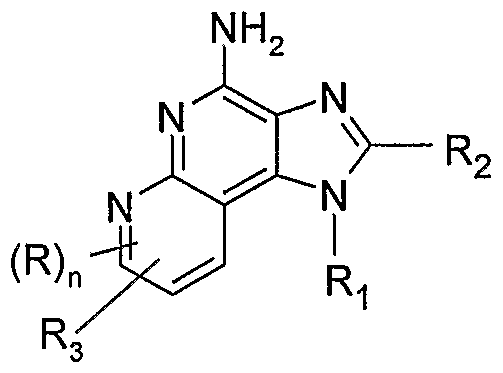


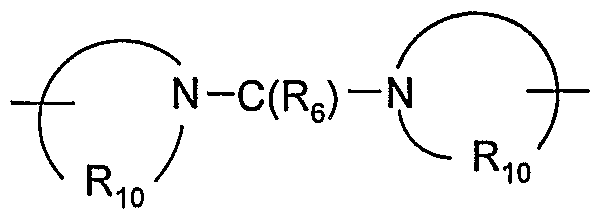

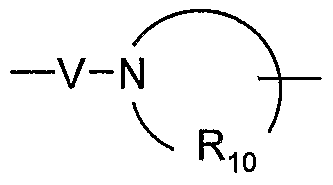

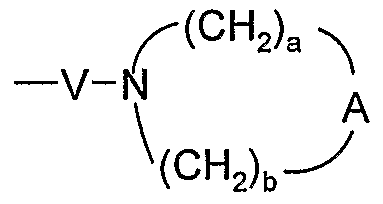


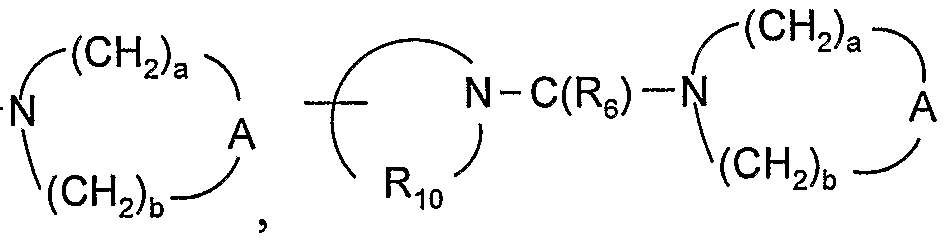


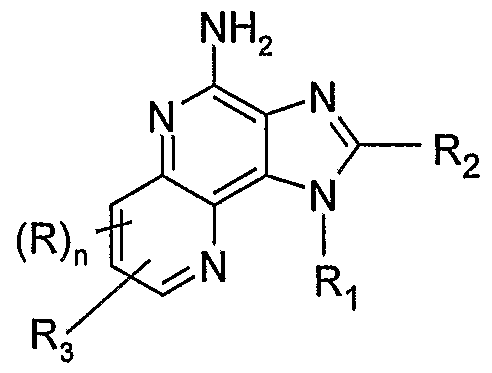


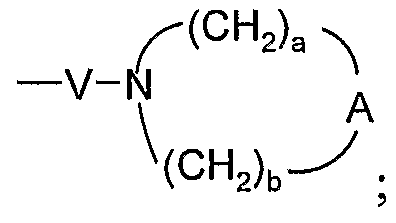


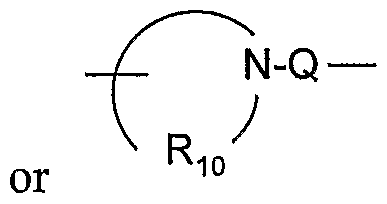


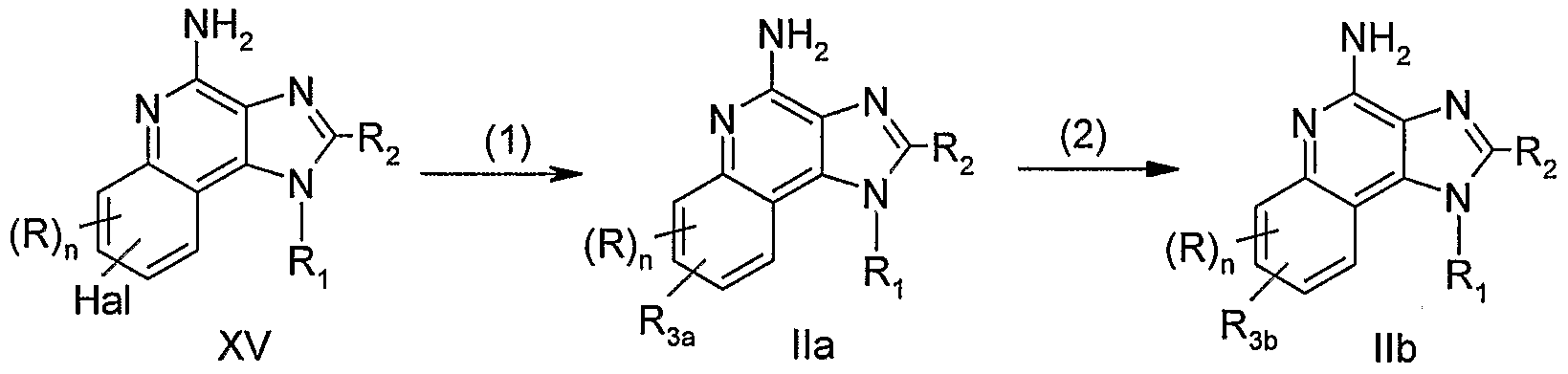


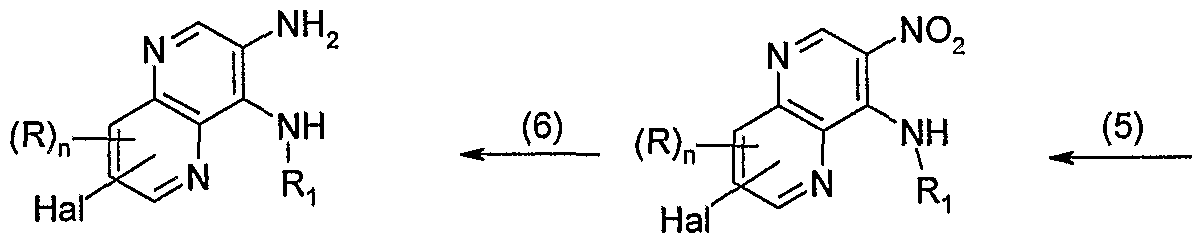


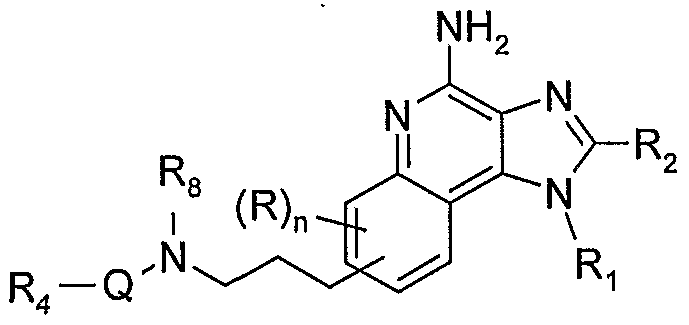
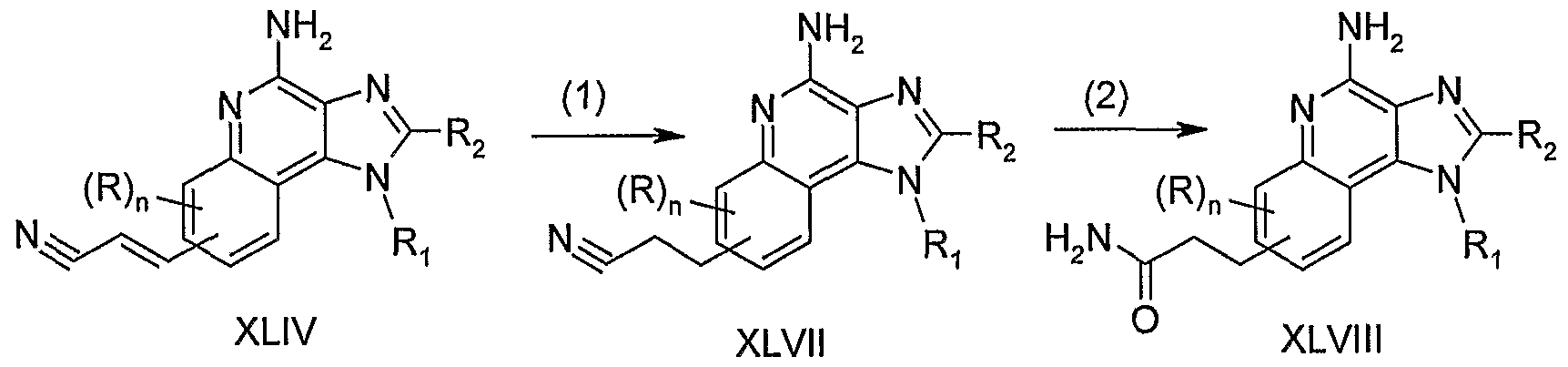


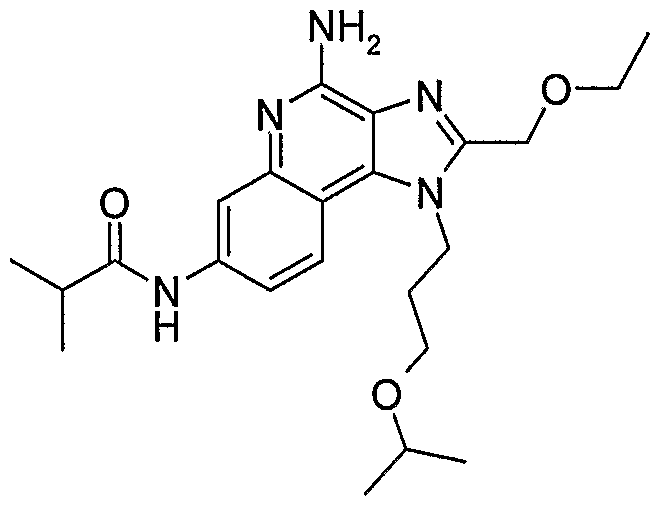
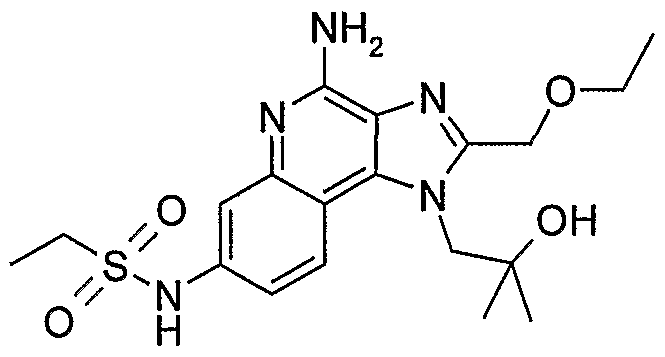


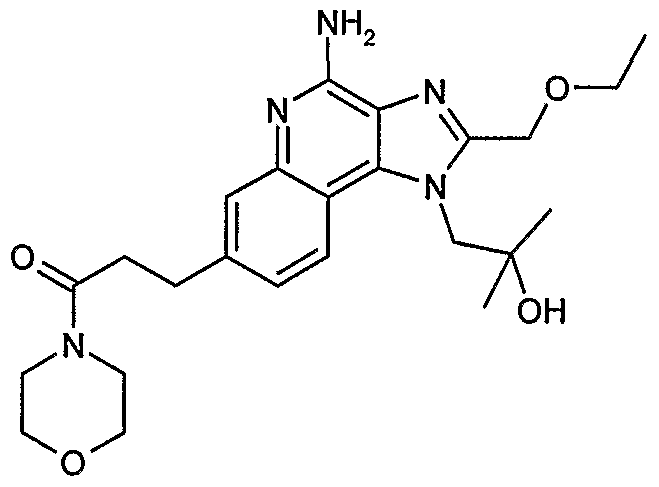


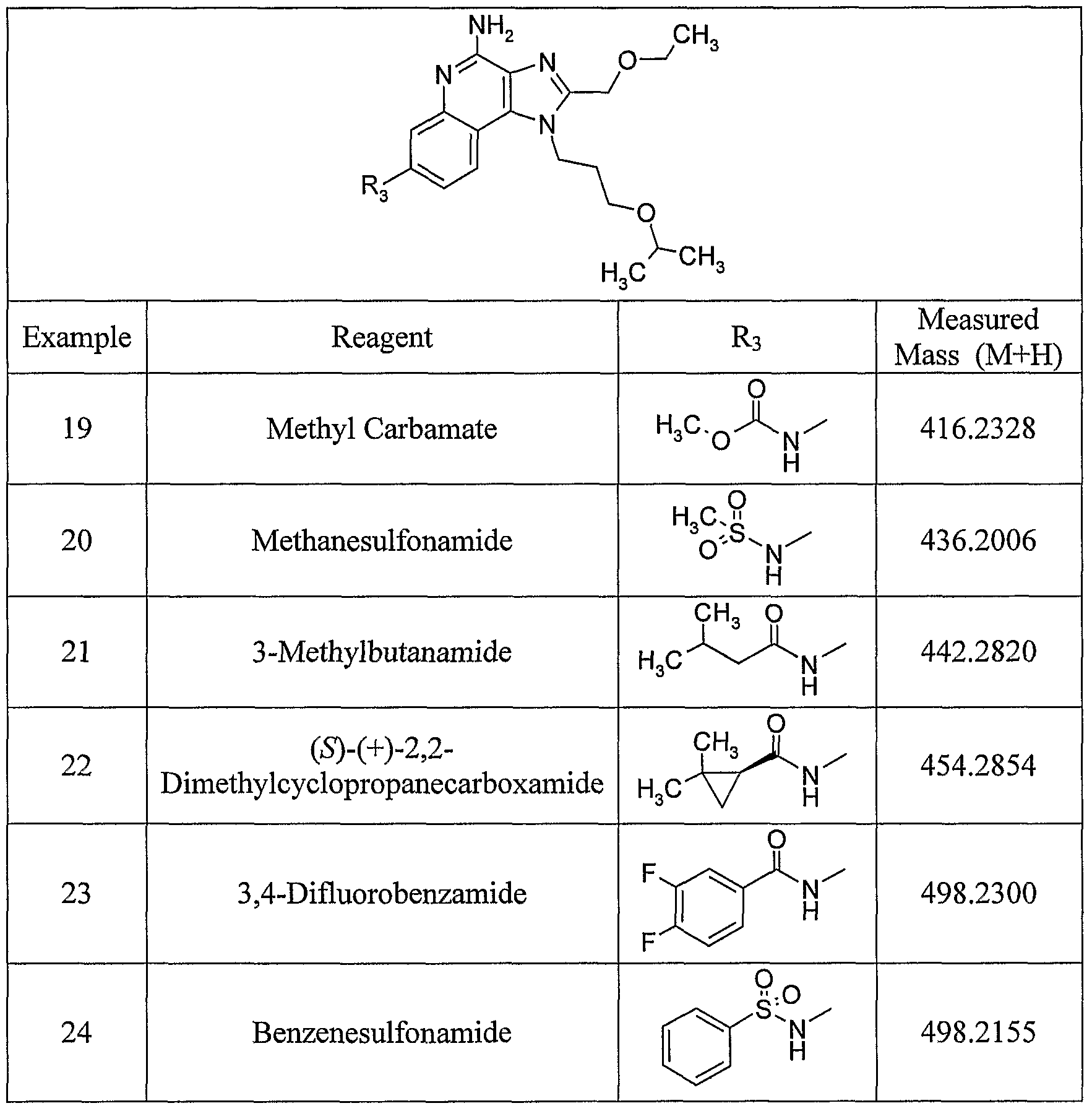


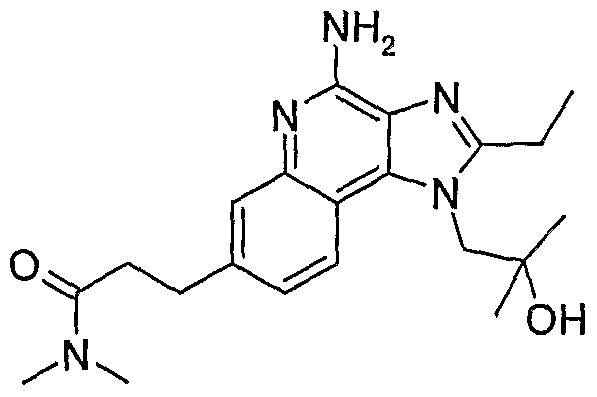


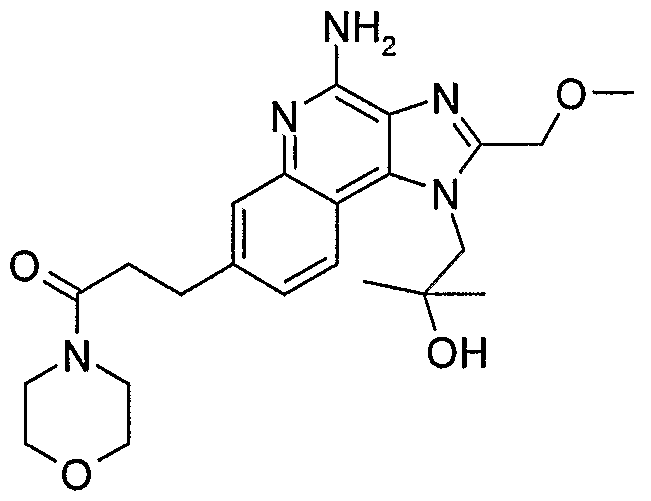


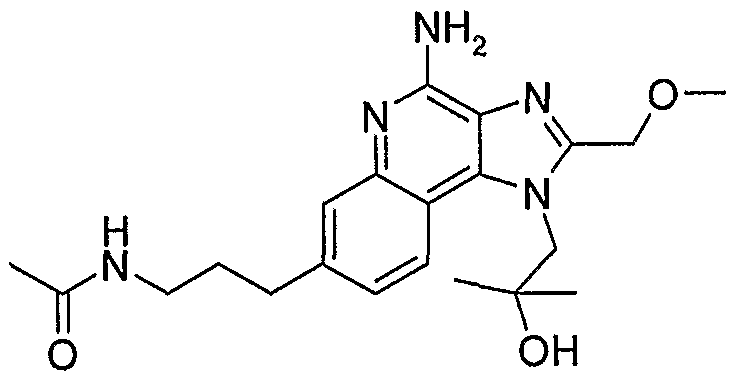


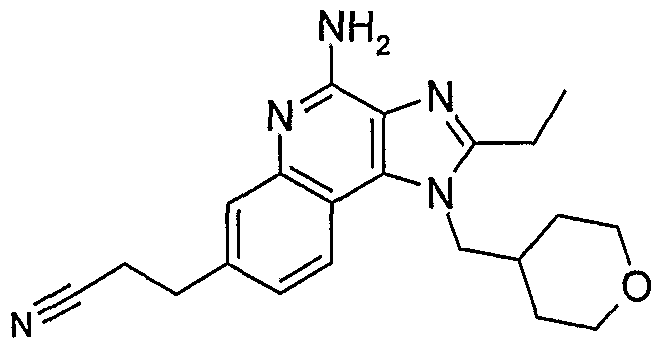
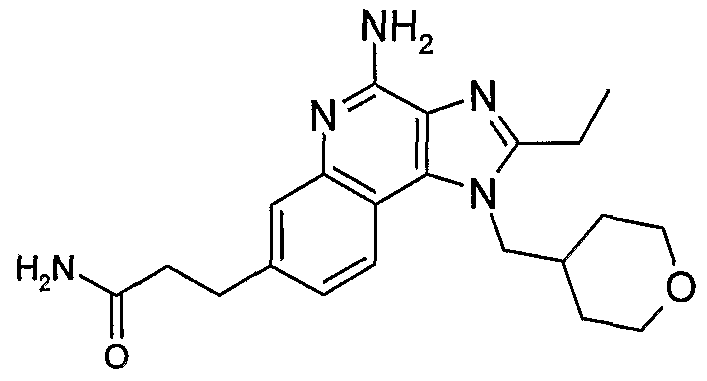


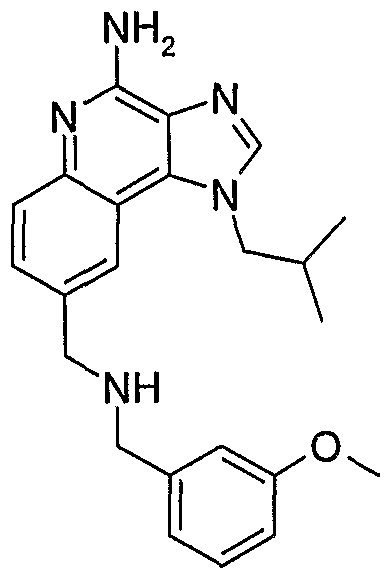


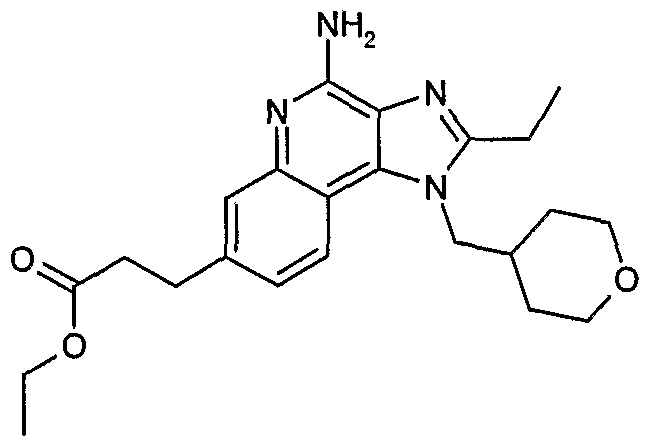

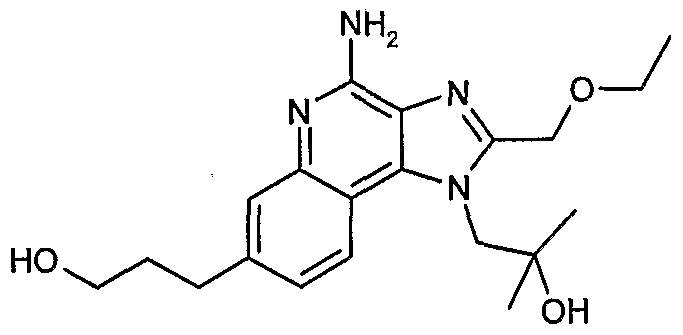

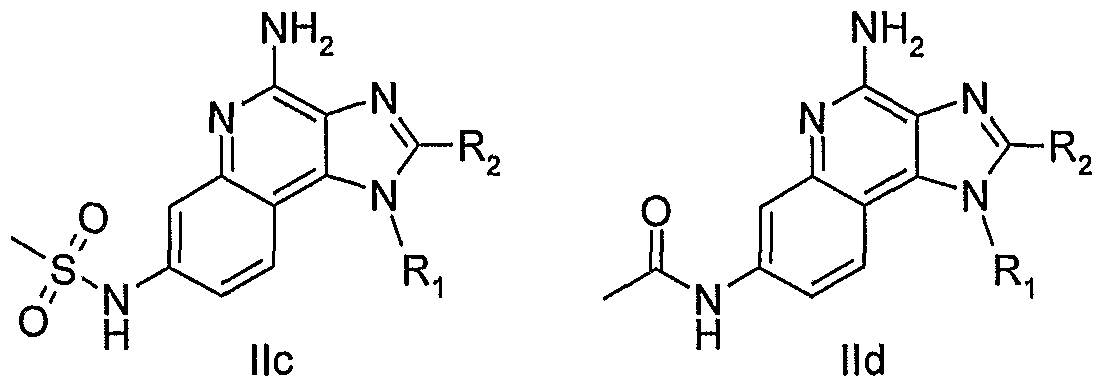


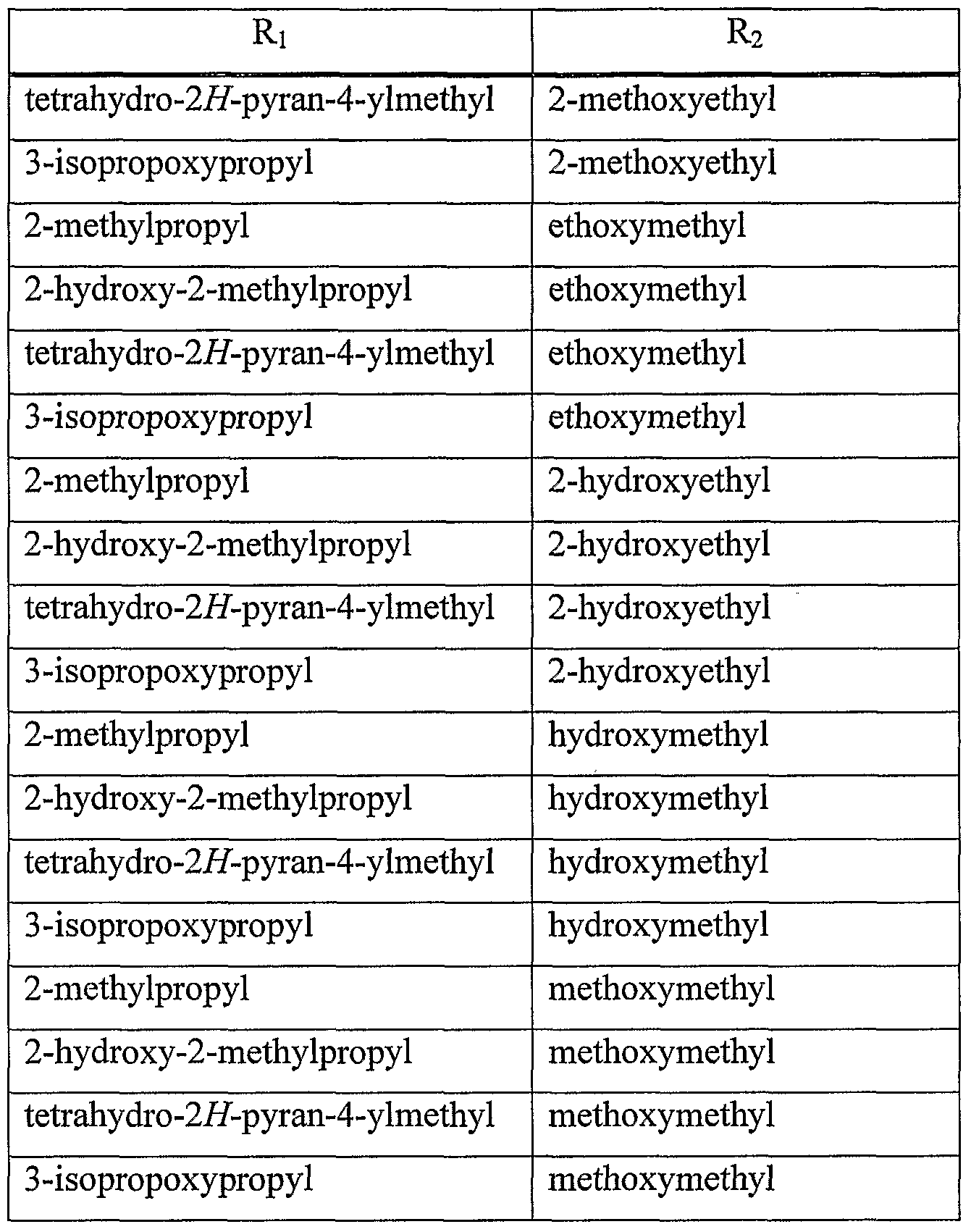


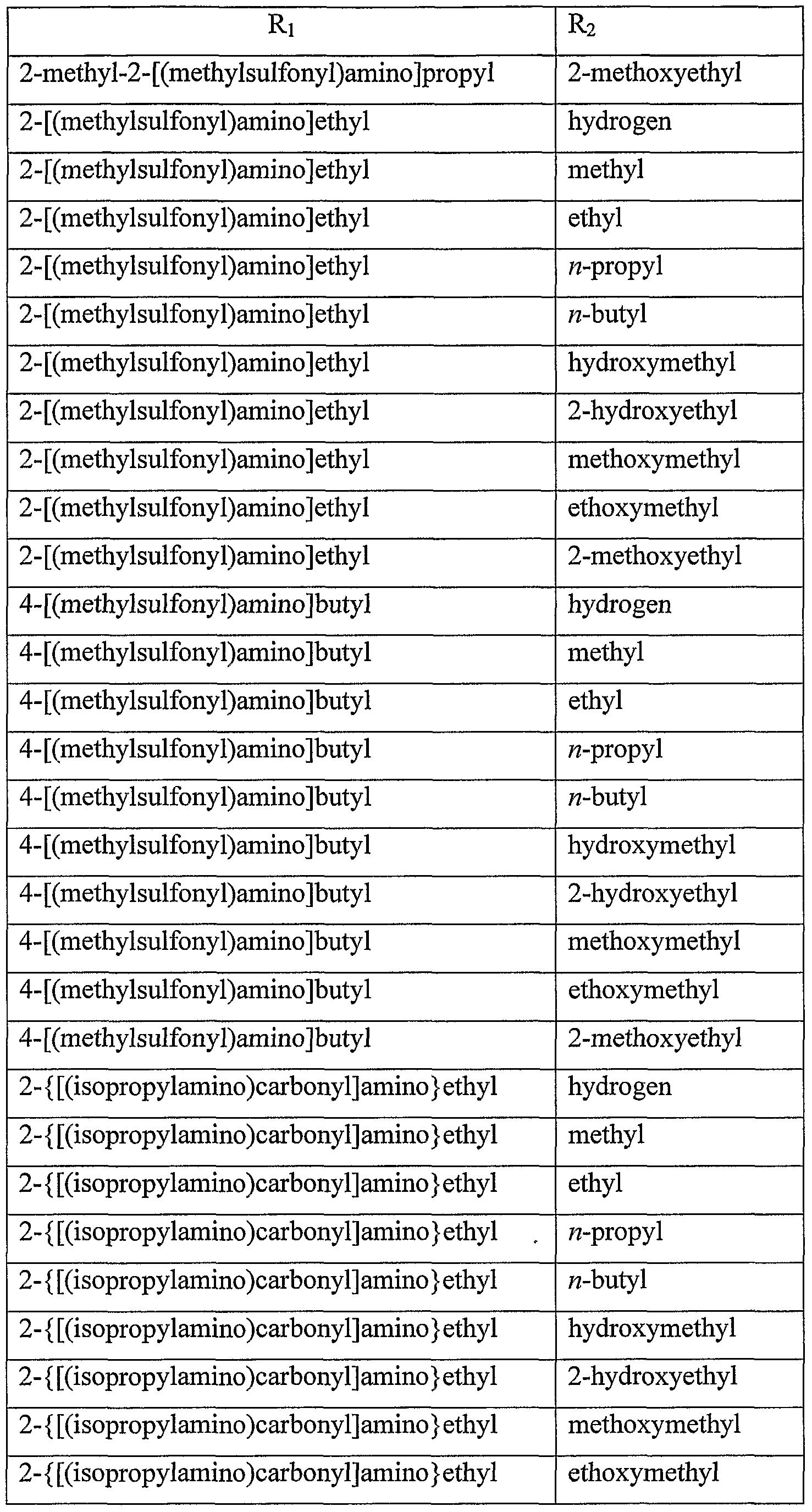


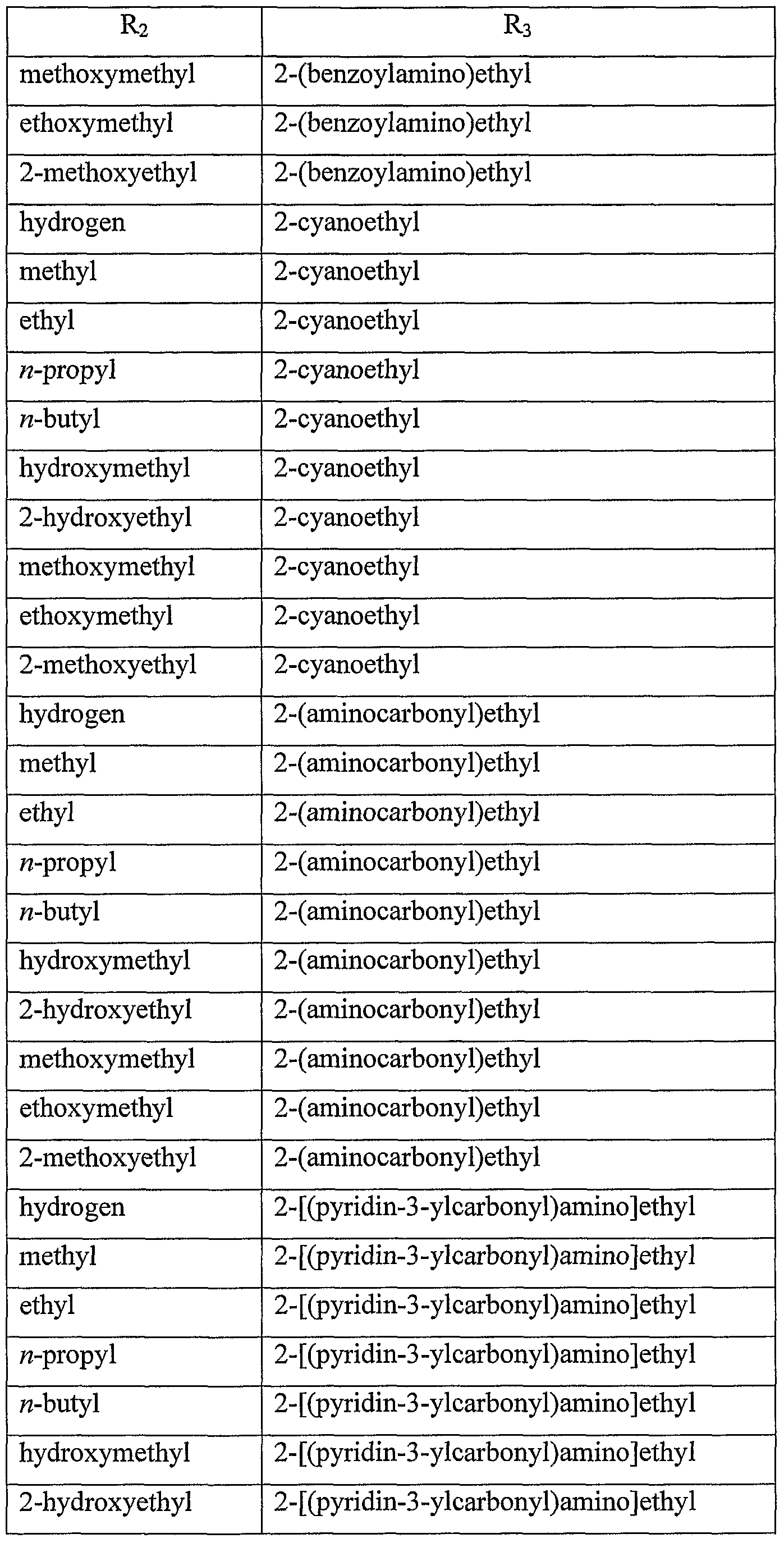

Claims





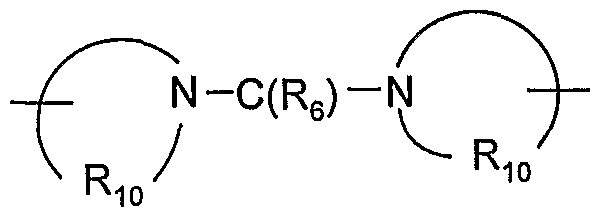


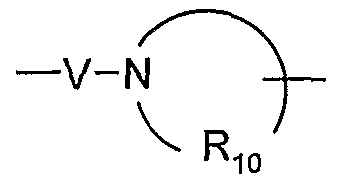


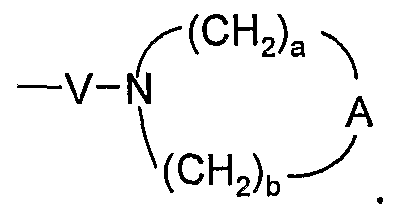


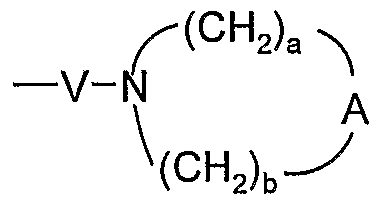
Priority Applications (5)
| Application Number | Priority Date | Filing Date | Title |
|---|---|---|---|
| US11/884,191 US8658666B2 (en) | 2005-02-11 | 2006-02-10 | Substituted imidazoquinolines and imidazonaphthyridines |
| CA002597446A CA2597446A1 (en) | 2005-02-11 | 2006-02-10 | Substituted imidazoquinolines and imidazonaphthyridines |
| EP06748196A EP1845988A2 (en) | 2005-02-11 | 2006-02-10 | Substituted imidazoquinolines and imidazonaphthyridines |
| AU2006216997A AU2006216997A1 (en) | 2005-02-11 | 2006-02-10 | Substituted imidazoquinolines and imidazonaphthyridines |
| JP2007555240A JP2008532933A (en) | 2005-02-11 | 2006-02-10 | Substituted imidazoquinolines and substituted imidazonaphthyridines |
Applications Claiming Priority (2)
| Application Number | Priority Date | Filing Date | Title |
|---|---|---|---|
| US65223905P | 2005-02-11 | 2005-02-11 | |
| US60/652,239 | 2005-02-11 |
Publications (2)
| Publication Number | Publication Date |
|---|---|
| WO2006091394A2 true WO2006091394A2 (en) | 2006-08-31 |
| WO2006091394A3 WO2006091394A3 (en) | 2007-11-22 |
Family
ID=36927891
Family Applications (1)
| Application Number | Title | Priority Date | Filing Date |
|---|---|---|---|
| PCT/US2006/004713 Ceased WO2006091394A2 (en) | 2005-02-11 | 2006-02-10 | Substituted imidazoquinolines and imidazonaphthyridines |
Country Status (6)
| Country | Link |
|---|---|
| US (1) | US8658666B2 (en) |
| EP (1) | EP1845988A2 (en) |
| JP (1) | JP2008532933A (en) |
| AU (1) | AU2006216997A1 (en) |
| CA (1) | CA2597446A1 (en) |
| WO (1) | WO2006091394A2 (en) |
Cited By (56)
| Publication number | Priority date | Publication date | Assignee | Title |
|---|---|---|---|---|
| US7220758B2 (en) | 2002-06-07 | 2007-05-22 | 3M Innovative Properties Company | Ether substituted imidazopyridines |
| JP2010513257A (en) * | 2006-12-14 | 2010-04-30 | アストラゼネカ・アクチエボラーグ | 8-Oxoadenine derivatives as immunomodulators |
| US7879849B2 (en) | 2003-10-03 | 2011-02-01 | 3M Innovative Properties Company | Pyrazolopyridines and analogs thereof |
| US7897597B2 (en) | 2003-08-27 | 2011-03-01 | 3M Innovative Properties Company | Aryloxy and arylalkyleneoxy substituted imidazoquinolines |
| US7897767B2 (en) | 2003-11-14 | 2011-03-01 | 3M Innovative Properties Company | Oxime substituted imidazoquinolines |
| US7906506B2 (en) | 2006-07-12 | 2011-03-15 | 3M Innovative Properties Company | Substituted chiral fused [1,2] imidazo [4,5-c] ring compounds and methods |
| US7915281B2 (en) | 2004-06-18 | 2011-03-29 | 3M Innovative Properties Company | Isoxazole, dihydroisoxazole, and oxadiazole substituted imidazo ring compounds and method |
| US7923429B2 (en) | 2003-09-05 | 2011-04-12 | 3M Innovative Properties Company | Treatment for CD5+ B cell lymphoma |
| US7943610B2 (en) | 2005-04-01 | 2011-05-17 | 3M Innovative Properties Company | Pyrazolopyridine-1,4-diamines and analogs thereof |
| US7943636B2 (en) | 2005-04-01 | 2011-05-17 | 3M Innovative Properties Company | 1-substituted pyrazolo (3,4-C) ring compounds as modulators of cytokine biosynthesis for the treatment of viral infections and neoplastic diseases |
| US7943609B2 (en) | 2004-12-30 | 2011-05-17 | 3M Innovative Proprerties Company | Chiral fused [1,2]imidazo[4,5-C] ring compounds |
| US7968563B2 (en) | 2005-02-11 | 2011-06-28 | 3M Innovative Properties Company | Oxime and hydroxylamine substituted imidazo[4,5-c] ring compounds and methods |
| US8034938B2 (en) | 2004-12-30 | 2011-10-11 | 3M Innovative Properties Company | Substituted chiral fused [1,2]imidazo[4,5-c] ring compounds |
| US8044056B2 (en) | 2007-03-20 | 2011-10-25 | Dainippon Sumitomo Pharma Co., Ltd. | Adenine compound |
| US8063051B2 (en) | 2007-03-19 | 2011-11-22 | Astrazeneca Ab | 9-substituted-8-oxo-adenine compounds as toll-like receptor (TLR7) modulators |
| US8067413B2 (en) | 2007-03-19 | 2011-11-29 | Astrazeneca Ab | 9-substituted-8-oxo-adenine compounds as toll-like receptor (TLR7 ) modulators |
| US8088788B2 (en) | 2006-03-15 | 2012-01-03 | 3M Innovative Properties Company | Substituted fused[1,2] imidazo[4,5-c] ring compounds and methods |
| US8138172B2 (en) | 2006-07-05 | 2012-03-20 | Astrazeneca Ab | 8-oxoadenine derivatives acting as modulators of TLR7 |
| US8598192B2 (en) | 2003-11-14 | 2013-12-03 | 3M Innovative Properties Company | Hydroxylamine substituted imidazoquinolines |
| US8673932B2 (en) | 2003-08-12 | 2014-03-18 | 3M Innovative Properties Company | Oxime substituted imidazo-containing compounds |
| US8691837B2 (en) | 2003-11-25 | 2014-04-08 | 3M Innovative Properties Company | Substituted imidazo ring systems and methods |
| US8728486B2 (en) | 2011-05-18 | 2014-05-20 | University Of Kansas | Toll-like receptor-7 and -8 modulatory 1H imidazoquinoline derived compounds |
| WO2014107663A2 (en) | 2013-01-07 | 2014-07-10 | The Trustees Of The University Of Pennsylvania | Compositions and methods for treating cutaneous t cell lymphoma |
| US8871782B2 (en) | 2003-10-03 | 2014-10-28 | 3M Innovative Properties Company | Alkoxy substituted imidazoquinolines |
| US8895570B2 (en) | 2010-12-17 | 2014-11-25 | Astrazeneca Ab | Purine derivatives |
| US9067936B2 (en) | 2011-08-17 | 2015-06-30 | Glaxosmithkline Llc | 4-(8-methoxy-1-((1-methoxypropan-2-yl)-2-(tetrahydro-2H-pyran-4-yl)-1 H-imidazo[4,5-C]quinolin-7-yl)-3,5-dimethylisoxazole and its use as bromodomain inhibitor |
| US9227969B2 (en) | 2013-08-14 | 2016-01-05 | Novartis Ag | Compounds and compositions as inhibitors of MEK |
| US9248127B2 (en) | 2005-02-04 | 2016-02-02 | 3M Innovative Properties Company | Aqueous gel formulations containing immune response modifiers |
| EP3085373A1 (en) | 2006-02-22 | 2016-10-26 | 3M Innovative Properties Company | Immune response modifier conjugates |
| EP3153180A1 (en) | 2011-06-03 | 2017-04-12 | 3M Innovative Properties Company | Heterobifunctional linkers with polyethylene glycol segments and immune response modifier conjugates made therefrom |
| WO2017184735A1 (en) * | 2016-04-19 | 2017-10-26 | Ifm Therapeutics, Inc | Nlrp3 modulators |
| WO2017184746A1 (en) * | 2016-04-19 | 2017-10-26 | Ifm Therapeutics, Inc | Nlrp3 modulators |
| US9884866B2 (en) * | 2014-09-08 | 2018-02-06 | Regents Of The University Of Minnesota | Immunomodulators and immunomodulator conjugates |
| US10005772B2 (en) | 2006-12-22 | 2018-06-26 | 3M Innovative Properties Company | Immune response modifier compositions and methods |
| WO2019166946A1 (en) | 2018-02-28 | 2019-09-06 | Pfizer Inc. | Il-15 variants and uses thereof |
| CN110325534A (en) * | 2017-02-17 | 2019-10-11 | 先天肿瘤免疫公司 | Substituted imidazoquinolines as NLRP3 modulators |
| WO2019224716A2 (en) | 2018-05-23 | 2019-11-28 | Pfizer Inc. | Antibodies specific for gucy2c and uses thereof |
| WO2019224715A1 (en) | 2018-05-23 | 2019-11-28 | Pfizer Inc. | Antibodies specific for cd3 and uses thereof |
| US10526309B2 (en) | 2015-10-02 | 2020-01-07 | The University Of North Carolina At Chapel Hill | Pan-TAM inhibitors and Mer/Axl dual inhibitors |
| WO2020128893A1 (en) | 2018-12-21 | 2020-06-25 | Pfizer Inc. | Combination treatments of cancer comprising a tlr agonist |
| US10710986B2 (en) | 2018-02-13 | 2020-07-14 | Gilead Sciences, Inc. | PD-1/PD-L1 inhibitors |
| US10730871B2 (en) | 2016-01-28 | 2020-08-04 | Regents Of The University Of Minnesota | Immunomodulators and immunomodulator conjugates |
| US10774071B2 (en) | 2018-07-13 | 2020-09-15 | Gilead Sciences, Inc. | PD-1/PD-L1 inhibitors |
| US10899735B2 (en) | 2018-04-19 | 2021-01-26 | Gilead Sciences, Inc. | PD-1/PD-L1 inhibitors |
| WO2021124073A1 (en) | 2019-12-17 | 2021-06-24 | Pfizer Inc. | Antibodies specific for cd47, pd-l1, and uses thereof |
| US11110178B2 (en) | 2016-07-07 | 2021-09-07 | The Board Of Trustees Of The Leland Standford Junior University | Antibody adjuvant conjugates |
| WO2022013775A1 (en) | 2020-07-17 | 2022-01-20 | Pfizer Inc. | Therapeutic antibodies and their uses |
| US11236085B2 (en) | 2018-10-24 | 2022-02-01 | Gilead Sciences, Inc. | PD-1/PD-L1 inhibitors |
| US20220226492A1 (en) * | 2019-03-15 | 2022-07-21 | Bolt Biotherapeutics, Inc. | Immunoconjugates Targeting HER2 |
| US11400164B2 (en) | 2019-03-15 | 2022-08-02 | Bolt Biotherapeutics, Inc. | Immunoconjugates targeting HER2 |
| WO2022178437A1 (en) * | 2021-02-22 | 2022-08-25 | Regents Of The University Of Minnesota | Immunomodulators and immunomodulator conjugates |
| EP4218824A3 (en) * | 2017-04-14 | 2023-08-09 | Bolt Biotherapeutics, Inc. | Immunoconjugate synthesis method |
| CN116751164A (en) * | 2021-01-12 | 2023-09-15 | 西湖制药(杭州)有限公司 | Protease inhibitors, their preparation and uses |
| WO2024112932A1 (en) | 2022-11-23 | 2024-05-30 | Regents Of The University Of Minnesota | Immunomodulators and immunomodulator conjugates |
| US12060350B2 (en) | 2018-07-02 | 2024-08-13 | Regents Of The University Of Minnesota | Therapeutic compounds and methods of use thereof |
| WO2025104289A1 (en) | 2023-11-17 | 2025-05-22 | Medincell S.A. | Antineoplastic combinations |
Families Citing this family (37)
| Publication number | Priority date | Publication date | Assignee | Title |
|---|---|---|---|---|
| US20040265351A1 (en) | 2003-04-10 | 2004-12-30 | Miller Richard L. | Methods and compositions for enhancing immune response |
| MY146124A (en) | 2003-10-03 | 2012-06-29 | 3M Innovative Properties Co | Pyrazolopyridines and analogs thereof |
| WO2005066170A1 (en) | 2003-12-29 | 2005-07-21 | 3M Innovative Properties Company | Arylalkenyl and arylalkynyl substituted imidazoquinolines |
| JP2007517044A (en) | 2003-12-30 | 2007-06-28 | スリーエム イノベイティブ プロパティズ カンパニー | Imidazoquinolinyl, imidazopyridinyl, and imidazonaphthyridinylsulfonamide |
| CA2559863A1 (en) | 2004-03-24 | 2005-10-13 | 3M Innovative Properties Company | Amide substituted imidazopyridines, imidazoquinolines, and imidazonaphthyridines |
| WO2005123080A2 (en) | 2004-06-15 | 2005-12-29 | 3M Innovative Properties Company | Nitrogen-containing heterocyclyl substituted imidazoquinolines and imidazonaphthyridines |
| US8541438B2 (en) | 2004-06-18 | 2013-09-24 | 3M Innovative Properties Company | Substituted imidazoquinolines, imidazopyridines, and imidazonaphthyridines |
| US7897609B2 (en) | 2004-06-18 | 2011-03-01 | 3M Innovative Properties Company | Aryl substituted imidazonaphthyridines |
| WO2006009826A1 (en) | 2004-06-18 | 2006-01-26 | 3M Innovative Properties Company | Aryloxy and arylalkyleneoxy substituted thiazoloquinolines and thiazolonaphthyridines |
| PL1789042T3 (en) | 2004-09-02 | 2012-09-28 | 3M Innovative Properties Co | 1-alkoxy 1h-imidazo ring systems and methods |
| JP2008530252A (en) | 2005-02-09 | 2008-08-07 | コーリー ファーマシューティカル グループ,インコーポレイテッド | Thiazolo [4,5-c] ring compounds and methods substituted with oximes and hydroxylamines |
| JP5122980B2 (en) | 2005-02-09 | 2013-01-16 | スリーエム イノベイティブ プロパティズ カンパニー | Alkyloxy-substituted thiazoloquinolines and alkyloxy-substituted thiazolonaphthylidenes |
| WO2006091394A2 (en) | 2005-02-11 | 2006-08-31 | Coley Pharmaceutical Group, Inc. | Substituted imidazoquinolines and imidazonaphthyridines |
| WO2006098852A2 (en) * | 2005-02-23 | 2006-09-21 | Coley Pharmaceutical Group, Inc. | Hydroxyalkyl substituted imidazoquinolines |
| AU2006216686A1 (en) * | 2005-02-23 | 2006-08-31 | Coley Pharmaceutical Group, Inc. | Method of preferentially inducing the biosynthesis of interferon |
| US8158794B2 (en) * | 2005-02-23 | 2012-04-17 | 3M Innovative Properties Company | Hydroxyalkyl substituted imidazoquinoline compounds and methods |
| ZA200803029B (en) | 2005-09-09 | 2009-02-25 | Coley Pharm Group Inc | Amide and carbamate derivatives of alkyl substituted /V-[4-(4-amino-1H-imidazo[4,5-c] quinolin-1-yl)butyl] methane-sulfonamides and methods |
| EP1922317A4 (en) * | 2005-09-09 | 2009-04-15 | Coley Pharm Group Inc | Amide and carbamate derivatives of n-{2-ý4-amino-2- (ethoxymethyl)-1h-imidazoý4,5-c¨quinolin-1-yl¨-1,1-dimethylethyl}methanesulfonamide and methods |
| US8088790B2 (en) | 2005-11-04 | 2012-01-03 | 3M Innovative Properties Company | Hydroxy and alkoxy substituted 1H-imidazoquinolines and methods |
| US8329721B2 (en) * | 2006-03-15 | 2012-12-11 | 3M Innovative Properties Company | Hydroxy and alkoxy substituted 1H-imidazonaphthyridines and methods |
| WO2008030511A2 (en) * | 2006-09-06 | 2008-03-13 | Coley Pharmaceuticial Group, Inc. | Substituted 3,4,6,7-tetrahydro-5h, 1,2a,4a,8-tetraazacyclopenta[cd]phenalenes |
| HRP20150892T1 (en) | 2008-03-03 | 2015-09-25 | Novartis Ag | COMPOUNDS AND COMPOSITIONS AS MODULATORS OF TLR ACTIVITY |
| PT2606047T (en) | 2010-08-17 | 2017-04-07 | 3M Innovative Properties Co | Lipidated immune response modifier compound compositions, formulations, and methods |
| ES2575688T3 (en) | 2010-12-16 | 2016-06-30 | Sumitomo Dainippon Pharma Co., Ltd. | Imidazo [4,5-c] quinolin-1-yl derivative useful in therapy |
| WO2012167088A1 (en) | 2011-06-03 | 2012-12-06 | 3M Innovative Properties Company | Heterobifunctional linkers with polyethylene glycol segments and immune response modifier conjugates made therefrom |
| CA3086439A1 (en) | 2017-12-20 | 2019-06-27 | 3M Innovative Properties Company | Amide substitued imidazo[4,5-c]quinoline compounds with a branched chain linking group for use as an immune response modifier |
| WO2020214783A1 (en) * | 2019-04-17 | 2020-10-22 | University Of Kansas | Imidazoquinoline compounds and prodrugs thereof |
| WO2021150613A1 (en) | 2020-01-20 | 2021-07-29 | Incyte Corporation | Spiro compounds as inhibitors of kras |
| WO2021231526A1 (en) | 2020-05-13 | 2021-11-18 | Incyte Corporation | Fused pyrimidine compounds as kras inhibitors |
| US11999752B2 (en) | 2020-08-28 | 2024-06-04 | Incyte Corporation | Vinyl imidazole compounds as inhibitors of KRAS |
| US11767320B2 (en) | 2020-10-02 | 2023-09-26 | Incyte Corporation | Bicyclic dione compounds as inhibitors of KRAS |
| US12077539B2 (en) | 2021-03-22 | 2024-09-03 | Incyte Corporation | Imidazole and triazole KRAS inhibitors |
| IL309642A (en) | 2021-07-07 | 2024-02-01 | Incyte Corp | Tricyclic compounds as inhibitors of kras |
| US12441742B2 (en) | 2021-08-31 | 2025-10-14 | Incyte Corporation | Naphthyridine compounds as inhibitors of KRAS |
| WO2023049697A1 (en) | 2021-09-21 | 2023-03-30 | Incyte Corporation | Hetero-tricyclic compounds as inhibitors of kras |
| US12030884B2 (en) | 2021-10-01 | 2024-07-09 | Incyte Corporation | Pyrazoloquinoline KRAS inhibitors |
| CA3235146A1 (en) | 2021-10-14 | 2023-04-20 | Incyte Corporation | Quinoline compounds as inhibitors of kras |
Family Cites Families (187)
| Publication number | Priority date | Publication date | Assignee | Title |
|---|---|---|---|---|
| US3314941A (en) | 1964-06-23 | 1967-04-18 | American Cyanamid Co | Novel substituted pyridodiazepins |
| US3698348A (en) * | 1970-09-21 | 1972-10-17 | Subsea Equipment Ass Ltd | Method and apparatus for subsurface towing of flowlines |
| IL73534A (en) * | 1983-11-18 | 1990-12-23 | Riker Laboratories Inc | 1h-imidazo(4,5-c)quinoline-4-amines,their preparation and pharmaceutical compositions containing certain such compounds |
| ZA848968B (en) | 1983-11-18 | 1986-06-25 | Riker Laboratories Inc | 1h-imidazo(4,5-c)quinolines and 1h-imidazo(4,5-c)quinolin-4-amines |
| US5238944A (en) | 1988-12-15 | 1993-08-24 | Riker Laboratories, Inc. | Topical formulations and transdermal delivery systems containing 1-isobutyl-1H-imidazo[4,5-c]quinolin-4-amine |
| US5756747A (en) | 1989-02-27 | 1998-05-26 | Riker Laboratories, Inc. | 1H-imidazo 4,5-c!quinolin-4-amines |
| EP0385630B1 (en) * | 1989-02-27 | 1996-11-27 | Riker Laboratories, Inc. | 1H-imidazo(4,5-c)Quinolin-4-amines as antivirals |
| US4929624A (en) | 1989-03-23 | 1990-05-29 | Minnesota Mining And Manufacturing Company | Olefinic 1H-imidazo(4,5-c)quinolin-4-amines |
| US5037986A (en) | 1989-03-23 | 1991-08-06 | Minnesota Mining And Manufacturing Company | Olefinic 1H-imidazo[4,5-c]quinolin-4-amines |
| NZ232740A (en) | 1989-04-20 | 1992-06-25 | Riker Laboratories Inc | Solution for parenteral administration comprising a 1h-imidazo(4,5-c) quinolin-4-amine derivative, an acid and a tonicity adjuster |
| US4988815A (en) | 1989-10-26 | 1991-01-29 | Riker Laboratories, Inc. | 3-Amino or 3-nitro quinoline compounds which are intermediates in preparing 1H-imidazo[4,5-c]quinolines |
| ATE121088T1 (en) | 1990-10-05 | 1995-04-15 | Minnesota Mining & Mfg | METHOD FOR PRODUCING IMIDAZO(4,5- C>QUINOLINE-4-AMINES. |
| US5389640A (en) * | 1991-03-01 | 1995-02-14 | Minnesota Mining And Manufacturing Company | 1-substituted, 2-substituted 1H-imidazo[4,5-c]quinolin-4-amines |
| US5175296A (en) | 1991-03-01 | 1992-12-29 | Minnesota Mining And Manufacturing Company | Imidazo[4,5-c]quinolin-4-amines and processes for their preparation |
| US5268376A (en) * | 1991-09-04 | 1993-12-07 | Minnesota Mining And Manufacturing Company | 1-substituted 1H-imidazo[4,5-c]quinolin-4-amines |
| US5266575A (en) | 1991-11-06 | 1993-11-30 | Minnesota Mining And Manufacturing Company | 2-ethyl 1H-imidazo[4,5-ciquinolin-4-amines |
| IL105325A (en) | 1992-04-16 | 1996-11-14 | Minnesota Mining & Mfg | Immunogen/vaccine adjuvant composition |
| US5395937A (en) | 1993-01-29 | 1995-03-07 | Minnesota Mining And Manufacturing Company | Process for preparing quinoline amines |
| ES2149276T3 (en) | 1993-07-15 | 2000-11-01 | Minnesota Mining & Mfg | IMIDAZO (4,5-C) PIRIDIN-4-AMINAS. |
| US5352784A (en) * | 1993-07-15 | 1994-10-04 | Minnesota Mining And Manufacturing Company | Fused cycloalkylimidazopyridines |
| US5648516A (en) | 1994-07-20 | 1997-07-15 | Minnesota Mining And Manufacturing Company | Fused cycloalkylimidazopyridines |
| US5644063A (en) | 1994-09-08 | 1997-07-01 | Minnesota Mining And Manufacturing Company | Imidazo[4,5-c]pyridin-4-amine intermediates |
| US5482936A (en) | 1995-01-12 | 1996-01-09 | Minnesota Mining And Manufacturing Company | Imidazo[4,5-C]quinoline amines |
| US5693811A (en) | 1996-06-21 | 1997-12-02 | Minnesota Mining And Manufacturing Company | Process for preparing tetrahdroimidazoquinolinamines |
| US5741908A (en) | 1996-06-21 | 1998-04-21 | Minnesota Mining And Manufacturing Company | Process for reparing imidazoquinolinamines |
| CZ294563B6 (en) | 1996-10-25 | 2005-02-16 | Minnesota Mining And Manufacturing Company | Immune response modifier compounds for treatment of TH2 cell mediated and related diseases |
| US5939090A (en) | 1996-12-03 | 1999-08-17 | 3M Innovative Properties Company | Gel formulations for topical drug delivery |
| EP0894797A4 (en) | 1997-01-09 | 2001-08-16 | Terumo Corp | Novel amide derivatives and intermediates for the synthesis thereof |
| UA67760C2 (en) | 1997-12-11 | 2004-07-15 | Міннесота Майнінг Енд Мануфакчурінг Компані | Imidazonaphthyridines and use thereof to induce the biosynthesis of cytokines |
| US6110929A (en) | 1998-07-28 | 2000-08-29 | 3M Innovative Properties Company | Oxazolo, thiazolo and selenazolo [4,5-c]-quinolin-4-amines and analogs thereof |
| JP2000119271A (en) | 1998-08-12 | 2000-04-25 | Hokuriku Seiyaku Co Ltd | 1H-imidazopyridine derivative |
| US6486168B1 (en) | 1999-01-08 | 2002-11-26 | 3M Innovative Properties Company | Formulations and methods for treatment of mucosal associated conditions with an immune response modifier |
| HU229441B1 (en) | 1999-01-08 | 2013-12-30 | 3M Innovative Properties Co | Formulations and methods for treating mucosal associated conditions with an immune response modifier |
| US20020058674A1 (en) | 1999-01-08 | 2002-05-16 | Hedenstrom John C. | Systems and methods for treating a mucosal surface |
| US6558951B1 (en) | 1999-02-11 | 2003-05-06 | 3M Innovative Properties Company | Maturation of dendritic cells with immune response modifying compounds |
| JP2000247884A (en) | 1999-03-01 | 2000-09-12 | Sumitomo Pharmaceut Co Ltd | Arachidonic acid-induced skin disease treatment |
| US6756382B2 (en) | 1999-06-10 | 2004-06-29 | 3M Innovative Properties Company | Amide substituted imidazoquinolines |
| US6331539B1 (en) | 1999-06-10 | 2001-12-18 | 3M Innovative Properties Company | Sulfonamide and sulfamide substituted imidazoquinolines |
| US6451810B1 (en) * | 1999-06-10 | 2002-09-17 | 3M Innovative Properties Company | Amide substituted imidazoquinolines |
| US6573273B1 (en) | 1999-06-10 | 2003-06-03 | 3M Innovative Properties Company | Urea substituted imidazoquinolines |
| US6541485B1 (en) | 1999-06-10 | 2003-04-01 | 3M Innovative Properties Company | Urea substituted imidazoquinolines |
| US6916925B1 (en) | 1999-11-05 | 2005-07-12 | 3M Innovative Properties Co. | Dye labeled imidazoquinoline compounds |
| US6376669B1 (en) | 1999-11-05 | 2002-04-23 | 3M Innovative Properties Company | Dye labeled imidazoquinoline compounds |
| US6894060B2 (en) | 2000-03-30 | 2005-05-17 | 3M Innovative Properties Company | Method for the treatment of dermal lesions caused by envenomation |
| US20020055517A1 (en) | 2000-09-15 | 2002-05-09 | 3M Innovative Properties Company | Methods for delaying recurrence of herpes virus symptoms |
| US6677347B2 (en) | 2000-12-08 | 2004-01-13 | 3M Innovative Properties Company | Sulfonamido ether substituted imidazoquinolines |
| CA2598144A1 (en) | 2000-12-08 | 2006-08-31 | 3M Innovative Properties Company | Compositions and methods for targeted delivery of immune response modifiers |
| US6664264B2 (en) | 2000-12-08 | 2003-12-16 | 3M Innovative Properties Company | Thioether substituted imidazoquinolines |
| US6677348B2 (en) | 2000-12-08 | 2004-01-13 | 3M Innovative Properties Company | Aryl ether substituted imidazoquinolines |
| US6660735B2 (en) | 2000-12-08 | 2003-12-09 | 3M Innovative Properties Company | Urea substituted imidazoquinoline ethers |
| US6664265B2 (en) | 2000-12-08 | 2003-12-16 | 3M Innovative Properties Company | Amido ether substituted imidazoquinolines |
| UA74852C2 (en) | 2000-12-08 | 2006-02-15 | 3M Innovative Properties Co | Urea-substituted imidazoquinoline ethers |
| US6545016B1 (en) | 2000-12-08 | 2003-04-08 | 3M Innovative Properties Company | Amide substituted imidazopyridines |
| US6545017B1 (en) | 2000-12-08 | 2003-04-08 | 3M Innovative Properties Company | Urea substituted imidazopyridines |
| US6525064B1 (en) | 2000-12-08 | 2003-02-25 | 3M Innovative Properties Company | Sulfonamido substituted imidazopyridines |
| US20020107262A1 (en) | 2000-12-08 | 2002-08-08 | 3M Innovative Properties Company | Substituted imidazopyridines |
| US6664260B2 (en) | 2000-12-08 | 2003-12-16 | 3M Innovative Properties Company | Heterocyclic ether substituted imidazoquinolines |
| US6667312B2 (en) | 2000-12-08 | 2003-12-23 | 3M Innovative Properties Company | Thioether substituted imidazoquinolines |
| US6660747B2 (en) | 2000-12-08 | 2003-12-09 | 3M Innovative Properties Company | Amido ether substituted imidazoquinolines |
| KR100455713B1 (en) | 2001-01-29 | 2004-11-06 | 호남석유화학 주식회사 | Multinuclear metallocene catalysts for olefin polymerization and process for olefin polymerization using the same |
| US7226928B2 (en) | 2001-06-15 | 2007-06-05 | 3M Innovative Properties Company | Methods for the treatment of periodontal disease |
| JP2005501550A (en) | 2001-08-30 | 2005-01-20 | スリーエム イノベイティブ プロパティズ カンパニー | Maturation of plasmacytoid dendritic cells using immune response modifier molecules |
| ES2367422T3 (en) | 2001-10-09 | 2011-11-03 | Amgen Inc. | IMIDAZOL DERIVATIVES AS ANTI-INFLAMMATORY AGENTS. |
| EP1478371A4 (en) | 2001-10-12 | 2007-11-07 | Univ Iowa Res Found | METHODS AND PRODUCTS FOR ENHANCING IMMUNE RESPONSES USING IMIDAZOQUINOLINE COMPOUND |
| ES2318615T3 (en) | 2001-11-16 | 2009-05-01 | Coley Pharmaceutical Group, Inc. | N- (4- (4-AMINO-2-ETIL-1H-IMIDAZO (4,5-C) QUINOLIN-1-IL) BUTIL) METHANOSULPHONAMIDE, A PHARMACEUTICAL COMPOSITION THAT UNDERSTANDS AND USES ITSELF. |
| NZ532769A (en) | 2001-11-29 | 2005-12-23 | 3M Innovative Properties Co | Pharmaceutical formulations comprising an immune response modifier |
| US6677349B1 (en) | 2001-12-21 | 2004-01-13 | 3M Innovative Properties Company | Sulfonamide and sulfamide substituted imidazoquinolines |
| EP1478327B1 (en) | 2002-02-22 | 2015-04-29 | Meda AB | Method of reducing and treating uvb-induced immunosuppression |
| AU2003216851B2 (en) | 2002-03-19 | 2008-04-17 | Powderject Research Limited | Imidazoquinoline adjuvants for vaccines |
| GB0211649D0 (en) | 2002-05-21 | 2002-07-03 | Novartis Ag | Organic compounds |
| WO2003101949A2 (en) | 2002-05-29 | 2003-12-11 | 3M Innovative Properties Company | Process for imidazo[4,5-c]pyridin-4-amines |
| CA2488801A1 (en) | 2002-06-07 | 2003-12-18 | 3M Innovative Properties Company | Ether substituted imidazopyridines |
| WO2004009593A1 (en) | 2002-07-23 | 2004-01-29 | Biogal Gyogyszergyar Rt. | Preparation of 1h-imidazo[4,5-c]quinolin-4-amines via1h-imidazo [4,5-c]quinolin-4-phthalimide intermediates |
| AU2003254221A1 (en) | 2002-07-26 | 2004-02-16 | Biogal Gyogyszergyar Rt. | Preparation of 1h-imidazo (4,5-c) quinolin-4-amines via novel 1h-imidazo (4,5-c) quinolin-4-cyano and 1h-imidazo (4,5-c) quinolin-4-carboxamide intermediates |
| ES2355819T3 (en) | 2002-08-15 | 2011-03-31 | 3M Innovative Properties Company | IMMUNOSTIMULATING COMPOSITIONS AND METHODS TO STIMULATE AN IMMUNE ANSWER. |
| AU2003299082A1 (en) | 2002-09-26 | 2004-04-19 | 3M Innovative Properties Company | 1h-imidazo dimers |
| AU2003287324A1 (en) | 2002-12-11 | 2004-06-30 | 3M Innovative Properties Company | Gene expression systems and recombinant cell lines |
| AU2003287316A1 (en) | 2002-12-11 | 2004-06-30 | 3M Innovative Properties Company | Assays relating to toll-like receptor activity |
| NZ540826A (en) * | 2002-12-20 | 2008-07-31 | 3M Innovative Properties Co | Aryl / hetaryl substituted imidazoquinolines |
| WO2004060319A2 (en) | 2002-12-30 | 2004-07-22 | 3M Innovative Properties Company | Immunostimulatory combinations |
| EP1592302A4 (en) | 2003-02-13 | 2007-04-25 | 3M Innovative Properties Co | Methods and compositions related to irm compounds and toll-like receptor 8 |
| US7485432B2 (en) | 2003-02-27 | 2009-02-03 | 3M Innovative Properties Company | Selective modulation of TLR-mediated biological activity |
| JP2006519866A (en) | 2003-03-04 | 2006-08-31 | スリーエム イノベイティブ プロパティズ カンパニー | Prophylactic treatment of UV-induced epidermal neoplasia |
| US7163947B2 (en) | 2003-03-07 | 2007-01-16 | 3M Innovative Properties Company | 1-Amino 1H-imidazoquinolines |
| CA2518445A1 (en) | 2003-03-13 | 2004-09-23 | 3M Innovative Properties Company | Method of tattoo removal |
| ATE556711T1 (en) | 2003-03-13 | 2012-05-15 | 3M Innovative Properties Co | METHOD FOR IMPROVING SKIN QUALITY |
| US7699057B2 (en) | 2003-03-13 | 2010-04-20 | 3M Innovative Properties Company | Methods for treating skin lesions |
| JP2006523452A (en) | 2003-03-25 | 2006-10-19 | スリーエム イノベイティブ プロパティズ カンパニー | Selective activation of cellular activity mediated through a common Toll-like receptor |
| US20040192585A1 (en) | 2003-03-25 | 2004-09-30 | 3M Innovative Properties Company | Treatment for basal cell carcinoma |
| US20040265351A1 (en) | 2003-04-10 | 2004-12-30 | Miller Richard L. | Methods and compositions for enhancing immune response |
| AU2004244962A1 (en) * | 2003-04-10 | 2004-12-16 | 3M Innovative Properties Company | Delivery of immune response modifier compounds using metal-containing particulate support materials |
| US20040214851A1 (en) | 2003-04-28 | 2004-10-28 | 3M Innovative Properties Company | Compositions and methods for induction of opioid receptors |
| US7731967B2 (en) | 2003-04-30 | 2010-06-08 | Novartis Vaccines And Diagnostics, Inc. | Compositions for inducing immune responses |
| WO2004110992A2 (en) | 2003-06-06 | 2004-12-23 | 3M Innovative Properties Company | Process for imidazo[4,5-c] pyridin-4-amines |
| US6943255B2 (en) | 2003-06-06 | 2005-09-13 | 3M Innovative Properties Company | Process for imidazo[4,5-c]pyridin-4-amines |
| US20050106300A1 (en) | 2003-06-30 | 2005-05-19 | Purdue Research Foundation | Method for producing a material having an increased solubility in alcohol |
| EP1651035A2 (en) | 2003-07-31 | 2006-05-03 | 3M Innovative Properties Company | Compositions for encapsulation and controlled release |
| JP2007501251A (en) | 2003-08-05 | 2007-01-25 | スリーエム イノベイティブ プロパティズ カンパニー | Infection prevention using immune response modifier compounds |
| AU2004266641A1 (en) | 2003-08-12 | 2005-03-03 | 3M Innovative Properties Company | Oxime substituted imidazo-containing compounds |
| US7799800B2 (en) | 2003-08-14 | 2010-09-21 | 3M Innovative Properties Company | Lipid-modified immune response modifiers |
| CA2551075A1 (en) | 2003-08-25 | 2005-03-03 | 3M Innovative Properties Company | Immunostimulatory combinations and treatments |
| AU2004268616B2 (en) | 2003-08-25 | 2010-10-07 | 3M Innovative Properties Company | Delivery of immune response modifier compounds |
| NZ545412A (en) | 2003-08-27 | 2008-12-24 | Coley Pharm Group Inc | Aryloxy and arylalkyleneoxy substituted imidazoquinolines |
| WO2005020995A1 (en) | 2003-09-02 | 2005-03-10 | 3M Innovative Properties Company | Methods related to the treatment of mucosal associated conditions |
| US7576068B2 (en) | 2003-09-05 | 2009-08-18 | Anadys Pharmaceuticals, Inc. | Administration of TLR7 ligands and prodrugs thereof for treatment of infection by hepatitis C virus |
| US20050054665A1 (en) | 2003-09-05 | 2005-03-10 | 3M Innovative Properties Company | Treatment for CD5+ B cell lymphoma |
| US20050059072A1 (en) | 2003-09-17 | 2005-03-17 | 3M Innovative Properties Company | Selective modulation of TLR gene expression |
| CA2536530A1 (en) | 2003-10-01 | 2005-04-14 | Taro Pharmaceuticals U.S.A., Inc. | Method of preparing 4-amino-1h-imidazo(4,5-c)quinolines and acid addition salts thereof |
| WO2005032484A2 (en) | 2003-10-03 | 2005-04-14 | 3M Innovative Properties Company | Alkoxy substituted imidazoquinolines |
| US7544697B2 (en) | 2003-10-03 | 2009-06-09 | Coley Pharmaceutical Group, Inc. | Pyrazolopyridines and analogs thereof |
| US20090075980A1 (en) | 2003-10-03 | 2009-03-19 | Coley Pharmaceutical Group, Inc. | Pyrazolopyridines and Analogs Thereof |
| WO2005041891A2 (en) | 2003-10-31 | 2005-05-12 | 3M Innovative Properties Company | Neutrophil activation by immune response modifier compounds |
| ITMI20032121A1 (en) | 2003-11-04 | 2005-05-05 | Dinamite Dipharma Spa In Forma Abbr Eviata Dipharm | PROCEDURE FOR THE PREPARATION OF IMIQUIMOD AND ITS INTERMEDIATES |
| JP2007511527A (en) | 2003-11-14 | 2007-05-10 | スリーエム イノベイティブ プロパティズ カンパニー | Oxime-substituted imidazo ring compounds |
| JP2007511535A (en) | 2003-11-14 | 2007-05-10 | スリーエム イノベイティブ プロパティズ カンパニー | Hydroxylamine substituted imidazo ring compounds |
| WO2005054237A1 (en) | 2003-11-21 | 2005-06-16 | Novartis Ag | 1h-imidazoquinoline derivatives as protein kinase inhibitors |
| AR046845A1 (en) | 2003-11-21 | 2005-12-28 | Novartis Ag | DERIVATIVES OF 1H-IMIDAZO [4,5-C] QUINOLINE FOR THE TREATMENT OF PROTEIN-KINASE DEPENDENT DISEASES |
| NZ547467A (en) | 2003-11-25 | 2010-06-25 | 3M Innovative Properties Co | Substituted imidazo ring system and methods |
| CA2547085A1 (en) | 2003-11-25 | 2005-06-09 | 3M Innovative Properties Company | Hydroxylamine and oxime substituted imidazoquinolines, imidazopyridines, and imidazonaphthyridines |
| WO2005055932A2 (en) | 2003-12-02 | 2005-06-23 | 3M Innovative Properties Company | Therapeutic combinations and methods including irm compounds |
| AU2004315771A1 (en) | 2003-12-04 | 2005-08-25 | 3M Innovative Properties Company | Sulfone substituted imidazo ring ethers |
| WO2005066170A1 (en) | 2003-12-29 | 2005-07-21 | 3M Innovative Properties Company | Arylalkenyl and arylalkynyl substituted imidazoquinolines |
| JP2007530450A (en) | 2003-12-29 | 2007-11-01 | スリーエム イノベイティブ プロパティズ カンパニー | Piperazine, [1,4] diazepan, [1,4] diazocan, and [1,5] diazocan condensed imidazo ring compounds |
| JP2007517044A (en) | 2003-12-30 | 2007-06-28 | スリーエム イノベイティブ プロパティズ カンパニー | Imidazoquinolinyl, imidazopyridinyl, and imidazonaphthyridinylsulfonamide |
| US20050239735A1 (en) | 2003-12-30 | 2005-10-27 | 3M Innovative Properties Company | Enhancement of immune responses |
| US20050158325A1 (en) | 2003-12-30 | 2005-07-21 | 3M Innovative Properties Company | Immunomodulatory combinations |
| US20070167479A1 (en) | 2004-03-15 | 2007-07-19 | Busch Terri F | Immune response modifier formulations and methods |
| CA2559863A1 (en) | 2004-03-24 | 2005-10-13 | 3M Innovative Properties Company | Amide substituted imidazopyridines, imidazoquinolines, and imidazonaphthyridines |
| US20070166384A1 (en) | 2004-04-09 | 2007-07-19 | Zarraga Isidro Angelo E | Methods , composition and preparations for delivery of immune response modifiers |
| BRPI0510430A (en) | 2004-04-28 | 2007-10-30 | 3M Innovative Properties Co | compositions and methods for mucosal vaccination |
| US20080015184A1 (en) | 2004-06-14 | 2008-01-17 | 3M Innovative Properties Company | Urea Substituted Imidazopyridines, Imidazoquinolines, and Imidazonaphthyridines |
| WO2005123080A2 (en) | 2004-06-15 | 2005-12-29 | 3M Innovative Properties Company | Nitrogen-containing heterocyclyl substituted imidazoquinolines and imidazonaphthyridines |
| WO2006009832A1 (en) | 2004-06-18 | 2006-01-26 | 3M Innovative Properties Company | Substituted imidazo ring systems and methods |
| US20070259907A1 (en) | 2004-06-18 | 2007-11-08 | Prince Ryan B | Aryl and arylalkylenyl substituted thiazoloquinolines and thiazolonaphthyridines |
| WO2006065280A2 (en) | 2004-06-18 | 2006-06-22 | 3M Innovative Properties Company | Isoxazole, dihydroisoxazole, and oxadiazole substituted imidazo ring compounds and methods |
| WO2006009826A1 (en) | 2004-06-18 | 2006-01-26 | 3M Innovative Properties Company | Aryloxy and arylalkyleneoxy substituted thiazoloquinolines and thiazolonaphthyridines |
| AU2005283085B2 (en) | 2004-06-18 | 2012-06-21 | 3M Innovative Properties Company | Substituted imidazoquinolines, imidazopyridines, and imidazonaphthyridines |
| US7897609B2 (en) | 2004-06-18 | 2011-03-01 | 3M Innovative Properties Company | Aryl substituted imidazonaphthyridines |
| WO2006026470A2 (en) | 2004-08-27 | 2006-03-09 | 3M Innovative Properties Company | Hiv immunostimulatory compositions |
| US20060045885A1 (en) | 2004-08-27 | 2006-03-02 | Kedl Ross M | Method of eliciting an immune response against HIV |
| JP2008511683A (en) | 2004-09-02 | 2008-04-17 | スリーエム イノベイティブ プロパティズ カンパニー | 2-Amino 1H-imidazo ring structure and method |
| PL1789042T3 (en) * | 2004-09-02 | 2012-09-28 | 3M Innovative Properties Co | 1-alkoxy 1h-imidazo ring systems and methods |
| WO2006026760A2 (en) | 2004-09-02 | 2006-03-09 | 3M Innovative Properties Company | 1-amino imidazo-containing compounds and methods |
| WO2006028451A1 (en) * | 2004-09-03 | 2006-03-16 | 3M Innovative Properties Company | 1-amino 1-h-imidazoquinolines |
| WO2006029223A2 (en) | 2004-09-08 | 2006-03-16 | Children's Medical Center Corporation | Method for stimulating the immune response of newborns |
| MX2007003078A (en) | 2004-09-14 | 2007-05-16 | Novartis Vaccines & Diagnostic | Imidazoquinoline compounds. |
| JP2008515928A (en) | 2004-10-08 | 2008-05-15 | スリーエム イノベイティブ プロパティズ カンパニー | Adjuvants for DNA vaccines |
| JP2008523084A (en) | 2004-12-08 | 2008-07-03 | スリーエム イノベイティブ プロパティズ カンパニー | Immunostimulating combination and method |
| US8080560B2 (en) | 2004-12-17 | 2011-12-20 | 3M Innovative Properties Company | Immune response modifier formulations containing oleic acid and methods |
| US8436176B2 (en) | 2004-12-30 | 2013-05-07 | Medicis Pharmaceutical Corporation | Process for preparing 2-methyl-1-(2-methylpropyl)-1H-imidazo[4,5-c][1,5]naphthyridin-4-amine |
| JP5313502B2 (en) | 2004-12-30 | 2013-10-09 | スリーエム イノベイティブ プロパティズ カンパニー | Substituted chiral condensed [1,2] imidazo [4,5-c] cyclic compounds |
| AU2005323023A1 (en) | 2004-12-30 | 2006-07-13 | Takeda Pharmaceutical Company Limited | 1-(2-methylpropyl)-1H-imidazo[4,5-c][1,5]naphthyridin-4-amine ethanesulfonate and 1-(2-methylpropyl)-1H-imidazo[4,5-c][1,5]naphthyridin-4-amine methanesulfonate |
| US8461174B2 (en) | 2004-12-30 | 2013-06-11 | 3M Innovative Properties Company | Treatment for cutaneous metastases |
| US7943609B2 (en) | 2004-12-30 | 2011-05-17 | 3M Innovative Proprerties Company | Chiral fused [1,2]imidazo[4,5-C] ring compounds |
| AU2005323024A1 (en) | 2004-12-30 | 2006-07-13 | 3M Innovative Properties Company | Multi-route administration of immune response modifier compounds |
| ATE545010T1 (en) | 2005-02-02 | 2012-02-15 | Mocon Inc | INSTRUMENT AND METHOD FOR DETECTING AND REPORTING THE SIZE OF LEAKS IN HERMETIC SEALED PACKAGINGS |
| AU2006210392A1 (en) | 2005-02-04 | 2006-08-10 | Coley Pharmaceutical Group, Inc. | Aqueous gel formulations containing immune response modifiers |
| JP2008530252A (en) | 2005-02-09 | 2008-08-07 | コーリー ファーマシューティカル グループ,インコーポレイテッド | Thiazolo [4,5-c] ring compounds and methods substituted with oximes and hydroxylamines |
| JP5122980B2 (en) | 2005-02-09 | 2013-01-16 | スリーエム イノベイティブ プロパティズ カンパニー | Alkyloxy-substituted thiazoloquinolines and alkyloxy-substituted thiazolonaphthylidenes |
| AU2006213746A1 (en) | 2005-02-11 | 2006-08-17 | Coley Pharmaceutical Group, Inc. | Oxime and hydroxylamine substituted imidazo(4,5-c) ring compounds and methods |
| US8093390B2 (en) | 2005-02-11 | 2012-01-10 | 3M Innovative Properties Company | Substituted fused [1,2]imidazo[4,5-C] ring compounds and methods |
| WO2006091394A2 (en) | 2005-02-11 | 2006-08-31 | Coley Pharmaceutical Group, Inc. | Substituted imidazoquinolines and imidazonaphthyridines |
| WO2006098852A2 (en) | 2005-02-23 | 2006-09-21 | Coley Pharmaceutical Group, Inc. | Hydroxyalkyl substituted imidazoquinolines |
| US8158794B2 (en) | 2005-02-23 | 2012-04-17 | 3M Innovative Properties Company | Hydroxyalkyl substituted imidazoquinoline compounds and methods |
| AU2006216799A1 (en) | 2005-02-23 | 2006-08-31 | Coley Pharmaceutical Group, Inc. | Hydroxyalkyl substituted imidazonaphthyridines |
| AU2006216686A1 (en) | 2005-02-23 | 2006-08-31 | Coley Pharmaceutical Group, Inc. | Method of preferentially inducing the biosynthesis of interferon |
| CN101175493A (en) | 2005-03-14 | 2008-05-07 | 3M创新有限公司 | Methods of treating actinic keratoses |
| CA2602683A1 (en) | 2005-04-01 | 2006-10-12 | Coley Pharmaceutical Group, Inc. | Pyrazolopyridine-1,4-diamines and analogs thereof |
| EP1863813A2 (en) | 2005-04-01 | 2007-12-12 | Coley Pharmaceutical Group, Inc. | Pyrazolo[3,4-c]quinolines, pyrazolo[3,4-c]naphthyridines, analogs thereof, and methods |
| CA2602590A1 (en) | 2005-04-01 | 2006-10-12 | Coley Pharmaceutical Group, Inc. | 1-substituted pyrazolo (3,4-c) ring compounds as modulators of cytokine biosynthesis for the treatment of viral infections and neoplastic diseases |
| AU2006241166A1 (en) | 2005-04-25 | 2006-11-02 | 3M Innovative Properties Company | Immunostimulatory compositions |
| CN101253173A (en) | 2005-09-02 | 2008-08-27 | 辉瑞有限公司 | Hydroxy-substituted 1H-imidazopyridines and methods |
| ZA200803029B (en) | 2005-09-09 | 2009-02-25 | Coley Pharm Group Inc | Amide and carbamate derivatives of alkyl substituted /V-[4-(4-amino-1H-imidazo[4,5-c] quinolin-1-yl)butyl] methane-sulfonamides and methods |
| US8889154B2 (en) | 2005-09-15 | 2014-11-18 | Medicis Pharmaceutical Corporation | Packaging for 1-(2-methylpropyl)-1H-imidazo[4,5-c] quinolin-4-amine-containing formulation |
| US20090240055A1 (en) | 2005-09-23 | 2009-09-24 | Krepski Larry R | Method for 1H-Imidazo[4,5-C] Pyridines and Analogs Thereof |
| US8088790B2 (en) | 2005-11-04 | 2012-01-03 | 3M Innovative Properties Company | Hydroxy and alkoxy substituted 1H-imidazoquinolines and methods |
| US20090246174A1 (en) | 2005-12-28 | 2009-10-01 | Rook Alain H | Treatment for cutaneous t cell lymphoma |
| US20090306388A1 (en) | 2006-02-10 | 2009-12-10 | Pfizer Inc. | Method for substituted ih-imidazo[4,5-c] pyridines |
| WO2007100634A2 (en) | 2006-02-22 | 2007-09-07 | 3M Innovative Properties Company | Immune response modifier conjugates |
| US8329721B2 (en) | 2006-03-15 | 2012-12-11 | 3M Innovative Properties Company | Hydroxy and alkoxy substituted 1H-imidazonaphthyridines and methods |
| US8088788B2 (en) | 2006-03-15 | 2012-01-03 | 3M Innovative Properties Company | Substituted fused[1,2] imidazo[4,5-c] ring compounds and methods |
| WO2007149802A2 (en) | 2006-06-19 | 2007-12-27 | 3M Innovative Properties Company | Formulation for delivery of immune response modifiers |
| US7906506B2 (en) | 2006-07-12 | 2011-03-15 | 3M Innovative Properties Company | Substituted chiral fused [1,2] imidazo [4,5-c] ring compounds and methods |
| WO2008016475A2 (en) | 2006-07-31 | 2008-02-07 | 3M Innovative Properties Company | Immune response modifier compositions and methods |
| WO2008030511A2 (en) | 2006-09-06 | 2008-03-13 | Coley Pharmaceuticial Group, Inc. | Substituted 3,4,6,7-tetrahydro-5h, 1,2a,4a,8-tetraazacyclopenta[cd]phenalenes |
| US20080149123A1 (en) | 2006-12-22 | 2008-06-26 | Mckay William D | Particulate material dispensing hairbrush with combination bristles |
| JP4544350B2 (en) * | 2008-07-15 | 2010-09-15 | ソニー株式会社 | Wireless communication apparatus, wireless communication method, and computer program |
-
2006
- 2006-02-10 WO PCT/US2006/004713 patent/WO2006091394A2/en not_active Ceased
- 2006-02-10 EP EP06748196A patent/EP1845988A2/en not_active Withdrawn
- 2006-02-10 AU AU2006216997A patent/AU2006216997A1/en not_active Abandoned
- 2006-02-10 JP JP2007555240A patent/JP2008532933A/en not_active Withdrawn
- 2006-02-10 CA CA002597446A patent/CA2597446A1/en not_active Abandoned
- 2006-02-10 US US11/884,191 patent/US8658666B2/en not_active Expired - Fee Related
Cited By (85)
| Publication number | Priority date | Publication date | Assignee | Title |
|---|---|---|---|---|
| US7220758B2 (en) | 2002-06-07 | 2007-05-22 | 3M Innovative Properties Company | Ether substituted imidazopyridines |
| US8673932B2 (en) | 2003-08-12 | 2014-03-18 | 3M Innovative Properties Company | Oxime substituted imidazo-containing compounds |
| US7897597B2 (en) | 2003-08-27 | 2011-03-01 | 3M Innovative Properties Company | Aryloxy and arylalkyleneoxy substituted imidazoquinolines |
| US7923429B2 (en) | 2003-09-05 | 2011-04-12 | 3M Innovative Properties Company | Treatment for CD5+ B cell lymphoma |
| US7879849B2 (en) | 2003-10-03 | 2011-02-01 | 3M Innovative Properties Company | Pyrazolopyridines and analogs thereof |
| US8871782B2 (en) | 2003-10-03 | 2014-10-28 | 3M Innovative Properties Company | Alkoxy substituted imidazoquinolines |
| US8598192B2 (en) | 2003-11-14 | 2013-12-03 | 3M Innovative Properties Company | Hydroxylamine substituted imidazoquinolines |
| US7897767B2 (en) | 2003-11-14 | 2011-03-01 | 3M Innovative Properties Company | Oxime substituted imidazoquinolines |
| US8691837B2 (en) | 2003-11-25 | 2014-04-08 | 3M Innovative Properties Company | Substituted imidazo ring systems and methods |
| US7915281B2 (en) | 2004-06-18 | 2011-03-29 | 3M Innovative Properties Company | Isoxazole, dihydroisoxazole, and oxadiazole substituted imidazo ring compounds and method |
| US7943609B2 (en) | 2004-12-30 | 2011-05-17 | 3M Innovative Proprerties Company | Chiral fused [1,2]imidazo[4,5-C] ring compounds |
| US8034938B2 (en) | 2004-12-30 | 2011-10-11 | 3M Innovative Properties Company | Substituted chiral fused [1,2]imidazo[4,5-c] ring compounds |
| US10071156B2 (en) | 2005-02-04 | 2018-09-11 | 3M Innovative Properties Company | Aqueous gel formulations containing immune response modifiers |
| US9248127B2 (en) | 2005-02-04 | 2016-02-02 | 3M Innovative Properties Company | Aqueous gel formulations containing immune response modifiers |
| US7968563B2 (en) | 2005-02-11 | 2011-06-28 | 3M Innovative Properties Company | Oxime and hydroxylamine substituted imidazo[4,5-c] ring compounds and methods |
| US7943636B2 (en) | 2005-04-01 | 2011-05-17 | 3M Innovative Properties Company | 1-substituted pyrazolo (3,4-C) ring compounds as modulators of cytokine biosynthesis for the treatment of viral infections and neoplastic diseases |
| US7943610B2 (en) | 2005-04-01 | 2011-05-17 | 3M Innovative Properties Company | Pyrazolopyridine-1,4-diamines and analogs thereof |
| EP3085373A1 (en) | 2006-02-22 | 2016-10-26 | 3M Innovative Properties Company | Immune response modifier conjugates |
| US8088788B2 (en) | 2006-03-15 | 2012-01-03 | 3M Innovative Properties Company | Substituted fused[1,2] imidazo[4,5-c] ring compounds and methods |
| US8138172B2 (en) | 2006-07-05 | 2012-03-20 | Astrazeneca Ab | 8-oxoadenine derivatives acting as modulators of TLR7 |
| US7906506B2 (en) | 2006-07-12 | 2011-03-15 | 3M Innovative Properties Company | Substituted chiral fused [1,2] imidazo [4,5-c] ring compounds and methods |
| US8067411B2 (en) | 2006-12-14 | 2011-11-29 | Astrazeneca Ab | Compounds |
| JP2010513257A (en) * | 2006-12-14 | 2010-04-30 | アストラゼネカ・アクチエボラーグ | 8-Oxoadenine derivatives as immunomodulators |
| US10144735B2 (en) | 2006-12-22 | 2018-12-04 | 3M Innovative Properties Company | Immune response modifier compositions and methods |
| US10005772B2 (en) | 2006-12-22 | 2018-06-26 | 3M Innovative Properties Company | Immune response modifier compositions and methods |
| US8067413B2 (en) | 2007-03-19 | 2011-11-29 | Astrazeneca Ab | 9-substituted-8-oxo-adenine compounds as toll-like receptor (TLR7 ) modulators |
| US8063051B2 (en) | 2007-03-19 | 2011-11-22 | Astrazeneca Ab | 9-substituted-8-oxo-adenine compounds as toll-like receptor (TLR7) modulators |
| US8044056B2 (en) | 2007-03-20 | 2011-10-25 | Dainippon Sumitomo Pharma Co., Ltd. | Adenine compound |
| US8895570B2 (en) | 2010-12-17 | 2014-11-25 | Astrazeneca Ab | Purine derivatives |
| US8728486B2 (en) | 2011-05-18 | 2014-05-20 | University Of Kansas | Toll-like receptor-7 and -8 modulatory 1H imidazoquinoline derived compounds |
| US9441005B2 (en) | 2011-05-18 | 2016-09-13 | University Of Kansas | Toll-like receptor-7 and -8 modulatory 1H imidazoquinoline derived compounds |
| EP3153180A1 (en) | 2011-06-03 | 2017-04-12 | 3M Innovative Properties Company | Heterobifunctional linkers with polyethylene glycol segments and immune response modifier conjugates made therefrom |
| US9067936B2 (en) | 2011-08-17 | 2015-06-30 | Glaxosmithkline Llc | 4-(8-methoxy-1-((1-methoxypropan-2-yl)-2-(tetrahydro-2H-pyran-4-yl)-1 H-imidazo[4,5-C]quinolin-7-yl)-3,5-dimethylisoxazole and its use as bromodomain inhibitor |
| US9861627B2 (en) | 2011-08-17 | 2018-01-09 | Glaxosmithkline Llc | 4-(8-methoxy-1-((1-methoxypropan-2-yl)-2-(tetrahydro-2H-pyran-4-yl)-1 H-imidazo[4,5-C]quinolin-7-yl)-3,5-dimethylisoxazole and its use as bromodomain inhibitor |
| US9610284B2 (en) | 2011-08-17 | 2017-04-04 | Glaxosmithkline Llc | 4-(8-methoxy-1-((1-methoxypropan-2-yl)-2-(tetrahydro-2H-pyran-4-yl)-1H-imidazo[4,5-c]quinolin-7-yl)-3,5-dimethylisoxazole and its use as bromodomain inhibitor |
| US9416130B2 (en) | 2011-08-17 | 2016-08-16 | Glaxosmithkline Llc | 4-(8-methoxy-1-((1-methoxypropan-2-yl)-2-(tetrahydro-2H-pyran-4-yl)-1 H-imidazo[4,5-C]quinolin-7-yl)-3,5-dimethylisoxazole and its use as bromodomain inhibitor |
| EP3756669A1 (en) | 2013-01-07 | 2020-12-30 | The Trustees of the University of Pennsylvania | Compositions for use for treating cutaneous t cell lymphoma |
| WO2014107663A2 (en) | 2013-01-07 | 2014-07-10 | The Trustees Of The University Of Pennsylvania | Compositions and methods for treating cutaneous t cell lymphoma |
| US9227969B2 (en) | 2013-08-14 | 2016-01-05 | Novartis Ag | Compounds and compositions as inhibitors of MEK |
| US9629836B2 (en) | 2013-08-14 | 2017-04-25 | Novartis Ag | Compounds and compositions as inhibitors of MEK |
| US10011599B2 (en) | 2013-08-14 | 2018-07-03 | Novartis Ag | Compounds and compositions as inhibitors of MEK |
| US9884866B2 (en) * | 2014-09-08 | 2018-02-06 | Regents Of The University Of Minnesota | Immunomodulators and immunomodulator conjugates |
| US10526309B2 (en) | 2015-10-02 | 2020-01-07 | The University Of North Carolina At Chapel Hill | Pan-TAM inhibitors and Mer/Axl dual inhibitors |
| US10730871B2 (en) | 2016-01-28 | 2020-08-04 | Regents Of The University Of Minnesota | Immunomodulators and immunomodulator conjugates |
| US11279701B2 (en) | 2016-01-28 | 2022-03-22 | Regents Of The University Of Minnesota | Immunomodulators and immunomodulator conjugates |
| JP2019513809A (en) * | 2016-04-19 | 2019-05-30 | イネイト・テューマー・イミュニティ・インコーポレイテッドInnate Tumor Immunity, Inc. | NLRP3 modifier |
| CN109071535B (en) * | 2016-04-19 | 2021-10-08 | 先天肿瘤免疫公司 | NLRP3 modulator |
| JP7104633B6 (en) | 2016-04-19 | 2023-12-22 | イネイト・テューマー・イミュニティ・インコーポレイテッド | NLRP3 modifier |
| CN109071535A (en) * | 2016-04-19 | 2018-12-21 | 先天肿瘤免疫公司 | N L RP3 modulators |
| US10533007B2 (en) | 2016-04-19 | 2020-01-14 | Innate Tumor Immunity, Inc. | NLRP3 modulators |
| US11072612B2 (en) | 2016-04-19 | 2021-07-27 | Innate Tumor Immunity, Inc. | NLRP3 modulators |
| US10556903B2 (en) | 2016-04-19 | 2020-02-11 | Innate Tumor Immunity, Inc. | NLRP3 modulators |
| JP7104633B2 (en) | 2016-04-19 | 2022-07-21 | イネイト・テューマー・イミュニティ・インコーポレイテッド | NLRP3 modifier |
| WO2017184746A1 (en) * | 2016-04-19 | 2017-10-26 | Ifm Therapeutics, Inc | Nlrp3 modulators |
| WO2017184735A1 (en) * | 2016-04-19 | 2017-10-26 | Ifm Therapeutics, Inc | Nlrp3 modulators |
| US11110178B2 (en) | 2016-07-07 | 2021-09-07 | The Board Of Trustees Of The Leland Standford Junior University | Antibody adjuvant conjugates |
| US11547761B1 (en) | 2016-07-07 | 2023-01-10 | The Board Of Trustees Of The Leland Stanford Junior University | Antibody adjuvant conjugates |
| CN110325534A (en) * | 2017-02-17 | 2019-10-11 | 先天肿瘤免疫公司 | Substituted imidazoquinolines as NLRP3 modulators |
| US11827632B2 (en) | 2017-02-17 | 2023-11-28 | Innate Tumor Immunity, Inc | NLRP3 modulators |
| US10533005B2 (en) | 2017-02-17 | 2020-01-14 | Innate Tumor Immunity, Inc. | NLRP3 modulators |
| CN110325534B (en) * | 2017-02-17 | 2024-04-05 | 先天肿瘤免疫公司 | Substituted imidazoquinolines as NLRP3 modulators |
| US12351580B2 (en) | 2017-02-17 | 2025-07-08 | Innate Tumor Immunity, Inc. | NLRP3 modulators |
| EP4218824A3 (en) * | 2017-04-14 | 2023-08-09 | Bolt Biotherapeutics, Inc. | Immunoconjugate synthesis method |
| US10710986B2 (en) | 2018-02-13 | 2020-07-14 | Gilead Sciences, Inc. | PD-1/PD-L1 inhibitors |
| US12338233B2 (en) | 2018-02-13 | 2025-06-24 | Gilead Sciences, Inc. | PD-1/Pd-L1 inhibitors |
| US11555029B2 (en) | 2018-02-13 | 2023-01-17 | Gilead Sciences, Inc. | PD-1/PD-L1 inhibitors |
| WO2019166946A1 (en) | 2018-02-28 | 2019-09-06 | Pfizer Inc. | Il-15 variants and uses thereof |
| US10899735B2 (en) | 2018-04-19 | 2021-01-26 | Gilead Sciences, Inc. | PD-1/PD-L1 inhibitors |
| WO2019224715A1 (en) | 2018-05-23 | 2019-11-28 | Pfizer Inc. | Antibodies specific for cd3 and uses thereof |
| US11434292B2 (en) | 2018-05-23 | 2022-09-06 | Pfizer Inc. | Antibodies specific for CD3 and uses thereof |
| WO2019224716A2 (en) | 2018-05-23 | 2019-11-28 | Pfizer Inc. | Antibodies specific for gucy2c and uses thereof |
| EP4414034A2 (en) | 2018-05-23 | 2024-08-14 | Pfizer Inc. | Antibodies specific for cd3 and uses thereof |
| US12060350B2 (en) | 2018-07-02 | 2024-08-13 | Regents Of The University Of Minnesota | Therapeutic compounds and methods of use thereof |
| US10774071B2 (en) | 2018-07-13 | 2020-09-15 | Gilead Sciences, Inc. | PD-1/PD-L1 inhibitors |
| US12269812B2 (en) | 2018-07-13 | 2025-04-08 | Gilead Sciences, Inc. | PD-1/PD-L1 inhibitors |
| US11236085B2 (en) | 2018-10-24 | 2022-02-01 | Gilead Sciences, Inc. | PD-1/PD-L1 inhibitors |
| WO2020128893A1 (en) | 2018-12-21 | 2020-06-25 | Pfizer Inc. | Combination treatments of cancer comprising a tlr agonist |
| US11400164B2 (en) | 2019-03-15 | 2022-08-02 | Bolt Biotherapeutics, Inc. | Immunoconjugates targeting HER2 |
| US20220226492A1 (en) * | 2019-03-15 | 2022-07-21 | Bolt Biotherapeutics, Inc. | Immunoconjugates Targeting HER2 |
| WO2021124073A1 (en) | 2019-12-17 | 2021-06-24 | Pfizer Inc. | Antibodies specific for cd47, pd-l1, and uses thereof |
| WO2022013775A1 (en) | 2020-07-17 | 2022-01-20 | Pfizer Inc. | Therapeutic antibodies and their uses |
| CN116751164A (en) * | 2021-01-12 | 2023-09-15 | 西湖制药(杭州)有限公司 | Protease inhibitors, their preparation and uses |
| WO2022178437A1 (en) * | 2021-02-22 | 2022-08-25 | Regents Of The University Of Minnesota | Immunomodulators and immunomodulator conjugates |
| WO2024112932A1 (en) | 2022-11-23 | 2024-05-30 | Regents Of The University Of Minnesota | Immunomodulators and immunomodulator conjugates |
| WO2025104289A1 (en) | 2023-11-17 | 2025-05-22 | Medincell S.A. | Antineoplastic combinations |
Also Published As
| Publication number | Publication date |
|---|---|
| WO2006091394A3 (en) | 2007-11-22 |
| US20090099161A1 (en) | 2009-04-16 |
| AU2006216997A1 (en) | 2006-08-31 |
| CA2597446A1 (en) | 2006-08-31 |
| US8658666B2 (en) | 2014-02-25 |
| JP2008532933A (en) | 2008-08-21 |
| EP1845988A2 (en) | 2007-10-24 |
Similar Documents
| Publication | Publication Date | Title |
|---|---|---|
| US8658666B2 (en) | Substituted imidazoquinolines and imidazonaphthyridines | |
| JP5247458B2 (en) | Hydroxy and alkoxy substituted 1H-imidazoquinolines and methods | |
| US7897609B2 (en) | Aryl substituted imidazonaphthyridines | |
| WO2005123080A2 (en) | Nitrogen-containing heterocyclyl substituted imidazoquinolines and imidazonaphthyridines | |
| EP1851220A2 (en) | Hydroxyalkyl substituted imidazonaphthyridines | |
| WO2006093514A2 (en) | Aryl and arylalkylenyl substituted thiazoloquinolines and thiazolonaphthyridines | |
| WO2006029115A2 (en) | 2-amino 1h imidazo ring systems and methods | |
| WO2007143526A2 (en) | Substituted tetrahydroimidazonaphthyridines and methods | |
| WO2006086633A2 (en) | Substituted fused [1,2]imidazo[4,5-c] ring compounds and methods | |
| EP1851224A2 (en) | Hydroxyalkyl substituted imidazoquinolines | |
| WO2006009826A1 (en) | Aryloxy and arylalkyleneoxy substituted thiazoloquinolines and thiazolonaphthyridines | |
| WO2006107853A2 (en) | Pyrazolopyridine-1,4-diamines and analogs thereof | |
| WO2007106852A2 (en) | Substituted fused[1,2]imidazo[4,5-c] ring compounds and methods | |
| WO2007120121A2 (en) | Oxime and hydroxylamine substituted thiazolo[4,5-c] ring compounds and methods | |
| EP1730143A2 (en) | Amide substituted imidazopyridines, imidazoquinolines, and imidazonaphthyridines | |
| WO2007028129A1 (en) | Hydroxy substituted 1h-imidazopyridines and methods | |
| WO2006026760A2 (en) | 1-amino imidazo-containing compounds and methods | |
| WO2006086449A2 (en) | Alkyloxy substituted thiazoloquinolines and thiazolonaphthyridines | |
| WO2005032484A9 (en) | Alkoxy substituted imidazoquinolines | |
| WO2006009832A1 (en) | Substituted imidazo ring systems and methods | |
| WO2006028451A1 (en) | 1-amino 1-h-imidazoquinolines | |
| EP1846405A2 (en) | Oxime and hydroxylamine substituted imidazo 4,5-c ring compounds and methods |
Legal Events
| Date | Code | Title | Description |
|---|---|---|---|
| 121 | Ep: the epo has been informed by wipo that ep was designated in this application | ||
| ENP | Entry into the national phase |
Ref document number: 2597446 Country of ref document: CA |
|
| WWE | Wipo information: entry into national phase |
Ref document number: 2006216997 Country of ref document: AU |
|
| WWE | Wipo information: entry into national phase |
Ref document number: 2007555240 Country of ref document: JP |
|
| NENP | Non-entry into the national phase |
Ref country code: DE |
|
| WWE | Wipo information: entry into national phase |
Ref document number: 2006748196 Country of ref document: EP |
|
| ENP | Entry into the national phase |
Ref document number: 2006216997 Country of ref document: AU Date of ref document: 20060210 Kind code of ref document: A |
|
| WWE | Wipo information: entry into national phase |
Ref document number: 11884191 Country of ref document: US |