US20070167479A1 - Immune response modifier formulations and methods - Google Patents
Immune response modifier formulations and methods Download PDFInfo
- Publication number
- US20070167479A1 US20070167479A1 US10/598,824 US59882405A US2007167479A1 US 20070167479 A1 US20070167479 A1 US 20070167479A1 US 59882405 A US59882405 A US 59882405A US 2007167479 A1 US2007167479 A1 US 2007167479A1
- Authority
- US
- United States
- Prior art keywords
- alkyl
- weight
- amines
- canceled
- formulation
- Prior art date
- Legal status (The legal status is an assumption and is not a legal conclusion. Google has not performed a legal analysis and makes no representation as to the accuracy of the status listed.)
- Abandoned
Links
- 0 CC.[11*]N1C([21*])=NC2=C(N)N=C3C=CC=CC3=C21 Chemical compound CC.[11*]N1C([21*])=NC2=C(N)N=C3C=CC=CC3=C21 0.000 description 39
- NFALVMSDESOAPT-UHFFFAOYSA-N CCO[Y](C1=CC=CC=C1)C1=CC=C(C)C=C1 Chemical compound CCO[Y](C1=CC=CC=C1)C1=CC=C(C)C=C1 NFALVMSDESOAPT-UHFFFAOYSA-N 0.000 description 2
- VAXZMDNOEPHXOA-UHFFFAOYSA-N C.CC.CN Chemical compound C.CC.CN VAXZMDNOEPHXOA-UHFFFAOYSA-N 0.000 description 1
- MUVHHTKSUIPOBE-UHFFFAOYSA-N C1=CC=C(CC2=CC=CC=C2)C=C1.C1=CC=CC=C1.CC.CC.CC.CC.CC.CC.CC.CCC1=CC=CC(CC)=C1 Chemical compound C1=CC=C(CC2=CC=CC=C2)C=C1.C1=CC=CC=C1.CC.CC.CC.CC.CC.CC.CC.CCC1=CC=CC(CC)=C1 MUVHHTKSUIPOBE-UHFFFAOYSA-N 0.000 description 1
- CRSOQBOWXPBRES-UHFFFAOYSA-N CC(C)(C)C Chemical compound CC(C)(C)C CRSOQBOWXPBRES-UHFFFAOYSA-N 0.000 description 1
- DLBKEYRMOYSGPW-UHFFFAOYSA-N CC.CC1=NC2=C(N)N=C3C=CC=CC3=C2N1C Chemical compound CC.CC1=NC2=C(N)N=C3C=CC=CC3=C2N1C DLBKEYRMOYSGPW-UHFFFAOYSA-N 0.000 description 1
- QAZOEZFBKLVPED-UHFFFAOYSA-N CC.CN Chemical compound CC.CN QAZOEZFBKLVPED-UHFFFAOYSA-N 0.000 description 1
- FSISUJBIOAXSQW-UHFFFAOYSA-N CC1CCC(CC2CCC(C)CC2)CC1.CCC1CCCC(CC)C1 Chemical compound CC1CCC(CC2CCC(C)CC2)CC1.CCC1CCCC(CC)C1 FSISUJBIOAXSQW-UHFFFAOYSA-N 0.000 description 1
- ACWNMZGQJXFKDP-UHFFFAOYSA-N CN.CNC Chemical compound CN.CNC ACWNMZGQJXFKDP-UHFFFAOYSA-N 0.000 description 1
- AKTQSHIRSZYKJS-UHFFFAOYSA-N CNC.CNC Chemical compound CNC.CNC AKTQSHIRSZYKJS-UHFFFAOYSA-N 0.000 description 1
- QGZKDVFQNNGYKY-UHFFFAOYSA-N N Chemical compound N QGZKDVFQNNGYKY-UHFFFAOYSA-N 0.000 description 1
- USIUVYZYUHIAEV-UHFFFAOYSA-N c(cc1)ccc1Oc1ccccc1 Chemical compound c(cc1)ccc1Oc1ccccc1 USIUVYZYUHIAEV-UHFFFAOYSA-N 0.000 description 1
Classifications
-
- A—HUMAN NECESSITIES
- A61—MEDICAL OR VETERINARY SCIENCE; HYGIENE
- A61K—PREPARATIONS FOR MEDICAL, DENTAL OR TOILETRY PURPOSES
- A61K31/00—Medicinal preparations containing organic active ingredients
- A61K31/185—Acids; Anhydrides, halides or salts thereof, e.g. sulfur acids, imidic, hydrazonic or hydroximic acids
- A61K31/19—Carboxylic acids, e.g. valproic acid
- A61K31/20—Carboxylic acids, e.g. valproic acid having a carboxyl group bound to a chain of seven or more carbon atoms, e.g. stearic, palmitic, arachidic acids
- A61K31/202—Carboxylic acids, e.g. valproic acid having a carboxyl group bound to a chain of seven or more carbon atoms, e.g. stearic, palmitic, arachidic acids having three or more double bonds, e.g. linolenic
-
- A—HUMAN NECESSITIES
- A61—MEDICAL OR VETERINARY SCIENCE; HYGIENE
- A61K—PREPARATIONS FOR MEDICAL, DENTAL OR TOILETRY PURPOSES
- A61K31/00—Medicinal preparations containing organic active ingredients
- A61K31/33—Heterocyclic compounds
- A61K31/395—Heterocyclic compounds having nitrogen as a ring hetero atom, e.g. guanethidine or rifamycins
- A61K31/435—Heterocyclic compounds having nitrogen as a ring hetero atom, e.g. guanethidine or rifamycins having six-membered rings with one nitrogen as the only ring hetero atom
- A61K31/4353—Heterocyclic compounds having nitrogen as a ring hetero atom, e.g. guanethidine or rifamycins having six-membered rings with one nitrogen as the only ring hetero atom ortho- or peri-condensed with heterocyclic ring systems
- A61K31/4375—Heterocyclic compounds having nitrogen as a ring hetero atom, e.g. guanethidine or rifamycins having six-membered rings with one nitrogen as the only ring hetero atom ortho- or peri-condensed with heterocyclic ring systems the heterocyclic ring system containing a six-membered ring having nitrogen as a ring heteroatom, e.g. quinolizines, naphthyridines, berberine, vincamine
-
- A—HUMAN NECESSITIES
- A61—MEDICAL OR VETERINARY SCIENCE; HYGIENE
- A61K—PREPARATIONS FOR MEDICAL, DENTAL OR TOILETRY PURPOSES
- A61K31/00—Medicinal preparations containing organic active ingredients
- A61K31/33—Heterocyclic compounds
- A61K31/395—Heterocyclic compounds having nitrogen as a ring hetero atom, e.g. guanethidine or rifamycins
- A61K31/435—Heterocyclic compounds having nitrogen as a ring hetero atom, e.g. guanethidine or rifamycins having six-membered rings with one nitrogen as the only ring hetero atom
- A61K31/47—Quinolines; Isoquinolines
- A61K31/4738—Quinolines; Isoquinolines ortho- or peri-condensed with heterocyclic ring systems
- A61K31/4745—Quinolines; Isoquinolines ortho- or peri-condensed with heterocyclic ring systems condensed with ring systems having nitrogen as a ring hetero atom, e.g. phenantrolines
-
- A—HUMAN NECESSITIES
- A61—MEDICAL OR VETERINARY SCIENCE; HYGIENE
- A61K—PREPARATIONS FOR MEDICAL, DENTAL OR TOILETRY PURPOSES
- A61K9/00—Medicinal preparations characterised by special physical form
- A61K9/0012—Galenical forms characterised by the site of application
- A61K9/0014—Skin, i.e. galenical aspects of topical compositions
-
- A—HUMAN NECESSITIES
- A61—MEDICAL OR VETERINARY SCIENCE; HYGIENE
- A61K—PREPARATIONS FOR MEDICAL, DENTAL OR TOILETRY PURPOSES
- A61K9/00—Medicinal preparations characterised by special physical form
- A61K9/10—Dispersions; Emulsions
- A61K9/107—Emulsions ; Emulsion preconcentrates; Micelles
-
- A—HUMAN NECESSITIES
- A61—MEDICAL OR VETERINARY SCIENCE; HYGIENE
- A61P—SPECIFIC THERAPEUTIC ACTIVITY OF CHEMICAL COMPOUNDS OR MEDICINAL PREPARATIONS
- A61P17/00—Drugs for dermatological disorders
-
- A—HUMAN NECESSITIES
- A61—MEDICAL OR VETERINARY SCIENCE; HYGIENE
- A61P—SPECIFIC THERAPEUTIC ACTIVITY OF CHEMICAL COMPOUNDS OR MEDICINAL PREPARATIONS
- A61P17/00—Drugs for dermatological disorders
- A61P17/02—Drugs for dermatological disorders for treating wounds, ulcers, burns, scars, keloids, or the like
-
- A—HUMAN NECESSITIES
- A61—MEDICAL OR VETERINARY SCIENCE; HYGIENE
- A61P—SPECIFIC THERAPEUTIC ACTIVITY OF CHEMICAL COMPOUNDS OR MEDICINAL PREPARATIONS
- A61P17/00—Drugs for dermatological disorders
- A61P17/12—Keratolytics, e.g. wart or anti-corn preparations
-
- A—HUMAN NECESSITIES
- A61—MEDICAL OR VETERINARY SCIENCE; HYGIENE
- A61P—SPECIFIC THERAPEUTIC ACTIVITY OF CHEMICAL COMPOUNDS OR MEDICINAL PREPARATIONS
- A61P31/00—Antiinfectives, i.e. antibiotics, antiseptics, chemotherapeutics
- A61P31/12—Antivirals
-
- A—HUMAN NECESSITIES
- A61—MEDICAL OR VETERINARY SCIENCE; HYGIENE
- A61P—SPECIFIC THERAPEUTIC ACTIVITY OF CHEMICAL COMPOUNDS OR MEDICINAL PREPARATIONS
- A61P35/00—Antineoplastic agents
-
- A—HUMAN NECESSITIES
- A61—MEDICAL OR VETERINARY SCIENCE; HYGIENE
- A61P—SPECIFIC THERAPEUTIC ACTIVITY OF CHEMICAL COMPOUNDS OR MEDICINAL PREPARATIONS
- A61P37/00—Drugs for immunological or allergic disorders
-
- A—HUMAN NECESSITIES
- A61—MEDICAL OR VETERINARY SCIENCE; HYGIENE
- A61P—SPECIFIC THERAPEUTIC ACTIVITY OF CHEMICAL COMPOUNDS OR MEDICINAL PREPARATIONS
- A61P37/00—Drugs for immunological or allergic disorders
- A61P37/02—Immunomodulators
-
- A—HUMAN NECESSITIES
- A61—MEDICAL OR VETERINARY SCIENCE; HYGIENE
- A61P—SPECIFIC THERAPEUTIC ACTIVITY OF CHEMICAL COMPOUNDS OR MEDICINAL PREPARATIONS
- A61P37/00—Drugs for immunological or allergic disorders
- A61P37/02—Immunomodulators
- A61P37/04—Immunostimulants
-
- A—HUMAN NECESSITIES
- A61—MEDICAL OR VETERINARY SCIENCE; HYGIENE
- A61P—SPECIFIC THERAPEUTIC ACTIVITY OF CHEMICAL COMPOUNDS OR MEDICINAL PREPARATIONS
- A61P43/00—Drugs for specific purposes, not provided for in groups A61P1/00-A61P41/00
Definitions
- IRMs immune response modifiers
- IRM compounds are disclosed in U.S. Pat. Nos. 5,238,944; 5,939,090; and 6,425,776; European Patent 0 394 026; and U.S. Patent Publication 2003/0199538. Many such formulations include preservatives such as methylparaben, sorbic acid, propylene glycol, etc.
- IRM interferon- ⁇ cytokines
- IFN interferon
- TNF tumor necrosis factor
- IL-1 Interleukin-1
- IL-6 Interleukin-6
- the ability to provide therapeutic benefit via topical application of an IRM compound for treatment of a particular condition at a particular location may be hindered by a variety of factors. These factors include, e.g., irritation of the skin to which the formulation is applied; formulation wash away; insolubility and/or degradation of the IRM compound in the formulation; physical instability of the formulation (e.g., separation of components, thickening, precipitation/agglomeration of active ingredient, and the like); degradation of excipients; poor permeation; and undesired systemic delivery of the topically applied IRM compound.
- factors include, e.g., irritation of the skin to which the formulation is applied; formulation wash away; insolubility and/or degradation of the IRM compound in the formulation; physical instability of the formulation (e.g., separation of components, thickening, precipitation/agglomeration of active ingredient, and the like); degradation of excipients; poor permeation; and undesired systemic delivery of the topically applied IRM compound.
- IRMs containing a 2-aminopyridine moiety fused to a five-membered nitrogen-containing heterocyclic ring interact with preservatives such as sorbic acid, resulting in decreased concentrations (relative to the initial concentrations in the freshly prepared formulation) of both the IRM and preservative, with the resulting formation of unwanted impurities.
- preservatives such as sorbic acid
- stability can be improved through the addition of a compound acting as an antioxidant.
- the antioxidant may beneficially have hydrogen atom donating functionality.
- stability of the formulation may be further improved by adding a chelating agent.
- the present invention provides a pharmaceutical formulation that includes: an immune response modifier (IRM) compound having a 2-aminopyridine moiety fused to a five-membered nitrogen-containing heterocyclic ring; a preservative system that includes sorbic acid, esters thereof, salts thereof, or combinations thereof; and an antioxidant.
- IRM immune response modifier
- a chelating agent may also beneficially be included in any of the formulations described herein.
- a fatty acid, a hydrophobic, aprotic component miscible with the fatty acid and including a hydrocarbyl group of 7 or more carbon atoms, or combinations thereof, may also be included in any of the formulations described herein.
- the present invention provides a pharmaceutical formulation that includes: an immune response modifier (IRM) compound having a 2-aminopyridine moiety fused to a five-membered nitrogen-containing heterocyclic ring; a preservative system that includes a sorbic acid preservative selected from the group consisting of sorbic acid, esters thereof, salts thereof, and combinations thereof; an antioxidant having hydrogen atom donating functionality; a fatty acid; and a hydrophobic, aprotic component miscible with the fatty acid and having a hydrocarbyl group of 7 or more carbon atoms.
- a chelating agent may also beneficially be included.
- the present invention provides a pharmaceutical formulation that includes: 0.001% by weight to 5.0% by weight of an immune response modifier (IRM) compound having a 2-aminopyridine moiety fused to a five-membered nitrogen-containing heterocyclic ring (preferably, an imidazonaphthyridine amine, and more preferably 2-methyl-1-(2-methylpropyl)-1H-imidazo[4,5-c][1,5]naphthyridin-4-amine); a preservative system; 0.001% by weight to 0.2% by weight of an antioxidant having hydrogen atom donating functionality; 0 to 0.1% by weight of a chelating agent; 1% by weight to 30% by weight of a fatty acid; 1% by weight to 15% by weight of a medium-chain triglyceride; 0.2% by weight to 2.0% by weight of a viscosity enhancing agent; 0.1% by weight to 6.0% by weight of an emulsifier; and water; wherein the formulation has a pH of 4.0 to
- the preservative system includes: 0.02% by weight to 0.2% by weight of a sorbic acid preservative selected from the group consisting of sorbic acid, esters thereof, salts thereof, and combinations thereof; 0 to 10.0% by weight of a preservative enhancing solubilizer; and 0.05% by weight to 0.2% by weight of a secondary preservative compound.
- a sorbic acid preservative selected from the group consisting of sorbic acid, esters thereof, salts thereof, and combinations thereof
- 0 to 10.0% by weight of a preservative enhancing solubilizer 0.05% by weight to 0.2% by weight of a secondary preservative compound.
- Certain embodiments of the present invention include a hydrophilic viscosity agent, such as those selected from cellulose ethers and carbomers. If used, the hydrophilic viscosity agent is preferably present in an amount of 0.2% by weight to 2.0% by weight.
- Other useful additives include, for example, a pH adjuster, an emulsifier, or combinations thereof.
- the present invention also provides methods.
- the present invention provides a method of stabilizing a pharmaceutical formulation that includes: an immune response modifier (IRM) compound having a 2-aminopyridine moiety fused to a five-membered nitrogen-containing heterocyclic ring; and a preservative system that includes a sorbic acid preservative selected from the group consisting of sorbic acid, esters thereof, salts thereof, and combinations thereof.
- the method includes adding an antioxidant and optionally a chelating agent to the formulation.
- the present invention provides a method for delivering an immune response modifier (IRM) to a dermal surface.
- the method includes selecting a formulation of the present invention and applying the selected formulation to the dermal and/or mucosal surface.
- IRM immune response modifier
- the present invention provides a method of treating a dermal associated condition (particularly, actinic keratosis).
- the method includes applying to a dermal surface of a patient in need thereof a pharmaceutical formulation of the present invention.
- sorbic acid preservative means sorbic acid, esters of sorbic acid, salts of sorbic acid, or combinations thereof.
- sorbic acid preservative in an IRM-containing formulation does not decrease by more than 15% of the initial concentration (i.e., its concentration when initially formulated) when stored for at least 6 months at 40° C. and 75% relative humidity.
- the present invention provides pharmaceutical formulations that include an immune response modifier containing a 2-aminopyridine fused to a five-membered nitrogen-containing heterocyclic ring, a preservative system that includes a sorbic acid preservative (i.e., sorbic acid, esters of sorbic acid, salts of sorbic acid, or combinations thereof).
- a sorbic acid preservative i.e., sorbic acid, esters of sorbic acid, salts of sorbic acid, or combinations thereof.
- an antioxidant more preferably an antioxidant having hydrogen atom donating functionality. Additional stability, particularly of the antioxidant, can be obtained through the incorporation of a chelating agent.
- the concentration of the sorbic acid preservative in an IRM-containing formulation remains substantially constant relative to its initial concentration (i.e., its concentration when initially formulated) when stored for at least 6 months at 40° C. and 75% relative humidity.
- the concentration of sorbic acid preservative in an IRM-containing formulation does not decrease by more than 15% of the initial concentration (i.e., its concentration when initially formulated) when stored for at least 6 months at 40° C. and 75% relative humidity.
- the concentration of the sorbic acid preservative in an IRM-containing formulation does not decrease by more than 10% of the initial concentration when stored for at least 6 months at 40° C. and 75% relative humidity.
- the concentration of the sorbic acid preservative in an IRM-containing formulation does not decrease by more than 5% of the initial concentration when stored for at least 6 months at 40° C. and 75% relative humidity.
- formulations described herein can be in the form of an oil-in-water emulsion such as a cream or a lotion.
- an emulsion can include an oil phase that includes one or more IRM compounds, a fatty acid in an amount sufficient to solubilize the IRM compound(s), a hydrophobic, aprotic component; and an aqueous phase that includes a preservative system, and a hydrophilic viscosity enhancing agent.
- Such components, as well as all others of the formulations described herein, are preferably pharmaceutically acceptable.
- the present invention provides a formulation that includes an immune response modifier containing a 2-aminopyridine moiety fused to a five-membered nitrogen-containing heterocyclic ring.
- Immune response modifier compounds include compounds that possess potent immunomodulating activity including but not limited to antiviral and antitumor activity. Certain IRMs modulate the production and secretion of cytokines. For example, certain IRM compounds induce the production and secretion of cytokines such as, e.g., Type I interferons, TNF- ⁇ , IL-1, IL-6, IL-8, IL-10, IL-12, MIP-1, and/or MCP-1. As another example, certain IRM compounds can inhibit production and secretion of certain T H 2 cytokines, such as IL-4 and IL-5. Additionally, some IRM compounds are said to suppress IL-1 and TNF (U.S. Pat. No. 6,518,265).
- cytokines such as, e.g., Type I interferons, TNF- ⁇ , IL-1, IL-6, IL-8, IL-10, IL-12, MIP-1, and/or MCP-1.
- T H 2 cytokines such as
- IRM compounds suitable for use in the invention include compounds having a 2-aminopyridine fused to a five-membered nitrogen-containing heterocyclic ring.
- Such compounds include, for example, imidazoquinoline amines including, but not limited to, substituted imidazoquinoline amines such as, for example, amide substituted imidazoquinoline amines, sulfonamide substituted imidazoquinoline amines, urea substituted imidazoquinoline amines, aryl ether substituted imidazoquinoline amines, heterocyclic ether substituted imidazoquinoline amines, amido ether substituted imidazoquinoline amines, sulfonamido ether substituted imidazoquinoline amines, urea substituted imidazoquinoline ethers, thioether substituted imidazoquinoline amines, and 6-, 7-, 8-, or 9-aryl or heteroaryl substituted imidazoquinoline amines; tetrahydr
- the IRM compound can be chosen from 1H-imidazo[4,5-c]quinolin-4-amines defined by one of Formulas I-V below: wherein
- R 11 is selected from alkyl of one to ten carbon atoms, hydroxyalkyl of one to six carbon atoms, acyloxyalkyl wherein the acyloxy moiety is alkanoyloxy of two to four carbon atoms or benzoyloxy, and the alkyl moiety contains one to six carbon atoms, benzyl, (phenyl)ethyl and phenyl, said benzyl, (phenyl)ethyl or phenyl substituent being optionally substituted on the benzene ring by one or two moieties independently selected from alkyl of one to four carbon atoms, alkoxy of one to four carbon atoms and halogen, with the proviso that if said benzene ring is substituted by two of said moieties, then said moieties together contain no more than six carbon atoms;
- R 21 is selected from hydrogen, alkyl of one to eight carbon atoms, benzyl, (phenyl)ethyl and phenyl, the benzyl, (phenyl)ethyl or phenyl substituent being optionally substituted on the benzene ring by one or two moieties independently selected from alkyl of one to four carbon atoms, alkoxy of one to four carbon atoms and halogen, with the proviso that when the benzene ring is substituted by two of said moieties, then the moieties together contain no more than six carbon atoms; and
- each R 1 is independently selected from alkoxy of one to four carbon atoms, halogen, and alkyl of one to four carbon atoms, and n is an integer from 0 to 2, with the proviso that if n is 2, then said R 1 groups together contain no more than six carbon atoms;
- R 12 is selected from straight chain or branched chain alkenyl containing two to ten carbon atoms and substituted straight chain or branched chain alkenyl containing two to ten carbon atoms, wherein the substituent is selected from straight chain or branched chain alkyl containing one to four carbon atoms and cycloalkyl containing three to six carbon atoms; and cycloalkyl containing three to six carbon atoms substituted by straight chain or branched chain alkyl containing one to four carbon atoms; and
- R 22 is selected from hydrogen, straight chain or branched chain alkyl containing one to eight carbon atoms, benzyl, (phenyl)ethyl and phenyl, the benzyl, (phenyl)ethyl or phenyl substituent being optionally substituted on the benzene ring by one or two moieties independently selected from straight chain or branched chain alkyl containing one to four carbon atoms, straight chain or branched chain alkoxy containing one to four carbon atoms, and halogen, with the proviso that when the benzene ring is substituted by two such moieties, then the moieties together contain no more than six carbon atoms; and
- each R 2 is independently selected from straight chain or branched chain alkoxy containing one to four carbon atoms, halogen, and straight chain or branched chain alkyl containing one to four carbon atoms, and n is an integer from zero to 2, with the proviso that if n is 2, then said R 2 groups together contain no more than six carbon atoms;
- R 23 is selected from hydrogen, straight chain or branched chain alkyl of one to eight carbon atoms, benzyl, (phenyl)ethyl and phenyl, the benzyl, (phenyl)ethyl or phenyl substituent being optionally substituted on the benzene ring by one or two moieties independently selected from straight chain or branched chain alkyl of one to four carbon atoms, straight chain or branched chain alkoxy of one to four carbon atoms, and halogen, with the proviso that when the benzene ring is substituted by two such moieties, then the moieties together contain no more than six carbon atoms; and
- each R 3 is independently selected from straight chain or branched chain alkoxy of one to four carbon atoms, halogen, and straight chain or branched chain alkyl of one to four carbon atoms, and n is an integer from zero to 2, with the proviso that if n is 2, then said R 3 groups together contain no more than six carbon atoms;
- R 14 is —CHR x R y wherein R y is hydrogen or a carbon-carbon bond, with the proviso that when R y is hydrogen R x is alkoxy of one to four carbon atoms, hydroxyalkoxy of one to four carbon atoms, 1-alkynyl of two to ten carbon atoms, tetrahydropyranyl, alkoxyalkyl wherein the alkoxy moiety contains one to four carbon atoms and the alkyl moiety contains one to four carbon atoms, or 2-, 3-, or 4-pyridyl, and with the further proviso that when R y is a carbon-carbon bond R y and R x together form a tetrahydrofuranyl group optionally substituted with one or more substituents independently selected from hydroxy and hydroxyalkyl of one to four carbon atoms;
- R 24 is selected from hydrogen, alkyl of one to four carbon atoms, phenyl, and substituted phenyl wherein the substituent is selected from alkyl of one to four carbon atoms, alkoxy of one to four carbon atoms, and halogen;
- R 4 is selected from hydrogen, straight chain or branched chain alkoxy containing one to four carbon atoms, halogen, and straight chain or branched chain alkyl containing one to four carbon atoms;
- R 15 is selected from hydrogen; straight chain or branched chain alkyl containing one to ten carbon atoms and substituted straight chain or branched chain alkyl containing one to ten carbon atoms, wherein the substituent is selected from cycloalkyl containing three to six carbon atoms and cycloalkyl containing three to six carbon atoms substituted by straight chain or branched chain alkyl containing one to four carbon atoms; straight chain or branched chain alkenyl containing two to ten carbon atoms and substituted straight chain or branched chain alkenyl containing two to ten carbon atoms, wherein the substituent is selected from cycloalkyl containing three to six carbon atoms and cycloalkyl containing three to six carbon atoms substituted by straight chain or branched chain alkyl containing one to four carbon atoms; hydroxyalkyl of one to six carbon atoms; alkoxyalkyl wherein the alkoxy moiety contains one to four carbon
- R 25 is wherein
- R S and R T are independently selected from hydrogen, alkyl of one to four carbon atoms, phenyl, and substituted phenyl wherein the substituent is selected from alkyl of one to four carbon atoms, alkoxy of one to four carbon atoms, and halogen;
- X is selected from alkoxy containing one to four carbon atoms, alkoxyalkyl wherein the alkoxy moiety contains one to four carbon atoms and the alkyl moiety contains one to four carbon atoms, hydroxyalkyl of one to four carbon atoms, haloalkyl of one to four carbon atoms, alkylamido wherein the alkyl group contains one to four carbon atoms, amino, substituted amino wherein the substituent is alkyl or hydroxyalkyl of one to four carbon atoms, azido, chloro, hydroxy, 1-morpholino, 1-pyrrolidino, alkylthio of one to four carbon atoms; and
- R 5 is selected from hydrogen, straight chain or branched chain alkoxy containing one to four carbon atoms, halogen, and straight chain or branched chain alkyl containing one to four carbon atoms;
- the IRM compound can be chosen from 6,7 fused cycloalkylimidazopyridine amines defined by Formula VI below: wherein
- n 1, 2, or 3;
- R 16 is selected from hydrogen; cyclic alkyl of three, four, or five carbon atoms; straight chain or branched chain alkyl containing one to ten carbon atoms and substituted straight chain or branched chain alkyl containing one to ten carbon atoms, wherein the substituent is selected from cycloalkyl containing three to six carbon atoms and cycloalkyl containing three to six carbon atoms substituted by straight chain or branched chain alkyl containing one to four carbon atoms; fluoro- or chloroalkyl containing from one to ten carbon atoms and one or more fluorine or chlorine atoms; straight chain or branched chain alkenyl containing two to ten carbon atoms and substituted straight chain or branched chain alkenyl containing two to ten carbon atoms, wherein the substituent is selected from cycloalkyl containing three to six carbon atoms and cycloalkyl containing three to six carbon atoms substituted by straight
- R y is hydrogen or a carbon-carbon bond, with the proviso that when R y is hydrogen R x is alkoxy of one to four carbon atoms, hydroxyalkoxy of one to four carbon atoms, 1-alkynyl of two to ten carbon atoms, tetrahydropyranyl, alkoxyalkyl wherein the alkoxy moiety contains one to four carbon atoms and the alkyl moiety contains one to four carbon atoms, 2-, 3-, or 4-pyridyl, and with the further proviso that when R y is a carbon-carbon bond R y and R x together form a tetrahydrofuranyl group optionally substituted with one or more substituents independently selected from hydroxy and hydroxyalkyl of one to four carbon atoms,
- R 26 is selected from hydrogen; straight chain or branched chain alkyl containing one to eight carbon atoms; straight chain or branched chain hydroxyalkyl containing one to six carbon atoms; morpholinoalkyl; benzyl; (phenyl)ethyl; and phenyl, the benzyl, (phenyl)ethyl, or phenyl substituent being optionally substituted on the benzene ring by a moiety selected from methyl, methoxy, and halogen; and —C(R S )(R T )(X) wherein R S and R T are independently selected from hydrogen, alkyl of one to four carbon atoms, phenyl, and substituted phenyl wherein the substituent is selected from alkyl of one to four carbon atoms, alkoxy of one to four carbon atoms, and halogen;
- X is selected from alkoxy containing one to four carbon atoms, alkoxyalkyl wherein the alkoxy moiety contains one to four carbon atoms and the alkyl moiety contains one to four carbon atoms, haloalkyl of one to four carbon atoms, alkylamido wherein the alkyl group contains one to four carbon atoms, amino, substituted amino wherein the substituent is alkyl or hydroxyalkyl of one to four carbon atoms, azido, alkylthio of one to four carbon atoms, and morpholinoalkyl wherein the alkyl moiety contains one to four carbon atoms, and
- R 6 is selected from hydrogen, fluoro, chloro, straight chain or branched chain alkyl containing one to four carbon atoms, and straight chain or branched chain fluoro- or chloroalkyl containing one to four carbon atoms and at least one fluorine or chlorine atom;
- the IRM compound can be chosen from imidazopyridine amines defined by Formula VII below: wherein
- R 17 is selected from hydrogen; —CH 2 R W wherein R W is selected from straight chain, branched chain, or cyclic alkyl containing one to ten carbon atoms, straight chain or branched chain alkenyl containing two to ten carbon atoms, straight chain or branched chain hydroxyalkyl containing one to six carbon atoms, alkoxyalkyl wherein the alkoxy moiety contains one to four carbon atoms and the alkyl moiety contains one to six carbon atoms, and phenylethyl; and —CH ⁇ CR Z R Z wherein each R Z is independently straight chain, branched chain, or cyclic alkyl of one to six carbon atoms;
- R 27 is selected from hydrogen; straight chain or branched chain alkyl containing one to eight carbon atoms; straight chain or branched chain hydroxyalkyl containing one to six carbon atoms; alkoxyalkyl wherein the alkoxy moiety contains one to four carbon atoms and the alkyl moiety contains one to six carbon atoms; benzyl, (phenyl)ethyl and phenyl, the benzyl, (phenyl)ethyl and phenyl being optionally substituted on the benzene ring by a moiety selected from methyl, methoxy, and halogen; and morpholinoalkyl wherein the alkyl moiety contains one to four carbon atoms;
- R 67 and R 77 are independently selected from hydrogen and alkyl of one to five carbon atoms, with the proviso that R 67 and R 77 taken together contain no more than six carbon atoms, and with the further proviso that when R 77 is hydrogen then R 67 is other than hydrogen and R 27 is other than hydrogen or morpholinoalkyl, and with the further proviso that when R 67 is hydrogen then R 77 and R 27 are other than hydrogen;
- the IRM compound can be chosen from 1,2-bridged imidazoquinoline amines defined by Formula VIII below: wherein
- R D is hydrogen or alkyl of one to four carbon atoms
- R E is selected from alkyl of one to four carbon atoms, hydroxy, —OR F wherein R F is alkyl of one to four carbon atoms, and —NR G R′ G wherein R G and R′ G are independently hydrogen or alkyl of one to four carbon atoms;
- q is 0 or 1
- R 8 is selected from alkyl of one to four carbon atoms, alkoxy of one to four carbon atoms, and halogen,
- the IRM compound can be chosen from thiazoloquinoline amines, oxazoloquinoline amines, thiazolopyridine amines, oxazolopyridine amines, thiazolonaphthyridine amines and oxazolonaphthyridine amines defined by Formula IX below: wherein:
- R 19 is selected from oxygen, sulfur and selenium
- R 29 is selected from
- R 39 and R 49 are each independently:
- X is selected from —O—, —S—, —NR 59 —, —C(O)—, —C(O)O—, —OC(O)—, and a bond;
- each R 59 is independently H or C 1-8 alkyl
- the IRM compound can be chosen from imidazonaphthyridine amines and imidazotetrahydronaphthyridine amines defined by Formulas X and XI below: wherein
- A is ⁇ N—CR ⁇ CR—CR ⁇ ; ⁇ CR—N ⁇ CR—CR ⁇ ; ⁇ CR—CR ⁇ N—CR ⁇ ; or ⁇ CR—CR ⁇ CR—N ⁇ ;
- R 110 is selected from:
- each R 310 is independently selected from hydrogen and C 1-10 alkyl
- each R is independently selected from hydrogen, C 1-10 alkyl, C 1-10 alkoxy, halogen and trifluoromethyl;
- B is —NR—C(R) 2 —C(R) 2 —C(R) 2 —; —C(R) 2 —NR—C(R) 2 —C(R) 2 —; —C(R) 2 —C(R) 2 —NR—C(R) 2 — or —C(R) 2 —C(R) 2 —C(R) 2 —NR—;
- R 111 is selected from:
- each R 311 is independently selected from hydrogen and C 1-10 alkyl
- each R is independently selected from hydrogen, C 1-10 alkyl, C 1-10 alkoxy, halogen, and trifluoromethyl;
- the IRM compound can be chosen from 1H-imidazo[4,5-c]quinolin-4-amines and tetrahydro-1H-imidazo[4,5-c]quinolin-4-amines defined by Formulas XII, XIII and XIV below: wherein
- R 112 is -alkyl-NR 312 —CO—R 412 or -alkenyl-NR 312 —CO—R 412 wherein R 412 is aryl, heteroaryl, alkyl or alkenyl, each of which may be unsubstituted or substituted by one or more substituents selected from:
- R 512 is an aryl, (substituted aryl), heteroaryl, (substituted heteroaryl), heterocyclyl or (substituted heterocyclyl) group;
- R 212 is selected from:
- each R 312 is independently selected from hydrogen; C 1-10 alkyl-heteroaryl; C 1-10 alkyl-(substituted heteroaryl); C 1-10 alkyl-aryl; C 1-10 alkyl-(substituted aryl) and C 1-10 alkyl;
- v 0 to 4.
- each R 12 present is independently selected from C 1-10 alkyl, C 1-10 alkoxy, halogen, and trifluoromethyl;
- R 113 is -alkyl-NR 313 —SO 2 —X—R 413 or -alkenyl-NR 313 —SO 2 —X—R 413 ;
- X is a bond or —NR 513 —;
- R 413 is aryl, heteroaryl, heterocyclyl, alkyl or alkenyl, each of which may be unsubstituted or substituted by one or more substituents selected from:
- R 213 is selected from:
- each R 313 is independently selected from hydrogen and C 1-10 alkyl; or when X is a bond R 313 and R 413 can join to form a 3 to 7 membered heterocyclic or substituted heterocyclic ring;
- R 513 is selected from hydrogen and C 1-10 alkyl, or R 413 and R 513 can combine to form a 3 to 7 membered heterocyclic or substituted heterocyclic ring;
- v 0 to 4.
- each R 13 present is independently selected from C 1-10 alkyl, C 1-10 alkoxy, halogen, and trifluoromethyl;
- R 114 is -alkyl-NR 314 —CY—NR 514 —X—R 414 or
- Y is ⁇ O or ⁇ S
- X is a bond, —CO— or —SO 2 —;
- R 414 is aryl, heteroaryl, heterocyclyl, alkyl or alkenyl, each of which may be unsubstituted or substituted by one or more substituents selected from:
- each R 314 is independently selected from hydrogen and C 1-10 alkyl
- R 514 is selected from hydrogen and C 1-10 alkyl, or R 414 and R 514 can combine to form a 3 to 7 membered heterocyclic or substituted heterocyclic ring;
- v 0 to 4.
- each R 14 present is independently selected from C 1-10 alkyl, C 1-10 alkoxy, halogen, and trifluoromethyl;
- the IRM compound can be chosen from 1H-imidazo[4,5-c]quinolin-4-amines and tetrahydro-1H-imidazo[4,5-c]quinolin-4-amines defined by Formulas XV, XVI, XVII, XVIII, XIX, XX, XXI, XXII, XXIII, XXIV, XXV, and XXVI below: wherein:
- the IRM compound can be chosen from 1H-imidazo[4,5-c]pyridin-4-amines defined by Formula XXVII below: wherein
- the IRM compound can be chosen from 1H-imidazo[4,5-c]pyridin-4-amines defined by Formula XXVIII below: wherein
- the IRM compound can be chosen from 1H-imidazo[4,5-c]pyridin-4-amines defined by Formula XXIX below: wherein
- R 129 when R 129 is alkyl, R 729 and R 129 can join to form a ring;
- the IRM compound can be chosen from 1-position ether or thioether substituted 1H-imidazo[4,5-c]pyridin-4-amines defined by Formula XXX below: wherein:
- X is —CH(R 530 )—, —CH(R 530 )-alkylene-, —CH(R 530 )-alkenylene-, or CH(R 530 )-alkylene-Y-alkylene-;
- Y is —O—, or —S(O) 0-2 —;
- —W—R 130 is selected from —O—R 130-1-5 and —S(O) 0-2 —R 130-6 ;
- R 130-1-5 is selected from
- Z is —N(R 530 )—, —O—, or —S—;
- Q is a bond, —CO—, or —SO 2 —;
- A represents the atoms necessary to provide a 5- or 6-membered heterocyclic or heteroaromatic ring that contains up to three heteroatoms;
- R 130-6 is selected from:
- each R 530 is independently hydrogen, C 1-10 alkyl, or C 2-10 alkenyl
- R 630 is alkylene, alkenylene, or alkynylene, which may be interrupted by one or more —O— groups;
- R 730 is ⁇ O or ⁇ S
- R 830 is a bond, alkylene, alkenylene, or alkynylene, which may be interrupted by one or more —O— groups;
- R 930 is hydrogen, C 1-10 alkyl, or arylalkyl; or R 930 can join together with any carbon atom of R 630 to form a ring of the formula
- R 1030 is hydrogen or C 1-10 alkyl; or R 930 and R 1030 can join together to form a ring selected from
- R 1130 is C 1-10 alkyl; or R 930 and R 1130 can join together to form a ring having the structure
- R 1230 is C 2-7 alkylene which is straight chain or branched, wherein the branching does not prevent formation of the ring;
- R 230 , R 330 and R 430 are independently selected from hydrogen and non-interfering substitutents
- Illustrative non-interfering R 230 substituents include:
- R 330 and R 430 substitutents include:
- C 1-10 alkyl C 2-10 alkenyl, C 2-10 alkynyl, C 1-10 alkoxy, C 1-10 alkylthio, amino, alkylamino, dialkylamino, halogen, and nitro.
- the IRM compound can be chosen from 1H-imidazo dimers of the formula (XXXI): wherein:
- A is a divalent linking group selected from the group consisting of:
- each Z is independently selected from the group consisting of:
- each Y is independently selected from the group consisting of:
- W is selected from the group consisting of:
- R 231 is selected from the group consisting of:
- R 331 and R 431 are each independently selected from the group consisting of:
- each R 531 is independently selected from the group consisting of:
- R 531 can join with Z to form a ring having the structure
- each R 631 is independently hydrogen or C 1-10 alkyl
- R 731 is C 3-8 alkylene
- X is —O— or —S—
- the IRM compound can be chosen from 6-, 7-, 8-, or 9-position aryl or heteroaryl substituted 1H-imidazo[4,5-c]quinolin-4-amines of the following Formula (XXXII): wherein:
- R 32 is selected from the group consisting of alkyl, alkoxy, hydroxy, and trifluoromethyl;
- n 0 or 1
- R 132 and R 232 are independently selected from the group consisting of hydrogen and non-interfering substitutents
- R 332 is selected from the group consisting of:
- Ar is selected from the group consisting of aryl and heteroaryl both of which can be unsubstituted or can be substituted by one or more substituents independently selected from the group consisting of alkyl, alkenyl, alkoxy, methylenedioxy, haloalkyl, haloalkoxy, halogen, nitro, hydroxy, hydroxyalkyl, mercapto, cyano, carboxy, formyl, aryl, aryloxy, arylalkoxy, heteroaryl, heteroaryloxy, heteroarylalkoxy, heterocyclyl, heterocyclylalkyl, amino, alkylamino, and dialkylamino;
- Ar′ is selected from the group consisting of arylene and heteroarylene both of which can be unsubstituted or can be substituted by one or more substituents independently selected from the group consisting of alkyl, alkenyl, alkoxy, haloalkyl, haloalkoxy, halogen, nitro, hydroxy, hydroxyalkyl, mercapto, cyano, carboxy, formyl, aryl, aryloxy, arylalkoxy, heteroaryl, heteroaryloxy, heteroarylalkoxy, heterocyclyl, heterocyclylalkyl, amino, alkylamino, and dialkylamino;
- X is selected from the group consisting of alkylene, alkenylene, alkynylene, arylene, heteroarylene, and heterocyclylene wherein the alkylene, alkenylene, and alkynylene groups can be optionally interrupted or terminated with arylene, heteroarylene, or heterocyclylene, and optionally interrupted by one or more —O— groups;
- Y is selected from the group consisting of:
- Z is selected from the group consisting of a bond, alkylene, alkenylene, and alkynylene;
- R 432 is selected from the group consisting of hydrogen, alkyl, alkenyl, alkynyl, aryl, arylalkylenyl, aryloxyalkylenyl, alkylarylenyl, heteroaryl, heteroarylalkylenyl, heteroaryloxyalkylenyl, alkylheteroarylenyl, and heterocyclyl wherein the alkyl, alkenyl, alkynyl, aryl, arylalkylenyl, aryloxyalkylenyl, alkylarylenyl, heteroaryl, heteroarylalkylenyl, heteroaryloxyalkylenyl, alkylheteroarylenyl, and heterocyclyl groups can be unsubstituted or substituted by one or more substituents independently selected from the group consisting of alkyl, alkoxy, hydroxyalkyl, haloalkyl, haloalkoxy, halogen
- R 532 is selected from the group consisting of:
- each R 632 is independently selected from the group consisting of ⁇ O and ⁇ S;
- each R 732 is independently C 2-7 alkylene
- each R 832 is independently selected from the group consisting of hydrogen, alkyl, alkoxyalkylenyl, and arylalkylenyl;
- R 932 is selected from the group consisting of hydrogen and alkyl
- each R 1032 is independently C 3-8 alkylene
- A is selected from the group consisting of —O—, —C(O)—, —S(O) 0-2 —, —CH 2 —, and —N(R 432 )—;
- Q is selected from the group consisting of a bond, —C(R 632 )—, —C(R 632 )—C(R 632 ), —S(O) 2 —, —C(R 632 )—N(R 832 )—W—, —S(O) 2 —N(R 832 )—, —C(R 632 )—O—, and —C(R 632 )—N(OR 932 )—;
- V is selected from the group consisting of —C(R 632 )—, —O—C(R 632 )—, —N(R 832 )—C(R 632 )—, and —S(O) 2 —;
- W is selected from the group consisting of a bond, —C(O)—, and —S(O) 2 —;
- a and b are independently integers from 1 to 6 with the proviso that a+b is ⁇ 7;
- R 132 substituents
- each X is independently selected from the group consisting of alkylene, alkenylene, alkynylene, arylene, heteroarylene, and heterocyclylene wherein the alkylene, alkenylene, and alkynylene groups can be optionally interrupted or terminated with arylene, heteroarylene, or heterocyclylene, and optionally interrupted by one or more —O— groups;
- each Y is independently selected from the group consisting of:
- R 432 is selected from the group consisting of hydrogen, alkyl, alkenyl, alkynyl, aryl, arylalkylenyl, aryloxyalkylenyl, alkylarylenyl, heteroaryl, heteroarylalkylenyl, heteroaryloxyalkylenyl, alkylheteroarylenyl, and heterocyclyl wherein the alkyl, alkenyl, alkynyl, aryl, arylalkylenyl, aryloxyalkylenyl, alkylarylenyl, heteroaryl, heteroarylalkylenyl, heteroaryloxyalkylenyl, alkylheteroarylenyl, and heterocyclyl groups can be unsubstituted or substituted by one or more substituents independently selected from the group consisting of alkyl, alkoxy, hydroxyalkyl, haloalkyl, haloalkoxy, halogen
- R 532 is selected from the group consisting of:
- each R 632 is independently selected from the group consisting of ⁇ O and ⁇ S;
- each R 732 is independently C 2-7 alkylene
- each R 832 is independently selected from the group consisting of hydrogen, alkyl, alkoxyalkylenyl, and arylalkylenyl;
- each R 932 is independently selected from the group consisting of hydrogen and alkyl
- each R 1032 is independently C 3-8 alkylene
- A is selected from the group consisting of —O—, —C(O)—, —S(O) 0-2 —, —CH 2 —, and —N(R 432 )—;
- each Q is independently selected from the group consisting of a bond, —C(R 632 )—, —C(R 632 )—C(R 632 )—, —S(O) 2 —, —C(R 632 )—N(R 832 )—W—, —S(O) 2 —N(R 832 )—, —C(R 632 )—O—, and —C(R 632 )—N(OR 932 )—;
- each V is independently selected from the group consisting of —C(R 632 )—, —O—C(R 632 )—, —N(R 832 )—C(R 632 )—, and —S(O) 2 —;
- each W is independently selected from the group consisting of a bond, —C(O)—, and —S(O) 2 —;
- a and b are independently integers from 1 to 6 with the proviso that a+b is ⁇ 7;
- Illustrative non-interfering R 232 substitutents include:
- X is selected from the group consisting of alkylene, alkenylene, alkynylene, arylene, heteroarylene, and heterocyclylene wherein the alkylene, alkenylene, and alkynylene groups can be optionally interrupted or terminated with arylene, heteroarylene, or heterocyclylene, and optionally interrupted by one or more —O— groups;
- Y is selected from the group consisting of:
- R 432 is selected from the group consisting of hydrogen, alkyl, alkenyl, alkynyl, aryl, arylalkylenyl, aryloxyalkylenyl, alkylarylenyl, heteroaryl, heteroarylalkylenyl, heteroaryloxyalkylenyl, alkylheteroarylenyl, and heterocyclyl wherein the alkyl, alkenyl, alkynyl, aryl, arylalkylenyl, aryloxyalkylenyl, alkylarylenyl, heteroaryl, heteroarylalkylenyl, heteroaryloxyalkylenyl, alkylheteroarylenyl, and heterocyclyl groups can be unsubstituted or substituted by one or more substituents independently selected from the group consisting of alkyl, alkoxy, hydroxyalkyl, haloalkyl, haloalkoxy, halogen
- R 532 is selected from the group consisting of:
- each R 632 is independently selected from the group consisting of ⁇ O and ⁇ S;
- each R 732 is independently C 2-7 alkylene
- each R 832 is independently selected from the group consisting of hydrogen, alkyl, alkoxyalkylenyl, and arylalkylenyl;
- R 932 is selected from the group consisting of hydrogen and alkyl
- each R 1032 is independently C 3-8 alkylene
- A is selected from the group consisting of —O—, —C(O)—, —S(O) 0-2 —, —CH 2 —, and —N(R 432 )—;
- Q is selected from the group consisting of a bond, —C(R 632 )—, —C(R 632 )—C(R 632 )—, —S(O) 2 —, —C(R 632 )—N(R 532 )—W—, —S(O) 2 —N(R 832 )—, —C(R 632 )—O—, and —C(R 632 )—N(OR 932 )—;
- V is selected from the group consisting of —C(R 632 )—, —O—C(R 632 )—, —N(R 832 )—C(R 632 )—, and —S(O) 2 —;
- W is selected from the group consisting of a bond, —C(O)—, and —S(O) 2 —;
- a and b are independently integers from 1 to 6 with the proviso that a+b is ⁇ 7.
- non-interfering means that the ability of the compound or salt to modulate (e.g., induce or inhibit) the biosynthesis of one or more cytokines is not destroyed by the non-interfering substituent.
- alkyl As used herein, the terms “alkyl”, “alkenyl”, “alkynyl” and the prefix “alk-” are inclusive of both straight chain and branched chain groups and of cyclic groups, i.e. cycloalkyl and cycloalkenyl. Unless otherwise specified, these groups contain from 1 to 20 carbon atoms, with alkenyl and alkynyl groups containing from 2 to 20 carbon atoms. In some embodiments, these groups have a total of up to 10 carbon atoms, up to 8 carbon atoms, up to 6 carbon atoms, or up to 4 carbon atoms. Cyclic groups can be monocyclic or polycyclic and preferably have from 3 to 10 ring carbon atoms.
- Exemplary cyclic groups include cyclopropyl, cyclopropylmethyl, cyclopentyl, cyclohexyl, adamantyl, and substituted and unsubstituted bornyl, norbornyl, and norbornenyl.
- alkylene alkenylene
- alkynylene are the divalent forms of the “alkyl”, “alkenyl”, and “alkynyl” groups defined above.
- an arylalkenyl group comprises an alkylene moiety to which an aryl group is attached.
- haloalkyl is inclusive of groups that are substituted by one or more halogen atoms, including perfluorinated groups. This is also true of other groups that include the prefix “halo-”. Examples of suitable haloalkyl groups are chloromethyl, trifluoromethyl, and the like.
- aryl as used herein includes carbocyclic aromatic rings or ring systems. Examples of aryl groups include phenyl, naphthyl, biphenyl, fluorenyl, and indenyl.
- hetero atom refers to the atoms O, S, or N.
- heteroaryl includes aromatic rings or ring systems that contain at least one ring hetero atom. Suitable heteroaryl groups include furyl, thienyl, pyridyl, quinolinyl, isoquinolinyl, indolyl, isoindolyl, triazolyl, pyrrolyl, tetrazolyl, imidazolyl, pyrazolyl, oxazolyl, thiazolyl, benzofuranyl, benzothiophenyl, carbazolyl, benzoxazolyl, pyrimidinyl, benzimidazolyl, quinoxalinyl, benzothiazolyl, naphthyridinyl, isoxazolyl, isothiazolyl, purinyl, quinazolinyl, pyrazinyl, 1-oxidopyridyl, pyridazinyl, triazinyl, tetrazinyl, ox
- heterocyclyl includes non-aromatic rings or ring systems that contain at least one ring hetero atom and includes all of the fully saturated and partially unsaturated derivatives of the above mentioned heteroaryl groups.
- exemplary heterocyclic groups include pyrrolidinyl, tetrahydrofuranyl, morpholinyl, thiomorpholinyl, piperidinyl, piperazinyl, thiazolidinyl, imidazolidinyl, isothiazolidinyl, tetrahydropyranyl, quinuclidinyl, homopiperidinyl, homopiperazinyl, and the like.
- arylene is the divalent forms of the “aryl,” “heteroaryl,” and “heterocyclyl” groups defined above.
- arylenyl is the divalent forms of the “aryl,” “heteroaryl,” and “heterocyclyl” groups defined above.
- an alkylarylenyl group comprises an arylene moiety to which an alkyl group is attached.
- the aryl, heteroaryl, and heterocyclyl groups of Formulas IX-XXX can be unsubstituted or substituted by one or more substituents independently selected from the group consisting of alkyl, alkoxy, methylenedioxy, ethylenedioxy, alkylthio, haloalkyl, haloalkoxy, haloalkylthio, halogen, nitro, hydroxy, mercapto, cyano, carboxy, formyl, aryl, aryloxy, arylthio, arylalkoxy, arylalkylthio, heteroaryl, heteroaryloxy, heteroarylthio, heteroarylalkoxy, heteroarylalkylthio, amino, alkylamino, dialkylamino, heterocyclyl, heterocycloalkyl, alkylcarbonyl, alkenylcarbonyl, alkoxycarbonyl, haloalkylcarbonyl, haloalk
- the IRM compounds and salts thereof described herein include any of their pharmaceutically acceptable forms, such as isomers (e.g., diastereomers and enantiomers), solvates, polymorphs, and the like.
- the invention specifically includes the use of each of the compound's enantiomers as well as racemic mixtures of the enantiomers.
- topical formulations of the present invention are prepared using the free base form of the IRM compound.
- the IRM is an imidazonaphthyridine amine. In other embodiments, the IRM is 2-methyl-1-(2-methylpropyl)-1H-imidazo[4,5-c][1,5]naphthyridin-4-amine.
- the amount of an IRM compound that will be therapeutically effective in a specific situation will depend on such things as the activity of the particular compound, the dosing regimen, the application site, the particular formulation and the condition being treated. As such, it is generally not practical to identify specific administration amounts herein; however, those skilled in the art will be able to determine appropriate therapeutically effective amounts based on the guidance provided herein, information available in the art pertaining to these compounds, and routine testing.
- a therapeutically effective amount means an amount of the compound sufficient to induce a therapeutic or prophylactic effect, such as cytokine induction, inhibition of TH2 immune response, antiviral or antitumor activity, reduction or elimination of postsurgical scarring, reduction or resolution of actinic keratosis or pre-actinic keratosis lesions, reduction in the recurrence of actinic keratosis, or protection against uv-induced epidermal neoplasia, or as an adjuvant for therapeutic and prophylactic vaccines, including DNA, whole cell, protein subunit, attenuated virus, and all other vaccines, where the formulation may be applied before, during and/or after vaccine delivery.
- a therapeutic or prophylactic effect such as cytokine induction, inhibition of TH2 immune response, antiviral or antitumor activity, reduction or elimination of postsurgical scarring, reduction or resolution of actinic keratosis or pre-actinic keratosis lesions, reduction
- the amount of the IRM compound present in a topical formulation of the invention will be an amount effective to treat a targeted condition, to prevent recurrence of the condition, or to promote immunity against the condition.
- the amount or concentration of the IRM compound is at least 0.0001% by weight, such as, for example, at least 0.001%, at least 0.003%, at least 0.005%, at least 0.01%, at least 0.03%, at least 0.10%, at least 0.20%, at least 0.25%, at least 0.27%, at least 0.30%, and at least 1.0%, by weight based on the total weight of the formulation.
- the amount of the IRM compound is at most 10% by weight, such as, for example, at most 5.0%, at most 3.0%, at most 1.0%, at most 0.5%, at most 0.4%, at most 0.35%, at most 0.33%, and at most 0.3%, by weight based on the total weight of the formulation.
- the formulation includes a preservative system.
- the preservative system includes one or more compounds that inhibit microbial growth (e.g., fungal and bacterial growth) within the formulation (for example, during manufacturing and use).
- the preservative system includes at least one preservative compound chosen from sorbic acid, esters or salts thereof, such as, for example, isopropyl sorbate, calcium sorbate, potassium sorbate, sodium sorbate, and triethanolammonium sorbate. Combinations of these may be used in formulations of the present invention. Such preservatives adversely affect the stability of the formulations as described herein.
- the sorbic acid preservative i.e., sorbic acid, esters or salts thereof, or combinations thereof
- a formulation in an amount of at least 0.005% by weight, more preferably at least 0.01% by weight, even more preferably at least 0.02% by weight, even more preferably at least 0.05% by weight, and even more preferably at least 0.08% by weight, based on the total weight of the formulation.
- the sorbic acid preservative is preferably present in a formulation in an amount of no greater than 1% by weight, more preferably no greater than 0.5% by weight, even more preferably no greater than 0.2% by weight, even more preferably no greater than 0.12% by weight, and even more preferably, no greater than 0.10% by weight, based on the total weight of the formulation.
- the preservative system in addition to the sorbic acid preservative, will generally include at least one additional (i.e., secondary) preservative compound, such as, for example, methylparaben, ethylparaben, propylparaben, butylparaben, and phenoxyethanol. Various combinations of these compounds can be included in the preservative system.
- the secondary preservative compound is methylparaben.
- the secondary preservative compound is present in an amount of at least 0.01% by weight, such as for example, at least 0.02%, at least 0.03%, at least 0.04%, and at least 0.05%, by weight based on the total weight of the formulation. In other embodiments of the invention the secondary preservative compound is present in an amount of at most 0.5%, such as for example, at most 0.4%, at most 0.3%, and at most 0.2%, by weight based on the total weight of the formulation.
- the preservative system may also include a preservative enhancing solubilizer which enhances the solubility of the preservative in the aqueous phase, examples of which include diethylene glycol monoethyl ether, propylene glycol, and poly(ethylene glycol)(4) monolaurate. Combinations of such enhancing solubilizers can be used in formulations of the present invention.
- propylene glycol is present in an amount of at least 1.0% by weight, such as for example, at least 2.0%, at least 3.0%, at least 4.0%, and at least 5.0%, by weight based on the total weight of the formulation. In other embodiments of the present invention, propylene glycol is present in at most 10.0% by weight, such as for example, at most 8.0%, at most 6.0%, and at most 5.0%, by weight based on the total weight of the formulation.
- antioxidants suitable for use herein are those that inhibit the autoxidation of the sorbic acid preservative.
- antioxidants having hydrogen atom donating functionality have demonstrated much greater improvement than others.
- autoxidation intermediates typically, radicals
- Suitable antioxidants are those that are pharmaceutically acceptable and described in the International Cosmetic Ingredient Dictionary and Handbook, Ninth Edition, Volume 4, 2002, and in the USP NF 2004: The United States Pharmacopeia, 27 th Revision and The National Formulary, 22 nd Edition.
- antioxidants examples include ascorbic acid (D and/or L enantiomers), ascorbyl palmitate (D and/or L enantiomers), butylated hydroxyanisole (BHA), butylated hydroxytoluene (BHT), cysteine (D and/or L enantiomers), propyl gallate, sodium formaldehyde sulfoxylate, sodium thiosulfate, sulfur dioxide, tocopherol, including all of its stereoisomers, and tocopherol polyethylene glycol 1000 succinate, including all of its stereoisomers.
- antioxidants include ascorbic acid (D and/or L enantiomers), ascorbyl palmitate (D and/or L enantiomers), butylated hydroxyanisole (BHA), butylated hydroxytoluene (BHT), cysteine (D and/or L enantiomers), propyl gallate, sodium formaldehyde sulfoxylate, sodium thiosulf
- Preferred antioxidants are those containing hydrogen atom donating functional groups.
- examples of such antioxidants include ascorbic acid, ascorbyl palmitate, BHT, BHA, cysteine, propyl gallate, sodium formaldehyde sulfoxylate, tocopherol including all of its stereoisomers, and tocopherol polyethylene glycol 1000 succinate, including all of its stereoisomers.
- antioxidants are those containing aromatic hydroxy groups capable of hydrogen atom donation.
- antioxidants include BHA, BHT, propyl gallate, tocopherol, including all of its stereoisomers, and tocopherol polyethylene glycol 1000 succinate, including all of its stereoisomers.
- antioxidants are BHA and BHT, which can be used in combination.
- the antioxidant is preferably present in a formulation in an amount of at least 0.001% by weight, more preferably at least 0.005% by weight, even more preferably at least 0.008% by weight, and even more preferably at least 0.01% by weight, based on the total weight of the formulation.
- the antioxidant is preferably present in a formulation in an amount of no greater than 0.3% by weight, more preferably no greater than 0.2% by weight, and even more preferably no greater than 0.012% by weight, and even more preferably no greater than 0.1% by weight, based on the total weight of the formulation.
- the sorbic acid preservative (i.e., sorbic acid/ester/salt) to antioxidant weight ratio is preferably at least 1:20, more preferably at least 1:1, and even more preferably at least 5:1.
- the sorbic acid to antioxidant weight ratio is preferably no greater than 1000:1, more preferably no greater than 20:1, and even more preferably no greater than 10:1.
- the formulation can also include at least one chelating agent.
- the chelating agent functions to stabilize the antioxidant(s) present in the formulation.
- Chelating agents are compounds that complex with metal ions. Suitable chelating agents are those that are pharmaceutically acceptable and described in the International Cosmetic Ingredient Dictionary and Handbook, Ninth Edition, Volume 4, 2002.
- Suitable chelating agents include ethylenediaminetetraacetic acid (EDTA) and citric acid, hydrates thereof, salts thereof, and hydrates of the salts thereof.
- EDTA ethylenediaminetetraacetic acid
- examples of such chelating agents include ethylenediaminetetraacetic acid disodium salt, ethylenediaminetetraacetic acid disodium salt dihydrate, and citric acid monohydrate.
- EDTA ethylenediaminetetraacetic acid
- citric acid monohydrate ethylenediaminetetraacetic acid disodium salt
- Various combinations of chelating agents can be used if desired.
- the chelating agent is preferably present in a formulation in an amount of at least 0.001% by weight, more preferably at least 0.005% by weight, even more preferably at least 0.01% by weight, and even more preferably at least 0.05% by weight, based on the total weight of the formulation.
- the chelating agent is preferably present in a formulation in an amount of no greater than 0.2% by weight, and more preferably no greater than 0.1% by weight, based on the total weight of the formulation.
- the antioxidant to chelating agent weight ratio is preferably at least 1:200, more preferably at least 1:10, and even more preferably at least 1:5.
- the antioxidant to chelating agent weight ratio is preferably no greater than 300:1, more preferably no greater than 10:1, and even more preferably no greater than 2:1.
- the topical formulations of the invention can additionally include a fatty acid.
- fatty acid means a carboxylic acid, either saturated or unsaturated having 6 to 28 carbon atoms, such as, for example, from 10 to 22 carbon atoms.
- Non-limiting examples of such fatty acids include isostearic acid, oleic acid, and linear- or branched-chain carboxylic acids of 6 to 18 carbon atoms.
- the fatty acid may be present in the formulation in an amount sufficient to solubilize the IRM compound.
- the amount of the fatty acid is at least 0.05% by weight, at least 1.0% by weight, at least 3.0% by weight, at least 5.0% by weight, at least 6.0% by weight, at least 7.0% by weight, at least 10% by weight, at least 15% by weight, or at least 25% by weight, based on the total weight of the formulation.
- the amount of the fatty acid is at most 40% by weight, at most 30% by weight, at most 15% by weight, at most 10% by weight, or at most 8.0% by weight based on the total weight of the formulation.
- the fatty acid component of the formulation can comprise one or more fatty acids.
- the topical formulations of the invention can additionally include at least one hydrophobic, aprotic component miscible with the fatty acid and comprising a hydrocarbyl group of 7 or more carbon atoms.
- hydrophobic is meant that the component is essentially insoluble in water, i.e. immiscible with water and unable to form a micelle in water, and does not contain polyoxyethylene or acid salt groups.
- the hydrophobic, aprotic component has a hydrophilic lipophilic balance (HLB) of less than 2.
- HLB hydrophilic lipophilic balance
- the HLB of a component may be determined as described, for example, in Attwood, D., Florence, A. T.
- aprotic is meant that the component cannot donate a proton to the IRM and does not contain groups such as carboxyl, hydroxy, primary and secondary amino, primary and secondary amido, or quaternary ammonium groups.
- this component has a pKa of at least 14.2 and does not substantially solubilize or form a complex such as an acid-base pair or complex or a hydrogen bond complex with the IRM compound.
- not substantially is meant that the ratio of the IRM compound's solubility in the hydrophilic, aprotic component to that in isostearic acid is less than 1:40.
- Formulations intended for dermal or topical use typically have amounts of an oil phase and a hydrophobic, aprotic component sufficient to provide desirable qualities such as spreadability and feel.
- hydrophobic, aprotic components include but are not limited to fatty acid esters, for example, isopropyl mysristate, isopropyl palmitate, diisopropyl dimer dilinoleate; medium-chain (e.g., 8 to 14 carbon atoms) triglycerides, for example, caprylic/capric triglyceride; cetyl esters; hydrocarbons of 8 or more carbon atoms, for example, light mineral oil, white petrolatum; and waxes, for example, beeswax.
- fatty acid esters for example, isopropyl mysristate, isopropyl palmitate, diisopropyl dimer dilinoleate
- medium-chain (e.g., 8 to 14 carbon atoms) triglycerides for example, caprylic/capric triglyceride
- cetyl esters hydrocarbons of 8 or more carbon atoms, for example, light mineral oil,
- the hydrophobic, aprotic component is chosen from one or more of isopropyl mysristate, isopropyl palmitate, caprylic/capric triglyceride, and diisopropyl dimer dilinoleate.
- Various combinations of such hydrophobic, aprotic components can be used if desired.
- the amount of the hydrophobic, aprotic component is at least 1.0% by weight, at least 3.0% by weight, at least 3.5% by weight, at least 4.0% by weight, at least 4.5% by weight, at least 5.0% by weight, or at least 10% by weight, based on the total weight of the formulation. In certain embodiments, the amount of the hydrophobic, aprotic component is at most 30% by weight, at most 15% by weight, at most 10% by weight, or at most 5.0% by weight based on the total weight of the formulation.
- the weight ratio of the hydrophobic, aprotic component to the fatty acid can be 0.025:1 to 600:1, for example, 0.5:1 to 50:1, and 2:1 to 30:1.
- the combined amount (weight percent of the total topical formulation weight) of the hydrophobic, aprotic component and the fatty acid can be 2% to 50% by weight, for example 2% to 30%, 5% to 30%, 5% to 20%, and 10% to 20%.
- the formulations of the present invention can also comprise a viscosity enhancing agent.
- the viscosity enhancing agent When water is the continuous phase, the viscosity enhancing agent will be a hydrophilic viscosity enhancing agent.
- suitable hydrophilic viscosity enhancing agents include cellulose ethers such as hydroxypropylmethylcellulose, hydroxyethylcellulose, hydroxypropylcellulose, and carboxymethylcellulose; polysaccharide gums such as xanthan gum; and homopolymers and copolymers of acrylic acid crosslinked with allyl sucrose or allyl pentaerythriol such as those polymers designated as carbomers in the United States Pharmacopoeia.
- Suitable carbomers include, for example, those available as CARBOPOL 934P, CARBOPOL 971P, CARBOPOL 940, CARBOPOL 974P, CARBOPOL 980, and PEMULEN TR-1 (USP/NF Monograph; Carbomer 1342), all available from Noveon, Cleveland, Ohio.
- the viscosity enhancing agent is chosen from CARBOPOL 974P and 980.
- the amount of the viscosity enhancing agent, when used, is at least 0.1% by weight, at least 0.2% by weight, at least 0.5% by weight, at least 0.6% by weight, at least 0.7% by weight, at least 0.9% by weight, or at least 1.0% by weight, based on the total weight of the formulation. In certain embodiments, the amount of the viscosity enhancing agent, when used, is at most 10% by weight, at most 5.0% by weight, at most 3.0% by weight, at most 2.0% by weight, or at most 1.5% by weight, based on the total weight of the formulation.
- the formulations of the invention can additionally comprise an emulsifier.
- Suitable emulsifiers include non-ionic surfactants such as, for example, polysorbate 60, sorbitan monostearate, polyglyceryl-4 oleate, polyoxyethylene(4) lauryl ether, etc.
- the emulsifier is chosen from poloxamers (e.g., PLURONIC F68, also known as POLOXAMER 188, a poly(ethylene glycol)-block-poly(propylene glycol)-block-poly(ethylene glycol), available from BASF, Ludwigshafen, Germany) and sorbitan trioleate (e.g., SPAN 85 available from Uniqema, New Castle, Del.).
- the emulsifier is generally present in an amount of 0.1% to 10% by weight of total formulation weight, for example, from 0.5% to 5.0% by weight, and from 0.75% to 3.5% by weight. In certain embodiments, the amount of the emulsifier, if used, is present in an amount of at least 0.1% by weight, at least 0.5% by weight, at least 0.75% by weight, at least 1.0% by weight, at least 2.5% by weight, at least 3.5% by weight, or at least 5.0% by weight, based on the total weight of the formulation. In certain embodiments, the amount of the emulsifier, if used, is present in an amount of at most 10% by weight, at most 5.0% by weight, or at most 3.5% by weight, based on the total weight of the formulation.
- the formulations of the present invention may additionally include at least one pH adjuster.
- Suitable pH adjusters include organic bases and inorganic bases such as, for example, KOH and NaOH (e.g., aqueous formulations).
- the pH of the topical formulations of the present invention generally ranges from 3.5 to 7.0. In one embodiment, the pH of the topical formulations of the present invention can range from 4.0 to 6.0, preferably 5.0.
- Preferred formulations of the present invention are as follows.
- the water used is typically purified water.
- a pharmaceutical formulation includes:
- an imidazonaphthyridine amine preferably, 2-methyl-1-(2-methylpropyl)-1H-imidazo[4,5-c][1,5]naphthyridin-4-amine;
- sorbic acid preservative selected from the group consisting of sorbic acid, esters thereof, salts thereof, and combinations thereof;
- the formulation has a pH of 4.0 to 6.0 and the weight percentages are based on the total weight of the formulation.
- a pharmaceutical formulation includes:
- caprylic/capric triglyceride 4.0% by weight of caprylic/capric triglyceride
- weight percentages are based on the total weight of the formulation.
- a pharmaceutical formulation includes:
- caprylic/capric triglyceride 4.00% by weight of caprylic/capric triglyceride
- weight percentages are based on the total weight of the formulation.
- a pharmaceutical formulation includes:
- caprylic/capric triglyceride 4.0% by weight of caprylic/capric triglyceride
- weight percentages are based on the total weight of the formulation.
- a pharmaceutical formulation includes:
- caprylic/capric triglyceride 4.0% by weight of caprylic/capric triglyceride
- weight percentages are based on the total weight of the formulation.
- a pharmaceutical formulation includes:
- caprylic/capric triglyceride 4.0% by weight of caprylic/capric triglyceride
- weight percentages are based on the total weight of the formulation.
- Formulations according to the present invention can be applied to any suitable location, for example topically to dermal and/or mucosal surfaces, or internally to a particular tissue location.
- the therapeutic effect of the IRM compound may extend only to the superficial layers of the dermal surface or to tissues below the dermal surface.
- another aspect of the present invention is directed to a method for the treatment of a dermal and/or mucosal associated condition comprising applying to skin one of the foregoing formulations.
- a “dermal and/or mucosal associated condition” means an inflammatory, infectious, neoplastic or other condition that involves a dermal and/or mucosal surface or that is in sufficient proximity to a dermal and/or mucosal surface to be affected by a therapeutic agent topically applied to the surface.
- a dermal and/or mucosal associated condition include warts, atopic dermatitis, postsurgical scars, lesions caused by a herpes virus, and epidermal neoplasias, such as for example actinic keratosis, pre-actinic keratosis lesions, malignant melanomas, basal cell carcinoma, and squamous cell carcinoma.
- the formulations can be applied to the surface of skin for treatment of actinic keratosis (AK).
- Actinic keratoses are premalignant lesions considered biologically to be either carcinoma in-situ or squamous intraepidermal neoplasia.
- AK is the most frequent epidermal tumor and is induced by ultraviolet (UV) radiation, typically from sunlight. Because of its precancerous nature, AK may be considered the most important manifestation of sun-induced skin damage.
- the above described formulations are particularly advantageous for dermal and/or mucosal application for a period of time sufficient to obtain a desired therapeutic effect without undesired systemic absorption of the IRM.
- the amount of formulation effective for treating a dermal and/or mucosal associated condition will vary according to factors known in the art including but not limited to the particular IRM compound, the particular formulation, the intended dosing regimen, the particular condition being treated, the state of the subject's immune system (e.g., suppressed, compromised, stimulated), and the species to which the formulation is being administered.
- the amount of formulation is an amount sufficient to deliver a dose of about 0.02 mg to about 15 mg of IRM compound.
- the amount of formulation is an amount sufficient to deliver a dose of about 0.2 mg to about 2.5 mg of IRM compound.
- the amount of formulation is an amount sufficient to deliver a dose of about 0.5 mg to about 1.7 mg of IRM compound.
- a dose of 0.75 mg of IRM compound is delivered.
- a dose of 1.5 mg of IRM compound is delivered.
- the dosing regimen will vary at least in part on many factors known in the art including but not limited to the particular IRM compound, the particular formulation, the amount of formulation being administered, the particular condition being treated, the state of the subject's immune system (e.g., suppressed, compromised, stimulated), and the species to which the formulation is being administered.
- the formulation is administered at least once a week, at least twice a week, or at least three times a week. In other embodiments the formulation is administered at most seven times a week, at most six times a week, at most five times a week, or at most four times a week. In some embodiments the formulation is administered for at least two weeks, for at least four weeks, for at least six weeks, or for at least eight weeks.
- the formulation is administered for at most sixteen weeks, for at most twelve weeks, or for at most eight weeks. In some embodiments, about 200 to about 600 mg of formulation is administered twice a week for eight weeks. In one particular embodiment, about 250 mg of the formulation described in Example 22 below is administered twice a week for eight weeks. In another particular embodiment, about 500 mg of the formulation described in Example 22 below is administered twice a week for eight weeks.
- Test Method 1 IRM 1 Compound Content and Sorbic Acid Content
- HPLC gradient reversed phase high performance liquid chromatography
- HPLC parameters Analytical column: ZORBAX RX-C8, 5.0 micron particle, 150 ⁇ 4.6 mm (available from Agilent Technologies, Wilmington, Del., USA); Column temperature: 30° C.; Detector: UV at 254 nm; Flow Rate: 1.0 mL/min; Injection volume: 25 ⁇ L; Mobile phase A: 62% aqueous (0.2% sodium 1-octanesulfonate, 0.2% triethylamine, 0.2% of 85% phosphoric acid), 21% acetonitrile, 17% methanol; Mobile Phase B: 20% aqueous (0.2% sodium 1-octanesulfonate, 0.2% triethylamine, 0.2% of 85% phosphoric acid), 42% acetonitrile, 38% methanol; Data acquisition time: 23 minutes; HPLC run time: approximately 30 minutes.
- IRM Compound 1 sample solution A portion of the cream formulation (1000 mg for creams containing 0.01, 0.03, 0.05 and 0.1% IRM and 250 mg for creams containing 0.3, 0.6, and 1.0% IRM) was accurately weighed into a volumetric flask (50 mL for the 1000 mg samples and 100 mL for the 250 mg samples). Approximately 40 mL of diluent (prepared by combing 200 parts of acetonitrile, 790 parts water, and 10 parts phosphoric acid, all parts by volume) was added to the 50 mL flask or 80 mL to the 100 mL flask. The flask was sonicated with occasional shaking for 20 minutes or until the cream was completely dispersed. The solution was allowed to cool to ambient temperature and then diluted to volume with diluent. A portion of the solution was filtered using a syringe equipped with a 0.2 micron PTFE filter to provide the sample solution.
- Sorbic acid sample solution A 250 mg portion of cream was accurately weighed into a 100 mL volumetric flask. Approximately 80 mL of diluent (prepared by combing 200 parts of acetonitrile, 790 parts water, and 10 parts phosphoric acid, all parts by volume) was added to the flask. The flask was sonicated with occasional shaking for 20 minutes or until the cream was completely dispersed. The solution was allowed to cool to ambient temperature and then diluted to volume with diluent. A portion of the solution was filtered using a syringe equipped with a 0.2 micron PTFE filter to provide the sample solution.
- HPLC high performance liquid chromatography
- HPLC parameters Analytical column: ZORBAX Bonus RP, 3.5 micron particle, 150 ⁇ 3.0 mm; Column temperature: 40° C.; Detector: UV at 290 nm; Flow Rate: 0.5 mL/min; Injection volume: 20 ⁇ L; Mobile phase A: 0.1% formic acid in water; Mobile Phase B: 0.05% formic acid in acetonitrile; Data acquisition time: 12 minutes; HPLC run time: approximately 20 minutes.
- Sample solution A portion (approximately 1000 mg) of the cream formulation was accurately weighed into a 100 mL volumetric flask. Approximately 80 mL of diluent (prepared by combining 600 parts of acetonitrile, 400 parts of water, and 1 part formic acid, all parts by volume) was added and the flask was sonicated with occasional shaking for 10 minutes or until the cream was well dispersed. The solution was allowed to cool to ambient temperature and then diluted to volume with diluent. A portion of the solution was filtered using a syringe equipped with a 0.2 micron PTFE filter to provide the sample solution.
- diluent prepared by combining 600 parts of acetonitrile, 400 parts of water, and 1 part formic acid, all parts by volume
- a gradient reversed phase high performance liquid chromatography (HPLC) method was used to determine the amount of 2-methyl-1-(2-methylpropyl)-1H-imidazo[4,5-c][1,5]naphthyridin-4-amine (IRM Compound 1) in cream formulations using BHA and BHT as the antioxidants.
- HPLC parameters Analytical column: ZORBAX Bonus RP, 3.5 micron particle, 150 ⁇ 4.6 mm (available from Agilent Technologies, Wilmington, Del., USA); Column temperature: 35° C.; Detector: UV at 240 nm; Flow Rate: 1.0 mL/min; Injection volume: 30 ⁇ L; Mobile phase A: 0.05% trifluoroacetic acid in water; Mobile Phase B: 0.05% trifluoroacetic acid in acetonitrile; Data acquisition time: 25 minutes; HPLC run time: 35 minutes.
- Gradient program 0 minutes: 80% mobile phase A, 20% mobile phase B; 5 minutes: 80% mobile phase A, 20% mobile phase B; 15 minutes: 75% mobile phase A, 25% mobile phase B; 25 minutes: 35% mobile phase A, 65% mobile phase B; 28 minutes: 10% mobile phase A, 90% mobile phase B; 29 minutes: 80% mobile phase A, 20% mobile phase B; 35 minutes: 80% mobile phase A, 20% mobile phase B.
- Sample solution A portion of the cream formulation (2500 mg for creams containing 0.03% IRM; 1500 mg for creams containing 0.1% IRM; and 500 mg for creams containing 0.3% IRM) was accurately weighed into a volumetric flask (50 mL for creams containing 0.03% IRM; 100 mL for creams containing 0.1 or 0.3% IRM). Approximately 40 mL of diluent (prepared by combing 200 parts of acetonitrile, 790 parts water, and 10 parts phosphoric acid, all parts by volume) was added to the 50 mL flask or 80 mL to the 100 mL flask.
- diluent prepared by combing 200 parts of acetonitrile, 790 parts water, and 10 parts phosphoric acid, all parts by volume
- the flask was shaken or vortexed to dislodge any cream from the neck of the flask and then sonicated with occasional shaking for 10 minutes or until the cream was completely dispersed.
- the solution was allowed to cool to ambient temperature and then diluted to volume with diluent. A portion of the solution was filtered using a syringe equipped with a 0.2 micron PTFE filter to provide the sample solution.
- HPLC high performance liquid chromatography
- HPLC parameters Analytical column: ZORBAX Bonus RP, 3.5 micron particle, 150 ⁇ 4.6 mm; Column temperature: 35° C.; Detector: UV at 285 nm; Flow Rate: 1.0 mL/min; Injection volume: 25 ⁇ L; Mobile phase A: 0.05% trifluoroacetic acid in water; Mobile Phase B: 0.05% trifluoroacetic acid in acetonitrile; Data acquisition time: 12 minutes; HPLC run time: 18 minutes.
- Sample solution A portion (approximately 1000 mg) of the cream formulation was accurately weighed into a 100 mL volumetric flask. Approximately 80 mL of diluent (prepared by combining 600 parts of acetonitrile, 400 parts of water, and 1 part trifluoroacetic acid, all parts by volume) was added and the flask was sonicated with occasional shaking for 10 minutes or until the cream was well dispersed. The solution was allowed to cool to ambient temperature and then diluted to volume with diluent. A portion of the solution was filtered using a syringe equipped with a 0.45 micron PTFE filter to provide the sample solution.
- diluent prepared by combining 600 parts of acetonitrile, 400 parts of water, and 1 part trifluoroacetic acid, all parts by volume
- Oil phase preparation The IRM compound and the BHA or BHT were dissolved in the isostearic acid and medium chain triglycerides, with heat if necessary. Generally the CARBOPOL 980 was then dispersed in the oil phase.
- Water phase preparation Edetate disodium dihydrate, methylparaben, sorbic acid, propylene glycol, and POLOXAMER 188 were added to the water and mixed until dissolved, with heat if necessary. If the CARBOPOL was not dispersed in the oil phase, it was dispersed in the water phase.
- Phase combination The oil phase was added to the water phase at ambient conditions. The emulsion was then homogenized. Sodium hydroxide was added either before or after phase combination. The cream was mixed until smooth and uniform. The pH of the cream was measured and a pH adjustment was made with additional sodium hydroxide solution, if necessary, to meet the in-process target of pH 5.
- Table 1 summarizes topical formulations made in accordance with the present invention in a percentage weight-by-weight basis.
- the formulations were packaged in aluminum tubes with an epoxy phenolic lacquer liner.
- TABLE 1 Ingredient Ex 1 Ex 2 Ex 3 Ex 4 Ex 5 Ex 6 IRM 1 0.01 0.03 0.10 0.30 0.60 1.00 Isostearic acid 5.00 5.00 7.00 10.00 10.00 *Medium-chain 4.00 4.00 4.00 4.00 4.00 4.00 4.00 Triglycerides CARBOPOL 980 1.00 1.00 1.00 1.00 1.00 1.00 POLOXAMER 188 3.50 3.50 3.50 3.50 3.50 3.50 3.50 Propylene gylcol 5.00 5.00 5.00 5.00 Methylparaben 0.20 0.20 0.20 0.20 0.20 0.20 Sorbic acid 0.15 0.15 0.15 0.15 0.15 0.15 0.15 BHA 0.10 0.10 0.10 0.10 0.10 Edetate disodium 0.05 0.05 0.05 0.05 0.05 0.05 0.05 dihydrate Sodium hydroxide
- Example 1-6 The creams of Examples 1-6 were stored at 40° C. at 75% relative humidity. At selected time points samples were analyzed for IRM 1, sorbic acid (SA), and BHA content. The results are shown in Table 2 below. The initial values (0 month) are the average of 6 independent determinations (2 samples from each of 3 tubes); the values for the later time points are the average of 2 independent determinations (2 samples from 1 tube). Values are not normalized for weight loss that may have occurred during storage. Test Method 1 was used to determine the IRM 1 content and sorbic acid content. Test Method 2 was used to determine the BHA content.
- Table 3 summarizes topical formulations made in accordance with the present invention in a percentage weight-by-weight basis and a formulation prepared without an antioxidant (C1).
- the formulations were packaged in glass containers.
- TABLE 3 Ingredient Ex 7 Ex 8 Ex C1 IRM 1 0.30 0.30 0.30 Isostearic acid 7.00 7.00 7.00 *Medium-chain Triglycerides 8.00 8.00 8.00 CARBOPOL 980 1.00 1.00 1.00 POLOXAMER 188 2.50 2.50 2.50 Propylene gylcol 5.00 5.00 Methylparaben 0.20 0.20 0.20 Sorbic acid 0.15 0.15 0.15 BHA 0.10 — — BHT — 0.10 — Edetate disodium dihydrate 0.05 0.05 0.05 Sodium hydroxide Solution 20% w/w 0.80 0.80 0.80 Purified water 74.90 74.90 75.00 *Caprylic/capric triglyceride available under the trade names CRODAMOL GTCC-PN (Croda, Inc) and
- Example 7 The creams of Examples 7, 8, and C1 were stored at 40° C. at 75% relative humidity and at 55° C. at ambient humidity. At selected time points samples were analyzed using Test Method 1 described above for IRM 1 and sorbic acid content. The results are shown in Table 4 below where each value is for 1 sample from 1 container of cream. Values were not normalized for weight loss that may have occurred during storage.
- Table 5 summarizes topical formulations made in accordance with the present invention in a percentage weight-by-weight basis.
- the formulations were packaged in aluminum tubes with an epoxy phenolic lacquer liner.
- the formulations of Examples 9-18 were stored at 40° C. at 75% relative humidity.
- samples were analyzed for IRM 1, sorbic acid (SA), and BHA content.
- the results are shown in Table 6 below where the initial values of IRM and SA are the average of 6 independent determinations (2 samples from each of 3 tubes), the initial BHA values are the average of 3 independent determinations (1 sample from each of 3 tubes), and the values for later time points are the values for one sample from 1 tube. Values are not normalized for weight loss that may have occurred during storage.
- Test Method 1 was used to determine the IRM 1 content and sorbic acid content.
- Test Method 2 was used to determine the BHA content.
- TABLE 5 Ingredient Ex 9 Ex 10 Ex 11 Ex 12 Ex 13 Ex 14 Ex 15 Ex 16 Ex 17 Ex 18
- Table 7 summarizes topical formulations made in accordance with the present invention in a percentage weight-by-weight basis.
- the formulations were packaged in aluminum tubes with an epoxy phenolic lacquer liner.
- the formulations of Examples 19-24 were stored at 40° C. at 75% relative humidity.
- samples were analyzed for IRM 1, sorbic acid (SA), and BHA content.
- the results are shown in Table 8 below where the initial values of IRM SA, and BHA are the average of 3 independent determinations, and the values for later time points are from 1 tube. Values are not normalized for weight loss that may have occurred during storage.
- Test Method 3 was used to determine IRM 1 content.
- Test Method 4 was used to determine SA and BHA content.
- Table 9 summarizes topical formulations made in accordance with the present invention in a percentage weight-by-weight basis.
- the formulations were packaged in aluminum tubes with an epoxy phenolic lacquer liner.
- IRM 1 0.01 0.05 0.10 0.10 0.10
- Triglycerides CARBOPOL 980 1.00 1.00 1.00 1.00 1.00 1.00 POLOXAMER 188 3.50 3.50 3.50 3.50 3.50 Propylene gylcol 5.00 5.00 5.00 5.00 Methylparaben 0.20 0.20 0.20 0.20 0.20 Sorbic acid 0.10 0.10 0.10 0.10 0.10 0.10 0.10 BHA 0.01 0.01 0.01 0.01 0.01 Edetate disodium 0.05 0.05 0.05 0.05 0.05 dihydrate Sodium hydroxide 0.80 0.80 0.40 1.20 Solution 20% w/w Purified water 80.33 80.29 80.
Landscapes
- Health & Medical Sciences (AREA)
- Chemical & Material Sciences (AREA)
- Life Sciences & Earth Sciences (AREA)
- Pharmacology & Pharmacy (AREA)
- Veterinary Medicine (AREA)
- Public Health (AREA)
- General Health & Medical Sciences (AREA)
- Medicinal Chemistry (AREA)
- Animal Behavior & Ethology (AREA)
- Epidemiology (AREA)
- General Chemical & Material Sciences (AREA)
- Organic Chemistry (AREA)
- Nuclear Medicine, Radiotherapy & Molecular Imaging (AREA)
- Chemical Kinetics & Catalysis (AREA)
- Bioinformatics & Cheminformatics (AREA)
- Engineering & Computer Science (AREA)
- Immunology (AREA)
- Dermatology (AREA)
- Dispersion Chemistry (AREA)
- Oncology (AREA)
- Communicable Diseases (AREA)
- Virology (AREA)
- Pharmaceuticals Containing Other Organic And Inorganic Compounds (AREA)
- Medicinal Preparation (AREA)
- Nitrogen Condensed Heterocyclic Rings (AREA)
- Medicines That Contain Protein Lipid Enzymes And Other Medicines (AREA)
- Paints Or Removers (AREA)
Abstract
Description
- The present invention claims priority to U.S. Provisional Patent Application Ser. No. 60/553,148, filed on Mar. 15, 2004, which is incorporated herein by reference.
- There has been a major effort in recent years to find compounds that modulate the immune system. Examples of such compounds, which have demonstrated cytokine inducing and immunomodulating activity, are disclosed in U.S. Pat. Nos. 4,689,338; 4,929,624; 5,266,575; 5,268,376; 5,346,905; 5,352,784; 5,389,640; 5,446,153; 5,482,936; 5,756,747; 6,110,929; 6,194,425; 6,331,539; 6,376,669; 6,451,810; 6,525,064; 6,541,485; 6,545,016; 6,545,017; 6,573,273; 6,656,938; 6,660,735; 6,660,747; 6,664,260; 6,664,264; 6,664,265; 6,667,312; 6,670,372; 6,677,347; 6,677,348; 6,677,349; 6,683,088; 6,756,382; 6,797,718; and 6,818,650; and U.S. Patent Publication Nos. 2004/0091491; 2004/0147543; and 2004/0176367.
- Many of these compounds, also known as immune response modifiers (IRMs), are small organic molecules, for example, imidazoquinoline amine derivatives (see, e.g., U.S. Pat. No. 4,689,338), but a number of other compound classes are known as well (see, e.g., U.S. Pat. No. 5,446,153), and more are still being discovered.
- Pharmaceutical formulations containing IRM compounds are disclosed in U.S. Pat. Nos. 5,238,944; 5,939,090; and 6,425,776; European Patent 0 394 026; and U.S. Patent Publication 2003/0199538. Many such formulations include preservatives such as methylparaben, sorbic acid, propylene glycol, etc.
- The mechanism for the antiviral and antitumor activity of these IRM compounds is thought to be due in substantial part to enhancement of the immune response by induction of various important cytokines (e.g., interferons, interleukins, tumor necrosis factor, etc.). Such compounds have been shown to stimulate a rapid release of certain monocyte/macrophage-derived cytokines and are also capable of stimulating B cells to secrete antibodies, which play an important role in these IRM compounds' antiviral and antitumor activities. One of the predominant immunostimulating responses to these compounds is the induction of interferon (IFN)-α production, which is believed to be very important in the acute antiviral and antitumor activities seen. Moreover, up regulation of other cytokines, such as, for example, tumor necrosis factor (TNF), Interleukin-1 (IL-1) and IL-6 also have potentially beneficial activities and are believed to contribute to the antiviral and antitumor properties of these compounds.
- Accordingly, in view of their importance and potential benefit, there is a continuing need for new formulations of these unique compounds.
- Although some of the beneficial effects of IRMs are known, the ability to provide therapeutic benefit via topical application of an IRM compound for treatment of a particular condition at a particular location may be hindered by a variety of factors. These factors include, e.g., irritation of the skin to which the formulation is applied; formulation wash away; insolubility and/or degradation of the IRM compound in the formulation; physical instability of the formulation (e.g., separation of components, thickening, precipitation/agglomeration of active ingredient, and the like); degradation of excipients; poor permeation; and undesired systemic delivery of the topically applied IRM compound.
- It has now been found that formulations of IRM compounds containing a 2-aminopyridine moiety fused to a five-membered nitrogen-containing heterocyclic ring in combination with sorbic acid may suffer impaired stability of both the IRM compound and the sorbic acid. However, it has further been found that addition of a pharmaceutically acceptable antioxidant compound to the formulation can reduce degradation of the IRM compound and sorbic acid, thereby providing improved stability. Sorbic acid and related salts and esters are often used as preservative systems and can be particularly suitable for use in a multi-dose dispenser formulation (see, for example, U.S. Pat. No. 6,245,776 (Skwierozynski et al.)), but stability is an important issue for formulations and can reduce shelf life of a product or even jeopardize regulatory approvability.
- In particular, it appears that IRMs containing a 2-aminopyridine moiety fused to a five-membered nitrogen-containing heterocyclic ring interact with preservatives such as sorbic acid, resulting in decreased concentrations (relative to the initial concentrations in the freshly prepared formulation) of both the IRM and preservative, with the resulting formation of unwanted impurities. Although not intending to be bound to any particular theory or mechanism, it is hypothesized that these IRMs interact with intermediates and products resulting from autoxidation of the sorbic acid preservative.
- It has been discovered that stability can be improved through the addition of a compound acting as an antioxidant. The antioxidant may beneficially have hydrogen atom donating functionality. Moreover, when an antioxidant compound is included with the IRM compound and sorbic acid, stability of the formulation may be further improved by adding a chelating agent.
- In one embodiment, the present invention provides a pharmaceutical formulation that includes: an immune response modifier (IRM) compound having a 2-aminopyridine moiety fused to a five-membered nitrogen-containing heterocyclic ring; a preservative system that includes sorbic acid, esters thereof, salts thereof, or combinations thereof; and an antioxidant.
- A chelating agent may also beneficially be included in any of the formulations described herein. Furthermore, a fatty acid, a hydrophobic, aprotic component miscible with the fatty acid and including a hydrocarbyl group of 7 or more carbon atoms, or combinations thereof, may also be included in any of the formulations described herein.
- For example, in another embodiment, the present invention provides a pharmaceutical formulation that includes: an immune response modifier (IRM) compound having a 2-aminopyridine moiety fused to a five-membered nitrogen-containing heterocyclic ring; a preservative system that includes a sorbic acid preservative selected from the group consisting of sorbic acid, esters thereof, salts thereof, and combinations thereof; an antioxidant having hydrogen atom donating functionality; a fatty acid; and a hydrophobic, aprotic component miscible with the fatty acid and having a hydrocarbyl group of 7 or more carbon atoms. A chelating agent may also beneficially be included.
- In another embodiment, the present invention provides a pharmaceutical formulation that includes: 0.001% by weight to 5.0% by weight of an immune response modifier (IRM) compound having a 2-aminopyridine moiety fused to a five-membered nitrogen-containing heterocyclic ring (preferably, an imidazonaphthyridine amine, and more preferably 2-methyl-1-(2-methylpropyl)-1H-imidazo[4,5-c][1,5]naphthyridin-4-amine); a preservative system; 0.001% by weight to 0.2% by weight of an antioxidant having hydrogen atom donating functionality; 0 to 0.1% by weight of a chelating agent; 1% by weight to 30% by weight of a fatty acid; 1% by weight to 15% by weight of a medium-chain triglyceride; 0.2% by weight to 2.0% by weight of a viscosity enhancing agent; 0.1% by weight to 6.0% by weight of an emulsifier; and water; wherein the formulation has a pH of 4.0 to 6.0 and the weight percentages are based on the total weight of the formulation. In this embodiment, the preservative system includes: 0.02% by weight to 0.2% by weight of a sorbic acid preservative selected from the group consisting of sorbic acid, esters thereof, salts thereof, and combinations thereof; 0 to 10.0% by weight of a preservative enhancing solubilizer; and 0.05% by weight to 0.2% by weight of a secondary preservative compound.
- Certain embodiments of the present invention include a hydrophilic viscosity agent, such as those selected from cellulose ethers and carbomers. If used, the hydrophilic viscosity agent is preferably present in an amount of 0.2% by weight to 2.0% by weight. Other useful additives include, for example, a pH adjuster, an emulsifier, or combinations thereof.
- The present invention also provides methods.
- In one embodiment, the present invention provides a method of stabilizing a pharmaceutical formulation that includes: an immune response modifier (IRM) compound having a 2-aminopyridine moiety fused to a five-membered nitrogen-containing heterocyclic ring; and a preservative system that includes a sorbic acid preservative selected from the group consisting of sorbic acid, esters thereof, salts thereof, and combinations thereof. The method includes adding an antioxidant and optionally a chelating agent to the formulation.
- In another embodiment, the present invention provides a method for delivering an immune response modifier (IRM) to a dermal surface. The method includes selecting a formulation of the present invention and applying the selected formulation to the dermal and/or mucosal surface.
- In another embodiment, the present invention provides a method of treating a dermal associated condition (particularly, actinic keratosis). The method includes applying to a dermal surface of a patient in need thereof a pharmaceutical formulation of the present invention.
- As used herein, a “sorbic acid preservative” means sorbic acid, esters of sorbic acid, salts of sorbic acid, or combinations thereof.
- As used herein “remains substantially constant” means that the concentration of sorbic acid preservative in an IRM-containing formulation does not decrease by more than 15% of the initial concentration (i.e., its concentration when initially formulated) when stored for at least 6 months at 40° C. and 75% relative humidity.
- As used herein, “a” or “an” or “the” are used interchangeably with “at least one,” to mean “one or more” of the listed element.
- The above summary of the present invention is not intended to describe each disclosed embodiment or every implementation of the present invention. The description that follows more particularly exemplifies illustrative embodiments. In several places throughout the application, guidance is provided through lists of examples, which examples can be used in various combinations. In each instance, the recited list serves only as a representative group and should not be interpreted as an exclusive list.
- The present invention provides pharmaceutical formulations that include an immune response modifier containing a 2-aminopyridine fused to a five-membered nitrogen-containing heterocyclic ring, a preservative system that includes a sorbic acid preservative (i.e., sorbic acid, esters of sorbic acid, salts of sorbic acid, or combinations thereof). Surprisingly, such formulations are stabilized through the incorporation of an antioxidant, more preferably an antioxidant having hydrogen atom donating functionality. Additional stability, particularly of the antioxidant, can be obtained through the incorporation of a chelating agent.
- Through the use of an antioxidant and an optional chelating agent, the concentration of the sorbic acid preservative in an IRM-containing formulation remains substantially constant relative to its initial concentration (i.e., its concentration when initially formulated) when stored for at least 6 months at 40° C. and 75% relative humidity.
- As used herein “remains substantially constant” means that the concentration of sorbic acid preservative in an IRM-containing formulation does not decrease by more than 15% of the initial concentration (i.e., its concentration when initially formulated) when stored for at least 6 months at 40° C. and 75% relative humidity. Preferably, the concentration of the sorbic acid preservative in an IRM-containing formulation does not decrease by more than 10% of the initial concentration when stored for at least 6 months at 40° C. and 75% relative humidity. More preferably, the concentration of the sorbic acid preservative in an IRM-containing formulation does not decrease by more than 5% of the initial concentration when stored for at least 6 months at 40° C. and 75% relative humidity.
- In certain embodiments, formulations described herein can be in the form of an oil-in-water emulsion such as a cream or a lotion. Such an emulsion can include an oil phase that includes one or more IRM compounds, a fatty acid in an amount sufficient to solubilize the IRM compound(s), a hydrophobic, aprotic component; and an aqueous phase that includes a preservative system, and a hydrophilic viscosity enhancing agent. Such components, as well as all others of the formulations described herein, are preferably pharmaceutically acceptable.
- Immune Response Modifiers
- In one aspect, the present invention provides a formulation that includes an immune response modifier containing a 2-aminopyridine moiety fused to a five-membered nitrogen-containing heterocyclic ring.
- Immune response modifier compounds (“IRMs”) include compounds that possess potent immunomodulating activity including but not limited to antiviral and antitumor activity. Certain IRMs modulate the production and secretion of cytokines. For example, certain IRM compounds induce the production and secretion of cytokines such as, e.g., Type I interferons, TNF-α, IL-1, IL-6, IL-8, IL-10, IL-12, MIP-1, and/or MCP-1. As another example, certain IRM compounds can inhibit production and secretion of certain TH2 cytokines, such as IL-4 and IL-5. Additionally, some IRM compounds are said to suppress IL-1 and TNF (U.S. Pat. No. 6,518,265).
- IRM compounds suitable for use in the invention include compounds having a 2-aminopyridine fused to a five-membered nitrogen-containing heterocyclic ring. Such compounds include, for example, imidazoquinoline amines including, but not limited to, substituted imidazoquinoline amines such as, for example, amide substituted imidazoquinoline amines, sulfonamide substituted imidazoquinoline amines, urea substituted imidazoquinoline amines, aryl ether substituted imidazoquinoline amines, heterocyclic ether substituted imidazoquinoline amines, amido ether substituted imidazoquinoline amines, sulfonamido ether substituted imidazoquinoline amines, urea substituted imidazoquinoline ethers, thioether substituted imidazoquinoline amines, and 6-, 7-, 8-, or 9-aryl or heteroaryl substituted imidazoquinoline amines; tetrahydroimidazoquinoline amines including, but not limited to, amide substituted tetrahydroimidazoquinoline amines, sulfonamide substituted tetrahydroimidazoquinoline amines, urea substituted tetrahydroimidazoquinoline amines, aryl ether substituted tetrahydroimidazoquinoline amines, heterocyclic ether substituted tetrahydroimidazoquinoline amines, amido ether substituted tetrahydroimidazoquinoline amines, sulfonamido ether substituted tetrahydroimidazoquinoline amines, urea substituted tetrahydroimidazoquinoline ethers, and thioether substituted tetrahydroimidazoquinoline amines; imidazopyridine amines including, but not limited to, amide substituted imidazopyridine amines, sulfonamide substituted imidazopyridine amines, urea substituted imidazopyridine amines, aryl ether substituted imidazopyridine amines, heterocyclic ether substituted imidazopyridine amines, amido ether substituted imidazopyridine amines, sulfonamido ether substituted imidazopyridine amines, urea substituted imidazopyridine ethers, and thioether substituted imidazopyridine amines; 1,2-bridged imidazoquinoline amines; 6,7-fused cycloalkylimidazopyridine amines; imidazonaphthyridine amines; tetrahydroimidazonaphthyridine amines; oxazoloquinoline amines; thiazoloquinoline amines; oxazolopyridine amines; thiazolopyridine amines; oxazolonaphthyridine amines; thiazolonaphthyridine amines; imidazoquinoline-1,4-diamines; and 1H-imidazo dimers fused to pyridine amines, quinoline amines, tetrahydroquinoline amines, naphthyridine amines, or tetrahydronaphthyridine amines.
- These immune response modifier compounds, methods of making them, methods of using them and compositions containing them are disclosed in U.S. Pat. Nos. 4,689,338; 4,929,624; 4,988,815; 5,037,986; 5,175,296; 5,238,944; 5,266,575; 5,268,376; 5,346,905; 5,352,784; 5,367,076; 5,389,640; 5,395,937; 5,446,153; 5,482,936; 5,693,811; 5,741,908; 5,756,747; 5,939,090; 6,039,969; 6,069,149; 6,083,505; 6,110,929; 6,194,425; 6,245,776; 6,331,539; 6,376,669; 6,451,810; 6,525,064; 6,541,485; 6,545,016; 6,545,017; 6,558,951; 6,573,273; 6,656,938; 6,660,735; 6,660,747; 6,664,260; 6,664,264; 6,664,265; 6,667,312; 6,670,372; 6,677,347; 6,677,348; 6,677,349; 6,683,088; 6,743,920; 6,756,382; 6,797,718; and 6,818,650; European Patent 0 394 026; U.S. Patent Publication Nos. 2002/0016332; 2002/0055517; 2002/0110840; 2003/0133913; 2003/0161797; 2003/0199538; 2004/0014779;2004/0147543; 2004/0175336; 2004/0176367; 2004/0180919; 2004/0181130; 2004/0181211; and 2004/0192585.
- As noted above, many of the IRM compounds useful in the present invention have demonstrated immunomodulating activity. In certain embodiments of the present invention the IRM compound can be chosen from 1H-imidazo[4,5-c]quinolin-4-amines defined by one of Formulas I-V below:

wherein - R11 is selected from alkyl of one to ten carbon atoms, hydroxyalkyl of one to six carbon atoms, acyloxyalkyl wherein the acyloxy moiety is alkanoyloxy of two to four carbon atoms or benzoyloxy, and the alkyl moiety contains one to six carbon atoms, benzyl, (phenyl)ethyl and phenyl, said benzyl, (phenyl)ethyl or phenyl substituent being optionally substituted on the benzene ring by one or two moieties independently selected from alkyl of one to four carbon atoms, alkoxy of one to four carbon atoms and halogen, with the proviso that if said benzene ring is substituted by two of said moieties, then said moieties together contain no more than six carbon atoms;
- R21 is selected from hydrogen, alkyl of one to eight carbon atoms, benzyl, (phenyl)ethyl and phenyl, the benzyl, (phenyl)ethyl or phenyl substituent being optionally substituted on the benzene ring by one or two moieties independently selected from alkyl of one to four carbon atoms, alkoxy of one to four carbon atoms and halogen, with the proviso that when the benzene ring is substituted by two of said moieties, then the moieties together contain no more than six carbon atoms; and
- each R1 is independently selected from alkoxy of one to four carbon atoms, halogen, and alkyl of one to four carbon atoms, and n is an integer from 0 to 2, with the proviso that if n is 2, then said R1 groups together contain no more than six carbon atoms;

wherein - R12 is selected from straight chain or branched chain alkenyl containing two to ten carbon atoms and substituted straight chain or branched chain alkenyl containing two to ten carbon atoms, wherein the substituent is selected from straight chain or branched chain alkyl containing one to four carbon atoms and cycloalkyl containing three to six carbon atoms; and cycloalkyl containing three to six carbon atoms substituted by straight chain or branched chain alkyl containing one to four carbon atoms; and
- R22 is selected from hydrogen, straight chain or branched chain alkyl containing one to eight carbon atoms, benzyl, (phenyl)ethyl and phenyl, the benzyl, (phenyl)ethyl or phenyl substituent being optionally substituted on the benzene ring by one or two moieties independently selected from straight chain or branched chain alkyl containing one to four carbon atoms, straight chain or branched chain alkoxy containing one to four carbon atoms, and halogen, with the proviso that when the benzene ring is substituted by two such moieties, then the moieties together contain no more than six carbon atoms; and
- each R2 is independently selected from straight chain or branched chain alkoxy containing one to four carbon atoms, halogen, and straight chain or branched chain alkyl containing one to four carbon atoms, and n is an integer from zero to 2, with the proviso that if n is 2, then said R2 groups together contain no more than six carbon atoms;
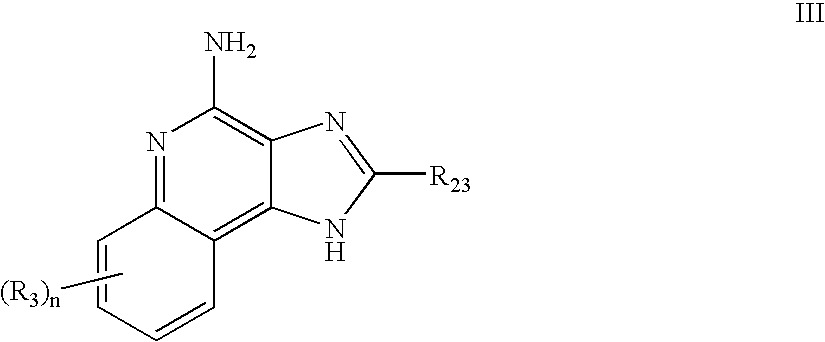
wherein - R23 is selected from hydrogen, straight chain or branched chain alkyl of one to eight carbon atoms, benzyl, (phenyl)ethyl and phenyl, the benzyl, (phenyl)ethyl or phenyl substituent being optionally substituted on the benzene ring by one or two moieties independently selected from straight chain or branched chain alkyl of one to four carbon atoms, straight chain or branched chain alkoxy of one to four carbon atoms, and halogen, with the proviso that when the benzene ring is substituted by two such moieties, then the moieties together contain no more than six carbon atoms; and
- each R3 is independently selected from straight chain or branched chain alkoxy of one to four carbon atoms, halogen, and straight chain or branched chain alkyl of one to four carbon atoms, and n is an integer from zero to 2, with the proviso that if n is 2, then said R3 groups together contain no more than six carbon atoms;

wherein - R14 is —CHRxRy wherein Ry is hydrogen or a carbon-carbon bond, with the proviso that when Ry is hydrogen Rx is alkoxy of one to four carbon atoms, hydroxyalkoxy of one to four carbon atoms, 1-alkynyl of two to ten carbon atoms, tetrahydropyranyl, alkoxyalkyl wherein the alkoxy moiety contains one to four carbon atoms and the alkyl moiety contains one to four carbon atoms, or 2-, 3-, or 4-pyridyl, and with the further proviso that when Ry is a carbon-carbon bond Ry and Rx together form a tetrahydrofuranyl group optionally substituted with one or more substituents independently selected from hydroxy and hydroxyalkyl of one to four carbon atoms;
- R24 is selected from hydrogen, alkyl of one to four carbon atoms, phenyl, and substituted phenyl wherein the substituent is selected from alkyl of one to four carbon atoms, alkoxy of one to four carbon atoms, and halogen; and
- R4 is selected from hydrogen, straight chain or branched chain alkoxy containing one to four carbon atoms, halogen, and straight chain or branched chain alkyl containing one to four carbon atoms;

wherein - R15 is selected from hydrogen; straight chain or branched chain alkyl containing one to ten carbon atoms and substituted straight chain or branched chain alkyl containing one to ten carbon atoms, wherein the substituent is selected from cycloalkyl containing three to six carbon atoms and cycloalkyl containing three to six carbon atoms substituted by straight chain or branched chain alkyl containing one to four carbon atoms; straight chain or branched chain alkenyl containing two to ten carbon atoms and substituted straight chain or branched chain alkenyl containing two to ten carbon atoms, wherein the substituent is selected from cycloalkyl containing three to six carbon atoms and cycloalkyl containing three to six carbon atoms substituted by straight chain or branched chain alkyl containing one to four carbon atoms; hydroxyalkyl of one to six carbon atoms; alkoxyalkyl wherein the alkoxy moiety contains one to four carbon atoms and the alkyl moiety contains one to six carbon atoms; acyloxyalkyl wherein the acyloxy moiety is alkanoyloxy of two to four carbon atoms or benzoyloxy, and the alkyl moiety contains one to six carbon atoms; benzyl; (phenyl)ethyl; and phenyl; said benzyl, (phenyl)ethyl or phenyl substituent being optionally substituted on the benzene ring by one or two moieties independently selected from alkyl of one to four carbon atoms, alkoxy of one to four carbon atoms, and halogen, with the proviso that when said benzene ring is substituted by two of said moieties, then the moieties together contain no more than six carbon atoms;
- R25 is

wherein - RS and RT are independently selected from hydrogen, alkyl of one to four carbon atoms, phenyl, and substituted phenyl wherein the substituent is selected from alkyl of one to four carbon atoms, alkoxy of one to four carbon atoms, and halogen;
- X is selected from alkoxy containing one to four carbon atoms, alkoxyalkyl wherein the alkoxy moiety contains one to four carbon atoms and the alkyl moiety contains one to four carbon atoms, hydroxyalkyl of one to four carbon atoms, haloalkyl of one to four carbon atoms, alkylamido wherein the alkyl group contains one to four carbon atoms, amino, substituted amino wherein the substituent is alkyl or hydroxyalkyl of one to four carbon atoms, azido, chloro, hydroxy, 1-morpholino, 1-pyrrolidino, alkylthio of one to four carbon atoms; and
- R5 is selected from hydrogen, straight chain or branched chain alkoxy containing one to four carbon atoms, halogen, and straight chain or branched chain alkyl containing one to four carbon atoms;
- and pharmaceutically acceptable salts of any of the foregoing.
- In another embodiment, the IRM compound can be chosen from 6,7 fused cycloalkylimidazopyridine amines defined by Formula VI below:

wherein - m is 1, 2, or 3;
- R16 is selected from hydrogen; cyclic alkyl of three, four, or five carbon atoms; straight chain or branched chain alkyl containing one to ten carbon atoms and substituted straight chain or branched chain alkyl containing one to ten carbon atoms, wherein the substituent is selected from cycloalkyl containing three to six carbon atoms and cycloalkyl containing three to six carbon atoms substituted by straight chain or branched chain alkyl containing one to four carbon atoms; fluoro- or chloroalkyl containing from one to ten carbon atoms and one or more fluorine or chlorine atoms; straight chain or branched chain alkenyl containing two to ten carbon atoms and substituted straight chain or branched chain alkenyl containing two to ten carbon atoms, wherein the substituent is selected from cycloalkyl containing three to six carbon atoms and cycloalkyl containing three to six carbon atoms substituted by straight chain or branched chain alkyl containing one to four carbon atoms; hydroxyalkyl of one to six carbon atoms; alkoxyalkyl wherein the alkoxy moiety contains one to four carbon atoms and the alkyl moiety contains one to six carbon atoms; acyloxyalkyl wherein the acyloxy moiety is alkanoyloxy of two to four carbon atoms or benzoyloxy, and the alkyl moiety contains one to six carbon atoms, with the proviso that any such alkyl, substituted alkyl, alkenyl, substituted alkenyl, hydroxyalkyl, alkoxyalkyl, or acyloxyalkyl group does not have a fully carbon substituted carbon atom bonded directly to the nitrogen atom; benzyl; (phenyl)ethyl; and phenyl; said benzyl, (phenyl)ethyl or phenyl substituent being optionally substituted on the benzene ring by one or two moieties independently selected from alkyl of one to four carbon atoms, alkoxy of one to four carbon atoms, and halogen, with the proviso that when said benzene ring is substituted by two of said moieties, then the moieties together contain no more than six carbon atoms; and —CHRxRy
- wherein
- Ry is hydrogen or a carbon-carbon bond, with the proviso that when Ry is hydrogen Rx is alkoxy of one to four carbon atoms, hydroxyalkoxy of one to four carbon atoms, 1-alkynyl of two to ten carbon atoms, tetrahydropyranyl, alkoxyalkyl wherein the alkoxy moiety contains one to four carbon atoms and the alkyl moiety contains one to four carbon atoms, 2-, 3-, or 4-pyridyl, and with the further proviso that when Ry is a carbon-carbon bond Ry and Rx together form a tetrahydrofuranyl group optionally substituted with one or more substituents independently selected from hydroxy and hydroxyalkyl of one to four carbon atoms,
- R26 is selected from hydrogen; straight chain or branched chain alkyl containing one to eight carbon atoms; straight chain or branched chain hydroxyalkyl containing one to six carbon atoms; morpholinoalkyl; benzyl; (phenyl)ethyl; and phenyl, the benzyl, (phenyl)ethyl, or phenyl substituent being optionally substituted on the benzene ring by a moiety selected from methyl, methoxy, and halogen; and —C(RS)(RT)(X) wherein RS and RT are independently selected from hydrogen, alkyl of one to four carbon atoms, phenyl, and substituted phenyl wherein the substituent is selected from alkyl of one to four carbon atoms, alkoxy of one to four carbon atoms, and halogen;
- X is selected from alkoxy containing one to four carbon atoms, alkoxyalkyl wherein the alkoxy moiety contains one to four carbon atoms and the alkyl moiety contains one to four carbon atoms, haloalkyl of one to four carbon atoms, alkylamido wherein the alkyl group contains one to four carbon atoms, amino, substituted amino wherein the substituent is alkyl or hydroxyalkyl of one to four carbon atoms, azido, alkylthio of one to four carbon atoms, and morpholinoalkyl wherein the alkyl moiety contains one to four carbon atoms, and
- R6 is selected from hydrogen, fluoro, chloro, straight chain or branched chain alkyl containing one to four carbon atoms, and straight chain or branched chain fluoro- or chloroalkyl containing one to four carbon atoms and at least one fluorine or chlorine atom;
- and pharmaceutically acceptable salts thereof.
- In another embodiment, the IRM compound can be chosen from imidazopyridine amines defined by Formula VII below:

wherein - R17 is selected from hydrogen; —CH2RW wherein RW is selected from straight chain, branched chain, or cyclic alkyl containing one to ten carbon atoms, straight chain or branched chain alkenyl containing two to ten carbon atoms, straight chain or branched chain hydroxyalkyl containing one to six carbon atoms, alkoxyalkyl wherein the alkoxy moiety contains one to four carbon atoms and the alkyl moiety contains one to six carbon atoms, and phenylethyl; and —CH═CRZRZ wherein each RZ is independently straight chain, branched chain, or cyclic alkyl of one to six carbon atoms;
- R27 is selected from hydrogen; straight chain or branched chain alkyl containing one to eight carbon atoms; straight chain or branched chain hydroxyalkyl containing one to six carbon atoms; alkoxyalkyl wherein the alkoxy moiety contains one to four carbon atoms and the alkyl moiety contains one to six carbon atoms; benzyl, (phenyl)ethyl and phenyl, the benzyl, (phenyl)ethyl and phenyl being optionally substituted on the benzene ring by a moiety selected from methyl, methoxy, and halogen; and morpholinoalkyl wherein the alkyl moiety contains one to four carbon atoms;
- R67 and R77 are independently selected from hydrogen and alkyl of one to five carbon atoms, with the proviso that R67 and R77 taken together contain no more than six carbon atoms, and with the further proviso that when R77 is hydrogen then R67 is other than hydrogen and R27 is other than hydrogen or morpholinoalkyl, and with the further proviso that when R67 is hydrogen then R77 and R27 are other than hydrogen;
- and pharmaceutically acceptable salts thereof.
- In another embodiment, the IRM compound can be chosen from 1,2-bridged imidazoquinoline amines defined by Formula VIII below:
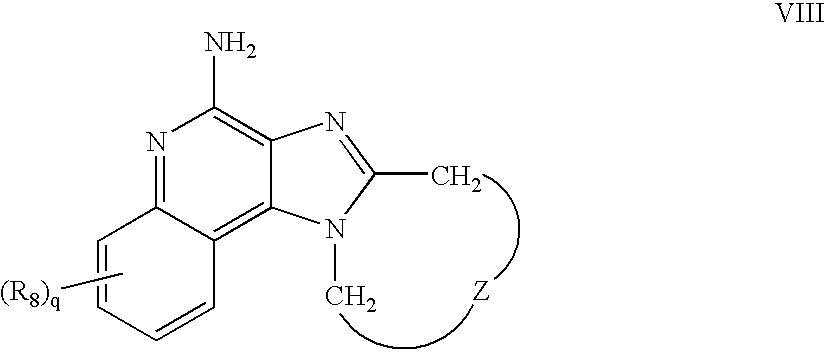
wherein - Z is selected from
- —(CH2)p— wherein p is 1 to 4;
- —(CH2)a—C(RDRE)(CH2)b—, wherein a and b are integers and a+b is 0 to 3, RD is hydrogen or alkyl of one to four carbon atoms, and RE is selected from alkyl of one to four carbon atoms, hydroxy, —ORF wherein RF is alkyl of one to four carbon atoms, and —NRGR′G wherein RG and R′G are independently hydrogen or alkyl of one to four carbon atoms; and
- —(CH2)a—(Y)—(CH2)b— wherein a and b are integers and a+b is 0 to 3, and Y is O, S, or —NRJ— wherein RJ is hydrogen or alkyl of one to four carbon atoms;
- q is 0 or 1; and
- R8 is selected from alkyl of one to four carbon atoms, alkoxy of one to four carbon atoms, and halogen,
- and pharmaceutically acceptable salts thereof.
- In another embodiment, the IRM compound can be chosen from thiazoloquinoline amines, oxazoloquinoline amines, thiazolopyridine amines, oxazolopyridine amines, thiazolonaphthyridine amines and oxazolonaphthyridine amines defined by Formula IX below:

wherein: - R19 is selected from oxygen, sulfur and selenium;
- R29 is selected from
-
- -hydrogen;
- -alkyl;
- -alkyl-OH;
- -haloalkyl;
- -alkenyl;
- -alkyl-X-alkyl;
- -alkyl-X-alkenyl;
- -alkenyl-X-alkyl;
- -alkenyl-X-alkenyl;
- -alkyl-N(R59)2;
- -alkyl-N3;
- -alkyl-O—C(O)—N(R59)2;
- -heterocyclyl;
- -alkyl-X-heterocyclyl;
- -alkenyl-X-heterocyclyl;
- -aryl;
- -alkyl-X-aryl;
- -alkenyl-X-aryl;
- -heteroaryl;
- -alkyl-X-heteroaryl; and
- -alkenyl-X-heteroaryl;
- R39 and R49 are each independently:
-
- -hydrogen;
- —X-alkyl;
- -halo;
- -haloalkyl;
- —N(R59)2;
- or when taken together, R39 and R49 form a fused
- aromatic, heteroaromatic, cycloalkyl or heterocyclic ring;
- X is selected from —O—, —S—, —NR59—, —C(O)—, —C(O)O—, —OC(O)—, and a bond; and
- each R59 is independently H or C1-8alkyl;
- and pharmaceutically acceptable salts thereof.
- In another embodiment, the IRM compound can be chosen from imidazonaphthyridine amines and imidazotetrahydronaphthyridine amines defined by Formulas X and XI below:

wherein - A is ═N—CR═CR—CR═; ═CR—N═CR—CR═; ═CR—CR═N—CR═; or ═CR—CR═CR—N═;
- R110 is selected from:
- -hydrogen;
- —C1-20 alkyl or C2-20 alkenyl that is unsubstituted or substituted by one or more substituents selected from:
-
- -aryl;
- -heteroaryl;
- -heterocyclyl;
- —O—C1-20 alkyl;
- —O—(C1-20 alkyl)0-1-aryl;
- —O—(C1-20 alkyl)0-1-heteroaryl;
- —O—(C1-20 alkyl)0-1-heterocyclyl;
- —CO—O—C1-20 alkyl;
- —S(O)0-2—C1-20 alkyl;
- —S(O)0-2—(C1-20 alkyl)0-1-aryl;
- —S(O)0-2—(C1-20 alkyl)0-1-heteroaryl;
- —S(O)0-2—(C1-20 alkyl)0-1-heterocyclyl;
- —N(R310)2;
- —N3;
- oxo;
- -halogen;
- —NO2;
- —OH; and
- —SH; and
- —C1-20 alkyl-NR310-Q-X—R410 or —C2-20 alkenyl-NR310-Q-X—R410 wherein Q is —CO— or —SO2—; X is a bond, —O— or —NR310— and R410 is aryl; heteroaryl; heterocyclyl; or —C1-20 alkyl or C2-20 alkenyl that is unsubstituted or substituted by one or more substituents selected from:
-
- -aryl;
- -heteroaryl;
- -heterocyclyl;
- —O—C1-20 alkyl;
- —O—(C1-20 alkyl)0-1-aryl;
- —O—(C1-20 alkyl)0-1-heteroaryl;
- —O—(C1-20 alkyl)0-1-heterocyclyl;
- —CO—O—C1-20 alkyl;
- —S(O)0-2—C1-20 alkyl;
- —S(O)0-2—(C1-20 alkyl)0-1-aryl;
- —S(O)0-2—(C1-20 alkyl)0-1-heteroaryl;
- —S(O)0-2—(C1-20 alkyl)0-1-heterocyclyl;
- —N(R310)2;
- —NR310—CO—O—C1-20 alkyl;
- —N3;
- oxo;
- -halogen;
- —NO2;
- —OH; and
- —SH; or R410 is
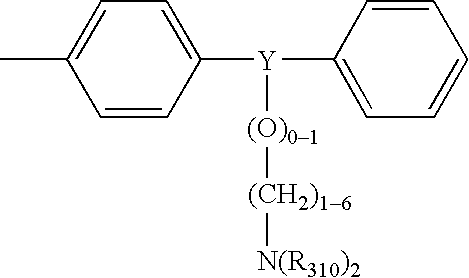
- wherein Y is —N— or —CR—;
R210 is selected from:
- -hydrogen;
- —C1-10 alkyl;
- —C2-10 alkenyl;
- -aryl;
- —C1-10 alkyl-O—C1-10 alkyl;
- —C1-10 alkyl-O—C2-10 alkenyl; and
- —C1-10 alkyl or C2-10 alkenyl substituted by one or more substituents selected from:
-
- —OH;
- -halogen;
- —N(R310)2;
- —CO—N(R310)2;
- —CO—C1-10 alkyl;
- —N3;
- -aryl;
- -heteroaryl;
- -heterocyclyl;
- —CO-aryl; and
- —CO-heteroaryl;
- each R310 is independently selected from hydrogen and C1-10 alkyl; and
- each R is independently selected from hydrogen, C1-10 alkyl, C1-10 alkoxy, halogen and trifluoromethyl;

wherein - B is —NR—C(R)2—C(R)2—C(R)2—; —C(R)2—NR—C(R)2—C(R)2—; —C(R)2—C(R)2—NR—C(R)2— or —C(R)2—C(R)2—C(R)2—NR—;
- R111 is selected from:
- -hydrogen;
- —C1-20 alkyl or C2-20 alkenyl that is unsubstituted or substituted by one or more substituents selected from:
-
- -aryl;
- -heteroaryl;
- -heterocyclyl;
- —O—C1-20 alkyl;
- —O—(C1-20 alkyl)0-1-aryl;
- —O—(C1-20 alkyl)0-1-heteroaryl;
- —O—(C1-20 alkyl)0-1-heterocyclyl;
- —CO—O—C1-20 alkyl;
- —S(O)0-2—C1-20 alkyl;
- —S(O)0-2—(C1-20 alkyl)0-1-aryl;
- —S(O)0-2—(C1-20 alkyl)0-1-heteroaryl;
- —S(O)0-2—(C1-20 alkyl)0-1-heterocyclyl;
- —N(R311)2;
- —N3;
- oxo;
- -halogen;
- —NO2;
- —OH; and
- —SH; and
- —C1-20 alkyl-NR311-Q-X—R411 or —C2-20 alkenyl-NR311-Q-X—R411 wherein Q is —CO— or —SO2—; X is a bond, —O— or —NR311— and R411 is aryl; heteroaryl; heterocyclyl; or —C1-20 alkyl or C2-20 alkenyl that is unsubstituted or substituted by one or more substituents selected from:
-
- -aryl;
- -heteroaryl;
- -heterocyclyl;
- —O—C1-20 alkyl;
- —O—(C1-20 alkyl)0-1-aryl;
- —O—(C1-20 alkyl)0-1-heteroaryl;
- —O—(C1-20 alkyl)0-1-heterocyclyl;
- —CO—O—C1-20 alkyl;
- —S(O)0-2—C1-20 alkyl;
- —S(O)0-2—(C1-20 alkyl)0-1-aryl;
- —S(O)0-2—(C1-20 alkyl)0-1-heteroaryl;
- —S(O)0-2—(C1-20 alkyl)0-1-heterocyclyl;
- —N(R311)2;
- —NR311—CO—O—C1-20 alkyl;
- —N3;
- oxo;
- -halogen;
- —NO2;
- —OH; and
- —SH; or R411 is

- wherein Y is —N— or —CR—;
R211 is selected from:
- -hydrogen;
- —C1-10 alkyl;
- —C2-10 alkenyl;
- -aryl;
- —C1-10 alkyl —O—C1-10-alkyl;
- —C1-10 alkyl-O—C2-10 alkenyl; and
- —C1-10 alkyl or C2-10 alkenyl substituted by one or more substituents selected from:
-
- —OH;
- -halogen;
- —N(R311)2;
- —CO—N(R311)2;
- —CO—C1-10 alkyl;
- —N3;
- -aryl;
- -heteroaryl;
- -heterocyclyl;
- —CO-aryl; and
- —CO-heteroaryl;
- each R311 is independently selected from hydrogen and C1-10 alkyl; and
- each R is independently selected from hydrogen, C1-10 alkyl, C1-10 alkoxy, halogen, and trifluoromethyl;
- and pharmaceutically acceptable salts thereof.
- In another embodiment, the IRM compound can be chosen from 1H-imidazo[4,5-c]quinolin-4-amines and tetrahydro-1H-imidazo[4,5-c]quinolin-4-amines defined by Formulas XII, XIII and XIV below:
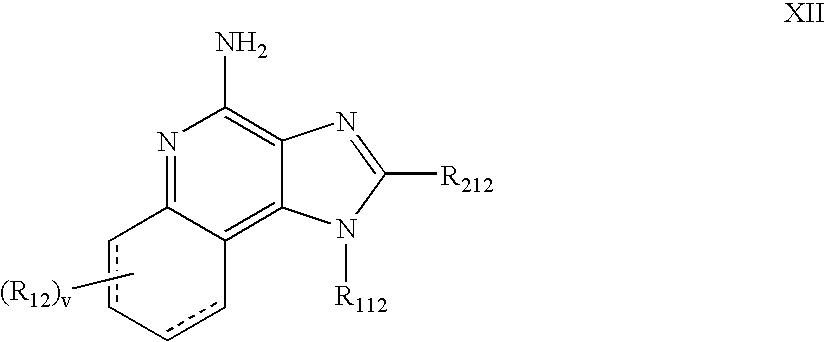
wherein - R112 is -alkyl-NR312—CO—R412 or -alkenyl-NR312—CO—R412 wherein R412 is aryl, heteroaryl, alkyl or alkenyl, each of which may be unsubstituted or substituted by one or more substituents selected from:
-
- -alkyl;
- -alkenyl;
- -alkynyl;
- -(alkyl)0-1-aryl;
- -(alkyl)0-1-(substituted aryl);
- -(alkyl)0-1-heteroaryl;
- -(alkyl)0-1-(substituted heteroaryl);
- —O-alkyl;
- —O-(alkyl)0-1-aryl;
- —O-(alkyl)0-1-(substituted aryl);
- —O-(alkyl)0-1-heteroaryl;
- —O-(alkyl)0-1-(substituted heteroaryl);
- —CO-aryl;
- —CO-(substituted aryl);
- —CO-heteroaryl;
- —CO-(substituted heteroaryl);
- —COOH;
- —CO—O-alkyl;
- —CO-alkyl;
- —S(O)0-2-alkyl;
- —S(O)0-2-(alkyl)0-1-aryl;
- —S(O)0-2-(alkyl)0-1-(substituted aryl);
- —S(O)0-2-(alkyl)0-1-heteroaryl;
- —S(O)0-2-(alkyl)0-1-(substituted heteroaryl);
- —P(O)(OR312)2;
- —NR312—CO—O-alkyl;
- —N3;
- -halogen;
- —NO2;
- —CN;
- -haloalkyl;
- —O-haloalkyl;
- —CO-haloalkyl;
- —OH;
- —SH; and in the case that R412 is alkyl, alkenyl, or heterocyclyl, oxo;
- or R412 is

- wherein R512 is an aryl, (substituted aryl), heteroaryl, (substituted heteroaryl), heterocyclyl or (substituted heterocyclyl) group;
- R212 is selected from:
-
- -hydrogen;
- -alkyl;
- -alkenyl;
- -aryl;
- -(substituted aryl);
- -heteroaryl;
- -(substituted heteroaryl);
- -heterocyclyl;
- -(substituted heterocyclyl);
- -alkyl-O-alkyl;
- -alkyl-O-alkenyl; and
- -alkyl or alkenyl substituted by one or more substituents selected from:
- —OH;
- -halogen;
- —N(R312)2;
- —CO—N(R312)2;
- —CO—C1-10 alkyl;
- —CO—O—C1-10 alkyl;
- —N3;
- -aryl;
- -(substituted aryl);
- -heteroaryl;
- -(substituted heteroaryl);
- -heterocyclyl;
- -(substituted heterocyclyl);
- —CO-aryl; and
- —CO-heteroaryl;
- each R312 is independently selected from hydrogen; C1-10 alkyl-heteroaryl; C1-10 alkyl-(substituted heteroaryl); C1-10 alkyl-aryl; C1-10 alkyl-(substituted aryl) and C1-10 alkyl;
- v is 0 to 4;
- and each R12 present is independently selected from C1-10 alkyl, C1-10 alkoxy, halogen, and trifluoromethyl;

wherein - R113 is -alkyl-NR313—SO2—X—R413 or -alkenyl-NR313—SO2—X—R413;
- X is a bond or —NR513—;
- R413 is aryl, heteroaryl, heterocyclyl, alkyl or alkenyl, each of which may be unsubstituted or substituted by one or more substituents selected from:
-
- -alkyl;
- -alkenyl;
- -aryl;
- -heteroaryl;
- -heterocyclyl;
- -substituted cycloalkyl;
- -substituted aryl;
- -substituted heteroaryl;
- -substituted heterocyclyl;
- —O-alkyl;
- —O-(alkyl)0-1-aryl;
- —O-(alkyl)0-1-substituted aryl;
- —O-(alkyl)0-1-heteroaryl;
- —O-(alkyl)0-1-substituted heteroaryl;
- —O-(alkyl)0-1-heterocyclyl;
- —O-(alkyl)0-1-substituted heterocyclyl;
- —COOH;
- —CO—O-alkyl;
- —CO-alkyl;
- —S(O)0-2-alkyl;
- —S(O)0-2-(alkyl)0-1-aryl;
- —S(O)0-2-(alkyl)0-1-substituted aryl;
- —S(O)0-2-(alkyl)0-1-heteroaryl;
- —S(O)0-2-(alkyl)0-1-substituted heteroaryl;
- —S(O)0-2-(alkyl)0-1-heterocyclyl;
- —S(O)0-2-(alkyl)0-1-substituted heterocyclyl;
- -(alkyl)0-1-NR313R313;
- -(alkyl)0-1-NR313—CO—O-alkyl;
- -(alkyl)0-1-NR313—CO-alkyl;
- -(alkyl)0-1-NR313—CO-aryl;
- -(alkyl)0-1-NR313—CO-substituted aryl;
- -(alkyl)0-1-NR313—CO-heteroaryl;
- -(alkyl)0-1-CNR313—CO-substituted heteroaryl;
- —N3;
- -halogen;
- -haloalkyl;
- -haloalkoxy;
- —CO-haloalkyl;
- —CO-haloalkoxy;
- —NO2;
- —CN;
- —OH;
- —SH; and in the case that R413 is alkyl, alkenyl, or heterocyclyl, oxo;
- R213 is selected from:
-
- -hydrogen;
- -alkyl;
- -alkenyl;
- -aryl;
- -substituted aryl;
- -heteroaryl;
- -substituted heteroaryl;
- -alkyl-O-alkyl;
- -alkyl-O-alkenyl; and
- -alkyl or alkenyl substituted by one or more substituents selected from:
- —OH;
- -halogen;
- —N(R313)2;
- —CO—N(R313)2;
- —CO—C1-10 alkyl;
- —CO—O—C1-10 alkyl;
- —N3;
- -aryl;
- -substituted aryl;
- -heteroaryl;
- -substituted heteroaryl;
- -heterocyclyl;
- -substituted heterocyclyl;
- —CO-aryl;
- —CO-(substituted aryl);
- —CO-heteroaryl; and
- —CO-(substituted heteroaryl);
- each R313 is independently selected from hydrogen and C1-10 alkyl; or when X is a bond R313 and R413 can join to form a 3 to 7 membered heterocyclic or substituted heterocyclic ring;
- R513 is selected from hydrogen and C1-10 alkyl, or R413 and R513 can combine to form a 3 to 7 membered heterocyclic or substituted heterocyclic ring;
- v is 0 to 4;
- and each R13 present is independently selected from C1-10 alkyl, C1-10 alkoxy, halogen, and trifluoromethyl;
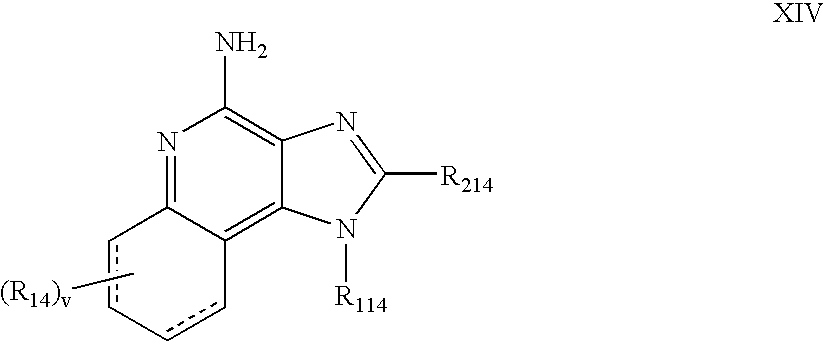
wherein - R114 is -alkyl-NR314—CY—NR514—X—R414 or
- -alkenyl-NR314—CY—NR514—X—R414
- wherein
- Y is ═O or ═S;
- X is a bond, —CO— or —SO2—;
- R414 is aryl, heteroaryl, heterocyclyl, alkyl or alkenyl, each of which may be unsubstituted or substituted by one or more substituents selected from:
-
- -alkyl;
- -alkenyl;
- -aryl;
- -heteroaryl;
- -heterocyclyl;
- -substituted aryl;
- -substituted heteroaryl;
- -substituted heterocyclyl;
- —O-alkyl;
- —O-(alkyl)0-1-aryl;
- —O-(alkyl)0-1-substituted aryl;
- —O-(alkyl)0-1-heteroaryl;
- —O-(alkyl)0-1-substituted heteroaryl;
- —O-(alkyl)0-1-heterocyclyl;
- —O-(alkyl)0-1-substituted heterocyclyl;
- —COOH;
- —CO—O-alkyl;
- —CO-alkyl;
- —S(O)0-2-alkyl;
- —S(O)0-2-(alkyl)0-1-aryl;
- —S(O)0-2-(alkyl)0-1-substituted aryl;
- —S(O)0-2-(alkyl)0-1-heteroaryl;
- —S(O)0-2-(alkyl)0-1-substituted heteroaryl;
- —S(O)0-2-(alkyl)0-1-heterocyclyl;
- —S(O)0-2-(alkyl)0-1-substituted heterocyclyl;
- -(alkyl)0-1-NR314R314;
- -(alkyl)0-1-NR314—CO—O-alkyl;
- -(alkyl)0-1-NR314—CO-alkyl;
- -(alkyl)0-1-NR314-CO-aryl;
- -(alkyl)0-1-NR314—CO-substituted aryl;
- -(alkyl)0-1-NR314—CO-heteroaryl;
- -(alkyl)0-1-NR314—CO-substituted heteroaryl;
- —N3;
- -halogen;
- -haloalkyl;
- -haloalkoxy;
- —CO-haloalkoxy;
- —NO2;
- —CN;
- —OH;
- —SH; and, in the case that R414 is alkyl, alkenyl or heterocyclyl, oxo; with the proviso that when X is a bond R414 can additionally be hydrogen; R214 is selected from:
- -hydrogen;
- -alkyl;
- -alkenyl;
- -aryl;
- -substituted aryl;
- -heteroaryl;
- -substituted heteroaryl;
- alkyl-O-alkyl;
- -alkyl-O— alkenyl; and
- -alkyl or alkenyl substituted by one or more substituents selected from:
- —OH;
- -halogen;
- —N(R314)2;
- —CO—N(R314)2;
- —CO—C1-10 alkyl;
- —CO—O—C1-10 alkyl;
- —N3;
- -aryl;
- -substituted aryl;
- -heteroaryl;
- -substituted heteroaryl;
- -heterocyclyl;
- -substituted heterocyclyl;
- —CO-aryl;
- —CO-(substituted aryl);
- —CO-heteroaryl; and
- —CO-(substituted heteroaryl);
- each R314 is independently selected from hydrogen and C1-10 alkyl;
- R514 is selected from hydrogen and C1-10 alkyl, or R414 and R514 can combine to form a 3 to 7 membered heterocyclic or substituted heterocyclic ring;
- v is 0 to 4;
- and each R14 present is independently selected from C1-10 alkyl, C1-10 alkoxy, halogen, and trifluoromethyl;
- and pharmaceutically acceptable salts thereof.
- In another embodiment, the IRM compound can be chosen from 1H-imidazo[4,5-c]quinolin-4-amines and tetrahydro-1H-imidazo[4,5-c]quinolin-4-amines defined by Formulas XV, XVI, XVII, XVIII, XIX, XX, XXI, XXII, XXIII, XXIV, XXV, and XXVI below:
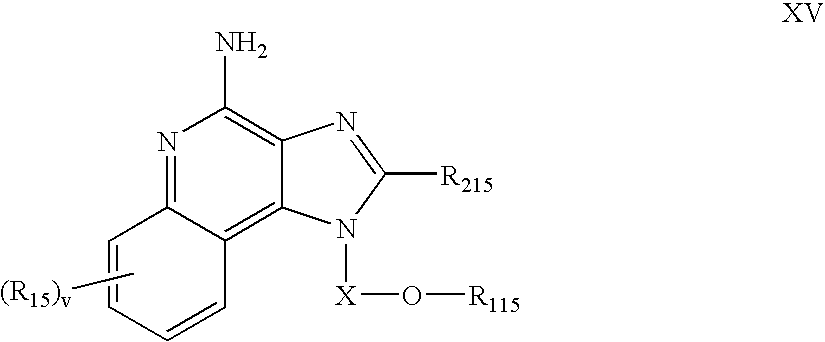
wherein: -
- X is —CHR515—, —CHR515-alkyl-, or —CHR515-alkenyl-;
- R115 is selected from:
- —R415—CR315-Z-R615-alkyl;
- —R415—CR315-Z-R615-alkenyl;
- —R415—CR315-Z-R615-aryl;
- —R415—CR315-Z-R615-heteroaryl;
- —R415—CR315-Z-R615-heterocyclyl;
- —R415—CR315-Z-H;
- —R415—NR715—CR315—R615-alkyl;
- —R415—NR715—CR315—R615-alkenyl;
- —R415—NR715—CR315—R615-aryl;
- —R415—NR715—CR315—R615-heteroaryl;
- —R415—NR715—CR315—R615-heterocyclyl; and
- —R415—NR715—CR315—R815;
- Z is —NR515—, —O—, or —S—;
- R215 is selected from:
- -hydrogen;
- -alkyl;
- -alkenyl;
- -aryl;
- -heteroaryl;
- -heterocyclyl;
- -alkyl-Y-alkyl;
- -alkyl-Y-alkenyl;
- -alkyl-Y-aryl; and
- -alkyl or alkenyl substituted by one or more substituents selected from:
- —OH;
- -halogen;
- —N(R515)2;
- —CO—N(R515)2;
- —CO—C1-10 alkyl;
- —CO—O—C1-10 alkyl;
- —N3;
- -aryl;
- -heteroaryl;
- -heterocyclyl;
- —CO-aryl; and
- —CO-heteroaryl;
- R315 is ═O or ═S;
- R415 is alkyl or alkenyl, which may be interrupted by one or more —O— groups;
- each R515 is independently H or C1-10 alkyl;
- R615 is a bond, alkyl, or alkenyl, which may be interrupted by one or more —O— groups;
- R715 is H, C1-10 alkyl, or arylalkyl; or R415 and R715 can join together to form a ring;
- R815 is H or C1-10 alkyl; or R715 and R815 can join together to form a ring;
- Y is —O— or —S(O)0-2—;
- v is 0 to 4; and
- each R15 present is independently selected from C1-10 alkyl, C1-10 alkoxy, hydroxy, halogen, and trifluoromethyl;
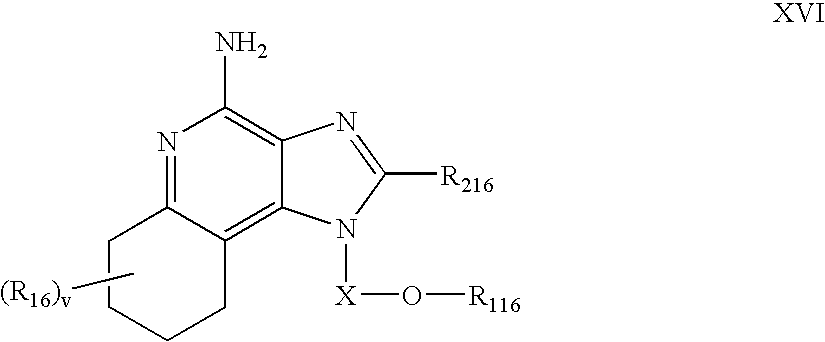
wherein: - X is —CHR516—, —CHR516-alkyl-, or —CHR516-alkenyl-;
- R116 is selected from:
- —R416—CR316-Z-R616-alkyl;
- —R416—CR316-Z-R616-alkenyl;
- —R416—CR316-Z-R616-aryl;
- —R416—CR316-Z-R616-heteroaryl;
- —R416—CR316-Z-R616-heterocyclyl;
- —R416—CR316-Z-H;
- —R416—NR716—CR316—R616-alkyl;
- —R416—NR716—CR316—R616-alkenyl;
- —R416—NR716—CR316-R616-aryl;
- —R416—NR716—CR316-R616-heteroaryl;
- —R416—NR716—CR316—R616-heterocyclyl; and
- —R416—NR716—CR316—R816;
- Z is —NR516—, —O—, or —S—;
- R216 is selected from:
- -hydrogen;
- -alkyl;
- -alkenyl;
- -aryl;
- -heteroaryl;
- -heterocyclyl;
- -alkyl-Y-alkyl;
- -alkyl-Y-alkenyl;
- -alkyl-Y-aryl; and
- -alkyl or alkenyl substituted by one or more substituents selected from:
- —OH;
- -halogen;
- —N(R516)2;
- —CO—N(R516)2;
- —CO—C1-10 alkyl;
- —CO—O—C1-10 alkyl;
- —N3;
- -aryl;
- -heteroaryl;
- -heterocyclyl;
- —CO-aryl; and
- —CO-heteroaryl;
- R316 is ═O or ═S;
- R416 is alkyl or alkenyl, which may be interrupted by one or more —O— groups;
- each R516 is independently H or C1-10 alkyl;
- R616 is a bond, alkyl, or alkenyl, which may be interrupted by one or more —O— groups;
- R716 is H, C1-10 alkyl, arylalkyl; or R416 and R716 can join together to form a ring;
- R816 is H or C1-10 alkyl; or R716 and R816 can join together to form a ring;
- Y is —O— or —S(O)0-2—;
- v is 0 to 4; and
- each R16 present is independently selected from C1-10 alkyl, C1-10 alkoxy, hydroxy, halogen, and trifluoromethyl;
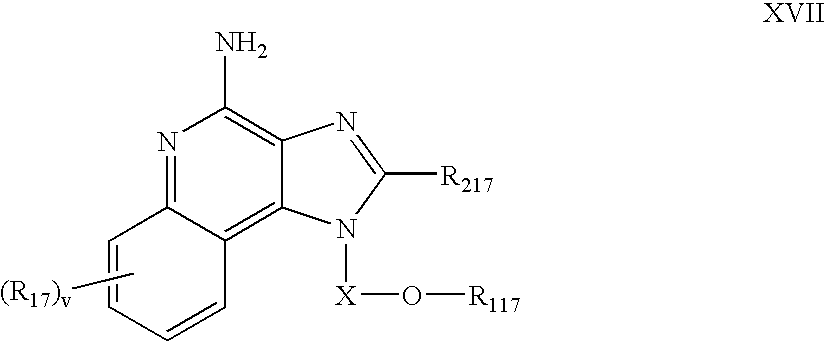
wherein: - X is —CHR317—, —CHR317-alkyl-, or —CHR317-alkenyl-;
- R117 is selected from:
- -alkenyl;
- -aryl; and
- —R417-aryl;
- R217 is selected from:
- -hydrogen;
- -alkyl;
- -alkenyl;
- -aryl;
- -heteroaryl;
- -heterocyclyl;
- -alkyl-Y-alkyl;
- -alkyl-Y-alkenyl;
- -alkyl-Y-aryl; and
- -alkyl or alkenyl substituted by one or more substituents selected from:
- —OH;
- -halogen;
- —N(R317)2;
- —CO—N(R317)2;
- —CO—C1-10 alkyl;
- —CO—O—C1-10 alkyl;
- —N3;
- -aryl;
- -heteroaryl;
- -heterocyclyl;
- —CO-aryl; and
- —CO-heteroaryl;
- R417 is alkyl or alkenyl, which may be interrupted by one or more —O— groups;
- each R317 is independently H or C1-10 alkyl;
- each Y is independently —O— or —S(O)0-2—;
- v is 0 to 4; and
- each R17 present is independently selected from C1-10 alkyl, C1-10 alkoxy, hydroxy, halogen, and trifluoromethyl;
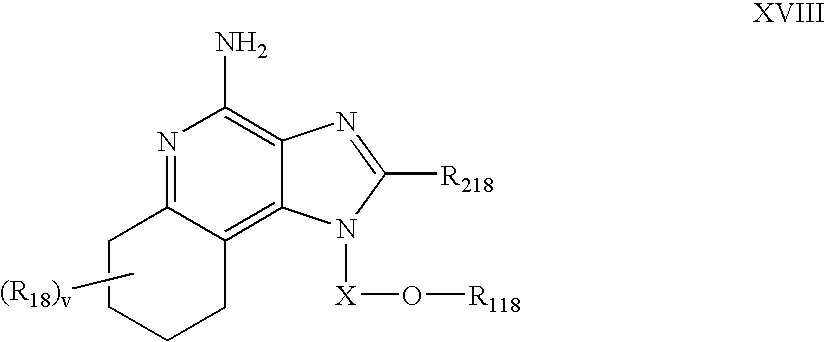
wherein: - X is —CHR318—, —CHR318-alkyl-, or —CHR318-alkenyl-;
- R118 is selected from:
- -aryl;
- -alkenyl; and
- —R418-aryl;
- R218 is selected from:
- -hydrogen;
- -alkyl;
- -alkenyl;
- -aryl;
- -heteroaryl;
- -heterocyclyl;
- -alkyl-Y-alkyl;
- -alkyl-Y-aryl;
- -alkyl-Y-alkenyl; and
- -alkyl or alkenyl substituted by one or more substituents selected from:
- —OH;
- -halogen;
- —N(R318)2;
- —CO—N(R318)2;
- —CO—C1-10 alkyl;
- —CO—O—C1-10 alkyl;
- —N3;
- -aryl;
- -heteroaryl;
- -heterocyclyl;
- —CO-aryl; and
- —CO-heteroaryl;
- R418 is alkyl or alkenyl, which may be interrupted by one or more —O— groups;
- each R318 is independently H or C1-10 alkyl;
- each Y is independently —O— or —S(O)0-2—;
- v is 0 to 4; and
- each R18 present is independently selected C1-10 alkyl, C1-10 alkoxy, hydroxy, halogen, and trifluoromethyl;
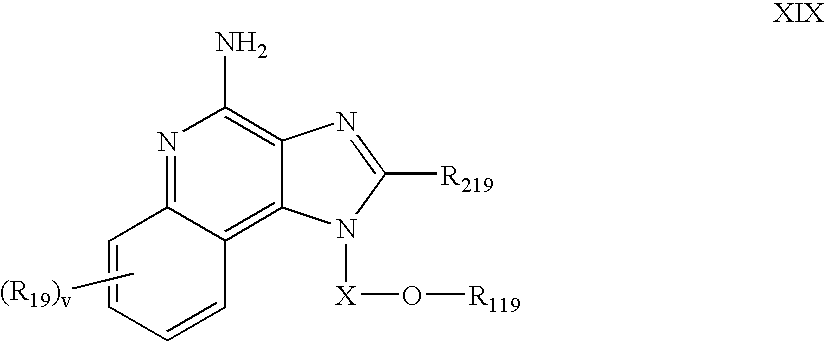
wherein: - X is —CHR319—, —CHR319-alkyl-, or —CHR319-alkenyl-;
- R119 is selected from:
- -heteroaryl;
- -heterocyclyl;
- —R419-heteroaryl; and
- —R419-heterocyclyl;
- R219 is selected from:
- -hydrogen;
- -alkyl;
- -alkenyl;
- -aryl;
- -heteroaryl;
- -heterocyclyl;
- -alkyl-Y-alkyl;
- -alkyl-Y-alkenyl;
- -alkyl-Y-aryl; and
- -alkyl or alkenyl substituted by one or more substituents selected from:
- —OH;
- -halogen;
- —N(R319)2;
- —CO—N(R319)2;
- —CO—C1-10 alkyl;
- —CO—O—C1-10 alkyl;
- —N3;
- -aryl;
- -heteroaryl;
- -heterocyclyl;
- —CO-aryl; and
- —CO-heteroaryl;
- R419 is alkyl or alkenyl, which may be interrupted by one or more —O— groups;
- each R319 is independently H or C1-10 alkyl;
- each Y is independently —O— or —S(O)0-2—;
- v is 0 to 4; and
- each R19 present is independently selected from C1-10 alkyl, C1-10 alkoxy, hydroxy, halogen, and trifluoromethyl;
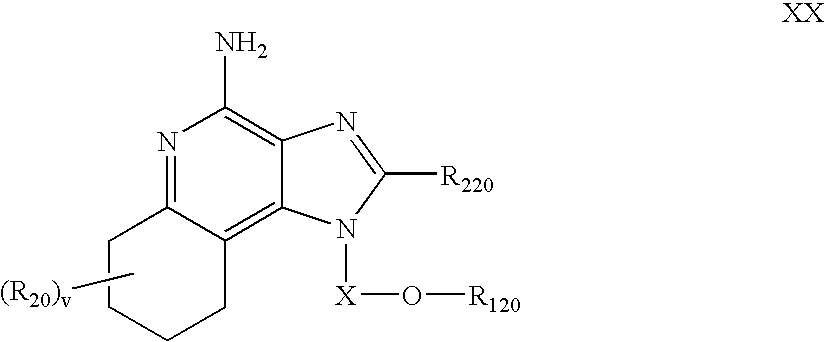
wherein: - X is —CHR320—, —CHR320-alkyl-, or —CHR320-alkenyl-;
- R120 is selected from:
- -heteroaryl;
- -heterocyclyl;
- —R420-heteroaryl; and
- —R420-heterocyclyl;
- R220 is selected from:
- -hydrogen;
- -alkyl;
- -alkenyl;
- -aryl;
- -heteroaryl;
- -heterocyclyl;
- -alkyl-Y-alkyl;
- -alkyl-Y-alkenyl;
- -alkyl-Y-aryl; and
- -alkyl or alkenyl substituted by one or more substituents selected from:
- —OH;
- -halogen;
- —N(R320)2;
- —CO—N(R320)2;
- —CO—C1-10 alkyl;
- —CO—O—C1-10 alkyl;
- —N3;
- -aryl;
- -heteroaryl;
- -heterocyclyl;
- —CO-aryl; and
- —CO-heteroaryl;
- R420 is alkyl or alkenyl, which may be interrupted by one or more —O— groups;
- each R320 is independently H or C1-10 alkyl;
- each Y is independently —O— or —S(O)0-2—;
- v is 0 to 4; and
- each R20 present is independently selected from C1-10 alkyl, C1-10 alkoxy, hydroxy, halogen, and trifluoromethyl;
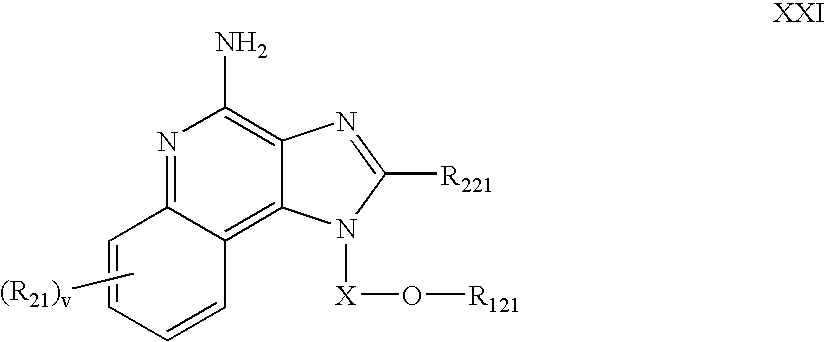
wherein: - X is —CHR521—, —CHR521-alkyl-, or —CHR521-alkenyl-;
- R121 is selected from:
- —R421—NR321—SO2—R621-alkyl;
- —R421—NR321—SO2—R621-alkenyl;
- —R421—NR321—SO2—R621-aryl;
- —R421—NR321—SO2—R621-heteroaryl;
- —R421—NR321—SO2—R621-heterocyclyl;
- —R421—NR321—SO2—R721;
- —R421—NR321—SO2—NR521—R621-alkyl;
- —R421—NR321—SO2—NR521—R621-alkenyl;
- —R421—NR321—SO2—NR521—R621-aryl;
- —R421—NR321—SO2—NR521—R621-heteroaryl;
- —R421—NR321—SO2—NR521—R621-heterocyclyl; and
- —R421—NR321—SO2—NH2;
- R221 is selected from:
- -hydrogen;
- -alkyl;
- -alkenyl;
- -aryl;
- -heteroaryl;
- -heterocyclyl;
- -alkyl-Y-alkyl;
- -alkyl-Y-alkenyl;
- -alkyl-Y-aryl; and
- -alkyl or alkenyl substituted by one or more substituents selected from:
- —OH;
- -halogen;
- —N(R521)2;
- —CO—N(R521)2;
- —CO—C1-10 alkyl;
- —CO—O—C1-10 alkyl;
- —N3;
- -aryl;
- -heteroaryl;
- -heterocyclyl;
- —CO-aryl; and
- —CO-heteroaryl;
- Y is —O— or —S(O)0-2—;
- R321 is H, C1-10 alkyl, or arylalkyl;
- each R421 is independently alkyl or alkenyl, which may be interrupted by one or more —O— groups; or R321 and R421 can join together to form a ring;
- each R521 is independently H, C1-10 alkyl, or C2-10 alkenyl;
- R621 is a bond, alkyl, or alkenyl, which may be interrupted by one or more —O— groups;
- R721 is C1-10 alkyl; or R321 and R721 can join together to form a ring;
- v is 0 to 4; and
- each R21 present is independently selected from C1-10 alkyl, C1-10 alkoxy, hydroxy, halogen, and trifluoromethyl;
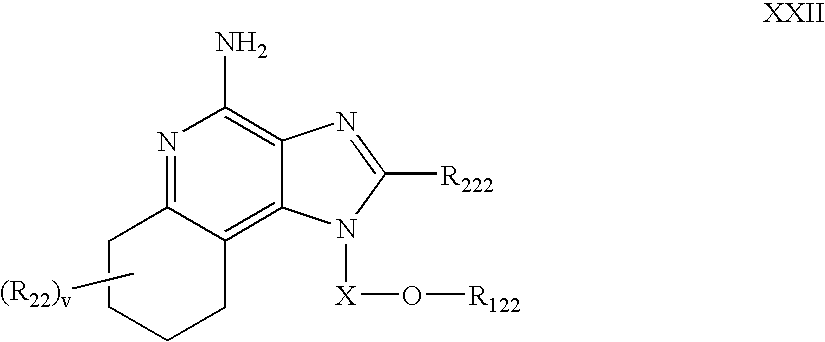
wherein: - X is —CHR522—, —CHR522-alkyl-, or —CHR522-alkenyl-;
- R122 is selected from:
- —R422—NR322—SO2—R622-alkyl
- —R422—NR322—SO2—R622-alkenyl;
- —R422—NR322—SO2—R622-aryl;
- —R422—NR322—SO2—R622-heteroaryl;
- —R422—NR322—SO2—R622-heterocyclyl;
- —R422—NR322—SO2—R722;
- —R422—NR322—SO2—NR522—R622-alkyl;
- —R422—NR322—SO2—NR522—R622-alkenyl;
- —R422—NR322—SO2—NR522—R622-aryl;
- —R422—NR322—SO2—NR522—R622-heteroaryl;
- —R422—NR322—SO2—NR522—R622-heterocyclyl; and
- —R422—NR322—SO2—NH2;
- R222 is selected from:
- -hydrogen;
- -alkyl;
- -alkenyl;
- -aryl;
- -heteroaryl;
- -heterocyclyl;
- -alkyl-Y-alkyl;
- -alkyl-Y-alkenyl;
- -alkyl-Y-aryl; and
- -alkyl or alkenyl substituted by one or more substituents selected from:
- —OH;
- -halogen;
- —N(R522)2;
- —CO—N(R522)2;
- —CO—C1-10 alkyl;
- —CO—O—C1-10 alkyl;
- —N3;
- -aryl;
- -heteroaryl;
- -heterocyclyl;
- —CO-aryl; and
- —CO-heteroaryl;
- Y is —O— or —S(O)0-2—;
- R322 is H, C1-10 alkyl, or arylalkyl;
- each R422 is independently alkyl or alkenyl, which may be interrupted by one or more —O— groups; or R322 and R422 can join together to form a ring;
- each R522 is independently H, C1-10 alkyl, or C2-10 alkenyl;
- R622 is a bond, alkyl, or alkenyl, which may be interrupted by one or more —O— groups;
- R722 is C1-10 alkyl; or R322 and R722 can join together to form a ring;
- v is 0 to 4; and
- each R22 present is independently selected from C1-10 alkyl, C1-10 alkoxy, hydroxy, halogen, and trifluoromethyl;

wherein: - X is —CHR323—, —CHR323-alkyl-, or —CHR323-alkenyl-;
- Z is —S—, —SO—, or —SO2—;
- R123 is selected from:
- -alkyl;
- -aryl;
- -heteroaryl;
- -heterocyclyl;
- -alkenyl;
- —R423-aryl;
- —R423-heteroaryl; and
- —R423-heterocyclyl;
- R223 is selected from:
- -hydrogen;
- -alkyl;
- -alkenyl;
- -aryl;
- -heteroaryl;
- -heterocyclyl;
- -alkyl-Y-alkyl;
- -alkyl-Y-alkenyl;
- -alkyl-Y-aryl; and
- -alkyl or alkenyl substituted by one or more substituents selected from:
- —OH;
- -halogen;
- —N(R323)2;
- —CO—N(R323)2;
- —CO—C1-10 alkyl;
- —CO—O—C1-10 alkyl;
- —N3;
- -aryl;
- -heteroaryl;
- -heterocyclyl;
- —CO-aryl; and
- —CO-heteroaryl;
- each R323 is independently H or C1-10 alkyl;
- each R423 is independently alkyl or alkenyl;
- each Y is independently —O— or —S(O)0-2—;
- v is 0 to 4; and
- each R23 present is independently selected from C1-10 alkyl, C1-10 alkoxy, hydroxy, halogen, and trifluoromethyl;
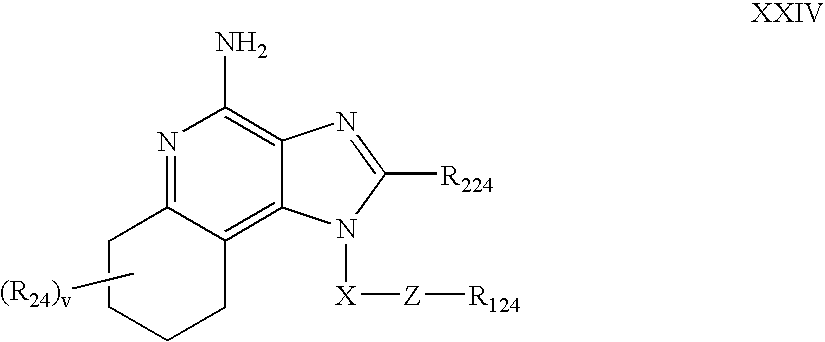
wherein: - X is —CHR324—, —CHR324-alkyl-, or —CHR324-alkenyl-;
- Z is —S—, —SO—, or —SO2—;
- R124 is selected from:
- -alkyl;
- -aryl;
- -heteroaryl;
- -heterocyclyl;
- -alkenyl;
- —R424-aryl;
- —R424-heteroaryl; and
- —R424-heterocyclyl;
- R224 is selected from:
- -hydrogen;
- -alkyl;
- -alkenyl;
- -aryl;
- -heteroaryl;
- -heterocyclyl;
- -alkyl-Y-alkyl;
- -alkyl-Y-alkenyl;
- -alkyl-Y-aryl; and
- -alkyl or alkenyl substituted by one or more substituents selected from:
- —OH;
- -halogen;
- —N(R324)2;
- —CO—N(R324)2;
- —CO—C1-10 alkyl;
- —CO—O—C1-10 alkyl;
- —N3;
- -aryl;
- -heteroaryl;
- -heterocyclyl;
- —CO-aryl; and
- —CO-heteroaryl;
- each R324 is independently H or C1-10 alkyl;
- each R424 is independently alkyl or alkenyl;
- each Y is independently —O— or —S(O)0-2—;
- v is 0 to 4; and
- each R24 present is independently selected from C1-10 alkyl, C1-10 alkoxy, hydroxy, halogen, and trifluoromethyl;
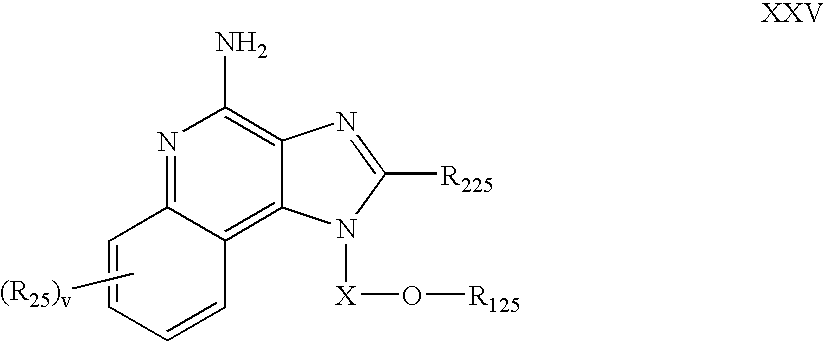
wherein: - X is —CHR525—, —CHR525-alkyl-, or —CHR525-alkenyl-;
- R125 is selected from:
- —R425—NR825—CR325—NR525-Z-R625-alkyl;
- —R425—NR825—CR325—NR525-Z-R625-alkenyl;
- —R425—NR825—CR325—NR525-Z-R625-aryl;
- —R425—NR825—CR325—NR525-Z-R625-heteroaryl;
- —R425—N825—CR325—NR525-Z-R625-heterocyclyl;
- —R425—NR825—CR325—NR525R725;
- —R425—NR825—CR325—NR925-Z-R625-alkyl;
- —R425—NR825—CR325—NR925-Z-R625-alkenyl;
- —R425—NR825—CR325—NR925-Z-R625-aryl;
- —R425—N425—CR32—NR925-Z-R625-heteroaryl; and
- —R425—NR825—CR325—NR925-Z-R625-heterocyclyl;
- R225 is selected from:
- -hydrogen;
- -alkyl;
- -alkenyl;
- -aryl;
- -heteroaryl;
- -heterocyclyl;
- -alkyl-Y-alkyl;
- -alkyl-Y-alkenyl;
- -alkyl-Y-aryl; and
- -alkyl or alkenyl substituted by one or more substituents selected from:
- —OH;
- -halogen;
- —N(R525)2;
- —CO—N(R525)2;
- —CO—C1-10 alkyl;
- —CO—O—C1-10 alkyl;
- —N3;
- -aryl;
- -heteroaryl;
- -heterocyclyl;
- —CO-aryl; and
- —CO-heteroaryl;
- each R325 is ═O or ═S;
- each R425 is independently alkyl or alkenyl, which may be interrupted by one or more —O— groups;
- each R525 is independently H or C1-10 alkyl;
- R625 is a bond, alkyl, or alkenyl, which may be interrupted by one or more —O— groups;
- R725 is H or C1-10 alkyl which may be interrupted by a hetero atom, or
- R725 can join with R525 to form a ring;
- R825 is H, C1-10 alkyl, or arylalkyl; or R425 and R825 can join together to form a ring;
- R925 is C1-10 alkyl which can join together with R825 to form a ring;
- each Y is independently —O— or —S(O)0-2—;
- Z is a bond, —CO—, or —SO2—;
- v is 0 to 4; and
- each R25 present is independently selected C1-10 alkyl, C1-10 alkoxy, hydroxy, halogen, and trifluoromethyl;

wherein: - X is —CHR526—, —CHR526-alkyl-, or —CHR526-alkenyl-;
- R126 is selected from:
- —R426—NR826—CR326—NR526-Z-R626-alkyl;
- —R426—NR826—CR326—NR526-Z-R626-alkenyl;
- —R426—NR826—CR326—NR526-Z-R626-aryl;
- —R426—NR826—CR326—NR526-Z-R626-heteroaryl;
- —R426—NR826—CR326—NR526-Z-R626-heterocyclyl;
- —R426—NR826—CR326—NR526R726;
- —R426—NR826—CR326—NR926-Z-R626-alkyl;
- —R426—NR826—CR326—NR926-Z-R626-alkenyl;
- —R426—NR826—CR326—NR926-Z-R626-aryl;
- —R426—NR826—CR326—NR926-Z-R626-heteroaryl; and
- —R426—NR826—CR326—NR926-Z-R626-heterocyclyl;
- R226 is selected from:
- -hydrogen;
- -alkyl;
- -alkenyl;
- -aryl;
- -heteroaryl;
- -heterocyclyl;
- -alkyl-Y-alkyl;
- -alkyl-Y-alkenyl;
- -alkyl-Y-aryl; and
- -alkyl or alkenyl substituted by one or more substituents selected from:
- —OH;
- -halogen;
- —N(R526)2;
- —CO—N(R526)2;
- —CO—C1-10 alkyl;
- —CO—O—C1-10 alkyl;
- —N3;
- -aryl;
- -heteroaryl;
- -heterocyclyl;
- —CO-aryl; and
- —CO-heteroaryl;
- each R326 is ═O or ═S;
- each R426 is independently alkyl or alkenyl, which may be interrupted by one or more —O— groups;
- each R526 is independently H or C1-10 alkyl;
- R626 is a bond, alkyl, or alkenyl, which may be interrupted by one or more —O— groups;
- R726 is H or C1-10 alkyl which may be interrupted by a hetero atom, or
- R726 can join with R526 to form a ring;
- R826 is H, C1-10 alkyl, or arylalkyl; or R426 and R826 can join together to form a ring;
- R926 is C1-10 alkyl which can join together with R826 to form a ring;
- each Y is independently —O— or —S(O)0-2—;
- Z is a bond, —CO—, or —SO2—;
- v is 0 to 4; and
- each R26 present is independently selected from C1-10 alkyl, C1-10 alkoxy, hydroxy, halogen, and trifluoromethyl;
and pharmaceutically acceptable salts of any of the foregoing.
- In another embodiment, the IRM compound can be chosen from 1H-imidazo[4,5-c]pyridin-4-amines defined by Formula XXVII below:

wherein -
- X is alkylene or alkenylene;
- Y is —CO— or —CS;
- Z is a bond, —O—, or —S—;
- R127 is aryl, heteroaryl, heterocyclyl, alkyl or alkenyl, each of which may be unsubstituted or substituted by one or more substituents independently selected from:
- -alkyl;
- -alkenyl;
- -aryl;
- -heteroaryl;
- -heterocyclyl;
- -substituted cycloalkyl;
- -substituted aryl;
- -substituted heteroaryl;
- -substituted heterocyclyl;
- —O-alkyl;
- —O-(alkyl)0-1-aryl;
- —O-(alkyl)0-1-(substituted aryl);
- —O-(alkyl)0-1-heteroaryl;
- —O-(alkyl)0-1-(substituted heteroaryl);
- —O-(alkyl)0-1-heterocyclyl;
- —O-(alkyl)0-1-(substituted heterocyclyl);
- —COOH;
- —CO—O-alkyl;
- —CO-alkyl;
- —S(O)0-2-alkyl;
- —S(O)0-2-(alkyl)0-1-aryl;
- —S(O)0-2-(alkyl)0-1-(substituted aryl);
- —S(O)0-2-(alkyl)0-1-heteroaryl;
- —S(O)0-2-(alkyl)0-1-(substituted heteroaryl);
- —S(O)0-2-(alkyl)0-1-heterocyclyl;
- —S(O)0-2-(alkyl)0-1-(substituted heterocyclyl);
- -(alkyl)0-1-N(R627)2;
- -(alkyl)0-1-NR627—CO—O-alkyl;
- -(alkyl)0-1-NR627—CO-alkyl;
- -(alkyl)0-1-NR627—CO-aryl;
- -(alkyl)0-1-NR627—CO-(substituted aryl);
- -(alkyl)0-1-NR627—CO-heteroaryl;
- -(alkyl)0-1-NR627—CO-(substituted heteroaryl);
- —N3;
- -halogen;
- -haloalkyl;
- -haloalkoxy;
- —CO-haloalkyl;
- —CO-haloalkoxy;
- —NO2;
- —CN;
- —OH;
- —SH; and in the case of alkyl, alkenyl, and heterocyclyl, oxo;
- R227 is selected from:
- -hydrogen;
- -alkyl;
- -alkenyl;
- -aryl;
- -substituted aryl;
- -heteroaryl;
- -substituted heteroaryl;
- -alkyl-O-alkyl;
- -alkyl-S-alkyl;
- -alkyl-O-aryl;
- -alkyl-S-aryl:
- -alkyl-O-alkenyl;
- -alkyl-S-alkenyl; and
- -alkyl or alkenyl substituted by one or more substituents selected from:
- —OH;
- -halogen;
- —N(R627)2;
- —CO—N(R627)2;
- —CS—N(R627)2;
- —SO2—N(R627)2;
- —NR627—CO—C1-10 alkyl;
- —NR627—CS—C1-10 alkyl;
- —NR627—SO2—C1-10 alkyl;
- —CO—C1-10 alkyl;
- —CO—O—C1-10 alkyl;
- —N3;
- -aryl;
- -substituted aryl;
- -heteroaryl;
- -substituted heteroaryl;
- -heterocyclyl;
- -substituted heterocyclyl;
- —CO-aryl;
- —CO-(substituted aryl);
- —CO-heteroaryl; and
- —CO-(substituted heteroaryl);
- R327 and R427 are independently selected from hydrogen, alkyl, alkenyl, halogen, alkoxy, amino, alkylamino, dialkylamino, and alkylthio;
- R527 is H or C1-10 alkyl, or R527 can join with X to form a ring that contains one or two heteroatoms; or when R127 is alkyl, R527 and R127 can join to form a ring;
- each R627 is independently H or C1-10alkyl;
and pharmaceutically acceptable salts thereof.
- In another embodiment, the IRM compound can be chosen from 1H-imidazo[4,5-c]pyridin-4-amines defined by Formula XXVIII below:

wherein -
- X is alkylene or alkenylene;
- Y is —SO2—;
- Z is a bond or —NR628—;
- R128 is aryl, heteroaryl, heterocyclyl, alkyl or alkenyl, each of which may be unsubstituted or substituted by one or more substituents independently selected from:
- -alkyl;
- -alkenyl;
- -aryl;
- -heteroaryl;
- -heterocyclyl;
- -substituted cycloalkyl;
- -substituted aryl;
- -substituted heteroaryl;
- -substituted heterocyclyl;
- —O-alkyl;
- —O-(alkyl)0-1-aryl;
- —O-(alkyl)0-1-(substituted aryl);
- —O-(alkyl)0-1-heteroaryl;
- —O-(alkyl)0-1-(substituted heteroaryl);
- —O-(alkyl)0-1-heterocyclyl;
- —O-(alkyl)0-1-(substituted heterocyclyl);
- —COOH;
- —CO—O-alkyl;
- —CO-alkyl;
- —S(O)0-2-alkyl;
- —S(O)0-2-(alkyl)0-1-aryl;
- —S(O)0-2-(alkyl)0-1-(substituted aryl);
- —S(O)0-2-(alkyl)0-1-heteroaryl;
- —S(O)0-2-(alkyl)0-1-(substituted heteroaryl);
- —S(O)0-2-(alkyl)0-1-heterocyclyl;
- —S(O)0-2-(alkyl)0-1-(substituted heterocyclyl);
- -(alkyl)0-1-N(R628)2;
- -(alkyl)0-1-NR628—CO—O-alkyl;
- -(alkyl)0-1-NR628—CO-alkyl;
- -(alkyl)0-1-NR628—CO-aryl;
- -(alkyl)0-1-NR628—CO-(substituted aryl);
- -(alkyl)0-1-NR628—CO-heteroaryl;
- -(alkyl)0-1-NR628—CO-(substituted heteroaryl);
- —N3;
- -halogen;
- -haloalkyl;
- -haloalkoxy;
- —CO-haloalkyl;
- —CO-haloalkoxy;
- —NO2;
- —CN;
- —OH;
- —SH; and in the case of alkyl, alkenyl, and heterocyclyl, oxo;
- R228 is selected from:
- -hydrogen;
- -alkyl;
- -alkenyl;
- -aryl;
- -substituted aryl;
- -heteroaryl;
- -substituted heteroaryl;
- -alkyl-O-alkyl;
- -alkyl-S-alkyl;
- -alkyl-O-aryl;
- -alkyl-S-aryl:
- -alkyl-O-alkenyl;
- -alkyl-S-alkenyl; and
- -alkyl or alkenyl substituted by one or more substituents selected from:
- —OH;
- -halogen;
- —N(R628)2;
- —CO—N(R628)2;
- —CS—N(R628)2;
- —SO2—N(R628)2;
- —NR628—CO—C1-10 alkyl;
- —NR628—CS—C1-10 alkyl;
- —NR628—SO2—C1-10 alkyl;
- —CO—C1-10 alkyl;
- —CO—O—C1-10 alkyl;
- —N3;
- -aryl;
- -substituted aryl;
- -heteroaryl;
- -substituted heteroaryl;
- -heterocyclyl;
- -substituted heterocyclyl;
- —CO-aryl;
- —CO-(substituted aryl);
- —CO-heteroaryl; and
- —CO-(substituted heteroaryl);
- R328 and R428 are independently selected from hydrogen, alkyl, alkenyl, halogen, alkoxy, amino, alkylamino, dialkylamino, and alkylthio;
- R528 is H or C1-10 alkyl, or R528 can join with X to form a ring; or when R128 is alkyl, R528 and R128 can join to form a ring;
- each R528 is independently H or C1-10alkyl;
- and pharmaceutically acceptable salts thereof.
- In another embodiment, the IRM compound can be chosen from 1H-imidazo[4,5-c]pyridin-4-amines defined by Formula XXIX below:

wherein -
- X is alkylene or alkenylene;
- Y is —CO— or —CS;
- Z is —NR629—, —NR629—CO—, —NR629—SO2—, or —NR729—;
- R129 is aryl, heteroaryl, heterocyclyl, alkyl or alkenyl, each of which may be unsubstituted or substituted by one or more substituents independently selected from:
- -alkyl;
- -alkenyl;
- -aryl;
- -heteroaryl;
- -heterocyclyl;
- -substituted cycloalkyl;
- -substituted aryl;
- -substituted heteroaryl;
- -substituted heterocyclyl;
- —O-alkyl;
- —O-(alkyl)0-1-aryl;
- —O-(alkyl)0-1-(substituted aryl);
- —O-(alkyl)0-1-heteroaryl;
- —O-(alkyl)0-1-(substituted heteroaryl);
- —O-(alkyl)0-1-heterocyclyl;
- —O-(alkyl)0-1-(substituted heterocyclyl);
- —COOH;
- —CO—O-alkyl;
- —CO-alkyl;
- —S(O)0-2-alkyl;
- —S(O)0-2-(alkyl)0-1-aryl;
- —S(O)0-2-(alkyl)0-1-(substituted aryl);
- —S(O)0-2-(alkyl)0-1-heteroaryl;
- —S(O)0-2-(alkyl)0-1-(substituted heteroaryl);
- —S(O)0-2-(alkyl)0-1-heterocyclyl;
- —S(O)0-2-(alkyl)0-1-(substituted heterocyclyl);
- -(alkyl)0-1-N(R629)2;
- -(alkyl)0-1-NR629—CO—O-alkyl;
- -(alkyl)0-1-NR629—CO-alkyl;
- -(alkyl)0-1-NR629—CO-aryl;
- -(alkyl)0-1-NR629—CO-(substituted aryl);
- -(alkyl)0-1-NR629—CO-heteroaryl;
- -(alkyl)0-1-NR629—CO-(substituted heteroaryl);
- —P(O)(O-alkyl)2;
- —N3;
- -halogen;
- -haloalkyl;
- -haloalkoxy;
- —CO-haloalkyl;
- —CO-haloalkoxy;
- —NO2;
- —CN;
- —OH;
- —SH; and in the case of alkyl, alkenyl, and heterocyclyl, oxo;
- R229 is selected from:
- -hydrogen;
- -alkyl;
- -alkenyl;
- -aryl;
- -substituted aryl;
- -heteroaryl;
- -substituted heteroaryl;
- -alkyl-O-alkyl;
- -alkyl-S-alkyl;
- -alkyl-O-aryl;
- -alkyl-S-aryl:
- -alkyl-O-alkenyl;
- -alkyl-S-alkenyl; and
- -alkyl or alkenyl substituted by one or more substituents selected from:
- —OH;
- -halogen;
- —N(R629)2;
- —CO—N(R629)2;
- —CS—N(R629)2;
- —SO2—N(R629)2;
- —NR629—CO—C1-10 alkyl;
- —NR629—CS—C1-10 alkyl;
- —NR629—SO2—C1-10 alkyl;
- —CO—C1-10 alkyl;
- —CO—O—C1-10 alkyl;
- —N3;
- -aryl;
- -substituted aryl;
- -heteroaryl;
- -substituted heteroaryl;
- -heterocyclyl;
- -substituted heterocyclyl;
- —CO-aryl;
- —CO-(substituted aryl);
- —CO-heteroaryl; and
- —CO-(substituted heteroaryl);
- R329 and R429 are independently selected from hydrogen, alkyl, alkenyl, halogen, alkoxy, amino, alkylamino, dialkylamino, and alkylthio;
- R529 is H or C1-10 alkyl, or R529 can join with X to form a ring that contains one or two heteroatoms;
- each R629 is independently H or C1-10alkyl;
- R729 is H or C1-10 alkyl which may be interrupted by a heteroatom; or
- when R129 is alkyl, R729 and R129 can join to form a ring;
- and pharmaceutically acceptable salts thereof.
- In another embodiment, the IRM compound can be chosen from 1-position ether or thioether substituted 1H-imidazo[4,5-c]pyridin-4-amines defined by Formula XXX below:
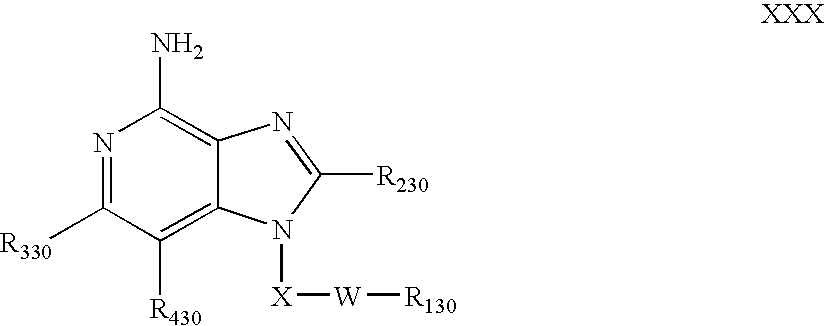
wherein: - X is —CH(R530)—, —CH(R530)-alkylene-, —CH(R530)-alkenylene-, or CH(R530)-alkylene-Y-alkylene-;
- Y is —O—, or —S(O)0-2—;
- —W—R130 is selected from —O—R130-1-5 and —S(O)0-2—R130-6;
- R130-1-5 is selected from
-
- —R630—C(R730)-Z-R530-alkyl;
- —R630—C(R730)-Z-R830-alkenyl;
- —R630—C(R730)-Z-R830-aryl;
- —R630—C(R730)-Z-R830-heteroaryl;
- —R630—C(R730)-Z-R830-heterocyclyl;
- —R630—C(R730)-Z-H;
- —R630—N(R930)—C(R730)—R830-alkyl;
- —R630—N(R930)—C(R730)—R830-alkenyl;
- —R630—N(R930)—C(R730)—R830-aryl;
- —R630—N(R930)—C(R730)—R830-heteroaryl;
- —R630—N(R930)—C(R730)—R830-heterocyclyl;
- —R630—N(R930)—C(R730)—R1030;
- —R630—N(R930)—SO2—R830-alkyl;
- —R630—N(R930)—SO2—R830-alkenyl;
- —R630—N(R930)—SO2—R830-aryl;
- —R630—N(R930)—SO2—R830-heteroaryl;
- —R630—N(R930)—SO2—R830-heterocyclyl;
- —R630—N(R930)—SO2—R1030;
- —R630—N(R930)—SO2—N(R530)—R830-alkyl;
- —R630—N(R930)—SO2—N(R530)—R830-alkenyl;
- —R630—N(R930)—SO2—N(R530)—R830-aryl;
- —R630—N(R930)—SO2—N(R530)—R830-heteroaryl;
- —R630—N(R930)—SO2—N(R530)—R830-heterocyclyl;
- —R630—N(R930)—SO2—NH2;
- —R630—N(R930)—C(R730)—N(R530)-Q-R830-alkyl;
- —R630—N(R930)—C(R730)—N(R530)-Q-R830-alkenyl;
- —R630—N(R930)—C(R730)—N(R530)-Q-R830-aryl;
- —R630—N(R930)— C(R730)—N(R530)-Q-R830-heteroaryl;
- —R630—N(R930)— C(R730)—N(R530)-Q-R830-heterocyclyl;
- —R630—N(R930)—C(R730)—N(R530)2;
- —R630—N(R930)—C(R730)—

- —R630—N(R930)—C(R730)—N(R1130)-Q-R830-alkyl;
- —R630—N(R930)—C(R730)—N(R1130)-Q-R530-alkenyl;
- —R630—N(R930)—C(R730)—N(R1130)-Q-R830-aryl;
- —R630—N(R930)— C(R730)—N(R1130)-Q-R830-heteroaryl;
- —R630—N(R930)— C(R730)—N(R1130)-Q-R830-heterocyclyl;
- —R630—N(R930)— C(R730)—N(R1130)H;
- -alkenyl;
- -aryl;
- —R630-aryl;
- -heteroaryl;
- -heterocyclyl;
- —R630— heteroaryl; and
- —R630-heterocyclyl;
- Z is —N(R530)—, —O—, or —S—;
- Q is a bond, —CO—, or —SO2—;
- A represents the atoms necessary to provide a 5- or 6-membered heterocyclic or heteroaromatic ring that contains up to three heteroatoms;
- R130-6 is selected from:
-
- -alkyl;
- -aryl;
- -heteroaryl;
- -heterocyclyl;
- -alkenyl;
- —R630-aryl;
- —R630-heteroaryl; and
- —R630-heterocyclyl;
- each R530 is independently hydrogen, C1-10 alkyl, or C2-10 alkenyl;
- R630 is alkylene, alkenylene, or alkynylene, which may be interrupted by one or more —O— groups;
- R730 is ═O or ═S;
- R830 is a bond, alkylene, alkenylene, or alkynylene, which may be interrupted by one or more —O— groups;
- R930 is hydrogen, C1-10 alkyl, or arylalkyl; or R930 can join together with any carbon atom of R630 to form a ring of the formula

- R1030 is hydrogen or C1-10 alkyl; or R930 and R1030 can join together to form a ring selected from

- R1130 is C1-10 alkyl; or R930 and R1130 can join together to form a ring having the structure

- R1230 is C2-7 alkylene which is straight chain or branched, wherein the branching does not prevent formation of the ring; and
- R230, R330 and R430 are independently selected from hydrogen and non-interfering substitutents;
- and pharmaceutically acceptable salts thereof.
- Illustrative non-interfering R230 substituents include:
-
- -alkyl;
- -alkenyl;
- -aryl;
- -heteroaryl;
- -heterocyclyl;
- -alkylene-Y-alkyl;
- -alkylene-Y-alkenyl;
- -alkylene-Y-aryl; and
- -alkyl or alkenyl substituted by one or more substituents selected from the group consisting of:
- —OH;
- -halogen;
- —N(R530)2;
- —C(O)—C1-10 alkyl;
- —C(O)—O—C1-10 alkyl;
- —N3;
- -aryl;
- -heteroaryl;
- -heterocyclyl;
- —C(O)-aryl; and
- —C(O)-heteroaryl.
- Illustrative non-interfering R330 and R430 substitutents include:
- C1-10 alkyl, C2-10 alkenyl, C2-10 alkynyl, C1-10 alkoxy, C1-10 alkylthio, amino, alkylamino, dialkylamino, halogen, and nitro.
- In another embodiment, the IRM compound can be chosen from 1H-imidazo dimers of the formula (XXXI):
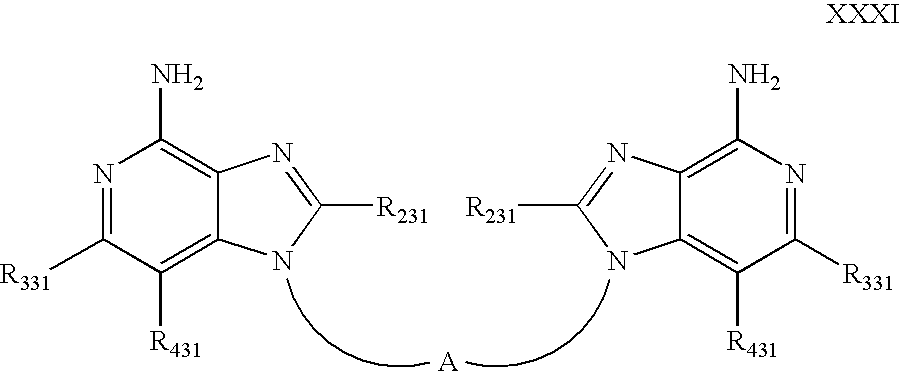
wherein: - A is a divalent linking group selected from the group consisting of:
-
- straight or branched chain C4-20 alkylene;
- straight or branched chain C4-20 alkenylene;
- straight or branched chain C4-20 alkynylene; and
- -Z-Y—W—Y-Z-;
- each Z is independently selected from the group consisting of:
-
- straight or branched chain C2-20 alkylene;
- straight or branched chain C4-20 alkenylene; and
- straight or branched chain C4-20 alkynylene;
- any of which may be optionally interrupted by —O—, —N(R531)—, or —S(O)2—;
- each Y is independently selected from the group consisting of:
-
- a bond;
- —N(R531)C(O)—;
- —C(O)N(R531)—;
- —N(R531)C(O)N(R531)—;
- N(R531)S(O)2—;
- —S(O)2N(R531)—;
- —OC(O)O—;
- —OC(O)—;
- —C(O)O—;
- —N(R531)C(O)O—; and
- —OC(O)N(R531)—;
- W is selected from the group consisting of:
-
- straight or branched chain C2-20 alkylene;
- straight or branched chain C2-20 alkenylene;
- straight or branched chain C4-20 alkynylene;
- straight or branched chain perfluoro C2-20 alkylene;
- C1-4 alkylene-O—C1-4 alkylene;
- —C(O)—;
- —S(O)2—;
- —OC(O)O—;
- —N(R531)C(O)N(R531)—;

- 1,5-naphthylene;
- 2,6-pyridinylene;
- 1,2-cyclohexylene;
- 1,3-cyclohexylene;
- 1,4-cyclohexylene;
- trans-1,4-cyclohexylene;
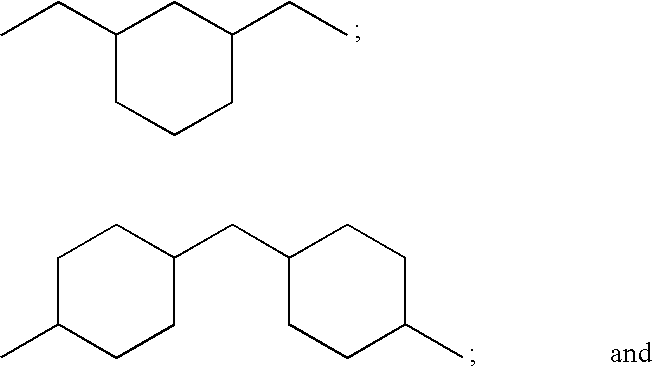
and - trans-5-norbornen-2,3-diyl;
- wherein n is 0-4; each R is independently selected from the group consisting of C1-4 alkyl, C1-4 alkoxy, and halogen; and Q is selected from the group consisting of a bond, —CH2—, and —O—;
- R231 is selected from the group consisting of:
-
- -hydrogen;
- -alkyl;
- -alkenyl;
- -aryl;
- -substituted aryl;
- -heteroaryl;
- -substituted heteroaryl;
- -alkyl-X-alkyl;
- -alkyl-X-aryl;
- -alkyl-X-alkenyl; and
- -alkyl or alkenyl substituted by one or more substituents selected from the group consisting of:
- —OH;
- -halogen;
- —N(R631)2;
- —C(O)—N(R631)2;
- —C(S)—N(R631)2;
- —S(O)2—N(R631)2;
- —N(R631)—C(O)—C1-10 alkyl;
- —N(R631)—C(S)—C1-10 alkyl;
- —N(R631)—S(O)2—C1-10 alkyl;
- —C(O)—C1-10 alkyl;
- —C(O)—O—C1-10 alkyl;
- —N3;
- -aryl;
- -substituted aryl;
- -heteroaryl;
- -substituted heteroaryl;
- -heterocyclyl;
- -substituted heterocyclyl;
- —C(O)-aryl;
- —C(O)-(substituted aryl);
- —C(O)-heteroaryl; and
- —C(O)-(substituted heteroaryl);
- R331 and R431 are each independently selected from the group consisting of:
-
- -hydrogen;
- -halogen;
- -alkyl;
- -alkenyl;
- —X-alkyl; and
- —N(R631)2;
- or when taken together, R331 and R431 form a fused aryl or heteroaryl ring that is unsubstituted or substituted by one or more substituents selected from the group consisting of:
- -halogen;
- -alkyl;
- -alkenyl;
- —X-alkyl; and
- —N(R631)2;
- or when taken together, R331 and R431 form a fused 5 to 7 membered saturated ring, containing 0 to 2 heteroatoms and unsubstituted or substituted by one or more substituents selected from the group consisting of:
- -halogen;
- -alkyl;
- -alkenyl;
- —X-alkyl; and
- —N(R631)2;
- each R531 is independently selected from the group consisting of:
-
- hydrogen;
- C1-6 alkyl;
- C3-7 cycloalkyl; and
- benzyl; or
- when Y is —N(R531)C(O)—, —C(O)N(R531)—, —N(R531)C(O)N(R531)—, —N(R531)S(O)2—, —S(O2)N(R531)—, —N(R531)C(O)O—, or —OC(O)N(R531)— and the nitrogen of the N(R531) group is bonded to Z, then R531 can join with Z to form a ring having the structure

- each R631 is independently hydrogen or C1-10 alkyl;
- R731 is C3-8 alkylene; and
- X is —O— or —S—;
- with the proviso that if W is —C(O)—, —S(O)2—, —OC(O)O—, or —N(R531)C(O)N(R531)— then each Y is a bond;
- and pharmaceutically acceptable salts thereof.
- In another embodiment, the IRM compound can be chosen from 6-, 7-, 8-, or 9-position aryl or heteroaryl substituted 1H-imidazo[4,5-c]quinolin-4-amines of the following Formula (XXXII):
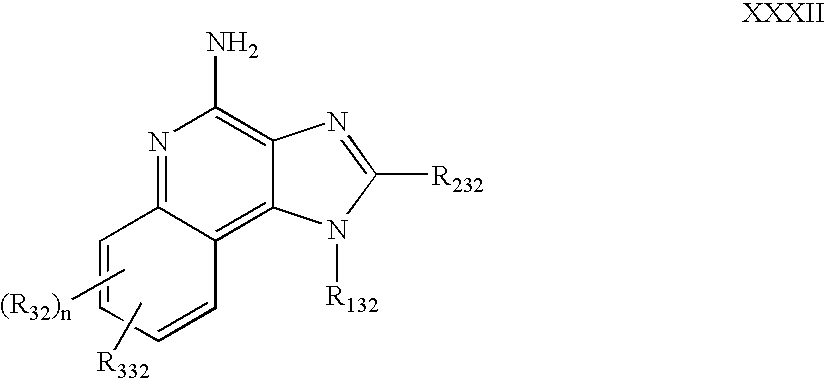
wherein: - R32 is selected from the group consisting of alkyl, alkoxy, hydroxy, and trifluoromethyl;
- n is 0 or 1;
- R132 and R232 are independently selected from the group consisting of hydrogen and non-interfering substitutents;
- R332 is selected from the group consisting of:
-
- -Z-Ar,
- -Z-Ar′-Y—R432,
- -Z-Ar′-X-Y—R432,
- -Z-Ar′-R532, and
- -Z-Ar′-X—R532;
- Ar is selected from the group consisting of aryl and heteroaryl both of which can be unsubstituted or can be substituted by one or more substituents independently selected from the group consisting of alkyl, alkenyl, alkoxy, methylenedioxy, haloalkyl, haloalkoxy, halogen, nitro, hydroxy, hydroxyalkyl, mercapto, cyano, carboxy, formyl, aryl, aryloxy, arylalkoxy, heteroaryl, heteroaryloxy, heteroarylalkoxy, heterocyclyl, heterocyclylalkyl, amino, alkylamino, and dialkylamino;
- Ar′ is selected from the group consisting of arylene and heteroarylene both of which can be unsubstituted or can be substituted by one or more substituents independently selected from the group consisting of alkyl, alkenyl, alkoxy, haloalkyl, haloalkoxy, halogen, nitro, hydroxy, hydroxyalkyl, mercapto, cyano, carboxy, formyl, aryl, aryloxy, arylalkoxy, heteroaryl, heteroaryloxy, heteroarylalkoxy, heterocyclyl, heterocyclylalkyl, amino, alkylamino, and dialkylamino;
- X is selected from the group consisting of alkylene, alkenylene, alkynylene, arylene, heteroarylene, and heterocyclylene wherein the alkylene, alkenylene, and alkynylene groups can be optionally interrupted or terminated with arylene, heteroarylene, or heterocyclylene, and optionally interrupted by one or more —O— groups;
- Y is selected from the group consisting of:
-
- —S(O)0-2—,
- —S(O)2—N(R832)—,
- —C(R632)—,
- —C(R632)—O—,
- —O—C(R632)—,
- —O—C(O)—O—,
- —N(R832)-Q-,
- —C(R632)—N(R832)—,
- —O—C(R632)—N(R832)—,
- —C(R632)—N(OR932)—,
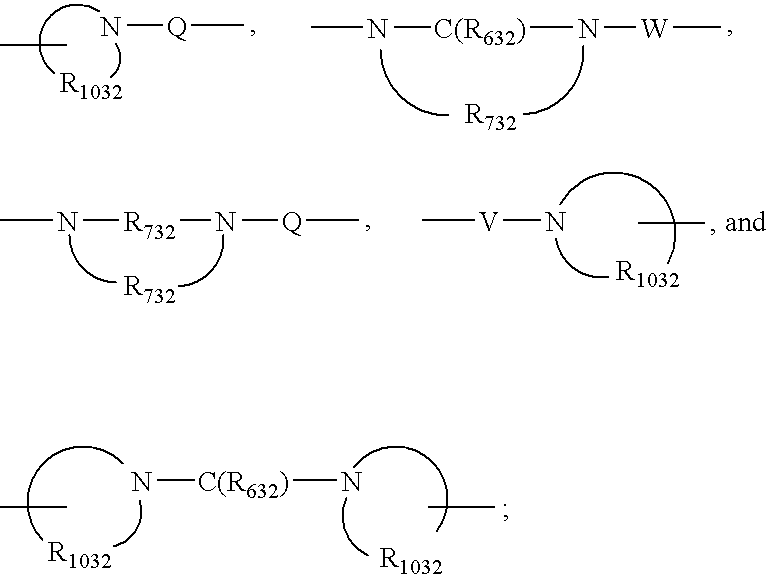
- Z is selected from the group consisting of a bond, alkylene, alkenylene, and alkynylene;
- R432 is selected from the group consisting of hydrogen, alkyl, alkenyl, alkynyl, aryl, arylalkylenyl, aryloxyalkylenyl, alkylarylenyl, heteroaryl, heteroarylalkylenyl, heteroaryloxyalkylenyl, alkylheteroarylenyl, and heterocyclyl wherein the alkyl, alkenyl, alkynyl, aryl, arylalkylenyl, aryloxyalkylenyl, alkylarylenyl, heteroaryl, heteroarylalkylenyl, heteroaryloxyalkylenyl, alkylheteroarylenyl, and heterocyclyl groups can be unsubstituted or substituted by one or more substituents independently selected from the group consisting of alkyl, alkoxy, hydroxyalkyl, haloalkyl, haloalkoxy, halogen, nitro, hydroxy, mercapto, cyano, aryl, aryloxy, arylalkyleneoxy, heteroaryl, heteroaryloxy, heteroarylalkyleneoxy, heterocyclyl, amino, alkylamino, dialkylamino, (dialkylamino)alkyleneoxy, and in the case of alkyl, alkenyl, alkynyl, and heterocyclyl, oxo;
- R532 is selected from the group consisting of:

- each R632 is independently selected from the group consisting of ═O and ═S;
- each R732 is independently C2-7 alkylene;
- each R832 is independently selected from the group consisting of hydrogen, alkyl, alkoxyalkylenyl, and arylalkylenyl;
- R932 is selected from the group consisting of hydrogen and alkyl;
- each R1032 is independently C3-8 alkylene;
- A is selected from the group consisting of —O—, —C(O)—, —S(O)0-2—, —CH2—, and —N(R432)—;
- Q is selected from the group consisting of a bond, —C(R632)—, —C(R632)—C(R632), —S(O)2—, —C(R632)—N(R832)—W—, —S(O)2—N(R832)—, —C(R632)—O—, and —C(R632)—N(OR932)—;
- V is selected from the group consisting of —C(R632)—, —O—C(R632)—, —N(R832)—C(R632)—, and —S(O)2—;
- W is selected from the group consisting of a bond, —C(O)—, and —S(O)2—; and
- a and b are independently integers from 1 to 6 with the proviso that a+b is ≦7;
- and pharmaceutically acceptable salts thereof.
- Illustrative non-interfering R132 substituents include:
-
- —R432,
- —X—R432,
- —X—Y—R432,
- —X—Y—X—Y—R432, and
- —X—R532;
- wherein:
- each X is independently selected from the group consisting of alkylene, alkenylene, alkynylene, arylene, heteroarylene, and heterocyclylene wherein the alkylene, alkenylene, and alkynylene groups can be optionally interrupted or terminated with arylene, heteroarylene, or heterocyclylene, and optionally interrupted by one or more —O— groups;
- each Y is independently selected from the group consisting of:
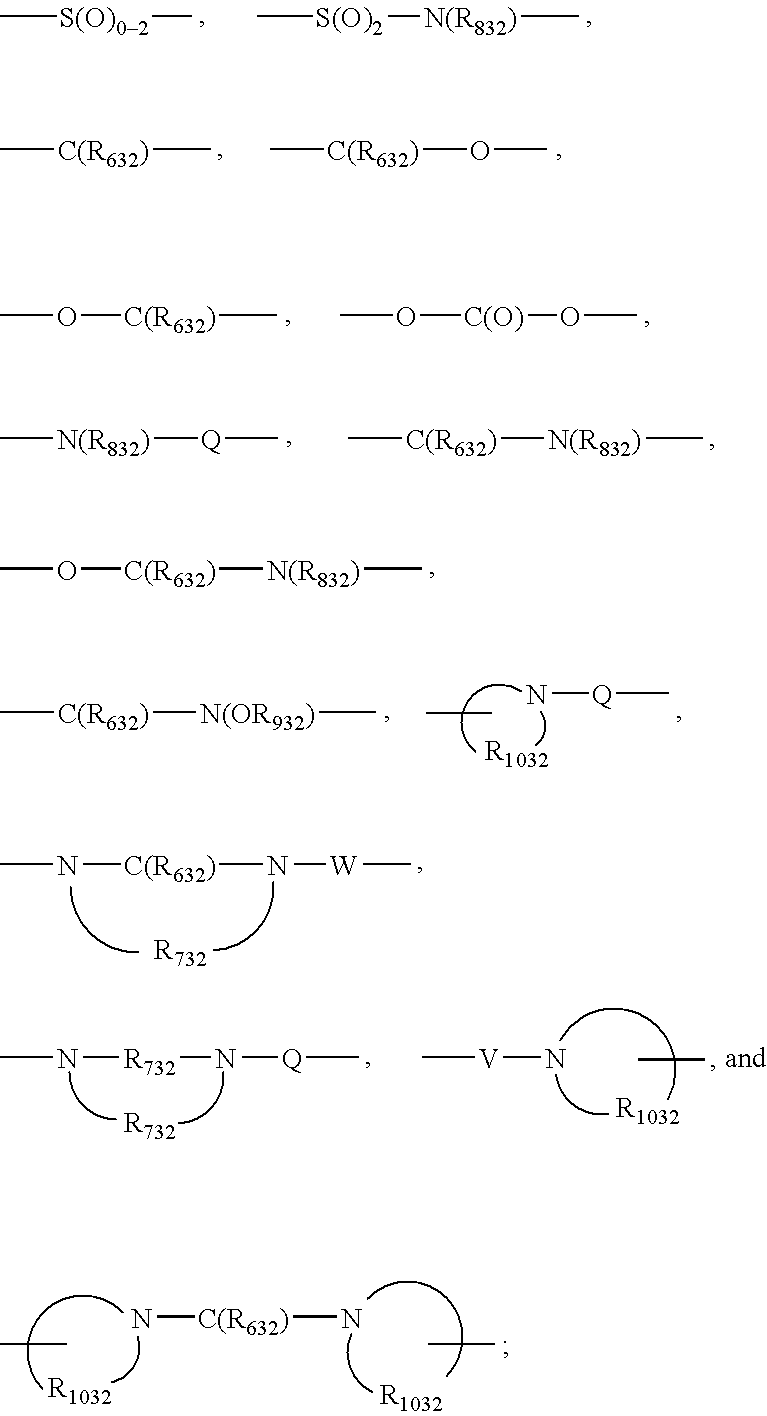
- R432 is selected from the group consisting of hydrogen, alkyl, alkenyl, alkynyl, aryl, arylalkylenyl, aryloxyalkylenyl, alkylarylenyl, heteroaryl, heteroarylalkylenyl, heteroaryloxyalkylenyl, alkylheteroarylenyl, and heterocyclyl wherein the alkyl, alkenyl, alkynyl, aryl, arylalkylenyl, aryloxyalkylenyl, alkylarylenyl, heteroaryl, heteroarylalkylenyl, heteroaryloxyalkylenyl, alkylheteroarylenyl, and heterocyclyl groups can be unsubstituted or substituted by one or more substituents independently selected from the group consisting of alkyl, alkoxy, hydroxyalkyl, haloalkyl, haloalkoxy, halogen, nitro, hydroxy, mercapto, cyano, aryl, aryloxy, arylalkyleneoxy, heteroaryl, heteroaryloxy, heteroarylalkyleneoxy, heterocyclyl, amino, alkylamino, dialkylamino, (dialkylamino)alkyleneoxy, and in the case of alkyl, alkenyl, alkynyl, and heterocyclyl, oxo;
- R532 is selected from the group consisting of:
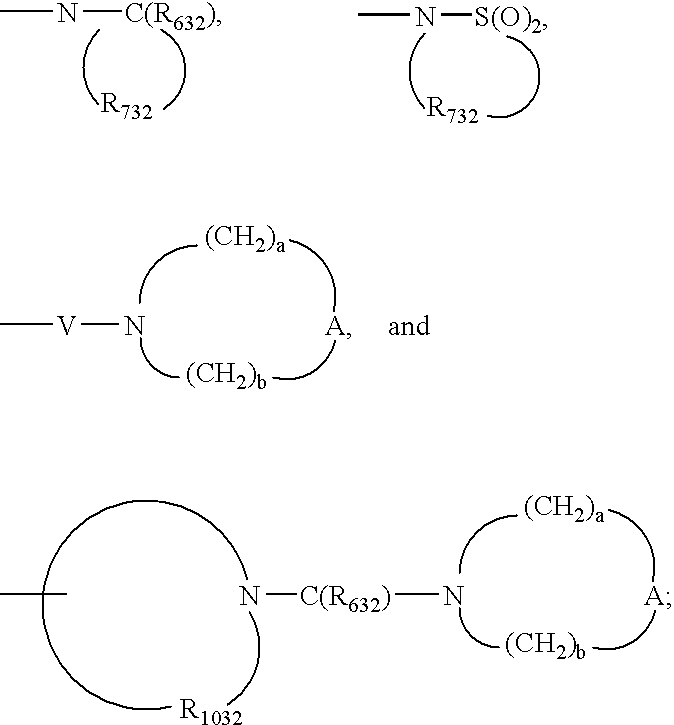
- each R632 is independently selected from the group consisting of ═O and ═S;
- each R732 is independently C2-7 alkylene;
- each R832 is independently selected from the group consisting of hydrogen, alkyl, alkoxyalkylenyl, and arylalkylenyl;
- each R932 is independently selected from the group consisting of hydrogen and alkyl;
- each R1032 is independently C3-8 alkylene;
- A is selected from the group consisting of —O—, —C(O)—, —S(O)0-2—, —CH2—, and —N(R432)—;
- each Q is independently selected from the group consisting of a bond, —C(R632)—, —C(R632)—C(R632)—, —S(O)2—, —C(R632)—N(R832)—W—, —S(O)2—N(R832)—, —C(R632)—O—, and —C(R632)—N(OR932)—;
- each V is independently selected from the group consisting of —C(R632)—, —O—C(R632)—, —N(R832)—C(R632)—, and —S(O)2—;
- each W is independently selected from the group consisting of a bond, —C(O)—, and —S(O)2—; and
- a and b are independently integers from 1 to 6 with the proviso that a+b is ≦7;
- Illustrative non-interfering R232 substitutents include:
-
- —R432,
- —X—R432,
- —X—Y—R432, and
- —X—R532;
- wherein:
- X is selected from the group consisting of alkylene, alkenylene, alkynylene, arylene, heteroarylene, and heterocyclylene wherein the alkylene, alkenylene, and alkynylene groups can be optionally interrupted or terminated with arylene, heteroarylene, or heterocyclylene, and optionally interrupted by one or more —O— groups;
- Y is selected from the group consisting of:

- R432 is selected from the group consisting of hydrogen, alkyl, alkenyl, alkynyl, aryl, arylalkylenyl, aryloxyalkylenyl, alkylarylenyl, heteroaryl, heteroarylalkylenyl, heteroaryloxyalkylenyl, alkylheteroarylenyl, and heterocyclyl wherein the alkyl, alkenyl, alkynyl, aryl, arylalkylenyl, aryloxyalkylenyl, alkylarylenyl, heteroaryl, heteroarylalkylenyl, heteroaryloxyalkylenyl, alkylheteroarylenyl, and heterocyclyl groups can be unsubstituted or substituted by one or more substituents independently selected from the group consisting of alkyl, alkoxy, hydroxyalkyl, haloalkyl, haloalkoxy, halogen, nitro, hydroxy, mercapto, cyano, aryl, aryloxy, arylalkyleneoxy, heteroaryl, heteroaryloxy, heteroarylalkyleneoxy, heterocyclyl, amino, alkylamino, dialkylamino, (dialkylamino)alkyleneoxy, and in the case of alkyl, alkenyl, alkynyl, and heterocyclyl, oxo;
- R532 is selected from the group consisting of:

- each R632 is independently selected from the group consisting of ═O and ═S;
- each R732 is independently C2-7 alkylene;
- each R832 is independently selected from the group consisting of hydrogen, alkyl, alkoxyalkylenyl, and arylalkylenyl;
- R932 is selected from the group consisting of hydrogen and alkyl;
- each R1032 is independently C3-8 alkylene;
- A is selected from the group consisting of —O—, —C(O)—, —S(O)0-2—, —CH2—, and —N(R432)—;
- Q is selected from the group consisting of a bond, —C(R632)—, —C(R632)—C(R632)—, —S(O)2—, —C(R632)—N(R532)—W—, —S(O)2—N(R832)—, —C(R632)—O—, and —C(R632)—N(OR932)—;
- V is selected from the group consisting of —C(R632)—, —O—C(R632)—, —N(R832)—C(R632)—, and —S(O)2—;
- W is selected from the group consisting of a bond, —C(O)—, and —S(O)2—; and
- a and b are independently integers from 1 to 6 with the proviso that a+b is ≦7.
- Herein, “non-interfering” means that the ability of the compound or salt to modulate (e.g., induce or inhibit) the biosynthesis of one or more cytokines is not destroyed by the non-interfering substituent.
- As used herein, the terms “alkyl”, “alkenyl”, “alkynyl” and the prefix “alk-” are inclusive of both straight chain and branched chain groups and of cyclic groups, i.e. cycloalkyl and cycloalkenyl. Unless otherwise specified, these groups contain from 1 to 20 carbon atoms, with alkenyl and alkynyl groups containing from 2 to 20 carbon atoms. In some embodiments, these groups have a total of up to 10 carbon atoms, up to 8 carbon atoms, up to 6 carbon atoms, or up to 4 carbon atoms. Cyclic groups can be monocyclic or polycyclic and preferably have from 3 to 10 ring carbon atoms. Exemplary cyclic groups include cyclopropyl, cyclopropylmethyl, cyclopentyl, cyclohexyl, adamantyl, and substituted and unsubstituted bornyl, norbornyl, and norbornenyl.
- Unless otherwise specified, “alkylene”, “alkenylene”, and “alkynylene” are the divalent forms of the “alkyl”, “alkenyl”, and “alkynyl” groups defined above. For example, an arylalkenyl group comprises an alkylene moiety to which an aryl group is attached.
- The term “haloalkyl” is inclusive of groups that are substituted by one or more halogen atoms, including perfluorinated groups. This is also true of other groups that include the prefix “halo-”. Examples of suitable haloalkyl groups are chloromethyl, trifluoromethyl, and the like.
- The term “aryl” as used herein includes carbocyclic aromatic rings or ring systems. Examples of aryl groups include phenyl, naphthyl, biphenyl, fluorenyl, and indenyl.
- The term “hetero atom” refers to the atoms O, S, or N.
- The term “heteroaryl” includes aromatic rings or ring systems that contain at least one ring hetero atom. Suitable heteroaryl groups include furyl, thienyl, pyridyl, quinolinyl, isoquinolinyl, indolyl, isoindolyl, triazolyl, pyrrolyl, tetrazolyl, imidazolyl, pyrazolyl, oxazolyl, thiazolyl, benzofuranyl, benzothiophenyl, carbazolyl, benzoxazolyl, pyrimidinyl, benzimidazolyl, quinoxalinyl, benzothiazolyl, naphthyridinyl, isoxazolyl, isothiazolyl, purinyl, quinazolinyl, pyrazinyl, 1-oxidopyridyl, pyridazinyl, triazinyl, tetrazinyl, oxadiazolyl, thiadiazolyl, and so on.
- The term “heterocyclyl” includes non-aromatic rings or ring systems that contain at least one ring hetero atom and includes all of the fully saturated and partially unsaturated derivatives of the above mentioned heteroaryl groups. Exemplary heterocyclic groups include pyrrolidinyl, tetrahydrofuranyl, morpholinyl, thiomorpholinyl, piperidinyl, piperazinyl, thiazolidinyl, imidazolidinyl, isothiazolidinyl, tetrahydropyranyl, quinuclidinyl, homopiperidinyl, homopiperazinyl, and the like.
- The terms “arylene,” “heteroarylene,” and “heterocyclylene” are the divalent forms of the “aryl,” “heteroaryl,” and “heterocyclyl” groups defined above. Likewise, “arylenyl,” “heteroarylenyl,” and “heterocyclylenyl” are the divalent forms of the “aryl,” “heteroaryl,” and “heterocyclyl” groups defined above. For example, an alkylarylenyl group comprises an arylene moiety to which an alkyl group is attached.
- Unless otherwise specified, the aryl, heteroaryl, and heterocyclyl groups of Formulas IX-XXX can be unsubstituted or substituted by one or more substituents independently selected from the group consisting of alkyl, alkoxy, methylenedioxy, ethylenedioxy, alkylthio, haloalkyl, haloalkoxy, haloalkylthio, halogen, nitro, hydroxy, mercapto, cyano, carboxy, formyl, aryl, aryloxy, arylthio, arylalkoxy, arylalkylthio, heteroaryl, heteroaryloxy, heteroarylthio, heteroarylalkoxy, heteroarylalkylthio, amino, alkylamino, dialkylamino, heterocyclyl, heterocycloalkyl, alkylcarbonyl, alkenylcarbonyl, alkoxycarbonyl, haloalkylcarbonyl, haloalkoxycarbonyl, alkylthiocarbonyl, arylcarbonyl, heteroarylcarbonyl, heterocyclylcarbonyl, aryloxycarbonyl, heteroaryloxycarbonyl, arylthiocarbonyl, heteroarylthiocarbonyl, alkanoyloxy, alkanoylthio, alkanoylamino, aroyloxy, aroylthio, aroylamino, alkylaminosulfonyl, alkylsulfonyl, arylsulfonyl, heteroarylsulfonyl, aryldiazinyl, alkylsulfonylamino, arylsulfonylamino, arylalkylsulfonylamino, alkylcarbonylamino, alkenylcarbonylamino, arylcarbonylamino, arylalkylcarbonylamino, heteroarylcarbonylamino, heteroarylalkycarbonylamino, alkylsulfonylamino, alkenylsulfonylamino, arylsulfonylamino, arylalkylsulfonylamino, heteroarylsulfonylamino, heteroarylalkylsulfonylamino, alkylaminocarbonyl, dialkylaminocarbonyl, arylaminocarbonyl, arylalkylaminocarbonyl, alkenylaminocarbonyl, heteroarylaminocarbonyl, heteroarylalkylaminocarbonyl, alkylaminocarbonylamino, alkenylaminocarbonylamino, arylaminocarbonylamino, arylalkylaminocarbonylamino, heteroarylaminocarbonylamino, heteroarylalkylaminocarbonylamino and, in the case of heterocyclyl, oxo. If any other groups are identified as being “substituted” or “optionally substituted”, then those groups can also be substituted by one or more of the above enumerated substituents.
- The IRM compounds and salts thereof described herein include any of their pharmaceutically acceptable forms, such as isomers (e.g., diastereomers and enantiomers), solvates, polymorphs, and the like. In particular, if a compound is optically active, the invention specifically includes the use of each of the compound's enantiomers as well as racemic mixtures of the enantiomers.
- In some embodiments, the topical formulations of the present invention are prepared using the free base form of the IRM compound.
- In certain embodiments, the IRM is an imidazonaphthyridine amine. In other embodiments, the IRM is 2-methyl-1-(2-methylpropyl)-1H-imidazo[4,5-c][1,5]naphthyridin-4-amine.
- The amount of an IRM compound that will be therapeutically effective in a specific situation will depend on such things as the activity of the particular compound, the dosing regimen, the application site, the particular formulation and the condition being treated. As such, it is generally not practical to identify specific administration amounts herein; however, those skilled in the art will be able to determine appropriate therapeutically effective amounts based on the guidance provided herein, information available in the art pertaining to these compounds, and routine testing. The term “a therapeutically effective amount” means an amount of the compound sufficient to induce a therapeutic or prophylactic effect, such as cytokine induction, inhibition of TH2 immune response, antiviral or antitumor activity, reduction or elimination of postsurgical scarring, reduction or resolution of actinic keratosis or pre-actinic keratosis lesions, reduction in the recurrence of actinic keratosis, or protection against uv-induced epidermal neoplasia, or as an adjuvant for therapeutic and prophylactic vaccines, including DNA, whole cell, protein subunit, attenuated virus, and all other vaccines, where the formulation may be applied before, during and/or after vaccine delivery.
- In general, the amount of the IRM compound present in a topical formulation of the invention will be an amount effective to treat a targeted condition, to prevent recurrence of the condition, or to promote immunity against the condition. In certain embodiments, the amount or concentration of the IRM compound is at least 0.0001% by weight, such as, for example, at least 0.001%, at least 0.003%, at least 0.005%, at least 0.01%, at least 0.03%, at least 0.10%, at least 0.20%, at least 0.25%, at least 0.27%, at least 0.30%, and at least 1.0%, by weight based on the total weight of the formulation. In other embodiments, the amount of the IRM compound is at most 10% by weight, such as, for example, at most 5.0%, at most 3.0%, at most 1.0%, at most 0.5%, at most 0.4%, at most 0.35%, at most 0.33%, and at most 0.3%, by weight based on the total weight of the formulation.
- Preservative System
- The formulation includes a preservative system. The preservative system includes one or more compounds that inhibit microbial growth (e.g., fungal and bacterial growth) within the formulation (for example, during manufacturing and use). The preservative system includes at least one preservative compound chosen from sorbic acid, esters or salts thereof, such as, for example, isopropyl sorbate, calcium sorbate, potassium sorbate, sodium sorbate, and triethanolammonium sorbate. Combinations of these may be used in formulations of the present invention. Such preservatives adversely affect the stability of the formulations as described herein.
- According to the present invention, the sorbic acid preservative (i.e., sorbic acid, esters or salts thereof, or combinations thereof) is preferably present in a formulation in an amount of at least 0.005% by weight, more preferably at least 0.01% by weight, even more preferably at least 0.02% by weight, even more preferably at least 0.05% by weight, and even more preferably at least 0.08% by weight, based on the total weight of the formulation. The sorbic acid preservative is preferably present in a formulation in an amount of no greater than 1% by weight, more preferably no greater than 0.5% by weight, even more preferably no greater than 0.2% by weight, even more preferably no greater than 0.12% by weight, and even more preferably, no greater than 0.10% by weight, based on the total weight of the formulation.
- In certain embodiments, in addition to the sorbic acid preservative, the preservative system will generally include at least one additional (i.e., secondary) preservative compound, such as, for example, methylparaben, ethylparaben, propylparaben, butylparaben, and phenoxyethanol. Various combinations of these compounds can be included in the preservative system. In some embodiments of the invention, the secondary preservative compound is methylparaben.
- In some embodiments of the invention, the secondary preservative compound is present in an amount of at least 0.01% by weight, such as for example, at least 0.02%, at least 0.03%, at least 0.04%, and at least 0.05%, by weight based on the total weight of the formulation. In other embodiments of the invention the secondary preservative compound is present in an amount of at most 0.5%, such as for example, at most 0.4%, at most 0.3%, and at most 0.2%, by weight based on the total weight of the formulation.
- The preservative system may also include a preservative enhancing solubilizer which enhances the solubility of the preservative in the aqueous phase, examples of which include diethylene glycol monoethyl ether, propylene glycol, and poly(ethylene glycol)(4) monolaurate. Combinations of such enhancing solubilizers can be used in formulations of the present invention.
- In some embodiments of the present invention, propylene glycol is present in an amount of at least 1.0% by weight, such as for example, at least 2.0%, at least 3.0%, at least 4.0%, and at least 5.0%, by weight based on the total weight of the formulation. In other embodiments of the present invention, propylene glycol is present in at most 10.0% by weight, such as for example, at most 8.0%, at most 6.0%, and at most 5.0%, by weight based on the total weight of the formulation.
- Antioxidants
- Surprisingly, it has been discovered that the stability issue of the IRM/sorbic acid preservative combination can be addressed through the addition of one or more antioxidants. Antioxidants suitable for use herein are those that inhibit the autoxidation of the sorbic acid preservative. In particular, antioxidants having hydrogen atom donating functionality have demonstrated much greater improvement than others. Although not intending to be limiting, it is believed that antioxidants react with autoxidation intermediates (typically, radicals) of the sorbic acid preservative to form products that do not react with the IRM.
- Suitable antioxidants are those that are pharmaceutically acceptable and described in the International Cosmetic Ingredient Dictionary and Handbook, Ninth Edition, Volume 4, 2002, and in the USP NF 2004: The United States Pharmacopeia, 27th Revision and The National Formulary, 22nd Edition.
- Examples of suitable antioxidants include ascorbic acid (D and/or L enantiomers), ascorbyl palmitate (D and/or L enantiomers), butylated hydroxyanisole (BHA), butylated hydroxytoluene (BHT), cysteine (D and/or L enantiomers), propyl gallate, sodium formaldehyde sulfoxylate, sodium thiosulfate, sulfur dioxide, tocopherol, including all of its stereoisomers, and tocopherol polyethylene glycol 1000 succinate, including all of its stereoisomers.
- Preferred antioxidants are those containing hydrogen atom donating functional groups. Examples of such antioxidants include ascorbic acid, ascorbyl palmitate, BHT, BHA, cysteine, propyl gallate, sodium formaldehyde sulfoxylate, tocopherol including all of its stereoisomers, and tocopherol polyethylene glycol 1000 succinate, including all of its stereoisomers.
- More preferred antioxidants are those containing aromatic hydroxy groups capable of hydrogen atom donation. Examples of such antioxidants include BHA, BHT, propyl gallate, tocopherol, including all of its stereoisomers, and tocopherol polyethylene glycol 1000 succinate, including all of its stereoisomers.
- Most preferred antioxidants are BHA and BHT, which can be used in combination.
- According to the present invention, the antioxidant is preferably present in a formulation in an amount of at least 0.001% by weight, more preferably at least 0.005% by weight, even more preferably at least 0.008% by weight, and even more preferably at least 0.01% by weight, based on the total weight of the formulation. The antioxidant is preferably present in a formulation in an amount of no greater than 0.3% by weight, more preferably no greater than 0.2% by weight, and even more preferably no greater than 0.012% by weight, and even more preferably no greater than 0.1% by weight, based on the total weight of the formulation.
- According to the present invention, the sorbic acid preservative (i.e., sorbic acid/ester/salt) to antioxidant weight ratio is preferably at least 1:20, more preferably at least 1:1, and even more preferably at least 5:1. The sorbic acid to antioxidant weight ratio is preferably no greater than 1000:1, more preferably no greater than 20:1, and even more preferably no greater than 10:1.
- Chelating Agents
- In certain embodiments of the present invention, the formulation can also include at least one chelating agent. The chelating agent functions to stabilize the antioxidant(s) present in the formulation.
- Chelating agents are compounds that complex with metal ions. Suitable chelating agents are those that are pharmaceutically acceptable and described in the International Cosmetic Ingredient Dictionary and Handbook, Ninth Edition, Volume 4, 2002.
- Suitable chelating agents include ethylenediaminetetraacetic acid (EDTA) and citric acid, hydrates thereof, salts thereof, and hydrates of the salts thereof. Examples of such chelating agents include ethylenediaminetetraacetic acid disodium salt, ethylenediaminetetraacetic acid disodium salt dihydrate, and citric acid monohydrate. Various combinations of chelating agents can be used if desired.
- According to the present invention, if included, the chelating agent is preferably present in a formulation in an amount of at least 0.001% by weight, more preferably at least 0.005% by weight, even more preferably at least 0.01% by weight, and even more preferably at least 0.05% by weight, based on the total weight of the formulation. The chelating agent is preferably present in a formulation in an amount of no greater than 0.2% by weight, and more preferably no greater than 0.1% by weight, based on the total weight of the formulation.
- According to the present invention, if included, the antioxidant to chelating agent weight ratio is preferably at least 1:200, more preferably at least 1:10, and even more preferably at least 1:5. The antioxidant to chelating agent weight ratio is preferably no greater than 300:1, more preferably no greater than 10:1, and even more preferably no greater than 2:1.
- Fatty Acids
- The topical formulations of the invention can additionally include a fatty acid. As used herein, the term “fatty acid” means a carboxylic acid, either saturated or unsaturated having 6 to 28 carbon atoms, such as, for example, from 10 to 22 carbon atoms. Non-limiting examples of such fatty acids include isostearic acid, oleic acid, and linear- or branched-chain carboxylic acids of 6 to 18 carbon atoms.
- The fatty acid may be present in the formulation in an amount sufficient to solubilize the IRM compound. In certain embodiments, the amount of the fatty acid is at least 0.05% by weight, at least 1.0% by weight, at least 3.0% by weight, at least 5.0% by weight, at least 6.0% by weight, at least 7.0% by weight, at least 10% by weight, at least 15% by weight, or at least 25% by weight, based on the total weight of the formulation. In certain embodiments, the amount of the fatty acid is at most 40% by weight, at most 30% by weight, at most 15% by weight, at most 10% by weight, or at most 8.0% by weight based on the total weight of the formulation. The fatty acid component of the formulation can comprise one or more fatty acids.
- Hydrophobic Component
- The topical formulations of the invention can additionally include at least one hydrophobic, aprotic component miscible with the fatty acid and comprising a hydrocarbyl group of 7 or more carbon atoms. By “hydrophobic” is meant that the component is essentially insoluble in water, i.e. immiscible with water and unable to form a micelle in water, and does not contain polyoxyethylene or acid salt groups. Preferably the hydrophobic, aprotic component has a hydrophilic lipophilic balance (HLB) of less than 2. The HLB of a component may be determined as described, for example, in Attwood, D., Florence, A. T. Surfactant Systems: Their Chemistry, Pharmacy, and Biology; New York: Chapman & Hall, 471-473, 1983. By “aprotic” is meant that the component cannot donate a proton to the IRM and does not contain groups such as carboxyl, hydroxy, primary and secondary amino, primary and secondary amido, or quaternary ammonium groups. Preferably this component has a pKa of at least 14.2 and does not substantially solubilize or form a complex such as an acid-base pair or complex or a hydrogen bond complex with the IRM compound. By “not substantially” is meant that the ratio of the IRM compound's solubility in the hydrophilic, aprotic component to that in isostearic acid is less than 1:40.
- Formulations intended for dermal or topical use typically have amounts of an oil phase and a hydrophobic, aprotic component sufficient to provide desirable qualities such as spreadability and feel.
- Examples of useful hydrophobic, aprotic components include but are not limited to fatty acid esters, for example, isopropyl mysristate, isopropyl palmitate, diisopropyl dimer dilinoleate; medium-chain (e.g., 8 to 14 carbon atoms) triglycerides, for example, caprylic/capric triglyceride; cetyl esters; hydrocarbons of 8 or more carbon atoms, for example, light mineral oil, white petrolatum; and waxes, for example, beeswax. In some embodiments, the hydrophobic, aprotic component is chosen from one or more of isopropyl mysristate, isopropyl palmitate, caprylic/capric triglyceride, and diisopropyl dimer dilinoleate. Various combinations of such hydrophobic, aprotic components can be used if desired.
- In certain embodiments, the amount of the hydrophobic, aprotic component is at least 1.0% by weight, at least 3.0% by weight, at least 3.5% by weight, at least 4.0% by weight, at least 4.5% by weight, at least 5.0% by weight, or at least 10% by weight, based on the total weight of the formulation. In certain embodiments, the amount of the hydrophobic, aprotic component is at most 30% by weight, at most 15% by weight, at most 10% by weight, or at most 5.0% by weight based on the total weight of the formulation.
- The weight ratio of the hydrophobic, aprotic component to the fatty acid can be 0.025:1 to 600:1, for example, 0.5:1 to 50:1, and 2:1 to 30:1. The combined amount (weight percent of the total topical formulation weight) of the hydrophobic, aprotic component and the fatty acid can be 2% to 50% by weight, for example 2% to 30%, 5% to 30%, 5% to 20%, and 10% to 20%.
- Viscosity Enhancing Agent
- The formulations of the present invention can also comprise a viscosity enhancing agent. When water is the continuous phase, the viscosity enhancing agent will be a hydrophilic viscosity enhancing agent. Examples of suitable hydrophilic viscosity enhancing agents include cellulose ethers such as hydroxypropylmethylcellulose, hydroxyethylcellulose, hydroxypropylcellulose, and carboxymethylcellulose; polysaccharide gums such as xanthan gum; and homopolymers and copolymers of acrylic acid crosslinked with allyl sucrose or allyl pentaerythriol such as those polymers designated as carbomers in the United States Pharmacopoeia. Suitable carbomers include, for example, those available as CARBOPOL 934P, CARBOPOL 971P, CARBOPOL 940, CARBOPOL 974P, CARBOPOL 980, and PEMULEN TR-1 (USP/NF Monograph; Carbomer 1342), all available from Noveon, Cleveland, Ohio. In one embodiment of the present invention, the viscosity enhancing agent is chosen from CARBOPOL 974P and 980.
- In certain embodiments, the amount of the viscosity enhancing agent, when used, is at least 0.1% by weight, at least 0.2% by weight, at least 0.5% by weight, at least 0.6% by weight, at least 0.7% by weight, at least 0.9% by weight, or at least 1.0% by weight, based on the total weight of the formulation. In certain embodiments, the amount of the viscosity enhancing agent, when used, is at most 10% by weight, at most 5.0% by weight, at most 3.0% by weight, at most 2.0% by weight, or at most 1.5% by weight, based on the total weight of the formulation.
- Emulsifier
- The formulations of the invention can additionally comprise an emulsifier. Suitable emulsifiers include non-ionic surfactants such as, for example, polysorbate 60, sorbitan monostearate, polyglyceryl-4 oleate, polyoxyethylene(4) lauryl ether, etc. In certain embodiments, the emulsifier is chosen from poloxamers (e.g., PLURONIC F68, also known as POLOXAMER 188, a poly(ethylene glycol)-block-poly(propylene glycol)-block-poly(ethylene glycol), available from BASF, Ludwigshafen, Germany) and sorbitan trioleate (e.g., SPAN 85 available from Uniqema, New Castle, Del.).
- If included, the emulsifier is generally present in an amount of 0.1% to 10% by weight of total formulation weight, for example, from 0.5% to 5.0% by weight, and from 0.75% to 3.5% by weight. In certain embodiments, the amount of the emulsifier, if used, is present in an amount of at least 0.1% by weight, at least 0.5% by weight, at least 0.75% by weight, at least 1.0% by weight, at least 2.5% by weight, at least 3.5% by weight, or at least 5.0% by weight, based on the total weight of the formulation. In certain embodiments, the amount of the emulsifier, if used, is present in an amount of at most 10% by weight, at most 5.0% by weight, or at most 3.5% by weight, based on the total weight of the formulation.
- pH Adjuster
- The formulations of the present invention may additionally include at least one pH adjuster. Suitable pH adjusters include organic bases and inorganic bases such as, for example, KOH and NaOH (e.g., aqueous formulations). The pH of the topical formulations of the present invention generally ranges from 3.5 to 7.0. In one embodiment, the pH of the topical formulations of the present invention can range from 4.0 to 6.0, preferably 5.0.
- Illustrative Formulations
- Preferred formulations of the present invention are as follows. The water used is typically purified water.
- In one embodiment of the present invention, a pharmaceutical formulation includes:
- 0.001% by weight to 5.0% by weight of an imidazonaphthyridine amine (preferably, 2-methyl-1-(2-methylpropyl)-1H-imidazo[4,5-c][1,5]naphthyridin-4-amine);
- 0.02% by weight to 0.2% by weight of a sorbic acid preservative selected from the group consisting of sorbic acid, esters thereof, salts thereof, and combinations thereof;
- 0 to 10.0% by weight of propylene glycol;
- 0.05% by weight to 0.2% by weight of methylparaben;
- 0.001% by weight to 0.2% by weight of butylated hydroxyanisole, butylated hydroxytoluene, or combinations thereof;
- 0 to 0.1% by weight of ethylenediaminetetraacetic acid, a hydrate thereof, a salt thereof, a hydrate of a the salt thereof, or combinations thereof;
- 1% by weight to 30% by weight of isostearic acid;
- 1% by weight to 15% by weight of a medium-chain triglyceride;
- 0.2% by weight to 2.0% by weight of a carbomer;
- 0.1% by weight to 6.0% by weight of a poloxamer; and
- water;
- wherein the formulation has a pH of 4.0 to 6.0 and the weight percentages are based on the total weight of the formulation.
- In one embodiment, a pharmaceutical formulation includes:
- 0.3% by weight of 2-methyl-1-(2-methylpropyl)-1H-imidazo[4,5-c][1,5]naphthyridin-4-amine;
- 0.15% by weight sorbic acid;
- 5.0% by weight propylene glycol;
- 0.2% by weight methylparaben;
- 0.1% by weight butylated hydroxyanisole;
- 0.05% by weight ethylenediaminetetraacetic acid disodium salt dihydrate;
- 7.0% by weight isostearic acid;
- 4.0% by weight of caprylic/capric triglyceride;
- 1.0% by weight of a carbomer;
- 3.5% by weight of a poloxamer;
- 0.8% by weight of an aqueous solution of 20% by weight NaOH in water; and
- 77.9% by weight water;
- wherein the weight percentages are based on the total weight of the formulation.
- In one embodiment, a pharmaceutical formulation includes:
- 0.30% by weight of 2-methyl-1-(2-methylpropyl)-1H-imidazo[4,5-c][1,5]naphthyridin-4-amine;
- 0.10% by weight sorbic acid;
- 5.00% by weight propylene glycol;
- 0.20% by weight methylparaben;
- 0.01% by weight butylated hydroxyanisole;
- 0.05% by weight ethylenediaminetetraacetic acid disodium salt dihydrate;
- 7.00% by weight isostearic acid;
- 4.00% by weight of caprylic/capric triglyceride;
- 1.00% by weight of a carbomer;
- 3.50% by weight of a poloxamer;
- 0.80% by weight of an aqueous solution of 20% by weight NaOH in water; and
- 78.04% by weight water;
- wherein the weight percentages are based on the total weight of the formulation.
- In one embodiment, a pharmaceutical formulation includes:
- 0.3% by weight of 2-methyl-1-(2-methylpropyl)-1H-imidazo[4,5-c][1,5]naphthyridin-4-amine;
- 0.1% by weight sorbic acid;
- 5.0% by weight propylene glycol;
- 0.2% by weight methylparaben;
- 0.01% by weight butylated hydroxyanisole;
- 0.05% by weight ethylenediaminetetraacetic acid disodium salt dihydrate;
- 7.0% by weight isostearic acid;
- 4.0% by weight of caprylic/capric triglyceride;
- 1.0% by weight of a carbomer;
- 3.5% by weight of a poloxamer;
- 0.8% by weight of an aqueous solution of 20% by weight NaOH in water; and
- 78.0% by weight water;
- wherein the weight percentages are based on the total weight of the formulation.
- In one embodiment, a pharmaceutical formulation includes:
- 0.03% by weight of 2-methyl-1-(2-methylpropyl)-1H-imidazo[4,5-c][1,5]naplithyridin-4-amine;
- 0.15% by weight sorbic acid;
- 5.0% by weight propylene glycol;
- 0.2% by weight methylparaben;
- 0.1% by weight butylated hydroxyanisole;
- 0.05% by weight ethylenediaminetetraacetic acid disodium salt dihydrate;
- 5.0% by weight isostearic acid;
- 4.0% by weight of caprylic/capric triglyceride;
- 1.0% by weight of a carbomer;
- 3.5% by weight of a poloxamer;
- 0.8% by weight of an aqueous solution of 20% by weight NaOH in water; and
- 80.17% by weight water;
- wherein the weight percentages are based on the total weight of the formulation.
- In one embodiment, a pharmaceutical formulation includes:
- 0.1% by weight of 2-methyl-1-(2-methylpropyl)-1H-imidazo[4,5-c][1,5]naphthyridin-4-amine;
- 0.15% by weight sorbic acid;
- 5.0% by weight propylene glycol;
- 0.2% by weight methylparaben;
- 0.1% by weight butylated hydroxyanisole;
- 0.05% by weight ethylenediaminetetraacetic acid disodium salt dihydrate;
- 5.0% by weight isostearic acid;
- 4.0% by weight of caprylic/capric triglyceride;
- 1.0% by weight of a carbomer;
- 3.5% by weight of a poloxamer;
- 0.8% by weight of an aqueous solution of 20% by weight NaOH in water; and
- 80.1% by weight water;
- wherein the weight percentages are based on the total weight of the formulation.
- Methods of Application
- Formulations according to the present invention can be applied to any suitable location, for example topically to dermal and/or mucosal surfaces, or internally to a particular tissue location. In the case of dermal application, for example, depending on the IRM compound concentration, formulation composition, and dermal surface, the therapeutic effect of the IRM compound may extend only to the superficial layers of the dermal surface or to tissues below the dermal surface. Thus, another aspect of the present invention is directed to a method for the treatment of a dermal and/or mucosal associated condition comprising applying to skin one of the foregoing formulations. As used herein, a “dermal and/or mucosal associated condition” means an inflammatory, infectious, neoplastic or other condition that involves a dermal and/or mucosal surface or that is in sufficient proximity to a dermal and/or mucosal surface to be affected by a therapeutic agent topically applied to the surface. Examples of a dermal and/or mucosal associated condition include warts, atopic dermatitis, postsurgical scars, lesions caused by a herpes virus, and epidermal neoplasias, such as for example actinic keratosis, pre-actinic keratosis lesions, malignant melanomas, basal cell carcinoma, and squamous cell carcinoma.
- In one embodiment, the formulations can be applied to the surface of skin for treatment of actinic keratosis (AK). Actinic keratoses are premalignant lesions considered biologically to be either carcinoma in-situ or squamous intraepidermal neoplasia. AK is the most frequent epidermal tumor and is induced by ultraviolet (UV) radiation, typically from sunlight. Because of its precancerous nature, AK may be considered the most important manifestation of sun-induced skin damage.
- In some embodiments, the above described formulations are particularly advantageous for dermal and/or mucosal application for a period of time sufficient to obtain a desired therapeutic effect without undesired systemic absorption of the IRM.
- The precise amount of formulation effective for treating a dermal and/or mucosal associated condition will vary according to factors known in the art including but not limited to the particular IRM compound, the particular formulation, the intended dosing regimen, the particular condition being treated, the state of the subject's immune system (e.g., suppressed, compromised, stimulated), and the species to which the formulation is being administered. In some embodiments the amount of formulation is an amount sufficient to deliver a dose of about 0.02 mg to about 15 mg of IRM compound. In other embodiments the amount of formulation is an amount sufficient to deliver a dose of about 0.2 mg to about 2.5 mg of IRM compound. In other embodiments the amount of formulation is an amount sufficient to deliver a dose of about 0.5 mg to about 1.7 mg of IRM compound. In one particular embodiment a dose of 0.75 mg of IRM compound is delivered. In another particular embodiment a dose of 1.5 mg of IRM compound is delivered.
- The dosing regimen will vary at least in part on many factors known in the art including but not limited to the particular IRM compound, the particular formulation, the amount of formulation being administered, the particular condition being treated, the state of the subject's immune system (e.g., suppressed, compromised, stimulated), and the species to which the formulation is being administered. In some embodiments the formulation is administered at least once a week, at least twice a week, or at least three times a week. In other embodiments the formulation is administered at most seven times a week, at most six times a week, at most five times a week, or at most four times a week. In some embodiments the formulation is administered for at least two weeks, for at least four weeks, for at least six weeks, or for at least eight weeks. In other embodiments the formulation is administered for at most sixteen weeks, for at most twelve weeks, or for at most eight weeks. In some embodiments, about 200 to about 600 mg of formulation is administered twice a week for eight weeks. In one particular embodiment, about 250 mg of the formulation described in Example 22 below is administered twice a week for eight weeks. In another particular embodiment, about 500 mg of the formulation described in Example 22 below is administered twice a week for eight weeks.
- The following Examples are provided to further describe various IRM formulations and methods according to the invention. The examples, however, are not intended to limit the formulations and methods within the spirit and scope of the invention.
- A gradient reversed phase high performance liquid chromatography (HPLC) method was used to determine the amount of 2-methyl-1-(2-methylpropyl)-1H-imidazo[4,5-c][1,5]naphthyridin-4-amine (IRM Compound 1) and sorbic acid in cream formulations.
- HPLC parameters: Analytical column: ZORBAX RX-C8, 5.0 micron particle, 150×4.6 mm (available from Agilent Technologies, Wilmington, Del., USA); Column temperature: 30° C.; Detector: UV at 254 nm; Flow Rate: 1.0 mL/min; Injection volume: 25 μL; Mobile phase A: 62% aqueous (0.2% sodium 1-octanesulfonate, 0.2% triethylamine, 0.2% of 85% phosphoric acid), 21% acetonitrile, 17% methanol; Mobile Phase B: 20% aqueous (0.2% sodium 1-octanesulfonate, 0.2% triethylamine, 0.2% of 85% phosphoric acid), 42% acetonitrile, 38% methanol; Data acquisition time: 23 minutes; HPLC run time: approximately 30 minutes.
- Gradient program: 0 minutes: 100% mobile phase A, 0% mobile phase B; 2.5 minutes: 100% mobile phase A, 0% mobile phase B; 10 minutes: 49% mobile phase A, 51% mobile phase B; 14 minutes: 49% mobile phase A, 51% mobile phase B; 20 minutes: 0% mobile phase A, 100% mobile phase B; 23 minutes: 0% mobile phase A, 100% mobile phase B; 25 minutes: 100% mobile phase A, 0% mobile phase B; 30 minutes: 100% mobile phase A, 0% mobile phase B.
- IRM Compound 1 sample solution: A portion of the cream formulation (1000 mg for creams containing 0.01, 0.03, 0.05 and 0.1% IRM and 250 mg for creams containing 0.3, 0.6, and 1.0% IRM) was accurately weighed into a volumetric flask (50 mL for the 1000 mg samples and 100 mL for the 250 mg samples). Approximately 40 mL of diluent (prepared by combing 200 parts of acetonitrile, 790 parts water, and 10 parts phosphoric acid, all parts by volume) was added to the 50 mL flask or 80 mL to the 100 mL flask. The flask was sonicated with occasional shaking for 20 minutes or until the cream was completely dispersed. The solution was allowed to cool to ambient temperature and then diluted to volume with diluent. A portion of the solution was filtered using a syringe equipped with a 0.2 micron PTFE filter to provide the sample solution.
- Sorbic acid sample solution: A 250 mg portion of cream was accurately weighed into a 100 mL volumetric flask. Approximately 80 mL of diluent (prepared by combing 200 parts of acetonitrile, 790 parts water, and 10 parts phosphoric acid, all parts by volume) was added to the flask. The flask was sonicated with occasional shaking for 20 minutes or until the cream was completely dispersed. The solution was allowed to cool to ambient temperature and then diluted to volume with diluent. A portion of the solution was filtered using a syringe equipped with a 0.2 micron PTFE filter to provide the sample solution.
- A gradient reversed phase high performance liquid chromatography (HPLC) method was used to determine the amount of BHA in cream formulations containing IRM Compound 1.
- HPLC parameters: Analytical column: ZORBAX Bonus RP, 3.5 micron particle, 150×3.0 mm; Column temperature: 40° C.; Detector: UV at 290 nm; Flow Rate: 0.5 mL/min; Injection volume: 20 μL; Mobile phase A: 0.1% formic acid in water; Mobile Phase B: 0.05% formic acid in acetonitrile; Data acquisition time: 12 minutes; HPLC run time: approximately 20 minutes.
- Gradient program: 0 minutes: 60% mobile phase A, 40% mobile phase B; 10 minutes: 5% mobile phase A, 95% mobile phase B; 12 minutes: 5% mobile phase A, 95% mobile phase B; 13 minutes: 60% mobile phase A, 40% mobile phase B; 20 minutes: 60% mobile phase A, 40% mobile phase B.
- Sample solution: A portion (approximately 1000 mg) of the cream formulation was accurately weighed into a 100 mL volumetric flask. Approximately 80 mL of diluent (prepared by combining 600 parts of acetonitrile, 400 parts of water, and 1 part formic acid, all parts by volume) was added and the flask was sonicated with occasional shaking for 10 minutes or until the cream was well dispersed. The solution was allowed to cool to ambient temperature and then diluted to volume with diluent. A portion of the solution was filtered using a syringe equipped with a 0.2 micron PTFE filter to provide the sample solution.
- A gradient reversed phase high performance liquid chromatography (HPLC) method was used to determine the amount of 2-methyl-1-(2-methylpropyl)-1H-imidazo[4,5-c][1,5]naphthyridin-4-amine (IRM Compound 1) in cream formulations using BHA and BHT as the antioxidants.
- HPLC parameters: Analytical column: ZORBAX Bonus RP, 3.5 micron particle, 150×4.6 mm (available from Agilent Technologies, Wilmington, Del., USA); Column temperature: 35° C.; Detector: UV at 240 nm; Flow Rate: 1.0 mL/min; Injection volume: 30 μL; Mobile phase A: 0.05% trifluoroacetic acid in water; Mobile Phase B: 0.05% trifluoroacetic acid in acetonitrile; Data acquisition time: 25 minutes; HPLC run time: 35 minutes.
- Gradient program: 0 minutes: 80% mobile phase A, 20% mobile phase B; 5 minutes: 80% mobile phase A, 20% mobile phase B; 15 minutes: 75% mobile phase A, 25% mobile phase B; 25 minutes: 35% mobile phase A, 65% mobile phase B; 28 minutes: 10% mobile phase A, 90% mobile phase B; 29 minutes: 80% mobile phase A, 20% mobile phase B; 35 minutes: 80% mobile phase A, 20% mobile phase B.
- Sample solution: A portion of the cream formulation (2500 mg for creams containing 0.03% IRM; 1500 mg for creams containing 0.1% IRM; and 500 mg for creams containing 0.3% IRM) was accurately weighed into a volumetric flask (50 mL for creams containing 0.03% IRM; 100 mL for creams containing 0.1 or 0.3% IRM). Approximately 40 mL of diluent (prepared by combing 200 parts of acetonitrile, 790 parts water, and 10 parts phosphoric acid, all parts by volume) was added to the 50 mL flask or 80 mL to the 100 mL flask. The flask was shaken or vortexed to dislodge any cream from the neck of the flask and then sonicated with occasional shaking for 10 minutes or until the cream was completely dispersed. The solution was allowed to cool to ambient temperature and then diluted to volume with diluent. A portion of the solution was filtered using a syringe equipped with a 0.2 micron PTFE filter to provide the sample solution.
- A gradient reversed phase high performance liquid chromatography (HPLC) method was used to determine the amount of sorbic acid and BHA in cream formulations containing IRM Compound 1.
- HPLC parameters: Analytical column: ZORBAX Bonus RP, 3.5 micron particle, 150×4.6 mm; Column temperature: 35° C.; Detector: UV at 285 nm; Flow Rate: 1.0 mL/min; Injection volume: 25 μL; Mobile phase A: 0.05% trifluoroacetic acid in water; Mobile Phase B: 0.05% trifluoroacetic acid in acetonitrile; Data acquisition time: 12 minutes; HPLC run time: 18 minutes.
- Gradient program: 0 minutes: 60% mobile phase A, 40% mobile phase B; 10 minutes: 5% mobile phase A, 95% mobile phase B; 12 minutes: 5% mobile phase A, 95% mobile phase B; 13 minutes: 60% mobile phase A, 40% mobile phase B; 18 minutes: 60% mobile phase A, 40% mobile phase B.
- Sample solution: A portion (approximately 1000 mg) of the cream formulation was accurately weighed into a 100 mL volumetric flask. Approximately 80 mL of diluent (prepared by combining 600 parts of acetonitrile, 400 parts of water, and 1 part trifluoroacetic acid, all parts by volume) was added and the flask was sonicated with occasional shaking for 10 minutes or until the cream was well dispersed. The solution was allowed to cool to ambient temperature and then diluted to volume with diluent. A portion of the solution was filtered using a syringe equipped with a 0.45 micron PTFE filter to provide the sample solution.
- The cream formulations in the Examples below were prepared using the following general method.
- Oil phase preparation: The IRM compound and the BHA or BHT were dissolved in the isostearic acid and medium chain triglycerides, with heat if necessary. Generally the CARBOPOL 980 was then dispersed in the oil phase.
- Water phase preparation: Edetate disodium dihydrate, methylparaben, sorbic acid, propylene glycol, and POLOXAMER 188 were added to the water and mixed until dissolved, with heat if necessary. If the CARBOPOL was not dispersed in the oil phase, it was dispersed in the water phase.
- Phase combination: The oil phase was added to the water phase at ambient conditions. The emulsion was then homogenized. Sodium hydroxide was added either before or after phase combination. The cream was mixed until smooth and uniform. The pH of the cream was measured and a pH adjustment was made with additional sodium hydroxide solution, if necessary, to meet the in-process target of pH 5.
- Table 1 summarizes topical formulations made in accordance with the present invention in a percentage weight-by-weight basis. The formulations were packaged in aluminum tubes with an epoxy phenolic lacquer liner.
TABLE 1 Ingredient Ex 1 Ex 2 Ex 3 Ex 4 Ex 5 Ex 6 IRM 1 0.01 0.03 0.10 0.30 0.60 1.00 Isostearic acid 5.00 5.00 5.00 7.00 10.00 10.00 *Medium-chain 4.00 4.00 4.00 4.00 4.00 4.00 Triglycerides CARBOPOL 980 1.00 1.00 1.00 1.00 1.00 1.00 POLOXAMER 188 3.50 3.50 3.50 3.50 3.50 3.50 Propylene gylcol 5.00 5.00 5.00 5.00 5.00 5.00 Methylparaben 0.20 0.20 0.20 0.20 0.20 0.20 Sorbic acid 0.15 0.15 0.15 0.15 0.15 0.15 BHA 0.10 0.10 0.10 0.10 0.10 0.10 Edetate disodium 0.05 0.05 0.05 0.05 0.05 0.05 dihydrate Sodium hydroxide 0.80 0.80 0.80 0.80 0.80 0.80 Solution 20% w/w Purified water 80.19 80.17 80.10 77.90 74.60 74.20
*Caprylic/capric triglyceride available under the trade names CRODAMOL GTCC-PN (Croda, Inc) and MIGLYOL 812N (Sasol).
- The creams of Examples 1-6 were stored at 40° C. at 75% relative humidity. At selected time points samples were analyzed for IRM 1, sorbic acid (SA), and BHA content. The results are shown in Table 2 below. The initial values (0 month) are the average of 6 independent determinations (2 samples from each of 3 tubes); the values for the later time points are the average of 2 independent determinations (2 samples from 1 tube). Values are not normalized for weight loss that may have occurred during storage. Test Method 1 was used to determine the IRM 1 content and sorbic acid content. Test Method 2 was used to determine the BHA content.
TABLE 2 Ingredient and Time point Content (% w/w) (% Initial) (40° C./75% RH) Ex 1 Ex 2 Ex 3 Ex 4 Ex 5 Ex 6 IRM 1 - 0 month 0.01004 0.0302 0.1001 0.306 0.609 1.008 (100.0) (100.0) (100.0) (100.0) (100.0) (100.0) IRM 1 - 1 month 0.01009 0.0302 0.1004 0.306 0.612 1.017 (100.5) (100.0) (100.3) (100.0) (100.5) (100.9) IRM 1 - 2 month 0.00990 0.0301 0.0999 0.308 0.602 0.993 (98.6) (99.7) (99.8) (100.7) (98.9) (98.5) IRM 1 - 3 month 0.01012 0.0297 0.0985 0.301 0.615 1.026 (100.8) (98.3) (98.4) (98.4) (101.0) (101.8) IRM 1 - 6 month 0.01008 0.0301 0.1000 0.307 0.616 1.025 (100.4) (99.7) (99.9) (100.3) (101.1) (101.7) SA - 0 month 0.152 0.155 0.152 0.149 0.150 0.150 (100.0) (100.0) (100.0) (100.0) (100.0) (100.0) SA - 1 month 0.152 0.153 0.152 0.148 0.150 0.150 (100.0) (98.7) (100.0) (99.3) (100.0) (100.0) SA - 2 month 0.155 0.152 0.151 0.149 0.149 0.148 (102.0) (98.1) (99.3) (100.0) (99.3) (98.7) SA - 3 month 0.152 0.151 0.149 0.147 0.147 0.148 (100.0) (97.4) (98.0) (98.7) (98.0) (98.7) SA - 6 month 0.150 0.153 0.153 0.148 0.150 0.150 (98.7) (98.7) (100.7) (99.3) (100.0) (100.0) BHA - 0 month 0.1029 0.1057 0.1086 0.1030 0.1025 0.1030 (100.0) (100.0) (100.0) (100.0) (100.0) (100.0) BHA - 1 month 0.1049 0.1017 0.1019 0.1005 0.1019 0.1014 (101.9) (96.2) (93.8) (97.6) (99.4) (98.4) BHA - 2 month 0.0995 0.1026 0.1029 0.1002 0.1001 0.0975 (96.7) (97.1) (94.8) (97.3) (97.7) (94.7) BHA - 3 month 0.0978 0.1011 0.0984 0.0978 0.0984 0.0973 (95.0) (95.6) (90.6) (95.0) (96.0) (94.5) BHA - 6 month 0.1029 0.1004 0.1007 0.1001 0.1008 0.1018 (100.0) (95.0) (92.7) (97.2) (98.3) (98.8) - Table 3 summarizes topical formulations made in accordance with the present invention in a percentage weight-by-weight basis and a formulation prepared without an antioxidant (C1). The formulations were packaged in glass containers.
TABLE 3 Ingredient Ex 7 Ex 8 Ex C1 IRM 1 0.30 0.30 0.30 Isostearic acid 7.00 7.00 7.00 *Medium-chain Triglycerides 8.00 8.00 8.00 CARBOPOL 980 1.00 1.00 1.00 POLOXAMER 188 2.50 2.50 2.50 Propylene gylcol 5.00 5.00 5.00 Methylparaben 0.20 0.20 0.20 Sorbic acid 0.15 0.15 0.15 BHA 0.10 — — BHT — 0.10 — Edetate disodium dihydrate 0.05 0.05 0.05 Sodium hydroxide Solution 20% w/w 0.80 0.80 0.80 Purified water 74.90 74.90 75.00
*Caprylic/capric triglyceride available under the trade names CRODAMOL GTCC-PN (Croda, Inc) and MIGLYOL 812N (Sasol).
- The creams of Examples 7, 8, and C1 were stored at 40° C. at 75% relative humidity and at 55° C. at ambient humidity. At selected time points samples were analyzed using Test Method 1 described above for IRM 1 and sorbic acid content. The results are shown in Table 4 below where each value is for 1 sample from 1 container of cream. Values were not normalized for weight loss that may have occurred during storage.
TABLE 4 Ingredient - Time point Content (% w/w) (% Initial) (Conditions) Ex 7 Ex 8 Ex C1 IRM 1 - 0 month (40° C.) 0.303 0.303 0.304 (100.0) (100.0) (100.0) IRM 1 - 1 month (40° C.) 0.302 0.306 0.302 (99.7) (101.0) (99.3) IRM 1 - 2 month (40° C.) 0.305 0.308 0.307 (100.7) (101.7) (101.0) IRM 1 - 3 month (40° C.) 0.308 0.315 0.303 (101.7) (104.0) (99.7) IRM 1 - 6 month (40° C.) 0.305 0.313 0.296 (100.7) (103.3) (97.4) SA - 0 month (40° C.) 0.147 0.147 0.147 (100.0) (100.0) (100.0) SA - 1 month (40° C.) 0.146 0.147 0.140 (99.3) (100.0) (95.2) SA - 2 month (40° C.) 0.145 0.147 0.133 (98.6) (100.0) (90.5) SA - 3 month (40° C.) 0.147 0.150 0.126 (100.0) (102.0) (85.7) SA - 6 month (40° C.) 0.146 0.148 0.119 (99.3) (100.7) (81.0) IRM 1 - 0 weeks (55° C.) 0.303 0.303 0.304 (100.0) (100.0) (100.0) IRM 1 - 2 weeks (55° C.) 0.302 0.304 0.301 (99.7) (100.3) (99.0) IRM 1 - 4 weeks (55° C.) 0.303 0.308 0.301 (100.0) (101.7) (99.0) IRM 1 - 6 weeks (55° C.) 0.307 0.311 0.301 (101.3) (102.6) (99.0) IRM 1 - 8 weeks (55° C.) 0.311 0.314 0.298 (102.6) (103.6) (98.0) SA - 0 weeks (55° C.) 0.147 0.147 0.147 (100.0) (100.0) (100.0) SA - 2 weeks (55° C.) 0.146 0.147 0.138 (99.3) (100.0) (93.9) SA - 4 weeks (55° C.) 0.146 0.148 0.133 (99.3) (100.7) (90.5) SA - 6 weeks (55° C.) 0.148 0.148 0.125 (100.7) (100.7) (85.0) SA - 8 weeks (55° C.) 0.148 0.149 0.118 (100.7) (101.4) (80.3) - Table 5 summarizes topical formulations made in accordance with the present invention in a percentage weight-by-weight basis. The formulations were packaged in aluminum tubes with an epoxy phenolic lacquer liner. The formulations of Examples 9-18 were stored at 40° C. at 75% relative humidity. At selected time points samples were analyzed for IRM 1, sorbic acid (SA), and BHA content. The results are shown in Table 6 below where the initial values of IRM and SA are the average of 6 independent determinations (2 samples from each of 3 tubes), the initial BHA values are the average of 3 independent determinations (1 sample from each of 3 tubes), and the values for later time points are the values for one sample from 1 tube. Values are not normalized for weight loss that may have occurred during storage. Test Method 1 was used to determine the IRM 1 content and sorbic acid content. Test Method 2 was used to determine the BHA content.
TABLE 5 Ingredient Ex 9 Ex 10 Ex 11 Ex 12 Ex 13 Ex 14 Ex 15 Ex 16 Ex 17 Ex 18 IRM 1 0.30 0.30 0.30 0.30 0.30 0.30 0.30 0.30 0.30 0.30 Isostearic acid 7.00 7.00 7.00 7.00 7.00 7.00 7.00 7.00 7.00 7.00 *Medium-chain 4.00 4.00 4.00 4.00 4.00 4.00 4.00 4.00 4.00 4.00 Triglycerides CARBOPOL 980 1.00 1.00 1.00 1.00 1.00 1.00 1.00 1.00 1.00 1.00 Poloxamer 188 3.50 3.50 3.50 3.50 3.50 3.50 3.50 3.50 3.50 3.50 Propylene gylcol 5.00 5.00 5.00 5.00 5.00 5.00 5.00 5.00 5.00 5.00 Methylparaben 0.20 0.20 0.20 0.20 0.20 0.20 0.20 0.20 0.20 0.20 Sorbic acid 0.01 0.10 0.06 0.10 0.06 0.10 0.08 0.08 0.08 0.08 BHA 0.06 0.10 0.006 0.01 0.011 0.018 0.08 0.008 0.015 0.015 Edetate disodium — — — — — — — — — 0.05 dihydrate Sodium hydroxide ** ** ** ** ** ** ** ** ** ** Solution 20% w/w Purified water *** *** *** *** *** *** *** *** *** ***
*Caprylic/capric triglyceride available under the trade names CRODAMOL GTCC-PN (Croda, Inc) and MIGLYOL 812N (Sasol).
** qs to pH 5
*** qs to 100
-
TABLE 6 Content (% w/w) (% Initial) Ingredient - Timepoint Ex 9 Ex 10 Ex 11 Ex 12 Ex 13 Ex 14 Ex 15 Ex 16 Ex 17 Ex 18 IRM 1 - 0 month 0.312 0.311 0.307 0.308 0.309 0.310 0.308 0.307 0.309 0.309 (100.0) (100.0) (100.0) (100.0) (100.0) (100.0) (100.0) (100.0) (100.0) (100.0) IRM 1 - 2 month 0.310 0.310 0.306 0.308 0.311 0.309 0.304 0.307 0.308 0.303 (99.4) (99.7) (99.7) (100.0) (100.6) (99.7) (98.7) (100.0) (99.7) (98.1) IRM 1 - 4 month 0.313 0.310 0.313 0.308 0.311 0.306 0.304 0.311 0.310 0.310 (100.3) (99.7) (102.0) (100.0) (100.6) (98.7) (98.7) (101.3) (100.2) (100.3) IRM 1 - 6 month 0.314 0.310 0.311 0.309 0.314 0.319 0.311 0.313 0.313 0.316 (100.6 (99.7) (101.3) (100.3) (101.6) (102.9) (101.0) (102.0) (101.3) (102.3) SA - 0 month 0.0598 0.1012 0.0600 0.1006 0.0608 0.1014 0.0808 0.0803 0.0809 0.0807 (100.0) (100.0) (100.0) (100.0) (100.0) (100.0) (100.0) (100.0) (100.0) (100.0) SA - 2 month 0.0580 0.0986 0.0586 0.0987 0.0596 0.0995 0.0784 0.0789 0.0794 0.0788 (97.0) (97.4) (97.7) (98.1) (98.0) (98.1) (97.0) (98.3) (98.1) (97.6) SA - 4 month 0.0571 0.0962 0.0582 0.0956 0.0585 0.0968 0.0767 0.0773 0.0779 0.0792 (95.5) (95.1) (97.0) (95.0) (96.2) (95.5) (94.9) (96.3) (96.3) (98.1) SA - 6 month 0.0565 0.0951 0.0578 0.0957 0.0590 0.0998 0.0773 0.0780 0.0776 0.0812 (94.5) (94.0) (96.3) (95.1) (97.0) (98.4) (95.7) (97.1) (95.9) (100.6) BHA - 0 month 0.0610 0.1016 0.0058 0.0100 0.0110 0.0180 0.0935 0.0078 0.0150 0.0151 (100.0) (100.0) (100.0) (100.0) (100.0) (100.0) (100.0) (100.0) (100.0) (100.0) BHA - 2 month 0.0532 0.0865 0.0043 0.0078 0.0090 0.0148 0.0850 0.0063 0.0119 0.0156 (87.2) (85.1) (73.9) (78.3) (81.7) (82.5) (90.9) (81.1) (79.3) (103.1) BHA - 4 month 0.0430 0.0717 0.0036 0.0061 0.0077 0.0125 0.0706 0.0054 0.0099 0.0146 (70.5) (70.6) (62.4) (60.9) (70.1) (69.7) (75.5) (69.5) (66.0) (96.8) BHA - 6 month 0.0388 0.0690 0.0030 0.0055 0.0068 0.0114 0.0649 0.0043 0.0095 0.0147 (63.6) (67.9) (51.7) (55.0) (61.8) (63.3) (69.4) (55.1) (63.3) (97.4) - Table 7 summarizes topical formulations made in accordance with the present invention in a percentage weight-by-weight basis. The formulations were packaged in aluminum tubes with an epoxy phenolic lacquer liner. The formulations of Examples 19-24 were stored at 40° C. at 75% relative humidity. At selected time points samples were analyzed for IRM 1, sorbic acid (SA), and BHA content. The results are shown in Table 8 below where the initial values of IRM SA, and BHA are the average of 3 independent determinations, and the values for later time points are from 1 tube. Values are not normalized for weight loss that may have occurred during storage. Test Method 3 was used to determine IRM 1 content. Test Method 4 was used to determine SA and BHA content.
TABLE 7 Ingredient Ex 19 Ex 20 Ex 21 Ex 22 Ex 23 Ex 24 IRM 1 0.03 0.30 0.30 0.30 0.30 0.30 Isostearic acid 5.00 7.00 7.00 7.00 7.00 7.00 *Medium-chain 4.00 4.00 4.00 4.00 4.00 4.00 Triglycerides CARBOPOL 980 1.00 1.00 1.00 1.00 1.00 1.00 POLOXAMER 188 3.50 3.50 3.50 3.50 3.50 3.50 Propylene gylcol 5.00 5.00 5.00 5.00 5.00 5.00 Methylparaben 0.20 0.20 0.20 0.20 0.20 0.20 Sorbic acid 0.10 0.10 0.10 0.10 0.10 0.10 BHA 0.01 — 0.01 0.01 0.01 0.01 Edetate disodium 0.05 0.05 — 0.05 0.03 0.01 dihydrate Sodium hydroxide 0.80 0.80 0.80 0.80 0.80 0.80 Solution 20% w/w Purified water 80.31 78.05 78.09 78.04 78.06 78.08
*Caprylic/capric triglyceride available under the trade names CRODAMOL GTCC-PN (Croda, Inc) and MIGLYOL 812N (Sasol).
-
TABLE 8 Content (% w/w) (% Initial) Ingredient - Time Point Ex 19 Ex 20 Ex 21 Ex 22 Ex 23 Ex 24 IRM 1 - 0 month 0.0298 0.303 0.303 0.301 0.302 0.303 (100.0) (100.0) (100.0) (100.0) (100.0) (100.0) IRM 1 - 2 month 0.0299 0.300 0.306 0.303 0.306 0.305 (100.3) (99.0) (101.0) (100.7) (101.3) (100.7) IRM 1 - 4 month 0.0299 0.300 0.304 0.304 0.304 0.305 (100.3) (99.0) (100.3) (101.0) (100.7) (100.7) IRM 1 - 6 month 0.0299 0.296 0.302 0.305 0.306 0.306 (100.3) (97.7) (99.7) (101.3) (101.3) (101.0) SA - 0 month 0.0996 0.0966 0.0995 0.0997 0.1005 0.1007 (100.0) (100.0) (100.0) (100.0) (100.0) (100.0) SA - 2 month 0.0983 0.0909 0.0980 0.0994 0.1000 0.0996 (98.7) (94.1) (98.5) (99.7) (99.5) (98.9) SA - 4 month 0.1003 0.0825 0.0976 0.0996 0.0993 0.0988 (100.7) (85.4) (98.1) (99.9) (98.8) (98.1) SA - 6 month 0.0996 0.0756 0.0969 0.0997 0.0997 0.0999 (100.0) (78.3) (97.4) (100.0) (99.2) (99.2) BHA - 0 month 0.0095 *ND 0.0097 0.0098 0.0100 0.0099 (100) (100) (100) (100) (100) BHA - 2 month 0.0092 ND 0.0085 0.0098 0.0100 0.0099 (97) (88) (100) (100) (100) BHA - 4 month 0.0096 ND 0.0083 0.0101 0.0101 0.0094 (101) (86) (103) (101) (95) BHA - 6 month 0.0094 ND 0.0076 0.0101 0.0102 0.0100 (99) (78) (103) (102) (101)
*ND = not determined
- Table 9 summarizes topical formulations made in accordance with the present invention in a percentage weight-by-weight basis. The formulations were packaged in aluminum tubes with an epoxy phenolic lacquer liner.
TABLE 9 Ingredient Ex 25 Ex 26 Ex 27 Ex 28 Ex 29 IRM 1 0.01 0.05 0.10 0.10 0.10 Isostearic acid 5.00 5.00 5.00 5.00 5.00 *Medium-chain 4.00 4.00 4.00 4.00 4.00 Triglycerides CARBOPOL 980 1.00 1.00 1.00 1.00 1.00 POLOXAMER 188 3.50 3.50 3.50 3.50 3.50 Propylene gylcol 5.00 5.00 5.00 5.00 5.00 Methylparaben 0.20 0.20 0.20 0.20 0.20 Sorbic acid 0.10 0.10 0.10 0.10 0.10 BHA 0.01 0.01 0.01 0.01 0.01 Edetate disodium 0.05 0.05 0.05 0.05 0.05 dihydrate Sodium hydroxide 0.80 0.80 0.80 0.40 1.20 Solution 20% w/w Purified water 80.33 80.29 80.24 80.64 79.84
*Caprylic/capric triglyceride available under the trade names CRODAMOL GTCC-PN (Croda, Inc) and MIGLYOL 812N (Sasol).
- The complete disclosures of the patents, patent documents, and publications cited herein are incorporated by reference in their entirety as if each were individually incorporated, except that if there is any apparent conflict or inconsistency the present disclosure is controlling. Various modifications and alterations to this invention will become apparent to those skilled in the art without departing from the scope and spirit of this invention. It should be understood that this invention is not intended to be unduly limited by the illustrative embodiments and examples set forth herein and that such examples and embodiments are presented by way of example only with the scope of the invention intended to be limited only by the claims set forth herein as follows.
Claims (53)
Priority Applications (1)
| Application Number | Priority Date | Filing Date | Title |
|---|---|---|---|
| US10/598,824 US20070167479A1 (en) | 2004-03-15 | 2005-03-14 | Immune response modifier formulations and methods |
Applications Claiming Priority (3)
| Application Number | Priority Date | Filing Date | Title |
|---|---|---|---|
| US55314804P | 2004-03-15 | 2004-03-15 | |
| PCT/US2005/008576 WO2005089317A2 (en) | 2004-03-15 | 2005-03-14 | Immune response modifier formulations and methods |
| US10/598,824 US20070167479A1 (en) | 2004-03-15 | 2005-03-14 | Immune response modifier formulations and methods |
Publications (1)
| Publication Number | Publication Date |
|---|---|
| US20070167479A1 true US20070167479A1 (en) | 2007-07-19 |
Family
ID=34994263
Family Applications (1)
| Application Number | Title | Priority Date | Filing Date |
|---|---|---|---|
| US10/598,824 Abandoned US20070167479A1 (en) | 2004-03-15 | 2005-03-14 | Immune response modifier formulations and methods |
Country Status (7)
| Country | Link |
|---|---|
| US (1) | US20070167479A1 (en) |
| EP (1) | EP1729768B1 (en) |
| JP (1) | JP4991520B2 (en) |
| AU (1) | AU2005222995B2 (en) |
| CA (1) | CA2559607C (en) |
| ES (1) | ES2665342T3 (en) |
| WO (1) | WO2005089317A2 (en) |
Cited By (27)
| Publication number | Priority date | Publication date | Assignee | Title |
|---|---|---|---|---|
| US20070123558A1 (en) * | 2004-12-17 | 2007-05-31 | Statham Alexis S | Immune response modifier formulations containing oleic acid and methods |
| US8088790B2 (en) | 2005-11-04 | 2012-01-03 | 3M Innovative Properties Company | Hydroxy and alkoxy substituted 1H-imidazoquinolines and methods |
| US8158794B2 (en) | 2005-02-23 | 2012-04-17 | 3M Innovative Properties Company | Hydroxyalkyl substituted imidazoquinoline compounds and methods |
| US8178677B2 (en) | 2005-02-23 | 2012-05-15 | 3M Innovative Properties Company | Hydroxyalkyl substituted imidazoquinolines |
| US8178539B2 (en) | 2006-09-06 | 2012-05-15 | 3M Innovative Properties Company | Substituted 3,4,6,7-tetrahydro-5H-1,2a,4a,8-tetraazacyclopenta[cd]phenalenes and methods |
| US8188111B2 (en) | 2005-09-09 | 2012-05-29 | 3M Innovative Properties Company | Amide and carbamate derivatives of alkyl substituted N-[4-(4-amino-1H-imidazo[4,5-c]quinolin-1-yl)butyI]methanesulfonamides and methods |
| US8207162B2 (en) | 2004-12-30 | 2012-06-26 | 3M Innovative Properties Company | Chiral fused [1,2]imidazo[4,5-c] ring compounds |
| US8263594B2 (en) | 2003-08-27 | 2012-09-11 | 3M Innovative Properties Company | Aryloxy and arylalkyleneoxy substituted imidazoquinolines |
| US8329721B2 (en) | 2006-03-15 | 2012-12-11 | 3M Innovative Properties Company | Hydroxy and alkoxy substituted 1H-imidazonaphthyridines and methods |
| US8343993B2 (en) | 2005-02-23 | 2013-01-01 | 3M Innovative Properties Company | Hydroxyalkyl substituted imidazonaphthyridines |
| US8350034B2 (en) | 2004-12-30 | 2013-01-08 | 3M Innovative Properties Company | Substituted chiral fused [1,2]imidazo[4,5-C] ring compounds |
| US8378102B2 (en) | 2005-02-09 | 2013-02-19 | 3M Innovative Properties Company | Oxime and hydroxylamine substituted thiazolo[4,5-c] ring compounds and methods |
| US8476292B2 (en) | 2005-09-09 | 2013-07-02 | 3M Innovative Properties Company | Amide and carbamate derivatives of N-{2-[4-amino-2-(ethoxymethyl)-1H-imidazo[4,5-c] quinolin-1-Yl]-1,1-dimethylethyl}methanesulfonamide and methods |
| US8541438B2 (en) | 2004-06-18 | 2013-09-24 | 3M Innovative Properties Company | Substituted imidazoquinolines, imidazopyridines, and imidazonaphthyridines |
| US8658666B2 (en) | 2005-02-11 | 2014-02-25 | 3M Innovative Properties Company | Substituted imidazoquinolines and imidazonaphthyridines |
| US8846710B2 (en) | 2005-02-23 | 2014-09-30 | 3M Innovative Properties Company | Method of preferentially inducing the biosynthesis of interferon |
| US9107958B2 (en) | 2011-06-03 | 2015-08-18 | 3M Innovative Properties Company | Hydrazino 1H-imidazoquinolin-4-amines and conjugates made therefrom |
| US9145410B2 (en) | 2003-10-03 | 2015-09-29 | 3M Innovative Properties Company | Pyrazolopyridines and analogs thereof |
| US9242980B2 (en) | 2010-08-17 | 2016-01-26 | 3M Innovative Properties Company | Lipidated immune response modifier compound compositions, formulations, and methods |
| US9328110B2 (en) | 2003-11-25 | 2016-05-03 | 3M Innovative Properties Company | Substituted imidazo ring systems and methods |
| US9365567B2 (en) | 2003-10-03 | 2016-06-14 | 3M Innovative Properties Company | Alkoxy substituted imidazoquinolines |
| US9475804B2 (en) | 2011-06-03 | 2016-10-25 | 3M Innovative Properties Company | Heterobifunctional linkers with polyethylene glycol segments and immune response modifier conjugates made therefrom |
| US9546184B2 (en) | 2005-02-09 | 2017-01-17 | 3M Innovative Properties Company | Alkyloxy substituted thiazoloquinolines and thiazolonaphthyridines |
| US9801947B2 (en) | 2003-04-10 | 2017-10-31 | 3M Innovative Properties Company | Methods and compositions for enhancing immune response |
| US10472420B2 (en) | 2006-02-22 | 2019-11-12 | 3M Innovative Properties Company | Immune response modifier conjugates |
| EP3775116A4 (en) * | 2018-04-05 | 2022-03-23 | Bausch Health Ireland Limited | Polymeric emulsion delivery systems |
| US11306083B2 (en) | 2017-12-20 | 2022-04-19 | 3M Innovative Properties Company | Amide substituted imidazo[4,5-C]quinoline compounds with a branched chain linking group for use as an immune response modifier |
Families Citing this family (4)
| Publication number | Priority date | Publication date | Assignee | Title |
|---|---|---|---|---|
| US8461174B2 (en) | 2004-12-30 | 2013-06-11 | 3M Innovative Properties Company | Treatment for cutaneous metastases |
| CN101175493A (en) * | 2005-03-14 | 2008-05-07 | 3M创新有限公司 | Methods of treating actinic keratoses |
| US8889154B2 (en) | 2005-09-15 | 2014-11-18 | Medicis Pharmaceutical Corporation | Packaging for 1-(2-methylpropyl)-1H-imidazo[4,5-c] quinolin-4-amine-containing formulation |
| US11891588B2 (en) | 2019-07-31 | 2024-02-06 | Ecolab Usa Inc. | Personal protective equipment free delimer compositions o |
Citations (77)
| Publication number | Priority date | Publication date | Assignee | Title |
|---|---|---|---|---|
| US664260A (en) * | 1897-09-29 | 1900-12-18 | William Hamlin | Manufacture of starch. |
| US3906108A (en) * | 1973-10-12 | 1975-09-16 | Johnson & Johnson | Stabilized tretinoin cream emulsion |
| US4689338A (en) * | 1983-11-18 | 1987-08-25 | Riker Laboratories, Inc. | 1H-Imidazo[4,5-c]quinolin-4-amines and antiviral use |
| US4929624A (en) * | 1989-03-23 | 1990-05-29 | Minnesota Mining And Manufacturing Company | Olefinic 1H-imidazo(4,5-c)quinolin-4-amines |
| US4988815A (en) * | 1989-10-26 | 1991-01-29 | Riker Laboratories, Inc. | 3-Amino or 3-nitro quinoline compounds which are intermediates in preparing 1H-imidazo[4,5-c]quinolines |
| US5037986A (en) * | 1989-03-23 | 1991-08-06 | Minnesota Mining And Manufacturing Company | Olefinic 1H-imidazo[4,5-c]quinolin-4-amines |
| US5079001A (en) * | 1989-11-03 | 1992-01-07 | Ciba-Geigy Corporation | Liquid oral formulation of diclofenac |
| US5175296A (en) * | 1991-03-01 | 1992-12-29 | Minnesota Mining And Manufacturing Company | Imidazo[4,5-c]quinolin-4-amines and processes for their preparation |
| US5196417A (en) * | 1990-04-04 | 1993-03-23 | Sagitta Arzneimittel Gmbh | Piroxicam-containing pharmaceutical composition for topical use |
| US5214035A (en) * | 1992-04-16 | 1993-05-25 | Hoechst-Roussel Agri-Vet Company | Thixotropic formulations |
| US5238944A (en) * | 1988-12-15 | 1993-08-24 | Riker Laboratories, Inc. | Topical formulations and transdermal delivery systems containing 1-isobutyl-1H-imidazo[4,5-c]quinolin-4-amine |
| US5266575A (en) * | 1991-11-06 | 1993-11-30 | Minnesota Mining And Manufacturing Company | 2-ethyl 1H-imidazo[4,5-ciquinolin-4-amines |
| US5268376A (en) * | 1991-09-04 | 1993-12-07 | Minnesota Mining And Manufacturing Company | 1-substituted 1H-imidazo[4,5-c]quinolin-4-amines |
| US5352784A (en) * | 1993-07-15 | 1994-10-04 | Minnesota Mining And Manufacturing Company | Fused cycloalkylimidazopyridines |
| US5367076A (en) * | 1990-10-05 | 1994-11-22 | Minnesota Mining And Manufacturing Company | Process for imidazo[4,5-C]quinolin-4-amines |
| US5389640A (en) * | 1991-03-01 | 1995-02-14 | Minnesota Mining And Manufacturing Company | 1-substituted, 2-substituted 1H-imidazo[4,5-c]quinolin-4-amines |
| US5395937A (en) * | 1993-01-29 | 1995-03-07 | Minnesota Mining And Manufacturing Company | Process for preparing quinoline amines |
| US5446153A (en) * | 1993-07-15 | 1995-08-29 | Minnesota Mining And Manufacturing Company | Intermediates for imidazo[4,5-c]pyridin-4-amines |
| US5482936A (en) * | 1995-01-12 | 1996-01-09 | Minnesota Mining And Manufacturing Company | Imidazo[4,5-C]quinoline amines |
| US5484816A (en) * | 1992-07-13 | 1996-01-16 | Shiseido Company, Ltd. | External skin treatment composition |
| US5583136A (en) * | 1990-01-29 | 1996-12-10 | Johnson & Johnson Consumer Products, Inc. | Retinoid containing skin care compositions containing imidazoles |
| US5653989A (en) * | 1993-12-27 | 1997-08-05 | Galderma S.A. | Water-in oil lotion containing corticosteroid |
| US5693811A (en) * | 1996-06-21 | 1997-12-02 | Minnesota Mining And Manufacturing Company | Process for preparing tetrahdroimidazoquinolinamines |
| US5721275A (en) * | 1989-06-07 | 1998-02-24 | Bazzano; Gail S. | Slow release vehicles for minimizing skin irritancy of topical compositions |
| US5741908A (en) * | 1996-06-21 | 1998-04-21 | Minnesota Mining And Manufacturing Company | Process for reparing imidazoquinolinamines |
| US5756747A (en) * | 1989-02-27 | 1998-05-26 | Riker Laboratories, Inc. | 1H-imidazo 4,5-c!quinolin-4-amines |
| US5939090A (en) * | 1996-12-03 | 1999-08-17 | 3M Innovative Properties Company | Gel formulations for topical drug delivery |
| US6007846A (en) * | 1997-05-16 | 1999-12-28 | Townley Jewelry, Inc. | Scented body gel having particulate matter in the form of glitter with predetermined shapes |
| US6039969A (en) * | 1996-10-25 | 2000-03-21 | 3M Innovative Properties Company | Immune response modifier compounds for treatment of TH2 mediated and related diseases |
| US6069149A (en) * | 1997-01-09 | 2000-05-30 | Terumo Kabushiki Kaisha | Amide derivatives and intermediates for the synthesis thereof |
| US6080393A (en) * | 1994-07-09 | 2000-06-27 | Johnson & Johnson Consumer Products, Inc. | Skin care composition comprising a retinoid |
| US6083505A (en) * | 1992-04-16 | 2000-07-04 | 3M Innovative Properties Company | 1H-imidazo[4,5-C]quinolin-4-amines as vaccine adjuvants |
| US6110929A (en) * | 1998-07-28 | 2000-08-29 | 3M Innovative Properties Company | Oxazolo, thiazolo and selenazolo [4,5-c]-quinolin-4-amines and analogs thereof |
| US6191188B1 (en) * | 1997-01-14 | 2001-02-20 | Basf Aktiengesellschaft | Aqueous compositions and their use |
| US6194425B1 (en) * | 1997-12-11 | 2001-02-27 | 3M Innovative Properties Company | Imidazonaphthyridines |
| US6200605B1 (en) * | 1997-10-30 | 2001-03-13 | Charles E. Day | Antiflatulent composition |
| US6231849B1 (en) * | 1999-03-25 | 2001-05-15 | George A. Schiller | Simulated seminal fluid |
| US6245776B1 (en) * | 1999-01-08 | 2001-06-12 | 3M Innovative Properties Company | Formulations and methods for treatment of mucosal associated conditions with an immune response modifier |
| US6331539B1 (en) * | 1999-06-10 | 2001-12-18 | 3M Innovative Properties Company | Sulfonamide and sulfamide substituted imidazoquinolines |
| US6372791B1 (en) * | 2000-06-29 | 2002-04-16 | Johnson & Johnson Consumer Companies, Inc. | Method of promoting skin cell metabolism |
| US6376669B1 (en) * | 1999-11-05 | 2002-04-23 | 3M Innovative Properties Company | Dye labeled imidazoquinoline compounds |
| US20020055517A1 (en) * | 2000-09-15 | 2002-05-09 | 3M Innovative Properties Company | Methods for delaying recurrence of herpes virus symptoms |
| US20020110840A1 (en) * | 2000-12-08 | 2002-08-15 | 3M Innovative Properties Company | Screening method for identifying compounds that selectively induce interferon alpha |
| US6440428B1 (en) * | 1989-07-31 | 2002-08-27 | Analytecon Sa | Podophyllotoxin preparation containing triglycerides |
| US6451810B1 (en) * | 1999-06-10 | 2002-09-17 | 3M Innovative Properties Company | Amide substituted imidazoquinolines |
| US6525064B1 (en) * | 2000-12-08 | 2003-02-25 | 3M Innovative Properties Company | Sulfonamido substituted imidazopyridines |
| US6541485B1 (en) * | 1999-06-10 | 2003-04-01 | 3M Innovative Properties Company | Urea substituted imidazoquinolines |
| US6545016B1 (en) * | 2000-12-08 | 2003-04-08 | 3M Innovative Properties Company | Amide substituted imidazopyridines |
| US6545017B1 (en) * | 2000-12-08 | 2003-04-08 | 3M Innovative Properties Company | Urea substituted imidazopyridines |
| US6558951B1 (en) * | 1999-02-11 | 2003-05-06 | 3M Innovative Properties Company | Maturation of dendritic cells with immune response modifying compounds |
| US6573273B1 (en) * | 1999-06-10 | 2003-06-03 | 3M Innovative Properties Company | Urea substituted imidazoquinolines |
| US20030133913A1 (en) * | 2001-08-30 | 2003-07-17 | 3M Innovative Properties Company | Methods of maturing plasmacytoid dendritic cells using immune response modifier molecules |
| US20030199538A1 (en) * | 2001-11-29 | 2003-10-23 | 3M Innovative Properties Company | Pharmaceutical formulation comprising an immune response modifier |
| US6656938B2 (en) * | 2000-12-08 | 2003-12-02 | 3M Innovative Properties Company | Urea substituted imidazoquinoline ethers |
| US6660735B2 (en) * | 2000-12-08 | 2003-12-09 | 3M Innovative Properties Company | Urea substituted imidazoquinoline ethers |
| US6660747B2 (en) * | 2000-12-08 | 2003-12-09 | 3M Innovative Properties Company | Amido ether substituted imidazoquinolines |
| US6664265B2 (en) * | 2000-12-08 | 2003-12-16 | 3M Innovative Properties Company | Amido ether substituted imidazoquinolines |
| US6664264B2 (en) * | 2000-12-08 | 2003-12-16 | 3M Innovative Properties Company | Thioether substituted imidazoquinolines |
| US6667312B2 (en) * | 2000-12-08 | 2003-12-23 | 3M Innovative Properties Company | Thioether substituted imidazoquinolines |
| US6677347B2 (en) * | 2000-12-08 | 2004-01-13 | 3M Innovative Properties Company | Sulfonamido ether substituted imidazoquinolines |
| US6677348B2 (en) * | 2000-12-08 | 2004-01-13 | 3M Innovative Properties Company | Aryl ether substituted imidazoquinolines |
| US6677349B1 (en) * | 2001-12-21 | 2004-01-13 | 3M Innovative Properties Company | Sulfonamide and sulfamide substituted imidazoquinolines |
| US20040014779A1 (en) * | 2001-11-16 | 2004-01-22 | 3M Innovative Properties Company | Methods and compositions related to IRM compounds and toll-like recptor pathways |
| US20040091491A1 (en) * | 2002-08-15 | 2004-05-13 | 3M Innovative Properties Company | Immunostimulatory compositions and methods of stimulating an immune response |
| US6743920B2 (en) * | 2002-05-29 | 2004-06-01 | 3M Innovative Properties Company | Process for imidazo[4,5-c]pyridin-4-amines |
| US6756382B2 (en) * | 1999-06-10 | 2004-06-29 | 3M Innovative Properties Company | Amide substituted imidazoquinolines |
| US20040176367A1 (en) * | 2003-03-07 | 2004-09-09 | 3M Innovative Properties Company | 1-Amino 1H-imidazoquinolines |
| US20040175336A1 (en) * | 2003-03-04 | 2004-09-09 | 3M Innovative Properties Company | Prophylactic treatment of UV-induced epidermal neoplasia |
| US20040181211A1 (en) * | 2003-03-13 | 2004-09-16 | 3M Innovative Properties Company | Method of tattoo removal |
| US20040180919A1 (en) * | 2003-03-13 | 2004-09-16 | 3M Innovative Properties Company | Methods of improving skin quality |
| US20040181130A1 (en) * | 2003-03-13 | 2004-09-16 | 3M Innovative Properties Company | Methods for diagnosing skin lesions |
| US6797718B2 (en) * | 2002-06-07 | 2004-09-28 | 3M Innovative Properties Company | Ether substituted imidazopyridines |
| US20040192585A1 (en) * | 2003-03-25 | 2004-09-30 | 3M Innovative Properties Company | Treatment for basal cell carcinoma |
| US6818650B2 (en) * | 2002-09-26 | 2004-11-16 | 3M Innovative Properties Company | 1H-imidazo dimers |
| US6894060B2 (en) * | 2000-03-30 | 2005-05-17 | 3M Innovative Properties Company | Method for the treatment of dermal lesions caused by envenomation |
| US7030129B2 (en) * | 2002-02-22 | 2006-04-18 | 3M Innovative Properties Company | Method of reducing and treating UVB-induced immunosuppression |
| US7091214B2 (en) * | 2002-12-20 | 2006-08-15 | 3M Innovative Properties Co. | Aryl substituted Imidazoquinolines |
Family Cites Families (6)
| Publication number | Priority date | Publication date | Assignee | Title |
|---|---|---|---|---|
| NZ232740A (en) | 1989-04-20 | 1992-06-25 | Riker Laboratories Inc | Solution for parenteral administration comprising a 1h-imidazo(4,5-c) quinolin-4-amine derivative, an acid and a tonicity adjuster |
| JP3313148B2 (en) * | 1992-07-13 | 2002-08-12 | 株式会社資生堂 | External preparation for skin |
| JP2000119271A (en) | 1998-08-12 | 2000-04-25 | Hokuriku Seiyaku Co Ltd | 1H-imidazopyridine derivative |
| WO2000026217A1 (en) * | 1998-11-03 | 2000-05-11 | Byk Gulden Lomberg Chemische Fabrik Gmbh | Imidazonaphthyridines |
| US6664260B2 (en) | 2000-12-08 | 2003-12-16 | 3M Innovative Properties Company | Heterocyclic ether substituted imidazoquinolines |
| JP3685121B2 (en) * | 2001-10-29 | 2005-08-17 | 神鋼鋼線工業株式会社 | Transparent protective tube for outer cable |
-
2005
- 2005-03-14 US US10/598,824 patent/US20070167479A1/en not_active Abandoned
- 2005-03-14 JP JP2007504030A patent/JP4991520B2/en not_active Expired - Fee Related
- 2005-03-14 CA CA2559607A patent/CA2559607C/en not_active Expired - Fee Related
- 2005-03-14 EP EP05725623.2A patent/EP1729768B1/en not_active Expired - Lifetime
- 2005-03-14 WO PCT/US2005/008576 patent/WO2005089317A2/en not_active Ceased
- 2005-03-14 AU AU2005222995A patent/AU2005222995B2/en not_active Ceased
- 2005-03-14 ES ES05725623.2T patent/ES2665342T3/en not_active Expired - Lifetime
Patent Citations (81)
| Publication number | Priority date | Publication date | Assignee | Title |
|---|---|---|---|---|
| US664260A (en) * | 1897-09-29 | 1900-12-18 | William Hamlin | Manufacture of starch. |
| US3906108A (en) * | 1973-10-12 | 1975-09-16 | Johnson & Johnson | Stabilized tretinoin cream emulsion |
| US4689338A (en) * | 1983-11-18 | 1987-08-25 | Riker Laboratories, Inc. | 1H-Imidazo[4,5-c]quinolin-4-amines and antiviral use |
| US5238944A (en) * | 1988-12-15 | 1993-08-24 | Riker Laboratories, Inc. | Topical formulations and transdermal delivery systems containing 1-isobutyl-1H-imidazo[4,5-c]quinolin-4-amine |
| US5756747A (en) * | 1989-02-27 | 1998-05-26 | Riker Laboratories, Inc. | 1H-imidazo 4,5-c!quinolin-4-amines |
| US5037986A (en) * | 1989-03-23 | 1991-08-06 | Minnesota Mining And Manufacturing Company | Olefinic 1H-imidazo[4,5-c]quinolin-4-amines |
| US4929624A (en) * | 1989-03-23 | 1990-05-29 | Minnesota Mining And Manufacturing Company | Olefinic 1H-imidazo(4,5-c)quinolin-4-amines |
| US5721275A (en) * | 1989-06-07 | 1998-02-24 | Bazzano; Gail S. | Slow release vehicles for minimizing skin irritancy of topical compositions |
| US6440428B1 (en) * | 1989-07-31 | 2002-08-27 | Analytecon Sa | Podophyllotoxin preparation containing triglycerides |
| US4988815A (en) * | 1989-10-26 | 1991-01-29 | Riker Laboratories, Inc. | 3-Amino or 3-nitro quinoline compounds which are intermediates in preparing 1H-imidazo[4,5-c]quinolines |
| US5079001A (en) * | 1989-11-03 | 1992-01-07 | Ciba-Geigy Corporation | Liquid oral formulation of diclofenac |
| US5583136A (en) * | 1990-01-29 | 1996-12-10 | Johnson & Johnson Consumer Products, Inc. | Retinoid containing skin care compositions containing imidazoles |
| US5196417A (en) * | 1990-04-04 | 1993-03-23 | Sagitta Arzneimittel Gmbh | Piroxicam-containing pharmaceutical composition for topical use |
| US5367076A (en) * | 1990-10-05 | 1994-11-22 | Minnesota Mining And Manufacturing Company | Process for imidazo[4,5-C]quinolin-4-amines |
| US5389640A (en) * | 1991-03-01 | 1995-02-14 | Minnesota Mining And Manufacturing Company | 1-substituted, 2-substituted 1H-imidazo[4,5-c]quinolin-4-amines |
| US5175296A (en) * | 1991-03-01 | 1992-12-29 | Minnesota Mining And Manufacturing Company | Imidazo[4,5-c]quinolin-4-amines and processes for their preparation |
| US5268376A (en) * | 1991-09-04 | 1993-12-07 | Minnesota Mining And Manufacturing Company | 1-substituted 1H-imidazo[4,5-c]quinolin-4-amines |
| US5346905A (en) * | 1991-09-04 | 1994-09-13 | Minnesota Mining And Manufacturing Company | 1-substituted 1H-imidazo-[4,5-C]quinolin-4-amines |
| US5266575A (en) * | 1991-11-06 | 1993-11-30 | Minnesota Mining And Manufacturing Company | 2-ethyl 1H-imidazo[4,5-ciquinolin-4-amines |
| US6083505A (en) * | 1992-04-16 | 2000-07-04 | 3M Innovative Properties Company | 1H-imidazo[4,5-C]quinolin-4-amines as vaccine adjuvants |
| US5214035A (en) * | 1992-04-16 | 1993-05-25 | Hoechst-Roussel Agri-Vet Company | Thixotropic formulations |
| US5484816A (en) * | 1992-07-13 | 1996-01-16 | Shiseido Company, Ltd. | External skin treatment composition |
| US6024941A (en) * | 1992-07-13 | 2000-02-15 | Shiseido Company, Ltd. | External skin treatment composition |
| US5395937A (en) * | 1993-01-29 | 1995-03-07 | Minnesota Mining And Manufacturing Company | Process for preparing quinoline amines |
| US5446153A (en) * | 1993-07-15 | 1995-08-29 | Minnesota Mining And Manufacturing Company | Intermediates for imidazo[4,5-c]pyridin-4-amines |
| US5352784A (en) * | 1993-07-15 | 1994-10-04 | Minnesota Mining And Manufacturing Company | Fused cycloalkylimidazopyridines |
| US5653989A (en) * | 1993-12-27 | 1997-08-05 | Galderma S.A. | Water-in oil lotion containing corticosteroid |
| US6080393A (en) * | 1994-07-09 | 2000-06-27 | Johnson & Johnson Consumer Products, Inc. | Skin care composition comprising a retinoid |
| US5482936A (en) * | 1995-01-12 | 1996-01-09 | Minnesota Mining And Manufacturing Company | Imidazo[4,5-C]quinoline amines |
| US5693811A (en) * | 1996-06-21 | 1997-12-02 | Minnesota Mining And Manufacturing Company | Process for preparing tetrahdroimidazoquinolinamines |
| US5741908A (en) * | 1996-06-21 | 1998-04-21 | Minnesota Mining And Manufacturing Company | Process for reparing imidazoquinolinamines |
| US6039969A (en) * | 1996-10-25 | 2000-03-21 | 3M Innovative Properties Company | Immune response modifier compounds for treatment of TH2 mediated and related diseases |
| US5939090A (en) * | 1996-12-03 | 1999-08-17 | 3M Innovative Properties Company | Gel formulations for topical drug delivery |
| US6069149A (en) * | 1997-01-09 | 2000-05-30 | Terumo Kabushiki Kaisha | Amide derivatives and intermediates for the synthesis thereof |
| US6191188B1 (en) * | 1997-01-14 | 2001-02-20 | Basf Aktiengesellschaft | Aqueous compositions and their use |
| US6007846A (en) * | 1997-05-16 | 1999-12-28 | Townley Jewelry, Inc. | Scented body gel having particulate matter in the form of glitter with predetermined shapes |
| US6200605B1 (en) * | 1997-10-30 | 2001-03-13 | Charles E. Day | Antiflatulent composition |
| US6194425B1 (en) * | 1997-12-11 | 2001-02-27 | 3M Innovative Properties Company | Imidazonaphthyridines |
| US6110929A (en) * | 1998-07-28 | 2000-08-29 | 3M Innovative Properties Company | Oxazolo, thiazolo and selenazolo [4,5-c]-quinolin-4-amines and analogs thereof |
| US6245776B1 (en) * | 1999-01-08 | 2001-06-12 | 3M Innovative Properties Company | Formulations and methods for treatment of mucosal associated conditions with an immune response modifier |
| US6558951B1 (en) * | 1999-02-11 | 2003-05-06 | 3M Innovative Properties Company | Maturation of dendritic cells with immune response modifying compounds |
| US6231849B1 (en) * | 1999-03-25 | 2001-05-15 | George A. Schiller | Simulated seminal fluid |
| US6331539B1 (en) * | 1999-06-10 | 2001-12-18 | 3M Innovative Properties Company | Sulfonamide and sulfamide substituted imidazoquinolines |
| US6451810B1 (en) * | 1999-06-10 | 2002-09-17 | 3M Innovative Properties Company | Amide substituted imidazoquinolines |
| US6756382B2 (en) * | 1999-06-10 | 2004-06-29 | 3M Innovative Properties Company | Amide substituted imidazoquinolines |
| US6541485B1 (en) * | 1999-06-10 | 2003-04-01 | 3M Innovative Properties Company | Urea substituted imidazoquinolines |
| US6573273B1 (en) * | 1999-06-10 | 2003-06-03 | 3M Innovative Properties Company | Urea substituted imidazoquinolines |
| US6376669B1 (en) * | 1999-11-05 | 2002-04-23 | 3M Innovative Properties Company | Dye labeled imidazoquinoline compounds |
| US6894060B2 (en) * | 2000-03-30 | 2005-05-17 | 3M Innovative Properties Company | Method for the treatment of dermal lesions caused by envenomation |
| US6372791B1 (en) * | 2000-06-29 | 2002-04-16 | Johnson & Johnson Consumer Companies, Inc. | Method of promoting skin cell metabolism |
| US20020055517A1 (en) * | 2000-09-15 | 2002-05-09 | 3M Innovative Properties Company | Methods for delaying recurrence of herpes virus symptoms |
| US6670372B2 (en) * | 2000-12-08 | 2003-12-30 | 3M Innovative Properties Company | Aryl ether substituted imidazoquinolines |
| US6683088B2 (en) * | 2000-12-08 | 2004-01-27 | 3M Innovative Properties Company | Sulfonamido ether substituted imidazoquinolines |
| US20020110840A1 (en) * | 2000-12-08 | 2002-08-15 | 3M Innovative Properties Company | Screening method for identifying compounds that selectively induce interferon alpha |
| US6525064B1 (en) * | 2000-12-08 | 2003-02-25 | 3M Innovative Properties Company | Sulfonamido substituted imidazopyridines |
| US6656938B2 (en) * | 2000-12-08 | 2003-12-02 | 3M Innovative Properties Company | Urea substituted imidazoquinoline ethers |
| US6660735B2 (en) * | 2000-12-08 | 2003-12-09 | 3M Innovative Properties Company | Urea substituted imidazoquinoline ethers |
| US6660747B2 (en) * | 2000-12-08 | 2003-12-09 | 3M Innovative Properties Company | Amido ether substituted imidazoquinolines |
| US6664265B2 (en) * | 2000-12-08 | 2003-12-16 | 3M Innovative Properties Company | Amido ether substituted imidazoquinolines |
| US6664264B2 (en) * | 2000-12-08 | 2003-12-16 | 3M Innovative Properties Company | Thioether substituted imidazoquinolines |
| US6667312B2 (en) * | 2000-12-08 | 2003-12-23 | 3M Innovative Properties Company | Thioether substituted imidazoquinolines |
| US6545016B1 (en) * | 2000-12-08 | 2003-04-08 | 3M Innovative Properties Company | Amide substituted imidazopyridines |
| US6677347B2 (en) * | 2000-12-08 | 2004-01-13 | 3M Innovative Properties Company | Sulfonamido ether substituted imidazoquinolines |
| US6677348B2 (en) * | 2000-12-08 | 2004-01-13 | 3M Innovative Properties Company | Aryl ether substituted imidazoquinolines |
| US6545017B1 (en) * | 2000-12-08 | 2003-04-08 | 3M Innovative Properties Company | Urea substituted imidazopyridines |
| US20030133913A1 (en) * | 2001-08-30 | 2003-07-17 | 3M Innovative Properties Company | Methods of maturing plasmacytoid dendritic cells using immune response modifier molecules |
| US20040014779A1 (en) * | 2001-11-16 | 2004-01-22 | 3M Innovative Properties Company | Methods and compositions related to IRM compounds and toll-like recptor pathways |
| US20030199538A1 (en) * | 2001-11-29 | 2003-10-23 | 3M Innovative Properties Company | Pharmaceutical formulation comprising an immune response modifier |
| US6677349B1 (en) * | 2001-12-21 | 2004-01-13 | 3M Innovative Properties Company | Sulfonamide and sulfamide substituted imidazoquinolines |
| US7030129B2 (en) * | 2002-02-22 | 2006-04-18 | 3M Innovative Properties Company | Method of reducing and treating UVB-induced immunosuppression |
| US6743920B2 (en) * | 2002-05-29 | 2004-06-01 | 3M Innovative Properties Company | Process for imidazo[4,5-c]pyridin-4-amines |
| US6797718B2 (en) * | 2002-06-07 | 2004-09-28 | 3M Innovative Properties Company | Ether substituted imidazopyridines |
| US20040091491A1 (en) * | 2002-08-15 | 2004-05-13 | 3M Innovative Properties Company | Immunostimulatory compositions and methods of stimulating an immune response |
| US6818650B2 (en) * | 2002-09-26 | 2004-11-16 | 3M Innovative Properties Company | 1H-imidazo dimers |
| US7091214B2 (en) * | 2002-12-20 | 2006-08-15 | 3M Innovative Properties Co. | Aryl substituted Imidazoquinolines |
| US20040175336A1 (en) * | 2003-03-04 | 2004-09-09 | 3M Innovative Properties Company | Prophylactic treatment of UV-induced epidermal neoplasia |
| US20040176367A1 (en) * | 2003-03-07 | 2004-09-09 | 3M Innovative Properties Company | 1-Amino 1H-imidazoquinolines |
| US20040181130A1 (en) * | 2003-03-13 | 2004-09-16 | 3M Innovative Properties Company | Methods for diagnosing skin lesions |
| US20040180919A1 (en) * | 2003-03-13 | 2004-09-16 | 3M Innovative Properties Company | Methods of improving skin quality |
| US20040181211A1 (en) * | 2003-03-13 | 2004-09-16 | 3M Innovative Properties Company | Method of tattoo removal |
| US20040192585A1 (en) * | 2003-03-25 | 2004-09-30 | 3M Innovative Properties Company | Treatment for basal cell carcinoma |
Non-Patent Citations (1)
| Title |
|---|
| Rowe, Raymond et al. Handbook of Pharmaceutical excipients, 2003, pgs. 1-776. * |
Cited By (96)
| Publication number | Priority date | Publication date | Assignee | Title |
|---|---|---|---|---|
| US9801947B2 (en) | 2003-04-10 | 2017-10-31 | 3M Innovative Properties Company | Methods and compositions for enhancing immune response |
| US8263594B2 (en) | 2003-08-27 | 2012-09-11 | 3M Innovative Properties Company | Aryloxy and arylalkyleneoxy substituted imidazoquinolines |
| US9856254B2 (en) | 2003-10-03 | 2018-01-02 | 3M Innovative Properties Company | Alkoxy substituted imidazoquinolines |
| US9365567B2 (en) | 2003-10-03 | 2016-06-14 | 3M Innovative Properties Company | Alkoxy substituted imidazoquinolines |
| US9145410B2 (en) | 2003-10-03 | 2015-09-29 | 3M Innovative Properties Company | Pyrazolopyridines and analogs thereof |
| US9765071B2 (en) | 2003-11-25 | 2017-09-19 | 3M Innovative Properties Company | Substituted imidazo ring systems and methods |
| US9328110B2 (en) | 2003-11-25 | 2016-05-03 | 3M Innovative Properties Company | Substituted imidazo ring systems and methods |
| US9938275B2 (en) | 2004-06-18 | 2018-04-10 | 3M Innovative Properties Company | Substituted imidazoquinolines, imidazopyridines, and imidazonaphthyridines |
| US9550773B2 (en) | 2004-06-18 | 2017-01-24 | 3M Innovative Properties Company | Substituted imidazoquinolines, imidazopyridines, and imidazonaphthyridines |
| US9006264B2 (en) | 2004-06-18 | 2015-04-14 | 3M Innovative Properties Company | Substituted imidazoquinolines, imidazopyridines, and imidazonaphthyridines |
| US8541438B2 (en) | 2004-06-18 | 2013-09-24 | 3M Innovative Properties Company | Substituted imidazoquinolines, imidazopyridines, and imidazonaphthyridines |
| US7902212B2 (en) | 2004-12-17 | 2011-03-08 | 3M Innovative Properties Company | Reduction of imiquimod impurities at six months using refined oleic acid |
| US7919501B2 (en) | 2004-12-17 | 2011-04-05 | 3M Innovative Properties Company | Method of controlling formation of imiquimod impurities |
| US20100120827A1 (en) * | 2004-12-17 | 2010-05-13 | 3M Innovative Properties Company | X-fold less imiquimod impurities at two months between refined and compendial |
| US20100120828A1 (en) * | 2004-12-17 | 2010-05-13 | 3M Innovative Properties Company | Method of inducing interferon biosynthesis |
| US20100120821A1 (en) * | 2004-12-17 | 2010-05-13 | 3M Innovative Properties Company | Method of treating genital or peri-anal warts |
| US20100130529A1 (en) * | 2004-12-17 | 2010-05-27 | 3M Innovative Properties Company | Method of stabilizing imiquimod |
| US20100130536A1 (en) * | 2004-12-17 | 2010-05-27 | 3M Innovative Properties Company | Methods for controlling formation of imiquimod impurities for two months, four months, and six months |
| US20100130533A1 (en) * | 2004-12-17 | 2010-05-27 | 3M Innovative Properties Company | Pharmaceutical creams with refined oleic acid |
| US20100130531A1 (en) * | 2004-12-17 | 2010-05-27 | 3M Innovative Properties Company | Pharmaceutical creams with reduced imiquimod impurities |
| US20100130534A1 (en) * | 2004-12-17 | 2010-05-27 | 3M Innovative Properties Company | Methods for reducing imiquimod impurities for two months, four months, and six months |
| US20100130530A1 (en) * | 2004-12-17 | 2010-05-27 | 3M Innovative Properties Company | Reduction of imiquimod impurities using refined oleic acid |
| US20100130532A1 (en) * | 2004-12-17 | 2010-05-27 | 3M Innovative Properties Company | Reduction of imiquimod impurities in pharmaceutical creams |
| US7902211B2 (en) | 2004-12-17 | 2011-03-08 | 3M Innovative Properties Company | Method of inducing interferon biosynthesis |
| US20070123558A1 (en) * | 2004-12-17 | 2007-05-31 | Statham Alexis S | Immune response modifier formulations containing oleic acid and methods |
| US7902244B2 (en) | 2004-12-17 | 2011-03-08 | 3M Innovative Properties Company | Method of preparing a pharmaceutical cream and minimizing imiquimod impurity formation (at least four months storage) |
| US7902216B2 (en) | 2004-12-17 | 2011-03-08 | 3M Innovative Properties Company | Pharmaceutical creams with refined oleic acid |
| US7902209B2 (en) | 2004-12-17 | 2011-03-08 | 3M Innovative Proerties Company | Method of preparing a pharmaceutical cream and minimizing imiquimod impurity formation |
| US7902246B2 (en) | 2004-12-17 | 2011-03-08 | 3M Innovative Properties Company | Methods for controlling formation of imiquimod impurities for two months, four months, and six months |
| US7902242B2 (en) | 2004-12-17 | 2011-03-08 | 3M Innovative Properties Company | Method of stabilizing imiquimod |
| US7902210B2 (en) | 2004-12-17 | 2011-03-08 | 3M Innovative Properties Company | Reduction of IMIQUIMOD impurities at two months using refined oleic acid |
| US7902215B2 (en) | 2004-12-17 | 2011-03-08 | 3M Innovative Properties Company | Pharmaceutical creams with reduced imiquimod impurities |
| US7902213B2 (en) | 2004-12-17 | 2011-03-08 | 3M Innovative Properties Company | Pharmaceutical cream with reduced imiquimod impurities at four months using refined oleic acid |
| US7902214B2 (en) | 2004-12-17 | 2011-03-08 | 3M Innovative Properties Company | Method of treating a mucosal and/or dermal associated condition |
| US7902245B2 (en) | 2004-12-17 | 2011-03-08 | 3M Innovative Properties Company | Methods for reducing imiquimod impurities for two months, four months, and six months |
| US7902243B2 (en) | 2004-12-17 | 2011-03-08 | 3M Innovative Properties Company | Methods for improving imiquimod availability at two months, four months and six months between refined and compendial |
| US7906526B2 (en) | 2004-12-17 | 2011-03-15 | 3M Innovative Properties Company | Method of treating a dermal and/or mucosal associated condition |
| US7906525B2 (en) | 2004-12-17 | 2011-03-15 | 3M Innovative Properties Company | Reduction of imiquimod impurities at four months using refined oleic acid |
| US7906524B2 (en) | 2004-12-17 | 2011-03-15 | 3M Innovative Properties Company | Pharmaceutical cream having similar or less levels of imiquimod impurity formation as cream with BHA (comparator) |
| US7906527B2 (en) | 2004-12-17 | 2011-03-15 | 3M Innovative Properties Company | Reduction of imiquimod impurities using refined oleic acid |
| US7906543B2 (en) | 2004-12-17 | 2011-03-15 | 3M Innovative Properties Company | Method of reducing imiquimod impurity formation |
| US7915277B2 (en) | 2004-12-17 | 2011-03-29 | 3M Innovative Properties Company | Method of treating genital or peri-anal warts |
| US7915279B2 (en) | 2004-12-17 | 2011-03-29 | 3M Innovative Properties Company | Method of treating mollescum contagiosum |
| US7915278B2 (en) | 2004-12-17 | 2011-03-29 | 3M Innovative Properties Company | Method of treating basal cell carcinoma |
| US7655672B2 (en) | 2004-12-17 | 2010-02-02 | 3M Innovative Properties Company | Immune response modifier formulations containing oleic acid and methods |
| US7923463B2 (en) | 2004-12-17 | 2011-04-12 | 3M Innovative Properties Company | Methods for stabilizing imiquimod for two months, four months, and six months |
| US7928116B2 (en) | 2004-12-17 | 2011-04-19 | 3M Innovative Properties Company | Method of treating actinic keratosis |
| US7928118B2 (en) | 2004-12-17 | 2011-04-19 | 3M Innovative Properties Company | Reduction of imiquimod impurities in pharmaceutical creams |
| US7928117B2 (en) | 2004-12-17 | 2011-04-19 | 3M Innovative Properties Company | Method of inducing cytokine biosynthesis |
| US7939555B2 (en) | 2004-12-17 | 2011-05-10 | 3M Innovative Properties Company | Method of preparing a pharmaceutical cream and minimizing imiquimod impurity formation |
| US8080560B2 (en) | 2004-12-17 | 2011-12-20 | 3M Innovative Properties Company | Immune response modifier formulations containing oleic acid and methods |
| US20100120824A1 (en) * | 2004-12-17 | 2010-05-13 | 3M Innovative Properties Company | Method of preparing a pharmaceutical cream and minimizing imiquimod impurity formation |
| US20100120823A1 (en) * | 2004-12-17 | 2010-05-13 | 3M Innovative Properties Company | Method of treating basal cell carcinoma |
| US20100120832A1 (en) * | 2004-12-17 | 2010-05-13 | 3M Innovative Properties Company | Method of preparing a pharmaceutical cream and minimizing imiquimod impurity formation (at least four months storage) |
| US20100120833A1 (en) * | 2004-12-17 | 2010-05-13 | 3M Innovative Properties Company | Method of preparing a pharmaceutical cream and minimizing imiquimod impurity formation (at least six months storage) |
| US20100120829A1 (en) * | 2004-12-17 | 2010-05-13 | 3M Innovative Properties Company | X-fold less imiquimod impurities at six months between refined and compendial |
| US20100120822A1 (en) * | 2004-12-17 | 2010-05-13 | 3M Innovative Properties Company | Method of controlling formation of imiquimod impurities (bha comparator) |
| US20100120826A1 (en) * | 2004-12-17 | 2010-05-13 | 3M Innovative Properties Company | Method of inducing cytokine biosynthesis |
| US20100120834A1 (en) * | 2004-12-17 | 2010-05-13 | 3M Innovative Properties Company | Reduction of imiquimod impurities at four months using refined oleic acid |
| US20100120831A1 (en) * | 2004-12-17 | 2010-05-13 | 3M Innovative Properties Company | Methods for improving imiquimod availability at two months, four months and six months between refined and compendial |
| US20100120819A1 (en) * | 2004-12-17 | 2010-05-13 | 3M Innovative Properties Company | Method of reducing imiquimod impurity formation |
| US8557838B2 (en) | 2004-12-17 | 2013-10-15 | Medicis Pharmaceutical Corporation | Immune response modifier formulations containing oleic acid and methods |
| US20100120820A1 (en) * | 2004-12-17 | 2010-05-13 | 3M Innovative Properties Company | Method of treating actinic keratosis |
| US8350034B2 (en) | 2004-12-30 | 2013-01-08 | 3M Innovative Properties Company | Substituted chiral fused [1,2]imidazo[4,5-C] ring compounds |
| US8546383B2 (en) | 2004-12-30 | 2013-10-01 | 3M Innovative Properties Company | Chiral fused [1,2]imidazo[4,5-c] ring compounds |
| US8207162B2 (en) | 2004-12-30 | 2012-06-26 | 3M Innovative Properties Company | Chiral fused [1,2]imidazo[4,5-c] ring compounds |
| US8378102B2 (en) | 2005-02-09 | 2013-02-19 | 3M Innovative Properties Company | Oxime and hydroxylamine substituted thiazolo[4,5-c] ring compounds and methods |
| US9546184B2 (en) | 2005-02-09 | 2017-01-17 | 3M Innovative Properties Company | Alkyloxy substituted thiazoloquinolines and thiazolonaphthyridines |
| US8658666B2 (en) | 2005-02-11 | 2014-02-25 | 3M Innovative Properties Company | Substituted imidazoquinolines and imidazonaphthyridines |
| US8343993B2 (en) | 2005-02-23 | 2013-01-01 | 3M Innovative Properties Company | Hydroxyalkyl substituted imidazonaphthyridines |
| US8158794B2 (en) | 2005-02-23 | 2012-04-17 | 3M Innovative Properties Company | Hydroxyalkyl substituted imidazoquinoline compounds and methods |
| US8846710B2 (en) | 2005-02-23 | 2014-09-30 | 3M Innovative Properties Company | Method of preferentially inducing the biosynthesis of interferon |
| US8178677B2 (en) | 2005-02-23 | 2012-05-15 | 3M Innovative Properties Company | Hydroxyalkyl substituted imidazoquinolines |
| US8188111B2 (en) | 2005-09-09 | 2012-05-29 | 3M Innovative Properties Company | Amide and carbamate derivatives of alkyl substituted N-[4-(4-amino-1H-imidazo[4,5-c]quinolin-1-yl)butyI]methanesulfonamides and methods |
| US8476292B2 (en) | 2005-09-09 | 2013-07-02 | 3M Innovative Properties Company | Amide and carbamate derivatives of N-{2-[4-amino-2-(ethoxymethyl)-1H-imidazo[4,5-c] quinolin-1-Yl]-1,1-dimethylethyl}methanesulfonamide and methods |
| US8088790B2 (en) | 2005-11-04 | 2012-01-03 | 3M Innovative Properties Company | Hydroxy and alkoxy substituted 1H-imidazoquinolines and methods |
| US8377957B2 (en) | 2005-11-04 | 2013-02-19 | 3M Innovative Properties Company | Hydroxy and alkoxy substituted 1H-imidazoquinolines and methods |
| US10472420B2 (en) | 2006-02-22 | 2019-11-12 | 3M Innovative Properties Company | Immune response modifier conjugates |
| US8329721B2 (en) | 2006-03-15 | 2012-12-11 | 3M Innovative Properties Company | Hydroxy and alkoxy substituted 1H-imidazonaphthyridines and methods |
| US8178539B2 (en) | 2006-09-06 | 2012-05-15 | 3M Innovative Properties Company | Substituted 3,4,6,7-tetrahydro-5H-1,2a,4a,8-tetraazacyclopenta[cd]phenalenes and methods |
| US9242980B2 (en) | 2010-08-17 | 2016-01-26 | 3M Innovative Properties Company | Lipidated immune response modifier compound compositions, formulations, and methods |
| US12201688B2 (en) | 2010-08-17 | 2025-01-21 | Solventum Intellectual Properties Company | Lipidated immune response modifier compound compositions, formulations, and methods |
| US11524071B2 (en) | 2010-08-17 | 2022-12-13 | 3M Innovative Properties Company | Lipidated immune response modifier compound compositions, formulations, and methods |
| US10821176B2 (en) | 2010-08-17 | 2020-11-03 | 3M Innovative Properties Company | Lipidated immune response modifier compound compositions, formulations, and methods |
| US9795669B2 (en) | 2010-08-17 | 2017-10-24 | 3M Innovative Properties Company | Lipidated immune response modifier compound compositions, formulations, and methods |
| US10052380B2 (en) | 2010-08-17 | 2018-08-21 | 3M Innovative Properties Company | Lipidated immune response modifier compound compositions, formulations, and methods |
| US10383938B2 (en) | 2010-08-17 | 2019-08-20 | 3M Innovative Properties Company | Lipidated immune response modifier compound compositions, formulations, and methods |
| US9107958B2 (en) | 2011-06-03 | 2015-08-18 | 3M Innovative Properties Company | Hydrazino 1H-imidazoquinolin-4-amines and conjugates made therefrom |
| US10406142B2 (en) | 2011-06-03 | 2019-09-10 | 3M Lnnovative Properties Company | Hydrazino 1H-imidazoquinolin-4-amines and conjugates made therefrom |
| US10723731B2 (en) | 2011-06-03 | 2020-07-28 | 3M Innovative Properties Company | Heterobifunctional linkers with polyethylene glycol segments and immune response modifier conjugates made therefrom |
| US9902724B2 (en) | 2011-06-03 | 2018-02-27 | 3M Innovative Properties Company | Heterobifunctional linkers with polyethylene glycol segments and immune response modifier conjugates made therefrom |
| US9475804B2 (en) | 2011-06-03 | 2016-10-25 | 3M Innovative Properties Company | Heterobifunctional linkers with polyethylene glycol segments and immune response modifier conjugates made therefrom |
| US9585968B2 (en) | 2011-06-03 | 2017-03-07 | 3M Innovative Properties Company | Hydrazino 1H-imidazoquinolin-4-amines and conjugates made therefrom |
| US11306083B2 (en) | 2017-12-20 | 2022-04-19 | 3M Innovative Properties Company | Amide substituted imidazo[4,5-C]quinoline compounds with a branched chain linking group for use as an immune response modifier |
| EP3775116A4 (en) * | 2018-04-05 | 2022-03-23 | Bausch Health Ireland Limited | Polymeric emulsion delivery systems |
| US11364198B2 (en) | 2018-04-05 | 2022-06-21 | Bausch Health Ireland Limited | Polymeric emulsion delivery systems |
Also Published As
| Publication number | Publication date |
|---|---|
| JP4991520B2 (en) | 2012-08-01 |
| ES2665342T3 (en) | 2018-04-25 |
| CA2559607A1 (en) | 2005-09-29 |
| WO2005089317A2 (en) | 2005-09-29 |
| EP1729768A4 (en) | 2013-10-30 |
| CA2559607C (en) | 2013-02-19 |
| AU2005222995A1 (en) | 2005-09-29 |
| EP1729768B1 (en) | 2018-01-10 |
| WO2005089317A3 (en) | 2006-07-27 |
| EP1729768A2 (en) | 2006-12-13 |
| AU2005222995B2 (en) | 2010-08-26 |
| JP2007529537A (en) | 2007-10-25 |
Similar Documents
| Publication | Publication Date | Title |
|---|---|---|
| US20070167479A1 (en) | Immune response modifier formulations and methods | |
| US7906524B2 (en) | Pharmaceutical cream having similar or less levels of imiquimod impurity formation as cream with BHA (comparator) |
Legal Events
| Date | Code | Title | Description |
|---|---|---|---|
| AS | Assignment |
Owner name: 3M INNOVATIVE PROPERTIES COMPANY, MINNESOTA Free format text: ASSIGNMENT OF ASSIGNORS INTEREST;ASSIGNORS:BUSCH, TERRI F.;KUEPER, LEO W. III;REEL/FRAME:018261/0485;SIGNING DATES FROM 20060802 TO 20060811 |
|
| AS | Assignment |
Owner name: MEDICIS PHARMACEUTICAL CORPORATION, ARIZONA Free format text: ASSIGNMENT OF ASSIGNORS INTEREST;ASSIGNOR:3M INNOVATIVE PROPERTIES COMPANY;REEL/FRAME:028237/0173 Effective date: 20120516 |
|
| AS | Assignment |
Owner name: GOLDMAN SACHS LENDING PARTNERS LLC, NEW YORK Free format text: SECURITY AGREEMENT;ASSIGNOR:MEDICIS PHARMACEUTICAL CORPORATION;REEL/FRAME:030281/0433 Effective date: 20130423 |
|
| AS | Assignment |
Owner name: BARCLAYS BANK PLC, AS SUCCESSOR AGENT, NEW YORK Free format text: NOTICE OF SUCCESSION OF AGENCY;ASSIGNOR:GOLDMAN SACHS LENDING PARTNERS, LLC;REEL/FRAME:034749/0689 Effective date: 20150108 |
|
| STCB | Information on status: application discontinuation |
Free format text: ABANDONED -- FAILURE TO RESPOND TO AN OFFICE ACTION |
|
| AS | Assignment |
Owner name: 1530065 B.C. LTD., CANADA Free format text: RELEASE BY SECURED PARTY;ASSIGNOR:BARCLAYS BANK PLC, AS COLLATERAL AGENT;REEL/FRAME:070778/0199 Effective date: 20250408 Owner name: 1261229 B.C. LTD., CANADA Free format text: RELEASE BY SECURED PARTY;ASSIGNOR:BARCLAYS BANK PLC, AS COLLATERAL AGENT;REEL/FRAME:070778/0199 Effective date: 20250408 Owner name: VRX HOLDCO LLC, NEW JERSEY Free format text: RELEASE BY SECURED PARTY;ASSIGNOR:BARCLAYS BANK PLC, AS COLLATERAL AGENT;REEL/FRAME:070778/0199 Effective date: 20250408 Owner name: V-BAC HOLDING CORP., CANADA Free format text: RELEASE BY SECURED PARTY;ASSIGNOR:BARCLAYS BANK PLC, AS COLLATERAL AGENT;REEL/FRAME:070778/0199 Effective date: 20250408 Owner name: SOLTA MEDICAL DUTCH HOLDINGS B.V., NETHERLANDS Free format text: RELEASE BY SECURED PARTY;ASSIGNOR:BARCLAYS BANK PLC, AS COLLATERAL AGENT;REEL/FRAME:070778/0199 Effective date: 20250408 Owner name: PRZEDSIEBIORSTWO FARMACEUTYCZNE JELFA SPOLKA AKCYJNA (A/K/A PRZEDSIEBIORSTWO FARMACEUTYCZNE JELFA S.A.), POLAND Free format text: RELEASE BY SECURED PARTY;ASSIGNOR:BARCLAYS BANK PLC, AS COLLATERAL AGENT;REEL/FRAME:070778/0199 Effective date: 20250408 Owner name: ORAPHARMA, INC., NEW JERSEY Free format text: RELEASE BY SECURED PARTY;ASSIGNOR:BARCLAYS BANK PLC, AS COLLATERAL AGENT;REEL/FRAME:070778/0199 Effective date: 20250408 Owner name: ICN POLFA RZESZOW SPOLKA AKCYJNA (A/K/A ICN POLFA RZESZOW S.A.), POLAND Free format text: RELEASE BY SECURED PARTY;ASSIGNOR:BARCLAYS BANK PLC, AS COLLATERAL AGENT;REEL/FRAME:070778/0199 Effective date: 20250408 Owner name: BAUSCH HEALTH, CANADA INC. / SANTE BAUSCH, CANADA INC., CANADA Free format text: RELEASE BY SECURED PARTY;ASSIGNOR:BARCLAYS BANK PLC, AS COLLATERAL AGENT;REEL/FRAME:070778/0199 Effective date: 20250408 Owner name: BAUSCH HEALTH US, LLC, NEW JERSEY Free format text: RELEASE BY SECURED PARTY;ASSIGNOR:BARCLAYS BANK PLC, AS COLLATERAL AGENT;REEL/FRAME:070778/0199 Effective date: 20250408 Owner name: BAUSCH HEALTH POLAND SPOLKA Z OGRANICZONA ODPOWIEDZIALNOSCIA (F/K/A VALEANT PHARMA POLAND SPOLKA Z OGRANICZONA ODPOWIEDZIALNOSCIA), POLAND Free format text: RELEASE BY SECURED PARTY;ASSIGNOR:BARCLAYS BANK PLC, AS COLLATERAL AGENT;REEL/FRAME:070778/0199 Effective date: 20250408 Owner name: BAUSCH HEALTH MAGYARORSZAG KFT (A/K/A BAUSCH HEALTH HUNGARY LLC), HUNGARY Free format text: RELEASE BY SECURED PARTY;ASSIGNOR:BARCLAYS BANK PLC, AS COLLATERAL AGENT;REEL/FRAME:070778/0199 Effective date: 20250408 Owner name: BAUSCH HEALTH HOLDCO LIMITED, IRELAND Free format text: RELEASE BY SECURED PARTY;ASSIGNOR:BARCLAYS BANK PLC, AS COLLATERAL AGENT;REEL/FRAME:070778/0199 Effective date: 20250408 Owner name: BAUSCH HEALTH COMPANIES INC., CANADA Free format text: RELEASE BY SECURED PARTY;ASSIGNOR:BARCLAYS BANK PLC, AS COLLATERAL AGENT;REEL/FRAME:070778/0199 Effective date: 20250408 Owner name: BAUSCH HEALTH AMERICAS, INC., NEW JERSEY Free format text: RELEASE BY SECURED PARTY;ASSIGNOR:BARCLAYS BANK PLC, AS COLLATERAL AGENT;REEL/FRAME:070778/0199 Effective date: 20250408 Owner name: BAUSCH+LOMB OPS B.V., NETHERLANDS Free format text: RELEASE BY SECURED PARTY;ASSIGNOR:BARCLAYS BANK PLC, AS COLLATERAL AGENT;REEL/FRAME:070778/0199 Effective date: 20250408 Owner name: BAUSCH & LOMB MEXICO, S.A. DE C.V., MEXICO Free format text: RELEASE BY SECURED PARTY;ASSIGNOR:BARCLAYS BANK PLC, AS COLLATERAL AGENT;REEL/FRAME:070778/0199 Effective date: 20250408 Owner name: SOLTA MEDICAL IRELAND LIMITED, IRELAND Free format text: RELEASE BY SECURED PARTY;ASSIGNOR:BARCLAYS BANK PLC, AS COLLATERAL AGENT;REEL/FRAME:070778/0199 Effective date: 20250408 Owner name: HUMAX PHARMACEUTICAL S.A., COLOMBIA Free format text: RELEASE BY SECURED PARTY;ASSIGNOR:BARCLAYS BANK PLC, AS COLLATERAL AGENT;REEL/FRAME:070778/0199 Effective date: 20250408 Owner name: MEDICIS PHARMACEUTICAL CORPORATION, NEW JERSEY Free format text: RELEASE BY SECURED PARTY;ASSIGNOR:BARCLAYS BANK PLC, AS COLLATERAL AGENT;REEL/FRAME:070778/0199 Effective date: 20250408 Owner name: SANTARUS, INC., NEW JERSEY Free format text: RELEASE BY SECURED PARTY;ASSIGNOR:BARCLAYS BANK PLC, AS COLLATERAL AGENT;REEL/FRAME:070778/0199 Effective date: 20250408 Owner name: SALIX PHARMACEUTICALS, LTD, NEW JERSEY Free format text: RELEASE BY SECURED PARTY;ASSIGNOR:BARCLAYS BANK PLC, AS COLLATERAL AGENT;REEL/FRAME:070778/0199 Effective date: 20250408 Owner name: SALIX PHARMACEUTICALS, INC., NEW JERSEY Free format text: RELEASE BY SECURED PARTY;ASSIGNOR:BARCLAYS BANK PLC, AS COLLATERAL AGENT;REEL/FRAME:070778/0199 Effective date: 20250408 Owner name: BAUSCH HEALTH IRELAND LIMITED (F/K/A/ VALEANT PHARMACEUTICALS IRELAND LIMITED), IRELAND Free format text: RELEASE BY SECURED PARTY;ASSIGNOR:BARCLAYS BANK PLC, AS COLLATERAL AGENT;REEL/FRAME:070778/0199 Effective date: 20250408 Owner name: PRECISION DERMATOLOGY, INC., NEW JERSEY Free format text: RELEASE BY SECURED PARTY;ASSIGNOR:BARCLAYS BANK PLC, AS COLLATERAL AGENT;REEL/FRAME:070778/0199 Effective date: 20250408 Owner name: SOLTA MEDICAL, INC., NEW JERSEY Free format text: RELEASE BY SECURED PARTY;ASSIGNOR:BARCLAYS BANK PLC, AS COLLATERAL AGENT;REEL/FRAME:070778/0199 Effective date: 20250408 Owner name: SOLTA MEDICAL, INC., NEW JERSEY Free format text: RELEASE OF SECURITY INTEREST;ASSIGNOR:BARCLAYS BANK PLC, AS COLLATERAL AGENT;REEL/FRAME:070778/0199 Effective date: 20250408 Owner name: PRECISION DERMATOLOGY, INC., NEW JERSEY Free format text: RELEASE OF SECURITY INTEREST;ASSIGNOR:BARCLAYS BANK PLC, AS COLLATERAL AGENT;REEL/FRAME:070778/0199 Effective date: 20250408 Owner name: BAUSCH HEALTH IRELAND LIMITED (F/K/A/ VALEANT PHARMACEUTICALS IRELAND LIMITED), IRELAND Free format text: RELEASE OF SECURITY INTEREST;ASSIGNOR:BARCLAYS BANK PLC, AS COLLATERAL AGENT;REEL/FRAME:070778/0199 Effective date: 20250408 Owner name: SALIX PHARMACEUTICALS, INC., NEW JERSEY Free format text: RELEASE OF SECURITY INTEREST;ASSIGNOR:BARCLAYS BANK PLC, AS COLLATERAL AGENT;REEL/FRAME:070778/0199 Effective date: 20250408 Owner name: SALIX PHARMACEUTICALS, LTD, NEW JERSEY Free format text: RELEASE OF SECURITY INTEREST;ASSIGNOR:BARCLAYS BANK PLC, AS COLLATERAL AGENT;REEL/FRAME:070778/0199 Effective date: 20250408 Owner name: SANTARUS, INC., NEW JERSEY Free format text: RELEASE OF SECURITY INTEREST;ASSIGNOR:BARCLAYS BANK PLC, AS COLLATERAL AGENT;REEL/FRAME:070778/0199 Effective date: 20250408 Owner name: MEDICIS PHARMACEUTICAL CORPORATION, NEW JERSEY Free format text: RELEASE OF SECURITY INTEREST;ASSIGNOR:BARCLAYS BANK PLC, AS COLLATERAL AGENT;REEL/FRAME:070778/0199 Effective date: 20250408 Owner name: HUMAX PHARMACEUTICAL S.A., COLOMBIA Free format text: RELEASE OF SECURITY INTEREST;ASSIGNOR:BARCLAYS BANK PLC, AS COLLATERAL AGENT;REEL/FRAME:070778/0199 Effective date: 20250408 Owner name: SOLTA MEDICAL IRELAND LIMITED, IRELAND Free format text: RELEASE OF SECURITY INTEREST;ASSIGNOR:BARCLAYS BANK PLC, AS COLLATERAL AGENT;REEL/FRAME:070778/0199 Effective date: 20250408 Owner name: BAUSCH & LOMB MEXICO, S.A. DE C.V., MEXICO Free format text: RELEASE OF SECURITY INTEREST;ASSIGNOR:BARCLAYS BANK PLC, AS COLLATERAL AGENT;REEL/FRAME:070778/0199 Effective date: 20250408 Owner name: BAUSCH+LOMB OPS B.V., NETHERLANDS Free format text: RELEASE OF SECURITY INTEREST;ASSIGNOR:BARCLAYS BANK PLC, AS COLLATERAL AGENT;REEL/FRAME:070778/0199 Effective date: 20250408 Owner name: BAUSCH HEALTH AMERICAS, INC., NEW JERSEY Free format text: RELEASE OF SECURITY INTEREST;ASSIGNOR:BARCLAYS BANK PLC, AS COLLATERAL AGENT;REEL/FRAME:070778/0199 Effective date: 20250408 Owner name: BAUSCH HEALTH COMPANIES INC., CANADA Free format text: RELEASE OF SECURITY INTEREST;ASSIGNOR:BARCLAYS BANK PLC, AS COLLATERAL AGENT;REEL/FRAME:070778/0199 Effective date: 20250408 Owner name: BAUSCH HEALTH HOLDCO LIMITED, IRELAND Free format text: RELEASE OF SECURITY INTEREST;ASSIGNOR:BARCLAYS BANK PLC, AS COLLATERAL AGENT;REEL/FRAME:070778/0199 Effective date: 20250408 Owner name: BAUSCH HEALTH MAGYARORSZAG KFT (A/K/A BAUSCH HEALTH HUNGARY LLC), HUNGARY Free format text: RELEASE OF SECURITY INTEREST;ASSIGNOR:BARCLAYS BANK PLC, AS COLLATERAL AGENT;REEL/FRAME:070778/0199 Effective date: 20250408 Owner name: BAUSCH HEALTH POLAND SPOLKA Z OGRANICZONA ODPOWIEDZIALNOSCIA (F/K/A VALEANT PHARMA POLAND SPOLKA Z OGRANICZONA ODPOWIEDZIALNOSCIA), POLAND Free format text: RELEASE OF SECURITY INTEREST;ASSIGNOR:BARCLAYS BANK PLC, AS COLLATERAL AGENT;REEL/FRAME:070778/0199 Effective date: 20250408 Owner name: BAUSCH HEALTH US, LLC, NEW JERSEY Free format text: RELEASE OF SECURITY INTEREST;ASSIGNOR:BARCLAYS BANK PLC, AS COLLATERAL AGENT;REEL/FRAME:070778/0199 Effective date: 20250408 Owner name: BAUSCH HEALTH, CANADA INC. / SANTE BAUSCH, CANADA INC., CANADA Free format text: RELEASE OF SECURITY INTEREST;ASSIGNOR:BARCLAYS BANK PLC, AS COLLATERAL AGENT;REEL/FRAME:070778/0199 Effective date: 20250408 Owner name: ICN POLFA RZESZOW SPOLKA AKCYJNA (A/K/A ICN POLFA RZESZOW S.A.), POLAND Free format text: RELEASE OF SECURITY INTEREST;ASSIGNOR:BARCLAYS BANK PLC, AS COLLATERAL AGENT;REEL/FRAME:070778/0199 Effective date: 20250408 Owner name: ORAPHARMA, INC., NEW JERSEY Free format text: RELEASE OF SECURITY INTEREST;ASSIGNOR:BARCLAYS BANK PLC, AS COLLATERAL AGENT;REEL/FRAME:070778/0199 Effective date: 20250408 Owner name: PRZEDSIEBIORSTWO FARMACEUTYCZNE JELFA SPOLKA AKCYJNA (A/K/A PRZEDSIEBIORSTWO FARMACEUTYCZNE JELFA S.A.), POLAND Free format text: RELEASE OF SECURITY INTEREST;ASSIGNOR:BARCLAYS BANK PLC, AS COLLATERAL AGENT;REEL/FRAME:070778/0199 Effective date: 20250408 Owner name: SOLTA MEDICAL DUTCH HOLDINGS B.V., NETHERLANDS Free format text: RELEASE OF SECURITY INTEREST;ASSIGNOR:BARCLAYS BANK PLC, AS COLLATERAL AGENT;REEL/FRAME:070778/0199 Effective date: 20250408 Owner name: V-BAC HOLDING CORP., CANADA Free format text: RELEASE OF SECURITY INTEREST;ASSIGNOR:BARCLAYS BANK PLC, AS COLLATERAL AGENT;REEL/FRAME:070778/0199 Effective date: 20250408 Owner name: VRX HOLDCO LLC, NEW JERSEY Free format text: RELEASE OF SECURITY INTEREST;ASSIGNOR:BARCLAYS BANK PLC, AS COLLATERAL AGENT;REEL/FRAME:070778/0199 Effective date: 20250408 Owner name: 1261229 B.C. LTD., CANADA Free format text: RELEASE OF SECURITY INTEREST;ASSIGNOR:BARCLAYS BANK PLC, AS COLLATERAL AGENT;REEL/FRAME:070778/0199 Effective date: 20250408 Owner name: 1530065 B.C. LTD., CANADA Free format text: RELEASE OF SECURITY INTEREST;ASSIGNOR:BARCLAYS BANK PLC, AS COLLATERAL AGENT;REEL/FRAME:070778/0199 Effective date: 20250408 |