US20040014779A1 - Methods and compositions related to IRM compounds and toll-like recptor pathways - Google Patents
Methods and compositions related to IRM compounds and toll-like recptor pathways Download PDFInfo
- Publication number
- US20040014779A1 US20040014779A1 US10/294,935 US29493502A US2004014779A1 US 20040014779 A1 US20040014779 A1 US 20040014779A1 US 29493502 A US29493502 A US 29493502A US 2004014779 A1 US2004014779 A1 US 2004014779A1
- Authority
- US
- United States
- Prior art keywords
- tlr
- amine
- irm
- compound
- alkyl
- Prior art date
- Legal status (The legal status is an assumption and is not a legal conclusion. Google has not performed a legal analysis and makes no representation as to the accuracy of the status listed.)
- Abandoned
Links
- 238000000034 method Methods 0.000 title claims abstract description 124
- 230000037361 pathway Effects 0.000 title claims abstract description 39
- 239000000203 mixture Substances 0.000 title 1
- 108020000411 Toll-like receptor Proteins 0.000 claims abstract description 214
- 102000002689 Toll-like receptor Human genes 0.000 claims abstract description 212
- -1 IRM compound Chemical class 0.000 claims abstract description 134
- 238000004113 cell culture Methods 0.000 claims abstract description 109
- 150000001875 compounds Chemical class 0.000 claims abstract description 103
- 230000001404 mediated effect Effects 0.000 claims abstract description 101
- 230000036755 cellular response Effects 0.000 claims abstract description 88
- 238000012360 testing method Methods 0.000 claims abstract description 37
- 230000005754 cellular signaling Effects 0.000 claims abstract description 26
- 210000004027 cell Anatomy 0.000 claims description 138
- 101000669406 Homo sapiens Toll-like receptor 6 Proteins 0.000 claims description 56
- 239000000556 agonist Substances 0.000 claims description 56
- 102100039387 Toll-like receptor 6 Human genes 0.000 claims description 53
- 101000669402 Homo sapiens Toll-like receptor 7 Proteins 0.000 claims description 49
- 102100039390 Toll-like receptor 7 Human genes 0.000 claims description 46
- 102000004127 Cytokines Human genes 0.000 claims description 37
- 108090000695 Cytokines Proteins 0.000 claims description 37
- 125000001072 heteroaryl group Chemical group 0.000 claims description 34
- 230000000694 effects Effects 0.000 claims description 28
- 208000037265 diseases, disorders, signs and symptoms Diseases 0.000 claims description 27
- 229940124669 imidazoquinoline Drugs 0.000 claims description 26
- 201000010099 disease Diseases 0.000 claims description 24
- 241000282414 Homo sapiens Species 0.000 claims description 21
- 108060008682 Tumor Necrosis Factor Proteins 0.000 claims description 21
- 238000004519 manufacturing process Methods 0.000 claims description 21
- MZOFCQQQCNRIBI-VMXHOPILSA-N (3s)-4-[[(2s)-1-[[(2s)-1-[[(1s)-1-carboxy-2-hydroxyethyl]amino]-4-methyl-1-oxopentan-2-yl]amino]-5-(diaminomethylideneamino)-1-oxopentan-2-yl]amino]-3-[[2-[[(2s)-2,6-diaminohexanoyl]amino]acetyl]amino]-4-oxobutanoic acid Chemical compound OC[C@@H](C(O)=O)NC(=O)[C@H](CC(C)C)NC(=O)[C@H](CCCN=C(N)N)NC(=O)[C@H](CC(O)=O)NC(=O)CNC(=O)[C@@H](N)CCCCN MZOFCQQQCNRIBI-VMXHOPILSA-N 0.000 claims description 19
- 102000000852 Tumor Necrosis Factor-alpha Human genes 0.000 claims description 19
- 239000005557 antagonist Substances 0.000 claims description 15
- 150000001412 amines Chemical class 0.000 claims description 13
- 150000003839 salts Chemical class 0.000 claims description 13
- 102000013462 Interleukin-12 Human genes 0.000 claims description 12
- 108010065805 Interleukin-12 Proteins 0.000 claims description 12
- 108090001005 Interleukin-6 Proteins 0.000 claims description 12
- 108010002352 Interleukin-1 Proteins 0.000 claims description 11
- 102000000589 Interleukin-1 Human genes 0.000 claims description 11
- 102000003814 Interleukin-10 Human genes 0.000 claims description 11
- 108090000174 Interleukin-10 Proteins 0.000 claims description 11
- 230000004913 activation Effects 0.000 claims description 11
- 101710155857 C-C motif chemokine 2 Proteins 0.000 claims description 10
- 102100021943 C-C motif chemokine 2 Human genes 0.000 claims description 10
- 108090001007 Interleukin-8 Proteins 0.000 claims description 10
- 101710151805 Mitochondrial intermediate peptidase 1 Proteins 0.000 claims description 10
- 229940044616 toll-like receptor 7 agonist Drugs 0.000 claims description 10
- 102000006992 Interferon-alpha Human genes 0.000 claims description 9
- 108010047761 Interferon-alpha Proteins 0.000 claims description 9
- 125000000484 butyl group Chemical group [H]C([*])([H])C([H])([H])C([H])([H])C([H])([H])[H] 0.000 claims description 9
- 210000002540 macrophage Anatomy 0.000 claims description 9
- 210000001616 monocyte Anatomy 0.000 claims description 9
- OHDXDNUPVVYWOV-UHFFFAOYSA-N n-methyl-1-(2-naphthalen-1-ylsulfanylphenyl)methanamine Chemical compound CNCC1=CC=CC=C1SC1=CC=CC2=CC=CC=C12 OHDXDNUPVVYWOV-UHFFFAOYSA-N 0.000 claims description 9
- 230000034190 positive regulation of NF-kappaB transcription factor activity Effects 0.000 claims description 9
- FQYRLEXKXQRZDH-UHFFFAOYSA-N 4-aminoquinoline Chemical compound C1=CC=C2C(N)=CC=NC2=C1 FQYRLEXKXQRZDH-UHFFFAOYSA-N 0.000 claims description 8
- 238000003556 assay Methods 0.000 claims description 8
- 230000001413 cellular effect Effects 0.000 claims description 8
- 241000124008 Mammalia Species 0.000 claims description 7
- 210000003719 b-lymphocyte Anatomy 0.000 claims description 7
- 210000004443 dendritic cell Anatomy 0.000 claims description 6
- 239000008194 pharmaceutical composition Substances 0.000 claims description 6
- 102100036301 C-C chemokine receptor type 7 Human genes 0.000 claims description 5
- 101150013553 CD40 gene Proteins 0.000 claims description 5
- 101000716065 Homo sapiens C-C chemokine receptor type 7 Proteins 0.000 claims description 5
- 101000914484 Homo sapiens T-lymphocyte activation antigen CD80 Proteins 0.000 claims description 5
- 108010057466 NF-kappa B Proteins 0.000 claims description 5
- 102100027222 T-lymphocyte activation antigen CD80 Human genes 0.000 claims description 5
- 102100040245 Tumor necrosis factor receptor superfamily member 5 Human genes 0.000 claims description 5
- HNQIVZYLYMDVSB-UHFFFAOYSA-N methanesulfonimidic acid Chemical compound CS(N)(=O)=O HNQIVZYLYMDVSB-UHFFFAOYSA-N 0.000 claims description 5
- 230000001613 neoplastic effect Effects 0.000 claims description 5
- 230000003612 virological effect Effects 0.000 claims description 5
- 208000035143 Bacterial infection Diseases 0.000 claims description 4
- 102000010168 Myeloid Differentiation Factor 88 Human genes 0.000 claims description 4
- 108010077432 Myeloid Differentiation Factor 88 Proteins 0.000 claims description 4
- 208000030852 Parasitic disease Diseases 0.000 claims description 4
- 206010012438 Dermatitis atopic Diseases 0.000 claims description 3
- 102000029797 Prion Human genes 0.000 claims description 3
- 108091000054 Prion Proteins 0.000 claims description 3
- 206010039085 Rhinitis allergic Diseases 0.000 claims description 3
- 102000003714 TNF receptor-associated factor 6 Human genes 0.000 claims description 3
- 108090000009 TNF receptor-associated factor 6 Proteins 0.000 claims description 3
- 201000010105 allergic rhinitis Diseases 0.000 claims description 3
- 208000006673 asthma Diseases 0.000 claims description 3
- 201000008937 atopic dermatitis Diseases 0.000 claims description 3
- 208000022362 bacterial infectious disease Diseases 0.000 claims description 3
- 230000015572 biosynthetic process Effects 0.000 claims description 3
- LFQSCWFLJHTTHZ-UHFFFAOYSA-N EtOH Substances CCO LFQSCWFLJHTTHZ-UHFFFAOYSA-N 0.000 claims description 2
- 239000003550 marker Substances 0.000 claims 4
- 239000003937 drug carrier Substances 0.000 claims 3
- 102100023050 Nuclear factor NF-kappa-B p105 subunit Human genes 0.000 claims 2
- 230000015556 catabolic process Effects 0.000 claims 2
- 238000006731 degradation reaction Methods 0.000 claims 2
- 230000026731 phosphorylation Effects 0.000 claims 2
- 238000006366 phosphorylation reaction Methods 0.000 claims 2
- 102100036342 Interleukin-1 receptor-associated kinase 1 Human genes 0.000 claims 1
- 101710199015 Interleukin-1 receptor-associated kinase 1 Proteins 0.000 claims 1
- 239000012634 fragment Substances 0.000 claims 1
- 239000013641 positive control Substances 0.000 claims 1
- 125000004432 carbon atom Chemical group C* 0.000 description 137
- 125000000217 alkyl group Chemical group 0.000 description 66
- 229910052739 hydrogen Inorganic materials 0.000 description 46
- 239000001257 hydrogen Substances 0.000 description 46
- 125000001997 phenyl group Chemical group [H]C1=C([H])C([H])=C(*)C([H])=C1[H] 0.000 description 36
- 229910052736 halogen Inorganic materials 0.000 description 34
- 125000003545 alkoxy group Chemical group 0.000 description 27
- 125000001424 substituent group Chemical group 0.000 description 24
- BXNMTOQRYBFHNZ-UHFFFAOYSA-N resiquimod Chemical compound C1=CC=CC2=C(N(C(COCC)=N3)CC(C)(C)O)C3=C(N)N=C21 BXNMTOQRYBFHNZ-UHFFFAOYSA-N 0.000 description 23
- 150000002367 halogens Chemical class 0.000 description 22
- 125000000623 heterocyclic group Chemical group 0.000 description 22
- 229950010550 resiquimod Drugs 0.000 description 22
- 239000013598 vector Substances 0.000 description 22
- 230000006433 tumor necrosis factor production Effects 0.000 description 20
- UFHFLCQGNIYNRP-UHFFFAOYSA-N Hydrogen Chemical compound [H][H] UFHFLCQGNIYNRP-UHFFFAOYSA-N 0.000 description 17
- 125000003342 alkenyl group Chemical group 0.000 description 17
- 125000001797 benzyl group Chemical group [H]C1=C([H])C([H])=C(C([H])=C1[H])C([H])([H])* 0.000 description 16
- 230000006870 function Effects 0.000 description 16
- 0 CC.[11*]N1C([21*])=NC2=C(N)N=C3C=CC=CC3=C21 Chemical compound CC.[11*]N1C([21*])=NC2=C(N)N=C3C=CC=CC3=C21 0.000 description 15
- 229920000392 Zymosan Polymers 0.000 description 14
- 230000014509 gene expression Effects 0.000 description 14
- 150000002431 hydrogen Chemical class 0.000 description 13
- 230000000638 stimulation Effects 0.000 description 13
- IAZDPXIOMUYVGZ-UHFFFAOYSA-N Dimethylsulphoxide Chemical compound CS(C)=O IAZDPXIOMUYVGZ-UHFFFAOYSA-N 0.000 description 12
- 125000002768 hydroxyalkyl group Chemical group 0.000 description 12
- 125000000008 (C1-C10) alkyl group Chemical group 0.000 description 11
- 125000000753 cycloalkyl group Chemical group 0.000 description 11
- 230000005764 inhibitory process Effects 0.000 description 11
- 230000035772 mutation Effects 0.000 description 10
- 238000001890 transfection Methods 0.000 description 10
- 125000004183 alkoxy alkyl group Chemical group 0.000 description 9
- 230000000692 anti-sense effect Effects 0.000 description 9
- 102000005962 receptors Human genes 0.000 description 9
- 108020003175 receptors Proteins 0.000 description 9
- 108020004414 DNA Proteins 0.000 description 8
- 241000699660 Mus musculus Species 0.000 description 8
- 230000001086 cytosolic effect Effects 0.000 description 8
- 125000004435 hydrogen atom Chemical group [H]* 0.000 description 8
- 230000002018 overexpression Effects 0.000 description 8
- 108090000623 proteins and genes Proteins 0.000 description 8
- 238000011282 treatment Methods 0.000 description 8
- 102000004889 Interleukin-6 Human genes 0.000 description 7
- 150000001408 amides Chemical class 0.000 description 7
- 125000003118 aryl group Chemical group 0.000 description 7
- 239000003795 chemical substances by application Substances 0.000 description 7
- DOUYETYNHWVLEO-UHFFFAOYSA-N imiquimod Chemical compound C1=CC=CC2=C3N(CC(C)C)C=NC3=C(N)N=C21 DOUYETYNHWVLEO-UHFFFAOYSA-N 0.000 description 7
- 239000002245 particle Substances 0.000 description 7
- 210000003819 peripheral blood mononuclear cell Anatomy 0.000 description 7
- 239000013612 plasmid Substances 0.000 description 7
- 239000005089 Luciferase Substances 0.000 description 6
- 108091034117 Oligonucleotide Proteins 0.000 description 6
- 125000004423 acyloxy group Chemical group 0.000 description 6
- 230000001747 exhibiting effect Effects 0.000 description 6
- 229960002751 imiquimod Drugs 0.000 description 6
- 210000000987 immune system Anatomy 0.000 description 6
- 125000000027 (C1-C10) alkoxy group Chemical group 0.000 description 5
- 102000004890 Interleukin-8 Human genes 0.000 description 5
- MSFSPUZXLOGKHJ-UHFFFAOYSA-N Muraminsaeure Natural products OC(=O)C(C)OC1C(N)C(O)OC(CO)C1O MSFSPUZXLOGKHJ-UHFFFAOYSA-N 0.000 description 5
- 241001529936 Murinae Species 0.000 description 5
- 241000699670 Mus sp. Species 0.000 description 5
- 206010028980 Neoplasm Diseases 0.000 description 5
- 108010013639 Peptidoglycan Proteins 0.000 description 5
- 150000002391 heterocyclic compounds Chemical class 0.000 description 5
- 229940083251 peripheral vasodilators purine derivative Drugs 0.000 description 5
- 102000004169 proteins and genes Human genes 0.000 description 5
- 150000003212 purines Chemical class 0.000 description 5
- 230000004044 response Effects 0.000 description 5
- 125000002023 trifluoromethyl group Chemical group FC(F)(F)* 0.000 description 5
- 125000003358 C2-C20 alkenyl group Chemical group 0.000 description 4
- 108020004705 Codon Proteins 0.000 description 4
- ONIBWKKTOPOVIA-BYPYZUCNSA-N L-Proline Chemical compound OC(=O)[C@@H]1CCCN1 ONIBWKKTOPOVIA-BYPYZUCNSA-N 0.000 description 4
- 108060001084 Luciferase Proteins 0.000 description 4
- ONIBWKKTOPOVIA-UHFFFAOYSA-N Proline Natural products OC(=O)C1CCCN1 ONIBWKKTOPOVIA-UHFFFAOYSA-N 0.000 description 4
- 125000005041 acyloxyalkyl group Chemical group 0.000 description 4
- 125000004453 alkoxycarbonyl group Chemical group 0.000 description 4
- 230000004071 biological effect Effects 0.000 description 4
- 239000011203 carbon fibre reinforced carbon Chemical group 0.000 description 4
- 230000016396 cytokine production Effects 0.000 description 4
- 238000002474 experimental method Methods 0.000 description 4
- 230000006698 induction Effects 0.000 description 4
- 238000011813 knockout mouse model Methods 0.000 description 4
- 239000003446 ligand Substances 0.000 description 4
- 230000009467 reduction Effects 0.000 description 4
- DAEPDZWVDSPTHF-UHFFFAOYSA-M sodium pyruvate Chemical compound [Na+].CC(=O)C([O-])=O DAEPDZWVDSPTHF-UHFFFAOYSA-M 0.000 description 4
- 239000000243 solution Substances 0.000 description 4
- DGVVWUTYPXICAM-UHFFFAOYSA-N β‐Mercaptoethanol Chemical compound OCCS DGVVWUTYPXICAM-UHFFFAOYSA-N 0.000 description 4
- HQBUPOAKJGJGCD-UHFFFAOYSA-N 3h-imidazo[4,5-c]quinolin-4-amine Chemical class NC1=NC2=CC=CC=C2C2=C1N=CN2 HQBUPOAKJGJGCD-UHFFFAOYSA-N 0.000 description 3
- 241000283690 Bos taurus Species 0.000 description 3
- 108091003079 Bovine Serum Albumin Proteins 0.000 description 3
- 241000282326 Felis catus Species 0.000 description 3
- 101000669447 Homo sapiens Toll-like receptor 4 Proteins 0.000 description 3
- 241000701806 Human papillomavirus Species 0.000 description 3
- 102000019223 Interleukin-1 receptor Human genes 0.000 description 3
- 108050006617 Interleukin-1 receptor Proteins 0.000 description 3
- 241001465754 Metazoa Species 0.000 description 3
- 241000699666 Mus <mouse, genus> Species 0.000 description 3
- 208000031888 Mycoses Diseases 0.000 description 3
- 102000003945 NF-kappa B Human genes 0.000 description 3
- 241000283973 Oryctolagus cuniculus Species 0.000 description 3
- 241001494479 Pecora Species 0.000 description 3
- 241000009328 Perro Species 0.000 description 3
- 241000283984 Rodentia Species 0.000 description 3
- 230000024932 T cell mediated immunity Effects 0.000 description 3
- 102100036011 T-cell surface glycoprotein CD4 Human genes 0.000 description 3
- 102100039360 Toll-like receptor 4 Human genes 0.000 description 3
- 150000001413 amino acids Chemical group 0.000 description 3
- 230000000840 anti-viral effect Effects 0.000 description 3
- 239000000427 antigen Substances 0.000 description 3
- 102000036639 antigens Human genes 0.000 description 3
- 108091007433 antigens Proteins 0.000 description 3
- 125000001231 benzoyloxy group Chemical group C(C1=CC=CC=C1)(=O)O* 0.000 description 3
- 125000003178 carboxy group Chemical group [H]OC(*)=O 0.000 description 3
- 125000001309 chloro group Chemical group Cl* 0.000 description 3
- 239000002299 complementary DNA Substances 0.000 description 3
- 208000035475 disorder Diseases 0.000 description 3
- 239000012894 fetal calf serum Substances 0.000 description 3
- HNDVDQJCIGZPNO-UHFFFAOYSA-N histidine Natural products OC(=O)C(N)CC1=CN=CN1 HNDVDQJCIGZPNO-UHFFFAOYSA-N 0.000 description 3
- 102000045706 human TLR6 Human genes 0.000 description 3
- 102000045715 human TLR7 Human genes 0.000 description 3
- 125000002887 hydroxy group Chemical group [H]O* 0.000 description 3
- 230000028993 immune response Effects 0.000 description 3
- 230000001939 inductive effect Effects 0.000 description 3
- 230000002401 inhibitory effect Effects 0.000 description 3
- 210000004962 mammalian cell Anatomy 0.000 description 3
- 125000004043 oxo group Chemical group O=* 0.000 description 3
- 230000001105 regulatory effect Effects 0.000 description 3
- 108091008146 restriction endonucleases Proteins 0.000 description 3
- 230000028327 secretion Effects 0.000 description 3
- 230000019491 signal transduction Effects 0.000 description 3
- 210000001519 tissue Anatomy 0.000 description 3
- 239000012096 transfection reagent Substances 0.000 description 3
- 230000003827 upregulation Effects 0.000 description 3
- 238000012795 verification Methods 0.000 description 3
- RAXXELZNTBOGNW-UHFFFAOYSA-N 1H-imidazole Chemical compound C1=CNC=N1 RAXXELZNTBOGNW-UHFFFAOYSA-N 0.000 description 2
- HKIWBOKRKRFJNV-UHFFFAOYSA-N 2-imidazo[4,5-c]quinolin-1-ylethanol Chemical compound C1=CC=CC2=C3N(CCO)C=NC3=CN=C21 HKIWBOKRKRFJNV-UHFFFAOYSA-N 0.000 description 2
- 125000004105 2-pyridyl group Chemical group N1=C([*])C([H])=C([H])C([H])=C1[H] 0.000 description 2
- 125000003349 3-pyridyl group Chemical group N1=C([H])C([*])=C([H])C([H])=C1[H] 0.000 description 2
- 125000000339 4-pyridyl group Chemical group N1=C([H])C([H])=C([*])C([H])=C1[H] 0.000 description 2
- 125000003341 7 membered heterocyclic group Chemical group 0.000 description 2
- 206010000871 Acute monocytic leukaemia Diseases 0.000 description 2
- 206010004146 Basal cell carcinoma Diseases 0.000 description 2
- 125000006374 C2-C10 alkenyl group Chemical group 0.000 description 2
- NFALVMSDESOAPT-UHFFFAOYSA-N CCO[Y](C1=CC=CC=C1)C1=CC=C(C)C=C1 Chemical compound CCO[Y](C1=CC=CC=C1)C1=CC=C(C)C=C1 NFALVMSDESOAPT-UHFFFAOYSA-N 0.000 description 2
- 102000016928 DNA-directed DNA polymerase Human genes 0.000 description 2
- 108010014303 DNA-directed DNA polymerase Proteins 0.000 description 2
- 201000004624 Dermatitis Diseases 0.000 description 2
- 238000012286 ELISA Assay Methods 0.000 description 2
- 208000032027 Essential Thrombocythemia Diseases 0.000 description 2
- 208000009889 Herpes Simplex Diseases 0.000 description 2
- ZDXPYRJPNDTMRX-VKHMYHEASA-N L-glutamine Chemical compound OC(=O)[C@@H](N)CCC(N)=O ZDXPYRJPNDTMRX-VKHMYHEASA-N 0.000 description 2
- 229930182816 L-glutamine Natural products 0.000 description 2
- 208000035489 Monocytic Acute Leukemia Diseases 0.000 description 2
- 102000008237 Toll-Like Receptor 6 Human genes 0.000 description 2
- 108010060826 Toll-Like Receptor 6 Proteins 0.000 description 2
- 102100040247 Tumor necrosis factor Human genes 0.000 description 2
- 241000251539 Vertebrata <Metazoa> Species 0.000 description 2
- 206010052428 Wound Diseases 0.000 description 2
- 208000027418 Wounds and injury Diseases 0.000 description 2
- 239000002671 adjuvant Substances 0.000 description 2
- 125000004414 alkyl thio group Chemical group 0.000 description 2
- 238000004458 analytical method Methods 0.000 description 2
- 208000010668 atopic eczema Diseases 0.000 description 2
- 125000000852 azido group Chemical group *N=[N+]=[N-] 0.000 description 2
- 230000008901 benefit Effects 0.000 description 2
- 229910052799 carbon Inorganic materials 0.000 description 2
- 230000030833 cell death Effects 0.000 description 2
- 125000004965 chloroalkyl group Chemical group 0.000 description 2
- 238000012217 deletion Methods 0.000 description 2
- 230000037430 deletion Effects 0.000 description 2
- 238000001514 detection method Methods 0.000 description 2
- 230000003828 downregulation Effects 0.000 description 2
- 239000003797 essential amino acid Substances 0.000 description 2
- 235000020776 essential amino acid Nutrition 0.000 description 2
- 125000001495 ethyl group Chemical group [H]C([H])([H])C([H])([H])* 0.000 description 2
- 238000000684 flow cytometry Methods 0.000 description 2
- 229910052731 fluorine Inorganic materials 0.000 description 2
- 239000011737 fluorine Substances 0.000 description 2
- 125000003709 fluoroalkyl group Chemical group 0.000 description 2
- 238000012239 gene modification Methods 0.000 description 2
- 230000005017 genetic modification Effects 0.000 description 2
- 235000013617 genetically modified food Nutrition 0.000 description 2
- 125000001188 haloalkyl group Chemical group 0.000 description 2
- 208000002672 hepatitis B Diseases 0.000 description 2
- 125000005113 hydroxyalkoxy group Chemical group 0.000 description 2
- 230000003308 immunostimulating effect Effects 0.000 description 2
- 238000003780 insertion Methods 0.000 description 2
- 230000037431 insertion Effects 0.000 description 2
- 210000003292 kidney cell Anatomy 0.000 description 2
- 210000001821 langerhans cell Anatomy 0.000 description 2
- 108020004999 messenger RNA Proteins 0.000 description 2
- 125000000956 methoxy group Chemical group [H]C([H])([H])O* 0.000 description 2
- 125000002496 methyl group Chemical group [H]C([H])([H])* 0.000 description 2
- 230000004048 modification Effects 0.000 description 2
- 238000012986 modification Methods 0.000 description 2
- 201000006417 multiple sclerosis Diseases 0.000 description 2
- 229910052760 oxygen Inorganic materials 0.000 description 2
- 238000011160 research Methods 0.000 description 2
- 201000010153 skin papilloma Diseases 0.000 description 2
- 150000003384 small molecules Chemical class 0.000 description 2
- 229940054269 sodium pyruvate Drugs 0.000 description 2
- 230000004936 stimulating effect Effects 0.000 description 2
- UCSJYZPVAKXKNQ-HZYVHMACSA-N streptomycin Chemical compound CN[C@H]1[C@H](O)[C@@H](O)[C@H](CO)O[C@H]1O[C@@H]1[C@](C=O)(O)[C@H](C)O[C@H]1O[C@@H]1[C@@H](NC(N)=N)[C@H](O)[C@@H](NC(N)=N)[C@H](O)[C@H]1O UCSJYZPVAKXKNQ-HZYVHMACSA-N 0.000 description 2
- 229910052717 sulfur Inorganic materials 0.000 description 2
- 239000006228 supernatant Substances 0.000 description 2
- 125000003718 tetrahydrofuranyl group Chemical group 0.000 description 2
- 125000001412 tetrahydropyranyl group Chemical group 0.000 description 2
- 239000012646 vaccine adjuvant Substances 0.000 description 2
- 229940124931 vaccine adjuvant Drugs 0.000 description 2
- 238000001262 western blot Methods 0.000 description 2
- 125000004209 (C1-C8) alkyl group Chemical group 0.000 description 1
- DYJVCYHSCVKKFB-UHFFFAOYSA-N 1-[2-(3-pyridin-3-ylpropoxy)ethyl]imidazo[4,5-c]quinolin-4-amine Chemical compound C1=NC=2C(N)=NC3=CC=CC=C3C=2N1CCOCCCC1=CC=CN=C1 DYJVCYHSCVKKFB-UHFFFAOYSA-N 0.000 description 1
- VFTLXHXYGQSOEN-UHFFFAOYSA-N 1h-imidazo[4,5-b][1,8]naphthyridine Chemical compound C1=CN=C2NC3=NC=NC3=CC2=C1 VFTLXHXYGQSOEN-UHFFFAOYSA-N 0.000 description 1
- PDDJLINWLJPTAT-UHFFFAOYSA-N 2-(2h-pyridin-1-yl)ethanol Chemical compound OCCN1CC=CC=C1 PDDJLINWLJPTAT-UHFFFAOYSA-N 0.000 description 1
- JKMHFZQWWAIEOD-UHFFFAOYSA-N 2-[4-(2-hydroxyethyl)piperazin-1-yl]ethanesulfonic acid Chemical compound OCC[NH+]1CCN(CCS([O-])(=O)=O)CC1 JKMHFZQWWAIEOD-UHFFFAOYSA-N 0.000 description 1
- ICSNLGPSRYBMBD-UHFFFAOYSA-N 2-aminopyridine Chemical class NC1=CC=CC=N1 ICSNLGPSRYBMBD-UHFFFAOYSA-N 0.000 description 1
- MZRZAVKRACYKTJ-UHFFFAOYSA-N 2-butyl-1-(2-methylpropyl)-6,7,8,9-tetrahydroimidazo[4,5-c][1,5]naphthyridin-4-amine Chemical compound C1CCNC2=C(N(C(CCCC)=N3)CC(C)C)C3=C(N)N=C21 MZRZAVKRACYKTJ-UHFFFAOYSA-N 0.000 description 1
- UBYRAXCLWNGPDZ-UHFFFAOYSA-N 6-pyrrol-1-ylpyridine-3-carboxamide Chemical compound N1=CC(C(=O)N)=CC=C1N1C=CC=C1 UBYRAXCLWNGPDZ-UHFFFAOYSA-N 0.000 description 1
- 206010059313 Anogenital warts Diseases 0.000 description 1
- 206010073941 Anorectal human papilloma virus infection Diseases 0.000 description 1
- 102000044503 Antimicrobial Peptides Human genes 0.000 description 1
- 108700042778 Antimicrobial Peptides Proteins 0.000 description 1
- 241000228212 Aspergillus Species 0.000 description 1
- 208000012657 Atopic disease Diseases 0.000 description 1
- 208000013165 Bowen disease Diseases 0.000 description 1
- 208000019337 Bowen disease of the skin Diseases 0.000 description 1
- CRSOQBOWXPBRES-UHFFFAOYSA-N CC(C)(C)C Chemical compound CC(C)(C)C CRSOQBOWXPBRES-UHFFFAOYSA-N 0.000 description 1
- DLBKEYRMOYSGPW-UHFFFAOYSA-N CC.CC1=NC2=C(N)N=C3C=CC=CC3=C2N1C Chemical compound CC.CC1=NC2=C(N)N=C3C=CC=CC3=C2N1C DLBKEYRMOYSGPW-UHFFFAOYSA-N 0.000 description 1
- 241000222120 Candida <Saccharomycetales> Species 0.000 description 1
- 241000283707 Capra Species 0.000 description 1
- OKTJSMMVPCPJKN-UHFFFAOYSA-N Carbon Chemical group [C] OKTJSMMVPCPJKN-UHFFFAOYSA-N 0.000 description 1
- 206010008263 Cervical dysplasia Diseases 0.000 description 1
- 241000606161 Chlamydia Species 0.000 description 1
- 208000035473 Communicable disease Diseases 0.000 description 1
- 208000000907 Condylomata Acuminata Diseases 0.000 description 1
- 208000006081 Cryptococcal meningitis Diseases 0.000 description 1
- 208000008953 Cryptosporidiosis Diseases 0.000 description 1
- 206010011502 Cryptosporidiosis infection Diseases 0.000 description 1
- 238000008157 ELISA kit Methods 0.000 description 1
- 239000012594 Earle’s Balanced Salt Solution Substances 0.000 description 1
- 241000709661 Enterovirus Species 0.000 description 1
- 206010014950 Eosinophilia Diseases 0.000 description 1
- PXGOKWXKJXAPGV-UHFFFAOYSA-N Fluorine Chemical compound FF PXGOKWXKJXAPGV-UHFFFAOYSA-N 0.000 description 1
- YCKRFDGAMUMZLT-UHFFFAOYSA-N Fluorine atom Chemical compound [F] YCKRFDGAMUMZLT-UHFFFAOYSA-N 0.000 description 1
- WQZGKKKJIJFFOK-GASJEMHNSA-N Glucose Natural products OC[C@H]1OC(O)[C@H](O)[C@@H](O)[C@@H]1O WQZGKKKJIJFFOK-GASJEMHNSA-N 0.000 description 1
- 239000007995 HEPES buffer Substances 0.000 description 1
- 208000005176 Hepatitis C Diseases 0.000 description 1
- 201000002563 Histoplasmosis Diseases 0.000 description 1
- 101100005713 Homo sapiens CD4 gene Proteins 0.000 description 1
- 101000611183 Homo sapiens Tumor necrosis factor Proteins 0.000 description 1
- VEXZGXHMUGYJMC-UHFFFAOYSA-N Hydrochloric acid Chemical compound Cl VEXZGXHMUGYJMC-UHFFFAOYSA-N 0.000 description 1
- 206010020751 Hypersensitivity Diseases 0.000 description 1
- 108090000176 Interleukin-13 Proteins 0.000 description 1
- 108090000978 Interleukin-4 Proteins 0.000 description 1
- 108010002616 Interleukin-5 Proteins 0.000 description 1
- 102000015696 Interleukins Human genes 0.000 description 1
- 108010063738 Interleukins Proteins 0.000 description 1
- 208000007766 Kaposi sarcoma Diseases 0.000 description 1
- 208000002260 Keloid Diseases 0.000 description 1
- ROHFNLRQFUQHCH-YFKPBYRVSA-N L-leucine Chemical compound CC(C)C[C@H](N)C(O)=O ROHFNLRQFUQHCH-YFKPBYRVSA-N 0.000 description 1
- 208000004554 Leishmaniasis Diseases 0.000 description 1
- 206010024229 Leprosy Diseases 0.000 description 1
- ROHFNLRQFUQHCH-UHFFFAOYSA-N Leucine Natural products CC(C)CC(N)C(O)=O ROHFNLRQFUQHCH-UHFFFAOYSA-N 0.000 description 1
- 206010027209 Meningitis cryptococcal Diseases 0.000 description 1
- 208000034578 Multiple myelomas Diseases 0.000 description 1
- 241000186367 Mycobacterium avium Species 0.000 description 1
- 208000015914 Non-Hodgkin lymphomas Diseases 0.000 description 1
- 208000010195 Onychomycosis Diseases 0.000 description 1
- 208000001388 Opportunistic Infections Diseases 0.000 description 1
- 238000012408 PCR amplification Methods 0.000 description 1
- 208000002606 Paramyxoviridae Infections Diseases 0.000 description 1
- 229930182555 Penicillin Natural products 0.000 description 1
- JGSARLDLIJGVTE-MBNYWOFBSA-N Penicillin G Chemical compound N([C@H]1[C@H]2SC([C@@H](N2C1=O)C(O)=O)(C)C)C(=O)CC1=CC=CC=C1 JGSARLDLIJGVTE-MBNYWOFBSA-N 0.000 description 1
- 206010035226 Plasma cell myeloma Diseases 0.000 description 1
- 241000233870 Pneumocystis Species 0.000 description 1
- 102400001018 Proadrenomedullin N-20 terminal peptide Human genes 0.000 description 1
- 101800000795 Proadrenomedullin N-20 terminal peptide Proteins 0.000 description 1
- 201000004681 Psoriasis Diseases 0.000 description 1
- 239000012980 RPMI-1640 medium Substances 0.000 description 1
- 208000006265 Renal cell carcinoma Diseases 0.000 description 1
- 239000006146 Roswell Park Memorial Institute medium Substances 0.000 description 1
- 206010039580 Scar Diseases 0.000 description 1
- BUGBHKTXTAQXES-UHFFFAOYSA-N Selenium Chemical group [Se] BUGBHKTXTAQXES-UHFFFAOYSA-N 0.000 description 1
- 241000700584 Simplexvirus Species 0.000 description 1
- UIIMBOGNXHQVGW-DEQYMQKBSA-M Sodium bicarbonate-14C Chemical compound [Na+].O[14C]([O-])=O UIIMBOGNXHQVGW-DEQYMQKBSA-M 0.000 description 1
- NINIDFKCEFEMDL-UHFFFAOYSA-N Sulfur Chemical group [S] NINIDFKCEFEMDL-UHFFFAOYSA-N 0.000 description 1
- 241000282898 Sus scrofa Species 0.000 description 1
- 208000031673 T-Cell Cutaneous Lymphoma Diseases 0.000 description 1
- 208000002474 Tinea Diseases 0.000 description 1
- 241000130764 Tinea Species 0.000 description 1
- 201000005485 Toxoplasmosis Diseases 0.000 description 1
- QOOXNMYDCWUEHW-UHFFFAOYSA-N [1,3]oxazolo[4,5-h]quinolin-2-amine Chemical compound C1=CC=NC2=C(OC(N)=N3)C3=CC=C21 QOOXNMYDCWUEHW-UHFFFAOYSA-N 0.000 description 1
- 208000009621 actinic keratosis Diseases 0.000 description 1
- 230000033289 adaptive immune response Effects 0.000 description 1
- 125000002877 alkyl aryl group Chemical group 0.000 description 1
- 125000005213 alkyl heteroaryl group Chemical group 0.000 description 1
- 208000026935 allergic disease Diseases 0.000 description 1
- 230000007815 allergy Effects 0.000 description 1
- 208000004631 alopecia areata Diseases 0.000 description 1
- 230000004075 alteration Effects 0.000 description 1
- 230000003321 amplification Effects 0.000 description 1
- 208000025009 anogenital human papillomavirus infection Diseases 0.000 description 1
- 201000004201 anogenital venereal wart Diseases 0.000 description 1
- 230000000259 anti-tumor effect Effects 0.000 description 1
- 210000000612 antigen-presenting cell Anatomy 0.000 description 1
- QVGXLLKOCUKJST-UHFFFAOYSA-N atomic oxygen Chemical group [O] QVGXLLKOCUKJST-UHFFFAOYSA-N 0.000 description 1
- 238000004166 bioassay Methods 0.000 description 1
- 230000008827 biological function Effects 0.000 description 1
- 230000007321 biological mechanism Effects 0.000 description 1
- 230000000903 blocking effect Effects 0.000 description 1
- 210000004369 blood Anatomy 0.000 description 1
- 239000008280 blood Substances 0.000 description 1
- 206010006060 bowenoid papulosis Diseases 0.000 description 1
- 201000011510 cancer Diseases 0.000 description 1
- 150000001721 carbon Chemical group 0.000 description 1
- 239000006143 cell culture medium Substances 0.000 description 1
- 230000024245 cell differentiation Effects 0.000 description 1
- 230000010261 cell growth Effects 0.000 description 1
- 230000012292 cell migration Effects 0.000 description 1
- 208000007951 cervical intraepithelial neoplasia Diseases 0.000 description 1
- 230000008859 change Effects 0.000 description 1
- 229910052801 chlorine Inorganic materials 0.000 description 1
- 230000001684 chronic effect Effects 0.000 description 1
- 238000010367 cloning Methods 0.000 description 1
- 229940125904 compound 1 Drugs 0.000 description 1
- 229940125782 compound 2 Drugs 0.000 description 1
- 229940126214 compound 3 Drugs 0.000 description 1
- 229940125898 compound 5 Drugs 0.000 description 1
- 201000007241 cutaneous T cell lymphoma Diseases 0.000 description 1
- WUESWDIHTKHGQA-UHFFFAOYSA-N cyclohexylurea Chemical compound NC(=O)NC1CCCCC1 WUESWDIHTKHGQA-UHFFFAOYSA-N 0.000 description 1
- 238000002784 cytotoxicity assay Methods 0.000 description 1
- 231100000263 cytotoxicity test Toxicity 0.000 description 1
- 230000007423 decrease Effects 0.000 description 1
- 230000003247 decreasing effect Effects 0.000 description 1
- 230000002950 deficient Effects 0.000 description 1
- 238000011161 development Methods 0.000 description 1
- 230000018109 developmental process Effects 0.000 description 1
- 231100000673 dose–response relationship Toxicity 0.000 description 1
- 125000001153 fluoro group Chemical group F* 0.000 description 1
- 231100000221 frame shift mutation induction Toxicity 0.000 description 1
- 230000037433 frameshift Effects 0.000 description 1
- ZZUFCTLCJUWOSV-UHFFFAOYSA-N furosemide Chemical compound C1=C(Cl)C(S(=O)(=O)N)=CC(C(O)=O)=C1NCC1=CC=CO1 ZZUFCTLCJUWOSV-UHFFFAOYSA-N 0.000 description 1
- 210000004392 genitalia Anatomy 0.000 description 1
- 239000008103 glucose Substances 0.000 description 1
- 201000009277 hairy cell leukemia Diseases 0.000 description 1
- 125000001475 halogen functional group Chemical group 0.000 description 1
- 230000035876 healing Effects 0.000 description 1
- 102000057041 human TNF Human genes 0.000 description 1
- 230000004727 humoral immunity Effects 0.000 description 1
- 230000002519 immonomodulatory effect Effects 0.000 description 1
- 230000016784 immunoglobulin production Effects 0.000 description 1
- 238000011534 incubation Methods 0.000 description 1
- 208000015181 infectious disease Diseases 0.000 description 1
- 230000002757 inflammatory effect Effects 0.000 description 1
- 230000004054 inflammatory process Effects 0.000 description 1
- 206010022000 influenza Diseases 0.000 description 1
- 230000003993 interaction Effects 0.000 description 1
- 229940047122 interleukins Drugs 0.000 description 1
- 208000020082 intraepithelial neoplasia Diseases 0.000 description 1
- 210000001117 keloid Anatomy 0.000 description 1
- 238000004020 luminiscence type Methods 0.000 description 1
- 206010025135 lupus erythematosus Diseases 0.000 description 1
- 239000000463 material Substances 0.000 description 1
- 239000002609 medium Substances 0.000 description 1
- 201000001441 melanoma Diseases 0.000 description 1
- 239000007758 minimum essential medium Substances 0.000 description 1
- 239000003607 modifier Substances 0.000 description 1
- 208000008588 molluscum contagiosum Diseases 0.000 description 1
- 201000005962 mycosis fungoides Diseases 0.000 description 1
- 208000025113 myeloid leukemia Diseases 0.000 description 1
- OLKZFAZVUSSVGH-UHFFFAOYSA-N n-[4-(4-amino-2-butyl-6,7-dimethylimidazo[4,5-c]pyridin-1-yl)butyl]methanesulfonamide Chemical compound N1=C(C)C(C)=C2N(CCCCNS(C)(=O)=O)C(CCCC)=NC2=C1N OLKZFAZVUSSVGH-UHFFFAOYSA-N 0.000 description 1
- RJVQNDDUSDQAEI-UHFFFAOYSA-N n-[4-(4-amino-2-butylimidazo[4,5-c]quinolin-1-yl)butyl]methanesulfonamide Chemical compound C1=CC=CC2=C(N(C(CCCC)=N3)CCCCNS(C)(=O)=O)C3=C(N)N=C21 RJVQNDDUSDQAEI-UHFFFAOYSA-N 0.000 description 1
- YZOQZEXYFLXNKA-UHFFFAOYSA-N n-[4-(4-amino-2-ethylimidazo[4,5-c]quinolin-1-yl)butyl]methanesulfonamide Chemical compound C1=CC=CC2=C(N(C(CC)=N3)CCCCNS(C)(=O)=O)C3=C(N)N=C21 YZOQZEXYFLXNKA-UHFFFAOYSA-N 0.000 description 1
- 230000009826 neoplastic cell growth Effects 0.000 description 1
- 230000003472 neutralizing effect Effects 0.000 description 1
- 229910052757 nitrogen Inorganic materials 0.000 description 1
- 125000004433 nitrogen atom Chemical group N* 0.000 description 1
- 238000003199 nucleic acid amplification method Methods 0.000 description 1
- 239000001301 oxygen Substances 0.000 description 1
- 244000052769 pathogen Species 0.000 description 1
- 230000001717 pathogenic effect Effects 0.000 description 1
- 229940049954 penicillin Drugs 0.000 description 1
- 125000001147 pentyl group Chemical group C(CCCC)* 0.000 description 1
- 125000000286 phenylethyl group Chemical group [H]C1=C([H])C([H])=C(C([H])=C1[H])C([H])([H])C([H])([H])* 0.000 description 1
- 201000000317 pneumocystosis Diseases 0.000 description 1
- 230000003389 potentiating effect Effects 0.000 description 1
- 208000025638 primary cutaneous T-cell non-Hodgkin lymphoma Diseases 0.000 description 1
- 239000000047 product Substances 0.000 description 1
- 230000000770 proinflammatory effect Effects 0.000 description 1
- 230000000069 prophylactic effect Effects 0.000 description 1
- 125000002572 propoxy group Chemical group [*]OC([H])([H])C(C([H])([H])[H])([H])[H] 0.000 description 1
- 230000000306 recurrent effect Effects 0.000 description 1
- 206010039073 rheumatoid arthritis Diseases 0.000 description 1
- 125000002914 sec-butyl group Chemical group [H]C([H])([H])C([H])([H])C([H])(*)C([H])([H])[H] 0.000 description 1
- 229910052711 selenium Chemical group 0.000 description 1
- 239000011669 selenium Chemical group 0.000 description 1
- 241000894007 species Species 0.000 description 1
- 206010041823 squamous cell carcinoma Diseases 0.000 description 1
- 238000010561 standard procedure Methods 0.000 description 1
- 229960005322 streptomycin Drugs 0.000 description 1
- 239000000126 substance Substances 0.000 description 1
- 125000005017 substituted alkenyl group Chemical group 0.000 description 1
- 125000000547 substituted alkyl group Chemical group 0.000 description 1
- 125000003107 substituted aryl group Chemical group 0.000 description 1
- 239000011593 sulfur Chemical group 0.000 description 1
- 230000001629 suppression Effects 0.000 description 1
- 208000011580 syndromic disease Diseases 0.000 description 1
- 238000003786 synthesis reaction Methods 0.000 description 1
- 230000002194 synthesizing effect Effects 0.000 description 1
- 201000000596 systemic lupus erythematosus Diseases 0.000 description 1
- 230000008685 targeting Effects 0.000 description 1
- 230000001225 therapeutic effect Effects 0.000 description 1
- 201000005882 tinea unguium Diseases 0.000 description 1
- 238000013518 transcription Methods 0.000 description 1
- 230000035897 transcription Effects 0.000 description 1
- 230000002103 transcriptional effect Effects 0.000 description 1
- 108091008023 transcriptional regulators Proteins 0.000 description 1
- 201000008827 tuberculosis Diseases 0.000 description 1
- 241000701161 unidentified adenovirus Species 0.000 description 1
Classifications
-
- G—PHYSICS
- G01—MEASURING; TESTING
- G01N—INVESTIGATING OR ANALYSING MATERIALS BY DETERMINING THEIR CHEMICAL OR PHYSICAL PROPERTIES
- G01N33/00—Investigating or analysing materials by specific methods not covered by groups G01N1/00 - G01N31/00
- G01N33/48—Biological material, e.g. blood, urine; Haemocytometers
- G01N33/50—Chemical analysis of biological material, e.g. blood, urine; Testing involving biospecific ligand binding methods; Immunological testing
- G01N33/5005—Chemical analysis of biological material, e.g. blood, urine; Testing involving biospecific ligand binding methods; Immunological testing involving human or animal cells
- G01N33/5008—Chemical analysis of biological material, e.g. blood, urine; Testing involving biospecific ligand binding methods; Immunological testing involving human or animal cells for testing or evaluating the effect of chemical or biological compounds, e.g. drugs, cosmetics
- G01N33/5044—Chemical analysis of biological material, e.g. blood, urine; Testing involving biospecific ligand binding methods; Immunological testing involving human or animal cells for testing or evaluating the effect of chemical or biological compounds, e.g. drugs, cosmetics involving specific cell types
- G01N33/5047—Cells of the immune system
-
- A—HUMAN NECESSITIES
- A61—MEDICAL OR VETERINARY SCIENCE; HYGIENE
- A61K—PREPARATIONS FOR MEDICAL, DENTAL OR TOILETRY PURPOSES
- A61K31/00—Medicinal preparations containing organic active ingredients
-
- A—HUMAN NECESSITIES
- A61—MEDICAL OR VETERINARY SCIENCE; HYGIENE
- A61K—PREPARATIONS FOR MEDICAL, DENTAL OR TOILETRY PURPOSES
- A61K31/00—Medicinal preparations containing organic active ingredients
- A61K31/33—Heterocyclic compounds
- A61K31/395—Heterocyclic compounds having nitrogen as a ring hetero atom, e.g. guanethidine or rifamycins
- A61K31/435—Heterocyclic compounds having nitrogen as a ring hetero atom, e.g. guanethidine or rifamycins having six-membered rings with one nitrogen as the only ring hetero atom
- A61K31/47—Quinolines; Isoquinolines
- A61K31/4738—Quinolines; Isoquinolines ortho- or peri-condensed with heterocyclic ring systems
- A61K31/4745—Quinolines; Isoquinolines ortho- or peri-condensed with heterocyclic ring systems condensed with ring systems having nitrogen as a ring hetero atom, e.g. phenantrolines
-
- A—HUMAN NECESSITIES
- A61—MEDICAL OR VETERINARY SCIENCE; HYGIENE
- A61P—SPECIFIC THERAPEUTIC ACTIVITY OF CHEMICAL COMPOUNDS OR MEDICINAL PREPARATIONS
- A61P11/00—Drugs for disorders of the respiratory system
-
- A—HUMAN NECESSITIES
- A61—MEDICAL OR VETERINARY SCIENCE; HYGIENE
- A61P—SPECIFIC THERAPEUTIC ACTIVITY OF CHEMICAL COMPOUNDS OR MEDICINAL PREPARATIONS
- A61P11/00—Drugs for disorders of the respiratory system
- A61P11/02—Nasal agents, e.g. decongestants
-
- A—HUMAN NECESSITIES
- A61—MEDICAL OR VETERINARY SCIENCE; HYGIENE
- A61P—SPECIFIC THERAPEUTIC ACTIVITY OF CHEMICAL COMPOUNDS OR MEDICINAL PREPARATIONS
- A61P11/00—Drugs for disorders of the respiratory system
- A61P11/06—Antiasthmatics
-
- A—HUMAN NECESSITIES
- A61—MEDICAL OR VETERINARY SCIENCE; HYGIENE
- A61P—SPECIFIC THERAPEUTIC ACTIVITY OF CHEMICAL COMPOUNDS OR MEDICINAL PREPARATIONS
- A61P17/00—Drugs for dermatological disorders
-
- A—HUMAN NECESSITIES
- A61—MEDICAL OR VETERINARY SCIENCE; HYGIENE
- A61P—SPECIFIC THERAPEUTIC ACTIVITY OF CHEMICAL COMPOUNDS OR MEDICINAL PREPARATIONS
- A61P17/00—Drugs for dermatological disorders
- A61P17/04—Antipruritics
-
- A—HUMAN NECESSITIES
- A61—MEDICAL OR VETERINARY SCIENCE; HYGIENE
- A61P—SPECIFIC THERAPEUTIC ACTIVITY OF CHEMICAL COMPOUNDS OR MEDICINAL PREPARATIONS
- A61P31/00—Antiinfectives, i.e. antibiotics, antiseptics, chemotherapeutics
-
- A—HUMAN NECESSITIES
- A61—MEDICAL OR VETERINARY SCIENCE; HYGIENE
- A61P—SPECIFIC THERAPEUTIC ACTIVITY OF CHEMICAL COMPOUNDS OR MEDICINAL PREPARATIONS
- A61P31/00—Antiinfectives, i.e. antibiotics, antiseptics, chemotherapeutics
- A61P31/04—Antibacterial agents
-
- A—HUMAN NECESSITIES
- A61—MEDICAL OR VETERINARY SCIENCE; HYGIENE
- A61P—SPECIFIC THERAPEUTIC ACTIVITY OF CHEMICAL COMPOUNDS OR MEDICINAL PREPARATIONS
- A61P31/00—Antiinfectives, i.e. antibiotics, antiseptics, chemotherapeutics
- A61P31/12—Antivirals
-
- A—HUMAN NECESSITIES
- A61—MEDICAL OR VETERINARY SCIENCE; HYGIENE
- A61P—SPECIFIC THERAPEUTIC ACTIVITY OF CHEMICAL COMPOUNDS OR MEDICINAL PREPARATIONS
- A61P35/00—Antineoplastic agents
-
- A—HUMAN NECESSITIES
- A61—MEDICAL OR VETERINARY SCIENCE; HYGIENE
- A61P—SPECIFIC THERAPEUTIC ACTIVITY OF CHEMICAL COMPOUNDS OR MEDICINAL PREPARATIONS
- A61P37/00—Drugs for immunological or allergic disorders
-
- A—HUMAN NECESSITIES
- A61—MEDICAL OR VETERINARY SCIENCE; HYGIENE
- A61P—SPECIFIC THERAPEUTIC ACTIVITY OF CHEMICAL COMPOUNDS OR MEDICINAL PREPARATIONS
- A61P37/00—Drugs for immunological or allergic disorders
- A61P37/02—Immunomodulators
-
- A—HUMAN NECESSITIES
- A61—MEDICAL OR VETERINARY SCIENCE; HYGIENE
- A61P—SPECIFIC THERAPEUTIC ACTIVITY OF CHEMICAL COMPOUNDS OR MEDICINAL PREPARATIONS
- A61P37/00—Drugs for immunological or allergic disorders
- A61P37/08—Antiallergic agents
-
- A—HUMAN NECESSITIES
- A61—MEDICAL OR VETERINARY SCIENCE; HYGIENE
- A61P—SPECIFIC THERAPEUTIC ACTIVITY OF CHEMICAL COMPOUNDS OR MEDICINAL PREPARATIONS
- A61P43/00—Drugs for specific purposes, not provided for in groups A61P1/00-A61P41/00
-
- G—PHYSICS
- G01—MEASURING; TESTING
- G01N—INVESTIGATING OR ANALYSING MATERIALS BY DETERMINING THEIR CHEMICAL OR PHYSICAL PROPERTIES
- G01N33/00—Investigating or analysing materials by specific methods not covered by groups G01N1/00 - G01N31/00
- G01N33/48—Biological material, e.g. blood, urine; Haemocytometers
- G01N33/50—Chemical analysis of biological material, e.g. blood, urine; Testing involving biospecific ligand binding methods; Immunological testing
- G01N33/5005—Chemical analysis of biological material, e.g. blood, urine; Testing involving biospecific ligand binding methods; Immunological testing involving human or animal cells
- G01N33/5008—Chemical analysis of biological material, e.g. blood, urine; Testing involving biospecific ligand binding methods; Immunological testing involving human or animal cells for testing or evaluating the effect of chemical or biological compounds, e.g. drugs, cosmetics
-
- G—PHYSICS
- G01—MEASURING; TESTING
- G01N—INVESTIGATING OR ANALYSING MATERIALS BY DETERMINING THEIR CHEMICAL OR PHYSICAL PROPERTIES
- G01N33/00—Investigating or analysing materials by specific methods not covered by groups G01N1/00 - G01N31/00
- G01N33/48—Biological material, e.g. blood, urine; Haemocytometers
- G01N33/50—Chemical analysis of biological material, e.g. blood, urine; Testing involving biospecific ligand binding methods; Immunological testing
- G01N33/5005—Chemical analysis of biological material, e.g. blood, urine; Testing involving biospecific ligand binding methods; Immunological testing involving human or animal cells
- G01N33/5008—Chemical analysis of biological material, e.g. blood, urine; Testing involving biospecific ligand binding methods; Immunological testing involving human or animal cells for testing or evaluating the effect of chemical or biological compounds, e.g. drugs, cosmetics
- G01N33/5011—Chemical analysis of biological material, e.g. blood, urine; Testing involving biospecific ligand binding methods; Immunological testing involving human or animal cells for testing or evaluating the effect of chemical or biological compounds, e.g. drugs, cosmetics for testing antineoplastic activity
-
- G—PHYSICS
- G01—MEASURING; TESTING
- G01N—INVESTIGATING OR ANALYSING MATERIALS BY DETERMINING THEIR CHEMICAL OR PHYSICAL PROPERTIES
- G01N33/00—Investigating or analysing materials by specific methods not covered by groups G01N1/00 - G01N31/00
- G01N33/48—Biological material, e.g. blood, urine; Haemocytometers
- G01N33/50—Chemical analysis of biological material, e.g. blood, urine; Testing involving biospecific ligand binding methods; Immunological testing
- G01N33/5005—Chemical analysis of biological material, e.g. blood, urine; Testing involving biospecific ligand binding methods; Immunological testing involving human or animal cells
- G01N33/5008—Chemical analysis of biological material, e.g. blood, urine; Testing involving biospecific ligand binding methods; Immunological testing involving human or animal cells for testing or evaluating the effect of chemical or biological compounds, e.g. drugs, cosmetics
- G01N33/502—Chemical analysis of biological material, e.g. blood, urine; Testing involving biospecific ligand binding methods; Immunological testing involving human or animal cells for testing or evaluating the effect of chemical or biological compounds, e.g. drugs, cosmetics for testing non-proliferative effects
- G01N33/5041—Chemical analysis of biological material, e.g. blood, urine; Testing involving biospecific ligand binding methods; Immunological testing involving human or animal cells for testing or evaluating the effect of chemical or biological compounds, e.g. drugs, cosmetics for testing non-proliferative effects involving analysis of members of signalling pathways
-
- G—PHYSICS
- G01—MEASURING; TESTING
- G01N—INVESTIGATING OR ANALYSING MATERIALS BY DETERMINING THEIR CHEMICAL OR PHYSICAL PROPERTIES
- G01N33/00—Investigating or analysing materials by specific methods not covered by groups G01N1/00 - G01N31/00
- G01N33/48—Biological material, e.g. blood, urine; Haemocytometers
- G01N33/50—Chemical analysis of biological material, e.g. blood, urine; Testing involving biospecific ligand binding methods; Immunological testing
- G01N33/5005—Chemical analysis of biological material, e.g. blood, urine; Testing involving biospecific ligand binding methods; Immunological testing involving human or animal cells
- G01N33/5008—Chemical analysis of biological material, e.g. blood, urine; Testing involving biospecific ligand binding methods; Immunological testing involving human or animal cells for testing or evaluating the effect of chemical or biological compounds, e.g. drugs, cosmetics
- G01N33/5044—Chemical analysis of biological material, e.g. blood, urine; Testing involving biospecific ligand binding methods; Immunological testing involving human or animal cells for testing or evaluating the effect of chemical or biological compounds, e.g. drugs, cosmetics involving specific cell types
- G01N33/5047—Cells of the immune system
- G01N33/505—Cells of the immune system involving T-cells
-
- G—PHYSICS
- G01—MEASURING; TESTING
- G01N—INVESTIGATING OR ANALYSING MATERIALS BY DETERMINING THEIR CHEMICAL OR PHYSICAL PROPERTIES
- G01N33/00—Investigating or analysing materials by specific methods not covered by groups G01N1/00 - G01N31/00
- G01N33/48—Biological material, e.g. blood, urine; Haemocytometers
- G01N33/50—Chemical analysis of biological material, e.g. blood, urine; Testing involving biospecific ligand binding methods; Immunological testing
- G01N33/68—Chemical analysis of biological material, e.g. blood, urine; Testing involving biospecific ligand binding methods; Immunological testing involving proteins, peptides or amino acids
-
- G—PHYSICS
- G01—MEASURING; TESTING
- G01N—INVESTIGATING OR ANALYSING MATERIALS BY DETERMINING THEIR CHEMICAL OR PHYSICAL PROPERTIES
- G01N33/00—Investigating or analysing materials by specific methods not covered by groups G01N1/00 - G01N31/00
- G01N33/48—Biological material, e.g. blood, urine; Haemocytometers
- G01N33/50—Chemical analysis of biological material, e.g. blood, urine; Testing involving biospecific ligand binding methods; Immunological testing
- G01N33/68—Chemical analysis of biological material, e.g. blood, urine; Testing involving biospecific ligand binding methods; Immunological testing involving proteins, peptides or amino acids
- G01N33/6803—General methods of protein analysis not limited to specific proteins or families of proteins
- G01N33/6842—Proteomic analysis of subsets of protein mixtures with reduced complexity, e.g. membrane proteins, phosphoproteins, organelle proteins
Definitions
- Immune response modifiers include compounds that possess potent immunostimulating activity including but not limited to antiviral and antitumor activity. Certain IRMs effect their immunostimulatory activity by inducing the production and secretion of cytokines such as, e.g., IFN- ⁇ , TNF- ⁇ , IL-1, IL-6, IL-8, IL-10, IL-12, MIP-1, and MCP-1. Certain IRMs are small organic molecules such as those disclosed in, for example, U.S. Pat. Nos.
- IRMs include purine derivatives (such as those described in U.S. Pat. Nos. 6,376,50 and 6,028,076), small heterocyclic compounds (such as those described in U.S. Pat. No. 6,329,381), and amide derivatives (such as those described in U.S. Pat. No. 6,069,149).
- IRMs include large biological molecules such as oligonucleotide sequences.
- Some IRM oligonucleotide sequences contain cytosine-guanine dinucleotides (CpG) and are described, for example, in U.S. Pat. Nos. 6,1994,388; 6,207,646; 6,239,116; 6,339,068; and 6,406,705.
- CpG cytosine-guanine dinucleotides
- Other IRM nucleotide sequences lack CpG and are described, for example, in International Patent Publication No. WO 00/75304.
- IRMs may be used to treat many diseases.
- the small molecule IRM imiquimod is useful for the treatment of external genital and perianal warts caused by human papillomavirus [Tomai et al., Antiviral Research 28(3): 253-264 (1995)].
- IRM compounds examples include, but are not limited to, basal cell carcinoma, eczema, essential thrombocythaemia, hepatitis B, multiple sclerosis, neoplastic diseases, psoriasis, rheumatoid arthritis, type I herpes simplex, and type II herpes simplex.
- IRM compounds can modulate cell-mediated immunity by inducing secretion of certain immune system regulator molecules such as cytokines.
- cytokines that are induced by imiquimod or resiquimod include but are not limited to IFN- ⁇ , TNF- ⁇ , IL-1, IL-6, IL-8, IL-10, IL-12, MIP-1, and MCP-1 [see, e.g., Tomai et al, Antiviral Research 28(3): 253-64 (1995); Megyeri et al., Molecular and Cellular Biology 15(4): 2207-18 (1995)].
- IRM compounds also can modulate humoral immunity by stimulating antibody production by B cells. Further, various IRMs have been shown to be useful as vaccine adjuvants (see, e.g., U.S. Pat. Nos. 6,083,505 and 6,406,705).
- TLR Toll-Like Receptor
- the present invention provides methods of identifying an IRM compound that activates a TLR-mediated cellular signaling pathway.
- the method includes (a) exposing a TLR-positive cell culture to a test compound and measuring a TLR-mediated cellular response; (b) exposing a TLR-negative cell culture to a test compound and measuring a TLR-mediated cellular response; and (c) identifying the test compound as an IRM if the cellular response in the TLR-positive cell culture is greater than the cellular response of the TLR-negative cell culture.
- the methods can identify agonists of TLR6.
- the methods can identify agonists of TLR7.
- the present invention provides methods of identifying an IRM antagonist that inhibits a TLR-mediated cellular signaling pathway.
- the method includes (a) exposing a first IRM-responsive cell culture to an IRM compound and measuring a TLR-mediated cellular response; (b) exposing a second IRM-responsive cell culture to an IRM compound and a test compound, and measuring a TLR-mediated cellular response; and (c) identifying the test compound as an IRM antagonist if the cellular response in the first cell culture is greater than the cellular response of the second cell culture.
- the present invention provides compounds identified as TLR agonists, and pharmaceutical compositions that include compounds identified as TLR agonists or pharmaceutically acceptable salts thereof.
- the present invention provides a method of eliciting a TLR-mediated cellular response in a cell that expresses a TLR.
- the method includes (a) selecting a compound identified as a TLR agonist; and (2) administering to the cell the compound in an amount that affects at least one TLR-mediated cellular signaling pathway.
- the methods include selecting and administering a TLR6 agonist.
- the methods include selecting and administering a TLR7 agonist.
- the present invention provides method of treating an organism having a condition treatable by modulating a TLR-mediated cellular response.
- the method includes (a) selecting a compound identified as a TLR agonist; and (b) administering to the organism the compound in an amount effective to modulate a TLR-mediated cellular signaling pathway.
- the methods include selecting and administering a TLR6 agonist.
- the methods include selecting and administering a TLR7 agonist.
- the present invention provides methods of detecting compounds that act as agonists for TLRs.
- the present invention also provides methods of identifying compounds that act as antagonists of TLRs.
- a compound identified as a TLR6 agonist or a TLR7 agonist may be employed to elicit a TLR6-mediated or a TLR7-mediated cellular response, respectively.
- Such cellular responses include but are not limited to altering cytokine production, NF- ⁇ B activation, and expression of co-stimulatory markers.
- the present invention also provides methods of treating an organism having a condition treatable by modulating a TLR6-mediated or TLR7-mediated cellular response.
- Such conditions include but are not limited to neoplastic diseases, Th1-mediated diseases, Th2-mediated diseases, and infectious diseases (e.g., viral diseases, bacterial diseases, fungal diseases, parasitic diseases, protozoal diseases, prion-mediated diseases, and the like).
- infectious diseases e.g., viral diseases, bacterial diseases, fungal diseases, parasitic diseases, protozoal diseases, prion-mediated diseases, and the like.
- Antist refers to a compound that can combine with a receptor (e.g., a TLR) to produce a cellular response.
- a receptor e.g., a TLR
- An agonist may be a ligand that directly binds to the receptor.
- an agonist may combine with a receptor indirectly by, for example, (a) forming a complex with another molecule that directly binds to the receptor, or (b) otherwise resulting in the modification of another compound so that the other compound directly binds to the receptor.
- An agonist may be referred to as an agonist of a particular TLR (e.g., a TLR6 agonist).
- Cellular signaling pathway refers to a cascade of biochemical activity that biochemically links an agonist-receptor interaction with a cellular response to the agonist-receptor binding (e.g., cytokine production).
- Dominant negative refers to a variant of a naturally occurring protein in which the variant has been altered to possess at least one natural activity, but lack at least one other natural activity.
- a dominant negative variant of a receptor protein may bind to its normal binding partner (e.g., a ligand) but fail to promote a second activity that normally results from the receptor-ligand binding (e.g., relay a cellular signal).
- “Express/expression” refers to the ability of a cell to transcribe a structural gene, resulting in an mRNA, then translating the mRNA to form a protein that provides a detectable biological function to the cell.
- “Inhibit” refers to any measurable reduction of biological activity. Thus, as used herein, “inhibit” or “inhibition” may be referred to as a percentage of a normal level of activity.
- Imiquimod refers to 1-(2-methylpropyl)-1H-imidazo[4,5-c]quinolin-4-amine.
- IRM antagonist refers to any compound that inhibits biological activity that normally results from exposing an IRM-responsive cell to an IRM compound.
- IRM compound refers to a compound that alters the level of one or more immune regulatory molecules, e.g., cytokines or co-stimulatory markers, when administered to an IRM-responsive cell.
- IRM compounds include the small organic molecules, purine derivatives, small heterocyclic compounds, amide derivatives, and oligonucleotide sequences described above.
- IRM-responsive cell refers to any cell that exhibits a cellular response when exposed to an IRM compound.
- Resiquimod refers to 4-amino-2-ethoxymethyl- ⁇ , ⁇ -dimethyl-1H-imidazo[4,5-c]quinoline-1-ethanol.
- TLR-mediated refers to a biological or biochemical activity that results from TLR function.
- a particular biological or biochemical activity may be referred to as mediated by a particular TLR (e.g., “TLR6-mediated” or “TLR7-mediated”).
- TLR-positive refers to a cell culture selected to provide greater detectable function of a particular TLR (e.g., “TLR6-positive” or TLR7-positive”) than a corresponding TLR-negative cell culture (e.g., “TLR6-negative” or “TLR7-negative”).
- a TLR-positive cell culture may exhibit greater than normal TLR function, e.g., overexpression of TLR function compared to a TLR-negative cell culture exhibiting generally normal TLR function.
- a TLR-positive cell culture may exhibit generally normal or less than normal TLR function, e.g., a cell culture exhibiting generally normal TLR function compared to a TLR-negative cell culture exhibiting inhibited TLR function.
- TLR-negative refers to a cell culture selected to provide less detectable function of a particular TLR (e.g., “TLR6-negative” or “TLR7-negative”) than a corresponding TLR-positive cell culture (e.g., “TLR6-positive” or TLR7-positive”).
- a TLR-negative cell culture may exhibit less than normal TLR function, e.g., inhibited TLR function compared to a TLR-positive cell culture exhibiting generally normal TLR function.
- a TLR-negative cell culture may exhibit generally normal or greater than normal TLR function, e.g., a cell culture exhibiting generally normal TLR function compared to a TLR-positive cell culture exhibiting greater than normal TLR function.
- TLRs Toll-Like Receptors
- PAMPs pathogen-associated molecular patterns
- Cytokines are important immune system regulatory molecules and include, but are not limited to, TNF- ⁇ , IFN- ⁇ , and the interleukins. Cytokines act upon cellular receptors and regulate such diverse cellular activities as cell growth, cell differentiation, cell death, the inflammatory process, and cell migration.
- the discovery of different TLRs has led to the identification of signaling pathways that connect the receptors to the biological effects of their activation.
- the cytoplasmic protein MyD88 has been identified as one member of cellular signaling pathways that also include various TLRs.
- the MyD88 protein has an IL-1 receptor domain similar to that of the cytoplasmic domain of the TLRs.
- the IL-1 receptor domain of the MyD88 and the cytoplasmic TLR domain interact when the TLR binds to a ligand and, in turn, cause other cytoplasmic proteins (e.g., IRAK and TRAF6) to interact.
- TLR agonists including but not limited to IRM compounds, also may identify compounds having prophylactic or therapeutic utility for certain conditions that are treatable by inducing an immune response through one or more TLRs.
- a dominant-negative variant of a TLR may be employed to identify agonists of the TLRs.
- Table 2 shows how the use of a dominant negative variant of TLR6 (TLR6DN) or TLR7 (TLR7DN) may be used to identify an agonist of TLR6 or TLR7, respectively.
- TLR6DN dominant negative variant of TLR6
- TLR7DN TLR7DN
- Two sets of THP-1 cells were transfected with a vector into which construct encoding a dominant-negative variant of a TLR (generally, TLRDN) had been cloned.
- One set of cells was transfected with vector including a TLR6DN construct; the other set was transfected with vector including a TLR7DN construct.
- THP-1 cells are human monocyte cells derived from acute monocytic leukemia tissue and are known to exhibit increased TNF- ⁇ production upon stimulation with TLR agonists such as zymosan (a known agonist of TLR6) or LPS (a known agonist of TLR4). As a control, THP-1 cells were also transfected with vector lacking a dominant-negative TLR construct.
- TLR agonists such as zymosan (a known agonist of TLR6) or LPS (a known agonist of TLR4).
- zymosan a known agonist of TLR6
- LPS a known agonist of TLR4
- the transfectants were cultured and exposed to various stimuli: LPS, zymosan, and resiquimod, an IRM compound.
- the effect of the dominant-negative variants was assessed by measuring the extent to which TNF- ⁇ production, upon exposure to a stimulus, was inhibited in cells transfected with a TLRDN compared to cells transfected with a control vector.
- TLR6DN inhibited TNF- ⁇ production upon stimulation with zymosan—a known TLR6 agonist—and resiquimod, but did not materially inhibit TNF-a production when stimulated with the TLR4 agonist LPS.
- TLR7DN inhibited TNF- ⁇ production upon stimulation with LPS and resiquimod, but did not materially inhibit TNF- ⁇ production upon stimulation with zymosan.
- Table 3 illustrates that the effect is not specific to the host cell type.
- the TLR6DN construct was transfected into RAW 264.7 cells, a mouse macrophage cell line known to produce TNF-a upon stimulation with a TLR agonist, such as zymosan or LPS.
- TLR agonist such as zymosan or LPS.
- TNF- ⁇ production by TLR6DN-transfected RAW 264.7 cells was inhibited to a much greater extent when upon stimulation with zymosan or resiquimod than when stimulated with the TLR7 agonist LPS.
- a dominant negative variant of a TLR may be employed to identify an agonist of the TLR.
- the use of TLR6DN can be used to confirm that a known TLR6 agonist, such as zymosan, acts through TLR6.
- TLR6DN also can be used to identify additional TLR6 agonists, such as IRM compounds including but not limited to resiquimod.
- TLR7DN may be used to confirm that a known TLR7 agonist acts through TLR7.
- TLR7DN also can be used to identify additional TLR7 agonists, such as IRM compounds including but not limited to resiquimod.
- IRM compounds including but not limited to resiquimod.
- a TLR agonist also can be identified by employing TLR-specific antibodies that neutralize TLR function.
- Table 4 shows that anti-TLR6 antibodies can be used to specifically inhibit TLR6-mediated TNF- ⁇ production.
- TNF- ⁇ production induced by known TLR6 agonists peptidoglycan and zymosan is inhibited by the antibodies to a greater extent than TNF- ⁇ production in response to the TLR4 agonist LPS.
- stimulation of TNF- ⁇ production by various IRM compounds also is strongly inhibited by presence of the anti-TLR6 antibodies, thereby identifying these IRM compounds as TLR6 agonists.
- TLR6 or TLR7 can make RAW 264.7 cells more sensitive to IRM induction of TNF- ⁇ production.
- RAW 264.7 cells can be transfected with a vector that encodes a TLR (e.g., TLR6 or TLR7) expressed from a strong eukaryotic promoter. When incubated with various concentrations of resiquimod, the RAW 264.7 cells can exhibit increased stimulation of TNF- ⁇ production compared to resiquimod-stimulated untransfected RAW 264.7 cells.
- TLR e.g., TLR6 or TLR7
- resiquimod is an agonist of each of TLR6 and TLR7.
- the data show that, in a given cell, the induction of TNF- ⁇ production by resiquimod is limited by the extent to which the cell expresses TLR.
- Table 6 shows that a broad spectrum of IRM compounds can induce NF- ⁇ B activation through TLR7.
- HEK293 cells derived from human embryonic kidney cells, may be co-transfected with (1) either a control vector or a vector construct including human TLR7, and (2) an NF- ⁇ B-luciferase reporter.
- the NF- ⁇ B-luciferase reporter provides a luciferase signal upon NF- ⁇ B activation in a transfected cell.
- TLR7-mediated NF- ⁇ B activity can be detected by exposing the cells transfected with vector and the cells transfected with the TLR7 construct to an IRM compound, then comparing the luciferase signal of the vector-transfected cells with the luciferase signal of the cells transfected with the TLR7 construct.
- Table 6 shows that various IRM compounds stimulate NF- ⁇ B activity in transfected cells to varying degrees, ranging up to more than an 12-fold increase in NF- ⁇ B activation over cells transfected with only vector.
- the present invention provides assays that can be used to discover new IRM compounds that can activate or inhibit at least one Toll pathway.
- the assays described below are exemplary embodiments of the invention and are not intended to represent the limits of the invention.
- the present invention provides methods for identifying an IRM compound that activates at least one Toll pathway, wherein the methods include determining whether a particular compound elicits a TLR-mediated cellular response.
- One way this can be done is by eliminating or reducing the activity of at least one TLR in a cell and measuring the resulting effect of eliminating the TLR on at least one TLR-mediated cellular response.
- the methods of the present invention include transfecting an IRM-responsive cell with a dominant-negative variant of a TLR to eliminate or to measurably reduce TLR-mediated activity upon exposure of the transfected cell to an IRM compounds.
- a dominant-negative variant can be constructed in various ways.
- a TLRDN can be made by altering the cytoplasmic domain of the protein, thereby disrupting binding between the TLR and its cytoplasmic binding partners.
- the TLR may be altered to disrupt TLR-agonist binding. Regardless of the specific change made in the TLR, a dominant-negative variant will be unable to relay at least one TLR-mediated cellular signal when exposed to a TLR agonist.
- a mutation resulting in a TLRDN may be a point mutation, a deletion or an insertion.
- a deletion or insertion may be of any size.
- the mutation can be non-conservative.
- the mutation can be conservative.
- the mutation at the DNA level may form a stop codon, resulting in a truncated protein.
- the mutation may cause a shift in the reading frame that changes the amino acid sequence downstream from the frameshift mutation.
- One method of identifying an IRM compound that activates a TLR-mediated cell signaling pathway includes exposing a TLR-positive cell culture to a test compound and measuring a TLR-mediated cellular response; exposing a TLR-negative cell culture to a test compound and measuring a TLR-mediated cellular response; and identifying the compound as an IRM compound of the cellular response in the TLR-positive cell culture is greater than the cellular response of the TLR-negative cell culture.
- the step of exposing a TLR-positive cell culture to a test compound and measuring a TLR-mediated cellular response may include exposing a control IRM-responsive cell culture (e.g., cells transfected with a null vector) to the test compound, measuring the TLR-mediated cellular response of the control culture, and comparing the cellular response of the TLR-positive test culture to the cellular response of the control culture.
- a control IRM-responsive cell culture e.g., cells transfected with a null vector
- the step of exposing a TLR-negative cell culture to a test compound and measuring a TLR-mediated cellular response may include exposing a control IRM-responsive cell culture to the test compound, measuring the TLR-mediated cellular response in the control culture, and comparing the cellular response of the TLR-negative test culture to the cellular response of the control culture.
- the method may be designed to identify compounds that activate any particular TLR. Routine methods may be employed to produce a TLR-positive cell culture, a TLR-negative cell culture, or both for any particular TLR. In some embodiments, the method may be designed to identify a compound that activates a TLR6-mediated cell signaling pathway. In other embodiments, the method may be designed to identify a compound that activates a TLR7-mediated cell signaling pathway.
- the TLR-positive cell culture may include cells that provide a greater than normal IRM-mediated cellular response.
- the TLR-positive cell culture may include cells that have been genetically modified, such as by transfection, to provide a greater than normal IRM-mediated response when stimulated with an IRM.
- Such genetic modifications may include providing additional copies of TLR structural genes so that transfected cells overexpress the TLR.
- overexpression of a TLR may result from cloning the relevant TLR gene under the control of one or more strong transcriptional regulatory sequences.
- the TLR-positive cell culture may include transfected cells that overexpress TLR6.
- the TLR-positive cell culture may include cells transfected to overexpress TLR7.
- Cells that express or overexpress a TLR can be made by various standard techniques (See, e.g., Current Protocols in Molecular Biology , John Wiley and Sons, Inc. (2001)).
- the TLR-negative cell culture may include cells that provide a generally normal level TLR-mediated cellular response.
- the TLR-negative cell culture may include cells that provide a lower than normal TLR-mediated cellular response.
- the TLR-positive cell culture may include cells that provide a generally normal TLR-mediated cellular response.
- the TLR-negative cell culture includes cells that provide a lower than normal TLR-mediated cellular response.
- the TLR-negative cell culture may include cells that have been genetically modified to provide the lower than normal TLR-mediated response when stimulated with an IRM.
- the TLR-negative cell culture may include cells that have been transfected with a vector that encodes a dominant-negative TLR variant including but not limited to TLR6DN and TLR7DN.
- the TLR-negative cell culture may include cells that have been transfected with vectors that include antisense constructs of a TLR to at least partially inhibit expression of the TLR. See, e.g., Current Protocols in Molecular Biology , John Wiley and Sons, Inc. (2001).
- the TLR-negative cell culture may include one or more inhibitory components that interfere with either (1) binding of the test compound with the TLR, or (2) the ability of the TLR to relay a cellular signal after binding to an agonist (i.e., the test compound).
- the TLR-negative cell culture may include an antibody that specifically binds to the TLR (an anti-TLR antibody, generally), thereby at least partially inhibiting the TLR-mediated cellular response.
- an anti-TLR antibody can be used to provide a TLR-negative cell culture according to the methods of the present invention.
- an anti-TLR6 antibody may be used to provide a TLR6-negative cell culture.
- the anti-TLR antibody may be added to the cell culture prior to the test compound or may be added with the test compound.
- the anti-TLR antibody may be polyclonal or monoclonal.
- the final concentration of antibody in the cell culture may range from about 0.01 ⁇ g/ml to about 100 ⁇ g/ml.
- the cells of the cell culture may be pre-incubated with the anti-TLR antibody from about 0 minutes to about 48 hours prior to addition of the test compound.
- the TLR-mediated cellular response may include production of at least one cytokine including, but not limited to, TNF- ⁇ , IFN- ⁇ , IL-1, IL-6, IL-8, IL-10, IL-12, MIP-1, MCP-1, or any combination thereof.
- the TLR-mediated cellular response may include activation of NF- ⁇ B.
- the TLR-mediated cellular response may include production of one or more co-stimulatory markers including, but not limited to, CD40, CD80, CD86 and CCR7.
- Yet other embodiments of the invention provide methods for identifying IRM compounds that activate at least one TLR-mediated cellular signaling pathway, wherein the methods comprise the use of TLR deficient mice (knockout mice).
- the IRM compounds can be identified by their effects at the whole organism level. Techniques for generating such mice are well-established in the art, and one of skill in the art would readily be able to create such mice See, e.g., Current Protocols in Molecular Biology , John Wiley and Sons, Inc. (2001). Alternatively, specific knockout mice can be ordered custom-made from various commercial services such as inGenious Targeting Laboratory, Inc. (Stony Brook, N.Y.).
- the compound may be administered to the mouse and, after a suitable incubation period, the effects on the mouse may be analyzed.
- the effects may be analyzed, in certain of these embodiments, by measuring cytokine levels from the blood of the treated mice.
- certain cell types may be isolated from the treated mice and the production of cytokines or NF- ⁇ B activation determined by known methods.
- cells in which TLR6 and/or TLR7 expression has been at least partially inhibited will exhibit at least a 20% reduction in the extent to which administration of the IRM compound stimulates IRM-mediated activity (e.g., cytokine production or NF- ⁇ B activation) compared to untransfected cells stimulated with the same concentration of test compound.
- the cells may exhibit at least a 50% reduction in the extent to which administration of an IRM stimulates IRM-mediated activity. In other embodiments, at least an 80% reduction is observed.
- the methods of the present invention may be employed to identify agonists of any desired TLR.
- One of ordinary skill in the art can create a TLR-positive cell culture or a TLR-negative cell culture for any particular TLR using the methods described above.
- the method may be designed to identify an agonist of TLR6 by employing a TLR6 overexpression cell culture as a TLR6-positive cell culture, an unmodified cell culture as a TLR6-negative cell culture, and measure a TLR6-mediated cellular response in each cell culture after stimulation with a test compound.
- the method may employ an unmodified cell culture as a TLR6-positive cell culture, and either a TLR6DN cell culture or a cell culture that includes anti-TLR6 antibodies as the TLR6-negative cell culture.
- the method may be designed to identify an agonist of TLR7 by employing a TLR7 overexpression cell culture as a TLR7-positive cell culture, an unmodified cell culture as a TLR7-negative cell culture, and measure a TLR7-mediated cellular response in each cell culture after stimulation with a test compound.
- the method may employ an unmodified cell culture as a TLR7-positive cell culture, and either a TLR7DN cell culture or a cell culture that includes anti-TLR7 antibodies as the TLR7-negative cell culture.
- the present invention also provides compounds identified as IRM compounds based on the character of the compound as an agonist of a TLR.
- the compounds of the present invention are agonists of TLR6.
- the compounds are agonists of TLR7.
- the present invention also provides pharmaceutical compositions that include a compound that is a TLR agonist, or pharmaceutically acceptable salts of TLR agonist compounds.
- Pharmaceutical compositions may include one or more additional components including but not limited to a pharmaceutically acceptable vehicle, one or more adjuvants, one or more pharmaceutically active compounds (i.e., the TLR agonist may serve as an adjuvant), and the like.
- the present invention also provides methods of identifying an IRM antagonist that inhibits a TLR-mediated cellular signaling pathway. Such methods include exposing a first IRM-responsive cell culture to an IRM compound and measuring an IRM-mediated cellular response; exposing a second IRM-responsive cell culture to an IRM compound and a test compound and measuring an IRM-mediated cellular response; and identifying the test compound as an IRM antagonist if the cellular response in the first cell culture is greater than the cellular response in the second cell culture.
- the IRM-responsive cell culture may include cells that naturally express one or more TLRs.
- the IRM-responsive cell culture may include cells of any of the IRM-positive cell cultures described above.
- An antagonist of IRM that is an agonist of a particular TLR may be identified by employing a particular TLR-positive cell culture in the present method.
- an antagonist of a TLR7 agonist IRM may be identified using a TLR7-positive cell culture such as a cell culture including cells designed to overexpress TLR7 when exposed to an IRM compound.
- the identification of IRM antagonist compounds may include the use of a control cell culture against which the TLR-mediated cellular response of the first IRM-responsive cell culture and second IRM-responsive cell culture are compared.
- a control cell culture against which the TLR-mediated cellular response of the first IRM-responsive cell culture and second IRM-responsive cell culture are compared.
- one skilled in the art may develop sufficient familiarity with the assay that running a control for each assay may become unnecessary.
- the concentration of the test compound being assayed by the above methods may range from about 0.001 ⁇ M to about 100 ⁇ M.
- the cell culture may be incubated with the test compound from about 10 minutes to about 24 hours.
- the density of cells incubated with the compound to be tested may be from 1 ⁇ 10 4 to 1 ⁇ 10 7 cells/ml.
- cytokine levels are determined using a commercially available ELISA assay. In other embodiments, cytokine levels are determined using such techniques as, but not limited to, antibody detection and quantitation (e.g., flow cytometry, western blotting, immunohisto/cytochemistry), and bioassays (e.g., L929 cytotoxicity assay where the amount of cell death is directly proportional to the amount of TNF- ⁇ in the sample). See, e.g., Current Protocols in Immunology , John Wiley and Sons, Inc. (2001).
- the cytokine that is assayed can be TNF- ⁇ .
- TNF- ⁇ levels can be determined by ELISA assay. As the minimum level of detection for this assay is 40-80 pg/ml, the test is considered suspect if the level of TNF- ⁇ following stimulation is under 100 pg/ml, and the experiment should be redone.
- IRM-responsive cells used in the above-described methods may be from plants or from animals, particularly vertebrate organisms.
- the IRM-responsive cells may be from mammals such as, but not limited to, human, rodent, dog, cat, sheep, cow, or rabbit. These IRM-responsive cells may include, but are not limited to, monocytes, macrophages, Langerhans cells, dendritic cells, and B-cells.
- the IRM-responsive cells may be from established cell lines such as RAW 264.7, THP-1, or HEK293.
- TLR genes utilized in the methods may derive from a variety of plant and animal sources including mammals such as, but not limited to, human, rodent, dog, cat, sheep, cow, or rabbit.
- the expression of a particular TLRs in cells employed in the methods of the present invention may result from natural gene expression in the cells.
- Cells that naturally express TLRs include, but are not limited to, RAW 264.7 cells, THP-1 cells, HEK293 cells, monocytes, dendritic cells, macrophages, and B lymphocytes.
- the expression of a particular TLR may result from the genetic modification of cells.
- the cells so modified may naturally express or they may lack natural expression of the particular TLR.
- the expression of a particular TLR in cells employed in the methods of the present invention may be at a level higher than, lower than, similar to, or equal to the normal level of expression of the particular TLR in the particular line of cells.
- cytokines and/or co-stimulatory markers can be assayed in the methods described above.
- Suitable measurable cytokines include, but are not limited to, TNF- ⁇ , IFN- ⁇ , IL-1, IL-6, IL-8, IL-10, IL-12, MIP-1, and MCP-1.
- Suitable measurable co-stimulatory markers include, but are not limited to, CD40, CD80, CD86 and CCR7.
- a compound identified as a TLR agonist or a TLR antagonist by any of the methods described above, or identified by any other method may be employed to elicit TLR-mediated cellular responses.
- the term “elicit” includes upregulation or downregulation of a particular cellular response.
- a compound identified as a TLR agonist or a TLR antagonist by any of the methods described above, or identified by any other method also may be used to treat an organism having a condition treatable by modulating a TLR-mediated cellular response.
- the present invention also provides methods of eliciting a TLR-mediated cellular response by manipulating a TLR-mediated signaling pathway.
- Certain TLR-mediated cellular responses elicited by the methods of the present invention include induction of cytokine production; other cellular responses include inhibiting production of certain cytokines.
- the invention provides a method of eliciting at least one TLR-mediated cellular response in an IRM-responsive cell by administering to the IRM-responsive cells an IRM compound that affects at least one TLR-mediated cellular signaling pathway.
- the IRM compound may be any suitable IRM compound.
- suitable IRM compounds include but are not limited to imidazopyridine amines; imidazonaphthyridine amines; imidazotetrahydronaphthyridine amines; thiazoloquinoline amines; thiazolonaphthyridine amines; imidazothienopyridines; oxazoloquinoline amines; or imidazoquinoline amines including but not limited to 1,2-bridged imidazoquinoline amines, sulfonamido-substituted imidazoquinoline amines; urea-substituted imidazoquinoline amines; or heteroaryl ether-substituted imidazoquinoline amines.
- suitable IRM compounds include but are not limited to N-[4-(4-amino-2-butyl-6,7-dimethyl-1H-imidazo[4,5-c]pyridin-1-yl)butyl]methanesulfonamide; N-[4-(4-amino-2-butyl-1H-imidazo[4,5-c]quinolin-1-yl)butyl]methanesulfonamide; 1- ⁇ 2-[3-(3-pyridyl)propoxy]ethyl ⁇ -1H-imidazo[4,5-c]quinolin-4-amine; 4-amino-2-butyl- ⁇ , ⁇ -dimethyl-1H-imidazo[4,5-d]thieno[3,2-b]pyridine-1-ethanol; 2-butyl-6,7,8,9-tetrahydro-1-(2-methylpropyl)-1H-imidazo[4,5-c][1,5]naphthyridin-4-amine; N-[4-(
- Suitable IRM compounds also include the purine derivatives, small heterocyclic compounds, amide derivatives, and oligonucleotide sequences described above.
- the IRM molecules employed in some methods according to the present invention may include compounds subsequently identified as TLR agonists.
- the TLR-mediated cellular response may include production of at least one cytokine including, but not limited to, TNF- ⁇ , IFN- ⁇ , IL-1, IL-6, IL-8, IL-10, IL-12, MIP-1, MCP-1, or any combination thereof.
- the TLR-mediated cellular response may include activation of NF- ⁇ B.
- the TLR-mediated cellular response may include production of one or more co-stimulatory markers including, but not limited to, CD40, CD80, CD86 and CCR7.
- Suitable IRM-responsive cells include, but are not limited to, monocytes, macrophages, Langerhans cells, dendritic cells, and B lymphocytes.
- the activation of a TLR pathway of an organism may result in increased or decreased production of at least one cytokine. Because the ability to control cytokine levels can be useful in the treatment of cytokine-related conditions, the present invention also provides methods of treating these conditions. It is possible that in certain embodiments, production of one or more cytokines will be induced, while the production of one or more other cytokines will be inhibited.
- the present invention provides a method of treating an organism having a condition treatable by modulating a TLR-mediated cellular response.
- the method includes administering to the organism an IRM compound that activates a TLR-mediated cellular signaling pathway, provided that the IRM compound.
- the IRM compound may be an agonist of any suitable TLR (e.g., TLR6 or TLR7).
- Activation of a TLR pathway may be useful in treating a variety of disorders that are responsive to cytokines.
- Activation of a TLR pathway according to the methods of the present invention may have an effect on the acquired immune response.
- the production of the T helper type 2 (Th2) cytokines IL-4, IL-5 and IL-13 are inhibited upon activation of the TLR pathway.
- This activity indicates that the methods of the present invention may provide treatment of conditions where upregulation of the ThI response and/or down regulation of the Th2 response is desired.
- Such conditions include but are not limited to atopic diseases (e.g., atopic dermatitis, asthma, allergy, allergic rhinitis) and systemic lupus erythematosis.
- the methods of the present invention also may provide vaccine adjuvants for cell mediated immunity and treatments for recurrent fungal diseases and chlamydia.
- Agents that activate the TLR pathway are expected to be particularly useful in the treatment of viral diseases and tumors. Their immunomodulating activity suggests that such agents are useful in treating diseases including, but not limited to, viral diseases including genital warts, common warts, plantar warts, Hepatitis B, Hepatitis C, Herpes Simplex Virus Type I and Type II, rhinovirus, adenovirus, influenza, para-influenza, molluscum contagiosum, varriola major, HIV, CMV, VZV; intraepithelial neoplasias such as cervical intraepithelial neoplasia, human papillomavirus (HPV), and associated neoplasias; fungal diseases, e.g., candida, aspergillus, onychomycosis, tinea pedia, and cryptococcal meningitis; neoplastic diseases, e.g., basal cell carcinoma, hairy cell leukemia
- agents that activate the TLR pathway include actinic keratosis, eczema, eosinophilia, essential thrombocythaemia, leprosy, multiple sclerosis, Ommen's syndrome, discoid lupus, Bowen's disease, Bowenoid papulosis, and alopecia areata.
- agents could inhibit formation of Keloids and other types of post-surgical scars and enhance or stimulate the healing of wounds, including chronic wounds.
- the agents may be useful for treating the opportunistic infections and tumors that occur after suppression of cell mediated immunity in, for example, transplant patients, cancer patients and HIV patients.
- the IRM compound can be a known IRM compound including the small organic IRM molecules described in detail below, or the purine derivatives, small heterocyclic compounds, amide derivatives, and oligonucleotide sequences described above.
- the IRM molecules employed in some treatment methods may include compounds subsequently identified as TLR agonists.
- An amount of an IRM compound or other agent effective to activate the Toll pathway and induce cytokine biosynthesis is an amount sufficient to cause one or more cell types, such as monocytes, macrophages, dendritic cells and B-cells to produce an amount of one or more cytokines such as, for example, IFN- ⁇ , TNF- ⁇ , IL-1, IL-6, IL-10 and IL-12 that is increased over the background level of such cytokines.
- the precise amount will vary according to factors known in the art but is expected to be a dose of about 100 ng/kg to about 50 mg/kg, preferably about 10 ⁇ g/kg to about 5 mg/kg.
- IRM compounds are the preferred agent for activation of the TLR pathway.
- the organism treated for the disorder may be a plant or animal, particularly a vertebrate.
- the organism treated for the disorder is a mammal, such as, but not limited to, human, rodent, dog, cat, pig, sheep, goat, or cow.
- IRM compounds of the present invention include 1H-imidazo[4,5-c]quinolin-4-amines defined by one of Formulas I-V below:
- R 11 is selected from the group consisting of alkyl of one to ten carbon atoms, hydroxyalkyl of one to six carbon atoms, acyloxyalkyl wherein the acyloxy moiety is alkanoyloxy of two to four carbon atoms or benzoyloxy, and the alkyl moiety contains one to six carbon atoms, benzyl, (phenyl)ethyl and phenyl, said benzyl, (phenyl)ethyl or phenyl substituent being optionally substituted on the benzene ring by one or two moieties independently selected from the group consisting of alkyl of one to four carbon atoms, alkoxy of one to four carbon atoms and halogen, with the proviso that if said benzene ring is substituted by two of said moieties, then said moieties together contain no more than six carbon atoms;
- R 21 is selected from the group consisting of hydrogen, alkyl of one to eight carbon atoms, benzyl, (phenyl)ethyl and phenyl, the benzyl, (phenyl)ethyl or phenyl substituent being optionally substituted on the benzene ring by one or two moieties independently selected from the group consisting of alkyl of one to four carbon atoms, alkoxy of one to four carbon atoms and halogen, with the proviso that when the benzene ring is substituted by two of said moieties, then the moieties together contain no more than six carbon atoms; and
- each R 1 is independently selected from the group consisting of alkoxy of one to four carbon atoms, halogen, and alkyl of one to four carbon atoms, and n is an integer from 0 to 2, with the proviso that if n is 2, then said R 1 groups together contain no more than six carbon atoms;
- R 12 is selected from the group consisting of straight chain or branched chain alkenyl containing two to ten carbon atoms and substituted straight chain or branched chain alkenyl containing two to ten carbon atoms, wherein the substituent is selected from the group consisting of straight chain or branched chain alkyl containing one to four carbon atoms and cycloalkyl containing three to six carbon atoms; and cycloalkyl containing three to six carbon atoms substituted by straight chain or branched chain alkyl containing one to four carbon atoms; and
- R 22 is selected from the group consisting of hydrogen, straight chain or branched chain alkyl containing one to eight carbon atoms, benzyl, (phenyl)ethyl and phenyl, the benzyl, (phenyl)ethyl or phenyl substituent being optionally substituted on the benzene ring by one or two moieties independently selected from the group consisting of straight chain or branched chain alkyl containing one to four carbon atoms, straight chain or branched chain alkoxy containing one to four carbon atoms, and halogen, with the proviso that when the benzene ring is substituted by two such moieties, then the moieties together contain no more than six carbon atoms; and
- each R 2 is independently selected from the group consisting of straight chain or branched chain alkoxy containing one to four carbon atoms, halogen, and straight chain or branched chain alkyl containing one to four carbon atoms, and n is an integer from zero to 2, with the proviso that if n is 2, then said R 2 groups together contain no more than six carbon atoms;
- R 23 is selected from the group consisting of hydrogen, straight chain or branched chain alkyl of one to eight carbon atoms, benzyl, (phenyl)ethyl and phenyl, the benzyl, (phenyl)ethyl or phenyl substituent being optionally substituted on the benzene ring by one or two moieties independently selected from the group consisting of straight chain or branched chain alkyl of one to four carbon atoms, straight chain or branched chain alkoxy of one to four carbon atoms, and halogen, with the proviso that when the benzene ring is substituted by two such moieties, then the moieties together contain no more than six carbon atoms; and
- each R 3 is independently selected from the group consisting of straight chain or branched chain alkoxy of one to four carbon atoms, halogen, and straight chain or branched chain alkyl of one to four carbon atoms, and n is an integer from zero to 2, with the proviso that if n is 2, then said R 3 groups together contain no more than six carbon atoms;
- R 14 is —CHR x R y wherein R y is hydrogen or a carbon-carbon bond, with the proviso that when R y is hydrogen R x is alkoxy of one to four carbon atoms, hydroxyalkoxy of one to four carbon atoms, 1-alkynyl of two to ten carbon atoms, tetrahydropyranyl, alkoxyalkyl wherein the alkoxy moiety contains one to four carbon atoms and the alkyl moiety contains one to four carbon atoms, 2-, 3-, or 4-pyridyl, and with the further proviso that when R y is a carbon-carbon bond R y and R x together form a tetrahydrofuranyl group optionally substituted with one or more substituents independently selected from the group consisting of hydroxy and hydroxyalkyl of one to four carbon atoms;
- R 24 is selected from the group consisting of hydrogen, alkyl of one to four carbon atoms, phenyl, and substituted phenyl wherein the substituent is selected from the group consisting of alkyl of one to four carbon atoms, alkoxy of one to four carbon atoms, and halogen; and
- R 4 is selected from the group consisting of hydrogen, straight chain or branched chain alkoxy containing one to four carbon atoms, halogen, and straight chain or branched chain alkyl containing one to four carbon atoms;
- R 15 is selected from the group consisting of: hydrogen; straight chain or branched chain alkyl containing one to ten carbon atoms and substituted straight chain or branched chain alkyl containing one to ten carbon atoms, wherein the substituent is selected from the group consisting of cycloalkyl containing three to six carbon atoms and cycloalkyl containing three to six carbon atoms substituted by straight chain or branched chain alkyl containing one to four carbon atoms; straight chain or branched chain alkenyl containing two to ten carbon atoms and substituted straight chain or branched chain alkenyl containing two to ten carbon atoms, wherein the substituent is selected from the group consisting of cycloalkyl containing three to six carbon atoms and cycloalkyl containing three to six carbon atoms substituted by straight chain or branched chain alkyl containing one to four carbon atoms; hydroxyalkyl of one to six carbon atoms;
- R S and R T are independently selected from the group consisting of hydrogen, alkyl of one to four carbon atoms, phenyl, and substituted phenyl wherein the substituent is selected from the group consisting of alkyl of one to four carbon atoms, alkoxy of one to four carbon atoms, and halogen;
- X is selected from the group consisting of alkoxy containing one to four carbon atoms, alkoxyalkyl wherein the alkoxy moiety contains one to four carbon atoms and the alkyl moiety contains one to four carbon atoms, hydroxyalkyl of one to four carbon atoms, haloalkyl of one to four carbon atoms, alkylamido wherein the alkyl group contains one to four carbon atoms, amino, substituted amino wherein the substituent is alkyl or hydroxyalkyl of one to four carbon atoms, azido, chloro, hydroxy, 1-morpholino, 1-pyrrolidino, alkylthio of one to four carbon atoms; and
- R 5 is selected from the group consisting of hydrogen, straight chain or branched chain alkoxy containing one to four carbon atoms, halogen, and straight chain or branched chain alkyl containing one to four carbon atoms;
- Preferred 6, 7 fused cycloalkylimidazopyridine amine IRM compounds are defined by Formula VI below:
- R 16 is selected from the group consisting of hydrogen; cyclic alkyl of three, four, or five carbon atoms; straight chain or branched chain alkyl containing one to ten carbon atoms and substituted straight chain or branched chain alkyl containing one to ten carbon atoms, wherein the substituent is selected from the group consisting of cycloalkyl containing three to six carbon atoms and cycloalkyl containing three to six carbon atoms substituted by straight chain or branched chain alkyl containing one to four carbon atoms; fluoro- or chloroalkyl containing from one to ten carbon atoms and one or more fluorine or chlorine atoms; straight chain or branched chain alkenyl containing two to ten carbon atoms and substituted straight chain or branched chain alkenyl containing two to ten carbon atoms, wherein the substituent is selected from the group consisting of cycloalkyl containing three to six carbon atoms and
- R y is hydrogen or a carbon-carbon bond, with the proviso that when R y is hydrogen R x is alkoxy of one to four carbon atoms, hydroxyalkoxy of one to four carbon atoms, 1-alkynyl of two to ten carbon atoms, tetrahydropyranyl, alkoxyalkyl wherein the alkoxy moiety contains one to four carbon atoms and the alkyl moiety contains one to four carbon atoms, 2-, 3-, or 4-pyridyl, and with the further proviso that when R y is a carbon-carbon bond R y and R x together form a tetrahydrofuranyl group optionally substituted with one or more substituents independently selected from the group consisting of hydroxy and hydroxyalkyl of one to four carbon atoms,
- R 26 is selected from the group consisting of hydrogen, straight chain or branched chain alkyl containing one to eight carbon atoms, straight chain or branched chain hydroxyalkyl containing one to six carbon atoms, morpholinoalkyl, benzyl, (phenyl)ethyl and phenyl, the benzyl, (phenyl)ethyl or phenyl substituent being optionally substituted on the benzene ring by a moiety selected from the group consisting of methyl, methoxy, and halogen; and
- R S and R T are independently selected from the group consisting of hydrogen, alkyl of one to four carbon atoms, phenyl, and substituted phenyl wherein the substituent is selected from the group consisting of alkyl of one to four carbon atoms, alkoxy of one to four carbon atoms, and halogen;
- X is selected from the group consisting of alkoxy containing one to four carbon atoms, alkoxyalkyl wherein the alkoxy moiety contains one to four carbon atoms and the alkyl moiety contains one to four carbon atoms, haloalkyl of one to four carbon atoms, alkylamido wherein the alkyl group contains one to four carbon atoms, amino, substituted amino wherein the substituent is alkyl or hydroxyalkyl of one to four carbon atoms, azido, alkylthio of one to four carbon atoms, and morpholinoalkyl wherein the alkyl moiety contains one to four carbon atoms, and
- R 6 is selected from the group consisting of hydrogen, fluoro, chloro, straight chain or branched chain alkyl containing one to four carbon atoms, and straight chain or branched chain fluoro- or chloroalkyl containing one to four carbon atoms and at least one fluorine or chlorine atom;
- Preferred imidazopyridine amine IRM compounds are defined by Formula VII below:
- R 17 is selected from the group consisting of hydrogen; —CH 2 R W wherein R W is selected from the group consisting of straight chain, branched chain, or cyclic alkyl containing one to ten carbon atoms, straight chain or branched chain alkenyl containing two to ten carbon atoms, straight chain or branched chain hydroxyalkyl containing one to six carbon atoms, alkoxyalkyl wherein the alkoxy moiety contains one to four carbon atoms and the alkyl moiety contains one to six carbon atoms, and phenylethyl; and —CH ⁇ CR Z R Z wherein each R Z is independently straight chain, branched chain, or cyclic alkyl of one to six carbon atoms;
- R 27 is selected from the group consisting of hydrogen, straight chain or branched chain alkyl containing one to eight carbon atoms, straight chain or branched chain hydroxyalkyl containing one to six carbon atoms, alkoxyalkyl wherein the alkoxy moiety contains one to four carbon atoms and the alkyl moiety contains one to six carbon atoms, benzyl, (phenyl)ethyl and phenyl, the benzyl, (phenyl)ethyl or phenyl substituent being optionally substituted on the benzene ring by a moiety selected from the group consisting of methyl, methoxy, and halogen; and morpholinoalkyl wherein the alkyl moiety contains one to four carbon atoms;
- R 67 and R 77 are independently selected from the group consisting of hydrogen and alkyl of one to five carbon atoms, with the proviso that R 67 and R 77 taken together contain no more than six carbon atoms, and with the further proviso that when R 77 is hydrogen then R 67 is other than hydrogen and R 27 is other than hydrogen or morpholinoalkyl, and with the further proviso that when R 67 is hydrogen then R 77 and R 27 are other than hydrogen;
- Preferred 1,2-bridged imidazoquinoline amine IRM compounds are defined by Formula VIII below:
- Z is selected from the group consisting of:
- R D is hydrogen or alkyl of one to four carbon atoms
- R E is selected from the group consisting of alkyl of one to four carbon atoms, hydroxy, —OR F wherein R F is alkyl of one to four carbon atoms, and —NR G R′ G wherein R G and R′ G are independently hydrogen or alkyl of one to four carbon atoms;
- R 8 is selected from the group consisting of alkyl of one to four carbon atoms, alkoxy of one to four carbon atoms, and halogen,
- Suitable thiazolo- and oxazolo-quinolinamine and pyridinamine compounds include compounds of Formula IX:
- R 19 is selected from the group consisting of oxygen, sulfur and selenium
- R 29 is selected from the group consisting of
- R 39 and R 49 are each independently:
- R 39 and R 49 form a fused aromatic, heteroaromatic, cycloalkyl or heterocyclic ring;
- X is selected from the group consisting of —O—, —S—, —NR 59 —, —C(O)—, —C(O)O—, —OC(O)—, and a bond;
- each R 59 is independently H or C 1-8 alkyl
- Suitable imidazonaphthyridine and tetrahydroimidazonaphthyridine IRM compounds are those of Formulae X and XI below:
- A is ⁇ N—CR ⁇ CR—CR ⁇ ; ⁇ CR—N ⁇ CR—CR ⁇ ; ⁇ CR—CR ⁇ N—CR ⁇ ; or ⁇ CR—CR ⁇ CR—N ⁇ ;
- R 110 is selected from the group consisting of:
- R 210 is selected from the group consisting of:
- each R 310 is independently selected from the group consisting of hydrogen and C -10 alkyl
- each R is independently selected from the group consisting of hydrogen, C 1-10 alkyl, C 1-10 alkoxy, halogen and trifluoromethyl,
- B is —NR—C(R) 2 —C(R) 2 —C(R) 2 —; —C(R) 2 —NR—C(R) 2 —C(R) 2 —; —C(R) 2 —C(R) 2 —NR—C(R) 2 — or —C(R) 2 —C(R) 2 —C(R) 2 —NR—;
- R 111 is selected from the group consisting of:
- R 211 is selected from the group consisting of:
- each R 311 is independently selected from the group consisting of hydrogen and C 1-10 alkyl
- each R is independently selected from the group consisting of hydrogen, C 1-10 alkyl, C 1-10 alkoxy, halogen and trifluoromethyl,
- Additional preferred 1H-imidazo[4,5-c]quinolin-4-amines and tetrahydro-1H-[4,5-c]quinolin-4-amines include compounds defined by Formulas XII, XIII and XIV below:
- R 112 is -alkyl-NR 312 -CO—R 412 or -alkenyl-NR 312 —CO—R 412 wherein R 412 is aryl, heteroaryl, alkyl or alkenyl, each of which may be unsubstituted or substituted by one or more substituents selected from the group consisting of:
- R 512 is an aryl, (substituted aryl), heteroaryl, (substituted heteroaryl), heterocyclyl or (substituted heterocyclyl) group;
- R 212 is selected from the group consisting of:
- each R 312 is independently selected from the group consisting of hydrogen; C 1-10 alkyl-heteroaryl; C 1-10 alkyl-(substituted heteroaryl); C 1-10 alkyl-aryl; C 1-10 alkyl-(substituted aryl) and C 1-10 alkyl;
- v is 0 to 4.
- each R 12 present is independently selected from the group consisting of C 1-10 alkyl, C 1-10 alkoxy, halogen and trifluoromethyl;
- R 113 is -alkyl-NR 313 —SO 2 —X—R 413 or -alkenyl-NR 313 —SO 2 —X—R 413 ;
- X is a bond or —NR 513 —;
- R 413 is aryl, heteroaryl, heterocyclyl, alkyl or alkenyl, each of which may be unsubstituted or substituted by one or more substituents selected from the group consisting of:
- R 213 is selected from the group consisting of:
- each R 313 is independently selected from the group consisting of hydrogen and C 1-10 alkyl
- R 513 is selected from the group consisting of hydrogen and C 1-10 alkyl, or R 413 and R 513 can combine to form a 3 to 7 membered heterocyclic or substituted heterocyclic ring;
- v is 0 to 4 and each R 13 present is independently selected from the group consisting of C 1-10 alkyl, C 1-10 alkoxy, halogen and trifluoromethyl;
- R 114 is -alkyl-NR 314 —CY—NR 514 —X—R 414 or -alkenyl-NR 314 —CY—NR 514 —X—R 414
- Y is ⁇ O or ⁇ S
- X is a bond, —CO— or —SO 2 —;
- R 414 is aryl, heteroaryl, heterocyclyl, alkyl or alkenyl, each of which may be unsubstituted or substituted by one or more substituents selected from the group consisting of:
- R 414 can additionally be hydrogen
- R 214 is selected from the group consisting of:
- each R 314 is independently selected from the group consisting of hydrogen and C 1-10 alkyl
- R 514 is selected from the group consisting of hydrogen and C 1-10 alkyl, or R 414 and R 514 can combine to form a 3 to 7 membered heterocyclic or substituted heterocyclic ring;
- v is 0 to 4 and each R 14 present is independently selected from the group consisting of C 1-10 alkyl, C 1-10 alkoxy, halogen and trifluoromethyl, and a pharmaceutically acceptable salts thereof.
- IRM compounds also include the purine derivatives, small heterocyclic compounds, amide derivatives, and oligonucleotide sequences described above.
- HEK293 cells immortalized human embryonic kidney cells, available from American Type Culture Collection, Manassas, Va., ATCC No. CRL-1573.
- RAW 264.7 cells mouse macrophage cells, available from American Type Tissue Collection, Manassas, Va., ATCC No. TIB-71.
- THP-1 cells human monocyte cells derived from acute monocytic leukemia tissue; available from American Type Culture Collection, Manassas, Va., ATCC No. TIB-202.
- RPMI complete RPMI was prepared by mixing RPMI 1640 with 25 mM HEPES, 1 mM sodium pyruvate, 0.1 mM non-essential amino acids, and 1 mM L-glutamine (Celox Laboratories, Inc., Minneapolis, Minn.) supplemented with 10% heat inactivated fetal calf serum (FCS) (Hyclone Laboratories, Inc., Logan, Utah) and 1% penicillin/streptomycin (Sigma Chemical Co., St. Louis, Mo.).
- FCS heat inactivated fetal calf serum
- tRPMI 2-mercaptoethanol
- rRPMI 5 ⁇ 10 ⁇ 5 M 2-mercaptoethanol
- a murine TLR6 dominant negative construct was generated by PCR mutation during amplification from RAW 264.7 cell cDNA.
- the 5′ and 3′ regions flanking a codon encoding proline 691 were amplified with primers (5′ sense: SEQ ID NO 1; 5′ antisense: SEQ ID NO 2; 3′sense: SEQ ID NO 3; 3′ antisense: SEQ ID NO 4) that changed the codon for proline 691 to a codon encoding histidine while introducing a unique Apa LI restriction enzyme site at the position of the mutation.
- the 5′ and 3′ sections of the TLR6 were amplified by Pfu Turbo DNA polymerase kit (Stratagene, La Jolla, Calif.).
- PCR sections were inserted into pCR-Blunt II-TOPO for sequence verification.
- the two sections were joined together when subcloned into pIRES (Clontech, Palo Alto, Calif.) for expression in mammalian cells.
- the human TLR6 dominant negative construct was generated from human PBMC cDNA using the same strategy as the murine TLR6 dominant negative.
- the proline to histidine mutation for human TLR6 was introduced at amino acid 680 along with an Apa LI restriction enzyme site (5′ sense: SEQ ID NO 5; 5′ antisense: SEQ ID NO 6; 3′ sense: SEQ ID NO 7; 3′ antisense: SEQ ID NO 8).
- the human TLR7 dominant negative construct was generated in a manner similar to that used to generate the human TLR6 dominant negative construct.
- the proline to histidine mutation for human was introduced at amino acid 932 along with a Bam HI restriction enzyme site (5′ sense: SEQ ID NO 9; 5′ antisense: SEQ ID NO 10; 3′ sense: SEQ ID NO 11; 3′ antisense: SEQ ID NO 12).
- THP-1 cells (maintained at cell number less than 1 ⁇ 10 6 cells/ml) were co-transfected with the plamid vector containing either the TLR6DN or TLR7DN construct and with a murine H 2 K k plasmid (Miltenyi Biotec Inc., Auburn, Calif.) in a 4:1 ratio of TLR plasmid to H 2 K k plasmid.
- Transfection of THP-1 cells was carried out using the transfection reagent FuGENE 6 (Roche Diagnostics Corp., Indianapolis, Ind.) according to the manufacturer's specifications.
- transfected cells were selected on the basis of murine H 2 K k (Miltenyi Biotec Inc., Auburn, Calif.) according to the manufacturer's specifications.
- RAW 264.7 cells were co-transfected with a truncated human CD4 for RAW 264.7 cells in a 4:1 ratio of TLR plasmid to CD4 plasmid. Transfection of RAW 264.7 cells was carried out using the transfection reagent DoTaP (Roche Diagnostics Corp., Indianapolis, Ind.) according to the manufacturer's specifications. At 18 hours post-transfection, transfected cells were selected on the basis of CD4 expression (Miltenyi Biotec Inc., Auburn, Calif.) for the RAW 264.7 cells according to the manufacturer's specifications.
- cells were resuspended in tRPMI at a concentration of 10 6 cells/ml. 100 ⁇ l of cells (10 5 cells) were then added to individual wells of a 96 well U-bottom plate (BD Biosciences Discovery Labware, Bedford, Mass.). The IRM compound was diluted to 6 ⁇ M, LPS (Sigma Chemical Co., St. Louis, Mo.) diluted to 200 ng/ml; and zymosan (Sigma Chemical Co., St. Louis, Mo.) was diluted to 6 ⁇ 10 5 particles/ml. After the addition of the compound solution, cells were incubated for 18 hours at 37° C. in an atmosphere of 5% CO 2 /95% air. Supernatants were collected and frozen at ⁇ 20° C. for cytokine analysis.
- TNF- ⁇ levels were measured with a commercial Human TNF- ⁇ ELISA kit (Biosource International, Inc., Camarillo, Calif.) according to the manufacturer's specifications. Results are presented in % inhibition over vector control.
- Table 1 The data in Table 1 represent results of THP-1 cells transfected with either TLR6DN or TLR7DN, stimulated for 18 hours with 3 ⁇ M resiquimod, 100 ng LPS, or 3 ⁇ 10 5 particles of zymosan. Results are presented in % inhibition relative to vector control. Data shown are representative of six independent experiments. TABLE 2 TNF- ⁇ Production by THP-1 Cells Transfected with Either TLR6DN or TLR7DN TLR6DN TLR7DN Stimulus % inhibition SEM % inhibition SEM LPS 100 ng/ml 2.5 5.4 13.2 6.1 Zymosan 3 ⁇ 10 5 particles/ml 58.2 4.2 6.9 3.2 Resiquimod 3 ⁇ M 70.1 1.3 55.3 2.4
- Rabbit polyclonal antibodies were generated by Quality Controlled Biochemicals, Inc., (Hopkinton, Mass.). Antibody specificity was verified by flow cytometry and western blotting.
- PBMCS Peripheral blood mononuclear cells
- PBMC peripheral blood mononuclear cells
- the murine TLR wild-type vectors were generated by PCR amplification from RAW 264.7 cell cDNA with TLR6 specific primers (sense primer: SEQ ID NO 13; antisense primer: SEQ ID NO 14) or TLR7 specific primers (sense primer: SEQ ID NO 15; antisense primer: SEQ ID NO 16) by Pfu Turbo DNA polymerase kit (Stratagene, La Jolla, Calif.).
- TLR6 specific primers sense primer: SEQ ID NO 13; antisense primer: SEQ ID NO 14
- TLR7 specific primers sense primer: SEQ ID NO 15; antisense primer: SEQ ID NO 16
- the PCR products were inserted into pCR-Blunt II-TOPO for sequence verification and then subcloned into pIRES (BD Biosciences Clontech, Palo Alto, Calif.) for expression in mammalian cells.
- THP-1 cells or RAW 264.7 cells were cultured and transfected with the wild type TLR 6 or wild type TLR 7 plasmids described above. The transfections were performed as in Example 1 with a 4:1 ratio of wild-type TLR to H2K plasmid (THP-1 cells) or CD4 (RAW 264.7 cells).
- RAW 264.7 cells were stimulated with various concentrations of resiquimod and analyzed as described in Example 1. Results are provided in Table 4 and are expressed as fold increase in TNF- ⁇ production as compared to control transfected RAW 264.7 cells. TABLE 5 IRM-Stimulated TNF- ⁇ Production by RAW 264.7 Cells Overexpressing TLR6 or TLR7 Fold increase in TNF- ⁇ production over control Resiquimod ( ⁇ M) TLR6 TLR7 — — 0.0004 9.6 14.8 0.001 8.0 8.9 0.004 9.2 5.8 0.012 3.5 3.8 0.037 3.9 3.5 1 1.4 1.3 3 1.7 1.0 10 1.8 1.5
- HEK 293 cells were cultured in Minimum Essential Medium (MEM) with 2 mM L-glutamine and Earle's Balanced Salt Solution (Invitrogen Corp., Rockville, Md.) adjusted to contain 1.5 g/L sodium bicarbonate, 0.1 mM non-essential amino acids, and 1.0 mM sodium pyruvate, 90%; heat-inactivated fetal calf serum, 10%. The cells were incubated at 37° C., 8% CO2.
- MEM Minimum Essential Medium
- L-glutamine and Earle's Balanced Salt Solution Invitrogen Corp., Rockville, Md.
- HEK 293 cells were adhered to a 10 cm dish (Corning 430167, Corning Inc., Corning, N.Y.) at 37° C., 8% CO 2 .
- the cells were co-transfected with human TLR7 or Empty Vector control pIRES (BD Biosciences Clontech, Palo Alto, Calif.) along with NFkB-luc reporter (Stratagene, La Jolla, Calif.) in a 10:1 ratio with Fugene 6 transfection reagent (Roche Diagnostics Corp., Indianapolis, Ind.) following the manufacturer's instructions.
- the plates were incubated for 24 hours following transfection and then selected in G-418 (400 ug/mL) for 2 weeks.
- G-418 resistant cells containing either the TLR7 or empty vector were expanded in HEK 293 media supplemented with G-418 for stimulation experiments.
- TLR7 or empty vector cells were plated in white opaque 96 well plates (Costar 3917, Corning Inc., Corning, N.Y.) at a concentration of 5 ⁇ 10 4 cells per well in 100 ⁇ L of HEK 293 media and incubated at 37° C., 8% CO2 for 4 hours.
- the cells were stimulated with 1 ⁇ L of IRM compounds at 1 mM in DMSO (final concentration of 10 ⁇ M) or 1 ⁇ L DMSO as a control.
- the plates were then incubated an additional 16 hours at 37° C., 5% CO2.
- the luciferase signal was read using the LucLite kit (Packard Instrument Co., Meriden, Conn.).
Landscapes
- Health & Medical Sciences (AREA)
- Life Sciences & Earth Sciences (AREA)
- Engineering & Computer Science (AREA)
- Immunology (AREA)
- Chemical & Material Sciences (AREA)
- Biomedical Technology (AREA)
- Molecular Biology (AREA)
- Medicinal Chemistry (AREA)
- General Health & Medical Sciences (AREA)
- Urology & Nephrology (AREA)
- Hematology (AREA)
- Bioinformatics & Cheminformatics (AREA)
- Cell Biology (AREA)
- Physics & Mathematics (AREA)
- Pharmacology & Pharmacy (AREA)
- Animal Behavior & Ethology (AREA)
- Public Health (AREA)
- Veterinary Medicine (AREA)
- Biochemistry (AREA)
- Microbiology (AREA)
- Pathology (AREA)
- General Physics & Mathematics (AREA)
- Food Science & Technology (AREA)
- Analytical Chemistry (AREA)
- Biotechnology (AREA)
- General Chemical & Material Sciences (AREA)
- Nuclear Medicine, Radiotherapy & Molecular Imaging (AREA)
- Organic Chemistry (AREA)
- Chemical Kinetics & Catalysis (AREA)
- Tropical Medicine & Parasitology (AREA)
- Toxicology (AREA)
- Pulmonology (AREA)
- Proteomics, Peptides & Aminoacids (AREA)
- Bioinformatics & Computational Biology (AREA)
- Epidemiology (AREA)
- Biophysics (AREA)
- Oncology (AREA)
- Communicable Diseases (AREA)
- Dermatology (AREA)
- Virology (AREA)
Abstract
Description
- This application claims priority to U.S. Provisional Patent Application Ser. No. 60/332,412, filed Nov. 16, 2001.
- Immune response modifiers (“IRMs”) include compounds that possess potent immunostimulating activity including but not limited to antiviral and antitumor activity. Certain IRMs effect their immunostimulatory activity by inducing the production and secretion of cytokines such as, e.g., IFN-α, TNF-α, IL-1, IL-6, IL-8, IL-10, IL-12, MIP-1, and MCP-1. Certain IRMs are small organic molecules such as those disclosed in, for example, U.S. Pat. Nos. 4,689,338; 4,929,624; 5,266,575; 5,268,376; 5,352,784; 5,389,640; 5,482,936; 5,494,916; 6,110,929; 6,194,425; 4,988,815; 5,175,296; 5,367,076; 5,395,937; 5,693,811; 5,741,908; 5,238,944; 5,939,090; 6,245,776; 6,039,969; 6,083,969; 6,245,776; 6,331,539; and 6,376,669; and PCT Publications WO 00/76505; WO 00/76518; WO 02/46188, WO 02/46189; WO 02/46190; WO 02/46191; WO 02/46192; WO 02/46193; and WO 02/46194.
- Additional small molecule IRMs include purine derivatives (such as those described in U.S. Pat. Nos. 6,376,50 and 6,028,076), small heterocyclic compounds (such as those described in U.S. Pat. No. 6,329,381), and amide derivatives (such as those described in U.S. Pat. No. 6,069,149).
- Other IRMs include large biological molecules such as oligonucleotide sequences. Some IRM oligonucleotide sequences contain cytosine-guanine dinucleotides (CpG) and are described, for example, in U.S. Pat. Nos. 6,1994,388; 6,207,646; 6,239,116; 6,339,068; and 6,406,705. Other IRM nucleotide sequences lack CpG and are described, for example, in International Patent Publication No. WO 00/75304.
- By stimulating certain aspects of the immune system, as well as suppressing other aspects (see, e.g., U.S. Pat. Nos. 6,039,969 and 6,200,592), IRMs may be used to treat many diseases. For example, the small molecule IRM imiquimod is useful for the treatment of external genital and perianal warts caused by human papillomavirus [Tomai et al., Antiviral Research 28(3): 253-264 (1995)]. Examples of other diseases that may be treated using IRM compounds include, but are not limited to, basal cell carcinoma, eczema, essential thrombocythaemia, hepatitis B, multiple sclerosis, neoplastic diseases, psoriasis, rheumatoid arthritis, type I herpes simplex, and type II herpes simplex.
- IRM compounds can modulate cell-mediated immunity by inducing secretion of certain immune system regulator molecules such as cytokines. For example, cytokines that are induced by imiquimod or resiquimod include but are not limited to IFN-α, TNF-α, IL-1, IL-6, IL-8, IL-10, IL-12, MIP-1, and MCP-1 [see, e.g., Tomai et al, Antiviral Research 28(3): 253-64 (1995); Megyeri et al., Molecular and Cellular Biology 15(4): 2207-18 (1995)].
- IRM compounds also can modulate humoral immunity by stimulating antibody production by B cells. Further, various IRMs have been shown to be useful as vaccine adjuvants (see, e.g., U.S. Pat. Nos. 6,083,505 and 6,406,705).
- Elucidating and differentiating the biological mechanism and signaling pathways underlying the activities of the various IRM compounds would greatly aid in the identification and development of new IRM compounds and methods of treatment using these compounds.
- It has been found that many IRM compounds act through Toll-Like Receptor (TLR) pathways, including pathways mediated by TLR6 and TLR7.
- The present invention provides methods of identifying an IRM compound that activates a TLR-mediated cellular signaling pathway. The method includes (a) exposing a TLR-positive cell culture to a test compound and measuring a TLR-mediated cellular response; (b) exposing a TLR-negative cell culture to a test compound and measuring a TLR-mediated cellular response; and (c) identifying the test compound as an IRM if the cellular response in the TLR-positive cell culture is greater than the cellular response of the TLR-negative cell culture. In certain embodiments, the methods can identify agonists of TLR6. In other embodiments, the methods can identify agonists of TLR7.
- In another aspect, the present invention provides methods of identifying an IRM antagonist that inhibits a TLR-mediated cellular signaling pathway. The method includes (a) exposing a first IRM-responsive cell culture to an IRM compound and measuring a TLR-mediated cellular response; (b) exposing a second IRM-responsive cell culture to an IRM compound and a test compound, and measuring a TLR-mediated cellular response; and (c) identifying the test compound as an IRM antagonist if the cellular response in the first cell culture is greater than the cellular response of the second cell culture.
- In another aspect, the present invention provides compounds identified as TLR agonists, and pharmaceutical compositions that include compounds identified as TLR agonists or pharmaceutically acceptable salts thereof.
- In another aspect, the present invention provides a method of eliciting a TLR-mediated cellular response in a cell that expresses a TLR. The method includes (a) selecting a compound identified as a TLR agonist; and (2) administering to the cell the compound in an amount that affects at least one TLR-mediated cellular signaling pathway. In certain embodiments, the methods include selecting and administering a TLR6 agonist. In other embodiments, the methods include selecting and administering a TLR7 agonist.
- In yet another aspect, the present invention provides method of treating an organism having a condition treatable by modulating a TLR-mediated cellular response. The method includes (a) selecting a compound identified as a TLR agonist; and (b) administering to the organism the compound in an amount effective to modulate a TLR-mediated cellular signaling pathway. In certain embodiments, the methods include selecting and administering a TLR6 agonist. In other embodiments, the methods include selecting and administering a TLR7 agonist.
- Various other features and advantages of the present invention should become readily apparent with reference to the following detailed description, examples, claims and appended drawings. In several places throughout the specification, guidance is provided through lists of examples. In each instance, the recited list serves only as a representative group and should not be interpreted as an exclusive list.
- The present invention provides methods of detecting compounds that act as agonists for TLRs. The present invention also provides methods of identifying compounds that act as antagonists of TLRs. A compound identified as a TLR6 agonist or a TLR7 agonist may be employed to elicit a TLR6-mediated or a TLR7-mediated cellular response, respectively. Such cellular responses include but are not limited to altering cytokine production, NF-κB activation, and expression of co-stimulatory markers. Accordingly, the present invention also provides methods of treating an organism having a condition treatable by modulating a TLR6-mediated or TLR7-mediated cellular response. Such conditions include but are not limited to neoplastic diseases, Th1-mediated diseases, Th2-mediated diseases, and infectious diseases (e.g., viral diseases, bacterial diseases, fungal diseases, parasitic diseases, protozoal diseases, prion-mediated diseases, and the like).
- For purposes of this invention, the following terms shall have the meanings set forth.
- “Agonist” refers to a compound that can combine with a receptor (e.g., a TLR) to produce a cellular response. An agonist may be a ligand that directly binds to the receptor. Alternatively, an agonist may combine with a receptor indirectly by, for example, (a) forming a complex with another molecule that directly binds to the receptor, or (b) otherwise resulting in the modification of another compound so that the other compound directly binds to the receptor. An agonist may be referred to as an agonist of a particular TLR (e.g., a TLR6 agonist).
- “Cellular signaling pathway” refers to a cascade of biochemical activity that biochemically links an agonist-receptor interaction with a cellular response to the agonist-receptor binding (e.g., cytokine production).
- “Dominant negative” refers to a variant of a naturally occurring protein in which the variant has been altered to possess at least one natural activity, but lack at least one other natural activity. As a nonlimiting example, a dominant negative variant of a receptor protein may bind to its normal binding partner (e.g., a ligand) but fail to promote a second activity that normally results from the receptor-ligand binding (e.g., relay a cellular signal).
- “Express/expression” refers to the ability of a cell to transcribe a structural gene, resulting in an mRNA, then translating the mRNA to form a protein that provides a detectable biological function to the cell.
- “Inhibit” refers to any measurable reduction of biological activity. Thus, as used herein, “inhibit” or “inhibition” may be referred to as a percentage of a normal level of activity.
- “Imiquimod” refers to 1-(2-methylpropyl)-1H-imidazo[4,5-c]quinolin-4-amine.
- “IRM antagonist” refers to any compound that inhibits biological activity that normally results from exposing an IRM-responsive cell to an IRM compound.
- “IRM compound” refers to a compound that alters the level of one or more immune regulatory molecules, e.g., cytokines or co-stimulatory markers, when administered to an IRM-responsive cell. Representative IRM compounds include the small organic molecules, purine derivatives, small heterocyclic compounds, amide derivatives, and oligonucleotide sequences described above.
- “IRM-responsive cell” refers to any cell that exhibits a cellular response when exposed to an IRM compound.
- “Resiquimod” refers to 4-amino-2-ethoxymethyl-α,α-dimethyl-1H-imidazo[4,5-c]quinoline-1-ethanol.
- “TLR-mediated” refers to a biological or biochemical activity that results from TLR function. A particular biological or biochemical activity may be referred to as mediated by a particular TLR (e.g., “TLR6-mediated” or “TLR7-mediated”).
- “TLR-positive” refers to a cell culture selected to provide greater detectable function of a particular TLR (e.g., “TLR6-positive” or TLR7-positive”) than a corresponding TLR-negative cell culture (e.g., “TLR6-negative” or “TLR7-negative”). A TLR-positive cell culture may exhibit greater than normal TLR function, e.g., overexpression of TLR function compared to a TLR-negative cell culture exhibiting generally normal TLR function. Alternatively, a TLR-positive cell culture may exhibit generally normal or less than normal TLR function, e.g., a cell culture exhibiting generally normal TLR function compared to a TLR-negative cell culture exhibiting inhibited TLR function.
- “TLR-negative” refers to a cell culture selected to provide less detectable function of a particular TLR (e.g., “TLR6-negative” or “TLR7-negative”) than a corresponding TLR-positive cell culture (e.g., “TLR6-positive” or TLR7-positive”). A TLR-negative cell culture may exhibit less than normal TLR function, e.g., inhibited TLR function compared to a TLR-positive cell culture exhibiting generally normal TLR function. Alternatively, a TLR-negative cell culture may exhibit generally normal or greater than normal TLR function, e.g., a cell culture exhibiting generally normal TLR function compared to a TLR-positive cell culture exhibiting greater than normal TLR function.
- Certain cells of the immune system (e.g., antigen presenting cells, or “APCs”) recognize foreign antigens, some of which potentially may be harmful to the host, and trigger an immune response against the antigen. Toll-Like Receptors (TLRs) are a family of immune system receptors that permit cells of the immune system to recognize specific molecular patterns presented by foreign antigens. The molecular patterns are commonly termed pathogen-associated molecular patterns (“PAMPs”). The TLRs include an extracellular domain that contains a leucine-rich domain and a cytoplasmic domain that resembles the cytoplasmic domain of the interleukin-1 receptor.
- Activation of the various TLRs induces a range of biological effects including the secretion of cytokines and antimicrobial peptides. Cytokines are important immune system regulatory molecules and include, but are not limited to, TNF-α, IFN-α, and the interleukins. Cytokines act upon cellular receptors and regulate such diverse cellular activities as cell growth, cell differentiation, cell death, the inflammatory process, and cell migration.
- The discovery of different TLRs has led to the identification of signaling pathways that connect the receptors to the biological effects of their activation. The cytoplasmic protein MyD88 has been identified as one member of cellular signaling pathways that also include various TLRs. The MyD88 protein has an IL-1 receptor domain similar to that of the cytoplasmic domain of the TLRs. The IL-1 receptor domain of the MyD88 and the cytoplasmic TLR domain interact when the TLR binds to a ligand and, in turn, cause other cytoplasmic proteins (e.g., IRAK and TRAF6) to interact. The signal cascade that begins with an agonist binding to a TLR and is relayed through IRAK and TRAF6 eventually activates NF-KB, which stimulates transcription of various genes including those encoding cytokines such as TNF-α, IL-6, and IL-12.
- Many IRM compounds share a number of cellular activities, many of which are conserved across species, e.g., upregulation of co-stimulatory markers, induction of proinflammatory inflammatory cytokines in monocyte/macrophage cells, and activation of transcriptional regulators NF-κB and AP-1. Identifying TLR agonists, including but not limited to IRM compounds, also may identify compounds having prophylactic or therapeutic utility for certain conditions that are treatable by inducing an immune response through one or more TLRs.
- A dominant-negative variant of a TLR may be employed to identify agonists of the TLRs. Table 2 shows how the use of a dominant negative variant of TLR6 (TLR6DN) or TLR7 (TLR7DN) may be used to identify an agonist of TLR6 or TLR7, respectively. Two sets of THP-1 cells were transfected with a vector into which construct encoding a dominant-negative variant of a TLR (generally, TLRDN) had been cloned. One set of cells was transfected with vector including a TLR6DN construct; the other set was transfected with vector including a TLR7DN construct. THP-1 cells are human monocyte cells derived from acute monocytic leukemia tissue and are known to exhibit increased TNF-α production upon stimulation with TLR agonists such as zymosan (a known agonist of TLR6) or LPS (a known agonist of TLR4). As a control, THP-1 cells were also transfected with vector lacking a dominant-negative TLR construct.
- The transfectants were cultured and exposed to various stimuli: LPS, zymosan, and resiquimod, an IRM compound. The effect of the dominant-negative variants was assessed by measuring the extent to which TNF-α production, upon exposure to a stimulus, was inhibited in cells transfected with a TLRDN compared to cells transfected with a control vector. TLR6DN inhibited TNF-α production upon stimulation with zymosan—a known TLR6 agonist—and resiquimod, but did not materially inhibit TNF-a production when stimulated with the TLR4 agonist LPS. TLR7DN inhibited TNF-α production upon stimulation with LPS and resiquimod, but did not materially inhibit TNF-α production upon stimulation with zymosan.
- Table 3 illustrates that the effect is not specific to the host cell type. The TLR6DN construct was transfected into RAW 264.7 cells, a mouse macrophage cell line known to produce TNF-a upon stimulation with a TLR agonist, such as zymosan or LPS. As in the THP-1 cells, TNF-α production by TLR6DN-transfected RAW 264.7 cells was inhibited to a much greater extent when upon stimulation with zymosan or resiquimod than when stimulated with the TLR7 agonist LPS.
- Thus, a dominant negative variant of a TLR may be employed to identify an agonist of the TLR. The use of TLR6DN can be used to confirm that a known TLR6 agonist, such as zymosan, acts through TLR6. TLR6DN also can be used to identify additional TLR6 agonists, such as IRM compounds including but not limited to resiquimod. Similarly, TLR7DN may be used to confirm that a known TLR7 agonist acts through TLR7. TLR7DN also can be used to identify additional TLR7 agonists, such as IRM compounds including but not limited to resiquimod. One skilled in the art will recognize that a broad range of potential IRM compounds may be screened in this fashion to identify agonists of any TLR for which a TLRDN can be constructed and expressed.
- A TLR agonist also can be identified by employing TLR-specific antibodies that neutralize TLR function. Table 4 shows that anti-TLR6 antibodies can be used to specifically inhibit TLR6-mediated TNF-α production. When RAW 264.7 cells are preincubated with anti-TLR6 antibodies and then incubated with various stimuli, the TNF-α production induced by known TLR6 agonists peptidoglycan and zymosan is inhibited by the antibodies to a greater extent than TNF-α production in response to the TLR4 agonist LPS. In addition, stimulation of TNF-α production by various IRM compounds also is strongly inhibited by presence of the anti-TLR6 antibodies, thereby identifying these IRM compounds as TLR6 agonists.
- Overexpression of a TLR also can be used to identify a TLR agonist. Table 5 shows that overexpression of TLR6 or TLR7 can make RAW 264.7 cells more sensitive to IRM induction of TNF-α production. Specifically, RAW 264.7 cells can be transfected with a vector that encodes a TLR (e.g., TLR6 or TLR7) expressed from a strong eukaryotic promoter. When incubated with various concentrations of resiquimod, the RAW 264.7 cells can exhibit increased stimulation of TNF-α production compared to resiquimod-stimulated untransfected RAW 264.7 cells. For both cultures of TLR-overexpression transfectants, the extent to which TNF-α production is stimulated decreases as the concentration of resiquimod increases (i.e., the dose-response curve was shifted lower). Thus, resiquimod is an agonist of each of TLR6 and TLR7. The data also show that, in a given cell, the induction of TNF-α production by resiquimod is limited by the extent to which the cell expresses TLR.
- Table 6 shows that a broad spectrum of IRM compounds can induce NF-κB activation through TLR7. HEK293 cells, derived from human embryonic kidney cells, may be co-transfected with (1) either a control vector or a vector construct including human TLR7, and (2) an NF-κB-luciferase reporter. The NF-κB-luciferase reporter provides a luciferase signal upon NF-κB activation in a transfected cell. Thus, TLR7-mediated NF-κB activity can be detected by exposing the cells transfected with vector and the cells transfected with the TLR7 construct to an IRM compound, then comparing the luciferase signal of the vector-transfected cells with the luciferase signal of the cells transfected with the TLR7 construct.
- Table 6 shows that various IRM compounds stimulate NF-κB activity in transfected cells to varying degrees, ranging up to more than an 12-fold increase in NF-κB activation over cells transfected with only vector.
- Assays
- The present invention provides assays that can be used to discover new IRM compounds that can activate or inhibit at least one Toll pathway. The assays described below are exemplary embodiments of the invention and are not intended to represent the limits of the invention.
- The present invention provides methods for identifying an IRM compound that activates at least one Toll pathway, wherein the methods include determining whether a particular compound elicits a TLR-mediated cellular response. One way this can be done is by eliminating or reducing the activity of at least one TLR in a cell and measuring the resulting effect of eliminating the TLR on at least one TLR-mediated cellular response.
- In some embodiments, the methods of the present invention include transfecting an IRM-responsive cell with a dominant-negative variant of a TLR to eliminate or to measurably reduce TLR-mediated activity upon exposure of the transfected cell to an IRM compounds.
- A dominant-negative variant (TLRDN) can be constructed in various ways. In some embodiments, a TLRDN can be made by altering the cytoplasmic domain of the protein, thereby disrupting binding between the TLR and its cytoplasmic binding partners. In other embodiments, the TLR may be altered to disrupt TLR-agonist binding. Regardless of the specific change made in the TLR, a dominant-negative variant will be unable to relay at least one TLR-mediated cellular signal when exposed to a TLR agonist.
- A mutation resulting in a TLRDN may be a point mutation, a deletion or an insertion. A deletion or insertion may be of any size. In some of these embodiments, the mutation can be non-conservative. In other embodiments, the mutation can be conservative. In yet other embodiments, the mutation at the DNA level may form a stop codon, resulting in a truncated protein. Alternatively, the mutation may cause a shift in the reading frame that changes the amino acid sequence downstream from the frameshift mutation.
- One method of identifying an IRM compound that activates a TLR-mediated cell signaling pathway according to the invention includes exposing a TLR-positive cell culture to a test compound and measuring a TLR-mediated cellular response; exposing a TLR-negative cell culture to a test compound and measuring a TLR-mediated cellular response; and identifying the compound as an IRM compound of the cellular response in the TLR-positive cell culture is greater than the cellular response of the TLR-negative cell culture.
- The step of exposing a TLR-positive cell culture to a test compound and measuring a TLR-mediated cellular response may include exposing a control IRM-responsive cell culture (e.g., cells transfected with a null vector) to the test compound, measuring the TLR-mediated cellular response of the control culture, and comparing the cellular response of the TLR-positive test culture to the cellular response of the control culture. Similarly, the step of exposing a TLR-negative cell culture to a test compound and measuring a TLR-mediated cellular response may include exposing a control IRM-responsive cell culture to the test compound, measuring the TLR-mediated cellular response in the control culture, and comparing the cellular response of the TLR-negative test culture to the cellular response of the control culture. However, with experience, one skilled in the art may develop sufficient familiarity with a particular assay that explicit use of controls may not always be necessary to identify an IRM compound using the methods of the present invention.
- The method may be designed to identify compounds that activate any particular TLR. Routine methods may be employed to produce a TLR-positive cell culture, a TLR-negative cell culture, or both for any particular TLR. In some embodiments, the method may be designed to identify a compound that activates a TLR6-mediated cell signaling pathway. In other embodiments, the method may be designed to identify a compound that activates a TLR7-mediated cell signaling pathway.
- In some embodiments, the TLR-positive cell culture may include cells that provide a greater than normal IRM-mediated cellular response. For example, the TLR-positive cell culture may include cells that have been genetically modified, such as by transfection, to provide a greater than normal IRM-mediated response when stimulated with an IRM. Such genetic modifications may include providing additional copies of TLR structural genes so that transfected cells overexpress the TLR. Additionally, overexpression of a TLR may result from cloning the relevant TLR gene under the control of one or more strong transcriptional regulatory sequences.
- The TLR-positive cell culture may include transfected cells that overexpress TLR6. Alternatively, the TLR-positive cell culture may include cells transfected to overexpress TLR7. Cells that express or overexpress a TLR can be made by various standard techniques (See, e.g., Current Protocols in Molecular Biology, John Wiley and Sons, Inc. (2001)). In embodiments in which the TLR-positive cell culture provides a greater than normal TLR-mediated cellular response, the TLR-negative cell culture may include cells that provide a generally normal level TLR-mediated cellular response. Alternatively, the TLR-negative cell culture may include cells that provide a lower than normal TLR-mediated cellular response.
- In other embodiments, the TLR-positive cell culture may include cells that provide a generally normal TLR-mediated cellular response. In such embodiments, the TLR-negative cell culture includes cells that provide a lower than normal TLR-mediated cellular response. In such embodiments, the TLR-negative cell culture may include cells that have been genetically modified to provide the lower than normal TLR-mediated response when stimulated with an IRM. For example, the TLR-negative cell culture may include cells that have been transfected with a vector that encodes a dominant-negative TLR variant including but not limited to TLR6DN and TLR7DN. In other embodiments, the TLR-negative cell culture may include cells that have been transfected with vectors that include antisense constructs of a TLR to at least partially inhibit expression of the TLR. See, e.g., Current Protocols in Molecular Biology, John Wiley and Sons, Inc. (2001).
- Alternatively, the TLR-negative cell culture may include one or more inhibitory components that interfere with either (1) binding of the test compound with the TLR, or (2) the ability of the TLR to relay a cellular signal after binding to an agonist (i.e., the test compound). For example, the TLR-negative cell culture may include an antibody that specifically binds to the TLR (an anti-TLR antibody, generally), thereby at least partially inhibiting the TLR-mediated cellular response. The generation of an antibody that specifically binds to a particular target is considered routine to one skilled in the art. Thus, an anti-TLR antibody can be used to provide a TLR-negative cell culture according to the methods of the present invention. In certain embodiments, however, an anti-TLR6 antibody may be used to provide a TLR6-negative cell culture. The anti-TLR antibody may be added to the cell culture prior to the test compound or may be added with the test compound. The anti-TLR antibody may be polyclonal or monoclonal. The final concentration of antibody in the cell culture may range from about 0.01 μg/ml to about 100 μg/ml. The cells of the cell culture may be pre-incubated with the anti-TLR antibody from about 0 minutes to about 48 hours prior to addition of the test compound.
- In some embodiments, the TLR-mediated cellular response may include production of at least one cytokine including, but not limited to, TNF-α, IFN-α, IL-1, IL-6, IL-8, IL-10, IL-12, MIP-1, MCP-1, or any combination thereof. In other embodiments, the TLR-mediated cellular response may include activation of NF-κB. In still other embodiments, the TLR-mediated cellular response may include production of one or more co-stimulatory markers including, but not limited to, CD40, CD80, CD86 and CCR7.
- Yet other embodiments of the invention provide methods for identifying IRM compounds that activate at least one TLR-mediated cellular signaling pathway, wherein the methods comprise the use of TLR deficient mice (knockout mice). With knockout mice, the IRM compounds can be identified by their effects at the whole organism level. Techniques for generating such mice are well-established in the art, and one of skill in the art would readily be able to create such mice See, e.g., Current Protocols in Molecular Biology, John Wiley and Sons, Inc. (2001). Alternatively, specific knockout mice can be ordered custom-made from various commercial services such as inGenious Targeting Laboratory, Inc. (Stony Brook, N.Y.).
- In certain embodiments directed to using TLR6 and/or TLR7 knockout mice, the compound may be administered to the mouse and, after a suitable incubation period, the effects on the mouse may be analyzed. The effects may be analyzed, in certain of these embodiments, by measuring cytokine levels from the blood of the treated mice. In other embodiments, certain cell types may be isolated from the treated mice and the production of cytokines or NF-κB activation determined by known methods.
- Typically, cells in which TLR6 and/or TLR7 expression has been at least partially inhibited will exhibit at least a 20% reduction in the extent to which administration of the IRM compound stimulates IRM-mediated activity (e.g., cytokine production or NF-κB activation) compared to untransfected cells stimulated with the same concentration of test compound. In certain embodiments the cells may exhibit at least a 50% reduction in the extent to which administration of an IRM stimulates IRM-mediated activity. In other embodiments, at least an 80% reduction is observed.
- As indicated above, the methods of the present invention may be employed to identify agonists of any desired TLR. One of ordinary skill in the art can create a TLR-positive cell culture or a TLR-negative cell culture for any particular TLR using the methods described above.
- In one embodiment, the method may be designed to identify an agonist of TLR6 by employing a TLR6 overexpression cell culture as a TLR6-positive cell culture, an unmodified cell culture as a TLR6-negative cell culture, and measure a TLR6-mediated cellular response in each cell culture after stimulation with a test compound. In an alternative embodiment identifying a TLR6 agonist, the method may employ an unmodified cell culture as a TLR6-positive cell culture, and either a TLR6DN cell culture or a cell culture that includes anti-TLR6 antibodies as the TLR6-negative cell culture.
- In another embodiment, the method may be designed to identify an agonist of TLR7 by employing a TLR7 overexpression cell culture as a TLR7-positive cell culture, an unmodified cell culture as a TLR7-negative cell culture, and measure a TLR7-mediated cellular response in each cell culture after stimulation with a test compound. In an alternative embodiment identifying a TLR7 agonist, the method may employ an unmodified cell culture as a TLR7-positive cell culture, and either a TLR7DN cell culture or a cell culture that includes anti-TLR7 antibodies as the TLR7-negative cell culture.
- The present invention also provides compounds identified as IRM compounds based on the character of the compound as an agonist of a TLR. In some embodiments, the compounds of the present invention are agonists of TLR6. In other embodiments, the compounds are agonists of TLR7. The present invention also provides pharmaceutical compositions that include a compound that is a TLR agonist, or pharmaceutically acceptable salts of TLR agonist compounds. Pharmaceutical compositions may include one or more additional components including but not limited to a pharmaceutically acceptable vehicle, one or more adjuvants, one or more pharmaceutically active compounds (i.e., the TLR agonist may serve as an adjuvant), and the like.
- The present invention also provides methods of identifying an IRM antagonist that inhibits a TLR-mediated cellular signaling pathway. Such methods include exposing a first IRM-responsive cell culture to an IRM compound and measuring an IRM-mediated cellular response; exposing a second IRM-responsive cell culture to an IRM compound and a test compound and measuring an IRM-mediated cellular response; and identifying the test compound as an IRM antagonist if the cellular response in the first cell culture is greater than the cellular response in the second cell culture.
- The IRM-responsive cell culture may include cells that naturally express one or more TLRs. Alternatively, the IRM-responsive cell culture may include cells of any of the IRM-positive cell cultures described above. An antagonist of IRM that is an agonist of a particular TLR may be identified by employing a particular TLR-positive cell culture in the present method. For example, an antagonist of a TLR7 agonist IRM may be identified using a TLR7-positive cell culture such as a cell culture including cells designed to overexpress TLR7 when exposed to an IRM compound.
- As with the identification methods described above, the identification of IRM antagonist compounds may include the use of a control cell culture against which the TLR-mediated cellular response of the first IRM-responsive cell culture and second IRM-responsive cell culture are compared. However, again similar to the methods described above, one skilled in the art may develop sufficient familiarity with the assay that running a control for each assay may become unnecessary.
- The concentration of the test compound being assayed by the above methods may range from about 0.001 μM to about 100 μM. The cell culture may be incubated with the test compound from about 10 minutes to about 24 hours. The density of cells incubated with the compound to be tested may be from 1×10 4 to 1×10⁷ cells/ml.
- In some embodiments, cytokine levels are determined using a commercially available ELISA assay. In other embodiments, cytokine levels are determined using such techniques as, but not limited to, antibody detection and quantitation (e.g., flow cytometry, western blotting, immunohisto/cytochemistry), and bioassays (e.g., L929 cytotoxicity assay where the amount of cell death is directly proportional to the amount of TNF-α in the sample). See, e.g., Current Protocols in Immunology, John Wiley and Sons, Inc. (2001).
- The cytokine that is assayed can be TNF-α. TNF-α levels can be determined by ELISA assay. As the minimum level of detection for this assay is 40-80 pg/ml, the test is considered suspect if the level of TNF-α following stimulation is under 100 pg/ml, and the experiment should be redone.
- IRM-responsive cells used in the above-described methods may be from plants or from animals, particularly vertebrate organisms. The IRM-responsive cells may be from mammals such as, but not limited to, human, rodent, dog, cat, sheep, cow, or rabbit. These IRM-responsive cells may include, but are not limited to, monocytes, macrophages, Langerhans cells, dendritic cells, and B-cells. The IRM-responsive cells may be from established cell lines such as RAW 264.7, THP-1, or HEK293.
- The TLR genes utilized in the methods may derive from a variety of plant and animal sources including mammals such as, but not limited to, human, rodent, dog, cat, sheep, cow, or rabbit.
- The expression of a particular TLRs in cells employed in the methods of the present invention may result from natural gene expression in the cells. Cells that naturally express TLRs include, but are not limited to, RAW 264.7 cells, THP-1 cells, HEK293 cells, monocytes, dendritic cells, macrophages, and B lymphocytes. Alternatively, the expression of a particular TLR may result from the genetic modification of cells. The cells so modified may naturally express or they may lack natural expression of the particular TLR. The expression of a particular TLR in cells employed in the methods of the present invention may be at a level higher than, lower than, similar to, or equal to the normal level of expression of the particular TLR in the particular line of cells.
- Many different cytokines and/or co-stimulatory markers can be assayed in the methods described above. Suitable measurable cytokines include, but are not limited to, TNF-α, IFN-α, IL-1, IL-6, IL-8, IL-10, IL-12, MIP-1, and MCP-1. Suitable measurable co-stimulatory markers include, but are not limited to, CD40, CD80, CD86 and CCR7.
- A compound identified as a TLR agonist or a TLR antagonist by any of the methods described above, or identified by any other method, may be employed to elicit TLR-mediated cellular responses. As used herein, the term “elicit” includes upregulation or downregulation of a particular cellular response. A compound identified as a TLR agonist or a TLR antagonist by any of the methods described above, or identified by any other method, also may be used to treat an organism having a condition treatable by modulating a TLR-mediated cellular response.
- Methods for Eliciting TLR-Mediated Cellular Responses
- The present invention also provides methods of eliciting a TLR-mediated cellular response by manipulating a TLR-mediated signaling pathway. Certain TLR-mediated cellular responses elicited by the methods of the present invention include induction of cytokine production; other cellular responses include inhibiting production of certain cytokines.
- The invention provides a method of eliciting at least one TLR-mediated cellular response in an IRM-responsive cell by administering to the IRM-responsive cells an IRM compound that affects at least one TLR-mediated cellular signaling pathway.
- The IRM compound may be any suitable IRM compound. In certain embodiments, suitable IRM compounds include but are not limited to imidazopyridine amines; imidazonaphthyridine amines; imidazotetrahydronaphthyridine amines; thiazoloquinoline amines; thiazolonaphthyridine amines; imidazothienopyridines; oxazoloquinoline amines; or imidazoquinoline amines including but not limited to 1,2-bridged imidazoquinoline amines, sulfonamido-substituted imidazoquinoline amines; urea-substituted imidazoquinoline amines; or heteroaryl ether-substituted imidazoquinoline amines. Specifically, suitable IRM compounds include but are not limited to N-[4-(4-amino-2-butyl-6,7-dimethyl-1H-imidazo[4,5-c]pyridin-1-yl)butyl]methanesulfonamide; N-[4-(4-amino-2-butyl-1H-imidazo[4,5-c]quinolin-1-yl)butyl]methanesulfonamide; 1-{2-[3-(3-pyridyl)propoxy]ethyl}-1H-imidazo[4,5-c]quinolin-4-amine; 4-amino-2-butyl-α,α-dimethyl-1H-imidazo[4,5-d]thieno[3,2-b]pyridine-1-ethanol; 2-butyl-6,7,8,9-tetrahydro-1-(2-methylpropyl)-1H-imidazo[4,5-c][1,5]naphthyridin-4-amine; N-[4-(4-amino-2-ethyl-1H-imidazo[4,5-c]quinolin-1-yl)butyl]methanesulfonamide; or 4-amino-2-(ethoxymethyl)-α,α-dimethyl-6,7,8,9-tetrahydro-1H-imidazo[4,5-c]quinolin-1-ethanol hydrate.
- Suitable IRM compounds also include the purine derivatives, small heterocyclic compounds, amide derivatives, and oligonucleotide sequences described above. Alternatively, the IRM molecules employed in some methods according to the present invention may include compounds subsequently identified as TLR agonists.
- In some embodiments, the TLR-mediated cellular response may include production of at least one cytokine including, but not limited to, TNF-α, IFN-α, IL-1, IL-6, IL-8, IL-10, IL-12, MIP-1, MCP-1, or any combination thereof. In other embodiments, the TLR-mediated cellular response may include activation of NF-κB. In still other embodiments, the TLR-mediated cellular response may include production of one or more co-stimulatory markers including, but not limited to, CD40, CD80, CD86 and CCR7. Suitable IRM-responsive cells include, but are not limited to, monocytes, macrophages, Langerhans cells, dendritic cells, and B lymphocytes.
- Treatments
- The activation of a TLR pathway of an organism may result in increased or decreased production of at least one cytokine. Because the ability to control cytokine levels can be useful in the treatment of cytokine-related conditions, the present invention also provides methods of treating these conditions. It is possible that in certain embodiments, production of one or more cytokines will be induced, while the production of one or more other cytokines will be inhibited.
- Therefore, the present invention provides a method of treating an organism having a condition treatable by modulating a TLR-mediated cellular response. The method includes administering to the organism an IRM compound that activates a TLR-mediated cellular signaling pathway, provided that the IRM compound. The IRM compound may be an agonist of any suitable TLR (e.g., TLR6 or TLR7).
- Activation of a TLR pathway may be useful in treating a variety of disorders that are responsive to cytokines. Activation of a TLR pathway according to the methods of the present invention may have an effect on the acquired immune response. For example, the production of the T helper type 2 (Th2) cytokines IL-4, IL-5 and IL-13 are inhibited upon activation of the TLR pathway. This activity indicates that the methods of the present invention may provide treatment of conditions where upregulation of the ThI response and/or down regulation of the Th2 response is desired. Such conditions include but are not limited to atopic diseases (e.g., atopic dermatitis, asthma, allergy, allergic rhinitis) and systemic lupus erythematosis. The methods of the present invention also may provide vaccine adjuvants for cell mediated immunity and treatments for recurrent fungal diseases and chlamydia.
- Agents that activate the TLR pathway are expected to be particularly useful in the treatment of viral diseases and tumors. Their immunomodulating activity suggests that such agents are useful in treating diseases including, but not limited to, viral diseases including genital warts, common warts, plantar warts, Hepatitis B, Hepatitis C, Herpes Simplex Virus Type I and Type II, rhinovirus, adenovirus, influenza, para-influenza, molluscum contagiosum, varriola major, HIV, CMV, VZV; intraepithelial neoplasias such as cervical intraepithelial neoplasia, human papillomavirus (HPV), and associated neoplasias; fungal diseases, e.g., candida, aspergillus, onychomycosis, tinea pedia, and cryptococcal meningitis; neoplastic diseases, e.g., basal cell carcinoma, hairy cell leukemia, Kaposi's sarcoma, renal cell carcinoma, squamous cell carcinoma, myelogenous leukemia, multiple myeloma, melanoma, non-Hodgkin's lymphoma, cutaneous T-cell lymphoma, and other cancers; parasitic diseases, e.g., pneumocystis carnii, cryptosporidiosis, histoplasmosis, toxoplasmosis, trypanosome infection, and leishmaniasis; and bacterial infections, e.g., tuberculosis, and mycobacterium avium. Additional diseases or conditions that can be treated using agents that activate the TLR pathway include actinic keratosis, eczema, eosinophilia, essential thrombocythaemia, leprosy, multiple sclerosis, Ommen's syndrome, discoid lupus, Bowen's disease, Bowenoid papulosis, and alopecia areata. In addition, such agents could inhibit formation of Keloids and other types of post-surgical scars and enhance or stimulate the healing of wounds, including chronic wounds. The agents may be useful for treating the opportunistic infections and tumors that occur after suppression of cell mediated immunity in, for example, transplant patients, cancer patients and HIV patients.
- In some embodiments, the IRM compound can be a known IRM compound including the small organic IRM molecules described in detail below, or the purine derivatives, small heterocyclic compounds, amide derivatives, and oligonucleotide sequences described above. Alternatively, the IRM molecules employed in some treatment methods may include compounds subsequently identified as TLR agonists.
- An amount of an IRM compound or other agent effective to activate the Toll pathway and induce cytokine biosynthesis is an amount sufficient to cause one or more cell types, such as monocytes, macrophages, dendritic cells and B-cells to produce an amount of one or more cytokines such as, for example, IFN-α, TNF-α, IL-1, IL-6, IL-10 and IL-12 that is increased over the background level of such cytokines. The precise amount will vary according to factors known in the art but is expected to be a dose of about 100 ng/kg to about 50 mg/kg, preferably about 10 μg/kg to about 5 mg/kg. IRM compounds are the preferred agent for activation of the TLR pathway.
- The organism treated for the disorder may be a plant or animal, particularly a vertebrate. Preferably the organism treated for the disorder is a mammal, such as, but not limited to, human, rodent, dog, cat, pig, sheep, goat, or cow.
- IRM Compounds
- Known IRM compounds of the present invention include 1H-imidazo[4,5-c]quinolin-4-amines defined by one of Formulas I-V below:

- wherein
- R 11 is selected from the group consisting of alkyl of one to ten carbon atoms, hydroxyalkyl of one to six carbon atoms, acyloxyalkyl wherein the acyloxy moiety is alkanoyloxy of two to four carbon atoms or benzoyloxy, and the alkyl moiety contains one to six carbon atoms, benzyl, (phenyl)ethyl and phenyl, said benzyl, (phenyl)ethyl or phenyl substituent being optionally substituted on the benzene ring by one or two moieties independently selected from the group consisting of alkyl of one to four carbon atoms, alkoxy of one to four carbon atoms and halogen, with the proviso that if said benzene ring is substituted by two of said moieties, then said moieties together contain no more than six carbon atoms;
- R 21 is selected from the group consisting of hydrogen, alkyl of one to eight carbon atoms, benzyl, (phenyl)ethyl and phenyl, the benzyl, (phenyl)ethyl or phenyl substituent being optionally substituted on the benzene ring by one or two moieties independently selected from the group consisting of alkyl of one to four carbon atoms, alkoxy of one to four carbon atoms and halogen, with the proviso that when the benzene ring is substituted by two of said moieties, then the moieties together contain no more than six carbon atoms; and
- each R 1 is independently selected from the group consisting of alkoxy of one to four carbon atoms, halogen, and alkyl of one to four carbon atoms, and n is an integer from 0 to 2, with the proviso that if n is 2, then said R1 groups together contain no more than six carbon atoms;

- wherein
- R 12 is selected from the group consisting of straight chain or branched chain alkenyl containing two to ten carbon atoms and substituted straight chain or branched chain alkenyl containing two to ten carbon atoms, wherein the substituent is selected from the group consisting of straight chain or branched chain alkyl containing one to four carbon atoms and cycloalkyl containing three to six carbon atoms; and cycloalkyl containing three to six carbon atoms substituted by straight chain or branched chain alkyl containing one to four carbon atoms; and
- R 22 is selected from the group consisting of hydrogen, straight chain or branched chain alkyl containing one to eight carbon atoms, benzyl, (phenyl)ethyl and phenyl, the benzyl, (phenyl)ethyl or phenyl substituent being optionally substituted on the benzene ring by one or two moieties independently selected from the group consisting of straight chain or branched chain alkyl containing one to four carbon atoms, straight chain or branched chain alkoxy containing one to four carbon atoms, and halogen, with the proviso that when the benzene ring is substituted by two such moieties, then the moieties together contain no more than six carbon atoms; and
- each R 2 is independently selected from the group consisting of straight chain or branched chain alkoxy containing one to four carbon atoms, halogen, and straight chain or branched chain alkyl containing one to four carbon atoms, and n is an integer from zero to 2, with the proviso that if n is 2, then said R2 groups together contain no more than six carbon atoms;

- wherein
- R 23 is selected from the group consisting of hydrogen, straight chain or branched chain alkyl of one to eight carbon atoms, benzyl, (phenyl)ethyl and phenyl, the benzyl, (phenyl)ethyl or phenyl substituent being optionally substituted on the benzene ring by one or two moieties independently selected from the group consisting of straight chain or branched chain alkyl of one to four carbon atoms, straight chain or branched chain alkoxy of one to four carbon atoms, and halogen, with the proviso that when the benzene ring is substituted by two such moieties, then the moieties together contain no more than six carbon atoms; and
- each R 3 is independently selected from the group consisting of straight chain or branched chain alkoxy of one to four carbon atoms, halogen, and straight chain or branched chain alkyl of one to four carbon atoms, and n is an integer from zero to 2, with the proviso that if n is 2, then said R3 groups together contain no more than six carbon atoms;

- wherein
- R 14 is —CHRxRy wherein Ry is hydrogen or a carbon-carbon bond, with the proviso that when Ry is hydrogen Rx is alkoxy of one to four carbon atoms, hydroxyalkoxy of one to four carbon atoms, 1-alkynyl of two to ten carbon atoms, tetrahydropyranyl, alkoxyalkyl wherein the alkoxy moiety contains one to four carbon atoms and the alkyl moiety contains one to four carbon atoms, 2-, 3-, or 4-pyridyl, and with the further proviso that when Ry is a carbon-carbon bond Ry and Rx together form a tetrahydrofuranyl group optionally substituted with one or more substituents independently selected from the group consisting of hydroxy and hydroxyalkyl of one to four carbon atoms;
- R 24 is selected from the group consisting of hydrogen, alkyl of one to four carbon atoms, phenyl, and substituted phenyl wherein the substituent is selected from the group consisting of alkyl of one to four carbon atoms, alkoxy of one to four carbon atoms, and halogen; and
- R 4 is selected from the group consisting of hydrogen, straight chain or branched chain alkoxy containing one to four carbon atoms, halogen, and straight chain or branched chain alkyl containing one to four carbon atoms;

- wherein
- R 15 is selected from the group consisting of: hydrogen; straight chain or branched chain alkyl containing one to ten carbon atoms and substituted straight chain or branched chain alkyl containing one to ten carbon atoms, wherein the substituent is selected from the group consisting of cycloalkyl containing three to six carbon atoms and cycloalkyl containing three to six carbon atoms substituted by straight chain or branched chain alkyl containing one to four carbon atoms; straight chain or branched chain alkenyl containing two to ten carbon atoms and substituted straight chain or branched chain alkenyl containing two to ten carbon atoms, wherein the substituent is selected from the group consisting of cycloalkyl containing three to six carbon atoms and cycloalkyl containing three to six carbon atoms substituted by straight chain or branched chain alkyl containing one to four carbon atoms; hydroxyalkyl of one to six carbon atoms; alkoxyalkyl wherein the alkoxy moiety contains one to four carbon atoms and the alkyl moiety contains one to six carbon atoms; acyloxyalkyl wherein the acyloxy moiety is alkanoyloxy of two to four carbon atoms or benzoyloxy, and the alkyl moiety contains one to six carbon atoms; benzyl; (phenyl)ethyl; and phenyl; said benzyl, (phenyl)ethyl or phenyl substituent being optionally substituted on the benzene ring by one or two moieties independently selected from the group consisting of alkyl of one to four carbon atoms, alkoxy of one to four carbon atoms, and halogen, with the proviso that when said benzene ring is substituted by two of said moieties, then the moieties together contain no more than six carbon atoms;
- R 25 is

- wherein
- R S and RT are independently selected from the group consisting of hydrogen, alkyl of one to four carbon atoms, phenyl, and substituted phenyl wherein the substituent is selected from the group consisting of alkyl of one to four carbon atoms, alkoxy of one to four carbon atoms, and halogen;
- X is selected from the group consisting of alkoxy containing one to four carbon atoms, alkoxyalkyl wherein the alkoxy moiety contains one to four carbon atoms and the alkyl moiety contains one to four carbon atoms, hydroxyalkyl of one to four carbon atoms, haloalkyl of one to four carbon atoms, alkylamido wherein the alkyl group contains one to four carbon atoms, amino, substituted amino wherein the substituent is alkyl or hydroxyalkyl of one to four carbon atoms, azido, chloro, hydroxy, 1-morpholino, 1-pyrrolidino, alkylthio of one to four carbon atoms; and
- R 5 is selected from the group consisting of hydrogen, straight chain or branched chain alkoxy containing one to four carbon atoms, halogen, and straight chain or branched chain alkyl containing one to four carbon atoms;
- and a pharmaceutically acceptable salt of any of the foregoing.
- Preferred 6, 7 fused cycloalkylimidazopyridine amine IRM compounds are defined by Formula VI below:
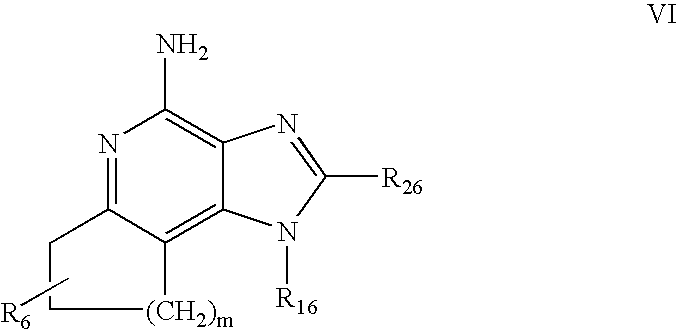
- wherein m is 1, 2, or 3;
- R 16 is selected from the group consisting of hydrogen; cyclic alkyl of three, four, or five carbon atoms; straight chain or branched chain alkyl containing one to ten carbon atoms and substituted straight chain or branched chain alkyl containing one to ten carbon atoms, wherein the substituent is selected from the group consisting of cycloalkyl containing three to six carbon atoms and cycloalkyl containing three to six carbon atoms substituted by straight chain or branched chain alkyl containing one to four carbon atoms; fluoro- or chloroalkyl containing from one to ten carbon atoms and one or more fluorine or chlorine atoms; straight chain or branched chain alkenyl containing two to ten carbon atoms and substituted straight chain or branched chain alkenyl containing two to ten carbon atoms, wherein the substituent is selected from the group consisting of cycloalkyl containing three to six carbon atoms and cycloalkyl containing three to six carbon atoms substituted by straight chain or branched chain alkyl containing one to four carbon atoms; hydroxyalkyl of one to six carbon atoms; alkoxyalkyl wherein the alkoxy moiety contains one to four carbon atoms and the alkyl moiety contains one to six carbon atoms; acyloxyalkyl wherein the acyloxy moiety is alkanoyloxy of two to four carbon atoms or benzoyloxy, and the alkyl moiety contains one to six carbon atoms, with the proviso that any such alkyl, substituted alkyl, alkenyl, substituted alkenyl, hydroxyalkyl, alkoxyalkyl, or acyloxyalkyl group does not have a fully carbon substituted carbon atom bonded directly to the nitrogen atom; benzyl; (phenyl)ethyl; and phenyl; said benzyl, (phenyl)ethyl or phenyl substituent being optionally substituted on the benzene ring by one or two moieties independently selected from the group consisting of alkyl of one to four carbon atoms, alkoxy of one to four carbon atoms, and halogen, with the proviso that when said benzene ring is substituted by two of said moieties, then the moieties together contain no more than six carbon atoms;
- and —CHR xRy
- wherein
- R y is hydrogen or a carbon-carbon bond, with the proviso that when Ry is hydrogen Rx is alkoxy of one to four carbon atoms, hydroxyalkoxy of one to four carbon atoms, 1-alkynyl of two to ten carbon atoms, tetrahydropyranyl, alkoxyalkyl wherein the alkoxy moiety contains one to four carbon atoms and the alkyl moiety contains one to four carbon atoms, 2-, 3-, or 4-pyridyl, and with the further proviso that when Ry is a carbon-carbon bond Ry and Rx together form a tetrahydrofuranyl group optionally substituted with one or more substituents independently selected from the group consisting of hydroxy and hydroxyalkyl of one to four carbon atoms,
- R 26 is selected from the group consisting of hydrogen, straight chain or branched chain alkyl containing one to eight carbon atoms, straight chain or branched chain hydroxyalkyl containing one to six carbon atoms, morpholinoalkyl, benzyl, (phenyl)ethyl and phenyl, the benzyl, (phenyl)ethyl or phenyl substituent being optionally substituted on the benzene ring by a moiety selected from the group consisting of methyl, methoxy, and halogen; and
- —C(R S)(RT)(X) wherein RS and RT are independently selected from the group consisting of hydrogen, alkyl of one to four carbon atoms, phenyl, and substituted phenyl wherein the substituent is selected from the group consisting of alkyl of one to four carbon atoms, alkoxy of one to four carbon atoms, and halogen;
- X is selected from the group consisting of alkoxy containing one to four carbon atoms, alkoxyalkyl wherein the alkoxy moiety contains one to four carbon atoms and the alkyl moiety contains one to four carbon atoms, haloalkyl of one to four carbon atoms, alkylamido wherein the alkyl group contains one to four carbon atoms, amino, substituted amino wherein the substituent is alkyl or hydroxyalkyl of one to four carbon atoms, azido, alkylthio of one to four carbon atoms, and morpholinoalkyl wherein the alkyl moiety contains one to four carbon atoms, and
- R 6 is selected from the group consisting of hydrogen, fluoro, chloro, straight chain or branched chain alkyl containing one to four carbon atoms, and straight chain or branched chain fluoro- or chloroalkyl containing one to four carbon atoms and at least one fluorine or chlorine atom;
- and pharmaceutically acceptable salts thereof.
- Preferred imidazopyridine amine IRM compounds are defined by Formula VII below:

- wherein
- R 17 is selected from the group consisting of hydrogen; —CH2RW wherein RW is selected from the group consisting of straight chain, branched chain, or cyclic alkyl containing one to ten carbon atoms, straight chain or branched chain alkenyl containing two to ten carbon atoms, straight chain or branched chain hydroxyalkyl containing one to six carbon atoms, alkoxyalkyl wherein the alkoxy moiety contains one to four carbon atoms and the alkyl moiety contains one to six carbon atoms, and phenylethyl; and —CH═CRZRZ wherein each RZ is independently straight chain, branched chain, or cyclic alkyl of one to six carbon atoms;
- R 27 is selected from the group consisting of hydrogen, straight chain or branched chain alkyl containing one to eight carbon atoms, straight chain or branched chain hydroxyalkyl containing one to six carbon atoms, alkoxyalkyl wherein the alkoxy moiety contains one to four carbon atoms and the alkyl moiety contains one to six carbon atoms, benzyl, (phenyl)ethyl and phenyl, the benzyl, (phenyl)ethyl or phenyl substituent being optionally substituted on the benzene ring by a moiety selected from the group consisting of methyl, methoxy, and halogen; and morpholinoalkyl wherein the alkyl moiety contains one to four carbon atoms;
- R 67 and R77 are independently selected from the group consisting of hydrogen and alkyl of one to five carbon atoms, with the proviso that R67 and R77 taken together contain no more than six carbon atoms, and with the further proviso that when R77 is hydrogen then R67 is other than hydrogen and R27 is other than hydrogen or morpholinoalkyl, and with the further proviso that when R67 is hydrogen then R77 and R27 are other than hydrogen;
- and pharmaceutically acceptable salts thereof.
- Preferred 1,2-bridged imidazoquinoline amine IRM compounds are defined by Formula VIII below:

- wherein
- Z is selected from the group consisting of:
- —(CH 2)p— wherein p is 1 to 4;
- —(CH 2)a—C(RDRE)(CH2)b—, wherein a and b are integers and a+b is 0 to 3, RD is hydrogen or alkyl of one to four carbon atoms, and RE is selected from the group consisting of alkyl of one to four carbon atoms, hydroxy, —ORF wherein RF is alkyl of one to four carbon atoms, and —NRGR′G wherein RG and R′G are independently hydrogen or alkyl of one to four carbon atoms; and
- —(CH 2)a—(Y)—(CH2)b— wherein a and b are integers and a+b is 0 to 3, and Y is O, S, or —NRJ— wherein RJ is hydrogen or alkyl of one to four carbon atoms;
- and wherein q is 0 or 1 and R 8 is selected from the group consisting of alkyl of one to four carbon atoms, alkoxy of one to four carbon atoms, and halogen,
- and pharmaceutically acceptable salts thereof.
- Suitable thiazolo- and oxazolo-quinolinamine and pyridinamine compounds include compounds of Formula IX:

- wherein:
- R 19 is selected from the group consisting of oxygen, sulfur and selenium;
- R 29 is selected from the group consisting of
- -hydrogen;
- -alkyl;
- -alkyl-OH;
- -haloalkyl;
- -alkenyl;
- -alkyl-X-alkyl;
- -alkyl-X-alkenyl;
- -alkenyl-X-alkyl;
- -alkenyl-X-alkenyl;
- -alkyl-N(R 59)2;
- -alkyl-N 3;
- -alkyl-O—C(O)—N(R 59)2;
- -heterocyclyl;
- -alkyl-X-heterocyclyl;
- -alkenyl-X-heterocyclyl;
- -aryl;
- -alkyl-X-aryl;
- -alkenyl-X-aryl;
- -heteroaryl;
- -alkyl-X-heteroaryl; and
- -alkenyl-X-heteroaryl;
- R 39 and R49 are each independently:
- -hydrogen;
- -X-alkyl;
- -halo;
- -haloalkyl;
- —N(R 59)2;
- or when taken together, R 39 and R49 form a fused aromatic, heteroaromatic, cycloalkyl or heterocyclic ring;
- X is selected from the group consisting of —O—, —S—, —NR 59—, —C(O)—, —C(O)O—, —OC(O)—, and a bond; and
- each R 59 is independently H or C1-8alkyl;
- and pharmaceutically acceptable salts thereof.
- Suitable imidazonaphthyridine and tetrahydroimidazonaphthyridine IRM compounds are those of Formulae X and XI below:

- wherein
- A is ═N—CR═CR—CR═; ═CR—N═CR—CR═; ═CR—CR═N—CR═; or ═CR—CR═CR—N═;
- R 110 is selected from the group consisting of:
- hydrogen;
- —C 1-20 alkyl or C2-20 alkenyl that is unsubstituted or substituted by one or more substituents selected from the group consisting of:
- -aryl;
- -heteroaryl;
- -heterocyclyl;
- —O—C 1-20 alkyl,
- —O—(C 1-20alkyl)0-1-aryl;
- —O—(C 1-20alkyl)0-1-heteroaryl;
- —O—(C 1-20alkyl)0-1-heterocyclyl;
- —C 1-20 alkoxycarbonyl;
- —S(O) 0-2—C1-20 alkyl;
- —S(O) 0-2-(C1-20 alkyl)0-1-aryl;
- —S(O) 0-2—(C1-20 alkyl)0-1-heteroaryl;
- —S(O) 0-2—(C1-20 alkyl)0-1-heterocyclyl;
- —N(R 310)2;
- —N 3;
- oxo;
- -halogen;
- —NO 2;
- —OH; and
- —SH; and
- —C 1-20 alkyl-NR310-Q-X—R410 or —C2-20 alkenyl-NR310-Q-X—R410 wherein Q is —CO— or —SO2—; X is a bond, —O— or —NR310— and R410 is aryl; heteroaryl; heterocyclyl; or —C1-20 alkyl or C2-20 alkenyl that is unsubstituted or substituted by one or more substituents selected from the group consisting of:
- -aryl;
- -heteroaryl;
- -heterocyclyl;
- —O—C 1-20alkyl,
- —O—(C 1-20alkyl)0-1-aryl;
- —O—(C 1-20alkyl)0-1-heteroaryl;
- —O—(C 1-20alkyl)0-1-heterocyclyl;
- —C 1-20 alkoxycarbonyl;
- —S(O) 0-2—C1-20 alkyl;
- —S(O) 0-2—(C1-20 alkyl)0-1-aryl;
- —S(O) 0-2—(C1-20alkyl)0-1-heteroaryl;
- —S(O) 0-2-(C1-20 alkyl)0-1-heterocyclyl;
- —N(R 310)2;
- —NR 310—CO—O—C120alkyl;
- —N 3;
- oxo;
- -halogen;
- —NO 2;
- —OH; and
- —SH; or R 410 is

- wherein Y is —N— or —CR—;
- R 210 is selected from the group consisting of:
- -hydrogen;
- —C 1-10 alkyl;
- —C 2-10 alkenyl;
- -aryl;
- —C 1-10alkyl —O—C1-10-alkyl;
- —C 1-10 alkyl-O—C2-10 alkenyl; and
- —C 1-10 alkyl or C2-10 alkenyl substituted by one or more substituents selected from the group consisting of:
- —OH;
- -halogen;
- —N(R 310)2;
- —CO—N(R 310)2;
- —CO—C 1-10 alkyl;
- —N 3;
- -aryl;
- -heteroaryl;
- -heterocyclyl;
- —CO-aryl; and
- —CO-heteroaryl;
- each R 310 is independently selected from the group consisting of hydrogen and C-10 alkyl; and
- each R is independently selected from the group consisting of hydrogen, C 1-10 alkyl, C1-10 alkoxy, halogen and trifluoromethyl,
- and pharmaceutically acceptable salts thereof.

- wherein
- B is —NR—C(R) 2—C(R)2—C(R)2—; —C(R)2—NR—C(R)2—C(R)2—; —C(R)2—C(R)2—NR—C(R)2— or —C(R)2—C(R)2—C(R)2—NR—;
- R 111 is selected from the group consisting of:
- -hydrogen;
- —C 1-20 alkyl or C2-20 alkenyl that is unsubstituted or substituted by one or more substituents selected from the group consisting of:
- -aryl;
- -heteroaryl;
- -heterocyclyl;
- —O—C 1-20alkyl;
- —O—(C 1-20alkyl)0-1-aryl;
- —O—(C 1-20alkyl)0-1-heteroaryl;
- —O—(C 1-20alkyl)0-1-heterocyclyl;
- —C 1-20 alkoxycarbonyl;
- —S(O) 0-2—C1-20 alkyl;
- —S(O) 0-2—(C1-20 alkyl)0-1-aryl;
- —S(O) 0-2—(C1-20 alkyl)0-1-heteroaryl;
- —S(O) 0-2-(C1-20 alkyl)0-1-heterocyclyl;
- —N(R 311)2;
- —N 3;
- oxo;
- -halogen;
- —NO 2;
- —OH; and
- —SH; and
- —C 1-20 alkyl-NR311-Q-X—R411 or —C2-20 alkenyl-NR311-Q-X—R411 wherein Q is —CO— or —SO2—; X is a bond, —O— or —NR311- and R411 is aryl; heteroaryl; heterocyclyl; or —C1-20 alkyl or C2-20 alkenyl that is unsubstituted or substituted by one or more substituents selected from the group consisting of:
- -aryl;
- -heteroaryl;
- -heterocyclyl;
- —O—C 1-20 alkyl,
- —O—(C 1-20alkyl)0-1-aryl;
- —O—(C 1-20alkyl)0-1-heteroaryl;
- —O—(C 1-20alkyl)0-1-heterocyclyl;
- —C 1-20 alkoxycarbonyl;
- —S(O) 0-2—C1-20 alkyl;
- —S(O) 0-2—(C1-20 alkyl)0-1-aryl;
- —S(O) 0-2-(C1-20 alkyl)0-1-heteroaryl;
- —S(O) 0-2—(C1-20 alkyl)0-1-heterocyclyl;
- —N(R 311)2;
- —NR 311—CO—O—C1-20alkyl;
- —N 3;
- oxo;
- -halogen;
- —NO 2;
- —OH; and
- —SH; or R 411 is

- wherein Y is —N— or —CR—;
- R 211 is selected from the group consisting of:
- -hydrogen;
- —C 1-10 alkyl;
- —C 2-10 alkenyl;
- -aryl
- —C 1-10alkyl —O-C1-10-alkyl;
- —C 1-10 alkyl-O—C2-10 alkenyl; and
- —C 1-10alkyl or C2-10 alkenyl substituted by one or more substituents selected from the group consisting of:
- —OH;
- -halogen;
- —N(R 311)2;
- —CO—N(R 311)2;
- —CO—C 1-10 alkyl;
- —N 3;
- -aryl;
- -heteroaryl;
- -heterocyclyl;
- —CO-aryl; and
- —CO-heteroaryl;
- each R 311 is independently selected from the group consisting of hydrogen and C1-10alkyl; and
- each R is independently selected from the group consisting of hydrogen, C 1-10 alkyl, C1-10 alkoxy, halogen and trifluoromethyl,
- and pharmaceutically acceptable salts thereof.
- Additional preferred 1H-imidazo[4,5-c]quinolin-4-amines and tetrahydro-1H-[4,5-c]quinolin-4-amines include compounds defined by Formulas XII, XIII and XIV below:

- wherein
- R 112 is -alkyl-NR312-CO—R412 or -alkenyl-NR312—CO—R412 wherein R412 is aryl, heteroaryl, alkyl or alkenyl, each of which may be unsubstituted or substituted by one or more substituents selected from the group consisting of:
- -alkyl;
- -alkenyl;
- -alkynyl;
- -(alkyl) 0-1-aryl;
- -(alkyl) 0-1-(substituted aryl);
- -(alkyl) 0-1-heteroaryl;
- -(alkyl) 0-1-(substituted heteroaryl);
- —O-alkyl;
- —O-(alkyl) 0-1-aryl;
- —O-(alkyl) 0-1-(substituted aryl);
- —O-(alkyl) 0-1-heteroaryl;
- —O-(alkyl) 0-1-(substituted heteroaryl);
- —CO-aryl;
- —CO-(substituted aryl);
- —CO-heteroaryl;
- —CO-(substituted heteroaryl);
- —COOH;
- —CO—O-alkyl;
- —CO-alkyl;
- —S(O) 0-2-alkyl;
- —S(O) 0-2-(alkyl)0-1-aryl;
- —S(O) 0-2-(alkyl)0-1-(substituted aryl);
- —S(O) 0-2-(alkyl)0-1-heteroaryl;
- —S(O) 0-2-(alkyl)0-1-(substituted heteroaryl);
- —P(O)(OR 312)2;
- —NR 312—CO—O-alkyl;
- —N 3;
- -halogen;
- —NO 2;
- —CN;
- -haloalkyl;
- —O-haloalkyl;
- —CO-haloalkyl;
- —OH;
- —SH; and in the case of alkyl, alkenyl, or heterocyclyl, oxo;
- or R 412 is

- wherein R 512 is an aryl, (substituted aryl), heteroaryl, (substituted heteroaryl), heterocyclyl or (substituted heterocyclyl) group;
- R 212 is selected from the group consisting of:
- -hydrogen;
- -alkyl;
- -alkenyl;
- -aryl;
- -(substituted aryl);
- -heteroaryl;
- -(substituted heteroaryl);
- -heterocyclyl;
- -(substituted heterocyclyl);
- -alkyl-O-alkyl;
- -alkyl-O-alkenyl; and
- -alkyl or alkenyl substituted by one or more substituents selected from the group consisting of:
- —OH;
- -halogen;
- —N(R 312)2;
- —CO—N(R 312)2;
- —CO—C 1-10 alkyl;
- —CO—O—C 1-10alkyl;
- —N 3;
- -aryl;
- -(substituted aryl);
- -heteroaryl;
- -(substituted heteroaryl);
- -heterocyclyl;
- -(substituted heterocyclyl);
- —CO-aryl; and
- —CO-heteroaryl;
- each R 312 is independently selected from the group consisting of hydrogen; C1-10 alkyl-heteroaryl; C1-10 alkyl-(substituted heteroaryl); C1-10 alkyl-aryl; C1-10 alkyl-(substituted aryl) and C1-10 alkyl;
- v is 0 to 4;
- and each R 12 present is independently selected from the group consisting of C1-10 alkyl, C1-10 alkoxy, halogen and trifluoromethyl;

- wherein
- R 113 is -alkyl-NR313—SO2—X—R413 or -alkenyl-NR313—SO2—X—R413;
- X is a bond or —NR 513—;
- R 413 is aryl, heteroaryl, heterocyclyl, alkyl or alkenyl, each of which may be unsubstituted or substituted by one or more substituents selected from the group consisting of:
- -alkyl;
- -alkenyl;
- -aryl;
- -heteroaryl;
- -heterocyclyl;
- -substituted cycloalkyl;
- -substituted aryl;
- -substituted heteroaryl;
- -substituted heterocyclyl;
- —O-alkyl;
- —O-(alkyl) 0-1-aryl;
- —O-(alkyl) 0-1-substituted aryl;
- —O-(alkyl) 0-1-heteroaryl;
- —O-(alkyl) 0-1-substituted heteroaryl;
- —O-(alkyl) 0-1-heterocyclyl;
- —O-(alkyl) 0-1-substituted heterocyclyl;
- —COOH;
- —CO—O-alkyl;
- —CO-alkyl;
- —S(O) 0-2-alkyl;
- —S(O) 0-2-(alkyl)0-1-aryl;
- —S(O) 0-2-(alkyl)0-1-substituted aryl;
- —S(O) 0-2-(alkyl)0-1-heteroaryl;
- —S(O) 0-2-(alkyl)0-1-substituted heteroaryl;
- —S(O) 0-2-(alkyl)0-1-heterocyclyl;
- —S(O) 0-2-(alkyl)0-1-substituted heterocyclyl;
- -(alkyl) 0-1-NR313R313;
- -(alkyl) 0-1-NR313—CO—O-alkyl;
- -(alkyl) 0-1-NR313—CO-alkyl;
- -(alkyl) 0-1-NR313—CO-aryl;
- -(alkyl) 0-1-NR313—CO-substituted aryl;
- -(alkyl) 0-1-NR313—CO-heteroaryl;
- -(alkyl) 0-1-NR313—CO-substituted heteroaryl;
- —N 3;
- -halogen;
- -haloalkyl;
- -haloalkoxy;
- —CO-haloalkyl;
- —CO-haloalkoxy;
- —NO 2;
- —CN;
- —OH;
- —SH; and in the case of alkyl, alkenyl, or heterocyclyl, oxo;
- R 213 is selected from the group consisting of:
- -hydrogen;
- -alkyl;
- -alkenyl;
- -aryl;
- -substituted aryl;
- -heteroaryl;
- -substituted heteroaryl;
- -alkyl-O-alkyl;
- -alkyl-O— alkenyl; and
- -alkyl or alkenyl substituted by one or more substituents selected from the group consisting of:
- —OH;
- -halogen;
- —N(R 313)2;
- —CO—N(R 313)2;
- —CO—C 1-10alkyl;
- —CO—O- C1-10 alkyl;
- —N 3;
- -aryl;
- -substituted aryl;
- -heteroaryl;
- -substituted heteroaryl;
- -heterocyclyl;
- -substituted heterocyclyl;
- —CO-aryl;
- —CO-(substituted aryl);
- —CO-heteroaryl; and
- —CO-(substituted heteroaryl);
- each R 313 is independently selected from the group consisting of hydrogen and C1-10 alkyl;
- R 513 is selected from the group consisting of hydrogen and C1-10 alkyl, or R413 and R513 can combine to form a 3 to 7 membered heterocyclic or substituted heterocyclic ring;
- v is 0 to 4 and each R 13 present is independently selected from the group consisting of C1-10 alkyl, C1-10 alkoxy, halogen and trifluoromethyl;

- wherein
- R 114 is -alkyl-NR314—CY—NR514—X—R414 or -alkenyl-NR314—CY—NR514—X—R414
- wherein
- Y is ═O or ═S;
- X is a bond, —CO— or —SO 2—;
- R 414 is aryl, heteroaryl, heterocyclyl, alkyl or alkenyl, each of which may be unsubstituted or substituted by one or more substituents selected from the group consisting of:
- -alkyl;
- -alkenyl;
- -aryl;
- -heteroaryl;
- -heterocyclyl;
- -substituted aryl;
- -substituted heteroaryl;
- -substituted heterocyclyl;
- —O-alkyl;
- —O-(alkyl) 0-1-aryl;
- —O-(alkyl) 0-1-substituted aryl;
- —O-(alkyl) 0-1-heteroaryl;
- —O-(alkyl) 0-1-substituted heteroaryl;
- —O-(alkyl) 0-1-heterocyclyl;
- —O-(alkyl) 0-1-substituted heterocyclyl;
- —COOH;
- —CO—O-alkyl;
- —CO-alkyl;
- —S(O) 0-2-alkyl;
- —S(O) 0-2-(alkyl)0-1-aryl;
- —S(O) 0-2-(alkyl)0-1-substituted aryl;
- —S(O) 0-2-(alkyl)0-1-heteroaryl;
- —S(O) 0-2-(alkyl)0-1-substituted heteroaryl;
- —S(O) 0-2-(alkyl)0-1-heterocyclyl;
- —S(O) 0-2-(alkyl)0-1-substituted heterocyclyl;
- -(alkyl) 0-1-NR314R314;
- -(alkyl) 0-1-NR314—CO—O-alkyl;
- -(alkyl) 0-1-NR314—CO-alkyl;
- -(alkyl) 0-1-NR314—CO-aryl;
- -(alkyl) 0-1-NR314—CO-substituted aryl;
- -(alkyl) 0-1-NR314—CO-heteroaryl;
- -(alkyl) 0-1-NR314—CO-substituted heteroaryl;
- —N 3;
- -halogen;
- -haloalkyl;
- -haloalkoxy;
- —CO-haloalkoxy;
- —NO 2;
- —CN;
- —OH;
- —SH; and, in the case of alkyl, alkenyl or heterocyclyl, oxo;
- with the proviso that when X is a bond R 414 can additionally be hydrogen;
- R 214 is selected from the group consisting of:
- -hydrogen;
- -alkyl;
- -alkenyl;
- -aryl;
- -substituted aryl;
- -heteroaryl;
- -substituted heteroaryl;
- -alkyl-O-alkyl;
- -alkyl-O-alkenyl; and
- -alkyl or alkenyl substituted by one or more substituents selected from the group consisting of:
- —OH;
- -halogen;
- —N(R 314)2;
- —CO—N(R 314)2;
- —CO—C 1-10 alkyl;
- —CO—O—C 1-10 alkyl;
- —N 3;
- -aryl;
- -substituted aryl;
- -heteroaryl;
- -substituted heteroaryl;
- -heterocyclyl;
- -substituted heterocyclyl;
- —CO-aryl;
- —CO-(substituted aryl);
- —CO-heteroaryl; and
- —CO-(substituted heteroaryl);
- each R 314 is independently selected from the group consisting of hydrogen and C1-10 alkyl;
- R 514 is selected from the group consisting of hydrogen and C1-10 alkyl, or R414 and R514 can combine to form a 3 to 7 membered heterocyclic or substituted heterocyclic ring;
- v is 0 to 4 and each R 14 present is independently selected from the group consisting of C1-10 alkyl, C1-10 alkoxy, halogen and trifluoromethyl, and a pharmaceutically acceptable salts thereof.
- Known IRM compounds also include the purine derivatives, small heterocyclic compounds, amide derivatives, and oligonucleotide sequences described above.
- The following examples have been selected merely to further illustrate features, advantages, and other details of the invention. It is to be expressly understood, however, that while the examples serve this purpose, the particular materials and amounts used as well as other conditions and details are not to be construed in a matter that would unduly limit the scope of this invention.
- Compounds
- The compounds used in the following Examples and citations for methods for synthesizing each compound are provided in Table 1.
TABLE 1 Compound Chemical Name Citation Imiquimod 1-(2-methylpropyl)1H-imidazo[4,5- U.S. Pat. No. c]quinolin-4-amine 4,689,338 Example 99 Resiquimod 4-amino-2-ethoxymethyl-α,α-dimethyl- U.S. Pat. No. 1H-imidazo[4,5-c]quinoline-1-ethanol 5,389,640 Example 99 IRM 1 4-amino-α,α,2-trimethyl-1H- U.S. Pat. No. imidazo[4,5-c]quinoline-1-ethanol 5,266,575 hydrochloride Example C1* IRM 2 2-propylthiazolo[4,5-c]quinolin-4- U.S. Pat. No. amine 6,110,929 Example 12 IRM 3 N-[4-(4-amino-2-butyl-1H-imidazo[4,5- U.S. Pat. No. c][1,5]naphthyridin-1-yl)butyl]-N′- 6,194,425 cyclohexylurea Example 48 IRM 4 1-{2-[3-(3-pyridyl)propoxy]ethyl}- WO 02/46193 1H-imidazo[4,5-c]quinolin-4-amine Example 33 IRM 5 2-butyl-1-(2-methylpropyl)-1H- U.S. Pat. No. imidazo[4,5-c][1,8]naphthyridin-4- 6,194,425 amine Example 12 IRM 6 2-butyl-1-(2-methylpropyl)-1H- U.S. Pat. No. imidazo[4,5-c][1,7]naphthyridin-4- 6,194,425 amine Example 27 IRM 7 2-butyl-1-(2-methylpropyl)-1H- U.S. Pat. No. imidazo[4,5-c][1,5]naphthyridin-4- 6,194,425 amine Example 39 IRM 8 2-butyl-6,7,8,9-tetrahydro-1-(2-methyl- U.S. Pat. No. propyl)-1H-imidazo[4,5-c][1,5]naphthy- 6,194,425 ridin-4-amine Example 40 IRM 9 4-amino-2-ethoxymethyl-α,α-dimethyl- U.S. Pat. No. 6,7,8,9-tetrahydro-1H-imidazol[4,5- 5,352,784 c]quinoline-1-ethanol Example 91 IRM 10 1-[R(+)-1-phenylethyl]-1H-imidazo[4,5- U.S. Pat. No. c]quinolin-4-amine 4,689,338 Example 185** IRM 11 2-butyl[1,3]thiazolol[4,5- U.S. Pat. No. c][1,5]naphthyridin-4-amine 6,110,929 Example 58 IRM 12 N-[4-(4-amino-2-butyl-1H-imidazo[4,5- U.S. Pat. No. c]quinolin-1-yl)butyl]methanesulfon- 6,331,539 amide Example 6 IRM 13 8,9,10,11-tetrahydro- U.S. Pat. No. pyrido[1′,2′:1,2]imidazol[4,5-c]quinolin- 5,482,936 6-amine Example 1 IRM 14 N3-{4-[4-amino-2-(2-methoxyethyl)- U.S. Pat. No. 1H-imidazo[4,5-c]quinolin-1-yl]butyl}- 6,451,810 6-(1H-1-pyrrolyl)nicotinamide Example 60 IRM 15 N-[2-(4-amino-2-butyl-1H-imidazo[4,5- U.S. Pat. No. c]quinolin-1-yl)ethyl]methanesulfon- 6,331,539 amide Example 34*** IRM 16 N-{4-[4-amino-2-(2-methoxyethyl)-1H- WO 00/76518 imidazo[4,5-c]quinolin-1- Example 121*** yl]butyl}morpholine-4-carboxamide IRM 17 N-[4-(4-amino-2-butyl-6,7-dimethyl- WO 02/46194 1H-imidazo[4,5-c]pyridin-1- Example 2 yl)butyl]methanesulfonamide IRM 18 2-ethyl-1-[5-(methylsulfonyl)pentyl]- WO 02/46192 1H-imidazol[4,5-c]quinolin-4-amine Example 13 - Cells
- HEK293 cells—immortalized human embryonic kidney cells, available from American Type Culture Collection, Manassas, Va., ATCC No. CRL-1573.
- RAW 264.7 cells—mouse macrophage cells, available from American Type Tissue Collection, Manassas, Va., ATCC No. TIB-71.
- THP-1 cells—human monocyte cells derived from acute monocytic leukemia tissue; available from American Type Culture Collection, Manassas, Va., ATCC No. TIB-202.
- Cell Culture Media
- Complete RPMI was prepared by mixing RPMI 1640 with 25 mM HEPES, 1 mM sodium pyruvate, 0.1 mM non-essential amino acids, and 1 mM L-glutamine (Celox Laboratories, Inc., Minneapolis, Minn.) supplemented with 10% heat inactivated fetal calf serum (FCS) (Hyclone Laboratories, Inc., Logan, Utah) and 1% penicillin/streptomycin (Sigma Chemical Co., St. Louis, Mo.). For the transfection of dominant negative constructs into THP-1 cells, cRPMI was modified by the addition of 3.5 g/L glucose and 5×10 −5 M 2-mercaptoethanol (tRPMI). For the transfection of dominant negative constructs into RAW 264.7 cells, cRPMI was modified by the addition of 5×10⁻⁵ M 2-mercaptoethanol (rRPMI).
- A murine TLR6 dominant negative construct was generated by PCR mutation during amplification from RAW 264.7 cell cDNA. The 5′ and 3′ regions flanking a codon encoding proline 691 were amplified with primers (5′ sense: SEQ ID NO 1; 5′ antisense: SEQ ID NO 2; 3′sense: SEQ ID NO 3; 3′ antisense: SEQ ID NO 4) that changed the codon for proline 691 to a codon encoding histidine while introducing a unique Apa LI restriction enzyme site at the position of the mutation. The 5′ and 3′ sections of the TLR6 were amplified by Pfu Turbo DNA polymerase kit (Stratagene, La Jolla, Calif.). The PCR sections were inserted into pCR-Blunt II-TOPO for sequence verification. The two sections were joined together when subcloned into pIRES (Clontech, Palo Alto, Calif.) for expression in mammalian cells.
- The human TLR6 dominant negative construct was generated from human PBMC cDNA using the same strategy as the murine TLR6 dominant negative. The proline to histidine mutation for human TLR6 was introduced at amino acid 680 along with an Apa LI restriction enzyme site (5′ sense: SEQ ID NO 5; 5′ antisense: SEQ ID NO 6; 3′ sense: SEQ ID NO 7; 3′ antisense: SEQ ID NO 8).
- The human TLR7 dominant negative construct was generated in a manner similar to that used to generate the human TLR6 dominant negative construct. The proline to histidine mutation for human was introduced at amino acid 932 along with a Bam HI restriction enzyme site (5′ sense: SEQ ID NO 9; 5′ antisense: SEQ ID NO 10; 3′ sense: SEQ ID NO 11; 3′ antisense: SEQ ID NO 12).
- The amplified 5′ and 3′ sections of each human dominant negative TLR was inserted into pCR-Blunt II-TOPO for sequence verification. The 5′ and 3′ sections were joined together when subcloned into pIRES (Clontech, Palo Alto, Calif.) for expression in mammalian cells.
- THP-1 cells (maintained at cell number less than 1×10 6 cells/ml) were co-transfected with the plamid vector containing either the TLR6DN or TLR7DN construct and with a murine H2Kk plasmid (Miltenyi Biotec Inc., Auburn, Calif.) in a 4:1 ratio of TLR plasmid to H2Kk plasmid. Transfection of THP-1 cells was carried out using the transfection reagent FuGENE 6 (Roche Diagnostics Corp., Indianapolis, Ind.) according to the manufacturer's specifications. At 18 hours post-transfection, transfected cells were selected on the basis of murine H2Kk (Miltenyi Biotec Inc., Auburn, Calif.) according to the manufacturer's specifications.
- RAW 264.7 cells were co-transfected with a truncated human CD4 for RAW 264.7 cells in a 4:1 ratio of TLR plasmid to CD4 plasmid. Transfection of RAW 264.7 cells was carried out using the transfection reagent DoTaP (Roche Diagnostics Corp., Indianapolis, Ind.) according to the manufacturer's specifications. At 18 hours post-transfection, transfected cells were selected on the basis of CD4 expression (Miltenyi Biotec Inc., Auburn, Calif.) for the RAW 264.7 cells according to the manufacturer's specifications.
- After selection, cells were resuspended in tRPMI at a concentration of 10 6 cells/ml. 100 μl of cells (105 cells) were then added to individual wells of a 96 well U-bottom plate (BD Biosciences Discovery Labware, Bedford, Mass.). The IRM compound was diluted to 6 μM, LPS (Sigma Chemical Co., St. Louis, Mo.) diluted to 200 ng/ml; and zymosan (Sigma Chemical Co., St. Louis, Mo.) was diluted to 6×10⁵ particles/ml. After the addition of the compound solution, cells were incubated for 18 hours at 37° C. in an atmosphere of 5% CO2/95% air. Supernatants were collected and frozen at −20° C. for cytokine analysis.
- TNF-α levels were measured with a commercial Human TNF-α ELISA kit (Biosource International, Inc., Camarillo, Calif.) according to the manufacturer's specifications. Results are presented in % inhibition over vector control.
- The data in Table 1 represent results of THP-1 cells transfected with either TLR6DN or TLR7DN, stimulated for 18 hours with 3 μM resiquimod, 100 ng LPS, or 3×10 5 particles of zymosan. Results are presented in % inhibition relative to vector control. Data shown are representative of six independent experiments.
TABLE 2 TNF-α Production by THP-1 Cells Transfected with Either TLR6DN or TLR7DN TLR6DN TLR7DN Stimulus % inhibition SEM % inhibition SEM LPS 100 ng/ml 2.5 5.4 13.2 6.1 Zymosan 3 × 10⁵ particles/ml 58.2 4.2 6.9 3.2 Resiquimod 3 μM 70.1 1.3 55.3 2.4 -
TABLE 3 TNF-α Production by RAW 264.7 Cells Transfected with TLR6DN Stimulus % inhibition SEM LPS 100 ng/ml 17.6 1.2 Zymosan 3 × 10⁵ particles/ml 80.7 3.9 Resiquimod 3 μM 70.9 3.6 - Rabbit polyclonal antibodies were generated by Quality Controlled Biochemicals, Inc., (Hopkinton, Mass.). Antibody specificity was verified by flow cytometry and western blotting.
- Peripheral blood mononuclear cells (PBMCS) were isolated with the Histopaque HybriMax—1077 density gradient (Sigma Chemical Co., St. Louis, Mo.) from healthy human volunteers after obtaining informed consent.
- PBMC were resuspended in cRPMI at a concentration of 10 6 cells/ml. 100 μl of cells (105 cells) were then added to individual wells of a 96 well U-bottom plate (BD Biosciences Discovery Labware, Bedford, Mass.). Solutions containing cRPMI with 40 μg/ml of the affinity purified anti-TLR6 polyclonal antibody were prepared. 50 μl of the antibody solution was added to cells and incubated for 30 minutes. The IRM compounds were diluted to 12 μM; LPS (Sigma Chemical Co., St. Louis, Mo.) was diluted to 400 ng/ml; zymosan (Sigma Chemical Co., St. Louis, Mo.) was diluted to 12×105 particles/ml; and peptidoglycan (Sigma Chemical Co., St. Louis, Mo.) was diluted to 40 μg/ml in cRPMI. 50 μl of the compound solution was added to cells so that the final concentration of antibody was 10 μg/ml, the final concentration of resiquimod was 3 μM, LPS was 100 ng/ml, and peptidoglycan was 10 μg/ml. Cells were incubated for 18 hours at 37° C. in an atmosphere of 5% CO2/95% air. Supernatants were collected and frozen at −20° C. for cytokine analysis. The data are presented as % inhibition relative to control.

- The IRM compounds used in this section were synthesized at 3M, St. Paul, Minn. The syntheses of these compounds are described in U.S. Pat. No. 5,389,640: Example 99 (resiquimod); U.S. Pat. No. 4,689,338: Example 99 (imiquimod); U.S. Pat. No. 5,266,575: Example C1 (Compound 1); U.S. Pat. No. 6,194,425: Example 48 (Compound 3); U.S. Pat. No. 6,110,929: Example 12 (Compound 2); U.S. Pat. No. 6,194,425: Example 12 (Compound 5), Example 27 (Compound 6), Example 39 (Compound 7), and Example 40 (Compound 8).
- The data in Table 3 represent results of TLR6 neutralizing antibody studies in human PBMC. PBMC were stimulated for 18 hrs with 100 ng/ml LPS, 10 μg/ml peptidoglycan, zymosan particles, or the indicated concentration of IRM compound. Results are presented in % inhibition relative to media control. Data shown are representative of six independent experiments.
TABLE 4 Anti-TLR6 Antibody Inhibition of TNF-α Production by Human PBMC Cells % inhibition relative Stimulus to control (no Ab) SEM 100 ng/ml LPS −9.4 3.1 10 μg/ml Peptidoglycan 50.0 7.2 Zymosan 3 × 10⁵ particles/ml 66.1 1.8 3 μM Resiquimod 88.4 4.4 3 μM IRM 1 70.2 3.7 3 μM IRM 3 65.0 12.1 3 μM IRM 2 81.0 9.3 0.12 μM IRM 4 76.7 2.4 3 μM IRM 5 84.2 8.7 1 μM IRM 6 90.3 1.8 0.37 μM IRM 7 78.2 8.4 1 μM IRM 8 64.7 1 - The murine TLR wild-type vectors were generated by PCR amplification from RAW 264.7 cell cDNA with TLR6 specific primers (sense primer: SEQ ID NO 13; antisense primer: SEQ ID NO 14) or TLR7 specific primers (sense primer: SEQ ID NO 15; antisense primer: SEQ ID NO 16) by Pfu Turbo DNA polymerase kit (Stratagene, La Jolla, Calif.). The PCR products were inserted into pCR-Blunt II-TOPO for sequence verification and then subcloned into pIRES (BD Biosciences Clontech, Palo Alto, Calif.) for expression in mammalian cells.
- THP-1 cells or RAW 264.7 cells were cultured and transfected with the wild type TLR 6 or wild type TLR 7 plasmids described above. The transfections were performed as in Example 1 with a 4:1 ratio of wild-type TLR to H2K plasmid (THP-1 cells) or CD4 (RAW 264.7 cells).
- RAW 264.7 cells were stimulated with various concentrations of resiquimod and analyzed as described in Example 1. Results are provided in Table 4 and are expressed as fold increase in TNF-α production as compared to control transfected RAW 264.7 cells.
TABLE 5 IRM-Stimulated TNF-α Production by RAW 264.7 Cells Overexpressing TLR6 or TLR7 Fold increase in TNF-α production over control Resiquimod (μM) TLR6 TLR7 — — 0.0004 9.6 14.8 0.001 8.0 8.9 0.004 9.2 5.8 0.012 3.5 3.8 0.037 3.9 3.5 1 1.4 1.3 3 1.7 1.0 10 1.8 1.5 - HEK 293 cells were cultured in Minimum Essential Medium (MEM) with 2 mM L-glutamine and Earle's Balanced Salt Solution (Invitrogen Corp., Rockville, Md.) adjusted to contain 1.5 g/L sodium bicarbonate, 0.1 mM non-essential amino acids, and 1.0 mM sodium pyruvate, 90%; heat-inactivated fetal calf serum, 10%. The cells were incubated at 37° C., 8% CO2.
- Twenty-four hours before transfection, HEK 293 cells were adhered to a 10 cm dish (Corning 430167, Corning Inc., Corning, N.Y.) at 37° C., 8% CO 2. The cells were co-transfected with human TLR7 or Empty Vector control pIRES (BD Biosciences Clontech, Palo Alto, Calif.) along with NFkB-luc reporter (Stratagene, La Jolla, Calif.) in a 10:1 ratio with Fugene 6 transfection reagent (Roche Diagnostics Corp., Indianapolis, Ind.) following the manufacturer's instructions. The plates were incubated for 24 hours following transfection and then selected in G-418 (400 ug/mL) for 2 weeks. The G-418 resistant cells containing either the TLR7 or empty vector were expanded in HEK 293 media supplemented with G-418 for stimulation experiments.
- TLR7 or empty vector cells were plated in white opaque 96 well plates (Costar 3917, Corning Inc., Corning, N.Y.) at a concentration of 5×10 4 cells per well in 100 μL of HEK 293 media and incubated at 37° C., 8% CO2 for 4 hours. The cells were stimulated with 1 μL of IRM compounds at 1 mM in DMSO (final concentration of 10 μM) or 1 μL DMSO as a control. The plates were then incubated an additional 16 hours at 37° C., 5% CO2. The luciferase signal was read using the LucLite kit (Packard Instrument Co., Meriden, Conn.). The luminescence was measured on the Topcount NXT (Packard Instrument Co., Meriden, Conn.).
TABLE 6 Fold Increase Over DMSO Control Stimulus HEK 293 Vector HEK293 TLR7 Imiquimod 1.41 17.80 IRM 9 0.81 4.67 IRM 10 1.10 2.55 IRM 11 1.35 1.06 IRM 2 1.27 0.94 IRM 1 0.86 3.75 IRM 12 1.33 15.33 IRM 4 1.00 4.06 IRM 5 1.21 1.13 IRM 6 0.95 1.25 IRM 7 1.30 3.06 IRM 8 0.91 4.59 IRM 13 1.20 2.39 IRM 14 1.31 1.37 IRM 15 1.04 1.88 IRM 16 0.98 1.51 IRM 17 0.99 2.79 IRM 17 1.67 2.71 DMSO 1.00 1.00 - The complete disclosures of the patents, patent documents and publications cited herein are incorporated by reference in their entirety as if each were individually incorporated. In case of conflict, the present specification, including definitions, shall control.
- Various modifications and alterations to this invention will become apparent to those skilled in the art without departing from the scope and spirit of this invention. Illustrative embodiments and examples are provided as examples only and are not intended to limit the scope of the present invention. The scope of the invention is limited only by the claims set forth as follows.
-
1 15 1 28 DNA Mus musculus 1 ctcgagatgg taaagtccct ctgggata 28 2 25 DNA Mus musculus 2 gtgcacaaag ttcctctcat ggagg 25 3 27 DNA Mus musculus 3 gtgcacggca agagcattgt ggagaac 27 4 29 DNA Mus musculus 4 acgcgttcac atcatcctca ttgactaag 29 5 29 DNA Homo sapiens 5 gcgcgctagc atgaccaaag acaaagaac 29 6 30 DNA Homo sapiens 6 gcgcgcgtgc acaaagttcc tctcatgaag 30 7 33 DNA Homo sapiens 7 gcgcgcgtgc acggcaagag cattgtggaa aat 33 8 29 DNA Homo sapiens 8 acgcgttaag atttcacatc attgttttc 29 9 30 DNA Homo sapiens 9 gcgcgctagc atggtgtttc caatgtggac 30 10 24 DNA Homo sapiens 10 ggatccagtc cctttcctcg agac 24 11 30 DNA Homo sapiens 11 gcgcacgcgt ctagaccgtt tccttgaaca 30 12 28 DNA Mus musculus 12 ctcgagatgg taaagtccct ctgggata 28 13 29 DNA Mus musculus 13 acgcgttcac atcatcctca ttgactaag 29 14 30 DNA Mus musculus 14 cgcgctagca tggtgttttc gatgtggaca 30 15 30 DNA Mus musculus 15 cgacgcgtgc tagactgttt ccttgaacat 30
Claims (59)
Priority Applications (2)
| Application Number | Priority Date | Filing Date | Title |
|---|---|---|---|
| US10/294,935 US20040014779A1 (en) | 2001-11-16 | 2002-11-14 | Methods and compositions related to IRM compounds and toll-like recptor pathways |
| US11/153,059 US20050245564A1 (en) | 2001-11-16 | 2005-06-15 | Methods and compositions related to IRM compounds and toll-like receptor pathways |
Applications Claiming Priority (2)
| Application Number | Priority Date | Filing Date | Title |
|---|---|---|---|
| US33241201P | 2001-11-16 | 2001-11-16 | |
| US10/294,935 US20040014779A1 (en) | 2001-11-16 | 2002-11-14 | Methods and compositions related to IRM compounds and toll-like recptor pathways |
Related Child Applications (1)
| Application Number | Title | Priority Date | Filing Date |
|---|---|---|---|
| US11/153,059 Continuation US20050245564A1 (en) | 2001-11-16 | 2005-06-15 | Methods and compositions related to IRM compounds and toll-like receptor pathways |
Publications (1)
| Publication Number | Publication Date |
|---|---|
| US20040014779A1 true US20040014779A1 (en) | 2004-01-22 |
Family
ID=23298116
Family Applications (2)
| Application Number | Title | Priority Date | Filing Date |
|---|---|---|---|
| US10/294,935 Abandoned US20040014779A1 (en) | 2001-11-16 | 2002-11-14 | Methods and compositions related to IRM compounds and toll-like recptor pathways |
| US11/153,059 Abandoned US20050245564A1 (en) | 2001-11-16 | 2005-06-15 | Methods and compositions related to IRM compounds and toll-like receptor pathways |
Family Applications After (1)
| Application Number | Title | Priority Date | Filing Date |
|---|---|---|---|
| US11/153,059 Abandoned US20050245564A1 (en) | 2001-11-16 | 2005-06-15 | Methods and compositions related to IRM compounds and toll-like receptor pathways |
Country Status (11)
| Country | Link |
|---|---|
| US (2) | US20040014779A1 (en) |
| EP (2) | EP1455700A4 (en) |
| JP (2) | JP2005513021A (en) |
| AT (1) | ATE416771T1 (en) |
| AU (1) | AU2002343728A1 (en) |
| CY (1) | CY1110311T1 (en) |
| DE (1) | DE60230340D1 (en) |
| DK (1) | DK1719511T3 (en) |
| ES (1) | ES2318615T3 (en) |
| PT (1) | PT1719511E (en) |
| WO (1) | WO2003043572A2 (en) |
Cited By (123)
| Publication number | Priority date | Publication date | Assignee | Title |
|---|---|---|---|---|
| US20010004853A1 (en) * | 1999-12-28 | 2001-06-28 | Yasunari Kato | Accelerator with attachment of pedal arm |
| US20030161797A1 (en) * | 2002-02-22 | 2003-08-28 | 3M Innovative Properties Company | Method of reducing and treating UVB-induced immunosuppression |
| US20030232074A1 (en) * | 2002-04-04 | 2003-12-18 | Coley Pharmaceutical Gmbh | Immunostimulatory G, U-containing oligoribonucleotides |
| US20040132079A1 (en) * | 2002-12-11 | 2004-07-08 | 3M Innovative Properties Company | Assays relating to Toll-like receptor activity |
| US20040141950A1 (en) * | 2002-12-30 | 2004-07-22 | 3M Innovative Properties Company | Immunostimulatory combinations |
| US20040157879A1 (en) * | 2000-12-08 | 2004-08-12 | 3M Innovative Properties Company | Urea substituted imidazopyridines |
| US20040162309A1 (en) * | 2003-02-13 | 2004-08-19 | 3M Innovative Properties Company | Methods and compositions related to IRM compounds and toll-like receptor 8 |
| US20040167154A1 (en) * | 1999-06-10 | 2004-08-26 | 3M Innovative Properties Company | Urea substituted imidazoquinolines |
| US20040171086A1 (en) * | 2003-02-27 | 2004-09-02 | 3M Innovative Properties Company | Selective modulation of TLR-mediated biological activity |
| US20040176367A1 (en) * | 2003-03-07 | 2004-09-09 | 3M Innovative Properties Company | 1-Amino 1H-imidazoquinolines |
| US20040175336A1 (en) * | 2003-03-04 | 2004-09-09 | 3M Innovative Properties Company | Prophylactic treatment of UV-induced epidermal neoplasia |
| US20040181130A1 (en) * | 2003-03-13 | 2004-09-16 | 3M Innovative Properties Company | Methods for diagnosing skin lesions |
| US20040180919A1 (en) * | 2003-03-13 | 2004-09-16 | 3M Innovative Properties Company | Methods of improving skin quality |
| US20040214851A1 (en) * | 2003-04-28 | 2004-10-28 | 3M Innovative Properties Company | Compositions and methods for induction of opioid receptors |
| US20040235881A1 (en) * | 2001-06-15 | 2004-11-25 | Mitra Sumita B. | Immune response modifiers for the treatment of periodontal disease |
| US20040248929A1 (en) * | 2003-06-06 | 2004-12-09 | 3M Innovative Properties Company | Process for imidazo[4,5-c]pyridin-4-amines |
| US20040265351A1 (en) * | 2003-04-10 | 2004-12-30 | Miller Richard L. | Methods and compositions for enhancing immune response |
| US20050032829A1 (en) * | 2003-06-06 | 2005-02-10 | 3M Innovative Properties Company | Process for imidazo[4,5-c]pyridin-4-amines |
| US20050048072A1 (en) * | 2003-08-25 | 2005-03-03 | 3M Innovative Properties Company | Immunostimulatory combinations and treatments |
| US20050054640A1 (en) * | 2003-03-07 | 2005-03-10 | Griesgraber George W. | 1-Amino 1H-imidazoquinolines |
| US20050059072A1 (en) * | 2003-09-17 | 2005-03-17 | 3M Innovative Properties Company | Selective modulation of TLR gene expression |
| US6878719B2 (en) | 2000-12-08 | 2005-04-12 | 3M Innovative Properties Company | Sulfonamido substituted imidazopyridines |
| US6888000B2 (en) | 2001-12-21 | 2005-05-03 | 3M Innovative Properties Company | Sulfonamide and sulfamide substituted imidazoquinolines |
| US20050096259A1 (en) * | 2003-10-31 | 2005-05-05 | 3M Innovative Properties Company | Neutrophil activation by immune response modifier compounds |
| US20050171072A1 (en) * | 2003-12-02 | 2005-08-04 | Tomai Mark A. | Therapeutic combinations and methods including IRM compounds |
| US20050209268A1 (en) * | 2000-12-08 | 2005-09-22 | 3M Innovative Properties Company | Thioether substituted imidazoquinolines |
| US20050209267A1 (en) * | 2000-12-08 | 2005-09-22 | 3M Innovative Properties Company | Thioether substituted imidazoquinolines |
| WO2005089317A2 (en) | 2004-03-15 | 2005-09-29 | 3M Innovative Properties Company | Immune response modifier formulations and methods |
| US20050215581A1 (en) * | 2000-12-08 | 2005-09-29 | 3M Innovative Properties Company | Urea substituted imidazoquinoline ethers |
| US20050226878A1 (en) * | 2003-12-02 | 2005-10-13 | 3M Innovative Properties Company | Therapeutic combinations and methods including IRM compounds |
| US20050234088A1 (en) * | 2000-12-08 | 2005-10-20 | 3M Innovative Properties Company | Urea substituted imidazoquinoline ethers |
| US20050239735A1 (en) * | 2003-12-30 | 2005-10-27 | 3M Innovative Properties Company | Enhancement of immune responses |
| US6969722B2 (en) | 2000-12-08 | 2005-11-29 | 3M Innovative Properties Company | Amide substituted imidazopyridines |
| US20050267145A1 (en) * | 2004-05-28 | 2005-12-01 | Merrill Bryon A | Treatment for lung cancer |
| US20050288320A1 (en) * | 1997-12-11 | 2005-12-29 | 3M Innovative Properties Company | Imidazonaphthyridines |
| US20060045886A1 (en) * | 2004-08-27 | 2006-03-02 | Kedl Ross M | HIV immunostimulatory compositions |
| US20060051374A1 (en) * | 2004-04-28 | 2006-03-09 | 3M Innovative Properties Company | Compositions and methods for mucosal vaccination |
| US20060100229A1 (en) * | 2003-10-03 | 2006-05-11 | Hays David S | Pyrazolopyridines and analogs thereof |
| US20060106052A1 (en) * | 1999-06-10 | 2006-05-18 | 3M Innovative Properties Company | Method of using sulfonamide substituted imidazoquinolines |
| US20060142202A1 (en) * | 2000-12-08 | 2006-06-29 | 3M Innovative Properties Company | Compositions and methods for targeted delivery of immune response modifiers |
| US7091214B2 (en) | 2002-12-20 | 2006-08-15 | 3M Innovative Properties Co. | Aryl substituted Imidazoquinolines |
| US20060189644A1 (en) * | 2003-08-14 | 2006-08-24 | Wightman Paul D | Lipid-modified immune response modifiers |
| US20060195067A1 (en) * | 2003-08-25 | 2006-08-31 | Wolter James T | Delivery of immune response modifier compounds |
| US20060216333A1 (en) * | 2003-09-02 | 2006-09-28 | Miller Richard L | Methods related to the treatment of mucosal associated conditions |
| US7115622B2 (en) | 2000-12-08 | 2006-10-03 | 3M Innovative Properties Company | Amido ether substituted imidazoquinolines |
| US7179253B2 (en) | 2003-03-13 | 2007-02-20 | 3M Innovative Properties Company | Method of tattoo removal |
| US20070060754A1 (en) * | 2003-10-03 | 2007-03-15 | Lindstrom Kyle J | Alkoxy substituted imidazoquinolines |
| US20070066639A1 (en) * | 2003-08-12 | 2007-03-22 | Kshirsagar Tushar A | Oxime substituted imidazoquinolines |
| US20070072893A1 (en) * | 2003-11-25 | 2007-03-29 | Krepski Larry R | Substituted imidazo ring systems and methods |
| US20070072202A1 (en) * | 2005-03-24 | 2007-03-29 | Bates Elizabeth E M | Use of chimeric receptors in a screening assay for identifying agonists and antagonists of cell receptors |
| US20070099901A1 (en) * | 2003-11-25 | 2007-05-03 | 3M Innovative Properties Company | Hydroxylamine and oxime substituted imidazoquinolines, imidazopyridines, and imidazonaphthyridines |
| US7220758B2 (en) | 2002-06-07 | 2007-05-22 | 3M Innovative Properties Company | Ether substituted imidazopyridines |
| US20070155767A1 (en) * | 2003-12-04 | 2007-07-05 | Radmer Matthew R | Sulfone substituted imidazo ring ethers |
| US20070166384A1 (en) * | 2004-04-09 | 2007-07-19 | Zarraga Isidro Angelo E | Methods , composition and preparations for delivery of immune response modifiers |
| US20070167476A1 (en) * | 2003-12-29 | 2007-07-19 | Kshirsagar Tushar A | Piperazine, [1,4]Diazepane, [1,4]Diazocane, and [1,5]Diazocane fused imidazo ring compounds |
| US20070184059A1 (en) * | 2004-09-21 | 2007-08-09 | Woodward John R | Method of cancer screening; method of cancer treatment; and method of diabetes treatment |
| US20070208052A1 (en) * | 2004-06-18 | 2007-09-06 | Prince Ryan B | Aryloxy and arylalkyleneoxy substituted thiazoloquinolines and thiazolonaphthyridines |
| US20070213356A1 (en) * | 2004-06-15 | 2007-09-13 | Merrill Bryon A | Nitrogen-Containing Heterocyclyl Substituted Imidazoquinolines and Imidazonaphthyridines |
| US20070219228A1 (en) * | 2004-06-18 | 2007-09-20 | Shri Niwas | Aryl substituted imidazonaphthyridines |
| US20070219196A1 (en) * | 2004-03-24 | 2007-09-20 | Krepski Larry R | Amide substituted imidazopyridines, imidazoquinolines, and imidazonaphthyridines |
| US20070243215A1 (en) * | 2004-10-08 | 2007-10-18 | Miller Richard L | Adjuvant for Dna Vaccines |
| US20070287724A1 (en) * | 2004-06-18 | 2007-12-13 | 3M Innovative Properties Company | Substituted Imidazoquinolines, Imidazopyridines, and Imidazonaphthyridines |
| US20070287725A1 (en) * | 2004-06-18 | 2007-12-13 | 3M Innovative Properties Company | Isoxazole, Dihydroisoxazole, And Oxadiazole Substituted Imidazo Ring Compounds And Method |
| US20070292456A1 (en) * | 2003-08-05 | 2007-12-20 | 3M Innovative Properties Company | Formulations Containing an Immune Response Modifier |
| US20080015184A1 (en) * | 2004-06-14 | 2008-01-17 | 3M Innovative Properties Company | Urea Substituted Imidazopyridines, Imidazoquinolines, and Imidazonaphthyridines |
| US20080070907A1 (en) * | 2006-07-12 | 2008-03-20 | Coley Pharmaceutical Group, Inc. | Substituted chiral fused [1,2] imidazo [4,5-C] ring compounds and methods |
| US20080188513A1 (en) * | 2004-12-30 | 2008-08-07 | Taked Pharmaceutical Company Limited | 1-(2-Methylpropyl)-1H-Imidazo[4,5-C](1,5]Naphthyridin-4-Amine Ethanesulfonate and 1-(2-Methylpropyl)-1H-Imidazo[4,5-C](1,5]Naphthyridin-4-Amine Methanesulfonate |
| US20080193474A1 (en) * | 2005-04-25 | 2008-08-14 | Griesgraber George W | Immunostimulatory Compositions |
| US7427629B2 (en) | 2002-08-15 | 2008-09-23 | 3M Innovative Properties Company | Immunostimulatory compositions and methods of stimulating an immune response |
| US20080269192A1 (en) * | 2004-12-30 | 2008-10-30 | Coley Pharmaceutical Group, Inc. | Chiral Fused [1,2]Imidazo[4,5-C] Ring Compounds |
| US20080306252A1 (en) * | 2000-12-08 | 2008-12-11 | Coley Pharmaceutical Group, Inc. | Sulfonamido ether substituted imidazoquinolines |
| US20080306266A1 (en) * | 2004-12-30 | 2008-12-11 | 3M Innovative Properties Company | Process for Preparing 2-Methyl-1-(2-Methylpropyl)-1H-Imidazo[4,5-C][1,5]Naphthyridin-4-Amine |
| US20080318998A1 (en) * | 2005-02-09 | 2008-12-25 | Coley Pharmaceutical Group, Inc. | Alkyloxy Substituted Thiazoloquinolines and Thiazolonaphthyridines |
| US20090005376A1 (en) * | 2004-09-02 | 2009-01-01 | 3M Innovative Properties Company | 1-Alkoxy 1H-Imidazo Ring Systems and Methods |
| US20090018122A1 (en) * | 2003-08-27 | 2009-01-15 | Lindstrom Kyle J | Aryloxy and Arylalkyleneoxy Substituted Imidazoquinolines |
| US20090017076A1 (en) * | 2003-09-05 | 2009-01-15 | Coley Pharmaceutical Group, Inc. | Treatment for cd5+ b cell lymphoma |
| US20090029988A1 (en) * | 2005-02-23 | 2009-01-29 | Coley Pharmaceutical Grop, Inc. | Hydroxyalkyl Substituted Imidazoquinolines |
| US20090030031A1 (en) * | 2005-02-23 | 2009-01-29 | Coley Pharmaceutical Group, Inc. | Method of Preferentially Inducing the Biosynthesis of Interferon |
| US20090030030A1 (en) * | 2003-12-29 | 2009-01-29 | Bonk Jason D | Arylalkenyl and arylalkynyl substituted imidazoquinolines |
| US20090042925A1 (en) * | 2003-11-14 | 2009-02-12 | Coley Pharmaceutical Group, Inc. | Oxime substituted imidazoquinolines |
| US20090062272A1 (en) * | 2003-12-30 | 2009-03-05 | Bonk Jason D | Imidazoquinolinyl sulfonamides |
| US20090069314A1 (en) * | 2005-02-23 | 2009-03-12 | Coley Pharmaceutical Group, Inc. | Hydroxyalkyl Substituted Imidazoquinoline Compounds and Methods |
| US20090099161A1 (en) * | 2005-02-11 | 2009-04-16 | Coley Pharmaceutial Group, Inc. | Substituted Imidazoquinolines and Imidazonaphthyridines |
| US20090163532A1 (en) * | 2005-02-04 | 2009-06-25 | Coley Pharmaceutical Group, Inc. | Aqueous Gel Formulations Containing Immune Response Modifiers |
| US20090221556A1 (en) * | 2005-11-04 | 2009-09-03 | Pfizer Inc. | Hydroxy and alkoxy substituted 1h-imidazoquinolines and methods |
| US20090270443A1 (en) * | 2004-09-02 | 2009-10-29 | Doris Stoermer | 1-amino imidazo-containing compounds and methods |
| US20090298821A1 (en) * | 2006-03-15 | 2009-12-03 | Pfizer Inc. | Hydroxy and alkoxy substituted ih-imidazonaphthyridines and methods |
| US20100056557A1 (en) * | 2004-12-30 | 2010-03-04 | Bernd Benninghoff | Treatment for cutaneous metastases |
| US20100158928A1 (en) * | 2006-12-22 | 2010-06-24 | Doris Stoermer | Immune response modifier compositions and methods |
| US20100173906A1 (en) * | 2006-09-06 | 2010-07-08 | Griesgraber George W | Substituted 3,4,6,7-Tetrahydro-5H-1,2a,4a,8-Tetraazacyclopenta[cd]Phenalenes and Methods |
| US20100317684A1 (en) * | 2005-09-09 | 2010-12-16 | Coley Pharmaceutical Group, Inc. | Amide and Carbamate Derivatives of N-{2-[4-Amino-2- (Ethoxymethyl)-1H-Imidazo[4,5-c] Quinolin-1-Yl]-1,1-Dimethylethyl} Methanesulfonamide and Methods |
| US20110070575A1 (en) * | 2004-12-08 | 2011-03-24 | Coley Pharmaceutical Group, Inc. | Immunomodulatory Compositions, Combinations and Methods |
| US20110092477A1 (en) * | 2004-06-18 | 2011-04-21 | 3M Innovative Properties Company | Substituted imidazoquinolines, imidazopyridines, and imidazonaphthyridines |
| US7943610B2 (en) | 2005-04-01 | 2011-05-17 | 3M Innovative Properties Company | Pyrazolopyridine-1,4-diamines and analogs thereof |
| US7943636B2 (en) | 2005-04-01 | 2011-05-17 | 3M Innovative Properties Company | 1-substituted pyrazolo (3,4-C) ring compounds as modulators of cytokine biosynthesis for the treatment of viral infections and neoplastic diseases |
| US7968563B2 (en) | 2005-02-11 | 2011-06-28 | 3M Innovative Properties Company | Oxime and hydroxylamine substituted imidazo[4,5-c] ring compounds and methods |
| US8034938B2 (en) | 2004-12-30 | 2011-10-11 | 3M Innovative Properties Company | Substituted chiral fused [1,2]imidazo[4,5-c] ring compounds |
| US8143270B2 (en) | 2004-09-02 | 2012-03-27 | 3M Innovative Properties Company | 2-amino 1H-in-imidazo ring systems and methods |
| US8188111B2 (en) | 2005-09-09 | 2012-05-29 | 3M Innovative Properties Company | Amide and carbamate derivatives of alkyl substituted N-[4-(4-amino-1H-imidazo[4,5-c]quinolin-1-yl)butyI]methanesulfonamides and methods |
| US8343993B2 (en) | 2005-02-23 | 2013-01-01 | 3M Innovative Properties Company | Hydroxyalkyl substituted imidazonaphthyridines |
| US8354424B2 (en) | 2005-03-14 | 2013-01-15 | Medicis Pharmaceutical Corporation | Method of treating actinic keratosis |
| US8378102B2 (en) | 2005-02-09 | 2013-02-19 | 3M Innovative Properties Company | Oxime and hydroxylamine substituted thiazolo[4,5-c] ring compounds and methods |
| US8598192B2 (en) | 2003-11-14 | 2013-12-03 | 3M Innovative Properties Company | Hydroxylamine substituted imidazoquinolines |
| WO2014107663A2 (en) | 2013-01-07 | 2014-07-10 | The Trustees Of The University Of Pennsylvania | Compositions and methods for treating cutaneous t cell lymphoma |
| WO2015103990A1 (en) | 2014-01-10 | 2015-07-16 | Shanghai Birdie Biotech, Inc. | Compounds and compositions for treating egfr expressing tumors |
| US9107958B2 (en) | 2011-06-03 | 2015-08-18 | 3M Innovative Properties Company | Hydrazino 1H-imidazoquinolin-4-amines and conjugates made therefrom |
| US9145410B2 (en) | 2003-10-03 | 2015-09-29 | 3M Innovative Properties Company | Pyrazolopyridines and analogs thereof |
| WO2016004876A1 (en) | 2014-07-09 | 2016-01-14 | Shanghai Birdie Biotech, Inc. | Anti-pd-l1 combinations for treating tumors |
| WO2016004875A1 (en) | 2014-07-09 | 2016-01-14 | Shanghai Birdie Biotech, Inc. | Combination therapy compositions and methods for treating cancers |
| US9242980B2 (en) | 2010-08-17 | 2016-01-26 | 3M Innovative Properties Company | Lipidated immune response modifier compound compositions, formulations, and methods |
| US9475804B2 (en) | 2011-06-03 | 2016-10-25 | 3M Innovative Properties Company | Heterobifunctional linkers with polyethylene glycol segments and immune response modifier conjugates made therefrom |
| US10472420B2 (en) | 2006-02-22 | 2019-11-12 | 3M Innovative Properties Company | Immune response modifier conjugates |
| US10548988B2 (en) | 2012-07-18 | 2020-02-04 | Birdie Biopharmaceuticals, Inc. | Compounds for targeted immunotherapy |
| EP3763742A1 (en) | 2014-09-01 | 2021-01-13 | Birdie Biopharmaceuticals Inc. | Anti-pd-l1 conjugates for treating tumors |
| US11046781B2 (en) | 2016-01-07 | 2021-06-29 | Birdie Biopharmaceuticals, Inc. | Anti-HER2 combinations for treating tumors |
| US11053240B2 (en) | 2017-04-27 | 2021-07-06 | Birdie Biopharmaceuticals, Inc. | 2-amino-quinoline derivatives |
| US11136397B2 (en) | 2016-01-07 | 2021-10-05 | Birdie Pharmaceuticals, Inc. | Anti-EGFR combinations for treating tumors |
| US11220552B2 (en) | 2016-01-07 | 2022-01-11 | Birdie Biopharmaceuticals, Inc. | Anti-CD20 combinations for treating tumors |
| US20220040490A1 (en) * | 2017-04-14 | 2022-02-10 | Tianxin Wang | Reagents and methods for cancer treatment using Magnetic particle |
| US11306083B2 (en) | 2017-12-20 | 2022-04-19 | 3M Innovative Properties Company | Amide substituted imidazo[4,5-C]quinoline compounds with a branched chain linking group for use as an immune response modifier |
| US20220175926A1 (en) * | 2019-03-29 | 2022-06-09 | The Brigham And Women's Hospital, Inc. | Targeted synergistic cancer immunotherapy |
| US11517567B2 (en) | 2017-06-23 | 2022-12-06 | Birdie Biopharmaceuticals, Inc. | Pharmaceutical compositions |
| WO2024138157A1 (en) * | 2022-12-22 | 2024-06-27 | Synovo Gmbh | Novel imidazoquinolines with immunostimulatory effects |
Families Citing this family (58)
| Publication number | Priority date | Publication date | Assignee | Title |
|---|---|---|---|---|
| US6207646B1 (en) | 1994-07-15 | 2001-03-27 | University Of Iowa Research Foundation | Immunostimulatory nucleic acid molecules |
| US7935675B1 (en) | 1994-07-15 | 2011-05-03 | University Of Iowa Research Foundation | Immunostimulatory nucleic acid molecules |
| US7696327B1 (en) * | 1997-10-17 | 2010-04-13 | Genentech, Inc. | Antibodies to human Toll homologues |
| US6916925B1 (en) | 1999-11-05 | 2005-07-12 | 3M Innovative Properties Co. | Dye labeled imidazoquinoline compounds |
| US7585847B2 (en) | 2000-02-03 | 2009-09-08 | Coley Pharmaceutical Group, Inc. | Immunostimulatory nucleic acids for the treatment of asthma and allergy |
| US6943240B2 (en) | 2000-09-15 | 2005-09-13 | Coley Pharmaceuticals Gmbh | Nucleic acids for high throughput screening of CpG-based immuno-agonist/antagonist |
| US6677348B2 (en) | 2000-12-08 | 2004-01-13 | 3M Innovative Properties Company | Aryl ether substituted imidazoquinolines |
| ATE470351T1 (en) | 2001-11-22 | 2010-06-15 | Japan Science & Tech Agency | NON-HUMAN ANIMAL MODEL NOT RESPONSIVE TO AN IMMUNOPOTENTIATIVE SYNTHETIC COMPOUND |
| GB0211649D0 (en) * | 2002-05-21 | 2002-07-03 | Novartis Ag | Organic compounds |
| AU2003299082A1 (en) | 2002-09-26 | 2004-04-19 | 3M Innovative Properties Company | 1h-imidazo dimers |
| BR0315810A (en) | 2002-10-29 | 2005-09-13 | Coley Pharmaceutical Group Ltd | Use of cpg oligonucleotides in the treatment of hepatitis c virus infection |
| US20040192585A1 (en) | 2003-03-25 | 2004-09-30 | 3M Innovative Properties Company | Treatment for basal cell carcinoma |
| AU2004244962A1 (en) | 2003-04-10 | 2004-12-16 | 3M Innovative Properties Company | Delivery of immune response modifier compounds using metal-containing particulate support materials |
| MY157827A (en) * | 2003-06-27 | 2016-07-29 | 3M Innovative Properties Co | Sulfonamide substituted imidazoquinolines |
| FR2863890B1 (en) * | 2003-12-19 | 2006-03-24 | Aventis Pasteur | IMMUNOSTIMULATING COMPOSITION |
| WO2007056527A2 (en) * | 2005-11-09 | 2007-05-18 | Cheng Si Yuan (China-International) Hepatitis Research Foundation | Diagnostic and therapeutic methods and agents |
| US8173657B2 (en) | 2006-03-23 | 2012-05-08 | Novartis Ag | Imidazoquinoxaline compounds as immunomodulators |
| US20080064725A1 (en) * | 2006-08-25 | 2008-03-13 | Allan Basbaum | Intrathecal administration of triptan compositions to treat non-migraine pain |
| WO2008036312A1 (en) * | 2006-09-19 | 2008-03-27 | Coley Pharmaceutical Group, Inc. | Fungicidal methods using immune response modifier compounds |
| WO2008043774A1 (en) | 2006-10-12 | 2008-04-17 | Glaxosmithkline Biologicals S.A. | Vaccine comprising an oil in water emulsion adjuvant |
| PL2086582T3 (en) | 2006-10-12 | 2013-04-30 | Glaxosmithkline Biologicals Sa | Vaccine comprising an oil in water emulsion adjuvant |
| US9452209B2 (en) | 2007-04-20 | 2016-09-27 | Glaxosmithkline Biologicals Sa | Influenza vaccine |
| CA2686163A1 (en) * | 2007-05-08 | 2008-11-13 | Astrazenca Ab | Imidazoquinolines with immuno-modulating properties |
| CN101952321B (en) | 2007-12-24 | 2016-05-11 | 葛兰素史密斯克莱生物公司 | Recombinant RSV incorporate antigen |
| HRP20150892T1 (en) * | 2008-03-03 | 2015-09-25 | Novartis Ag | COMPOUNDS AND COMPOSITIONS AS MODULATORS OF TLR ACTIVITY |
| CN101980707B (en) * | 2008-03-24 | 2015-05-20 | 4Sc股份有限公司 | New substituted imidazoquinoline compounds |
| BRPI0910963A2 (en) | 2008-04-16 | 2016-01-05 | Glaxosmithkline Biolog Sa | immunogenic composition, method for treating or preventing pneumococcal disease, and use of an immunogenic composition |
| MX2011005915A (en) | 2008-12-03 | 2011-08-17 | Proyecto Biomedicina Cima Sl | Use of phenol-soluble modulins for vaccine development. |
| AU2010264686A1 (en) | 2009-06-24 | 2012-01-19 | Glaxosmithkline Biologicals S.A. | Vaccine |
| UA111141C2 (en) | 2009-06-24 | 2016-04-11 | Глаксосмітклайн Байолоджікалз С.А. | Recombinant antigen of rsv |
| ES2918381T3 (en) | 2009-07-15 | 2022-07-15 | Glaxosmithkline Biologicals Sa | RSV F protein compositions and methods for producing the same |
| GB0919117D0 (en) | 2009-10-30 | 2009-12-16 | Glaxosmithkline Biolog Sa | Process |
| WO2011101332A1 (en) | 2010-02-16 | 2011-08-25 | Proyecto De Biomedicina Cima, S.L. | Compositions based on the fibronectin extracellular domain a for the treatment of melanoma |
| GB201009273D0 (en) | 2010-06-03 | 2010-07-21 | Glaxosmithkline Biolog Sa | Novel vaccine |
| EP2490021A1 (en) * | 2011-02-18 | 2012-08-22 | Biotempt B.V. | Modulators of PRR and GPCR signalling |
| EP2505640A1 (en) | 2011-03-29 | 2012-10-03 | Neo Virnatech, S.L. | Vaccine compositions for birnavirus-borne diseases |
| AU2012255971A1 (en) | 2011-05-13 | 2013-05-02 | Novartis Ag | Pre-fusion RSV F antigens |
| US20130023736A1 (en) | 2011-07-21 | 2013-01-24 | Stanley Dale Harpstead | Systems for drug delivery and monitoring |
| JP2015514696A (en) | 2012-03-18 | 2015-05-21 | グラクソスミスクライン バイオロジカルズ ソシエテ アノニム | Vaccination method against human papillomavirus |
| AU2013301312A1 (en) | 2012-08-06 | 2015-03-19 | Glaxosmithkline Biologicals S.A. | Method for eliciting in infants an immune response against RSV and B. pertussis |
| US20140037680A1 (en) | 2012-08-06 | 2014-02-06 | Glaxosmithkline Biologicals, S.A. | Novel method |
| WO2014160463A1 (en) | 2013-03-13 | 2014-10-02 | The United States Of America, As Represented By The Secretary, Department Of Health & Human Services | Prefusion rsv f proteins and their use |
| EP2968521A2 (en) | 2013-03-15 | 2016-01-20 | GlaxoSmithKline Biologicals S.A. | Vaccine |
| KR20160040290A (en) | 2013-08-05 | 2016-04-12 | 글락소스미스클라인 바이오로지칼즈 에스.에이. | Combination immunogenic compositions |
| US10821175B2 (en) | 2014-02-25 | 2020-11-03 | Merck Sharp & Dohme Corp. | Lipid nanoparticle vaccine adjuvants and antigen delivery systems |
| AR100137A1 (en) * | 2014-04-22 | 2016-09-14 | Hoffmann La Roche | 4-AMINO-IMIDAZOQUINOLINE COMPOUNDS |
| EP2952893A1 (en) | 2014-06-04 | 2015-12-09 | Institut d'Investigació Biomèdica de Bellvitge (IDIBELL) | Method for detecting antibody-secreting B cells specific for HLA |
| BR112016028816A8 (en) | 2014-06-13 | 2021-07-20 | Glaxosmithkline Biologicals Sa | immunogenic combination, method of obtaining a specific immune response, use of an immunogenic combination, and, vaccination regimen for the prevention, reduction or treatment of respiratory syncytial virus infection |
| WO2016140702A1 (en) | 2015-03-03 | 2016-09-09 | The United States Of America, As Represented By The Secretary, Department Of Health & Human Serivces | Display platform from bacterial spore coat proteins |
| AU2017292934B9 (en) | 2016-07-07 | 2024-08-29 | Bolt Biotherapeutics, Inc. | Antibody adjuvant conjugates |
| US11084850B2 (en) | 2016-12-16 | 2021-08-10 | The Pirbright Institute | Recombinant prefusion RSV F proteins and uses thereof |
| WO2018132496A1 (en) | 2017-01-10 | 2018-07-19 | Nektar Therapeutics | Multi-arm polymer conjugates of tlr agonist compounds and related immunotherapeutic treatment methods |
| WO2018162450A1 (en) | 2017-03-06 | 2018-09-13 | Fundación Para La Investigación Médica Aplicada | New inmunostimulatory compositions comprising an entity of cold inducible rna-binding protein with an antigen for the activation of dendritic cells |
| WO2018193063A2 (en) | 2017-04-19 | 2018-10-25 | Institute For Research In Biomedicine | Novel malaria vaccines and antibodies binding to plasmodium sporozoites |
| EP3581201A1 (en) | 2018-06-15 | 2019-12-18 | GlaxoSmithKline Biologicals S.A. | Escherichia coli o157:h7 proteins and uses thereof |
| AU2020241686A1 (en) | 2019-03-15 | 2021-11-04 | Bolt Biotherapeutics, Inc. | Immunoconjugates targeting HER2 |
| AU2021392894B2 (en) | 2020-12-02 | 2024-09-19 | Glaxosmithkline Biologicals Sa | Donor strand complemented fimh |
| EP4448548B8 (en) | 2021-12-13 | 2025-12-03 | The United States of America, as represented by The Secretary, Department of Health and Human Services | Bacteriophage lambda-vaccine system |
Citations (48)
| Publication number | Priority date | Publication date | Assignee | Title |
|---|---|---|---|---|
| US55517A (en) * | 1866-06-12 | Improvement in hand corn - planters | ||
| US58674A (en) * | 1866-10-09 | Improved fruit-jar | ||
| US139364A (en) * | 1873-05-27 | Improvement in carriage-protectors | ||
| US4689338A (en) * | 1983-11-18 | 1987-08-25 | Riker Laboratories, Inc. | 1H-Imidazo[4,5-c]quinolin-4-amines and antiviral use |
| US4698348A (en) * | 1983-11-18 | 1987-10-06 | Riker Laboratories, Inc. | 1H-imidazo[4,5-c]quinolines and their use as bronchodilating agents |
| US4929624A (en) * | 1989-03-23 | 1990-05-29 | Minnesota Mining And Manufacturing Company | Olefinic 1H-imidazo(4,5-c)quinolin-4-amines |
| US4988815A (en) * | 1989-10-26 | 1991-01-29 | Riker Laboratories, Inc. | 3-Amino or 3-nitro quinoline compounds which are intermediates in preparing 1H-imidazo[4,5-c]quinolines |
| US5037986A (en) * | 1989-03-23 | 1991-08-06 | Minnesota Mining And Manufacturing Company | Olefinic 1H-imidazo[4,5-c]quinolin-4-amines |
| US5175296A (en) * | 1991-03-01 | 1992-12-29 | Minnesota Mining And Manufacturing Company | Imidazo[4,5-c]quinolin-4-amines and processes for their preparation |
| US5238944A (en) * | 1988-12-15 | 1993-08-24 | Riker Laboratories, Inc. | Topical formulations and transdermal delivery systems containing 1-isobutyl-1H-imidazo[4,5-c]quinolin-4-amine |
| US5266575A (en) * | 1991-11-06 | 1993-11-30 | Minnesota Mining And Manufacturing Company | 2-ethyl 1H-imidazo[4,5-ciquinolin-4-amines |
| US5268376A (en) * | 1991-09-04 | 1993-12-07 | Minnesota Mining And Manufacturing Company | 1-substituted 1H-imidazo[4,5-c]quinolin-4-amines |
| US5352784A (en) * | 1993-07-15 | 1994-10-04 | Minnesota Mining And Manufacturing Company | Fused cycloalkylimidazopyridines |
| US5367076A (en) * | 1990-10-05 | 1994-11-22 | Minnesota Mining And Manufacturing Company | Process for imidazo[4,5-C]quinolin-4-amines |
| US5376501A (en) * | 1993-04-27 | 1994-12-27 | Agfa-Gevaert, N.V. | Process for incorporation of a water-insoluble substance into a hydrophilic layer |
| US5389640A (en) * | 1991-03-01 | 1995-02-14 | Minnesota Mining And Manufacturing Company | 1-substituted, 2-substituted 1H-imidazo[4,5-c]quinolin-4-amines |
| US5395937A (en) * | 1993-01-29 | 1995-03-07 | Minnesota Mining And Manufacturing Company | Process for preparing quinoline amines |
| US5446153A (en) * | 1993-07-15 | 1995-08-29 | Minnesota Mining And Manufacturing Company | Intermediates for imidazo[4,5-c]pyridin-4-amines |
| US5482936A (en) * | 1995-01-12 | 1996-01-09 | Minnesota Mining And Manufacturing Company | Imidazo[4,5-C]quinoline amines |
| US5693811A (en) * | 1996-06-21 | 1997-12-02 | Minnesota Mining And Manufacturing Company | Process for preparing tetrahdroimidazoquinolinamines |
| US5741908A (en) * | 1996-06-21 | 1998-04-21 | Minnesota Mining And Manufacturing Company | Process for reparing imidazoquinolinamines |
| US5756747A (en) * | 1989-02-27 | 1998-05-26 | Riker Laboratories, Inc. | 1H-imidazo 4,5-c!quinolin-4-amines |
| US5939090A (en) * | 1996-12-03 | 1999-08-17 | 3M Innovative Properties Company | Gel formulations for topical drug delivery |
| US6028076A (en) * | 1996-07-03 | 2000-02-22 | Japan Energy Corporation | Purine derivative |
| US6039969A (en) * | 1996-10-25 | 2000-03-21 | 3M Innovative Properties Company | Immune response modifier compounds for treatment of TH2 mediated and related diseases |
| US6069149A (en) * | 1997-01-09 | 2000-05-30 | Terumo Kabushiki Kaisha | Amide derivatives and intermediates for the synthesis thereof |
| US6083505A (en) * | 1992-04-16 | 2000-07-04 | 3M Innovative Properties Company | 1H-imidazo[4,5-C]quinolin-4-amines as vaccine adjuvants |
| US6110929A (en) * | 1998-07-28 | 2000-08-29 | 3M Innovative Properties Company | Oxazolo, thiazolo and selenazolo [4,5-c]-quinolin-4-amines and analogs thereof |
| US6194425B1 (en) * | 1997-12-11 | 2001-02-27 | 3M Innovative Properties Company | Imidazonaphthyridines |
| US6194338B1 (en) * | 1998-03-03 | 2001-02-27 | Elf Atochem S.A. | Bimetal supported catalyst based on platinum or silver, its manufacturing process and its use for electrochemical cells |
| US6207646B1 (en) * | 1994-07-15 | 2001-03-27 | University Of Iowa Research Foundation | Immunostimulatory nucleic acid molecules |
| US6239116B1 (en) * | 1994-07-15 | 2001-05-29 | University Of Iowa Research Foundation | Immunostimulatory nucleic acid molecules |
| US6245776B1 (en) * | 1999-01-08 | 2001-06-12 | 3M Innovative Properties Company | Formulations and methods for treatment of mucosal associated conditions with an immune response modifier |
| US6329381B1 (en) * | 1997-11-28 | 2001-12-11 | Sumitomo Pharmaceuticals Company, Limited | Heterocyclic compounds |
| US6331539B1 (en) * | 1999-06-10 | 2001-12-18 | 3M Innovative Properties Company | Sulfonamide and sulfamide substituted imidazoquinolines |
| US6339068B1 (en) * | 1997-05-20 | 2002-01-15 | University Of Iowa Research Foundation | Vectors and methods for immunization or therapeutic protocols |
| US6376669B1 (en) * | 1999-11-05 | 2002-04-23 | 3M Innovative Properties Company | Dye labeled imidazoquinoline compounds |
| US6376501B1 (en) * | 1997-12-22 | 2002-04-23 | Japan Energy Corporation | Type 2 helper T cell-selective immune response suppressors |
| US6387938B1 (en) * | 1996-07-05 | 2002-05-14 | Mochida Pharmaceutical Co., Ltd. | Benzimidazole derivatives |
| US6406705B1 (en) * | 1997-03-10 | 2002-06-18 | University Of Iowa Research Foundation | Use of nucleic acids containing unmethylated CpG dinucleotide as an adjuvant |
| US6426334B1 (en) * | 1997-04-30 | 2002-07-30 | Hybridon, Inc. | Oligonucleotide mediated specific cytokine induction and reduction of tumor growth in a mammal |
| US6451810B1 (en) * | 1999-06-10 | 2002-09-17 | 3M Innovative Properties Company | Amide substituted imidazoquinolines |
| US6476000B1 (en) * | 1999-08-13 | 2002-11-05 | Hybridon, Inc. | Modulation of oligonucleotide CpG-mediated immune stimulation by positional modification of nucleosides |
| US6525064B1 (en) * | 2000-12-08 | 2003-02-25 | 3M Innovative Properties Company | Sulfonamido substituted imidazopyridines |
| US6545017B1 (en) * | 2000-12-08 | 2003-04-08 | 3M Innovative Properties Company | Urea substituted imidazopyridines |
| US6545016B1 (en) * | 2000-12-08 | 2003-04-08 | 3M Innovative Properties Company | Amide substituted imidazopyridines |
| US6558951B1 (en) * | 1999-02-11 | 2003-05-06 | 3M Innovative Properties Company | Maturation of dendritic cells with immune response modifying compounds |
| US6573273B1 (en) * | 1999-06-10 | 2003-06-03 | 3M Innovative Properties Company | Urea substituted imidazoquinolines |
Family Cites Families (5)
| Publication number | Priority date | Publication date | Assignee | Title |
|---|---|---|---|---|
| JPH10500148A (en) * | 1994-03-04 | 1998-01-06 | ユニバーシティ オブ ワシントン | Block and graft copolymers and related methods |
| ES2331622T3 (en) * | 1997-05-07 | 2010-01-11 | Schering Corporation | HUMAN RECEPTOR PROTEINS SIMILAR TO TOLL, REAGENTS AND RELATED METHODS. |
| JPH1180156A (en) * | 1997-09-04 | 1999-03-26 | Hokuriku Seiyaku Co Ltd | 1- (substituted aryl) alkyl-1H-imidazopyridin-4-amine derivatives |
| US6541485B1 (en) * | 1999-06-10 | 2003-04-01 | 3M Innovative Properties Company | Urea substituted imidazoquinolines |
| US6894060B2 (en) * | 2000-03-30 | 2005-05-17 | 3M Innovative Properties Company | Method for the treatment of dermal lesions caused by envenomation |
-
2002
- 2002-11-14 ES ES06010882T patent/ES2318615T3/en not_active Expired - Lifetime
- 2002-11-14 US US10/294,935 patent/US20040014779A1/en not_active Abandoned
- 2002-11-14 EP EP02780689A patent/EP1455700A4/en not_active Withdrawn
- 2002-11-14 AT AT06010882T patent/ATE416771T1/en active
- 2002-11-14 WO PCT/US2002/036758 patent/WO2003043572A2/en not_active Ceased
- 2002-11-14 JP JP2003545253A patent/JP2005513021A/en active Pending
- 2002-11-14 AU AU2002343728A patent/AU2002343728A1/en not_active Abandoned
- 2002-11-14 DE DE60230340T patent/DE60230340D1/en not_active Expired - Lifetime
- 2002-11-14 PT PT06010882T patent/PT1719511E/en unknown
- 2002-11-14 EP EP06010882A patent/EP1719511B1/en not_active Expired - Lifetime
- 2002-11-14 DK DK06010882T patent/DK1719511T3/en active
-
2005
- 2005-06-15 US US11/153,059 patent/US20050245564A1/en not_active Abandoned
-
2006
- 2006-06-26 JP JP2006175089A patent/JP4550775B2/en not_active Expired - Fee Related
-
2009
- 2009-03-05 CY CY20091100249T patent/CY1110311T1/en unknown
Patent Citations (52)
| Publication number | Priority date | Publication date | Assignee | Title |
|---|---|---|---|---|
| US58674A (en) * | 1866-10-09 | Improved fruit-jar | ||
| US139364A (en) * | 1873-05-27 | Improvement in carriage-protectors | ||
| US55517A (en) * | 1866-06-12 | Improvement in hand corn - planters | ||
| US4689338A (en) * | 1983-11-18 | 1987-08-25 | Riker Laboratories, Inc. | 1H-Imidazo[4,5-c]quinolin-4-amines and antiviral use |
| US4698348A (en) * | 1983-11-18 | 1987-10-06 | Riker Laboratories, Inc. | 1H-imidazo[4,5-c]quinolines and their use as bronchodilating agents |
| US5238944A (en) * | 1988-12-15 | 1993-08-24 | Riker Laboratories, Inc. | Topical formulations and transdermal delivery systems containing 1-isobutyl-1H-imidazo[4,5-c]quinolin-4-amine |
| US5756747A (en) * | 1989-02-27 | 1998-05-26 | Riker Laboratories, Inc. | 1H-imidazo 4,5-c!quinolin-4-amines |
| US4929624A (en) * | 1989-03-23 | 1990-05-29 | Minnesota Mining And Manufacturing Company | Olefinic 1H-imidazo(4,5-c)quinolin-4-amines |
| US5037986A (en) * | 1989-03-23 | 1991-08-06 | Minnesota Mining And Manufacturing Company | Olefinic 1H-imidazo[4,5-c]quinolin-4-amines |
| US4988815A (en) * | 1989-10-26 | 1991-01-29 | Riker Laboratories, Inc. | 3-Amino or 3-nitro quinoline compounds which are intermediates in preparing 1H-imidazo[4,5-c]quinolines |
| US5367076A (en) * | 1990-10-05 | 1994-11-22 | Minnesota Mining And Manufacturing Company | Process for imidazo[4,5-C]quinolin-4-amines |
| US5175296A (en) * | 1991-03-01 | 1992-12-29 | Minnesota Mining And Manufacturing Company | Imidazo[4,5-c]quinolin-4-amines and processes for their preparation |
| US5389640A (en) * | 1991-03-01 | 1995-02-14 | Minnesota Mining And Manufacturing Company | 1-substituted, 2-substituted 1H-imidazo[4,5-c]quinolin-4-amines |
| US5346905A (en) * | 1991-09-04 | 1994-09-13 | Minnesota Mining And Manufacturing Company | 1-substituted 1H-imidazo-[4,5-C]quinolin-4-amines |
| US5268376A (en) * | 1991-09-04 | 1993-12-07 | Minnesota Mining And Manufacturing Company | 1-substituted 1H-imidazo[4,5-c]quinolin-4-amines |
| US5266575A (en) * | 1991-11-06 | 1993-11-30 | Minnesota Mining And Manufacturing Company | 2-ethyl 1H-imidazo[4,5-ciquinolin-4-amines |
| US6083505A (en) * | 1992-04-16 | 2000-07-04 | 3M Innovative Properties Company | 1H-imidazo[4,5-C]quinolin-4-amines as vaccine adjuvants |
| US5395937A (en) * | 1993-01-29 | 1995-03-07 | Minnesota Mining And Manufacturing Company | Process for preparing quinoline amines |
| US5376501A (en) * | 1993-04-27 | 1994-12-27 | Agfa-Gevaert, N.V. | Process for incorporation of a water-insoluble substance into a hydrophilic layer |
| US5494916A (en) * | 1993-07-15 | 1996-02-27 | Minnesota Mining And Manufacturing Company | Imidazo[4,5-C]pyridin-4-amines |
| US5446153A (en) * | 1993-07-15 | 1995-08-29 | Minnesota Mining And Manufacturing Company | Intermediates for imidazo[4,5-c]pyridin-4-amines |
| US5352784A (en) * | 1993-07-15 | 1994-10-04 | Minnesota Mining And Manufacturing Company | Fused cycloalkylimidazopyridines |
| US6207646B1 (en) * | 1994-07-15 | 2001-03-27 | University Of Iowa Research Foundation | Immunostimulatory nucleic acid molecules |
| US6239116B1 (en) * | 1994-07-15 | 2001-05-29 | University Of Iowa Research Foundation | Immunostimulatory nucleic acid molecules |
| US5482936A (en) * | 1995-01-12 | 1996-01-09 | Minnesota Mining And Manufacturing Company | Imidazo[4,5-C]quinoline amines |
| US5693811A (en) * | 1996-06-21 | 1997-12-02 | Minnesota Mining And Manufacturing Company | Process for preparing tetrahdroimidazoquinolinamines |
| US5741908A (en) * | 1996-06-21 | 1998-04-21 | Minnesota Mining And Manufacturing Company | Process for reparing imidazoquinolinamines |
| US6028076A (en) * | 1996-07-03 | 2000-02-22 | Japan Energy Corporation | Purine derivative |
| US6387938B1 (en) * | 1996-07-05 | 2002-05-14 | Mochida Pharmaceutical Co., Ltd. | Benzimidazole derivatives |
| US6039969A (en) * | 1996-10-25 | 2000-03-21 | 3M Innovative Properties Company | Immune response modifier compounds for treatment of TH2 mediated and related diseases |
| US6200592B1 (en) * | 1996-10-25 | 2001-03-13 | 3M Innovative Properties Company | Immine response modifier compounds for treatment of TH2 mediated and related diseases |
| US5939090A (en) * | 1996-12-03 | 1999-08-17 | 3M Innovative Properties Company | Gel formulations for topical drug delivery |
| US6069149A (en) * | 1997-01-09 | 2000-05-30 | Terumo Kabushiki Kaisha | Amide derivatives and intermediates for the synthesis thereof |
| US6406705B1 (en) * | 1997-03-10 | 2002-06-18 | University Of Iowa Research Foundation | Use of nucleic acids containing unmethylated CpG dinucleotide as an adjuvant |
| US6426334B1 (en) * | 1997-04-30 | 2002-07-30 | Hybridon, Inc. | Oligonucleotide mediated specific cytokine induction and reduction of tumor growth in a mammal |
| US6339068B1 (en) * | 1997-05-20 | 2002-01-15 | University Of Iowa Research Foundation | Vectors and methods for immunization or therapeutic protocols |
| US6329381B1 (en) * | 1997-11-28 | 2001-12-11 | Sumitomo Pharmaceuticals Company, Limited | Heterocyclic compounds |
| US6194425B1 (en) * | 1997-12-11 | 2001-02-27 | 3M Innovative Properties Company | Imidazonaphthyridines |
| US6376501B1 (en) * | 1997-12-22 | 2002-04-23 | Japan Energy Corporation | Type 2 helper T cell-selective immune response suppressors |
| US6194338B1 (en) * | 1998-03-03 | 2001-02-27 | Elf Atochem S.A. | Bimetal supported catalyst based on platinum or silver, its manufacturing process and its use for electrochemical cells |
| US6110929A (en) * | 1998-07-28 | 2000-08-29 | 3M Innovative Properties Company | Oxazolo, thiazolo and selenazolo [4,5-c]-quinolin-4-amines and analogs thereof |
| US6245776B1 (en) * | 1999-01-08 | 2001-06-12 | 3M Innovative Properties Company | Formulations and methods for treatment of mucosal associated conditions with an immune response modifier |
| US6558951B1 (en) * | 1999-02-11 | 2003-05-06 | 3M Innovative Properties Company | Maturation of dendritic cells with immune response modifying compounds |
| US6331539B1 (en) * | 1999-06-10 | 2001-12-18 | 3M Innovative Properties Company | Sulfonamide and sulfamide substituted imidazoquinolines |
| US6451810B1 (en) * | 1999-06-10 | 2002-09-17 | 3M Innovative Properties Company | Amide substituted imidazoquinolines |
| US6573273B1 (en) * | 1999-06-10 | 2003-06-03 | 3M Innovative Properties Company | Urea substituted imidazoquinolines |
| US6825350B2 (en) * | 1999-06-10 | 2004-11-30 | 3M Innovative Properties Company | Sulfonamide and sulfamide substituted imidazoquinolines and methods for the treatment of periodontal disease using these and other immune response modifiers |
| US6476000B1 (en) * | 1999-08-13 | 2002-11-05 | Hybridon, Inc. | Modulation of oligonucleotide CpG-mediated immune stimulation by positional modification of nucleosides |
| US6376669B1 (en) * | 1999-11-05 | 2002-04-23 | 3M Innovative Properties Company | Dye labeled imidazoquinoline compounds |
| US6525064B1 (en) * | 2000-12-08 | 2003-02-25 | 3M Innovative Properties Company | Sulfonamido substituted imidazopyridines |
| US6545017B1 (en) * | 2000-12-08 | 2003-04-08 | 3M Innovative Properties Company | Urea substituted imidazopyridines |
| US6545016B1 (en) * | 2000-12-08 | 2003-04-08 | 3M Innovative Properties Company | Amide substituted imidazopyridines |
Cited By (255)
| Publication number | Priority date | Publication date | Assignee | Title |
|---|---|---|---|---|
| US7678918B2 (en) | 1997-12-11 | 2010-03-16 | 3M Innovative Properties Company | Intermediates for imidazonaphthyridines |
| US20050288320A1 (en) * | 1997-12-11 | 2005-12-29 | 3M Innovative Properties Company | Imidazonaphthyridines |
| US20080091010A1 (en) * | 1997-12-11 | 2008-04-17 | Graceway Pharmaceuticals, Llc | Intermediates for imidazonaphthyridines |
| US7038051B2 (en) | 1997-12-11 | 2006-05-02 | 3M Innovative Properties Company | Imidazonaphthyridines |
| US7335773B2 (en) | 1997-12-11 | 2008-02-26 | Graceway Pharmaceuticals, Llc | Intermediates for imidazonaphthyridines |
| US20060128674A1 (en) * | 1997-12-11 | 2006-06-15 | 3M Innovative Properties Company | Intermediates for imidazonaphthyridines |
| US7157453B2 (en) | 1999-06-10 | 2007-01-02 | 3M Innovation Properties Company | Urea substituted imidazoquinolines |
| US6897221B2 (en) | 1999-06-10 | 2005-05-24 | 3M Innovative Properties Company | Urea substituted imidazoquinolines |
| US20040167154A1 (en) * | 1999-06-10 | 2004-08-26 | 3M Innovative Properties Company | Urea substituted imidazoquinolines |
| US20060106052A1 (en) * | 1999-06-10 | 2006-05-18 | 3M Innovative Properties Company | Method of using sulfonamide substituted imidazoquinolines |
| US20010004853A1 (en) * | 1999-12-28 | 2001-06-28 | Yasunari Kato | Accelerator with attachment of pedal arm |
| US6878719B2 (en) | 2000-12-08 | 2005-04-12 | 3M Innovative Properties Company | Sulfonamido substituted imidazopyridines |
| US7288550B2 (en) | 2000-12-08 | 2007-10-30 | 3M Innovative Properties Company | Thioether substituted imidazoquinolines |
| US20050209268A1 (en) * | 2000-12-08 | 2005-09-22 | 3M Innovative Properties Company | Thioether substituted imidazoquinolines |
| US20050215581A1 (en) * | 2000-12-08 | 2005-09-29 | 3M Innovative Properties Company | Urea substituted imidazoquinoline ethers |
| US7132429B2 (en) | 2000-12-08 | 2006-11-07 | 3M Innovative Properties Company | Sulfonamido ether substituted imidazoquinolines |
| US7115622B2 (en) | 2000-12-08 | 2006-10-03 | 3M Innovative Properties Company | Amido ether substituted imidazoquinolines |
| US7098221B2 (en) | 2000-12-08 | 2006-08-29 | 3M Innovative Properties Company | Amide substituted imidazopyridines |
| US20060142202A1 (en) * | 2000-12-08 | 2006-06-29 | 3M Innovative Properties Company | Compositions and methods for targeted delivery of immune response modifiers |
| US7276515B2 (en) | 2000-12-08 | 2007-10-02 | Coley Pharmaceutical Group, Inc. | Thioether substituted imidazoquinolines |
| US7214675B2 (en) | 2000-12-08 | 2007-05-08 | 3M Innovative Properties Company | Urea substituted imidazoquinoline ethers |
| US20050209267A1 (en) * | 2000-12-08 | 2005-09-22 | 3M Innovative Properties Company | Thioether substituted imidazoquinolines |
| US20040157879A1 (en) * | 2000-12-08 | 2004-08-12 | 3M Innovative Properties Company | Urea substituted imidazopyridines |
| US20080306252A1 (en) * | 2000-12-08 | 2008-12-11 | Coley Pharmaceutical Group, Inc. | Sulfonamido ether substituted imidazoquinolines |
| US7612083B2 (en) | 2000-12-08 | 2009-11-03 | Coley Pharmaceutical Group, Inc. | Urea substituted imidazoquinoline ethers |
| US6903113B2 (en) | 2000-12-08 | 2005-06-07 | 3M Innovative Properties Company | Urea substituted imidazopyridines |
| US6969722B2 (en) | 2000-12-08 | 2005-11-29 | 3M Innovative Properties Company | Amide substituted imidazopyridines |
| US20050234088A1 (en) * | 2000-12-08 | 2005-10-20 | 3M Innovative Properties Company | Urea substituted imidazoquinoline ethers |
| US20040235881A1 (en) * | 2001-06-15 | 2004-11-25 | Mitra Sumita B. | Immune response modifiers for the treatment of periodontal disease |
| US7226928B2 (en) | 2001-06-15 | 2007-06-05 | 3M Innovative Properties Company | Methods for the treatment of periodontal disease |
| US20050197358A1 (en) * | 2001-12-21 | 2005-09-08 | 3M Innovative Properties Company | Sulfonamide and sulfamide substituted imidazoquinolines |
| US6888000B2 (en) | 2001-12-21 | 2005-05-03 | 3M Innovative Properties Company | Sulfonamide and sulfamide substituted imidazoquinolines |
| US7199131B2 (en) | 2001-12-21 | 2007-04-03 | 3M Innovative Properties Company | Sulfonamide and sulfamide substituted imidazoquinolines |
| US20030161797A1 (en) * | 2002-02-22 | 2003-08-28 | 3M Innovative Properties Company | Method of reducing and treating UVB-induced immunosuppression |
| AU2003213125B2 (en) * | 2002-02-22 | 2008-02-21 | 3M Innovative Properties Company | Method of reducing and treating UVB-induced immunosuppression |
| US20060142235A1 (en) * | 2002-02-22 | 2006-06-29 | 3M Innovative Properties Company | Method of reducing and treating UVB-induced immunosuppression |
| US7030129B2 (en) | 2002-02-22 | 2006-04-18 | 3M Innovative Properties Company | Method of reducing and treating UVB-induced immunosuppression |
| US8153141B2 (en) | 2002-04-04 | 2012-04-10 | Coley Pharmaceutical Gmbh | Immunostimulatory G, U-containing oligoribonucleotides |
| US20030232074A1 (en) * | 2002-04-04 | 2003-12-18 | Coley Pharmaceutical Gmbh | Immunostimulatory G, U-containing oligoribonucleotides |
| US9428536B2 (en) | 2002-04-04 | 2016-08-30 | Zoetis Belgium Sa | Immunostimulatory G, U-containing oligoribonucleotides |
| US8658607B2 (en) | 2002-04-04 | 2014-02-25 | Zoetis Belgium | Immunostimulatory G, U-containing oligoribonucleotides |
| US7220758B2 (en) | 2002-06-07 | 2007-05-22 | 3M Innovative Properties Company | Ether substituted imidazopyridines |
| US7427629B2 (en) | 2002-08-15 | 2008-09-23 | 3M Innovative Properties Company | Immunostimulatory compositions and methods of stimulating an immune response |
| US20040132079A1 (en) * | 2002-12-11 | 2004-07-08 | 3M Innovative Properties Company | Assays relating to Toll-like receptor activity |
| US7091214B2 (en) | 2002-12-20 | 2006-08-15 | 3M Innovative Properties Co. | Aryl substituted Imidazoquinolines |
| US7598382B2 (en) | 2002-12-20 | 2009-10-06 | Coley Pharmaceutical Group, Inc. | Aryl substituted imidazoquinolines |
| US8329197B2 (en) | 2002-12-30 | 2012-12-11 | 3M Innovative Properties Company | Ex vivo uses of immunostimulatory combinations |
| US10105426B2 (en) | 2002-12-30 | 2018-10-23 | Trustees Of Dartmouth College | Immunostimulatory combinations |
| US7387271B2 (en) | 2002-12-30 | 2008-06-17 | 3M Innovative Properties Company | Immunostimulatory combinations |
| US20040141950A1 (en) * | 2002-12-30 | 2004-07-22 | 3M Innovative Properties Company | Immunostimulatory combinations |
| US20110002946A1 (en) * | 2002-12-30 | 2011-01-06 | Noelle Randolph J | Immunostimulatory Combinations |
| US7375180B2 (en) | 2003-02-13 | 2008-05-20 | 3M Innovative Properties Company | Methods and compositions related to IRM compounds and Toll-like receptor 8 |
| US20040162309A1 (en) * | 2003-02-13 | 2004-08-19 | 3M Innovative Properties Company | Methods and compositions related to IRM compounds and toll-like receptor 8 |
| US7485432B2 (en) | 2003-02-27 | 2009-02-03 | 3M Innovative Properties Company | Selective modulation of TLR-mediated biological activity |
| US20040171086A1 (en) * | 2003-02-27 | 2004-09-02 | 3M Innovative Properties Company | Selective modulation of TLR-mediated biological activity |
| US20040175336A1 (en) * | 2003-03-04 | 2004-09-09 | 3M Innovative Properties Company | Prophylactic treatment of UV-induced epidermal neoplasia |
| US8110582B2 (en) | 2003-03-04 | 2012-02-07 | 3M Innovative Properties Company | Prophylactic treatment of UV-induced epidermal neoplasia |
| US7163947B2 (en) | 2003-03-07 | 2007-01-16 | 3M Innovative Properties Company | 1-Amino 1H-imidazoquinolines |
| US20050054640A1 (en) * | 2003-03-07 | 2005-03-10 | Griesgraber George W. | 1-Amino 1H-imidazoquinolines |
| US20040176367A1 (en) * | 2003-03-07 | 2004-09-09 | 3M Innovative Properties Company | 1-Amino 1H-imidazoquinolines |
| US7179253B2 (en) | 2003-03-13 | 2007-02-20 | 3M Innovative Properties Company | Method of tattoo removal |
| US8426457B2 (en) | 2003-03-13 | 2013-04-23 | Medicis Pharmaceutical Corporation | Methods of improving skin quality |
| US20100180902A1 (en) * | 2003-03-13 | 2010-07-22 | 3M Innovative Properties Company | Methods for diagnosing skin lesions |
| US7699057B2 (en) | 2003-03-13 | 2010-04-20 | 3M Innovative Properties Company | Methods for treating skin lesions |
| US20040180919A1 (en) * | 2003-03-13 | 2004-09-16 | 3M Innovative Properties Company | Methods of improving skin quality |
| US20040181130A1 (en) * | 2003-03-13 | 2004-09-16 | 3M Innovative Properties Company | Methods for diagnosing skin lesions |
| US20040265351A1 (en) * | 2003-04-10 | 2004-12-30 | Miller Richard L. | Methods and compositions for enhancing immune response |
| US9801947B2 (en) | 2003-04-10 | 2017-10-31 | 3M Innovative Properties Company | Methods and compositions for enhancing immune response |
| US20040214851A1 (en) * | 2003-04-28 | 2004-10-28 | 3M Innovative Properties Company | Compositions and methods for induction of opioid receptors |
| US20050032829A1 (en) * | 2003-06-06 | 2005-02-10 | 3M Innovative Properties Company | Process for imidazo[4,5-c]pyridin-4-amines |
| US6943255B2 (en) | 2003-06-06 | 2005-09-13 | 3M Innovative Properties Company | Process for imidazo[4,5-c]pyridin-4-amines |
| US20050245516A1 (en) * | 2003-06-06 | 2005-11-03 | 3M Innovative Properties Company | Process for imidazo[4,5-c]pyridin-4-amines |
| US7038053B2 (en) | 2003-06-06 | 2006-05-02 | 3M Innovative Properties Company | Process for imidazo[4,5-c]pyridin-4-amines |
| US20040248929A1 (en) * | 2003-06-06 | 2004-12-09 | 3M Innovative Properties Company | Process for imidazo[4,5-c]pyridin-4-amines |
| US20080312434A1 (en) * | 2003-06-06 | 2008-12-18 | Coley Pharmaceutical Group, Inc. | Process for imidazo [4,5-c] pyridin-4-amines |
| US8221771B2 (en) | 2003-08-05 | 2012-07-17 | 3M Innovative Properties Company | Formulations containing an immune response modifier |
| US20070292456A1 (en) * | 2003-08-05 | 2007-12-20 | 3M Innovative Properties Company | Formulations Containing an Immune Response Modifier |
| US7648997B2 (en) | 2003-08-12 | 2010-01-19 | Coley Pharmaceutical Group, Inc. | Hydroxylamine substituted imidazoquinolines |
| US8673932B2 (en) | 2003-08-12 | 2014-03-18 | 3M Innovative Properties Company | Oxime substituted imidazo-containing compounds |
| US20080114019A1 (en) * | 2003-08-12 | 2008-05-15 | Coley Pharmaceutical Group, Inc. | Hydroxylamine Substituted Imidazoquinolines |
| US20070066639A1 (en) * | 2003-08-12 | 2007-03-22 | Kshirsagar Tushar A | Oxime substituted imidazoquinolines |
| US20060189644A1 (en) * | 2003-08-14 | 2006-08-24 | Wightman Paul D | Lipid-modified immune response modifiers |
| US7799800B2 (en) | 2003-08-14 | 2010-09-21 | 3M Innovative Properties Company | Lipid-modified immune response modifiers |
| US8961477B2 (en) | 2003-08-25 | 2015-02-24 | 3M Innovative Properties Company | Delivery of immune response modifier compounds |
| US20060195067A1 (en) * | 2003-08-25 | 2006-08-31 | Wolter James T | Delivery of immune response modifier compounds |
| US20050048072A1 (en) * | 2003-08-25 | 2005-03-03 | 3M Innovative Properties Company | Immunostimulatory combinations and treatments |
| US8263594B2 (en) | 2003-08-27 | 2012-09-11 | 3M Innovative Properties Company | Aryloxy and arylalkyleneoxy substituted imidazoquinolines |
| US20090018122A1 (en) * | 2003-08-27 | 2009-01-15 | Lindstrom Kyle J | Aryloxy and Arylalkyleneoxy Substituted Imidazoquinolines |
| US7897597B2 (en) | 2003-08-27 | 2011-03-01 | 3M Innovative Properties Company | Aryloxy and arylalkyleneoxy substituted imidazoquinolines |
| US20110144099A1 (en) * | 2003-08-27 | 2011-06-16 | 3M Innovative Properties Company | Aryloxy and arylalkyleneoxy substituted imidazoquinolines |
| US20060216333A1 (en) * | 2003-09-02 | 2006-09-28 | Miller Richard L | Methods related to the treatment of mucosal associated conditions |
| US20090017076A1 (en) * | 2003-09-05 | 2009-01-15 | Coley Pharmaceutical Group, Inc. | Treatment for cd5+ b cell lymphoma |
| US7923429B2 (en) | 2003-09-05 | 2011-04-12 | 3M Innovative Properties Company | Treatment for CD5+ B cell lymphoma |
| US20050059072A1 (en) * | 2003-09-17 | 2005-03-17 | 3M Innovative Properties Company | Selective modulation of TLR gene expression |
| US20070060754A1 (en) * | 2003-10-03 | 2007-03-15 | Lindstrom Kyle J | Alkoxy substituted imidazoquinolines |
| US9365567B2 (en) | 2003-10-03 | 2016-06-14 | 3M Innovative Properties Company | Alkoxy substituted imidazoquinolines |
| US20060100229A1 (en) * | 2003-10-03 | 2006-05-11 | Hays David S | Pyrazolopyridines and analogs thereof |
| US9856254B2 (en) | 2003-10-03 | 2018-01-02 | 3M Innovative Properties Company | Alkoxy substituted imidazoquinolines |
| US7544697B2 (en) | 2003-10-03 | 2009-06-09 | Coley Pharmaceutical Group, Inc. | Pyrazolopyridines and analogs thereof |
| US7879849B2 (en) | 2003-10-03 | 2011-02-01 | 3M Innovative Properties Company | Pyrazolopyridines and analogs thereof |
| US8871782B2 (en) | 2003-10-03 | 2014-10-28 | 3M Innovative Properties Company | Alkoxy substituted imidazoquinolines |
| US9145410B2 (en) | 2003-10-03 | 2015-09-29 | 3M Innovative Properties Company | Pyrazolopyridines and analogs thereof |
| US20090318435A1 (en) * | 2003-10-03 | 2009-12-24 | Hays David S | Pyrazolopyridines and analogs thereof |
| US20050096259A1 (en) * | 2003-10-31 | 2005-05-05 | 3M Innovative Properties Company | Neutrophil activation by immune response modifier compounds |
| US20090042925A1 (en) * | 2003-11-14 | 2009-02-12 | Coley Pharmaceutical Group, Inc. | Oxime substituted imidazoquinolines |
| US7897767B2 (en) | 2003-11-14 | 2011-03-01 | 3M Innovative Properties Company | Oxime substituted imidazoquinolines |
| US8598192B2 (en) | 2003-11-14 | 2013-12-03 | 3M Innovative Properties Company | Hydroxylamine substituted imidazoquinolines |
| US20070099901A1 (en) * | 2003-11-25 | 2007-05-03 | 3M Innovative Properties Company | Hydroxylamine and oxime substituted imidazoquinolines, imidazopyridines, and imidazonaphthyridines |
| US8691837B2 (en) | 2003-11-25 | 2014-04-08 | 3M Innovative Properties Company | Substituted imidazo ring systems and methods |
| US9765071B2 (en) | 2003-11-25 | 2017-09-19 | 3M Innovative Properties Company | Substituted imidazo ring systems and methods |
| US8778963B2 (en) | 2003-11-25 | 2014-07-15 | 3M Innovative Properties Company | Hydroxylamine and oxime substituted imidazoquinolines, imidazopyridines, and imidazonaphthyridines |
| US9328110B2 (en) | 2003-11-25 | 2016-05-03 | 3M Innovative Properties Company | Substituted imidazo ring systems and methods |
| US20070072893A1 (en) * | 2003-11-25 | 2007-03-29 | Krepski Larry R | Substituted imidazo ring systems and methods |
| US8940755B2 (en) | 2003-12-02 | 2015-01-27 | 3M Innovative Properties Company | Therapeutic combinations and methods including IRM compounds |
| US20050171072A1 (en) * | 2003-12-02 | 2005-08-04 | Tomai Mark A. | Therapeutic combinations and methods including IRM compounds |
| US20050226878A1 (en) * | 2003-12-02 | 2005-10-13 | 3M Innovative Properties Company | Therapeutic combinations and methods including IRM compounds |
| US20070155767A1 (en) * | 2003-12-04 | 2007-07-05 | Radmer Matthew R | Sulfone substituted imidazo ring ethers |
| US7939526B2 (en) | 2003-12-04 | 2011-05-10 | 3M Innovative Properties Company | Sulfone substituted imidazo ring ethers |
| US8802853B2 (en) | 2003-12-29 | 2014-08-12 | 3M Innovative Properties Company | Arylalkenyl and arylalkynyl substituted imidazoquinolines |
| US7888349B2 (en) | 2003-12-29 | 2011-02-15 | 3M Innovative Properties Company | Piperazine, [1,4]Diazepane, [1,4]Diazocane, and [1,5]Diazocane fused imidazo ring compounds |
| US20070167476A1 (en) * | 2003-12-29 | 2007-07-19 | Kshirsagar Tushar A | Piperazine, [1,4]Diazepane, [1,4]Diazocane, and [1,5]Diazocane fused imidazo ring compounds |
| US20090030030A1 (en) * | 2003-12-29 | 2009-01-29 | Bonk Jason D | Arylalkenyl and arylalkynyl substituted imidazoquinolines |
| US20050239735A1 (en) * | 2003-12-30 | 2005-10-27 | 3M Innovative Properties Company | Enhancement of immune responses |
| US20090062272A1 (en) * | 2003-12-30 | 2009-03-05 | Bonk Jason D | Imidazoquinolinyl sulfonamides |
| US8735421B2 (en) | 2003-12-30 | 2014-05-27 | 3M Innovative Properties Company | Imidazoquinolinyl sulfonamides |
| US20070167479A1 (en) * | 2004-03-15 | 2007-07-19 | Busch Terri F | Immune response modifier formulations and methods |
| WO2005089317A2 (en) | 2004-03-15 | 2005-09-29 | 3M Innovative Properties Company | Immune response modifier formulations and methods |
| US8697873B2 (en) | 2004-03-24 | 2014-04-15 | 3M Innovative Properties Company | Amide substituted imidazopyridines, imidazoquinolines, and imidazonaphthyridines |
| US20070219196A1 (en) * | 2004-03-24 | 2007-09-20 | Krepski Larry R | Amide substituted imidazopyridines, imidazoquinolines, and imidazonaphthyridines |
| US20070166384A1 (en) * | 2004-04-09 | 2007-07-19 | Zarraga Isidro Angelo E | Methods , composition and preparations for delivery of immune response modifiers |
| US20060051374A1 (en) * | 2004-04-28 | 2006-03-09 | 3M Innovative Properties Company | Compositions and methods for mucosal vaccination |
| US20050267145A1 (en) * | 2004-05-28 | 2005-12-01 | Merrill Bryon A | Treatment for lung cancer |
| US20080015184A1 (en) * | 2004-06-14 | 2008-01-17 | 3M Innovative Properties Company | Urea Substituted Imidazopyridines, Imidazoquinolines, and Imidazonaphthyridines |
| US20070213356A1 (en) * | 2004-06-15 | 2007-09-13 | Merrill Bryon A | Nitrogen-Containing Heterocyclyl Substituted Imidazoquinolines and Imidazonaphthyridines |
| US8017779B2 (en) | 2004-06-15 | 2011-09-13 | 3M Innovative Properties Company | Nitrogen containing heterocyclyl substituted imidazoquinolines and imidazonaphthyridines |
| US20070208052A1 (en) * | 2004-06-18 | 2007-09-06 | Prince Ryan B | Aryloxy and arylalkyleneoxy substituted thiazoloquinolines and thiazolonaphthyridines |
| US8026366B2 (en) | 2004-06-18 | 2011-09-27 | 3M Innovative Properties Company | Aryloxy and arylalkyleneoxy substituted thiazoloquinolines and thiazolonaphthyridines |
| US7897609B2 (en) | 2004-06-18 | 2011-03-01 | 3M Innovative Properties Company | Aryl substituted imidazonaphthyridines |
| US9938275B2 (en) | 2004-06-18 | 2018-04-10 | 3M Innovative Properties Company | Substituted imidazoquinolines, imidazopyridines, and imidazonaphthyridines |
| US20070287725A1 (en) * | 2004-06-18 | 2007-12-13 | 3M Innovative Properties Company | Isoxazole, Dihydroisoxazole, And Oxadiazole Substituted Imidazo Ring Compounds And Method |
| US7915281B2 (en) | 2004-06-18 | 2011-03-29 | 3M Innovative Properties Company | Isoxazole, dihydroisoxazole, and oxadiazole substituted imidazo ring compounds and method |
| US20070287724A1 (en) * | 2004-06-18 | 2007-12-13 | 3M Innovative Properties Company | Substituted Imidazoquinolines, Imidazopyridines, and Imidazonaphthyridines |
| US20110092477A1 (en) * | 2004-06-18 | 2011-04-21 | 3M Innovative Properties Company | Substituted imidazoquinolines, imidazopyridines, and imidazonaphthyridines |
| US9006264B2 (en) | 2004-06-18 | 2015-04-14 | 3M Innovative Properties Company | Substituted imidazoquinolines, imidazopyridines, and imidazonaphthyridines |
| US7884207B2 (en) | 2004-06-18 | 2011-02-08 | 3M Innovative Properties Company | Substituted imidazoquinolines, imidazopyridines, and imidazonaphthyridines |
| US9550773B2 (en) | 2004-06-18 | 2017-01-24 | 3M Innovative Properties Company | Substituted imidazoquinolines, imidazopyridines, and imidazonaphthyridines |
| US20070219228A1 (en) * | 2004-06-18 | 2007-09-20 | Shri Niwas | Aryl substituted imidazonaphthyridines |
| US8541438B2 (en) | 2004-06-18 | 2013-09-24 | 3M Innovative Properties Company | Substituted imidazoquinolines, imidazopyridines, and imidazonaphthyridines |
| US20060045886A1 (en) * | 2004-08-27 | 2006-03-02 | Kedl Ross M | HIV immunostimulatory compositions |
| US7579359B2 (en) | 2004-09-02 | 2009-08-25 | 3M Innovative Properties Company | 1-alkoxy 1H-imidazo ring systems and methods |
| US20090270443A1 (en) * | 2004-09-02 | 2009-10-29 | Doris Stoermer | 1-amino imidazo-containing compounds and methods |
| US8143270B2 (en) | 2004-09-02 | 2012-03-27 | 3M Innovative Properties Company | 2-amino 1H-in-imidazo ring systems and methods |
| US20090005376A1 (en) * | 2004-09-02 | 2009-01-01 | 3M Innovative Properties Company | 1-Alkoxy 1H-Imidazo Ring Systems and Methods |
| US20070184059A1 (en) * | 2004-09-21 | 2007-08-09 | Woodward John R | Method of cancer screening; method of cancer treatment; and method of diabetes treatment |
| US20070243215A1 (en) * | 2004-10-08 | 2007-10-18 | Miller Richard L | Adjuvant for Dna Vaccines |
| US20110070575A1 (en) * | 2004-12-08 | 2011-03-24 | Coley Pharmaceutical Group, Inc. | Immunomodulatory Compositions, Combinations and Methods |
| US20110207725A1 (en) * | 2004-12-30 | 2011-08-25 | 3M Innovative Properties Company | CHIRAL FUSED [1,2]IMIDAZO[4,5-c] RING COMPOUNDS |
| US20100056557A1 (en) * | 2004-12-30 | 2010-03-04 | Bernd Benninghoff | Treatment for cutaneous metastases |
| US8461174B2 (en) | 2004-12-30 | 2013-06-11 | 3M Innovative Properties Company | Treatment for cutaneous metastases |
| US8436176B2 (en) | 2004-12-30 | 2013-05-07 | Medicis Pharmaceutical Corporation | Process for preparing 2-methyl-1-(2-methylpropyl)-1H-imidazo[4,5-c][1,5]naphthyridin-4-amine |
| US20080306266A1 (en) * | 2004-12-30 | 2008-12-11 | 3M Innovative Properties Company | Process for Preparing 2-Methyl-1-(2-Methylpropyl)-1H-Imidazo[4,5-C][1,5]Naphthyridin-4-Amine |
| US8546383B2 (en) | 2004-12-30 | 2013-10-01 | 3M Innovative Properties Company | Chiral fused [1,2]imidazo[4,5-c] ring compounds |
| US8207162B2 (en) | 2004-12-30 | 2012-06-26 | 3M Innovative Properties Company | Chiral fused [1,2]imidazo[4,5-c] ring compounds |
| US20090124652A1 (en) * | 2004-12-30 | 2009-05-14 | Takeda Pharmaceutical Company Limited | Polymorphs of 1-(2-Methylpropyl)-1H-Imidazo[4,5-C][1,5]Naphthyridin-4-Amine Ethane-Sulfonate |
| EP2394650A1 (en) | 2004-12-30 | 2011-12-14 | 3M Innovative Properties Co. | Use of resiquimod for the treatment of cutaneous metastases |
| US20080269192A1 (en) * | 2004-12-30 | 2008-10-30 | Coley Pharmaceutical Group, Inc. | Chiral Fused [1,2]Imidazo[4,5-C] Ring Compounds |
| US8034938B2 (en) | 2004-12-30 | 2011-10-11 | 3M Innovative Properties Company | Substituted chiral fused [1,2]imidazo[4,5-c] ring compounds |
| US7943609B2 (en) | 2004-12-30 | 2011-05-17 | 3M Innovative Proprerties Company | Chiral fused [1,2]imidazo[4,5-C] ring compounds |
| US8350034B2 (en) | 2004-12-30 | 2013-01-08 | 3M Innovative Properties Company | Substituted chiral fused [1,2]imidazo[4,5-C] ring compounds |
| US20080188513A1 (en) * | 2004-12-30 | 2008-08-07 | Taked Pharmaceutical Company Limited | 1-(2-Methylpropyl)-1H-Imidazo[4,5-C](1,5]Naphthyridin-4-Amine Ethanesulfonate and 1-(2-Methylpropyl)-1H-Imidazo[4,5-C](1,5]Naphthyridin-4-Amine Methanesulfonate |
| US9248127B2 (en) | 2005-02-04 | 2016-02-02 | 3M Innovative Properties Company | Aqueous gel formulations containing immune response modifiers |
| US20090163532A1 (en) * | 2005-02-04 | 2009-06-25 | Coley Pharmaceutical Group, Inc. | Aqueous Gel Formulations Containing Immune Response Modifiers |
| US10071156B2 (en) | 2005-02-04 | 2018-09-11 | 3M Innovative Properties Company | Aqueous gel formulations containing immune response modifiers |
| US8378102B2 (en) | 2005-02-09 | 2013-02-19 | 3M Innovative Properties Company | Oxime and hydroxylamine substituted thiazolo[4,5-c] ring compounds and methods |
| US20080318998A1 (en) * | 2005-02-09 | 2008-12-25 | Coley Pharmaceutical Group, Inc. | Alkyloxy Substituted Thiazoloquinolines and Thiazolonaphthyridines |
| US9546184B2 (en) | 2005-02-09 | 2017-01-17 | 3M Innovative Properties Company | Alkyloxy substituted thiazoloquinolines and thiazolonaphthyridines |
| US20090099161A1 (en) * | 2005-02-11 | 2009-04-16 | Coley Pharmaceutial Group, Inc. | Substituted Imidazoquinolines and Imidazonaphthyridines |
| US7968563B2 (en) | 2005-02-11 | 2011-06-28 | 3M Innovative Properties Company | Oxime and hydroxylamine substituted imidazo[4,5-c] ring compounds and methods |
| US8658666B2 (en) | 2005-02-11 | 2014-02-25 | 3M Innovative Properties Company | Substituted imidazoquinolines and imidazonaphthyridines |
| US20090069314A1 (en) * | 2005-02-23 | 2009-03-12 | Coley Pharmaceutical Group, Inc. | Hydroxyalkyl Substituted Imidazoquinoline Compounds and Methods |
| US8343993B2 (en) | 2005-02-23 | 2013-01-01 | 3M Innovative Properties Company | Hydroxyalkyl substituted imidazonaphthyridines |
| US20090029988A1 (en) * | 2005-02-23 | 2009-01-29 | Coley Pharmaceutical Grop, Inc. | Hydroxyalkyl Substituted Imidazoquinolines |
| US20090030031A1 (en) * | 2005-02-23 | 2009-01-29 | Coley Pharmaceutical Group, Inc. | Method of Preferentially Inducing the Biosynthesis of Interferon |
| US8178677B2 (en) | 2005-02-23 | 2012-05-15 | 3M Innovative Properties Company | Hydroxyalkyl substituted imidazoquinolines |
| US8158794B2 (en) | 2005-02-23 | 2012-04-17 | 3M Innovative Properties Company | Hydroxyalkyl substituted imidazoquinoline compounds and methods |
| US8846710B2 (en) | 2005-02-23 | 2014-09-30 | 3M Innovative Properties Company | Method of preferentially inducing the biosynthesis of interferon |
| US8354424B2 (en) | 2005-03-14 | 2013-01-15 | Medicis Pharmaceutical Corporation | Method of treating actinic keratosis |
| US7700728B2 (en) | 2005-03-24 | 2010-04-20 | Schering Corporation | Use of chimeric receptors in a screening assay for identifying agonists and antagonists of cell receptors |
| US20070072202A1 (en) * | 2005-03-24 | 2007-03-29 | Bates Elizabeth E M | Use of chimeric receptors in a screening assay for identifying agonists and antagonists of cell receptors |
| US7943610B2 (en) | 2005-04-01 | 2011-05-17 | 3M Innovative Properties Company | Pyrazolopyridine-1,4-diamines and analogs thereof |
| US7943636B2 (en) | 2005-04-01 | 2011-05-17 | 3M Innovative Properties Company | 1-substituted pyrazolo (3,4-C) ring compounds as modulators of cytokine biosynthesis for the treatment of viral infections and neoplastic diseases |
| US20080193474A1 (en) * | 2005-04-25 | 2008-08-14 | Griesgraber George W | Immunostimulatory Compositions |
| US8188111B2 (en) | 2005-09-09 | 2012-05-29 | 3M Innovative Properties Company | Amide and carbamate derivatives of alkyl substituted N-[4-(4-amino-1H-imidazo[4,5-c]quinolin-1-yl)butyI]methanesulfonamides and methods |
| US20100317684A1 (en) * | 2005-09-09 | 2010-12-16 | Coley Pharmaceutical Group, Inc. | Amide and Carbamate Derivatives of N-{2-[4-Amino-2- (Ethoxymethyl)-1H-Imidazo[4,5-c] Quinolin-1-Yl]-1,1-Dimethylethyl} Methanesulfonamide and Methods |
| US8476292B2 (en) | 2005-09-09 | 2013-07-02 | 3M Innovative Properties Company | Amide and carbamate derivatives of N-{2-[4-amino-2-(ethoxymethyl)-1H-imidazo[4,5-c] quinolin-1-Yl]-1,1-dimethylethyl}methanesulfonamide and methods |
| US8377957B2 (en) | 2005-11-04 | 2013-02-19 | 3M Innovative Properties Company | Hydroxy and alkoxy substituted 1H-imidazoquinolines and methods |
| US20090221556A1 (en) * | 2005-11-04 | 2009-09-03 | Pfizer Inc. | Hydroxy and alkoxy substituted 1h-imidazoquinolines and methods |
| US8088790B2 (en) | 2005-11-04 | 2012-01-03 | 3M Innovative Properties Company | Hydroxy and alkoxy substituted 1H-imidazoquinolines and methods |
| US10472420B2 (en) | 2006-02-22 | 2019-11-12 | 3M Innovative Properties Company | Immune response modifier conjugates |
| US8329721B2 (en) | 2006-03-15 | 2012-12-11 | 3M Innovative Properties Company | Hydroxy and alkoxy substituted 1H-imidazonaphthyridines and methods |
| US20090298821A1 (en) * | 2006-03-15 | 2009-12-03 | Pfizer Inc. | Hydroxy and alkoxy substituted ih-imidazonaphthyridines and methods |
| US7906506B2 (en) | 2006-07-12 | 2011-03-15 | 3M Innovative Properties Company | Substituted chiral fused [1,2] imidazo [4,5-c] ring compounds and methods |
| US20080070907A1 (en) * | 2006-07-12 | 2008-03-20 | Coley Pharmaceutical Group, Inc. | Substituted chiral fused [1,2] imidazo [4,5-C] ring compounds and methods |
| US8178539B2 (en) | 2006-09-06 | 2012-05-15 | 3M Innovative Properties Company | Substituted 3,4,6,7-tetrahydro-5H-1,2a,4a,8-tetraazacyclopenta[cd]phenalenes and methods |
| US20100173906A1 (en) * | 2006-09-06 | 2010-07-08 | Griesgraber George W | Substituted 3,4,6,7-Tetrahydro-5H-1,2a,4a,8-Tetraazacyclopenta[cd]Phenalenes and Methods |
| US10005772B2 (en) | 2006-12-22 | 2018-06-26 | 3M Innovative Properties Company | Immune response modifier compositions and methods |
| US20100158928A1 (en) * | 2006-12-22 | 2010-06-24 | Doris Stoermer | Immune response modifier compositions and methods |
| US10144735B2 (en) | 2006-12-22 | 2018-12-04 | 3M Innovative Properties Company | Immune response modifier compositions and methods |
| US10383938B2 (en) | 2010-08-17 | 2019-08-20 | 3M Innovative Properties Company | Lipidated immune response modifier compound compositions, formulations, and methods |
| US11524071B2 (en) | 2010-08-17 | 2022-12-13 | 3M Innovative Properties Company | Lipidated immune response modifier compound compositions, formulations, and methods |
| US9795669B2 (en) | 2010-08-17 | 2017-10-24 | 3M Innovative Properties Company | Lipidated immune response modifier compound compositions, formulations, and methods |
| US10821176B2 (en) | 2010-08-17 | 2020-11-03 | 3M Innovative Properties Company | Lipidated immune response modifier compound compositions, formulations, and methods |
| US9242980B2 (en) | 2010-08-17 | 2016-01-26 | 3M Innovative Properties Company | Lipidated immune response modifier compound compositions, formulations, and methods |
| US10052380B2 (en) | 2010-08-17 | 2018-08-21 | 3M Innovative Properties Company | Lipidated immune response modifier compound compositions, formulations, and methods |
| US12201688B2 (en) | 2010-08-17 | 2025-01-21 | Solventum Intellectual Properties Company | Lipidated immune response modifier compound compositions, formulations, and methods |
| US9107958B2 (en) | 2011-06-03 | 2015-08-18 | 3M Innovative Properties Company | Hydrazino 1H-imidazoquinolin-4-amines and conjugates made therefrom |
| US9902724B2 (en) | 2011-06-03 | 2018-02-27 | 3M Innovative Properties Company | Heterobifunctional linkers with polyethylene glycol segments and immune response modifier conjugates made therefrom |
| US9475804B2 (en) | 2011-06-03 | 2016-10-25 | 3M Innovative Properties Company | Heterobifunctional linkers with polyethylene glycol segments and immune response modifier conjugates made therefrom |
| US9585968B2 (en) | 2011-06-03 | 2017-03-07 | 3M Innovative Properties Company | Hydrazino 1H-imidazoquinolin-4-amines and conjugates made therefrom |
| US10723731B2 (en) | 2011-06-03 | 2020-07-28 | 3M Innovative Properties Company | Heterobifunctional linkers with polyethylene glycol segments and immune response modifier conjugates made therefrom |
| US10406142B2 (en) | 2011-06-03 | 2019-09-10 | 3M Lnnovative Properties Company | Hydrazino 1H-imidazoquinolin-4-amines and conjugates made therefrom |
| US10548988B2 (en) | 2012-07-18 | 2020-02-04 | Birdie Biopharmaceuticals, Inc. | Compounds for targeted immunotherapy |
| US10660971B2 (en) | 2012-07-18 | 2020-05-26 | Birdie Biopharmaceuticals, Inc. | Compounds for targeted immunotherapy |
| EP3756669A1 (en) | 2013-01-07 | 2020-12-30 | The Trustees of the University of Pennsylvania | Compositions for use for treating cutaneous t cell lymphoma |
| WO2014107663A2 (en) | 2013-01-07 | 2014-07-10 | The Trustees Of The University Of Pennsylvania | Compositions and methods for treating cutaneous t cell lymphoma |
| US10328158B2 (en) | 2014-01-10 | 2019-06-25 | Birdie Biopharmaceuticals, Inc. | Compounds and compositions for immunotherapy |
| US11633494B2 (en) | 2014-01-10 | 2023-04-25 | Birdie Biopharmaceuticals, Inc. | Compounds and compositions for immunotherapy |
| WO2015103990A1 (en) | 2014-01-10 | 2015-07-16 | Shanghai Birdie Biotech, Inc. | Compounds and compositions for treating egfr expressing tumors |
| US10744206B2 (en) | 2014-01-10 | 2020-08-18 | Birdie Biopharmaceuticals, Inc. | Compounds and compositions for immunotherapy |
| US10780180B2 (en) | 2014-01-10 | 2020-09-22 | Birdie Biopharmaceuticals, Inc. | Compounds and compositions for immunotherapy |
| WO2015103987A1 (en) | 2014-01-10 | 2015-07-16 | Shanghai Birdie Biotech, Inc. | Compounds and compositions for treating her2 positive tumors |
| WO2015103989A1 (en) | 2014-01-10 | 2015-07-16 | Shanghai Birdie Biotech, Inc. | Compounds and compositions for immunotherapy |
| EP4056594A1 (en) | 2014-01-10 | 2022-09-14 | Birdie Biopharmaceuticals Inc. | Compounds and compositions for immunotherapy |
| US10548985B2 (en) | 2014-01-10 | 2020-02-04 | Birdie Biopharmaceuticals, Inc. | Compounds and compositions for treating EGFR expressing tumors |
| US11633495B2 (en) | 2014-01-10 | 2023-04-25 | Birdie Biopharmaceuticals, Inc. | Compounds and compositions for immunotherapy |
| US11786604B2 (en) | 2014-01-10 | 2023-10-17 | Birdie Biopharmaceuticals, Inc. | Compounds and compositions for treating HER2 positive tumors |
| WO2016004875A1 (en) | 2014-07-09 | 2016-01-14 | Shanghai Birdie Biotech, Inc. | Combination therapy compositions and methods for treating cancers |
| US11279761B2 (en) | 2014-07-09 | 2022-03-22 | Birdie Biopharmaceuticals, Inc. | Anti-PD-L1 combinations for treating tumors |
| EP4001311A1 (en) | 2014-07-09 | 2022-05-25 | Birdie Biopharmaceuticals Inc. | Anti-pd-l1 combinations for treating tumors |
| WO2016004876A1 (en) | 2014-07-09 | 2016-01-14 | Shanghai Birdie Biotech, Inc. | Anti-pd-l1 combinations for treating tumors |
| US11130812B2 (en) | 2014-09-01 | 2021-09-28 | Birdie Biopharmaceuticals, Inc. | Anti PD-L1 conjugates for treating tumors |
| EP3763742A1 (en) | 2014-09-01 | 2021-01-13 | Birdie Biopharmaceuticals Inc. | Anti-pd-l1 conjugates for treating tumors |
| EP4148069A1 (en) | 2014-09-01 | 2023-03-15 | Birdie Biopharmaceuticals Inc. | Anti-pd-l1 conjugates for treating tumors |
| US11046781B2 (en) | 2016-01-07 | 2021-06-29 | Birdie Biopharmaceuticals, Inc. | Anti-HER2 combinations for treating tumors |
| US11220552B2 (en) | 2016-01-07 | 2022-01-11 | Birdie Biopharmaceuticals, Inc. | Anti-CD20 combinations for treating tumors |
| US11702476B2 (en) | 2016-01-07 | 2023-07-18 | Birdie Biopharmaceuticals, Inc. | Anti-EGFR combinations for treating tumors |
| US11136397B2 (en) | 2016-01-07 | 2021-10-05 | Birdie Pharmaceuticals, Inc. | Anti-EGFR combinations for treating tumors |
| US20220040490A1 (en) * | 2017-04-14 | 2022-02-10 | Tianxin Wang | Reagents and methods for cancer treatment using Magnetic particle |
| US11834448B2 (en) | 2017-04-27 | 2023-12-05 | Birdie Biopharmaceuticals, Inc. | 2-amino-quinoline derivatives |
| US11053240B2 (en) | 2017-04-27 | 2021-07-06 | Birdie Biopharmaceuticals, Inc. | 2-amino-quinoline derivatives |
| US11517567B2 (en) | 2017-06-23 | 2022-12-06 | Birdie Biopharmaceuticals, Inc. | Pharmaceutical compositions |
| US12295950B2 (en) | 2017-06-23 | 2025-05-13 | Birdie Biopharmaceuticals, Inc. | Pharmaceutical compositions |
| US11306083B2 (en) | 2017-12-20 | 2022-04-19 | 3M Innovative Properties Company | Amide substituted imidazo[4,5-C]quinoline compounds with a branched chain linking group for use as an immune response modifier |
| US20220175926A1 (en) * | 2019-03-29 | 2022-06-09 | The Brigham And Women's Hospital, Inc. | Targeted synergistic cancer immunotherapy |
| WO2024138157A1 (en) * | 2022-12-22 | 2024-06-27 | Synovo Gmbh | Novel imidazoquinolines with immunostimulatory effects |
Also Published As
| Publication number | Publication date |
|---|---|
| DK1719511T3 (en) | 2009-04-14 |
| ATE416771T1 (en) | 2008-12-15 |
| EP1455700A2 (en) | 2004-09-15 |
| WO2003043572A2 (en) | 2003-05-30 |
| DE60230340D1 (en) | 2009-01-22 |
| AU2002343728A1 (en) | 2003-06-10 |
| JP4550775B2 (en) | 2010-09-22 |
| JP2005513021A (en) | 2005-05-12 |
| EP1719511A2 (en) | 2006-11-08 |
| EP1719511A3 (en) | 2006-11-22 |
| AU2002343728A8 (en) | 2003-06-10 |
| WO2003043572A3 (en) | 2003-07-24 |
| ES2318615T3 (en) | 2009-05-01 |
| JP2006249102A (en) | 2006-09-21 |
| EP1455700A4 (en) | 2007-02-14 |
| CY1110311T1 (en) | 2015-01-14 |
| EP1719511B1 (en) | 2008-12-10 |
| US20050245564A1 (en) | 2005-11-03 |
| PT1719511E (en) | 2009-03-06 |
Similar Documents
| Publication | Publication Date | Title |
|---|---|---|
| EP1719511B1 (en) | N-[4-(4-amino-2-ethyl-1H-imidazo[4,5-c]quinolin-1-yl)butyl]methanesulfonamide, a pharmaceutical composition comprising the same and use thereof | |
| US7375180B2 (en) | Methods and compositions related to IRM compounds and Toll-like receptor 8 | |
| US7485432B2 (en) | Selective modulation of TLR-mediated biological activity | |
| US20040191833A1 (en) | Selective activation of cellular activities mediated through a common toll-like receptor | |
| US20110070575A1 (en) | Immunomodulatory Compositions, Combinations and Methods | |
| Deng et al. | TLR1/TLR2 signaling blocks the suppression of monocytic myeloid-derived suppressor cell by promoting its differentiation into M1-type macrophage | |
| US20100113565A1 (en) | Immunostimulatory combinations and methods | |
| Mizumoto et al. | Discovery of novel immunostimulants by dendritic-cell–based functional screening | |
| US20030133913A1 (en) | Methods of maturing plasmacytoid dendritic cells using immune response modifier molecules | |
| US20050239735A1 (en) | Enhancement of immune responses | |
| EP1664342A2 (en) | Selective modulation of tlr gene expression | |
| WO2005023190A2 (en) | Treatment for cd5+ b cell lymphoma | |
| Dadi et al. | Activation of phosphatidylinositol-3 kinase by ligation of the interleukin-7 receptor is dependent on protein tyrosine kinase activity | |
| WO2007062043A1 (en) | Method of activating murine toll-like receptor 8 | |
| Bazhin et al. | Distinct metabolism of cyclic adenosine monophosphate in regulatory and helper CD4+ T cells | |
| JP2018529726A (en) | TLR modulator and method of use | |
| Burger-Kentischer et al. | A new cell-based innate immune receptor assay for the examination of receptor activity, ligand specificity, signalling pathways and the detection of pyrogens | |
| OLANI | Effect of unique Mycobacterium leprae phenolic gIycolipid-I (PGL-I) on tumour necrosis factor production by human mononuclear celIs | |
| Dellacasagrande | Ligands, cell-based models, and readouts required for Toll-like receptor action | |
| Kim et al. | Expression of UNC93A induced by CpG-DNA-liposome complex in mice | |
| Human | Inhibits Activation-Induced Proliferation of |
Legal Events
| Date | Code | Title | Description |
|---|---|---|---|
| AS | Assignment |
Owner name: INTERNATIONAL BUSINESS MACHINES CORPORATION, NEW Y Free format text: ASSIGNMENT OF ASSIGNORS INTEREST;ASSIGNORS:SLUIMAN, HARM;PATERNOSTRO, MARCELO;REEL/FRAME:013521/0125 Effective date: 20020207 Owner name: 3M INNOVATIVE PROPERTIES COMPANY, MINNESOTA Free format text: ASSIGNMENT OF ASSIGNORS INTEREST;ASSIGNORS:GORDEN, KEITH B.;QIU, XIAOHONG;TOMAI, MARK A.;AND OTHERS;REEL/FRAME:013507/0566;SIGNING DATES FROM 20021113 TO 20021114 |
|
| STCB | Information on status: application discontinuation |
Free format text: ABANDONED -- FAILURE TO RESPOND TO AN OFFICE ACTION |