KR20140003553A - Systems and methods for sample use maximization - Google Patents
Systems and methods for sample use maximization Download PDFInfo
- Publication number
- KR20140003553A KR20140003553A KR1020137021727A KR20137021727A KR20140003553A KR 20140003553 A KR20140003553 A KR 20140003553A KR 1020137021727 A KR1020137021727 A KR 1020137021727A KR 20137021727 A KR20137021727 A KR 20137021727A KR 20140003553 A KR20140003553 A KR 20140003553A
- Authority
- KR
- South Korea
- Prior art keywords
- sample
- tip
- assay
- concentration
- analyte
- Prior art date
- Legal status (The legal status is an assumption and is not a legal conclusion. Google has not performed a legal analysis and makes no representation as to the accuracy of the status listed.)
- Granted
Links
- CLRIMWMVEVYXAK-UHFFFAOYSA-N CCC1C=CC=C1 Chemical compound CCC1C=CC=C1 CLRIMWMVEVYXAK-UHFFFAOYSA-N 0.000 description 1
Images




Classifications
-
- G—PHYSICS
- G01—MEASURING; TESTING
- G01J—MEASUREMENT OF INTENSITY, VELOCITY, SPECTRAL CONTENT, POLARISATION, PHASE OR PULSE CHARACTERISTICS OF INFRARED, VISIBLE OR ULTRAVIOLET LIGHT; COLORIMETRY; RADIATION PYROMETRY
- G01J3/00—Spectrometry; Spectrophotometry; Monochromators; Measuring colours
- G01J3/28—Investigating the spectrum
- G01J3/42—Absorption spectrometry; Double beam spectrometry; Flicker spectrometry; Reflection spectrometry
-
- G—PHYSICS
- G01—MEASURING; TESTING
- G01N—INVESTIGATING OR ANALYSING MATERIALS BY DETERMINING THEIR CHEMICAL OR PHYSICAL PROPERTIES
- G01N21/00—Investigating or analysing materials by the use of optical means, i.e. using sub-millimetre waves, infrared, visible or ultraviolet light
- G01N21/01—Arrangements or apparatus for facilitating the optical investigation
- G01N21/03—Cuvette constructions
- G01N21/07—Centrifugal type cuvettes
-
- G—PHYSICS
- G01—MEASURING; TESTING
- G01N—INVESTIGATING OR ANALYSING MATERIALS BY DETERMINING THEIR CHEMICAL OR PHYSICAL PROPERTIES
- G01N21/00—Investigating or analysing materials by the use of optical means, i.e. using sub-millimetre waves, infrared, visible or ultraviolet light
- G01N21/01—Arrangements or apparatus for facilitating the optical investigation
- G01N21/03—Cuvette constructions
- G01N21/0303—Optical path conditioning in cuvettes, e.g. windows; adapted optical elements or systems; path modifying or adjustment
-
- B—PERFORMING OPERATIONS; TRANSPORTING
- B01—PHYSICAL OR CHEMICAL PROCESSES OR APPARATUS IN GENERAL
- B01L—CHEMICAL OR PHYSICAL LABORATORY APPARATUS FOR GENERAL USE
- B01L3/00—Containers or dishes for laboratory use, e.g. laboratory glassware; Droppers
- B01L3/02—Burettes; Pipettes
- B01L3/0275—Interchangeable or disposable dispensing tips
-
- B—PERFORMING OPERATIONS; TRANSPORTING
- B04—CENTRIFUGAL APPARATUS OR MACHINES FOR CARRYING-OUT PHYSICAL OR CHEMICAL PROCESSES
- B04B—CENTRIFUGES
- B04B5/00—Other centrifuges
- B04B5/04—Radial chamber apparatus for separating predominantly liquid mixtures, e.g. butyrometers
- B04B5/0407—Radial chamber apparatus for separating predominantly liquid mixtures, e.g. butyrometers for liquids contained in receptacles
- B04B5/0414—Radial chamber apparatus for separating predominantly liquid mixtures, e.g. butyrometers for liquids contained in receptacles comprising test tubes
- B04B5/0421—Radial chamber apparatus for separating predominantly liquid mixtures, e.g. butyrometers for liquids contained in receptacles comprising test tubes pivotably mounted
-
- C—CHEMISTRY; METALLURGY
- C12—BIOCHEMISTRY; BEER; SPIRITS; WINE; VINEGAR; MICROBIOLOGY; ENZYMOLOGY; MUTATION OR GENETIC ENGINEERING
- C12Q—MEASURING OR TESTING PROCESSES INVOLVING ENZYMES, NUCLEIC ACIDS OR MICROORGANISMS; COMPOSITIONS OR TEST PAPERS THEREFOR; PROCESSES OF PREPARING SUCH COMPOSITIONS; CONDITION-RESPONSIVE CONTROL IN MICROBIOLOGICAL OR ENZYMOLOGICAL PROCESSES
- C12Q1/00—Measuring or testing processes involving enzymes, nucleic acids or microorganisms; Compositions therefor; Processes of preparing such compositions
-
- C—CHEMISTRY; METALLURGY
- C12—BIOCHEMISTRY; BEER; SPIRITS; WINE; VINEGAR; MICROBIOLOGY; ENZYMOLOGY; MUTATION OR GENETIC ENGINEERING
- C12Q—MEASURING OR TESTING PROCESSES INVOLVING ENZYMES, NUCLEIC ACIDS OR MICROORGANISMS; COMPOSITIONS OR TEST PAPERS THEREFOR; PROCESSES OF PREPARING SUCH COMPOSITIONS; CONDITION-RESPONSIVE CONTROL IN MICROBIOLOGICAL OR ENZYMOLOGICAL PROCESSES
- C12Q1/00—Measuring or testing processes involving enzymes, nucleic acids or microorganisms; Compositions therefor; Processes of preparing such compositions
- C12Q1/34—Measuring or testing processes involving enzymes, nucleic acids or microorganisms; Compositions therefor; Processes of preparing such compositions involving hydrolase
- C12Q1/42—Measuring or testing processes involving enzymes, nucleic acids or microorganisms; Compositions therefor; Processes of preparing such compositions involving hydrolase involving phosphatase
-
- C—CHEMISTRY; METALLURGY
- C12—BIOCHEMISTRY; BEER; SPIRITS; WINE; VINEGAR; MICROBIOLOGY; ENZYMOLOGY; MUTATION OR GENETIC ENGINEERING
- C12Q—MEASURING OR TESTING PROCESSES INVOLVING ENZYMES, NUCLEIC ACIDS OR MICROORGANISMS; COMPOSITIONS OR TEST PAPERS THEREFOR; PROCESSES OF PREPARING SUCH COMPOSITIONS; CONDITION-RESPONSIVE CONTROL IN MICROBIOLOGICAL OR ENZYMOLOGICAL PROCESSES
- C12Q1/00—Measuring or testing processes involving enzymes, nucleic acids or microorganisms; Compositions therefor; Processes of preparing such compositions
- C12Q1/48—Measuring or testing processes involving enzymes, nucleic acids or microorganisms; Compositions therefor; Processes of preparing such compositions involving transferase
-
- C—CHEMISTRY; METALLURGY
- C12—BIOCHEMISTRY; BEER; SPIRITS; WINE; VINEGAR; MICROBIOLOGY; ENZYMOLOGY; MUTATION OR GENETIC ENGINEERING
- C12Q—MEASURING OR TESTING PROCESSES INVOLVING ENZYMES, NUCLEIC ACIDS OR MICROORGANISMS; COMPOSITIONS OR TEST PAPERS THEREFOR; PROCESSES OF PREPARING SUCH COMPOSITIONS; CONDITION-RESPONSIVE CONTROL IN MICROBIOLOGICAL OR ENZYMOLOGICAL PROCESSES
- C12Q1/00—Measuring or testing processes involving enzymes, nucleic acids or microorganisms; Compositions therefor; Processes of preparing such compositions
- C12Q1/48—Measuring or testing processes involving enzymes, nucleic acids or microorganisms; Compositions therefor; Processes of preparing such compositions involving transferase
- C12Q1/52—Measuring or testing processes involving enzymes, nucleic acids or microorganisms; Compositions therefor; Processes of preparing such compositions involving transferase involving transaminase
-
- C—CHEMISTRY; METALLURGY
- C12—BIOCHEMISTRY; BEER; SPIRITS; WINE; VINEGAR; MICROBIOLOGY; ENZYMOLOGY; MUTATION OR GENETIC ENGINEERING
- C12Q—MEASURING OR TESTING PROCESSES INVOLVING ENZYMES, NUCLEIC ACIDS OR MICROORGANISMS; COMPOSITIONS OR TEST PAPERS THEREFOR; PROCESSES OF PREPARING SUCH COMPOSITIONS; CONDITION-RESPONSIVE CONTROL IN MICROBIOLOGICAL OR ENZYMOLOGICAL PROCESSES
- C12Q1/00—Measuring or testing processes involving enzymes, nucleic acids or microorganisms; Compositions therefor; Processes of preparing such compositions
- C12Q1/68—Measuring or testing processes involving enzymes, nucleic acids or microorganisms; Compositions therefor; Processes of preparing such compositions involving nucleic acids
- C12Q1/6806—Preparing nucleic acids for analysis, e.g. for polymerase chain reaction [PCR] assay
-
- C—CHEMISTRY; METALLURGY
- C12—BIOCHEMISTRY; BEER; SPIRITS; WINE; VINEGAR; MICROBIOLOGY; ENZYMOLOGY; MUTATION OR GENETIC ENGINEERING
- C12Q—MEASURING OR TESTING PROCESSES INVOLVING ENZYMES, NUCLEIC ACIDS OR MICROORGANISMS; COMPOSITIONS OR TEST PAPERS THEREFOR; PROCESSES OF PREPARING SUCH COMPOSITIONS; CONDITION-RESPONSIVE CONTROL IN MICROBIOLOGICAL OR ENZYMOLOGICAL PROCESSES
- C12Q1/00—Measuring or testing processes involving enzymes, nucleic acids or microorganisms; Compositions therefor; Processes of preparing such compositions
- C12Q1/68—Measuring or testing processes involving enzymes, nucleic acids or microorganisms; Compositions therefor; Processes of preparing such compositions involving nucleic acids
- C12Q1/6809—Methods for determination or identification of nucleic acids involving differential detection
-
- C—CHEMISTRY; METALLURGY
- C12—BIOCHEMISTRY; BEER; SPIRITS; WINE; VINEGAR; MICROBIOLOGY; ENZYMOLOGY; MUTATION OR GENETIC ENGINEERING
- C12Q—MEASURING OR TESTING PROCESSES INVOLVING ENZYMES, NUCLEIC ACIDS OR MICROORGANISMS; COMPOSITIONS OR TEST PAPERS THEREFOR; PROCESSES OF PREPARING SUCH COMPOSITIONS; CONDITION-RESPONSIVE CONTROL IN MICROBIOLOGICAL OR ENZYMOLOGICAL PROCESSES
- C12Q1/00—Measuring or testing processes involving enzymes, nucleic acids or microorganisms; Compositions therefor; Processes of preparing such compositions
- C12Q1/68—Measuring or testing processes involving enzymes, nucleic acids or microorganisms; Compositions therefor; Processes of preparing such compositions involving nucleic acids
- C12Q1/6876—Nucleic acid products used in the analysis of nucleic acids, e.g. primers or probes
- C12Q1/6888—Nucleic acid products used in the analysis of nucleic acids, e.g. primers or probes for detection or identification of organisms
- C12Q1/689—Nucleic acid products used in the analysis of nucleic acids, e.g. primers or probes for detection or identification of organisms for bacteria
-
- G—PHYSICS
- G01—MEASURING; TESTING
- G01N—INVESTIGATING OR ANALYSING MATERIALS BY DETERMINING THEIR CHEMICAL OR PHYSICAL PROPERTIES
- G01N1/00—Sampling; Preparing specimens for investigation
- G01N1/28—Preparing specimens for investigation including physical details of (bio-)chemical methods covered elsewhere, e.g. G01N33/50, C12Q
- G01N1/40—Concentrating samples
- G01N1/4077—Concentrating samples by other techniques involving separation of suspended solids
-
- G—PHYSICS
- G01—MEASURING; TESTING
- G01N—INVESTIGATING OR ANALYSING MATERIALS BY DETERMINING THEIR CHEMICAL OR PHYSICAL PROPERTIES
- G01N21/00—Investigating or analysing materials by the use of optical means, i.e. using sub-millimetre waves, infrared, visible or ultraviolet light
-
- G—PHYSICS
- G01—MEASURING; TESTING
- G01N—INVESTIGATING OR ANALYSING MATERIALS BY DETERMINING THEIR CHEMICAL OR PHYSICAL PROPERTIES
- G01N21/00—Investigating or analysing materials by the use of optical means, i.e. using sub-millimetre waves, infrared, visible or ultraviolet light
- G01N21/01—Arrangements or apparatus for facilitating the optical investigation
- G01N21/03—Cuvette constructions
- G01N21/05—Flow-through cuvettes
-
- G—PHYSICS
- G01—MEASURING; TESTING
- G01N—INVESTIGATING OR ANALYSING MATERIALS BY DETERMINING THEIR CHEMICAL OR PHYSICAL PROPERTIES
- G01N21/00—Investigating or analysing materials by the use of optical means, i.e. using sub-millimetre waves, infrared, visible or ultraviolet light
- G01N21/17—Systems in which incident light is modified in accordance with the properties of the material investigated
- G01N21/47—Scattering, i.e. diffuse reflection
- G01N21/49—Scattering, i.e. diffuse reflection within a body or fluid
- G01N21/51—Scattering, i.e. diffuse reflection within a body or fluid inside a container, e.g. in an ampoule
-
- G—PHYSICS
- G01—MEASURING; TESTING
- G01N—INVESTIGATING OR ANALYSING MATERIALS BY DETERMINING THEIR CHEMICAL OR PHYSICAL PROPERTIES
- G01N21/00—Investigating or analysing materials by the use of optical means, i.e. using sub-millimetre waves, infrared, visible or ultraviolet light
- G01N21/17—Systems in which incident light is modified in accordance with the properties of the material investigated
- G01N21/59—Transmissivity
-
- G—PHYSICS
- G01—MEASURING; TESTING
- G01N—INVESTIGATING OR ANALYSING MATERIALS BY DETERMINING THEIR CHEMICAL OR PHYSICAL PROPERTIES
- G01N33/00—Investigating or analysing materials by specific methods not covered by groups G01N1/00 - G01N31/00
- G01N33/48—Biological material, e.g. blood, urine; Haemocytometers
- G01N33/50—Chemical analysis of biological material, e.g. blood, urine; Testing involving biospecific ligand binding methods; Immunological testing
- G01N33/53—Immunoassay; Biospecific binding assay; Materials therefor
- G01N33/5308—Immunoassay; Biospecific binding assay; Materials therefor for analytes not provided for elsewhere, e.g. nucleic acids, uric acid, worms, mites
-
- G—PHYSICS
- G01—MEASURING; TESTING
- G01N—INVESTIGATING OR ANALYSING MATERIALS BY DETERMINING THEIR CHEMICAL OR PHYSICAL PROPERTIES
- G01N33/00—Investigating or analysing materials by specific methods not covered by groups G01N1/00 - G01N31/00
- G01N33/48—Biological material, e.g. blood, urine; Haemocytometers
- G01N33/50—Chemical analysis of biological material, e.g. blood, urine; Testing involving biospecific ligand binding methods; Immunological testing
- G01N33/53—Immunoassay; Biospecific binding assay; Materials therefor
- G01N33/543—Immunoassay; Biospecific binding assay; Materials therefor with an insoluble carrier for immobilising immunochemicals
-
- G—PHYSICS
- G01—MEASURING; TESTING
- G01N—INVESTIGATING OR ANALYSING MATERIALS BY DETERMINING THEIR CHEMICAL OR PHYSICAL PROPERTIES
- G01N33/00—Investigating or analysing materials by specific methods not covered by groups G01N1/00 - G01N31/00
- G01N33/48—Biological material, e.g. blood, urine; Haemocytometers
- G01N33/50—Chemical analysis of biological material, e.g. blood, urine; Testing involving biospecific ligand binding methods; Immunological testing
- G01N33/53—Immunoassay; Biospecific binding assay; Materials therefor
- G01N33/543—Immunoassay; Biospecific binding assay; Materials therefor with an insoluble carrier for immobilising immunochemicals
- G01N33/54313—Immunoassay; Biospecific binding assay; Materials therefor with an insoluble carrier for immobilising immunochemicals the carrier being characterised by its particulate form
- G01N33/54326—Magnetic particles
-
- G—PHYSICS
- G01—MEASURING; TESTING
- G01N—INVESTIGATING OR ANALYSING MATERIALS BY DETERMINING THEIR CHEMICAL OR PHYSICAL PROPERTIES
- G01N33/00—Investigating or analysing materials by specific methods not covered by groups G01N1/00 - G01N31/00
- G01N33/48—Biological material, e.g. blood, urine; Haemocytometers
- G01N33/50—Chemical analysis of biological material, e.g. blood, urine; Testing involving biospecific ligand binding methods; Immunological testing
- G01N33/53—Immunoassay; Biospecific binding assay; Materials therefor
- G01N33/543—Immunoassay; Biospecific binding assay; Materials therefor with an insoluble carrier for immobilising immunochemicals
- G01N33/54393—Improving reaction conditions or stability, e.g. by coating or irradiation of surface, by reduction of non-specific binding, by promotion of specific binding
-
- G—PHYSICS
- G01—MEASURING; TESTING
- G01N—INVESTIGATING OR ANALYSING MATERIALS BY DETERMINING THEIR CHEMICAL OR PHYSICAL PROPERTIES
- G01N33/00—Investigating or analysing materials by specific methods not covered by groups G01N1/00 - G01N31/00
- G01N33/48—Biological material, e.g. blood, urine; Haemocytometers
- G01N33/50—Chemical analysis of biological material, e.g. blood, urine; Testing involving biospecific ligand binding methods; Immunological testing
- G01N33/53—Immunoassay; Biospecific binding assay; Materials therefor
- G01N33/569—Immunoassay; Biospecific binding assay; Materials therefor for microorganisms, e.g. protozoa, bacteria, viruses
- G01N33/56966—Animal cells
- G01N33/56972—White blood cells
-
- G—PHYSICS
- G01—MEASURING; TESTING
- G01N—INVESTIGATING OR ANALYSING MATERIALS BY DETERMINING THEIR CHEMICAL OR PHYSICAL PROPERTIES
- G01N33/00—Investigating or analysing materials by specific methods not covered by groups G01N1/00 - G01N31/00
- G01N33/48—Biological material, e.g. blood, urine; Haemocytometers
- G01N33/50—Chemical analysis of biological material, e.g. blood, urine; Testing involving biospecific ligand binding methods; Immunological testing
- G01N33/53—Immunoassay; Biospecific binding assay; Materials therefor
- G01N33/569—Immunoassay; Biospecific binding assay; Materials therefor for microorganisms, e.g. protozoa, bacteria, viruses
- G01N33/56983—Viruses
-
- G—PHYSICS
- G01—MEASURING; TESTING
- G01N—INVESTIGATING OR ANALYSING MATERIALS BY DETERMINING THEIR CHEMICAL OR PHYSICAL PROPERTIES
- G01N33/00—Investigating or analysing materials by specific methods not covered by groups G01N1/00 - G01N31/00
- G01N33/48—Biological material, e.g. blood, urine; Haemocytometers
- G01N33/50—Chemical analysis of biological material, e.g. blood, urine; Testing involving biospecific ligand binding methods; Immunological testing
- G01N33/53—Immunoassay; Biospecific binding assay; Materials therefor
- G01N33/573—Immunoassay; Biospecific binding assay; Materials therefor for enzymes or isoenzymes
-
- G—PHYSICS
- G01—MEASURING; TESTING
- G01N—INVESTIGATING OR ANALYSING MATERIALS BY DETERMINING THEIR CHEMICAL OR PHYSICAL PROPERTIES
- G01N33/00—Investigating or analysing materials by specific methods not covered by groups G01N1/00 - G01N31/00
- G01N33/48—Biological material, e.g. blood, urine; Haemocytometers
- G01N33/50—Chemical analysis of biological material, e.g. blood, urine; Testing involving biospecific ligand binding methods; Immunological testing
- G01N33/74—Chemical analysis of biological material, e.g. blood, urine; Testing involving biospecific ligand binding methods; Immunological testing involving hormones or other non-cytokine intercellular protein regulatory factors such as growth factors, including receptors to hormones and growth factors
-
- G—PHYSICS
- G01—MEASURING; TESTING
- G01N—INVESTIGATING OR ANALYSING MATERIALS BY DETERMINING THEIR CHEMICAL OR PHYSICAL PROPERTIES
- G01N33/00—Investigating or analysing materials by specific methods not covered by groups G01N1/00 - G01N31/00
- G01N33/48—Biological material, e.g. blood, urine; Haemocytometers
- G01N33/50—Chemical analysis of biological material, e.g. blood, urine; Testing involving biospecific ligand binding methods; Immunological testing
- G01N33/74—Chemical analysis of biological material, e.g. blood, urine; Testing involving biospecific ligand binding methods; Immunological testing involving hormones or other non-cytokine intercellular protein regulatory factors such as growth factors, including receptors to hormones and growth factors
- G01N33/743—Steroid hormones
-
- G—PHYSICS
- G01—MEASURING; TESTING
- G01N—INVESTIGATING OR ANALYSING MATERIALS BY DETERMINING THEIR CHEMICAL OR PHYSICAL PROPERTIES
- G01N33/00—Investigating or analysing materials by specific methods not covered by groups G01N1/00 - G01N31/00
- G01N33/48—Biological material, e.g. blood, urine; Haemocytometers
- G01N33/50—Chemical analysis of biological material, e.g. blood, urine; Testing involving biospecific ligand binding methods; Immunological testing
- G01N33/80—Chemical analysis of biological material, e.g. blood, urine; Testing involving biospecific ligand binding methods; Immunological testing involving blood groups or blood types or red blood cells
-
- G—PHYSICS
- G01—MEASURING; TESTING
- G01N—INVESTIGATING OR ANALYSING MATERIALS BY DETERMINING THEIR CHEMICAL OR PHYSICAL PROPERTIES
- G01N33/00—Investigating or analysing materials by specific methods not covered by groups G01N1/00 - G01N31/00
- G01N33/48—Biological material, e.g. blood, urine; Haemocytometers
- G01N33/50—Chemical analysis of biological material, e.g. blood, urine; Testing involving biospecific ligand binding methods; Immunological testing
- G01N33/82—Chemical analysis of biological material, e.g. blood, urine; Testing involving biospecific ligand binding methods; Immunological testing involving vitamins or their receptors
-
- G—PHYSICS
- G01—MEASURING; TESTING
- G01N—INVESTIGATING OR ANALYSING MATERIALS BY DETERMINING THEIR CHEMICAL OR PHYSICAL PROPERTIES
- G01N33/00—Investigating or analysing materials by specific methods not covered by groups G01N1/00 - G01N31/00
- G01N33/48—Biological material, e.g. blood, urine; Haemocytometers
- G01N33/50—Chemical analysis of biological material, e.g. blood, urine; Testing involving biospecific ligand binding methods; Immunological testing
- G01N33/92—Chemical analysis of biological material, e.g. blood, urine; Testing involving biospecific ligand binding methods; Immunological testing involving lipids, e.g. cholesterol, lipoproteins, or their receptors
-
- G—PHYSICS
- G01—MEASURING; TESTING
- G01N—INVESTIGATING OR ANALYSING MATERIALS BY DETERMINING THEIR CHEMICAL OR PHYSICAL PROPERTIES
- G01N35/00—Automatic analysis not limited to methods or materials provided for in any single one of groups G01N1/00 - G01N33/00; Handling materials therefor
- G01N35/10—Devices for transferring samples or any liquids to, in, or from, the analysis apparatus, e.g. suction devices, injection devices
-
- G—PHYSICS
- G06—COMPUTING OR CALCULATING; COUNTING
- G06T—IMAGE DATA PROCESSING OR GENERATION, IN GENERAL
- G06T3/00—Geometric image transformations in the plane of the image
- G06T3/40—Scaling of whole images or parts thereof, e.g. expanding or contracting
- G06T3/4084—Scaling of whole images or parts thereof, e.g. expanding or contracting in the transform domain, e.g. fast Fourier transform [FFT] domain scaling
-
- G—PHYSICS
- G06—COMPUTING OR CALCULATING; COUNTING
- G06T—IMAGE DATA PROCESSING OR GENERATION, IN GENERAL
- G06T7/00—Image analysis
- G06T7/0002—Inspection of images, e.g. flaw detection
-
- G—PHYSICS
- G06—COMPUTING OR CALCULATING; COUNTING
- G06T—IMAGE DATA PROCESSING OR GENERATION, IN GENERAL
- G06T7/00—Image analysis
- G06T7/0002—Inspection of images, e.g. flaw detection
- G06T7/0012—Biomedical image inspection
-
- H—ELECTRICITY
- H04—ELECTRIC COMMUNICATION TECHNIQUE
- H04N—PICTORIAL COMMUNICATION, e.g. TELEVISION
- H04N23/00—Cameras or camera modules comprising electronic image sensors; Control thereof
- H04N23/60—Control of cameras or camera modules
- H04N23/64—Computer-aided capture of images, e.g. transfer from script file into camera, check of taken image quality, advice or proposal for image composition or decision on when to take image
-
- B—PERFORMING OPERATIONS; TRANSPORTING
- B01—PHYSICAL OR CHEMICAL PROCESSES OR APPARATUS IN GENERAL
- B01L—CHEMICAL OR PHYSICAL LABORATORY APPARATUS FOR GENERAL USE
- B01L2300/00—Additional constructional details
- B01L2300/16—Surface properties and coatings
- B01L2300/168—Specific optical properties, e.g. reflective coatings
-
- C—CHEMISTRY; METALLURGY
- C12—BIOCHEMISTRY; BEER; SPIRITS; WINE; VINEGAR; MICROBIOLOGY; ENZYMOLOGY; MUTATION OR GENETIC ENGINEERING
- C12Q—MEASURING OR TESTING PROCESSES INVOLVING ENZYMES, NUCLEIC ACIDS OR MICROORGANISMS; COMPOSITIONS OR TEST PAPERS THEREFOR; PROCESSES OF PREPARING SUCH COMPOSITIONS; CONDITION-RESPONSIVE CONTROL IN MICROBIOLOGICAL OR ENZYMOLOGICAL PROCESSES
- C12Q2600/00—Oligonucleotides characterized by their use
- C12Q2600/158—Expression markers
-
- G—PHYSICS
- G01—MEASURING; TESTING
- G01N—INVESTIGATING OR ANALYSING MATERIALS BY DETERMINING THEIR CHEMICAL OR PHYSICAL PROPERTIES
- G01N1/00—Sampling; Preparing specimens for investigation
- G01N1/28—Preparing specimens for investigation including physical details of (bio-)chemical methods covered elsewhere, e.g. G01N33/50, C12Q
- G01N1/40—Concentrating samples
- G01N1/4077—Concentrating samples by other techniques involving separation of suspended solids
- G01N2001/4083—Concentrating samples by other techniques involving separation of suspended solids sedimentation
-
- G—PHYSICS
- G01—MEASURING; TESTING
- G01N—INVESTIGATING OR ANALYSING MATERIALS BY DETERMINING THEIR CHEMICAL OR PHYSICAL PROPERTIES
- G01N35/00—Automatic analysis not limited to methods or materials provided for in any single one of groups G01N1/00 - G01N33/00; Handling materials therefor
- G01N2035/00465—Separating and mixing arrangements
- G01N2035/00495—Centrifuges
-
- G—PHYSICS
- G01—MEASURING; TESTING
- G01N—INVESTIGATING OR ANALYSING MATERIALS BY DETERMINING THEIR CHEMICAL OR PHYSICAL PROPERTIES
- G01N35/00—Automatic analysis not limited to methods or materials provided for in any single one of groups G01N1/00 - G01N33/00; Handling materials therefor
- G01N35/10—Devices for transferring samples or any liquids to, in, or from, the analysis apparatus, e.g. suction devices, injection devices
- G01N35/1009—Characterised by arrangements for controlling the aspiration or dispense of liquids
- G01N35/1016—Control of the volume dispensed or introduced
- G01N2035/1018—Detecting inhomogeneities, e.g. foam, bubbles, clots
-
- G—PHYSICS
- G01—MEASURING; TESTING
- G01N—INVESTIGATING OR ANALYSING MATERIALS BY DETERMINING THEIR CHEMICAL OR PHYSICAL PROPERTIES
- G01N2333/00—Assays involving biological materials from specific organisms or of a specific nature
- G01N2333/435—Assays involving biological materials from specific organisms or of a specific nature from animals; from humans
- G01N2333/575—Hormones
-
- G—PHYSICS
- G01—MEASURING; TESTING
- G01N—INVESTIGATING OR ANALYSING MATERIALS BY DETERMINING THEIR CHEMICAL OR PHYSICAL PROPERTIES
- G01N2333/00—Assays involving biological materials from specific organisms or of a specific nature
- G01N2333/435—Assays involving biological materials from specific organisms or of a specific nature from animals; from humans
- G01N2333/575—Hormones
- G01N2333/62—Insulins
-
- G—PHYSICS
- G01—MEASURING; TESTING
- G01N—INVESTIGATING OR ANALYSING MATERIALS BY DETERMINING THEIR CHEMICAL OR PHYSICAL PROPERTIES
- G01N2333/00—Assays involving biological materials from specific organisms or of a specific nature
- G01N2333/90—Enzymes; Proenzymes
- G01N2333/91—Transferases (2.)
- G01N2333/91188—Transferases (2.) transferring nitrogenous groups (2.6)
-
- G—PHYSICS
- G01—MEASURING; TESTING
- G01N—INVESTIGATING OR ANALYSING MATERIALS BY DETERMINING THEIR CHEMICAL OR PHYSICAL PROPERTIES
- G01N2333/00—Assays involving biological materials from specific organisms or of a specific nature
- G01N2333/90—Enzymes; Proenzymes
- G01N2333/914—Hydrolases (3)
- G01N2333/948—Hydrolases (3) acting on peptide bonds (3.4)
- G01N2333/95—Proteinases, i.e. endopeptidases (3.4.21-3.4.99)
- G01N2333/964—Proteinases, i.e. endopeptidases (3.4.21-3.4.99) derived from animal tissue
- G01N2333/96425—Proteinases, i.e. endopeptidases (3.4.21-3.4.99) derived from animal tissue from mammals
- G01N2333/96427—Proteinases, i.e. endopeptidases (3.4.21-3.4.99) derived from animal tissue from mammals in general
- G01N2333/9643—Proteinases, i.e. endopeptidases (3.4.21-3.4.99) derived from animal tissue from mammals in general with EC number
- G01N2333/96433—Serine endopeptidases (3.4.21)
- G01N2333/96441—Serine endopeptidases (3.4.21) with definite EC number
- G01N2333/96463—Blood coagulation factors not provided for in a preceding group or according to more than one of the proceeding groups
-
- G—PHYSICS
- G06—COMPUTING OR CALCULATING; COUNTING
- G06T—IMAGE DATA PROCESSING OR GENERATION, IN GENERAL
- G06T2207/00—Indexing scheme for image analysis or image enhancement
- G06T2207/30—Subject of image; Context of image processing
- G06T2207/30004—Biomedical image processing
-
- G—PHYSICS
- G06—COMPUTING OR CALCULATING; COUNTING
- G06T—IMAGE DATA PROCESSING OR GENERATION, IN GENERAL
- G06T2207/00—Indexing scheme for image analysis or image enhancement
- G06T2207/30—Subject of image; Context of image processing
- G06T2207/30168—Image quality inspection
-
- G—PHYSICS
- G16—INFORMATION AND COMMUNICATION TECHNOLOGY [ICT] SPECIALLY ADAPTED FOR SPECIFIC APPLICATION FIELDS
- G16C—COMPUTATIONAL CHEMISTRY; CHEMOINFORMATICS; COMPUTATIONAL MATERIALS SCIENCE
- G16C20/00—Chemoinformatics, i.e. ICT specially adapted for the handling of physicochemical or structural data of chemical particles, elements, compounds or mixtures
- G16C20/20—Identification of molecular entities, parts thereof or of chemical compositions
Landscapes
- Health & Medical Sciences (AREA)
- Life Sciences & Earth Sciences (AREA)
- Chemical & Material Sciences (AREA)
- Engineering & Computer Science (AREA)
- Immunology (AREA)
- Physics & Mathematics (AREA)
- Analytical Chemistry (AREA)
- Molecular Biology (AREA)
- General Health & Medical Sciences (AREA)
- Biochemistry (AREA)
- General Physics & Mathematics (AREA)
- Hematology (AREA)
- Pathology (AREA)
- Biomedical Technology (AREA)
- Urology & Nephrology (AREA)
- Organic Chemistry (AREA)
- Biotechnology (AREA)
- Microbiology (AREA)
- Cell Biology (AREA)
- Zoology (AREA)
- Proteomics, Peptides & Aminoacids (AREA)
- Wood Science & Technology (AREA)
- Food Science & Technology (AREA)
- Medicinal Chemistry (AREA)
- Biophysics (AREA)
- General Engineering & Computer Science (AREA)
- Genetics & Genomics (AREA)
- Bioinformatics & Cheminformatics (AREA)
- Chemical Kinetics & Catalysis (AREA)
- Virology (AREA)
- Tropical Medicine & Parasitology (AREA)
- Theoretical Computer Science (AREA)
- Endocrinology (AREA)
- Spectroscopy & Molecular Physics (AREA)
- Quality & Reliability (AREA)
- Computer Vision & Pattern Recognition (AREA)
- Clinical Laboratory Science (AREA)
- Radiology & Medical Imaging (AREA)
- Medical Informatics (AREA)
- Nuclear Medicine, Radiotherapy & Molecular Imaging (AREA)
Abstract
본 발명은 현장진료 및/또는 분산된 시험 서비스를 위한 시스템, 디바이스 및 방법을 제공한다. 본 발명의 방법 및 디바이스는 체액 중의 분석물의 자동화된 검출에 관한 것이다. 상기 디바이스의 구성요소는 다양한 의학, 연구 및 다른 응용에 있어서 개시된 방법과 함께 보다 더 유연하고 강력한 이용을 허용하도록 변형될 수 있다. 본 발명의 시스템, 디바이스 및 방법은 개선된 샘플 준비 및 분석에 의한 샘플의 효과적인 사용을 허용할 수 있다. The present invention provides systems, devices and methods for on-site care and / or distributed testing services. The methods and devices of the present invention relate to automated detection of analytes in body fluids. The components of the device can be modified to allow more flexible and powerful use with the disclosed methods in various medical, research and other applications. The systems, devices, and methods of the present invention may allow for the effective use of samples by improved sample preparation and analysis.
Description
상호참조Cross-reference
본원은 2011년 1월 21일자로 출원된 미국 가특허출원 제61/435,250호(이 출원은 전체적으로 본원에 참고로 도입됨)에 대한 우선권을 주장한다.This application claims priority to US Provisional Patent Application 61 / 435,250, filed January 21, 2011, which is incorporated herein by reference in its entirety.
엄청난 수의 질환 생체마커의 발견, 신규 치료법 및 소형화된 의학 시스템의 확립은 현장진료(a point-of-care) 또는 다른 분산된 시험 셋팅에서 질환의 예후, 진단 및 치료의 모니터링을 위한 새로운 길을 열었다. 현장진료 시스템은 시험 결과를 의료인, 다른 의학 전문가 및 환자에게 신속히 전달할 수 있다. 질환 또는 질환 진행의 초기 진단 및 치료법의 모니터링은 치명적인 상태, 예컨대, 일부 암 및 감염성 질환의 치료를 위해 종종 매우 중요하다.The discovery of a large number of disease biomarkers, the establishment of new therapies, and the miniaturization of medical systems have opened new avenues for monitoring the prognosis, diagnosis, and treatment of diseases in a point-of-care or other distributed trial settings. Opened. On-site care systems can quickly communicate test results to medical personnel, other medical professionals, and patients. Early diagnosis of disease or disease progression and monitoring of therapy are often very important for the treatment of fatal conditions such as some cancers and infectious diseases.
질환의 진단 및 치료는 환자의 상태에 대한 추가 지식을 제공하는 다중화된 생체마커 측정을 이용할 수 있다. 예를 들면, 약물의 효과를 모니터링할 때, 3개 이상의 생체마커를 동시에 측정할 수 있다. 전형적으로, 마이크로타이터 플레이트 및 다른 유사한 장치가 다중화된 분리-기초 어세이(assay)를 수행하는 데에 사용되어 왔다. 마이크로타이터 플레이트(예를 들면, 384웰 마이크로타이터 플레이트)는 많은 수의 어세이들을 동시에 수행할 수 있다.Diagnosis and treatment of diseases can utilize multiplexed biomarker measurements that provide additional knowledge of the patient's condition. For example, when monitoring the effects of a drug, three or more biomarkers can be measured simultaneously. Typically, microtiter plates and other similar devices have been used to perform multiplexed separation-based assays. Microtiter plates (eg, 384 well microtiter plates) can perform large numbers of assays simultaneously.
현장진료(POC) 디바이스에서, 동시에 수행될 수 있는 어세이의 수는 종종 상기 디바이스의 크기 및 분석될 샘플의 부피에 의해 한정된다. 많은 POC 디바이스들에서, 수행되는 어세이의 수는 약 1개 내지 10개이다. 작은 샘플에 대한 다중화된 어세이를 수행할 수 있는 POC 디바이스가 바람직할 것이다.In an on-site care (POC) device, the number of assays that can be performed simultaneously is often limited by the size of the device and the volume of sample to be analyzed. In many POC devices, the number of assays performed is about 1-10. POC devices that can perform multiplexed assays on small samples would be desirable.
많은 다중화된 POC 어세이 디바이스들의 결점은 상기 디바이스의 구성요소의 높은 제작 비용이다. 상기 디바이스가 일회용인 경우, 상기 구성요소의 가격은 POC 디바이스의 제작을 비실용적으로 만들 수 있다. 또한, 상기 디바이스의 탑재된 필요한 시약들 모두를 포함하는 다중화된 POC 디바이스에 있어서, 상기 시약들 중 어느 하나가 불안정성을 나타내는 경우, 다른 시약들 모두가 여전히 사용될 수 있는 경우조차도 디바이스의 전체 제작된 전부가 폐기되어야 할 수 있다.A drawback of many multiplexed POC assay devices is the high manufacturing cost of the components of the device. If the device is disposable, the cost of the component can make the fabrication of the POC device impractical. Furthermore, in a multiplexed POC device comprising all of the necessary reagents loaded on the device, if any of the reagents exhibit instability, the entire fabricated whole of the device may be used even if all of the other reagents can still be used. May need to be discarded.
고객이 특정 분석물 세트에 맞게 POC 디바이스를 주문제작하는 데에 관심이 있는 경우, 다중화된 POC 어세이 시스템의 제작자는 디바이스의 어세이 및 시약을 혼합하고 일치시킬 필요성에 종종 직면한다. 각각의 고객에 적합한 다중화된 POC 어세이가 매우 비쌀 수 있고 교정하기 어려울 수 있고 질(quality) 제어를 유지하기 어려울 수 있다.If a customer is interested in customizing a POC device for a particular set of analytes, the manufacturer of the multiplexed POC assay system often faces the need to mix and match the assays and reagents of the device. Multiplexed POC assays suitable for each customer can be very expensive, difficult to calibrate, and difficult to maintain quality control.
POC 방법은 질환 및 치료법의 모니터링에 있어서 매우 귀중한 것으로 입증되었다(예를 들면, 당뇨병 치료법에서 혈당 시스템, 와파린(Warfarin)을 사용한 항-응고제 치료법에서 프로트롬빈 시간 측정). 다수의 마커들을 측정함으로써 다중약물 치료법이 필요한 복합 질환(예컨대, 암)을 더 잘 모니터링할 수 있고 조절할 수 있다고 생각된다.The POC method has proved to be very valuable in the monitoring of diseases and therapies (e.g. prothrombin time measurement in anti-coagulant therapies using the blood glucose system, Warfarin in the treatment of diabetes). It is contemplated that measuring multiple markers can better monitor and control complex diseases (eg cancer) in need of multidrug therapy.
개체의 건강 상태 또는 질환 상태뿐만 아니라 다양한 질환들의 치료를 모니터링하기 위해 다수의 정보 공급원을 이용할 필요성이 존재한다. 여러 선택된 분석물(생체마커, 항체, 유전자 발현 수준, 대사물질, 치료 약물 농도 등)의 농도를 시간에 따라 측정하는 것이 특히 중요하다. 이 과정을 편리하고 최대한 효과적이게 하기 위해, 작은 혈액 샘플(핑거스틱(finger-stick)에 의해 수득된 혈적) 또는 다른 적합한 샘플을 사용하여 (어떤 종류이든) 임의의 모든 필요한 분석물을 측정할 수 있는 기술이 특히 귀중하다. 이러한 기술은 이상적으로는 분산된 시험 셋팅, 예를 들면, 집, 병원, 진료실, 약국 및 소매점에서 기술적으로 훈련받지 않은 사용자에 의해 실시될 것이다. 본 발명은 이 문제점을 다루고 환자의 집 또는 다른 비실험실 셋팅에서 이러한 측정을 관용적으로 수행할 수 있게 한다.There is a need to use multiple sources of information to monitor the treatment of various diseases as well as the health or disease status of an individual. It is particularly important to measure the concentration of several selected analytes (biomarkers, antibodies, gene expression levels, metabolites, therapeutic drug concentrations, etc.) over time. In order to make this process convenient and as effective as possible, a small blood sample (blood obtained by a finger-stick) or other suitable sample can be used to measure any and all required analytes. Technology is especially valuable. Such techniques would ideally be implemented by distributed, non-technically trained users in distributed test settings such as homes, hospitals, clinics, pharmacies and retail stores. The present invention addresses this problem and makes it possible to make such measurements conventionally in the patient's home or other non-laboratory settings.
특히, 샘플(예를 들면, 혈액 샘플)이 샘플 크기에 의해 한정되는 경우 사용가능한 샘플을 최대한 사용할 필요성도 존재한다. 혈액 샘플은 대다수의 의학/임상 시험을 위해 사용된다. 세포의 존재가 어세이 화학반응을 손상시킬 것이기 때문에 대다수 종류의 분석 전에 혈액 세포는 혈장(또는 혈청)으로부터 분리되어야 한다. 예를 들면, 글루코스 및 콜레스테롤은 형성된 요소, 특히 적혈구 세포 또는 (용해된 적혈구 세포로부터의) 헤모글로빈의 존재에 의해 방해될 색채 형성 화학반응에 의해 종종 측정된다.In particular, there is also a need to make the best use of the available sample if the sample (eg blood sample) is limited by the sample size. Blood samples are used for the majority of medical / clinical trials. Because the presence of cells will impair assay chemical reactions, blood cells must be separated from plasma (or serum) prior to most types of analysis. For example, glucose and cholesterol are often measured by color forming chemical reactions that will be hampered by the presence of elements formed, in particular red blood cells or hemoglobin (from dissolved red blood cells).
분산된 시험 시스템은 이상적으로는 핑거스틱 방법에 의해 수득된 작은 혈액 샘플을 필요로 한다. 이러한 샘플은 20 마이크로리터(㎕)(한 방울) 이하만큼 작을 수 있다. 보다 더 큰 부피의 샘플(대략 200 ㎕ 이하)은 통상적으로 손가락의 반복된 불편한 찌르기("밀킹(milking)") 없이 핑거스틱 방법에 의해 채취될 수 없다. 대안적으로, 수 밀리리터(㎖)의 정맥 샘플이 채취될 수 있으나, 이것은 의학적으로 훈련받은 사혈전문의사를 필요로 한다.Distributed test systems ideally require small blood samples obtained by the fingerstick method. Such samples may be as small as 20 microliters (μL) or one drop. Larger volumes of samples (approximately 200 μl or less) typically cannot be taken by the fingerstick method without repeated uncomfortable pricking of the fingers (“milking”). Alternatively, several milliliters (ml) of venous sample may be taken, but this requires a medically trained acuologist.
20 ㎕ 이하의 작은 혈액 샘플을 사용하는 하나 초과의 단일 어세이를 수행하는 것은 통상적으로 매우 어렵다. 이것은 세포를 제거하기 위해 혈액 샘플이 여과되어야 하고 이러한 작은 부피의 샘플로부터 사용가능한 혈장의 회수가 비효율적인 경우 특히 그러하다. 전형적으로 약 5 ㎕ 이하의 혈장만이 회수될 수 있다. 200 ㎕만큼 큰 샘플은 자동화된 POC 시스템(아박시스(Abaxis), 바이사이트(Biosite) 등)에 의해 효율적으로 분리될 수 있으나, 이것은 샘플을 추출하는 데에 기술자가 이용될 수 없는 경우 관용적으로 수행될 수 없다.It is typically very difficult to perform more than one single assay using small blood samples of 20 μl or less. This is particularly the case when blood samples must be filtered to remove cells and recovery of usable plasma from such small volumes of samples is inefficient. Typically only about 5 μl or less of plasma can be recovered. Samples as large as 200 μl can be efficiently separated by an automated POC system (Abaxis, Bisite, etc.), but this is done customarily when no technician is available to extract the sample. Can't be.
본 발명의 요약SUMMARY OF THE INVENTION
현재 방법들의 한계점에 비추어 볼 때, 혈액 세포로부터 혈장 및/또는 다른 물질을 자동적으로 분리하는 개선된 방법에 대한 절실한 필요성이 존재한다. 분석물 농도에 대한 이들 측정의 개선된 정확도에 대한 필요성도 존재한다. 치료법의 모니터링 및 진단을 목적으로 하는 혈액의 생체마커 및 다른 성분의 측정에 있어서, 정확한 부피의 샘플을 사용하는 것이 중요하다. 실험실 셋팅에서, 이것은 복잡한 자동화된 기기들 및 숙련된 전문 직원들의 이용에 의해 달성된다. 대조적으로, "현장진료" 셋팅, 예컨대, 집, 소매 약국 및 상점 등에서, 이용되는 방법 및 장치는 기술적으로 훈련받지 않은 사람들이 신뢰가능하게 샘플을 수득하고 프로세싱할 수 있게 하여야 한다.In view of the limitations of current methods, there is an urgent need for an improved method of automatically separating plasma and / or other substances from blood cells. There is also a need for improved accuracy of these measurements for analyte concentrations. In the measurement of biomarkers and other components of blood for the purpose of monitoring and diagnosing therapy, it is important to use the correct volume of sample. In laboratory settings, this is achieved by the use of complex automated instruments and skilled professional staff. In contrast, in “on-site care” settings, such as homes, retail pharmacies and shops, the methods and apparatus used should enable those who are not technically trained to reliably obtain and process samples.
본 발명은 전술된 필요성을 다루고 관련된 장점을 제공한다.The present invention addresses the aforementioned needs and provides related advantages.
몇몇 실시양태에서, 본 발명은 현장진료 및/또는 현장서비스 디바이스에 관한 것이다. 몇몇 실시양태에서, 본 발명은 현장진료 및/또는 현장서비스 디바이스를 이용하여 샘플을 분석하는 시스템, 디바이스, 사용자 인터페이스 및 방법에 관한 것이다.In some embodiments, the present invention relates to on-site care and / or on-site device. In some embodiments, the present invention relates to a system, device, user interface, and method for analyzing a sample using an on-site care and / or on-site device.
한 양태에서, 본원에 개시된 디바이스 및 방법은 어세이 절차에서 초기 충분한 샘플의 부피를 측정함으로써 적절한 샘플이 의도된 어세이에서 사용되는 것을 보장하기 위해 샘플 종류(혈액 대 혈장 등)를 확인하도록 디자인된다. 또 다른 양태에서, 본 발명은 또한 어세이를 수행하는 데에 있어서 일어나는 유의한 부피 오차를 보정할 수 있게 한다.In one aspect, the devices and methods disclosed herein are designed to identify sample types (blood versus plasma, etc.) to ensure that the appropriate sample is used in the intended assay by measuring the volume of the initial sufficient sample in the assay procedure. . In another aspect, the present invention also makes it possible to correct for significant volume errors that occur in performing assays.
또 다른 양태에서, 본 발명은 상이한 종류의 여러 분석물들에 대한 동시적인 측정을 높은 정확도로 수행할 수 있게 한다.In another aspect, the present invention allows for the simultaneous measurement of different analytes of different kinds with high accuracy.
본 발명의 한 양태는 생물학적 유체 중의 하나 이상의 성분을 분리하는 자동화된 시스템에 관한 것일 수 있다. 상기 자동화된 시스템은, 흡입기(aspirator)와 맞물리도록 구성된 피펫 팁(pipette tip) 또는 폐쇄된 튜브로서, 2개의 대향 단부(이들 중 하나 이상의 단부가 폐쇄되어 있거나 밀폐될 수 있음)를 포함하는 피펫 팁 또는 폐쇄된 튜브; 및 생물학적 유체 중의 하나 이상의 성분의 상기 분리를 수행하기 위해 상기 밀폐된 피펫 팁 또는 폐쇄된 튜브를 수용하도록 구성된 원심분리기를 포함할 수 있다. 한 실시양태에서, 하나 이상의 성분은 혈액 혈장, 혈액 혈청, 혈액 세포 및 미립자로 이루어진 군으로부터 선택된다. 또 다른 실시양태에서, 피펫 팁은 생물학적 유체의 추출을 수행하도록 흡입기와 맞물려 있다. 또 다른 실시양태에서, 피펫 팁은 흡입기와 함께 기밀 밀폐부(airtight seal)를 형성하는 개방 단부를 갖는다. 또 다른 실시양태에서, 상기 시스템은 영상화 디바이스; 및 (a)의 피펫 팁 또는 튜브 내로의 액체의 분배를 허용하거나 (a)의 피펫 팁 또는 튜브로부터의 액체의 흡입을 허용하는 치수를 갖는 하나 이상의 다른 피펫 팁을 추가로 포함한다. 또 다른 실시양태에서, 상기 피펫 팁 또는 폐쇄된 튜브는 원심분리기가 정지 상태에 있을 때 수직으로 배향된다. 또 다른 실시양태에서, 상기 피펫 팁 또는 폐쇄된 튜브는 원심분리기가 예정된 회전 속도에서 회전할 때 수평으로 배향된다.One aspect of the invention may relate to an automated system for separating one or more components of a biological fluid. The automated system is a pipette tip or closed tube configured to engage an aspirator, the pipette tip comprising two opposing ends, one or more of which may be closed or closed. Or a closed tube; And a centrifuge configured to receive the closed pipette tip or closed tube to effect the separation of one or more components of a biological fluid. In one embodiment, the one or more components are selected from the group consisting of blood plasma, blood serum, blood cells and particulates. In another embodiment, the pipette tip is engaged with the inhaler to effect extraction of the biological fluid. In another embodiment, the pipette tip has an open end that forms an airtight seal with the inhaler. In another embodiment, the system comprises an imaging device; And one or more other pipette tips having dimensions to allow dispensing of the liquid into the pipette tip or tube of (a) or to allow suction of liquid from the pipette tip or tube of (a). In another embodiment, the pipette tip or closed tube is oriented vertically when the centrifuge is at rest. In another embodiment, the pipette tip or closed tube is oriented horizontally when the centrifuge rotates at a predetermined rotational speed.
본 발명의 또 다른 양태는 하기 단계들 중 하나 이상의 단계를 포함하는, 샘플 중의 성분을 단리하는 방법일 수 있다: 2개의 대향 단부(이들 중 하나 이상의 단부가 밀폐가능하거나 밀폐되어 있음)를 포함하는 피펫 팁 또는 튜브 내로 샘플을 로딩(적재)하는 단계; 피펫 팁의 하나 이상의 단부 상에서 상기 피펫 팁을 밀폐시키는 단계; 밀폐된 피펫 팁을 원심분리함으로써, 상기 샘플을 상청액과 펠렛으로 분리하는 계면 영역을 형성하는 단계; 원심분리된 피펫 팁을 영상화하여 계면 영역의 위치를 결정하는 단계; 및 상기 계면 영역의 위치에 기초하여 상청액을 자동적으로 흡입하는(aspirating) 단계. 한 실시양태에서, 상기 방법은 상기 영상화 단계로 상청액의 위치를 결정하고 상청액의 위치에 기초하여 상청액을 자동적으로 흡입하는 단계를 추가로 포함한다. 또 다른 실시양태에서, 상기 결정은 프로세서의 이용에 의해 일어나고, 상기 프로세서는 자동화된 흡입 단계를 수행하는 흡입 디바이스에게 지시를 제공한다. 또 다른 실시양태에서, 상기 영상화는 피펫 팁 또는 튜브의 측면 프로파일(side profile)의 영상을 포착하도록 구성된 카메라의 이용에 의해 일어난다. 또 다른 실시양태에서, 상기 상청액은 혈액 혈장 및 혈액 혈청 중 하나 이상을 포함한다. 또 다른 실시양태에서, 상기 펠렛은 혈액 세포 및 미립자 중 하나 이상을 포함한다.Another aspect of the invention may be a method of isolating a component in a sample, comprising one or more of the following steps: one comprising two opposing ends, at least one of which is sealable or sealed Loading (loading) the sample into a pipette tip or tube; Closing the pipette tip on at least one end of the pipette tip; Centrifuging the sealed pipette tip to form an interface region for separating the sample into supernatant and pellets; Imaging the centrifuged pipette tip to determine the location of the interfacial region; And automatically aspirating the supernatant based on the location of the interfacial region. In one embodiment, the method further comprises determining the location of the supernatant with the imaging step and automatically inhaling the supernatant based on the location of the supernatant. In another embodiment, the determination is made by the use of a processor, the processor providing instructions to the inhalation device performing an automated inhalation step. In another embodiment, the imaging occurs by the use of a camera configured to capture an image of the side profile of the pipette tip or tube. In another embodiment, the supernatant comprises one or more of blood plasma and blood serum. In another embodiment, the pellet comprises one or more of blood cells and particulates.
샘플에 존재하는 것으로 의심되는 분석물을 특징규명하는 컴퓨터-보조된 방법이 본 발명의 추가 양태에 따라 제공될 수 있다. 상기 컴퓨터-보조된 방법은 하기 단계들을 포함할 수 있다: 샘플의 디지털 영상을 수득하는 단계로서, 이때 상기 디지털 영상이 적어도 2-차원적 화소 어레이(array)를 포함하고, 각각의 화소가 복수의 강도 값을 포함하고, 이들 강도 값 각각이 상이한 검출 스펙트럼 영역에 상응하는 것인 단계; 프로그래밍가능한 디바이스를 이용하여, 수득된 강도 값을 각각의 검출 스펙트럼 영역의 동적 범위를 정의하는 예정된 값 세트와 상호관련시키는 단계; 및 상기 수득된 강도 값과 예정된 값 세트의 상기 상호관련에 기초하여 샘플 중의 상기 분석물의 존재 및/또는 양을 예측하는 단계. 한 실시양태에서, 복수의 강도 값은 적색, 녹색 및 청색 검출 스펙트럼 영역에 대한 강도 값을 포함한다. 또 다른 실시양태에서, 상기 방법은 조명 파장을 선택하는 단계, 및 디지털 영상을 수득하기 전에 및/또는 디지털 영상을 수득함과 동시에 샘플을 선택된 조명 파장으로 조명하는 단계를 추가로 포함한다. 또 다른 실시양태에서, 상기 방법은 디지털 영상을 수득한 후, (a) 또 다른 조명 파장을 선택하는 단계; (b) 샘플을 다른 선택된 조명 파장으로 조명하는 단계; (c) 샘플의 또 다른 디지털 영상을 수득하는 단계로서, 이때 상기 디지털 영상이 적어도 2-차원적 화소 어레이를 포함하고, 각각의 화소가 복수의 강도 값을 포함하고, 이들 강도 값 각각이 상이한 검출 스펙트럼 영역에 상응하는 것인 단계; 및 (d) 상기 디지털 영상 및 상기 또 다른 디지털 영상으로부터 수득된 강도 값에 기초하여 샘플 중의 상기 분석물의 존재 및/또는 양을 예측하는 단계를 추가로 포함한다.Computer-assisted methods of characterizing analytes suspected of being present in a sample can be provided according to further aspects of the present invention. The computer-assisted method may comprise the following steps: obtaining a digital image of a sample, wherein the digital image comprises at least a two-dimensional pixel array, each pixel comprising a plurality of pixels; Including intensity values, wherein each of these intensity values corresponds to a different detection spectral region; Using a programmable device, correlating the obtained intensity values with a predetermined set of values defining a dynamic range of each detection spectral region; And predicting the presence and / or amount of said analyte in a sample based on said correlation of said obtained intensity value and a predetermined set of values. In one embodiment, the plurality of intensity values comprise intensity values for red, green and blue detection spectral regions. In another embodiment, the method further comprises selecting an illumination wavelength and illuminating the sample at the selected illumination wavelength prior to obtaining the digital image and / or simultaneously with obtaining the digital image. In another embodiment, the method comprises the steps of: (a) selecting another illumination wavelength after obtaining a digital image; (b) illuminating the sample at another selected illumination wavelength; (c) obtaining another digital image of the sample, wherein the digital image comprises at least a two-dimensional pixel array, each pixel comprising a plurality of intensity values, each having a different intensity value; Corresponding to the spectral region; And (d) predicting the presence and / or amount of said analyte in a sample based on intensity values obtained from said digital image and said another digital image.
또한, 본 발명의 양태는 하기 단계들을 포함하는, 샘플 유체 중의 분석물 농도를 측정하는 방법에 관한 것일 수 있다: 복수의 상이한 폭에 상응하는 복수의 변화하는 경로 길이를 따라 광의 투과를 허용하도록 복수의 상이한 폭을 갖는 치수를 가진 용기에 함유된 샘플을 제공하는 단계; 상기 복수의 경로 길이 중 하나 이상의 경로 길이를 따라 상기 용기를 조명하는 단계; 및 상기 용기를 영상화하여 복수의 경로 길이 중 상기 하나 이상의 경로 길이를 가로질러 투과된 제1 광 강도를 측정함으로써, 측정된 제1 광 강도에 기초하여 분석물의 농도를 결정하는 단계.In addition, aspects of the present invention may relate to a method of measuring analyte concentration in a sample fluid, comprising the following steps: multiple to allow transmission of light along a plurality of varying path lengths corresponding to a plurality of different widths Providing a sample contained in a container having a dimension having a different width of; Illuminating the vessel along at least one of the plurality of path lengths; And imaging the vessel to measure a first light intensity transmitted across the at least one path length of the plurality of path lengths to determine the concentration of the analyte based on the measured first light intensity.
본 발명의 또 다른 양태에 따라, 용기(예를 들면, 큐벳)에 함유된 샘플 유체 중의 분석물의 존재 또는 농도를 검출하는 방법은 제1 경로 길이를 갖는 제1 영역을 따라 상기 용기를 조명(illuminating)하여 상기 제1 경로 길이를 가로질러 투과된 광 강도의 제1 측정치를 수득하는 단계; 상기 제1 측정치가 투과된 광 강도의 예정된(predetermined) 동적 범위를 벗어나는 경우 또 다른 경로 길이를 갖는 용기 내의 또 다른 영역으로 상기 샘플 유체를 이동시키는 단계; 상기 또 다른 영역을 따라 상기 용기를 조명하여 또 다른 경로 길이를 가로질러 투과된 광 강도의 또 다른 측정치를 수득하는 단계; 및 임의적으로 광 강도의 측정치가 예정된 동적 범위 내에 포함될 때까지 제2 및 제3 단계를 반복함으로써, 분석물의 존재 또는 농도를 검출하는 단계를 포함할 수 있다. 한 실시양태에서, 상기 방법은 영상의 선 스캔을 복원(deconvoluting)함으로써 분석물의 존재 또는 농도를 검출하는 단계를 추가로 포함한다. 또 다른 실시양태에서, 샘플은 이 샘플의 흡입에 의해 제1 경로 길이를 갖는 용기의 제1 영역으로부터 또 다른 경로 길이를 갖는 용기의 제2 영역으로 이동된다. 또 다른 실시양태에서, 상기 용기의 단부는 상기 샘플을 흡입하도록 구성된 피펫에 부착된다. 또 다른 실시양태에서, 샘플은 상기 용기의 길이 위로 또는 아래로 이동된다. 또 다른 실시양태에서, 상기 용기는 피펫 팁이다. 또 다른 실시양태에서, 상기 용기는 원추 형태를 갖는다. 또 다른 실시양태에서, 상기 용기는 2개의 개방 단부를 갖는다. 또 다른 실시양태에서, 제1 개방 단부는 제2 개방 단부보다 더 큰 직경을 갖는다. 또 다른 실시양태에서, 상기 용기는 복수의 상이한 경로 길이를 따라 광의 투과를 허용하도록 복수의 상이한 폭을 갖는다. 또 다른 실시양태에서, 상기 용기의 부피는 100 ㎕ 미만이다. 또 다른 실시양태에서, 복수의 상이한 경로 길이는 동시에 영상화된다.According to another aspect of the invention, a method for detecting the presence or concentration of an analyte in a sample fluid contained in a vessel (eg, a cuvette) illuminating the vessel along a first region having a first path length. ) Obtaining a first measure of light intensity transmitted across the first path length; Moving the sample fluid to another region in the container having another path length if the first measurement is outside the predetermined dynamic range of transmitted light intensity; Illuminating the vessel along the another area to obtain another measure of the light intensity transmitted across another path length; And optionally repeating the second and third steps until the measurement of light intensity is within a predetermined dynamic range, thereby detecting the presence or concentration of the analyte. In one embodiment, the method further comprises detecting the presence or concentration of the analyte by deconvoluting a line scan of the image. In another embodiment, the sample is moved from the first area of the container having the first path length by suction of the sample to the second area of the container having another path length. In another embodiment, the end of the container is attached to a pipette configured to aspirate the sample. In another embodiment, the sample is moved up or down the length of the container. In another embodiment, the container is a pipette tip. In another embodiment, the container has a conical form. In another embodiment, the container has two open ends. In another embodiment, the first open end has a larger diameter than the second open end. In another embodiment, the container has a plurality of different widths to allow transmission of light along a plurality of different path lengths. In another embodiment, the volume of the container is less than 100 μl. In another embodiment, the plurality of different path lengths are imaged simultaneously.
방법은 본 발명의 추가 양태로서 제공될 수 있다. 상기 방법은 생물학적 유체 샘플에 존재하는 것으로 의심되는 분석물을 특징규명하기 위해 제공될 수 있고, 상기 방법은 하기 단계들을 포함한다: 상기 생물학적 유체 샘플을 제공하는 단계; 상기 분석물을 상기 분석물과 특이적으로 반응하는 하나 이상의 시약과 반응시켜 광학적으로 검출가능한 신호를 발생시키는 단계; 및 복수의 검출 스펙트럼 영역들을 이용하여 상기 광학적으로 검출가능한 신호를 측정하는 단계로서, 이때 하나 이상의 검출 스펙트럼 영역의 동적 범위 내의 상기 광학적으로 검출가능한 신호의 존재가 상기 생물학적 유체 샘플 중의 상기 분석물의 농도를 표시하는 것인 단계. 한 실시양태에서, 상기 측정은 복수의 검출 스펙트럼 영역들을 측정하도록 구성된 영상화 디바이스에 의해 수행된다. 또 다른 실시양태에서, 상기 영상화 디바이스는 복수의 검출 스펙트럼 영역들을 동시에 측정하도록 구성된다.The method may be provided as a further aspect of the present invention. The method may be provided for characterizing an analyte suspected of being present in a biological fluid sample, the method comprising the steps of: providing the biological fluid sample; Reacting the analyte with one or more reagents that specifically react with the analyte to generate an optically detectable signal; And measuring the optically detectable signal using a plurality of detection spectral regions, wherein the presence of the optically detectable signal within a dynamic range of at least one detection spectral region determines the concentration of the analyte in the biological fluid sample. To display. In one embodiment, the measurement is performed by an imaging device configured to measure a plurality of detection spectral regions. In another embodiment, the imaging device is configured to measure a plurality of detection spectral regions simultaneously.
본 발명의 한 양태는 하기 단계들을 포함하는, 어세이의 정확도를 증가시키는 방법을 제공한다: 제1 팁 내의 샘플을 영상화하여 제1 샘플의 부피를 측정하는 단계; 제2 팁 내의 하나 이상의 시약을 영상화하여 상기 하나 이상의 시약의 부피를 측정하는 단계; 상기 샘플과 상기 하나 이상의 시약을 혼합하여 반응 혼합물을 형성하는 단계; 상기 반응 혼합물을 영상화하는 단계; 상기 샘플 및 상기 하나 이상의 시약의 상기 측정된 부피에 기초하여 교정을 보정하는 단계; 및 보정된 교정을 이용하여 분석물의 농도를 계산하는 단계. 한 실시양태에서, 상기 방법은 반응 혼합물을 영상화하여 상기 반응 혼합물의 부피를 측정하는 단계를 추가로 포함한다. 또 다른 실시양태에서, 제1 팁 내의 샘플의 영상화는 상기 제1 팁의 측면 프로파일을 포착하도록 구성된 카메라의 이용에 의해 수행된다. 또 다른 실시양태에서, 제2 팁 내의 하나 이상의 시약의 영상화는 상기 제2 팁의 측면 프로파일을 포착하도록 구성된 카메라의 이용에 의해 수행된다. 또 다른 실시양태에서, 상기 샘플 및 상기 하나 이상의 시약의 높이는 포착된 프로파일에 기초하여 계산된다. 또 다른 실시양태에서, 부피의 측정은 상기 샘플 및 상기 하나 이상의 시약의 높이, 및 각각 상기 샘플 및 상기 하나 이상의 시약의 공지된 횡단면적에 기초한다. 또 다른 실시양태에서, 교정은 또한 반응 혼합물의 측정된 부피에 기초한다.One aspect of the invention provides a method of increasing the accuracy of an assay, comprising the steps of: imaging a sample in a first tip to measure a volume of the first sample; Imaging one or more reagents in a second tip to measure a volume of the one or more reagents; Mixing the sample with the one or more reagents to form a reaction mixture; Imaging the reaction mixture; Calibrating a calibration based on the measured volume of the sample and the one or more reagents; And calculating the concentration of the analyte using the calibrated calibration. In one embodiment, the method further comprises imaging the reaction mixture to determine the volume of the reaction mixture. In another embodiment, imaging of the sample in the first tip is performed by using a camera configured to capture the lateral profile of the first tip. In another embodiment, imaging of one or more reagents in the second tip is performed by using a camera configured to capture the side profile of the second tip. In another embodiment, the heights of the sample and the one or more reagents are calculated based on the captured profile. In another embodiment, the measurement of volume is based on the height of the sample and the one or more reagents, and the known cross-sectional area of the sample and the one or more reagents, respectively. In another embodiment, the calibration is also based on the measured volume of the reaction mixture.
본 발명의 또 다른 양태는 샘플을 수용하고 국한시키도록 구성된 용기로서, 내면, 외면, 개방 단부 및 대향하는 폐쇄 단부를 포함하는 용기; 및 상기 개방 단부를 통해 상기 용기 내로 확장되도록 구성된 팁으로서, 제1 개방 단부 및 제2 개방 단부(이때, 상기 제2 개방 단부는 상기 용기 내로 삽입됨)를 포함하는 팁을 포함하는 셋업(setup)을 제공하고, 이때 상기 용기 또는 팁은 상기 팁의 제2 개방 단부가 상기 용기의 폐쇄 단부의 내면의 기저부(bottom)와 접촉하는 것을 방지하는 돌출 표면 특징부를 추가로 포함한다. 한 실시양태에서, 상기 표면 특징부는 상기 용기의 기저부 내면 상에서 일체형으로 형성된다. 또 다른 실시양태에서, 상기 표면 특징부는 상기 용기의 기저부 내면 상의 복수의 융기부들(bumps)을 포함한다. 또 다른 실시양태에서, 상기 돌출 표면 특징부는 폐쇄 단부에 존재하거나 폐쇄 단부 근처에 존재한다.Another aspect of the invention is a container configured to receive and confine a sample, comprising: a container comprising an inner surface, an outer surface, an open end and an opposing closed end; And a tip configured to extend through the open end into the container, the tip including a first open end and a second open end, wherein the second open end is inserted into the container. Wherein the container or tip further comprises a protruding surface feature that prevents the second open end of the tip from contacting the bottom of the inner surface of the closed end of the container. In one embodiment, the surface features are integrally formed on the inner bottom surface of the container. In another embodiment, the surface feature includes a plurality of bumps on the inner bottom surface of the container. In another embodiment, the protruding surface feature is at or near the closed end.
본 발명의 또 다른 양태는 샘플 준비 구역(station), 어세이 구역 및/또는 검출 구역; 상기 샘플 준비 구역, 어세이 구역 및 검출 구역 중 하나 이상의 구역을 이용하여 지정된 위치에서 현장서비스를 수행하기 위한 컴퓨터-실행가능한 명령어를 갖는 제어 유닛(unit); 및 핑거스틱으로부터 수득된 샘플의 원심분리를 수행하도록 구성된 하나 이상의 원심분리기를 포함하는 샘플 프로세싱 장치를 제공한다. 한 실시양태에서, 원심분리기는 샘플 준비 구역 및/또는 어세이 구역 내에 함유된다. 또 다른 실시양태에서, 컴퓨터-실행가능한 명령어는 소매 장소(retailer site), 대상체의 집 또는 건강 평가/치료 장소(location)로 이루어진 군으로부터 선택된 장소에서 현장서비스를 수행하도록 구성된다.Another aspect of the invention provides a sample preparation zone, assay zone and / or detection zone; A control unit having computer-executable instructions for performing field service at a designated location using at least one of said sample preparation zone, assay zone and detection zone; And one or more centrifuges configured to perform centrifugation of samples obtained from the fingerstick. In one embodiment, the centrifuge is contained within the sample preparation zone and / or assay zone. In another embodiment, the computer-executable instructions are configured to perform field service at a location selected from the group consisting of a retailer site, a subject's home or a health assessment / treatment location.
본 발명의 또 다른 양태는 하기 단계들을 포함하는 동적 피드백 방법을 제공한다: 검출 기작을 이용하여 용기 내의 샘플의 초기 측정을 수행하는 단계; 상기 초기 측정에 기초하여, 프로세서를 이용하여 상기 샘플의 농도가 원하는 범위 내에 포함되는지를 결정하고, 프로세서를 이용하여 (a) 상기 샘플의 농도가 상기 원하는 범위보다 더 높은 경우 수행될 희석 정도, 또는 (b) 상기 샘플의 농도가 상기 원하는 범위보다 더 낮은 경우 수행될 농축 정도를 결정하는 단계; 및 결정된 희석 정도 또는 결정된 농축 정도에 따라 상기 샘플의 농도를 조절하는 단계. 한 실시양태에서, 상기 방법은 용기 내의 샘플의 후속 측정을 수행하는 단계를 추가로 포함한다. 또 다른 실시양태에서, 상기 방법은 상기 후속 측정에 기초하여 프로세서를 이용하여 상기 샘플의 농도가 원하는 범위 내에 포함되는지를 결정하는 단계를 추가로 포함한다. 또 다른 실시양태에서, 상기 후속 측정은 검출 기작의 이용에 의해 수행된다. 또 다른 실시양태에서, 상기 방법은 샘플의 특성을 상기 후속 측정에 기초하여 결정하는 단계를 추가로 포함한다. 또 다른 실시양태에서, 상기 특성은 하기 특성들 중 하나 이상의 특성들로부터 선택된다: 분석물의 존재 또는 농도, 세포의 존재 또는 농도 및 세포의 형태. 또 다른 실시양태에서, 상기 후속 측정은 초기 검출 기작과 상이한 별도의 검출 기작의 이용에 의해 수행된다. 또 다른 실시양태에서, 상기 초기 측정은 샘플의 미정제 세포 농도 측정을 제공한다. 또 다른 실시양태에서, 상기 후속 측정은 상기 초기 측정보다 더 높은 해상도의 샘플의 세포 농도의 측정을 제공한다. 또 다른 실시양태에서, 상기 초기 측정은 샘플의 영상화에 의해 수행된다. 또 다른 실시양태에서, 샘플 농도의 조절은 원하는 범위를 벗어날 분석물의 검출을 허용한다.Another aspect of the invention provides a dynamic feedback method comprising the following steps: performing an initial measurement of a sample in a vessel using a detection mechanism; Based on the initial measurement, a processor is used to determine whether the concentration of the sample is within a desired range, and a processor is used to (a) the degree of dilution to be performed if the concentration of the sample is higher than the desired range, or (b) determining the degree of concentration to be performed when the concentration of the sample is lower than the desired range; And adjusting the concentration of the sample according to the degree of dilution or concentration determined. In one embodiment, the method further comprises performing a subsequent measurement of the sample in the container. In another embodiment, the method further includes determining whether the concentration of the sample is within a desired range using a processor based on the subsequent measurement. In another embodiment, said subsequent measurement is performed by the use of a detection mechanism. In another embodiment, the method further comprises determining a property of the sample based on the subsequent measurement. In another embodiment, said property is selected from one or more of the following properties: presence or concentration of analyte, presence or concentration of cells, and morphology of cells. In another embodiment, the subsequent measurement is performed by using a separate detection mechanism that is different from the initial detection mechanism. In another embodiment, said initial measurement provides determination of crude cell concentration in a sample. In another embodiment, said subsequent measurement provides a measurement of cell concentration of a sample of higher resolution than said initial measurement. In another embodiment, said initial measurement is performed by imaging of a sample. In another embodiment, adjusting the sample concentration allows for detection of the analyte outside the desired range.
본 발명의 또 다른 양태는 하기 단계들을 포함하는, 질 조절을 제공하는 방법을 제공한다: 검출 기작이 샘플의 특성을 측정하는 조건의 영상을 포착하는 단계; 및 프로세서를 이용하여, 검출 기작이 작동되는 바람직하지 않은 조건이 존재하는지를 상기 영상에 기초하여 결정하는 단계. 한 실시양태에서, 상기 바람직하지 않은 조건은 하나 이상의 바람직하지 않은 물질의 존재를 포함한다. 또 다른 실시양태에서, 상기 바람직하지 않은 물질은 하기 물질들 중 하나 이상의 물질을 포함한다: 샘플의 특성의 측정을 방해하는 기포, 입자, 섬유 데브리스(debris) 및 침전물. 또 다른 실시양태에서, 검출 기작은 영상을 포착하는 데에 이용된 기작과 상이한 기작이다. 또 다른 실시양태에서, 상기 영상은 카메라의 이용에 의해 포착된다. 또 다른 실시양태에서, 상기 방법은 바람직하지 않은 조건이 검출되는 경우 경보를 제공하는 단계를 추가로 포함한다. 또 다른 실시양태에서, 상기 방법은 바람직하지 않은 조건이 검출되는 경우 샘플을 조절하는 단계를 추가로 포함한다. 또 다른 실시양태에서, 상기 영상은 샘플의 영상을 포함한다. 또 다른 실시양태에서, 상기 영상은 샘플 용기 및 검출 기작 중 하나 이상의 영상을 포함한다.Another aspect of the invention provides a method for providing quality control, comprising the steps of: capturing an image of a condition under which a detection mechanism measures a characteristic of a sample; And determining, based on the image, whether there is an undesirable condition under which a detection mechanism is activated using a processor. In one embodiment, said undesirable condition comprises the presence of one or more undesirable substances. In another embodiment, the undesirable material comprises one or more of the following materials: bubbles, particles, fiber debris and precipitates that interfere with the measurement of the properties of the sample. In another embodiment, the detection mechanism is a mechanism different from the mechanism used to capture the image. In another embodiment, the image is captured by the use of a camera. In another embodiment, the method further comprises providing an alert if an undesirable condition is detected. In another embodiment, the method further comprises adjusting the sample if an undesirable condition is detected. In another embodiment, the image comprises an image of a sample. In another embodiment, the image comprises one or more images of a sample vessel and a detection mechanism.
본 발명의 또 다른 양태는 생물학적 유체 중의 하나 이상의 성분을 분리하는 자동화된 시스템으로서, 유체 샘플 중의 하나 이상의 성분의 상기 분리를 수행하기 위해 용기를 수용하도록 구성된 하나 이상의 버킷(bucket)을 포함하는 원심분리기; 및 상기 버킷의 형태 특징부(shaped feature)에 상보적인 하나 이상의 형태 특징부를 포함하는 용기를 포함하는 자동화된 시스템이다. 한 실시양태에서, 상기 버킷의 형태 특징부는 용기의 돌출 부분이 받쳐지도록 구성된 하나 이상의 선반을 포함한다. 또 다른 실시양태에서, 상기 버킷은 상이한 입체구조를 갖는 복수의 용기들을 수용할 수 있도록 구성되고, 이때 상기 버킷의 형태 특징부는 복수의 선반들을 포함하고, 제1 입체구조를 갖는 제1 용기는 제1 선반 상에 받쳐지도록(rest) 구성되고, 제2 입체구조를 갖는 제2 용기는 제2 선반 상에 받쳐지도록 구성된다.Another aspect of the invention is an automated system for separating one or more components of a biological fluid, the centrifuge comprising one or more buckets configured to receive a container for performing said separation of one or more components of a fluid sample. ; And a container including one or more shaped features complementary to shaped features of the bucket. In one embodiment, the shape features of the bucket include one or more shelves configured to support the protruding portion of the container. In another embodiment, the bucket is configured to receive a plurality of containers having different conformation, wherein the shape feature of the bucket comprises a plurality of shelves, and wherein the first container having the first conformation It is configured to rest on one shelf and the second container having a second conformation is configured to be supported on the second shelf.
본 발명의 또 다른 양태는 제1 단부 및 제2 단부; 외면; 및 하나 이상의 선택된 패턴을 포함하는 내면(이들 패턴 각각은 생물학적 샘플에 존재하는 것으로 의심되는 분석물을 포획할 수 있는 포획 시약과 함께 상기 내면 상에 또는 상기 내면 내부에 고정되어 있음)을 포함하는 어세이 유닛을 제공하고, 이때 상기 제1 단부 및 제2 단부는 서로 상이한 치수를 갖는다.Yet another aspect of the present invention includes a first end and a second end; outside; And an inner surface comprising one or more selected patterns, each of which is fixed on or within the inner surface with a capture reagent capable of capturing an analyte suspected to be present in the biological sample. An essay unit is provided, wherein the first and second ends have different dimensions from each other.
본 발명의 또 다른 양태는 (a) 내면 상에 고정된 하나 이상의 포획 시약; 및 (b) 어세이 유닛이 상기 샘플을 함유하는 경우 생물학적 샘플의 공급원을 확인하는 데에 사용되는 식별자를 포함하는 어세이 유닛을 제공한다.Another aspect of the invention provides a composition comprising (a) one or more capture reagents immobilized on an inner surface; And (b) an identifier that is used to identify a source of a biological sample if the assay unit contains the sample.
본 발명의 또 다른 양태는 복수의 선택된 패턴들을 포함하는 어세이 유닛을 제공하고, 이때 상기 복수의 패턴들 각각은 상이한 포획 시약을 포함한다.Another aspect of the invention provides an assay unit comprising a plurality of selected patterns, wherein each of the plurality of patterns comprises a different capture reagent.
본 발명의 다른 목적 및 장점은 하기 설명 및 첨부된 도면과 함께 고려될 때 더 인식되고 이해될 것이다. 하기 설명이 본 발명의 특정 실시양태를 기술하는 구체적 세부설명을 함유할 수 있지만, 이것은 본 발명의 범위에 대한 한정으로서 간주되어서는 안 되고, 오히려 바람직한 실시양태의 예시로서 간주되어야 한다. 본 발명의 각각의 양태의 경우, 본원에서 암시된 바와 같이 당분야에서 통상의 기술을 가진 자에게 공지되어 있는 많은 변경들이 가능하다. 다양한 변화 및 변경은 본 발명의 사상을 벗어나지 않으면서 본 발명의 범위 내에서 만들어질 수 있다. 단독으로 또는 임의의 조합으로 본원에 개시된 임의의 방법을 위한 본원에 개시된 다양한 화합물/디바이스는 별도로 사용될 수 있거나 임의의 조합으로 함께 사용될 수 있다.Other objects and advantages of the present invention will be further appreciated and understood when considered in conjunction with the following description and the accompanying drawings. Although the following description may contain specific details describing particular embodiments of the invention, this should not be considered as a limitation on the scope of the invention, but rather as an illustration of preferred embodiments. For each aspect of the present invention, many modifications are possible which are known to one of ordinary skill in the art as implied herein. Various changes and modifications can be made within the scope of the invention without departing from the spirit of the invention. The various compounds / devices disclosed herein for any of the methods disclosed herein, alone or in any combination, may be used separately or together in any combination.
참고문헌의 도입Introduction of References
본 명세서에서 언급된 모든 공개문헌, 특허 및 특허출원은 각각의 개별 공개문헌, 특허 또는 특허출원이 참고로 도입되는 것으로 구체적으로 및 개별적으로 기재되어 있는 것과 동일한 정도로 참고로 본원에 도입된다.All publications, patents, and patent applications mentioned in this specification are herein incorporated by reference to the same extent as if each individual publication, patent or patent application was specifically and individually described.
본 발명의 신규 특징은 첨부된 특허청구범위에 구체적으로 기재되어 있다. 본 발명의 특징 및 장점의 보다 더 우수한 이해는 본 발명의 원리가 이용되는, 예시적 실시양태를 기술하는 하기 상세한 설명, 및 첨부된 도면을 참조함으로써 수득될 것이다.
도 1은 원심분리기의 측면도를 보여준다.
도 2는 원심분리기의 정면도를 보여준다.
도 3은 원심분리기의 후면의 투시도를 보여준다.
도 4는 샘플 팁의 상면도를 보여준다.
도 5는 샘플 팁의 측면도를 보여준다.
도 6은 샘플 팁의 횡단면도를 보여준다.
도 7은 혈장/팩킹된 세포 계면 위에 있는 샘플 내에 위치한 샘플 팁의 도면을 보여준다.
도 8은 분 당 회전의 함수로서 작도된 원심분리 시간의 그래프를 보여준다.
도 9는 원심분리기 로터의 반경의 함수로서 작도된 원심분리 시간의 그래프를 보여준다.
도 10은 빈 캡핑된 샘플 팁을 보여준다.
도 11은 체액, 예를 들면, 혈액 샘플을 함유하는 캡핑된 샘플 팁을 보여준다.
도 12는 원심분리 후 약 23% 헤마토크릿(hematocrit) 혈액의 샘플을 함유하는 캡핑된 샘플 팁을 보여준다.
도 13은 원심분리 후 약 31% 헤마토크릿 혈액의 샘플을 함유하는 캡핑된 샘플 팁을 보여준다.
도 14는 원심분리 후 약 40% 헤마토크릿 혈액의 샘플을 함유하는 캡핑된 샘플 팁을 보여준다.
도 15는 원심분리 후 약 52% 헤마토크릿 혈액의 샘플을 함유하는 캡핑된 샘플 팁을 보여준다.
도 16은 원심분리 후 약 68% 헤마토크릿 혈액의 샘플을 함유하는 캡핑된 샘플 팁을 보여준다.
도 17은 원심분리된 샘플을 사용하여 디지털 영상화 시스템으로 측정한 헤마토크릿("헤마토크릿, % 보고된")과 표준 마이크로헤마토크릿 장치로 측정한 헤마토크릿("헤마토크릿, % 목표")의 비교를 보여준다.
도 18은 반응에 사용된 팁과 혈액/혈장에 사용된 팁의 도면(mm로 나타낸 치수)을 보여준다.
도 19는 샘플을 함유하는 원통형 모세관을 보여준다.
도 20은 원추형 용기, 예를 들면, 모세관 내의 부피를 계산하기 위한 각도 및 치수를 보여준다.
도 21은 원추형 용기, 예를 들면, 모세관 내의 부피를 계산하기 위한 각도 및 치수를 보여준다.
도 22는 구형 캡의 부피를 계산하기 위한 각도 및 치수를 보여준다.
도 23은 원통형 팁 내에 함유된 샘플의 부피를 계산하기 위한 치수를 보여주고, 이때 상기 샘플은 단일 메니스커스(meniscus)를 갖는다.
도 24는 원통형 팁 내에 함유된 샘플의 부피를 계산하기 위한 치수를 보여주고, 이때 상기 샘플은 2개의 메니스커스를 갖는다.
도 25는 원통형 팁 내에 함유되어 있고/있거나 원통형 팁과 결합되어 있는 샘플의 부피를 계산하기 위한 치수를 보여주고, 이때 상기 샘플은 2개의 메니스커스를 갖고, 이들 중 하나는 원통형 팁의 외부에 존재한다.
도 26은 원통형 팁 내에 함유된 샘플의 부피를 개산하기 위한 치수를 보여주고, 이때 상기 샘플 내의 기포가 존재한다.
도 27은 원통형 팁 내에 함유된 샘플의 부피를 계산하기 위한 치수를 보여주고, 이때 상기 원통형 팁의 폭에 걸쳐 있는 상기 샘플 내의 기포가 존재한다.
도 28은 원통형 팁 내에 함유되어 있고/있거나 원통형 팁과 결합되어 있는 샘플의 부피를 계산하기 위한 치수를 보여주고, 이때 상기 샘플은 상기 원통형 팁의 외부에 존재하는 샘플의 매달려있는 소적을 포함한다.
도 29는 원통형 팁 내에 함유된 잔류 샘플의 부피를 측정하기 위한 치수를 보여준다.
도 30은 자성 시약과 혼합되기 전에 팁 내의 혈액 샘플을 보여준다.
도 31은 자성 시약과 혼합되는 혈액 샘플을 보여준다.
도 32는 자성 시약과 혼합된 혈액 샘플을 보여준다.
도 33은 팁 내에 함유된 자성 시약과 혼합된 혈액 샘플을 보여준다.
도 34는 팁 내의 선택된 위치로 이동된 자성 시약과 혼합된 혈액 샘플을 보여준다.
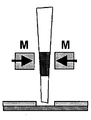
도 35는 자석(M)에 의해 자성 시약과 혼합된 혈액 샘플에 인가된 자기력을 보여준다.
도 36은 자기력의 이용을 통해 적혈구 성분과 혈장 성분으로 분리된 혈액 샘플을 보여준다.
도 37은 적혈구 성분과 혈장 성분으로 분리된 혈액 샘플을 함유하는 팁 아래에 위치한 웰을 보여준다.
도 38은 팁으로부터 웰로 전달되는 혈액 혈장의 도면을 보여준다.
도 39는 혈액 혈장이 웰에 분배된 후 팁을 보여준다.
도 40은 저흡광도를 갖는 액체를 함유하는 원통형 팁의 높은 명암대비 영상을 보여준다.
도 41은 고흡광도를 갖는 액체를 함유하는 원추형 팁의 영상을 보여준다.
도 42는 팁 내의 2개 메니스커스들을 보이는 고흡광도 액체를 갖는 팁을 보여준다.
도 43은 샘플 액체, 및 팁의 직경에 걸쳐 있는 큰 기포를 갖는 팁을 보여준다.
도 44는 투명 팁 또는 모세관 내의 깨끗한 상부 메니스커스를 보여주는 물 함유 팁을 보여준다.
도 45는 샘플 부피의 함수로서 작도된, 계산된 단백질 C 농도의 그래프를 보여준다.
도 46은 모세관, 하우징(housing), 플런저(plunger), 홈(groove) 및 상승된 특징부를 갖는 샘플 전달 디바이스의 영상을 보여준다. 상기 상승된 특징부는 플런저를 하우징 내에 위치시키는 데에 도움을 줄 수 있다.
도 47은 샘플 전달 디바이스의 모세관 내에 함유된 샘플을 보여준다.
도 48은 샘플이 플런저에 의해 배출된 후 샘플 전달 디바이스를 보여준다.
도 49는 샘플이 불완전하게 배출된 후 샘플 전달 디바이스를 보여준다.
도 50은 샘플을 함유하는 원추형 팁을 보여주고, 이때 화살표로 표시된 위치 L3이 나타나 있다.
도 51은 샘플 부피의 함수로서 작도된, L2와 L1 사이의 거리 대 L3과 L1 사이의 거리의 비의 그래프를 보여준다.
도 52는 착색된 생성물을 생성하는 화학반응의 반응식을 보여준다.
도 53은 콜레스테롤로부터 착색된 생성물을 생성하는 화학반응의 반응식을 보여준다.
도 54는 착색된 생성물을 생성하기 위해 환원 등가물을 사용하는 화학반응의 반응식을 보여준다.
도 55는 금속 이온과 함께 착물을 형성하였을 때 색채를 변화시키는 화합물의 일례를 보여준다.
도 56은 알부민을 갖지 않는 가장 좌측의 팁을 제외하고 우측부터 좌측까지 2배 감소하는 농도의 알부민을 갖는 팁의 일련의 영상들을 보여준다.
도 57은 콜레스테롤을 갖지 않는 가장 좌측의 팁을 제외하고 우측부터 좌측까지 2배 감소하는 농도의 콜레스테롤을 갖는 팁의 일련의 영상들을 보여준다.
도 58은 백색 불투명 플라스틱의 블록으로부터 기계가공된 일련의 반구형 웰을 보여주고, 이때 각각의 웰은 분석물을 갖지 않는 가장 좌측의 웰을 제외하고 우측부터 좌측까지 2배 감소하는 농도의 분석물을 갖는다. 몇몇 실시양태에서, 상기 분석물은 칼슘일 수 있다.
도 59는 백색 불투명 플라스틱의 블록으로부터 기계가공된 일련의 반구형 웰을 보여주고, 이때 각각의 웰은 분석물을 갖지 않는 가장 좌측의 웰을 제외하고 우측부터 좌측까지 2배 감소하는 농도의 분석물을 갖는다. 몇몇 실시양태에서, 상기 분석물은 마그네슘일 수 있다.
도 60은 백색 불투명 플라스틱의 블록으로부터 기계가공된 일련의 반구형 웰을 보여주고, 이때 각각의 웰은 분석물을 갖지 않는 가장 좌측의 웰을 제외하고 우측부터 좌측까지 2배 감소하는 농도의 분석물을 갖는다. 몇몇 실시양태에서, 상기 분석물은 우레아일 수 있다.
도 61은 브로모페놀 블루 용액을 함유하는 일련의 팁을 보여준다.
도 62는 복수의 상이한 광학 경로 길이를 갖는 팁의 예시이다.
도 63은 직사각형 큐벳을 관통하는 광 경로를 보여준다.
도 64는 마이크로타이터 웰을 관통하는 광 경로를 보여준다.
도 65는 원추 형태를 갖는 큐벳을 관통하는 광 경로를 보여준다.
도 66은 적색, 녹색 및 청색 채널을 위한 상이한 농도의 브로모페놀 블루 용액과 함께 샘플을 함유하는 팁에 대해 측정되었을 때 위치의 함수로서 작도된 광 강도의 그래프를 보여준다.
도 67은 도 66에서 분석된 팁의 영상을 보여준다.
도 68은 적색, 녹색 및 청색 채널에 의해 측정되었을 때 브로모페놀 블루 농도의 함수로서 작도된 신호의 그래프를 보여준다. 광학 밀도는 589 nm에서 측정될 수 있다.
도 69는 청색(마름모형) 및 적색(정사각형) 채널에 의해 측정되었을 때 브로모페놀 블루 농도의 함수로서 작도된 신호 반응의 로그 규모 그래프를 보여준다.
도 70은 실제 농도의 함수로서 작도된, 디지털 영상의 색채 분석에 의해 측정된 농도의 그래프를 보여준다.
도 71은 알부민 농도의 함수로서 작도된, 적색(정사각형), 녹색(마름모형) 및 청색(삼각형) 채널에 의해 측정된 신호 반응의 그래프를 보여준다.
도 72는 폴리스티렌 라텍스 입자에 대한 녹색, 적색 및 청색 채널에 대해 측정된 신호 반응의 3개 그래프를 보여준다.
도 73은 시약 NADH, WST-1 및 PMS를 각각 별도로 함유하는 팁, 및 상기 시약들의 혼합물을 함유하는 2개의 팁을 보여준다.
도 74는 좌측에서 우측까지 2배 감소하는 농도의 락테이트 데하이드로게나제(LDH)를 함유하는 팁의 디지털 영상을 보여준다.
도 75는 LDH의 함수로서 작도된, 450 nm에서 측정된 광학 밀도의 그래프를 보여준다.
도 76은 칼륨 어세이 스트립에 첨가된 염화칼륨의 용액을 보여준다.
도 77은 항-A, 항-B, 항-D 및 대조군(좌측에서 우측으로)에 대한 혈액형 분류 시약과 혼합된 혈액 샘플을 함유하는 팁을 보여준다.
도 78은 항-A, 항-B, 항-D 및 대조군 시약과 혼합된 샘플의 경우 적색(좌측 컬럼), 녹색(중간 컬럼) 및 청색(우측 컬럼)에 대한 위치의 함수로서 신호에 대한 측정된 신호를 보여준다.
도 79는 적색, 녹색 및 청색 채널을 이용하여 좁은 경로 길이 및 넓은 경로 길이에 대해 측정된 상대적 농도의 함수로서 표준화된 신호를 보여준다.
도 80은 측정 알고리즘의 정확도를 보여주는, 실제 농도의 함수로서 작도된 측정된 농도의 로그 그래프를 보여준다.
도 81은 튜브 내의 어세이 생성물의 형광 영상을 보여준다.
도 82는 팁 내의 반응 생성물의 영상을 보여준다.
도 83은 팁 내의 반응 생성물의 영상을 보여준다.
도 84는 팁 내의 반응 생성물의 영상을 보여준다.
도 85는 팁 내의 반응 생성물의 영상을 보여준다.
도 86은 팁 내의 반응 생성물의 영상을 보여준다.
도 87은 팁 내의 반응 생성물의 영상을 보여준다.
도 88은 교정을 위해 수득된 배경 색채 영상을 보여준다.
도 89는 팁 내의 반응 생성물의 형광 영상을 보여준다.
도 90은 DNA 카피 수의 함수로서 적색 및 청색 채널 반응 및 형광 반응을 보여준다.
도 91은 형광 신호의 함수로서 작도된, 변환된 3색 신호의 그래프를 보여준다.
도 92는 화소 위치의 함수로서 작도된, 녹색 채널 신호 반응의 그래프를 보여준다.
도 93은 브로모페놀 블루와 물로 구성된 용액을 함유하는 팁의 영상을 보여준다.
도 94는 브로모페놀 블루와 물로 구성된 용액을 함유할 수 있는 추가 팁의 영상을 보여준다.
도 95는 다수의 어세이를 수행하기 위한 반응 혼합물을 함유하는 팁의 개략도를 보여준다.
도 96은 브로모페놀 블루와 물로 구성된 용액을 함유하는 팁의 영상을 보여준다.
도 97은 다수의 표준물에서 샘플, 물 및 대조군에 대한 신호 반응의 그래프를 보여준다. 상기 샘플은 공지된 농도의 분석물을 함유하는 수성 교정제(calibrator)일 수 있다.
도 98은 Ca2+(팁의 상부 영역) 및 Mg2+(팁의 하부 영역) 둘다에 대한 어세이를 함유하는 팁을 보여준다.
도 99는 하기 다양한 종류의 혈청 샘플을 갖는 4개의 팁을 보여준다: 용혈된 혈청(적색), 유미(lipemic) 혈청(회색), 황달 혈청(황색) 및 정상 혈청(좌측에서 우측으로).
도 100은 카메라 및 광학 구성요소의 개략도를 보여준다.
도 101은 백색 광원, 천공 및 센서를 포함하는 카메라 및 광학 구성요소의 횡단면도를 보여준다.
도 102는 (A) 여기 광선에 대한 수직 각도에서 광을 검출하도록 배치된 센서 및 (B) 여기 광선과 수평하게 배치된 센서를 이용하여 광 신호를 측정하기 위한 광학 셋업의 개략도를 보여준다.
도 103은 (A) 센서에 수직한 여기 광선 및 (B) 센서와 수평한 여기 광선을 이용하여 촬영한 영상을 보여준다.
도 104는 광학 셋업을 교정하는 데에 사용될 수 있는 날염된 염료들의 어레이를 보여준다.
도 105는 샘플 부피의 함수로서 작도된 신호의 그래프를 보여준다. 시리즈 1 내지 5는 상이한 분석물 농도, 예컨대, 각각 0, 20, 40, 60 및 80에 상응할 수 있다.
도 106은 샘플 부피의 함수로서 작도된 신호의 그래프를 보여준다. 시리즈 1 내지 5는 상이한 분석물 농도, 예컨대, 각각 0, 20, 40, 60 및 80에 상응할 수 있다.
도 107은 샘플 부피의 함수로서 작도된 신호의 그래프를 보여준다. 시리즈 1 내지 5는 상이한 분석물 농도, 예컨대, 각각 0, 20, 40, 60 및 80에 상응할 수 있다.
도 108은 실제 분석물 농도의 함수로서 작도된, 측정된 분석물 농도의 그래프를 보여준다.
도 109는 실제 분석물 농도의 함수로서 작도된, 측정된 분석물 농도의 그래프를 보여준다.
도 110은 ELISA 어세이에 대한 예시적 방법을 개략적으로 보여준다.
도 111은 수직 버킷을 갖는 정지 상태의 로터의 일례를 보여준다.
도 112는 수평한 작은 각도에서 버킷을 갖는 일정 속도의 로터의 일례를 보여준다.
도 113은 버킷 입체구조의 일례를 보여준다.
도 114는 버킷과 교접된(mated) 원심분리 용기의 일례를 보여준다.
도 115는 버킷과 교접될 수 있는 또 다른 원심분리 용기의 일례를 보여준다.
도 116은 원심분리 용기의 일례를 보여준다.
도 117은 추출 팁의 일례를 보여준다.
도 118은 원심분리 용기와 추출 팁이 교접할 수 있는 방법의 일례를 제공한다.
도 119는 원심분리 전 원래의 반응 혼합물을 촬영한 영상이다.
도 120은 원심분리 전 원래의 반응 혼합물을 촬영한 또 다른 영상이다.
도 121은 원심분리 전 원래의 반응 혼합물을 촬영한 추가 영상이다.
도 122는 혈장 메니스커스로부터의 계면의 거리로서 결과를 보여준다.
도 123은 표지된 백혈구를 보여주는 형광 현미경사진의 일례를 제공한다.
도 124는 암시야 영상을 이용하는 세포내 패턴의 일례를 제공한다.
도 125는 표지된 세포 샘플로부터의 데이터의 다중 파라미터 획득의 일례를 제공한다.
도 126은 인간 전혈의 명시야 영상의 일례를 제공한다.
도 127은 정량적 다중 파라미터 데이터 획득 및 분석의 일례를 제공한다.
도 128은 광 분포의 변경을 보여준다.
도 129는 5개의 어세이로부터 수득된 데이터를 보여준다.
도 130은 분석물의 농도에 대해 작도된 파라미터뿐만 아니라, 정확도, 정밀도 및 예측된 농도에 관한 그래프도 보여준다.
도 131은 디지털 카메라에 의해 수집된 영상을 보여준다.
도 132는 반응 생성물을 촬영한 영상의 예를 보여준다.
도 133은 원심분리에서 회전하기 전 및 원심분리에서 회전한 후 분석된 영상의 예를 제공한다.
도 134는 반응 생성물을 촬영한 영상의 예를 보여준다.
도 135는 여러 혈청 샘플들의 스펙트럼을 보여준다.
도 136은 어레이를 사용하는 본 발명의 예시적 검출 과정을 보여준다.
도 137은 비드를 사용하는 본 발명의 예시적 검출 과정을 보여준다.
도 138은 태깅된(tagged) 앱타머를 사용하는 본 발명의 예시적 검출 과정을 보여준다.
도 139는 상보적 프로브에 결합하는 앱타머의 검출을 보여준다.
도 140은 앱타머와 비상보적 프로브 사이의 결합의 부재를 보여준다.
도 141은 어레이 상의 앱타머의 결합 특이성을 보여준다.
도 142는 어레이 상의 분석물 검출의 보다 더 상세한 도면을 보여준다.
도 143은 예시적 어레이를 보여준다.
도 144는 비타민 D 어세이를 위해 농도에 대해 작도된 화학발광도를 보여준다.
도 145는 에스트라디올 어세이를 위해 농도에 대해 작도된 화학발광도를 보여준다.
도 146은 WBC 농도의 분광광도측정을 보여준다.
도 147은 시간의 함수로서 작도된 탁도를 보여준다.
도 148은 800 카피/㎕ 및 80 카피/㎕에서 3개 실험에 대한 변곡점을 작도한 것이다.
도 149는 자성 비드가 ELISA 어세이를 통해 단백질 및 소분자의 분석에 사용되는 일례를 작도한 것이다.
도 150은 자성 비드가 ELISA 어세이를 통해 단백질 및 소분자의 분석에 사용되는 일례를 작도한 것이다.The novel features of the invention are described in detail in the appended claims. A better understanding of the features and advantages of the present invention will be obtained by reference to the following detailed description describing exemplary embodiments in which the principles of the present invention are employed, and the accompanying drawings.
1 shows a side view of a centrifuge.
2 shows a front view of the centrifuge.
3 shows a perspective view of the back side of the centrifuge.
4 shows a top view of a sample tip.
5 shows a side view of a sample tip.
6 shows a cross sectional view of a sample tip.
7 shows a diagram of a sample tip located in a sample above the plasma / packed cell interface.
8 shows a graph of centrifugation time constructed as a function of revolutions per minute.
9 shows a graph of the centrifugation time constructed as a function of the radius of the centrifuge rotor.
10 shows empty capped sample tips.
11 shows a capped sample tip containing a bodily fluid, eg, a blood sample.
12 shows a capped sample tip containing a sample of about 23% hematocrit blood after centrifugation.
FIG. 13 shows a capped sample tip containing a sample of about 31% hematocrit blood after centrifugation.
14 shows capped sample tips containing a sample of about 40% hematocrit blood after centrifugation.
FIG. 15 shows a capped sample tip containing a sample of about 52% hematocrit blood after centrifugation.
FIG. 16 shows capped sample tips containing a sample of about 68% hematocrit blood after centrifugation.
FIG. 17 shows a comparison of hematocrit ("hematocrit,% reported") measured with a digital imaging system using centrifuged samples and hematocrit ("hematocrit,% target") measured with a standard microhematocrit device.
18 shows a diagram (dimensions in mm) of the tip used for the reaction and the tip used for blood / plasma.
19 shows a cylindrical capillary containing a sample.
20 shows the angle and dimensions for calculating the volume in a conical container, eg, capillary.
21 shows angles and dimensions for calculating the volume in a conical container, eg, capillary.
22 shows the angles and dimensions for calculating the volume of the spherical cap.
FIG. 23 shows the dimensions for calculating the volume of the sample contained in the cylindrical tip, wherein the sample has a single meniscus.
Figure 24 shows the dimensions for calculating the volume of the sample contained in the cylindrical tip, wherein the sample has two meniscus.
FIG. 25 shows dimensions for calculating the volume of a sample contained in and / or associated with a cylindrical tip, wherein the sample has two meniscus, one of which is outside the cylindrical tip. exist.
FIG. 26 shows dimensions for estimating the volume of a sample contained within a cylindrical tip, where bubbles are present in the sample.
FIG. 27 shows the dimensions for calculating the volume of the sample contained within the cylindrical tip, where there are bubbles in the sample that span the width of the cylindrical tip.
FIG. 28 shows dimensions for calculating the volume of a sample contained within and / or associated with a cylindrical tip, wherein the sample comprises a hanging droplet of sample present outside of the cylindrical tip.
29 shows the dimensions for measuring the volume of residual sample contained in a cylindrical tip.
30 shows a blood sample in the tip before mixing with the magnetic reagent.
31 shows blood samples mixed with magnetic reagents.
32 shows blood samples mixed with magnetic reagents.
33 shows a blood sample mixed with magnetic reagent contained in the tip.
34 shows blood samples mixed with magnetic reagents moved to selected locations in the tip.
35 shows the magnetic force applied to the blood sample mixed with the magnetic reagent by the magnet (M).
36 shows blood samples separated into erythrocyte components and plasma components through the use of magnetic forces.
FIG. 37 shows wells located under the tip containing blood samples separated into erythrocyte components and plasma components.
38 shows a diagram of blood plasma delivered from the tip to the wells.
39 shows the tip after blood plasma has been dispensed into the wells.
40 shows a high contrast image of a cylindrical tip containing a liquid with low absorbance.
FIG. 41 shows an image of a conical tip containing a liquid with high absorbance.
42 shows a tip with high absorbance liquid showing two meniscuses in the tip.
43 shows a sample liquid and a tip with large bubbles spanning the diameter of the tip.
44 shows a water containing tip showing a clear top meniscus in a transparent tip or capillary.
45 shows a graph of calculated Protein C concentrations, constructed as a function of sample volume.
FIG. 46 shows an image of a sample delivery device with capillaries, housings, plungers, grooves and raised features. The raised features may help to position the plunger in the housing.
47 shows a sample contained within the capillary of the sample delivery device.
48 shows a sample delivery device after the sample has been discharged by the plunger.
49 shows a sample delivery device after the sample is incompletely discharged.
50 shows a conical tip containing the sample, with the position L3 indicated by the arrow shown.
51 shows a graph of the ratio of the distance between L2 and L1 to the distance between L3 and L1, constructed as a function of sample volume.
52 shows a reaction scheme for a chemical reaction that produces a colored product.
53 shows a scheme of chemical reactions that produce colored products from cholesterol.
54 shows a scheme of chemical reaction using a reducing equivalent to produce a colored product.
55 shows an example of a compound that changes color when a complex is formed with metal ions.
FIG. 56 shows a series of images of tips with albumin at a 2-fold decrease in concentration from right to left except for the leftmost tip without albumin.
FIG. 57 shows a series of images of tips with cholesterol having a concentration that decreases twice from right to left except for the leftmost tip without cholesterol.
58 shows a series of hemispherical wells machined from a block of white opaque plastic, with each well doubling the concentration of analyte from right to left except for the leftmost well without the analyte. Have In some embodiments, the analyte may be calcium.
FIG. 59 shows a series of hemispherical wells machined from a block of white opaque plastic, with each well doubling the concentration of analyte from right to left except for the leftmost well without the analyte. Have In some embodiments, the analyte may be magnesium.
FIG. 60 shows a series of hemispherical wells machined from a block of white opaque plastic, with each well doubling the concentration of analyte from right to left except for the leftmost well without the analyte. Have In some embodiments, the analyte may be urea.
61 shows a series of tips containing bromophenol blue solution.
62 is an illustration of a tip having a plurality of different optical path lengths.
63 shows the light path through the rectangular cuvette.
64 shows an optical path through a microtiter well.
65 shows an optical path through a cuvette having a conical shape.
FIG. 66 shows a graph of the light intensity plotted as a function of position as measured for tips containing samples with different concentrations of bromophenol blue solution for red, green and blue channels.
67 shows an image of the tip analyzed in FIG. 66.
68 shows a graph of the signal plotted as a function of bromophenol blue concentration as measured by the red, green and blue channels. Optical density can be measured at 589 nm.
FIG. 69 shows a logarithmic scale plot of signal response plotted as a function of bromophenol blue concentration as measured by blue (rhombus) and red (square) channels.
70 shows a graph of concentration measured by color analysis of a digital image, constructed as a function of actual concentration.
FIG. 71 shows a graph of signal response measured by red (square), green (rhombus) and blue (triangle) channels, constructed as a function of albumin concentration.
FIG. 72 shows three graphs of signal response measured for green, red and blue channels for polystyrene latex particles.
73 shows a tip containing reagents NADH, WST-1 and PMS separately, and two tips containing a mixture of the reagents.
FIG. 74 shows a digital image of a tip containing lactate dehydrogenase (LDH) at a 2-fold decrease in concentration from left to right.
75 shows a graph of optical density measured at 450 nm, constructed as a function of LDH.
76 shows a solution of potassium chloride added to the potassium assay strip.
FIG. 77 shows tips containing blood samples mixed with blood type sorting reagents for anti-A, anti-B, anti-D and controls (left to right).
FIG. 78 is a measurement of signal as a function of position for red (left column), green (middle column) and blue (right column) for samples mixed with anti-A, anti-B, anti-D and control reagents. Shows a signal.
FIG. 79 shows the normalized signal as a function of relative concentration measured for narrow path length and wide path length using red, green and blue channels.
80 shows a log graph of measured concentrations plotted as a function of actual concentration, showing the accuracy of the measurement algorithm.
81 shows fluorescence images of assay products in the tubes.
82 shows an image of the reaction product in the tip.
83 shows an image of the reaction product in the tip.
84 shows an image of the reaction product in the tip.
85 shows an image of the reaction product in the tip.
86 shows an image of the reaction product in the tip.
87 shows an image of the reaction product in the tip.
88 shows the background color image obtained for correction.
89 shows a fluorescence image of the reaction product in the tip.
90 shows red and blue channel reactions and fluorescence reactions as a function of DNA copy number.
91 shows a graph of the converted three color signals, constructed as a function of fluorescence signal.
92 shows a graph of the green channel signal response, constructed as a function of pixel location.
93 shows an image of a tip containing a solution consisting of bromophenol blue and water.
FIG. 94 shows an image of an additional tip that may contain a solution consisting of bromophenol blue and water.
95 shows a schematic of a tip containing a reaction mixture for performing multiple assays.
96 shows an image of a tip containing a solution consisting of bromophenol blue and water.
97 shows a graph of signal response to samples, water and controls in multiple standards. The sample may be an aqueous calibrator containing a known concentration of analyte.
98 shows a tip containing an assay for both Ca 2+ (upper region of the tip) and Mg 2+ (lower region of the tip).
99 shows four tips with the following various kinds of serum samples: hemolyzed serum (red), lipmic serum (grey), jaundice serum (yellow) and normal serum (from left to right).
100 shows a schematic of the camera and optical components.
101 shows a cross sectional view of a camera and optical component including white light sources, perforations and sensors.
FIG. 102 shows a schematic diagram of an optical setup for measuring an optical signal using (A) a sensor arranged to detect light at a normal angle to the excitation light beam and (B) a sensor arranged horizontally with the excitation light beam.
FIG. 103 shows an image photographed using an excitation light beam perpendicular to the sensor (A) and an excitation light beam horizontal to the sensor (B).
104 shows an array of printed dyes that can be used to calibrate the optical setup.
105 shows a graph of the constructed signal as a function of sample volume. Series 1-5 may correspond to different analyte concentrations, such as 0, 20, 40, 60 and 80, respectively.
106 shows a graph of the constructed signal as a function of sample volume. Series 1-5 may correspond to different analyte concentrations, such as 0, 20, 40, 60 and 80, respectively.
107 shows a graph of the constructed signal as a function of sample volume. Series 1-5 may correspond to different analyte concentrations, such as 0, 20, 40, 60 and 80, respectively.
108 shows a graph of measured analyte concentrations constructed as a function of actual analyte concentration.
109 shows a graph of measured analyte concentrations constructed as a function of actual analyte concentration.
110 schematically shows an example method for an ELISA assay.
111 shows an example of a stationary rotor with a vertical bucket.
112 shows an example of a constant speed rotor with a bucket at a small horizontal angle.
113 shows an example of a bucket geometry.
114 shows an example of a centrifugation vessel mated with a bucket.
115 shows an example of another centrifugal vessel that can be mated with a bucket.
116 shows an example of a centrifuge vessel.
117 shows an example of an extraction tip.
118 provides one example of how a centrifugal vessel and extraction tip may intermate.
119 is a photograph of the original reaction mixture before centrifugation.
120 is another image of the original reaction mixture before centrifugation.
121 is an additional image of the original reaction mixture before centrifugation.
122 shows the results as the distance of the interface from the plasma meniscus.
123 provides an example of a fluorescence micrograph showing labeled white blood cells.
124 provides an example of an intracellular pattern using dark field imaging.
125 provides an example of multiple parameter acquisition of data from labeled cell samples.
126 provides an example of brightfield imaging of human whole blood.
127 provides an example of quantitative multi-parameter data acquisition and analysis.
128 shows a change in light distribution.
129 shows data obtained from five assays.
130 shows graphs for accuracy, precision, and predicted concentrations, as well as parameters plotted for the concentrations of analytes.
131 shows an image collected by a digital camera.
132 shows an example of an image captured by the reaction product.
133 provides examples of images analyzed before and after rotation in centrifugation.
134 shows an example of an image captured by the reaction product.
135 shows the spectra of several serum samples.
136 shows an exemplary detection process of the present invention using an array.
137 shows an exemplary detection procedure of the present invention using beads.
138 shows an exemplary detection procedure of the present invention using a tagged aptamer.
139 shows detection of aptamers binding to complementary probes.
140 shows the absence of binding between the aptamer and the non-complementary probe.
141 shows the binding specificity of the aptamers on the array.
142 shows a more detailed view of the analyte detection on the array.
143 shows an example array.
144 shows the chemiluminescence plotted against concentration for vitamin D assay.
145 shows the chemiluminescence plotted against concentration for estradiol assay.
146 shows the spectrophotometric measurements of WBC concentration.
147 shows the turbidity plotted as a function of time.
148 plots inflection points for three experiments at 800 copies / μl and 80 copies / μl.
Figure 149 constructs an example in which magnetic beads are used for analysis of proteins and small molecules via ELISA assays.
150 constructs an example in which magnetic beads are used for the analysis of proteins and small molecules through ELISA assays.
본 발명의 바람직한 실시양태가 본원에서 제시되고 기재되어 있지만, 이러한 실시양태가 단지 예로서 제공되는 것임이 당업자에게 자명할 것이다. 본 발명을 벗어나지 않으면서 다수의 변경, 변화 및 치환이 당업자에게 인식될 것이다. 본원에 기재된 본 발명의 실시양태에 대한 다양한 대안이 본 발명의 실시에 사용될 수 있다는 것을 이해해야 한다.While preferred embodiments of the invention have been shown and described herein, it will be apparent to those skilled in the art that such embodiments are provided by way of example only. Numerous variations, changes, and substitutions will be apparent to those skilled in the art without departing from the invention. It should be understood that various alternatives to the embodiments of the invention described herein may be used in the practice of the invention.
본 발명은 샘플 사용 최대화를 위한 시스템 및 방법에 대한 모바일 응용을 제공한다. 본원에 기재된 본 발명의 다양한 양태는 이하에 기재된 임의의 특정 응용, 또는 임의의 다른 종류의 진단 또는 치료 응용에 적용될 수 있다. 본 발명은 독립형 시스템 또는 방법으로서, 또는 통합된 임상전, 임상, 실험실 또는 의학적 응용의 일부로서 적용될 수 있다. 본 발명의 다양한 양태는 개별적으로, 집합적으로 또는 서로 조합된 상태로 인식될 수 있다는 것을 이해할 것이다. The present invention provides a mobile application to a system and method for maximizing sample usage. The various aspects of the invention described herein may be applied to any particular application described below, or any other kind of diagnostic or therapeutic application. The invention can be applied as a standalone system or method or as part of an integrated preclinical, clinical, laboratory or medical application. It will be appreciated that various aspects of the invention may be recognized individually, collectively, or in combination with each other.
본원의 디바이스 및 시스템은 대상체로부터의 체액에 존재하는 분석물의 실시간 검출을 위한 효과적인 수단을 제공할 수 있다. 검출 방법은 특정 생물학적 과정, 생리학적 조건, 질환 또는 질환의 단계와 관련된 분석물의 확인 및 정량을 포함하는 매우 다양한 환경에서 이용될 수 있다. 따라서, 상기 시스템은 예를 들면, 약물 스크리닝, 질환 진단, 계통학적 분류, 부모 및 법의학적 확인, 질환 발병 및 재발, 치료에 대한 개체 반응 대 집단 기준, 및/또는 치료법의 모니터링에 있어서 광범위한 유용성을 갖는다. 본 디바이스 및 시스템은 치료제 개발의 임상전 및 임상 단계의 진행, 환자 순응도의 개선, 처방된 약물과 관련된 ADR의 모니터링, 개별맞춤 의약의 개발, 중앙 실험실로부터 집으로 혈액 시험의 외부위탁 또는 처방에 기초한 혈액 시험의 외부위탁, 및/또는 규제 승인 후 치료제의 모니터링에도 특히 유용하다. 본 디바이스 및 시스템은 중앙 실험실로부터 혈액 시험을 외부위탁하는 지불인에 의해 이용될 수 있다. 상기 디바이스 및 시스템은 개별맞춤 의약에 대한 유연성 시스템을 제공할 수 있다. 동일한 시스템을 이용하여, 기재된 매우 다양한 어세이를 수행하기 위해 상기 시스템의 프로그래밍가능한 프로세서에 대한 프로토콜 또는 지시에 따라 디바이스를 변화시킬 수 있거나 교환할 수 있다. 본원에 기재된 시스템 및 디바이스는 훨씬 더 작고/작거나 휴대가능하지만 신규 특징을 구현하고 실험실 기기의 많은 기능을 제공한다.The devices and systems herein can provide effective means for real-time detection of analytes present in body fluids from a subject. Detection methods can be used in a wide variety of environments, including the identification and quantification of analytes associated with specific biological processes, physiological conditions, diseases or stages of a disease. Thus, the system has a wide range of usefulness in, for example, drug screening, disease diagnosis, phylogenetic classification, parental and forensic identification, disease development and recurrence, individual response versus population criteria for treatment, and / or monitoring of therapy. Have The device and system can be used for preclinical and clinical stages of therapeutic development, improving patient compliance, monitoring ADRs associated with prescribed medications, developing personalized medicines, outsourcing of blood tests from a central laboratory or prescribing blood based on prescription. It is also particularly useful for outsourcing of trials and / or monitoring of therapeutic agents after regulatory approval. The device and system can be used by a payer who outsources a blood test from a central laboratory. The devices and systems can provide a flexible system for personalized medicine. Using the same system, devices may be changed or exchanged according to protocols or instructions for the programmable processor of the system to perform the wide variety of assays described. The systems and devices described herein are much smaller and / or portable but implement new features and provide many of the capabilities of laboratory instruments.
한 양태에서, 본 발명의 시스템은 어세이 유닛; 및 시약, 예를 들면, 액체 및/또는 고체 상 시약 둘다를 포함하는 시약 유닛을 포함하는 디바이스를 포함한다. 몇몇 실시양태에서, 전체 디바이스의 하나 이상, 어세이 유닛, 시약 유닛 또는 이들의 조합물은 일회용이다. 본 발명의 시스템에서, 본 디바이스를 이용한 분석물의 검출은 전형적으로 자동화된다. 이러한 자동화는 내장된 프로토콜 또는 제작자에 의해 상기 시스템에 제공된 프로토콜에 의해 수행될 수 있다.In one aspect, the system of the present invention comprises an assay unit; And a device comprising a reagent unit comprising reagents such as both liquid and / or solid phase reagents. In some embodiments, one or more of the entire device, an assay unit, a reagent unit, or a combination thereof is disposable. In the system of the present invention, detection of analytes using the device is typically automated. Such automation may be performed by embedded protocols or protocols provided to the system by the manufacturer.
본원에 기재된 디바이스 및 시스템은 기존 POC 시스템 또는 통합된 분석 시스템에서 이용가능하지 않은 많은 특징을 제공할 수 있다. 예를 들면, 많은 POC 카트리지가 효율적인 방식으로 작은 부피의 액체를 처리하기 위해 폐쇄된 유체 시스템 또는 루프에 의존한다. 본원에 기재된 유체 디바이스, 예컨대, 카트리지는 주어진 카트리지 내의 유닛들 사이에 개방된 유체 이동을 가질 수 있다. 예를 들면, 시약은 유닛에 저장될 수 있고, 샘플은 샘플 수집 유닛에 저장될 수 있고, 희석제는 희석제 유닛에 저장될 수 있고, 포획 표면은 어세이 유닛에 저장될 수 있고, 이때 카트리지의 한 상태에서 유닛들 중 어떠한 유닛도 임의의 다른 유닛과 유체 통신 상태에 있지 않다. 시스템의 유체 전달 디바이스를 이용하여 몇몇 유닛들을 유체 통신 상태에 있게 하기 위해 상기 유닛들을 서로에 대해 상대적으로 이동시킬 수 있다. 예를 들면, 유체 전달 디바이스는 어세이 유닛과 맞물리고 어세이 유닛을 시약 유닛과 유체 통신 상태에 있게 하는 헤드를 포함할 수 있다. 몇몇 경우, 상기 헤드는 어세이 유닛(예를 들면, 팁)을 시약 유닛과 유체 통신 상태에 있게 하는 피펫 헤드이다.The devices and systems described herein can provide many features that are not available in existing POC systems or integrated analysis systems. For example, many POC cartridges rely on closed fluid systems or loops to handle small volumes of liquid in an efficient manner. Fluid devices, such as cartridges, described herein may have open fluid movement between units within a given cartridge. For example, the reagent may be stored in the unit, the sample may be stored in the sample collection unit, the diluent may be stored in the diluent unit, and the capture surface may be stored in the assay unit, with one of the cartridges None of the units in the state are in fluid communication with any other unit. The fluid delivery device of the system may be used to move the units relative to each other to bring some units into fluid communication. For example, the fluid delivery device may include a head that engages with the assay unit and keeps the assay unit in fluid communication with the reagent unit. In some cases, the head is a pipette head that places the assay unit (eg, tip) in fluid communication with the reagent unit.
따라서, 한 실시양태에서, 본 발명은 체액 또는 조직 샘플 중의 분석물의 농도를 검출하고/하거나 측정하는 방법으로서, 전형적으로 하기 단계들을 포함하는 방법을 제공한다: 샘플(예를 들면, 혈액, 소변, 타액, 조직)을 본 발명의 디바이스 또는 시스템에 제공하는 단계, 상기 샘플이 상기 디바이스의 하나 이상의 어세이 유닛 내에서 반응하게 하는 단계, 및 혈액 샘플 중의 분석물로부터 발생된 검출가능한 신호를 검출하는 단계.Thus, in one embodiment, the present invention provides a method for detecting and / or measuring the concentration of an analyte in a bodily fluid or tissue sample, typically comprising the following steps: a sample (eg, blood, urine, Saliva, tissue) to a device or system of the invention, causing the sample to react in one or more assay units of the device, and detecting a detectable signal generated from the analyte in the blood sample .
본 발명의 한 양태는 샘플 사용을 최대화하도록 구성된 현장진료 디바이스를 이용하여 샘플을 분석하는 것을 제공한다. 예를 들면, 약 1 ㎕, 20 ㎕, 50 ㎕, 100 ㎕ 또는 500 ㎕ 미만의 부피를 갖는 샘플에 대해 약 15개, 25개, 50개, 75개 또는 100개 초과의 어세이를 수행할 수 있다. 샘플은 손가락 찌르기로부터 수득된 혈액 샘플일 수 있다. 샘플은 밀폐가능한 모세관 또는 팁 내에 수집될 수 있다. 샘플은 샘플을 분리(예를 들면, 원심분리) 및/또는 희석 과정으로 처리함으로써 하나 이상의 어세이를 위해 준비될 수 있다. 하나 이상의 어세이는 분리되고 희석될 수 있는 샘플을 반응 챔버 내에서 하나 이상의 시약과 조합함으로써 준비될 수 있다. 반응 챔버는 피펫 팁, 바이알, 샘플 전달 디바이스 및/또는 큐벳일 수 있다. 하나 이상의 어세이는 샘플 중의 하나 이상의 분석물의 농도를 표시하는 광학 신호가 측정될 수 있도록 구성될 수 있다. 반응 챔버는 공간적으로 분리될 수 있는 복수의 어세이들을 함유할 수 있다. 복수의 광학 신호들은 한 어세이, 또는 복수의 공간적으로 분리된 어세이들로부터 단일 반응 챔버 내에서 발생될 수 있다. 하나 이상의 광학 신호는 복수의 검출 스펙트럼 영역들 또는 검출 밴드들, 예를 들면, 적색, 녹색 및 청색을 측정할 수 있는 디지털 영상화 카메라에 의해 측정될 수 있다. 광학 신호는 피펫 팁 또는 다른 샘플 용기일 수 있는 반응 챔버 내의 어세이 반응 생성물에 대해 측정될 수 있다. 시스템, 디바이스 및 방법은 프로그래밍가능한 로직(logic)에 의해 전체적으로 자동화될 수 있거나 반자동화될 수 있다.One aspect of the invention provides for analyzing a sample using an on-site medical device configured to maximize sample use. For example, about 15, 25, 50, 75, or more than 100 assays can be performed on samples having a volume of less than about 1 μl, 20 μl, 50 μl, 100 μl or 500 μl. have. The sample can be a blood sample obtained from a finger prick. The sample may be collected in a sealable capillary or tip. Samples may be prepared for one or more assays by subjecting the sample to a separation (eg, centrifugation) and / or dilution process. One or more assays can be prepared by combining a sample that can be separated and diluted with one or more reagents in the reaction chamber. The reaction chamber may be a pipette tip, a vial, a sample delivery device and / or a cuvette. One or more assays can be configured such that an optical signal indicative of the concentration of one or more analytes in the sample can be measured. The reaction chamber may contain a plurality of assays that can be spatially separated. The plurality of optical signals may be generated in a single reaction chamber from one assay, or from a plurality of spatially separated assays. One or more optical signals may be measured by a digital imaging camera capable of measuring a plurality of detection spectral regions or detection bands, for example red, green and blue. Optical signals can be measured for assay reaction products in the reaction chamber, which can be pipette tips or other sample containers. The system, device, and method may be fully automated or semi-automated by programmable logic.
본 발명의 또 다른 양태는 분석용 샘플을 준비하는 시스템, 디바이스 및 방법을 제공한다. 샘플은 하나 이상의 분리 디바이스에 의해 분석용으로 준비될 수 있다. 예를 들면, 샘플은 원심분리기 내에서의 원심분리에 의해 분석용으로 준비될 수 있다. 전하, 크기, 소수성/친수성 및/또는 휘발성에 기초한 다른 분리도 실시될 수 있다.Another aspect of the invention provides a system, device, and method for preparing a sample for analysis. Samples may be prepared for analysis by one or more separation devices. For example, a sample can be prepared for analysis by centrifugation in a centrifuge. Other separations based on charge, size, hydrophobicity / hydrophilicity and / or volatility may also be performed.
본 발명의 한 양태는 영상-기초 분석을 이용하는 샘플 및 반응 생성물 분석을 제공한다. 시스템은 하나 이상의 검출 스펙트럼 영역을 이용하여 광학 신호를 측정할 수 있는 카메라를 포함할 수 있다. 예를 들면, 카메라는 적색, 녹색 및 청색 검출 스펙트럼 영역을 이용하여 광학 신호를 측정할 수 있다. 측정된 신호는 본원에 기재된 하나 이상의 알고리즘을 이용하여 해석할 수 있는 3개의 측정된 값을 포함할 수 있다. 하나 초과의 검출 스펙트럼 영역의 이용은 어세이의 동적 범위를 증가시킬 수 있고 단일 검출 스펙트럼 영역을 이용하는 측정에 비해 측정의 정확도를 증가시킬 수 있다.One aspect of the present invention provides sample and reaction product analysis using image-based analysis. The system can include a camera capable of measuring the optical signal using one or more detection spectral regions. For example, the camera can measure optical signals using red, green, and blue detection spectral regions. The measured signal can include three measured values that can be interpreted using one or more algorithms described herein. The use of more than one detection spectral region can increase the dynamic range of the assay and increase the accuracy of the measurement compared to measurements using a single detection spectral region.
또한, 본 발명은 반응 챔버(각각 복수의 상이한 경로 길이를 가짐) 내에 함유된 샘플 및 어세이 반응 생성물에 대한 광학 측정을 수행하는 시스템, 디바이스 및 방법을 제공한다. 반응 챔버는 보다 더 높거나 보다 더 낮은 양의 광 흡광도가 관찰되도록 복수의 상이한 경로 길이를 가질 수 있다. (예컨대, 샘플 및/또는 반응 챔버를 관통하는) 복수의 상이한 경로 길이는 선택된 어세이 프로토콜의 동적 범위의 증가를 허용한다. 반응 챔버의 영상을 본원에 기재된 바와 같이 분석하여 샘플 또는 어세이 반응 생성물에 대한 정보를 수득할 수 있다. 단일 반응 챔버 내의 복수의 이용가능한 경로 길이의 이용과 3개의 채널 검출 스펙트럼 영역의 이용의 조합은 주어진 어세이의 동적 범위를 크게 향상시킨다.The present invention also provides systems, devices, and methods for performing optical measurements on samples and assay reaction products contained in reaction chambers, each having a plurality of different path lengths. The reaction chamber may have a plurality of different path lengths such that higher or lower amounts of light absorbance are observed. Multiple different path lengths (eg, through the sample and / or reaction chamber) allow for an increase in the dynamic range of the selected assay protocol. Images of the reaction chamber can be analyzed as described herein to obtain information about a sample or assay reaction product. The combination of the use of multiple available path lengths in a single reaction chamber with the use of three channel detection spectral regions greatly improves the dynamic range of a given assay.
샘플 준비 및 분석을 수행하는 시스템은 기기, 일회용 구성요소 및 시약을 포함할 수 있다. 상기 시스템은 샘플을 수용할 수 있고 사용자 개입 없이 복수의 어세이들을 자동적으로 수행한다. 원하는 경우, 기기는 그래픽 사용자 인터페이스, 일회용일 수 있는 카트리지를 도입하기 위한 기작, 3차원에서 이동성을 가질 수 있는 모터 장착된 재물대, 하나 이상의 단일 헤드 액체 취급 디바이스, 하나 이상의 다중 헤드 액체 취급 디바이스, 샘플 준비를 수행하기 위한 하나 이상의 디바이스, PMT 및/또는 영상화 디바이스를 포함할 수 있는 광학 센서, 온도 조절기 및 통신 디바이스를 포함할 수 있다. 일회용 구성요소는 샘플 팁, 팁 밀폐부 및 시약을 함유하는 일회용 카트리지를 포함할 수 있다. 몇몇 실시양태에서, 일회용 카트리지는 액체 어세이 생성물을 흡수하고 중화시키도록 구성된 중화 조립체도 함유할 수 있다.The system for performing sample preparation and analysis may include instruments, disposable components, and reagents. The system can accept a sample and automatically perform a plurality of assays without user intervention. If desired, the instrument may include a graphical user interface, a mechanism for introducing a cartridge that may be disposable, a motorized stage that may be mobile in three dimensions, one or more single head liquid handling devices, one or more multiple head liquid handling devices, a sample One or more devices for performing the preparation, optical sensors, thermostats and communication devices, which may include PMT and / or imaging devices. Disposable components can include a disposable cartridge containing a sample tip, a tip seal and a reagent. In some embodiments, the disposable cartridge may also contain a neutralizing assembly configured to absorb and neutralize the liquid assay product.
기기, 일회용 구성요소 및 시약은 폐쇄가능한 환경, 예컨대, 케이스 또는 캐비넷 내에 수용될 수 있다. 몇몇 실시양태에서, 상기 케이스는 약 4 ㎡, 2 ㎡, 1 ㎡, 0.5 ㎡, 0.1 ㎡ 또는 0.05 ㎡ 미만의 횡단면적을 갖는다. 본 발명은 하기 양태들 중 하나 이상의 양태를 포함할 수 있는 분산된 시험 시스템, 예컨대, 현장진료 디바이스를 제공한다:The instrument, disposable components, and reagents may be housed in a sealable environment, such as a case or cabinet. In some embodiments, the case has a cross sectional area of less than about 4
1. 혈액의 효율적인(원심분리) 분리 및 분리된 혈장의 회수;1. Efficient (centrifugation) separation of blood and recovery of separated plasma;
2. 각각의 어세이가 최적 희석에서 수행될 수 있도록 혈장 샘플을 하나 이상의 수준(예를 들면, 1:10, 1:100, 1:1000)까지 희석;2. Dilute plasma samples to one or more levels (eg 1:10, 1: 100, 1: 1000) so that each assay can be performed at optimal dilution;
3. 여러 상이한 방법들을 수반할 수 있는 여러 상이한 어세이들에의 샘플의 최적화된 분산;3. optimized dispersion of the sample into several different assays that may involve several different methods;
4. 최적 어세이 프로토콜;4. Optimal Assay Protocol;
5. 샘플 분석, 시약과의 혼합, 항온처리 및 광학 시스템에의 제시를 위한 개방 단부 원형 단면 큐벳의 이용; 및5. Use of open end circular cross section cuvettes for sample analysis, mixing with reagents, incubation and presentation to optical systems; And
6. 영상화 기술을 이용하는 어세이(스캐닝 및/또는 사진촬영, 및/또는 현미경관찰)의 분석.6. Analysis of assays (scanning and / or photography, and / or microscopic observation) using imaging techniques.
한 실시양태에서, 본 발명의 디바이스는 자가 함유되고 복수의 어세이들을 동시에 수행하기 위해 필요한 모든 시약(액체 상 시약 및 고체 상 시약)을 포함한다. 원하는 경우, 상기 디바이스는 2개, 3개, 4개, 5개, 6개, 7개, 8개, 9개, 10개, 20개, 30개, 40개, 50개, 100개, 200개, 500개 또는 1000개 이상의 어세이를 수행하도록 구성된다. 원하는 경우, 하나 이상의 대조군 어세이도 동시에 수행되도록 디바이스 내로 도입될 수 있다. 어세이 시스템 교정을 위해 보정제도 제공될 수 있다. 어세이 시스템 보정에 유용한 건조된 대조군 및 교정제의 몇몇 예로는 공지된 수준의 분석물을 갖는 분석물 수용액, 혈청 또는 혈장 샘플이 있을 수 있고, 공지된 양의 이러한 교정제 및 대조군은 동결건조, 진공건조 및 다른 제작 과정에 의해 건조될 수도 있다(그리고, 어세이 동안 용해될 수도 있다).In one embodiment, the device of the present invention includes all reagents (liquid phase reagents and solid phase reagents) that are self-contained and necessary to perform a plurality of assays simultaneously. If desired, the devices are 2, 3, 4, 5, 6, 7, 8, 9, 10, 20, 30, 40, 50, 100, 200 , 500 or 1000 assays. If desired, one or more control assays may also be introduced into the device to be performed simultaneously. Calibration may also be provided for assay system calibration. Some examples of dried controls and calibration agents useful for assay system calibration may be aqueous analytes, serum or plasma samples having known levels of analytes, and known amounts of these calibration agents and controls include lyophilization, It may be dried by vacuum drying and other fabrication processes (and may be dissolved during the assay).
이들 성분들을 현장진료 시스템 내에 도입함으로써, 환자 또는 사용자는 약 0.5분, 1분, 2분, 3분, 4분, 5분, 10분, 20분, 30분, 60분, 120분, 180분, 240분, 480분 또는 600분 미만의 시간 이내에 정량되는 복수의 분석물들, 예를 들면, 약 10개, 20개, 30개, 50개, 75개, 100개, 150개 또는 200개 초과의 분석물을 가질 수 있다.By introducing these components into the on-site care system, the patient or user is about 0.5 minutes, 1 minute, 2 minutes, 3 minutes, 4 minutes, 5 minutes, 10 minutes, 20 minutes, 30 minutes, 60 minutes, 120 minutes, 180 minutes. A plurality of analytes, eg, greater than about 10, 20, 30, 50, 75, 100, 150 or 200, which are quantified in less than 240, 480 or 600 minutes. May have an analyte.
본 디바이스 및 시스템은 짧은 시간 이내에 완결될 수 있는 정량 면역어세이를 수행하는 데에 이용될 수 있다. 핵산 서열의 측정 및 대사물질, 예컨대, 콜레스테롤 또는 전해질, 예컨대, 마그네슘 및 염화물 이온의 측정을 포함하나 이들로 한정되지 않는 다른 종류의 어세이도 본 발명의 디바이스의 이용에 의해 수행될 수 있다. 몇몇 실시양태에서, 어세이는 1시간 이내, 바람직하게는 120분, 60분, 30분, 15분, 10분, 5분, 4분, 3분, 2분 또는 1분 미만의 시간 이내에 완료된다. 다른 실시양태에서, 어세이는 5분 미만의 시간 이내에 수행된다. 어세이 검출의 지속시간은 본 발명의 디바이스의 이용에 의해 수행될 어세이의 종류에 따라 조절될 수 있다. 예를 들면, 보다 더 높은 민감도가 필요한 경우, 어세이는 1시간 초과의 시간 동안 또는 1일 초과의 시간까지 항온처리될 수 있다. 몇몇 예에서, 긴 지속시간을 필요로 하는 어세이는 임상 POC 셋팅 이외의 다른 POC 응용, 예컨대, 집에서의 사용에 있어서 더 실용적일 수 있다.The device and system can be used to perform quantitative immunoassays that can be completed within a short time. Other kinds of assays, including but not limited to the measurement of nucleic acid sequences and the measurement of metabolites such as cholesterol or electrolytes such as magnesium and chloride ions, can also be performed by using the devices of the present invention. In some embodiments, the assay is completed within 1 hour, preferably within 120 minutes, 60 minutes, 30 minutes, 15 minutes, 10 minutes, 5 minutes, 4 minutes, 3 minutes, 2 minutes or less than 1 minute. . In other embodiments, the assay is performed within a time of less than 5 minutes. The duration of assay detection can be adjusted according to the type of assay to be performed by the use of the device of the present invention. For example, if higher sensitivity is required, the assay can be incubated for more than one hour or up to more than one day. In some instances, assays that require long durations may be more practical for POC applications other than clinical POC settings, such as home use.
본 발명의 다른 실시양태에서, 본 디바이스의 시약 유닛은 혼합-및-일치 구성요소의 세트가 되도록 구성된다. 시약 유닛은 전형적으로 주어진 분석물을 검출하는 어세이를 수행하는 데에 필요한 액체 또는 고체 시약을 저장한다. 어세이 유닛은 종종(또는 임의적으로 항상은 아님) 체액 샘플로부터의 분석물과 반응할 수 있는 하나 이상의 포획 표면을 포함할 수 있다. 어세이 유닛은 팁 내부의 포획 표면을 갖는 관형 팁일 수 있다. 본 발명의 팁의 예는 본원에 기재되어 있다. 각각의 개별 어세이 및 시약 유닛은 어세이가 독립적으로 작용하도록 구성될 수 있다. 디바이스를 조립하기 위해, 유닛은 카트리지의 포맷을 취할 수 있는 통합된 디바이스에서 사용될 적기 공급 생산(just-in-time) 방식으로 조립될 수 있다.In another embodiment of the invention, the reagent unit of the device is configured to be a set of mixed-and-matched components. Reagent units typically store liquid or solid reagents needed to perform an assay to detect a given analyte. Assay units can often (or optionally not always) include one or more capture surfaces that can react with analytes from a bodily fluid sample. The assay unit may be a tubular tip having a capture surface inside the tip. Examples of tips of the invention are described herein. Each individual assay and reagent unit can be configured such that the assay acts independently. To assemble the device, the unit can be assembled in a just-in-time manner to be used in an integrated device that can take the format of a cartridge.
본 발명의 디바이스를 위한 하우징은 중합체성 물질, 금속성 물질 또는 합성 물질, 예컨대, 알루미늄, 폴리스티렌 또는 다른 성형가능하거나 기계가공가능한 플라스틱으로 만들어질 수 있고, 어세이 유닛 및 시약 유닛을 배치하기 위한 한정된 장소를 가질 수 있다. 상기 하우징은 금속 또는 임의의 다른 물질을 포함할 수 있다. 상기 하우징은 어세이 유닛 및/또는 시약 유닛을 부분적으로 또는 전체적으로 둘러쌀 수 있다. 상기 하우징은 어세이 유닛 및/또는 시약 유닛의 중량을 지지할 수 있다. 한 실시양태에서, 상기 하우징은 과량의 액체를 제거하기 위해 팁 또는 어세이 유닛을 블롯팅하기 위한 수단을 갖는다. 블롯팅하기 위한 수단은 다공성 막, 예컨대, 셀룰로스 아세테이트, 또는 조각 흡수성 물질, 예컨대, 필터지일 수 있다.The housing for the device of the invention can be made of polymeric material, metallic material or synthetic material, such as aluminum, polystyrene or other moldable or machined plastics, and has a limited place for placing assay units and reagent units. It can have The housing may comprise a metal or any other material. The housing may partially or wholly enclose the assay unit and / or reagent unit. The housing may support the weight of the assay unit and / or reagent unit. In one embodiment, the housing has means for blotting the tip or assay unit to remove excess liquid. The means for blotting can be a porous membrane such as cellulose acetate, or a piece of absorbent material such as filter paper.
몇몇 실시양태에서, 상기 디바이스의 구성요소들 중 하나 이상의 구성요소는 중합체성 물질로 구축될 수 있다. 중합체성 물질의 비한정적 예로는 폴리스티렌, 폴리카보네이트, 폴리프로필렌, 폴리디메틸실록산(PDMS), 폴리우레탄, 폴리비닐클로라이드(PVC), 폴리설폰, 폴리메틸메타크릴레이트(PMMA), 아크릴로니트릴-부타디엔-스티렌(ABS) 및 유리가 있다. In some embodiments, one or more of the components of the device may be constructed of a polymeric material. Non-limiting examples of polymeric materials include polystyrene, polycarbonate, polypropylene, polydimethylsiloxane (PDMS), polyurethane, polyvinylchloride (PVC), polysulfone, polymethylmethacrylate (PMMA), acrylonitrile-butadiene Styrene (ABS) and glass.
상기 디바이스 또는 상기 디바이스의 하위구성요소는 스탬핑, 사출 성형, 엠보싱, 주조, 취입 성형, 기계가공, 용접, 초음파 용접 및 열 결합을 포함하나 이들로 한정되지 않는 다양한 방법에 의해 제작될 수 있다. 한 실시양태에서, 디바이스는 사출 성형, 열 결합 및 초음파 용접에 의해 제작된다. 상기 디바이스의 하위구성요소는 열 결합, 초음파 용접, 마찰 피팅(압착 피팅), 접착제, 또는 일부 기판, 예를 들면, 유리 또는 반강성 및 비강성 중합체 기판의 경우 2개의 구성요소들 사이의 천연 접착에 의해 서로 부착될 수 있다.The device or subcomponents of the device may be fabricated by a variety of methods including but not limited to stamping, injection molding, embossing, casting, blow molding, machining, welding, ultrasonic welding, and thermal bonding. In one embodiment, the device is manufactured by injection molding, thermal bonding and ultrasonic welding. The subcomponents of the device may be thermal bonding, ultrasonic welding, friction fittings (compression fittings), adhesives, or natural bonding between two components in some substrates, for example glass or semi-rigid and non-rigid polymer substrates. By attaching to each other.
기재된 시스템은 체액 샘플로부터 검출되는 분석물과 관계없이 다양한 어세이들을 실시할 수 있다. 디바이스의 본질에 의존하는 프로토콜은 이것이 저장될 수 있는 외부 디바이스로부터 판독기 조립체로 전달되어 판독기 조립체가 디바이스 상에서 구체적인 프로토콜을 수행하게 할 수 있다. 몇몇 실시양태에서, 디바이스는 본원에 기재된 식별자 검출기에 의해 검출되거나 판독되는 식별자(ID)를 갖는다. 상기 식별자는 디바이스와 센서 또는 수용 시스템 사이의 쌍방향 통신을 가능하게 할 수 있다. 식별자 검출기는 식별자를 외부 디바이스에게 전달하는 조절기를 통해 통신 조립체와 통신할 수 있다. 원하는 경우, 외부 디바이스는 외부 디바이스 상에 저장된 프로토콜을 식별자에 기초하여 통신 조립체에게 보낸다. 시스템 상에서 실시될 프로토콜은 실시될 구체적인 어세이 및 수행될 검출 방법을 포함하나 이들로 한정되지 않는, 프로토콜을 수행하기 위한 시스템의 조절기에 대한 설명서를 포함할 수 있다. 일단 어세이가 시스템에 의해 수행되는 경우, 체액 샘플 중의 분석물을 표시하는 신호가 발생되고 시스템의 검출 조립체에 의해 검출된다. 그 다음, 검출된 신호는 통신 조립체에게 통신될 수 있고, 여기서 상기 신호는 샘플 중의 분석물 농도의 계산을 포함하나 이것으로 한정되지 않는 프로세싱을 위해 외부 디바이스로 전달될 수 있다.The described system can carry out various assays regardless of the analyte detected from the bodily fluid sample. Protocols that depend on the nature of the device may be passed from an external device to which the device may be stored to the reader assembly to allow the reader assembly to perform a specific protocol on the device. In some embodiments, the device has an identifier (ID) that is detected or read by an identifier detector described herein. The identifier may enable two-way communication between the device and the sensor or accommodation system. The identifier detector can communicate with the communication assembly via a regulator that delivers the identifier to an external device. If desired, the external device sends a protocol stored on the external device to the communication assembly based on the identifier. The protocol to be implemented on the system may include instructions for the controller of the system to perform the protocol, including but not limited to the specific assay to be performed and the detection method to be performed. Once the assay is performed by the system, a signal is generated indicating the analyte in the bodily fluid sample and detected by the detection assembly of the system. The detected signal can then be communicated to a communication assembly, where the signal can be communicated to an external device for processing, including but not limited to the calculation of analyte concentration in the sample.
반응 챔버로서 작용할 수 있는 현장진료 디바이스 및 팁을 이용하는 샘플 분석을 수행하는 시스템, 디바이스 및 방법은 미국 특허 공개 제2009/0088336호 및 미국 가출원 제60/997,460호(이들 각각은 모든 목적을 위해 전체적으로 본원에 참고로 도입됨)에 기재되어 있다.Systems, devices, and methods for performing sample analysis using on-site medical devices and tips that can act as reaction chambers are disclosed in US Patent Publication No. 2009/0088336 and US Provisional Application No. 60 / 997,460, each of which is hereby incorporated in its entirety for all purposes. Which is incorporated herein by reference.
샘플 취급 및 반응 Sample handling and reaction 챔버chamber
본원에 기재된 샘플, 시약 및 조립된 어세이는 다양한 종류의 반응 챔버에 의해 취급될 수 있고 함유될 수 있다. 샘플 취급 디바이스 및 반응 챔버는 웰, 튜브, 또는 개방 단부 팁(큐벳일 수도 있음)일 수 있다. 본원에서 사용된 바와 같이, 팁은 샘플 팁, 큐벳 팁, 반응 챔버, 큐벳, 모세관, 샘플 취급 디바이스 또는 샘플 전달 디바이스로서도 지칭될 수 있다. 샘플은 공급원으로부터 팁 또는 튜브 내로 수집될 수 있다. 팁은 밀폐될 수 있다. 이러한 밀폐는 영구적 또는 가역적일 수 있다. 희석된 샘플은 하나 이상의 시약과 조합될 수 있고 "어세이 요소", 예컨대, 팁(개방 단부 큐벳) 또는 개방된 또는 피복된 웰 내에서 (선행 출원에 기재된 바와 같이) 혼합될 수 있다. 일단 어세이가 판독될 준비가 되면, 어세이 요소는 영상 분석 또는 다른 종류의 판독을 위해 광학 시스템에 제시될 수 있다. 대안적으로, 어세이 반응 혼합물은 한 종류의 요소로부터 또 다른 종류의 요소로 전달될 수 있다. 예를 들면, 팁 내에서 항온처리된 어세이는 흡수성 또는 흡수하는 매질 상으로 블롯팅될 수 있거나, 웰 내에서 항온처리된 어세이는 팁 내로 흡입될 수 있다. 많은 어세이들이 동시에 프로세싱될 수 있다. 어세이 판독은 어세이 프로토콜 및/또는 항온처리 시간에 따라 연속적 또는 동시적일 수 있다. 변화율의 측정을 수반하는 어세이의 경우, 어세이 요소는 상이한 시간에서 1회 초과의 횟수로 광학 시스템에 제시될 수 있다.Samples, reagents, and assembled assays described herein can be handled and contained by various types of reaction chambers. The sample handling device and reaction chamber may be wells, tubes, or open end tips (which may be cuvettes). As used herein, a tip may also be referred to as a sample tip, cuvette tip, reaction chamber, cuvette, capillary, sample handling device, or sample delivery device. Samples can be collected from a source into a tip or tube. The tip may be sealed. Such closure can be permanent or reversible. The diluted sample can be combined with one or more reagents and mixed (as described in the preceding application) in an "assay element" such as a tip (open end cuvette) or an open or coated well. Once the assay is ready to be read, assay elements can be presented to the optical system for image analysis or other kind of reading. Alternatively, the assay reaction mixture may be transferred from one type of element to another type of element. For example, assays incubated in the tip may be blotted onto an absorbent or absorbing medium, or assays incubated in the well may be aspirated into the tip. Many assays can be processed at the same time. Assay readings may be continuous or simultaneous, depending on the assay protocol and / or incubation time. In the case of assays involving the measurement of the rate of change, assay elements may be presented to the optical system more than once in different times.
유체 및 물질 전달 디바이스Fluid and Mass Transfer Devices
유체 전달 디바이스는 시스템의 부분일 수 있다. 유체 전달 디바이스는 복수의 헤드들을 포함할 수 있다. 샘플 중의 복수의 분석물들을 검출하는 것이 필요할 때 임의의 수의 헤드가 본 발명의 유체 전달 디바이스에 대해 예상된다. 일례에서, 유체 전달 디바이스는 일렬로 탑재되어 있고 일정한 거리에 의해 분리되어 있는 약 8개의 헤드를 갖는다. 한 실시양태에서, 헤드는 압착 피팅에 의해 다양한 팁, 예컨대, 본원에 기재된 바와 같은 어세이 유닛 또는 샘플 수집 유닛과 맞물리는 테이퍼형(tapered) 노즐을 갖는다. 팁은 이 팁이 기기에 의해 자동적으로 제거되게 하고 사용 후 기재된 바와 같은 디바이스의 하우징 내로 배치되게 하는 특징부를 가질 수 있다. 한 실시양태에서, 어세이 팁은 깨끗하고 투명하며 광학 검출기, 예컨대, 광전자증배관 또는 카메라 센서에 의해 검출될 수 있는 어세이가 실시되는 큐벳과 유사할 수 있다.The fluid delivery device may be part of the system. The fluid delivery device can include a plurality of heads. Any number of heads is expected for the fluid delivery device of the present invention when it is necessary to detect a plurality of analytes in a sample. In one example, the fluid delivery device has about eight heads mounted in a row and separated by a distance. In one embodiment, the head has tapered nozzles that engage with various tips, such as assay units or sample collection units as described herein, by crimp fittings. The tip may have features that allow this tip to be automatically removed by the device and placed into the housing of the device as described after use. In one embodiment, the assay tip may be similar to a cuvette in which an assay is performed that is clean and transparent and that can be detected by an optical detector such as a photomultiplier or camera sensor.
일례에서, 시스템의 프로그래밍가능한 프로세서(예를 들면, 중앙 프로세싱 유닛, CPU)는 (예컨대, 기억 장소로부터의) 지시 또는 명령을 포함할 수 있거나 상기 지시 또는 명령을 수용하도록 구성될 수 있고, 피스톤을 폐쇄된 공기 공간 내로 잡아당기거나(액체를 추출하기 위함) 확장시킴으로써(액체를 배출하기 위함) 액체 샘플을 전달하기 위해 지시에 따라 유체 전달 디바이스를 작동시킬 수 있다. 상기 프로세서는 흡입 및/또는 분배를 용이하게 하도록 구성될 수 있다. 이동된 공기의 부피 및 이동 속도 둘다가 예를 들면, 상기 프로그래밍가능한 프로세서에 의해 정밀하게 조절될 수 있다.In one example, the programmable processor (eg, central processing unit, CPU) of the system may include instructions or instructions (eg, from a storage location) or may be configured to receive the instructions or instructions, The fluid delivery device may be operated as directed to deliver a liquid sample by pulling (to extract liquid) or expanding (to drain liquid) into a closed air space. The processor may be configured to facilitate suction and / or dispensing. Both the volume of air moved and the speed of movement can be precisely adjusted by, for example, the programmable processor.
샘플(또는 시약)과 희석제(또는 다른 시약)의 혼합은 공통된 튜브 내로 혼합되도록 성분들을 흡입한 후 상당한 분율의 조합된 액체 부피를 팁 내로 상하로 반복적으로 흡입함으로써 달성될 수 있다. 튜브 내로의 건조된 시약의 용해는 유사한 방식으로 수행될 수 있다. 액체 샘플 및 시약을 포획 시약(예를 들면, 항체)에 의해 결합되는 포획 표면과 함께 항온처리하는 것은 적절한 액체를 팁 내로 추출하고 이를 상기 팁 내에서 예정된 시간 동안 보유함으로써 달성될 수 있다. 샘플 및 시약의 제거는 액체를 기재된 바와 같은 디바이스 내의 저장기 또는 흡수 패드 내로 배출함으로써 달성될 수 있다. 그 후, 또 다른 시약을 프로그래밍가능한 프로세서로부터의 지시 또는 프로토콜에 따라 팁 내로 추출될 수 있다.Mixing of the sample (or reagent) and diluent (or other reagent) can be accomplished by aspirating the components to mix into a common tube and then repeatedly inhaling a significant fraction of the combined liquid volume up and down into the tip. Dissolution of the dried reagent into the tube can be performed in a similar manner. Incubating the liquid sample and reagent with the capture surface bound by the capture reagent (eg, antibody) can be accomplished by extracting the appropriate liquid into the tip and retaining it in the tip for a predetermined time. Removal of the sample and reagents can be accomplished by discharging the liquid into a reservoir or absorbent pad in the device as described. Then another reagent can be extracted into the tip according to the protocol or instructions from the programmable processor.
시스템은 어세이 유닛 또는 팁을 이동시키기 위한 홀더 또는 맞물림 수단(engager)을 포함할 수 있다. 맞물림 수단은 진공 조립체, 또는 어세이 유닛 팁의 양각(boss) 내로 편안하게 피팅(fit)되도록 디자인된 조립체를 포함할 수 있다. 예를 들면, 팁을 이동시키기 위한 수단은 유체 전달 디바이스 헤드와 유사한 방식으로 이동될 수 있다. 디바이스는 맞물림 수단 또는 홀더의 위치에 따라 재물대 상에서 이동될 수도 있다.The system may include a holder or engagement means for moving the assay unit or tip. The engagement means may comprise a vacuum assembly, or an assembly designed to comfortably fit into the boss of the assay unit tip. For example, the means for moving the tip can be moved in a manner similar to the fluid delivery device head. The device may be moved on the stage according to the position of the engagement means or the holder.
한 실시양태에서, 팁을 이동시키기 위한 기기는 일정 부피의 샘플을 이동시키기 위한 기기, 예컨대, 본원에 기재된 바와 같은 유체 전달 디바이스와 동일하다. 예를 들면, 샘플 수집 팁은 수집 팁 상의 양각에 따라 피펫 헤드 상에 피팅될 수 있다. 그 후, 수집 팁은 액체를 디바이스 및 시스템 전체에 분포시키는 데에 사용될 수 있다. 액체가 분포된 후, 수집 팁은 폐기될 수 있고, 피펫 헤드는 어세이 유닛 상의 양각에 따라 어세이 유닛 상에 피팅될 수 있다. 그 후, 어세이 유닛 팁은 시약 유닛으로부터 시약 유닛으로 이동될 수 있고, 시약은 피펫 헤드에 의해 제공된 흡입 작용 또는 피펫형 작용에 따라 어세이 유닛에 분포될 수 있다. 피펫 헤드는 흡입 또는 주사기 유형의 작용으로 수집 팁, 어세이 유닛 또는 시약 유닛 내에서 혼합을 수행할 수도 있다.In one embodiment, the device for moving the tip is the same as the device for moving a volume of sample, such as a fluid delivery device as described herein. For example, the sample collection tip may be fitted on the pipette head according to the relief on the collection tip. The collection tip can then be used to distribute the liquid throughout the device and system. After the liquid is distributed, the collection tip may be discarded and the pipette head may be fitted on the assay unit according to the relief on the assay unit. The assay unit tip can then be moved from the reagent unit to the reagent unit, and the reagent can be distributed to the assay unit in accordance with the suction action or pipette action provided by the pipette head. The pipette head may also perform mixing in the collection tip, assay unit or reagent unit with suction or syringe type action.
또 다른 실시양태에서, 어세이 반응 혼합물을 포함하는 액체를 함유하는 팁은 피펫팅 디바이스로부터 분리될 수 있고 기기 또는 일회용 유닛 내의 특정 위치에서 "머물러" 있을 수 있다. 필요한 경우, 팁은 액체의 배출을 방지하기 위해 (원심분리기에서 사용된 바와 같이) 밀폐부의 이용에 의해 캡핑될 수 있다. 몇몇 실시양태에서, 밀폐부는 비닐 밀폐부일 수 있다.In another embodiment, the tip containing the liquid comprising the assay reaction mixture may be separated from the pipetting device and may “stay” at a particular location within the device or disposable unit. If necessary, the tip may be capped by the use of a seal (as used in the centrifuge) to prevent the discharge of the liquid. In some embodiments, the closure can be a vinyl closure.
예시적 샘플 팁Example Sample Tips
다양한 용기 형태가 샘플 팁, 반응 챔버 및 큐벳으로서 이용될 수 있다. 예를 들면, 큐벳은 원형, 원통형, 정사각형, 직사각형, 입방체형, 원추형, 피라미드형, 또는 유체 샘플을 보유할 수 있는 임의의 다른 형태일 수 있다. 광선이 도 63의 평면도 및 단면도에 나타낸 바와 같이 큐벳 표면에 대해 직각으로 충돌하는 직사각형 큐벳이 사용될 수 있다. 이러한 직사각형 큐벳에서, 조명되는 액체 샘플도 직사각형이고 큐벳에 의해 한정된다. 원형 횡단면을 갖는 큐벳도 사용될 수 있다. 예를 들면, 몇몇 종류의 마이크로타이터 플레이트에서 조명된 샘플 부피는 도 64의 평면도 및 단면도에 나타낸 바와 같이 샘플 메니스커스에 의해 부분적으로 한정된다.Various container forms can be used as the sample tip, reaction chamber and cuvette. For example, the cuvette can be round, cylindrical, square, rectangular, cubic, conical, pyramid, or any other form that can hold a fluid sample. Rectangular cuvettes may be used in which light rays impinge perpendicularly to the cuvette surface, as shown in the top and cross-sectional views of FIG. 63. In this rectangular cuvette, the liquid sample to be illuminated is also rectangular and defined by the cuvette. Cuvettes with circular cross sections can also be used. For example, the sample volume illuminated in some types of microtiter plates is defined in part by the sample meniscus as shown in the plan and cross-sectional views of FIG. 64.
가변 경로 길이 큐벳을 사용하여 어세이 반응을 최적화하고 연장하고 어세이를 측정하는 데에 필요한 샘플 부피를 최소화할 수 있다. 큐벳은 하나 이상의 영역에서 그들의 횡단면에 비하여 더 길 수 있다. 몇몇 경우, 큐벳의 경로 길이는 큐벳의 기하학적 형태 및/또는 재료에 기초하여 선택될 수 있다. 상이한 큐벳들이 상이한 어세이들을 위해 선택될 수 있다.Variable path length cuvettes can be used to optimize and extend assay response and minimize sample volume needed to measure assays. Cuvettes may be longer than their cross sections in one or more areas. In some cases, the path length of the cuvette may be selected based on the geometry and / or material of the cuvette. Different cuvets can be selected for different assays.
본 발명에서, 어세이 큐벳의 한 바람직한 버전은 도 65에 나타낸 바와 같이 광선의 방향으로 원형 횡단면을 갖는다. 원형 횡단면을 갖는 큐벳의 사용은 하기 장점들을 포함하나 이들로 한정되지 않는 여러 장점들을 갖는다:In the present invention, one preferred version of the assay cuvette has a circular cross section in the direction of the light beam as shown in FIG. The use of a cuvette with a circular cross section has several advantages, including but not limited to the following advantages:
1. 광학 경로 길이가 정밀하게 한정될 수 있다. 사출 성형된 부분의 치수 정밀도는 1% 내지 2% CV보다 더 우수한 것으로 밝혀졌다. 통상적인 마이크로타이터 플레이트에서 비구속된 액체 메니스커스는 경로 길이에 비정밀도를 도입할 수 있다.1. The optical path length can be precisely defined. The dimensional accuracy of the injection molded part was found to be better than 1% to 2% CV. Uncommitted liquid meniscus in conventional microtiter plates can introduce inaccuracy in the path length.
2. 팁의 개방 단부 특성 및 원형 단면은 액체가 매우 정밀하게 흡입되게 하는 뛰어난 유체 취급 특성을 부여한다.2. The open end characteristics and the circular cross section of the tip impart excellent fluid handling properties that allow the liquid to be sucked very precisely.
3. 팁의 광학 영상은 팁 위치 및 액체 컬럼의 경계를 확인하고 신호가 최대인 팁의 중심을 매우 정밀하게 위치시키는 능력을 제공한다.3. The optical image of the tip provides the ability to identify the tip location and the boundary of the liquid column and to very precisely position the center of the tip where the signal is maximum.
4. 1개 초과의 액체 샘플이 동일한 팁에서 항온처리될 수 있고 분석될 수 있다. 이것은 팁의 좁은 부분에서 매우 적은 물질 전달이 액체의 인접하는 "슬러그들(slugs)" 사이에서 (축 방향으로) 일어나기 때문이다. 4. More than one liquid sample can be incubated at the same tip and analyzed. This is because very little mass transfer occurs in the narrow part of the tip (axially) between adjacent "slugs" of liquid.
예시적 팁은 하기 일반적인 특성을 가질 수 있다:Exemplary tips may have the following general characteristics:
팁 길이: 0.5 cm 내지 4 cm Tip length: 0.5 cm to 4 cm
팁 OD: 0.2 cm 내지 1.0 cm Tip OD: 0.2 cm to 1.0 cm
팁 ID: 0.1 cm 내지 0.5 cmTip ID: 0.1 cm to 0.5 cm
액체에 대한 팁 성능: 5 ㎕ 내지 50 ㎕Tip performance for liquids: 5 μl to 50 μl
팁 치수 정밀도: 일반적으로 2% 또는 +/- 0.001 cm보다 더 우수하다.Tip dimension precision: generally better than 2% or +/- 0.001 cm.
팁 입체구조(configuration): 팁은 일반적으로 유체 기밀 밀폐부를 형성하도록 (원통형) 피펫과 맞물리는 특징부를 가질 것이다. 영상화에 이용되는 일반적으로 원통형 또는 원추형의 영역이 존재한다. 일반적으로, 팁의 광학 부분은 상이한 경로 길이를 갖는 2개 이상의 상이한 구획을 가질 것이다. 팁의 하단부는 중력 하에서 수직 액체 컬럼의 보유를 돕도록 전형적으로 좁을 것이다.Tip configuration: The tip will generally have features that engage a (cylindrical) pipette to form a fluid tight seal. There are generally cylindrical or conical areas used for imaging. In general, the optical portion of the tip will have two or more different compartments with different path lengths. The lower end of the tip will typically be narrow to help retain the vertical liquid column under gravity.
팁 재료: 투명한 플라스틱 또는 균일 반사(specular) 플라스틱(폴리스티렌, 폴리프로필렌 등)(80% 초과의 가시광의 투과)Tip material: transparent plastic or uniformly reflective plastics (polystyrene, polypropylene, etc.) (more than 80% visible light transmission)
영상화 목적을 위해, 팁은 일반적으로 투명할 수 있거나 반투명할 수 있지만, 팁은 3색 분석이 이용될 때 어세이 큐벳으로서 잘 작용하기 위해 투명할 필요는 없다. "탁하게" 보이는 팁 큐벳은 투명한 팁과 유사하게 작용할 수 있다. 탁한 팁은 비연마된 또는 결이 있는 표면을 갖는 사출 성형물로 만들어지거나 몇몇 광 산란 물질을 팁의 제작에 사용되는 플라스틱에 첨가함으로써 만들어진다. 이러한 탁한 팁의 광 산란 강도는 착색된 액체가 측정되는 것을 방해할 정도로 크지 않도록 선택될 수 있다. 일반적으로, 투과된 광에 대한 광 산란의 영향은 착색된 물질의 영향에 비해 상대적으로 10%, 20% 또는 30% 미만이 되도록 선택될 수 있다. 광 산란 효과는 탁한 팁의 광 산란이 균일하도록 선택될 수 있다.For imaging purposes, the tips may generally be transparent or translucent, but the tips need not be transparent to work well as assay cuvettes when tricolor analysis is used. A tip cuvette that looks "muddy" can act similar to a transparent tip. The turbid tip is made from an injection molding with an unpolished or textured surface or by adding some light scattering material to the plastic used to make the tip. The light scattering intensity of this turbid tip can be chosen so that it is not large enough to prevent the colored liquid from being measured. In general, the influence of light scattering on the transmitted light can be selected to be less than 10%, 20% or 30% relative to the effect of the colored material. The light scattering effect can be chosen such that the light scattering of the cloudy tip is uniform.
본원에 기재된 팁 및 반응 챔버는 길이가 약 2 cm 이고 약 10 ㎕ 내지 50 ㎕의 성능에 상응하는 약 1 mm 내지 5 mm의 내경을 갖는 원통형(또는 원추형) 샤프트(shaft)로 구성될 수 있다.The tip and reaction chambers described herein may consist of cylindrical (or conical) shafts of about 2 cm in length and having an internal diameter of about 1 mm to 5 mm, corresponding to a performance of about 10 μl to 50 μl.
일례에서, 원통에 유체적으로 연결되어 있고 피펫터의 테이퍼형 특징부와 맞물릴 수 있도록 구성된 절두된 원통형 "양각"이 원통의 상단부에 존재한다. 팁의 하단부는 수직으로 배향되고 피펫터에 부착되지 않을 때 팁이 그의 액체 내용물을 보유하게 하는 특징부를 제공하도록 좁아질 수 있다. 팁은 뾰족한 팁일 수 있다. 팁의 하단부의 외부 형태도 전형적으로 팁 단부가 압착 피팅되는 유연성 (비닐) 캡에 의해 유체적으로 밀폐될 수 있도록 원통형 샤프트의 주요 부분으로부터 단부를 향하여 감소되는 직경을 가지면서 다소 뾰족하다. 팁은 통상적으로 성형된 플라스틱(폴리스티렌, 폴리프로피렌 등)으로 만들어진다. 팁은 샘플에 대한 정보가 영상화에 의해 획득될 수 있도록 투명할 수 있거나 반투명할 수 있다.In one example, there is a truncated cylindrical “embossed” at the top of the cylinder that is fluidly connected to the cylinder and configured to engage the tapered features of the pipette. The lower end of the tip can be narrowed to provide a feature that allows the tip to retain its liquid contents when oriented vertically and not attached to the pipette. The tip may be a pointed tip. The outer shape of the lower end of the tip is also somewhat pointed, typically having a reduced diameter from the main part of the cylindrical shaft towards the end such that the tip end can be fluidically sealed by a press fit flexible (vinyl) cap. The tip is typically made of molded plastic (polystyrene, polypropylene, etc.). The tip may be transparent or translucent so that information about the sample can be obtained by imaging.
도 4, 도 5 및 도 6은 팁의 일례를 보여준다. 팁은 (1) 피펫 헤드와 함께 공기 기밀 밀폐부를 형성하도록 맞물릴 수 있는 상부 특징부, 및 (2) 기본적으로 원통형(실제로 매우 작은 구배각을 갖는 원추형) 샤프트 및 좁고 뾰족한 하부 팁을 갖도록 구성된다. 이 팁은 캡과 함께 액체 기밀 밀폐부를 형성할 수 있다. 뾰족한 형태는 적절한 힘 하에서 캡에 대한 우수한 순응성을 수득하는 데에 있어서 도움을 준다. 사용된 물질은 사출 성형된 폴리스티렌이다. 전체 치수는 다음과 같다: 32 mm의 길이, 약 7.6 mm의 가장 큰 외경, 약 20 ㎕의 유용한 성능. 팁의 치수는 보다 더 큰 부피까지 규모 확장될 수 있다. 예를 들면, 50 ㎕ 샘플의 경우, ID는 약 1.6배까지 증가될 수 있다.4, 5 and 6 show an example of a tip. The tip is configured to have (1) an upper feature that can be engaged to form an airtight seal with the pipette head, and (2) basically a cylindrical (conical in shape with a very small draft angle) and a narrow, pointed lower tip. . This tip may form a liquid tight seal with the cap. The pointed shape helps to obtain good compliance to the cap under moderate force. The material used is injection molded polystyrene. Overall dimensions are as follows: length of 32 mm, largest outer diameter of about 7.6 mm, useful performance of about 20 μl. The dimensions of the tip can be scaled up to larger volumes. For example, for 50 μl samples the ID can be increased by about 1.6 fold.
밀폐는 z 방향으로의 기기 재물대의 이동에 의해 발생된 힘을 이용하여 샘플 함유 수단의 좁은 단부에 용이하게 압착 피팅되는, 비닐 또는 다른 물질로 만들어진 캡의 이용을 통해 달성될 수 있다. 기포는 팁이 캡핑될 때 팁 내부에 포획될 수 있다. 원심분리 단계를 이용하여 기포를 혈액의 컬럼의 상부로 이동시켜 기포의 효과를 제거할 수 있다. 팁의 치수 및/또는 원심분리기 내의 팁 홀더의 치수는 팁이 원심분리를 위해 고착될 수 있도록 일치될 수 있다.Sealing can be achieved through the use of a cap made of vinyl or other material that is easily press-fitted to the narrow end of the sample containing means using the force generated by the movement of the instrument stage in the z direction. Bubbles can be trapped inside the tip when the tip is capped. The centrifugation step can be used to move the bubble to the top of the column of blood to eliminate the effect of the bubble. The dimension of the tip and / or the dimension of the tip holder in the centrifuge can be matched so that the tip can be fixed for centrifugation.
샘플 준비sample preparation
본 발명은 다양한 공급원으로부터 수집될 수 있는 샘플을 프로세싱하고 분석하는 시스템, 방법 및 디바이스를 제공한다. 예를 들면, 샘플은 환자, 동물 또는 환경으로부터 수집될 수 있다. 샘플은 체액일 수 있다. 관심 있는 분석물을 함유하는 것으로 의심되는 임의의 체액이 본 발명의 시스템 또는 디바이스와 함께 이용될 수 있다. 통상적으로 사용되는 체액은 혈액, 혈청, 타액, 소변, 위액 및 소화액, 눈물, 대변, 정액, 질액, 종양 조직으로부터 유래된 간질액, 및 뇌척수액을 포함하나 이들로 한정되지 않는다.The present invention provides systems, methods and devices for processing and analyzing samples that can be collected from various sources. For example, a sample can be collected from a patient, animal or environment. The sample may be a bodily fluid. Any body fluid suspected of containing the analyte of interest can be used with the system or device of the present invention. Commonly used body fluids include, but are not limited to, blood, serum, saliva, urine, gastric and digestive fluids, tears, feces, semen, vaginal fluids, interstitial fluids derived from tumor tissue, and cerebrospinal fluid.
몇몇 실시양태에서, 체액은 인간 환자로부터의 혈액 샘플이다. 혈액 공급원은 손가락 찌르기로부터 수집될 수 있고 약 0.5 ㎕, 1 ㎕, 5 ㎕, 10 ㎕, 20 ㎕, 50 ㎕, 100 ㎕, 200 ㎕, 300 ㎕, 400 ㎕, 500 ㎕ 또는 1000 ㎕ 미만의 부피를 가질 수 있다.In some embodiments, the body fluid is a blood sample from a human patient. Blood sources can be collected from finger pricks and can contain volumes of less than about 0.5 μl, 1 μl, 5 μl, 10 μl, 20 μl, 50 μl, 100 μl, 200 μl, 300 μl, 400 μl, 500 μl or 1000 μl. Can have
체액은 환자로부터 추출될 수 있고 랜싱(lancing), 주입 또는 피펫팅을 포함하나 이들로 한정되지 않는 다양한 방식으로 디바이스에 제공될 수 있다.The bodily fluid may be extracted from the patient and provided to the device in a variety of ways, including but not limited to lancing, infusion or pipetting.
본원에서 사용된 바와 같이, 용어 "대상체" 및 "환자"는 본원에서 상호교환적으로 사용되고 척추동물, 바람직하게는 포유동물, 보다 바람직하게는 인간을 지칭한다. 포유동물은 뮤린, 원숭이, 인간, 농장 동물, 스포츠 동물 및 애완동물을 포함하나 이들로 한정되지 않는다.As used herein, the terms “subject” and “patient” are used interchangeably herein and refer to a vertebrate, preferably a mammal, more preferably a human. Mammals include, but are not limited to, murines, monkeys, humans, farm animals, sport animals, and pets.
한 실시양태에서, 란셋(lancet)이 피부를 천공하고 예를 들면, 중력, 모세관 작용, 흡입 또는 진공 힘을 이용하여 샘플을 뽑아낸다. 란셋은 디바이스의 부분, 또는 시스템 또는 독립형 구성요소의 부분일 수 있다. 필요한 경우, 란셋은 다양한 기계적, 전기적, 전기기계적 또는 임의의 다른 공지된 활성화 기작, 또는 이러한 방법들의 임의의 병용에 의해 활성화될 수 있다. 활성 기작이 필요하지 않은 또 다른 실시양태에서, 예를 들면, 타액 샘플을 사용하는 경우 일어날 수 있는 바와 같이, 환자는 체액을 디바이스에 단순히 제공할 수 있다. 수집된 유체는 디바이스 내부의 샘플 수집 유닛 내에 놓일 수 있다. 또 다른 실시양태에서, 디바이스는 피부를 천공하는 하나 이상의 마이크로바늘을 포함한다.In one embodiment, a lancet punctures the skin and draws the sample using, for example, gravity, capillary action, suction or vacuum force. The lancet may be part of the device, or part of a system or standalone component. If desired, the lancet can be activated by various mechanical, electrical, electromechanical or any other known activation mechanisms, or by any combination of these methods. In another embodiment where no activity mechanism is required, the patient may simply provide fluid to the device, as may occur, for example, when using saliva samples. The collected fluid can be placed in a sample collection unit inside the device. In another embodiment, the device comprises one or more microneedles that punctures the skin.
디바이스와 함께 사용될 체액의 부피는 약 500 ㎕ 미만, 전형적으로 약 1 ㎕ 내지 100 ㎕일 수 있다. 원하는 경우, 1 ㎕ 내지 50 ㎕, 1 ㎕ 내지 40 ㎕, 1 ㎕ 내지 30 ㎕, 1 ㎕ 내지 10 ㎕ 또는 심지어 1 ㎕ 내지 3 ㎕의 샘플이 디바이스를 이용하여 분석물을 검출하는 데에 이용될 수 있다. 한 실시양태에서, 본 디바이스 또는 시스템을 이용하여 분석물을 검출하는 데에 이용되는 체액의 부피는 한 방울의 유체이다. 예를 들면, 찔러진 손가락으로부터 수득된 한 방울의 혈액은 본원에 기재된 디바이스, 시스템 또는 방법에 의해 분석될 체액 샘플을 제공할 수 있다.The volume of body fluid to be used with the device may be less than about 500 μl, typically about 1 μl to 100 μl. If desired, samples of 1 μl to 50 μl, 1 μl to 40 μl, 1 μl to 30 μl, 1 μl to 10 μl or even 1 μl to 3 μl can be used to detect analytes using the device. have. In one embodiment, the volume of bodily fluid used to detect an analyte using the device or system is a drop of fluid. For example, a drop of blood obtained from a stabbed finger can provide a bodily fluid sample to be analyzed by the device, system or method described herein.
체액 샘플은 대상체로부터 본원에 기재된 팁 내로 직접적으로 수집될 수 있거나 팁으로 추후에 전달될 수 있다.A bodily fluid sample can be collected directly from a subject into the tip described herein or later delivered to the tip.
샘플 희석Sample dilution
몇몇 경우, 유체 전달을 지시하는 프로세서의 입체구조는 검출되는 복수의 분석물들을 표시하는 신호가 검출가능한 범위 내에 있게 하여 상기 복수의 분석물들이 상기 시스템에 의해 검출될 수 있도록 어세이 유닛의 어레이에서 체액 샘플의 희석 정도에 영향을 미친다. 일례에서, 체액 샘플은 1배, 2배, 5배, 10배, 15배, 50배, 100배, 500배, 1000배, 10,000배, 105배, 106배, 107배, 108배, 109배 또는 1010배 이상까지 상이한 농도로 존재하는 2개 이상의 분석물을 포함한다. 일례에서, 체액 샘플은 한 방울의 혈액이다. 한 실시양태에서, 샘플에 존재하는 2개 이상의 분석물의 농도는 10 자릿수까지 상이하다(예를 들면, 제1 분석물은 0.1 pg/㎖로 존재하고, 제2 분석물은 500 ㎍/㎖로 존재한다). 또 다른 예에서, 몇몇 단백질 분석물들은 관심 있는 범위를 약 12 자릿수까지 확장할 수 있는, 100 mg/㎖보다 더 큰 농도로 발견된다. 기하학적 증폭 방법, 예컨대, 중합효소 반응을 이용하여 핵산 분석물, 예컨대, DNA 및 RNA를 측정하는 경우, 분석물의 카피 수는 측정 전의 십억배까지 증가할 수 있다.In some cases, the geometry of the processor instructing fluid delivery may cause a signal indicative of the plurality of analytes to be detected within an detectable range such that the plurality of analytes may be detected by the system in an array of assay units. Affects the degree of dilution of the bodily fluid sample. In one example, a bodily fluid sample is 1, 2, 5, 10, 15, 50, 100, 500, 1000, 10,000, 10 5 , 10 6 , 10 7 , 10 8 Two or more analytes present in different concentrations up to 10, 10 9 or 10 10 times or more. In one example, the bodily fluid sample is a drop of blood. In one embodiment, the concentrations of two or more analytes present in the sample differ by 10 orders of magnitude (eg, the first analyte is present at 0.1 pg / ml and the second analyte is present at 500 μg / ml). do). In another example, some protein analytes are found at concentrations greater than 100 mg / ml, which can extend the range of interest to about 12 orders of magnitude. When measuring nucleic acid analytes such as DNA and RNA using geometric amplification methods such as polymerase reactions, the copy number of the analytes can be increased by one billion times prior to the measurement.
원하는 경우, 체액 샘플의 희석 정도는 2개 이상의 분석물을 표시하는 신호가 검출가능한 범위 내에 있게 할 수 있다.If desired, the degree of dilution of the bodily fluid sample can cause the signal indicative of two or more analytes to be within a detectable range.
기재된 바와 같이, 본원의 시스템 및 디바이스는 POC 환경에서 실험실 셋팅의 유연성의 많은 특징을 가능하게 할 수 있다. 예를 들면, 샘플은 테이블 상면 크기 또는 보다 더 작은 디바이스 또는 시스템에서 자동적으로 수집되고 조작될 수 있다. POC 디바이스의 공통된 과제는 복수의 어세이들을 수행할 때 상이한 희석 범위를 달성하는 것이고, 이때 상기 어세이는 상당히 상이한 민감도 또는 특이성을 가질 수 있다. 예를 들면, 샘플에 2개의 분석물이 존재할 수 있지만, 1개의 분석물은 샘플에서 높은 농도를 갖고, 다른 분석물은 매우 낮은 농도를 갖는다. 제공된 바와 같이, 본원의 시스템 및 디바이스는 두 분석물을 검출하기 위해 샘플을 상당히 상이한 수준까지 희석할 수 있다. 대안적으로, 한 샘플은 2개 이상의 샘플로 분할될 수 있고, 이것은 개별 분석물이 다양한 희석 수준에서 검출되게 할 수 있다.As described, the systems and devices herein may enable many of the flexibility of laboratory settings in a POC environment. For example, a sample may be collected and manipulated automatically in a device or system that is of a table top size or smaller. A common challenge of POC devices is to achieve different dilution ranges when performing multiple assays, where the assays can have significantly different sensitivity or specificity. For example, two analytes may be present in a sample, but one analyte has a high concentration in the sample and the other analyte has a very low concentration. As provided, the systems and devices herein can dilute samples to significantly different levels to detect both analytes. Alternatively, one sample may be divided into two or more samples, which may allow individual analytes to be detected at various dilution levels.
예를 들면, 분석물이 높은 농도로 존재하는 경우, 샘플은 적절한 검출 범위까지 연속적으로 희석될 수 있고 검출을 위해 포획 표면에 제공될 수 있다. 동일한 시스템 또는 디바이스에서, 낮은 농도로 분석물을 갖는 샘플은 희석될 필요가 없을 수 있다. 이 방식으로, 본원에서 제공된 POC 디바이스 및 시스템의 어세이 범위를 대다수의 현재 POC 디바이스들로부터 확장할 수 있다.For example, if the analyte is present at high concentrations, the sample may be diluted continuously to an appropriate detection range and provided to the capture surface for detection. In the same system or device, samples with analytes at low concentrations may not need to be diluted. In this manner, the assay range of the POC devices and systems provided herein can be extended from the majority of current POC devices.
희석제를 함유하는 일회용 카트리지를 이용하는 POC 어세이 시스템에서, 희석 정도에 대한 실제적인 한계가 종종 존재한다. 예를 들면, 핑거스틱에 의해 수득된 적은(예를 들면, 약 20 ㎕) 혈액 샘플이 희석되어야 하고 튜브 내에 놓일 수 있는 희석제의 최대 부피가 250 ㎕인 경우, 전체 샘플의 희석의 실제적인 한계는 약 10배이다. 본원의 일례에서, 시스템은 보다 더 작은 부피(예를 들면, 약 2 ㎕)의 샘플을 흡입하여 최대 희석률을 약 100배로 만들 수 있다. 많은 어세이들의 경우, 이러한 희석률은 허용가능하지만, (본원의 실시예에 기재된 바와 같이) CRP의 어세이와 같은 어세이의 경우 샘플을 보다 더 많이 희석할 필요성이 존재한다. 분리-기초 ELISA 어세이는 분석물(예를 들면, 전형적인 단백질 분석물의 경우 약 수백 ng/㎖)에 결합하는 포획 표면의 성능에서 내재적 한계를 가질 수 있다. 몇몇 분석물들은 수백 ㎍/㎖의 수준으로 혈액에 존재한다. 심지어 100배까지 희석될 때, 분석물 농도는 교정 범위를 벗어날 수 있다. 본원의 시스템, 디바이스 및 유체 전달 디바이스의 예시적 실시양태에서, 다회 희석은 개별 어세이 유닛 또는 샘플 수집 유닛 내로의 희석제의 다회 유체 전달을 수행함으로써 달성될 수 있다. 예를 들면, 분석물의 농도가 전술된 바와 같이 샘플에서 매우 높은 경우, 샘플은 분석물의 농도가 허용가능한 검출 범위 내에 있을 때까지 다회 희석될 수 있다. 본원의 시스템 및 방법은 분석물의 원래의 농도를 계산하기 위해 희석물의 정확한 측정 또는 평가를 제공할 수 있다.In POC assay systems using disposable cartridges containing diluents, practical limits often exist for the degree of dilution. For example, if a small (eg, about 20 μl) blood sample obtained by a fingerstick is to be diluted and the maximum volume of diluent that can be placed in the tube is 250 μl, the practical limit of dilution of the entire sample is About 10 times. In one example herein, the system can aspirate a smaller volume (eg, about 2 μl) of sample to make a maximum dilution rate of about 100 times. For many assays, this dilution rate is acceptable, but for assays such as assays of CRP (as described in the Examples herein), there is a need to dilute the sample even more. Separation-based ELISA assays may have inherent limitations in the ability of the capture surface to bind to the analyte (eg, about several hundred ng / ml for a typical protein analyte). Some analytes are present in the blood at levels of several hundred μg / ml. Even when diluted up to 100-fold, the analyte concentration may be out of calibration. In exemplary embodiments of the systems, devices, and fluid delivery devices herein, multiple dilutions can be accomplished by performing multiple fluid deliveries of the diluent into individual assay units or sample collection units. For example, if the concentration of the analyte is very high in the sample as described above, the sample may be diluted multiple times until the concentration of the analyte is within the acceptable detection range. The systems and methods herein can provide accurate measurement or evaluation of dilution to calculate the original concentration of analyte.
샘플 분리Sample Separation
본 발명의 몇몇 실시양태에서, 샘플은 초기 분리 단계에 의해 분석용으로 준비될 수 있다. 예를 들면, 어세이가 DNA의 분석인 경우, DNA 분리 단계를 이용하여 오염물질 또는 원치 않는 공급원 물질을 제거할 수 있거나 감소시킬 수 있다. 분리 단계는 크로마토그래피, 원심분리, 액체-액체 추출, 고체-액체 추출, 친화성 결합, 또는 당업자에게 공지된 임의의 다른 기작을 이용할 수 있다.In some embodiments of the invention, the sample may be prepared for analysis by an initial separation step. For example, if the assay is an analysis of DNA, a DNA separation step can be used to remove or reduce contaminants or unwanted source materials. The separation step can utilize chromatography, centrifugation, liquid-liquid extraction, solid-liquid extraction, affinity binding, or any other mechanism known to those skilled in the art.
몇몇 실시양태에서, 분석될 혈액 샘플은 혈장 성분을 혈액 샘플로부터 분리함으로써 먼저 프로세싱된다. 이 단계는 다양한 기법, 예컨대, 여과, 원심분리 및 친화성 결합의 이용을 통해 수행될 수 있다. 원심분리는 혈액 샘플 성분의 분리를 위한 효율적인 방법일 수 있고 본 발명에서 이용될 수 있다.In some embodiments, the blood sample to be analyzed is first processed by separating plasma components from the blood sample. This step can be performed through various techniques such as filtration, centrifugation and the use of affinity bonds. Centrifugation can be an efficient method for the separation of blood sample components and can be used in the present invention.
혈장 분리Plasma separation
혈액은 다양한 방식으로 폐쇄 단부 팁 또는 밀폐가능한 팁 내로 도입될 수 있고, 예를 들면, 샘플은 튜브 내에 제공될 수 있고 밀폐가능한 팁은 모세관 작용 또는 공압력을 통해 상기 튜브로부터 샘플을 제공받을 수 있다. 한 바람직한 도입 수단은 모세관 작용의 이용이다. 대안적으로, 원심분리에 의한 분리를 위해 샘플을 보유하는 데 이용되는 용기는 통상적인 원심분리기에서와 같이 단지 1개의 개구를 갖도록 구성될 수 있다.Blood may be introduced into the closed end tip or the sealable tip in various ways, for example, the sample may be provided in a tube and the sealable tip may be provided with the sample from the tube via capillary action or pneumatic pressure. . One preferred means of introduction is the use of capillary action. Alternatively, the vessel used to hold the sample for separation by centrifugation may be configured to have only one opening as in a conventional centrifuge.
팁은 일단 혈액으로 충전되면 밀폐 요소가 존재하는 일회용 카트리지 내의 위치로 자동적으로 이동될 수 있다. 밀폐 요소는 팁의 하단부 상에 피팅되어 팁을 밀폐시키기에 적합한 변형가능한 (유연한) 물질(비닐, 실리콘 등)로 만들어진 작은 "컵"일 수 있다. 팁은 기기에 의해 밀폐제 내로 압착되어 액체-밀착 연접을 형성한다. 그 다음, 밀폐된 팁은 (전형적으로 기기의 부분 내에 위치하여 기기의 부분을 형성하는) 작은 원심분리기로 이동되고 팁의 (밀폐된) 하단부가 원심분리 단계 동안 팁을 지지할 강성 선반에 닿도록 원심분리기 로터 내의 위치선정 특징부 내로 압착 피팅된다.Once filled with blood, the tip can be automatically moved to a location in the disposable cartridge where the sealing element is present. The sealing element may be a small "cup" made of deformable (flexible) material (vinyl, silicone, etc.) suitable for fitting on the bottom of the tip to seal the tip. The tip is pressed into the seal by the device to form a liquid-tight joint. The sealed tip is then moved to a small centrifuge (typically located within the part of the device to form part of the device) so that the (closed) bottom of the tip touches the rigid shelf that will support the tip during the centrifuge step. Is press fit into a positioning feature in the centrifuge rotor.
원심분리기 로터는 직경이 약 10 cm인 원형일 수 있다. 혈액 함유 팁의 질량은 (1) 로터에 비해 상대적으로 작거나 (2) 원하는 경우 원심분리 단계 동안 임의의 진동이 최소화되도록 로터의 대향하는 부분 상에 위치된 반대 중량에 의해 균형이 잡힌다. 원심분리기 로터의 한 예시적 배향은 수직(수평 회전의 축)이다. 로터는 전기 모터에 의해 유도된 유도 샤프트 내에 탑재된다. The centrifuge rotor may be circular with a diameter of about 10 cm. The mass of the blood-containing tip is either (1) relatively small relative to the rotor or (2) if desired, balanced by opposing weights located on opposite parts of the rotor such that any vibration during the centrifugation step is minimized. One exemplary orientation of the centrifuge rotor is vertical (axis of horizontal rotation). The rotor is mounted in an induction shaft guided by an electric motor.
원심분리는 로터를 약 15,000 rpm에서 5분 동안 회전시킴으로써 달성될 수 있다. 이 과정 동안, 혈액 중의 특정 요소(적혈구 및 백혈구)는 팁의 밀폐된 단부까지 침강되고 밀폐부로부터 멀리 떨어진 팁의 부분에서 분리된 무세포 혈장을 갖는 조밀하게 팩킹된 컬럼을 형성한다.Centrifugation can be accomplished by rotating the rotor at about 15,000 rpm for 5 minutes. During this process, certain elements in the blood (red blood cells and white blood cells) form a densely packed column with cell-free plasma sedimented to the closed end of the tip and separated at the portion of the tip away from the closure.
그 다음, 분리된 샘플을 함유하는 팁은 x-y-z 재물대 상에 탑재된 피펫팅 디바이스 상에 탑재된 좁은 피펫 팁("샘플 획득 팁")으로 구성된 유체 취급 디바이스에 접근가능한 위치에서 수직으로 놓여 있을 수 있다.The tip containing the separated sample can then be placed vertically in a position accessible to the fluid handling device consisting of a narrow pipette tip ("sample acquisition tip") mounted on a pipetting device mounted on the xyz stage. .
혈장은 원심분리된 샘플로부터 효율적으로 회수될 수 있다. 이것은 샘플 획득 팁이 혈장과 유체 접촉하고 예를 들면, 공압 수단의 이용을 통해 혈장을 위쪽으로 추출할 수 있도록 상기 샘플 획득 팁을 원심분리기 팁의 축을 따라 수직으로 이동시킴으로써 달성된다.Plasma can be efficiently recovered from the centrifuged sample. This is accomplished by moving the sample acquisition tip vertically along the axis of the centrifuge tip such that the sample acquisition tip is in fluid contact with the plasma and can extract the plasma upwards, for example through the use of pneumatic means.
임의적으로, 이 작업은 샘플 헤마토크릿을 측정하고 재물대/피펫터 조절기에 인접한 혈장/적혈구 세포의 위치에 대한 정보를 제공하는 데에 이용될 수 있는 카메라 또는 다른 영상화 디바이스의 이용을 통해 모니터링될 수 있다. 분리된 혈액의 영상화를 이용하여, 피펫에 피팅된 좁은 피펫 팁을 수직으로 아래로 서서히 이동시킴으로써 상기 팁이 혈장과 접촉할 때까지 축을 따라 샘플 함유 수단 쪽으로 하향하게 한다. 그 다음, 상기 팁은 팩킹된 세포 계면에 가깝게(약 3 mm, 2 mm, 1 mm, 0.5 mm 또는 0.1 mm 미만 이내에) 있을 때까지 더 이동된다. 동시에, 혈장은 컴퓨터 조절 하에서 좁은 피펫 팁 내로 흡입된다. 혈장이 샘플 함유 수단의 상부 내로 옮겨지지 않도록 좁은 피펫 팁을 혈장 컬럼 내로 이동시키면서 혈장을 동시에 흡입할 수 있다. 흡입은 혈장 제거 단계 동안 공기가 흡입되지 않도록 조절될 수 있다.Optionally, this task can be monitored through the use of a camera or other imaging device that can be used to measure sample hematocrit and provide information about the location of plasma / red blood cells adjacent to the stage / pipette regulator. Using imaging of the separated blood, the narrow pipette tip fitted to the pipette is slowly moved vertically downward to downward along the axis toward the sample containing means until the tip contacts the plasma. The tip is then moved further until it is close to the packed cell interface (within less than about 3 mm, 2 mm, 1 mm, 0.5 mm or 0.1 mm). At the same time, the plasma is sucked into the narrow pipette tip under computer control. The plasma can be aspirated simultaneously while the narrow pipette tip is moved into the plasma column so that the plasma is not transferred into the top of the sample containing means. Inhalation can be adjusted to prevent inhalation of air during the plasma removal step.
일반적으로, 매우 좁은 단부를 갖는 피펫 팁, 예컨대, 샘플을 전기영동 시스템에 인가하는 데에 사용되는 피펫 팁을 사용하여 원심분리된 샘플 팁으로부터 혈장을 흡입할 수 있다. 좁은 팁은 전형적으로 원추형이거나 테이퍼형이고, 1 cm 내지 3 cm x 0.1 cm 내지 0.5 cm(길이 x 직경)의 치수를 갖고 임의의 다양한 물질(폴리프로필렌, 폴리스티렌 등)로 만들어진다. 상기 물질은 시각적으로 투명할 수 있거나 반투명할 수 있다. 팁의 한 단부는 피펫팅 디바이스와 맞물린다. 다른 단부는 샘플 팁의 내면에 닿지 않으면서 샘플 팁 내로 이동할 수 있을 정도로 매우 좁다(0.05 mm 내지 0.5 mm OD). 혈장 흡입 팁과 샘플 팁 사이에 접촉이 있는 경우조차도 혈장 흡입이 방해되지 않는다.Generally, a pipette tip having a very narrow end, such as a pipette tip used to apply a sample to an electrophoretic system, can be used to inhale plasma from the centrifuged sample tip. Narrow tips are typically conical or tapered, have dimensions of 1 cm to 3 cm x 0.1 cm to 0.5 cm (length x diameter) and are made of any of a variety of materials (polypropylene, polystyrene, etc.). The material may be visually transparent or translucent. One end of the tip engages the pipetting device. The other end is so narrow (0.05 mm to 0.5 mm OD) that it can move into the sample tip without touching the inner surface of the sample tip. Even if there is contact between the plasma intake tip and the sample tip, plasma inhalation is not disturbed.
혈장 흡입 팁이 흡입 단계 동안 혈장-팩킹된 세포 계면 바로 위에 위치하는 재물대에서의 혈장 흡입 과정의 개략도는 도 7에 나타나 있다.A schematic diagram of the plasma inhalation process at the stage where the plasma inhalation tip is positioned directly above the plasma-packed cell interface during the inhalation step is shown in FIG. 7.
이 방식에서 본 발명자들은 원심분리된 샘플 팁 내에 예를 들면, 1 ㎕만큼 적은 혈장을 남기면서 혈장의 거의 전부가 제거될 수 있다는 것을 발견하였다. 이것은 40% 헤마토크릿을 갖는 20 ㎕의 혈액으로부터의 약 11 ㎕ 혈장(90% 회수)에 상응한다. 추가로, (용혈, 지질혈증 및 황달에 대한) 혈장 샘플의 질은 원심분리된 샘플의 영상으로부터 확인될 수 있다.In this way we found that almost all of the plasma could be removed, leaving for example as little as 1 μL of plasma in the centrifuged sample tip. This corresponds to about 11 μl plasma (90% recovery) from 20 μl of blood with 40% hematocrit. In addition, the quality of plasma samples (for hemolysis, lipidemia and jaundice) can be confirmed from the images of the centrifuged samples.
흡입된 혈장은 대사물질, 전해질, 단백질 생체마커, 약물 및 핵산을 포함하나 이들로 한정되지 않는 분석물을 위한 어세이가 수행될 수 있도록 희석 및 어세이 시약과의 혼합을 위해 다른 위치로 이동될 수 있다.Inhaled plasma may be transferred to another location for dilution and mixing with assay reagents such that assays for analytes, including but not limited to metabolites, electrolytes, protein biomarkers, drugs and nucleic acids, can be performed. Can be.
백혈구 세포의 분리Isolation of white blood cells
본 발명의 추가 용도는 혈액으로부터 백혈구 세포를 단리하고 농축하는 것이다. 본 발명의 한 양태에서, 시약(예를 들면, 비디 팜라이스(BD Pharmlyse)™ 555899 또는 비디 팩스(BD FACS)™ 용해 용액 349202)을 혈액에 첨가하고 혼합함으로써 적혈구 세포를 용해시키는(그리고 임의적으로 백혈구 세포를 고정시키는) 과정으로 혈액 샘플을 먼저 처리한다. 짧은 항온처리 후, 백혈구 세포가 혈액 팁의 밀폐된 단부에서 농축되도록 용해된 샘플을 전술된 바와 같이 원심분리로 처리한다. 그 다음, 용해된 적혈구 세포 용액을 흡입으로 제거할 수 있다. 백혈구 세포의 회수는 (1) 소량의 완충제 용액을 첨가하고 위아래로 흡입을 반복하여 세포를 재현탁시킨 후 용기 내로 옮기거나, (2) 밀폐부를 제거하고 공기압을 이용하여 팩킹된 세포를 용기 내로 아래쪽으로 옮김으로써 달성된다.A further use of the present invention is to isolate and concentrate white blood cells from blood. In one aspect of the invention, reagents (eg, BD Pharmlyse ™ 555899 or BD FACS ™ Lysis Solution 349202) are added to the blood and mixed to lyse the red blood cells (and optionally Blood samples are treated first). After a short incubation, the lysed sample is treated by centrifugation as described above so that the white blood cells are concentrated at the closed end of the blood tip. The lysed red blood cell solution can then be removed by inhalation. Recovery of leukocyte cells can be accomplished by (1) adding a small amount of buffer solution and repeating inhalation up and down to resuspend the cells and transfer them into the container, or (2) remove the seal and use pneumatic pressure to lower the packed cells into the container. Is achieved by
대안적 방법은 적혈구 세포의 용해 없이 백혈구 세포의 회수를 가능하게 한다. (잘 공지된 바와 같이) 혈액의 원심분리 후, 백혈구 세포는 팩킹된 적혈구 세포의 상부 상에서 버피 코트(Buffy Coat)로서 공지된 층을 형성한다. (전술된 바와 같이) 혈장의 대부분을 제거한 후, (1) 임의적으로 작은 부피(예를 들면, 약 5 ㎕)의 등장성 완충제를 첨가하거나 (2) 잔류 혈장을 이용하고, 샘플 획득 팁을 이용하여 반복된 흡입 및/또는 기계적 교반으로 백혈구 세포를 재현탁시킴으로써 백혈구 세포를 효율적으로 회수할 수 있다. 일단 현탁되면, 백혈구 세포와 재현탁된 작은 비율의 적혈구 세포의 생성된 혼합물을, 백혈구 세포의 분석을 위해 흡입으로 획득할 수 있다. 이 방식으로 단지 소량(오염)의 적혈구 세포(전형적으로 원래의 양의 5% 미만)와 함께 대부분의(전형적으로 모든) 백혈구 세포를 회수할 수 있다.An alternative method allows for the recovery of white blood cells without lysis of red blood cells. After centrifugation of blood (as well known), the white blood cells form a layer known as a Buffy Coat on top of the packed red blood cells. After removing most of the plasma (as described above), (1) optionally add a small volume (eg, about 5 μl) of an isotonic buffer or (2) use residual plasma and use a sample acquisition tip. The white blood cells can be efficiently recovered by resuspending the white blood cells with repeated inhalation and / or mechanical agitation. Once suspended, the resulting mixture of white blood cells and a small percentage of red blood cells resuspended can be obtained by inhalation for analysis of white blood cells. In this way most (typically all) leukocyte cells can be recovered with only a small amount (contamination) of red blood cells (typically less than 5% of the original amount).
원심분리기Centrifugal separator
도 1, 도 2 및 도 3은 시스템 내로 통합될 수 있는 원심분리기의 확대 투시도를 보여준다(도 1 - 측면도, 도 2 - 정면도, 도 3 - 후면도). 원심분리기는 15,000 rpm에서 로터를 회전시킬 수 있는 전기 모터를 함유할 수 있다. 한 종류의 원심분리기 로터는 수직 평면에서 모터 방추(spindle) 상에 탑재된 팬 블레이드(fan blade)와 다소 유사한 형태를 갖는다. 샘플 보유 수단(팁)을 보유하고 모터 축으로부터 멀리 떨어져 있는 팁의 단부를 받쳐주고 샘플이 빠져나갈 수 없도록 원심분리 동안 지지체를 제공하는 받침대 또는 선반을 제공하는 요소가 로터에 부착된다. 팁은 로터 내의 기계적 제동장치(stop)에 의해 그의 근위 단부에서 더 지지될 수 있다. 이것은 원심분리 동안 발생된 힘이 연질 비닐 캡을 통해 팁의 절단을 야기하지 않게 하기 위해 제공될 수 있다. 팁은 표준 픽킹(picking) 및 배치 기작, 바람직하게는 피펫에 의해 삽입되고 제거될 수 있다. 로터는 원심분리의 작동 동안 진동 및 소음을 최소화하는 형태를 갖는 아크릴(또는 다른 물질)의 단일 조각이다. 로터는 (임의적으로) 수직에 대해 특정 각도로 배향되어 있을 때 기기 내의 다른 이동가능한 구성요소가 원심분리기를 지나 이동할 수 있게 하는 형태를 갖는다. 샘플 보유 수단은 회전 관성의 중심이 모터에 대한 축이 되도록 로터의 대향 측(opposing side) 상에서 반대 질량에 의해 원심분리적으로 균형이 잡힌다. 원심분리기 모터는 (전형적으로 원심분리 전 및 후에 수직으로) 로터의 정지 위치를 조절할 수 있는 컴퓨터에게 위치 데이터를 제공할 수 있다.1, 2 and 3 show enlarged perspective views of centrifuges that can be integrated into the system (FIG. 1-side view, FIG. 2-front view, FIG. 3-back view). The centrifuge may contain an electric motor capable of rotating the rotor at 15,000 rpm. One type of centrifuge rotor has a form somewhat similar to a fan blade mounted on a motor spindle in a vertical plane. An element is attached to the rotor that holds the sample holding means (tip), supports the end of the tip away from the motor shaft, and provides a pedestal or shelf that provides support during centrifugation so that the sample cannot escape. The tip may be further supported at its proximal end by a mechanical stop in the rotor. This may be provided so that the force generated during centrifugation does not cause cutting of the tip through the soft vinyl cap. The tip can be inserted and removed by standard picking and placement mechanisms, preferably by pipettes. The rotor is a single piece of acrylic (or other material) in a form that minimizes vibration and noise during the operation of centrifugation. The rotor is shaped to allow other movable components in the device to move past the centrifuge when (optionally) oriented at a particular angle with respect to the vertical. The sample holding means is centrifugally balanced by opposing mass on the opposing side of the rotor such that the center of rotational inertia is the axis for the motor. The centrifuge motor can provide position data to a computer capable of adjusting the stop position of the rotor (typically vertically before and after centrifugation).
도 8 및 도 9의 2개 그래프로부터 알 수 있는 바와 같이, 공개된 표준(DIN 58933-1; 미국의 경우, CLSI 표준 H07-A3 "Procedure for Determining Packed Cell Volume by the Microhematocrit Method"; 승인된 표준 - 제3 개정판)에 따라 (원심분리 동안 너무 많은 기계적 응력을 발생시키지 않으면서) 원심분리 시간을 최소화하기 위해 로터에 대한 편리한 치수는 약 5분의 적혈구 세포 팩킹 시간을 제공하는 약 10,000 내지 20,000 rpm에서 약 5 cm 내지 10 cm의 범위 내에 있다. As can be seen from the two graphs of FIGS. 8 and 9, published standard (DIN 58933-1; CLSI standard H07-A3 "Procedure for Determining Packed Cell Volume by the Microhematocrit Method" in the United States; approved standard) Convenient dimensions for the rotor to minimize centrifugation time (without generating too much mechanical stress during centrifugation) according to the 3rd edition) are about 10,000 to 20,000 rpm providing a red cell packing time of about 5 minutes. In the range of about 5 cm to 10 cm.
원심분리력을 계산하기 위한 예시적 방정식은 하기에 제시되어 있다:Exemplary equations for calculating centrifugal force are given below:

상기 식에서, Where


상기 식에서,Where


몇몇 실시양태에서, 원심분리기는 선회(swinging) 버킷 디자인을 갖는 수평으로 배향된 원심분리기일 수 있다. 몇몇 바람직한 실시양태에서, 원심분리기의 회전 축은 수직이다. 대안적 실시양태에서, 상기 회전 축은 수평일 수 있거나 임의의 각도로 존재할 수 있다. 원심분리기는 2개 이상의 용기를 동시에 회전시킬 수 있고 컴퓨터-조절된 피펫을 이용하는 자동화된 시스템 내로 전체적으로 통합되도록 디자인될 수 있다. 몇몇 실시양태에서, 용기는 기저부가 폐쇄된 용기일 수 있다. 선회 버킷 디자인은 원심분리 용기가 정지되어 있을 때 수직 위치에서 수동으로 배향되게 할 수 있고 회전할 때 고정된 각도로 회전하게 할 수 있다. 몇몇 실시양태에서, 선회 버킷은 원심분리 용기가 수평 배향으로 회전하게 할 수 있다. 대안적으로, 상기 선회 버킷은 수직 위치와 수평 위치 사이의 임의의 각도(예를 들면, 수직으로부터 약 15도, 30도, 45도, 60도 또는 75도)로 회전할 수 있다. 선회 버킷 디자인을 갖는 원심분리기는 다수의 위치선정 시스템이 이용되는 로봇 시스템의 위치 정확도 및 반복가능성 요건을 충족시킬 수 있다.In some embodiments, the centrifuge may be a horizontally oriented centrifuge with a swinging bucket design. In some preferred embodiments, the axis of rotation of the centrifuge is vertical. In alternative embodiments, the axis of rotation can be horizontal or can be present at any angle. The centrifuge can be designed to rotate two or more vessels simultaneously and to be integrated entirely into an automated system using a computer-controlled pipette. In some embodiments, the container may be a container with a closed base. The pivot bucket design can be manually oriented in a vertical position when the centrifuge vessel is stationary and can be rotated at a fixed angle as it rotates. In some embodiments, the pivot bucket can cause the centrifuge vessel to rotate in a horizontal orientation. Alternatively, the pivot bucket can rotate at any angle between the vertical position and the horizontal position (eg, about 15 degrees, 30 degrees, 45 degrees, 60 degrees or 75 degrees from vertical). Centrifuges with a pivot bucket design can meet the positional accuracy and repeatability requirements of robotic systems in which multiple positioning systems are used.
컴퓨터-기초 조절 시스템은 로터를 조절된 느린 속도에서 회전시키기 위해 광학 암호기(encoder)로부터의 위치 정보를 이용할 수 있다. 고속 성능에 적합한 모터가 디자인될 수 있기 때문에, 위치 피드백을 단독으로 이용하여 정확한 정적 위치를 유지할 필요가 없다. 몇몇 실시양태에서, 셀레노이드-작동된 레버와 함께 캠(cam)을 이용하여 고정된 수의 위치에서 매우 정확하고 안정한 정지를 달성할 수 있다. 별도의 조절 시스템, 및 모터 내에 내장된 홀-이펙트(Hall-Effect) 센서로부터의 피드백을 이용하여 로터의 속도를 고속에서 매우 정확하게 조절할 수 있다.The computer-based control system can use the position information from the optical encoder to rotate the rotor at a controlled slow speed. Since motors suitable for high speed performance can be designed, there is no need to maintain accurate static position using position feedback alone. In some embodiments, a cam with a selenoid-operated lever can be used to achieve a very accurate and stable stop at a fixed number of positions. A separate adjustment system and feedback from Hall-Effect sensors built into the motor can be used to control the speed of the rotor very accurately at high speeds.
다수의 민감한 기기들이 어세이 기기 시스템 내에서 동시에 작용해야 하기 때문에, 원심분리기의 디자인은 바람직하게는 진동을 최소화하거나 감소시킨다. 로터는 버킷이 그들의 수평 위치에 존재할 때 상기 버킷을 전체적으로 둘러싸는 매끄러운 외부를 갖도록 공기역학적으로 디자인될 수 있다. 또한, 진동 축임(dampening)을 케이스의 디자인에서 다수의 위치에서 사용할 수 있다.Since multiple sensitive instruments must act simultaneously in the assay instrument system, the design of the centrifuge preferably minimizes or reduces vibration. The rotor can be aerodynamically designed to have a smooth exterior that surrounds the bucket as a whole when the buckets are in their horizontal position. In addition, vibration damping can be used at multiple locations in the design of the case.
로터Rotor
원심분리기 로터는 원심분리 용기(들)를 보유할 수 있고 회전시킬 수 있는 시스템의 구성요소일 수 있다. 회전 축은 수직일 수 있으므로, 로터 자체는 수평으로 위치될 수 있다. 그러나, 대안적 실시양태에서, 상이한 회전 축 및 로터 위치를 이용할 수 있다. 원심분리 용기를 보유하는 로터의 측면 상에 대칭적으로 위치된 버킷으로서 공지된 2개의 구성요소가 존재한다. 버킷이 방사형 대칭으로 배향되는, 예를 들면, 3개의 버킷이 120도로 배향되는 대안적 원심분리가 가능하다. 1개, 2개, 3개, 4개, 5개, 6개, 7개 또는 8개 이상의 버킷을 포함하나 이들로 한정되지 않는 임의의 수의 버킷이 제공될 수 있다. 버킷은 서로로부터 균일하게 이격될 수 있다. 예를 들면, n개의 버킷이 제공되는 경우(이때, n은 정수임), 상기 버킷은 서로로부터 약 360도/n 만큼 떨어져 이격될 수 있다. 다른 실시양태에서, 버킷은 서로의 주변에서 균일하게 또는 방사형 대칭으로 이격될 필요가 없다.The centrifuge rotor may be a component of the system capable of holding and rotating the centrifuge vessel (s). Since the axis of rotation can be vertical, the rotor itself can be positioned horizontally. However, in alternative embodiments, different rotational axes and rotor positions may be used. There are two components known as buckets located symmetrically on the side of the rotor holding the centrifuge vessel. Alternative centrifugation is possible, in which the buckets are oriented in radial symmetry, for example three buckets are oriented at 120 degrees. Any number of buckets may be provided, including but not limited to one, two, three, four, five, six, seven or eight or more buckets. The buckets may be evenly spaced from each other. For example, where n buckets are provided, where n is an integer, the buckets may be spaced about 360 degrees / n away from each other. In other embodiments, the buckets need not be spaced uniformly or radially symmetrically around each other.
로터가 정지 상태일 때, 중력에 의해 영향을 받는 이들 버킷들은 용기를 수직으로 위치시키고 상기 용기를 피펫에 접근가능하게 만들기 위해 수동적으로 떨어질 수 있다. 도 111은 수직 버킷을 갖는 정지된 로터의 일례를 보여준다. 몇몇 실시양태에서, 버킷은 수직일 수 있거나 수직이 아닐 수 있는 예정된 각도로 수동으로 떨어질 수 있다. 로터가 회전할 때, 버킷은 원심분리력에 의해 거의 수평 위치 또는 예정된 각도로 존재한다. 도 112는 수평에 대해 작은 각도로 버킷을 갖는 일정 속도의 로터의 일례를 보여준다. 정확도 및 위치 반복가능성을 강화시키는 작용을 하는, 수직 위치 및 수평 위치 둘다에 대한 물리적 하드(hard) 제동장치가 존재할 수 있다.When the rotor is at rest, these buckets, affected by gravity, can be manually dropped to position the container vertically and make the container accessible to the pipette. 111 shows an example of a stationary rotor with a vertical bucket. In some embodiments, the bucket may be manually dropped at a predetermined angle, which may or may not be vertical. As the rotor rotates, the bucket is in a nearly horizontal position or at a predetermined angle by centrifugal force. 112 shows an example of a constant speed rotor with a bucket at a small angle to the horizontal. There may be physical hard braking devices for both vertical and horizontal positions, which serve to enhance accuracy and position repeatability.
로터는 디스크 형태, 및 난기류에 의해 야기된 진동을 최소화하기 위해 가능한 적은 물리적 특징부를 갖도록 공기역학적으로 디자인될 수 있다. 이를 달성하기 위해, 버킷의 외부 기하학적 형태는 로터가 회전하고 버킷이 수평으로 존재할 수 있을 때 버킷 및 로터가 완벽히 정렬될 수 있도록 로터의 외부 기하학적 형태와 정확히 일치할 수 있다.The rotor can be aerodynamically designed to have as few physical features as possible to minimize disk shape and vibration caused by turbulence. To achieve this, the outer geometry of the bucket can exactly match the outer geometry of the rotor so that the bucket and the rotor can be perfectly aligned when the rotor can rotate and the bucket can be horizontal.
혈장 추출을 용이하게 하기 위해, 로터는 수평에 대해 상대적으로 땅을 향해 아래로 기울어져 있을 수 있다. 버킷의 각도가 로터의 각도와 일치할 수 있기 때문에, 이것은 버킷에 대한 고정된 회전 각도를 강화시킬 수 있다. 이러한 원심분리로부터 생성된 펠렛은 똑바로 배치될 때 용기에 대해 상대적으로 기울어져 있을 수 있다. 좁은 추출 팁을 이용하여 원심분리 용기의 상부로부터 혈장을 흡입할 수 있다. 추출 팁을 각진 펠렛에 의해 생성된 기울기의 기저부 근처에 배치함으로써 민감한 버피 코트를 교란시키지 않으면서 최종 부피의 혈장을 보다 더 효율적으로 추출할 수 있다.To facilitate plasma extraction, the rotor can be tilted down towards the ground relative to the horizontal. Since the angle of the bucket can coincide with the angle of the rotor, this can enhance the fixed angle of rotation relative to the bucket. The pellets resulting from this centrifugation may be inclined relative to the vessel when placed straight. Narrow extraction tips can be used to inhale plasma from the top of the centrifuge vessel. Placing the extraction tip near the base of the slope produced by the angled pellets allows for more efficient extraction of the final volume of plasma without disturbing the sensitive buffy coat.
다양한 튜브 디자인이 디바이스의 버킷에서 수용될 수 있다. 몇몇 실시양태에서, 다양한 튜브 디자인은 폐쇄 단부를 갖는 디자인일 수 있다. 몇몇은 원추형 기저부를 갖는 통상적인 원심분리기 튜브와 유사한 형태를 갖는다. 다른 튜브 디자인은 원통형일 수 있다. 높이 대 횡단면적의 비가 낮은 튜브는 세포 프로세싱에 유리할 수 있다. 보다 더 큰 비(> 10:1)를 갖는 튜브는 헤마토크릿의 정확한 측정 및 다른 영상화 요건에 적합할 수 있다. 그러나, 임의의 높이 대 횡단면적 비가 이용될 수 있다. 버킷은 임의의 여러 플라스틱(폴리스티렌, 폴리프로필렌) 또는 본원의 임의의 부분에서 논의된 임의의 다른 물질로 만들어질 수 있다. 버킷은 수 ㎕ 내지 약 1 ㎖의 용적을 갖는다. 튜브는 "픽킹 및 배치" 기작의 이용을 통해 원심분리기 내로 삽입될 수 있거나 원심분리기로부터 제거될 수 있다.Various tube designs can be accommodated in the bucket of the device. In some embodiments, various tube designs can be designs with closed ends. Some have a form similar to conventional centrifuge tubes with conical bases. Other tube designs may be cylindrical. Tubes with a low ratio of height to cross sectional area may be advantageous for cell processing. Tubes with greater ratios (> 10: 1) may be suitable for accurate measurement of hematocrit and other imaging requirements. However, any height to cross sectional ratio may be used. The bucket can be made of any of a variety of plastics (polystyrene, polypropylene) or any other material discussed in any portion herein. The bucket has a volume of several μl to about 1 ml. Tubes may be inserted into or removed from the centrifuge through the use of a "picking and placing" mechanism.
제어 시스템Control system
원심분리기 디바이스의 회전 및 위치선정 요건으로 인해, 이중 제어 시스템 방식을 이용할 수 있다. 로터를 특정 회전 배향에 대해 지수화하기 위해, 위치-기초 제어 시스템을 실행할 수 있다. 몇몇 실시양태에서, 제어 시스템은 PID(비례적 적분 미분(Proportional Integral Derivative)) 제어 시스템을 이용할 수 있다. 당분야에서 공지되어 있는 다른 피드백 제어 시스템도 이용할 수 있다. 위치 제어기에 대한 위치 피드백은 고해상 광학 암호기에 의해 제공될 수 있다. 원심분리기를 저속도 내지 고속도에서 작동시키기 위해, 속도 제어를 위해 조정된 PID 제어 시스템을 이용하면서 속도 제어기를 실행할 수 있다. 속도 제어기에 대한 회전율 피드백은 모터 샤프트 상에 배치된 단순한 홀-이펙트 센서 세트에 의해 제공될 수 있다. 각각의 센서는 모터 샤프트 회전 당 한 주기에서 정사각형 파장을 발생시킬 수 있다.Due to the rotation and positioning requirements of the centrifuge device, a dual control system approach can be used. In order to index the rotor to a particular rotational orientation, a position-based control system can be implemented. In some embodiments, the control system can utilize a PID (Proportional Integral Derivative) control system. Other feedback control systems known in the art may also be used. Position feedback to the position controller may be provided by a high resolution optical encryptor. To operate the centrifuge at low to high speeds, a speed controller can be implemented using a PID control system tuned for speed control. Turnover feedback for the speed controller can be provided by a simple set of Hall-effect sensors disposed on the motor shaft. Each sensor can generate square wavelengths in one cycle per motor shaft rotation.
정지 기작Stop mechanism
특정 위치에서 로터를 일관되게 단단히 위치시키기 위해, 물리적 정지 기작을 이용할 수 있다. 한 실시양태에서, 상기 정지 기작은 솔레노이드-작동된 레버와 함께 로터에 커플링된 캠을 사용할 수 있다. 상기 캠은 둘레 주위에서 기계가공된 다수의 "C" 형태 노취를 갖는 원형 디스크와 유사한 형태를 가질 수 있다. 원심분리기 로터를 위치시키기 위해, 그의 회전 속도는 먼저 최대한 30 rpm까지 낮추어질 수 있다. 다른 실시양태에서, 회전 속도는 약 5 rpm, 10 rpm, 15 rpm, 20 rpm, 25 rpm, 35 rpm, 40 rpm 또는 50 rpm을 포함하나 이들로 한정되지 않는 임의의 다른 양까지 낮추어질 수 있다. 일단 속도가 충분히 느려지면, 레버를 작동시킬 수 있다. 레버의 단부에는 최소한의 마찰을 가지면서 캠의 둘레를 따라 미끄러질 수 있는 캠 공이(follower)가 존재한다. 일단 캠 공이가 캠에서 특정 노취의 중심에 도달하면, 솔레노이드-작동된 레버의 힘이 모터의 힘을 극복할 수 있고, 로터가 정지될 수 있다. 그 시점에서 모터는 전기적으로 제동될 수 있고, 정지 기작과 함께 회전 위치가 매우 정확하고 확고하게 무기한으로 유지될 수 있다.In order to consistently and firmly position the rotor at a particular position, a physical stop mechanism can be used. In one embodiment, the stop mechanism may use a cam coupled to the rotor with a solenoid-activated lever. The cam may have a form similar to a circular disk having a plurality of “C” shaped notches machined around the perimeter. To position the centrifuge rotor, its rotational speed can first be lowered by as much as 30 rpm. In other embodiments, the rotational speed can be lowered to any other amount including but not limited to about 5 rpm, 10 rpm, 15 rpm, 20 rpm, 25 rpm, 35 rpm, 40 rpm or 50 rpm. Once the speed is slow enough, the lever can be activated. At the end of the lever there is a cam follower that can slide along the circumference of the cam with minimal friction. Once the cam ball reaches the center of a particular notch in the cam, the force of the solenoid-activated lever can overcome the power of the motor and the rotor can be stopped. At that point the motor can be electrically braked and the rotational position can be kept very accurate and firm indefinitely with the stop mechanism.
원심분리기 버킷Centrifuge Bucket
원심분리기 스윙아웃(swing-out) 버킷은 상이한 종류의 원심분리기 튜브들을 수용하도록 구성될 수 있다. 바람직한 실시양태에서, 다양한 종류의 튜브들이 그들의 (개방) 상단부에서 이음고리(collar) 또는 테두리(flange)를 가질 수 있다. 이 이음고리 또는 테두리 특징부는 버킷의 상단부 상에 받쳐져 있을 수 있고 원심분리 동안 튜브를 지지할 수 있다. 도 113, 도 114 및 도 115에 나타낸 바와 같이, 다양한 길이 및 부피의 원추형 및 원통형 튜브가 수용될 수 있다. 도 113, 도 114 및 도 115는 버킷의 예를 제공하고 다른 버킷 디자인이 이용될 수 있다. 예를 들면, 도 113은 버킷 입체구조의 일례를 보여준다. 버킷은 원심분리기와 교접될 수 있고 버킷이 자유롭게 흔들리게 하는 측면부를 가질 수 있다. 버킷은 폐쇄된 기저부를 가질 수 있고 상부에서 개구부를 가질 수 있다. 도 114는 버킷과 교접된 원심분리 용기의 일례를 보여준다. 전술된 바와 같이, 버킷은 다양한 입체구조의 원심분리 용기를 수용하는 형태를 가질 수 있다. 원심분리 용기는 버킷 상에 받쳐져 있을 수 있는 하나 이상의 돌출 부재를 가질 수 있다. 원심분리 용기는 원심분리 버킷과 교접될 수 있는 하나 이상의 특징부를 갖는 형태를 가질 수 있다. 상기 특징부는 상기 용기 또는 하나 이상의 돌출부의 형태 특징부일 수 있다. 도 115는 버킷과 교접될 수 있는 또 다른 원심분리 용기의 일례를 보여준다. 전술된 바와 같이, 버킷은 상이한 입체구조의 원심분리 용기가 버킷과 교접할 수 있게 하는 하나 이상의 형태 특징부를 가질 수 있다.Centrifuge swing-out buckets can be configured to accommodate different types of centrifuge tubes. In a preferred embodiment, various types of tubes can have a collar or flange at their (open) top. This joint or rim feature may be supported on the top of the bucket and support the tube during centrifugation. As shown in Figures 113, 114 and 115, conical and cylindrical tubes of various lengths and volumes can be accommodated. 113, 114, and 115 provide examples of buckets and other bucket designs may be used. For example, FIG. 113 shows an example of a bucket geometry. The bucket may be mated with the centrifuge and may have side portions that allow the bucket to swing freely. The bucket may have a closed base and may have an opening at the top. 114 shows an example of a centrifugal vessel mating with a bucket. As described above, the bucket may have a form for receiving centrifugal vessels of various configurations. The centrifuge vessel may have one or more protruding members that may be supported on the bucket. The centrifuge vessel may have a form having one or more features that can be mated with a centrifugal bucket. The feature may be a shaped feature of the container or one or more protrusions. 115 shows an example of another centrifugal vessel that can be mated with a bucket. As mentioned above, the bucket may have one or more shape features that allow centrifugal vessels of different configurations to engage the bucket.
원심분리기 튜브 및 샘플 추출 수단Centrifuge Tubes and Sample Extraction Means
원심분리기 튜브 및 추출 팁은 개별적으로 제공될 수 있고 원심분리 후 물질의 추출을 위해 함께 교접될 수 있다. 원심분리 튜브 및 추출 팁은 자동화된 시스템에서 복잡한 과정을 처리하도록 디자인될 수 있다. 도 116은 원심분리 용기의 일례를 보여준다. 도 117은 추출 팁의 일례를 보여준다. 도 118은 원심분리 용기 및 추출 팁이 교접할 수 있는 방법의 일례를 제공한다. 임의의 치수가 단지 예로서 제공되고, 동일한 또는 상이한 비율의 다른 치수가 이용될 수 있다.Centrifuge tubes and extraction tips may be provided separately and mated together for extraction of material after centrifugation. Centrifuge tubes and extraction tips can be designed to handle complex processes in automated systems. 116 shows an example of a centrifuge vessel. 117 shows an example of an extraction tip. 118 provides one example of how a centrifugal vessel and extraction tip may intermate. Any dimension is provided by way of example only, and other dimensions of the same or different proportions may be used.
시스템은 하기 과정들 중 하나 이상의 과정을 수행할 수 있다:The system may perform one or more of the following procedures:
1. 적은(전형적으로 5 ㎕ 내지 50 ㎕) 혈액 샘플의 신속한 프로세싱 1. Rapid processing of small (typically 5-50 μl) blood samples
2. 헤마토크릿의 정확하고 정밀한 측정2. Accurate and precise measurement of hematocrit
3. 혈장의 효율적인 제거3. Efficient Removal of Plasma
4. 형성된 요소(적혈구 세포 및 백혈구 세포)의 효율적인 재현탁4. Efficient resuspension of formed elements (red blood cells and white blood cells)
5. (형광 항체를 사용한 표지 및 고정 + 적혈구 세포의 용해 후) 백혈구 세포의 농축5. Enrichment of leukocyte cells (after labeling with fixation antibody and fixation + erythrocyte cells)
6. 적혈구 세포 용해 및 백혈구 세포의 회수의 광학적 확인6. Optical Confirmation of Erythrocyte Lysis and Recovery of Leukocyte Cells
원심분리 용기 및 추출 팁의 개요Overview of Centrifuge Vessels and Extraction Tips
시스템에 부여된 다양한 제한을 충족시키기 위해 주문제작 용기 및 팁이 원심분리기의 작동을 위해 이용될 수 있다. 원심분리 용기는 원심분리기 내에서 회전되도록 디자인되고 기저부가 폐쇄된 튜브일 수 있다. 몇몇 실시양태에서, 원심분리 용기는 도 116에 예시된 용기일 수 있거나 도 116에 예시된 하나 이상의 특징부를 가질 수 있다. 상기 용기는 헤마토크릿 측정, RBC 용해, 펠렛 재현탁 및 효율적인 혈장 추출을 포함하는 광범위한 요구된 기능을 수행하게 하는 다수의 독특한 특징부를 가질 수 있다. 추출 팁은 정밀한 유체 추출 및 펠렛 재현탁을 위해 원심분리 용기 내로 삽입되도록 디자인될 수 있다. 몇몇 실시양태에서, 추출 팁은 도 117에 예시된 팁일 수 있거나 도 117에 예시된 하나 이상의 특징부를 가질 수 있다. 각각의 팁에 대한 예시적 규격은 본원에서 논의되어 있다.Custom containers and tips can be used for the operation of the centrifuge to meet the various limitations imposed on the system. The centrifuge vessel may be a tube designed to rotate in the centrifuge and the base closed. In some embodiments, the centrifugal vessel may be the vessel illustrated in FIG. 116 or may have one or more features illustrated in FIG. 116. The container may have a number of unique features that allow it to perform a wide range of desired functions including hematocrit determination, RBC lysis, pellet resuspension and efficient plasma extraction. The extraction tip may be designed to be inserted into the centrifuge vessel for precise fluid extraction and pellet resuspension. In some embodiments, the extraction tip may be the tip illustrated in FIG. 117 or may have one or more features illustrated in FIG. 117. Exemplary specifications for each tip are discussed herein.
원심분리 용기Centrifuge
원심분리 용기는 상이한 항-응고제 및 전혈 부피와 각각 관련되어 있는 2개의 상이한 사용 시나리오를 다루도록 디자인될 수 있다.Centrifuge vessels can be designed to address two different usage scenarios, each associated with a different anti-coagulant and whole blood volume.
제1 사용 시나리오는 40 ㎕의 전혈이 헤파린에 의해 펠렛화되고 최대 부피의 혈장이 회수되고 헤마토크릿이 컴퓨터 비젼의 이용을 통해 측정될 것을 요구할 수 있다. 60% 헤마토크릿 이하의 경우, 요구되거나 바람직한 혈장 부피는 약 40 ㎕* 40% =16 ㎕일 수 있다.The first use scenario may require that 40 μl of whole blood is pelleted by heparin and the maximum volume of plasma is recovered and hematocrit is measured through the use of computer vision. For up to 60% hematocrit, the required or desired plasma volume may be about 40 μL * 40% = 16 μL.
몇몇 실시양태에서, 버피 코트가 교란되지 않아야 하기 때문에 100%의 혈장을 회수하는 것이 가능하지 않을 것이므로, 팁의 기저부와 펠렛의 정점 사이에 최소한의 거리가 유지되어야 한다. 이 최소한의 거리는 실험적으로 측정될 수 있으나, 희생된 부피(V)를 하기 식을 이용하여 요구된 안전 거리(d)의 함수로서 추정할 수 있다: V(d) = d*π1.25 ㎟. 예를 들면, 0.25 ㎜의 요구된 안전 거리를 위해, 희생된 부피는 60% 헤마토크릿의 경우 1.23 ㎕일 수 있다. 이 부피는 원심분리 용기의 헤마토크릿 부분의 내부 반경을 감소시킴으로써 감소될 수 있다. 그러나, 몇몇 실시양태에서 좁은 부분이 1.5 ㎜보다 더 작을 수 없는 추출 팁의 외부 반경을 전체적으로 수용해야 하기 때문에, 원심분리 용기의 기존 치수는 최소치에 가까울 수 있다.In some embodiments, it will not be possible to recover 100% of the plasma because the buffy coat should not be disturbed, so a minimum distance should be maintained between the tip of the tip and the peak of the pellet. This minimum distance can be measured experimentally, but the sacrificed volume V can be estimated as a function of the required safety distance d using the following equation: V (d) = d * π1.25
혈장 추출과 함께, 몇몇 실시양태에서, 컴퓨터 비젼을 이용하여 헤마토크릿을 측정할 필요가 있을 수도 있다. 이 과정을 용이하게 하기 위해, 용기의 좁은 부분의 내경을 최소화함으로써 주어진 부피의 헤마토크릿에 대한 총 높이를 최대화할 수 있다. 상기 높이를 최대화함으로써, 헤마토크릿 부피의 변화와 컬럼 높이의 물리적 변화 사이의 관계를 최적화하여 측정에 이용될 수 있는 화소의 수를 증가시킬 수 있다. 또한, 용기의 좁은 부분의 높이는 컬럼의 상부에서 효율적인 추출을 허용하기 위해 소량의 혈장을 여전히 남기면서 80% 헤마토크릿이라는 최악의 경우의 시나리오를 수용할 정도로 충분히 길 수 있다. 따라서, 40 ㎕*80% = 32 ㎕가 헤마토크릿의 정확한 측정을 위해 요구된 부피 용적일 수 있다. 디자인된 팁의 좁은 부분의 부피는 최악의 경우에서 조차도 작은 부피의 혈장이 잔존하게 할 수 있는 약 35.3 ㎕일 수 있다.In addition to plasma extraction, in some embodiments, it may be necessary to measure hematocrit using computer vision. To facilitate this process, the total height for a given volume of hematocrit can be maximized by minimizing the inner diameter of the narrow portion of the container. By maximizing the height, the relationship between the change in hematocrit volume and the physical change in column height can be optimized to increase the number of pixels available for measurement. In addition, the height of the narrow portion of the vessel may be long enough to accommodate the worst case scenario of 80% hematocrit while still leaving a small amount of plasma to allow for efficient extraction at the top of the column. Thus, 40 μl * 80% = 32 μl may be the volume volume required for accurate measurement of hematocrit. The volume of the narrow portion of the designed tip may be about 35.3 μl, which may allow a small volume of plasma to remain even in the worst case.
제2 사용 시나리오는 훨씬 더 복잡하고 하기 요건들 중 하나 이상 또는 전부를 요구할 수 있다:The second usage scenario is much more complex and may require one or more or all of the following requirements:
- 펠렛화된 전혈Pelletized whole blood
- 추출된 혈장 -Extracted plasma
- 용해 완충제 및 염료에 재현탁된 펠렛Pellets resuspended in lysis buffer and dye
- 펠렛화된 잔존하는 백혈구 세포(WBC)Pelletized Residual White Blood Cells (WBC)
- 제거된 상청액-Supernatant removed
- 재현탁된 WBCResuspended WBC
- 전체적으로 추출된 WBC 현탁액Whole extracted WBC suspension
팩킹된 펠렛을 전체적으로 재현탁시키기 위해, 실험은 펠렛을 함유하는 용기의 기저부에 완전히 도달할 수 있는 팁으로 펠렛을 물리적으로 교란시킬 수 있다는 것을 보여주었다. 재현탁에 사용되는 용기의 기저부의 바람직한 기하학적 형태는 표준 상업적 PC 튜브와 유사한 반구 형태인 것으로 보인다. 다른 실시양태에서, 다른 용기 기저부 형태가 이용될 수 있다. 추출 팁과 함께 원심분리 용기는 추출 팁이 기저부와 물리적으로 접촉하게 하면서 이들 기하학적 요건을 충족시킴으로써 재현탁 과정을 용이하게 하도록 디자인될 수 있다.In order to resuspend the packed pellets as a whole, experiments have shown that the pellets can be physically disturbed with a tip that can reach the bottom of the container containing the pellets completely. The preferred geometry of the base of the container used for resuspension appears to be a hemispherical shape similar to a standard commercial PC tube. In other embodiments, other container base forms may be used. The centrifugal vessel together with the extraction tip can be designed to facilitate the resuspension process by meeting these geometrical requirements while keeping the extraction tip in physical contact with the base.
수동 재현탁 실험 동안 용기의 기저부와 팁의 기저부 사이의 물리적 접촉이 유체 이동을 방해하는 밀폐부를 생성할 수 있다는 것이 인지되었다. 유체가 유동하게 하면서 펠렛을 전체적으로 교란시키기 위해 섬세한 이격을 이용할 수 있다. 로봇 시스템에서 이 과정을 용이하게 하기 위해, 물리적 특징부를 원심분리 용기의 기저부에 부가할 수 있다. 몇몇 실시양태에서, 이 특징부는 상기 용기의 기저부의 둘레 주변에 배치된 4개의 작은 반구형 너브(nub)를 포함할 수 있다. 추출 팁이 용기 내로 전체적으로 삽입되고 물리적으로 접촉하게 되는 경우, 팁의 단부는 너브 상에 받쳐질 수 있고, 유체는 상기 너브들 사이에서 자유롭게 유동하게 된다. 이것은 소량의 부피(약 25 ㎕)가 간극(gap)에서 상실되는 것을 초래할 수 있다.It was recognized that during manual resuspension experiments, physical contact between the base of the vessel and the base of the tip can create a seal that impedes fluid movement. Delicate spacing can be used to disturb the pellet as a whole while allowing the fluid to flow. In order to facilitate this process in the robotic system, physical features may be added to the base of the centrifuge vessel. In some embodiments, this feature can include four small hemispherical nubs disposed around the perimeter of the base of the container. When the extraction tip is fully inserted into the container and brought into physical contact, the end of the tip can be supported on the nub and the fluid will flow freely between the nubs. This may result in a small volume (about 25 μl) being lost in the gap.
몇몇 실시에서, 용해 과정 동안 최대 예측된 유체 부피는 60 ㎕이고, 이 부피는 추출 팁에 의해 옮겨진 25 ㎕와 함께 85 ㎕의 총 부피 용적을 요구할 수 있다. 100 ㎕의 유동 최대 부피를 갖는 디자인은 이 요건을 능가할 수 있다. 제2 사용 시나리오의 다른 양태는 유사한 또는 이미 논의된 팁 특성을 요구한다.In some implementations, the maximum predicted fluid volume during the dissolution process is 60 μl, which may require a total volume volume of 85 μl with 25 μl transferred by the extraction tip. Designs with a flow maximum volume of 100 μl may surpass this requirement. Other aspects of the second use scenario require similar or already discussed tip characteristics.
원심분리 용기의 상부 기하학적 형태는 피펫 노즐과 교접하도록 디자인될 수 있다. 본원의 임의의 부분에 기재되어 있거나 당분야에서 공지되어 있는 임의의 피펫 노즐이 사용될 수 있다. 용기의 상부의 외부 기하학적 형태는 반응 팁의 기하학적 형태와 정확히 일치할 수 있고, 상기 반응 팁의 주변에서 유동 노즐 및 카트리지 둘다가 디자인될 수 있다. 몇몇 실시양태에서, 작은 리지(ridge)가 상부의 내면 주위를 둘러쌀 수 있다. 이 리지는 컴퓨터 비젼 시스템의 이용을 통한 자동 오류 검출을 용이하게 하기 위한 최대 유체 높이의 시각적 마커일 수 있다.The top geometry of the centrifuge vessel may be designed to engage a pipette nozzle. Any pipette nozzle described in any section herein or known in the art can be used. The outer geometry of the top of the vessel can exactly match the geometry of the reaction tip, and both the flow nozzle and the cartridge can be designed around the reaction tip. In some embodiments, small ridges can be wrapped around the inner surface of the top. This ridge can be a visual marker of the maximum fluid height to facilitate automatic error detection through the use of a computer vision system.
몇몇 실시양태에서, 전체적으로 교접된 노즐의 기저부부터 최대 유체 선의 정점까지의 거리는 2.5 ㎜이다. 이 거리는 추출 팁에 의해 충족된 4 mm 권장된 거리보다 1.5 mm 더 작다. 이 감소된 거리는 최소 부피 요건을 충족시키면서 추출 팁의 길이를 최소화할 필요성에 의해 유도될 수 있다. 이 감소된 거리에 대한 정당화는 용기의 구체적인 용도로부터 도출된다. 몇몇 실시에서 유체가 상부로부터만 용기와 교환될 수 있기 때문에, 노즐과 교접되어 있는 동안 가질 최대 유체는 임의의 주어진 시간에서 예측된 전혈의 최대 양(40 ㎕)이다. 이 유체의 높이는 노즐의 기저부보다 충분히 낮을 수 있다. 또 다른 관심사는 다른 시간에서 용기 내의 유체의 부피가 이것보다 훨씬 더 높을 수 있고 노즐의 높이까지 벽을 적실 수 있다는 것이다. 몇몇 실시양태에서, 총 부피가 특정된 최대치 미만인 경우조차도 용기 내에 함유된 임의의 유체의 메니스커스가 최대 유체 높이를 초과하지 않도록 보장하는 것은 용기를 사용하는 자가 할 일이다. 다른 실시양태에서, 유체가 용기 내에 함유된 상태를 유지하기 위해 다른 특징부가 제공될 수 있다.In some embodiments, the distance from the base of the wholly intersected nozzle to the apex of the maximum fluid line is 2.5 mm. This distance is 1.5 mm smaller than the 4 mm recommended distance met by the extraction tip. This reduced distance can be driven by the need to minimize the length of the extraction tip while meeting the minimum volume requirements. The justification for this reduced distance is derived from the specific use of the container. In some implementations, since the fluid can only be exchanged with the container from the top, the maximum fluid to have while in engagement with the nozzle is the maximum amount of whole blood (40 μl) predicted at any given time. The height of this fluid may be sufficiently lower than the base of the nozzle. Another concern is that at different times the volume of fluid in the vessel can be much higher than this and wetting the wall up to the height of the nozzle. In some embodiments, it is up to the user of the container to ensure that the meniscus of any fluid contained within the container does not exceed the maximum fluid height, even when the total volume is below the specified maximum. In other embodiments, other features may be provided to maintain the fluid in the container.
본원에서 제공된 임의의 치수, 크기, 부피 또는 거리는 단지 예로서 제공된다. 본원에서 언급된 양에 비례할 수 있거나 비례하지 않을 수 있는 임의의 다른 치수, 크기, 부피 또는 거리가 이용될 수 있다.Any dimension, size, volume or distance provided herein is provided by way of example only. Any other dimension, size, volume or distance may be used that may or may not be proportional to the amounts mentioned herein.
원심분리 용기는 유체를 교환하고 팁을 신속히 삽입하고 제거하는 과정 동안 다수의 힘을 받을 수 있다. 상기 용기가 구속되어 있지 않은 경우, 이들 힘은 원심분리기 버킷으로부터 상기 용기를 들어 올리거나 다른 방식으로 이동시킬 정도로 충분히 강할 수 있다. 이동을 방지하기 위해, 상기 용기는 몇몇 방식으로 고착되어야 한다. 이를 달성하기 위해, 상기 용기의 기저부 외부 주위를 둘러싸는 작은 고리가 부가되었다. 이 고리는 버킷 상의 유연한 기계적 특징부와 용이하게 교접될 수 있다. 너브의 보유력이 유체 조작 동안 경험되는 힘보다 더 크지만 노즐과 교접될 때의 마찰력보다 더 작은 한, 문제점은 해결된다.Centrifuge vessels may receive a number of forces during the process of exchanging fluids and rapidly inserting and removing tips. If the vessel is not constrained, these forces may be strong enough to lift or otherwise move the vessel from the centrifuge bucket. To prevent movement, the container must be secured in some way. To accomplish this, a small ring was added to surround the outside of the base of the vessel. This ring can be easily mated with a flexible mechanical feature on the bucket. As long as the retaining force of the nub is greater than the force experienced during fluid operation but less than the frictional force when engaged with the nozzle, the problem is solved.
추출 팁Extraction tips
추출 팁은 원심분리 용기와 접속하고 혈장을 효율적으로 추출하고 펠렛화된 세포를 재현탁시키도록 디자인될 수 있다. 원하는 경우, 그의 총 길이(예를 들면, 34.5 ㎜)는 미국 특허출원 제12/244,723호(본원에 참고로 도입됨)에 기재된 혈액 팁을 포함하나 이들로 한정되지 않는 또 다른 혈액 팁의 총 길이와 정확히 일치할 수 있으나 원심분리 용기의 기저부에 물리적으로 닿을 정도로 충분히 길 수 있다. 상기 용기의 기저부에 닿는 능력은 몇몇 실시양태에서 재현탁 과정 및 백혈구 세포 현탁액의 완전한 회수를 위해 요구될 수 있다.The extraction tip can be designed to connect with the centrifuge vessel and to efficiently extract the plasma and resuspend the pelleted cells. If desired, its total length (e.g., 34.5 mm) is the total length of another blood tip, including but not limited to the blood tip described in
추출 팁의 요구된 부피는 임의의 주어진 시간에서 원심분리 용기로부터 흡입될 것으로 예측되는 최대 부피에 의해 결정될 수 있다. 몇몇 실시양태에서, 이 부피는 85 ㎕인 팁의 최대 용적 미만일 수 있는 대략 60 ㎕일 수 있다. 몇몇 실시양태에서, 요구된 부피보다 더 큰 부피의 팁이 제공될 수 있다. 원심분리 용기와 마찬가지로, 상기 팁의 상부의 내부 주위를 둘러싸는 내부 특징부를 이용하여 이 최대 부피의 높이를 표시할 수 있다. 최대 부피 선과 교접된 노즐의 정점 사이의 거리는 4.5 ㎜일 수 있고, 이 거리는 노즐 오염을 방지하기 위한 안전 거리인 것으로 간주될 수 있다. 노즐 오염을 방지하기에 충분한 임의의 거리가 이용될 수 있다.The required volume of the extraction tip can be determined by the maximum volume expected to be aspirated from the centrifuge vessel at any given time. In some embodiments, this volume may be approximately 60 μl, which may be less than the maximum volume of the tip, which is 85 μl. In some embodiments, a tip of a larger volume than the required volume can be provided. As with the centrifuge vessel, an internal feature surrounding the interior of the top of the tip can be used to indicate the height of this maximum volume. The distance between the maximum volume line and the apex of the intersecting nozzle may be 4.5 mm, which may be considered to be a safe distance to prevent nozzle contamination. Any distance sufficient to prevent nozzle contamination can be used.
원심분리기를 이용하여 침전된 LDL-콜레스테롤을 침강시킬 수 있다. 영상화를 이용하여 상청액이 투명하다는 것(침전물의 완전한 제거를 표시함)을 확인할 수 있다. A centrifuge can be used to precipitate the precipitated LDL-cholesterol. Imaging can be used to confirm that the supernatant is clear (indicating complete removal of the precipitate).
일례에서, 혈장을 황산덱스트란(25 mg/㎗)과 황산마그네슘(100 mM)의 혼합물 내로 희석한 후(예를 들면, 1:10) 1분 동안 항온처리하여 LDL-콜레스테롤을 침전시킬 수 있다. 반응 생성물을 원심분리기의 튜브 내로 흡입한 후 캡핑하고 3,000 rpm에서 3분 동안 회전시킬 수 있다. 도 119, 도 120 및 도 121은 각각 원심분리 전 원래의 반응 혼합물을 촬영한 영상(백색 침전물을 보임), 원심분리 후 원래의 반응 혼합물을 촬영한 영상(투명한 상청액을 보임) 및 LDL-콜레스테롤 펠렛을 촬영한 영상(캡의 제거 후)이다. In one example, plasma may be diluted into a mixture of dextran sulfate (25 mg / dL) and magnesium sulfate (100 mM) (eg 1:10) and then incubated for 1 minute to precipitate LDL-cholesterol. . The reaction product can be sucked into the tube of the centrifuge and then capped and spun for 3 minutes at 3,000 rpm. Figures 119, 120 and 121 show images of the original reaction mixture before centrifugation (showing white precipitate), images of the original reaction mixture after centrifugation (showing transparent supernatant) and LDL-cholesterol pellets. This is a video taken after removal of the cap.
본 발명에서 이용될 수 있는 원심분리기의 다른 예는 모든 목적을 위해 전체적으로 참고로 도입되는 미국 특허 제5,693,233호, 제5,578,269호 및 제6,599,476호, 및 미국 특허 공개 제2004/0230400호, 제2009/0305392호 및 제2010/0047790호에 기재되어 있다.Other examples of centrifuges that can be used in the present invention include US Pat. Nos. 5,693,233, 5,578,269 and 6,599,476, and US Patent Publication Nos. 2004/0230400, 2009/0305392, which are incorporated by reference in their entirety for all purposes. And 2010/0047790.
예시적 프로토콜Example Protocol
프로토콜의 많은 변경이 원심분리 및 프로세싱을 위해 이용될 수 있다. 예를 들면, 세포분석(cytometry)을 위해 백혈구 세포를 프로세싱하고 농축하기 위한 원심분리기의 이용에 대한 전형적인 프로토콜은 하기 단계들 중 하나 이상의 단계를 포함할 수 있다. 하기 단계들은 상이한 순서로 제공될 수 있거나 하기 단계들 중 임의의 단계는 다른 단계로 치환될 수 있다:Many variations of the protocol can be used for centrifugation and processing. For example, a typical protocol for the use of a centrifuge to process and concentrate leukocyte cells for cytometry may include one or more of the following steps. The following steps may be provided in a different order or any of the following steps may be substituted for another step:
1. EDTA로 항-응고된 10 ㎕ 혈액을 수용하는 단계(피펫이 혈액을 원심분리기 버킷의 기저부 내로 주입함);1. receiving 10 μl blood anti-coagulated with EDTA (pipette injecting blood into the bottom of the centrifuge bucket);
2. 원심분리로 적혈구 세포 및 백혈구 세포를 침강시키는 단계(< 5분 x 10,000 g);2. settling the red blood cells and white blood cells by centrifugation (<5 min x 10,000 g);
3. 영상화로 헤마토크릿을 측정하는 단계;3. measuring hematocrit by imaging;
4. 세포 펠렛을 교란시키지 않으면서 피펫 내로의 흡입으로 혈장을 서서히 제거하는 단계(최악의 경우의 시나리오[60% 헤마토크릿]에 상응하는 4 ㎕);4. Slowly removing plasma by inhalation into the pipette without disturbing the cell pellet (4 μl corresponding to the worst case scenario [60% hematocrit]);
5. 완충된 식염수 + BSA(1 mg/㎖)에 용해된 최대 5종의 형광 표지된 항체( 표준 실험실 방법에 비해 상대적으로 상이한 부피 비를 다루기 위해 농도가 적절하게 조절될 것임(구체적으로 약 5x 더 낮음))의 적절한 칵테일 20 ㎕를 첨가한 후 펠렛을 재현탁시키는 단계(총 반응 부피 약 26 ㎕(필요한 경우, 이 부피는 최적 염색을 갖기 위해 더 클 수 있지만 50 ㎕ 이하임));5. Up to five fluorescently labeled antibodies dissolved in buffered saline + BSA (1 mg / ml) (concentration will be appropriately adjusted to handle relatively different volume ratios compared to standard laboratory methods (specifically about 5x Lower)) and resuspend the pellet (approximately 26 μl total reaction volume (if necessary, this volume may be larger but less than 50 μl for optimal staining));
6. 37℃에서 15분 동안 항온처리하는 단계;6. incubate at 37 ° C. for 15 minutes;
7. 적혈구 세포 용해 용액(염화암모늄/중탄산칼륨)을 백혈구 세포 고정 시약(포름알데하이드)과 혼합하여 용해/고정 시약을 제조하는 단계;7. mixing erythrocyte cell lysis solution (ammonium chloride / potassium bicarbonate) with leukocyte cell fixation reagent (formaldehyde) to prepare lysis / fixing reagent;
8. 30 ㎕의 용해/고정 시약을 첨가하는 단계(총 반응 부피 약 60 ㎕);8. Add 30 μl of lysis / fixing reagent (about 60 μl total reaction volume);
9. 37℃에서 15분 동안 항온처리하는 단계;9. incubating at 37 ° C. for 15 minutes;
10. 원심분리(5분, 10,000 g)로 백혈구 세포를 침강시키는 단계;10. settling the white blood cells by centrifugation (5 min, 10,000 g);
11. 상청액 용혈물(약 57 ㎕)을 제거하는 단계; 11. Removing the supernatant hemolyte (about 57 μl);
12. 8 ㎕의 완충제(등장성 완충된 식염수)를 첨가하여 백혈구 세포를 재현탁시키는 단계;12. Resuspend the white blood cells by adding 8 μl of buffer (isotropic buffered saline);
13. 부피를 정확히 측정하는 단계; 및13. Accurately measuring the volume; And
14. 샘플(대략 10 ㎕)을 세포분석에 전달하는 단계.14. Delivering the sample (approximately 10 μl) to the cell assay.
상기 단계들은 샘플을 수용하는 단계를 포함할 수 있다. 상기 샘플은 체액, 예컨대, 혈액, 또는 본원의 임의의 부분에 기재된 임의의 다른 샘플일 수 있다. 샘플은 작은 부피, 예컨대, 본원의 임의의 부분에 기재된 부피 측정치 중 임의의 부피 측정치의 샘플일 수 있다. 몇몇 경우, 샘플은 항-응고제를 가질 수 있다.The steps may include receiving a sample. The sample may be a bodily fluid, such as blood, or any other sample described in any portion herein. The sample may be a small volume, such as a sample of any of the volume measurements described in any portion herein. In some cases, the sample may have anti-coagulant.
분리 단계가 일어날 수 있다. 예를 들면, 밀도-기초 분리가 일어날 수 있다. 이러한 분리는 원심분리, 자기 분리, 용해 또는 당분야에서 공지된 임의의 다른 분리 기법을 통해 일어날 수 있다. 몇몇 실시양태에서, 샘플은 혈액일 수 있고, 적혈구 세포와 백혈구 세포는 분리될 수 있다.Separation steps can occur. For example, density-based separation may occur. Such separation may occur via centrifugation, magnetic separation, dissolution or any other separation technique known in the art. In some embodiments, the sample may be blood, and red blood cells and white blood cells may be separated.
측정이 수행될 수 있다. 몇몇 경우, 측정은 영상화, 또는 본원의 임의의 부분에 기재된 임의의 다른 검출 기작을 통해 수행될 수 있다. 예를 들면, 분리된 혈액 샘플의 헤마토크릿은 영상화에 의해 수득될 수 있다. 영상화는 디지털 카메라 또는 본원에 기재된 임의의 다른 영상 포착 디바이스를 통해 일어날 수 있다.Measurement can be performed. In some cases, the measurement may be performed through imaging, or any other detection mechanism described in any portion herein. For example, hematocrit of separated blood samples can be obtained by imaging. Imaging can occur via a digital camera or any other image capture device described herein.
샘플의 하나 이상의 성분이 제거될 수 있다. 예를 들면, 샘플이 고체 성분과 액체 성분으로 분리되는 경우, 액체 성분이 제거될 수 있다. 혈액 샘플의 혈장이 제거될 수 있다. 몇몇 경우, 액체 성분, 예컨대, 혈장은 피펫을 통해 제거될 수 있다. 액체 성분은 고체 성분을 교란시키지 않으면서 제거될 수 있다. 영상화는 액체 성분 또는 샘플의 임의의 다른 선택된 성분의 제거에 있어서 도움을 줄 수 있다. 예를 들면, 영상화는 혈장이 위치하는 장소를 확인하는 데에 이용될 수 있고 혈장을 제거하기 위한 피펫의 배치에 있어서 도움을 줄 수 있다.One or more components of the sample may be removed. For example, if the sample is separated into a solid component and a liquid component, the liquid component can be removed. Plasma of the blood sample may be removed. In some cases, liquid components such as plasma may be removed via a pipette. The liquid component can be removed without disturbing the solid component. Imaging can assist in the removal of the liquid component or any other selected component of the sample. For example, imaging may be used to identify where the plasma is located and may aid in the placement of the pipette to remove the plasma.
몇몇 실시양태에서, 시약 또는 다른 물질이 샘플에 첨가될 수 있다. 예를 들면, 샘플의 고체 부분이 재현탁될 수 있다. 물질이 표지와 함께 첨가될 수 있다. 하나 이상의 항온처리 단계가 일어날 수 있다. 몇몇 경우, 용해 및/또는 고정 시약이 첨가될 수 있다. 추가 분리 및/또는 재현탁 단계가 일어날 수 있다. 필요한 경우, 희석 및/또는 농축 단계가 일어날 수 있다.In some embodiments, reagents or other materials may be added to the sample. For example, the solid portion of the sample can be resuspended. Substances can be added with the label. One or more incubation steps may occur. In some cases, lysis and / or fixative reagents may be added. Further separation and / or resuspension steps may occur. If necessary, dilution and / or concentration steps may occur.
샘플의 부피가 측정될 수 있다. 몇몇 경우, 샘플의 부피는 정밀하고/하거나 정확한 방식으로 측정될 수 있다. 샘플의 부피는 낮은 변동계수, 예컨대, 본원의 임의의 부분에 기재된 변동계수 값을 갖는 시스템에서 측정될 수 있다. 몇몇 경우, 샘플의 부피는 영상화의 이용을 통해 측정될 수 있다. 샘플의 영상은 포착될 수 있고 샘플의 부피는 영상으로부터 계산될 수 있다.The volume of the sample can be measured. In some cases, the volume of the sample may be measured in a precise and / or accurate manner. The volume of the sample can be measured in a system having a low coefficient of variation, such as the coefficient of variation value described in any portion herein. In some cases, the volume of the sample can be measured through the use of imaging. An image of the sample can be captured and the volume of the sample can be calculated from the image.
샘플은 원하는 과정으로 전달될 수 있다. 예를 들면, 샘플은 세포분석을 위해 전달될 수 있다.The sample can be delivered to the desired procedure. For example, the sample can be delivered for cytometry.
또 다른 예에서, 핵산 정제를 위해 원심분리기를 이용할 수 있거나 이용할 수 없는 전형적인 프로토콜은 하기 단계들 중 하나 이상의 단계를 포함할 수 있다. 시스템은 핵산 주형을 검출을 위한 기하급수적 증폭 반응으로 전달하기 위해 DNA/RNA 추출을 수행할 수 있다. 상기 과정은 전혈, 혈청, 바이러스 전달 매질, 인간 및 동물 조직 샘플, 식품 샘플 및 세균 배양물을 포함하나 이들로 한정되지 않는 다양한 샘플들로부터 핵산을 추출하도록 디자인될 수 있다. 상기 과정은 완전히 자동화될 수 있고 일관되고 정량적인 방식으로 DNA/RNA를 추출할 수 있다. 하기 단계들은 상이한 순서로 제공될 수 있거나 하기 단계들 중 임의의 단계는 다른 단계로 치환될 수 있다:In another example, a typical protocol that may or may not use a centrifuge for nucleic acid purification may include one or more of the following steps. The system can perform DNA / RNA extraction to deliver nucleic acid templates to exponential amplification reactions for detection. The process can be designed to extract nucleic acids from a variety of samples, including but not limited to whole blood, serum, viral delivery media, human and animal tissue samples, food samples, and bacterial cultures. The process can be fully automated and extract DNA / RNA in a consistent and quantitative manner. The following steps may be provided in a different order or any of the following steps may be substituted for another step:
1. 샘플 용해. 무질서(chaotropic)-염 완충제를 사용하여 샘플 중의 세포를 용해시킬 수 있다. 무질서-염 완충제는 하기 물질들 중 하나 이상의 물질을 포함할 수 있고, 완충제, 예컨대, HEPES를 사용하여 pH를 7 내지 7.5로 설정할 수 있다: 무질서 염, 예컨대, 3 M 내지 6 M 구아니딘 하이드로클로라이드 또는 구아니디늄 티오시아네이트(그러나, 이들로 한정되지 않음); 0.1% 내지 5%(부피/부피)의 전형적인 농도의 나트륨 도데실 설페이트(SDS); 1 mM 내지 5 mM의 전형적인 농도의 에틸렌디아민테트라아세트산(EDTA); 1 mg/㎖의 전형적인 농도의 라이소자임; 및 1 mg/㎖의 전형적인 농도의 프로테이나제(proteinase)-K. 몇몇 실시양태에서, 샘플은 20℃ 내지 95℃의 전형적인 온도에서 완충제에서 0분 내지 30분 동안 항온처리될 수 있다. 이소프로판올(50% 내지 100%(부피/부피))이 용해 후 혼합물에 첨가될 수 있다.1. Sample dissolution. Chaotropic-salt buffers can be used to lyse the cells in the sample. The disorder-salt buffer may comprise one or more of the following materials and the pH may be set to 7 to 7.5 using a buffer such as HEPES: disordered salts such as 3 M to 6 M guanidine hydrochloride or Guanidinium thiocyanate (but not limited to these); Sodium dodecyl sulfate (SDS) at typical concentrations of 0.1% to 5% (volume / volume); Ethylenediaminetetraacetic acid (EDTA) at typical concentrations of 1 mM to 5 mM; Lysozyme at a typical concentration of 1 mg / ml; And proteinase-K at a typical concentration of 1 mg / ml. In some embodiments, the sample may be incubated for 0-30 minutes in buffer at typical temperatures of 20 ° C-95 ° C. Isopropanol (50% to 100% (volume / volume)) may be added to the mixture after dissolution.
2. 표면 로딩. 용해된 샘플은 작용화된(functionalized) 표면(종종 비드의 팩킹된 층의 형태를 가짐), 예컨대, 크로마토그래피 스타일 컬럼에 팩킹된 수지-지지체, 회분(batch) 스타일 방식으로 샘플과 혼합된 자성 비드, 유동화된 층 모드로 현탁된 수지를 통해 펌핑된 샘플, 및 표면 상에서의 접선 유동 방식으로 폐쇄된 채널을 통해 펌핑된 샘플(그러나, 이들로 한정되지 않음)에 노출될 수 있다. 상기 표면은 용해 완충제의 존재 하에서 핵산(예를 들면, DNA, RNA, DNA/RNA 혼성체)에 결합하도록 작용화될 수 있다. 표면 종류는 실리카, 및 이온 교환 작용기, 예컨대, 디에틸아미노에탄올(DEAE)을 포함할 수 있다. 용해된 혼합물은 표면에 노출될 수 있고 핵산은 결합한다.2. Surface loading. The dissolved sample is a functionalized surface (often in the form of a packed layer of beads) such as magnetic beads mixed with the sample in a resin-support, batch style manner packed in a chromatographic style column. , A sample pumped through the resin suspended in fluidized bed mode, and a sample pumped through, but not limited to, a closed channel in a tangential flow manner on the surface. The surface can be functionalized to bind nucleic acids (eg, DNA, RNA, DNA / RNA hybrids) in the presence of lysis buffer. Surface types may include silica and ion exchange functional groups such as diethylaminoethanol (DEAE). The dissolved mixture can be exposed to the surface and the nucleic acid binds.
3. 세척. 고체 표면은 pH 7.0 내지 7.5에서 염 용액, 예컨대, 0 M 내지 2 M 염화나트륨 및 에탄올(20% 내지 80% 부피/부피)로 세척된다. 세척은 로딩과 동일한 방식으로 수행될 수 있다.3. Wash. The solid surface is washed with a salt solution such as 0 M to 2 M sodium chloride and ethanol (20% to 80% volume / volume) at pH 7.0 to 7.5. Washing can be performed in the same manner as loading.
4. 용출. 핵산은 표면을 물 또는 pH 7 내지 9의 완충제에 노출시킴으로써 표면으로부터 용출될 수 있다. 용출은 로딩과 동일한 방식으로 수행될 수 있다.4. Elution. Nucleic acids can be eluted from the surface by exposing the surface to water or buffers of pH 7-9. Elution can be performed in the same manner as loading.
이들 프로토콜들 또는 다른 프로토콜들의 많은 변경물들이 시스템에 의해 이용될 수 있다. 이러한 프로토콜들은 본원에 기재된 임의의 프로토콜 또는 방법과 함께 또는 본원에 기재된 임의의 프로토콜 또는 방법 대신에 이용될 수 있다.Many variations of these protocols or other protocols may be used by the system. Such protocols may be used in conjunction with or in place of any protocol or method described herein.
몇몇 실시양태에서, 세포분석을 위해 원심분리에 의해 팩킹되고 농축된 세포를 회수할 수 있는 것이 중요하다. 몇몇 실시양태에서, 이것은 피펫팅 디바이스의 이용에 의해 달성될 수 있다. 액체(전형적으로 등장성 완충된 식염수, 용해제, 용해제와 고정제의 혼합물 또는 완충제 중의 표지된 항체들의 칵테일)는 원심분리기 버킷 내로 분배될 수 있고 반복적으로 흡입되고 재분배될 수 있다. 피펫의 팁은 팩킹된 세포 내로 도입되어 상기 과정을 용이하게 할 수 있다. 영상 분석은 모든 세포들이 재현탁되어 있다는 것을 객관적으로 입증함으로써 상기 과정을 돕는다.In some embodiments, it is important to be able to recover packed and concentrated cells by centrifugation for cytometry. In some embodiments this can be accomplished by the use of a pipetting device. Liquids (typically isotonic buffered saline, solubilizers, mixtures of solubilizers and fixatives or cocktails of labeled antibodies in buffers) can be dispensed into centrifuge buckets and repeatedly aspirated and redistributed. The tip of the pipette can be introduced into the packed cells to facilitate the process. Image analysis helps the process by objectively demonstrating that all cells are resuspended.
분석 전 샘플을 프로세싱하기 위한 피펫 및 원심분리기의 이용Use of Pipettes and Centrifuges to Process Samples Before Analysis
본 발명의 한 실시양태에 따라, 시스템은 피펫팅 성능, 픽킹 및 배치 성능 및 원심분리 성능을 가질 수 있다. 이러한 성능들은 매우 작은 부피의 샘플을 사용할 때 거의 임의의 종류의 샘플 전처리 및 복잡한 어세이 절차가 효율적으로 수행되게 할 수 있다.According to one embodiment of the present invention, the system can have pipetting performance, picking and batching performance, and centrifugation performance. These capabilities can allow almost any kind of sample pretreatment and complex assay procedures to be performed efficiently when using very small volumes of samples.
구체적으로, 시스템은 형성된 요소(적혈구 및 백혈구 세포)가 혈장으로부터 분리되게 할 수 있다. 시스템은 형성된 요소의 재현탁을 가능하게 할 수도 있다. 몇몇 실시양태에서, 시스템은 고정되고 용혈된 혈액으로부터 백혈구 세포가 농축되게 할 수 있다. 시스템은 세포의 용해가 핵산을 방출하게 할 수도 있다. 몇몇 실시양태에서, (전형적으로 비드 형태의) 고체 상 시약(예를 들면, 실리카)로 팩킹된 팁을 통한 여과에 의한 핵산의 정제 및 농축이 시스템에 의해 가능해질 수 있다. 시스템은 고체 상 추출 후 정제된 핵산의 용출을 허용할 수도 있다. 침전물(예를 들면, 폴리에틸렌 글리콜을 사용하여 침전시킨 LDL-콜레스테롤)의 제거 및 수집도 시스템에 의해 가능해질 수 있다.In particular, the system may allow the formed elements (red blood cells and white blood cells) to separate from plasma. The system may enable resuspension of the formed elements. In some embodiments, the system may allow leukocyte cells to be enriched from fixed and hemolyzed blood. The system may also allow lysis of the cells to release the nucleic acid. In some embodiments, purification and concentration of the nucleic acid by filtration through a tip packed with a solid phase reagent (eg, silica) (typically in the form of beads) may be enabled by the system. The system may allow elution of the purified nucleic acid after solid phase extraction. Removal and collection of precipitates (eg, LDL-cholesterol precipitated using polyethylene glycol) may also be enabled by the system.
몇몇 실시양태에서, 시스템은 친화성 정제를 가능하게 할 수 있다. 소분자, 예컨대, 비타민-D 및 세로토닌을 비드 형태(미립자)의 소수성 기판 상에 흡착시킨 후 유기 용매를 사용하여 용출할 수 있다. 항원을 항체-코팅된 기판 상에 제공하고 산으로 용출할 수 있다. 동일한 방법을 이용하여 저농도로 발견된 분석물, 예컨대, 트롬복산-B2 및 6-케토-프로스타글란딘 F1α를 농축할 수 있다. 항원을 항체 또는 앱타머(aptamer)-코팅된 기판 상에 제공한 후 용출할 수 있다.In some embodiments, the system can enable affinity purification. Small molecules such as vitamin-D and serotonin can be adsorbed onto a hydrophobic substrate in the form of beads (particulates) and then eluted using an organic solvent. Antigens can be provided on antibody-coated substrates and eluted with acids. The same method can be used to concentrate low concentrations of analytes such as thromboxane-B2 and 6-keto-prostaglandin F1α. Antigens can be provided on an antibody or aptamer-coated substrate and then eluted.
몇몇 실시양태에서, 시스템은 어세이 전에 분석물의 화학적 변경을 가능하게 할 수 있다. 예를 들면, 세로토닌(5-하이드록시트립타민)을 분석하기 위해, 시약(예컨대, 아세트산 무수물)을 사용하여 분석물을 유도체(예컨대, 아세틸화된 형태)로 전환시키는 것이 필요할 수 있다. 이것은 항체에 의해 인식될 수 있는 형태의 분석물을 생성하기 위해 수행될 수 있다.In some embodiments, the system can enable chemical alteration of the analyte prior to assay. For example, to analyze serotonin (5-hydroxytrytamine), it may be necessary to convert the analyte to a derivative (eg, acetylated form) using a reagent (eg, acetic anhydride). This can be done to produce analytes in a form that can be recognized by the antibody.
피펫(진공 흡입 및 펌핑)을 이용하여 액체를 이동시킬 수 있다. 피펫은 상대적으로 낮은 양의 압력 및 음의 압력(대략 0.1 대기압 내지 2.0 대기압)으로 한정될 수 있다. 액체를 비드 형태의 고체 상 매질에 통과시킬 필요가 있는 경우 원심분리기를 이용하여 훨씬 더 높은 압력을 발생시킬 수 있다. 예를 들면, 10,000 rpm의 속도에서 5 cm의 반경을 갖는 로터를 이용하여, 액체를 저항성 매질, 예컨대, 팩킹된 층에 통과시키기에 충분한 약 5,000 x g(약 7 대기압)의 힘을 발생시킬 수 있다. 본원의 임의의 부분에 논의되어 있거나 당분야에서 공지되어 있는 임의의 원심분리기 디자인 및 입체구조가 이용될 수 있다.Pipettes (vacuum suction and pumping) can be used to transfer the liquid. Pipettes may be defined at relatively low positive and negative pressures (approximately 0.1 atmospheres to 2.0 atmospheres). If it is necessary to pass the liquid through the solid phase medium in the form of beads, centrifuges can be used to generate even higher pressures. For example, a rotor with a radius of 5 cm at a speed of 10,000 rpm can be used to generate a force of about 5,000 xg (about 7 atmospheres) sufficient to pass the liquid through a resistive medium, such as a packed layer. . Any centrifuge design and conformation discussed in any section herein or known in the art can be used.
매우 작은 부피의 혈액을 사용하는 헤마토크릿의 측정이 일어날 수 있다. 예를 들면, 저렴한 디지털 카메라는 명암대비가 약한 경우조차도 작은 물체의 우수한 영상을 만들 수 있다. 본 발명의 시스템은 이러한 성능을 이용하여 매우 작은 부피의 혈액을 사용하는 헤마토크릿의 자동화된 측정을 가능하게 할 수 있다.Determination of hematocrit using very small volumes of blood can occur. Inexpensive digital cameras, for example, can produce excellent images of small objects, even with low contrast. The system of the present invention can utilize this capability to enable automated measurement of hematocrit using very small volumes of blood.
예를 들면, 1 ㎕의 혈액을 마이크로캡 유리 모세관 내로 추출할 수 있다. 그 후, 상기 모세관을 경화가능한 접착제로 밀폐시킨 후 10,000 x g에서 5분 동안 원심분리시킬 수 있다. 팩킹된 세포 부피를 용이하게 측정할 수 있고, 혈장 메니스커스(화살표로 표시됨)도 헤마토크릿을 정확하게 측정할 수 있을 정도로 가시화될 수 있다. 이것은 시스템이 이 측정을 수행하기 위해 상대적으로 큰 부피의 혈액을 낭비하지 않게 할 수 있다. 몇몇 실시양태에서, 현미경을 작동시키지 않으면서 카메라를 "있는 그대로" 사용하여 보다 더 큰 영상을 만들 수 있다. 다른 실시양태에서, 현미경 또는 다른 광학 기법을 이용하여 영상을 확대할 수 있다. 한 실시에서, 추가 광학 간섭 없이 디지털 카메라를 이용하여 헤마토크릿을 측정할 수 있고, 측정된 헤마토크릿은 많은 ㎕의 샘플을 요구하는 통상적인 마이크로헤마토크릿 실험실 방법에 의해 측정된 헤마토크릿과 동일하였다. 몇몇 실시양태에서, 샘플 컬럼의 길이 및 팩킹된 적혈구 세포의 컬럼의 길이를 매우 정밀하게(+/- < 0.05 mm) 측정할 수 있다. 혈액 샘플 컬럼이 약 10 mm 내지 20 mm일 수 있다는 것을 고려하면, 헤마토크릿의 표준 편차는 표준 실험실 방법에 의해 수득된 1% 일치보다 훨씬 더 우수할 수 있다.For example, 1 μl of blood can be extracted into a microcap glass capillary. The capillary can then be sealed with a curable adhesive and then centrifuged at 10,000 x g for 5 minutes. Packed cell volume can be easily measured, and plasma meniscus (indicated by arrow) can also be visualized to accurately measure hematocrit. This allows the system not to waste a relatively large volume of blood to make this measurement. In some embodiments, a larger image can be made using the camera "as is" without operating the microscope. In other embodiments, microscopy or other optical techniques can be used to magnify the image. In one implementation, hematocrit can be measured using a digital camera without further optical interference, and the measured hematocrit was the same as the hematocrit measured by conventional microhematocrit laboratory methods requiring many μl of sample. In some embodiments, the length of the sample column and the length of the column of packed red blood cells can be measured very precisely (+/− <0.05 mm). Given that the blood sample column may be between about 10 mm and 20 mm, the standard deviation of hematocrit may be much better than the 1% match obtained by standard laboratory methods.
시스템은 적혈구 침강률(ESR)의 측정을 가능하게 할 수 있다. 매우 작은 거리 및 거리의 변화율을 측정하는 디지털 카메라의 능력을 활용하여 ESR을 측정할 수 있다. 일례에서, 3개의 혈액 샘플(15 ㎕)을 "반응 팁" 내로 흡입하였다. 영상을 2분 간격으로 1시간에 걸쳐 포착하였다. 영상 분석을 이용하여 적혈구 세포와 혈장 사이의 계면의 이동을 측정하였다. 도 122는 혈장 메니스커스로부터의 계면의 거리로서 결과를 보여준다.The system may enable measurement of erythrocyte sedimentation rate (ESR). ESR can be measured by taking advantage of the digital camera's ability to measure very small distances and rates of change in distance. In one example, three blood samples (15 μl) were aspirated into the “reaction tip”. Images were captured over 1 hour at 2 minute intervals. Image analysis was used to measure the shift of the interface between red blood cells and plasma. 122 shows the results as the distance of the interface from the plasma meniscus.
데이터를 다항 함수에 피팅하고 (모든 샘플에 대해) 데이터와 피팅된 곡선 사이의 차이의 표준 편차를 계산함으로써 측정의 정밀도를 평가할 수 있다. 상기 예에서, 이것은 1시간에 걸쳐 이동된 거리와 관련될 때 0.038 mm 또는 < 2% CV인 것으로 확인되었다. 따라서, ESR은 이 방법에 의해 정밀하게 측정될 수 있다. 또 다른 ESR 측정 방법은 거리 대 시간 관계의 최대 기울기를 측정하는 것이다.The precision of the measurement can be evaluated by fitting the data to a polynomial function and calculating the standard deviation of the difference between the data and the fitted curve (for all samples). In the above example, this was found to be 0.038 mm or <2% CV when related to the distance traveled over 1 hour. Therefore, ESR can be measured precisely by this method. Another method of measuring ESR is to measure the maximum slope of the distance versus time relationship.
어세이Assay 준비 Ready
몇몇 실시양태에서, 팁은 복수의 반응들 또는 어세이들을 수용하도록 디자인될 수 있다. 여러 상이한 어세이 혼합물들 및 하나 이상의 대조군 또는 하나 이상의 교정제의 동시 측정을 본 발명의 한 팁 내에서 수행할 수 있다. 이를 수행함에 있어서, 본 발명자들은 액체를 동일한 팁 내로 순차적으로 흡입함으로써 여러 액체 공급원들을 샘플링하는 능력을 활용하였다. 작은 부피의 공기, 및 관심 있는 다음 액체의 흡입 전에 팁의 표면을 세척하는 작은 부피의 세척 용액을 순차적으로 흡입함으로써 액체의 효과적인 침강 및 분리를 크게 개선한다.In some embodiments, the tip can be designed to receive a plurality of reactions or assays. Simultaneous determination of several different assay mixtures and one or more controls or one or more calibration agents can be performed within one tip of the present invention. In doing this, the inventors utilized the ability to sample several liquid sources by sequentially sucking the liquid into the same tip. Sequential inhalation of small volumes of air, and small volumes of cleaning solution that cleans the surface of the tip before the next liquid of interest, greatly improves the effective settling and separation of the liquid.
전술된 바와 같이, 팁은 원추 형태를 가질 수 있다. 몇몇 실시양태에서, 어세이는 반응물로서 산소를 요구할 수 있다. 이러한 반응에서, 샘플 및/또는 어세이 혼합물을 팁의 넓은 부분으로 이동시켜 표면적 대 부피 비를 증가시킴으로써 반응 내의 산소의 이용가능성을 증가시키는 것을 달성할 수 있다. As mentioned above, the tip may have a conical shape. In some embodiments, an assay may require oxygen as the reactant. In this reaction, it is possible to achieve increased availability of oxygen in the reaction by moving the sample and / or assay mixture to a large portion of the tip to increase the surface area to volume ratio.
도 93 및 도 94에서, 브로모페놀 블루 용액을 팁 내로 흡입하였다. 가장 위에 있는 부분(먼저 흡입됨) 6 ㎕는 2배 희석 시리즈로부터 수득된다(물 블랭크인 가장 좌측의 팁을 제외하고 영상의 우측에 대한 최대 농도(0.0781 mg/㎖)). 그 다음, 공기(2 ㎕) 및 세척 용액(2 ㎕) 각각을 흡입한 후 6 ㎕ 부피의 고정된 농도 대조군 용액(0.625 mg/㎖)을 흡입하였다.93 and 94, bromophenol blue solution was aspirated into the tip. 6 μl of the topmost portion (inhaled first) is obtained from a 2-fold dilution series (maximum concentration (0.0781 mg / ml) on the right side of the image except the leftmost tip, which is a water blank). Next, air (2 μl) and wash solution (2 μl) were each aspirated followed by a 6 μl volume of fixed concentration control solution (0.625 mg / ml).
이 방법을 이용하여 여러 대안적 어세이 구성, 예를 들면, 하기 구성을 달성할 수 있다: This alternative can be used to achieve several alternative assay configurations, for example the following configurations:
1. 시약 및/또는 샘플 블랭크 및 어세이의 동시 측정;1. Simultaneous determination of reagents and / or sample blanks and assays;
2. 샘플, 블랭크 및 대조군의 동시 측정; 및2. Simultaneous determination of samples, blanks and controls; And
3. 어세이의 팁 내 교정3. Calibration within the tip of the assay
하기 표는 어세이, 대조군 및 교정제의 바람직한 조합이 한 팁 내에서 조립되는 몇몇 "다중체 종류"를 보여준다.The table below shows several “multimer types” in which a preferred combination of assays, controls, and correction agents is assembled within one tip.

경우 2는 도 95에 나타나 있다.
블랭크 용액, 샘플, 대조군 및 교정제의 연속 측정도 단일 팁을 사용하여 수행할 수 있다. 이 시나리오에서, 팁을 제1 용액으로 충전시키고 판독한 후 비운다. 그 다음, 팁을 다른 샘플들 등으로 순차적으로 재충전시키고 판독할 수 있다. 한 샘플로부터 다음 샘플로의 착색된 생성물의 "전달" 효과는 하기 1 및 2 중 어느 하나 또는 둘다에 의해 최소화된다:Continuous measurements of blank solutions, samples, controls and correctors can also be performed using a single tip. In this scenario, the tip is filled with the first solution, read and then emptied. The tip can then be recharged and read sequentially with other samples, and the like. The “delivery” effect of the colored product from one sample to the next sample is minimized by either or both of the following 1 and 2:
1. 이전 샘플과 먼저 접촉하는 부분으로부터 멀리 떨어져 있는 중간 부분에서 액체 컬럼을 판독한다.1. Read the liquid column in the middle section far from the first contact with the previous sample.
2. 샘플들 사이에 팁을 세척한다.2. Clean the tip between the samples.
한 액체 부분으로부터 다음 액체 부분으로 "전달된" 정도를 측정하기 위해, 하기 절차를 수행하였다. 소량(예를 들면, 6 ㎕)의 고농도 브로모페놀 블루(예를 들면, 0.625 mg/㎖)를 팁 내로 흡입한 후 2 ㎕의 공기 및 2 ㎕의 세척 용액을 흡입하였다. 하기 결과를 이용하여 최종적으로 브로모페놀 블루의 연속 2배 희석물 6 ㎕를 흡입한다(우측에 대한 최고 농도(0.0781 mg/㎖); 가장 좌측의 팁은 물 블랭크임).To determine the degree of "delivery" from one liquid portion to the next, the following procedure was performed. A small amount (
도 96에 나타낸 영상 및 도 97에 나타낸 3색 분석으로부터 알 수 있는 바와 같이, 측정가능한 양의 고농도 용액을 세척 용액에 전달한다.As can be seen from the image shown in FIG. 96 and the three color analysis shown in FIG. 97, a measurable amount of high concentration solution is delivered to the wash solution.
(고농도 대조군으로부터 물 세척물로의) 평균 전달은 1.4%로 계산된다. 사실상, 액체의 추후 슬러그(slug)의 선두(leading) 대역(가장 초기의 슬러그에 근접함)이 제2 세척 단계로서 작용하고 색채 판독이 이 선두 대역으로부터 떨어져 있는 위치에서(전형적으로 상기 슬러그의 중심 대역에서) 수행되기 때문에, 한 슬러그로부터 다음 슬러그로의 효과적인 전달은 전형적으로 1%보다 훨씬 낮으므로 일반적으로 의미가 없다. 팁을 충전시키기 위해 희석 시리즈 샘플만을 사용하여 희석 시리즈를 측정하는 경우, 결과는 상기 수득된 결과와 동일하다. 상기 시험은 전달 정도를 평가하도록 디자인된 "응력 시험"을 대표한다.Average delivery (from the high concentration control to the water wash) is calculated as 1.4%. In fact, the leading band of the later slug of liquid (closest to the earliest slug) acts as a second cleaning step and the color reading is away from this leading band (typically the center of the slug). In the band), the effective transfer from one slug to the next is typically meaningless since it is typically much lower than 1%. When dilution series is measured using only dilution series samples to fill the tip, the results are the same as the results obtained above. The test represents a "stress test" designed to assess the extent of delivery.
도 98은 측정을 위해 팁 내로 흡입된 이온화된 칼슘 Ca2 +(상부) 및 마그네슘 Mg2+(하부)에 대한 2종의 상업적으로 입수가능한 어세이를 위한 반응 생성물을 함유하는 팁을 보여준다. 이 실험에서 사용된 Ca2 + 농도는 0 mg/㎗, 2.5 mg/㎗, 5 mg/㎗, 10 mg/㎗, 20 mg/㎗ 및 40 mg/㎗이고, Mg2+ 농도는 0 mg/㎗, 1.25 mg/㎗, 2.5 mg/㎗, 5 mg/㎗, 10 mg/㎗ 및 20 mg/㎗이다. 2 ㎕의 공기, 3 ㎕의 세척물 및 추가 4 ㎕의 공기를 사용하여 어세이 반응 혼합물(6 ㎕ [Ca2 +] 및 4 ㎕ [Mg2+])을 잘 분리한다. 이 방식으로 판독된 각각의 어세이에 대한 결과는 팁 당 1개의 어세이 반응 혼합물만을 가짐으로써 측정된 결과와 본질적으로 동일하다.Figure 98 shows the tip containing the aspirated into the tip for the measurement of ionized calcium Ca 2 + (top) and the magnesium reaction product for a commercially available assay in the two kinds of the Mg 2+ (bottom). The Ca 2 + concentrations used in this experiment is 0 mg / ㎗, 2.5 mg / ㎗, 5 mg / ㎗, 10 mg / ㎗, 20 mg / ㎗ and 40 mg / ㎗ and, Mg 2+ concentration is 0 mg / ㎗ , 1.25 mg / dL, 2.5 mg / dL, 5 mg / dL, 10 mg / dL and 20 mg / dL. Of 2 ㎕ air, assay reaction mixtures by using the air of the wash water and add 4 3 ㎕ ㎕ of (6 ㎕ [Ca 2 +] and 4 ㎕ [Mg 2+]) will be well separated. The results for each assay read in this way are essentially the same as the results measured by having only one assay reaction mixture per tip.
상기 인지된 바와 같이, 본 발명은 복수의 어세이들의 동시 평가를 허용한다. 동일한 시야에서 많은 어세이 큐벳들의 영상을 만들 수 있다. 구체적으로, 동일한 어세이 큐벳에서 어세이 및 대조군의 동시 평가를 수행할 수 있다. 동일한 어세이 큐벳에서 여러 어세이들의 동시 평가도 수행할 수 있다.As noted above, the present invention allows for the simultaneous evaluation of multiple assays. Images of many assay cuvettes can be made in the same field of view. Specifically, simultaneous assays of assays and controls can be performed in the same assay cuvette. Simultaneous evaluation of multiple assays can also be performed in the same assay cuvette.
반응 환경Reaction environment
시스템은 어세이 또는 어세이 유닛을 가열하고/하거나 어세이 온도를 조절하기 위한 가열 블록을 포함할 수 있다. 어세이 반응의 항온처리 단계에서 열을 사용하여 반응을 촉진하고 항온처리 단계 동안 필요한 지속시간을 단축할 수 있다. 시스템은 본 발명의 어세이 유닛을 수용하도록 구성된 가열 블록을 포함할 수 있다. 가열 블록은 본 발명의 디바이스로부터의 복수의 어세이 유닛들을 수용하도록 구성될 수 있다. 예를 들면, 8종의 어세이들을 디바이스 상에서 실행하고자 하는 경우, 가열 블록은 8개의 어세이 유닛들을 수용하도록 구성될 수 있다. 몇몇 실시양태에서, 어세이 유닛을 이동시키기 위한 수단을 이용하여 어세이 유닛을 가열 블록과 열적으로 접촉하도록 이동시킬 수 있다. 당분야에서 공지되어 있는 가열 수단으로 가열을 수행할 수 있다.The system may include a heating block for heating the assay or assay unit and / or adjusting the assay temperature. Heat may be used in the incubation phase of the assay reaction to promote the reaction and reduce the duration required during the incubation phase. The system may include a heating block configured to receive the assay unit of the present invention. The heating block can be configured to receive a plurality of assay units from the device of the present invention. For example, if one wants to run eight assays on a device, the heating block can be configured to accommodate eight assay units. In some embodiments, the means for moving the assay unit may be used to move the assay unit into thermal contact with the heating block. Heating can be carried out with heating means known in the art.
프로토콜 최적화Protocol optimization
샘플을 분석하기 위한 어세이 프로토콜을 다양한 방식으로 최적화할 수 있다. 한 샘플에 대해 다수의 어세이들을 수행해야 하는 경우, 모든 프로토콜을 가장 엄격한 반응 조건으로 최적화할 수 있거나, 각각의 어세이 프로토콜을 특정 어세이의 원하는 성능에 기초하여 최적화할 수 있다.Assay protocols for analyzing samples can be optimized in various ways. If multiple assays need to be performed for a sample, all protocols can be optimized to the most stringent reaction conditions, or each assay protocol can be optimized based on the desired performance of a particular assay.
몇몇 실시양태에서, 단일 프로토콜은 모든 가능한 사용 경우 하에서 시험 요건을 충족시키도록 디자인될 수 있다. 예를 들면, 다중 카트리지에 대한 단일 프로토콜은 상기 카트리지 상에서 모든 시험이 수행되어야 하는 경우(즉, 한정 경우)에 기초하여 특정될 수 있다. 이 프로토콜은 최소한의 시험 요건, 예컨대, 카트리지 상에서의 각각의 시험에 대한 정밀도 및 동적 범위를 충족시키도록 디자인될 수 있다. 그러나, 이 방법은 대안적 사용 경우, 예를 들면, 카트리지 상에서 시험의 서브세트만이 수행되어야 하는 경우에는 차선의 방법일 수 있다. 이들 경우에서, 몇몇 어세이들은 보다 더 많은 샘플을 사용함으로써 민감도 및 정밀도의 관점에서 개선된 성능을 달성할 수 있다. 많은 샘플이 어세이에 할당되는 방법과 어세이 민감도 사이에 거래(trade-off)가 있을 수 있다. 예를 들면, 샘플이 1:100으로 희석되어 있을 때 1 유닛/㎖의 민감도를 갖는 어세이는 희석률이 1:10까지 증가한 경우 0.1 유닛/㎖를 검출할 수 있다. 제한된 샘플 부피를 갖는 다중화된 어세이 시스템에서 보다 더 낮은 희석률을 이용하였을 때의 한 불리한 점은 최소한의 부피를 사용하여 상기 어세이를 수행하는 경우조차도 이 어세이를 위해 요구된 샘플의 분율이 10배까지 증가한다는 점일 수 있다. 마찬가지로, 보다 더 높은 샘플 농도를 이용함으로써 어세이 정밀도를 개선할 수 있다. 예를 들면, 그의 검출 한계에서 (대략) 0.1 흡광도 +/- 0.02(20% 신호 비정밀도)의 신호를 발생시키는 어세이는 생성된 신호가 10배 더 높아 10배 더 낮은 분석물 농도에서 0.1 +/- 0.02 OD의 신호를 제공하고 1.0, +/- 0.02의 신호에서 비정밀도가 단지 2%가 되도록 10배 샘플 농도를 이용함으로써 개선될 수 있다. 이것이 사실인 이유는 (보다 더 낮은 범위의 분석물 농도에서) 전형적으로 어세이 신호가 분석물 농도(및 따라서 샘플 농도)에 정비례하는 반면, 신호 비정밀도가 전형적으로 신호의 제곱근과 관련되어 있을 수 있고 분석물 농도(및 샘플 농도)의 제곱근만큼 증가하기 때문이다. 따라서, 신호의 변동계수(CV)는 신호의 제곱근에 반비례할 수 있으므로, 신호의 10배 증가는 신호 CV의 대략 3배 감소에 상응한다. 농도 CV는 전형적으로 신호 CV와 직접적으로 관련되어 있기 때문에, 농도 CV는 샘플 농도의 증가(감소된 희석)에 따라 감소될 것이다.In some embodiments, a single protocol can be designed to meet test requirements under all possible use cases. For example, a single protocol for multiple cartridges may be specified based on when all tests should be performed on the cartridge (ie, limited cases). This protocol can be designed to meet minimum test requirements, such as precision and dynamic range for each test on the cartridge. However, this method may be a suboptimal method in alternative use cases, for example where only a subset of tests should be performed on a cartridge. In these cases, some assays can achieve improved performance in terms of sensitivity and precision by using more samples. There may be a trade-off between how many samples are assigned to an assay and assay sensitivity. For example, an assay with a sensitivity of 1 unit / ml when the sample is diluted 1: 100 can detect 0.1 units / ml when the dilution rate is increased to 1:10. One disadvantage of using lower dilution rates than in multiplexed assay systems with limited sample volume is that even if the assay is performed with minimal volume, the fraction of samples required for this assay is It may be increased by 10 times. Likewise, assay accuracy can be improved by using higher sample concentrations. For example, an assay that generates a (approximately) 0.1 absorbance +/- 0.02 (20% signal inaccuracy) signal at its detection limit may result in a signal that is 10 times higher with 0.1 + at 10 times lower analyte concentration. It can be improved by providing a signal of −−0.02 OD and using a 10-fold sample concentration such that the accuracy is only 2% at signals of 1.0, +/− 0.02. This is true (at lower ranges of analyte concentrations), typically while the assay signal is directly proportional to the analyte concentration (and thus sample concentration), whereas signal inaccuracy may typically be related to the square root of the signal. And increase by the square root of the analyte concentration (and sample concentration). Thus, since the coefficient of variation CV of the signal can be inversely proportional to the square root of the signal, a 10-fold increase in the signal corresponds to a roughly 3-fold decrease in the signal CV. Since the concentration CV is typically directly related to the signal CV, the concentration CV will decrease with increasing sample concentration (decreased dilution).
프로토콜은 전술된 전형적인, 널리 적용되도록 만든 방법보다는 오히려 특정 사용 경우에 대해 최적화될 수 있다. 예를 들면, 프로토콜은 다중 디바이스에서 수행될 각각의 시험의 정밀도를 향상시키도록 최적화될 수 있다. 더욱이, 몇몇 시험은 최적화를 위해 다른 시험에 비해 상대적으로 우선시될 수 있다. 프로토콜 최적화는 선험적으로 공지된 사용 경우를 위해 사전계산될 수 있다. 프로토콜 최적화는 선험적으로 공지되지 않은 새로운 사용 경우를 위해 실시간으로 수행될 수도 있다. 시스템 검증을 수행하여 사용 경우의 적합성을 파악할 수 있다.The protocol can be optimized for a particular use case rather than the typical, widely adapted method described above. For example, the protocol can be optimized to improve the precision of each test to be performed on multiple devices. Moreover, some tests may be given priority over others for optimization. Protocol optimization can be precomputed for a priori known use cases. Protocol optimization may be performed in real time for new use cases that are not known a priori. System verification can be performed to determine the suitability of the use case.
2종의 사용 경우를 비교하는 프로토콜 최적화의 일례가 후술되어 있다. 상기 두 사용 경우에 있어서, 필요한 시험을 실행하기 위해 8 ㎕의 희석되지 않은 샘플이 사용될 수 있다. 본 예에서, 다중 카트리지는 탑재된 20종의 시험을 갖고, 이때 상기 시험 중 5종의 시험이 1:5 희석을 필요로 하고, 상기 시험 중 15종의 시험이 1:25 희석을 필요로 한다.An example of protocol optimization comparing two use cases is described below. In both use cases, 8 μl of undiluted sample can be used to run the required tests. In this example, the multiple cartridges have 20 tests loaded, where five of the tests require 1: 5 dilution and 15 of the tests require 1:25 dilution. .
제1 사용 경우에서, 샘플에 대한 모든 시험이 실행될 필요가 있다. 본 사용 경우(사용 경우 B)에서 프로토콜은 다음과 같다:In the first use case, all tests on the sample need to be performed. In this use case (use case B), the protocol is as follows:
1) 1:5 희석물(8 ㎕ 샘플 + 32 ㎕ 희석제)을 제조한다.1) Prepare 1: 5 dilution (8 μl sample + 32 μl diluent).
2) 1:25 희석물(15 ㎕ 1:5 샘플 + 60 ㎕ 희석제)을 제조한다.2) Prepare 1:25 dilution (15 μl 1: 5 sample + 60 μl diluent).
3) 각각의 시험(n = 20)을 위해, 5 ㎕의 적절하게 희석된 샘플을 10 ㎕의 시약과 혼합한다. 이 프로토콜은 모든 20종의 시험에 대해 최소 요건을 충족시키는 10% CV의 농도 비정밀도를 발생시킨다. 샘플 사용은 각각의 1:5 희석 어세이의 경우 1 ㎕이고 각각의 1:25 희석 어세이의 경우 0.2 ㎕이다(모든 사용가능한 샘플을 사용할 때 총 5*1 + 15*0.2 = 8 ㎕).3) For each test (n = 20), 5 μl of appropriately diluted sample is mixed with 10 μl of reagent. This protocol generates a concentration inaccuracy of 10% CV that meets the minimum requirements for all 20 tests. Sample use is 1 μl for each 1: 5 dilution assay and 0.2 μl for each 1:25 dilution assay (total 5 * 1 + 15 * 0.2 = 8 μl with all available samples).
동일한 종류의 카트리지를 사용하는 제2 사용 경우(사용 경우 "B")에서, 샘플을 위해 모든 20종의 시험이 아니라 10종의 시험만이 실행될 필요가 있다. 나아가, 모든 이들 10종의 시험은 사용 경우 A에서의 1:25 희석 수준에서 수행될 것이다. 보다 더 낮은 희석(1:5)을 이용하여 모든 시험에 대한 정밀도를 최대화하기 위해 이 사용 경우에 대한 프로토콜을 최적화한다. 이 특정 사용 경우에 대한 최적화된 프로토콜은 다음과 같다: In the second use case using the same type of cartridge (" B " use), only 10 tests need to be executed, not all 20 tests for the sample. Furthermore, all these 10 tests will be performed at the 1:25 dilution level in A when used. Lower protocol dilution (1: 5) is used to optimize the protocol for this use case to maximize precision for all tests. The optimized protocol for this particular use case is as follows:
1) 1:5 희석물(8 ㎕ 샘플 + 32 ㎕ 희석제)을 제조한다.1) Prepare 1: 5 dilution (8 μl sample + 32 μl diluent).
2) 각각의 시험(n = 10)에 대해 4 ㎕의 희석된 샘플을 11 ㎕의 시약과 혼합한다.2)
샘플 사용은 총 8 ㎕에 대해 어세이 당 0.8 ㎕의 희석되지 않은 샘플이다. 어세이에서 샘플 농도가 사용 경우 A의 샘플 농도에 비해 상대적으로 5배까지 증가하기 때문에, 어세이 민감도는 5배까지 개선되고, 어세이 비정밀도는 약 2.4(5^0.5)배 내지 약 4.5%까지 감소한다.Sample use is 0.8 μl undiluted sample per assay for a total of 8 μl. Assay sample concentration increases up to five times relative to the sample concentration of A when used, resulting in up to five-fold improvement in assay sensitivity and assay inaccuracy from about 2.4 (5 ^ 0.5) to about 4.5%. Decreases.
프로토콜을 다시 최적화함으로써, 사용 경우 B에서 각각의 시험에 대해 5배 더 많은 원래의 샘플을 사용하여 전체 성능을 개선한다. 상기 논의는 부피 계측의 오차로 인한 임의의 비정밀도를 설명하지 않고 광학 신호의 측정의 비정밀도로 인한 오차만을 다룬다는 것을 주목한다. 사용 경우 B는 더 적은 피펫팅 단계를 이용하기 때문에 부피의 비정밀도로 인한 보다 더 낮은 비정밀도를 가질 것이다. 예를 들면, 부피 비정밀도가 상기 두 사용 경우에서 보고된 분석물 농도의 5% 비정밀도를 도입하는 경우, (어세이에서 비정밀도를 야기하는 요인들이 비정밀도의 각각의 원인의 제곱의 합의 제곱근으로서 합쳐진다고 가정할 때(일반적으로 사실임)) 사용 경우 B에서 6.5%(4.5^2+5^2)^0.5에 비해 사용 경우 A에서 11.2%(10^2 + 5^2)^0.5의 총 분석물 비정밀도가 존재할 것이다.By reoptimizing the protocol, we use 5 times more original samples for each test in use case B to improve overall performance. Note that the above discussion does not account for any inaccuracies due to errors in volumetric measurements, but deals only with errors due to inaccuracies in the measurement of optical signals. In use, B will have lower specificity due to the volumetric inaccuracy because it uses fewer pipetting steps. For example, if the volume inaccuracy introduces a 5% inaccuracy of the analyte concentration reported in the two use cases, then the square root of the sum of the squares of each cause of the inaccuracy is Assuming that they are summed together (generally true)), the total of 11.2% (10 ^ 2 + 5 ^ 2) ^ 0.5 in A for use, compared to 6.5% (4.5 ^ 2 + 5 ^ 2) ^ 0.5 in B for use. Analyte inaccuracy will be present.
전술된 효과는 어세이 신호가 단위 시간 당 방사된 광자의 수로서 표현되는 발광-기초 어세이의 경우에서 보다 더 용이하게 관찰될 수 있다. 예를 들면, 방사면역어세이에서 방사성 방사를 카운팅하는 경우에서와 같이, 신호 비정밀도는 신호의 제곱근과 동일하므로 신호 CV는 100/(신호의 제곱근)이다. 예를 들면, 10,000 카운트의 신호는 1%의 CV를 가질 것이다. 광자를 생성하는 많은 어세이들(예를 들면, 화학발광 면역어세이)에서, 신호는 적어도 보다 더 낮은 농도 범위에서 분석물 농도에 거의 정확하게 비례한다. 따라서, 측정된 분석물 비정밀도는 검출 한계를 상당히 초과하는 농도에 대해 1/(신호의 제곱근)의 크기를 갖는다. 따라서, 샘플의 희석물을 사용하는 어세이에서, 측정된 분석물 비정밀도는 1/(샘플 희석)의 크기를 가질 것이다. 예를 들면, 샘플의 1:100 희석물을 사용하는 어세이는 1:10 희석물을 사용하는 어세이보다 약 3.2배(10^0.5) 더 높은 신호 및 농도 CV를 가질 것이다(그리고 약 10배 더 높은 민감도를 가질 것이다).The above effects can be observed more easily than in the case of luminescence-based assays in which the assay signal is expressed as the number of photons emitted per unit time. For example, as in the case of counting radioactive radiation in a radioimmunoassay, the signal CV is equal to the square root of the signal, so the signal CV is 100 / (square root of the signal). For example, a 10,000 count signal will have a CV of 1%. In many assays that produce photons (eg, chemiluminescent immunoassays), the signal is almost exactly proportional to the analyte concentration at least in the lower concentration ranges. Thus, the analyte inaccuracy measured has a magnitude of 1 / (square root of the signal) for concentrations significantly above the detection limit. Thus, in assays using dilutions of the sample, the analyte specificity measured will have a size of 1 / (sample dilution). For example, an assay using a 1: 100 dilution of a sample will have a signal and concentration CV about 3.2 times (10 ^ 0.5) higher than an assay using a 1:10 dilution (and about 10 times more). Will have high sensitivity).
화학반응Chemical reaction
다양한 어세이들을 본 발명에 따른 유체 디바이스 상에서 수행하여 샘플 중의 관심 있는 분석물을 검출할 수 있다. 표지가 어세이에서 사용되는 경우, 본 어세이를 수행하는 데에 사용될 수 있는, 당분야에서 입수가능한 매우 다양한 표지들로부터 선택할 수 있다. 몇몇 실시양태에서, 표지는 분광학적 수단, 광화학적 수단, 생화학적 수단, 전기화학적 수단, 면역화학적 수단 또는 다른 화학적 수단에 의해 검출될 수 있다. 예를 들면, 유용한 핵산 표지는 형광 염료, 전자-조밀 시약 및 효소를 포함한다. 생물학적 성분을 표지하기에 적합한 매우 다양한 표지들이 공지되어 있고 과학 문헌 및 특허 문헌 둘다에서 광범위하게 보고되어 있고 생물학적 성분을 표지하기 위해 본 발명에 일반적으로 적용될 수 있다. 적합한 표지는 효소, 형광 잔기, 화학발광 잔기, 생물발광 표지 또는 착색된 표지를 포함한다. 어세이 특이성을 한정하는 시약은 임의적으로 예를 들면, 단일클론 항체, 다중클론 항체, 앱타머, 단백질, 핵산 프로브 또는 다른 중합체, 예컨대, 친화성 매트릭스, 탄수화물 또는 지질을 포함한다. 검출은 형광 또는 발광 마커의 분광광도측정 추적 또는 광학적 추적, 또는 크기, 전하 또는 친화성에 기초하여 분자를 추적하는 다른 방법을 포함하는 다양한 공지된 방법들 중 임의의 방법에 의해 진행될 수 있다. 검출가능한 잔기는 검출가능한 물리적 또는 화학적 성질을 갖는 임의의 물질일 수 있다. 이러한 검출가능한 표지는 겔 전기영동, 컬럼 크로마토그래피, 고체 기판, 분광학적 기법 등의 분야에서 잘 개발되어 있고, 일반적으로 이러한 방법들에서 유용한 표지는 본 발명에 적용될 수 있다. 따라서, 표지는 분광학적 수단, 광화학적 수단, 생화학적 수단, 면역화학적 수단, 핵산 프로브-기초 수단, 전기적 수단, 광학 열적 수단 또는 다른 화학적 수단에 의해 검출될 수 있는 임의의 조성물을 포함하나 이들로 한정되지 않는다.Various assays can be performed on a fluid device according to the present invention to detect analytes of interest in a sample. If the label is used in an assay, one can choose from a wide variety of labels available in the art that can be used to perform the present assay. In some embodiments, the label can be detected by spectroscopic means, photochemical means, biochemical means, electrochemical means, immunochemical means or other chemical means. For example, useful nucleic acid labels include fluorescent dyes, electron-dense reagents, and enzymes. A wide variety of labels suitable for labeling biological components are known and widely reported in both scientific and patent literature and can be generally applied to the present invention for labeling biological components. Suitable labels include enzymes, fluorescent moieties, chemiluminescent moieties, bioluminescent labels or colored labels. Reagents that define assay specificity optionally include, for example, monoclonal antibodies, polyclonal antibodies, aptamers, proteins, nucleic acid probes or other polymers such as an affinity matrix, carbohydrates or lipids. Detection may be by any of a variety of known methods, including spectrophotometric tracking or optical tracking of fluorescent or luminescent markers, or other methods of tracking molecules based on size, charge, or affinity. The detectable moiety can be any substance having detectable physical or chemical properties. Such detectable labels are well developed in the fields of gel electrophoresis, column chromatography, solid substrates, spectroscopic techniques and the like, and in general, labels useful in these methods can be applied to the present invention. Thus, the label includes any composition that can be detected by spectroscopic means, photochemical means, biochemical means, immunochemical means, nucleic acid probe-based means, electrical means, optical thermal means or other chemical means. It is not limited.
몇몇 실시양태에서, 표지(예컨대, 착색된 화합물, 플루오르 또는 효소)는 당분야에서 잘 공지되어 있는 방법에 따라 검출될 분자에 직접적으로 또는 간접적으로 커플링된다. 다른 실시양태에서, 표지는 분석물(예컨대, 항체, 핵산 프로브, 앱타머 등)에 대한 수용체에 부착된다. 전술된 바와 같이, 매우 다양한 표지가 사용되고, 이때 표지의 선택은 요구된 민감도, 화합물의 접합의 용이성, 안정성 요건, 이용가능한 기기 및 처리 규정에 의해 좌우된다. 비방사성 표지는 종종 간접적인 수단에 의해 부착된다. 일반적으로, 분석물에 특이적인 수용체는 신호 발생 잔기에 연결된다. 종종 분석물 수용체는 어댑터 분자(예컨대, 바이오틴 또는 아비딘)에 연결되고, 어세이 시약 세트는 어댑터 및 분석물에 결합하는 결합 잔기(예컨대, 바이오티닐화된 시약 또는 아비딘)를 포함한다. 분석물은 반응 부위 상의 특정 수용체에 결합한다. 표지된 시약은 분석물이 중심에 있는 샌드위치 복합체를 형성할 수 있다. 또한, 시약은 반응 부위 상의 수용체에 대해 분석물과 경쟁할 수 있거나 분석물에 의해 점유되지 않은 반응 부위 상의 빈 수용체에 결합할 수 있다. 표지는 본질적으로 검출가능하거나 신호 시스템, 예컨대, 검출가능한 효소, 형광 화합물, 화학발광 화합물 또는 화학발광 물질, 예컨대, 발광 기질을 갖는 효소에 결합된다. 다수의 리간드 및 항-리간드를 사용할 수 있다. 리간드가 천연 항-리간드, 예를 들면, 바이오틴, 티록신, 디곡시제닌 및 코티졸을 갖는 경우, 상기 리간드는 표지된 항-리간드와 함께 사용될 수 있다. 대안적으로, 임의의 햅텐성 또는 항원성 화합물이 항체와 함께 사용될 수 있다.In some embodiments, the label (eg, colored compound, fluorine or enzyme) is coupled directly or indirectly to the molecule to be detected according to methods well known in the art. In other embodiments, the label is attached to a receptor for an analyte (eg, an antibody, nucleic acid probe, aptamer, etc.). As mentioned above, a wide variety of labels are used, where the choice of label depends on the required sensitivity, ease of conjugation of the compound, stability requirements, available equipment and treatment regulations. Non-radioactive labels are often attached by indirect means. In general, receptors specific for analytes are linked to signaling moieties. Often the analyte receptor is linked to an adapter molecule (eg biotin or avidin) and the assay reagent set includes binding residues (eg biotinylated reagent or avidin) that bind the adapter and the analyte. The analyte binds to specific receptors on the reaction site. Labeled reagents can form a sandwich complex with the analyte in the center. In addition, the reagent may compete with the analyte for the receptor on the reaction site or bind to an empty receptor on the reaction site that is not occupied by the analyte. The label is inherently detectable or bound to a signal system such as a detectable enzyme, fluorescent compound, chemiluminescent compound or chemiluminescent material such as an enzyme having a luminescent substrate. Many ligands and anti-ligands can be used. If the ligand has a natural anti-ligand such as biotin, thyroxine, digoxigenin and cortisol, the ligand can be used with labeled anti-ligand. Alternatively, any hapten or antigenic compound can be used with the antibody.
표지로서 관심 있는 효소는 주로 하이드롤라제(hydrolase), 특히 포스파타제(phosphatase), 에스터라제(esterase) 및 글리코시다제(glycosidase), 또는 옥시도리덕타제(oxidoreductase), 특히 퍼록시다제(peroxidase)일 것이다. 형광 화합물은 플루오레세인(fluorescein) 및 이의 유도체, 로다민(rhodamine) 및 이의 유도체, 댄실(dansyl) 기, 및 움벨리페론(umbelliferone)을 포함한다. 화학발광 화합물은 디옥세탄, 아크리디늄 에스테르, 루시페린 및 2,3-디하이드로프탈라진디온, 예컨대, 루미놀을 포함한다.Enzymes of interest as labels are mainly hydrolase, in particular phosphatase, esterase and glycosidase, or oxidoreductase, in particular peroxidase would. Fluorescent compounds include fluorescein and derivatives thereof, rhodamine and derivatives thereof, dansyl groups, and umbelliferone. Chemiluminescent compounds include dioxetane, acridinium esters, luciferin and 2,3-dihydrophthalazinedione such as luminol.
표지를 검출하는 방법은 당업자에게 잘 공지되어 있다. 따라서, 예를 들면, 표지가 형광 표지인 경우, 표지는 플루오로크롬을 적절한 파장의 광으로 여기시키고 생성된 형광을 예를 들면, 현미경관찰, 시각적 조사, 사진촬영 필름, 전자 검출기, 예컨대, 디지털 카메라, 전하-커플링된 디바이스(CCD) 또는 광전자증배관 및 광전관의 이용, 또는 다른 검출 디바이스로 검출함으로써 검출될 수 있다. 유사하게, 효소 표지는 효소에 적합한 기질을 제공하고 생성된 반응 생성물을 분광학적으로 또는 디지털 영상화(본 발명의 대상)로 검출함으로써 검출된다. 최종적으로, 단순한 색도측정 표지는 종종 단순히 상기 표지와 관련된 색채를 관찰함으로써 검출된다. 예를 들면, 콜로이드성 금 졸은 종종 분홍색으로 보이는 반면, 염료로 도핑된 다양한 비드는 강하게 착색된다.Methods of detecting labels are well known to those skilled in the art. Thus, for example, if the label is a fluorescent label, the label excites fluorochromes with light of an appropriate wavelength and the generated fluorescence is, for example, microscopic observation, visual inspection, photographic film, electron detector such as digital It can be detected by using a camera, a charge-coupled device (CCD) or the use of photomultipliers and phototubes, or other detection devices. Similarly, enzyme labels are detected by providing a substrate suitable for the enzyme and detecting the resulting reaction product spectroscopically or by digital imaging (subject of the invention). Finally, simple colorimetric labels are often detected by simply observing the color associated with the label. For example, colloidal gold sols often appear pink, while various beads doped with dye are strongly colored.
몇몇 실시양태에서, 검출가능한 신호는 발광 공급원에 의해 제공될 수 있다. 발광은 그의 온도의 상승 이외의 임의의 이유로 광이 물질로부터 방사되는 것을 지칭하기 위해 통상적으로 사용되는 용어이다. 일반적으로, 원자 또는 분자는 이들이 여기된 상태에서 보다 더 낮은 에너지 상태(통상적으로 바닥 상태)로 전이될 때 전자기적 에너지(예를 들면, 광)의 광자를 방사한다. 여기 물질이 광자인 경우, 발광 과정은 광발광 또는 형광으로서 지칭된다. 여기 원인이 전자인 경우, 발광 과정은 전계발광으로서 지칭될 수 있다. 보다 구체적으로, 전계발광은 전자-정공 쌍을 형성하기 위한 전자의 직접적인 주입 및 제거, 및 광자를 방사하기 위한 전자-정공 쌍의 후속 재조합으로부터 발생된다. 화학반응으로부터 발생되는 발광은 통상적으로 화학발광으로서 지칭된다. 살아있는 유기체에 의해 생성된 발광은 통상적으로 생물발광으로서 지칭된다. 광발광이 회전 허용 전이(예를 들면, 단일항-단일항 전이, 삼중항-삼중항 전이)의 결과인 경우, 광발광 과정은 통상적으로 형광으로서 지칭된다. 전형적으로, 형광 방출은 여기 원인이 이러한 회전 허용 전이를 통해 신속히 이완할 수 있는 짧은 수명의 여기된 상태의 결과로서 제거된 후에 지속되지 않는다. 광발광이 회전 금지 전이(예를 들면, 삼중항-단일항 전이)의 결과인 경우, 광발광 과정은 통상적으로 인광으로서 지칭된다. 전형적으로, 인광 방사는 여기 원인이 이러한 회전 금지 전이를 통해서만 이완할 수 있는 긴 수명의 여기된 상태의 결과로서 제거된 후에 오래 지속된다. 발광 표지는 전술된 성질 중 어느 한 성질을 가질 수 있다.In some embodiments, the detectable signal may be provided by a light emitting source. Luminescence is a term commonly used to refer to light being emitted from a material for any reason other than an increase in its temperature. In general, atoms or molecules emit photons of electromagnetic energy (eg light) when they transition from the excited state to a lower energy state (typically the ground state). When the excitation material is a photon, the luminescence process is referred to as photoluminescence or fluorescence. If the cause is electrons, the luminescence process may be referred to as electroluminescence. More specifically, electroluminescence results from direct injection and removal of electrons to form electron-hole pairs, and subsequent recombination of electron-hole pairs to emit photons. Luminescence resulting from chemical reactions is commonly referred to as chemiluminescence. Luminescence produced by living organisms is commonly referred to as bioluminescence. When photoluminescence is the result of rotationally tolerant transitions (eg, singlet-singlet transition, triplet-triplet transition), the photoluminescence process is commonly referred to as fluorescence. Typically, the fluorescence emission does not persist after the excitation cause is removed as a result of a short lifetime excited state that can quickly relax through this rotational tolerant transition. If photoluminescence is the result of a rotation inhibiting transition (eg, triplet-single transition), the photoluminescence process is commonly referred to as phosphorescence. Typically, phosphorescent radiation lasts long after the excitation cause is removed as a result of a long lifetime excited state that can only relax through this rotation inhibiting transition. The light emitting label may have any of the properties described above.
적합한 화학발광 공급원은 화학반응에 의해 전자적으로 여기된 후 검출가능한 신호로서 작용하거나 에너지를 형광 수용체에게 공여하는 광을 방사할 수 있는 화합물을 포함한다. 다양한 수의 화합물 패밀리가 다양한 조건 하에서 화학발광을 제공하는 것으로 밝혀졌다. 한 화합물 패밀리는 2,3-디하이드로-1,4-프탈라진디온이다. 빈번하게 사용되는 화합물은 5-아미노 화합물인 루미놀이다. 상기 패밀리의 다른 구성원은 5-아미노-6,7,8-트리메톡시 유사체 및 디메틸아미노[ca]벤즈 유사체를 포함한다. 이들 화합물들은 알칼리성 과산화수소 또는 차아염소산칼슘 및 염기에 의해 발광하도록 만들어질 수 있다. 또 다른 화합물 패밀리는 모 생성물에 대한 일반 명칭이 로핀(lophine)인 2,4,5-트리페닐이미다졸이다. 화학발광 유사체는 파라-디메틸아미노 및 파라-메톡시 치환기를 포함한다. 화학발광은 염기성 조건 하에서 옥살레이트, 통상적으로 옥살릴 활성 에스테르, 예를 들면, p-니트로페닐 및 과산화물, 예컨대, 과산화수소에 의해 수득될 수도 있다. 마찬가지로 공지되어 있는 다른 유용한 화학발광 화합물은 N-알킬 아크리디늄 에스테르 및 디옥세탄을 포함한다. 대안적으로, 루시페린은 루시퍼라제 또는 루시게닌과 함께 사용되어 생물발광을 제공할 수 있다. 특히 바람직한 화학발광 공급원은 "발광" 효소 기질, 예컨대, 디옥세탄-포스페이트 에스테르이다. 이들은 발광하지 않고, 포스파타제, 예컨대, 알칼리성 포스파타제가 작용하였을 때 발광 생성물을 생성한다. 효소에 대한 발광 기질의 사용은 효소가 초 당 수천 개의 기질 분자를 생성물로 전환시킬 수 있는 증폭제로서 작용하기 때문에 특히 바람직하다. 신호(광)가 PMT의 사용을 통해 큰 동적 범위에 걸쳐 매우 민감하게 검출될 수 있기 때문에 발광 방법도 바람직하다.Suitable chemiluminescent sources include compounds capable of emitting light that is excited electronically by a chemical reaction and then acts as a detectable signal or donates energy to the fluorescent receptor. Various numbers of compound families have been found to provide chemiluminescence under various conditions. One compound family is 2,3-dihydro-1,4-phthalazinedione. A frequently used compound is luminol, a 5-amino compound. Other members of this family include 5-amino-6,7,8-trimethoxy analogs and dimethylamino [ca] benz analogs. These compounds can be made to luminesce with alkaline hydrogen peroxide or calcium hypochlorite and a base. Another compound family is 2,4,5-triphenylimidazole, the generic name for the parent product is lophine. Chemiluminescent analogues include para-dimethylamino and para-methoxy substituents. Chemiluminescence may be obtained by oxalates, typically oxalyl active esters such as p-nitrophenyl and peroxides such as hydrogen peroxide under basic conditions. Other useful chemiluminescent compounds that are likewise known include N-alkyl acridinium esters and dioxetane. Alternatively, luciferin may be used in combination with luciferase or lucigenin to provide bioluminescence. Particularly preferred chemiluminescent sources are "luminescent" enzyme substrates such as dioxetane-phosphate esters. They do not emit light and produce luminescent products when phosphatase, such as alkaline phosphatase, acts. The use of luminescent substrates for enzymes is particularly desirable because the enzyme acts as an amplifying agent that can convert thousands of substrate molecules into products per second. Luminescent methods are also preferred because signals (light) can be detected very sensitively over a large dynamic range through the use of PMT.
본원에서 사용된 바와 같은 용어 분석물은 약물, 전구약물, 약제, 약물 대사물질, 생체마커, 예컨대, 발현된 단백질 및 세포 마커, 항체, 혈청 단백질, 콜레스테롤 및 다른 대사물질, 전해질, 금속 이온, 다당류, 핵산, 생물학적 분석물, 생체마커, 유전자, 단백질, 호르몬 또는 이들의 임의의 조합물을 포함하나 이들로 한정되지 않는다. 분석물은 폴리펩티드, 당단백질, 다당류, 지질 및 핵산의 조합물일 수 있다.The term analyte as used herein refers to drugs, prodrugs, drugs, drug metabolites, biomarkers such as expressed proteins and cell markers, antibodies, serum proteins, cholesterol and other metabolites, electrolytes, metal ions, polysaccharides , But not limited to, nucleic acids, biological analytes, biomarkers, genes, proteins, hormones, or any combination thereof. The analyte may be a combination of polypeptides, glycoproteins, polysaccharides, lipids and nucleic acids.
시스템은 다양한 분석물을 검출하고/하거나 정량하는 데에 이용될 수 있다. 예를 들면, 검출될 수 있고/있거나 정량될 수 있는 분석물은 알부민, 알칼리성 포스파타제, ALT, AST, 빌리루빈(직접적), 빌리루빈(총), 혈액 우레아 질소(BUN), 칼슘, 염화물, 콜레스테롤, 이산화탄소(CO2), 크레아티닌, 감마-글루타밀-트랜스펩티다제(GGT), 글로불린, 글루코스, HDL-콜레스테롤, 헤모글로빈, 호모시스테인, 철, 락테이트 데하이드로게나제, 마그네슘, 인, 칼륨, 나트륨, 총 단백질, 트리글리세라이드 및 요산을 포함한다. 이들 분석물들의 검출 및/또는 정량을 광학적 측정, 전기적 측정 또는 임의의 다른 종류의 측정을 이용하여 수행할 수 있다.The system can be used to detect and / or quantify various analytes. For example, analytes that can be detected and / or quantified are albumin, alkaline phosphatase, ALT, AST, bilirubin (direct), bilirubin (total), blood urea nitrogen (BUN), calcium, chloride, cholesterol, carbon dioxide (CO 2 ), creatinine, gamma-glutamyl-transpeptidase (GGT), globulin, glucose, HDL-cholesterol, hemoglobin, homocysteine, iron, lactate dehydrogenase, magnesium, phosphorus, potassium, sodium, total Protein, triglycerides and uric acid. Detection and / or quantification of these analytes can be performed using optical measurements, electrical measurements or any other kind of measurement.
특정 질환 또는 특정 질환 단계와 관련된 생체마커가 특히 흥미롭다. 이러한 분석물은 자가면역 질환, 비만, 고혈압, 당뇨병, 신경 및/또는 근육 퇴행성 질환, 심장 질환, 내분비 장애, 대사 장애, 염증, 심혈관 질환, 패혈증, 혈관신생, 암, 알쯔하이머병, 운동 합병증 및 이들의 임의의 조합과 관련된 분석물들을 포함하나 이들로 한정되지 않는다.Of particular interest are biomarkers associated with a particular disease or stage of disease. Such analytes include autoimmune diseases, obesity, hypertension, diabetes, neurological and / or muscle degenerative diseases, heart disease, endocrine disorders, metabolic disorders, inflammation, cardiovascular disease, sepsis, angiogenesis, cancer, Alzheimer's disease, motor complications and these Analytes associated with any combination of but are not limited to these.
심장, 간, 전립선, 폐, 신장, 골수, 혈액, 피부, 방광, 뇌, 근육, 신경, 및 다양한 질환, 예컨대, 상이한 종류의 암(악성 또는 비전이성), 자가면역 질환, 염증성 또는 퇴행성 질환에 의해 영향을 받는 선택된 조직을 포함하는 신체 조직들 중 하나 이상의 신체 조직에서 변화하는 존재도로 존재하는 생체마커도 흥미롭다.Heart, liver, prostate, lung, kidney, bone marrow, blood, skin, bladder, brain, muscle, nerves, and various diseases, such as different types of cancer (malignant or non-metastatic), autoimmune diseases, inflammatory or degenerative diseases Also of interest are biomarkers that exist in varying abundances in one or more of the body tissues, including selected tissues affected by the tissue.
미생물, 바이러스 또는 클라미디아세애(Chlamydiaceae)를 표시하는 분석물도 흥미롭다. 예시적 미생물은 세균, 바이러스, 진균 및 원생동물을 포함하나 이들로 한정되지 않는다. 본 방법에 의해 검출될 수 있는 분석물은 스타필로코커스 에피데르미디스(Staphylococcus epidermidis), 에스케리키아 콜라이(Escherichia coli), 메티실린 내성 스타필로코커스 아우레우스(methicillin-resistant Staphylococcus aureus)(MSRA)), 스타필로코커스 아우레우스, 스타필로코커스 호미니스(Staphylococcus hominis), 엔테로코커스 파칼리스(Enterococcus faecalis), 슈도모나스 애루기노사(Pseudomonas aeruginosa), 스타필로코커스 캡피티스(Staphylococcus capitis), 스타필로코커스 와르네리(Staphylococcus warneri), 클렙시엘라 뉴모니아(Klebsiella pneumoniae), 해모필러스 인플루엔자(Haemophilus influenzae), 스타필로코커스 시뮬란스(Staphylococcus simulans), 스트렙토코커스 뉴모니아(Streptococcus pneumoniae) 및 캔디다 알비칸스(Candida albicans)로 이루어진 비한정적 군으로부터 선택된 혈액 유래의 병원체도 포함한다.It is interesting to show the microbiological analysis of water, viruses or chlamydia seae (Chlamydiaceae). Exemplary microorganisms include, but are not limited to, bacteria, viruses, fungi and protozoa. Analytes that can be detected by the method include Staphylococcus epidermidis ), Escherichia coli ), methicillin-resistant Staphylococcus aureus (MSRA), Staphylococcus aureus , Staphylococcus hominis , Enterococcus faecalis , Pseudomonas aeruginosa , Staphylococcus capitis ), Staphylococcus warneri), keulrep when Ella pneumoniae (Klebsiella pneumoniae), by a brush Russ influenza (Haemophilus influenzae), Staphylococcus simulation lance (Staphylococcus simulans), Streptococcus pneumoniae (Streptococcus blood pathogens selected from the non-limiting group consisting of pneumoniae ) and Candida albicans ).
본 방법에 의해 검출될 수 있는 분석물은 임질(네이세리아 고노르호에애(Neisseria gonorrhoeae)), 매독(트레포네나 팔리듐(Treponena pallidum)), 클라미디아(클라미다 트라코미티스(Clamyda tracomitis)), 비임균성 요도염(우레아플라슴 우레알리티쿰(Ureaplasm urealyticum)), 효모 감염(캔디다 알비칸스(Candida albicans)), 무른궤양(해모필러스 듀크레이이(Haemophilus ducreyi)), 트리코모나스증(트리코모나스 바지날리스(Trichomonas vaginalis)), 생식기 헤르페스(HSV I형 및 II형), HIV I, HIV II 및 간염 A, B, C, G, 및 TTV에 의해 야기된 간염으로부터 선택된 다양한 성적으로 전염되는 질환들도 포함한다. Analytes that can be detected by this method include gonorrhea ( Nisseria gonorrhoeae ), syphilis ( Treponena pallidum ), chlamydia ( Clamidada tracomitis ). ), Non gonococcal urethritis ( Ureaplasm urealyticum ), yeast infections ( Candida albicans ), ulcers ( Haemophilus ducreyi ), Trichomonas ( Trichomonas) vaginalis )), genital herpes (HSV type I and II), HIV I, HIV II and various sexually transmitted diseases selected from hepatitis caused by hepatitis A, B, C, G, and TTV.
본 방법에 의해 검출될 수 있는 추가 분석물은 슈도모나스 애루기노사, 메티실린 내성 스타필로코커스 아우레우스(MSRA), 클렙시엘라 뉴모니아, 해모필리스 인플루엔자, 스타필로코커스 아우레우스, 스테노트로포모나스 말토필리아(Stenotrophomonas maltophilia), 해모필리스 파라인플루엔자, 에스케리키아 콜라이, 엔테로코커스 파칼리스, 세라티아 마르세센스(Serratia marcescens), 해모필리스 파라해모라이티커스(Haemophilis parahaemolyticus), 엔테로코커스 클로아카(Enterococcus cloacae), 캔디다 알비칸스, 모락시엘라 카타르할리스(Moraxiella catarrhalis), 스트렙토코커스 뉴모니아(Streptococcus pneumoniae), 시트로박터 프레운디이(Citrobacter freundii), 엔테로코커스 파시움(Enterococcus faecium), 클렙셀라 옥시토카(Klebsella oxytoca), 슈도모나스 플루오르센스(Pseudomonas fluorscens), 네이세리아 메닝기티디스(Neiseria meningitidis), 스트렙토코커스 피오게네스(Streptococcus pyogenes), 뉴모시스티스 카리니이(Pneumocystis carinii), 클렙셀라 뉴모니아(Klebsella pneumoniae), 레기오넬라 뉴모필라(Legionella pneumophila), 마이코플라스마 뉴모니아(Mycoplasma pneumoniae) 및 마이코박테리움 튜버큘로시스(Mycobacterium tuberculosis)를 포함하나 이들로 한정되지 않는 다양한 호흡기 병원체를 포함한다.Additional analytes that can be detected by the method include Pseudomonas aeruginosa, methicillin resistant Staphylococcus aureus (MSRA), Klebsiella pneumoniae, Haemophilis influenza, Staphylococcus aureus, ste Stenotrophomonas maltophilia , Haemophilis parainfluenza, Escherichia coli, Enterococcus pakalis, Serratia marcescens , Haemophilis parahaemolyticus , Enterero Caucus cloaca ( Enterococcus) cloacae ), Candida albicans, Moraxiella catarrhalis , Streptococcus pneumoniae), bakteo presence cloud diimide (Citrobacter freundii), Enterococcus Pacific Titanium (Enterococcus faecium), keulrep Cellar oxy cytokine (Klebsella oxytoca), Pseudomonas fluorine sense (Pseudomonas fluorscens), Ney ceria mening giti disk (Neiseria meningitidis) to the sheet, Streptococcus pyogenes , Pneumocystis carinii , Klebsella pneumoniae , Legionella pneumophila , Mycoplasma pneumoniae It includes a variety of respiratory pathogens, including but not limited to Mycobacterium tuberculosis .
본 발명에 따른 추가 예시적 마커가 하기에 나열되어 있다: 테오필린(Theophylline), CRP, CKMB, PSA, 미요글로빈(Myoglobin), CA125, 프로게스테론, TxB2, 6-케토-PGF-1-알파 및 테오필린, 에스트라디올, 황체형성 호르몬, 트리글리세라이드, 트립타제(Tryptase), 저밀도 지단백질 콜레스테롤, 고밀도 지단백질 콜레스테롤, 콜레스테롤, IGFR.Further exemplary markers according to the invention are listed below: Theophylline, CRP, CKMB, PSA, Myoglobin, CA125, Progesterone, TxB2, 6-Keto-PGF-1-alpha and Theophylline, Estradiol, progesterone, triglycerides, tryptase, low density lipoprotein cholesterol, high density lipoprotein cholesterol, cholesterol, IGFR.
예시적 간 마커는 LDH, (LD5), 알라닌-아미노트랜스퍼라제(ALT), 아르기나제 1(간 유형), 알파-태아단백질(AFP), 알칼리성 포스파타제, 락테이트 데하이드로게나제 및 빌리루빈을 포함하나 이들로 한정되지 않는다.Exemplary liver markers include LDH, (LD5), alanine-aminotransferase (ALT), arginase 1 (liver type), alpha-fetoprotein (AFP), alkaline phosphatase, lactate dehydrogenase and bilirubin It is not limited to one.
예시적 신장 마커는 TNFa 수용체, 시스타틴 C, 리포칼린형 비뇨기 프로스타글란딘 D, 합성효소(LPGDS), 간세포 성장인자 수용체, 폴리시스틴(Polycystin) 2, 폴리시스틴 1, 피브로시스틴(Fibrocystin), 유로모듈린(Uromodulin), 알라닌, 아미노펩티다제, N-아세틸-B-D-글루코스아미니다제, 알부민 및 레티놀 결합 단백질(RBP)을 포함하나 이들로 한정되지 않는다.Exemplary kidney markers are TNFa receptor, cystatin C, lipocalin-type urinary prostaglandin D, synthetase (LPGDS), hepatocyte growth factor receptor,
예시적 심장 마커는 트로포닌(Troponin) I(TnI), 트로포닌 T(TnT), 크레아틴 디나제(Creatine dinase)(CK), CKMB, 미요글로빈, 지방산 결합 단백질(FABP), C-반응성 단백질(CRP), 피브리노겐 D-이량체, S-100 단백질, 뇌 나트륨이뇨 펩티드(BNP), NT-proBNP, PAPP-A, 미엘로퍼록시다제(Myeloperoxidase)(MPO), 글리코겐 포스포릴라제(phosphorylase) 동종효소 BB(GPBB), 트롬빈 활성화가능한 피브린용해 억제제(TAFI), 피브리노겐, 허혈 변경 알부민(IMA), 카디오트로핀(Cardiotrophin)-1 및 MLC-I(미요신 경쇄-I)를 포함하나 이들로 한정되지 않는다.Exemplary cardiac markers include Troponin I (TnI), Troponin T (TnT), Creatine dinase (CK), CKMB, Myoglobin, Fatty Acid Binding Protein (FABP), C-Reactive Protein ( CRP), fibrinogen D-dimer, S-100 protein, brain natriuretic peptide (BNP), NT-proBNP, PAPP-A, Myeloperoxidase (MPO), glycogen phosphorylase isoform Enzymes BB (GPBB), thrombin activatable fibrinolytic inhibitors (TAFI), fibrinogen, ischemic altered albumin (IMA), cardiotrophin-1 and MLC-I (myosin light chain-I) It doesn't work.
예시적 췌장 마커는 아밀라제(Amylase), 췌장염 관련 단백질(PAP-1) 및 리제너레이테인(Regeneratein) 단백질(REG)을 포함하나 이들로 한정되지 않는다.Exemplary pancreatic markers include, but are not limited to, amylase, pancreatitis related protein (PAP-1) and regeneratein protein (REG).
예시적 근육 조직 마커는 미요스타틴을 포함하나 이것으로 한정되지 않는다.Exemplary muscle tissue markers include but are not limited to miyostatin.
예시적 혈액 마커는 에리쓰로포이에틴(EPO)을 포함하나 이것으로 한정되지 않는다.Exemplary blood markers include, but are not limited to, erythropoietin (EPO).
예시적 골 마커는 골 I형 콜라겐의 가교결합된 N-텔로펩티드(NTx), 골 콜라겐의 카복시말단 가교결합 텔로펩티드, 라이실-피리디놀린(Lysyl-pyridinoline)(데옥시피리디놀린), 피리디놀린, 주석산염 내성 산 포스파타제, 프로콜라겐 I형 C 프로펩티드, 프로콜라겐 I형 N 프로펩티드, 오스테오칼신(Osteocalcin)(골 gla-단백질), 알칼리성 포스파타제, 카텝신(Cathepsin) K, COMP(연골 올리고머성 매트릭스 단백질), 오스테오크린(Osteocrin), 오스테오프로테게린(Osteoprotegerin)(OPG), RANKL, sRANK, TRAP 5(TRACP 5), 조골세포 특이적 인자 1(OSF-1, 플레이오트로핀(Pleiotrophin)), 가용성 세포 부착 분자, sTfR, sCD4, sCD8, sCD44 및 조골세포 특이적 인자 2(OSF-2, 페리오스틴(Periostin))을 포함하나 이들로 한정되지 않는다.Exemplary bone markers include cross-linked N-telopeptides of bone type I collagen (NTx), carboxy-terminal cross-linked telopeptides of bone collagen, Lysyl-pyridinoline (deoxypyridinoline), Pyridinoline, Tartrate-resistant acid phosphatase, Procollagen type I C propeptide, Procollagen type I N propeptide, Osteocalcin (bone gla-protein), Alkaline phosphatase, Catepsin K, COMP (cartilage) Oligomeric matrix protein), osteosterin, osteoprotegerin (OPG), RANKL, sRANK, TRAP 5 (TRACP 5), osteoblast specific factor 1 (OSF-1, playotropin (Pleiotrophin)), soluble cell adhesion molecules, sTfR, sCD4, sCD8, sCD44 and osteoblast specific factor 2 (OSF-2, Periostin).
몇몇 실시양태에서, 본 발명에 따른 마커는 질환 특이적이다. 예시적 암 마커는 PSA(총 전립선 특이적 항원), 크레아티닌, 전립선 산 포스파타제, PSA 복합체, 전립선 특이적 유전자-1, CA 12-5, 암배아 항원(CEA), 알파 태아단백질(AFP), hCG(인간 융모성 성선자극호르몬), 인히빈(Inhibin), CAA 난소 C1824, CA 27.29, CA 15-3, CAA 유방 C1924, Her-2, 췌장, CA 19-9, CAA 췌장, 신경 특이적 에놀라제, 안지오스타틴 DcR3(가용성 미끼(decoy) 수용체 3), 엔도스타틴, Ep-CAM(MK-1), 자유 면역글로불린 경쇄 카파, 자유 면역글로불린 경쇄 람다, 헤르스타틴(Herstatin), 크로모그라닌(Chromogranin) A, 아드레노메둘린(Adrenomedullin), 인테그린(Integrin), 표피 성장인자 수용체, 표피 성장인자 수용체-티로신 키나제, 프로-아드레노메둘린 N-말단 20 펩티드, 혈관 내피 성장인자, 혈관 내피 성장인자 수용체, 줄기세포 인자 수용체, c-kit/KDR, KDR 및 미드카인(Midkine)을 포함하나 이들로 한정되지 않는다.In some embodiments, the markers according to the invention are disease specific. Exemplary cancer markers include PSA (total prostate specific antigen), creatinine, prostate acid phosphatase, PSA complex, prostate specific gene-1, CA 12-5, cancer embryo antigen (CEA), alpha fetal protein (AFP), hCG (Human Chorionic Gonadotropin), Inhibin, CAA Ovary C1824, CA 27.29, CA 15-3, CAA Breast C1924, Her-2, Pancreas, CA 19-9, CAA Pancreas, Neurospecific Enola Angiostatin DcR3 (soluble decoy receptor 3), endostatin, Ep-CAM (MK-1), free immunoglobulin light chain kappa, free immunoglobulin light chain lambda, herstatin, chromogranin A, Adrenomedullin, Integrin, Epidermal Growth Factor Receptor, Epidermal Growth Factor Receptor-Tyrosine Kinase, Pro-Adrenomedulin N-
예시적 감염성 질환 상태는 바이러스혈증, 세균혈증, 패혈증 및 하기 마커를 포함하나 이들로 한정되지 않는다: PMN 엘라스타제(Elastase), PMN 엘라스타제/α1-PI 복합체, 계면활성제 단백질 D(SP-D), HBVc 항원, HBVs 항원, 항-HBVc, 항-HIV, T-억제제 세포 항원, T-세포 항원 비, T-헬퍼 세포 항원, 항-HCV, 발열원, p24 항원, 뮤라밀-디펩티드. Exemplary infectious disease states include but are not limited to viremia, bacteremia, sepsis and the following markers: PMN elastase, PMN elastase / α1-PI complex, surfactant protein D (SP- D), HBVc antigen, HBVs antigen, anti-HBVc, anti-HIV, T-inhibitor cell antigen, T-cell antigen ratio, T-helper cell antigen, anti-HCV, pyrogen, p24 antigen, muramyl-dipeptide.
예시적 당뇨병 마커는 C-펩티드, 헤모글로빈 Alc, 당화된 알부민, 진행된 글리코실화 최종 생성물(AGE), 1,5-안하이드로글루시톨, 위 억제 폴리펩티드, 글루코스, 헤모글로빈 Alc, ANGPTL3 및 ANGPTL4를 포함하나 이들로 한정되지 않는다.Exemplary diabetes markers include C-peptide, hemoglobin Alc, glycated albumin, advanced glycosylation end product (AGE), 1,5-anhydroglucinitol, gastric inhibitory polypeptide, glucose, hemoglobin Alc, ANGPTL3 and ANGPTL4 It is not limited to these.
예시적 염증 마커는 류마티스 인자(RF), 항-핵 항체(ANA), C-반응성 단백질(CRP) 및 클라라(Clara) 세포 단백질(자궁글로빈(Uteroglobin))을 포함하나 이들로 한정되지 않는다.Exemplary inflammatory markers include, but are not limited to, rheumatoid factor (RF), anti-nuclear antibody (ANA), C-reactive protein (CRP), and Clara cell proteins (Uteroglobin).
예시적 알레르기 마커는 총 IgE 및 특이적 IgE를 포함하나 이들로 한정되지 않는다.Exemplary allergic markers include, but are not limited to, total IgE and specific IgE.
예시적 자폐증 마커는 세룰로플라스민(Ceruloplasmin), 메탈로티오네인(Metalothioneine), 아연, 구리, B6, B12, 글루타티온, 알칼리성 포스파타제 및 아포(apo)-알칼리성 포스파타제의 활성화를 포함하나 이들로 한정되지 않는다.Exemplary autism markers include, but are not limited to, activation of ceruloplasmin, metalothioneine, zinc, copper, B6, B12, glutathione, alkaline phosphatase and apo-alkaline phosphatase Do not.
예시적 응고 장애 마커는 b-트롬보글로불린, 혈소판 인자 4 및 본 빌레브란트(Von Willebrand) 인자를 포함하나 이들로 한정되지 않는다.Exemplary coagulation disorder markers include, but are not limited to, b-thromboglobulin,
몇몇 실시양태에서, 마커는 치료법 특이적일 수 있다. COX 억제제의 작용을 표시하는 마커는 TxB2(Cox-1), 6-케토-PGF-1-알파(Cox-2) 및 11-데하이드로-TxB-1a(Cox-1)를 포함하나 이들로 한정되지 않는다.In some embodiments, the marker may be therapy specific. Markers indicating the action of COX inhibitors include, but are not limited to, TxB2 (Cox-1), 6-keto-PGF-1-alpha (Cox-2) and 11-dehydro-TxB-1a (Cox-1) It doesn't work.
본 발명의 다른 마커는 렙틴(Leptin), 렙틴 수용체 및 프로칼시토닌(Procalcitonin), 뇌 S100 단백질, 물질 P 및 8-이소-PGF-2a를 포함하나 이들로 한정되지 않는다.Other markers of the present invention include, but are not limited to, leptin, leptin receptor and procalcitonin, brain S100 protein, substance P and 8-iso-PGF-2a.
예시적 노인의학 마커는 신경 특이적 에놀라제, GFAP 및 S100B를 포함하나 이들로 한정되지 않는다.Exemplary geriatric markers include, but are not limited to, neuron specific enolase, GFAP and S100B.
영양 상태의 예시적 마커는 프레알부민, 알부민, 레티놀 결합 단백질(RBP), 트랜스페린, 아실화 자극 단백질(ASP), 아디포넥틴(Adiponectin), 아구티(Agouti) 관련 단백질(AgRP), 안지오포이에틴 유사 단백질 4(ANGPTL4, FIAF), C-펩티드, AFABP(지방세포 지방산 결합 단백질, FABP4), 아실화 자극 단백질(ASP), EFABP(표피 지방산 결합 단백질, FABP5), 글리센틴(Glicentin), 글루카곤, 글루카곤 유사 펩티드-1, 글루카곤 유사 펩티드-2, 그렐린(Ghrelin), 인슐린, 렙틴, 렙틴 수용체, PYY, RELMs, 레시스틴(Resistin) 및 sTfR(가용성 트랜스페린 수용체)을 포함하나 이들로 한정되지 않는다.Exemplary markers of nutritional status are prealbumin, albumin, retinol binding protein (RBP), transferrin, acylation stimulating protein (ASP), adiponectin, agouti related protein (AgRP), angiopoietin-like Protein 4 (ANGPTL4, FIAF), C-peptide, AFABP (fat cell fatty acid binding protein, FABP4), acylation stimulating protein (ASP), EFABP (epidermal fatty acid binding protein, FABP5), glycentin, glucagon, glucagon Similar peptide-1, glucagon-like peptide-2, ghrelin, insulin, leptin, leptin receptor, PYY, RELMs, lecithin and sTfR (soluble transferrin receptor).
지질 대사의 예시적 마커는 아포-지단백질(여러 종류), 아포-A1, 아포-B, 아포-C-CII, 아포-D 및 아포-E를 포함하나 이들로 한정되지 않는다.Exemplary markers of lipid metabolism include, but are not limited to, apo-lipoproteins (various types), apo-A1, apo-B, apo-C-CII, apo-D and apo-E.
예시적 응고 상태 마커는 인자 I: 피브리노겐, 인자 II: 프로트롬빈, 인자 III: 조직 인자, 인자 IV: 칼슘, 인자 V: 프로악셀러린(Proaccelerin), 인자 VI, 인자 VII: 프로컨버틴(Proconvertin), 인자 VIII: 항-용혈 인자, 인자 IX: 크리스마스 인자, 인자 X: 스튜아트-프로워(Stuart-Prower) 인자, 인자 XI: 혈장 트롬보플라스틴 전구물질, 인자 XII: 하게만(Hageman) 인자, 인자 XIII: 피브린 안정화 인자, 프레칼리크레인(Prekallikrein), 고분자량 키니노겐(kininogen), 단백질 C, 단백질 S, D-이량체, 조직 플라스미노겐 활성화제, 플라스미노겐, a2-항-플라스민, 플라스미노겐 활성화제 억제제 1(PAI1)을 포함하나 이들로 한정되지 않는다.Exemplary coagulation status markers include Factor I: Fibrinogen, Factor II: Prothrombin, Factor III: Tissue Factor, Factor IV: Calcium, Factor V: Proaccelerin, Factor VI, Factor VII: Proconvertin, Factor VIII: anti-hemolytic factor, factor IX: Christmas factor, factor X: Stuart-Prower factor, factor XI: plasma thromboplastin precursor, factor XII: Hageman factor, Factor XIII: fibrin stabilizing factor, Prekallikrein, high molecular weight kininogen, protein C, protein S, D-dimer, tissue plasminogen activator, plasminogen, a2-anti-plasma Min, plasminogen activator inhibitor 1 (PAI1), including but not limited to.
예시적 단일클론 항체는 EGF, ErbB2 및 IGF1R에 대한 항체를 포함한다.Exemplary monoclonal antibodies include antibodies against EGF, ErbB2 and IGF1R.
예시적 티로신 키나제 억제제는 Ab1, Kit, PDGFR, Src, ErbB2, ErbB4, EGFR, EphB, VEGFR1-4, PDGFRb, FLt3, FGFR, PKC, Met, Tie2, RAF 및 TrkA를 포함하나 이들로 한정되지 않는다.Exemplary tyrosine kinase inhibitors include, but are not limited to, Ab1, Kit, PDGFR, Src, ErbB2, ErbB4, EGFR, EphB, VEGFR1-4, PDGFRb, FLt3, FGFR, PKC, Met, Tie2, RAF and TrkA.
예시적 세린/쓰레오닌 키나제 억제제는 AKT, 오로라(Aurora) A/B/B, CDK, CDK(pan), CDK1-2, VEGFR2, PDGFRb, CDK4/6, MEK1-2, mTOR 및 PKC-베타를 포함하나 이들로 한정되지 않는다.Exemplary serine / threonine kinase inhibitors include AKT, Aurora A / B / B, CDK, CDK (pan), CDK1-2, VEGFR2, PDGFRb, CDK4 / 6, MEK1-2, mTOR and PKC-beta Including but not limited to these.
GPCR 표적은 히스타민 수용체, 세로토닌 수용체, 안지오텐신 수용체, 아드레노수용체, 무스카린성 아세틸콜린 수용체, GnRH 수용체, 도파민 수용체, 프로스타글란딘 수용체 및 ADP 수용체를 포함하나 이들로 한정되지 않는다.GPCR targets include, but are not limited to, histamine receptors, serotonin receptors, angiotensin receptors, adrenoceptors, muscarinic acetylcholine receptors, GnRH receptors, dopamine receptors, prostaglandin receptors and ADP receptors.
콜레스테롤cholesterol
대사물질의 측정은 옥시다제(예컨대, 콜레스테롤 옥시다제)(H2O2를 만들기 위함) 및 호스라디쉬 퍼록시다제 + 발색체(chromogen)(예컨대, 착색된 생성물, 예컨대, 트린더(Trinder) 염료를 형성하기 위한 N-에틸-N-(2-하이드록시-3-설포프로필)-3,5-디메톡시아닐린 나트륨 염["DAOS" + 아미노 항-피렌])를 사용하여 착색된 생성물을 생성함으로써 수행될 수 있다. 이러한 화학반응의 일례는 도 52 및 도 53에 나타나 있다.Determination of metabolites include oxidase (eg, cholesterol oxidase) (to make H 2 O 2 ) and horseradish peroxidase + chromogen (eg, colored products such as Tinder). The product was colored using N-ethyl-N- (2-hydroxy-3-sulfopropyl) -3,5-dimethoxyaniline sodium salt ["DAOS" + amino anti-pyrene]) to form a dye. It can be done by generating. Examples of such chemical reactions are shown in FIGS. 52 and 53.
NADHNADH 또는 or NADPHNADPH
NADH 또는 NADPH의 생성 또는 소비는 임상 어세이에서 빈번히 사용된다. 이것은 이들 보조효소들이 효소에 대한 공통된 기질이기 때문이다. 예를 들면, 임상적으로 관심 있는 효소, 예컨대, 락테이트 데하이드로게나제(LDH)의 측정은 NADH의 생성률에 의해 측정될 수 있다. NADH가 340 nm에서 최대한으로 광을 흡수하고 (1) 폴리스티렌 및 다른 플라스틱이 근자외선에서 광을 약하게 투과시키고 (2) 백색 광원이 근자외선에서 광을 거의 생성하지 않고 (3) 카메라 및 스캐너 센서가 근자외선 광에 대한 낮은 민감도를 갖기 때문에, 3색 영상 분석으로 NADH를 측정하는 것은 실용적이지 않다. 이 문제점을 처리하기 위해, 테트라졸륨 염, 예컨대, 수용성 테트라졸륨(예를 들면, WST-1(도진도 몰레큘라 테크놀로지스(Dojindo Molecular Technologies)) + "전자 매개자" 예컨대, 1-메톡시페나진 메토설페이트(PMS)를 사용하여 NADH를 착색된 생성물로 전환시킬 수 있다.The production or consumption of NADH or NADPH is frequently used in clinical assays. This is because these coenzymes are a common substrate for enzymes. For example, the determination of enzymes of clinical interest, such as lactate dehydrogenase (LDH), can be measured by the production rate of NADH. NADH absorbs as much light as possible at 340 nm, (1) polystyrene and other plastics transmit light weakly in near ultraviolet (2) white light sources generate little light in near ultraviolet (3) camera and scanner sensors Because of its low sensitivity to near ultraviolet light, it is not practical to measure NADH with tricolor image analysis. To address this problem, tetrazolium salts such as water soluble tetrazolium (eg, WST-1 (Dojindo Molecular Technologies) + "electron mediator" such as 1-methoxyphenazine meto) Sulfate (PMS) can be used to convert NADH to colored products.
몇몇 실시양태에서, NADH 또는 NADPH를 생성하거나 소비하는 어세이는 색도측정을 가능하게 하는 다른 반응과 짝을 이룰 수 있다. 예를 들면, 도 54에 나타낸 바와 같이, NADH 또는 NADPH는 페나진 메토설페이트를 전자 매개자로서 사용하여 하기에 나타낸 바와 같이 화합물, 예컨대, 2-(4-요오도페닐)-3-(4-니트로페닐)-5-(2,4-디설포페닐)-2H-테트라졸륨 일나트륨 염(WST-1)을 착색된 포르메잔(formezan) 염료로 환원시키는 데에 사용될 수 있다.In some embodiments, assays that produce or consume NADH or NADPH may be paired with other reactions that allow chromaticity measurements. For example, as shown in FIG. 54, NADH or NADPH is a compound, such as 2- (4-iodophenyl) -3- (4-nitro, as shown below using phenazine methosulfate as the electron mediator. Phenyl) -5- (2,4-disulfophenyl) -2H-tetrazolium monosodium salt (WST-1) may be used to reduce the colored formezan dye.
도 73에 나타낸 바와 같이, NADH, WST-1 및 PMS가 밀리몰 농도로 조합되는 경우, (표시된 팁에서 혼합물로서 나타낸) 황색 생성물이 형성된다.As shown in FIG. 73, when NADH, WST-1 and PMS are combined at millimolar concentration, a yellow product (shown as a mixture at the indicated tip) is formed.
이 화학반응을 이용하여 LDH에 대한 어세이를 셋업하였다. 락테이트(mM), NAD(mM) 및 LDH를 조합하고 37℃에서 10분 동안 항온처리한 후 WST-1 및 PMS를 첨가하였다. LDH에 대한 우수한 용량 반응은 도 75의 그래프에 나타낸 OD 450 nm 값에 상응하는 LDH(1000 IU/ℓ)의 2배 연속 희석물(좌측에서 우측으로)에 대해 도 74에 나타낸 바와 같이 수득되었다.This chemical reaction was used to set up an assay for LDH. Lactate (mM), NAD (mM) and LDH were combined and incubated at 37 ° C. for 10 minutes before WST-1 and PMS were added. Good dose response to LDH was obtained as shown in FIG. 74 for a 2-fold serial dilution (from left to right) of LDH (1000 IU / L) corresponding to the
알칼리성 Alkaline 포스파타제Phosphatase
다른 실시양태에서, 효소, 예컨대, 알칼리성 포스파타제를 사용하는 어세이를 발색성 기질, 예컨대, p-니트로페닐 포스페이트를 사용하여 측정할 수 있다. 효소 반응은 알칼리성 조건에서 황색을 나타내는 p-니트로페놀을 만들 수 있다.In other embodiments, assays using enzymes such as alkaline phosphatase can be measured using chromogenic substrates such as p-nitrophenyl phosphate. Enzymatic reactions can produce p-nitrophenols that appear yellow in alkaline conditions.
금속 이온Metal ion
예컨대, 금속 이온과, 결합 시 색채를 변화시키는 킬레이팅 염료 사이에 착색된 착물을 형성하는 어세이에 대한 측정을 수행할 수도 있다. 예를 들면, (도 55에 나타낸) o-크레솔프탈레인 콤플렉손(Cresolphthalein Complexone)은 시약과 상이한 색채를 갖는, 칼슘과의 착물을 형성한다. 이러한 어세이의 일반적 반응식은 다음과 같다: 킬레이팅 염료(색채 1) + MN + <-> 킬레이팅 염료: MN +:(색채 2).For example, measurements may be made of assays that form colored complexes between metal ions and chelating dyes that change color upon bonding. For example, o-cresolphthalein complexone (shown in FIG. 55) forms a complex with calcium, which has a different color from the reagent. The general scheme of this assay is as follows: chelating dye (color 1) + M N + <-> chelating dye: M N + : (color 2).
금속 의존성 효소를 사용하는 금속 이온 어세이에 대한 광학 신호도 측정될 수 있다. 예를 들면, 나트륨 이온은 o-니트로-페닐 갈락토사이드(ONPG)를 기질로서 사용하는 나트륨 의존성 β-갈락토시다제 활성을 통해 효소적으로 측정될 수 있다. 생성물 o-니트로페놀의 405 nm에서의 흡광도는 나트륨 농도에 비례한다.Optical signals for metal ion assays using metal dependent enzymes can also be measured. For example, sodium ions can be measured enzymatically through sodium dependent β-galactosidase activity using o-nitro-phenyl galactoside (ONPG) as a substrate. The absorbance at 405 nm of the product o-nitrophenol is proportional to the sodium concentration.
ELISAELISA
색채 형성 ELISA로 분석물에 대한 어세이를 수행할 수 있다. 발색성 기질, 예컨대, o-페닐렌 디아민, p-니트로페닐 포스페이트 및 o-니트로페닐 갈락토사이드 각각과 함께 효소, 예컨대, 호스라디쉬 퍼록시다제, 알칼리성 포스파타제 및 β-갈락토시다제를 사용하여 색채를 발생시키는 많은 ELISA 방법들이 공지되어 있다. 이러한 어세이들은 본 발명에 의해 용이하게 수행될 수 있고 판독될 수 있다.Assays can be performed with color forming ELISAs. Using enzymes such as horseradish peroxidase, alkaline phosphatase and β-galactosidase with chromogenic substrates such as o-phenylene diamine, p-nitrophenyl phosphate and o-nitrophenyl galactoside, respectively Many ELISA methods for generating color are known. Such assays can be readily performed and read by the present invention.
발광 radiation 면역어세이Immunoassay
발광 면역어세이도 수행될 수 있다. 어세이는 발광 기질과 함께 화학발광 물질, 예컨대, 효소를 사용할 수 있다. 예를 들면, 화학발광 화합물은 디옥세탄, 아크리디늄 에스테르, 루시페린 및 2,3-디하이드로프탈라진디온, 예컨대, 루미놀을 포함한다.Luminescent immunoassays can also be performed. Assays may use chemiluminescent materials such as enzymes in conjunction with luminescent substrates. For example, chemiluminescent compounds include dioxetane, acridinium esters, luciferin and 2,3-dihydrophthalazinedione such as luminol.
나아가, 적합한 화학발광 공급원은 화학반응에 의해 전자적으로 여기된 후 검출가능한 신호로서 작용하거나 에너지를 형광 수용체에게 공여하는 광을 방사할 수 있는 화합물을 포함한다. 다양한 수의 화합물 패밀리가 다양한 조건 하에서 화학발광을 제공하는 것으로 밝혀졌다. 한 화합물 패밀리는 2,3-디하이드로-1,4-프탈라진디온이다. 빈번하게 사용되는 화합물은 5-아미노 화합물인 루미놀이다. 상기 패밀리의 다른 구성원은 5-아미노-6,7,8-트리메톡시 유사체 및 디메틸아미노[ca]벤즈 유사체를 포함한다. 이들 화합물들은 알칼리성 과산화수소 또는 차아염소산칼슘 및 염기에 의해 발광하도록 만들어질 수 있다. 또 다른 화합물 패밀리는 모 생성물에 대한 일반 명칭이 로핀인 2,4,5-트리페닐이미다졸이다. 화학발광 유사체는 파라-디메틸아미노 및 파라-메톡시 치환기를 포함한다. 화학발광은 염기성 조건 하에서 옥살레이트, 통상적으로 옥살릴 활성 에스테르, 예를 들면, p-니트로페닐 및 과산화물, 예컨대, 과산화수소에 의해 수득될 수도 있다. 마찬가지로 공지되어 있는 다른 유용한 화학발광 화합물은 N-알킬 아크리디늄 에스테르 및 디옥세탄을 포함한다. 대안적으로, 루시페린은 루시퍼라제 또는 루시게닌과 함께 사용되어 생물발광을 제공할 수 있다.Furthermore, suitable chemiluminescent sources include compounds capable of emitting light that is excited electronically by a chemical reaction and then acts as a detectable signal or donates energy to the fluorescent receptor. Various numbers of compound families have been found to provide chemiluminescence under various conditions. One compound family is 2,3-dihydro-1,4-phthalazinedione. A frequently used compound is luminol, a 5-amino compound. Other members of this family include 5-amino-6,7,8-trimethoxy analogs and dimethylamino [ca] benz analogs. These compounds can be made to luminesce with alkaline hydrogen peroxide or calcium hypochlorite and a base. Another compound family is 2,4,5-triphenylimidazole, the generic name for parent product. Chemiluminescent analogues include para-dimethylamino and para-methoxy substituents. Chemiluminescence may be obtained by oxalates, typically oxalyl active esters such as p-nitrophenyl and peroxides such as hydrogen peroxide under basic conditions. Other useful chemiluminescent compounds that are likewise known include N-alkyl acridinium esters and dioxetane. Alternatively, luciferin may be used in combination with luciferase or lucigenin to provide bioluminescence.
핵산 증폭Nucleic acid amplification
수행될 수 있는 어세이는 핵산 증폭도 포함한다. 이들 어세이들의 예로는 등온 증폭 및 루프 매개 등온 증폭 어세이(LAMP)가 있다. 핵산 증폭은 분석물, 예컨대, 핵산 표적(유전자 등)을 위한 시각적으로 탁한, 형광 또는 착색된 어세이 반응 생성물을 생성하는 데에 이용될 수 있다. 핵산 증폭 기술은 특이적 DNA 및 RNA 표적의 등온 증폭을 위해 이용될 수 있다. 등온 핵산 증폭에 대한 추가 정보는 문헌(Goto et al., "Colorimetric detection of loop-mediated isothermal amplification reaction by using hydroxy naphthol blue", BioTechniques, Vol. 46, No. 3, March 2009, 167-172)에 기재되어 있다.Assays that can be performed also include nucleic acid amplification. Examples of these assays are isothermal amplification and loop mediated isothermal amplification assays (LAMPs). Nucleic acid amplification can be used to generate visually cloudy, fluorescent or colored assay reaction products for analytes such as nucleic acid targets (genes, etc.). Nucleic acid amplification techniques can be used for isothermal amplification of specific DNA and RNA targets. Further information on isothermal nucleic acid amplification can be found in Goto et al., "Colorimetric detection of loop-mediated isothermal amplification reaction by using hydroxy naphthol blue", BioTechniques, Vol. 46, No. 3, March 2009, 167-172. It is described.
핵산 증폭은 DNA를 측정하는 데에 이용될 수 있고 역전사 효소의 사용과 커플링되어 RNA를 측정하는 데에 이용될 수 있다. 일단 반응이 일어나면, 증폭의 부생성물로서 발생된 방출된 피로포스페이트와 반응하는 인터칼레이팅 염료 또는 발색성 시약을 사용하여 증폭된 생성물을 광학적으로 검출할 수 있다.Nucleic acid amplification can be used to measure DNA and can be used to measure RNA in combination with the use of reverse transcriptase. Once the reaction occurs, the amplified product can be optically detected using an intercalating dye or chromogenic reagent that reacts with the released pyrophosphate generated as a byproduct of the amplification.
반응은 색채, 형광도 또는 탁도의 변화(증가)에 의해 가시화될 수 있다. 매우 작은 카피 수의 DNA가 1시간 미만의 시간 이내에 검출될 수 있다. 3색 영상 분석을 이용하여 본 발명에서 이 기술을 유리하게 판독할 수 있다. 하기에 나타낸 바와 같이, 등온 핵산 증폭 어세이 반응 생성물의 영상은 광의 흡광도를 측정하는 역광(back lit)-조명(투과 광학), (2) 디지털 카메라에 의해 포착된, 반응 생성물을 관통하여 투과된 광의 영상 또는 (3) 디지털 카메라에 의해 포착된, UV 공급원(또는 임의의 다른 적절한 광원)을 사용한 반응 생성물의 조명에 의해 발생된 형광성 광 영상에 의해 측정될 수 있다.The reaction can be visualized by a change (increase) in color, fluorescence or turbidity. Very small copy numbers of DNA can be detected in less than one hour. Three-color image analysis can be used to advantageously read this technique in the present invention. As shown below, the image of the isothermal nucleic acid amplification assay reaction product was transmitted through the reaction product, back lit-illumination (transmission optics) measuring the absorbance of light, and (2) captured by a digital camera. It can be measured by an image of light or (3) a fluorescent light image generated by illumination of the reaction product using a UV source (or any other suitable light source) captured by a digital camera.
핵산 증폭 어세이는 일반적으로 샘플과 시약이 밀폐된 튜브 내에서 조합되고 승온에서 항온처리되는 "1-용기(pot)" 포맷으로 수행된다. 몇몇 포맷에서, 반응은 광학 성질의 변화에 의해 실시간으로 모니터링될 수 있다. 다른 어세이 포맷에서, 반응은 중단되고, 반응 생성물은 발색성 또는 형광성 시약의 첨가 후에 가시화된다. 본 발명은 반응 용기에서 직접적으로 또는 본원에 기재된 팁 내로의 흡입 후에 핵산 증폭 어세이 생성물의 판독을 허용한다. Nucleic acid amplification assays are generally performed in a "1-pot" format in which samples and reagents are combined in closed tubes and incubated at elevated temperatures. In some formats, the response can be monitored in real time by changes in optical properties. In other assay formats, the reaction is stopped and the reaction product is visualized after the addition of chromogenic or fluorescent reagents. The present invention allows reading of nucleic acid amplification assay products either directly in the reaction vessel or after inhalation into the tips described herein.
탁도Turbidity
본 발명은 광학 탁도측정 어세이도 제공한다. 예를 들면, 작은 라텍스 입자(50 nm 내지 300 nm)의 응집을 측정하여 면역어세이를 셋업할 수 있다. 이들 어세이들에서, 상기 입자를 항원 및/또는 항체로 코팅할 수 있고, 응집은 샘플 중의 결합 상대방, 예컨대, 항체 또는 항원이 첨가될 때 일어난다. 어세이는 직접적 모드(예를 들면, 다중 에피토프 단백질 또는 생체마커와 반응하는 입자 상의 항체) 또는 경쟁적 모드(예를 들면, 입자 상의 약물 햅텐이 샘플 중의 자유 약물과 경쟁하는 항-약물 항체와 반응함)로서 셋업될 수 있다. 라텍스의 분산액은 보다 더 탁해지고, 탁도는 3색 광학소자의 이용에 의해 광의 감소된 투과율로서 측정될 수 있다. The present invention also provides an optical turbidity assay. For example, an immunoassay can be set up by measuring the aggregation of small latex particles (50 nm to 300 nm). In these assays, the particles may be coated with antigens and / or antibodies, and aggregation occurs when the binding partner in the sample, such as an antibody or antigen, is added. Assays may be in direct mode (eg, antibodies on particles that react with multiple epitope proteins or biomarkers) or in competitive mode (eg, drug hapten on particles react with anti-drug antibodies that compete with free drugs in a sample). Can be set up as). The dispersion of the latex becomes even more turbid, and the haze can be measured as the reduced transmittance of light by the use of three color optics.
유사하게, 큰 라텍스 입자(직경 약 1 ㎛) 또는 적혈구 세포의 응집에 기초한 어세이가 측정될 수 있다. 어세이 구성은 상기 개시된 탁도측정 어세이와 유사하나, 측정은 응집물의 수 및 크기를 해석하기 위한 소프트웨어를 사용하는 영상 분석(스캐너 또는 카메라 측정)에 의해 달성될 수 있다.Similarly, assays based on aggregation of large latex particles (about 1 μm in diameter) or red blood cells can be measured. The assay configuration is similar to the turbidity assay described above, but the measurement can be accomplished by image analysis (scanner or camera measurement) using software to interpret the number and size of aggregates.
화학반응을 수행하기 위한 시약은 본원에 기재된 카트리지, 예컨대, 피펫 팁 내에 포함될 수 있다. 상기 시약은 액체로서 저장될 수 있거나 건조된, 동결건조된 또는 유리질 형태로서 저장될 수 있다.Reagents for carrying out the chemical reaction can be included in the cartridges described herein, such as the pipette tips. The reagent may be stored as a liquid or may be stored in a dried, lyophilized or glassy form.
국소화된Localized 시약 reagent
몇몇 실시양태에서, 반응 부위의 위치 및 입체구조는 어세이 디바이스에서 중요한 요소이다. (전부는 아니지만) 대부분의 일회용 면역어세이 디바이스가 상기 디바이스의 일체형 부분으로서 그들의 포획 표면을 갖도록 구성되어 있다.In some embodiments, the location and conformation of the reaction site is an important element in the assay device. Most disposable immunoassay devices (but not all) are configured to have their capture surface as an integral part of the device.
한 실시양태에서, 성형된 플라스틱 어세이 유닛은 상업적으로 입수될 수 있거나 정밀한 형태 및 크기를 갖도록 사출 성형에 의해 제조될 수 있다. 예를 들면, 특징적인 치수는 0.05 mm 내지 3 mm의 직경일 수 있거나 3 mm 내지 30 mm의 길이일 수 있다. 마이크로타이터 플레이트를 코팅하는 데에 이용된 방법과 유사하되, 상기 유닛을 큰 용기 내에 배치하고 코팅 시약을 첨가하고 체(sieve), 홀더 등을 이용하여 프로세싱하여 조각을 회수하고 필요에 따라 이들을 세척함으로써 상기 유닛을 대량으로 프로세싱할 수 있다는 장점을 갖는 방법을 이용하여 상기 유닛을 포획 시약으로 코팅할 수 있다.In one embodiment, the molded plastic assay unit may be commercially available or may be manufactured by injection molding to have a precise shape and size. For example, the characteristic dimension can be a diameter of 0.05 mm to 3 mm or a length of 3 mm to 30 mm. Similar to the method used to coat the microtiter plate, the unit is placed in a large container, the coating reagent is added and processed using sieves, holders, etc. to recover the pieces and wash them as necessary The unit can then be coated with capture reagents using a method that has the advantage of processing the unit in bulk.
어세이 유닛(예를 들면, 본원에 개시된 팁, 팁, 용기 또는 임의의 다른 용기를 포함함)은 반응물이 고정될 수 있는 강성 지지체를 제공할 수 있다. 또한, 어세이 유닛은 광과의 상호작용에 대해 적절한 특성을 제공하도록 선택된다. 예를 들면, 어세이 유닛은 물질, 예컨대, 작용화된 유리, Si, Ge, GaAs, GaP, Si02, SiN4, 변경된 실리콘, 또는 매우 다양한 겔 또는 중합체 중 어느 하나, 예컨대, (폴리)테트라플루오로에틸렌, (폴리)비닐리덴디플루오라이드, 폴리스티렌, 폴리카보네이트, 폴리프로필렌, 폴리메틸메타크릴레이트(PMMA), 아크릴로니트릴-부타디엔-스티렌(ABS) 또는 이들의 조합물로 만들어질 수 있다. 한 실시양태에서, 어세이 유닛은 폴리스티렌을 포함한다. 몇몇 실시양태에서, 어세이 유닛은 균질한 물질, 불균질한 물질, 피복된 물질, 코팅된 물질, 함침된 물질 및/또는 포매된 물질로부터 형성될 수 있다. 다른 적합한 물질이 본 발명에 따라 사용될 수 있다. 투명 반응 부위가 유리할 수 있다. 추가로, 광이 광학 검출기에 도달할 수 있게 하는 광학적 투과 창이 있는 경우, 표면은 유리하게는 불투명성 및/또는 바람직하게는 광 산란성을 나타낼 수 있다. 몇몇 실시양태에서, 어세이 유닛은 투명한 물질로부터 형성될 수 있다. 대안적으로, 어세이 유닛의 부분은 투명한 물질로부터 형성될 수 있다.Assay units (including, for example, the tips, tips, containers, or any other containers disclosed herein) can provide a rigid support to which the reactants can be fixed. In addition, the assay unit is selected to provide appropriate properties for interaction with light. For example, the assay unit may be a material such as functionalized glass, Si, Ge, GaAs, GaP, Si0 2 , SiN 4 , modified silicon, or any of a wide variety of gels or polymers, such as (poly) tetra Fluoroethylene, (poly) vinylidenedifluoride, polystyrene, polycarbonate, polypropylene, polymethylmethacrylate (PMMA), acrylonitrile-butadiene-styrene (ABS), or combinations thereof. . In one embodiment, the assay unit comprises polystyrene. In some embodiments, assay units may be formed from homogeneous materials, heterogeneous materials, coated materials, coated materials, impregnated materials, and / or embedded materials. Other suitable materials can be used according to the present invention. Clear reaction sites may be advantageous. In addition, where there is an optical transmission window that enables light to reach the optical detector, the surface may advantageously exhibit opacity and / or preferably light scattering. In some embodiments, an assay unit can be formed from a transparent material. Alternatively, part of the assay unit may be formed from a transparent material.
어세이 유닛은 그 위에 코팅되어 있고/있거나 그 내부에 함침되어 있는 시약을 가질 수 있다. 몇몇 실시양태에서, 상기 시약은 반응물을 포획 표면에 고정시킬 수 있는 포획 시약일 수 있다. 반응물은 세포 및/또는 분석물, 또는 본원의 임의의 부분에 기재된 임의의 다른 반응물일 수 있다. 몇몇 실시양태에서, 상기 시약은 세포 포획제일 수 있는 분자일 수 있다. 세포 포획제는 유체 수송 동안 원하는 세포의 표면에 고착될 수 있다. 몇몇 실시양태에서, 포획 시약은 세포막과 상호작용할 수 있는 항체, 펩티드, (예를 들면, 지질 쇄 또는 친유성 분자일 수 있는) 유기 분자, 중합체 매트릭스, 단백질, 단백질 합성물 또는 당단백질일 수 있다. 포획 시약은 분자, 가교결합된 분자, 나노입자, 나노구조체 및/또는 스카폴드(scaffold)일 수 있다. 몇몇 실시양태에서, 용기에서 분석 기작이 될 수 있는 마이크로구조체가 제공될 수 있다. (어세이 유닛 물질에 의해 형성된 포획 구조체를 포함할 수 있는) 포획 시약은 세포가 고착되게 하고/하거나, 결합되게 하고/하거나 포획되게 할 수 있다.The assay unit may have a reagent coated thereon and / or impregnated therein. In some embodiments, the reagent may be a capture reagent capable of immobilizing the reactant on the capture surface. The reactant may be a cell and / or analyte, or any other reactant described in any portion herein. In some embodiments, the reagent may be a molecule that may be a cell trapping agent. The cell capture agent may adhere to the surface of the desired cell during fluid transport. In some embodiments, the capture reagents may be antibodies, peptides, organic molecules (which may be lipid chains or lipophilic molecules), polymer matrices, proteins, protein complexes or glycoproteins that may interact with the cell membrane. Capture reagents may be molecules, crosslinked molecules, nanoparticles, nanostructures and / or scaffolds. In some embodiments, microstructures can be provided that can be assay mechanisms in a container. Capture reagents (which may include capture structures formed by assay unit materials) may allow cells to adhere, and / or bind, and / or be captured.
포획 시약은 프로세싱 동안 반응물, 예컨대, 세포를 고정시킬 수 있다. 포획 기법은 화학적 기법, 물리적 기법, 전기적 기법, 자기적 기법, 기계적 기법, 크기 관련 기법, 밀도 관련 기법 또는 이들의 임의의 병용일 수 있다. 몇몇 실시양태에서, 포획 시약은 원하는 위치에서 반응물, 예컨대, 세포를 농축하는 데에 사용될 수 있다. 예를 들면, 어세이 유닛은 세포가 어세이 유닛 표면에서 포획되게 하여 포획된 표면 상에서 세포를 농축시킬 수 있는 포획 시약으로 코팅될 수 있다. 포획 시약은 포획된 반응물을 세포 표면 상에서 고정된 상태로 유지할 수 있다. 이것은 영상화 동안 반응물(예를 들면, 세포, 분석물)을 정지 상태로 유지하는 데에 도움을 줄 수 있다.Capture reagents may immobilize reactants such as cells during processing. The capture technique may be a chemical technique, a physical technique, an electrical technique, a magnetic technique, a mechanical technique, a size technique, a density technique, or any combination thereof. In some embodiments, capture reagents can be used to concentrate the reactants, such as cells, at desired locations. For example, an assay unit may be coated with a capture reagent that allows cells to be captured at the assay unit surface, thereby concentrating the cells on the captured surface. Capture reagents can keep the captured reactants immobilized on the cell surface. This may help to keep the reactants (eg, cells, analytes) stationary during imaging.
반응물의 고정은 반응 및/또는 검출을 위해 긴 획득 시간이 존재할 수 있는 응용에 있어서 유용할 수 있다. 예를 들면, 다수의 영상화 응용은 연장된 노출 시간(약 1분), 또는 유의한 브라운 운동을 가질 수 있는 작은 물체(<1 ㎛)의 영상화를 필요로 할 수 있다.Fixation of reactants may be useful in applications where long acquisition times may exist for reaction and / or detection. For example, many imaging applications may require an extended exposure time (about 1 minute), or imaging of small objects (<1 μm) that may have significant Brownian motion.
몇몇 실시양태에서, 포획 시약은 영상화에 대한 배경을 거의 또는 전혀 제공할 수 없는 물질로부터 형성될 수 있다. 몇몇 경우, 어세이 유닛의 물질은 영상화에 대한 배경을 거의 또는 전혀 제공할 수 없다. 포획 시약은 이들이 영상화 및/또는 검출을 방해하지 않거나 단지 약간 방해하도록 선택될 수 있다.In some embodiments, capture reagents can be formed from materials that can provide little or no background for imaging. In some cases, the material of the assay unit can provide little or no background to imaging. Capture reagents may be chosen so that they do not interfere with or only slightly interfere with imaging and / or detection.
포획 표면에 고정된 반응물은 체액 샘플 중의 관심 있는 분석물을 검출하는 데에 유용한 임의의 반응물일 수 있다. 예를 들면, 이러한 반응물은 핵산 프로브, 항체, 세포막 수용체, 단일클론 항체, 항혈청, 및 특정 분석물과 반응하는 앱타머를 포함하나 이들로 한정되지 않는다. 다양한 상업적으로 입수가능한 반응물, 예컨대, 특정 분석물을 위해 특이적으로 개발된 다중클론 항체 및 단일클론 항체의 숙주가 사용될 수 있다.The reactant immobilized on the capture surface can be any reactant useful for detecting an analyte of interest in a bodily fluid sample. For example, such reactants include, but are not limited to, nucleic acid probes, antibodies, cell membrane receptors, monoclonal antibodies, antisera, and aptamers that react with specific analytes. A host of various commercially available reactants, such as polyclonal antibodies and monoclonal antibodies developed specifically for a particular analyte, can be used.
당업자는 다양한 반응물을 반응이 일어날 수 있는 지지체 상에 고정시키는 많은 방법들이 존재한다는 것을 인식할 것이다. 고정은 공유 또는 비공유 고정, 링커 잔기를 통한 고정, 또는 반응물을 고정된 잔기에 고착시키는 것일 수 있다. 핵산 또는 단백질성 분자, 예컨대, 항체를 고체 지지체에 부착시키기 위한 비한정적 예시적 결합 잔기는 스트렙타비딘 또는 아비딘/바이오틴 결합, 카바메이트 결합, 에스테르 결합, 아미드, 티올에스테르, (N)-작용화된 티오우레아, 작용화된 말레이미드, 아미노, 디설파이드, 아미드, 하이드라존 결합 등을 포함한다. 또한, 당분야에서 공지되어 있는 방법을 이용하여 실릴 잔기를 핵산에 부착시켜 상기 핵산을 기판, 예컨대, 유리에 직접적으로 부착시킬 수 있다. 표면 고정은 표면과의 전하-전하 커플링을 제공하는 폴리-L 라이신 고착제(tether)를 통해 달성될 수도 있다.Those skilled in the art will recognize that there are many ways to immobilize various reactants on a support from which a reaction can occur. Immobilization can be covalent or non-covalent immobilization, immobilization via a linker moiety, or anchoring a reactant to an immobilized moiety. Non-limiting exemplary binding moieties for attaching a nucleic acid or proteinaceous molecule such as an antibody to a solid support include streptavidin or avidin / biotin bonds, carbamate bonds, ester bonds, amides, thiol esters, (N) -functionalizations. Thiourea, functionalized maleimide, amino, disulfide, amide, hydrazone bonds, and the like. In addition, silyl residues may be attached to nucleic acids using methods known in the art to directly attach the nucleic acids to a substrate, such as a glass. Surface fixation may be accomplished through poly-L lysine tethers that provide charge-charge coupling with the surface.
어세이 유닛은 포획 표면을 도입하는 마지막 단계 후 건조될 수 있다. 예를 들면, 건조는 건조 대기에의 수동 노출 또는 진공 매니폴드(manifold)의 사용 및/또는 매니폴드를 통한 또는 동결건조에 의한 깨끗한 건조 공기의 적용에 의해 수행될 수 있다.The assay unit may be dried after the last step of introducing the capture surface. For example, drying may be carried out by manual exposure to a drying atmosphere or by the use of a vacuum manifold and / or the application of clean dry air through the manifold or by lyophilization.
임의의 기법을 이용하여 포획 표면을 어세이 유닛에 적용할 수 있다. 예를 들면, 포획 표면은 페인팅될 수 있거나, 프린팅될 수 있거나, 전기분무될 수 있거나, 물질에 포매될 수 있거나, 물질에 함침될 수 있거나, 임의의 다른 기법에 의해 적용될 수 있다. 포획 시약은 어세이 유닛 물질에 코팅될 수 있거나, 상기 물질에 도입될 수 있거나, 상기 물질을 공침투할 수 있거나, 상기 물질로부터 형성될 수 있다. 예를 들면, 시약, 예컨대, 포획 시약은 센서로서 사용될 수 있는 중합체 매트릭스에 포매될 수 있다. 몇몇 실시양태에서, 하나 이상의 소립자, 예컨대, 나노입자, 마이크로입자 및/또는 비드가 시약으로 코팅될 수 있고/있거나 함침될 수 있다. 몇몇 실시양태에서, 포획 시약은 어세이 유닛 물질 자체의 일부일 수 있거나 상기 물질에 첨가되는 물질일 수 있다. Any technique may be used to apply the capture surface to the assay unit. For example, the capture surface can be painted, printed, electrosprayed, embedded in the material, impregnated in the material, or applied by any other technique. The capture reagent may be coated on the assay unit material, introduced into the material, co-penetrated the material, or formed from the material. For example, reagents such as capture reagents can be embedded in a polymer matrix that can be used as a sensor. In some embodiments, one or more small particles, such as nanoparticles, microparticles and / or beads, may be coated and / or impregnated with a reagent. In some embodiments, the capture reagent may be part of the assay unit material itself or may be a material added to the material.
많은 실시양태에서, 어세이 유닛은 상기 유닛이 큰 부피의 신속한 제작 과정에서 제작될 수 있도록 디자인된다. 예를 들면, 팁은 팁 내로의 또는 팁 상으로의 포획 표면의 회분 코팅을 위해 대규모 어레이로 탑재될 수 있다. 또 다른 예에서, 팁은 연속 프로세싱을 위해 이동 벨트 또는 회전 테이블 내에 배치될 수 있다. 또 다른 예에서, 팁의 큰 어레이는 단순한 프로세싱을 위해 진공 및/또는 압력 매니폴드에 연결될 수 있다.In many embodiments, assay units are designed such that the units can be manufactured in a high volume, rapid manufacturing process. For example, the tips can be mounted in a large array for batch coating of the capture surface into or onto the tips. In another example, the tip may be placed in a moving belt or a rotating table for continuous processing. In another example, a large array of tips can be connected to the vacuum and / or pressure manifold for simple processing.
포획 시약은 과정의 임의의 시점 동안 어세이 유닛에 적용될 수 있다. 예를 들면, 포획 시약은 제작 동안 어세이 유닛에 적용될 수 있다. 포획 시약은 어세이 유닛을 목적지로 운반하기 전에 상기 어세이 유닛에 적용될 수 있다. 대안적으로, 포획 시약은 어세이 유닛이 운반된 후에 상기 어세이 유닛에 적용될 수 있다. 몇몇 경우, 포획 시약은 현장사용, 예컨대, 현장서비스 위치에서 어세이 유닛에 적용될 수 있다.Capture reagents may be applied to the assay unit during any point in the process. For example, capture reagents can be applied to assay units during fabrication. Capture reagents may be applied to the assay unit prior to transporting the assay unit to the destination. Alternatively, the capture reagent may be applied to the assay unit after the assay unit is delivered. In some cases, capture reagents may be applied to assay units at field use, such as on site service locations.
몇몇 실시양태에서, 포획 시약은 어세이 유닛의 전체 표면 또는 영역을 덮을 수 있다. 포획 시약은 어세이 유닛의 내면 상에 제공될 수 있다. 몇몇 실시양태에서, 포획 시약은 어세이 유닛 표면의 부분 또는 구획을 덮을 수 있다. 포획 시약은 표면 상에 패턴으로 제공될 수 있다. 유닛은 그 위에 적용된 포획 시약을 갖는 표면의 부분, 및 그 위에 적용된 포획 시약을 갖지 않는 표면의 부분을 가질 수 있다. 예를 들면, 코팅된 영역 및 비코팅된 영역이 존재할 수 있다. 포획 시약은 포획 시약이 적용되는 방법의 기하학적 선택에 따라 표면에 적용될 수 있다. 예를 들면, 포획 시약은 점, 줄, 컬럼, 어레이, 영역, 원, 고리, 또는 임의의 다른 형태 또는 패턴으로 적용될 수 있다. 포획 시약은 표면 상의 원하는 위치에서 적용될 수 있다.In some embodiments, the capture reagent may cover the entire surface or area of the assay unit. Capture reagents may be provided on the inner surface of the assay unit. In some embodiments, the capture reagent may cover a portion or compartment of the assay unit surface. Capture reagents may be provided in a pattern on the surface. The unit may have a portion of a surface having a capture reagent applied thereon, and a portion of a surface having no capture reagent applied thereon. For example, there may be coated and uncoated areas. The capture reagent can be applied to the surface depending on the geometric choice of how the capture reagent is applied. For example, the capture reagent may be applied in points, rows, columns, arrays, regions, circles, rings, or any other form or pattern. The capture reagent can be applied at the desired location on the surface.
복수의 포획 시약들이 임의적으로 어세이 유닛에 적용될 수 있다. 몇몇 실시양태에서, 복수의 포획 시약들은 상이한 포획 시약들이 중첩되지 않도록(예를 들면, 상이한 포획 시약들이 동일한 영역 또는 구역에 적용되지 않도록) 적용될 수 있다. 대안적으로, 상기 포획 시약들은 중첩될 수 있다(예를 들면, 상이한 포획 시약들이 동일한 영역 또는 구역에 적용될 수 있다). 임의의 포획 시약을 갖지 않는 공간이 상이한 포획 시약들을 갖는 영역들 사이에 제공될 수 있거나 제공되지 않을 수 있다. 상이한 포획 시약들을 사용하여 상이한 반응물들을 고정시킬 수 있다. 예를 들면, 상이한 포획 시약들을 사용하여 상이한 세포들 및/또는 분석물들을 포획 표면 상에 고정시킬 수 있다. 선택된 영역에서 패턴화된 복수의 포획 시약들을 사용함으로써, 복수의 반응물들을 동일한 어세이 유닛으로부터 탈착시킬 수 있다. 몇몇 실시양태에서, 2개 이상, 3개 이상, 4개 이상, 5개 이상, 7개 이상, 10개 이상, 15개 이상, 20개 이상, 30개 이상, 40개 이상, 50개 이상, 70개 이상, 100개 이상, 150개 이상, 200개 이상 또는 300개 이상의 상이한 포획 시약들이 어세이 유닛의 표면에 적용될 수 있다. 상이한 포획 시약들은 임의의 패턴 또는 형태로 적용될 수 있다. 예를 들면, 상이한 포획 시약들은 어세이 유닛의 내면 상에 고리의 어레이 또는 시리즈로서 적용될 수 있다. 예를 들면, 상이한 포획 시약들은 팁, 관, 용기, 큐벳, 또는 본원의 임의의 부분에 기재된 임의의 다른 용기의 내면 상에 적용될 수 있다.A plurality of capture reagents may optionally be applied to the assay unit. In some embodiments, the plurality of capture reagents may be applied so that different capture reagents do not overlap (eg, different capture reagents are not applied to the same region or zone). Alternatively, the capture reagents may overlap (eg, different capture reagents may be applied to the same region or zone). Spaces without any capture reagents may or may not be provided between regions with different capture reagents. Different capture reagents can be used to immobilize different reactants. For example, different capture reagents can be used to immobilize different cells and / or analytes on the capture surface. By using a plurality of capture reagents patterned in selected regions, a plurality of reactants can be detached from the same assay unit. In some embodiments, at least 2, at least 3, at least 4, at least 5, at least 7, at least 10, at least 15, at least 20, at least 30, at least 40, at least 50, 70 At least 100, at least 150, at least 200 or at least 300 different capture reagents may be applied to the surface of the assay unit. Different capture reagents can be applied in any pattern or form. For example, different capture reagents may be applied as an array or series of rings on the inner surface of the assay unit. For example, different capture reagents may be applied on the inner surface of a tip, tube, vessel, cuvette, or any other vessel described in any portion herein.
어세이 유닛 상의 상이한 포획 시약들의 위치는 포획된 반응물의 검출 전에 공지되어 있을 수 있다. 몇몇 실시양태에서, 어세이 유닛은 어세이 유닛의 종류 및/또는 내부의 포획 시약의 패턴을 표시할 수 있는 식별자를 가질 수 있다. 대안적으로, 어세이 유닛의 상이한 포획 시약들의 위치는 포획된 반응물의 검출 전에 공지되어 있지 않을 수 있다. 상이한 포획 시약들의 위치는 포획된 반응물의 검출된 패턴에 기초하여 확인될 수 있다.The location of the different capture reagents on the assay unit may be known prior to detection of the captured reactant. In some embodiments, an assay unit may have an identifier that can indicate the type of assay unit and / or pattern of capture reagents therein. Alternatively, the location of different capture reagents in the assay unit may not be known prior to detection of the captured reactant. The location of the different capture reagents can be identified based on the detected pattern of the captured reactants.
임의의 기법, 예컨대, 본원의 임의의 부분에 기재된 기법을 이용하여 포획 시약을 적용할 수 있다. 몇몇 경우, 마스킹(masking) 또는 석판술 기법을 이용하여 상이한 포획 시약들을 적용할 수 있다.The capture reagent can be applied using any technique, such as the technique described in any part of this application. In some cases, different capture reagents may be applied using masking or lithography techniques.
어세이 유닛에 적용된 포획 시약 및/또는 코팅에 대한 본원의 임의의 설명은 팁, 관, 큐벳 또는 시약 유닛을 포함하나 이들로 한정되지 않는, 본원의 임의의 부분에 기재된 임의의 다른 유닛 또는 용기에 적용될 수 있다.Any description herein of capture reagents and / or coatings applied to assay units may be applied to any other unit or vessel described in any portion herein, including, but not limited to, tip, tube, cuvette or reagent units. Can be applied.
시약 조립체(Reagent assembly ( assemblyassembly ))
본 발명의 많은 실시양태에서, 시약 유닛은 모듈식 유닛이다. 시약 유닛은 상기 유닛이 큰 부피의 신속한 제작 과정에서 제작될 수 있도록 디자인될 수 있다. 예를 들면, 많은 시약 유닛들이 대규모 과정에서 동시에 충전되고 밀폐될 수 있다. 시약 유닛들은 디바이스에 의해 실행될 어세이 또는 어세이들의 종류에 따라 충전될 수 있다. 예를 들면, 한 사용자가 또 다른 사용자와 상이한 어세이를 원하는 경우, 전체 디바이스를 제작할 필요 없이 각각의 사용자의 선호에 따라 시약 유닛을 제작할 수 있다. 또 다른 예에서, 시약 유닛은 연속 프로세싱을 위해 이동 벨트 또는 회전 테이블 내에 배치될 수 있다.In many embodiments of the invention, the reagent unit is a modular unit. The reagent unit can be designed such that the unit can be manufactured in a large volume rapid manufacturing process. For example, many reagent units can be filled and sealed simultaneously in the parent process. Reagent units may be charged depending on the type of assay or assays to be performed by the device. For example, if one user wants a different assay from another user, the reagent unit can be made according to each user's preference without having to build the entire device. In another example, the reagent unit may be placed in a moving belt or a rotating table for continuous processing.
또 다른 실시양태에서, 시약 유닛은 디바이스의 하우징 내의 캐비티(cavity) 내로 직접적으로 수용된다. 이 실시양태에서, 밀폐부는 상기 유닛을 둘러싸는 하우징의 구역 상에서 만들어질 수 있다.In another embodiment, the reagent unit is directly received into a cavity in the housing of the device. In this embodiment, the closure can be made on the area of the housing surrounding the unit.
본 발명에 따른 시약은 세척 완충제, 효소 기질, 희석 완충제, 접합체, 효소-표지된 접합체, DNA 증폭제, 샘플 희석제, 세척 용액, 샘플 전처리 시약(첨가제, 예컨대, 세제를 포함함), 중합체, 킬레이팅제, 알부민 결합 시약, 효소 억제제, 효소, 항-응고제, 적혈구 세포 응집제, 항체, 또는 디바이스 상에서 어세이를 실행하는 데에 필요한 다른 물질을 포함하나 이들로 한정되지 않는다. 효소-표지된 접합체는 적절한 기질과의 반응 시 검출가능한 신호를 생성할 수 있는 효소로 표지된 다중클론 항체 또는 단일클론 항체일 수 있다. 이러한 효소의 비한정적 예는 알칼리성 포스파타제 및 호스라디쉬 퍼록시다제이다. 몇몇 실시양태에서, 시약은 면역어세이 시약을 포함한다. 일반적으로, 시약, 특히 지질과 혼합될 때 상대적으로 불안정한 시약이 디바이스 내의 한정된 영역(예를 들면, 시약 유닛) 내에 별도로 수용되어 있다.Reagents according to the present invention include wash buffers, enzyme substrates, dilution buffers, conjugates, enzyme-labeled conjugates, DNA amplifiers, sample diluents, wash solutions, sample pretreatment reagents (including additives such as detergents), polymers, kills Including, but not limited to, rating agents, albumin binding reagents, enzyme inhibitors, enzymes, anti-coagulants, erythrocyte cell aggregates, antibodies, or other materials needed to perform assays on the device. Enzyme-labeled conjugates can be monoclonal antibodies or monoclonal antibodies labeled with enzymes that can produce a detectable signal upon reaction with a suitable substrate. Non-limiting examples of such enzymes are alkaline phosphatase and horseradish peroxidase. In some embodiments, the reagent comprises an immunoassay reagent. In general, reagents, in particular reagents which are relatively unstable when mixed with lipids, are contained separately within defined regions (eg reagent units) within the device.
몇몇 실시양태에서, 시약 유닛은 대략 약 5 ㎕ 내지 약 1 ㎖의 액체를 함유한다. 몇몇 실시양태에서, 상기 유닛은 약 20 ㎕ 내지 200 ㎕의 지질을 함유할 수 있다. 추가 실시양태에서, 시약 유닛은 100 ㎕의 유체를 함유한다. 한 실시양태에서, 시약 유닛은 약 40 ㎕의 유체를 함유한다. 시약 유닛 내의 유체의 부피는 실행될 어세이 또는 제공된 체액 샘플의 종류에 따라 달라질 수 있다. 한 실시양태에서, 시약의 부피는 예정될 필요가 없지만 공지된 최소치보다 더 커야 한다. 몇몇 실시양태에서, 시약은 먼저 건조 저장되고 디바이스 상에서 실행될 어세이의 시작 시 용해된다.In some embodiments, the reagent unit contains about 5 μl to about 1 ml of liquid. In some embodiments, the unit may contain about 20 μl to 200 μl of lipid. In further embodiments, the reagent unit contains 100 μl of fluid. In one embodiment, the reagent unit contains about 40 μl of fluid. The volume of fluid in the reagent unit may vary depending on the assay to be performed or the type of bodily fluid sample provided. In one embodiment, the volume of reagent need not be predetermined but must be greater than the known minimum. In some embodiments, the reagents are first stored dry and dissolved at the start of the assay to be run on the device.
한 실시양태에서, 사이펀(siphon), 깔대기, 피펫, 주사기, 바늘 또는 이들의 조합물을 이용하여 시약 유닛을 충전시킬 수 있다. 충전 채널 및 진공 추출 채널을 이용하여 시약 유닛을 액체로 충전시킬 수 있다. 시약 유닛을 개별적으로 충전시킬 수 있거나 대용량 제작 과정의 부분으로서 충전시킬 수 있다.In an embodiment, a siphon, funnel, pipette, syringe, needle, or a combination thereof can be used to fill the reagent unit. The fill channel and vacuum extraction channel can be used to fill the reagent unit with liquid. Reagent units can be charged individually or as part of a high volume manufacturing process.
한 실시양태에서, 개별 시약 유닛은 서로로부터 시약을 단리하는 수단으로서 상이한 시약을 포함한다. 또한, 시약 유닛은 세척 용액 또는 기질을 함유하도록 사용될 수도 있다. 추가로, 시약 유닛은 발광 기질을 함유하도록 사용될 수 있다. 또 다른 실시양태에서, 복수의 시약들이 시약 유닛 내에 함유된다.In one embodiment, the individual reagent units comprise different reagents as a means of isolating reagents from each other. Reagent units may also be used to contain wash solutions or substrates. In addition, the reagent unit can be used to contain a luminescent substrate. In another embodiment, a plurality of reagents are contained within the reagent unit.
몇몇 경우, 디바이스의 셋업은 본 디바이스의 일회용품들의 조립 전에 어세이 유닛 및 시약 유닛의 예비교정 능력을 가능하게 한다.In some cases, the setup of the device enables precalibration capability of the assay unit and reagent unit prior to assembly of the disposables of the device.
앱타머 결합 어세이Aptamer Combined Assays
본 발명은 샘플 중의 하나 이상의 분석물에 특이적으로 결합하는 결합 요소의 사용에 기초한 다양한 어세이 방법들을 가능하게 한다. 일반적으로, 결합 요소는 복수의 상이한 분자들의 존재 하에서 결합 쌍의 다른 구성원에 특이적으로 및 선택적으로 결합할 수 있는 상기 결합 쌍의 한 구성원이다. 결합 요소의 예로는 항체, 항원, 금속 결합 리간드, 핵산 프로브 및 프라이머, 본원에 기재된 수용체 및 반응물, 및 앱타머가 있으나 이들로 한정되지 않는다. 몇몇 실시양태에서, 분석물의 검출에 사용되는 결합 요소는 앱타머이다. 용어 "앱타머(aptamer)"는 하나 이상의 분석물에 특이적으로 결합하는 능력에 대해 선택된 펩티드, 핵산 또는 이들의 조합물을 지칭하기 위해 사용된다. 펩티드 앱타머는 스카폴드 단백질의 표면 상에 표시된 하나 이상의 가변 루프 도메인을 일반적으로 포함하는 친화성 물질이다. 핵산 앱타머는 의도된 표적 분석물과 선택적으로 복합체를 형성할 수 있는 올리고뉴클레오티드인 특이적 결합 올리고뉴클레오티드이다. 복합체 형성은 표적 분석물을 동반할 수 있는 다른 물질, 예컨대, 다른 분석물이 큰 친화성으로 앱타머와 복합체를 형성하지 않는다는 의미에서 표적 특이적이다. 복합체 형성 및 친화성은 정도의 문제이지만, 이 내용에서 "표적 특이적"은 앱타머가 오염 물질에 결합하는 것보다 훨씬 더 높은 친화도로 표적에 결합한다는 것을 의미한다는 것이 인식된다. 따라서, 이 내용에서 특이성의 의미는 예를 들면, 항체에 적용된 특이성의 의미와 유사하다. 앱타머는 합성 방법, 재조합 방법 및 정제 방법을 포함하는 임의의 공지된 방법에 의해 제조될 수 있다. 추가로, 용어 "앱타머"는 2개 이상의 공지된 앱타머와 주어진 표적의 비교로부터 유도된 컨센서스 서열을 함유하는 "이차 앱타머"도 포함한다.The present invention enables various assay methods based on the use of binding elements that specifically bind to one or more analytes in a sample. In general, a binding element is a member of the binding pair that can specifically and selectively bind to other members of the binding pair in the presence of a plurality of different molecules. Examples of binding elements include, but are not limited to, antibodies, antigens, metal binding ligands, nucleic acid probes and primers, receptors and reactants described herein, and aptamers. In some embodiments, the binding element used for detection of the analyte is aptamer. The term “aptamer” is used to refer to a peptide, nucleic acid, or combination thereof selected for its ability to specifically bind to one or more analytes. Peptide aptamers are affinity materials generally comprising one or more variable loop domains indicated on the surface of the scaffold protein. Nucleic acid aptamers are specific binding oligonucleotides, which are oligonucleotides that can selectively complex with the intended target analyte. Complex formation is target specific in the sense that other substances that may accompany the target analyte, such as other analytes, do not complex with the aptamer with great affinity. Complex formation and affinity are a matter of degree, but it is recognized in this context that "target specific" means that aptamers bind to the target with a much higher affinity than they bind to contaminants. Thus, the meaning of specificity in this context is, for example, similar to the meaning of specificity applied to antibodies. Aptamers can be prepared by any known method, including synthetic methods, recombinant methods, and purification methods. In addition, the term “aptamer” also includes “secondary aptamers” that contain a consensus sequence derived from a comparison of two or more known aptamers with a given target.
일반적으로, 핵산 앱타머의 길이는 약 9개 내지 약 35개 뉴클레오티드이다. 몇몇 실시양태에서, 핵산 앱타머의 길이는 4개, 5개, 6개, 7개, 8개, 9개, 10개, 11개, 12개, 13개, 14개, 15개, 20개, 25개, 30개, 35개, 40개, 45개, 50개, 55개, 60개, 65개, 70개, 80개, 90개 또는 100개 이상의 잔기이다. 앱타머의 올리고뉴클레오티드는 일반적으로 단일 가닥 또는 이중 가닥이지만, 앱타머가 종종 삼중 가닥 또는 사중 가닥 구조를 취할 수 있다는 것이 고려된다. 몇몇 실시양태에서, 핵산 앱타머는 예컨대, 미국 특허 공개 제20050176940호에서와 같이 원형 앱타머이다. 앱타머의 특이적 결합 올리고뉴클레오티드는 서열 부여 특이성을 함유해야 하지만, 플랭킹(flanking) 영역에 의해 연장될 수 있거나 다른 방식으로 유도체화될 수 있거나 변경될 수 있다. 표적 분석물에 결합하는 것으로 확인된 앱타머는 단리되고 서열분석된 후 통상적인 DNA 또는 RNA 잔기로서 재합성될 수 있거나 변경된 올리고머일 수 있다. 이들 변경은 (1) 변경된 또는 유사한 형태의 당(예를 들면, 리보스 및 데옥시리보스); (2) 대안적 연결기; 또는 (3) 푸린 및 피리미딘 염기의 유사한 형태의 도입을 포함하나 이들로 한정되지 않는다.Generally, nucleic acid aptamers are about 9 to about 35 nucleotides in length. In some embodiments, the nucleic acid aptamers are four, five, six, seven, eight, nine, ten, eleven, twelve, thirteen, fourteen, fifteen, twenty, 25, 30, 35, 40, 45, 50, 55, 60, 65, 70, 80, 90 or 100 or more residues. Oligonucleotides of aptamers are generally single- or double-stranded, but it is contemplated that aptamers can often take triple- or quad-strand structure. In some embodiments, the nucleic acid aptamer is a circular aptamer, such as, for example, in US Patent Publication No. 20050176940. The specific binding oligonucleotides of the aptamers must contain sequencing specificity, but can be extended by the flanking region or derivatized or otherwise altered. Aptamers identified to bind to the target analyte may be isolated and sequenced and then resynthesized as conventional DNA or RNA residues or may be altered oligomers. These alterations include (1) altered or similar forms of sugars (eg, ribose and deoxyribose); (2) alternative linkers; Or (3) introduction of analogous forms of purine and pyrimidine bases.
핵산 앱타머는 DNA, RNA, 작용화된 또는 변경된 핵산 염기, 핵산 유사체, 변경된 또는 대안적 골격 화학물질, 또는 이들의 조합물을 포함할 수 있다. 앱타머의 올리고뉴클레오티드는 통상적인 염기인 아데닌, 구아닌, 사이토신 및 타이미딘 또는 유리딘을 함유할 수 있다. 푸린 및 피리미딘의 유사한 형태를 포함하는 합성 앱타머도 용어 "앱타머" 내에 포함된다. 푸린 및 피리미딘의 "유사한" 형태는 당분야에서 일반적으로 공지되어 있는 것들이고, 이들 중 대다수는 화학치료제로서 사용된다. 푸린 및 피리미딘의 유사한 형태(즉, 염기 유사체)의 비한정적 예로는 아지리디닐사이토신, 4-아세틸사이토신, 5-플루오로우라실, 5-브로모우라실, 5-카복시메틸아미노메틸-2-티오우라실, 5-카복시메틸-아미노메틸우라실, 이노신, N6-이소펜테닐아데닌, 1-메틸아데닌, 1-메틸슈도우라실, 1-메틸구아닌, 1-메틸이노신, 2,2-디메틸구아닌, 2-메틸아데닌, 2-메틸구아닌, 3-메틸사이토신, 5-메틸사이토신, N6-메틸아데닌, 7-메틸구아닌, 5-메틸아미노메틸-우라실, 5-메톡시아미노메틸-2-티오우라실, 베타-D-만노실쿠에오신, 5-메톡시우라실, 2-메틸-티오-N6-이소펜테닐아데닌, 우라실-5-옥시아세트산 메틸에스테르, 슈도우라실, 쿠에오신, 2-티오사이토신, 5-메틸-2-티오우라실, 2-티오우라실, 4-티오우라실, 5-메틸우라실, 우라실-5-옥시아세트산, 5-펜티닐-우라실 및 2,6-디아미노푸린이 있다. 데옥시리보핵산에서 타이미딘에 대한 치환 염기로서 우라실(이하, "dU"로서 지칭됨)의 사용은 본 발명에서 피리미딘의 "유사한" 형태인 것으로 간주된다.Nucleic acid aptamers can include DNA, RNA, functionalized or altered nucleic acid bases, nucleic acid analogs, altered or alternative backbone chemicals, or combinations thereof. Oligonucleotides of aptamers may contain the usual bases adenine, guanine, cytosine and thymidine or uridine. Synthetic aptamers that include similar forms of purine and pyrimidine are also included within the term “aptamer”. "Similar" forms of purine and pyrimidine are those generally known in the art, many of which are used as chemotherapeutic agents. Non-limiting examples of similar forms of purine and pyrimidine (ie, base analogs) include aziridinylcytosine, 4-acetylcytosine, 5-fluorouracil, 5-bromouracil, 5-carboxymethylaminomethyl-2 -Thiouracil, 5-carboxymethyl-aminomethyluracil, inosine, N6-isopentenyladenine, 1-methyladenine, 1-methyl pseudouracil, 1-methylguanine, 1-methylinosine, 2,2-dimethylguanine, 2-methyladenine, 2-methylguanine, 3-methylcytosine, 5-methylcytosine, N6-methyladenine, 7-methylguanine, 5-methylaminomethyl-uracil, 5-methoxyaminomethyl-2-thio Uracil, beta-D-mannosylqueocin, 5-methoxyuracil, 2-methyl-thio-N6-isopentenyladenine, uracil-5-oxyacetic acid methylester, pseudouracil, queocin, 2-thio Cytosine, 5-methyl-2-thiouracil, 2-thiouracil, 4-thiouracil, 5-methyluracil, uracil-5-oxyacetic acid, 5-pentynyl-uracil and 2,6-diamino There is furin. The use of uracil (hereinafter referred to as "dU") as a substitution base for thymidine in deoxyribonucleic acid is considered to be a "similar" form of pyrimidine in the present invention.
앱타머 올리고뉴클레오티드는 2' 치환된 당, 예컨대, 2'-O-메틸-리보스, 2'-O-알릴-리보스, 2'-플루오로-리보스 또는 2'-아지도-리보스, 탄소환 당 유사체, 알파-아노머 당, 에피머 당, 예컨대, 아라비노스, 자일로스 또는 릭소스(lyxose), 피라노스 당, 퓨라노스 당, 세도헵툴로스, 락킹된 핵산(LNA), 펩티드 핵산(PNA), 비환식 유사체 및 탈염기(abasic) 뉴클레오사이드 유사체, 예컨대, 메틸 리보사이드를 포함하나 이들로 한정되지 않는, 당분야에서 공지되어 있는 리보스 또는 데옥시리보스 당의 유사한 형태를 함유할 수 있다.Aptamer oligonucleotides are 2 'substituted sugars such as 2'-0-methyl-ribose, 2'-0-allyl-ribose, 2'-fluoro-ribose or 2'-azido-ribose, carbocyclic sugars Analogs, alpha-anomeric sugars, epimer sugars such as arabinose, xylose or lyxose, pyranose sugars, furanose sugars, sedoheptulose, locked nucleic acids (LNA), peptide nucleic acids (PNA) And similar forms of ribose or deoxyribose sugars known in the art, including but not limited to, acyclic analogs and abasic nucleoside analogs such as methyl riboside.
앱타머는 그들의 합성 중간체도 포함할 수 있다. 예를 들면, 통상적으로 존재하는 임의의 하이드록실 기가 포스포네이트 기 또는 포스페이트 기로 치환될 수 있거나, 표준 보호기에 의해 보호될 수 있거나, 추가 뉴클레오티드 또는 기질과의 추가 결합을 형성하도록 활성화될 수 있다. 5' 말단 OH는 통상적으로 자유롭지만 인산화될 수 있고, 3' 말단에 존재하는 OH 치환기도 인산화될 수 있다. 하이드록실은 표준 보호기로 유도체화될 수도 있다. 하나 이상의 포스포디에스테르 결합이 대안적 연결기로 치환될 수 있다. 이들 대안적 연결기는 P(0)0가 P(0)S("티오에이트"), P(S)S("디티오에이트"), P(0)NR2("아미데이트"), P(0)R, P(0)OR', CO 또는 CH2("포름아세탈")로 치환되는 실시양태(이때, R 또는 R'는 각각 독립적으로 H이거나 임의적으로 에테르(-O-) 결합을 함유하는 치환된 또는 비치환된 알킬(1-20C), 아릴, 알케닐, 사이클로알킬, 사이클로알케닐 또는 아르알킬임)를 포함하나 이들로 한정되지 않는다.Aptamers may also include their synthetic intermediates. For example, any hydroxyl group present conventionally can be substituted with phosphonate groups or phosphate groups, protected by standard protecting groups, or activated to form additional bonds with additional nucleotides or substrates. 5 'terminal OH is typically free but can be phosphorylated, and OH substituents present at the 3' end can also be phosphorylated. The hydroxyl may be derivatized with standard protecting groups. One or more phosphodiester bonds may be substituted with alternative linking groups. These alternative linkers include P (0) 0 being P (0) S ("thioate"), P (S) S ("dithioate"), P (0) NR2 ("amidate"), P ( 0) is substituted with R, P (0) OR ', CO or CH2 ("formacetal"), wherein R or R' are each independently H or optionally contain an ether (-O-) bond Substituted or unsubstituted alkyl (1-20C), aryl, alkenyl, cycloalkyl, cycloalkenyl or aralkyl).
본 발명에서 유용한 앱타머의 한 구체적인 실시양태는 본원에 참고로 도입되는 미국 특허 제5,270,163호 및 제5,475,096호에 개시된 바와 같이 RNA 앱타머에 기초한다. 상기 특허들은 후보 올리고뉴클레오티들의 혼합물로부터 선택하는 단계, 및 동일한 일반적인 선택 방법을 이용하여 결합, 분할 및 증폭을 단계적으로 반복하여 사실상 임의의 원하는 결합 친화성 및 선택성 기준을 달성하는 단계를 포함하는 SELEX 방법을 개시한다. SELEX 방법은 바람직하게는 무작위화된 서열의 분절을 포함하는 핵산들의 혼합물로부터 출발하여, 결합에 유리한 조건 하에서 상기 혼합물을 표적, 예컨대, 표적 분석물과 접촉시키는 단계, 표적 분자에 특이적으로 결합된 핵산으로부터 비결합된 핵산을 분할하는 단계, 핵산-표적 복합체를 해리시키는 단계, 상기 핵산-표적 복합체로부터 해리된 핵산을 증폭하여 핵산의 리간드-풍부한 혼합물을 생성하는 단계, 및 이어서 상기 결합 단계, 분할 단계, 해리 단계 및 증폭 단계를 원하는 만큼 많은 주기를 통해 반복하여 표적 분자에 대한 고특이성 및 고친화성 핵산 리간드를 생성하는 단계를 포함한다. 몇몇 실시양태에서, 복수의 앱타머들이 분석물, 또는 분석될 샘플 중의 표적 분석물과 함께 발견될 가능성이 높은 다른 물질에 노출되고 결합하지 않은 앱타머만이 보유되는 음성 스크리닝이 이용된다.One specific embodiment of the aptamers useful in the present invention is based on RNA aptamers as disclosed in US Pat. Nos. 5,270,163 and 5,475,096, which are incorporated herein by reference. The patents include selecting from a mixture of candidate oligonucleotides and stepwise repeating binding, cleaving and amplifying using the same general selection method to achieve virtually any desired binding affinity and selectivity criteria. A SELEX method is disclosed. The SELEX method preferably starts with a mixture of nucleic acids comprising segments of randomized sequences, contacting the mixture with a target, such as a target analyte, under conditions favorable for binding, specifically bound to the target molecule. Dividing the unbound nucleic acid from the nucleic acid, dissociating the nucleic acid-target complex, amplifying the dissociated nucleic acid from the nucleic acid-target complex to produce a ligand-rich mixture of nucleic acids, and then the binding step, splitting Repeating the step, dissociation step, and amplification step through as many cycles as desired to produce high specificity and high affinity nucleic acid ligands for the target molecule. In some embodiments, negative screening is used in which a plurality of aptamers are exposed to the analyte or other material that is most likely to be found with the target analyte in the sample to be analyzed and retains only aptamers that do not bind.
SELEX 방법은 개선된 특성, 예컨대, 개선된 생체내 안정성 또는 개선된 전달 특성을 리간드에 부여하는 변경된 뉴클레오티드를 함유하는 고친화성 핵산 리간드의 확인을 포함한다. 이러한 변경의 예로는 리보스 및/또는 포스페이트 및/또는 염기 위치에서의 화학적 치환이 있다. 몇몇 실시양태에서, 2개 이상의 앱타머가 연결되어 단일 다가 앱타머 분자를 형성한다. 다가 앱타머 분자는 한 앱타머의 다수의 카피(각각의 카피가 동일한 분석물을 표적화함), 상이한 분석물을 표적화하는 2개 이상의 상이한 앱타머, 또는 이들의 조합물을 포함할 수 있다.SELEX methods include the identification of high affinity nucleic acid ligands containing altered nucleotides that confer improved properties, such as improved in vivo stability or improved delivery properties. Examples of such alterations are chemical substitutions at ribose and / or phosphate and / or base positions. In some embodiments, two or more aptamers are joined to form a single multivalent aptamer molecule. Multivalent aptamer molecules may comprise multiple copies of one aptamer (each copy targeting the same analyte), two or more different aptamers targeting different analytes, or a combination thereof.
앱타머는 진단 시약 및 예후 시약으로서, 신규 치료제의 발견을 위한 시약으로서, 개체에서 약물 반응을 모니터링하기 위한 시약으로서, 및 신규 치료 표적의 발견을 위한 시약으로서 사용될 수 있다. 앱타머는 하나 이상의 표적 분석물을 검출하거나, 상기 표적 분석물의 기능을 변경시키거나, 또는 상기 표적 분석물의 기능을 방해하거나 억제하는 데에 사용될 있다. 본원에서 사용된 바와 같은 용어 "분석물"은 약물, 전구약물, 약제, 약물 대사물질, 생체마커, 예컨대, 발현된 단백질 및 세포 마커, 항체, 혈청 단백질, 콜레스테롤 및 다른 대사물질, 전해질, 금속 이온, 다당류, 핵산, 생물학적 분석물, 생체마커, 유전자, 단백질, 호르몬 또는 이들의 임의의 조합물을 포함하나 이들로 한정되지 않는다. 분석물은 폴리펩티드, 당단백질, 다당류, 지질 및 핵산의 조합물일 수 있다. 앱타머는 하기 기작들(그러나, 이들로만 한정되지 않음) 중 어느 한 기작으로 유전자 생성물의 기능을 억제할 수 있다: (i) 단백질-단백질 상호작용의 친화성의 조절; (ii) 전사 수준에서 단백질의 발현의 조절; (iii) 전사후 수준에서 단백질의 발현의 조절; (iv) 단백질의 활성의 조절; 및 (v) 단백질의 위치의 조절. 펩티드 앱타머들의 정밀한 작용 기작은 이들과 다른 유전자들 및 유전자 생성물들의 상호작용 면에서 이들의 특이적 기능을 확인하기 위한 생화학적 수단 및 유전적 수단에 의해 확인될 수 있다.Aptamers can be used as diagnostic and prognostic reagents, as reagents for the discovery of new therapeutic agents, as reagents for monitoring drug response in individuals, and as reagents for the discovery of new therapeutic targets. Aptamers can be used to detect one or more target analytes, alter the function of the target analyte, or interfere with or inhibit the function of the target analyte. The term “analyte” as used herein refers to drugs, prodrugs, drugs, drug metabolites, biomarkers such as expressed proteins and cell markers, antibodies, serum proteins, cholesterol and other metabolites, electrolytes, metal ions , But are not limited to, polysaccharides, nucleic acids, biological analytes, biomarkers, genes, proteins, hormones, or any combination thereof. The analyte may be a combination of polypeptides, glycoproteins, polysaccharides, lipids and nucleic acids. Aptamers can inhibit the function of a gene product by any of the following mechanisms (but not limited to): (i) modulating affinity of protein-protein interactions; (ii) regulation of expression of the protein at the level of transcription; (iii) regulation of expression of the protein at the post-transcriptional level; (iv) modulation of protein activity; And (v) regulation of the location of the protein. The precise mechanism of action of peptide aptamers can be identified by biochemical and genetic means for identifying their specific function in terms of their interaction with other genes and gene products.
앱타머는 본원에 기재된 임의의 검출 방법에서 분석물을 검출하는 데에 사용될 수 있다. 한 실시양태에서, 앱타머는 기질에 공유적으로 또는 비공유적으로 커플링된다. 앱타머가 커플링될 수 있는 기질의 비한정적 예로는 마이크로어레이, 마이크로비드, 피펫 팁, 샘플 전달 디바이스, 큐벳, 모세관 또는 다른 튜브, 반응 챔버, 또는 본 검출 시스템과 상용가능한 임의의 다른 적합한 포맷이 있다. 바이오칩 마이크로어레이 제조는 다양한 반도체 제작 기법, 예컨대, 고체 상 화학적 기법, 조합 화학적 기법, 분자생물학적 기법 및 로봇을 이용할 수 있다. 전형적으로 이용되는 한 과정은 단일 칩 상에 수백만 개의 프로브들을 갖는 마이크로어레이를 제조하는 사진석판술 제작 과정이다. 대안적으로, 프로브들이 미리 합성되는 경우, 이들은 기법, 예컨대, 마이크로채널 펌핑, "잉크-젯" 스폿팅(spotting), 주형-스탬핑(stamping) 또는 광가교결합의 이용을 통해 어레이 표면에 부착될 수 있다. 예시적 사진석판술 과정은 석영 웨이퍼를 감광성 화합물로 코팅하여 상기 석영 웨이퍼와 DNA 프로브의 제1 뉴클레오티드 사이의 커플링이 생성되는 것을 방지함으로써 시작된다. 석판술 마스크를 사용하여 광이 웨이퍼 표면의 특정 위치 상으로 투과되는 것을 억제하거나 허용한다. 그 다음, 상기 표면은 아데닌, 타이미딘, 사이토신 또는 구아닌을 함유할 수 있는 용액과 접촉되고, 커플링은 조명을 통해 탈보호된 유리 상의 영역에서만 일어난다. 커플링된 뉴클레오티드는 감광성 보호기를 보유하여 주기가 반복될 수 있게 한다. 이 방식으로, 프로브로서 생성되는 마이크로어레이는 탈보호 및 커플링의 반복된 주기를 통해 합성된다. 상기 과정은 프로브들이 그들의 전체 길이에 도달할 때까지 반복될 수 있다. 상업적으로 입수가능한 어레이는 전형적으로 어레이 당 130만 개 초과의 독특한 특징부의 밀도로 제작된다. 실험의 요구사항 및 어레이 당 필요한 프로브의 수에 따라 각각의 웨이퍼는 수십 개 또는 수백 개의 개별 어레이로 절단될 수 있다.Aptamers can be used to detect analytes in any of the detection methods described herein. In one embodiment, the aptamers are covalently or noncovalently coupled to the substrate. Non-limiting examples of substrates to which aptamers can be coupled include microarrays, microbeads, pipette tips, sample delivery devices, cuvettes, capillaries or other tubes, reaction chambers, or any other suitable format compatible with the present detection system. . Biochip microarray fabrication can utilize a variety of semiconductor fabrication techniques, such as solid phase chemical techniques, combinatorial chemical techniques, molecular biological techniques, and robotics. One typically used procedure is photolithography, which produces a microarray with millions of probes on a single chip. Alternatively, if the probes are presynthesized, they may be attached to the array surface through the use of techniques such as microchannel pumping, “ink-jet” spotting, template-stamping or photocrosslinking. Can be. An exemplary photolithography process begins by coating a quartz wafer with a photosensitive compound to prevent the coupling between the quartz wafer and the first nucleotide of the DNA probe. Lithographic masks are used to inhibit or allow light to be transmitted onto specific locations on the wafer surface. The surface is then contacted with a solution that may contain adenine, thymidine, cytosine or guanine, and coupling occurs only in the region on the glass that is deprotected through illumination. The coupled nucleotides carry photosensitive protecting groups so that the cycle can be repeated. In this way, the microarrays produced as probes are synthesized through repeated cycles of deprotection and coupling. The process can be repeated until the probes have reached their full length. Commercially available arrays are typically fabricated with densities of more than 1.3 million unique features per array. Depending on the requirements of the experiment and the number of probes required per array, each wafer can be cut into dozens or hundreds of individual arrays.
다른 방법을 이용하여 바이오칩을 제조할 수 있다. 바이오칩은 랭뮤어-보제트(Langmuir-Bodgett) 필름, 작용화된 유리, 게르마늄, 실리콘, PTFE, 폴리스티렌, 갈륨 아르세나이드, 금, 은, 막, 나일론, PVP, 또는 그의 표면 상에 도입된 작용기, 예컨대, 아미노, 카복실, 디엘스-알더(Diels-Alder) 반응물, 티올 또는 하이드록실을 가질 수 있는, 당분야에서 공지되어 있는 임의의 다른 물질일 수 있다. 그 후, 이들 기들은 핵산 리간드의 후속 부착 및 이들과 표적 분자의 상호작용이 바이오칩으로부터의 방해 없이 용액에서 일어나도록 가교결합제에 공유적으로 부착될 수 있다. 전형적인 가교결합기는 에틸렌 글리콜 올리고머, 디아민 및 아미노산을 포함한다. 대안적으로, 효소적 절차, 예컨대, 미국 특허 공개 제20100240544호에 기재된 효소적 절차를 이용하여 앱타머를 어레이에 커플링시킬 수 있다.Alternative methods can be used to make biochips. Biochips include functional groups introduced on Langmuir-Bodgett films, functionalized glass, germanium, silicon, PTFE, polystyrene, gallium arsenide, gold, silver, membranes, nylon, PVP, or surfaces thereof For example, amino, carboxyl, Diels-Alder reactants, thiols, or any other material known in the art, which may have a hydroxyl. These groups can then be covalently attached to the crosslinker such that subsequent attachment of nucleic acid ligands and interaction of them with the target molecule occur in solution without interference from the biochip. Typical crosslinkers include ethylene glycol oligomers, diamines and amino acids. Alternatively, aptamers can be coupled to the array using enzymatic procedures, such as the enzymatic procedures described in US Patent Publication 20100240544.
몇몇 실시양태에서, 앱타머는 마이크로비드의 표면에 커플링된다. 올리고뉴클레오티드와의 커플링에 유용한 마이크로비드는 당분야에서 공지되어 있고 자성 비드, 자화가능한 비드 및 비자성 비드를 포함한다. 마이크로비드는 상기 비드의 암호화 및 이것에 연결된 앱타머의 확인을 용이하게 하기 위해 1개, 2개, 3개, 4개, 5개, 6개, 7개, 8개, 9개 또는 10개 이상의 염료로 표지될 수 있다. 마이크로비드의 암호화를 이용하여 단일 어세이에서 10개, 50개, 100개, 200개, 300개, 400개, 500개, 600개, 700개, 800개, 900개, 1000개, 1500개, 2000개 또는 5000개 이상의 상이한 마이크로비드들을 식별할 수 있고, 각각의 마이크로비드는 상이한 분석물에 대한 특이성을 갖는 상이한 앱타머에 상응한다.In some embodiments, the aptamer is coupled to the surface of the microbeads. Microbeads useful for coupling with oligonucleotides are known in the art and include magnetic beads, magnetizable beads, and nonmagnetic beads. Microbeads are one, two, three, four, five, six, seven, eight, nine or ten or more to facilitate encryption of the beads and identification of the aptamers connected thereto. It can be labeled with a dye. Using microbead encryption, 10, 50, 100, 200, 300, 400, 500, 600, 700, 800, 900, 1000, 1500, More than 2000 or 5000 different microbeads can be identified, each microbead corresponding to a different aptamer with specificity for a different analyte.
몇몇 실시양태에서, 시약은 반응 챔버, 예컨대, 팁의 표면에 커플링된다. 예를 들면, 팁의 내면은 단일 분석물에 대해 특이적인 앱타머로 코팅될 수 있다. 대안적으로, 팁의 내면은 상이한 분석물들에 대해 특이적인 2개 이상의 상이한 앱타머들로 코팅될 수 있다. 2개 이상의 상이한 앱타머들이 동일한 팁 내면에 커플링되는 경우, 상이한 앱타머들 각각은 상이한 공지된 위치들에서 커플링되어, 예컨대, 팁의 축을 따라 상이한 위치들에서 상이한 차수의 고리들 또는 밴드들을 형성할 수 있다. 이 경우, 샘플을 팁 내로 추출하고 상기 샘플에 함유된 분석물이 팁을 따라 연속적인 위치에서 코팅된 앱타머와 결합하게 함으로써 다수의 상이한 분석물들을 동일한 샘플에서 분석할 수 있다. 그 다음, 특정 공지된 분석물에 상응하는 밴딩 패턴에서 각각의 밴드의 위치와 함께 결합 사건을 본원에 기재된 바와 같이 가시화할 수 있다.In some embodiments, the reagent is coupled to the surface of the reaction chamber, such as the tip. For example, the inner surface of the tip can be coated with an aptamer specific for a single analyte. Alternatively, the inner surface of the tip may be coated with two or more different aptamers specific for different analytes. If two or more different aptamers are coupled to the same tip inner surface, each of the different aptamers are coupled at different known positions, e.g., at different positions along the axis of the tip, for example, in different orders of rings or bands. Can be formed. In this case, a number of different analytes can be analyzed in the same sample by extracting the sample into the tip and allowing the analyte contained in the sample to bind with the coated aptamer at successive locations along the tip. The binding event can then be visualized as described herein along with the location of each band in the banding pattern corresponding to the particular known analyte.
몇몇 실시양태에서, 광학 특징을 이용하여 하나 이상의 앱타머와 하나 이상의 표적 분석물의 결합을 검출한다. 몇몇 실시양태에서, 광학 특징은 형광이다. 몇몇 실시양태에서, 분석될 분석물을 함유하는 샘플을 표지 화합물로 처리하여 상기 분석물을 형광 태그와 접합시킨다. 그 다음, 예컨대, 도 136에 나타낸 바와 같이 어레이에 커플링된 앱타머와 함께 및 도 137에 나타낸 바와 같이 암호화된 비드에 커플링된 앱타머와 함께 형광을 이용하여 결합을 측정하여 하나 이상의 분석물의 존재 및 임의적으로 양을 검출할 수 있다. 몇몇 실시양태에서, 샘플을 표지 화합물로 처리하여 분석물을 링커와 접합시킨다. 결합 시, 링커는 형광 태그로 작용화되고, 양성 결과는 형광에 의해 측정된다. 몇몇 실시양태에서, 앱타머의 분석물 결합 도메인은 형광적으로 표지된 상보적 프로브에 부분적으로 혼성화된다. 분석물과의 결합 시, 상보적 프로브가 방출되어, 형광 신호의 광학적으로 측정가능한 감소를 초래한다. 몇몇 실시양태에서, 앱타머는 형광적으로 표지되고 형광 표지에 인접하는 소광제(quencher)로 표지된 상보적 프로브에 부분적으로 혼성화된다. 분석물과의 결합 시, 상보적 프로브가 방출되어, 앱타머에 접합된 표지의 형광의 측정가능한 증가를 초래한다. 몇몇 실시양태에서, 앱타머는 상보적 프로브에 부분적으로 혼성화되고, 이 혼성화는 이차 구조를 함유하는 도메인을 가린다. 분석물과의 결합 시, 상보적 프로브가 방출되고, 측정가능한 신호를 생성하는 데에 사용된 인터칼레이팅 염료가 이차 구조를 이용할 수 있게 된다. 결합 쌍에서 앱타머와 분석물 사이의 결합의 검출에 유용한 표지는 예를 들면, 플루오레세인, 테트라메틸로다민, 텍사스 레드, 또는 당분야에서 공지되어 있는 임의의 다른 형광 분자를 포함할 수 있다. 그 다음, 바이오칩 상의 각각의 위치에서 검출된 표지의 수준은 분석되는 혼합물 중의 표적 분석물의 양에 따라 달라질 것이다.In some embodiments, optical features are used to detect binding of one or more aptamers with one or more target analytes. In some embodiments, the optical feature is fluorescence. In some embodiments, the sample containing the analyte to be analyzed is treated with a labeling compound to conjugate the analyte with a fluorescent tag. Binding is then measured using fluorescence, eg, with an aptamer coupled to the array as shown in FIG. 136 and with an aptamer coupled to the encoded beads as shown in FIG. 137 to determine the binding of one or more analytes. Presence and optionally amount can be detected. In some embodiments, the sample is treated with a labeling compound to conjugate the analyte with a linker. Upon binding, the linker is functionalized with a fluorescent tag and the positive result is measured by fluorescence. In some embodiments, an analyte binding domain of an aptamer is partially hybridized to a fluorescently labeled complementary probe. Upon binding with the analyte, complementary probes are released, resulting in an optically measurable reduction of the fluorescence signal. In some embodiments, the aptamers are partially hybridized to complementary probes that are fluorescently labeled and labeled with a quencher adjacent to the fluorescent label. Upon binding with the analyte, complementary probes are released, resulting in a measurable increase in fluorescence of the label conjugated to the aptamer. In some embodiments, the aptamers partially hybridize to the complementary probes, which hybridizes to domains containing secondary structures. Upon binding with the analyte, the complementary probe is released and the intercalating dye used to generate the measurable signal can utilize the secondary structure. Labels useful for the detection of binding between aptamers and analytes in a binding pair can include, for example, fluorescein, tetramethyltamine, Texas red, or any other fluorescent molecule known in the art. . The level of label detected at each location on the biochip will then depend on the amount of target analyte in the mixture being analyzed.
몇몇 실시양태에서, 치환된 상보적 프로브는 친화성 쌍의 한 구성원, 예컨대, 바이오틴에 접합된다. 그 다음, 검출가능한 분자는 친화성 쌍의 다른 구성원, 예를 들면, 아비딘에 접합된다. 시험 혼합물이 바이오칩에 적용된 후, 접합된 검출가능한 분자가 첨가된다. 바이오칩 상의 각각의 부위에서 검출가능한 분자의 양은 시험 혼합물에 존재하는 표적 분자의 양에 따라 반비례적으로 달라질 것이다. 또 다른 실시양태에서, 치환된 상보적 프로브는 표지된 바이오틴일 것이고 형광 표지된 아비딘의 첨가에 의해 검출될 수 있고, 그 후 아미딘 자체는 또 다른 형광 표지된 바이오틴-접합된 화합물에 결합될 것이다. 치환된 올리고뉴클레오티드 상의 바이오틴 기도 아비딘-결합된 레포터(reporter) 효소를 결합시키는 데에 사용될 수 있고, 그 후 상기 효소는 반응을 촉진하여 검출가능한 화합물의 침착을 유발할 것이다. 대안적으로, 상기 레포터 효소는 본질적으로 형광을 나타내는 바이오칩의 형광을 국소적으로 소광할 불용성 생성물의 생성을 촉진할 것이다. 치환 어세이의 또 다른 실시양태에서, 치환된 상보적 프로브는 면역학적으로 검출가능한 프로브, 예컨대, 디곡시제닌으로 표지될 것이다. 그 후, 치환된 상보적 프로브는 상기 프로브를 특이적으로 인식하는 제1 항체 세트에 의해 결합될 것이다. 그 후, 이들 제1 항체들은 형광적으로 표지되거나 레포터 효소에 접합된 제2 항체 세트에 의해 인식되고 결합될 것이다. 이들 예들에 대한 많은 변경이 공지되어 있거나 당업자에게 인식될 것이다. 항체와 앱타머의 조합물을 수용체로서 사용하여 "이중 샌드위치" ELISA와 유사한 어세이를 셋업할 수도 있다. 예를 들면, 포획 표면은 앱타머로 작용화될 수 있고, 검출 시약은 효소로 표지된 항체일 수 있다. 대조적으로, 항체는 포획 표면 상에 존재할 수 있고, 검출 시약은 표지된 앱타머일 수 있다.In some embodiments, a substituted complementary probe is conjugated to one member of an affinity pair, such as biotin. The detectable molecule is then conjugated to other members of the affinity pair, for example avidin. After the test mixture is applied to the biochip, the conjugated detectable molecules are added. The amount of detectable molecule at each site on the biochip will be inversely proportional to the amount of target molecule present in the test mixture. In another embodiment, the substituted complementary probe will be labeled biotin and can be detected by the addition of fluorescently labeled avidin, after which the amidine itself will be bound to another fluorescently labeled biotin-conjugated compound. . Biotin airway on substituted oligonucleotides can also be used to bind avidin-bound reporter enzymes, which will then promote the reaction to cause deposition of detectable compounds. Alternatively, the reporter enzyme will facilitate the production of insoluble products that will locally quench the fluorescence of the biochip, which is essentially fluorescence. In another embodiment of the substitution assay, the substituted complementary probe will be labeled with an immunologically detectable probe such as digoxigenin. The substituted complementary probe will then be bound by the first set of antibodies that specifically recognize the probe. These first antibodies will then be recognized and bound by a second set of antibodies that are fluorescently labeled or conjugated to a reporter enzyme. Many variations on these examples are known or will be appreciated by those skilled in the art. Combinations of antibodies and aptamers can also be used as receptors to set up assays similar to “double sandwich” ELISAs. For example, the capture surface can be functionalized with an aptamer and the detection reagent can be an enzyme labeled antibody. In contrast, the antibody may be present on the capture surface and the detection reagent may be a labeled aptamer.
몇몇 실시양태에서, 분석될 분석물을 함유하는 샘플을 3-차원적 하이드로겔 매트릭스 내로 분산시킨다. 상기 하이드로겔 매트릭스를 활성화시켜 단백질 및 소분자를 공유적으로 포획할 수 있다. 과량의 비결합된 샘플의 세척 후, 예컨대, 도 138에 나타낸 바와 같이, 존재하는 특정 분석물의 검출을 위해 형광 표지된 앱타머를 도입할 수 있다. 몇몇 실시양태에서, 상기 3-차원적 하이드로겔 매트릭스를 작은 서브세트 또는 마이크로웰 내에 나누고, 존재하는 분석물의 특이적 분석을 수행하기 위해 단일 앱타머를 상기 작은 서브세트 또는 마이크로웰에 첨가할 수 있다. 몇몇 실시양태에서, 앱타머를 독특한 신호에 상응하는 암호화된 양자 점 또는 형광 태그의 세트로 표지한다. 몇몇 실시양태에서, 표지된 앱타머를 샘플과 함께 동시에 상기 3-차원적 매트릭스에 첨가한다.In some embodiments, the sample containing the analyte to be analyzed is dispersed into a three-dimensional hydrogel matrix. The hydrogel matrix can be activated to covalently capture proteins and small molecules. After washing of excess unbound sample, fluorescent labeled aptamers can be introduced for detection of the particular analyte present, eg, as shown in FIG. 138. In some embodiments, the three-dimensional hydrogel matrix may be divided into small subsets or microwells and a single aptamer may be added to the small subsets or microwells to perform specific analysis of the analytes present. . In some embodiments, aptamers are labeled with a set of encoded quantum dots or fluorescent tags corresponding to unique signals. In some embodiments, labeled aptamers are added to the three-dimensional matrix simultaneously with the sample.
몇몇 실시양태에서, ELISA 분석에서 항체 대신에 앱타머를 사용한다. 일반적으로, 샘플을 표면에 노출시키고 상기 표면에 특이적으로 또는 비특이적으로 커플링시킨다. 샌드위치 ELISA에서, 분석물을 표면에 커플링된 제1 항체에 결합시킴으로써 상기 표면에 특이적으로 커플링시킨다. 그 후, 전형적인 ELISA에서, 특이적으로 결합되어 있든 아니면 비특이적으로 결합되어 있든 관계없이 표지를 보유하는 제2 항체에 분석물을 결합시킴으로써 상기 분석물을 검출한다. 앱타머 ELISA에서, 제1 항체, 제2 항체 또는 이들 둘다를 분석물에 대해 특이적인 앱타머로 치환시킨다.In some embodiments, aptamers are used instead of antibodies in ELISA assays. In general, the sample is exposed to the surface and specifically or nonspecifically coupled to the surface. In a sandwich ELISA, the analyte is specifically coupled to the surface by binding to a first antibody coupled to the surface. Then, in a typical ELISA, the analyte is detected by binding the analyte to a second antibody bearing a label, whether specifically bound or nonspecifically bound. In an aptamer ELISA, the first antibody, the second antibody or both are replaced with an aptamer specific for the analyte.
샘플 및 Samples and 어세이Assay 반응 생성물의 영상화 분석 Imaging Analysis of Reaction Products
본 발명의 몇몇 실시양태에서, 디지털 영상화를 이용하여 샘플 및 어세이 반응 생성물의 분석을 수행할 수 있다. 측정을 위해 어세이 큐벳을 정렬할 수 있고 단일 작업으로 스캐닝할 수 있거나 영상화할 수 있다. 본 발명의 기기화된 시스템에서, 이것은 기계적 구성요소에 의해 자동적으로 달성된다. 어세이 큐벳을 카트리지 내의 한정된 위치에 위치시키고 동일한 배향 및 간격을 유지하면서 스캐너로 이동시킨다. 도 92에 나타낸 그래프는 큐벳의 폭에 걸쳐 녹색 채널 반응에 상응한다. 나타낸 바와 같이, 큐벳의 가장자리는 큐벳의 중간에 상응하는 위치와 마찬가지로 잘 뚜렷하게 나타나 있다.In some embodiments of the invention, digital imaging can be used to perform analysis of samples and assay reaction products. Assay cuvets can be aligned for measurement and scanned or imaged in a single operation. In the instrumented system of the invention, this is achieved automatically by mechanical components. The assay cuvette is placed in a defined position in the cartridge and moved to the scanner while maintaining the same orientation and spacing. 92 corresponds to the green channel response over the width of the cuvette. As shown, the edges of the cuvette are clearly marked as well as the position corresponding to the middle of the cuvette.
스캐닝 또는 영상화에 의해 수득된 영상은 화소의 2-차원적 어레이일 수 있고, 이때 각각의 화소는 상이한 검출 스펙트럼 영역(예를 들면, 적색, 청색, 녹색)에 상응하는 복수의 강도 값들을 포함한다. 영상을 팁의 수평 부분에 상응할 수 있는 선 스캔으로 해석할 수 있다. 팁이 원형 팁인 경우, 적절한 함수에 대해 선 스캔을 복원하여 유효 흡광도를 측정할 수 있다. 예시적 함수는 포물선 함수, 및 원에 대한 함수를 포함한다. 몇몇 실시양태에서, 물리적 위치 범위에 걸쳐 팁 또는 샘플을 촬영한 다수의 영상들에 대해 영상의 데이터-평균을 산출할 수 있다.The image obtained by scanning or imaging can be a two-dimensional array of pixels, where each pixel comprises a plurality of intensity values corresponding to different detection spectral regions (eg, red, blue, green). . The image can be interpreted as a line scan that can correspond to the horizontal portion of the tip. If the tip is a circular tip, the effective absorbance can be measured by restoring the line scan for the appropriate function. Exemplary functions include parabolic functions, and functions for circles. In some embodiments, a data-average of an image can be calculated for multiple images of a tip or sample taken over a physical location range.
한 실시양태에서, 어세이가 검출될 때 어세이 유닛을 검출기에 대해 상대적으로 위치시키기 위해 센서를 제공한다.In one embodiment, a sensor is provided to position the assay unit relative to the detector when the assay is detected.
도 61 및 도 62에 나타낸 바와 같이, 브로모페놀 블루 용액을 원추형 팁 세트 내로 흡입시키고 정면 조명(물체의 동일 측(same side) 상의 광원 및 검출기)으로 영상화하였다. 영상의 상부에서 최고 농도를 갖는 작은 부피(5 ㎕)의 0.78 mg/㎖ 용액의 연속 희석물을 사용하였다. 도 61에서, 좌측 상의 팁은 원추형 팁 내의 가장 넓은 위치에 위치하는 샘플을 갖는 반면, 우측 상의 팁은 가장 좁은 위치에서 샘플을 갖는다. 스캐닝 광학 시스템을 이용하여 도 61의 영상을 촬영하였다.61 and 62, bromophenol blue solution was aspirated into a set of conical tips and imaged with front illumination (light source and detector on the same side of the object). A serial dilution of a small volume (5 μl) of 0.78 mg / ml solution with the highest concentration at the top of the image was used. In FIG. 61, the tip on the left has the sample located at the widest position in the conical tip, while the tip on the right has the sample at the narrowest position. The image of FIG. 61 was captured using a scanning optical system.
도 62는 역광 입체구조(영상화된 물체의 대향 측 상의 광원 및 검출기)를 이용하여 영상화한 팁을 보여준다. 역광 입체구조는 보다 더 높은 영상 질 때문에 바람직할 수 있다.FIG. 62 shows tips imaged using a backlight stereostructure (light source and detector on opposite sides of the imaged object). Backlit stereostructures may be desirable because of their higher image quality.
도 61 및 도 62에 나타낸 바와 같이, 팁 디자인을 변화시킴으로써 착색된 용액의 유효 광학 경로 길이를 변경시킬 수 있다. 구체적으로, 상기 경로 길이를 단일 팁 내에서 변경시켜 광 흡광도의 측정 민감도를 증가시킬 수 있거나(긴 경로 길이) 상기 측정의 동적 범위를 증가시킬 수 있다. 예를 들면, 팁의 직경을 변화시킴으로써 상기 경로 길이를 변화시킬 수 있다.61 and 62, the effective optical path length of the colored solution can be changed by changing the tip design. Specifically, the path length can be changed within a single tip to increase the measurement sensitivity of light absorbance (long path length) or to increase the dynamic range of the measurement. For example, the path length can be changed by changing the diameter of the tip.
팁 디자인의 추가 특징은 상기 팁이 매우 작은 부피의 샘플을 필요로 하는 매우 작은 부피의 어세이 반응 생성물을 사용하여 어세이를 판독할 수 있다는 것일 수 있다. 전형적으로, 액체/공기 표면적 대 부피의 높은 비를 제공하여 증발을 최소화하는 팁의 좁은 부분에서 어세이 반응 혼합물을 항온처리한다. 그 후, 착색된 생성물의 측정을 위해 상기 작은 부피를 팁의 넓은 부분으로 이동시켜 주어진 반응 혼합물 부피에 대해 이용가능한 광학 경로 길이를 최대화할 수 있다(이로써 광의 흡광도를 증가시킬 수 있다).An additional feature of the tip design can be that the tip can read the assay using a very small volume of assay reaction product that requires a very small volume of sample. Typically, the assay reaction mixture is incubated in a narrow portion of the tip that provides a high ratio of liquid / air surface area to volume to minimize evaporation. The small volume can then be moved to a large portion of the tip for measurement of the colored product to maximize the optical path length available for a given reaction mixture volume (which can increase the absorbance of light).
예를 들면, 하기 표에서, 본 발명자들은 1 ㎕의 샘플이 1:10으로 희석되어 있는 10 ㎕의 어세이 반응 혼합물의 판독을 비교한다. 본 발명의 팁에서, 1 mm의 직경을 갖는 팁 영역의 13 mm 길이에서 어세이 혼합물의 항온처리를 달성한 후 색채 측정을 위해 상기 혼합물을 3 mm 직경 영역으로 이동시킬 수 있다. 표준 치수의 마이크로타이터 플레이트(전형적으로 384웰 플레이트)를 이용하여 동일한 어세이를 항온처리하고 판독하는 것과 비교하였을 때, (증발을 허용하는) 공기에 노출된 액체 표면적은 약 5배 더 작고, 광학 경로 길이는 약 2배 더 크다.For example, in the table below, we compare the reading of 10 μl assay reaction mixture in which 1 μl sample is diluted 1:10. In the tip of the present invention, after incubation of the assay mixture at a length of 13 mm of a tip region with a diameter of 1 mm, the mixture can be moved to a 3 mm diameter region for color measurement. Compared to incubating and reading the same assay using a microtiter plate (typically a 384 well plate) of standard dimensions, the liquid surface area exposed to air (allowing evaporation) is about 5 times smaller, The optical path length is about two times larger.

광학 경로 길이의 최적화Optimizing Optical Path Length
전통적으로, 흡광도 파장 최대치에서 큐벳을 관통하여 투과된 광의 분율을 기록함으로써 착색된 용질의 분광학적 측정치를 측정한다. 그 다음, 데이터를 변환하여 흡광도(A) 또는 광학 밀도(OD) 값을 제공한다. 비어(Beer)의 법칙에 따르면, 하기 관계가 성립된다: A(λ최대) = εM*l*농도(이때, εM은 몰 소광 생성물(L/Mole.cm)이고, l은 광학 경로 길이(cm)이고, 농도는 몰 단위이다. l = 1인 경우 OD = A이다. 이것은 용질 농도에 정비례하는 측정치 A를 제공하기 위해 수행된다.Traditionally, spectroscopic measurements of colored solutes are measured by recording the fraction of light transmitted through the cuvette at the absorbance wavelength maximum. The data is then transformed to provide absorbance (A) or optical density (OD) values. According to Beer's law, the following relationship holds: A (λ max ) = εM * l * concentration, where εM is the molar quenching product (L / Mole.cm) and l is the optical path length (cm ) And the concentration is in moles, where l = 1, OD = A. This is done to give a measurement A that is directly proportional to the solute concentration.
용질 농도를 분석함에 있어서 흡광도 측정의 2가지 유의한 한계가 있다. 저농도에서, 투과의 변화는 작으므로 배경(또는 블랭크) 투과의 편차 때문에 비정밀하다. 고농도에서, 투과는 매우 낮다(예를 들면, A = 3에서, 투과된 광은 입사 광의 1/1000이다). 임의의 "벗어난" 광 또는 다른 형태의 신호 노이즈(noise)는 측정에 대해 상당한 영향을 미치고, 농도에 대한 반응은 비선형적이고 비정밀하게 된다. 전형적으로, 흡광도 측정치는 약 0.1 내지 약 2.0의 범위(20배 범위)에 걸쳐 정밀하고 정확한 것으로 간주된다.There are two significant limitations of absorbance measurement in analyzing solute concentrations. At low concentrations, the change in transmission is small and therefore inaccurate due to variations in background (or blank) transmission. At high concentrations, the transmission is very low (eg, at A = 3, the transmitted light is 1/1000 of the incident light). Any “away” light or other form of signal noise has a significant impact on the measurement, and the response to concentration becomes nonlinear and inaccurate. Typically, absorbance measurements are considered accurate and accurate over the range of about 0.1 to about 2.0 (20-fold range).
본 발명의 방법은 매우 넓은 동적 범위(최대 1000배)에 걸쳐 색채의 용이한 측정을 가능하게 함으로써 이들 문제점들을 상당한 정도로 극복한다: The method of the present invention overcomes these problems to a considerable extent by allowing easy measurement of color over a very wide dynamic range (up to 1000 times):
1. 상이한 경로들에서: 낮은 농도는 긴 파장 길이에서 측정될 수 있고, 높은 농도는 짧은 파장 길이에서 측정될 수 있다.1. In different paths: low concentrations can be measured at long wavelength lengths, and high concentrations can be measured at short wavelength lengths.
2. 상이한 색채 채널들에서: 낮은 농도는 가장 우수한 일치 색채 채널에서 측정될 수 있고, 높은 농도는 색채와 불일치된 색채 채널에서 측정될 수 있다.2. In different color channels: Low concentration can be measured in the best matching color channel, and high concentration can be measured in color channels that are inconsistent with color.
이것은 도 79에 나타낸 데이터에 의해 예시된다. 5 mg/㎖ 저장액으로부터 연속적으로 희석된 브로모페놀 블루 용액을 2개의 위치[약 5 mm("넓은")의 최대 경로 길이(본원에서 "경로길이"로도 지칭됨)를 갖는 한 위치, 및 약 1 mm("좁은")의 최대 경로 길이를 갖는 다른 위치]에서 팁 내에서 3색 방법을 이용하여 분석하였다. 3색 채널의 신호를 하기 그래프에 나타낸 바와 같이 그들의 최고 수준 및 최저 수준으로 표준화하였다. 분석물(브로모페놀 블루)의 농도를 최적으로 유추하기 위한 알고리즘을 다음과 같이 셋업하였다:This is illustrated by the data shown in FIG. The bromophenol blue solution serially diluted from 5 mg / ml stock was taken at two locations (one location with a maximum path length of about 5 mm ("wide") (also referred to herein as "path length"), and The other locations with the maximum path length of about 1 mm (“narrow”)] were analyzed using the tricolor method in the tip. The signals of the three color channels were normalized to their highest and lowest levels as shown in the graph below. The algorithm for optimally inferring the concentration of analyte (bromophenol blue) was set up as follows:
1. 10% 최대치 < 신호 < 90% 최대치의 범위 내의 표준화된 신호의 경우, 값 농도 = a + b*Log(신호) + c*(Log(신호))^2를 계산한다(이때, b 및 c는 임의 상수이다). 이 작업을 두 경로 길이에서 각각의 색채에 대해 수행하였다. 1. For a standardized signal in the range of 10% maximum <signal <90% maximum, calculate value concentration = a + b * Log (signal) + c * (Log (signal)) ^ 2, where b and c is an arbitrary constant). This operation was performed for each color at two path lengths.
2. 잘 공지되어 있는 최적화 루틴(예를 들면, 마이크로소프트 엑셀에서 "솔버(Sover)")을 이용하여, 모든 색채 및 경로 길이에 대해 a, b 및 c의 가장 우수한 피트 값을 계산한다.2. Using best known optimization routines (eg, "Sover" in Microsoft Excel), calculate the best fit values of a, b and c for all colors and path lengths.
3. 모든 색채 및 두 경로 길이에 대해 계산된 농도 값의 평균을 산출한다.3. Calculate the mean of the concentration values calculated for all colors and both path lengths.
도 80에 나타낸 바와 같이, 상기 방법은 1000배 농도 범위에 걸쳐 정확한 결과를 제공하였다. 상기 알고리즘을 이용하여 반복 측정(N = 3)에 대한 농도 값을 계산하였을 때, 평균 CV는 3.5%이었다.As shown in FIG. 80, the method provided accurate results over a 1000-fold concentration range. The mean CV was 3.5% when the concentration value for the repeat measurement (N = 3) was calculated using the above algorithm.
다양한 경로 길이에서 측정을 수행할 수 있다. 몇몇 경우, 경로 길이는 적어도 부분적으로 용기(예를 들면, 큐벳, 팁, 바이알)의 기하학적 형태에 의해 좌우된다. 용기의 기하학적 형태 및/또는 용기의 특징, 예컨대, 산란 특징은 용기의 광학 경로 및 경로 길이에 영향을 미칠 수 있다.Measurements can be made at various path lengths. In some cases, the path length depends at least in part on the geometry of the vessel (eg cuvette, tip, vial). The geometry of the vessel and / or the characteristics of the vessel, such as scattering characteristics, can affect the optical path and path length of the vessel.
다중 색채 분석Multi-Color Analysis
스캐너 및 카메라는 복수의 상이한 색채 채널 검출 스펙트럼 영역들(예를 들면, 적색, 녹색 및 청색)을 측정할 수 있는 검출기를 갖는다. 이들 채널들 각각의 스펙트럼 폭이 넓고 색채 화학반응이 넓은 밴드 폭을 갖는 착색된 생성물을 생성하기 때문에, 복수의 채널 검출 스펙트럼들을 사용하여 착색된 반응 생성물을 검출할 수 있다. 예를 들면, 도 71은 적색(정사각형), 녹색(마름모형) 및 청색(삼각형) 검출 채널 스펙트럼의 반응을 분석물 농도의 함수로서 보여준다. 각각의 검출기에 의해 생성된 신호는 각각의 검출 스펙트럼 내의 광 강도에 상응하고 전형적으로 0 내지 255의 수치로서 표현된다. 상기 나타낸 바와 같이 백색 광이 착색된 용질을 함유하는 원형 단면 큐벳을 관통하여 투과되는 경우, 광은 흡수되고 광 강도는 검출기 반응이 변화하도록 감소된다.The scanner and camera have a detector capable of measuring a plurality of different color channel detection spectral regions (eg, red, green and blue). Since each of these channels has a broad spectral width and the color chemistry produces a colored product having a wide band width, a plurality of channel detection spectra can be used to detect the colored reaction product. For example, FIG. 71 shows the response of the red (square), green (diamond) and blue (triangle) detection channel spectra as a function of analyte concentration. The signal generated by each detector corresponds to the light intensity in each detection spectrum and is typically represented as a value between 0 and 255. As shown above, when white light is transmitted through a circular cross-section cuvette containing colored solutes, the light is absorbed and the light intensity is reduced to change the detector response.
예를 들면, 브로모페놀 블루를 0 mg/㎖ 내지 5 mg/㎖의 농도로 알칼리성 완충제에 용해시키고 도 62에서 "C3"으로서 표시된 위치에서 스캐닝한 경우, 도 66에 나타낸 신호는 큐벳의 길이를 따라 7개의 화소에 상응하는 대역에 걸쳐 평균이 산출된 검출기 반응이다. 신호를 엡손(Epson) 역광 스캐너 상에서 기록하였다. 도 66은 5 mg/㎖ 브로모페놀 블루 용액의 2배 연속 희석물 및 "블랭크" 용액을 함유하는 11개 큐벳으로 구성된 세트(영상에서 좌측에서 우측으로 정렬됨)에 대한 3색 반응을 보여준다. 스캐닝된 팁의 영상은 도 67에 나타나 있다. 상기 용액에 상응하는 각각의 채널에서 신호는 광학 경로와 관련된 정도까지 감소된다. 따라서, 신호의 최대 변화는 큐벳의 중심에서 관찰된다. 큐벳의 중심 영역에서 신호의 평균을 (좌측에서 4번째 큐벳에 대해 작은 직사각형으로 표시된 대역에 걸쳐) 산출하고 브로모페놀 블루 농도에 대해 작도하였을 때, 도 68에 나타낸 용량-반응을 관찰하였다. 각각의 색채 "채널"에서, 신호는 농도에 따라 매끄럽게 감소하였다. 녹색 신호가 가장 많이 변화하였고, 청색 신호가 가장 적게 변화하였다. 최대 흡광도의 파장(예를 들면, 589 nm)에서 M5 분광계(몰레큘라 디바이시스(Molecular Devices))에서 측정된 상응하는 광학 밀도도 나타나 있다. 최고 농도에서, 분광광도계 반응은 비선형적이게 되고 농도에 따라 매우 적게 변화한다. 유사한 효과를 스캐너 녹색 및 적색 채널 반응에서 인지하였다. 대조적으로, 청색 채널 반응은 최고 농도까지 매우 미미하였다.For example, when bromophenol blue was dissolved in alkaline buffer at a concentration of 0 mg / ml to 5 mg / ml and scanned at the position indicated as "C3" in FIG. 62, the signal shown in FIG. The detector response is then averaged over a band corresponding to seven pixels. The signal was recorded on an Epson backlight scanner. FIG. 66 shows tricolor response to a set of 11 cuvettes (aligned left to right in the image) containing a 2-fold serial dilution of 5 mg / ml bromophenol blue solution and a “blank” solution. An image of the scanned tip is shown in FIG. 67. In each channel corresponding to the solution the signal is reduced to the extent associated with the optical path. Thus, the maximum change in signal is observed at the center of the cuvette. The dose-response shown in FIG. 68 was observed when the mean of the signal in the central region of the cuvette was calculated (over the band indicated by the small rectangle for the fourth cuvette on the left) and plotted against the bromophenol blue concentration. In each color “channel”, the signal decreased smoothly with concentration. The green signal changed the most and the blue signal changed the least. The corresponding optical density measured at the M5 spectrometer (Molecular Devices) at the wavelength of maximum absorbance (eg 589 nm) is also shown. At the highest concentrations, the spectrophotometric response becomes nonlinear and varies very little with concentration. Similar effects were recognized in scanner green and red channel responses. In contrast, the blue channel response was very slight up to the highest concentration.
비어의 법칙에 따르면, 용액의 흡광도는 εM*농도*경로 길이와 동등하다. 흡광도는 Log10(투과/블랭크 투과)로서 정의되고, 이때 블랭크 투과는 용매에 대한 투과에 상응하는 투과이다. 엄격히 비어 법칙은 통상적으로 직사각형 큐벳을 통과하는 단색 광(사실상 수 nm의 밴드 폭)의 평행한 광선에 적용된다. 분광광도계는 약 1.5의 흡광도 값까지 농도에 선형적으로 반응한다. 보다 더 높은 흡광도에서, 기기 반응은 "벗어난 광" 및 다른 효과로 인해 비선형적이게 된다. 광학 밀도는 1 cm 광학 경로 길이에 대한 흡광도로서 정의된다.According to Beer's law, the absorbance of a solution is equal to εM * concentration * path length. Absorbance is defined as Log 10 (permeation / blank permeation), where the blank permeation is permeation corresponding to permeation to the solvent. Strictly, Beer's Law typically applies to parallel rays of monochromatic light (virtually a band width of several nm) passing through a rectangular cuvette. The spectrophotometer reacts linearly with concentration up to an absorbance value of about 1.5. At higher absorbances, the instrument response becomes nonlinear due to "out of light" and other effects. Optical density is defined as absorbance over 1 cm optical path length.
통상적인 분광광도측정에서 농도에 비례하는 흡광도 값을 수득하기 위해 광학 투과를 선형화하는 식(-Log(신호/블랭크 신호))에 따라 상기 실험으로부터의 색채 신호 데이터를 변환하였을 때, 녹색(정사각형) 및 적색(마름모형) 채널에 대해 도 69에 나타낸 그래프를 수득하였다.Green (square) when converting the color signal data from the experiment according to the formula (-Log (signal / blank signal)) to linearize optical transmission to obtain absorbance values proportional to the concentration in conventional spectrophotometry And the graph shown in FIG. 69 for the red (rhombus) channel.
녹색 채널 데이터는 비어 법칙을 따랐지만, 적색 채널 데이터는 분광광도계의 OD 반응과 유사한 방식으로 약 2 mg/㎖를 갖는 샘플에 대해 정체기(plateau) 수준에 도달하지 못하였다.The green channel data followed the Beer's law, but the red channel data did not reach the plateau level for the sample with about 2 mg / ml in a manner similar to the OD response of the spectrophotometer.
3색 분석 및 광학 경로 길이의 최적화에 의한 개선된 Improved by three-color analysis and optimization of optical path length 어세이Assay 이용 Use
해석불가능한 데이터를 제공할 반응 셋업으로부터 수득된 어세이 결과를 본 발명을 이용하여 활용할 수 있다. 본 발명은 광학 경로 길이 최적화와 3색 분석을 조합하여 어세이의 증가된 동적 범위 및 민감도를 허용한다. 감소된 동적 범위에 의해 야기된 데이터 활용에 대한 무능력은 어세이 관리에서, 특히 샘플이 진단 또는 치료 관리 목적으로 평가된다는 면에서 주요 문제점이다(즉, 어세이가 우수한 신뢰도로 보고될 수 있는 한정된 동적 범위 또는 한정된 분석물 값 범위를 갖는다). 어세이 결과가 실험실-기초 어세이 시스템 또는 분산된 시험 상황으로부터 이용가능할 수 없는 2가지 주요 이유가 존재한다. 즉, 분석물 값은 보고되기에는 너무 높거나 너무 낮다. 이것은 몇몇 상황에서 상이한 희석을 이용하여 보유된 샘플의 부분을 재분석함으로써 임상 실험실에서 바로잡아질 수 있다. 분산된 시험에서, 전형적으로 의뢰는 없지만, 환자를 소환하여 새로운 샘플을 수득하고 상이한 (실험실) 방법을 이용하는 것은 가능하다. 이것은 어세이 시스템이 고정된 프로토콜 및 고정된 수준의 샘플 희석을 이용하기 때문이다. 어느 상황에서도, 문제점을 바로잡는 것은 매우 불편하고 비용이 많이 소요된다. 더욱이, 적당한 진단 및/또는 치료 관리에 적절한 귀중한 정보를 상실하여 환자에게 피해를 발생시킬 수 있다. Assay results obtained from reaction setups that will provide uninterpretable data can be utilized with the present invention. The present invention combines optical path length optimization with tricolor analysis to allow for increased dynamic range and sensitivity of assays. The inability to utilize data caused by the reduced dynamic range is a major problem in assay management, particularly in that the sample is evaluated for diagnostic or therapeutic management purposes (ie, limited dynamics in which the assay can be reported with good confidence). Range or limited analyte value range). There are two main reasons why assay results may not be available from laboratory-based assay systems or distributed test situations. In other words, the analyte value is too high or too low to be reported. This may be corrected in clinical laboratories by reanalyzing portions of retained samples using different dilutions in some circumstances. In distributed trials, there is typically no referral, but it is possible to summon patients to obtain new samples and to use different (laboratory) methods. This is because assay systems use a fixed protocol and a fixed level of sample dilution. In either situation, correcting the problem is very inconvenient and expensive. Moreover, damage to the patient may be caused by the loss of valuable information appropriate for proper diagnosis and / or treatment management.
본 발명의 시스템에서, 이들 문제점들은 어세이를 그들의 실행 동안 모니터링하고 임의의 문제점을 인식하고 어세이 생성물의 측정에 이용된 광학 경로 길이를 변경시키거나 어세이 색채 및 결과적으로 분석물 민감도에 대한 3색 채널의 상이한 민감도 수준을 이용함으로써 제거된다.In the system of the present invention, these problems can be attributed to monitoring assays during their execution, recognizing any problems and altering the optical path length used in the measurement of assay products or altering assay color and consequently analyte sensitivity. It is eliminated by using different sensitivity levels of the color channel.
특히, 측정된 신호가 너무 높거나 너무 낮은 경우 어세이 반응 생성물을 측정할 때, 시스템은 하기 1 및/또는 2에 의해 반응할 수 있다:In particular, when measuring assay reaction products where the measured signal is too high or too low, the system may react by the following 1 and / or 2:
1. 상이한 경로 길이를 이용하여 측정을 수행한다(경로 길이가 보다 더 크거나 보다 더 작도록 광학 큐벳을 광학 시스템에 대해 상대적으로 이동시킨다). 이것은 (a) 표준 제1 위치에서 측정을 수행하고, (b) (기기 내에서 및/또는 원거리 서버 상에서) 결과를, 어세이를 관리하는 소프트웨어에 보고하고, (c) 문제 상태를 인식하고, (d) 판독 위치를 변경하고 제2 측정을 수행함으로써 달성될 수 있다.1. Make a measurement with different path lengths (move the optical cuvette relative to the optical system so that the path length is larger or smaller). This includes (a) performing measurements at a standard first location, (b) reporting the results (within the device and / or on a remote server) to the software managing the assay, (c) recognizing a problem condition, (d) by changing the reading position and performing a second measurement.
2. 신호 분석에서 보다 더 민감한 또는 보다 덜 민감한 색채 채널을 강조한다. 이것은 적합한 어세이 분석 알고리즘에 의해 자동적으로 실행될 수 있다.2. Emphasize more sensitive or less sensitive color channels in signal analysis. This can be done automatically by a suitable assay analysis algorithm.
색채 교정Color correction
신호 반응을 교정하여 영상화 데이터로부터 착색된 종의 농도를 계산할 수 있다. 착색된 용질의 농도를 예측하는 데이터 변환을 수득하기 위해, 하기 절차를 이용할 수 있다. 다른 실시양태에서, 다른 방법도 이용할 수 있다.The signal response can be corrected to calculate the concentration of colored species from the imaging data. In order to obtain a data transformation to predict the concentration of colored solutes, the following procedure can be used. In other embodiments, other methods may also be used.
1. 모든 농도에 대한 각각의 채널에 대해, 변환 -Log(신호/블랭크 신호)를 계산하였고 "A"로 표기하였다.1. For each channel for all concentrations, the transform -Log (signal / blank signal) was calculated and labeled "A".
2. 모든 농도에 대해, 추가 변환("C")을 a*A + b*A^2 + c*A^3으로서 계산하였다(a, b 및 c에 대한 초기 값은 임의 값으로 설정되었다).2. For all concentrations, an additional transformation (“C”) was calculated as a * A + b * A ^ 2 + c * A ^ 3 (initial values for a, b and c were set to random values). .
3. 모든 농도에 대해, 3색 채널에 대한 C 값을 합산하였고 C추정으로서 표기하였다.3. For all concentrations, the C values for the three color channels were summed and expressed as C estimates .
4. 목표 (공지된) 농도와 C추정 사이의 제곱 차이의 합계를 모든 농도에 걸쳐 계산하였다.4. The sum of the squared differences between the target (known) concentration and the C estimate was calculated over all concentrations.
5. 상기 제곱 차이의 합계를 최소화하는 잘 공지된 알고리즘으로 모든 채널들에 대한 a, b 및 c 파라미터의 값을 유도하였다.5. A well known algorithm that minimizes the sum of the squared differences derives the values of the a, b and c parameters for all channels.
도 70에 나타낸 결과는 전체 농도 범위에 걸친 스캐너 반응의 정확한 교정을 입증한다.The results shown in FIG. 70 demonstrate the correct calibration of the scanner response over the entire concentration range.
다른 자동화된 교정 알고리즘이 개발되었고 동등하게 효과적인 것으로 밝혀졌다. 예를 들면, 하기 교정은 반응 팁에서 수행된 콜레스테롤 어세이에 대한 교정의 일례이다.Other automated calibration algorithms have been developed and found to be equally effective. For example, the following calibration is an example of a calibration for a cholesterol assay performed at the reaction tip.
측정된 신호를 적색(R), 녹색(G) 및 청색(B) 채널로 분해한다. 교정 방정식을 계산하여 어세이 디자인 요건에 따라 정확도, 정밀도 및 동적 범위를 최적화한다.Decompose the measured signal into red ( R ), green ( G ) and blue ( B ) channels. Compute calibration equations to optimize accuracy, precision, and dynamic range based on assay design requirements.
이 어세이 예에서, 적색 및 녹색 채널만을 이용하여 농도를 계산한다. 이들 2개의 신호를 변환하여 중간 변수(F)를 다음과 같이 계산한다:In this assay example, concentrations are calculated using only the red and green channels. By converting these two signals, the intermediate variable F is calculated as follows:

상기 식에서, p i 은 교정 파라미터이다. Wherein p i is a calibration parameter.
마지막으로, 신호 F를 사용하여 선형 변환을 통해 농도(C)를 계산한다:Finally, the signal F is used to calculate the concentration C through a linear transformation:

상기 식에서, C는 계산된 농도이고, p 6 및 p 7 은 (이 경우 각각 선형 관계의 절편 및 기울기 파라미터를 나타내는) 교정 파라미터이다.Where C is the calculated concentration and p 6 and p 7 are calibration parameters (in this case respectively representing the intercept and slope parameters of the linear relationship).
전체 가시광 스펙트럼(400 nm 내지 700 nm의 λ최대)에 걸쳐 착색된 생성물을 생성한 다양한 분석물들에 대해 큰 어세이 세트를 동일한 방법에 따라 수행하였을 때, 필적할만한 결과를 수득하였다.Comparable results were obtained when a large assay set was performed according to the same method for the various analytes that produced colored products over the entire visible light spectrum (λ max of 400 nm to 700 nm).
통상적인 투과 분광광도측정에서, "블랭크" 값을 이용하여 측정치를 표준화한다. 방법 (1)은 전형적으로, 샘플과 동등하지만 측정될 임의의 성분을 갖지 않는 샘플을 측정함으로써 블랭크를 구축한다. 전형적으로, 샘플에 대해 사용될 큐벳 또는 광학적으로 동등한 큐벳과 동일한 큐벳에서 측정을 수행한다. 따라서, 분광광도측정 어세이에서, 샘플을 분석물 무함유 용액으로 치환시키는 동일한 프로토콜을 이용하여 모든 시약들을 동일한 농도로 조합할 것이다. 방법 (2)는 (흡광도에서 결코 변화하지 않을) 절대적 기준물, 예컨대, 공기에 대해 측정을 수행하고 상기 절대적 기준물과 대비하여 샘플 및 블랭크 둘다를 측정하는 2 단계 공정을 이용한다. 그 다음, 샘플의 값으로부터 블랭크 값을 차감하여 샘플 흡광도를 계산한다. 방법 (3)은 샘플 또는 어세이 반응 생성물의 스펙트럼을 수집하고, 측정될 종이 0의 흡광도를 갖는 것으로 공지되어 있는 파장에서의 흡광도와 대비하여 최적 파장(통상적으로 측정된 종에 대한 최대 흡광도를 갖는 파장)에서 측정된 흡광도(또는 투과)를 표준화하는 것이다. 흡광도는 상기 2개의 파장에서 기록된 흡광도들 사이의 차이이다.In conventional transmission spectrophotometry, the "blank" value is used to normalize the measurements. Method (1) typically builds a blank by measuring a sample that is equivalent to the sample but does not have any components to be measured. Typically, measurements are performed in the same cuvette as the cuvette or optically equivalent cuvette to be used for the sample. Thus, in the spectrophotometric assay, all reagents will be combined at the same concentration using the same protocol to replace the sample with an analyte-free solution. Method (2) uses a two-step process of making measurements on absolute references, such as air, which will never change in absorbance, and measuring both samples and blanks against the absolute references. The sample absorbance is then calculated by subtracting the blank value from the value of the sample. Method (3) collects a spectrum of a sample or assay reaction product and has an optimal wavelength (usually the maximum absorbance for the species measured, in contrast to the absorbance at a wavelength known to have a zero absorbance of the species to be measured. Standardization of absorbance (or transmission) measured at wavelength). The absorbance is the difference between the absorbances recorded at the two wavelengths.
디지털 영상화 및 3색 분석이 이용될 수 있으나, 몇몇 실시양태에서 어세이 신호의 디지털(화소화된) 부호에 따라 변경될 수 있다. 즉, 다음과 같다: Digital imaging and tricolor analysis may be used, but in some embodiments it may be altered according to the digital (pixel) code of the assay signal. That is:
1. 영상의 각각의 화소 및 각각의 색채에 대해, 백색 표준물을 영상화하고, 신호 강도를 0의 흡광도에 상응하는 값으로 조절한다. 이것은 하기 예시적 절차에 의해 수행될 수 있다: 1. For each pixel and each color in the image, image a white standard and adjust the signal intensity to a value corresponding to zero absorbance. This can be done by the following exemplary procedure:
a. 광원의 강도의 조절, a. Adjustment of the intensity of the light source,
b. 검출기의 민감도의 조절(바람직함), 또는b. Adjusting the sensitivity of the detector (preferably), or
c. 소프트웨어 조절(그 자체로 바람직하지 않음.c. Software control (not desirable by itself).
바람직한 방법은 상기 (b)와 (c)의 조합이다. 먼저, 아날로그 범위에서 검출기를 조절한 후 디지털 범위에서 결과를 섬세하게 조정한다.A preferred method is a combination of (b) and (c) above. First, adjust the detector in the analog range and then fine tune the results in the digital range.
아날로그 조절의 경우, 광 센서와 아날로그-대-디지털 구획 사이의 증폭기의 게인(gain) 및 오프셋(offset)을 조절하여 디지털화의 최대 해상도를 보장한다. 관심 있는 광 범위의 하한은 0으로 설정될 것이고, 상기 범위의 상한은 센서의 포화도 바로 아래로 설정될 것이다.In the case of analog adjustment, the gain and offset of the amplifier between the light sensor and the analog-to-digital partition are adjusted to ensure maximum resolution of the digitization. The lower limit of the light range of interest will be set to zero and the upper limit of this range will be set just below the saturation of the sensor.
그 후, 영상은 디지털 도메인에서 섬세하게 조정될 수 있다. 특히, 바람직한 방법은 m x n 영상에 대해 "2-영상 교정"으로 지칭되는 것을 사용하는 것일 것이다. 기작은 검출기로 향하는 모든 광을 차단하여 흑색 영상을 먼저 수집하는 것이다. 본 발명자들은 이 영상을 BLACK[m,n]으로 지칭할 것이다. 민감도 범위의 상한에서 광으로 구성된 제2 교정 영상을 기록한다. 본 발명자들은 이 영상을 WHITE[m,n]으로 지칭할 것이다. 따라서, 보정된 영상 a[m,n]을 다음과 같이 화소별로 구축할 수 있었다:The image can then be finely adjusted in the digital domain. In particular, the preferred method One would use what is referred to as "2-image correction" for an mxn image. The mechanism is to block all the light that goes to the detector and collect the black image first. We will refer to this image as BLACK [m, n]. A second calibration image consisting of light is recorded at the upper limit of the sensitivity range. We will refer to this image as WHITE [m, n]. Thus, the corrected image a [m, n] could be constructed pixel by pixel as follows:

이 디지털 보정은 디지털화된 데이터의 동적 범위를 개선하지 않지만, 전체 백색 기준물 및 흑색 기준물이 일관되도록 값을 조절한다는 것을 주목한다.Note that this digital correction does not improve the dynamic range of the digitized data, but adjusts the value so that the entire white reference and the black reference are consistent.
2. 팁 내의 물리적 블랭크의 영상을 화소별 및 색채별 블랭크로서 사용할 수 있다. 상기 블랭크는 a. 공기; b. 물; c. 블랭크 어세이 반응 생성물(분석물 부재); d. 샘플 블랭크(어세이 시약 부재); 또는 e. 상기 a 내지 d의 일부 조합물일 수 있다.2. Images of the physical blanks in the tips can be used as pixel by pixel and color by blank. The blank is a. air; b. water; c. Blank assay reaction products (without analytes); d. Sample blank (without assay reagent); Or e. It may be some combination of the above a to d.
3. 반응이 없거나 약한 색채 채널로부터 수득된 신호를 사용하여 다른 채널로부터 수득된 신호를 표준화할 수 있다.3. Signals obtained from non-responsive or weak color channels can be used to normalize signals from other channels.
광학소자를 조절하고 표준화하는 추가 방법은 어세이 전에 또는 어세이 동안에 물리적 (안정한) 표준물 세트를 영상화하는 것이다. 예를 들면, (카메라 및 스캐너를 교정하는 데에 사용되는 표준 색채 "휠"과 유사한) 표준 강도를 갖는 표준 색채 세트에 상응하는 (도 104에 나타낸) 인쇄된 염료의 어레이를 만들 수 있다.An additional method of adjusting and standardizing optics is to image a set of physical (stable) standards before or during the assay. For example, an array of printed dyes (shown in FIG. 104) can be made that corresponds to a set of standard colors with standard intensities (similar to the standard color “wheels” used to calibrate cameras and scanners).
불투명한 표면으로부터의 반사를 이용하거나 투명한 필름을 통한 투과(바람직함)를 이용하여 이러한 표준물을 측정할 수 있다.Such standards can be measured using reflections from opaque surfaces or transmission through a transparent film (preferably).
광학소자의 안정성에 따라, 광학소자의 교정 및 표준화를 (1) 1회 수행할 수 있거나, (2) 정기적인 간격으로 수행할 수 있거나, (3) 각각의 어세이에 대해 수행할 수 있다.Depending on the stability of the optical element, calibration and standardization of the optical element can be performed (1) once, (2) at regular intervals, or (3) for each assay.
디지털 digital 영상화기Imageizer 범위의 교정 Calibration of range
몇몇 실시양태에서, 광학 밀도를 영상화하는 데에 이용되는 디지털 영상화기를 교정하는 방법이 제공될 수 있다.In some embodiments, a method of calibrating a digital imager used to image optical density may be provided.
분석물의 광학 밀도를 시험함에 있어서, 영상화기의 가능한 넓은 동적 범위를 이용하는 것이 바람직한 수 있다. 정상적인 사용 하에서, 셋업은 상대적으로 균질한 조명된 백색 배경, 영상화기, 및 이들 사이의 투명한 큐벳에서 시험될 분석물을 포함할 수 있다. 작동적으로, 시험은 영상화기와 백색 역광 광원 사이에 큐벳을 배치하는 단계를 포함할 수 있고 큐벳 내에서 분석물에 의해 흡수된 광의 양을 측정할 수 있다. 센서의 전체 동적 범위를 최대화하기 위해, 배경을 측정가능한 최대 강도로서 감지할 수 있다. 센서가 포화된 때 이후로 정보가 상실될 수 있고 약화가 정확하게 측정될 수 없기 때문에 센서를 포화시키지 않도록 주의를 기울이는 것이 바람직할 수 있다. 시스템은 포화된 화소의 수를 최소화하면서 역광의 측정된 값을 효율적으로 최대화하도록 구성될 수 있다.In testing the optical density of analytes, it may be desirable to use the widest dynamic range of the imager. Under normal use, the setup may include analytes to be tested in a relatively homogeneous illuminated white background, an imager, and a transparent cuvette between them. In operation, the test may include placing a cuvette between the imager and the white backlight light source and measuring the amount of light absorbed by the analyte in the cuvette. In order to maximize the overall dynamic range of the sensor, the background can be sensed as the maximum measurable intensity. It may be desirable to take care not to saturate the sensor since information may be lost after the sensor is saturated and the weakening cannot be measured accurately. The system can be configured to efficiently maximize the measured value of backlight while minimizing the number of saturated pixels.
조명된 배경은 그의 전체 표면에 걸쳐 동등한 강도의 백색 광을 방사할 수 있다. 영상화기에 의해 검출된 화소 강도의 정규 분포를 생성하는 광 출력은 다소 변경될 수 있다. 이것은 도 128에 나타낸 곡선에 의해 예시된다. 이 예의 경우, 센서는 그가 제공받는 광의 양의 표시자로서 각각의 화소로부터 0 내지 256의 값을 돌려줄 수 있다. 각각의 화소는 256의 값에서 포화될 수 있다. 즉, 광 강도 또는 센서 민감도의 추가 증가와 관계없이 256의 값만이 기록될 수 있다. 도 128의 시리즈 1(점선)은 광이 너무 강하여 정규 곡선을 절단하는 위치를 보여준다. 시리즈 3(파선)은 모든 화소들이 강도를 정확하게 판독하지만, 영상화기 민감도가 최대 동적 범위에 대한 민감도보다 더 낮다는 것을 보여준다. 대부분의 화소는 200 미만의 값에 존재한다. 시리즈 2는 분포의 평균이 가능한 높지만 충분히 작은 수의 화소가 포화되는 원하는 셋팅을 나타낸다.The illuminated background can emit white light of equal intensity over its entire surface. The light output, which produces a normal distribution of pixel intensities detected by the imager, can vary somewhat. This is illustrated by the curve shown in FIG. 128. For this example, the sensor can return a value from 0 to 256 from each pixel as an indicator of the amount of light it is provided. Each pixel may be saturated at a value of 256. That is, only a value of 256 can be recorded regardless of the further increase in light intensity or sensor sensitivity. Series 1 (dotted line) in FIG. 128 shows where the light is so strong that it cuts off the normal curve. Series 3 (dashed lines) shows that all pixels accurately read the intensity, but the imager sensitivity is lower than the sensitivity to the maximum dynamic range. Most pixels are at values below 200.
한 실시양태에서, 역광의 강도는 일정하게 유지될 수 있는 반면, 영상화기의 셋팅은 조절될 수 있다. 영상화기 민감도를 목적으로, 2가지 조절을 이용할 수 있다: 노출 시간 및 게인. 노출 시간은 값이 판독되기 전에 센서 화소가 광자를 수집하도록 허용되는 시간의 양일 수 있다. 주어진 양의 광의 경우, 판독 값은 노출 시간이 보다 더 길 때 보다 더 클 수 있다. 이러한 조절(제어)은 응용을 위한 "개략적인" 조절일 수 있다. 게인은 센서 신호에 적용된 증폭의 양을 조절하는 조절일 수 있다. 게인의 증가는 센서로부터의 신호 값을 증가시킬 수 있다. 게인은 "섬세한" 조절일 수 있다.In one embodiment, the intensity of backlight can be kept constant while the settings of the imager can be adjusted. For the purpose of imager sensitivity, two adjustments are available: exposure time and gain. The exposure time may be the amount of time that the sensor pixel is allowed to collect photons before the value is read out. For a given amount of light, the reading may be greater than when the exposure time is longer. This adjustment may be a "rough" adjustment for the application. The gain may be an adjustment that adjusts the amount of amplification applied to the sensor signal. Increasing the gain may increase the signal value from the sensor. The gain can be a "delicate" adjustment.
영상화기의 민감도 파라미터를 설정하는 예시적 절차는 하기 단계들 중 하나 이상의 단계를 포함할 수 있다:An exemplary procedure for setting the sensitivity parameter of the imager may include one or more of the following steps:
1. 노출 시간을 포화도 미만인 것으로 공지된 값으로 설정한다. 게인을 최고 사용가능한 값으로 설정한다.1. Set the exposure time to a value known to be less than saturation. Set the gain to the highest available value.
2. 위쪽으로 출발하는 이원 연구는 영상의 관심 있는 영역 내의 모든 화소가 포화되는 것이 아닌 설정을 발견하기 위해 노출 시간을 조절한다. 이것은 평균 화소 값이 256 미만이 되는 점을 관찰함으로써 검출될 수 있다.2. The binary study starting upward adjusts the exposure time to find a setting where not all pixels within the region of interest of the image are saturated. This can be detected by observing that the average pixel value is less than 256.
3. 포화 한계에 있는 충분히 적은 화소가 존재할 때까지 게인을 점차적으로 다시 낮춘다. 허용가능한 수준에서의 화소의 수는 분산의 형태에 의해 결정될 것이다. 넓은 표준 편차는 포화되도록 허용된 화소의 수를 증가시킬 것이다.3. The gain is gradually lowered again until there are enough pixels in the saturation limit. The number of pixels at an acceptable level will be determined by the form of dispersion. A wide standard deviation will increase the number of pixels allowed to saturate.
다음으로, 백색 밸런스(balance)를 보정할 수 있다. 디지털 영상화기에는 3개의 센서 군이 존재한다. 각각의 군의 구성원은 상이한 파장의 광, 즉 적색, 녹색 또는 청색 광을 수집한다. 백색 광을 검출할 때, 센서는 바람직하게는 동등한 값, 또는 적색, 녹색 및 청색을 보일 것이다. 백색 밸런스 조절은 적색 및 청색 채널의 상대적 게인을 조절한다. 역광으로부터 나오는 광이 백색으로서 정의되기 때문에, 채널이 동일한 값을 판독할 때까지 절차는 단순히 백색을 조절하는 것일 것이다. 사실상, 녹색 채널은 전형적으로 비조절된 상태로 남아 있고, 적색 및 청색 채널은 조절이 변화되기 때문에 서로에 대해 대향하는 방향으로 변화된다. 그러나, 다른 실시양태에서, 또 다른 채널, 예컨대, 적색 채널 또는 청색 채널은 비조절된 상태로 남아 있을 수 있는 반면, 나머지 2개의 채널은 변화될 수 있다.Next, the white balance can be corrected. There are three sensor groups in a digital imager. Members of each group collect light of different wavelengths, ie red, green or blue light. When detecting white light, the sensor will preferably show an equivalent value, or red, green and blue. White balance adjustment adjusts the relative gain of the red and blue channels. Since the light coming from the backlight is defined as white, the procedure will simply adjust white until the channel reads the same value. In fact, the green channels typically remain unregulated, and the red and blue channels change in opposite directions to each other because the regulation changes. However, in other embodiments, another channel, such as a red channel or a blue channel, may remain unregulated while the other two channels may be changed.
마지막으로, 영상은 디지털 도메인에서 섬세하게 조정될 수 있다. 특히, 바람직한 방법은 전술된 바와 같이 m x n 영상에 대한 "2-영상 교정"으로 지칭되는 것을 사용하는 것일 것이다.Finally, the image can be finely adjusted in the digital domain. In particular, the preferred method would be to use what is referred to as "two-image correction" for m x n images as described above.
다양한 착색된 생성물들을 생성하는 어세이를 본 발명에서 분석하였다. 낮은 파장 흡수 최대치를 갖는 어세이(황색)부터 높은 파장 최대치를 갖는 어세이(청색)까지 색채를 성공적으로 측정하였다. 몇몇 대표적인 어세이들에 대한 파장 최대치는 전체 가시광 스펙트럼에 걸쳐 색채를 판독하는 능력을 입증하는 405 nm, 450 nm, 500 nm, 510 nm, 540 nm, 570 nm, 612 nm 및 620 nm이었다.Assays to produce various colored products were analyzed in the present invention. Colors were successfully measured from assays (yellow) with low wavelength absorption maximums to assays (blue) with high wavelength maximums. Wavelength maximums for some representative assays were 405 nm, 450 nm, 500 nm, 510 nm, 540 nm, 570 nm, 612 nm and 620 nm demonstrating the ability to read colors over the entire visible light spectrum.
많은 화소(전형적으로 약 1000개)에 대한 평균 데이터를 이용하여 색채를 정량할 수 있다. 용량-반응 데이터에의 우수한 적합도(fit)(예를 들면, 가장 높은 R2)를 생성하는 파라미터(f)를 선택할 수 있다. 먼저 상기 파라미터를 식 a1+b1*R+c1*R2+b2*G+c2*G2+b3*B+c2*B2(이때, a, b 및 c는 상수이고, R, G 및 B는 각각 적색, 녹색 및 청색 채널에 대한 색채 강도 값임)에 피팅할 수 있다. 그 다음, 1의 최대 값 및 0의 최소 값을 갖게 함으로써 파라미터 f를 유도할 수 있다. 파라미터 f는 착색된 반응 생성물을 통한 광의 투과와 관련된다. 예측되는 바와 같이, f를 분광광도측정에서 사용되는 파라미터 광학 밀도(OD)와 밀접하게 관련시켜 흡수 종을 정량할 수 있다. 3색 영상화에 의해 측정된 1 - f가 분광광도계에서 마이크로타이터 플레이트 내의 동일한 어세이 반응 생성물에 대해 흡수 최대치에서 측정된 OD에 대해 작도된 경우, 1 - f는 본질적으로 OD와 선형관계를 갖는다는 것을 관찰할 수 있다. 도 129에서, 5종의 어세이에 대한 이러한 데이터가 제시되어 있다. OD는 "상대적 OD" = (OD - OD최소)/(OD최대 - OD최소)로서 표준화될 수 있다. 몇몇 경우, 다소 굽어진 관계가 존재하나, 상관계수(R)는 통상적으로 0.99를 초과한다.The average data for many pixels (typically about 1000) can be used to quantify the color. A parameter f can be chosen that produces a good fit (eg, the highest R 2 ) to the dose-response data. Firstly, the parameter is expressed by the formula a1 + b1 * R + c1 * R 2 + b2 * G + c2 * G 2 + b3 * B + c2 * B 2 , where a, b and c are constants, and R, G and B Are the color intensity values for the red, green, and blue channels, respectively. The parameter f can then be derived by having a maximum value of 1 and a minimum value of zero. The parameter f relates to the transmission of light through the colored reaction product. As expected, the absorbed species can be quantified by closely relating f to the parametric optical density (OD) used in spectrophotometry. If 1-f measured by tricolor imaging is plotted against OD measured at the absorption maximum for the same assay reaction product in the microtiter plate in the spectrophotometer, 1-f is essentially linear to the OD. Can be observed. In Figure 129, these data for five assays are shown. OD can be normalized as "relative OD" = (OD-OD minimum ) / (OD maximum -OD minimum ). In some cases, a somewhat curved relationship exists, but the correlation coefficient (R) typically exceeds 0.99.
파라미터 f를 이용하여 3색 영상 분석에 의해 측정된 어세이를 교정할 수 있다. 분석물의 농도에 대해 작도된 경우, 대표적인 콜레스테롤 어세이에 대한 매끄러운 교정 관계가 도 130에서 나타날 수 있다. 농도를 f와 관련시키는 식인 농도 = a + b*f + c*f2(이때, a, b 및 c는 상수임)의 방정식이 유도되고, 도 130에 나타낸 바와 같이, 계산된 농도는 "공칭(nominal)"(예측된, 원하는) 값의 농도와 본질적으로 동일하다(1.0에 가까운 회귀 선 기울기, 0.0에 가까운 절편, 및 R2 = 0.998). 어세이 정확도 및 정밀도의 그래프도 도 130에 나타나 있다. 정확도는 100%에 가깝고(평균 100.2%), (CV%로 표시된) 비정밀도는 낮다(10% 미만, 평균 CV 3.9%).The parameter f can be used to correct assays measured by three-color image analysis. When plotted against the concentration of analyte, a smooth calibration relationship for a representative cholesterol assay can be seen in FIG. 130. The equation of concentration = a + b * f + c * f 2 , where a, b and c are constants, is derived which relates the concentration to f, and as shown in FIG. essentially equal to the concentration of the (nominal) "(predicted, desired) value (regression line slope close to 1.0, intercept close to 0.0, and R 2 = 0.998). A graph of assay accuracy and precision is also shown in FIG. 130. The accuracy is close to 100% (average 100.2%) and the low precision (expressed as CV%) is low (less than 10%, average CV 3.9%).
어세이의Assy 동시 영상화 Simultaneous imaging
도 56, 도 57, 도 58, 도 59 및 도 60에 나타낸 바와 같이, 여러 어세이 요소들(팁, 웰, 블롯)을 동시에 영상화할 수 있다. 일반적으로, 특정 요소가 특정 어세이와 관련될 수 있도록 상기 요소들을 카트리지 내의 공지된 위치에 배치할 수 있거나 기기의 서브시스템 상에 탑재할 수 있다. 상기 요소들이 완전하게 배향되거나 위치하지 않는 경우조차도, 영상 분석을 이용하여 어세이 요소들의 특징부를 위치시켜 임의의 이러한 위치선정 오류를 바로잡을 수 있다.56, 57, 58, 59, and 60, multiple assay elements (tips, wells, blots) can be imaged simultaneously. In general, the elements may be placed in a known position within the cartridge or mounted on a subsystem of the device so that a particular element may be associated with a particular assay. Even if the elements are not fully oriented or positioned, image analysis can be used to locate features of the assay elements to correct any such positioning errors.
알부민(도 56) 및 콜레스테롤(도 57)에 대한 상업적으로 입수가능한 어세이를 제작자의 지시에 따라 사용하였다. 분석물 농도가 최고 농도로부터 2배 감소된 일련의 교정제를 사용하여 관심 있는 임상 범위 내의 일련의 분석물 농도를 측정하였다. 도 56 및 도 57에서, 분석물 농도는 우측 상에서 가장 높고, 가장 먼 좌측 팁은 분석물 없음에 상응하였다. 팁 내로 흡입된 어세이 반응 혼합물의 부피는 20 ㎕이었다.Commercially available assays for albumin (FIG. 56) and cholesterol (FIG. 57) were used according to the manufacturer's instructions. A series of analytes concentrations within the clinical range of interest were measured using a series of calibrations in which the analyte concentration was reduced by 2 times from the highest concentration. 56 and 57, the analyte concentrations were highest on the right side and the furthest left tip corresponded to no analyte. The volume of assay reaction mixture aspirated into the tip was 20 μl.
도 58, 도 59 및 도 60은 동시에 영상화될 수 있는 웰들을 보여준다. 백색 불투명 플라스틱의 블록을 기계가공하여 얕은 반구형 웰의 세트를 만들었다. 3종의 상업적으로 입수가능한 색채 형성 어세이를 이들 웰들에서 수행하였고, 반응 생성물을 영상화하였다. 전술된 바와 같이, 가장 우측의 웰은 최고 분석물 농도를 갖고, 각각의 인접한 웰은 분석물을 갖지 않는 가장 좌측의 웰을 제외하고 2배 더 낮은 농도를 갖는다. 7 ㎕의 어세이 반응 생성물을 각각의 웰 내로 도입하였다.58, 59 and 60 show wells that can be imaged simultaneously. Blocks of white opaque plastic were machined to create a set of shallow hemispherical wells. Three commercially available color forming assays were performed in these wells and the reaction product was imaged. As noted above, the rightmost wells have the highest analyte concentrations, and each adjacent well has a concentration twice lower than the leftmost wells that do not have analytes. 7 μl of assay reaction product was introduced into each well.
반응 생성물들을 다공성 막 또는 종이 상에 블롯팅한 후 일단 액체가 매질 내로 흡수되면 영상화함으로써 상기 반응 생성물을 영상화할 수도 있다. 종이 또는 막 내로 함침된 다양한 어세이 화학물질들 중 임의의 화학물질을 사용하고 샘플의 첨가 후 생성된 반응 생성물을 영상화하는 것도 가능하다.The reaction products may be imaged by blotting the reaction products onto a porous membrane or paper and then imaging once the liquid is absorbed into the medium. It is also possible to use any of a variety of assay chemicals impregnated into paper or membranes and to image the reaction product produced after the addition of the sample.
탁도의 분석Analysis of Turbidity
입사 광이 측정되는 샘플을 통과한 후 상기 입사 광의 강도의 감소를 측정함으로써 탁도측정을 수행한다. 어세이의 결과가 액체의 불투명성을 증가시키는 분산된 침전물인 경우 이 기법을 이용한다.After the incident light passes through the sample to be measured, turbidity measurement is performed by measuring the decrease in the intensity of the incident light. Use this technique if the result of the assay is a dispersed precipitate that increases the opacity of the liquid.
라텍스 응집 어세이에서 탁도측정을 수행할 수 있다. 라텍스 응집 어세이 반응의 모델로서, 폴리스티렌 라텍스 입자(1 ㎛ 직경)를 주어진(중량/부피) 농도로 완충제에 분산시키고 3색 영상 분석으로 분석하였다. 도 72에서 볼 수 있는 바와 같이, 모든 3개의 채널에서 우수한 반응을 발견하였고 이를 이용하여 라텍스 입자 농도 및 라텍스의 응집을 측정할 수 있었다.Turbidity measurements can be performed in a latex coagulation assay. As a model of the latex coagulation assay reaction, polystyrene latex particles (1 μm diameter) were dispersed in a buffer at a given (weight / volume) concentration and analyzed by tricolor image analysis. As can be seen in FIG. 72, a good response was found in all three channels and could be used to measure latex particle concentration and latex aggregation.
응집의 분석Analysis of coagulation
탁도 분석과 유사하게, 시스템을 이용하여 응집, 혈구응집 및 이들의 억제를 측정할 수 있다.Similar to turbidity analysis, the system can be used to measure aggregation, hemagglutination and their inhibition.
시스템을 이용하여 적혈구 세포 응집에 의한 혈액형 분류를 수행할 수 있다. 혈액을 희석하고 상업적 분류 키트로부터의 혈액형 분류 시약(항-A, 항-B, 항-D)과 혼합하였다. B+ 혈액에 대해 하기에 나타낸 바와 같이, 혼합물을 영상화할 때 적절한 응집 반응을 용이하게 관찰할 수 있다. 더욱이, 도 77에 나타낸 영상을 팁의 수직 축을 따라 스캐닝하였을 때, 도 78에 나타낸 바와 같이, 3색 신호의 변화를 측정함으로써 응집의 정량적 측정치를 수득할 수 있었다. 보다 더 큰 변화는 응집을 표시하였고 각각의 색채 채널에서 검출될 수 있다. 상기 방법을 이용하여 이러한 응집 반응의 정도를 측정할 수 있다는 것이 명백하다.The system can be used to perform blood grouping by erythroid cell aggregation. Blood was diluted and mixed with blood type sorting reagents (anti-A, anti-B, anti-D) from commercial sorting kits. As shown below for B + blood, an appropriate aggregation reaction can be readily observed when imaging the mixture. Moreover, when the image shown in FIG. 77 was scanned along the vertical axis of the tip, as shown in FIG. 78, a quantitative measure of aggregation could be obtained by measuring the change in the tricolor signal. Larger changes indicated aggregation and can be detected in each color channel. It is clear that the method can be used to measure the extent of this aggregation reaction.
형태 인식Form recognition
형태 인식을 위해 영상을 분석할 수 있다. 형태 인식을 표준 확대율 및 매우 높은 확대율에서 수행할 수 있다. 높은 확대율 하에서 영상 분석을 이용하여 세포의 크기 및 형태를 인식할 수 있다. 이들 기법들은 적혈구 세포, 백혈구 세포 및 혈소판의 상대적 농도를 측정하기 위한 세포 카운팅에서 통상적으로 이용된다. 표준 확대율 하에서, 형태 인식을 이용하여 샘플의 상태를 관찰한다. 기포 및 다른 결함 인식 방법을 이용하여, 측정된 액체 양이 정확하게 흡입되고 분배되게 한다.Images can be analyzed for shape recognition. Shape recognition can be performed at standard and very high magnifications. Image analysis can be used to recognize cell size and shape under high magnification. These techniques are commonly used in cell counting to measure the relative concentrations of red blood cells, white blood cells and platelets. Under standard magnification, shape recognition is used to observe the state of the sample. Bubbles and other defect recognition methods are used to ensure that the measured amount of liquid is accurately sucked and dispensed.
고체 상Solid phase 기판(기재) 상에서의 샘플 분석 Sample analysis on a substrate
정면 조명을 이용한 디지털 영상화를 이용하여 도 76에 나타낸 바와 같이 고체 상 기판 상에서의 어세이 반응을 판독할 수도 있다. 반사 어세이 시스템에서의 사용을 위해 디자인된 레플로트론(Reflotron)™ 칼륨 어세이 스트립(뵈링거-만하임(Boehringer-Mannheim)/로슈(Roche))에 염화칼륨(0 mM, 2 mM, 4 mM 및 8 mM) 용액을 첨가하였다.Digital imaging with front illumination can also be used to read assay reactions on a solid phase substrate as shown in FIG. 76. Potassium chloride (0 mM, 2 mM, 4 mM and 4 mL) in a Reflotron ™ potassium assay strip (Boehringer-Mannheim / Roche) designed for use in reflective assay systems. 8 mM) solution was added.
샘플 질의 분석Sample Query Analysis
일부 샘플 특성들은 어세이 결과를 실효성이 없게 만들 수 있다. 예를 들면, 용혈은 칼륨 이온이 적혈구 세포로부터 혈장 내로 누출되게 하여 측정된 혈장 또는 혈청 칼륨 이온 농도를 부정확하게 높인다. 유사하게, 황달 및 지질혈증은 측정된 흡광도를 변경시킴으로써 여러 색채 형성 화학반응을 방해할 수 있다. 본 발명에서, 본 발명자들은 영상 분석을 이용하여 이러한 방해 물질을 검출하고 정량할 수 있다. 그 다음, (1) 잘못된 결과를 제공할 어세이를 분석 시스템에 의해 전달된 결과의 목록으로부터 제거할 수 있거나 (2) 방해 물질의 측정된 수준을 파악하도록 광학 신호를 보정할 수 있다. 상이한 종류의 혈청 샘플들의 영상이 도 99에 나타나 있다(좌측에서 우측으로: 용혈된, 지질혈증, 황달(황색) 및 "표준").Some sample characteristics can render assay results invalid. For example, hemolysis causes potassium ions to leak from red blood cells into plasma, which inaccurately increases the measured plasma or serum potassium ion concentration. Similarly, jaundice and lipidemia can interfere with various color forming chemical reactions by altering the absorbance measured. In the present invention, we can detect and quantify such interfering substances using image analysis. The optical signal may then be (1) removed from the list of results delivered by the analysis system that would give false results or (2) corrected for the measured signal of the interfering material. Images of different kinds of serum samples are shown in FIG. 99 (from left to right: hemolyzed, lipidemia, jaundice (yellow) and “standard”).
디지털 데이터 분석Digital data analysis
색채를 발생시키고/시키거나 변화시키는 어세이 방법에서 데이터 발생 및 교정을 위한 통상적인 방법은 전형적으로 샘플을 시약과 혼합함으로써 발생시킨 어세이 혼합물의 흡광도 특성의 변화를 나타내는 아날로그 신호를 측정한다. 반응 혼합물의 일부 부분은 조명되고, 상기 부분을 관통하여 투과되거나 상기 부분으로부터 반사된 광은 검출기에 충돌하고 아날로그 신호로서 평가된다. 샘플의 부피 및 질에 의해 측정된 어세이의 질, 샘플 프로세싱, 어세이 혼합물 내로의 어세이의 조립 및 상기 혼합물을 광학 시스템에 제시하는 데에 이용된 물리적 요소들의 조립은 이용된 물리적 시스템의 추정된 질에 의해 좌우된다.Conventional methods for data generation and calibration in assay methods that generate and / or change color typically measure analog signals indicative of changes in absorbance properties of assay mixtures generated by mixing a sample with a reagent. A portion of the reaction mixture is illuminated and light transmitted through or reflected from the portion impinges on the detector and is evaluated as an analog signal. The quality of the assay measured by the volume and quality of the sample, the sample processing, the assembly of the assay into the assay mixture, and the assembly of the physical elements used to present the mixture to the optical system are inferred from the physical system used. Depends on the quality become.
본 발명에서, 본 발명자들은 (1) 샘플, (2) 샘플 프로세싱 과정 및 (3) 어세이 혼합물을 영상화할 수 있고 하나 이상의 디지털 영상으로 이루어진 세트로서 데이터를 수집할 수 있다. 어세이 혼합물의 영상에서 각각의 화소는 전체의 매우 작은 분율을 나타내지만, 본 발명자들은 많은 화소들로부터의 3색 신호의 평균을 산출함으로써 적어도 통상적인 아날로그 방법에 의해 수득된 어세이 신호만큼 우수한 어세이 신호를 수집한다. 그러나, 통상적인 방법이 평균 산출에 의해 정보를 상실하는 경우, 본 발명은 정보를 모으고 통상적인 방법에 의해 상실된 세부정보를 보유한다. 이와 관련하여, 색채-기초 어세이는 대사물질, 전해질, 효소, 생체마커(면역어세이를 이용함), 약물(면역어세이를 이용함) 및 핵산 표적("LAMP" 기술을 이용함)에 대한 어세이를 포함한다. 동일한 원리가 형광 및/또는 발광을 이용하는 어세이에 적용될 수 있다.In the present invention, we can image (1) samples, (2) sample processing procedures, and (3) assay mixtures and collect data as a set of one or more digital images. Each pixel in the image of the assay mixture represents a very small fraction of the total, but we calculate at least as good as the assay signal obtained by conventional analog methods by calculating the average of the tricolor signals from many pixels. Collect three signals. However, if the conventional method loses information by averaging, the present invention gathers the information and retains the details lost by the conventional method. In this regard, color-based assays include assays for metabolites, electrolytes, enzymes, biomarkers (using immunoassays), drugs (using immunoassays), and nucleic acid targets (using "LAMP" technology). It includes. The same principle can be applied to assays using fluorescence and / or luminescence.
부피 확인 및 보정Volume Verification and Calibration
샘플 또는 임의의 다른 물질, 예컨대, 액체 또는 고체의 부피를 광학적으로 측정할 수 있다. 이것은 내부 치수가 공지되어 있는 용기를 영상화하고 점유된 용기의 관찰된 부분으로부터 샘플 부피를 수학적으로 측정함으로써 수행될 수 있다. 고체 측정을 일차적으로 이용하여 원심분리에 의해 침전된 고체를 측정한다. 가장 일반적인 경우는 헤마토크릿 수준을 측정하기 위해 원심분리된 적혈구 세포의 부피를 판독하는 것이다. 실시예 6 내지 11 및 16은 샘플 부피 및 다른 측정치를 계산하기 위한 영상화 분석의 이용을 기술한다. 이것은 개선된 어세이 결과를 허용할 수 있다. 예를 들면, 이용될 목표 부피가 10 ㎕이고 본 발명의 기술에 의해 실제 부피가 8 ㎕로서 측정되는 경우, 어세이 시스템은 부피에 대한 결과를 보정할 수 있다(이 예에서, 10 ㎕의 샘플을 가정하여 계산한 분석물의 농도는 10/8을 곱한 값일 것이다).The volume of the sample or any other material such as a liquid or solid can be optically measured. This can be done by imaging a container of known internal dimensions and mathematically measuring the sample volume from the observed portion of the occupied container. The solid measurement is used primarily to determine the precipitated solid by centrifugation. The most common case is to read the volume of centrifuged red blood cells to determine hematocrit levels. Examples 6-11 and 16 describe the use of imaging analysis to calculate sample volume and other measurements. This may allow for improved assay results. For example, if the target volume to be used is 10 μl and the actual volume is measured as 8 μl by the technique of the present invention, the assay system may correct the results for the volume (in this example, 10 μl of sample). The analyte concentration calculated by assuming that the product will be multiplied by 10/8).
실제 샘플 및 시약 부피에 관한 지식은 샘플 및 시약을 영상화함으로써 수득될 수 있고 샘플 중의 분석물을 검출하고/하거나 정량하는 데에 이용되는 계산을 보정하는 데에 이용될 수 있다.Knowledge of the actual sample and reagent volumes can be obtained by imaging the samples and reagents and can be used to calibrate the calculations used to detect and / or quantify the analytes in the sample.
상기 많은 예에서 나타낸 바와 같이, 영상화의 이용은 샘플 및 어세이 혼합물이 질 및 어세이 반응에 대해 평가될 수 있게 한다. 또한, 반응 용기로서 이용된 "팁"의 영상화 및 샘플 획득 방법은 (1) 샘플 및 시약 부피의 정확하고 정밀한 측정 및 (2) 부피 오차로 인한 어세이 결과의 임의의 부정확도 및/또는 비정밀도를 보정하기 위한 이러한 데이터의 이용을 가능하게 한다. 이를 달성하기 위해, 팁은 정확하고 정밀하게 공지된 기하학적 형태를 가질 수 있다(사출 성형에 의해 제조된 팁의 경우). 영상화를 이용한 팁의 반복 측정은 팁의 치수가 약 1%보다 더 우수한 정도까지 정밀하다는 것을 입증한다. 따라서, 상응하는 정밀도를 갖는 이러한 팁에서 액체 샘플 및 시약의 부피를 측정하는 것이 가능하다. 샘플 및 시약의 피펫팅이 덜 정확하고 정밀한 경우, (영상 측정에 의해) 실제 부피를 아는 결과의 보정이 가능하다.As shown in many of the examples above, the use of imaging allows the sample and assay mixture to be evaluated for quality and assay response. In addition, methods of imaging and obtaining samples of "tips" used as reaction vessels can be achieved by (1) accurate and precise measurement of sample and reagent volumes and (2) any inaccuracies and / or inaccuracies in assay results due to volume errors. It is possible to use this data to calibrate. To achieve this, the tip can have a known geometric shape accurately and precisely (for tips produced by injection molding). Repeated measurement of the tip using imaging demonstrates that the tip's dimensions are accurate to a degree of better than about 1%. Thus, it is possible to measure the volume of liquid samples and reagents at these tips with corresponding precision. If the pipetting of samples and reagents is less accurate and accurate, correction of the result of knowing the actual volume is possible (by imaging).
예를 들면, 반응이 분석물 농도에 정비례하는 어세이를 고려한다(본원에 논의된 대다수의 어세이들 경우 사실이다). 10%의 샘플 부피 오차는 분석 시스템에 의해 보고된 값에서 10%의 오차를 초래할 것이다. 그러나, 부정확하게 분배된 샘플 부피가 정확하게 측정되는 경우(실제 값의 대략 2% 이내에 해당함), 오차를 10%에서 2%로 감소시키도록 시스템 반응을 보정할 수 있다. 시약 부피의 부피 오차에 대해 상응하는 보정을 수행할 수 있다. 보정 알고리즘은 부피에 대한 어세이 시스템의 반응 또는 각각의 어세이 성분(샘플, 시약)에 대한 지식에 의해 좌우될 수 있으나, 이 정보는 어세이 개발 및 검증 동안 용이하게 확인될 수 있다.For example, consider assays in which the reaction is directly proportional to the analyte concentration (which is true for the majority of assays discussed herein). A sample volume error of 10% will result in a 10% error in the values reported by the analysis system. However, if an incorrectly dispensed sample volume is accurately measured (within approximately 2% of the actual value), the system response can be corrected to reduce the error from 10% to 2%. Corresponding corrections can be made to the volume error of the reagent volume. The calibration algorithm may depend on the assay system's response to volume or knowledge of each assay component (sample, reagent), but this information can be readily identified during assay development and validation.
따라서, 본 발명은 통상적인 기법에 비해 다양한 장점을 제공한다. "어세이 신호"의 발생에 있어서, 본 발명은 어세이 큐벳에서의 물리적 결함 및 어세이 혼합물에서의 결함(기포 등)을 검출할 수 있다. 일단 이들 결함들이 확인되면(영상 분석), 잘못된 결과가 발생하지 않도록 어세이 결과를 거부할 수 있거나 상기 결함의 효과를 제거할 수 있고 정확한 어세이 신호를 계산할 수 있다(바람직함).Thus, the present invention provides various advantages over conventional techniques. In the generation of an "assay signal", the present invention can detect physical defects in the assay cuvette and defects (such as bubbles) in the assay mixture. Once these defects are identified (image analysis), the assay results can be rejected to avoid false results or the effects of the defects can be eliminated and the correct assay signal can be calculated (preferably).
어세이 혼합물의 조립에서, 하기 결함들을 포함하는 임의의 모든 결함들을 검출할 수 있다: 부정확한 샘플 종류(예를 들면, 혈액 대 혈장), 부정확한 샘플 부피, 혈액 샘플의 경우 형성된 요소(적혈구 세포 및 백혈구 세포)로부터의 혈장의 분리 실패, 어세이 결과의 질을 손상시킬 수 있는 샘플 요인(예를 들면, 지질혈증, 황달, 용혈, 침전물의 존재, 또는 다른 미확인된 이질물), 어세이 혼합물의 조립에서의 결함(예를 들면, 기포의 존재, 적절한 혼합물의 실패(색채의 불균일성)), 후향적 질 평가 및 상세한 기록 정보의 보존을 위한 기작, 샘플 및 시약 부피의 측정(및 이러한 부피에서 부정확도 및/또는 비정밀도의 보정)을 위한 기작.In assembly of the assay mixture, any and all defects can be detected, including the following defects: incorrect sample type (eg blood versus plasma), incorrect sample volume, elements formed in the case of blood samples (red blood cells And failure to separate plasma from leukocyte cells, sample factors that may impair the quality of the assay results (eg, lipidemia, jaundice, hemolysis, the presence of precipitates, or other unidentified foreign bodies), assay mixtures Defects in assembly (e.g., the presence of bubbles, failure of proper mixtures (unevenness of color)), mechanisms for retrospective quality assessment and preservation of detailed record information, measurement of sample and reagent volumes (and in these volumes Mechanism for correcting inaccuracies and / or inaccuracies.
치료제의 평가Evaluation of Therapeutics
별도의 실시양태에서, 치료제의 효능 및/또는 독성을 평가하는 데에 유용한 하나 초과의 약리학적 파라미터를 모니터링하는 디바이스 및 방법이 제공된다. 예를 들면, 치료제는 치료적 유용성 및/또는 잠재력을 갖는 임의의 물질을 포함할 수 있다. 이러한 물질은 생물학적 또는 화학적 화합물, 예컨대, 단순한 또는 복잡한 유기 또는 무기 분자, 펩티드, 단백질(예를 들면, 항체) 또는 폴리뉴클레오티드(예를 들면, 항-센스)를 포함하나 이들로 한정되지 않는다. 매우 다양한 화합물들, 예를 들면, 중합체, 예컨대, 폴리펩티드 및 폴리뉴클레오티드, 및 다양한 모핵 구조에 기초한 합성 유기 화합물이 합성될 수 있고, 이들도 치료제로서 포함될 수 있다. 또한, 다양한 천연 공급원이 스크리닝을 위한 화합물, 예컨대, 식물 또는 동물 추출물 등을 제공할 수 있다. 상기 물질이 단독으로 또는 또 다른 물질과 함께 사용된다고 항상 명시되어 있지 않더라도, 본 발명의 스크린에 의해 확인된 물질과 동일한 또는 상이한 생물학적 활성을 갖는다는 것을 이해해야 한다. 또한, 상기 물질 및 방법은 다른 치료법과 조합될 것으로 예상된다. 예를 들면, 소분자 약물은 종종 비정밀할 수 있는 질량 분광측정에 의해 측정된다. ELISA(항체-기초) 어세이가 훨씬 더 정확하고 정밀할 수 있다.In separate embodiments, devices and methods are provided for monitoring more than one pharmacological parameter useful for assessing the efficacy and / or toxicity of a therapeutic agent. For example, a therapeutic agent can include any substance that has therapeutic utility and / or potential. Such materials include, but are not limited to, biological or chemical compounds such as simple or complex organic or inorganic molecules, peptides, proteins (eg antibodies) or polynucleotides (eg anti-sense). A wide variety of compounds can be synthesized, such as polymers such as polypeptides and polynucleotides, and synthetic organic compounds based on various parental nucleus structures, and these can also be included as therapeutic agents. In addition, various natural sources can provide compounds for screening, such as plant or animal extracts and the like. It is to be understood that although the substance is not always stated to be used alone or in combination with another substance, it has the same or different biological activity as the substance identified by the screen of the invention. In addition, the materials and methods are expected to be combined with other therapies. For example, small molecule drugs are often measured by mass spectrometry, which can be inaccurate. ELISA (antibody-based) assays can be much more accurate and precise.
본 발명에 따른 생리학적 파라미터는 온도, 심박수/심박동, 혈압 및 호흡률과 같은 파라미터를 포함하나 이들로 한정되지 않는다. 약력학적 파라미터는 생체마커, 예컨대, 단백질, 핵산, 세포 및 세포 마커의 농도를 포함한다. 생체마커는 질환을 표시할 수 있거나 약물 작용의 결과일 수 있다. 본 발명에 따른 약동학적(PK) 파라미터는 약물 및 약물 대사물질의 농도를 포함하나 이들로 한정되지 않는다. 샘플 부피로부터 PK 파라미터를 실시간으로 확인하고 정량하는 것은 약물의 적절한 안전성 및 효능을 위해 매우 바람직하다. 약물 및 대사물질의 농도가 원하는 범위를 벗어나고/벗어나거나 예측되지 않은 대사물질이 약물에 대한 예측되지 않은 반응으로 인해 발생되는 경우, 환자의 안전성을 보장하기 위한 즉각적인 조치가 필요할 수 있다. 유사하게, 임의의 약력학적(PD) 파라미터가 치료 요법 동안 원하는 범위를 벗어나는 경우, 마찬가지로 즉각적인 조치가 취해져야 할 수 있다.Physiological parameters according to the present invention include, but are not limited to, parameters such as temperature, heart rate / heart rate, blood pressure and respiratory rate. Pharmacodynamic parameters include concentrations of biomarkers such as proteins, nucleic acids, cells and cellular markers. The biomarker may indicate a disease or may be a result of drug action. Pharmacokinetic (PK) parameters according to the present invention include, but are not limited to, concentrations of drugs and drug metabolites. Identifying and quantifying PK parameters in real time from sample volumes is highly desirable for proper safety and efficacy of the drug. If the concentration of drug and metabolite is outside the desired range and / or an unexpected metabolite is caused by an unexpected reaction to the drug, immediate measures may be necessary to ensure patient safety. Similarly, if any pharmacodynamic (PD) parameter is outside the desired range during the treatment regimen, immediate action may likewise be taken.
약물의 농도이든 아니면 이들의 대사물질의 농도이든 관계없이, 단일 대상체에서 일정한 시간 동안 분석물 농도, 또는 PD 또는 PK 파라미터의 변화율을 모니터링할 수 있다는 것, 또는 상기 농도, PD 또는 PK 파라미터에 대한 경향 분석을 수행하는 것은 잠재적으로 위험한 상황을 방지하는 데에 도움을 줄 수 있다. 예를 들면, 글루코스가 관심 있는 분석물인 경우, 주어진 시간에서 샘플 중의 글루코스의 농도뿐만 아니라 주어진 시간 동안의 글루코스 농도의 변화율은 예를 들면, 저혈당 사건을 예측하고 피하는 데에 있어서 매우 유용할 수 있다. 이러한 경향 분석은 약물 투약 요법에서 광범위한 유리한 결과를 갖는다. 다수의 약물들 및 이들의 대사물질들이 관련되는 경우, 경향을 발견하고 사전 조치를 취하는 능력이 종종 바람직하다.Regardless of the concentration of the drug or its metabolites, it is possible to monitor the analyte concentration, or the rate of change of PD or PK parameters, for a period of time in a single subject, or the trend for such concentrations, PD or PK parameters Performing an analysis can help prevent potentially dangerous situations. For example, if glucose is the analyte of interest, the rate of change in glucose concentration over a given time as well as the concentration of glucose in the sample at a given time can be very useful, for example, in predicting and avoiding hypoglycemic events. This trend analysis has a wide range of advantageous results in drug dosage regimens. When multiple drugs and their metabolites are involved, the ability to detect trends and take precautions is often desirable.
몇몇 실시양태에서, 본 발명은 개별맞춤 의학 치료를 제공하는 데에 있어서 임상의를 보조하는 영업 방법을 제공한다. 영업 방법은 시간에 따라 생체마커의 경향을 모니터링함으로써 약물 치료법의 처방후 모니터링을 포함할 수 있다. 상기 영업 방법은 투약을 제공받은 개체로부터 하나 이상의 약리학적 파라미터를 수집하는 단계를 포함할 수 있고, 상기 수집 단계는 상기 하나 이상의 약리학적 파라미터를 표시하는 검출가능한 신호를 생성하기 위해 상기 개체에게 제공되는 유체 디바이스에 함유된 반응물에 체액 샘플을 노출시키고 컴퓨터를 이용하여 상기 개체의 상기 하나 이상의 약리학적 파라미터와 함께 상기 개체의 의학적 기록을 교차참조하여 개별맞춤 의학 치료를 제공하는 데에 있어서 상기 임상의를 보조함으로써 수행된다.In some embodiments, the present invention provides a business method of assisting a clinician in providing personalized medical treatment. The method of operation may include prescription monitoring of drug therapy by monitoring the trend of biomarkers over time. The method of sales may comprise collecting one or more pharmacological parameters from an individual who has received a dosage, wherein the collecting step is provided to the individual to generate a detectable signal indicative of the one or more pharmacological parameters. Exposing a bodily fluid sample to a reactant contained in a fluid device and using a computer to cross-reference the individual's medical record with the one or more pharmacological parameters of the individual to provide a personalized medical treatment. By assisting.
본원의 디바이스, 시스템 및 방법은 환자의 약리학적 파라미터의 자동 정량뿐만 아니라, 상기 파라미터와, 예를 들면, 모니터링된 파라미터의 이력을 포함할 수 있는 환자의 의학적 기록 또는 또 다른 대상체 군의 의학적 기록의 자동 비교를 가능하게 한다. 예를 들면, 데이터를 저장할 수 있을 뿐만 아니라 임의의 종류의 데이터 프로세싱 또는 알고리즘을 수행할 수 있는 외부 디바이스와 시간 분석물 모니터링의 커플링은 예를 들면, 현재 환자 데이터를 과거 환자 데이터와 비교하는 것을 포함할 수 있는 전형적인 환자 관리를 보조할 수 있는 디바이스를 제공한다. 따라서, 본원은 의료인에 의해 현재 수행되는 환자의 모니터링의 적어도 일부를 효과적으로 수행하는 영업 방법도 제공한다.The devices, systems, and methods herein provide for the automatic quantification of a patient's pharmacological parameters, as well as the medical records of a patient or a medical record of another group of subjects, which may include, for example, a history of monitored parameters. Enable automatic comparison. For example, the coupling of time analyte monitoring with an external device capable of storing data as well as performing any kind of data processing or algorithm may for example compare current patient data with historical patient data. Provided are devices that can assist in typical patient management that may be included. Accordingly, the present application also provides a business method for effectively performing at least a portion of the monitoring of a patient currently being performed by a medical practitioner.
샘플 및 반응 생성물 영상화를 위한 광학 Optics for Sample and Reaction Product Imaging 셋업set up
광학 셋업을 이용하여 샘플 및 반응 생성물 분석을 수행할 수 있다. 광학 셋업은 광원, 조리개 및 센서 또는 검출기를 포함할 수 있다. 광학 셋업에 대한 개략도는 도 100 및 도 101에 나타나 있다. 몇몇 실시양태에서, 카메라는 로기텍(Logitech) C600 웹카메라일 수 있고, 카메라 센서는 1/3" 2.0 MP(1600x1200) CMOS: (MI-2010-SOC)일 수 있고, 렌즈는 표준 물체 거리 웹캠 렌즈(렌즈-대-물체 거리: 35 mm)를 갖는 유리일 수 있다. 광원은 9.4 볼트에서 작동하는 모리텍스 화이트 에지(Moritex White Edge) 조명기 MEBL-Cw25(백색)일 수 있다. 카메라 영상은 순차적으로 촬영될 수 있다(이때, 1개, 2개, 3개 또는 4개 이상의 팁이 x-y-z 재물대에 의해 광학 경로 내로 이동된다).An optical setup can be used to perform sample and reaction product analysis. The optical setup can include a light source, an aperture and a sensor or detector. A schematic diagram for the optical setup is shown in FIGS. 100 and 101. In some embodiments, the camera may be a Logitech C600 web camera, the camera sensor may be 1/3 "2.0 MP (1600 x 1200) CMOS: (MI-2010-SOC), and the lens is a standard object distance webcam It may be a glass with a lens (lens-to-object distance: 35 mm) The light source may be a Mortex White Edge illuminator MEBL-Cw25 (white) operating at 9.4 volts. (One, two, three or four or more tips are moved into the optical path by the xyz stage).
한 실시양태에서, 검출기는 디바이스 상에서 하나 이상의 어세이에 의해 생성된 신호를 검출하기 위해 검출 조립체를 보유하는 판독기 조립체이다. 검출 조립체는 예를 들면, 수행되는 어세이 및 이용되는 검출 기작의 종류에 기초하여 디바이스 상에 존재할 수 있거나 디바이스에 대해 상이한 배향으로 존재할 수 있다. 검출 조립체를 어세이 유닛과 통신하도록 이동시킬 수 있거나, 어세이 유닛을 검출 조립체와 통신하도록 이동시킬 수 있다.In one embodiment, the detector is a reader assembly that holds a detection assembly to detect a signal generated by one or more assays on the device. The detection assembly may, for example, be present on the device or in a different orientation relative to the device based on the type of assay performed and the type of detection mechanism used. The detection assembly may be moved to communicate with the assay unit or the assay unit may be moved to communicate with the detection assembly.
센서는 PMT, 광범위 광다이오드, 애벌랜취(avalanche) 광다이오드, 단일 주파수 광다이오드, 영상 센서, CMOS 칩 및 CCD일 수 있다. 조명원은 레이저, 단색 LED, 형광 램프 또는 LED로부터의 넓은 주파수 광, LED 어레이, 적색, 녹색 및 청색 광원의 혼합물, LED에 의해 활성화된 인광체, 형광관, 백열광, 및 아크 광원, 예컨대, 섬광관일 수 있다.The sensor may be a PMT, a wide range photodiode, an avalanche photodiode, a single frequency photodiode, an image sensor, a CMOS chip and a CCD. Illumination sources include lasers, monochromatic LEDs, fluorescent lamps or wide frequency light from LEDs, LED arrays, mixtures of red, green and blue light sources, phosphors activated by LEDs, fluorescent tubes, incandescent light, and arc light sources such as flashes It can be a tube.
많은 경우, 광학 검출기가 검출 디바이스로서 제공되고 사용된다. 비한정적 예로는 광다이오드, 광전자증배관(PMT), 광자 카운팅 검출기, 애벌랜취 광다이오드 또는 전하-커플링된 디바이스(CCD)가 있다. 몇몇 실시양태에서, 핀 다이오드를 사용할 수 있다. 몇몇 실시양태에서, 핀 다이오드를 증폭기에 커플링시켜 PMT에 필적할만한 민감도를 갖는 검출 디바이스를 생성할 수 있다. 몇몇 어세이들은 본원에 기재된 바와 같이 발광을 발생시킬 수 있다. 몇몇 실시양태에서, 화학발광이 검출된다. 몇몇 실시양태에서, 검출 조립체는 다발로서 CCD 검출기 또는 PMT 어레이에 연결된 복수의 섬유 광학 케이블을 포함할 수 있다. 섬유 광학 다발은 상이한 섬유들로 제작될 수 있거나 함께 융합되어 고체 다발을 형성하는 많은 작은 섬유들로 제작될 수 있다. 이러한 고체 다발은 상업적으로 입수가능하고 CCD 검출기에 용이하게 접속된다.In many cases, an optical detector is provided and used as the detection device. Non-limiting examples include photodiodes, photomultipliers (PMTs), photon counting detectors, avalanche photodiodes or charge-coupled devices (CCDs). In some embodiments, a pin diode can be used. In some embodiments, the pin diode can be coupled to an amplifier to produce a detection device with a sensitivity comparable to PMT. Some assays can generate luminescence as described herein. In some embodiments, chemiluminescence is detected. In some embodiments, the detection assembly can include a plurality of fiber optical cables connected to the CCD detector or PMT array as a bundle. Fiber optic bundles may be made of different fibers or may be made of many small fibers that fuse together to form a solid bundle. Such solid bundles are commercially available and easily connected to a CCD detector.
검출기는 광원, 예컨대, 전구 또는 발광 다이오드(LED)도 포함할 수 있다. 광원은 결과를 검출하기 위해 어세이를 조명할 수 있다. 예를 들면, 어세이는 통상적으로 핵산 어세이와 함께 사용되는 형광 어세이 또는 흡광 어세이일 수 있다. 검출기는 광원을 어세이에 전달하는 광학소자, 예컨대, 렌즈 또는 광섬유도 포함할 수 있다.The detector may also include a light source, for example a bulb or a light emitting diode (LED). The light source can illuminate the assay to detect the result. For example, the assay can be a fluorescent assay or an absorption assay typically used with nucleic acid assays. The detector may also include an optical element, such as a lens or an optical fiber, to deliver the light source to the assay.
몇몇 실시양태에서, 검출 시스템은 대상체의 특정 파라미터를 검출하기 위한 비광학 검출기 또는 센서를 포함할 수 있다. 이러한 센서는 산화되거나 환원되는 화합물, 예를 들면, O2, H2O2 및 I2, 또는 산화가능한/환원가능한 유기 화합물에 대한 온도, 전도성, 전위차측정 신호 및 전류측정 신호를 포함할 수 있다.In some embodiments, the detection system can include a non-optical detector or sensor for detecting specific parameters of the subject. Such sensors can include temperature, conductivity, potentiometric signals and amperometric signals for compounds that are oxidized or reduced, such as O 2 , H 2 O 2 and I 2 , or oxidizable / reducible organic compounds. .
조명은 역광 조명, 정면광 조명 및 사(측)광 조명일 수 있다. 역광 조명은 광 흡수를 검출하거나(색도측정) 산란을 검출하기(탁도) 위한 목적으로 일반 화학에서 이용될 수 있다. 정렬은 2가지 형태, 즉 넓고 균일하게 조명된 후방 시야, 및 대상체에 의해 단절되는 구체적인 형태의 광선을 취한다. 정면광 조명은 반사 및 형광 여기를 위해 이용될 수 있다. 반사에서, 대상체는 광원에 의해 정면으로부터 광을 받고 상기 대상체로부터 반사된 광을 관찰함으로써 측정된다. 흡수된 색채는 역광에 의해 조명된 액체와 동일한 정보를 생성한다. 반사에서, 사광 조명을 이용하여 대상체를 조명할 수도 있다. (측면으로부터의) 사광 조명의 이용은 영상에 3-차원적 외관을 제공하고 비가시적 특징부를 밝게 보이게 할 수 있다. 이 방법에 기초한 보다 더 최근의 기법은 세포 배양에서 이용되는 도립 현미경 상에서 발견된 시스템인 호프만 조절 명암대비 시스템이다. 사광 조명은 명시야 현미경과 동일한 한계점을 갖지만(많은 생물학적 샘플들의 낮은 명암대비; 초점이 맞지 않은 물체로 인한 낮은 외관 해상도), 비가시적 구조를 밝게 보이게 할 수 있다.The illumination can be backlight illumination, frontal illumination and quadrature illumination. Backlighting can be used in general chemistry for the purpose of detecting light absorption (chromometry) or scattering (turbidity). The alignment takes two forms, a wide and uniformly illuminated rear view, and a specific form of light that is interrupted by the object. Front light illumination can be used for reflective and fluorescent excitation. In reflection, an object is measured by receiving light from the front by a light source and observing light reflected from the object. The absorbed color produces the same information as the liquid illuminated by backlight. In reflection, the illuminating illumination may be used to illuminate the object. The use of four-dimensional illumination (from the side) can give the image a three-dimensional appearance and make the invisible features bright. A more recent technique based on this method is the Hoffman controlled contrast system, a system found on inverted microscopes used in cell culture. Dimming illumination has the same limitations as bright field microscopy (low contrast of many biological samples; low appearance resolution due to unfocused objects), but can make the invisible structure bright.
형광 여기에서, 대상체는 형광 조명을 목적으로 정면으로부터 조명될 수 있다. 이들은 통상적으로 단색 광, 가장 일반적으로는 레이저이다. 공초점 레이저 스캐닝 현미경이 이의 일반적인 실시양태이다. 사광 조명도 형광 여기에서 이용될 수 있다. 형광 세포분석에서, 대상체는 감쇠 광자가 나타날 각도, 통상적으로 90도에서 종종 여기된다. 이러한 형태의 조명은 대상체 바로 뒤에서 산란 검출을 가능하게(역광) 할 뿐만 아니라 측면으로부터 나오는 형광 방사도 가능하게 한다.Fluorescence Excitation, an object may be illuminated from the front for fluorescent illumination purposes. These are typically monochromatic light, most commonly lasers. Confocal laser scanning microscope is its general embodiment. Dimming illumination can also be used for fluorescent excitation. In fluorescence cytometry, subjects are often excited at an angle, typically 90 degrees, where attenuated photons will appear. This type of illumination not only enables scattering detection (backlighting) directly behind the subject but also allows fluorescence emission from the side.
몇몇 실시양태에서, 형광성 광은 여기 광선에 대해 90도에서 영상화된다. 도 102의 A에서, 광자 공급원(S), 전형적으로 고강도 LED는 광선 확산기(D) 및 성형 렌즈(L1)를 통과하여, 시준된 또는 느리게 발산하는 여기 광선을 생성한다. 여기 광선은 밴드-통과 필터(F1)를 통과하고, 형광 표지된 샘플을 갖는 용액을 함유하는 용기(튜브, 큐벳 또는 피펫 팁)로 구성된 샘플을 조명한다. 스토크(Stoke)-변위 형광을 통과시키기에 적합한 긴-통과 또는 밴드-통과 필터(F2)를 이용하여 여기 광으로부터 등방성 방사 형광을 스펙트럼으로 분리한다. 그 다음, 렌즈(L2)를 통해 광을 디지털 카메라(C) 또는 다른 검출기 상에 영상화한다. 형광 강도는 영상 분석을 통해 생성된 영상으로부터 추출된다.In some embodiments, the fluorescent light is imaged at 90 degrees to the excitation light. In FIG. 102A, the photon source S, typically a high intensity LED, passes through the light diffuser D and the shaping lens L1 to produce a collimated or slow diverging excitation light. The excitation light passes through the band-pass filter F1 and illuminates a sample consisting of a vessel (tube, cuvette or pipette tip) containing a solution with a fluorescently labeled sample. Isotropic emission fluorescence is separated into spectra from excitation light using a long-pass or band-pass filter (F2) suitable for passing Stoke-displaced fluorescence. Then, light is imaged on the digital camera C or other detector through lens L2. The fluorescence intensity is extracted from the image generated through image analysis.
도 102의 A에 나타낸 광학 셋업을 이용하여 촬영한 영상은 (도 103의 A에 나타낸 바와 같이) 단일 튜브 영상을 생성한다. 연속적인 실험은 인터칼레이팅 염료를 사용하여 음성 LAMP 실험 및 양성 LAMP 실험으로부터의 형광 강도의 차이를 보여준다.An image taken using the optical setup shown in A of FIG. 102 produces a single tube image (as shown in A of FIG. 103). Successive experiments show the difference in fluorescence intensity from the negative and positive LAMP experiments using intercalating dyes.
다른 실시양태에서, 투과된 광은 여기 파장에서 광을 제거하기 위한 광학 여과 후에 영상화된다. 도 102의 B에서, 광자 공급원(S), 전형적으로 고강도 LED는 광선 확산기(D) 및 성형 렌즈(L1)를 통과하여, 서서히 발산하는 타원형 여기 광선을 생성한다. 여기 광선은 밴드-통과 필터(F1)를 통과하고, 형광 표지된 샘플을 갖는 용액을 각각 함유하는 샘플 용기들(튜브, 큐벳 또는 피펫 팁)의 어레이로서 제시된 샘플을 조명한다. 스토크-변위 형광을 통과시키기에 적합한 긴-통과 또는 밴드-통과 필터(F2)를 이용하여 여기 광으로부터 등방성 방사 형광을 스펙트럼으로 분리한다. 그 다음, 카메라 렌즈(L2)를 통해 광을 디지털 카메라(C) 상에 영상화한다. 형광 강도는 영상 분석을 통해 생성된 영상으로부터 추출된다. (도 103의 B에 나타낸 바와 같이) 도 103에 나타낸 광학 셋업을 이용하여 다수의 튜브들의 어레이 영상들을 동시에 생성할 수 있다.In other embodiments, the transmitted light is imaged after optical filtration to remove light at the excitation wavelength. In FIG. 102B, the photon source S, typically a high intensity LED, passes through the light diffuser D and the shaping lens L1, producing a slowly diverging elliptical excitation light ray. The excitation light passes through the band-pass filter F1 and illuminates the sample presented as an array of sample containers (tube, cuvette or pipette tips) each containing a solution with a fluorescently labeled sample. Isotropic radiated fluorescence is separated spectrally from the excitation light using a long-pass or band-pass filter (F2) suitable for passing stalk-displacement fluorescence. Then, light is imaged on the digital camera C through the camera lens L2. The fluorescence intensity is extracted from the image generated through image analysis. The optical setup shown in FIG. 103 can be used to generate array images of multiple tubes simultaneously (as shown in B of FIG. 103).
색도측정의 경우, 감지에 바람직한 실시양태는 결과를 영상화 센서로 감지하면서 대상체를 백색 광으로 역광 조명하는 것이다. 이 경우, 투과 색채 흡수가 측정된다.In the case of chromatometry, a preferred embodiment for sensing is backlighting an object with white light while sensing the result with an imaging sensor. In this case, transmission color absorption is measured.
탁도측정의 경우, 감지에 바람직한 실시양태는 결과를 영상화 센서로 감지하면서 대상체를 백색 광으로 역광 조명하는 것이다. 탁도측정의 경우, 투과된 광의 강도 감소가 측정된다.In the case of turbidity measurement, a preferred embodiment for sensing is backlighting an object with white light while sensing the result with an imaging sensor. In the case of turbidity measurement, the decrease in intensity of transmitted light is measured.
발광측정은 대상체가 그 자신의 광자를 방사하기 때문에 조명 방법을 이용하지 않는다. 방사된 광은 약할 수 있고 매우 민감한 센서, 예컨대, 광전자증배관(PMT)의 이용을 통해 검출될 수 있다.Luminescence does not use an illumination method because the object emits its own photons. The emitted light can be weak and can be detected through the use of highly sensitive sensors such as photomultipliers (PMT).
몇몇 실시양태에서, 형광, 암시야 조명 또는 명시야 조명을 이용하여 영상화를 일으킬 수 있다. 이러한 영상화는 세포분석 또는 다른 응용을 위해 이용될 수 있다. Epi-형광 조명은 상이한 파장의 3개 조명원의 이용에 의해 달성될 수 있다. 추가로, 필요한 경우 2개의 상이한 조명원이 동시에 이용될 수 있다. 결과적으로, 영상화 플랫폼을 이용하여 매우 다양한 형광 염료들을 영상화할 수 있다. 조명원과 방사 광학소자의 조합은 복수의 스펙트럼 독립적인 영상화 채널들을 달성하도록 구성될 수 있다.In some embodiments, imaging may be accomplished using fluorescence, dark field illumination, or bright field illumination. Such imaging can be used for cell analysis or other applications. Epi-fluorescent illumination can be achieved by the use of three illumination sources of different wavelengths. In addition, two different illumination sources may be used simultaneously if necessary. As a result, an imaging platform can be used to image a wide variety of fluorescent dyes. The combination of illumination source and emission optics can be configured to achieve a plurality of spectral independent imaging channels.
암시야 조명은 환형광(샘플 위 또는 아래에 위치함), 암시야 아베(abbe) 집광렌즈, 환상면 거울을 갖는 암시야 집광렌즈, 대물렌즈 주변의 슬리브(sleeve) 내에 탑재된 epi-암시야 집광렌즈, 또는 다크 스탑(dark stop)을 갖춘 재물대 집광렌즈와 환형광의 조합의 사용에 의해 달성될 수 있다. 기본적으로, 이들 광학 구성요소들은 사용되는 물체의 개구수(NA)보다 더 큰 NA의 광원추를 생성한다. 조명 방법의 선택은 다수의 고려사항, 예컨대, 필요한 확대율, 기계적 디자인 고려사항, 영상화 센서의 크기 등에 의해 좌우된다. 환형광-기초 조명 방법은 일반적으로 보다 더 넓은 면적에 걸쳐 균일한 암시야 조명을 제공함과 동시에 전체 시스템의 기계적 디자인에서 충분한 유연성을 제공한다.Darkfield illumination includes an annular light (located above or below the sample), a darkfield abbe condenser, a darkfield condenser with an annular mirror, and an epi-darkfield mounted in a sleeve around the objective It can be achieved by the use of a condenser lens, or a combination of a conglomerate condenser lens with a dark stop and annular light. Basically, these optical components produce a NA light source that is larger than the numerical aperture NA of the object used. The choice of illumination method depends on a number of considerations, such as the necessary magnification, mechanical design considerations, the size of the imaging sensor, and the like. The annular-based illumination method generally provides uniform dark field illumination over a wider area while providing sufficient flexibility in the mechanical design of the overall system.
명시야 조명은 재물대-집광렌즈와 함께 백색 광원을 이용하여 쾰러(Koehler) 조명을 생성함으로써 달성될 수 있다.Brightfield illumination can be achieved by creating Koehler illumination using a white light source with stage-condensing lenses.
몇몇 실시양태에서, 자동 필터 휠이 이용될 수 있다. 자동 필터 휠은 영상화 광학 경로의 조절을 허용하여 동일한 시야 상에서 다수의 형광단의 영상화를 가능하게 한다.In some embodiments, automatic filter wheels can be used. Automatic filter wheels allow for adjustment of the imaging optical path, allowing imaging of multiple fluorophores on the same field of view.
몇몇 실시양태에서, 영상-기초 자동초점맞춤이 일어날 수 있다. 영상-기초 알고리즘을 이용하여 물체의 z-위치(예를 들면, 수직 위치)(즉, 샘플로부터의 그의 거리)를 조절하여 자동초점맞춤을 달성할 수 있다. 요약하건대, 암시야 조명을 이용하여 작은 영상(예를 들면, 128x128 화소)을 빠른 속도로 포착한다. 이 영상을 분석하여 영상 선예도(sharpness)의 척도인 자동초점맞춤 기능을 유도할 수 있다. 빠른 검색 알고리즘에 기초하여 물체의 다음 z-위치를 계산한다. 물체를 새로운 z-위치로 이동시킬 수 있고, 또 다른 작은 영상을 포착할 수 있다. 이 폐쇄된-루프 시스템은 초점맞춤을 위해 임의의 다른 하드웨어의 이용을 필요로 하지 않는다. 현미경 재물대를 컴퓨터-조절된 노광기 모터에 연결하여 X 방향 및 Y 방향(예를 들면, 수평 방향)으로의 병진을 가능하게 한다. 모든 위치에서, 원하는 수의 영상을 포착하고 재물대를 다음 XY 위치로 이동시킨다.In some embodiments, image-based autofocusing may occur. An image-based algorithm can be used to achieve autofocus by adjusting the z-position (eg, vertical position) of the object (ie, its distance from the sample). In summary, dark field illumination is used to capture small images (e.g., 128x128 pixels) at high speed. This image can be analyzed to derive autofocusing, a measure of image sharpness. Compute the next z-position of the object based on the fast search algorithm. The object can be moved to a new z-position and another small image can be captured. This closed-loop system does not require the use of any other hardware for focusing. The microscope stage is connected to a computer-controlled exposureer motor to enable translation in the X and Y directions (eg horizontal direction). At all positions, capture the desired number of images and move the stage to the next XY position.
검출기를 이용하여 영상화 또는 다른 감지를 수행할 수 있다. 검출기는 카메라, 또는 전자기적 방사선을 전자 신호로 전환시키도록 구성된 다른 감지 장치를 포함할 수 있다. 일례에서, 카메라는 전하-커플링된(CCD) 또는 전자-증배 CCD(EMCCD) 카메라일 수 있다. 검출기는 센서, 예컨대, 능동 화소 센서 또는 CMOS 센서일 수 있다. 검출기는 신호를 검출하기 위한 광전자증배관을 포함할 수 있다.The detector can be used to perform imaging or other sensing. The detector may comprise a camera or other sensing device configured to convert electromagnetic radiation into an electronic signal. In one example, the camera can be a charge-coupled (CCD) or electron-multiplying CCD (EMCCD) camera. The detector may be a sensor such as an active pixel sensor or a CMOS sensor. The detector may include a photomultiplier tube for detecting the signal.
검출기는 샘플 용기(예를 들면, 큐벳, 팁, 바이알)와 광학적 통신 상태에 있을 수 있다. 몇몇 경우, 검출기는 샘플 용기의 직선 시야에 존재한다. 다른 경우, 검출기는 하나 이상의 광학소자, 예컨대, 렌즈, 거울, 시준기 또는 이들의 조합물의 이용에 의해 샘플 용기와 광학적 통신 상태에 있다.The detector may be in optical communication with the sample vessel (eg cuvette, tip, vial). In some cases, the detector is in the linear field of view of the sample vessel. In other cases, the detector is in optical communication with the sample container by the use of one or more optical elements such as lenses, mirrors, collimators or combinations thereof.
영상화 및 세포분석을 이용하여 세포 카운팅을 수행할 수 있다. 대상체가 명시야 조명을 받을 수 있는 상황에서, 바람직한 실시양태는 대상체를 정면으로부터 백색 광으로 조명하고 세포를 영상화 센서로 감지하는 것이다. 후속 디지털 프로세싱은 세포를 카운팅할 것이다. 세포가 드물거나 작은 경우, 바람직한 실시양태는 형광 마커를 부착시킨 후 대상체 시야를 레이저로 조명하는 것이다. 공초점 스캐닝 영상화가 바람직하다. 유세포분석의 경우, 대상체를 형광 마커로 표지하고 감지 디바이스를 지나 유동시킨다. 2종의 센서가 존재하고, 이들 중 한 센서는 대상체가 역광을 받도록 위치하고 광선 산란을 측정하여 세포의 존재를 확인한다. 측면으로부터 조명되도록 정렬된 다른 센서는 표지된 대상체로부터 방사된 형광성 광을 측정한다. 세포분석을 위한 영상화 방법에 관한 추가 설명은 하기에 제공되어 있다.Imaging and cytometry can be used to perform cell counting. In situations where the subject can be brightfield illuminated, a preferred embodiment is to illuminate the subject with white light from the front and to sense the cells with an imaging sensor. Subsequent digital processing will count the cells. If the cells are rare or small, a preferred embodiment is to illuminate the subject's field of view after attaching a fluorescent marker. Confocal scanning imaging is preferred. For flow cytometry, subjects are labeled with fluorescent markers and flow past the sensing device. There are two sensors, one of which is positioned so that the subject is backlit to determine the presence of cells by measuring light scattering. Another sensor aligned to be illuminated from the side measures the fluorescent light emitted from the labeled object. Further details regarding imaging methods for cell analysis are provided below.
최종 사용자 시스템End-user system
디바이스 및 시스템은 제작 후 함께 또는 개별적으로 최종 사용자에게 운반될 수 있다. 본 발명의 디바이스 또는 시스템은 사용을 위한 사용자 매뉴얼 또는 설명서와 함께 포장될 수 있다. 한 실시양태에서, 본 발명의 시스템은 상이한 디바이스들 상에서 실시되는 종류의 어세이들에 널리 통용된다. 디바이스의 구성요소들이 모듈식일 수 있기 때문에, 사용자는 현장진료 또는 다른 분산된 시험 환경에서 다수의 어세이들을 실행하기 위해 1개의 시스템 및 다양한 디바이스들 또는 어세이 유닛들 또는 시약 유닛들만을 필요로 할 수 있다. 이와 관련하여, 시스템은 다수의 디바이스들과 함께 반복적으로 이용될 수 있고, 예를 들면, 운반 동안 이러한 변화를 검출하기 위해 디바이스 및 시스템 둘다 상에 센서를 가질 필요가 있을 수 있다. 운반 동안, 압력 또는 온도 변화는 본 시스템의 다수의 구성요소들의 성능에 영향을 미칠 수 있으므로, 디바이스 또는 시스템 상에 위치한 센서는 교정 동안 또는 외부 디바이스 상에서의 데이터 프로세싱 동안 조절이 수행될 수 있도록 이들 변화를 예를 들면, 외부 디바이스에게 전달할 수 있다. 예를 들면, 유체 디바이스의 온도가 운반 동안 일정 수준까지 변화된 경우, 상기 디바이스 상에 위치한 센서는 이 변화를 검출할 수 있고 상기 디바이스가 사용자에 의해 시스템 내로 삽입될 때 이 정보를 상기 시스템에게 전달할 수 있다. 이들 작업을 수행하기 위해 시스템 내에 추가 검출 디바이스가 존재할 수 있거나, 이러한 디바이스가 또 다른 시스템 구성요소 내로 도입될 수 있다. 몇몇 실시양태에서, 정보는 시스템 또는 외부 디바이스, 예컨대, 개인용 컴퓨터 또는 텔레비전으로 무선으로 전달될 수 있다. 마찬가지로, 시스템의 센서는 유사한 변화를 검출할 수 있다. 몇몇 실시양태에서, 시스템 구성요소 대신에 또는 시스템 구성요소 이외에 운반 포장물 내에서도 센서를 갖는 것이 바람직할 수 있다. 예를 들면, 감지될 수 있는 어세이 카트리지 또는 시스템을 실효성이 없게 만들 불리한 조건은 견딜 수 있는 최대치보다 더 높은 온도 또는 카트리지 통합성의 파괴, 예컨대, 수분 침투에의 노출을 포함할 수 있다.The device and system can be delivered to the end user together or separately after fabrication. The device or system of the present invention may be packaged with a user manual or instruction manual for use. In one embodiment, the system of the present invention is widely used for assays of the kind performed on different devices. Because the components of the device can be modular, a user may only need one system and various devices or assay units or reagent units to perform multiple assays in the field care or other distributed test environment. have. In this regard, the system may be used repeatedly with multiple devices, for example, it may be necessary to have sensors on both the device and the system to detect this change during transportation. During transport, pressure or temperature changes can affect the performance of multiple components of the system, so that sensors located on a device or system may be subjected to these changes so that adjustments can be made during calibration or during data processing on an external device. For example, it may be delivered to an external device. For example, if the temperature of a fluid device has changed to a certain level during transportation, a sensor located on the device can detect this change and convey this information to the system when the device is inserted into the system by the user. have. There may be additional detection devices in the system to perform these tasks, or such devices may be introduced into another system component. In some embodiments, the information can be delivered wirelessly to a system or external device, such as a personal computer or television. Similarly, sensors in the system can detect similar changes. In some embodiments, it may be desirable to have the sensor in the transport package instead of or in addition to the system component. For example, adverse conditions that would render an assay cartridge or system detectable invalid would include a temperature higher than the maximum tolerable or destruction of cartridge integrity, such as exposure to moisture penetration.
한 실시양태에서, 시스템은 정보를 외부 디바이스로부터 무선으로 전달받고 수용할 수 있는 통신 조립체를 포함한다. 이러한 무선 통신은 블루투스(Bluetooth) 또는 RTM 기술일 수 있다. 다양한 통신 방법들, 예컨대, 모뎀과의 다이얼 접속 유선 연결, 직접적인 링크, 예컨대, T1, ISDN 또는 케이블 선이 이용될 수 있다. 몇몇 실시양태에서, 예시적 무선 네트워크, 예컨대, 무선전화, 위성 또는 무선호출기 네트워크, GPRS, 또는 지역 데이터 수송 시스템, 예컨대, 근거리 네트워크 상의 이더넷(Ethernet) 또는 토큰 링(token ring)을 이용하여 무선 연결을 확립한다. 몇몇 실시양태에서, 무선 네트워크 상에서 정보를 전달하기 전에 상기 정보를 암호화한다. 몇몇 실시양태에서, 통신 조립체는 정보를 보내고 수용하기 위한 무선 적외선 통신 구성요소를 함유할 수 있다. 시스템은 정보의 표시를 용이하게 하기 위한 내장된 그래픽 카드를 포함할 수 있다.In an embodiment, a system includes a communication assembly capable of receiving and receiving information wirelessly from an external device. Such wireless communication may be Bluetooth or RTM technology. Various communication methods may be used, such as dial-up wired connection with a modem, direct link, such as T1, ISDN or cable line. In some embodiments, a wireless connection using an example wireless network, such as a wireless telephone, satellite or pager network, GPRS, or a local data transport system, such as Ethernet or token ring on a local area network. To establish. In some embodiments, the information is encrypted before passing the information over the wireless network. In some embodiments, the communication assembly may contain a wireless infrared communication component for sending and receiving information. The system may include an embedded graphics card to facilitate the display of information.
몇몇 실시양태에서, 통신 조립체는 수집된 정보가 저장될 수 있는 기억 또는 저장 디바이스, 예를 들면, 국소화된 RAM을 가질 수 있다. 저장 디바이스는 예를 들면, 네트워크에 무선으로 연결하는 능력의 일시적 부재로 인해 정보가 주어진 시간에서 전달될 수 없는 경우 필요할 수 있다. 정보는 저장 디바이스 내의 디바이스 식별자와 관련될 수 있다. 몇몇 실시양태에서, 통신 조립체는 일정한 시간 후에 저장된 정보의 전달을 재시도할 수 있다.In some embodiments, the communication assembly may have a storage or storage device, such as a localized RAM, in which the collected information may be stored. A storage device may be needed if information cannot be delivered at a given time, for example due to a temporary lack of ability to connect wirelessly to the network. The information may be associated with a device identifier in the storage device. In some embodiments, the communication assembly may retry the delivery of the stored information after a certain time.
몇몇 실시양태에서, 외부 디바이스는 판독기 조립체 내의 통신 조립체와 통신한다. 외부 디바이스는 시스템과 무선으로 또는 물리적으로 통신할 수 있으나, 환자, 의료인, 임상의, 연구원 또는 건강 관리 산업의 종사자를 포함하나 이들로 한정되지 않는 제3 관계자와도 통신할 수 있다.In some embodiments, the external device is in communication with a communication assembly within the reader assembly. The external device may communicate wirelessly or physically with the system, but may also communicate with a third party, including, but not limited to, patients, practitioners, clinicians, researchers or practitioners in the healthcare industry.
몇몇 실시양태에서, 시스템은 외부 디바이스, 예컨대, 컴퓨터 시스템, 서버, 또는 정보를 저장할 수 있거나 정보를 프로세싱할 수 있는 다른 전자 디바이스를 포함할 수 있다. 몇몇 실시양태에서, 외부 디바이스는 하나 이상의 컴퓨터 시스템, 서버, 또는 정보를 저장할 수 있거나 정보를 프로세싱할 수 있는 다른 전자 디바이스를 포함한다. 몇몇 실시양태에서, 외부 디바이스는 환자 정보의 데이터베이스, 예를 들면, 의학적 기록 또는 환자 병력, 임상 시험 기록 또는 임상전 시험 기록(그러나, 이들로 한정되지 않음)을 포함할 수 있다. 외부 디바이스는 어떤 디바이스가 시스템 내로 삽입되어 있는지를 표시하는 식별자를 제공받았을 때 시스템의 통신 조립체로 전달될 수 있는, 시스템 상에서 실행될 프로토콜을 저장할 수 있다. 몇몇 실시양태에서, 프로토콜은 디바이스 식별자에 의해 좌우될 수 있다. 몇몇 실시양태에서, 외부 디바이스는 각각의 디바이스에 대해 1개 초과의 프로토콜을 저장한다. 다른 실시양태에서, 외부 디바이스 상의 환자 정보는 1개 초과의 프로토콜을 포함한다. 몇몇 경우, 외부 서버는 통신 조립체로부터 전달받은 광자 카운트를 프로세싱하고 몇몇 실시양태에서 체액 샘플 중의 분석물 농도를 계산하기 위한 수학적 알고리즘을 저장한다.In some embodiments, a system can include an external device, such as a computer system, a server, or other electronic device capable of storing or processing information. In some embodiments, external devices include one or more computer systems, servers, or other electronic devices capable of storing or processing information. In some embodiments, the external device can include a database of patient information, such as, but not limited to, medical or patient history, clinical trial records, or preclinical test records. The external device may store a protocol to be executed on the system, which may be passed to the communication assembly of the system when provided with an identifier indicating which device is inserted into the system. In some embodiments, the protocol may depend on the device identifier. In some embodiments, the external device stores more than one protocol for each device. In other embodiments, patient information on the external device comprises more than one protocol. In some cases, the external server processes the photon count received from the communication assembly and in some embodiments stores a mathematical algorithm for calculating the analyte concentration in the bodily fluid sample.
몇몇 실시양태에서, 외부 디바이스는 당분야에서 공지되어 있고 상업적으로 입수가능한 하나 이상의 서버를 포함할 수 있다. 이러한 서버는 부하 밸런싱, 작업 관리, 및 외부 디바이스의 하나 이상의 서버 또는 다른 구성요소가 작동하지 않는 경우 백업 성능을 제공하여 상기 서버의 이용가능성을 개선할 수 있다. 서버는 당분야에서 공지되어 있는 바와 같이 저장 및 프로세서 유닛의 분산된 네트워크 상에서 실행될 수도 있고, 이때 본 발명에 따른 데이터 프로세싱은 작업단말기, 예컨대, 컴퓨터 상에 존재함으로써 서버에 대한 필요성을 제거한다.In some embodiments, external devices may include one or more servers known in the art and commercially available. Such servers can provide load balancing, work management, and backup performance when one or more servers or other components of an external device are not working to improve the availability of the server. The server may be executed on a distributed network of storage and processor units as is known in the art, wherein the data processing according to the invention eliminates the need for a server by being present on a work terminal, eg a computer.
서버는 데이터베이스 및 시스템 프로세스를 포함할 수 있다. 데이터베이스는 서버 내에 존재할 수 있거나, 서버에 접근할 수 있는 또 다른 서버 시스템 상에 존재할 수 있다. 데이터베이스 내의 정보가 민감한 정보를 함유할 수 있기 때문에, 권한이 없는 사용자가 데이터베이스에 접근하는 것을 방지하는 보완 시스템이 실행될 수 있다.The server may include a database and system processes. The database can reside in a server or on another server system that can access the server. Since the information in the database may contain sensitive information, a complementary system can be implemented that prevents unauthorized users from accessing the database.
본원에 기재된 특징들 중 일부의 한 장점은 정보가 외부 디바이스로부터 판독기 조립체뿐만 아니라 다른 관계자 또는 다른 외부 디바이스, 예를 들면, PDA 또는 휴대폰(그러나, 이들로 한정되지 않음)으로 다시 전달될 수 있다는 점이다. 이러한 통신은 본원에 개시된 바와 같이 무선 네트워크를 통해 달성될 수 있다. 몇몇 실시양태에서, 계산된 분석물 농도 또는 다른 환자 정보는 예를 들면, 의료인 또는 환자(그러나, 이들로 한정되지 않음)에게 보내질 수 있다.One advantage of some of the features described herein is that information can be passed back from the external device to the reader assembly as well as to other parties or other external devices, such as, but not limited to, PDAs or mobile phones. to be. Such communication may be accomplished via a wireless network as disclosed herein. In some embodiments, the calculated analyte concentration or other patient information can be sent to, for example, but not limited to, a medical practitioner or patient.
따라서, 본 디바이스 및 시스템을 이용하여 발생시킨 데이터는 시간에 따라 변화하는 대상체 내의 분석물 농도에 대한 경향 분석을 수행하는 데에 이용될 수 있다.Thus, data generated using the device and system can be used to perform trend analysis for analyte concentrations in subjects that change over time.
본원에 기재된 또 다른 장점은 어세이 결과가 이 결과의 수득으로부터 이익을 얻을 수 있는 임의의 제3 관계자에게 실질적으로 즉시 통신될 수 있다는 점이다. 예를 들면, 일단 분석물 농도가 외부 디바이스에서 측정되면, 상기 농도는 추가 조치를 취할 필요가 있을 수 있는 환자 또는 의료인에게 전달될 수 있다. 제3 관계자에게의 통신 단계는 데이터를, 디바이스를 보유한 제3 관계자의 손에게 전달함으로써 본원에 기재된 바와 같이 무선으로 수행될 수 있고, 상기 제3 관계자는 사실상 언제 어디서든 어세이 결과를 통보받을 수 있다. 따라서, 시간 민감성 시나리오에서, 환자는 긴급 의료 조치가 요구될 수 있는 경우 어디서든 즉시 접촉될 수 있다.Another advantage described herein is that the assay results can be communicated substantially immediately to any third party who can benefit from obtaining these results. For example, once analyte concentration is measured at an external device, the concentration can be delivered to a patient or healthcare practitioner who may need to take further action. The step of communicating to a third party may be performed wirelessly as described herein by delivering data to the hand of a third party having the device, where the third party may be informed of the assay results virtually anytime, anywhere. have. Thus, in time sensitive scenarios, patients may be contacted immediately wherever emergency medical care may be required.
본원의 임의의 부분에 기재된 바와 같이, 영상화는 검출을 위해 이용될 수 있다. 영상화를 이용하여 샘플의 하나 이상의 특징을 검출할 수 있다. 예를 들면, 영상화를 이용하여 샘플의 존재 또는 부재를 검출할 수 있다. 영상화를 이용하여 샘플의 위치, 배치, 부피 또는 농도를 검출할 수 있다. 영상화를 이용하여 샘플 중의 하나 이상의 분석물의 존재, 부재 및/또는 농도를 검출할 수 있다.As described in any part of this application, imaging can be used for detection. Imaging can be used to detect one or more features of a sample. For example, imaging can be used to detect the presence or absence of a sample. Imaging can be used to detect the location, placement, volume or concentration of a sample. Imaging can be used to detect the presence, absence and / or concentration of one or more analytes in a sample.
몇몇 실시양태에서, 단일 측정을 이용하여 샘플 및/또는 분석물에 대한 다양한 정보를 수집할 수 있다. 예를 들면, 단일 측정을 이용하여 샘플의 부피 및 샘플 내의 분석물의 농도에 대한 정보를 수집할 수 있다. 단일 측정을 이용하여 샘플 내의 복수의 분석물들의 존재 및/또는 농도, 및/또는 분석물의 종류에 대한 정보를 수집할 수 있다. 단일 영상을 이용하여 본원에 기재된 1개, 2개 또는 그 이상의 정보 또는 정보의 종류에 관한 정보를 수집할 수 있다.In some embodiments, a single measurement can be used to collect various information about the sample and / or analyte. For example, a single measurement can be used to collect information about the volume of the sample and the concentration of the analyte in the sample. A single measurement can be used to collect information about the presence and / or concentration of multiple analytes in a sample, and / or the type of analyte. A single image may be used to collect one, two or more pieces of information or types of information described herein.
이러한 영상화 및 검출은 작은 샘플 부피를 사용하는 상황, 예컨대, 본원의 임의의 부분에 기재된 상황에서 유리할 수 있는 보다 더 정밀하고 정확한 어세이를 제공할 수 있다. 샘플 부피의 추가 예로는 500 ㎕ 이하, 250 ㎕ 이하, 200 ㎕ 이하, 175 ㎕ 이하, 150 ㎕ 이하, 100 ㎕ 이하, 80 ㎕ 이하, 70 ㎕ 이하, 60 ㎕ 이하, 50 ㎕ 이하, 30 ㎕ 이하, 20 ㎕ 이하, 15 ㎕ 이하, 10 ㎕ 이하, 8 ㎕ 이하, 5 ㎕ 이하, 1 ㎕ 이하, 500 nℓ 이하, 300 nℓ 이하, 100 nℓ 이하, 50 nℓ 이하, 10 nℓ 이하, 1 nℓ 이하, 500 pℓ 이하, 250 pℓ 이하, 100 pℓ 이하, 50 pℓ 이하, 10 pℓ 이하, 5 pℓ 이하 또는 1 pℓ 이하가 있을 수 있다. 몇몇 실시양태에서, 샘플 부피는 핑거스틱으로부터 약 3개 이하의 방울, 핑거스틱으로부터 약 2개 이하의 방울, 또는 핑거스틱으로부터 약 1개 이하의 방울을 포함할 수 있다. 이러한 작은 부피는 현장서비스 응용에 있어서 유용할 수 있다.Such imaging and detection may provide more precise and accurate assays that may be advantageous in situations where small sample volumes are used, such as those described in any part of this application. Further examples of sample volumes include 500 μl or less, 250 μl or less, 200 μl or less, 175 μl or less, 150 μl or less, 100 μl or less, 80 μl or less, 70 μl or less, 60 μl or less, 50 μl or less, 30 μl or less, 20 μl or less, 15 μl or less, 10 μl or less, 8 μl or less, 5 μl or less, 1 μl or less, 500 nL or less, 300 nL or less, 100 nL or less, 50 nL or less, 10 nL or less, 1 nL or less, 500 pℓ Or less, 250 or less, 100 or less, 50 or less, 10 or less, 5 or less, or 1 or less. In some embodiments, the sample volume may comprise up to about 3 drops from a fingerstick, up to about 2 drops from a fingerstick, or up to about 1 drop from a fingerstick. Such small volumes can be useful for field service applications.
이러한 영상화 및/또는 검출은 낮은 변동계수를 갖는 어세이를 제공할 수 있다. 변동계수는 표준 편차와 평균의 절대 값 사이의 비일 수 있다. 한 실시양태에서, 반응 및/또는 어세이는 약 20%, 15%, 12%, 10%, 9%, 8%, 7%, 6%, 5%, 4%, 3%, 2%, 1%, 0.5%, 0.3% 또는 0.1% 이하의 변동계수(CV)(본원에서 "상대 표준 편차"로도 지칭됨)를 가질 수 있다. 단일 반응 및/또는 어세이, 또는 복수의 반응들 및/또는 어세이들을 이용하는 절차는 약 20%, 15%, 12%, 10%, 9%, 8%, 7%, 6%, 5%, 4%, 3%, 2%, 1%, 0.5%, 0.3% 또는 0.1% 이하의 변동계수를 가질 수 있다. 몇몇 실시양태에서, 영상화 및/또는 검출 단계, 또는 복수의 영상화 및/또는 검출 단계들을 이용하는 절차는 약 20%, 15%, 12%, 10%, 9%, 8%, 7%, 6%, 5%, 4%, 3%, 2%, 1%, 0.5%, 0.3% 또는 0.1% 이하의 변동계수를 가질 수 있다.Such imaging and / or detection may provide an assay with a low coefficient of variation. The coefficient of variation can be the ratio between the standard deviation and the absolute value of the mean. In one embodiment, the reaction and / or assay is about 20%, 15%, 12%, 10%, 9%, 8%, 7%, 6%, 5%, 4%, 3%, 2%, 1 Coefficient of variation (CV) (also referred to herein as “relative standard deviation”) of no more than%, 0.5%, 0.3% or 0.1%. A procedure using a single reaction and / or assay, or multiple reactions and / or assays, may be about 20%, 15%, 12%, 10%, 9%, 8%, 7%, 6%, 5%, 4 It can have a coefficient of variation of no more than%, 3%, 2%, 1%, 0.5%, 0.3% or 0.1%. In some embodiments, the imaging and / or detecting step, or the procedure using a plurality of imaging and / or detecting steps, comprises about 20%, 15%, 12%, 10%, 9%, 8%, 7%, 6%, It can have a coefficient of variation of up to 5%, 4%, 3%, 2%, 1%, 0.5%, 0.3% or 0.1%.
몇몇 실시양태에서, 현장서비스 위치에 배치될 수 있는 디바이스를 이용하는 영상화의 이용은 상기 디바이스의 전체 성능을 개선할 수 있다. 정확도 및/또는 정밀도를 개선할 수 있고/있거나 변동계수를 감소시킬 수 있다. 디바이스의 성능은 작은 부피, 예컨대, 본원에 기재된 부피를 취급할 때 개선될 수 있다. 영상화는 다른 검출 시스템과 함께, 다른 프로세스와 함께 또는 독립형 시스템으로서 이용될 수 있다. 성능의 개선은 약 15%, 12%, 10%, 9%, 8%, 7%, 6%, 5%, 4%, 3%, 2%, 1%, 0.5%, 0.3% 또는 0.1%의 변동계수 감소를 포함할 수 있다.In some embodiments, the use of imaging using a device that can be deployed at a field service location can improve the overall performance of the device. Accuracy and / or precision may be improved and / or the coefficient of variation may be reduced. The performance of the device can be improved when handling small volumes, such as the volumes described herein. Imaging can be used with other detection systems, with other processes, or as a standalone system. The improvement in performance is about 15%, 12%, 10%, 9%, 8%, 7%, 6%, 5%, 4%, 3%, 2%, 1%, 0.5%, 0.3% or 0.1%. It may include a reduction in coefficient of variation.
영상화는 1종 이상의 어세이 또는 샘플 취급 절차를 위한 다양한 종류의 검출에 유용할 수 있다. 이러한 어세이 또는 샘플 취급 절차의 예로는 원심분리, 분리, 세포분석, 면역어세이, ELISA, 핵산 어세이, 효소적 어세이, 색도측정, 또는 본원의 임의의 부분에 기재된 임의의 다른 종류의 어세이 또는 반응이 있을 수 있다. Imaging can be useful for various kinds of detection for one or more assays or sample handling procedures. Examples of such assays or sample handling procedures include centrifugation, separation, cytometry, immunoassays, ELISA, nucleic acid assays, enzymatic assays, chromatographic assays, or any other type of assay described in any part herein. There may be essays or reactions.
영상화 시스템은 데이터 수집, 데이터 프로세싱 및 결과 해석을 위한 다른 방법들에 비해 다수의 장점을 제공할 수 있다. 영상화 시스템은 작은 샘플의 사용을 최대화할 수 있거나 작은 샘플의 사용의 효율을 증가시킬 수 있고 시스템 수준 성능을 향상시킬 수 있다. 영상화 시스템은 독립형 시스템으로서 검출을 위해 사용될 수 있거나 다른 검출 시스템 또는 기작과 함께 사용될 수 있다.Imaging systems can provide a number of advantages over other methods for data collection, data processing, and interpretation of results. Imaging systems can maximize the use of small samples or increase the efficiency of the use of small samples and can improve system level performance. The imaging system may be used for detection as a standalone system or may be used with other detection systems or mechanisms.
몇몇 시스템들에서, 전형적으로 조사되는 샘플에 대한 임의의 공간적 정보를 제공하지 않는 센서 및 시스템(예컨대, 광다이오드 및 광전자증배관, 및 관련된 광학소자/디바이스)이 사용될 수 있다. 오히려, 이들 시스템들은 전형적으로 샘플과 관련된 공간적 정보를 상실하면서 정보를 공간적으로 통합한 후 샘플에 대한 정보를 수집할 수 있다. 샘플로부터 신호를 공간적으로 통합하는 것이 센서에 의해 검출되는 신호 수준을 증가시킬 수 있지만, 광학소자 및 다른 센서의 민감도의 개선은 이러한 통합에 대한 필요성을 없앨 수 있다. 검출을 위한 영상화는 이러한 센서 대신에 이용될 수 있거나 이러한 센서와 함께 이용될 수 있다.In some systems, sensors and systems (eg, photodiodes and photomultipliers, and related optics / devices) typically do not provide any spatial information about the sample to be irradiated can be used. Rather, these systems can collect information about a sample after spatially integrating the information, typically losing the spatial information associated with the sample. While spatially integrating the signal from the sample can increase the signal level detected by the sensor, improving the sensitivity of the optics and other sensors can eliminate the need for such integration. Imaging for detection may be used instead of or in conjunction with such sensors.
하기 특징들 중 하나 이상의 특징을 유리하게 가질 수 있는 영상화 시스템을 이용할 수 있다. 영상화 센서는 통상적인 비영상화 센서의 민감도 및 동적 범위를 충족시키고/시키거나 초과하는 민감도 및 동적 범위를 가질 수 있다. 영상화 디바이스는 조사되는 샘플의 공간적 양태를 유지하여 후-프로세싱에 대한 상당한 능력을 제공할 수 있다. 후-프로세싱은 QA/QC(예를 들면, 질 조절, 예컨대, 자동화된 오차 검출 및/또는 병리학자에 의한 검토), 및/또는 특정 샘플 특징을 추출하기 위한 영상 분석을 포함할 수 있다. 영상화 디바이스는 3D, 2D, 1D(선 센서), 및/또는 샘플을 수집 광학소자/센서에 대해 상대적으로 병진시켜 샘플의 공간적 재구성을 가능하게 하기 위한 수단을 갖는 점 센서를 이용할 수 있다. 영상화 디바이스로부터 수집된 데이터를 프로세싱하여 영상의 선택된 영역으로부터 매우 구체적인 정보, 예컨대, 샘플의 형태학적 특징(예컨대, 세포 카운트) 및 데이터(샘플 전체에 걸쳐 또는 영상 내의 세포에서 피크 형광)를 추출할 수 있다. 영상화 디바이스로부터 수집된 데이터를 프로세싱하여 측정의 민감도 및 해상도를 개선할 수 있다. 영상화 디바이스로부터 수집된 데이터는 영상화되는 샘플 전체에 걸친 신호 변경의 평가를 가능하게 할 수 있다. 데이터를 후-프로세싱하여 샘플 전체에 걸쳐 또는 샘플 영상에서 확인된 관심 있는 임의의 영역 내에서 평균, 표준 편차, 최대치, 최소치 및/또는 다른 적용가능한 통계자료를 계산할 수 있다. 영상화 디바이스는 다수의 영상들을 수집하고 시간 및 공간에 따른 영상의 변화, 예컨대, 응집 과정(예컨대, 프로트롬빈 시간의 어세이의 경우)에서 분명한 변화 또는 시간 및 공간에 따른 샘플의 다른(예를 들면, 화학적, 물리적, 생물학적, 전기적, 형태학적) 변화를 비교함으로써 시간에 따른 샘플의 변화를 조사할 수 있게 한다. 영상화 디바이스는 어레이, 조직 절편, 및 다른 어세이/샘플 입체구조의 보다 더 신속한 데이터 획득을 가능하게 할 수 있다.An imaging system may be used that may advantageously have one or more of the following features. The imaging sensor may have a sensitivity and dynamic range that meets and / or exceeds the sensitivity and dynamic range of conventional non-imaging sensors. The imaging device can maintain the spatial aspect of the sample being irradiated to provide significant capability for post-processing. Post-processing may include QA / QC (eg, vaginal control, such as automated error detection and / or review by a pathologist), and / or image analysis to extract specific sample features. The imaging device may use a point sensor having 3D, 2D, 1D (line sensor), and / or means for translating the sample relative to the collecting optics / sensor to enable spatial reconstruction of the sample. The data collected from the imaging device can be processed to extract very specific information from selected areas of the image, such as morphological features of the sample (eg, cell counts) and data (peak fluorescence across cells or within cells in the image). have. Data collected from the imaging device can be processed to improve the sensitivity and resolution of the measurement. The data collected from the imaging device may enable evaluation of signal changes across the sample being imaged. The data can be post-processed to calculate mean, standard deviation, maximum, minimum and / or other applicable statistics throughout the sample or within any region of interest identified in the sample image. The imaging device collects multiple images and evident changes in the image over time and space, such as in the aggregation process (eg, in the case of an assay of prothrombin time) or other (eg, By comparing chemical, physical, biological, electrical, and morphological changes, it is possible to investigate changes in a sample over time. Imaging devices may allow for faster data acquisition of arrays, tissue sections, and other assay / sample conformations.
세포분석 응용Cell analysis application
몇몇 실시양태에서, 본원에 기재된 임의의 실시양태는 시스템이 세포분석을 수행할 수 있도록 개조될 수 있다. 영상 분석을 이용하여 시스템에서 세포분석(예를 들면, 세포의 수 세기 및 기능 분석)을 수행할 수 있다. 본원에 전술된 바와 같이, 피펫 및 원심분리기를 이용하여 혈액을 프로세싱할 수 있다. 전형적으로, 공지된 측정된 부피의 혈액(1 ㎕ 내지 50 ㎕)을 먼저 원심분리하고 혈장 분획을 제거할 수 있다. 그 다음, 피펫을 반복적으로 이용하여 분배하고 흡입함으로써 세포 분획을 완충제 내에 재현탁할 수 있다. 형광 항체들의 칵테일은 선택된 세포 마커(예컨대, CD45, CD4 등)에 대해 유도될 수 있다. 짧은 항온처리 후, 백혈구 세포에 대한 고정제 및 적혈구 세포에 대한 용해제로서 작용할 수 있는 시약을 첨가할 수 있다. 또 다른 항온처리 후, 원심분리하여 백혈구 세포를 수집할 수 있고 상청액 용혈물을 흡입으로 제거할 수 있다. 염색된 백혈구 세포를 측정된 부피의 완충제(전형적으로 원래의 혈액 부피(대략 1 ㎕ 내지 20 ㎕) 미만임) 내로 재현탁할 수 있고 영상 분석을 위해 투명 모세관 채널 내로 분배할 수 있다. 전형적으로, 상이한 형광 표지들을 갖는 항체들 및/또는 상이한 플루오르/단백질 비로 표지된 항체들을 사용하여 최대 3종 또는 심지어 5종 이상의 세포들을 영상화할 수 있다. 보다 더 많은 종류의 세포들이 카운팅되거나 분석되어야 하는 경우, 1개 초과의 반응 혼합물을 사용할 수 있다. 몇몇 실시양태에서, 반응 혼합물을 사용하여 다양한 종류의 세포를 카운팅하거나 분석할 수 있다.In some embodiments, any of the embodiments described herein can be adapted to allow the system to perform cytometry. Image analysis can be used to perform cellular analysis (eg, counting and functional analysis of cells) in the system. As described herein above, blood may be processed using a pipette and centrifuge. Typically, known measured volumes of blood (1 μl to 50 μl) can be first centrifuged and the plasma fractions removed. The cell fraction can then be resuspended in buffer by repeatedly dispensing and inhaling the pipette. Cocktails of fluorescent antibodies can be directed against selected cellular markers (eg, CD45, CD4, etc.). After a short incubation, reagents can be added that can act as fixatives for white blood cells and lysates for red blood cells. After another incubation, leukocyte cells can be collected by centrifugation and the supernatant hemolytes can be removed by inhalation. Stained leukocyte cells can be resuspended into a measured volume of buffer (typically less than the original blood volume (approximately 1 μl to 20 μl) and distributed into clear capillary channels for image analysis. Typically, antibodies with different fluorescent labels and / or antibodies labeled with different fluorine / protein ratios can be used to image up to three or even five or more cells. If more types of cells are to be counted or analyzed, more than one reaction mixture may be used. In some embodiments, the reaction mixture may be used to count or analyze various types of cells.
몇몇 실시양태에서, 모세관 채널은 전형적으로 약 10 ㎛ 내지 100 ㎛ 깊이, 0.5 mm 내지 2 mm 폭 및 0.5 cm 내지 5 cm 길이를 가질 수 있다. 모세관 채널은 본원의 임의의 부분에서 기재된 다른 치수를 포함하나 이들로 한정되지 않는 다른 치수를 가질 수 있다. 염색된 세포 분산액은 통상적으로 모세관 작용에 의해 채널을 충전시킬 수 있고 세포는 보다 더 낮은 채널 표면 상에 가라앉을 수 있다. 채널을 하나 이상의 레이저 또는 다른 광원(예를 들면, LED)로 조명할 수 있다. 광학 트레인은 하나 이상의 광학 요소, 예컨대, 이색성 거울 또는 렌즈를 가질 수 있고 시야를 확대할 수 있거나 확대할 수 없다. 몇몇 실시양태에서, 시야를 2배 내지 100배 확대할 수 있다. 전형적으로 약 1 mm x 0.5 mm의 시야를 나타내고 약 1000 x 1000 화소(총 100만 개)의 면적을 갖는 센서 상에서 영상화된 1개 내지 10,000개 세포(이상적으로는 300개의 관심 있는 세포)를 함유하는 일련의 영상들을 수집할 수 있다.In some embodiments, the capillary channels may typically have about 10 μm to 100 μm deep, 0.5 mm to 2 mm wide and 0.5 cm to 5 cm long. Capillary channels can have other dimensions, including but not limited to other dimensions described in any portion herein. Stained cell dispersions can typically fill channels by capillary action and cells can settle on lower channel surfaces. The channel may be illuminated with one or more lasers or other light sources (eg, LEDs). The optical train may have one or more optical elements, such as dichroic mirrors or lenses, and may or may not be able to magnify the field of view. In some embodiments, the field of view may be magnified 2 to 100 times. Typically containing 1 to 10,000 cells (ideally 300 cells of interest) imaged on a sensor with a field of view of about 1 mm by 0.5 mm and an area of about 1000 by 1000 pixels (totaling 1 million total) A series of images can be collected.
채널의 인접 구획을 나타내는 일련의 영상들을 수집할 수 있다. 기계적 재물대를 이용하여 채널을 광원에 대해 상대적으로 이동시킬 수 있다. 몇몇 경우, 서보-기작은 영상에 초점을 맞추도록 재물대를 수직 방향으로 이동시킬 수 있다. 몇몇 실시양태에서, 광원 또는 하나 이상의 광학 요소는 영상에 초점을 맞추도록 재물대에 대해 상대적으로 이동할 수 있다. 영상은 통상적으로 광원과 광학 필터의 하나 이상의 조합의 이용을 통해 만들어진다. 광원은 전원이 켜지고 꺼질 수 있고, 필터는 필요한 경우 광 경로 내로 이동할 수 있다. 바람직하게는, 임의의 주어진 종류의 최대 1000개 세포를 카운팅할 수 있다. 다른 실시양태에서, 약 1개 세포, 5개 세포, 10개 세포, 30개 세포, 50개 세포, 100개 세포, 150개 세포, 200개 세포, 300개 세포, 500개 세포, 700개 세포, 1000개 세포, 1500개 세포, 2000개 세포, 3000개 세포 또는 5000개 세포 이상 또는 이하를 포함하나 이들로 한정되지 않는 임의의 주어진 종류의 다양한 수의 세포를 카운팅할 수 있다. 이용가능한 카운팅 알고리즘을 이용하여 세포를 카운팅할 수 있다. 세포는 그의 특징적인 형광, 크기 및 형태에 의해 인식될 수 있다. 패턴 인식 알고리즘을 이용하여 염색된 세포 데브리스를 배제할 수 있고, 응집된 세포들이 존재하는 대다수의 경우 이들을 분석으로부터 배제할 수 있거나 응집체로서 해석할 수 있다.A series of images representing adjacent sections of the channel can be collected. A mechanical stage can be used to move the channel relative to the light source. In some cases, the servo-mechanism may move the stage in the vertical direction to focus the image. In some embodiments, the light source or one or more optical elements can move relative to the stage to focus the image. An image is typically made through the use of one or more combinations of light sources and optical filters. The light source can be powered on and off and the filter can be moved into the light path as needed. Preferably, up to 1000 cells of any given type can be counted. In other embodiments, about 1 cell, 5 cells, 10 cells, 30 cells, 50 cells, 100 cells, 150 cells, 200 cells, 300 cells, 500 cells, 700 cells, Any number of cells of any given type can be counted, including but not limited to 1000 cells, 1500 cells, 2000 cells, 3000 cells or 5000 cells or more. The counting algorithms available can be used to count cells. Cells can be recognized by their characteristic fluorescence, size and shape. Pattern recognition algorithms can be used to exclude stained cell debris, and in the vast majority of cases where aggregated cells are present, can be excluded from the analysis or interpreted as aggregates.
세포분석 플랫폼은 전체적으로 자동화된 조절된 환경에서 하기 작업들을 수행할 수 있는 통합된 자동화된 현미경 디바이스일 수 있다. 하기 작업들 중 하나 이상의 작업이 세포분석 응용에서 일어날 수 있다. 하기 작업들은 이들이 기재된 순서대로 또는 대안적 순서대로 일어날 수 있거나 적절한 경우 다른 작업으로 치환될 수 있다:The cytometry platform may be an integrated automated microscopy device capable of performing the following tasks in a fully automated controlled environment. One or more of the following tasks may occur in cytometry applications. The following operations may occur in the order in which they are described or in alternative orders, or may be substituted with other operations as appropriate:
1. 원하는 종류의 혈액 세포의 단리;1. Isolation of blood cells of the desired type;
2. 형광 및/또는 착색된 염료 및/또는 비드를 사용한 세포의 표지;2. Labeling of cells with fluorescent and / or colored dyes and / or beads;
3. 광학적으로 상용가능한 큐벳 내로의 세포 현탁액의 수용;3. receipt of the cell suspension into an optically compatible cuvette;
4. 형광 현미경, 암시야 조명 및/또는 명시야 조명을 이용한 세포의 영상화;4. Imaging of cells using fluorescence microscopy, dark field illumination and / or bright field illumination;
5. 원하는 세포 특성을 추출하기 위한 영상의 자동화된 분석; 및5. automated analysis of the image to extract the desired cellular characteristics; And
6. 임상적으로 보고될 수 있는 정보를 유도하기 위한 진보된 통계적 방법 및 분류 방법을 이용한 추출된 정보의 자동화된 분석.6. Automated analysis of extracted information using advanced statistical and classification methods to derive information that can be reported clinically.
하기 단락에서, 이들 작업들 각각이 보다 더 상세히 논의되어 있고, 영상 및 스케치는 필요하다고 간주되는 경우 언제든지 제공된다.In the following paragraphs, each of these tasks is discussed in more detail, and images and sketches are provided at any time as deemed necessary.
1. 원하는 종류의 혈액 세포의 단리. 본원의 임의의 부분에 기재된 하나 이상의 실시양태에 따라 원하는 종류의 혈액 세포를 단리할 수 있다. 예를 들면, 이러한 단리는 세포분석 또는 원심분리에 관한 이전 설명에서 언급된 바와 같이 일어날 수 있다.1. Isolation of blood cells of the desired type . One or more embodiments described in any portion herein can be used to isolate blood cells of the desired type. For example, such isolation can occur as mentioned in the previous description of cell analysis or centrifugation.
2. 형광 및/또는 착색된 염료 및/또는 비드를 사용한 세포의 표지 2. Labeling Cells with Fluorescent and / or Colored Dyes and / or Beads
특정 형광 염료를 사용할 수 있다. 관심 있는 세포를 이들 세포 상의 마커에 대해 특이적인 형광 표지된 결합제(예를 들면, 항체, 앱타머 등)의 사전분취된 용액과 함께 항온처리할 수 있다. 핵심 고려사항은 "밝은" 또는 높은 소광계수 및 높은 양자 수율 플루오르와 마커(세포는 상기 마커에 대한 낮은 결합 성능을 가짐)의 페어링(역의 경우도 성립)일 수 있다. 예를 들면, 마커 CD22는 CD45의 약 10분의 1 수준으로 B 림프구 상에서 발현될 수 있다. 이 상대적 발현이 주어지면, CD22를 "밝은" 염료로 표지할 수 있고, CD45를 "이량체" 염료로 표지할 수 있다. 이 기법을 이용하여 표지할 마커는 세포내 마커 또는 세포 표면 마커일 수 있다. 낮은 발현 마커에 대해 이차 표지 방법을 이용하여 검출 및 정량의 민감도를 개선할 수 있다. 요약하건대, 일차 결합제를 이차 결합제에 의해 특이적으로 인식될 수 있는 또 다른 분자와 접합시킬 수 있다. 그 다음, 보다 더 많은 수의 형광단으로 표지된 이차 결합제는 제자리(in situ)에서 일차 결합제와 결합할 수 있고 형광 신호를 향상시킬 수 있다. 이를 달성하기 위한 한 방법은 플루오레세인 이소티오시아네이트(FITC)로 표지된 항-바이오틴 항체에 의해 인식될 수 있는 바이오틴-접합된 항-CD22 항체의 사용일 수 있다. 상기 사용은 형광 신호를 급격히 향상시킬 수 있다. 도 123은 표지된 백혈구를 보여주는 형광 현미경사진의 일례를 제공한다. 상기 예는 고정되고 용해된 혈액 샘플 중의 알렉사-플루오르 647-항-CD45-표지된 인간 백혈구의 형광 현미경사진을 예시한다. 가성색채(pseudocolor) 배합을 이용하여 (높은 CD45 발현을 갖는) "밝은" 세포와 (낮은 CD45 발현을 갖는) "흐린" 세포 사이의 차이의 감지를 향상시킨다.Certain fluorescent dyes can be used. The cells of interest can be incubated with a pre aliquoted solution of fluorescently labeled binders (eg, antibodies, aptamers, etc.) specific for the markers on these cells. A key consideration may be the pairing of `` bright '' or high extinction coefficients and high quantum yield fluorine with markers (cells have low binding capacity to the markers) and vice versa. For example, the marker CD22 can be expressed on B lymphocytes at about one tenth the level of CD45. Given this relative expression, CD22 can be labeled with a "bright" dye and CD45 can be labeled with a "dimer" dye. Markers to be labeled using this technique can be intracellular markers or cell surface markers. Secondary labeling methods for low expression markers can be used to improve the sensitivity of detection and quantification. In summary, the primary binder can be conjugated with another molecule that can be specifically recognized by the secondary binder. Then, the secondary binder labeled with a greater number of fluorophores is in place ( in situ ) can bind with the primary binder and enhance the fluorescence signal. One way to achieve this can be the use of biotin-conjugated anti-CD22 antibodies that can be recognized by anti-biotin antibodies labeled with fluorescein isothiocyanate (FITC). The use can dramatically improve the fluorescence signal. 123 provides an example of a fluorescence micrograph showing labeled white blood cells. This example illustrates a fluorescence micrograph of Alexa-Fluor 647-anti-CD45-labeled human leukocytes in fixed and lysed blood samples. Pseudocolor formulations are used to enhance the detection of differences between "bright" cells (with high CD45 expression) and "cloudy" cells (with low CD45 expression).
세포 도말(smear)의 색채 염색도 시스템 내에서 이용할 수 있다. 예를 들면, 스테인라이트(StainRITE)™ 라이트-지엠사 스테인(Wright-Giemsa Stain)(폴리사이언시스 인코포레이티드(Polysciences Inc.))에서 주어진 매뉴얼 절차를 본 발명의 디바이스에서 자동화하고 판독할 수 있다.Color staining of cell smears can also be used in the system. For example, the manual procedure given in StainRITE ™ Light-Giemsa Stain (Polysciences Inc.) can be automated and read on the device of the present invention. have.
몇몇 실시양태에서, 비특이적 형광 염료를 사용할 수 있다. 백혈구 하위집단을 구별하기 위해, 플랫폼은 핵산에 결합할 수 있는 형광 염료(예를 들면, SYTO, 훽스트(Hoechst)) 또는 지질 막에 결합할 수 있는 형광 염료(예를 들면, Dil, DiD, FM-4-64)도 사용할 수 있다.In some embodiments, nonspecific fluorescent dyes can be used. To distinguish leukocyte subpopulations, the platform may be a fluorescent dye capable of binding nucleic acids (eg SYTO, Hoechst) or a fluorescent dye capable of binding lipid membranes (eg Dil, DiD, FM). -4-64) can also be used.
3. 광학적으로 상용가능한 큐벳 내로의 세포 현탁액의 수용 3. Receiving Cell Suspension into Optically Compatible Cuvettes
몇몇 실시양태에서, 세포분석 큐벳은 세포 위아래에서 광학적으로 투명한 영상화 물질을 제공하도록 제작된 "채널" 내에 고정된 부피의 사전표지된 세포 현탁액을 수용하도록 디자인될 수 있다. 샘플을 샘플 도입구를 통해 채널 내로 도입할 수 있다. 샘플 도입구로부터 일정한 거리에서, 통기공(air vent)은 기압의 방출 및 채널 내로의 샘플의 유동을 허용할 수 있다.In some embodiments, the cytometry cuvette can be designed to receive a fixed volume of prelabeled cell suspension in a "channel" constructed to provide an optically clear imaging material above and below the cell. A sample can be introduced into the channel through the sample inlet. At a certain distance from the sample inlet, an air vent may allow release of air pressure and flow of the sample into the channel.
채널 치수는 샘플 도입구에서 분배된 부피와 관계없이 예정된 공지된 부피의 유체를 보유하도록 디자인될 수 있다. 각각의 큐벳은 동일한 및/또는 상이한 부피의 다수의 채널들을 가질 수 있고, 이때 이들 각각은 하나 이상의 샘플 도입구 및 하나 이상의 통기공을 갖는다.Channel dimensions can be designed to retain a predetermined known volume of fluid regardless of the volume dispensed at the sample inlet. Each cuvette may have multiple channels of the same and / or different volume, each of which has one or more sample inlets and one or more vents.
샘플 중의 관심 있는 세포의 농도는 큐벳 내로의 수용 후 영상화 시스템에서 시야 당 원하는 수의 세포가 달성될 수 있도록 샘플 준비 동안 조절될 수 있다. 이를 수행하는 한 방법은 세포 분산액을 갖는 용기를 영상화하고 탁도를 측정하는 것이다. 탁도와 세포 카운트 사이의 사전확립된 관계를 이용하여 세포 밀도를 계산할 수 있다. 전형적으로, 세포 분산액은 가장 낮을 것 같은 세포 카운트를 갖도록 일정 부피의 완충제에서 만들어질 것이고, 세포 농도는 영상-기초 세포 카운팅에 대한 최적 농도보다 더 높을 것이다. 그 다음, 보다 더 많은 완충제를 첨가하여 분산액을 최적 수준으로 만들 수 있다.The concentration of cells of interest in the sample can be adjusted during sample preparation so that the desired number of cells per field of view can be achieved in the imaging system after acceptance into the cuvette. One way to do this is to image containers with cell dispersions and measure turbidity. Pre-established relationships between turbidity and cell counts can be used to calculate cell density. Typically, the cell dispersion will be made in a volume of buffer to have the lowest cell count, and the cell concentration will be higher than the optimal concentration for image-based cell counting. More buffer can then be added to bring the dispersion to an optimal level.
큐벳의 영상화 구역은 관심 있는 응용을 위해 충분한 수의 세포를 제공하도록 디자인될 수 있다. 예를 들면, 풍부한 RBC의 카운팅은 단지 1000개 내지 2000개의 세포의 카운팅을 필요로 할 수 있으므로 희석된 샘플 및 큐벳 내의 작은 영상화 구역만을 필요로 할 수 있다. 그러나, 희귀한 골수모세포의 카운팅은 몇몇 경우 (총) 100,000개 초과의 세포를 영상화하는 능력을 필요로 할 수 있다. 이러한 시나리오에서, 시스템은 100,000개의 세포가 합리적인 수의 시야로 영상화될 수 있도록 세포 현탁액을 농축할 수 있다. 따라서, RBC 영상화에 전용되는 큐벳 상의 채널은 골수모세포의 영상화에 전용되는 채널보다 더 작을 것이다. The imaging area of the cuvette can be designed to provide a sufficient number of cells for the application of interest. For example, counting abundant RBCs may only require counting between 1000 and 2000 cells and thus require only a small imaging area in the diluted sample and cuvette. However, counting rare myeloid cells may in some cases require the ability to image more than 100,000 cells (total). In this scenario, the system can concentrate the cell suspension so that 100,000 cells can be imaged with a reasonable number of fields of view. Thus, the channel on the cuvette dedicated to RBC imaging will be smaller than the channel dedicated to imaging myeloid cells.
큐벳은 영상화 플랫폼으로의 큐벳의 전달을 가능하게 하는 자동화된 방식으로 표준 피펫팅 기작에 의해 픽업되도록 디자인될 수 있다. 피펫팅 기작의 팁 배출기는 큐벳을 피펫팅 기작으로부터 영상화 플랫폼 상으로 배출할 수 있다. 영상화 플랫폼에의 큐벳의 정합(Registration)은 2 단계로 일어날 수 있다. 큐벳이 영상화 플랫폼으로 전달되었을 때, 큐벳 상의 정적 정합 특징부는 영상화 플랫폼 상의 교접 특징부와 접속하여 큐벳을 영상화 플랫폼의 광학 축과 평행하게 정렬할 수 있다(X,Y 정합). 그 다음, 영상화 플랫폼 상에 위치한 기작으로 정합을 완료할 수 있다. 이 기작은 영상화 플랫폼의 광학 축에 수직인 평면 표면에 대해 큐벳을 기울어지게 하여(Z 정합), 샘플을 영상화 플랫폼의 초점 범위 내에 국한시킬 수 있다.The cuvette can be designed to be picked up by standard pipetting mechanisms in an automated manner that enables delivery of the cuvette to an imaging platform. The tip ejector of the pipetting mechanism may eject the cuvette from the pipetting mechanism onto the imaging platform. Registration of the cuvette to the imaging platform can occur in two stages. When the cuvette is delivered to the imaging platform, the static mating features on the cuvette may connect with the intersecting features on the imaging platform to align the cuvette with the optical axis of the imaging platform (X, Y registration). The registration can then be completed by a mechanism located on the imaging platform. This mechanism can tilt the cuvette (Z registration) with respect to a planar surface perpendicular to the optical axis of the imaging platform, thereby localizing the sample within the focusing range of the imaging platform.
4. 형광, 암시야 조명 및 명시야 조명을 이용한 세포의 영상화 4. Imaging Cells with Fluorescence, Darkfield Illumination, and Brightfield Illumination
세포를 영상화하는 방법은 본원의 임의의 부분에 기재된 본 발명의 다른 응용에도 적용될 수 있다. 전술된 바와 같이, 영상화 기법은 다른 영상화 용도에 이용될 수 있다.The method of imaging the cells can also be applied to other applications of the invention described in any part of this application. As mentioned above, imaging techniques can be used for other imaging applications.
조명 성능: 세포분석 플랫폼은 3종의 조명 방법을 갖도록 디자인될 수 있다: epi-형광, 암시야 및 명시야. 또한, 셋업의 모듈식 성질은 상 대비와 차등 간섭 대비(DIC)의 통합을 가능하게 한다. Illumination performance : The cytometry platform can be designed to have three illumination methods: epi-fluorescence, dark field and bright field. In addition, the modular nature of the setup enables integration of phase contrast and differential interference contrast (DIC).
epi-형광 조명은 3개의 레이저 선(예를 들면, 488 nm, 532 nm 및 640 nm)의 이용에 의해 달성될 수 있으나, 시스템의 모듈식 성질은 다른 광원, 예컨대, 다른 레이저원, LED 및 표준 아크 램프(예를 들면, 제논, 수은 및 할로겐)의 통합도 가능하게 한다. 추가로, 필요한 경우, 2개의 상이한 광원이 동시에 사용될 수 있다. 결과적으로, 세포분석 플랫폼을 이용하여 매우 다양한 형광 염료들을 영상화할 수 있다. 조명원과 방사 광학소자의 조합은 다양한 수(예를 들면, 3개 내지 5개)의 스펙트럼 독립적인 영상화 채널을 달성하도록 구성될 수 있다.Epi-fluorescent illumination can be achieved by the use of three laser lines (e.g., 488 nm, 532 nm and 640 nm), but the modular nature of the system is based on other light sources such as other laser sources, LEDs and standards. It also allows the integration of arc lamps (eg xenon, mercury and halogens). In addition, if desired, two different light sources can be used simultaneously. As a result, a wide variety of fluorescent dyes can be imaged using the cytometry platform. The combination of illumination source and radiating optics can be configured to achieve various numbers (eg, three to five) of spectrum independent imaging channels.
암시야 조명은 환형광(샘플 위에 또는 아래에 위치함), 암시야 아베 집광렌즈, 환상면 거울을 갖는 암시야 집광렌즈, 대물렌즈 주변의 슬리브 내에 탑재된 epi-암시야 집광렌즈, 다크 스탑을 갖춘 재물대 집광렌즈와 환형광의 조합의 사용에 의해 달성될 수 있다. 기본적으로, 이들 광학 구성요소들은 사용되는 물체의 개구수(NA)보다 더 큰 NA의 광원추를 생성할 수 있다. 조명 방법의 선택은 다수의 고려사항, 예컨대, 필요한 확대율, 기계적 디자인 고려사항, 또는 영상화 센서의 크기에 의해 좌우된다. 환형광-기초 조명은 일반적으로 보다 더 넓은 면적에 걸쳐 균일한 암시야 조명을 제공함과 동시에 전체 시스템의 기계적 디자인에서 충분한 유연성을 제공한다. 도 124는 암시야 영상을 이용하는 세포내 패턴의 일례를 제공한다. 상기 예는 인간 백혈구의 암시야 영상에서 상이한 세포내 패턴들, 즉 (a) 호산구 내의 과립의 존재로 인한 강한 산란 패턴, (b) 특징적인 핵인 엽(nucleolar lobe)을 갖는 다형핵 호중구, 및 (c) 유의한 정도로 광을 산란시키지 않는 세포(림프구 또는 호염기구)를 보여준다.Darkfield illumination can be used to illuminate the fluorescence (located above or below the sample), darkfield ABE condenser, darkfield condenser with toroidal mirror, epi-darkfield condenser in the sleeve around the objective lens, and dark stop. It can be achieved by the use of a combination of staged condensing lenses and annular light. Basically, these optical components can produce a NA light source that is larger than the numerical aperture NA of the object used. The choice of illumination method depends on a number of considerations, such as the required magnification, mechanical design considerations, or the size of the imaging sensor. Annular-based illumination generally provides uniform dark field illumination over a larger area while providing sufficient flexibility in the mechanical design of the overall system. 124 provides an example of an intracellular pattern using dark field imaging. This example shows different intracellular patterns in dark field imaging of human leukocytes, namely (a) strong scattering pattern due to the presence of granules in eosinophils, (b) polymorphonuclear neutrophils with nucleolar lobe, which is a characteristic nucleus, and ( c) show cells (lymphocytes or basophils) that do not scatter light to a significant extent.
명시야 조명은 재물대-집광렌즈와 함께 백색 광원을 사용하여 쾰러 조명을 생성함으로써 달성될 수 있다. 도 126은 인간 전혈의 명시야 영상의 일례를 제공한다. 상기 예는 라이트-지엠사 염색 방법으로 염색된 인간 전혈 도말의 명시야 영상을 보여준다. 인간 백혈구의 염색의 특징적인 패턴이 명확히 보인다. 특징적인 형태를 갖는 적혈구 세포도 이들 영상들에서 확인될 수 있다.Brightfield illumination can be achieved by using a white light source with a stage-condensing lens to produce Kohler illumination. 126 provides an example of brightfield imaging of human whole blood. The example shows brightfield images of human whole blood smears stained by the Light-Gemsa staining method. The characteristic pattern of staining of human leukocytes is clearly visible. Erythrocyte cells with characteristic morphology can also be identified in these images.
자동 필터 휠: 자동 필터 휠은 영상화 광학 경로의 조절을 허용하여 동일한 시야 상에서 다수의 형광단의 영상화를 가능하게 할 수 있다. Automatic Filter Wheel : The automatic filter wheel may allow adjustment of the imaging optical path to enable imaging of multiple fluorophores on the same field of view.
영상-기초 자동초점맞춤: 세포분석 플랫폼은 영상-기초 알고리즘을 이용하여 물체의 z-위치(예를 들면, 수직 위치)(즉, 샘플로부터의 그의 거리)를 조절하여 자동초점맞춤을 달성할 수 있다. 요약하건대, 암시야 조명을 이용하여 작은 영상(예를 들면, 128x128 화소)을 빠른 속도로 포착할 수 있다. 이 영상을 분석하여 영상 선예도의 측정에 이용될 수 있는 자동초점 기능을 유도할 수 있다. 빠른 검색 알고리즘에 기초하여 물체의 다음 z-위치를 계산할 수 있다. 샘플을 새로운 z-위치로 이동시킬 수 있고, 또 다른 작은 영상을 포착할 수 있다. 몇몇 실시양태에서, 이 폐쇄된-루프 시스템은 초점맞춤을 위해 임의의 다른 하드웨어의 이용을 필요로 하지 않는다. Image-based autofocusing : The cytometry platform can use an image-based algorithm to adjust the z-position (eg vertical position) of an object (ie its distance from the sample) to achieve autofocusing. have. In summary, dark field illumination can be used to capture small images (e.g., 128x128 pixels) at high speed. This image can be analyzed to induce an autofocus function that can be used to measure image sharpness. The next z-position of the object can be calculated based on the fast search algorithm. The sample can be moved to a new z-position and another small image can be captured. In some embodiments, this closed-loop system does not require the use of any other hardware for focusing.
재물대(stage)의 병진: 현미경 재물대를 컴퓨터-조절된 노광기 모터에 연결하여 X 방향 및 Y 방향(예를 들면, 수평 방향)으로의 병진을 허용할 수 있다. 모든 위치에서, 원하는 수의 영상을 포착할 수 있고 재물대를 다음 XY 위치로 이동시킬 수 있다. Stage translation : The microscope stage can be connected to a computer-controlled exposureer motor to allow translation in the X and Y directions (eg, horizontal direction). At every position, you can capture the desired number of images and move the stage to the next XY position.
영상화 센서: CCD, EMCCD, CMOS, 또는 몇몇 경우 신호의 검출에 이용될 수 있는 광전자증배관을 갖는 카메라. Imaging Sensor : A camera with a photomultiplier tube that can be used to detect a CCD, EMCCD, CMOS, or in some cases signals.
5. 원하는 세포 특성을 추출하기 위한 영상의 분석 5. Analysis of Images to Extract Desired Cell Characteristics
세포분석 플랫폼은 상이한 조명 기법들을 이용하여, 세포의 다양한 성질들 및 특징들을 보여주는 영상을 획득할 수 있다. 세포-마커 특이적 결합제를 사용한 표지는 세포 표면 상에서 또는 세포 내에서 그 특정 마커의 발현도를 보여줄 수 있다. 암시야 영상은 세포의 광 산란 성질을 보여줄 수 있다. 보다 더 많은 광을 산란시키는 세포의 내부 및 외부 특징부는 보다 더 밝게 보이고, 보다 더 적은 양의 광을 산란시키는 특징부는 암시야 영상에서 보다 더 어둡게 보인다. 세포, 예컨대, 과립구는 충분한 양의 광을 산란시킬 수 있는 크기 범위(100 nm 내지 500 nm)의 내부 과립을 갖고 일반적으로 암시야 영상에서 보다 더 밝게 보인다. 나아가, 임의의 세포의 외측 경계는 광을 산란시킬 수 있고 밝은 광의 고리로서 보인다. 이 고리의 직경은 직접적으로 세포의 크기를 제공할 수 있다. 세포의 명시야 영상은 세포가 미리 염색되어 있는 경우 세포 크기, 세포 내의 상-조밀 물질 및 세포 내의 착색된 특징부를 보여줄 수 있다.The cytometry platform may use different illumination techniques to acquire images showing various properties and characteristics of the cell. Labeling with cell-marker specific binding agents can show the expression level of that particular marker on or in the cell surface. Dark field imaging can show the light scattering properties of the cells. Inner and outer features of cells that scatter more light appear brighter, and features that scatter less light appear darker than in dark field images. Cells, such as granulocytes, have internal granules in the size range (100 nm to 500 nm) that can scatter a sufficient amount of light and generally appear brighter than in dark field images. Furthermore, the outer boundaries of any cell can scatter light and appear as a ring of bright light. The diameter of this ring can directly provide the size of the cell. Brightfield images of cells can show cell size, phase-dense material in cells, and colored features in cells if the cells are prestained.
영상 프로세싱 라이브러리는 각각의 세포에 대한 하기 정보들(그러나, 이들로 한정되지 않음) 중 하나 이상의 정보를 추출할 수 있다:The image processing library can extract one or more of the following information (but not limited to) for each cell:
1. 세포 크기;1. cell size;
2. 세포 과립성(통상적으로 유세포분석 어법에 기초할 때 측면 산란으로도 지칭됨)의 정량적 측정;2. quantitative determination of cell granularity (also commonly referred to as lateral scattering when based on flow cytometry);
3. 스펙트럼 채널들 사이의 혼선을 보완한 후 영상화의 각각의 스펙트럼 채널에서 형광의 정량적 측정; 3. quantitative measurement of fluorescence in each spectral channel of imaging after compensating for crosstalk between spectral channels;
4. 표준 형태 및 사용자지정 형태 특성, 예컨대, 종횡비, 페렛(Feret) 직경, 첨도(Kurtosis), 관성 모멘트, 환형성, 고체성 등에 의해 정량된 세포의 형태;4. morphology of cells quantified by standard and custom morphological characteristics, such as aspect ratio, Ferret diameter, Kurtosis, moment of inertia, ringing, solidity, etc .;
5. 세포가 (항체 또는 다른 종류의 수용체에 부착되지 않은) 염료로 염색되어 있는 경우 세포의 색채, 색채 분포 및 형태;5. The color, color distribution and morphology of the cell if the cell is stained with a dye (not attached to an antibody or other type of receptor);
6. 생물학적 특징, 예를 들면, 암시야 영상에서 세포 내의 과립의 밀도, 또는 다형핵 호중구 등의 지엠사-라이트 염색된 영상에서 핵인 엽의 수 및 크기의 정량적 매트릭스로서 정의되는 염색 또는 산란 또는 색채의 세포내 패턴;6. Staining or scattering or color defined as a quantitative matrix of the number and size of lobes which are nuclei in biological characteristics, eg density of granules in cells in dark field imaging, or GMSA-light stained images such as polymorphonuclear neutrophils Intracellular pattern of;
7. 별도의 영상에서 보이는 세포의 특징부들의 동시국소화.7. Simultaneous localization of cell features as seen in separate images.
이 단계에서 이용된 영상 프로세싱 알고리즘은 영상 여과, 가장자리 검출, 주형 일치, 자동 역치화, 형태학적 연산 및 물체의 형태 분석의 조합을 이용할 수 있다.The image processing algorithms used in this step may utilize a combination of image filtration, edge detection, template matching, automatic thresholding, morphological operations and shape analysis of objects.
6. 임상적으로 보고가능한 정보를 유도하기 위한 진보된 통계적 방법 및 분류 방법을 이용한 추출된 정보의 분석 6. Analysis of extracted information using advanced statistical and classification methods to derive clinically reportable information
임의의 수의 측정된 특성을 세포의 영상으로부터 추출할 수 있다. 예를 들면, 영상으로부터 추출된 각각의 세포의 측정된 특성은 7개 내지 15개일 수 있으므로, 각각의 세포가 하나의 점인 7-차원적 내지 15-차원적 공간을 생성할 수 있다. n개의 측정된 특성이 영상으로부터 추출되는 경우, 각각의 세포가 하나의 점인 n-차원적 공간이 제공될 수 있다.Any number of measured properties can be extracted from the image of the cell. For example, the measured properties of each cell extracted from the image can be between 7 and 15, so that each cell can generate a 7-dimensional to 15-dimensional space, one point. When n measured properties are extracted from an image, an n -dimensional space can be provided where each cell is a point.
많은 수의 세포(예를 들면, 100개 내지 100,000개의 세포)에 대해 획득된 데이터에 기초할 때, 복잡한 n-차원적 산란된 데이터 세트가 발생될 수 있다.Based on the data obtained for a large number of cells (eg, 100 to 100,000 cells), complex n -dimensional scattered data sets can be generated.
통계적 방법들은 이 n-차원적 공간에서 세포를 개개의 분리된 집단으로 클러스터링하는 데에 이용될 수 있다. 또한, 이 방법들은 세포생물학 및 혈액학의 최신 기술 지식을 이용하여 클러스터링 및 세포 집단 확인에 있어서 도움을 줄 수 있다.Statistical methods can be used to cluster cells into individual discrete populations in this n -dimensional space. In addition, these methods can benefit from the latest technical knowledge of cell biology and hematology in clustering and cell population identification.
도 125는 표지된 세포 샘플로부터의 데이터의 다중 파라미터 획득의 일례를 제공한다. 인간 백혈구를 범-백혈구 마커인 항-CD45-알렉사 플루오르 700(여기서 녹색으로 표시됨) 및 B 세포 마커 항-CD22-APC(여기서 적색으로 표시됨)로 표지하였다. 개개의 채널은 CD45 및 CD22 발현의 상이한 패턴 및 측면 산란을 보인다. CD22 및 CD45에 대해 양성을 나타내는 세포(B 림프구)는 특징적으로 낮은 측면 산란을 보인다. 다른 한편으로, 높은 측면 산란을 갖는 세포, 예컨대, 호중구 및 호산구는 CD22에 대한 표지를 보이지 않는다.125 provides an example of multiple parameter acquisition of data from labeled cell samples. Human leukocytes were labeled with pan-leukocyte markers anti-CD45-Alexa Fluor 700 (shown here in green) and B cell marker anti-CD22-APC (shown here in red). Individual channels show different patterns and lateral scattering of CD45 and CD22 expression. Cells positive for CD22 and CD45 (B lymphocytes) show characteristic low lateral scattering. On the other hand, cells with high side scatter, such as neutrophils and eosinophils, do not show a label for CD22.
도 127은 정량적 다중 파라미터 데이터 획득 및 분석의 일례를 보여준다. 예를 들면, 인간 백혈구 상의 CD45 강도의 분포를 보여줄 수 있는 막대그래프가 제공될 수 있다. 임의의 다른 그래픽 데이터 분포 기법을 이용하여 상기 분포를 보여줄 수 있다. 몇몇 실시양태에서, 측면 산란의 산란도가 제공될 수 있다. 측면 산란은 인간 백혈구 샘플에 대한 암시야 영상 분석 대 CD45 형광 강도에 의해 측정될 수 있다. 측면 산란도는 과립구(상부 좌측) 및 림프구(하부 우측)의 2개 주요 집단들을 보여줄 수 있다.127 shows an example of quantitative multi-parameter data acquisition and analysis. For example, a bar graph can be provided that can show the distribution of CD45 intensity on human leukocytes. Any other graphical data distribution technique can be used to show the distribution. In some embodiments, scattering of side scattering may be provided. Lateral scattering can be measured by dark field image analysis versus CD45 fluorescence intensity on human leukocyte samples. Lateral scatter plots can show two main populations: granulocytes (upper left) and lymphocytes (lower right).
상기 단락에는 세포분석 플랫폼의 주요 구성요소 및 성능 및 응용이 기재되어 있다. 이들 성능에 기초하여, 넓은 범위의 세포-기초 어세이들이 이 플랫폼 상에서 작동하도록 디자인될 수 있다. 예를 들면, 5-파트 백혈구 감별을 수행하기 위한 어세이가 제공될 수 있다. 이 경우 하기 종류의 백혈구들에 대한 혈액 ㎕ 당 세포의 수가 보고될 수 있다: 단핵구, 림프구, 호중구, 호염기구 및 호산구. 세포분석 플랫폼 상의 이 어세이의 개발을 위한 기초 전략은 이것을, 백혈구가 이 n-차원적 공간에서 (예를 들면, 5개의) 상이한 집단으로 분리될 수 있도록 백혈구의 몇몇 특성, 예컨대, 측면 산란, CD45 형광 강도 또는 CD20 형광 강도가 측정되는 문제로 전환시키는 것일 수 있다. 세포의 클러스터 주변에서 만들어진 영역은 2-차원적 공간에서 산란도 상에 위치될 수 있고 유세포분석 어법에 따라 "게이트(gate)"로서 지칭된다. 예시적 표지 및 "게이팅(gating)" 전략은 다음과 같다:This paragraph describes the major components, performance and applications of the cell assay platform. Based on these capabilities, a wide range of cell-based assays can be designed to work on this platform. For example, assays may be provided for performing 5-part leukocyte differentiation. In this case the number of cells per μl of blood for the following types of white blood cells can be reported: monocytes, lymphocytes, neutrophils, basophils and eosinophils. The underlying strategy for the development of this assay on a cytometry platform is that it can be used to identify several characteristics of leukocytes such as lateral scattering, such that leukocytes can be separated into (eg, five) different populations in this n-dimensional space. CD45 fluorescence intensity or CD20 fluorescence intensity may be converted to the problem is measured. Regions created around clusters of cells can be located on scatter plots in two-dimensional space and are referred to as "gates" according to flow cytometry. Exemplary labels and “gating” strategies are as follows:

본원에 기재된 세포분석 플랫폼 및 분석 시스템은 유리하게는 순서가 매겨진 샘플에 기초한 자동화된 샘플 준비 및 실행을 허용할 수 있다. 기재된 시스템 및 방법은 VCS(부피, 전도성 및 산란)과 반대로 세포의 구체적인 확인을 가능하게 할 수도 있고, 이것은 확인의 신뢰도를 증가시킬 수 있고 확인 시험될 경우를 감소시킬 수 있다. 본원에 기재된 영상 분석은 필요한 경우 추후 확인 분석을 위해 세포 영상의 보존도 허용할 수 있다. 유리하게는 세포의 형태학적 특징의 이용가능성도 존재할 수 있다. 몇몇 실시양태에서, 광범위한 농도의 세포 샘플을 처리하기 위한 샘플 준비 및 영상화 파라미터의 동적 조절도 제공될 수 있다.The cell assay platform and assay systems described herein can advantageously allow for automated sample preparation and execution based on ordered samples. The systems and methods described may enable specific identification of cells as opposed to VCS (volume, conductivity and scattering), which may increase the reliability of identification and reduce the case of identification testing. The image analysis described herein may also allow for preservation of cellular images for later confirmation analysis if necessary. Advantageously, there may also be availability of morphological features of the cells. In some embodiments, dynamic adjustment of sample preparation and imaging parameters for processing a wide range of cell samples may also be provided.
몇몇 실시양태에서, 원심분리기를 이용하여 세포 집단을 준비하고 농축할 수 있다. 방법은 세포 준비를 위한 원심분리기, 및 본원의 임의의 부분에 기재된 영상화 및 분석 시스템의 이용을 포함할 수 있다.In some embodiments, centrifuges may be used to prepare and concentrate cell populations. The method may include the use of a centrifuge for cell preparation, and the imaging and analysis system described in any portion herein.
몇몇 실시양태에서, 암시야 영상화와 다수의 형광 항체들로 염색된 세포의 영상화의 조합을 이용할 수 있다. 이러한 조합은 다른 기법들보다 훨씬 더 단순하고 더 저렴한 디바이스에서 FACS 분석의 등가물을 제공할 수 있다.In some embodiments, a combination of dark field imaging and imaging of cells stained with multiple fluorescent antibodies can be used. This combination can provide the equivalent of FACS analysis in a much simpler and cheaper device than other techniques.
본 발명의 몇몇 실시양태에 따라, 본원에 기재된 시스템 및 방법은 하기 특징들 중 하나 이상의 특징을 가능하게 할 수 있다. 이러한 특징들은 다양한 응용에 유리할 수 있다. 몇몇 실시양태에서, 자동화된 샘플 검사 및 프로세싱이 가능해질 수 있다. 이러한 샘플 검사 및 프로세싱은 샘플 질, 샘플 부피 측정, 희석(및 희석률의 측정), 및 혈장으로부터의 적혈구 및 백혈구 세포의 분리 중 하나 이상을 포함할 수 있다.In accordance with some embodiments of the invention, the systems and methods described herein may enable one or more of the following features. These features can be beneficial for a variety of applications. In some embodiments, automated sample inspection and processing may be enabled. Such sample inspection and processing may include one or more of sample quality, sample volume measurement, dilution (and determination of dilution rate), and separation of red blood cells and white blood cells from plasma.
자동화된 화학적/어세이 관련 공정도 이용될 수 있다. 이것은 침전, 혼합 또는 침강을 포함할 수 있다.Automated chemical / assay related processes may also be used. This may include precipitation, mixing or settling.
몇몇 실시양태에서, 발광을 생성하거나 광을 변화시키는(예를 들면, 색채 화학) 임의의 모든 어세이들의 자동화된 측정이 존재할 수 있다. 이들은 분광광도측정, 형광측정, 발광측정, 탁도측정, 혼탁도측정, 굴절률측정, 3색 영상 분석, 편광측정, 응집의 측정, 영상 분석(카메라, 디지털 카메라, 스캐너, 무렌즈 사진촬영, 3-D 사진촬영 및 비디오 사진촬영 중 하나 이상을 이용할 수 있음), 및 현미경관찰 중 하나 이상을 포함할 수 있다.In some embodiments, there may be automated measurements of any and all assays that produce luminescence or change light (eg, color chemistry). They are spectrophotometry, fluorescence measurement, luminescence measurement, turbidity measurement, turbidity measurement, refractive index measurement, three-color image analysis, polarization measurement, aggregation measurement, image analysis (camera, digital camera, scanner, lensless photography, 3- One or more of D and video photography), and microscopic observation.
어세이의 자동화된 질 조절 및/또는 교정도 본원에 기재된 시스템 및 방법 내에 제공될 수 있다.Automated quality control and / or calibration of assays may also be provided within the systems and methods described herein.
몇몇 실시양태에서, 쌍방향 통신이 제공될 수 있다. 이러한 통신은 모든 어세이 단계들의 기록 유지를 가능하게 할 수 있다. 또한, 쌍방향 통신은 어세이 프로토콜의 변화를 가능하게 하여 다수의 어세이들의 완료를 최적화할 수 있거나 증가시킬 수 있다.In some embodiments, two-way communication may be provided. Such communication may enable the recording of all assay steps. In addition, two-way communication may allow for changes in assay protocols to optimize or increase the completion of multiple assays.
질 조절/보완 응용Vaginal Control / Complementary Application
몇몇 실시양태에서, 영상화를 하나 이상의 다른 측정 또는 검출 단계와 함께 이용할 수 있다. 영상화는 다른 기법, 절차, 반응 및/또는 어세이를 보완할 수 있다. 예를 들면, 영상화를 이용하여 임의의 다른 작업, 예컨대, 샘플 준비, 어세이 또는 검출 단계에 대한 하나 이상의 질 조절 검사 또는 단계를 수행할 수 있다. 영상화를 이용하여 다른 검출을 용이하게 할 수 있다. 영상화를 이용하여 수집된 데이터의 정확도 및/또는 정밀도를 개선할 수 있다. 영상화는 데이터, 결과 및/또는 임의의 측정치를 검증하는 질 조절 양태일 수 있다. 영상화는 조절 기작 또는 개선 기작일 수 있다. 영상화를 이용하여 수집된 데이터, 및/또는 데이터의 정확도 및/또는 정밀도에 영향을 미칠 수 있는 하나 이상의 조건을 검출할 수 있다. 따라서, 영상화는 샘플 준비, 어세이 및/또는 검출 절차를 개선할 수 있다. 이것은 작은 샘플 부피, 예컨대, 본원의 임의의 부분에 기재된 부피가 존재하는 상황에서 특히 유리할 수 있다.In some embodiments, imaging may be used in conjunction with one or more other measuring or detecting steps. Imaging can complement other techniques, procedures, reactions, and / or assays. For example, imaging can be used to perform one or more vaginal control tests or steps for any other operation, such as sample preparation, assay or detection steps. Imaging can be used to facilitate other detections. Imaging can be used to improve the accuracy and / or precision of the collected data. Imaging can be a quality control aspect that verifies data, results, and / or any measurements. Imaging can be a regulatory or amelioration mechanism. Imaging can be used to detect the collected data and / or one or more conditions that can affect the accuracy and / or precision of the data. Thus, imaging can improve sample preparation, assay and / or detection procedures. This may be particularly advantageous in situations where there is a small sample volume, such as the volume described in any portion herein.
일례에서, 분석물의 존재 및/또는 농도를 확인하기 위해 검출 단계를 수행할 수 있다. 후속 정성적 및/또는 정량적 평가에 유용할 수 있는 데이터를 대표할 수 있는 하나 이상의 신호의 검출을 수행할 수 있다. 검출은 가시광의 검출을 포함할 수 있거나 포함하지 않을 수 있다. 검출은 전자기 스펙트럼(예를 들면, 적외선, 마이크로파, 자외선, 감마선, x-선, 가시광)을 따라 임의의 위치로부터 에너지를 측정하는 것을 포함할 수 있다. 광학 센서, 온도 센서, 동작 센서, 압력 센서, 전기 센서, 음향 센서, 화학 센서, 분광계 또는 본원의 임의의 부분에 기재된 임의의 다른 센서, 또는 이들의 임의의 조합물을 포함할 수 있는 임의의 종류의 센서를 이용하여 검출을 수행할 수 있다. 몇몇 실시양태에서, 검출은 광 및/또는 에너지의 공간적 분포를 포함할 수 있거나 포함하지 않을 수 있다. 몇몇 경우, 검출은 에너지 밀도 분포를 포함할 수 있거나 포함하지 않을 수 있다.In one example, a detection step may be performed to confirm the presence and / or concentration of the analyte. Detection of one or more signals may be performed that may represent data that may be useful for subsequent qualitative and / or quantitative evaluation. Detection may or may not include detection of visible light. Detection can include measuring energy from any location along the electromagnetic spectrum (eg, infrared, microwave, ultraviolet, gamma, x-ray, visible light). Any kind that may include an optical sensor, temperature sensor, motion sensor, pressure sensor, electrical sensor, acoustic sensor, chemical sensor, spectrometer, or any other sensor described in any portion herein, or any combination thereof. Detection can be performed using the sensor of. In some embodiments, the detection may or may not include a spatial distribution of light and / or energy. In some cases, the detection may or may not include an energy density distribution.
영상화는 검출이 일어나는 하나 이상의 조건을 검출할 수 있다. 영상화를 이용하여 검출에서 사용될 수 있는 샘플, 시약, 용기 또는 디바이스의 부분의 조건을 검출할 수 있다. 몇몇 실시양태에서, 영상화는 시각적 영상화일 수 있다. 예를 들면, 영상화는 스냅사진, 포토 및/또는 사진을 포착하는 단계를 포함할 수 있다. 영상화는 전자기 스펙트럼을 따라 존재하는 에너지의 공간적 분포를 포착하는 단계를 포함할 수 있다. 전자기 스펙트럼을 따라 존재하는 에너지는 가시광을 포함할 수 있거나 다른 범위(예를 들면, 적외선, 자외선 또는 본원에 기재된 임의의 다른 광선)를 포함할 수 있다. 예를 들면, 가시광의 공간적 분포는 2-차원적 영상을 포함할 수 있다. 몇몇 실시양태에서, 영상화는 본원의 임의의 부분에 보다 더 상세히 기재되어 있는 영상 포착 디바이스의 이용을 포함할 수 있다. 영상 포착 디바이스의 몇몇 예로는 카메라, 예컨대, 무렌즈(계산) 카메라(예를 들면, 프랜켄카메라) 또는 오픈-소스(open-source) 카메라가 있을 수 있다. 영상 포착 디바이스는 영상화된 물품의 1-차원적, 2-차원적 또는 3-차원적 화상을 발생시킬 수 있는 신호를 포착할 수 있다. 몇몇 경우, 영상 포착 디바이스는 물체의 3-차원적 또는 가성 3-차원적 화상을 제공하도록 구성된 움직임 감지 인풋 디바이스일 수 있다.Imaging can detect one or more conditions under which detection occurs. Imaging can be used to detect conditions of portions of a sample, reagent, vessel or device that can be used in the detection. In some embodiments, the imaging can be visual imaging. For example, imaging may include capturing snapshots, photos and / or photos. Imaging can include capturing a spatial distribution of energy present along the electromagnetic spectrum. The energy present along the electromagnetic spectrum may include visible light or may include other ranges (eg, infrared light, ultraviolet light, or any other light rays described herein). For example, the spatial distribution of visible light may comprise a two-dimensional image. In some embodiments, imaging may include the use of an image capture device described in more detail in any portion herein. Some examples of image capturing devices may be cameras, such as lensless (calculated) cameras (eg, Franken cameras) or open-source cameras. The image capturing device can capture signals that can produce one-dimensional, two-dimensional or three-dimensional images of the imaged article. In some cases, the image capture device may be a motion sensing input device configured to provide a three-dimensional or false three-dimensional image of the object.
영상화 기법은 이용되는 검출 기작과 동일할 수 있거나 상이할 수 있다. 몇몇 경우, 검출 단계와 질 조절 영상화 단계 사이에 상이한 종류의 검출 기작이 이용된다. 몇몇 경우, 검출은 예컨대, 분광계로부터의 에너지 밴드 평가 또는 에너지 밀도 분포를 포함할 수 있지만, 질 조절 영상화는 예컨대, 카메라로부터의 가시광의 공간적 분포를 포함할 수 있다.Imaging techniques can be the same or different than the detection mechanism used. In some cases, different kinds of detection mechanisms are used between the detection step and the quality control imaging step. In some cases, detection may include, for example, energy band assessment or energy density distribution from a spectrometer, while quality control imaging may include, for example, the spatial distribution of visible light from a camera.
민감한 검출은 영상화에 의해 달성될 수 있다. 예를 들면, 영상화 디바이스는 1 mm, 500 ㎛, 200 ㎛, 100 ㎛, 75 ㎛, 50 ㎛, 25 ㎛, 15 ㎛, 10 ㎛, 7 ㎛, 5 ㎛, 1 ㎛, 800 nm, 700 nm, 500 nm, 300 nm, 100 nm, 50 nm, 30 nm, 10 nm, 5 nm, 1 nm, 500 pm, 300 pm 또는 100 pm 이내까지 영상을 포착할 수 있다. 일례에서, 영상화는 약 2 메가화소, 4 메가화소, 6 메가화소, 8 메가화소, 10 메가화소, 12 메가화소, 15 메가화소, 20 메가화소, 25 메가화소, 30 메가화소, 40 메가화소 또는 50 메가화소 이상의 해상도를 가질 수 있는 카메라에 의해 달성될 수 있다.Sensitive detection can be achieved by imaging. For example, the imaging device may be 1 mm, 500 μm, 200 μm, 100 μm, 75 μm, 50 μm, 25 μm, 15 μm, 10 μm, 7 μm, 5 μm, 1 μm, 800 nm, 700 nm, 500 Images can be captured within nm, 300 nm, 100 nm, 50 nm, 30 nm, 10 nm, 5 nm, 1 nm, 500 pm, 300 pm or 100 pm. In one example, imaging is about 2 megapixels, 4 megapixels, 6 megapixels, 8 megapixels, 10 megapixels, 12 megapixels, 15 megapixels, 20 megapixels, 25 megapixels, 30 megapixels, 40 megapixels or It can be achieved by a camera that can have a resolution of 50 megapixels or more.
영상화를 이용하여 오차 또는 다른 결함 상태를 검출할 수 있다. 영상화를 이용하여 오차의 확률을 증가시킬 수 있고/있거나 부정확도 및/또는 비정밀도를 초래할 수 있는 조건을 확인할 수 있다. 예를 들면, 영상화를 이용하여 하나 이상의 바람직하지 않은 물질의 존재 및/또는 부재를 확인할 수 있다. 바람직하지 않은 물질의 예로는 기포, 입자, 섬유, 미립자, 데브리스, 침전물, 또는 측정에 영향을 미칠 수 있는 다른 물질이 있을 수 있다. 또 다른 예에서, 영상화를 이용하여 샘플, 시약 또는 다른 물질의 부피가 원하는 범위 내에 포함되는지 아니면 샘플, 시약 또는 다른 물질이 원하는 위치에 위치하는지를 확인할 수 있다. 영상화를 이용하여 샘플, 시약 또는 다른 물질의 농도를 측정할 수 있거나 샘플, 시약 또는 다른 물질이 원하는 농도 범위 내에 포함되는지를 확인할 수 있다.Imaging can be used to detect errors or other defect conditions. Imaging can be used to identify conditions that can increase the probability of error and / or cause inaccuracies and / or inaccuracies. For example, imaging can be used to identify the presence and / or absence of one or more undesirable substances. Examples of undesirable materials may be bubbles, particles, fibers, particulates, debris, precipitates, or other materials that may affect the measurement. In another example, imaging can be used to determine whether the volume of the sample, reagent or other material is within the desired range or whether the sample, reagent or other material is located at the desired location. Imaging can be used to determine the concentration of a sample, reagent, or other substance, or confirm that the sample, reagent, or other substance is within the desired concentration range.
일례에서, 작은 부피의 샘플에 대한 효소적 어세이를 수행할 수 있다. 부피 값의 예는 본원의 임의의 부분에서 제공될 수 있다. 분광계, 또는 본원에 기재된 다른 검출 방법 또는 기작을 이용하여 효소적 어세이에 대한 검출 단계를 수행할 수 있다. 검출이 일어나는 조건을 확인하기 위해 영상화 단계를 수행할 수 있다. 예를 들면, 영상화 단계는 원하지 않는 미립자, 예컨대, 기포, 또는 임의의 다른 원하지 않는 조건이 존재하는지를 확인할 수 있다. 영상화 단계는 어세이가 작동되어야 하는 대로 작동되는지를 검증할 수 있다. 영상화 단계는 어세이가 일어나고/나거나 검출이 수행되는 작동 조건이 원하는 허용오차 또는 최적화된 조건 내에 포함되는지를 확인할 수 있다. 몇몇 예에서, 영상화는 용기에서 일어나는 반응의 스냅사진을 촬영하는 단계를 포함할 수 있다. 포착된 영상은 임의의 바람직하지 않은 조건 및/또는 바람직한 조건에 대해 분석될 수 있다. 몇몇 경우, 포착된 영상은 컴퓨터-보조된 방법에서 자동적으로 분석될 수 있다. 하나 이상의 프로세서가 몇몇 경우 기억 위치에 저장된 기기-실행가능한 암호에 의해 실행되는 하나 이상의 루틴을 이용하여 포착된 영상의 분석을 도울 수 있다. 영상화는 인간의 개입을 필요로 하지 않으면서 질 조절을 위해 이용될 수 있다.In one example, enzymatic assays can be performed on small volumes of samples. Examples of volume values can be provided in any part of this application. Detection steps for enzymatic assays can be performed using a spectrometer or other detection methods or mechanisms described herein. An imaging step can be performed to confirm the conditions under which detection occurs. For example, the imaging step can identify whether there are unwanted particulates, such as bubbles, or any other unwanted condition. The imaging step can verify that the assay works as it should be. The imaging step may verify that the operating conditions under which the assay occurs and / or the detection is performed are within the desired tolerance or optimized conditions. In some examples, imaging may include taking a snapshot of the reactions occurring in the vessel. The captured image can be analyzed for any undesirable and / or preferred conditions. In some cases, the captured image may be analyzed automatically in a computer-assisted method. One or more processors may in some cases assist in the analysis of captured images using one or more routines executed by device-executable cryptography stored in a storage location. Imaging can be used for vaginal control without requiring human intervention.
영상화는 시스템에 정보를 제공할 수 있다. 영상화 단계는 샘플 준비, 어세이 및/또는 검출이 일어나는 조건에 대한 정보를 제공할 수 있다. 검출 방법은 질 조절 절차에서 영상화를 이용할 때 현장서비스 디바이스 또는 이 디바이스의 구성요소로부터 보다 더 신뢰할만한, 정확한 및/또는 정밀한 측정치를 제공할 수 있다. 질 조절은 작은 부피가 사용될 때 유리할 수 있다.Imaging can provide information to the system. The imaging step can provide information about the conditions under which sample preparation, assays and / or detection occur. The detection method may provide more reliable, accurate and / or precise measurements from the field service device or components of the device when using imaging in the quality control procedure. Quality control can be advantageous when small volumes are used.
동적 피드백Dynamic feedback
몇몇 실시양태에서, 동적 피드백은 샘플 프로세싱 단계 동안 제공될 수 있다. 예를 들면, 동적 피드백은 샘플 준비 단계, 어세이 단계 및/또는 검출 단계 동안 일어날 수 있다. 몇몇 실시양태에서, 동적 피드백은 영상화를 통해 제공될 수 있다. 대안적으로, 동적 피드백은 임의의 다른 검출 기작, 예컨대, 본원의 임의의 부분에 기재된 검출 기작을 통해 일어날 수 있다. 몇몇 실시양태에서, 동적 피드백 기작은 광학 검출, 전기기계 기술, 임피던스, 전기화학 기술, 마이크로유체공학 기술 또는 임의의 다른 기작, 또는 이들의 조합을 이용할 수 있다.In some embodiments, dynamic feedback can be provided during the sample processing step. For example, dynamic feedback can occur during the sample preparation step, assay step, and / or detection step. In some embodiments, dynamic feedback can be provided through imaging. Alternatively, dynamic feedback can occur via any other detection mechanism, such as the detection mechanism described in any portion herein. In some embodiments, the dynamic feedback mechanism can utilize optical detection, electromechanical technology, impedance, electrochemical technology, microfluidic technology, or any other mechanism, or a combination thereof.
동적 피드백은 임의적으로 영상화 또는 다른 검출 기작을 이용할 수 있다. 동적 피드백은 시스템에 대한 자동화된 의사결정에 관여할 수 있다. 예를 들면, 영상을 포착할 수 있고, 결정 단계에서 고려될 수 있는 데이터를 포착할 수 있다. 센서, 예컨대, 영상화 센서는 후속 단계 또는 절차의 결정에서 이용될 수 있는 물리적 정보를 포착할 수 있다. 이러한 후속 단계 또는 절차는 자동화된 방식으로 그때그때 결정될 수 있다.Dynamic feedback can optionally use imaging or other detection mechanisms. Dynamic feedback can be involved in automated decisions about the system. For example, an image can be captured and data can be captured that can be considered in the decision step. Sensors, such as imaging sensors, can capture physical information that can be used in the determination of subsequent steps or procedures. Such subsequent steps or procedures can then be determined in an automated manner.
일례에서, 동적 희석이 일어날 수 있다. 용기, 예컨대, 큐벳 또는 본원에 기재된 임의의 다른 용기는 그 내부에 샘플을 가질 수 있다. 동적 피드백 기작(예를 들면, 영상화, 분광광도계, 또는 임의의 다른 검출 기작)은 샘플의 농도를 측정할 수 있다. 몇몇 실시양태에서, 상기 측정은 대략적인 또는 대충의 측정일 수 있다. 초기 측정은 보다 더 정밀한 또는 섬세하게 조정된 검출 및/또는 분석을 위한 조건 하에 샘플을 놓이게 할 수 있는 피드백을 제공할 수 있는 개략적인 측정일 수 있다. 일례에서, 동적 피드백 기작은 초기 형광 검출을 이용하여 농도에 대한 초기 추정을 수행할 수 있는 영상화 방법일 수 있다.In one example, dynamic dilution can occur. A container, such as a cuvette or any other container described herein, may have a sample therein. Dynamic feedback mechanisms (eg, imaging, spectrophotometer, or any other detection mechanism) can measure the concentration of the sample. In some embodiments, the measurement can be a coarse or rough measurement. The initial measurement can be a coarse measurement that can provide feedback that can place the sample under conditions for more precise or finely tuned detection and / or analysis. In one example, the dynamic feedback mechanism can be an imaging method that can perform an initial estimate of concentration using early fluorescence detection.
동적 피드백 기작은 샘플 농도가 허용가능한 범위 내에 포함되는지를 확인할 수 있다. 일례에서, 농도는 세포 농도일 수 있다. 대략적인 세포 카운트를 수행하여 세포 농도를 측정할 수 있다. 동적 피드백 기작으로부터의 하나 이상의 신호를 세포 카운트에 사용할 수 있다. 몇몇 실시양태에서, 세포는 광범위한 농도로 제공될 수 있다. 몇몇 경우, 농도는 1, 2, 3, 4, 5, 6 또는 7 이상의 자릿수에 걸쳐 달라질 수 있다. 몇몇 실시양태에서, 측정되고/되거나 분석될 세포 또는 분석물에 따라, 상이한 농도가 동일한 샘플 내에 제공될 수 있다. 측정된 농도에 기초하여, 샘플을 희석할 수 있거나 농축할 수 있고/있거나 증폭할 수 있다. 예를 들면, 농도가 원하는 범위보다 더 높은 경우, 샘플을 희석할 수 있다. 농도가 원하는 범위보다 더 낮은 경우, 샘플을 농축할 수 있고/있거나 증폭할 수 있다. 희석 및/또는 농축/증폭의 정도를 평가된 농도에 기초하여 그때그때 결정할 수 있다.Dynamic feedback mechanisms can confirm that sample concentrations fall within acceptable ranges. In one example, the concentration may be a cell concentration. Approximate cell counts can be performed to determine cell concentration. One or more signals from the dynamic feedback mechanism can be used for cell counting. In some embodiments, the cells can be provided in a wide range of concentrations. In some cases, the concentration may vary over 1, 2, 3, 4, 5, 6 or 7 digits or more. In some embodiments, different concentrations may be provided in the same sample, depending on the cell or analyte to be measured and / or analyzed. Based on the measured concentration, the sample can be diluted, concentrated and / or amplified. For example, if the concentration is higher than the desired range, the sample can be diluted. If the concentration is lower than the desired range, the sample can be concentrated and / or amplified. The degree of dilution and / or concentration / amplification can then be determined based on the concentrations evaluated.
희석 및/또는 농축/증폭의 정도를 자동화된 방식으로 결정할 수 있다. 동적 피드백을 자동화할 수 있다. 동적 피드백 기작(예를 들면, 영상화 또는 다른 검출 기작)은 작동 조건을 확인하기 위해 분석될 수 있는 데이터를 제공할 수 있다. 예를 들면, 샘플 농도를 동적 피드백 기작에 기초하여 결정할 수 있다. 동적 피드백 기작으로부터 하나 이상의 신호를 제공받을 수 있고/있거나 프로세싱할 수 있는 프로세서가 제공될 수 있다. 프로세서는 제공받은 신호에 기초하여 농도를 결정할 수 있고 농도가 원하는 범위 내에 포함되는지를 확인할 수 있다. 농도가 원하는 범위 내에 포함되는 경우, 프로세서는 추가 희석 또는 농도/증폭이 필요하지 않다는 것을 확인할 수 있다. 농도가 원하는 범위보다 더 높은 경우, 프로세서는 희석이 필요하다는 것을 확인할 수 있다. 프로세서는 농도가 원하는 범위로부터 얼마나 멀리 벗어나 있는지에 기초하여 필요한 희석 정도를 결정할 수 있다. 농도가 원하는 범위보다 더 낮은 경우, 프로세서는 농축(또는 증폭)이 필요하다는 것을 확인할 수 있다. 프로세서는 농도가 원하는 범위보다 얼마나 더 낮은지에 기초하여 필요한 증폭의 정도를 결정할 수 있다. 이러한 결정은 암호, 로직, 또는 하나 이상의 단계를 수행하기 위한 지시를 포함할 수 있는 유형(tangible) 컴퓨터 판독가능한 매질에 기초할 수 있다. 이러한 결정은 자동화될 수 있으므로 인간의 개입을 필요로 하지 않으면서 수행될 수 있다. 이것은 임의의 작동 조건에 적용될 수 있고 샘플 농도, 예컨대, 세포 농도로 한정될 필요가 없다.The degree of dilution and / or concentration / amplification can be determined in an automated manner. Dynamic feedback can be automated. Dynamic feedback mechanisms (eg, imaging or other detection mechanisms) can provide data that can be analyzed to confirm operating conditions. For example, sample concentration can be determined based on dynamic feedback mechanisms. A processor may be provided that may be provided and / or process one or more signals from the dynamic feedback mechanism. The processor may determine the concentration based on the signal received and determine whether the concentration is within the desired range. If the concentration is within the desired range, the processor may confirm that no further dilution or concentration / amplification is needed. If the concentration is higher than the desired range, the processor may confirm that dilution is needed. The processor can determine the degree of dilution required based on how far the concentration is from the desired range. If the concentration is lower than the desired range, the processor may determine that concentration (or amplification) is needed. The processor can determine the degree of amplification required based on how much lower the concentration is than the desired range. Such determination may be based on a tangible computer readable medium that may include cryptography, logic, or instructions to perform one or more steps. This decision can be automated and can be made without requiring human intervention. This can be applied to any operating condition and need not be limited to sample concentration, eg, cell concentration.
몇몇 실시양태에서, 초기 피드백 측정 및 희석 또는 농축/증폭 단계 후, 보다 더 정밀한 측정이 수행될 수 있다. 예를 들면, 샘플이 바람직한 범위 내에 있다는 것이 확인된 후 세포 카운팅의 보다 더 정밀한 측정이 일어날 수 있다. 몇몇 실시양태에서, 단일 희석 및/또는 농축/증폭 단계 후 샘플은 바람직한 범위에 도달할 수 있다. 다른 실시양태에서, 추가 피드백 단계가 일어날 수 있고, 필요한 경우 추가 희석 및/또는 농축/증폭 단계가 제공될 수 있다. 예를 들면, 초기 측정이, 샘플이 높은 농도를 갖는다는 결과를 제공하는 경우, 희석 단계가 일어날 수 있다. 희석 단계 후, 임의적으로 추가 피드백 단계가 일어날 수 있다. 샘플 농도가 원하는(또는 달리 예정된) 범위 내에 포함되지 않는 경우, 측정된 농도가 원하는 범위보다 높은지 아니면 낮은지에 따라 각각 추가 희석 또는 농축/증폭 단계가 일어날 수 있다. 이것은 샘플이 원하는 범위 내에 포함되기 위해 필요한 횟수만큼 많이 반복될 수 있다. 대안적으로, 피드백 단계는 반복될 수 있거나 반복되지 않을 수 있거나, 또는 고정된 횟수로 반복될 수 있다. 몇몇 실시양태에서, 각각의 피드백 단계는 보다 더 높은 정밀도로 일어날 수 있다. 대안적으로, 동일한 정밀도가 각각의 피드백 단계에서 이용될 수 있다.In some embodiments, more precise measurements may be performed after the initial feedback measurement and the dilution or concentration / amplification step. For example, a more precise measurement of cell counting may occur after it has been confirmed that the sample is within the desired range. In some embodiments, the sample may reach the desired range after a single dilution and / or concentration / amplification step. In other embodiments, additional feedback steps may occur and additional dilution and / or concentration / amplification steps may be provided if necessary. For example, if an initial measurement provides a result that the sample has a high concentration, a dilution step can occur. After the dilution step, an additional feedback step can optionally occur. If the sample concentration is not within the desired (or otherwise predetermined) range, further dilution or concentration / amplification steps may occur, respectively, depending on whether the measured concentration is above or below the desired range. This may be repeated as many times as needed to ensure that the sample falls within the desired range. Alternatively, the feedback step may or may not be repeated, or may be repeated a fixed number of times. In some embodiments, each feedback step can occur with higher precision. Alternatively, the same precision may be used in each feedback step.
몇몇 실시양태에서, 샘플 농도(예를 들면, 세포 농도, 분석물 농도)가 원하는 범위 내에 포함되는 경우, 샘플은 효과적으로 분석될 수 있다. 예를 들면, 샘플 세포 농도는 영상화에 유리할 수 있는 원하는 범위를 가질 수 있다. 시야 당 원하는 수의 세포가 제공될 수 있다.In some embodiments, the sample can be effectively analyzed if the sample concentration (eg, cell concentration, analyte concentration) falls within the desired range. For example, the sample cell concentration may have a desired range that may be advantageous for imaging. The desired number of cells per view can be provided.
영상화 동안 세포 밀도를 조절하여 세포의 군집형성 및 클러스터링을 제한함으로써 영상화에 의한 세포 정량 및 수 세기를 향상시킬 수 있다. 결과적으로, 어세이가 선형성을 보이는 분석물 농도의 범위가 최대화될 수 있거나 증가할 수 있다. 어세이 선형 범위를 확장하기 위해, 동적 시스템은 샘플 중의 대략적인 세포 농도 측정을 제공하기 위해 높은 동적 범위를 갖는 방법을 이용하여 샘플에 대한 선행 비파괴적 측정을 수행할 수 있다. 그 다음, 알고리즘은 주요 측정을 위해 세포 농도를 허용가능한 범위 내에 있게 하는 데에 필요한 희석비를 계산할 수 있다. 따라서, 희석 및/또는 농축/증폭을 제공하여 동적 희석 및/또는 농축을 제공할 수 있다.Cell density can be adjusted during imaging to limit cell clustering and clustering to improve cell quantification and centuries by imaging. As a result, the range of analyte concentrations in which the assay is linear can be maximized or increased. To extend the assay linear range, the dynamic system can perform prior nondestructive measurements on the sample using a method with a high dynamic range to provide an approximate cell concentration measurement in the sample. The algorithm can then calculate the dilution ratio needed to keep the cell concentration within an acceptable range for the primary measurement. Thus, dilution and / or concentration / amplification may be provided to provide dynamic dilution and / or concentration.
이러한 동적 피드백, 예컨대, 동적 희석은 작은 부피를 이용하는 시스템에서 유리할 수 있다. 몇몇 실시양태에서, 총 샘플 부피는 본원의 임의의 부분에 기재된 임의의 부피를 포함할 수 있다. 몇몇 경우, 분석될 샘플의 특정 부분에 대한 부피는 본원의 임의의 부분에 기재된 임의의 부피를 가질 수 있다. 동적 희석은 낮은 변동계수를 제공하는 것을 도울 수 있다. 예를 들면, 샘플 준비, 어세이 및/또는 검출 단계에 대한 변동계수는 본원의 임의의 부분에 기재된 변동계수 값을 가질 수 있다. 이것은 작은 부피를 이용할 수 있고/있거나 낮은 변동계수를 가질 수 있는 현장서비스 디바이스에서 유리할 수 있다.Such dynamic feedback, such as dynamic dilution, can be advantageous in systems using small volumes. In some embodiments, the total sample volume may comprise any volume described in any portion herein. In some cases, the volume for a particular portion of a sample to be analyzed may have any volume described in any portion herein. Dynamic dilution can help provide a low coefficient of variation. For example, the coefficient of variation for the sample preparation, assay and / or detection steps can have a coefficient of variation value described in any part of this application. This may be advantageous in field service devices that may use small volumes and / or have low coefficients of variation.
동적 피드백은 유리하게는 샘플의 비파괴적 시험을 허용할 수 있다. 이것은 작은 부피를 이용하는 시스템에서 유리할 수 있다. 동일한 샘플이 초기 피드백 검출 및 후속 검출을 위해 사용될 수 있다. 동일한 샘플이 동일한 용기(예를 들면, 큐벳, 바이알, 팁) 내에서 초기 피드백 검출 및 후속 검출 하에서 존재할 수 있다. 용기는 그의 초기 상태에서 원하고/원하거나 검출가능한 범위 외부에 있는 샘플을 제공받을 수 있다. 예를 들면, 하나 이상의 분석물 및/또는 세포의 농도가 초기에 원하고/원하거나 검출가능한 범위를 벗어날 수 있다. 동일한 샘플은 동일한 용기에서 상기 범위 내에서 측정될 수 있다. 몇몇 실시양태에서, 하나 이상의 분석물 및/또는 세포의 농도는 추후에 동일한 용기에서 원하고/원하거나 검출가능한 범위 내에 있을 수 있다. 몇몇 실시양태에서, 샘플을 원하고/원하거나 검출가능한 범위 내에 있게 하기 위해 하나 이상의 개입 단계, 예컨대, 희석 및/또는 농축/증폭을 샘플에 대해 수행할 수 있다. 이러한 개입 단계는 자동화된 방식으로 수행될 수 있다.Dynamic feedback can advantageously allow for nondestructive testing of the sample. This may be advantageous in systems using small volumes. The same sample can be used for initial feedback detection and subsequent detection. The same sample may be present under initial feedback detection and subsequent detection in the same vessel (eg cuvette, vial, tip). The container may be provided with a sample in its initial state that is outside the desired and / or detectable range. For example, the concentration of one or more analytes and / or cells may initially be outside the desired and / or detectable range. The same sample can be measured within this range in the same container. In some embodiments, the concentration of one or more analytes and / or cells may later be in a desired and / or detectable range in the same vessel. In some embodiments, one or more intervening steps, such as dilution and / or concentration / amplification, may be performed on the sample to keep the sample in the desired and / or detectable range. This step of intervention can be performed in an automated manner.
몇몇 실시양태에서, 희석은 자동화된 방식으로 샘플에 제공될 수 있다. 예를 들면, 희석제는 샘플을 보유하는 용기 내로 분배되고 샘플과 혼합되어 새로운 샘플 부피를 만들 수 있다. 몇몇 경우, 희석제는 단일 희석제를 포함한다. 다른 경우, 희석제는 복수의 희석제들을 포함한다. 희석제는 유동을 용이하게 하기 위한 펌핑 시스템, 밸브 및/또는 유체 유동 채널, 예컨대, 하나 이상의 마이크로유체 채널 및/또는 하나 이상의 마이크로유체 펌프를 갖는 마이크로유체 시스템의 이용에 의해 용기 내로 분배될 수 있다. 마이크로유체 시스템은 하나 이상의 기계적 및/또는 전기화학적 구성요소, 예컨대, 유체의 유동을 용이하게 하기 위한 하나 이상의 가동된(예를 들면, 공압적으로 가동된) 밸브를 갖는 기계적 펌핑 시스템을 포함할 수 있다. 몇몇 경우, 펌핑 시스템은 유체 유동을 용이하게 하도록 구성된 기계적 펌프를 포함한다. 펌핑 시스템은 작동 파라미터, 예컨대, 유체 유속, 농도, 온도 및/또는 압력을 측정하고 조절 시스템에게 전달하기 위한 하나 이상의 센서를 포함할 수 있다. 일례에서, 희석제는 용기를 희석제 저장기와 유체 통신 상태에 있게 하는 마이크로유체 채널에 커플링된 기계적 펌프를 갖는 마이크로유체 시스템의 이용에 의해 용기 내로 분배된다.In some embodiments, dilution can be provided to the sample in an automated manner. For example, the diluent can be dispensed into a container holding the sample and mixed with the sample to create a new sample volume. In some cases, the diluent includes a single diluent. In other cases, the diluent comprises a plurality of diluents. The diluent may be dispensed into the vessel by the use of a pumping system, a valve and / or a fluid flow channel to facilitate the flow, such as a microfluidic system having one or more microfluidic channels and / or one or more microfluidic pumps. The microfluidic system may comprise a mechanical pumping system having one or more mechanical and / or electrochemical components, such as one or more operated (eg, pneumatically operated) valves to facilitate the flow of the fluid. have. In some cases, the pumping system includes a mechanical pump configured to facilitate fluid flow. The pumping system may include one or more sensors for measuring and delivering operating parameters such as fluid flow rate, concentration, temperature and / or pressure to the conditioning system. In one example, the diluent is dispensed into the vessel by the use of a microfluidic system having a mechanical pump coupled to the microfluidic channel that keeps the vessel in fluid communication with the diluent reservoir.
몇몇 경우, 펌핑 시스템은 측정된 샘플 희석에 기초하여 희석제를 방출하도록 제공된다. 샘플 희석은, 센서, 예컨대, 광 센서에 의해 측정될 수 있다. 일례에서, 광 센서는 광선이 샘플을 관통하여 향하게 한 후 샘플을 관통하는 광의 산란에 적어도 부분적으로 기초하여 샘플 희석을 측정하기 위해 광원과 커플링된다. 측정된 샘플(예를 들면, 세포, 조직) 농도가 예정된 한계(또는 역치)를 초과하는 경우, 펌핑 시스템은 희석제(예를 들면, 물)를 희석제 저장기로부터 샘플 보유 용기로 향하게 한다.In some cases, a pumping system is provided to release the diluent based on the measured sample dilution. Sample dilution can be measured by a sensor, such as an optical sensor. In one example, the light sensor is coupled with the light source to direct the light beam through the sample and then measure the sample dilution based at least in part on scattering of light through the sample. If the measured sample (eg, cell, tissue) concentration exceeds a predetermined limit (or threshold), the pumping system directs the diluent (eg, water) from the diluent reservoir to the sample holding vessel.
몇몇 실시양태에서, 동적 희석은 유체 유동 채널(예를 들면, 마이크로유체 채널)과 유체 통신 상태에 있는 펌프(예를 들면, 마이크로유체 펌프)를 갖고 유체 유동을 조절하기 위한 하나 이상의 밸브를 추가로 포함하는 유체 유동 시스템의 이용에 의해 전자적으로 자동화된다. 희석의 자동화를 이용하여 교정 셋팅, 예컨대, 원하는 농도를 달성하는 데에 사용된 사전설정된 희석 유체 부피를 시험할 수 있고/있거나 조절할 수 있다.In some embodiments, the dynamic dilution has a pump (eg, microfluidic pump) in fluid communication with the fluid flow channel (eg, microfluidic channel) and further includes one or more valves for regulating fluid flow. Electronically automated by use of a fluid flow system that includes. Automation of dilution can be used to test and / or adjust the preset dilution fluid volume used to achieve calibration settings, such as the desired concentration.
몇몇 경우, 펌프는 하나 이상의 밸브, 예컨대, 공압적으로 가동된 밸브를 포함한다. 펌프, 유체 유동 채널 및 하나 이상의 밸브는 희석제 저장기가 샘플을 보유하도록 구성된 용기와 유체 통신 상태에 있게 한다. 하나 이상의 밸브 및/또는 펌프는 샘플의 농도를 조절하기 위해 희석제 저장기로부터의 희석제의 유동을 조절하기 위한 프로세서를 갖는 조절 시스템과 전기적 통신 상태에 있을 수 있다.In some cases, the pump includes one or more valves, such as pneumatically actuated valves. The pump, fluid flow channel, and one or more valves allow the diluent reservoir to be in fluid communication with a vessel configured to hold a sample. One or more valves and / or pumps may be in electrical communication with a conditioning system having a processor for regulating the flow of diluent from the diluent reservoir to adjust the concentration of the sample.
동적 피드백은 유리하게는 사용자 관여를 최소화하면서(제거하지 않는 경우) 샘플 농도의 자동화된 조절을 가능하게 한다. 몇몇 경우, 샘플의 농도는 임의의 사용자 관여 없이 자동적으로 조절된다(예를 들면, 희석되거나 증폭된다). 이러한 최소한의 사용자 관여는 본원의 임의의 부분에 기재된 바와 같이 영상화 및 전체적인 시스템 사용에서 낮은 변동계수를 제공할 수 있다.Dynamic feedback advantageously allows for automated adjustment of sample concentration with minimal user involvement (if not removed). In some cases, the concentration of the sample is automatically adjusted (eg, diluted or amplified) without any user involvement. Such minimal user involvement may provide a low coefficient of variation in imaging and overall system use, as described in any part of this application.
일례에서, 동적 피드백 시스템은 영상화를 이용하여 유체 샘플 중의 세포의 농도를 조절하는 데에 이용된다. 샘플 용기, 예컨대, 큐벳 내에 제공된 샘플을 사용하는 경우, 영상화를 이용하여 유체 샘플 중의 세포 농도를 측정한다. 측정된 농도는 농도의 대략적인(또는 개략적인) 측정치일 수 있다. 그 다음, 동적 피드백 시스템은 희석제를 샘플 용기 내에 제공함으로써 유체 샘플을 희석한다. 이것은 희석 시 세포에 대한 임의의 교란(또는 파괴)을 최소화할 수 있다(제거하지 않는 경우). 그 다음, 유체 샘플 중의 세포 농도의 임의적 측정을 수행하여 희석 후 농도를 측정할 수 있다. 몇몇 경우, 희석 후 반응은 샘플을 희석하는 데에 이용된 샘플 용기와 동일한 샘플 용기 내에서 일어날 수 있다. 몇몇 경우, 반응은 희석이 최적 희석이 아닌 경우에서 일어날 수 있다.In one example, a dynamic feedback system is used to adjust the concentration of cells in a fluid sample using imaging. When using a sample provided in a sample container, such as a cuvette, imaging is used to measure cell concentration in the fluid sample. The measured concentration may be an approximate (or approximate) measure of concentration. The dynamic feedback system then dilutes the fluid sample by providing a diluent in the sample container. This can minimize any disruption (or disruption) to cells upon dilution (if not removed). An optional measurement of cell concentration in the fluid sample can then be performed to determine the concentration after dilution. In some cases, the reaction after dilution can occur in the same sample vessel as the sample vessel used to dilute the sample. In some cases, the reaction may occur where the dilution is not the optimal dilution.
몇몇 경우, 동적 피드백 동안 샘플 농도의 대략적인 측정은 분광계의 이용에 의해 수행되고, 샘플 농도의 보다 더 정밀한 측정은 영상화 디바이스의 이용에 의해 수행된다. 영상화 디바이스는 광원(예를 들면, 간섭성 광, 예컨대, 레이저, 또는 비간섭성 광) 및 카메라, 예컨대, 전하-커플링된 디바이스(CCD) 카메라를 포함할 수 있다. 일례에서, 대략적인 측정 후, 동적 피드백 시스템은 희석제를 제공함으로써 샘플 농도를 대략적으로 조절한 후 보다 더 정밀한 측정을 수행한다. 대략적인 조절 동안 제공된 희석제의 부피에 비해 보다 더 작은 부피의 희석제를 제공함으로써(즉, 섬세한 조절) 샘플 농도를 더 조절할 수 있다. 대안적으로, 샘플 농도의 대략적인 측정은 영상화 디바이스의 이용에 의해 수행되고, 보다 더 정밀한 측정은 분광계의 이용에 의해 수행된다(대략적인 조절 및 섬세한 조절).In some cases, an approximate measurement of sample concentration during dynamic feedback is performed by using a spectrometer, and a more precise measurement of sample concentration is performed by using an imaging device. The imaging device may include a light source (eg, coherent light, such as a laser, or incoherent light), and a camera, such as a charge-coupled device (CCD) camera. In one example, after a coarse measurement, the dynamic feedback system makes more accurate measurements after roughly adjusting the sample concentration by providing a diluent. Sample concentration can be further controlled by providing a smaller volume of diluent (ie, delicate control) relative to the volume of diluent provided during the coarse adjustment. Alternatively, approximate measurements of sample concentration are performed by using an imaging device, and more precise measurements are performed by using a spectrometer (rough adjustment and fine adjustment).
본원에서 제공된 동적 피드백 시스템은 샘플, 예컨대, 유체 샘플 중의 세포를 농축/증폭하도록(즉, 샘플 농도를 증가시키도록) 구성될 수 있다. 몇몇 경우, 이것은 원심분리 또는 장-유도된 분리(예를 들면, 전기장 분리, 자기 분리)의 이용에 의해 달성된다.The dynamic feedback system provided herein can be configured to concentrate / amplify (ie, increase sample concentration) in a sample, such as a cell in a fluid sample. In some cases, this is accomplished by the use of centrifugation or field-induced separation (eg, electric field separation, magnetic separation).
몇몇 경우, 영상화 디바이스를 이용하여 샘플의 농축을 수행하는데, 이때 상기 영상화 디바이스의 위치는 원하는 경로 길이 및/또는 초점을 선택하도록 선택된다. 몇몇 경우, 영상화 디바이스와 관련된 하나 이상의 광학소자의 위치는 원하는 경로 길이 및/또는 초점을 제공하도록 조절된다. 몇몇 경우, 영상 분석 및 다양한 초점을 계산적으로 제공할 수 있는 무렌즈 카메라가 영상 포착을 위해 이용된다.In some cases, enrichment of the sample is performed using an imaging device, where the location of the imaging device is selected to select the desired path length and / or focus. In some cases, the position of one or more optics relative to the imaging device is adjusted to provide the desired path length and / or focus. In some cases, lensless cameras are used for image capture that can provide image analysis and various focus computationally.
다양한 샘플 부피에 대해 동적 희석을 수행할 수 있다. 몇몇 경우, 샘플 부피가 예정된 한계를 초과하는 경우, 순차적 또는 병행적 프로세싱 및/또는 영상화를 위해 샘플을 다수의 샘플 용기들(예를 들면, 큐벳들) 내에 분포시킬 수 있다.Dynamic dilution can be performed for various sample volumes. In some cases, if the sample volume exceeds a predetermined limit, the sample may be distributed in multiple sample vessels (eg cuvettes) for sequential or parallel processing and / or imaging.
자가 학습Self-learning
동적 피드백 기작은 시스템에 의한 자가 학습을 야기할 수 있다. 예를 들면, 동적 희석/농축 시스템의 경우, 초기 피드백 측정을 수행할 수 있다. 피드백 측정에 기초하여, 샘플에 대해 조치를 취하지 않을 수 있거나 샘플을 희석할 수 있거나 농축/증폭할 수 있다. 후속 측정 및/또는 검출이 일어날 수 있다. 후속 측정 및/또는 검출은 추가 피드백 측정일 수 있거나 아닐 수 있다. 후속 측정에 기초하여, 취해진 조치(예를 들면, 조치 없음, 희석, 농축/증폭)가 정확하였는지 및/또는 정확한 정도의 조치(예를 들면, 충분한 희석 또는 농축/증폭)가 취해졌는지를 확인할 수 있다. 예를 들면, 초기 피드백 기작은 샘플 농도가 높고 희석될 필요가 있다는 것을 확인할 수 있다. 샘플은 특정 양까지 희석될 수 있다. 후속 측정치가 수득될 수 있다(예를 들면, 샘플의 영상이 수득될 수 있다). 희석 정도가 샘플을 원하는 범위 내에 있게 하지 않는 경우(예를 들면, 희석이 너무 많거나 너무 적은 경우), 시스템은 동일한 또는 유사한 초기 피드백 기작에 의한 후속 동적 희석/농축을 위해 상이한 정도의 희석을 이용할 수 있다는 표시를 제공받을 수 있다. 희석 정도가 샘플을 원하는 범위 내에 있게 하는 경우, 시스템은 동일한 또는 유사한 종류의 초기 피드백 측정을 위한 후속 희석을 위해 상기 희석 정도가 이용되어야 한다는 확인을 제공받을 수 있다.Dynamic feedback mechanisms can cause self-learning by the system. For example, for dynamic dilution / concentration systems, initial feedback measurements can be performed. Based on the feedback measurement, no action may be taken on the sample or the sample may be diluted or enriched / amplified. Subsequent measurement and / or detection may take place. Subsequent measurements and / or detections may or may not be additional feedback measurements. Based on subsequent measurements, it is possible to confirm that the action taken (eg no action, dilution, enrichment / amplification) was correct and / or that the correct degree of action (eg sufficient dilution or concentration / amplification) was taken. have. For example, the initial feedback mechanism can confirm that the sample concentration is high and needs to be diluted. The sample can be diluted to a certain amount. Subsequent measurements can be obtained (eg, images of samples can be obtained). If the degree of dilution does not bring the sample within the desired range (eg too much or too little dilution), the system may use different degrees of dilution for subsequent dynamic dilution / concentration by the same or similar initial feedback mechanism. An indication may be provided. If the degree of dilution keeps the sample within the desired range, the system may be provided confirmation that the degree of dilution should be used for subsequent dilution for the same or similar kind of initial feedback measurement.
초기 조건 및 후속 조치에 기초하여, 후속 동적 피드백 상황에서 취할 적절한 조치를 결정하는 것을 도울 수 있는 데이터 점을 모을 수 있다. 이것은 시스템이 특정 동적 상황에서 취할 단계에 대해 시간에 따라 자가 학습하게 할 수 있다. 자가 학습은 개별맞춤 상황에 적용될 수 있다. 예를 들면, 자가 학습 시스템은 샘플이 추출되는 특정 개체가 또 다른 개체와 상이한 정도의 희석/농축을 필요로 할 수 있다는 것을 학습할 수 있다. 자가 학습은 하나 이상의 특성을 갖는 개체 군에 적용될 수 있다. 예를 들면, 자가 학습 시스템은 특정 종류의 약물을 사용하는 개체가 또 다른 개체와 상이한 정도의 희석/농축을 필요로 할 수 있다는 것을 학습할 수 있다. 자가 학습 시스템은 일반화될 수도 있다. 예를 들면, 시스템은 특정 인구통계학의 사람들 또는 특정 특성을 갖는 사람들이 상이한 정도의 희석 및/또는 농축을 필요로 할 수 있거나 필요로 하지 않을 수 있다는 패턴을 인식하게 될 수 있다. 시스템은 과거 데이터 점, 개체의 기록, 다른 개체의 기록, 일반적인 건강 정보, 공개 정보, 의학적 데이터 및 통계자료, 보험 정보 또는 다른 정보를 추출할 수 있다. 정보 중 일부는 인터넷(예를 들면, 웹 사이트, 논문, 저널, 데이터베이스, 의학적 통계자료) 상에서 공개적으로 입수될 수 있다. 시스템은 임의적으로 정보에 대한 업데이트를 위해 웹 사이트 또는 데이터베이스를 검색할 수 있다. 몇몇 실시양태에서, 자가 학습은 디바이스, 클라우드(cloud) 또는 외부 디바이스 상에서 일어날 수 있다. 추가 데이터가 모아짐에 따라, 상기 추가 데이터는 클라우드 또는 외부 디바이스에 업로딩될 수 있고, 자가 학습 시스템에 의해 접근될 수 있다.Based on the initial conditions and subsequent actions, data points can be collected that can help determine the appropriate action to take in subsequent dynamic feedback situations. This may allow the system to self-learn over time about the steps to take in certain dynamic situations. Self-learning can be applied to individualized situations. For example, a self-learning system can learn that a particular subject from which a sample is taken may require a different degree of dilution / concentration than another subject. Self-learning can be applied to a population with one or more characteristics. For example, a self-learning system can learn that an individual using a particular type of drug may require a different degree of dilution / concentration than another individual. Self-learning systems may be generalized. For example, the system may become aware of a pattern that people of a particular demographic or people with certain characteristics may or may not require different degrees of dilution and / or concentration. The system may extract historical data points, individual records, records of other individuals, general health information, public information, medical data and statistics, insurance information or other information. Some of the information may be publicly available on the Internet (eg, web sites, articles, journals, databases, medical statistics). The system can optionally search the web site or database for updates to the information. In some embodiments, self-learning can occur on a device, cloud or external device. As additional data is collected, the additional data can be uploaded to the cloud or external device and accessed by a self-learning system.
영상 포착 및/또는 조작 Image capture and / or manipulation 디바이스device
몇몇 실시양태에서, 전자기 방사선(또는 광) 포착 및/또는 조작 디바이스, 예컨대, 영상화 디바이스 또는 분광계를 포함하는 영상 포착 및/또는 조작 디바이스를 이용하여 샘플 준비, 프로세싱 및/또는 분석을 수행한다. 몇몇 경우, 영상화 디바이스를 분광계와 함께 이용할 수 있다. 분광계를 이용하여 분광 분석, 예컨대, 물질 분석을 위해 이용될 수 있는 광의 성질을 전자기 스펙트럼의 선택된 부분에 걸쳐 측정할 수 있다. 영상화(또는 영상 포착) 디바이스를 이용하여 샘플 농도, 조성, 온도, 탁도, 유속 및/또는 점도를 측정할 수 있다.In some embodiments, sample preparation, processing and / or analysis is performed using an electromagnetic radiation (or light) capture and / or manipulation device, such as an image capture and / or manipulation device, including an imaging device or spectrometer. In some cases, an imaging device may be used with the spectrometer. The spectrometer can be used to measure the properties of light that can be used for spectroscopic analysis, such as material analysis, over a selected portion of the electromagnetic spectrum. Imaging (or imaging) devices can be used to measure sample concentration, composition, temperature, turbidity, flow rate and / or viscosity.
일례에서, 영상 포착 디바이스는 디지털 카메라일 수 있다. 영상 포착 디바이스는 역광이든 아니면 정면광이든 관계없이 전하-커플링된 디바이스(CCD) 또는 광전자증배관 및 광전관, 또는 광검출기 또는 다른 검출 디바이스, 예컨대, 스캐닝 현미경도 포함할 수 있다. 몇몇 경우, 카메라는 CCD 또는 CMOS를 이용할 수 있거나, 무렌즈(계산) 카메라(예를 들면, 프랜켄카메라) 또는 오픈-소스 카메라일 수 있거나, 당분야에서 공지되어 있는 임의의 다른 시각적 검출 기술을 이용할 수 있다. 몇몇 경우, 영상화 디바이스는 렌즈일 수 있는 광학 요소를 포함할 수 있다. 예를 들면, 광학 요소는 검출기 상의 렌즈의 초점 평면으로부터 광을 포착하는 렌즈이다. 카메라는 사용 동안 광에 초점을 맞출 수 있는 하나 이상의 광학 요소를 포함할 수 있거나 추후에 초점이 맞추어질 수 있는 영상을 포착할 수 있는 하나 이상의 광학 요소를 포함할 수 있다. 몇몇 실시양태에서, 영상화 디바이스는 2-차원적 영상화, 3-차원적 영상화 및/또는 4-차원적 영상화(시간에 따른 변화를 도입함)를 이용할 수 있다. 정적 영상은 하나 이상의 시점에서 포착될 수 있다. 영상화 디바이스는 비디오 및/또는 동적 영상도 포착할 수 있다. 비디오 영상은 하나 이상의 시간에 걸쳐 연속적으로 포착될 수 있다.In one example, the image capture device can be a digital camera. The image capturing device may also include a charge-coupled device (CCD) or photomultiplier tube and phototube, or a photodetector or other detection device such as a scanning microscope, whether backlit or frontal. In some cases, the camera may use a CCD or CMOS, may be a lensless (calculated) camera (eg, a Franken camera) or an open-source camera, or may employ any other visual detection technique known in the art. It is available. In some cases, the imaging device may include an optical element, which may be a lens. For example, the optical element is a lens that captures light from the focal plane of the lens on the detector. The camera may include one or more optical elements capable of focusing light during use or may include one or more optical elements capable of capturing an image that may later be focused. In some embodiments, the imaging device may utilize two-dimensional imaging, three-dimensional imaging, and / or four-dimensional imaging (introducing changes over time). Static images may be captured at one or more viewpoints. The imaging device may also capture video and / or dynamic images. The video image may be captured continuously over one or more times.
몇몇 경우, 영상 포착 디바이스는 상대적으로 짧은 시간, 예컨대, 즉시 복수의 샘플들의 농도를 측정하는 데에 이용되는 계산 카메라이다. 몇몇 실시양태에서, 계산 카메라는 렌즈와 상이할 수 있는 광학소자를 가질 수 있다. 일례에서, 계산 카메라는 엇갈린 샘플 용기들(예를 들면, 큐벳들)에서 복수의 샘플들의 사진을 촬영하는 무렌즈 카메라이다. 그 다음, 특정 샘플 용기 내의 샘플의 농도는 예를 들면, 상기 특정 샘플 용기를 갖는 영상의 부분에서 또는 이 부분에 인접한 위치에서 초점을 선택하도록 영상을 수학적으로 만들고 만들어진 영상으로부터 샘플 농도를 유도함으로써 계산될 수 있다. 영상의 이러한 수학적 조작은 무렌즈 카메라의 이용에 의해 획득될 수 있기 때문에 무렌즈 카메라의 시야 내의 공간 내의 다양한 점(산란된 광으로부터 추정될 수 있는 공간 내의 점을 포함할 수 있음)에서 다른 정보를 제공할 수 있다. 몇몇 실시양태에서, 최종 신호는 복잡한 알고리즘에 의해 분석될 수 있다. 이러한 셋업의 일례는 검출기 상에서 푸리에(Fourier)-변환된 영상을 생성할 수 있는 광학 요소를 갖는 계산 카메라이다. 생성된 "영상"을 분석하여 필요한 정보를 추출할 수 있다. 이러한 검출기는 영상화된 대상체로부터 풍부한 정보를 수득하게 할 수 있을 것이다. 영상으로부터 상이한 특징들, 예를 들면, 상이한 초점 길이에서 정보를 수득하는 것은 전적으로 소프트웨어를 통해 수행될 수 있으므로 영상화 하드웨어를 단순화하고 보다 더 신속하고 유익한 데이터 획득을 제공할 수 있다.In some cases, the image capture device is a computational camera used to measure the concentration of a plurality of samples in a relatively short time, such as immediately. In some embodiments, a computing camera can have an optical element that can be different from the lens. In one example, the computational camera is a lensless camera that takes pictures of a plurality of samples in staggered sample containers (eg cuvettes). The concentration of the sample in a particular sample vessel is then calculated, for example, by mathematically making the image to select the focus at or near the portion of the image with that particular sample vessel and deriving the sample concentration from the image created. Can be. Since this mathematical manipulation of the image can be obtained by the use of a lensless camera, it is possible to obtain different information at various points in space within the field of view of the lensless camera (which may include points in space that can be estimated from scattered light). Can provide. In some embodiments, the final signal can be analyzed by a complex algorithm. One example of such a setup is a computational camera with optical elements capable of producing Fourier-transformed images on a detector. The generated "image" may be analyzed to extract necessary information. Such a detector may be able to obtain a wealth of information from the imaged subject. Obtaining information from different features, eg from different focal lengths, from an image can be performed entirely through software, which can simplify imaging hardware and provide faster and more informative data acquisition.
전자기 방사선 포착 및/또는 조작 디바이스는 본원에서 제공된 다양한 응용, 예컨대, 동적 희석을 포함하는 샘플 농도의 측정에서 사용될 수 있다. 일례에서, 광 포착 및/또는 조작 디바이스는 광원이 샘플을 관통하여 향하게 될 때 샘플로부터 방출될 수 있는 산란된 광을 포착하기 위한 광 센서, 예컨대, CCD 카메라와 커플링된 광원, 예컨대, 간섭성 광원(예를 들면, 레이저)을 포함한다. 이것을 이용하여 샘플의 농도를 측정할 수 있다. 광 센서는 다양한 파장의 광, 예컨대, 적색, 녹색 및 청색, 또는 다른 색채 조합, 예컨대, 적색, 주항색, 황색, 녹색, 청색, 남색 및 자색의 조합을 포착하도록 구성될 수 있다. 몇몇 경우, 광 센서는 광의 가시 스펙트럼 이외에 적외선 또는 근적외선 이상의 파장 또는 자외선 이하의 파장을 갖는 광을 감지하도록 구성된다.Electromagnetic radiation capture and / or manipulation devices can be used in the various applications provided herein, such as the measurement of sample concentration including dynamic dilution. In one example, the light capture and / or manipulation device is a light sensor for capturing scattered light that may be emitted from the sample when the light source is directed through the sample, for example a light source coupled with a CCD camera, for example coherent. Light sources (eg, lasers). This can be used to measure the concentration of the sample. The light sensor may be configured to capture light of various wavelengths, such as red, green and blue, or other color combinations, such as a combination of red, dominant color, yellow, green, blue, indigo, and purple. In some cases, the optical sensor is configured to sense light having a wavelength above infrared or near infrared or below UV in addition to the visible spectrum of light.
광 포착 및/또는 조작 디바이스를 이용하여, 복수의 정지 영상 및/또는 이 영상과 관련된 소리(또는 다른 데이터, 예컨대, 텍스트 데이터)를 갖는 비디오를 구축하는 데에 이용될 수 있는 정보를 특정 시점 또는 다양한 시점에서 수집할 수 있다.Using a light capture and / or manipulation device, information may be used to construct a video having a plurality of still images and / or sounds (or other data such as text data) associated with the images at a particular point in time or Can be collected at various time points.
계산(또는 무렌즈) 카메라를 포함하는 광 포착 및/또는 조작 디바이스를 이용하여 2-차원적 영상 또는 3-차원적(또는 가성 3-차원적) 영상 및/또는 비디오를 포착할 수 있다.A light capture and / or manipulation device that includes a computational (or lensless) camera may be used to capture two-dimensional images or three-dimensional (or pseudo-three-dimensional) images and / or video.
몇몇 실시양태에서, 영상 포착 및/또는 조작 디바이스는 물체를 섭동시키고 섭동을 고려하여 반응을 측정한다. 섭동은 광(예를 들면, x-선, 자외선 광), 소리, 전자기장, 정전기장 또는 이들의 조합에 의해 달성될 수 있다. 소리에 의한 섭동은 음향 영상화에서 이용될 수 있다. 음향 영상화는 의약에서 이용되는 진단 초음파와 유사한 원리를 이용할 수 있다. 음향 영상화는 일반 현미경과 유사하게 작용할 수 있으나 음파를 이용할 수 있다. 초음파의 공급원은 샘플을 관통하여 이동할 수 있고 샘플의 탄성의 불균질성으로 인해 반사/산란될 수 있는 파를 생성할 수 있다. 반사된 파는 센서에 의해 "영상화"될 수 있다. 이 방법의 변법은 샘플을 관통하여 이동하는 음파가 샘플의 국소적 압착 및 확장을 야기할 수 있는 "광-음향 영상화"를 포함할 수 있다. 이 압착/확장은 샘플에 의한 레이저 광선의 반사를 측정/영상화함으로써 검출될 수 있는 샘플 물질의 굴절 지수의 변화를 야기할 수 있다.In some embodiments, image capture and / or manipulation devices perturb objects and take into account perturbation to measure response. Perturbation can be achieved by light (eg, x-ray, ultraviolet light), sound, electromagnetic field, electrostatic field, or a combination thereof. Perturbation by sound can be used in acoustic imaging. Acoustic imaging can use principles similar to diagnostic ultrasound used in medicine. Acoustic imaging can work similarly to ordinary microscopes, but can use sound waves. The source of ultrasound can travel through the sample and produce waves that can be reflected / scattered due to the heterogeneity of the elasticity of the sample. The reflected wave can be "imaged" by the sensor. Variations of this method may include "opto-acoustic imaging" in which sound waves traveling through the sample may cause local compression and expansion of the sample. This compression / expansion can cause a change in the refractive index of the sample material that can be detected by measuring / imaging the reflection of the laser beam by the sample.
몇몇 경우, 영상화 디바이스를 이용하여 세포의 부피를 측정할 수 있다. 일례에서, 광원과 CCD 카메라의 조합을 이용하여 세포의 정지 영상을 포착한다. 컴퓨터 시스템은 정지 영상을 디지털화하고 세포를 가로지르는, 예컨대, 세포의 중심을 관통하는 선을 그은다. 그 다음, 컴퓨터 시스템은 상기 선이 세포의 경계(또는 세포벽 또는 세포막)와 교차하는 점들 사이의 거리를 측정하여, 세포의 부피를 추정하는 데에 이용될 수 있는 세포의 직경의 추정치를 제공한다.In some cases, an imaging device can be used to measure the volume of cells. In one example, a combination of a light source and a CCD camera is used to capture still images of cells. The computer system digitizes still images and draws a line across the cell, eg, through the center of the cell. The computer system then measures the distance between the points where the line intersects the cell boundary (or cell wall or cell membrane) to provide an estimate of the diameter of the cell that can be used to estimate the volume of the cell.
영상화 디바이스는 광원으로부터의 전력이 작은 면적에 집중되어 높은 전력 밀도를 제공할 수 있도록 간섭성 레이저 광의 얇은 선 또는 점을 이용한 샘플 조명을 가능하게 하기 위해 선 스캐닝 현미경관찰을 이용할 수 있다. 검출기의 기하학적 형태는 상기 선 또는 점과 일치될 수 있다. 그 다음, 상기 선/점은 샘플의 상이한 부분들이 영상화될 수 있도록 상기 샘플을 가로질러 스캐닝될 수 있다. 그 다음, (예를 들면, 문서 스캐너와 유사한 방식으로) 각각의 스캐닝된 선을 연결하여 전체 영상을 형성할 수 있다. 이 방법은 하기 이유들 중 하나 이상의 이유로 분석/영상화 방법으로서 유리할 수 있다: (1) 조명의 높은 전력 밀도, (2) (선 스캐닝 및 점 스캐닝 둘다가 전체 프레임 또는 고전적 영상화보다 더 느릴 수 있지만) 점 스캐닝과 반대로 선 스캐닝으로부터 상대적으로 높은 속도가 수득될 수 있다는 점, (3) 샘플에 대한 분석 측정치, 예컨대, 형광도, 흡광도, 발광도의 높은 정밀도 및/또는 정확도, (4) 샘플의 완전한 스펙트럼이 각각의 화소에 대해 획득될 수 있도록 스펙트럼 또는 초스펙트럼 영상화와의 조합, (5) 그때그때의 해상도 조절(즉, 임의의 요소를 변화시키지 않으면서 원하는 경우 샘플을 낮은 또는 높은 측면 해상도로 스캐닝할 수 있음), 또는 (6) 조직 샘플의 영상화를 허용할 정도로 높은 피사계심도(depth of field)를 제공할 수 있다는 점.Imaging devices may use line scanning microscopy to enable sample illumination using thin lines or dots of coherent laser light so that power from the light source can be concentrated in a small area to provide high power density. The geometry of the detector may coincide with the line or point. The line / dot can then be scanned across the sample so that different portions of the sample can be imaged. Each scanned line can then be joined (e.g., in a manner similar to a document scanner) to form the entire image. This method may be advantageous as an analysis / imaging method for one or more of the following reasons: (1) high power density of illumination, (2) (though both line scanning and point scanning may be slower than full frame or classical imaging) Relatively high rates can be obtained from line scanning as opposed to point scanning, (3) analytical measurements on the sample such as fluorescence, absorbance, high precision and / or accuracy of luminescence, (4) completeness of the sample Combination with spectral or superspectral imaging so that a spectrum can be obtained for each pixel, (5) then adjusting the resolution (i.e. scanning the sample at low or high lateral resolution if desired without changing any factor) Or (6) provide a depth of field high enough to allow imaging of tissue samples.
몇몇 실시양태에서, 영상화 디바이스는 예컨대, 신틸레이션(scintillation)을 통해 이온화(형광 또는 발광) 사건으로부터 방출되는 광을 검출하도록 구성된다. 일례에서, 신틸레이터는 샘플 용기를 포함하는 물질 상에 코팅되거나 상기 물질 내에 포매된다. 샘플이 결합할 때(또는 다른 방식으로 신틸레이터와 상호작용할 때), 신틸레이터는 영상화 디바이스의 검출기에 의해 검출되는 광(예를 들면, 형광성 광)을 방출한다. 이것을 이용하여 일부 샘플들의 방사성 붕괴(예를 들면, 알파 및/또는 베타 붕괴)를 측정할 수 있다.In some embodiments, the imaging device is configured to detect light emitted from an ionization (fluorescence or luminescence) event, eg, via scintillation. In one example, the scintillator is coated on or embedded in a material comprising a sample container. When the sample binds (or otherwise interacts with the scintillator), the scintillator emits light (eg, fluorescent light) detected by the detector of the imaging device. This can be used to measure the radioactive decay (eg alpha and / or beta decay) of some samples.
몇몇 경우, 영상화 디바이스는 하전된 입자, 예컨대, 이온의 검출을 위한 전계 효과 트랜지스터이다. 대안적으로, 영상화 디바이스는 예를 들면, 열 맵(map)의 구축에 이용될 수 있는 열 교환을 측정하기 위한 열 검출기일 수 있다.In some cases, the imaging device is a field effect transistor for the detection of charged particles, such as ions. Alternatively, the imaging device may be a heat detector for measuring heat exchange that may be used, for example, in constructing a heat map.
몇몇 경우, 샘플 용기는 샘플을 고정시키기 위한 하나 이상의 웰을 포함한다. 샘플 용기는 하나 이상의 웰에 고정된 샘플의 영상화를 위한 영상화 디바이스와 커플링될 수 있다. 샘플 고정은 예를 들면, 웰의 기저부에 배치될 수 있는 표면 결합제(예를 들면, 항체)를 갖는 비드 또는 표면 결합제의 사용에 의해 용이해질 수 있다. 상기 웰은 대략 나노미터 내지 마이크로미터의 직경 또는 이보다 더 큰 직경을 가질 수 있다.In some cases, the sample container includes one or more wells for holding a sample. The sample vessel may be coupled with an imaging device for imaging of a sample fixed in one or more wells. Sample fixation can be facilitated by, for example, the use of beads or surface binders having surface binders (eg, antibodies) that can be placed at the base of the wells. The wells may have a diameter of approximately nanometers to micrometers or larger.
몇몇 실시양태에서, 샘플 검출 및/또는 분석은 영상 향상 종, 예컨대, 염료의 사용에 의해 용이해진다. 염료는 샘플에 결합하여, 영상화 디바이스의 검출기에 의해 검출될 수 있는 광학, 전기 또는 광전자 신호를 제공할 수 있다. 일례에서, 염료는 세포에 결합하고 검출기에 의해 기록되는 형광을 생성한다. 형광을 측정함으로써 세포의 공간적 분포 및/또는 농도를 측정할 수 있다. 영상 향상 종은 영상 획득(또는 포착) 동안 개선된 신호-대-노이즈를 달성하는 데에 도움을 줄 수 있다. 염료는 표면 수용체 및/또는 항체의 사용에 의해 세포에 결합할 수 있다.In some embodiments, sample detection and / or analysis is facilitated by the use of image enhancing species such as dyes. The dye can be coupled to the sample to provide an optical, electrical or optoelectronic signal that can be detected by a detector of the imaging device. In one example, the dye produces fluorescence that binds to the cell and is recorded by the detector. By measuring fluorescence, the spatial distribution and / or concentration of cells can be measured. Image-enhancing species can help to achieve improved signal-to-noise during image acquisition (or capture). The dye may bind to the cell by the use of surface receptors and / or antibodies.
몇몇 경우, 염료의 사용은 영상을 일그러뜨릴 수 있는 배경 형광을 발생시킬 수 있다 - 형광 샘플은 형광 배경으로부터 해상되기 어려울 수 있다. 이러한 경우, 유체 중의 샘플을 형광 염료와 접촉시켜 영상 획득을 향상시킬 수 있다. 비결합된 염료로부터 샘플을 분리하는 원심분리기(또는 자기 또는 전기 분리)를 이용하여 비결합된 염료를 제거한다. 원심분리기는 영상화 디바이스를 갖는 현장서비스 디바이스에 통합될 수 있다. 그 다음, 샘플을 유체에 재현탁한 후 영상화 디바이스를 이용하여 영상화할 수 있다.In some cases, the use of dyes can generate background fluorescence that can distort the image-fluorescent samples can be difficult to resolve from the fluorescence background. In such cases, samples in the fluid may be contacted with fluorescent dyes to enhance image acquisition. The unbound dye is removed using a centrifuge (or magnetic or electrical separation) that separates the sample from the unbound dye. The centrifuge may be integrated into a field service device having an imaging device. The sample can then be resuspended in fluid and imaged using an imaging device.
몇몇 경우, 영상 향상 종의 사용 이외에 또는 영상 향상 종의 사용 대신에 동적 피드백을 이용하여 영상 획득을 향상시킬 수 있다. 일례에서, 영상 획득 전에 희석 및/또는 증폭을 이용하여 샘플의 농도를 최적화한다.In some cases, dynamic feedback may be used to enhance image acquisition in addition to or instead of the use of the image enhancing species. In one example, dilution and / or amplification is used to optimize the concentration of the sample prior to image acquisition.
샘플 분리는 원심분리기의 이용에 의해 용이해질 수 있다. 대안으로서, 자기장 또는 전기장을 이용하여 샘플 분리를 수행할 수 있다. 예를 들면, 자기장의 존재 하에서 자기 인력의 공급원을 향하여 세포를 끌어당기는 데에 사용될 수 있는 자성 입자는 세포에 결합할 수 있다.Sample separation can be facilitated by the use of a centrifuge. Alternatively, sample separation may be performed using a magnetic or electric field. For example, magnetic particles that can be used to attract cells towards a source of magnetic attraction in the presence of a magnetic field can bind to the cells.
본원에서 제공된 시스템 및 방법은 다양한 종류의 샘플들, 예컨대, 조직(예를 들면, 피부, 혈액), 타액 또는 소변으로부터 유래할 수 있는 세포에 적용될 수 있다. 일례에서, 동적 피드백 및/또는 영상화는 조직 샘플, 또는 이러한 조직 샘플로부터 유래된 세포 샘플에 적용될 수 있다.The systems and methods provided herein can be applied to cells that can be derived from various kinds of samples, such as tissue (eg, skin, blood), saliva or urine. In one example, dynamic feedback and / or imaging can be applied to a tissue sample, or a cell sample derived from such tissue sample.
실시예Example
실시예Example 1: 루프- 1: loop 매개된Mediated 등온 증폭( Isothermal Amplification LAMPLAMP )에 의한 핵산 증폭Nucleic acid amplification by
형광 및 흡수 둘다에 대한 3색 영상 분석 방법이 LAMP 어세이를 판독하는 능력을 평가하기 위해, 하기 실험을 수행하였다.In order to evaluate the ability of the three-color image analysis method for both fluorescence and absorption to read LAMP assays, the following experiments were conducted.
LAMPLAMP 반응 조건 Reaction conditions
500 ㎕ PCR 튜브(VWR, 미국 펜실배니아주 웨스트 체스터 소재)에서 25 ㎕의 총 부피로 LAMP 반응을 수행하였다. 반응 혼합물은 0.8 μM의 프라이머 1 및 프라이머 2, 0.2 μM의 프라이머 3 및 프라이머 4, 400 μM의 각각의 dNTP(인비트로겐(Invitrogen), 미국 캘리포니아주 칼스바드 소재), 1 M의 베타인(시그마(Sigma), 미국 미조리주 세인트 루이스 소재), 1X 써모폴(Thermopol) 완충제(뉴 잉글랜드 바이오랩스(New England Biolabs), 미국 매사추세츠주 입스위치 소재), 2 mM MgSO4(록랜드 이뮤노케미칼스(Rockland Immunochemicals), 미국 펜실배니아주 길버츠빌 소재), 8 U의 Bst DNA 중합효소 큰 단편(뉴 잉글랜드 바이오랩스, 미국 매사추세츠주 입스위치 소재), 및 주어진 양의 주형 DNA(약 10 카피 내지 10^9 카피)를 포함하였다. 음성 대조군의 경우, 대략 10^9 카피의 관련 없는 DNA를 첨가하였다.LAMP reactions were performed in a total volume of 25 μl in 500 μl PCR tubes (VWR, West Chester, Pa.). The reaction mixture comprises 0.8 μM of
반응 조건Reaction conditions
반응을 밀폐된 튜브 내에서 1시간 동안 65℃에서 항온처리하였다. 그 다음, 반응 생성물을 80℃까지 5분 동안 가열하여 중합효소를 불활성화시켰다.The reaction was incubated at 65 ° C. for 1 hour in a closed tube. The reaction product was then heated to 80 ° C. for 5 minutes to inactivate the polymerase.
생성물 검출 및 가시화Product detection and visualization
SYBR 그린 I 염료(인비트로겐, 미국 캘리포니아주 칼스바드 소재) 저장액을 100배 희석하였고, 5 ㎕를 10 ㎕의 완료된 LAMP 반응 생성물과 혼합하였고 실온에서 5분 동안 항온처리하였다. 그 다음, 반응 생성물을 하기 방식으로 판독하였다:The stock of SYBR Green I dye (Invitrogen, Carlsbad, CA) was diluted 100-fold, 5 μl was mixed with 10 μl of the completed LAMP reaction product and incubated for 5 minutes at room temperature. The reaction product was then read in the following manner:
형광 판독: 상기 혼합물을 함유하는 PCR 튜브 또는 피펫을 302 nm UV 광으로 조명하였고 형광 방사(λ최대 약 524 nm)를 디지털 카메라(캐논 EOS Tli, 18-55 mm, 캐논, 미국 뉴욕주 레이크 석세스 소재)로 영상화하였다.Fluorescence readings: PCR tubes or pipettes containing the mixture were illuminated with 302 nm UV light and fluorescence emission (λ up to about 524 nm) was mounted on a digital camera (Canon EOS Tli, 18-55 mm, Canon, Lake Success, NY, USA). ).
색채 판독: 반응 생성물을 팁 내로 흡입하였고 디지털 카메라를 이용하여 영상화하였다.Color Reading: The reaction product was aspirated into the tip and imaged using a digital camera.
결과: Results :
튜브 내의 어세이 생성물의 형광 영상은 도 81에 나타나 있다.Fluorescence images of assay products in the tubes are shown in FIG. 81.
팁 내의 어세이 생성물의 형광 영상은 도 89에 나타나 있다.Fluorescence images of assay products in the tips are shown in FIG. 89.
팁 내의 어세이 생성물의 색채 영상은 도 82, 도 83, 도 84, 도 85, 도 86 및 도 87에 나타나 있다. 도 88은 교정을 위해 수득된 배경 색채 영상을 보여준다.Color images of assay products in the tips are shown in FIGS. 82, 83, 84, 85, 86, and 87. 88 shows the background color image obtained for correction.
도 90은 "벌크" 형광의 측정(통상적인 형광측정)에 의해 수득된 LAMP 용량-반응과 카메라에 의해 수득된 2개의 색채 채널에 대한 반응의 비교를 보여준다. 분명히 보이는 바와 같이, 색채 방법은 형광측정의 반응에 필적할만한 반응을 보여준다.FIG. 90 shows a comparison of the LAMP dose-response obtained by measurement of “bulk” fluorescence (typical fluorescence) and the response to the two color channels obtained by the camera. As is apparent, the color method shows a response comparable to that of fluorometry.
모든 3색 채널들을 이용하는 본원에 기재된 방법에 따라 색채 영상을 분석하고 교정하였을 때, 교정된 색채 신호와 형광 신호의 밀접한 상응관계가 도 91에 나타난 바와 같이 분명히 보였다.When the color image was analyzed and corrected according to the method described herein using all three color channels, a close correspondence of the corrected color signal with the fluorescence signal was clearly seen as shown in FIG. 91.
실시예Example 2: 샘플 사용을 최대화하는 시스템 2: system to maximize sample usage
샘플 사용을 최대화하는 시스템은 하기 특성을 가질 수 있다:A system that maximizes sample use may have the following characteristics:
1. 혈액으로부터 혈장의 효율적인 분리 및 혈장의 효율적인 회수1. Efficient separation of plasma from blood and efficient recovery of plasma
a. 분리는 모세관에서의 원심분리에 의해 달성된다.a. Separation is achieved by centrifugation in the capillary.
2. 높은 민감도 어세이 및 낮은 민감도 어세이 둘다에 적합한 몇몇 사전확립된 수준으로의 혈장의 희석.2. Dilution of plasma to some pre-established levels suitable for both high and low sensitivity assays.
3. 각각의 어세이에 필요한 각각의 어세이 반응 혼합물의 부피의 최소화.3. Minimization of the volume of each assay reaction mixture required for each assay.
a. 증발을 방지하면서 어세이 항온처리에 적합한 낮은 부피의 개방-단부 큐벳을 이용한다.a. A low volume open-end cuvette is used that is suitable for assay incubation while preventing evaporation.
i. 큐벳은 폭에 비해 상대적으로 길다.i. The cuvette is relatively long for its width.
b. 광학 경로 길이를 변경함으로써 상기 낮은 부피 큐벳 내에서 어세이 신호 민감도의 증가를 가능하게 한다.b. Changing the optical path length allows for an increase in assay signal sensitivity within the low volume cuvette.
i. 큐벳은 원추형이거나 폭이 넓고 좁은 특징부를 갖는다.i. The cuvettes are conical or have wide and narrow features.
c. 필요한 경우, 광학 측정 시 반응 생성물(큐벳을 충전시키지 않음)을 보다 더 큰 경로 길이를 갖는 선택된 위치로 이동시킴으로써 어세이 신호 민감도의 상기 증가를 달성한다.c. If necessary, this increase in assay signal sensitivity is achieved by moving the reaction product (without charging the cuvette) to a selected location with a larger path length in optical measurements.
i. 큐벳 내부 부피는 어세이 혼합물의 부피보다 훨씬 더 크다.i. The cuvette internal volume is much larger than the volume of the assay mixture.
4. 어세이의 유용한 동적 범위를 증가시키기 위한 가변 경로 길이 및 3색 채널 분석 중 어느 하나 또는 이들 둘다의 이용.4. Use of either or both of variable path length and tricolor channel analysis to increase the useful dynamic range of the assay.
실시예Example 3: 현장진료 3: on-site medical treatment 어세이Assay 디바이스device
현장진료 어세이 디바이스는 샘플을 프로세싱하고 어세이를 작동하는 기기인 단일 사용 일회용 카트리지, 및 상기 기기로부터 멀리 떨어져 있는 서버를 포함할 수 있고, 측정 및 검출 시스템은 하기 사항을 포함한다:The on-site medical assay device may include a single use disposable cartridge, which is a device for processing samples and operating the assay, and a server remote from the device, wherein the measurement and detection system includes:
- 샘플 획득 및 계측 방법(예컨대, 샘플 팁)을 함유하는 일회용 카트리지;A disposable cartridge containing a sample acquisition and metrology method (eg sample tip);
- 광 영상화 센서(예컨대, 광원(예를 들면, 섬광) 및 CCD 영상 수집 디바이스를 갖는 휴대폰 카메라), 및 상기 광 영상화 센서가 영상을 획득할 수 있는 위치로 상기 팁을 이동시키는 기작을 함유하는 기기 하우징;A device comprising an optical imaging sensor (eg a mobile phone camera having a light source (eg flash) and a CCD image acquisition device) and a mechanism for moving the tip to a position where the optical imaging sensor can acquire an image; housing;
- 상기 영상을 상기 기기로부터 멀리 떨어져 있는 서버에 무선으로(또는 다른 방법으로) 업로딩;Uploading the image wirelessly (or otherwise) to a server remote from the device;
- 2-차원적 영상으로부터 부피를 측정할 수 있고 샘플 종류를 식별할 수 있는 영상 해석 소프트웨어;Image analysis software capable of measuring volume from two-dimensional images and identifying sample types;
- 샘플 통합성에 대한 프롬프트(prompt)를 시스템 사용자에게 제공하고, 임의의 필요한 프롬프트를 제공하여 증가된 또는 대체 샘플을 제공하고, 샘플 종류 및/또는 샘플 부피를 감안하여 어세이 결과의 관점에서 상기 기기로부터의 신호 데이터를 해석하기 위한 작동 알고리즘의 일부로서 상기 샘플 종류 및/또는 부피 데이터의 이용.Providing the system user with prompts for sample integrity, providing any necessary prompts to provide increased or alternative samples, and in view of assay results in view of sample type and / or sample volume Use of said sample type and / or volume data as part of an operating algorithm for interpreting signal data from.
시스템은 임의적으로 하기 기작들을 포함하는, 사용자에 의해 "샘플 획득 디바이스(모세관)" 내로 획득된 샘플의 프로세싱 및/또는 영상화를 위한 추가 기작을 포함할 수 있다:The system may optionally include additional mechanisms for processing and / or imaging of samples acquired into the “sample acquisition device (capillary)” by the user, including the following mechanisms:
- 정해진 위치에서 모세관을 수용하고 상기 모세관을 영상이 획득될 수 있는 또 다른 정해진 위치로 이동시키는 기작; 및A mechanism for receiving a capillary at a defined location and for moving the capillary to another defined location from which an image can be obtained; And
- 실질적으로 모든 샘플들을 정해진 위치에서 상기 카트리지 내로 배출하는 기작.A mechanism for discharging substantially all samples into the cartridge at a predetermined position.
실시예Example 4: 혈액 샘플을 함유하는 모세관의 분석 4: Analysis of capillaries containing blood samples
사용자는 모세관의 원위 단부가 (전형적으로 핑거스틱으로서) 한 방울의 혈액에 닿게 함으로써 샘플을 획득한다. 충분한 혈액이 존재하는 한, 모세관은 통상적으로 모세관 작용에 의해 충전된다. 본 발명의 한 버전에서, 사용자는 모세관을 카트리지 상의 잠금 위치에 배치한 후 상기 카트리지를 기기 내의 슬라이드 상에 삽입한 다음, 기기 GUI 상의 스크린 버튼을 누름으로써 어세이를 활성화시킨다. 모든 후속 어세이 단계들이 자동화된다. 기기는 카트리지를 그의 하우징 내부로 이동시키고 카트리지가 삽입된 문을 폐쇄시킨다. 본 발명의 이 버전에서, 기기는 모세관을 붙잡고 이를 섬광 광원 CCD를 갖춘 디지털 카메라의 정면에 있는 위치로 이동시키기 위한 구성요소를 이동시킨다. 섬광 조명을 이용하여 모세관의 영상을 촬영하고 (샘플의 종류, 위치 및 양의 관점에서 상기 영상을 해독하는) 서버에게 무선으로 전달한다. 사전설정된 기준이 충족된 경우, 서버는 기기가 어세이를 계속 수행하도록 지시한다. 샘플이 적절하지 않은 경우, 모세관은 배출된 카트리지로 되돌려 보내지고, 서버는 GUI가 적절한 프롬프트를 표시하게 한다. 그 후, 사용자는 (1) 보다 더 많은 샘플을 첨가할 수 있거나 (2) 신선한 샘플을 수득할 수 있고 새로운 모세관을 사용할 수 있다. 일단 사용자가 정확한 조치를 취하였고 모세관/카트리지를 기기 내에 재삽입하였다는 것을 GUI로 표시하면, 서버는 기기가 어세이 프로세싱을 재개하도록 지시한다. 적절한 부피의 샘플에 대한 기준은 통상적으로 부피가 어세이에 필요한 최소치보다 더 많다는 것이다. 따라서, 몇몇 어세이들에서 예를 들면, 측정된 부피가 12 ㎕를 초과하는 경우 전형적으로 샘플이 적절한 것으로 간주되도록 10 ㎕의 샘플을 사용할 수 있다.The user acquires the sample by letting the distal end of the capillary contact a drop of blood (typically as a fingerstick). As long as sufficient blood is present, the capillaries are usually filled by capillary action. In one version of the invention, the user places the capillary in a locked position on the cartridge, inserts the cartridge on a slide in the device, and then activates the assay by pressing a screen button on the device GUI. All subsequent assay steps are automated. The device moves the cartridge into its housing and closes the door into which the cartridge is inserted. In this version of the invention, the device moves the component for holding the capillary and moving it to a position in front of the digital camera with the flash light source CCD. Flash lighting is used to capture an image of the capillary and wirelessly deliver it to the server (which decodes the image in terms of type, location and amount of sample). If the predetermined criteria is met, the server instructs the device to continue the assay. If the sample is not appropriate, the capillary is returned to the ejected cartridge and the server causes the GUI to display the appropriate prompt. The user can then add more samples than (1) or (2) obtain fresh samples and use new capillaries. Once the user indicates with the GUI that the user has taken corrective action and reinserted the capillary / cartridge into the device, the server instructs the device to resume assay processing. The criterion for an appropriate volume of sample is that the volume is typically greater than the minimum required for the assay. Thus, in some assays, for example, 10 μl of sample can be used so that if the measured volume exceeds 12 μl, the sample is typically considered appropriate.
단독으로 실시될 수 있거나 제1 버전과의 조합으로 실시될 수 있는 본 발명의 제2 버전에서, 영상 획득을 이용하여 기기에 의해 원래의 샘플로부터 수득된 샘플의 부피를 측정한다. 어세이 순서에서, 샘플은 (1) 사용자, 또는 (2) 기기에 의해 모세관으로부터 카트리지 내의 샘플 웰 내로 배출된다. 그 다음, 모세관 작용 또는 (바람직한) 공압 방법으로 제2 팁을 이용하여 샘플 웰로부터 정확한 부피를 수득한다. 이 단계에서, 상기 팁을 영상화하여 하위샘플의 종류 및 하위샘플 부피를 (전술된 바와 같이) 측정한다. 샘플 종류 및 부피가 허용가능한 경우(목표 +/- < 5%), 어세이를 진행한다. 그러하지 않은 경우, 어세이를 중단할 수 있고, 사용자는 즉각적으로 시정 조치를 취할 수 있다. 식별될 수 있는 샘플 종류는 혈액 및 혈장 또는 혈청 등이다. 영상화 시스템은 혈장과 혈청의 경우보다 혈액(불투명)과 팁(투명) 사이의 훨씬 더 높은 명암대비를 관찰함으로써 식별한다. 샘플 부피가 목표 수준이 아니지만 어세이가 만족스러운 결과를 제공하기에 여전히 충분한 경우(상기 예에서, 5 ㎕ 초과의 부피는 목표 부피가 10 ㎕인 경우 허용가능할 것임), 분석물 농도를 계산하는 어세이 알고리즘은 하기 식을 이용한다: 보정 함수 농도(실제) = 농도(목표 부피를 가정하였을 때 관찰됨)*목표 부피/측정된 부피.In a second version of the invention, which can be carried out alone or in combination with the first version, image acquisition is used to measure the volume of sample obtained from the original sample by the instrument. In the assay sequence, the sample is discharged from the capillary into the sample well in the cartridge by (1) user, or (2) instrument. The correct volume is then obtained from the sample well using a second tip by capillary action or (preferably) pneumatic methods. In this step, the tip is imaged to determine the type of subsample and the subsample volume (as described above). If sample type and volume are acceptable (target +/- <5%), proceed with assay. If not, the assay can be aborted and the user can take corrective action immediately. Sample types that can be identified include blood and plasma or serum. Imaging systems identify by observing much higher contrast between the blood (opaque) and the tip (clear) than in the case of plasma and serum. If the sample volume is not at the target level but the assay is still sufficient to provide satisfactory results (in the above example, a volume greater than 5 μl would be acceptable if the target volume is 10 μl). The Sey algorithm uses the following equation: correction function concentration (actual) = concentration (observed assuming the target volume) * target volume / measured volume.
혈액은 용이하게 검출될 수 있고, 그의 부피는 팁의 화소 맵을 생성하고 어두운 화소를 카운팅한 후 목표 부피에 대해 미리 확립된 수치와 비교함으로써 측정될 수 있다. 심지어 샘플 종류, 즉 혈청 및 혈장(및 다른 수성 비혈액 샘플)이 투명할지라도, 영상화 시스템은 샘플 메니스커스 상에서 일어나는 굴절의 변화, 및 팁 물질과 샘플 사이의 굴절 지수의 차이로 인해 샘플의 존재를 여전히 검출할 수 있다. 대안적으로, 샘플에 의해 용해되는, 모세관 내부에 코팅된 건조된 염료 제제를 제공함으로써 염료를 샘플에 첨가할 수 있다.Blood can be easily detected and its volume can be measured by creating a pixel map of the tip and counting dark pixels and comparing it to a pre-established value for the target volume. Even if the sample type, ie serum and plasma (and other aqueous non-blood samples), is transparent, the imaging system is subject to the presence of the sample due to the change in refraction that occurs on the sample meniscus and the difference in refraction index between the tip material and the sample. Can still be detected. Alternatively, the dye may be added to the sample by providing a dried dye formulation coated inside the capillary that is dissolved by the sample.
샘플 부피를 측정하는 다른 방법은 (본원에 기재된 바와 같이) 각각의 메니스커스의 정점 및 기저부를 위치시키는 단계 및 단순한 기하학적 기법을 이용하는 단계를 포함한다. 샘플 액체 컬럼 내의 기포를 인식할 수 있고 상기 논의된 방법으로 측정할 수 있고, 적절한 부피를 샘플에 의해 점유된 총 부피로부터 차감할 수 있다.Other methods of measuring the sample volume include positioning vertices and bases of each meniscus (as described herein) and using simple geometric techniques. Bubbles in the sample liquid column can be recognized and measured by the methods discussed above and the appropriate volume can be subtracted from the total volume occupied by the sample.
상기 제공된 방법은 (본원에 기재된 바와 같이) 샘플 모세관 내에 있거나 모세관의 단부에 매달려 있는 샘플을 측정한다. 샘플이 측정되고 시스템에 의해 수용된 후, 상기 샘플은 기기 내에서 피펫팅/공압 방법에 의해 배출된다. 일단 이것이 일어나면, 팁을 다시 영상화할 수 있고 임의의 잔류 샘플을 측정할 수 있다. 실제로 어세이에서 사용되는 부피는 총 부피와 잔류 부피의 차이이다.The method provided above measures a sample that is within the sample capillary (as described herein) or suspended at the end of the capillary. After the sample is measured and received by the system, the sample is discharged by the pipetting / pneumatic method in the instrument. Once this happens, the tip can be reimaged and any residual sample can be measured. In practice, the volume used in the assay is the difference between the total volume and the residual volume.
특히 기술적으로 훈련받지 않은 사용자에 의해 사용될 때 POC 어세이 시스템에서 또 다른 구체적인 문제점은 샘플이 샘플 모세관의 외측에 존재한다는 것이다.Another specific problem with the POC assay system, especially when used by technically untrained users, is that the sample is outside the sample capillary.
본 발명을 이용하여 이것을 영상화하고 측정할 수 있고, 사용자는 즉각적으로 과량의 혈액을 제거할 수 있다.The present invention can be used to image and measure this and the user can immediately remove excess blood.
어세이 디바이스에서 샘플 획득 및 전달의 효과는 이용되는 액체 취급 기법에 의해 좌우된다. 자동화된 디바이스는 (1) 공압 흡입 및 배출(일회용 팁을 사용하는 많은 실험실 단일 및 다중 채널 피펫팅 디바이스에서와 같음; 공압 방법은 양의 또는 음의 압력(진공)을 이용할 수 있음), 또는 (2) 양의 변위(주사기에서와 같음), 잉크 젯 유사 기술 등을 이용할 수 있다. 샘플 및 다른 액체, 예컨대, 시약은 (3) 모세관 작용에 의해 저장기로부터 추출되어 나올 수 있거나 (4) 다공성 매질 내로 흡인될 수 있다. 액체(샘플 및/또는 시약)는 다른 액체와 접촉하거나 접촉하지 않으면서 배출될 수 있다. 예를 들면, 샘플이 희석되어야 하는 경우, 샘플 팁은 희석제 내에 침지될 수 있거나 건조 웰 또는 희석제를 함유하는 웰 내로 떨어지도록 공기 내로 옮겨질 수 있다. 본 발명을 이용하여 모든 상기 시스템들 및 방법들의 성능을 검증할 수 있고/있거나 측정할 수 있다.The effectiveness of sample acquisition and delivery in the assay device depends on the liquid handling technique employed. Automated devices are: (1) pneumatic suction and discharge (as in many laboratory single and multi-channel pipetting devices using disposable tips; pneumatic methods may use positive or negative pressure (vacuum)), or ( 2) positive displacement (as in a syringe), ink jet-like techniques, etc. may be used. Samples and other liquids, such as reagents, can be extracted from the reservoir by (3) capillary action or (4) drawn into the porous medium. Liquids (samples and / or reagents) may be withdrawn with or without contact with other liquids. For example, if the sample is to be diluted, the sample tip may be immersed in the diluent or transferred into the air to fall into the well containing the dry well or diluent. The present invention can be used to verify and / or measure the performance of all such systems and methods.
다른 실시양태에서, 모세관은 외부 카메라를 갖춘 기기 외측에서 사용자에 의해 영상화될 수 있다. 부피 측정치는 모세관의 크기에 맞게 조정될 수 있다. 이러한 외부적으로 배향된 카메라는 결과가 정확한 환자에게 신뢰가능하게 귀착될 수 있도록 사용자/환자의 인식을 위해 이용될 수 있다. 상기 방법은 적절한 투약이 이용되고 있다는 것을 검증하는 데에도 이용될 수 있다(환제 용기 또는 환제의 영상 또는 대안적으로 기기 내의 바 코드 판독기가 이 목적을 위해 이용될 수 있음). In other embodiments, the capillary can be imaged by a user outside the device with an external camera. Volume measurements can be adjusted to the size of the capillary. Such externally oriented cameras can be used for user / patient recognition so that the results can reliably result in the correct patient. The method may also be used to verify that an appropriate dosage is being used (images of the pill container or pills or alternatively a bar code reader in the device may be used for this purpose).
본 발명은 어세이 팁 내로 흡입된 시약의 위치 및 부피를 측정하는 데에도 이용될 수 있다. 몇몇 경우, 염료를 시약에 첨가하여 상기 시약이 용이하게 영상화되게 할 수 있다(개선된 명암대비).The invention can also be used to determine the location and volume of reagents aspirated into an assay tip. In some cases, dyes may be added to the reagents to facilitate imaging of the reagents (improved contrast).
혈장이 혈액으로부터 분리되는 어세이에서, 본 발명은 적혈구 세포 제거의 효과 및 혈장의 이용가능한 부피를 검증하는 데에 이용될 수 있다. 샘플 함유 팁을 이동시키는 것에 대한 대안은 카메라를 이동시키는 것이다.In assays in which plasma is separated from blood, the present invention can be used to verify the effect of red blood cell removal and the available volume of plasma. An alternative to moving the sample containing tip is to move the camera.
이러한 시스템은 하기 장점들을 가질 수 있다:Such a system may have the following advantages:
1. 샘플의 정량적 측정;1. quantitative measurement of samples;
2. 샘플 종류를 확인하는 능력;2. Ability to confirm sample type;
3. 샘플 부피의 객관적 정량적 기록의 생성;3. creation of an objective quantitative record of the sample volume;
4. 샘플 부피가 정확하지 않을 때 어세이가 결과를 제공하게 할 수 있다는 점; 및4. The assay can be made to provide results when the sample volume is incorrect; And
5. 어세이 시스템의 신뢰도를 개선한다는 점.5. Improve the reliability of assay systems.
실시예 5: 팁Example 5: Tips
도 18은 샘플 및 시약을 흡입하는 데에 이용된 팁의 도면(mm 단위의 치수)을 보여준다.18 shows a diagram (dimensions in mm) of the tip used to aspirate the sample and reagents.
실시예Example 6: 원통형 모세관의 기하학적 측정 6: Geometric Measurement of Cylindrical Capillary Tubes
도 19는 샘플을 함유하는 원통형 모세관의 치수를 보여준다.19 shows the dimensions of a cylindrical capillary containing a sample.
R = 반경R = radius
L1 = 실린더의 하단부부터 하부 샘플 메니스커스까지의 거리L1 = distance from the lower end of the cylinder to the lower sample meniscus
L2 = 실린더의 하단부부터 상부 샘플 메니스커스까지의 거리L2 = distance from the lower end of the cylinder to the upper sample meniscus
도입된 부피 = π*(R^2)*(L2 - L1)Introduced volume = π * (R ^ 2) * (L2-L1)
실시예Example 7: 원추형 모세관의 기하학적 측정 7: Geometric Measurement of Conical Capillaries
도 20 및 도 21은 원추형 모세관의 치수를 보여준다.20 and 21 show the dimensions of the conical capillary.
Rb = 원추의 기저에서의 반경Rb = radius at the base of the cone
L = 길이L = length
L1 = 원추의 (돌출된) 정점부터 하부 샘플 메니스커스까지의 거리L 1 = distance from the (projected) vertex of the cone to the lower sample meniscus
L2 = 원추의 (돌출된) 정점부터 상부 샘플 메니스커스까지의 거리L 2 = distance from the (projected) vertex of the cone to the upper sample meniscus
도입된 부피 = π*(Rb/L)^2*[(L1)^3 - (L2)^3]/3Volume introduced = π * (Rb / L) ^ 2 * [(L 1 ) ^ 3-(L 2 ) ^ 3] / 3
Tan θ = Rb/LTan θ = Rb / L
실시예Example 8: 액체 8: liquid 메니스커스의Meniscus 효과 effect
잘 공지되어 있는 바와 같이, 모세관 내의 액체는 전형적으로 굽어진 메니스커스를 갖는다. 접촉각에 따라, 메니스커스는 액체에 비해 상대적으로 내부로 또는 외부로 굽어질 수 있다. 순 외부 압력이 인가되지 않은 경우, 모세관 표면이 친수성을 나타내면(접촉각 <π/2) 메니스커스는 내부로 향하고 상기 표면이 소수성을 나타내면(접촉각 >π/2) 메니스커스는 외부로 향한다. 순 압력이 액체 컬럼에 인가되는 경우(수직으로 배향된 모세관 또는 기기에 의해 인가된 공압), 하부 메니스커스는 모세관의 하단부 아래에서 돌출될 수 있다. 작은 직경 모세관에서, 표면 장력은 메니스커스를 가로지르는 작은 중력에 비해 상대적으로 강하다. 수직으로 배향된 원형 모세관 내의 메니스커스를 가로지르는 표면 장력 압력은 2π*R*γ*cosθ(이때, γ는 표면 장력이고, θ는 접촉각임)이다. 중력에 의해 야기된, 메니스커스를 가로지르는 압력은 ρgΔL(π*R^2)(이때, ρ는 액체 밀도이고, ΔL은 메니스커스를 가로지르는 거리이고, g는 중력 상수임)이다. 따라서, 메니스커스 표면은 구형이다. 메니스커스(메니스커스들)에 의해 점유된 부분(들) 내의 액체의 부피는 다음과 같이 계산될 수 있고 부피의 보다 더 정확한 추정치를 수득하는 데에 이용될 수 있다:As is well known, the liquid in the capillary typically has a curved meniscus. Depending on the contact angle, the meniscus can be bent inward or outward relative to the liquid. If no net external pressure is applied, the meniscus is inward when the capillary surface is hydrophilic (contact angle <π / 2) and the meniscus is outward when the surface is hydrophobic (contact angle> π / 2). If a net pressure is applied to the liquid column (pneumatically applied by a vertically oriented capillary or instrument), the lower meniscus may protrude below the bottom of the capillary. In small diameter capillaries, the surface tension is relatively strong compared to the small gravity across the meniscus. The surface tension pressure across the meniscus in the vertically oriented circular capillary is 2π * R * γ * cosθ, where γ is the surface tension and θ is the contact angle. The pressure across the meniscus caused by gravity is ρ gΔL (π * R ^ 2), where ρ is the liquid density, ΔL is the distance across the meniscus, and g is the gravity constant. Thus, the meniscus surface is spherical. The volume of liquid in the portion (s) occupied by the meniscus can be calculated as follows and used to obtain a more accurate estimate of the volume:
샘플 모세관의 기저부로부터 정의된 거리The defined distance from the base of the sample capillary
L1 = 하부 메니스커스의 기저부까지의 거리L1 = distance to the base of the lower meniscus
L2 = 하부 메니스커스의 정점까지의 거리L2 = distance to the vertex of the lower meniscus
L3 = 상부 메니스커스의 기저부까지의 거리L3 = distance to the base of the upper meniscus
L4 = 상부 메니스커스의 정점까지의 거리 L4 = distance to the vertex of the upper meniscus
구형 캡의 부피Volume of spherical cap
πh(3a 2+h 2)/6 πh (3 a 2 + h 2 ) / 6
구형 캡의 치수는 도 22에 나타나 있다.The dimensions of the spherical cap are shown in FIG. 22.
메니스커스의 수 및 위치에 의해 정의된 여러 상이한 상황들이 일어날 수 있다. 하기 제공된 식들은 내부로 굽어진 메니스커스 및 외부로 굽어진 메니스커스를 다룬다는 것을 주목한다.Several different situations may occur defined by the number and location of the meniscus. Note that the equations provided below deal with meniscuses that are bent inward and meniscus that are bent outward.
경우 1: (도 23에 나타낸 바와 같이) 상부 메니스커스는 굽어져 있고, 하부 메니스커스는 수평하다.Case 1: The upper meniscus is curved and the lower meniscus is horizontal (as shown in FIG. 23).
치환: a = R, h = L4 - L3 Substitutions: a = R, h = L 4 -L 3
L3과 L4 사이의 부피 = π*( L4 - L3)*(3*(R)2 + (L4 - L3)2)/6Volume between L 3 and L 4 = π * (L 4 -L 3 ) * (3 * (R) 2 + (L 4 -L 3 ) 2 ) / 6
총 부피 = π*((R2)*L3 + (L4 - L3)*(3*(R)2 + (L4 - L3)2)/6)Total Volume = π * ((R 2 ) * L 3 + (L 4 -L 3 ) * (3 * (R) 2 + (L 4 -L 3 ) 2 ) / 6)
경우 2: (도 24에 나타낸 바와 같이) 두 메니스커스들은 모세관 내에 있고 굽어져 있다.Case 2: The two meniscus (as shown in FIG. 24) are in the capillary and bent.
총 부피 = π*((R2)*L3 - (L2 - L1)*(3*(R)2 + (L2 - L1)2)/6 + (L4 - L3)*(3*(R)2 + (L4 - L3)2)/6Total Volume = π * ((R 2 ) * L 3- (L 2 -L 1 ) * (3 * (R) 2 + (L 2 -L 1 ) 2 ) / 6 + (L 4 -L 3 ) * (3 * (R) 2 + (L 4 -L 3 ) 2 ) / 6
경우 3: 2개의 굽어진 메니스커스들이 존재한다. (도 25에 나타낸 바와 같이) 하부 메니스커스는 굽어져 있고 모세관의 하단부 아래에 있다.Case 3: There are two curved meniscuses. The lower meniscus (as shown in FIG. 25) is bent and below the lower end of the capillary.
총 부피 = π*((R2)*L3 + (L1)*(3*(R)2 + (L1)2)/6 + (L4 - L3)*(3*(R)2 + (L4 - L3)2)/6)Total Volume = π * ((R 2 ) * L 3 + (L 1 ) * (3 * (R) 2 + (L 1 ) 2 ) / 6 + (L 4 -L 3 ) * (3 * (R) 2 + (L 4 -L 3 ) 2 ) / 6)
실시예Example 9: 기포 9: bubble
액체 샘플 또는 시약 내의 기포는 계측된 액체의 부피의 가변 감소를 야기한다. 작은 모세관에서, 기포는 모세관 횡단면보다 더 작은 경우 구형이다. 기포가 더 큰 경우, 기포는 (원통형 모세관에서) 원통형 공간을 점유하고 반구형 단부를 갖는다.Bubbles in the liquid sample or reagent cause a variable decrease in the volume of the metered liquid. In small capillaries, the bubbles are spherical if they are smaller than the capillary cross section. If the bubble is larger, the bubble occupies a cylindrical space (in the cylindrical capillary) and has a hemispherical end.
경우 1: (도 26에 나타낸 바와 같이) 기포는 모세관의 폭에 걸쳐 있을 정도로 충분히 크지 않다.Case 1: The bubble (as shown in FIG. 26) is not large enough to span the width of the capillary.
차감 기포 부피 = (4/3)*π*r3 Subtraction bubble volume = (4/3) * π * r 3
경우 2: (도 27에 나타낸 바와 같이) 기포는 모세관의 전체 폭을 점유한다.Case 2: Bubbles (as shown in FIG. 27) occupy the full width of the capillary.
차감 기포 부피 = 4π*R3 + π*R2*LSubtraction bubble volume = 4π * R 3 + π * R 2 * L
실시예 10: 모세관 팁 외측의 혈액Example 10 Blood Outside Capillary Tip
경우 1: 수직 모세관 외측에 매달려 있는 혈액 또는 시약은 조절을 벗어난 상황을 나타내기 때문에 어세이에서 주요 문제점을 야기할 수 있다. 도 28에 나타낸 바와 같이, 영상화는 이 상황을 용이하게 인식할 수 있다.Case 1: Blood or reagents suspended outside the vertical capillary can cause major problems in assays because they represent an out of control situation. As shown in Fig. 28, imaging can easily recognize this situation.
경우 2: 매달려 있는 혈액 이외의 모세관 외측의 혈액Case 2: blood outside the capillary other than dangling blood
모세관 외측의 잔류 혈액도 시약 오염 및 과도한 부피의 잠재적 원인이기 때문에 문제가 된다. 마찬가지로, 영상화는 이 상황을 인식할 수 있다.Residual blood outside the capillary is also a problem because it is a potential source of reagent contamination and excessive volume. Similarly, imaging can recognize this situation.
실시예Example 11: 일단 샘플 분배가 일어났을 때 모세관 내부의 잔류 혈액 11: Residual blood inside the capillary once sample distribution has taken place
이것은 잔류 부피를 추정하고 총 샘플 부피로부터 차감함으로써 처리될 수 있다. 도 29는 잔류 혈액을 갖는 모세관의 일례를 보여준다.This can be handled by estimating the residual volume and subtracting from the total sample volume. 29 shows an example of a capillary with residual blood.
잔류 부피 = π*R2*LResidual Volume = π * R 2 * L
실시예Example 12: 혈액 샘플로부터의 적혈구 세포 분리의 평가 12: Evaluation of Erythrocyte Cell Separation from Blood Samples
많은 어세이들에서, 샘플로부터 적혈구 세포를 제거하여 혈장을 수득하는 것이 바람직하다. 이것을 특히 POC 디바이스에서 수행할 때, 상기 분리가 효과적이라는 것을 인식하고 어세이를 수행하기에 충분한 혈장이 존재한다는 것을 확인하는 것이 바람직하다.In many assays, it is desirable to remove red blood cells from the sample to obtain plasma. It is desirable to recognize that the separation is effective and to confirm that there is enough plasma to perform the assay, especially when this is done in a POC device.
도 30 내지 도 39는 본 발명의 POC 디바이스에 적합한 적혈구 세포 제거의 한 바람직한 실시양태의 개략도를 보여준다. 도 30에 나타낸 바와 같이, 적혈구 세포에 대한 자유 항체와 혼합된, 적혈구 세포에 대한 항체를 갖는 자화가능한 입자가 혈액 샘플을 수용할 웰 내에 건조된 제제로서 제공된다. 혈액 샘플이 상기 웰에 첨가되고(도 31에 나타냄) 자성 시약과 혼합될 때(도 32, 도 33 및 도 34에 나타냄), 적혈구 세포는 자성 입자와 응집되고 혈액 함유 웰을 강한 자석에 근처에 배치함으로써(도 35에 나타냄) 제거될 수 있다. 상기 웰을 자석에 대해 상대적으로 적절하게 이동시킴으로써 적혈구 세포를 혈장으로부터 분리한 후(도 36에 나타냄), 상기 혈장을 어세이에 이용될 수용 웰 내로 배출할 수 있다(도 37, 도 38 및 도 39에 나타냄). 영상화 분석은 상기 분리가 얼마나 효과적으로 수행되었는지를 확인할 수 있고 어세이에 이용가능한 혈장의 부피를 추정할 수 있다는 것이 명확하다.30-39 show schematic diagrams of one preferred embodiment of erythrocyte cell removal suitable for the POC device of the present invention. As shown in FIG. 30, magnetizable particles with antibodies to erythrocytes, mixed with free antibodies to erythrocytes, are provided as a dried formulation in a well that will contain a blood sample. When blood samples are added to the wells (shown in FIG. 31) and mixed with magnetic reagents (shown in FIGS. 32, 33, and 34), erythrocyte cells aggregate with magnetic particles and place the blood-containing wells near a strong magnet. By placement (shown in FIG. 35). The erythrocyte cells can be separated from the plasma (shown in FIG. 36) by appropriately moving the wells relative to the magnets, and then the plasma can be drained into the receiving wells to be used for assays (FIGS. 37, 38 and FIG. Shown in 39). It is clear that imaging analysis can confirm how effectively the separation was performed and estimate the volume of plasma available for assay.
실시예Example 13: 모세관 내의 액체 샘플의 영상 13: Image of liquid sample in capillary
도 40은 저흡광도를 갖는 액체를 함유하는 원통형 팁의 높은 명암대비 영상을 보여준다.40 shows a high contrast image of a cylindrical tip containing a liquid with low absorbance.
도 41은 고흡광도를 갖는 액체를 함유하는 원추형 팁의 영상을 보여준다.FIG. 41 shows an image of a conical tip containing a liquid with high absorbance.
도 42는 팁 내의 2개 메니스커스들을 보이는 고흡광도 액체를 갖는 팁을 보여준다.42 shows a tip with high absorbance liquid showing two meniscuses in the tip.
도 43은 샘플 액체, 및 팁의 직경에 걸쳐 있는 큰 기포를 갖는 팁을 보여준다.43 shows a sample liquid and a tip with large bubbles spanning the diameter of the tip.
도 44는 투명 팁 또는 모세관 내의 깨끗한 상부 메니스커스를 보이는 물 함유 팁을 보여준다.44 shows a water containing tip showing a clear top or meniscus in the capillary tube.
도 41은 액체 컬럼의 길이(5 ㎕에 상응함) 및 상부 액체 메니스커스의 해상도(90% 초과의 신뢰도를 갖는 메니스커스 위치의 선명도)에 대해 분석되었다. 메니스커스 위치의 정밀도는 액체 컬럼의 길이의 1% 미만에 상응하였다.FIG. 41 was analyzed for the length of the liquid column (corresponding to 5 μl) and the resolution of the upper liquid meniscus (clarity of meniscus position with greater than 90% confidence). The precision of the meniscus position corresponded to less than 1% of the length of the liquid column.

실시예Example 14: 14: 어세이Assay 결과에 대한 불충분한 샘플 부피의 효과 Effect of Inadequate Sample Volume on Results
시스템을 이용하여 혈액 중의 단백질 C를 측정하였다. 샘플 전달 디바이스가 적절하게 이용된 경우, 시스템 내로 삽입된 샘플 부피를 20 ㎕가 되도록 디자인하였다. 이 샘플로부터 10 ㎕의 혈액을 사용하도록 기기를 셋업하였다. 샘플 부피가 목표 수준으로부터 의도적으로 감소되었을 때, 시스템에 의해 계산된 분석물 농도는 도 45에 나타나 있다. 샘플 부피가 필요한 부피 미만이 될 때까지 결과는 본질적으로 불변하였다.Protein C in blood was measured using the system. If a sample delivery device was used properly, the sample volume inserted into the system was designed to be 20 μl. The instrument was set up to use 10 μl of blood from this sample. When the sample volume was intentionally reduced from the target level, the analyte concentration calculated by the system is shown in FIG. 45. The results were essentially unchanged until the sample volume was below the required volume.
실시예Example 15: 샘플 전달 15: Sample Delivery 디바이스device
도 46은 샘플 전달 디바이스의 일례를 보여준다. 상기 디바이스는 하기 (a) 내지 (e)로 구성된다: (a) 임의적으로 항-응고제 또는 샘플의 분석 전 처리에 적합한 다른 시약으로 코팅된 모세관(유리 또는 플라스틱으로 만들어짐), (b) (c) 하우징 내에서 활주할 수 있고 하우징 내의 홈 내에서 활주하는 상승된 특징부를 갖는 플런저(피스톤)와 피팅된 모세관을 보유하는 하우징, (d) 히스톤 특징부와 맞물리고 일단 샘플이 옮겨지면 플런저의 축 이동이 정지되도록 플런저의 축 이동을 한정하는 하우징 내의 홈, 및 (e) 모세관 내의 임의의 액체를 옮기도록 플런저가 활성화될(디바이스의 원위 단부를 향하여 이동될) 때 차단되는, 통상적으로 개방된 하우징 내의 환기구.46 shows an example of a sample delivery device. The device consists of the following (a) to (e): (a) capillary (made of glass or plastic), optionally coated with an anti-coagulant or other reagent suitable for pre-analysis treatment of the sample, (b) ( c) a housing having a plunger (piston) having a raised feature that slides in the housing and that slides in a groove in the housing, and a housing having fitted capillaries, (d) engaging the histone feature and once the sample has been transferred A groove in the housing that defines the axial movement of the plunger to stop axial movement, and (e) a normally open, blocked when the plunger is activated (moved towards the distal end of the device) to move any liquid in the capillary Vent in housing.
도 47은 샘플로 충전된 모세관을 갖는 샘플 전달 디바이스를 보여준다. "충전" 위치가 표시되어 있다.47 shows a sample delivery device with a capillary filled with a sample. The "charge" position is marked.
도 48은 플런저의 이동에 의해 옮겨진 샘플을 갖는 샘플 전달 디바이스를 보여준다.48 shows a sample delivery device with a sample carried by the movement of the plunger.
도 49는 샘플이 불완전하게 배출된 후 샘플 전달 디바이스를 보여준다.49 shows a sample delivery device after the sample is incompletely discharged.
실시예Example 16: 영상 분석에 의한 부피의 측정 16: Determination of volume by image analysis
피펫팅 디바이스를 이용하여 공지된 부피의 액체 샘플을 샘플 팁 내로 흡입하였다. 시판되는 평판 스캐너(델(Dell))를 이용하여 팁의 영상을 수집하였고, (a) 팁의 원위 단부부터 메니스커스까지의 거리 및 (b) 팁의 원위 단부부터 영상 상에 표시된 특징부까지의 거리를 하기와 같이 측정하였다. 거리 (a) 대 거리 (b)의 비를 샘플 부피의 척도로서 측정함으로써 영상을 분석하였기 때문에, 팁의 배향, 및 스캐너 압반에 대해 상대적인 그의 위치를 조절하지 않았다. 상업적으로 입수가능한 영상화 소프트웨어(Jasc)를 이용하여 팁, 메니스커스 및 특징부의 위치를 측정하였다. 상기 소프트웨어를 이용하여 영상을 수평으로 배향한 후, 위치를 기록하였고 상기 소프트웨어에 의해 제공된 등급으로 직접적으로 판독할 수 있었다. 도 50은 예시적 영상을 보여준다.A known volume of liquid sample was aspirated into the sample tip using a pipetting device. An image of the tip was collected using a commercially available flatbed scanner (Dell), (a) the distance from the distal end of the tip to the meniscus and (b) from the distal end of the tip to the features indicated on the image. The distance of was measured as follows. Since the image was analyzed by measuring the ratio of distance (a) to distance (b) as a measure of sample volume, it did not adjust the orientation of the tip and its position relative to the scanner platen. Commercially available imaging software (Jasc) was used to measure the position of the tips, meniscus and features. After using the software to orient the image horizontally, the location was recorded and could be read directly with the grade provided by the software. 50 shows an example image.
거리 L1은 팁의 위치이었다.Distance L1 was the location of the tip.
거리 L2는 메니스커스의 위치이었다.The street L2 was the location of the meniscus.
거리 L3은 도 50에 표시된 화살표의 위치이었다.The distance L3 was the position of the arrow shown in FIG.

도 51에 나타낸 바와 같이, 부피는 단순히 거리의 비와 관련되었고 계산될 수 있었다. 부피 추정치는 평균 실제 부피의 2% 미만 이내에 있었다.As shown in FIG. 51, the volume was simply related to the ratio of distances and could be calculated. Volume estimates were within 2% of the average actual volume.
실시예Example 17: 팁 내에서 원심분리된 혈액의 영상 17: Imaging of blood centrifuged in the tip
팩킹된 적혈구 세포의 컬럼의 길이 대 총 액체 컬럼의 길이(팁 대 메니스커스)의 비를 측정함으로써 헤마토크릿을 디지털 영상으로부터 결정하였다. 이것은 팁을 공지된 방향으로 배향시키고 특징부들 사이의 화소를 카운팅하는 특징부 인식 소프트웨어에 의해 용이하게 달성된다. 상기 팁의 경우, 거리는 정밀한 측정을 허용하는 수백 개의 화소에 상응하였다.Hematocrit was determined from digital images by measuring the ratio of the length of the column of packed red blood cells to the length of the total liquid column (tip to meniscus). This is easily accomplished by feature recognition software that orients the tip in a known direction and counts the pixels between the features. In the case of the tip, the distance corresponded to hundreds of pixels allowing for precise measurements.
도 10은 빈 캡핑된 샘플 팁을 보여준다.10 shows empty capped sample tips.
도 11은 혈액 샘플을 함유하는 캡핑된 샘플 팁을 보여준다.11 shows a capped sample tip containing a blood sample.
도 12는 원심분리 후 23% 헤마토크릿 혈액 샘플을 함유하는 캡핑된 샘플 팁을 보여준다.12 shows capped sample tips containing 23% hematocrit blood samples after centrifugation.
도 13은 원심분리 후 31% 헤마토크릿 혈액 샘플을 함유하는 캡핑된 샘플 팁을 보여준다.FIG. 13 shows capped sample tips containing 31% hematocrit blood samples after centrifugation.
도 14는 원심분리 후 40% 헤마토크릿 혈액 샘플을 함유하는 캡핑된 샘플 팁을 보여준다.14 shows capped sample tips containing 40% hematocrit blood samples after centrifugation.
도 15는 원심분리 후 52% 헤마토크릿 혈액 샘플을 함유하는 캡핑된 샘플 팁을 보여준다.15 shows capped sample tips containing 52% hematocrit blood samples after centrifugation.
도 16은 원심분리 후 68% 헤마토크릿 혈액 샘플을 함유하는 캡핑된 샘플 팁을 보여준다.16 shows capped sample tips containing 68% hematocrit blood samples after centrifugation.
도 17은 원심분리된 샘플을 사용하여 디지털 영상화 시스템으로 측정한 헤마토크릿(헤마토크릿, % 보고된)과 표준 기법으로 측정한 헤마토크릿(헤마토크릿, % 목표)의 비교를 보여준다. 헤마토크릿 측정의 표준 기법의 일례는 표준 실험실 원심분리기를 이용하여 유리 모세관 내에서 마이크로헤마토크릿을 측정하는 것, 및 팩킹된 적혈구 세포 층의 길이 및 샘플에 의해 점유된 모세관의 총 길이를 측정하는 것을 포함할 수 있다.FIG. 17 shows a comparison of hematocrit (hematocrit,% reported) measured with a digital imaging system using centrifuged samples and hematocrit (hematocrit,% target) measured by standard techniques. Examples of standard techniques of hematocrit determination include measuring microhematocrit in glass capillaries using standard laboratory centrifuges, and measuring the length of the packed red blood cell layer and the total length of capillaries occupied by the sample. Can be.
실시예Example 18: 혈액 분리를 위한 구성요소를 포함하는 시스템 18: System Including Components For Blood Separation
혈액의 분리를 위해 디자인된 시스템은 하기 특징을 포함할 수 있다:Systems designed for the separation of blood may include the following features:
1. 팁 형태의 디자인1. Tip shape design
a. 약 20:1 길이:직경의 종횡비는 샘플, 팩킹된 세포 및 혈장 부피의 측정에 편리한 길이를 제공한다.a. An aspect ratio of about 20: 1 length: diameter provides a convenient length for measuring sample, packed cells, and plasma volume.
b. 형태를 갖는 팁은 필요한 경우 비닐 캡을 사용한 밀착 밀폐 및 캡의 용이한 제거를 가능하게 한다.b. The shaped tip allows for tight sealing with a vinyl cap and for easy removal of the cap if necessary.
c. 팁의 주요 부분의 작은 구배각 원추 형태 및 팁의 보다 더 넓은 원추 상부 구획은 혈장 회수 수단의 삽입에 최적이다. "반방사형(counter radial)" 디자인(팁이 회전축의 원위 단부에서 보다 더 좁음)은 흔하지 않다는 것을 주목한다.c. The small gradient angle cone shape of the main part of the tip and the wider cone upper section of the tip are optimal for insertion of plasma recovery means. Note that the "counter radial" design (tip narrower than at the distal end of the axis of rotation) is not common.
d. 팁의 보다 더 넓은 원추형 상부 구획은 자동화된 피펫팅 및 x-y-z 이동 재물대 상에서 수용되도록 구성된다. 필요한 경우 유체 밀착 연결을 형성하는 연결 및 용이한 제거가 용이해진다.d. The wider conical top section of the tip is configured to be accommodated on automated pipetting and x-y-z moving stages. Connections and easy removal that form a fluid tight connection are facilitated if necessary.
2. 혈장 회수 팁을 이동시키기 위한 매우 정밀하고 정확한 x-y-z 재물대의 이용.2. Use of very precise and accurate x-y-z stages to move plasma recovery tips.
3. 원심분리의 작동 및 혈장 회수를 자동적으로 조절하기 위한 영상화 기술의 이용. 혈장 회수 팁을 팩킹된 세포-혈장 계면의 1 mm 미만 이내까지 이동시킨다.3. Use of imaging techniques to automatically control centrifugation and plasma recovery. The plasma recovery tip is moved to within 1 mm of the packed cell-plasma interface.
실시예Example 19: 19: 어세이Assay 교정을 개선하기 위한 액체 부피의 영상 측정의 이용 Use of Image Measurement of Liquid Volumes to Improve Calibration
자동 피펫팅 디바이스는 일반적으로 (대략) 5 ㎕ 내지 50 ㎕의 범위 내에서 약 5% 이상까지 정확하고 정밀하다. 많은 어세이들에서, 분석물 측정의 요구되는 정확도 및 정밀도를 수득하기 위해 부피 정확도 및 정밀도 둘다가 매우 우수해야 한다(대략 < 2%). (1) 5 ㎕ 미만의 부피의 액체(작은 부피 샘플의 최대 사용이 필요한 경우 매우 바람직함), 및 (2) "문제가 되는" 물성을 갖는 액체(예컨대, 점성 용액, 세제를 함유하는 용액 등)의 계측 및 전달은 어세이 결과의 정확도를 손상시키는 낮은 정밀도 및 정확도를 종종 가질 수 있다. 이들 문제점에 대한 한 발명적 해법은 액체의 영상 분석을 이용하여 액체(샘플, 희석제, 시약, 교정제 및 대조군)의 부피를 측정한 후, 의도된 부피로부터의 편차([대략] 20% 이하)를 허용하도록 어세이 교정 기능을 보정하는 것이다. 본 발명자들은 매우 정밀한 치수를 갖는 피펫 팁에서 5 ㎕만큼 작은 부피가 매우 우수한 정확도 및 정밀도(<2%)으로 측정될 수 있다는 것을 보여주었다. 이하에서, 본 발명자들은 (1) 부피 측정 정확도 및 정밀도, 및 (2) 어세이에 사용된 용액(샘플, 시약 등)의 부피와 어세이의 교정을 보정하기 위한 어세이 반응 사이의 공지된 관계의 이용을 입증한다.Automatic pipetting devices are generally accurate and precise up to about 5% or more within the range of (approximately) 5 μl to 50 μl. In many assays, both volumetric accuracy and precision must be very good (approximately <2%) to obtain the required accuracy and precision of analyte measurements. (1) liquids with a volume of less than 5 μl (very preferred if maximum use of small volume samples is required), and (2) liquids having “problem” physical properties (eg, viscous solutions, solutions containing detergents, etc.) Measurement and transfer may often have low precision and accuracy that compromises the accuracy of the assay results. One inventive solution to these problems is to measure the volume of liquids (samples, diluents, reagents, calibrators and controls) using image analysis of the liquid and then deviate from the intended volume ([about] 20% or less). Is to calibrate the assay calibration function to allow We have shown that a volume as small as 5 μl in a pipette tip with very precise dimensions can be measured with very good accuracy and precision (<2%). In the following, we will know the known relationship between (1) volumetric accuracy and precision, and (2) the volume of solution (sample, reagent, etc.) used in the assay and assay reaction to correct calibration of the assay. Demonstrate the use of
(1) 영상 분석에 의한 부피 측정의 정확도;(1) accuracy of volume measurement by image analysis;
하기 표에서, 공지된 부피의 브로모페놀 블루의 용액을 원추형 팁 내로 흡입하였다.In the table below, a solution of known volume of bromophenol blue was aspirated into a conical tip.
상기 용액을 상기 팁의 중간 부분에 위치시키고 스캐너를 이용하여 영상화하였다. 팁 배향 및 위치를 표준 방법으로 확인하였다. 팁 배향을 알고리즘으로 조절하고 액체 컬럼의 길이를 측정하였다. 팁의 공지된 내부 치수를 이용하여 액체 부피를 계산하였다. 4개의 팁에서 4개의 분취액에 대해 4개의 복제 영상을 촬영하였다. 따라서, 하기 제시된 오차는 영상 복제가능성, 및 팁 치수 정확도 및 정밀도를 반영한다.The solution was placed in the middle of the tip and imaged using a scanner. Tip orientation and position was confirmed by standard methods. Tip orientation was adjusted algorithmically and the length of the liquid column was measured. The liquid volume was calculated using the known internal dimensions of the tip. Four replicate images were taken for four aliquots at four tips. Thus, the errors presented below reflect image replicability, and tip dimensional accuracy and precision.
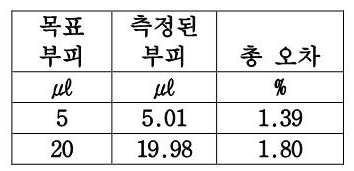
부피 측정은 팁 내의 액체의 정확한 위치선정에 의해 좌우되지 않는다는 것을 주목한다. 영상 분석은 팁 내의 액체의 위치에 대한 정보를 제공한다. 팁의 치수를 인식함으로써 어디에서든 액체에 의해 점유된 팁의 부분으로부터 부피를 항상 계산할 수 있다.Note that the volume measurement does not depend on the exact positioning of the liquid in the tip. Image analysis provides information about the position of the liquid in the tip. By recognizing the dimensions of the tip, the volume can always be calculated from the part of the tip occupied by the liquid anywhere.
(2) 액체 부피 측정의 도입에 의한 어세이 교정의 보정(2) Correction of assay calibration by introduction of liquid volume measurement
이것은 하기 시뮬레이션에서 예시된 바와 같이 달성된다. 샘플이 2종의 시약(시약 1 및 시약 2로 지칭됨)과 조합된 어세이를 고려한다. 샘플, 시약 1 및 시약 2에 대한 목표 부피는 10 ㎕이다. 어세이 결과는 측정된 신호를 분석물 농도와 관련시키는 표준 곡선으로부터 계산된다. 어세이 교정 과정의 일부로서, 샘플 및 시약을 위해 사용된 부피가 10 ㎕ 이외에 8 ㎕ 및 12 ㎕로 변화되고 어세이 결과가 10 ㎕ 부피에 적합한 교정에 기초하여 계산되는 실험을 수행할 수 있다. 도 105, 도 106 및 도 107에서, 결과는 실제 부피에 대하여 작도되었다. 샘플 부피의 경우, 어세이 결과는 본질적으로 사용된 부피에 정비례한다(도 105에 나타냄). 시약의 경우, 다소 비선형적인 반응이 관찰되었다(도 106 및 도 107에 나타냄). 이들 반응들은 당분야에서 잘 공지되어 있는 "전형적인" 어세이에 기초하고, 부피에 따른 변화의 크기가 표시된다.This is accomplished as illustrated in the following simulation. Consider an assay in which the sample is combined with two reagents (referred to as
그 다음, 본 발명자들은 본 발명자들이 부적합한 부피의 사용의 효과 이외에 어세이 결과에 대한 일정한 정도의 무작위 오차(약 5%, "현실 상황"을 반영하기 위함)를 부과한 평가를 시뮬레이션하였다. 본 발명자들은 샘플, 시약 1 및 시약 2가 모든 조합에서 8 ㎕, 10 ㎕ 및 12 ㎕로 설정되어 있는 결과를 포함한다. 이 실행으로부터의 결과가 부피 오차에 대한 보정 없이 도 108에 나타낸 바와 같이 작도되는 경우, 예측된 바와 같이, 사용된 실제 부피가 어세이 교정에 사용된 부피와 상이하였다는 사실을 무시하였기 때문에 보고된 결과에는 유의한 오차가 존재한다.We then simulated an assessment where we impose a certain amount of random error (about 5%, to reflect "reality") on assay results in addition to the effect of using an inappropriate volume. We include results where Sample,
그러나, 본 발명자들이 부피에 대한 공지된 어세이 반응을 이용하여 목표 값으로부터의 부피 변량을 허용하고 보정된 분석물 값을 작도하는 경우, 본 발명자들은 도 109에 나타낸 상당히 개선된 결과를 수득한다. 이것은 데이터의 다중 회귀 분석에 의해 달성되었다.However, when we use known assay reactions to volume to allow for volume variations from target values and plot the calibrated analyte values, we obtain significantly improved results as shown in FIG. 109. This was accomplished by multiple regression analysis of the data.
부피 보정을 이용하여 계산한 결과와 부피 보정을 이용하지 않고 계산한 결과를 비교하는 요약 통계자료는 하기 표에 제시되어 있고 부피 보정의 이용에 의한 모든 매트릭스에서의 유의한 개선을 반영한다. SEE는 추정치의 표준 오차이다.Summary statistics comparing the results calculated using volume correction with those calculated without volume correction are presented in the table below and reflect significant improvements in all matrices by using volume correction. SEE is the standard error of the estimate.

실시예Example 20: 현미경관찰 및 영상 분석을 이용한 혈구응집 억제 20: Hemagglutination inhibition using microscopic observation and image analysis 어세이Assay 판독 Reading
0.3%(중량/부피) 글루타르알데하이드를 함유하는 인산염 완충 식염수(100 ㎕)에서, 안정화된 칠면조 적혈구 세포 및 0.5 mg/㎖ 소 혈청 알부민, 및 표시된 경우 2 혈구응집 유닛의 불활성화된 인플루엔자 바이러스 및 15 ㎍의 염소 다중클론 항-인플루엔자 B 항체를 RT에서 원추형 기저부 PCR 튜브 내에서 15분 동안 항온처리하였다. 반응 생성물을 튜브의 기저부로부터 백색 광으로 조명된 투명 슬라이드로 옮기고 디지털 카메라를 이용하여 4배 확대율로 영상화하였다. 도 131에서 볼 수 있는 바와 같이, 적혈구 세포와 상기 바이러스의 혈구응집소의 반응에 의해 야기된 응집(도 131, 샘플 3)이 비응집된 대조군(도 131, 샘플 1)과의 비교에 의해 용이하게 관찰될 수 있다. 상기 바이러스에 대한 과량의 항체도 존재하였을 경우에는 응집이 완전히 억제되었다. 응집 반응의 2가지 효과가 주목할 만하다: (1) 응집된 샘플에서, 대조군에 비해 응집물의 보다 더 빠른 침강으로 인해 보다 더 많은 적혈구 세포가 존재하고, (2) 각각의 적혈구 세포가 평균적으로 다른 적혈구 세포와 보다 더 많이 클러스터링된다. 응집 반응을 영상 인식 소프트웨어에 따라 정량하여 적혈구 세포 및 응집물을 확인할 수 있고 위치를 찾아낼 수 있고 카운팅할 수 있다.Inactivated influenza virus in stabilized turkey erythrocytes and 0.5 mg / ml bovine serum albumin, and, if indicated, 2 hemagglutination units, in phosphate buffered saline (100 μl) containing 0.3% (weight / volume) glutaraldehyde. 15 μg of goat polyclonal anti-influenza B antibody was incubated for 15 minutes in conical basal PCR tubes at RT. The reaction product was transferred from the bottom of the tube to a transparent slide illuminated with white light and imaged at 4x magnification using a digital camera. As can be seen in FIG. 131, the aggregation caused by the reaction of erythrocytes with hemagglutinin of the virus (FIG. 131, sample 3) is readily compared with the control (FIG. 131, sample 1) where the non-aggregated control. Can be observed. Aggregation was completely inhibited in the presence of excess antibody to the virus. Two effects of the aggregation reaction are noteworthy: (1) in the aggregated sample, more red blood cells are present due to faster settling of the aggregates compared to the control, and (2) each red blood cell is on average different for red blood cells. More clustered with cells. Aggregation reactions can be quantified according to image recognition software to identify, locate and count red blood cells and aggregates.
도 131의 샘플 1은 비응집된 대조군(바이러스 부재, 항체 부재)을 보여준다. 도 131의 샘플 2는 비응집된 샘플(바이러스 + 항체)을 보여준다. 도 131의 샘플 3은 응집된 샘플(바이러스, 항체 부재)을 보여준다.
실시예Example 21: 샘플 준비, 21: sample ready, 상청액Supernatant 질의 조사 및 Investigation of quality and LDLLDL 침전물의 질 평가 Sediment Quality Assessment
혈장을 황산덱스트란(25 mg/㎗)과 황산마그네슘(100 mM)의 혼합물로 희석한 후(1:10) 1분 동안 항온처리하여 LDL-콜레스테롤을 침전시켰다. 반응 생성물을 원심분리기의 튜브 내로 흡입하고 캡핑한 후 3000 rpm에서 3분 동안 회전시켰다. 원심분리 전(백색 침전물을 보임) 및 원심분리 후(깨끗한 상청액을 보임) 원래의 반응 혼합물의 영상을 촬영하였고 (캡의 제거 후) LDL-콜레스테롤 펠렛의 영상을 촬영하였다. 예를 들면, 도 132 및 도 134는 반응 생성물을 촬영한 영상의 예를 보여준다.Plasma was diluted with a mixture of dextran sulfate (25 mg / dL) and magnesium sulfate (100 mM) (1:10) and then incubated for 1 minute to precipitate LDL-cholesterol. The reaction product was sucked into the tube of the centrifuge, capped and spun for 3 minutes at 3000 rpm. Images of the original reaction mixture were taken before centrifugation (showing white precipitate) and after centrifugation (showing clean supernatant) (after removal of the cap) and images of LDL-cholesterol pellets were taken. For example, FIGS. 132 and 134 show examples of images of reaction products.
LDL-침전 반응 생성물의 영상을 다음과 같이 분석하였다. 화소 색채 수준을 그들의 수직 위치의 함수로서 작도하였다. 값의 변량을 측정하였고, 3가지 색채에 대한 값들을 합산하였다. 광을 강하게 산란시키는 침전된 LDL의 입자 때문에, 침전물 값(1154)은 깨끗한 상청액의 값(672)보다 훨씬 더 컸다. 상기 상청액 값과 침전 시약에 노출되지 않은 대조군의 값의 비교는 원심분리의 질이 평가되게 한다(데이터는 나타내지 않음). 도 133은 원심분리기 내에서 회전시키기 전 및 원심분리기 내에서 회전시킨 후 분석된 영상의 예를 제공한다.Images of LDL-precipitation reaction products were analyzed as follows. Pixel color levels were plotted as a function of their vertical position. The variance of the values was measured and the values for the three colors were summed. Because of precipitated LDL particles that strongly scatter light, the precipitate value 1154 was much greater than the value 672 of the clean supernatant. Comparison of the supernatant value with that of the control not exposed to the precipitation reagents allows the quality of the centrifuge to be evaluated (data not shown). 133 provides examples of images analyzed before and after rotation in a centrifuge.
흑색 비닐 캡의 제거 후, LDL 침전물의 영상을 촬영하였다. 그의 부피는 팁의 기하학적 형태 및 영상에서의 화소의 크기를 알 때 매우 정확하게 측정될 수 있다. 이 실험에서, 침전물의 부피는 0.155 +/- 0.015 ㎕로서 추정되었다.After removal of the black vinyl caps, images of LDL precipitates were taken. Its volume can be measured very accurately when knowing the tip geometry and the size of the pixels in the image. In this experiment, the volume of precipitate was estimated as 0.155 +/- 0.015 μl.
실시예 22: 샘플로 인한 광학 신호의 3색 영상 블랭킹의 이용에 의한 알라닌 아미노트랜스퍼라제(Example 22 Alanine Aminotransferases by the Use of Tricolor Image Blanking of Optical Signals Due to Samples ALT)에Alt) 대한 About 어세이의Assy 성능 개선 Improve performance
혈청 중의 ALT는 이 효소가 알라닌을 피루베이트(산소 및 피루베이트 산화효소를 사용하여 과산화수소를 제조하는 데에 사용됨)로 전환시키는 어세이에서 측정될 수 있다. 그 다음, 상기 과산화물은 효소 호스라디쉬 퍼록시다제, 아미노안티피렌 및 N-에틸-N-(3-설포프로필)아닐린을 사용하여 착색된 생성물을 제조하는 데에 사용된다. 상기 착색된 생성물은 560 nm에서 최대로 흡수한다. ALT in serum can be measured in an assay in which the enzyme converts alanine to pyruvate (used to produce hydrogen peroxide using oxygen and pyruvate oxidase). The peroxide is then used to prepare colored products using the enzymes horseradish peroxidase, aminoantipyrene and N-ethyl-N- (3-sulfopropyl) aniline. The colored product absorbs maximum at 560 nm.
도 135에 나타낸 바와 같이 일부 혈청 샘플들이 이 파장에서 유의한 흡광도를 가지므로 상기 어세이를 방해한다는 것을 발견하였다. 구체적으로, 상대적으로 높은 샘플 농도(예컨대, 상기 어세이에서 1:10의 최종 희석)를 이용하였을 때, ALT 어세이의 3색 영상 분석은 임상 샘플의 사용 시 좋지 않은 결과를 제공하였다.As shown in FIG. 135, it was found that some serum samples have a significant absorbance at this wavelength and thus interfere with the assay. In particular, when using relatively high sample concentrations (eg, a final dilution of 1:10 in the assay), tricolor image analysis of the ALT assay gave poor results when using a clinical sample.
도 135는 완충제 내로 1:10으로 희석된 여러 혈청 샘플들의 스펙트럼을 보여주고, OD는 파장(nm)에 대해 작도되어 있다. OD의 큰 변경이 도 135에 나타나 있다.135 shows the spectra of several serum samples diluted 1:10 into buffer and OD is plotted against wavelength (nm). Large changes in OD are shown in FIG. 135.
통상적인 분광법에서, 이 문제점은 첨가된 어세이 성분들을 갖지 않는 샘플의 블랭크 판독치를 수득하고 어세이에 의해 발생된 신호로부터 상기 블랭크를 차감함으로써 처리된다. 본 발명에서와 같은 3색 영상 분석에서, 유사한 방법이 이용될 수 있다는 것을 발견하였다. 희석된 샘플을 영상화할 수 있고 3색 값을 추출할 수 있다. 그 다음, 비반응된 샘플로부터의 신호를 포함하도록 어세이 교정 알고리즘을 변화시킬 수 있다. 구체적으로 이 경우, (샘플 블랭크 신호를 포함하지 않는) 원래의 알고리즘은 다음과 같았다: ALT 농도 = a + b*R + c*G + d*B + e*R2(이때, a, b, c, d 및 e는 실험적으로 유도된 상수이고, R, G 및 B는 각각 적색, 녹색 및 청색 채널의 신호 값이다). 개선된 알고리즘은 다음과 같았다: ALT 농도 = a + b*R + c*G + d*B + e*Rs, + f*Rs2(이때, Rs는 적색 채널의 샘플 블랭크로부터의 신호이다)(a, b, c, d 및 e의 실험적으로 유도된 값은 원래의 알고리즘의 값과 상이하였다).In conventional spectroscopy, this problem is addressed by obtaining a blank reading of a sample without added assay components and subtracting the blank from the signal generated by the assay. In the three-color image analysis as in the present invention, it has been found that similar methods can be used. Diluted samples can be imaged and three color values extracted. The assay calibration algorithm can then be changed to include signals from unreacted samples. Specifically, in this case, the original algorithm (not including the sample blank signal) was as follows: ALT concentration = a + b * R + c * G + d * B + e * R 2 , where a, b, c, d and e are experimentally derived constants, and R, G and B are the signal values of the red, green and blue channels respectively). The improved algorithm was as follows: ALT concentration = a + b * R + c * G + d * B + e * Rs, + f * Rs 2 (where Rs is the signal from the sample blank of the red channel) The experimentally derived values of a, b, c, d and e were different from those of the original algorithm).
ALT 활성이 0 U/ℓ 내지 250 U/ℓ인 21개의 혈청 샘플들을 삼중으로 측정하였고, 3색 영상 분석의 결과를 임상 실험실 방법(Teco)에 의해 제공된 결과와 비교하였을 때, 훨씬 더 개선된 결과를 표시하는 하기 회귀 통계자료를 수득하였다.Twenty-one serum samples with ALT activity from 0 U / L to 250 U / L were measured in triplicate and much improved results when the results of the three-color image analysis were compared with the results provided by the clinical laboratory method (Teco) The following regression statistics were obtained.
실시예Example 23: 항-인플루엔자 항체에 대한 혈구응집 억제 23: Hemagglutination inhibition against anti-influenza antibodies 어세이의Assy 객관적인 분석의 가속 및 제공 Accelerate and Deliver Objective Analysis
실시예 20에 기재된 바와 같이 제조된 반응 혼합물을 1분 동안만 항온처리한 후 (상기 세포분석 실시예에 대해 기재된 바와 같이) 3개의 분리된 마이크로채널 내로 도입하고 영상화하였다. 적절한 통계자료를 수득하기 위해 각각의 샘플에 대해 약 5개 내지 10개의 영상을 촬영하였다. 평균적으로, 각각의 영상은 약 800개 내지 900개의 세포로 구성된다. 함수를 이용하여 개별 세포의 대표적인 선택 주변에서 세포의 방사형 분포를 측정함으로써 응집 과정을 객관적으로 평가할 수 있다.The reaction mixture prepared as described in Example 20 was incubated for only 1 minute, then introduced into three separate microchannels (as described for the cytometry example above) and imaged. About 5-10 images were taken for each sample to obtain appropriate statistics. On average, each image consists of about 800 to 900 cells. The function can be used to objectively assess the aggregation process by measuring the radial distribution of cells around a representative selection of individual cells.
상기 영상을 프로세싱하여 2-차원적 공간에서 개별 세포의 중심 위치를 수득하였다. 2-차원적 위치를 이용하여 쌍 상관관계 함수로도 공지되어 있는 방사형 분포 함수(RDF)를 계산하였다. 방사형 분포 함수 g(r)는 선택된 세포로부터 거리 r만큼 떨어진 위치에서 세포를 발견할 확률을 정량한다. 수학적으로, 하기 식으로 표시된다:The image was processed to obtain the central location of individual cells in two-dimensional space. The two-dimensional position was used to calculate a radial distribution function (RDF), also known as a pair correlation function. The radial distribution function g (r) quantifies the probability of finding a cell at a distance r away from the selected cell. Mathematically, it is represented by the following formula:
g(r) = ρ(r)/ρ o g ( r ) = ρ ( r ) / ρ o
상기 식에서, ρ(r)2πrdr은 특정 세포로부터 거리 r만큼 떨어진 위치에서 발견된 세포의 수이고, ρ o는 전체 영상 창에 걸친 평균 세포 밀도이다. 값 g(r)는 통계적으로 유의한 결과를 보장하기 위해 영상 내의 모든 입자들 및 다수의 영상들에 대한 평균으로서 계산된다.Where ρ ( r ) 2πrdr is the number of cells found at a distance r from a particular cell, and ρ o is the average cell density over the entire image window. The value g ( r ) is calculated as the mean for all the particles and multiple images in the image to ensure a statistically significant result.
결과result
g(r)의 제1 피크의 값은 샘플에서 이중항의 수를 정량한다. 따라서, 응집된 샘플에 대한 g(r)는 다른 2개의 샘플들에 비해 크기 면에서 더 높아야 한다. g의 값은 약 20개의 화소(적혈구 세포의 직경의 약 2배인 약 12 ㎛에 상응함)의 거리에 걸쳐 0부터 최대치까지 신속히 상승한 후 약 1.0까지 감소한다. 하기 나타낸 바와 같이, 바이러스로 인한 응집은 바이러스가 존재하지 않거나 항체가 바이러스에 의해 유도된 응집을 억제할 때의 응집 부재와 구별될 수 있었다.The value of the first peak of g ( r ) quantifies the number of doublets in the sample. Therefore, g ( r ) for the aggregated sample should be higher in size compared to the other two samples. The value of g rapidly rises from zero to a maximum and then decreases to about 1.0 over a distance of about 20 pixels (corresponding to about 12 μm, which is about twice the diameter of red blood cells). As shown below, aggregation due to virus could be distinguished from absence of aggregation when the virus was absent or the antibody inhibited virus induced aggregation.

실시예Example 24: 24: 앱타머를Aptamer 사용한 Used 분석물Analyte 검출 시스템의 준비 Preparation of the detection system
단백질(트롬빈 및 인슐린)을 선택적으로 포획하도록 2개의 올리고 DNA 앱타머를 디자인하였다. 상기 올리고 DNA 앱타머는 공개된 데이터로부터 선택된 서열을 갖는 결합 부위, 비드 또는 마이크로어레이의 표면으로부터 상기 결합 부위를 확장시키는 불활성 부위, 및 앱타머를 표면에 화학적으로 고정시키는 반응성 기로 구성되었다. (트롬빈에 대해 특이적인) 앱타머 1은 하기 서열을 가졌다: 5'-Am-(T)45GGTTGGTGTGGTTGG-3'. (인슐린에 대해 특이적인) 앱타머 2는 하기 서열을 가졌다: 5'-Am-(T)32ACAGGGGTGTGGGGACAGGGGTGTGGGG-3'. 각각의 서열의 시작에서 "Am"은 아미노 기를 나타낸다.Two oligo DNA aptamers were designed to selectively capture proteins (thrombin and insulin). The oligo DNA aptamers consisted of a binding site having a sequence selected from published data, an inert site that extends the binding site from the surface of a bead or microarray, and a reactive group to chemically fix the aptamer to the surface. Aptamer 1 (specific for thrombin) had the following sequence: 5'-Am- (T) 45 GGTTGGTGTGGTTGG-3 '. Aptamer 2 (specific for insulin) had the following sequence: 5'-Am- (T) 32 ACAGGGGTGTGGGGACAGGGGTGTGGGG-3 '. "Am" at the beginning of each sequence represents an amino group.
상기 2개의 앱타머를 카복실 기로 작용화된 폴리스티렌 비드(5 ㎛) 상에 고정시켰다. 그 다음, 상기 비드를 세척하였고 과량의 시약을 제거하였다. 그 다음, 상기 비드를 상기 앱타머의 결합 부위에 상보적인 형광 표지된 올리고 DNA 프로브와 혼합하였다. 상기 프로브와 상기 앱타머의 혼성화를 형광 방사로 검출하였다. 평균 형광 방사에 의해 측정되었을 때, 상보적인 프로브만이 양성 혼성화 사건을 보였다. 혼성화 특이성은 상보적 프로브와의 혼성화 후 비드를 보여주는 도 139와 비상보적인 프로브와의 혼성화 후 비드를 보여주는 도 140의 비교에 의해 확인된다. 상기 비드가 분석 기판 상에 침착된 후, CCD 카메라 상에서 635 nm에서 레이저 여기 및 650 nm(±10 nm)에서 여과된 방사를 이용하여 검출을 수행하였다. 앱타머 1 및 2를 고정시키기 위해 에폭시실란으로 코팅된 유리 표면 상에서 유사한 절차를 이용하였다. 상기 어레이를 형광 프로브와 혼성화시켰고 앱타머 결합 부위의 특이적 인식을 CCD 카메라 셋업 및 어레이 스캐너(이놉시스(Inopsys))를 이용한 형광 방사 검출로 측정하였다. 도 141은 상기 어레이에 대한 상기 앱타머의 결합 특이성을 보여주고, 이것은 도 142에 더 상세히 나타나 있다. 도 143은 예시적 어레이 스캔을 보여준다.The two aptamers were immobilized on polystyrene beads (5 μm) functionalized with carboxyl groups. The beads were then washed and excess reagent was removed. The beads were then mixed with a fluorescently labeled oligo DNA probe complementary to the binding site of the aptamer. Hybridization of the probe with the aptamer was detected by fluorescence emission. When measured by mean fluorescence emission, only complementary probes showed a positive hybridization event. Hybridization specificity is confirmed by comparison of FIG. 139 showing beads after hybridization with complementary probes and FIG. 140 showing beads after hybridization with non-complementary probes. After the beads were deposited on the assay substrate, detection was performed using laser excitation at 635 nm and filtered radiation at 650 nm (± 10 nm) on a CCD camera. Similar procedures were used on glass surfaces coated with epoxysilane to fix
실시예 25: 앱타머를 사용한 분석물의 검출Example 25 Detection of Analytes Using Aptamers
형광 표지된 상보적 프로브와 혼성화된 앱타머 1을 포함하는 어레이를 실시예 24에 기재된 바와 같이 제조하였다. 트롬빈을 약 100 nM의 농도로 상기 어레이에 도입하였고 앱타머 1-프로브 복합체와 반응시켰다. 상기 어레이 상의 앱타머 1로부터의 형광 방사 신호는 2.5배까지 감소되었는데, 이것은 앱타머 1과 트롬빈의 결합에 의한 상기 프로브의 치환을 암시한다.An
실시예Example 26: 결합제( 26: binder ( binderbinder ))
2종의 결합제를 바이오티닐화시키고 아비딘으로 코팅된 어세이 유닛 고체 상에서 포획 표면을 생성하는 데에 사용한다. 마이크로타이터 플레이트 상에서 (1) 앱타머 및 (2) 단일쇄 Fv 항체 단편(scFv)을 사용하여 어세이 시약 생성 및 발광 판독 어세이 결과를 수득한다. 앱타머 및 scFv는 발광-기초 어세이를 위한 결합제로서 본원에서 제공된 팁 및 영상화 시스템 및 디바이스에 적용될 수 있다. 발색 기질과 함께 신호 발생 시약을 알칼리성 포스파타제에서 예를 들면, 호스라디쉬 퍼록시다제로 변경하거나 발색 기질과 함께 알칼리성 포스파타제를 사용함으로써 색채를 측정하기 위해 카메라를 이용하여 분석물을 분석하고 판독할 수 있다. 마이크로플레이트(또는 다른 포맷) 내의 팁을 임의의 카트리지(어세이 유닛) 포맷에서 판독할 수 있다.Two binders are used to biotinylate and create capture surfaces on assay unit solids coated with avidin. Assay reagent generation and luminescence read assay results are obtained using (1) aptamer and (2) single-chain Fv antibody fragments (scFv) on microtiter plates. Aptamers and scFv can be applied to the tip and imaging systems and devices provided herein as binders for luminescence-based assays. The analyte can be analyzed and read out using a camera to measure color by changing the signaling reagent with a chromogenic substrate from alkaline phosphatase, e.g., to horseradish peroxidase, or by using alkaline phosphatase with a chromogenic substrate. have. The tip in the microplate (or other format) can be read in any cartridge (assay unit) format.
실시예Example 27: 27: 마이크로타이터Microtiter 플레이트 상에서 On the plate DNADNA 앱타머를Aptamer 사용한 비타민 D 어세이 Used Vitamin D Assays
본 실시예에서, 단일 가닥 DNA 앱타머를 사용하여 비타민 D에 대한 어세이를 수행한다. 복수의 웰을 갖는 마이크로타이터 플레이트의 울트라비딘-코팅된 폴리스티렌 표면 상에 바이오티닐화된 DNA 앱타머를 코팅한다. 코팅 전, 상기 앱타머를 약 95℃에서 가열한 후 얼음 상에서 즉시 냉각시킴으로써 신속히 변성시키고 재생시킨다. 그 다음, NaCl, MgCl2 및 10% 에탄올을 함유하는 25 mM 트리스(pH 7.5) 중의 재폴딩된 바이오티닐화된 비타민 D DNA 앱타머 약 15 ㎕를 각각의 웰에 첨가하여 포획 표면을 형성한다. 코팅 후, 상기 웰을 세척하고 약 100 ㎕의 차단제로 차단하여 비특이적 결합을 감소시킨다.In this example, assays for vitamin D are performed using single stranded DNA aptamers. The biotinylated DNA aptamer is coated onto the ultravidin-coated polystyrene surface of the microtiter plate having a plurality of wells. Prior to coating, the aptamer is rapidly denatured and regenerated by heating at about 95 ° C. and immediately cooling on ice. Then, about 15 μl of refolded biotinylated vitamin D DNA aptamer in 25 mM Tris pH 7.5 containing NaCl, MgCl 2 and 10% ethanol is added to each well to form the capture surface. After coating, the wells are washed and blocked with about 100 μl of blocker to reduce nonspecific binding.
상기 어세이에 대한 분석물(비타민 D)을 트리스(NaCl, MgCl2 및 10% 에탄올, pH 7.5)로 희석하고 원하는 어세이 범위 내의 상이한 농도에서 비타민 D-알칼리성 포스파타제 접합체의 용액과 혼합하고 어세이 유닛에 제공하여 실온에서 10분 동안 항온처리한다. 그 다음, 어세이 유닛을 100 ㎕의 세척 완충제로 3회 세척한다. 알칼리성 포스파타제에 대한 기질 약 40 ㎕를 각각의 어세이 웰에 첨가하고, 화학발광 데이터(하기 표)를 약 10분 후에 수집한다. 도 144는 비타민 D의 농도(ng/㎖)에 대해 화학발광도를 작도한 것이다.Dilute the analyte (vitamin D) for the assay with Tris (NaCl, MgCl 2 and 10% ethanol, pH 7.5) and mix with a solution of the vitamin D-alkaline phosphatase conjugate at different concentrations within the desired assay range and assay Provide to the unit and incubate for 10 minutes at room temperature. The assay unit is then washed three times with 100 μl of wash buffer. About 40 μl of substrate for alkaline phosphatase is added to each assay well and chemiluminescence data (Table below) is collected after about 10 minutes. FIG. 144 plots chemiluminescence versus concentration (ng / ml) of vitamin D. FIG.

실시예Example 28: 28: 마이크로타이터Microtiter 플레이트 상의 On the plate 에스트라디올Estradiol 어세이Assay
본 실시예에서, 단일쇄 가변 단편(scFv)을 사용하여 스테로이드 호르몬(에스트라디올)에 대한 어세이를 수행한다. 본 어세이에서, 복수의 웰을 갖는 마이크로타이터 플레이트의 울트라비딘-코팅된 폴리스티렌 표면 상에서 어세이 유닛의 내면을 바이오티닐화된 scFv로 코팅한다. 트리스 완충 식염수(pH 8, 0.03% BSA, 0.05% 티메로살) 중의 1 ㎍/㎖ 바이오티닐화된 scFv 약 15 ㎕를 각각의 어세이 유닛에 첨가하였다. 세척 후, 각각의 어세이 유닛을 100 ㎕의 고정 시약으로 고정시킨 후 건조 공기로 밤새 건조하고 건조된 상태로 저장한다.In this example, assays for steroid hormones (estradiol) are performed using single chain variable fragments (scFv). In this assay, the inner surface of the assay unit is coated with biotinylated scFv on the ultravidin-coated polystyrene surface of the microtiter plate having a plurality of wells. About 15 μl of 1 μg / ml biotinylated scFv in Tris buffered saline (
상기 어세이에 대한 분석물(자유 에스트라디올)을 트리스 완충 식염수(pH 8, BSA, 티메로살)로 희석하고 바이오스탭(Biostab)으로부터의 안정화제 중의 에스트라디올-알칼리성 포스파타제 접합체와 혼합하고 실온에서 약 10분 동안 scFv로 코팅된 어세이 유닛에 제공한다.Analyte (free estradiol) for this assay was diluted with Tris buffered saline (
그 다음, 어세이 웰을 100 ㎕의 세척 완충제로 5회 세척한다. 세척 후, 알칼리성 포스파타제에 대한 발광 기질(KPL 포스파글로(PhosphaGlo)) 40 ㎕를 각각의 어세이 유닛에 첨가하고, 화학발광도 데이터(하기 표)를 약 10분 후에 수집한다. 도 145는 에스트라디올의 농도(pg/㎖)에 대해 화학발광도를 작도한 것이다.Assay wells are then washed 5 times with 100 μl of wash buffer. After washing, 40 μl of luminescent substrate (KPL PhosphaGlo) for alkaline phosphatase is added to each assay unit and chemiluminescence data (Table below) is collected after about 10 minutes. 145 plots chemiluminescence versus concentration of estradiol (pg / ml).

실시예Example 29: 백혈구 세포 29: white blood cell 카운팅Counting 및 감별 And discrimination 어세이Assay
인간 대상체의 말초혈 중의 백혈구 세포(WBC)의 농도는 약 1,000개 세포/㎕ 내지 100,000개 세포/㎕일 수 있다. 그러나, 몇몇 경우, 영상화 시스템의 범위는 보다 더 한정된다(예컨대, 약 4,000개 세포/㎕ 내지 7,000개 세포/㎕). 세포 농도가 4,000개 세포/㎕ 미만인 경우, 시스템은 어세이에 의해 요구될 수 있는 목표치인 10,000개 세포를 셀 수 없을 수 있다. 샘플 중의 세포 농도가 7,000개 세포/㎕를 초과하는 경우, 각각의 시야는 정확한 영상 분할 및 세포 수 세기를 수행하기에는 너무 군집되어 있을 수 있다. WBC를 영상화하는 예시적 방법이 하기에 제공되어 있다.The concentration of leukocytes (WBC) in peripheral blood of a human subject may be between about 1,000 cells / μl and 100,000 cells / μl. However, in some cases, the range of imaging systems is even more limited (eg, about 4,000 cells / μl to 7,000 cells / μl). If the cell concentration is less than 4,000 cells / μl, the system may not be able to count 10,000 cells, which is a target that may be required by the assay. If the cell concentration in the sample exceeds 7,000 cells / μl, each field of view may be too crowded to perform accurate image segmentation and cell counting. An exemplary method of imaging the WBC is provided below.
일례에서, 형광 분광광도측정을 위해 구성된 영상화 시스템(예를 들면, 세포분석기)이 제공된다. 상기 시스템은 형광 분광광도측정을 이용하여 샘플 중의 세포 농도를 측정한다. 상기 샘플을 영상화를 위한 형광 접합된 항체(예를 들면, AF647-CD45)로 표지하고 형광 핵산 마커(예를 들면, DRAQ5)로도 표지한다. 분광광도계 모듈 상에서의 정량적 형광 판독은 낮은 민감도(약 5,000개 세포/㎕의 LLOQ) 및 (그러나) 높은 동적 범위(예를 들면, 5,000개 세포/㎕ 내지 100,000개 세포/㎕)에서 WBC의 농도의 측정치를 제공한다. 분광광도계 상에서 측정된 농도는 세포 현탁액의 최종 농도가 4,000개 세포/㎕ 내지 7,000개 세포/㎕가 되도록 최적 희석비의 계산을 가능하게 한다.In one example, an imaging system (eg, a cytometer) configured for fluorescence spectrophotometry is provided. The system uses fluorescence spectrophotometry to measure the cell concentration in the sample. The sample is labeled with a fluorescent conjugated antibody (eg AF647-CD45) for imaging and also with a fluorescent nucleic acid marker (eg DRAQ5). Quantitative fluorescence readings on the spectrophotometer module were used to determine the concentration of WBC at low sensitivity (LLOQ of about 5,000 cells / μL) and (but) high dynamic range (eg, 5,000 cells / μL to 100,000 cells / μL). Provide the measurements. The concentration measured on the spectrophotometer allows the calculation of the optimal dilution ratio such that the final concentration of the cell suspension is from 4,000 cells / μl to 7,000 cells / μl.
도 146은 WBC 농도의 분광광도측정에서 형광의 높은 동적 범위를 보여준다. 형광 표지된 항-CD45 및 다른 항체 태그로 태깅된 WBC를, 약 640 nm의 파장을 갖는 적색 광으로 여기시켰고, 정량적 형광 방사 스펙트럼을 수집하였다. 적분된 형광도가 y-축 상에 작도되어 있다.146 shows high dynamic range of fluorescence in spectrophotometric measurements of WBC concentration. WBCs tagged with fluorescently labeled anti-CD45 and other antibody tags were excited with red light having a wavelength of about 640 nm and quantitative fluorescence emission spectra were collected. The integrated fluorescence is plotted on the y-axis.
실시예Example 30: 등온 증폭에 의한 30: by isothermal amplification 스트렙토코커스Streptococcus 군 A 검출 Group A detection
특정 게놈 샘플의 등온 증폭을 탁도로 검출할 수 있다. 본 실시예에서, 스트렙토코커스 군 A(StrepA) 세포(저장액 농도 = 2x10⁸ org/㎖, 마이 바이오소스(My biosource)로부터 입수됨)로부터 추출된 게놈 샘플을 등온 증폭으로 증폭하였고, 반응의 진행을 탁도로 측정하였다. 약 5 ㎕의 저장액 세균 세포 및 45 ㎕의 RT PCR 등급 물(저장액의 10X 희석)을 약 95℃에서 약 8분 내지 10분 동안 열처리하였다(세포가 파괴되고 DNA를 방출함). 게놈 샘플을 희석하였고, 증폭을 위한 물질(예를 들면, DNA 중합효소, 프라이머, 완충제)을 함유하는 PCR 튜브 내에 약 25 ㎕의 샘플 부피로 도입하였다. 반응의 진행을 탁도로 기록하면서 상기 PCR 튜브를 약 61℃에서 약 60분 동안 항온처리하였다. 결과는 다음과 같고, 도 147은 시간의 함수로서 탁도를 작도한 것을 보여준다:Isothermal amplification of specific genomic samples can be detected as turbidity. In this example, genomic samples extracted from Streptococcus group A (StrepA) cells (stock concentration = 2x10 8 org / ml, obtained from My biosource) were amplified by isothermal amplification and progress of reaction. Was measured by turbidity. About 5 μl of stock bacterial cells and 45 μl of RT PCR grade water (10 × dilution of stock) were heat treated at about 95 ° C. for about 8 to 10 minutes (cells destroyed and released DNA). Genomic samples were diluted and introduced at a sample volume of about 25 μl into a PCR tube containing material for amplification (eg, DNA polymerase, primers, buffer). The PCR tube was incubated at about 61 ° C. for about 60 minutes while recording the progress of the reaction as turbidity. The results are as follows, and FIG. 147 shows the plot of turbidity as a function of time:

3종의 분리된 실험을 800 카피/㎕ 및 80 카피/㎕에서 수행하였다. 합성 게놈 DNA 주형(진스크립트(Genescript)로부터 입수됨)을 갖는 StrepA를 사용하여 실험 A를 수행하였다. 저장액 StrepA를 10배 희석한 후 95℃에서 약 8분 내지 10분 동안 열 불활성화시킨 다음, 열 불활성화된 10배 희석된 저장액 StrepA를 연속적으로 희석함으로써 실험 B를 수행하였다. 가변 농도의 저장액 StrepA(불활성화된 세균 세포)를 사용한 후 95℃에서 약 10분 동안 열불활성화시킴으로써 실험 C를 수행하였다. 각각의 실험에 대한 변곡점은 도 148에 나타나 있다. 800 카피/㎕ 및 80 카피/㎕ 각각의 경우, 3개 도표의 그룹핑은 좌측에서 실험 A, 중간에서 실험 B 및 우측에서 실험 C를 포함한다. 평균 변곡점은 하기 표에 제공되어 있다:Three separate experiments were performed at 800 copies / μl and 80 copies / μl. Experiment A was performed using StrepA with a synthetic genomic DNA template (obtained from Genescript). Experiment B was performed by 10-fold dilution of stock StrepA followed by heat inactivation at 95 ° C. for about 8-10 minutes, followed by serial dilution of the heat-inactivated 10-fold diluted stock StrepA. Experiment C was performed by using a variable concentration of stock solution StrepA (inactivated bacterial cells) followed by thermal inactivation at 95 ° C. for about 10 minutes. The inflection point for each experiment is shown in FIG. 148. For each of 800 copies / μl and 80 copies / μl, the grouping of the three plots included Experiment A on the left, Experiment B on the middle and Experiment C on the right. Average inflection points are provided in the table below:

실시예Example 31: 자성 31: Magnetic 비드의Bead 사용 use
본 실시예에서, ELISA 어세이를 통해 단백질 및 소분자를 분석하기 위해 자성 비드를 사용한다. 도 110은 ELISA 어세이에 대한 예시적 방법을 개략적으로 보여준다. 상기 어세이는 2종의 단백질들, 즉 단백질 1 및 단백질 2를 포함한다. 단백질 1은 약 150배(팁 프로토콜 = 30배)의 샘플 희석, 약 0.007 ㎕의 샘플 부피, 약 1 ㎕의 희석된 샘플 부피, 약 3 ㎕의 반응 부피 및 약 10분(min)(샘플 항온처리 및 기질 항온처리)의 반응 시간을 갖는다. 단백질 1에 대한 결과는 하기 표에 나타나 있다. 단백질 1에 대한 시험 2의 결과는 도 149에 나타나 있다.In this example, magnetic beads are used to analyze proteins and small molecules via ELISA assays. 110 schematically shows an example method for an ELISA assay. The assay includes two proteins,
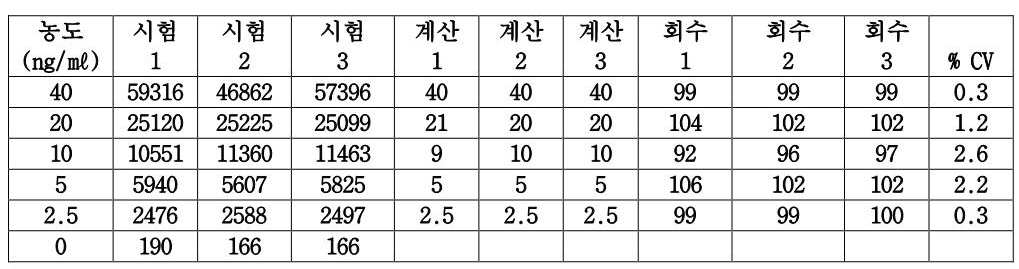
단백질 2는 약 667배의 샘플 희석, 약 0.0015 ㎕의 샘플 부피, 약 1 ㎕의 희석된 샘플 부피, 약 3 ㎕의 반응 부피 및 약 10분(샘플 항온처리 및 기질 항온처리)의 반응 시간을 갖는다. 단백질 2에 대한 결과는 하기 표에 나타나 있다. 단백질 2에 대한 시험 1의 결과는 도 150에 나타나 있다.

특정 실시가 예시되고 기재되어 있지만, 이에 대한 다양한 변형물들을 만들 수 있고 이 변형물들도 본원에서 고려된다는 것을 상기 설명으로부터 이해해야 한다. 또한, 본 발명은 본 명세서에 내에 제공된 특정 예로 한정되어서는 안 된다. 본 발명이 전술된 설명과 관련하여 기재되어 있지만, 본원의 바람직한 실시양태의 설명 및 예시는 한정하는 의미로서 해석되어서는 안 된다.While specific implementations have been illustrated and described, it should be understood from the above description that various modifications may be made thereto and these modifications are also contemplated herein. In addition, the present invention should not be limited to the specific examples provided herein. Although the present invention has been described in connection with the foregoing description, the description and illustration of the preferred embodiments herein should not be construed in a limiting sense.
나아가, 본 발명의 모든 양태들이 다양한 조건들 및 변수들에 의해 좌우되는 본원에 기재된 특정 묘사, 구성 또는 상대적 비율로 한정되지 않는다는 것을 이해할 것이다. 본 발명의 실시양태의 형태 및 세부사항에서의 다양한 변형물들이 당업자에게 자명할 것이다. 따라서, 본 발명은 임의의 이러한 변형물, 변경물 및 등가물도 포함할 것으로 예상된다.Furthermore, it will be understood that not all aspects of the invention are limited to the specific depictions, configurations, or relative proportions described herein, which are governed by various conditions and variables. Various modifications in form and detail of embodiments of the invention will be apparent to those skilled in the art. Accordingly, the present invention is intended to include any such variations, modifications, and equivalents.
Claims (91)
(a) 제1 경로 길이를 갖는 제1 영역을 따라 상기 용기를 조명하여 상기 제1 경로 길이를 가로질러 투과된 광 강도의 제1 측정치를 수득하는 단계;
(b) 상기 제1 측정치가 투과된 광 강도의 예정된 동적 범위를 벗어나는 경우 상기 샘플 유체를, 또 다른 경로 길이를 갖는 용기 내의 또 다른 영역으로 이동시키는 단계;
(c) 상기 또 다른 영역을 따라 상기 용기를 조명하여 상기 또 다른 경로 길이를 가로질러 투과된 광 강도의 또 다른 측정치를 수득하는 단계; 및 임의적으로
(d) 광 강도의 측정치가 예정된 동적 범위 내에 포함될 때까지 단계 (b) 및 (c)를 반복하여 분석물의 존재 또는 농도를 검출하는 단계.A method of detecting the presence or concentration of an analyte in a sample fluid contained in a vessel, the method comprising the following steps:
(a) illuminating the container along a first area having a first path length to obtain a first measurement of the light intensity transmitted across the first path length;
(b) moving the sample fluid to another region in the vessel having another path length when the first measurement is outside the predetermined dynamic range of transmitted light intensity;
(c) illuminating the vessel along the another area to obtain another measure of light intensity transmitted across the another path length; And optionally
(d) repeating steps (b) and (c) until the measurement of light intensity is within a predetermined dynamic range to detect the presence or concentration of the analyte.
(a) 복수의 상이한 폭에 상응하는 복수의 상이한 경로 길이를 따라 광의 투과를 허용하도록 복수의 상이한 폭을 갖는 치수를 가진 용기에 함유된 샘플을 제공하는 단계;
(b) 상기 복수의 경로 길이 중 하나 이상의 경로 길이를 따라 상기 용기를 조명하는 단계; 및
(c) 상기 용기를 영상화하여 복수의 경로 길이 중 상기 하나 이상의 경로 길이를 가로질러 투과된 제1 광 강도를 측정함으로써, 측정된 제1 광 강도에 기초하여 분석물의 농도를 결정하는 단계.A method of measuring analyte concentration in a sample fluid, the method comprising the following steps:
(a) providing a sample contained in a container having dimensions having a plurality of different widths to allow transmission of light along a plurality of different path lengths corresponding to the plurality of different widths;
(b) illuminating the container along one or more of the plurality of path lengths; And
(c) imaging the vessel to determine a concentration of analyte based on the measured first light intensity by measuring a first light intensity transmitted across the one or more path lengths of the plurality of path lengths.
(a) 상기 용기를 영상화하여 상기 용기의 또 다른 상이한 폭에 상응하는 또 다른 경로 길이를 가로질러 투과된 제2 광 강도를 측정하는 단계;
(b) 상기 제1 광 강도를 상기 제2 광 강도와 비교하는 단계; 및
(c) 상기 비교 단계에 기초하여 분석물 농도를 결정하는 단계.The method of claim 13, further comprising the following steps:
(a) imaging the vessel to measure a second light intensity transmitted across another path length corresponding to another different width of the vessel;
(b) comparing the first light intensity with the second light intensity; And
(c) determining analyte concentration based on the comparison step.
(a) 흡입기와 맞물리도록 구성된 피펫 팁 또는 폐쇄된 튜브로서, 2개의 대향 단부(이들 중 하나 이상의 단부가 폐쇄되어 있거나 밀폐가능함)를 포함하는 피펫 팁 또는 폐쇄된 튜브; 및
(b) 생물학적 유체 중의 하나 이상의 성분의 상기 분리를 수행하기 위해 상기 밀폐된 피펫 팁 또는 폐쇄된 튜브를 수용하도록 구성된 원심분리기.An automated system for separating one or more components of a biological fluid, the system comprising (a) and (b):
(a) a pipette tip or closed tube configured to engage an inhaler, the pipette tip or closed tube comprising two opposing ends, one or more of which are closed or sealable; And
(b) a centrifuge configured to receive the closed pipette tip or closed tube to effect the separation of one or more components of a biological fluid.
영상화 디바이스; 및
(a)의 피펫 팁 또는 튜브 내로의 액체의 분배를 허용하거나 (a)의 피펫 팁 또는 튜브로부터의 액체의 흡입을 허용하는 치수를 갖는 하나 이상의 다른 피펫 팁
을 추가로 포함하는 시스템.22. The method of claim 21,
Imaging device; And
at least one other pipette tip having a dimension that permits the dispensing of liquid into the pipette tip or tube of (a) or allows suction of liquid from the pipette tip or tube of (a)
The system further includes.
(a) 2개의 대향 단부(이들 중 하나 이상의 단부가 밀폐가능하거나 밀폐되어 있음)를 포함하는 피펫 팁 또는 튜브 내로 샘플을 로딩하는 단계;
(b) 상기 피펫 팁의 하나 이상의 단부 상에서 상기 피펫 팁 또는 상기 튜브를 밀폐시키는 단계;
(c) 밀폐된 피펫 팁 또는 튜브를 원심분리함으로써, 상기 샘플을 상청액과 펠렛으로 분리하는 계면 영역을 형성하는 단계;
(d) 원심분리된 피펫 팁 또는 튜브를 영상화하여 계면 영역의 위치를 결정하는 단계; 및
(e) 상기 계면 영역의 위치에 기초하여 상청액을 자동적으로 흡입하는 단계.A method of isolating a component in a sample, the method comprising the following steps:
(a) loading a sample into a pipette tip or tube comprising two opposing ends, at least one of which is sealable or sealed;
(b) sealing the pipette tip or the tube on at least one end of the pipette tip;
(c) centrifuging the closed pipette tip or tube to form an interface region that separates the sample into supernatant and pellets;
(d) imaging the centrifuged pipette tip or tube to determine the location of the interfacial region; And
(e) automatically aspirating the supernatant based on the location of the interface region.
(a) 샘플의 디지털 영상을 수득하는 단계로서, 이때 상기 디지털 영상이 적어도 2-차원적 화소 어레이를 포함하고, 이때 각각의 화소가 복수의 강도 값을 포함하고, 이들 강도 값 각각이 상이한 검출 스펙트럼 영역에 상응하는 것인 단계;
(b) 프로그래밍가능한 디바이스를 이용하여, 수득된 강도 값을 각각의 검출 스펙트럼 영역의 동적 범위를 정의하는 예정된 값 세트와 상호관련시키는 단계; 및
(c) 수득된 강도 값과 예정된 값 세트의 상기 상호관련에 기초하여 샘플 중의 상기 분석물의 존재 및/또는 양을 예측하는 단계.A method of characterizing an analyte suspected of being present in a sample, the method comprising the following steps:
(a) obtaining a digital image of a sample, wherein the digital image comprises at least a two-dimensional pixel array, wherein each pixel comprises a plurality of intensity values, each of these intensity values having a different detection spectrum Corresponding to a region;
(b) using a programmable device to correlate the obtained intensity values with a predetermined set of values defining a dynamic range of each detection spectral region; And
(c) predicting the presence and / or amount of said analyte in a sample based on said correlation of the obtained intensity value with a predetermined set of values.
(a) 상기 생물학적 유체 샘플을 제공하는 단계;
(b) 상기 분석물을 상기 분석물과 특이적으로 반응하는 하나 이상의 시약과 반응시켜 광학적으로 검출가능한 신호를 발생시키는 단계; 및
(c) 복수의 검출 스펙트럼 영역들을 이용하여 상기 광학적으로 검출가능한 신호를 측정하는 단계로서, 이때 하나 이상의 검출 스펙트럼 영역의 동적 범위 내의 상기 광학적으로 검출가능한 신호의 존재가 상기 생물학적 유체 샘플 중의 상기 분석물의 농도를 표시하는 것인 단계.A method of characterizing an analyte suspected of being present in a biological fluid sample, the method comprising the following steps:
(a) providing the biological fluid sample;
(b) reacting the analyte with one or more reagents that specifically react with the analyte to generate an optically detectable signal; And
(c) measuring the optically detectable signal using a plurality of detection spectral regions, wherein the presence of the optically detectable signal within the dynamic range of at least one detection spectral region is determined by the analyte in the biological fluid sample. Indicating the concentration.
(a) 제1 팁 내의 샘플을 영상화하여 제1 샘플의 부피를 측정하는 단계;
(b) 제2 팁 내의 하나 이상의 시약을 영상화하여 상기 하나 이상의 시약의 부피를 측정하는 단계;
(c) 상기 샘플과 상기 하나 이상의 시약을 혼합하여 반응 혼합물을 형성하는 단계;
(d) 상기 반응 혼합물을 영상화하는 단계;
(e) 상기 샘플 및 상기 하나 이상의 시약의 상기 측정된 부피에 기초하여 교정하는(calibrating) 단계; 및
(f) 교정을 이용하여 분석물의 농도를 계산하는 단계.A method of increasing the accuracy of an assay, the method comprising the following steps:
(a) imaging a sample in the first tip to measure the volume of the first sample;
(b) imaging one or more reagents in the second tip to determine the volume of the one or more reagents;
(c) mixing the sample with the one or more reagents to form a reaction mixture;
(d) imaging the reaction mixture;
(e) calibrating based on the measured volume of the sample and the one or more reagents; And
(f) calculating the concentration of analyte using calibration.
(a) 유체 샘플 중의 하나 이상의 성분의 상기 분리를 수행하기 위해 용기를 수용하도록 구성된 하나 이상의 버킷(bucket)을 포함하는 원심분리기; 및
(b) 상기 버킷의 형태 특징부(shaped feature)에 상보적인 하나 이상의 형태 특징부를 포함하는 용기.An automated system for separating one or more components of a biological fluid, the automated system comprising (a) and (b):
(a) a centrifuge comprising one or more buckets configured to receive a container to effect said separation of one or more components of a fluid sample; And
(b) a container comprising one or more shape features complementary to shaped features of the bucket.
상기 개방 단부를 통해 상기 용기 내로 확장되도록 구성되어 있고 제1 개방 단부 및 제2 개방 단부를 포함하는 팁으로서, 상기 제2 개방 단부가 상기 용기 내로 삽입되어 있는 것인 팁
을 포함하는 셋업(setup)으로서, 이때 상기 용기 또는 팁이, 상기 팁의 제2 개방 단부가 상기 용기의 폐쇄 단부의 내면의 기저부(bottom)와 접촉하는 것을 방지하는 돌출 표면 특징부를 추가로 포함하는 것인 셋업.A container configured to receive and confine a sample, comprising: a container including an inner surface, an outer surface, an open end and an opposing closed end; And
A tip configured to extend through the open end into the container and comprising a first open end and a second open end, wherein the second open end is inserted into the container
A setup comprising: wherein the vessel or tip further comprises a protruding surface feature that prevents the second open end of the tip from contacting the bottom of the inner surface of the closed end of the vessel. Setup.
상기 샘플 준비 구역, 어세이 구역 및 검출 구역 중 하나 이상의 구역을 이용하여 지정된 위치에서 현장서비스(a point-of-service)를 수행하기 위한 컴퓨터-실행가능한 명령어(commands)를 갖는 제어 유닛(unit); 및
핑거스틱(fingerstick)으로부터 수득된 샘플의 원심분리를 수행하도록 구성된 하나 이상의 원심분리기
를 포함하는 샘플 프로세싱 장치. Sample station, assay zone and / or detection zone;
A control unit having computer-executable instructions for performing a point-of-service at a designated location using one or more of the sample preparation zone, assay zone and detection zone ; And
One or more centrifuges configured to perform centrifugation of samples obtained from a fingerstick
Sample processing apparatus comprising a.
검출 기작을 이용하여 용기 내의 샘플의 초기 측정을 수행하는 단계;
상기 초기 측정에 기초하여, 프로세서를 이용하여 샘플 농도가 원하는 범위 내에 포함되는지를 결정하고, 프로세서를 이용하여 (a) 상기 샘플 농도가 상기 원하는 범위보다 더 높은 경우 수행될 희석의 정도, 또는 (b) 상기 샘플 농도가 상기 원하는 범위보다 더 낮은 경우 수행될 농축의 정도를 결정하는 단계; 및
결정된 희석의 정도 또는 결정된 농축의 정도에 따라 상기 샘플 농도를 조절하는 단계.Dynamic feedback method comprising the following steps:
Performing an initial measurement of a sample in the container using a detection mechanism;
Based on the initial measurement, a processor is used to determine whether the sample concentration is within a desired range, and a processor is used to (a) the degree of dilution to be performed if the sample concentration is higher than the desired range, or (b Determining the degree of concentration to be performed when the sample concentration is lower than the desired range; And
Adjusting the sample concentration according to the degree of dilution determined or the degree of concentration determined.
검출 기작이 샘플의 특성을 측정하는 조건의 영상을 포착하는 단계; 및
프로세서를 이용하여, 검출 기작이 작동되는 바람직하지 않은 조건이 존재하는지를 상기 영상에 기초하여 결정하는 단계.A method of providing quality control, comprising the following steps:
Capturing an image of a condition under which a detection mechanism measures a characteristic of a sample; And
Using the processor, determining based on the image whether there is an undesirable condition under which the detection mechanism is to operate.
Applications Claiming Priority (3)
| Application Number | Priority Date | Filing Date | Title |
|---|---|---|---|
| US201161435250P | 2011-01-21 | 2011-01-21 | |
| US61/435,250 | 2011-01-21 | ||
| PCT/US2012/022130 WO2012100235A2 (en) | 2011-01-21 | 2012-01-20 | Systems and methods for sample use maximization |
Publications (2)
| Publication Number | Publication Date |
|---|---|
| KR20140003553A true KR20140003553A (en) | 2014-01-09 |
| KR101909764B1 KR101909764B1 (en) | 2018-12-10 |
Family
ID=46516422
Family Applications (1)
| Application Number | Title | Priority Date | Filing Date |
|---|---|---|---|
| KR1020137021727A Expired - Fee Related KR101909764B1 (en) | 2011-01-21 | 2012-01-20 | Systems and methods for sample use maximization |
Country Status (17)
| Country | Link |
|---|---|
| US (8) | US20120309636A1 (en) |
| EP (2) | EP2666008B1 (en) |
| JP (4) | JP5945282B2 (en) |
| KR (1) | KR101909764B1 (en) |
| CN (7) | CN106290159A (en) |
| AR (1) | AR085087A1 (en) |
| AU (1) | AU2012207090B2 (en) |
| BR (1) | BR112013018656B1 (en) |
| CA (2) | CA2825196C (en) |
| ES (1) | ES2895518T3 (en) |
| IL (1) | IL227579B (en) |
| MX (3) | MX349288B (en) |
| RU (1) | RU2620922C2 (en) |
| SG (2) | SG10201600463YA (en) |
| TW (4) | TW202208825A (en) |
| WO (1) | WO2012100235A2 (en) |
| ZA (1) | ZA201305478B (en) |
Cited By (1)
| Publication number | Priority date | Publication date | Assignee | Title |
|---|---|---|---|---|
| WO2017039690A1 (en) * | 2015-09-04 | 2017-03-09 | Qualigen, Inc. | Systems and methods for sample verification |
Families Citing this family (224)
| Publication number | Priority date | Publication date | Assignee | Title |
|---|---|---|---|---|
| WO2008041900A1 (en) * | 2006-10-06 | 2008-04-10 | Boule Medical Ab | Device for extraction of a partial defined sample volume from a lager volume, method for operating the device, set of at least two devices, method of operation the set, an analytical instrument connectable to the device, method for operating the instrument, a system, and a method for operating the system |
| ES2447875T3 (en) | 2007-10-02 | 2014-03-13 | Theranos, Inc. | Modular devices for care points and their uses |
| US8493441B2 (en) * | 2009-09-11 | 2013-07-23 | Thonhauser Gmbh | Absorbance measurements using portable electronic devices with built-in camera |
| MX349288B (en) | 2011-01-21 | 2017-07-21 | Theranos Inc | Systems and methods for sample use maximization. |
| US10426356B2 (en) | 2011-07-09 | 2019-10-01 | Gauss Surgical, Inc. | Method for estimating a quantity of a blood component in a fluid receiver and corresponding error |
| US9870625B2 (en) | 2011-07-09 | 2018-01-16 | Gauss Surgical, Inc. | Method for estimating a quantity of a blood component in a fluid receiver and corresponding error |
| US8792693B2 (en) | 2011-07-09 | 2014-07-29 | Gauss Surgical | System and method for estimating extracorporeal blood volume in a physical sample |
| US9646375B2 (en) | 2011-07-09 | 2017-05-09 | Gauss Surgical, Inc. | Method for setting a blood transfusion parameter |
| US9664702B2 (en) | 2011-09-25 | 2017-05-30 | Theranos, Inc. | Fluid handling apparatus and configurations |
| US9619627B2 (en) | 2011-09-25 | 2017-04-11 | Theranos, Inc. | Systems and methods for collecting and transmitting assay results |
| US9632102B2 (en) | 2011-09-25 | 2017-04-25 | Theranos, Inc. | Systems and methods for multi-purpose analysis |
| US8840838B2 (en) | 2011-09-25 | 2014-09-23 | Theranos, Inc. | Centrifuge configurations |
| US9268915B2 (en) | 2011-09-25 | 2016-02-23 | Theranos, Inc. | Systems and methods for diagnosis or treatment |
| US20140170735A1 (en) | 2011-09-25 | 2014-06-19 | Elizabeth A. Holmes | Systems and methods for multi-analysis |
| US8475739B2 (en) | 2011-09-25 | 2013-07-02 | Theranos, Inc. | Systems and methods for fluid handling |
| US10012664B2 (en) | 2011-09-25 | 2018-07-03 | Theranos Ip Company, Llc | Systems and methods for fluid and component handling |
| US9250229B2 (en) | 2011-09-25 | 2016-02-02 | Theranos, Inc. | Systems and methods for multi-analysis |
| US9810704B2 (en) | 2013-02-18 | 2017-11-07 | Theranos, Inc. | Systems and methods for multi-analysis |
| EP4033405B1 (en) | 2012-05-14 | 2024-06-12 | Gauss Surgical, Inc. | Methods for managing blood loss of a patient |
| CN109738621B (en) | 2012-05-14 | 2021-05-11 | 高斯外科公司 | System and method for estimating amount of blood component in liquid tank |
| US9506935B2 (en) * | 2012-06-01 | 2016-11-29 | Commissariat à l'énergie atomique et aux énergies alternatives | Method and system for estimating the quantity of an analyte contained in a liquid |
| FR2991457B1 (en) * | 2012-06-01 | 2014-07-18 | Commissariat Energie Atomique | METHOD AND SYSTEM FOR CHARACTERIZING THE SPEED OF DISPLACEMENT OF PARTICLES CONTAINED IN A LIQUID, SUCH AS BLOOD PARTICULATES |
| US9389229B2 (en) * | 2012-07-18 | 2016-07-12 | Theranos, Inc. | Methods for detecting and measuring aggregation |
| MX381057B (en) | 2012-07-18 | 2025-03-12 | Labrador Diagnostics Llc | High speed, compact centrifuge for use with small sample volumes |
| IN2014DN11202A (en) | 2012-07-18 | 2015-10-02 | Theranos Inc | |
| US9500639B2 (en) | 2012-07-18 | 2016-11-22 | Theranos, Inc. | Low-volume coagulation assay |
| US8984932B2 (en) | 2012-07-18 | 2015-03-24 | Theranos, Inc. | Rapid measurement of formed blood component sedimentation rate from small sample volumes |
| CA3198619A1 (en) | 2012-07-25 | 2014-01-30 | Theranos Ip Company, Llc | Image analysis and measurement of biological samples |
| WO2014071399A1 (en) * | 2012-11-05 | 2014-05-08 | Gauss Surgical | Method for triggering blood salvage |
| JP6279609B2 (en) | 2012-12-11 | 2018-02-14 | ポカード・ディアグノスティクス・リミテッドPocared Diagnostics, Ltd. | Optical cup with curved bottom |
| US10401373B1 (en) | 2013-02-18 | 2019-09-03 | Theranos Ip Company, Llc | Systems and methods for analyte testing and laboratory oversight |
| US11008628B1 (en) | 2013-02-18 | 2021-05-18 | Labrador Diagnostics Llc | Systems and methods for analyte testing and laboratory oversight |
| EP2965478B1 (en) | 2013-03-04 | 2019-05-15 | Theranos IP Company, LLC | Network connectivity methods and systems |
| US9839921B2 (en) * | 2013-03-14 | 2017-12-12 | Sisu Global Health, Inc. | Modular centrifuge devices and methods |
| KR101504819B1 (en) * | 2013-05-03 | 2015-03-23 | 동국대학교 산학협력단 | Tube for centrifugation |
| WO2014186874A1 (en) | 2013-05-23 | 2014-11-27 | Yyz Pharmatech, Inc. | Methods and compositions for enzyme linked immuno and hybridization mass spectrometric assay |
| US10422806B1 (en) | 2013-07-25 | 2019-09-24 | Theranos Ip Company, Llc | Methods for improving assays of biological samples |
| MX384530B (en) | 2013-09-06 | 2025-03-14 | Labrador Diagnostics Llc | DEVICES, SYSTEMS, METHODS AND EQUIPMENT FOR RECEIVING A SWABS. |
| CA2920896A1 (en) * | 2013-09-06 | 2015-03-12 | Theranos, Inc. | Systems and methods for detecting infectious diseases |
| US11545241B1 (en) * | 2013-09-07 | 2023-01-03 | Labrador Diagnostics Llc | Systems and methods for analyte testing and data management |
| US9915675B2 (en) | 2013-11-04 | 2018-03-13 | Siemens Healthcare Diagnostics Inc. | Methods and apparatus for determining aspiration and/or dispensing volume and/or pipette positioning |
| US11360107B1 (en) * | 2014-02-25 | 2022-06-14 | Labrador Diagnostics Llc | Systems and methods for sample handling |
| US9959477B2 (en) * | 2014-03-03 | 2018-05-01 | The Board Of Trustees Of The Leland Stanford Junior University | Mapping of blood vessels for biometric authentication |
| US10338004B2 (en) * | 2014-03-27 | 2019-07-02 | KLA—Tencor Corp. | Production sample shaping that preserves re-normalizability |
| CN104289259A (en) * | 2014-03-29 | 2015-01-21 | 浙江清华长三角研究院萧山生物工程中心 | Pipet calibration method based on machine vision |
| JP6546605B2 (en) | 2014-04-15 | 2019-07-17 | ガウス サージカル, インコーポレイテッドGauss Surgical, Inc. | Method of estimating blood component amount in liquid canister |
| JP6652499B2 (en) | 2014-04-15 | 2020-02-26 | ガウス サージカル, インコーポレイテッドGauss Surgical, Inc. | Method for estimating the amount of a blood component in a fluid canister |
| US10226566B2 (en) * | 2014-04-23 | 2019-03-12 | Genadyne Biotechnologies, Inc. | System and process for removing bodily fluids from a body opening |
| ES2887222T3 (en) | 2014-04-24 | 2021-12-22 | Lucira Health Inc | Colorimetric detection of nucleic acid amplification |
| WO2015172255A1 (en) * | 2014-05-16 | 2015-11-19 | Qvella Corporation | Apparatus, system and method for performing automated centrifugal separation |
| CN106716125B (en) | 2014-06-03 | 2020-10-09 | 加利福尼亚大学董事会 | Nanoparticle Analyzer |
| JP6646647B2 (en) * | 2014-07-28 | 2020-02-14 | サノフィ パスツール ヴァックスデザイン コーポレーション | Automated Hemagglutination Inhibition Assay (HAI) Imaging and Analysis |
| US9547899B1 (en) * | 2014-10-07 | 2017-01-17 | University Of South Florida | Mobile hemolysis detection in whole blood samples |
| US9976881B2 (en) * | 2014-12-04 | 2018-05-22 | Cnh Industrial Canada, Ltd. | System and method for analyzing product flow signal for an agricultural implement |
| US10152519B2 (en) * | 2015-03-05 | 2018-12-11 | Bio-Rad Laboratories, Inc. | Optimized spectral matching and display |
| US10279352B2 (en) * | 2015-03-18 | 2019-05-07 | Optolane Technologies Inc. | PCR module, PCR system having the same, and method of inspecting using the same |
| CA2983918A1 (en) * | 2015-04-29 | 2016-11-03 | Ixcela, Inc. | Methods and devices for quantitating blood samples |
| US20160335765A1 (en) * | 2015-05-12 | 2016-11-17 | Justus W. Harris | Three dimensional modeling of health data |
| US10789710B2 (en) | 2015-05-15 | 2020-09-29 | Gauss Surgical, Inc. | Methods and systems for characterizing fluids from a patient |
| US10555675B2 (en) | 2015-05-15 | 2020-02-11 | Gauss Surgical, Inc. | Method for projecting blood loss of a patient during a surgery |
| WO2016187071A1 (en) | 2015-05-15 | 2016-11-24 | Gauss Surgical, Inc. | Systems and methods for assessing fluids from a patient |
| CN106248434A (en) * | 2015-05-19 | 2016-12-21 | 亚诺法生技股份有限公司 | Liquid collection device and method for manufacturing liquid collection device |
| US9774838B2 (en) * | 2015-06-12 | 2017-09-26 | Accuray Incorporated | Ambient light suppression using color space information to derive pixel-wise attenuation factors |
| EP3136106A1 (en) * | 2015-08-28 | 2017-03-01 | Siemens Healthcare Diagnostics Products GmbH | Photometric analysis of a sample liquid |
| US10012580B2 (en) * | 2015-10-14 | 2018-07-03 | MANTA Instruments, Inc. | Apparatus and method for measurements of growth or dissolution kinetics of colloidal particles |
| JP6887599B2 (en) * | 2015-10-14 | 2021-06-16 | ホリバ インスツルメンツ インコーポレイテッドHoriba Instruments Incorporated | Equipment and methods for measuring growth or degradation kinetics of colloidal particles |
| CN106885910B (en) * | 2015-12-15 | 2018-12-21 | 上海吉涛生物科技有限公司 | Tumor susceptibility microenvironment detection device and kit |
| JP6968427B2 (en) | 2015-12-23 | 2021-11-17 | ガウス サージカル, インコーポレイテッドGauss Surgical, Inc. | Systems and methods for estimating the amount of blood components in a volume of fluid |
| EP4659699A3 (en) | 2015-12-23 | 2025-12-31 | Stryker Corporation | METHOD FOR ESTIMATING THE AMOUNTS OF BLOOD COMPONENTS IN SURGICAL TEXTILES |
| US10209267B1 (en) | 2015-12-31 | 2019-02-19 | Cerner Innovation, Inc. | Sample extraction and rotation device for automated blood sample processing systems |
| US10267813B1 (en) * | 2015-12-31 | 2019-04-23 | Cerner Innovation, Inc. | Monitoring specimen integrity in automated blood sample processing system |
| US10311569B1 (en) * | 2015-12-31 | 2019-06-04 | Cerner Innovation, Inc. | Identifying liquid blood components from sensed data to monitor specimen integrity |
| US10527635B1 (en) | 2015-12-31 | 2020-01-07 | Cerner Innovation, Inc. | Specimen integrity monitoring device for automated blood sample processing systems |
| WO2017132169A1 (en) | 2016-01-28 | 2017-08-03 | Siemens Healthcare Diagnostics Inc. | Methods and apparatus for detecting an interferent in a specimen |
| WO2017132162A1 (en) * | 2016-01-28 | 2017-08-03 | Siemens Healthcare Diagnostics Inc. | Methods and apparatus for classifying an artifact in a specimen |
| CN108603835B (en) * | 2016-01-28 | 2022-06-03 | 西门子医疗保健诊断公司 | Method and apparatus adapted to quantify a sample according to multiple side views |
| EP3408641B1 (en) * | 2016-01-28 | 2021-05-26 | Siemens Healthcare Diagnostics Inc. | Methods and apparatus for multi-view characterization |
| FR3048505A1 (en) * | 2016-03-04 | 2017-09-08 | Novacyt | COUNTING CELLS PHOTOGRAPHS |
| CA3015378C (en) | 2016-03-14 | 2023-09-26 | Diassess Inc. | Selectively vented biological assay devices and associated methods |
| JP6949864B2 (en) | 2016-03-14 | 2021-10-13 | ルシラ ヘルス インコーポレイテッド | Biological Assays Equipment and Methods for Sample Preparation and Delivery |
| CA3240706A1 (en) | 2016-03-14 | 2017-09-21 | Pfizer Inc. | Systems and methods for performing biological assays |
| DK3430378T3 (en) | 2016-03-14 | 2022-10-24 | Lucira Health Inc | DEVICES AND METHODS FOR MODIFICATION OF OPTICAL PROPERTIES |
| US10690590B2 (en) * | 2016-04-05 | 2020-06-23 | Viavi Solutions Inc. | Light pipe for spectroscopy |
| US10318845B2 (en) * | 2016-04-14 | 2019-06-11 | Research International, Inc. | Coupon reader |
| CN107403220A (en) * | 2016-04-28 | 2017-11-28 | 明达医学科技股份有限公司 | Optical measuring device and operation method thereof |
| EP3465612B1 (en) * | 2016-05-27 | 2025-07-02 | bioMérieux, Inc. | Method and apparatus for detection of foam in specimen containers |
| EP3474994A4 (en) * | 2016-06-24 | 2019-06-05 | Kobra Biosolutions, LLC | VERIFICATION PIPETTE AND VISION APPARATUS |
| US10132958B2 (en) * | 2016-07-14 | 2018-11-20 | Schlumberger Technology Corporation | Determining an optical density linear dynamic range for an optical spectrometer |
| US10989724B1 (en) | 2016-07-29 | 2021-04-27 | Labrador Diagnostics Llc | Systems and methods for multi-analysis |
| JP6860016B2 (en) * | 2016-09-12 | 2021-04-14 | ソニー株式会社 | Fine particle measuring device and fine particle measuring method |
| KR102586862B1 (en) * | 2016-10-28 | 2023-10-11 | 베크만 컬터, 인코포레이티드 | Material Readiness Assessment System |
| EP3552148A4 (en) * | 2016-12-06 | 2020-07-08 | Abbott Laboratories | Automated slide assessments and tracking in digital microscopy |
| JP7268879B2 (en) | 2017-01-02 | 2023-05-08 | ガウス サージカル,インコーポレイテッド | Tracking Surgical Items Predicting Duplicate Imaging |
| US11439310B2 (en) | 2017-01-11 | 2022-09-13 | Cypher Medical, Llc | Method of estimating blood volume |
| ES2864530T3 (en) | 2017-01-11 | 2021-10-14 | Cypher Medical Llc | Blood volume estimation method |
| US11229368B2 (en) | 2017-01-13 | 2022-01-25 | Gauss Surgical, Inc. | Fluid loss estimation based on weight of medical items |
| US10551320B2 (en) * | 2017-01-30 | 2020-02-04 | Kla-Tencor Corporation | Activation of wafer particle defects for spectroscopic composition analysis |
| EP3662259A4 (en) * | 2017-02-09 | 2021-08-25 | Essenlix Corporation | Colorimetric assays |
| US10471425B2 (en) | 2017-02-16 | 2019-11-12 | International Business Machines Corporation | Automated machine for sorting of biological fluids |
| CN110402383B (en) | 2017-03-08 | 2023-01-17 | 奥普图弗卢迪克生物鉴定有限责任公司 | Optofluidic Diagnostic System |
| EP3381560A1 (en) | 2017-03-28 | 2018-10-03 | Eppendorf AG | Method and a dosing device for contact dosing of liquids |
| US10146909B2 (en) | 2017-04-06 | 2018-12-04 | Diassess Inc. | Image-based disease diagnostics using a mobile device |
| US11080848B2 (en) | 2017-04-06 | 2021-08-03 | Lucira Health, Inc. | Image-based disease diagnostics using a mobile device |
| EP3610240A4 (en) * | 2017-04-13 | 2020-04-22 | Siemens Healthcare Diagnostics Inc. | METHOD AND APPARATUS FOR CHARACTERIZING HILN USING A CONVOLUTIONAL NEURONAL NETWORK |
| CN106932362A (en) * | 2017-04-26 | 2017-07-07 | 上海健康医学院 | A kind of serum urea nitrogen creatinine content near infrared ray method |
| CN106908411A (en) * | 2017-04-26 | 2017-06-30 | 上海健康医学院 | A kind of urea in serum nitrogen content near infrared ray method |
| US11559817B2 (en) | 2017-05-17 | 2023-01-24 | University Of Cincinnati | Using electrokinetic forces to manipulate suspended particles |
| FR3067814A1 (en) * | 2017-06-20 | 2018-12-21 | Biomerieux | METHOD FOR APPLYING, ON A SOLID SUPPORT, AT LEAST ONE MOLECULAR BINDING PARTNER |
| CN111052129B (en) * | 2017-07-28 | 2024-03-08 | 美国西门子医学诊断股份有限公司 | Deep learning volumetric quantification methods and equipment |
| DE102018106751B4 (en) * | 2017-07-31 | 2025-02-27 | Taiwan Semiconductor Manufacturing Co. Ltd. | AUTOMATED INSPECTION TOOL |
| US11207036B2 (en) * | 2017-08-16 | 2021-12-28 | KUB Technologies, Inc. | System and method for cabinet x-ray systems with automatic specimen/sample alert |
| JP7282035B2 (en) * | 2017-09-08 | 2023-05-26 | アルフレッサファーマ株式会社 | Analysis device and analysis method |
| US10549275B2 (en) | 2017-09-14 | 2020-02-04 | Lucira Health, Inc. | Multiplexed biological assay device with electronic readout |
| MX392516B (en) | 2017-09-14 | 2025-03-24 | Pfizer | Multiplexed biological assay device with electronic readout |
| US11199449B1 (en) * | 2017-09-26 | 2021-12-14 | The United States Of America, As Represented By The Secretary Of The Navy | Automated noncontact method to discriminate whether cooling or heating is occurring |
| JP6519624B2 (en) * | 2017-10-04 | 2019-05-29 | ウシオ電機株式会社 | Management system |
| CA2981726C (en) * | 2017-10-06 | 2018-12-04 | Synaptive Medical (Barbados) Inc. | Surgical optical zoom system |
| EP3710598A1 (en) * | 2017-11-13 | 2020-09-23 | Ricoh Company, Ltd. | Device with specific number of cell(s) and nucleic acids in the wells and testing/calibration method using the device |
| US11668711B2 (en) * | 2017-11-13 | 2023-06-06 | Cornell Univeristy | Multiplexed diagnostic assay for iron and vitamin A deficiency and methods of use thereof |
| CN107832967B (en) * | 2017-11-23 | 2021-09-14 | 福建农林大学 | Sound scene coordination degree dynamic evaluation method suitable for bamboo forest space |
| CN111602053B (en) * | 2018-01-09 | 2023-05-09 | 艾德克斯实验室公司 | Method for measuring analytes and/or proteins in biological samples |
| WO2019138899A1 (en) * | 2018-01-11 | 2019-07-18 | 東洋紡株式会社 | Measurement sample dilution liquid, kit, and measurement method |
| CN111868834B (en) | 2018-03-30 | 2024-07-30 | Idexx实验室公司 | Quality Control for Point-of-Care Diagnostic Systems |
| US11541396B2 (en) | 2018-03-30 | 2023-01-03 | Idexx Laboratories, Inc. | Point-of-care diagnostic systems and containers for same |
| US11358148B2 (en) | 2018-03-30 | 2022-06-14 | Idexx Laboratories, Inc. | Point-of-care diagnostic systems and containers for same |
| KR102577993B1 (en) * | 2018-04-06 | 2023-09-18 | 프리시젼바이오 주식회사 | Fluid test cartiridge, fluid test apparatus including the same and method for contotolling thereof |
| JP2019191169A (en) * | 2018-04-23 | 2019-10-31 | ブルカー ジェイヴィ イスラエル リミテッドBruker Jv Israel Ltd. | X-ray source optical system for small-angle x-ray scatterometry |
| WO2020006413A1 (en) | 2018-06-28 | 2020-01-02 | Rand Kinneret | Anti-clogging and anti-adhesive micro-capillary needle with enhanced tip visibility |
| EP4242653A3 (en) * | 2018-07-09 | 2023-12-27 | Laboratory Corporation of America Holdings | Devices and methods for plasma separation and storage |
| WO2020017409A1 (en) * | 2018-07-17 | 2020-01-23 | 国立大学法人神戸大学 | Stirring device and preprocessing device |
| US11262352B2 (en) | 2018-07-20 | 2022-03-01 | Cornell University | Magnetic separation of biological entities from fluid sample |
| CN109061016A (en) * | 2018-07-25 | 2018-12-21 | 大连工业大学 | A kind of preparation method and application of the solid-phase extraction column of enriched biological amine |
| US11703464B2 (en) | 2018-07-28 | 2023-07-18 | Bruker Technologies Ltd. | Small-angle x-ray scatterometry |
| CA3108774C (en) * | 2018-08-06 | 2024-02-27 | Siemens Healthcare Diagnostics Inc. | Method, device and system for determining the concentration of analytes in a sample |
| EP3614151B1 (en) * | 2018-08-20 | 2023-07-19 | F. Hoffmann-La Roche AG | Method of operating a laboratory instrument |
| AU2019325508B2 (en) | 2018-08-22 | 2024-12-12 | Biomerieux, Inc. | Detection instruments with automated cell location selection for newly intaken specimen containers and related methods |
| CN109211624B (en) * | 2018-09-10 | 2023-11-28 | 佛山科学技术学院 | Waterproof ammonia volatilizees collection system |
| JP7201297B2 (en) * | 2018-09-26 | 2023-01-10 | シスメックス株式会社 | Flow cytometer, data transmission method and information processing system |
| AU2019370720A1 (en) * | 2018-10-31 | 2021-06-10 | Biopix Dna Technology P.C. | Method and apparatus for performing a real-time colorimetric nucleic acid amplification assay |
| ES3009541T3 (en) * | 2018-11-02 | 2025-03-27 | Neofluidics Llc | Microfluidic viscometer assembly and method using the same |
| TWI668425B (en) * | 2018-11-05 | 2019-08-11 | 林瑞陽 | The particles identification counting method and analysis device |
| US11386551B2 (en) * | 2018-11-08 | 2022-07-12 | Perkinelmer Health Sciences, Inc. | Method and apparatus for buffy coat imaging |
| USD910200S1 (en) | 2018-12-21 | 2021-02-09 | Lucira Health, Inc. | Test tube |
| CN111374714B (en) * | 2018-12-29 | 2021-10-08 | 重庆西山科技股份有限公司 | Sample holder chamber selection method and biopsy device |
| US20220074845A1 (en) * | 2019-01-03 | 2022-03-10 | Pixcell Medical Technologies Ltd. | Systems and methods for analyzing a fluid sample |
| WO2020142840A1 (en) * | 2019-01-07 | 2020-07-16 | 1866402 Ontario Inc. | Blood separation and analysis device and methods |
| CN109799338B (en) * | 2019-01-14 | 2022-02-11 | 湖南达道生物工程有限公司 | Test paper suitable for peripheral blood immunochromatographic quantitative detection and application thereof |
| WO2020147035A1 (en) * | 2019-01-16 | 2020-07-23 | Yantai Ausbio Laboratories Co., Ltd. | Automated liquid handling system and method for depositing biological samples for microscopic examination |
| JP7253396B2 (en) * | 2019-01-25 | 2023-04-06 | 株式会社ディスコ | inspection equipment |
| WO2020159992A1 (en) | 2019-01-29 | 2020-08-06 | Instrumentation Laboratory Company | Hematocrit level detection using ir laser refraction |
| WO2020180552A1 (en) * | 2019-03-04 | 2020-09-10 | Siemens Healthcare Diagnostics Inc. | Dye-based liquid reagent volume indicator for use in analyte detection assays |
| JP6817549B2 (en) * | 2019-03-06 | 2021-01-20 | ウシオ電機株式会社 | Management system |
| US11964092B2 (en) * | 2019-03-11 | 2024-04-23 | ABC Med Tech Corp. | Portable centrifuge and method of use |
| US20220257841A1 (en) * | 2019-03-11 | 2022-08-18 | ABC Med Tech Corp. | Centrifuge Device and Method of Use |
| JP7164927B2 (en) * | 2019-03-19 | 2022-11-02 | 株式会社日立製作所 | Digital PCR measuring device |
| TWI696496B (en) * | 2019-05-03 | 2020-06-21 | 國立臺灣大學 | Manual centrifugal separation apparatus and system comprising thereof and method for separating blood |
| US11408282B2 (en) * | 2019-05-10 | 2022-08-09 | Baker Hughes Oilfield Operations Llc | Bi-conical optical sensor for obtaining downhole fluid properties |
| WO2020236544A1 (en) * | 2019-05-17 | 2020-11-26 | Somalogic, Inc. | Controlling intersample analyte variability in complex biological matrices |
| EP3751289A1 (en) * | 2019-06-13 | 2020-12-16 | Siemens Healthcare Diagnostics Products GmbH | Device for optically monitoring a dosing of a liquid to be pipetted |
| EP3757547B1 (en) | 2019-06-28 | 2022-11-23 | ABB Schweiz AG | Turbidity calibration-correction apparatus and method for an automated calibration correction |
| DE102019118171A1 (en) * | 2019-07-04 | 2021-01-07 | Endress+Hauser Conducta Gmbh+Co. Kg | Method of operating an automatic analyzer and an automatic analyzer |
| US11668723B2 (en) | 2019-07-09 | 2023-06-06 | Logan Instruments Corporation | Automated dissolution/permeation testing system |
| US11008627B2 (en) | 2019-08-15 | 2021-05-18 | Talis Biomedical Corporation | Diagnostic system |
| WO2021035211A1 (en) * | 2019-08-22 | 2021-02-25 | Applikate Technologies Llc | Tissue processing |
| EP4025891A4 (en) * | 2019-09-02 | 2023-10-11 | Rare Cell Technologies Pty Ltd | DEVICE FOR IMMOBILIZING RARE CELLS FOR CYTOLOGY |
| US11327084B2 (en) * | 2019-09-19 | 2022-05-10 | Invidx Corp. | Joint hematology and biochemistry point-of-care testing system |
| CN110542686A (en) * | 2019-09-30 | 2019-12-06 | 广东牧玛生命科技有限公司 | A multifunctional analytical instrument |
| EP4045906A4 (en) * | 2019-10-17 | 2023-07-26 | Nova Biomedical Corporation | COAGULATION TEST APPARATUS AND RELATED METHODS |
| CN110672525B (en) * | 2019-10-23 | 2022-03-11 | 成都信息工程大学 | A solution concentration measuring device, method and solution sensing sensitivity measuring method |
| EP4052461A4 (en) * | 2019-10-31 | 2023-04-19 | Siemens Healthcare Diagnostics, Inc. | METHODS AND APPARATUS FOR PROVIDING BACKLIGHT CALIBRATION FOR SAMPLE AND/OR SAMPLE CONTAINER CHARACTERIZATION |
| US12360523B2 (en) | 2019-11-05 | 2025-07-15 | Siemens Healthcare Diagnostics Inc. | Systems, apparatus, and methods of analyzing specimens |
| CN110929282A (en) * | 2019-12-05 | 2020-03-27 | 武汉深佰生物科技有限公司 | Protein interaction-based biological characteristic information early warning method |
| FR3104772B1 (en) * | 2019-12-13 | 2023-04-21 | Idemia Identity & Security France | Document analysis terminal and document analysis method |
| CN110879159B (en) * | 2019-12-27 | 2022-11-15 | 长安大学 | A high temperature and high humidity aerosol sampling device and sampling method |
| CN111147775B (en) * | 2020-01-03 | 2022-07-08 | 中国电子科技集团公司第四十四研究所 | A monolithic hybrid CCD structure |
| CN111089953A (en) * | 2020-01-22 | 2020-05-01 | 马新国 | Urine detection device |
| US11520775B2 (en) * | 2020-01-24 | 2022-12-06 | Sartorius Bioanalytical Instruments, Inc. | Adaptive data sub-sampling and computation |
| USD953561S1 (en) | 2020-05-05 | 2022-05-31 | Lucira Health, Inc. | Diagnostic device with LED display |
| CN111521591B (en) * | 2020-05-09 | 2021-04-16 | 艾普拜生物科技(苏州)有限公司 | Counting calibration device for droplet type digital PCR instrument, preparation method and use method |
| WO2021231504A1 (en) * | 2020-05-12 | 2021-11-18 | Rpi Consulting Llc | Systems and methods for isolating and testing blood for biomarkers and genetic material |
| CN111624350A (en) * | 2020-05-25 | 2020-09-04 | 迪瑞医疗科技股份有限公司 | Soluble transferrin receptor chemiluminescence immunoassay kit and preparation method thereof |
| USD962470S1 (en) | 2020-06-03 | 2022-08-30 | Lucira Health, Inc. | Assay device with LCD display |
| US20220020455A1 (en) * | 2020-07-14 | 2022-01-20 | Talis Biomedical Corporation | Point-of-care diagnostic instrument workflow |
| KR102331945B1 (en) * | 2020-08-19 | 2021-12-01 | 주식회사 바이오리올로직스 | Multi-channel blood viscosity measuring device |
| CN112229754B (en) * | 2020-09-29 | 2022-01-28 | 西南石油大学 | Method for calculating adsorption capacity of methane in shale by iterative average method |
| WO2022076920A1 (en) * | 2020-10-08 | 2022-04-14 | Essenlix Corporation | Assay error reduction |
| EP3995808B1 (en) * | 2020-11-09 | 2023-01-04 | Siltronic AG | Method for classifying unknown particles on a surface of a semiconductor wafer |
| CN112558115B (en) * | 2020-11-30 | 2023-10-10 | 中航机载系统共性技术有限公司 | A satellite RAIM monitoring method based on adaptive BFO-PSO improved particle filtering |
| CN116847930A (en) * | 2020-12-15 | 2023-10-03 | 宽腾矽公司 | Systems and methods for chip regeneration |
| KR20230169935A (en) | 2021-01-12 | 2023-12-18 | 데피니티브 바이오테크놀로지스 엘엘씨 | Device and method for detecting nucleic acids in biological samples |
| CN112924421A (en) * | 2021-01-28 | 2021-06-08 | 重庆邮电大学 | Resonance light scattering detection analysis method and detection device of nucleic acid aptamer sensor |
| CN214895849U (en) | 2021-01-28 | 2021-11-26 | 贝克曼库尔特生物科技(苏州)有限公司 | Bubble Detection Device and Sample Processor |
| CN113188605B (en) * | 2021-05-12 | 2022-06-21 | 郑州大学 | Physical experiment method based on smart phone |
| JP7767027B2 (en) * | 2021-05-21 | 2025-11-11 | 株式会社日立ハイテク | Biological sample measuring device |
| CN113252852B (en) * | 2021-06-04 | 2021-10-22 | 金科环境股份有限公司 | Flocculant performance evaluation and inspection equipment and method |
| CN113462518A (en) * | 2021-07-06 | 2021-10-01 | 中国人民解放军军事科学院军事医学研究院 | Method for extracting trace amount of fresh peripheral blood nucleated cell protein and special device thereof |
| US20230029423A1 (en) * | 2021-07-15 | 2023-01-26 | Techcyte, Inc. | Remote image analysis for visually assessing agglutination of fluid samples |
| CN115700364A (en) * | 2021-07-16 | 2023-02-07 | 江苏鲁汶仪器股份有限公司 | Online sampler and contamination analysis system |
| JP2023027845A (en) * | 2021-08-18 | 2023-03-03 | 国立大学法人 東京医科歯科大学 | Fluorescence Image Analysis Method, Fluorescence Image Analysis Apparatus, Fluorescence Image Analysis Program |
| US11781999B2 (en) | 2021-09-05 | 2023-10-10 | Bruker Technologies Ltd. | Spot-size control in reflection-based and scatterometry-based X-ray metrology systems |
| JP7752239B2 (en) * | 2021-09-16 | 2025-10-15 | サーモ フィッシャー サイエンティフィック ソチエタ ペル アツィオーニ | Liquid sample analysis process with bubble detection |
| JP7652277B2 (en) * | 2021-09-28 | 2025-03-27 | 株式会社島津製作所 | Scanning probe microscope, information processing method, and program |
| CN216274121U (en) * | 2021-10-12 | 2022-04-12 | 江苏汇先医药技术有限公司 | Handheld LAMP detector and system |
| CN114279991B (en) * | 2021-12-30 | 2023-05-12 | 宜宾五粮液股份有限公司 | White spirit brand identification method |
| CN114924303B (en) * | 2022-02-21 | 2025-12-23 | 清华大学 | Wide-range online measurement method for total alpha and total beta in water |
| EP4495602A4 (en) * | 2022-03-17 | 2025-07-02 | Fujifilm Corp | TEST DEVICE |
| WO2023176400A1 (en) | 2022-03-17 | 2023-09-21 | 富士フイルム株式会社 | Inspection device |
| US12249059B2 (en) | 2022-03-31 | 2025-03-11 | Bruker Technologies Ltd. | Navigation accuracy using camera coupled with detector assembly |
| USD1014780S1 (en) | 2022-04-15 | 2024-02-13 | Instrumentation Laboratory Co. | Cuvette |
| CN114894830B (en) * | 2022-04-27 | 2024-05-17 | 中国地质大学(武汉) | Method for detecting heavy metal ions in wastewater by using ESR segmented scanning |
| JPWO2023210384A1 (en) * | 2022-04-28 | 2023-11-02 | ||
| EP4290216A1 (en) * | 2022-06-09 | 2023-12-13 | Usense | Multi-analysis device and method |
| CN115317415B (en) * | 2022-07-07 | 2023-07-07 | 广州巴宝莉化妆品有限公司 | Preparation method of compound of plant fresh flower extract |
| WO2024020240A1 (en) * | 2022-07-22 | 2024-01-25 | Spaero Inc. | System and method for determining dispensing volume for a liquid handler |
| US12442768B2 (en) * | 2022-09-14 | 2025-10-14 | The Trustees Of The University Of Pennsylvania | Photostimulation device and methods of using the same |
| CN115972606B (en) * | 2023-01-03 | 2025-08-15 | 上海电气集团股份有限公司 | Pipe splicing method, system, equipment and medium |
| EP4438178A1 (en) * | 2023-03-31 | 2024-10-02 | MVZ Medizinische Labore Dessau Kassel GmbH | Container for receiving a capillary blood sample and kit for obtaining a capillary blood sample |
| WO2024149910A2 (en) * | 2023-05-10 | 2024-07-18 | Untap Ltd. | Automated extraction of nucleic acid samples from a plurality of samples |
| CN116625775A (en) * | 2023-06-21 | 2023-08-22 | 湖南伊鸿健康科技有限公司 | Bubble correction method and device, blood cell analyzer and storage medium |
| CN117232909B (en) * | 2023-11-15 | 2024-01-12 | 德州市红拳医疗器械有限公司 | Urine test sampling device |
| TR2023019281A1 (en) * | 2023-12-28 | 2025-06-23 | Izmir Biyotip Ve Genom Merkezi | Automated, imaging-based, five-axis liquid handling platform. |
| WO2025165726A1 (en) * | 2024-01-29 | 2025-08-07 | Nirrin Technologies, Inc. | Biologic characterization |
| CN119397136B (en) * | 2024-12-31 | 2025-03-11 | 中国地质科学院地球物理地球化学勘查研究所 | A data drift correction method and system based on linear function |
| CN120651757A (en) * | 2025-06-11 | 2025-09-16 | 广州丹励雷勃科学仪器有限公司 | Handheld nondestructive detector suction head and handheld nondestructive detector |
Citations (2)
| Publication number | Priority date | Publication date | Assignee | Title |
|---|---|---|---|---|
| JPS61202142A (en) * | 1985-03-06 | 1986-09-06 | Teijin Ltd | Analyzing method and apparatus using absorbance |
| US20080253933A1 (en) * | 2005-11-15 | 2008-10-16 | Jonathan Redfern | Liquid Photometry |
Family Cites Families (818)
| Publication number | Priority date | Publication date | Assignee | Title |
|---|---|---|---|---|
| US2398234A (en) | 1942-12-11 | 1946-04-09 | Horton & Converse | Adjustable automatic pipette |
| US3640434A (en) | 1970-05-15 | 1972-02-08 | Sherwood Medical Ind Inc | Variable capacity fluid-dispensing device |
| US3696971A (en) | 1970-09-24 | 1972-10-10 | Electro Nucleonics | Mechanism for simultaneously metering and dispensing liquids |
| US3756920A (en) | 1971-04-30 | 1973-09-04 | Nasa | In biological samples my measuring light reactions automatic instrument for chemical processing to dedect microorganisms |
| GB1332207A (en) | 1971-05-07 | 1973-10-03 | Ass Elect Ind | Apparatus for charged particle spectroscopy |
| BE793544A (en) * | 1972-01-31 | 1973-04-16 | American Hospital Supply Corp | CENTRIFUGE |
| CA972183A (en) | 1973-02-23 | 1975-08-05 | Georges Revillet | Microspectrophotometer |
| US3953172A (en) * | 1974-05-10 | 1976-04-27 | Union Carbide Corporation | Method and apparatus for assaying liquid materials |
| NL179870C (en) | 1974-08-16 | 1986-12-01 | Sarstedt Kunststoff | BARREL FOR TAKING BLOOD WITH A CAPILLARY MOUTH. |
| US4010893A (en) | 1975-06-20 | 1977-03-08 | Becton, Dickinson And Company | Triac centrifuge |
| GB1562900A (en) * | 1975-09-24 | 1980-03-19 | Aes Scient Ltd | Preparation of blood plasma and serum samples |
| US4157781A (en) | 1978-07-19 | 1979-06-12 | Hitoshi Maruyama | Self balancing centrifuge |
| US4276383A (en) | 1979-08-02 | 1981-06-30 | The United States Of America As Represented By The Department Of Health, Education & Welfare | Clot lysing timer |
| US4270921A (en) | 1979-09-24 | 1981-06-02 | Graas Joseph E | Microchromatographic device and method for rapid determination of a desired substance |
| US4250830A (en) | 1979-10-03 | 1981-02-17 | Leif Robert C | Swinging buckets |
| US4276258A (en) | 1980-01-28 | 1981-06-30 | Coulter Electronics, Inc. | Sample and stat feeding system and sample tray |
| US4362698A (en) | 1980-03-07 | 1982-12-07 | Sherman-Boosalis Corporation | Closures for fluid sample cups |
| US4327595A (en) | 1980-07-07 | 1982-05-04 | Hamilton Company | Method and apparatus for simultaneous dilution and dispensation |
| US4344563A (en) * | 1980-12-23 | 1982-08-17 | E. I. Du Pont De Nemours And Company | Centrifuge rotor having vertically offset trunnion pins |
| FR2498331A1 (en) | 1981-01-20 | 1982-07-23 | Kadouche Jean | Container for immunological tests e.g. antigen identification - having reagent molecules, e.g. antibodies, fixed to inner face of pipette cone point |
| US4488814A (en) | 1981-09-28 | 1984-12-18 | Miles Laboratories, Inc. | Apparatus for and method of optical absorbance and fluorescent radiation measurement |
| US4486315A (en) * | 1982-03-11 | 1984-12-04 | Ortho Diagnostic Systems Inc. | Immunoassay microparticle washing system and method of use |
| US4437586A (en) | 1982-03-29 | 1984-03-20 | Eastman Kodak Company | Mechanically actuated pipette dispenser |
| US4816567A (en) | 1983-04-08 | 1989-03-28 | Genentech, Inc. | Recombinant immunoglobin preparations |
| US4554839A (en) | 1983-10-14 | 1985-11-26 | Cetus Corporation | Multiple trough vessel for automated liquid handling apparatus |
| US5171534A (en) | 1984-01-16 | 1992-12-15 | California Institute Of Technology | Automated DNA sequencing technique |
| US4545497A (en) | 1984-11-16 | 1985-10-08 | Millipore Corporation | Container cap with frangible septum |
| JPS61202141A (en) | 1985-03-06 | 1986-09-06 | Nec Corp | Absorptiometer |
| US4593837A (en) | 1985-03-15 | 1986-06-10 | Eastman Kodak Company | Variable volume pipette |
| US4683195A (en) | 1986-01-30 | 1987-07-28 | Cetus Corporation | Process for amplifying, detecting, and/or-cloning nucleic acid sequences |
| JPS61254833A (en) * | 1985-05-08 | 1986-11-12 | Toyo Soda Mfg Co Ltd | Device for taking out fixed quantity of liquid |
| US4756884A (en) | 1985-08-05 | 1988-07-12 | Biotrack, Inc. | Capillary flow device |
| DE3614085A1 (en) | 1985-12-12 | 1987-06-19 | Hirschmann Glasgeraete | PIPETTE |
| CH671526A5 (en) | 1985-12-17 | 1989-09-15 | Hamilton Bonaduz Ag | |
| JPH0652227B2 (en) | 1986-04-25 | 1994-07-06 | 梅谷 陽二 | Micro injection amount measuring device |
| GB2190195A (en) | 1986-05-09 | 1987-11-11 | Cambridge Life Sciences | Microtitre plate reader |
| US4744955A (en) | 1986-08-08 | 1988-05-17 | Shapiro Justin J | Adjustable volume pipette sampler |
| US5322770A (en) | 1989-12-22 | 1994-06-21 | Hoffman-Laroche Inc. | Reverse transcription with thermostable DNA polymerases - high temperature reverse transcription |
| US5310652A (en) | 1986-08-22 | 1994-05-10 | Hoffman-La Roche Inc. | Reverse transcription with thermostable DNA polymerase-high temperature reverse transcription |
| JPH0816675B2 (en) | 1986-09-26 | 1996-02-21 | 株式会社島津製作所 | Gas chromatograph |
| US4933291A (en) | 1986-12-22 | 1990-06-12 | Eastman Kodak Company | Centrifugable pipette tip and pipette therefor |
| JPH0697231B2 (en) | 1987-07-15 | 1994-11-30 | 富士写真フイルム株式会社 | Biochemical analyzer |
| US4822331A (en) | 1987-11-09 | 1989-04-18 | Taylor David C | Centrifuge |
| US5055263A (en) | 1988-01-14 | 1991-10-08 | Cyberlab, Inc. | Automated pipetting system |
| JPH0727700B2 (en) | 1988-05-24 | 1995-03-29 | パイオニア株式会社 | Car drive for disk player |
| US5130238A (en) | 1988-06-24 | 1992-07-14 | Cangene Corporation | Enhanced nucleic acid amplification process |
| US4925629A (en) | 1988-07-28 | 1990-05-15 | Bioquant, Inc. | Diagnostic device |
| US5320808A (en) | 1988-08-02 | 1994-06-14 | Abbott Laboratories | Reaction cartridge and carousel for biological sample analyzer |
| JPH0275959A (en) | 1988-09-12 | 1990-03-15 | Nittec Co Ltd | Automatic analysis apparatus |
| US5186162A (en) | 1988-09-14 | 1993-02-16 | Interpore Orthopaedics, Inc. | Ultrasonic transducer device for treatment of living tissue and/or cells |
| US4962041A (en) | 1988-10-06 | 1990-10-09 | Medical Automation Specialities, Inc. | Method and apparatus for automatic processing and analyzing of blood serum |
| US4927545A (en) | 1988-10-06 | 1990-05-22 | Medical Automation Specialties, Inc. | Method and apparatus for automatic processing and analyzing of blood serum |
| US5530101A (en) | 1988-12-28 | 1996-06-25 | Protein Design Labs, Inc. | Humanized immunoglobulins |
| WO1990013668A1 (en) | 1989-05-05 | 1990-11-15 | Lifecodes Corporation | Method for genetic analysis of a nucleic acid sample |
| CA2020958C (en) | 1989-07-11 | 2005-01-11 | Daniel L. Kacian | Nucleic acid sequence amplification methods |
| FI911152A7 (en) | 1989-07-11 | 1991-03-07 | Gen Probe Inc | Nucleic acid sequence amplification methods |
| US5683888A (en) | 1989-07-22 | 1997-11-04 | University Of Wales College Of Medicine | Modified bioluminescent proteins and their use |
| IL94212A0 (en) | 1989-07-24 | 1991-01-31 | Tri Tech Partners And Triton B | Automated analytical apparatus and method |
| US5061449A (en) | 1989-07-25 | 1991-10-29 | Matrix Technologies, Corp. | Expandable multi-channel pipetter |
| US5005981A (en) | 1989-09-08 | 1991-04-09 | Becton, Dickinson And Company | Apparatus for method for causing vortices in a test tube |
| US5072382A (en) | 1989-10-02 | 1991-12-10 | Kamentsky Louis A | Methods and apparatus for measuring multiple optical properties of biological specimens |
| US5089229A (en) | 1989-11-22 | 1992-02-18 | Vettest S.A. | Chemical analyzer |
| JP2731613B2 (en) | 1989-12-12 | 1998-03-25 | 株式会社クラレ | Cartridge for enzyme immunoassay, measuring method and measuring apparatus using the same |
| US5859205A (en) | 1989-12-21 | 1999-01-12 | Celltech Limited | Humanised antibodies |
| US5292658A (en) | 1989-12-29 | 1994-03-08 | University Of Georgia Research Foundation, Inc. Boyd Graduate Studies Research Center | Cloning and expressions of Renilla luciferase |
| US5173193A (en) | 1991-04-01 | 1992-12-22 | Schembri Carol T | Centrifugal rotor having flow partition |
| US5061381A (en) | 1990-06-04 | 1991-10-29 | Abaxis, Inc. | Apparatus and method for separating cells from biological fluids |
| US5242606A (en) | 1990-06-04 | 1993-09-07 | Abaxis, Incorporated | Sample metering port for analytical rotor having overflow chamber |
| US5122284A (en) | 1990-06-04 | 1992-06-16 | Abaxis, Inc. | Apparatus and method for optically analyzing biological fluids |
| US5270163A (en) | 1990-06-11 | 1993-12-14 | University Research Corporation | Methods for identifying nucleic acid ligands |
| CA2084987C (en) | 1990-06-11 | 2007-02-13 | Larry Gold | Nucleic acid ligands |
| US5527670A (en) | 1990-09-12 | 1996-06-18 | Scientific Generics Limited | Electrochemical denaturation of double-stranded nucleic acid |
| DE69125441T2 (en) | 1990-09-28 | 1997-11-06 | Toshiba Kawasaki Kk | Gene detection method |
| JP2969935B2 (en) * | 1990-11-30 | 1999-11-02 | 東ソー株式会社 | Liquid metering device |
| DE4041905A1 (en) | 1990-12-27 | 1992-07-02 | Boehringer Mannheim Gmbh | TEST CARRIER ANALYSIS SYSTEM |
| US5455166A (en) | 1991-01-31 | 1995-10-03 | Becton, Dickinson And Company | Strand displacement amplification |
| FR2673183B1 (en) | 1991-02-21 | 1996-09-27 | Asulab Sa | MONO, BIS OR TRIS (2,2'-BIPYRIDINE SUBSTITUTED) COMPLEXES OF A SELECTED METAL AMONG IRON, RUTHENIUM, OSMIUM OR VANADIUM AND THEIR PREPARATION PROCESSES. |
| US5273905A (en) | 1991-02-22 | 1993-12-28 | Amoco Corporation | Processing of slide mounted material |
| WO1992015673A1 (en) | 1991-03-11 | 1992-09-17 | The University Of Georgia Research Foundation, Inc. | Cloning and expression of renilla luciferase |
| US5264184A (en) | 1991-03-19 | 1993-11-23 | Minnesota Mining And Manufacturing Company | Device and a method for separating liquid samples |
| US5230864A (en) | 1991-04-10 | 1993-07-27 | Eastman Kodak Company | Gravity assisted collection device |
| US5112574A (en) | 1991-04-26 | 1992-05-12 | Imanigation, Ltd. | Multititer stopper array for multititer plate or tray |
| US5324481A (en) | 1991-06-03 | 1994-06-28 | Abbott Laboratories | Carousel for assay specimen carrier |
| WO1994004679A1 (en) | 1991-06-14 | 1994-03-03 | Genentech, Inc. | Method for making humanized antibodies |
| JP4124480B2 (en) | 1991-06-14 | 2008-07-23 | ジェネンテック・インコーポレーテッド | Immunoglobulin variants |
| FR2679661B1 (en) | 1991-07-26 | 1994-10-14 | Sfri | APPARATUS FOR AUTOMATIC SAMPLES ANALYSIS. |
| EP0541340B1 (en) | 1991-11-05 | 1997-07-16 | The Perkin-Elmer Corporation | Biopolymer synthesis apparatus and method |
| US5270184A (en) | 1991-11-19 | 1993-12-14 | Becton, Dickinson And Company | Nucleic acid target generation |
| US5960160A (en) | 1992-03-27 | 1999-09-28 | Abbott Laboratories | Liquid heater assembly with a pair temperature controlled electric heating elements and a coiled tube therebetween |
| US5507410A (en) | 1992-03-27 | 1996-04-16 | Abbott Laboratories | Meia cartridge feeder |
| US5288390A (en) | 1992-03-30 | 1994-02-22 | Sun Company, Inc. (R&M) | Polycyclic aromatic ring cleavage (PARC) process |
| AU4047493A (en) | 1992-04-02 | 1993-11-08 | Abaxis, Inc. | Analytical rotor with dye mixing chamber |
| ATE140025T1 (en) | 1992-05-01 | 1996-07-15 | Univ Pennsylvania | MICRO-MADE DEVICES FOR SPERM HANDLING |
| US5380487A (en) | 1992-05-05 | 1995-01-10 | Pasteur Sanofi Diagnostics | Device for automatic chemical analysis |
| US5357953A (en) | 1992-05-21 | 1994-10-25 | Puritan-Bennett Corporation | Measurement device and method of calibration |
| DE69333502T2 (en) | 1992-09-14 | 2005-04-14 | Sri International, Menlo Park | Up-converting reporter molecule for biological and other testing using laser excitation techniques |
| US5674698A (en) | 1992-09-14 | 1997-10-07 | Sri International | Up-converting reporters for biological and other assays using laser excitation techniques |
| ES2137965T3 (en) * | 1992-12-19 | 2000-01-01 | Roche Diagnostics Gmbh | DEVICE TO DETECT A LIQUID INTERFACE IN A TRANSPARENT MEASURING TUBE. |
| DE4305581A1 (en) * | 1993-02-24 | 1994-08-25 | Hettich Andreas Fa | Rotor for a swivel cup centrifuge |
| US5416879A (en) | 1993-03-29 | 1995-05-16 | World Precision Instruments, Inc. | Apparatus and method for measuring light absorption in small aqueous fluid samples |
| US5478750A (en) | 1993-03-31 | 1995-12-26 | Abaxis, Inc. | Methods for photometric analysis |
| JP3563140B2 (en) | 1995-01-19 | 2004-09-08 | 株式会社日立製作所 | Capillary array electrophoresis device |
| ATE165118T1 (en) | 1993-06-09 | 1998-05-15 | Gamera Bioscience Corp | MAGNETIC CYCLE REACTIONS |
| US5578269A (en) | 1993-06-11 | 1996-11-26 | Ortho Diagnostic Systems Inc. | Automated blood analysis system with an integral centrifuge |
| EP0631137B1 (en) | 1993-06-25 | 2002-03-20 | Edward W. Stark | Glucose related measurement method and apparatus |
| JP3343156B2 (en) * | 1993-07-14 | 2002-11-11 | アークレイ株式会社 | Optical component concentration measuring apparatus and method |
| GB9315671D0 (en) | 1993-07-29 | 1993-09-15 | Dow Corning Sa | Foam control agents and their use |
| ITMI931761A1 (en) | 1993-08-03 | 1995-02-03 | Healtech Sa | INFORMATION SUPPORT DEVICE THAT CAN BE ASSOCIATED WITH OUTPATIENT OR HOSPITAL PATIENTS FOR THEIR AUTOMATIC IDENTIFICATION AND |
| TW265262B (en) * | 1993-08-13 | 1995-12-11 | Nat Science Committee | Mother-and-child interconnected centrifuge tube used for solution separation |
| JPH09504424A (en) | 1993-08-13 | 1997-05-06 | エンザイメド,インク. | Biocatalytic methods for synthesizing and identifying bioactive components |
| CA2129787A1 (en) | 1993-08-27 | 1995-02-28 | Russell G. Higuchi | Monitoring multiple amplification reactions simultaneously and analyzing same |
| US5397709A (en) | 1993-08-27 | 1995-03-14 | Becton Dickinson And Company | System for detecting bacterial growth in a plurality of culture vials |
| US6235531B1 (en) | 1993-09-01 | 2001-05-22 | Abaxis, Inc. | Modified siphons for improved metering precision |
| US5591643A (en) | 1993-09-01 | 1997-01-07 | Abaxis, Inc. | Simplified inlet channels |
| JPH0783936A (en) | 1993-09-10 | 1995-03-31 | Taitetsuku Kk | Method of physical and chemical experiment |
| CA2169298A1 (en) | 1993-09-10 | 1995-03-16 | Martin Chalfie | Uses of green fluorescent protein |
| JP3448061B2 (en) | 1993-09-24 | 2003-09-16 | アボツト・ラボラトリーズ | Automatic continuous random access analysis system and its components |
| JP3391862B2 (en) | 1993-10-05 | 2003-03-31 | 株式会社日立製作所 | Chromatogram analysis method |
| JPH07120393A (en) | 1993-10-13 | 1995-05-12 | Nippon Tectron Co Ltd | Fluorescence detection method |
| US5525300A (en) | 1993-10-20 | 1996-06-11 | Stratagene | Thermal cycler including a temperature gradient block |
| EP0652600B1 (en) | 1993-11-02 | 1999-04-28 | Matsushita Electric Industrial Co., Ltd. | Method of manufacturing an aggregate of semiconductor micro-needles |
| US5403415A (en) | 1993-11-17 | 1995-04-04 | Abaxis, Inc. | Method and device for ultrasonic welding |
| US6252980B1 (en) * | 1993-11-24 | 2001-06-26 | Nira Schwartz | Additional dynamic fluid level and bubble inspection for quality and process control |
| JPH07151101A (en) | 1993-11-29 | 1995-06-13 | Kazuo Sugimura | Vessel having spiral diaphragm contact surface |
| JPH07196314A (en) | 1993-12-28 | 1995-08-01 | Maruo Calcium Co Ltd | Tube-shaped synthetic inorganic fine particles |
| WO1995021191A1 (en) | 1994-02-04 | 1995-08-10 | William Ward | Bioluminescent indicator based upon the expression of a gene for a modified green-fluorescent protein |
| EP0750680B1 (en) | 1994-03-15 | 1999-01-13 | Scientific Generics Ltd | Electrochemical denaturation of double-stranded nucleic acid |
| US5590052A (en) | 1994-04-14 | 1996-12-31 | Abaxis, Inc. | Error checking in blood analyzer |
| US5648211A (en) | 1994-04-18 | 1997-07-15 | Becton, Dickinson And Company | Strand displacement amplification using thermophilic enzymes |
| CA2147560A1 (en) | 1994-04-22 | 1995-10-23 | Donald H. Devaughn | Aerosol and liquid transfer resistant pipette tip apparatus and method |
| US5483799A (en) | 1994-04-29 | 1996-01-16 | Dalto; Michael | Temperature regulated specimen transporter |
| JP3584990B2 (en) | 1994-05-09 | 2004-11-04 | タカラバイオ株式会社 | Anti-human influenza virus antibody |
| US5976896A (en) | 1994-06-06 | 1999-11-02 | Idexx Laboratories, Inc. | Immunoassays in capillary tubes |
| JP2637695B2 (en) | 1994-07-12 | 1997-08-06 | 株式会社バイオセンサー研究所 | Solution suction device and suction type trace substance measuring device in solution |
| US5639428A (en) | 1994-07-19 | 1997-06-17 | Becton Dickinson And Company | Method and apparatus for fully automated nucleic acid amplification, nucleic acid assay and immunoassay |
| WO1996003637A1 (en) | 1994-07-25 | 1996-02-08 | Molecular Devices Corporation | Determination of light absorption pathlength in a vertical-beam photometer |
| US5891734A (en) | 1994-08-01 | 1999-04-06 | Abbott Laboratories | Method for performing automated analysis |
| US5527257A (en) | 1994-09-14 | 1996-06-18 | Piramoon Technologies, Inc. | Rotor having endless straps for mounting swinging buckets |
| JP3652424B2 (en) | 1994-10-27 | 2005-05-25 | 日本政策投資銀行 | Automatic analyzer and method |
| JP3403839B2 (en) | 1994-10-27 | 2003-05-06 | プレシジョン・システム・サイエンス株式会社 | Cartridge container |
| US5777079A (en) | 1994-11-10 | 1998-07-07 | The Regents Of The University Of California | Modified green fluorescent proteins |
| US6484897B1 (en) | 1995-02-13 | 2002-11-26 | Amcad Holdings Limited | Containers with variable volume |
| US5557596A (en) | 1995-03-20 | 1996-09-17 | Gibson; Gary | Ultra-high density storage device |
| US5578270A (en) | 1995-03-24 | 1996-11-26 | Becton Dickinson And Company | System for nucleic acid based diagnostic assay |
| US6352854B1 (en) | 1995-04-25 | 2002-03-05 | Discovery Partners International, Inc. | Remotely programmable matrices with memories |
| US6340588B1 (en) | 1995-04-25 | 2002-01-22 | Discovery Partners International, Inc. | Matrices with memories |
| US5874214A (en) | 1995-04-25 | 1999-02-23 | Irori | Remotely programmable matrices with memories |
| US5582705A (en) | 1995-05-19 | 1996-12-10 | Iowa State University Research Foundation, Inc. | Multiplexed capillary electrophoresis system |
| US5772962A (en) | 1995-05-29 | 1998-06-30 | Hitachi, Ltd. | Analyzing apparatus using disposable reaction vessels |
| US5518923A (en) | 1995-06-06 | 1996-05-21 | Becton Dickinson And Company | Compact blood culture apparatus |
| JP3839524B2 (en) | 1995-06-07 | 2006-11-01 | アジレント・テクノロジーズ・インク | Miniaturized total analysis system |
| US6274288B1 (en) * | 1995-06-12 | 2001-08-14 | California Institute Of Technology | Self-trapping and self-focusing of optical beams in photopolymers |
| US6168948B1 (en) | 1995-06-29 | 2001-01-02 | Affymetrix, Inc. | Miniaturized genetic analysis systems and methods |
| EP2259070A3 (en) | 1995-07-31 | 2011-03-30 | Precision System Science Co., Ltd. | Container |
| JP3927570B2 (en) | 1995-07-31 | 2007-06-13 | プレシジョン・システム・サイエンス株式会社 | container |
| JPH0968533A (en) | 1995-08-31 | 1997-03-11 | Brother Ind Ltd | Biochemical substance measuring device capable of displaying drug dosage |
| JP3515646B2 (en) | 1995-09-18 | 2004-04-05 | 大塚電子株式会社 | Multi-capillary electrophoresis device |
| DE19535046C2 (en) | 1995-09-21 | 1998-04-16 | Eppendorf Geraetebau Netheler | Handheld device for pipetting and photometric measurement of samples |
| US5628890A (en) | 1995-09-27 | 1997-05-13 | Medisense, Inc. | Electrochemical sensor |
| JPH09113511A (en) | 1995-10-18 | 1997-05-02 | Kdk Corp | Dry test piece for measuring glyco-albumin |
| US5687716A (en) | 1995-11-15 | 1997-11-18 | Kaufmann; Peter | Selective differentiating diagnostic process based on broad data bases |
| US5854033A (en) | 1995-11-21 | 1998-12-29 | Yale University | Rolling circle replication reporter systems |
| US20060074063A1 (en) | 1995-12-29 | 2006-04-06 | Fernandez-Pol Jose A | Pharmacological agent and method of treatment |
| JPH09192218A (en) | 1996-01-16 | 1997-07-29 | Hitachi Ltd | Blood sugar management system |
| US5874304A (en) | 1996-01-18 | 1999-02-23 | University Of Florida Research Foundation, Inc. | Humanized green fluorescent protein genes and methods |
| US5863502A (en) | 1996-01-24 | 1999-01-26 | Sarnoff Corporation | Parallel reaction cassette and associated devices |
| CN1096185C (en) | 1996-01-27 | 2002-12-11 | 三星电子株式会社 | Interlaced-to-progressive conversion apparatus and method using motion and spatial correlation |
| US5804387A (en) | 1996-02-01 | 1998-09-08 | The Board Of Trustees Of The Leland Stanford Junior University | FACS-optimized mutants of the green fluorescent protein (GFP) |
| US5876995A (en) | 1996-02-06 | 1999-03-02 | Bryan; Bruce | Bioluminescent novelty items |
| US5670375A (en) | 1996-02-21 | 1997-09-23 | Biomerieux Vitek, Inc. | Sample card transport method for biological sample testing machine |
| JP2988362B2 (en) | 1996-03-11 | 1999-12-13 | 株式会社日立製作所 | Multi-sample analysis system |
| JPH09244055A (en) | 1996-03-14 | 1997-09-19 | Hitachi Ltd | Liquid crystal display |
| DE19610538A1 (en) | 1996-03-18 | 1997-09-25 | Deutsches Krebsforsch | Radiation detection device |
| US6114122A (en) | 1996-03-26 | 2000-09-05 | Affymetrix, Inc. | Fluidics station with a mounting system and method of using |
| JP2783277B2 (en) | 1996-03-27 | 1998-08-06 | 日本電気株式会社 | Patient monitoring device and patient monitoring system |
| EP0801309A3 (en) | 1996-04-08 | 1998-08-12 | SANYO ELECTRIC Co., Ltd. | Pipetting apparatus |
| JPH09281078A (en) | 1996-04-09 | 1997-10-31 | Hitachi Electron Eng Co Ltd | DNA base sequencer |
| US5896297A (en) | 1996-04-15 | 1999-04-20 | Valerino, Sr.; Fred M. | Robotube delivery system |
| US5942443A (en) | 1996-06-28 | 1999-08-24 | Caliper Technologies Corporation | High throughput screening assay systems in microscale fluidic devices |
| US5885470A (en) | 1997-04-14 | 1999-03-23 | Caliper Technologies Corporation | Controlled fluid transport in microfabricated polymeric substrates |
| US6399023B1 (en) | 1996-04-16 | 2002-06-04 | Caliper Technologies Corp. | Analytical system and method |
| JP3213566B2 (en) | 1996-04-26 | 2001-10-02 | アークレイ株式会社 | Sample analysis tool, sample analysis method and sample analyzer using the same |
| US5851170A (en) * | 1996-04-30 | 1998-12-22 | Dade Behring Inc. | Centrifuge with cam selectable rotational angles and method for unloading same |
| TW338104B (en) * | 1996-05-02 | 1998-08-11 | Sankyo Seisakusho Kk | Non-contact type inspection system |
| US5879628A (en) | 1996-05-06 | 1999-03-09 | Helena Laboratories Corporation | Blood coagulation system having a bar code reader and a detecting means for detecting the presence of reagents in the cuvette |
| US5980830A (en) | 1996-05-20 | 1999-11-09 | Sendx Medical, Inc. | Portable modular blood analyzer with simplified fluid handling sequence |
| CA2255658C (en) | 1996-05-20 | 2007-07-17 | Precision System Science Co., Ltd. | Method and apparatus for controlling magnetic particles by pipetting machine |
| IL118432A (en) | 1996-05-27 | 1999-12-31 | Yissum Res Dev Co | Electrochemical and photochemical electrodes and their use |
| EP1493826B1 (en) | 1996-06-04 | 2008-03-26 | University Of Utah Research Foundation | Container for carrying out and monitoring biological processes |
| US5939291A (en) | 1996-06-14 | 1999-08-17 | Sarnoff Corporation | Microfluidic method for nucleic acid amplification |
| NZ333346A (en) | 1996-06-28 | 2000-03-27 | Caliper Techn Corp | High-throughput screening assay systems in microscale fluidic devices |
| US5797898A (en) | 1996-07-02 | 1998-08-25 | Massachusetts Institute Of Technology | Microchip drug delivery devices |
| US5807523A (en) | 1996-07-03 | 1998-09-15 | Beckman Instruments, Inc. | Automatic chemistry analyzer |
| AU3651497A (en) | 1996-07-05 | 1998-02-02 | Beckman Coulter, Inc. | Automated sample processing system |
| EP0818547A1 (en) | 1996-07-10 | 1998-01-14 | Autoliv ASP, Inc. | Recovery of metals values from air bag inflators |
| US5925558A (en) | 1996-07-16 | 1999-07-20 | The Regents Of The University Of California | Assays for protein kinases using fluorescent protein substrates |
| US6145688A (en) | 1996-07-17 | 2000-11-14 | Smith; James C. | Closure device for containers |
| US5915284A (en) | 1996-07-22 | 1999-06-22 | Cyberlab, Inc. | Multiple channel pipetting device |
| US6101488A (en) | 1996-09-04 | 2000-08-08 | Fujitsu Limited | Intelligent information program generation and retrieval system |
| US5854684A (en) | 1996-09-26 | 1998-12-29 | Sarnoff Corporation | Massively parallel detection |
| JP3270722B2 (en) * | 1996-09-27 | 2002-04-02 | オルガノ株式会社 | Bacteria detection method and detection device |
| GB9620209D0 (en) | 1996-09-27 | 1996-11-13 | Cemu Bioteknik Ab | Method of sequencing DNA |
| US5976796A (en) | 1996-10-04 | 1999-11-02 | Loma Linda University | Construction and expression of renilla luciferase and green fluorescent protein fusion genes |
| US5874046A (en) | 1996-10-30 | 1999-02-23 | Raytheon Company | Biological warfare agent sensor system employing ruthenium-terminated oligonucleotides complementary to target live agent DNA sequences |
| CA2276251A1 (en) | 1996-11-20 | 1998-05-28 | The Regents Of The University Of Michigan | Microfabricated isothermal nucleic acid amplification devices and methods |
| GB9624096D0 (en) | 1996-11-20 | 1997-01-08 | Microbial Systems Ltd | Apparatus and method of use thereof |
| US6071249A (en) | 1996-12-06 | 2000-06-06 | Abbott Laboratories | Method and apparatus for obtaining blood for diagnostic tests |
| CA2271717A1 (en) | 1996-12-12 | 1998-06-18 | Prolume, Ltd. | Apparatus and method for detecting and identifying infectious agents |
| KR100233283B1 (en) | 1996-12-24 | 1999-12-01 | 김영환 | Repair Fuse Initialization Circuit Using Flash Memory Cell |
| JPH10239240A (en) | 1997-02-25 | 1998-09-11 | Hitachi Ltd | Automatic DNA probe device |
| TR199902440T2 (en) | 1997-02-28 | 2000-02-21 | Burstein Laboratories, Inc. | Laboratory on disk. |
| US8293064B2 (en) | 1998-03-02 | 2012-10-23 | Cepheid | Method for fabricating a reaction vessel |
| DK2333520T3 (en) | 1997-02-28 | 2014-09-29 | Cepheid | Heat-exchanging, requested chemical reaction device |
| US6013528A (en) * | 1997-03-11 | 2000-01-11 | Ortho-Clinical Diagnostis, Inc. | Analyzer throughput featuring through-the-tip analysis |
| US5846492A (en) * | 1997-03-11 | 1998-12-08 | Johnson & Johnson Clinical Diagnostics, Inc. | Sample quality measurement and/or analyte measurement in the dispensing tip of an analyzer |
| JP3393361B2 (en) | 1997-03-24 | 2003-04-07 | 国立身体障害者リハビリテーションセンター総長 | Biosensor |
| GB9706654D0 (en) | 1997-04-02 | 1997-05-21 | Scient Generics Ltd | Disassociation of interacting molecules |
| US6235471B1 (en) | 1997-04-04 | 2001-05-22 | Caliper Technologies Corp. | Closed-loop biochemical analyzers |
| WO1998045474A1 (en) | 1997-04-04 | 1998-10-15 | Innogenetics N.V. | Isothermal polymerase chain reaction by cycling the concentration of divalent metal ions |
| US5961451A (en) | 1997-04-07 | 1999-10-05 | Motorola, Inc. | Noninvasive apparatus having a retaining member to retain a removable biosensor |
| DE69837230T2 (en) | 1997-04-10 | 2007-12-20 | Hitachi, Ltd. | Automatic analyzer |
| DE19717023C2 (en) | 1997-04-23 | 2003-02-06 | Micronas Gmbh | Device for treating malignant, tumorous tissue areas |
| AU727083B2 (en) | 1997-04-25 | 2000-11-30 | Caliper Life Sciences, Inc. | Microfluidic devices incorporating improved channel geometries |
| US6429007B1 (en) | 1997-05-02 | 2002-08-06 | BIOMéRIEUX, INC. | Nucleic acid amplification reaction station for disposable test devices |
| US6406845B1 (en) | 1997-05-05 | 2002-06-18 | Trustees Of Tuft College | Fiber optic biosensor for selectively detecting oligonucleotide species in a mixed fluid sample |
| JPH10305016A (en) | 1997-05-08 | 1998-11-17 | Casio Comput Co Ltd | Behavior information provision system |
| US5985214A (en) | 1997-05-16 | 1999-11-16 | Aurora Biosciences Corporation | Systems and methods for rapidly identifying useful chemicals in liquid samples |
| DE69831830T2 (en) | 1997-06-09 | 2006-06-22 | F. Hoffmann-La Roche Ag | Disposable analyzer |
| US6115545A (en) | 1997-07-09 | 2000-09-05 | Hewlett-Packard Company | Automatic internet protocol (IP) address allocation and assignment |
| CA2294294A1 (en) | 1997-07-14 | 1999-01-28 | Abbott Laboratories | Telemedicine |
| US6589789B1 (en) | 1997-07-21 | 2003-07-08 | Quest Diagnostics Incorporated | Automated centrifuge loading device |
| JPH1137845A (en) | 1997-07-22 | 1999-02-12 | Matsushita Electric Ind Co Ltd | Serum volume measurement device |
| US5876675A (en) | 1997-08-05 | 1999-03-02 | Caliper Technologies Corp. | Microfluidic devices and systems |
| US6294331B1 (en) | 1997-08-08 | 2001-09-25 | The United States Of America As Represented By The Department Of Health And Human Services | Methods for assessing genetic and phenotypic markers by simultaneous multicolor visualization of chromogenic dyes using brightfield microscopy and spectral imaging |
| US6368871B1 (en) | 1997-08-13 | 2002-04-09 | Cepheid | Non-planar microstructures for manipulation of fluid samples |
| JPH1157560A (en) | 1997-08-27 | 1999-03-02 | Shin Meiwa Ind Co Ltd | Liquid sprayer |
| US6042909A (en) | 1997-09-03 | 2000-03-28 | Circe Biomedical, Inc. | Encapsulation device |
| DK0902290T3 (en) | 1997-09-11 | 2009-02-09 | Hitachi Ltd | A sample handling system for automatic analysis devices |
| US6597450B1 (en) | 1997-09-15 | 2003-07-22 | Becton, Dickinson And Company | Automated Optical Reader for Nucleic Acid Assays |
| US6902703B2 (en) | 1999-05-03 | 2005-06-07 | Ljl Biosystems, Inc. | Integrated sample-processing system |
| US6982431B2 (en) * | 1998-08-31 | 2006-01-03 | Molecular Devices Corporation | Sample analysis systems |
| US6825921B1 (en) | 1999-11-10 | 2004-11-30 | Molecular Devices Corporation | Multi-mode light detection system |
| US5842787A (en) | 1997-10-09 | 1998-12-01 | Caliper Technologies Corporation | Microfluidic systems incorporating varied channel dimensions |
| DE19745373A1 (en) | 1997-10-14 | 1999-04-15 | Bayer Ag | Optical measuring system for the detection of luminescence or fluorescence signals |
| US6121054A (en) | 1997-11-19 | 2000-09-19 | Trega Biosciences, Inc. | Method for separation of liquid and solid phases for solid phase organic syntheses |
| US6174675B1 (en) | 1997-11-25 | 2001-01-16 | Caliper Technologies Corp. | Electrical current for controlling fluid parameters in microchannels |
| AUPP058197A0 (en) | 1997-11-27 | 1997-12-18 | A.I. Scientific Pty Ltd | Pathology sample tube distributor |
| US6083682A (en) | 1997-12-19 | 2000-07-04 | Glaxo Group Limited | System and method for solid-phase parallel synthesis of a combinatorial collection of compounds |
| ES2309022T3 (en) | 1997-12-24 | 2008-12-16 | Cepheid | DEVICE AND PROCEDURE FOR LISIS. |
| US6074616A (en) | 1998-01-05 | 2000-06-13 | Biosite Diagnostics, Inc. | Media carrier for an assay device |
| US5993417A (en) | 1998-01-06 | 1999-11-30 | Yerfino; Daniel Alberto | Disposable syringe with an automatically retractable hypodermic needle |
| US6565813B1 (en) | 1998-02-04 | 2003-05-20 | Merck & Co., Inc. | Virtual wells for use in high throughput screening assays |
| US6420143B1 (en) | 1998-02-13 | 2002-07-16 | Caliper Technologies Corp. | Methods and systems for performing superheated reactions in microscale fluidic systems |
| US6369893B1 (en) | 1998-05-19 | 2002-04-09 | Cepheid | Multi-channel optical detection system |
| US6752965B2 (en) | 1998-03-06 | 2004-06-22 | Abner Levy | Self resealing elastomeric closure |
| US6030582A (en) | 1998-03-06 | 2000-02-29 | Levy; Abner | Self-resealing, puncturable container cap |
| US20110130740A1 (en) | 1998-03-06 | 2011-06-02 | Abner Levy | Medication Bottle for Use with Oral Syringe |
| US6929953B1 (en) * | 1998-03-07 | 2005-08-16 | Robert A. Levine | Apparatus for analyzing biologic fluids |
| US6127184A (en) * | 1998-03-07 | 2000-10-03 | Robert A. Levine | Calibration of a whole blood sample analyzer |
| US6235536B1 (en) * | 1998-03-07 | 2001-05-22 | Robert A. Levine | Analysis of quiescent anticoagulated whole blood samples |
| US6979424B2 (en) | 1998-03-17 | 2005-12-27 | Cepheid | Integrated sample analysis device |
| US7188001B2 (en) | 1998-03-23 | 2007-03-06 | Cepheid | System and method for temperature control |
| ATE388224T1 (en) | 1998-03-27 | 2008-03-15 | Prolume Ltd | LUCIFERASE, GFP FLUORESCENT PROTEINS, CODING NUCLEIC ACID AND THEIR USE IN DIAGNOSTICS |
| US6235534B1 (en) * | 1998-04-27 | 2001-05-22 | Ronald Frederich Brookes | Incremental absorbance scanning of liquid in dispensing tips |
| US6175752B1 (en) | 1998-04-30 | 2001-01-16 | Therasense, Inc. | Analyte monitoring device and methods of use |
| DE69928390T2 (en) | 1998-05-01 | 2006-08-10 | Gen-Probe Inc., San Diego | AUTOMATED DIAGNOSTIC ANALYSIS PROCEDURE |
| DE69826834T2 (en) | 1998-05-04 | 2005-12-08 | F. Hoffmann-La Roche Ag | Thermocycling apparatus with an automatically positionable lid |
| US6200531B1 (en) | 1998-05-11 | 2001-03-13 | Igen International, Inc. | Apparatus for carrying out electrochemiluminescence test measurements |
| US7394363B1 (en) | 1998-05-12 | 2008-07-01 | Bahador Ghahramani | Intelligent multi purpose early warning system for shipping containers, components therefor and methods of making the same |
| US7498164B2 (en) | 1998-05-16 | 2009-03-03 | Applied Biosystems, Llc | Instrument for monitoring nucleic acid sequence amplification reaction |
| US6287765B1 (en) | 1998-05-20 | 2001-09-11 | Molecular Machines, Inc. | Methods for detecting and identifying single molecules |
| EP0962773A1 (en) | 1998-06-03 | 1999-12-08 | Mark Howard Jones | Electrochemical based assay processes instrument and labels |
| JP3389106B2 (en) | 1998-06-11 | 2003-03-24 | 松下電器産業株式会社 | Electrochemical analysis element |
| US6743605B1 (en) | 1998-06-24 | 2004-06-01 | Enzo Life Sciences, Inc. | Linear amplification of specific nucleic acid sequences |
| AU1399499A (en) | 1998-07-06 | 2000-01-24 | Coca-Cola Company, The | Basket with integrally-formed receptacle |
| GB9816088D0 (en) | 1998-07-23 | 1998-09-23 | Axis Biochemicals Asa | System |
| US6091490A (en) | 1998-07-30 | 2000-07-18 | The United States Of America As Represented By The Secretary Of The Navy | Fiber-optic pipette (FOP) for rapid long pathlength capillary spectroscopy |
| DE19835833A1 (en) | 1998-08-07 | 2000-02-17 | Max Planck Gesellschaft | Dosing head for parallel processing of a large number of fluid samples |
| US6562300B2 (en) | 1998-08-28 | 2003-05-13 | Becton, Dickinson And Company | Collection assembly |
| US6517475B1 (en) | 1998-09-25 | 2003-02-11 | Baldwin Filters, Inc. | Centrifugal filter for removing soot from engine oil |
| US6159368A (en) | 1998-10-29 | 2000-12-12 | The Perkin-Elmer Corporation | Multi-well microfiltration apparatus |
| EP2287338B1 (en) | 1998-11-09 | 2012-09-05 | Eiken Kagaku Kabushiki Kaisha | Process for synthesizing nucleic acid |
| US20100262432A1 (en) | 1998-11-13 | 2010-10-14 | Anuthep Benja-Athon | Computer-created-consensus-based health-care system |
| US6309828B1 (en) | 1998-11-18 | 2001-10-30 | Agilent Technologies, Inc. | Method and apparatus for fabricating replicate arrays of nucleic acid molecules |
| US20030012699A1 (en) | 1998-11-18 | 2003-01-16 | Thomas Moore | Simultaneous handling of magnetic beads in a two-dimensional arrangement |
| RU2147123C1 (en) | 1998-12-16 | 2000-03-27 | Боев Сергей Федотович | Method for examining cellular blood composition using a smear |
| US7914994B2 (en) | 1998-12-24 | 2011-03-29 | Cepheid | Method for separating an analyte from a sample |
| US6887693B2 (en) | 1998-12-24 | 2005-05-03 | Cepheid | Device and method for lysing cells, spores, or microorganisms |
| CA2359816C (en) | 1999-01-06 | 2010-08-03 | Genenews Inc. | Method for the detection of gene transcripts in blood and uses thereof |
| US8005314B2 (en) | 2005-12-09 | 2011-08-23 | Amnis Corporation | Extended depth of field imaging for high speed object analysis |
| US7450229B2 (en) | 1999-01-25 | 2008-11-11 | Amnis Corporation | Methods for analyzing inter-cellular phenomena |
| JP3330929B2 (en) | 1999-01-25 | 2002-10-07 | 浜松ホトニクス株式会社 | Pipette adapter, pipette for absorbance measurement, tip, absorbance measurement device and absorbance measurement method |
| US8885913B2 (en) * | 1999-01-25 | 2014-11-11 | Amnis Corporation | Detection of circulating tumor cells using imaging flow cytometry |
| US6348176B1 (en) | 1999-02-11 | 2002-02-19 | Careside, Inc. | Cartridge-based analytical instrument using centrifugal force/pressure for metering/transport of fluids |
| GB9903906D0 (en) | 1999-02-19 | 1999-04-14 | Microbiological Res Authority | Method and apparatus for nucleic acid strand separation |
| US6215894B1 (en) | 1999-02-26 | 2001-04-10 | General Scanning, Incorporated | Automatic imaging and analysis of microarray biochips |
| US8636648B2 (en) | 1999-03-01 | 2014-01-28 | West View Research, Llc | Endoscopic smart probe |
| AU3609900A (en) | 1999-03-02 | 2000-09-21 | Qualigen, Inc. | Methods and apparatus for separation of biological fluids |
| EP1106244A3 (en) | 1999-03-03 | 2001-11-21 | Symyx Technologies, Inc. | Chemical processing microsystems and controlling reaction conditions in same |
| JP3524419B2 (en) * | 1999-03-08 | 2004-05-10 | アロカ株式会社 | Absorbance measurement device |
| US20020176801A1 (en) | 1999-03-23 | 2002-11-28 | Giebeler Robert H. | Fluid delivery and analysis systems |
| US6305804B1 (en) | 1999-03-25 | 2001-10-23 | Fovioptics, Inc. | Non-invasive measurement of blood component using retinal imaging |
| US6699669B2 (en) | 1999-04-09 | 2004-03-02 | Space Hardware Optimization Technology, Inc. | Multistage electromagnetic separator for purifying cells, chemicals and protein structures |
| US6143252A (en) | 1999-04-12 | 2000-11-07 | The Perkin-Elmer Corporation | Pipetting device with pipette tip for solid phase reactions |
| US20020177135A1 (en) | 1999-07-27 | 2002-11-28 | Doung Hau H. | Devices and methods for biochip multiplexing |
| US20040053290A1 (en) | 2000-01-11 | 2004-03-18 | Terbrueggen Robert Henry | Devices and methods for biochip multiplexing |
| JP4085514B2 (en) | 1999-04-30 | 2008-05-14 | 株式会社島津製作所 | Electrophoresis chip |
| CN1572320A (en) | 1999-05-11 | 2005-02-02 | 奥索-麦克尼尔药物公司 | Method for erythropoietin administration using pharmacokinetic and pharmacodynamic modeling |
| WO2000070350A1 (en) | 1999-05-12 | 2000-11-23 | Cme Telemetrix Inc. | METHOD AND APPARATUS FOR RAPID MEASUREMENT OF HbA¿1c? |
| US6716396B1 (en) | 1999-05-14 | 2004-04-06 | Gen-Probe Incorporated | Penetrable cap |
| US7056661B2 (en) | 1999-05-19 | 2006-06-06 | Cornell Research Foundation, Inc. | Method for sequencing nucleic acid molecules |
| US6544732B1 (en) | 1999-05-20 | 2003-04-08 | Illumina, Inc. | Encoding and decoding of array sensors utilizing nanocrystals |
| JP4022069B2 (en) | 1999-05-28 | 2007-12-12 | シーフィード | Cell disruption apparatus and method |
| US7068361B2 (en) | 1999-06-03 | 2006-06-27 | Baxter International | Apparatus, systems and methods for processing and treating a biological fluid with light |
| US6056661A (en) | 1999-06-14 | 2000-05-02 | General Motors Corporation | Multi-range transmission with input split planetary gear set and continuously variable transmission unit |
| WO2000078454A1 (en) | 1999-06-22 | 2000-12-28 | Agilent Technologies, Inc. | Apparatus for the operation of a microfluidic device |
| JP3969091B2 (en) * | 1999-06-23 | 2007-08-29 | 株式会社日立製作所 | Centrifuge and sample preparation apparatus using the same |
| US7195670B2 (en) | 2000-06-27 | 2007-03-27 | California Institute Of Technology | High throughput screening of crystallization of materials |
| US7951612B2 (en) | 1999-07-08 | 2011-05-31 | Lee H. Angros | In situ heat induced antigen recovery and staining apparatus and method |
| US6244119B1 (en) | 1999-08-03 | 2001-06-12 | Wallac Oy | Multichannel pipette system and pipette tips therefor |
| AU6524100A (en) | 1999-08-06 | 2001-03-05 | Thermo Biostar Inc. | An automated point of care detection system including complete sample processingcapabilities |
| EP1203959B1 (en) | 1999-08-11 | 2007-06-13 | Asahi Kasei Kabushiki Kaisha | Analyzing cartridge and liquid feed control device |
| JP2001065458A (en) | 1999-08-25 | 2001-03-16 | Matsushita Electric Ind Co Ltd | Compressor |
| US6858185B1 (en) | 1999-08-25 | 2005-02-22 | Caliper Life Sciences, Inc. | Dilutions in high throughput systems with a single vacuum source |
| US7170928B1 (en) | 1999-09-09 | 2007-01-30 | Nokia Corporation | Determination of data rate, based on power spectral density estimates |
| US20030175993A1 (en) | 1999-09-10 | 2003-09-18 | Anthony Toranto | Ketone assay |
| AU783873B2 (en) | 1999-09-13 | 2005-12-15 | Nugen Technologies, Inc. | Methods and compositions for linear isothermal amplification of polynucleotide sequences |
| DE19944516B4 (en) | 1999-09-16 | 2006-08-17 | Brainlab Ag | Three-dimensional shape detection with camera images |
| US6835184B1 (en) | 1999-09-24 | 2004-12-28 | Becton, Dickinson And Company | Method and device for abrading skin |
| EP1218543A2 (en) | 1999-09-29 | 2002-07-03 | Solexa Ltd. | Polynucleotide sequencing |
| US6675037B1 (en) | 1999-09-29 | 2004-01-06 | Regents Of The University Of Minnesota | MRI-guided interventional mammary procedures |
| US6368275B1 (en) | 1999-10-07 | 2002-04-09 | Acuson Corporation | Method and apparatus for diagnostic medical information gathering, hyperthermia treatment, or directed gene therapy |
| JP3481578B2 (en) | 1999-10-12 | 2003-12-22 | 松下電器産業株式会社 | Electron-emitting device, electron source using the same, field-emission-type image display device, fluorescent lamp, and manufacturing method thereof |
| US6471916B1 (en) | 1999-11-09 | 2002-10-29 | Packard Instrument Company | Apparatus and method for calibration of a microarray scanning system |
| US6361958B1 (en) | 1999-11-12 | 2002-03-26 | Motorola, Inc. | Biochannel assay for hybridization with biomaterial |
| US6750053B1 (en) | 1999-11-15 | 2004-06-15 | I-Stat Corporation | Apparatus and method for assaying coagulation in fluid samples |
| CA2392006C (en) | 1999-11-17 | 2011-03-15 | Microchips, Inc. | Microfabricated devices for the delivery of molecules into a carrier fluid |
| JP3441058B2 (en) | 1999-12-03 | 2003-08-25 | 理化学研究所 | Microchip for capillary gel electrophoresis and method for producing the same |
| JP2001165752A (en) | 1999-12-06 | 2001-06-22 | Hitachi Ltd | Serum amount measuring device and measuring method |
| GB9930000D0 (en) | 1999-12-21 | 2000-02-09 | Phaeton Research Ltd | An ingestible device |
| JP4497335B2 (en) | 1999-12-22 | 2010-07-07 | ベックマン・コールター・インコーポレーテッド | Analysis equipment |
| US7747312B2 (en) | 2000-01-04 | 2010-06-29 | George Mason Intellectual Properties, Inc. | System and method for automatic shape registration and instrument tracking |
| ATE350160T1 (en) | 2000-01-11 | 2007-01-15 | Clinical Micro Sensors Inc | CARTRIDGE CONTAINING A BIOCHIP |
| US6551838B2 (en) | 2000-03-02 | 2003-04-22 | Microchips, Inc. | Microfabricated devices for the storage and selective exposure of chemicals and devices |
| IL151477A0 (en) | 2000-03-09 | 2003-04-10 | Clinical Analysis Corp | Medical diagnostic system |
| BR0109159A (en) | 2000-03-15 | 2004-09-28 | Emedicalfiles Inc | Web-hosted healthcare and medical information management system |
| DE10013511A1 (en) | 2000-03-20 | 2001-10-11 | Brand Gmbh & Co Kg | Multiple channel pipetting arrangement used for microtitration plates has pipette shafts each having a sealing receiver on the upper end with a plunger seal arranged in it |
| US6488827B1 (en) | 2000-03-31 | 2002-12-03 | Lifescan, Inc. | Capillary flow control in a medical diagnostic device |
| US6413213B1 (en) | 2000-04-18 | 2002-07-02 | Roche Diagnostics Corporation | Subscription based monitoring system and method |
| NZ521840A (en) | 2000-04-28 | 2004-11-26 | St | Development of a multi-plasmid pol I - pol II based system for the generation of infectious influenza RNA viruses from cloned DNA |
| DE10022693C1 (en) | 2000-05-05 | 2001-10-11 | Cybio Instr Gmbh | Automatic pipetting system for filling microtiter plates has single row, multichannel head with mechanism for stripping nozzles from pipettes |
| US20020052761A1 (en) | 2000-05-11 | 2002-05-02 | Fey Christopher T. | Method and system for genetic screening data collection, analysis, report generation and access |
| WO2001087486A2 (en) | 2000-05-15 | 2001-11-22 | Tecan Trading Ag | Microfluidics devices and methods for performing cell based assays |
| US7006858B2 (en) | 2000-05-15 | 2006-02-28 | Silver James H | Implantable, retrievable sensors and immunosensors |
| US6917726B2 (en) | 2001-09-27 | 2005-07-12 | Cornell Research Foundation, Inc. | Zero-mode clad waveguides for performing spectroscopy with confined effective observation volumes |
| US6943035B1 (en) | 2000-05-19 | 2005-09-13 | Genetix Limited | Liquid dispensing apparatus and method |
| IL163684A0 (en) | 2000-05-31 | 2005-12-18 | Given Imaging Ltd | Measurement of electrical characteristics of tissue |
| EP1585423B1 (en) | 2000-06-01 | 2016-08-17 | Leidos, Inc. | Transdermal microfluidic sampling system |
| AU2001275290A1 (en) | 2000-06-07 | 2001-12-17 | Healthetech, Inc. | Breath ketone analyzer |
| US7276158B1 (en) | 2000-06-09 | 2007-10-02 | Ashok K Shukla | Incision-based filtration/separation pipette tip |
| JP3638503B2 (en) | 2000-06-12 | 2005-04-13 | アークレイ株式会社 | Measuring apparatus, measuring method and recording medium using cartridge type container |
| US6465953B1 (en) | 2000-06-12 | 2002-10-15 | General Electric Company | Plastic substrates with improved barrier properties for devices sensitive to water and/or oxygen, such as organic electroluminescent devices |
| FR2810407B1 (en) | 2000-06-16 | 2002-08-02 | Philippe Escal | APPARATUS FOR THE ANALYSIS OF SAMPLES |
| US6859830B1 (en) | 2000-06-23 | 2005-02-22 | Microsoft Corporation | Method and system for detecting a dead server |
| US6468474B2 (en) | 2000-07-06 | 2002-10-22 | Varian, Inc. | Saliva testing and confirmation device |
| US6603987B2 (en) | 2000-07-11 | 2003-08-05 | Bayer Corporation | Hollow microneedle patch |
| JP2002031055A (en) | 2000-07-14 | 2002-01-31 | Matsushita Electric Ind Co Ltd | Hermetic compressor |
| AU2001273486A1 (en) | 2000-07-17 | 2002-01-30 | Labnetics, Inc. | Method and apparatus for the processing of remotely collected electronic information characterizing properties of biological entities |
| EP1304959A1 (en) | 2000-07-24 | 2003-05-02 | Motorola, Inc. | Ingestible electronic capsule |
| JP2002044007A (en) | 2000-07-26 | 2002-02-08 | Ricoh Elemex Corp | Portable telephone |
| US20040005582A1 (en) | 2000-08-10 | 2004-01-08 | Nanobiodynamics, Incorporated | Biospecific desorption microflow systems and methods for studying biospecific interactions and their modulators |
| US6905886B2 (en) | 2000-08-11 | 2005-06-14 | Quest Diagnostics Investments Incorporated | Preservative solutions |
| US6797518B1 (en) | 2000-09-11 | 2004-09-28 | Ortho-Clinical Diagnostics, Inc. | Analysis method with sample quality measurement |
| DE10046110B8 (en) | 2000-09-18 | 2006-07-06 | Siemens Ag | Medical diagnostic device with patient recognition |
| AU2002211821A1 (en) | 2000-09-27 | 2002-04-08 | Cobe Cardiovascular, Inc. | Disposable cartridge for a blood perfusion system |
| US6689615B1 (en) | 2000-10-04 | 2004-02-10 | James Murto | Methods and devices for processing blood samples |
| CA2360194C (en) | 2000-10-25 | 2008-10-07 | Micronix, Inc. | A solid state microcuvette using dry films |
| US20020139936A1 (en) | 2000-10-27 | 2002-10-03 | Dumas David P. | Apparatus for fluorescence detection on arrays |
| KR100649342B1 (en) | 2000-10-30 | 2006-11-27 | 시쿼넘, 인코포레이티드 | Method and apparatus for delivering submicroliter volumes onto a substrate |
| US6929636B1 (en) | 2000-11-08 | 2005-08-16 | Hewlett-Packard Development Company, L.P. | Internal drug dispenser capsule medical device |
| US7026131B2 (en) | 2000-11-17 | 2006-04-11 | Nagaoka & Co., Ltd. | Methods and apparatus for blood typing with optical bio-discs |
| AU2001295361A1 (en) | 2000-11-17 | 2002-05-27 | Tecan Trading Ag | Method and device for determining the volume of a sample of a liquid |
| US6905816B2 (en) | 2000-11-27 | 2005-06-14 | Intelligent Medical Devices, Inc. | Clinically intelligent diagnostic devices and methods |
| JP2002161856A (en) | 2000-11-28 | 2002-06-07 | Matsushita Electric Ind Co Ltd | Shaft and method of manufacturing shaft |
| EP1340068A2 (en) | 2000-12-01 | 2003-09-03 | Cetek Corporation | High throughput capillary electrophoresis system |
| NZ526300A (en) * | 2000-12-12 | 2004-12-24 | Australian Inst Marine Science | Detecting the presence of toxins (PSTs) in marine organisms by biochemical, physiological or chemical assays |
| DK1363736T3 (en) | 2000-12-18 | 2011-06-27 | Protedyne Corp | Extrusion of gel material for gel electrophoresis |
| GB0030929D0 (en) | 2000-12-19 | 2001-01-31 | Inverness Medical Ltd | Analyte measurement |
| US6312929B1 (en) | 2000-12-22 | 2001-11-06 | Cepheid | Compositions and methods enabling a totally internally controlled amplification reaction |
| AU2002243360A1 (en) | 2000-12-26 | 2002-08-06 | C. Frederick Battrell | Microfluidic cartridge with integrated electronics |
| US6870797B2 (en) | 2001-01-04 | 2005-03-22 | Hewlett-Packard Development Company, L.P. | Media storage system using a transponder for transmitting data signal |
| US7205157B2 (en) * | 2001-01-08 | 2007-04-17 | Becton, Dickinson And Company | Method of separating cells from a sample |
| CA2366802A1 (en) | 2001-01-17 | 2002-07-17 | Bayer Corporation | Method and apparatus for using infrared readings to detect misidentification of a diagnostic test strip in a reflectance spectrometer |
| US7315784B2 (en) | 2001-02-15 | 2008-01-01 | Siemens Aktiengesellschaft | Network for evaluating data obtained in a biochip measurement device |
| US6484104B2 (en) | 2001-02-15 | 2002-11-19 | Klaus Abraham-Fuchs | Network for evaluating data obtained in a biochip measurement device |
| US7567913B2 (en) | 2001-02-16 | 2009-07-28 | Quest Diagnostics Inc. | Method and system for ordering a laboratory test for a patient and obtaining results thereof |
| US6612985B2 (en) | 2001-02-26 | 2003-09-02 | University Of Rochester | Method and system for monitoring and treating a patient |
| US6899848B1 (en) | 2001-02-27 | 2005-05-31 | Hamilton Company | Automated sample treatment system: apparatus and method |
| US6341490B1 (en) | 2001-03-03 | 2002-01-29 | Gilson, Inc. | Heat transfer apparatus for sample containing well plates |
| US6949377B2 (en) | 2001-03-05 | 2005-09-27 | Ho Winston Z | Chemiluminescence-based microfluidic biochip |
| JP2002266762A (en) | 2001-03-07 | 2002-09-18 | Matsushita Electric Ind Co Ltd | Refrigeration cycle device |
| AU2002252279B2 (en) | 2001-03-09 | 2005-05-12 | Nugen Technologies, Inc. | Methods and compositions for amplification of RNA sequences |
| DK1795263T4 (en) | 2001-03-09 | 2017-11-13 | Gen Probe Inc | A method of removing a fluid from a container comprising a permeable cap |
| JP2002263185A (en) | 2001-03-12 | 2002-09-17 | Sanyo Electric Co Ltd | Medicine administration system and method and medicine administration device |
| US6748337B2 (en) | 2001-03-14 | 2004-06-08 | Wardlaw Partners, Lp | Method and apparatus for providing quality control in an instrument for medical analysis |
| JP2002282217A (en) | 2001-03-27 | 2002-10-02 | Sysmex Corp | Measuring device and result of measurement management system including the device |
| US7010391B2 (en) | 2001-03-28 | 2006-03-07 | Handylab, Inc. | Methods and systems for control of microfluidic devices |
| JP2002291954A (en) | 2001-04-02 | 2002-10-08 | Ntk:Kk | Pin device in driving range |
| US20040044560A1 (en) | 2001-04-05 | 2004-03-04 | Joe Giglio | Kiosk with body fat analyzer |
| US7458483B2 (en) | 2001-04-24 | 2008-12-02 | Abbott Laboratories, Inc. | Assay testing diagnostic analyzer |
| WO2002089767A1 (en) | 2001-05-03 | 2002-11-14 | Massachusetts Eye And Ear Infirmary | Implantable drug delivery device and use thereof |
| US20030211618A1 (en) | 2001-05-07 | 2003-11-13 | Patel Gordhandhai Nathalal | Color changing steam sterilization indicator |
| US7632462B2 (en) | 2001-05-09 | 2009-12-15 | Axis-Shield Asa | Assay system |
| US6591124B2 (en) | 2001-05-11 | 2003-07-08 | The Procter & Gamble Company | Portable interstitial fluid monitoring system |
| US20050009101A1 (en) | 2001-05-17 | 2005-01-13 | Motorola, Inc. | Microfluidic devices comprising biochannels |
| US6919046B2 (en) | 2001-06-07 | 2005-07-19 | Nanostream, Inc. | Microfluidic analytical devices and methods |
| JP2002371955A (en) | 2001-06-15 | 2002-12-26 | Sanuki Kogyo Kk | Reciprocating drive unit and liquid transfer pump using the reciprocating drive unit |
| CN100465619C (en) | 2001-06-29 | 2009-03-04 | 梅索磅秤技术有限公司 | Assay panels, readout systems and methods for luminescence assay detection |
| AUPR604101A0 (en) | 2001-06-29 | 2001-07-26 | Unisearch Limited | Aptamers |
| US20030208113A1 (en) | 2001-07-18 | 2003-11-06 | Mault James R | Closed loop glycemic index system |
| US6833441B2 (en) | 2001-08-01 | 2004-12-21 | Abmaxis, Inc. | Compositions and methods for generating chimeric heteromultimers |
| US6636623B2 (en) * | 2001-08-10 | 2003-10-21 | Visiongate, Inc. | Optical projection imaging system and method for automatically detecting cells with molecular marker compartmentalization associated with malignancy and disease |
| JP3775263B2 (en) | 2001-08-10 | 2006-05-17 | ニプロ株式会社 | Recording medium and blood glucose measurement system using the recording medium |
| JP4522697B2 (en) | 2001-08-10 | 2010-08-11 | アーラム バイオシステムズ インコーポレイテッド | Protease detection system |
| EP1353181B1 (en) * | 2001-08-10 | 2012-07-04 | Panasonic Corporation | Biosensor and method for analyzing blood components using it |
| US6751491B2 (en) | 2001-09-01 | 2004-06-15 | M Biotech Inc | Analyte measuring biosensor chip using image scanning system |
| US20030052074A1 (en) | 2001-09-17 | 2003-03-20 | Chang Min Shuan | Closure for container for holding biological samples |
| US7854896B2 (en) | 2001-09-25 | 2010-12-21 | Becton, Dickinson And Company | Closed system storage plates |
| JP4754746B2 (en) | 2001-09-28 | 2011-08-24 | オリンパス株式会社 | Rod-shaped carrier and cylinder reaction vessel equipped with the same |
| US6805842B1 (en) | 2001-10-12 | 2004-10-19 | Mds Sciex | Repuncturable self-sealing sample container with internal collapsible bag |
| US20060121502A1 (en) | 2001-11-09 | 2006-06-08 | Robert Cain | Microfluidics apparatus for cantilevers and methods of use therefor |
| JP2003222611A (en) | 2001-11-20 | 2003-08-08 | Nec Corp | Separating apparatus and method therefor, and manufacturing method thereof |
| US7635588B2 (en) | 2001-11-29 | 2009-12-22 | Applied Biosystems, Llc | Apparatus and method for differentiating multiple fluorescence signals by excitation wavelength |
| JP2003166910A (en) | 2001-11-30 | 2003-06-13 | Asahi Kasei Corp | Liquid sending mechanism and analyzer provided with the liquid sending mechanism |
| JP2003167960A (en) | 2001-12-04 | 2003-06-13 | Ikuo Kondo | Health control system |
| US20050027182A1 (en) | 2001-12-27 | 2005-02-03 | Uzair Siddiqui | System for monitoring physiological characteristics |
| US6583879B1 (en) | 2002-01-11 | 2003-06-24 | X-Rite, Incorporated | Benchtop spectrophotometer with improved targeting |
| JP2003207454A (en) | 2002-01-15 | 2003-07-25 | Minolta Co Ltd | Transmission light-detecting apparatus |
| US7133547B2 (en) * | 2002-01-24 | 2006-11-07 | Tripath Imaging, Inc. | Method for quantitative video-microscopy and associated system and computer software program product |
| WO2003064585A1 (en) | 2002-01-25 | 2003-08-07 | Irm, Llc | Devices, systems, and methods of manifolding materials |
| FI112093B (en) | 2002-01-30 | 2003-10-31 | Boreal Plant Breeding Ltd | Procedure and test kit for determining genetic identity |
| US20040109793A1 (en) | 2002-02-07 | 2004-06-10 | Mcneely Michael R | Three-dimensional microfluidics incorporating passive fluid control structures |
| US7004928B2 (en) | 2002-02-08 | 2006-02-28 | Rosedale Medical, Inc. | Autonomous, ambulatory analyte monitor or drug delivery device |
| US20030212379A1 (en) | 2002-02-26 | 2003-11-13 | Bylund Adam David | Systems and methods for remotely controlling medication infusion and analyte monitoring |
| CA2419200C (en) | 2002-03-05 | 2015-06-30 | Bayer Healthcare Llc | Fluid collection apparatus having an integrated lance and reaction area |
| JP2003315348A (en) | 2002-04-22 | 2003-11-06 | Hitachi High-Technologies Corp | Sample processing system and sample test automation system using the same |
| WO2003090614A1 (en) | 2002-04-25 | 2003-11-06 | Matsushita Electric Industrial Co., Ltd. | Dosage determination supporting device, injector, and health management supporting system |
| JP2003322653A (en) | 2002-05-07 | 2003-11-14 | Toshiba Corp | Probe fixed support and probe fixed carrier |
| US20030143113A2 (en) | 2002-05-09 | 2003-07-31 | Lifescan, Inc. | Physiological sample collection devices and methods of using the same |
| JP3839349B2 (en) | 2002-05-15 | 2006-11-01 | 株式会社堀場製作所 | Chemiluminescent enzyme immunoassay device |
| KR20050008720A (en) | 2002-05-17 | 2005-01-21 | 벡톤 디킨슨 앤드 컴퍼니 | Automated system for isolating, amplifying and detecting a target nucleic acid sequence |
| US7055368B2 (en) | 2002-05-21 | 2006-06-06 | Kendro Laboratory Products, Inc. | Automatic calibration of an imbalance detector |
| CA2489177C (en) | 2002-06-11 | 2013-08-13 | Chempaq A/S | A disposable cartridge for characterizing particles suspended in a liquid |
| US7272252B2 (en) | 2002-06-12 | 2007-09-18 | Clarient, Inc. | Automated system for combining bright field and fluorescent microscopy |
| FR2841249A1 (en) | 2002-06-19 | 2003-12-26 | Genfit S A | COMPOSITIONS AND METHODS FOR THE ASSAY OF APO B48 AND APO B100 |
| JP4106977B2 (en) | 2002-06-21 | 2008-06-25 | 株式会社日立製作所 | Analysis chip and analyzer |
| US6730510B2 (en) | 2002-07-02 | 2004-05-04 | Organogenesis, Inc. | Culture dish and bioreactor system |
| WO2004008112A1 (en) * | 2002-07-12 | 2004-01-22 | Abb Research Ltd | High-resolution absorption spectrometer and corresponding measuring method |
| US7438857B2 (en) | 2002-07-23 | 2008-10-21 | Protedyne Corporation | Liquid handling tool having porous plunger |
| FR2842912B1 (en) | 2002-07-25 | 2004-09-10 | Junior Instruments | PROCESS AND DEVICE FOR THE PRETREATMENT BY CENTRIFUGAL OF SAMPLES. |
| US20040029266A1 (en) | 2002-08-09 | 2004-02-12 | Emilio Barbera-Guillem | Cell and tissue culture device |
| US8200438B2 (en) | 2002-08-19 | 2012-06-12 | Escreen, Inc. | Method and computer program for creating electronic custody and control forms for human assay test samples |
| US6780645B2 (en) | 2002-08-21 | 2004-08-24 | Lifescan, Inc. | Diagnostic kit with a memory storing test strip calibration codes and related methods |
| CN2559986Y (en) | 2002-08-23 | 2003-07-09 | 上海博昇微晶科技有限公司 | Integrated microfluid and microchip of microarray probe |
| US20040038385A1 (en) | 2002-08-26 | 2004-02-26 | Langlois Richard G. | System for autonomous monitoring of bioagents |
| US7188731B2 (en) | 2002-08-26 | 2007-03-13 | The Regents Of The University Of California | Variable flexure-based fluid filter |
| US20070166725A1 (en) | 2006-01-18 | 2007-07-19 | The Regents Of The University Of California | Multiplexed diagnostic platform for point-of care pathogen detection |
| JP2004101381A (en) * | 2002-09-10 | 2004-04-02 | Nittec Co Ltd | Double path cell for automatic analyzer, and analysis method using the double path cell |
| AU2003272438B2 (en) | 2002-09-20 | 2009-04-02 | New England Biolabs, Inc. | Helicase dependent amplification of nucleic acids |
| US7177767B2 (en) | 2002-10-18 | 2007-02-13 | Abaxis, Inc. | Systems and methods for the detection of short and long samples |
| US20040086872A1 (en) | 2002-10-31 | 2004-05-06 | Childers Winthrop D. | Microfluidic system for analysis of nucleic acids |
| US7390457B2 (en) | 2002-10-31 | 2008-06-24 | Agilent Technologies, Inc. | Integrated microfluidic array device |
| MXPA05004970A (en) | 2002-11-08 | 2005-08-02 | Pharmacia Corp | High throughput automatic nucleic acid isolation and quantitation methods. |
| US6915919B2 (en) | 2002-11-21 | 2005-07-12 | American Bio Medica Corporation | Container closure cap with self-sealing slot |
| JP3799323B2 (en) | 2002-11-29 | 2006-07-19 | Necインフロンティア株式会社 | Information terminal device and PC card |
| ES2428628T3 (en) | 2002-12-12 | 2013-11-08 | Novartis Vaccines And Diagnostics, Inc. | Device and method for online blood tests using biochips |
| CN1173182C (en) | 2002-12-18 | 2004-10-27 | 陕西超英生物医学研究开发有限公司 | Albumen chip for detecting autoimmunity antibody of diabetes, as well as preparation and detection method |
| US20060094108A1 (en) | 2002-12-20 | 2006-05-04 | Karl Yoder | Thermal cycler for microfluidic array assays |
| EP1573310B1 (en) | 2002-12-20 | 2009-11-11 | Corning Incorporated | Capillary assay device and method |
| US7648678B2 (en) | 2002-12-20 | 2010-01-19 | Dako Denmark A/S | Method and system for pretreatment of tissue slides |
| US20040120848A1 (en) | 2002-12-20 | 2004-06-24 | Maria Teodorczyk | Method for manufacturing a sterilized and calibrated biosensor-based medical device |
| CA2772050C (en) | 2002-12-26 | 2016-09-06 | Meso Scale Technologies, Llc. | Assay cartridges and methods of using the same |
| DE10307030A1 (en) | 2003-02-20 | 2004-09-09 | Eppendorf Ag | dosing |
| GB0303913D0 (en) * | 2003-02-21 | 2003-03-26 | Sophion Bioscience As | Robot centrifugation device |
| DE10312197A1 (en) | 2003-03-19 | 2004-09-30 | Roche Diagnostics Gmbh | Sample treatment device, in particular automatic analysis device |
| JP4464172B2 (en) | 2003-03-31 | 2010-05-19 | キヤノン株式会社 | Biochemical reaction cartridge and method of using the same |
| US20060245978A1 (en) | 2003-04-04 | 2006-11-02 | Koninklijke Philips Electronics N.V. | Fluid partitioning in multiple microchannels |
| US20050010098A1 (en) | 2003-04-11 | 2005-01-13 | Sigmund Frigstad | Method and apparatus for knowledge based diagnostic imaging |
| JP4260541B2 (en) | 2003-05-12 | 2009-04-30 | 旭化成ファーマ株式会社 | Test piece for measuring glycated protein |
| US20040230400A1 (en) | 2003-05-13 | 2004-11-18 | Tomasso David Angelo | Analyzer having concentric rotors |
| US20040228766A1 (en) | 2003-05-14 | 2004-11-18 | Witty Thomas R. | Point of care diagnostic platform |
| AU2003902422A0 (en) | 2003-05-19 | 2003-06-05 | Intellirad Solutions Pty. Ltd | Access security system |
| US7185551B2 (en) | 2003-05-22 | 2007-03-06 | Schwartz H Donald | Pipetting module |
| US20040241048A1 (en) | 2003-05-30 | 2004-12-02 | Applera Corporation | Thermal cycling apparatus and method for providing thermal uniformity |
| EP1629285A2 (en) | 2003-06-05 | 2006-03-01 | Bioprocessors Corporation | System and method for process automation |
| US7258673B2 (en) | 2003-06-06 | 2007-08-21 | Lifescan, Inc | Devices, systems and methods for extracting bodily fluid and monitoring an analyte therein |
| EP1635700B1 (en) | 2003-06-13 | 2016-03-09 | Sanofi-Aventis Deutschland GmbH | Apparatus for a point of care device |
| US7702524B1 (en) | 2003-06-16 | 2010-04-20 | Scheduling.Com, Inc. | Method and system for online secure patient referral system |
| ATE556322T1 (en) * | 2003-06-20 | 2012-05-15 | Universal Bio Research Co Ltd | DEVICE FOR SAMPLE ARRAY AND FOR SAMPLE COMPOSITION, METHOD THEREFOR AND DEVICE USING SAMPLE COMPOSITION |
| JP3566277B1 (en) * | 2003-06-23 | 2004-09-15 | 株式会社日立製作所 | Blood glucose meter |
| JP3918178B2 (en) | 2003-06-23 | 2007-05-23 | 大阪瓦斯株式会社 | Manufacturing method of high purity nanoscale carbon tube containing carbonaceous material |
| US7824623B2 (en) | 2003-06-24 | 2010-11-02 | Millipore Corporation | Multifunctional vacuum manifold |
| US20050009191A1 (en) | 2003-07-08 | 2005-01-13 | Swenson Kirk D. | Point of care information management system |
| JP2005030983A (en) | 2003-07-09 | 2005-02-03 | Matsushita Electric Ind Co Ltd | measuring device |
| JP4087302B2 (en) | 2003-07-10 | 2008-05-21 | 日本電子株式会社 | Inspection device |
| US7860727B2 (en) | 2003-07-17 | 2010-12-28 | Ventana Medical Systems, Inc. | Laboratory instrumentation information management and control network |
| CN1849515B (en) | 2003-07-17 | 2013-09-04 | 三菱化学美迪恩斯株式会社 | Detection cartridge for automatic measurement and measurement device using same |
| US7381370B2 (en) | 2003-07-18 | 2008-06-03 | Dade Behring Inc. | Automated multi-detector analyzer |
| JP3888342B2 (en) | 2003-08-29 | 2007-02-28 | ブラザー工業株式会社 | Network equipment |
| EP1670356A1 (en) | 2003-09-03 | 2006-06-21 | Life Patch International, Inc. | Personal diagnostic devices and related methods |
| WO2005024437A1 (en) | 2003-09-05 | 2005-03-17 | Nec Corporation | Measuring system |
| EP2489437A1 (en) | 2003-09-09 | 2012-08-22 | BioGenex Laboratories | Sample processing system |
| US20050074873A1 (en) | 2003-09-09 | 2005-04-07 | Shanler Michael S. | Tissue culture vessel |
| US7682833B2 (en) | 2003-09-10 | 2010-03-23 | Abbott Point Of Care Inc. | Immunoassay device with improved sample closure |
| NZ546432A (en) | 2003-09-11 | 2010-02-26 | Theranos Inc | Medical device for analyte monitoring and drug delivery |
| US20060115384A1 (en) | 2003-09-16 | 2006-06-01 | Vici Gig Harbor Group, Inc. | Pipette tip surface sorption extraction |
| US7570443B2 (en) | 2003-09-19 | 2009-08-04 | Applied Biosystems, Llc | Optical camera alignment |
| US20050225751A1 (en) | 2003-09-19 | 2005-10-13 | Donald Sandell | Two-piece high density plate |
| DE10344700A1 (en) | 2003-09-26 | 2005-04-14 | Hirschmann Laborgeräte GmbH & Co. KG | Multichannel pipetting |
| JP2005104750A (en) | 2003-09-29 | 2005-04-21 | Matsushita Electric Ind Co Ltd | Nanotube purification method |
| US20070161491A1 (en) * | 2003-09-30 | 2007-07-12 | Kabushiki Kaisha Kitazato Supply | Centrifuging settling tube and organic cell collection tube |
| US8135447B2 (en) * | 2003-10-02 | 2012-03-13 | Panasonic Electric Works Co., Ltd. | Optical biological information measuring apparatus, optical biological information measuring method, biological information decision apparatus, program and recording medium |
| JP4441618B2 (en) | 2003-10-06 | 2010-03-31 | 独立行政法人産業技術総合研究所 | How to detect influenza virus |
| EP1682159A4 (en) | 2003-10-16 | 2010-07-21 | Stephen John Ralph | IMMUNOMODULATORY COMPOSITIONS AND USES THEREOF |
| BRPI0416069B1 (en) | 2003-10-28 | 2014-02-11 | DEVICE FOR PERFORMING ANALYSIS IN BIOLOGICAL FLUIDS AND RELATED METHOD | |
| JP4073023B2 (en) | 2003-11-07 | 2008-04-09 | 財団法人新産業創造研究機構 | Microchannel device and manufacturing method thereof |
| ATE551660T1 (en) | 2003-11-26 | 2012-04-15 | Koninkl Philips Electronics Nv | OPTIMIZING WORKFLOW FOR A HIGH-THROUGHPUT IMAGING ENVIRONMENT |
| WO2005121780A2 (en) | 2003-12-09 | 2005-12-22 | Board Of Regents, The University Of Texas System | Methods and apparatus for characterizing, measuring, and dispensing fluids |
| EP1702211A2 (en) | 2003-12-23 | 2006-09-20 | Fastraq, Inc. | Point of care diagnostic platform |
| US20070148759A1 (en) | 2003-12-26 | 2007-06-28 | Yoshinori Amano | Biological sample discrimination device, biological sample discriminating method, and biological sample discriminating plate |
| JP4057539B2 (en) * | 2004-01-09 | 2008-03-05 | 浜松ホトニクス株式会社 | Sheath flow cell cuvette and manufacturing method thereof |
| US7150995B2 (en) | 2004-01-16 | 2006-12-19 | Metrika, Inc. | Methods and systems for point of care bodily fluid analysis |
| SI2611042T1 (en) | 2004-01-27 | 2015-05-29 | Altivera, Llc | Immunoassay test strip integrating radio frequency identification tags (RFID) |
| US20050164204A1 (en) | 2004-01-27 | 2005-07-28 | Reed Thomas D. | Single use lyophilized rnase reagents, and kits and methods for using same |
| US20050227370A1 (en) | 2004-03-08 | 2005-10-13 | Ramel Urs A | Body fluid analyte meter & cartridge system for performing combined general chemical and specific binding assays |
| ES2309413T3 (en) | 2004-03-31 | 2008-12-16 | F. Hoffmann-La Roche Ag | MODULAR DEVICE FOR ANALYSIS. |
| JP2005291954A (en) | 2004-03-31 | 2005-10-20 | Olympus Corp | Disposable reagent pack and analyzer using the reagent pack |
| US20050220668A1 (en) | 2004-04-06 | 2005-10-06 | Bio/Data Corporation | Disposable test device with sample volume measurement and mixing methods |
| US20080166753A1 (en) | 2004-04-12 | 2008-07-10 | University Technologies International Inc. | Microbial Growth Assay |
| US20050236317A1 (en) | 2004-04-23 | 2005-10-27 | Millipore Corporation | Pendant drop control in a multiwell plate |
| US7887750B2 (en) | 2004-05-05 | 2011-02-15 | Bayer Healthcare Llc | Analytical systems, devices, and cartridges therefor |
| US7494791B2 (en) | 2004-05-13 | 2009-02-24 | Nanobiosym, Inc. | Nano-PCR: methods and devices for nucleic acid amplification and detection |
| US8323564B2 (en) | 2004-05-14 | 2012-12-04 | Honeywell International Inc. | Portable sample analyzer system |
| FR2871150B1 (en) | 2004-06-04 | 2006-09-22 | Univ Lille Sciences Tech | DROP HANDLING DEVICE FOR BIOCHEMICAL ANALYSIS, DEVICE MANUFACTURING METHOD, AND MICROFLUIDIC ANALYSIS SYSTEM |
| US8211386B2 (en) | 2004-06-08 | 2012-07-03 | Biokit, S.A. | Tapered cuvette and method of collecting magnetic particles |
| TWI547431B (en) * | 2004-06-09 | 2016-09-01 | 史密斯克萊美占公司 | Apparatus and method for pharmaceutical production |
| WO2005124366A1 (en) | 2004-06-14 | 2005-12-29 | Parker-Hannifin Corporation | Robotic handling system and method with independently operable detachable tools |
| US20060057559A1 (en) | 2004-06-23 | 2006-03-16 | Rigel Pharmaceuticals, Inc. | High-throughput cell migration screening assay |
| JP4416579B2 (en) | 2004-06-23 | 2010-02-17 | 株式会社日立ハイテクノロジーズ | Automatic analyzer |
| US7609654B2 (en) | 2004-07-01 | 2009-10-27 | Mcdata Corporation | Method of evaluating network connectivity between network resources |
| CN1981189B (en) | 2004-07-02 | 2010-10-06 | 皇家飞利浦电子股份有限公司 | Spectroscopy system with multiple probes |
| US8886272B2 (en) | 2004-07-13 | 2014-11-11 | Dexcom, Inc. | Analyte sensor |
| US7196719B2 (en) | 2004-07-16 | 2007-03-27 | Vision Robotics Corporation | Angled axis machine vision system and method |
| JP4452277B2 (en) * | 2004-07-27 | 2010-04-21 | 三菱化学メディエンス株式会社 | Automatic discrimination method of test sample |
| US20060026040A1 (en) | 2004-07-28 | 2006-02-02 | Reeves Anthony P | System and method for providing remote analysis of medical data |
| EP1626281A1 (en) | 2004-08-03 | 2006-02-15 | The Automation Partnership (Cambridge) Limited | Pipetting device |
| WO2006013926A1 (en) * | 2004-08-05 | 2006-02-09 | Universal Bio Research Co., Ltd. | Reaction vessel, reaction vessel liquid introducing device, liquid introducing and reaction measuring device, and liquid introducing device |
| US7690275B1 (en) | 2004-08-26 | 2010-04-06 | Elemental Scientific, Inc. | Automated sampling device |
| KR101081316B1 (en) | 2004-09-02 | 2011-11-08 | (주)바이오니아 | Miniaturized apparatus for real-time monitoring |
| CN1311239C (en) | 2004-09-07 | 2007-04-18 | 李人 | Immune chromatograph testing strip and production thereof |
| US7170050B2 (en) | 2004-09-17 | 2007-01-30 | Pacific Biosciences Of California, Inc. | Apparatus and methods for optical analysis of molecules |
| US7744821B2 (en) | 2004-09-21 | 2010-06-29 | Andreas Hettich Gmbh & Co. Kg | Blood bag cup for centrifuges |
| AT500882A3 (en) | 2004-10-06 | 2009-12-15 | Greiner Bio One Gmbh | IN-VITRO DIAGNOSTICS FOR STORAGE VOLUME DETERMINATION |
| JP2006125855A (en) | 2004-10-26 | 2006-05-18 | Kusano Kagaku:Kk | Dispenser |
| US20060095429A1 (en) | 2004-10-29 | 2006-05-04 | Eastman Kodak Company | Networked system for routing medical images |
| JP4424158B2 (en) * | 2004-11-04 | 2010-03-03 | ソニー株式会社 | Bioassay device and bioassay method |
| US7604985B2 (en) | 2004-11-10 | 2009-10-20 | Becton, Dickinson And Company | System and method for determining fill volume in a container |
| US20120053068A1 (en) | 2004-11-18 | 2012-03-01 | Eppendorf Array Technologies | Real-time pcr of targets on a micro-array |
| US20060111620A1 (en) | 2004-11-23 | 2006-05-25 | Squilla John R | Providing medical services at a kiosk |
| AU2005309950B2 (en) * | 2004-11-24 | 2011-04-21 | Battelle Memorial Institute | Optical system for cell imaging |
| KR100581356B1 (en) | 2004-11-25 | 2006-05-17 | 재단법인서울대학교산학협력재단 | Microchips using polyelectrolyte salt bridges for use in cytometry, bilometry and cell sorting |
| KR100601974B1 (en) | 2004-11-25 | 2006-07-18 | 삼성전자주식회사 | Apparatus and Method for Purifying Nucleic Acids by Different Laser Absorption of Beads |
| US20060121491A1 (en) | 2004-12-02 | 2006-06-08 | Wolber Paul K | Partially degenerate oligonucleotide standards and methods for generating the same |
| US7479391B2 (en) * | 2004-12-10 | 2009-01-20 | Tecan Trading Ag | Pipetting apparatus with integrated liquid level and/or gas bubble detection |
| US7978665B1 (en) | 2004-12-13 | 2011-07-12 | Verizon Laboratories Inc. | Systems and methods for providing connection status and location information in a wireless networking environment |
| EP3062086A1 (en) * | 2004-12-13 | 2016-08-31 | Ascensia Diabetes Care Holdings AG | Transmission spectroscopy system for use in the determination of analytes in body fluid |
| ITMI20042434A1 (en) | 2004-12-21 | 2005-03-21 | Paolo Giordano | METHOD AND DEVICE FOR QUICK EXTRACTION OF ANTIGENS |
| JP4203469B2 (en) | 2004-12-24 | 2009-01-07 | アロカ株式会社 | Liquid sample stirring device |
| SG158913A1 (en) | 2005-01-26 | 2010-02-26 | Enigma Diagnostics Ltd | Method for carrying out a multi-step reaction, breakable container for storing reagents and method for transferring solid reagent using an electrostatically charged wand |
| US8614101B2 (en) | 2008-05-20 | 2013-12-24 | Rapid Pathogen Screening, Inc. | In situ lysis of cells in lateral flow immunoassays |
| US7907985B2 (en) | 2005-02-14 | 2011-03-15 | Optiscan Biomedical Corporation | Fluid handling cassette with a fluid control interface and sample separator |
| EP1866434B1 (en) | 2005-02-19 | 2013-06-05 | Avacta Group plc | Isothermal nucleic acid amplification |
| GB0503836D0 (en) | 2005-02-24 | 2005-04-06 | Axis Shield Asa | Method |
| JP2006276003A (en) | 2005-03-03 | 2006-10-12 | Juki Corp | Dispensing device |
| US7666355B2 (en) | 2005-03-07 | 2010-02-23 | Tino Alavie | Automated analyzer |
| US7547516B2 (en) | 2005-03-10 | 2009-06-16 | Gen-Probe Incorporated | Method for reducing the presence of amplification inhibitors in a reaction receptacle |
| US7650395B2 (en) | 2005-03-18 | 2010-01-19 | Microsoft Corporation | Network connectivity management |
| US20060223178A1 (en) | 2005-04-05 | 2006-10-05 | Tom Barber | Devices and methods for magnetic enrichment of cells and other particles |
| CA2789097C (en) | 2005-04-28 | 2017-02-21 | Proteus Digital Health, Inc. | Pharma-informatics system |
| GB2425974A (en) | 2005-05-09 | 2006-11-15 | Orion Diagnostica Oy | Sonication of a medium |
| US8394608B2 (en) | 2005-05-09 | 2013-03-12 | Biofire Diagnostics, Inc. | Self-contained biological analysis |
| NZ564141A (en) | 2005-05-09 | 2011-02-25 | Theranos Inc | Two way communication system for monitoring an analyte |
| IES20050304A2 (en) | 2005-05-11 | 2006-11-15 | Haemoglobal Biotech Ltd | A mobile chemistry and haematology analyser with an intergrated diagnostic databank |
| JP4520359B2 (en) | 2005-05-13 | 2010-08-04 | 日立ソフトウエアエンジニアリング株式会社 | Particle capturing device, particle arranging method and particle arranging device |
| JP4657803B2 (en) | 2005-05-19 | 2011-03-23 | 富士フイルム株式会社 | Liquid feeding system, liquid feeding method and flow path unit. |
| GB0510362D0 (en) * | 2005-05-20 | 2005-06-29 | Univ Greenwich | Device for detecting mycotoxins |
| WO2007002579A2 (en) | 2005-06-23 | 2007-01-04 | Bioveris Corporation | Assay cartridges and methods for point of care instruments |
| US20100291588A1 (en) | 2005-06-24 | 2010-11-18 | The Board Of Regents Of The University Of Texas System | Systems and methods including self-contained cartridges with detection systems and fluid delivery systems |
| WO2007000966A1 (en) * | 2005-06-27 | 2007-01-04 | Sekisui Chemical Co., Ltd. | Container for sampleing specimen |
| US20070004577A1 (en) | 2005-06-29 | 2007-01-04 | Gabor Lederer | Centrifuge assembly |
| US7663750B2 (en) | 2005-06-30 | 2010-02-16 | Applied Biosystems, Llc | Two-dimensional spectral imaging system |
| JP2007017354A (en) | 2005-07-08 | 2007-01-25 | Sumitomo Bakelite Co Ltd | Chemical reaction detection system |
| JP2007024851A (en) | 2005-07-16 | 2007-02-01 | Adobic:Kk | Analyte assay chip and its usage |
| US7422554B2 (en) | 2005-08-10 | 2008-09-09 | The Drucker Company, Inc. | Centrifuge with aerodynamic rotor and bucket design |
| WO2007023205A1 (en) | 2005-08-24 | 2007-03-01 | Telechemistry Oy | A method of testing a liquid sample, a test unit, and an automized system of a plurality of test units |
| US20090117667A1 (en) * | 2005-09-30 | 2009-05-07 | Pulse-Immunotech Corporation | Methods for measuring affinity substances in samples comprising step of disrupting blood cell components |
| FR2891625B1 (en) | 2005-10-03 | 2007-12-21 | Francois Melet | COMPACT DRY BIOCHEMISTRY ANALYZER FOR ANALYSIS OF BLOOD SAMPLES. |
| US7733224B2 (en) | 2006-06-30 | 2010-06-08 | Bao Tran | Mesh network personal emergency response appliance |
| US8652421B2 (en) | 2005-11-03 | 2014-02-18 | Emd Millipore Corporation | Immunoassay product and process |
| US7581660B2 (en) | 2005-11-09 | 2009-09-01 | Hamilton Bonaduz Ag | Drip-resistant pipetting device and drip-resistant pipetting method |
| US20070118399A1 (en) | 2005-11-22 | 2007-05-24 | Avinash Gopal B | System and method for integrated learning and understanding of healthcare informatics |
| AU2006320739B2 (en) | 2005-11-28 | 2012-03-29 | Pacific Biosciences Of California, Inc. | Uniform surfaces for hybrid material substrates and methods for making and using same |
| GB2432660A (en) | 2005-11-29 | 2007-05-30 | Bacterioscan Ltd | System for counting bacteria and determining their susceptibility to antibiotics |
| JP2007152157A (en) | 2005-11-30 | 2007-06-21 | Hitachi Koki Co Ltd | Centrifuge |
| US20070125677A1 (en) | 2005-12-06 | 2007-06-07 | Neil Oronsky | Thermal and/or light protective container assemblies and their methods of use |
| EP3431994B1 (en) | 2005-12-21 | 2024-03-06 | Meso Scale Technologies, LLC. | Assay modules having assay reagents and methods of making and using same |
| CN101379386B (en) * | 2005-12-22 | 2013-09-25 | 霍尼韦尔国际公司 | Portable sample analyzer system |
| JP2007178328A (en) | 2005-12-28 | 2007-07-12 | Shimadzu Corp | Reaction container kit and reaction container processing apparatus |
| CA2634735A1 (en) | 2005-12-29 | 2007-07-12 | I-Stat Corporation | Molecular diagnostics amplification system and methods |
| CN103499466B (en) | 2006-01-18 | 2017-04-12 | 阿戈斯治疗公司 | Systems and methods for processing samples in a closed container, and related devices |
| US7876935B2 (en) | 2006-01-30 | 2011-01-25 | Protedyne Corporation | Sample processing apparatus with a vision system |
| US7711800B2 (en) | 2006-01-31 | 2010-05-04 | Microsoft Corporation | Network connectivity determination |
| WO2007092713A2 (en) | 2006-02-02 | 2007-08-16 | Trustees Of The University Of Pennsylvania | Microfluidic system and method for analysis of gene expression in cell-containing samples and detection of disease |
| US20070192138A1 (en) | 2006-02-16 | 2007-08-16 | Motoaki Saito | Medical record system in a wide-area network environment |
| WO2007105198A2 (en) | 2006-03-10 | 2007-09-20 | Hadas Lewy | Automated sampling and analysis using a pesonal sampler device |
| US8805700B2 (en) | 2006-03-14 | 2014-08-12 | Nemoto Kyorindo Co., Ltd. | Medical image system |
| ES2692380T3 (en) | 2006-03-24 | 2018-12-03 | Handylab, Inc. | Method to perform PCR with a cartridge with several tracks |
| US8741230B2 (en) | 2006-03-24 | 2014-06-03 | Theranos, Inc. | Systems and methods of sample processing and fluid control in a fluidic system |
| US7824612B2 (en) | 2006-04-24 | 2010-11-02 | Fuisz Richard C | Bodily fluid analyzer, and system including same and method for programming same |
| KR20090014161A (en) | 2006-05-03 | 2009-02-06 | 엔씨엘 뉴 컨셉 랩 게엠베하 | Apparatus and methods for chemical, biochemical, biological and physical analysis, reactions and tests |
| US8007999B2 (en) | 2006-05-10 | 2011-08-30 | Theranos, Inc. | Real-time detection of influenza virus |
| US8232091B2 (en) | 2006-05-17 | 2012-07-31 | California Institute Of Technology | Thermal cycling system |
| JP2009537826A (en) | 2006-05-17 | 2009-10-29 | ルミネックス・コーポレーション | Chip-based flow cytometer-type system for analyzing fluorescently labeled particles |
| JP2007309889A (en) | 2006-05-22 | 2007-11-29 | Olympus Corp | Foreign matter detector and foreign matter detecting method |
| JP2007322324A (en) | 2006-06-02 | 2007-12-13 | Olympus Corp | Analyzer |
| JP5030240B2 (en) | 2006-06-06 | 2012-09-19 | エフ.ホフマン−ラ ロシュ アーゲー | Ready-to-use whole blood collection container |
| KR100772969B1 (en) * | 2006-06-08 | 2007-11-02 | 양현진 | Centrifuge and Centrifugal Method |
| WO2007146443A2 (en) | 2006-06-14 | 2007-12-21 | Oldenburg Kevin R Ph D | Thermal-cycling devices and methods of using the same |
| JP2008002897A (en) * | 2006-06-21 | 2008-01-10 | Olympus Corp | Distributor and autoanalyzer |
| US8785150B2 (en) * | 2006-06-30 | 2014-07-22 | University Of Southern California | Quantifiable internal reference standards for immunohistochemistry and uses thereof |
| US7972786B2 (en) | 2006-07-07 | 2011-07-05 | Brandeis University | Detection and analysis of influenza virus |
| EP2041524A4 (en) | 2006-07-13 | 2011-11-23 | I Stat Corp | Medical data acquisition and patient management system and method |
| SE531041C2 (en) * | 2006-07-17 | 2008-11-25 | Hemocue Ab | Platelet count |
| SE530192C2 (en) | 2006-07-19 | 2008-03-25 | Hemocue Ab | Apparatus for imaging samples where the sample holder is removable by magnetic interaction |
| DE102006034245C5 (en) | 2006-07-21 | 2014-05-28 | Stratec Biomedical Systems Ag | Positioning device for positioning pipettes |
| EP1882948A2 (en) | 2006-07-28 | 2008-01-30 | Qiagen GmbH | Sample processing device |
| ES2629330T3 (en) * | 2006-08-22 | 2017-08-08 | Sysmex Corporation | Sample Analyzer |
| JP4979305B2 (en) | 2006-08-22 | 2012-07-18 | シスメックス株式会社 | Analysis equipment |
| US20120132313A1 (en) * | 2006-08-25 | 2012-05-31 | Anubha Bhatla | Systems and methods for cutting materials |
| JP2008064701A (en) | 2006-09-11 | 2008-03-21 | Matsushita Electric Ind Co Ltd | Rotation analysis device, weighing method and inspection method |
| US20100240544A1 (en) | 2006-09-29 | 2010-09-23 | Liu David J | Aptamer biochip for multiplexed detection of biomolecules |
| WO2008044214A1 (en) | 2006-10-12 | 2008-04-17 | Koninklijke Philips Electronics N.V. | Fast biosensor with reagent layer |
| US7662343B2 (en) | 2006-10-24 | 2010-02-16 | Viaflo Corporation | Locking pipette tip and mounting shaft |
| RU2009119425A (en) | 2006-10-24 | 2010-11-27 | Конинклейке Филипс Электроникс Н.В. (Nl) | SYSTEM FOR OBJECT IMAGE FORMATION |
| US7312042B1 (en) | 2006-10-24 | 2007-12-25 | Abbott Diabetes Care, Inc. | Embossed cell analyte sensor and methods of manufacture |
| US7662344B2 (en) | 2006-10-24 | 2010-02-16 | Viaflo Corporation | Locking pipette tip and mounting shaft |
| WO2008070352A2 (en) | 2006-10-27 | 2008-06-12 | Complete Genomics, Inc. | Efficient arrays of amplified polynucleotides |
| CN101568636A (en) | 2006-11-02 | 2009-10-28 | 威腾技术公司 | Module for diagnostic tests |
| US8012349B2 (en) * | 2006-11-20 | 2011-09-06 | Orbital Biosciences, Llc | Small volume unitary molded filters and supports for adsorbent beds |
| DE102006057300A1 (en) | 2006-12-05 | 2008-06-19 | Siemens Ag | Arrangement for processing a plurality of samples for analysis |
| WO2008077007A1 (en) * | 2006-12-19 | 2008-06-26 | Cytyc Corporation | Method for analyzing blood content of cytological specimens |
| GB0625595D0 (en) | 2006-12-21 | 2007-01-31 | Oxford Gene Tech Ip Ltd | Sample analyser |
| US7955867B2 (en) | 2007-01-31 | 2011-06-07 | Millipore Corporation | High throughput cell-based assays, methods of use and kits |
| US20100323404A1 (en) | 2007-02-09 | 2010-12-23 | Richard Lathrop | Method for recombining dna sequences and compositions related thereto |
| US20090137047A1 (en) | 2007-03-02 | 2009-05-28 | John Frederick Regan | Automated Diagnostic Kiosk for Diagnosing Diseases |
| US20080228107A1 (en) | 2007-03-12 | 2008-09-18 | Venkateshwara N Reddy | Bio-testing booth |
| US8143554B2 (en) | 2007-03-16 | 2012-03-27 | Amerigon Incorporated | Air warmer |
| US8557588B2 (en) * | 2007-03-27 | 2013-10-15 | Schlumberger Technology Corporation | Methods and apparatus for sampling and diluting concentrated emulsions |
| WO2008118473A1 (en) | 2007-03-27 | 2008-10-02 | Theranostics Health, Inc. | System, method and computer program product for manipulating theranostic assays |
| US20090227005A1 (en) | 2007-03-27 | 2009-09-10 | Searete Llc, A Limited Liability Corporation Of The State Of Delaware | Methods for pathogen detection |
| GB0706281D0 (en) | 2007-03-30 | 2007-05-09 | Guy S And St Thomas Nhs Founda | Apparatus and method for recovering fluid from a fluid absorbing element |
| US8877507B2 (en) | 2007-04-06 | 2014-11-04 | Qiagen Gaithersburg, Inc. | Ensuring sample adequacy using turbidity light scattering techniques |
| US8409443B2 (en) * | 2007-04-13 | 2013-04-02 | Waters Technologies Corporation | Vessel, dispensing devices, kits and methods for containing fluids |
| US8387811B2 (en) | 2007-04-16 | 2013-03-05 | Bd Diagnostics | Pierceable cap having piercing extensions |
| JP2010525363A (en) | 2007-04-23 | 2010-07-22 | サムスン エレクトロニクス カンパニー リミテッド | Telemedicine diagnostic system and method |
| US7999084B2 (en) * | 2007-05-16 | 2011-08-16 | Agilent Technologies, Inc. | Devices and methods for reducing matrix effects |
| JP4876027B2 (en) | 2007-05-30 | 2012-02-15 | 株式会社日立ハイテクノロジーズ | Dispensing device |
| JP5249210B2 (en) | 2007-05-30 | 2013-07-31 | 株式会社根本杏林堂 | Chemical injection device, fluoroscopic imaging system, computer program |
| EP2000528A1 (en) | 2007-06-04 | 2008-12-10 | The Automation Partnership (Cambridge) Limited | Shaking apparatus for cell culture incubator or the like |
| CN103157400B (en) | 2007-06-21 | 2014-12-24 | 简·探针公司 | Instrument and method for exposing container to multiple areas |
| JP4982266B2 (en) | 2007-06-22 | 2012-07-25 | 株式会社日立ハイテクノロジーズ | Dispensing processing device |
| US20090004754A1 (en) | 2007-06-26 | 2009-01-01 | Oldenburg Kevin R | Multi-well reservoir plate and methods of using same |
| US8133671B2 (en) | 2007-07-13 | 2012-03-13 | Handylab, Inc. | Integrated apparatus for performing nucleic acid extraction and diagnostic testing on multiple biological samples |
| US8287820B2 (en) | 2007-07-13 | 2012-10-16 | Handylab, Inc. | Automated pipetting apparatus having a combined liquid pump and pipette head system |
| US9186677B2 (en) | 2007-07-13 | 2015-11-17 | Handylab, Inc. | Integrated apparatus for performing nucleic acid extraction and diagnostic testing on multiple biological samples |
| WO2009017765A1 (en) | 2007-07-30 | 2009-02-05 | Peter Florez | Disposable mini-bioreactor device and method |
| GB0715171D0 (en) | 2007-08-03 | 2007-09-12 | Enigma Diagnostics Ltd | Sample processor |
| US8158430B1 (en) | 2007-08-06 | 2012-04-17 | Theranos, Inc. | Systems and methods of fluidic sample processing |
| AU2008289442A1 (en) | 2007-08-21 | 2009-02-26 | Nodality, Inc. | Methods for diagnosis, prognosis and methods of treatment |
| US7843560B2 (en) | 2007-08-31 | 2010-11-30 | Dow Global Technologies Inc. | Stable turbidity calibration standards |
| US8783484B2 (en) | 2007-08-31 | 2014-07-22 | Saint-Gobain Performance Plastics Corporation | Septa |
| ES2447875T3 (en) * | 2007-10-02 | 2014-03-13 | Theranos, Inc. | Modular devices for care points and their uses |
| BRPI0817422A8 (en) * | 2007-10-03 | 2019-01-29 | 3M Innovative Properties Co | microorganism concentration process |
| US9083722B2 (en) | 2007-10-05 | 2015-07-14 | Qualcomm Incorporated | Session initiation protocol registration with ping |
| CN104777291B (en) | 2007-10-10 | 2017-09-12 | 普凯尔德诊断技术有限公司 | System for identifying bacterium in urine |
| US7947234B2 (en) | 2007-10-17 | 2011-05-24 | Rainin Instrument, Llc | Liquid end assembly for a handheld multichannel pipette with adjustable nozzle spacing |
| CA2703531A1 (en) | 2007-10-23 | 2009-04-30 | Lotus Bio (Nymphaea) Ltd. | Cartridge for a biologic sample |
| PL2210080T3 (en) | 2007-10-24 | 2015-06-30 | Biomarker Strategies Llc | Improved methods and devices for cellular analysis |
| US20090117009A1 (en) | 2007-11-02 | 2009-05-07 | Richard Cote | Multi-channel electronic pipettor |
| US20090124284A1 (en) | 2007-11-14 | 2009-05-14 | Shimon Scherzer | System and method for providing seamless broadband internet access to web applications |
| WO2009079067A1 (en) * | 2007-12-18 | 2009-06-25 | Caridianbct, Inc. | Blood processing apparatus with sealed diffuser in optical control apparatus |
| CN101925821B (en) | 2008-01-22 | 2014-09-24 | 株式会社岛津制作所 | Measurement device and liquid collection/measurement system provided therewith |
| US20090204435A1 (en) | 2008-01-31 | 2009-08-13 | Brian Gale | System for automating medical imaging diagnostic service delivery |
| WO2009099512A2 (en) * | 2008-02-04 | 2009-08-13 | Micropoint Biosciences, Inc. | Centrifugal fluid analyzer rotor |
| CN104251911B (en) | 2008-02-05 | 2017-05-31 | 普凯尔德诊断技术有限公司 | System for identifying bacterium in biological sample |
| US8034568B2 (en) | 2008-02-12 | 2011-10-11 | Nugen Technologies, Inc. | Isothermal nucleic acid amplification methods and compositions |
| AU2009222181B2 (en) | 2008-02-29 | 2014-12-04 | Northwestern University | Barriers for facilitating biological reactions |
| JP5198094B2 (en) | 2008-03-07 | 2013-05-15 | シスメックス株式会社 | Analysis equipment |
| US7850917B2 (en) | 2008-03-11 | 2010-12-14 | Ortho-Clinical Diagnostics, Inc. | Particle agglutination in a tip |
| US8137920B2 (en) | 2008-03-20 | 2012-03-20 | Abaxis, Inc. | Multi-wavelength analyses of sol-particle specific binding assays |
| BRPI0910608A2 (en) | 2008-03-26 | 2016-07-26 | Theranos Inc | methods and systems for evaluating clinical outcomes |
| WO2009120372A2 (en) | 2008-03-28 | 2009-10-01 | Pacific Biosciences Of California, Inc. | Compositions and methods for nucleic acid sequencing |
| CN101983328B (en) * | 2008-03-31 | 2013-04-24 | 希森美康株式会社 | Cell processing device, sample preparing device, and cell analyzing device |
| US8309317B2 (en) | 2008-04-05 | 2012-11-13 | Single Cell Technology, Inc. | Method of screening single cells for the production of biologically active agents |
| EP2112514A1 (en) * | 2008-04-24 | 2009-10-28 | bioMérieux BV | Method and apparatus for checking the fluid in a pipet tip |
| US20090274348A1 (en) | 2008-04-30 | 2009-11-05 | Ortho-Clinical Diagnostics, Inc. | Immunodiagnostic test apparatus having at least one imager to provide agglutination evaluations during centrifugration cycle |
| US8029742B2 (en) | 2008-05-05 | 2011-10-04 | Integra Biosciences Corp. | Multi-channel pipettor with repositionable tips |
| JP2010133924A (en) * | 2008-10-28 | 2010-06-17 | Sysmex Corp | Liquid aspirating mechanism and sample analyzer |
| US8227202B2 (en) | 2008-07-10 | 2012-07-24 | Nodality, Inc. | Methods for diagnosis, prognosis and methods of treatment |
| CN102099676B (en) * | 2008-07-16 | 2016-01-20 | 国际泰克尼迪纳公司 | A kind of cup for blood clot detecting instrument |
| US20100015690A1 (en) | 2008-07-16 | 2010-01-21 | Ortho-Clinical Diagnostics, Inc. | Use of fluid aspiration/dispensing tip as a microcentrifuge tube |
| US9779213B2 (en) | 2008-07-25 | 2017-10-03 | Fundacao D. Anna Sommer Champalimaud E Dr. Carlos Montez Champalimaud | System for evaluating a pathological stage of prostate cancer |
| EP2214011B1 (en) * | 2008-08-01 | 2019-01-02 | Sysmex Corporation | Blood sample analyzing apparatus |
| US9034257B2 (en) | 2008-10-27 | 2015-05-19 | Nodality, Inc. | High throughput flow cytometry system and method |
| EP4335932A3 (en) | 2008-11-07 | 2024-06-26 | Adaptive Biotechnologies Corporation | Methods of monitoring conditions by sequence analysis |
| US8309306B2 (en) | 2008-11-12 | 2012-11-13 | Nodality, Inc. | Detection composition |
| US8644547B2 (en) * | 2008-11-14 | 2014-02-04 | The Scripps Research Institute | Image analysis platform for identifying artifacts in samples and laboratory consumables |
| US8900878B2 (en) | 2008-11-28 | 2014-12-02 | Roche Molecular Systems Inc. | Pipetting device, modular pipetting unit, pipetting system and method for pipetting of fluid samples |
| CA2745732C (en) | 2008-12-05 | 2014-02-11 | F. Hoffmann-La Roche Ag | Method for producing a reagent container assembly and reagent container assembly |
| JP2010145252A (en) * | 2008-12-18 | 2010-07-01 | Nippon Soken Inc | Apparatus for detection of liquid fuel property |
| WO2010069080A1 (en) | 2008-12-19 | 2010-06-24 | Stemcell Technologies Inc. | Filter apparatus and filter plate system |
| DE202008017181U1 (en) * | 2008-12-30 | 2009-03-26 | Schmiedl, Dieter, Dr. | Aliquotiereinrichtung |
| CA2749969A1 (en) | 2009-01-21 | 2010-08-12 | Vertex Pharmaceuticals Incorporated | Methods for amplifying hepatitis c virus nucleic acids |
| JP2010175342A (en) * | 2009-01-28 | 2010-08-12 | Hitachi High-Technologies Corp | Automatic analyzer and reaction vessel |
| US20100215644A1 (en) | 2009-02-25 | 2010-08-26 | Nodality, Inc. A Delaware Corporation | Analysis of nodes in cellular pathways |
| US20100246416A1 (en) | 2009-03-25 | 2010-09-30 | Amit Sinha | Systems and methods for remote testing of wireless lan access points |
| US8320985B2 (en) | 2009-04-02 | 2012-11-27 | Empire Technology Development Llc | Touch screen interfaces with pulse oximetry |
| CN102414554B (en) | 2009-04-22 | 2014-11-26 | 威斯康星校友研究基金会 | Analyte detection using liquid crystals |
| GB2473868A (en) | 2009-09-28 | 2011-03-30 | Invitrogen Dynal As | Apparatus and method of automated processing of biological samples |
| EP2253958B1 (en) | 2009-05-18 | 2013-04-17 | F. Hoffmann-La Roche AG | Centrifugal force based microfluidic system and method for the automated analysis of samples |
| JP2010281604A (en) * | 2009-06-02 | 2010-12-16 | Aoi Seiki Kk | Specimen processor and specimen processing method |
| US8426214B2 (en) * | 2009-06-12 | 2013-04-23 | University Of Washington | System and method for magnetically concentrating and detecting biomarkers |
| JP5816173B2 (en) | 2009-07-27 | 2015-11-18 | メソ スケール テクノロジーズ エルエルシー | Analytical apparatus, consumables and method |
| EP2311563A1 (en) | 2009-08-07 | 2011-04-20 | F. Hoffmann-La Roche AG | Processing units and methods for the processing of liquid samples |
| US7982201B2 (en) * | 2009-09-08 | 2011-07-19 | Jadak, Llc | System and method for detection of liquid level in a vessel |
| EP2491499A4 (en) | 2009-10-19 | 2016-05-18 | Theranos Inc | INTEGRATED CAPTURE AND ANALYSIS SYSTEM FOR HEALTH DATA |
| US8372657B2 (en) | 2009-10-20 | 2013-02-12 | Agency For Science, Technology, And Research | Microfluidic system for detecting a biological entity in a sample |
| DK2490814T3 (en) | 2009-10-22 | 2015-04-20 | Brian Page | Pipettes, apparatus and kit for metering and procedure |
| US9521055B2 (en) | 2009-11-13 | 2016-12-13 | Verizon Patent And Licensing Inc. | Network connectivity management |
| US20120206587A1 (en) | 2009-12-04 | 2012-08-16 | Orscan Technologies Ltd | System and method for scanning a human body |
| CA3028780C (en) | 2009-12-07 | 2022-05-31 | Meso Scale Technologies, Llc | Assay cartridges and methods of using the same |
| US8748186B2 (en) | 2009-12-22 | 2014-06-10 | Abbott Laboratories | Method for performing a blood count and determining the morphology of a blood smear |
| US9486803B2 (en) | 2010-01-22 | 2016-11-08 | Biotix, Inc. | Pipette tips |
| CN102906573B (en) | 2010-02-23 | 2015-02-18 | 瑞昂尼克公司 | Self-contained biological assay apparatus, methods, and applications |
| JP5564980B2 (en) | 2010-02-23 | 2014-08-06 | 日本電気株式会社 | Security screening system and security screening method |
| US20110213619A1 (en) | 2010-02-26 | 2011-09-01 | Henke Tom L | Method and system for online medical diagnosis |
| US20110213564A1 (en) | 2010-02-26 | 2011-09-01 | Henke Tom L | Method and apparatus for code verified testing |
| US20110213579A1 (en) | 2010-02-26 | 2011-09-01 | Henke Tom L | Method and apparatus for verifying test results |
| WO2011106512A1 (en) | 2010-02-26 | 2011-09-01 | Quickcheck Health, Inc. | Method and apparatus for code verified testing |
| US20110218428A1 (en) | 2010-03-04 | 2011-09-08 | Medical Scan Technologies, Inc. | System and Method for Three Dimensional Medical Imaging with Structured Light |
| US8588807B2 (en) | 2010-04-28 | 2013-11-19 | Palm, Inc. | System and method for dynamically managing connections using a coverage database |
| JP5922108B2 (en) * | 2010-06-07 | 2016-05-24 | ロレアル | Packaging / coating equipment using pipettes |
| EP2743705B1 (en) * | 2010-07-23 | 2016-10-12 | Beckman Coulter, Inc. | System or method of including analytical units |
| US20120059664A1 (en) | 2010-09-07 | 2012-03-08 | Emil Markov Georgiev | System and method for management of personal health and wellness |
| AR083169A1 (en) | 2010-09-24 | 2013-02-06 | Array Biopharma Inc | COMPOUNDS TO TREAT NEURODEGENERATIVE DISEASES |
| US8804114B2 (en) * | 2010-11-03 | 2014-08-12 | Pocared Diagnostics Ltd. | Optical cup |
| EP2453233A1 (en) * | 2010-11-16 | 2012-05-16 | Roche Diagnostics GmbH | Method and apparatus for detecting foam on a liquid surface in a vessel |
| US9821306B2 (en) | 2010-11-23 | 2017-11-21 | Andrew Alliance S.A. | Devices and methods for programmable manipulation of pipettes |
| EP2646153B1 (en) | 2010-12-03 | 2019-05-01 | Abbott Point of Care Inc. | Sample metering device and assay device with integrated sample dilution |
| US20130243794A1 (en) | 2010-12-03 | 2013-09-19 | Beth Israel Deaconess Medical Center, Inc. | Methods for predicting and treating infection-induced illnesses and predicting the severity of infection-induced illnesses |
| EP2661485A4 (en) | 2011-01-06 | 2018-11-21 | Meso Scale Technologies, LLC | Assay cartridges and methods of using the same |
| MX349288B (en) | 2011-01-21 | 2017-07-21 | Theranos Inc | Systems and methods for sample use maximization. |
| EP2709762B1 (en) | 2011-05-18 | 2021-03-31 | DiaSorin S.p.A. | Systems and methods for detecting the presence of a selected volume of material in a sample processing device |
| WO2012162131A2 (en) | 2011-05-20 | 2012-11-29 | Perkinelmer Health Sciences, Inc. | Lab members and liquid handling systems and methods including same |
| US20130039589A1 (en) * | 2011-08-11 | 2013-02-14 | I. R. I. S. | Pattern recognition process, computer program product and mobile terminal |
| WO2013035875A1 (en) | 2011-09-08 | 2013-03-14 | 独立行政法人理化学研究所 | Primer set, method for amplifying target nucleic acid sequence using same, and method for detecting mutated nucleic acid using same |
| US20140170735A1 (en) | 2011-09-25 | 2014-06-19 | Elizabeth A. Holmes | Systems and methods for multi-analysis |
| US8380541B1 (en) | 2011-09-25 | 2013-02-19 | Theranos, Inc. | Systems and methods for collecting and transmitting assay results |
| US9632102B2 (en) | 2011-09-25 | 2017-04-25 | Theranos, Inc. | Systems and methods for multi-purpose analysis |
| US8840838B2 (en) | 2011-09-25 | 2014-09-23 | Theranos, Inc. | Centrifuge configurations |
| US9619627B2 (en) | 2011-09-25 | 2017-04-11 | Theranos, Inc. | Systems and methods for collecting and transmitting assay results |
| US9664702B2 (en) | 2011-09-25 | 2017-05-30 | Theranos, Inc. | Fluid handling apparatus and configurations |
| US8475739B2 (en) | 2011-09-25 | 2013-07-02 | Theranos, Inc. | Systems and methods for fluid handling |
| US20130080071A1 (en) | 2011-09-25 | 2013-03-28 | Theranos, Inc., a Delaware Corporation | Systems and methods for sample processing and analysis |
| WO2013043203A2 (en) | 2011-09-25 | 2013-03-28 | Theranos, Inc. | Systems and methods for multi-purpose analysis |
| US9268915B2 (en) | 2011-09-25 | 2016-02-23 | Theranos, Inc. | Systems and methods for diagnosis or treatment |
| US20130074614A1 (en) | 2011-09-25 | 2013-03-28 | Theranos, Inc., a Delaware Corporation | Container configurations |
| US8435738B2 (en) | 2011-09-25 | 2013-05-07 | Theranos, Inc. | Systems and methods for multi-analysis |
| US9250229B2 (en) | 2011-09-25 | 2016-02-02 | Theranos, Inc. | Systems and methods for multi-analysis |
| US20160084863A1 (en) | 2011-09-25 | 2016-03-24 | Theranos, Inc. | Systems and methods for multi-analysis |
| US8392585B1 (en) | 2011-09-26 | 2013-03-05 | Theranos, Inc. | Methods and systems for facilitating network connectivity |
| US10012664B2 (en) | 2011-09-25 | 2018-07-03 | Theranos Ip Company, Llc | Systems and methods for fluid and component handling |
| US20140335505A1 (en) | 2011-09-25 | 2014-11-13 | Theranos, Inc. | Systems and methods for collecting and transmitting assay results |
| US20160320381A1 (en) | 2011-09-25 | 2016-11-03 | Theranos, Inc. | Systems and methods for multi-analysis |
| US20160069919A1 (en) | 2011-09-25 | 2016-03-10 | Theranos, Inc. | Systems and methods for multi-analysis |
| US20140308661A1 (en) | 2011-09-25 | 2014-10-16 | Theranos, Inc. | Systems and methods for multi-analysis |
| US11249799B2 (en) | 2011-09-26 | 2022-02-15 | Labrador Diagnostics Llc | Methods, systems, and devices for real time execution and optimization of concurrent test protocols on a single device |
| AU2012318963B2 (en) | 2011-09-25 | 2016-02-11 | Labrador Diagnostics Llc | Systems and methods for multi-analysis |
| US9810704B2 (en) | 2013-02-18 | 2017-11-07 | Theranos, Inc. | Systems and methods for multi-analysis |
| WO2013053855A1 (en) | 2011-10-11 | 2013-04-18 | Qiagen Gmbh | Sample processing method and sample processing cartridge |
| WO2013083822A1 (en) * | 2011-12-08 | 2013-06-13 | Biosurfit S.A. | Sequential aliqoting and determination of an indicator of sedimentation rate |
| US9073052B2 (en) | 2012-03-30 | 2015-07-07 | Perkinelmer Health Sciences, Inc. | Lab members and liquid handling systems and methods including same |
| MX381057B (en) | 2012-07-18 | 2025-03-12 | Labrador Diagnostics Llc | High speed, compact centrifuge for use with small sample volumes |
| US9389229B2 (en) | 2012-07-18 | 2016-07-12 | Theranos, Inc. | Methods for detecting and measuring aggregation |
| JP2015535173A (en) | 2012-09-11 | 2015-12-10 | セラノス, インコーポレイテッド | Information management system and method using biological signatures |
| US20140342371A1 (en) | 2012-12-05 | 2014-11-20 | Theranos, Inc. | Bodily Fluid Sample Collection and Transport |
| US9051599B2 (en) | 2012-12-10 | 2015-06-09 | Theranos, Inc. | Rapid, low-sample-volume cholesterol and triglyceride assays |
| US20140170678A1 (en) | 2012-12-17 | 2014-06-19 | Leukodx Ltd. | Kits, compositions and methods for detecting a biological condition |
| US20160054343A1 (en) | 2013-02-18 | 2016-02-25 | Theranos, Inc. | Systems and methods for multi-analysis |
| MX342267B (en) | 2013-02-18 | 2016-09-23 | Theranos Inc | Systems and methods for multi-analysis. |
| ES2738602T3 (en) | 2013-03-15 | 2020-01-24 | Theranos Ip Co Llc | Nucleic acid amplification |
| US9359632B2 (en) | 2013-03-15 | 2016-06-07 | Theranos, Inc. | Devices, systems and methods for sample preparation |
| EP3943610A1 (en) | 2013-03-15 | 2022-01-26 | Labrador Diagnostics LLC | Nucleic acid amplification |
| CA2920896A1 (en) | 2013-09-06 | 2015-03-12 | Theranos, Inc. | Systems and methods for detecting infectious diseases |
| MX384530B (en) | 2013-09-06 | 2025-03-14 | Labrador Diagnostics Llc | DEVICES, SYSTEMS, METHODS AND EQUIPMENT FOR RECEIVING A SWABS. |
| TWI502067B (en) | 2013-12-10 | 2015-10-01 | Nat Univ Tsing Hua | Clinical specimen sampler and method thereof |
| US10828636B2 (en) | 2016-10-25 | 2020-11-10 | Fannin Partners Llc | Automated remotely instructed driving of an assay |
| DE102018007614B4 (en) | 2018-09-25 | 2023-04-27 | Otto-Von-Guericke-Universität Magdeburg | Injector and method for injecting fuel and an auxiliary liquid, and use of the injector |
-
2012
- 2012-01-20 MX MX2015015131A patent/MX349288B/en unknown
- 2012-01-20 EP EP12737013.8A patent/EP2666008B1/en active Active
- 2012-01-20 SG SG10201600463YA patent/SG10201600463YA/en unknown
- 2012-01-20 BR BR112013018656-9A patent/BR112013018656B1/en not_active IP Right Cessation
- 2012-01-20 US US13/355,458 patent/US20120309636A1/en not_active Abandoned
- 2012-01-20 WO PCT/US2012/022130 patent/WO2012100235A2/en not_active Ceased
- 2012-01-20 CN CN201610650067.9A patent/CN106290159A/en active Pending
- 2012-01-20 CN CN201280014347.0A patent/CN103477197B/en active Active
- 2012-01-20 MX MX2017009475A patent/MX377956B/en unknown
- 2012-01-20 CN CN201610651749.1A patent/CN106323875B/en active Active
- 2012-01-20 CN CN201610652305.XA patent/CN106248582B/en active Active
- 2012-01-20 CN CN201610651801.3A patent/CN106290160A/en active Pending
- 2012-01-20 RU RU2013137661A patent/RU2620922C2/en not_active IP Right Cessation
- 2012-01-20 TW TW110118200A patent/TW202208825A/en unknown
- 2012-01-20 AU AU2012207090A patent/AU2012207090B2/en not_active Ceased
- 2012-01-20 EP EP21190592.2A patent/EP4024029A3/en active Pending
- 2012-01-20 AR ARP120100204A patent/AR085087A1/en active IP Right Grant
- 2012-01-20 JP JP2013550651A patent/JP5945282B2/en active Active
- 2012-01-20 MX MX2013008339A patent/MX2013008339A/en active IP Right Grant
- 2012-01-20 CN CN202010031526.1A patent/CN111982829A/en active Pending
- 2012-01-20 CN CN201610651960.3A patent/CN106323876B/en active Active
- 2012-01-20 ES ES12737013T patent/ES2895518T3/en active Active
- 2012-01-20 KR KR1020137021727A patent/KR101909764B1/en not_active Expired - Fee Related
- 2012-01-20 CA CA2825196A patent/CA2825196C/en active Active
- 2012-01-20 CA CA3097861A patent/CA3097861A1/en not_active Abandoned
- 2012-01-20 SG SG2013055603A patent/SG192069A1/en unknown
- 2012-01-20 TW TW109107870A patent/TWI748368B/en active
- 2012-01-20 TW TW101102769A patent/TWI639703B/en active
- 2012-01-20 TW TW106128102A patent/TWI690594B/en not_active IP Right Cessation
-
2013
- 2013-07-19 ZA ZA2013/05478A patent/ZA201305478B/en unknown
- 2013-07-21 IL IL227579A patent/IL227579B/en active IP Right Grant
-
2014
- 2014-12-05 US US14/562,066 patent/US9464981B2/en active Active
-
2015
- 2015-07-01 US US14/789,967 patent/US9677993B2/en active Active
- 2015-08-20 US US14/831,838 patent/US11199489B2/en active Active
-
2016
- 2016-05-19 US US15/159,501 patent/US10557786B2/en active Active
- 2016-05-27 JP JP2016106082A patent/JP6400630B2/en active Active
-
2017
- 2017-05-02 US US15/584,974 patent/US10876956B2/en active Active
-
2018
- 2018-04-17 JP JP2018079074A patent/JP2018141798A/en active Pending
-
2020
- 2020-12-28 US US17/135,437 patent/US11644410B2/en active Active
-
2021
- 2021-07-27 JP JP2021122425A patent/JP2021175982A/en active Pending
- 2021-12-13 US US17/549,665 patent/US20220252503A1/en not_active Abandoned
Patent Citations (2)
| Publication number | Priority date | Publication date | Assignee | Title |
|---|---|---|---|---|
| JPS61202142A (en) * | 1985-03-06 | 1986-09-06 | Teijin Ltd | Analyzing method and apparatus using absorbance |
| US20080253933A1 (en) * | 2005-11-15 | 2008-10-16 | Jonathan Redfern | Liquid Photometry |
Cited By (1)
| Publication number | Priority date | Publication date | Assignee | Title |
|---|---|---|---|---|
| WO2017039690A1 (en) * | 2015-09-04 | 2017-03-09 | Qualigen, Inc. | Systems and methods for sample verification |
Also Published As
Similar Documents
| Publication | Publication Date | Title |
|---|---|---|
| US11644410B2 (en) | Systems and methods for sample use maximization | |
| AU2018204311A1 (en) | Systems and methods for sample use maximization | |
| HK1232953B (en) | Systems and methods for sample use maximization | |
| HK1232955B (en) | Systems and methods for sample use maximization |
Legal Events
| Date | Code | Title | Description |
|---|---|---|---|
| PA0105 | International application |
St.27 status event code: A-0-1-A10-A15-nap-PA0105 |
|
| PG1501 | Laying open of application |
St.27 status event code: A-1-1-Q10-Q12-nap-PG1501 |
|
| R17-X000 | Change to representative recorded |
St.27 status event code: A-3-3-R10-R17-oth-X000 |
|
| R18-X000 | Changes to party contact information recorded |
St.27 status event code: A-3-3-R10-R18-oth-X000 |
|
| A201 | Request for examination | ||
| E13-X000 | Pre-grant limitation requested |
St.27 status event code: A-2-3-E10-E13-lim-X000 |
|
| P11-X000 | Amendment of application requested |
St.27 status event code: A-2-2-P10-P11-nap-X000 |
|
| P13-X000 | Application amended |
St.27 status event code: A-2-2-P10-P13-nap-X000 |
|
| PA0201 | Request for examination |
St.27 status event code: A-1-2-D10-D11-exm-PA0201 |
|
| E902 | Notification of reason for refusal | ||
| PE0902 | Notice of grounds for rejection |
St.27 status event code: A-1-2-D10-D21-exm-PE0902 |
|
| T11-X000 | Administrative time limit extension requested |
St.27 status event code: U-3-3-T10-T11-oth-X000 |
|
| T11-X000 | Administrative time limit extension requested |
St.27 status event code: U-3-3-T10-T11-oth-X000 |
|
| T11-X000 | Administrative time limit extension requested |
St.27 status event code: U-3-3-T10-T11-oth-X000 |
|
| T11-X000 | Administrative time limit extension requested |
St.27 status event code: U-3-3-T10-T11-oth-X000 |
|
| E13-X000 | Pre-grant limitation requested |
St.27 status event code: A-2-3-E10-E13-lim-X000 |
|
| P11-X000 | Amendment of application requested |
St.27 status event code: A-2-2-P10-P11-nap-X000 |
|
| P13-X000 | Application amended |
St.27 status event code: A-2-2-P10-P13-nap-X000 |
|
| E701 | Decision to grant or registration of patent right | ||
| PE0701 | Decision of registration |
St.27 status event code: A-1-2-D10-D22-exm-PE0701 |
|
| PR0701 | Registration of establishment |
St.27 status event code: A-2-4-F10-F11-exm-PR0701 |
|
| PR1002 | Payment of registration fee |
St.27 status event code: A-2-2-U10-U12-oth-PR1002 Fee payment year number: 1 |
|
| PG1601 | Publication of registration |
St.27 status event code: A-4-4-Q10-Q13-nap-PG1601 |
|
| PN2301 | Change of applicant |
St.27 status event code: A-5-5-R10-R11-asn-PN2301 |
|
| PN2301 | Change of applicant |
St.27 status event code: A-5-5-R10-R14-asn-PN2301 |
|
| PR1001 | Payment of annual fee |
St.27 status event code: A-4-4-U10-U11-oth-PR1001 Fee payment year number: 4 |
|
| PR1001 | Payment of annual fee |
St.27 status event code: A-4-4-U10-U11-oth-PR1001 Fee payment year number: 5 |
|
| PR1001 | Payment of annual fee |
St.27 status event code: A-4-4-U10-U11-oth-PR1001 Fee payment year number: 6 |
|
| PC1903 | Unpaid annual fee |
St.27 status event code: A-4-4-U10-U13-oth-PC1903 Not in force date: 20241013 Payment event data comment text: Termination Category : DEFAULT_OF_REGISTRATION_FEE |
|
| H13 | Ip right lapsed |
Free format text: ST27 STATUS EVENT CODE: N-4-6-H10-H13-OTH-PC1903 (AS PROVIDED BY THE NATIONAL OFFICE); TERMINATION CATEGORY : DEFAULT_OF_REGISTRATION_FEE Effective date: 20241013 |
|
| PC1903 | Unpaid annual fee |
St.27 status event code: N-4-6-H10-H13-oth-PC1903 Ip right cessation event data comment text: Termination Category : DEFAULT_OF_REGISTRATION_FEE Not in force date: 20241013 |