JP5571274B2 - Variants with altered properties - Google Patents
Variants with altered properties Download PDFInfo
- Publication number
- JP5571274B2 JP5571274B2 JP2001565869A JP2001565869A JP5571274B2 JP 5571274 B2 JP5571274 B2 JP 5571274B2 JP 2001565869 A JP2001565869 A JP 2001565869A JP 2001565869 A JP2001565869 A JP 2001565869A JP 5571274 B2 JP5571274 B2 JP 5571274B2
- Authority
- JP
- Japan
- Prior art keywords
- amylase
- amino acid
- delta
- termamyl
- seq
- Prior art date
- Legal status (The legal status is an assumption and is not a legal conclusion. Google has not performed a legal analysis and makes no representation as to the accuracy of the status listed.)
- Expired - Lifetime
Links
Images


Classifications
-
- C—CHEMISTRY; METALLURGY
- C11—ANIMAL OR VEGETABLE OILS, FATS, FATTY SUBSTANCES OR WAXES; FATTY ACIDS THEREFROM; DETERGENTS; CANDLES
- C11D—DETERGENT COMPOSITIONS; USE OF SINGLE SUBSTANCES AS DETERGENTS; SOAP OR SOAP-MAKING; RESIN SOAPS; RECOVERY OF GLYCEROL
- C11D3/00—Other compounding ingredients of detergent compositions covered in group C11D1/00
- C11D3/16—Organic compounds
- C11D3/38—Products with no well-defined composition, e.g. natural products
- C11D3/386—Preparations containing enzymes, e.g. protease or amylase
-
- C—CHEMISTRY; METALLURGY
- C11—ANIMAL OR VEGETABLE OILS, FATS, FATTY SUBSTANCES OR WAXES; FATTY ACIDS THEREFROM; DETERGENTS; CANDLES
- C11D—DETERGENT COMPOSITIONS; USE OF SINGLE SUBSTANCES AS DETERGENTS; SOAP OR SOAP-MAKING; RESIN SOAPS; RECOVERY OF GLYCEROL
- C11D3/00—Other compounding ingredients of detergent compositions covered in group C11D1/00
- C11D3/16—Organic compounds
- C11D3/38—Products with no well-defined composition, e.g. natural products
- C11D3/386—Preparations containing enzymes, e.g. protease or amylase
- C11D3/38672—Granulated or coated enzymes
-
- C—CHEMISTRY; METALLURGY
- C11—ANIMAL OR VEGETABLE OILS, FATS, FATTY SUBSTANCES OR WAXES; FATTY ACIDS THEREFROM; DETERGENTS; CANDLES
- C11D—DETERGENT COMPOSITIONS; USE OF SINGLE SUBSTANCES AS DETERGENTS; SOAP OR SOAP-MAKING; RESIN SOAPS; RECOVERY OF GLYCEROL
- C11D3/00—Other compounding ingredients of detergent compositions covered in group C11D1/00
- C11D3/16—Organic compounds
- C11D3/38—Products with no well-defined composition, e.g. natural products
- C11D3/386—Preparations containing enzymes, e.g. protease or amylase
- C11D3/38681—Chemically modified or immobilised enzymes
-
- C—CHEMISTRY; METALLURGY
- C12—BIOCHEMISTRY; BEER; SPIRITS; WINE; VINEGAR; MICROBIOLOGY; ENZYMOLOGY; MUTATION OR GENETIC ENGINEERING
- C12N—MICROORGANISMS OR ENZYMES; COMPOSITIONS THEREOF; PROPAGATING, PRESERVING, OR MAINTAINING MICROORGANISMS; MUTATION OR GENETIC ENGINEERING; CULTURE MEDIA
- C12N9/00—Enzymes; Proenzymes; Compositions thereof; Processes for preparing, activating, inhibiting, separating or purifying enzymes
- C12N9/14—Hydrolases (3)
- C12N9/24—Hydrolases (3) acting on glycosyl compounds (3.2)
- C12N9/2402—Hydrolases (3) acting on glycosyl compounds (3.2) hydrolysing O- and S- glycosyl compounds (3.2.1)
- C12N9/2405—Glucanases
- C12N9/2408—Glucanases acting on alpha -1,4-glucosidic bonds
- C12N9/2411—Amylases
- C12N9/2414—Alpha-amylase (3.2.1.1.)
- C12N9/2417—Alpha-amylase (3.2.1.1.) from microbiological source
Landscapes
- Chemical & Material Sciences (AREA)
- Life Sciences & Earth Sciences (AREA)
- Engineering & Computer Science (AREA)
- Wood Science & Technology (AREA)
- Organic Chemistry (AREA)
- Health & Medical Sciences (AREA)
- Chemical Kinetics & Catalysis (AREA)
- Oil, Petroleum & Natural Gas (AREA)
- Molecular Biology (AREA)
- Zoology (AREA)
- Biomedical Technology (AREA)
- Biotechnology (AREA)
- Bioinformatics & Cheminformatics (AREA)
- Genetics & Genomics (AREA)
- Microbiology (AREA)
- Medicinal Chemistry (AREA)
- Biochemistry (AREA)
- General Engineering & Computer Science (AREA)
- General Health & Medical Sciences (AREA)
- Enzymes And Modification Thereof (AREA)
- Micro-Organisms Or Cultivation Processes Thereof (AREA)
- Detergent Compositions (AREA)
Description
発明の分野
本発明は、αアミラーゼ活性を有し、かつ親のαアミラーゼと比べて次の特性、すなわち基質特異性、基質結合、基質切断パターン、熱安定性、pH/活性プロフィル、pH/安定性プロフィル、酸化に対する安定性、Ca2+依存性、比活性、ならびに特に生産および使用条件下での溶解度のうちの少なくとも1つを変えた親ターマミル様αアミラーゼの変異体(突然変異体)に関する。The present invention has alpha amylase activity and has the following properties compared to the parent alpha amylase: substrate specificity, substrate binding, substrate cleavage pattern, thermal stability, pH / activity profile, pH / stable Mutants (mutants) of the parent Termamyl-like α-amylase with altered at least one of its sex profile, stability to oxidation, Ca 2+ dependence, specific activity, and especially solubility under conditions of production and use .
発明の背景
αアミラーゼ(α−1,4−グルカン−4−グルカノヒドロラーゼ、E. C. 3. 2. 1. 1)は、デンプンならびにその他の線状および分枝状1,4−グルコシドオリゴ糖および多糖の加水分解を触媒する1群の酵素を構成する。BACKGROUND OF THE INVENTION α-amylase (α-1,4-glucan-4-glucanohydrolase, EC 3.2.1.1) is a starch and other linear and branched 1,4-glucoside oligosaccharides and polysaccharides. Constitutes a group of enzymes that catalyze the hydrolysis of.
最新の工業的バイオテクノロジーでは、発酵、精製、回収の間に、また製品の配合で高いタンパク質濃度が達成される。 In modern industrial biotechnology, high protein concentrations are achieved during fermentation, purification, recovery and in product formulations.
発酵の間、タンパク質濃度は使用される宿主細胞に左右される。工業的プロセスにおいてはタンパク質濃度は一般に、発酵ブイヨン1 l当たり0.1gを超えるところにある。Bacillus種中でのαアミラーゼの高収率組換え生産では、タンパク質濃度は発酵ブイヨン1 l当たり250gもの高濃度であることができる。精製後にはタンパク質濃度は、1 l当たり約1000gのレベルに達する可能性がある。このような高濃度は、活性タンパク質の損失をもたらす望ましくない沈殿を起こす。最近の傾向は、重要性の増しつつある溶液中で酵素を維持する能力を持つ、より丈夫な製品に向っている。往々にしてタンパク質溶液の濃度上昇は、溶解して活性タンパク質にするのが困難なタンパク質の沈殿をもたらす。 During fermentation, the protein concentration depends on the host cell used. In industrial processes the protein concentration is generally above 0.1 g per liter of fermentation broth. For high yield recombinant production of α-amylase in Bacillus species, the protein concentration can be as high as 250 g per liter of fermentation broth. After purification, the protein concentration can reach a level of about 1000 g per liter. Such high concentrations cause undesirable precipitation that results in loss of active protein. The recent trend is towards more rugged products that have the ability to maintain the enzyme in solutions of increasing importance. Often, increasing the concentration of a protein solution results in precipitation of proteins that are difficult to dissolve and become active proteins.
したがって本出願の目的は、下記に定義される改変された特性を有する、具体的には高い溶解度を有するαアミラーゼを提供することである。 The object of the present application is therefore to provide an α-amylase with the modified properties defined below, in particular with high solubility.
発明の概要
本発明の目的は、対応する親αアミラーゼ、すなわち突然変異していないαアミラーゼと比較してその変異体がαアミラーゼ活性を有し、かつ上記親αアミラーゼと比べて次の特性、すなわち基質特異性、基質結合、基質切断パターン、熱安定性、pH/活性プロフィル、pH/安定性プロフィル、酸化に対する安定性、Ca2+依存性、比活性、ならびに溶解度、具体的には生産条件下での高い溶解度のうちの少なくとも1つで変化を示すターマミル様アミラーゼを提供することである。SUMMARY OF THE INVENTION The object of the present invention is to provide a variant having a amylase activity compared to the corresponding parent α-amylase, i.e. not mutated α-amylase, and compared to the parent α-amylase: That is, substrate specificity, substrate binding, substrate cleavage pattern, thermal stability, pH / activity profile, pH / stability profile, oxidation stability, Ca 2+ dependence, specific activity, and solubility, specifically production conditions It is to provide a Termamyl-like amylase that exhibits a change in at least one of the high solubilities below.
命名法:
この記述および特許請求の範囲においては、アミノ酸残基の従来の1字および3字コードが用いられる。参照しやすいように本発明のαアミラーゼ変異体は次の命名法、すなわち元のアミノ酸:位置:置換されたアミノ酸を用いて記述される。Nomenclature:
In this description and in the claims, the conventional one-letter and three-letter codes for amino acid residues are used. For ease of reference, α-amylase variants of the invention are described using the following nomenclature: original amino acid: position: substituted amino acid.
この命名法によれば、例えば30位でのアラニンのアスパラギンヘの置換は、
Ala30AsnまたはA30N
と示され、同じ位置におけるアラニンの欠失は、
Ala30*またはA30*
と示され、またリシンなどの付加アミノ酸残基の挿入は、
Ala30AlaLysまたはA30AK
と示される。According to this nomenclature, for example, substitution of alanine to asparagine at position 30 is
Ala30Asn or A30N
And the deletion of alanine at the same position is
Ala30 * or A30 *
And insertion of additional amino acid residues such as lysine
Ala30AlaLys or A30AK
It is indicated.
アミノ酸残基30〜33位など、アミノ酸残基の連続的な区間の欠失は、(30〜33)*またはDELTA(A30〜N33)と示される。Deletions in consecutive sections of amino acid residues, such as amino acid residues 30-33, are denoted as (30-33) * or DELTA (A30-N33).
特定のαアミラーゼが他のαアミラーゼと比較して「欠失」を含み、挿入がそのような位置で行なわれる場合、36位へのアスパラギン酸の挿入は、
*36Aspまたは*36D
と示される。多重突然変異はプラス記号によって分けられ、
Ala30Asp+Glu34SerまたはA30N+E34S
は、アラニンとグルタミン酸をそれぞれにアスパラギンとセリンに置換する30および34位における突然変異を表す。If a particular alpha amylase contains a “deletion” compared to other alpha amylases and the insertion is made at such a position, the insertion of aspartic acid at position 36 is
* 36Asp or * 36D
It is indicated. Multiple mutations are separated by plus signs
Ala30Asp + Glu34Ser or A30N + E34S
Represents mutations at positions 30 and 34 which replace alanine and glutamic acid with asparagine and serine, respectively.
所定の位置に1または複数の別のアミノ酸残基を挿入することができる場合、それは
A30N、Eあるいは
A30NまたはA30E
と示される。
さらに、或る特定の修飾が示唆されることなしに修飾に適した位置が本明細書中で識別される場合、その位置に存在する任意のアミノ酸残基を任意のアミノ酸残基に換えることができることが理解されるはずである。したがって、例えば30位でのアラニンの修飾について述べられ、しかし特定されない場合、アラニンを欠失するか、または任意の他のアミノ酸、すなわちR、N、D、A、C、Q、E、G、H、I、L、K、M、F、P、S、T、W、Y、Vのいずれか1つで置換することができることが理解されるはずである。さらに、「A30X」は次の置換、すなわちA30R、A30N、A30D、A30C、A30Q,A30E、A30G、A30H、A30I、A30L、A30K、A30M、A30F、A30P、A30S、A30T、A30W、A30Y、またはA30V、また簡単に云えばA30R、N、D、C、Q、E、G、H、I、L、K、M、F、P、S、T、W、Y、Vのいずれか1つを意味する。If one or more other amino acid residues can be inserted at a given position, it is A30N, E or A30N or A30E
It is indicated.
Further, when a position suitable for modification is identified herein without suggesting a particular modification, any amino acid residue present at that position may be replaced with any amino acid residue. It should be understood that it can be done. Thus, for example, a modification of alanine at position 30 is described, but if not specified, alanine is deleted or any other amino acid, ie, R, N, D, A, C, Q, E, G, It should be understood that any one of H, I, L, K, M, F, P, S, T, W, Y, V can be substituted. Further, “A30X” is the following substitution: A30R, A30N, A30D, A30C, A30Q, A30E, A30G, A30H, A30I, A30L, A30K, A30M, A30F, A30P, A30S, A30T, A30W, A30Y, or A30V, In simple terms, it means any one of A30R, N, D, C, Q, E, G, H, I, L, K, M, F, P, S, T, W, Y, V. .
発明の詳細な説明
本発明の目的は、酵素などのポリペプチド、具体的には親ポリペプチドと比べて次の特性、すなわち基質特異性、基質結合、基質切断パターン、熱安定性、pH/活性プロフィル、pH/安定性プロフィル、酸化に対する安定性、Ca2+依存性、比活性、ならびに溶解度、特に生産条件下での溶解度のうちの少なくとも1つを変えたαアミラーゼを提供することである。これらの特性はさらに下記に定義する。DETAILED DESCRIPTION OF THE INVENTION The object of the present invention is to provide the following properties compared to a polypeptide such as an enzyme, specifically the parent polypeptide: substrate specificity, substrate binding, substrate cleavage pattern, thermal stability, pH / activity. It is to provide an alpha amylase with varying at least one of profile, pH / stability profile, stability to oxidation, Ca 2+ dependence, specific activity, and solubility, particularly solubility under production conditions. These properties are further defined below.
ポリペプチド:
本発明によるポリペプチドには、生物活性、抗微生物活性、および酵素活性を有するタンパク質が含まれる。Polypeptide:
Polypeptides according to the present invention include proteins having biological activity, antimicrobial activity, and enzymatic activity.
検討された酵素活性には、プロテアーゼ、アミラーゼ、CGTアーゼ、マンナナーゼ、マルトジェニックアミラーゼ、グルコアミラーゼ、カルボヒドラーゼ、トランスフェラーゼ、リアーゼ、オキシドレダクターゼ、リパーゼが含まれる。 Enzyme activities studied include protease, amylase, CGTase, mannanase, maltogenic amylase, glucoamylase, carbohydrase, transferase, lyase, oxidoreductase, lipase.
好ましい一実施形態において酵素は、αアミラーゼ、具体的にはBacillusまたはAspergillusαアミラーゼである。好ましい実施形態においてBacillusαアミラーゼは、ターマミル様アミラーゼである。 In a preferred embodiment, the enzyme is an alpha amylase, specifically Bacillus or Aspergillus alpha amylase. In a preferred embodiment, the Bacillus alpha amylase is a Termamyl-like amylase.
生物活性を有するポリペプチドには、EPO、TPO、成長ホルモン、調節ペプチド、血液凝固因子、抗体などが含まれる。 Polypeptides having biological activity include EPO, TPO, growth hormone, regulatory peptides, blood coagulation factors, antibodies and the like.
改変された溶解度を有するポリペプチド:
タンパク質(ポリペプチド)の結晶は、三次元に密に詰め込まれた体系的な規則正しい同一単位に組み立てられている。単位格子は、1または複数のタンパク質分子とかなりの量の水を含有することができる。また、イオン様のカルシウム、ナトリウム、塩化物、硫酸塩、ならびに界面活性剤および基質などの大きな分子(結晶の成長の間存在する)を三次構造中に識別することができる。単一分子および単一原子はきわめて小さいが、同一単位の反復配列はX線散乱を容易にし、したがってタンパク質工学の目的に使用することができる構造情報を提供する。Polypeptides with altered solubility:
Protein (polypeptide) crystals are assembled in the same systematic regular unit packed closely in three dimensions. The unit cell can contain one or more protein molecules and a significant amount of water. Also, large molecules such as ion-like calcium, sodium, chloride, sulfate, and surfactants and substrates (present during crystal growth) can be identified in the tertiary structure. Although single molecules and single atoms are very small, repeating sequences of the same unit facilitate X-ray scattering and thus provide structural information that can be used for protein engineering purposes.
結晶に比べて沈殿および凝集塊は小さな単位であり、また単一分子は結晶よりも無秩序である。それにもかかわらず分子間の相互作用の幾つかは規則正しい結晶中に見出されるものと同じであり、したがって特性の変わった、特に沈殿傾向の少ない、タンパク質工学的に創られるαアミラーゼの変異体、すなわち溶解度の大きい変異体を設計するためにこの三次構造(3D構造)および分子間情報を使用することができる。 Compared to crystals, precipitates and agglomerates are small units, and single molecules are more disordered than crystals. Nonetheless, some of the interactions between molecules are the same as those found in regular crystals, and therefore have altered properties, especially less prone to precipitation, a protein engineered variant of alpha amylase, i.e. This tertiary structure (3D structure) and intermolecular information can be used to design mutants with high solubility.
タンパク質の球形、また往々にして不規則な表面構造により、単位格子中には水などのより無秩序な溶媒によって占められている大きな孔が存在する。実際にはタンパク質表面の大部分は水の層で覆われており、これがX線結晶学によって解明されたタンパク質構造が溶液中のタンパク質構造と同一である理由の一つである。タンパク質分子はわずかな領域で直接互いに接しているが、溶媒が介在する接触もまた結晶を互いに結合する「接着剤」として働いている。 Due to the spherical shape of proteins and often irregular surface structures, there are large pores in the unit cell that are occupied by more disordered solvents such as water. In fact, most of the protein surface is covered with a layer of water, which is one reason why the protein structure elucidated by X-ray crystallography is identical to the protein structure in solution. Although protein molecules are in direct contact with each other in a small area, solvent-mediated contacts also act as “adhesives” that bond crystals together.
一般にタンパク質の溶解度は、有機溶剤、硫酸アンモニウム、NaCl、およびCaCl2などの塩により、また分子の表面電荷を変えるpHの変化により影響を受ける。これらの要因は、酵素の生産では溶液中の酵素を維持すること、また結晶学的実験では有用な結晶を成長させることの両者への影響が考えられる。大きな対称性の結晶は、タンパク質濃度をゆっくり上昇することによって、またはタンパク質表面を変質し、それによって分子間の接触を増大させることによって成長する。すべてのタンパク質がX線結晶学的な判定法にとって有用な形態に結晶化するわけではないが、鋳型の分子と考察の対象になっている分子との間の相同性が十分に大きい場合は現存する三次構造に基づいて正確なモデルを組み立てることができる。Generally the solubility of proteins, organic solvent, ammonium sulfate, NaCl, and the salts such as CaCl 2, also affected by changes in pH to alter the surface charge of the molecules. These factors may affect both the maintenance of the enzyme in solution for enzyme production and the growth of useful crystals in crystallographic experiments. Large symmetric crystals grow by slowly increasing the protein concentration or by altering the protein surface, thereby increasing intermolecular contact. Not all proteins crystallize into a form useful for X-ray crystallography, but exist if the homology between the template molecule and the molecule under consideration is large enough An accurate model can be assembled based on the tertiary structure.
酵素などの相同ポリペプチド、具体的にはターマミル様αアミラーゼ(下記に定義される)を三次構造に基づいて比較すると、違いの多くは分子の表面に見出される。 When comparing homologous polypeptides such as enzymes, specifically Termamyl-like α-amylase (defined below) based on tertiary structure, many of the differences are found on the surface of the molecule.
それにもかかわらず本発明者等は、ターマミル様アミラーゼ(SEQ ID NO:4で開示されるSP722)の結晶形成に関係している(直接的に、または水分子を介して間接的に)ことが確認されている表面残留物が他のターマミル様アミラーゼ(下記に定義される)の結晶化においてもまた重要な役割を果たしていることを見出した。 Nevertheless, we have been implicated in the crystal formation of Termamyl-like amylase (SP722 disclosed in SEQ ID NO: 4) (directly or indirectly through water molecules). It has been found that the identified surface residues also play an important role in the crystallization of other Termamyl-like amylases (defined below).
或るターマミル様αアミラーゼの三次構造を別のターマミル様αアミラーゼの三次構造(添付資料1に開示したSP722構造)からモデル化する一例を下記に記述する。 An example of modeling the tertiary structure of one Termamyl-like α-amylase from the tertiary structure of another Termamyl-like α-amylase (SP722 structure disclosed in Appendix 1) is described below.
本発明の概念および下記に記載の本発明によるモデル化の方法は、一般にすべてのポリペプチド、αアミラーゼなどのタンパク質、特に酵素に外挿することができることが理解されよう。 It will be appreciated that the concept of the invention and the modeling method according to the invention described below can be extrapolated to all polypeptides, proteins such as alpha amylase, in particular enzymes.
SP722三次構造ならびに別のターマミル様αアミラーゼ三次構造のモデル化:
本発明のαアミラーゼの突然変異体は、SP722(SEQ ID NO:4)の添付資料1に示した三次構造に基づいて見出された。別のポリペプチドの突然変異体は、別の三次構造に基づいて見出すことができる。アルカリ性ターマミル様αアミラーゼ(SP722)(SEQ ID NO:4で示され、また米国特許第5,824,531号に開示されている)の結晶は懸滴培養法(hanging drop method)(当業界でよく知られている)によって得られ、またその三次構造(3D構造)は本明細書の添付資料1に開示されている。Modeling the tertiary structure of SP722 as well as the tertiary structure of another Termamyl-like α-amylase:
The mutant of α-amylase of the present invention was found based on the tertiary structure shown in
単位格子は4個の酵素分子を含有していることが分かり、各分子は8個の相互作用する帯域を有している(図2および3参照)。2つの帯域は活性部位を取巻く酵素の側面で識別され、また1つの大きな領域が活性部位に対してαアミラーゼの裏側に見出される。さらに側面に2つの相互作用帯域、および上部から底部まで相互作用を行なう分子の底部の相互作用面と上部の相互作用面がある。 The unit cell is found to contain 4 enzyme molecules, each molecule having 8 interacting bands (see FIGS. 2 and 3). Two zones are identified on the side of the enzyme surrounding the active site, and one large region is found behind the alpha amylase relative to the active site. In addition, there are two interaction zones on the side, and an interaction surface at the bottom and top of the molecule that interacts from top to bottom.
図2から分かるように活性部位を取巻く2つの相互作用帯域は、逆平行の隣りの分子上の同じ2つの領域と相互作用している。同様に裏側の帯域は第三の逆平行アミラーゼ分子上の裏側の帯域と接している。ただしここですべての接触には水が介在している。相互作用する領域が分子全体に広がることもまた図2および3から分かる。 As can be seen from FIG. 2, the two interaction zones surrounding the active site interact with the same two regions on adjacent molecules that are antiparallel. Similarly, the backside zone is in contact with the backside zone on the third antiparallel amylase molecule. Here, however, water is present in all contacts. It can also be seen from FIGS. 2 and 3 that the interacting region extends throughout the molecule.
添付資料1に開示したSP722三次構造に基づいて別のアルカリ性ターマミル様アミラーゼAA560のモデルを組み立てた。AA560 αアミラーゼは、鋳型のアミラーゼ(SP722)と約87%同一であり、その配列には挿入または欠失を何も含んでいない。高い相同性(同一性)、同じ対称性、および同じ結晶相互作用によりタンパク質表面の相互作用帯域が、生産すなわち発酵段階から始まり精製段階までの間に到達する高いタンパク質濃度で結晶化および沈殿と関係する(背景の項参照)。 Another alkaline Termamyl-like amylase AA560 model was assembled based on the SP722 tertiary structure disclosed in
これら相互作用帯域中の突然変異を構築し、その酵素を発現し精製し、そのタンパク質の溶解度を「材料および方法」の項に記載の方法を用いて実施例8および9に記載のように異なる条件下で測定した。 Mutations in these interaction zones are constructed, the enzyme is expressed and purified, and the solubility of the protein is different as described in Examples 8 and 9 using the methods described in the “Materials and Methods” section. Measured under conditions.
本発明の発見は、SEQ ID NO:12に示したターマミル様αアミラーゼと少なくとも60%同一の、好ましくは少なくとも70%同一の、より好ましくは80%同一の、一層好ましくは85%同一の、一層好ましくは90%同一の、一層好ましくは95%同一の、一層好ましくは97%同一の、一層好ましくは99%同一のターマミル様アミラーゼに応用することができる。好ましくはこの発見は、SP722(図1のアラインメントで番号1として示されたSEQ ID NO:4)と比べてアライニングされた一次構造中に追加のアミノ酸残基または間隙のないアルカリ性ターマミル様αアミラーゼ、特に同じ長さのアルカリ性αアミラーゼの場合に使用することができる。特にこの発見は、次のアルカリ性ターマミル様αアミラーゼ、すなわちSP690(SEQ ID NO:2)、SP722(SEQ ID NO:4)、AA560(SEQ ID NO:12)、#707 αアミラーゼ(SEQ ID NO:13)、国際公開特許第97/00324号に記載されているKSM AP1378 αアミラーゼ中に開示されたKSM APE 1378 αアミラーゼ、あるいはそれらの断片または端を切取った形態の場合に使用することができる。これらアルカリ性αアミラーゼは、上記相互作用帯域の周囲にきわめて類似の三次結晶構造を有し、かつアミノ酸485個の長さの同一の一次構造を有する。 The discovery of the present invention is that it is at least 60% identical, preferably at least 70% identical, more preferably 80% identical, more preferably 85% identical, with a termamyl-like α-amylase as shown in SEQ ID NO: 12 It can be applied to a Termamyl-like amylase that is preferably 90% identical, more preferably 95% identical, more preferably 97% identical, more preferably 99% identical. Preferably, this finding is an alkaline termamyl-like α-amylase free of additional amino acid residues or gaps in the primary structure aligned compared to SP722 (SEQ ID NO: 4, shown as
これとは逆に、例えばターマミル(図1のアラインメントで配列番号4として示されている)は2個のアミノ酸残基(1および2位)を欠き、174および181〜182位に間隙を有し、かつSP722とアライニングした場合、378〜381位に3個の追加のアミノ酸残基を有する。BAN(図1のアラインメントで配列番号3として示されている)は、5個のアミノ酸残基(1〜4および488位)を欠き、174および181〜182位に間隙を有し、かつSP722とアライニングした場合、378〜381位に3個の追加のアミノ酸残基を有する。BSG(図1のアラインメントで配列番号5として示されている)は、1個のアミノ酸残基(1位)を欠き、かつSP722t位置合わした場合、489〜519位に31個の追加のアミノ酸残基を有する。 Conversely, for example Termamyl (shown as SEQ ID NO: 4 in the alignment of FIG. 1) lacks two amino acid residues (
KSM-K36およびKSM-K38(欧州特許公開第1,022,334-A号)は、5個のアミノ酸残基(1および2位)を欠き、かつSP722とアライニングした場合、174および181〜182位に間隙を有する。AA180、AA20、およびAmrk385(デンマーク特許出願第PA2000 00347号または国際特許公開第PCT/DK01/00133号)は、SP722とアライニングした場合、261位に1個の追加のアミノ酸を有する。 KSM-K36 and KSM-K38 (European Patent Publication No. 1,022,334-A)
どのようにして別のαアミラーゼからターマミル様αアミラーゼをモデル化するかを下記に記述する。実施例4においてはSP722からのAA560のモデル化について記述する。この方法は、例えば上記のように別のポリペプチドにも外挿することができる。 The following describes how a Termamyl-like α-amylase is modeled from another α-amylase. Example 4 describes the modeling of AA560 from SP722. This method can be extrapolated to other polypeptides, for example, as described above.
ターマミル様αアミラーゼのモデル化:
国際特許公開第96/23874号は、B. amyloliquefaciens αアミラーゼ(BAN(商標))のN終末部の300個のアミノ酸残基およびB. licheniformis αアミラーゼのC終末部末端のアミノ酸301〜483位(SEQ ID NO:8)からなるターマミル様αアミラーゼの三次構造(3D構造)、X線結晶構造データを提供する。国際特許公開第96/23874号はさらに、親ターマミル様αアミラーゼ、また親と比べて改変された特性を示す親ターマミル様αアミラーゼ変異体の構造解析に基づく設計(モデル化)の方法論について記述している。Modeling Termamyl-like α-amylase:
International Patent Publication No. 96/23874 discloses 300 amino acid residues at the N-terminal part of B. amyloliquefaciens α-amylase (BAN ™) and
国際特許公開第96/23874号によればその他のターマミル様構造もモデル化することができ、これは参照により本明細書に合体されている。 Other Termamyl-like structures can also be modeled according to WO 96/23874, which is incorporated herein by reference.
本発明の変異体を得ることに関しては、実施例1に記載のようにSP722三次構造(添付資料1に開示されている)に基づいてAA560三次構造が設計(モデル化)された。他のターマミル様αアミラーゼ(例えば本明細書中に開示されているもの)の構造も同様に組み立てることができる。 For obtaining the variants of the invention, the AA560 tertiary structure was designed (modeled) based on the SP722 tertiary structure (disclosed in Appendix 1) as described in Example 1. The structure of other Termamyl-like α-amylases (eg, those disclosed herein) can be similarly assembled.
ターマミル様αアミラーゼ:
Bacillus spp.によって生成された幾つかのαアミラーゼは、アミノ酸レベルに関して高度に相同(同一)である。幾つかのBacillus αアミラーゼの同一性は、下記の表1に見出すことができる。Termamyl-like α-amylase:
Some α-amylases produced by Bacillus spp. Are highly homologous (identical) at the amino acid level. The identity of several Bacillus α-amylases can be found in Table 1 below.
例えば、SEQ ID NO:8で示されたアミノ酸配列を含むB. lichenifomis αアミラーゼ(Termamyl(商標)として市販されている)は、SEQ ID NO:10で示されたアミノ酸配列を含むB. amyloliquefaciens αアミラーゼと約81%相同であり、SEQ ID NO:6で示されたアミノ酸配列を含むB. stearothemophilus αアミラーゼとは約65%相同であることが分かった。さらに、相同のαアミラーゼには、国際特許公開第95/26397号に開示され、またさらに本明細書中でそれぞれSEQ ID NO:2および SEQ ID NO:4で表されるSP690およびSP722が含まれる。その他のアミラーゼは、Bacillus sp.から得られ、SEQ ID NO:12で示されるAA560 αアミラーゼと、Bacillus sp. から得られ、SEQ ID NO:13で示される#707 αアミラーゼがあり、Tsukamoto等の論文、Biochemical and Biophysical Research Communications, 151, pp.25〜31 (1988) に記載されている。 For example, B. lichenifomis α-amylase (commercially available as Termamyl ™) comprising the amino acid sequence shown in SEQ ID NO: 8 is B. amyloliquefaciens α containing the amino acid sequence shown in SEQ ID NO: 10. It was found to be about 81% homologous to amylase and about 65% homologous to B. stearothemophilus α-amylase comprising the amino acid sequence shown in SEQ ID NO: 6. In addition, homologous alpha amylases include SP690 and SP722 disclosed in International Patent Publication No. 95/26397 and further represented herein as SEQ ID NO: 2 and SEQ ID NO: 4, respectively. . Other amylases are obtained from Bacillus sp. And include AA560 α amylase represented by SEQ ID NO: 12 and # 707 α amylase obtained from Bacillus sp. And represented by SEQ ID NO: 13, such as Tsukamoto et al. Paper, Biochemical and Biophysical Research Communications, 151, pp. 25-31 (1988).
KSM AP 1378 αアミラーゼは、国際特許公開第97/00324号(Kao Corporationから出願されている)に開示されている。また、欧州特許公開1,022,334号に開示されているK36およびK38 αアミラーゼが本発明により考察されている。 KSM AP 1378 α-amylase is disclosed in International Patent Publication No. 97/00324 (filed by Kao Corporation). Also, K36 and K38 α amylases disclosed in European Patent Publication 1,022,334 are contemplated by the present invention.
さらに、相同のαアミラーゼには、欧州特許公開0252666号に記載のB. licheniformis株(ATCC 27811)によって産生されたαアミラーゼと、国際特許公開第91/00353号および第94/18314号で同定されているαアミラーゼがある。その他の市販のターマミル様αアミラーゼは、Optitherm(商標)およびTakatherm(商標)(Solvayから入手できる)、Maxamyl(商標)(Gist-brocades/Genencorから入手できる)、Spezym AA(商標)およびSpezyme Delta AA(商標)(Genencorから入手できる)、Keistase(商標)(Daiwaから入手できる)、Purastar (商標)ST 5000E、PURASTRA(商標) HPAM L(Genencor Int.から入手できる)の商標名で販売されている製品中に含まれている。 In addition, homologous alpha amylases have been identified in alpha patent amylases produced by the B. licheniformis strain (ATCC 27811) described in European Patent Publication 0252666 and in International Patent Publication Nos. 91/00353 and 94/18314. There is alpha amylase. Other commercially available Termamyl-like α-amylases are OptitermTM and TakaathermTM (available from Solvay), MaxamylTM (available from Gist-brocades / Genencor), Spezym AATM and Spezyme Delta AA (Trademark) (available from Genencor), Keistase (trademark) (available from Daiwa), Purastar (trademark) ST 5000E, PURASTRA (trademark) HPAM L (available from Genencor Int.) It is included in the product.
これらαアミラーゼの間に見出される実質上の相同性のために、これらはαアミラーゼの同じクラス、すなわち「ターマミル様αアミラーゼ」のクラスに属すると考えられる。 Because of the substantial homology found between these α-amylases, they are considered to belong to the same class of α-amylases, the class of “termamyl-like α-amylases”.
したがって、本明細書の文脈においては用語「ターマミル様αアミラーゼ」は、Termamyl(商標)、すなわち本明細書中でSEQ ID NO:8で示されるアミノ酸配列を有するB. licheniformis αアミラーゼとアミノ酸レベルでほぼ同一性を示すαアミラーゼを指すことを意図している。 Thus, in the context of the present specification, the term “termamyl-like α-amylase” is terminized at the amino acid level with Termamyl ™, ie B. licheniformis α-amylase having the amino acid sequence shown in SEQ ID NO: 8 herein. It is intended to refer to an alpha amylase that exhibits approximately the same identity.
換言すれば、本明細書中でSEQ ID NO: 2、4、6、8、10、12、および13で示されるアミノ酸配列を有するすべてのαアミラーゼが「ターマミル様αアミラーゼ」であると考えられる。その他のターマミル様αアミラーゼは、i)SEQ ID NO: 2、4、6、8、10、12、および13で示される上記アミノ酸配列の少なくとも1つと、少なくとも70%など少なくとも60%、例えば少なくとも75%、すなわち少なくとも80%、少なくとも85%、少なくとも90%、少なくとも95%、少なくとも97%、少なくとも99%の相同性を示すαアミラーゼ、および/またはii)SEQ ID NO: 1、3、5、7、9で識別され、かつ本明細書の上記の特定されたαアミラーゼをコードするDNA配列(そのコード配列はそれぞれ本明細書のSEQ ID NO: 2、4、6、8、10、および12に示されるアミノ酸配列をコードする)にハイブリダイズするDNA配列によってコードされるαアミラーゼである。 In other words, all α-amylases having the amino acid sequences shown in SEQ ID NOs: 2, 4, 6, 8, 10, 12, and 13 are considered to be “termamyl-like α-amylases” herein. . Other Termamyl-like α-amylases are i) at least one of the amino acid sequences shown in SEQ ID NOs: 2, 4, 6, 8, 10, 12, and 13 and at least 60%, such as at least 70%, such as at least 75. %, Ie at least 80%, at least 85%, at least 90%, at least 95%, at least 97%, at least 99% homologous α-amylase, and / or ii) SEQ ID NOs: 1, 3, 5, 7 , 9 and the DNA sequence encoding the above-identified alpha amylase herein, the coding sequence of which is in SEQ ID NO: 2, 4, 6, 8, 10, and 12, respectively. An α-amylase encoded by a DNA sequence that hybridizes to the amino acid sequence shown).
特性i)に関して相同性は、第一配列が第二配列から派生したことを示す2つの配列の間の同一性の度合として決定することができる。相同性は適切には、GCGプログラムパッケージとして提供されるGAPなどの当業界で周知のコンピュータプログラムにより決定することができる(前述)。したがってGap GCGv8は、次のデフォルトパラメータ、すなわちGAP生成(creation)ペナルティ5.0およびGAP拡張(extension)ペナルティ0.3、また核酸配列については3.0、タンパク質配列については0.1それぞれのデフォルトのスコアリングマトリックスを用いて使用することができる。GAPは、アラインメントにNeedleman/Wunsch/Sellersの方法を用いる。 With respect to property i), homology can be determined as the degree of identity between two sequences indicating that the first sequence is derived from the second sequence. Homology can suitably be determined by computer programs well known in the art such as GAP provided as a GCG program package (described above). Therefore, Gap GCGv8 defaults to the following default parameters: GAP creation penalty 5.0 and GAP extension penalty 0.3, and 3.0 for nucleic acid sequences and 0.1 for protein sequences. Can be used with a scoring matrix. GAP uses the Needleman / Wunsch / Sellers method for alignment.
ターマミル(SEQ ID NO: 8)と別のターマミル様αアミラーゼの間の構造的アラインメントを用いて他のターマミル様αアミラーゼ中の等価の/対応する位置を識別することができる。上記の構造的アラインメントを得るための1つの方法は、GAPペナルティのデフォルト値、すなわちGAP生成ペナルティ3.0およびGAP拡張ペナルティ0.1を用いたGCGパッケージの積み重ねプログラムを使用することである。その他の構造的アラインメントの方法には、疎水性クラスター分析(Gaboriaud等の論文、FEBS LETTERS 224, pp. 149~155 (1987))および逆ねじ切り法(reverse threading)(Huber, TおよびTorda, AEの論文、PROTEIN SCIENCE Vol. 7, No. 1, pp. 142~149 (1998))がある。 A structural alignment between Termamyl (SEQ ID NO: 8) and another Termamyl-like α-amylase can be used to identify equivalent / corresponding positions in other Termamyl-like α-amylases. One way to obtain the above structural alignment is to use a GCG package stack program with default values for GAP penalties, ie, GAP creation penalty 3.0 and GAP extension penalty 0.1. Other methods of structural alignment include hydrophobic cluster analysis (Gaboriaud et al., FEBS LETTERS 224, pp. 149-155 (1987)) and reverse threading (Huber, T and Torda, AE). Paper, PROTEIN SCIENCE Vol. 7, No. 1, pp. 142-149 (1998)).
ハイブリダイゼーション:
上記の特性ii)に合致するターマミル様αアミラーゼなどのポリペプチドの特徴描写に使用されるオリゴヌクレオチドプローブは適切には、検討対象になっているαアミラーゼの完全または部分ヌクレオチドあるいはアミノ酸の配列に基づいて調製することができる。Hybridization:
The oligonucleotide probe used to characterize a polypeptide such as Termamyl-like α-amylase that meets the above property ii) is suitably based on the complete or partial nucleotide or amino acid sequence of the α-amylase under consideration. Can be prepared.
ハイブリダイゼーションを試験するための適切な条件は、5XSSC中に予備浸漬し、20%ホルムアミド、5Xデンハート溶液、50mMリン酸ナトリウム(pH6.8)、および変性し音波処理された子ウシ胸腺のDNA 50mgからなる溶液中で〜40℃で1時間予備ハイブリダイズさせ、続いて100mM ATPを追加した同じ溶液中で〜40℃で18時間ハイブリダイズさせ、続いて2XSSC、0.2%SDS中で3回のフィルタ洗浄を、40℃(低ストリンジェンシー)、好ましくは50℃(中ストリンジェンシー)、より好ましくは65℃(高ストリンジェンシー)、さらに好ましくは〜75℃(超高ストリンジェンシー)で30分間行なうものである。ハイブリダイゼーション法に関してより詳細については、Sambrook等の著書、Molecular Cloning: A Laboratory Manual, 2nd Ed., Cold Spring Harbor, 1989中に見ることができる。 Appropriate conditions for testing hybridization were 50 mg of pre-soaked 5X SSC, 20% formamide, 5X Denhart solution, 50 mM sodium phosphate (pH 6.8), and denatured and sonicated
本明細書の文脈中で「から得られる」とは、検討対象になっている生物株によって産生された、または産生可能なαアミラーゼを指すだけでなく、そのような株から単離されたDNA配列によってコードされ、そのDNA配列で形質転換された宿主生物中で産生されるαアミラーゼを指すことを意図している。結局、この用語は、合成および/またはcDNA起源のDNA配列によってコードされ、検討対象になっているαアミラーゼを識別する特徴を有するαアミラーゼを指すことを意図している。この用語はまた、親αアミラーゼが天然に産するαアミラーゼの変異体、すなわち天然に産するαアミラーゼの1または複数のアミノ酸残基の修飾(挿入、置換、欠失)の結果である変異体であってもよいことを指すことを意図している。 In the context of the present specification, “obtained from” not only refers to the α-amylase produced or capable of being produced by the biological strain under consideration, but also DNA isolated from such strain. It is intended to refer to an alpha amylase encoded by a sequence and produced in a host organism transformed with that DNA sequence. Ultimately, the term is intended to refer to an alpha amylase that is encoded by a DNA sequence of synthetic and / or cDNA origin and has the characteristics that distinguish it from the alpha amylase under consideration. This term is also a variant of the naturally occurring α-amylase of the parent α-amylase, ie a variant that is the result of modification (insertion, substitution, deletion) of one or more amino acid residues of a naturally-occurring α-amylase. It is intended to indicate that it may be.
親ターマミル様αアミラーゼ:
本発明によれば、上記で定義した通りすべてのターマミル様αアミラーゼは、親αアミラーゼ(すなわち、骨格)として使用することができる。本発明の好ましい実施形態において親αアミラーゼは、B. licheniformis、例えばSEQ ID NO:10で示されるアミノ酸配列を有するB. licheniformis αアミラーゼなどの上記で言及されたものの1つから得られる。特に好ましい親αアミラーゼは、SP722αアミラーゼおよびAA560 αアミラーゼである。一実施形態において親αアミラーゼは、1または複数の次の突然変異/置換、すなわちDELTA(R81〜G182)、DELTA(R183〜G184)、DELTA(R183〜G184)+N195F、RR181Q+N445Q+K446N、DELTA(R183〜G184)+R181Qを有する。Parent Termamyl-like α-amylase:
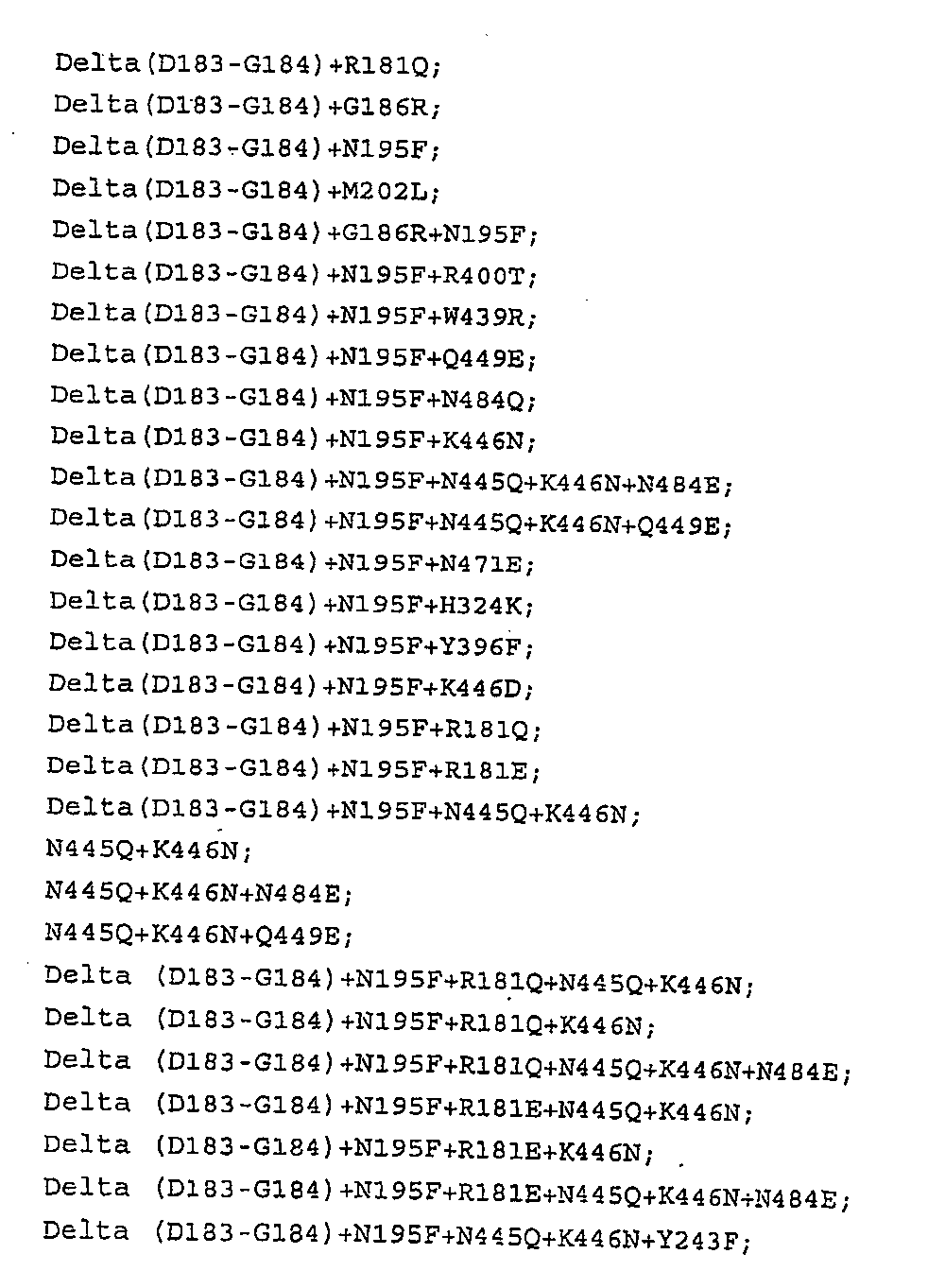
According to the present invention, all Termamyl-like α-amylases as defined above can be used as the parent α-amylase (ie, backbone). In a preferred embodiment of the invention, the parent alpha amylase is obtained from one of those mentioned above, such as B. licheniformis, for example the B. licheniformis alpha amylase having the amino acid sequence shown in SEQ ID NO: 10. Particularly preferred parent alpha amylases are SP722 alpha amylase and AA560 alpha amylase. In one embodiment, the parent alpha amylase has one or more of the following mutations / substitutions: DELTA (R81-G182), DELTA (R183-G184), DELTA (R183-G184) + N195F, RR181Q + N445Q + K446N, DELTA (R183-G184 ) + R181Q.
親のハイブリッドターマミル様αアミラーゼ:
親αアミラーゼ(すなわち骨格αアミラーゼ)はまた、ハイブリッドαアミラーゼ、すなわち少なくとも2種類のαアミラーゼから得られる部分アミノ酸配列の組合せを含むαアミラーゼであってもよい。Parent hybrid Termamyl-like α-amylase:
The parent α-amylase (ie, backbone α-amylase) may also be a hybrid α-amylase, ie, an α-amylase that includes a combination of partial amino acid sequences derived from at least two types of α-amylases.
親のハイブリッドαアミラーゼは、アミノ酸の相同性(同一性)および/またはDNAハイブリダイゼーション(上記で定義される)に基づいてターマミル様αアミラーゼのファミリーに属することを決めることができるものである。この場合、ハイブリッドαアミラーゼは一般に、ターマミル様αアミラーゼが少なくとも一部分と、ターマミル様αアミラーゼあるいは微生物(細菌または真菌)および/または哺乳類起源の非ターマミル様αアミラーゼから選択される1または複数の別のαアミラーゼ部分とから構成される。 A parent hybrid α-amylase can be determined to belong to a family of Termamyl-like α-amylases based on amino acid homology (identity) and / or DNA hybridization (as defined above). In this case, the hybrid α-amylase is generally one or more other selected from a termamyl-like α-amylase and at least a portion of the termamyl-like α-amylase or a non-termamyl-like α-amylase of microbial (bacterial or fungal) and / or mammalian origin. It is composed of an α-amylase moiety.
したがって親のハイブリッドαアミラーゼは、少なくとも2種類のターマミル様αアミラーゼから得られる、または少なくとも1種類のターマミル様αアミラーゼと少なくとも1種類の非ターマミル様の細菌性αアミラーゼとから得られる、または少なくとも1種類のターマミル様αアミラーゼと少なくとも1種類の真菌性αアミラーゼとから得られる部分アミノ酸配列の組合せを含むことができる。部分アミノ酸配列を導出するターマミル様αアミラーゼは、本明細書で言及したこれら特定のターマミル様αアミラーゼのいずれかであることができる。 Thus, the parent hybrid α-amylase is obtained from at least two Termamyl-like α-amylases, or obtained from at least one Termamyl-like α-amylase and at least one non-termamyl-like bacterial α-amylase, or at least one. It can comprise a combination of partial amino acid sequences obtained from one type of Termamyl-like α-amylase and at least one type of fungal α-amylase. The Termamyl-like α-amylase from which the partial amino acid sequence is derived can be any of these specific Termamyl-like α-amylases referred to herein.
例えば親αアミラーゼは、B. licheniformis株から得られるαアミラーゼのC終末部分と、B. amyloliquefaciens株またはB. stearothermophilus株から得られるαアミラーゼのN終末部分とを含むことができる。例えば親αアミラーゼは、B. licheniformisのC終末部分の少なくとも430個のアミノ酸残基を含むことができ、また例えば、a)SEQ ID NO:10で示されるアミノ酸配列を有するB. amyloliquefaciens αアミラーゼのN終末部の37個のアミノ酸残基に対応するアミノ酸セグメントと、SEQ ID NO: 8で示されるアミノ酸配列を有するB. licheniformis αアミラーゼのC終末部の445個のアミノ酸残基に対応するアミノ酸セグメントとを含んでもよく、またはターマミル配列すなわちN終末部の35個のアミノ酸残基(成熟タンパク質の)が、BANすなわちSEQ ID NO:10で示されるB. amyloliquefaciens αアミラーゼのN終末部の33個のアミノ酸残基(成熟タンパク質)により置き換えられていることを除けば、SEQ ID NO: 8で示されるB. licheniformis αアミラーゼと同一のハイブリッドターマミル様αアミラーゼを含んでもよく、あるいはb)SEQ ID NO: 6で示されるアミノ酸配列を有するB. stearothermophilus αアミラーゼのN終末部の68個のアミノ酸残基に対応するアミノ酸セグメントと、SEQ ID NO: 8で示されるアミノ酸配列を有するB. licheniformis αアミラーゼのC終末部の415個のアミノ酸残基に対応するアミノ酸セグメントとを含んでもよい。 For example, the parent α-amylase can comprise a C-terminal portion of α-amylase obtained from a B. licheniformis strain and an N-terminal portion of α-amylase obtained from a B. amyloliquefaciens strain or a B. stearothermophilus strain. For example, the parent α-amylase can comprise at least 430 amino acid residues of the C-terminal portion of B. licheniformis and, for example, a) An amino acid segment corresponding to 37 amino acid residues at the N terminal part and an amino acid segment corresponding to 445 amino acid residues at the C terminal part of B. licheniformis α-amylase having the amino acid sequence shown by SEQ ID NO: 8 Or the termamyl sequence, ie, 35 amino acid residues (of the mature protein) of the N terminus, of the N terminus of B. amyloliquefaciens α-amylase as shown in BAN, SEQ ID NO: 10 The same hybrid as the B. licheniformis α-amylase shown in SEQ ID NO: 8, except that it is replaced by an amino acid residue (mature protein) Or b) an amino acid segment corresponding to the 68 amino acid residues at the N terminus of B. stearothermophilus α-amylase having the amino acid sequence shown in SEQ ID NO: 6, and SEQ ID NO: And an amino acid segment corresponding to 415 amino acid residues at the C-terminal part of B. licheniformis α-amylase having the amino acid sequence shown by 8.
別の好適な親のハイブリッドαアミラーゼは、BANすなわちB. amyloliquefaciens αアミラーゼのN終末部(成熟タンパク質のアミノ酸1〜300位)と、ターマミル由来のC終末部(成熟タンパク質のアミノ酸301〜483位)を構成する、以前に国際特許公開第96/23874号(Novo Nordiskから出願されている)に記載されたものである。 Another suitable parental hybrid alpha amylase is the N-terminal part of BAN or B. amyloliquefaciens alpha amylase (
改変される特性:
下記に本発明の変異体中に存在する突然変異と、それによりもたらされる特性の望ましい変化(親ターマミル様αアミラーゼの特性と比べて)との関係について考察する。Modified properties:
The following discusses the relationship between mutations present in the variants of the present invention and the desired changes in properties caused thereby (compared to those of the parent Termamyl-like α-amylase).
前述のように本発明は改変された特性、特に生産条件下で改変された特性を有するターマミル様αアミラーゼに関する。 As mentioned above, the present invention relates to a Termamyl-like α-amylase having modified properties, in particular modified properties under production conditions.
特に意図する特性の変化を実現することと関連して特に検討された親ターマミル様αアミラーゼは、前述の親ターマミル様αアミラーゼおよび親のハイブリッドターマミル様αアミラーゼである。SP722 αアミラーゼを出発点として用いるが、例えばターマミル、BSG、BAN、AA560、SP690、AA180、KSM AP1378、および#707、K38、K36中の対応する位置もまた開示されたものと理解されるべきである。 The parent Termamyl-like α-amylase specifically studied in connection with achieving the intended change in properties is the aforementioned parent Termamyl-like α-amylase and the parent hybrid Termamyl-like α-amylase. SP722 α-amylase is used as a starting point, but it should be understood that the corresponding positions in eg Termamyl, BSG, BAN, AA560, SP690, AA180, KSM AP1378, and # 707, K38, K36 were also disclosed. is there.
好ましい実施形態において本発明の変異体は、特に洗濯およびクリーニング条件下で高い溶解度を有する。 In a preferred embodiment, the variants of the invention have a high solubility, especially under laundry and cleaning conditions.
一態様において本発明は、前述のように改変された特性を有する変異体に関する。 In one aspect, the invention relates to variants having the properties modified as described above.
第一の態様において親ターマミル様αアミラーゼの変異体は、 In a first embodiment, a variant of the parent Termamyl-like α-amylase is
の群から選択される1または複数の位置(アミノ酸ナンバリングではSEQ ID NO:12を用いる)に変化を含む変異体であって、 A variant comprising a change at one or more positions selected from the group (using amino acid numbering SEQ ID NO: 12),
(a)その変化は独立に、
(i)その位置を占めるアミノ酸の下流に向ってアミノ酸の挿入、
(ii)その位置を占めるアミノ酸の欠失、または
(iii)異なるアミノ酸によるその位置を占めるアミノ酸の置換であり、
(b)その変異体はαアミラーゼ活性を有し、かつ
(c)各位置はSEQ ID NO: 12で示されるAA560のアミノ酸配列を有する親ターマミル様αアミラーゼのアミノ酸配列の位置に対応する。(A) The change is independent,
(I) insertion of an amino acid downstream of the amino acid occupying that position;
(Ii) deletion of the amino acid occupying that position, or (iii) substitution of the amino acid occupying that position with a different amino acid,
(B) the variant has α-amylase activity, and (c) each position corresponds to the amino acid sequence position of the parent Termamyl-like α-amylase having the amino acid sequence of AA560 shown in SEQ ID NO: 12.
SP722(SEQ ID NO:4)ではそのような対応位置は、R28、N94、L118、N125、Q174、R181、G182、D183、G184、A186、W189、N195、M202、Y298、N299、N302、S303、N306、A310、N314、K320、H324、Q345、F396、T400、W439、Q444、N445、K446、Q449、K458、N471、K484である。 In SP722 (SEQ ID NO: 4), such corresponding positions are R28, N94, L118, N125, Q174, R181, G182, D183, G184, A186, W189, N195, M202, Y298, N299, N302, S303, N306, A310, N314, K320, H324, Q345, F396, T400, W439, Q444, N445, K446, Q449, K458, N471, K484.
好ましい実施形態において本発明の変異体(ナンバリングではSEQ ID NO:12を用いる)は、次の1または複数の突然変異/置換、すなわち In a preferred embodiment, a variant of the invention (using SEQ ID NO: 12 for numbering) has one or more of the following mutations / substitutions:
を有する。Have
好ましい二重、三重、および多重突然変異(ナンバリングの基準としてSEQ ID NO:12を用いた)には、 Preferred double, triple, and multiple mutations (using SEQ ID NO: 12 as the numbering criterion) include
がある。There is.
検討された変異体には、実施例で記述した特定のもの、およびさらに1または複数の突然変異/置換、すなわちDELTA(D183〜G184);N195F;R181Q;G186R;M202L;V206F、L、M;N193S、T、Pと組み合わせた前述の突然変異が含まれる。 The variants studied included the specific ones described in the Examples, and also one or more mutations / substitutions: DELTA (D183-G184); N195F; R181Q; G186R; M202L; V206F, L, M; The aforementioned mutations in combination with N193S, T, P are included.
高い溶解度:
前述の突然変異はすべて、上記の定義のようにターマミル様αアミラーゼのグループ内の任意のαアミラーゼで用いられた場合、改変された溶解度を有するターマミル様αアミラーゼ変異体をもたらす。High solubility:
All of the aforementioned mutations, when used with any α-amylase within the group of Termamyl-like α-amylases as defined above, result in a Termamyl-like α-amylase variant with altered solubility.
したがって好ましい実施形態において本発明の変異体は、 Accordingly, in a preferred embodiment, the variant of the invention is
の群から選択される1または複数の位置(アミノ酸のナンバリングではSEQ ID NO:12を用いる)における変化を含む、親ターマミル様αアミラーゼと比べて高い溶解度(さきに定義した)を有する親ターマミル様αアミラーゼの変異体であって、 A parent Termamyl-like having a higher solubility (as defined above) compared to the parent Termamyl-like α-amylase, including changes in one or more positions selected from the group of (using SEQ ID NO: 12 for amino acid numbering) a variant of α-amylase,
(a)その変化は独立に、
(i)その位置を占めるアミノ酸の下流に向ってアミノ酸の挿入、
(ii)その位置を占めるアミノ酸の欠失、または
(iii)異なるアミノ酸によるその位置を占めるアミノ酸の置換であり、
(b)その変異体はαアミラーゼ活性を有し、かつ
(c)各位置はSEQ ID NO: 12で示されるAA560のアミノ酸配列を有する親ターマミル様αアミラーゼのアミノ酸配列の位置に対応する。(A) The change is independent,
(I) insertion of an amino acid downstream of the amino acid occupying that position;
(Ii) deletion of the amino acid occupying that position, or (iii) substitution of the amino acid occupying that position with a different amino acid,
(B) the variant has α-amylase activity, and (c) each position corresponds to the amino acid sequence position of the parent Termamyl-like α-amylase having the amino acid sequence of AA560 shown in SEQ ID NO: 12.
好ましい実施形態において、親αアミラーゼと比べて高い溶解度を有する本発明の変異体は、次の置換、すなわち In a preferred embodiment, a variant of the invention having a higher solubility compared to the parent α-amylase has the following substitution:
を有する。 Have
好ましい実施形態において高い溶解度(「材料および方法」の項に記載の方法の一つを用いて決定される)を有する本発明の変異体(ナンバリングの基準としてSEQ ID NO:12を用いた)には、 In a preferred embodiment, a variant of the invention (using SEQ ID NO: 12 as the numbering criterion) having high solubility (determined using one of the methods described in the “Materials and Methods” section) Is
が含まれる。 Is included.
本発明による別の組合せには、実施例中に記述されている特定の組合せ、および次の置換、すなわちN195F;R181Q;G186R;M202L;V206F、L、M;N193Pの1または複数が含まれる。 Other combinations according to the invention include the specific combinations described in the examples and one or more of the following substitutions: N195F; R181Q; G186R; M202L; V206F, L, M; N193P.
安定性:
本発明の文脈において改変された安定性、具体的には改良された安定性(すなわち、より高いまたはより低い)、特に高pH(すなわちpH 8 ~10.5)における安定性に関して重要な突然変異には、「改変された特性」の項でリストアップした突然変異のいずれかが含まれる。Stability:
For mutations that are important in the context of the present invention with respect to altered stability, in particular improved stability (ie higher or lower), especially stability at high pH (ie pH 8 to 10.5) , Any of the mutations listed in the “Modified Properties” section.
Ca2+安定性:
改変されたCa2+安定性とは、Ca2+が消耗したときの酵素の安定性、すなわちより高いまたはより低い安定性が改良されたことを意味する。本発明の文脈において改変されたCa2+安定性、具体的には改良されたCa2+安定性、すなわち特に高pH(すなわちpH 8 〜10.5)における高いまたはより低い安定性を達成することに関して重要な突然変異(アミノ酸の置換および欠失を含む)には、「改変された特性」の項でリストアップした突然変異のいずれかが含まれる。Ca 2+ stability:
Modified Ca 2+ stability means that the stability of the enzyme when Ca 2+ is depleted, ie higher or lower stability, is improved. With regard to achieving modified Ca 2+ stability in the context of the present invention, in particular improved Ca 2+ stability, ie higher or lower stability, especially at high pH (ie pH 8 to 10.5). Important mutations (including amino acid substitutions and deletions) include any of the mutations listed in the “Modified Properties” section.
比活性:
本発明の更なる態様において、改変された比活性、具体的には特に温度10〜60℃、好ましくは20〜50℃、特に30〜40℃における比活性の増加または減少を示す変異体を得ることに関して重要な突然変異(アミノ酸の置換および欠失を含む)には、「改変された特性」の項でリストアップした突然変異のいずれかが含まれる。Specific activity:
In a further aspect of the invention, variants are obtained that exhibit an altered specific activity, in particular an increase or decrease in specific activity, especially at temperatures of 10-60 ° C., preferably 20-50 ° C., in particular 30-40 ° C. Important mutations (including amino acid substitutions and deletions) include any of the mutations listed in the “Modified Properties” section.
本発明の変異体における一般的な突然変異:
特に興味深い突然変異(アミノ酸の置換および欠失を含む)は、酵素の活性部位のまわりの動きやすさを増加させる突然変異である。これは活性部位の近傍、すなわち活性部位を構成する残基のいずれかから好ましくは10Åまたは8Åまたは6Åまたは4Å以内で安定化をもたらす相互作用を乱す変化によって達成される。Common mutations in the variants of the invention:
Particularly interesting mutations (including amino acid substitutions and deletions) are mutations that increase the mobility around the active site of the enzyme. This is accomplished by a change that disrupts the interaction in the vicinity of the active site, ie, any of the residues that make up the active site, preferably stabilizing within 10 Å or 8 Å or 6 Å or 4 Å.
例には、AlaからGly;ValからAlaまたはGly;IleまたはLeuからVal、Ala、またはGly;ThrからSerなどの側鎖のサイズを減少させる突然変異がある。 Examples include mutations that reduce the size of side chains such as Ala to Gly; Val to Ala or Gly; Ile or Leu to Val, Ala, or Gly; Thr to Ser.
このような突然変異は空洞の導入、または突然変異によって残った空間を充たす構造的再配列のいずれかにより活性部位領域の柔軟性の増加を引き起こすと考えられる。 Such mutations are thought to cause an increase in the flexibility of the active site region either by introduction of cavities or structural rearrangements that fill the space left by the mutation.
本発明の変異体は上記で略述したものに加えて1または複数の修飾を含むことが好ましい。したがって有利には修飾されるαアミラーゼの変異体の一部に存在する1または複数のプロリン残基を非プロリン残基で置換することができ、この非プロリン残基は考えられる天然に産する非プロリン残基のいずれであってもよく、また好ましくはアラニン、グリシン、セリン、スレオニン、バリン、またはロイシンである。 The variants of the present invention preferably contain one or more modifications in addition to those outlined above. Thus, advantageously one or more proline residues present in a part of the variant of the α-amylase to be modified can be replaced by a non-proline residue, which non-proline residues Any of proline residues may be used, and alanine, glycine, serine, threonine, valine, or leucine is preferable.
同様に、親αアミラーゼを修飾するアミノ酸残基中に存在する1または複数のシステイン残基をセリン、アラニン、スレオニン、グリシン、バリン、またはロイシンなどの非システイン残基で置換することが好ましい。 Similarly, it is preferred to substitute one or more cysteine residues present in the amino acid residue that modifies the parent α-amylase with a non-cysteine residue such as serine, alanine, threonine, glycine, valine, or leucine.
さらに本発明の変異体は、単独の修飾として、または上記に略述した修飾のいずれかと組み合わせて、SEQ ID NO:10のアミノ酸断片185〜209位に対応するアミノ酸断片中に存在する1または複数のAspおよび/またはGluがそれぞれAsnおよび/またはGlnに置換されるように修飾してもよい。また、ターマミル様αアミラーゼ中で、SEQ ID NO:10のアミノ酸断片185〜209位に対応するアミノ酸断片中に存在するLys残基の1または複数をArgに置換することも興味深い。 Furthermore, the variants of the invention may include one or more amino acid fragments present in amino acid fragments corresponding to amino acid fragments 185 to 209 of SEQ ID NO: 10, either alone or in combination with any of the modifications outlined above. Asp and / or Glu may be modified with Asn and / or Gln, respectively. It is also interesting to substitute Arg for one or more of the Lys residues present in the amino acid fragment corresponding to positions 185 to 209 of SEQ ID NO: 10 in Termamyl-like α-amylase.
本発明が上記に略述した修飾の2つ以上を組み込んだ変異体を包含することが理解されよう。 It will be understood that the invention encompasses variants incorporating two or more of the modifications outlined above.
さらに、有利には下記の1または複数の位置(ナンバリングではSEQ ID NO:10(Termamyl(商標))を用いる)に突然変異を導入することができる。すなわち、 Furthermore, mutations can advantageously be introduced at one or more of the following positions (using SEQ ID NO: 10 (Termamyl ™) for numbering): That is,
M15、V128、A111、H133、W138、T149、M197、N188、A209、A210、H405、T412、特に下記の単一、二重、または三重もしくは多重突然変異:M15, V128, A111, H133, W138, T149, M197, N188, A209, A210, H405, T412, especially the following single, double, or triple or multiple mutations:
M15X、特にM15T、L;
V128X、特にV128E;
H133X、特にH133Y;
N188X、特にN188S、T、P;
M197X、特にM197T、L;
A209X、特にA209V;
M197T/W138F;M197T/W138Y;M15T/H133Y/N188S;M15X, in particular M15T, L;
V128X, especially V128E;
H133X, especially H133Y;
N188X, especially N188S, T, P;
M197X, especially M197T, L;
A209X, especially A209V;
M197T / W138F; M197T / W138Y; M15T / H133Y / N188S;
M15/V128E/H133Y/N188S;E119C/S130C;D124C/R127C;H133Y/T149I;G475R、H133Y/S187D;H133Y/A209V;M119 / V128E / H133Y / N188S; E119C / S130C; D124C / R127C; H133Y / T149I; G475R, H133Y / S187D; H133Y / A209V;
AA560ではこれは、L17X、特にL17T;
E130X;
Y135X;
W140X、特にW140F、Y;
T193X、特にT193S、P;
M202X、特にM202T、L;
V214Xに対応し;
検討されたこれらの組合せには、
M202T/W140F;M202T/W140Y;L17T/T193S;L17T/N193P;E121C/S132C;N126C/Q129C;T151I;G480Rが含まれる。In AA560 this is L17X, in particular L17T;
E130X;
Y135X;
W140X, especially W140F, Y;
T193X, in particular T193S, P;
M202X, in particular M202T, L;
Corresponding to V214X;
These combinations considered include:
M202T / W140F; M202T / W140Y; L17T / T193S; L17T / N193P; E121C / S132C; N126C / Q129C; T151I; G480R.
本発明のαアミラーゼ変異体の調製方法:
遺伝子中に突然変異を導入するには幾つかの方法が当業界で知られている。αアミラーゼをコードするDNA配列のクローニングについて簡単な考察の後、αアミラーゼをコードする配列内の特定の部位で突然変異を生じさせる方法について考察することにする。Preparation method of α-amylase variant of the present invention:
Several methods are known in the art for introducing mutations into genes. After a brief discussion of the cloning of the DNA sequence encoding α-amylase, we will discuss how to generate mutations at specific sites within the sequence encoding α-amylase.
αアミラーゼをコードするDNA配列のクローニング:
親αアミラーゼをコードするDNA配列は、当業界でよく知られているさまざまな方法を用いて検討対象になっているαアミラーゼを産生する任意の細胞または微生物から単離することができる。まず、試験されるαアミラーゼを産生する生物由来の染色体DNAまたはメッセンジャーRNAを用いてゲノムDNAおよび/またはcDNAのライブラリーを構築する。次いで、αアミラーゼのアミノ酸配列が知られている場合は、相同の標識したオリゴヌクレオチドプローブを合成し、使用して検討対象になっている生物から調製されたゲノムライブラリーからαアミラーゼをコードするクローンを識別することができる。別法では、知られているαアミラーゼの遺伝子と相同の配列を含む標識したオリゴヌクレオチドプローブを、低ストリンジェンシーのハイブリダイゼーションおよび洗浄条件を用いたαアミラーゼをコードするクローンを識別するためのプローブとして使用することができる。Cloning of the DNA sequence encoding α-amylase:
The DNA sequence encoding the parent α-amylase can be isolated from any cell or microorganism that produces the α-amylase under consideration using a variety of methods well known in the art. First, a genomic DNA and / or cDNA library is constructed using chromosomal DNA or messenger RNA from the organism producing the α-amylase to be tested. Then, if the amino acid sequence of α-amylase is known, a clone that encodes α-amylase from a genomic library prepared from the organism under study using a homologous labeled oligonucleotide probe Can be identified. Alternatively, labeled oligonucleotide probes containing sequences homologous to known α-amylase genes can be used as probes to identify clones encoding α-amylase using low stringency hybridization and wash conditions. Can be used.
αアミラーゼをコードするクローンを識別するためのさらに別の方法は、プラスミドなどの発現ベクターにゲノムDNAの断片を導入し、得られたゲノムDNAライブラリーでαアミラーゼ陰性細菌を形質転換し、次いで形質転換された細菌をαアミラーゼ用の基質を含有する寒天上で培養し、それによってクローンが識別すべきαアミラーゼを発現するのを可能にするものである。 Yet another method for identifying clones encoding α-amylase is to introduce genomic DNA fragments into an expression vector such as a plasmid, transform an α-amylase negative bacterium with the resulting genomic DNA library, and The transformed bacteria are cultured on agar containing a substrate for α-amylase, thereby allowing the clones to express the α-amylase to be identified.
別法では、酵素をコードするDNA配列を確立されている標準的な方法、例えばS.L.BeaucageおよびM.H.Caruthersの論文、Tetrahedron Letters 22, 1981, pp.1859~1869に記載されているホスホロアミダイト法、またはMattes等の論文、The RMBO J. 3, 1984, pp.801~805に記載されている方法により合成的に調製することができる。ホスホロアミダイト法ではオリゴヌクレオチドを、例えば自動DNA合成装置で合成し、精製し、アニールし、連結反応させ、適切なベクター中でクローン化する。 Alternatively, a standard method in which the DNA sequence encoding the enzyme has been established, such as the phosphoramidite method described in SLBeaucage and MHCaruthers, Tetrahedron Letters 22, 1981, pp. 1859-1869, Alternatively, it can be prepared synthetically by the method described in Mattes et al., The RMBO J. 3, 1984, pp. 801-805. In the phosphoramidite method, oligonucleotides are synthesized, for example, with an automated DNA synthesizer, purified, annealed, ligated, and cloned in an appropriate vector.
結局DNA配列は標準的な技術に従って、合成、ゲノム、またはcDNA由来の断片(適宜、DNA配列全体のさまざまな部分に対応する断片)を連結反応させることによって調製される、ゲノムと合成由来の混合配列、合成とcDNA由来の混合配列、またはゲノムとcDNA由来の混合配列であってもよい。DNA配列はまた、例えば米国特許第4,683,202号またはR. K. Saiki等の論文、Science 239, 1988, pp.487~491に記載されているように特異的プライマーを用いた重合酵素連鎖反応(PCR)によって調製することもできる。 The DNA sequence is eventually prepared according to standard techniques by ligation of synthetic, genomic, or cDNA-derived fragments (where appropriate, fragments corresponding to various parts of the entire DNA sequence). It may be a sequence, a mixed sequence derived from synthesis and cDNA, or a mixed sequence derived from genome and cDNA. DNA sequences can also be prepared by polymerase chain reaction (PCR) using specific primers as described, for example, in US Pat. No. 4,683,202 or RK Saiki et al., Science 239, 1988, pp. 487-491. You can also
αアミラーゼ変異体の発現:
本発明によれば、前述の方法によって、または当業界で知られている任意の別の方法によって生成される変異体をコードするDNA配列は、一般にプロモーター、オペレーター、リボソーム結合部位、翻訳開始信号、および任意選択でリプレッサー遺伝子またはさまざまなアクチベーター遺伝子をコードする制御配列を含む発現ベクターを用いて酵素の形態で発現させることができる。Expression of α-amylase variants:
According to the present invention, a DNA sequence encoding a variant produced by the aforementioned method or by any other method known in the art generally comprises a promoter, an operator, a ribosome binding site, a translation initiation signal, And optionally expressed in the form of an enzyme using an expression vector comprising control sequences encoding a repressor gene or various activator genes.
本発明のαアミラーゼ変異体をコードするDNA配列を担持する組換え発現ベクターは、便利には組換えDNA手順に従わせることができる任意のベクターであり、ベクターの選択はそれが導入されることになる宿主細胞に左右されることが多い。したがってこのベクターは、自己複製ベクターすなわち染色体外の存在物として存在するベクター;染色体複製物とは無関係の複製物、例えばプラスミド、バクテリオファージ、または染色体外の構成分子;ミニクロモソーム;あるいは人工の染色体であってもよい。別法ではこのベクターは、宿主細胞に導入された場合、宿主細胞のゲノム中に取り込まれ、それを取り込んだ染色体と一緒に複製されるものであってもよい。 A recombinant expression vector carrying a DNA sequence encoding an alpha amylase variant of the invention is conveniently any vector that can be subjected to recombinant DNA procedures, the choice of vector being introduced. Often depends on the host cell. Thus, this vector is a self-replicating vector, ie a vector that exists as an extrachromosomal entity; a replica that is independent of the chromosomal replica, eg, a plasmid, bacteriophage, or extrachromosomal component; a minichromosome; or an artificial chromosome There may be. Alternatively, the vector may be one that, when introduced into a host cell, is incorporated into the genome of the host cell and replicated along with the chromosome into which it has been incorporated.
このベクター中でDNA配列は、適切なプロモーター配列と作動可能に結合することになる。このプロモーターは、選択された宿主細胞中で転写活性を示し、宿主細胞と相同または非相同いずれかの、遺伝子をコードするタンパク質から得ることができる任意のDNA配列であってよい。特に細菌性の宿主中で本発明のαアミラーゼ変異体をコードするDNA配列の転写に向わせるのに好適なプロモーターの例には、E.coliのLacオペロンのプロモーター、Streptomyces coelicolorアガラーゼ遺伝子dagAのプロモーター群、B. licheniformis αアミラーゼ遺伝子(amyL)のプロモーター群、B. stearothermophilus マルトジェニックアミラーゼ遺伝子(amyM)のプロモーター群、B. amyloliquefaciens αアミラーゼ遺伝子(amyQ)のプロモーター群、B. subtilis xylAおよびxylB遺伝子のプロモーター群などがある。真菌性の宿主中での転写の場合、有用なプロモーターの例には、A. oryzae TAKA アミラーゼ、Rhizomucor mieheiアスパラギン酸プロテイナーゼ、A. niger中性αアミラーゼ、A. niger 酸安定性αアミラーゼ、A. nigerグルコアミラーゼ、Rhizomucor mieheiリパーゼ、A. oryzaeアルカリ性プロテアーゼ、A. oryzaeトリオースリン酸イソメラーゼ、またはA. nidulansアセトアミダーゼがある。 In this vector, the DNA sequence will be operably linked to an appropriate promoter sequence. The promoter can be any DNA sequence that exhibits transcriptional activity in the selected host cell and can be obtained from the protein encoding the gene, either homologous or heterologous to the host cell. Examples of promoters suitable for directing transcription of the DNA sequence encoding the α-amylase variant of the invention, particularly in bacterial hosts, include the E. coli Lac operon promoter, the Streptomyces coelicolor agarase gene dagA. Promoter group, B. licheniformis α-amylase gene (amyL) promoter group, B. stearothermophilus maltogenic amylase gene (amyM) promoter group, B. amyloliquefaciens α-amylase gene (amyQ) promoter group, B. subtilis xylA and xylB genes There are several promoter groups. For transcription in fungal hosts, examples of useful promoters include A. oryzae TAKA amylase, Rhizomucor miehei aspartate proteinase, A. niger neutral α-amylase, A. niger acid-stable α-amylase, A. There is niger glucoamylase, Rhizomucor miehei lipase, A. oryzae alkaline protease, A. oryzae triose phosphate isomerase, or A. nidulans acetamidase.
本発明の発現ベクターはまた、適切な転写ターミネーター、また真核生物では本発明のαアミラーゼ変異体をコードするDNA配列と作動可能に結合したポリアデニル化配列を含むことができる。終結およびポリアデニル化配列は、適切にはプロモーターと同じ供給源から得ることができる。 The expression vectors of the present invention can also include a suitable transcription terminator and, in eukaryotes, a polyadenylation sequence operably linked to a DNA sequence encoding the α-amylase variant of the present invention. Termination and polyadenylation sequences can suitably be obtained from the same source as the promoter.
ベクターはさらに、検討対象になっている宿主細胞中でベクターが複製を行なうのを可能にするDNA配列を含むことができる。このような配列の例は、プラスミドpUC19、pACYC177、pUB110、pE194、pAMB1、およびpIJ702の複製開始点である。 The vector can further include a DNA sequence that allows the vector to replicate in the host cell under consideration. Examples of such sequences are the origins of replication of plasmids pUC19, pACYC177, pUB110, pE194, pAMB1, and pIJ702.
ベクターはまた、選択可能な遺伝標識、例えばB. subtilis またはB. licheniformis由来のdal遺伝子など、その生成物が宿主細胞中の欠損を補完する遺伝子、あるいはアンピシリン、カナマイシン、クロラムフェニコール、またはテトラサイクリン耐性など抗生物質耐性を付与する遺伝子を含むことができる。さらにベクターは、amdS、argB、niaD、およびsCなどのAspergillus選択マーカー、ヒグロマイシン耐性を生じさせるマーカーを含んでもよく、あるいはその選択は、例えば国際特許公開第91/17243号に記載のように同時形質転換によって達成することもできる。 Vectors are also selectable genetic markers, such as the genes whose products complement defects in the host cell, such as the dal gene from B. subtilis or B. licheniformis, or ampicillin, kanamycin, chloramphenicol, or tetracycline. It may contain genes that confer antibiotic resistance such as resistance. In addition, the vector may include an Aspergillus selectable marker such as amdS, argB, niaD, and sC, a marker that produces hygromycin resistance, or the selection may be performed as described in, eg, International Patent Publication No. 91/17243. It can also be achieved by conversion.
細胞内発現は、例えば宿主細胞として或る種の細菌を用いる場合には幾つかの点で有利であるかも知れないが、一般には発現は細胞外であることが好ましい。一般に、本明細書に記述されたBacillus αアミラーゼは、発現したプロテアーゼの培地中への分泌を可能にする予備領域を具備している。望むならばこの予備領域は別の予備領域またはシグナル配列で置き換えることができ、便利にはそれぞれの予備領域をコードするDNA配列の置換によって達成される。 Intracellular expression may be advantageous in several ways, for example when using certain bacteria as host cells, but in general it is preferred that expression be extracellular. In general, the Bacillus α-amylase described herein comprises a reserve region that allows secretion of the expressed protease into the medium. If desired, this spare region can be replaced with another spare region or signal sequence, conveniently achieved by replacement of the DNA sequence encoding each spare region.
αアミラーゼ変異体、そのプロモーター、ターミネーター、およびその他の構成分子をそれぞれコードする本発明のDNA構築物を連結反応させるために、またそれらを複製に必要な情報を含有する適切なベクター中に挿入するために使用される手順は、当業技術者によく知られている(例えば、Sambrook等の著書、Molecular Cloning: A Laboratory Manual, 2nd Ed., Cold Spring Harbor, 1989を参照されたい)。 In order to ligate the DNA constructs of the present invention encoding the α-amylase variant, its promoter, terminator, and other constituent molecules, respectively, and to insert them into an appropriate vector containing information necessary for replication The procedures used in are well known to those skilled in the art (see, for example, Sambrook et al., Molecular Cloning: A Laboratory Manual, 2nd Ed., Cold Spring Harbor, 1989).
さきに定義したように本発明のDNA構築物または発現ベクターのいずれかを含む本発明の細胞は、本発明のαアミラーゼ変異体の組換え産物の宿主細胞として使用するのが有利である。この細胞は、便利には宿主の染色体にそのDNA構築物を組み込む(1または複数のコピーに)ことにより、変異体をコードする本発明のDNA構築物で形質転換することができる。この組込みは、細胞中の方がDNA配列がより安定に保たれやすいので有利であると一般に考えられている。DNA構築物の宿主染色体中への組込みは、従来の方法に従って、例えば相同的または非相同的組換えによって行なうことができる。別法では細胞は、異なる種類の宿主細胞と結びつけて前述のように発現ベクターで形質転換することができる。 The cells of the invention comprising either the DNA construct or the expression vector of the invention as defined above are advantageously used as host cells for the recombinant product of the alpha amylase variant of the invention. The cells can be transformed with the DNA construct of the invention encoding the variant, conveniently by integrating (in one or more copies) the DNA construct into the host chromosome. This integration is generally considered to be more advantageous in cells because the DNA sequence is more likely to be kept more stable. Integration of the DNA construct into the host chromosome can be performed according to conventional methods, for example by homologous or non-homologous recombination. Alternatively, the cells can be transformed with expression vectors as described above in association with different types of host cells.
本発明の細胞は、哺乳類または昆虫などのより高度の生物の細胞であってもよいが、好ましくは微生物の細胞、例えば細菌または真菌(酵母を含む)の細胞である。 The cells of the present invention may be cells of higher organisms such as mammals or insects, but are preferably microbial cells such as bacteria or fungi (including yeast) cells.
好適な細菌の例は、Bacillus subtilis、Bacillus licheniformis、Bacillus lentus、Bacillus brevis、Bacillus stearothermophilus、Bacillus alkalophilus、Bacillus amyloliquefaciens、Bacillus coagulans、Bacillus circulans、Bacillus lautus、Bacillus megaterium、Bacillus cillus thuringiensis、またはStreptomyces lividansとStreptomyces murinusなどのグラム陽性菌、あるいはE. coliなどのグラム陰性菌である。細菌の形質転換は、例えば原形質体の形質転換により、または公知のやり方でコンピテント細胞を用いることにより行なうことができる。 Examples of suitable bacteria are Bacillus subtilis, Bacillus licheniformis, Bacillus lentus, Bacillus brevis, Bacillus stearothermophilus, Bacillus alkalophilus, Bacillus amyloliquefaciens, Bacillus coagulans, Bacillus circulans, Bacillus lautus, Bacillus megaterus, reptilis Gram-positive bacteria such as E. coli, or Gram-negative bacteria such as E. coli. Bacterial transformation can be performed, for example, by transformation of protoplasts or by using competent cells in a known manner.
酵母生物は、好都合にはSaccharomycesまたはSchizosaccharomycesの種、例えばSaccharomyces cerevisiaeから選択することができる。糸状菌は、有利にはAspergillusの種、例えばAspergillus oryzaeまたはAspergillus nigerに属することができる。真菌細胞は、原形質体の形成および原形質体の形質転換、続いて細胞壁の再生を含むプロセスによって公知の方法で形質転換することができる。Aspergillus宿主細胞の形質転換の適切な手順は、欧州特許公開第238 023号に記載されている。 Yeast organisms can conveniently be selected from Saccharomyces or Schizosaccharomyces species such as Saccharomyces cerevisiae. The filamentous fungus can advantageously belong to an Aspergillus species such as Aspergillus oryzae or Aspergillus niger. Fungal cells can be transformed in a known manner by processes including protoplast formation and protoplast transformation followed by cell wall regeneration. A suitable procedure for transformation of Aspergillus host cells is described in EP 238 023.
更なる態様において本発明は、変異体の生産に役立つ条件下で前述のように宿主細胞を培養すること、ならびに細胞および/または培地からその変異体を回収することを含む、本発明のαアミラーゼ変異体の生産方法に関する。 In a further aspect, the present invention comprises culturing a host cell as described above under conditions that aid in the production of the mutant, and recovering the mutant from the cell and / or medium. The present invention relates to a method for producing a mutant.
細胞を培養するために使用される培地は、検討対象になっている宿主細胞を増殖させ、本発明のαアミラーゼ変異体を発現させるのに適した任意の従来の培地であってよい。好適な培地は営利目的の供給業者から入手可能であり、あるいは出版物に掲載されている処方(例えば、American Type Culture Collectionのカタログに記載されている)に従って調製することができる。 The medium used for culturing the cells may be any conventional medium suitable for growing the host cells under consideration and expressing the alpha amylase variant of the invention. Suitable media are available from commercial suppliers or can be prepared according to prescriptions published in publications (eg, as described in the catalog of the American Type Culture Collection).
宿主細胞から分泌されたαアミラーゼ変異体は、細胞を遠心分離または濾過によって培地から分離すること、硫酸アンモニウムなどの塩によって培地のタンパク質成分を沈殿させること、続いてイオン交換クロマトグラフィ、アフィニティクロマトグラフィなどのクロマトグラフの手順を用いることなどを含む周知の手順により培地から回収するのが便利である。 The α-amylase mutant secreted from the host cell can be separated from the medium by centrifugation or filtration, the protein component of the medium can be precipitated with a salt such as ammonium sulfate, and then chromatographed with ion exchange chromatography, affinity chromatography, etc. It is convenient to recover from the culture medium by well-known procedures, including using the graphical procedure.
産業面への応用:
本発明のαアミラーゼ変異体は、さまざまな産業面の応用を可能にする有用な特性を持っている。具体的には本発明の酵素の変異体は、洗濯、皿洗い、および硬い表面のクリーニング用洗剤組成物の成分として応用できる。改変された特性を有する本発明の変異体は、デンプンの製造プロセス、具体的にはデンプンの転化、特にデンプンの液化に用いることができる(例えば、米国特許第3,912,590号、欧州特許公開第252 730号および第63 909号、国際特許公開第99/19467号を参照されたい)。Industrial application:
The α-amylase variants of the present invention have useful properties that allow for various industrial applications. Specifically, the enzyme variant of the present invention can be applied as a component in laundry, dishwashing, and hard surface cleaning detergent compositions. Variants of the present invention with altered properties can be used in starch production processes, specifically starch conversion, particularly starch liquefaction (eg, US Pat. No. 3,912,590, European Patent Publication No. 252 730). No. 63 and 909, International Patent Publication No. 99/19467).
さらに、本発明の変異体はまた、特にデンプンからの甘味料およびエタノールの生産、および/または繊維の糊抜きに有用である。 Furthermore, the variants of the present invention are also particularly useful for the production of sweeteners and ethanol from starch and / or fiber desizing.
組成物:
一態様において本発明は、本発明の変異体を含む組成物に関する。一実施形態において本発明の組成物は1または複数の別の酵素を含み、それにはリパーゼ、クチナーゼ、プロテアーゼ、セルラーゼ、マンナナーゼ、マルトジェニックアミラーゼ、CGTアーゼ、グルコアミラーゼ、ペルオキシダーゼ、もしくはラッカーゼ、および/または別のαアミラーゼなどの群から選択される1または複数の酵素がある。Composition:
In one aspect, the invention relates to a composition comprising a variant of the invention. In one embodiment, the composition of the invention comprises one or more other enzymes, including lipase, cutinase, protease, cellulase, mannanase, maltogenic amylase, CGTase, glucoamylase, peroxidase, or laccase, and / or There are one or more enzymes selected from the group such as another alpha amylase.
洗剤組成物:
前述のように本発明の変異体は、洗剤組成物に配合するのに適している。洗剤組成物(洗濯または皿洗い用洗剤など)の関連する成分、このような洗剤組成物中に変異体を配合する適切な方法、および関連性のある洗剤組成物の種類の例に関してさらに詳細には、例えば国際特許公開第96/23874号および第97/07202号に参照されている。Detergent composition:
As mentioned above, the variants of the present invention are suitable for incorporation into detergent compositions. Further details regarding relevant ingredients of detergent compositions (such as laundry or dishwashing detergents), suitable methods of incorporating variants in such detergent compositions, and examples of types of relevant detergent compositions For example, in International Patent Publication Nos. 96/23874 and 97/07202.
本発明の変異体を含む洗剤組成物は、追加してリパーゼ、クチナーゼ、プロテアーゼ、セルラーゼ、マンナナーゼ、マルトジェニックアミラーゼ、CGTアーゼ、グルコアミラーゼ、ペルオキシダーゼ、もしくはラッカーゼ、および/または別のαアミラーゼなどの1または複数の別の酵素を含むことができる。 A detergent composition comprising a variant of the invention additionally comprises 1 such as lipase, cutinase, protease, cellulase, mannanase, maltogenic amylase, CGTase, glucoamylase, peroxidase or laccase, and / or another alpha amylase. Or a plurality of different enzymes can be included.
本発明のαアミラーゼ変異体は、従来採用している濃度で洗剤中に配合することができる。本発明の変異体は、洗剤の従来の用量レベルを用いた洗濯/皿洗い液1リットル当たりαアミラーゼ0.00001~10 mg(純粋な活性酵素タンパク質として計算)に相当する量を配合することが現在検討されている。 The α-amylase variant of the present invention can be blended in a detergent at a concentration conventionally employed. It is presently contemplated that the variants of the present invention are formulated in amounts corresponding to 0.00001 to 10 mg α-amylase (calculated as pure active enzyme protein) per liter of laundry / dishwash using conventional dosage levels of detergents. ing.
本発明はまた、親αアミラーゼと比べて改変された特性、具体的には溶解度、特に高い溶解度、基質特異性、基質結合、基質切断パターン、温度安定性、酵素活性のpH依存、安定性のpH依存、酸化に対する安定性、CA2+依存性、および比活性の改変された特性を有するαアミラーゼを提供する方法に関するもので、その方法はThe invention also provides modified properties compared to the parent α-amylase, specifically solubility, particularly high solubility, substrate specificity, substrate binding, substrate cleavage pattern, temperature stability, pH dependence of enzyme activity, stability. The present invention relates to a method for providing α-amylase having altered properties of pH dependence, stability to oxidation, CA 2+ dependence, and specific activity,
(a)親αアミラーゼの三次元構造を描くために添付資料1に表されているSEQ ID NO: 4の三次元構造に倣って親αアミラーゼをモデル化するステップ、
(b)ステップ(a)で得られた三次元構造において、その構造の一部分の変化が上記改変された特性をもたらすと予想される、親の構造の少なくとも一部分を識別するステップ、
(c)親αアミラーゼをコードする核酸の配列を修飾して、上記構造の一部分に対応する位置で1または複数のアミノ酸の欠失、挿入、または置換をコードする核酸を生成するステップ、および
(d)修飾された核酸を宿主細胞中で発現させて、αアミラーゼ酵素活性を有し、かつ親と比べて少なくとも1つの改変された特性を有する変異体αアミラーゼを産生するステップ、を含む。(A) modeling the parent α-amylase according to the three-dimensional structure of SEQ ID NO: 4 represented in
(B) identifying at least a portion of the parent structure in the three-dimensional structure obtained in step (a), where a change in the portion of the structure is expected to result in the altered property;
(C) modifying the sequence of the nucleic acid encoding the parent α-amylase to produce a nucleic acid encoding a deletion, insertion, or substitution of one or more amino acids at a position corresponding to a portion of the structure; d) expressing the modified nucleic acid in a host cell to produce a mutant α-amylase having α-amylase enzyme activity and having at least one altered property relative to the parent.
一実施形態においてこの方法は、親と比べて改変された特性を有する親αアミラーゼの変異体を構築する方法であり、この親αアミラーゼはSEQ ID NO: 2、4、6、8、10、12、または13の配列を持つか、あるいは上記配列と少なくとも60%同一の配列(前述のように決定された)を持ち、この方法は
(a)親αアミラーゼの三次元構造を描くために添付資料1に表されているSEQ ID NO: 4の三次元構造に倣って親αアミラーゼをモデル化するステップ、
(b)ステップ(a)で得られた三次元構造を、上記特性が親αアミラーゼと異なった関連のないαアミラーゼの三次元構造と比較するステップ、
(c)その関連のないαアミラーゼの三次元構造とは異なり、かつ上記特性と関連性があると予想される、ステップ(a)で得られた三次元構造の構造の一部分を識別するステップ、
(d)親αアミラーゼをコードする核酸の配列を修飾して、上記構造の一部分に対応する位置で1または複数のアミノ酸の欠失、挿入、または置換をコードする核酸を生成するステップ、および
(e)修飾された核酸を宿主細胞中で発現させて、αアミラーゼ活性を有し、かつ親と比べて1または複数の改変された特性を有する変異体αアミラーゼを産生するステップ、を含む。In one embodiment, the method is a method of constructing a variant of a parent α-amylase that has altered properties compared to the parent, the parent α-amylase is SEQ ID NO: 2, 4, 6, 8, 10, This method has 12 or 13 sequences, or has at least 60% sequence identity (determined as described above), and is attached to draw the three-dimensional structure of the parent α-amylase. Modeling the parent α-amylase following the three-dimensional structure of SEQ ID NO: 4 shown in
(B) comparing the three-dimensional structure obtained in step (a) with a three-dimensional structure of an unrelated α-amylase whose properties differ from the parent α-amylase;
(C) identifying a portion of the structure of the three-dimensional structure obtained in step (a) that is different from the three-dimensional structure of the unrelated α-amylase and is expected to be related to the above characteristics;
(D) modifying the sequence of the nucleic acid encoding the parent α-amylase to produce a nucleic acid encoding a deletion, insertion, or substitution of one or more amino acids at a position corresponding to a portion of the structure; e) expressing the modified nucleic acid in a host cell to produce a mutant alpha amylase having alpha amylase activity and having one or more altered properties relative to the parent.
検討されたターマミル様αアミラーゼは上記のものである。
ポリペプチドの溶解度を増加させる方法:
本発明はまた、酵素などのポリペプチド、具体的にはターマミル様αアミラーゼの溶解度を増加させる方法に関する。The Termamyl-like α-amylase studied is as described above.
Methods for increasing the solubility of a polypeptide:
The present invention also relates to a method for increasing the solubility of polypeptides such as enzymes, specifically Termamyl-like α-amylase.
本発明の方法は、タンパク質の結晶中に配置された隣りのポリペプチド分子に近接した位置を占める1または複数のアミノ酸残基の置換、挿入、および/または欠失を含む。本発明の文脈において隣りの分子に近接した位置を占めるポリペプチドのアミノ酸残基とは、それが結晶または沈殿中の隣りの酵素分子に配置されているアミノ酸残基から潜在的に分子間で相互作用する距離内にあるというやり方でポリペプチド中に配置されたアミノ酸残基を指す。 The methods of the invention include substitutions, insertions, and / or deletions of one or more amino acid residues that occupy positions adjacent to neighboring polypeptide molecules located in a protein crystal. In the context of the present invention, an amino acid residue of a polypeptide that occupies a position close to a neighboring molecule is a potential molecule that interacts potentially between amino acids that are located in the neighboring enzyme molecule in the crystal or precipitate. Refers to an amino acid residue located in a polypeptide in a manner that is within a working distance.
潜在的な分子間相互作用の例には、水素結合、塩架橋の形成、極性相互作用、および芳香族相互作用があるがこれらには限定されない。 Examples of potential intermolecular interactions include, but are not limited to, hydrogen bonding, salt bridge formation, polar interactions, and aromatic interactions.
本発明の文脈で用語「隣り」とは、例えば「Protein Crystallization Techniques, Strategies, and Tips」(A Laboratory Manual、Terese M. Bergfors著)、またはインターネットサイト:www.hamptonresearch.com. の記述のように調製されている結晶構造中の2つの位置の間の最も近い距離を意味する。In the context of the present invention, the term “neighbor” means, for example, “Protein Crystallization Techniques, Strategies, and Tips” (A Laboratory Manual, by Terese M. Bergfors) or the description of the Internet site: www.hamptonresearch.com By the closest distance between two positions in the crystal structure being prepared.
したがってこの態様において本発明は、酵素の結晶の溶解度を増加させる方法に関するもので、その方法は Accordingly, in this aspect, the present invention relates to a method for increasing the solubility of enzyme crystals, the method comprising:
1)三次結晶構造中の隣りのポリペプチド分子の6.0Åの距離内に位置し、かつ
2)その隣りのポリペプチド分子と相互作用する
1または複数のアミノ酸残基を、例えば置換または欠失によって突然変異させる。1) one or more amino acid residues that are located within a distance of 6.0 mm of the neighboring polypeptide molecule in the tertiary crystal structure, and 2) interact with that neighboring polypeptide molecule, eg, substituted or deleted Mutate by.
好ましい実施形態においては、突然変異されるアミノ酸残基は隣りのポリペプチド分子の3.5Åに位置する。 In a preferred embodiment, the amino acid residue to be mutated is located at 3.5 of the adjacent polypeptide molecule.
検討されたポリペプチドには、抗菌性ポリペプチド、およびインスリン、成長ホルモン、EPO、TPO、VII因子、VIII因子などの生物活性を有するポリペプチドが含まれる。 The studied polypeptides include antimicrobial polypeptides and polypeptides having biological activity such as insulin, growth hormone, EPO, TPO, factor VII, factor VIII.
検討された酵素活性には、プロテアーゼ、アミラーゼ、CGTアーゼ、カルボヒドラーゼ、トランスフェラーゼ、リアーゼ、オキシドレダクターゼ、リパーゼ、セルラーゼ、クチナーゼ、ペクチン酸リアーゼ、マンナナーゼ、マルトジェニックアミラーゼ、グルコアミラーゼ、ペクチンリアーゼの活性が含まれる。 Enzyme activities studied include protease, amylase, CGTase, carbohydrase, transferase, lyase, oxidoreductase, lipase, cellulase, cutinase, pectate lyase, mannanase, maltogenic amylase, glucoamylase, pectin lyase activity .
好ましい実施形態において酵素は、アミラーゼ、好ましくはαアミラーゼ、特に下記にさらに記述することになるターマミル様αアミラーゼである。 In a preferred embodiment, the enzyme is an amylase, preferably an alpha amylase, in particular a Termamyl-like alpha amylase which will be further described below.
基質に「近接」したアミノ酸位置とは、単一水分子が介在するタンパク質−タンパク質相互作用に対応する6Å未満の距離を指す。好ましい実施形態において、基質に近接したアミノ酸位置とは、直接のタンパク質−タンパク質相互作用に対応する3.5Å未満の距離を指す。 An amino acid position “close” to a substrate refers to a distance of less than 6 cm corresponding to a protein-protein interaction mediated by a single water molecule. In a preferred embodiment, an amino acid position in proximity to a substrate refers to a distance of less than 3.5 cm corresponding to direct protein-protein interaction.
ターマミル様αアミラーゼの溶解度を増加させる方法:
この態様において本発明は、ターマミル様αアミラーゼ結晶の溶解度を増加させる方法に関するもので、その方法はMethods for increasing the solubility of Termamyl-like α-amylase:
In this aspect, the present invention relates to a method for increasing the solubility of Termamyl-like α-amylase crystals, the method comprising:
1)三次結晶構造中の隣り合うターマミル様αアミラーゼ分子が6Åの距離内に配置され、かつ
2)その隣り合うターマミル様αアミラーゼ分子と相互作用する、
1または複数のアミノ酸残基を、例えば置換または欠失によって突然変異する。
好ましい実施形態においては、突然変異されるアミノ酸残基は、隣りのターマミル様αアミラーゼから3.5Åに位置する。添付資料1に表されているSP722の結晶構造は、隣り合うターマミル様αアミラーゼの間の距離を決定するための基準(固定点)として用いることができる。1) adjacent Termamyl-like α-amylase molecules in the tertiary crystal structure are located within a distance of 6 cm, and 2) interact with the adjacent Termamyl-like α-amylase molecule.
One or more amino acid residues are mutated, for example by substitution or deletion.
In a preferred embodiment, the amino acid residue to be mutated is located 3.5Å from the adjacent Termamyl-like α-amylase. The crystal structure of SP722 shown in
しかしながら、基準(固定点)の結晶が添付資料1に表されているSP722からモデル化(上記、または国際特許公開第96/23874号に記載されている)される構造であるということは、本発明の範囲内にある。 However, the fact that the reference (fixed point) crystal is a structure modeled from SP722 shown in Appendix 1 (described above or described in International Patent Publication No. 96/23874) Within the scope of the invention.
好ましいターマミル様αアミラーゼには、B. licheniformis、B. amyloliquefaciens、B. stearothermophilus、Bacillus種のNCIB 12289、NCIB 12512、NCIB 12513、またはDSM 9375、あるいはDSMZ no.12649、KSM AP1378の株から得られるαアミラーゼからなる群から選択されたBacillus αアミラーゼがある。ターマミル様αアミラーゼは、SEQ ID NO: 2、4、6、8、10、12、および13で表される群から選択されたαアミラーゼのいずれか、あるいはSEQ ID NO: 4との同一性の度合いが少なくとも60%、好ましくは70%、より好ましくは少なくとも80%、一層好ましくは少なくとも約90%、一層好ましくは少なくとも95%、一層好ましくは少なくとも97%、一層好ましくは少なくとも99%であるアミノ酸配列を有するターマミル様αアミラーゼ、あるいは低い、好ましくは中位の、好ましくは高いストリンジェンシー条件下でハイブリダイズする、SEQ ID NO: 11の核酸配列を備えた核酸配列によってコードされるターマミル様αアミラーゼであることができる。この条件は上記でさらに詳細に記述されている。 Preferred termamyl-like α-amylases include B. licheniformis, B. amyloliquefaciens, B. stearothermophilus, Bacillus sp. NCIB 12289, NCIB 12512, NCIB 12513, or DSM 9375, or DSMZ no. 12649, α obtained from KSM AP1378 There is a Bacillus α-amylase selected from the group consisting of amylases. Termamyl-like α-amylase is one of the α-amylases selected from the group represented by SEQ ID NO: 2, 4, 6, 8, 10, 12, and 13, or is identical to SEQ ID NO: 4. Amino acid sequences having a degree of at least 60%, preferably 70%, more preferably at least 80%, more preferably at least about 90%, more preferably at least 95%, more preferably at least 97%, more preferably at least 99% Or a Termamyl-like α-amylase encoded by a nucleic acid sequence comprising the nucleic acid sequence of SEQ ID NO: 11, which hybridizes under low, preferably moderate, preferably high stringency conditions Can be. This condition is described in more detail above.
直近のアミラーゼ分子から6Å未満のところに存在するターマミル様αアミラーゼのアミノ酸残基は、下記のものである(SP722のナンバリングを用いた)。 The amino acid residues of Termamyl-like α-amylase that are less than 6 mm from the most recent amylase molecule are as follows (using SP722 numbering):
直近のアミラーゼ分子から3.5Å未満のところに存在するターマミル様αアミラーゼのアミノ酸残基は下記のもの(SP722のナンバリングを用いた)、すなわち The amino acid residues of Termamyl-like α-amylase present at less than 3.5 mm from the most recent amylase molecule are as follows (using SP722 numbering):
直近のアミラーゼ分子から6.0Å未満のところに存在するアミノ酸残基は、SP722アミラーゼのモデル構造中に識別される下記の位置である。 Amino acid residues present less than 6.0 mm from the most recent amylase molecule are the following positions identified in the SP722 amylase model structure.
直近のアミラーゼ分子から3.5Å未満のところに存在するアミノ酸残基は、SP722アミラーゼのモデル構造中に識別される下記の位置である。 Amino acid residues that are less than 3.5 centimeters from the nearest amylase molecule are the following positions identified in the model structure of SP722 amylase.
直近のアミラーゼ分子から6.0Å未満のところに存在するアミノ酸残基は、AA560アミラーゼのモデル構造中に識別される下記の位置である。 Amino acid residues present less than 6.0 mm from the most recent amylase molecule are the following positions identified in the model structure of AA560 amylase.
直近のアミラーゼ分子から3.5Å未満のところに存在するアミノ酸残基は、AA560アミラーゼのモデル構造中に識別される下記の位置である。 Amino acid residues present less than 3.5 mm from the most recent amylase molecule are the following positions identified in the model structure of AA560 amylase.
高い溶解度したがって高性能をもたらすαアミラーゼ中の置換
一般に何らかのタンパク質−タンパク質相互作用を妨害または消失させる任意の置換は高い溶解度、したがって特定の用途で高い性能をもたらす。したがってタンパク質−タンパク質相互作用に加担するアミノ酸残基を、より高い溶解度をもたらす荷電または非荷電アミノ酸になるように、より大きい、より小さい、より疎水性、より親水性のものに変えることができる。Substitution in α-amylase that results in high solubility and therefore high performance In general, any substitution that interferes with or eliminates any protein-protein interaction results in high solubility and thus high performance in certain applications. Thus, amino acid residues that participate in protein-protein interactions can be changed to larger, smaller, more hydrophobic, and more hydrophilic to become charged or uncharged amino acids that provide higher solubility.
より大きいアミノ酸残基は、相互作用に対する立体障害になることができ、またより小さいアミノ酸残基は、相互作用する残基の間の距離を広げて相互作用を弱める。極性の相互作用、特に塩架橋は、関係する残基の少なくとも1つを疎水性の残基に変えることにより、関係する残基の少なくとも1つを、距離を広げて強い相互作用にする小さい残基に変えることにより、あるいは関係する残基の少なくとも1つを、立体障害になる大きい残基に変えることにより消失する。疎水性の相互作用は、相互作用するアミノ酸の1つを親水性のアミノ酸残基に変えることによって効果的に消失するが、より小さい、またはより大きい疎水性の残基もまたこの種の相互作用を消失させることができる。芳香族の相互作用は、親水性の残基または小さい疎水性の残基に変えることによって防ぐことができる。 Larger amino acid residues can become steric hindrance to the interaction, and smaller amino acid residues increase the distance between interacting residues and weaken the interaction. Polar interactions, in particular salt bridges, leave at least one of the involved residues a hydrophobic residue by changing at least one of the related residues to a hydrophobic residue, increasing the distance to make a strong interaction. It disappears by changing to a group or by changing at least one of the residues involved to a large residue that becomes sterically hindered. Hydrophobic interactions are effectively abolished by changing one of the interacting amino acids to a hydrophilic amino acid residue, although smaller or larger hydrophobic residues are also of this type. Can be eliminated. Aromatic interactions can be prevented by changing to hydrophilic residues or small hydrophobic residues.
材料および方法
酵素:
SP722: SEQ ID NO: 4は、Novozymesから入手可能で国際特許公開第95/26397号に開示されている。Materials and Methods Enzymes:
SP722: SEQ ID NO: 4 is available from Novozymes and is disclosed in International Patent Publication No. 95/26397.
AA560: SEQ ID NO: 12は、国際特許公開第00/60060号に開示されNovozymes A/Sから入手可能;デンマーク特許出願第PA 1999 00490号に開示されている;DSMZで1999年1月25日に寄託され、DSMZ No. 12649が割り当てられている。 AA560: SEQ ID NO: 12 is disclosed in International Patent Publication No. 00/60060 and available from Novozymes A / S; disclosed in Danish Patent Application No. PA 1999 00490; DSMZ January 25, 1999 And has been assigned DSMZ No. 12649.
AA560は、Deutshe Sammlung von Microorganismen und Zellkulturen GmbH (DSMZ), Mascheroder Weg 1b, D-38124 Braunschweig DEにおける特許手続きのための微生物供託の国際承認に関するブタペスト条約の合意の下に本発明者等によって供託された。 AA560 was deposited by the inventors under the agreement of the Budapest Treaty on the international recognition of microbial deposits for patent procedures in Deutshe Sammlung von Microorganismen und Zellkulturen GmbH (DSMZ), Mascheroder Weg 1b, D-38124 Braunschweig DE .
Bacillus subtilis SHA273については、国際特許公開第95/10603号を参照されたい。 For Bacillus subtilis SHA273, see International Patent Publication No. 95/10603.
プラスミド:
pJE1は、SP722αアミラーゼ(SEQ ID NO: 4)の変異体、すなわち成熟タンパク質中のアミノ酸D183〜G184に対応する6個のヌクレオチドの欠失をコードする遺伝子を含有する。JE1遺伝子の転写はamyLプロモーターから指示される。プラスミドはさらにまた、複製開始点、およびプラスミドpUB110(gryczan, TJ等の論文、J. Bact. 34: 318〜329 (1978))から得られる、カナマイシン耐性を付与するcat遺伝子を含有する。Plasmid:
pJE1 contains a variant of SP722α amylase (SEQ ID NO: 4), a gene encoding a deletion of 6 nucleotides corresponding to amino acids D183 to G184 in the mature protein. Transcription of the JE1 gene is directed from the amyL promoter. The plasmid further contains an origin of replication and a cat gene conferring kanamycin resistance, obtained from plasmid pUB110 (gryczan, TJ et al., J. Bact. 34: 318-329 (1978)).
「方法」
モデルの組立て:
「The Protein Data Bank (PDB) (<http://www.pdb.bnl.gov/>)」または「The Brookhaven databank at Brookhaven National Laboratory, US」などのタンパク質構造データベースが、モデルを組み立てようとしている検討対象になっている分子と似たタンパク質を探すために検索される。アミノ酸配列は構造的に保存される領域を考慮に入れてアライニングされ、座標は基準タンパク質から主題のタンパク質にコピーされる。挿入および欠失を有する領域の座標は、似たアミノ酸配列を有する別のタンパク質からか、または大部分の3Dソフトウェアパッケージ、例えばHomology from Biosym, MSI中に見出されるランダム構造生成機能を用いることによるかのいずれかで割り当てられる。"Method"
Model assembly:
Protein structure databases such as "The Protein Data Bank (PDB) (<http://www.pdb.bnl.gov/>)" or "The Brookhaven databank at Brookhaven National Laboratory, US" are trying to assemble the model Searched for proteins similar to the molecule under consideration. The amino acid sequence is aligned taking into account structurally conserved regions and the coordinates are copied from the reference protein to the subject protein. Is the coordinates of the region with insertions and deletions from another protein with a similar amino acid sequence or by using random structure generation functions found in most 3D software packages such as Homology from Biosym, MSI? Assigned in either.
例えばBiosym, MSIのディスカバープログラム中のコマンドEND REPAIRおよびSPLICE REPAIRによって座標が主題のタンパク質のすべてのアミノ酸に割り当てられ、断片がつなぎ合わされたとき、モデルは精巧なものになる。モデルのエネルギーは、まず分子を弛緩させる(ディスカバープログラム中のRELAXコマンド)ことによってできるだけ少なくし、次に分子動力学によってできるだけ少なくする。参考資料は、相同組立て用ソフトウェアのマニュアル、例えばHomology from Biosym, MSI中に見出すことができる。 The model becomes elaborate when, for example, the commands END REPAIR and SPLICE REPAIR in the Discover program at Biosym, MSI assign coordinates to all amino acids of the subject protein and the fragments are stitched together. The energy of the model is minimized by first relaxing the molecule (RELAX command in the discover program) and then by molecular dynamics. Reference materials can be found in homologous assembly software manuals such as Homology from Biosym, MSI.
ライブラリーベクターpDorK101の構築:
E.coli / BacillusシャトルベクターpDorK101(下記に記述する)を用いてE.coli中でαアミラーゼを発現させることなく突然変異を導入し、次いでαアミラーゼがBacillus中で活性であるような方法で修飾することができる。ベクターは次のように構築された。すなわち、JE1をコードする遺伝子(D183〜G184の欠失をもつSP722)を、E.coli複製開始点を含有する1.2kb断片によるSEQ ID NO: 4 : SP722の5′コード化領域中のPstI部位での遺伝子切断によってpJE1中で不活性化した。この断片をフォワードプライマー:5′-gacctgcagtcaggcaacta-3′およびリバースプライマー:5′-tagagtcgacctgcaggcat-3′を用いてpUC19(GenBank Accession #: XO2514)からPCR増幅した。PCRアンプリコンおよびpJE1ベクターをPstIで37℃で2時間消化した。pJE1ベクター断片およびPCR断片を室温で1時間連結反応させ、E.coli中で電気形質転換法により形質転換した。得られたベクターをpDorK101と呼ぶ。Construction of library vector pDorK101:
E.coli / Bacillus shuttle vector pDorK101 (described below) is used to introduce mutations without expressing α-amylase in E. coli and then modified in such a way that α-amylase is active in Bacillus can do. The vector was constructed as follows. That is, the gene encoding JE1 (SP722 with a deletion of D183 to G184) is converted to PstI in the 5 ′ coding region of SEQ ID NO: 4: SP722 with a 1.2 kb fragment containing the E. coli origin of replication. It was inactivated in pJE1 by gene cutting at the site. This fragment was PCR amplified from pUC19 (GenBank Accession #: XO2514) using the forward primer: 5′-gacctgcagtcaggcaacta-3 ′ and the reverse primer: 5′-tagagtcgacctgcaggcat-3 ′. The PCR amplicon and pJE1 vector were digested with PstI at 37 ° C. for 2 hours. The pJE1 vector fragment and the PCR fragment were ligated at room temperature for 1 hour, and transformed in E. coli by electrotransformation. The resulting vector is called pDorK101.
フィルタースクリーニング検定:
この検定は、親酵素と比べて高pHで安定性の改良されたターマミル様αアミラーゼ変異体、およびスクリーニング温度の設定次第では親酵素と比べて高pHかつ中位の温度で安定性の改良されたターマミル様αアミラーゼ変異体のスクリーニングに用いることができる。Filter screening test:
This assay is a Termamyl-like α-amylase variant with improved stability at higher pH compared to the parent enzyme, and improved stability at higher pH and moderate temperature compared to the parent enzyme depending on the setting of the screening temperature. It can be used for screening of Termamyl-like α-amylase mutants.
高pHフィルター検定:
Bacillusライブラリーを、TY寒天プレート上の酢酸セルロース(OE 67、Schleicher & Schuell, Dassel, Germany)とニトロセルロースフィルター(Protran-Ba 85、Schleicher & Schuell, Dassel, Germany)のサンドイッチ上で、カナマイシン 10μg/mlとともに37℃で少なくとも21時間培養する。酢酸セルロース層はTY寒天プレート上に配置される。High pH filter assay:
Bacillus library was prepared on a sandwich of cellulose acetate (OE 67, Schleicher & Schuell, Dassel, Germany) and nitrocellulose filter (Protran-Ba 85, Schleicher & Schuell, Dassel, Germany) on a TY agar plate. Incubate with ml at 37 ° C for at least 21 hours. The cellulose acetate layer is placed on a TY agar plate.
各フィルターのサンドイッチにはフィルター上の陽性変異体の位置を突きとめるために培養後、インキュベーション前に針で特定の標識を付け、結合した変異体を含むニトロセルロースフィルターをグリシン/NaOH緩衝液(pH8.6〜10.6)を含む容器に移し、室温(10〜60℃まで変えることができる)で15分間インキュベートする。コロニーを含む酢酸セルロースフィルターは、使用するまでTYプレート上に室温で保管される。インキュベーション後、グリシン/NaOH緩衝液(pH8.6〜10.6)中にアガロース1%、デンプン0.2%を含むプレート上で残留活性を検出する。ニトロセルロースフィルターを備えた検定プレートをフィルターサンドイッチと同じ方法で標識し、室温で2時間インキュベートする。フィルターを除去した後、検定プレートを10%ルゴール液で染色する。デンプンを分解する変異体は、紺青色の背景上に白い斑点として検出され、次いで保存プレート上で同定される。陽性変異体を最初のスクリーニングと同じ条件で2回再スクリーニングする。 Each filter sandwich is labeled with a specific needle before incubation after incubation to locate the positive mutant on the filter, and the nitrocellulose filter containing the bound mutant is glycine / NaOH buffer (pH 8). .6 to 10.6) and incubate for 15 minutes at room temperature (can vary from 10 to 60 ° C.). Cellulose acetate filters containing colonies are stored on TY plates at room temperature until use. After incubation, residual activity is detected on plates containing 1% agarose and 0.2% starch in glycine / NaOH buffer (pH 8.6 to 10.6). The assay plate with nitrocellulose filter is labeled in the same way as the filter sandwich and incubated for 2 hours at room temperature. After removing the filter, the assay plate is stained with 10% Lugol solution. Variants that degrade starch are detected as white spots on a dark blue background and then identified on a storage plate. Positive mutants are rescreened twice under the same conditions as the initial screen.
低カルシウム検定:
Bacillusライブラリーを、TY寒天プレート上の酢酸セルロース(OE 67、Schleicher & Schuell, Dassel, Germany)とニトロセルロースフィルター(Protran-Ba 85、Schleicher & Schnell, Dassel, Germany)のサンドイッチ上で、関連性のある抗生物質、例えばカナマイシンまたはクロラムフェニコールとともに37℃で少なくとも21時間培養する。酢酸セルロース層はTY寒天プレート上に配置される。Low calcium test:
The Bacillus library can be analyzed on a sandwich of cellulose acetate (OE 67, Schleicher & Schuell, Dassel, Germany) and nitrocellulose filter (Protran-Ba 85, Schleicher & Schnell, Dassel, Germany) on TY agar plates. Incubate with an antibiotic, such as kanamycin or chloramphenicol, at 37 ° C. for at least 21 hours. The cellulose acetate layer is placed on a TY agar plate.
各フィルターのサンドイッチにはフィルター上の陽性変異体の位置を突きとめるために培養後、インキュベーション前に針で特定の標識を付け、結合した変異体を含むニトロセルロースフィルターを炭酸塩/重炭酸塩緩衝液(pH8.5〜10)を含み、さまざまなEDTA濃度(0.001〜100mM)を有する容器に移す。フィルターを室温で1時間インキュベートする。コロニーを含む酢酸セルロースフィルターは、使用するまでTYプレート上に室温で保管される。インキュベーション後、炭酸塩/重炭酸塩緩衝液(pH8.5〜10)中にアガロース1%、デンプン0.2%を含有するプレート上で残留活性を検出する。ニトロセルロースフィルターを備えた検定プレートをフィルターサンドイッチと同じ方法で標識し、室温で2時間インキュベートする。フィルターを除去した後、検定プレートを10%ルゴール液で染色する。デンプンを分解する変異体は、紺青色の背景上に白い斑点として検出され、次いで保存プレート上で同定される。陽性変異体を最初のスクリーニングと同じ条件で2回再スクリーニングする。 Each filter sandwich is labeled with a needle prior to incubation to locate the positive mutant on the filter, and the nitrocellulose filter containing the bound mutant is carbonate / bicarbonate buffered before incubation. Transfer to containers with liquid (pH 8.5-10) and various EDTA concentrations (0.001-100 mM). Incubate the filter at room temperature for 1 hour. Cellulose acetate filters containing colonies are stored on TY plates at room temperature until use. After incubation, residual activity is detected on plates containing 1% agarose, 0.2% starch in carbonate / bicarbonate buffer (pH 8.5-10). The assay plate with nitrocellulose filter is labeled in the same way as the filter sandwich and incubated for 2 hours at room temperature. After removing the filter, the assay plate is stained with 10% Lugol solution. Variants that degrade starch are detected as white spots on a dark blue background and then identified on a storage plate. Positive mutants are rescreened twice under the same conditions as the initial screen.
考察の対象となっている領域を得る方法:
細菌性αアミラーゼには3つのよく知られた3D構造がある。その2つはB. licheniformisαアミラーゼ、Brookhaven database 1BPL(Machius等の論文、J. Mol. Biol. 246, p.545~559 (1995))および1VJS(Song等の著書、Enzymes for Carbohydrate 163 Engineering(Prog. Biotechnol. V 12 (1996)))である。これらの2つの構造は、2個のカルシウムイオンと1個のナトリウムイオンの結合部位周辺の領域で、いわゆるBドメインから構造の重要な一片を欠いている。したがって本発明者等は、BAN(商標)(SEQ ID NO: 5)とB. lichenifomisαアミラーゼ(SEQ ID NO: 4)の間の雑種であるαアミラーゼBA2(国際特許公開第96/23874号)の3D構造を用いた。この構造に基づいてB. licheniformisαアミラーゼおよびSP722αアミラーゼのモデルを組み立てた。How to get the area under consideration:
There are three well-known 3D structures in bacterial alpha amylase. Two of them are B. licheniformis α-amylase, Brookhaven database 1BPL (Machius et al., J. Mol. Biol. 246, p.545-559 (1995)) and 1VJS (Song et al., Enzymes for Carbohydrate 163 Engineering (Prog Biotechnol. V 12 (1996))). These two structures lack an important piece of structure from the so-called B domain in the region around the binding site of two calcium ions and one sodium ion. Accordingly, we have identified a hybrid of α-amylase BA2 (International Patent Publication No. 96/23874), which is a hybrid between BAN ™ (SEQ ID NO: 5) and B. lichenifomis α-amylase (SEQ ID NO: 4). A 3D structure was used. Based on this structure, models of B. licheniformis α amylase and SP722α amylase were constructed.
αアミラーゼ変異体の発酵および精製:
発酵および精製は、当業界でよく知られいる方法によって行なうことができる。Fermentation and purification of α-amylase variants:
Fermentation and purification can be performed by methods well known in the art.
安定性の決定:
すべての安定性試験は、同一の装置を用いて行なう。方法は下記のとおりである。酵素を関連する条件(1〜4)下でインキュベートする。試料をさまざまな時点で、例えば0、5、10、15、および30分後に採取し、検定緩衝液(50mMブリトン緩衝液0.1ml、pH7.3)中で25倍に希釈(採取したすべての試料について同じ希釈)し、pH7.3、37℃の標準条件下でPhadebas検定法(Pharmacia)を用いて活性を測定する。Determination of stability:
All stability tests are performed using the same equipment. The method is as follows. Incubate enzyme under relevant conditions (1-4). Samples were taken at various time points, eg after 0, 5, 10, 15, and 30 minutes and diluted 25-fold in assay buffer (0.1 ml of 50 mM Briton buffer, pH 7.3) (all samples taken) And the activity is measured using the Phadebas assay (Pharmacia) under standard conditions of pH 7.3 and 37 ° C.
インキュベーションの前(0分)に測定した活性を基準(100%)として使用する。低下%をインキュベーション時間の関数として計算する。表は、インキュベーションの例えば30分後の残留活性を示いている。 The activity measured before incubation (0 min) is used as a reference (100%). The percent reduction is calculated as a function of incubation time. The table shows residual activity after eg 30 minutes of incubation.
比活性の決定:
比活性は、Phadebas検定法(Pharmacia)を用いて酵素1mg当たりの活性として決定される。製造業者の指示は下記のとおりである(また、下記の「αアミラーゼ活性の検定」も参照されたい)。Determination of specific activity:
Specific activity is determined as activity per mg enzyme using the Phadebas assay (Pharmacia). The manufacturer's instructions are as follows (see also “Assay for α-amylase activity” below).
溶解度の決定I:
精製した酵素を選択された緩衝液に対して夜通し透析する。標準条件は、0.02MトリスHClおよび0.15M NaCl、pH7.5、室温である。ミリポア限外濾過膜、YM10、NMWL:10,000を用いて酵素約40mgを含有する配合物をアミコンセル上で濃縮する。酵素の濃縮に続いて、そのプロセスの前およびその間A280を測定する。沈殿が起こり始めたら濃縮のステップを停止する。沈殿物が実際にアミラーゼであることを確かめるために上澄み中の活性の測定を行なう。次いで緩衝液を加えることによって室温で沈殿物を再度溶解し、タンパク質濃度を測定する。Determination of solubility I:
The purified enzyme is dialyzed overnight against a selected buffer. Standard conditions are 0.02 M Tris HCl and 0.15 M NaCl, pH 7.5, room temperature. A formulation containing about 40 mg of enzyme is concentrated on Amicon cell using Millipore ultrafiltration membrane, YM10, NMWL: 10,000. Following enzyme concentration, A 280 is measured before and during the process. When precipitation begins to occur, stop the concentration step. The activity in the supernatant is measured to confirm that the precipitate is actually amylase. The precipitate is then redissolved at room temperature by adding buffer and the protein concentration is measured.
溶解度の決定II:
精製した酵素を再度、選択された緩衝液に対して夜通し透析する。標準条件は、0.01Mホウ酸、0.01M KCl、0.002M CaCl2、および0.15M NaCl、pH7.5である。ミリポア限外濾過膜、YM10、NMWL:10,000を用いて酵素約40mgを含有する配合物をアミコンセル上で濃縮する。酵素の濃縮に続いて、そのプロセスの前およびその間A280を測定する。沈殿が起こり始めたら濃縮のステップを停止する。沈殿物が実際にアミラーゼであることを確かめるために上澄み中の活性の測定を行なう。次いで緩衝液を加えることによって室温で沈殿物を再度溶解し、タンパク質濃度を測定する。Determination of solubility II:
The purified enzyme is again dialyzed overnight against the selected buffer. Standard conditions, 0.01 M boric acid, 0.01M KCl, 0.002M CaCl 2, and 0.15 M NaCl, is pH 7.5. A formulation containing about 40 mg of enzyme is concentrated on Amicon cell using Millipore ultrafiltration membrane, YM10, NMWL: 10,000. Following enzyme concentration, A 280 is measured before and during the process. When precipitation begins to occur, stop the concentration step. The activity in the supernatant is measured to confirm that the precipitate is actually amylase. The precipitate is then redissolved at room temperature by adding buffer and the protein concentration is measured.
αアミラーゼ活性の検定法:
1.Phadebas検定法
αアミラーゼ活性は、基質としてPhadebas(登録商標)錠剤を使用する方法によって決定される。Phadebas錠剤(Phadebas(登録商標)アミラーゼ試験、Pharmacia Diagnosticにより提供される)は、架橋した不溶性の青色デンプンポリマーを含有しており、ウシ血清アルブミンおよび緩衝物質と混合して錠剤にしたものである。α-amylase activity assay:
1. Phadebas assay α-amylase activity is determined by the method of using Phadebas® tablets as a substrate. Phadebas tablets (Phadebas® amylase test, provided by Pharmacia Diagnostic) contain cross-linked insoluble blue starch polymer and are tableted mixed with bovine serum albumin and buffer substances.
一測定ごとに1個の錠剤を、50mMブリトン−ロビンソン緩衝液5 ml (50mM酢酸、50mMリン酸、50mMホウ酸、0.1mM CaCl2、pHはNaOHで検討の対象となっている値に調整)を含む管中で懸濁させる。試験は水浴中で検討の対象となっている温度で行なう。試験されるαアミラーゼは50mMブリトン−ロビンソン緩衝液xml中で希釈する。このαアミラーゼ溶液1 mlを50mMブリトン−ロビンソン5 mlに加える。デンプンを、可溶性の青色断片を生ずるαアミラーゼによって加水分解する。620nmで分光光度的に測定される得られた青色溶液の吸光度は、620nmで分光光度的に測定され、αアミラーゼ活性の関数である。One tablet for each measurement, 5 ml of 50 mM Briton-Robinson buffer (50 mM acetic acid, 50 mM phosphoric acid, 50 mM boric acid, 0.1 mM CaCl 2 , pH adjusted to the value studied with NaOH) Suspend in a tube containing. The test is carried out in a water bath at the temperature under consideration. The alpha amylase to be tested is diluted in 50 mM Briton-Robinson buffer xml. Add 1 ml of this α-amylase solution to 5 ml of 50 mM Briton-Robinson. Starch is hydrolyzed by alpha amylase which produces a soluble blue fragment. The absorbance of the resulting blue solution measured spectrophotometrically at 620 nm is measured spectrophotometrically at 620 nm and is a function of α-amylase activity.
10または15分間のインキュベーション(試験時間)後の測定された620nm吸光度が、620nmで吸光度単位0.2〜2.0の範囲にあることが重要である。この吸光度の範囲で活性と吸光度の間には線形性がある(ランバート−ベールの法則)。したがって酵素の希釈は、この基準に合致するように調整されなければならない。特定の一組の条件(温度、pH,反応時間、緩衝液の条件)下で所与のαアミラーゼ1 mgは、一定量の基質を加水分解し、青色を生ずることになる。色の強度は620nmで測定する。測定された吸光度は、所与の一組の条件下での検討対象になっているαアミラーゼの比活性(純粋なαアミラーゼタンパク質1 mg当たりの活性)に正比例する。 It is important that the measured 620 nm absorbance after 10 or 15 minutes incubation (test time) is in the range of 0.2 to 2.0 absorbance units at 620 nm. There is a linearity between activity and absorbance in this absorbance range (Lambert-Beer law). The enzyme dilution must therefore be adjusted to meet this criterion. Under a specific set of conditions (temperature, pH, reaction time, buffer conditions), 1 mg of a given α-amylase will hydrolyze a certain amount of substrate, producing a blue color. The color intensity is measured at 620 nm. The measured absorbance is directly proportional to the specific activity of the α-amylase under consideration (activity per mg of pure α-amylase protein) under a given set of conditions.
2.他の選択可能な方法
αアミラーゼ活性は、PNP-G7基質を使用する方法によって決定される。p−ニトロフェニル−α,D−マルトヘプタオシドの省略形であるPNP-G7は、エンド−アミラーゼによって切断することができるブロック化したオリゴ糖である。切断に続いてキット中に含まれるαグルコシダーゼが基質を消化して自由なPNP分子を遊離し、それは黄色を有し、したがってλ=405nm(400~420nm)で可視分光測定によって測定することができる。PNP-G7基質およびαグルコシダーゼを含有するキットは、Boehringer-Mannheimによって製造されている(カタログ番号1054635)。2. Other selectable methods Alpha amylase activity is determined by methods using PNP-G7 substrates. PNP-G7, an abbreviation for p-nitrophenyl-α, D-maltoheptaoside, is a blocked oligosaccharide that can be cleaved by endo-amylase. Following cleavage, the α-glucosidase included in the kit digests the substrate to release free PNP molecules, which have a yellow color and can therefore be measured by visible spectroscopy at λ = 405 nm (400-420 nm). . A kit containing PNP-G7 substrate and α-glucosidase is manufactured by Boehringer-Mannheim (Cat. No. 1054635).
基質を調製するには、基質(BM 1442309)1瓶を緩衝液(BM 1442309)5 mlに加える。αグルコシダーゼを調製するには、αグルコシダーゼ(BM 1462309)1瓶を緩衝液(BM 1442309)45 mlに加える。作業用溶液は、αグルコシダーゼ溶液5 mlを基質0.5 mlと混合することによって作成する。 To prepare the substrate, add one bottle of substrate (BM 1442309) to 5 ml of buffer (BM 1442309). To prepare α-glucosidase, add one bottle of α-glucosidase (BM 1462309) to 45 ml of buffer (BM 1442309). The working solution is made by mixing 5 ml α-glucosidase solution with 0.5 ml substrate.
検定は、酵素溶液20μlを96ウェルのマイクロタイタープレートに移し、25℃でインキュベートすることによって行なわれる。作業用溶液200μlを25℃で加える。その溶液を混合し、1分間予備インキュベートし、吸収を3分間にわたって15秒ごとにOD 405nmで測定する。 The assay is performed by transferring 20 μl of enzyme solution to a 96-well microtiter plate and incubating at 25 °
この時間依存性吸収曲線の傾斜は、所与の一組の条件下における検討対象になっているαアミラーゼの比活性(酵素1 mg当たりの活性)に正比例する。 The slope of this time-dependent absorption curve is directly proportional to the specific activity (activity per mg of enzyme) of the α-amylase under consideration under a given set of conditions.
DOPEプログラムを用いたランダム突然変異誘発の一般的な方法:
ランダム突然変異誘発は下記のように行なうことができる。
1.親酵素中の修飾のために考察の対象となる領域を選択する。
2.選択された領域の突然変異部位と非突然変異部位を決める。
3.例えば、構築される変異体の所望の安定性および/または性能に関してどのような種類の突然変異を行なうべきかを決める。
4.構造的に妥当な突然変異を選択する。
5.ステップ3により選択された残基をステップ4に関して調整する。
6.ヌクレオチド分布を適切なドープ・アルゴリズムを使用して解析する。
7.必要ならば、求める残基を遺伝コードの現実に合わせる(例えば終止コドンの導入を避けるために、例えば遺伝コードに起因する制約を考慮にいれる)(幾つかのコドンの組合せは実際には使用できず、適応させる必要があることを当業者ならば気が付くはずである)。
8.プライマーを作成する。
9.プライマーを使用してランダム突然変異誘発を行なう。
10.得られたαアミラーゼ変異体を所望の改良された特性に関してスクリーニングによって選択する。General method of random mutagenesis using the DOPE program:
Random mutagenesis can be performed as follows.
1. Select the region of interest for modification in the parent enzyme.
2. Determine the mutation and non-mutation sites in the selected region.
3. For example, determine what type of mutation should be performed with respect to the desired stability and / or performance of the variant being constructed.
4). Select structurally valid mutations.
5. The residue selected by
6). Nucleotide distribution is analyzed using an appropriate dope algorithm.
7). If necessary, match the desired residue to the reality of the genetic code (eg to avoid the introduction of stop codons, for example taking into account constraints due to the genetic code) (some codon combinations can actually be used) The person skilled in the art will realize that there is a need to adapt).
8). Create a primer.
9. Random mutagenesis is performed using primers.
10. The resulting α-amylase variant is selected by screening for the desired improved properties.
ステップ6で使用する好適なドープ・アルゴリズムは、当業界でよく知られている。一つのアルゴリズムが、Tomandl, D. 等の論文、Journal of computer-Aided Molecular Design, 11 (1997), pp.29~38に記載されている。別のアルゴリズム、DOPEを下記に記述する。 Suitable dope algorithms for use in step 6 are well known in the art. One algorithm is described in a paper by Tomandl, D. et al., Journal of computer-Aided Molecular Design, 11 (1997), pp. 29-38. Another algorithm, DOPE, is described below.
ドープ・プログラム:
「DOPE」プログラムは、求めるアミノ酸分布に最も似たアミノ酸分布をコードするようなやり方でコドン三重項のヌクレオチド組成を最適化するのに有用なコンピュータアルゴリズムである。実現可能な分布のどれが求めるアミノ酸分布に最も似ているかを評価するには、スコアリング関数が必要である。「DOPE」プログラムには下記の関数がふさわしいことが分かった。
The “DOPE” program is a computer algorithm useful for optimizing the nucleotide composition of codon triplets in such a way as to encode an amino acid distribution that most closely resembles the desired amino acid distribution. A scoring function is needed to evaluate which of the feasible distributions is most similar to the desired amino acid distribution. The following functions were found to be suitable for the “DOPE” program.
上式でxi′は、プログラムによって計算されるアミノ酸の得られる量およびアミノ酸基であり、yi′は、プログラムのユーザーによって規定される、アミノ酸の求める量およびアミノ酸基である(例えば20個のアミノ酸または停止コドンのどれを、例えば或る割合で(例えばAla 90%、Ile 3%、Val 7%)導入したいかを指定する)。またwi′は、プログラムのユーザーによって規定される重み付け係数である(例えば、特定のアミノ酸残基を考察の対象の位置に挿入することの重要性に左右される)。Nは、プログラムのユーザーによって規定される、21プラスアミノ酸基の数である。この関数0oについては1と規定される。Where x i ′ is the resulting amount of amino acids and amino acid groups calculated by the program, and y i ′ is the desired amount of amino acids and amino acid groups defined by the user of the program (eg, 20 Of amino acids or stop codons, for example, in a certain proportion (eg Ala 90%,
モンテカルロアルゴリズム(一例は「Statistical Mechanics, Part A」Equilibrium Techniques, B. J. Berne編、New York: Plenum (1977) 中のValleau, J. P.およびWhittington, S. G.の記述;A guide to Mont Carlo for Statistical Mechanics: 1 Highwaysに記載のものである)は、この関数の最大値を見つけるために用いられる。各繰り返しにおいて下記のステップが行なわれる。 Monte Carlo algorithm (example is "Statistical Mechanics, Part A" Equilibrium Techniques, BJ Berne, New York: Plenum (1977), description of Valleau, JP and Whittington, SG; A guide to Mont Carlo for Statistical Mechanics: 1 Highways Is used to find the maximum value of this function. The following steps are performed in each iteration.
1.各ベースには新しいランダムヌクレオチド組成が選択され、現在の組成と新しい組成の間の絶対差はコドンのすべての3つの位置で4個のヌクレオチドG、A、T、Cの各々についてd以下である(dの定義については下記を参照)。 1. A new random nucleotide composition is selected for each base, and the absolute difference between the current composition and the new composition is less than or equal to d for each of the four nucleotides G, A, T, C at all three positions of the codon. (See below for definition of d).
2.現在の組成および新しい組成のスコアは、前述のように関数sを用いて比較される。もし新しいスコアが現在の組成のスコア以上ならば、新しい組成が保存され、現在の組成は新しい組成に代えられる。もし新しいスコアがそれより小さいならば、新しい組成を保存する確率は、exp (1000 (new_score - current_score))である。 2. The current composition and new composition scores are compared using the function s as described above. If the new score is greater than or equal to the current composition score, the new composition is saved and the current composition is replaced with the new composition. If the new score is less than that, the probability of saving the new composition is exp (1000 (new_score-current_score)).
1サイクルは前述のとおり通常1000回の繰り返しからなり、dは1から0まで直線的に減少する。最適化プロセスでは100サイクル以上を行なう。最高スコアで得られるヌクレオチド組成が最終的に与えられる。 As described above, one cycle is usually composed of 1000 repetitions, and d decreases linearly from 1 to 0. The optimization process takes over 100 cycles. The nucleotide composition obtained with the highest score is finally given.
実施例
実施例1.
改変された特性を有するSP722αアミラーゼ変異体を識別するための重要な領域およびアミノ酸残基を引き出す方法:Examples Example 1
Methods for extracting key regions and amino acid residues to identify SP722α amylase variants with altered properties:
SP722αアミラーゼの三次構造はUNIXコンピュータステーションの実行用インサイト上に表示し、すべての水素および水分子は削除された。この最小化したαアミラーゼ構造について、pdb構造ファイル(添付資料1)で決定された結晶パラメータおよび空間群に従ってすべての対称性に関係のあるアミラーゼ分子が表示された。母親のαアミラーゼ中の各原子から対称性に関係のあるアミラーゼ構造中の任意の原子までの距離を計算するために小規模のコンピュータプログラムが作成された。それぞれ3.5Åと6.0Åに距離制限を設定すると、下記のリストの結果となった。 The tertiary structure of SP722α amylase was displayed on the running insights of the UNIX computer station and all hydrogen and water molecules were deleted. For this minimized α-amylase structure, all symmetry related amylase molecules were displayed according to the crystal parameters and space groups determined in the pdb structure file (Appendix 1). A small computer program was created to calculate the distance from each atom in the maternal α-amylase to any atom in the amylase structure that is related to symmetry. Setting distance limits to 3.5 and 6.0 mm respectively resulted in the following list.
最も近い隣りのアミラーゼ分子から6.0Å未満に存在するアミノ酸残基は、SP722 アミラーゼのモデル構造中で識別される下記の位置である。 Amino acid residues present less than 6.0 mm from the nearest neighbor amylase molecule are the following positions identified in the model structure of SP722 amylase.
最も近い隣りのアミラーゼ分子から3.5Å未満に存在するアミノ酸残基は、SP722 アミラーゼのモデル構造中で識別される下記の位置である。 Amino acid residues that are less than 3.5 mm from the nearest neighbor amylase molecule are the following positions identified in the model structure of SP722 amylase.
実施例2.
改変された特性を有するSP722αアミラーゼ変異体を識別するための重要な領域およびアミノ酸残基を引き出す別の方法:
SP722αアミラーゼの三次構造はUNIXコンピュータステーションの実行用インサイト上に表示し、すべての水素および水分子は削除された。この最小化したαアミラーゼ構造をWHAT IFソフトウェア(G. Vriendの論文、J. Mol. Graph., 8, 52~56 (1990))中にインポート(「getmol」)し、6Å以内のすべての対称性に関係のあるアミラーゼ分子をスープ(「symtry」、「symspg」、「sympar 6」、「soushl」、「soup」)に加えた。対称分子を含むSP722用の新しい座標ファイルが書き込まれた(makmol, tot 0)。次いで中心のSP722アミラーゼを構造ファイルから削除し、周囲の分子を含む新しいファイルを書き込んだ。母体αアミラーゼ(水分子および水素原子のない元のSP722構造ファイル)中の各原子から対称性に関係のあるアミラーゼファイル中の任意の原子までの距離を計算するために小規模のコンピュータプログラムが作成された。それぞれ3.5Åと6.0Åに距離制限を設定すると、説明で参照した位置が確認された。Example 2
Another method for deriving key regions and amino acid residues to identify SP722α amylase variants with altered properties:
The tertiary structure of SP722α amylase was displayed on the running insights of the UNIX computer station and all hydrogen and water molecules were deleted. This minimized α-amylase structure was imported (“getmol”) into WHAT IF software (G. Vriend paper, J. Mol. Graph., 8, 52-56 (1990)), and all symmetry within 6 cm Sex-related amylase molecules were added to the soup ("symtry", "symspg", "sympar 6", "soushl", "soup"). A new coordinate file for SP722 containing symmetric molecules has been written (makmol, tot 0). The central SP722 amylase was then deleted from the structure file and a new file containing the surrounding molecules was written. Created a small computer program to calculate the distance from each atom in the matrix α-amylase (original SP722 structure file without water molecules and hydrogen atoms) to any atom in the symmetry related amylase file It was done. When the distance limit was set to 3.5 mm and 6.0 mm respectively, the position referred to in the explanation was confirmed.
What If コマンド:
>>Whatif<<;WHAT IFをスタートさせる
>>Getmol sp722_HOH.pdb<<;水およびHを削除したSP722構造ファイルをWHAT IFソフトウェア中にインポートする
>>symtry<<;対称メニューに進む
>>symspg<<;構造ファイル中の対称性に関係のある情報を読み取る
>>sympar 6<<;6Åの距離以内に対称性に関係のある残基を組み立てる
>>soushl<<;対称分子をスープに加える
>>soup<<;スープメニューに進む
>> makmol,”SP722_wi6.pdb, tot 0”<<は、スープ中のすべての原子(SP722および6Å以内の対称分子)を含む「SP722_wi6」pdbファイルを書き込む。What If command:
>> Whatif << ; Start WHAT IF
>> Getmol sp722_HOH.pdb << ; Import SP722 structure file with water and H removed into WHAT IF software
>> symtry << ; Go to the symmetric menu
>> symspg << ; Reads information related to symmetry in the structure file
>> sympar 6 <<; Assemble the residues related to symmetry within a distance of 6 cm
>> soushl << ; Adding symmetric molecules to the soup
>> soup << ; Proceed to the soup menu
>> makmol, “SP722_wi6.pdb, tot 0” << writes a “SP722_wi6” pdb file containing all the atoms in the soup (SP722 and symmetric molecules within 6 cm).
実施例3.
SP722三次構造からAA560を相同関係により組み立てること:
前述のようにAA560αアミラーゼ(SEQ ID NO:12)のSP722(SEQ ID NO: 4)に対する全体的な相同性は約87%である。AA560とSP722の配列のアラインメントの結果、そこに挿入または欠失が何もないことを示され、これはまた図1にも見ることができる。AA560αアミラーゼの三次構造は、「材料および方法」の項に記載した方法「モデルの組立て」を用いて添付資料1に開示した構造上にモデルを組み立てた。Example 3
Assemble AA560 from SP722 tertiary structure by homology:
As described above, the overall homology of AA560α amylase (SEQ ID NO: 12) to SP722 (SEQ ID NO: 4) is about 87%. An alignment of the AA560 and SP722 sequences showed that there were no insertions or deletions there, which can also be seen in FIG. The tertiary structure of AA560α amylase was assembled on the structure disclosed in
SP722の構造は、UNIXワークステーションの実行用インサイトおよびBIOSYM、MSIから得たホモロジーソフトウェア上に表示した。アミノ酸配列をアライニングし、同調したSP722をAA560アミノ酸に割り当てた。SP722構造中に見つからないAA560中の最初の4個のアミノ酸の座標は、「END REPAIR」関数によって割り当てた。AA560モデルは、「RELAX」コマンドを用いて始めにアミノ酸の側鎖を緩和させ、次いで分子動力学を実行して3Dモデルのエネルギーをできるだけ小さくすることによって精巧なものにした。Insight 95、MSIのデフォルトパラメータは、両者の緩和分子動力学について選択された。最後に、空間群と単位格子の寸法が、SP722 pdbからAA560モデルのファイルにコピーされる。 The structure of SP722 was displayed on the UNIX workstation execution insight and on the homology software obtained from BIOSYM, MSI. The amino acid sequence was aligned and the synchronized SP722 was assigned to AA560 amino acid. The coordinates of the first four amino acids in AA560 not found in the SP722 structure were assigned by the “END REPAIR” function. The AA560 model was refined by first relaxing the side chains of the amino acids using the “RELAX” command and then performing molecular dynamics to minimize the energy of the 3D model. The default parameters for Insight 95, MSI were selected for both relaxed molecular dynamics. Finally, the space group and unit cell dimensions are copied from the SP722 pdb to the AA560 model file.
実施例4.
改変された特性を有するAA560αアミラーゼ変異体を識別するための重要な領域を引き出す方法:Example 4
Methods for extracting key regions for identifying AA560α amylase variants with altered properties:
モデルとして組み立てられたAA560の構造について実施例1のSP722と同じ計算を行なった。2つのαアミラーゼの相同性が約87%もの高い同一性であるために、AA560の結晶の相互作用はSP722と同様であって、AA560はSP722と同じ空間群中で、かつ同様の単一の細胞パラメータで結晶化すると予想される。 The same calculation as that of SP722 in Example 1 was performed on the structure of AA560 assembled as a model. Because the homology of the two α-amylases is as high as about 87%, the crystal interaction of AA560 is similar to SP722, and AA560 is in the same space group as SP722 and similar single It is expected to crystallize with cell parameters.
AA560αアミラーゼの三次構造はUNIXコンピュータステーションの実行用インサイト上に表示し、すべての水素および水分子は削除された。この最小化されたαアミラーゼ構造に関して、SP722の結晶パラメータおよび空間群(添付資料1)に従ってすべての対称性に関係のあるアミラーゼ分子が表示された。「母親」αアミラーゼ中の各原子から対称性に関係のあるアミラーゼ構造中の任意の原子までの距離を計算するために小規模のコンピュータプログラムが作成された。それぞれ3.5Åと6.0Åに距離制限を設定すると、下記のリストの結果となった。 The tertiary structure of AA560α amylase was displayed on the running insights of the UNIX computer station and all hydrogen and water molecules were deleted. For this minimized α-amylase structure, all symmetry related amylase molecules were displayed according to the crystal parameters and space group of SP722 (Appendix 1). A small computer program was created to calculate the distance from each atom in the “mother” α-amylase to any atom in the amylase structure that is related to symmetry. Setting distance limits to 3.5 and 6.0 mm respectively resulted in the following list.
最も近い隣りのアミラーゼ分子から6.0Å未満に存在するアミノ酸残基は、AA560 アミラーゼのモデル構造中に識別される下記の位置である。 Amino acid residues that are less than 6.0 mm from the nearest neighboring amylase molecule are the following positions identified in the model structure of AA560 amylase.
直近のアミラーゼ分子から3.5Å未満に存在するアミノ酸残基は、AA560 アミラーゼのモデル構造中に識別される下記の位置である。 Amino acid residues present less than 3.5 centimeters from the nearest amylase molecule are the following positions identified in the model structure of AA560 amylase.
実施例5.
局部ランダムドーピング突然変異誘発による、親酵素と比べて高い溶解度を有するAA560αアミラーゼ変異体の構築:Example 5 FIG.
Construction of AA560α amylase variants with higher solubility compared to the parent enzyme by local random doping mutagenesis:
AA560αアミラーゼの溶解度を増加させるために、下記に記述するように予め選択した領域でランダム突然変異誘発を行なった。 In order to increase the solubility of AA560α amylase, random mutagenesis was performed in preselected regions as described below.
領域;残基
SAI;R181〜W189
DOPEソフトウェア(「材料と方法」参照)を用いて、停止コドンの量をできるだけ少なくするSAI領域の提案された各変化に対するスパイク性コドンを決定した(表1参照)。提案されたアミノ酸変化の集団を得るためにヌクレオチドの正確な分布をコドンの3つの位置で計算した。所望の残基を得る大きなチャンスがあるように、しかしさらに他の可能性も与えるようにド−プ領域は指示された位置で特定してドープされた。Region; Residue SAI; R181-W189
The DOPE software (see “Materials and Methods”) was used to determine the spike codon for each proposed change in the SAI region that minimizes the amount of stop codon (see Table 1). To obtain the proposed population of amino acid changes, the exact distribution of nucleotides was calculated at three positions of the codon. The doped region was specifically doped at the indicated positions so that there was a great chance to obtain the desired residue, but also to give other possibilities.
得られたドープされたオリゴヌクレオチド鎖は、野生型ヌクレオチド、アミノ酸配列、およびドープされた各位置のヌクレオチド分布と一緒にセンス鎖として表2に示す。 The resulting doped oligonucleotide strand is shown in Table 2 as the sense strand along with the wild type nucleotide, amino acid sequence, and nucleotide distribution at each doped position.
ランダム突然変異誘発:
表2から明らかなスパイク性オリゴヌクレオチド(一般用語ではFSAと呼ばれる)、SA1領域のリバースプライマーRSA、およびSacII とDraIII 部位を有効範囲とする特異的SEQ ID NO:12: AA560プライマーは、21塩基対の重複を有する、重なり伸長法(overlap extension method;Horton等の論文、Gene, 77 (1989), pp.61〜68)によるPCRライブラリー断片を生むために使用される。プラスミドpJE1はポリメラーゼ連鎖反応用の鋳型である。PCR断片は、E. coli / BacillusのシャトルベクターpDork101(「材料と方法」の項参照)中でクローン化され、E. coli中のアミラーゼの致死的蓄積を防ぐE. coli中の突然変異誘発およびBacillus subtilis中の速やかな発現を可能にする。クローン化されたPCR断片をE. coli 中に樹立した後、修飾されたpUC19断片をプラスミドおよびプロモーターの中から消化して除き、突然変異したターマミル遺伝子を物理的に結合させ、Bacillus中で発現を起こすことができる。Random mutagenesis:
Spike oligonucleotides apparent from Table 2 (referred to in general terms as FSA), reverse primer RSA in the SA1 region, and a specific SEQ ID NO: 12: AA560 primer spanning the SacII and DraIII sites are 21 base pairs To generate PCR library fragments with the overlap extension method (Horton et al., Gene, 77 (1989), pp. 61-68). Plasmid pJE1 is a template for polymerase chain reaction. The PCR fragment is cloned in the E. coli / Bacillus shuttle vector pDork101 (see “Materials and Methods”) to prevent mutagenesis in E. coli and to prevent lethal accumulation of amylase in E. coli. Allows rapid expression in Bacillus subtilis. After establishing the cloned PCR fragment in E. coli, the modified pUC19 fragment is digested out of the plasmid and promoter, the mutated Termamyl gene is physically linked, and expressed in Bacillus. Can wake up.
スクリーニング:
ライブラリーは、上記の「材料および方法」に記載した低カルシウムフィルター検定でスクリーニングすることができる。screening:
The library can be screened with the low calcium filter assay described in “Materials and Methods” above.
実施例6.
AA560 SEQ ID NO:12の変異体の構築:
SEQ ID NO:12で示したAA560αアミラーゼをコードする遺伝子は、プラスミドpTVB223中に位置付けられる。そのアミラーゼは、Bacillus subtilis中のこの構築物中でamyLプロモーターから発現する。Example 6
Construction of a variant of AA560 SEQ ID NO: 12:
The gene encoding AA560α amylase shown in SEQ ID NO: 12 is located in the plasmid pTVB223. The amylase is expressed from the amyL promoter in this construct in Bacillus subtilis.
DELTA(D183〜G184)突然変異を有する本発明の変異体は、SarkarおよびSommerの論文、BioTechniques, 8: 404〜407 (1990) に記載のようにメガプライマーによって構築された。 Variants of the invention with the DELTA (D183-G184) mutation were constructed with megaprimers as described in Sarkar and Sommer, BioTechniques, 8: 404-407 (1990).
遺伝子特異的プライマーB1(SEQ ID NO:16)および突然変異誘発プライマー101458 (SEQ ID NO:18)が、SEQ ID NO:12で示されるAA560をコードするpTVB223プラスミドからPCRによって約645bpのDNA断片を増幅するために用いられた。 Gene-specific primer B1 (SEQ ID NO: 16) and mutagenesis primer 101458 (SEQ ID NO: 18) produced a DNA fragment of approximately 645 bp by PCR from the pTVB223 plasmid encoding AA560 shown in SEQ ID NO: 12. Used to amplify.
645bpのDNA断片をアガロースゲルから精製し、同じ鋳型上で行なわれる二回目のPCRでプライマーY2(SEQ ID NO:17)と一緒にメガプライマーとして用いた。 A 645 bp DNA fragment was purified from an agarose gel and used as a megaprimer with primer Y2 (SEQ ID NO: 17) in a second round of PCR performed on the same template.
得られた約1080bpの断片を制限酵素BstEIIおよびAflIIIで消化し、同じ酵素で消化したpTVB223プラスミドと連結反応させた。感応性Bacillus subtilis SHA273(低アミラーゼおよびプロテアーゼ)細胞を連結反応で形質転換し、クロラムフェニコール耐性形質転換細胞をDNA配列決定でチェックしてプラスミド上に正しい突然変異が存在していることを確かめた。 The obtained about 1080 bp fragment was digested with restriction enzymes BstEII and AflIII, and ligated with the pTVB223 plasmid digested with the same enzymes. Transform sensitive Bacillus subtilis SHA273 (low amylase and protease) cells by ligation and check chloramphenicol resistant transformants by DNA sequencing to ensure that the correct mutation is present on the plasmid. It was.
得られたDELTA(D183〜G184)+N195Fを有するAA560アミラーゼをコードするプラスミドはpTVB232と命名した。 The resulting plasmid encoding AA560 amylase having DELTA (D183-G184) + N195F was named pTVB232.
本発明のその他の変異体の構築は同様の方法で行なわれた。
実施例7.
AA560およびSP722変異体の溶解度の決定:
AA560変異体は上記のように構築した。溶解度は「材料および方法」の項で、溶解度の決定Iとして記述したように決定された。The construction of other mutants of the present invention was carried out in the same manner.
Example 7
Determination of solubility of AA560 and SP722 variants:
The AA560 mutant was constructed as described above. Solubility was determined as described in section “Materials and Methods” as determination of solubility I.
濃縮ステップは、タンパク質の量40mgで開始され、一般に50%のアミラーゼがプロセス中に失われた。このタンパク質の損失はプロセスの初期段階ですべての酵素について起こり、酵素の完全な回復は体積がきわめて限定されるようになる終了段階で得られた。酵素の損失は膜への吸着による。 The concentration step was started with a protein amount of 40 mg and generally 50% amylase was lost during the process. This loss of protein occurred for all enzymes in the early stages of the process, and complete recovery of the enzyme was obtained at the end stage when the volume became very limited. The loss of enzyme is due to adsorption to the membrane.
実施例8.
AA560変異体の溶解度の決定:
AA560変異体は、鋳型として野生型AA560を用いて上記のように構築した。溶解度は「材料および方法」の項で、溶解度の決定IIとして記述したように決定された。Example 8 FIG.
Determination of AA560 variant solubility:
The AA560 mutant was constructed as described above using wild type AA560 as a template. Solubility was determined as described in “Materials and Methods” section as Solubility Determination II.
【図1】 5種類の親ターマミル様αアミラーゼのアミノ酸配列のアラインメントを示す図であり、一番左の番号は下記のようにそれぞれのアミノ酸配列を示す。
1:SEQ ID NO:4(SP722)
2:SEQ ID NO:2(SP690)
3:SEQ ID NO:10(BAN)
4:SEQ ID NO:8(BLA)
5:SEQ ID NO:6(BSG)
【図2】 各々の分子が8つの相互作用する帯域を有する、4個の酵素分子の単位格子の側面図である。
【図3】 4個の酵素分子の単位格子の上面図である。
FIG. 1 is a diagram showing an alignment of amino acid sequences of five types of parent Termamyl-like α-amylases, and the leftmost number indicates each amino acid sequence as follows.
1: SEQ ID NO: 4 (SP722)
2: SEQ ID NO: 2 (SP690)
3: SEQ ID NO: 10 (BAN)
4: SEQ ID NO: 8 (BLA)
5: SEQ ID NO: 6 (BSG)
FIG. 2 is a side view of a unit cell of four enzyme molecules, each molecule having eight interacting bands.
FIG. 3 is a top view of a unit cell of four enzyme molecules.
Claims (6)
アミラーゼ活性を有するとともに、
N125A、
N125R、
N306R、
Y298H+N299A+K302R+S303Q+N306G、
delta(D183+G184)+R181Q+E345R、
delta(D183+G184)+R181Q+W189R、
delta(D183+G184)+R181Q+S94K+W189R、
delta(D183+G184)+N195F+R118K+R320K+R458K、
delta(D183+G184)+N195F+W189K+N306K+N445K、
delta(D183+G184)+N195F+W189K+N445K、
delta(D183+G184)+N195F+R400T、
delta(D183+G184)+N195F+W439R、
delta(D183+G184)+N195F+Q449E、
delta(D183+G184)+N195F+N484Q、
delta(D183+G184)+N195F+R181Q+N445Q+K446N+N484E、
delta(D183+G184)+N195F+R181E+N445Q+K446N、
delta(D183+G184)+N195F+R181E+K446N、
delta(D183+G184)+N195F+R310A+R181Q+N445Q+K446N、
delta(D183+G184)+N195F+R320K+R181Q+N445Q+K446N、
delta(D183+G184)+N195F+Q319K+R320D+R181Q+N445Q+K446N、
delta(D183+G184)+N195F+N306A+R181Q+N445Q+K446N、
delta(D183+G184)+N195F+K302N+R181Q+N445Q+K446N、
delta(D183+G184)+N195F+E345N+R181Q+N445Q+K446N、
delta(D183+G184)+N195F+Y298F+R181Q+N445Q+K446N、
delta(D183+G184)+N195F+R28N+R181Q+N445Q+K446N、
delta(D183+G184)+N195F+R28N+R310A+R181Q+N445Q+K446N、及び
delta(D183+G184)+N195F+N128D+N306D+R181Q+N445Q+K446N、
から選択される1又は2以上の突然変異を有し、ここで、前記突然変異の各位置は、配列番号12で表されるAA560のアミノ酸配列を有する親ターマミル様αアミラーゼのアミノ酸配列の位置に対応する、変異体。
A variant of the parent Termamyl-like α-amylase comprising the amino acid sequence of SEQ ID NO: 12, or an amino acid sequence at least 90% identical to the amino acid sequence of SEQ ID NO: 12 ,
Having amylase activity,
N125A,
N125R,
N306R,
Y298H + N299A + K302R + S303Q + N306G
delta (D183 + G184) + R181Q + E345R,
delta (D183 + G184) + R181Q + W189R,
delta (D183 + G184) + R181Q + S94K + W189R,
delta (D183 + G184) + N195F + R118K + R320K + R458K,
delta (D183 + G184) + N195F + W189K + N306K + N445K,
delta (D183 + G184) + N195F + W189K + N445K,
delta (D183 + G184) + N195F + R400T,
delta (D183 + G184) + N195F + W439R,
delta (D183 + G184) + N195F + Q449E,
delta (D183 + G184) + N195F + N484Q,
delta (D183 + G184) + N195F + R181Q + N445Q + K446N + N484E,
delta (D183 + G184) + N195F + R181E + N445Q + K446N,
delta (D183 + G184) + N195F + R181E + K446N,
delta (D183 + G184) + N195F + R310A + R181Q + N445Q + K446N,
delta (D183 + G184) + N195F + R320K + R181Q + N445Q + K446N,
delta (D183 + G184) + N195F + Q319K + R320D + R181Q + N445Q + K446N,
delta (D183 + G184) + N195F + N306A + R181Q + N445Q + K446N,
delta (D183 + G184) + N195F + K302N + R181Q + N445Q + K446N,
delta (D183 + G184) + N195F + E345N + R181Q + N445Q + K446N,
delta (D183 + G184) + N195F + Y298F + R181Q + N445Q + K446N,
delta (D183 + G184) + N195F + R28N + R181Q + N445Q + K446N,
delta (D183 + G184) + N195F + R28N + R310A + R181Q + N445Q + K446N, and
delta (D183 + G184) + N195F + N128D + N306D + R181Q + N445Q + K446N,
Wherein each position of the mutation is at the position of the amino acid sequence of the parent Termamyl-like α-amylase having the amino acid sequence of AA560 represented by SEQ ID NO: 12. you-enabled, mutant.
The variant of claim 1, wherein the variant has a higher solubility than the parent Termamyl-like α-amylase under washing, dishwashing, and hard surface washing conditions.
A DNA construct comprising a DNA sequence encoding the α-amylase variant according to claim 1 or 2 .
A recombinant expression vector carrying the DNA construct according to claim 3 .
Cells transformed with a vector according to DNA construct or claim 4 according to claim 3.
Applications Claiming Priority (9)
| Application Number | Priority Date | Filing Date | Title |
|---|---|---|---|
| DKPA200000376 | 2000-03-08 | ||
| DKPA200000376 | 2000-03-08 | ||
| US18985700P | 2000-03-15 | 2000-03-15 | |
| US60/189,857 | 2000-03-15 | ||
| DKPA200100303 | 2001-02-23 | ||
| DKPA200100303 | 2001-02-23 | ||
| US27138201P | 2001-02-26 | 2001-02-26 | |
| US60/271,382 | 2001-02-26 | ||
| PCT/DK2001/000144 WO2001066712A2 (en) | 2000-03-08 | 2001-03-07 | Variants with altered properties |
Publications (2)
| Publication Number | Publication Date |
|---|---|
| JP2004505606A JP2004505606A (en) | 2004-02-26 |
| JP5571274B2 true JP5571274B2 (en) | 2014-08-13 |
Family
ID=34195934
Family Applications (1)
| Application Number | Title | Priority Date | Filing Date |
|---|---|---|---|
| JP2001565869A Expired - Lifetime JP5571274B2 (en) | 2000-03-08 | 2001-03-07 | Variants with altered properties |
Country Status (7)
| Country | Link |
|---|---|
| US (5) | US7432099B2 (en) |
| EP (5) | EP2221365A1 (en) |
| JP (1) | JP5571274B2 (en) |
| CN (3) | CN101532001A (en) |
| AR (2) | AR028515A1 (en) |
| AU (1) | AU2001240473A1 (en) |
| WO (1) | WO2001066712A2 (en) |
Families Citing this family (397)
| Publication number | Priority date | Publication date | Assignee | Title |
|---|---|---|---|---|
| ES2327313T3 (en) * | 1999-11-16 | 2009-10-28 | Oncozyme Pharma Inc. | PENTAMIDINE FOR THE TREATMENT OF CANCER. |
| JP5571274B2 (en) * | 2000-03-08 | 2014-08-13 | ノボザイムス アクティーゼルスカブ | Variants with altered properties |
| PL366249A1 (en) | 2000-07-28 | 2005-01-24 | Henkel Kommanditgesellschaft Auf Aktien | Novel amylolytic enzyme extracted from bacillus sp. a 7-7 (dsm 12368) and washing and cleaning agents containing this novel amylolytic enzyme |
| US20020155574A1 (en) * | 2000-08-01 | 2002-10-24 | Novozymes A/S | Alpha-amylase mutants with altered properties |
| EP2159279A3 (en) | 2001-05-15 | 2010-05-12 | Novozymes A/S | Alpha-amylase variant with altered properties |
| DE10138753B4 (en) * | 2001-08-07 | 2017-07-20 | Henkel Ag & Co. Kgaa | Detergents and cleaners with hybrid alpha-amylases |
| CN100529066C (en) | 2002-07-01 | 2009-08-19 | 诺维信公司 | Mpg added to fermentation |
| AU2003302905A1 (en) | 2002-12-11 | 2004-06-30 | Novozymes A/S | Detergent composition comprising endo-glucanase |
| WO2004083362A2 (en) * | 2003-03-21 | 2004-09-30 | Novozymes A/S | Modification of subtilases using protein modelling based on the jp170 three-dimensional structure |
| US7727756B2 (en) | 2003-03-21 | 2010-06-01 | Novozymes A/S | Subtilases |
| AU2004247802B2 (en) | 2003-06-19 | 2010-08-05 | Novozymes A/S | Proteases |
| US7892808B2 (en) | 2003-10-10 | 2011-02-22 | Norozymes A/S | Protease variants |
| DE102004048591A1 (en) * | 2004-04-27 | 2005-11-24 | Henkel Kgaa | Detergent with rinse aid surfactant and a special α-amylase |
| CA2591858C (en) | 2004-06-21 | 2015-05-05 | Novozymes A/S | Proteases derived from norcardiopsis |
| CA2854912A1 (en) | 2004-07-05 | 2006-01-12 | Novozymes A/S | Alpha-amylase variants with altered properties |
| EP2295557B1 (en) | 2004-07-07 | 2017-09-06 | DuPont Nutrition Biosciences ApS | Exoamylase variants |
| JP5345781B2 (en) * | 2004-09-10 | 2013-11-20 | ノボザイムス ノース アメリカ,インコーポレイティド | Biofilm prevention, removal, reduction or destruction methods |
| DE102004047777B4 (en) | 2004-10-01 | 2018-05-09 | Basf Se | Alpha-amylase variants with increased solvent stability, process for their preparation and their use |
| DE102004047776B4 (en) | 2004-10-01 | 2018-05-09 | Basf Se | Stabilized against di- and / or multimerization alpha-amylase variants, processes for their preparation and their use |
| BRPI0516653A2 (en) * | 2004-12-02 | 2012-07-31 | Novozymes North America Inc | process for degreasing a starched cloth containing starch or starch derivatives during the manufacture of a cloth |
| DE102006038448A1 (en) | 2005-12-28 | 2008-02-21 | Henkel Kgaa | Enzyme-containing cleaning agent |
| EP2041278B1 (en) * | 2006-06-21 | 2017-08-09 | Novozymes North America, Inc. | Desizing and scouring process |
| CA2660645C (en) | 2006-08-11 | 2016-04-05 | Novozymes Biologicals, Inc. | Bacillus cultures for use in washing, cleaning, stain removal, or degrading waste materials |
| EP2074205B2 (en) | 2006-10-06 | 2016-11-23 | Novozymes A/S | Detergent compositions and the use of enzyme combinations therein |
| EP2428572A3 (en) | 2007-03-09 | 2012-12-12 | Danisco US, Inc., Genencor Division | Alkaliphilic Bacillus species alpha-amylase variants, compositions comprising alpha-amylase variants, and methods of use |
| DK2500325T3 (en) | 2007-03-23 | 2014-10-06 | Novozymes Biologicals Inc | Prevention and reduction of biofilm formation and plankton propagation |
| EP2155869A2 (en) * | 2007-05-30 | 2010-02-24 | Danisco US, INC., Genencor Division | Variants of an alpha-amylase with improved production levels in fermentation processes |
| KR20100024395A (en) * | 2007-05-30 | 2010-03-05 | 다니스코 유에스 인크. | Improved variants of the bacillus licheniformis alpha-amylase |
| EP2149786A1 (en) | 2008-08-01 | 2010-02-03 | Unilever PLC | Improvements relating to detergent analysis |
| JP5623282B2 (en) * | 2008-09-09 | 2014-11-12 | 天野エンザイム株式会社 | Mutant enzyme design method, preparation method, and mutant enzyme |
| CN202181298U (en) | 2008-09-12 | 2012-04-04 | 荷兰联合利华有限公司 | Dispenser and preconditioner for viscous liquids |
| EP2202290A1 (en) | 2008-12-23 | 2010-06-30 | Unilever PLC | A flowable laundry composition and packaging therefor |
| EP2213723A1 (en) | 2009-01-30 | 2010-08-04 | Novozymes A/S | Isomaltose for fungus fermentation |
| WO2010097436A1 (en) | 2009-02-27 | 2010-09-02 | Novozymes A/S | Mutant cells having reduced expression of metallopeptidase, suitable for recombinant polypeptide production |
| EP3101127B1 (en) | 2010-01-04 | 2019-03-20 | Novozymes A/S | Alpha-amylase variants with improved stability |
| US9107433B2 (en) | 2010-04-26 | 2015-08-18 | Novozymes A/S | Enzyme granules |
| GB201015672D0 (en) | 2010-09-20 | 2010-10-27 | Unilever Plc | Improvements relating to fabric treatment compositions comprising targeted benefit agents |
| CN103339251B (en) | 2011-01-31 | 2016-05-04 | 诺维信公司 | Brownization glucose is as the purposes of charging matrix |
| EP3431581B1 (en) | 2011-02-15 | 2022-04-06 | Novozymes Biologicals, Inc. | Mitigation of odor in cleaning machines and cleaning processes |
| MX351761B (en) | 2011-06-20 | 2017-10-26 | Novozymes As | Particulate composition. |
| EP2537918A1 (en) | 2011-06-20 | 2012-12-26 | The Procter & Gamble Company | Consumer products with lipase comprising coated particles |
| WO2013001078A1 (en) | 2011-06-30 | 2013-01-03 | Novozymes A/S | Alpha-amylase variants |
| EP2540824A1 (en) * | 2011-06-30 | 2013-01-02 | The Procter & Gamble Company | Cleaning compositions comprising amylase variants reference to a sequence listing |
| EP4026901B1 (en) | 2011-06-30 | 2025-01-22 | Novozymes A/S | Method for screening alpha-amylases |
| US20140295027A1 (en) | 2011-08-19 | 2014-10-02 | Novozymes A/S | Polypeptides Having Protease Activity |
| HK1201559A1 (en) | 2011-10-28 | 2015-09-04 | Danisco Us Inc. | Variant maltohexaose-forming alpha-amylase variants |
| DE102011088751A1 (en) * | 2011-12-15 | 2013-06-20 | Henkel Ag & Co. Kgaa | Storage stable liquid washing or cleaning agent containing protease and amylase |
| WO2013098185A1 (en) | 2011-12-28 | 2013-07-04 | Novozymes A/S | Polypeptides having protease activity |
| CN104350149A (en) | 2012-01-26 | 2015-02-11 | 诺维信公司 | Use of polypeptides having protease activity in animal feed and detergents |
| DE102012201522A1 (en) * | 2012-02-02 | 2013-08-08 | Basf Se | Storage stable liquid dishwashing detergent containing protease and amylase |
| JP6067409B2 (en) | 2012-04-10 | 2017-01-25 | 花王株式会社 | Method for improving solubility of alkaline protease |
| ES2643216T3 (en) | 2012-05-07 | 2017-11-21 | Novozymes A/S | Polypeptides with degradation activity of xanthan and polynucleotides encoding it |
| MX2014013727A (en) | 2012-05-16 | 2015-02-10 | Novozymes As | Compositions comprising lipase and methods of use thereof. |
| ES3035568T3 (en) | 2012-06-08 | 2025-09-04 | Danisco Us Inc | Variant alpha amylases with enhanced activity on starch polymers |
| AU2013279440B2 (en) | 2012-06-20 | 2016-10-06 | Novozymes A/S | Use of polypeptides having protease activity in animal feed and detergents |
| CN104619838A (en) | 2012-08-22 | 2015-05-13 | 诺维信公司 | Metalloprotease from exiguobacterium |
| WO2014029821A1 (en) | 2012-08-22 | 2014-02-27 | Novozymes A/S | Metalloproteases from alicyclobacillus sp. |
| MX381779B (en) | 2012-12-07 | 2025-03-13 | Novozymes As | PREVENTION OF BACTERIAL ADHESION. |
| EP2934177B1 (en) | 2012-12-21 | 2017-10-25 | Novozymes A/S | Polypeptides having protease activiy and polynucleotides encoding same |
| EP2941485B1 (en) | 2013-01-03 | 2018-02-21 | Novozymes A/S | Alpha-amylase variants and polynucleotides encoding same |
| ES2676895T5 (en) * | 2013-03-11 | 2022-04-27 | Danisco Us Inc | Combinatorial variants of alpha-amylase |
| CN105164147B (en) | 2013-04-23 | 2020-03-03 | 诺维信公司 | Liquid automatic dishwashing detergent compositions with stabilized subtilisin protease |
| CN105164244B (en) | 2013-05-03 | 2019-08-20 | 诺维信公司 | Microencapsulation of detergent enzymes |
| CN115521831A (en) | 2013-05-14 | 2022-12-27 | 诺维信公司 | Detergent composition |
| US20160083703A1 (en) | 2013-05-17 | 2016-03-24 | Novozymes A/S | Polypeptides having alpha amylase activity |
| EP3004314B1 (en) | 2013-05-29 | 2018-06-20 | Danisco US Inc. | Novel metalloproteases |
| CN105492603B (en) | 2013-05-29 | 2022-06-03 | 丹尼斯科美国公司 | Novel metalloproteases |
| JP6367930B2 (en) | 2013-05-29 | 2018-08-01 | ダニスコ・ユーエス・インク | Novel metalloprotease |
| WO2014194054A1 (en) | 2013-05-29 | 2014-12-04 | Danisco Us Inc. | Novel metalloproteases |
| US20160122690A1 (en) | 2013-05-30 | 2016-05-05 | Novozymes A/S | Particulate Enzyme Composition |
| CN118813589A (en) * | 2013-06-06 | 2024-10-22 | 诺维信公司 | Alpha-amylase variants and polynucleotides encoding the same |
| BR112015031099B1 (en) | 2013-06-12 | 2023-01-17 | Earth Alive Clean Technologies Inc | DUST SUPPRESSION COMPOSITION, AND METHOD FOR REDUCING OR SUPPRESSING DUST ON AN UNPAVED ROAD |
| CN105874067A (en) | 2013-06-27 | 2016-08-17 | 诺维信公司 | Subtilase variants and polynucleotides encoding same |
| WO2014207224A1 (en) | 2013-06-27 | 2014-12-31 | Novozymes A/S | Subtilase variants and polynucleotides encoding same |
| CN105358670A (en) | 2013-07-04 | 2016-02-24 | 诺维信公司 | Polypeptides with xanthan lyase activity having anti-redeposition effect and polynucleotides encoding same |
| CN105358686A (en) | 2013-07-29 | 2016-02-24 | 诺维信公司 | Protease variants and polynucleotides encoding same |
| CN105358684A (en) | 2013-07-29 | 2016-02-24 | 诺维信公司 | Protease variants and polynucleotides encoding same |
| WO2015049370A1 (en) | 2013-10-03 | 2015-04-09 | Novozymes A/S | Detergent composition and use of detergent composition |
| DK3080263T3 (en) | 2013-12-13 | 2019-10-07 | Danisco Us Inc | SERIN PROTEASES OF BACILLUS GIBSONII-CLADE |
| TR201906371T4 (en) | 2013-12-13 | 2019-05-21 | Danisco Inc | Serine proteases of Bacillus species. |
| KR20160099629A (en) | 2013-12-16 | 2016-08-22 | 이 아이 듀폰 디 네모아 앤드 캄파니 | Use of poly alpha-1,3-glucan ethers as viscosity modifiers |
| MX381013B (en) | 2013-12-18 | 2025-03-12 | Nutrition & Biosciences Usa 4 Inc | CATIONIC POLY-ALPHA-1,3-GLUCAN ETHERS. |
| DE102013226835A1 (en) | 2013-12-20 | 2015-06-25 | Henkel Ag & Co. Kgaa | Detergents or cleaners with reduced surfactant content |
| EP3453757B1 (en) | 2013-12-20 | 2020-06-17 | Novozymes A/S | Polypeptides having protease activity and polynucleotides encoding same |
| WO2015123323A1 (en) | 2014-02-14 | 2015-08-20 | E. I. Du Pont De Nemours And Company | Poly-alpha-1,3-1,6-glucans for viscosity modification |
| CN106062271A (en) | 2014-03-05 | 2016-10-26 | 诺维信公司 | Compositions and methods for improving properties of cellulosic textile materials with xyloglucan endotransglycosylase |
| CN106062270A (en) | 2014-03-05 | 2016-10-26 | 诺维信公司 | Compositions and methods for improving the properties of non-cellulosic textile materials using endo-xyloglucan glycosyltransferases |
| US9695253B2 (en) | 2014-03-11 | 2017-07-04 | E I Du Pont De Nemours And Company | Oxidized poly alpha-1,3-glucan |
| DK3119884T3 (en) | 2014-03-21 | 2019-10-14 | Danisco Us Inc | SERIN PROTEAS OF BACILLUS SPECIES |
| CN106103708A (en) | 2014-04-01 | 2016-11-09 | 诺维信公司 | There is the polypeptide of alpha amylase activity |
| CN106164236B (en) | 2014-04-11 | 2021-02-02 | 诺维信公司 | Detergent composition |
| KR20160147879A (en) * | 2014-04-25 | 2016-12-23 | 바스프 에스이 | Amylase variants |
| EP3149160B1 (en) | 2014-05-27 | 2021-02-17 | Novozymes A/S | Methods for producing lipases |
| AR100606A1 (en) | 2014-05-27 | 2016-10-19 | Novozymes As | VARIANTS OF LIPASES AND POLINUCLEOTIDES CODING THEM |
| CN106414729A (en) | 2014-06-12 | 2017-02-15 | 诺维信公司 | Alpha-amylase variants and polynucleotides encoding same |
| WO2015189372A1 (en) * | 2014-06-12 | 2015-12-17 | Novozymes A/S | Alpha-amylase variants |
| WO2015195777A1 (en) | 2014-06-19 | 2015-12-23 | E. I. Du Pont De Nemours And Company | Compositions containing one or more poly alpha-1,3-glucan ether compounds |
| US9714403B2 (en) | 2014-06-19 | 2017-07-25 | E I Du Pont De Nemours And Company | Compositions containing one or more poly alpha-1,3-glucan ether compounds |
| WO2016001319A1 (en) | 2014-07-03 | 2016-01-07 | Novozymes A/S | Improved stabilization of non-protease enzyme |
| CA2950380A1 (en) | 2014-07-04 | 2016-01-07 | Novozymes A/S | Subtilase variants and polynucleotides encoding same |
| EP3164486B1 (en) | 2014-07-04 | 2020-05-13 | Novozymes A/S | Subtilase variants and polynucleotides encoding same |
| US20170233710A1 (en) | 2014-10-17 | 2017-08-17 | Danisco Us Inc. | Serine proteases of bacillus species |
| WO2016069544A1 (en) | 2014-10-27 | 2016-05-06 | Danisco Us Inc. | Serine proteases |
| EP3957729A1 (en) | 2014-10-27 | 2022-02-23 | Danisco US Inc. | Serine proteases |
| WO2016069548A2 (en) | 2014-10-27 | 2016-05-06 | Danisco Us Inc. | Serine proteases |
| EP3212662B1 (en) | 2014-10-27 | 2020-04-08 | Danisco US Inc. | Serine proteases |
| WO2016069557A1 (en) | 2014-10-27 | 2016-05-06 | Danisco Us Inc. | Serine proteases of bacillus species |
| WO2016079110A2 (en) | 2014-11-19 | 2016-05-26 | Novozymes A/S | Use of enzyme for cleaning |
| WO2016079305A1 (en) | 2014-11-20 | 2016-05-26 | Novozymes A/S | Alicyclobacillus variants and polynucleotides encoding same |
| CA2963331C (en) | 2014-12-04 | 2024-09-10 | Novozymes A/S | Subtilase variants and polynucleotides encoding same |
| CA2965231A1 (en) | 2014-12-05 | 2016-06-09 | Novozymes A/S | Lipase variants and polynucleotides encoding same |
| ES3017699T3 (en) | 2014-12-15 | 2025-05-13 | Henkel Ag & Co Kgaa | Detergent composition comprising subtilase variants |
| CN107002049A (en) | 2014-12-16 | 2017-08-01 | 诺维信公司 | Polypeptide with N acerylglucosamine oxidase actives |
| EP3034597A1 (en) | 2014-12-17 | 2016-06-22 | The Procter and Gamble Company | Detergent composition |
| EP3034592A1 (en) | 2014-12-17 | 2016-06-22 | The Procter and Gamble Company | Method of automatic dishwashing |
| EP3034596B2 (en) | 2014-12-17 | 2021-11-10 | The Procter & Gamble Company | Detergent composition |
| PL3034588T3 (en) | 2014-12-17 | 2019-09-30 | The Procter And Gamble Company | Detergent composition |
| EP3034589A1 (en) | 2014-12-17 | 2016-06-22 | The Procter and Gamble Company | Detergent composition |
| EP3034591A1 (en) | 2014-12-17 | 2016-06-22 | The Procter and Gamble Company | Method of automatic dishwashing |
| EP3034590A1 (en) | 2014-12-17 | 2016-06-22 | The Procter and Gamble Company | Method of automatic dishwashing |
| DE102014226681A1 (en) | 2014-12-19 | 2016-06-23 | Henkel Ag & Co. Kgaa | Liquid surfactant composition with special surfactant combination and enzyme |
| EP3741849A3 (en) | 2014-12-19 | 2021-03-17 | Novozymes A/S | Protease variants and polynucleotides encoding same |
| US10400230B2 (en) | 2014-12-19 | 2019-09-03 | Novozymes A/S | Protease variants and polynucleotides encoding same |
| US10131929B2 (en) | 2014-12-23 | 2018-11-20 | E. I. Du Pont De Nemours And Company | Enzymatically produced cellulose |
| CN107636134A (en) | 2015-04-10 | 2018-01-26 | 诺维信公司 | Detergent composition |
| EP3280791A1 (en) | 2015-04-10 | 2018-02-14 | Novozymes A/S | Laundry method, use of dnase and detergent composition |
| EP3294881B1 (en) | 2015-05-08 | 2022-12-28 | Novozymes A/S | Alpha-amylase variants and polynucleotides encoding same |
| CN107750275A (en) | 2015-05-08 | 2018-03-02 | 诺维信公司 | Alpha-amylase variants and the polynucleotides for encoding them |
| US20180112204A1 (en) | 2015-05-13 | 2018-04-26 | Danisco Us Inc. | AprL-CLADE PROTEASE VARIANTS AND USES THEREOF |
| WO2016184944A1 (en) | 2015-05-19 | 2016-11-24 | Novozymes A/S | Odor reduction |
| EP3287513A1 (en) | 2015-06-04 | 2018-02-28 | The Procter & Gamble Company | Hand dishwashing liquid detergent composition |
| ES2670044T3 (en) | 2015-06-04 | 2018-05-29 | The Procter & Gamble Company | Liquid detergent composition for dishwashing by hand |
| EP3101107B1 (en) | 2015-06-05 | 2019-04-24 | The Procter and Gamble Company | Compacted liquid laundry detergent composition |
| EP3101100B1 (en) | 2015-06-05 | 2018-02-07 | The Procter and Gamble Company | Compacted liquid laundry detergent composition |
| EP3101102B2 (en) | 2015-06-05 | 2023-12-13 | The Procter & Gamble Company | Compacted liquid laundry detergent composition |
| WO2016201040A1 (en) | 2015-06-09 | 2016-12-15 | Danisco Us Inc. | Water-triggered enzyme suspension |
| US20180134997A1 (en) | 2015-06-09 | 2018-05-17 | Danisco Us Inc. | Osmotic burst encapsulates |
| WO2016201069A1 (en) | 2015-06-09 | 2016-12-15 | Danisco Us Inc | Low-density enzyme-containing particles |
| WO2016202739A1 (en) | 2015-06-16 | 2016-12-22 | Novozymes A/S | Polypeptides with lipase activity and polynucleotides encoding same |
| EP3310911B1 (en) | 2015-06-17 | 2023-03-15 | Danisco US Inc. | Bacillus gibsonii-clade serine proteases |
| US10717576B2 (en) | 2015-06-17 | 2020-07-21 | Novozymes A/S | Container for polypeptide |
| EP3106508B1 (en) | 2015-06-18 | 2019-11-20 | Henkel AG & Co. KGaA | Detergent composition comprising subtilase variants |
| CN108012544A (en) | 2015-06-18 | 2018-05-08 | 诺维信公司 | Subtilase variants and the polynucleotides for encoding them |
| CN104928269A (en) * | 2015-06-23 | 2015-09-23 | 江南大学 | Maltogenic amylase mutant with low conversion byproducts and mutation method of maltogenic amylase mutant |
| US20180171271A1 (en) | 2015-06-30 | 2018-06-21 | Novozymes A/S | Laundry detergent composition, method for washing and use of composition |
| CA2987160C (en) | 2015-07-01 | 2022-12-13 | Novozymes A/S | Methods of reducing odor |
| CN114292829A (en) | 2015-07-06 | 2022-04-08 | 诺维信公司 | Lipase variants and polynucleotides encoding them |
| DE102015215591A1 (en) | 2015-08-14 | 2017-02-16 | Henkel Ag & Co. Kgaa | Low-water, two-phase liquid detergent with acidic pH |
| CN108026487B (en) | 2015-09-17 | 2021-04-30 | 汉高股份有限及两合公司 | Detergent compositions comprising polypeptides having xanthan degrading activity |
| CA2991114A1 (en) | 2015-09-17 | 2017-03-23 | Novozymes A/S | Polypeptides having xanthan degrading activity and polynucleotides encoding same |
| EP3359658A2 (en) | 2015-10-07 | 2018-08-15 | Novozymes A/S | Polypeptides |
| WO2017064253A1 (en) | 2015-10-14 | 2017-04-20 | Novozymes A/S | Polypeptides having protease activity and polynucleotides encoding same |
| WO2017066510A1 (en) | 2015-10-14 | 2017-04-20 | Novozymes A/S | Cleaning of water filtration membranes |
| WO2017064269A1 (en) | 2015-10-14 | 2017-04-20 | Novozymes A/S | Polypeptide variants |
| MX388896B (en) | 2015-10-28 | 2025-03-20 | Novozymes As | DETERGENT COMPOSITION INCLUDING VARIANTS OF AMYLASE AND PROTEASE. |
| JP7364331B2 (en) | 2015-11-05 | 2023-10-18 | ダニスコ・ユーエス・インク | Paenibacillus sp. mannanase |
| JP7364330B2 (en) | 2015-11-05 | 2023-10-18 | ダニスコ・ユーエス・インク | Mannanase of Paenibacillus sp. and Bacillus sp. |
| WO2017083226A1 (en) | 2015-11-13 | 2017-05-18 | E. I. Du Pont De Nemours And Company | Glucan fiber compositions for use in laundry care and fabric care |
| JP2019504932A (en) | 2015-11-13 | 2019-02-21 | イー・アイ・デュポン・ドウ・ヌムール・アンド・カンパニーE.I.Du Pont De Nemours And Company | Glucan fiber composition for use in laundry and textile care |
| EP3374400B1 (en) | 2015-11-13 | 2022-04-13 | Nutrition & Biosciences USA 4, Inc. | Glucan fiber compositions for use in laundry care and fabric care |
| EP3380608A1 (en) | 2015-11-24 | 2018-10-03 | Novozymes A/S | Polypeptides having protease activity and polynucleotides encoding same |
| CN108431217B (en) | 2015-12-01 | 2022-06-21 | 诺维信公司 | Method for producing lipase |
| EP3387125B1 (en) | 2015-12-07 | 2022-10-12 | Henkel AG & Co. KGaA | Dishwashing compositions comprising polypeptides having beta-glucanase activity and uses thereof |
| WO2017100720A1 (en) | 2015-12-09 | 2017-06-15 | Danisco Us Inc. | Alpha-amylase combinatorial variants |
| US20180362946A1 (en) | 2015-12-18 | 2018-12-20 | Danisco Us Inc. | Polypeptides with endoglucanase activity and uses thereof |
| WO2017117089A1 (en) | 2015-12-28 | 2017-07-06 | Novozymes Bioag A/S | Heat priming of bacterial spores |
| CA3006607A1 (en) | 2015-12-30 | 2017-07-06 | Novozymes A/S | Enzyme variants and polynucleotides encoding the same |
| MX2018008051A (en) | 2016-01-29 | 2018-08-23 | Novozymes As | Beta-glucanase variants and polynucleotides encoding same. |
| EP3433347B1 (en) | 2016-03-23 | 2020-05-06 | Novozymes A/S | Use of polypeptide having dnase activity for treating fabrics |
| CN114480035B (en) | 2016-04-08 | 2024-10-11 | 诺维信公司 | Detergent composition and use thereof |
| EP3448978B1 (en) | 2016-04-29 | 2020-03-11 | Novozymes A/S | Detergent compositions and uses thereof |
| EP3452497B1 (en) | 2016-05-03 | 2021-02-17 | Novozymes A/S | Alpha-amylase variants and polynucleotides encoding the same |
| EP3241891B1 (en) | 2016-05-03 | 2019-04-03 | The Procter and Gamble Company | Automatic dishwashing detergent composition |
| EP3241890B1 (en) | 2016-05-03 | 2019-06-26 | The Procter and Gamble Company | Automatic dishwashing detergent composition |
| BR112018072586A2 (en) | 2016-05-05 | 2019-02-19 | Danisco Us Inc | protease variants and uses thereof |
| US11661567B2 (en) | 2016-05-31 | 2023-05-30 | Danisco Us Inc. | Protease variants and uses thereof |
| EP3464538A1 (en) | 2016-05-31 | 2019-04-10 | Novozymes A/S | Stabilized liquid peroxide compositions |
| EP3464582A1 (en) | 2016-06-03 | 2019-04-10 | Novozymes A/S | Subtilase variants and polynucleotides encoding same |
| MX2018015559A (en) | 2016-06-17 | 2019-06-06 | Danisco Us Inc | Protease variants and uses thereof. |
| EP3257931A1 (en) | 2016-06-17 | 2017-12-20 | The Procter and Gamble Company | Detergent composition |
| US11001787B2 (en) | 2016-06-23 | 2021-05-11 | Novozymes A/S | Use of enzymes, composition and method for removing soil |
| CN117721095A (en) | 2016-06-30 | 2024-03-19 | 诺维信公司 | Lipase variants and compositions comprising surfactants and lipase variants |
| WO2018002261A1 (en) | 2016-07-01 | 2018-01-04 | Novozymes A/S | Detergent compositions |
| WO2018007573A1 (en) | 2016-07-08 | 2018-01-11 | Novozymes A/S | Detergent compositions with galactanase |
| WO2018011276A1 (en) | 2016-07-13 | 2018-01-18 | The Procter & Gamble Company | Bacillus cibi dnase variants and uses thereof |
| US11326152B2 (en) | 2016-07-18 | 2022-05-10 | Novozymes A/S | Lipase variants, polynucleotides encoding same and the use thereof |
| EP3284805B1 (en) | 2016-08-17 | 2020-02-19 | The Procter & Gamble Company | Cleaning composition comprising enzymes |
| KR102483218B1 (en) | 2016-08-24 | 2023-01-02 | 헨켈 아게 운트 코. 카게아아 | Detergent composition comprising xanthan lyase variant I |
| WO2018037065A1 (en) | 2016-08-24 | 2018-03-01 | Henkel Ag & Co. Kgaa | Detergent composition comprising gh9 endoglucanase variants i |
| US11072765B2 (en) | 2016-08-24 | 2021-07-27 | Novozymes A/S | GH9 endoglucanase variants and polynucleotides encoding same |
| US11512300B2 (en) | 2016-08-24 | 2022-11-29 | Novozymes A/S | Xanthan lyase variants and polynucleotides encoding same |
| US20200140786A1 (en) | 2016-09-29 | 2020-05-07 | Novozymes A/S | Use of enzyme for washing, method for washing and warewashing composition |
| CN109996859B (en) | 2016-09-29 | 2021-11-30 | 诺维信公司 | Spore-containing particles |
| EP3532592A1 (en) | 2016-10-25 | 2019-09-04 | Novozymes A/S | Detergent compositions |
| US11753605B2 (en) | 2016-11-01 | 2023-09-12 | Novozymes A/S | Multi-core granules |
| EP3535365A2 (en) | 2016-11-07 | 2019-09-11 | Danisco US Inc. | Laundry detergent composition |
| US20190292493A1 (en) | 2016-12-12 | 2019-09-26 | Novozymes A/S | Use of polypeptides |
| CN110312795B (en) | 2016-12-21 | 2024-07-23 | 丹尼斯科美国公司 | Protease variants and uses thereof |
| CN110312794B (en) | 2016-12-21 | 2024-04-12 | 丹尼斯科美国公司 | Bacillus gibsonii clade serine protease |
| US10047321B2 (en) | 2016-12-22 | 2018-08-14 | Henkel Ag & Co. Kgaa | Liquid surfactant compositions having a modified oxo-alcohol derivative |
| US10385291B2 (en) | 2016-12-22 | 2019-08-20 | Henkel Ag & Co. Kgaa | Liquid surfactant compositions and associated methods |
| US20180216039A1 (en) | 2017-02-01 | 2018-08-02 | The Procter & Gamble Company | Cleaning compositions comprising amylase variants |
| US11453871B2 (en) | 2017-03-15 | 2022-09-27 | Danisco Us Inc. | Trypsin-like serine proteases and uses thereof |
| WO2018178061A1 (en) | 2017-03-31 | 2018-10-04 | Novozymes A/S | Polypeptides having rnase activity |
| CN110651040A (en) | 2017-03-31 | 2020-01-03 | 诺维信公司 | Polypeptides with DNase activity |
| US11053483B2 (en) | 2017-03-31 | 2021-07-06 | Novozymes A/S | Polypeptides having DNase activity |
| CN110651041A (en) | 2017-03-31 | 2020-01-03 | 诺维信公司 | Polypeptides having DNase activity |
| EP3601515A1 (en) | 2017-03-31 | 2020-02-05 | Danisco US Inc. | Delayed release enzyme formulations for bleach-containing detergents |
| EP3601553B1 (en) | 2017-03-31 | 2025-12-03 | Danisco US Inc. | Alpha-amylase combinatorial variants |
| US20200109388A1 (en) | 2017-04-03 | 2020-04-09 | Novozymes A/S | Recovery Process |
| CN110651029B (en) | 2017-04-04 | 2022-02-15 | 诺维信公司 | glycosyl hydrolase |
| US20200109354A1 (en) | 2017-04-04 | 2020-04-09 | Novozymes A/S | Polypeptides |
| WO2018185152A1 (en) | 2017-04-04 | 2018-10-11 | Novozymes A/S | Polypeptide compositions and uses thereof |
| EP3385362A1 (en) | 2017-04-05 | 2018-10-10 | Henkel AG & Co. KGaA | Detergent compositions comprising fungal mannanases |
| EP3385361B1 (en) | 2017-04-05 | 2019-03-27 | Henkel AG & Co. KGaA | Detergent compositions comprising bacterial mannanases |
| EP3607043A1 (en) | 2017-04-06 | 2020-02-12 | Novozymes A/S | Cleaning compositions and uses thereof |
| US20200190437A1 (en) | 2017-04-06 | 2020-06-18 | Novozymes A/S | Cleaning compositions and uses thereof |
| WO2018184818A1 (en) | 2017-04-06 | 2018-10-11 | Novozymes A/S | Cleaning compositions and uses thereof |
| US20200032170A1 (en) | 2017-04-06 | 2020-01-30 | Novozymes A/S | Cleaning compositions and uses thereof |
| US10968416B2 (en) | 2017-04-06 | 2021-04-06 | Novozymes A/S | Cleaning compositions and uses thereof |
| ES2763561T3 (en) | 2017-04-06 | 2020-05-29 | Novozymes As | Cleaning compositions and their uses |
| US11499121B2 (en) | 2017-04-06 | 2022-11-15 | Novozymes A/S | Detergent compositions and uses thereof |
| CA3058519A1 (en) | 2017-04-06 | 2018-10-11 | Novozymes A/S | Cleaning compositions comprosing a dnase and a protease |
| WO2018202846A1 (en) | 2017-05-05 | 2018-11-08 | Novozymes A/S | Compositions comprising lipase and sulfite |
| WO2018206535A1 (en) | 2017-05-08 | 2018-11-15 | Novozymes A/S | Carbohydrate-binding domain and polynucleotides encoding the same |
| EP3401385A1 (en) | 2017-05-08 | 2018-11-14 | Henkel AG & Co. KGaA | Detergent composition comprising polypeptide comprising carbohydrate-binding domain |
| WO2018224544A1 (en) | 2017-06-08 | 2018-12-13 | Novozymes A/S | Compositions comprising polypeptides having cellulase activity and amylase activity, and uses thereof in cleaning and detergent compositions |
| CA3067837A1 (en) | 2017-06-30 | 2019-01-03 | Danisco Us Inc | Low-agglomeration, enzyme-containing particles |
| CN111108183A (en) | 2017-06-30 | 2020-05-05 | 诺维信公司 | Enzyme slurry composition |
| BR112020002605A2 (en) | 2017-08-07 | 2020-07-28 | Novozymes A/S | use of ph-based fca control |
| EP3668973A2 (en) | 2017-08-18 | 2020-06-24 | Danisco US Inc. | Alpha-amylase variants |
| WO2019038058A1 (en) | 2017-08-24 | 2019-02-28 | Novozymes A/S | Gh9 endoglucanase variants and polynucleotides encoding same |
| US20210130744A1 (en) | 2017-08-24 | 2021-05-06 | Henkel Ag & Co. Kgaa | Detergent composition comprising xanthan lyase variants ii |
| US11359188B2 (en) | 2017-08-24 | 2022-06-14 | Novozymes A/S | Xanthan lyase variants and polynucleotides encoding same |
| WO2019038059A1 (en) | 2017-08-24 | 2019-02-28 | Henkel Ag & Co. Kgaa | Detergent compositions comprising gh9 endoglucanase variants ii |
| US20200277553A1 (en) | 2017-09-20 | 2020-09-03 | Novozymes A/S | Use of Enzymes for Improving Water Absorption And/Or Whiteness |
| US11414814B2 (en) | 2017-09-22 | 2022-08-16 | Novozymes A/S | Polypeptides |
| BR112020006224A2 (en) | 2017-09-27 | 2020-10-13 | Novozymes A/S | lipase variants and microcapsule compositions comprising such lipase variants |
| WO2019067390A1 (en) | 2017-09-27 | 2019-04-04 | The Procter & Gamble Company | Detergent compositions comprising lipases |
| US11732221B2 (en) | 2017-10-02 | 2023-08-22 | Novozymes A/S | Polypeptides having mannanase activity and polynucleotides encoding same |
| EP3692147A1 (en) | 2017-10-02 | 2020-08-12 | Novozymes A/S | Polypeptides having mannanase activity and polynucleotides encoding same |
| WO2019076800A1 (en) | 2017-10-16 | 2019-04-25 | Novozymes A/S | Cleaning compositions and uses thereof |
| EP3697880B1 (en) | 2017-10-16 | 2024-07-24 | Novozymes A/S | Low dusting granules |
| WO2019076833A1 (en) | 2017-10-16 | 2019-04-25 | Novozymes A/S | Low dusting granules |
| US11866748B2 (en) | 2017-10-24 | 2024-01-09 | Novozymes A/S | Compositions comprising polypeptides having mannanase activity |
| ES2908667T3 (en) | 2017-10-27 | 2022-05-03 | Procter & Gamble | Detergent compositions comprising polypeptide variants |
| US20230416706A1 (en) | 2017-10-27 | 2023-12-28 | Novozymes A/S | Dnase Variants |
| WO2019086532A1 (en) | 2017-11-01 | 2019-05-09 | Novozymes A/S | Methods for cleaning medical devices |
| DE102017125559A1 (en) | 2017-11-01 | 2019-05-02 | Henkel Ag & Co. Kgaa | CLEANSING COMPOSITIONS CONTAINING DISPERSINE II |
| EP4379029A1 (en) | 2017-11-01 | 2024-06-05 | Novozymes A/S | Polypeptides and compositions comprising such polypeptides |
| DE102017125558A1 (en) | 2017-11-01 | 2019-05-02 | Henkel Ag & Co. Kgaa | CLEANING COMPOSITIONS CONTAINING DISPERSINE I |
| BR112020008711A2 (en) | 2017-11-01 | 2020-11-10 | Novozymes A/S | polypeptides and compositions comprising such polypeptides |
| DE102017125560A1 (en) | 2017-11-01 | 2019-05-02 | Henkel Ag & Co. Kgaa | CLEANSING COMPOSITIONS CONTAINING DISPERSINE III |
| CN111373039A (en) | 2017-11-29 | 2020-07-03 | 丹尼斯科美国公司 | Subtilisin variants having improved stability |
| CN111670248A (en) | 2017-12-04 | 2020-09-15 | 诺维信公司 | Lipase variants and polynucleotides encoding the same |
| CN111742041B (en) | 2017-12-21 | 2023-06-06 | 丹尼斯科美国公司 | Enzyme-containing hot-melt granules containing a heat-resistant desiccant |
| BR112020016068A2 (en) | 2018-02-08 | 2020-12-08 | Danisco Us Inc. | THERMALLY RESISTANT MATRIX WAX PARTICLES FOR ENZYME ENCAPSULATION |
| WO2019154955A1 (en) | 2018-02-08 | 2019-08-15 | Novozymes A/S | Lipase variants and compositions thereof |
| CN111868239A (en) | 2018-02-08 | 2020-10-30 | 诺维信公司 | Lipase, lipase variants and compositions thereof |
| EP3755793A1 (en) | 2018-02-23 | 2020-12-30 | Henkel AG & Co. KGaA | Detergent composition comprising xanthan lyase and endoglucanase variants |
| WO2019175240A1 (en) | 2018-03-13 | 2019-09-19 | Novozymes A/S | Microencapsulation using amino sugar oligomers |
| WO2019180111A1 (en) | 2018-03-23 | 2019-09-26 | Novozymes A/S | Subtilase variants and compositions comprising same |
| WO2019201793A1 (en) | 2018-04-17 | 2019-10-24 | Novozymes A/S | Polypeptides comprising carbohydrate binding activity in detergent compositions and their use in reducing wrinkles in textile or fabric. |
| EP3781680A1 (en) | 2018-04-19 | 2021-02-24 | Novozymes A/S | Stabilized cellulase variants |
| WO2019201783A1 (en) | 2018-04-19 | 2019-10-24 | Novozymes A/S | Stabilized cellulase variants |
| US20210363470A1 (en) | 2018-06-19 | 2021-11-25 | Danisco Us Inc | Subtilisin variants |
| US12415996B2 (en) | 2018-06-19 | 2025-09-16 | Danisco Us Inc. | Subtilisin variants |
| US12270012B2 (en) | 2018-06-28 | 2025-04-08 | Novozymes A/S | Detergent compositions and uses thereof |
| US20210189297A1 (en) | 2018-06-29 | 2021-06-24 | Novozymes A/S | Subtilase variants and compositions comprising same |
| US20210071116A1 (en) | 2018-06-29 | 2021-03-11 | Novozymes A/S | Detergent Compositions and Uses Thereof |
| WO2020007863A1 (en) | 2018-07-02 | 2020-01-09 | Novozymes A/S | Cleaning compositions and uses thereof |
| ES3027666T3 (en) | 2018-07-03 | 2025-06-16 | Henkel Ag & Co Kgaa | Cleaning compositions and uses thereof |
| EP3818140A1 (en) | 2018-07-06 | 2021-05-12 | Novozymes A/S | Cleaning compositions and uses thereof |
| WO2020008024A1 (en) | 2018-07-06 | 2020-01-09 | Novozymes A/S | Cleaning compositions and uses thereof |
| US20230174962A1 (en) | 2018-07-31 | 2023-06-08 | Danisco Us Inc | Variant alpha-amylases having amino acid substitutions that lower the pka of the general acid |
| EP3844255A1 (en) | 2018-08-30 | 2021-07-07 | Danisco US Inc. | Enzyme-containing granules |
| EP3856882A1 (en) | 2018-09-27 | 2021-08-04 | Danisco US Inc. | Compositions for medical instrument cleaning |
| WO2020070063A2 (en) | 2018-10-01 | 2020-04-09 | Novozymes A/S | Detergent compositions and uses thereof |
| WO2020070209A1 (en) | 2018-10-02 | 2020-04-09 | Novozymes A/S | Cleaning composition |
| EP3861094A1 (en) | 2018-10-02 | 2021-08-11 | Novozymes A/S | Cleaning composition |
| WO2020070009A1 (en) | 2018-10-02 | 2020-04-09 | Novozymes A/S | Endonuclease 1 ribonucleases for cleaning |
| WO2020070014A1 (en) | 2018-10-02 | 2020-04-09 | Novozymes A/S | Cleaning composition comprising anionic surfactant and a polypeptide having rnase activity |
| WO2020070249A1 (en) | 2018-10-03 | 2020-04-09 | Novozymes A/S | Cleaning compositions |
| EP3861008A1 (en) | 2018-10-03 | 2021-08-11 | Novozymes A/S | Polypeptides having alpha-mannan degrading activity and polynucleotides encoding same |
| DE102018217398A1 (en) | 2018-10-11 | 2020-04-16 | Henkel Ag & Co. Kgaa | Liquid detergent with dihydroxy terephthalic acid diamide compound |
| DE102018217397A1 (en) | 2018-10-11 | 2020-04-16 | Henkel Ag & Co. Kgaa | Use of transition metal-free tinting dyes in combination with catechol derivatives |
| DE102018217393A1 (en) | 2018-10-11 | 2020-04-16 | Henkel Ag & Co. Kgaa | Detergent composition with catechol metal complex compound |
| DE102018217399A1 (en) | 2018-10-11 | 2020-04-16 | Henkel Ag & Co. Kgaa | Liquid composition with dihydroxy terephthalic acid diamide compound and high amount of surfactant |
| DE102018217392A1 (en) | 2018-10-11 | 2020-04-16 | Henkel Ag & Co. Kgaa | Multi-component detergent with catechol metal complex |
| US20220033739A1 (en) | 2018-10-11 | 2022-02-03 | Novozymes A/S | Cleaning compositions and uses thereof |
| WO2020077331A2 (en) | 2018-10-12 | 2020-04-16 | Danisco Us Inc | Alpha-amylases with mutations that improve stability in the presence of chelants |
| EP3647398B1 (en) | 2018-10-31 | 2024-05-15 | Henkel AG & Co. KGaA | Cleaning compositions containing dispersins v |
| EP3647397A1 (en) | 2018-10-31 | 2020-05-06 | Henkel AG & Co. KGaA | Cleaning compositions containing dispersins iv |
| EP3887515A1 (en) | 2018-11-28 | 2021-10-06 | Danisco US Inc. | Subtilisin variants having improved stability |
| US20220056379A1 (en) | 2018-12-03 | 2022-02-24 | Novozymes A/S | Powder Detergent Compositions |
| CN113302270A (en) | 2018-12-03 | 2021-08-24 | 诺维信公司 | Low pH powder detergent compositions |
| CN111560359B (en) * | 2018-12-07 | 2022-02-15 | 江南大学 | Cyclodextrin glucosyltransferase mutant G608A and application thereof |
| EP3898962A2 (en) | 2018-12-21 | 2021-10-27 | Novozymes A/S | Polypeptides having peptidoglycan degrading activity and polynucleotides encoding same |
| CN113330101A (en) | 2018-12-21 | 2021-08-31 | 诺维信公司 | Detergent pouch comprising metalloprotease |
| EP3702452A1 (en) | 2019-03-01 | 2020-09-02 | Novozymes A/S | Detergent compositions comprising two proteases |
| CN113454214A (en) | 2019-03-21 | 2021-09-28 | 诺维信公司 | Alpha-amylase variants and polynucleotides encoding same |
| CN113785039B (en) | 2019-04-03 | 2024-06-18 | 诺维信公司 | Polypeptides having beta-glucanase activity, polynucleotides encoding the same, and their use in cleaning and detergent compositions |
| DE102019204792A1 (en) | 2019-04-04 | 2020-10-08 | Henkel Ag & Co. Kgaa | Use of mannanase enzyme in combination with catechol derivatives |
| EP3953462A1 (en) | 2019-04-10 | 2022-02-16 | Novozymes A/S | Polypeptide variants |
| EP3953463B1 (en) | 2019-04-12 | 2025-08-06 | Novozymes A/S | Stabilized glycoside hydrolase variants |
| CN114174504A (en) | 2019-05-24 | 2022-03-11 | 丹尼斯科美国公司 | Subtilisin variants and methods of use |
| CN114174486A (en) | 2019-06-06 | 2022-03-11 | 丹尼斯科美国公司 | Methods and compositions for cleaning |
| WO2020249546A1 (en) | 2019-06-13 | 2020-12-17 | Basf Se | Method of recovering a protein from fermentation broth using a divalent cation |
| EP3987022A1 (en) * | 2019-06-24 | 2022-04-27 | Novozymes A/S | Alpha-amylase variants |
| EP3994255A1 (en) | 2019-07-02 | 2022-05-11 | Novozymes A/S | Lipase variants and compositions thereof |
| ES2955800T3 (en) | 2019-07-05 | 2023-12-07 | Basf Se | Industrial fermentation procedure of microbial cells using fed-batch preculture |
| CN114364778B (en) | 2019-07-12 | 2024-08-13 | 诺维信公司 | Enzymatic emulsions for detergents |
| EP4022020A1 (en) | 2019-08-27 | 2022-07-06 | Novozymes A/S | Composition comprising a lipase |
| US20220325204A1 (en) | 2019-08-27 | 2022-10-13 | Novozymes A/S | Detergent composition |
| EP4031644A1 (en) | 2019-09-19 | 2022-07-27 | Novozymes A/S | Detergent composition |
| US20220340843A1 (en) | 2019-10-03 | 2022-10-27 | Novozymes A/S | Polypeptides comprising at least two carbohydrate binding domains |
| BR112022007697A2 (en) | 2019-10-24 | 2022-07-12 | Danisco Us Inc | VARIANT ALPHA-AMYLASE THAT FORMS MALTOPENTAOSE/MALTOHEXAOSE |
| US12410385B2 (en) | 2019-10-24 | 2025-09-09 | The Procter & Gamble Company | Automatic dishwashing detergent composition comprising an amylase |
| AU2020404593A1 (en) | 2019-12-20 | 2022-08-18 | Henkel Ag & Co. Kgaa | Cleaning compositions comprising dispersins VI |
| EP4077617A1 (en) | 2019-12-20 | 2022-10-26 | Novozymes A/S | Stabilized liquid boron-free enzyme compositions |
| AU2020404594A1 (en) | 2019-12-20 | 2022-08-18 | Henkel Ag & Co. Kgaa | Cleaning compositions comprising dispersins VIII |
| US20220411773A1 (en) | 2019-12-20 | 2022-12-29 | Novozymes A/S | Polypeptides having proteolytic activity and use thereof |
| EP4077619A1 (en) | 2019-12-20 | 2022-10-26 | Henkel AG & Co. KGaA | Cleaning composition coprising a dispersin and a carbohydrase |
| BR112022015120A2 (en) | 2020-01-29 | 2022-12-13 | Unilever Ip Holdings B V | TRANSPARENT PLASTIC CONTAINER AND TRANSPARENT PLASTIC CONTAINER MANUFACTURING PROCESS |
| WO2021152120A1 (en) | 2020-01-31 | 2021-08-05 | Novozymes A/S | Mannanase variants and polynucleotides encoding same |
| CN115052981A (en) | 2020-01-31 | 2022-09-13 | 诺维信公司 | Mannanase variants and polynucleotides encoding same |
| EP3892708A1 (en) | 2020-04-06 | 2021-10-13 | Henkel AG & Co. KGaA | Cleaning compositions comprising dispersin variants |
| CN115210371A (en) | 2020-04-08 | 2022-10-18 | 诺维信公司 | carbohydrate binding module variants |
| US20230167384A1 (en) | 2020-04-21 | 2023-06-01 | Novozymes A/S | Cleaning compositions comprising polypeptides having fructan degrading activity |
| EP3907271A1 (en) | 2020-05-07 | 2021-11-10 | Novozymes A/S | Cleaning composition, use and method of cleaning |
| US20230212548A1 (en) | 2020-05-26 | 2023-07-06 | Novozymes A/S | Subtilase variants and compositions comprising same |
| EP4172298A1 (en) | 2020-06-24 | 2023-05-03 | Novozymes A/S | Use of cellulases for removing dust mite from textile |
| EP3936593A1 (en) | 2020-07-08 | 2022-01-12 | Henkel AG & Co. KGaA | Cleaning compositions and uses thereof |
| WO2022023250A1 (en) | 2020-07-27 | 2022-02-03 | Unilever Ip Holdings B.V. | Use of an enzyme and surfactant for inhibiting microorganisms |
| CN116323889B (en) | 2020-08-25 | 2025-11-04 | 诺维信公司 | Family 44 xyloglucanase variant |
| WO2022047149A1 (en) | 2020-08-27 | 2022-03-03 | Danisco Us Inc | Enzymes and enzyme compositions for cleaning |
| WO2022043547A1 (en) | 2020-08-28 | 2022-03-03 | Novozymes A/S | Protease variants with improved solubility |
| US20230354850A1 (en) | 2020-09-15 | 2023-11-09 | Novozymes A/S | Animal feed comprising insects or insect meal |
| WO2022074037A2 (en) | 2020-10-07 | 2022-04-14 | Novozymes A/S | Alpha-amylase variants |
| EP4232539A2 (en) | 2020-10-20 | 2023-08-30 | Novozymes A/S | Use of polypeptides having dnase activity |
| JP2023547450A (en) | 2020-10-29 | 2023-11-10 | ノボザイムス アクティーゼルスカブ | Lipase variants and compositions comprising such lipase variants |
| US12529017B2 (en) | 2020-11-13 | 2026-01-20 | Novozymes A/S | Detergent composition comprising a lipase |
| EP4032966A1 (en) | 2021-01-22 | 2022-07-27 | Novozymes A/S | Liquid enzyme composition with sulfite scavenger |
| WO2022165107A1 (en) | 2021-01-29 | 2022-08-04 | Danisco Us Inc | Compositions for cleaning and methods related thereto |
| EP4039806A1 (en) | 2021-02-04 | 2022-08-10 | Henkel AG & Co. KGaA | Detergent composition comprising xanthan lyase and endoglucanase variants with im-proved stability |
| WO2022171780A2 (en) | 2021-02-12 | 2022-08-18 | Novozymes A/S | Alpha-amylase variants |
| WO2022171872A1 (en) | 2021-02-12 | 2022-08-18 | Novozymes A/S | Stabilized biological detergents |
| MX2023009756A (en) | 2021-02-22 | 2023-09-04 | Basf Se | AMYLASE VARIANTS. |
| EP4047088A1 (en) | 2021-02-22 | 2022-08-24 | Basf Se | Amylase variants |
| US20240301328A1 (en) | 2021-03-12 | 2024-09-12 | Novozymes A/S | Polypeptide variants |
| EP4060036A1 (en) | 2021-03-15 | 2022-09-21 | Novozymes A/S | Polypeptide variants |
| US20240060061A1 (en) | 2021-03-15 | 2024-02-22 | Novozymes A/S | Dnase variants |
| WO2022268885A1 (en) | 2021-06-23 | 2022-12-29 | Novozymes A/S | Alpha-amylase polypeptides |
| WO2023278297A1 (en) | 2021-06-30 | 2023-01-05 | Danisco Us Inc | Variant lipases and uses thereof |
| EP4396320A2 (en) | 2021-09-03 | 2024-07-10 | Danisco US Inc. | Laundry compositions for cleaning |
| CN117957318A (en) | 2021-09-13 | 2024-04-30 | 丹尼斯科美国公司 | Particles containing biologically active substances |
| CN114457058B (en) * | 2021-10-19 | 2024-05-14 | 安徽农业大学 | Mutation improvement method and application of alpha amylase for feed |
| EP4448749A2 (en) | 2021-12-16 | 2024-10-23 | Danisco US Inc. | Subtilisin variants and methods of use |
| CN118679251A (en) | 2021-12-16 | 2024-09-20 | 丹尼斯科美国公司 | Subtilisin variants and methods of use |
| EP4448750A2 (en) | 2021-12-16 | 2024-10-23 | Danisco US Inc. | Subtilisin variants and uses thereof |
| WO2023114988A2 (en) | 2021-12-16 | 2023-06-22 | Danisco Us Inc. | Variant maltopentaose/maltohexaose-forming alpha-amylases |
| CN118369413A (en) * | 2021-12-16 | 2024-07-19 | 宝洁公司 | Home care compositions comprising amylase |
| CA3238839A1 (en) * | 2021-12-16 | 2023-06-22 | The Procter & Gamble Company | Home care composition |
| WO2023116569A1 (en) | 2021-12-21 | 2023-06-29 | Novozymes A/S | Composition comprising a lipase and a booster |
| EP4206309A1 (en) | 2021-12-30 | 2023-07-05 | Novozymes A/S | Protein particles with improved whiteness |
| EP4234664A1 (en) | 2022-02-24 | 2023-08-30 | Evonik Operations GmbH | Composition comprising glucolipids and enzymes |
| WO2023168234A1 (en) | 2022-03-01 | 2023-09-07 | Danisco Us Inc. | Enzymes and enzyme compositions for cleaning |
| US20250179393A1 (en) | 2022-03-02 | 2025-06-05 | Novozymes A/S | Use of xyloglucanase for improvement of sustainability of detergents |
| US20250179449A1 (en) | 2022-03-04 | 2025-06-05 | Novozymes A/S | DNase Variants and Compositions |
| CN118974228A (en) | 2022-04-08 | 2024-11-15 | 诺维信公司 | Hexosaminidase variants and compositions |
| WO2023233025A1 (en) | 2022-06-03 | 2023-12-07 | Unilever Ip Holdings B.V. | Liquid detergent product |
| CN119487167A (en) | 2022-06-21 | 2025-02-18 | 丹尼斯科美国公司 | Compositions and methods for cleaning comprising polypeptides having thermolysin activity |
| CN119677844A (en) | 2022-06-21 | 2025-03-21 | 诺维信公司 | Mannanase variants and polynucleotides encoding them |
| EP4544015A2 (en) | 2022-06-24 | 2025-04-30 | Novozymes A/S | Lipase variants and compositions comprising such lipase variants |
| WO2024050339A1 (en) | 2022-09-02 | 2024-03-07 | Danisco Us Inc. | Mannanase variants and methods of use |
| CN120112635A (en) | 2022-09-02 | 2025-06-06 | 丹尼斯科美国公司 | Subtilisin variants and methods related thereto |
| CA3265943A1 (en) | 2022-09-02 | 2024-03-07 | Danisco Us Inc. | Detergent compositions and methods related thereto |
| WO2024102698A1 (en) | 2022-11-09 | 2024-05-16 | Danisco Us Inc. | Subtilisin variants and methods of use |
| AU2023388516A1 (en) | 2022-12-05 | 2025-04-10 | Novozymes A/S | Protease variants and polynucleotides encoding same |
| EP4630529A1 (en) | 2022-12-05 | 2025-10-15 | Novozymes A/S | A composition comprising a lipase and a peptide |
| JP2026501223A (en) | 2022-12-23 | 2026-01-14 | ノボザイムス アクティーゼルスカブ | Detergent composition containing catalase and amylase |
| EP4655371A1 (en) | 2023-01-23 | 2025-12-03 | Novozymes A/S | Cleaning compositions and uses thereof |
| EP4658776A1 (en) | 2023-02-01 | 2025-12-10 | Danisco US Inc. | Subtilisin variants and methods of use |
| EP4410938A1 (en) | 2023-02-02 | 2024-08-07 | AMSilk GmbH | Automatic dishwashing composition comprising a structural polypeptide |
| WO2024186819A1 (en) | 2023-03-06 | 2024-09-12 | Danisco Us Inc. | Subtilisin variants and methods of use |
| EP4680013A1 (en) | 2023-03-16 | 2026-01-21 | Nutrition & Biosciences USA 4, Inc. | Brevibacillus fermentate extracts for cleaning and malodor control and use thereof |
| WO2024226828A2 (en) | 2023-04-26 | 2024-10-31 | Novozymes A/S | Cleaning composition and cleaning method |
| EP4461795A1 (en) | 2023-05-10 | 2024-11-13 | Novozymes A/S | Detergent composition comprising laccase |
| EP4461796A1 (en) | 2023-05-10 | 2024-11-13 | Novozymes A/S | Detergent composition comprising laccase |
| WO2024231483A1 (en) | 2023-05-11 | 2024-11-14 | Novozymes A/S | Automatic dishwashing detergent compositions comprising a lipase |
| WO2025036643A1 (en) | 2023-08-15 | 2025-02-20 | Evonik Operations Gmbh | Biosurfactant for washing wool |
| WO2025071996A1 (en) | 2023-09-28 | 2025-04-03 | Danisco Us Inc. | Variant cutinase enzymes with improved solubility and uses thereof |
| WO2025085351A1 (en) | 2023-10-20 | 2025-04-24 | Danisco Us Inc. | Subtilisin variants and methods of use |
| WO2025088003A1 (en) | 2023-10-24 | 2025-05-01 | Novozymes A/S | Use of xyloglucanase for replacement of optical brightener |
| WO2025153046A1 (en) | 2024-01-19 | 2025-07-24 | Novozymes A/S | Detergent compositions and uses thereof |
| WO2025257254A1 (en) | 2024-06-12 | 2025-12-18 | Novozymes A/S | Lipases and lipase variants and the use thereof |
| WO2026024922A1 (en) | 2024-07-25 | 2026-01-29 | Danisco Us Inc. | Subtilisin variants and methods of use |
Family Cites Families (34)
| Publication number | Priority date | Publication date | Assignee | Title |
|---|---|---|---|---|
| US3912590A (en) | 1973-01-03 | 1975-10-14 | Novo Industri As | Procedure for liquefying starch |
| JPS57174089A (en) | 1981-04-20 | 1982-10-26 | Novo Industri As | Chain dividing enzyme product |
| US4683202A (en) | 1985-03-28 | 1987-07-28 | Cetus Corporation | Process for amplifying nucleic acid sequences |
| DK122686D0 (en) | 1986-03-17 | 1986-03-17 | Novo Industri As | PREPARATION OF PROTEINS |
| DK311186D0 (en) | 1986-06-30 | 1986-06-30 | Novo Industri As | ENZYMES |
| KR960006119B1 (en) | 1986-07-09 | 1996-05-09 | 노보 노르디스크 아크티에 셀스카브 | Starch liquefaction with alpha amylase mixtures |
| DE69032360T2 (en) | 1989-06-29 | 1998-12-03 | Genencor International, Inc., Rochester, N.Y. | Mutant microbial alpha-amylases with increased thermal, acid and / or alkyl stability |
| AU639570B2 (en) | 1990-05-09 | 1993-07-29 | Novozymes A/S | A cellulase preparation comprising an endoglucanase enzyme |
| ATE175235T1 (en) | 1993-02-11 | 1999-01-15 | Genencor Int | OXIDATIVELY STABLE ALPHA-AMYLASE |
| DE69534464T2 (en) | 1994-03-29 | 2006-09-28 | Novozymes A/S | ALKALIC AMYLASE FROM BACELLUS |
| AU4483496A (en) * | 1995-02-03 | 1996-08-21 | Novo Nordisk A/S | A method of designing alpha-amylase mutants with predetermined properties |
| US6093562A (en) * | 1996-02-05 | 2000-07-25 | Novo Nordisk A/S | Amylase variants |
| JP3025627B2 (en) | 1995-06-14 | 2000-03-27 | 花王株式会社 | Liquefied alkaline α-amylase gene |
| WO1997007202A1 (en) | 1995-08-11 | 1997-02-27 | Novo Nordisk A/S | Novel lipolytic enzymes |
| DE19608918A1 (en) * | 1996-03-07 | 1997-09-11 | Planttec Biotechnologie Gmbh | Nucleic Acid Molecules Encoding New Debranching Enzymes from Maize |
| CA2247501A1 (en) * | 1996-03-07 | 1997-09-12 | The Procter & Gamble Company | Detergent compositions comprising improved amylases |
| CN1246455C (en) * | 1996-04-30 | 2006-03-22 | 诺沃奇梅兹有限公司 | Alpha amylase mutants |
| CA2261754A1 (en) * | 1996-08-01 | 1998-02-12 | Michael Stanford Showell | Detergent compositions comprising improved amylase for dingy fabric clean-up |
| TR199900940T2 (en) * | 1996-10-28 | 1999-09-21 | Astra Aktiebolag | Nucleic and amino acid sequences of Helicobacter pylori. |
| US6486113B1 (en) * | 1997-03-31 | 2002-11-26 | Kao Corporation | Mutant α-amylases |
| EP2206768B1 (en) * | 1997-10-13 | 2015-04-01 | Novozymes A/S | Alpha-amylase mutants |
| US6361989B1 (en) * | 1997-10-13 | 2002-03-26 | Novozymes A/S | α-amylase and α-amylase variants |
| JP4426094B2 (en) | 1997-10-30 | 2010-03-03 | ノボザイムス アクティーゼルスカブ | α-amylase mutant |
| US6287826B1 (en) * | 1998-03-09 | 2001-09-11 | Novo Nordisk A/S | Enzymatic preparation of glucose syrup from starch |
| DE19822890A1 (en) * | 1998-05-22 | 1999-11-25 | Bayer Ag | New aqueous 2-component PU coating systems |
| GB9814065D0 (en) | 1998-06-29 | 1998-08-26 | Procter & Gamble | Method of conditioning hair |
| WO2000001712A2 (en) * | 1998-07-02 | 2000-01-13 | Genencor International, Inc. | Chemically modified proteins with a carbohydrate moiety |
| US6197565B1 (en) * | 1998-11-16 | 2001-03-06 | Novo-Nordisk A/S | α-Amylase variants |
| US6887986B1 (en) * | 1998-11-16 | 2005-05-03 | Novozymes A/S | α-amylase variants |
| US6403355B1 (en) | 1998-12-21 | 2002-06-11 | Kao Corporation | Amylases |
| ES2532606T3 (en) | 1999-03-31 | 2015-03-30 | Novozymes A/S | Polypeptides with alkaline alpha-amylase activity and nucleic acids encoding them |
| JP5571274B2 (en) * | 2000-03-08 | 2014-08-13 | ノボザイムス アクティーゼルスカブ | Variants with altered properties |
| JP4426716B2 (en) * | 2000-10-11 | 2010-03-03 | 花王株式会社 | High productivity α-amylase |
| ES2579217T3 (en) * | 2010-04-23 | 2016-08-08 | The Procter & Gamble Company | Particle |
-
2001
- 2001-03-07 JP JP2001565869A patent/JP5571274B2/en not_active Expired - Lifetime
- 2001-03-07 CN CNA2009101266482A patent/CN101532001A/en active Pending
- 2001-03-07 WO PCT/DK2001/000144 patent/WO2001066712A2/en not_active Ceased
- 2001-03-07 EP EP10162426A patent/EP2221365A1/en not_active Ceased
- 2001-03-07 EP EP10182155.1A patent/EP2298875B1/en not_active Expired - Lifetime
- 2001-03-07 EP EP01911458.6A patent/EP1263942B1/en not_active Expired - Lifetime
- 2001-03-07 CN CNB018085229A patent/CN100482790C/en not_active Expired - Lifetime
- 2001-03-07 EP EP10182163.5A patent/EP2302048B1/en not_active Expired - Lifetime
- 2001-03-07 CN CNA2009101266478A patent/CN101532000A/en active Pending
- 2001-03-07 AU AU2001240473A patent/AU2001240473A1/en not_active Abandoned
- 2001-03-07 EP EP19178916.3A patent/EP3594334A3/en not_active Withdrawn
- 2001-03-08 AR ARP010101099A patent/AR028515A1/en not_active Application Discontinuation
- 2001-08-09 US US09/925,576 patent/US7432099B2/en not_active Expired - Fee Related
-
2008
- 2008-09-04 US US12/204,434 patent/US8609811B2/en not_active Expired - Fee Related
-
2010
- 2010-07-15 AR ARP100102588A patent/AR078073A2/en unknown
-
2011
- 2011-07-20 US US13/187,014 patent/US8883970B2/en not_active Expired - Fee Related
-
2013
- 2013-11-12 US US14/077,712 patent/US20140073553A1/en not_active Abandoned
-
2015
- 2015-02-11 US US14/619,909 patent/US9856437B2/en not_active Expired - Fee Related
Also Published As
| Publication number | Publication date |
|---|---|
| US20110275136A1 (en) | 2011-11-10 |
| CN101532000A (en) | 2009-09-16 |
| US8609811B2 (en) | 2013-12-17 |
| EP1263942B1 (en) | 2013-11-06 |
| US9856437B2 (en) | 2018-01-02 |
| WO2001066712A3 (en) | 2002-04-18 |
| AU2001240473A1 (en) | 2001-09-17 |
| EP3594334A3 (en) | 2020-03-18 |
| CN1436232A (en) | 2003-08-13 |
| EP2298875A2 (en) | 2011-03-23 |
| CN101532001A (en) | 2009-09-16 |
| EP2302048A1 (en) | 2011-03-30 |
| WO2001066712A2 (en) | 2001-09-13 |
| AR028515A1 (en) | 2003-05-14 |
| EP2302048B1 (en) | 2014-07-09 |
| AR078073A2 (en) | 2011-10-12 |
| EP3594334A2 (en) | 2020-01-15 |
| JP2004505606A (en) | 2004-02-26 |
| US20090082246A1 (en) | 2009-03-26 |
| US8883970B2 (en) | 2014-11-11 |
| US20030129718A1 (en) | 2003-07-10 |
| US7432099B2 (en) | 2008-10-07 |
| US20140073553A1 (en) | 2014-03-13 |
| EP2298875A3 (en) | 2012-01-04 |
| CN100482790C (en) | 2009-04-29 |
| EP2221365A1 (en) | 2010-08-25 |
| EP2298875B1 (en) | 2015-08-12 |
| EP1263942A2 (en) | 2002-12-11 |
| US20150152361A1 (en) | 2015-06-04 |
Similar Documents
| Publication | Publication Date | Title |
|---|---|---|
| JP5571274B2 (en) | Variants with altered properties | |
| EP1027428B1 (en) | Alpha-amylase mutants | |
| JP4855632B2 (en) | Α-Amylase mutants with altered properties | |
| US9920307B2 (en) | Alpha-amylase variants with altered properties | |
| KR20010031424A (en) | α-AMYLASE MUTANTS |
Legal Events
| Date | Code | Title | Description |
|---|---|---|---|
| A621 | Written request for application examination |
Free format text: JAPANESE INTERMEDIATE CODE: A621 Effective date: 20080201 |
|
| A131 | Notification of reasons for refusal |
Free format text: JAPANESE INTERMEDIATE CODE: A131 Effective date: 20101026 |
|
| A601 | Written request for extension of time |
Free format text: JAPANESE INTERMEDIATE CODE: A601 Effective date: 20110120 |
|
| A602 | Written permission of extension of time |
Free format text: JAPANESE INTERMEDIATE CODE: A602 Effective date: 20110127 |
|
| A521 | Request for written amendment filed |
Free format text: JAPANESE INTERMEDIATE CODE: A523 Effective date: 20110426 |
|
| A02 | Decision of refusal |
Free format text: JAPANESE INTERMEDIATE CODE: A02 Effective date: 20110920 |
|
| A521 | Request for written amendment filed |
Free format text: JAPANESE INTERMEDIATE CODE: A523 Effective date: 20120119 |
|
| A911 | Transfer to examiner for re-examination before appeal (zenchi) |
Free format text: JAPANESE INTERMEDIATE CODE: A911 Effective date: 20120131 |
|
| A912 | Re-examination (zenchi) completed and case transferred to appeal board |
Free format text: JAPANESE INTERMEDIATE CODE: A912 Effective date: 20120316 |
|
| A61 | First payment of annual fees (during grant procedure) |
Free format text: JAPANESE INTERMEDIATE CODE: A61 Effective date: 20140626 |
|
| R150 | Certificate of patent or registration of utility model |
Ref document number: 5571274 Country of ref document: JP Free format text: JAPANESE INTERMEDIATE CODE: R150 |
|
| R250 | Receipt of annual fees |
Free format text: JAPANESE INTERMEDIATE CODE: R250 |
|
| R250 | Receipt of annual fees |
Free format text: JAPANESE INTERMEDIATE CODE: R250 |
|
| R250 | Receipt of annual fees |
Free format text: JAPANESE INTERMEDIATE CODE: R250 |
|
| R250 | Receipt of annual fees |
Free format text: JAPANESE INTERMEDIATE CODE: R250 |
|
| EXPY | Cancellation because of completion of term |