CN110651040A - Polypeptides with DNase activity - Google Patents
Polypeptides with DNase activity Download PDFInfo
- Publication number
- CN110651040A CN110651040A CN201880023402.XA CN201880023402A CN110651040A CN 110651040 A CN110651040 A CN 110651040A CN 201880023402 A CN201880023402 A CN 201880023402A CN 110651040 A CN110651040 A CN 110651040A
- Authority
- CN
- China
- Prior art keywords
- seq
- polypeptide
- sequence identity
- mature
- mature polypeptide
- Prior art date
- Legal status (The legal status is an assumption and is not a legal conclusion. Google has not performed a legal analysis and makes no representation as to the accuracy of the status listed.)
- Pending
Links
Images


Classifications
-
- C—CHEMISTRY; METALLURGY
- C11—ANIMAL OR VEGETABLE OILS, FATS, FATTY SUBSTANCES OR WAXES; FATTY ACIDS THEREFROM; DETERGENTS; CANDLES
- C11D—DETERGENT COMPOSITIONS; USE OF SINGLE SUBSTANCES AS DETERGENTS; SOAP OR SOAP-MAKING; RESIN SOAPS; RECOVERY OF GLYCEROL
- C11D3/00—Other compounding ingredients of detergent compositions covered in group C11D1/00
- C11D3/16—Organic compounds
- C11D3/38—Products with no well-defined composition, e.g. natural products
- C11D3/386—Preparations containing enzymes, e.g. protease or amylase
- C11D3/38636—Preparations containing enzymes, e.g. protease or amylase containing enzymes other than protease, amylase, lipase, cellulase, oxidase or reductase
-
- C—CHEMISTRY; METALLURGY
- C11—ANIMAL OR VEGETABLE OILS, FATS, FATTY SUBSTANCES OR WAXES; FATTY ACIDS THEREFROM; DETERGENTS; CANDLES
- C11D—DETERGENT COMPOSITIONS; USE OF SINGLE SUBSTANCES AS DETERGENTS; SOAP OR SOAP-MAKING; RESIN SOAPS; RECOVERY OF GLYCEROL
- C11D3/00—Other compounding ingredients of detergent compositions covered in group C11D1/00
- C11D3/0005—Other compounding ingredients characterised by their effect
- C11D3/0036—Soil deposition preventing compositions; Antiredeposition agents
-
- C—CHEMISTRY; METALLURGY
- C11—ANIMAL OR VEGETABLE OILS, FATS, FATTY SUBSTANCES OR WAXES; FATTY ACIDS THEREFROM; DETERGENTS; CANDLES
- C11D—DETERGENT COMPOSITIONS; USE OF SINGLE SUBSTANCES AS DETERGENTS; SOAP OR SOAP-MAKING; RESIN SOAPS; RECOVERY OF GLYCEROL
- C11D3/00—Other compounding ingredients of detergent compositions covered in group C11D1/00
- C11D3/0005—Other compounding ingredients characterised by their effect
- C11D3/0068—Deodorant compositions
-
- C—CHEMISTRY; METALLURGY
- C11—ANIMAL OR VEGETABLE OILS, FATS, FATTY SUBSTANCES OR WAXES; FATTY ACIDS THEREFROM; DETERGENTS; CANDLES
- C11D—DETERGENT COMPOSITIONS; USE OF SINGLE SUBSTANCES AS DETERGENTS; SOAP OR SOAP-MAKING; RESIN SOAPS; RECOVERY OF GLYCEROL
- C11D3/00—Other compounding ingredients of detergent compositions covered in group C11D1/00
- C11D3/16—Organic compounds
- C11D3/38—Products with no well-defined composition, e.g. natural products
- C11D3/386—Preparations containing enzymes, e.g. protease or amylase
- C11D3/38663—Stabilised liquid enzyme compositions
-
- C—CHEMISTRY; METALLURGY
- C12—BIOCHEMISTRY; BEER; SPIRITS; WINE; VINEGAR; MICROBIOLOGY; ENZYMOLOGY; MUTATION OR GENETIC ENGINEERING
- C12N—MICROORGANISMS OR ENZYMES; COMPOSITIONS THEREOF; PROPAGATING, PRESERVING, OR MAINTAINING MICROORGANISMS; MUTATION OR GENETIC ENGINEERING; CULTURE MEDIA
- C12N15/00—Mutation or genetic engineering; DNA or RNA concerning genetic engineering, vectors, e.g. plasmids, or their isolation, preparation or purification; Use of hosts therefor
- C12N15/09—Recombinant DNA-technology
- C12N15/11—DNA or RNA fragments; Modified forms thereof; Non-coding nucleic acids having a biological activity
- C12N15/52—Genes encoding for enzymes or proenzymes
-
- C—CHEMISTRY; METALLURGY
- C12—BIOCHEMISTRY; BEER; SPIRITS; WINE; VINEGAR; MICROBIOLOGY; ENZYMOLOGY; MUTATION OR GENETIC ENGINEERING
- C12N—MICROORGANISMS OR ENZYMES; COMPOSITIONS THEREOF; PROPAGATING, PRESERVING, OR MAINTAINING MICROORGANISMS; MUTATION OR GENETIC ENGINEERING; CULTURE MEDIA
- C12N9/00—Enzymes; Proenzymes; Compositions thereof; Processes for preparing, activating, inhibiting, separating or purifying enzymes
- C12N9/14—Hydrolases (3)
- C12N9/16—Hydrolases (3) acting on ester bonds (3.1)
- C12N9/22—Ribonucleases [RNase]; Deoxyribonucleases [DNase]
-
- C—CHEMISTRY; METALLURGY
- C11—ANIMAL OR VEGETABLE OILS, FATS, FATTY SUBSTANCES OR WAXES; FATTY ACIDS THEREFROM; DETERGENTS; CANDLES
- C11D—DETERGENT COMPOSITIONS; USE OF SINGLE SUBSTANCES AS DETERGENTS; SOAP OR SOAP-MAKING; RESIN SOAPS; RECOVERY OF GLYCEROL
- C11D2111/00—Cleaning compositions characterised by the objects to be cleaned; Cleaning compositions characterised by non-standard cleaning or washing processes
- C11D2111/10—Objects to be cleaned
- C11D2111/12—Soft surfaces, e.g. textile
Landscapes
- Chemical & Material Sciences (AREA)
- Life Sciences & Earth Sciences (AREA)
- Engineering & Computer Science (AREA)
- Health & Medical Sciences (AREA)
- Organic Chemistry (AREA)
- Wood Science & Technology (AREA)
- Genetics & Genomics (AREA)
- Oil, Petroleum & Natural Gas (AREA)
- Chemical Kinetics & Catalysis (AREA)
- Bioinformatics & Cheminformatics (AREA)
- Molecular Biology (AREA)
- Zoology (AREA)
- Biomedical Technology (AREA)
- Biotechnology (AREA)
- General Engineering & Computer Science (AREA)
- Microbiology (AREA)
- Biochemistry (AREA)
- General Health & Medical Sciences (AREA)
- Medicinal Chemistry (AREA)
- Plant Pathology (AREA)
- Biophysics (AREA)
- Physics & Mathematics (AREA)
- Enzymes And Modification Thereof (AREA)
- Detergent Compositions (AREA)
- Micro-Organisms Or Cultivation Processes Thereof (AREA)
Abstract
Description
序列表的引用Sequence Listing Reference
本申请包含处于计算机可读形式的序列表,将其通过引用并入本文。This application contains a Sequence Listing in computer readable form, which is incorporated herein by reference.
发明背景Background of the Invention
技术领域technical field
本发明涉及具有DNA酶活性的多肽和编码这些多肽的多核苷酸。本发明还涉及包含这些多核苷酸的核酸构建体、载体和宿主细胞,以及产生和使用这些多肽的方法。The present invention relates to polypeptides having DNase activity and polynucleotides encoding these polypeptides. The present invention also relates to nucleic acid constructs, vectors and host cells comprising these polynucleotides, and methods of producing and using these polypeptides.
背景技术Background technique
几十年来,酶一直被用于洗涤剂中。通常将多种酶的混合物添加到洗涤剂组合物中。酶混合物通常包含多种酶,其中每种酶各自靶向其特异性底物,例如淀粉酶对淀粉污渍有活性,蛋白酶对蛋白质污渍有活性等。纺织品和表面(如衣物和餐具)会被许多不同类型的污垢弄脏。污垢可能由蛋白质、油脂、淀粉等组成。污垢的一种类型来自有机物质,如生物膜。生物膜的存在产生了若干缺点。生物膜包含细胞外聚合物基质,其由多糖、细胞外DNA(eDNA)和蛋白质组成。细胞外聚合物基质可以是粘性的或粘合的,当其存在于纺织品上时,可引起污垢的再沉积或反染色,从而导致织物变灰。另一个缺点是恶臭可能被滞留在有机结构中。因此,有机物质(如生物膜)在纺织品和与清洁(如洗衣机等)相关的表面中是不可取的。由于有机污垢是多糖、蛋白质、DNA等的复杂混合物,因此需要有效地防止、去除或减少在物品(如织物)上的此类污垢组分(如DNA)的酶。Enzymes have been used in detergents for decades. Mixtures of enzymes are often added to detergent compositions. Enzyme mixtures typically contain multiple enzymes, each of which targets its specific substrate, eg, amylases are active on starch stains, proteases are active on protein stains, and the like. Textiles and surfaces, such as clothing and tableware, can become soiled with many different types of soils. Dirt may be composed of proteins, oils, starches, etc. One type of fouling comes from organic matter, such as biofilms. The presence of biofilms creates several disadvantages. Biofilms contain an extracellular polymeric matrix composed of polysaccharides, extracellular DNA (eDNA) and proteins. The extracellular polymeric matrix can be sticky or adhesive and, when present on textiles, can cause redeposition or counter-staining of soils, resulting in greying of the fabrics. Another disadvantage is that odors can be trapped in the organic structure. Therefore, organic matter (eg biofilms) is undesirable in textiles and surfaces associated with cleaning (eg washing machines, etc.). Since organic soils are complex mixtures of polysaccharides, proteins, DNA, etc., there is a need for enzymes that effectively prevent, remove, or reduce such soil components (eg, DNA) on articles (eg, fabrics).
发明内容SUMMARY OF THE INVENTION
本发明涉及具有DNA酶活性的多肽。特别地,本发明涉及具有DNA酶活性的RTTDA进化枝的多肽,其中该多肽选自由以下组成的组:The present invention relates to polypeptides having DNase activity. In particular, the present invention relates to a polypeptide of the RTTDA clade having DNase activity, wherein the polypeptide is selected from the group consisting of:
(a)与SEQ ID NO:3的多肽具有至少80%序列同一性的多肽;(a) a polypeptide having at least 80% sequence identity to the polypeptide of SEQ ID NO: 3;
(b)与SEQ ID NO:6的多肽具有至少80%序列同一性的多肽;(b) a polypeptide having at least 80% sequence identity to the polypeptide of SEQ ID NO: 6;
(c)与SEQ ID NO:9的多肽具有至少80%序列同一性的多肽;(c) a polypeptide having at least 80% sequence identity to the polypeptide of SEQ ID NO: 9;
(d)与SEQ ID NO:12的多肽具有至少80%序列同一性的多肽;(d) a polypeptide having at least 80% sequence identity to the polypeptide of SEQ ID NO: 12;
(e)与SEQ ID NO:15的多肽具有至少80%序列同一性的多肽;(e) a polypeptide having at least 80% sequence identity to the polypeptide of SEQ ID NO: 15;
(f)与SEQ ID NO:18的多肽具有至少80%序列同一性的多肽;(f) a polypeptide having at least 80% sequence identity to the polypeptide of SEQ ID NO: 18;
(g)与SEQ ID NO:21的多肽具有至少80%序列同一性的多肽;(g) a polypeptide having at least 80% sequence identity to the polypeptide of SEQ ID NO: 21;
(h)与SEQ ID NO:24的多肽具有至少80%序列同一性的多肽;(h) a polypeptide having at least 80% sequence identity to the polypeptide of SEQ ID NO: 24;
(i)与SEQ ID NO:27的多肽具有至少80%序列同一性的多肽;(i) a polypeptide having at least 80% sequence identity to the polypeptide of SEQ ID NO: 27;
(j)与SEQ ID NO:30的多肽具有至少80%序列同一性的多肽;(j) a polypeptide having at least 80% sequence identity to the polypeptide of SEQ ID NO: 30;
(k)与SEQ ID NO:33的多肽具有至少80%序列同一性的多肽;(k) a polypeptide having at least 80% sequence identity to the polypeptide of SEQ ID NO: 33;
(l)与SEQ ID NO:36的多肽具有至少80%序列同一性的多肽;(1) a polypeptide having at least 80% sequence identity to the polypeptide of SEQ ID NO: 36;
(m)与SEQ ID NO:39的多肽具有至少80%序列同一性的多肽;(m) a polypeptide having at least 80% sequence identity to the polypeptide of SEQ ID NO: 39;
(n)与SEQ ID NO:42的多肽具有至少80%序列同一性的多肽;(n) a polypeptide having at least 80% sequence identity to the polypeptide of SEQ ID NO: 42;
(o)多肽的变体,该多肽选自由以下组成的组:SEQ ID NO:3、SEQ ID NO:6、SEQ IDNO:9、SEQ ID NO:12、SEQ ID NO:15、SEQ ID NO:18、SEQ ID NO:21、SEQ ID NO:24、SEQ IDNO:27、SEQ ID NO:30、SEQ ID NO:33、SEQ ID NO:36、SEQ ID NO:39和SEQ ID NO:42,其中该变体具有DNA酶活性并且包含在1、2、3、4、5、6、7、8、9、10、11、12、13、14、15、16、17、18、19或20个位置中的一个或多个氨基酸取代、和/或一个或多个氨基酸缺失、和/或一个或多个氨基酸插入或其任何组合;(o) a variant of a polypeptide selected from the group consisting of: SEQ ID NO:3, SEQ ID NO:6, SEQ ID NO:9, SEQ ID NO:12, SEQ ID NO:15, SEQ ID NO: 18. SEQ ID NO:21, SEQ ID NO:24, SEQ ID NO:27, SEQ ID NO:30, SEQ ID NO:33, SEQ ID NO:36, SEQ ID NO:39 and SEQ ID NO:42, wherein The variant has DNase activity and is contained in 1, 2, 3, 4, 5, 6, 7, 8, 9, 10, 11, 12, 13, 14, 15, 16, 17, 18, 19 or 20 one or more amino acid substitutions in a position, and/or one or more amino acid deletions, and/or one or more amino acid insertions, or any combination thereof;
(p)多肽,该多肽包含(a)至(n)的多肽以及N-末端和/或C-末端His-标签和/或HQ-标签;(p) a polypeptide comprising the polypeptides of (a) to (n) and an N-terminal and/or C-terminal His-tag and/or HQ-tag;
(q)多肽,该多肽包含(a)至(n)的多肽以及1与10个氨基酸之间的N-末端和/或C-末端延伸;(q) a polypeptide comprising the polypeptides of (a) to (n) and an N-terminal and/or C-terminal extension of between 1 and 10 amino acids;
(r)(a)至(n)的多肽的片段,该片段具有DNA酶活性并且具有成熟多肽的至少90%的长度;和(r) a fragment of the polypeptide of (a) to (n), the fragment having DNase activity and having at least 90% of the length of the mature polypeptide; and
(s)多肽,该多肽包含基序RT[TS][DN][AP][TDPS]GY(SEQ ID NO 48)。(s) A polypeptide comprising the motif RT[TS][DN][AP][TDPS]GY (SEQ ID NO 48).
本发明进一步涉及组合物(例如清洁或洗涤剂组合物、自动餐具洗涤(ADW)组合物、洗衣组合物),其包含根据本发明的多肽。The present invention further relates to compositions (eg cleaning or detergent compositions, automatic dishwashing (ADW) compositions, laundry compositions) comprising a polypeptide according to the present invention.
本发明进一步涉及根据本发明的多肽用于深度清洁物品(如纺织品(例如织物))的用途。本发明进一步涉及根据本发明的DNA酶的以下用途:The present invention further relates to the use of a polypeptide according to the present invention for deep cleaning articles such as textiles (eg fabrics). The present invention further relates to the following uses of the DNase according to the present invention:
(i)用于防止、减少或去除该物品的粘性;(i) to prevent, reduce or remove the stickiness of the article;
(ii)用于预处理该物品上的污渍;(ii) used to pretreat stains on the item;
(iii)用于在洗涤循环期间防止、减少或去除污垢的再沉积;(iii) for preventing, reducing or removing soil redeposition during the wash cycle;
(iv)用于防止、减少或去除污垢在该物品上的附着;(iv) to prevent, reduce or remove dirt from adhering to the article;
(v)用于维持或改进该物品的白度;(v) for maintaining or improving the whiteness of the article;
(vi)用于防止、减少或去除该物品的恶臭,(vi) for the prevention, reduction or removal of malodors from the article,
其中该物品是纺织品。wherein the article is a textile.
本发明还涉及用于洗涤物品的方法,该方法包括以下步骤:The present invention also relates to a method for washing articles, the method comprising the steps of:
a.将物品暴露于包含根据本发明的多肽的洗涤液或包含根据本发明的多肽的清洁组合物;a. exposing the article to a wash solution comprising a polypeptide according to the invention or a cleaning composition comprising a polypeptide according to the invention;
b.完成至少一个洗涤循环;和b. Completion of at least one wash cycle; and
c.任选地冲洗该物品,c. optionally rinsing the article,
其中该物品是纺织品。wherein the article is a textile.
本发明进一步涉及编码本发明的多肽的多核苷酸、和核酸构建体或表达载体,该核酸构建体或表达载体包含编码本发明的多肽的多核苷酸,该多核苷酸可操作地连接至指导该多肽在表达宿主中的产生的一个或多个控制序列。本发明进一步涉及重组宿主细胞和方法,该重组宿主细胞包含编码本发明的多肽的多核苷酸,该多核苷酸可操作地连接至指导该多肽的产生的一个或多个控制序列,该方法包括在有益于产生该多肽的条件下培养细胞(该细胞以其野生型形式产生该多肽)和任选地回收该多肽。本发明还涉及产生具有DNA酶活性的多肽的方法,该方法包括在有益于产生该多肽的条件下培养重组宿主细胞,该重组宿主细胞包含编码该多肽的多核苷酸。The present invention further relates to polynucleotides encoding the polypeptides of the present invention, and nucleic acid constructs or expression vectors comprising polynucleotides encoding the polypeptides of the present invention operably linked to a guide One or more control sequences for the production of the polypeptide in the expression host. The present invention further relates to recombinant host cells comprising a polynucleotide encoding a polypeptide of the present invention operably linked to one or more control sequences directing production of the polypeptide, and methods comprising The cell (which produces the polypeptide in its wild-type form) is cultured under conditions conducive to production of the polypeptide and the polypeptide is optionally recovered. The present invention also relates to a method of producing a polypeptide having DNase activity, the method comprising culturing a recombinant host cell comprising a polynucleotide encoding the polypeptide under conditions conducive to production of the polypeptide.
附图说明Description of drawings
图1显示了包含在进化枝中的本发明的多肽的比对。Figure 1 shows an alignment of the polypeptides of the invention contained in clades.
图2显示了RTTDA进化枝的系统发育树。Figure 2 shows the phylogenetic tree of the RTTDA clade.
序列综述sequence review
SEQ ID NO 1:编码来自stictoideus粪盘菌(Ascobolusstictoideus)的全长多肽的DNASEQ ID NO 1: DNA encoding full-length polypeptide from Ascobolus stictoideus
SEQ ID NO 2:来源于SEQ ID NO 1的多肽SEQ ID NO 2: Polypeptide derived from SEQ ID NO 1
SEQ ID NO 3:获得自Ascobolusstictoideus的成熟多肽SEQ ID NO 3: Mature polypeptide obtained from Ascobolusstictoideus
SEQ ID NO 4:编码来自乌奴属物种(Urnulasp)-56769的全长多肽的DNASEQ ID NO 4: DNA encoding full-length polypeptide from Urnulasp-56769
SEQ ID NO 5:来源于SEQ ID NO 4的多肽SEQ ID NO 5: Polypeptide derived from SEQ ID NO 4
SEQ ID NO 6:获得自乌奴属物种-56769的成熟多肽SEQ ID NO 6: Mature polypeptide obtained from Urnus sp.-56769
SEQ ID NO 7:编码来自粪盘菌属物种ZY179的全长多肽的DNASEQ ID NO 7: DNA encoding a full-length polypeptide from Diphtrichia sp. ZY179
SEQ ID NO 8:来源于SEQ ID NO 7的多肽SEQ ID NO 8: Polypeptide derived from SEQ ID NO 7
SEQ ID NO 9:获得自粪盘菌属物种ZY179的成熟多肽SEQ ID NO 9: Mature polypeptide obtained from Coliformes sp. ZY179
SEQ ID NO 10:编码来自宽肋羊肚菌(Morchellacostata)的全长多肽的DNASEQ ID NO 10: DNA encoding a full-length polypeptide from Morchellacostata
SEQ ID NO 11:来源于SEQ ID NO 10的多肽SEQ ID NO 11: Polypeptide derived from SEQ ID NO 10
SEQ ID NO 12:获得自宽肋羊肚菌的成熟多肽SEQ ID NO 12: Mature polypeptide obtained from Morel broad-rib
SEQ ID NO 13:编码来自Trichoboluszukalii的全长多肽的DNASEQ ID NO 13: DNA encoding full-length polypeptide from Trichoboluszukalii
SEQ ID NO 14:来源于SEQ ID NO 13的多肽SEQ ID NO 14: Polypeptide derived from SEQ ID NO 13
SEQ ID NO 15:获得自Trichoboluszukalii的成熟多肽SEQ ID NO 15: Mature polypeptide obtained from Trichoboluszukalii
SEQ ID NO 16:编码来自褐孢长毛盘菌(Trichophaeasaccata)的全长多肽的DNASEQ ID NO 16: DNA encoding full-length polypeptide from Trichophaeasaccata
SEQ ID NO 17:来源于SEQ ID NO 16的多肽SEQ ID NO 17: Polypeptide derived from SEQ ID NO 16
SEQ ID NO 18:获得自褐孢长毛盘菌的成熟多肽SEQ ID NO 18: Mature polypeptide obtained from Trichotonia solani
SEQ ID NO 19:编码来自微小长毛盘菌(Trichophaeaminuta)的全长多肽的DNASEQ ID NO 19: DNA encoding full-length polypeptide from Trichophaeaminuta
SEQ ID NO 20:来源于SEQ ID NO 19的多肽SEQ ID NO 20: Polypeptide derived from SEQ ID NO 19
SEQ ID NO 21:获得自微小长毛盘菌的成熟多肽SEQ ID NO 21 : Mature polypeptide obtained from Trichoderma parvum
SEQ ID NO 22:编码来自微小长毛盘菌(Trichophaeaminuta)的全长多肽的DNASEQ ID NO 22: DNA encoding a full-length polypeptide from Trichophaeaminuta
SEQ ID NO 23:来源于SEQ ID NO 22的多肽SEQ ID NO 23: Polypeptide derived from SEQ ID NO 22
SEQ ID NO 24:获得自微小长毛盘菌的成熟多肽SEQ ID NO 24: Mature polypeptide obtained from Trichoderma parvum
SEQ ID NO 25:编码来自茂长毛盘菌(Trichophaeaabundans)的全长多肽的DNASEQ ID NO 25: DNA encoding full-length polypeptide from Trichophaeaabundans
SEQ ID NO 26:来源于SEQ ID NO 25的多肽SEQ ID NO 26: Polypeptide derived from SEQ ID NO 25
SEQ ID NO 27:获得自茂长毛盘菌的成熟多肽SEQ ID NO 27: Mature polypeptide obtained from Trichoderma lanuginosa
SEQ ID NO 28:编码来自淡黑假黑盘菌(Pseudoplectanianigrella)的全长多肽的DNASEQ ID NO 28: DNA encoding full-length polypeptide from Pseudoplectanianigrella
SEQ ID NO 29:来源于SEQ ID NO 28的多肽SEQ ID NO 29: Polypeptide derived from SEQ ID NO 28
SEQ ID NO 30:获得自淡黑假黑盘菌的成熟多肽SEQ ID NO 30: Mature polypeptide obtained from Pseudomonas nigricans
SEQ ID NO 31:编码来自大脑蘑菇(Gyromitra esculenta)的全长多肽的DNASEQ ID NO 31: DNA encoding a full-length polypeptide from Gyromitra esculenta
SEQ ID NO 32:来源于SEQ ID NO 31的多肽SEQ ID NO 32: Polypeptide derived from SEQ ID NO 31
SEQ ID NO 33:获得自大脑蘑菇的成熟多肽SEQ ID NO 33: Mature polypeptide obtained from brain mushroom
SEQ ID NO 34:编码来自春羊肚菌(Morchella esculenta)的全长多肽的DNASEQ ID NO 34: DNA encoding a full-length polypeptide from Morchella esculenta
SEQ ID NO 35:来源于SEQ ID NO 34的多肽SEQ ID NO 35: Polypeptide derived from SEQ ID NO 34
SEQ ID NO 36:获得自春羊肚菌的成熟多肽SEQ ID NO 36: Mature polypeptide obtained from Spring Morchella
SEQ ID NO 37:编码来自粗柄羊肚菌(Morchellacrassipes)的全长多肽的DNASEQ ID NO 37: DNA encoding a full-length polypeptide from Morchellacrassipes
SEQ ID NO 38:来源于SEQ ID NO 37的多肽SEQ ID NO 38: Polypeptide derived from SEQ ID NO 37
SEQ ID NO 39:获得自粗柄羊肚菌的成熟多肽SEQ ID NO 39: Mature polypeptide obtained from Morel roughy
SEQ ID NO 40:编码来自肋状皱盘菌(Disciotisvenosa)的全长多肽的DNASEQ ID NO 40: DNA encoding a full-length polypeptide from Disciotisvenosa
SEQ ID NO 41:来源于SEQ ID NO 40的多肽SEQ ID NO 41: Polypeptide derived from SEQ ID NO 40
SEQ ID NO 42:获得自肋状皱盘菌的成熟多肽SEQ ID NO 42: Mature polypeptide obtained from Colletotrichum ritriformis
SEQ ID NO 43-48是本文披露的基序。SEQ ID NOs 43-48 are the motifs disclosed herein.
定义definition
术语“DNA酶”意指具有DNA酶活性的多肽,该多肽催化DNA主链中的磷酸二酯键的水解切割,从而降解DNA。术语“DNA酶”和表述“具有DNA酶活性的多肽”在整个申请中可互换使用。出于本发明的目的,根据测定I或测定II中描述的程序确定DNA酶活性。在一个方面,本发明的多肽具有SEQ ID NO:3、6、9、12、15、18、21、24、27、30、33、36、39或42中所示成熟多肽的至少20%,例如至少40%、至少50%、至少60%、至少70%、至少80%、至少90%、至少95%或至少100%的DNA酶活性。The term "DNase" means a polypeptide having DNase activity that catalyzes the hydrolytic cleavage of phosphodiester bonds in the DNA backbone, thereby degrading DNA. The term "DNase" and the expression "polypeptide having DNase activity" are used interchangeably throughout the application. For purposes of the present invention, DNase activity was determined according to the procedures described in Assay I or Assay II. In one aspect, the polypeptide of the invention has at least 20% of the mature polypeptide set forth in SEQ ID NO: 3, 6, 9, 12, 15, 18, 21, 24, 27, 30, 33, 36, 39 or 42, For example at least 40%, at least 50%, at least 60%, at least 70%, at least 80%, at least 90%, at least 95% or at least 100% DNase activity.
术语“等位基因变体”意指占据同一染色体基因座的基因的两种或更多种替代形式中的任一种。等位基因变异通过突变而自然产生,并且可以导致群体内部的多态性。基因突变可以是沉默的(所编码的多肽无变化)或可以编码具有改变的氨基酸序列的多肽。多肽的等位基因变体是由基因的等位基因变体编码的多肽。The term "allelic variant" means any of two or more alternative forms of a gene occupying the same chromosomal locus. Allelic variation arises naturally through mutation and can lead to polymorphism within a population. Genetic mutations can be silent (no change in the encoded polypeptide) or can encode a polypeptide with an altered amino acid sequence. An allelic variant of a polypeptide is a polypeptide encoded by an allelic variant of a gene.
术语“生物膜”意指由其中细胞彼此粘附在一起或粘附至表面(如纺织品、餐具或硬表面)或另一种表面的任何群组的微生物产生的有机物质。这些附着细胞经常包埋在细胞外聚合物(EPS)的自身产生的基质内。生物膜EPS是通常由细胞外DNA、蛋白质、和多糖组成的聚合物团块。生物膜可以形成在活的或非活的表面上。在生物膜中生长的微生物细胞与同一有机体的浮游细胞(相比之下,浮游细胞是可以在液体介质中漂浮或浮游的单个细胞)在生理上是不同的。生活在生物膜中的细菌通常与同一物种的浮游细菌具有显著不同的特性,因为膜的密集并且受保护的环境允许它们以不同方式协作和相互作用。微生物的这一环境的一个益处是增加对洗涤剂和抗生素的抗性,因为,密集的细胞外基质和细胞的外层保护群落的内部。关于洗衣生物膜生产细菌可以在以下物种中找到,这些物种包括:不动杆菌属物种(Acinetobacter sp.)、气微菌属物种(Aeromicrobium sp.)、短波单胞菌属物种(Brevundimonas sp.)、微杆菌属物种(Microbacterium sp.)、滕黄微球菌(Micrococcus luteus)、假单胞菌属物种(Pseudomonas sp.)、表皮葡萄球菌(Staphylococcus epidermidis)以及寡养单胞菌属物种(Stenotrophomonas sp.)。关于硬表面生物膜生产细菌可以在以下物种中找到:不动杆菌属物种、气微菌属物种、短波单胞菌属物种、微杆菌属物种、滕黄微球菌、假单胞菌属物种、表皮葡萄球菌、金黄色葡萄球菌(Staphylococcus aureus)以及寡养单胞菌属物种。The term "biofilm" means an organic matter produced by any group of microorganisms in which cells adhere to each other or to a surface (eg, textiles, tableware, or hard surfaces) or another surface. These attached cells are often embedded within a self-produced matrix of extracellular polymers (EPS). Biofilm EPS are aggregates of polymers usually composed of extracellular DNA, proteins, and polysaccharides. Biofilms can form on living or non-living surfaces. Microbial cells grown in biofilms are physiologically different from planktonic cells of the same organism (in contrast, planktonic cells are single cells that can float or planktonic in a liquid medium). Bacteria living in biofilms often have significantly different properties from planktonic bacteria of the same species, because the dense and protected environment of the membrane allows them to cooperate and interact in different ways. One benefit of this milieu of microorganisms is increased resistance to detergents and antibiotics, since the dense extracellular matrix and outer layer of cells protect the interior of the community. Laundry biofilm producing bacteria can be found in the following species including: Acinetobacter sp., Aeromicrobium sp., Brevundimonas sp. , Microbacterium sp., Micrococcus luteus, Pseudomonas sp., Staphylococcus epidermidis, and Stenotrophomonas sp .).) Biofilm-producing bacteria on hard surfaces can be found in the following species: Acinetobacter spp., Aeromonas spp., Brevimonas spp., Microbacterium spp., Micrococcus luteus, Pseudomonas spp., Staphylococcus epidermidis, Staphylococcus aureus, and Stenotrophomonas species.
术语“cDNA”意指可以通过从获得自真核或原核细胞的成熟的、剪接的mRNA分子进行反转录而制备的DNA分子。cDNA缺乏可以存在于对应基因组DNA中的内含子序列。初始的初级RNA转录物是mRNA的前体,其要通过一系列的步骤(包括剪接)进行加工,然后呈现为成熟的剪接的mRNA。The term "cDNA" means a DNA molecule that can be prepared by reverse transcription from mature, spliced mRNA molecules obtained from eukaryotic or prokaryotic cells. cDNA lacks intronic sequences that can be present in the corresponding genomic DNA. The initial primary RNA transcript is a precursor to mRNA that is processed through a series of steps, including splicing, and then presented as mature spliced mRNA.
术语“eDNA”在本文上下文中意指细胞外DNA。The term "eDNA" in this context means extracellular DNA.
术语“编码序列”意指直接指定多肽的氨基酸序列的多核苷酸。编码序列的边界通常由可读框确定,该可读框以起始密码子(如ATG、GTG或TTG)开始并且以终止密码子(如TAA、TAG或TGA)结束。编码序列可为基因组DNA、cDNA、合成DNA或其组合。The term "coding sequence" means a polynucleotide that directly specifies the amino acid sequence of a polypeptide. The boundaries of the coding sequence are generally defined by an open reading frame that begins with a start codon (eg, ATG, GTG, or TTG) and ends with a stop codon (eg, TAA, TAG, or TGA). The coding sequence can be genomic DNA, cDNA, synthetic DNA, or a combination thereof.
术语“控制序列”意指表达编码本发明的成熟多肽的多核苷酸所必需的核酸序列。每个控制序列对于编码该多肽的多核苷酸来说可以是天然的(即,来自相同基因)或外源的(即,来自不同基因),或相对于彼此是天然的或外源的。此类控制序列包括但不限于前导序列、多腺苷酸化序列、前肽序列、启动子、信号肽序列、和转录终止子。最少,控制序列包括启动子、以及转录和翻译终止信号。出于引入有利于将控制序列与编码多肽的多核苷酸的编码区连接的特异性限制位点的目的,这些控制序列可以提供有多个接头。The term "control sequences" means nucleic acid sequences necessary for expression of a polynucleotide encoding a mature polypeptide of the invention. Each control sequence can be native (ie, from the same gene) or exogenous (ie, from a different gene), or native or exogenous relative to each other, to the polynucleotide encoding the polypeptide. Such control sequences include, but are not limited to, leader sequences, polyadenylation sequences, propeptide sequences, promoters, signal peptide sequences, and transcription terminators. At a minimum, control sequences include a promoter, and transcriptional and translational stop signals. These control sequences may be provided with a plurality of linkers for the purpose of introducing specific restriction sites that facilitate ligation of the control sequences to the coding region of the polynucleotide encoding the polypeptide.
术语“深度清洁”意指破坏、减少或去除有机组分,如多糖、蛋白质、DNA、污垢或存在于有机物质(如生物膜)中的其他组分。The term "deep cleaning" means the destruction, reduction or removal of organic components such as polysaccharides, proteins, DNA, soils or other components present in organic matter such as biofilms.
术语“洗涤剂佐剂成分”不同于本发明的DNA酶。这些另外的佐剂组分的精确性质及其掺入水平将取决于组合物的物理形式和将在其中使用组合物的操作的性质。适合的佐剂材料包括,但不限于:以下描述的组分,如表面活性剂、助洗剂、絮凝助剂、螯合试剂、染料转移抑制剂、酶、酶稳定剂、酶抑制剂、催化材料、漂白活化剂、过氧化氢、过氧化氢源、预形成的过酸、聚合剂、粘土去污剂/抗再沉积剂、增亮剂、抑泡剂、染料、香料、结构弹力剂、织物软化剂、运载体、水溶助剂、助洗剂和共助洗剂、织物调色剂、防沫剂、分散剂、加工助剂、和/或颜料。The term "detergent adjuvant ingredient" is different from the DNase of the present invention. The precise nature of these additional adjuvant components and their level of incorporation will depend on the physical form of the composition and the nature of the procedure in which the composition will be used. Suitable adjuvant materials include, but are not limited to, the components described below, such as surfactants, builders, flocculation aids, chelating agents, dye transfer inhibitors, enzymes, enzyme stabilizers, enzyme inhibitors, catalytic Materials, Bleach Activators, Hydrogen Peroxide, Hydrogen Peroxide Sources, Preformed Peracids, Polymerizing Agents, Clay Detergents/Anti-Redeposition Agents, Brighteners, Foam Suppressors, Dyes, Fragrances, Structural Elastomers, Fabric softeners, vehicles, hydrotropes, builders and co-builders, fabric tints, antifoams, dispersants, processing aids, and/or pigments.
术语“洗涤剂组合物”是指用于从有待清洁的物品(如纺织品)去除不希望的化合物的组合物。术语“洗涤剂组合物”和“清洁组合物”在本申请中可互换使用。该洗涤剂组合物可以用于例如清洁纺织品,用于家用清洁和工业清洁两者。这些术语涵盖选择用于希望的具体类型的清洁组合物和产品的形式(例如、液体、凝胶、粉末、颗粒、糊状、或喷雾组合物)的任何材料/化合物,并且包括但不限于洗涤剂组合物(例如,液体和/或固体衣物洗涤剂和精细织物洗涤剂;织物清新剂;织物软化剂;以及纺织品和衣物预去污剂/预处理)。除了包含本发明的酶之外,该洗涤剂配制品还可以含有一种或多种另外的酶(如蛋白酶、淀粉酶、脂肪酶、角质酶、纤维素酶、内切葡聚糖酶、木葡聚糖酶、果胶酶、果胶裂解酶、黄原胶酶、过氧化物酶、卤代过氧合酶、过氧化氢酶以及甘露聚糖酶、或其任何混合物),和/或洗涤剂佐剂成分,如表面活性剂、助洗剂、螯合剂(chelator)或螯合试剂(chelating agent)、漂白系统或漂白组分、聚合物、织物柔顺剂、增泡剂、抑泡剂、染料、香料、晦暗抑制剂、光学增亮剂、杀细菌剂、杀真菌剂、污垢悬浮剂、防蚀剂、酶抑制剂或稳定剂、酶激活剂、一种或多种转移酶、水解酶、氧化还原酶、上蓝剂和荧光染料、抗氧化剂以及增溶剂。The term "detergent composition" refers to a composition for removing unwanted compounds from items to be cleaned, such as textiles. The terms "detergent composition" and "cleaning composition" are used interchangeably in this application. The detergent composition can be used, for example, for cleaning textiles, for both domestic and industrial cleaning. These terms encompass any material/compound in the form (eg, liquid, gel, powder, granule, paste, or spray composition) selected for the particular type of cleaning composition and product desired, and include, but are not limited to, washes detergent compositions (eg, liquid and/or solid laundry detergents and delicate fabric detergents; fabric fresheners; fabric softeners; and textile and laundry pre-detergents/pretreatments). In addition to comprising the enzymes of the present invention, the detergent formulation may also contain one or more additional enzymes (eg, proteases, amylases, lipases, cutinases, cellulases, endoglucanases, wood glucanases, pectinases, pectin lyases, xanthanases, peroxidases, haloperoxygenases, catalase and mannanases, or any mixture thereof), and/or Detergent adjuvant ingredients such as surfactants, builders, chelators or chelating agents, bleach systems or components, polymers, fabric softeners, suds boosters, suds suppressors , dyes, fragrances, tarnish inhibitors, optical brighteners, bactericides, fungicides, soil suspending agents, corrosion inhibitors, enzyme inhibitors or stabilizers, enzyme activators, one or more transferases, hydrolysis Enzymes, oxidoreductases, bluing agents and fluorescent dyes, antioxidants and solubilizers.
术语“表达”包括涉及多肽产生的任何步骤,包括但不限于:转录、转录后修饰、翻译、翻译后修饰、以及分泌。The term "expression" includes any step involved in the production of a polypeptide, including, but not limited to, transcription, post-transcriptional modification, translation, post-translational modification, and secretion.
术语“表达载体”意指直链或环状DNA分子,其包含编码多肽的多核苷酸并且可操作地连接至提供用于其表达的控制序列。控制序列对于表达载体可以是外源的或异源的。The term "expression vector" means a linear or circular DNA molecule comprising a polynucleotide encoding a polypeptide and operably linked to control sequences that provide for its expression. The control sequences can be foreign or heterologous to the expression vector.
“His-标签”是指典型地包含至少6个组氨酸残基的多组氨酸标签,其可以添加到N-或C-末端上。His标签在本领域已知用于例如蛋白质纯化,但也可以用于改进低pH值下的溶解度。类似地,如本领域已知的,“HQ-标签”(即组氨酸-谷氨酰胺标签)也可以用于纯化目的。"His-tag" refers to a polyhistidine tag typically comprising at least 6 histidine residues, which may be added to the N- or C-terminus. His tags are known in the art for eg protein purification, but can also be used to improve solubility at low pH. Similarly, "HQ-tags" (ie, histidine-glutamine tags) can also be used for purification purposes, as known in the art.
术语“宿主细胞”意指易于用包含本发明的多核苷酸的核酸构建体或表达载体进行转化、转染、转导等的任何细胞类型。术语“宿主细胞”涵盖由于复制期间出现的突变而与亲本细胞不完全相同的任何亲本细胞子代。The term "host cell" means any cell type that is susceptible to transformation, transfection, transduction, etc. with a nucleic acid construct or expression vector comprising a polynucleotide of the invention. The term "host cell" encompasses any parental cell progeny that is not identical to the parental cell due to mutations that occur during replication.
术语“分离的”意指处于自然界中不存在的形式或环境中的物质。分离的物质的非限制性实例包括(1)任何非天然存在的物质,(2)包括但不限于任何酶、变体、核酸、蛋白质、肽或辅因子的任何物质,该物质至少部分地从与其性质相关的一种或多种或所有天然存在的成分中去除;(3)相对于自然界中发现的物质通过人工修饰的任何物质;或(4)通过相对于与其天然相关的其他组分,增加物质的量而修饰的任何物质(例如,宿主细胞中的重组产生;编码该物质的基因的多个拷贝;以及使用比与编码该物质的基因天然相关的启动子更强的启动子)。分离的物质可以存在于发酵液样品中;例如宿主细胞可以经遗传修饰以表达本发明的多肽。来自该宿主细胞的发酵液将包含分离的多肽。The term "isolated" means a substance in a form or environment not found in nature. Non-limiting examples of isolated substances include (1) any non-naturally occurring substance, (2) any substance including, but not limited to, any enzyme, variant, nucleic acid, protein, peptide, or cofactor, at least partially derived from removed from one or more or all naturally-occurring components related to its nature; (3) by any artificial modification relative to substances found in nature; or (4) by relative to other components with which it is naturally related, Any substance that is modified by increasing the amount of the substance (eg, recombinant production in a host cell; multiple copies of the gene encoding the substance; and the use of a promoter that is stronger than the promoter naturally associated with the gene encoding the substance). The isolated material can be present in the fermentation broth sample; for example, host cells can be genetically modified to express the polypeptides of the invention. The fermentation broth from this host cell will contain the isolated polypeptide.
术语“洗涤”涉及家用洗涤和工业洗涤两者并且意指用一种包含本发明的清洁或洗涤剂组合物的溶液处理纺织品的过程。洗涤过程可以例如使用例如家用或工业洗衣机进行或可以手动进行。The term "washing" refers to both domestic and industrial washing and means the process of treating textiles with a solution comprising the cleaning or detergent composition of the present invention. The washing process can eg be carried out using eg a domestic or industrial washing machine or can be carried out manually.
关于术语“恶臭”意指在清洁物品上不希望的气味。清洁的物品应气味清新并且干净,而没有附着于该物品上的恶臭。恶臭的一个实例是具有令人不快的气味的化合物,其可以由微生物产生并且被在生物膜内捕获或粘附到生物膜的“胶”上。令人不快的气味的其他实例是附着于已经与人或动物接触的物品的汗味或体味。恶臭的其他实例是来自香料的气味,其粘附于物品,例如气味强烈的咖喱或其他异国香料。By reference to the term "malodor" is meant an undesired odor on a cleaning item. Cleaned items should smell fresh and clean without any odors attached to the item. An example of a malodor is a compound with an unpleasant odor, which can be produced by microorganisms and trapped within or adhered to the "glue" of the biofilm. Other examples of unpleasant odors are sweat or body odors that adhere to items that have been in contact with humans or animals. Other examples of malodors are odors from spices that adhere to items such as strong-smelling curries or other exotic spices.
术语“成熟多肽”意指在翻译和任何翻译后修饰(如N-末端加工、C-末端截短、糖基化作用、磷酸化作用等)之后处于其最终形式的多肽。The term "mature polypeptide" means a polypeptide in its final form after translation and any post-translational modifications (eg, N-terminal processing, C-terminal truncation, glycosylation, phosphorylation, etc.).
在一个方面,该成熟多肽是SEQ ID NO:2的氨基酸1至187。SEQ ID NO:2的氨基酸-18至-1是信号肽。In one aspect, the mature polypeptide is amino acids 1 to 187 of SEQ ID NO:2. Amino acids -18 to -1 of SEQ ID NO:2 are signal peptides.
在一个方面,该成熟多肽是SEQ ID NO:5的氨基酸1至197。SEQ ID NO:5的氨基酸-16至-1是信号肽。In one aspect, the mature polypeptide is amino acids 1 to 197 of SEQ ID NO:5. Amino acids -16 to -1 of SEQ ID NO:5 are signal peptides.
在一个方面,该成熟多肽是SEQ ID NO:8的氨基酸1至187。SEQ ID NO:8的氨基酸-18至-1是信号肽。In one aspect, the mature polypeptide is amino acids 1 to 187 of SEQ ID NO:8. Amino acids -18 to -1 of SEQ ID NO: 8 are signal peptides.
在一个方面,该成熟多肽是SEQ ID NO:11的氨基酸1至188。SEQ ID NO:11的氨基酸-15至-1是信号肽。In one aspect, the mature polypeptide is amino acids 1 to 188 of SEQ ID NO:11. Amino acids -15 to -1 of SEQ ID NO: 11 are the signal peptide.
在一个方面,该成熟多肽是SEQ ID NO:14的氨基酸1至192。SEQ ID NO:14的氨基酸-19至-1是信号肽。In one aspect, the mature polypeptide is amino acids 1 to 192 of SEQ ID NO:14. Amino acids -19 to -1 of SEQ ID NO: 14 are signal peptides.
在一个方面,该成熟多肽是SEQ ID NO:17的氨基酸1至187。SEQ ID NO:17的氨基酸-17至-1是信号肽。In one aspect, the mature polypeptide is amino acids 1 to 187 of SEQ ID NO:17. Amino acids -17 to -1 of SEQ ID NO: 17 are signal peptides.
在一个方面,该成熟多肽是SEQ ID NO:20的氨基酸1至187。SEQ ID NO:20的氨基酸-17至-1是信号肽。In one aspect, the mature polypeptide is amino acids 1 to 187 of SEQ ID NO:20. Amino acids -17 to -1 of SEQ ID NO: 20 are signal peptides.
在一个方面,该成熟多肽是SEQ ID NO:23的氨基酸1至187。SEQ ID NO:23的氨基酸-17至-1是信号肽。In one aspect, the mature polypeptide is amino acids 1 to 187 of SEQ ID NO:23. Amino acids -17 to -1 of SEQ ID NO: 23 are signal peptides.
在一个方面,该成熟多肽是SEQ ID NO:26的氨基酸1至187。SEQ ID NO:26的氨基酸-17至-1是信号肽。In one aspect, the mature polypeptide is amino acids 1 to 187 of SEQ ID NO:26. Amino acids -17 to -1 of SEQ ID NO: 26 are signal peptides.
在一个方面,该成熟多肽是SEQ ID NO:29的氨基酸1至187。SEQ ID NO:29的氨基酸-18至-1是信号肽。In one aspect, the mature polypeptide is amino acids 1 to 187 of SEQ ID NO:29. Amino acids -18 to -1 of SEQ ID NO: 29 are the signal peptide.
在一个方面,该成熟多肽是SEQ ID NO:32的氨基酸1至188。SEQ ID NO:32的氨基酸-15至-1是信号肽。In one aspect, the mature polypeptide is amino acids 1 to 188 of SEQ ID NO:32. Amino acids -15 to -1 of SEQ ID NO:32 are signal peptides.
在一个方面,该成熟多肽是SEQ ID NO:35的氨基酸1至188。SEQ ID NO:35的氨基酸-15至-1是信号肽。In one aspect, the mature polypeptide is amino acids 1 to 188 of SEQ ID NO:35. Amino acids -15 to -1 of SEQ ID NO:35 are signal peptides.
在一个方面,该成熟多肽是SEQ ID NO:38的氨基酸1至188。SEQ ID NO:38的氨基酸-15至-1是信号肽。In one aspect, the mature polypeptide is amino acids 1 to 188 of SEQ ID NO:38. Amino acids -15 to -1 of SEQ ID NO:38 are signal peptides.
在一个方面,该成熟多肽是SEQ ID NO:41的氨基酸1至188。SEQ ID NO:41的氨基酸-15至-1是信号肽。In one aspect, the mature polypeptide is amino acids 1 to 188 of SEQ ID NO:41. Amino acids -15 to -1 of SEQ ID NO:41 are signal peptides.
在本领域已知的是,宿主细胞可以产生由相同多核苷酸表达的两种或多种不同的成熟多肽(即,具有不同的C-末端和/或N-末端氨基酸)的混合物。在本领域还已知的是,不同的宿主细胞以不同的方式加工多肽,且因此表达多核苷酸的一种宿主细胞当与表达相同多核苷酸的另一种宿主细胞相比时可产生不同的成熟多肽(例如,具有不同的C-末端和/或N-末端氨基酸)。It is known in the art that a host cell can produce a mixture of two or more different mature polypeptides (ie, having different C-terminal and/or N-terminal amino acids) expressed from the same polynucleotide. It is also known in the art that different host cells process polypeptides in different ways, and thus one host cell expressing a polynucleotide may produce different results when compared to another host cell expressing the same polynucleotide mature polypeptides (eg, with different C-terminal and/or N-terminal amino acids).
术语“成熟多肽编码序列”意指编码具有DNA酶活性的成熟多肽的多核苷酸。The term "mature polypeptide coding sequence" means a polynucleotide encoding a mature polypeptide having DNase activity.
在一个方面,该成熟多肽编码序列是SEQ ID NO:1的核苷酸55至748,并且SEQ IDNO:1的核苷酸1至54编码信号肽。In one aspect, the mature polypeptide coding sequence is nucleotides 55 to 748 of SEQ ID NO: 1, and nucleotides 1 to 54 of SEQ ID NO: 1 encode a signal peptide.
在一个方面,该成熟多肽编码序列是SEQ ID NO:4的核苷酸49至970,并且SEQ IDNO:1的核苷酸4至48编码信号肽。In one aspect, the mature polypeptide coding sequence is nucleotides 49 to 970 of SEQ ID NO:4, and nucleotides 4 to 48 of SEQ ID NO:1 encode a signal peptide.
在一个方面,该成熟多肽编码序列是SEQ ID NO:7的核苷酸55至725,并且SEQ IDNO:1的核苷酸7至54编码信号肽。In one aspect, the mature polypeptide coding sequence is nucleotides 55 to 725 of SEQ ID NO:7, and nucleotides 7 to 54 of SEQ ID NO:1 encode a signal peptide.
在一个方面,该成熟多肽编码序列是SEQ ID NO:10的核苷酸46至904,并且SEQ IDNO:1的核苷酸10至45编码信号肽。In one aspect, the mature polypeptide coding sequence is nucleotides 46 to 904 of SEQ ID NO: 10, and nucleotides 10 to 45 of SEQ ID NO: 1 encode a signal peptide.
在一个方面,该成熟多肽编码序列是SEQ ID NO:13的核苷酸58至819,并且SEQ IDNO:1的核苷酸13至57编码信号肽。In one aspect, the mature polypeptide coding sequence is nucleotides 58 to 819 of SEQ ID NO: 13, and nucleotides 13 to 57 of SEQ ID NO: 1 encode a signal peptide.
在一个方面,该成熟多肽编码序列是SEQ ID NO:16的核苷酸52至784,并且SEQ IDNO:1的核苷酸16至51编码信号肽。In one aspect, the mature polypeptide coding sequence is nucleotides 52 to 784 of SEQ ID NO: 16, and nucleotides 16 to 51 of SEQ ID NO: 1 encode a signal peptide.
在一个方面,该成熟多肽编码序列是SEQ ID NO:19的核苷酸52至781,并且SEQ IDNO:1的核苷酸19至51编码信号肽。In one aspect, the mature polypeptide coding sequence is nucleotides 52 to 781 of SEQ ID NO: 19, and nucleotides 19 to 51 of SEQ ID NO: 1 encode a signal peptide.
在一个方面,该成熟多肽编码序列是SEQ ID NO:22的核苷酸52至784,并且SEQ IDNO:1的核苷酸22至51编码信号肽。In one aspect, the mature polypeptide coding sequence is nucleotides 52 to 784 of SEQ ID NO:22, and nucleotides 22 to 51 of SEQ ID NO:1 encode a signal peptide.
在一个方面,该成熟多肽编码序列是SEQ ID NO:25的核苷酸52至790,并且SEQ IDNO:1的核苷酸25至51编码信号肽。In one aspect, the mature polypeptide coding sequence is nucleotides 52 to 790 of SEQ ID NO:25, and nucleotides 25 to 51 of SEQ ID NO:1 encode a signal peptide.
在一个方面,该成熟多肽编码序列是SEQ ID NO:28的核苷酸55至615,并且SEQ IDNO:1的核苷酸28至54编码信号肽。In one aspect, the mature polypeptide coding sequence is nucleotides 55 to 615 of SEQ ID NO:28, and nucleotides 28 to 54 of SEQ ID NO:1 encode a signal peptide.
在一个方面,该成熟多肽编码序列是SEQ ID NO:31的核苷酸46至954,并且SEQ IDNO:1的核苷酸31至45编码信号肽。In one aspect, the mature polypeptide coding sequence is nucleotides 46 to 954 of SEQ ID NO:31, and nucleotides 31 to 45 of SEQ ID NO:1 encode a signal peptide.
在一个方面,该成熟多肽编码序列是SEQ ID NO:34的核苷酸46至901,并且SEQ IDNO:1的核苷酸34至45编码信号肽。In one aspect, the mature polypeptide coding sequence is nucleotides 46 to 901 of SEQ ID NO:34, and nucleotides 34 to 45 of SEQ ID NO:1 encode a signal peptide.
在一个方面,该成熟多肽编码序列是SEQ ID NO:37的核苷酸46至902,并且SEQ IDNO:1的核苷酸37至45编码信号肽。In one aspect, the mature polypeptide coding sequence is nucleotides 46 to 902 of SEQ ID NO:37, and nucleotides 37 to 45 of SEQ ID NO:1 encode a signal peptide.
在一个方面,该成熟多肽编码序列是SEQ ID NO:40的核苷酸46至838,并且SEQ IDNO:1的核苷酸40至45编码信号肽。In one aspect, the mature polypeptide coding sequence is nucleotides 46 to 838 of SEQ ID NO:40, and nucleotides 40 to 45 of SEQ ID NO:1 encode a signal peptide.
术语“核酸构建体”意指单-链或双链的核酸分子,该核酸分子是从天然存在的基因中分离的,或以本来不存在于自然界中的方式被修饰成含有核酸的区段,或者是合成的,并且该核酸分子包含可以是异源的一个或多个控制序列。The term "nucleic acid construct" means a single-stranded or double-stranded nucleic acid molecule that has been isolated from a naturally occurring gene or has been modified to contain segments of nucleic acid in a manner not otherwise found in nature, Alternatively, it is synthetic and the nucleic acid molecule contains one or more control sequences that may be heterologous.
术语“可操作地连接”意指如下的构型,在该构型中,控制序列被放置在相对于多核苷酸的编码序列适当的位置处,使得该控制序列引导该编码序列的表达。The term "operably linked" means a configuration in which a control sequence is placed in place relative to the coding sequence of a polynucleotide such that the control sequence directs the expression of the coding sequence.
两个氨基酸序列之间或两个核苷酸序列之间的关联度通过参数“序列同一性”来描述。The degree of relatedness between two amino acid sequences or between two nucleotide sequences is described by the parameter "sequence identity".
出于本发明的目的,使用尼德曼-翁施算法(Needleman-Wunsch algorithm)(Needleman和Wunsch,1970,J.Mol.Biol.[分子生物学杂志]48:443-453)来确定两个氨基酸序列之间的序列同一性,该算法如EMBOSS软件包(EMBOSS:欧洲分子生物学开放软件套件(The European Molecular Biology Open Software Suite),Rice等人,2000,TrendsGenet.[遗传学趋势]16:276-277)(优选5.0.0版或更新版本)的尼德尔(Needle)程序中所实施的。使用的参数是空位开放罚分10、空位延伸罚分0.5、以及EBLOSUM62(BLOSUM62的EMBOSS版本)取代矩阵。使用尼德尔标记的“最长同一性”的输出(使用非简化(-nobrief)选项获得)作为同一性百分比并且如下计算:For the purposes of the present invention, the Needleman-Wunsch algorithm (Needleman and Wunsch, 1970, J. Mol. Biol. 48:443-453) was used to determine two Sequence identity between amino acid sequences, using an algorithm such as the EMBOSS software package (EMBOSS: The European Molecular Biology Open Software Suite), Rice et al., 2000, TrendsGenet. [Trends in Genetics] 16: 276-277) (preferably version 5.0.0 or later) of the Needle program. The parameters used were a gap opening penalty of 10, a gap extension penalty of 0.5, and the EBLOSUM62 (EMBOSS version of BLOSUM62) substitution matrix. Use the output of the "longest identity" flagged by Nieder (obtained with the non-simplification (-nobrief) option) as percent identity and calculated as follows:
(同一的残基x 100)/(比对长度-比对中的空位总数)(identical residues x 100)/(alignment length - total number of gaps in the alignment)
术语“变体”意指具有DNA酶活性的、在一个或多个(例如,若干个)位置处包含改变(即,取代、插入和/或缺失)的多肽。取代意指用不同的氨基酸替代占用某一位置的氨基酸;缺失意指去除占用某一位置的氨基酸;而插入意指添加一个氨基酸邻近且紧接着占据某一位置的氨基酸。The term "variant" means a polypeptide having DNase activity comprising alterations (ie, substitutions, insertions and/or deletions) at one or more (eg, several) positions. Substitution means replacing an amino acid occupying a position with a different amino acid; deletion means removing the amino acid occupying a position; and insertion means adding an amino acid adjacent to and immediately following the amino acid occupying a position.
命名法nomenclature
出于本发明的目的,命名法[E/Q]意指在该位置的氨基酸可以是谷氨酸(Glu,E)或谷氨酰胺(Gln,Q)。同样,命名法[V/G/A/I]意指在此位置的氨基酸可以是缬氨酸(Val,V)、甘氨酸(Gly,G)、丙氨酸(Ala,A)或异亮氨酸(Ile,I),对于如本文所描述的其他组合,依次类推。除非进一步另有限制,否则氨基酸X被这样定义,使得它可以是20种天然氨基酸中的任一种。For the purposes of the present invention, the nomenclature [E/Q] means that the amino acid at that position may be glutamic acid (Glu, E) or glutamine (Gln, Q). Likewise, the nomenclature [V/G/A/I] means that the amino acid at this position may be valine (Val, V), glycine (Gly, G), alanine (Ala, A) or isoleucine Acid (Ile, I), and so on for other combinations as described herein. Unless further restricted otherwise, amino acid X is defined such that it can be any of the 20 naturally occurring amino acids.
具体实施方式Detailed ways
本发明涉及具有脱氧核糖核酸酶(DNA酶)活性的新颖多肽,该多肽可以用于防止、减少或去除物品如纺织品和/或织物上的生物膜污垢。具有DNA酶活性的多肽或脱氧核糖核酸酶(DNA酶)是催化DNA主链中的磷酸二酯键的水解切割从而降解DNA的任何酶。可互换使用两个术语:具有DNA酶活性的多肽和DNA酶。The present invention relates to novel polypeptides having deoxyribonuclease (DNase) activity that can be used to prevent, reduce or remove biofilm fouling on articles such as textiles and/or fabrics. A polypeptide with DNase activity or deoxyribonuclease (DNase) is any enzyme that catalyzes the hydrolytic cleavage of phosphodiester bonds in the DNA backbone, thereby degrading DNA. The two terms are used interchangeably: polypeptide with DNase activity and DNase.
具有DNA酶活性的多肽Polypeptides with DNase activity
本发明涉及具有DNA酶活性的多肽,即DNA酶。具有DNA酶活性的多肽的实例是包含PFAM结构域DUF1524(http://pfam.xfam.org/)的多肽(“The Pfam protein familiesdatabase:towards a more sustainable future[Pfam蛋白家族数据库:迈向更可持续的未来]”,R.D.Finn等人,Nucleic Acids Research[核酸研究](2016)Database Issue[数据库卷]44:D279-D285”)。DUF1524结构域含有通常在核酸酶中发现的保守HXXP序列基序(M.A.Machnicka等人,Phylogenomics and sequence-structure-functionrelationships in the GmrSD family of Type IV restriction enzymes[IV型限制性酶的GmrSD家族中的系统基因组学和序列-结构-功能关系],BMC Bioinformatics[BMC生物信息学],2015,16,336)。DUF意指未知功能的结构域,并且包含例如DUF的多肽家族已经一起收集在Pfam数据库中。Pfam数据库提供限定收集的蛋白质结构域的序列比对和隐马尔可夫模型。蛋白质结构域是给定蛋白质序列的保守部分。每个结构域形成一个紧凑的三维结构,并且通常可以独立地稳定和折叠。许多蛋白质由若干个结构域组成。一个结构域可能出现在多种不同的蛋白质中。The present invention relates to polypeptides with DNase activity, namely DNases. An example of a polypeptide with DNase activity is a polypeptide comprising the PFAM domain DUF1524 (http://pfam.xfam.org/) ("The Pfam protein families database: towards a more sustainable future Sustained Future]", R.D. Finn et al., Nucleic Acids Research (2016) Database Issue 44:D279-D285"). The DUF1524 domain contains the conserved HXXP sequence base typically found in nucleases Sequence (M.A. Machnicka et al., Phylogenomics and sequence-structure-function relationships in the GmrSD family of Type IV restriction enzymes], BMC Bioinformatics [BMC Bioinformatics], 2015, 16, 336). DUF means domains of unknown function, and families of polypeptides comprising e.g. DUF have been collected together in the Pfam database. The Pfam database provides sequence alignments and hidden mars that define the collected protein domains Koff Model. Protein domains are conserved parts of a given protein sequence. Each domain forms a compact three-dimensional structure and can often be stabilized and folded independently. Many proteins are composed of several domains. One domain may appear in many different proteins.
可以使用前缀DUF,随后是数字(例如1524)来鉴别一个特定的DUF。DUF1524是一组蛋白质家族(全部包含HXXP基序),其中H是氨基酸组氨酸、P是氨基酸脯氨酸、且X是任何氨基酸。在本发明的一个实施例中,具有DNA酶活性的多肽包含DUF1524结构域。因此,根据一个实施例,本发明涉及具有DNA酶活性的多肽,其中该多肽包含DUF1524结构域。本发明还涉及此类DNA酶的用途,例如用于清洁纺织品和/或织物。本发明进一步涉及组合物,这些组合物包含具有DNA酶活性的多肽,并且该多肽包含DUF1524结构域,例如HXXP。此类组合物可以是但不限于:液体或粉末洗衣组合物、片剂、单位剂量、喷雾或皂条。包含DUF1524结构域的多肽包含若干个基序,这些基序的一个实例是[E/D/H]H[I/V/L/F/M]X[P/A/S](SEQ ID NO:43),其位于与来自宽肋羊肚菌(M.costata)(SEQ ID NO 12)的预测的成熟DNA酶多肽中的位置95至99对应的位置。H96是涉及DUF1524的催化活性的催化残基,并且是HXXP基序的部分。可以由本发明的多肽包含的另一个基序是[T/D/S][G/N]PQL(SEQ ID NO:44)(对应于SEQ ID NO 12中的位置124至128),其中Q涉及稳定HXXP基序的骨架。A specific DUF can be identified using the prefix DUF followed by a number (eg 1524). DUF1524 is a family of proteins (all containing the HXXP motif) where H is the amino acid histidine, P is the amino acid proline, and X is any amino acid. In one embodiment of the present invention, the polypeptide having DNase activity comprises a DUF1524 domain. Thus, according to one embodiment, the present invention relates to a polypeptide having DNase activity, wherein the polypeptide comprises a DUF1524 domain. The present invention also relates to the use of such DNases, eg for cleaning textiles and/or fabrics. The present invention further relates to compositions comprising a polypeptide having DNase activity and comprising a DUF1524 domain, such as HXXP. Such compositions may be, but are not limited to, liquid or powder laundry compositions, tablets, unit doses, sprays or soap bars. A polypeptide comprising a DUF1524 domain comprises several motifs, an example of which is [E/D/H]H[I/V/L/F/M]X[P/A/S](SEQ ID NO. : 43), which is located at a position corresponding to positions 95 to 99 in the predicted mature DNase polypeptide from M. costata (SEQ ID NO 12). H96 is a catalytic residue involved in the catalytic activity of DUF1524 and is part of the HBXXP motif. Another motif that can be encompassed by the polypeptides of the invention is [T/D/S][G/N]PQL (SEQ ID NO: 44) (corresponding to positions 124 to 128 in SEQ ID NO 12), wherein Q relates to Stabilize the backbone of the HXXP motif.
如已经描述的,具有DNA酶活性的本发明的多肽可以包含DUF1524的结构域。鉴别了优选由本发明的DNA酶共享的另外的结构域。该结构域被称为NUC1,并且该结构域的多肽除了具有DNA酶活性之外,其特征在于包含某些基序,例如基序[F/L/Y/I]A[N/R]D[L/I/P/V](SEQ ID NO:45)(对应于SEQ ID NO 12中的位置119至123)或C[D/N]T[A/R](SEQ ID NO:46)(对应于SEQ ID NO 12中的位置50至53)中的一个或多个。从NUC1结构域,已经鉴别了一个子结构域,并且该结构域被称为NUC1_A结构域。除包含任何上述结构域之外,属于NUC1_A结构域的具有DNA酶活性的多肽可以具有共同的基序[D/Q][I/V]DH(SEQ ID NO 47),其对应于参考多肽(SEQ ID NO:12)中的氨基酸93至96。预测在对应于SEQ ID NO 12的位置93的位置处的D涉及催化性金属离子辅因子的结合。在一个实施例中,本发明涉及包含基序[D/Q][I/V]DH(SEQ ID NO:47)的多肽,其中该多肽具有DNA酶活性。在本发明的一些实施例中,本发明的DNA酶属于特定亚组或进化枝,其包含基序RT[TS][DN][AP][TDPS]GY(SEQ ID NO48),该基序对应于SEQ ID NO 12的位置28至35,其中D对应于SEQ ID NO 12的位置31。在一个方面,具有DNA酶活性的本发明的多肽属于RTTDA进化枝并且包含基序RT[TS][DN][AP][TDPS]GY(SEQ ID NO 48)。在一个方面,具有DNA酶活性的本发明的多肽属于RTTDA进化枝并且包含基序RT[TS][DN][AP][TDPS]GY(SEQ ID NO 48),其中该DNA酶来源于真菌,例如是真菌来源的。As already described, the polypeptides of the invention having DNase activity may comprise the domain of DUF1524. Additional domains are identified that are preferably shared by the DNases of the invention. This domain is called NUC1, and the polypeptides of this domain are characterized by the inclusion of certain motifs, such as the motif [F/L/Y/I]A[N/R]D, in addition to having DNase activity [L/I/P/V] (SEQ ID NO: 45) (corresponding to positions 119 to 123 in SEQ ID NO 12) or C[D/N]T[A/R] (SEQ ID NO: 46) (corresponding to positions 50 to 53 in SEQ ID NO 12). From the NUC1 domain, a subdomain has been identified and this domain is referred to as the NUC1_A domain. In addition to comprising any of the above domains, polypeptides having DNase activity belonging to the NUCl_A domain may have a common motif [D/Q][I/V]DH (SEQ ID NO 47), which corresponds to the reference polypeptide ( Amino acids 93 to 96 in SEQ ID NO: 12). D at the position corresponding to position 93 of
包含在进化枝中的本发明的多肽的比对示于图1中。RTTDA进化枝的系统发育树示于图2中。RTTDA进化枝在本文上下文中被定义为NUC1_A DNA酶的亚组,其共享基序RT[TS][DN][AP][TDPS]GY(SEQ ID NO 48),并且在结构上和任选地在功能上也比其他NUC1_A DNA酶更相关,即它是密切相关的DNA酶的亚组。在一个方面,本发明涉及具有DNA酶活性的多肽,其中该多肽属于RTTDA进化枝,并且包含基序RT[TS][DN][AP][TDPS]GY(SEQ ID NO48),其中该DNA酶是真菌DNA酶(即是真菌来源的)。在一个方面,本发明涉及具有DNA酶活性的多肽,其中该多肽属于RTTDA进化枝,并且包含基序RT[TS][DN][AP][TDPS]GY(SEQ ID NO48),其中该多肽选自由以下组成的组:SEQ ID NO:3、SEQ ID NO:6、SEQ ID NO:9、SEQ IDNO:12、SEQ ID NO:15、SEQ ID NO:18、SEQ ID NO:21、SEQ ID NO:24、SEQ ID NO:27、SEQ IDNO:30、SEQ ID NO:33、SEQ ID NO:36、SEQ ID NO:39、SEQ ID NO:42中所示的多肽,和与其具有至少80%序列同一性的多肽。An alignment of the polypeptides of the invention contained in clades is shown in FIG. 1 . The phylogenetic tree of the RTTDA clade is shown in Figure 2. The RTTDA clade is defined in this context as a subgroup of NUC1_A DNases that share the motif RT[TS][DN][AP][TDPS]GY (SEQ ID NO 48) and are structurally and optionally It is also more functionally related than other NUC1_A DNases, i.e. it is a subgroup of closely related DNases. In one aspect, the invention relates to a polypeptide having DNase activity, wherein the polypeptide belongs to the RTTDA clade and comprises the motif RT[TS][DN][AP][TDPS]GY (SEQ ID NO 48), wherein the DNase It is fungal DNase (that is, of fungal origin). In one aspect, the invention relates to a polypeptide having DNase activity, wherein the polypeptide belongs to the RTTDA clade and comprises the motif RT[TS][DN][AP][TDPS]GY (SEQ ID NO 48), wherein the polypeptide is selected from The group consisting of: SEQ ID NO:3, SEQ ID NO:6, SEQ ID NO:9, SEQ ID NO:12, SEQ ID NO:15, SEQ ID NO:18, SEQ ID NO:21, SEQ ID NO :24, SEQ ID NO:27, SEQ ID NO:30, SEQ ID NO:33, SEQ ID NO:36, SEQ ID NO:39, SEQ ID NO:42, and having at least 80% sequence therewith identical polypeptides.
在本发明的一个方面,DNA酶是如下多肽,该多肽包含选自由以下组成的组的基序中的一个或多个:[E/D/H]H[I/V/L/F/M]X[P/A/S](SEQ ID NO 43)、[T/D/S][G/N]PQL(SEQID NO 44)、[F/L/Y/I]A[N/R]D[L/I/P/V](SEQ ID NO:45)、C[D/N]T[A/R](SEQ ID NO 46)、[D/Q][I/V]DH(SEQ ID NO 47)和RT[TS][DN][AP][TDPS]GY(SEQ ID NO 48)。优选地,本发明的DNA酶包含基序RT[TS][DN][AP][TDPS]GY(SEQ ID NO 48)。本发明的一个实施例涉及具有DNA酶活性的多肽,其中该多肽包含以下基序中的任一个:[E/D/H]H[I/V/L/F/M]X[P/A/S](SEQ ID NO 43)、[T/D/S][G/N]PQL(SEQ ID NO:44)、[F/L/Y/I]A[N/R]D[L/I/P/V](SEQ ID NO:45)、C[D/N]T[A/R](SEQ ID NO 46)、[D/Q][I/V]DH(SEQ ID NO 47)、和RT[TS][DN][AP][TDPS]GY(SEQ ID NO 48),并且其中该多肽选自由以下组成的组:In one aspect of the invention, the DNase is a polypeptide comprising one or more motifs selected from the group consisting of: [E/D/H]H[I/V/L/F/M ]X[P/A/S](SEQ ID NO 43), [T/D/S][G/N]PQL(SEQ ID NO 44), [F/L/Y/I]A[N/R] D[L/I/P/V] (SEQ ID NO: 45), C[D/N]T[A/R] (SEQ ID NO 46), [D/Q][I/V]DH (SEQ ID NO: 46) ID NO 47) and RT[TS][DN][AP][TDPS]GY (SEQ ID NO 48). Preferably, the DNase of the present invention comprises the motif RT[TS][DN][AP][TDPS]GY (SEQ ID NO 48). One embodiment of the present invention relates to a polypeptide having DNase activity, wherein the polypeptide comprises any one of the following motifs: [E/D/H]H[I/V/L/F/M]X[P/A /S] (SEQ ID NO 43), [T/D/S][G/N]PQL (SEQ ID NO: 44), [F/L/Y/I]A[N/R]D[L/ I/P/V] (SEQ ID NO: 45), C[D/N]T[A/R] (SEQ ID NO 46), [D/Q][I/V]DH (SEQ ID NO 47) , and RT[TS][DN][AP][TDPS]GY (SEQ ID NO 48), and wherein the polypeptide is selected from the group consisting of:
i)包含SEQ ID NO 3或由其组成的多肽,或与其具有至少80%序列同一性的多肽;i) a polypeptide comprising or consisting of SEQ ID NO 3, or a polypeptide having at least 80% sequence identity thereto;
ii)包含SEQ ID NO 6或由其组成的多肽,或与其具有至少80%序列同一性的多肽;ii) a polypeptide comprising or consisting of SEQ ID NO 6, or a polypeptide having at least 80% sequence identity thereto;
iii)包含SEQ ID NO 9或由其组成的多肽,或与其具有至少80%序列同一性的多肽;iii) a polypeptide comprising or consisting of
iv)包含SEQ ID NO 12或由其组成的多肽,或与其具有至少80%序列同一性的多肽;iv) a polypeptide comprising or consisting of
v)包含SEQ ID NO 15或由其组成的多肽,或与其具有至少80%序列同一性的多肽;v) a polypeptide comprising or consisting of SEQ ID NO 15, or a polypeptide having at least 80% sequence identity thereto;
vi)包含SEQ ID NO 18或由其组成的多肽,或与其具有至少80%序列同一性的多肽;vi) a polypeptide comprising or consisting of
vii)包含SEQ ID NO 21或由其组成的多肽,或与其具有至少80%序列同一性的多肽;vii) a polypeptide comprising or consisting of
viii)包含SEQ ID NO 24或由其组成的多肽,或与其具有至少80%序列同一性的多肽;viii) a polypeptide comprising or consisting of
ix)包含SEQ ID NO 27或由其组成的多肽,或与其具有至少80%序列同一性的多肽;ix) a polypeptide comprising or consisting of SEQ ID NO 27, or a polypeptide having at least 80% sequence identity thereto;
x)包含SEQ ID NO 30或由其组成的多肽,或与其具有至少80%序列同一性的多肽;x) a polypeptide comprising or consisting of
xi)包含SEQ ID NO 33或由其组成的多肽,或与其具有至少80%序列同一性的多肽;xi) a polypeptide comprising or consisting of
xii)包含SEQ ID NO 36或由其组成的多肽,或与其具有至少80%序列同一性的多肽;xii) a polypeptide comprising or consisting of
xiii)包含SEQ ID NO 39或由其组成的多肽,或与其具有至少80%序列同一性的多肽;和xiii) a polypeptide comprising or consisting of
xiv)包含SEQ ID NO 42或由其组成的多肽,或与其具有至少80%序列同一性的多肽。xiv) A polypeptide comprising or consisting of
在一个实施例中,DNA酶多肽包含基序RT[TS][DN][AP][TDPS]GY(SEQ ID NO 48),并且优选地选自下组,该组选自包含SEQ ID NO:3、SEQ ID NO:6、SEQ ID NO:9、SEQ ID NO:12、SEQ ID NO:15、SEQ ID NO:18、SEQ ID NO:21、SEQ ID NO:24、SEQ ID NO:27、SEQ IDNO:30、SEQ ID NO:33、SEQ ID NO:36、SEQ ID NO:39和SEQ ID NO:42中所示氨基酸序列的多肽,或与其具有至少80%序列同一性的多肽。在一个实施例中,DNA酶多肽获得自或可获得自分类学上的盘菌目(Pezizales),并且优选地选自下组,该组选自SEQ ID NO:3、SEQ IDNO:6、SEQ ID NO:9、SEQ ID NO:12、SEQ ID NO:18、SEQ ID NO:21、SEQ ID NO:24、SEQ IDNO:27、SEQ ID NO:30、SEQ ID NO:33、SEQ ID NO:36、SEQ ID NO:39和SEQ ID NO:42,或与其具有至少80%序列同一性的多肽。In one embodiment, the DNase polypeptide comprises the motif RT[TS][DN][AP][TDPS]GY (SEQ ID NO 48), and is preferably selected from the group consisting of SEQ ID NO: 3. SEQ ID NO:6, SEQ ID NO:9, SEQ ID NO:12, SEQ ID NO:15, SEQ ID NO:18, SEQ ID NO:21, SEQ ID NO:24, SEQ ID NO:27, A polypeptide of the amino acid sequence set forth in SEQ ID NO:30, SEQ ID NO:33, SEQ ID NO:36, SEQ ID NO:39, and SEQ ID NO:42, or a polypeptide having at least 80% sequence identity thereto. In one embodiment, the DNase polypeptide is obtained or obtainable from the taxonomic order Pezizales, and is preferably selected from the group consisting of SEQ ID NO: 3, SEQ ID NO: 6, SEQ ID NO: 6, ID NO:9, SEQ ID NO:12, SEQ ID NO:18, SEQ ID NO:21, SEQ ID NO:24, SEQ ID NO:27, SEQ ID NO:30, SEQ ID NO:33, SEQ ID NO: 36. SEQ ID NO:39 and SEQ ID NO:42, or a polypeptide having at least 80% sequence identity thereto.
在一个实施例中,DNA酶多肽获得自或可获得自分类学上的盘菌目。在一个实施例中,DNA酶多肽获得自或可获得自分类学上的盘菌目科,并且优选地选自下组,该组选自SEQID NO:3、SEQ ID NO:6、SEQ ID NO:9、SEQ ID NO:12、SEQ ID NO:18、SEQ ID NO:21、SEQ IDNO:24、SEQ ID NO:27、SEQ ID NO:30、SEQ ID NO:33、SEQ ID NO:36、SEQ ID NO:39和SEQID NO:42,或与其具有至少80%序列同一性的多肽。In one embodiment, the DNase polypeptide is obtained or obtainable from the taxonomic order of Trichoderma. In one embodiment, the DNase polypeptide is obtained or obtainable from the taxonomic order of the family Trichoderma, and is preferably selected from the group consisting of SEQ ID NO: 3, SEQ ID NO: 6, SEQ ID NO: : 9, SEQ ID NO: 12, SEQ ID NO: 18, SEQ ID NO: 21, SEQ ID NO: 24, SEQ ID NO: 27, SEQ ID NO: 30, SEQ ID NO: 33, SEQ ID NO: 36, SEQ ID NO: 39 and SEQ ID NO: 42, or polypeptides having at least 80% sequence identity thereto.
基序和结构域定义为跨域,意思是结构域和基序包含真菌和细菌DNA酶两者。熟知的是,来源于属于不同分类群的有机体的DNA酶可以共享共同的结构元件,这可以通过比较主要结构(例如氨基酸序列)和根据序列同源性将DNA酶分组来鉴别。然而,通过比较多种DNA酶的三维(3D)结构也可以鉴别常见结构元件。这两种方法都已应用于本发明中。Motifs and domains are defined as spanning domains, meaning that domains and motifs encompass both fungal and bacterial DNases. It is well known that DNases derived from organisms belonging to different taxa can share common structural elements, which can be identified by comparing major structures (eg, amino acid sequences) and grouping DNases according to sequence homology. However, common structural elements can also be identified by comparing the three-dimensional (3D) structures of various DNases. Both of these methods have been used in the present invention.
结构方法鉴别了来源于不同分类群的有机体的DNA酶,但对于所鉴别的群共享共同的结构元件。结构域和子域是来自不同分类群的DNA酶组,其共享结构元件。进化枝是一个分组,其包括一个共同的祖先和该祖先的所有后代(现存的和灭绝的)(http://evolution.berkeley.edu/evolibrary/article/0_0_0/evo_06)。进化枝具有共同的系统发育。在实例中描述了系统发育树的构建,此类树具有代表进化枝的分枝,参见图1和2。Structural approaches identify DNases derived from organisms from different taxa, but share common structural elements for the identified groups. Domains and subdomains are groups of DNases from different taxa that share structural elements. A clade is a grouping that includes a common ancestor and all descendants (extant and extinct) of that ancestor (http://evolution.berkeley.edu/evolibrary/article/0_0_0/evo_06). Clades share a common phylogeny. The construction of phylogenetic trees with branches representing clades is described in the Examples, see Figures 1 and 2.
本发明的一个实施例涉及RTTDA进化枝的多肽,其中该多肽具有DNA酶活性,并且其中该多肽选自由以下组成的组:One embodiment of the invention relates to a polypeptide of the RTTDA clade, wherein the polypeptide has DNase activity, and wherein the polypeptide is selected from the group consisting of:
(a)与SEQ ID NO:3的多肽具有至少80%序列同一性的多肽;(a) a polypeptide having at least 80% sequence identity to the polypeptide of SEQ ID NO: 3;
(b)与SEQ ID NO:6的多肽具有至少80%序列同一性的多肽;(b) a polypeptide having at least 80% sequence identity to the polypeptide of SEQ ID NO: 6;
(c)与SEQ ID NO:9的多肽具有至少80%序列同一性的多肽;(c) a polypeptide having at least 80% sequence identity to the polypeptide of SEQ ID NO: 9;
(d)与SEQ ID NO:12的多肽具有至少80%序列同一性的多肽;(d) a polypeptide having at least 80% sequence identity to the polypeptide of SEQ ID NO: 12;
(e)与SEQ ID NO:15的多肽具有至少80%序列同一性的多肽;(e) a polypeptide having at least 80% sequence identity to the polypeptide of SEQ ID NO: 15;
(f)与SEQ ID NO:18的多肽具有至少80%序列同一性的多肽;(f) a polypeptide having at least 80% sequence identity to the polypeptide of SEQ ID NO: 18;
(g)与SEQ ID NO:21的多肽具有至少80%序列同一性的多肽;(g) a polypeptide having at least 80% sequence identity to the polypeptide of SEQ ID NO: 21;
(h)与SEQ ID NO:24的多肽具有至少80%序列同一性的多肽;(h) a polypeptide having at least 80% sequence identity to the polypeptide of SEQ ID NO: 24;
(i)与SEQ ID NO:27的多肽具有至少80%序列同一性的多肽;(i) a polypeptide having at least 80% sequence identity to the polypeptide of SEQ ID NO: 27;
(j)与SEQ ID NO:30的多肽具有至少80%序列同一性的多肽;(j) a polypeptide having at least 80% sequence identity to the polypeptide of SEQ ID NO: 30;
(k)与SEQ ID NO:33的多肽具有至少80%序列同一性的多肽;(k) a polypeptide having at least 80% sequence identity to the polypeptide of SEQ ID NO: 33;
(l)与SEQ ID NO:36的多肽具有至少80%序列同一性的多肽;(1) a polypeptide having at least 80% sequence identity to the polypeptide of SEQ ID NO: 36;
(m)与SEQ ID NO:39的多肽具有至少80%序列同一性的多肽;(m) a polypeptide having at least 80% sequence identity to the polypeptide of SEQ ID NO: 39;
(n)与SEQ ID NO:42的多肽具有至少80%序列同一性的多肽;(n) a polypeptide having at least 80% sequence identity to the polypeptide of SEQ ID NO: 42;
(o)多肽的变体,该多肽选自由以下组成的组:SEQ ID NO:3、SEQ ID NO:6、SEQ IDNO:9、SEQ ID NO:12、SEQ ID NO:15、SEQ ID NO:18、SEQ ID NO:21、SEQ ID NO:24、SEQ IDNO:27、SEQ ID NO:30、SEQ ID NO:33、SEQ ID NO:36、SEQ ID NO:39和SEQ ID NO:42,其中该变体具有DNA酶活性并且包含在1、2、3、4、5、6、7、8、9、10、11、12、13、14、15、16、17、18、19或20个位置中的一个或多个氨基酸取代、和/或一个或多个氨基酸缺失、和/或一个或多个氨基酸插入或其任何组合;(o) a variant of a polypeptide selected from the group consisting of: SEQ ID NO:3, SEQ ID NO:6, SEQ ID NO:9, SEQ ID NO:12, SEQ ID NO:15, SEQ ID NO: 18. SEQ ID NO:21, SEQ ID NO:24, SEQ ID NO:27, SEQ ID NO:30, SEQ ID NO:33, SEQ ID NO:36, SEQ ID NO:39 and SEQ ID NO:42, wherein The variant has DNase activity and is contained in 1, 2, 3, 4, 5, 6, 7, 8, 9, 10, 11, 12, 13, 14, 15, 16, 17, 18, 19 or 20 one or more amino acid substitutions in a position, and/or one or more amino acid deletions, and/or one or more amino acid insertions, or any combination thereof;
(p)多肽,该多肽包含(a)至(o)的多肽以及N-末端和/或C-末端His-标签和/或HQ-标签;(p) a polypeptide comprising the polypeptides of (a) to (o) and an N-terminal and/or C-terminal His-tag and/or HQ-tag;
(q)多肽,该多肽包含(a)至(o)的多肽以及1与10个氨基酸之间的N-末端和/或C-末端延伸;(q) a polypeptide comprising a polypeptide of (a) to (o) and an N-terminal and/or C-terminal extension of between 1 and 10 amino acids;
(r)(a)至(o)的多肽的片段,该片段具有DNA酶活性并且具有成熟多肽的至少90%的长度;和(r) a fragment of the polypeptide of (a) to (o), the fragment having DNase activity and having at least 90% of the length of the mature polypeptide; and
(s)多肽,该多肽包含基序RT[TS][DN][AP][TDPS]GY(SEQ ID NO 48)。(s) A polypeptide comprising the motif RT[TS][DN][AP][TDPS]GY (SEQ ID NO 48).
本发明的DNA酶可以用于清洁组合物,并且可有效深层清洁表面如织物。本发明的DNA酶可有效减少或去除来自例如有机物质的DNA污垢。有机物质的一个实例是生物膜,其是由多种微生物产生的细胞外基质。细胞外聚合物基质由多糖、细胞外DNA和蛋白质组成。有机物质(如生物膜)可以是粘性的或粘合的,当其存在于纺织品上时,可引起污垢的再沉积或反染色,从而导致织物变灰。有机物(如生物膜)的另一个缺点是恶臭,因为多种恶臭相关分子通常与有机物质(如生物膜)相关。The DNases of the present invention can be used in cleaning compositions and are effective in deep cleaning surfaces such as fabrics. The DNases of the present invention are effective in reducing or removing DNA fouling from, for example, organic matter. An example of organic matter is biofilms, which are extracellular matrices produced by various microorganisms. The extracellular polymeric matrix consists of polysaccharides, extracellular DNA and proteins. Organic substances, such as biofilms, can be sticky or adhesive and, when present on textiles, can cause redeposition or back-staining of soils, resulting in greying of the fabrics. Another disadvantage of organic matter (eg, biofilms) is malodor, since a variety of malodor-related molecules are commonly associated with organic matter (eg, biofilms).
本发明的一个方面涉及用于洗涤物品的方法,该方法包括以下步骤:One aspect of the present invention pertains to a method for laundering articles, the method comprising the steps of:
a.将物品暴露于包含多肽的洗涤液或清洁组合物,该清洁组合物包含选自由以下组成的组的多肽:SEQ ID NO:3、SEQ ID NO:6、SEQ ID NO:9、SEQ ID NO:12、SEQ ID NO:15、SEQ ID NO:18、SEQ ID NO:21、SEQ ID NO:24、SEQ ID NO:27、SEQ ID NO:30、SEQ ID NO:33、SEQ ID NO:36、SEQ ID NO:39和SEQ ID NO:42或与其具有至少80%序列同一性的多肽,其中该多肽具有DNA酶活性;a. exposing the article to a wash or cleaning composition comprising a polypeptide, the cleaning composition comprising a polypeptide selected from the group consisting of: SEQ ID NO:3, SEQ ID NO:6, SEQ ID NO:9, SEQ ID NO:12, SEQ ID NO:15, SEQ ID NO:18, SEQ ID NO:21, SEQ ID NO:24, SEQ ID NO:27, SEQ ID NO:30, SEQ ID NO:33, SEQ ID NO: 36. SEQ ID NO: 39 and SEQ ID NO: 42 or a polypeptide having at least 80% sequence identity therewith, wherein the polypeptide has DNase activity;
b.完成至少一个洗涤循环;和b. Completion of at least one wash cycle; and
c.任选地冲洗该物品,c. optionally rinsing the article,
其中该物品是纺织品。wherein the article is a textile.
因此,本发明的DNA酶可以用于防止、减少或去除恶臭以及用于防止、减少再沉积和改进白度。Thus, the DNases of the present invention can be used to prevent, reduce or remove malodors as well as to prevent, reduce redeposition and improve whiteness.
本发明的一个实施例涉及选自由以下组成的组的多肽用于深度清洁物品的用途:SEQ ID NO:3、SEQ ID NO:6、SEQ ID NO:9、SEQ ID NO:12、SEQ ID NO:15、SEQ ID NO:18、SEQ ID NO:21、SEQ ID NO:24、SEQ ID NO:27、SEQ ID NO:30、SEQ ID NO:33、SEQ ID NO:36、SEQ ID NO:39和SEQ ID NO:42或与其具有至少80%序列同一性的多肽,其中该物品是纺织品。本发明的一个实施例涉及选自由以下组成的组的多肽的用途:SEQ ID NO:3、SEQID NO:6、SEQ ID NO:9、SEQ ID NO:12、SEQ ID NO:15、SEQ ID NO:18、SEQ ID NO:21、SEQID NO:24、SEQ ID NO:27、SEQ ID NO:30、SEQ ID NO:33、SEQ ID NO:36、SEQ ID NO:39和SEQ ID NO:42或与其具有至少80%序列同一性的多肽,该用途为:One embodiment of the present invention relates to the use of a polypeptide selected from the group consisting of SEQ ID NO:3, SEQ ID NO:6, SEQ ID NO:9, SEQ ID NO:12, SEQ ID NO for deep cleaning articles : 15, SEQ ID NO:18, SEQ ID NO:21, SEQ ID NO:24, SEQ ID NO:27, SEQ ID NO:30, SEQ ID NO:33, SEQ ID NO:36, SEQ ID NO:39 and SEQ ID NO: 42 or a polypeptide having at least 80% sequence identity thereto, wherein the article is a textile. One embodiment of the invention relates to the use of a polypeptide selected from the group consisting of: SEQ ID NO: 3, SEQ ID NO: 6, SEQ ID NO: 9, SEQ ID NO: 12, SEQ ID NO: 15, SEQ ID NO : 18, SEQ ID NO: 21, SEQ ID NO: 24, SEQ ID NO: 27, SEQ ID NO: 30, SEQ ID NO: 33, SEQ ID NO: 36, SEQ ID NO: 39, and SEQ ID NO: 42 or a polypeptide having at least 80% sequence identity therewith, the use is:
(i)用于防止、减少或去除该物品的粘性;(i) to prevent, reduce or remove the stickiness of the article;
(ii)用于预处理该物品上的污渍;(ii) used to pretreat stains on the item;
(iii)用于在洗涤循环期间防止、减少或去除污垢的再沉积;(iii) for preventing, reducing or removing soil redeposition during the wash cycle;
(iv)用于防止、减少或去除污垢在该物品上的附着;(iv) to prevent, reduce or remove dirt from adhering to the article;
(v)用于维持或改进该物品的白度;(v) for maintaining or improving the whiteness of the article;
(vi)用于防止、减少或去除该物品的恶臭,(vi) for the prevention, reduction or removal of malodors from the article,
其中该物品是纺织品。wherein the article is a textile.
纺织品可以是例如棉或聚酯或其混合物。Textiles can be eg cotton or polyester or mixtures thereof.
本发明的一个实施例涉及多肽,该多肽与SEQ ID NO:3、SEQ ID NO:6、SEQ ID NO:9、SEQ ID NO:12、SEQ ID NO:15、SEQ ID NO:18、SEQ ID NO:21、SEQ ID NO:24、SEQ ID NO:27、SEQ ID NO:30、SEQ ID NO:33、SEQ ID NO:36、SEQ ID NO:39或SEQ ID NO:42中所示多肽具有至少60%、至少65%、至少70%、至少75%、至少80%、至少85%、至少90%、至少91%、至少92%、至少93%、至少94%、至少95%、至少96%、至少97%、至少98%、至少99%或100%序列同一性。One embodiment of the present invention relates to a polypeptide that is identical to SEQ ID NO:3, SEQ ID NO:6, SEQ ID NO:9, SEQ ID NO:12, SEQ ID NO:15, SEQ ID NO:18, SEQ ID The polypeptide shown in NO:21, SEQ ID NO:24, SEQ ID NO:27, SEQ ID NO:30, SEQ ID NO:33, SEQ ID NO:36, SEQ ID NO:39 or SEQ ID NO:42 has at least 60%, at least 65%, at least 70%, at least 75%, at least 80%, at least 85%, at least 90%, at least 91%, at least 92%, at least 93%, at least 94%, at least 95%, at least 96% %, at least 97%, at least 98%, at least 99% or 100% sequence identity.
在一个实施例中,本发明涉及与SEQ ID NO:2的成熟多肽具有至少80%、至少85%、至少90%、至少91%、至少92%、至少93%、至少94%、至少95%、至少96%、至少97%、至少98%、至少99%、或100%的序列同一性的多肽,并且其中该多肽具有SEQ ID NO:2的成熟多肽的至少70%的DNA酶活性,例如SEQ ID NO:2的成熟多肽的至少80%或至少90%的DNA酶活性。In one embodiment, the present invention relates to at least 80%, at least 85%, at least 90%, at least 91%, at least 92%, at least 93%, at least 94%, at least 95% with the mature polypeptide of SEQ ID NO: 2 , at least 96%, at least 97%, at least 98%, at least 99%, or 100% sequence identity, and wherein the polypeptide has at least 70% of the DNase activity of the mature polypeptide of SEQ ID NO: 2, such as At least 80% or at least 90% DNase activity of the mature polypeptide of SEQ ID NO:2.
在一个具体实施例中,本发明涉及与SEQ ID NO:5的成熟多肽具有至少80%、至少85%、至少90%、至少91%、至少92%、至少93%、至少94%、至少95%、至少96%、至少97%、至少98%、至少99%、或100%的序列同一性的多肽,并且其中该多肽具有SEQ ID NO:5的成熟多肽的至少70%的DNA酶活性,例如SEQ ID NO:5的成熟多肽的至少80%或至少90%的DNA酶活性。In a specific embodiment, the invention relates to at least 80%, at least 85%, at least 90%, at least 91%, at least 92%, at least 93%, at least 94%, at least 95% with the mature polypeptide of SEQ ID NO:5 %, at least 96%, at least 97%, at least 98%, at least 99%, or 100% sequence identity, and wherein the polypeptide has at least 70% of the DNase activity of the mature polypeptide of SEQ ID NO:5, For example, at least 80% or at least 90% of the DNase activity of the mature polypeptide of SEQ ID NO:5.
在一个具体实施例中,本发明涉及与SEQ ID NO:8的成熟多肽具有至少80%、至少85%、至少90%、至少91%、至少92%、至少93%、至少94%、至少95%、至少96%、至少97%、至少98%、至少99%、或100%的序列同一性的多肽,并且其中该多肽具有SEQ ID NO:8的成熟多肽的至少70%的DNA酶活性,例如SEQ ID NO:8的成熟多肽的至少80%或至少90%的DNA酶活性。In a specific embodiment, the present invention relates to at least 80%, at least 85%, at least 90%, at least 91%, at least 92%, at least 93%, at least 94%, at least 95% with the mature polypeptide of SEQ ID NO: 8 %, at least 96%, at least 97%, at least 98%, at least 99%, or 100% sequence identity, and wherein the polypeptide has at least 70% of the DNase activity of the mature polypeptide of SEQ ID NO:8, For example, at least 80% or at least 90% of the DNase activity of the mature polypeptide of SEQ ID NO:8.
在一个具体实施例中,本发明涉及与SEQ ID NO:11的成熟多肽具有至少80%、至少85%、至少90%、至少91%、至少92%、至少93%、至少94%、至少95%、至少96%、至少97%、至少98%、至少99%、或100%的序列同一性的多肽,并且其中该多肽具有SEQ ID NO:11的成熟多肽的至少70%的DNA酶活性,例如SEQ ID NO:11的成熟多肽的至少80%或至少90%的DNA酶活性。In a specific embodiment, the present invention relates to at least 80%, at least 85%, at least 90%, at least 91%, at least 92%, at least 93%, at least 94%, at least 95% with the mature polypeptide of SEQ ID NO: 11 %, at least 96%, at least 97%, at least 98%, at least 99%, or 100% sequence identity, and wherein the polypeptide has at least 70% of the DNase activity of the mature polypeptide of SEQ ID NO: 11, For example, at least 80% or at least 90% of the DNase activity of the mature polypeptide of SEQ ID NO: 11.
在一个具体实施例中,本发明涉及与SEQ ID NO:14的成熟多肽具有至少80%、至少85%、至少90%、至少91%、至少92%、至少93%、至少94%、至少95%、至少96%、至少97%、至少98%、至少99%、或100%的序列同一性的多肽,并且其中该多肽具有SEQ ID NO:14的成熟多肽的至少70%的DNA酶活性,例如SEQ ID NO:14的成熟多肽的至少80%或至少90%的DNA酶活性。In a specific embodiment, the invention relates to at least 80%, at least 85%, at least 90%, at least 91%, at least 92%, at least 93%, at least 94%, at least 95% with the mature polypeptide of SEQ ID NO: 14 %, at least 96%, at least 97%, at least 98%, at least 99%, or 100% sequence identity, and wherein the polypeptide has at least 70% of the DNase activity of the mature polypeptide of SEQ ID NO: 14, For example, at least 80% or at least 90% of the DNase activity of the mature polypeptide of SEQ ID NO: 14.
在一个具体实施例中,本发明涉及与SEQ ID NO:17的成熟多肽具有至少80%、至少85%、至少90%、至少91%、至少92%、至少93%、至少94%、至少95%、至少96%、至少97%、至少98%、至少99%、或100%的序列同一性的多肽,并且其中该多肽具有SEQ ID NO:17的成熟多肽的至少70%的DNA酶活性,例如SEQ ID NO:17的成熟多肽的至少80%或至少90%的DNA酶活性。In a specific embodiment, the invention relates to at least 80%, at least 85%, at least 90%, at least 91%, at least 92%, at least 93%, at least 94%, at least 95% with the mature polypeptide of SEQ ID NO: 17 %, at least 96%, at least 97%, at least 98%, at least 99%, or 100% sequence identity, and wherein the polypeptide has at least 70% of the DNase activity of the mature polypeptide of SEQ ID NO: 17, For example, at least 80% or at least 90% of the DNase activity of the mature polypeptide of SEQ ID NO: 17.
在一个具体实施例中,本发明涉及与SEQ ID NO:20的成熟多肽具有至少80%、至少85%、至少90%、至少91%、至少92%、至少93%、至少94%、至少95%、至少96%、至少97%、至少98%、至少99%、或100%的序列同一性的多肽,并且其中该多肽具有SEQ ID NO:20的成熟多肽的至少70%的DNA酶活性,例如SEQ ID NO:20的成熟多肽的至少80%或至少90%的DNA酶活性。In a specific embodiment, the invention relates to at least 80%, at least 85%, at least 90%, at least 91%, at least 92%, at least 93%, at least 94%, at least 95% with the mature polypeptide of SEQ ID NO: 20 %, at least 96%, at least 97%, at least 98%, at least 99%, or 100% sequence identity, and wherein the polypeptide has at least 70% of the DNase activity of the mature polypeptide of SEQ ID NO: 20, For example, at least 80% or at least 90% of the DNase activity of the mature polypeptide of SEQ ID NO:20.
在一个具体实施例中,本发明涉及与SEQ ID NO:23的成熟多肽具有至少80%、至少85%、至少90%、至少91%、至少92%、至少93%、至少94%、至少95%、至少96%、至少97%、至少98%、至少99%、或100%的序列同一性的多肽,并且其中该多肽具有SEQ ID NO:23的成熟多肽的至少70%的DNA酶活性,例如SEQ ID NO:23的成熟多肽的至少80%或至少90%的DNA酶活性。In a specific embodiment, the invention relates to at least 80%, at least 85%, at least 90%, at least 91%, at least 92%, at least 93%, at least 94%, at least 95% with the mature polypeptide of SEQ ID NO: 23 %, at least 96%, at least 97%, at least 98%, at least 99%, or 100% sequence identity, and wherein the polypeptide has at least 70% of the DNase activity of the mature polypeptide of SEQ ID NO: 23, For example, at least 80% or at least 90% of the DNase activity of the mature polypeptide of SEQ ID NO:23.
在一个具体实施例中,本发明涉及与SEQ ID NO:26的成熟多肽具有至少80%、至少85%、至少90%、至少91%、至少92%、至少93%、至少94%、至少95%、至少96%、至少97%、至少98%、至少99%、或100%的序列同一性的多肽,并且其中该多肽具有SEQ ID NO:26的成熟多肽的至少70%的DNA酶活性,例如SEQ ID NO:26的成熟多肽的至少80%或至少90%的DNA酶活性。In a specific embodiment, the invention relates to at least 80%, at least 85%, at least 90%, at least 91%, at least 92%, at least 93%, at least 94%, at least 95% with the mature polypeptide of SEQ ID NO: 26 %, at least 96%, at least 97%, at least 98%, at least 99%, or 100% sequence identity, and wherein the polypeptide has at least 70% of the DNase activity of the mature polypeptide of SEQ ID NO: 26, For example, at least 80% or at least 90% of the DNase activity of the mature polypeptide of SEQ ID NO:26.
在一个具体实施例中,本发明涉及与SEQ ID NO:29的成熟多肽具有至少80%、至少85%、至少90%、至少91%、至少92%、至少93%、至少94%、至少95%、至少96%、至少97%、至少98%、至少99%、或100%的序列同一性的多肽,并且其中该多肽具有SEQ ID NO:29的成熟多肽的至少70%的DNA酶活性,例如SEQ ID NO:29的成熟多肽的至少80%或至少90%的DNA酶活性。In a specific embodiment, the invention relates to at least 80%, at least 85%, at least 90%, at least 91%, at least 92%, at least 93%, at least 94%, at least 95% with the mature polypeptide of SEQ ID NO: 29 %, at least 96%, at least 97%, at least 98%, at least 99%, or 100% sequence identity, and wherein the polypeptide has at least 70% of the DNase activity of the mature polypeptide of SEQ ID NO: 29, For example, at least 80% or at least 90% of the DNase activity of the mature polypeptide of SEQ ID NO:29.
在一个具体实施例中,本发明涉及与SEQ ID NO:32的成熟多肽具有至少80%、至少85%、至少90%、至少91%、至少92%、至少93%、至少94%、至少95%、至少96%、至少97%、至少98%、至少99%、或100%的序列同一性的多肽,并且其中该多肽具有SEQ ID NO:32的成熟多肽的至少70%的DNA酶活性,例如SEQ ID NO:32的成熟多肽的至少80%或至少90%的DNA酶活性。In a specific embodiment, the invention relates to at least 80%, at least 85%, at least 90%, at least 91%, at least 92%, at least 93%, at least 94%, at least 95% with the mature polypeptide of SEQ ID NO:32 %, at least 96%, at least 97%, at least 98%, at least 99%, or 100% sequence identity, and wherein the polypeptide has at least 70% of the DNase activity of the mature polypeptide of SEQ ID NO: 32, For example, at least 80% or at least 90% of the DNase activity of the mature polypeptide of SEQ ID NO:32.
在一个具体实施例中,本发明涉及与SEQ ID NO:35的成熟多肽具有至少80%、至少85%、至少90%、至少91%、至少92%、至少93%、至少94%、至少95%、至少96%、至少97%、至少98%、至少99%、或100%的序列同一性的多肽,并且其中该多肽具有SEQ ID NO:35的成熟多肽的至少70%的DNA酶活性,例如SEQ ID NO:35的成熟多肽的至少80%或至少90%的DNA酶活性。In a specific embodiment, the invention relates to at least 80%, at least 85%, at least 90%, at least 91%, at least 92%, at least 93%, at least 94%, at least 95% with the mature polypeptide of SEQ ID NO: 35 %, at least 96%, at least 97%, at least 98%, at least 99%, or 100% sequence identity, and wherein the polypeptide has at least 70% of the DNase activity of the mature polypeptide of SEQ ID NO: 35, For example, at least 80% or at least 90% of the DNase activity of the mature polypeptide of SEQ ID NO:35.
在一个具体实施例中,本发明涉及与SEQ ID NO:38的成熟多肽具有至少80%、至少85%、至少90%、至少91%、至少92%、至少93%、至少94%、至少95%、至少96%、至少97%、至少98%、至少99%、或100%的序列同一性的多肽,并且其中该多肽具有SEQ ID NO:38的成熟多肽的至少70%的DNA酶活性,例如SEQ ID NO:38的成熟多肽的至少80%或至少90%的DNA酶活性。In a specific embodiment, the invention relates to at least 80%, at least 85%, at least 90%, at least 91%, at least 92%, at least 93%, at least 94%, at least 95% with the mature polypeptide of SEQ ID NO:38 %, at least 96%, at least 97%, at least 98%, at least 99%, or 100% sequence identity, and wherein the polypeptide has at least 70% of the DNase activity of the mature polypeptide of SEQ ID NO: 38, For example, at least 80% or at least 90% of the DNase activity of the mature polypeptide of SEQ ID NO:38.
在一个具体实施例中,本发明涉及与SEQ ID NO:41的成熟多肽具有至少80%、至少85%、至少90%、至少91%、至少92%、至少93%、至少94%、至少95%、至少96%、至少97%、至少98%、至少99%、或100%的序列同一性的多肽,并且其中该多肽具有SEQ ID NO:41的成熟多肽的至少70%的DNA酶活性,例如SEQ ID NO:41的成熟多肽的至少80%或至少90%的DNA酶活性。In a specific embodiment, the invention relates to at least 80%, at least 85%, at least 90%, at least 91%, at least 92%, at least 93%, at least 94%, at least 95% with the mature polypeptide of SEQ ID NO:41 %, at least 96%, at least 97%, at least 98%, at least 99%, or 100% sequence identity, and wherein the polypeptide has at least 70% of the DNase activity of the mature polypeptide of SEQ ID NO: 41, For example, at least 80% or at least 90% of the DNase activity of the mature polypeptide of SEQ ID NO:41.
本发明的一个实施例涉及选自由以下多肽组成的组的多肽:One embodiment of the present invention relates to a polypeptide selected from the group consisting of:
(a)多肽,该多肽包含SEQ ID NO:3、或SEQ ID NO:2的成熟多肽或由其组成;(a) a polypeptide comprising or consisting of the mature polypeptide of SEQ ID NO:3, or SEQ ID NO:2;
(b)多肽,该多肽包含SEQ ID NO:6、或SEQ ID NO:5的成熟多肽或由其组成;(b) a polypeptide comprising or consisting of the mature polypeptide of SEQ ID NO:6, or SEQ ID NO:5;
(c)多肽,该多肽包含SEQ ID NO:9、或SEQ ID NO:8的成熟多肽或由其组成;(c) a polypeptide comprising or consisting of the mature polypeptide of SEQ ID NO:9, or SEQ ID NO:8;
(d)多肽,该多肽包含SEQ ID NO:12、或SEQ ID NO:11的成熟多肽或由其组成;(d) a polypeptide comprising or consisting of the mature polypeptide of SEQ ID NO: 12, or SEQ ID NO: 11;
(e)多肽,该多肽包含SEQ ID NO:15、或SEQ ID NO:14的成熟多肽或由其组成;(e) a polypeptide comprising or consisting of the mature polypeptide of SEQ ID NO: 15, or SEQ ID NO: 14;
(f)多肽,该多肽包含SEQ ID NO:18、或SEQ ID NO:17的成熟多肽或由其组成;(f) a polypeptide comprising or consisting of the mature polypeptide of SEQ ID NO: 18, or SEQ ID NO: 17;
(g)多肽,该多肽包含SEQ ID NO:21、或SEQ ID NO:20的成熟多肽或由其组成;(g) a polypeptide comprising or consisting of the mature polypeptide of SEQ ID NO:21, or SEQ ID NO:20;
(h)多肽,该多肽包含SEQ ID NO:24、或SEQ ID NO:23的成熟多肽或由其组成;(h) a polypeptide comprising or consisting of the mature polypeptide of SEQ ID NO:24, or SEQ ID NO:23;
(i)多肽,该多肽包含SEQ ID NO:27、或SEQ ID NO:26的成熟多肽或由其组成;(i) a polypeptide comprising or consisting of the mature polypeptide of SEQ ID NO:27, or SEQ ID NO:26;
(j)多肽,该多肽包含SEQ ID NO:30、或SEQ ID NO:29的成熟多肽或由其组成;(j) a polypeptide comprising or consisting of the mature polypeptide of SEQ ID NO:30, or SEQ ID NO:29;
(k)多肽,该多肽包含SEQ ID NO:33、或SEQ ID NO:32的成熟多肽或由其组成;(k) a polypeptide comprising or consisting of the mature polypeptide of SEQ ID NO:33, or SEQ ID NO:32;
(l)多肽,该多肽包含SEQ ID NO:36、或SEQ ID NO:35的成熟多肽或由其组成;(1) a polypeptide comprising or consisting of the mature polypeptide of SEQ ID NO:36, or SEQ ID NO:35;
(m)多肽,该多肽包含SEQ ID NO:39、或SEQ ID NO:38的成熟多肽或由其组成;和(m) a polypeptide comprising or consisting of the mature polypeptide of SEQ ID NO:39, or SEQ ID NO:38; and
(n)多肽,该多肽包含SEQ ID NO:42、或SEQ ID NO:41的成熟多肽或由其组成;(n) a polypeptide comprising or consisting of the mature polypeptide of SEQ ID NO:42, or SEQ ID NO:41;
在一些实施例中,该多肽已经被分离。本发明的多肽优选地包含SEQ ID NO:3中所示的氨基酸序列或其等位基因变体或由其组成;或为具有DNA酶活性的其片段。在另一方面,该多肽包含SEQ ID NO:2的成熟多肽或由其组成。在另一方面,该多肽包含SEQ ID NO:2的氨基酸1至187或由其组成。In some embodiments, the polypeptide has been isolated. The polypeptide of the present invention preferably comprises or consists of the amino acid sequence shown in SEQ ID NO: 3 or an allelic variant thereof; or is a fragment thereof having DNase activity. In another aspect, the polypeptide comprises or consists of the mature polypeptide of SEQ ID NO:2. In another aspect, the polypeptide comprises or consists of amino acids 1 to 187 of SEQ ID NO:2.
在一个实施例中,该多肽优选地包含SEQ ID NO:3中所示的氨基酸序列或由其组成;包含SEQ ID NO:3中所示的氨基酸序列以及N-末端和/或C-末端His-标签和/或HQ-标签;包含SEQ ID NO:3的氨基酸序列以及1与10个氨基酸之间的N-末端和/或C-末端延伸;或者是其片段,该片段具有DNA酶活性并且具有SEQ ID NO:3长度的至少50%,如至少60%、至少70%、至少75%、至少80%、至少85%、至少90%、至少95%、至少96%、至少97%、至少98%或至少99%。In one embodiment, the polypeptide preferably comprises or consists of the amino acid sequence shown in SEQ ID NO: 3; comprising the amino acid sequence shown in SEQ ID NO: 3 and an N-terminal and/or C-terminal His - a tag and/or an HQ-tag; comprising the amino acid sequence of SEQ ID NO: 3 and an N-terminal and/or C-terminal extension between 1 and 10 amino acids; or a fragment thereof, which fragment has DNase activity and has at least 50% of the length of SEQ ID NO:3, such as at least 60%, at least 70%, at least 75%, at least 80%, at least 85%, at least 90%, at least 95%, at least 96%, at least 97%, at least 98% or at least 99%.
在一些实施例中,该多肽已经被分离。本发明的多肽优选地包含SEQ ID NO:6中所示的氨基酸序列或其等位基因变体或由其组成;或为具有DNA酶活性的其片段。在另一方面,该多肽包含SEQ ID NO:5的成熟多肽或由其组成。在另一方面,该多肽包含SEQ ID NO:5的氨基酸1至197或由其组成。In some embodiments, the polypeptide has been isolated. The polypeptide of the present invention preferably comprises or consists of the amino acid sequence shown in SEQ ID NO: 6 or an allelic variant thereof; or is a fragment thereof having DNase activity. In another aspect, the polypeptide comprises or consists of the mature polypeptide of SEQ ID NO:5. In another aspect, the polypeptide comprises or consists of amino acids 1 to 197 of SEQ ID NO:5.
在一个实施例中,该多肽优选地包含SEQ ID NO:6中所示的氨基酸序列或由其组成;包含SEQ ID NO:6中所示的氨基酸序列以及N-末端和/或C-末端His-标签和/或HQ-标签;包含SEQ ID NO:6的氨基酸序列以及1与10个氨基酸之间的N-末端和/或C-末端延伸;或者是其片段,该片段具有DNA酶活性并且具有SEQ ID NO:6长度的至少50%,如至少60%、至少70%、至少75%、至少80%、至少85%、至少90%、至少95%、至少96%、至少97%、至少98%或至少99%。In one embodiment, the polypeptide preferably comprises or consists of the amino acid sequence shown in SEQ ID NO: 6; comprising the amino acid sequence shown in SEQ ID NO: 6 and an N-terminal and/or C-terminal His - a tag and/or HQ-tag; comprising the amino acid sequence of SEQ ID NO: 6 and an N-terminal and/or C-terminal extension between 1 and 10 amino acids; or a fragment thereof, which fragment has DNase activity and has at least 50% of the length of SEQ ID NO: 6, such as at least 60%, at least 70%, at least 75%, at least 80%, at least 85%, at least 90%, at least 95%, at least 96%, at least 97%, at least 98% or at least 99%.
在一些实施例中,该多肽已经被分离。本发明的多肽优选地包含SEQ ID NO:9中所示的氨基酸序列或其等位基因变体或由其组成;或为具有DNA酶活性的其片段。在另一方面,该多肽包含SEQ ID NO:8的成熟多肽或由其组成。在另一方面,该多肽包含SEQ ID NO:8的氨基酸1至187或由其组成。In some embodiments, the polypeptide has been isolated. The polypeptide of the present invention preferably comprises or consists of the amino acid sequence shown in SEQ ID NO: 9 or an allelic variant thereof; or is a fragment thereof having DNase activity. In another aspect, the polypeptide comprises or consists of the mature polypeptide of SEQ ID NO:8. In another aspect, the polypeptide comprises or consists of amino acids 1 to 187 of SEQ ID NO:8.
在一个实施例中,该多肽优选地包含SEQ ID NO:9中所示的氨基酸序列或由其组成;包含SEQ ID NO:9中所示的氨基酸序列以及N-末端和/或C-末端His-标签和/或HQ-标签;包含SEQ ID NO:9的氨基酸序列以及1与10个氨基酸之间的N-末端和/或C-末端延伸;或者是其片段,该片段具有DNA酶活性并且具有SEQ ID NO:9长度的至少50%,如至少60%、至少70%、至少75%、至少80%、至少85%、至少90%、至少95%、至少96%、至少97%、至少98%或至少99%。In one embodiment, the polypeptide preferably comprises or consists of the amino acid sequence shown in SEQ ID NO: 9; comprising the amino acid sequence shown in SEQ ID NO: 9 and an N-terminal and/or C-terminal His - a tag and/or an HQ-tag; comprising the amino acid sequence of SEQ ID NO: 9 and an N-terminal and/or C-terminal extension between 1 and 10 amino acids; or a fragment thereof, which fragment has DNase activity and has at least 50% of the length of SEQ ID NO: 9, such as at least 60%, at least 70%, at least 75%, at least 80%, at least 85%, at least 90%, at least 95%, at least 96%, at least 97%, at least 98% or at least 99%.
在一些实施例中,该多肽已经被分离。本发明的多肽优选地包含SEQ ID NO:12中所示的氨基酸序列或其等位基因变体或由其组成;或为具有DNA酶活性的其片段。在另一方面,该多肽包含SEQ ID NO:11的成熟多肽或由其组成。在另一方面,该多肽包含SEQ ID NO:11的氨基酸1至188或由其组成。In some embodiments, the polypeptide has been isolated. The polypeptide of the present invention preferably comprises or consists of the amino acid sequence shown in SEQ ID NO: 12 or an allelic variant thereof; or is a fragment thereof having DNase activity. In another aspect, the polypeptide comprises or consists of the mature polypeptide of SEQ ID NO: 11. In another aspect, the polypeptide comprises or consists of amino acids 1 to 188 of SEQ ID NO: 11.
在一个实施例中,该多肽优选地包含SEQ ID NO:12中所示的氨基酸序列或由其组成;包含SEQ ID NO:12中所示的氨基酸序列以及N-末端和/或C-末端His-标签和/或HQ-标签;包含SEQ ID NO:12的氨基酸序列以及1与10个氨基酸之间的N-末端和/或C-末端延伸;或者是其片段,该片段具有DNA酶活性并且具有SEQ ID NO:12长度的至少50%,如至少60%、至少70%、至少75%、至少80%、至少85%、至少90%、至少95%、至少96%、至少97%、至少98%或至少99%。In one embodiment, the polypeptide preferably comprises or consists of the amino acid sequence shown in SEQ ID NO: 12; comprising the amino acid sequence shown in SEQ ID NO: 12 and an N-terminal and/or C-terminal His - a tag and/or an HQ-tag; comprising the amino acid sequence of SEQ ID NO: 12 and an N-terminal and/or C-terminal extension between 1 and 10 amino acids; or a fragment thereof, which fragment has DNase activity and has at least 50% of the length of SEQ ID NO: 12, such as at least 60%, at least 70%, at least 75%, at least 80%, at least 85%, at least 90%, at least 95%, at least 96%, at least 97%, at least 98% or at least 99%.
在一些实施例中,该多肽已经被分离。本发明的多肽优选地包含SEQ ID NO:15中所示的氨基酸序列或其等位基因变体或由其组成;或为具有DNA酶活性的其片段。在另一方面,该多肽包含SEQ ID NO:14的成熟多肽或由其组成。在另一方面,该多肽包含SEQ ID NO:14的氨基酸1至192或由其组成。In some embodiments, the polypeptide has been isolated. The polypeptide of the present invention preferably comprises or consists of the amino acid sequence shown in SEQ ID NO: 15 or an allelic variant thereof; or is a fragment thereof having DNase activity. In another aspect, the polypeptide comprises or consists of the mature polypeptide of SEQ ID NO: 14. In another aspect, the polypeptide comprises or consists of amino acids 1 to 192 of SEQ ID NO: 14.
在一个实施例中,该多肽优选地包含SEQ ID NO:15中所示的氨基酸序列或由其组成;包含SEQ ID NO:15中所示的氨基酸序列以及N-末端和/或C-末端His-标签和/或HQ-标签;包含SEQ ID NO:15的氨基酸序列以及1与10个氨基酸之间的N-末端和/或C-末端延伸;或者是其片段,该片段具有DNA酶活性并且具有SEQ ID NO:15长度的至少50%,如至少60%、至少70%、至少75%、至少80%、至少85%、至少90%、至少95%、至少96%、至少97%、至少98%或至少99%。In one embodiment, the polypeptide preferably comprises or consists of the amino acid sequence shown in SEQ ID NO: 15; comprising the amino acid sequence shown in SEQ ID NO: 15 and an N-terminal and/or C-terminal His - a tag and/or an HQ-tag; comprising the amino acid sequence of SEQ ID NO: 15 and an N-terminal and/or C-terminal extension between 1 and 10 amino acids; or a fragment thereof, which fragment has DNase activity and has at least 50% of the length of SEQ ID NO: 15, such as at least 60%, at least 70%, at least 75%, at least 80%, at least 85%, at least 90%, at least 95%, at least 96%, at least 97%, at least 98% or at least 99%.
在一些实施例中,该多肽已经被分离。本发明的多肽优选地包含SEQ ID NO:15中所示的氨基酸序列或其等位基因变体或由其组成;或为具有DNA酶活性的其片段。在另一方面,该多肽包含SEQ ID NO:17的成熟多肽或由其组成。在另一方面,该多肽包含SEQ ID NO:17的氨基酸1至187或由其组成。In some embodiments, the polypeptide has been isolated. The polypeptide of the present invention preferably comprises or consists of the amino acid sequence shown in SEQ ID NO: 15 or an allelic variant thereof; or is a fragment thereof having DNase activity. In another aspect, the polypeptide comprises or consists of the mature polypeptide of SEQ ID NO: 17. In another aspect, the polypeptide comprises or consists of amino acids 1 to 187 of SEQ ID NO: 17.
在一个实施例中,该多肽优选地包含SEQ ID NO:18中所示的氨基酸序列或由其组成;包含SEQ ID NO:18中所示的氨基酸序列以及N-末端和/或C-末端His-标签和/或HQ-标签;包含SEQ ID NO:18的氨基酸序列以及1与10个氨基酸之间的N-末端和/或C-末端延伸;或者是其片段,该片段具有DNA酶活性并且具有SEQ ID NO:18长度的至少50%,如至少60%、至少70%、至少75%、至少80%、至少85%、至少90%、至少95%、至少96%、至少97%、至少98%或至少99%。In one embodiment, the polypeptide preferably comprises or consists of the amino acid sequence shown in SEQ ID NO: 18; comprising the amino acid sequence shown in SEQ ID NO: 18 and an N-terminal and/or C-terminal His - a tag and/or an HQ-tag; comprising the amino acid sequence of SEQ ID NO: 18 and an N-terminal and/or C-terminal extension between 1 and 10 amino acids; or a fragment thereof, which fragment has DNase activity and has at least 50% of the length of SEQ ID NO: 18, such as at least 60%, at least 70%, at least 75%, at least 80%, at least 85%, at least 90%, at least 95%, at least 96%, at least 97%, at least 98% or at least 99%.
在一些实施例中,该多肽已经被分离。本发明的多肽优选地包含SEQ ID NO:21中所示的氨基酸序列或其等位基因变体或由其组成;或为具有DNA酶活性的其片段。在另一方面,该多肽包含SEQ ID NO:20的成熟多肽或由其组成。在另一方面,该多肽包含SEQ ID NO:20的氨基酸1至187或由其组成。In some embodiments, the polypeptide has been isolated. The polypeptide of the present invention preferably comprises or consists of the amino acid sequence shown in SEQ ID NO: 21 or an allelic variant thereof; or is a fragment thereof having DNase activity. In another aspect, the polypeptide comprises or consists of the mature polypeptide of SEQ ID NO:20. In another aspect, the polypeptide comprises or consists of amino acids 1 to 187 of SEQ ID NO:20.
在一个实施例中,该多肽优选地包含SEQ ID NO:21中所示的氨基酸序列或由其组成;包含SEQ ID NO:21中所示的氨基酸序列以及N-末端和/或C-末端His-标签和/或HQ-标签;包含SEQ ID NO:21的氨基酸序列以及1与10个氨基酸之间的N-末端和/或C-末端延伸;或者是其片段,该片段具有DNA酶活性并且具有SEQ ID NO:21长度的至少50%,如至少60%、至少70%、至少75%、至少80%、至少85%、至少90%、至少95%、至少96%、至少97%、至少98%或至少99%。In one embodiment, the polypeptide preferably comprises or consists of the amino acid sequence shown in SEQ ID NO: 21; comprising the amino acid sequence shown in SEQ ID NO: 21 and an N-terminal and/or C-terminal His - a tag and/or an HQ-tag; comprising the amino acid sequence of SEQ ID NO: 21 and an N-terminal and/or C-terminal extension between 1 and 10 amino acids; or a fragment thereof, which fragment has DNase activity and has at least 50% of the length of SEQ ID NO: 21, such as at least 60%, at least 70%, at least 75%, at least 80%, at least 85%, at least 90%, at least 95%, at least 96%, at least 97%, at least 98% or at least 99%.
在一些实施例中,该多肽已经被分离。本发明的多肽优选地包含SEQ ID NO:24中所示的氨基酸序列或其等位基因变体或由其组成;或为具有DNA酶活性的其片段。在另一方面,该多肽包含SEQ ID NO:23的成熟多肽或由其组成。在另一方面,该多肽包含SEQ ID NO:23的氨基酸1至187或由其组成。In some embodiments, the polypeptide has been isolated. The polypeptide of the present invention preferably comprises or consists of the amino acid sequence shown in SEQ ID NO: 24 or an allelic variant thereof; or is a fragment thereof having DNase activity. In another aspect, the polypeptide comprises or consists of the mature polypeptide of SEQ ID NO:23. In another aspect, the polypeptide comprises or consists of amino acids 1 to 187 of SEQ ID NO:23.
在一个实施例中,该多肽优选地包含SEQ ID NO:24中所示的氨基酸序列或由其组成;包含SEQ ID NO:24中所示的氨基酸序列以及N-末端和/或C-末端His-标签和/或HQ-标签;包含SEQ ID NO:24的氨基酸序列以及1与10个氨基酸之间的N-末端和/或C-末端延伸;或者是其片段,该片段具有DNA酶活性并且具有SEQ ID NO:24长度的至少50%,如至少60%、至少70%、至少75%、至少80%、至少85%、至少90%、至少95%、至少96%、至少97%、至少98%或至少99%。In one embodiment, the polypeptide preferably comprises or consists of the amino acid sequence shown in SEQ ID NO: 24; comprising the amino acid sequence shown in SEQ ID NO: 24 and an N-terminal and/or C-terminal His - a tag and/or HQ-tag; comprising the amino acid sequence of SEQ ID NO: 24 and an N-terminal and/or C-terminal extension between 1 and 10 amino acids; or a fragment thereof, which fragment has DNase activity and has at least 50% of the length of SEQ ID NO: 24, such as at least 60%, at least 70%, at least 75%, at least 80%, at least 85%, at least 90%, at least 95%, at least 96%, at least 97%, at least 98% or at least 99%.
在一些实施例中,该多肽已经被分离。本发明的多肽优选地包含SEQ ID NO:27中所示的氨基酸序列或其等位基因变体或由其组成;或为具有DNA酶活性的其片段。在另一方面,该多肽包含SEQ ID NO:26的成熟多肽或由其组成。在另一方面,该多肽包含SEQ ID NO:26的氨基酸1至187或由其组成。In some embodiments, the polypeptide has been isolated. The polypeptide of the present invention preferably comprises or consists of the amino acid sequence shown in SEQ ID NO: 27 or an allelic variant thereof; or is a fragment thereof having DNase activity. In another aspect, the polypeptide comprises or consists of the mature polypeptide of SEQ ID NO:26. In another aspect, the polypeptide comprises or consists of amino acids 1 to 187 of SEQ ID NO:26.
在一个实施例中,该多肽优选地包含SEQ ID NO:27中所示的氨基酸序列或由其组成;包含SEQ ID NO:27中所示的氨基酸序列以及N-末端和/或C-末端His-标签和/或HQ-标签;包含SEQ ID NO:27的氨基酸序列以及1与10个氨基酸之间的N-末端和/或C-末端延伸;或者是其片段,该片段具有DNA酶活性并且具有SEQ ID NO:27长度的至少50%,如至少60%、至少70%、至少75%、至少80%、至少85%、至少90%、至少95%、至少96%、至少97%、至少98%或至少99%。In one embodiment, the polypeptide preferably comprises or consists of the amino acid sequence shown in SEQ ID NO: 27; comprising the amino acid sequence shown in SEQ ID NO: 27 and an N-terminal and/or C-terminal His - a tag and/or an HQ-tag; comprising the amino acid sequence of SEQ ID NO: 27 and an N-terminal and/or C-terminal extension between 1 and 10 amino acids; or a fragment thereof, which fragment has DNase activity and has at least 50% of the length of SEQ ID NO: 27, such as at least 60%, at least 70%, at least 75%, at least 80%, at least 85%, at least 90%, at least 95%, at least 96%, at least 97%, at least 98% or at least 99%.
在一些实施例中,该多肽已经被分离。本发明的多肽优选地包含SEQ ID NO:30中所示的氨基酸序列或其等位基因变体或由其组成;或为具有DNA酶活性的其片段。在另一方面,该多肽包含SEQ ID NO:29的成熟多肽或由其组成。在另一方面,该多肽包含SEQ ID NO:29的氨基酸1至187或由其组成。In some embodiments, the polypeptide has been isolated. The polypeptide of the present invention preferably comprises or consists of the amino acid sequence shown in SEQ ID NO: 30 or an allelic variant thereof; or is a fragment thereof having DNase activity. In another aspect, the polypeptide comprises or consists of the mature polypeptide of SEQ ID NO:29. In another aspect, the polypeptide comprises or consists of amino acids 1 to 187 of SEQ ID NO:29.
在一个实施例中,该多肽优选地包含SEQ ID NO:30中所示的氨基酸序列或由其组成;包含SEQ ID NO:30中所示的氨基酸序列以及N-末端和/或C-末端His-标签和/或HQ-标签;包含SEQ ID NO:30的氨基酸序列以及1与10个氨基酸之间的N-末端和/或C-末端延伸;或者是其片段,该片段具有DNA酶活性并且具有SEQ ID NO:30长度的至少50%,如至少60%、至少70%、至少75%、至少80%、至少85%、至少90%、至少95%、至少96%、至少97%、至少98%或至少99%。In one embodiment, the polypeptide preferably comprises or consists of the amino acid sequence shown in SEQ ID NO:30; comprising the amino acid sequence shown in SEQ ID NO:30 and an N-terminal and/or C-terminal His - a tag and/or an HQ-tag; comprising the amino acid sequence of SEQ ID NO: 30 and an N-terminal and/or C-terminal extension between 1 and 10 amino acids; or a fragment thereof, which fragment has DNase activity and has at least 50% of the length of SEQ ID NO: 30, such as at least 60%, at least 70%, at least 75%, at least 80%, at least 85%, at least 90%, at least 95%, at least 96%, at least 97%, at least 98% or at least 99%.
在一些实施例中,该多肽已经被分离。本发明的多肽优选地包含SEQ ID NO:33中所示的氨基酸序列或其等位基因变体或由其组成;或为具有DNA酶活性的其片段。在另一方面,该多肽包含SEQ ID NO:32的成熟多肽或由其组成。在另一方面,该多肽包含SEQ ID NO:32的氨基酸1至188或由其组成。In some embodiments, the polypeptide has been isolated. The polypeptide of the present invention preferably comprises or consists of the amino acid sequence shown in SEQ ID NO: 33 or an allelic variant thereof; or is a fragment thereof having DNase activity. In another aspect, the polypeptide comprises or consists of the mature polypeptide of SEQ ID NO:32. In another aspect, the polypeptide comprises or consists of amino acids 1 to 188 of SEQ ID NO:32.
在一个实施例中,该多肽优选地包含SEQ ID NO:33中所示的氨基酸序列或由其组成;包含SEQ ID NO:33中所示的氨基酸序列以及N-末端和/或C-末端His-标签和/或HQ-标签;包含SEQ ID NO:33的氨基酸序列以及1与10个氨基酸之间的N-末端和/或C-末端延伸;或者是其片段,该片段具有DNA酶活性并且具有SEQ ID NO:33长度的至少50%,如至少60%、至少70%、至少75%、至少80%、至少85%、至少90%、至少95%、至少96%、至少97%、至少98%或至少99%。In one embodiment, the polypeptide preferably comprises or consists of the amino acid sequence shown in SEQ ID NO: 33; comprising the amino acid sequence shown in SEQ ID NO: 33 and an N-terminal and/or C-terminal His - a tag and/or an HQ-tag; comprising the amino acid sequence of SEQ ID NO: 33 and an N-terminal and/or C-terminal extension between 1 and 10 amino acids; or a fragment thereof, which fragment has DNase activity and has at least 50% of the length of SEQ ID NO: 33, such as at least 60%, at least 70%, at least 75%, at least 80%, at least 85%, at least 90%, at least 95%, at least 96%, at least 97%, at least 98% or at least 99%.
在一些实施例中,该多肽已经被分离。本发明的多肽优选地包含SEQ ID NO:36中所示的氨基酸序列或其等位基因变体或由其组成;或为具有DNA酶活性的其片段。在另一方面,该多肽包含SEQ ID NO:35的成熟多肽或由其组成。在另一方面,该多肽包含SEQ ID NO:35的氨基酸1至188或由其组成。In some embodiments, the polypeptide has been isolated. The polypeptide of the present invention preferably comprises or consists of the amino acid sequence shown in SEQ ID NO: 36 or an allelic variant thereof; or is a fragment thereof having DNase activity. In another aspect, the polypeptide comprises or consists of the mature polypeptide of SEQ ID NO:35. In another aspect, the polypeptide comprises or consists of amino acids 1 to 188 of SEQ ID NO:35.
在一个实施例中,该多肽优选地包含SEQ ID NO:36中所示的氨基酸序列或由其组成;包含SEQ ID NO:36中所示的氨基酸序列以及N-末端和/或C-末端His-标签和/或HQ-标签;包含SEQ ID NO:36的氨基酸序列以及1与10个氨基酸之间的N-末端和/或C-末端延伸;或者是其片段,该片段具有DNA酶活性并且具有SEQ ID NO:36长度的至少50%,如至少60%、至少70%、至少75%、至少80%、至少85%、至少90%、至少95%、至少96%、至少97%、至少98%或至少99%。In one embodiment, the polypeptide preferably comprises or consists of the amino acid sequence shown in SEQ ID NO: 36; comprising the amino acid sequence shown in SEQ ID NO: 36 and an N-terminal and/or C-terminal His - a tag and/or an HQ-tag; comprising the amino acid sequence of SEQ ID NO: 36 and an N-terminal and/or C-terminal extension between 1 and 10 amino acids; or a fragment thereof, which fragment has DNase activity and has at least 50% of the length of SEQ ID NO:36, such as at least 60%, at least 70%, at least 75%, at least 80%, at least 85%, at least 90%, at least 95%, at least 96%, at least 97%, at least 98% or at least 99%.
在一些实施例中,该多肽已经被分离。本发明的多肽优选地包含SEQ ID NO:39中所示的氨基酸序列或其等位基因变体或由其组成;或为具有DNA酶活性的其片段。在另一方面,该多肽包含SEQ ID NO:38的成熟多肽或由其组成。在另一方面,该多肽包含SEQ ID NO:38的氨基酸1至188或由其组成。In some embodiments, the polypeptide has been isolated. The polypeptide of the present invention preferably comprises or consists of the amino acid sequence shown in SEQ ID NO: 39 or an allelic variant thereof; or is a fragment thereof having DNase activity. In another aspect, the polypeptide comprises or consists of the mature polypeptide of SEQ ID NO:38. In another aspect, the polypeptide comprises or consists of amino acids 1 to 188 of SEQ ID NO:38.
在一个实施例中,该多肽优选地包含SEQ ID NO:39中所示的氨基酸序列或由其组成;包含SEQ ID NO:39中所示的氨基酸序列以及N-末端和/或C-末端His-标签和/或HQ-标签;包含SEQ ID NO:39的氨基酸序列以及1与10个氨基酸之间的N-末端和/或C-末端延伸;或者是其片段,该片段具有DNA酶活性并且具有SEQ ID NO:39长度的至少50%,如至少60%、至少70%、至少75%、至少80%、至少85%、至少90%、至少95%、至少96%、至少97%、至少98%或至少99%。In one embodiment, the polypeptide preferably comprises or consists of the amino acid sequence shown in SEQ ID NO:39; comprising the amino acid sequence shown in SEQ ID NO:39 and an N-terminal and/or C-terminal His - a tag and/or an HQ-tag; comprising the amino acid sequence of SEQ ID NO: 39 and an N-terminal and/or C-terminal extension between 1 and 10 amino acids; or a fragment thereof, which fragment has DNase activity and has at least 50% of the length of SEQ ID NO:39, such as at least 60%, at least 70%, at least 75%, at least 80%, at least 85%, at least 90%, at least 95%, at least 96%, at least 97%, at least 98% or at least 99%.
在一些实施例中,该多肽已经被分离。本发明的多肽优选地包含SEQ ID NO:42中所示的氨基酸序列或其等位基因变体或由其组成;或为具有DNA酶活性的其片段。在另一方面,该多肽包含SEQ ID NO:41的成熟多肽或由其组成。在另一方面,该多肽包含SEQ ID NO:41的氨基酸1至188或由其组成。In some embodiments, the polypeptide has been isolated. The polypeptide of the present invention preferably comprises or consists of the amino acid sequence shown in SEQ ID NO: 42 or an allelic variant thereof; or is a fragment thereof having DNase activity. In another aspect, the polypeptide comprises or consists of the mature polypeptide of SEQ ID NO:41. In another aspect, the polypeptide comprises or consists of amino acids 1 to 188 of SEQ ID NO:41.
在一个实施例中,该多肽优选地包含SEQ ID NO:42中所示的氨基酸序列或由其组成;包含SEQ ID NO:42中所示的氨基酸序列以及N-末端和/或C-末端His-标签和/或HQ-标签;包含SEQ ID NO:42的氨基酸序列以及1与10个氨基酸之间的N-末端和/或C-末端延伸;或者是其片段,该片段具有DNA酶活性并且具有SEQ ID NO:42长度的至少50%,如至少60%、至少70%、至少75%、至少80%、至少85%、至少90%、至少95%、至少96%、至少97%、至少98%或至少99%。In one embodiment, the polypeptide preferably comprises or consists of the amino acid sequence shown in SEQ ID NO:42; comprising the amino acid sequence shown in SEQ ID NO:42 and an N-terminal and/or C-terminal His - a tag and/or an HQ-tag; comprising the amino acid sequence of SEQ ID NO: 42 and an N-terminal and/or C-terminal extension between 1 and 10 amino acids; or a fragment thereof, which fragment has DNase activity and has at least 50% of the length of SEQ ID NO: 42, such as at least 60%, at least 70%, at least 75%, at least 80%, at least 85%, at least 90%, at least 95%, at least 96%, at least 97%, at least 98% or at least 99%.
在一些实施例中,本发明涉及在一个或多个(例如,若干个)位置处包含取代、缺失、和/或插入的SEQ ID NO:3中所示的成熟多肽的变体。在一些实施例中,引入SEQ ID NO:3中所示的成熟多肽中的氨基酸取代、缺失和/或插入的数目多达10个,例如1、2、3、4、5、6、7、8、9或10个。In some embodiments, the invention relates to variants of the mature polypeptide set forth in SEQ ID NO: 3 comprising substitutions, deletions, and/or insertions at one or more (eg, several) positions. In some embodiments, the number of amino acid substitutions, deletions and/or insertions introduced into the mature polypeptide set forth in SEQ ID NO:3 is up to 10, eg, 1, 2, 3, 4, 5, 6, 7, 8, 9 or 10.
在一个实施例中,本发明涉及在一个或多个(例如,若干个)位置处包含取代、缺失、和/或插入的SEQ ID NO:6中所示的成熟多肽的变体。在一些实施例中,引入SEQ ID NO:6中所示的成熟多肽中的氨基酸取代、缺失和/或插入的数目多达10个,例如1、2、3、4、5、6、7、8、9或10个。In one embodiment, the invention relates to variants of the mature polypeptide set forth in SEQ ID NO: 6 comprising substitutions, deletions, and/or insertions at one or more (eg, several) positions. In some embodiments, the number of amino acid substitutions, deletions and/or insertions introduced into the mature polypeptide set forth in SEQ ID NO:6 is up to 10, eg, 1, 2, 3, 4, 5, 6, 7, 8, 9 or 10.
在一个实施例中,本发明涉及在一个或多个(例如,若干个)位置处包含取代、缺失、和/或插入的SEQ ID NO:9中所示的成熟多肽的变体。在一些实施例中,引入SEQ ID NO:9中所示的成熟多肽中的氨基酸取代、缺失和/或插入的数目多达10个,例如1、2、3、4、5、6、7、8、9或10个。In one embodiment, the invention relates to variants of the mature polypeptide set forth in SEQ ID NO: 9 comprising substitutions, deletions, and/or insertions at one or more (eg, several) positions. In some embodiments, the number of amino acid substitutions, deletions and/or insertions introduced into the mature polypeptide set forth in SEQ ID NO:9 is up to 10, eg, 1, 2, 3, 4, 5, 6, 7, 8, 9 or 10.
在一个实施例中,本发明涉及在一个或多个(例如,若干个)位置处包含取代、缺失、和/或插入的SEQ ID NO:12中所示的成熟多肽的变体。在一些实施例中,引入SEQ IDNO:12中所示的成熟多肽中的氨基酸取代、缺失和/或插入的数目多达10个,例如1、2、3、4、5、6、7、8、9或10个。In one embodiment, the invention relates to variants of the mature polypeptide set forth in SEQ ID NO: 12 comprising substitutions, deletions, and/or insertions at one or more (eg, several) positions. In some embodiments, the number of amino acid substitutions, deletions and/or insertions introduced into the mature polypeptide set forth in SEQ ID NO: 12 is up to 10, eg, 1, 2, 3, 4, 5, 6, 7, 8 , 9 or 10.
在一个实施例中,本发明涉及在一个或多个(例如,若干个)位置处包含取代、缺失、和/或插入的SEQ ID NO:15中所示的成熟多肽的变体。在一些实施例中,引入SEQ IDNO:15中所示的成熟多肽中的氨基酸取代、缺失和/或插入的数目多达10个,例如1、2、3、4、5、6、7、8、9或10个。In one embodiment, the invention relates to variants of the mature polypeptide set forth in SEQ ID NO: 15 comprising substitutions, deletions, and/or insertions at one or more (eg, several) positions. In some embodiments, the number of amino acid substitutions, deletions and/or insertions introduced into the mature polypeptide set forth in SEQ ID NO: 15 is up to 10, eg, 1, 2, 3, 4, 5, 6, 7, 8 , 9 or 10.
在一个实施例中,本发明涉及在一个或多个(例如,若干个)位置处包含取代、缺失、和/或插入的SEQ ID NO:18中所示的成熟多肽的变体。在一些实施例中,引入SEQ IDNO:18中所示的成熟多肽中的氨基酸取代、缺失和/或插入的数目多达10个,例如1、2、3、4、5、6、7、8、9或10个。In one embodiment, the invention relates to variants of the mature polypeptide set forth in SEQ ID NO: 18 comprising substitutions, deletions, and/or insertions at one or more (eg, several) positions. In some embodiments, the number of amino acid substitutions, deletions and/or insertions introduced into the mature polypeptide set forth in SEQ ID NO: 18 is up to 10, eg, 1, 2, 3, 4, 5, 6, 7, 8 , 9 or 10.
在一个实施例中,本发明涉及在一个或多个(例如,若干个)位置处包含取代、缺失、和/或插入的SEQ ID NO:21中所示的成熟多肽的变体。在一些实施例中,引入SEQ IDNO:21中所示的成熟多肽中的氨基酸取代、缺失和/或插入的数目多达10个,例如1、2、3、4、5、6、7、8、9或10个。In one embodiment, the present invention relates to variants of the mature polypeptide set forth in SEQ ID NO: 21 comprising substitutions, deletions, and/or insertions at one or more (eg, several) positions. In some embodiments, the number of amino acid substitutions, deletions and/or insertions introduced into the mature polypeptide set forth in SEQ ID NO: 21 is up to 10, eg, 1, 2, 3, 4, 5, 6, 7, 8 , 9 or 10.
在一个实施例中,本发明涉及在一个或多个(例如,若干个)位置处包含取代、缺失、和/或插入的SEQ ID NO:24中所示的成熟多肽的变体。在一些实施例中,引入SEQ IDNO:24中所示的成熟多肽中的氨基酸取代、缺失和/或插入的数目多达10个,例如1、2、3、4、5、6、7、8、9或10个。In one embodiment, the invention relates to variants of the mature polypeptide set forth in SEQ ID NO: 24 comprising substitutions, deletions, and/or insertions at one or more (eg, several) positions. In some embodiments, the number of amino acid substitutions, deletions and/or insertions introduced into the mature polypeptide set forth in SEQ ID NO: 24 is up to 10, eg, 1, 2, 3, 4, 5, 6, 7, 8 , 9 or 10.
在一个实施例中,本发明涉及在一个或多个(例如,若干个)位置处包含取代、缺失、和/或插入的SEQ ID NO:27中所示的成熟多肽的变体。在一些实施例中,引入SEQ IDNO:27中所示的成熟多肽中的氨基酸取代、缺失和/或插入的数目多达10个,例如1、2、3、4、5、6、7、8、9或10个。In one embodiment, the invention relates to variants of the mature polypeptide set forth in SEQ ID NO: 27 comprising substitutions, deletions, and/or insertions at one or more (eg, several) positions. In some embodiments, the number of amino acid substitutions, deletions and/or insertions introduced into the mature polypeptide set forth in SEQ ID NO: 27 is up to 10, eg, 1, 2, 3, 4, 5, 6, 7, 8 , 9 or 10.
在一个实施例中,本发明涉及在一个或多个(例如,若干个)位置处包含取代、缺失、和/或插入的SEQ ID NO:30中所示的成熟多肽的变体。在一些实施例中,引入SEQ IDNO:30中所示的成熟多肽中的氨基酸取代、缺失和/或插入的数目多达10个,例如1、2、3、4、5、6、7、8、9或10个。In one embodiment, the invention relates to variants of the mature polypeptide set forth in SEQ ID NO: 30 comprising substitutions, deletions, and/or insertions at one or more (eg, several) positions. In some embodiments, the number of amino acid substitutions, deletions and/or insertions introduced into the mature polypeptide set forth in SEQ ID NO: 30 is up to 10, eg, 1, 2, 3, 4, 5, 6, 7, 8 , 9 or 10.
在一个实施例中,本发明涉及在一个或多个(例如,若干个)位置处包含取代、缺失、和/或插入的SEQ ID NO:33中所示的成熟多肽的变体。在一些实施例中,引入SEQ IDNO:33中所示的成熟多肽中的氨基酸取代、缺失和/或插入的数目多达10个,例如1、2、3、4、5、6、7、8、9或10个。In one embodiment, the invention relates to variants of the mature polypeptide set forth in SEQ ID NO: 33 comprising substitutions, deletions, and/or insertions at one or more (eg, several) positions. In some embodiments, the number of amino acid substitutions, deletions and/or insertions introduced into the mature polypeptide set forth in SEQ ID NO: 33 is up to 10, eg, 1, 2, 3, 4, 5, 6, 7, 8 , 9 or 10.
在一个实施例中,本发明涉及在一个或多个(例如,若干个)位置处包含取代、缺失、和/或插入的SEQ ID NO:36中所示的成熟多肽的变体。在一些实施例中,引入SEQ IDNO:36中所示的成熟多肽中的氨基酸取代、缺失和/或插入的数目多达10个,例如1、2、3、4、5、6、7、8、9或10个。In one embodiment, the invention relates to variants of the mature polypeptide set forth in SEQ ID NO: 36 comprising substitutions, deletions, and/or insertions at one or more (eg, several) positions. In some embodiments, the number of amino acid substitutions, deletions and/or insertions introduced into the mature polypeptide set forth in SEQ ID NO: 36 is up to 10, eg, 1, 2, 3, 4, 5, 6, 7, 8 , 9 or 10.
在一个实施例中,本发明涉及在一个或多个(例如,若干个)位置处包含取代、缺失、和/或插入的SEQ ID NO:39中所示的成熟多肽的变体。在一些实施例中,引入SEQ IDNO:39中所示的成熟多肽中的氨基酸取代、缺失和/或插入的数目多达10个,例如1、2、3、4、5、6、7、8、9或10个。In one embodiment, the invention relates to variants of the mature polypeptide set forth in SEQ ID NO: 39 comprising substitutions, deletions, and/or insertions at one or more (eg, several) positions. In some embodiments, the number of amino acid substitutions, deletions and/or insertions introduced into the mature polypeptide set forth in SEQ ID NO:39 is up to 10, eg, 1, 2, 3, 4, 5, 6, 7, 8 , 9 or 10.
在一个实施例中,本发明涉及在一个或多个(例如,若干个)位置处包含取代、缺失、和/或插入的SEQ ID NO:42中所示的成熟多肽的变体。在一些实施例中,引入SEQ IDNO:42中所示的成熟多肽中的氨基酸取代、缺失和/或插入的数目多达10个,例如1、2、3、4、5、6、7、8、9或10个。In one embodiment, the invention relates to variants of the mature polypeptide set forth in SEQ ID NO: 42 comprising substitutions, deletions, and/or insertions at one or more (eg, several) positions. In some embodiments, the number of amino acid substitutions, deletions and/or insertions introduced into the mature polypeptide set forth in SEQ ID NO:42 is up to 10, eg, 1, 2, 3, 4, 5, 6, 7, 8 , 9 or 10.
这些氨基酸改变可以具有微小性质,即,不会显著地影响蛋白质的折叠和/或活性的保守氨基酸取代或插入;典型地为1-30个氨基酸的小缺失;小的氨基-末端或羧基末端延伸,如氨基末端的甲硫氨酸残基;多达20-25个残基的小接头肽;或小的延伸,其通过改变净电荷或另一官能(如聚组氨酸段、抗原表位或结合结构域)来促进纯化。These amino acid changes may be of a minor nature, ie, conservative amino acid substitutions or insertions that do not significantly affect the folding and/or activity of the protein; typically small deletions of 1-30 amino acids; small amino-terminal or carboxy-terminal extensions , such as an amino-terminal methionine residue; a small linker peptide of up to 20-25 residues; or a small extension that changes the net charge or another function (e.g. polyhistidine stretch, epitope or binding domains) to facilitate purification.
保守取代的实例是在下组之内:碱性氨基酸(精氨酸、赖氨酸及组氨酸)、酸性氨基酸(谷氨酸和天冬氨酸)、极性氨基酸(谷氨酰胺和天冬酰胺)、疏水性氨基酸(亮氨酸、异亮氨酸及缬氨酸)、芳香族氨基酸(苯丙氨酸、色氨酸及酪氨酸)及小氨基酸(甘氨酸、丙氨酸、丝氨酸、苏氨酸及甲硫氨酸)。通常不会改变比活性的氨基酸取代是本领域已知的并且例如由H.Neurath和R.L.Hill,1979,于The Proteins[蛋白质],Academic Press[学术出版社],纽约中描述。常见取代为Ala/Ser、Val/Ile、Asp/Glu、Thr/Ser、Ala/Gly、Ala/Thr、Ser/Asn、Ala/Val、Ser/Gly、Tyr/Phe、Ala/Pro、Lys/Arg、Asp/Asn、Leu/Ile、Leu/Val、Ala/Glu和Asp/Gly。Examples of conservative substitutions are within the following groups: basic amino acids (arginine, lysine and histidine), acidic amino acids (glutamic acid and aspartic acid), polar amino acids (glutamine and aspartic acid) amide), hydrophobic amino acids (leucine, isoleucine and valine), aromatic amino acids (phenylalanine, tryptophan and tyrosine) and small amino acids (glycine, alanine, serine, threonine and methionine). Amino acid substitutions that generally do not alter specific activity are known in the art and described, for example, by H. Neurath and R.L. Hill, 1979, in The Proteins, Academic Press, New York. Common substitutions are Ala/Ser, Val/Ile, Asp/Glu, Thr/Ser, Ala/Gly, Ala/Thr, Ser/Asn, Ala/Val, Ser/Gly, Tyr/Phe, Ala/Pro, Lys/Arg , Asp/Asn, Leu/Ile, Leu/Val, Ala/Glu and Asp/Gly.
可以根据本领域已知的程序,如定点诱变或丙氨酸扫描诱变(Cunningham和Wells,1989,Science[科学]244:1081-1085)来鉴别多肽中的必需氨基酸。在后一项技术中,在该分子中的每个残基处引入单个丙氨酸突变,并且测试所得分子的DNA酶活性以鉴别对于该分子的活性关键的氨基酸残基。还参见,Hilton等人,1996,J.Biol.Chem.[生物化学杂志]271:4699-4708。酶或其他生物学相互作用的活性部位还可通过对结构的物理分析来确定,如由下述技术确定:核磁共振、晶体学(crystallography)、电子衍射、或光亲和标记,连同对推定的接触位点(contract site)氨基酸进行突变。参见,例如,de Vos等人,1992,Science[科学]255:306-312;Smith等人,1992,J.Mol.Biol.[分子生物学杂志]224:899-904;Wlodaver等人,1992,FEBS Lett.[欧洲生物化学学会联盟通讯]309:59-64。还可以从与相关多肽的比对来推断必需氨基酸的身份。Essential amino acids in polypeptides can be identified according to procedures known in the art, such as site-directed mutagenesis or alanine scanning mutagenesis (Cunningham and Wells, 1989, Science 244:1081-1085). In the latter technique, a single alanine mutation is introduced at every residue in the molecule, and the resulting molecule is tested for DNase activity to identify amino acid residues that are critical to the activity of the molecule. See also, Hilton et al., 1996, J. Biol. Chem. 271:4699-4708. The active site of an enzyme or other biological interaction can also be determined by physical analysis of the structure, such as by techniques such as nuclear magnetic resonance, crystallography, electron diffraction, or photoaffinity labeling, as well as for putative The amino acids at the contract site were mutated. See, eg, de Vos et al., 1992, Science 255:306-312; Smith et al., 1992, J. Mol. Biol. 224:899-904; Wlodaver et al., 1992 , FEBS Lett. [Communication of European Biochemical Societies] 309:59-64. The identities of essential amino acids can also be inferred from alignment with related polypeptides.
使用已知的诱变、重组和/或改组方法、随后进行一个相关的筛选程序可以做出单或多氨基酸取代、缺失和/或插入并对其进行测试,这些相关的筛选程序例如由Reidhaar-Olson和Sauer,1988,Science[科学]241:53-57;Bowie和Sauer,1989,Proc.Natl.Acad.Sci.USA[美国国家科学院院刊]86:2152-2156;WO 95/17413;或WO 95/22625中披露的那些。其他可以使用的方法包括易错PCR、噬菌体展示(例如Lowman等人,1991,Biochemistry[生物化学]30:10832-10837;美国专利号5,223,409;WO 92/06204)以及区域定向诱变(Derbyshire等人,1986,Gene[基因]46:145;Ner等人,1988,DNA 7:127)。Single or multiple amino acid substitutions, deletions and/or insertions can be made and tested using known mutagenesis, recombination and/or shuffling methods followed by a relevant screening program such as that described by Reidhaar- Olson and Sauer, 1988, Science 241:53-57; Bowie and Sauer, 1989, Proc. Natl. Acad. Sci. USA 86:2152-2156; Those disclosed in WO 95/22625. Other methods that can be used include error-prone PCR, phage display (eg, Lowman et al., 1991, Biochemistry 30:10832-10837; US Pat. No. 5,223,409; WO 92/06204) and region-directed mutagenesis (Derbyshire et al. , 1986, Gene 46:145; Ner et al., 1988, DNA 7:127).
诱变/改组方法可以与高通量、自动化的筛选方法组合以检测由宿主细胞表达的克隆的、诱变的多肽的活性(Ness等人,1999,Nature Biotechnology[自然生物技术]17:893-896)。可从宿主细胞回收编码活性多肽的诱变的DNA分子,并使用本领域的标准方法快速测序。这些方法允许快速确定多肽中各个氨基酸残基的重要性。Mutagenesis/shuffling methods can be combined with high-throughput, automated screening methods to detect the activity of cloned, mutagenized polypeptides expressed by host cells (Ness et al., 1999, Nature Biotechnology 17:893- 896). Mutagenized DNA molecules encoding active polypeptides can be recovered from host cells and rapidly sequenced using standard methods in the art. These methods allow rapid determination of the importance of individual amino acid residues in a polypeptide.
该多肽可以是杂合多肽,其中一种多肽的区域在另一种多肽的区域的N-末端或C-末端处融合。The polypeptides may be hybrid polypeptides in which regions of one polypeptide are fused at the N-terminus or the C-terminus of regions of the other polypeptide.
该多肽可以是融合多肽或可切割的融合多肽,其中另一个多肽在本发明多肽的N-末端或C-末端处融合。通过将编码另一种多肽的多核苷酸融合于本发明的多核苷酸来产生融合多肽。用于产生融合多肽的技术是本领域已知的,且包括连接编码多肽的编码序列使得它们符合读框,而且融合多肽的表达处于一个或多个相同的启动子和终止子的控制之下。还可以使用内含肽技术构建融合多肽,其中在翻译后产生融合多肽(Cooper等人,1993,EMBO J.[欧洲分子生物学学会杂志]12:2575-2583;Dawson等人,1994,Science[科学]266:776-779)。The polypeptide may be a fusion polypeptide or a cleavable fusion polypeptide in which another polypeptide is fused at the N-terminus or the C-terminus of the polypeptide of the invention. Fusion polypeptides are produced by fusing a polynucleotide encoding another polypeptide to a polynucleotide of the present invention. Techniques for producing fusion polypeptides are known in the art and include ligating the coding sequences encoding the polypeptides so that they are in frame and expression of the fusion polypeptide is under the control of one or more of the same promoters and terminators. Fusion polypeptides can also be constructed using intein technology, where fusion polypeptides are produced post-translationally (Cooper et al., 1993, EMBO J. [European Society of Molecular Biology] 12:2575-2583; Dawson et al., 1994, Science [ Science] 266:776-779).
融合多肽可进一步包含两个多肽之间的切割位点。在融合蛋白分泌之时,该位点被切割,从而释放出这两种多肽。切割位点的实例包括但不限于以下文献中披露的位点:Martin等人,2003,J.Ind.Microbiol.Biotechnol.[工业微生物学与生物技术杂志]3:568-576;Svetina等人,2000,J.Biotechnol.[生物技术杂志]76:245-251;Rasmussen-Wilson等人,1997,Appl.Environ.Microbiol.[应用环境微生物学]63:3488-3493;Ward等人,1995,Biotechnology[生物技术]13:498-503;以及Contreras等人,1991,Biotechnology[生物技术]9:378-381;Eaton等人,1986,Biochemistry[生物化学]25:505-512;Collins-Racie等人,1995,Biotechnology[生物技术],13:982-987;Carter等人,1989,Proteins:Structure,Function,and Genetics[蛋白质:结构、功能和遗传学]6:240-248;以及Stevens,2003,Drug Discovery World[世界药物发现]4:35-48。The fusion polypeptide may further comprise a cleavage site between the two polypeptides. Upon secretion of the fusion protein, this site is cleaved, thereby releasing the two polypeptides. Examples of cleavage sites include, but are not limited to, those disclosed in: Martin et al., 2003, J. Ind. Microbiol. Biotechnol. [Journal of Industrial Microbiology and Biotechnology] 3:568-576; Svetina et al., 2000, J. Biotechnol. 76: 245-251; Rasmussen-Wilson et al., 1997, Appl. Environ. Microbiol. 63: 3488-3493; Ward et al., 1995, Biotechnology [Biotechnology] 13:498-503; and Contreras et al., 1991, Biotechnology 9:378-381; Eaton et al., 1986, Biochemistry 25:505-512; Collins-Racie et al. , 1995, Biotechnology, 13: 982-987; Carter et al., 1989, Proteins: Structure, Function, and Genetics 6: 240-248; and Stevens, 2003, Drug Discovery World [World Drug Discovery] 4:35-48.
具有DNA酶活性的多肽的来源Source of polypeptides with DNase activity
具有DNA酶活性的本发明的多肽可以获得自任何属的微生物,但优选地获得自属于盘菌目的属。出于本发明的目的,如本文结合给定来源使用的术语“从……获得”应当意指由多核苷酸编码的多肽是由该来源或由已经插入了来自该来源的多核苷酸的菌株产生的。在一个方面,获得自给定来源的多肽被分泌到细胞外。Polypeptides of the present invention having DNase activity can be obtained from microorganisms of any genus, but are preferably obtained from the genus belonging to the order of the order Discchomycetes. For the purposes of the present invention, the term "obtained from" as used herein in connection with a given source shall mean that the polypeptide encoded by the polynucleotide was obtained from the source or from a strain into which the polynucleotide from the source has been inserted produced. In one aspect, the polypeptide obtained from a given source is secreted extracellularly.
在一个方面,该肽是粪盘菌属多肽,例如获得自stictoideus粪盘菌(Ascobolusstictoideus)或粪盘菌属物种ZY179的多肽。In one aspect, the peptide is a Faecalis polypeptide, eg, a polypeptide obtained from Ascobolus stictoideus or Faecalis sp. ZY179.
在一个方面,该多肽是乌奴属(Urnula)多肽,例如获得自乌奴属物种-56769的多肽。In one aspect, the polypeptide is an Urnula polypeptide, eg, a polypeptide obtained from Urnula sp.-56769.
在一个方面,该肽是羊肚菌属(Morchella)多肽,例如获得自宽肋羊肚菌、春羊肚菌或粗柄羊肚菌的多肽。In one aspect, the peptide is a Morchella polypeptide, eg, a polypeptide obtained from Morel broadribbed, Morel spring, or Morel rheus.
在一个方面,该多肽是Trichobolus多肽,例如获得自Trichoboluszukalii的多肽。In one aspect, the polypeptide is a Trichobolus polypeptide, eg, a polypeptide obtained from Trichoboluszukalii.
在一个方面,该多肽是长毛盘菌属(Trichophaea)多肽,例如获得自褐孢长毛盘菌、微小长毛盘菌或茂长毛盘菌的多肽。In one aspect, the polypeptide is a Trichophaea polypeptide, eg, a polypeptide obtained from Trichophaea solani, Trichophaea parvum, or Trichophaea.
在一个方面,该多肽是假黑盘菌属(Pseudoplectania)多肽,例如获得自淡黑假黑盘菌的多肽。In one aspect, the polypeptide is a Pseudoplectania polypeptide, eg, a polypeptide obtained from Pseudoplectania nigra.
在一个方面,该多肽是鹿花菌属(Gyromitra)多肽,例如获得自大脑蘑菇的多肽。In one aspect, the polypeptide is a Gyromitra polypeptide, eg, a polypeptide obtained from Mushroom cerebrum.
在一个方面,该多肽是皱盘菌属(Disciotis)多肽,例如获得自肋状皱盘菌的多肽。In one aspect, the polypeptide is a Disciotis polypeptide, eg, a polypeptide obtained from C. ribformis.
在一个方面,该多肽是假黑盘菌属(Pseudoplectania)多肽,例如获得自淡黑假黑盘菌的多肽。In one aspect, the polypeptide is a Pseudoplectania polypeptide, eg, a polypeptide obtained from Pseudoplectania nigra.
应理解的是对于前述物种,本发明涵盖完全和不完全阶段(perfect andimperfect states)两者,和其他分类学的等同物(equivalent),例如无性型(anamorph),而与它们已知的物种名称无关。本领域的技术人员会容易地识别适当等同物的身份。It should be understood that for the aforementioned species, the present invention covers both perfect and imperfect states, and other taxonomic equivalents, such as anamorphs, as opposed to their known species names. It doesn't matter. Those skilled in the art will readily identify the appropriate equivalents.
这些物种的菌株可容易地在许多培养物保藏中心为公众所获得,如美国典型培养物保藏中心(American Type Culture Collection,ATCC)、德国微生物和细胞培养物保藏中心(Deutsche Sammlung von Mikroorganismen und Zellkulturen GmbH,DSMZ)、荷兰菌种保藏中心(CentraalbureauVoorSchimmelcultures,CBS)以及美国农业研究服务专利培养物保藏中心北方地区研究中心(Agricultural Research Service Patent CultureCollection,Northern Regional Research Center,NRRL)。Strains of these species are readily available to the public in many culture collections, such as the American Type Culture Collection (ATCC), the German Collection of Microorganisms and Cell Cultures (Deutsche Sammlung von Mikroorganismen und Zellkulturen GmbH) , DSMZ), the Netherlands Culture Collection (CentraalbureauVoorSchimmelcultures, CBS) and the US Agricultural Research Service Patent Culture Collection Northern Regional Research Center (Agricultural Research Service Patent Culture Collection, Northern Regional Research Center, NRRL).
可以使用以上提到的探针从其他来源,包括从自然界(例如,土壤、堆肥、水等)分离的微生物或直接从天然材料(例如,土壤、堆肥、水等)获得的DNA样品鉴别和获得该多肽。用于从天然生境中直接分离微生物和DNA的技术是本领域熟知的。然后可以通过类似地筛选另一微生物的基因组DNA或cDNA文库或混合的DNA样品来获得编码该多肽的多核苷酸。一旦已经用一种或多种探针检测到编码多肽的多核苷酸,则可以通过利用本领域普通技术人员已知的技术(参见例如,Sambrook等人,1989,同上)分离或克隆多核苷酸。The above-mentioned probes can be used to identify and obtain DNA samples from other sources, including microorganisms isolated from nature (eg, soil, compost, water, etc.) or DNA samples obtained directly from natural materials (eg, soil, compost, water, etc.). the polypeptide. Techniques for the direct isolation of microorganisms and DNA from natural habitats are well known in the art. A polynucleotide encoding the polypeptide can then be obtained by similarly screening a genomic DNA or cDNA library or pooled DNA sample of another microorganism. Once a polynucleotide encoding a polypeptide has been detected with one or more probes, the polynucleotide can be isolated or cloned by utilizing techniques known to those of ordinary skill in the art (see, eg, Sambrook et al., 1989, supra). .
多核苷酸polynucleotide
本发明还涉及编码本发明的多肽的多核苷酸,如本文所描述的。在一些实施例中,编码本发明的多肽的多核苷酸已经被分离。The present invention also relates to polynucleotides encoding the polypeptides of the present invention, as described herein. In some embodiments, polynucleotides encoding polypeptides of the invention have been isolated.
本发明的一个实施例涉及多肽,该多肽由以下多核苷酸编码,该多核苷酸与SEQID NO 1、SEQ ID NO:4、SEQ ID NO:7、SEQ ID NO:10、SEQ ID NO:13、SEQ ID NO:16、SEQ IDNO:19、SEQ ID NO:22、SEQ ID NO:25、SEQ ID NO:28、SEQ ID NO:31、SEQ ID NO:34、SEQ IDNO:37或SEQ ID NO:40的成熟多肽编码序列具有至少60%、至少65%、至少70%、至少75%、至少80%、至少85%、至少90%、至少91%、至少92%、至少93%、至少94%、至少95%、至少96%、至少97%、至少98%、至少99%或100%序列同一性。One embodiment of the present invention relates to a polypeptide encoded by the following polynucleotides, which are identical to SEQ ID NO 1, SEQ ID NO: 4, SEQ ID NO: 7, SEQ ID NO: 10, SEQ ID NO: 13 , SEQ ID NO: 16, SEQ ID NO: 19, SEQ ID NO: 22, SEQ ID NO: 25, SEQ ID NO: 28, SEQ ID NO: 31, SEQ ID NO: 34, SEQ ID NO: 37 or SEQ ID NO :40 mature polypeptide coding sequence having at least 60%, at least 65%, at least 70%, at least 75%, at least 80%, at least 85%, at least 90%, at least 91%, at least 92%, at least 93%, at least 94% %, at least 95%, at least 96%, at least 97%, at least 98%, at least 99%, or 100% sequence identity.
在一个实施例中,本发明涉及编码具有DNA酶活性的多肽的多核苷酸,其中该多核苷酸与SEQ ID NO:1的成熟多肽编码序列具有至少60%,例如至少65%、至少70%、至少75%、至少80%、至少85%、至少90%、至少91%、至少92%、至少93%、至少94%、至少95%、至少96%、至少97%、至少98%、至少99%、或100%序列同一性。在另外的实施例中,该多核苷酸已经被分离。In one embodiment, the present invention relates to a polynucleotide encoding a polypeptide having DNase activity, wherein the polynucleotide is at least 60%, such as at least 65%, at least 70% of the mature polypeptide coding sequence of SEQ ID NO: 1 , at least 75%, at least 80%, at least 85%, at least 90%, at least 91%, at least 92%, at least 93%, at least 94%, at least 95%, at least 96%, at least 97%, at least 98%, at least 99%, or 100% sequence identity. In additional embodiments, the polynucleotide has been isolated.
在一个实施例中,本发明涉及编码具有DNA酶活性的多肽的多核苷酸,其中该多核苷酸与SEQ ID NO:4的成熟多肽编码序列具有至少60%,例如至少65%、至少70%、至少75%、至少80%、至少85%、至少90%、至少91%、至少92%、至少93%、至少94%、至少95%、至少96%、至少97%、至少98%、至少99%、或100%序列同一性。在另外的实施例中,该多核苷酸已经被分离。In one embodiment, the present invention relates to a polynucleotide encoding a polypeptide having DNase activity, wherein the polynucleotide is at least 60%, eg, at least 65%, at least 70%, of the mature polypeptide coding sequence of SEQ ID NO: 4 , at least 75%, at least 80%, at least 85%, at least 90%, at least 91%, at least 92%, at least 93%, at least 94%, at least 95%, at least 96%, at least 97%, at least 98%, at least 99%, or 100% sequence identity. In additional embodiments, the polynucleotide has been isolated.
在一个实施例中,本发明涉及编码具有DNA酶活性的多肽的多核苷酸,其中该多核苷酸与SEQ ID NO:7的成熟多肽编码序列具有至少60%,例如至少65%、至少70%、至少75%、至少80%、至少85%、至少90%、至少91%、至少92%、至少93%、至少94%、至少95%、至少96%、至少97%、至少98%、至少99%、或100%序列同一性。在另外的实施例中,该多核苷酸已经被分离。In one embodiment, the present invention relates to a polynucleotide encoding a polypeptide having DNase activity, wherein the polynucleotide is at least 60%, such as at least 65%, at least 70% of the mature polypeptide coding sequence of SEQ ID NO:7 , at least 75%, at least 80%, at least 85%, at least 90%, at least 91%, at least 92%, at least 93%, at least 94%, at least 95%, at least 96%, at least 97%, at least 98%, at least 99%, or 100% sequence identity. In additional embodiments, the polynucleotide has been isolated.
在一个实施例中,本发明涉及编码具有DNA酶活性的多肽的多核苷酸,其中该多核苷酸与SEQ ID NO:10的成熟多肽编码序列具有至少60%,例如至少65%、至少70%、至少75%、至少80%、至少85%、至少90%、至少91%、至少92%、至少93%、至少94%、至少95%、至少96%、至少97%、至少98%、至少99%、或100%序列同一性。在另外的实施例中,该多核苷酸已经被分离。In one embodiment, the present invention relates to a polynucleotide encoding a polypeptide having DNase activity, wherein the polynucleotide is at least 60%, eg, at least 65%, at least 70%, of the mature polypeptide coding sequence of SEQ ID NO: 10 , at least 75%, at least 80%, at least 85%, at least 90%, at least 91%, at least 92%, at least 93%, at least 94%, at least 95%, at least 96%, at least 97%, at least 98%, at least 99%, or 100% sequence identity. In additional embodiments, the polynucleotide has been isolated.
在一个实施例中,本发明涉及编码具有DNA酶活性的多肽的多核苷酸,其中该多核苷酸与SEQ ID NO:13的成熟多肽编码序列具有至少60%,例如至少65%、至少70%、至少75%、至少80%、至少85%、至少90%、至少91%、至少92%、至少93%、至少94%、至少95%、至少96%、至少97%、至少98%、至少99%、或100%序列同一性。在另外的实施例中,该多核苷酸已经被分离。In one embodiment, the present invention relates to a polynucleotide encoding a polypeptide having DNase activity, wherein the polynucleotide is at least 60%, such as at least 65%, at least 70% of the mature polypeptide coding sequence of SEQ ID NO: 13 , at least 75%, at least 80%, at least 85%, at least 90%, at least 91%, at least 92%, at least 93%, at least 94%, at least 95%, at least 96%, at least 97%, at least 98%, at least 99%, or 100% sequence identity. In additional embodiments, the polynucleotide has been isolated.
在一个实施例中,本发明涉及编码具有DNA酶活性的多肽的多核苷酸,其中该多核苷酸与SEQ ID NO:16的成熟多肽编码序列具有至少60%,例如至少65%、至少70%、至少75%、至少80%、至少85%、至少90%、至少91%、至少92%、至少93%、至少94%、至少95%、至少96%、至少97%、至少98%、至少99%、或100%序列同一性。在另外的实施例中,该多核苷酸已经被分离。In one embodiment, the present invention relates to a polynucleotide encoding a polypeptide having DNase activity, wherein the polynucleotide is at least 60%, such as at least 65%, at least 70% of the mature polypeptide coding sequence of SEQ ID NO: 16 , at least 75%, at least 80%, at least 85%, at least 90%, at least 91%, at least 92%, at least 93%, at least 94%, at least 95%, at least 96%, at least 97%, at least 98%, at least 99%, or 100% sequence identity. In additional embodiments, the polynucleotide has been isolated.
在一个实施例中,本发明涉及编码具有DNA酶活性的多肽的多核苷酸,其中该多核苷酸与SEQ ID NO:19的成熟多肽编码序列具有至少60%,例如至少65%、至少70%、至少75%、至少80%、至少85%、至少90%、至少91%、至少92%、至少93%、至少94%、至少95%、至少96%、至少97%、至少98%、至少99%、或100%序列同一性。在另外的实施例中,该多核苷酸已经被分离。In one embodiment, the invention relates to a polynucleotide encoding a polypeptide having DNase activity, wherein the polynucleotide is at least 60%, such as at least 65%, at least 70%, of the mature polypeptide coding sequence of SEQ ID NO: 19 , at least 75%, at least 80%, at least 85%, at least 90%, at least 91%, at least 92%, at least 93%, at least 94%, at least 95%, at least 96%, at least 97%, at least 98%, at least 99%, or 100% sequence identity. In additional embodiments, the polynucleotide has been isolated.
在一个实施例中,本发明涉及编码具有DNA酶活性的多肽的多核苷酸,其中该多核苷酸与SEQ ID NO:22的成熟多肽编码序列具有至少60%,例如至少65%、至少70%、至少75%、至少80%、至少85%、至少90%、至少91%、至少92%、至少93%、至少94%、至少95%、至少96%、至少97%、至少98%、至少99%、或100%序列同一性。在另外的实施例中,该多核苷酸已经被分离。In one embodiment, the present invention relates to a polynucleotide encoding a polypeptide having DNase activity, wherein the polynucleotide is at least 60%, such as at least 65%, at least 70% of the mature polypeptide coding sequence of SEQ ID NO: 22 , at least 75%, at least 80%, at least 85%, at least 90%, at least 91%, at least 92%, at least 93%, at least 94%, at least 95%, at least 96%, at least 97%, at least 98%, at least 99%, or 100% sequence identity. In additional embodiments, the polynucleotide has been isolated.
在一个实施例中,本发明涉及编码具有DNA酶活性的多肽的多核苷酸,其中该多核苷酸与SEQ ID NO:25的成熟多肽编码序列具有至少60%,例如至少65%、至少70%、至少75%、至少80%、至少85%、至少90%、至少91%、至少92%、至少93%、至少94%、至少95%、至少96%、至少97%、至少98%、至少99%、或100%序列同一性。在另外的实施例中,该多核苷酸已经被分离。In one embodiment, the present invention relates to a polynucleotide encoding a polypeptide having DNase activity, wherein the polynucleotide is at least 60%, such as at least 65%, at least 70% of the mature polypeptide coding sequence of SEQ ID NO: 25 , at least 75%, at least 80%, at least 85%, at least 90%, at least 91%, at least 92%, at least 93%, at least 94%, at least 95%, at least 96%, at least 97%, at least 98%, at least 99%, or 100% sequence identity. In additional embodiments, the polynucleotide has been isolated.
在一个实施例中,本发明涉及编码具有DNA酶活性的多肽的多核苷酸,其中该多核苷酸与SEQ ID NO:28的成熟多肽编码序列具有至少60%,例如至少65%、至少70%、至少75%、至少80%、至少85%、至少90%、至少91%、至少92%、至少93%、至少94%、至少95%、至少96%、至少97%、至少98%、至少99%、或100%序列同一性。在另外的实施例中,该多核苷酸已经被分离。In one embodiment, the present invention relates to a polynucleotide encoding a polypeptide having DNase activity, wherein the polynucleotide is at least 60%, eg, at least 65%, at least 70%, of the mature polypeptide coding sequence of SEQ ID NO: 28 , at least 75%, at least 80%, at least 85%, at least 90%, at least 91%, at least 92%, at least 93%, at least 94%, at least 95%, at least 96%, at least 97%, at least 98%, at least 99%, or 100% sequence identity. In additional embodiments, the polynucleotide has been isolated.
在一个实施例中,本发明涉及编码具有DNA酶活性的多肽的多核苷酸,其中该多核苷酸与SEQ ID NO:31的成熟多肽编码序列具有至少60%,例如至少65%、至少70%、至少75%、至少80%、至少85%、至少90%、至少91%、至少92%、至少93%、至少94%、至少95%、至少96%、至少97%、至少98%、至少99%、或100%序列同一性。在另外的实施例中,该多核苷酸已经被分离。In one embodiment, the present invention relates to a polynucleotide encoding a polypeptide having DNase activity, wherein the polynucleotide is at least 60%, eg, at least 65%, at least 70%, of the mature polypeptide coding sequence of SEQ ID NO: 31 , at least 75%, at least 80%, at least 85%, at least 90%, at least 91%, at least 92%, at least 93%, at least 94%, at least 95%, at least 96%, at least 97%, at least 98%, at least 99%, or 100% sequence identity. In additional embodiments, the polynucleotide has been isolated.
在一个实施例中,本发明涉及编码具有DNA酶活性的多肽的多核苷酸,其中该多核苷酸与SEQ ID NO:34的成熟多肽编码序列具有至少60%,例如至少65%、至少70%、至少75%、至少80%、至少85%、至少90%、至少91%、至少92%、至少93%、至少94%、至少95%、至少96%、至少97%、至少98%、至少99%、或100%序列同一性。在另外的实施例中,该多核苷酸已经被分离。In one embodiment, the present invention relates to a polynucleotide encoding a polypeptide having DNase activity, wherein the polynucleotide is at least 60%, such as at least 65%, at least 70% of the mature polypeptide coding sequence of SEQ ID NO: 34 , at least 75%, at least 80%, at least 85%, at least 90%, at least 91%, at least 92%, at least 93%, at least 94%, at least 95%, at least 96%, at least 97%, at least 98%, at least 99%, or 100% sequence identity. In additional embodiments, the polynucleotide has been isolated.
在一个实施例中,本发明涉及编码具有DNA酶活性的多肽的多核苷酸,其中该多核苷酸与SEQ ID NO:37的成熟多肽编码序列具有至少60%,例如至少65%、至少70%、至少75%、至少80%、至少85%、至少90%、至少91%、至少92%、至少93%、至少94%、至少95%、至少96%、至少97%、至少98%、至少99%、或100%序列同一性。在另外的实施例中,该多核苷酸已经被分离。In one embodiment, the present invention relates to a polynucleotide encoding a polypeptide having DNase activity, wherein the polynucleotide is at least 60%, such as at least 65%, at least 70% of the mature polypeptide coding sequence of SEQ ID NO: 37 , at least 75%, at least 80%, at least 85%, at least 90%, at least 91%, at least 92%, at least 93%, at least 94%, at least 95%, at least 96%, at least 97%, at least 98%, at least 99%, or 100% sequence identity. In additional embodiments, the polynucleotide has been isolated.
在一个实施例中,本发明涉及编码具有DNA酶活性的多肽的多核苷酸,其中该多核苷酸与SEQ ID NO:40的成熟多肽编码序列具有至少60%,例如至少65%、至少70%、至少75%、至少80%、至少85%、至少90%、至少91%、至少92%、至少93%、至少94%、至少95%、至少96%、至少97%、至少98%、至少99%、或100%序列同一性。在另外的实施例中,该多核苷酸已经被分离。In one embodiment, the present invention relates to a polynucleotide encoding a polypeptide having DNase activity, wherein the polynucleotide is at least 60%, such as at least 65%, at least 70% of the mature polypeptide coding sequence of SEQ ID NO: 40 , at least 75%, at least 80%, at least 85%, at least 90%, at least 91%, at least 92%, at least 93%, at least 94%, at least 95%, at least 96%, at least 97%, at least 98%, at least 99%, or 100% sequence identity. In additional embodiments, the polynucleotide has been isolated.
用于分离或克隆多核苷酸的技术是本领域已知的且包括从基因组DNA或cDNA或其组合进行分离。可以例如通过使用熟知的聚合酶链式反应(PCR)或表达文库的抗体筛选来检测具有共有结构特征的克隆DNA片段,实现从基因组DNA克隆多核苷酸。参见例如,Innis等人,1990,PCR:A Guideto Methods and Application[PCR:方法和应用指南],AcademicPress[学术出版社],纽约。可以使用其他核酸扩增程序如连接酶链式反应(LCR)、连接激活转录(LAT)和基于多核苷酸的扩增(NASBA)。编码本发明的多肽的多核苷酸的修饰对于合成基本上类似于该多肽的多肽可以是必需的。术语“基本上类似”于该多肽是指多肽的非天然存在的形式。Techniques for isolating or cloning polynucleotides are known in the art and include isolation from genomic DNA or cDNA or a combination thereof. Cloning of polynucleotides from genomic DNA can be accomplished, for example, by detecting cloned DNA fragments with shared structural features using the well-known polymerase chain reaction (PCR) or antibody screening of expression libraries. See, eg, Innis et al., 1990, PCR: A Guide to Methods and Application, Academic Press, New York. Other nucleic acid amplification procedures such as ligase chain reaction (LCR), ligation-activated transcription (LAT), and polynucleotide-based amplification (NASBA) can be used. Modification of a polynucleotide encoding a polypeptide of the invention may be necessary to synthesize a polypeptide substantially similar to the polypeptide. The term "substantially similar" to the polypeptide refers to a non-naturally occurring form of the polypeptide.
核酸构建体nucleic acid construct
本发明还涉及核酸构建体,其包含可操作地连接至一个或多个控制序列的本发明的多核苷酸,在与控制序列相容的条件下,该一个或多个控制序列指导该编码序列在适合的宿主细胞中的表达。控制序列对于宿主细胞可以是异源的。The invention also relates to nucleic acid constructs comprising a polynucleotide of the invention operably linked to one or more control sequences that direct the coding sequence under conditions compatible with the control sequences Expression in suitable host cells. The control sequences can be heterologous to the host cell.
可用多种不同的方式操作该多核苷酸以提供多肽的表达。取决于表达载体,在多核苷酸插入载体之前对其进行操作可以是理想的或必需的。用于利用重组DNA方法修饰多核苷酸的技术是本领域熟知的。The polynucleotide can be manipulated in a number of different ways to provide expression of the polypeptide. Depending on the expression vector, it may be desirable or necessary to manipulate the polynucleotide prior to insertion into the vector. Techniques for modifying polynucleotides using recombinant DNA methods are well known in the art.
该控制序列可为启动子,即,被宿主细胞识别用于表达编码本发明的多肽的多核苷酸的多核苷酸。该启动子包含转录控制序列,其介导该多肽的表达。该启动子可以是在宿主细胞中显示出转录活性的任何多核苷酸,包括变体、截短型及杂合型启动子,并且可以从编码与该宿主细胞同源或异源的细胞外或细胞内多肽的基因获得。The control sequence may be a promoter, ie, a polynucleotide recognized by a host cell for expression of a polynucleotide encoding a polypeptide of the invention. The promoter contains transcriptional control sequences that mediate the expression of the polypeptide. The promoter may be any polynucleotide that exhibits transcriptional activity in the host cell, including variant, truncated, and hybrid promoters, and may be derived from extracellular or Gene acquisition of intracellular polypeptides.
用于在细菌宿主细胞中指导本发明核酸构建体的转录的适合启动子的实例是从以下基因中获得的启动子:解淀粉芽孢杆菌(Bacillus amyloliquefaciens)α-淀粉酶基因(amyQ)、地衣芽孢杆菌(Bacillus licheniformis)α-淀粉酶基因(amyL)、地衣芽孢杆菌青霉素酶基因(penP)、嗜热脂肪芽孢杆菌(Bacillus stearothermophilus)产麦芽糖淀粉酶基因(amyM)、枯草芽孢杆菌(Bacillus subtilis)果聚糖蔗糖酶基因(sacB)、枯草芽孢杆菌xylA和xylB基因、苏云金芽孢杆菌(Bacillus thuringiensis)cryIIIA基因(Agaisse和Lereclus,1994,Molecular Microbiology[分子微生物学]13:97-107)、大肠杆菌lac操纵子、大肠杆菌trc启动子(Egon等人,1988,Gene[基因]69:301-315)、天蓝链霉菌(Streptomyces coelicolor)琼脂水解酶基因(dagA)和原核β-内酰胺酶基因(Villa-Kamaroff等人,1978,Natl.Acad.Sci.USA[美国国家科学院院刊]75:3727-3731)以及tac启动子(DeBoer等人,1983,Natl.Acad.Sci.USA[美国国家科学院院刊]80:21-25)。其他启动子描述于Gilbert等人,1980,Scientific American[科学美国人]242:74-94的“Usefulproteins from recombinant bacteria[来自重组细菌的有用蛋白质]”;和上文的Sambrook等人,1989中。串联启动子的实例披露于WO 99/43835中。Examples of suitable promoters for directing transcription of the nucleic acid constructs of the invention in bacterial host cells are those obtained from the following genes: Bacillus amyloliquefaciens alpha-amylase gene (amyQ), Bacillus licheniformis Bacillus licheniformis α-amylase gene (amyL), Bacillus licheniformis penicillinase gene (penP), Bacillus stearothermophilus (Bacillus stearothermophilus) maltogenic amylase gene (amyM), Bacillus subtilis (Bacillus subtilis) fruit Glycansucrase gene (sacB), Bacillus subtilis xylA and xylB genes, Bacillus thuringiensis (Bacillus thuringiensis) cryIIIA gene (Agaisse and Lereclus, 1994, Molecular Microbiology 13:97-107), Escherichia coli lac operon, E. coli trc promoter (Egon et al., 1988, Gene[Gene] 69:301-315), Streptomyces coelicolor agar hydrolase gene (dagA) and prokaryotic beta-lactamase gene (Villa - Kamaroff et al., 1978, Natl. Acad. Sci. USA [Proceedings of the National Academy of Sciences] 75:3727-3731) and the tac promoter (DeBoer et al., 1983, Natl. Acad. Sci. USA [Proceedings of the National Academy of Sciences] Journal] 80:21-25). Other promoters are described in "Usefulproteins from recombinant bacteria" in Gilbert et al., 1980, Scientific American 242:74-94; and Sambrook et al., 1989, supra. Examples of tandem promoters are disclosed in WO 99/43835.
在丝状真菌宿主细胞中,用于指导本发明的核酸构建体的转录的适合启动子的实例是从以下的基因获得的启动子:构巢曲霉(Aspergillus nidulans)乙酰胺酶、黑曲霉(Aspergillus niger)中性α-淀粉酶、黑曲霉酸稳定性α-淀粉酶、黑曲霉或泡盛曲霉(Aspergillus awamori)葡萄糖淀粉酶(glaA)、米曲霉(Aspergillus oryzae)TAKA淀粉酶、米曲霉碱性蛋白酶、米曲霉丙糖磷酸异构酶、尖孢镰孢(Fusarium oxysporum)胰蛋白酶–样蛋白酶(WO 96/00787)、镶片镰孢(Fusarium venenatum)淀粉葡糖苷酶(WO 00/56900)、镶片镰孢Daria(达莉亚)(WO 00/56900)、镶片镰孢Quinn(奎恩)(WO 00/56900)、米黑根毛霉(Rhizomucormiehei)脂肪酶、米黑根毛霉天冬氨酸蛋白酶、里氏木霉(Trichodermareesei)β-葡糖苷酶、里氏木霉纤维二糖水解酶I、里氏木霉纤维二糖水解酶II、里氏木霉内切葡聚糖酶I、里氏木霉内切葡聚糖酶II、里氏木霉内切葡聚糖酶III、里氏木霉内切葡聚糖酶V、里氏木霉木聚糖酶I、里氏木霉木聚糖酶II、里氏木霉木聚糖酶III、里氏木霉β-木糖苷酶,以及里氏木霉翻译延伸因子,连同NA2-tpi启动子(来自编码中性α-淀粉酶的曲霉属基因的修饰的启动子,其中已经用来自编码丙糖磷酸异构酶的曲霉属基因的未翻译的前导序列替换未翻译的前导序列;非限制性实例包括来自黑曲霉中性α-淀粉酶基因的修饰的启动子,其中已经用来自构巢曲霉或米曲霉丙糖磷酸异构酶基因的未翻译的前导序列替换未翻译的前导序列);及其变体、截短型、以及杂合型启动子。其他启动子在美国专利号6,011,147中描述。Examples of suitable promoters for directing transcription of the nucleic acid constructs of the invention in filamentous fungal host cells are those obtained from the following genes: Aspergillus nidulans acetamidase, Aspergillus niger niger) neutral alpha-amylase, Aspergillus niger acid-stable alpha-amylase, Aspergillus niger or Aspergillus awamori glucoamylase (glaA), Aspergillus oryzae TAKA amylase, Aspergillus oryzae alkaline protease , Aspergillus oryzae triose phosphate isomerase, Fusarium oxysporum trypsin-like protease (WO 96/00787), Fusarium venenatum amyloglucosidase (WO 00/56900), Daria (Daria) (WO 00/56900), Fusarium venenatum Quinn (Quinn) (WO 00/56900), Rhizomucormiehei lipase, Rhizomucor miehei aspartic acid Protease, Trichoderma reesei β-glucosidase, Trichoderma reesei cellobiohydrolase I, Trichoderma reesei cellobiohydrolase II, Trichoderma reesei endoglucanase I, Trichoderma reesei endoglucanase II, Trichoderma reesei endoglucanase III, Trichoderma reesei endoglucanase V, Trichoderma reesei xylanase I, Trichoderma reesei Glycanase II, Trichoderma reesei xylanase III, Trichoderma reesei beta-xylosidase, and Trichoderma reesei translation elongation factor, together with the NA2-tpi promoter (from the Modified promoters of Aspergillus genes in which the untranslated leader sequence has been replaced with the untranslated leader sequence from the Aspergillus gene encoding triose phosphate isomerase; non-limiting examples include neutral alpha-starch from Aspergillus niger Modified promoters of enzyme genes in which the untranslated leader sequence has been replaced with the untranslated leader sequence from the Aspergillus nidulans or Aspergillus oryzae triose phosphate isomerase gene); and variants, truncated forms, and hybrids thereof Synthetic promoter. Other promoters are described in US Pat. No. 6,011,147.
在酵母宿主中,从以下酶的基因获得有用的启动子:酿酒酵母(Saccharomycescerevisiae)烯醇化酶(ENO-1)、酿酒酵母半乳糖激酶(GAL1)、酿酒酵母乙醇脱氢酶/甘油醛-3-磷酸脱氢酶(ADH1,ADH2/GAP)、酿酒酵母磷酸丙糖异构酶(TPI)、酿酒酵母金属硫蛋白(CUP1)、和酿酒酵母3-磷酸甘油酸激酶。酵母宿主细胞的其他有用的启动子由Romanos等人,1992,Yeast[酵母]8:423-488描述。In yeast hosts, useful promoters are obtained from genes for the following enzymes: Saccharomyces cerevisiae enolase (ENO-1), Saccharomyces cerevisiae galactokinase (GAL1), Saccharomyces cerevisiae alcohol dehydrogenase/glyceraldehyde-3 - Phosphate dehydrogenase (ADH1, ADH2/GAP), Saccharomyces cerevisiae triose phosphate isomerase (TPI), Saccharomyces cerevisiae metallothionein (CUP1), and Saccharomyces cerevisiae 3-phosphoglycerate kinase. Other useful promoters for yeast host cells are described by Romanos et al., 1992, Yeast 8:423-488.
控制序列也可为由宿主细胞识别以终止转录的转录终止子。该终止子可操作地连接到编码该多肽的多核苷酸的3'-末端。在宿主细胞中有功能的任何终止子可以用于本发明中。Control sequences can also be transcription terminators that are recognized by the host cell to terminate transcription. The terminator is operably linked to the 3'-terminus of the polynucleotide encoding the polypeptide. Any terminator that is functional in the host cell can be used in the present invention.
细菌宿主细胞的优选的终止子从以下的基因获得:克劳氏芽孢杆菌(Bacillusclausii)碱性蛋白酶(aprH)、地衣芽孢杆菌α-淀粉酶(amyL)、和大肠杆菌核糖体RNA(rrnB)。Preferred terminators for bacterial host cells are derived from the following genes: Bacillus clausii alkaline protease (aprH), Bacillus licheniformis alpha-amylase (amyL), and E. coli ribosomal RNA (rrnB).
用于丝状真菌宿主细胞的优选的终止子从以下酶的基因获得:构巢曲霉乙酰胺酶、构巢曲霉邻氨基苯甲酸合酶、黑曲霉葡糖淀粉酶、黑曲霉α-葡糖苷酶、米曲霉TAKA淀粉酶、尖孢镰孢胰蛋白酶-样蛋白酶、里氏木霉β-葡糖苷酶、里氏木霉纤维二糖水解酶I、里氏木霉纤维二糖水解酶II、里氏木霉内切葡聚糖酶I、里氏木霉内切葡聚糖酶II、里氏木霉内切葡聚糖酶III、里氏木霉内切葡聚糖酶V、里氏木霉木聚糖酶I、里氏木霉木聚糖酶II、里氏木霉木聚糖酶III、里氏木霉β-木糖苷酶以及里氏木霉翻译延长因子。Preferred terminators for filamentous fungal host cells are obtained from the genes for the following enzymes: A. nidulans acetamidase, A. nidulans anthranilate synthase, A. niger glucoamylase, A. niger alpha-glucosidase , Aspergillus oryzae TAKA amylase, Fusarium oxysporum trypsin-like protease, Trichoderma reesei beta-glucosidase, Trichoderma reesei cellobiohydrolase I, Trichoderma reesei cellobiohydrolase II, Trichoderma reesei endoglucanase I, Trichoderma reesei endoglucanase II, Trichoderma reesei endoglucanase III, Trichoderma reesei endoglucanase V, T. reesei Mold xylanase I, Trichoderma reesei xylanase II, Trichoderma reesei xylanase III, Trichoderma reesei beta-xylosidase, and Trichoderma reesei translation elongation factor.
用于酵母宿主细胞的优选的终止子从以下酶的基因获得:酿酒酵母烯醇化酶、酿酒酵母细胞色素C(CYC1)、以及酿酒酵母甘油醛-3-磷酸脱氢酶。酵母宿主细胞的其他有用的终止子由Romanos等人,1992,同上描述。Preferred terminators for yeast host cells are derived from genes for the following enzymes: Saccharomyces cerevisiae enolase, Saccharomyces cerevisiae cytochrome C (CYC1), and Saccharomyces cerevisiae glyceraldehyde-3-phosphate dehydrogenase. Other useful terminators for yeast host cells are described by Romanos et al., 1992, supra.
控制序列还可以是启动子下游和基因的编码序列上游的mRNA稳定子区域,其增加该基因的表达。The control sequence can also be an mRNA stabilizer region downstream of the promoter and upstream of the coding sequence of the gene, which increases the expression of the gene.
适合的mRNA稳定子区域的实例是从以下获得的:苏云金芽孢杆菌cryIIIA基因(WO94/25612)和枯草芽孢杆菌SP82基因(Hue等人,1995,Journal of Bacteriology[细菌学杂志]177:3465-3471)。Examples of suitable mRNA stabilizer regions are obtained from the Bacillus thuringiensis cryIIIA gene (WO94/25612) and the Bacillus subtilis SP82 gene (Hue et al., 1995, Journal of Bacteriology 177:3465-3471 ).
控制序列也可以是前导序列,即对宿主细胞翻译很重要的mRNA的非翻译区域。该前导序列可操作地连接至编码该多肽的多核苷酸的5'-末端。可以使用在宿主细胞中有功能的任何前导序列。A control sequence can also be a leader sequence, an untranslated region of an mRNA that is important for translation by the host cell. The leader sequence is operably linked to the 5'-terminus of the polynucleotide encoding the polypeptide. Any leader sequence that is functional in the host cell can be used.
用于丝状真菌宿主细胞的优选的前导序列从米曲霉TAKA淀粉酶和构巢曲霉丙糖磷酸异构酶的基因获得。Preferred leader sequences for filamentous fungal host cells are obtained from the genes for A. oryzae TAKA amylase and A. nidulans triose phosphate isomerase.
酵母宿主细胞的适合的前导序列从以下酶的基因获得:酿酒酵母烯醇化酶(ENO-1)、酿酒酵母3-磷酸甘油酸激酶、酿酒酵母α因子、和酿酒酵母醇脱氢酶/甘油醛-3-磷酸脱氢酶(ADH2/GAP)。Suitable leader sequences for yeast host cells are obtained from genes for the following enzymes: Saccharomyces cerevisiae enolase (ENO-1), Saccharomyces cerevisiae 3-phosphoglycerate kinase, Saccharomyces cerevisiae alpha factor, and Saccharomyces cerevisiae alcohol dehydrogenase/glyceraldehyde -3-phosphate dehydrogenase (ADH2/GAP).
控制序列也可以是多腺苷酸化序列,一种与多核苷酸3’-末端可操作地连接并在转录时由宿主细胞识别为向转录的mRNA添加多腺苷酸残基的信号序列。可以使用在宿主细胞中有功能的任何多腺苷酸化序列。The control sequence can also be a polyadenylation sequence, a signal sequence operably linked to the 3'-terminus of a polynucleotide and recognized by the host cell when transcribed as adding polyadenylation residues to transcribed mRNA. Any polyadenylation sequence that is functional in the host cell can be used.
用于丝状真菌宿主细胞的优选的多腺苷酸化序列从以下酶的基因获得:构巢曲霉邻氨基苯甲酸合酶、黑曲霉葡糖淀粉酶、黑曲霉α-葡糖苷酶、米曲霉TAKA淀粉酶以及尖孢镰孢胰蛋白酶样蛋白酶。Preferred polyadenylation sequences for filamentous fungal host cells are obtained from the genes for the following enzymes: Aspergillus nidulans anthranilate synthase, Aspergillus niger glucoamylase, Aspergillus niger alpha-glucosidase, Aspergillus oryzae TAKA Amylase and Fusarium oxysporum trypsin-like protease.
酵母宿主细胞的有用的多腺苷酸化序列由Guo和Sherman,1995,Mol.CellularBiol.[分子细胞生物学]15:5983-5990描述。Useful polyadenylation sequences for yeast host cells are described by Guo and Sherman, 1995, Mol. Cellular Biol. 15:5983-5990.
控制序列也可为编码与多肽的N-末端连接的信号肽并指导多肽进入细胞的分泌途径的信号肽编码区。多核苷酸的编码序列的5'-端可固有地包含在翻译阅读框中与编码多肽的编码序列的区段天然地连接的信号肽编码序列。可替代地,编码序列的5'-端可包含对于编码序列为外源的信号肽编码序列。在编码序列天然地不包含信号肽编码序列的情况下,可能需要外源信号肽编码序列。可替代地,外源信号肽编码序列可以单纯地替换天然信号肽编码序列以便增强多肽的分泌。然而,可以使用指导已表达多肽进入宿主细胞的分泌途径的任何信号肽编码序列。The control sequence may also be a signal peptide coding region that encodes a signal peptide linked to the N-terminus of the polypeptide and directs the polypeptide into the secretory pathway of the cell. The 5'-end of the coding sequence of the polynucleotide may inherently contain a signal peptide coding sequence naturally linked in translation reading frame with the segment of the coding sequence encoding the polypeptide. Alternatively, the 5'-end of the coding sequence may contain a signal peptide coding sequence foreign to the coding sequence. In cases where the coding sequence does not naturally contain a signal peptide coding sequence, an exogenous signal peptide coding sequence may be required. Alternatively, the exogenous signal peptide coding sequence may simply replace the native signal peptide coding sequence in order to enhance secretion of the polypeptide. However, any signal peptide coding sequence that directs the expressed polypeptide into the secretory pathway of the host cell can be used.
用于细菌宿主细胞的有效信号肽编码序列是从芽孢杆菌NCIB 11837产麦芽糖淀粉酶、地衣芽孢杆菌枯草杆菌蛋白酶、地衣芽孢杆菌β-内酰胺酶、嗜热脂肪芽孢杆菌α-淀粉酶、嗜热脂肪芽孢杆菌中性蛋白酶(nprT、nprS、nprM)和枯草芽孢杆菌prsA的基因获得的信号肽编码序列。另外的信号肽由Simonen和Palva,1993,Microbiological Reviews[微生物评论]57:109-137描述。Valid signal peptide coding sequences for bacterial host cells are from Bacillus NCIB 11837 producing maltogenic amylase, Bacillus licheniformis subtilisin, Bacillus licheniformis β-lactamase, Bacillus stearothermophilus alpha-amylase, Bacillus stearothermophilus alpha-amylase, Bacillus licheniformis Signal peptide coding sequences obtained from the genes for the neutral proteases (nprT, nprS, nprM) and Bacillus subtilis prsA of Bacillus stearothermum. Additional signal peptides are described by Simonen and Palva, 1993, Microbiological Reviews 57:109-137.
用于丝状真菌宿主细胞的有效的信号肽编码序列是从以下酶的基因获得的信号肽编码序列:黑曲霉中性淀粉酶、黑曲霉葡糖淀粉酶、米曲霉TAKA淀粉酶、特异腐质霉纤维素酶、特异腐质霉内切葡聚糖酶V、疏棉状腐质霉脂肪酶和米黑根毛霉天冬氨酸蛋白酶。Useful signal peptide coding sequences for filamentous fungal host cells are those obtained from the genes of the following enzymes: Aspergillus niger neutral amylase, Aspergillus niger glucoamylase, Aspergillus oryzae TAKA amylase, Humicola insolens Mold cellulase, Humicola insolens endoglucanase V, Humicola lanolin lipase and Rhizomucor miehei aspartic protease.
用于酵母宿主细胞的有用的信号肽从酿酒酵母α-因子和酿酒酵母转化酶的基因获得。其他的有用的信号肽编码序列由Romanos等人,1992,同上描述。Useful signal peptides for yeast host cells are obtained from the genes for Saccharomyces cerevisiae alpha-factor and Saccharomyces cerevisiae invertase. Other useful signal peptide coding sequences are described by Romanos et al., 1992, supra.
控制序列也可以是编码位于多肽N-末端处的前肽的前肽编码序列。所得的多肽被称为前体酶(proenzyme)或多肽原(或在一些情况下被称为酶原(zymogen))。多肽原通常是无活性的并且可通过催化切割或自身催化切割来自多肽原的前肽而转化为活性多肽。前肽编码序列可以从以下的基因获得:枯草芽孢杆菌碱性蛋白酶(aprE)、枯草芽孢杆菌中性蛋白酶(nprT)、嗜热毁丝霉漆酶(WO 95/33836)、米黑根毛霉天冬氨酸蛋白酶和酿酒酵母α-因子。The control sequence may also be a propeptide coding sequence encoding a propeptide located at the N-terminus of the polypeptide. The resulting polypeptides are referred to as proenzymes or propolypeptides (or zymogens in some cases). A propolypeptide is generally inactive and can be converted to an active polypeptide by catalytic or autocatalytic cleavage of the propeptide from the propolypeptide. The propeptide coding sequence can be obtained from the following genes: Bacillus subtilis alkaline protease (aprE), Bacillus subtilis neutral protease (nprT), Myceliophthora thermophila laccase (WO 95/33836), Rhizomucor miehei Particin protease and Saccharomyces cerevisiae alpha-factor.
在信号肽序列和前肽序列两者都存在的情况下,该前肽序列位于紧邻多肽的N-末端且该信号肽序列位于紧邻该前肽序列的N-末端。Where both a signal peptide sequence and a propeptide sequence are present, the propeptide sequence is located immediately N-terminal to the polypeptide and the signal peptide sequence is located immediately N-terminal to the propeptide sequence.
也可为希望的是添加调节序列,该调节序列调节宿主细胞生长相关的多肽的表达。调节序列的实例是引起基因表达以响应于化学或物理刺激(包括调节化合物的存在)而开启或关闭的那些。原核系统中的调节序列包括lac、tac、和trp操纵子系统。在酵母中,可以使用ADH2系统或GAL1系统。在丝状真菌中,可以使用黑曲霉葡糖淀粉酶启动子、米曲霉TAKAα-淀粉酶启动子和米曲霉葡糖淀粉酶启动子、里氏木霉纤维二糖水解酶I启动子以及里氏木霉纤维二糖水解酶II启动子。调节序列的其他实例是允许基因扩增的那些序列。在真核系统中,这些调节序列包括在甲氨蝶呤存在下扩增的二氢叶酸还原酶基因以及用重金属扩增的金属硫蛋白基因。在这些情况中,编码多肽的多核苷酸会与调节序列可操作地连接。It may also be desirable to add regulatory sequences that regulate the expression of polypeptides associated with host cell growth. Examples of regulatory sequences are those that cause gene expression to be turned on or off in response to chemical or physical stimuli, including the presence of a modulating compound. Regulatory sequences in prokaryotic systems include the lac, tac, and trp operator systems. In yeast, the ADH2 system or the GAL1 system can be used. In filamentous fungi, the Aspergillus niger glucoamylase promoter, the Aspergillus oryzae TAKA alpha-amylase promoter and the Aspergillus oryzae glucoamylase promoter, the Trichoderma reesei cellobiohydrolase I promoter and the reesei promoter can be used Trichoderma cellobiohydrolase II promoter. Other examples of regulatory sequences are those that allow gene amplification. In eukaryotic systems, these regulatory sequences include the dihydrofolate reductase gene amplified in the presence of methotrexate and the metallothionein gene amplified with heavy metals. In these cases, the polynucleotide encoding the polypeptide will be operably linked to the regulatory sequence.
表达载体Expression vector
本发明还涉及包含本发明的多核苷酸、启动子、以及转录和翻译终止信号的重组表达载体。可以彼此异源的多个核苷酸和控制序列可连接在一起以产生重组表达载体,该重组表达载体可包括一个或多个便利的限制位点以允许编码该多肽的多核苷酸在此类位点处的插入或取代。可替代地,可以通过将多核苷酸或包含该多核苷酸的核酸构建体插入用于表达的适当载体中而表达该多核苷酸。在产生该表达载体时,该编码序列位于该载体中,这样使得该编码序列与该用于表达的适当控制序列可操作地连接。The present invention also relates to recombinant expression vectors comprising a polynucleotide of the present invention, a promoter, and transcriptional and translational stop signals. Multiple nucleotides and control sequences, which may be heterologous to each other, may be linked together to create a recombinant expression vector, which may include one or more convenient restriction sites to allow the polynucleotide encoding the polypeptide to be used in such Insertion or substitution at the site. Alternatively, the polynucleotide can be expressed by inserting the polynucleotide or a nucleic acid construct comprising the polynucleotide into a suitable vector for expression. In generating the expression vector, the coding sequence is located in the vector such that the coding sequence is operably linked to the appropriate control sequences for expression.
重组表达载体可以是可以方便地经受重组DNA程序并且可以引起多核苷酸表达的任何载体(例如,质粒或病毒)。载体的选择将典型地取决于载体与待引入载体的宿主细胞的相容性。载体可以是直链或闭合环状质粒。A recombinant expression vector can be any vector (eg, a plasmid or virus) that can be conveniently subjected to recombinant DNA procedures and that can cause expression of a polynucleotide. The choice of vector will typically depend on the compatibility of the vector with the host cell into which the vector is to be introduced. Vectors can be linear or closed circular plasmids.
载体可以是自主复制载体,即作为染色体外实体存在的载体,其复制独立于染色体复制,例如质粒、染色体外元件、微染色体或人工染色体。载体可以包含用于确保自我复制的任何手段。可替代地,载体可以是这样的载体,当它引入宿主细胞中时整合入基因组中并与其中已整合了它的一个或多个染色体一起复制。此外,可以使用单独的载体或质粒或两个或更多个载体或质粒,其共同包含待引入宿主细胞基因组的总DNA,或可以使用转座子。A vector may be an autonomously replicating vector, ie a vector that exists as an extrachromosomal entity that replicates independently of chromosomal replication, such as a plasmid, extrachromosomal element, minichromosome, or artificial chromosome. The vector may contain any means for ensuring self-replication. Alternatively, the vector may be one that, when introduced into a host cell, integrates into the genome and replicates with the chromosome or chromosomes into which it has been integrated. In addition, a single vector or plasmid or two or more vectors or plasmids, which together contain the total DNA to be introduced into the genome of the host cell, can be used, or a transposon can be used.
载体优选地包含允许方便地选择转化细胞、转染细胞、转导细胞等细胞的一个或多个选择性标记。选择性标记是一种基因,其产物提供了杀生物剂抗性或病毒抗性、对重金属抗性、对营养缺陷型的原养型等。The vector preferably contains one or more selectable markers that allow for easy selection of transformed cells, transfected cells, transduced cells, and the like. A selectable marker is a gene whose product provides resistance to biocides or viruses, resistance to heavy metals, prototrophy to auxotrophs, and the like.
细菌选择性标记的实例是地衣芽孢杆菌或枯草芽孢杆菌dal基因、或赋予抗生素抗性(如氨苄青霉素、氯霉素、卡那霉素、新霉素、大观霉素、或四环素抗性)的标记。酵母宿主细胞的适合的标记包括但不限于:ADE2、HIS3、LEU2、LYS2、MET3、TRP1和URA3。用于丝状真菌宿主细胞中的选择性标记包括但不限于:adeA(磷酸核糖酰氨基咪唑-琥珀酸甲酰胺合酶)、adeB(磷酸核糖酰-氨基咪唑合酶)、amdS(乙酰胺酶)、argB(鸟氨酸氨甲酰基转移酶)、bar(草丁膦乙酰转移酶)、hph(潮霉素磷酸转移酶)、niaD(硝酸还原酶)、pyrG(乳清酸核苷-5'-磷酸脱羧酶)、sC(硫酸腺苷酰基转移酶)、以及trpC(邻氨基苯甲酸合酶)、以及其等同物。优选的用于曲霉细胞中的是构巢曲霉或米曲霉amdS和pyrG基因以及吸水链霉菌(Streptomyces hygroscopicus)bar基因。优选的地用于木霉属细胞的是adeA、adeB、amdS、hph以及pyrG基因。Examples of bacterial selectable markers are the Bacillus licheniformis or Bacillus subtilis dal genes, or those conferring antibiotic resistance (eg, ampicillin, chloramphenicol, kanamycin, neomycin, spectinomycin, or tetracycline resistance) mark. Suitable markers for yeast host cells include, but are not limited to: ADE2, HIS3, LEU2, LYS2, MET3, TRP1 and URA3. Selectable markers for use in filamentous fungal host cells include, but are not limited to: adeA (phosphoribosylaminoimidazole-succinate carboxamide synthase), adeB (phosphoribosyl-aminoimidazole synthase), amdS (acetamidase) ), argB (ornithine carbamoyltransferase), bar (glufosinate acetyltransferase), hph (hygromycin phosphotransferase), niaD (nitrate reductase), pyrG (orotidine-5) '-phosphate decarboxylase), sC (sulfate adenylyltransferase), and trpC (anthranilate synthase), and their equivalents. Preferred for use in Aspergillus cells are the A. nidulans or A. oryzae amdS and pyrG genes and the Streptomyces hygroscopicus bar gene. Preferred for use in Trichoderma cells are the adeA, adeB, amdS, hph and pyrG genes.
选择性标记可以是如WO 2010/039889中所描述的双选择性标记系统。在一个方面,双选择性标记是hph-tk双选择性标记系统。The selectable marker may be a dual selectable marker system as described in WO 2010/039889. In one aspect, the dual selectable marker is the hph-tk dual selectable marker system.
载体优选地包含允许载体整合到宿主细胞的基因组中或载体在细胞中独立于基因组自主复制的一个或多个元件。The vector preferably comprises one or more elements that allow the vector to integrate into the genome of the host cell or to replicate autonomously in the cell independently of the genome.
对于整合到该宿主细胞基因组中,该载体可以依靠编码该多肽的多核苷酸序列或用于通过同源或非同源重组整合到该基因组中的该载体的任何其他元件。可替代地,该载体可包含用于指导通过同源重组而整合入宿主细胞基因组中的染色体中的精确位置处的另外的多核苷酸。为了增加在精确位置处整合的可能性,整合元件应当包含足够数目的核酸,如100至10,000个碱基对、400至10,000个碱基对和800至10,000个碱基对,这些核酸与对应的靶序列具有高度序列同一性以增强同源重组的概率。整合元件可以是与宿主细胞基因组内的靶序列同源的任何序列。此外,整合元件可以是非编码或编码的多核苷酸。另一方面,载体可以通过非同源重组整合入宿主细胞的基因组中。For integration into the host cell genome, the vector may rely on the polynucleotide sequence encoding the polypeptide or any other element of the vector for integration into the genome by homologous or non-homologous recombination. Alternatively, the vector may contain additional polynucleotides at precise locations in the chromosome for directing integration by homologous recombination into the genome of the host cell. To increase the likelihood of integration at a precise location, the integrating element should contain a sufficient number of nucleic acids, such as 100 to 10,000 base pairs, 400 to 10,000 base pairs, and 800 to 10,000 base pairs, that are associated with the corresponding The target sequence has a high degree of sequence identity to enhance the probability of homologous recombination. The integrational element can be any sequence that is homologous to the target sequence within the genome of the host cell. Furthermore, the integrational elements can be non-coding or coding polynucleotides. On the other hand, the vector can be integrated into the genome of the host cell by non-homologous recombination.
为了自主复制,载体还可以另外包含复制起点,该复制起点使得载体在讨论中的宿主细胞中自主复制成为可能。复制起点可以是在细胞中发挥作用的介导自主复制的任何质粒复制子。术语“复制起点”或“质粒复制子”意指使质粒或载体能够在体内复制的多核苷酸。For autonomous replication, the vector may additionally contain an origin of replication that enables autonomous replication of the vector in the host cell in question. The origin of replication can be any plasmid replicon functioning in the cell that mediates autonomous replication. The term "origin of replication" or "plasmid replicon" means a polynucleotide that enables a plasmid or vector to replicate in vivo.
细菌复制起点的实例是允许在大肠杆菌中复制的质粒pBR322、pUC19、pACYC177、和pACYC184的复制起点,以及允许在芽孢杆菌属中复制的质粒pUB110、pE194、pTA1060、和pAMβ1的复制起点。Examples of bacterial origins of replication are the origins of replication of plasmids pBR322, pUC19, pACYC177, and pACYC184, which allow replication in E. coli, and the origins of replication of plasmids pUB110, pE194, pTA1060, and pAMβ1, which allow replication in Bacillus.
用于酵母宿主细胞中的复制起点的实例是2微米复制起点、ARS1、ARS4、ARS1与CEN3的组合、及ARS4与CEN6的组合。Examples of origins of replication for use in yeast host cells are the 2 micron origin of replication, ARS1, ARS4, the combination of ARS1 and CEN3, and the combination of ARS4 and CEN6.
在丝状真菌细胞中有用的复制起点的实例是AMA1和ANS1(Gems等人,1991,Gene[基因]98:61-67;Cullen等人,1987,Nucleic Acids Res.[核酸研究]15:9163-9175;WO00/24883)。可以根据WO 00/24883中披露的方法完成AMA1基因的分离和包含该基因的质粒或载体的构建。Examples of origins of replication useful in filamentous fungal cells are AMA1 and ANS1 (Gems et al, 1991, Gene 98:61-67; Cullen et al, 1987, Nucleic Acids Res. 15:9163 -9175; WO00/24883). Isolation of the AMA1 gene and construction of a plasmid or vector containing the gene can be accomplished according to the methods disclosed in WO 00/24883.
可将本发明多核苷酸的多于一个拷贝插入宿主细胞以增加多肽的产生。通过将序列的至少一个另外的拷贝整合到宿主细胞基因组中或者通过包括与该多核苷酸一起的可扩增的选择性标记基因可以获得多核苷酸的增加的拷贝数目,其中通过在适当的选择性试剂的存在下培养细胞可以选择包含选择性标记基因的经扩增的拷贝以及由此该多核苷酸的另外的拷贝的细胞。More than one copy of a polynucleotide of the invention can be inserted into a host cell to increase production of the polypeptide. An increased copy number of a polynucleotide can be obtained by integrating at least one additional copy of the sequence into the host cell genome or by including an amplifiable selectable marker gene together with the polynucleotide, wherein through appropriate selection Culturing the cells in the presence of a sexual agent can select for cells comprising an amplified copy of the selectable marker gene and thus additional copies of the polynucleotide.
用于连接以上所述的元件以构建本发明的重组表达载体的程序是本领域的普通技术人员熟知的(参见例如,Sambrook等人,1989,同上)。Procedures for ligating the above-described elements to construct recombinant expression vectors of the invention are well known to those of ordinary skill in the art (see, eg, Sambrook et al., 1989, supra).
宿主细胞host cell
本发明还涉及重组宿主细胞,这些宿主细胞包含可操作地连接至一个或多个控制序列的本发明的多核苷酸,该一个或多个控制序列指导本发明的多肽的产生。一个或多个控制序列对于宿主细胞可以是异源的。将包含多核苷酸的构建体或载体引入宿主细胞中,这样使得该构建体或载体作为染色体整合体或作为自主复制的染色体外载体维持,如较早前所描述。术语“宿主细胞”涵盖由于复制期间出现的突变而与亲本细胞不完全相同的任何亲本细胞子代。宿主细胞的选择将在很大程度上取决于编码该多肽的基因及其来源。The present invention also relates to recombinant host cells comprising the polynucleotides of the present invention operably linked to one or more control sequences that direct the production of the polypeptides of the present invention. One or more control sequences can be heterologous to the host cell. A construct or vector comprising a polynucleotide is introduced into a host cell such that the construct or vector is maintained as a chromosomal integrant or as an autonomously replicating extrachromosomal vector, as described earlier. The term "host cell" encompasses any parental cell progeny that is not identical to the parental cell due to mutations that occur during replication. The choice of host cell will largely depend on the gene encoding the polypeptide and its source.
该宿主细胞可以是在本发明的多肽的重组产生中有用的任何细胞,例如原核细胞或真核细胞。The host cell can be any cell useful in the recombinant production of the polypeptides of the invention, such as a prokaryotic cell or a eukaryotic cell.
原核宿主细胞可以是任何革兰氏阳性或革兰氏阴性细菌。革兰氏阳性细菌包括但不限于:芽孢杆菌属(Bacillus)、梭菌属(Clostridium)、肠球菌属(Enterococcus)、土芽孢杆菌属(Geobacillus)、乳杆菌属(Lactobacillus)、乳球菌属(Lactococcus)、大洋芽孢杆菌属(Oceanobacillus)、葡萄球菌属(Staphylococcus)、链球菌属(Streptococcus)和链霉菌属(Streptomyces)。革兰氏阴性细菌包括但不限于弯曲杆菌属(Campylobacter)、大肠杆菌、黄杆菌属(Flavobacterium)、梭杆菌属(Fusobacterium)、螺杆菌属(Helicobacter)、泥杆菌属(Ilyobacter)、奈瑟氏菌属(Neisseria)、假单孢菌属(Pseudomonas)、沙门氏菌属(Salmonella)和脲原体属(Ureaplasma)。A prokaryotic host cell can be any Gram-positive or Gram-negative bacterium. Gram-positive bacteria include, but are not limited to: Bacillus, Clostridium, Enterococcus, Geobacillus, Lactobacillus, Lactococcus ( Lactococcus), Oceanobacillus, Staphylococcus, Streptococcus and Streptomyces. Gram-negative bacteria include, but are not limited to, Campylobacter, E. coli, Flavobacterium, Fusobacterium, Helicobacter, Ilyobacter, Neisseria Genus Neisseria, Pseudomonas, Salmonella and Ureaplasma.
细菌宿主细胞可以是任何芽孢杆菌属细胞,包括但不限于:嗜碱芽孢杆菌(Bacillus alkalophilus)、高地芽孢杆菌(Bacillus altitudinis)、解淀粉芽孢杆菌、植物解淀粉芽孢杆菌(B.amyloliquefaciens plantarum)亚种、短芽孢杆菌(Bacillusbrevis)、环状芽孢杆菌(Bacillus circulans)、克劳氏芽孢杆菌、凝结芽孢杆菌(Bacilluscoagulans)、坚强芽孢杆菌(Bacillus firmus)、灿烂芽孢杆菌(Bacillus lautus)、迟缓芽孢杆菌(Bacillus lentus)、地衣芽孢杆菌、巨大芽孢杆菌(Bacillus megaterium)、甲基营养型芽孢杆菌(Bacillus methylotrophicus)、短小芽孢杆菌(Bacillus pumilus)、沙福芽孢杆菌(Bacillus safensis)、嗜热脂肪芽孢杆菌、枯草芽孢杆菌和苏云金芽孢杆菌细胞。The bacterial host cell can be any Bacillus cell, including but not limited to: Bacillus alkalophilus, Bacillus altitudinis, Bacillus amyloliquefaciens, B. amyloliquefaciens plantarum sub- species, Bacillus brevis, Bacillus circulans, Bacillus clausii, Bacillus coagulans, Bacillus firmus, Bacillus lautus, Bacillus lentus Bacillus lentus, Bacillus licheniformis, Bacillus megaterium, Bacillus methylotrophicus, Bacillus pumilus, Bacillus safensis, Bacillus stearothermophilus , Bacillus subtilis and Bacillus thuringiensis cells.
细菌宿主细胞还可以是任何链球菌属细胞,包括但不限于类马链球菌(Streptococcus equisimilis)、酿脓链球菌(Streptococcus pyogenes)、乳房链球菌(Streptococcus uberis)和马链球菌兽疫亚种(Streptococcus equisubsp.Zooepidemicus)细胞。The bacterial host cell can also be any Streptococcus cell, including but not limited to Streptococcus equisimilis, Streptococcus pyogenes, Streptococcus uberis, and Streptococcus equi subsp. zooepidemicus equisubsp. Zooepidemicus) cells.
细菌宿主细胞还可以是任何链霉菌属细胞,包括但不限于:不产色链霉菌(Streptomyces achromogenes)、除虫链霉菌(Streptomyces avermitilis)、天蓝链霉菌、灰色链霉菌(Streptomyces griseus)以及浅青紫链霉菌(Streptomyces lividans)细胞。The bacterial host cell can also be any Streptomyces cell, including but not limited to: Streptomyces achromogenes, Streptomyces avermitilis, Streptomyces coelicolor, Streptomyces griseus, and cyanobacteria Streptomyces lividans cells.
将DNA引入芽孢杆菌属细胞中可以通过以下方式来实现:原生质体转化(参见例如,Chang和Cohen,1979,Mol.Gen.Genet.[分子遗传学与基因组学]168:111-115)、感受态细胞转化(参见例如,Young和Spizizen,1961,J.Bacteriol.[细菌学杂志]81:823-829;或Dubnau和Davidoff-Abelson,1971,J.Mol.Biol.[分子生物学杂志]56:209-221)、电穿孔(参见例如,Shigekawa和Dower,1988,Biotechniques[生物技术]6:742-751)或接合(参见例如,Koehler和Thorne,1987,J.Bacteriol.[细菌学杂志]169:5271-5278)。将DNA引入大肠杆菌细胞中可以通过以下方式来实现:原生质体转化(参见例如,Hanahan,1983,J.Mol.Biol.[分子生物学杂志]166:557-580)或电穿孔(参见例如,Dower等人,1988,Nucleic Acids Res.[核酸研究]16:6127-6145)。将DNA引入链霉菌属细胞中可以通过以下方式来实现:原生质体转化、电穿孔(参见例如,Gong等人,2004,Folia Microbiol.(Praha)[叶线形微生物学(布拉格)]49:399-405)、接合(参见例如,Mazodier等人,1989,J.Bacteriol.[细菌学杂志]171:3583-3585)、或转导(参见例如,Burke等人,2001,Proc.Natl.Acad.Sci.USA[美国国家科学院院刊]98:6289-6294)。将DNA引入假单孢菌属细胞中可以通过以下方式来实现:电穿孔(参见例如,Choi等人,2006,J.Microbiol.Methods[微生物学方法杂志]64:391-397)或接合(参见例如,Pinedo和Smets,2005,Appl.Environ.Microbiol.[应用与环境微生物学]71:51-57)。将DNA引入链球菌属细胞中可以通过以下方式来实现:天然感受态(natural competence)(参见例如,Perry和Kuramitsu,1981,Infect.Immun.[感染与免疫]32:1295-1297)、原生质体转化(参见例如,Catt和Jollick,1991,Microbios[微生物学]68:189-207)、电穿孔(参见例如,Buckley等人,1999,Appl.Environ.Microbiol.[应用与环境微生物学]65:3800-3804)、或接合(参见例如,Clewell,1981,Microbiol.Rev.[微生物学评论]45:409-436)。然而,可以使用本领域已知的将DNA引入宿主细胞中的任何方法。Introduction of DNA into Bacillus cells can be accomplished by protoplast transformation (see, eg, Chang and Cohen, 1979, MoI. Gen. Genet. 168:111-115), sensing Phytocellular transformation (see, eg, Young and Spizizen, 1961, J. Bacteriol. [Journal of Bacteriology] 81:823-829; or Dubnau and Davidoff-Abelson, 1971, J. Mol. Biol. [Journal of Molecular Biology] 56 : 209-221), electroporation (see, eg, Shigekawa and Dower, 1988, Biotechniques 6:742-751) or conjugation (see, eg, Koehler and Thorne, 1987, J. Bacteriol. [Journal of Bacteriology]] 169:5271-5278). Introduction of DNA into E. coli cells can be accomplished by protoplast transformation (see eg, Hanahan, 1983, J. Mol. Biol. 166:557-580) or electroporation (see eg, Dower et al., 1988, Nucleic Acids Res. [Nucleic Acids Research] 16:6127-6145). Introduction of DNA into Streptomyces cells can be accomplished by: protoplast transformation, electroporation (see eg, Gong et al., 2004, Folia Microbiol. (Praha) [Following Microbiology (Prague)] 49:399- 405), conjugation (see, e.g., Mazodier et al., 1989, J. Bacteriol. 171:3583-3585), or transduction (see, e.g., Burke et al., 2001, Proc.Natl.Acad.Sci .USA [Proceedings of the National Academy of Sciences] 98:6289-6294). Introduction of DNA into Pseudomonas cells can be accomplished by electroporation (see, eg, Choi et al., 2006, J. Microbiol. Methods 64:391-397) or conjugation (see For example, Pinedo and Smets, 2005, Appl. Environ. Microbiol. [Applied and Environmental Microbiology] 71:51-57). Introduction of DNA into Streptococcus cells can be accomplished by natural competence (see eg, Perry and Kuramitsu, 1981, Infect. Immun. 32:1295-1297), protoplasts Transformation (see eg, Catt and Jollick, 1991, Microbios [Microbiology] 68:189-207), electroporation (see eg, Buckley et al., 1999, Appl. Environ. Microbiol. [Applied and Environmental Microbiology] 65: 3800-3804), or conjugation (see, eg, Clewell, 1981, Microbiol. Rev. [Review in Microbiology] 45:409-436). However, any method known in the art for introducing DNA into a host cell can be used.
宿主细胞还可以是真核生物,如哺乳动物、昆虫、植物或真菌细胞。Host cells can also be eukaryotic, such as mammalian, insect, plant or fungal cells.
宿主细胞可以是真菌细胞。如本文使用的“真菌”包括子囊菌门(Ascomycota)、担子菌门(Basidiomycota)、壶菌门(Chytridiomycota)、和接合菌门(Zygomycota)以及卵菌门(Oomycota)和全部有丝分裂孢子真菌(如由Hawksworth等人,在Ainsworth and Bisby’sDictionary of The Fungi[安斯沃思和拜斯比真菌词典],第8版,1995,CABInternational[国际应用生物科学中心],University Press[大学出版社],Cambridge,UK[英国剑桥]中定义的)。The host cell can be a fungal cell. "Fungi" as used herein includes Ascomycota, Basidiomycota, Chytridiomycota, and Zygomycota as well as Oomycota and all mitosporous fungi such as By Hawksworth et al., in Ainsworth and Bisby's Dictionary of The Fungi, 8th ed., 1995, CAB International [Centre for Applied Biosciences], University Press [University Press], Cambridge, UK [Cambridge, UK] as defined in).
真菌宿主细胞可以为酵母细胞。如本文使用的“酵母”包括产子囊酵母(ascosporogenous yeast)(内孢霉目(Endomycetales))、产担子酵母(basidiosporogenous yeast)和属于半知菌类(Fungi Imperfecti)(芽孢纲(Blastomycetes))的酵母。由于酵母的分类可能在将来变化,出于本发明的目的,酵母应当如Biology and Activities of Yeast[酵母的生物学与活性](Skinner、Passmore和Davenport编辑,Soc.App.Bacteriol.Symposium Series No.9[应用细菌学学会专题论文集系列9],1980)中所描述的那样定义。Fungal host cells can be yeast cells. "Yeast" as used herein includes ascosporogenous yeasts (Endomycetales), basidiosporogenous yeasts, and fungi belonging to the Fungi Imperfecti (Blastomycetes) class yeast. Since the classification of yeast may change in the future, for the purposes of the present invention, yeast should be as described in Biology and Activities of Yeast (Editors by Skinner, Passmore and Davenport, Soc. App. Bacteriol. Symposium Series No. 9 [Society for Applied Bacteriology Proceedings Series 9], 1980).
酵母宿主细胞可以是假丝酵母属(Candida)、汉逊酵母属(Hansenula)、克鲁弗酵母属(Kluyveromyces)、毕赤酵母属(Pichia)、酵母菌属(Saccharomyces)、裂殖酵母属(Schizosaccharomyces)或耶氏酵母属(Yarrowia)细胞,如乳酸克鲁维酵母(Kluyveromyces lactis)、卡尔酵母(Saccharomyces carlsbergensis)、酿酒酵母(Saccharomyces cerevisiae)、糖化酵母(Saccharomyces diastaticus)、道格拉氏酵母(Saccharomyces douglasii)、克鲁弗酵母(Saccharomyces kluyveri)、诺地酵母(Saccharomyces norbensis)、卵形酵母(Saccharomyces oviformis)或解脂耶氏酵母(Yarrowialipolytica)细胞。The yeast host cell can be Candida, Hansenula, Kluyveromyces, Pichia, Saccharomyces, Schizosaccharomyces ( Schizosaccharomyces or Yarrowia cells, such as Kluyveromyces lactis, Saccharomyces carlsbergensis, Saccharomyces cerevisiae, Saccharomyces diastaticus, Saccharomyces douglasii), Saccharomyces kluyveri, Saccharomyces norbensis, Saccharomyces oviformis or Yarrowialipolytica cells.
真菌宿主细胞可为丝状真菌细胞。“丝状真菌”包括真菌门(Eumycota)和卵菌门(Oomycota)的亚门的所有丝状形式(如由Hawksworth等人,1995(见上文)所定义的)。丝状真菌通常的特征在于由几丁质、纤维素、葡聚糖、壳多糖、甘露聚糖和其他复杂多糖构成的菌丝体壁。营养生长是通过菌丝延长来进行的,而碳分解代谢是专性需氧的。相反,酵母(如酿酒酵母)的营养生长是通过单细胞菌体的出芽(budding)来进行的,而碳分解代谢可以是发酵性的。Fungal host cells can be filamentous fungal cells. "Filamentous fungi" includes all filamentous forms of the subphylum Eumycota and Oomycota (as defined by Hawksworth et al., 1995 (supra)). Filamentous fungi are generally characterized by a mycelial wall composed of chitin, cellulose, glucan, chitin, mannan, and other complex polysaccharides. Vegetative growth occurs by hyphal elongation, while carbon catabolism is obligate aerobic. In contrast, vegetative growth of yeast (eg, Saccharomyces cerevisiae) occurs by budding of unicellular thallus, and carbon catabolism can be fermentative.
丝状真菌宿主细胞可以是枝顶孢属(Acremonium)、曲霉属(Aspergillus)、短梗霉属(Aureobasidium)、烟管霉属(Bjerkandera)、拟腊菌属(Ceriporiopsis)、金孢子菌属(Chrysosporium)、鬼伞属(Coprinus)、革盖菌属(Coriolus)、隐球菌属(Cryptococcus)、线黑粉菌属(Filibasidium)、镰孢属(Fusarium)、腐质霉属(Humicola)、梨孢菌属(Magnaporthe)、毛霉属(Mucor)、毁丝霉属(Myceliophthora)、新美鞭菌属(Neocallimastix)、链孢菌属(Neurospora)、拟青霉属(Paecilomyces)、青霉属(Penicillium)、平革菌属(Phanerochaete)、射脉菌属(Phlebia)、梨囊鞭菌属(Piromyces)、侧耳属(Pleurotus)、裂褶菌属(Schizophyllum)、篮状菌属(Talaromyces)、嗜热子囊菌属(Thermoascus)、梭孢壳属(Thielavia)、弯颈霉属(Tolypocladium)、栓菌属(Trametes)或木霉属(Trichoderma)细胞。The filamentous fungal host cell may be Acremonium, Aspergillus, Aureobasidium, Bjerkandera, Ceriporiopsis, Chrysosporium ), Coprinus, Coriolus, Cryptococcus, Filibasidium, Fusarium, Humicola, Piriformis Genus Magnaporthe, Mucor, Myceliophthora, Neocallimastix, Neurospora, Paecilomyces, Penicillium ( Penicillium), Phanerochaete, Phlebia, Piromyces, Pleurotus, Schizophyllum, Talaromyces, Thermoascus, Thielavia, Tolypocladium, Trametes or Trichoderma cells.
例如,丝状真菌宿主细胞可以是泡盛曲霉(Aspergillus awamori)、臭曲霉(Aspergillus foetidus)、烟曲霉(Aspergillus fumigatus)、日本曲霉(Aspergillusjaponicus)、构巢曲霉(Aspergillus nidulans)、黑曲霉(Aspergillus niger)、米曲霉(Aspergillus oryzae)、黑刺烟管菌(Bjerkanderaadusta)、干拟蜡菌(Ceriporiopsisaneirina)、卡内基拟蜡菌(Ceriporiopsiscaregiea)、浅黄拟蜡孔菌(Ceriporiopsisgilvescens)、潘诺希塔拟蜡菌(Ceriporiopsispannocinta)、环带拟蜡菌(Ceriporiopsisrivulosa)、微红拟蜡菌(Ceriporiopsissubrufa)、虫拟蜡菌(Ceriporiopsissubvermispora)、狭边金孢子菌(Chrysosporiuminops)、嗜角质金孢子菌(Chrysosporiumkeratinophilum)、卢克诺文思金孢子菌(Chrysosporiumlucknowense)、粪状金孢子菌(Chrysosporiummerdarium)、租金孢子菌(Chrysosporiumpannicola)、女王杜香金孢子菌(Chrysosporiumqueenslandicum)、热带金孢子菌(Chrysosporiumtropicum)、褐薄金孢子菌(Chrysosporiumzonatum)、灰盖鬼伞(Coprinus cinereus)、毛革盖菌(Coriolushirsutus)、杆孢状镰孢(Fusarium bactridioides)、谷类镰孢(Fusariumcerealis)、库威镰孢(Fusarium crookwellense)、大刀镰孢(Fusarium culmorum)、禾谷镰孢(Fusarium graminearum)、禾赤镰孢(Fusarium graminum)、异孢镰孢(Fusariumheterosporum)、合欢木镰孢(Fusarium negundi)、尖孢镰孢(Fusarium oxysporum)、多枝镰孢(Fusarium reticulatum)、粉红镰孢(Fusarium roseum)、接骨木镰孢(Fusariumsambucinum)、肤色镰孢(Fusarium sarcochroum)、拟分枝孢镰孢(Fusariumsporotrichioides)、硫色镰孢(Fusarium sulphureum)、圆镰孢(Fusarium torulosum)、拟丝孢镰孢(Fusarium trichothecioides)、镶片镰孢(Fusarium venenatum)、特异腐质霉(Humicolainsolens)、柔毛腐质霉(Humicolalanuginosa)、米黑毛霉(Mucor miehei)、嗜热毁丝霉(Myceliophthorathermophila)、粗糙脉孢菌(Neurospora crassa)、产紫青霉(Penicillium purpurogenum)、黄孢原毛平革菌(Phanerochaetechrysosporium)、射脉菌(Phlebia radiata)、刺芹侧耳(Pleurotuseryngii)、土生梭孢壳霉(Thielaviaterrestris)、长域毛栓菌(Trametesvillosa)、变色栓菌(Trametesversicolor)、哈茨木霉(Trichoderma harzianum)、康宁木霉(Trichoderma koningii)、长枝木霉(Trichoderma longibrachiatum)、里氏木霉(Trichoderma reesei)或绿色木霉(Trichoderma viride)细胞。For example, the filamentous fungal host cell can be Aspergillus awamori, Aspergillus foetidus, Aspergillus fumigatus, Aspergillus japonicus, Aspergillus nidulans, Aspergillus niger , Aspergillus oryzae, Bjerkanderaadusta, Ceriporiopsisaneirina, Ceriporiopsiscaregiea, Ceriporiopsisgilvescens, Panoxita Ceriporiopsispannocinta, Ceriporiopsisrivulosa, Ceriporiopsissubrufa, Ceriporiopsissubvermispora, Chrysosporiuminops, Chrysosporiumkeratinophilum, Lu Chrysosporiumlucknowense, Chrysosporiummerdarium, Chrysosporiumpannicola, Chrysosporiumqueenslandicum, Chrysosporiumtropicum, Chrysosporium Chrysosporiumzonatum), Coprinus cinereus, Coriolushirsutus, Fusarium bactridioides, Fusarium cerealis, Fusarium crookwellense, Fusarium Fusarium culmorum, Fusarium graminearum, Fusarium graminum, Fusariumheterosporum, Fusarium negundi, Fusarium oxysporum, multibranch Fusarium reticulatum, pink sickle Fusarium roseum, Fusarium sambucinum, Fusarium sarcochroum, Fusarium sporotrichioides, Fusarium sulphureum, Fusarium torulosum, Fusarium torulosum Fusarium trichothecioides, Fusarium venenatum, Humicolainsolens, Humicolalanuginosa, Mucor miehei, Myceliophthora thermophila ( Myceliophthorathermophila, Neurospora crassa, Penicillium purpurogenum, Phanerochaetechrysosporium, Phlebia radiata, Pleurotuseryngii, Thielavia terrestris Mildew (Thielaviaterrestris), Trametesvillosa, Trametesversicolor, Trichoderma harzianum, Trichoderma koningii, Trichoderma longibrachiatum, Trichoderma reesei (Trichoderma reesei) or Trichoderma viride cells.
真菌细胞可以通过以下过程转化,该过程涉及原生质体形成、原生质体转化以及以本身已知的方式再生细胞壁。用于转化曲霉属和木霉属宿主细胞的适合程序描述于以下文献中:EP 238023,Yelton等人,1984,Proc.Natl.Acad.Sci.USA[美国国家科学院院刊]81:1470-1474以及Christensen等人,1988,Bio/Technology[生物/技术]6:1419-1422。用于转化镰孢属物种的适合方法由Malardier等人,1989,Gene[基因]78:147-156和WO 96/00787描述。可以使用由如以下文献描述的程序转化酵母:Becker和Guarente,于Abelson,J.N.和Simon,M.I.编辑,Guide to Yeast Genetics and Molecular Biology[酵母遗传学与分子生物学指南],Methods in Enzymology[酶学方法],第194卷,第182-187页,Academic Press,Inc.[学术出版社有限公司],纽约中;Ito等人,1983,J.Bacteriol.[细菌学杂志]153:163;以及Hinnen等人,1978,Proc.Natl.Acad.Sci.USA[美国国家科学院院刊]75:1920。Fungal cells can be transformed by a process involving protoplast formation, protoplast transformation and regeneration of the cell wall in a manner known per se. Suitable procedures for transformation of Aspergillus and Trichoderma host cells are described in: EP 238023, Yelton et al., 1984, Proc. Natl. Acad. Sci. USA 81:1470-1474 and Christensen et al., 1988, Bio/Technology 6: 1419-1422. Suitable methods for transformation of Fusarium species are described by Malardier et al., 1989, Gene 78:147-156 and WO 96/00787. Yeast can be transformed using procedures as described by Becker and Guarente, eds. in Abelson, J.N. and Simon, M.I., Guide to Yeast Genetics and Molecular Biology, Methods in Enzymology Methods], Vol. 194, pp. 182-187, Academic Press, Inc. [Academic Press Ltd.], New York Middle; Ito et al., 1983, J. Bacteriol. [Journal of Bacteriology] 153:163; and Hinnen et al, 1978, Proc. Natl. Acad. Sci. USA [Proceedings of the National Academy of Sciences] 75:1920.
产生方法production method
本发明还涉及产生本发明的多肽的方法,这些方法包括(a)在有益于产生该多肽的条件下培养细胞,该细胞以其野生型形式产生该多肽;和任选地(b)回收该多肽。The present invention also relates to methods of producing a polypeptide of the present invention, the methods comprising (a) culturing a cell that produces the polypeptide in its wild-type form under conditions conducive to production of the polypeptide; and optionally (b) recovering the polypeptide peptide.
本发明还涉及产生本发明的多肽的方法,这些方法包括(a)在有益于产生该多肽的条件下培养本发明的重组宿主细胞;和任选地(b)回收该多肽。The present invention also relates to methods of producing the polypeptides of the present invention comprising (a) culturing a recombinant host cell of the present invention under conditions conducive for production of the polypeptide; and optionally (b) recovering the polypeptide.
宿主细胞是在适合使用本领域已知的方法产生多肽的营养培养基中培养的。例如,可以通过摇瓶培养、或在实验室或工业发酵器中小规模或大规模发酵(包括连续、分批、补料分批或固态发酵)培养细胞,该培养在适合的培养基中并且在允许表达和/或分离多肽的条件下进行。使用本领域中已知的程序,培养发生在包含碳和氮来源及无机盐的适合的营养介质中。适合的培养基可从商业供应商获得或可以根据公开的组成(例如,在美国典型培养物保藏中心(American Type Culture Collection)的目录中)制备。如果多肽被分泌到该营养培养基中,那么可以直接从该培养基中回收该多肽。如果多肽不进行分泌,那么其可以从细胞裂解液中进行回收。Host cells are cultured in a nutrient medium suitable for polypeptide production using methods known in the art. For example, cells can be cultured by shake flask culture, or by small-scale or large-scale fermentation (including continuous, batch, fed-batch, or solid state fermentation) in laboratory or industrial fermenters, in a suitable medium and in under conditions that permit expression and/or isolation of the polypeptide. Cultivation occurs in a suitable nutrient medium containing carbon and nitrogen sources and inorganic salts using procedures known in the art. Suitable media are available from commercial suppliers or can be prepared according to published compositions (eg, in catalogues of the American Type Culture Collection). If the polypeptide is secreted into the nutrient medium, the polypeptide can be recovered directly from the medium. If the polypeptide is not secreted, it can be recovered from the cell lysate.
可以使用特异性针对具有DNA酶活性的多肽的本领域已知的方法来检测该多肽。这些检测方法包括但不限于:特异性抗体的使用、酶产物的形成或酶底物的消失。例如,可以使用酶测定来确定多肽的活性。The polypeptides can be detected using methods known in the art specific for polypeptides having DNase activity. These detection methods include, but are not limited to, the use of specific antibodies, the formation of enzyme products, or the disappearance of enzyme substrates. For example, enzymatic assays can be used to determine the activity of a polypeptide.
可以使用本领域已知的方法来回收多肽。例如,可通过常规方法,包括但不限于,收集、离心、过滤、提取、喷雾干燥、蒸发或沉淀,从营养培养基回收多肽。在一个方面,回收包含多肽的发酵液。Polypeptides can be recovered using methods known in the art. For example, polypeptides can be recovered from the nutrient medium by conventional methods including, but not limited to, collection, centrifugation, filtration, extraction, spray drying, evaporation or precipitation. In one aspect, a fermentation broth comprising the polypeptide is recovered.
可以通过本领域已知的多种不同的程序纯化多肽以获得基本上纯的多肽,这些程序包括但不限于:色谱法(例如,离子交换、亲和、疏水、色谱聚焦和尺寸排阻)、电泳程序(例如,制备型等电聚焦)、差示溶解度(例如,硫酸铵沉淀)、SDS-PAGE、或提取(参见例如,Protein Purification[蛋白质纯化],Janson和Ryden编辑,VCH Publishers[VCH出版公司],纽约,1989)。Polypeptides can be purified to obtain substantially pure polypeptides by a variety of procedures known in the art, including, but not limited to, chromatography (eg, ion exchange, affinity, hydrophobic, chromatographic focusing, and size exclusion), Electrophoresis procedures (eg, preparative isoelectric focusing), differential solubility (eg, ammonium sulfate precipitation), SDS-PAGE, or extraction (see, eg, Protein Purification, edited by Janson and Ryden, VCH Publishers [VCH Publishing] Company], New York, 1989).
在一个替代性方面,不回收多肽,而是将表达该多肽的本发明的宿主细胞用作多肽的来源。In an alternative aspect, the polypeptide is not recovered, but a host cell of the invention expressing the polypeptide is used as the source of the polypeptide.
发酵液配制品或细胞组合物Fermentation broth formulation or cell composition
本发明还涉及包含本发明的多肽的发酵液配制品或细胞组合物。该发酵液产物进一步包含在发酵过程中使用的另外的成分,例如像细胞(包括含有编码本发明的多肽的基因的宿主细胞,这些宿主细胞用于产生感兴趣的多肽)、细胞碎片、生物质、发酵培养基和/或发酵产物。在一些实施例中,组合物是含有一种或多种有机酸、杀灭的细胞和/或细胞碎片以及培养基的细胞杀灭的全培养液。The present invention also relates to fermentation broth formulations or cell compositions comprising the polypeptides of the present invention. The fermentation broth product further comprises additional components used in the fermentation process, such as cells (including host cells containing the genes encoding the polypeptides of the invention for production of the polypeptides of interest), cell debris, biomass , fermentation medium and/or fermentation product. In some embodiments, the composition is a cell-killed whole broth containing one or more organic acids, killed cells and/or cell debris, and culture medium.
如本文使用的术语“发酵液”是指由细胞发酵产生的、不经历或经历最少的回收和/或纯化的制剂。例如,当微生物培养物在允许蛋白质合成(例如,由宿主细胞表达酶)并且将蛋白质分泌到细胞培养基中的碳限制条件下孵育生长到饱和时,产生发酵液。该发酵液可以含有在发酵结束时得到的发酵材料的未分级的或分级的内容物。典型地,该发酵液是未分级的并且包含用过的培养基以及例如通过离心去除微生物细胞(例如,丝状真菌细胞)之后存在的细胞碎片。在一些实施例中,该发酵液含有用过的细胞培养基、胞外酶以及有活力的和/或无活力的微生物细胞。The term "fermentation broth" as used herein refers to a preparation produced by cell fermentation that undergoes no or minimal recovery and/or purification. For example, a fermentation broth is produced when a microbial culture is incubated to saturation under carbon-limiting conditions that allow protein synthesis (eg, expression of an enzyme by a host cell) and secretion of the protein into the cell culture medium. The fermentation broth may contain the unfractionated or fractionated contents of the fermentation material obtained at the end of the fermentation. Typically, the fermentation broth is unfractionated and contains spent culture medium and cell debris present after removal of microbial cells (eg, filamentous fungal cells), eg, by centrifugation. In some embodiments, the fermentation broth contains spent cell culture medium, extracellular enzymes, and viable and/or nonviable microbial cells.
在一些实施例中,该发酵液配制品和细胞组合物包括第一有机酸组分(包括至少一种1-5碳的有机酸和/或其盐)以及第二有机酸组分(包括至少一种6碳或更多碳的有机酸和/或其盐)。在一个特定实施例中,该第一有机酸组分是乙酸、甲酸、丙酸、其盐,或前述中的两种或更多种的混合物;并且该第二有机酸组分是苯甲酸、环己烷羧酸、4-甲基戊酸、苯乙酸、其盐,或前述中的两种或更多种的混合物。In some embodiments, the fermentation broth formulation and cell composition include a first organic acid component (including at least one 1-5 carbon organic acid and/or a salt thereof) and a second organic acid component (including at least one organic acid of 1-5 carbons and/or a salt thereof) an organic acid of 6 or more carbons and/or a salt thereof). In a particular embodiment, the first organic acid component is acetic acid, formic acid, propionic acid, a salt thereof, or a mixture of two or more of the foregoing; and the second organic acid component is benzoic acid, Cyclohexanecarboxylic acid, 4-methylvaleric acid, phenylacetic acid, a salt thereof, or a mixture of two or more of the foregoing.
在一个方面,组合物含有一种或多种有机酸,并且任选地进一步含有杀灭的细胞和/或细胞碎片。在一个实施例中,从细胞杀灭的全培养液中去除这些杀灭的细胞和/或细胞碎片,以提供不含这些组分的组合物。In one aspect, the composition contains one or more organic acids, and optionally further contains killed cells and/or cell debris. In one embodiment, these killed cells and/or cell debris are removed from the cell-killed whole broth to provide a composition free of these components.
这些发酵液配制品或细胞组合物可以进一步包含防腐剂和/或抗微生物(例如,抑菌)剂,包括但不限于山梨醇、氯化钠、山梨酸钾、以及本领域已知的其他试剂。These fermentation broth formulations or cellular compositions may further comprise preservatives and/or antimicrobial (eg, bacteriostatic) agents including, but not limited to, sorbitol, sodium chloride, potassium sorbate, and other agents known in the art .
该细胞杀灭的全培养液或组合物可以含有在发酵结束时得到的发酵材料的未分级的内容物。典型地,该细胞杀灭的全培养液或组合物包含用过的培养基以及在微生物细胞(例如,丝状真菌细胞)生长至饱和、在碳限制条件下孵育以允许蛋白合成之后存在的细胞碎片。在一些实施例中,该细胞杀灭的全培养液或组合物含有用过的细胞培养基、胞外酶和杀灭的丝状真菌细胞。在一些实施例中,可以使用本领域已知的方法来使细胞杀灭的全培养液或组合物中存在的微生物细胞透性化和/或裂解。The cell-killed whole broth or composition may contain the unfractionated contents of the fermentation material obtained at the end of the fermentation. Typically, the cell-killed whole broth or composition comprises spent culture medium and cells present after microbial cells (eg, filamentous fungal cells) are grown to saturation, incubated under carbon-limiting conditions to allow protein synthesis Fragments. In some embodiments, the cell-killed whole broth or composition contains spent cell culture medium, extracellular enzymes, and killed filamentous fungal cells. In some embodiments, methods known in the art can be used to permeabilize and/or lyse microbial cells present in the cell-killed whole broth or composition.
如本文所描述的全培养液或细胞组合物典型地是液体,但是可以含有不溶性组分,如杀灭的细胞、细胞碎片、培养基组分和/或一种或多种不溶性酶。在一些实施例中,可以去除不溶性组分以提供澄清的液体组合物。Whole broth or cell compositions as described herein are typically liquids, but may contain insoluble components, such as killed cells, cell debris, media components, and/or one or more insoluble enzymes. In some embodiments, insoluble components can be removed to provide a clear liquid composition.
本发明的全培养液配制品和细胞组合物可以例如通过WO 90/15861或WO 2010/096673中描述的方法来产生。Whole broth formulations and cell compositions of the present invention can be produced, for example, by the methods described in WO 90/15861 or WO 2010/096673.
酶组合物Enzyme composition
本发明涉及组合物,这些组合物包含与一种或多种另外的组分组合的本发明的DNA酶。另外的组分的选择处于技术人员的能力范围内并且包括常规的成分,包括下文所述的示例性非限制性组分。The present invention relates to compositions comprising a DNase of the present invention in combination with one or more additional components. Selection of additional components is within the purview of the skilled artisan and includes conventional ingredients, including the exemplary non-limiting components described below.
本发明的一个实施例涉及组合物,该组合物包含:One embodiment of the present invention relates to a composition comprising:
a)至少0.001ppm的至少一种具有DNA酶活性的多肽,其中该DNA酶选自由以下组成的组:SEQ ID NO 3、SEQ ID NO 6、SEQ ID NO 9、SEQ ID NO 12、SEQ ID NO 15、SEQ ID NO18、SEQ ID NO 21、SEQ ID NO 24、SEQ ID NO 27、SEQ ID NO 30、SEQ ID NO 33、SEQ ID NO36、SEQ ID NO 39、SEQ ID NO 42和与其具有至少80%序列同一性的多肽;a) at least 0.001 ppm of at least one polypeptide having DNase activity, wherein the DNase is selected from the group consisting of: SEQ ID NO 3, SEQ ID NO 6,
b)一种或多种佐剂成分。b) one or more adjuvant ingredients.
本发明的一个实施例涉及清洁组合物,该清洁组合物包含:One embodiment of the present invention relates to a cleaning composition comprising:
a)至少0.001ppm的至少一种具有DNA酶活性的多肽,其中该DNA酶选自由以下组成的组:SEQ ID NO 3、SEQ ID NO 6、SEQ ID NO 9、SEQ ID NO 12、SEQ ID NO 15、SEQ ID NO18、SEQ ID NO 21、SEQ ID NO 24、SEQ ID NO 27、SEQ ID NO 30、SEQ ID NO 33、SEQ ID NO36、SEQ ID NO 39、SEQ ID NO 42和与其具有至少80%序列同一性的多肽;a) at least 0.001 ppm of at least one polypeptide having DNase activity, wherein the DNase is selected from the group consisting of: SEQ ID NO 3, SEQ ID NO 6,
b)一种或多种清洁组合物组分,优选地选自表面活性剂、助洗剂、漂白组分、聚合物、分散剂和另外的酶。b) one or more cleaning composition components, preferably selected from surfactants, builders, bleaching components, polymers, dispersants and further enzymes.
清洁组分的选择可以包括(用于纺织品护理)有待清洁的纺织品的类型、污垢的类型和/或程度、进行清洁时的温度、以及洗涤剂产品的配制的考虑。尽管根据具体的功能性对以下提及的组分由通用标题进行分类,但是这并不被解释为限制,因为如将被普通技术人员所理解,组分可以包含另外的功能性。Selection of cleaning components may include (for textile care) the type of textile to be cleaned, the type and/or degree of soiling, the temperature at which cleaning is performed, and formulation considerations for the detergent product. Although the components mentioned below are classified by general headings according to specific functionality, this is not to be construed as a limitation, as the components may contain additional functionality as will be understood by the ordinarily skilled artisan.
表面活性剂Surfactant
该洗涤剂组合物可以包含一种或多种表面活性剂,它们可以是阴离子型和/或阳离子型和/或非离子型和/或半极性型和/或两性离子型、或其混合物。在一个具体实施例中,该洗涤剂组合物包含一种或多种非离子型表面活性剂和一种或多种阴离子型表面活性剂的混合物。该一种或多种表面活性剂典型地以按重量计从约0.1%至60%(如约1%至约40%、或约3%至约20%、或约3%至约10%)的水平存在。基于所希望的清洁应用来选择该一种或多种表面活性剂,并且该一种或多种表面活性剂可以包括本领域已知的任何常规表面活性剂。The detergent composition may comprise one or more surfactants, which may be anionic and/or cationic and/or non-ionic and/or semi-polar and/or zwitterionic, or mixtures thereof. In a particular embodiment, the detergent composition comprises a mixture of one or more nonionic surfactants and one or more anionic surfactants. The one or more surfactants are typically from about 0.1% to 60% by weight (eg, about 1% to about 40%, or about 3% to about 20%, or about 3% to about 10%) by weight level exists. The one or more surfactants are selected based on the desired cleaning application, and may include any conventional surfactant known in the art.
当被包括在其中时,该洗涤剂通常将含有按重量计从约1%至约40%的阴离子型表面活性剂,如从约5%至约30%,包括从约5%至约15%,或从约15%至约20%,或从约20%至约25%的阴离子型表面活性剂。阴离子型表面活性剂的非限制性实例包括硫酸盐和磺酸盐,特别地,直链烷基苯磺酸盐(LAS)、LAS的异构体、支链烷基苯磺酸盐(BABS)、苯基链烷磺酸盐、α-烯烃磺酸盐(AOS)、烯烃磺酸盐、链烯烃磺酸盐、链烷-2,3-二基双(硫酸盐)、羟基链烷磺酸盐以及二磺酸盐、烷基硫酸盐(AS)如十二烷基硫酸钠(SDS)、脂肪醇硫酸盐(FAS)、伯醇硫酸盐(PAS)、醇醚硫酸盐(AES或AEOS或FES,也被称为醇乙氧基硫酸盐或脂肪醇醚硫酸盐)、仲链烷磺酸盐(SAS)、石蜡磺酸盐(PS)、酯磺酸盐、磺化的脂肪酸甘油酯、α-磺酸基肪酸甲酯(α-SFMe或SES)(包括甲酯磺酸盐(MES))、烷基琥珀酸或烯基琥珀酸、十二烯基/十四烯基琥珀酸(DTSA)、氨基酸的脂肪酸衍生物、磺酸基琥珀酸或脂肪酸盐(皂)的二酯和单酯及其组合。When included therein, the detergent will generally contain from about 1% to about 40% by weight of anionic surfactant, such as from about 5% to about 30%, including from about 5% to about 15% , or from about 15% to about 20%, or from about 20% to about 25% anionic surfactant. Non-limiting examples of anionic surfactants include sulfates and sulfonates, in particular, linear alkyl benzene sulfonates (LAS), isomers of LAS, branched alkyl benzene sulfonates (BABS) , phenyl alkane sulfonate, alpha-olefin sulfonate (AOS), olefin sulfonate, alkene sulfonate, alkane-2,3-diylbis(sulfate), hydroxyalkanesulfonic acid Salts as well as disulfonates, alkyl sulfates (AS) such as sodium dodecyl sulfate (SDS), fatty alcohol sulfates (FAS), primary alcohol sulfates (PAS), alcohol ether sulfates (AES or AEOS or FES, also known as alcohol ethoxy sulfate or fatty alcohol ether sulfate), secondary alkane sulfonate (SAS), paraffin sulfonate (PS), ester sulfonate, sulfonated fatty acid glycerides, α-Sulfonyl fatty acid methyl ester (α-SFMe or SES) (including methyl ester sulfonate (MES)), alkyl succinic acid or alkenyl succinic acid, dodecenyl/tetradecenyl succinic acid ( DTSA), fatty acid derivatives of amino acids, diesters and monoesters of sulfosuccinic acid or fatty acid salts (soaps), and combinations thereof.
当被包括在其中时,该洗涤剂将通常含有按重量计从约1%至约40%的阳离子型表面活性剂,例如从约0.5%至约30%,特别是从约1%至约20%、从约3%至约10%,如从约3%至约5%、从约8%至约12%或从约10%至约12%。阳离子型表面活性剂的非限制性实例包括烷基二甲基乙醇季胺(ADMEAQ)、十六烷基三甲基溴化铵(CTAB)、二甲基二硬脂酰氯化铵(DSDMAC)、以及烷基苄基二甲基铵、烷基季铵化合物、烷氧基化季铵(AQA)化合物、酯季铵及其组合。When included therein, the detergent will typically contain from about 1% to about 40% by weight of cationic surfactant, such as from about 0.5% to about 30%, especially from about 1% to about 20% %, from about 3% to about 10%, such as from about 3% to about 5%, from about 8% to about 12%, or from about 10% to about 12%. Non-limiting examples of cationic surfactants include alkyl dimethyl ethanol quaternary amine (ADMEAQ), cetyl trimethyl ammonium bromide (CTAB), dimethyl distearoyl ammonium chloride (DSDMAC), As well as alkylbenzyldimethylammonium compounds, alkyl quaternary ammonium compounds, alkoxylated quaternary ammonium (AQA) compounds, esterquats, and combinations thereof.
当被包括在其中时,该洗涤剂将通常含有按重量计从约0.2%至约40%的非离子型表面活性剂,例如从约0.5%至约30%,特别是从约1%至约20%、从约3%至约10%,如从约3%至约5%、从约8%至约12%或从约10%至约12%。非离子型表面活性剂的非限制性实例包括:醇乙氧基化物(AE或AEO)、醇丙氧基化物、丙氧基化的脂肪醇(PFA)、烷氧基化的脂肪酸烷基酯(如乙氧基化的和/或丙氧基化的脂肪酸烷基酯)、烷基酚乙氧基化物(APE)、壬基酚乙氧基化物(NPE)、烷基多糖苷(APG)、烷氧基化胺、脂肪酸单乙醇酰胺(FAM)、脂肪酸二乙醇酰胺(FADA)、乙氧基化的脂肪酸单乙醇酰胺(EFAM)、丙氧基化的脂肪酸单乙醇酰胺(PFAM)、多羟基烷基脂肪酸酰胺、或葡糖胺的N-酰基N-烷基衍生物(葡糖酰胺(GA)、或脂肪酸葡糖酰胺(FAGA))、以及能以商品名SPAN和TWEEN获得的产品、及其组合。When included therein, the detergent will typically contain from about 0.2% to about 40% by weight of nonionic surfactant, such as from about 0.5% to about 30%, especially from about 1% to about 20%, from about 3% to about 10%, such as from about 3% to about 5%, from about 8% to about 12%, or from about 10% to about 12%. Non-limiting examples of nonionic surfactants include: alcohol ethoxylates (AE or AEO), alcohol propoxylates, propoxylated fatty alcohols (PFA), alkoxylated fatty acid alkyl esters (eg ethoxylated and/or propoxylated fatty acid alkyl esters), alkylphenol ethoxylates (APE), nonylphenol ethoxylates (NPE), alkyl polyglycosides (APG) , alkoxylated amines, fatty acid monoethanolamide (FAM), fatty acid diethanolamide (FADA), ethoxylated fatty acid monoethanolamide (EFAM), propoxylated fatty acid monoethanolamide (PFAM), many Hydroxyalkyl fatty acid amides, or N-acyl N-alkyl derivatives of glucosamine (glucoamide (GA), or fatty acid glucoamide (FAGA)), and products available under the trade names SPAN and TWEEN, and its combinations.
当被包括在其中时,该洗涤剂将通常包含按重量计从约0.1%至约10%的半极性表面活性剂。半极性表面活性剂的非限制性实例包括氧化胺(AO),如烷基二甲胺氧化物、N-(椰油基烷基)-N,N-二甲胺氧化物和N-(牛油-烷基)-N,N-双(2-羟乙基)胺氧化物,及其组合。When included therein, the detergent will typically contain from about 0.1% to about 10% by weight of a semi-polar surfactant. Non-limiting examples of semi-polar surfactants include amine oxides (AO) such as alkyl dimethylamine oxide, N-(cocoalkyl)-N,N-dimethylamine oxide, and N-( Tallow-alkyl)-N,N-bis(2-hydroxyethyl)amine oxides, and combinations thereof.
当被包括在其中时,该洗涤剂将通常包含按重量计从约0.1%至约10%的两性离子型表面活性剂。两性离子型表面活性剂的非限制性实例包括甜菜碱,如烷基二甲基甜菜碱、磺基甜菜碱、及其组合。When included therein, the detergent will typically contain from about 0.1% to about 10% by weight of a zwitterionic surfactant. Non-limiting examples of zwitterionic surfactants include betaines, such as alkyldimethylbetaines, sulfobetaines, and combinations thereof.
助洗剂和共助洗剂Builders and Co-Builders
该洗涤剂组合物可以包含按重量计约0%-65%(如约5%至约50%)的洗涤剂助洗剂或共助洗剂、或其混合物。在餐具洗涤洗涤剂中,助洗剂的水平典型地是40%-65%、特别是50%-65%。助洗剂和/或共助洗剂可以具体是形成具有Ca和Mg的水溶性络合物的螯合试剂。可以利用本领域已知的用于在清洁洗涤剂中使用的任何助洗剂和/或共助洗剂。助洗剂的非限制性实例包括沸石、二磷酸盐(焦磷酸盐)、三磷酸盐例如三磷酸钠(STP或STPP)、碳酸盐例如碳酸钠、可溶性硅酸盐例如硅酸钠、层状硅酸盐(例如来自赫斯特公司(Hoechst)的SKS-6)、乙醇胺例如2-氨基乙-1-醇(MEA)、二乙醇胺(DEA,也称为2,2’-亚氨基二乙-1-醇)、三乙醇胺(TEA,也称为2,2’,2”-次氮基三乙-1-醇)、以及羧甲基菊粉(CMI)、及其组合。The detergent composition may comprise from about 0% to 65% by weight (eg, from about 5% to about 50%) of a detergent builder or co-builder, or a mixture thereof. In dishwashing detergents, the level of builder is typically 40%-65%, especially 50%-65%. Builders and/or co-builders may in particular be chelating agents that form water-soluble complexes with Ca and Mg. Any builders and/or co-builders known in the art for use in cleaning detergents can be utilized. Non-limiting examples of builders include zeolites, diphosphates (pyrophosphates), triphosphates such as sodium triphosphate (STP or STPP), carbonates such as sodium carbonate, soluble silicates such as silicates (such as SKS-6 from Hoechst), ethanolamines such as 2-aminoethan-1-ol (MEA), diethanolamine (DEA, also known as 2,2'-iminodiol) ethyl-1-ol), triethanolamine (TEA, also known as 2,2',2"-nitrilotriethyl-1-ol), and carboxymethyl inulin (CMI), and combinations thereof.
该洗涤剂组合物还可以包含按重量计0%-50%,如约5%至约30%的洗涤剂共助洗剂。洗涤剂组合物可以包括单独的共助洗剂,或与助洗剂(例如沸石助洗剂)组合。共助洗剂的非限制性实例包括聚丙烯酸酯的均聚物或其共聚物,如聚(丙烯酸)(PAA)或共聚(丙烯酸/马来酸)(PAA/PMA)。另外的非限制性实例包括柠檬酸盐、螯合剂(如氨基羧酸盐、氨基多羧酸盐和磷酸盐)、以及烷基琥珀酸或烯基琥珀酸。另外的具体实例包括2,2’,2”-次氨基三乙酸(NTA)、乙二胺四乙酸(EDTA)、二亚乙基三胺五乙酸(DTPA)、亚氨基二琥珀酸(IDS)、乙二胺-N,N’-二丁二酸(EDDS)、甲基甘氨酸二乙酸(MGDA)、谷氨酸-N,N-二乙酸(GLDA)、1-羟基乙烷-1,1-二膦酸(HEDP)、乙二胺四(亚甲基膦酸)(EDTMPA)、二亚乙基三胺五(亚甲基膦酸)(DTMPA或DTPMPA)、N-(2-羟乙基)亚氨基二乙酸(EDG)、天冬氨酸-N-单乙酸(ASMA)、天冬氨酸-N,N-二乙酸(ASDA)、天冬氨酸-N-单丙酸(ASMP)、亚氨基二琥珀酸(IDA)、N-(2-磺甲基)-天冬氨酸(SMAS)、N-(2-磺乙基)-天冬氨酸(SEAS)、N-(2-磺甲基)-谷氨酸(SMGL)、N-(2-磺乙基)-谷氨酸(SEGL)、N-甲基亚氨基二乙酸(MIDA)、α-丙氨酸-N,N-二乙酸(α-ALDA)、丝氨酸-N,N-二乙酸(SEDA)、异丝氨酸-N,N-二乙酸(ISDA)、苯丙氨酸-N,N-二乙酸(PHDA)、邻氨基苯甲酸-N,N-二乙酸(ANDA)、磺胺酸-N,N-二乙酸(SLDA)、牛磺酸-N,N-二乙酸(TUDA)以及磺甲基-N,N-二乙酸(SMDA)、N-(2-羟乙基)-亚乙基二胺-N,N’,N”-三乙酸盐(HEDTA)、二乙醇甘氨酸(DEG)、二亚乙基三胺五(亚甲基膦酸)(DTPMP)、氨基三(亚甲基膦酸)(ATMP)、及其组合和盐。另外的示例性助洗剂和/或共助洗剂描述于例如WO 09/102854、US 5977053中。The detergent composition may also comprise from 0% to 50% by weight, such as from about 5% to about 30% by weight of a detergent co-builder. Detergent compositions may include co-builders alone or in combination with builders such as zeolite builders. Non-limiting examples of co-builders include homopolymers of polyacrylates or copolymers thereof, such as poly(acrylic acid) (PAA) or copoly(acrylic acid/maleic acid) (PAA/PMA). Additional non-limiting examples include citrates, chelating agents such as aminocarboxylates, aminopolycarboxylates, and phosphates, and alkylsuccinic or alkenylsuccinic acids. Additional specific examples include 2,2',2"-nitrilotriacetic acid (NTA), ethylenediaminetetraacetic acid (EDTA), diethylenetriaminepentaacetic acid (DTPA), iminodisuccinic acid (IDS) , ethylenediamine-N,N'-disuccinic acid (EDDS), methylglycine diacetic acid (MGDA), glutamic acid-N,N-diacetic acid (GLDA), 1-hydroxyethane-1,1 - Diphosphonic acid (HEDP), Ethylenediaminetetrakis(methylenephosphonic acid) (EDTMPA), Diethylenetriaminepenta(methylenephosphonic acid) (DTMPA or DTPMPA), N-(2-hydroxyethyl base) iminodiacetic acid (EDG), aspartic acid-N-monoacetic acid (ASMA), aspartic acid-N,N-diacetic acid (ASDA), aspartic acid-N-monopropionic acid (ASMP) ), iminodisuccinic acid (IDA), N-(2-sulfomethyl)-aspartic acid (SMAS), N-(2-sulfoethyl)-aspartic acid (SEAS), N-( 2-Sulfomethyl)-glutamic acid (SMGL), N-(2-sulfoethyl)-glutamic acid (SEGL), N-methyliminodiacetic acid (MIDA), α-alanine-N , N-diacetic acid (α-ALDA), serine-N,N-diacetic acid (SEDA), isoserine-N,N-diacetic acid (ISDA), phenylalanine-N,N-diacetic acid (PHDA) , anthranilic acid-N,N-diacetic acid (ANDA), sulfanilic acid-N,N-diacetic acid (SLDA), taurine-N,N-diacetic acid (TUDA) and sulfomethyl-N,N -Diacetic acid (SMDA), N-(2-hydroxyethyl)-ethylenediamine-N,N',N"-triacetate (HEDTA), Diethanolglycine (DEG), Diethylene Triaminepenta(methylenephosphonic acid) (DTPMP), aminotris(methylenephosphonic acid) (ATMP), and combinations and salts thereof. Additional exemplary builders and/or co-builders are described, for example, in WO 09/102854, US 5977053.
漂白系统bleach system
洗涤剂可以含有按重量计0%-30%,例如约1%至约20%的漂白系统。可以利用包含本领域已知的用于在清洁洗涤剂中使用的组分的任何漂白系统。适合的漂白系统组分包括过氧化氢源;过酸源;和漂白催化剂或增效剂。The detergent may contain from 0% to 30% by weight of bleach system, for example from about 1% to about 20%. Any bleaching system comprising components known in the art for use in cleaning detergents can be utilized. Suitable bleach system components include a source of hydrogen peroxide; a source of peracid; and a bleach catalyst or booster.
过氧化氢源:Hydrogen peroxide source:
适合的过氧化氢源是无机过酸盐,包括碱金属盐(如过碳酸钠和过硼酸钠(通常是一水合物或四水合物)),以及过氧化氢―尿素(1/1)。Suitable sources of hydrogen peroxide are inorganic persalts, including alkali metal salts such as sodium percarbonate and sodium perborate (usually monohydrate or tetrahydrate), and hydrogen peroxide-urea (1/1).
过酸源:Source of peracid:
过酸可以是(a)直接作为预形成过酸掺入,或(b)从过氧化氢和漂白活化剂(过水解)在洗涤液中原位形成,或(c)从过氧化氢和过氧化氢酶和后者适合的底物(例如酯)在洗涤液中原位形成。The peracid may be (a) incorporated directly as a preformed peracid, or (b) formed in situ in the wash liquor from hydrogen peroxide and a bleach activator (perhydrolysis), or (c) from hydrogen peroxide and peroxide Hydrogenases and suitable substrates for the latter (eg esters) are formed in situ in the wash solution.
a)适合的预形成过酸包括但不限于过氧羧酸(如过氧苯甲酸)及其环取代的衍生物、过氧-α-萘甲酸、过氧邻苯二甲酸、过氧月桂酸、过氧硬脂酸、ε-邻苯二甲酰亚氨基过氧己酸[邻苯二甲酰亚氨基过氧己酸(PAP)]、和邻-羧基苯甲酰氨基过氧己酸;脂族和芳族二过氧二羧酸,如二过氧十二烷二酸、二过氧壬二酸、二过氧癸二酸、二过氧巴西基酸、2-癸基二过氧丁二酸、以及二过氧邻苯二甲酸、-间苯二甲酸和-对苯二甲酸;过亚氨酸;过氧单硫酸;过氧二硫酸;过氧磷酸;过氧硅酸;以及所述化合物的混合物。应理解的是,在一些情况下,所提到的过酸可能最好是作为适合的盐的添加,如碱金属盐(例如
b)适合的漂白活化剂包括属于酯、酰胺、酰亚胺、腈类或酸酐类别的那些,以及适用时,其盐。适合的实例是四乙酰基乙二胺(TAED)、4-[(3,5,5-三甲基己酰基)氧基]苯-1-磺酸钠(ISONOBS)、4-(十二酰基氧基)苯-1-磺酸钠(LOBS)、4-(癸酰基氧基)苯-1-磺酸钠、4-(癸酰基氧基)苯甲酸(DOBA)、4-(壬酰基氧基)苯-1-磺酸钠(NOBS)、和/或披露于WO98/17767中的那些。感兴趣的漂白活化剂的具体家族披露于EP624154中并且在该家族中特别优选的是乙酰柠檬酸三乙酯(ATC)。ATC或短链甘油三酸酯(像三醋精)具有它们是环境友好的优点。此外,乙酰柠檬酸三乙酯和三醋精在存储时在产品中具有良好的水解稳定性,并且是有效的漂白活化剂。最后,ATC是多功能的,因为在过水解反应中释放的柠檬酸盐可以作为助洗剂起作用。b) Suitable bleach activators include those belonging to the classes of esters, amides, imides, nitriles or anhydrides, and where applicable, salts thereof. Suitable examples are tetraacetylethylenediamine (TAED), sodium 4-[(3,5,5-trimethylhexanoyl)oxy]benzene-1-sulfonate (ISONOBS), 4-(dodecanoyl) Oxy)benzene-1-sulfonate sodium (LOBS), 4-(decanoyloxy)benzene-1-sulfonate sodium, 4-(decanoyloxy)benzoic acid (DOBA), 4-(nonanoyloxy) base) sodium benzene-1-sulfonate (NOBS), and/or those disclosed in WO 98/17767. A specific family of bleach activators of interest is disclosed in EP624154 and particularly preferred in this family is acetyl triethyl citrate (ATC). ATC or short chain triglycerides (like triacetin) have the advantage that they are environmentally friendly. In addition, acetyl triethyl citrate and triacetin have good hydrolytic stability in the product upon storage and are effective bleach activators. Finally, ATC is multifunctional because the citrate released in the perhydrolysis reaction can act as a builder.
漂白催化剂和增效剂Bleach catalysts and synergists
该漂白系统还可以包括漂白催化剂或增效剂。The bleach system may also include a bleach catalyst or booster.
可以用于本发明组合物中的漂白催化剂的一些非限制性实例包括草酸锰、乙酸锰、锰胶原、钴-胺催化剂和锰三氮杂环壬烷(MnTACN)催化剂;特别优选的锰与1,4,7-三甲基-1,4,7-三氮杂环壬烷(Me3-TACN)或1,2,4,7-四甲基-1,4,7-三氮杂环壬烷(Me4-TACN)的络合物,具体地是Me3-TACN,如双核锰络合物[(Me3-TACN)Mn(O)3Mn(Me3-TACN)](PF6)2、和[2,2′,2″-次氮基三(乙烷-1,2-二基氮烷基亚基-κN-甲基亚基)三酚并-κ3O]锰(III)。这些漂白催化剂还可以是其他金属化合物,如铁或钴络合物。Some non-limiting examples of bleach catalysts that can be used in the compositions of the present invention include manganese oxalate, manganese acetate, manganese collagen, cobalt-amine catalysts, and manganese triazacyclononane (MnTACN) catalysts; particularly preferred manganese with 1 , 4,7-trimethyl-1,4,7-triazacyclononane (Me3-TACN) or 1,2,4,7-tetramethyl-1,4,7-triazacyclononane Complexes of alkanes (Me4-TACN), specifically Me3-TACN, such as binuclear manganese complexes [(Me3-TACN)Mn(O)3Mn(Me3-TACN)](PF6)2, and [2, 2',2"-nitrilotris(ethane-1,2-diylazanylidene-κN-methylidene)tripheno-κ3O]manganese(III). These bleach catalysts can also be Other metal compounds such as iron or cobalt complexes.
在其中过酸的来源包括在内的一些实施例中,可以使用具有下式之一的有机漂白催化剂或漂白增效剂:In some embodiments in which a source of peracid is included, an organic bleach catalyst or bleach booster having one of the following formulae can be used:
(i)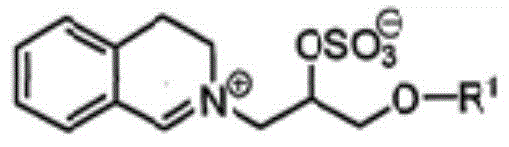
(ii)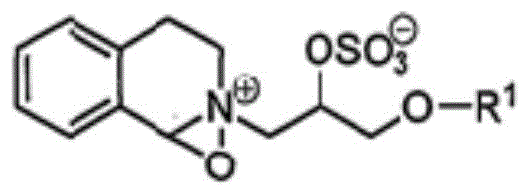
(iii)及其混合物;其中每个R1独立地是含有从9至24个碳的支链烷基或含有从11至24个碳的直链烷基,优选地每个R1独立地是含有从9至18个碳的支链烷基或含有从11至18个碳的直链烷基,更优选地每个R1独立地选自由以下组成的组:2-丙基庚基、2-丁基辛基、2-戊基壬基、2-己基癸基、十二烷基、十四烷基、十六烷基、十八烷基、异壬基、异癸基、异十三烷基以及异十五烷基。(iii) and mixtures thereof; wherein each R1 is independently a branched alkyl group containing from 9 to 24 carbons or a straight chain alkyl group containing from 11 to 24 carbons, preferably each R1 is independently a group containing from branched chain alkyl of 9 to 18 carbons or straight chain alkyl containing from 11 to 18 carbons, more preferably each R1 is independently selected from the group consisting of: 2-propylheptyl, 2-butyl Octyl, 2-pentylnonyl, 2-hexyldecyl, dodecyl, tetradecyl, hexadecyl, octadecyl, isononyl, isodecyl, isotridecyl, and isopentadecyl.
其他示例性漂白系统描述于例如WO2007/087258、WO2007/087244、WO2007/087259、EP1867708(维生素K)以及WO2007/087242中。适合的光漂白剂可以例如是磺化的酞菁锌或酞菁铝。Other exemplary bleaching systems are described, for example, in WO2007/087258, WO2007/087244, WO2007/087259, EP1867708 (vitamin K) and WO2007/087242. Suitable photobleaches can be, for example, sulfonated zinc phthalocyanines or aluminum phthalocyanines.
金属护理剂metal care agent
金属护理剂可以防止或减少金属的锈蚀、腐蚀或氧化,这些金属包括铝、不锈钢和非铁金属,如银和铜。适合的实例包括以下的一个或多个:Metal conditioners prevent or reduce rust, corrosion, or oxidation of metals, including aluminum, stainless steel, and non-ferrous metals such as silver and copper. Suitable examples include one or more of the following:
(a)苯并三唑类,包括苯并三唑或双-苯并三唑及其取代衍生物。苯并三唑衍生物是其中芳环上可获得的取代位点被部分或完全取代的那些化合物。适合的取代基包括直链或支链Ci-C20-烷基基团(例如C1-C20-烷基基团)和羟基、硫代、苯基或卤素(如氟、氯、溴和碘)。(a) Benzotriazoles, including benzotriazoles or bis-benzotriazoles and substituted derivatives thereof. Benzotriazole derivatives are those compounds in which the available substitution sites on the aromatic ring are partially or fully substituted. Suitable substituents include straight or branched chain Ci-C20-alkyl groups (eg C1-C20-alkyl groups) and hydroxy, thio, phenyl or halogen (eg fluorine, chlorine, bromine and iodine).
(b)选自由以下组成的组的金属盐和络合物:锌、锰、钛、锆、铪、钒、钴,镓和铯盐和/或络合物,这些金属处于氧化态II、III、IV、V或VI之一。在一个方面,适合的金属盐和/或金属络合物可以选自由以下组成的组:Mn(II)硫酸盐、Mn(II)柠檬酸盐、Mn(II)硬脂酸盐、Mn(II)乙酰丙酮酸盐、K^TiF6(例如,K2TiF6)、K^ZrF6(例如,K2ZrF6)、CoSO4、Co(NOs)2和Ce(NOs)3、锌盐,例如,硫酸锌、水锌矿、或乙酸锌;(b) salts and complexes of metals selected from the group consisting of zinc, manganese, titanium, zirconium, hafnium, vanadium, cobalt, gallium and cesium salts and/or complexes, these metals being in oxidation states II, III , IV, V or VI. In one aspect, suitable metal salts and/or metal complexes can be selected from the group consisting of: Mn(II) sulfate, Mn(II) citrate, Mn(II) stearate, Mn(II) ) acetylacetonate, K2TiF6 (for example, K2TiF6), K2ZrF6 (for example, K2ZrF6), CoSO4, Co(NOs)2 and Ce(NOs)3, zinc salts, for example, zinc sulfate, hydrozinite, or zinc acetate;
(c)硅酸盐,包括硅酸钠或硅酸钾、二硅酸钠、硅酸钠、结晶层状硅酸盐及其混合物。(c) Silicates, including sodium or potassium silicate, sodium disilicate, sodium silicate, crystalline layered silicates, and mixtures thereof.
WO 94/26860和WO 94/26859中披露了用作银/铜腐蚀抑制剂的另外适合的有机和无机氧化还原活性物质。优选地,本发明的组合物按重量计包含从0.1%至5%的金属护理剂的组合物,优选地该金属护理剂是锌盐。Further suitable organic and inorganic redox active substances for use as silver/copper corrosion inhibitors are disclosed in WO 94/26860 and WO 94/26859. Preferably, the compositions of the present invention comprise from 0.1% to 5% by weight of a composition of a metal conditioner, preferably the metal conditioner is a zinc salt.
水溶助剂Hydrotrope
洗涤剂可以包含按重量计0%-10%,例如按重量计0-5%,例如约0.5%至约5%、或约3%至约5%的水溶助剂。可以利用本领域中已知的用于在洗涤剂中使用的任何水溶助剂。水溶助剂的非限制性实例包括苯磺酸钠、对甲苯磺酸钠(STS)、二甲苯磺酸钠(SXS)、枯烯磺酸钠(SCS)、伞花烃磺酸钠、氧化胺、醇和聚乙二醇醚、羟基萘甲酸钠、羟基萘磺酸钠、乙基己基磺酸钠及其组合。The detergent may comprise from 0% to 10% by weight, such as from 0 to 5% by weight, such as from about 0.5% to about 5%, or from about 3% to about 5%, of a hydrotrope. Any hydrotrope known in the art for use in detergents can be utilized. Non-limiting examples of hydrotropes include sodium benzene sulfonate, sodium p-toluene sulfonate (STS), sodium xylene sulfonate (SXS), sodium cumene sulfonate (SCS), sodium cymene sulfonate, amine oxides , alcohol and polyethylene glycol ethers, sodium hydroxynaphthoate, sodium hydroxynaphthalene sulfonate, sodium ethylhexyl sulfonate, and combinations thereof.
聚合物polymer
洗涤剂可以含有按重量计0%-10%(如0.5%-5%、2%-5%、0.5%-2%或0.2%-1%)的聚合物。可以利用本领域中已知的在洗涤剂中使用的任何聚合物。该聚合物可以作为如上文提到的共助洗剂起作用,或可以提供抗再沉积、纤维保护、污垢释放、染料转移抑制、油污清洁和/或抑泡特性。一些聚合物可以具有多于一种的上文提到的特性和/或多于一种的下文提到的基序。示例性聚合物包括(羧甲基)纤维素(CMC)、聚(乙烯醇)(PVA)、聚(乙烯吡咯烷酮)(PVP)、聚(乙二醇)或聚(环氧乙烷)(PEG)、乙氧基化的聚(亚乙基亚胺)、羧甲基菊粉(CMI)、和聚羧化物,如PAA、PAA/PMA、聚-天冬氨酸、和甲基丙烯酸月桂酯/丙烯酸共聚物、疏水修饰的CMC(HM-CMC)和硅酮、对苯二甲酸和低聚乙二醇的共聚物、聚(对苯二甲酸乙二酯)和聚(氧乙烯对苯二甲酸乙二酯)的共聚物(PET-POET)、PVP、聚(乙烯基咪唑)(PVI)、聚(乙烯吡啶-N-氧化物)(PVPO或PVPNO)以及聚乙烯吡咯烷酮-乙烯基咪唑(PVPVI)。适合的实例包括来自亚什兰亚跨龙公司(Ashland Aqualon)的PVP-K15、PVP-K30、ChromaBond S-400、ChromaBond S-403E和Chromabond S-100,以及来自BASF公司的HP 165、


织物调色剂fabric toner
本发明的洗涤剂组合物还可以包括织物调色剂,如染料或颜料,当配制在洗涤剂组合物中时,当所述织物与洗涤液接触时织物调色剂可以沉积在织物上,所述洗涤液包含所述洗涤剂组合物,并且因此通过可见光的吸收/反射改变所述织物的色彩。荧光增白剂发射至少一些可见光。相比之下,当织物调色剂吸收至少部分可见光谱时,它们改变表面的色彩。适合的织物调色剂包括染料和染料-粘土轭合物,并且还可以包括颜料。适合的染料包括小分子染料和聚合物染料。适合的小分子染料包括选自下组的小分子染料,该组由落入颜色索引(Colour Index)(C.I.)分类的以下染料组成:直接蓝、直接红、直接紫、酸性蓝、酸性红、酸性紫、碱性蓝、碱性紫和碱性红、或其混合物,例如于WO2005/03274、WO2005/03275、WO2005/03276和EP1876226中所描述的(通过引用特此并入)。洗涤剂组合物优选地包含从约0.00003wt%至约0.2wt%、从约0.00008wt%至约0.05wt%、或甚至从约0.0001wt%至约0.04wt%的织物调色剂。该组合物可以包含从0.0001wt%至0.2wt%的织物调色剂,当该组合物处于单位剂量袋的形式时,这可以是尤其优选的。适合的调色剂还披露于例如WO2007/087257和WO2007/087243中。The detergent compositions of the present invention may also include fabric tinting agents, such as dyes or pigments, which, when formulated in the detergent composition, can deposit on fabrics when the fabrics are contacted with a wash liquor, so that The wash liquor contains the detergent composition and thus changes the color of the fabric by absorption/reflection of visible light. Optical brighteners emit at least some visible light. In contrast, when fabric toners absorb at least part of the visible spectrum, they change the color of the surface. Suitable fabric tints include dyes and dye-clay conjugates, and may also include pigments. Suitable dyes include small molecule dyes and polymeric dyes. Suitable small molecule dyes include small molecule dyes selected from the group consisting of the following dyes falling into the Color Index (C.I.) classification: direct blue, direct red, direct violet, acid blue, acid red, Acid violet, basic blue, basic violet and basic red, or mixtures thereof, are described for example in WO2005/03274, WO2005/03275, WO2005/03276 and EP1876226 (hereby incorporated by reference). The detergent composition preferably comprises from about 0.00003 wt% to about 0.2 wt%, from about 0.00008 wt% to about 0.05 wt%, or even from about 0.0001 wt% to about 0.04 wt% fabric toner. The composition may contain from 0.0001 wt% to 0.2 wt% fabric toner, which may be especially preferred when the composition is in the form of a unit dose pouch. Suitable toners are also disclosed in eg WO2007/087257 and WO2007/087243.
酶enzyme
洗涤剂添加剂连同洗涤剂组合物可以包括一种或多种另外的酶,例如一种或多种脂肪酶、角质酶、淀粉酶、糖酶、纤维素酶、果胶酶、甘露聚糖酶、阿拉伯糖酶、半乳聚糖酶、木聚糖酶、氧化酶,例如漆酶、和/或过氧化物酶。The detergent additive along with the detergent composition may include one or more additional enzymes, such as one or more lipases, cutinases, amylases, carbohydrases, cellulases, pectinases, mannanases, Arabinase, galactanase, xylanase, oxidase, eg laccase, and/or peroxidase.
一般而言,一种或多种所选酶的特性应与所选洗涤剂相容(即,最适pH,与其他酶和非酶成分的相容性等),并且该一种或多种酶应以有效量存在。In general, the properties of one or more of the selected enzymes should be compatible with the selected detergent (ie, pH optimum, compatibility with other enzymatic and non-enzymatic ingredients, etc.), and the one or more Enzymes should be present in effective amounts.
纤维素酶Cellulase
适合的纤维素酶包括细菌来源或真菌来源的那些。包括化学修饰的突变体或蛋白质工程化的突变体。适合的纤维素酶包括来自芽孢杆菌属、假单胞菌属、腐质霉属、镰孢属、梭孢壳菌属、枝顶孢属的纤维素酶,例如披露于US 4,435,307、US 5,648,263、US 5,691,178、US 5,776,757以及WO 89/09259中的由特异腐质霉、嗜热毁丝霉和尖孢镰孢产生的真菌纤维素酶。Suitable cellulases include those of bacterial or fungal origin. Chemically modified mutants or protein engineered mutants are included. Suitable cellulases include cellulases from Bacillus, Pseudomonas, Humicola, Fusarium, Clostridium, Acremonium, such as disclosed in US 4,435,307, US 5,648,263, Fungal cellulases produced by Humicola insolens, Myceliophthora thermophila and Fusarium oxysporum in US 5,691,178, US 5,776,757 and WO 89/09259.
尤其适合的纤维素酶是具有颜色护理益处的碱性或中性纤维素酶。此类纤维素酶的实例是描述于EP 0 495 257、EP 0 531 372、WO 96/11262、WO 96/29397、WO 98/08940中的纤维素酶。其他实例是如描述于WO 94/07998、EP 0 531 315、US 5,457,046、US 5,686,593、US 5,763,254、WO 95/24471、WO 98/12307以及WO99/001544中的那些纤维素酶变体。Particularly suitable cellulases are alkaline or neutral cellulases with color care benefits. Examples of such cellulases are those described in EP 0 495 257, EP 0 531 372, WO 96/11262, WO 96/29397, WO 98/08940. Other examples are cellulase variants such as those described in WO 94/07998, EP 0 531 315, US 5,457,046, US 5,686,593, US 5,763,254, WO 95/24471, WO 98/12307 and WO 99/001544.
其他纤维素酶是具有以下序列的内切-β-1,4-葡聚糖酶,该序列与WO 2002/099091的SEQ ID NO:2的位置1至位置773的氨基酸序列具有至少97%同一性,或家族44木葡聚糖酶,该木葡聚糖酶具有以下序列,该序列与WO 2001/062903的SEQ ID NO:2的位置40-559具有至少60%同一性。Other cellulases are endo-beta-1,4-glucanases having a sequence that is at least 97% identical to the amino acid sequence from position 1 to position 773 of SEQ ID NO: 2 of WO 2002/099091 sex, or Family 44 xyloglucanase having a sequence that is at least 60% identical to positions 40-559 of SEQ ID NO: 2 of WO 2001/062903.
可商购的纤维素酶包括CelluzymeTM和CarezymeTM(诺维信公司(Novozymes A/S))、Carezyme PremiumTM(诺维信公司)、CellucleanTM(诺维信公司)、CellucleanClassicTM(诺维信公司)、CellusoftTM(诺维信公司)、WhitezymeTM(诺维信公司)、ClazinaseTM和Puradax HATM(杰能科国际有限公司(Genencor International Inc.))以及KAC-500(B)TM(花王株式会社(Kao Corporation))。Commercially available cellulases include Celluzyme ™ and Carezyme ™ (Novozymes A/S), Carezyme Premium ™ (Novozymes), Celluclean ™ (Novozymes), CellucleanClassic ™ (Novozymes) Cellusoft TM (Novozymes), Whitezyme TM (Novozymes), Clazinase TM and Puradax HA TM (Genencor International Inc.) and KAC-500(B) TM (Kao Corporation).
甘露聚糖酶Mannanase
适合的甘露聚糖酶包括细菌或真菌来源的那些。包括化学或基因修饰的突变体。甘露聚糖酶可以是家族5或26的碱性甘露聚糖酶。它可以是来自芽孢杆菌属或腐质霉属的野生型,特别是粘琼脂芽孢杆菌、地衣芽孢杆菌、嗜碱芽孢杆菌、克劳氏芽孢杆菌或特异腐质霉。适合的甘露聚糖酶描述于WO 1999/064619中。可商购的甘露聚糖酶是Mannaway(诺维信公司)。Suitable mannanases include those of bacterial or fungal origin. Chemically or genetically modified mutants are included. The mannanase may be a family 5 or 26 alkaline mannanase. It may be wild type from the genus Bacillus or Humicola, in particular Bacillus viscera, Bacillus licheniformis, Bacillus alkalophila, Bacillus clausii or Humicola insolens. Suitable mannanases are described in WO 1999/064619. A commercially available mannanase is Mannaway (Novozymes).
过氧化物酶/氧化酶peroxidase/oxidase
适合的过氧化物酶/氧化酶包括植物、细菌或真菌来源的那些。包括化学修饰的突变体或蛋白质工程化的突变体。有用的过氧化物酶的实例包括来自鬼伞属,例如来自灰盖鬼伞(C.cinereus)的过氧化物酶,及其变体,如在WO 93/24618、WO 95/10602、以及WO 98/15257中描述的那些。可商购的过氧化物酶包括GuardzymeTM(诺维信公司)。Suitable peroxidases/oxidases include those of plant, bacterial or fungal origin. Chemically modified mutants or protein engineered mutants are included. Examples of useful peroxidases include peroxidases from the genus C. cinereus, such as from C. cinereus, and variants thereof, as described in WO 93/24618, WO 95/10602, and WO Those described in 98/15257. Commercially available peroxidases include Guardzyme ™ (Novozymes).
脂肪酶和角质酶:Lipase and Cutinase:
适合的脂肪酶和角质酶包括细菌或真菌来源的那些。包括化学修饰的或蛋白质工程化的突变体酶。实例包括如在EP 258 068和EP 305 216中所描述的来自嗜热丝孢菌属(Thermomyces)(例如来自疏绵状嗜热丝孢菌(T.lanuginosus)(以前命名为柔毛腐质霉(Humicolalanuginosa))的脂肪酶、来自腐质霉(例如特异腐质霉(H.insolens)(WO96/13580))的角质酶、来自假单胞菌属(Pseudomonas)(这些假单胞菌属中的一些现在重命名为伯克氏菌属)的脂肪酶(例如,产碱假单胞菌(P.alcaligenes)或类产碱假单胞菌(P.pseudoalcaligene)(EP218272))、洋葱假单胞菌(P.cepacia)(EP 331 376)、菌株SD705(WO 95/06720和WO 96/27002)、威斯康星假单胞菌(P.wisconsinensis)(WO 96/12012)、GDSL型链霉菌属脂肪酶(WO10/065455)、来自稻瘟病菌(WO10/107560)的角质酶、来自门多萨假多胞菌(US5,389,536)的角质酶、来自嗜热裂孢菌(WO11/084412)的脂肪酶、嗜热脂肪土芽孢杆菌脂肪酶(WO11/084417)、来自枯草芽孢杆菌(WO11/084599)的脂肪酶、以及来自灰色链霉菌(WO11/150157)的脂肪酶和始旋链霉菌(WO12/137147)。Suitable lipases and cutinases include those of bacterial or fungal origin. Chemically modified or protein engineered mutant enzymes are included. Examples include those from Thermomyces (eg from T. lanuginosus) (previously named Humicola pilosicus) as described in EP 258 068 and EP 305 216. (Humicolalanuginosa), lipase from Humicola (eg H. insolens (WO 96/13580)), cutinase from Pseudomonas (in these Pseudomonas Some now renamed Burkholderia) lipases (for example, P. alcaligenes or P. pseudoalcaligene (EP218272)), Pseudomonas cepacia P. cepacia (EP 331 376), strain SD705 (WO 95/06720 and WO 96/27002), P. wisconsinensis (WO 96/12012), GDSL type Streptomyces adip Enzymes (WO10/065455), Cutinases from Pseudomonas oryzae (WO10/107560), Cutinases from Pseudomonas mendoza (US 5,389,536), Fats from S. thermophilus (WO11/084412) Enzymes, Geobacillus stearothermophilus lipase (WO11/084417), lipase from Bacillus subtilis (WO11/084599), and lipase from Streptomyces griseus (WO11/150157) and Streptomyces protospira (WO12/ 137147).
其他实例是脂肪酶变体,如描述于EP407225、WO92/05249、WO94/01541、WO94/25578、WO95/14783、WO95/30744、WO95/35381、WO95/22615、WO96/00292、WO97/04079、WO97/07202、WO00/34450、WO00/60063、WO01/92502、WO07/87508以及WO09/109500中的那些。Other examples are lipase variants, as described in EP407225, WO92/05249, WO94/01541, WO94/25578, WO95/14783, WO95/30744, WO95/35381, WO95/22615, WO96/00292, WO97/04079, WO97 /07202, WO00/34450, WO00/60063, WO01/92502, WO07/87508 and those in WO09/109500.
优选的商业化脂肪酶产品包括LipolaseTM、LipexTM;LipolexTM和LipocleanTM(诺维信公司),Lumafast(来自杰能科公司(Genencor))以及Lipomax(来自吉斯特布罗卡德斯公司(Gist-Brocades))。Preferred commercial lipase products include Lipolase (TM) , Lipex (TM) ; Lipolex (TM) and Lipoclean (TM) (from Novozymes), Lumafast (from Genencor) and Lipomax (from Gist Brocades). (Gist-Brocades)).
仍其他实例是有时称为酰基转移酶或过水解酶的脂肪酶,例如与南极假丝酵母(Candida antarctica)脂肪酶A具有同源性的酰基转移酶(WO10/111143)、来自耻垢分枝杆菌(Mycobacterium smegmatis)的酰基转移酶(WO05/56782)、来自CE 7家族的过水解酶(WO09/67279)以及耻垢分枝杆菌过水解酶的变体(特别是来自亨斯迈纺织品染化有限公司(Huntsman Textile Effects Pte Ltd)的商业产品Gentle Power Bleach中所用的S54V变体)(WO10/100028)。Still other examples are lipases sometimes referred to as acyltransferases or perhydrolases, such as acyltransferases having homology to Candida antarctica lipase A (WO 10/111143), from branch smegmatis Acyltransferase of Mycobacterium smegmatis (WO05/56782), perhydrolase from CE 7 family (WO09/67279) and variants of perhydrolase from Mycobacterium smegmatis (especially from Huntsman Textile Dyeing) S54V variant used in the commercial product Gentle Power Bleach of Huntsman Textile Effects Pte Ltd (WO 10/100028).
淀粉酶:Amylase:
适合的淀粉酶包括α-淀粉酶和/或葡糖淀粉酶并且可以是细菌或真菌来源的。包括化学修饰的突变体或蛋白质工程化的突变体。淀粉酶包括例如从芽孢杆菌属、例如地衣芽孢杆菌的特定菌株(更详细地描述于GB 1,296,839中)获得的α-淀粉酶。Suitable amylases include alpha-amylases and/or glucoamylases and may be of bacterial or fungal origin. Chemically modified mutants or protein engineered mutants are included. Amylases include, for example, alpha-amylases obtained from specific strains of Bacillus, such as Bacillus licheniformis (described in more detail in GB 1,296,839).
适合的淀粉酶包括具有WO 95/10603中的SEQ ID NO:2的淀粉酶或其与SEQ IDNO:3具有90%序列同一性的变体。优选的变体描述于WO 94/02597、WO 94/18314、WO 97/43424中以及WO 99/019467的SEQ ID NO:4中,如在一个或多个以下位置中具有取代的变体:15、23、105、106、124、128、133、154、156、178、179、181、188、190、197、201、202、207、208、209、211、243、264、304、305、391、408和444。Suitable amylases include the amylase having SEQ ID NO:2 in WO 95/10603 or a variant thereof having 90% sequence identity to SEQ ID NO:3. Preferred variants are described in WO 94/02597, WO 94/18314, WO 97/43424 and in SEQ ID NO: 4 of WO 99/019467, such as variants with substitutions in one or more of the following positions: 15 , 23, 105, 106, 124, 128, 133, 154, 156, 178, 179, 181, 188, 190, 197, 201, 202, 207, 208, 209, 211, 243, 264, 304, 305, 391 , 408 and 444.
不同的适合的淀粉酶包括具有WO 02/010355中的SEQ ID NO:6的淀粉酶或其与SEQ ID NO:6具有90%序列同一性的变体。SEQ ID NO:6的优选的变体是在位置181和182中具有缺失并且在位置193中具有取代的那些。Different suitable amylases include the amylase having SEQ ID NO:6 in WO 02/010355 or a variant thereof having 90% sequence identity to SEQ ID NO:6. Preferred variants of SEQ ID NO:6 are those with deletions in positions 181 and 182 and substitutions in position 193.
其他适合的淀粉酶是包括WO 2006/066594的SEQ ID NO:6中所示的来源于解淀粉芽孢杆菌的α-淀粉酶的残基1-33和示于WO 2006/066594的SEQ ID NO:4中的地衣芽孢杆菌α-淀粉酶的残基36-483的杂合α-淀粉酶或其具有90%序列同一性的变体。此杂合α-淀粉酶的优选的变体是在以下位置中的一个或多个中具有取代、缺失或插入的那些:G48、T49、G107、H156、A181、N190、M197、I201、A209和Q264。包含WO 2006/066594的SEQ ID NO:6中所示的来源于解淀粉芽孢杆菌的α-淀粉酶的残基1-33和SEQ ID NO:4的残基36-483的杂合α-淀粉酶的最优选的变体是具有以下取代的那些:Other suitable amylases include residues 1-33 of an alpha-amylase derived from Bacillus amyloliquefaciens shown in SEQ ID NO: 6 of WO 2006/066594 and SEQ ID NO: 6 of WO 2006/066594 A hybrid alpha-amylase of residues 36-483 of the Bacillus licheniformis alpha-amylase in 4 or a variant thereof having 90% sequence identity. Preferred variants of this hybrid alpha-amylase are those having substitutions, deletions or insertions in one or more of the following positions: G48, T49, G107, H156, A181, N190, M197, I201, A209 and Q264. Hybrid alpha-starch comprising residues 1-33 of the alpha-amylase derived from Bacillus amyloliquefaciens shown in SEQ ID NO:6 of WO 2006/066594 and residues 36-483 of SEQ ID NO:4 The most preferred variants of the enzymes are those with the following substitutions:
M197T;M197T;
H156Y+A181T+N190F+A209V+Q264S;或H156Y+A181T+N190F+A209V+Q264S; or
G48A+T49I+G107A+H156Y+A181T+N190F+I201F+A209V+Q264S。G48A+T49I+G107A+H156Y+A181T+N190F+I201F+A209V+Q264S.
另外的适合的淀粉酶是具有WO 99/019467中的SEQ ID NO:6的淀粉酶或其与SEQID NO:6具有90%序列同一性的变体。SEQ ID NO:6的优选的变体是在以下位置中的一个或多个中具有取代、缺失或插入的那些:R181、G182、H183、G184、N195、I206、E212、E216和K269。特别优选的淀粉酶是在位置R181和G182、或位置H183和G184中具有缺失的那些。A further suitable amylase is the amylase having SEQ ID NO:6 in WO 99/019467 or a variant thereof having 90% sequence identity to SEQ ID NO:6. Preferred variants of SEQ ID NO:6 are those having substitutions, deletions or insertions in one or more of the following positions: R181, G182, H183, G184, N195, I206, E212, E216 and K269. Particularly preferred amylases are those with deletions in positions R181 and G182, or in positions H183 and G184.
可以使用的另外的淀粉酶是具有WO 96/023873的SEQ ID NO:1、SEQ ID NO:3、SEQID NO:2或SEQ ID NO:7的那些或其与SEQ ID NO:1、SEQ ID NO:2、SEQ ID NO:3或SEQ IDNO:7具有90%序列同一性的变体。SEQ ID NO:1、SEQ ID NO:2、SEQ ID NO:3或SEQ ID NO:7的优选的变体是在以下位置中的一个或多个中具有取代、缺失或插入的那些:140、181、182、183、184、195、206、212、243、260、269、304和476,使用WO 96/023873的SEQ ID 2用于编号。更优选的变体是在选自181、182、183和184的两个位置(如181和182、182和183、或位置183和184)中具有缺失的那些。SEQ ID NO:1、SEQ ID NO:2或SEQ ID NO:7的最优选的淀粉酶变体是在位置183和184中具有缺失并且在位置140、195、206、243、260、304和476中的一个或多个中具有取代的那些。Additional amylases that can be used are those having SEQ ID NO: 1, SEQ ID NO: 3, SEQ ID NO: 2 or SEQ ID NO: 7 of WO 96/023873 or their combination with SEQ ID NO: 1, SEQ ID NO: 7 : 2, SEQ ID NO:3 or SEQ ID NO:7 variants with 90% sequence identity. Preferred variants of SEQ ID NO:1, SEQ ID NO:2, SEQ ID NO:3 or SEQ ID NO:7 are those having substitutions, deletions or insertions in one or more of the following positions: 140, 181, 182, 183, 184, 195, 206, 212, 243, 260, 269, 304 and 476 using SEQ ID 2 of WO 96/023873 for numbering. More preferred variants are those with deletions in two positions selected from the group consisting of 181, 182, 183 and 184 (eg 181 and 182, 182 and 183, or positions 183 and 184). The most preferred amylase variants of SEQ ID NO:1, SEQ ID NO:2 or SEQ ID NO:7 have deletions at positions 183 and 184 and at positions 140, 195, 206, 243, 260, 304 and 476 Those with substitution in one or more of the .
可以使用的其他淀粉酶是具有WO 08/153815的SEQ ID NO:2、WO 01/66712中的SEQ ID NO:10的淀粉酶或其与WO 08/153815的SEQ ID NO:2具有90%序列同一性或与WO01/66712中的SEQ ID NO:10具有90%序列同一性的变体。WO 01/66712中的SEQ ID NO:10的优选的变体是在以下位置中的一个或多个中具有取代、缺失或插入的那些:176、177、178、179、190、201、207、211和264。Other amylases that can be used are amylases having SEQ ID NO: 2 of WO 08/153815, SEQ ID NO: 10 of WO 01/66712 or 90% sequence with SEQ ID NO: 2 of WO 08/153815 Identity or a variant with 90% sequence identity to SEQ ID NO: 10 in WO01/66712. Preferred variants of SEQ ID NO: 10 in WO 01/66712 are those having substitutions, deletions or insertions in one or more of the following positions: 176, 177, 178, 179, 190, 201, 207, 211 and 264.
另外的适合的淀粉酶是具有WO 09/061380的SEQ ID NO:2的淀粉酶或其与SEQ IDNO:2具有90%序列同一性的变体。SEQ ID NO:2的优选的变体是在以下位置中的一个或多个中具有C-末端截短和/或取代、缺失或插入的那些:Q87、Q98、S125、N128、T131、T165、K178、R180、S181、T182、G183、M201、F202、N225、S243、N272、N282、Y305、R309、D319、Q320、Q359、K444和G475。SEQ ID NO:2的更优选的变体是在以下位置中的一个或多个处具有取代的那些:Q87E,R、Q98R、S125A、N128C、T131I、T165I、K178L、T182G、M201L、F202Y、N225E,R、N272E,R、S243Q,A,E,D、Y305R、R309A、Q320R、Q359E、K444E以及G475K,和/或在位置R180和/或S181或T182和/或G183处具有缺失的那些。SEQ ID NO:2的最优选的淀粉酶变体是具有以下取代的那些:A further suitable amylase is the amylase having SEQ ID NO:2 of WO 09/061380 or a variant thereof having 90% sequence identity to SEQ ID NO:2. Preferred variants of SEQ ID NO:2 are those having C-terminal truncations and/or substitutions, deletions or insertions in one or more of the following positions: Q87, Q98, S125, N128, T131, T165, K178, R180, S181, T182, G183, M201, F202, N225, S243, N272, N282, Y305, R309, D319, Q320, Q359, K444 and G475. More preferred variants of SEQ ID NO: 2 are those having substitutions at one or more of the following positions: Q87E, R, Q98R, S125A, N128C, T131I, T165I, K178L, T182G, M201L, F202Y, N225E , R, N272E, R, S243Q, A, E, D, Y305R, R309A, Q320R, Q359E, K444E and G475K, and/or those with deletions at positions R180 and/or S181 or T182 and/or G183. The most preferred amylase variants of SEQ ID NO: 2 are those with the following substitutions:
N128C+K178L+T182G+Y305R+G475K;N128C+K178L+T182G+Y305R+G475K;
N128C+K178L+T182G+F202Y+Y305R+D319T+G475K;N128C+K178L+T182G+F202Y+Y305R+D319T+G475K;
S125A+N128C+K178L+T182G+Y305R+G475K;或S125A+N128C+K178L+T182G+Y305R+G475K; or
S125A+N128C+T131I+T165I+K178L+T182G+Y305R+G475K,其中这些变体是C-末端截短的,并且任选地进一步包含在位置243处的取代和/或在位置180和/或位置181处的缺失。S125A+N128C+T131I+T165I+K178L+T182G+Y305R+G475K, wherein these variants are C-terminally truncated and optionally further comprise a substitution at position 243 and/or at position 180 and/or position Missing at 181.
另外的适合的淀粉酶是具有WO 13184577的SEQ ID NO:1的淀粉酶或其与SEQ IDNO:1具有90%序列同一性的变体。SEQ ID NO:1的优选的变体是在以下位置中的一个或多个中具有取代、缺失或插入的那些:K176、R178、G179、T180、G181、E187、N192、M199、I203、S241、R458、T459、D460、G476和G477。SEQ ID NO:1的更优选的变体是在以下位置中的一个或多个处具有取代的那些:K176L、E187P、N192FYH、M199L、I203YF、S241QADN、R458N、T459S、D460T、G476K、以及G477K,和/或在位置R178和/或S179或T180和/或G181中具有缺失的那些。SEQ ID NO:1的最优选的淀粉酶变体是具有以下取代的那些:A further suitable amylase is the amylase having SEQ ID NO: 1 of WO 13184577 or a variant thereof having 90% sequence identity to SEQ ID NO: 1. Preferred variants of SEQ ID NO: 1 are those having substitutions, deletions or insertions in one or more of the following positions: K176, R178, G179, T180, G181, E187, N192, M199, I203, S241, R458, T459, D460, G476 and G477. More preferred variants of SEQ ID NO: 1 are those having substitutions at one or more of the following positions: K176L, E187P, N192FYH, M199L, I203YF, S241QADN, R458N, T459S, D460T, G476K, and G477K, and/or those with deletions in positions R178 and/or S179 or T180 and/or G181. The most preferred amylase variants of SEQ ID NO: 1 are those with the following substitutions:
E187P+I203Y+G476KE187P+I203Y+G476K
E187P+I203Y+R458N+T459S+D460T+G476KE187P+I203Y+R458N+T459S+D460T+G476K
其中这些变体任选地进一步包含在位置241处的取代和/或在位置178和/或位置179处的缺失。wherein these variants optionally further comprise a substitution at position 241 and/or a deletion at position 178 and/or position 179.
另外的适合的淀粉酶是具有WO10104675的SEQ ID NO:1的淀粉酶或其与SEQ IDNO:1具有90%序列同一性的变体。SEQ ID NO:1的优选的变体是在以下位置中的一个或多个中具有取代、缺失或插入的那些:N21、D97、V128、K177、R179、S180、I181、G182、M200、L204、E242、G477和G478。SEQ ID NO:1的更优选的变体是在以下位置中的一个或多个处具有取代的那些:N21D、D97N、V128I、K177L、M200L、L204YF、E242QA、G477K、以及G478K,和/或在位置R179和/或S180或I181和/或G182中具有缺失的那些。SEQ ID NO:1的最优选的淀粉酶变体是具有以下取代的那些:A further suitable amylase is the amylase having SEQ ID NO:1 of WO10104675 or a variant thereof having 90% sequence identity to SEQ ID NO:1. Preferred variants of SEQ ID NO: 1 are those having substitutions, deletions or insertions in one or more of the following positions: N21, D97, V128, K177, R179, S180, I181, G182, M200, L204, E242, G477 and G478. More preferred variants of SEQ ID NO: 1 are those having substitutions at one or more of the following positions: N21D, D97N, V128I, K177L, M200L, L204YF, E242QA, G477K, and G478K, and/or at Those with deletions in positions R179 and/or S180 or I181 and/or G182. The most preferred amylase variants of SEQ ID NO: 1 are those with the following substitutions:
N21D+D97N+V128IN21D+D97N+V128I
其中这些变体任选地进一步包含在位置200处的取代和/或在位置180和/或位置181处的缺失。wherein these variants optionally further comprise a substitution at position 200 and/or a deletion at position 180 and/or position 181.
其他适合的淀粉酶是具有WO 01/66712中的SEQ ID NO:12的α-淀粉酶或与SEQ IDNO:12具有至少90%序列同一性的变体。优选的淀粉酶变体是在WO 01/66712中的SEQ IDNO:12中的以下位置中的一个或多个中具有取代、缺失或插入的那些:R28、R118、N174;R181、G182、D183、G184、G186、W189、N195、M202、Y298、N299、K302、S303、N306、R310、N314;R320、H324、E345、Y396、R400、W439、R444、N445、K446、Q449、R458、N471、N484。特别优选的淀粉酶包括具有D183和G184的缺失并且具有取代R118K、N195F、R320K和R458K的变体,以及另外在一个或多个选自下组的位置中具有取代的变体:M9、G149、G182、G186、M202、T257、Y295、N299、M323、E345和A339,最优选的是另外在所有这些位置中具有取代的变体。Other suitable amylases are the alpha-amylases having SEQ ID NO: 12 in WO 01/66712 or a variant having at least 90% sequence identity to SEQ ID NO: 12. Preferred amylase variants are those having substitutions, deletions or insertions in one or more of the following positions in SEQ ID NO: 12 in WO 01/66712: R28, R118, N174; R181, G182, D183, G184, G186, W189, N195, M202, Y298, N299, K302, S303, N306, R310, N314; R320, H324, E345, Y396, R400, W439, R444, N445, K446, Q449, R458, N471, N484. Particularly preferred amylases include variants having deletions of D183 and G184 and having substitutions R118K, N195F, R320K and R458K, and additionally variants having substitutions in one or more positions selected from the group consisting of M9, G149, G182, G186, M202, T257, Y295, N299, M323, E345 and A339, most preferred are variants with additional substitutions in all of these positions.
其他实例是淀粉酶变体,如在WO 2011/098531、WO 2013/001078和WO 2013/001087中描述的那些。Other examples are amylase variants such as those described in WO 2011/098531, WO 2013/001078 and WO 2013/001087.
可商购的淀粉酶是DuramylTM、TermamylTM、FungamylTM、StainzymeTM、StainzymePlusTM、NatalaseTM、Liquozyme X和BANTM(来自诺维信公司),和RapidaseTM、PurastarTM/EffectenzTM、Powerase、Preferenz S1000、Preferenz S100和Preferenz S110(来自杰能科国际有限公司/杜邦公司(DuPont))。Commercially available amylases are Duramyl ™ , Termamyl ™ , Fungamyl ™ , Stainzyme ™ , StainzymePlus ™ , Natalase ™ , Liquozyme X and BAN ™ (from Novozymes), and Rapidase ™ , Purastar ™ /Effectenz ™ , Powerase, Preferenz S1000, Preferenz S100 and Preferenz S110 (from Genencor International Ltd/DuPont).
蛋白酶:Protease:
适合的蛋白酶包括细菌、真菌、植物、病毒或动物来源的那些,例如植物或微生物来源。优选的是微生物来源。包括化学修饰的突变体或蛋白质工程化的突变体。它可以是碱性蛋白酶,如丝氨酸蛋白酶或金属蛋白酶。丝氨酸蛋白酶可以例如是S1家族的(如胰蛋白酶)或S8家族的(如枯草杆菌蛋白酶)。金属蛋白酶可以例如是来自例如M4家族的嗜热菌蛋白酶或其他金属蛋白酶,如来自M5、M7或M8家族的那些。Suitable proteases include those of bacterial, fungal, plant, viral or animal origin, eg plant or microbial origin. Preferred are microbial sources. Chemically modified mutants or protein engineered mutants are included. It can be an alkaline protease, such as a serine protease or a metalloprotease. The serine protease may, for example, be of the Sl family (eg trypsin) or of the S8 family (eg subtilisin). The metalloprotease may eg be a thermolysin from eg the M4 family or other metalloprotease such as those from the M5, M7 or M8 family.
术语“枯草杆菌酶”是指根据Siezen等人,Protein Engng.[蛋白质工程]4(1991)719-737和Siezen等人,Protein Science[蛋白质科学]6(1997)501-523的丝氨酸蛋白酶的亚组。丝氨酸蛋白酶是特征在于在活性位点具有与底物形成共价加合物的丝氨酸的蛋白酶的亚组。枯草杆菌酶可以被划分为6个亚类,即,枯草杆菌蛋白酶家族、嗜热蛋白酶家族、蛋白酶K家族、羊毛硫氨酸抗生素肽酶家族、Kexin家族和Pyrolysin家族。The term "subtilase" refers to a subset of serine proteases according to Siezen et al, Protein Engng. [Protein Engineering] 4 (1991) 719-737 and Siezen et al, Protein Science 6 (1997) 501-523 Group. Serine proteases are a subgroup of proteases characterized by having a serine at the active site that forms a covalent adduct with the substrate. Subtilases can be divided into 6 subclasses, namely, the subtilisin family, the thermophilic protease family, the proteinase K family, the lanthionine antibiotic peptidase family, the Kexin family and the Pyrolysin family.
枯草杆菌酶的实例是来源于芽孢杆菌属的那些,如描述于US 7262042和WO 09/021867中的迟缓芽孢杆菌、嗜碱芽孢杆菌(B.alkalophilus)、枯草芽孢杆菌(B.subtilis)、解淀粉芽孢杆菌(B.amyloliquefaciens)、短小芽孢杆菌和吉氏芽孢杆菌(Bacillusgibsonii);以及描述于WO 89/06279中的迟缓枯草杆菌蛋白酶(subtilisin lentus)、枯草杆菌蛋白酶Novo、枯草杆菌蛋白酶Carlsberg、地衣芽孢杆菌、枯草杆菌蛋白酶BPN’、枯草杆菌蛋白酶309、枯草杆菌蛋白酶147和枯草杆菌蛋白酶168以及描述于(WO 93/18140)中的蛋白酶PD138。其他有用的蛋白酶可以是描述于WO 92/175177、WO 01/016285、WO 02/026024以及WO 02/016547中的那些。胰蛋白酶样蛋白酶的实例是胰蛋白酶(例如猪或牛来源的)和镰孢属蛋白酶(描述于WO 89/06270、WO 94/25583和WO 05/040372中),以及来源于纤维单胞菌(Cellumonas)的糜蛋白酶(描述于WO 05/052161和WO 05/052146中)。Examples of subtilases are those derived from Bacillus, such as B. lentus, B. alkalophilus, B. subtilis, B. lentus, B. alkalophilus, B. subtilis, as described in US 7262042 and WO 09/021867 B. amyloliquefaciens, Bacillus pumilus and Bacillus gibsonii; and subtilisin lentus, subtilisin Novo, subtilisin Carlsberg, lichen described in WO 89/06279 Bacillus, subtilisin BPN', subtilisin 309, subtilisin 147 and subtilisin 168 and the protease PD138 described in (WO 93/18140). Other useful proteases may be those described in WO 92/175177, WO 01/016285, WO 02/026024 and WO 02/016547. Examples of trypsin-like proteases are trypsin (eg of porcine or bovine origin) and Fusarium proteases (described in WO 89/06270, WO 94/25583 and WO 05/040372), and those derived from Cellulomonas ( Cellumonas) chymotrypsin (described in WO 05/052161 and WO 05/052146).
另外的优选的蛋白酶是来自迟缓芽孢杆菌DSM 5483的碱性蛋白酶(如在(例如)WO95/23221中所描述)、以及其变体(在WO 92/21760、WO 95/23221、EP 1921147以及EP1921148中描述的)。Further preferred proteases are the alkaline protease from Bacillus lentus DSM 5483 (as described for example in WO 95/23221), and variants thereof (in WO 92/21760, WO 95/23221, EP 1921147 and EP1921148 described in).
金属蛋白酶的实例是如描述于WO 07/044993(杰能科国际有限公司(GenencorInt.))中的中性金属蛋白酶,如来源于解淀粉芽孢杆菌的那些。Examples of metalloproteases are neutral metalloproteases such as those derived from Bacillus amyloliquefaciens as described in WO 07/044993 (Genencor Int.).
有用的蛋白酶的实例是描述于以下中的变体:WO 92/19729、WO 96/034946、WO98/20115、WO 98/20116、WO 99/011768、WO 01/44452、WO 03/006602、WO 04/03186、WO 04/041979、WO 07/006305、WO 11/036263、WO 11/036264,尤其是在以下一个或多个位置中具有取代的变体:3、4、9、15、24、27、42、55、59、60、66、74、85、96、97、98、99、100、101、102、104、116、118、121、126、127、128、154、156、157、158、161、164、176、179、182、185、188、189、193、198、199、200、203、206、211、212、216、218、226、229、230、239、246、255、256、268和269,其中这些位置对应于WO 2016/001449的SEQ ID NO 1中所示的迟缓芽孢杆菌蛋白酶的位置。更优选的枯草杆菌酶变体可以包括以下突变中的一个或多个:S3T、V4I、S9R、S9E、A15T、S24G、S24R、K27R、N42R、S55P、G59E、G59D、N60D、N60E、V66A、N74D、N85S、N85R、、G96S、G96A、S97G、S97D、S97A、S97SD、S99E、S99D、S99G、S99M、S99N、S99R、S99H、S101A、V102I、V102Y、V102N、S104A、G116V、G116R、H118D、H118N、N120S、S126L、P127Q、S128A、S154D、A156E、G157D、G157P、S158E、Y161A、R164S、Q176E、N179E、S182E、Q185N、A188P、G189E、V193M、N198D、V199I、Y203W、S206G、L211Q、L211D、N212D、N212S、M216S、A226V、K229L、Q230H、Q239R、N246K、N255W、N255D、N255E、L256E、L256D、T268A、R269H。这些蛋白酶变体优选地是在WO2016/001449的SEQ ID NO 1中所示的迟缓芽孢杆菌蛋白酶的变体、或在WO2016/001449的SEQ ID NO 2中所示的解淀粉芽孢杆菌蛋白酶(BPN’)的变体。这些蛋白酶变体与WO 2016/001449的SEQ ID NO 1或SEQ ID NO 2优选地具有至少80%序列同一性。Examples of useful proteases are the variants described in: WO 92/19729, WO 96/034946, WO 98/20115, WO 98/20116, WO 99/011768, WO 01/44452, WO 03/006602, WO 04 /03186, WO 04/041979, WO 07/006305, WO 11/036263, WO 11/036264, especially variants with substitution in one or more of the following positions: 3, 4, 9, 15, 24, 27 , 42, 55, 59, 60, 66, 74, 85, 96, 97, 98, 99, 100, 101, 102, 104, 116, 118, 121, 126, 127, 128, 154, 156, 157, 158 , 161, 164, 176, 179, 182, 185, 188, 189, 193, 198, 199, 200, 203, 206, 211, 212, 216, 218, 226, 229, 230, 239, 246, 255, 256 , 268 and 269, wherein these positions correspond to the positions of the Bacillus lentus protease shown in SEQ ID NO 1 of WO 2016/001449. More preferred subtilase variants may include one or more of the following mutations: S3T, V4I, S9R, S9E, A15T, S24G, S24R, K27R, N42R, S55P, G59E, G59D, N60D, N60E, V66A, N74D , N85S, N85R, , G96S, G96A, S97G, S97D, S97A, S97SD, S99E, S99D, S99G, S99M, S99N, S99R, S99H, S101A, V102I, V102Y, V102N, S104A, G116V, G116, R, H118D, H116 N120S、S126L、P127Q、S128A、S154D、A156E、G157D、G157P、S158E、Y161A、R164S、Q176E、N179E、S182E、Q185N、A188P、G189E、V193M、N198D、V199I、Y203W、S206G、L211Q、L211D、N212D、 N212S, M216S, A226V, K229L, Q230H, Q239R, N246K, N255W, N255D, N255E, L256E, L256D, T268A, R269H. These protease variants are preferably the Bacillus lentus protease shown in SEQ ID NO 1 of WO2016/001449 , or a variant of the Bacillus amyloliquefaciens protease (BPN') shown in SEQ ID NO 2 of WO2016/001449. These protease variants preferably have at least 80% sequence identity to SEQ ID NO 1 or SEQ ID NO 2 of WO 2016/001449.
在以下一个或多个位置(对应于WO 2004/067737的SEQ ID NO:1的位置171、173、175、179或180)处包含取代的蛋白酶变体,其中所述蛋白酶变体与WO 2004/067737的SEQID NO:1具有至少75%但少于100%的序列同一性。A protease variant comprising a substitution at one or more of the following positions (corresponding to positions 171, 173, 175, 179 or 180 of SEQ ID NO: 1 of WO 2004/067737), wherein the protease variant is identical to WO 2004/ SEQ ID NO: 1 of 067737 has at least 75% but less than 100% sequence identity.
适合的可商购蛋白酶包括以下列商品名出售的那些:






过氧化物酶/氧化酶peroxidase/oxidase
根据本发明的过氧化物酶是由酶分类EC 1.11.1.7囊括的由国际生物化学和分子生物学联盟命名委员会(IUBMB)规定的酶,或来源于其中的展示出过氧化物酶活性的任何片段。A peroxidase according to the invention is an enzyme defined by the International Union of Biochemistry and Molecular Biology Nomenclature Committee (IUBMB) encompassed by enzyme classification EC 1.11.1.7, or any derived therefrom exhibiting peroxidase activity Fragment.
适合的过氧化物酶包括植物、细菌或真菌来源的那些。包括化学修饰的突变体或蛋白质工程化的突变体。有用的过氧化物酶的实例包括来自拟鬼伞属,例如来自灰盖拟鬼伞(C.cinerea)的过氧化物酶(EP 179,486),及其变体,如在WO 93/24618、WO 95/10602以及WO 98/15257中所描述的那些。Suitable peroxidases include those of plant, bacterial or fungal origin. Chemically modified mutants or protein engineered mutants are included. Examples of useful peroxidase enzymes include peroxidase from Psilocybe, eg from C. cinerea (EP 179,486), and variants thereof, as described in WO 93/24618, WO 95/10602 and those described in WO 98/15257.
适合的过氧化物酶包括卤代过氧化物酶,如氯过氧化物酶、溴过氧化物酶以及表现出氯过氧化物酶或溴过氧化物酶活性的化合物。根据其对卤素离子的特异性将卤代过氧化物酶进行分类。氯过氧化物酶(E.C.1.11.1.10)催化从氯根离子形成次氯酸盐。优选地,该卤代过氧化物酶是钒卤代过氧化物酶,即含钒酸盐的卤代过氧化物酶。已从许多不同真菌,特别是从暗色丝孢菌(dematiaceous hyphomycete)真菌组中分离出了卤代过氧化物酶,如卡尔黑霉属(Caldariomyces)(例如,煤卡尔黑霉(C.fumago))、链格孢属、弯孢属(例如,疣枝弯孢(C.verruculosa)和不等弯孢(C.inaequalis))、内脐蠕孢属、细基格孢属以及葡萄孢属。Suitable peroxidase enzymes include haloperoxidase enzymes such as chloroperoxidase, bromoperoxidase, and compounds exhibiting chloroperoxidase or bromoperoxidase activity. Haloperoxidases are classified according to their specificity for halide ions. Chloroperoxidase (E.C. 1.11.1.10) catalyzes the formation of hypochlorite from chloride ions. Preferably, the haloperoxidase is a vanadium haloperoxidase, ie a vanadate-containing haloperoxidase. Haloperoxidases have been isolated from many different fungi, especially from the group of dematiaceous hyphomycete fungi, such as Caldariomyces (eg, C. fumago) ), Alternaria, Curvosporium (eg, C. verruculosa and C. inaequalis), Helminthosporium endocystis, Pseudomonas sp., and Botrytis sp.
还已从细菌,如假单胞菌属(例如吡咯假单胞菌(P.pyrrocinia))和链霉菌属(例如,金色链霉菌(S.aureofaciens))中分离出了卤代过氧化物酶。Haloperoxidases have also been isolated from bacteria such as Pseudomonas (eg P. pyrrocinia) and Streptomyces (eg S. aureofaciens) .
适合的氧化酶特别包括由酶分类EC 1.10.3.2所包含的任何漆酶或来源于其的展现出漆酶活性的任何片段、或展现出类似活性的化合物,如儿茶酚氧化酶(EC 1.10.3.1)、邻氨基苯酚氧化酶(EC 1.10.3.4)或胆红素氧化酶(EC 1.3.3.5)。优选的漆酶是微生物来源的酶。该酶可以来源于植物、细菌或真菌(包括丝状真菌和酵母)。来自真菌的适合实例包括可来源于以下的菌株的漆酶:曲霉属,脉孢菌属(例如,粗糙脉孢菌),柄孢壳菌属,葡萄孢属,金钱菌属(Collybia),层孔菌属(Fomes),香菇属,侧耳属,栓菌属(例如,长绒毛栓菌和变色栓菌),丝核菌属(例如,立枯丝核菌(R.solani)),拟鬼伞属(例如,灰盖拟鬼伞、毛头拟鬼伞(C.comatus)、弗瑞氏拟鬼伞(C.friesii)及C.plicatilis),小脆柄菇属(Psathyrella)(例如,白黄小脆柄菇(P.condelleana)),斑褶菇属(例如,蝶形斑褶菇(P.papilionaceus)),毁丝霉属(例如,嗜热毁丝霉),Schytalidium(例如,S.thermophilum),多孔菌属(例如,P.pinsitus),射脉菌属(例如,射脉侧菌(P.radiata))(WO 92/01046)或革盖菌属(例如,毛革盖菌(C.hirsutus))(JP 2238885)。来自细菌的适合的实例包括可来源于芽孢杆菌属的菌株的漆酶。优选的是来源于拟鬼伞属或毁丝霉属的漆酶;特别是来源于灰盖拟鬼伞的漆酶,如披露于WO 97/08325中;或来源于嗜热毁丝霉,如披露于WO 95/33836中。Suitable oxidases include in particular any laccase encompassed by enzyme classification EC 1.10.3.2 or any fragment derived therefrom exhibiting laccase activity, or compounds exhibiting similar activity, such as catechol oxidase (EC 1.10 .3.1), o-aminophenol oxidase (EC 1.10.3.4) or bilirubin oxidase (EC 1.3.3.5). Preferred laccases are enzymes of microbial origin. The enzyme may be of plant, bacterial or fungal origin (including filamentous fungi and yeast). Suitable examples from fungi include laccases that can be derived from strains of Aspergillus, Neurospora (eg, Neurospora crassa), Podospora, Botrytis, Collybia, Laminaria Fomes, Mushrooms, Pleurotus, Trametes (eg, Trametes villous and Trametes versicolor), Rhizoctonia (eg, R. solani), Phalloides Umbelliferae (eg, C. comatus, C. comatus, C. friesii, and C. plicatilis), Psathyrella (eg, P. condelleana), Pleurotus (eg, P. papilionaceus), Myceliophthora (eg, Myceliophthora thermophila), Schytalidium (eg, S. thermophilum), Polyporus (for example, P. pinsitus), Radiophila (for example, P. radiata) (WO 92/01046) or Coriolus (for example, Coriolus pilaris) C. hirsutus) (JP 2238885). Suitable examples from bacteria include laccases which can be derived from strains of the genus Bacillus. Preferred are laccases derived from Pseudomonas or Myceliophthora; in particular, laccases derived from P. cepacia, as disclosed in WO 97/08325; or from Myceliophthora thermophila, such as Disclosed in WO 95/33836.
分散剂Dispersant
本发明的洗涤剂组合物还可以包含分散剂。特别地,粉状洗涤剂可以包含分散剂。适合的水溶性有机材料包括均聚合或共聚合的酸或其盐,其中聚羧酸包含被不多于两个碳原子彼此分开的至少两个羧基。适合的分散剂例如描述于Powdered Detergents[粉末洗涤剂],Surfactant science series[表面活性剂科学系列],第71卷,Marcel Dekker,Inc[马塞尔德克尔公司]中。The detergent compositions of the present invention may also contain dispersants. In particular, powdered detergents may contain dispersants. Suitable water-soluble organic materials include homo- or co-polymeric acids or salts thereof, wherein the polycarboxylic acid contains at least two carboxyl groups separated from each other by no more than two carbon atoms. Suitable dispersants are described, for example, in Powdered Detergents, Surfactant science series, Vol. 71, Marcel Dekker, Inc.
染料转移抑制剂dye transfer inhibitor
本发明的洗涤剂组合物还可以包括一种或多种染料转移抑制剂。适合的聚合物染料转移抑制剂包括但不限于聚乙烯吡咯烷酮聚合物、多胺N-氧化物聚合物、N-乙烯吡咯烷酮和N-乙烯基咪唑的共聚物、聚乙烯噁唑烷酮和聚乙烯咪唑或其混合物。当在主题组合物中存在时,染料转移抑制剂可以按该组合物的重量计以从约0.0001%至约10%、从约0.01%至约5%或甚至从约0.1%至约3%的水平存在。The detergent compositions of the present invention may also include one or more dye transfer inhibitors. Suitable polymeric dye transfer inhibiting agents include, but are not limited to, polyvinylpyrrolidone polymers, polyamine N-oxide polymers, copolymers of N-vinylpyrrolidone and N-vinylimidazole, polyvinyloxazolidinone and polyethylene imidazole or mixtures thereof. When present in the subject compositions, dye transfer inhibiting agents can be present at from about 0.0001% to about 10%, from about 0.01% to about 5%, or even from about 0.1% to about 3% by weight of the composition level exists.
荧光增白剂Fluorescent whitening agent
本发明的洗涤剂组合物将优选地还包含另外的组分,这些组分可以给正在清洁的物品着色,例如荧光增白剂或光学增亮剂。当存在时,该增亮剂优选地以约0.01%至约0.5%的水平存在。在本发明的组合物中可以使用适合用于在衣物洗涤剂组合物中使用的任何荧光增白剂。最常用的荧光增白剂是属于以下类别的那些:二氨基芪-磺酸衍生物、二芳基吡唑啉衍生物和二苯基-联苯乙烯基衍生物。荧光增白剂的二氨基芪-磺酸衍生物型的实例包括以下的钠盐:4,4'-双-(2-二乙醇氨基-4-苯胺基-s-三嗪-6-基氨基)芪-2,2'-二磺酸盐、4,4'-双-(2,4-二苯胺基-s-三嗪-6-基氨基)芪-2.2'-二磺酸盐、4,4'-双-(2-苯胺基-4-(N-甲基-N-2-羟基-乙基氨基)-s-三嗪-6-基氨基)芪-2,2'-二磺酸盐、4,4'-双-(4-苯基-1,2,3-三唑-2-基)芪-2,2'-二磺酸盐以及5-(2H-萘并[1,2-d][1,2,3]三唑-2-基)-2-[(E)-2-苯基乙烯基]苯磺酸钠。优选的荧光增白剂是可从汽巴–嘉基股份有限公司(Ciba-Geigy AG)(巴塞尔,瑞士)获得的天来宝(Tinopal)DMS和天来宝CBS。天来宝DMS是4,4'-双-(2-吗啉代-4-苯胺基-s-三嗪-6-基氨基)芪-2,2'-二磺酸盐的二钠盐。天来宝CBS是2,2'-双-(苯基-苯乙烯基)-二磺酸盐的二钠盐。还优选的是荧光增白剂是可商购的Parawhite KX,由印度孟买的派拉蒙矿物与化学品公司(Paramount Minerals andChemicals)供应。适合用于本发明中使用的其他荧光剂包括1-3-二芳基吡唑啉和7-氨烷基香豆素。适合的荧光增亮剂水平包括从约0.01wt%、从0.05wt%、从约0.1wt%或甚至从约0.2wt%的较低水平至0.5wt%或甚至0.75wt%的较高水平。The detergent compositions of the present invention will preferably also contain additional components which can tint the items being cleaned, such as optical brighteners or optical brighteners. When present, the brightener is preferably present at a level of about 0.01% to about 0.5%. Any optical brightener suitable for use in laundry detergent compositions can be used in the compositions of the present invention. The most commonly used optical brighteners are those belonging to the following classes: diaminostilbene-sulfonic acid derivatives, diarylpyrazoline derivatives and diphenyl-distyryl derivatives. Examples of diaminostilbene-sulfonic acid derivative types of optical brighteners include the following sodium salts: 4,4'-bis-(2-diethanolamino-4-anilino-s-triazin-6-ylamino) ) stilbene-2,2'-disulfonate, 4,4'-bis-(2,4-diphenylamino-s-triazin-6-ylamino)stilbene-2.2'-disulfonate, 4 ,4'-bis-(2-anilino-4-(N-methyl-N-2-hydroxy-ethylamino)-s-triazin-6-ylamino)stilbene-2,2'-disulfonic acid acid salt, 4,4'-bis-(4-phenyl-1,2,3-triazol-2-yl)stilbene-2,2'-disulfonate and 5-(2H-naphtho[1 ,2-d][1,2,3]Triazol-2-yl)-2-[(E)-2-phenylvinyl]benzenesulfonate sodium. Preferred optical brighteners are Tinopal DMS and Tinopal CBS available from Ciba-Geigy AG (Basel, Switzerland). Tianlaibao DMS is the disodium salt of 4,4'-bis-(2-morpholino-4-anilino-s-triazin-6-ylamino)stilbene-2,2'-disulfonate. Tianlaibao CBS is the disodium salt of 2,2'-bis-(phenyl-styryl)-disulfonate. It is also preferred that the optical brightener is the commercially available Parawhite KX, supplied by Paramount Minerals and Chemicals, Mumbai, India. Other fluorescent agents suitable for use in the present invention include 1-3-diarylpyrazolines and 7-aminoalkylcoumarins. Suitable levels of fluorescent brightener include lower levels of from about 0.01 wt %, from 0.05 wt %, from about 0.1 wt %, or even from about 0.2 wt % to higher levels of 0.5 wt % or even 0.75 wt %.
污垢释放聚合物soil release polymer
本发明的洗涤剂组合物还可以包括一种或多种污垢释放聚合物,这些聚合物帮助从织物(如棉和基于聚酯的织物)去除污垢,特别是从基于聚酯的织物去除疏水性污垢。污垢释放聚合物可以例如是基于非离子型或阴离子型对苯二甲酸的聚合物、聚乙烯基己内酰胺和相关共聚物、乙烯基接枝共聚物、聚酯聚酰胺,参见例如Powdered Detergents[粉末洗涤剂],Surfactant science series[表面活性剂科学系列]第71卷,第7章,马塞尔·德克尔公司(Marcel Dekker,Inc.)。另一种类型的污垢释放聚合物是包含核心结构和附接至该核心结构的多个烷氧基化基团的两亲性烷氧基化油污清洁聚合物。核心结构可以包含聚烷基亚胺结构或聚烷醇胺结构,如在WO 2009/087523中详细描述的(通过引用特此并入)。此外,随机接枝共聚物是适合的污垢释放聚合物。适合的接枝共聚物更详细地描述于WO2007/138054、WO 2006/108856以及WO 2006/113314中(通过引用特此并入)。适合的聚乙二醇聚合物包括随机接枝共聚物,该随机接枝共聚物包含:(i)含有聚乙二醇的亲水主链;和(ii)选自由以下组成的组的一个或多个侧链:C4-C25烷基基团、聚丙烯、聚丁烯、饱和C1-C6单羧酸的乙烯基酯、丙烯酸或甲基丙烯酸的C1-C6烷基酯、及其混合物。适合的聚乙二醇聚合物具有聚乙二醇主链和随机接枝的聚乙酸乙烯酯侧链。聚乙二醇主链的平均分子量可以在2,000Da至20,000Da的范围内、或在4,000Da至8,000Da的范围内。聚乙二醇主链与聚乙酸乙烯酯侧链的分子量比率可以在1:1至1:5的范围内、或在1:1.2至1:2的范围内。每个环氧乙烷单元的平均接枝位数可小于1、或小于0.8,每个环氧乙烷单元的平均接枝位数可以在0.5至0.9的范围内,或每个环氧乙烷单元的平均接枝位数可以在0.1至0.5的范围内、或在0.2至0.4的范围内。适合的聚乙二醇聚合物是Sokalan HP22。其他污垢释放聚合物是取代的多糖结构,尤其是取代的纤维素结构,如修饰的纤维素衍生物,如EP 1867808或WO 2003/040279中所描述的那些(将两者都通过引用特此并入)。适合的纤维素聚合物包括纤维素、纤维素醚、纤维素酯、纤维素酰胺以及其混合物。适合的纤维素聚合物包括阴离子修饰的纤维素、非离子修饰的纤维素、阳离子修饰的纤维素、两性离子修饰的纤维素及其混合物。适合的纤维素聚合物包括甲基纤维素、羧甲基纤维素、乙基纤维素、羟乙基纤维素、羟丙基甲基纤维素、酯羧甲基纤维素及其混合物。The detergent compositions of the present invention may also include one or more soil release polymers which aid in soil removal from fabrics such as cotton and polyester based fabrics, particularly hydrophobicity from polyester based fabrics dirt. Soil release polymers can be, for example, non-ionic or anionic terephthalic acid based polymers, polyvinyl caprolactam and related copolymers, vinyl graft copolymers, polyester polyamides, see eg Powdered Detergents [Powdered Detergents]. Agents], Surfactant science series, Volume 71, Chapter 7, Marcel Dekker, Inc.. Another type of soil release polymer is an amphiphilic alkoxylated oil soil cleaning polymer comprising a core structure and a plurality of alkoxylated groups attached to the core structure. The core structure may comprise a polyalkylimine structure or a polyalkanolamine structure, as described in detail in WO 2009/087523 (hereby incorporated by reference). In addition, random graft copolymers are suitable soil release polymers. Suitable graft copolymers are described in more detail in WO 2007/138054, WO 2006/108856 and WO 2006/113314 (hereby incorporated by reference). Suitable polyethylene glycol polymers include random graft copolymers comprising: (i) a hydrophilic backbone comprising polyethylene glycol; and (ii) one selected from the group consisting of or Multiple side chains: C4-C25 alkyl groups, polypropylene, polybutene, vinyl esters of saturated C1-C6 monocarboxylic acids, C1-C6 alkyl esters of acrylic or methacrylic acid, and mixtures thereof. Suitable polyethylene glycol polymers have a polyethylene glycol backbone and randomly grafted polyvinyl acetate side chains. The average molecular weight of the polyethylene glycol backbone may be in the range of 2,000 Da to 20,000 Da, or in the range of 4,000 Da to 8,000 Da. The molecular weight ratio of polyethylene glycol backbone to polyvinyl acetate side chains may be in the range of 1:1 to 1:5, or in the range of 1:1.2 to 1:2. The average number of grafts per ethylene oxide unit may be less than 1, or less than 0.8, the average number of grafts per ethylene oxide unit may range from 0.5 to 0.9, or the average number of grafts per ethylene oxide unit The average number of grafted units may be in the range of 0.1 to 0.5, or in the range of 0.2 to 0.4. A suitable polyethylene glycol polymer is Sokalan HP22. Other soil release polymers are substituted polysaccharide structures, especially substituted cellulose structures, such as modified cellulose derivatives, such as those described in EP 1867808 or WO 2003/040279 (both of which are hereby incorporated by reference) ). Suitable cellulosic polymers include cellulose, cellulose ethers, cellulose esters, cellulose amides, and mixtures thereof. Suitable cellulosic polymers include anionically modified cellulose, nonionic modified cellulose, cationically modified cellulose, zwitterion modified cellulose, and mixtures thereof. Suitable cellulosic polymers include methylcellulose, carboxymethylcellulose, ethylcellulose, hydroxyethylcellulose, hydroxypropylmethylcellulose, ester carboxymethylcellulose, and mixtures thereof.
抗再沉积剂anti-redeposition agent
本发明的洗涤剂组合物还可以包括一种或多种抗再沉积剂,如羧甲基纤维素(CMC)、聚乙烯醇(PVA)、聚乙烯吡咯烷酮(PVP)、聚氧乙烯和/或聚乙二醇(PEG)、丙烯酸的均聚物、丙烯酸和马来酸的共聚物、和乙氧基化的聚乙亚胺。以上在污垢释放聚合物下所描述的基于纤维素的聚合物还可以作为抗再沉积剂起作用。The detergent compositions of the present invention may also include one or more anti-redeposition agents, such as carboxymethyl cellulose (CMC), polyvinyl alcohol (PVA), polyvinylpyrrolidone (PVP), polyoxyethylene and/or Polyethylene glycol (PEG), homopolymers of acrylic acid, copolymers of acrylic acid and maleic acid, and ethoxylated polyethyleneimine. The cellulose-based polymers described above under soil release polymers can also function as anti-redeposition agents.
流变改性剂Rheology modifier
本发明的洗涤剂组合物还可以包括一种或多种流变改性剂、结构剂或增稠剂,不同于降粘剂。流变改性剂选自由以下组成的组:非聚合物结晶、羟基功能材料、聚合物流变改性剂,它们为液体洗涤剂组合物的水性液相基质赋予剪切稀化特征。可以通过本领域已知的方法修饰和调整洗涤剂的流变学和粘度,例如,如在EP 2169040中所示。其他适合的清洁组合物组分包括但不限于防缩剂、抗皱剂、杀细菌剂、粘合剂、运载体、染料、酶稳定剂、织物软化剂、填充剂、泡沫调节剂、水溶助剂、香料、颜料、抑泡剂、溶剂以及用于液体洗涤剂的结构剂和/或结构弹力剂。The detergent compositions of the present invention may also include one or more rheology modifiers, structurants or thickeners other than viscosity reducers. The rheology modifier is selected from the group consisting of non-polymeric crystalline, hydroxyl functional materials, polymeric rheology modifiers which impart shear thinning characteristics to the aqueous liquid phase matrix of the liquid detergent composition. The rheology and viscosity of detergents can be modified and adjusted by methods known in the art, eg as shown in EP 2169040. Other suitable cleaning composition components include, but are not limited to, anti-shrinkage agents, anti-wrinkle agents, bactericides, adhesives, vehicles, dyes, enzyme stabilizers, fabric softeners, fillers, foam conditioners, hydrotropes , fragrances, pigments, suds suppressors, solvents and structurants and/or structurants for liquid detergents.
洗涤剂产品的配制品Formulations of detergent products
本发明的洗涤剂组合物可以处于任何常规形式,例如条,均匀的片剂,具有两层或更多层的片剂,具有一个或多个室的袋,规则的或压缩的粉末,颗粒,膏,凝胶,或规则的、压缩的或浓缩的液体。The detergent compositions of the present invention may be in any conventional form, such as bars, uniform tablets, tablets with two or more layers, bags with one or more compartments, regular or compressed powders, granules, Creams, gels, or regular, compressed or concentrated liquids.
袋可以被配置为单一室或多室。它可以具有适合用于容持该组合物的任何形式、形状和材料,例如在与水接触之前,不允许该组合物从袋中释放出来。该袋由水溶性膜制成,它包含了一个内部体积。可以将所述内部体积分成袋的室。优选的膜是聚合物材料,优选地形成膜或薄片的聚合物。优选的聚合物、共聚物或其衍生物选自聚丙烯酸酯、和水溶性丙烯酸酯共聚物、甲基纤维素、羧甲基纤维素、糊精钠、乙基纤维素、羟乙基纤维素、羟丙基甲基纤维素、麦芽糊精、聚甲基丙烯酸酯,最优选地是聚乙烯醇共聚物以及羟丙基甲基纤维素(HPMC)。优选地,聚合物在膜例如PVA中的水平是至少约60%。优选的平均分子量将典型地是约20,000至约150,000。膜还可以是共混组合物,其包含可水解降解并且水可溶的聚合物共混物,如聚乳酸和聚乙烯醇(已知在贸易参考号M8630下,如由美国印第安纳州的MonoSol有限责任公司(MonoSol LLC)销售)加增塑剂,像甘油、乙二醇、丙二醇、山梨醇及其混合物。这些袋可以包含固体洗衣清洁组合物或部分组分和/或液体清洁组合物或由水溶性膜分开的部分组分。可以用于液体组分的室在构成上可以与包含固体的室不同:US2009/0011970 A1。The bag can be configured as a single chamber or multiple chambers. It may be of any form, shape and material suitable for holding the composition, for example not allowing the composition to be released from the bag prior to contact with water. The bag is made of water-soluble film, which contains an internal volume. The interior volume can be divided into pockets of the bag. Preferred films are polymeric materials, preferably polymers that form films or sheets. Preferred polymers, copolymers or derivatives thereof are selected from polyacrylates, and water-soluble acrylate copolymers, methylcellulose, carboxymethylcellulose, sodium dextrin, ethylcellulose, hydroxyethylcellulose , hydroxypropyl methylcellulose, maltodextrin, polymethacrylate, most preferably polyvinyl alcohol copolymer and hydroxypropyl methylcellulose (HPMC). Preferably, the level of polymer in the film, such as PVA, is at least about 60%. The preferred average molecular weight will typically be from about 20,000 to about 150,000. The film may also be a blend composition comprising a hydrolytically degradable and water-soluble polymer blend, such as polylactic acid and polyvinyl alcohol (known under trade reference M8630, as manufactured by MonoSol Limited, Indiana, USA, USA). Liability Company (Sold by MonoSol LLC) plus plasticizers like glycerin, ethylene glycol, propylene glycol, sorbitol and mixtures thereof. These bags may contain solid laundry cleaning compositions or partial components and/or liquid cleaning compositions or partial components separated by a water-soluble film. The chambers that can be used for liquid components may differ in composition from the chambers containing solids: US2009/0011970 A1.
可以由水可溶袋中的或片剂的不同层中的室来将洗涤剂成分彼此物理分开。因此,可以避免组分间的不良的储存相互作用。在洗涤溶液中,每个室的不同溶解曲线还可以引起选择的组分的延迟溶解。The detergent ingredients may be physically separated from each other by compartments in the water soluble bag or in different layers of the tablet. Thus, undesired storage interactions between the components can be avoided. The different dissolution profiles of each chamber can also cause delayed dissolution of selected components in the wash solution.
非单位剂量的液体或凝胶洗涤剂可以是水性的,典型地包含按重量计至少20%并且最高达95%的水,例如高达约70%的水、高达约65%的水、高达约55%的水、高达约45%的水、高达约35%的水。包括但不限于链烷醇、胺、二醇、醚以及多元醇的其他类型的液体可以被包括在水性液体或凝胶中。水性液体或凝胶洗涤剂可以包含从0%-30%的有机溶剂。液体或凝胶洗涤剂可以是非水性的。Non-unit dose liquid or gel detergents may be aqueous, typically containing at least 20% and up to 95% water by weight, such as up to about 70% water, up to about 65% water, up to about 55% water. % water, up to about 45% water, up to about 35% water. Other types of liquids including, but not limited to, alkanols, amines, glycols, ethers, and polyols can be included in the aqueous liquid or gel. Aqueous liquid or gel detergents may contain from 0% to 30% organic solvent. Liquid or gel detergents can be non-aqueous.
颗粒洗涤剂配制品Granular detergent formulations
本发明的一种或多种组合物可以被配制为颗粒,例如,配制为结合一种或多种酶的共颗粒。然后,每种酶将存在于多种颗粒中,这些颗粒确保酶在洗涤剂中的分布更均匀。这还减少了由于不同的粒度,不同酶的物理隔离。用于生产针对洗涤剂工业的多酶共颗粒的方法披露于IP.com披露内容IPCOM000200739D中。One or more compositions of the present invention may be formulated as particles, eg, as co-particles incorporating one or more enzymes. Each enzyme will then be present in multiple particles that ensure a more even distribution of the enzyme in the detergent. This also reduces the physical segregation of different enzymes due to different particle sizes. Methods for producing multi-enzyme co-particles for the detergent industry are disclosed in IP.com disclosure IPCOM000200739D.
通过使用共颗粒的酶的配制品的另一个实例披露于WO 2013/188331中,其涉及包含以下项的洗涤剂组合物:(a)多酶共颗粒;(b)少于10wt沸石(无水的基础上);和(c)少于10wt磷酸盐(无水的基础上),其中所述酶共颗粒包含从10wt%至98wt%的水分汇组分(sink component),并且该组合物另外还包含从20wt%至80wt%的洗涤剂水分汇组分。多酶共颗粒可以包含本发明的DNA酶和(a)一种或多种选自以下的酶:蛋白酶、脂肪酶、纤维素酶、木葡聚糖酶、过水解酶、过氧化物酶、脂氧合酶、漆酶、半纤维素酶、蛋白酶、护理纤维素酶、纤维二糖脱氢酶、木聚糖酶、磷脂酶、酯酶、角质酶、果胶酶、甘露聚糖酶、果胶裂解酶、角蛋白酶、还原酶、氧化酶、酚氧化酶、木质素酶、支链淀粉酶、鞣酸酶、戊聚糖酶、地衣多糖酶、葡聚糖酶、阿拉伯糖苷酶、透明质酸酶、软骨素酶、淀粉酶及其混合物。Another example of formulation of enzymes by using co-particulates is disclosed in WO 2013/188331, which relates to detergent compositions comprising: (a) multi-enzyme co-particulates; (b) less than 10 wt zeolite (anhydrous and (c) less than 10 wt phosphate (on anhydrous basis), wherein the enzymatic co-particles comprise from 10 wt % to 98 wt % of a water sink component, and the composition is additionally Also included is from 20 wt % to 80 wt % of a detergent water sink component. The multi-enzyme co-particles may comprise the DNase of the present invention and (a) one or more enzymes selected from the group consisting of protease, lipase, cellulase, xyloglucanase, perhydrolase, peroxidase, Lipoxygenase, Laccase, Hemicellulase, Protease, Care Cellulase, Cellobiose Dehydrogenase, Xylanase, Phospholipase, Esterase, Cutinase, Pectinase, Mannanase, Pectin lyase, keratinase, reductase, oxidase, phenol oxidase, ligninase, pullulanase, tannase, pentosanase, lichenase, glucanase, arabinase, transparent Ronidase, chondroitinase, amylase and mixtures thereof.
在一个方面,本发明提供了颗粒,该颗粒包含:In one aspect, the present invention provides particles comprising:
(a)核心,该核心包含:含有SEQ ID NO 3、SEQ ID NO 6、SEQ ID NO 9、SEQ ID NO12、SEQ ID NO 15、SEQ ID NO 18、SEQ ID NO 21、SEQ ID NO 24、SEQ ID NO 27、SEQ ID NO30、SEQ ID NO 33、SEQ ID NO 36、SEQ ID NO 39、SEQ ID NO 42中所示的氨基酸序列的多肽,或与其具有至少80%序列同一性的多肽,以及(a) a core comprising: comprising SEQ ID NO 3, SEQ ID NO 6,
(b)任选地由包围该核心的一个或多个层组成的包衣。(b) A coating optionally consisting of one or more layers surrounding the core.
用途use
具有DNA酶活性的本发明的多肽可以用于深度清洁物品,例如纺织品。本发明的一个实施例涉及根据本发明的DNA酶用于防止减少或去除恶臭的用途。本发明的一个实施例涉及本发明的DNA酶用于对经过多次洗涤的纺织品进行抗再沉积的防止或减少和改进白度的用途。本发明的一个实施例涉及根据本发明的多肽用于深度清洁物品的用途,其中该物品是纺织品。本发明的一个实施例涉及根据本发明的多肽的以下用途:Polypeptides of the present invention having DNase activity can be used to deep clean items such as textiles. An embodiment of the present invention relates to the use of a DNase according to the present invention for preventing the reduction or removal of malodor. One embodiment of the present invention relates to the use of a DNAzyme of the present invention for anti-redeposition prevention or reduction and improvement of whiteness of textiles that have undergone multiple washings. An embodiment of the present invention relates to the use of a polypeptide according to the present invention for deep cleaning an item, wherein the item is a textile. An embodiment of the present invention relates to the following uses of the polypeptides according to the present invention:
(i)用于防止、减少或去除该物品的粘性;(i) to prevent, reduce or remove the stickiness of the article;
(ii)用于预处理该物品上的污渍;(ii) used to pretreat stains on the item;
(iii)用于在洗涤循环期间防止、减少或去除污垢的再沉积;(iii) for preventing, reducing or removing soil redeposition during the wash cycle;
(iv)用于防止、减少或去除污垢在该物品上的附着;(iv) to prevent, reduce or remove dirt from adhering to the article;
(v)用于维持或改进该物品的白度;(v) for maintaining or improving the whiteness of the article;
(vi)用于防止、减少或去除该物品的恶臭,(vi) for the prevention, reduction or removal of malodors from the article,
其中该物品是纺织品。wherein the article is a textile.
在以下段落中进一步概述本发明:The invention is further outlined in the following paragraphs:
1.多肽用于深度清洁物品的用途,该多肽具有DNA酶活性并且包含基序RT[TS][DN][AP][TDPS]GY(SEQ ID NO 48),其中该物品是纺织品。Claims 1. Use of a polypeptide having DNase activity and comprising the motif RT[TS][DN][AP][TDPS]GY (SEQ ID NO 48) for deep cleaning an article, wherein the article is a textile.
2.根据段落1所述的用途,用于防止、减少或去除该物品的粘性。2. Use according to paragraph 1 for preventing, reducing or removing stickiness of the article.
3.根据段落1或2中任一项所述的用途,用于预处理该物品上的污渍。3. The use according to any of paragraphs 1 or 2, for pretreating stains on the article.
4.根据段落1-3中任一项所述的用途,用于防止、减少或去除洗涤周期期间污垢的再沉积。4. Use according to any of paragraphs 1-3 for preventing, reducing or removing redeposition of soils during a wash cycle.
5.根据段落1-4中任一项所述的用途,用于防止、减少或去除污垢在该物品上的附着。5. The use according to any of paragraphs 1-4 for preventing, reducing or removing the adhesion of dirt on the article.
6.根据前述段落中任一项所述的用途,用于维持或改进该物品的白度。6. The use according to any of the preceding paragraphs for maintaining or improving the whiteness of the article.
7.根据前述段落中任一项所述的用途,其中从该物品减少或去除恶臭。7. The use according to any of the preceding paragraphs, wherein malodor is reduced or removed from the article.
8.根据前述组合物段落中任一项所述的用途,其中该表面是纺织品表面。8. The use according to any of the preceding composition paragraphs, wherein the surface is a textile surface.
9.根据前述组合物段落中任一项所述的用途,其中该纺织品由棉、棉/聚酯、聚酯、聚酰胺、聚丙烯和/或丝绸制成。9. The use according to any of the preceding composition paragraphs, wherein the textile is made of cotton, cotton/polyester, polyester, polyamide, polypropylene and/or silk.
10.根据前述段落中任一项所述的用途,其中该多肽是根据段落47-61所述的多肽。10. The use according to any of the preceding paragraphs, wherein the polypeptide is a polypeptide according to paragraphs 47-61.
11.一种组合物,该组合物包含具有DNA酶活性的多肽,该多肽包含基序RT[TS][DN][AP][TDPS]GY(SEQ ID NO 48)和至少一种洗涤剂佐剂成分。11. A composition comprising a polypeptide having DNase activity comprising the motif RT[TS][DN][AP][TDPS]GY (SEQ ID NO 48) and at least one detergent adjuvant agent ingredients.
12.根据段落11所述的组合物,其中该多肽是根据段落45-59所述的多肽。12. The composition of paragraph 11, wherein the polypeptide is the polypeptide of paragraphs 45-59.
13.根据前述组合物段落中任一项所述的组合物,其中该洗涤剂佐剂成分选自由以下组成的组:表面活性剂、助洗剂、絮凝助剂、螯合试剂、染料转移抑制剂、酶、酶稳定剂、酶抑制剂、催化材料、漂白活化剂、过氧化氢、过氧化氢源、预形成的过酸、聚合的分散剂、粘土去污剂/抗再沉积剂、增亮剂、抑泡剂、染料、香料、结构弹力剂、织物软化剂、运载体、水溶助剂、助洗剂和共助洗剂、织物调色剂、防沫剂、分散剂、加工助剂、和/或颜料。13. The composition of any of the preceding composition paragraphs, wherein the detergent adjuvant ingredient is selected from the group consisting of surfactants, builders, flocculation aids, chelating agents, dye transfer inhibiting agents agents, enzymes, enzyme stabilizers, enzyme inhibitors, catalytic materials, bleach activators, hydrogen peroxide, hydrogen peroxide sources, preformed peracids, polymeric dispersants, clay detergents/anti-redeposition agents, enhancers Brighteners, suds suppressors, dyes, fragrances, structural elastics, fabric softeners, carriers, hydrotropes, builders and co-builders, fabric toners, antifoams, dispersants, processing aids, and/or pigments.
14.根据前述组合物段落中任一项所述的组合物,其中该组合物包含从约5wt%至约50wt%、从约5wt%至约40wt%、从约5wt%至约30wt%、从约5wt%至约20wt%、从约5wt%至约10wt%的阴离子型表面活性剂,优选地选自直链烷基苯磺酸盐(LAS)、LAS的异构体、支链烷基苯磺酸盐(BABS)、苯基链烷磺酸盐、α-烯烃磺酸盐(AOS)、烯烃磺酸盐、链烯烃磺酸盐、链烷-2,3-二基双(硫酸盐)、羟基链烷磺酸盐以及二磺酸盐、烷基硫酸盐(AS)如十二烷基硫酸钠(SDS)、脂肪醇硫酸盐(FAS)、伯醇硫酸盐(PAS)、醇醚硫酸盐(AES或AEOS或FES)、仲链烷磺酸盐(SAS)、石蜡烃磺酸盐(PS)、酯磺酸盐、磺化的脂肪酸甘油酯、包括甲酯磺酸盐(MES)在内的α-磺酸基脂肪酸甲酯(α-SFMe或SES)、烷基琥珀酸或烯基琥珀酸、十二烯基/十四烯基琥珀酸(DTSA)、氨基酸的脂肪酸衍生物、磺酸基琥珀酸或脂肪酸盐(皂)的二酯和单酯及其组合。14. The composition of any one of the preceding composition paragraphs, wherein the composition comprises from about 5 wt % to about 50 wt %, from about 5 wt % to about 40 wt %, from about 5 wt % to about 30 wt %, from about 5 wt % to about 30 wt % From about 5 wt % to about 20 wt %, from about 5 wt % to about 10 wt % of an anionic surfactant, preferably selected from linear alkyl benzene sulfonates (LAS), isomers of LAS, branched alkyl benzenes Sulfonate (BABS), Phenylalkane Sulfonate, Alpha-Olefin Sulfonate (AOS), Olefin Sulfonate, Alkene Sulfonate, Alkane-2,3-Diylbis(Sulfate) , hydroxyalkane sulfonate and disulfonate, alkyl sulfate (AS) such as sodium dodecyl sulfate (SDS), fatty alcohol sulfate (FAS), primary alcohol sulfate (PAS), alcohol ether sulfate salts (AES or AEOS or FES), secondary alkane sulfonates (SAS), paraffin sulfonates (PS), ester sulfonates, sulfonated fatty acid glycerides, including methyl ester sulfonates (MES) in α-Sulfonyl fatty acid methyl ester (α-SFMe or SES), alkyl succinic acid or alkenyl succinic acid, dodecenyl/tetradecenyl succinic acid (DTSA), fatty acid derivatives of amino acids, sulfonic acids Di- and mono-esters of acid succinic acid or fatty acid salts (soaps) and combinations thereof.
15.根据前述组合物段落中任一项所述的组合物,其中该组合物包含从约10wt%至约50wt%的至少一种助洗剂,优选地选自柠檬酸、甲基甘氨酸-N,N-二乙酸(MGDA)和/或谷氨酸-N,N-二乙酸(GLDA)及其混合物。15. The composition of any of the preceding composition paragraphs, wherein the composition comprises from about 10 wt% to about 50 wt% of at least one builder, preferably selected from citric acid, methylglycine-N , N-diacetic acid (MGDA) and/or glutamic acid-N,N-diacetic acid (GLDA) and mixtures thereof.
16.根据前述段落中任一项所述的组合物,该组合物包含从约5wt%至约40wt%的非离子型表面活性剂、和从约0wt%至约5wt%的阴离子型表面活性剂。16. The composition of any one of the preceding paragraphs comprising from about 5 wt% to about 40 wt% nonionic surfactant, and from about 0 wt% to about 5 wt% anionic surfactant .
17.根据段落16所述的组合物,其中该非离子型表面活性剂选自:醇乙氧基化物(AE或AEO)、醇丙氧基化物、丙氧基化的脂肪醇(PFA)、烷氧基化的脂肪酸烷基酯如乙氧基化的和/或丙氧基化的脂肪酸烷基酯、烷基酚乙氧基化物(APE)、壬基酚乙氧基化物(NPE)、烷基多糖苷(APG)、烷氧基化胺、脂肪酸单乙醇酰胺(FAM)、脂肪酸二乙醇酰胺(FADA)、乙氧基化的脂肪酸单乙醇酰胺(EFAM)、丙氧基化的脂肪酸单乙醇酰胺(PFAM)、多羟基烷基脂肪酸酰胺、或葡萄糖胺的N-酰基N-烷基衍生物(葡糖酰胺(GA)、或脂肪酸葡糖酰胺(FAGA))及其组合。17. The composition of paragraph 16, wherein the nonionic surfactant is selected from the group consisting of: alcohol ethoxylates (AE or AEO), alcohol propoxylates, propoxylated fatty alcohols (PFA), Alkoxylated fatty acid alkyl esters such as ethoxylated and/or propoxylated fatty acid alkyl esters, alkylphenol ethoxylates (APE), nonylphenol ethoxylates (NPE), Alkyl polyglycosides (APG), alkoxylated amines, fatty acid monoethanolamide (FAM), fatty acid diethanolamide (FADA), ethoxylated fatty acid monoethanolamide (EFAM), propoxylated fatty acid monoethanolamide Ethanolamide (PFAM), polyhydroxyalkyl fatty acid amide, or N-acyl N-alkyl derivatives of glucosamine (glucoamide (GA), or fatty acid glucoamide (FAGA)), and combinations thereof.
18.根据前述组合物段落中任一项所述的组合物,其中该组合物进一步包括选自由以下组成的组的一种或多种酶:蛋白酶、脂肪酶、角质酶、淀粉酶、糖酶、纤维素酶、果胶酶、甘露聚糖酶、阿拉伯糖酶、半乳聚糖酶、木聚糖酶和氧化酶。18. The composition of any of the preceding composition paragraphs, wherein the composition further comprises one or more enzymes selected from the group consisting of: protease, lipase, cutinase, amylase, carbohydrase , cellulase, pectinase, mannanase, arabinase, galactanase, xylanase and oxidase.
19.根据前述组合物段落中任一项所述的组合物,其中该组合物是条,均匀的片剂,具有两个或更多个层的片剂,具有一个或多个室的袋,规则的或压缩的粉末,颗粒,膏,凝胶,或规则的、压缩的或浓缩的液体。19. The composition of any of the preceding composition paragraphs, wherein the composition is a bar, a uniform tablet, a tablet with two or more layers, a bag with one or more compartments, Regular or compressed powders, granules, pastes, gels, or regular, compressed or concentrated liquids.
20.根据前述组合物段落中任一项所述的组合物,其中该组合物是选自液体洗涤剂、粉末洗涤剂和颗粒洗涤剂组合物的清洁组合物。20. The composition according to any of the preceding composition paragraphs, wherein the composition is a cleaning composition selected from the group consisting of liquid detergent, powder detergent and granular detergent compositions.
21.根据前述组合物段落中任一项所述的组合物,其中该多肽包含基序RT[TS][DN][AP][TDPS]GY(SEQ ID NO 48),并且任选地选自由以下组成的组:具有SEQ ID NO 3、6、9、12、15、18、21、24、27、30、33、36、39或42中所示的氨基酸序列的多肽,和与其具有至少80%序列同一性的多肽。21. The composition of any of the preceding composition paragraphs, wherein the polypeptide comprises the motif RT[TS][DN][AP][TDPS]GY (SEQ ID NO 48), and is optionally selected from The group consisting of: a polypeptide having the amino acid sequence shown in
22.根据前述组合物段落中任一项所述的组合物,其中该多肽包含基序RT[TS][DN][AP][TDPS]GY(SEQ ID NO 48)并且包含SEQ ID NO 3中所示的氨基酸序列或与其具有至少60%序列同一性的序列,例如至少70%、至少80%或至少90%。22. The composition according to any one of the preceding composition paragraphs, wherein the polypeptide comprises the motif RT[TS][DN][AP][TDPS]GY (SEQ ID NO 48) and comprises in SEQ ID NO 3 The indicated amino acid sequence or a sequence having at least 60% sequence identity thereto, eg, at least 70%, at least 80% or at least 90%.
23.根据前述组合物段落中任一项所述的组合物,其中该多肽包含基序RT[TS][DN][AP][TDPS]GY(SEQ ID NO 48)并且包含SEQ ID NO 6中所示的氨基酸序列或与其具有至少60%序列同一性的序列,例如至少70%、至少80%或至少90%。23. The composition according to any one of the preceding composition paragraphs, wherein the polypeptide comprises the motif RT[TS][DN][AP][TDPS]GY (SEQ ID NO 48) and is comprised in SEQ ID NO 6 The indicated amino acid sequence or a sequence having at least 60% sequence identity thereto, eg, at least 70%, at least 80% or at least 90%.
24.根据前述组合物段落中任一项所述的组合物,其中该多肽包含基序RT[TS][DN][AP][TDPS]GY(SEQ ID NO 48)并且包含SEQ ID NO 9中所示的氨基酸序列或与其具有至少60%序列同一性的序列,例如至少70%、至少80%或至少90%。24. The composition according to any one of the preceding composition paragraphs, wherein the polypeptide comprises the motif RT[TS][DN][AP][TDPS]GY (SEQ ID NO 48) and comprises in
25.根据前述组合物段落中任一项所述的组合物,其中该多肽包含基序RT[TS][DN][AP][TDPS]GY(SEQ ID NO 48)并且包含SEQ ID NO 12中所示的氨基酸序列或与其具有至少60%序列同一性的序列,例如至少70%、至少80%或至少90%。25. The composition according to any one of the preceding composition paragraphs, wherein the polypeptide comprises the motif RT[TS][DN][AP][TDPS]GY (SEQ ID NO 48) and comprises in
26.根据前述组合物段落中任一项所述的组合物,其中该多肽包含基序RT[TS][DN][AP][TDPS]GY(SEQ ID NO 48)并且包含SEQ ID NO 15中所示的氨基酸序列或与其具有至少60%序列同一性的序列,例如至少70%、至少80%或至少90%。26. The composition according to any one of the preceding composition paragraphs, wherein the polypeptide comprises the motif RT[TS][DN][AP][TDPS]GY (SEQ ID NO 48) and comprises in SEQ ID NO 15 The indicated amino acid sequence or a sequence having at least 60% sequence identity thereto, eg, at least 70%, at least 80% or at least 90%.
27.根据前述组合物段落中任一项所述的组合物,其中该多肽包含基序RT[TS][DN][AP][TDPS]GY(SEQ ID NO 48)并且包含SEQ ID NO 18中所示的氨基酸序列或与其具有至少60%序列同一性的序列,例如至少70%、至少80%或至少90%。27. The composition according to any one of the preceding composition paragraphs, wherein the polypeptide comprises the motif RT[TS][DN][AP][TDPS]GY (SEQ ID NO 48) and comprises in
28.根据前述组合物段落中任一项所述的组合物,其中该多肽包含基序RT[TS][DN][AP][TDPS]GY(SEQ ID NO 48)并且包含SEQ ID NO 21中所示的氨基酸序列或与其具有至少60%序列同一性的序列,例如至少70%、至少80%或至少90%。28. The composition according to any one of the preceding composition paragraphs, wherein the polypeptide comprises the motif RT[TS][DN][AP][TDPS]GY (SEQ ID NO 48) and comprises in
29.根据前述组合物段落中任一项所述的组合物,其中该多肽包含基序RT[TS][DN][AP][TDPS]GY(SEQ ID NO 48)并且包含SEQ ID NO 24中所示的氨基酸序列或与其具有至少60%序列同一性的序列,例如至少70%、至少80%或至少90%。29. The composition according to any one of the preceding composition paragraphs, wherein the polypeptide comprises the motif RT[TS][DN][AP][TDPS]GY (SEQ ID NO 48) and comprises in
30.根据前述组合物段落中任一项所述的组合物,其中该多肽包含基序RT[TS][DN][AP][TDPS]GY(SEQ ID NO 48)并且包含SEQ ID NO 27中所示的氨基酸序列或与其具有至少60%序列同一性的序列,例如至少70%、至少80%或至少90%。30. The composition according to any one of the preceding composition paragraphs, wherein the polypeptide comprises the motif RT[TS][DN][AP][TDPS]GY (SEQ ID NO 48) and comprises in SEQ ID NO 27 The indicated amino acid sequence or a sequence having at least 60% sequence identity thereto, eg, at least 70%, at least 80% or at least 90%.
31.根据前述组合物段落中任一项所述的组合物,其中该多肽包含基序RT[TS][DN][AP][TDPS]GY(SEQ ID NO 48)并且包含SEQ ID NO 30中所示的氨基酸序列或与其具有至少60%序列同一性的序列,例如至少70%、至少80%或至少90%。31. The composition according to any one of the preceding composition paragraphs, wherein the polypeptide comprises the motif RT[TS][DN][AP][TDPS]GY (SEQ ID NO 48) and comprises in
32.根据前述组合物段落中任一项所述的组合物,其中该多肽包含基序RT[TS][DN][AP][TDPS]GY(SEQ ID NO 48)并且包含SEQ ID NO 33中所示的氨基酸序列或与其具有至少60%序列同一性的序列。32. The composition according to any one of the preceding composition paragraphs, wherein the polypeptide comprises the motif RT[TS][DN][AP][TDPS]GY (SEQ ID NO 48) and comprises in
33.根据前述组合物段落中任一项所述的组合物,其中该多肽包含基序RT[TS][DN][AP][TDPS]GY(SEQ ID NO 48)并且包含SEQ ID NO 36中所示的氨基酸序列或与其具有至少60%序列同一性的序列。33. The composition according to any one of the preceding composition paragraphs, wherein the polypeptide comprises the motif RT[TS][DN][AP][TDPS]GY (SEQ ID NO 48) and comprises in
34.根据前述组合物段落中任一项所述的组合物,其中该多肽包含基序RT[TS][DN][AP][TDPS]GY(SEQ ID NO 48)并且包含SEQ ID NO 39中所示的氨基酸序列或与其具有至少60%序列同一性的序列。34. The composition according to any one of the preceding composition paragraphs, wherein the polypeptide comprises the motif RT[TS][DN][AP][TDPS]GY (SEQ ID NO 48) and comprises in
35.根据前述组合物段落中任一项所述的组合物,其中该多肽包含基序RT[TS][DN][AP][TDPS]GY(SEQ ID NO 48)并且包含SEQ ID NO 42中所示的氨基酸序列或与其具有至少60%序列同一性的多肽。35. The composition according to any one of the preceding composition paragraphs, wherein the polypeptide comprises the motif RT[TS][DN][AP][TDPS]GY (SEQ ID NO 48) and comprises in
36.一种用于洗涤物品的方法,该方法包括以下步骤:36. A method for washing articles, the method comprising the steps of:
a.将物品暴露于包含根据段落50-64所述的多肽的洗涤液或根据段落11-35中任一项所述的组合物;a. exposing the article to a wash comprising a polypeptide according to paragraphs 50-64 or a composition according to any of paragraphs 11-35;
b.完成至少一个洗涤循环;和b. Completion of at least one wash cycle; and
c.任选地冲洗该物品,c. optionally rinsing the article,
其中该物品是纺织品。wherein the article is a textile.
37.一种处理物品的方法,其中该物品优选为纺织品,如织物,所述方法包括以下步骤:将物品暴露于选自由以下组成的组的多肽:与SEQ ID NO:2、5、8、11、14、17、20、23、26、29、32、35、38或41的成熟多肽具有至少80%序列同一性的多肽;包含所述多肽的洗涤液或根据任一前述段落所述的洗涤剂组合物。37. A method of treating an article, wherein the article is preferably a textile, such as a fabric, the method comprising the steps of: exposing the article to a polypeptide selected from the group consisting of: with SEQ ID NOs: 2, 5, 8, A polypeptide having at least 80% sequence identity to the mature polypeptide of 11, 14, 17, 20, 23, 26, 29, 32, 35, 38 or 41; a wash solution comprising said polypeptide or according to any preceding paragraph Detergent composition.
38.根据任一前述段落所述的方法,其中该洗涤液的pH在1至11的范围内。38. The method of any preceding paragraph, wherein the pH of the wash solution is in the range of 1 to 11.
39.根据前述方法段落中任一项所述的方法,其中该洗涤液的pH在5.5至11的范围内,如在7至9的范围内,在7至8的范围内或在7至8.5的范围内。39. The method according to any of the preceding method paragraphs, wherein the pH of the wash solution is in the range of 5.5 to 11, such as in the range of 7 to 9, in the range of 7 to 8 or in the range of 7 to 8.5 In the range.
40.根据前述方法段落中任一项所述的方法,其中该洗涤液的温度在5℃至95℃的范围内、或在10℃至80℃的范围内、在10℃至70℃的范围内、在10℃至60℃的范围内、在10℃至50℃的范围内、在15℃至40℃的范围内、在20℃至40℃的范围内、在15℃至30℃的范围内或在20℃至30℃的范围内。40. The method according to any of the preceding method paragraphs, wherein the temperature of the washing liquid is in the range of 5°C to 95°C, or in the range of 10°C to 80°C, in the range of 10°C to 70°C in the range of 10°C to 60°C, in the range of 10°C to 50°C, in the range of 15°C to 40°C, in the range of 20°C to 40°C, in the range of 15°C to 30°C within or in the range of 20°C to 30°C.
41.根据前述方法段落中任一项所述的方法,其中该洗涤液的温度是从约20℃至约40℃。41. The method of any of the preceding method paragraphs, wherein the temperature of the wash liquor is from about 20°C to about 40°C.
42.根据前述方法段落中任一项所述的方法,其中该洗涤液的温度是从约15℃至约30℃。42. The method of any of the preceding method paragraphs, wherein the temperature of the wash liquor is from about 15°C to about 30°C.
43.根据前述方法段落中任一项所述的方法,其中将该物品上存在的污渍用根据段落50-64所述的多肽或根据段落11-35中任一项所述的洗涤剂组合物进行预处理。43. The method according to any of the preceding method paragraphs, wherein the stain present on the item is treated with the polypeptide according to paragraphs 50-64 or the detergent composition according to any of paragraphs 11-35 preprocessing.
44.根据前述方法段落中任一项所述的方法,其中该物品的粘性被减少。44. The method of any preceding method paragraph, wherein the stickiness of the article is reduced.
45.根据前述方法段落中任一项所述的方法,其中污垢的再沉积被减少。45. The method of any of the preceding method paragraphs, wherein redeposition of fouling is reduced.
46.根据前述方法段落中任一项所述的方法,其中污垢在该物品上的附着被减少或去除。46. The method of any of the preceding method paragraphs, wherein the adhesion of dirt on the article is reduced or removed.
47.根据前述方法段落中任一项所述的方法,其中该物品的白度被维持或改进。47. The method of any of the preceding method paragraphs, wherein the whiteness of the article is maintained or improved.
48.根据前述方法段落中任一项所述的方法,其中从该物品减少或去除恶臭。48. The method of any of the preceding method paragraphs, wherein malodor is reduced or removed from the article.
49.根据前述方法段落中任一项所述的方法,其中在洗涤液中具有DNA酶活性的多肽的浓度为每升洗涤液中至少0,001mg多肽,如至少5mg的蛋白质、优选至少10mg的蛋白质、更优选至少15mg的蛋白质;任选地洗涤液中该多肽的浓度是每升洗涤液中在0,002mg/L至2mg/L、如0,02mg/L至2mg/L、如0,2mg/L至2mg/L的范围内,或在0,0001mg/L至10mg/L的范围内、或在0,001mg/L至10mg/L的范围内、或在0,01mg/L至10mg/L的范围内、或在0,1mg/L至10mg/L的范围内;任选地本发明的多肽的浓度为在总洗涤剂浓度中0.0001%至2wt%,如0.001至0.1wt%、如0.005至0.1wt%、如0.01至0.1wt%、如0.01至0.5wt%、或最优选的0.002至0.09wt%。49. The method according to any one of the preceding method paragraphs, wherein the concentration of the polypeptide having DNase activity in the washing solution is at least 0,001 mg polypeptide per liter of washing solution, such as at least 5 mg of protein, preferably at least 10 mg of protein , more preferably at least 15 mg of protein; optionally the concentration of the polypeptide in the washing solution is 0,002 mg/L to 2 mg/L, such as 0,02 mg/L to 2 mg/L, such as 0,2 mg/L per liter of washing solution L to 2 mg/L, or 0,0001 to 10 mg/L, or 0,001 to 10 mg/L, or 0,01 to 10 mg/L range, or in the range of 0,1 mg/L to 10 mg/L; optionally the concentration of the polypeptide of the invention is from 0.0001% to 2% by weight in the total detergent concentration, such as 0.001 to 0.1% by weight, such as 0.005 to 0.1 wt%, such as 0.01 to 0.1 wt%, such as 0.01 to 0.5 wt%, or most preferably 0.002 to 0.09 wt%.
50.一种具有DNA酶活性的多肽,该多肽选自由以下组成的组:50. A polypeptide with DNase activity, the polypeptide is selected from the group consisting of:
a.与SEQ ID NO:2、5、8、11、14、17、20、23、26、29、32、35、38、41的成熟多肽具有至少80%序列同一性的多肽或与SEQ ID NO:3、6、9、12、15、18、21、24、27、30、33、36、39、42中所示的成熟多肽具有至少80%序列同一性的多肽;a. A polypeptide having at least 80% sequence identity to the mature polypeptide of SEQ ID NO: 2, 5, 8, 11, 14, 17, 20, 23, 26, 29, 32, 35, 38, 41 or to SEQ ID The mature polypeptides shown in NO: 3, 6, 9, 12, 15, 18, 21, 24, 27, 30, 33, 36, 39, 42 have at least 80% sequence identity;
b.由以下多核苷酸编码的多肽,该多核苷酸在低严格条件下与以下杂交:b. A polypeptide encoded by a polynucleotide that hybridizes under low stringency conditions to:
i.SEQ ID NO:1、4、7、10、13、16、19、22、25、28、31、34、37或40的成熟多肽编码序列;i. the mature polypeptide coding sequence of SEQ ID NO: 1, 4, 7, 10, 13, 16, 19, 22, 25, 28, 31, 34, 37 or 40;
ii.其cDNA序列,或ii. its cDNA sequence, or
iii.(i)或(ii)的全长互补序列;iii. the full-length complementary sequence of (i) or (ii);
c.由以下多核苷酸所编码的多肽,该多核苷酸与SEQ ID NO:1、4、7、10、13、16、19、22、25、28、31、34、37或40的成熟多肽编码序列或其cDNA序列具有至少60%序列同一性;c. A polypeptide encoded by a polynucleotide matured from SEQ ID NO: 1, 4, 7, 10, 13, 16, 19, 22, 25, 28, 31, 34, 37 or 40 The polypeptide coding sequence or its cDNA sequence has at least 60% sequence identity;
d.在一个或多个位置处包含取代、缺失、和/或插入的SEQ ID NO:23、6、9、12、15、18、21、24、27、30、33、36、39、42中所示的成熟多肽的变体,或在一个或多个位置处包含取代、缺失、和/或插入的SEQ ID NO:3、6、9、12、15、18、21、24、27、30、33、36、39、42中所示的成熟多肽的变体;和d. SEQ ID NOs: 23, 6, 9, 12, 15, 18, 21, 24, 27, 30, 33, 36, 39, 42 comprising substitutions, deletions, and/or insertions at one or more positions Variants of the mature polypeptides shown in, or SEQ ID NOs: 3, 6, 9, 12, 15, 18, 21, 24, 27, SEQ ID NOs: 3, 6, 9, 12, 15, 18, 21, 24, 27, Variants of mature polypeptides shown in 30, 33, 36, 39, 42; and
e.(a)、(b)、(c)或(d)的多肽的片段,该多肽包含基序RT[TS][DN][AP][TDPS]GY(SEQ ID NO 48)中的一个或多个。e. A fragment of the polypeptide of (a), (b), (c) or (d) comprising one of the motifs RT[TS][DN][AP][TDPS]GY (SEQ ID NO 48) or more.
51.根据段落50所述的多肽,该多肽与SEQ ID NO:2、5、8、11、14、17、20、23、26、29、32、35、38、或41的成熟多肽或与SEQ ID NO:3、6、9、12、15、18、21、24、27、30、33、36、39、42中所示的成熟多肽具有至少60%、至少65%、至少70%、至少75%、至少80%、至少85%、至少90%、至少91%、至少92%、至少93%、至少94%、至少95%、至少96%、至少97%、至少98%、至少99%或100%序列同一性。51. The polypeptide of paragraph 50 with the mature polypeptide of SEQ ID NO: 2, 5, 8, 11, 14, 17, 20, 23, 26, 29, 32, 35, 38, or 41 or with The mature polypeptides shown in SEQ ID NOs: 3, 6, 9, 12, 15, 18, 21, 24, 27, 30, 33, 36, 39, 42 have at least 60%, at least 65%, at least 70%, at least 75%, at least 80%, at least 85%, at least 90%, at least 91%, at least 92%, at least 93%, at least 94%, at least 95%, at least 96%, at least 97%, at least 98%, at least 99% % or 100% sequence identity.
52.根据段落50所述的多肽,该多肽与SEQ ID NO:2的成熟多肽或与SEQ ID NO:3中所示的成熟多肽具有至少60%、至少65%、至少70%、至少75%、至少80%、至少85%、至少90%、至少91%、至少92%、至少93%、至少94%、至少95%、至少96%、至少97%、至少98%、至少99%或100%序列同一性。52. The polypeptide of paragraph 50, which is at least 60%, at least 65%, at least 70%, at least 75% with the mature polypeptide of SEQ ID NO:2 or with the mature polypeptide shown in SEQ ID NO:3 , at least 80%, at least 85%, at least 90%, at least 91%, at least 92%, at least 93%, at least 94%, at least 95%, at least 96%, at least 97%, at least 98%, at least 99% or 100 % sequence identity.
53.根据段落50所述的多肽,该多肽与SEQ ID NO:5的成熟多肽或与SEQ ID NO:6中所示的成熟多肽具有至少60%、至少65%、至少70%、至少75%、至少80%、至少85%、至少90%、至少91%、至少92%、至少93%、至少94%、至少95%、至少96%、至少97%、至少98%、至少99%或100%序列同一性。53. The polypeptide according to paragraph 50, which is at least 60%, at least 65%, at least 70%, at least 75% with the mature polypeptide of SEQ ID NO:5 or with the mature polypeptide shown in SEQ ID NO:6 , at least 80%, at least 85%, at least 90%, at least 91%, at least 92%, at least 93%, at least 94%, at least 95%, at least 96%, at least 97%, at least 98%, at least 99% or 100 % sequence identity.
54.根据段落50所述的多肽,该多肽与SEQ ID NO:8的成熟多肽或与SEQ ID NO:9中所示的成熟多肽具有至少60%、至少65%、至少70%、至少75%、至少80%、至少85%、至少90%、至少91%、至少92%、至少93%、至少94%、至少95%、至少96%、至少97%、至少98%、至少99%或100%序列同一性。54. The polypeptide of paragraph 50, which is at least 60%, at least 65%, at least 70%, at least 75% with the mature polypeptide of SEQ ID NO:8 or with the mature polypeptide set forth in SEQ ID NO:9 , at least 80%, at least 85%, at least 90%, at least 91%, at least 92%, at least 93%, at least 94%, at least 95%, at least 96%, at least 97%, at least 98%, at least 99% or 100 % sequence identity.
55.根据段落50所述的多肽,该多肽与SEQ ID NO:11的成熟多肽或与SEQ ID NO:12中所示的成熟多肽具有至少60%、至少65%、至少70%、至少75%、至少80%、至少85%、至少90%、至少91%、至少92%、至少93%、至少94%、至少95%、至少96%、至少97%、至少98%、至少99%或100%序列同一性。55. The polypeptide of paragraph 50 having at least 60%, at least 65%, at least 70%, at least 75% with the mature polypeptide of SEQ ID NO: 11 or with the mature polypeptide shown in SEQ ID NO: 12 , at least 80%, at least 85%, at least 90%, at least 91%, at least 92%, at least 93%, at least 94%, at least 95%, at least 96%, at least 97%, at least 98%, at least 99% or 100 % sequence identity.
56.根据段落50所述的多肽,该多肽与SEQ ID NO:14的成熟多肽或与SEQ ID NO:15中所示的成熟多肽具有至少60%、至少65%、至少70%、至少75%、至少80%、至少85%、至少90%、至少91%、至少92%、至少93%、至少94%、至少95%、至少96%、至少97%、至少98%、至少99%或100%序列同一性。56. The polypeptide of paragraph 50, which is at least 60%, at least 65%, at least 70%, at least 75% with the mature polypeptide of SEQ ID NO: 14 or with the mature polypeptide shown in SEQ ID NO: 15 , at least 80%, at least 85%, at least 90%, at least 91%, at least 92%, at least 93%, at least 94%, at least 95%, at least 96%, at least 97%, at least 98%, at least 99% or 100 % sequence identity.
57.根据段落50所述的多肽,该多肽与SEQ ID NO:17的成熟多肽或与SEQ ID NO:18中所示的成熟多肽具有至少60%、至少65%、至少70%、至少75%、至少80%、至少85%、至少90%、至少91%、至少92%、至少93%、至少94%、至少95%、至少96%、至少97%、至少98%、至少99%或100%序列同一性。57. The polypeptide of paragraph 50 having at least 60%, at least 65%, at least 70%, at least 75% with the mature polypeptide of SEQ ID NO: 17 or with the mature polypeptide set forth in SEQ ID NO: 18 , at least 80%, at least 85%, at least 90%, at least 91%, at least 92%, at least 93%, at least 94%, at least 95%, at least 96%, at least 97%, at least 98%, at least 99% or 100 % sequence identity.
58.根据段落50所述的多肽,该多肽与SEQ ID NO:20的成熟多肽或与SEQ ID NO:21中所示的成熟多肽具有至少60%、至少65%、至少70%、至少75%、至少80%、至少85%、至少90%、至少91%、至少92%、至少93%、至少94%、至少95%、至少96%、至少97%、至少98%、至少99%或100%序列同一性。58. The polypeptide according to paragraph 50, which is at least 60%, at least 65%, at least 70%, at least 75% with the mature polypeptide of SEQ ID NO:20 or with the mature polypeptide shown in SEQ ID NO:21 , at least 80%, at least 85%, at least 90%, at least 91%, at least 92%, at least 93%, at least 94%, at least 95%, at least 96%, at least 97%, at least 98%, at least 99% or 100 % sequence identity.
59.根据段落50所述的多肽,该多肽与SEQ ID NO:23的成熟多肽或与SEQ ID NO:24中所示的成熟多肽具有至少60%、至少65%、至少70%、至少75%、至少80%、至少85%、至少90%、至少91%、至少92%、至少93%、至少94%、至少95%、至少96%、至少97%、至少98%、至少99%或100%序列同一性。59. The polypeptide of paragraph 50, which is at least 60%, at least 65%, at least 70%, at least 75% with the mature polypeptide of SEQ ID NO:23 or with the mature polypeptide shown in SEQ ID NO:24 , at least 80%, at least 85%, at least 90%, at least 91%, at least 92%, at least 93%, at least 94%, at least 95%, at least 96%, at least 97%, at least 98%, at least 99% or 100 % sequence identity.
60.根据段落50所述的多肽,该多肽与SEQ ID NO:26的成熟多肽或与SEQ ID NO:27中所示的成熟多肽具有至少60%、至少65%、至少70%、至少75%、至少80%、至少85%、至少90%、至少91%、至少92%、至少93%、至少94%、至少95%、至少96%、至少97%、至少98%、至少99%或100%序列同一性。60. The polypeptide according to paragraph 50, which is at least 60%, at least 65%, at least 70%, at least 75% with the mature polypeptide of SEQ ID NO:26 or with the mature polypeptide shown in SEQ ID NO:27 , at least 80%, at least 85%, at least 90%, at least 91%, at least 92%, at least 93%, at least 94%, at least 95%, at least 96%, at least 97%, at least 98%, at least 99% or 100 % sequence identity.
61.根据段落50所述的多肽,该多肽与SEQ ID NO:29的成熟多肽或与SEQ ID NO:30中所示的成熟多肽具有至少60%、至少65%、至少70%、至少75%、至少80%、至少85%、至少90%、至少91%、至少92%、至少93%、至少94%、至少95%、至少96%、至少97%、至少98%、至少99%或100%序列同一性。61. The polypeptide of paragraph 50 having at least 60%, at least 65%, at least 70%, at least 75% with the mature polypeptide of SEQ ID NO:29 or with the mature polypeptide shown in SEQ ID NO:30 , at least 80%, at least 85%, at least 90%, at least 91%, at least 92%, at least 93%, at least 94%, at least 95%, at least 96%, at least 97%, at least 98%, at least 99% or 100 % sequence identity.
62.根据段落50所述的多肽,该多肽与SEQ ID NO:32的成熟多肽或与SEQ ID NO:33中所示的成熟多肽具有至少60%、至少65%、至少70%、至少75%、至少80%、至少85%、至少90%、至少91%、至少92%、至少93%、至少94%、至少95%、至少96%、至少97%、至少98%、至少99%或100%序列同一性。62. The polypeptide according to paragraph 50, which is at least 60%, at least 65%, at least 70%, at least 75% with the mature polypeptide of SEQ ID NO:32 or with the mature polypeptide shown in SEQ ID NO:33 , at least 80%, at least 85%, at least 90%, at least 91%, at least 92%, at least 93%, at least 94%, at least 95%, at least 96%, at least 97%, at least 98%, at least 99% or 100 % sequence identity.
63.根据段落50所述的多肽,该多肽与SEQ ID NO:35的成熟多肽或与SEQ ID NO:36中所示的成熟多肽具有至少60%、至少65%、至少70%、至少75%、至少80%、至少85%、至少90%、至少91%、至少92%、至少93%、至少94%、至少95%、至少96%、至少97%、至少98%、至少99%或100%序列同一性。63. The polypeptide of paragraph 50 having at least 60%, at least 65%, at least 70%, at least 75% with the mature polypeptide of SEQ ID NO:35 or with the mature polypeptide shown in SEQ ID NO:36 , at least 80%, at least 85%, at least 90%, at least 91%, at least 92%, at least 93%, at least 94%, at least 95%, at least 96%, at least 97%, at least 98%, at least 99% or 100 % sequence identity.
64.根据段落50所述的多肽,该多肽与SEQ ID NO:38的成熟多肽或与SEQ ID NO:39中所示的成熟多肽具有至少60%、至少65%、至少70%、至少75%、至少80%、至少85%、至少90%、至少91%、至少92%、至少93%、至少94%、至少95%、至少96%、至少97%、至少98%、至少99%或100%序列同一性。64. The polypeptide of paragraph 50 having at least 60%, at least 65%, at least 70%, at least 75% with the mature polypeptide of SEQ ID NO:38 or with the mature polypeptide shown in SEQ ID NO:39 , at least 80%, at least 85%, at least 90%, at least 91%, at least 92%, at least 93%, at least 94%, at least 95%, at least 96%, at least 97%, at least 98%, at least 99% or 100 % sequence identity.
65.根据段落50所述的多肽,该多肽与SEQ ID NO:41的成熟多肽或与SEQ ID NO:42中所示的成熟多肽具有至少60%、至少65%、至少70%、至少75%、至少80%、至少85%、至少90%、至少91%、至少92%、至少93%、至少94%、至少95%、至少96%、至少97%、至少98%、至少99%或100%序列同一性。65. The polypeptide according to paragraph 50, which is at least 60%, at least 65%, at least 70%, at least 75% with the mature polypeptide of SEQ ID NO:41 or with the mature polypeptide shown in SEQ ID NO:42 , at least 80%, at least 85%, at least 90%, at least 91%, at least 92%, at least 93%, at least 94%, at least 95%, at least 96%, at least 97%, at least 98%, at least 99% or 100 % sequence identity.
66.根据段落50至65中任一项所述的多肽,该多肽由以下多核苷酸编码,该多核苷酸在低严格条件、低-中严格条件、中严格条件、中-高严格条件、高严格条件、或非常高严格条件下与以下杂交:66. The polypeptide according to any one of paragraphs 50 to 65, which is encoded by the following polynucleotides under low stringency conditions, low-medium stringency conditions, medium stringency conditions, medium-high stringency conditions, Hybridization under conditions of high stringency, or very high stringency, with:
i.SEQ ID NO:1、4、7、10、13、16、19、22、25、28、31、34、37或40的成熟多肽编码序列;i. the mature polypeptide coding sequence of SEQ ID NO: 1, 4, 7, 10, 13, 16, 19, 22, 25, 28, 31, 34, 37 or 40;
ii.其cDNA序列,或ii. its cDNA sequence, or
iii.(i)或(ii)的全长互补序列。iii. The full-length complement of (i) or (ii).
67.根据段落50-66中任一项所述的多肽,该多肽由以下多核苷酸编码,该多核苷酸与SEQ ID NO:1、4、7、10、13、16、19、22、25、28、31、34、37或40的成熟多肽编码序列或其cDNA序列具有至少60%、至少65%、至少70%、至少75%、至少80%、至少85%、至少90%、至少91%、至少92%、至少93%、至少94%、至少95%、至少96%、至少97%、至少98%、至少99%或100%序列同一性。67. The polypeptide of any of paragraphs 50-66, encoded by a polynucleotide that is the same as SEQ ID NO: 1, 4, 7, 10, 13, 16, 19, 22, 25, 28, 31, 34, 37 or 40 of the mature polypeptide coding sequence or its cDNA sequence has at least 60%, at least 65%, at least 70%, at least 75%, at least 80%, at least 85%, at least 90%, at least 91%, at least 92%, at least 93%, at least 94%, at least 95%, at least 96%, at least 97%, at least 98%, at least 99% or 100% sequence identity.
68.根据段落50至67中任一项所述的多肽,该多肽包含以下或由以下组成:SEQ IDNO:3、6、9、12、15、18、21、24、27、30、33、36、39或42,或SEQ ID NO:2、5、8、11、14、17、20、23、26、29、32、35、38或41的成熟多肽。68. The polypeptide of any one of paragraphs 50 to 67, comprising or consisting of: SEQ ID NOs: 3, 6, 9, 12, 15, 18, 21, 24, 27, 30, 33, 36, 39 or 42, or the mature polypeptide of SEQ ID NO: 2, 5, 8, 11, 14, 17, 20, 23, 26, 29, 32, 35, 38 or 41.
69.根据段落50至68中任一项所述的多肽,该多肽是具有SEQ ID NO:3、6、9、12、15、18、21、24、27、30、33、36、39或42的多肽中的任一个的变体,该变体在一个或多个位置处包含取代、缺失和/或插入。69. The polypeptide of any one of paragraphs 50 to 68 having SEQ ID NO: 3, 6, 9, 12, 15, 18, 21, 24, 27, 30, 33, 36, 39 or A variant of any one of the polypeptides of 42, the variant comprising substitutions, deletions and/or insertions at one or more positions.
70.一种多核苷酸,该多核苷酸编码根据段落50-69中任一项所述的多肽。70. A polynucleotide encoding the polypeptide of any of paragraphs 50-69.
71.一种核酸构建体或表达载体,该核酸构建体或表达载体包含根据段落70所述的多核苷酸,该多核苷酸可操作地连接至指导该多肽在表达宿主中的产生的一个或多个任选地异源控制序列。71. A nucleic acid construct or expression vector comprising the polynucleotide according to paragraph 70 operably connected to one or one that directs the production of the polypeptide in an expression host A plurality of optionally heterologous control sequences.
72.一种重组宿主细胞,该重组宿主细胞包含根据段落70所述的多核苷酸,该多核苷酸可操作地连接至指导该多肽的产生的一个或多个任选地异源控制序列。72. A recombinant host cell comprising the polynucleotide of paragraph 70 operably linked to one or more optionally heterologous control sequences that direct production of the polypeptide.
73.一种产生根据段落50-69中任一项所述的多肽的方法,该方法包括:在有益于产生该多肽的条件下培养细胞,该细胞以其野生型形式产生该多肽。73. A method of producing the polypeptide of any of paragraphs 50-69, the method comprising: culturing a cell that produces the polypeptide in its wild-type form under conditions conducive to production of the polypeptide.
74.根据段落73所述的方法,该方法进一步包括回收该多肽。74. The method of paragraph 73, further comprising recovering the polypeptide.
75.一种产生根据段落50-69中任一项所述的多肽的方法,该方法包括:在有益于产生该多肽的条件下培养根据段落72所述的宿主细胞。75. A method of producing the polypeptide of any of paragraphs 50-69, the method comprising: culturing the host cell of paragraph 72 under conditions conducive to production of the polypeptide.
76.根据段落75所述的方法,该方法进一步包括回收该多肽。76. The method of paragraph 75, further comprising recovering the polypeptide.
77.一种核酸构建体或表达载体,该核酸构建体或表达载体包含编码蛋白质的可操作地连接至根据段落70所述的多核苷酸的基因,其中该基因对于编码信号肽的多核苷酸是外源的或异源的。77. A nucleic acid construct or expression vector comprising a protein-encoding gene operably linked to the polynucleotide of paragraph 70, wherein the gene is for the polynucleotide encoding a signal peptide be exogenous or heterologous.
78.一种重组宿主细胞,该重组宿主细胞包含编码蛋白质的可操作地连接至根据段落70所述的多核苷酸的基因,其中该基因对于编码信号肽的多核苷酸是外源的或异源的。78. A recombinant host cell comprising a gene encoding a protein operably linked to the polynucleotide of paragraph 70, wherein the gene is foreign or heterologous to the polynucleotide encoding a signal peptide source.
79.一种产生蛋白质的方法,该方法包括:在有益于产生该蛋白质的条件下培养重组宿主细胞,该重组宿主细胞包含编码蛋白质的可操作地连接至根据段落70所述的多核苷酸的基因,其中该基因对于编码信号肽的多核苷酸是外源的。79. A method of producing a protein, the method comprising: culturing a recombinant host cell under conditions conducive to producing the protein, the recombinant host cell comprising a protein-encoding protein operably linked to the polynucleotide of paragraph 70 A gene, wherein the gene is foreign to the polynucleotide encoding the signal peptide.
80.根据段落79所述的方法,该方法进一步包括回收该蛋白质。80. The method of paragraph 79, further comprising recovering the protein.
应当理解的是贯穿本说明书给出的每一最大数值限度包括每一较低的数值限度,如同此类较低数值限度在本文被明确写出。贯穿本说明书给出的每一最小数值限度将包括每一较高的数值限度,如同此类较高数值限度本文被明确写出。本说明书中所给出的每个数值范围将包括落入在这样更宽泛数值范围内的每一狭小的范围,如同此类狭小的数值范围都在本文被明确写出。It should be understood that every maximum numerical limitation given throughout this specification includes every lower numerical limitation, as if such lower numerical limitations were expressly written herein. Every minimum numerical limitation given throughout this specification will include every higher numerical limitation, as if such higher numerical limitations were expressly written herein. Every numerical range given throughout this specification will include every narrower range that falls within such broader numerical range, as if such narrower numerical ranges were all expressly written herein.
实例Example
测定IAssay I
DNA酶活性的测试Test for DNase activity
可以在具有甲基绿(BD公司,富兰克林湖(Franklin Lakes),新泽西州(NJ),美国)的DNA酶测试琼脂上确定DNA酶活性,其根据供应商的手册制备。简言之,将21g琼脂溶解于500ml水中,并且然后在121℃高压灭菌15min。将高压灭菌的琼脂在水浴中温和至48℃,并且将20ml的琼脂倒入皮氏培养皿(Petri dish)并且允许在室温通过孵育过夜来固化。在固化的琼脂板上,添加5μl的酶溶液,并且DNA酶活性被观察为斑点酶溶液周围的无色区域。DNase activity can be determined on DNase Assay Agar with Methyl Green (BD Corporation, Franklin Lakes, NJ, USA), prepared according to the supplier's manual. Briefly, 21 g of agar was dissolved in 500 ml of water and then autoclaved at 121°C for 15 min. The autoclaved agar was warmed to 48°C in a water bath and 20 ml of agar was poured into a Petri dish and allowed to solidify by incubating overnight at room temperature. On the solidified agar plate, 5 μl of the enzyme solution was added, and DNase activity was observed as a colorless area around the dotted enzyme solution.
测定IIAssay II
可以使用荧光猝灭的DNA寡核苷酸探针通过荧光确定DNA酶活性。根据供应商的手册(DNA酶警报试剂盒(DNase alert kit),DNA集成技术公司(Integrated DNATechnology),科拉尔维尔(Coralville),爱荷华州(Iowa),美国),该探针在核酸酶降解后发出信号。简言之,将5μl底物添加到95μl的DNA酶中。如果信号太高,则在适合的缓冲液中进一步稀释DNA酶。在22℃使用Clariostar酶标仪(在536nm处激发,在556nm处发射)测量动力学曲线20min。DNase activity can be determined by fluorescence using fluorescence-quenched DNA oligonucleotide probes. According to the supplier's manual (DNase alert kit, Integrated DNATechnology, Coralville, Iowa, USA), the probe is in nucleic acid Signals after enzymatic degradation. Briefly, 5 μl of substrate was added to 95 μl of DNase. If the signal is too high, further dilute the DNase in a suitable buffer. Kinetic curves were measured using a Clariostar microplate reader (excitation at 536 nm, emission at 556 nm) for 20 min at 22°C.
菌株strain
使用购自天根(TIANGEN)(天根生物科技有限公司(TIANGEN Biotech Co.Ltd.),北京,中国)的大肠杆菌Top-10菌株来繁殖本文的表达载体。使用米曲霉MT3568菌株用于编码多肽的基因的异源表达,该多肽与具有DNA酶活性的多肽具有同源性。米曲霉MT3568是米曲霉JaL355的amdS(乙酰胺酶)破坏的基因衍生物(WO 02/40694),其中通过用pyrG基因破坏米曲霉乙酰胺酶(amdS)基因恢复pyrG营养缺陷型。The expression vector herein was propagated using the E. coli Top-10 strain purchased from TIANGEN (TIANGEN Biotech Co. Ltd., Beijing, China). The strain of Aspergillus oryzae MT3568 was used for heterologous expression of genes encoding polypeptides having homology to polypeptides having DNase activity. A. oryzae MT3568 is an amdS (acetamidase) disrupted gene derivative of A. oryzae JaL355 (WO 02/40694) in which the pyrG auxotrophy is restored by disrupting the A. oryzae acetamidase (amdS) gene with the pyrG gene.
培养基culture medium
YPM培养基由10g的酵母提取物、20g的细菌用蛋白胨、20g的麦芽糖、以及补足至1000ml的去离子水构成。LB板是由10g的细菌用胰蛋白胨、5g的酵母提取物、10g的氯化钠、15g的细菌用琼脂及补足至1000ml的去离子水构成。LB培养基由1g的细菌用胰蛋白胨、5g的酵母提取物及10g的氯化钠,以及补足至1000ml的去离子水构成。YPM medium consists of 10 g of yeast extract, 20 g of bacterial peptone, 20 g of maltose, and deionized water made up to 1000 ml. The LB plate is composed of 10 g of tryptone for bacteria, 5 g of yeast extract, 10 g of sodium chloride, 15 g of agar for bacteria, and deionized water made up to 1000 ml. The LB medium consists of 1 g of tryptone for bacteria, 5 g of yeast extract, 10 g of sodium chloride, and deionized water made up to 1000 ml.
COVE蔗糖板由342g的蔗糖、20g的琼脂粉、20ml的COVE盐溶液及补足至1升的去离子水构成。将培养基在15psi下通过高压灭菌进行灭菌15分钟。将该培养基冷却至60℃并且添加10mM的乙酰胺、15mM的CsCl、曲通X-100(50μl/500ml)。COVE sucrose plates consist of 342 g of sucrose, 20 g of agar powder, 20 ml of COVE salt solution, and deionized water made up to 1 liter. The medium was sterilized by autoclaving at 15 psi for 15 minutes. The medium was cooled to 60°C and 10 mM acetamide, 15 mM CsCl, Triton X-100 (50 μl/500 ml) were added.
用于分离的COVE-2板/管:30g/L蔗糖、20ml/L COVE盐溶液、10mM乙酰胺、30g/L诺布尔(noble)琼脂(Difco,目录号214220)。COVE-2 plate/tube for separation: 30 g/L sucrose, 20 ml/L COVE salt solution, 10 mM acetamide, 30 g/L Noble agar (Difco, cat. no. 214220).
COVE盐溶液由26g的MgSO4·7H2O、26g的KCL、26g的KH2PO4、50ml的COVE痕量金属溶液、以及补足至1000ml的去离子水组成。The COVE salt solution consisted of 26 g of MgSO 4 ·7H 2 O, 26 g of KCL, 26 g of KH 2 PO 4 , 50 ml of COVE trace metal solution, and deionized water made up to 1000 ml.
COVE痕量金属溶液由以下构成:0.04g的Na2B4O7·10H2O、0.4g的CuSO4·5H2O、1.2g的FeSO4·7H2O、0.7g的MnSO4·H2O、0.8g的Na2MoO4·2H2O、10g的ZnSO4·7H2O、以及去离子水补足至1000ml。The COVE trace metal solution consisted of: 0.04 g of Na 2 B 4 O 7 ·10H 2 O, 0.4 g of CuSO 4 ·5H 2 O, 1.2 g of FeSO 4 ·7H 2 O, 0.7 g of MnSO 4 ·H 2 O, 0.8 g of Na 2 MoO 4 ·2H 2 O, 10 g of ZnSO 4 ·7H 2 O, and deionized water were made up to 1000 ml.
甲基绿DNA测试琼脂板是通过在1000ml蒸馏水中悬浮42.05g“含甲基绿的DNA酶测试琼脂”(海美迪实验室有限公司(HiMedia Laboratories Pvt.Ltd.),印度)并通过高压灭菌的灭菌来制备的。Methyl Green DNA Test Agar plates were prepared by suspending 42.05 g of "DNase Test Agar with Methyl Green" (HiMedia Laboratories Pvt. Ltd., India) in 1000 ml of distilled water and autoclaved Prepared by sterilization of bacteria.
实例1:真菌DNA酶的克隆、表达和发酵Example 1: Cloning, expression and fermentation of fungal DNase
DNA酶来源于通过标准微生物分离技术从环境样品分离的真菌菌株。鉴别菌株并基于ITS的DNA测序对分类进行指定(表1)。DNases are derived from fungal strains isolated from environmental samples by standard microbial isolation techniques. Strains were identified and classifications were assigned based on DNA sequencing of the ITS (Table 1).
表1:Table 1:
通过QIAamp DNA血液迷你试剂盒(凯杰公司(Qiagen),希尔登(Hilden),德国)分离来自粪盘菌属物种ZY179的染色体DNA。使用Illumina技术将5μg染色体DNA发送进行全基因组测序。基因组测序,随后的读取的组装和基因发现(即基因功能的注释)对于本领域技术人员是已知的并且这些服务是可商购的。Chromosomal DNA from P. faecalis sp. ZY179 was isolated by the QIAamp DNA Blood Mini Kit (Qiagen, Hilden, Germany). 5 μg of chromosomal DNA was sent for whole-genome sequencing using Illumina technology. Genome sequencing, subsequent assembly of reads and gene discovery (ie annotation of gene function) are known to those skilled in the art and these services are commercially available.
分析来自PFAM数据库家族PF07510(R.D.Finn等人,Nucleic Acids Research[核酸研究](2014),42:D222-D230)的推定的DNA酶的基因组序列。该分析鉴别了一种编码推定的DNA酶的基因,这些基因随后被克隆并在米曲霉中重组表达。The genomic sequences of putative DNases from the PFAM database family PF07510 (R.D. Finn et al., Nucleic Acids Research (2014), 42:D222-D230) were analyzed. This analysis identified a gene encoding a putative DNase, which was subsequently cloned and recombinantly expressed in A. oryzae.
通过PCR从上述分离的基因组DNA扩增来自粪盘菌属物种ZY179的DNA酶基因。根据制造商的说明书,通过与IN-FUSIONTM CF脱水克隆试剂盒(克隆技术实验室有限公司(Clontech Laboratories,Inc.),山景城(Mountain View),加利福尼亚州,美国)连接,将这种纯化的PCR产物克隆到之前消化的表达载体pCaHj505中。使用连接混合物转化大肠杆菌TOP10化学感受态细胞(描述于Strains[菌株]中)。选择含有SEQ ID NO:7的正确菌落并通过DNA测序验证(由中国北京的诺赛基因有限公司(SinoGenoMax Company Limited)进行)。包含菌落的SEQ ID NO:7在3ml的、每ml补充有100μg的氨苄青霉素的LB培养基中培养过夜。根据制造商的说明,使用凯杰公司旋转迷你制备型(Spin Miniprep)试剂盒(目录27106)(凯杰股份有限公司(QIAGEN GmbH),希尔登,德国)纯化质粒DNA。The DNase gene from P. faecalis sp. ZY179 was amplified by PCR from the above-isolated genomic DNA. This was ligated with an IN-FUSION ™ CF Dehydrated Cloning Kit (Clontech Laboratories, Inc., Mountain View, CA, USA) according to the manufacturer's instructions. The purified PCR product was cloned into the previously digested expression vector pCaHj505. The ligation mix was used to transform E. coli TOP10 chemically competent cells (described in Strains [strains]). Correct colonies containing SEQ ID NO: 7 were selected and verified by DNA sequencing (by SinoGenoMax Company Limited, Beijing, China). Colonies containing SEQ ID NO:7 were grown overnight in 3 ml of LB medium supplemented with 100 μg of ampicillin per ml. Plasmid DNA was purified using the QIAGEN Spin Miniprep kit (Cat. 27106) (QIAGEN GmbH, Hilden, Germany) according to the manufacturer's instructions.
使用SignalP程序v.3(Nielsen等人,1997,Protein Engineering[蛋白质工程]10:1-6)预测出信号肽和相应的SEQ ID NO:9的成熟肽(参见序列文件)。The signal peptide and the corresponding mature peptide of SEQ ID NO: 9 were predicted using the SignalP program v.3 (Nielsen et al., 1997, Protein Engineering 10:1-6) (see Sequence File).
米曲霉MT3568(参见菌株部分)的原生质体是根据WO 95/002043制备的。将100μl的原生质体与2.5-10μg的包含SEQ ID NO:7的每个曲霉属表达载体和250μl的60%PEG4000、10mM CaCl2、和10mM Tris-HCl(pH 7.5)分别混合,并且轻轻混合。将混合物在37℃孵育30分钟并且将这些原生质体涂布到COVE蔗糖板上用于选择。在37℃孵育4-7天后,将4个转化体的孢子接种到3ml的YPM培养基中。在30℃培养3天之后,使用4%-20%Tris-甘氨酸凝胶(英杰公司(Invitrogen Corporation),卡尔斯巴德(Carlsbad),加利福尼亚州,美国)通过SDS-PAGE分析培养液,以鉴别产生具有各自估计的成熟肽大小的最大量的重组DNA酶的转化体。使用甲基绿DNA测试琼脂板研究由曲霉属转化体产生的DNA酶的水解活性。将来自不同转化体的20μl等分试样的培养液或缓冲液(阴性对照)分配到直径为3mm的冲孔中并且在37℃孵育1小时。随后检查这些板中的孔周围存在或不存在对应于磷脂酶活性的白色区。基于这两个选择标准,将最好的转化体的孢子涂布于用于再分离的COVE-2板上,以分离单个菌落。然后将单个菌落涂布于COVE-2管上直到孢子形成。在80rpm搅拌下在30℃温度下的3天期间,将来自最好表达的转化体的孢子在摇瓶的2400ml的YPM培养基中培养。通过使用0.2μm过滤装置过滤收获培养肉汤。过滤的发酵液用于酶表征。Protoplasts of A. oryzae MT3568 (see strains section) were prepared according to WO 95/002043. 100 μl of protoplasts were mixed with 2.5-10 μg of each Aspergillus expression vector comprising SEQ ID NO:7 and 250 μl of 60% PEG4000, 10 mM CaCl 2 , and 10 mM Tris-HCl (pH 7.5), respectively, and mixed gently . The mixture was incubated at 37°C for 30 minutes and the protoplasts were plated on COVE sucrose plates for selection. After 4-7 days of incubation at 37°C, spores of 4 transformants were inoculated into 3 ml of YPM medium. After 3 days of incubation at 30°C, use 4%-20% Tris-Glycine gels (Invitrogen Corporation, Carlsbad, CA, USA) were analyzed by SDS-PAGE to identify the resulting peptides with respective estimated mature peptide sizes. Transformants with the largest amount of recombinant DNase. The hydrolytic activity of DNase produced by Aspergillus transformants was investigated using methyl green DNA test agar plates. 20 μl aliquots of culture or buffer (negative control) from different transformants were dispensed into 3 mm diameter punches and incubated for 1 hour at 37°C. These plates were then checked for the presence or absence of white areas corresponding to phospholipase activity around the wells. Based on these two selection criteria, spores of the best transformants were plated on COVE-2 plates for reisolation to isolate individual colonies. Single colonies were then plated on COVE-2 tubes until sporulation. Spores from the best expressing transformants were grown in 2400 ml of YPM medium in shake flasks during 3 days at a temperature of 30°C with stirring at 80 rpm. The culture broth was harvested by filtration using a 0.2 μm filter device. The filtered fermentation broth was used for enzyme characterization.
实例2:通过金属离子亲和色谱法(IMAC)纯化重组DNA酶(SEQ ID NO 9)Example 2: Purification of recombinant DNase (SEQ ID NO 9) by metal ion affinity chromatography (IMAC)
用硫酸铵(80%饱和)沉淀实例1中收获的培养液。将沉淀物重新溶解于50ml的20mM PBS pH 7.0中,然后通过0.45μm滤器过滤。将经过滤的粗蛋白溶液施加至用20mM PBSpH 7.0和300mM氯化钠平衡的50ml自填充Ni琼脂糖凝胶excel亲和柱(通用医疗集团(GEHealthcare),白金汉郡(Buckinghamshire),英国)上。使用0-0.5M咪唑线性梯度对这些蛋白质进行洗脱。使用Mini-PROTEAN TGX无染色4%-15%预制凝胶(伯乐实验室(Bio-RadLaboratories),加利福尼亚州,美国)通过SDS-PAGE分析级分。在具有甲基绿(贝迪公司(Becton,Dickinson and Company),新泽西州,美国)的BD DifcoTMDNA酶测试琼脂上,在pH8.0、40℃评估级分的DNA酶活性。合并含有重组蛋白带并显示出阳性活性的级分。然后将合并的溶液通过超滤进行浓缩。The broth harvested in Example 1 was precipitated with ammonium sulfate (80% saturated). The pellet was redissolved in 50 ml of 20 mM PBS pH 7.0 and filtered through a 0.45 μm filter. The filtered crude protein solution was applied to a 50 ml self-packing Ni Sepharose excel affinity column (GE Healthcare, Buckinghamshire, UK) equilibrated with 20 mM PBS pH 7.0 and 300 mM sodium chloride . These proteins were eluted using a linear gradient of 0-0.5M imidazole. Fractions were analyzed by SDS-PAGE using Mini-PROTEAN TGX unstained 4%-15% precast gels (Bio-Rad Laboratories, CA, USA). Fractions were assessed for DNase activity on BD Difco ™ DNase Assay Agar with Methyl Green (Becton, Dickinson and Company, NJ, USA) at pH 8.0, 40°C. Fractions containing the recombinant protein band and showing positive activity were pooled. The combined solutions were then concentrated by ultrafiltration.
实例3:DNA酶的克隆、表达和发酵Example 3: Cloning, Expression and Fermentation of DNase
从多种不同的真菌菌株克隆DNA酶,这些真菌菌株从环境样品中分离或从培养物保藏中心获得,并来源于下表2和3中列出的来源。DNases were cloned from a number of different fungal strains isolated from environmental samples or obtained from culture collections and derived from the sources listed in Tables 2 and 3 below.
表2Table 2


表3table 3
CBS=CBS-KNAW真菌生物多样性中心(乌得勒支(Utrecht),荷兰(TheNetherlands))CBS=CBS-KNAW Centre for Fungal Biodiversity (Utrecht, The Netherlands)
对于淡黑假黑盘菌,制作淡黑假黑盘菌(P.nigrella)的cDNA文库,并且如WO 03/044049(通过引用并入本文)中鉴别了编码分泌的蛋白质的cDNA的选择。所选择的cDNA中的一个编码SEQ ID NO 30中的成熟肽。For P. nigrella, a cDNA library of P. nigrella was made and the selection of cDNAs encoding secreted proteins was identified as in WO 03/044049 (incorporated herein by reference). One of the selected cDNAs encoded the mature peptide in
对于其他菌株,从菌株中分离染色体DNA,并通过本领域技术人员已知的标准方法或通过商业购买服务对每个菌株的全基因组进行测序、组装和注释。在注释的基因组中搜索具有NUC1_A结构域的预测的肽,并鉴别了12种推定的DNA酶。通过使用PCR从基因组DNA扩增DNA酶基因或通过购买编码DNA酶的定制合成基因,将编码这些推定的DNA酶的基因克隆到曲霉属表达载体中。用于每种DNA酶的克隆方法在下表4中给出。For other strains, chromosomal DNA was isolated from the strains and the whole genome of each strain was sequenced, assembled and annotated by standard methods known to those of skill in the art or by commercially available services. The annotated genome was searched for predicted peptides with the NUC1_A domain and 12 putative DNases were identified. The genes encoding these putative DNases were cloned into Aspergillus expression vectors by amplifying the DNase genes from genomic DNA using PCR or by purchasing custom synthesized genes encoding DNases. The cloning method used for each DNase is given in Table 4 below.
表4Table 4


曲霉属表达载体pMStr57描述于WO 04/032648中,pDAu222描述于WO 13/024021中。用基因特异性引物从基因组DNA扩增通过PCR克隆的DNA酶,这些引物也在起始密码子的5'附近附加Kozak翻译起始序列“TCACC”,并克隆到BamHI和XhoI消化的pMStr57中。将通过合成克隆的DNA酶用优先地利用密码子的方法反向翻译,这些密码子常用于米曲霉中,并且用设计以鉴别和去除会阻碍克隆或表达的序列特点的算法分析所得的DNA序列(如WO 06/066595中所描述)。这些DNA酶编码基因购自赛默飞世尔科技公司(Thermo FisherScientific)/GeneArt公司(雷根斯堡(Regensburg),德国)作为定制合成克隆到pDAu222的BamHI和HindIII位点。The Aspergillus expression vector pMStr57 is described in WO 04/032648 and pDAu222 is described in WO 13/024021. The DNase cloned by PCR was amplified from genomic DNA with gene-specific primers that also appended the Kozak translation initiation sequence "TCACC" near 5' to the start codon and cloned into BamHI and XhoI digested pMStr57. The synthetically cloned DNase is back-translated using methods that preferentially utilize codons commonly used in Aspergillus oryzae, and the resulting DNA sequence is analyzed with an algorithm designed to identify and remove sequence features that would hinder cloning or expression (as described in WO 06/066595). These DNase-encoding genes were purchased from Thermo Fisher Scientific/GeneArt (Regensburg, Germany) as custom synthesis cloned into the BamHI and HindIII sites of pDAu222.
对于淡黑假黑盘菌,将原始cDNA文库的等分试样用于PCR扩增SEQ ID NO.28的可读框,并将该可读框克隆到pDAu222的BamHI和HindIII位点。对克隆的NUC1_A编码基因进行测序并确认其与基因组序列或先前确定的cDNA序列中发现的相应基因相同,并通过Christensen等人,1988,Biotechnology[生物技术]6,1419-1422和WO 04/032648中描述的方法转化到米曲霉菌株BECh2(WO/039322)(针对淡黑假黑盘菌DNA酶)或MT3568(WO 11/057140)(针对其他DNA酶)中。基于利用乙酰胺作为氮源(由表达载体中的选择性标记赋予)的能力,在从原生质体再生期间选择转化体,并随后在选择下重新分离。通过在96孔深孔微量滴定板中在30℃在YPG培养基(WO 05/066338)中将转化体培养4天并通过SDS-PAGE监测DNA酶表达来评估重组DNA酶的产生。为了更大规模地生产重组DNA酶,将选择转化体在含有150ml DAP-4C-1培养基(WO 12/103350)的500ml带挡板的烧瓶中培养。将培养物在旋转台上以150RPM振荡4天。随后将培养液通过穿过0.22um过滤单元与细胞材料分离。For P. nigricans, an aliquot of the original cDNA library was used for PCR amplification of the open reading frame of SEQ ID NO. 28 and cloned into the BamHI and HindIII sites of pDAu222. The cloned NUC1_A encoding gene was sequenced and confirmed to be identical to the corresponding gene found in the genomic sequence or previously determined cDNA sequence, and was confirmed by Christensen et al., 1988, Biotechnology 6, 1419-1422 and WO 04/032648 The methods described in A. oryzae were transformed into A. oryzae strain BECh2 (WO/039322) (for Pseudomonas nigricans DNase) or MT3568 (WO 11/057140) (for other DNases). Based on the ability to utilize acetamide as a nitrogen source (conferred by a selectable marker in the expression vector), transformants were selected during regeneration from protoplasts and subsequently re-isolated under selection. Recombinant DNase production was assessed by culturing transformants in YPG medium (WO 05/066338) in 96-well deep well microtiter plates for 4 days at 30°C and monitoring DNase expression by SDS-PAGE. For larger scale production of recombinant DNase, selection transformants were grown in 500 ml baffled flasks containing 150 ml DAP-4C-1 medium (WO 12/103350). The cultures were shaken on a rotating table at 150 RPM for 4 days. The culture broth was then separated from the cellular material by passing through a 0.22um filter unit.
实例4:DNA酶的纯化Example 4: Purification of DNase
将经过滤的样品的pH调节至约pH 7.5,并添加1.8M硫酸铵。将该样品施加至
流速为5ml/min。The flow rate was 5 ml/min.
通过测量280nm处的吸收来估计最终样品中的蛋白质浓度。The protein concentration in the final sample was estimated by measuring the absorbance at 280 nm.
实例5:DNA酶的深度清洁作用Example 5: Deep cleaning action of DNase
分离衣物特定细菌菌株Isolation of specific bacterial strains from clothing
在本实例中使用分离自衣物的短波单胞菌属物种的一种菌株。在研究期间分离短波单胞菌属物种,其中对分别在15℃、40℃和60℃洗涤后衣物中的细菌多样性进行调研。在从丹麦家庭收集的衣物上进行该研究。对于每种洗涤,使用4:3:2:2:1:1:1比率的20g的衣物物品(茶巾、毛巾、洗碗布、背带裤、打底T恤、T恤领、袜子)。在15℃、40℃或60℃于Laundr-O-Meter(LOM)中进行洗涤。对于15℃和40℃的洗涤,使用碧浪灵敏性白色与彩色衣物洗涤剂(Ariel Sensitive White&Color),而对于60℃的洗涤,使用WFK IEC-A*标准洗涤剂。通过称出5.1g并添加自来水直到1000ml,随后搅拌5分钟来制备碧浪灵敏性白色与彩色衣物洗涤剂。通过称出5g并添加自来水直到1300ml,随后搅拌15min来制备WFK IEC-A*标准洗涤剂(其可从WFK测试织物有限公司(WFK Testgewebe GmbH)有限公司获得)。洗涤分别在15℃、40℃和60℃进行1小时,随后在15℃用自来水冲洗2次持续20min。A strain of Brevimonas sp. isolated from clothing was used in this example. Brevimonas species were isolated during the study period in which bacterial diversity in laundry was investigated after washing at 15°C, 40°C and 60°C, respectively. The study was conducted on clothing collected from Danish households. For each wash, use a 4:3:2:2:1:1:1 ratio of 20 g of laundry items (tea towels, towels, dishcloths, bibs, base t-shirts, t-shirt collars, socks). Washing was performed in Laundr-O-Meter (LOM) at 15°C, 40°C or 60°C. For 15°C and 40°C washes, Ariel Sensitive White & Color was used, while for 60°C washes, WFK IEC-A* standard detergents were used. Ariel Sensitive White and Color Laundry Detergent was prepared by weighing out 5.1 g and adding tap water until 1000 ml, followed by stirring for 5 minutes. WFK IEC-A* standard detergent (available from WFK Testgewebe GmbH) was prepared by weighing out 5 g and adding tap water until 1300 ml followed by stirring for 15 min. Washing was performed at 15°C, 40°C and 60°C for 1 hour, followed by 2 rinses with tap water at 15°C for 20 min.
分别在15℃、40℃和60℃洗涤后立即对衣物进行取样。向二十克洗衣液中添加0.9%(w/v)NaCl(1.06404;默克公司(Merck),达姆施塔特(Darmstadt),德国)和0.5%(w/w)tween 80,以在匀质器(stomacher)袋中产生1:10稀释液。使用匀质器在中速下将混合物均质化2分钟。均质化后,在0.9%(w/v)NaCl中制备十倍稀释液。将细菌在30℃于胰胨大豆琼脂(Tryptone Soya Agar)(TSA)(CM0129,Oxoid公司,贝辛斯托克(Basingstoke),汉普郡(Hampshire),英国)上需氧地孵育5-7天并对其计数。为了抑制酵母和霉菌的生长T,添加0.2%山梨酸(359769,西格玛公司(Sigma))和0.1%放线酮(18079;西格玛公司)。从可计数的板中选择细菌菌落并且通过在TSA上再划线两次进行纯化。对于长期存储,将纯化的分离株于-80℃存储在含有20%(w/v)甘油(49779;西格玛公司)的TSB中。The laundry was sampled immediately after washing at 15°C, 40°C and 60°C. To twenty grams of laundry detergent was added 0.9% (w/v) NaCl (1.06404; Merck, Darmstadt, Germany) and 0.5% (w/w) tween 80 to A 1:10 dilution was produced in a homogenizer bag. The mixture was homogenized using a homogenizer at medium speed for 2 minutes. After homogenization, ten-fold dilutions were prepared in 0.9% (w/v) NaCl. Bacteria were incubated aerobically at 30°C on Tryptone Soya Agar (TSA) (CM0129, Oxoid, Basingstoke, Hampshire, UK) for 5-7 days and count them. To inhibit yeast and mold growth T, 0.2% sorbic acid (359769, Sigma) and 0.1% cycloheximide (18079; Sigma) were added. Bacterial colonies were selected from countable plates and purified by two additional streaks on TSA. For long term storage, purified isolates were stored at -80°C in TSB containing 20% (w/v) glycerol (49779; Sigma).
制备具有生物膜的小块布样Preparation of swatches with biofilms
具有短波单胞菌属物种和滕黄微球菌NN60909生物膜的小块布样包括在本研究中。在30℃,使细菌在胰胨大豆琼脂(TSA)(pH 7.3)(CM0131;Oxoid有限公司(Oxoid Ltd),贝辛斯托克,英国)上预生长2-5天。将来自单菌落的满环物转移至10mL的TSB中并且伴随振荡(240rpm)于30℃孵育1天。繁殖后,通过离心(西格玛实验室离心机(Sigma LaboratoryCentrifuge)6K15)(3000g,在21℃,7min内)沉淀细胞并且将其重悬于10mL用水稀释两次的TSB中。使用分光光度计(POLARstar Omega(BMG莱伯泰科(BMG Labtech),奥滕贝格(Ortenberg),德国))测量600nm处的光密度(OD)。将用水稀释两次的新鲜TSB接种至OD600nm为0.03,并将20mL添加到皮氏培养皿(petridish)(直径9mm)中,其中放置了无菌棉(WFK10A)、聚酯-棉(WFK20A)或聚酯(WFK30A)的小块布样(50mm x 50mm)。伴随振荡(100rpm)在15℃孵育48h后,将小块布样用0.9%(w/v)NaCl冲洗两次。Swatches with Brevimonas sp. and M. xanthophylla NN60909 biofilms were included in this study. Bacteria were pre-grown for 2-5 days on Tryptone Soy Agar (TSA) (pH 7.3) (CM0131; Oxoid Ltd, Basingstoke, UK) at 30°C. Confluent loops from single colonies were transferred to 10 mL of TSB and incubated at 30°C for 1 day with shaking (240 rpm). After propagation, cells were pelleted by centrifugation (Sigma Laboratory Centrifuge 6K15) (3000 g at 21°C for 7 min) and resuspended in 10 mL of TSB diluted twice with water. Optical density (OD) at 600 nm was measured using a spectrophotometer (POLARstar Omega (BMG Labtech, Ortenberg, Germany)). Fresh TSB diluted twice with water was inoculated to an OD 600nm of 0.03 and 20mL was added to a petridish (9mm diameter) in which sterile cotton (WFK10A), polyester-cotton (WFK20A) were placed or small swatches (50mm x 50mm) of polyester (WFK30A). After 48 h incubation at 15°C with shaking (100 rpm), the swatches were rinsed twice with 0.9% (w/v) NaCl.
洗涤实验washing experiment
通过称出洗涤剂并将其溶解于水硬度为15°dH的水中来制备液体碧浪彩色&风格(Ariel Color&Style)的洗涤液。将(Pigmentschmutz,09V,wfk,克雷费尔德(Krefeld),德国)(0.7g/L)添加到洗涤液中,并向每个TOM烧杯中添加1000ml。添加具有短波单胞菌属物种生物膜的两个冲洗过的WFK10A小块布样、具有短波单胞菌属物种生物膜的两个冲洗过的WFK20A小块布样、具有短波单胞菌属物种生物膜的两个冲洗过的WFK30A小块布样、具有滕黄微球菌生物膜的两个冲洗过的WFK10A小块布样、具有滕黄微球菌生物膜的两个冲洗过的WFK20A小块布样、具有滕黄微球菌生物膜的两个冲洗过的WFK30A小块布样、两个无菌WFK10A小块布样、两个无菌WFK20A小块布样和两个无菌WFK30A小块布样,并在30℃洗涤35min。在洗涤中,当包括DNA酶时,向洗涤液中以0.2、0.02或0.002ppm施用DNA酶。洗涤后,将所有小块布样在自来水中冲洗两次并在滤纸上干燥过夜。使用Color Eye(MacbethColor Eye 7000反射分光光度计)测量色差(L值)。在入射光中没有UV的情况下进行测量并且从CIE Lab色空间中提取L值。Liquid Ariel Color & Style washes were prepared by weighing out the detergent and dissolving it in water with a water hardness of 15°dH. (Pigmentschmutz, 09V, wfk, Krefeld, Germany) (0.7 g/L) was added to the wash solution and 1000 ml was added to each TOM beaker. Add two flushed WFK10A swatches with Brevimonas species biofilm, two flushed WFK20A swatches with Brevimonas species biofilms Two rinsed WFK30A swatches of biofilm, two rinsed WFK10A swatches with M. flavus biofilm, two rinsed WFK20A swatches with M. flavus biofilm swatches, two rinsed WFK30A swatches with M. flavus biofilm, two sterile WFK10A swatches, two sterile WFK20A swatches and two sterile WFK30A swatches , and washed at 30°C for 35min. In the wash, when DNase was included, DNase was applied to the wash solution at 0.2, 0.02 or 0.002 ppm. After washing, all swatches were rinsed twice in tap water and dried on filter paper overnight. Color difference (L value) was measured using Color Eye (Macbeth Color Eye 7000 Reflectance Spectrophotometer). Measurements were made without UV in the incident light and L values were extracted from the CIE Lab color space.
色差(L值,L*)代表在L*=0下的最暗的黑色,并且在L*=100下的最亮白色。数据表示为ΔL值,意指用DNA酶洗涤的小块布样的L值减去不用DNA酶洗涤的小块布样的L值。Color difference (L value, L*) represents the darkest black at L*=0 and the brightest white at L*=100. Data are expressed as ΔL values, meaning the L value of the DNase washed swatch minus the L value of the DNase washed swatch.
表5.宽肋羊肚菌(SEQ ID NO 12)DNA酶对短波单胞菌属物种生物膜的深度清洁。Table 5. Deep cleaning of Brevimonas sp. biofilms by Morchella latifolia (SEQ ID NO 12) DNase.
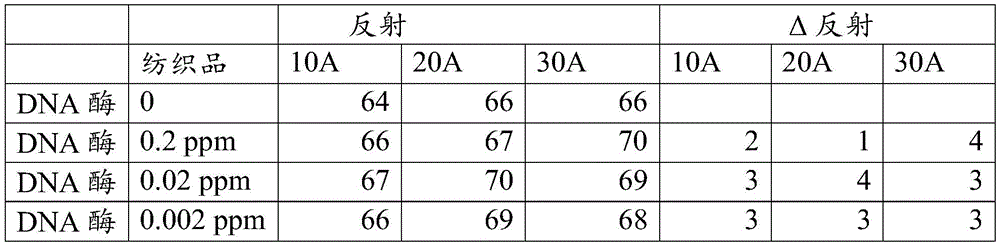
表6.宽肋羊肚菌(SEQ ID NO 12)DNA酶对滕黄微球菌生物膜的深度清洁Table 6. Deep cleaning of M. flavus biofilm by Morel broad-rib (SEQ ID NO 12) DNase
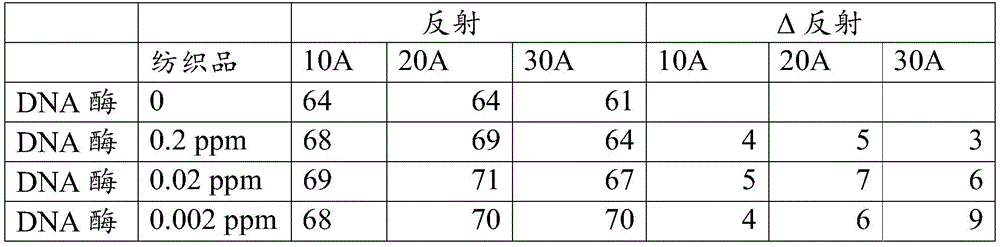
表7.宽肋羊肚菌(SEQ ID NO 12)DNA酶无菌小块布样(无生物膜)的土壤抑制转移。Table 7. Soil inhibition of metastasis of Morchella latifolia (SEQ ID NO 12) DNase sterile swatches (without biofilm).
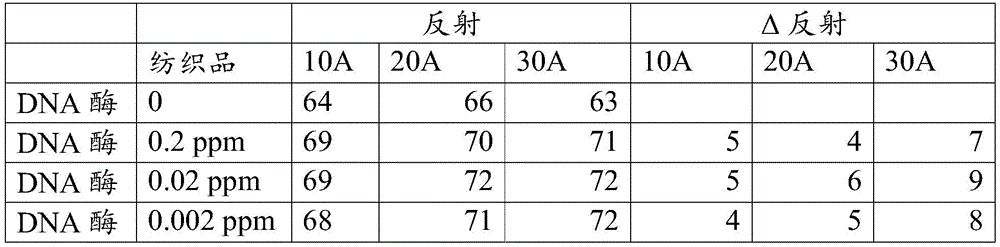
实例6:DNA酶的洗涤性能Example 6: Wash performance of DNase
生物膜小块布样的制备Preparation of Biofilm Swatches
生物膜小块布样是通过在聚酯小块布样上使短波单胞菌属物种生长两天来制备的。将生物膜小块布样在水中冲洗两次并在流动下干燥1h,随后冲压成小圆圈并在4℃储存以供进一步使用。Biofilm swatches were prepared by growing Brevimonas spp. on polyester swatches for two days. Biofilm swatches were rinsed twice in water and dried under flow for 1 h, then punched into small circles and stored at 4°C for further use.
洗涤实验washing experiment
将生物膜小块布样冲压物放置于深孔96孔格式板中。将96孔板置于Hamilton机器人中并使用以下条件进行洗涤模拟程序:振荡速度:在1000rpm下30秒;洗涤循环的持续时间:伴随振荡30分钟;温度30℃;洗涤液量(总量):0.5ml/孔;(490洗涤液+10uL样品)。为了筛选WT DNA酶的洗涤性能,使用溶解于水硬度15°dH的标准洗涤剂A(3.3g/L)。The biofilm cloth-like punches were placed in deep well 96-well format plates. The 96-well plate was placed in a Hamilton robot and the washing simulation program was performed using the following conditions: shaking speed: 30 sec at 1000 rpm; duration of washing cycle: 30 min with shaking;
通过将含有12%LAS、11%AEO Biosoft N25-7(Nl)、5%AEOS(SLES)、6%MPG(单丙二醇)、3%乙醇、3%TEA(三乙醇胺)、2.75%可可皂、2.75%大豆皂、2%甘油、2%氢氧化钠、2%柠檬酸钠、1%甲酸钠、0.2%DTMPA和0.2%PCA(丙烯酸=丙烯酸马来酸共聚物)(所有的百分数都是w/w(重量体积))的3.33g/l标准洗涤剂A溶解在具有硬度15dH的水中制备标准洗涤剂A洗液(100%)。By mixing 12% LAS, 11% AEO Biosoft N25-7 (Nl), 5% AEOS (SLES), 6% MPG (monopropylene glycol), 3% ethanol, 3% TEA (triethanolamine), 2.75% cocoa soap, 2.75% Soy Soap, 2% Glycerin, 2% Sodium Hydroxide, 2% Sodium Citrate, 1% Sodium Formate, 0.2% DTMPA and 0.2% PCA (Acrylic Acid = Acrylic Acid Maleic Acid Copolymer) (all percentages are w/ 3.33 g/l of Standard Detergent A in w (weight volume)) was dissolved in water having a hardness of 15 dH to prepare Standard Detergent A wash (100%).
随后添加污垢以达到0.7g污垢/L(WFK 09V颜料污垢)的浓度。将96孔板用每个酶样品装满,并在机器人上启动程序。测试DNA酶的浓度为0.5-0.05ppm。空白由没有添加任何酶的生物膜小块布样组成。在完成洗涤模拟循环之后,将小块布样冲压物从洗涤液中取出并在滤纸上干燥。将干燥的小块布样冲压物固定在一张白纸上以用于扫描。扫描的图像进一步由软件颜色分析仪使用。每个样品具有强度测量(来自颜色分析仪软件分析),其用于通过减去不含酶的空白强度来计算Δ强度(反射)。70之上的值是人眼可见的。The soil was then added to achieve a concentration of 0.7 g soil/L (WFK 09V pigment soil). Fill the 96-well plate with each enzyme sample and start the program on the robot. The concentration of DNase tested was 0.5-0.05 ppm. Blanks consisted of biofilm swatches without any enzymes added. After completing the wash simulation cycle, the small cloth swatch punches were removed from the wash solution and dried on filter paper. A small dry cloth swatch punch was attached to a piece of white paper for scanning. The scanned image is further used by a software color analyzer. Each sample has an intensity measurement (from color analyzer software analysis) that is used to calculate delta intensity (reflection) by subtracting the blank intensity without enzyme. Values above 70 are visible to the human eye.
表8.DNA酶的洗涤性能Table 8. Wash performance of DNase
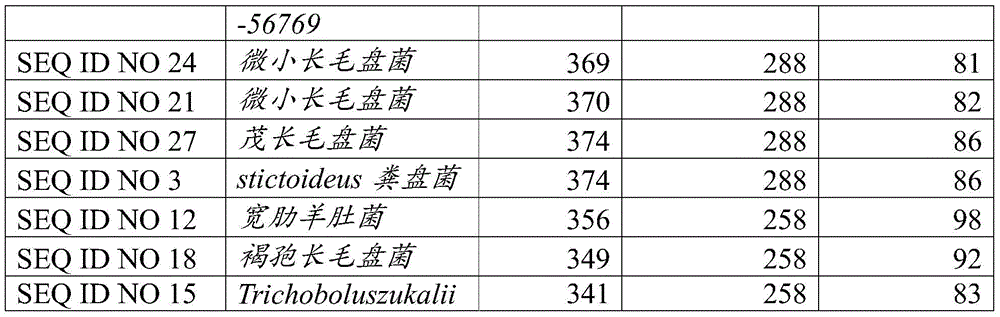
实例7:系统发育树的构建Example 7: Construction of phylogenetic tree
NUC1结构域包括本发明的具有DNA酶活性的多肽并且包含NUC1_A结构域以及如进化枝的簇。NUCl domains include polypeptides of the invention having DNase activity and comprise NUCl_A domains as well as clusters such as clades.
如PFAM(PF07510,Pfam版本30.0,Finn(2016).Nucleic Acids Research[核酸研究],Database Issue[数据库卷]44:D279-D285)中所定义的,构建含有DUF1524结构域的多肽序列的系统发育树。系统发育树是从包含至少一个DUF1524结构域的成熟多肽序列的多重比对构建。使用MUSCLE算法版本3.8.31(Edgar,2004.Nucleic Acids Research[核酸研究]32(5):1792-1797)对序列进行比对,并且使用FastTree版本2.1.8(Price等人,2010,PloS one[公共科学图书馆·综合]5(3))构建树并使用iTOL(Letunic和Bork,2007.Bioinformatics[生物信息学]23(1):127-128)对树进行可视化。Construction of phylogeny of polypeptide sequences containing DUF1524 domains as defined in PFAM (PF07510, Pfam version 30.0, Finn (2016). Nucleic Acids Research, Database Issue 44:D279-D285) Tree. A phylogenetic tree was constructed from multiple alignments of mature polypeptide sequences comprising at least one DUF1524 domain. Sequences were aligned using the MUSCLE algorithm version 3.8.31 (Edgar, 2004. Nucleic Acids Research 32(5):1792-1797) and FastTree version 2.1.8 (Price et al., 2010, PloS one [PLOS ONE] 5(3)) and visualized the tree using iTOL (Letunic and Bork, 2007. Bioinformatics 23(1):127-128).
包含DUF1524结构域的多肽包含若干个基序。一个实例是[E/D/H]H[I/V/L/F/M]X[P/A/S](SEQ ID NO:43),其位于与来自宽肋羊肚菌(M.costata)(SEQ ID NO 12)的DNA酶多肽中的位置95至99对应的位置。H96是涉及DUF1524的催化活性的催化残基,并且是HXXP基序的部分。可以由本发明的多肽包含的另一个基序是[T/D/S][G/N]PQL(SEQ ID NO:44),其中Q涉及稳定HXXP基序。Polypeptides containing the DUF1524 domain contain several motifs. An example is [E/D/H]H[I/V/L/F/M]X[P/A/S] (SEQ ID NO: 43), which is located in the The positions corresponding to positions 95 to 99 in the DNase polypeptide of costata) (SEQ ID NO 12). H96 is a catalytic residue involved in the catalytic activity of DUF1524 and is part of the HBXXP motif. Another motif that can be encompassed by the polypeptides of the invention is [T/D/S][G/N]PQL (SEQ ID NO: 44), where Q relates to a stabilizing HXXP motif.
DUF1524中的多肽可以分成不同的子簇。子簇由一个或多个短序列基序定义,以及通过含有如PFAM(PF07510,Pfam版本30.0)中所定义的DUF1524结构域定义。我们将包含基序[F/L/Y/I]A[N/R]D[L/I/P/V][(SEQ ID NO 45)的一个子簇表示为家族NUC1。这种结构域的另一个基序特征是C[D/N]T[A/R](SEQ ID NO 46)。含有DUF1524以及两个基序的所有多肽序列将表示为含有NUC1结构域。The polypeptides in DUF1524 can be divided into different subclusters. Subclusters are defined by one or more short sequence motifs and by containing the DUF1524 domain as defined in PFAM (PF07510, Pfam version 30.0). We denote a subcluster containing the motif [F/L/Y/I]A[N/R]D[L/I/P/V][ (SEQ ID NO 45) as family NUC1. Another motif characteristic of this domain is C[D/N]T[A/R] (SEQ ID NO 46). All polypeptide sequences containing DUF1524 as well as both motifs will be denoted as containing the NUC1 domain.
NUC1_A结构域的生成Generation of NUC1_A domain
如上所定义的构建含有NUC1结构域的多肽序列的系统发育树。系统发育树是从包含至少一个NUC1结构域的成熟多肽序列的多重比对构建。使用MUSCLE算法版本3.8.31(Edgar,2004.Nucleic Acids Research[核酸研究]32(5):1792-1797)对序列进行比对,并且使用FastTree版本2.1.8(Price等人,2010,PloS one[公共科学图书馆·综合]5(3))构建树并使用iTOL(Letunic和Bork,2007.Bioinformatics[生物信息学]23(1):127-128)对树进行可视化。NUC1中的多肽可以分成至少不同的子簇,其中一个表示为NUC1_A。这种亚组的特征基序是基序[DQ][IV]DH(SEQ ID NO 47),其对应于参考多肽(SEQ ID NO:12)中的氨基酸93至96。预测在对应于SEQ ID NO 12的位置93的位置处的D涉及催化性金属离子辅因子的结合。A phylogenetic tree of NUCl domain-containing polypeptide sequences was constructed as defined above. Phylogenetic trees were constructed from multiple alignments of mature polypeptide sequences comprising at least one NUCl domain. Sequences were aligned using the MUSCLE algorithm version 3.8.31 (Edgar, 2004. Nucleic Acids Research 32(5):1792-1797) and FastTree version 2.1.8 (Price et al., 2010, PloS one [PLOS ONE] 5(3)) and visualized the tree using iTOL (Letunic and Bork, 2007. Bioinformatics 23(1):127-128). The polypeptides in NUC1 can be divided into at least different subclusters, one of which is denoted NUC1_A. A characteristic motif of this subset is the motif [DQ][IV]DH (SEQ ID NO 47), which corresponds to amino acids 93 to 96 in the reference polypeptide (SEQ ID NO: 12). D at the position corresponding to position 93 of
系统发育树的生成Generation of phylogenetic trees
如上所定义的构建含有DUF1524结构域、NUC1结构域和NUC1_A结构域的多肽序列的系统发育树。系统发育树是从包含至少一个NUC1_A结构域的成熟多肽序列的多重比对构建。使用MUSCLE算法版本3.8.31(Edgar,2004.Nucleic Acids Research[核酸研究]32(5):1792-1797)对序列进行比对,并且使用FastTree版本2.1.8(Price等人,2010,PloS one[公共科学图书馆·综合]5(3))构建树并使用iTOL(Letunic和Bork,2007.Bioinformatics[生物信息学]23(1):127-128)对树进行可视化。NUC1_A中的多肽可以分成多个不同的子簇或进化枝,其中我们表示了下面列出的进化枝。下面详细描述每个进化枝的不同基序。A phylogenetic tree of polypeptide sequences containing the DUF1524 domain, the NUCl domain and the NUCl_A domain was constructed as defined above. Phylogenetic trees were constructed from multiple alignments of mature polypeptide sequences comprising at least one NUCl_A domain. Sequences were aligned using the MUSCLE algorithm version 3.8.31 (Edgar, 2004. Nucleic Acids Research 32(5):1792-1797) and FastTree version 2.1.8 (Price et al., 2010, PloS one [PLOS ONE] 5(3)) and visualized the tree using iTOL (Letunic and Bork, 2007. Bioinformatics 23(1):127-128). The polypeptides in NUC1_A can be divided into a number of distinct subclusters or clades, of which we represent the clades listed below. The different motifs of each clade are described in detail below.
RTTDA进化枝的生成Generation of the RTTDA clade
RTTDA进化枝包含真菌来源的NUC1_A多肽,该多肽含有DUF1524结构域、NUC1结构域和NUC1_A结构域,具有DNA酶活性。该进化枝的多肽包含基序实例RT[TS][DN][AP][TDPS]GY(SEQ ID NO:48),对应于SEQ ID NO 12的位置28至35,其中R和T(对应于SEQ ID NO 12的位置31和32)在RTTDA进化枝中是完全保守的。包含在进化枝中的本发明的多肽的比对示于图1中。RTTDA进化枝的系统发育树示于图2中。The RTTDA clade contains fungal-derived NUC1_A polypeptides, which contain DUF1524, NUC1, and NUC1_A domains, and have DNase activity. The polypeptides of this clade comprise the example motif RT[TS][DN][AP][TDPS]GY (SEQ ID NO: 48), corresponding to positions 28 to 35 of
Claims (16)
Applications Claiming Priority (3)
| Application Number | Priority Date | Filing Date | Title |
|---|---|---|---|
| EP17164340.6 | 2017-03-31 | ||
| EP17164340 | 2017-03-31 | ||
| PCT/CN2018/080156 WO2018177203A1 (en) | 2017-03-31 | 2018-03-23 | Polypeptides having dnase activity |
Publications (1)
| Publication Number | Publication Date |
|---|---|
| CN110651040A true CN110651040A (en) | 2020-01-03 |
Family
ID=58488845
Family Applications (1)
| Application Number | Title | Priority Date | Filing Date |
|---|---|---|---|
| CN201880023402.XA Pending CN110651040A (en) | 2017-03-31 | 2018-03-23 | Polypeptides with DNase activity |
Country Status (4)
| Country | Link |
|---|---|
| US (1) | US11180720B2 (en) |
| EP (1) | EP3601552A4 (en) |
| CN (1) | CN110651040A (en) |
| WO (1) | WO2018177203A1 (en) |
Families Citing this family (30)
| Publication number | Priority date | Publication date | Assignee | Title |
|---|---|---|---|---|
| US20210071116A1 (en) * | 2018-06-29 | 2021-03-11 | Novozymes A/S | Detergent Compositions and Uses Thereof |
| EP3844255A1 (en) | 2018-08-30 | 2021-07-07 | Danisco US Inc. | Enzyme-containing granules |
| CN114174504A (en) | 2019-05-24 | 2022-03-11 | 丹尼斯科美国公司 | Subtilisin variants and methods of use |
| CN114174486A (en) | 2019-06-06 | 2022-03-11 | 丹尼斯科美国公司 | Methods and compositions for cleaning |
| BR112022007697A2 (en) | 2019-10-24 | 2022-07-12 | Danisco Us Inc | VARIANT ALPHA-AMYLASE THAT FORMS MALTOPENTAOSE/MALTOHEXAOSE |
| WO2022047149A1 (en) | 2020-08-27 | 2022-03-03 | Danisco Us Inc | Enzymes and enzyme compositions for cleaning |
| EP4232539A2 (en) | 2020-10-20 | 2023-08-30 | Novozymes A/S | Use of polypeptides having dnase activity |
| WO2022165107A1 (en) | 2021-01-29 | 2022-08-04 | Danisco Us Inc | Compositions for cleaning and methods related thereto |
| WO2023278297A1 (en) | 2021-06-30 | 2023-01-05 | Danisco Us Inc | Variant lipases and uses thereof |
| EP4396320A2 (en) | 2021-09-03 | 2024-07-10 | Danisco US Inc. | Laundry compositions for cleaning |
| CN117957318A (en) | 2021-09-13 | 2024-04-30 | 丹尼斯科美国公司 | Particles containing biologically active substances |
| EP4426362A1 (en) | 2021-11-05 | 2024-09-11 | Nutrition & Biosciences USA 4, Inc. | Glucan derivatives for microbial control |
| EP4448750A2 (en) | 2021-12-16 | 2024-10-23 | Danisco US Inc. | Subtilisin variants and uses thereof |
| WO2023114988A2 (en) | 2021-12-16 | 2023-06-22 | Danisco Us Inc. | Variant maltopentaose/maltohexaose-forming alpha-amylases |
| CN118679251A (en) | 2021-12-16 | 2024-09-20 | 丹尼斯科美国公司 | Subtilisin variants and methods of use |
| EP4448749A2 (en) | 2021-12-16 | 2024-10-23 | Danisco US Inc. | Subtilisin variants and methods of use |
| WO2023168234A1 (en) | 2022-03-01 | 2023-09-07 | Danisco Us Inc. | Enzymes and enzyme compositions for cleaning |
| CN118974228A (en) | 2022-04-08 | 2024-11-15 | 诺维信公司 | Hexosaminidase variants and compositions |
| WO2023201048A2 (en) * | 2022-04-14 | 2023-10-19 | Omeat Inc. | Systems and methods of preparing cultivated meat and meat analogs from plant-based proteins |
| CN119487167A (en) | 2022-06-21 | 2025-02-18 | 丹尼斯科美国公司 | Compositions and methods for cleaning comprising polypeptides having thermolysin activity |
| CA3265943A1 (en) | 2022-09-02 | 2024-03-07 | Danisco Us Inc. | Detergent compositions and methods related thereto |
| CN120112635A (en) | 2022-09-02 | 2025-06-06 | 丹尼斯科美国公司 | Subtilisin variants and methods related thereto |
| WO2024102698A1 (en) | 2022-11-09 | 2024-05-16 | Danisco Us Inc. | Subtilisin variants and methods of use |
| EP4658776A1 (en) | 2023-02-01 | 2025-12-10 | Danisco US Inc. | Subtilisin variants and methods of use |
| WO2024186819A1 (en) | 2023-03-06 | 2024-09-12 | Danisco Us Inc. | Subtilisin variants and methods of use |
| EP4680013A1 (en) | 2023-03-16 | 2026-01-21 | Nutrition & Biosciences USA 4, Inc. | Brevibacillus fermentate extracts for cleaning and malodor control and use thereof |
| KR20250174069A (en) | 2023-04-12 | 2025-12-11 | 노보자임스 에이/에스 | Composition comprising a polypeptide having alkaline phosphatase activity |
| WO2025071996A1 (en) | 2023-09-28 | 2025-04-03 | Danisco Us Inc. | Variant cutinase enzymes with improved solubility and uses thereof |
| WO2025085351A1 (en) | 2023-10-20 | 2025-04-24 | Danisco Us Inc. | Subtilisin variants and methods of use |
| WO2026024922A1 (en) | 2024-07-25 | 2026-01-29 | Danisco Us Inc. | Subtilisin variants and methods of use |
Citations (6)
| Publication number | Priority date | Publication date | Assignee | Title |
|---|---|---|---|---|
| WO2015155350A1 (en) * | 2014-04-11 | 2015-10-15 | Novozymes A/S | Detergent composition |
| US20150299623A1 (en) * | 2012-12-07 | 2015-10-22 | Novozymes A/S | Preventing Adhesion of Bacteria |
| WO2016162556A1 (en) * | 2015-04-10 | 2016-10-13 | Novozymes A/S | Laundry method, use of dnase and detergent composition |
| US20160319226A1 (en) * | 2015-04-29 | 2016-11-03 | The Procter & Gamble Company | Method of treating a fabric |
| WO2017001472A1 (en) * | 2015-06-29 | 2017-01-05 | Novozymes A/S | Laundry method, use of polypeptide and detergent composition |
| WO2017001471A1 (en) * | 2015-06-29 | 2017-01-05 | Novozymes A/S | Laundry method, use of polypeptide and detergent composition |
Family Cites Families (162)
| Publication number | Priority date | Publication date | Assignee | Title |
|---|---|---|---|---|
| GB1296839A (en) | 1969-05-29 | 1972-11-22 | ||
| DK187280A (en) | 1980-04-30 | 1981-10-31 | Novo Industri As | RUIT REDUCING AGENT FOR A COMPLETE LAUNDRY |
| JPS61104784A (en) | 1984-10-26 | 1986-05-23 | Suntory Ltd | Production of peroxidase |
| JPH0697997B2 (en) | 1985-08-09 | 1994-12-07 | ギスト ブロカデス ナ−ムロ−ゼ フエンノ−トチヤツプ | New enzymatic detergent additive |
| DK122686D0 (en) | 1986-03-17 | 1986-03-17 | Novo Industri As | PREPARATION OF PROTEINS |
| US5989870A (en) | 1986-04-30 | 1999-11-23 | Rohm Enzyme Finland Oy | Method for cloning active promoters |
| ES2058119T3 (en) | 1986-08-29 | 1994-11-01 | Novo Nordisk As | ENZYMATIC DETERGENT ADDITIVE. |
| US5389536A (en) | 1986-11-19 | 1995-02-14 | Genencor, Inc. | Lipase from Pseudomonas mendocina having cutinase activity |
| DE3854249T2 (en) | 1987-08-28 | 1996-02-29 | Novonordisk As | Recombinant Humicola Lipase and Process for the Production of Recombinant Humicola Lipases. |
| DK6488D0 (en) | 1988-01-07 | 1988-01-07 | Novo Industri As | ENZYMES |
| WO1989006270A1 (en) | 1988-01-07 | 1989-07-13 | Novo-Nordisk A/S | Enzymatic detergent |
| JP3079276B2 (en) | 1988-02-28 | 2000-08-21 | 天野製薬株式会社 | Recombinant DNA, Pseudomonas sp. Containing the same, and method for producing lipase using the same |
| EP0406314B1 (en) | 1988-03-24 | 1993-12-01 | Novo Nordisk A/S | A cellulase preparation |
| US5776757A (en) | 1988-03-24 | 1998-07-07 | Novo Nordisk A/S | Fungal cellulase composition containing alkaline CMC-endoglucanase and essentially no cellobiohydrolase and method of making thereof |
| US5223409A (en) | 1988-09-02 | 1993-06-29 | Protein Engineering Corp. | Directed evolution of novel binding proteins |
| JPH02238885A (en) | 1989-03-13 | 1990-09-21 | Oji Paper Co Ltd | Phenol oxidase genetically recombinant DNA, microorganisms transformed with the recombinant DNA, culture thereof, and method for producing phenol oxidase |
| DK0477280T3 (en) | 1989-06-13 | 1997-02-10 | Genencor Int | |
| GB8915658D0 (en) | 1989-07-07 | 1989-08-23 | Unilever Plc | Enzymes,their production and use |
| DE69033388T2 (en) | 1989-08-25 | 2000-05-11 | Henkel Research Corp., Santa Rosa | ALKALINE PROTEOLYTIC ENZYME AND METHOD FOR PRODUCING THE SAME |
| AU639570B2 (en) | 1990-05-09 | 1993-07-29 | Novozymes A/S | A cellulase preparation comprising an endoglucanase enzyme |
| DK115890D0 (en) | 1990-05-09 | 1990-05-09 | Novo Nordisk As | ENZYME |
| FI903443A7 (en) | 1990-07-06 | 1992-01-07 | Valtion Teknillinen | FRAMSTAELLNING AV LACKAS GENOM RECOMBINANTORGANISMER. |
| DK0548228T3 (en) | 1990-09-13 | 1999-05-10 | Novo Nordisk As | lipase variants |
| IL99552A0 (en) | 1990-09-28 | 1992-08-18 | Ixsys Inc | Compositions containing procaryotic cells,a kit for the preparation of vectors useful for the coexpression of two or more dna sequences and methods for the use thereof |
| SG52693A1 (en) | 1991-01-16 | 1998-09-28 | Procter & Gamble | Detergent compositions with high activity cellulase and softening clays |
| US5292796A (en) | 1991-04-02 | 1994-03-08 | Minnesota Mining And Manufacturing Company | Urea-aldehyde condensates and melamine derivatives comprising fluorochemical oligomers |
| ES2121014T3 (en) | 1991-05-01 | 1998-11-16 | Novo Nordisk As | STABILIZED ENZYMES AND DETERGENT COMPOSITIONS. |
| US5340735A (en) | 1991-05-29 | 1994-08-23 | Cognis, Inc. | Bacillus lentus alkaline protease variants with increased stability |
| WO1993012067A1 (en) | 1991-12-13 | 1993-06-24 | The Procter & Gamble Company | Acylated citrate esters as peracid precursors |
| DK28792D0 (en) | 1992-03-04 | 1992-03-04 | Novo Nordisk As | NEW ENZYM |
| DK72992D0 (en) | 1992-06-01 | 1992-06-01 | Novo Nordisk As | ENZYME |
| DK88892D0 (en) | 1992-07-06 | 1992-07-06 | Novo Nordisk As | CONNECTION |
| DE69334295D1 (en) | 1992-07-23 | 2009-11-12 | Novo Nordisk As | MUTIER -g (a) -AMYLASE, DETERGENT AND DISHWASHER |
| EP1431389A3 (en) | 1992-10-06 | 2004-06-30 | Novozymes A/S | Cellulase variants |
| ATE175235T1 (en) | 1993-02-11 | 1999-01-15 | Genencor Int | OXIDATIVELY STABLE ALPHA-AMYLASE |
| AU673078B2 (en) | 1993-04-27 | 1996-10-24 | Genencor International, Inc. | New lipase variants for use in detergent applications |
| DK52393D0 (en) | 1993-05-05 | 1993-05-05 | Novo Nordisk As | |
| FR2704860B1 (en) | 1993-05-05 | 1995-07-13 | Pasteur Institut | NUCLEOTIDE SEQUENCES OF THE LOCUS CRYIIIA FOR THE CONTROL OF THE EXPRESSION OF DNA SEQUENCES IN A CELL HOST. |
| HU218008B (en) | 1993-05-08 | 2000-05-28 | Henkel Kg. Auf Aktien | Silver-corrosion protection agents (i) and mashine cleaning agents containing thereof |
| DK0697035T3 (en) | 1993-05-08 | 1998-09-28 | Henkel Kgaa | Silver preservative with corrosion I |
| DK81293D0 (en) | 1993-07-06 | 1993-07-06 | Novo Nordisk As | ENZYME |
| JP2859520B2 (en) | 1993-08-30 | 1999-02-17 | ノボ ノルディスク アクティーゼルスカブ | Lipase, microorganism producing the same, method for producing lipase, and detergent composition containing lipase |
| JPH09503916A (en) | 1993-10-08 | 1997-04-22 | ノボ ノルディスク アクティーゼルスカブ | Amylase variant |
| US5817495A (en) | 1993-10-13 | 1998-10-06 | Novo Nordisk A/S | H2 O2 -stable peroxidase variants |
| JPH07143883A (en) | 1993-11-24 | 1995-06-06 | Showa Denko Kk | Lipase gene and mutant lipase |
| DE4343591A1 (en) | 1993-12-21 | 1995-06-22 | Evotec Biosystems Gmbh | Process for the evolutionary design and synthesis of functional polymers based on shape elements and shape codes |
| US5605793A (en) | 1994-02-17 | 1997-02-25 | Affymax Technologies N.V. | Methods for in vitro recombination |
| ATE222604T1 (en) | 1994-02-22 | 2002-09-15 | Novozymes As | METHOD FOR PRODUCING A VARIANT OF A LIPOLYTIC ENZYME |
| ATE512226T1 (en) | 1994-02-24 | 2011-06-15 | Henkel Ag & Co Kgaa | IMPROVED ENZYMES AND DETERGENTS WITH IT |
| DE69536145D1 (en) | 1994-03-08 | 2011-04-07 | Novozymes As | Novel alkaline cellulases |
| WO1995030744A2 (en) | 1994-05-04 | 1995-11-16 | Genencor International Inc. | Lipases with improved surfactant resistance |
| DK0765394T3 (en) | 1994-06-03 | 2001-12-10 | Novozymes As | Purified Myceliopthora laccases and nucleic acids encoding them |
| WO1995035381A1 (en) | 1994-06-20 | 1995-12-28 | Unilever N.V. | Modified pseudomonas lipases and their use |
| WO1996000292A1 (en) | 1994-06-23 | 1996-01-04 | Unilever N.V. | Modified pseudomonas lipases and their use |
| DE69534185T2 (en) | 1994-06-30 | 2006-02-23 | Novozymes Biotech, Inc., Davis | NON-TOXIC, NON-TOXIGEN, NON-PATHOGENIC FUSARIUM EXPRESSION SYSTEM, AND PROMOTERS AND TERMINATORS TO BE USED IN IT |
| EP1995303A3 (en) | 1994-10-06 | 2008-12-31 | Novozymes A/S | Enzyme preparation with endoglucanase activity |
| BE1008998A3 (en) | 1994-10-14 | 1996-10-01 | Solvay | Lipase, microorganism producing the preparation process for the lipase and uses thereof. |
| AU3697995A (en) | 1994-10-26 | 1996-05-23 | Novo Nordisk A/S | An enzyme with lipolytic activity |
| AR000862A1 (en) | 1995-02-03 | 1997-08-06 | Novozymes As | VARIANTS OF A MOTHER-AMYLASE, A METHOD TO PRODUCE THE SAME, A DNA STRUCTURE AND A VECTOR OF EXPRESSION, A CELL TRANSFORMED BY SUCH A DNA STRUCTURE AND VECTOR, A DETERGENT ADDITIVE, DETERGENT COMPOSITION, A COMPOSITION FOR AND A COMPOSITION FOR THE ELIMINATION OF |
| JPH08228778A (en) | 1995-02-27 | 1996-09-10 | Showa Denko Kk | Novel lipase gene and method for producing lipase using the same |
| CN1182451A (en) | 1995-03-17 | 1998-05-20 | 诺沃挪第克公司 | Novel endoglucanases |
| BR9608149B1 (en) | 1995-05-05 | 2012-01-24 | processes for effecting mutation in DNA encoding a subtilase enzyme or its pre- or pre-enzyme and for the manufacture of a mutant subtilase enzyme. | |
| WO1997007202A1 (en) | 1995-08-11 | 1997-02-27 | Novo Nordisk A/S | Novel lipolytic enzymes |
| WO1997004078A1 (en) | 1995-07-14 | 1997-02-06 | Novo Nordisk A/S | A modified enzyme with lipolytic activity |
| DE19528059A1 (en) | 1995-07-31 | 1997-02-06 | Bayer Ag | Detergent and cleaning agent with imino disuccinates |
| US6008029A (en) | 1995-08-25 | 1999-12-28 | Novo Nordisk Biotech Inc. | Purified coprinus laccases and nucleic acids encoding the same |
| US5763385A (en) | 1996-05-14 | 1998-06-09 | Genencor International, Inc. | Modified α-amylases having altered calcium binding properties |
| WO1998008940A1 (en) | 1996-08-26 | 1998-03-05 | Novo Nordisk A/S | A novel endoglucanase |
| DE69735767T2 (en) | 1996-09-17 | 2007-04-05 | Novozymes A/S | cellulase |
| WO1998015257A1 (en) | 1996-10-08 | 1998-04-16 | Novo Nordisk A/S | Diaminobenzoic acid derivatives as dye precursors |
| EP0934389B1 (en) | 1996-10-18 | 2003-12-10 | The Procter & Gamble Company | Detergent compositions |
| AU4772697A (en) | 1996-11-04 | 1998-05-29 | Novo Nordisk A/S | Subtilase variants and compositions |
| CN1530443A (en) | 1996-11-04 | 2004-09-22 | ŵ����÷������˾ | subtilase variants and compositions |
| EP1002061A1 (en) | 1997-07-04 | 2000-05-24 | Novo Nordisk A/S | FAMILY 6 ENDO-1,4-$g(b)-GLUCANASE VARIANTS AND CLEANING COMPOSIT IONS CONTAINING THEM |
| DE69839076T2 (en) | 1997-08-29 | 2009-01-22 | Novozymes A/S | PROTEASE VERSIONS AND COMPOSITIONS |
| EP2206768B1 (en) | 1997-10-13 | 2015-04-01 | Novozymes A/S | Alpha-amylase mutants |
| US5955310A (en) | 1998-02-26 | 1999-09-21 | Novo Nordisk Biotech, Inc. | Methods for producing a polypeptide in a bacillus cell |
| WO2000034450A1 (en) | 1998-12-04 | 2000-06-15 | Novozymes A/S | Cutinase variants |
| CN100497614C (en) | 1998-06-10 | 2009-06-10 | 诺沃奇梅兹有限公司 | Mannanase |
| EP1124949B1 (en) | 1998-10-26 | 2006-07-12 | Novozymes A/S | Constructing and screening a dna library of interest in filamentous fungal cells |
| CN1940067A (en) | 1999-03-22 | 2007-04-04 | 诺沃奇梅兹有限公司 | Promoters for expressing genes in a fungal cell |
| KR20010108379A (en) | 1999-03-31 | 2001-12-07 | 피아 스타르 | Lipase variant |
| EP1214426A2 (en) | 1999-08-31 | 2002-06-19 | Novozymes A/S | Novel proteases and variants thereof |
| CN101974375B (en) | 1999-12-15 | 2014-07-02 | 诺沃奇梅兹有限公司 | Subtilase variants having an improved wash performance on egg stains |
| ES2322690T3 (en) | 2000-02-24 | 2009-06-25 | Novozymes A/S | XILOGLUCANASAS OF THE FAMILY 44. |
| JP5571274B2 (en) | 2000-03-08 | 2014-08-13 | ノボザイムス アクティーゼルスカブ | Variants with altered properties |
| DE60112928T2 (en) | 2000-06-02 | 2006-06-14 | Novozymes As | Cutinase VARIATIONS |
| JP4855632B2 (en) | 2000-08-01 | 2012-01-18 | ノボザイムス アクティーゼルスカブ | Α-Amylase mutants with altered properties |
| CN1337553A (en) | 2000-08-05 | 2002-02-27 | 李海泉 | Underground sightseeing amusement park |
| CA2419896C (en) | 2000-08-21 | 2014-12-09 | Novozymes A/S | Subtilase enzymes |
| EP1337657A2 (en) | 2000-11-17 | 2003-08-27 | Novozymes A/S | Heterologous expression of taxanes |
| DK1399543T3 (en) | 2001-06-06 | 2014-11-03 | Novozymes As | ENDO-BETA-1,4-GLUCANASE |
| DK200101090A (en) | 2001-07-12 | 2001-08-16 | Novozymes As | Subtilase variants |
| US6506987B1 (en) | 2001-07-19 | 2003-01-14 | Randy Woods | Magnetic switch |
| GB0127036D0 (en) | 2001-11-09 | 2002-01-02 | Unilever Plc | Polymers for laundry applications |
| DK1448595T3 (en) | 2001-11-20 | 2007-02-19 | Novozymes As | Antimicrobial polypeptides |
| DE10162728A1 (en) | 2001-12-20 | 2003-07-10 | Henkel Kgaa | New alkaline protease from Bacillus gibsonii (DSM 14393) and washing and cleaning agents containing this new alkaline protease |
| CN101597601B (en) | 2002-06-26 | 2013-06-05 | 诺维信公司 | Subtilases and subtilase variants having altered immunogenicity |
| DK1886582T3 (en) | 2002-10-11 | 2015-04-20 | Novozymes As | Process for preparing a heat treated product |
| TWI319007B (en) | 2002-11-06 | 2010-01-01 | Novozymes As | Subtilase variants |
| WO2004067737A2 (en) | 2003-01-30 | 2004-08-12 | Novozymes A/S | Subtilases |
| CA2529726A1 (en) | 2003-06-18 | 2005-01-13 | Unilever Plc | Laundry treatment compositions |
| GB0314210D0 (en) | 2003-06-18 | 2003-07-23 | Unilever Plc | Laundry treatment compositions |
| GB0314211D0 (en) | 2003-06-18 | 2003-07-23 | Unilever Plc | Laundry treatment compositions |
| CN1871344A (en) | 2003-10-23 | 2006-11-29 | 诺和酶股份有限公司 | Protease with improved stability in detergents |
| AU2004293826B2 (en) | 2003-11-19 | 2009-09-17 | Danisco Us Inc. | Serine proteases, nucleic acids encoding serine enzymes and vectors and host cells incorporating same |
| EP2295554B1 (en) | 2003-12-03 | 2012-11-28 | Danisco US Inc. | Perhydrolase |
| DK1709167T3 (en) | 2004-01-08 | 2010-08-16 | Novozymes As | Amylase |
| US20090280534A1 (en) | 2004-12-22 | 2009-11-12 | Novozymes A/S | Recombinant Production of Serum Albumin |
| CA2593920A1 (en) | 2004-12-23 | 2006-06-29 | Novozymes A/S | Alpha-amylase variants |
| PL1869155T3 (en) | 2005-04-15 | 2011-03-31 | Procter & Gamble | Liquid laundry detergent compositions with modified polyethyleneimine polymers and lipase enzyme |
| BRPI0609363A2 (en) | 2005-04-15 | 2010-03-30 | Procter & Gamble | cleaning compositions with alkoxylated polyalkylene imines |
| EP1888734A2 (en) | 2005-05-31 | 2008-02-20 | The Procter and Gamble Company | Polymer-containing detergent compositions and their use |
| CN101218343B (en) | 2005-07-08 | 2013-11-06 | 诺维信公司 | subtilisin variant |
| CN105200027B (en) | 2005-10-12 | 2019-05-31 | 金克克国际有限公司 | The purposes and preparation of the metalloprotease of stable storing |
| US8518675B2 (en) | 2005-12-13 | 2013-08-27 | E. I. Du Pont De Nemours And Company | Production of peracids using an enzyme having perhydrolysis activity |
| AR059154A1 (en) | 2006-01-23 | 2008-03-12 | Procter & Gamble | A COMPOSITION THAT INCLUDES A LIPASE AND A WHITENING CATALYST |
| AR059156A1 (en) | 2006-01-23 | 2008-03-12 | Procter & Gamble | DETERGENT COMPOSITIONS |
| ES2629332T3 (en) | 2006-01-23 | 2017-08-08 | Novozymes A/S | Lipase variants |
| EP2248882A1 (en) | 2006-01-23 | 2010-11-10 | The Procter and Gamble Company | Enzyme and fabric hueing agent containing compositions |
| AR059155A1 (en) | 2006-01-23 | 2008-03-12 | Procter & Gamble | COMPOSITIONS THAT INCLUDE ENZYMES AND PHOTOBLANKERS |
| EP1976967A2 (en) | 2006-01-23 | 2008-10-08 | The Procter and Gamble Company | Detergent compositions |
| EP1979457A2 (en) | 2006-01-23 | 2008-10-15 | The Procter and Gamble Company | A composition comprising a lipase and a bleach catalyst |
| DE602007007945D1 (en) | 2006-05-31 | 2010-09-02 | Basf Se | AMPHIPHILYPROPOLYMERS BASED ON POLYALKYLENE OXIDES AND VINYL REAGENTS |
| DE202006009003U1 (en) | 2006-06-06 | 2007-10-25 | BROSE SCHLIEßSYSTEME GMBH & CO. KG | Motor vehicle lock |
| PL1867708T3 (en) | 2006-06-16 | 2017-10-31 | Procter & Gamble | Detergent compositions |
| EP1876226B1 (en) | 2006-07-07 | 2011-03-23 | The Procter & Gamble Company | Detergent compositions |
| EP2155869A2 (en) | 2007-05-30 | 2010-02-24 | Danisco US, INC., Genencor Division | Variants of an alpha-amylase with improved production levels in fermentation processes |
| ATE503826T1 (en) | 2007-07-02 | 2011-04-15 | Procter & Gamble | MULTI-CHAMBER BAGS CONTAINING DETERGENT |
| DE102007038031A1 (en) | 2007-08-10 | 2009-06-04 | Henkel Ag & Co. Kgaa | Agents containing proteases |
| AU2008325250B2 (en) | 2007-11-05 | 2013-06-13 | Danisco Us Inc. | Variants of Bacillus sp. TS-23 alpha-amylase with altered properties |
| RU2470069C2 (en) | 2008-01-04 | 2012-12-20 | Дзе Проктер Энд Гэмбл Компани | Laundry detergent composition containing glycosyl hydrolase |
| US20090209447A1 (en) | 2008-02-15 | 2009-08-20 | Michelle Meek | Cleaning compositions |
| EP2250259B1 (en) | 2008-02-29 | 2016-08-31 | Novozymes A/S | Polypeptides having lipase activity and polynucleotides encoding same |
| EP2169040B1 (en) | 2008-09-30 | 2012-04-11 | The Procter & Gamble Company | Liquid detergent compositions exhibiting two or multicolor effect |
| WO2010039889A2 (en) | 2008-09-30 | 2010-04-08 | Novozymes, Inc. | Methods for using positively and negatively selectable genes in a filamentous fungal cell |
| EP2367923A2 (en) | 2008-12-01 | 2011-09-28 | Danisco US Inc. | Enzymes with lipase activity |
| CA2753075A1 (en) | 2009-02-20 | 2010-08-26 | Danisco Us Inc. | Fermentation broth formulations |
| MX2011008656A (en) | 2009-03-06 | 2011-09-06 | Huntsman Adv Mat Switzerland | Enzymatic textile bleach-whitening methods. |
| US20120172275A1 (en) | 2009-03-10 | 2012-07-05 | Danisco Us Inc. | Bacillus Megaterium Strain DSM90-Related Alpha-Amylases, and Methods of Use, Thereof |
| WO2010107560A2 (en) | 2009-03-18 | 2010-09-23 | Danisco Us Inc. | Fungal cutinase from magnaporthe grisea |
| US20120058527A1 (en) | 2009-03-23 | 2012-03-08 | Danisco Us Inc. | Cal a-related acyltransferases and methods of use, thereof |
| CA2775045A1 (en) | 2009-09-25 | 2011-03-31 | Novozymes A/S | Subtilase variants for use in detergent and cleaning compositions |
| US20120252106A1 (en) | 2009-09-25 | 2012-10-04 | Novozymes A/S | Use of Protease Variants |
| DK2496694T3 (en) | 2009-11-06 | 2017-06-06 | Novozymes Inc | COMPOSITIONS FOR SACCHARIFYING CELLULOS MATERIAL |
| BR112012017056A2 (en) | 2009-12-21 | 2016-11-22 | Danisco Us Inc | "Bacillus subtilis lipase-containing detergent compositions and methods for using them" |
| BR112012017062A2 (en) | 2009-12-21 | 2016-11-29 | Danisco Us Inc | "Detergent compositions containing geobacillus stearothermophilus lipase and methods for their use" |
| BR112012017060A2 (en) | 2009-12-21 | 2016-11-29 | Danisco Us Inc | "Thermobifide lipase-containing detergent compositions, method for hydrolyzing a lipid present in a dirt or stain on a surface and method for performing a transesterification reaction |
| MX369096B (en) | 2010-02-10 | 2019-10-29 | Novozymes As | Variants and compositions comprising variants with high stability in presence of a chelating agent. |
| AR081423A1 (en) | 2010-05-28 | 2012-08-29 | Danisco Us Inc | DETERGENT COMPOSITIONS WITH STREPTOMYCES GRISEUS LIPASE CONTENT AND METHODS TO USE THEM |
| JP5757580B2 (en) | 2010-09-16 | 2015-07-29 | 国立研究開発法人海洋研究開発機構 | Novel extracellular secretory nuclease |
| MX2013007720A (en) | 2011-01-26 | 2013-08-09 | Novozymes As | Polypeptides having cellobiohydrolase activity and polynucleotides encoding same. |
| MX2013011617A (en) | 2011-04-08 | 2013-11-21 | Danisco Us Inc | Compositions. |
| WO2013001078A1 (en) | 2011-06-30 | 2013-01-03 | Novozymes A/S | Alpha-amylase variants |
| EP4026901B1 (en) | 2011-06-30 | 2025-01-22 | Novozymes A/S | Method for screening alpha-amylases |
| US9000138B2 (en) | 2011-08-15 | 2015-04-07 | Novozymes A/S | Expression constructs comprising a Terebella lapidaria nucleic acid encoding a cellulase, host cells, and methods of making the cellulase |
| ES3035568T3 (en) | 2012-06-08 | 2025-09-04 | Danisco Us Inc | Variant alpha amylases with enhanced activity on starch polymers |
| EP2674475A1 (en) | 2012-06-11 | 2013-12-18 | The Procter & Gamble Company | Detergent composition |
| US20170152462A1 (en) | 2014-04-11 | 2017-06-01 | Novozymes A/S | Detergent Composition |
| CA2950380A1 (en) | 2014-07-04 | 2016-01-07 | Novozymes A/S | Subtilase variants and polynucleotides encoding same |
| WO2016176240A1 (en) | 2015-04-29 | 2016-11-03 | The Procter & Gamble Company | Method of treating a fabric |
| US10081783B2 (en) * | 2016-06-09 | 2018-09-25 | The Procter & Gamble Company | Cleaning compositions having an enzyme system |
-
2018
- 2018-03-23 CN CN201880023402.XA patent/CN110651040A/en active Pending
- 2018-03-23 EP EP18775964.2A patent/EP3601552A4/en active Pending
- 2018-03-23 US US16/495,147 patent/US11180720B2/en active Active
- 2018-03-23 WO PCT/CN2018/080156 patent/WO2018177203A1/en not_active Ceased
Patent Citations (7)
| Publication number | Priority date | Publication date | Assignee | Title |
|---|---|---|---|---|
| US20150299623A1 (en) * | 2012-12-07 | 2015-10-22 | Novozymes A/S | Preventing Adhesion of Bacteria |
| WO2015155350A1 (en) * | 2014-04-11 | 2015-10-15 | Novozymes A/S | Detergent composition |
| CN106164236A (en) * | 2014-04-11 | 2016-11-23 | 诺维信公司 | detergent composition |
| WO2016162556A1 (en) * | 2015-04-10 | 2016-10-13 | Novozymes A/S | Laundry method, use of dnase and detergent composition |
| US20160319226A1 (en) * | 2015-04-29 | 2016-11-03 | The Procter & Gamble Company | Method of treating a fabric |
| WO2017001472A1 (en) * | 2015-06-29 | 2017-01-05 | Novozymes A/S | Laundry method, use of polypeptide and detergent composition |
| WO2017001471A1 (en) * | 2015-06-29 | 2017-01-05 | Novozymes A/S | Laundry method, use of polypeptide and detergent composition |
Also Published As
| Publication number | Publication date |
|---|---|
| EP3601552A1 (en) | 2020-02-05 |
| WO2018177203A1 (en) | 2018-10-04 |
| US11180720B2 (en) | 2021-11-23 |
| EP3601552A4 (en) | 2022-01-12 |
| US20200032169A1 (en) | 2020-01-30 |
Similar Documents
| Publication | Publication Date | Title |
|---|---|---|
| US11180720B2 (en) | Polypeptides having DNase activity | |
| US11208639B2 (en) | Polypeptides having DNase activity | |
| US11053483B2 (en) | Polypeptides having DNase activity | |
| US11149233B2 (en) | Polypeptides having RNase activity | |
| CN106459944B (en) | Alpha-amylase variant | |
| CN110651029A (en) | glycosyl hydrolase | |
| US12297470B2 (en) | Polypeptides having peptidoglycan degrading activity and polynucleotides encoding same | |
| WO2021214059A1 (en) | Cleaning compositions comprising polypeptides having fructan degrading activity | |
| US20250043264A1 (en) | Polypeptides Having Nuclease Activity | |
| US20200109354A1 (en) | Polypeptides | |
| US20220411773A1 (en) | Polypeptides having proteolytic activity and use thereof |
Legal Events
| Date | Code | Title | Description |
|---|---|---|---|
| PB01 | Publication | ||
| PB01 | Publication | ||
| SE01 | Entry into force of request for substantive examination | ||
| SE01 | Entry into force of request for substantive examination |