WO2025071996A1 - Variant cutinase enzymes with improved solubility and uses thereof - Google Patents
Variant cutinase enzymes with improved solubility and uses thereof Download PDFInfo
- Publication number
- WO2025071996A1 WO2025071996A1 PCT/US2024/047167 US2024047167W WO2025071996A1 WO 2025071996 A1 WO2025071996 A1 WO 2025071996A1 US 2024047167 W US2024047167 W US 2024047167W WO 2025071996 A1 WO2025071996 A1 WO 2025071996A1
- Authority
- WO
- WIPO (PCT)
- Prior art keywords
- variant
- lipolytic enzyme
- seq
- amino acid
- enzyme
- Prior art date
- Legal status (The legal status is an assumption and is not a legal conclusion. Google has not performed a legal analysis and makes no representation as to the accuracy of the status listed.)
- Pending
Links
Classifications
-
- C—CHEMISTRY; METALLURGY
- C12—BIOCHEMISTRY; BEER; SPIRITS; WINE; VINEGAR; MICROBIOLOGY; ENZYMOLOGY; MUTATION OR GENETIC ENGINEERING
- C12N—MICROORGANISMS OR ENZYMES; COMPOSITIONS THEREOF; PROPAGATING, PRESERVING, OR MAINTAINING MICROORGANISMS; MUTATION OR GENETIC ENGINEERING; CULTURE MEDIA
- C12N9/00—Enzymes; Proenzymes; Compositions thereof; Processes for preparing, activating, inhibiting, separating or purifying enzymes
- C12N9/14—Hydrolases (3)
- C12N9/16—Hydrolases (3) acting on ester bonds (3.1)
- C12N9/18—Carboxylic ester hydrolases (3.1.1)
-
- C—CHEMISTRY; METALLURGY
- C11—ANIMAL OR VEGETABLE OILS, FATS, FATTY SUBSTANCES OR WAXES; FATTY ACIDS THEREFROM; DETERGENTS; CANDLES
- C11D—DETERGENT COMPOSITIONS; USE OF SINGLE SUBSTANCES AS DETERGENTS; SOAP OR SOAP-MAKING; RESIN SOAPS; RECOVERY OF GLYCEROL
- C11D3/00—Other compounding ingredients of detergent compositions covered in group C11D1/00
- C11D3/16—Organic compounds
- C11D3/38—Products with no well-defined composition, e.g. natural products
- C11D3/386—Preparations containing enzymes, e.g. protease or amylase
-
- C—CHEMISTRY; METALLURGY
- C11—ANIMAL OR VEGETABLE OILS, FATS, FATTY SUBSTANCES OR WAXES; FATTY ACIDS THEREFROM; DETERGENTS; CANDLES
- C11D—DETERGENT COMPOSITIONS; USE OF SINGLE SUBSTANCES AS DETERGENTS; SOAP OR SOAP-MAKING; RESIN SOAPS; RECOVERY OF GLYCEROL
- C11D3/00—Other compounding ingredients of detergent compositions covered in group C11D1/00
- C11D3/16—Organic compounds
- C11D3/38—Products with no well-defined composition, e.g. natural products
- C11D3/386—Preparations containing enzymes, e.g. protease or amylase
- C11D3/38627—Preparations containing enzymes, e.g. protease or amylase containing lipase
Definitions
- variant lipolytic enzymes more particularly variant lipolytic enzymes that have improved solubility and/or stability and/or improved hydrolytic activity on a polyester.
- variant lipolytic enzymes find use in the degradation of polyesters, such as polyethylene terephthalate.
- compositions and methods related to such variant lipolytic enzymes are also provided.
- lipolytic enzymes are able to catalyse the hydrolysis of a variety of polymers, including polyesters. Some of these enzymes are being investigated for use in a number of industrial applications, such as detergents for laundry and dishwashing applications, as degrading enzymes for processing biomass and food, as biocatalysts in detoxification of environmental pollutants or for the treatment of polyester fabrics in the textile industry. The use of such enzymes is of particular interest for hydrolysing polyesters, such as PET (polyethylene terephthalate). However, various factors make further improvement of lipolytic enzymes advantageous.
- improved activity and/or improved stability are advantageous for use in compositions for treating fabrics and/or textiles and for methods for degrading polyesters.
- Another challenge relating to lipolytic enzymes is their solubility.
- the solubility of lipolytic enzymes is an important factor when producing these enzymes since lipolytic enzymes of low solubility are more likely to precipitate during fermentation and downstream processing.
- a lipolytic enzyme with high solubility can be processed at higher concentrations, making the process of purifying the enzyme cheaper, faster and more sustainable.
- lipolytic enzymes with improved solubility, activity and/or improved stability that can be used in compositions for treating fabrics and/or textiles and for methods for degrading polyesters.
- variant lipolytic enzymes more particularly variant lipolytic enzymes with improved solubility.
- the disclosure provides variant lipolytic enzymes comprising an amino acid sequence having at least 70% identity to the full-length amino acid sequence of SEQ ID NO:2, wherein the variant comprises a first amino acid substitution selected from the group consisting of X183K, X040K and X109K, wherein the positions are numbered by reference to the amino acid sequence of SEQ ID NO:2 and wherein the variant has polyesterase activity.
- the disclosure provides variant lipolytic enzymes comprising an amino acid sequence having at least 70% identity to the full-length amino acid sequence of SEQ ID NO:2, wherein the variant comprises a first amino acid substitution selected from the group consisting of X183K, X040K and X109K, wherein the variant comprises at least one further amino acid substitution selected from the group consisting of V014S, G059Y, G061D, T064V, S070E, T117L, Q161H, G175A, T177N/R, I178L, F180P, Y182A/L, R190L, S205G, F207T, V210I, S212D, F226L, A236P, Y239I, S244E, L249P, S252I, E254Q, R256K, and L258F, wherein the positions are numbered by reference to the amino acid sequence of SEQ ID NO:2 and wherein the variant has polyesterase activity.
- the disclosure provides variant lipolytic enzymes wherein the solubility is improved by at least 4%, at least 10%, at least 20%, at least 30%, at least 40%, at least 50%, at least 60%, at least 70%, at least 80%, at least 90%, at least 100%, at least 125%, at least 150%, at least 175%, at least 200%, at least 250%, at least 300%, at least 400%, at least 500%, at least 600%, at least 700%, or more, compared to the parent lipolytic.
- the present disclosure relates to variant lipolytic enzymes, more particularly variant lipolytic enzymes that have improved solubility and equal and/or improved stability and /or hydrolytic activity on a polyester.
- the disclosure provides variant lipolytic enzymes comprising an amino acid sequence having at least 70% identity to the full-length amino acid sequence of SEQ ID NO:2, wherein the variant comprises a first amino acid substitution selected from the group consisting of L183K, A040K and G109K, wherein the positions are numbered by reference to the amino acid sequence of SEQ ID NO:2 and wherein the variant has polyesterase activity.
- polynucleotides encoding such variant lipolytic enzymes, or fragments thereof, as well as expression vectors and recombinant host cells.
- enzyme compositions are provided comprising a variant lipolytic enzyme as disclosed herein.
- the disclosure provides cleaning composition or detergent composition comprising a variant lipolytic enzyme described herein and further comprising at least one or more additional enzymes.
- the disclosure provides cleaning compositions or detergent compositions comprising a variant lipolytic enzyme as disclosed herein and at least one adjunct selected from the group consisting of surfactants, builders, bleaches, bleach activators, bleach catalysts, other enzymes, enzyme stabilizing systems, chelants, optical brighteners, soil release polymers, dye transfer agents, dispersants, suds suppressors, dyes, perfumes, colorants, filler salts, hydrotropes, photoactivators, fluorescers, fabric conditioners, hydrolyzable surfactants, preservatives, anti-oxidants, anti-shrinkage agents, anti-wrinkle agents, germicides, fungicides, color speckles, silvercare, anti-tarnish and/or anti-corrosion agents, alkalinity sources, solubilizing agents, carriers, processing aids, pigments, and pH control agents.
- fabric treatment compositions comprises a variant lipolytic enzyme as disclosed herein and at least one adjunct selected from the group consisting of surfactants, builders, bleaches, bleach activators, bleach catalysts, other enzymes, enzyme stabilizing systems, chelants, optical brighteners, soil release polymers, dye transfer agents, dispersants, suds suppressors, dyes, perfumes, colorants, filler salts, hydrotropes, photoactivators, fluorescers, fabric conditioners, hydrolyzable surfactants, preservatives, anti- oxidants, anti-shrinkage agents, anti-wrinkle agents, germicides, fungicides, color speckles, silvercare, anti-tarnish and/or anti-corrosion agents, alkalinity sources, solubilizing agents, carriers, processing aids, pigments, and pH control agents.
- adjuncts selected from the group consisting of surfactants, builders, bleaches, bleach activators, bleach catalysts, other enzymes, enzyme stabilizing systems, chelants, optical brighteners, soil
- Also provided are methods for treating a fabric or textile comprising, (i) contacting a fabric or textile with a variant lipolytic enzyme as disclosed herein or a composition comprising said variant lipolytic enzyme, and (ii) optionally, rinsing the fabric or textile. Also provided are methods for degrading a polyester or a polyester containing material as well as methods for the enzymatic depolymerization of a polyester or a polyester containing material.
- the method is a method for obtaining a variant lipolytic enzyme with an improved solubility compared to a parent lipolytic enzyme, wherein the variant has a sequence identity of at least 70% to SEQ ID NO:2
- the method comprising: (a) introducing into the parent lipolytic enzyme a first amino acid substitution selected from the group consisting of X183K, X040K and X109K, wherein the positions are numbered by reference to the amino acid sequence of SEQ ID NO:2; and, (b) recovering the variant.
- variant lipolytic enzymes e.g., enzyme and detergent compositions
- methods using such variant lipolytic enzymes and compositions for example, for washing or treating textiles and/or fabrics, and the degradation of polyesters.
- polymer refers to a chemical compound or mixture of compounds whose structure is constituted of multiple repeating units linked by covalent chemical bonds.
- polymer includes natural or synthetic polymers, constituting of a single type of repeat unit (i.e., homopolymers) or of a mixture of different repeat units (i.e., block copolymers and random copolymers).
- polyyester-containing material or “polyester-containing product”, as used herein, refer to a product, such as a textile, fabric, or plastic product, comprising at least one polyester in crystalline, semi-crystalline, or substantially amorphous forms.
- the polyester-containing material refers to any item made from at least one plastic material, such as plastic sheet, tube, rod, profile, shape, film, block, etc., which contains at least one polyester, and possibly other substances or additives, such as plasticizers, mineral or organic fillers.
- the polyester-containing material refers to a plastic compound, or plastic formulation, in a molten or solid state, suitable for making a plastic product.
- the polyester-containing material refers to a textile or fabric or fibers comprising at least one polyester.
- the polyester-containing material refers to plastic waste or fiber waste comprising at least one polyester.
- polyester refers to polymers where the monomers are bonded by ester linkages.
- the term “polyester” includes, but is not limited to, those polyesters selected from the group consisting of polyethylene terephthalate (PET), polytrimethylene terephthalate (PTT), polybutylene terephthalate (PBT), polyethylene isosorbide terephthalate (PEIT), polylactic acid (PLA), polyhydroxy alkanoate (PHA), polybutylene succinate (PBS), polybutylene succinate adipate (PBSA), polybutylene adipate terephthalate (PBAT), polyethylene furanoate (PEF), polycaprolactone (PCL), polyethylene naphthalate (PEN), polyester polyurethane, poly(ethylene adipate) (PEA), and combinations thereof.
- PET polyethylene terephthalate
- PTT polytrimethylene terephthalate
- PBT polybutylene terephthalate
- PEIT polyethylene isosorbide
- fabric refers to, for example, woven, knit, and non-woven material, as well as staple fibers and filaments that can be converted to, for example, yarns and woven, knit, and non- woven fabrics.
- the term encompasses material made from natural, as well as synthetic (e.g., manufactured) fibers, and combinations thereof.
- textile refers to any textile material including yarns, yarn intermediates, fibers, non-woven materials, natural materials, synthetic materials, and any other textile material, fabrics made of these materials and products made from fabrics (e.g., garments and other articles).
- the textile or fabric may be in the form of knits, wovens, denims, non- wovens, felts, yarns, and towelling.
- the textile may include cellulose based such as natural cellulosics, including cotton, flax/linen, jute, ramie, sisal or coir or manmade cellulosics (e.g. originating from wood pulp) including viscose/rayon, cellulose acetate fibers (tricell), lyocell or blends thereof.
- the textile or fabric may also be non-cellulose based such as natural polyamides including wool, camel, cashmere, mohair, rabbit and silk or synthetic polymers such as nylon, aramid, polyester, acrylic, polypropylene and spandex/elastane, or blends thereof as well as blends of cellulose based and non-cellulose based fibers.
- blends are blends of cotton and/or rayon/viscose with one or more companion material such as wool, synthetic fiber (e.g. polyamide fiber, acrylic fiber, polyester fiber, polyvinyl chloride fiber, polyurethane fiber, polyurea fiber, aramid fiber), and/or cellulose-containing fiber (e.g. rayon/viscose, ramie, flax/linen, jute, cellulose acetate fiber, lyocell).
- Fabric may be conventional washable laundry, for example stained household laundry.
- fabric or garment it is intended to include the broader term textiles as well.
- the term “textile” is used interchangeably with fabric and cloth.
- textiles include those materials that include at least one polyester.
- laundering includes both household laundering and industrial laundering and means the process of treating textiles with a solution containing a cleaning or detergent composition as provided herein.
- the laundering process can for example be carried out using e.g. a household or an industrial washing machine or can be carried out by hand.
- wash cycle refers to a washing operation in which textiles are immersed in a wash liquor, mechanical action of some kind is applied to the textile to release stains or to facilitate flow of wash liquor in and out of the textile and finally the superfluous wash liquor is removed. After one or more wash cycles, the textile is generally rinsed and dried.
- wash liquor is defined herein as the solution or mixture of water and detergent components optionally including variant lipolytic enzymes as provided herein.
- homologous genes refers to a pair of genes from different, but usually related species, which correspond to each other and which are identical or very similar to each other. The term encompasses genes that are separated by speciation (i.e., the development of new species) (e.g., orthologous genes), as well as genes that have been separated by genetic duplication (e.g., paralogous genes).
- variant polypeptide refers to a polypeptide comprising an amino acid sequence that differs in at least one amino acid residue from the amino acid sequence of a parent or reference polypeptide (including but not limited to wild-type polypeptides).
- Improved property means a characteristic associated with a variant that is improved compared to the parent or a reference lipolytic enzyme.
- Such improved properties include, but are not limited to, stability, hydrolytic activity on a polyester, catalytic efficiency, catalytic rate, chemical stability, oxidation stability, pH activity, pH stability, polyester degrading activity, polyester specificity, proteolytic stability, solubility, specific activity, stability under storage conditions, substrate binding, substrate cleavage, substrate specificity, substrate stability, surface properties, thermal activity, and thermostability.
- the variants of the invention have improved solubility.
- the variants of the invention exhibit decreased precipitation, and as such increased solubility during fermentation. Protein solubility may be determined according to the procedure described in Example 2 described herein.
- Variant Lipolytic enzymes In one embodiment, variant lipolytic enzymes are provided.
- the variant lipolytic enzymes provided herein have hydrolytic activity on at least one polyester.
- a lipolytic enzyme includes an enzyme, polypeptide, or protein exhibiting a lipid degrading capability such as a capability of degrading a triglyceride or a phospholipid.
- the lipolytic enzyme can be, for example, a lipase, a phospholipase, an esterase or a cutinase.
- Lipolytic enzymes can be enzymes having ⁇ / ⁇ hydrolase fold. These enzymes typically have a catalytic triad of serine, aspartic acid and histidine residues.
- the ⁇ / ⁇ hydrolases include lipases and cutinases.
- lipolytic activity can be determined according to any procedure known in the art (see, e.g., Gupta et al., Biotechnol. Appl. Biochem., 37:63-71, 2003; U.S. Pat.
- lipolytic enzymes of the present disclosure are ⁇ / ⁇ hydrolases. In some embodiments, lipolytic enzymes of the present disclosure are lipases. In some embodiments, lipolytic enzymes of the present disclosure are cutinases. In some embodiments, lipolytic enzymes of the present disclosure are esterases. In some embodiments, lipolytic enzymes of the present disclosure are alpha/beta hydrolases. In some embodiments, lipolytic enzymes of the present disclosure are lipases. In some embodiments, lipolytic enzymes of the present disclosure are cutinases. In some embodiments, lipolytic enzymes of the present disclosure are polyesterases.
- a “a carboxylic ester hydrolase” (E.C.3.1.1) refers to an enzyme that acts on carboxylic acid esters.
- a “lipase”, “lipase enzyme”, “lipolytic enzymes”, “lipolytic polypeptides”, or “lipolytic proteins” refers to an enzyme, polypeptide, or protein exhibiting a lipid degrading capability such as a capability of degrading a triglyceride or a phospholipid.
- the lipolytic enzyme may be, for example, a lipase, a phospholipase, an esterase, a polyesterase, or a cutinase.
- lipolytic activity may be determined according to any procedure known in the art (see, e.g., Gupta et al, Biotechnol. Appl. Biochem., 37:63-71, 2003; U.S. Pat. No. 5,990,069; and International Patent Publication No. WO 96/18729A1).
- lipolytic activity can be determined on 4-nitrophenyl butyrate (pNB) as provided in Example 2.
- pNB 4-nitrophenyl butyrate
- cutinase refers to lipolytic enzymes capable of hydrolyzing cutin substrates. Cutinases include those derived from various fungi and from bacterial sources. Cutinases include those described in P. E.
- Cutinases may be naturally occurring or genetically modified cutinase obtained by UV irradiation, N- methyl-N'-nitrosoguanidine (NTG) treatment, ethyl methanesulfonate (EMS) treatment, nitrous acid treatment, acridine treatment or the like, recombinant strains induced by the genetic engineering procedures such as cell fusion and gene recombination and so forth.
- NTG N- methyl-N'-nitrosoguanidine
- EMS ethyl methanesulfonate
- nitrous acid treatment acridine treatment or the like
- recombinant strains induced by the genetic engineering procedures such as cell fusion and gene recombination and so forth.
- polyesterase or “PETase” or “PEThydrolase” refers to an enzyme that has significant capability to catalyze the hydrolysis and/or surface modification of polyester. Suitable polyesterases may be isolated from animal, plant, fungal
- Suitable polyesterases are also described in Gao et al, Enzyme and Microbial Technology 150 (2021) 109868.
- the aforementioned microorganisms may be, in addition to being isolated from wild strains, may be isolated from any of mutant strains obtained by UV irradiation, N-methyl-N'-nitrosoguanidine (NTG) treatment, ethyl methanesulfonate (EMS) treatment, nitrous acid treatment, acridine treatment or the like, recombinant strains induced by the genetic engineering procedures such as cell fusion and gene recombination and so forth.
- NTG N-methyl-N'-nitrosoguanidine
- EMS ethyl methanesulfonate
- nitrous acid treatment nitrous acid treatment
- acridine treatment or the like
- recombinant strains induced by the genetic engineering procedures such as cell fusion and gene recombination and so forth.
- the polyesterase may catalyze the hydrolysis and/or surface modification of a polyester selected from the group consisting of polyethylene terephthalate (PET), polytrimethylene terephthalate (PTT), polybutylene terephthalate (PBT), polyethylene isosorbide terephthalate (PEIT), polylactic acid (PLA), polyhydroxy alkanoate (PHA), polybutylene succinate (PBS), polybutylene succinate adipate (PBSA), polybutylene adipate terephthalate (PBAT), polyethylene furanoate (PEF), polycaprolactone (PCL), polyethylene naphthalate (PEN), polyester polyurethane, poly(ethylene adipate) (PEA), and combinations thereof.
- PET polyethylene terephthalate
- PTT polytrimethylene terephthalate
- PBT polybutylene terephthalate
- PEIT polyethylene isosorbide terephthalate
- PLA polylactic acid
- PBS polyhydroxy al
- the variant lipolytic enzymes provided herein have improved solubility.
- the variants of the invention exhibit decreased precipitation, and as such increased solubility during fermentation. Protein solubility may be determined according to the procedure described in Example 2 described herein.
- the variant lipolytic enzyme has improved solubility compared to a parent or reference lipolytic enzyme, wherein the parent lipolytic enzyme is lacking a substitution selected from the group consisting of X183K , X040K, X109K and any one combination thereof.
- the variant lipolytic enzyme has improved solubility compared to a parent or reference lipolytic enzyme, wherein the parent lipolytic enzyme is lacking a substitution selected from the group consisting of L183K , A/R040K, G109K and any one combination thereof.
- the variant lipolytic enzyme has improved solubility compared to a parent or reference lipolytic enzyme of at least 5%, e.g., at least 10%, at least 20%, at least 30%, at least 40%, at least 50%, at least 60%, at least 70%, at least 80%, at least 90%, at least 100%, at least 125%, at least 150%, at least 175%, at least 200%, at least 250%, at least 300%, at least 400%, at least 500%, at least 600%, at least 700%, or more, wherein the parent lipolytic enzyme is lacking a substitution selected from the group consisting of X183K , X040K, X109K and any one combination thereof.
- the variant lipolytic enzyme has improved solubility compared to a parent or reference lipolytic enzyme of at least 5%, e.g., at least 10%, at least 20%, at least 30%, at least 40%, at least 50%, at least 60%, at least 70%, at least 80%, at least 90%, at least 100%, at least 125%, at least 150%, at least 175%, at least 200%, at least 250%, at least 300%, at least 400%, at least 500%, at least 600%, at least 700%, or more, wherein the parent lipolytic enzyme is lacking a substitution selected from the group consisting of L183K , A/R040K, G109K and any one combination thereof.
- the variants of the invention may have one or more improved properties compared to the parent or reference lipolytic enzyme.
- the one or more improved properties may be selected from the group consisting of stability, hydrolytic activity on a polyester (improved polyesterase activity), catalytic efficiency, catalytic rate, chemical stability, oxidation stability, pH activity, pH stability, polyester degrading activity, polyester specificity, proteolytic stability, solubility, specific activity, stability under storage conditions, substrate binding, substrate cleavage, substrate specificity, substrate stability, surface properties, thermal activity, and thermostability.
- “% identity or percent identity” refers to sequence similarity.
- Percent identity may be determined using standard techniques known in the art (See e.g., Smith and Waterman, Adv. Appl. Math.2:482 [1981]; Needleman and Wunsch, J. Mol. Biol.48:443 [1970]; Pearson and Lipman, Proc. Natl. Acad. Sci. USA 85:2444 [1988]; software programs such as GAP, BESTFIT, FASTA, and TFASTA in the Wisconsin Genetics Software Package (Genetics Computer Group, Madison, WI); and Devereux et al., Nucl. Acid Res.12:387-395 [1984]).
- PILEUP One example of a useful algorithm is PILEUP.
- PILEUP creates a multiple sequence alignment from a group of related sequences using progressive, pair-wise alignments. It can also plot a tree showing the clustering relationships used to create the alignment.
- PILEUP uses a simplification of the progressive alignment method of Feng and Doolittle (See, Feng and Doolittle, J. Mol. Evol.35:351-360 [1987]). The method is similar to that described by Higgins and Sharp (See, Higgins and Sharp, CABIOS 5:151-153 [1989]).
- Useful PILEUP parameters include a default gap weight of 3.00, a default gap length weight of 0.10, and weighted end gaps.
- Other useful algorithm is the BLAST algorithms described by Altschul et al., (See, Altschul et al., J.
- homologous proteins refers to proteins that have distinct similarity in primary, secondary, and/or tertiary structure. Protein homology can refer to the similarity in linear amino acid sequence when proteins are aligned. Homology can be determined by amino acid sequence alignment, e.g., using a program such as BLAST, MUSCLE, or CLUSTAL.
- Homologous search of protein sequences can be done using BLASTP and PSI-BLAST from NCBI BLAST with threshold (E-value cut-off) at 0.001.
- the BLAST program uses several search parameters, most of which are set to the default values.
- NCBI BLAST algorithm finds the most relevant sequences in terms of biological similarity but is not recommended for query sequences of less than 20 residues (Altschul et al., Nucleic Acids Res, 25:3389-3402, 1997 and Schaffer et al., Nucleic Acids Res, 29:2994-3005, 2001).
- Amino acid sequences can be entered in a program such as the Vector NTI Advance suite and a Guide Tree can be created using the Neighbor Joining (NJ) method (Saitou and Nei, Mol Biol Evol, 4:406-425, 1987). The tree construction can be calculated using Kimura’s correction for sequence distance and ignoring positions with gaps.
- NJ Neighbor Joining
- a program such as AlignX can display the calculated distance values in parentheses following the molecule name displayed on the phylogenetic tree.
- a percent (%) amino acid sequence identity value is determined by the number of matching identical residues divided by the total number of residues of the “reference” sequence including any gaps created by the program for optimal/maximum alignment. If a sequence is 90% identical to SEQ ID NO: A, SEQ ID NO: A is the “reference” sequence.
- BLAST algorithms refer the “reference” sequence as “query” sequence.
- the CLUSTAL W algorithm is another example of a sequence alignment algorithm (See, Thompson et al., Nucleic Acids Res, 22:4673-4680, 1994).
- deletions occurring at either terminus are included.
- variant lipolytic enzymes comprise an amino acid sequence having at least 70%, 75%, 80%, 85%, 90%, 91%, 92%, 93%, 94%, 95%, 96%, 97%, 98%, 99% or 100% sequence identity to SEQ ID NO:2.
- the variant lipolytic enzymes have an amino acid sequence having at least 70%, 75%, 80%, 85%, 90%, 91%, 92%, 93%, 94%, 95%, 96%, 97%, 98%, 99% or 100% sequence identity to SEQ ID NO:2 and has esterase activity.
- the disclosure provides variant lipolytic enzymes or an active fragment thereof, comprising an amino acid sequence having at least 70% identity to the full length amino acid sequence of SEQ ID NO: 2, wherein the variant comprises a first amino acid substitution selected from the group consisting of X183K, X040K and X109K, wherein the positions are numbered by reference to the amino acid sequence of SEQ ID NO:2 and wherein the variant has polyesterase activity.
- the disclosure provides variant lipolytic enzymes comprising an amino acid sequence having at least 70% identity to the full-length amino acid sequence of SEQ ID NO: 2, wherein the variant comprises a first amino acid substitution selected from the group consisting of L183K, A/R040K and G109K, wherein the positions are numbered by reference to the amino acid sequence of SEQ ID NO:2, and wherein the variant has polyesterase activity.
- the disclosure provides variant lipolytic enzymes comprising an amino acid sequence having at least 70% identity to the full-length amino acid sequence of SEQ ID NO: 2, wherein the variant comprises a first amino acid substitution consisting of X183K and a second amino acid substitution selected from the group consisting of X040K and X109K, wherein the positions are numbered by reference to the amino acid sequence of SEQ ID NO:2 and wherein the variant has polyesterase activity.
- the disclosure provides variant lipolytic enzymes comprising an amino acid sequence having at least 70% identity to the full-length amino acid sequence of SEQ ID NO:2, wherein the variant comprises a first amino acid substitution selected from the group consisting of X183K, X040K and X109K, wherein the variant comprises at least one further amino acid substitution selected from the group consisting of V014S, G059Y, G061D, T064V, S070E, T117L, Q161H, G175A, T177N/R, I178L, F180P, Y182A/L, R190L, S205G, F207T, V210I, S212D, F226L, A236P, Y239I, S244E, L249P, S252I, E254Q, R256K, and L258F, wherein the positions are numbered by reference to the amino acid sequence of SEQ ID NO:2 and wherein the variant has polyesterase activity.
- the variant lipolytic enzyme comprises an amino acid sequence having at least 70% identity to the full length amino acid sequence of SEQ ID NO:2, comprising the substitutions T064V-T117L-T177N/R-I178L-F180P-Y182A-L183K-R190L-S205G-S212D- F226L-Y239I-L249P-S252I-L258F, and further comprising at least one additional substitution selected from the group consisting of V014S, R040A/T/K, G059Y, G061D, A066D, S070E, Q161H, G175A/E, F207L/T, V210I, Q227H, A236P, S244E, E254Q, and R256K, wherein the positions are numbered by reference to the amino acid sequence of SEQ ID NO:2, and wherein the variant has polyesterase activity.
- the variant lipolytic enzyme comprises an amino acid sequence having at least 75%, 80%, 81%, 82%, 83%, 84%, 85%, 86%, 87%, 89% identity to the full- length amino acid sequence of SEQ ID NO:2, comprising the substitutions selected from the group consisting of V014S-R040A-G061D-T064V-S070E-T117L-Q161H-G175A-T177R-I178L-F180P-Y182A- L183K-R190L-S205G-F207T-V210I-S212D-F226L-A236P-Y239I-S244E-L249P-S252I- E254Q-R256K-L258F (such as but not limiting to PEV346, SEQ ID NO:27), V014S-R040A-G061D-T064V-S070E-T117L-Q161H-G175A
- the variant lipolytic enzyme comprises an amino acid sequence having at least 75%, 80%, 85%, 90%, 91%, 92%, 93%, 94%, 95%, 96%, 97%, 98%, 99%, up to 100% identity to the full-length amino acid sequence of SEQ ID NO:6, SEQ ID NO:8, SEQ ID NO: 10, SEQ ID NO: 12, SEQ ID NO: 14, SEQ ID NO: 15; SEQ ID NO: 16, SEQ ID NO:17; SEQ ID NO:18, SEQ ID NO:20, SEQ ID NO:22, SEQ ID NO:24, SEQ ID NO:26, SEQ ID NO: 28, SEQ ID Nos:32-37, SEQ ID Nos:39-42, or SEQ ID NOs:43-47.
- the disclosure provides variant lipolytic enzymes wherein the solubility is improved by at least 4%, at least 10%, at least 20%, at least 30%, at least 40%, at least 50%, at least 60%, at least 70%, at least 80%, at least 90%, at least 100%, at least 125%, at least 150%, at least 175%, at least 200%, at least 250%, at least 300%, at least 400%, at least 500%, at least 600%, at least 700%, or more, compared to the parent lipolytic
- the variant lipolytic enzyme described herein has improved solubility compared to a parent lipolytic enzyme selected from the group consisting of SEQ ID NO:5 (referred to as PEV328), SEQ ID NO:6 (referred to as PEV385), SEQ ID NO:7 (referred to as PEV132), SEQ ID NO:9 (referred to as PEV340), SEQ ID NO:11 (referred to as PEV357), SEQ ID NO:13 (referred to as PEV377), SEQ ID NO:5 (referred to
- the variant lipolytic enzyme described herein comprises an amino acid sequence having at least 75%, 80%, 85%, 90%, 91%, 92%, 93%, 94%, 95%, 96%,97%, 98%, 99%, but less than 100% identity, to the full-length amino acid sequence of SEQ ID NO:2.
- the variant lipolytic enzyme described herein is a variant lipolytic enzyme wherein the parent lipolytic enzyme is an otherwise identical lipolytic enzyme without the first substitution selected from the group consisting of X183K, X040K and X109K.
- the variant lipolytic enzyme described herein has on par or improved polyesterase activity compared to the parent or reference lipolytic enzyme.
- the variant lipolytic enzymes provided herein have polyesterase activity (e.g. ability to catalyze the hydrolysis and/or surface modification) on at least one polyester selected from the group consisting of polyethylene terephthalate (PET), polytrimethylene terephthalate (PTT), polybutylene terephthalate (PBT), polyethylene isosorbide terephthalate (PEIT), polylactic acid (PLA), polyhydroxy alkanoate (PHA), polybutylene succinate (PBS), polybutylene succinate adipate (PBSA), polybutylene adipate terephthalate (PBAT), polyethylene furanoate (PEF), polycaprolactone (PCL), polyethylene naphthalate (PEN), polyester polyurethane, poly(ethylene adipate) (PEA), and combinations thereof.
- PET polyethylene terephthalate
- PTT polytrimethylene terephthalate
- PBT polybutylene terephthalate
- PEIT polyethylene isosorb
- the variant lipolytic enzymes provided herein have esterase activity on PET.
- Described herein is one or more isolated, non-naturally occurring, or recombinant polynucleotide comprising a nucleic acid sequence that encodes one or more variant lipolytic enzyme described herein, or recombinant polypeptide or active fragment thereof.
- One or more nucleic acid sequence described herein is useful in recombinant production (e.g., expression) of one or more variant lipolytic enzyme described herein, typically through expression of a plasmid expression vector comprising a sequence encoding the one or more variant lipolytic enzyme described herein or fragment thereof.
- One embodiment provides nucleic acids encoding one or more variant lipolytic enzyme described herein, wherein the variant is a mature form having lipolytic activity.
- one or more variant lipolytic enzyme described herein is expressed recombinantly with a homologous pro-peptide sequence.
- one or more variant lipolytic enzyme described herein is expressed recombinantly with a heterologous pro-peptide sequence.
- the disclosure provides a polynucleotide comprising a nucleic acid sequence encoding a variant lipolytic enzyme described herein.
- the disclosure provides a nucleic acid construct or expression vector comprising a polynucleotide comprising a nucleic acid sequence encoding a variant lipolytic enzyme described herein.
- the disclosure provides a recombinant host cell expressing a lipolytic enzyme described herein.
- One or more nucleic acid sequence described herein can be generated by using any suitable synthesis, manipulation, and/or isolation techniques, or combinations thereof.
- one or more polynucleotide described herein may be produced using standard nucleic acid synthesis techniques, such as solid-phase synthesis techniques that are well-known to those skilled in the art.
- fragments of up to 50 or more nucleotide bases are typically synthesized, then joined (e.g., by enzymatic or chemical ligation methods) to form essentially any desired continuous nucleic acid sequence.
- the synthesis of the one or more polynucleotide described herein can be also facilitated by any suitable method known in the art, including but not limited to chemical synthesis using the classical phosphoramidite method (See e.g., Beaucage et al. Tetrahedron Letters 22:1859-69 (1981)), or the method described in Matthes et al., EMBO J.3:801-805 (1984) as is typically practiced in automated synthetic methods.
- One or more polynucleotide described herein can also be produced by using an automatic DNA synthesizer.
- Customized nucleic acids can be ordered from a variety of commercial sources (e.g., ATUM (DNA 2.0), Newark, CA, USA; Life Tech (GeneArt), Carlsbad, CA, USA; GenScript, Ontario, Canada; Base Clear B. V., Leiden, Netherlands; Integrated DNA Technologies, Skokie, IL, USA; Ginkgo Bioworks (Gen9), Boston, MA, USA; and Twist Bioscience, San Francisco, CA, USA).
- ATUM DNA 2.0
- Newark, CA, USA Life Tech (GeneArt), Carlsbad, CA, USA; GenScript, Ontario, Canada
- Base Clear B. V. Leiden, Netherlands
- Integrated DNA Technologies, Skokie, IL, USA Ginkgo Bioworks (Gen9), Boston, MA, USA
- Twist Bioscience San Francisco, CA, USA
- Recombinant DNA techniques useful in modification of nucleic acids are well known in the art, such as, for example, restriction endonuclease digestion, ligation, reverse transcription and cDNA production, and polymerase chain reaction (e.g., PCR).
- One or more polynucleotide described herein may also be obtained by screening cDNA libraries using one or more oligonucleotide probes that can hybridize to or PCR-amplify polynucleotides which encode one or more variant lipolytic enzyme described herein, or recombinant polypeptide or active fragment thereof.
- One or more polynucleotide described herein can be obtained by altering a naturally occurring polynucleotide backbone (e.g., that encodes one or more variant lipolytic enzyme described herein or reference lipolytic enzyme) by, for example, a known mutagenesis procedure (e.g., site-directed mutagenesis, site saturation mutagenesis, and in vitro recombination).
- a naturally occurring polynucleotide backbone e.g., that encodes one or more variant lipolytic enzyme described herein or reference lipolytic enzyme
- a known mutagenesis procedure e.g., site-directed mutagenesis, site saturation mutagenesis, and in vitro recombination.
- a variety of methods are known in the art that are suitable for generating modified polynucleotides described herein that encode one or more variant lipolytic enzyme described herein, including, but not limited to, for example, site-saturation mutagenesis, scanning mutagenesis, insertional mutagenesis, deletion mutagenesis, random mutagenesis, site-directed mutagenesis, and directed-evolution, as well as various other recombinatorial approaches.
- a further embodiment is directed to one or more vector comprising one or more variant lipolytic enzyme described herein (e.g., a polynucleotide encoding one or more variant lipolytic enzyme described herein); expression vectors or expression cassettes comprising one or more nucleic acid or polynucleotide sequence described herein; isolated, substantially pure, or recombinant DNA constructs comprising one or more nucleic acid or polynucleotide sequence described herein; isolated or recombinant cells comprising one or more polynucleotide sequence described herein; and compositions comprising one or more such vector, nucleic acid, expression vector, expression cassette, DNA construct, cell, cell culture, or any combination or mixtures thereof.
- expression vectors or expression cassettes comprising one or more nucleic acid or polynucleotide sequence described herein
- isolated, substantially pure, or recombinant DNA constructs comprising one or more nucleic acid or polynucleotide sequence described herein
- Some embodiments are directed to one or more recombinant cell comprising one or more vector (e.g., expression vector or DNA construct) described herein which comprises one or more nucleic acid or polynucleotide sequence described herein.
- Some such recombinant cells are transformed or transfected with such at least one vector, although other methods are available and known in the art.
- Such cells are typically referred to as host cells.
- Some such cells comprise bacterial cells, including, but not limited to Bacillus sp. cells, such as B. subtilis cells.
- Other embodiments are directed to recombinant cells (e.g., recombinant host cells) comprising one or more variant lipolytic enzyme described herein.
- one or more vector described herein is an expression vector or expression cassette comprising one or more polynucleotide sequence described herein operably linked to one or more additional nucleic acid segments required for efficient gene expression (e.g., a promoter operably linked to one or more polynucleotide sequence described herein).
- a vector may include a transcription terminator and/or a selection gene (e.g., an antibiotic resistant gene) that enables continuous cultural maintenance of plasmid-infected host cells by growth in antimicrobial-containing media.
- An expression vector may be derived from plasmid or viral DNA, or in alternative embodiments, contains elements of both.
- Exemplary vectors include, but are not limited to pC194, pJH101, pE194, pHP13 (See, Harwood and Cutting [eds.], Chapter 3, Molecular Biological Methods for Bacillus, John Wiley & Sons (1990); suitable replicating plasmids for B. subtilis include those listed on p.92). (See also, Perego, “Integrational Vectors for Genetic Manipulations in Bacillus subtilis”; Sonenshein et al., [eds.]; “Bacillus subtilis and Other Gram- Positive Bacteria: Biochemistry, Physiology and Molecular Genetics”, American Society for Microbiology, Washington, D.C.
- one or more expression vector comprising one or more copy of a polynucleotide encoding one or more variant lipolytic enzyme described herein, and in some instances comprising multiple copies, is transformed into the cell under conditions suitable for expression of the variant.
- a polynucleotide sequence encoding one or more variant lipolytic enzyme described herein (as well as other sequences included in the vector) is integrated into the genome of the host cell, while in other embodiments, a plasmid vector comprising a polynucleotide sequence encoding one or more variant lipolytic enzyme described herein remains as autonomous extra-chromosomal element within the cell. Some embodiments provide both extrachromosomal nucleic acid elements as well as incoming nucleotide sequences that are integrated into the host cell genome.
- the vectors described herein are useful for production of the one or more variant lipolytic enzyme described herein.
- a polynucleotide construct encoding one or more variant lipolytic enzyme described herein is present on an integrating vector that enables the integration and optionally the amplification of the polynucleotide encoding the variant into the host chromosome. Examples of sites for integration are well known to those skilled in the art.
- transcription of a polynucleotide encoding one or more variant lipolytic enzyme described herein is effectuated by a promoter that is the wild-type promoter for the parent enzyme.
- the promoter is heterologous to the one or more variant lipolytic enzyme described herein, but is functional in the host cell.
- Exemplary promoters for use in bacterial host cells include, but are not limited to the amyE, amyQ, amyL, pstS, sacB, pSPAC, pAprE, pVeg, pHpaII promoters; the promoter of the B. stearothermophilus maltogenic amylase gene; the B. amyloliquefaciens (BAN) amylase gene; the B. subtilis alkaline protease gene; the B. clausii alkaline protease gene; the B. pumilis xylosidase gene; the B. thuringiensis cryIIIA; and the B. licheniformis alpha-amylase gene.
- BAN B. amyloliquefaciens
- Additional promoters include, but are not limited to the A4 promoter, as well as phage Lambda PR or PL promoters and the E. coli lac, trp or tac promoters.
- One or more variant lipolytic enzyme described herein can be produced in host cells of any suitable microorganism, including bacteria and fungi. In some embodiments, one or more variant lipolytic enzyme described herein can be produced in Gram-positive bacteria.
- the host cells are Bacillus spp., Streptomyces spp., Escherichia spp., Aspergillus spp., Trichoderma spp., Pseudomonas spp., Corynebacterium spp., Saccharomyces spp., or Pichia spp.
- one or more variant lipolytic enzyme described herein is produced by Bacillus sp. host cells. Examples of Bacillus sp. host cells that find use in the production of the one or more variant lipolytic enzyme described herein include, but are not limited to B. licheniformis, B. lentus, B. subtilis, B.
- B. subtilis host cells are used to produce the variants described herein.
- USPNs 5,264,366 and 4,760,025 describe various Bacillus host strains that can be used to produce one or more variant lipolytic enzyme described herein, although other suitable strains can be used.
- bacterial strains that can be used to produce one or more variant lipolytic enzyme described herein include non-recombinant (i.e., wild-type) Bacillus sp. strains, as well as variants of naturally occurring strains and/or recombinant strains.
- the host strain is a recombinant strain, wherein a polynucleotide encoding one or more variant lipolytic enzyme described herein has been introduced into the host.
- the host strain is a B. subtilis host strain and particularly a recombinant B. subtilis host strain. Numerous B.
- subtilis strains are known, including, but not limited to for example, 1A6 (ATCC 39085), 168 (1A01), SB19, W23, Ts85, B637, PB1753 through PB1758, PB3360, JH642, 1A243 (ATCC 39,087), ATCC 21332, ATCC 6051, MI113, DE100 (ATCC 39,094), GX4931, PBT 110, and PEP 211strain (See e.g., Hoch et al., Genetics 73:215–228 (1973); See also, US 4,450,235; US 4,302,544; and EP 0134048). The use of B.
- subtilis as an expression host cell is well known in the art (See e.g., Palva et al., Gene 19:81-87 (1982); Fahnestock and Fischer, J. Bacteriol., 165:796–804 (1986); and Wang et al., Gene 69:39–47 (1988)).
- the Bacillus host cell is a Bacillus sp. that includes a mutation or deletion in at least one of the following genes: degU, degS, degR and degQ.
- the mutation is in a degU gene, and in some embodiments the mutation is degU(Hy)32 (See e.g., Msadek et al., J.
- the Bacillus host comprises a mutation or deletion in scoC4 (See e.g., Caldwell et al., J. Bacteriol.183:7329-7340 (2001)); spoIIE (See e.g., Arigoni et al., Mol. Microbiol.31:1407-1415 (1999)); and/or oppA or other genes of the opp operon (See e.g., Perego et al., Mol. Microbiol.5:173-185 (1991)).
- any mutation in the opp operon that causes the same phenotype as a mutation in the oppA gene will find use in some embodiments of the altered Bacillus strain described herein. In some embodiments, these mutations occur alone, while in other embodiments, combinations of mutations are present.
- an altered Bacillus host cell strain that can be used to produce one or more variant lipolytic enzyme described herein is a Bacillus host strain that already includes a mutation in one or more of the above-mentioned genes.
- Bacillus sp. host cells that comprise mutation(s) and/or deletion(s) of endogenous protease genes find use.
- the Bacillus host cell comprises a deletion of the aprE and the nprE genes. In other embodiments, the Bacillus sp. host cell comprises a deletion of 5 protease genes, while in other embodiments the Bacillus sp. host cell comprises a deletion of 9 protease genes (See e.g., US 2005/0202535).
- Host cells are transformed with one or more nucleic acid sequence encoding one or more variant lipolytic enzyme described herein using any suitable method known in the art. Methods for introducing a nucleic acid (e.g., DNA) into Bacillus cells or E.
- coli cells utilizing plasmid DNA constructs or vectors and transforming such plasmid DNA constructs or vectors into such cells are well known.
- the plasmids are subsequently isolated from E. coli cells and transformed into Bacillus cells.
- host cells are directly transformed with a DNA construct or vector comprising a nucleic acid encoding one or more variant lipolytic enzyme described herein (i.e., an intermediate cell is not used to amplify, or otherwise process, the DNA construct or vector prior to introduction into the host cell).
- DNA constructs or vector described herein into the host cell includes those physical and chemical methods known in the art to introduce a nucleic acid sequence (e.g., DNA sequence) into a host cell without insertion into the host genome. Such methods include, but are not limited to calcium chloride precipitation, electroporation, naked DNA, and liposomes.
- DNA constructs or vector are co-transformed with a plasmid, without being inserted into the plasmid.
- a selective marker is deleted from the altered Bacillus strain by methods known in the art (See, Stahl et al., J. Bacteriol.158:411-418 (1984); and Palmeros et al., Gene 247:255 -264 (2000)).
- the transformed cells are cultured in conventional nutrient media.
- the suitable specific culture conditions such as temperature, pH and the like are known to those skilled in the art and are well described in the scientific literature.
- Some embodiments provide a culture (e.g., cell culture) comprising one or more variant lipolytic enzyme or nucleic acid sequence described herein.
- host cells transformed with one or more polynucleotide sequence encoding one or more variant lipolytic enzyme described herein are cultured in a suitable nutrient medium under conditions permitting the expression of the variant, after which the resulting variant is recovered from the culture.
- the variant produced by the cells is recovered from the culture medium by conventional procedures, including, but not limited to, for example, separating the host cells from the medium by centrifugation or filtration, precipitating the proteinaceous components of the supernatant or filtrate by means of a salt (e.g., ammonium sulfate), and chromatographic purification (e.g., ion exchange, gel filtration, affinity, etc.).
- a salt e.g., ammonium sulfate
- chromatographic purification e.g., ion exchange, gel filtration, affinity, etc.
- one or more variant lipolytic enzyme produced by a recombinant host cell is secreted into the culture medium.
- a nucleic acid sequence that encodes a purification facilitating domain may be used to facilitate purification of the variant.
- a vector or DNA construct comprising a polynucleotide sequence encoding one or more variant lipolytic enzyme described herein may further comprise a nucleic acid sequence encoding a purification facilitating domain to facilitate purification of the variant (See e.g., Kroll et al., DNA Cell Biol. 12:441-53 (1993)).
- purification facilitating domains include, but are not limited to, for example, metal chelating peptides such as histidine-tryptophan modules that allow purification on immobilized metals (See, Porath, Protein Expr.
- protein A domains that allow purification on immobilized immunoglobulin and the domain utilized in the FLAGS extension/affinity purification system.
- a cleavable linker sequence such as Factor XA or enterokinase (e.g., sequences available from Invitrogen, San Diego, CA) between the purification domain and the heterologous protein also find use to facilitate purification.
- the present variant proteins can be produced in host cells, for example, by secretion or intracellular expression, using methods well-known in the art. Fermentation, separation, and concentration techniques are well known in the art and conventional methods can be used to prepare a concentrated, enzyme-containing solution.
- Host cells may be further processed, such as to release enzyme or to improve cell separation, for example by heating or by changing pH or salt content or by treating with enzymes including hen egg white lysozyme, T4 lysozyme, or enzymes described in WO2022047149.
- variant polypeptides can be enriched or partially purified as generally described above by removing cells via flocculation with polymers.
- the enzyme can be enriched or purified by microfiltration followed by concentration by ultrafiltration using available membranes and equipment.
- the enzyme does not need to be enriched or purified, and whole broth culture can be lysed and used without further treatment.
- the enzyme can then be processed, for example, into granules.
- a variety of methods can be used to determine the level of production of one or more mature variant lipolytic enzyme described herein in a host cell. Such methods include, but are not limited to, for example, methods that utilize either polyclonal or monoclonal antibodies specific for the enzyme. Exemplary methods include, but are not limited to enzyme-linked immunosorbent assays (ELISA), radioimmunoassays (RIA), fluorescent immunoassays (FIA), and fluorescent activated cell sorting (FACS). These and other assays are well known in the art (See e.g., Maddox et al., J. Exp. Med.158:1211 (1983)). In another embodiment, the method that can be used includes the assays provided in Examples 2 and 3.
- Some other embodiments provide methods for making or producing one or more mature variant lipolytic enzyme described herein.
- a mature variant does not include a signal peptide or a propeptide sequence.
- Some methods comprise making or producing one or more variant lipolytic enzyme described herein in a recombinant bacterial host cell, such as for example, a Bacillus sp. cell (e.g., a B. subtilis cell).
- Other embodiments provide a method of producing one or more variant described herein, wherein the method comprises cultivating a recombinant host cell comprising a recombinant expression vector comprising a nucleic acid sequence encoding one or more variant lipolytic enzyme described herein under conditions conducive to the production of the variant.
- Some such methods further comprise recovering the variant from the culture.
- compositions comprising a variant lipolytic enzyme as provided herein.
- compositions generally comprise a variant lipolytic enzyme as provided herein and one or more additional detergent components, such as a surfactant.
- additional detergent components such as a surfactant.
- Such compositions include detergent or cleaning compositions.
- detergent composition or “detergent formulation” is used in reference to a composition intended for use in a wash medium (e.g. a wash liquor) for the cleaning or treatment of soiled or dirty objects, including particular textile or non-textile objects or items.
- wash medium e.g. a wash liquor
- Such compositions of the present invention are not limited to any particular detergent composition or formulation.
- the detergents of the invention comprise at least one variant lipolytic enzyme as provided herein and, in addition, one or more surfactants, transferase(s), additional hydrolytic enzymes, oxido reductases, builders (e.g., a builder salt), bleaching agents, bleach activators, bluing agents, fluorescent dyes, caking inhibitors, masking agents, enzyme activators, antioxidants, and/or solubilizers.
- a builder salt is a mixture of a silicate salt and a phosphate salt, preferably with more silicate (e.g., sodium metasilicate) than phosphate (e.g., sodium tripolyphosphate).
- compositions of the invention do not contain any phosphate (e.g., phosphate salt or phosphate builder).
- the compositions having a variant lipolytic enzyme may comprise a variant lipolytic enzyme at a concentration of in use of 0.001 to 10,000 mg/L, or 0.001 to 2000 mg/L, or 0.01 to 5000 mg/L, or 0.01 to 2000 mg/L, or 0.01 to 1300 mg/L, or 0.1 to 5000 mg/L, or 0.1 to 2000 mg/L, or 0.1 to 1300 mg/L, or 1 to 5000 mg/L, or 1 to 1300 mg/L, or 1 to 500 mg/L, or 10 to 5000 mg/L, or 10 to 1300 mg/L, or 10 to 500 mg/L.
- the composition may contain a variant lipolytic enzyme in an amount of 0.002 to 5000 mg of protein, such as 0.005 to 1300 mg of protein, or 0.01 to 5000 mg of protein, or 0.01 to 1300 mg of protein, or 0.1 to 5000 mg of protein, or 1 to 1300 mg of protein, preferably 0.1 to 1300 mg of protein, more preferably 1 to 1300 mg of protein, even more preferably 10 to 500 mg of protein, per liter of wash liquor, or in the amount of at least 0.01 ppm active lipolytic enzyme.
- the composition comprises a variant lipolytic enzyme as provided herein and at least one additional detergent component, and optionally one or more additional enzymes.
- the cleaning or detergent compositions of the present invention further comprise adjunct materials including, but not limited to, surfactants, builders, bleaches, bleach activators, bleach catalysts, other enzymes, enzyme stabilizing systems, chelants, optical brighteners, soil release polymers, dye transfer agents, dispersants, suds suppressors, dyes, perfumes, colorants, filler salts, hydrotropes, photoactivators, fluorescers, fabric conditioners, hydrolyzable surfactants, preservatives, anti-oxidants, anti-shrinkage agents, anti-wrinkle agents, germicides, fungicides, color speckles, silvercare, anti-tarnish and/or anti-corrosion agents, alkalinity sources, solubilizing agents, carriers, processing aids, pigments, and pH control agents (See e.g., U.S.
- adjunct materials including, but not limited to, surfactants, builders, bleaches, bleach activators, bleach catalysts, other enzymes, enzyme stabilizing systems, chelants, optical brighten
- the detergent or cleaning compositions of the present disclosure are advantageously employed for example, in laundry applications, hard surface cleaning, dishwashing applications, as well as cosmetic applications such as dentures, teeth, hair and skin.
- the variant lipolytic enzyme of the present invention are ideally suited for laundry applications.
- the variants of the present disclosure find use in granular and liquid compositions.
- the cleaning composition is a cleaning composition or detergent composition comprising a variant lipolytic enzyme described herein.
- the cleaning composition is a cleaning composition or detergent composition comprising a variant lipolytic enzyme described herein and comprising one or more detergent components selected from the group consisting of surfactants, builders, bleaches, bleach activators, bleach catalysts, other enzymes, enzyme stabilizing systems, chelants, optical brighteners, soil release polymers, dye transfer agents, dispersants, suds suppressors, dyes, perfumes, colorants, filler salts, hydrotropes, photoactivators, fluorescers, fabric conditioners, hydrolyzable surfactants, preservatives, anti-oxidants, anti-shrinkage agents, anti-wrinkle agents, germicides, fungicides, color speckles, silvercare, anti-tarnish and/or anti-corrosion agents, alkalinity sources, solubilizing agents, carriers, processing aids, pigments, and pH control agents.
- one or more detergent components selected from the group consisting of surfactants, builders, bleaches, bleach activators, bleach catalysts, other enzymes, enzyme stabilizing
- the cleaning composition is a cleaning composition or detergent composition comprising a variant lipolytic enzyme described herein and further comprising at least one or more additional enzymes selected from the group consisting of acyl transferases, arabinases, alpha-amylases, ⁇ -L-arabinofuranosidase, alpha-galactosidases, arabinosidases, aryl esterases, beta-amylases, beta-galactosidases, beta-glucanases, carrageenases, catalases, cellobiohydrolases, cellulases, chondroitinases, cutinases, endo-1,3- ⁇ -xylosidase, endo-1,4-D- glucanase, endo-beta-1, 4-glucanases, endo-beta-mannanases, endo-IV-glucanase, esterases, exo- mannanases, exo-polygalactu
- deoxyribonucleases and ribonucleases oxidases, oxidoreductases, pectate lyases, pectin lyases, pectin esterase, pectin acetyl esterases, pectin methylesterases, pectin transeliminases, pectinases, pentosanases, perhydrolases, peroxidases, phenoloxidases, phosphatases, phospholipases, phytases, polygalacturonases, polyesterases, proteases, pullulanases, reductases, rhamnogalacturonases, beta-glucanases, tannases, transglutaminases, xylan-1,4- ⁇ -xylosidase, xylan acetyl-esterases, xylanases, xyloglucanases, xylosidases, xanthan ly
- the cleaning composition is a cleaning composition or detergent composition comprising a variant lipolytic enzyme described herein wherein the composition is selected from the group consisting of a fabric treatment composition and a textile treatment composition.
- the cleaning composition is a cleaning composition or detergent composition comprising a variant lipolytic enzyme described herein wherein whrein the composition is in the form of a bar, a homogenous tablet, a tablet having two or more layers, a pouch having one or more compartments, a regular or compact powder, a granule, a paste, a gel, or a liquid.
- the cleaning composition is a fabric treatment composition comprising the variant lipolytic enzyme described herein and at least one adjunct selected from the group consisting of surfactants, builders, bleaches, bleach activators, bleach catalysts, other enzymes, enzyme stabilizing systems, chelants, optical brighteners, soil release polymers, dye transfer agents, dispersants, suds suppressors, dyes, perfumes, colorants, filler salts, hydrotropes, photoactivators, fluorescers, fabric conditioners, hydrolyzable surfactants, preservatives, anti- oxidants, anti-shrinkage agents, anti-wrinkle agents, germicides, fungicides, color speckles, silvercare, anti-tarnish and/or anti-corrosion agents, alkalinity sources, solubilizing agents, carriers, processing aids, pigments, and pH control agents.
- adjuncts selected from the group consisting of surfactants, builders, bleaches, bleach activators, bleach catalysts, other enzymes, enzyme stabilizing systems, chelants, optical bright
- the cleaning composition is a fabric treatment composition comprising the variant lipolytic enzyme described herein, wherein the composition further comprises at least one or more additional enzymes selected from the group consisting of acyl transferases, arabinases, alpha-amylases, ⁇ -L-arabinofuranosidase, alpha-galactosidases, arabinosidases, aryl esterases, beta-amylases, beta-galactosidases, beta-glucanases, carrageenases, catalases, cellobiohydrolases, cellulases, chondroitinases, cutinases, endo-1,3- ⁇ - xylosidase, endo-1,4-D-glucanase, endo-beta-1, 4-glucanases, endo-beta-mannanases, endo-IV- glucanase, esterases, exo-mannanases, exo-polygalactu
- deoxyribonucleases and ribonucleases oxidases, oxidoreductases, pectate lyases, pectin lyases, pectin esterase, pectin acetyl esterases, pectin methylesterases, pectin transeliminases, pectinases, pentosanases, perhydrolases, peroxidases, phenoloxidases, phosphatases, phospholipases, phytases, polygalacturonases, polyesterases, proteases, pullulanases, reductases, rhamnogalacturonases, beta-glucanases, tannases, transglutaminases, xylan-1,4- ⁇ -xylosidase, xylan acetyl-esterases, xylanases, xyloglucanases, xylosidases, xanthan ly
- Enzyme component weights are based on total active protein. All percentages and ratios are calculated by weight unless otherwise indicated. All percentages and ratios are calculated based on the total composition unless otherwise indicated.
- the enzyme levels are expressed in ppm, which equals mg active protein/kg detergent composition.
- the laundry detergent compositions described herein further comprise a surfactant.
- the surfactant is selected from a non-ionic, ampholytic, semi-polar, anionic, cationic, zwitterionic, and combinations and mixtures thereof.
- the surfactant is selected from an anionic surfactant, a cationic surfactant, a zwitterionic surfactant, and combinations thereof.
- the laundry detergent compositions described herein comprise from about 0.1% to about 60%, about 1% to about 50%, or about 5% to about 40% surfactant by weight of the composition.
- exemplary surfactants include, but are not limited to sodium dodecylbenzene sulfonate, C12-14 pareth-7, C12-15 pareth-7, sodium C12-15 pareth sulfate, C14-15 pareth-4, sodium laureth sulfate (e.g., Steol CS-370), sodium hydrogenated cocoate, C12 ethoxylates (Alfonic 1012-6, Hetoxol LA7, Hetoxol LA4), sodium alkyl benzene sulfonates (e.g., Nacconol 90G), and combinations and mixtures thereof.
- Anionic surfactants include but are not limited to linear alkylbenzenesulfonate (LAS), alpha-olefinsulfonate (AOS), alkyl sulfate (fatty alcohol sulfate) (AS), alcohol ethoxysulfate (AEOS or AES), secondary alkanesulfonates (SAS), alpha-sulfo fatty acid methyl esters, alkyl- or alkenylsuccinic acid, or soap.
- LAS linear alkylbenzenesulfonate
- AOS alpha-olefinsulfonate
- AS alkyl sulfate
- AEOS or AES alcohol ethoxysulfate
- SAS secondary alkanesulfonates
- alpha-sulfo fatty acid methyl esters alkyl- or alkenylsuccinic acid, or soap.
- Nonionic surfactants include but are not limited to alcohol ethoxylate (AEO or AE), carboxylated alcohol ethoxylates, nonylphenol ethoxylate, alkylpolyglycoside, alkyldimethylamine oxide, ethoxylated fatty acid monoethanolamide, fatty acid monoethanolamide, polyhydroxy alkyl fatty acid amide (e.g., as described in WO92/06154), polyoxyethylene esters of fatty acids, polyoxyethylene sorbitan esters (e.g., TWEENs), polyoxyethylene alcohols, polyoxyethylene isoalcohols, polyoxyethylene ethers (e.g., TRITONs and BRIJ), polyoxyethylene esters, polyoxyethylene-p- tert-octylphenols or octylphenyl-ethylene oxide condensates (e.g., NONIDET P40), ethylene oxide condensates with fatty alcohols (e.g., LUBROL
- the laundry detergent compositions described herein further comprise a surfactant mixture that includes, but is not limited to 5-15% anionic surfactants, ⁇ 5% nonionic surfactants, cationic surfactants, phosphonates, soap, enzymes, perfume, butylphenyl methylpropionate, geraniol, zeolite, polycarboxylates, hexyl cinnamal, limonene, cationic surfactants, citronellol, and benzisothiazolinone.
- a surfactant mixture that includes, but is not limited to 5-15% anionic surfactants, ⁇ 5% nonionic surfactants, cationic surfactants, phosphonates, soap, enzymes, perfume, butylphenyl methylpropionate, geraniol, zeolite, polycarboxylates, hexyl cinnamal, limonene, cationic surfactants, citronellol, and benziso
- the laundry detergent compositions described herein may additionally include one or more detergent builders or builder systems, a complexing agent, a polymer, a bleaching system, a stabilizer, a foam booster, a suds suppressor, an anti-corrosion agent, a soil-suspending agent, an anti-soil redeposition agent, a dye, a bactericide, a hydrotope, an optical brightener, a fabric conditioner, and a perfume.
- a detergent builders or builder systems a complexing agent, a polymer, a bleaching system, a stabilizer, a foam booster, a suds suppressor, an anti-corrosion agent, a soil-suspending agent, an anti-soil redeposition agent, a dye, a bactericide, a hydrotope, an optical brightener, a fabric conditioner, and a perfume.
- the laundry detergent compositions described herein may also include additional enzymes selected from proteases, amylases, beta-glucanases, xyloglucanases, cellulases, lipases, mannanases, nucleases, oxidases, pectin degrading enzymes, pectinases, peroxidases, xyloglucanases, or perhydrolases, as provided in more detail herein.
- the laundry detergent compositions described herein further comprises from about 1%, from about 3% to about 60% or even from about 5% to about 40% builder by weight of the cleaning composition.
- Builders may include, but are not limited to, the alkali metals, ammonium and alkanolammonium salts of polyphosphates, alkali metal silicates, alkaline earth and alkali metal carbonates, aluminosilicates, polycarboxylate compounds, ether hydroxypolycarboxylates, copolymers of maleic anhydride with ethylene or vinyl methyl ether, 1,3,5-trihydroxy benzene-2,4,6-trisulphonic acid, and carboxymethyloxysuccinic acid, the various alkali metals, ammonium and substituted ammonium salts of polyacetic acids such as ethylenediamine tetraacetic acid and nitrilotriacetic acid, as well as polycarboxylates such as mellitic acid, succinic acid, citric acid, oxydisuccinic acid, polymaleic acid, benzene 1,3,5- tricarboxylic acid, carboxymethyloxysuccinic acid, and
- the builders form water-soluble hardness ion complexes (e.g., sequestering builders), such as citrates and polyphosphates (e.g., sodium tripolyphosphate and sodium tripolyphospate hexahydrate, potassium tripolyphosphate, and mixed sodium and potassium tripolyphosphate, etc.).
- water-soluble hardness ion complexes e.g., sequestering builders
- citrates and polyphosphates e.g., sodium tripolyphosphate and sodium tripolyphospate hexahydrate, potassium tripolyphosphate, and mixed sodium and potassium tripolyphosphate, etc.
- Any suitable builder can find use in the compositions described herein, including those known in the art.
- the laundry detergent compositions described herein further comprise an adjunct ingredient including, but not limited to surfactants, builders, bleaches, bleach activators, bleach catalysts, additional enzymes, an enzyme stabilizer (including, for example, an enzyme stabilizing system), chelants, optical brighteners, soil release polymers, dye transfer agents, dye transfer inhibiting agents, catalytic materials, hydrogen peroxide, sources of hydrogen peroxide, preformed peracids, polymeric dispersing agents, clay soil removal agents, structure elasticizing agents, dispersants, suds suppressors, dyes, perfumes, colorants, filler salts, hydrotropes, photoactivators, fluorescers, fabric conditioners, hydrolyzable surfactants, solvents, preservatives, anti-oxidants, anti-shrinkage agents, anti-wrinkle agents, germicides, fungicides, color speckles, anti-corrosion agents, alkalinity sources, solubilizing agents, carriers, processing aids, pigments, pH control agents, and combinations thereof.
- one or more adjunct is incorporated for example, to assist or enhance cleaning performance, for treatment of the substrate to be cleaned, or to modify the aesthetics of the cleaning composition as is the case with perfumes, colorants, dyes or the like. Any such adjunct ingredient is in addition to variant enzyme provided herein.
- the adjunct ingredient is selected from surfactants, enzyme stabilizers, builder compounds, polymeric compounds, bleaching agents, additional enzymes, suds suppressors, dispersants, lime-soap dispersants, soil suspension agents, softening agents, anti-redeposition agents, corrosion inhibitors, and combinations thereof.
- the laundry detergent compositions described herein comprise one or more enzyme stabilizer.
- the enzyme stabilizer is a water- soluble source of calcium and/or magnesium ions.
- the enzyme stabilizers include oligosaccharides, polysaccharides, and inorganic divalent metal salts, including alkaline earth metals, such as calcium salts.
- the enzymes employed herein are stabilized by the presence of water-soluble sources of zinc (II), calcium (II) and/or magnesium (II) ions in the finished compositions that provide such ions to the enzymes, as well as other metal ions (e.g., barium (II), scandium (II), iron (II), manganese (II), aluminum (III), tin (II), cobalt (II), copper (II), nickel (II), and oxovanadium (IV)).
- Chlorides and sulfates also find use in some embodiments. Exemplary oligosaccharides and polysaccharides (e.g., dextrins) are described, for example, in WO07145964.
- the laundry detergent compositions described herein contain reversible protease inhibitors selected from a boron- containing compound (e.g., borate, 4-formyl phenyl boronic acid, and phenyl-boronic acid derivatives, such as, e.g., are described in WO9641859); a peptide aldehyde (such as, e.g., is described in WO2009118375 and WO2013004636), and combinations thereof.
- the cleaning compositions herein are typically formulated such that, during use in aqueous cleaning operations, the wash water will have a pH of from about 3.0 to about 11.
- Liquid product formulations are typically formulated to have a neat pH from about 5.0 to about 9.0, more preferably from about 7.5 to about 9.
- Granular laundry products are typically formulated to have a pH from about 8.0 to about 11.0.
- Techniques for controlling pH at recommended usage levels include the use of buffers, alkalis, acids, etc., and are well known to those skilled in the art.
- Suitable high pH cleaning compositions typically have a neat pH of from about 9.0 to about 11.0, or even a neat pH of from 9.5 to 10.5.
- Such cleaning compositions typically comprise a sufficient amount of a pH modifier, such as sodium hydroxide, monoethanolamine, or hydrochloric acid, to provide such cleaning composition with a neat pH of from about 9.0 to about 11.0.
- compositions typically comprise at least one base-stable enzyme.
- the compositions are liquids, while in other embodiments, they are solids.
- the cleaning compositions include those having a pH of from 7.4 to pH 11.5, or pH 7.4 to pH 11.0, or pH 7.5 to pH 11.5, or pH 7.5 to pH 11.0, or pH 7.5 to pH 10.5, or pH 7.5 to pH 10.0, or pH 7.5 to pH 9.5, or pH 7.5 to pH 9.0, or pH 7.5 to pH 8.5, or pH 7.5 to pH 8.0, or pH 7.6 to pH 11.5, or pH 7.6 to pH 11.0, or pH 7.6 to pH 10.5, or pH 8.7 to pH 10.0, or pH 8.0 to pH 11.5, or pH 8.0 to pH 11.0, or pH 8.0 to pH 10.5, or pH 8.0 to pH 10.0.
- Concentrations of detergent compositions in typical wash solutions throughout the world vary from less than about 800 ppm of detergent composition (“low detergent concentration geographies”), for example about 667 ppm in Japan, to between about 800 ppm to about 2000 ppm (“medium detergent concentration geographies”), for example about 975 ppm in U.S. and about 1500 ppm in Brazil, to greater than about 2000 ppm (“high detergent concentration geographies”), for example about 4500 ppm to about 5000 ppm in Europe and about 6000 ppm in high suds phosphate builder geographies.
- low detergent concentration geographies for example about 667 ppm in Japan
- intermediate detergent concentration geographies for example about 975 ppm in U.S. and about 1500 ppm in Brazil
- high detergent concentration geographies for example about 4500 ppm to about 5000 ppm in Europe and about 6000 ppm in high suds phosphate builder geographies.
- the detergent compositions described herein may be utilized at a temperature of from about 10oC to about 60oC, or from about 20oC to about 60oC, or from about 30oC to about 60oC, from about 40oC to about 60oC, from about 40oC to about 55oC, or all ranges within 10oC to 60oC.
- the detergent compositions described herein are used in “cold water washing” at temperatures of from about 10oC to about 40oC, or from about 20oC to about 30oC, from about 15oC to about 25oC, from about 15oC to about 35oC, or all ranges within 10oC to 40oC.
- different geographies typically have different water hardness.
- Water hardness is usually described in terms of the grains per gallon mixed Ca 2+ /Mg 2+ . Hardness is a measure of the amount of calcium (Ca 2+ ) and magnesium (Mg 2+ ) in the water. Most water in the United States is hard, but the degree of hardness varies. Moderately hard (60- 120 ppm) to hard (121-181 ppm) water has 60 to 181 parts per million (parts per million converted to grains per U.S. gallon is ppm # divided by 17.1 equals grains per gallon) of hardness minerals. Table 1.
- Water Hardness Levels Water Grains per gallon Parts per million Soft less than 10 less than 17 European water hardness is typically greater than about 10.5 (for example about 10.5 to about 20.0) grains per gallon mixed Ca 2+ /Mg 2+ (e.g., about 15 grains per gallon mixed Ca 2+ /Mg 2+ ).
- North American water hardness is typically greater than Japanese water hardness, but less than European water hardness.
- North American water hardness can be between about 3 to about 10 grains, about 3 to about 8 grains or about 6 grains.
- Japanese water hardness is typically lower than North American water hardness, usually less than about 4, for example about 3 grains per gallon mixed Ca 2+ /Mg 2+ .
- the composition described herein comprises one or more additional enzyme.
- the one or more additional enzyme is selected from acyl transferases, arabinases, alpha-amylases, ⁇ -L-arabinofuranosidase, alpha-galactosidases, arabinosidases, aryl esterases, beta-amylases, beta-galactosidases, beta-glucanases, carrageenases, catalases, cellobiohydrolases, cellulases, chondroitinases, cutinases, endo-1,3- ⁇ -xylosidase, endo-1,4-D- glucanase, endo-beta-1, 4-glucanases, endo-beta-mannanases, endo-IV-glucanase, esterases, exo- mannanases, exo-polygalacturonases, exo-poly-alpha-galacturonosidase, exo-polygalacturonate lya
- deoxyribonucleases and ribonucleases oxidases, oxidoreductases, pectate lyases, pectin lyases, pectin esterase, pectin acetyl esterases, pectin methylesterases, pectin transeliminases, pectinases, pentosanases, perhydrolases, peroxidases, phenoloxidases, phosphatases, phospholipases, phytases, polygalacturonases, polyesterases, proteases, pullulanases, reductases, rhamnogalacturonases, beta-glucanases, tannases, transglutaminases, xylan-1,4- ⁇ -xylosidase, xylan acetyl-esterases, xylanases, xyloglucanases, xylosidases, xanthan ly
- Some embodiments are directed to a combination of enzymes (i.e., a “cocktail”) comprising enzymes like amylase, protease, lipase, mannanase, and/or nuclease in conjunction with one or more variant lipolytic enzyme in the compositions provided herein.
- the compositions provided herein comprise a variant lipolytic enzyme in combination with a protease.
- the protease for use in combination with the variant lipolytic enzyme in the compositions of the instant disclosure include any polypeptide having protease activity.
- the additional protease is a serine protease.
- the additional protease is a metalloprotease, a fungal subtilisin, or an alkaline microbial protease or a trypsin-like protease.
- Suitable proteases include those of animal, vegetable or microbial origin.
- the protease is a microbial protease.
- the protease is a chemically or genetically modified mutant.
- the protease is subtilisin like protease or a trypsin-like protease.
- the additional protease does not contain cross-reactive epitopes with the variant as measured by antibody binding or other assays available in the art.
- subtilisin proteases include those derived from for example, Bacillus (e.g., e.g., BPN’, lentus, gibsonii, TY-145, Carlsberg, subtilisin 309, subtilisin 147, and subtilisin 168), or fungal origin, such as, for example, those described in US Patent No.8,362,222.
- Bacillus e.g., e.g., BPN’, lentus, gibsonii, TY-145, Carlsberg, subtilisin 309, subtilisin 147, and subtilisin 168
- fungal origin such as, for example, those described in US Patent No.8,362,222.
- Exemplary additional proteases include but are not limited to those described in WO92/21760, WO95/23221, WO2008/010925, WO09/149200, WO09/149144, WO09/149145, WO 10/056640, WO10/056653, WO2010/0566356, WO11/072099, WO2011/13022, WO11/140364, WO 12/151534, WO2015/038792, WO2015/089447, WO2015/089441, WO 2017/215925, US Publ. No.
- PCT/US2015/021813 PCT/US2015/055900, PCT/US2015/057497, PCT/US2015/057492, PCT/US2015/057512, PCT/US2015/057526, PCT/US2015/057520, PCT/US2015/057502, PCT/US2016/022282, and PCT/US16/32514, International publications WO2016001449, WO2016087617, WO2016096714, WO2016203064, WO2017089093, and WO2019180111, as well as metalloproteases described in WO1999014341, WO1999033960, WO1999014342, WO1999034003, WO2007044993, WO2009058303, WO 2009058661, WO2014071410, WO2014194032, WO2014194034, WO 2014194054, and WO 2014/194117.
- Exemplary additional proteases include, but are not limited to trypsin (e.g., of porcine or bovine origin) and the Fusarium protease described in WO89/06270.
- Exemplary commercial proteases include, but are not limited to MAXATASE ® , MAXACAL TM , MAXAPEM TM , OPTICLEAN ® , OPTIMASE ® , PROPERASE ® , PURAFECT ® , PURAFECT ® OXP, PURAMAX TM , EXCELLASE TM , PREFERENZ TM proteases (e.g. P100, P110, P280. P300), EFFECTENZ TM proteases (e.g.
- compositions provided herein comprise a variant lipolytic enzyme in combination with one or more amylases.
- the composition comprises from about 0.00001% to about 10%, about 0.0001% to about 10%, about 0.001% to about 5%, about 0.001% to about 2%, or about 0.005% to about 0.5% amylase by weight composition.
- Any amylase e.g., alpha and/or beta
- suitable for use in alkaline solutions may be useful to include in such composition.
- An exemplary amylase can be a chemically or genetically modified mutant.
- amylases include, but are not limited to those of bacterial or fungal origin, such as, for example, amylases described in GB 1,296,839, WO9100353, WO9402597, WO94183314, WO9510603, WO9526397, WO9535382, WO9605295, WO9623873, WO9623874, WO 9630481, WO9710342, WO9741213, WO9743424, WO9813481, WO 9826078, WO9902702, WO 9909183, WO9919467, WO9923211, WO9929876, WO9942567, WO 9943793, WO9943794, WO 9946399, WO0029560, WO0060058, WO0060059, WO0060060, WO 0114532, WO0134784, WO 0164852, WO0166712, WO0188107, WO0196537,
- Exemplary commercial amylases include, but are not limited to AMPLIFY®, DURAMYL ® , TERMAMYL ® , FUNGAMYL ® , STAINZYME ® , STAINZYME PLUS ® , STAINZYME PLUS ® , STAINZYME ULTRA ® EVITY ® , and BAN TM (Novozymes); EFFECTENZ TM S 1000, POWERASE TM , PREFERENZ TM S 100, PREFERENZ TM S 110, EXCELLENZ TM S 2000, RAPIDASE ® and MAXAMYL ® P (IFF).
- compositions provided herein comprise a variant lipolytic enzyme in combination with one or more additional lipases.
- the composition comprises from about 0.00001% to about 10%, about 0.0001% to about 10%, about 0.001% to about 5%, about 0.001% to about 2%, or about 0.005% to about 0.5% lipase by weight composition.
- An exemplary lipase can be a chemically or genetically modified mutant.
- Exemplary lipases include, but are not limited to, e.g., those of bacterial or fungal origin, such as, e.g., H. lanuginosa lipase (see, e.g., EP 258068 and EP 305216), T.
- lanuginosa lipase see, e.g., WO 2014/059360 and WO2015/010009
- Rhizomucor miehei lipase see, e.g., EP 238023
- Candida lipase such as C. antarctica lipase (e.g., C. antarctica lipase A or B) (see, e.g., EP 214761)
- Pseudomonas lipases such as P. alcaligenes and P. pseudoalcaligenes lipase (see, e.g., EP 218272), P. cepacia lipase (see, e.g., EP 331376), P.
- stutzeri lipase see, e.g., GB 1,372,034
- P. fluorescens lipase Bacillus lipase (e.g., B. subtilis lipase (Dartois et al., Biochem. Biophys. Acta 1131:253-260 (1993)), B. stearothermophilus lipase (see, e.g., JP 64/744992), and B. pumilus lipase (see, e.g., WO 91/16422)).
- Exemplary cloned lipases include, but are not limited to Penicillium camembertii lipase (See, Yamaguchi et al., Gene 103:61-67 (1991)), Geotrichum candidum lipase (See, Schimada et al., J. Biochem., 106:383-388 (1989)), and various Rhizopus lipases, such as, R. delemar lipase (See, Hass et al., Gene 109:117-113 (1991)), R. niveus lipase (Kugimiya et al., Biosci. Biotech. Biochem.56:716-719 (1992)) and R. oryzae lipase.
- Penicillium camembertii lipase See, Yamaguchi et al., Gene 103:61-67 (1991)
- Geotrichum candidum lipase See, Schimada et al., J. Biochem.,
- lipolytic enzymes such as cutinases
- cutinases may also find use in one or more composition described herein, including, but not limited to, e.g., cutinase derived from Pseudomonas mendocina (see, WO 88/09367) and/or Fusarium solani pisi (see, WO90/09446).
- Exemplary commercial lipases include, but are not limited to M1 LIPASE TM , LUMA FAST TM , and LIPOMAX TM (IFF); LIPEX®, LIPOCLEAN ® , LIPOLASE ® and LIPOLASE ® ULTRA (Novozymes); and LIPASE P TM (Amano Pharmaceutical Co. Ltd).
- compositions provided herein comprise a variant lipolytic enzyme in combination with one or more mannanases.
- the composition comprises from about 0.00001% to about 10%, about 0.0001% to about 10%, about 0.001% to about 5%, about 0.001% to about 2%, or about 0.005% to about 0.5% mannanase by weight composition.
- An exemplary mannanase can be a chemically or genetically modified mutant.
- Exemplary mannanases include, but are not limited to, those of bacterial or fungal origin, such as, for example, those described in WO 2016/007929; USPNs 6,566,114; 6,602,842; and 6,440,991: and US Provisional Appl.
- compositions and methods provided herein comprise variant lipolytic enzyme in combination with a nuclease, such as a DNase or RNase.
- Exemplary nucleases include, but are not limited to, those described in WO2015181287, WO2015155350, WO2016162556, WO2017162836, WO2017060475 (e.g. SEQ ID NO: 21), WO2018184816, WO2018177936, WO2018177938, WO2018/185269, WO2018185285, WO2018177203, WO2018184817, WO2019084349, WO2019084350, WO2019081721, WO2018076800, WO2018185267, WO2018185280, and WO2018206553.
- nucleases which can be used in combination with the variant lipolytic enzymes in the compositions and methods provided herein include those described in Nijland R, Hall MJ, Burgess JG (2010) Dispersal of Biofilms by Secreted, Matrix Degrading, Bacterial DNase. PLoS ONE 5(12) and Whitchurch, C.B., Tolker- Nielsen, T., Ragas, P.C., Mattick, J.S. (2002) Extracellular DNA required for bacterial biofilm formation. Science 295: 1487. Yet a still further embodiment is directed to a composition comprising one or more variant lipolytic enzymes described herein and one or more cellulase.
- the composition comprises from about 0.00001% to about 10%, 0.0001% to about 10%, about 0.001% to about 5%, about 0.001% to about 2%, or about 0.005% to about 0.5% cellulase by weight of composition.
- Any suitable cellulase may find use in a composition described herein.
- An exemplary cellulase can be a chemically or genetically modified mutant.
- Exemplary cellulases include but are not limited, to those of bacterial or fungal origin, such as, for example, those described in WO2005054475, WO2005056787, US 7,449,318, US 7,833,773, US 4,435,307; EP 0495257; and US Provisional Appl. No.62/296,678.
- Exemplary commercial cellulases include, but are not limited to, CELLUCLEAN ® , CELLUZYME ® , CAREZYME ® , ENDOLASE ® , RENOZYME ® , and CAREZYME ® PREMIUM (Novozymes); REVITALENZ TM 100, REVITALENZ TM 200/220, and REVITALENZ ® 2000 (IFF); KAC-500(B) TM (Kao Corporation; and BIOTOUCH® FLX, BIOTOUCH® FCL275, DUO505 cellulases (AB Enzymes).
- cellulases are incorporated as portions or fragments of mature wild-type or variant cellulases, wherein a portion of the N-terminus is deleted (see, e.g., US 5,874,276).
- a still further embodiment is directed to a composition comprising one or more variant lipolytic enzymes described herein and one or more pectin degrading enzyme.
- the composition comprises from about 0.00001% to about 10%, 0.0001% to about 10%, about 0.001% to about 5%, about 0.001% to about 2%, or about 0.005% to about 0.5% pectin degrading enzyme by weight of composition. Any suitable pectin degrading enzyme may find use in a composition described herein.
- pectin degrading enzyme can be a chemically or genetically modified mutant.
- the compositions described herein further comprise a suitable pectin degrading enzyme.
- pectin degrading enzyme(s) encompass arabinanase (EC 3.2.1.99), galactanases (EC 3.2.1.89), polygalacturonase (EC 3.2.1.15) exo- polygalacturonase (EC 3.2.1.67), exo-poly-alpha-galacturonosidase (EC 3.2.1.82), pectin lyase (EC 4.2.2.10), pectin esterase (EC 3.1.1.11), pectate lyase (EC 4.2.2.2), exo-polygalacturonate lyase (EC 4.2.2.9) and hemicellulases such as endo-1,3- ⁇ -xylosidase (EC 3.2.1.32), xylan-1,4- ⁇ - ⁇ -
- Pectin degrading enzymes are natural mixtures of the above-mentioned enzymatic activities. Pectin enzymes therefore include the pectin methylesterases which hydrolyse the pectin methyl ester linkages, polygalacturonases which cleave the glycosidic bonds between galacturonic acid molecules, and the pectin transeliminases or lyases which act on the pectic acids to bring about non-hydrolytic cleavage of ⁇ -1,4 glycosidic linkages to form unsaturated derivatives of galacturonic acid.
- Suitable pectin degrading enzymes include those of plant, fungal, or microbial origin. In some embodiments, chemically or genetically modified mutants are included.
- the pectin degrading enzymes are alkaline pectin degrading enzymes, i.e., enzymes having an enzymatic activity of at least 10%, at least 25%, or at least 40% of their maximum activity at a pH of from about 7.0 to about 12. In certain other embodiments, the pectin degrading enzymes are enzymes having their maximum activity at a pH of from about 7.0 to about 12.
- Alkaline pectin degrading enzymes are produced by alkalophilic microorganisms e.g., bacterial, fungal, and yeast microorganisms such as Bacillus species. In some embodiments, the microorganisms are B. firmus, B. circulans, and B.
- Alkaline pectin decomposing enzymes may include but are not limited to galacturan-1,4- ⁇ -galacturonidase (EC 3.2.1.67), poly-galacturonase activities (EC 3.2.1.15, pectin esterase (EC 3.1.1.11), pectate lyase (EC 4.2.2.2) and their iso enzymes.
- Alkaline pectin decomposing enzymes can be produced by the Erwinia species.
- the alkaline pectin decomposing enzymes are produced by E.chrysanthemi, E.carotovora, E.amylovora, E.herbicola, and E.dissolvens as described in JP 59066588, JP 63042988, and in World J. Microbiol. Biotechnol. (8, 2, 115-120) 1992.
- the alkaline pectin enzymes are produced by Bacillus species as disclosed in JP 73006557 and Agr. Biol. Chem. (1972), 36 (2) 285-93.
- Exemplary commercial xanthan lyase include, but are not limited to XPect® 1000L ((Novozymes).
- the cleaning compositions described herein further comprise about 0.00001% to about 10%, about 0.0001% to about 10%, about 0.001% to about 5%, about 0.001% to about 2%, or about 0.005% to about 0.5% of pectin degrading enzyme by weight of the composition.
- a still further embodiment is directed to a composition comprising one or more variant lipolytic enzymes described herein and one or more beta-glucanase.
- the composition comprises from about 0.00001% to about 10%, 0.0001% to about 10%, about 0.001% to about 5%, about 0.001% to about 2%, or about 0.005% to about 0.5% beta-glucanase by weight of composition. Any suitable beta-glucanase may find use in a composition described herein.
- Beta-glucanase as used herein means an endo beta-1 ,4-glucanase activity (e.g. endo- 1 ,4-D-glucanase) that catalyzes the hydrolyses of a beta-1, 4-bonds connecting two glucosyl residues in a beta-glucan.
- Non-limiting examples of beta-glucanases as defined herein include cellulases (e.g. EC 3.2.1.4, e.g. having endo-cellulase activity on b-1 ,4 linkages between D- glucose units and licheninases (or lichenases) (e.g. EC 3.2.1.73) hydrolysing (1 ,4)-beta-D- glucosidic linkages in beta-D-glucans containing (1 ,3)- and (1 ,4)-bonds.
- Beta-glucanases e.g.
- EC 3.2.1.4 can, for example, perform endohydrolysis of (1 ,4)-beta-D-glucosidic linkages in cellulose, lichenin and cereal beta-D-glucans and will also hydrolyze 1,4-linkages in beta-D- glucans containing 1,3-linkages.
- useful beta-glucanases have been described in the Bacillus genus, (e.g. B agaradhaerens, B akibai, B mojavensis, WO2021148364).
- a still further embodiment is directed to a composition comprising one or more variant lipolytic enzymes described herein and one or more xyloglucanase.
- the composition comprises from about 0.00001% to about 10%, 0.0001% to about 10%, about 0.001% to about 5%, about 0.001% to about 2%, or about 0.005% to about 0.5% xyloglucanase by weight of composition.
- Any suitable xyloglucanase may find use in a composition described herein.
- An exemplary xyloglucanase can be a chemically or genetically modified mutant.
- the compositions described herein further comprise a suitable xyloglucanase.
- Suitable xyloglucanases include, but are not limited to those of plant, fungal, or bacterial origin. Chemically or genetically modified mutants are included in some embodiments.
- xyloglucanase(s) encompass the family of enzymes described by Vincken and Voragen at Wageningen University [Vincken et al (1994) Plant Physiol., 104, 99-107] and are able to degrade xyloglucans as described in Hayashi et al (1989) Annu. Rev. Plant. Physiol. Plant Mol. Biol., 40, 139-168. Vincken et al demonstrated the removal of xyloglucan coating from cellulose of the isolated apple cell wall by a xyloglucanase purified from Trichoderma viride (endo-IV-glucanase).
- Rapidase LIQ+ from DSM contains a xyloglucanase activity.
- the cleaning compositions described herein further comprise from about 0.00001% to about 10%, about 0.0001% to about 10%, about 0.001% to about 5%, about 0.001% to about 2%, or about 0.005% to about 0.5% xyloglucanase by weight of the composition.
- xyloglucanases for specific applications are alkaline xyloglucanases, i.e., enzymes having an enzymatic activity of at least 10%, at least 25%, or at least 40% of its maximum activity at a pH ranging from 7 to 12.
- the xyloglucanases are enzymes having a maximum activity at a pH of from about 7.0 to about 12.
- a still further embodiment is directed to a composition comprising one or more variant lipolytic enzymes described herein and one or more peroxidase/oxidase.
- the composition comprises from about 0.00001% to about 10%, 0.0001% to about 10%, about 0.001% to about 5%, about 0.001% to about 2%, or about 0.005% to about 0.5% peroxidase/oxidase by weight of composition.
- Any suitable peroxidase/oxidase may find use in a composition described herein.
- An exemplary peroxidase/oxidase can be a chemically or genetically modified mutant.
- the compositions described herein further comprise a suitable peroxidase/oxidase. Suitable peroxidases/oxidases include those of plant, bacterial or fungal origin. Chemically modified or protein engineered mutants are included.
- peroxidases examples include peroxidases from Coprinus, e.g., from C. cinereus, and variants thereof as those described in WO 93/24618, WO 95/10602, and WO 98/15257.
- Commercially available peroxidases include GuardzymeTM (Novozymes A/S).
- a peroxidase is comprised by the enzyme classification EC 1.11.1.7, as set out by the Nomenclature Committee of the International Union of Biochemistry and Molecular Biology (IUBMB), or any fragment derived therefrom, exhibiting peroxidase activity.
- Suitable peroxidases include those of plant, bacterial or fungal origin. Chemically modified or protein engineered mutants are included.
- peroxidases examples include peroxidases from Coprinopsis, e.g., from C. cinerea (EP 179,486), and variants thereof as those described in WO 93/24618, WO 95/10602, and WO 98/15257.
- a suitable peroxidase includes a haloperoxidase enzyme, such as chloroperoxidase, bromoperoxidase and compounds exhibiting chloroperoxidase or bromoperoxidase activity.
- a suitable oxidase includes in particular, any laccase enzyme comprised by the enzyme classification EC 1.10.3.2, or any fragment derived therefrom exhibiting laccase activity, or a compound exhibiting a similar activity, such as a catechol oxidase (EC 1.10.3.1), an o- aminophenol oxidase (EC 1.10.3.4), or a bilirubin oxidase (EC 1.3.3.5).
- Preferred laccase enzymes are enzymes of microbial origin. The enzymes may be derived from plants, bacteria or fungi (including filamentous fungi and yeasts). Suitable examples from fungi include a laccase derivable from a strain of Aspergillus, Neurospora, e.g., N.
- thermophilum Polyporus, e.g., P. pinsitus, Phlebia, e.g., P. radiata (WO 92/01046), or Coriolus, e.g., C. hirsutus (JP 2238885).
- Suitable examples from bacteria include a laccase derivable from a strain of Bacillus.
- a laccase derived from Coprinopsis or Myceliophthora is preferred; in particular, a laccase derived from Coprinopsis cinerea, as disclosed in WO 97/08325; or from Myceliophthora thermophila, as disclosed in WO 95/33836.
- the laundry detergent compositions described herein comprise at least one chelating agent.
- Suitable chelating agents may include, but are not limited to copper, iron, and/or manganese chelating agents, and mixtures thereof.
- the laundry detergent compositions described herein comprises from about 0.1% to about 15% or even from about 3.0% to about 10% chelating agent by weight of composition.
- the laundry detergent compositions described herein comprise at least one deposition aid. Suitable deposition aids include, but are not limited to, polyethylene glycol, polypropylene glycol, polycarboxylate, soil release polymers such as polyterephthalic acid, clays such as kaolinite, montmorillonite, attapulgite, illite, bentonite, halloysite, and mixtures thereof.
- the laundry detergent compositions described herein comprise at least one anti-redeposition agent.
- the laundry detergent compositions described herein comprise one or more dye transfer inhibiting agent.
- Suitable polymeric dye transfer inhibiting agents include, but are not limited to, polyvinylpyrrolidone polymers, polyamine N-oxide polymers, copolymers of N-vinylpyrrolidone and N-vinylimidazole, polyvinyloxazolidones, and polyvinylimidazoles, or mixtures thereof.
- the laundry detergent compositions described herein comprise from about 0.0001% to about 10%, from about 0.01% to about 5%, or even from about 0.1% to about 3% dye transfer inhibiting agent by weight of composition.
- the laundry detergent compositions described herein comprise one or more silicates.
- sodium silicates e.g., sodium disilicate, sodium metasilicate, and crystalline phyllosilicates
- the laundry detergent compositions described herein comprise from about 1% to about 20% or from about 5% to about 15% silicate by weight of the composition.
- the laundry detergent compositions described herein comprise one or more dispersant.
- Suitable water-soluble organic materials include, but are not limited to the homo- or co-polymeric acids or their salts, in which the polycarboxylic acid comprises at least two carboxyl radicals separated from each other by not more than two carbon atoms.
- the laundry detergent compositions described herein comprise one or more bleach, bleach activator, and/or bleach catalyst.
- the laundry detergent compositions described herein comprise inorganic and/or organic bleaching compound(s).
- Inorganic bleaches may include, but are not limited to perhydrate salts (e.g., perborate, percarbonate, perphosphate, persulfate, and persilicate salts).
- inorganic perhydrate salts are alkali metal salts.
- inorganic perhydrate salts are included as the crystalline solid, without additional protection, although in some other embodiments, the salt is coated. Suitable salts include, for example, those described in EP2100949.
- Bleach activators are typically organic peracid precursors that enhance the bleaching action in the course of cleaning at temperatures of 60oC and below.
- Bleach activators suitable for use herein include compounds which, under perhydrolysis conditions, give aliphatic peroxycarboxylic acids having preferably from about 1 to about 10 carbon atoms, in particular from about 2 to about 4 carbon atoms, and/or optionally substituted perbenzoic acid.
- Bleach catalysts typically include, for example, manganese triazacyclononane and related complexes, and cobalt, copper, manganese, and iron complexes, as well as those described in US4246612, US5227084, US4810410, WO9906521, and EP2100949.
- the laundry detergent compositions described herein comprise one or more catalytic metal complex.
- a metal-containing bleach catalyst finds use.
- the metal bleach catalyst comprises a catalyst system comprising a transition metal cation of defined bleach catalytic activity (e.g., copper, iron, titanium, ruthenium, tungsten, molybdenum, or manganese cations), an auxiliary metal cation having little or no bleach catalytic activity (e.g., zinc or aluminum cations), and a sequestrate having defined stability constants for the catalytic and auxiliary metal cations, particularly ethylenediaminetetraacetic acid, ethylenediaminetetra (methylenephosphonic acid) and water- soluble salts thereof are used (See, e.g., US4430243).
- a transition metal cation of defined bleach catalytic activity e.g., copper, iron, titanium, ruthenium, tungsten, molybdenum, or manganese cations
- the laundry detergent compositions described herein are catalyzed by means of a manganese compound.
- a manganese compound Such compounds and levels of use are well known in the art (See, e.g., US5576282).
- cobalt bleach catalysts find use in the laundry detergent compositions described herein.
- Various cobalt bleach catalysts are known in the art (See, e.g., US5597936 and US 5595967) and are readily prepared by known procedures.
- Polyesters as used herein include polymers that contain at least one ester repeating unit in their main chain polymers.
- polyesters are produced by polycondensation reaction of a glycol (diol) with a dicarboxylic acid (diacid) or its diester.
- Polyesters include naturally occurring chemicals, such as in the cutin of plant cuticles, as well as synthetics through step-growth polymerization such as polybutyrate.
- Polyesters that can be contacted with the variant lipolytic enzymes provided herein (e.g. in the methods provided herein), or a composition including such variant lipolytic enzyme include any ester bond-containing polymer.
- Such polyesters include aliphatic and aromatic polyesters.
- the aliphatic polyesters include: polyhydroxyalkanoates (PHA), which can be divided into polyhydroxybutyrate (PHB), polyhydroxyvalerate (PHV), polyhydroxyhexanoate (PHH), and their copolymers; polylactide (PLA); poly( ⁇ -caprolactone) (PCL); polybutylenesuccinate (PBS) and its derivative poly(butylenesuccinate adipate) (PBSA).
- PHA polyhydroxyalkanoates
- PBS poly( ⁇ -caprolactone)
- PBSA polybutylenesuccinate adipate
- the aromatic polyesters include: modified poly(ethylene terephthalate) (PET) such as poly(butylene adipate/terephthalate) (PBAT) and poly(tetramethylene adipate-coterephthalate) (PTMAT); and aliphatic-aromatic copolyesters (AAC).
- PET poly(ethylene terephthalate)
- PBAT poly(butylene adipate/terephthalate)
- PTMAT poly(tetramethylene adipate-coterephthalate)
- AAC aliphatic-aromatic copolyesters
- polyesters may be partially or substantially biodegradable.
- the polyesters may be partially or substantially resistant to microbial and enzymatic attack.
- a polyester may be an aliphatic polyester.
- a polyester may be an aromatic polyester.
- an aromatic polyester maybe a polyethylene terephthalate (PET).
- an aromatic polyester maybe a polytrimethylene terephthalate (PTT).
- the polyesters that find use in the methods provided herein include those selected from the group consisting of polyethylene terephthalate (PET), polytrimethylene terephthalate (PTT), polybutylene terephthalate (PBT), polyethylene isosorbide terephthalate (PEIT), polylactic acid (PLA), polyhydroxy alkanoate (PHA), polybutylene succinate (PBS), polybutylene succinate adipate (PBSA), polybutylene adipate terephthalate (PBAT), polyethylene furanoate (PEF), polycaprolactone (PCL), polyethylene naphthalate (PEN), polyester polyurethane, poly(ethylene adipate) (PEA), and combinations thereof.
- PET polyethylene terephthalate
- PTT polytrimethylene terephthalate
- PBT polybutylene terephthalate
- PEIT polyethylene isosorbide terephthalate
- the fabrics or textiles that find use in the methods provided herein include fabrics and textiles that contain at least one polyester selected from the group consisting of polyethylene terephthalate (PET), polytrimethylene terephthalate (PTT), polybutylene terephthalate (PBT), polyethylene isosorbide terephthalate (PEIT), polylactic acid (PLA), polyhydroxy alkanoate (PHA), polybutylene succinate (PBS), polybutylene succinate adipate (PBSA), polybutylene adipate terephthalate (PBAT), polyethylene furanoate (PEF), polycaprolactone (PCL), polyethylene naphthalate (PEN), polyester polyurethane, poly(ethylene adipate) (PEA), and combinations thereof.
- PET polyethylene terephthalate
- PTT polytrimethylene terephthalate
- PBT polybutylene terephthalate
- PEIT polyethylene isosorbide terephthalate
- PLA polylactic acid
- PBS
- the disclosure provides methods for treating a fabric or a textile comprising contacting a fabric or a textile with a variant lipolytic enzyme as provided herein, or a composition comprising such variant lipolytic enzyme and optionally rinsing the fabric or textile.
- the contacting steps of the methods provided herein comprise a variant lipolytic enzyme in an amount selected from the group consisting of 0.002 to 10,000 mg of protein, 0.005 to 5000 mg of protein, 0.01 to 5000 mg of protein, 0.05 to 5000 mg of protein, 0.05 to 1300 mg of protein, 0.1 to 1300 mg of protein, 0.1 to 500 mg of protein, 0.1 to 100 mg of protein, per liter of wash liquor.
- a polyester (e.g. PET)-containing textile, fabric, or film may have a hydrolyzable polymer end or a loop on their surface.
- the variant lipolytic enzymes provided herein find use in surface modification of polyester (e.g. PET) fibers, which may improve factors such as finishing fastness, dyeability, wettability, and de-pilling.
- polymer chains that protrude or form a loop on the surface of a polyester (e.g. PET)-containing textile, fiber or film may be hydrolyzed by the variant lipolytic enzymes herein to carboxylic acid and hydroxyl residues, thus increasing surface hydrophilicity. Pilling is the formation of small, fuzzy balls on the surface of polyester (e.g.
- the variant lipolytic enzymes of the present disclosure can be used for finishing fastness, dyeability, wettability, and de-pilling of polyester (e.g. PET) textiles, fabrics, and films.
- the variant lipolytic enzymes of the present disclosure may be used in a detergent composition in order to reduce pilling during textile cleaning.
- the variant lipolytic enzymes of the present disclosure have PETase activity.
- methods for degrading a polyester or a polyester-containing material comprising contacting a polyester-containing material with a variant lipolytic enzyme or composition comprising a variant lipolytic enzyme as provided herein.
- the polyester-containing material is a polyester textile or fabric.
- the disclosure provides a method for the enzymatic depolymerization of a polyester-containing material, where the method comprises contacting a polyester-containing material with a variant lipolytic enzyme or composition comprising a variant lipolytic enzyme as provided herein, and recovering monomers and/or oligomers of the polyester.
- the polyester-containing material is a polyester textile or fabric.
- the textile or fabric can be contacted with the variant lipolytic enzyme or a composition comprising the variant lipolytic enzyme in a washing machine or in a manual wash tub (e.g. for handwashing).
- the textile or fabric is contacted with the variant lipolytic enzyme or a composition comprising the variant lipolytic enzyme in a wash liquor.
- a solution containing the variant lipolytic enzyme is incubated with or flowed over the polyester-containing material, such as by pumping the solution through tubing or pipes or by filling a reservoir with the solution.
- the textiles or articles are contacted with the variant lipolytic enzyme or a composition comprising the variant lipolytic enzyme under conditions having a temperature that allows for activity of the variant lipolytic enzyme.
- the temperature in the methods disclosed herein include those between 10o to 60o C, between 10o to about 45o C, between 15o to about 55o C, between 15o to about 50o C, between 15o to about 45o C, between 20o to about 60o C, between 20o to about 50o C and between 20o to about 45o C.
- degrading polyester e.g. PET
- Other aspects and embodiments of the present compositions and methods will be apparent from the foregoing description and following examples.
- the disclosure provides a method for obtaining a variant lipolytic enzyme with an improved solubility compared to a parent lipolytic enzyme.
- the disclosure provides a method for obtaining a variant lipolytic enzyme with an improved solubility compared to a parent lipolytic enzyme wherein the variant has a sequence identity of at least 70% to SEQ ID NO:2, the method comprising: (a) introducing into the parent lipolytic enzyme a first amino acid substitution selected from the group consisting of X183K, X040K and X109K, wherein the positions are numbered by reference to the amino acid sequence of SEQ ID NO:2; and, (b) recovering the variant.
- the disclosure provides a method for treating a fabric or textile comprising, (i) contacting a fabric or textile with a variant lipolytic enzyme of claim 1 [any one of claims 1-8] or a composition comprising said variant lipolytic enzyme, and (ii) optionally, rinsing the fabric or textile.
- a variant lipolytic enzyme of claim 1 any one of claims 1-8] or a composition comprising said variant lipolytic enzyme, and (ii) optionally, rinsing the fabric or textile.
- a variant lipolytic enzyme of a parent lipolytic enzyme comprising an amino acid sequence having at least 70% identity to the full-length amino acid sequence of SEQ ID NO:2 (referred to as wild type lipolytic enzyme), wherein the variant comprises a first amino acid substitution selected from the group consisting of X183K, X040K and X109K, wherein the positions are numbered by reference to the amino acid sequence of SEQ ID NO:2 and wherein the variant has polyesterase activity. 1b.
- a variant lipolytic enzyme of a parent lipolytic enzyme comprising an amino acid sequence having at least 70% identity to the full-length amino acid sequence of SEQ ID NO:2, wherein the variant comprises a first amino acid substitution selected from the group consisting of L183K, A040K and G109K, wherein the positions are numbered by reference to the amino acid sequence of SEQ ID NO: 2, and wherein the variant has polyesterase activity. 1b.
- a variant lipolytic enzyme of a parent lipolytic enzyme comprising an amino acid sequence having at least 70% identity to the full-length amino acid sequence of SEQ ID NO:2, wherein the variant comprises a first amino acid substitution selected from the group consisting of X183K, X040K and X109K, wherein the positions are numbered by reference to the amino acid sequence of SEQ ID NO:2, wherein the variant has polyesterase activity, and wherein the variant lipolytic enzyme has improved solubility compared to said parent lipolytic enzyme.
- variant lipolytic enzyme of any of the preceding embodiments wherein the variant comprises an amino acid sequence having at least 75%, 80%, 85%, 90%, 91%, 92%, 93%, 94%, 95%, 96%,97%, 98%, 99%, but less than 100% identity, to the full-length amino acid sequence of SEQ ID NO:2.
- the parent lipolytic enzyme is an otherwise identical lipolytic enzyme without the first substitution selected from the group consisting of X183K, X040K and X109K. 8b.
- 9. A polynucleotide comprising a nucleic acid sequence encoding a variant lipolytic enzyme of any one of embodiments 1-8.
- a nucleic acid construct or expression vector comprising the polynucleotide of embodiment 9.
- An enzyme composition comprising a variant lipolytic enzyme of any one of embodiments 1-8.
- a cleaning composition or detergent composition comprising a variant lipolytic enzyme of any one of embodiments 1-8 and one or more detergent components.
- the cleaning composition or detergent composition of embodiment 13 comprising one or more detergent components selected from the group consisting of surfactants, builders, bleaches, bleach activators, bleach catalysts, other enzymes, enzyme stabilizing systems, chelants, optical brighteners, soil release polymers, dye transfer agents, dispersants, suds suppressors, dyes, perfumes, colorants, filler salts, hydrotropes, photoactivators, fluorescers, fabric conditioners, hydrolyzable surfactants, preservatives, anti-oxidants, anti-shrinkage agents, anti-wrinkle agents, germicides, fungicides, color speckles, silvercare, anti-tarnish and/or anti-corrosion agents, alkalinity sources, solubilizing agents, carriers, processing aids, pigments, and pH control agents
- composition further comprises at least one or more additional enzymes selected from the group consisting of acyl transferases, arabinases, alpha-amylases, ⁇ -L-arabinofuranosidase, alpha-galactosidases, arabinosidases, aryl esterases, beta-amylases, beta-galactosidases, beta-glucanases, carrageenases, catalases, cellobiohydrolases, cellulases, chondroitinases, cutinases, endo-1,3- ⁇ - xylosidase, endo-1,4-D-glucanase, endo-beta-1, 4-glucanases, endo-beta-mannanases, endo-IV- glucanase, esterases, exo-mannanases, exo-polygalacturonases, exo-poly-alpha- galactu
- additional enzymes selected from the group consisting
- deoxyribonucleases and ribonucleases oxidases, oxidoreductases, pectate lyases, pectin lyases, pectin esterase, pectin acetyl esterases, pectin methylesterases, pectin transeliminases, pectinases, pentosanases, perhydrolases, peroxidases, phenoloxidases, phosphatases, phospholipases, phytases, polygalacturonases, polyesterases, proteases, pullulanases, reductases, rhamnogalacturonases, beta-glucanases, tannases, transglutaminases, xylan-1,4- ⁇ -xylosidase, xylan acetyl-esterases, xylanases, xyloglucanases, xylosidases, xanthan ly
- a method for treating a fabric or textile comprising, (i) contacting a fabric or textile with a variant lipolytic enzyme of any one of embodiments 1-8 or a composition comprising said variant lipolytic enzyme, and (ii) optionally, rinsing the fabric or textile.
- the cleaning composition or detergent composition of any one of embodiments 13-16 wherein the composition is in the form of a bar, a homogenous tablet, a tablet having two or more layers, a pouch having one or more compartments, a regular or compact powder, a granule, a paste, a gel, or a liquid. 21.
- a fabric treatment composition comprising the variant lipolytic enzyme of any one of embodiments 1-8 and at least one adjunct selected from the group consisting of surfactants, builders, bleaches, bleach activators, bleach catalysts, other enzymes, enzyme stabilizing systems, chelants, optical brighteners, soil release polymers, dye transfer agents, dispersants, suds suppressors, dyes, perfumes, colorants, filler salts, hydrotropes, photoactivators, fluorescers, fabric conditioners, hydrolyzable surfactants, preservatives, anti-oxidants, anti-shrinkage agents, anti-wrinkle agents, germicides, fungicides, color speckles, silvercare, anti-tarnish and/or anti- corrosion agents, alkalinity sources, solubilizing agents, carriers, processing aids, pigments, and pH control agents.
- adjuncts selected from the group consisting of surfactants, builders, bleaches, bleach activators, bleach catalysts, other enzymes, enzyme stabilizing systems, chelants, optical brighteners
- composition further comprises at least one or more additional enzymes selected from the group consisting of acyl transferases, arabinases, alpha-amylases, ⁇ -L-arabinofuranosidase, alpha-galactosidases, arabinosidases, aryl esterases, beta-amylases, beta-galactosidases, beta-glucanases, carrageenases, catalases, cellobiohydrolases, cellulases, chondroitinases, cutinases, endo-1,3- ⁇ - xylosidase, endo-1,4-D-glucanase, endo-beta-1, 4-glucanases, endo-beta-mannanases, endo-IV- glucanase, esterases, exo-mannanases, exo-polygalacturonases, exo-poly-alpha- galactu
- additional enzymes selected from the group consisting
- deoxyribonucleases and ribonucleases oxidases, oxidoreductases, pectate lyases, pectin lyases, pectin esterase, pectin acetyl esterases, pectin methylesterases, pectin transeliminases, pectinases, pentosanases, perhydrolases, peroxidases, phenoloxidases, phosphatases, phospholipases, phytases, polygalacturonases, polyesterases, proteases, pullulanases, reductases, rhamnogalacturonases, beta-glucanases, tannases, transglutaminases, xylan-1,4- ⁇ -xylosidase, xylan acetyl-esterases, xylanases, xyloglucanases, xylosidases, xanthan ly
- the fabric or textile comprises at least one polyester.
- the contacting step comprises a variant lipolytic enzyme in an amount selected from the group consisting of a) 0.002 to 10,000 mg of protein, 0.005 to 5000 mg of protein, 0.01 to 5000 mg of protein, 0.05 to 5000 mg of protein, 0.05 to 1300 mg of protein, 0.1 to 1300 mg of protein, 0.1 to 500 mg of protein, 0.1 to 100 mg of protein, per liter of wash liquor, or b) in the amount of at least 0.01 ppm active enzyme.
- a method for degrading a polyester or a polyester containing material 25.
- a method for degrading a polyester or a polyester containing material comprising: i) contacting the polyester containing material with a variant lipolytic enzyme according to any one of embodiments 1-8 or a composition of embodiments 13-16, and, optionally, ii) rinsing said polyester containing material.
- a method for the enzymatic depolymerization of a polyester or a polyester containing material comprising, i) contacting the polyester or polyester containing material with a variant lipolytic enzyme according to any one of embodiments 1-8 or a composition of embodiments 13- 16, and, optionally, ii) recovering monomers and/or oligomers of the polyester.
- polyester is selected from the group consisting of polyethylene terephthalate (PET), polytrimethylene terephthalate (PTT), polybutylene terephthalate (PBT), polyethylene isosorbide terephthalate (PEIT), polylactic acid (PLA), polyhydroxy alkanoate (PHA), polybutylene succinate (PBS), polybutylene succinate adipate (PBSA), polybutylene adipate terephthalate (PBAT), polyethylene furanoate (PEF), polycaprolactone (PCL), polyethylene naphthalate (PEN), polyester polyurethane, poly(ethylene adipate) (PEA), and combinations thereof.
- PET polyethylene terephthalate
- PTT polytrimethylene terephthalate
- PBT polybutylene terephthalate
- PEIT polyethylene isosorbide terephthalate
- PLA polylactic acid
- PBS polyhydroxy alkanoate
- PBS polybutylene succinate
- PBSA polybut
- PTT polytrimethylene terephthalate
- PBT polybutylene terephthalate
- PEIT polyethylene isosorbide terephthalate
- PLA polylactic acid
- PBS polyhydroxy al
- a variant lipolytic enzyme of a parent lipolytic enzyme comprising an amino acid sequence having at least 70% identity to the full-length amino acid sequence of SEQ ID NO: 2, wherein the variant comprises a first amino acid substitution selected from the group consisting of L183K, and G109K, and wherein the variant comprises at least one further amino acid substitution selected from the group consisting of T064V, T117L, T177N/R, I178L, F180P, Y182A/L, R190L, S205G, F207T, S212D, F226L, Y239I, S244E, L249P, S252I, and L258F.
- a variant lipolytic enzyme comprises an amino acid sequence having at least 70% identity to the full length amino acid sequence of SEQ ID NO:2, comprising the substitutions T064V- T117L-T177N/R-I178L-F180P-Y182A-L183K-R190L-S205G-S212D-F226L-Y239I-L249P- S252I-L258F, and further comprising at least one additional substitution selected from the group consisting of V014S, R040A/T/K, G059Y, G061D, A066D, S070E, S85M, Q161H, G175A/E, F207L/T, V210I, Q227H, A236P, S244E, E254Q, and R256K, wherein the positions are numbered by reference to the amino acid sequence of
- a variant lipolytic enzyme comprises an amino acid sequence having at least 75%, 80%, 81%, 82%, 83%, 84%, 85%, 86%, 87%, 89% identity to the full-length amino acid sequence of SEQ ID NO: 2, comprising the substitutions selected from the group consisting of V014S-R040A-G061D-T064V-S070E-T117L-Q161H-G175A-T177R-I178L-F180P-Y182A- L183K-R190L-S205G-F207T-V210I-S212D-F226L-A236P-Y239I-S244E-L249P-S252I- E254Q-R256K-L258F (such as but not limiting to PEV346, SEQ ID NO:27), V014S-R040A-G061D-T064V-S070E-T117L-Q161H-G175A-T
- a variant lipolytic enzyme comprises an amino acid sequence having at least 75%, 80%, 85%, 90%, 91%, 92%, 93%, 94%, 95%, 96%, 97%, 98%, 99%, up to 100% identity to the full- length amino acid sequence of SEQ ID NO:6, SEQ ID NO:8, SEQ ID NO:10, SEQ ID NO:12, SEQ ID NO:14, SEQ ID NO:15; SEQ ID NO:16, SEQ ID NO:17; SEQ ID NO:18, SEQ ID NO: 20, SEQ ID NO:22, SEQ ID NO:24, SEQ ID NO:26, SEQ ID NO:28, SEQ ID Nos:32-37, SEQ ID Nos:39-42, or SEQ ID NOs:43-47.
- Lipolytic enzyme genes were produced by Integrated DNA Technologies Inc. (IDT). Elements of the constructs included: DNA fragments comprising a nucleotide encoding a hybrid aprE-P. mendocina lipolytic enzyme signal peptide sequence (SEQ ID NO:3), the sequence corresponding to the gene encoding each of the mature lipolytic enzymes of this study, and the BPN’ terminator (SEQ ID: NO:4). A suitable Bacillus subtilis strain was used to introduce the expression cassettes. The transformation mixtures were plated onto LA plates containing 5 ppm kanamycin and incubated overnight at 37 oC.
- the bacillus cultures were grown in 50 mL shake flasks using similar media and growth conditions, and cell broth was clarified by centrifugation.
- Enzyme concentration determination Clarified culture broth obtained as described above was diluted in 100mM Tris pH 8 in 96 well plates (NUNC, ThermoFisher). The enzyme concentration was determined by loading samples onto a Zorbax 300 SB-C3 column (Agilent) and running a linear gradient of 0.1% Trifluoroacetic acid in water (Buffer A) and 0.1% Trifluoroacetic acid in Acetonitrile (Buffer B) with detection at 220nm column on UHPLC.
- the enzyme concentration of the samples was calculated using a standard curve of a purified enzyme (PEV328, SEQ ID NO:5). Protein solubility determination with ammonium sulfate precipitation assay The relative solubility of P. mendocina lipolytic enzyme variants was measured by precipitation with ammonium sulfate as described here. A concentrated solution of 3.6M ammonium sulfate was prepared at in 20mM Tris pH 8. The clarified culture broth samples were filtered in MTPs, and 40ul of each broth was added into a well of a 96 well plate (Costar #9017) and mixed with 60ul of ammonium sulfate solutions (of varying concentrations from zero to 3.6M) in triplicates.
- the percent of soluble protein was plotted against ammonium sulfate concentration, a logarithmic curve was fitted with the data.
- the percent of soluble lipolytic enzyme protein at 1.45M ammonium sulfate concentration was calculated based on curve fitting. This number (% soluble protein) was used to compare the solubility of the lipolytic enzymes. The larger the number, the more soluble the variant is.
- Tables 2, 3 and 4 report the percent (%) soluble protein of P. mendocina variants were the substitution 40K, 109K or 183K has been introduced.
- substitution X40K, X109K and X183K results in a significant increase in lipolytic enzyme variant solubility compared to variants lacking those substitutions (also referred to as parent lipolytic enzymes, see SEQ ID NO:5, SEQ ID NO:6, SEQ ID NO:7, SEQ ID NO:9, SEQ ID NO:11, SEQ ID NO:13, SEQ ID NO:15, SEQ ID NO:17, SEQ ID NO:19, SEQ ID NO:21, SEQ ID NO:23 and SEQ ID NO:27).
- P. mendocina lipolytic enzyme variants showing benefit of lysine EXAMPLE 3 PET hydrolysis activity (polyesterase activity) of P. mendocina lipolytic enzyme variants Enzyme Activity Assay on PET substrate The enzymatic activity of lipolytic enzyme variants was tested by measuring the hydrolysis of PET Pellet (Polyethylene terephthalate) substrate in solution indicating it has polyesterase activity. PET pellets were purchased from Scientific Polymer Products (Cat#138).
- a concentrated solution of 3.6 M ammonium sulfate was prepared at in 20 mM Tris pH 8.
- the clarified culture broth samples were filtered in MTPs, and 40 ul of each broth was added into a well of a 96 well plate (Costar #9017) and mixed with 60 ul of ammonium sulfate solutions (of varying concentrations from zero to 3.6 M) in triplicates.
- These assay plates were incubated at room temperature with shaking for 30 mins. After this incubation, the resulting slurry mix was transferred to a 96 well filter plate (Millipore, MSHVN4550), and the filtrate was collected by centrifugation on a benchtop centrifuge at 3000 rpm for 20 mins.
- the resulting filtrate samples were diluted 10-fold in 20 mM Tris, and 10 ul of each was loaded onto a Zorbax 300-SB C3 column for protein quantitation.
- the amount of soluble lipolytic enzyme was calculated as a percent of the total protein at each ammonium sulfate concentration, based on soluble fraction concentration divided by the soluble fraction concentration that has no ammonium sulfate.
- the percent of soluble protein was plotted against ammonium sulfate concentration, a logarithmic curve was fitted with the data.
- the percent of soluble lipolytic enzyme protein at 1.2 M ammonium sulfate concentration was calculated based on curve fitting.
- the PET hydrolysis enzyme activity (polyesterase activity) of the parent lipolytic enzymes and variant lipolytic enzymes were measured as described in Example 3 and reported in Tables 7, 8 and 9.
- mendocina lipolytic enzyme parent G059Y-F180P-S212D (SEQ ID NO: 43) and ty s s own n ab es , 8 and 9, t e ntroduct on o subst tut ons 0 , 09 and X183K, as singles or in combination results in a significant increase in solubility of the variant lipolytic enzyme compared to lipolytic enzyme lacking those substitutions (parent lipolytic enzyme).
- An increased protein solubility observed for the lipolytic enzyme variant compared to the parent lipolytic enzyme in the ammonium sulfate precipitation assay method described herein is reflective of an increased solubility under fermentation conditions at high cell density of Bacillus strains used for production, and thus improve the recovery yield of the protein of interest.
Landscapes
- Chemical & Material Sciences (AREA)
- Life Sciences & Earth Sciences (AREA)
- Organic Chemistry (AREA)
- Engineering & Computer Science (AREA)
- Wood Science & Technology (AREA)
- Health & Medical Sciences (AREA)
- Bioinformatics & Cheminformatics (AREA)
- Genetics & Genomics (AREA)
- Zoology (AREA)
- Oil, Petroleum & Natural Gas (AREA)
- Chemical Kinetics & Catalysis (AREA)
- Biomedical Technology (AREA)
- Biotechnology (AREA)
- Molecular Biology (AREA)
- Microbiology (AREA)
- Medicinal Chemistry (AREA)
- Biochemistry (AREA)
- General Engineering & Computer Science (AREA)
- General Health & Medical Sciences (AREA)
- Enzymes And Modification Thereof (AREA)
- Detergent Compositions (AREA)
Abstract
The present disclosure relates to variant lipolytic enzymes, more particularly variant lipolytic enzymes that have improved stability and/or improved hydrolytic activity on a polyester. Such variant lipolytic enzymes find use in the degradation of polyesters, such as polyethylene terephthalate. Also provided are compositions and methods related to such variant lipolytic enzymes.
Description
VARIANT ENZYMES WITH IMPROVED SOLUBILITY AND USES THEREOF This application claims the benefit of U.S. Provisional Application No.63/585972 filed September 28, 2023, which is incorporated by reference herein in its entireties. FIELD OF THE INVENTION The present disclosure relates to variant lipolytic enzymes, more particularly variant lipolytic enzymes that have improved solubility and/or stability and/or improved hydrolytic activity on a polyester. Such variant lipolytic enzymes find use in the degradation of polyesters, such as polyethylene terephthalate. Also provided are compositions and methods related to such variant lipolytic enzymes. REFERENCE TO SEQUENCE LISTING SUBMITTED ELECTRONICALLY The official copy of the sequence listing is submitted electronically via Patent Center as an XML formatted sequence listing with a file named “NB42265PCT_SequenceListing” created on September 10, 2024 and having a size of 54,941 bytes and is filed concurrently with the specification. The sequence listing contained in this XML formatted document is part of the specification and is herein incorporated by reference in its entirety. BACKGROUND Polyesters, such as polyethylene terephthalate (PET), are used in a large number of products and processes, such as in the manufacture of clothes, carpets, various packaging and plastics (e.g. automobile plastics), which has led to the accumulation of polyesters in landfills and may be an ecological problem. Various enzymes, such as lipolytic enzymes, are able to catalyse the hydrolysis of a variety of polymers, including polyesters. Some of these enzymes are being investigated for use in a number of industrial applications, such as detergents for laundry and dishwashing applications, as degrading enzymes for processing biomass and food, as biocatalysts in detoxification of environmental pollutants or for the treatment of polyester fabrics in the textile industry. The use of such enzymes is of particular interest for hydrolysing polyesters, such as PET (polyethylene terephthalate).
However, various factors make further improvement of lipolytic enzymes advantageous. For example, improved activity and/or improved stability are advantageous for use in compositions for treating fabrics and/or textiles and for methods for degrading polyesters. Another challenge relating to lipolytic enzymes is their solubility. The solubility of lipolytic enzymes is an important factor when producing these enzymes since lipolytic enzymes of low solubility are more likely to precipitate during fermentation and downstream processing. A lipolytic enzyme with high solubility can be processed at higher concentrations, making the process of purifying the enzyme cheaper, faster and more sustainable. There is a continuing need for lipolytic enzymes with improved solubility, activity and/or improved stability that can be used in compositions for treating fabrics and/or textiles and for methods for degrading polyesters. SUMMARY The present disclosure relates to variant lipolytic enzymes, more particularly variant lipolytic enzymes with improved solubility. In one embodiment, the disclosure provides variant lipolytic enzymes comprising an amino acid sequence having at least 70% identity to the full-length amino acid sequence of SEQ ID NO:2, wherein the variant comprises a first amino acid substitution selected from the group consisting of X183K, X040K and X109K, wherein the positions are numbered by reference to the amino acid sequence of SEQ ID NO:2 and wherein the variant has polyesterase activity. In one embodiment, the disclosure provides variant lipolytic enzymes comprising an amino acid sequence having at least 70% identity to the full-length amino acid sequence of SEQ ID NO:2, wherein the variant comprises a first amino acid substitution selected from the group consisting of X183K, X040K and X109K, wherein the variant comprises at least one further amino acid substitution selected from the group consisting of V014S, G059Y, G061D, T064V, S070E, T117L, Q161H, G175A, T177N/R, I178L, F180P, Y182A/L, R190L, S205G, F207T, V210I, S212D, F226L, A236P, Y239I, S244E, L249P, S252I, E254Q, R256K, and L258F, wherein the positions are numbered by reference to the amino acid sequence of SEQ ID NO:2 and wherein the variant has polyesterase activity. In one embodiment, the disclosure provides variant lipolytic enzymes wherein the solubility is improved by at least 4%, at least 10%, at least 20%, at least 30%, at least 40%, at least 50%, at least 60%, at least 70%, at least 80%, at least 90%, at least 100%, at least 125%, at
least 150%, at least 175%, at least 200%, at least 250%, at least 300%, at least 400%, at least 500%, at least 600%, at least 700%, or more, compared to the parent lipolytic. In one aspect the present disclosure relates to variant lipolytic enzymes, more particularly variant lipolytic enzymes that have improved solubility and equal and/or improved stability and /or hydrolytic activity on a polyester. In one embodiment, the disclosure provides variant lipolytic enzymes comprising an amino acid sequence having at least 70% identity to the full-length amino acid sequence of SEQ ID NO:2, wherein the variant comprises a first amino acid substitution selected from the group consisting of L183K, A040K and G109K, wherein the positions are numbered by reference to the amino acid sequence of SEQ ID NO:2 and wherein the variant has polyesterase activity. Also provided herein are polynucleotides encoding such variant lipolytic enzymes, or fragments thereof, as well as expression vectors and recombinant host cells. In addition, enzyme compositions are provided comprising a variant lipolytic enzyme as disclosed herein. In one embodiment, the disclosure provides cleaning composition or detergent composition comprising a variant lipolytic enzyme described herein and further comprising at least one or more additional enzymes. In another embodiment, the disclosure provides cleaning compositions or detergent compositions comprising a variant lipolytic enzyme as disclosed herein and at least one adjunct selected from the group consisting of surfactants, builders, bleaches, bleach activators, bleach catalysts, other enzymes, enzyme stabilizing systems, chelants, optical brighteners, soil release polymers, dye transfer agents, dispersants, suds suppressors, dyes, perfumes, colorants, filler salts, hydrotropes, photoactivators, fluorescers, fabric conditioners, hydrolyzable surfactants, preservatives, anti-oxidants, anti-shrinkage agents, anti-wrinkle agents, germicides, fungicides, color speckles, silvercare, anti-tarnish and/or anti-corrosion agents, alkalinity sources, solubilizing agents, carriers, processing aids, pigments, and pH control agents. In another embodiment, fabric treatment compositions are provided comprises a variant lipolytic enzyme as disclosed herein and at least one adjunct selected from the group consisting of surfactants, builders, bleaches, bleach activators, bleach catalysts, other enzymes, enzyme stabilizing systems, chelants, optical brighteners, soil release polymers, dye transfer agents, dispersants, suds suppressors, dyes, perfumes, colorants, filler salts, hydrotropes,
photoactivators, fluorescers, fabric conditioners, hydrolyzable surfactants, preservatives, anti- oxidants, anti-shrinkage agents, anti-wrinkle agents, germicides, fungicides, color speckles, silvercare, anti-tarnish and/or anti-corrosion agents, alkalinity sources, solubilizing agents, carriers, processing aids, pigments, and pH control agents. Also provided are methods for treating a fabric or textile comprising, (i) contacting a fabric or textile with a variant lipolytic enzyme as disclosed herein or a composition comprising said variant lipolytic enzyme, and (ii) optionally, rinsing the fabric or textile. Also provided are methods for degrading a polyester or a polyester containing material as well as methods for the enzymatic depolymerization of a polyester or a polyester containing material. Also provided are methods for obtaining a variant lipolytic enzyme with an improved solubility compared to a parent lipolytic enzyme, wherein the variant has a sequence identity of at least 70% to SEQ ID NO:2 In one embodiment, the method is a method for obtaining a variant lipolytic enzyme with an improved solubility compared to a parent lipolytic enzyme, wherein the variant has a sequence identity of at least 70% to SEQ ID NO:2, the method comprising: (a) introducing into the parent lipolytic enzyme a first amino acid substitution selected from the group consisting of X183K, X040K and X109K, wherein the positions are numbered by reference to the amino acid sequence of SEQ ID NO:2; and, (b) recovering the variant. DESCRIPTION The present disclosure provides variant lipolytic enzymes, compositions (e.g., enzyme and detergent compositions) comprising such variant lipolytic enzymes, and methods using such variant lipolytic enzymes and compositions, for example, for washing or treating textiles and/or fabrics, and the degradation of polyesters. Prior to describing embodiments of present compositions and methods, the following terms are defined. Unless defined otherwise herein, all technical and scientific terms used herein have the same meaning as commonly understood by one of ordinary skill in the art to which this invention pertains. Although any methods and materials similar or equivalent to those described herein
find use in the practice of the present invention, the preferred methods and materials are described herein. Accordingly, the terms defined immediately below are more fully described by reference to the specification as a whole. Also, as used herein, the singular terms “a,” “an,” and “the” include the plural reference unless the context clearly indicates otherwise. It is to be understood that this invention is not limited to the particular methodology, protocols, and reagents described, as these may vary, depending upon the context they are used by those of skill in the art. It is intended that every maximum numerical limitation given throughout this specification includes every lower numerical limitation, as if such lower numerical limitations were expressly written herein. Every minimum numerical limitation given throughout this specification will include every higher numerical limitation, as if such higher numerical limitations were expressly written herein. Every numerical range given throughout this specification will include every narrower numerical range that falls within such broader numerical range, as if such narrower numerical ranges were all expressly written herein. As used herein, the term “polymer” refers to a chemical compound or mixture of compounds whose structure is constituted of multiple repeating units linked by covalent chemical bonds. Within the context of the disclosure, the term polymer includes natural or synthetic polymers, constituting of a single type of repeat unit (i.e., homopolymers) or of a mixture of different repeat units (i.e., block copolymers and random copolymers). The term “polyester-containing material” or “polyester-containing product”, as used herein, refer to a product, such as a textile, fabric, or plastic product, comprising at least one polyester in crystalline, semi-crystalline, or substantially amorphous forms. In some embodiments, the polyester-containing material refers to any item made from at least one plastic material, such as plastic sheet, tube, rod, profile, shape, film, block, etc., which contains at least one polyester, and possibly other substances or additives, such as plasticizers, mineral or organic fillers. In some embodiments, the polyester-containing material refers to a plastic compound, or plastic formulation, in a molten or solid state, suitable for making a plastic product. In some embodiments, the polyester-containing material refers to a textile or fabric or fibers comprising at least one polyester. In some embodiments, the polyester-containing material refers to plastic waste or fiber waste comprising at least one polyester. As used herein, the term “polyester” refers to polymers where the monomers are bonded
by ester linkages. As used herein, the term “polyester” includes, but is not limited to, those polyesters selected from the group consisting of polyethylene terephthalate (PET), polytrimethylene terephthalate (PTT), polybutylene terephthalate (PBT), polyethylene isosorbide terephthalate (PEIT), polylactic acid (PLA), polyhydroxy alkanoate (PHA), polybutylene succinate (PBS), polybutylene succinate adipate (PBSA), polybutylene adipate terephthalate (PBAT), polyethylene furanoate (PEF), polycaprolactone (PCL), polyethylene naphthalate (PEN), polyester polyurethane, poly(ethylene adipate) (PEA), and combinations thereof. The term “fabric” refers to, for example, woven, knit, and non-woven material, as well as staple fibers and filaments that can be converted to, for example, yarns and woven, knit, and non- woven fabrics. The term encompasses material made from natural, as well as synthetic (e.g., manufactured) fibers, and combinations thereof. The term “textile”, as used herein, refers to any textile material including yarns, yarn intermediates, fibers, non-woven materials, natural materials, synthetic materials, and any other textile material, fabrics made of these materials and products made from fabrics (e.g., garments and other articles). The textile or fabric may be in the form of knits, wovens, denims, non- wovens, felts, yarns, and towelling. The textile may include cellulose based such as natural cellulosics, including cotton, flax/linen, jute, ramie, sisal or coir or manmade cellulosics (e.g. originating from wood pulp) including viscose/rayon, cellulose acetate fibers (tricell), lyocell or blends thereof. The textile or fabric may also be non-cellulose based such as natural polyamides including wool, camel, cashmere, mohair, rabbit and silk or synthetic polymers such as nylon, aramid, polyester, acrylic, polypropylene and spandex/elastane, or blends thereof as well as blends of cellulose based and non-cellulose based fibers. Examples of blends are blends of cotton and/or rayon/viscose with one or more companion material such as wool, synthetic fiber (e.g. polyamide fiber, acrylic fiber, polyester fiber, polyvinyl chloride fiber, polyurethane fiber, polyurea fiber, aramid fiber), and/or cellulose-containing fiber (e.g. rayon/viscose, ramie, flax/linen, jute, cellulose acetate fiber, lyocell). Fabric may be conventional washable laundry, for example stained household laundry. When the term fabric or garment is used, it is intended to include the broader term textiles as well. In the context of the present application, the term “textile” is used interchangeably with fabric and cloth. In some embodiments, textiles include those materials that include at least one polyester. The term “laundering” includes both household laundering and industrial laundering and
means the process of treating textiles with a solution containing a cleaning or detergent composition as provided herein. The laundering process can for example be carried out using e.g. a household or an industrial washing machine or can be carried out by hand. The term “wash cycle” refers to a washing operation in which textiles are immersed in a wash liquor, mechanical action of some kind is applied to the textile to release stains or to facilitate flow of wash liquor in and out of the textile and finally the superfluous wash liquor is removed. After one or more wash cycles, the textile is generally rinsed and dried. The term “wash liquor” is defined herein as the solution or mixture of water and detergent components optionally including variant lipolytic enzymes as provided herein. As used herein, “homologous genes” refers to a pair of genes from different, but usually related species, which correspond to each other and which are identical or very similar to each other. The term encompasses genes that are separated by speciation (i.e., the development of new species) (e.g., orthologous genes), as well as genes that have been separated by genetic duplication (e.g., paralogous genes). As used herein, the term “variant polypeptide” refers to a polypeptide comprising an amino acid sequence that differs in at least one amino acid residue from the amino acid sequence of a parent or reference polypeptide (including but not limited to wild-type polypeptides). Improved property: The term "improved property" means a characteristic associated with a variant that is improved compared to the parent or a reference lipolytic enzyme. Such improved properties include, but are not limited to, stability, hydrolytic activity on a polyester, catalytic efficiency, catalytic rate, chemical stability, oxidation stability, pH activity, pH stability, polyester degrading activity, polyester specificity, proteolytic stability, solubility, specific activity, stability under storage conditions, substrate binding, substrate cleavage, substrate specificity, substrate stability, surface properties, thermal activity, and thermostability. In one aspect, the variants of the invention have improved solubility. In particular, the variants of the invention exhibit decreased precipitation, and as such increased solubility during fermentation. Protein solubility may be determined according to the procedure described in Example 2 described herein. Variant Lipolytic enzymes In one embodiment, variant lipolytic enzymes are provided. In some embodiments, the
variant lipolytic enzymes provided herein have hydrolytic activity on at least one polyester. As used herein, a lipolytic enzyme includes an enzyme, polypeptide, or protein exhibiting a lipid degrading capability such as a capability of degrading a triglyceride or a phospholipid. The lipolytic enzyme can be, for example, a lipase, a phospholipase, an esterase or a cutinase. Lipolytic enzymes can be enzymes having α/β hydrolase fold. These enzymes typically have a catalytic triad of serine, aspartic acid and histidine residues. The α/β hydrolases include lipases and cutinases. Cutinases show little, if any, interfacial activation, where lipases often undergo a conformational change in the presence of a lipid-water interface (Longhi and Cambillau (1999) Biochimica et Biophysica Acta 1441:185-96). An active fragment of a lipolytic enzyme is a portion of a lipolytic enzyme that retains a lipid degrading capability. An active fragment retains the catalytic triad. As used herein, lipolytic activity can be determined according to any procedure known in the art (see, e.g., Gupta et al., Biotechnol. Appl. Biochem., 37:63-71, 2003; U.S. Pat. No.5,990,069; and International Patent Publication No. WO 96/18729A1). In some embodiments, lipolytic enzymes of the present disclosure are α/β hydrolases. In some embodiments, lipolytic enzymes of the present disclosure are lipases. In some embodiments, lipolytic enzymes of the present disclosure are cutinases. In some embodiments, lipolytic enzymes of the present disclosure are esterases. In some embodiments, lipolytic enzymes of the present disclosure are alpha/beta hydrolases. In some embodiments, lipolytic enzymes of the present disclosure are lipases. In some embodiments, lipolytic enzymes of the present disclosure are cutinases. In some embodiments, lipolytic enzymes of the present disclosure are polyesterases. As used herein, a “a carboxylic ester hydrolase” (E.C.3.1.1) refers to an enzyme that acts on carboxylic acid esters. As used herein, a “lipase”, “lipase enzyme”, “lipolytic enzymes”, “lipolytic polypeptides”, or “lipolytic proteins” refers to an enzyme, polypeptide, or protein exhibiting a lipid degrading capability such as a capability of degrading a triglyceride or a phospholipid. The lipolytic enzyme may be, for example, a lipase, a phospholipase, an esterase, a polyesterase, or a cutinase. As used herein, lipolytic activity may be determined according to any procedure known in the art (see, e.g., Gupta et al, Biotechnol. Appl. Biochem., 37:63-71, 2003; U.S. Pat. No. 5,990,069; and International Patent Publication No. WO 96/18729A1). In one embodiment,
lipolytic activity can be determined on 4-nitrophenyl butyrate (pNB) as provided in Example 2. A used herein, “cutinase” refers to lipolytic enzymes capable of hydrolyzing cutin substrates. Cutinases include those derived from various fungi and from bacterial sources. Cutinases include those described in P. E. Kolattukudy, “Lipases”, Ed. B Borgstrom and H. L. Brockman, Elsevier 1984, 471-504; S. Longhi et al., J. of Molecular Biology, 268 (4), 779-799 (1997); U.S Pat. No.5,827,719; WO 94/14963; WO 94/14964; WO 00/05389; Appl. Environm. Microbiol 64, 2794-2799, 1998; Proteins: Structure, Function and Genetics 26, 442-458, 1996; J. of Computational Chemistry 17, 1783-1803, 1996; Protein Engineering 6, 157-165, 1993. Cutinases may be naturally occurring or genetically modified cutinase obtained by UV irradiation, N- methyl-N'-nitrosoguanidine (NTG) treatment, ethyl methanesulfonate (EMS) treatment, nitrous acid treatment, acridine treatment or the like, recombinant strains induced by the genetic engineering procedures such as cell fusion and gene recombination and so forth. As used herein, the term “polyesterase” or “PETase” or “PEThydrolase” refers to an enzyme that has significant capability to catalyze the hydrolysis and/or surface modification of polyester. Suitable polyesterases may be isolated from animal, plant, fungal and bacterial sources. Suitable polyesterases are also described in Gao et al, Enzyme and Microbial Technology 150 (2021) 109868. The aforementioned microorganisms may be, in addition to being isolated from wild strains, may be isolated from any of mutant strains obtained by UV irradiation, N-methyl-N'-nitrosoguanidine (NTG) treatment, ethyl methanesulfonate (EMS) treatment, nitrous acid treatment, acridine treatment or the like, recombinant strains induced by the genetic engineering procedures such as cell fusion and gene recombination and so forth. The polyesterase may catalyze the hydrolysis and/or surface modification of a polyester selected from the group consisting of polyethylene terephthalate (PET), polytrimethylene terephthalate (PTT), polybutylene terephthalate (PBT), polyethylene isosorbide terephthalate (PEIT), polylactic acid (PLA), polyhydroxy alkanoate (PHA), polybutylene succinate (PBS), polybutylene succinate adipate (PBSA), polybutylene adipate terephthalate (PBAT), polyethylene furanoate (PEF), polycaprolactone (PCL), polyethylene naphthalate (PEN), polyester polyurethane, poly(ethylene adipate) (PEA), and combinations thereof. In some embodiments, the variant lipolytic enzymes provided herein have improved
solubility. In particular, the variants of the invention exhibit decreased precipitation, and as such increased solubility during fermentation. Protein solubility may be determined according to the procedure described in Example 2 described herein. In one embodiment, the variant lipolytic enzyme has improved solubility compared to a parent or reference lipolytic enzyme, wherein the parent lipolytic enzyme is lacking a substitution selected from the group consisting of X183K , X040K, X109K and any one combination thereof. In one embodiment, the variant lipolytic enzyme has improved solubility compared to a parent or reference lipolytic enzyme, wherein the parent lipolytic enzyme is lacking a substitution selected from the group consisting of L183K , A/R040K, G109K and any one combination thereof. In one embodiment, the variant lipolytic enzyme has improved solubility compared to a parent or reference lipolytic enzyme of at least 5%, e.g., at least 10%, at least 20%, at least 30%, at least 40%, at least 50%, at least 60%, at least 70%, at least 80%, at least 90%, at least 100%, at least 125%, at least 150%, at least 175%, at least 200%, at least 250%, at least 300%, at least 400%, at least 500%, at least 600%, at least 700%, or more, wherein the parent lipolytic enzyme is lacking a substitution selected from the group consisting of X183K , X040K, X109K and any one combination thereof. In one embodiment, the variant lipolytic enzyme has improved solubility compared to a parent or reference lipolytic enzyme of at least 5%, e.g., at least 10%, at least 20%, at least 30%, at least 40%, at least 50%, at least 60%, at least 70%, at least 80%, at least 90%, at least 100%, at least 125%, at least 150%, at least 175%, at least 200%, at least 250%, at least 300%, at least 400%, at least 500%, at least 600%, at least 700%, or more, wherein the parent lipolytic enzyme is lacking a substitution selected from the group consisting of L183K , A/R040K, G109K and any one combination thereof. In addition to improved solubility, the variants of the invention may have one or more improved properties compared to the parent or reference lipolytic enzyme. The one or more improved properties may be selected from the group consisting of stability, hydrolytic activity on a polyester (improved polyesterase activity), catalytic efficiency, catalytic rate, chemical stability, oxidation stability, pH activity, pH stability, polyester degrading activity, polyester specificity, proteolytic stability, solubility, specific activity, stability under storage conditions,
substrate binding, substrate cleavage, substrate specificity, substrate stability, surface properties, thermal activity, and thermostability. As used herein, “% identity or percent identity” refers to sequence similarity. Percent identity may be determined using standard techniques known in the art (See e.g., Smith and Waterman, Adv. Appl. Math.2:482 [1981]; Needleman and Wunsch, J. Mol. Biol.48:443 [1970]; Pearson and Lipman, Proc. Natl. Acad. Sci. USA 85:2444 [1988]; software programs such as GAP, BESTFIT, FASTA, and TFASTA in the Wisconsin Genetics Software Package (Genetics Computer Group, Madison, WI); and Devereux et al., Nucl. Acid Res.12:387-395 [1984]). One example of a useful algorithm is PILEUP. PILEUP creates a multiple sequence alignment from a group of related sequences using progressive, pair-wise alignments. It can also plot a tree showing the clustering relationships used to create the alignment. PILEUP uses a simplification of the progressive alignment method of Feng and Doolittle (See, Feng and Doolittle, J. Mol. Evol.35:351-360 [1987]). The method is similar to that described by Higgins and Sharp (See, Higgins and Sharp, CABIOS 5:151-153 [1989]). Useful PILEUP parameters include a default gap weight of 3.00, a default gap length weight of 0.10, and weighted end gaps. Other useful algorithm is the BLAST algorithms described by Altschul et al., (See, Altschul et al., J. Mol. Biol.215:403-410 [1990]; and Karlin and Altschul, Proc. Natl. Acad. Sci. USA 90:5873-5787 [1993]). The BLAST program uses several search parameters, most of which are set to the default values. As used herein, “homologous proteins”, “homologs” or “homologous proteins” refers to proteins that have distinct similarity in primary, secondary, and/or tertiary structure. Protein homology can refer to the similarity in linear amino acid sequence when proteins are aligned. Homology can be determined by amino acid sequence alignment, e.g., using a program such as BLAST, MUSCLE, or CLUSTAL. Homologous search of protein sequences can be done using BLASTP and PSI-BLAST from NCBI BLAST with threshold (E-value cut-off) at 0.001. (Altschul et al., “Gapped BLAST and PSI BLAST a new generation of protein database search programs”, Nucleic Acids Res, Set 1;25(17):3389-402(1997)). The BLAST program uses several search parameters, most of which are set to the default values. The NCBI BLAST algorithm finds the most relevant sequences in terms of biological similarity but is not recommended for query sequences of less than 20 residues (Altschul et al., Nucleic Acids Res, 25:3389-3402, 1997 and Schaffer et al., Nucleic Acids Res, 29:2994-3005, 2001). Exemplary default BLAST
parameters for a nucleic acid sequence searches include: Neighboring words threshold=11; E- value cutoff=10; Scoring Matrix=NUC.3.1 (match=1, mismatch=-3); Gap Opening=5; and Gap Extension=2. Exemplary default BLAST parameters for amino acid sequence searches include: Word size = 3; E-value cutoff=10; Scoring Matrix=BLOSUM62; Gap Opening=11; and Gap extension=1. Using this information, protein sequences can be grouped and/or a phylogenetic tree built therefrom. Amino acid sequences can be entered in a program such as the Vector NTI Advance suite and a Guide Tree can be created using the Neighbor Joining (NJ) method (Saitou and Nei, Mol Biol Evol, 4:406-425, 1987). The tree construction can be calculated using Kimura’s correction for sequence distance and ignoring positions with gaps. A program such as AlignX can display the calculated distance values in parentheses following the molecule name displayed on the phylogenetic tree. A percent (%) amino acid sequence identity value is determined by the number of matching identical residues divided by the total number of residues of the “reference” sequence including any gaps created by the program for optimal/maximum alignment. If a sequence is 90% identical to SEQ ID NO: A, SEQ ID NO: A is the “reference” sequence. BLAST algorithms refer the “reference” sequence as “query” sequence. The CLUSTAL W algorithm is another example of a sequence alignment algorithm (See, Thompson et al., Nucleic Acids Res, 22:4673-4680, 1994). Default parameters for the CLUSTAL W algorithm include: Gap opening penalty=10.0; Gap extension penalty=0.05; Protein weight matrix=BLOSUM series; DNA weight matrix=IUB; Delay divergent sequences %=40; Gap separation distance=8; DNA transitions weight=0.50; List hydrophilic residues=GPSNDQEKR; Use negative matrix=OFF; Toggle Residue specific penalties=ON; Toggle hydrophilic penalties=ON; and Toggle end gap separation penalty=OFF. In CLUSTAL algorithms, deletions occurring at either terminus are included. For example, a variant with a five amino acid deletion at either terminus (or within the polypeptide) of a polypeptide of 500 amino acids would have a percent sequence identity of 99% (495/500 identical residues × 100) relative to the “reference” polypeptide. Such a variant would be encompassed by a variant having “at least 99% sequence identity” to the polypeptide. In some embodiments, the variant lipolytic enzymes provided herein comprise an amino acid sequence having at least 70%, 75%, 80%, 85%, 90%, 91%, 92%, 93%, 94%, 95%, 96%, 97%, 98%, 99% or 100% sequence identity to SEQ ID NO:2. In some embodiments, the variant
lipolytic enzymes have an amino acid sequence having at least 70%, 75%, 80%, 85%, 90%, 91%, 92%, 93%, 94%, 95%, 96%, 97%, 98%, 99% or 100% sequence identity to SEQ ID NO:2 and has esterase activity. The disclosure provides variant lipolytic enzymes or an active fragment thereof, comprising an amino acid sequence having at least 70% identity to the full length amino acid sequence of SEQ ID NO: 2, wherein the variant comprises a first amino acid substitution selected from the group consisting of X183K, X040K and X109K, wherein the positions are numbered by reference to the amino acid sequence of SEQ ID NO:2 and wherein the variant has polyesterase activity. In one embodiment, the disclosure provides variant lipolytic enzymes comprising an amino acid sequence having at least 70% identity to the full-length amino acid sequence of SEQ ID NO: 2, wherein the variant comprises a first amino acid substitution selected from the group consisting of L183K, A/R040K and G109K, wherein the positions are numbered by reference to the amino acid sequence of SEQ ID NO:2, and wherein the variant has polyesterase activity. In one embodiment, the disclosure provides variant lipolytic enzymes comprising an amino acid sequence having at least 70% identity to the full-length amino acid sequence of SEQ ID NO: 2, wherein the variant comprises a first amino acid substitution consisting of X183K and a second amino acid substitution selected from the group consisting of X040K and X109K, wherein the positions are numbered by reference to the amino acid sequence of SEQ ID NO:2 and wherein the variant has polyesterase activity. In one embodiment, the disclosure provides variant lipolytic enzymes comprising an amino acid sequence having at least 70% identity to the full-length amino acid sequence of SEQ ID NO:2, wherein the variant comprises a first amino acid substitution selected from the group consisting of X183K, X040K and X109K, wherein the variant comprises at least one further amino acid substitution selected from the group consisting of V014S, G059Y, G061D, T064V, S070E, T117L, Q161H, G175A, T177N/R, I178L, F180P, Y182A/L, R190L, S205G, F207T, V210I, S212D, F226L, A236P, Y239I, S244E, L249P, S252I, E254Q, R256K, and L258F, wherein the positions are numbered by reference to the amino acid sequence of SEQ ID NO:2 and wherein the variant has polyesterase activity. In one embodiment, the variant lipolytic enzyme comprises an amino acid sequence having at least 70% identity to the full length amino acid sequence of SEQ ID NO:2, comprising
the substitutions T064V-T117L-T177N/R-I178L-F180P-Y182A-L183K-R190L-S205G-S212D- F226L-Y239I-L249P-S252I-L258F, and further comprising at least one additional substitution selected from the group consisting of V014S, R040A/T/K, G059Y, G061D, A066D, S070E, Q161H, G175A/E, F207L/T, V210I, Q227H, A236P, S244E, E254Q, and R256K, wherein the positions are numbered by reference to the amino acid sequence of SEQ ID NO:2, and wherein the variant has polyesterase activity. In one embodiment, the variant lipolytic enzyme comprises an amino acid sequence having at least 75%, 80%, 81%, 82%, 83%, 84%, 85%, 86%, 87%, 89% identity to the full- length amino acid sequence of SEQ ID NO:2, comprising the substitutions selected from the group consisting of V014S-R040A-G061D-T064V-S070E-T117L-Q161H-G175A-T177R-I178L-F180P-Y182A- L183K-R190L-S205G-F207T-V210I-S212D-F226L-A236P-Y239I-S244E-L249P-S252I- E254Q-R256K-L258F (such as but not limiting to PEV346, SEQ ID NO:27), V014S-R040A-G061D-T064V-S070E-T117L-Q161H-G175A-T177R-I178L-F180P-Y182A- L183K-R190L-S205G-F207T-S212D-F226L-A236P-Y239I-S244E-L249P-S252I-E254Q- R256K-L258F (such as but not limiting to PEV348, SEQ ID NO:25), V014S-R040A-G061D-T064V-S070E-S085M-T117L-Q161H-G175A-T177R-I178L-F180P- Y182A-L183K-R190L-S205G-F207T-S212D-F226L-A236P-Y239I-S244E-L249P-S252I- E254Q-R256K-L258F (such as but not limiting to SEQ ID NO:48), V014S-R040K-G061D-T064V-S070E-T117L-Q161H-T177R-I178L-F180P-Y182A-L183K- R190L-S205G-F207T-S212D-F226L-A236P-Y239I-S244E-L249P-S252I-E254Q-R256K- L258F (such as but not limiting to SEQ ID NO:24), and V014S-R040K-G061D-T064V-S070E-G109K-T117L-Q161H-G175A-T177R-I178L-F180P- Y182A-L183K-R190L-S205G-F207T-S212D-F226L-A236P-Y239I-S244E-L249P-S252I- E254Q-R256K-L258F (such as but not limiting to SEQ ID NO:18). In one embodiment, the variant lipolytic enzyme comprises an amino acid sequence having at least 75%, 80%, 85%, 90%, 91%, 92%, 93%, 94%, 95%, 96%, 97%, 98%, 99%, up to 100% identity to the full-length amino acid sequence of SEQ ID NO:6, SEQ ID NO:8, SEQ ID NO: 10, SEQ ID NO: 12, SEQ ID NO: 14, SEQ ID NO: 15; SEQ ID NO: 16, SEQ ID NO:17; SEQ ID NO:18, SEQ ID NO:20, SEQ ID NO:22, SEQ ID NO:24, SEQ ID NO:26, SEQ ID NO: 28, SEQ ID Nos:32-37, SEQ ID Nos:39-42, or SEQ ID NOs:43-47.
In one embodiment, the disclosure provides variant lipolytic enzymes wherein the solubility is improved by at least 4%, at least 10%, at least 20%, at least 30%, at least 40%, at least 50%, at least 60%, at least 70%, at least 80%, at least 90%, at least 100%, at least 125%, at least 150%, at least 175%, at least 200%, at least 250%, at least 300%, at least 400%, at least 500%, at least 600%, at least 700%, or more, compared to the parent lipolytic In one embodiment, the variant lipolytic enzyme described herein has improved solubility compared to a parent lipolytic enzyme selected from the group consisting of SEQ ID NO:5 (referred to as PEV328), SEQ ID NO:6 (referred to as PEV385), SEQ ID NO:7 (referred to as PEV132), SEQ ID NO:9 (referred to as PEV340), SEQ ID NO:11 (referred to as PEV357), SEQ ID NO:13 (referred to as PEV377), SEQ ID NO:15 (referred to as PEV380), SEQ ID NO:17 (referred to as PEV384), SEQ ID NO:19 (referred to as PEV381), SEQ ID NO:21 (referred to as PEV376), SEQ ID NO:23 (referred to as PEV344), SEQ ID NO:27 (referred to as PEV346), SEQ ID NO:31 (referred to as G061D-T177R-F226L), SEQ ID NO:38 (referred to as I178L- S244E-L258F) and SEQ ID NO:43 (referred to as G059Y-F180P-S212D). In one embodiment, the variant lipolytic enzyme described herein comprises an amino acid sequence having at least 75%, 80%, 85%, 90%, 91%, 92%, 93%, 94%, 95%, 96%,97%, 98%, 99%, but less than 100% identity, to the full-length amino acid sequence of SEQ ID NO:2. In one embodiment, the variant lipolytic enzyme described herein is a variant lipolytic enzyme wherein the parent lipolytic enzyme is an otherwise identical lipolytic enzyme without the first substitution selected from the group consisting of X183K, X040K and X109K. In one embodiment, the variant lipolytic enzyme described herein has on par or improved polyesterase activity compared to the parent or reference lipolytic enzyme. In some embodiments, the variant lipolytic enzymes provided herein have polyesterase activity (e.g. ability to catalyze the hydrolysis and/or surface modification) on at least one polyester selected from the group consisting of polyethylene terephthalate (PET), polytrimethylene terephthalate (PTT), polybutylene terephthalate (PBT), polyethylene isosorbide terephthalate (PEIT), polylactic acid (PLA), polyhydroxy alkanoate (PHA), polybutylene succinate (PBS), polybutylene succinate adipate (PBSA), polybutylene adipate terephthalate (PBAT), polyethylene furanoate (PEF), polycaprolactone (PCL), polyethylene naphthalate (PEN), polyester polyurethane, poly(ethylene adipate) (PEA), and combinations thereof. In one embodiment, the variant lipolytic enzymes provided herein have esterase activity on PET.
Described herein is one or more isolated, non-naturally occurring, or recombinant polynucleotide comprising a nucleic acid sequence that encodes one or more variant lipolytic enzyme described herein, or recombinant polypeptide or active fragment thereof. One or more nucleic acid sequence described herein is useful in recombinant production (e.g., expression) of one or more variant lipolytic enzyme described herein, typically through expression of a plasmid expression vector comprising a sequence encoding the one or more variant lipolytic enzyme described herein or fragment thereof. One embodiment provides nucleic acids encoding one or more variant lipolytic enzyme described herein, wherein the variant is a mature form having lipolytic activity. In some embodiments, one or more variant lipolytic enzyme described herein is expressed recombinantly with a homologous pro-peptide sequence. In other embodiments, one or more variant lipolytic enzyme described herein is expressed recombinantly with a heterologous pro-peptide sequence. In one embodiment, the disclosure provides a polynucleotide comprising a nucleic acid sequence encoding a variant lipolytic enzyme described herein. In one embodiment, the disclosure provides a nucleic acid construct or expression vector comprising a polynucleotide comprising a nucleic acid sequence encoding a variant lipolytic enzyme described herein. In one embodiment, the disclosure provides a recombinant host cell expressing a lipolytic enzyme described herein. One or more nucleic acid sequence described herein can be generated by using any suitable synthesis, manipulation, and/or isolation techniques, or combinations thereof. For example, one or more polynucleotide described herein may be produced using standard nucleic acid synthesis techniques, such as solid-phase synthesis techniques that are well-known to those skilled in the art. In such techniques, fragments of up to 50 or more nucleotide bases are typically synthesized, then joined (e.g., by enzymatic or chemical ligation methods) to form essentially any desired continuous nucleic acid sequence. The synthesis of the one or more polynucleotide described herein can be also facilitated by any suitable method known in the art, including but not limited to chemical synthesis using the classical phosphoramidite method (See e.g., Beaucage et al. Tetrahedron Letters 22:1859-69 (1981)), or the method described in Matthes et al., EMBO J.3:801-805 (1984) as is typically practiced in automated synthetic methods. One or more polynucleotide described herein can also be produced by using an automatic DNA
synthesizer. Customized nucleic acids can be ordered from a variety of commercial sources (e.g., ATUM (DNA 2.0), Newark, CA, USA; Life Tech (GeneArt), Carlsbad, CA, USA; GenScript, Ontario, Canada; Base Clear B. V., Leiden, Netherlands; Integrated DNA Technologies, Skokie, IL, USA; Ginkgo Bioworks (Gen9), Boston, MA, USA; and Twist Bioscience, San Francisco, CA, USA). Other techniques for synthesizing nucleic acids and related principles are described by, for example, Itakura et al., Ann. Rev. Biochem.53:323 (1984) and Itakura et al., Science 198:1056 (1984). Recombinant DNA techniques useful in modification of nucleic acids are well known in the art, such as, for example, restriction endonuclease digestion, ligation, reverse transcription and cDNA production, and polymerase chain reaction (e.g., PCR). One or more polynucleotide described herein may also be obtained by screening cDNA libraries using one or more oligonucleotide probes that can hybridize to or PCR-amplify polynucleotides which encode one or more variant lipolytic enzyme described herein, or recombinant polypeptide or active fragment thereof. Procedures for screening and isolating cDNA clones and PCR amplification procedures are well known to those of skill in the art and described in standard references known to those skilled in the art. One or more polynucleotide described herein can be obtained by altering a naturally occurring polynucleotide backbone (e.g., that encodes one or more variant lipolytic enzyme described herein or reference lipolytic enzyme) by, for example, a known mutagenesis procedure (e.g., site-directed mutagenesis, site saturation mutagenesis, and in vitro recombination). A variety of methods are known in the art that are suitable for generating modified polynucleotides described herein that encode one or more variant lipolytic enzyme described herein, including, but not limited to, for example, site-saturation mutagenesis, scanning mutagenesis, insertional mutagenesis, deletion mutagenesis, random mutagenesis, site-directed mutagenesis, and directed-evolution, as well as various other recombinatorial approaches. A further embodiment is directed to one or more vector comprising one or more variant lipolytic enzyme described herein (e.g., a polynucleotide encoding one or more variant lipolytic enzyme described herein); expression vectors or expression cassettes comprising one or more nucleic acid or polynucleotide sequence described herein; isolated, substantially pure, or recombinant DNA constructs comprising one or more nucleic acid or polynucleotide sequence described herein; isolated or recombinant cells comprising one or more polynucleotide sequence described herein; and compositions comprising one or more such vector, nucleic acid, expression
vector, expression cassette, DNA construct, cell, cell culture, or any combination or mixtures thereof. Some embodiments are directed to one or more recombinant cell comprising one or more vector (e.g., expression vector or DNA construct) described herein which comprises one or more nucleic acid or polynucleotide sequence described herein. Some such recombinant cells are transformed or transfected with such at least one vector, although other methods are available and known in the art. Such cells are typically referred to as host cells. Some such cells comprise bacterial cells, including, but not limited to Bacillus sp. cells, such as B. subtilis cells. Other embodiments are directed to recombinant cells (e.g., recombinant host cells) comprising one or more variant lipolytic enzyme described herein. In some embodiments, one or more vector described herein is an expression vector or expression cassette comprising one or more polynucleotide sequence described herein operably linked to one or more additional nucleic acid segments required for efficient gene expression (e.g., a promoter operably linked to one or more polynucleotide sequence described herein). A vector may include a transcription terminator and/or a selection gene (e.g., an antibiotic resistant gene) that enables continuous cultural maintenance of plasmid-infected host cells by growth in antimicrobial-containing media. An expression vector may be derived from plasmid or viral DNA, or in alternative embodiments, contains elements of both. Exemplary vectors include, but are not limited to pC194, pJH101, pE194, pHP13 (See, Harwood and Cutting [eds.], Chapter 3, Molecular Biological Methods for Bacillus, John Wiley & Sons (1990); suitable replicating plasmids for B. subtilis include those listed on p.92). (See also, Perego, “Integrational Vectors for Genetic Manipulations in Bacillus subtilis”; Sonenshein et al., [eds.]; “Bacillus subtilis and Other Gram- Positive Bacteria: Biochemistry, Physiology and Molecular Genetics”, American Society for Microbiology, Washington, D.C. (1993), pp.615-624); and p2JM103BBI). For expression and production of a protein of interest (e.g., one or more variant lipolytic enzyme described herein) in a cell, one or more expression vector comprising one or more copy of a polynucleotide encoding one or more variant lipolytic enzyme described herein, and in some instances comprising multiple copies, is transformed into the cell under conditions suitable for expression of the variant. In some embodiments, a polynucleotide sequence encoding one or more variant lipolytic enzyme described herein (as well as other sequences included in the
vector) is integrated into the genome of the host cell, while in other embodiments, a plasmid vector comprising a polynucleotide sequence encoding one or more variant lipolytic enzyme described herein remains as autonomous extra-chromosomal element within the cell. Some embodiments provide both extrachromosomal nucleic acid elements as well as incoming nucleotide sequences that are integrated into the host cell genome. The vectors described herein are useful for production of the one or more variant lipolytic enzyme described herein. In some embodiments, a polynucleotide construct encoding one or more variant lipolytic enzyme described herein is present on an integrating vector that enables the integration and optionally the amplification of the polynucleotide encoding the variant into the host chromosome. Examples of sites for integration are well known to those skilled in the art. In some embodiments, transcription of a polynucleotide encoding one or more variant lipolytic enzyme described herein is effectuated by a promoter that is the wild-type promoter for the parent enzyme. In some other embodiments, the promoter is heterologous to the one or more variant lipolytic enzyme described herein, but is functional in the host cell. Exemplary promoters for use in bacterial host cells include, but are not limited to the amyE, amyQ, amyL, pstS, sacB, pSPAC, pAprE, pVeg, pHpaII promoters; the promoter of the B. stearothermophilus maltogenic amylase gene; the B. amyloliquefaciens (BAN) amylase gene; the B. subtilis alkaline protease gene; the B. clausii alkaline protease gene; the B. pumilis xylosidase gene; the B. thuringiensis cryIIIA; and the B. licheniformis alpha-amylase gene. Additional promoters include, but are not limited to the A4 promoter, as well as phage Lambda PR or PL promoters and the E. coli lac, trp or tac promoters. One or more variant lipolytic enzyme described herein can be produced in host cells of any suitable microorganism, including bacteria and fungi. In some embodiments, one or more variant lipolytic enzyme described herein can be produced in Gram-positive bacteria. In some embodiments, the host cells are Bacillus spp., Streptomyces spp., Escherichia spp., Aspergillus spp., Trichoderma spp., Pseudomonas spp., Corynebacterium spp., Saccharomyces spp., or Pichia spp. In some embodiments, one or more variant lipolytic enzyme described herein is produced by Bacillus sp. host cells. Examples of Bacillus sp. host cells that find use in the production of the one or more variant lipolytic enzyme described herein include, but are not limited to B. licheniformis, B. lentus, B. subtilis, B. amyloliquefaciens, B. brevis, B. stearothermophilus, B. alkalophilus, B. coagulans, B. circulans, B. pumilis, B. thuringiensis, B. clausii, and B. megaterium, as well as other organisms within the genus Bacillus. In some
embodiments, B. subtilis host cells are used to produce the variants described herein. USPNs 5,264,366 and 4,760,025 (RE 34,606) describe various Bacillus host strains that can be used to produce one or more variant lipolytic enzyme described herein, although other suitable strains can be used. Several bacterial strains that can be used to produce one or more variant lipolytic enzyme described herein include non-recombinant (i.e., wild-type) Bacillus sp. strains, as well as variants of naturally occurring strains and/or recombinant strains. In some embodiments, the host strain is a recombinant strain, wherein a polynucleotide encoding one or more variant lipolytic enzyme described herein has been introduced into the host. In some embodiments, the host strain is a B. subtilis host strain and particularly a recombinant B. subtilis host strain. Numerous B. subtilis strains are known, including, but not limited to for example, 1A6 (ATCC 39085), 168 (1A01), SB19, W23, Ts85, B637, PB1753 through PB1758, PB3360, JH642, 1A243 (ATCC 39,087), ATCC 21332, ATCC 6051, MI113, DE100 (ATCC 39,094), GX4931, PBT 110, and PEP 211strain (See e.g., Hoch et al., Genetics 73:215–228 (1973); See also, US 4,450,235; US 4,302,544; and EP 0134048). The use of B. subtilis as an expression host cell is well known in the art (See e.g., Palva et al., Gene 19:81-87 (1982); Fahnestock and Fischer, J. Bacteriol., 165:796–804 (1986); and Wang et al., Gene 69:39–47 (1988)). In some embodiments, the Bacillus host cell is a Bacillus sp. that includes a mutation or deletion in at least one of the following genes: degU, degS, degR and degQ. In some embodiments, the mutation is in a degU gene, and in some embodiments the mutation is degU(Hy)32 (See e.g., Msadek et al., J. Bacteriol.172:824-834 (1990); and Olmos et al., Mol. Gen. Genet.253:562–567 (1997)). In some embodiments, the Bacillus host comprises a mutation or deletion in scoC4 (See e.g., Caldwell et al., J. Bacteriol.183:7329-7340 (2001)); spoIIE (See e.g., Arigoni et al., Mol. Microbiol.31:1407-1415 (1999)); and/or oppA or other genes of the opp operon (See e.g., Perego et al., Mol. Microbiol.5:173-185 (1991)). Indeed, it is contemplated that any mutation in the opp operon that causes the same phenotype as a mutation in the oppA gene will find use in some embodiments of the altered Bacillus strain described herein. In some embodiments, these mutations occur alone, while in other embodiments, combinations of mutations are present. In some embodiments, an altered Bacillus host cell strain that can be used to produce one or more variant lipolytic enzyme described herein is a Bacillus host strain that already includes a mutation in one or more of the above-mentioned genes. In
addition, Bacillus sp. host cells that comprise mutation(s) and/or deletion(s) of endogenous protease genes find use. In some embodiments, the Bacillus host cell comprises a deletion of the aprE and the nprE genes. In other embodiments, the Bacillus sp. host cell comprises a deletion of 5 protease genes, while in other embodiments the Bacillus sp. host cell comprises a deletion of 9 protease genes (See e.g., US 2005/0202535). Host cells are transformed with one or more nucleic acid sequence encoding one or more variant lipolytic enzyme described herein using any suitable method known in the art. Methods for introducing a nucleic acid (e.g., DNA) into Bacillus cells or E. coli cells utilizing plasmid DNA constructs or vectors and transforming such plasmid DNA constructs or vectors into such cells are well known. In some embodiments, the plasmids are subsequently isolated from E. coli cells and transformed into Bacillus cells. However, it is not essential to use intervening microorganisms such as E. coli, and in some embodiments, a DNA construct or vector is directly introduced into a Bacillus host. Exemplary methods for introducing one or more nucleic acid sequence described herein into Bacillus cells are described in, for example, Ferrari et al., “Genetics,” in Harwood et al. [eds.], Bacillus, Plenum Publishing Corp. (1989), pp.57-72; Saunders et al., J. Bacteriol. 157:718-726 (1984); Hoch et al., J. Bacteriol.93:1925-1937 (1967); Mann et al., Current Microbiol.13:131-135 (1986); Holubova, Folia Microbiol.30:97 (1985); Chang et al., Mol. Gen. Genet.168:11-115 (1979); Vorobjeva et al., FEMS Microbiol. Lett.7:261-263 (1980); Smith et al., Appl. Env. Microbiol.51:634 (1986); Fisher et al., Arch. Microbiol.139:213-217 (1981); and McDonald, J. Gen. Microbiol.130:203 (1984)). Indeed, such methods as transformation, including protoplast transformation and transfection, transduction, and protoplast fusion are well known and suited for use herein. Methods known in the art to transform Bacillus cells include such methods as plasmid marker rescue transformation, which involves the uptake of a donor plasmid by competent cells carrying a partially homologous resident plasmid (See, Contente et al., Plasmid 2:555-571 (1979); Haima et al., Mol. Gen. Genet.223:185-191 (1990); Weinrauch et al., J. Bacteriol.154:1077-1087 (1983); and Weinrauch et al., J. Bacteriol.169:1205-1211 (1987)). In this method, the incoming donor plasmid recombines with the homologous region of the resident “helper” plasmid in a process that mimics chromosomal transformation. In addition to commonly used methods, in some embodiments, host cells are directly transformed with a DNA construct or vector comprising a nucleic acid encoding one or more
variant lipolytic enzyme described herein (i.e., an intermediate cell is not used to amplify, or otherwise process, the DNA construct or vector prior to introduction into the host cell). Introduction of a DNA construct or vector described herein into the host cell includes those physical and chemical methods known in the art to introduce a nucleic acid sequence (e.g., DNA sequence) into a host cell without insertion into the host genome. Such methods include, but are not limited to calcium chloride precipitation, electroporation, naked DNA, and liposomes. In additional embodiments, DNA constructs or vector are co-transformed with a plasmid, without being inserted into the plasmid. In further embodiments, a selective marker is deleted from the altered Bacillus strain by methods known in the art (See, Stahl et al., J. Bacteriol.158:411-418 (1984); and Palmeros et al., Gene 247:255 -264 (2000)). In some embodiments, the transformed cells are cultured in conventional nutrient media. The suitable specific culture conditions, such as temperature, pH and the like are known to those skilled in the art and are well described in the scientific literature. Some embodiments provide a culture (e.g., cell culture) comprising one or more variant lipolytic enzyme or nucleic acid sequence described herein. In some embodiments, host cells transformed with one or more polynucleotide sequence encoding one or more variant lipolytic enzyme described herein are cultured in a suitable nutrient medium under conditions permitting the expression of the variant, after which the resulting variant is recovered from the culture. In some embodiments, the variant produced by the cells is recovered from the culture medium by conventional procedures, including, but not limited to, for example, separating the host cells from the medium by centrifugation or filtration, precipitating the proteinaceous components of the supernatant or filtrate by means of a salt (e.g., ammonium sulfate), and chromatographic purification (e.g., ion exchange, gel filtration, affinity, etc.). In some embodiments, one or more variant lipolytic enzyme produced by a recombinant host cell is secreted into the culture medium. A nucleic acid sequence that encodes a purification facilitating domain may be used to facilitate purification of the variant. A vector or DNA construct comprising a polynucleotide sequence encoding one or more variant lipolytic enzyme described herein may further comprise a nucleic acid sequence encoding a purification facilitating domain to facilitate purification of the variant (See e.g., Kroll et al., DNA Cell Biol. 12:441-53 (1993)). Such purification facilitating domains include, but are not limited to, for example, metal chelating peptides such as histidine-tryptophan modules that allow purification
on immobilized metals (See, Porath, Protein Expr. Purif.3:263-281 [1992]), protein A domains that allow purification on immobilized immunoglobulin, and the domain utilized in the FLAGS extension/affinity purification system. The inclusion of a cleavable linker sequence such as Factor XA or enterokinase (e.g., sequences available from Invitrogen, San Diego, CA) between the purification domain and the heterologous protein also find use to facilitate purification. The present variant proteins can be produced in host cells, for example, by secretion or intracellular expression, using methods well-known in the art. Fermentation, separation, and concentration techniques are well known in the art and conventional methods can be used to prepare a concentrated, enzyme-containing solution. Host cells may be further processed, such as to release enzyme or to improve cell separation, for example by heating or by changing pH or salt content or by treating with enzymes including hen egg white lysozyme, T4 lysozyme, or enzymes described in WO2022047149. For production scale recovery, variant polypeptides can be enriched or partially purified as generally described above by removing cells via flocculation with polymers. Alternatively, the enzyme can be enriched or purified by microfiltration followed by concentration by ultrafiltration using available membranes and equipment. However, for some applications, the enzyme does not need to be enriched or purified, and whole broth culture can be lysed and used without further treatment. The enzyme can then be processed, for example, into granules. A variety of methods can be used to determine the level of production of one or more mature variant lipolytic enzyme described herein in a host cell. Such methods include, but are not limited to, for example, methods that utilize either polyclonal or monoclonal antibodies specific for the enzyme. Exemplary methods include, but are not limited to enzyme-linked immunosorbent assays (ELISA), radioimmunoassays (RIA), fluorescent immunoassays (FIA), and fluorescent activated cell sorting (FACS). These and other assays are well known in the art (See e.g., Maddox et al., J. Exp. Med.158:1211 (1983)). In another embodiment, the method that can be used includes the assays provided in Examples 2 and 3. Some other embodiments provide methods for making or producing one or more mature variant lipolytic enzyme described herein. A mature variant does not include a signal peptide or a propeptide sequence. Some methods comprise making or producing one or more variant lipolytic enzyme described herein in a recombinant bacterial host cell, such as for example, a Bacillus sp. cell (e.g., a B. subtilis cell). Other embodiments provide a method of producing one
or more variant described herein, wherein the method comprises cultivating a recombinant host cell comprising a recombinant expression vector comprising a nucleic acid sequence encoding one or more variant lipolytic enzyme described herein under conditions conducive to the production of the variant. Some such methods further comprise recovering the variant from the culture. Further embodiments provide methods of producing one or more variant lipolytic enzyme described herein, wherein the methods comprise: (a) introducing a recombinant expression vector comprising a nucleic acid encoding the variant into a population of cells (e.g., bacterial cells, such as B. subtilis cells); and (b) culturing the cells in a culture medium under conditions conducive to produce the variant encoded by the expression vector. Some such methods further comprise: (c) isolating the variant from the cells or from the culture medium. Compositions The disclosure further provides compositions (e.g. cleaning or detergent compositions) comprising a variant lipolytic enzyme as provided herein. The compositions generally comprise a variant lipolytic enzyme as provided herein and one or more additional detergent components, such as a surfactant. Such compositions include detergent or cleaning compositions. As used herein, the term “detergent composition” or “detergent formulation” is used in reference to a composition intended for use in a wash medium (e.g. a wash liquor) for the cleaning or treatment of soiled or dirty objects, including particular textile or non-textile objects or items. Such compositions of the present invention are not limited to any particular detergent composition or formulation. Indeed, in some embodiments, the detergents of the invention comprise at least one variant lipolytic enzyme as provided herein and, in addition, one or more surfactants, transferase(s), additional hydrolytic enzymes, oxido reductases, builders (e.g., a builder salt), bleaching agents, bleach activators, bluing agents, fluorescent dyes, caking inhibitors, masking agents, enzyme activators, antioxidants, and/or solubilizers. In some instances, a builder salt is a mixture of a silicate salt and a phosphate salt, preferably with more silicate (e.g., sodium metasilicate) than phosphate (e.g., sodium tripolyphosphate). Some compositions of the invention, such as, but not limited to, cleaning compositions or detergent compositions, do not contain any phosphate (e.g., phosphate salt or phosphate builder).
The compositions having a variant lipolytic enzyme, which find use in the methods provided herein, may comprise a variant lipolytic enzyme at a concentration of in use of 0.001 to 10,000 mg/L, or 0.001 to 2000 mg/L, or 0.01 to 5000 mg/L, or 0.01 to 2000 mg/L, or 0.01 to 1300 mg/L, or 0.1 to 5000 mg/L, or 0.1 to 2000 mg/L, or 0.1 to 1300 mg/L, or 1 to 5000 mg/L, or 1 to 1300 mg/L, or 1 to 500 mg/L, or 10 to 5000 mg/L, or 10 to 1300 mg/L, or 10 to 500 mg/L. In another embodiment, the composition may contain a variant lipolytic enzyme in an amount of 0.002 to 5000 mg of protein, such as 0.005 to 1300 mg of protein, or 0.01 to 5000 mg of protein, or 0.01 to 1300 mg of protein, or 0.1 to 5000 mg of protein, or 1 to 1300 mg of protein, preferably 0.1 to 1300 mg of protein, more preferably 1 to 1300 mg of protein, even more preferably 10 to 500 mg of protein, per liter of wash liquor, or in the amount of at least 0.01 ppm active lipolytic enzyme. In one embodiment, the composition comprises a variant lipolytic enzyme as provided herein and at least one additional detergent component, and optionally one or more additional enzymes. In some embodiments, the cleaning or detergent compositions of the present invention further comprise adjunct materials including, but not limited to, surfactants, builders, bleaches, bleach activators, bleach catalysts, other enzymes, enzyme stabilizing systems, chelants, optical brighteners, soil release polymers, dye transfer agents, dispersants, suds suppressors, dyes, perfumes, colorants, filler salts, hydrotropes, photoactivators, fluorescers, fabric conditioners, hydrolyzable surfactants, preservatives, anti-oxidants, anti-shrinkage agents, anti-wrinkle agents, germicides, fungicides, color speckles, silvercare, anti-tarnish and/or anti-corrosion agents, alkalinity sources, solubilizing agents, carriers, processing aids, pigments, and pH control agents (See e.g., U.S. Pat. Nos.6,610,642, 6,605,458, 5,705,464, 5,710,115, 5,698,504, 5,695,679, 5,686,014 and 5,646,101, all of which are incorporated herein by reference). The detergent or cleaning compositions of the present disclosure are advantageously employed for example, in laundry applications, hard surface cleaning, dishwashing applications, as well as cosmetic applications such as dentures, teeth, hair and skin. In addition, in some embodiments, the variant lipolytic enzyme of the present invention are ideally suited for laundry applications. Furthermore, the variants of the present disclosure find use in granular and liquid compositions. In one embodiment, the cleaning composition is a cleaning composition or detergent
composition comprising a variant lipolytic enzyme described herein. In one embodiment, the cleaning composition is a cleaning composition or detergent composition comprising a variant lipolytic enzyme described herein and comprising one or more detergent components selected from the group consisting of surfactants, builders, bleaches, bleach activators, bleach catalysts, other enzymes, enzyme stabilizing systems, chelants, optical brighteners, soil release polymers, dye transfer agents, dispersants, suds suppressors, dyes, perfumes, colorants, filler salts, hydrotropes, photoactivators, fluorescers, fabric conditioners, hydrolyzable surfactants, preservatives, anti-oxidants, anti-shrinkage agents, anti-wrinkle agents, germicides, fungicides, color speckles, silvercare, anti-tarnish and/or anti-corrosion agents, alkalinity sources, solubilizing agents, carriers, processing aids, pigments, and pH control agents. In one embodiment, the cleaning composition is a cleaning composition or detergent composition comprising a variant lipolytic enzyme described herein and further comprising at least one or more additional enzymes selected from the group consisting of acyl transferases, arabinases, alpha-amylases, α-L-arabinofuranosidase, alpha-galactosidases, arabinosidases, aryl esterases, beta-amylases, beta-galactosidases, beta-glucanases, carrageenases, catalases, cellobiohydrolases, cellulases, chondroitinases, cutinases, endo-1,3-β-xylosidase, endo-1,4-D- glucanase, endo-beta-1, 4-glucanases, endo-beta-mannanases, endo-IV-glucanase, esterases, exo- mannanases, exo-polygalacturonases, exo-poly-alpha-galacturonosidase, exo-polygalacturonate lyase, feruloyl esterases, galactanases, galacturan-1,4-α-galacturonidase, glucoamylases, hemicellulases, hexosaminidases, hyaluronidases, keratinases, laccases, lactases, licheninases (lichenases), ligninases, lipases, lipoxygenases, lysozymes, mannanases, metalloproteases, nucleases (e.g. deoxyribonucleases and ribonucleases), oxidases, oxidoreductases, pectate lyases, pectin lyases, pectin esterase, pectin acetyl esterases, pectin methylesterases, pectin transeliminases, pectinases, pentosanases, perhydrolases, peroxidases, phenoloxidases, phosphatases, phospholipases, phytases, polygalacturonases, polyesterases, proteases, pullulanases, reductases, rhamnogalacturonases, beta-glucanases, tannases, transglutaminases, xylan-1,4-β-xylosidase, xylan acetyl-esterases, xylanases, xyloglucanases, xylosidases, xanthan lyase and any combination or mixture thereof. In one embodiment, the cleaning composition is a cleaning composition or detergent composition comprising a variant lipolytic enzyme described herein wherein the composition is selected from the group consisting of a fabric treatment composition and a textile treatment
composition. In one embodiment, the cleaning composition is a cleaning composition or detergent composition comprising a variant lipolytic enzyme described herein wherein whrein the composition is in the form of a bar, a homogenous tablet, a tablet having two or more layers, a pouch having one or more compartments, a regular or compact powder, a granule, a paste, a gel, or a liquid. In one embodiment, the cleaning composition is a fabric treatment composition comprising the variant lipolytic enzyme described herein and at least one adjunct selected from the group consisting of surfactants, builders, bleaches, bleach activators, bleach catalysts, other enzymes, enzyme stabilizing systems, chelants, optical brighteners, soil release polymers, dye transfer agents, dispersants, suds suppressors, dyes, perfumes, colorants, filler salts, hydrotropes, photoactivators, fluorescers, fabric conditioners, hydrolyzable surfactants, preservatives, anti- oxidants, anti-shrinkage agents, anti-wrinkle agents, germicides, fungicides, color speckles, silvercare, anti-tarnish and/or anti-corrosion agents, alkalinity sources, solubilizing agents, carriers, processing aids, pigments, and pH control agents. In one embodiment, the cleaning composition is a fabric treatment composition comprising the variant lipolytic enzyme described herein, wherein the composition further comprises at least one or more additional enzymes selected from the group consisting of acyl transferases, arabinases, alpha-amylases, α-L-arabinofuranosidase, alpha-galactosidases, arabinosidases, aryl esterases, beta-amylases, beta-galactosidases, beta-glucanases, carrageenases, catalases, cellobiohydrolases, cellulases, chondroitinases, cutinases, endo-1,3-β- xylosidase, endo-1,4-D-glucanase, endo-beta-1, 4-glucanases, endo-beta-mannanases, endo-IV- glucanase, esterases, exo-mannanases, exo-polygalacturonases, exo-poly-alpha- galacturonosidase, exo-polygalacturonate lyase, feruloyl esterases, galactanases, galacturan-1,4- α-galacturonidase, glucoamylases, hemicellulases, hexosaminidases, hyaluronidases, keratinases, laccases, lactases, licheninases (lichenases), ligninases, lipases, lipoxygenases, lysozymes, mannanases, metalloproteases, nucleases (e.g. deoxyribonucleases and ribonucleases), oxidases, oxidoreductases, pectate lyases, pectin lyases, pectin esterase, pectin acetyl esterases, pectin methylesterases, pectin transeliminases, pectinases, pentosanases, perhydrolases, peroxidases, phenoloxidases, phosphatases, phospholipases, phytases, polygalacturonases, polyesterases, proteases, pullulanases, reductases, rhamnogalacturonases, beta-glucanases, tannases,
transglutaminases, xylan-1,4-β-xylosidase, xylan acetyl-esterases, xylanases, xyloglucanases, xylosidases, xanthan lyase and any combination or mixture thereof. Enzyme component weights are based on total active protein. All percentages and ratios are calculated by weight unless otherwise indicated. All percentages and ratios are calculated based on the total composition unless otherwise indicated. In laundry detergent compositions, the enzyme levels are expressed in ppm, which equals mg active protein/kg detergent composition. In some embodiments, the laundry detergent compositions described herein further comprise a surfactant. In some embodiments, the surfactant is selected from a non-ionic, ampholytic, semi-polar, anionic, cationic, zwitterionic, and combinations and mixtures thereof. In yet a further embodiment, the surfactant is selected from an anionic surfactant, a cationic surfactant, a zwitterionic surfactant, and combinations thereof. In some embodiments, the laundry detergent compositions described herein comprise from about 0.1% to about 60%, about 1% to about 50%, or about 5% to about 40% surfactant by weight of the composition. Exemplary surfactants include, but are not limited to sodium dodecylbenzene sulfonate, C12-14 pareth-7, C12-15 pareth-7, sodium C12-15 pareth sulfate, C14-15 pareth-4, sodium laureth sulfate (e.g., Steol CS-370), sodium hydrogenated cocoate, C12 ethoxylates (Alfonic 1012-6, Hetoxol LA7, Hetoxol LA4), sodium alkyl benzene sulfonates (e.g., Nacconol 90G), and combinations and mixtures thereof. Anionic surfactants include but are not limited to linear alkylbenzenesulfonate (LAS), alpha-olefinsulfonate (AOS), alkyl sulfate (fatty alcohol sulfate) (AS), alcohol ethoxysulfate (AEOS or AES), secondary alkanesulfonates (SAS), alpha-sulfo fatty acid methyl esters, alkyl- or alkenylsuccinic acid, or soap. Nonionic surfactants include but are not limited to alcohol ethoxylate (AEO or AE), carboxylated alcohol ethoxylates, nonylphenol ethoxylate, alkylpolyglycoside, alkyldimethylamine oxide, ethoxylated fatty acid monoethanolamide, fatty acid monoethanolamide, polyhydroxy alkyl fatty acid amide (e.g., as described in WO92/06154), polyoxyethylene esters of fatty acids, polyoxyethylene sorbitan esters (e.g., TWEENs), polyoxyethylene alcohols, polyoxyethylene isoalcohols, polyoxyethylene ethers (e.g., TRITONs and BRIJ), polyoxyethylene esters, polyoxyethylene-p- tert-octylphenols or octylphenyl-ethylene oxide condensates (e.g., NONIDET P40), ethylene oxide condensates with fatty alcohols (e.g., LUBROL), polyoxyethylene nonylphenols, polyalkylene glycols (SYNPERONIC F108), sugar-based surfactants (e.g., glycopyranosides, thioglycopyranosides), and combinations and mixtures thereof.
In a further embodiment, the laundry detergent compositions described herein further comprise a surfactant mixture that includes, but is not limited to 5-15% anionic surfactants, < 5% nonionic surfactants, cationic surfactants, phosphonates, soap, enzymes, perfume, butylphenyl methylpropionate, geraniol, zeolite, polycarboxylates, hexyl cinnamal, limonene, cationic surfactants, citronellol, and benzisothiazolinone. The laundry detergent compositions described herein may additionally include one or more detergent builders or builder systems, a complexing agent, a polymer, a bleaching system, a stabilizer, a foam booster, a suds suppressor, an anti-corrosion agent, a soil-suspending agent, an anti-soil redeposition agent, a dye, a bactericide, a hydrotope, an optical brightener, a fabric conditioner, and a perfume. The laundry detergent compositions described herein may also include additional enzymes selected from proteases, amylases, beta-glucanases, xyloglucanases, cellulases, lipases, mannanases, nucleases, oxidases, pectin degrading enzymes, pectinases, peroxidases, xyloglucanases, or perhydrolases, as provided in more detail herein. In some embodiments, the laundry detergent compositions described herein further comprises from about 1%, from about 3% to about 60% or even from about 5% to about 40% builder by weight of the cleaning composition. Builders may include, but are not limited to, the alkali metals, ammonium and alkanolammonium salts of polyphosphates, alkali metal silicates, alkaline earth and alkali metal carbonates, aluminosilicates, polycarboxylate compounds, ether hydroxypolycarboxylates, copolymers of maleic anhydride with ethylene or vinyl methyl ether, 1,3,5-trihydroxy benzene-2,4,6-trisulphonic acid, and carboxymethyloxysuccinic acid, the various alkali metals, ammonium and substituted ammonium salts of polyacetic acids such as ethylenediamine tetraacetic acid and nitrilotriacetic acid, as well as polycarboxylates such as mellitic acid, succinic acid, citric acid, oxydisuccinic acid, polymaleic acid, benzene 1,3,5- tricarboxylic acid, carboxymethyloxysuccinic acid, and soluble salts thereof. In some embodiments, the builders form water-soluble hardness ion complexes (e.g., sequestering builders), such as citrates and polyphosphates (e.g., sodium tripolyphosphate and sodium tripolyphospate hexahydrate, potassium tripolyphosphate, and mixed sodium and potassium tripolyphosphate, etc.). Any suitable builder can find use in the compositions described herein, including those known in the art. In some embodiments, the laundry detergent compositions described herein further comprise an adjunct ingredient including, but not limited to surfactants, builders, bleaches,
bleach activators, bleach catalysts, additional enzymes, an enzyme stabilizer (including, for example, an enzyme stabilizing system), chelants, optical brighteners, soil release polymers, dye transfer agents, dye transfer inhibiting agents, catalytic materials, hydrogen peroxide, sources of hydrogen peroxide, preformed peracids, polymeric dispersing agents, clay soil removal agents, structure elasticizing agents, dispersants, suds suppressors, dyes, perfumes, colorants, filler salts, hydrotropes, photoactivators, fluorescers, fabric conditioners, hydrolyzable surfactants, solvents, preservatives, anti-oxidants, anti-shrinkage agents, anti-wrinkle agents, germicides, fungicides, color speckles, anti-corrosion agents, alkalinity sources, solubilizing agents, carriers, processing aids, pigments, pH control agents, and combinations thereof. (See, e.g., US6610642, US6605458, US5705464, US5710115, US5698504, US5695679, US5686014, and US5646101). In some embodiments, one or more adjunct is incorporated for example, to assist or enhance cleaning performance, for treatment of the substrate to be cleaned, or to modify the aesthetics of the cleaning composition as is the case with perfumes, colorants, dyes or the like. Any such adjunct ingredient is in addition to variant enzyme provided herein. In some embodiments, the adjunct ingredient is selected from surfactants, enzyme stabilizers, builder compounds, polymeric compounds, bleaching agents, additional enzymes, suds suppressors, dispersants, lime-soap dispersants, soil suspension agents, softening agents, anti-redeposition agents, corrosion inhibitors, and combinations thereof. In some further embodiments, the laundry detergent compositions described herein comprise one or more enzyme stabilizer. In some embodiments, the enzyme stabilizer is a water- soluble source of calcium and/or magnesium ions. In some embodiments, the enzyme stabilizers include oligosaccharides, polysaccharides, and inorganic divalent metal salts, including alkaline earth metals, such as calcium salts. In some embodiments, the enzymes employed herein are stabilized by the presence of water-soluble sources of zinc (II), calcium (II) and/or magnesium (II) ions in the finished compositions that provide such ions to the enzymes, as well as other metal ions (e.g., barium (II), scandium (II), iron (II), manganese (II), aluminum (III), tin (II), cobalt (II), copper (II), nickel (II), and oxovanadium (IV)). Chlorides and sulfates also find use in some embodiments. Exemplary oligosaccharides and polysaccharides (e.g., dextrins) are described, for example, in WO07145964. In some embodiments, the laundry detergent compositions described herein contain reversible protease inhibitors selected from a boron- containing compound (e.g., borate, 4-formyl phenyl boronic acid, and phenyl-boronic acid
derivatives, such as, e.g., are described in WO9641859); a peptide aldehyde (such as, e.g., is described in WO2009118375 and WO2013004636), and combinations thereof. The cleaning compositions herein are typically formulated such that, during use in aqueous cleaning operations, the wash water will have a pH of from about 3.0 to about 11. Liquid product formulations are typically formulated to have a neat pH from about 5.0 to about 9.0, more preferably from about 7.5 to about 9. Granular laundry products are typically formulated to have a pH from about 8.0 to about 11.0. Techniques for controlling pH at recommended usage levels include the use of buffers, alkalis, acids, etc., and are well known to those skilled in the art. Suitable high pH cleaning compositions typically have a neat pH of from about 9.0 to about 11.0, or even a neat pH of from 9.5 to 10.5. Such cleaning compositions typically comprise a sufficient amount of a pH modifier, such as sodium hydroxide, monoethanolamine, or hydrochloric acid, to provide such cleaning composition with a neat pH of from about 9.0 to about 11.0. Such compositions typically comprise at least one base-stable enzyme. In some embodiments, the compositions are liquids, while in other embodiments, they are solids. In one embodiment, the cleaning compositions include those having a pH of from 7.4 to pH 11.5, or pH 7.4 to pH 11.0, or pH 7.5 to pH 11.5, or pH 7.5 to pH 11.0, or pH 7.5 to pH 10.5, or pH 7.5 to pH 10.0, or pH 7.5 to pH 9.5, or pH 7.5 to pH 9.0, or pH 7.5 to pH 8.5, or pH 7.5 to pH 8.0, or pH 7.6 to pH 11.5, or pH 7.6 to pH 11.0, or pH 7.6 to pH 10.5, or pH 8.7 to pH 10.0, or pH 8.0 to pH 11.5, or pH 8.0 to pH 11.0, or pH 8.0 to pH 10.5, or pH 8.0 to pH 10.0. Concentrations of detergent compositions in typical wash solutions throughout the world vary from less than about 800 ppm of detergent composition (“low detergent concentration geographies”), for example about 667 ppm in Japan, to between about 800 ppm to about 2000 ppm (“medium detergent concentration geographies”), for example about 975 ppm in U.S. and about 1500 ppm in Brazil, to greater than about 2000 ppm (“high detergent concentration geographies”), for example about 4500 ppm to about 5000 ppm in Europe and about 6000 ppm in high suds phosphate builder geographies. In some embodiments, the detergent compositions described herein may be utilized at a temperature of from about 10ºC to about 60ºC, or from about 20ºC to about 60ºC, or from about 30ºC to about 60ºC, from about 40ºC to about 60ºC, from about 40ºC to about 55ºC, or all ranges within 10ºC to 60ºC. In some embodiments, the detergent compositions described herein are
used in “cold water washing” at temperatures of from about 10ºC to about 40ºC, or from about 20ºC to about 30ºC, from about 15ºC to about 25ºC, from about 15ºC to about 35ºC, or all ranges within 10ºC to 40ºC. As a further example, different geographies typically have different water hardness. Water hardness is usually described in terms of the grains per gallon mixed Ca2+/Mg2+. Hardness is a measure of the amount of calcium (Ca2+) and magnesium (Mg2+) in the water. Most water in the United States is hard, but the degree of hardness varies. Moderately hard (60- 120 ppm) to hard (121-181 ppm) water has 60 to 181 parts per million (parts per million converted to grains per U.S. gallon is ppm # divided by 17.1 equals grains per gallon) of hardness minerals. Table 1. Water Hardness Levels Water Grains per gallon Parts per million Soft less than 10 less than 17
 European water hardness is typically greater than about 10.5 (for example about 10.5 to about 20.0) grains per gallon mixed Ca2+/Mg2+ (e.g., about 15 grains per gallon mixed Ca2+/Mg2+). North American water hardness is typically greater than Japanese water hardness, but less than European water hardness. For example, North American water hardness can be between about 3 to about 10 grains, about 3 to about 8 grains or about 6 grains. Japanese water hardness is typically lower than North American water hardness, usually less than about 4, for example about 3 grains per gallon mixed Ca2+/Mg2+. In other embodiments, the composition described herein comprises one or more additional enzyme. The one or more additional enzyme is selected from acyl transferases, arabinases, alpha-amylases, α-L-arabinofuranosidase, alpha-galactosidases, arabinosidases, aryl esterases, beta-amylases, beta-galactosidases, beta-glucanases, carrageenases, catalases, cellobiohydrolases, cellulases, chondroitinases, cutinases, endo-1,3-β-xylosidase, endo-1,4-D- glucanase, endo-beta-1, 4-glucanases, endo-beta-mannanases, endo-IV-glucanase, esterases, exo- mannanases, exo-polygalacturonases, exo-poly-alpha-galacturonosidase, exo-polygalacturonate
lyase, feruloyl esterases, galactanases, galacturan-1,4-α-galacturonidase, glucoamylases, hemicellulases, hexosaminidases, hyaluronidases, keratinases, laccases, lactases, licheninases (lichenases), ligninases, lipases, lipoxygenases, lysozymes, mannanases, metalloproteases, nucleases (e.g. deoxyribonucleases and ribonucleases), oxidases, oxidoreductases, pectate lyases, pectin lyases, pectin esterase, pectin acetyl esterases, pectin methylesterases, pectin transeliminases, pectinases, pentosanases, perhydrolases, peroxidases, phenoloxidases, phosphatases, phospholipases, phytases, polygalacturonases, polyesterases, proteases, pullulanases, reductases, rhamnogalacturonases, beta-glucanases, tannases, transglutaminases, xylan-1,4-β-xylosidase, xylan acetyl-esterases, xylanases, xyloglucanases, xylosidases, xanthan lyases and any combination or mixture thereof. Some embodiments are directed to a combination of enzymes (i.e., a “cocktail”) comprising enzymes like amylase, protease, lipase, mannanase, and/or nuclease in conjunction with one or more variant lipolytic enzyme in the compositions provided herein. In some embodiments, the compositions provided herein comprise a variant lipolytic enzyme in combination with a protease. The protease for use in combination with the variant lipolytic enzyme in the compositions of the instant disclosure include any polypeptide having protease activity. In one embodiment, the additional protease is a serine protease. In another embodiment, the additional protease is a metalloprotease, a fungal subtilisin, or an alkaline microbial protease or a trypsin-like protease. Suitable proteases include those of animal, vegetable or microbial origin. In some embodiments, the protease is a microbial protease. In other embodiments, the protease is a chemically or genetically modified mutant. In another embodiment, the protease is subtilisin like protease or a trypsin-like protease. In other embodiments, the additional protease does not contain cross-reactive epitopes with the variant as measured by antibody binding or other assays available in the art. Exemplary subtilisin proteases include those derived from for example, Bacillus (e.g., e.g., BPN’, lentus, gibsonii, TY-145, Carlsberg, subtilisin 309, subtilisin 147, and subtilisin 168), or fungal origin, such as, for example, those described in US Patent No.8,362,222. Exemplary additional proteases include but are not limited to those described in WO92/21760, WO95/23221, WO2008/010925, WO09/149200, WO09/149144, WO09/149145, WO 10/056640, WO10/056653, WO2010/0566356, WO11/072099, WO2011/13022, WO11/140364, WO 12/151534, WO2015/038792, WO2015/089447, WO2015/089441, WO 2017/215925, US Publ. No.
2008/0090747, US 5,801,039, US 5,340,735, US 5,500,364, US 5,855,625, RE 34,606, US 5,955,340, US 5,700,676 US 6,312,936, US 6,482,628, US 8,530,219, US Provisional Appl Nos. 62/180673 and 62/161077, and PCT Appl Nos. PCT/US2015/021813, PCT/US2015/055900, PCT/US2015/057497, PCT/US2015/057492, PCT/US2015/057512, PCT/US2015/057526, PCT/US2015/057520, PCT/US2015/057502, PCT/US2016/022282, and PCT/US16/32514, International publications WO2016001449, WO2016087617, WO2016096714, WO2016203064, WO2017089093, and WO2019180111, as well as metalloproteases described in WO1999014341, WO1999033960, WO1999014342, WO1999034003, WO2007044993, WO2009058303, WO 2009058661, WO2014071410, WO2014194032, WO2014194034, WO 2014194054, and WO 2014/194117. Exemplary additional proteases include, but are not limited to trypsin (e.g., of porcine or bovine origin) and the Fusarium protease described in WO89/06270. Exemplary commercial proteases include, but are not limited to MAXATASE®, MAXACAL™, MAXAPEM™, OPTICLEAN®, OPTIMASE®, PROPERASE®, PURAFECT®, PURAFECT® OXP, PURAMAX™, EXCELLASE™, PREFERENZ™ proteases (e.g. P100, P110, P280. P300), EFFECTENZ™ proteases (e.g. P1000, P1050, P2000), EXCELLENZ™ proteases (e.g. P1000), ULTIMASE®, and PURAFAST™ (IFF); ALCALASE®, BLAZE®, BLAZE® variants, BLAZE® EVITY®, BLAZE® EVITY® 16L, CORONASE®, SAVINASE®, SAVINASE® ULTRA, SAVINASE® EVITY®, SAVINASE® EVERIS®, PRIMASE®, DURAZYM™, POLARZYME®, OVOZYME®, KANNASE®, LIQUANASE®, LIQUANASE EVERIS®, NEUTRASE®, PROGRESS UNO®, RELASE®, and ESPERASE® (Novozymes); BLAP™ and BLAP™ variants (Henkel); LAVERGY™ PRO 104 L, LAVERGY™ PRO 106 LS , LAVERGY™ PRO 114 LS (BASF), KAP (B. alkalophilus subtilisin (Kao)) and BIOTOUCH® ROC DC (AB Enzymes). In some embodiments, the compositions provided herein comprise a variant lipolytic enzyme in combination with one or more amylases. In one embodiment, the composition comprises from about 0.00001% to about 10%, about 0.0001% to about 10%, about 0.001% to about 5%, about 0.001% to about 2%, or about 0.005% to about 0.5% amylase by weight composition. Any amylase (e.g., alpha and/or beta) suitable for use in alkaline solutions may be useful to include in such composition. An exemplary amylase can be a chemically or genetically modified mutant. Exemplary amylases include, but are not limited to those of bacterial or fungal origin, such as, for example, amylases described in GB 1,296,839, WO9100353, WO9402597,
WO94183314, WO9510603, WO9526397, WO9535382, WO9605295, WO9623873, WO9623874, WO 9630481, WO9710342, WO9741213, WO9743424, WO9813481, WO 9826078, WO9902702, WO 9909183, WO9919467, WO9923211, WO9929876, WO9942567, WO 9943793, WO9943794, WO 9946399, WO0029560, WO0060058, WO0060059, WO0060060, WO 0114532, WO0134784, WO 0164852, WO0166712, WO0188107, WO0196537, WO02092797, WO 0210355, WO0231124, WO 2004055178, WO2004113551, WO2005001064, WO2005003311, WO 2005018336, WO2005019443, WO2005066338, WO2006002643, WO2006012899, WO2006012902, WO2006031554, WO 2006063594, WO2006066594, WO2006066596, WO2006136161, WO 2008000825, WO2008088493, WO2008092919, WO2008101894, WO2008/112459, WO2009061380, WO2009061381, WO 2009100102, WO2009140504, WO2009149419, WO 2010/059413, WO 2010088447, WO2010091221, WO2010104675, WO2010115021, WO10115028, WO2010117511, WO 2011076123, WO2011076897, WO2011080352, WO2011080353, WO 2011080354, WO2011082425, WO2011082429, WO 2011087836, WO2011098531, WO2013063460, WO2013184577, WO 2014099523, WO2014164777, and WO2015077126. Exemplary commercial amylases include, but are not limited to AMPLIFY®, DURAMYL®, TERMAMYL®, FUNGAMYL®, STAINZYME®, STAINZYME PLUS®, STAINZYME PLUS®, STAINZYME ULTRA® EVITY®, and BAN™ (Novozymes); EFFECTENZ™ S 1000, POWERASE™, PREFERENZ™ S 100, PREFERENZ™ S 110, EXCELLENZ™ S 2000, RAPIDASE® and MAXAMYL® P (IFF). In some embodiments, the compositions provided herein comprise a variant lipolytic enzyme in combination with one or more additional lipases. In some embodiments, the composition comprises from about 0.00001% to about 10%, about 0.0001% to about 10%, about 0.001% to about 5%, about 0.001% to about 2%, or about 0.005% to about 0.5% lipase by weight composition. An exemplary lipase can be a chemically or genetically modified mutant. Exemplary lipases include, but are not limited to, e.g., those of bacterial or fungal origin, such as, e.g., H. lanuginosa lipase (see, e.g., EP 258068 and EP 305216), T. lanuginosa lipase (see, e.g., WO 2014/059360 and WO2015/010009), Rhizomucor miehei lipase (see, e.g., EP 238023), Candida lipase, such as C. antarctica lipase (e.g., C. antarctica lipase A or B) (see, e.g., EP 214761), Pseudomonas lipases such as P. alcaligenes and P. pseudoalcaligenes lipase (see, e.g., EP 218272), P. cepacia lipase (see, e.g., EP 331376), P. stutzeri lipase (see, e.g., GB 1,372,034),
P. fluorescens lipase, Bacillus lipase (e.g., B. subtilis lipase (Dartois et al., Biochem. Biophys. Acta 1131:253-260 (1993)), B. stearothermophilus lipase (see, e.g., JP 64/744992), and B. pumilus lipase (see, e.g., WO 91/16422)). Exemplary cloned lipases include, but are not limited to Penicillium camembertii lipase (See, Yamaguchi et al., Gene 103:61-67 (1991)), Geotrichum candidum lipase (See, Schimada et al., J. Biochem., 106:383-388 (1989)), and various Rhizopus lipases, such as, R. delemar lipase (See, Hass et al., Gene 109:117-113 (1991)), R. niveus lipase (Kugimiya et al., Biosci. Biotech. Biochem.56:716-719 (1992)) and R. oryzae lipase. Other lipolytic enzymes, such as cutinases, may also find use in one or more composition described herein, including, but not limited to, e.g., cutinase derived from Pseudomonas mendocina (see, WO 88/09367) and/or Fusarium solani pisi (see, WO90/09446). Exemplary commercial lipases include, but are not limited to M1 LIPASE™, LUMA FAST™, and LIPOMAX™ (IFF); LIPEX®, LIPOCLEAN®, LIPOLASE® and LIPOLASE® ULTRA (Novozymes); and LIPASE P™ (Amano Pharmaceutical Co. Ltd). In some embodiments, the compositions provided herein comprise a variant lipolytic enzyme in combination with one or more mannanases. In one embodiment, the composition comprises from about 0.00001% to about 10%, about 0.0001% to about 10%, about 0.001% to about 5%, about 0.001% to about 2%, or about 0.005% to about 0.5% mannanase by weight composition. An exemplary mannanase can be a chemically or genetically modified mutant. Exemplary mannanases include, but are not limited to, those of bacterial or fungal origin, such as, for example, those described in WO 2016/007929; USPNs 6,566,114; 6,602,842; and 6,440,991: and US Provisional Appl. Nos.62/251516, 62/278383, and 62/278387. Exemplary commercial mannanases include, but are not limited to MANNAWAY® (Novozymes) and EFFECTENZ™ M 1000, EFFECTENZ™ M 2000, PREFERENZ® M 100, MANNASTAR®, PURABRITE™ (IFF), and BIOTOUCH® M9 (AB Enzymes). In some embodiments, the compositions and methods provided herein comprise variant lipolytic enzyme in combination with a nuclease, such as a DNase or RNase. Exemplary nucleases include, but are not limited to, those described in WO2015181287, WO2015155350, WO2016162556, WO2017162836, WO2017060475 (e.g. SEQ ID NO: 21), WO2018184816, WO2018177936, WO2018177938, WO2018/185269, WO2018185285, WO2018177203, WO2018184817, WO2019084349, WO2019084350, WO2019081721, WO2018076800, WO2018185267, WO2018185280, and WO2018206553. Other nucleases which can be used in
combination with the variant lipolytic enzymes in the compositions and methods provided herein include those described in Nijland R, Hall MJ, Burgess JG (2010) Dispersal of Biofilms by Secreted, Matrix Degrading, Bacterial DNase. PLoS ONE 5(12) and Whitchurch, C.B., Tolker- Nielsen, T., Ragas, P.C., Mattick, J.S. (2002) Extracellular DNA required for bacterial biofilm formation. Science 295: 1487. Yet a still further embodiment is directed to a composition comprising one or more variant lipolytic enzymes described herein and one or more cellulase. In one embodiment, the composition comprises from about 0.00001% to about 10%, 0.0001% to about 10%, about 0.001% to about 5%, about 0.001% to about 2%, or about 0.005% to about 0.5% cellulase by weight of composition. Any suitable cellulase may find use in a composition described herein. An exemplary cellulase can be a chemically or genetically modified mutant. Exemplary cellulases include but are not limited, to those of bacterial or fungal origin, such as, for example, those described in WO2005054475, WO2005056787, US 7,449,318, US 7,833,773, US 4,435,307; EP 0495257; and US Provisional Appl. No.62/296,678. Exemplary commercial cellulases include, but are not limited to, CELLUCLEAN®, CELLUZYME®, CAREZYME®, ENDOLASE®, RENOZYME®, and CAREZYME® PREMIUM (Novozymes); REVITALENZ™ 100, REVITALENZ™ 200/220, and REVITALENZ® 2000 (IFF); KAC-500(B)™ (Kao Corporation; and BIOTOUCH® FLX, BIOTOUCH® FCL275, DUO505 cellulases (AB Enzymes). In some embodiments, cellulases are incorporated as portions or fragments of mature wild-type or variant cellulases, wherein a portion of the N-terminus is deleted (see, e.g., US 5,874,276). A still further embodiment is directed to a composition comprising one or more variant lipolytic enzymes described herein and one or more pectin degrading enzyme. In one embodiment, the composition comprises from about 0.00001% to about 10%, 0.0001% to about 10%, about 0.001% to about 5%, about 0.001% to about 2%, or about 0.005% to about 0.5% pectin degrading enzyme by weight of composition. Any suitable pectin degrading enzyme may find use in a composition described herein. An exemplary pectin degrading enzyme can be a chemically or genetically modified mutant. In some embodiments, the compositions described herein further comprise a suitable pectin degrading enzyme. As used herein, “pectin degrading enzyme(s)” encompass arabinanase (EC 3.2.1.99), galactanases (EC 3.2.1.89), polygalacturonase (EC 3.2.1.15) exo-
polygalacturonase (EC 3.2.1.67), exo-poly-alpha-galacturonosidase (EC 3.2.1.82), pectin lyase (EC 4.2.2.10), pectin esterase (EC 3.1.1.11), pectate lyase (EC 4.2.2.2), exo-polygalacturonate lyase (EC 4.2.2.9) and hemicellulases such as endo-1,3-β-xylosidase (EC 3.2.1.32), xylan-1,4-β- xylosidase (EC 3.2.1.37), xanthan lyase, and α-L-arabinofuranosidase (EC 3.2.1.55). Pectin degrading enzymes are natural mixtures of the above-mentioned enzymatic activities. Pectin enzymes therefore include the pectin methylesterases which hydrolyse the pectin methyl ester linkages, polygalacturonases which cleave the glycosidic bonds between galacturonic acid molecules, and the pectin transeliminases or lyases which act on the pectic acids to bring about non-hydrolytic cleavage of α-1,4 glycosidic linkages to form unsaturated derivatives of galacturonic acid. Suitable pectin degrading enzymes include those of plant, fungal, or microbial origin. In some embodiments, chemically or genetically modified mutants are included. In some embodiments, the pectin degrading enzymes are alkaline pectin degrading enzymes, i.e., enzymes having an enzymatic activity of at least 10%, at least 25%, or at least 40% of their maximum activity at a pH of from about 7.0 to about 12. In certain other embodiments, the pectin degrading enzymes are enzymes having their maximum activity at a pH of from about 7.0 to about 12. Alkaline pectin degrading enzymes are produced by alkalophilic microorganisms e.g., bacterial, fungal, and yeast microorganisms such as Bacillus species. In some embodiments, the microorganisms are B. firmus, B. circulans, and B. subtilis as described in JP 56131376 and JP 56068393. Alkaline pectin decomposing enzymes may include but are not limited to galacturan-1,4-α-galacturonidase (EC 3.2.1.67), poly-galacturonase activities (EC 3.2.1.15, pectin esterase (EC 3.1.1.11), pectate lyase (EC 4.2.2.2) and their iso enzymes. Alkaline pectin decomposing enzymes can be produced by the Erwinia species. In some embodiments, the alkaline pectin decomposing enzymes are produced by E.chrysanthemi, E.carotovora, E.amylovora, E.herbicola, and E.dissolvens as described in JP 59066588, JP 63042988, and in World J. Microbiol. Biotechnol. (8, 2, 115-120) 1992. In certain other embodiments, the alkaline pectin enzymes are produced by Bacillus species as disclosed in JP 73006557 and Agr. Biol. Chem. (1972), 36 (2) 285-93. Exemplary commercial xanthan lyase include, but are not limited to XPect® 1000L ((Novozymes). In some embodiments, the cleaning compositions described herein further comprise about 0.00001% to about 10%, about 0.0001% to about 10%, about 0.001% to about 5%, about 0.001% to about 2%, or about 0.005% to about 0.5% of pectin degrading enzyme by weight of the composition.
A still further embodiment is directed to a composition comprising one or more variant lipolytic enzymes described herein and one or more beta-glucanase. In one embodiment, the composition comprises from about 0.00001% to about 10%, 0.0001% to about 10%, about 0.001% to about 5%, about 0.001% to about 2%, or about 0.005% to about 0.5% beta-glucanase by weight of composition. Any suitable beta-glucanase may find use in a composition described herein. An exemplary beta-glucanase can be a chemically or genetically modified mutant. In some other embodiments, the compositions described herein further comprise a suitable beta-glucanase. Suitable beta-glucanases include, but are not limited to those of plant, fungal, or bacterial origin. Chemically or genetically modified mutants are included in some embodiments. Beta-glucanase as used herein means an endo beta-1 ,4-glucanase activity (e.g. endo- 1 ,4-D-glucanase) that catalyzes the hydrolyses of a beta-1, 4-bonds connecting two glucosyl residues in a beta-glucan. Non-limiting examples of beta-glucanases as defined herein include cellulases (e.g. EC 3.2.1.4, e.g. having endo-cellulase activity on b-1 ,4 linkages between D- glucose units and licheninases (or lichenases) (e.g. EC 3.2.1.73) hydrolysing (1 ,4)-beta-D- glucosidic linkages in beta-D-glucans containing (1 ,3)- and (1 ,4)-bonds. Beta-glucanases (e.g. EC 3.2.1.4) can, for example, perform endohydrolysis of (1 ,4)-beta-D-glucosidic linkages in cellulose, lichenin and cereal beta-D-glucans and will also hydrolyze 1,4-linkages in beta-D- glucans containing 1,3-linkages. Examples of useful beta-glucanases have been described in the Bacillus genus, (e.g. B agaradhaerens, B akibai, B mojavensis, WO2021148364). A still further embodiment is directed to a composition comprising one or more variant lipolytic enzymes described herein and one or more xyloglucanase. In one embodiment, the composition comprises from about 0.00001% to about 10%, 0.0001% to about 10%, about 0.001% to about 5%, about 0.001% to about 2%, or about 0.005% to about 0.5% xyloglucanase by weight of composition. Any suitable xyloglucanase may find use in a composition described herein. An exemplary xyloglucanase can be a chemically or genetically modified mutant. In some other embodiments, the compositions described herein further comprise a suitable xyloglucanase. Suitable xyloglucanases include, but are not limited to those of plant, fungal, or bacterial origin. Chemically or genetically modified mutants are included in some embodiments. As used herein, “xyloglucanase(s)” encompass the family of enzymes described by Vincken and Voragen at Wageningen University [Vincken et al (1994) Plant Physiol., 104, 99-107] and are able to degrade xyloglucans as described in Hayashi et al (1989) Annu. Rev.
Plant. Physiol. Plant Mol. Biol., 40, 139-168. Vincken et al demonstrated the removal of xyloglucan coating from cellulose of the isolated apple cell wall by a xyloglucanase purified from Trichoderma viride (endo-IV-glucanase). This enzyme enhances the enzymatic degradation of cell wall-embedded cellulose and work in synergy with pectic enzymes. Rapidase LIQ+ from DSM contains a xyloglucanase activity. In some embodiments, the cleaning compositions described herein further comprise from about 0.00001% to about 10%, about 0.0001% to about 10%, about 0.001% to about 5%, about 0.001% to about 2%, or about 0.005% to about 0.5% xyloglucanase by weight of the composition. In certain other embodiments, xyloglucanases for specific applications are alkaline xyloglucanases, i.e., enzymes having an enzymatic activity of at least 10%, at least 25%, or at least 40% of its maximum activity at a pH ranging from 7 to 12. In certain other embodiments, the xyloglucanases are enzymes having a maximum activity at a pH of from about 7.0 to about 12. A still further embodiment is directed to a composition comprising one or more variant lipolytic enzymes described herein and one or more peroxidase/oxidase. In one embodiment, the composition comprises from about 0.00001% to about 10%, 0.0001% to about 10%, about 0.001% to about 5%, about 0.001% to about 2%, or about 0.005% to about 0.5% peroxidase/oxidase by weight of composition. Any suitable peroxidase/oxidase may find use in a composition described herein. An exemplary peroxidase/oxidase can be a chemically or genetically modified mutant. In some other embodiments, the compositions described herein further comprise a suitable peroxidase/oxidase. Suitable peroxidases/oxidases include those of plant, bacterial or fungal origin. Chemically modified or protein engineered mutants are included. Examples of useful peroxidases include peroxidases from Coprinus, e.g., from C. cinereus, and variants thereof as those described in WO 93/24618, WO 95/10602, and WO 98/15257. Commercially available peroxidases include Guardzyme™ (Novozymes A/S). A peroxidase is comprised by the enzyme classification EC 1.11.1.7, as set out by the Nomenclature Committee of the International Union of Biochemistry and Molecular Biology (IUBMB), or any fragment derived therefrom, exhibiting peroxidase activity. Suitable peroxidases include those of plant, bacterial or fungal origin. Chemically modified or protein engineered mutants are included. Examples of useful peroxidases include peroxidases from Coprinopsis, e.g., from C. cinerea (EP 179,486), and variants thereof as those described in WO 93/24618, WO 95/10602, and WO 98/15257. A
suitable peroxidase includes a haloperoxidase enzyme, such as chloroperoxidase, bromoperoxidase and compounds exhibiting chloroperoxidase or bromoperoxidase activity. A suitable oxidase includes in particular, any laccase enzyme comprised by the enzyme classification EC 1.10.3.2, or any fragment derived therefrom exhibiting laccase activity, or a compound exhibiting a similar activity, such as a catechol oxidase (EC 1.10.3.1), an o- aminophenol oxidase (EC 1.10.3.4), or a bilirubin oxidase (EC 1.3.3.5). Preferred laccase enzymes are enzymes of microbial origin. The enzymes may be derived from plants, bacteria or fungi (including filamentous fungi and yeasts). Suitable examples from fungi include a laccase derivable from a strain of Aspergillus, Neurospora, e.g., N. crassa, Podospora, Botrytis, Collybia, Pomes, Lentinus, Pleurotus, Trametes, e.g., T. villosa and T. versicolor, Rhizoctonia, e.g., R. solani, Coprinopsis, e.g., C. cinerea, C. comatus, C. friesii, and C. plicatilis, Psathyrella, e.g., P. condelleana, Panaeolus, e.g., P. papilionaceus, Myceliophthora, e.g., M. thermophila, Schytalidium, e.g., S. thermophilum, Polyporus, e.g., P. pinsitus, Phlebia, e.g., P. radiata (WO 92/01046), or Coriolus, e.g., C. hirsutus (JP 2238885). Suitable examples from bacteria include a laccase derivable from a strain of Bacillus. A laccase derived from Coprinopsis or Myceliophthora is preferred; in particular, a laccase derived from Coprinopsis cinerea, as disclosed in WO 97/08325; or from Myceliophthora thermophila, as disclosed in WO 95/33836. In some embodiments, the laundry detergent compositions described herein comprise at least one chelating agent. Suitable chelating agents may include, but are not limited to copper, iron, and/or manganese chelating agents, and mixtures thereof. In some embodiments, the laundry detergent compositions described herein comprises from about 0.1% to about 15% or even from about 3.0% to about 10% chelating agent by weight of composition. In some still further embodiments, the laundry detergent compositions described herein comprise at least one deposition aid. Suitable deposition aids include, but are not limited to, polyethylene glycol, polypropylene glycol, polycarboxylate, soil release polymers such as polyterephthalic acid, clays such as kaolinite, montmorillonite, attapulgite, illite, bentonite, halloysite, and mixtures thereof. In some embodiments, the laundry detergent compositions described herein comprise at least one anti-redeposition agent. In some embodiments, the laundry detergent compositions described herein comprise one or more dye transfer inhibiting agent. Suitable polymeric dye transfer inhibiting agents include,
but are not limited to, polyvinylpyrrolidone polymers, polyamine N-oxide polymers, copolymers of N-vinylpyrrolidone and N-vinylimidazole, polyvinyloxazolidones, and polyvinylimidazoles, or mixtures thereof. In some embodiments, the laundry detergent compositions described herein comprise from about 0.0001% to about 10%, from about 0.01% to about 5%, or even from about 0.1% to about 3% dye transfer inhibiting agent by weight of composition. In some embodiments, the laundry detergent compositions described herein comprise one or more silicates. In some such embodiments, sodium silicates (e.g., sodium disilicate, sodium metasilicate, and crystalline phyllosilicates) find use. In some embodiments, the laundry detergent compositions described herein comprise from about 1% to about 20% or from about 5% to about 15% silicate by weight of the composition. In yet further embodiments, the laundry detergent compositions described herein comprise one or more dispersant. Suitable water-soluble organic materials include, but are not limited to the homo- or co-polymeric acids or their salts, in which the polycarboxylic acid comprises at least two carboxyl radicals separated from each other by not more than two carbon atoms. In some embodiments, the laundry detergent compositions described herein comprise one or more bleach, bleach activator, and/or bleach catalyst. In some embodiments, the laundry detergent compositions described herein comprise inorganic and/or organic bleaching compound(s). Inorganic bleaches may include, but are not limited to perhydrate salts (e.g., perborate, percarbonate, perphosphate, persulfate, and persilicate salts). In some embodiments, inorganic perhydrate salts are alkali metal salts. In some embodiments, inorganic perhydrate salts are included as the crystalline solid, without additional protection, although in some other embodiments, the salt is coated. Suitable salts include, for example, those described in EP2100949. Bleach activators are typically organic peracid precursors that enhance the bleaching action in the course of cleaning at temperatures of 60ºC and below. Bleach activators suitable for use herein include compounds which, under perhydrolysis conditions, give aliphatic peroxycarboxylic acids having preferably from about 1 to about 10 carbon atoms, in particular from about 2 to about 4 carbon atoms, and/or optionally substituted perbenzoic acid. Bleach catalysts typically include, for example, manganese triazacyclononane and related complexes, and cobalt, copper, manganese, and iron complexes, as well as those described in US4246612, US5227084, US4810410, WO9906521, and EP2100949.
In some embodiments, the laundry detergent compositions described herein comprise one or more catalytic metal complex. In some embodiments, a metal-containing bleach catalyst finds use. In other embodiments, the metal bleach catalyst comprises a catalyst system comprising a transition metal cation of defined bleach catalytic activity (e.g., copper, iron, titanium, ruthenium, tungsten, molybdenum, or manganese cations), an auxiliary metal cation having little or no bleach catalytic activity (e.g., zinc or aluminum cations), and a sequestrate having defined stability constants for the catalytic and auxiliary metal cations, particularly ethylenediaminetetraacetic acid, ethylenediaminetetra (methylenephosphonic acid) and water- soluble salts thereof are used (See, e.g., US4430243). In some embodiments, the laundry detergent compositions described herein are catalyzed by means of a manganese compound. Such compounds and levels of use are well known in the art (See, e.g., US5576282). In additional embodiments, cobalt bleach catalysts find use in the laundry detergent compositions described herein. Various cobalt bleach catalysts are known in the art (See, e.g., US5597936 and US 5595967) and are readily prepared by known procedures. Polyesters as used herein include polymers that contain at least one ester repeating unit in their main chain polymers. In their simplest form, polyesters are produced by polycondensation reaction of a glycol (diol) with a dicarboxylic acid (diacid) or its diester. Polyesters include naturally occurring chemicals, such as in the cutin of plant cuticles, as well as synthetics through step-growth polymerization such as polybutyrate. Polyesters that can be contacted with the variant lipolytic enzymes provided herein (e.g. in the methods provided herein), or a composition including such variant lipolytic enzyme include any ester bond-containing polymer. Such polyesters include aliphatic and aromatic polyesters. The aliphatic polyesters include: polyhydroxyalkanoates (PHA), which can be divided into polyhydroxybutyrate (PHB), polyhydroxyvalerate (PHV), polyhydroxyhexanoate (PHH), and their copolymers; polylactide (PLA); poly(ε-caprolactone) (PCL); polybutylenesuccinate (PBS) and its derivative poly(butylenesuccinate adipate) (PBSA). The aromatic polyesters include: modified poly(ethylene terephthalate) (PET) such as poly(butylene adipate/terephthalate) (PBAT) and poly(tetramethylene adipate-coterephthalate) (PTMAT); and aliphatic-aromatic copolyesters (AAC). In some embodiments, polyesters may be partially or substantially biodegradable. In other embodiments, the polyesters may be partially or substantially resistant to microbial and enzymatic attack.
In some embodiments, a polyester may be an aliphatic polyester. In some embodiments, a polyester may be an aromatic polyester. In some embodiments, an aromatic polyester maybe a polyethylene terephthalate (PET). In some embodiments, an aromatic polyester maybe a polytrimethylene terephthalate (PTT). Accordingly, in one embodiment, the polyesters that find use in the methods provided herein include those selected from the group consisting of polyethylene terephthalate (PET), polytrimethylene terephthalate (PTT), polybutylene terephthalate (PBT), polyethylene isosorbide terephthalate (PEIT), polylactic acid (PLA), polyhydroxy alkanoate (PHA), polybutylene succinate (PBS), polybutylene succinate adipate (PBSA), polybutylene adipate terephthalate (PBAT), polyethylene furanoate (PEF), polycaprolactone (PCL), polyethylene naphthalate (PEN), polyester polyurethane, poly(ethylene adipate) (PEA), and combinations thereof. In another embodiment, the fabrics or textiles that find use in the methods provided herein include fabrics and textiles that contain at least one polyester selected from the group consisting of polyethylene terephthalate (PET), polytrimethylene terephthalate (PTT), polybutylene terephthalate (PBT), polyethylene isosorbide terephthalate (PEIT), polylactic acid (PLA), polyhydroxy alkanoate (PHA), polybutylene succinate (PBS), polybutylene succinate adipate (PBSA), polybutylene adipate terephthalate (PBAT), polyethylene furanoate (PEF), polycaprolactone (PCL), polyethylene naphthalate (PEN), polyester polyurethane, poly(ethylene adipate) (PEA), and combinations thereof. In some embodiments, the disclosure provides methods for treating a fabric or a textile comprising contacting a fabric or a textile with a variant lipolytic enzyme as provided herein, or a composition comprising such variant lipolytic enzyme and optionally rinsing the fabric or textile. In some embodiments, the contacting steps of the methods provided herein comprise a variant lipolytic enzyme in an amount selected from the group consisting of 0.002 to 10,000 mg of protein, 0.005 to 5000 mg of protein, 0.01 to 5000 mg of protein, 0.05 to 5000 mg of protein, 0.05 to 1300 mg of protein, 0.1 to 1300 mg of protein, 0.1 to 500 mg of protein, 0.1 to 100 mg of protein, per liter of wash liquor.
Esterase for surface modification In some embodiments, a polyester (e.g. PET)-containing textile, fabric, or film may have a hydrolyzable polymer end or a loop on their surface. The variant lipolytic enzymes provided herein find use in surface modification of polyester (e.g. PET) fibers, which may improve factors such as finishing fastness, dyeability, wettability, and de-pilling. In some embodiments, polymer chains that protrude or form a loop on the surface of a polyester (e.g. PET)-containing textile, fiber or film may be hydrolyzed by the variant lipolytic enzymes herein to carboxylic acid and hydroxyl residues, thus increasing surface hydrophilicity. Pilling is the formation of small, fuzzy balls on the surface of polyester (e.g. PET) fabrics resulting in an unsightly worn appearance of the textile. Generally, these nodules are produced by loose fibers in the fabric or those which have been released from the tissue. Thus, in some embodiments, the variant lipolytic enzymes of the present disclosure can be used for finishing fastness, dyeability, wettability, and de-pilling of polyester (e.g. PET) textiles, fabrics, and films. In other embodiments, the variant lipolytic enzymes of the present disclosure may be used in a detergent composition in order to reduce pilling during textile cleaning. In some embodiments, the variant lipolytic enzymes of the present disclosure have PETase activity. In one embodiment, methods for degrading a polyester or a polyester-containing material are provided, where the methods comprise contacting a polyester-containing material with a variant lipolytic enzyme or composition comprising a variant lipolytic enzyme as provided herein. In some embodiments, the polyester-containing material is a polyester textile or fabric. In another embodiment, the disclosure provides a method for the enzymatic depolymerization of a polyester-containing material, where the method comprises contacting a polyester-containing material with a variant lipolytic enzyme or composition comprising a variant lipolytic enzyme as provided herein, and recovering monomers and/or oligomers of the polyester. In some embodiments, the polyester-containing material is a polyester textile or fabric. The textile or fabric can be contacted with the variant lipolytic enzyme or a composition comprising the variant lipolytic enzyme in a washing machine or in a manual wash tub (e.g. for handwashing). In one embodiment, the textile or fabric is contacted with the variant lipolytic enzyme or a composition comprising the variant lipolytic enzyme in a wash liquor. In another
embodiment, a solution containing the variant lipolytic enzyme is incubated with or flowed over the polyester-containing material, such as by pumping the solution through tubing or pipes or by filling a reservoir with the solution. In some embodiments, the textiles or articles are contacted with the variant lipolytic enzyme or a composition comprising the variant lipolytic enzyme under conditions having a temperature that allows for activity of the variant lipolytic enzyme. In some embodiments, the temperature in the methods disclosed herein include those between 10º to 60º C, between 10º to about 45º C, between 15º to about 55º C, between 15º to about 50º C, between 15º to about 45º C, between 20º to about 60º C, between 20º to about 50º C and between 20º to about 45º C. The polypeptides, compositions, and methods provided herein have utility in a wide array of applications in which degrading polyester (e.g. PET) is desired, such as household cleaning, including in washing machines, dishwashers, and on household surfaces. Other aspects and embodiments of the present compositions and methods will be apparent from the foregoing description and following examples. Various alternative embodiments beyond those described herein can be employed in practicing the invention without departing from the spirit and scope of the invention. Accordingly, the claims, and not the specific embodiments described herein, define the scope of the invention and as such methods and structures within the scope of the claims and their equivalents are covered thereby. In one embodiment, the disclosure provides a method for obtaining a variant lipolytic enzyme with an improved solubility compared to a parent lipolytic enzyme. In one embodiment, the disclosure provides a method for obtaining a variant lipolytic enzyme with an improved solubility compared to a parent lipolytic enzyme wherein the variant has a sequence identity of at least 70% to SEQ ID NO:2, the method comprising: (a) introducing into the parent lipolytic enzyme a first amino acid substitution selected from the group consisting of X183K, X040K and X109K, wherein the positions are numbered by reference to the amino acid sequence of SEQ ID NO:2; and, (b) recovering the variant. In one embodiment, the disclosure provides a method for treating a fabric or textile comprising, (i) contacting a fabric or textile with a variant lipolytic enzyme of claim 1 [any one of claims 1-8] or a composition comprising said variant lipolytic enzyme, and (ii) optionally, rinsing the fabric or textile.
Non-limiting examples of compositions and methods disclosed herein are as follows 1. A variant lipolytic enzyme of a parent lipolytic enzyme comprising an amino acid sequence having at least 70% identity to the full-length amino acid sequence of SEQ ID NO:2 (referred to as wild type lipolytic enzyme), wherein the variant comprises a first amino acid substitution selected from the group consisting of X183K, X040K and X109K, wherein the positions are numbered by reference to the amino acid sequence of SEQ ID NO:2 and wherein the variant has polyesterase activity. 1b. A variant lipolytic enzyme of a parent lipolytic enzyme comprising an amino acid sequence having at least 70% identity to the full-length amino acid sequence of SEQ ID NO:2, wherein the variant comprises a first amino acid substitution selected from the group consisting of L183K, A040K and G109K, wherein the positions are numbered by reference to the amino acid sequence of SEQ ID NO: 2, and wherein the variant has polyesterase activity. 1b. A variant lipolytic enzyme of a parent lipolytic enzyme comprising an amino acid sequence having at least 70% identity to the full-length amino acid sequence of SEQ ID NO:2, wherein the variant comprises a first amino acid substitution selected from the group consisting of X183K, X040K and X109K, wherein the positions are numbered by reference to the amino acid sequence of SEQ ID NO:2, wherein the variant has polyesterase activity, and wherein the variant lipolytic enzyme has improved solubility compared to said parent lipolytic enzyme. 2. The variant lipolytic enzyme of embodiment 1, wherein the variant comprises a first amino acid substitution consisting of X183K and a second amino acid substitution selected from the group consisting of X040K and X109K. 2b. The variant lipolytic enzyme of embodiment 1, wherein the variant comprises a first amino acid substitution consisting of L183K and a second amino acid substitution selected from the group consisting of A/R040K and G109K 3. The variant lipolytic enzyme of embodiment 1 or embodiment 2, wherein the variant comprises at least one further amino acid substitution selected from the group consisting of V014S, G059Y, G061D, T064V, S070E, S85M, T117L, Q161H, G175A, T177N/R, I178L, F180P, Y182A/L, R190L, S205G, F207T, V210I, S212D, F226L, A236P, Y239I, S244E, L249P, S252I, E254Q, R256K, and L258F. 4. The variant lipolytic enzyme of any one of embodiments 1-3, wherein the variant has improved solubility compared to the parent lipolytic enzyme.
5. The variant lipolytic enzyme of embodiment 4, wherein the solubility is improved by at least 4%, at least 10%, at least 20%, at least 30%, at least 40%, at least 50%, at least 60%, at least 70%, at least 80%, at least 90%, at least 100%, at least 125%, at least 150%, at least 175%, at least 200%, at least 250%, at least 300%, at least 400%, at least 500%, at least 600%, at least 700%, or more, compared to the parent lipolytic enzyme. 6. The variant lipolytic enzyme of embodiment 4 or 5, wherein the variant has improved solubility compared to a parent lipolytic enzyme selected from the group consisting of SEQ ID NO: (referred to as PEV328), SEQ ID NO:6 (referred to as PEV385), SEQ ID NO:7 (referred to as PEV132), SEQ ID NO:9 (referred to as PEV340), SEQ ID NO:11 (referred to as PEV357), SEQ ID NO:13 (referred to as PEV377), SEQ ID NO:15 (referred to as PEV380), SEQ ID NO:17 (referred to as PEV384), SEQ ID NO:19 (referred to as PEV381), SEQ ID NO:21 (referred to as PEV376), SEQ ID NO:23 (referred to as PEV344), SEQ ID NO:27 (referred to as PEV346), SEQ ID NO:31 (referred to as G061D-T177R-F226L), SEQ ID NO:38 (referred to as I178L-S244E-L258F) and SEQ ID NO:43 (referred to as G059Y-F180P-S212D). 7. The variant lipolytic enzyme of any of the preceding embodiments, wherein the variant comprises an amino acid sequence having at least 75%, 80%, 85%, 90%, 91%, 92%, 93%, 94%, 95%, 96%,97%, 98%, 99%, but less than 100% identity, to the full-length amino acid sequence of SEQ ID NO:2. 8. The variant lipolytic enzyme of embodiment 1, wherein the parent lipolytic enzyme is an otherwise identical lipolytic enzyme without the first substitution selected from the group consisting of X183K, X040K and X109K. 8b. The variant lipolytic enzyme of embodiment 1, wherein the parent lipolytic enzyme is an otherwise identical lipolytic enzyme without the first substitution selected from the group consisting of L183K, A/R040K and G109K. 8c. The variant lipolytic enzyme of any of the preceding embodiments, wherein the variant has on par or improved polyesterase activity compared to the parent or reference lipolytic enzyme. 9. A polynucleotide comprising a nucleic acid sequence encoding a variant lipolytic enzyme of any one of embodiments 1-8. 10. A nucleic acid construct or expression vector comprising the polynucleotide of embodiment 9. 11. A recombinant host cell expressing a lipolytic enzyme according to embodiments 1-8.
12. An enzyme composition comprising a variant lipolytic enzyme of any one of embodiments 1-8. 13. A cleaning composition or detergent composition comprising a variant lipolytic enzyme of any one of embodiments 1-8 and one or more detergent components. 14. The cleaning composition or detergent composition of embodiment 13 comprising one or more detergent components selected from the group consisting of surfactants, builders, bleaches, bleach activators, bleach catalysts, other enzymes, enzyme stabilizing systems, chelants, optical brighteners, soil release polymers, dye transfer agents, dispersants, suds suppressors, dyes, perfumes, colorants, filler salts, hydrotropes, photoactivators, fluorescers, fabric conditioners, hydrolyzable surfactants, preservatives, anti-oxidants, anti-shrinkage agents, anti-wrinkle agents, germicides, fungicides, color speckles, silvercare, anti-tarnish and/or anti-corrosion agents, alkalinity sources, solubilizing agents, carriers, processing aids, pigments, and pH control agents. 15. The cleaning or detergent composition of embodiment 14, wherein the composition further comprises at least one or more additional enzymes selected from the group consisting of acyl transferases, arabinases, alpha-amylases, α-L-arabinofuranosidase, alpha-galactosidases, arabinosidases, aryl esterases, beta-amylases, beta-galactosidases, beta-glucanases, carrageenases, catalases, cellobiohydrolases, cellulases, chondroitinases, cutinases, endo-1,3-β- xylosidase, endo-1,4-D-glucanase, endo-beta-1, 4-glucanases, endo-beta-mannanases, endo-IV- glucanase, esterases, exo-mannanases, exo-polygalacturonases, exo-poly-alpha- galacturonosidase, exo-polygalacturonate lyase, feruloyl esterases, galactanases, galacturan-1,4- α-galacturonidase, glucoamylases, hemicellulases, hexosaminidases, hyaluronidases, keratinases, laccases, lactases, licheninases (lichenases), ligninases, lipases, lipoxygenases, lysozymes, mannanases, metalloproteases, nucleases (e.g. deoxyribonucleases and ribonucleases), oxidases, oxidoreductases, pectate lyases, pectin lyases, pectin esterase, pectin acetyl esterases, pectin methylesterases, pectin transeliminases, pectinases, pentosanases, perhydrolases, peroxidases, phenoloxidases, phosphatases, phospholipases, phytases, polygalacturonases, polyesterases, proteases, pullulanases, reductases, rhamnogalacturonases, beta-glucanases, tannases, transglutaminases, xylan-1,4-β-xylosidase, xylan acetyl-esterases, xylanases, xyloglucanases, xylosidases, xanthan lyases and any combination or mixture thereof.
16. The cleaning composition or detergent composition of embodiment 13, wherein the composition is selected from the group consisting of a fabric treatment composition and a textile treatment composition. 17. A method for obtaining a variant lipolytic enzyme with an improved solubility compared to a parent lipolytic enzyme, wherein the variant has a sequence identity of at least 70% to SEQ ID NO:2, the method comprising: (a) introducing into the parent lipolytic enzyme a first amino acid substitution selected from the group consisting of X183K, X040K and X109K, wherein the positions are numbered by reference to the amino acid sequence of SEQ ID NO:2; and, (b) recovering the variant. 17b. A method for obtaining a variant lipolytic enzyme with an improved solubility compared to a parent lipolytic enzyme, wherein the variant has a sequence identity of at least 70% to SEQ ID NO:2, the method comprising: (a) introducing into a parent lipolytic enzyme a first amin acid substitution selected from the group consisting of L183K, A040K and G109K, wherein the positions are numbered by reference to the amino acid sequence of SEQ ID NO:2; and, (b) recovering the variant. 18. A method for obtaining a variant lipolytic enzyme with an improved solubility compared to a parent lipolytic enzyme, wherein the variant has a sequence identity of at least 70% to SEQ ID NO:2, the method comprising: (a) introducing into the parent lipolytic enzyme a first amino acid substitution selected from the group consisting of X183K, X040K and X109K, and at least one further amino acid substitution selected from the group consisting of V014S, G059Y, G061D, T064V, S070E, T117L, Q161H, G175A, T177N/R, I178L, F180P, Y182A/L, R190L, S205G, F207T, V210I, S212D, F226L, A236P, Y239I, S244E, L249P, S252I, E254Q, R256K, and L258F, wherein the positions are numbered by reference to the amino acid sequence of SEQ ID NO:2; and,(b) recovering the variant. 18b. A method for obtaining a variant lipolytic enzyme with an improved solubility compared to a parent lipolytic enzyme, wherein the variant has a sequence identity of at least 70% to SEQ ID NO:2, the method comprising: (a) introducing into the parent lipolytic enzyme a first substitution selected from the group consisting of L183K , A040K and G109K, and at least one further substitution selected from the group consisting of V014S, G059Y, G061D, T064V, S070E, T117L, Q161H, G175A, T177N/R, I178L, F180P, Y182A/L, R190L, S205G, F207T, V210I,
S212D, F226L, A236P, Y239I, S244E, L249P, S252I, E254Q, R256K, and L258F, wherein the positions are numbered by reference to the amino acid sequence of SEQ ID NO:2; and, (b) recovering the variant. 19. A method for treating a fabric or textile comprising, (i) contacting a fabric or textile with a variant lipolytic enzyme of any one of embodiments 1-8 or a composition comprising said variant lipolytic enzyme, and (ii) optionally, rinsing the fabric or textile. 20. The cleaning composition or detergent composition of any one of embodiments 13-16, wherein the composition is in the form of a bar, a homogenous tablet, a tablet having two or more layers, a pouch having one or more compartments, a regular or compact powder, a granule, a paste, a gel, or a liquid. 21. A fabric treatment composition comprising the variant lipolytic enzyme of any one of embodiments 1-8 and at least one adjunct selected from the group consisting of surfactants, builders, bleaches, bleach activators, bleach catalysts, other enzymes, enzyme stabilizing systems, chelants, optical brighteners, soil release polymers, dye transfer agents, dispersants, suds suppressors, dyes, perfumes, colorants, filler salts, hydrotropes, photoactivators, fluorescers, fabric conditioners, hydrolyzable surfactants, preservatives, anti-oxidants, anti-shrinkage agents, anti-wrinkle agents, germicides, fungicides, color speckles, silvercare, anti-tarnish and/or anti- corrosion agents, alkalinity sources, solubilizing agents, carriers, processing aids, pigments, and pH control agents. 22. The fabric treatment composition of embodiment 21, wherein the composition further comprises at least one or more additional enzymes selected from the group consisting of acyl transferases, arabinases, alpha-amylases, α-L-arabinofuranosidase, alpha-galactosidases, arabinosidases, aryl esterases, beta-amylases, beta-galactosidases, beta-glucanases, carrageenases, catalases, cellobiohydrolases, cellulases, chondroitinases, cutinases, endo-1,3-β- xylosidase, endo-1,4-D-glucanase, endo-beta-1, 4-glucanases, endo-beta-mannanases, endo-IV- glucanase, esterases, exo-mannanases, exo-polygalacturonases, exo-poly-alpha- galacturonosidase, exo-polygalacturonate lyase, feruloyl esterases, galactanases, galacturan-1,4- α-galacturonidase, glucoamylases, hemicellulases, hexosaminidases, hyaluronidases, keratinases, laccases, lactases, licheninases (lichenases), ligninases, lipases, lipoxygenases, lysozymes, mannanases, metalloproteases, nucleases (e.g. deoxyribonucleases and ribonucleases), oxidases, oxidoreductases, pectate lyases, pectin lyases, pectin esterase, pectin acetyl esterases, pectin
methylesterases, pectin transeliminases, pectinases, pentosanases, perhydrolases, peroxidases, phenoloxidases, phosphatases, phospholipases, phytases, polygalacturonases, polyesterases, proteases, pullulanases, reductases, rhamnogalacturonases, beta-glucanases, tannases, transglutaminases, xylan-1,4-β-xylosidase, xylan acetyl-esterases, xylanases, xyloglucanases, xylosidases, xanthan lyases and any combination or mixture thereof. 23. The method of embodiment 19, wherein the fabric or textile comprises at least one polyester. 24. The method of embodiment 19 or embodiment 23, wherein the contacting step comprises a variant lipolytic enzyme in an amount selected from the group consisting of a) 0.002 to 10,000 mg of protein, 0.005 to 5000 mg of protein, 0.01 to 5000 mg of protein, 0.05 to 5000 mg of protein, 0.05 to 1300 mg of protein, 0.1 to 1300 mg of protein, 0.1 to 500 mg of protein, 0.1 to 100 mg of protein, per liter of wash liquor, or b) in the amount of at least 0.01 ppm active enzyme. 25. A method for degrading a polyester or a polyester containing material 25. A method for degrading a polyester or a polyester containing material comprising: i) contacting the polyester containing material with a variant lipolytic enzyme according to any one of embodiments 1-8 or a composition of embodiments 13-16, and, optionally, ii) rinsing said polyester containing material. 26. A method for the enzymatic depolymerization of a polyester or a polyester containing material comprising, i) contacting the polyester or polyester containing material with a variant lipolytic enzyme according to any one of embodiments 1-8 or a composition of embodiments 13- 16, and, optionally, ii) recovering monomers and/or oligomers of the polyester. 27. The method of embodiments 19-26 , wherein the polyester is selected from the group consisting of polyethylene terephthalate (PET), polytrimethylene terephthalate (PTT), polybutylene terephthalate (PBT), polyethylene isosorbide terephthalate (PEIT), polylactic acid (PLA), polyhydroxy alkanoate (PHA), polybutylene succinate (PBS), polybutylene succinate adipate (PBSA), polybutylene adipate terephthalate (PBAT), polyethylene furanoate (PEF), polycaprolactone (PCL), polyethylene naphthalate (PEN), polyester polyurethane, poly(ethylene adipate) (PEA), and combinations thereof. 28. The lipolytic enzyme of any of embodiments 1-8, wherein the variant has lipolytic activity (polyesterase activity) on a polyester selected from the group consisting of polyethylene terephthalate (PET), polytrimethylene terephthalate (PTT), polybutylene terephthalate (PBT),
polyethylene isosorbide terephthalate (PEIT), polylactic acid (PLA), polyhydroxy alkanoate (PHA), polybutylene succinate (PBS), polybutylene succinate adipate (PBSA), polybutylene adipate terephthalate (PBAT), polyethylene furanoate (PEF), polycaprolactone (PCL), polyethylene naphthalate (PEN), polyester polyurethane, poly(ethylene adipate) (PEA), and combinations thereof. 29. A variant lipolytic enzyme of a parent lipolytic enzyme comprising an amino acid sequence having at least 70% identity to the full-length amino acid sequence of SEQ ID NO: 2, wherein the variant comprises a first amino acid substitution selected from the group consisting of L183K, and G109K, and wherein the variant comprises at least one further amino acid substitution selected from the group consisting of T064V, T117L, T177N/R, I178L, F180P, Y182A/L, R190L, S205G, F207T, S212D, F226L, Y239I, S244E, L249P, S252I, and L258F. wherein the positions are numbered by reference to the amino acid sequence of SEQ ID NO:2, and wherein the variant has polyesterase activity. 30. A variant lipolytic enzyme comprises an amino acid sequence having at least 70% identity to the full length amino acid sequence of SEQ ID NO:2, comprising the substitutions T064V- T117L-T177N/R-I178L-F180P-Y182A-L183K-R190L-S205G-S212D-F226L-Y239I-L249P- S252I-L258F, and further comprising at least one additional substitution selected from the group consisting of V014S, R040A/T/K, G059Y, G061D, A066D, S070E, S85M, Q161H, G175A/E, F207L/T, V210I, Q227H, A236P, S244E, E254Q, and R256K, wherein the positions are numbered by reference to the amino acid sequence of SEQ ID NO: 2, and wherein the variant has polyesterase activity. 31. A variant lipolytic enzyme comprises an amino acid sequence having at least 75%, 80%, 81%, 82%, 83%, 84%, 85%, 86%, 87%, 89% identity to the full-length amino acid sequence of SEQ ID NO: 2, comprising the substitutions selected from the group consisting of V014S-R040A-G061D-T064V-S070E-T117L-Q161H-G175A-T177R-I178L-F180P-Y182A- L183K-R190L-S205G-F207T-V210I-S212D-F226L-A236P-Y239I-S244E-L249P-S252I- E254Q-R256K-L258F (such as but not limiting to PEV346, SEQ ID NO:27), V014S-R040A-G061D-T064V-S070E-T117L-Q161H-G175A-T177R-I178L-F180P-Y182A- L183K-R190L-S205G-F207T-S212D-F226L-A236P-Y239I-S244E-L249P-S252I-E254Q- R256K-L258F (such as but not limiting to PEV348, SEQ ID NO:25), V014S-R040A-G061D-T064V-S070E-S085M-T117L-Q161H-G175A-T177R-I178L-F180P-
Y182A-L183K-R190L-S205G-F207T-S212D-F226L-A236P-Y239I-S244E-L249P-S252I- E254Q-R256K-L258F (such as but not limiting to SEQ ID NO:48), V014S-R040K-G061D-T064V-S070E-T117L-Q161H-T177R-I178L-F180P-Y182A-L183K- R190L-S205G-F207T-S212D-F226L-A236P-Y239I-S244E-L249P-S252I-E254Q-R256K- L258F (such as but not limiting to SEQ ID NO:24), and V014S-R040K-G061D-T064V-S070E-G109K-T117L-Q161H-G175A-T177R-I178L-F180P- Y182A-L183K-R190L-S205G-F207T-S212D-F226L-A236P-Y239I-S244E-L249P-S252I- E254Q-R256K-L258F (such as but not limiting to SEQ ID NO:18). 32. A variant lipolytic enzyme comprises an amino acid sequence having at least 75%, 80%, 85%, 90%, 91%, 92%, 93%, 94%, 95%, 96%, 97%, 98%, 99%, up to 100% identity to the full- length amino acid sequence of SEQ ID NO:6, SEQ ID NO:8, SEQ ID NO:10, SEQ ID NO:12, SEQ ID NO:14, SEQ ID NO:15; SEQ ID NO:16, SEQ ID NO:17; SEQ ID NO:18, SEQ ID NO: 20, SEQ ID NO:22, SEQ ID NO:24, SEQ ID NO:26, SEQ ID NO:28, SEQ ID Nos:32-37, SEQ ID Nos:39-42, or SEQ ID NOs:43-47. EXAMPLES It should be understood that these Examples, while indicating embodiments of the disclosure, are given by way of illustration only. From the above discussion and these Examples, one skilled in the art can make various changes and modifications of the disclosure to adapt it to various usages and conditions. Such modifications are also intended to fall within the scope of the appended claims EXAMPLE 1 Recombinant expression of P. mendocina lipolytic enzymevariants A synthetic, codon-optimized gene (SEQ ID NO:1) encoding the wild-type Pseudomonas mendocina lipolytic enzyme (SEQ ID NO:2) was made and served as template for the construction of plasmids expressing the WT and variant polypeptides thereof. Molecular biology tools known in the art were used to introduce amino acid substitutions at positions of interest. Lipolytic enzyme genes were produced by Integrated DNA Technologies Inc. (IDT). Elements of the constructs included: DNA fragments comprising a nucleotide encoding a hybrid aprE-P. mendocina lipolytic enzyme signal peptide sequence (SEQ ID NO:3), the sequence
corresponding to the gene encoding each of the mature lipolytic enzymes of this study, and the BPN’ terminator (SEQ ID: NO:4). A suitable Bacillus subtilis strain was used to introduce the expression cassettes. The transformation mixtures were plated onto LA plates containing 5 ppm kanamycin and incubated overnight at 37 ºC. Single colonies were picked and grown in Luria broth at 37°C under antibiotic selection. EXAMPLE 2 Characterization of P. mendocina lipolytic enzyme variants Sample generation To generate the enzyme samples for testing, the transformed B. subtilis cells were grown in 96 well microtiter plates at 37°C for 48 hours in cultivation medium (enriched semi-defined media based on MOPS buffer, with urea as the major nitrogen source, glucose as the main carbon source, and supplemented with 1% soytone for robust cell growth). Cultures were harvested by centrifugation at 3600 rpm for 15 min and filtered through Multiscreen® filter plates (EMD Millipore, Billerica, MA, USA) using a Millipore vacuum system. The filtered culture supernatants were used for the assays described below. In certain instances, the bacillus cultures were grown in 50 mL shake flasks using similar media and growth conditions, and cell broth was clarified by centrifugation. Enzyme concentration determination Clarified culture broth obtained as described above was diluted in 100mM Tris pH 8 in 96 well plates (NUNC, ThermoFisher). The enzyme concentration was determined by loading samples onto a Zorbax 300 SB-C3 column (Agilent) and running a linear gradient of 0.1% Trifluoroacetic acid in water (Buffer A) and 0.1% Trifluoroacetic acid in Acetonitrile (Buffer B) with detection at 220nm column on UHPLC. The enzyme concentration of the samples was calculated using a standard curve of a purified enzyme (PEV328, SEQ ID NO:5). Protein solubility determination with ammonium sulfate precipitation assay The relative solubility of P. mendocina lipolytic enzyme variants was measured by precipitation with ammonium sulfate as described here. A concentrated solution of 3.6M ammonium sulfate was prepared at in 20mM Tris pH 8. The clarified culture broth samples were filtered in MTPs, and 40ul of each broth was added into a well of a 96 well plate (Costar #9017) and mixed with 60ul of ammonium sulfate solutions (of varying concentrations from zero to
3.6M) in triplicates. These assay plates were incubated at room temperature with shaking for 30mins.After this incubation, the resulting slurry mix was transferred to a 96 well filter plate (Millipore, MSHVN4550), and the filtrate was collected by centrifugation on a benchtop centrifuge at 3000rpm for 20 mins. The resulting filtrate samples were diluted 10-fold in 20mM Tris, and 10ul of each was loaded onto a Zorbax 300-SB C3 column for protein quantitation. The amount of soluble lipolytic enzyme was calculated as a percent of the total protein at each ammonium sulfate concentration, based on soluble fraction concentration divided by the soluble fraction concentration that has no ammonium sulfate. The percent of soluble protein was plotted against ammonium sulfate concentration, a logarithmic curve was fitted with the data. The percent of soluble lipolytic enzyme protein at 1.45M ammonium sulfate concentration was calculated based on curve fitting. This number (% soluble protein) was used to compare the solubility of the lipolytic enzymes. The larger the number, the more soluble the variant is. Tables 2, 3 and 4 report the percent (%) soluble protein of P. mendocina variants were the substitution 40K, 109K or 183K has been introduced. As shown on Table 2-4, the introduction of substitution X40K, X109K and X183K results in a significant increase in lipolytic enzyme variant solubility compared to variants lacking those substitutions (also referred to as parent lipolytic enzymes, see SEQ ID NO:5, SEQ ID NO:6, SEQ ID NO:7, SEQ ID NO:9, SEQ ID NO:11, SEQ ID NO:13, SEQ ID NO:15, SEQ ID NO:17, SEQ ID NO:19, SEQ ID NO:21, SEQ ID NO:23 and SEQ ID NO:27). An increased protein solubility observed for the lipolytic enzyme variant compared to the parent lipolytic enzyme in the ammonium sulfate precipitation assay method described herein is reflective of an increased solubility under fermentation conditions at high cell density of Bacillus strains used for production, and thus improve the recovery yield of the protein of interest. Table 2. Effect on protein solubility of substitution X183K on P.
European water hardness is typically greater than about 10.5 (for example about 10.5 to about 20.0) grains per gallon mixed Ca2+/Mg2+ (e.g., about 15 grains per gallon mixed Ca2+/Mg2+). North American water hardness is typically greater than Japanese water hardness, but less than European water hardness. For example, North American water hardness can be between about 3 to about 10 grains, about 3 to about 8 grains or about 6 grains. Japanese water hardness is typically lower than North American water hardness, usually less than about 4, for example about 3 grains per gallon mixed Ca2+/Mg2+. In other embodiments, the composition described herein comprises one or more additional enzyme. The one or more additional enzyme is selected from acyl transferases, arabinases, alpha-amylases, α-L-arabinofuranosidase, alpha-galactosidases, arabinosidases, aryl esterases, beta-amylases, beta-galactosidases, beta-glucanases, carrageenases, catalases, cellobiohydrolases, cellulases, chondroitinases, cutinases, endo-1,3-β-xylosidase, endo-1,4-D- glucanase, endo-beta-1, 4-glucanases, endo-beta-mannanases, endo-IV-glucanase, esterases, exo- mannanases, exo-polygalacturonases, exo-poly-alpha-galacturonosidase, exo-polygalacturonate
lyase, feruloyl esterases, galactanases, galacturan-1,4-α-galacturonidase, glucoamylases, hemicellulases, hexosaminidases, hyaluronidases, keratinases, laccases, lactases, licheninases (lichenases), ligninases, lipases, lipoxygenases, lysozymes, mannanases, metalloproteases, nucleases (e.g. deoxyribonucleases and ribonucleases), oxidases, oxidoreductases, pectate lyases, pectin lyases, pectin esterase, pectin acetyl esterases, pectin methylesterases, pectin transeliminases, pectinases, pentosanases, perhydrolases, peroxidases, phenoloxidases, phosphatases, phospholipases, phytases, polygalacturonases, polyesterases, proteases, pullulanases, reductases, rhamnogalacturonases, beta-glucanases, tannases, transglutaminases, xylan-1,4-β-xylosidase, xylan acetyl-esterases, xylanases, xyloglucanases, xylosidases, xanthan lyases and any combination or mixture thereof. Some embodiments are directed to a combination of enzymes (i.e., a “cocktail”) comprising enzymes like amylase, protease, lipase, mannanase, and/or nuclease in conjunction with one or more variant lipolytic enzyme in the compositions provided herein. In some embodiments, the compositions provided herein comprise a variant lipolytic enzyme in combination with a protease. The protease for use in combination with the variant lipolytic enzyme in the compositions of the instant disclosure include any polypeptide having protease activity. In one embodiment, the additional protease is a serine protease. In another embodiment, the additional protease is a metalloprotease, a fungal subtilisin, or an alkaline microbial protease or a trypsin-like protease. Suitable proteases include those of animal, vegetable or microbial origin. In some embodiments, the protease is a microbial protease. In other embodiments, the protease is a chemically or genetically modified mutant. In another embodiment, the protease is subtilisin like protease or a trypsin-like protease. In other embodiments, the additional protease does not contain cross-reactive epitopes with the variant as measured by antibody binding or other assays available in the art. Exemplary subtilisin proteases include those derived from for example, Bacillus (e.g., e.g., BPN’, lentus, gibsonii, TY-145, Carlsberg, subtilisin 309, subtilisin 147, and subtilisin 168), or fungal origin, such as, for example, those described in US Patent No.8,362,222. Exemplary additional proteases include but are not limited to those described in WO92/21760, WO95/23221, WO2008/010925, WO09/149200, WO09/149144, WO09/149145, WO 10/056640, WO10/056653, WO2010/0566356, WO11/072099, WO2011/13022, WO11/140364, WO 12/151534, WO2015/038792, WO2015/089447, WO2015/089441, WO 2017/215925, US Publ. No.
2008/0090747, US 5,801,039, US 5,340,735, US 5,500,364, US 5,855,625, RE 34,606, US 5,955,340, US 5,700,676 US 6,312,936, US 6,482,628, US 8,530,219, US Provisional Appl Nos. 62/180673 and 62/161077, and PCT Appl Nos. PCT/US2015/021813, PCT/US2015/055900, PCT/US2015/057497, PCT/US2015/057492, PCT/US2015/057512, PCT/US2015/057526, PCT/US2015/057520, PCT/US2015/057502, PCT/US2016/022282, and PCT/US16/32514, International publications WO2016001449, WO2016087617, WO2016096714, WO2016203064, WO2017089093, and WO2019180111, as well as metalloproteases described in WO1999014341, WO1999033960, WO1999014342, WO1999034003, WO2007044993, WO2009058303, WO 2009058661, WO2014071410, WO2014194032, WO2014194034, WO 2014194054, and WO 2014/194117. Exemplary additional proteases include, but are not limited to trypsin (e.g., of porcine or bovine origin) and the Fusarium protease described in WO89/06270. Exemplary commercial proteases include, but are not limited to MAXATASE®, MAXACAL™, MAXAPEM™, OPTICLEAN®, OPTIMASE®, PROPERASE®, PURAFECT®, PURAFECT® OXP, PURAMAX™, EXCELLASE™, PREFERENZ™ proteases (e.g. P100, P110, P280. P300), EFFECTENZ™ proteases (e.g. P1000, P1050, P2000), EXCELLENZ™ proteases (e.g. P1000), ULTIMASE®, and PURAFAST™ (IFF); ALCALASE®, BLAZE®, BLAZE® variants, BLAZE® EVITY®, BLAZE® EVITY® 16L, CORONASE®, SAVINASE®, SAVINASE® ULTRA, SAVINASE® EVITY®, SAVINASE® EVERIS®, PRIMASE®, DURAZYM™, POLARZYME®, OVOZYME®, KANNASE®, LIQUANASE®, LIQUANASE EVERIS®, NEUTRASE®, PROGRESS UNO®, RELASE®, and ESPERASE® (Novozymes); BLAP™ and BLAP™ variants (Henkel); LAVERGY™ PRO 104 L, LAVERGY™ PRO 106 LS , LAVERGY™ PRO 114 LS (BASF), KAP (B. alkalophilus subtilisin (Kao)) and BIOTOUCH® ROC DC (AB Enzymes). In some embodiments, the compositions provided herein comprise a variant lipolytic enzyme in combination with one or more amylases. In one embodiment, the composition comprises from about 0.00001% to about 10%, about 0.0001% to about 10%, about 0.001% to about 5%, about 0.001% to about 2%, or about 0.005% to about 0.5% amylase by weight composition. Any amylase (e.g., alpha and/or beta) suitable for use in alkaline solutions may be useful to include in such composition. An exemplary amylase can be a chemically or genetically modified mutant. Exemplary amylases include, but are not limited to those of bacterial or fungal origin, such as, for example, amylases described in GB 1,296,839, WO9100353, WO9402597,
WO94183314, WO9510603, WO9526397, WO9535382, WO9605295, WO9623873, WO9623874, WO 9630481, WO9710342, WO9741213, WO9743424, WO9813481, WO 9826078, WO9902702, WO 9909183, WO9919467, WO9923211, WO9929876, WO9942567, WO 9943793, WO9943794, WO 9946399, WO0029560, WO0060058, WO0060059, WO0060060, WO 0114532, WO0134784, WO 0164852, WO0166712, WO0188107, WO0196537, WO02092797, WO 0210355, WO0231124, WO 2004055178, WO2004113551, WO2005001064, WO2005003311, WO 2005018336, WO2005019443, WO2005066338, WO2006002643, WO2006012899, WO2006012902, WO2006031554, WO 2006063594, WO2006066594, WO2006066596, WO2006136161, WO 2008000825, WO2008088493, WO2008092919, WO2008101894, WO2008/112459, WO2009061380, WO2009061381, WO 2009100102, WO2009140504, WO2009149419, WO 2010/059413, WO 2010088447, WO2010091221, WO2010104675, WO2010115021, WO10115028, WO2010117511, WO 2011076123, WO2011076897, WO2011080352, WO2011080353, WO 2011080354, WO2011082425, WO2011082429, WO 2011087836, WO2011098531, WO2013063460, WO2013184577, WO 2014099523, WO2014164777, and WO2015077126. Exemplary commercial amylases include, but are not limited to AMPLIFY®, DURAMYL®, TERMAMYL®, FUNGAMYL®, STAINZYME®, STAINZYME PLUS®, STAINZYME PLUS®, STAINZYME ULTRA® EVITY®, and BAN™ (Novozymes); EFFECTENZ™ S 1000, POWERASE™, PREFERENZ™ S 100, PREFERENZ™ S 110, EXCELLENZ™ S 2000, RAPIDASE® and MAXAMYL® P (IFF). In some embodiments, the compositions provided herein comprise a variant lipolytic enzyme in combination with one or more additional lipases. In some embodiments, the composition comprises from about 0.00001% to about 10%, about 0.0001% to about 10%, about 0.001% to about 5%, about 0.001% to about 2%, or about 0.005% to about 0.5% lipase by weight composition. An exemplary lipase can be a chemically or genetically modified mutant. Exemplary lipases include, but are not limited to, e.g., those of bacterial or fungal origin, such as, e.g., H. lanuginosa lipase (see, e.g., EP 258068 and EP 305216), T. lanuginosa lipase (see, e.g., WO 2014/059360 and WO2015/010009), Rhizomucor miehei lipase (see, e.g., EP 238023), Candida lipase, such as C. antarctica lipase (e.g., C. antarctica lipase A or B) (see, e.g., EP 214761), Pseudomonas lipases such as P. alcaligenes and P. pseudoalcaligenes lipase (see, e.g., EP 218272), P. cepacia lipase (see, e.g., EP 331376), P. stutzeri lipase (see, e.g., GB 1,372,034),
P. fluorescens lipase, Bacillus lipase (e.g., B. subtilis lipase (Dartois et al., Biochem. Biophys. Acta 1131:253-260 (1993)), B. stearothermophilus lipase (see, e.g., JP 64/744992), and B. pumilus lipase (see, e.g., WO 91/16422)). Exemplary cloned lipases include, but are not limited to Penicillium camembertii lipase (See, Yamaguchi et al., Gene 103:61-67 (1991)), Geotrichum candidum lipase (See, Schimada et al., J. Biochem., 106:383-388 (1989)), and various Rhizopus lipases, such as, R. delemar lipase (See, Hass et al., Gene 109:117-113 (1991)), R. niveus lipase (Kugimiya et al., Biosci. Biotech. Biochem.56:716-719 (1992)) and R. oryzae lipase. Other lipolytic enzymes, such as cutinases, may also find use in one or more composition described herein, including, but not limited to, e.g., cutinase derived from Pseudomonas mendocina (see, WO 88/09367) and/or Fusarium solani pisi (see, WO90/09446). Exemplary commercial lipases include, but are not limited to M1 LIPASE™, LUMA FAST™, and LIPOMAX™ (IFF); LIPEX®, LIPOCLEAN®, LIPOLASE® and LIPOLASE® ULTRA (Novozymes); and LIPASE P™ (Amano Pharmaceutical Co. Ltd). In some embodiments, the compositions provided herein comprise a variant lipolytic enzyme in combination with one or more mannanases. In one embodiment, the composition comprises from about 0.00001% to about 10%, about 0.0001% to about 10%, about 0.001% to about 5%, about 0.001% to about 2%, or about 0.005% to about 0.5% mannanase by weight composition. An exemplary mannanase can be a chemically or genetically modified mutant. Exemplary mannanases include, but are not limited to, those of bacterial or fungal origin, such as, for example, those described in WO 2016/007929; USPNs 6,566,114; 6,602,842; and 6,440,991: and US Provisional Appl. Nos.62/251516, 62/278383, and 62/278387. Exemplary commercial mannanases include, but are not limited to MANNAWAY® (Novozymes) and EFFECTENZ™ M 1000, EFFECTENZ™ M 2000, PREFERENZ® M 100, MANNASTAR®, PURABRITE™ (IFF), and BIOTOUCH® M9 (AB Enzymes). In some embodiments, the compositions and methods provided herein comprise variant lipolytic enzyme in combination with a nuclease, such as a DNase or RNase. Exemplary nucleases include, but are not limited to, those described in WO2015181287, WO2015155350, WO2016162556, WO2017162836, WO2017060475 (e.g. SEQ ID NO: 21), WO2018184816, WO2018177936, WO2018177938, WO2018/185269, WO2018185285, WO2018177203, WO2018184817, WO2019084349, WO2019084350, WO2019081721, WO2018076800, WO2018185267, WO2018185280, and WO2018206553. Other nucleases which can be used in
combination with the variant lipolytic enzymes in the compositions and methods provided herein include those described in Nijland R, Hall MJ, Burgess JG (2010) Dispersal of Biofilms by Secreted, Matrix Degrading, Bacterial DNase. PLoS ONE 5(12) and Whitchurch, C.B., Tolker- Nielsen, T., Ragas, P.C., Mattick, J.S. (2002) Extracellular DNA required for bacterial biofilm formation. Science 295: 1487. Yet a still further embodiment is directed to a composition comprising one or more variant lipolytic enzymes described herein and one or more cellulase. In one embodiment, the composition comprises from about 0.00001% to about 10%, 0.0001% to about 10%, about 0.001% to about 5%, about 0.001% to about 2%, or about 0.005% to about 0.5% cellulase by weight of composition. Any suitable cellulase may find use in a composition described herein. An exemplary cellulase can be a chemically or genetically modified mutant. Exemplary cellulases include but are not limited, to those of bacterial or fungal origin, such as, for example, those described in WO2005054475, WO2005056787, US 7,449,318, US 7,833,773, US 4,435,307; EP 0495257; and US Provisional Appl. No.62/296,678. Exemplary commercial cellulases include, but are not limited to, CELLUCLEAN®, CELLUZYME®, CAREZYME®, ENDOLASE®, RENOZYME®, and CAREZYME® PREMIUM (Novozymes); REVITALENZ™ 100, REVITALENZ™ 200/220, and REVITALENZ® 2000 (IFF); KAC-500(B)™ (Kao Corporation; and BIOTOUCH® FLX, BIOTOUCH® FCL275, DUO505 cellulases (AB Enzymes). In some embodiments, cellulases are incorporated as portions or fragments of mature wild-type or variant cellulases, wherein a portion of the N-terminus is deleted (see, e.g., US 5,874,276). A still further embodiment is directed to a composition comprising one or more variant lipolytic enzymes described herein and one or more pectin degrading enzyme. In one embodiment, the composition comprises from about 0.00001% to about 10%, 0.0001% to about 10%, about 0.001% to about 5%, about 0.001% to about 2%, or about 0.005% to about 0.5% pectin degrading enzyme by weight of composition. Any suitable pectin degrading enzyme may find use in a composition described herein. An exemplary pectin degrading enzyme can be a chemically or genetically modified mutant. In some embodiments, the compositions described herein further comprise a suitable pectin degrading enzyme. As used herein, “pectin degrading enzyme(s)” encompass arabinanase (EC 3.2.1.99), galactanases (EC 3.2.1.89), polygalacturonase (EC 3.2.1.15) exo-
polygalacturonase (EC 3.2.1.67), exo-poly-alpha-galacturonosidase (EC 3.2.1.82), pectin lyase (EC 4.2.2.10), pectin esterase (EC 3.1.1.11), pectate lyase (EC 4.2.2.2), exo-polygalacturonate lyase (EC 4.2.2.9) and hemicellulases such as endo-1,3-β-xylosidase (EC 3.2.1.32), xylan-1,4-β- xylosidase (EC 3.2.1.37), xanthan lyase, and α-L-arabinofuranosidase (EC 3.2.1.55). Pectin degrading enzymes are natural mixtures of the above-mentioned enzymatic activities. Pectin enzymes therefore include the pectin methylesterases which hydrolyse the pectin methyl ester linkages, polygalacturonases which cleave the glycosidic bonds between galacturonic acid molecules, and the pectin transeliminases or lyases which act on the pectic acids to bring about non-hydrolytic cleavage of α-1,4 glycosidic linkages to form unsaturated derivatives of galacturonic acid. Suitable pectin degrading enzymes include those of plant, fungal, or microbial origin. In some embodiments, chemically or genetically modified mutants are included. In some embodiments, the pectin degrading enzymes are alkaline pectin degrading enzymes, i.e., enzymes having an enzymatic activity of at least 10%, at least 25%, or at least 40% of their maximum activity at a pH of from about 7.0 to about 12. In certain other embodiments, the pectin degrading enzymes are enzymes having their maximum activity at a pH of from about 7.0 to about 12. Alkaline pectin degrading enzymes are produced by alkalophilic microorganisms e.g., bacterial, fungal, and yeast microorganisms such as Bacillus species. In some embodiments, the microorganisms are B. firmus, B. circulans, and B. subtilis as described in JP 56131376 and JP 56068393. Alkaline pectin decomposing enzymes may include but are not limited to galacturan-1,4-α-galacturonidase (EC 3.2.1.67), poly-galacturonase activities (EC 3.2.1.15, pectin esterase (EC 3.1.1.11), pectate lyase (EC 4.2.2.2) and their iso enzymes. Alkaline pectin decomposing enzymes can be produced by the Erwinia species. In some embodiments, the alkaline pectin decomposing enzymes are produced by E.chrysanthemi, E.carotovora, E.amylovora, E.herbicola, and E.dissolvens as described in JP 59066588, JP 63042988, and in World J. Microbiol. Biotechnol. (8, 2, 115-120) 1992. In certain other embodiments, the alkaline pectin enzymes are produced by Bacillus species as disclosed in JP 73006557 and Agr. Biol. Chem. (1972), 36 (2) 285-93. Exemplary commercial xanthan lyase include, but are not limited to XPect® 1000L ((Novozymes). In some embodiments, the cleaning compositions described herein further comprise about 0.00001% to about 10%, about 0.0001% to about 10%, about 0.001% to about 5%, about 0.001% to about 2%, or about 0.005% to about 0.5% of pectin degrading enzyme by weight of the composition.
A still further embodiment is directed to a composition comprising one or more variant lipolytic enzymes described herein and one or more beta-glucanase. In one embodiment, the composition comprises from about 0.00001% to about 10%, 0.0001% to about 10%, about 0.001% to about 5%, about 0.001% to about 2%, or about 0.005% to about 0.5% beta-glucanase by weight of composition. Any suitable beta-glucanase may find use in a composition described herein. An exemplary beta-glucanase can be a chemically or genetically modified mutant. In some other embodiments, the compositions described herein further comprise a suitable beta-glucanase. Suitable beta-glucanases include, but are not limited to those of plant, fungal, or bacterial origin. Chemically or genetically modified mutants are included in some embodiments. Beta-glucanase as used herein means an endo beta-1 ,4-glucanase activity (e.g. endo- 1 ,4-D-glucanase) that catalyzes the hydrolyses of a beta-1, 4-bonds connecting two glucosyl residues in a beta-glucan. Non-limiting examples of beta-glucanases as defined herein include cellulases (e.g. EC 3.2.1.4, e.g. having endo-cellulase activity on b-1 ,4 linkages between D- glucose units and licheninases (or lichenases) (e.g. EC 3.2.1.73) hydrolysing (1 ,4)-beta-D- glucosidic linkages in beta-D-glucans containing (1 ,3)- and (1 ,4)-bonds. Beta-glucanases (e.g. EC 3.2.1.4) can, for example, perform endohydrolysis of (1 ,4)-beta-D-glucosidic linkages in cellulose, lichenin and cereal beta-D-glucans and will also hydrolyze 1,4-linkages in beta-D- glucans containing 1,3-linkages. Examples of useful beta-glucanases have been described in the Bacillus genus, (e.g. B agaradhaerens, B akibai, B mojavensis, WO2021148364). A still further embodiment is directed to a composition comprising one or more variant lipolytic enzymes described herein and one or more xyloglucanase. In one embodiment, the composition comprises from about 0.00001% to about 10%, 0.0001% to about 10%, about 0.001% to about 5%, about 0.001% to about 2%, or about 0.005% to about 0.5% xyloglucanase by weight of composition. Any suitable xyloglucanase may find use in a composition described herein. An exemplary xyloglucanase can be a chemically or genetically modified mutant. In some other embodiments, the compositions described herein further comprise a suitable xyloglucanase. Suitable xyloglucanases include, but are not limited to those of plant, fungal, or bacterial origin. Chemically or genetically modified mutants are included in some embodiments. As used herein, “xyloglucanase(s)” encompass the family of enzymes described by Vincken and Voragen at Wageningen University [Vincken et al (1994) Plant Physiol., 104, 99-107] and are able to degrade xyloglucans as described in Hayashi et al (1989) Annu. Rev.
Plant. Physiol. Plant Mol. Biol., 40, 139-168. Vincken et al demonstrated the removal of xyloglucan coating from cellulose of the isolated apple cell wall by a xyloglucanase purified from Trichoderma viride (endo-IV-glucanase). This enzyme enhances the enzymatic degradation of cell wall-embedded cellulose and work in synergy with pectic enzymes. Rapidase LIQ+ from DSM contains a xyloglucanase activity. In some embodiments, the cleaning compositions described herein further comprise from about 0.00001% to about 10%, about 0.0001% to about 10%, about 0.001% to about 5%, about 0.001% to about 2%, or about 0.005% to about 0.5% xyloglucanase by weight of the composition. In certain other embodiments, xyloglucanases for specific applications are alkaline xyloglucanases, i.e., enzymes having an enzymatic activity of at least 10%, at least 25%, or at least 40% of its maximum activity at a pH ranging from 7 to 12. In certain other embodiments, the xyloglucanases are enzymes having a maximum activity at a pH of from about 7.0 to about 12. A still further embodiment is directed to a composition comprising one or more variant lipolytic enzymes described herein and one or more peroxidase/oxidase. In one embodiment, the composition comprises from about 0.00001% to about 10%, 0.0001% to about 10%, about 0.001% to about 5%, about 0.001% to about 2%, or about 0.005% to about 0.5% peroxidase/oxidase by weight of composition. Any suitable peroxidase/oxidase may find use in a composition described herein. An exemplary peroxidase/oxidase can be a chemically or genetically modified mutant. In some other embodiments, the compositions described herein further comprise a suitable peroxidase/oxidase. Suitable peroxidases/oxidases include those of plant, bacterial or fungal origin. Chemically modified or protein engineered mutants are included. Examples of useful peroxidases include peroxidases from Coprinus, e.g., from C. cinereus, and variants thereof as those described in WO 93/24618, WO 95/10602, and WO 98/15257. Commercially available peroxidases include Guardzyme™ (Novozymes A/S). A peroxidase is comprised by the enzyme classification EC 1.11.1.7, as set out by the Nomenclature Committee of the International Union of Biochemistry and Molecular Biology (IUBMB), or any fragment derived therefrom, exhibiting peroxidase activity. Suitable peroxidases include those of plant, bacterial or fungal origin. Chemically modified or protein engineered mutants are included. Examples of useful peroxidases include peroxidases from Coprinopsis, e.g., from C. cinerea (EP 179,486), and variants thereof as those described in WO 93/24618, WO 95/10602, and WO 98/15257. A
suitable peroxidase includes a haloperoxidase enzyme, such as chloroperoxidase, bromoperoxidase and compounds exhibiting chloroperoxidase or bromoperoxidase activity. A suitable oxidase includes in particular, any laccase enzyme comprised by the enzyme classification EC 1.10.3.2, or any fragment derived therefrom exhibiting laccase activity, or a compound exhibiting a similar activity, such as a catechol oxidase (EC 1.10.3.1), an o- aminophenol oxidase (EC 1.10.3.4), or a bilirubin oxidase (EC 1.3.3.5). Preferred laccase enzymes are enzymes of microbial origin. The enzymes may be derived from plants, bacteria or fungi (including filamentous fungi and yeasts). Suitable examples from fungi include a laccase derivable from a strain of Aspergillus, Neurospora, e.g., N. crassa, Podospora, Botrytis, Collybia, Pomes, Lentinus, Pleurotus, Trametes, e.g., T. villosa and T. versicolor, Rhizoctonia, e.g., R. solani, Coprinopsis, e.g., C. cinerea, C. comatus, C. friesii, and C. plicatilis, Psathyrella, e.g., P. condelleana, Panaeolus, e.g., P. papilionaceus, Myceliophthora, e.g., M. thermophila, Schytalidium, e.g., S. thermophilum, Polyporus, e.g., P. pinsitus, Phlebia, e.g., P. radiata (WO 92/01046), or Coriolus, e.g., C. hirsutus (JP 2238885). Suitable examples from bacteria include a laccase derivable from a strain of Bacillus. A laccase derived from Coprinopsis or Myceliophthora is preferred; in particular, a laccase derived from Coprinopsis cinerea, as disclosed in WO 97/08325; or from Myceliophthora thermophila, as disclosed in WO 95/33836. In some embodiments, the laundry detergent compositions described herein comprise at least one chelating agent. Suitable chelating agents may include, but are not limited to copper, iron, and/or manganese chelating agents, and mixtures thereof. In some embodiments, the laundry detergent compositions described herein comprises from about 0.1% to about 15% or even from about 3.0% to about 10% chelating agent by weight of composition. In some still further embodiments, the laundry detergent compositions described herein comprise at least one deposition aid. Suitable deposition aids include, but are not limited to, polyethylene glycol, polypropylene glycol, polycarboxylate, soil release polymers such as polyterephthalic acid, clays such as kaolinite, montmorillonite, attapulgite, illite, bentonite, halloysite, and mixtures thereof. In some embodiments, the laundry detergent compositions described herein comprise at least one anti-redeposition agent. In some embodiments, the laundry detergent compositions described herein comprise one or more dye transfer inhibiting agent. Suitable polymeric dye transfer inhibiting agents include,
but are not limited to, polyvinylpyrrolidone polymers, polyamine N-oxide polymers, copolymers of N-vinylpyrrolidone and N-vinylimidazole, polyvinyloxazolidones, and polyvinylimidazoles, or mixtures thereof. In some embodiments, the laundry detergent compositions described herein comprise from about 0.0001% to about 10%, from about 0.01% to about 5%, or even from about 0.1% to about 3% dye transfer inhibiting agent by weight of composition. In some embodiments, the laundry detergent compositions described herein comprise one or more silicates. In some such embodiments, sodium silicates (e.g., sodium disilicate, sodium metasilicate, and crystalline phyllosilicates) find use. In some embodiments, the laundry detergent compositions described herein comprise from about 1% to about 20% or from about 5% to about 15% silicate by weight of the composition. In yet further embodiments, the laundry detergent compositions described herein comprise one or more dispersant. Suitable water-soluble organic materials include, but are not limited to the homo- or co-polymeric acids or their salts, in which the polycarboxylic acid comprises at least two carboxyl radicals separated from each other by not more than two carbon atoms. In some embodiments, the laundry detergent compositions described herein comprise one or more bleach, bleach activator, and/or bleach catalyst. In some embodiments, the laundry detergent compositions described herein comprise inorganic and/or organic bleaching compound(s). Inorganic bleaches may include, but are not limited to perhydrate salts (e.g., perborate, percarbonate, perphosphate, persulfate, and persilicate salts). In some embodiments, inorganic perhydrate salts are alkali metal salts. In some embodiments, inorganic perhydrate salts are included as the crystalline solid, without additional protection, although in some other embodiments, the salt is coated. Suitable salts include, for example, those described in EP2100949. Bleach activators are typically organic peracid precursors that enhance the bleaching action in the course of cleaning at temperatures of 60ºC and below. Bleach activators suitable for use herein include compounds which, under perhydrolysis conditions, give aliphatic peroxycarboxylic acids having preferably from about 1 to about 10 carbon atoms, in particular from about 2 to about 4 carbon atoms, and/or optionally substituted perbenzoic acid. Bleach catalysts typically include, for example, manganese triazacyclononane and related complexes, and cobalt, copper, manganese, and iron complexes, as well as those described in US4246612, US5227084, US4810410, WO9906521, and EP2100949.
In some embodiments, the laundry detergent compositions described herein comprise one or more catalytic metal complex. In some embodiments, a metal-containing bleach catalyst finds use. In other embodiments, the metal bleach catalyst comprises a catalyst system comprising a transition metal cation of defined bleach catalytic activity (e.g., copper, iron, titanium, ruthenium, tungsten, molybdenum, or manganese cations), an auxiliary metal cation having little or no bleach catalytic activity (e.g., zinc or aluminum cations), and a sequestrate having defined stability constants for the catalytic and auxiliary metal cations, particularly ethylenediaminetetraacetic acid, ethylenediaminetetra (methylenephosphonic acid) and water- soluble salts thereof are used (See, e.g., US4430243). In some embodiments, the laundry detergent compositions described herein are catalyzed by means of a manganese compound. Such compounds and levels of use are well known in the art (See, e.g., US5576282). In additional embodiments, cobalt bleach catalysts find use in the laundry detergent compositions described herein. Various cobalt bleach catalysts are known in the art (See, e.g., US5597936 and US 5595967) and are readily prepared by known procedures. Polyesters as used herein include polymers that contain at least one ester repeating unit in their main chain polymers. In their simplest form, polyesters are produced by polycondensation reaction of a glycol (diol) with a dicarboxylic acid (diacid) or its diester. Polyesters include naturally occurring chemicals, such as in the cutin of plant cuticles, as well as synthetics through step-growth polymerization such as polybutyrate. Polyesters that can be contacted with the variant lipolytic enzymes provided herein (e.g. in the methods provided herein), or a composition including such variant lipolytic enzyme include any ester bond-containing polymer. Such polyesters include aliphatic and aromatic polyesters. The aliphatic polyesters include: polyhydroxyalkanoates (PHA), which can be divided into polyhydroxybutyrate (PHB), polyhydroxyvalerate (PHV), polyhydroxyhexanoate (PHH), and their copolymers; polylactide (PLA); poly(ε-caprolactone) (PCL); polybutylenesuccinate (PBS) and its derivative poly(butylenesuccinate adipate) (PBSA). The aromatic polyesters include: modified poly(ethylene terephthalate) (PET) such as poly(butylene adipate/terephthalate) (PBAT) and poly(tetramethylene adipate-coterephthalate) (PTMAT); and aliphatic-aromatic copolyesters (AAC). In some embodiments, polyesters may be partially or substantially biodegradable. In other embodiments, the polyesters may be partially or substantially resistant to microbial and enzymatic attack.
In some embodiments, a polyester may be an aliphatic polyester. In some embodiments, a polyester may be an aromatic polyester. In some embodiments, an aromatic polyester maybe a polyethylene terephthalate (PET). In some embodiments, an aromatic polyester maybe a polytrimethylene terephthalate (PTT). Accordingly, in one embodiment, the polyesters that find use in the methods provided herein include those selected from the group consisting of polyethylene terephthalate (PET), polytrimethylene terephthalate (PTT), polybutylene terephthalate (PBT), polyethylene isosorbide terephthalate (PEIT), polylactic acid (PLA), polyhydroxy alkanoate (PHA), polybutylene succinate (PBS), polybutylene succinate adipate (PBSA), polybutylene adipate terephthalate (PBAT), polyethylene furanoate (PEF), polycaprolactone (PCL), polyethylene naphthalate (PEN), polyester polyurethane, poly(ethylene adipate) (PEA), and combinations thereof. In another embodiment, the fabrics or textiles that find use in the methods provided herein include fabrics and textiles that contain at least one polyester selected from the group consisting of polyethylene terephthalate (PET), polytrimethylene terephthalate (PTT), polybutylene terephthalate (PBT), polyethylene isosorbide terephthalate (PEIT), polylactic acid (PLA), polyhydroxy alkanoate (PHA), polybutylene succinate (PBS), polybutylene succinate adipate (PBSA), polybutylene adipate terephthalate (PBAT), polyethylene furanoate (PEF), polycaprolactone (PCL), polyethylene naphthalate (PEN), polyester polyurethane, poly(ethylene adipate) (PEA), and combinations thereof. In some embodiments, the disclosure provides methods for treating a fabric or a textile comprising contacting a fabric or a textile with a variant lipolytic enzyme as provided herein, or a composition comprising such variant lipolytic enzyme and optionally rinsing the fabric or textile. In some embodiments, the contacting steps of the methods provided herein comprise a variant lipolytic enzyme in an amount selected from the group consisting of 0.002 to 10,000 mg of protein, 0.005 to 5000 mg of protein, 0.01 to 5000 mg of protein, 0.05 to 5000 mg of protein, 0.05 to 1300 mg of protein, 0.1 to 1300 mg of protein, 0.1 to 500 mg of protein, 0.1 to 100 mg of protein, per liter of wash liquor.
Esterase for surface modification In some embodiments, a polyester (e.g. PET)-containing textile, fabric, or film may have a hydrolyzable polymer end or a loop on their surface. The variant lipolytic enzymes provided herein find use in surface modification of polyester (e.g. PET) fibers, which may improve factors such as finishing fastness, dyeability, wettability, and de-pilling. In some embodiments, polymer chains that protrude or form a loop on the surface of a polyester (e.g. PET)-containing textile, fiber or film may be hydrolyzed by the variant lipolytic enzymes herein to carboxylic acid and hydroxyl residues, thus increasing surface hydrophilicity. Pilling is the formation of small, fuzzy balls on the surface of polyester (e.g. PET) fabrics resulting in an unsightly worn appearance of the textile. Generally, these nodules are produced by loose fibers in the fabric or those which have been released from the tissue. Thus, in some embodiments, the variant lipolytic enzymes of the present disclosure can be used for finishing fastness, dyeability, wettability, and de-pilling of polyester (e.g. PET) textiles, fabrics, and films. In other embodiments, the variant lipolytic enzymes of the present disclosure may be used in a detergent composition in order to reduce pilling during textile cleaning. In some embodiments, the variant lipolytic enzymes of the present disclosure have PETase activity. In one embodiment, methods for degrading a polyester or a polyester-containing material are provided, where the methods comprise contacting a polyester-containing material with a variant lipolytic enzyme or composition comprising a variant lipolytic enzyme as provided herein. In some embodiments, the polyester-containing material is a polyester textile or fabric. In another embodiment, the disclosure provides a method for the enzymatic depolymerization of a polyester-containing material, where the method comprises contacting a polyester-containing material with a variant lipolytic enzyme or composition comprising a variant lipolytic enzyme as provided herein, and recovering monomers and/or oligomers of the polyester. In some embodiments, the polyester-containing material is a polyester textile or fabric. The textile or fabric can be contacted with the variant lipolytic enzyme or a composition comprising the variant lipolytic enzyme in a washing machine or in a manual wash tub (e.g. for handwashing). In one embodiment, the textile or fabric is contacted with the variant lipolytic enzyme or a composition comprising the variant lipolytic enzyme in a wash liquor. In another
embodiment, a solution containing the variant lipolytic enzyme is incubated with or flowed over the polyester-containing material, such as by pumping the solution through tubing or pipes or by filling a reservoir with the solution. In some embodiments, the textiles or articles are contacted with the variant lipolytic enzyme or a composition comprising the variant lipolytic enzyme under conditions having a temperature that allows for activity of the variant lipolytic enzyme. In some embodiments, the temperature in the methods disclosed herein include those between 10º to 60º C, between 10º to about 45º C, between 15º to about 55º C, between 15º to about 50º C, between 15º to about 45º C, between 20º to about 60º C, between 20º to about 50º C and between 20º to about 45º C. The polypeptides, compositions, and methods provided herein have utility in a wide array of applications in which degrading polyester (e.g. PET) is desired, such as household cleaning, including in washing machines, dishwashers, and on household surfaces. Other aspects and embodiments of the present compositions and methods will be apparent from the foregoing description and following examples. Various alternative embodiments beyond those described herein can be employed in practicing the invention without departing from the spirit and scope of the invention. Accordingly, the claims, and not the specific embodiments described herein, define the scope of the invention and as such methods and structures within the scope of the claims and their equivalents are covered thereby. In one embodiment, the disclosure provides a method for obtaining a variant lipolytic enzyme with an improved solubility compared to a parent lipolytic enzyme. In one embodiment, the disclosure provides a method for obtaining a variant lipolytic enzyme with an improved solubility compared to a parent lipolytic enzyme wherein the variant has a sequence identity of at least 70% to SEQ ID NO:2, the method comprising: (a) introducing into the parent lipolytic enzyme a first amino acid substitution selected from the group consisting of X183K, X040K and X109K, wherein the positions are numbered by reference to the amino acid sequence of SEQ ID NO:2; and, (b) recovering the variant. In one embodiment, the disclosure provides a method for treating a fabric or textile comprising, (i) contacting a fabric or textile with a variant lipolytic enzyme of claim 1 [any one of claims 1-8] or a composition comprising said variant lipolytic enzyme, and (ii) optionally, rinsing the fabric or textile.
Non-limiting examples of compositions and methods disclosed herein are as follows 1. A variant lipolytic enzyme of a parent lipolytic enzyme comprising an amino acid sequence having at least 70% identity to the full-length amino acid sequence of SEQ ID NO:2 (referred to as wild type lipolytic enzyme), wherein the variant comprises a first amino acid substitution selected from the group consisting of X183K, X040K and X109K, wherein the positions are numbered by reference to the amino acid sequence of SEQ ID NO:2 and wherein the variant has polyesterase activity. 1b. A variant lipolytic enzyme of a parent lipolytic enzyme comprising an amino acid sequence having at least 70% identity to the full-length amino acid sequence of SEQ ID NO:2, wherein the variant comprises a first amino acid substitution selected from the group consisting of L183K, A040K and G109K, wherein the positions are numbered by reference to the amino acid sequence of SEQ ID NO: 2, and wherein the variant has polyesterase activity. 1b. A variant lipolytic enzyme of a parent lipolytic enzyme comprising an amino acid sequence having at least 70% identity to the full-length amino acid sequence of SEQ ID NO:2, wherein the variant comprises a first amino acid substitution selected from the group consisting of X183K, X040K and X109K, wherein the positions are numbered by reference to the amino acid sequence of SEQ ID NO:2, wherein the variant has polyesterase activity, and wherein the variant lipolytic enzyme has improved solubility compared to said parent lipolytic enzyme. 2. The variant lipolytic enzyme of embodiment 1, wherein the variant comprises a first amino acid substitution consisting of X183K and a second amino acid substitution selected from the group consisting of X040K and X109K. 2b. The variant lipolytic enzyme of embodiment 1, wherein the variant comprises a first amino acid substitution consisting of L183K and a second amino acid substitution selected from the group consisting of A/R040K and G109K 3. The variant lipolytic enzyme of embodiment 1 or embodiment 2, wherein the variant comprises at least one further amino acid substitution selected from the group consisting of V014S, G059Y, G061D, T064V, S070E, S85M, T117L, Q161H, G175A, T177N/R, I178L, F180P, Y182A/L, R190L, S205G, F207T, V210I, S212D, F226L, A236P, Y239I, S244E, L249P, S252I, E254Q, R256K, and L258F. 4. The variant lipolytic enzyme of any one of embodiments 1-3, wherein the variant has improved solubility compared to the parent lipolytic enzyme.
5. The variant lipolytic enzyme of embodiment 4, wherein the solubility is improved by at least 4%, at least 10%, at least 20%, at least 30%, at least 40%, at least 50%, at least 60%, at least 70%, at least 80%, at least 90%, at least 100%, at least 125%, at least 150%, at least 175%, at least 200%, at least 250%, at least 300%, at least 400%, at least 500%, at least 600%, at least 700%, or more, compared to the parent lipolytic enzyme. 6. The variant lipolytic enzyme of embodiment 4 or 5, wherein the variant has improved solubility compared to a parent lipolytic enzyme selected from the group consisting of SEQ ID NO: (referred to as PEV328), SEQ ID NO:6 (referred to as PEV385), SEQ ID NO:7 (referred to as PEV132), SEQ ID NO:9 (referred to as PEV340), SEQ ID NO:11 (referred to as PEV357), SEQ ID NO:13 (referred to as PEV377), SEQ ID NO:15 (referred to as PEV380), SEQ ID NO:17 (referred to as PEV384), SEQ ID NO:19 (referred to as PEV381), SEQ ID NO:21 (referred to as PEV376), SEQ ID NO:23 (referred to as PEV344), SEQ ID NO:27 (referred to as PEV346), SEQ ID NO:31 (referred to as G061D-T177R-F226L), SEQ ID NO:38 (referred to as I178L-S244E-L258F) and SEQ ID NO:43 (referred to as G059Y-F180P-S212D). 7. The variant lipolytic enzyme of any of the preceding embodiments, wherein the variant comprises an amino acid sequence having at least 75%, 80%, 85%, 90%, 91%, 92%, 93%, 94%, 95%, 96%,97%, 98%, 99%, but less than 100% identity, to the full-length amino acid sequence of SEQ ID NO:2. 8. The variant lipolytic enzyme of embodiment 1, wherein the parent lipolytic enzyme is an otherwise identical lipolytic enzyme without the first substitution selected from the group consisting of X183K, X040K and X109K. 8b. The variant lipolytic enzyme of embodiment 1, wherein the parent lipolytic enzyme is an otherwise identical lipolytic enzyme without the first substitution selected from the group consisting of L183K, A/R040K and G109K. 8c. The variant lipolytic enzyme of any of the preceding embodiments, wherein the variant has on par or improved polyesterase activity compared to the parent or reference lipolytic enzyme. 9. A polynucleotide comprising a nucleic acid sequence encoding a variant lipolytic enzyme of any one of embodiments 1-8. 10. A nucleic acid construct or expression vector comprising the polynucleotide of embodiment 9. 11. A recombinant host cell expressing a lipolytic enzyme according to embodiments 1-8.
12. An enzyme composition comprising a variant lipolytic enzyme of any one of embodiments 1-8. 13. A cleaning composition or detergent composition comprising a variant lipolytic enzyme of any one of embodiments 1-8 and one or more detergent components. 14. The cleaning composition or detergent composition of embodiment 13 comprising one or more detergent components selected from the group consisting of surfactants, builders, bleaches, bleach activators, bleach catalysts, other enzymes, enzyme stabilizing systems, chelants, optical brighteners, soil release polymers, dye transfer agents, dispersants, suds suppressors, dyes, perfumes, colorants, filler salts, hydrotropes, photoactivators, fluorescers, fabric conditioners, hydrolyzable surfactants, preservatives, anti-oxidants, anti-shrinkage agents, anti-wrinkle agents, germicides, fungicides, color speckles, silvercare, anti-tarnish and/or anti-corrosion agents, alkalinity sources, solubilizing agents, carriers, processing aids, pigments, and pH control agents. 15. The cleaning or detergent composition of embodiment 14, wherein the composition further comprises at least one or more additional enzymes selected from the group consisting of acyl transferases, arabinases, alpha-amylases, α-L-arabinofuranosidase, alpha-galactosidases, arabinosidases, aryl esterases, beta-amylases, beta-galactosidases, beta-glucanases, carrageenases, catalases, cellobiohydrolases, cellulases, chondroitinases, cutinases, endo-1,3-β- xylosidase, endo-1,4-D-glucanase, endo-beta-1, 4-glucanases, endo-beta-mannanases, endo-IV- glucanase, esterases, exo-mannanases, exo-polygalacturonases, exo-poly-alpha- galacturonosidase, exo-polygalacturonate lyase, feruloyl esterases, galactanases, galacturan-1,4- α-galacturonidase, glucoamylases, hemicellulases, hexosaminidases, hyaluronidases, keratinases, laccases, lactases, licheninases (lichenases), ligninases, lipases, lipoxygenases, lysozymes, mannanases, metalloproteases, nucleases (e.g. deoxyribonucleases and ribonucleases), oxidases, oxidoreductases, pectate lyases, pectin lyases, pectin esterase, pectin acetyl esterases, pectin methylesterases, pectin transeliminases, pectinases, pentosanases, perhydrolases, peroxidases, phenoloxidases, phosphatases, phospholipases, phytases, polygalacturonases, polyesterases, proteases, pullulanases, reductases, rhamnogalacturonases, beta-glucanases, tannases, transglutaminases, xylan-1,4-β-xylosidase, xylan acetyl-esterases, xylanases, xyloglucanases, xylosidases, xanthan lyases and any combination or mixture thereof.
16. The cleaning composition or detergent composition of embodiment 13, wherein the composition is selected from the group consisting of a fabric treatment composition and a textile treatment composition. 17. A method for obtaining a variant lipolytic enzyme with an improved solubility compared to a parent lipolytic enzyme, wherein the variant has a sequence identity of at least 70% to SEQ ID NO:2, the method comprising: (a) introducing into the parent lipolytic enzyme a first amino acid substitution selected from the group consisting of X183K, X040K and X109K, wherein the positions are numbered by reference to the amino acid sequence of SEQ ID NO:2; and, (b) recovering the variant. 17b. A method for obtaining a variant lipolytic enzyme with an improved solubility compared to a parent lipolytic enzyme, wherein the variant has a sequence identity of at least 70% to SEQ ID NO:2, the method comprising: (a) introducing into a parent lipolytic enzyme a first amin acid substitution selected from the group consisting of L183K, A040K and G109K, wherein the positions are numbered by reference to the amino acid sequence of SEQ ID NO:2; and, (b) recovering the variant. 18. A method for obtaining a variant lipolytic enzyme with an improved solubility compared to a parent lipolytic enzyme, wherein the variant has a sequence identity of at least 70% to SEQ ID NO:2, the method comprising: (a) introducing into the parent lipolytic enzyme a first amino acid substitution selected from the group consisting of X183K, X040K and X109K, and at least one further amino acid substitution selected from the group consisting of V014S, G059Y, G061D, T064V, S070E, T117L, Q161H, G175A, T177N/R, I178L, F180P, Y182A/L, R190L, S205G, F207T, V210I, S212D, F226L, A236P, Y239I, S244E, L249P, S252I, E254Q, R256K, and L258F, wherein the positions are numbered by reference to the amino acid sequence of SEQ ID NO:2; and,(b) recovering the variant. 18b. A method for obtaining a variant lipolytic enzyme with an improved solubility compared to a parent lipolytic enzyme, wherein the variant has a sequence identity of at least 70% to SEQ ID NO:2, the method comprising: (a) introducing into the parent lipolytic enzyme a first substitution selected from the group consisting of L183K , A040K and G109K, and at least one further substitution selected from the group consisting of V014S, G059Y, G061D, T064V, S070E, T117L, Q161H, G175A, T177N/R, I178L, F180P, Y182A/L, R190L, S205G, F207T, V210I,
S212D, F226L, A236P, Y239I, S244E, L249P, S252I, E254Q, R256K, and L258F, wherein the positions are numbered by reference to the amino acid sequence of SEQ ID NO:2; and, (b) recovering the variant. 19. A method for treating a fabric or textile comprising, (i) contacting a fabric or textile with a variant lipolytic enzyme of any one of embodiments 1-8 or a composition comprising said variant lipolytic enzyme, and (ii) optionally, rinsing the fabric or textile. 20. The cleaning composition or detergent composition of any one of embodiments 13-16, wherein the composition is in the form of a bar, a homogenous tablet, a tablet having two or more layers, a pouch having one or more compartments, a regular or compact powder, a granule, a paste, a gel, or a liquid. 21. A fabric treatment composition comprising the variant lipolytic enzyme of any one of embodiments 1-8 and at least one adjunct selected from the group consisting of surfactants, builders, bleaches, bleach activators, bleach catalysts, other enzymes, enzyme stabilizing systems, chelants, optical brighteners, soil release polymers, dye transfer agents, dispersants, suds suppressors, dyes, perfumes, colorants, filler salts, hydrotropes, photoactivators, fluorescers, fabric conditioners, hydrolyzable surfactants, preservatives, anti-oxidants, anti-shrinkage agents, anti-wrinkle agents, germicides, fungicides, color speckles, silvercare, anti-tarnish and/or anti- corrosion agents, alkalinity sources, solubilizing agents, carriers, processing aids, pigments, and pH control agents. 22. The fabric treatment composition of embodiment 21, wherein the composition further comprises at least one or more additional enzymes selected from the group consisting of acyl transferases, arabinases, alpha-amylases, α-L-arabinofuranosidase, alpha-galactosidases, arabinosidases, aryl esterases, beta-amylases, beta-galactosidases, beta-glucanases, carrageenases, catalases, cellobiohydrolases, cellulases, chondroitinases, cutinases, endo-1,3-β- xylosidase, endo-1,4-D-glucanase, endo-beta-1, 4-glucanases, endo-beta-mannanases, endo-IV- glucanase, esterases, exo-mannanases, exo-polygalacturonases, exo-poly-alpha- galacturonosidase, exo-polygalacturonate lyase, feruloyl esterases, galactanases, galacturan-1,4- α-galacturonidase, glucoamylases, hemicellulases, hexosaminidases, hyaluronidases, keratinases, laccases, lactases, licheninases (lichenases), ligninases, lipases, lipoxygenases, lysozymes, mannanases, metalloproteases, nucleases (e.g. deoxyribonucleases and ribonucleases), oxidases, oxidoreductases, pectate lyases, pectin lyases, pectin esterase, pectin acetyl esterases, pectin
methylesterases, pectin transeliminases, pectinases, pentosanases, perhydrolases, peroxidases, phenoloxidases, phosphatases, phospholipases, phytases, polygalacturonases, polyesterases, proteases, pullulanases, reductases, rhamnogalacturonases, beta-glucanases, tannases, transglutaminases, xylan-1,4-β-xylosidase, xylan acetyl-esterases, xylanases, xyloglucanases, xylosidases, xanthan lyases and any combination or mixture thereof. 23. The method of embodiment 19, wherein the fabric or textile comprises at least one polyester. 24. The method of embodiment 19 or embodiment 23, wherein the contacting step comprises a variant lipolytic enzyme in an amount selected from the group consisting of a) 0.002 to 10,000 mg of protein, 0.005 to 5000 mg of protein, 0.01 to 5000 mg of protein, 0.05 to 5000 mg of protein, 0.05 to 1300 mg of protein, 0.1 to 1300 mg of protein, 0.1 to 500 mg of protein, 0.1 to 100 mg of protein, per liter of wash liquor, or b) in the amount of at least 0.01 ppm active enzyme. 25. A method for degrading a polyester or a polyester containing material 25. A method for degrading a polyester or a polyester containing material comprising: i) contacting the polyester containing material with a variant lipolytic enzyme according to any one of embodiments 1-8 or a composition of embodiments 13-16, and, optionally, ii) rinsing said polyester containing material. 26. A method for the enzymatic depolymerization of a polyester or a polyester containing material comprising, i) contacting the polyester or polyester containing material with a variant lipolytic enzyme according to any one of embodiments 1-8 or a composition of embodiments 13- 16, and, optionally, ii) recovering monomers and/or oligomers of the polyester. 27. The method of embodiments 19-26 , wherein the polyester is selected from the group consisting of polyethylene terephthalate (PET), polytrimethylene terephthalate (PTT), polybutylene terephthalate (PBT), polyethylene isosorbide terephthalate (PEIT), polylactic acid (PLA), polyhydroxy alkanoate (PHA), polybutylene succinate (PBS), polybutylene succinate adipate (PBSA), polybutylene adipate terephthalate (PBAT), polyethylene furanoate (PEF), polycaprolactone (PCL), polyethylene naphthalate (PEN), polyester polyurethane, poly(ethylene adipate) (PEA), and combinations thereof. 28. The lipolytic enzyme of any of embodiments 1-8, wherein the variant has lipolytic activity (polyesterase activity) on a polyester selected from the group consisting of polyethylene terephthalate (PET), polytrimethylene terephthalate (PTT), polybutylene terephthalate (PBT),
polyethylene isosorbide terephthalate (PEIT), polylactic acid (PLA), polyhydroxy alkanoate (PHA), polybutylene succinate (PBS), polybutylene succinate adipate (PBSA), polybutylene adipate terephthalate (PBAT), polyethylene furanoate (PEF), polycaprolactone (PCL), polyethylene naphthalate (PEN), polyester polyurethane, poly(ethylene adipate) (PEA), and combinations thereof. 29. A variant lipolytic enzyme of a parent lipolytic enzyme comprising an amino acid sequence having at least 70% identity to the full-length amino acid sequence of SEQ ID NO: 2, wherein the variant comprises a first amino acid substitution selected from the group consisting of L183K, and G109K, and wherein the variant comprises at least one further amino acid substitution selected from the group consisting of T064V, T117L, T177N/R, I178L, F180P, Y182A/L, R190L, S205G, F207T, S212D, F226L, Y239I, S244E, L249P, S252I, and L258F. wherein the positions are numbered by reference to the amino acid sequence of SEQ ID NO:2, and wherein the variant has polyesterase activity. 30. A variant lipolytic enzyme comprises an amino acid sequence having at least 70% identity to the full length amino acid sequence of SEQ ID NO:2, comprising the substitutions T064V- T117L-T177N/R-I178L-F180P-Y182A-L183K-R190L-S205G-S212D-F226L-Y239I-L249P- S252I-L258F, and further comprising at least one additional substitution selected from the group consisting of V014S, R040A/T/K, G059Y, G061D, A066D, S070E, S85M, Q161H, G175A/E, F207L/T, V210I, Q227H, A236P, S244E, E254Q, and R256K, wherein the positions are numbered by reference to the amino acid sequence of SEQ ID NO: 2, and wherein the variant has polyesterase activity. 31. A variant lipolytic enzyme comprises an amino acid sequence having at least 75%, 80%, 81%, 82%, 83%, 84%, 85%, 86%, 87%, 89% identity to the full-length amino acid sequence of SEQ ID NO: 2, comprising the substitutions selected from the group consisting of V014S-R040A-G061D-T064V-S070E-T117L-Q161H-G175A-T177R-I178L-F180P-Y182A- L183K-R190L-S205G-F207T-V210I-S212D-F226L-A236P-Y239I-S244E-L249P-S252I- E254Q-R256K-L258F (such as but not limiting to PEV346, SEQ ID NO:27), V014S-R040A-G061D-T064V-S070E-T117L-Q161H-G175A-T177R-I178L-F180P-Y182A- L183K-R190L-S205G-F207T-S212D-F226L-A236P-Y239I-S244E-L249P-S252I-E254Q- R256K-L258F (such as but not limiting to PEV348, SEQ ID NO:25), V014S-R040A-G061D-T064V-S070E-S085M-T117L-Q161H-G175A-T177R-I178L-F180P-
Y182A-L183K-R190L-S205G-F207T-S212D-F226L-A236P-Y239I-S244E-L249P-S252I- E254Q-R256K-L258F (such as but not limiting to SEQ ID NO:48), V014S-R040K-G061D-T064V-S070E-T117L-Q161H-T177R-I178L-F180P-Y182A-L183K- R190L-S205G-F207T-S212D-F226L-A236P-Y239I-S244E-L249P-S252I-E254Q-R256K- L258F (such as but not limiting to SEQ ID NO:24), and V014S-R040K-G061D-T064V-S070E-G109K-T117L-Q161H-G175A-T177R-I178L-F180P- Y182A-L183K-R190L-S205G-F207T-S212D-F226L-A236P-Y239I-S244E-L249P-S252I- E254Q-R256K-L258F (such as but not limiting to SEQ ID NO:18). 32. A variant lipolytic enzyme comprises an amino acid sequence having at least 75%, 80%, 85%, 90%, 91%, 92%, 93%, 94%, 95%, 96%, 97%, 98%, 99%, up to 100% identity to the full- length amino acid sequence of SEQ ID NO:6, SEQ ID NO:8, SEQ ID NO:10, SEQ ID NO:12, SEQ ID NO:14, SEQ ID NO:15; SEQ ID NO:16, SEQ ID NO:17; SEQ ID NO:18, SEQ ID NO: 20, SEQ ID NO:22, SEQ ID NO:24, SEQ ID NO:26, SEQ ID NO:28, SEQ ID Nos:32-37, SEQ ID Nos:39-42, or SEQ ID NOs:43-47. EXAMPLES It should be understood that these Examples, while indicating embodiments of the disclosure, are given by way of illustration only. From the above discussion and these Examples, one skilled in the art can make various changes and modifications of the disclosure to adapt it to various usages and conditions. Such modifications are also intended to fall within the scope of the appended claims EXAMPLE 1 Recombinant expression of P. mendocina lipolytic enzymevariants A synthetic, codon-optimized gene (SEQ ID NO:1) encoding the wild-type Pseudomonas mendocina lipolytic enzyme (SEQ ID NO:2) was made and served as template for the construction of plasmids expressing the WT and variant polypeptides thereof. Molecular biology tools known in the art were used to introduce amino acid substitutions at positions of interest. Lipolytic enzyme genes were produced by Integrated DNA Technologies Inc. (IDT). Elements of the constructs included: DNA fragments comprising a nucleotide encoding a hybrid aprE-P. mendocina lipolytic enzyme signal peptide sequence (SEQ ID NO:3), the sequence
corresponding to the gene encoding each of the mature lipolytic enzymes of this study, and the BPN’ terminator (SEQ ID: NO:4). A suitable Bacillus subtilis strain was used to introduce the expression cassettes. The transformation mixtures were plated onto LA plates containing 5 ppm kanamycin and incubated overnight at 37 ºC. Single colonies were picked and grown in Luria broth at 37°C under antibiotic selection. EXAMPLE 2 Characterization of P. mendocina lipolytic enzyme variants Sample generation To generate the enzyme samples for testing, the transformed B. subtilis cells were grown in 96 well microtiter plates at 37°C for 48 hours in cultivation medium (enriched semi-defined media based on MOPS buffer, with urea as the major nitrogen source, glucose as the main carbon source, and supplemented with 1% soytone for robust cell growth). Cultures were harvested by centrifugation at 3600 rpm for 15 min and filtered through Multiscreen® filter plates (EMD Millipore, Billerica, MA, USA) using a Millipore vacuum system. The filtered culture supernatants were used for the assays described below. In certain instances, the bacillus cultures were grown in 50 mL shake flasks using similar media and growth conditions, and cell broth was clarified by centrifugation. Enzyme concentration determination Clarified culture broth obtained as described above was diluted in 100mM Tris pH 8 in 96 well plates (NUNC, ThermoFisher). The enzyme concentration was determined by loading samples onto a Zorbax 300 SB-C3 column (Agilent) and running a linear gradient of 0.1% Trifluoroacetic acid in water (Buffer A) and 0.1% Trifluoroacetic acid in Acetonitrile (Buffer B) with detection at 220nm column on UHPLC. The enzyme concentration of the samples was calculated using a standard curve of a purified enzyme (PEV328, SEQ ID NO:5). Protein solubility determination with ammonium sulfate precipitation assay The relative solubility of P. mendocina lipolytic enzyme variants was measured by precipitation with ammonium sulfate as described here. A concentrated solution of 3.6M ammonium sulfate was prepared at in 20mM Tris pH 8. The clarified culture broth samples were filtered in MTPs, and 40ul of each broth was added into a well of a 96 well plate (Costar #9017) and mixed with 60ul of ammonium sulfate solutions (of varying concentrations from zero to
3.6M) in triplicates. These assay plates were incubated at room temperature with shaking for 30mins.After this incubation, the resulting slurry mix was transferred to a 96 well filter plate (Millipore, MSHVN4550), and the filtrate was collected by centrifugation on a benchtop centrifuge at 3000rpm for 20 mins. The resulting filtrate samples were diluted 10-fold in 20mM Tris, and 10ul of each was loaded onto a Zorbax 300-SB C3 column for protein quantitation. The amount of soluble lipolytic enzyme was calculated as a percent of the total protein at each ammonium sulfate concentration, based on soluble fraction concentration divided by the soluble fraction concentration that has no ammonium sulfate. The percent of soluble protein was plotted against ammonium sulfate concentration, a logarithmic curve was fitted with the data. The percent of soluble lipolytic enzyme protein at 1.45M ammonium sulfate concentration was calculated based on curve fitting. This number (% soluble protein) was used to compare the solubility of the lipolytic enzymes. The larger the number, the more soluble the variant is. Tables 2, 3 and 4 report the percent (%) soluble protein of P. mendocina variants were the substitution 40K, 109K or 183K has been introduced. As shown on Table 2-4, the introduction of substitution X40K, X109K and X183K results in a significant increase in lipolytic enzyme variant solubility compared to variants lacking those substitutions (also referred to as parent lipolytic enzymes, see SEQ ID NO:5, SEQ ID NO:6, SEQ ID NO:7, SEQ ID NO:9, SEQ ID NO:11, SEQ ID NO:13, SEQ ID NO:15, SEQ ID NO:17, SEQ ID NO:19, SEQ ID NO:21, SEQ ID NO:23 and SEQ ID NO:27). An increased protein solubility observed for the lipolytic enzyme variant compared to the parent lipolytic enzyme in the ammonium sulfate precipitation assay method described herein is reflective of an increased solubility under fermentation conditions at high cell density of Bacillus strains used for production, and thus improve the recovery yield of the protein of interest. Table 2. Effect on protein solubility of substitution X183K on P.
 PEV340 9 7.4%
 . . d i li lti nzm vrint
 Table 4. Effect on protein solubility of substitution 40K on P. mendocina lipolytic enzyme variants. n
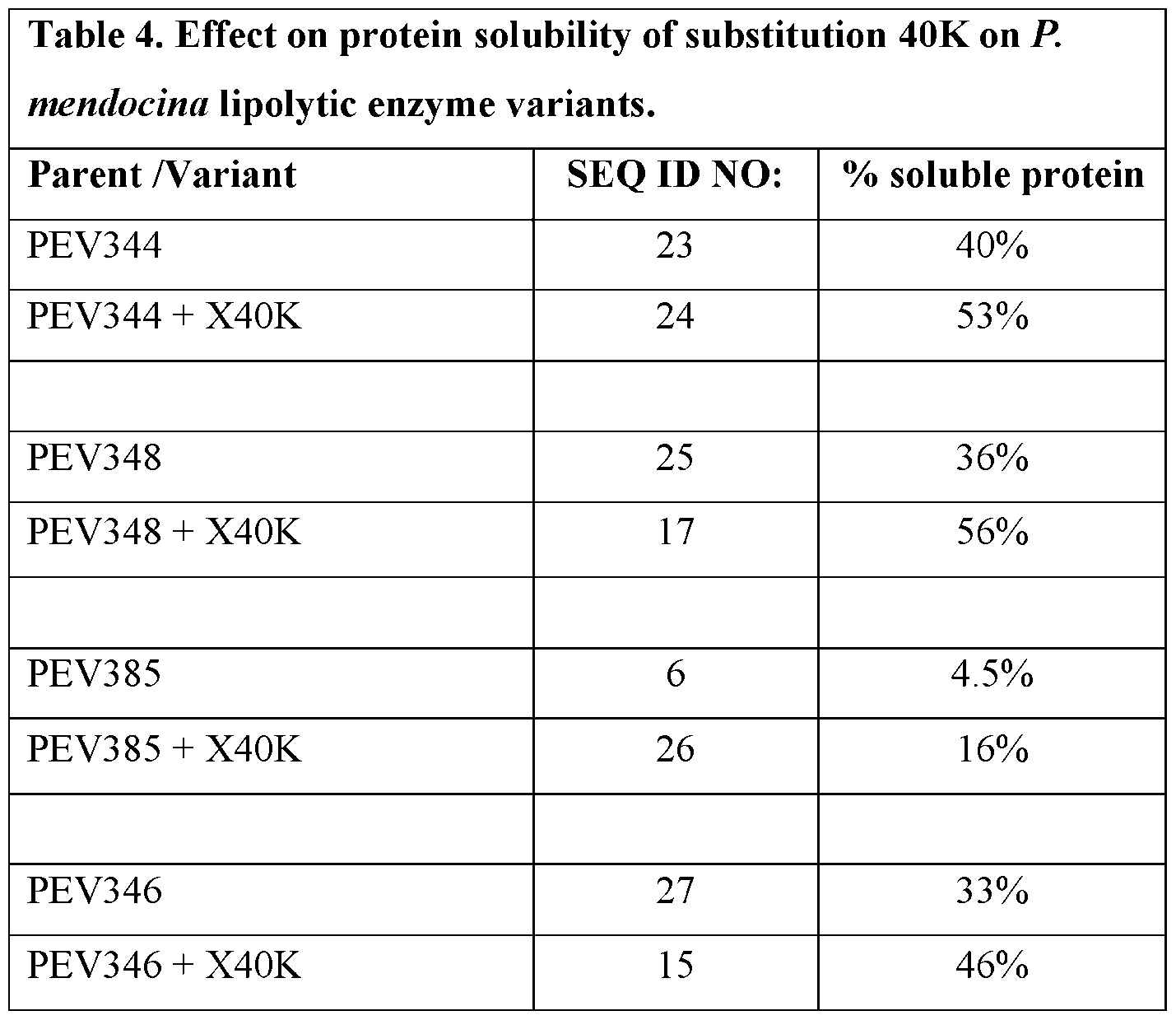 Table 5 shows the additive benefit of lysine (K) substitutions at positions X183 and X40 in P. mendocina lipolytic enzyme variants. Table 5. P. mendocina lipolytic enzyme variants showing benefit of lysine
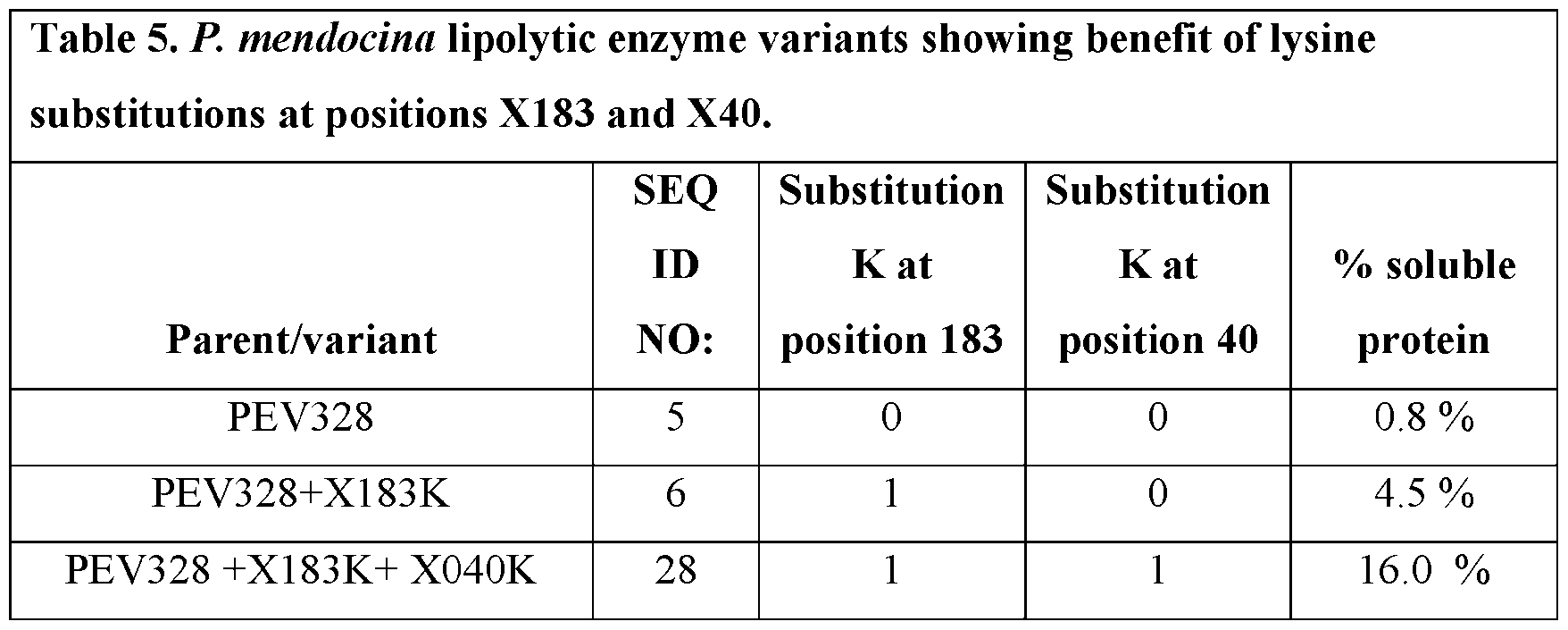 EXAMPLE 3 PET hydrolysis activity (polyesterase activity) of P. mendocina lipolytic enzyme variants Enzyme Activity Assay on PET substrate The enzymatic activity of lipolytic enzyme variants was tested by measuring the hydrolysis of PET Pellet (Polyethylene terephthalate) substrate in solution indicating it has polyesterase activity. PET pellets were purchased from Scientific Polymer Products (Cat#138). One PET pellet (20-30mg) was added to each well of a microtiter plate (Nunc, 267245) and detergent solutions were added as follows: 180ul of Tide® Original detergent (Tide, manufactured by Procter and Gamble, purchased in 2020) (0.875g/L) with 11mM Tris-HCl and 7 gpg water Hardness Ca:Mg = 3:1. A set of plates without PET were also set up to serve as controls for enzyme background. A 20ul aliquot of each enzyme sample was added per well to initiate the reactions. The reaction was carried out at 40°C for 20 hours with shaking (150 rpm) in an incubation shaker (Infors HT, Multitron). After incubation, 100ul of the reaction supernatant was transferred into a new UV-transparent plate (Corning 3635) and absorbance was measured at 240 nm on spectrophotometer (Molecular Devices, SpectraMax plus 384). The resulting absorbance value obtained after subtracting absorbance from enzyme background plate was taken as a measure of PET hydrolysis activity. The PET hydrolysis activity is reported as the absorbance values divided by enzyme concentration in OD/(mg/L). Each variant was assayed in triplicate and in multiple enzyme concentrations. Table 6 shows the PET hydrolysis activity (polyesterase activity) of various lipolytic enzyme variants. Table 6. Polyesterase activity of various P. mendocina lipolytic enzyme
 PEV346 27 0.58 PEV348 25 1.00
 As can be seen on Table 6, the variants described all display polyesterase activity in detergent of levels well above the P. mendocina WT parent. Furthermore, multiple previously described variants (PCT/US2022/020560 filed on March 16, 2022) with amino acid substitutions similar to the lipolytic variants described herein also displayed polyesterase activity. EXAMPLE 4 Improved solubility of P. mendocina lipolytic enzyme variants The solubility of P. mendocina lipolytic enzyme variants (% soluble protein) was measured by precipitation with ammonium sulfate as described here. A concentrated solution of 3.6 M ammonium sulfate was prepared at in 20 mM Tris pH 8. The clarified culture broth samples were filtered in MTPs, and 40 ul of each broth was added into a well of a 96 well plate (Costar #9017) and mixed with 60 ul of ammonium sulfate solutions (of varying concentrations from zero to 3.6 M) in triplicates. These assay plates were incubated at room temperature with shaking for 30 mins. After this incubation, the resulting slurry mix was transferred to a 96 well filter plate (Millipore, MSHVN4550), and the filtrate was collected by centrifugation on a benchtop centrifuge at 3000 rpm for 20 mins. The resulting filtrate samples were diluted 10-fold in 20 mM Tris, and 10 ul of each was loaded onto a Zorbax 300-SB C3 column for protein quantitation. The amount of soluble lipolytic enzyme was calculated as a percent of the total protein at each ammonium sulfate concentration, based on soluble fraction concentration divided by the soluble fraction concentration that has no ammonium sulfate. The percent of soluble protein was plotted against ammonium sulfate concentration, a logarithmic curve was fitted with the data. The percent of soluble lipolytic enzyme protein at 1.2 M ammonium sulfate concentration was calculated based on curve fitting. This number (% soluble protein) was used to compare the solubility of the lipolytic enzymes. The larger the number, the more soluble the variant is. Tables 7-9 report the percent (%) soluble protein of P. mendocina variants where the substitutions X40K, X109K or X183K have been introduced (singly or in combinations) into three lipolytic enzyme parents, G061D-T177R-F226L(SEQ ID NO:31), I178L-S244E-L258F
(SEQ ID NO:38), and G059Y-F180P-S212D (SEQ ID NO:43), respectively. The PET hydrolysis enzyme activity (polyesterase activity) of the parent lipolytic enzymes and variant lipolytic enzymes were measured as described in Example 3 and reported in Tables 7, 8 and 9. Table 7. Effect on protein solubility of substitutions X40K, X109K and X183K on P. mendocina li ol tic enz me arent G061D-T177R-F226L (SEQ ID NO:31) and
As can be seen on Table 6, the variants described all display polyesterase activity in detergent of levels well above the P. mendocina WT parent. Furthermore, multiple previously described variants (PCT/US2022/020560 filed on March 16, 2022) with amino acid substitutions similar to the lipolytic variants described herein also displayed polyesterase activity. EXAMPLE 4 Improved solubility of P. mendocina lipolytic enzyme variants The solubility of P. mendocina lipolytic enzyme variants (% soluble protein) was measured by precipitation with ammonium sulfate as described here. A concentrated solution of 3.6 M ammonium sulfate was prepared at in 20 mM Tris pH 8. The clarified culture broth samples were filtered in MTPs, and 40 ul of each broth was added into a well of a 96 well plate (Costar #9017) and mixed with 60 ul of ammonium sulfate solutions (of varying concentrations from zero to 3.6 M) in triplicates. These assay plates were incubated at room temperature with shaking for 30 mins. After this incubation, the resulting slurry mix was transferred to a 96 well filter plate (Millipore, MSHVN4550), and the filtrate was collected by centrifugation on a benchtop centrifuge at 3000 rpm for 20 mins. The resulting filtrate samples were diluted 10-fold in 20 mM Tris, and 10 ul of each was loaded onto a Zorbax 300-SB C3 column for protein quantitation. The amount of soluble lipolytic enzyme was calculated as a percent of the total protein at each ammonium sulfate concentration, based on soluble fraction concentration divided by the soluble fraction concentration that has no ammonium sulfate. The percent of soluble protein was plotted against ammonium sulfate concentration, a logarithmic curve was fitted with the data. The percent of soluble lipolytic enzyme protein at 1.2 M ammonium sulfate concentration was calculated based on curve fitting. This number (% soluble protein) was used to compare the solubility of the lipolytic enzymes. The larger the number, the more soluble the variant is. Tables 7-9 report the percent (%) soluble protein of P. mendocina variants where the substitutions X40K, X109K or X183K have been introduced (singly or in combinations) into three lipolytic enzyme parents, G061D-T177R-F226L(SEQ ID NO:31), I178L-S244E-L258F
(SEQ ID NO:38), and G059Y-F180P-S212D (SEQ ID NO:43), respectively. The PET hydrolysis enzyme activity (polyesterase activity) of the parent lipolytic enzymes and variant lipolytic enzymes were measured as described in Example 3 and reported in Tables 7, 8 and 9. Table 7. Effect on protein solubility of substitutions X40K, X109K and X183K on P. mendocina li ol tic enz me arent G061D-T177R-F226L (SEQ ID NO:31) and
 Table 8. Effect on protein solubility of substitutions 40K, 109K and 183K on P. y
 Table 9. Effect on protein solubility of substitutions 40K, 109K and 183K on P. mendocina lipolytic enzyme parent G059Y-F180P-S212D (SEQ ID NO: 43) and ty
 s s own n ab es , 8 and 9, t e ntroduct on o subst tut ons 0 , 09 and X183K, as singles or in combination results in a significant increase in solubility of the variant lipolytic enzyme compared to lipolytic enzyme lacking those substitutions (parent lipolytic enzyme). An increased protein solubility observed for the lipolytic enzyme variant compared to the parent lipolytic enzyme in the ammonium sulfate precipitation assay method described herein is reflective of an increased solubility under fermentation conditions at high cell density of Bacillus strains used for production, and thus improve the recovery yield of the protein of interest.
Claims
Claims What is claimed is: 1. A variant lipolytic enzyme of a parent lipolytic enzyme comprising an amino acid sequence having at least 70% identity to the full-length amino acid sequence of SEQ ID NO:2, wherein the variant comprises a first amino acid substitution selected from the group consisting of X183K, X040K and X109K, wherein the positions are numbered by reference to the amino acid sequence of SEQ ID NO:2, wherein the variant lipolytic enzyme has polyesterase activity, and wherein the variant lipolytic enzyme has improved solubility compared to said parent lipolytic enzyme.
2. The variant lipolytic enzyme of claim 1, wherein the variant comprises a first amino acid substitution consisting of X183K, and a second amino acid substitution selected from the group consisting of X040K and X109K.
3. The variant lipolytic enzyme of claim 1 or claim 2, wherein the variant comprises at least one further amino acid substitution selected from the group consisting of V014S, G059Y, G061D, T064V, S070E, S85M, T117L, Q161H, G175A, T177N/R, I178L, F180P, Y182A/L, R190L, S205G, F207T, V210I, S212D, F226L, A236P, Y239I, S244E, L249P, S252I, E254Q, R256K, and L258F.
4. The variant lipolytic enzyme of claim 1, wherein the solubility is improved by at least 4%, at least 10%, at least 20%, at least 30%, at least 40%, at least 50%, at least 60%, at least 70%, at least 80%, at least 90%, at least 100%, at least 125%, at least 150%, at least 175%, at least 200%, at least 250%, at least 300%, at least 400%, at least 500%, at least 600%, at least 700%, or more, compared to the parent lipolytic enzyme.
5. The variant lipolytic enzyme of claim 1, wherein the variant has improved solubility compared to said parent lipolytic enzyme selected from the group consisting of SEQ ID NO:5, SEQ ID NO:6, SEQ ID NO:7, SEQ ID NO:9, SEQ ID NO:11, SEQ ID NO:13, SEQ ID NO:15, SEQ ID NO:17, SEQ ID NO:19, SEQ ID NO:21, SEQ ID NO:23, SEQ ID NO:27, SEQ ID NO: 31, SEQ ID NO:38 and SEQ ID NO:43.
6. The variant lipolytic enzyme of claim 1, wherein the variant comprises an amino acid sequence having at least 75%, 80%, 85%, 90%, 91%, 92%, 93%, 94%, 95%, 96%, 97%, 98%, 99%, but less than 100% identity, to the full-length amino acid sequence of SEQ ID NO:2.
7. The variant lipolytic enzyme of claim 1, wherein the parent lipolytic enzyme is an otherwise identical lipolytic enzyme without the first substitution selected from the group consisting of X183K, X040K and X109K.
8. The variant lipolytic enzyme of claim 1, wherein the variant has on par or improved polyesterase activity compared to said parent lipolytic enzyme.
9. A polynucleotide comprising a nucleic acid sequence encoding a variant lipolytic enzyme of claim 1.
10. A nucleic acid construct or expression vector comprising the polynucleotide of claim 9.
11. A recombinant host cell expressing a lipolytic enzyme according to claim 1.
12. An enzyme composition comprising a variant lipolytic enzyme of claim 1.
13. A cleaning composition or detergent composition comprising a variant lipolytic enzyme of claim 1 and one or more detergent components.
14. The cleaning composition or detergent composition of claim 13 comprising one or more detergent components selected from the group consisting of surfactants, builders, bleaches, bleach activators, bleach catalysts, other enzymes, enzyme stabilizing systems, chelants, optical brighteners, soil release polymers, dye transfer agents, dispersants, suds suppressors, dyes, perfumes, colorants, filler salts, hydrotropes, photoactivators, fluorescers, fabric conditioners, hydrolyzable surfactants, preservatives, anti-oxidants, anti-shrinkage agents, anti-wrinkle agents,
germicides, fungicides, color speckles, silvercare, anti-tarnish and/or anti-corrosion agents, alkalinity sources, solubilizing agents, carriers, processing aids, pigments, and pH control agents.
15. The cleaning or detergent composition of claim 13, wherein the composition further comprises at least one or more additional enzymes selected from the group consisting of acyl transferases, arabinases, alpha-amylases, α-L-arabinofuranosidase, alpha-galactosidases, arabinosidases, aryl esterases, beta-amylases, beta-galactosidases, beta-glucanases, carrageenases, catalases, cellobiohydrolases, cellulases, chondroitinases, cutinases, endo-1,3-β- xylosidase, endo-1,4-D-glucanase, endo-beta-1, 4-glucanases, endo-beta-mannanases, endo-IV- glucanase, esterases, exo-mannanases, exo-polygalacturonases, exo-poly-alpha- galacturonosidase, exo-polygalacturonate lyase, feruloyl esterases, galactanases, galacturan-1,4- α-galacturonidase, glucoamylases, hemicellulases, hexosaminidases, hyaluronidases, keratinases, laccases, lactases, licheninases (lichenases), ligninases, lipases, lipoxygenases, lysozymes, mannanases, metalloproteases, nucleases (e.g. deoxyribonucleases and ribonucleases), oxidases, oxidoreductases, pectate lyases, pectin lyases, pectin esterase, pectin acetyl esterases, pectin methylesterases, pectin transeliminases, pectinases, pentosanases, perhydrolases, peroxidases, phenoloxidases, phosphatases, phospholipases, phytases, polygalacturonases, polyesterases, proteases, pullulanases, reductases, rhamnogalacturonases, beta-glucanases, tannases, transglutaminases, xylan-1,4-β-xylosidase, xylan acetyl-esterases, xylanases, xyloglucanases, xylosidases, xanthan lyases and any combination or mixture thereof.
16. The cleaning composition or detergent composition of claim 13, wherein the composition is selected from the group consisting of a fabric treatment composition and a textile treatment composition.
17. A method for obtaining a variant lipolytic enzyme with an improved solubility compared to a parent lipolytic enzyme, wherein the variant has a sequence identity of at least 70% to SEQ ID NO:2, the method comprising: (a) introducing into the parent lipolytic enzyme a first amino acid substitution selected from the group consisting of X183K, X040K and X109K, wherein the positions are numbered by reference to the amino acid sequence of SEQ ID NO:2; and,
(b) recovering the variant.
18. A method for obtaining a variant lipolytic enzyme with an improved solubility compared to a parent lipolytic enzyme, wherein the variant has a sequence identity of at least 70% to SEQ ID NO:2, the method comprising: (a) introducing into the parent lipolytic enzyme a first amino acid substitution selected from the group consisting of X183K , X040K and X109K, and at least one further amino acid substitution selected from the group consisting of V014S, G059Y, G061D, T064V, S070E, T117L, Q161H, G175A, T177N/R, I178L, F180P, Y182A/L, R190L, S205G, F207T, V210I, S212D, F226L, A236P, Y239I, S244E, L249P, S252I, E254Q, R256K, and L258F, wherein the positions are numbered by reference to the amino acid sequence of SEQ ID NO:2; and, (b) recovering the variant.
19. A method for treating a fabric or textile comprising, (i) contacting a fabric or textile with a variant lipolytic enzyme of claim 1 or a composition comprising said variant lipolytic enzyme, and (ii) optionally, rinsing the fabric or textile.
Applications Claiming Priority (2)
| Application Number | Priority Date | Filing Date | Title |
|---|---|---|---|
| US202363585972P | 2023-09-28 | 2023-09-28 | |
| US63/585,972 | 2023-09-28 |
Publications (1)
| Publication Number | Publication Date |
|---|---|
| WO2025071996A1 true WO2025071996A1 (en) | 2025-04-03 |
Family
ID=92966971
Family Applications (1)
| Application Number | Title | Priority Date | Filing Date |
|---|---|---|---|
| PCT/US2024/047167 Pending WO2025071996A1 (en) | 2023-09-28 | 2024-09-18 | Variant cutinase enzymes with improved solubility and uses thereof |
Country Status (1)
| Country | Link |
|---|---|
| WO (1) | WO2025071996A1 (en) |
Citations (202)
| Publication number | Priority date | Publication date | Assignee | Title |
|---|---|---|---|---|
| GB1296839A (en) | 1969-05-29 | 1972-11-22 | ||
| GB1372034A (en) | 1970-12-31 | 1974-10-30 | Unilever Ltd | Detergent compositions |
| US4246612A (en) | 1979-02-28 | 1981-01-20 | Barr & Stroud Limited | Optical raster scanning system |
| US4302544A (en) | 1979-10-15 | 1981-11-24 | University Of Rochester | Asporogenous mutant of B. subtilis for use as host component of HV1 system |
| US4430243A (en) | 1981-08-08 | 1984-02-07 | The Procter & Gamble Company | Bleach catalyst compositions and use thereof in laundry bleaching and detergent compositions |
| US4435307A (en) | 1980-04-30 | 1984-03-06 | Novo Industri A/S | Detergent cellulase |
| JPS5966588A (en) | 1982-10-08 | 1984-04-16 | 工業技術院長 | Production of fibrillated pecto-cellulose fiber |
| US4450235A (en) | 1982-04-21 | 1984-05-22 | Cpc International Inc. | Asporogenic mutant of bacillus subtilis useful as a host in a host-vector system |
| EP0134048A1 (en) | 1983-07-06 | 1985-03-13 | Gist-Brocades N.V. | Molecular cloning and expression in industrial microorganism species |
| EP0179486A2 (en) | 1984-10-26 | 1986-04-30 | Suntory Limited | Process for producing peroxidase |
| EP0214761A2 (en) | 1985-08-07 | 1987-03-18 | Novo Nordisk A/S | An enzymatic detergent additive, a detergent, and a washing method |
| EP0218272A1 (en) | 1985-08-09 | 1987-04-15 | Gist-Brocades N.V. | Novel lipolytic enzymes and their use in detergent compositions |
| EP0238023A2 (en) | 1986-03-17 | 1987-09-23 | Novo Nordisk A/S | Process for the production of protein products in Aspergillus oryzae and a promoter for use in Aspergillus |
| EP0258068A2 (en) | 1986-08-29 | 1988-03-02 | Novo Nordisk A/S | Enzymatic detergent additive |
| JPS6342988B2 (en) | 1981-09-30 | 1988-08-26 | Nippon Electric Co | |
| WO1988009367A1 (en) | 1987-05-29 | 1988-12-01 | Genencor, Inc. | Cutinase cleaning composition |
| EP0305216A1 (en) | 1987-08-28 | 1989-03-01 | Novo Nordisk A/S | Recombinant Humicola lipase and process for the production of recombinant humicola lipases |
| US4810410A (en) | 1986-12-13 | 1989-03-07 | Interox Chemicals Limited | Bleach activation |
| WO1989006270A1 (en) | 1988-01-07 | 1989-07-13 | Novo-Nordisk A/S | Enzymatic detergent |
| EP0331376A2 (en) | 1988-02-28 | 1989-09-06 | Amano Pharmaceutical Co., Ltd. | Recombinant DNA, bacterium of the genus pseudomonas containing it, and process for preparing lipase by using it |
| WO1990009446A1 (en) | 1989-02-17 | 1990-08-23 | Plant Genetic Systems N.V. | Cutinase |
| WO1991000353A2 (en) | 1989-06-29 | 1991-01-10 | Gist-Brocades N.V. | MUTANT MICROBIAL α-AMYLASES WITH INCREASED THERMAL, ACID AND/OR ALKALINE STABILITY |
| WO1991016422A1 (en) | 1990-04-14 | 1991-10-31 | Kali-Chemie Aktiengesellschaft | Alkaline bacillus lipases, coding dna sequences therefor and bacilli which produce these lipases |
| WO1992001046A1 (en) | 1990-07-06 | 1992-01-23 | Valtion Teknillinen Tutkimuskeskus | Laccase production by recombinant organisms |
| WO1992006154A1 (en) | 1990-09-28 | 1992-04-16 | The Procter & Gamble Company | Polyhydroxy fatty acid amide surfactants to enhance enzyme performance |
| EP0495257A1 (en) | 1991-01-16 | 1992-07-22 | The Procter & Gamble Company | Compact detergent compositions with high activity cellulase |
| WO1992021760A1 (en) | 1991-05-29 | 1992-12-10 | Cognis, Inc. | Mutant proteolytic enzymes from bacillus |
| US5227084A (en) | 1991-04-17 | 1993-07-13 | Lever Brothers Company, Division Of Conopco, Inc. | Concentrated detergent powder compositions |
| WO1993024618A1 (en) | 1992-06-01 | 1993-12-09 | Novo Nordisk A/S | Peroxidase variants with improved hydrogen peroxide stability |
| WO1994002597A1 (en) | 1992-07-23 | 1994-02-03 | Novo Nordisk A/S | MUTANT α-AMYLASE, DETERGENT, DISH WASHING AGENT, AND LIQUEFACTION AGENT |
| USRE34606E (en) | 1984-05-29 | 1994-05-10 | Genencor, Inc. | Modified enzymes and methods for making same |
| WO1994014964A1 (en) | 1992-12-23 | 1994-07-07 | Unilever N.V. | Modified cutinases, dna, vector and host |
| WO1994014963A1 (en) | 1992-12-18 | 1994-07-07 | Unilever N.V. | Modified cutinases, dna, vector and host |
| WO1995010603A1 (en) | 1993-10-08 | 1995-04-20 | Novo Nordisk A/S | Amylase variants |
| WO1995010602A1 (en) | 1993-10-13 | 1995-04-20 | Novo Nordisk A/S | H2o2-stable peroxidase variants |
| WO1995023221A1 (en) | 1994-02-24 | 1995-08-31 | Cognis, Inc. | Improved enzymes and detergents containing them |
| WO1995026397A1 (en) | 1994-03-29 | 1995-10-05 | Novo Nordisk A/S | Alkaline bacillus amylase |
| WO1995033836A1 (en) | 1994-06-03 | 1995-12-14 | Novo Nordisk Biotech, Inc. | Phosphonyldipeptides useful in the treatment of cardiovascular diseases |
| WO1995035382A2 (en) | 1994-06-17 | 1995-12-28 | Genecor International Inc. | NOVEL AMYLOLYTIC ENZYMES DERIVED FROM THE B. LICHENIFORMIS α-AMYLASE, HAVING IMPROVED CHARACTERISTICS |
| WO1996005295A2 (en) | 1994-08-11 | 1996-02-22 | Genencor International, Inc. | An improved cleaning composition |
| WO1996018729A1 (en) | 1994-12-13 | 1996-06-20 | Genencor International, Inc. | Fusarium isolate and lipases, cutinases and enzyme compositions derived therefrom |
| WO1996023873A1 (en) | 1995-02-03 | 1996-08-08 | Novo Nordisk A/S | Amylase variants |
| WO1996023874A1 (en) | 1995-02-03 | 1996-08-08 | Novo Nordisk A/S | A method of designing alpha-amylase mutants with predetermined properties |
| WO1996030481A1 (en) | 1995-03-24 | 1996-10-03 | Genencor International, Inc. | An improved laundry detergent composition comprising amylase |
| US5576282A (en) | 1995-09-11 | 1996-11-19 | The Procter & Gamble Company | Color-safe bleach boosters, compositions and laundry methods employing same |
| WO1996041859A1 (en) | 1995-06-13 | 1996-12-27 | Novo Nordisk A/S | 4-substituted-phenyl-boronic acids as enzyme stabilizers |
| US5595967A (en) | 1995-02-03 | 1997-01-21 | The Procter & Gamble Company | Detergent compositions comprising multiperacid-forming bleach activators |
| US5597936A (en) | 1995-06-16 | 1997-01-28 | The Procter & Gamble Company | Method for manufacturing cobalt catalysts |
| WO1997008325A2 (en) | 1995-08-25 | 1997-03-06 | Novo Nordisk Biotech, Inc. | Purified coprinus laccases and nucleic acids encoding same |
| WO1997010342A1 (en) | 1995-09-13 | 1997-03-20 | Genencor International, Inc. | Alkaliphilic and thermophilic microorganisms and enzymes obtained therefrom |
| US5646101A (en) | 1993-01-18 | 1997-07-08 | The Procter & Gamble Company | Machine dishwashing detergents containing an oxygen bleach and an anti-tarnishing mixture of a paraffin oil and sequestrant |
| WO1997041213A1 (en) | 1996-04-30 | 1997-11-06 | Novo Nordisk A/S | α-AMYLASE MUTANTS |
| US5686014A (en) | 1994-04-07 | 1997-11-11 | The Procter & Gamble Company | Bleach compositions comprising manganese-containing bleach catalysts |
| WO1997043424A1 (en) | 1996-05-14 | 1997-11-20 | Genencor International, Inc. | MODIFIED α-AMYLASES HAVING ALTERED CALCIUM BINDING PROPERTIES |
| US5695679A (en) | 1994-07-07 | 1997-12-09 | The Procter & Gamble Company | Detergent compositions containing an organic silver coating agent to minimize silver training in ADW washing methods |
| US5698504A (en) | 1993-07-01 | 1997-12-16 | The Procter & Gamble Company | Machine dishwashing composition containing oxygen bleach and paraffin oil and benzotriazole compound silver tarnishing inhibitors |
| US5700676A (en) | 1984-05-29 | 1997-12-23 | Genencor International Inc. | Modified subtilisins having amino acid alterations |
| US5705464A (en) | 1995-06-16 | 1998-01-06 | The Procter & Gamble Company | Automatic dishwashing compositions comprising cobalt catalysts |
| JPH106557A (en) | 1996-06-24 | 1998-01-13 | Fuji Xerox Co Ltd | Image forming method and apparatus therefor |
| US5710115A (en) | 1994-12-09 | 1998-01-20 | The Procter & Gamble Company | Automatic dishwashing composition containing particles of diacyl peroxides |
| WO1998013481A1 (en) | 1996-09-26 | 1998-04-02 | Novo Nordisk A/S | An enzyme with amylase activity |
| WO1998015257A1 (en) | 1996-10-08 | 1998-04-16 | Novo Nordisk A/S | Diaminobenzoic acid derivatives as dye precursors |
| WO1998026078A1 (en) | 1996-12-09 | 1998-06-18 | Genencor International, Inc. | H mutant alpha-amylase enzymes |
| US5801039A (en) | 1994-02-24 | 1998-09-01 | Cognis Gesellschaft Fuer Bio Und Umwelttechnologie Mbh | Enzymes for detergents |
| US5827719A (en) | 1994-10-26 | 1998-10-27 | Novo Nordisk A/S | Enzyme with lipolytic activity |
| US5855625A (en) | 1995-01-17 | 1999-01-05 | Henkel Kommanditgesellschaft Auf Aktien | Detergent compositions |
| WO1999002702A1 (en) | 1997-07-11 | 1999-01-21 | Genencor International, Inc. | MUTANT α-AMYLASE HAVING INTRODUCED THEREIN A DISULFIDE BOND |
| WO1999006521A1 (en) | 1997-08-02 | 1999-02-11 | The Procter & Gamble Company | Detergent tablet |
| US5874276A (en) | 1993-12-17 | 1999-02-23 | Genencor International, Inc. | Cellulase enzymes and systems for their expressions |
| WO1999009183A1 (en) | 1997-08-19 | 1999-02-25 | Genencor International, Inc. | MUTANT α-AMYLASE COMPRISING MODIFICATION AT RESIDUES CORRESPONDING TO A210, H405 AND/OR T412 IN $i(BACILLUS LICHENIFORMIS) |
| WO1999014341A2 (en) | 1997-09-15 | 1999-03-25 | Genencor International, Inc. | Proteases from gram-positive organisms |
| WO1999014342A1 (en) | 1997-09-15 | 1999-03-25 | Genencor International, Inc. | Proteases from gram-positive organisms |
| WO1999019467A1 (en) | 1997-10-13 | 1999-04-22 | Novo Nordisk A/S | α-AMYLASE MUTANTS |
| WO1999023211A1 (en) | 1997-10-30 | 1999-05-14 | Novo Nordisk A/S | α-AMYLASE MUTANTS |
| WO1999029876A2 (en) | 1997-12-09 | 1999-06-17 | Genencor International, Inc. | Mutant bacillus licheniformis alpha-amylase |
| WO1999034003A2 (en) | 1997-12-30 | 1999-07-08 | Genencor International, Inc. | Proteases from gram positive organisms |
| WO1999033960A2 (en) | 1997-12-30 | 1999-07-08 | Genencor International, Inc. | Proteases from gram positive organisms |
| WO1999042567A1 (en) | 1998-02-18 | 1999-08-26 | Novo Nordisk A/S | Alkaline bacillus amylase |
| WO1999043794A1 (en) | 1998-02-27 | 1999-09-02 | Novo Nordisk A/S | Maltogenic alpha-amylase variants |
| WO1999043793A1 (en) | 1998-02-27 | 1999-09-02 | Novo Nordisk A/S | Amylolytic enzyme variants |
| WO1999046399A1 (en) | 1998-03-09 | 1999-09-16 | Novo Nordisk A/S | Enzymatic preparation of glucose syrup from starch |
| US5955340A (en) | 1984-05-29 | 1999-09-21 | Genencor International, Inc. | Modified subtilisins having amino acid alterations |
| WO2000005389A2 (en) | 1998-07-20 | 2000-02-03 | Unilever N.V. | Production of proteins |
| WO2000029560A1 (en) | 1998-11-16 | 2000-05-25 | Novozymes A/S | α-AMYLASE VARIANTS |
| WO2000060060A2 (en) | 1999-03-31 | 2000-10-12 | Novozymes A/S | Polypeptides having alkaline alpha-amylase activity and nucleic acids encoding same |
| WO2000060059A2 (en) | 1999-03-30 | 2000-10-12 | NovozymesA/S | Alpha-amylase variants |
| WO2000060058A2 (en) | 1999-03-31 | 2000-10-12 | Novozymes A/S | Polypeptides having alkaline alpha-amylase activity and nucleic acids encoding same |
| WO2001014532A2 (en) | 1999-08-20 | 2001-03-01 | Novozymes A/S | Alkaline bacillus amylase |
| WO2001034784A1 (en) | 1999-11-10 | 2001-05-17 | Novozymes A/S | Fungamyl-like alpha-amylase variants |
| WO2001064852A1 (en) | 2000-03-03 | 2001-09-07 | Novozymes A/S | Polypeptides having alkaline alpha-amylase activity and nucleic acids encoding same |
| WO2001066712A2 (en) | 2000-03-08 | 2001-09-13 | Novozymes A/S | Variants with altered properties |
| US6312936B1 (en) | 1997-10-23 | 2001-11-06 | Genencor International, Inc. | Multiply-substituted protease variants |
| WO2001088107A2 (en) | 2000-05-12 | 2001-11-22 | Novozymes A/S | Alpha-amylase variants with altered 1,6-activity |
| WO2001096537A2 (en) | 2000-06-14 | 2001-12-20 | Novozymes A/S | Pre-oxidized alpha-amylase |
| WO2002010355A2 (en) | 2000-08-01 | 2002-02-07 | Novozymes A/S | Alpha-amylase mutants with altered stability |
| WO2002031124A2 (en) | 2000-10-13 | 2002-04-18 | Novozymes A/S | Alpha-amylase variant with altered properties |
| US6440991B1 (en) | 2000-10-02 | 2002-08-27 | Wyeth | Ethers of 7-desmethlrapamycin |
| WO2002092797A2 (en) | 2001-05-15 | 2002-11-21 | Novozymes A/S | Alpha-amylase variant with altered properties |
| US6566114B1 (en) | 1998-06-10 | 2003-05-20 | Novozymes, A/S | Mannanases |
| US6602842B2 (en) | 1994-06-17 | 2003-08-05 | Genencor International, Inc. | Cleaning compositions containing plant cell wall degrading enzymes and their use in cleaning methods |
| US6605458B1 (en) | 1997-11-21 | 2003-08-12 | Novozymes A/S | Protease variants and compositions |
| US6610642B2 (en) | 2000-04-20 | 2003-08-26 | The Procter And Gamble Company | Cleaning compositions containing multiply-substituted protease variants |
| WO2004055178A1 (en) | 2002-12-17 | 2004-07-01 | Novozymes A/S | Thermostable alpha-amylases |
| WO2004113551A1 (en) | 2003-06-25 | 2004-12-29 | Novozymes A/S | Process for the hydrolysis of starch |
| WO2005001064A2 (en) | 2003-06-25 | 2005-01-06 | Novozymes A/S | Polypeptides having alpha-amylase activity and polypeptides encoding same |
| WO2005003311A2 (en) | 2003-06-25 | 2005-01-13 | Novozymes A/S | Enzymes for starch processing |
| WO2005018336A1 (en) | 2003-08-22 | 2005-03-03 | Novozymes A/S | Process for preparing a dough comprising a starch-degrading glucogenic exo-amylase of family 13 |
| WO2005019443A2 (en) | 2003-08-22 | 2005-03-03 | Novozymes A/S | Fungal alpha-amylase variants |
| WO2005054475A1 (en) | 2003-12-03 | 2005-06-16 | Meiji Seika Kaisha, Ltd. | Endoglucanase stce and cellulase preparation containing the same |
| WO2005056787A1 (en) | 2003-12-08 | 2005-06-23 | Meiji Seika Kaisha, Ltd. | Surfactant-tolerant cellulase and method of converting the same |
| WO2005066338A1 (en) | 2004-01-08 | 2005-07-21 | Novozymes A/S | Amylase |
| US20050202535A1 (en) | 2003-11-06 | 2005-09-15 | Katherine Collier | Bacterial expression of protease inhibitors and variants thereof |
| WO2006002643A2 (en) | 2004-07-05 | 2006-01-12 | Novozymes A/S | Alpha-amylase variants with altered properties |
| WO2006012902A2 (en) | 2004-08-02 | 2006-02-09 | Novozymes A/S | Creation of diversity in polypeptides |
| WO2006012899A1 (en) | 2004-08-02 | 2006-02-09 | Novozymes A/S | Maltogenic alpha-amylase variants |
| WO2006031554A2 (en) | 2004-09-10 | 2006-03-23 | Novozymes North America, Inc. | Methods for preventing, removing, reducing, or disrupting biofilm |
| WO2006063594A1 (en) | 2004-12-15 | 2006-06-22 | Novozymes A/S | Alkaline bacillus amylase |
| WO2006066596A2 (en) | 2004-12-22 | 2006-06-29 | Novozymes A/S | Hybrid enzymes consisting of an endo-amylase first amino acid sequence and a carbohydrate -binding module as second amino acid sequence |
| WO2006066594A2 (en) | 2004-12-23 | 2006-06-29 | Novozymes A/S | Alpha-amylase variants |
| WO2006136161A2 (en) | 2005-06-24 | 2006-12-28 | Novozymes A/S | Amylases for pharmaceutical use |
| WO2007044993A2 (en) | 2005-10-12 | 2007-04-19 | Genencor International, Inc. | Use and production of storage-stable neutral metalloprotease |
| WO2007145964A2 (en) | 2006-06-05 | 2007-12-21 | The Procter & Gamble Company | Enzyme stabilizer |
| WO2008000825A1 (en) | 2006-06-30 | 2008-01-03 | Novozymes A/S | Bacterial alpha-amylase variants |
| WO2008010925A2 (en) | 2006-07-18 | 2008-01-24 | Danisco Us, Inc., Genencor Division | Protease variants active over a broad temperature range |
| WO2008088493A2 (en) | 2006-12-21 | 2008-07-24 | Danisco Us, Inc., Genencor Division | Compositions and uses for an alpha-amylase polypeptide of bacillus species 195 |
| WO2008092919A1 (en) | 2007-02-01 | 2008-08-07 | Novozymes A/S | Alpha-amylase and its use |
| WO2008101894A1 (en) | 2007-02-19 | 2008-08-28 | Novozymes A/S | Polypeptides with starch debranching activity |
| WO2008112459A2 (en) | 2007-03-09 | 2008-09-18 | Danisco Us Inc., Genencor Division | Alkaliphilic bacillus species a-amylase variants, compositions comprising a-amylase variants, and methods of use |
| US7449318B2 (en) | 2003-04-30 | 2008-11-11 | Danisco A/S, Genencor Division | Bacillus mHKcel cellulase |
| WO2009058661A1 (en) | 2007-10-31 | 2009-05-07 | Danisco Us Inc., Genencor Division | Use and production of citrate-stable neutral metalloproteases |
| WO2009058303A2 (en) | 2007-11-01 | 2009-05-07 | Danisco Us Inc., Genencor Division | Production of thermolysin and variants thereof and use in liquid detergents |
| WO2009061381A2 (en) | 2007-11-05 | 2009-05-14 | Danisco Us Inc., Genencor Division | Alpha-amylase variants with altered properties |
| WO2009061380A2 (en) | 2007-11-05 | 2009-05-14 | Danisco Us Inc., Genencor Division | VARIANTS OF BACILLUS sp. TS-23 ALPHA-AMYLASE WITH ALTERED PROPERTIES |
| WO2009100102A2 (en) | 2008-02-04 | 2009-08-13 | Danisco Us Inc., Genencor Division | Ts23 alpha-amylase variants with altered properties |
| EP2100949A1 (en) | 2008-03-14 | 2009-09-16 | The Procter and Gamble Company | Automatic dishwashing detergent composition |
| WO2009118375A2 (en) | 2008-03-26 | 2009-10-01 | Novozymes A/S | Stabilized liquid enzyme compositions |
| WO2009140504A1 (en) | 2008-05-16 | 2009-11-19 | Novozymes A/S | Polypeptides having alpha-amylase activity and polynucleotides encoding same |
| WO2009149145A2 (en) | 2008-06-06 | 2009-12-10 | Danisco Us Inc., Genencor Division | Compositions and methods comprising variant microbial proteases |
| WO2009149419A2 (en) | 2008-06-06 | 2009-12-10 | Danisco Us Inc. | Variant alpha-amylases from bacillus subtilis and methods of use, thereof |
| WO2010056640A2 (en) | 2008-11-11 | 2010-05-20 | Danisco Us Inc. | Compositions and methods comprising serine protease variants |
| WO2010056653A2 (en) | 2008-11-11 | 2010-05-20 | Danisco Us Inc. | Proteases comprising one or more combinable mutations |
| WO2010059413A2 (en) | 2008-11-20 | 2010-05-27 | Novozymes, Inc. | Polypeptides having amylolytic enhancing activity and polynucleotides encoding same |
| WO2010088447A1 (en) | 2009-01-30 | 2010-08-05 | Novozymes A/S | Polypeptides having alpha-amylase activity and polynucleotides encoding same |
| WO2010091221A1 (en) | 2009-02-06 | 2010-08-12 | Novozymes A/S | Polypeptides having alpha-amylase activity and polynucleotides encoding same |
| WO2010104675A1 (en) | 2009-03-10 | 2010-09-16 | Danisco Us Inc. | Bacillus megaterium strain dsm90-related alpha-amylases, and methods of use, thereof |
| WO2010115028A2 (en) | 2009-04-01 | 2010-10-07 | Danisco Us Inc. | Cleaning system comprising an alpha-amylase and a protease |
| WO2010117511A1 (en) | 2009-04-08 | 2010-10-14 | Danisco Us Inc. | Halomonas strain wdg195-related alpha-amylases, and methods of use, thereof |
| WO2011013022A1 (en) | 2009-07-28 | 2011-02-03 | Koninklijke Philips Electronics N.V. | Washing and sterilizing unit |
| WO2011072099A2 (en) | 2009-12-09 | 2011-06-16 | Danisco Us Inc. | Compositions and methods comprising protease variants |
| WO2011076897A1 (en) | 2009-12-22 | 2011-06-30 | Novozymes A/S | Use of amylase variants at low temperature |
| WO2011076123A1 (en) | 2009-12-22 | 2011-06-30 | Novozymes A/S | Compositions comprising boosting polypeptide and starch degrading enzyme and uses thereof |
| WO2011080352A1 (en) | 2010-01-04 | 2011-07-07 | Novozymes A/S | Alpha-amylases |
| WO2011098531A1 (en) | 2010-02-10 | 2011-08-18 | Novozymes A/S | Variants and compositions comprising variants with high stability in presence of a chelating agent |
| WO2011140364A1 (en) | 2010-05-06 | 2011-11-10 | Danisco Us Inc. | Compositions and methods comprising subtilisin variants |
| WO2012151534A1 (en) | 2011-05-05 | 2012-11-08 | Danisco Us Inc. | Compositions and methods comprising serine protease variants |
| WO2013004636A1 (en) | 2011-07-01 | 2013-01-10 | Novozymes A/S | Stabilized subtilisin composition |
| US8362222B2 (en) | 2009-07-08 | 2013-01-29 | Ab Enzymes Oy | Fungal protease and use thereof |
| WO2013063460A2 (en) | 2011-10-28 | 2013-05-02 | Danisco Us Inc. | Variant maltohexaose-forming alpha-amylase variants |
| US8530219B2 (en) | 2008-11-11 | 2013-09-10 | Danisco Us Inc. | Compositions and methods comprising a subtilisin variant |
| WO2013184577A1 (en) | 2012-06-08 | 2013-12-12 | Danisco Us Inc. | Alpha-amylase variants derived from the alpha amylase of cytophaga sp.amylase|(cspamy2). |
| WO2014059360A1 (en) | 2012-10-12 | 2014-04-17 | Danisco Us Inc. | Compositions and methods comprising a lipolytic enzyme variant |
| WO2014071410A1 (en) | 2012-11-05 | 2014-05-08 | Danisco Us Inc. | Compositions and methods comprising thermolysin protease variants |
| WO2014099523A1 (en) | 2012-12-21 | 2014-06-26 | Danisco Us Inc. | Alpha-amylase variants |
| WO2014164777A1 (en) | 2013-03-11 | 2014-10-09 | Danisco Us Inc. | Alpha-amylase combinatorial variants |
| WO2014194117A2 (en) | 2013-05-29 | 2014-12-04 | Danisco Us Inc. | Novel metalloproteases |
| WO2014194054A1 (en) | 2013-05-29 | 2014-12-04 | Danisco Us Inc. | Novel metalloproteases |
| WO2014194032A1 (en) | 2013-05-29 | 2014-12-04 | Danisco Us Inc. | Novel metalloproteases |
| WO2014194034A2 (en) | 2013-05-29 | 2014-12-04 | Danisco Us Inc. | Novel metalloproteases |
| WO2015010009A2 (en) | 2013-07-19 | 2015-01-22 | Danisco Us Inc. | Compositions and methods comprising a lipolytic enzyme variant |
| WO2015038792A1 (en) | 2013-09-12 | 2015-03-19 | Danisco Us Inc. | Compositions and methods comprising lg12-clade protease variants |
| WO2015077126A1 (en) | 2013-11-20 | 2015-05-28 | Danisco Us Inc. | Variant alpha-amylases having reduced susceptibility to protease cleavage, and methods of use, thereof |
| WO2015089441A1 (en) | 2013-12-13 | 2015-06-18 | Danisco Us Inc. | Serine proteases of bacillus species |
| WO2015089447A1 (en) | 2013-12-13 | 2015-06-18 | Danisco Us Inc. | Serine proteases of the bacillus gibsonii-clade |
| WO2015155350A1 (en) | 2014-04-11 | 2015-10-15 | Novozymes A/S | Detergent composition |
| WO2015181287A1 (en) | 2014-05-28 | 2015-12-03 | Novozymes A/S | Polypeptide having dnase activity for reducing static electricity |
| WO2016001449A1 (en) | 2014-07-04 | 2016-01-07 | Novozymes A/S | Subtilase variants and polynucleotides encoding same |
| WO2016007929A2 (en) | 2014-07-11 | 2016-01-14 | Danisco Us Inc. | Paenibacillus and bacillus spp. mannanases |
| WO2016087617A1 (en) | 2014-12-04 | 2016-06-09 | Novozymes A/S | Subtilase variants and polynucleotides encoding same |
| WO2016096714A1 (en) | 2014-12-15 | 2016-06-23 | Henkel Ag & Co. Kgaa | Detergent composition comprising subtilase variants |
| WO2016162556A1 (en) | 2015-04-10 | 2016-10-13 | Novozymes A/S | Laundry method, use of dnase and detergent composition |
| WO2016203064A2 (en) | 2015-10-28 | 2016-12-22 | Novozymes A/S | Detergent composition comprising protease and amylase variants |
| WO2017060475A2 (en) | 2015-10-07 | 2017-04-13 | Novozymes A/S | Polypeptides |
| WO2017089093A1 (en) | 2015-11-25 | 2017-06-01 | Unilever N.V. | A liquid detergent composition |
| WO2017162836A1 (en) | 2016-03-23 | 2017-09-28 | Novozymes A/S | Use of polypeptide having dnase activity for treating fabrics |
| WO2017215925A1 (en) | 2016-06-15 | 2017-12-21 | Henkel Ag & Co. Kgaa | Bacillus gibsonii protease and variants thereof |
| WO2018076800A1 (en) | 2016-10-24 | 2018-05-03 | 深圳有麦科技有限公司 | Method and system for asynchronously updating data |
| WO2018177203A1 (en) | 2017-03-31 | 2018-10-04 | Novozymes A/S | Polypeptides having dnase activity |
| WO2018177936A1 (en) | 2017-03-31 | 2018-10-04 | Novozymes A/S | Polypeptides having dnase activity |
| WO2018177938A1 (en) | 2017-03-31 | 2018-10-04 | Novozymes A/S | Polypeptides having dnase activity |
| WO2018185280A1 (en) | 2017-04-06 | 2018-10-11 | Novozymes A/S | Cleaning compositions and uses thereof |
| WO2018184817A1 (en) | 2017-04-06 | 2018-10-11 | Novozymes A/S | Cleaning compositions and uses thereof |
| WO2018185267A1 (en) | 2017-04-06 | 2018-10-11 | Novozymes A/S | Cleaning compositions and uses thereof |
| WO2018185285A1 (en) | 2017-04-06 | 2018-10-11 | Novozymes A/S | Cleaning compositions and uses thereof |
| WO2018184816A1 (en) | 2017-04-06 | 2018-10-11 | Novozymes A/S | Cleaning compositions and uses thereof |
| WO2018185269A1 (en) | 2017-04-06 | 2018-10-11 | Novozymes A/S | Cleaning compositions and uses thereof |
| WO2018206553A1 (en) | 2017-05-09 | 2018-11-15 | Novozymes A/S | Animal chew toy with dental care composition |
| WO2019081721A1 (en) | 2017-10-27 | 2019-05-02 | Novozymes A/S | Dnase variants |
| WO2019084350A1 (en) | 2017-10-27 | 2019-05-02 | The Procter & Gamble Company | Detergent compositions comprising polypeptide variants |
| WO2019180111A1 (en) | 2018-03-23 | 2019-09-26 | Novozymes A/S | Subtilase variants and compositions comprising same |
| WO2021148364A1 (en) | 2020-01-23 | 2021-07-29 | Novozymes A/S | Enzyme compositions and uses thereof |
| WO2022047149A1 (en) | 2020-08-27 | 2022-03-03 | Danisco Us Inc | Enzymes and enzyme compositions for cleaning |
| WO2023274925A1 (en) * | 2021-06-30 | 2023-01-05 | Henkel Ag & Co. Kgaa | Cleaning composition with improved anti-gray performance and/or anti-pilling performance |
-
2024
- 2024-09-18 WO PCT/US2024/047167 patent/WO2025071996A1/en active Pending
Patent Citations (217)
| Publication number | Priority date | Publication date | Assignee | Title |
|---|---|---|---|---|
| GB1296839A (en) | 1969-05-29 | 1972-11-22 | ||
| GB1372034A (en) | 1970-12-31 | 1974-10-30 | Unilever Ltd | Detergent compositions |
| US4246612A (en) | 1979-02-28 | 1981-01-20 | Barr & Stroud Limited | Optical raster scanning system |
| US4302544A (en) | 1979-10-15 | 1981-11-24 | University Of Rochester | Asporogenous mutant of B. subtilis for use as host component of HV1 system |
| US4435307A (en) | 1980-04-30 | 1984-03-06 | Novo Industri A/S | Detergent cellulase |
| US4430243A (en) | 1981-08-08 | 1984-02-07 | The Procter & Gamble Company | Bleach catalyst compositions and use thereof in laundry bleaching and detergent compositions |
| JPS6342988B2 (en) | 1981-09-30 | 1988-08-26 | Nippon Electric Co | |
| US4450235A (en) | 1982-04-21 | 1984-05-22 | Cpc International Inc. | Asporogenic mutant of bacillus subtilis useful as a host in a host-vector system |
| JPS5966588A (en) | 1982-10-08 | 1984-04-16 | 工業技術院長 | Production of fibrillated pecto-cellulose fiber |
| EP0134048A1 (en) | 1983-07-06 | 1985-03-13 | Gist-Brocades N.V. | Molecular cloning and expression in industrial microorganism species |
| USRE34606E (en) | 1984-05-29 | 1994-05-10 | Genencor, Inc. | Modified enzymes and methods for making same |
| US5955340A (en) | 1984-05-29 | 1999-09-21 | Genencor International, Inc. | Modified subtilisins having amino acid alterations |
| US5700676A (en) | 1984-05-29 | 1997-12-23 | Genencor International Inc. | Modified subtilisins having amino acid alterations |
| EP0179486A2 (en) | 1984-10-26 | 1986-04-30 | Suntory Limited | Process for producing peroxidase |
| EP0214761A2 (en) | 1985-08-07 | 1987-03-18 | Novo Nordisk A/S | An enzymatic detergent additive, a detergent, and a washing method |
| EP0218272A1 (en) | 1985-08-09 | 1987-04-15 | Gist-Brocades N.V. | Novel lipolytic enzymes and their use in detergent compositions |
| EP0238023A2 (en) | 1986-03-17 | 1987-09-23 | Novo Nordisk A/S | Process for the production of protein products in Aspergillus oryzae and a promoter for use in Aspergillus |
| EP0258068A2 (en) | 1986-08-29 | 1988-03-02 | Novo Nordisk A/S | Enzymatic detergent additive |
| US4810410A (en) | 1986-12-13 | 1989-03-07 | Interox Chemicals Limited | Bleach activation |
| WO1988009367A1 (en) | 1987-05-29 | 1988-12-01 | Genencor, Inc. | Cutinase cleaning composition |
| EP0305216A1 (en) | 1987-08-28 | 1989-03-01 | Novo Nordisk A/S | Recombinant Humicola lipase and process for the production of recombinant humicola lipases |
| WO1989006270A1 (en) | 1988-01-07 | 1989-07-13 | Novo-Nordisk A/S | Enzymatic detergent |
| EP0331376A2 (en) | 1988-02-28 | 1989-09-06 | Amano Pharmaceutical Co., Ltd. | Recombinant DNA, bacterium of the genus pseudomonas containing it, and process for preparing lipase by using it |
| WO1990009446A1 (en) | 1989-02-17 | 1990-08-23 | Plant Genetic Systems N.V. | Cutinase |
| WO1991000353A2 (en) | 1989-06-29 | 1991-01-10 | Gist-Brocades N.V. | MUTANT MICROBIAL α-AMYLASES WITH INCREASED THERMAL, ACID AND/OR ALKALINE STABILITY |
| WO1991016422A1 (en) | 1990-04-14 | 1991-10-31 | Kali-Chemie Aktiengesellschaft | Alkaline bacillus lipases, coding dna sequences therefor and bacilli which produce these lipases |
| WO1992001046A1 (en) | 1990-07-06 | 1992-01-23 | Valtion Teknillinen Tutkimuskeskus | Laccase production by recombinant organisms |
| WO1992006154A1 (en) | 1990-09-28 | 1992-04-16 | The Procter & Gamble Company | Polyhydroxy fatty acid amide surfactants to enhance enzyme performance |
| EP0495257A1 (en) | 1991-01-16 | 1992-07-22 | The Procter & Gamble Company | Compact detergent compositions with high activity cellulase |
| US5227084A (en) | 1991-04-17 | 1993-07-13 | Lever Brothers Company, Division Of Conopco, Inc. | Concentrated detergent powder compositions |
| WO1992021760A1 (en) | 1991-05-29 | 1992-12-10 | Cognis, Inc. | Mutant proteolytic enzymes from bacillus |
| US5340735A (en) | 1991-05-29 | 1994-08-23 | Cognis, Inc. | Bacillus lentus alkaline protease variants with increased stability |
| US5500364A (en) | 1991-05-29 | 1996-03-19 | Cognis, Inc. | Bacillus lentus alkaline protease varints with enhanced stability |
| WO1993024618A1 (en) | 1992-06-01 | 1993-12-09 | Novo Nordisk A/S | Peroxidase variants with improved hydrogen peroxide stability |
| WO1994002597A1 (en) | 1992-07-23 | 1994-02-03 | Novo Nordisk A/S | MUTANT α-AMYLASE, DETERGENT, DISH WASHING AGENT, AND LIQUEFACTION AGENT |
| WO1994014963A1 (en) | 1992-12-18 | 1994-07-07 | Unilever N.V. | Modified cutinases, dna, vector and host |
| WO1994014964A1 (en) | 1992-12-23 | 1994-07-07 | Unilever N.V. | Modified cutinases, dna, vector and host |
| US5646101A (en) | 1993-01-18 | 1997-07-08 | The Procter & Gamble Company | Machine dishwashing detergents containing an oxygen bleach and an anti-tarnishing mixture of a paraffin oil and sequestrant |
| US5698504A (en) | 1993-07-01 | 1997-12-16 | The Procter & Gamble Company | Machine dishwashing composition containing oxygen bleach and paraffin oil and benzotriazole compound silver tarnishing inhibitors |
| WO1995010603A1 (en) | 1993-10-08 | 1995-04-20 | Novo Nordisk A/S | Amylase variants |
| WO1995010602A1 (en) | 1993-10-13 | 1995-04-20 | Novo Nordisk A/S | H2o2-stable peroxidase variants |
| US5874276A (en) | 1993-12-17 | 1999-02-23 | Genencor International, Inc. | Cellulase enzymes and systems for their expressions |
| WO1995023221A1 (en) | 1994-02-24 | 1995-08-31 | Cognis, Inc. | Improved enzymes and detergents containing them |
| US5801039A (en) | 1994-02-24 | 1998-09-01 | Cognis Gesellschaft Fuer Bio Und Umwelttechnologie Mbh | Enzymes for detergents |
| WO1995026397A1 (en) | 1994-03-29 | 1995-10-05 | Novo Nordisk A/S | Alkaline bacillus amylase |
| US5686014A (en) | 1994-04-07 | 1997-11-11 | The Procter & Gamble Company | Bleach compositions comprising manganese-containing bleach catalysts |
| WO1995033836A1 (en) | 1994-06-03 | 1995-12-14 | Novo Nordisk Biotech, Inc. | Phosphonyldipeptides useful in the treatment of cardiovascular diseases |
| WO1995035382A2 (en) | 1994-06-17 | 1995-12-28 | Genecor International Inc. | NOVEL AMYLOLYTIC ENZYMES DERIVED FROM THE B. LICHENIFORMIS α-AMYLASE, HAVING IMPROVED CHARACTERISTICS |
| US6602842B2 (en) | 1994-06-17 | 2003-08-05 | Genencor International, Inc. | Cleaning compositions containing plant cell wall degrading enzymes and their use in cleaning methods |
| US5695679A (en) | 1994-07-07 | 1997-12-09 | The Procter & Gamble Company | Detergent compositions containing an organic silver coating agent to minimize silver training in ADW washing methods |
| WO1996005295A2 (en) | 1994-08-11 | 1996-02-22 | Genencor International, Inc. | An improved cleaning composition |
| US5827719A (en) | 1994-10-26 | 1998-10-27 | Novo Nordisk A/S | Enzyme with lipolytic activity |
| US5710115A (en) | 1994-12-09 | 1998-01-20 | The Procter & Gamble Company | Automatic dishwashing composition containing particles of diacyl peroxides |
| US5990069A (en) | 1994-12-13 | 1999-11-23 | Genencor International, Inc. | Fusarium isolate and lipases, cutinases and enzyme compositions derived therefrom |
| WO1996018729A1 (en) | 1994-12-13 | 1996-06-20 | Genencor International, Inc. | Fusarium isolate and lipases, cutinases and enzyme compositions derived therefrom |
| US5855625A (en) | 1995-01-17 | 1999-01-05 | Henkel Kommanditgesellschaft Auf Aktien | Detergent compositions |
| WO1996023873A1 (en) | 1995-02-03 | 1996-08-08 | Novo Nordisk A/S | Amylase variants |
| US5595967A (en) | 1995-02-03 | 1997-01-21 | The Procter & Gamble Company | Detergent compositions comprising multiperacid-forming bleach activators |
| WO1996023874A1 (en) | 1995-02-03 | 1996-08-08 | Novo Nordisk A/S | A method of designing alpha-amylase mutants with predetermined properties |
| WO1996030481A1 (en) | 1995-03-24 | 1996-10-03 | Genencor International, Inc. | An improved laundry detergent composition comprising amylase |
| WO1996041859A1 (en) | 1995-06-13 | 1996-12-27 | Novo Nordisk A/S | 4-substituted-phenyl-boronic acids as enzyme stabilizers |
| US5705464A (en) | 1995-06-16 | 1998-01-06 | The Procter & Gamble Company | Automatic dishwashing compositions comprising cobalt catalysts |
| US5597936A (en) | 1995-06-16 | 1997-01-28 | The Procter & Gamble Company | Method for manufacturing cobalt catalysts |
| WO1997008325A2 (en) | 1995-08-25 | 1997-03-06 | Novo Nordisk Biotech, Inc. | Purified coprinus laccases and nucleic acids encoding same |
| US5576282A (en) | 1995-09-11 | 1996-11-19 | The Procter & Gamble Company | Color-safe bleach boosters, compositions and laundry methods employing same |
| WO1997010342A1 (en) | 1995-09-13 | 1997-03-20 | Genencor International, Inc. | Alkaliphilic and thermophilic microorganisms and enzymes obtained therefrom |
| WO1997041213A1 (en) | 1996-04-30 | 1997-11-06 | Novo Nordisk A/S | α-AMYLASE MUTANTS |
| WO1997043424A1 (en) | 1996-05-14 | 1997-11-20 | Genencor International, Inc. | MODIFIED α-AMYLASES HAVING ALTERED CALCIUM BINDING PROPERTIES |
| JPH106557A (en) | 1996-06-24 | 1998-01-13 | Fuji Xerox Co Ltd | Image forming method and apparatus therefor |
| WO1998013481A1 (en) | 1996-09-26 | 1998-04-02 | Novo Nordisk A/S | An enzyme with amylase activity |
| WO1998015257A1 (en) | 1996-10-08 | 1998-04-16 | Novo Nordisk A/S | Diaminobenzoic acid derivatives as dye precursors |
| WO1998026078A1 (en) | 1996-12-09 | 1998-06-18 | Genencor International, Inc. | H mutant alpha-amylase enzymes |
| WO1999002702A1 (en) | 1997-07-11 | 1999-01-21 | Genencor International, Inc. | MUTANT α-AMYLASE HAVING INTRODUCED THEREIN A DISULFIDE BOND |
| WO1999006521A1 (en) | 1997-08-02 | 1999-02-11 | The Procter & Gamble Company | Detergent tablet |
| WO1999009183A1 (en) | 1997-08-19 | 1999-02-25 | Genencor International, Inc. | MUTANT α-AMYLASE COMPRISING MODIFICATION AT RESIDUES CORRESPONDING TO A210, H405 AND/OR T412 IN $i(BACILLUS LICHENIFORMIS) |
| WO1999014341A2 (en) | 1997-09-15 | 1999-03-25 | Genencor International, Inc. | Proteases from gram-positive organisms |
| WO1999014342A1 (en) | 1997-09-15 | 1999-03-25 | Genencor International, Inc. | Proteases from gram-positive organisms |
| WO1999019467A1 (en) | 1997-10-13 | 1999-04-22 | Novo Nordisk A/S | α-AMYLASE MUTANTS |
| US6312936B1 (en) | 1997-10-23 | 2001-11-06 | Genencor International, Inc. | Multiply-substituted protease variants |
| US6482628B1 (en) | 1997-10-23 | 2002-11-19 | Genencor International, Inc. | Multiply-substituted protease variants |
| WO1999023211A1 (en) | 1997-10-30 | 1999-05-14 | Novo Nordisk A/S | α-AMYLASE MUTANTS |
| US6605458B1 (en) | 1997-11-21 | 2003-08-12 | Novozymes A/S | Protease variants and compositions |
| WO1999029876A2 (en) | 1997-12-09 | 1999-06-17 | Genencor International, Inc. | Mutant bacillus licheniformis alpha-amylase |
| WO1999033960A2 (en) | 1997-12-30 | 1999-07-08 | Genencor International, Inc. | Proteases from gram positive organisms |
| WO1999034003A2 (en) | 1997-12-30 | 1999-07-08 | Genencor International, Inc. | Proteases from gram positive organisms |
| WO1999042567A1 (en) | 1998-02-18 | 1999-08-26 | Novo Nordisk A/S | Alkaline bacillus amylase |
| WO1999043793A1 (en) | 1998-02-27 | 1999-09-02 | Novo Nordisk A/S | Amylolytic enzyme variants |
| WO1999043794A1 (en) | 1998-02-27 | 1999-09-02 | Novo Nordisk A/S | Maltogenic alpha-amylase variants |
| WO1999046399A1 (en) | 1998-03-09 | 1999-09-16 | Novo Nordisk A/S | Enzymatic preparation of glucose syrup from starch |
| US6566114B1 (en) | 1998-06-10 | 2003-05-20 | Novozymes, A/S | Mannanases |
| WO2000005389A2 (en) | 1998-07-20 | 2000-02-03 | Unilever N.V. | Production of proteins |
| WO2000029560A1 (en) | 1998-11-16 | 2000-05-25 | Novozymes A/S | α-AMYLASE VARIANTS |
| WO2000060059A2 (en) | 1999-03-30 | 2000-10-12 | NovozymesA/S | Alpha-amylase variants |
| WO2000060060A2 (en) | 1999-03-31 | 2000-10-12 | Novozymes A/S | Polypeptides having alkaline alpha-amylase activity and nucleic acids encoding same |
| WO2000060058A2 (en) | 1999-03-31 | 2000-10-12 | Novozymes A/S | Polypeptides having alkaline alpha-amylase activity and nucleic acids encoding same |
| WO2001014532A2 (en) | 1999-08-20 | 2001-03-01 | Novozymes A/S | Alkaline bacillus amylase |
| WO2001034784A1 (en) | 1999-11-10 | 2001-05-17 | Novozymes A/S | Fungamyl-like alpha-amylase variants |
| WO2001064852A1 (en) | 2000-03-03 | 2001-09-07 | Novozymes A/S | Polypeptides having alkaline alpha-amylase activity and nucleic acids encoding same |
| WO2001066712A2 (en) | 2000-03-08 | 2001-09-13 | Novozymes A/S | Variants with altered properties |
| US6610642B2 (en) | 2000-04-20 | 2003-08-26 | The Procter And Gamble Company | Cleaning compositions containing multiply-substituted protease variants |
| WO2001088107A2 (en) | 2000-05-12 | 2001-11-22 | Novozymes A/S | Alpha-amylase variants with altered 1,6-activity |
| WO2001096537A2 (en) | 2000-06-14 | 2001-12-20 | Novozymes A/S | Pre-oxidized alpha-amylase |
| WO2002010355A2 (en) | 2000-08-01 | 2002-02-07 | Novozymes A/S | Alpha-amylase mutants with altered stability |
| US6440991B1 (en) | 2000-10-02 | 2002-08-27 | Wyeth | Ethers of 7-desmethlrapamycin |
| WO2002031124A2 (en) | 2000-10-13 | 2002-04-18 | Novozymes A/S | Alpha-amylase variant with altered properties |
| WO2002092797A2 (en) | 2001-05-15 | 2002-11-21 | Novozymes A/S | Alpha-amylase variant with altered properties |
| WO2004055178A1 (en) | 2002-12-17 | 2004-07-01 | Novozymes A/S | Thermostable alpha-amylases |
| US7833773B2 (en) | 2003-04-30 | 2010-11-16 | Danisco Us Inc. | Bacillus mHKcel cellulase |
| US7449318B2 (en) | 2003-04-30 | 2008-11-11 | Danisco A/S, Genencor Division | Bacillus mHKcel cellulase |
| WO2005001064A2 (en) | 2003-06-25 | 2005-01-06 | Novozymes A/S | Polypeptides having alpha-amylase activity and polypeptides encoding same |
| WO2004113551A1 (en) | 2003-06-25 | 2004-12-29 | Novozymes A/S | Process for the hydrolysis of starch |
| WO2005003311A2 (en) | 2003-06-25 | 2005-01-13 | Novozymes A/S | Enzymes for starch processing |
| WO2005018336A1 (en) | 2003-08-22 | 2005-03-03 | Novozymes A/S | Process for preparing a dough comprising a starch-degrading glucogenic exo-amylase of family 13 |
| WO2005019443A2 (en) | 2003-08-22 | 2005-03-03 | Novozymes A/S | Fungal alpha-amylase variants |
| US20050202535A1 (en) | 2003-11-06 | 2005-09-15 | Katherine Collier | Bacterial expression of protease inhibitors and variants thereof |
| WO2005054475A1 (en) | 2003-12-03 | 2005-06-16 | Meiji Seika Kaisha, Ltd. | Endoglucanase stce and cellulase preparation containing the same |
| WO2005056787A1 (en) | 2003-12-08 | 2005-06-23 | Meiji Seika Kaisha, Ltd. | Surfactant-tolerant cellulase and method of converting the same |
| WO2005066338A1 (en) | 2004-01-08 | 2005-07-21 | Novozymes A/S | Amylase |
| WO2006002643A2 (en) | 2004-07-05 | 2006-01-12 | Novozymes A/S | Alpha-amylase variants with altered properties |
| WO2006012902A2 (en) | 2004-08-02 | 2006-02-09 | Novozymes A/S | Creation of diversity in polypeptides |
| WO2006012899A1 (en) | 2004-08-02 | 2006-02-09 | Novozymes A/S | Maltogenic alpha-amylase variants |
| WO2006031554A2 (en) | 2004-09-10 | 2006-03-23 | Novozymes North America, Inc. | Methods for preventing, removing, reducing, or disrupting biofilm |
| WO2006063594A1 (en) | 2004-12-15 | 2006-06-22 | Novozymes A/S | Alkaline bacillus amylase |
| WO2006066596A2 (en) | 2004-12-22 | 2006-06-29 | Novozymes A/S | Hybrid enzymes consisting of an endo-amylase first amino acid sequence and a carbohydrate -binding module as second amino acid sequence |
| WO2006066594A2 (en) | 2004-12-23 | 2006-06-29 | Novozymes A/S | Alpha-amylase variants |
| WO2006136161A2 (en) | 2005-06-24 | 2006-12-28 | Novozymes A/S | Amylases for pharmaceutical use |
| WO2007044993A2 (en) | 2005-10-12 | 2007-04-19 | Genencor International, Inc. | Use and production of storage-stable neutral metalloprotease |
| WO2007145964A2 (en) | 2006-06-05 | 2007-12-21 | The Procter & Gamble Company | Enzyme stabilizer |
| WO2008000825A1 (en) | 2006-06-30 | 2008-01-03 | Novozymes A/S | Bacterial alpha-amylase variants |
| WO2008010925A2 (en) | 2006-07-18 | 2008-01-24 | Danisco Us, Inc., Genencor Division | Protease variants active over a broad temperature range |
| US20080090747A1 (en) | 2006-07-18 | 2008-04-17 | Pieter Augustinus | Protease variants active over a broad temperature range |
| WO2008088493A2 (en) | 2006-12-21 | 2008-07-24 | Danisco Us, Inc., Genencor Division | Compositions and uses for an alpha-amylase polypeptide of bacillus species 195 |
| WO2008092919A1 (en) | 2007-02-01 | 2008-08-07 | Novozymes A/S | Alpha-amylase and its use |
| WO2008101894A1 (en) | 2007-02-19 | 2008-08-28 | Novozymes A/S | Polypeptides with starch debranching activity |
| WO2008112459A2 (en) | 2007-03-09 | 2008-09-18 | Danisco Us Inc., Genencor Division | Alkaliphilic bacillus species a-amylase variants, compositions comprising a-amylase variants, and methods of use |
| WO2009058661A1 (en) | 2007-10-31 | 2009-05-07 | Danisco Us Inc., Genencor Division | Use and production of citrate-stable neutral metalloproteases |
| WO2009058303A2 (en) | 2007-11-01 | 2009-05-07 | Danisco Us Inc., Genencor Division | Production of thermolysin and variants thereof and use in liquid detergents |
| WO2009061381A2 (en) | 2007-11-05 | 2009-05-14 | Danisco Us Inc., Genencor Division | Alpha-amylase variants with altered properties |
| WO2009061380A2 (en) | 2007-11-05 | 2009-05-14 | Danisco Us Inc., Genencor Division | VARIANTS OF BACILLUS sp. TS-23 ALPHA-AMYLASE WITH ALTERED PROPERTIES |
| WO2009100102A2 (en) | 2008-02-04 | 2009-08-13 | Danisco Us Inc., Genencor Division | Ts23 alpha-amylase variants with altered properties |
| EP2100949A1 (en) | 2008-03-14 | 2009-09-16 | The Procter and Gamble Company | Automatic dishwashing detergent composition |
| WO2009118375A2 (en) | 2008-03-26 | 2009-10-01 | Novozymes A/S | Stabilized liquid enzyme compositions |
| WO2009140504A1 (en) | 2008-05-16 | 2009-11-19 | Novozymes A/S | Polypeptides having alpha-amylase activity and polynucleotides encoding same |
| WO2009149145A2 (en) | 2008-06-06 | 2009-12-10 | Danisco Us Inc., Genencor Division | Compositions and methods comprising variant microbial proteases |
| WO2009149144A2 (en) | 2008-06-06 | 2009-12-10 | Danisco Us Inc. | Compositions and methods comprising variant microbial proteases |
| WO2009149419A2 (en) | 2008-06-06 | 2009-12-10 | Danisco Us Inc. | Variant alpha-amylases from bacillus subtilis and methods of use, thereof |
| WO2009149200A2 (en) | 2008-06-06 | 2009-12-10 | Danisco Us Inc. | Compositions and methods comprising variant microbial proteases |
| US8530219B2 (en) | 2008-11-11 | 2013-09-10 | Danisco Us Inc. | Compositions and methods comprising a subtilisin variant |
| WO2010056640A2 (en) | 2008-11-11 | 2010-05-20 | Danisco Us Inc. | Compositions and methods comprising serine protease variants |
| WO2010056653A2 (en) | 2008-11-11 | 2010-05-20 | Danisco Us Inc. | Proteases comprising one or more combinable mutations |
| WO2010059413A2 (en) | 2008-11-20 | 2010-05-27 | Novozymes, Inc. | Polypeptides having amylolytic enhancing activity and polynucleotides encoding same |
| WO2010088447A1 (en) | 2009-01-30 | 2010-08-05 | Novozymes A/S | Polypeptides having alpha-amylase activity and polynucleotides encoding same |
| WO2010091221A1 (en) | 2009-02-06 | 2010-08-12 | Novozymes A/S | Polypeptides having alpha-amylase activity and polynucleotides encoding same |
| WO2010104675A1 (en) | 2009-03-10 | 2010-09-16 | Danisco Us Inc. | Bacillus megaterium strain dsm90-related alpha-amylases, and methods of use, thereof |
| WO2010115028A2 (en) | 2009-04-01 | 2010-10-07 | Danisco Us Inc. | Cleaning system comprising an alpha-amylase and a protease |
| WO2010115021A2 (en) | 2009-04-01 | 2010-10-07 | Danisco Us Inc. | Compositions and methods comprising alpha-amylase variants with altered properties |
| WO2010117511A1 (en) | 2009-04-08 | 2010-10-14 | Danisco Us Inc. | Halomonas strain wdg195-related alpha-amylases, and methods of use, thereof |
| US8362222B2 (en) | 2009-07-08 | 2013-01-29 | Ab Enzymes Oy | Fungal protease and use thereof |
| WO2011013022A1 (en) | 2009-07-28 | 2011-02-03 | Koninklijke Philips Electronics N.V. | Washing and sterilizing unit |
| WO2011072099A2 (en) | 2009-12-09 | 2011-06-16 | Danisco Us Inc. | Compositions and methods comprising protease variants |
| WO2011076897A1 (en) | 2009-12-22 | 2011-06-30 | Novozymes A/S | Use of amylase variants at low temperature |
| WO2011076123A1 (en) | 2009-12-22 | 2011-06-30 | Novozymes A/S | Compositions comprising boosting polypeptide and starch degrading enzyme and uses thereof |
| WO2011087836A2 (en) | 2009-12-22 | 2011-07-21 | Novozymes A/S | Pullulanase variants and uses thereof |
| WO2011080352A1 (en) | 2010-01-04 | 2011-07-07 | Novozymes A/S | Alpha-amylases |
| WO2011082425A2 (en) | 2010-01-04 | 2011-07-07 | Novozymes A/S | Alpha-amylase variants and polynucleotides encoding same |
| WO2011082429A1 (en) | 2010-01-04 | 2011-07-07 | Novozymes A/S | Alpha-amylases |
| WO2011080354A1 (en) | 2010-01-04 | 2011-07-07 | Novozymes A/S | Alpha-amylases |
| WO2011080353A1 (en) | 2010-01-04 | 2011-07-07 | Novozymes A/S | Stabilization of alpha-amylases towards calcium depletion and acidic ph |
| WO2011098531A1 (en) | 2010-02-10 | 2011-08-18 | Novozymes A/S | Variants and compositions comprising variants with high stability in presence of a chelating agent |
| WO2011140364A1 (en) | 2010-05-06 | 2011-11-10 | Danisco Us Inc. | Compositions and methods comprising subtilisin variants |
| WO2012151534A1 (en) | 2011-05-05 | 2012-11-08 | Danisco Us Inc. | Compositions and methods comprising serine protease variants |
| WO2013004636A1 (en) | 2011-07-01 | 2013-01-10 | Novozymes A/S | Stabilized subtilisin composition |
| WO2013063460A2 (en) | 2011-10-28 | 2013-05-02 | Danisco Us Inc. | Variant maltohexaose-forming alpha-amylase variants |
| WO2013184577A1 (en) | 2012-06-08 | 2013-12-12 | Danisco Us Inc. | Alpha-amylase variants derived from the alpha amylase of cytophaga sp.amylase|(cspamy2). |
| WO2014059360A1 (en) | 2012-10-12 | 2014-04-17 | Danisco Us Inc. | Compositions and methods comprising a lipolytic enzyme variant |
| WO2014071410A1 (en) | 2012-11-05 | 2014-05-08 | Danisco Us Inc. | Compositions and methods comprising thermolysin protease variants |
| WO2014099523A1 (en) | 2012-12-21 | 2014-06-26 | Danisco Us Inc. | Alpha-amylase variants |
| WO2014164777A1 (en) | 2013-03-11 | 2014-10-09 | Danisco Us Inc. | Alpha-amylase combinatorial variants |
| WO2014194117A2 (en) | 2013-05-29 | 2014-12-04 | Danisco Us Inc. | Novel metalloproteases |
| WO2014194054A1 (en) | 2013-05-29 | 2014-12-04 | Danisco Us Inc. | Novel metalloproteases |
| WO2014194032A1 (en) | 2013-05-29 | 2014-12-04 | Danisco Us Inc. | Novel metalloproteases |
| WO2014194034A2 (en) | 2013-05-29 | 2014-12-04 | Danisco Us Inc. | Novel metalloproteases |
| WO2015010009A2 (en) | 2013-07-19 | 2015-01-22 | Danisco Us Inc. | Compositions and methods comprising a lipolytic enzyme variant |
| WO2015038792A1 (en) | 2013-09-12 | 2015-03-19 | Danisco Us Inc. | Compositions and methods comprising lg12-clade protease variants |
| WO2015077126A1 (en) | 2013-11-20 | 2015-05-28 | Danisco Us Inc. | Variant alpha-amylases having reduced susceptibility to protease cleavage, and methods of use, thereof |
| WO2015089441A1 (en) | 2013-12-13 | 2015-06-18 | Danisco Us Inc. | Serine proteases of bacillus species |
| WO2015089447A1 (en) | 2013-12-13 | 2015-06-18 | Danisco Us Inc. | Serine proteases of the bacillus gibsonii-clade |
| WO2015155350A1 (en) | 2014-04-11 | 2015-10-15 | Novozymes A/S | Detergent composition |
| WO2015181287A1 (en) | 2014-05-28 | 2015-12-03 | Novozymes A/S | Polypeptide having dnase activity for reducing static electricity |
| WO2016001449A1 (en) | 2014-07-04 | 2016-01-07 | Novozymes A/S | Subtilase variants and polynucleotides encoding same |
| WO2016007929A2 (en) | 2014-07-11 | 2016-01-14 | Danisco Us Inc. | Paenibacillus and bacillus spp. mannanases |
| WO2016087617A1 (en) | 2014-12-04 | 2016-06-09 | Novozymes A/S | Subtilase variants and polynucleotides encoding same |
| WO2016096714A1 (en) | 2014-12-15 | 2016-06-23 | Henkel Ag & Co. Kgaa | Detergent composition comprising subtilase variants |
| WO2016162556A1 (en) | 2015-04-10 | 2016-10-13 | Novozymes A/S | Laundry method, use of dnase and detergent composition |
| WO2017060475A2 (en) | 2015-10-07 | 2017-04-13 | Novozymes A/S | Polypeptides |
| WO2016203064A2 (en) | 2015-10-28 | 2016-12-22 | Novozymes A/S | Detergent composition comprising protease and amylase variants |
| WO2017089093A1 (en) | 2015-11-25 | 2017-06-01 | Unilever N.V. | A liquid detergent composition |
| WO2017162836A1 (en) | 2016-03-23 | 2017-09-28 | Novozymes A/S | Use of polypeptide having dnase activity for treating fabrics |
| WO2017215925A1 (en) | 2016-06-15 | 2017-12-21 | Henkel Ag & Co. Kgaa | Bacillus gibsonii protease and variants thereof |
| WO2018076800A1 (en) | 2016-10-24 | 2018-05-03 | 深圳有麦科技有限公司 | Method and system for asynchronously updating data |
| WO2018177203A1 (en) | 2017-03-31 | 2018-10-04 | Novozymes A/S | Polypeptides having dnase activity |
| WO2018177936A1 (en) | 2017-03-31 | 2018-10-04 | Novozymes A/S | Polypeptides having dnase activity |
| WO2018177938A1 (en) | 2017-03-31 | 2018-10-04 | Novozymes A/S | Polypeptides having dnase activity |
| WO2018185280A1 (en) | 2017-04-06 | 2018-10-11 | Novozymes A/S | Cleaning compositions and uses thereof |
| WO2018184817A1 (en) | 2017-04-06 | 2018-10-11 | Novozymes A/S | Cleaning compositions and uses thereof |
| WO2018185267A1 (en) | 2017-04-06 | 2018-10-11 | Novozymes A/S | Cleaning compositions and uses thereof |
| WO2018185285A1 (en) | 2017-04-06 | 2018-10-11 | Novozymes A/S | Cleaning compositions and uses thereof |
| WO2018184816A1 (en) | 2017-04-06 | 2018-10-11 | Novozymes A/S | Cleaning compositions and uses thereof |
| WO2018185269A1 (en) | 2017-04-06 | 2018-10-11 | Novozymes A/S | Cleaning compositions and uses thereof |
| WO2018206553A1 (en) | 2017-05-09 | 2018-11-15 | Novozymes A/S | Animal chew toy with dental care composition |
| WO2019081721A1 (en) | 2017-10-27 | 2019-05-02 | Novozymes A/S | Dnase variants |
| WO2019084350A1 (en) | 2017-10-27 | 2019-05-02 | The Procter & Gamble Company | Detergent compositions comprising polypeptide variants |
| WO2019084349A1 (en) | 2017-10-27 | 2019-05-02 | The Procter & Gamble Company | Detergent compositions comprising polypeptide variants |
| WO2019180111A1 (en) | 2018-03-23 | 2019-09-26 | Novozymes A/S | Subtilase variants and compositions comprising same |
| WO2021148364A1 (en) | 2020-01-23 | 2021-07-29 | Novozymes A/S | Enzyme compositions and uses thereof |
| WO2022047149A1 (en) | 2020-08-27 | 2022-03-03 | Danisco Us Inc | Enzymes and enzyme compositions for cleaning |
| WO2023274925A1 (en) * | 2021-06-30 | 2023-01-05 | Henkel Ag & Co. Kgaa | Cleaning composition with improved anti-gray performance and/or anti-pilling performance |
Non-Patent Citations (63)
| Title |
|---|
| AGR. BIOL. CHEM., vol. 36, no. 2, 1972, pages 285 - 93 |
| ALTSCHUL ET AL., J. MOL. BIOL., vol. 215, 1990, pages 403 - 410 |
| ALTSCHUL ET AL., NUCLEIC ACIDS RES, vol. 25, 1997, pages 3389 - 3402 |
| ALTSCHUL ET AL.: "Gapped BLAST and PSI BLAST a new generation of protein database search programs", NUCLEIC ACIDS RES, vol. 25, no. 17, 1997, pages 3389 - 402, XP002905950, DOI: 10.1093/nar/25.17.3389 |
| APPL. ENVIRONM. MICROBIOL, vol. 64, 1998, pages 2794 - 2799 |
| ARIGONI ET AL., MOL. MICROBIOL., vol. 31, 1999, pages 1407 - 1415 |
| BEAUCAGE ET AL., TETRAHEDRON LETTERS, vol. 22, 1981, pages 1859 - 69 |
| CALDWELL ET AL., J. BACTERIOL., vol. 183, 2001, pages 7329 - 7340 |
| CHANG ET AL., MOL. GEN. GENET., vol. 168, 1979, pages 11 - 115 |
| CHEN SHENG ET AL: "Cutinase: Characteristics, preparation, and application", BIOTECHNOLOGY ADVANCES., vol. 31, no. 8, 1 December 2013 (2013-12-01), GB, pages 1754 - 1767, XP093233671, ISSN: 0734-9750, DOI: 10.1016/j.biotechadv.2013.09.005 * |
| CONTENTE ET AL., PLASMID, vol. 2, 1979, pages 555 - 571 |
| DARTOIS ET AL., BIOCHEM. BIOPHYS. ACTA, vol. 1131, 1993, pages 253 - 260 |
| DEVEREUX ET AL., NUCL. ACID RES., vol. 12, 1984, pages 387 - 395 |
| FAHNESTOCKFISCHER, J. BACTERIOL., vol. 165, 1986, pages 796 - 804 |
| FENGDOOLITTLE, J. MOL. EVOL., vol. 35, 1987, pages 351 - 360 |
| FISHER ET AL., ARCH. MICROBIOL., vol. 139, 1981, pages 213 - 217 |
| GAO ET AL., ENZYME AND MICROBIAL TECHNOLOGY, vol. 150, 2021, pages 109868 |
| GUPTA ET AL., BIOTECHNOL. APPL. BIOCHEM., vol. 37, 2003, pages 63 - 71 |
| HAIMA ET AL., MOL. GEN. GENET., vol. 223, 1990, pages 185 - 191 |
| HAYASHI ET AL., ANNU. REV. PLANT. PHYSIOL. PLANT MOL. BIOL., vol. 40, 1989, pages 139 - 168 |
| HIGGINSSHARP, CABIOS, vol. 5, 1989, pages 151 - 153 |
| HOCH ET AL., GENETICS, vol. 73, 1973, pages 215 - 228 |
| HOCH ET AL., J. BACTERIOL., vol. 93, 1967, pages 1925 - 1937 |
| HOLUBOVA, FOLIA MICROBIOL., vol. 30, 1985, pages 97 |
| ITAKURA ET AL., ANN. REV. BIOCHEM., vol. 53, 1984, pages 323 |
| ITAKURA ET AL., SCIENCE, vol. 198, 1984, pages 1056 |
| J. OF COMPUTATIONAL CHEMISTRY, vol. 17, 1996, pages 1783 - 1803 |
| KARLINALTSCHUL, PROC. NATL. ACAD. SCI. USA, vol. 90, 1993, pages 5873 - 5787 |
| KROLL ET AL., DNA CELL BIOL., vol. 12, 1993, pages 441 - 624 |
| KUGIMIYA ET AL., BIOSCI. BIOTECH. BIOCHEM., vol. 56, 1992, pages 716 - 719 |
| LONGHICAMBILLAU, BIOCHIMICA ET BIOPHYSICA ACTA, vol. 1441, 1999, pages 185 - 96 |
| MADDOX ET AL., J. EXP. MED., vol. 158, 1983, pages 1211 |
| MANN ET AL., CURRENT MICROBIOL., vol. 13, 1986, pages 131 - 135 |
| MATTHES ET AL., EMBO J., vol. 3, 1984, pages 801 - 805 |
| MCDONALD, J. GEN. MICROBIOL., vol. 130, 1984, pages 203 |
| MSADEK ET AL., J. BACTERIOL, vol. 172, 1990, pages 824 - 834 |
| NEEDLEMANWUNSCH, J. MOL. BIOL., vol. 48, 1970, pages 443 |
| NIJLAND RHALL MJBURGESS JG: "Dispersal of Biofilms by Secreted, Matrix Degrading, Bacterial DNase", PLOS ONE, vol. 5, no. 12, 2010, XP009155556, DOI: 10.1371/journal.pone.0015668 |
| OLMOS ET AL., MOL. GEN. GENET., vol. 253, 1997, pages 562 - 567 |
| PALMEROS ET AL., GENE, vol. 247, 2000, pages 255 - 264 |
| PALVA ET AL., GENE, vol. 19, 1982, pages 81 - 87 |
| PEARSONLIPMAN, PROC. NATL. ACAD. SCI. USA, vol. 85, 1988, pages 2444 |
| PEREGO ET AL., MOL. MICROBIOL., vol. 5, 1991, pages 173 - 185 |
| PEREGO, INTEGRATIONAL VECTORS FOR GENETIC MANIPULATIONS IN BACILLUS SUBTILIS |
| PORATH, PROTEIN EXPR. PURIF., vol. 3, 1992, pages 263 - 281 |
| PROTEIN ENGINEERING, vol. 6, 1993, pages 157 - 165 |
| PROTEINS: STRUCTURE, FUNCTION AND GENETICS, vol. 26, 1996, pages 442 - 458 |
| S. LONGHI ET AL., J. OF MOLECULAR BIOLOGY, vol. 268, no. 4, 1997, pages 779 - 799 |
| SAITOUNEI, MOLBIOL EVOL, vol. 4, 1987, pages 406 - 425 |
| SAUNDERS ET AL., J. BACTERIOL., vol. 158, 1984, pages 411 - 418 |
| SCHAFFER ET AL., NUCLEIC ACIDS RES, vol. 29, 2001, pages 2994 - 3005 |
| SCHIMADA ET AL., J. BIOCHEM., vol. 106, 1989, pages 383 - 388 |
| SMITH ET AL., APPL. ENV. MICROBIOL, vol. 51, 1986, pages 634 |
| SMITHWATERMAN, ADV. APPL. MATH, vol. 2, 1981, pages 482 |
| THOMPSON ET AL., NUCLEIC ACIDS RES, vol. 22, 1994, pages 4673 - 4680 |
| VINCKEN ET AL., PLANT PHYSIOL., vol. 104, 1994, pages 99 - 107 |
| VOROBJEVA ET AL., FEMS MICROBIOL., vol. 7, 1980, pages 261 - 263 |
| WANG ET AL., GENE, vol. 69, 1988, pages 39 - 47 |
| WEINRAUCH ET AL., J. BACTERIOL., vol. 154, 1983, pages 1077 - 1087 |
| WEINRAUCH ET AL., J. BACTERIOL., vol. 169, 1987, pages 1205 - 1211 |
| WHITCHURCH, C.B.TOLKER-NIELSEN, T.RAGAS, P.C.MATTICK, J. S.: "Extracellular DNA required for bacterial biofilm formation", SCIENCE, vol. 295, 2002, pages 1487, XP055002505, DOI: 10.1126/science.295.5559.1487 |
| WORLD J. MICROBIOL. BIOTECHNOL., vol. 8, no. 2, 1992, pages 115 - 120 |
| YAMAGUCHI ET AL., GENE, vol. 109, 1991, pages 117 - 113 |
Similar Documents
| Publication | Publication Date | Title |
|---|---|---|
| US10870839B2 (en) | Compositions and methods comprising a lipolytic enzyme variant | |
| US20240150738A1 (en) | Variant enzymes and uses thereof | |
| CN110093330B (en) | Compositions and methods comprising lipolytic enzyme variants | |
| US20240034960A1 (en) | Enzymes and enzyme compositions for cleaning | |
| EP2794866A1 (en) | Compositions and methods comprising a lipolytic enzyme variant | |
| EP4363565A1 (en) | Variant lipases and uses thereof | |
| CN118679252A (en) | Subtilisin variants and methods of use | |
| CN114174504A (en) | Subtilisin variants and methods of use | |
| CN116323889A (en) | Family 44 xyloglucanase variants | |
| CN118715318A (en) | Subtilisin variants and uses thereof | |
| US20240287417A1 (en) | Cleaning composition comprising lipolytic enzyme having polyesterase activity | |
| CN120712348A (en) | Subtilisin variants and methods of use | |
| WO2025071996A1 (en) | Variant cutinase enzymes with improved solubility and uses thereof | |
| US20240034961A1 (en) | Enzymes and enzyme compositions for cleaning | |
| US20250163396A1 (en) | Enzymes and enzyme compositions for cleaning | |
| EP4658775A1 (en) | Subtilisin variants and methods of use | |
| WO2026024922A1 (en) | Subtilisin variants and methods of use | |
| WO2024163584A1 (en) | Subtilisin variants and methods of use | |
| CN119855892A (en) | Detergent compositions and methods relating thereto | |
| CN120303400A (en) | Subtilisin variants and methods of use | |
| CN120112635A (en) | Subtilisin variants and methods related thereto |
Legal Events
| Date | Code | Title | Description |
|---|---|---|---|
| 121 | Ep: the epo has been informed by wipo that ep was designated in this application |
Ref document number: 24783479 Country of ref document: EP Kind code of ref document: A1 |